/
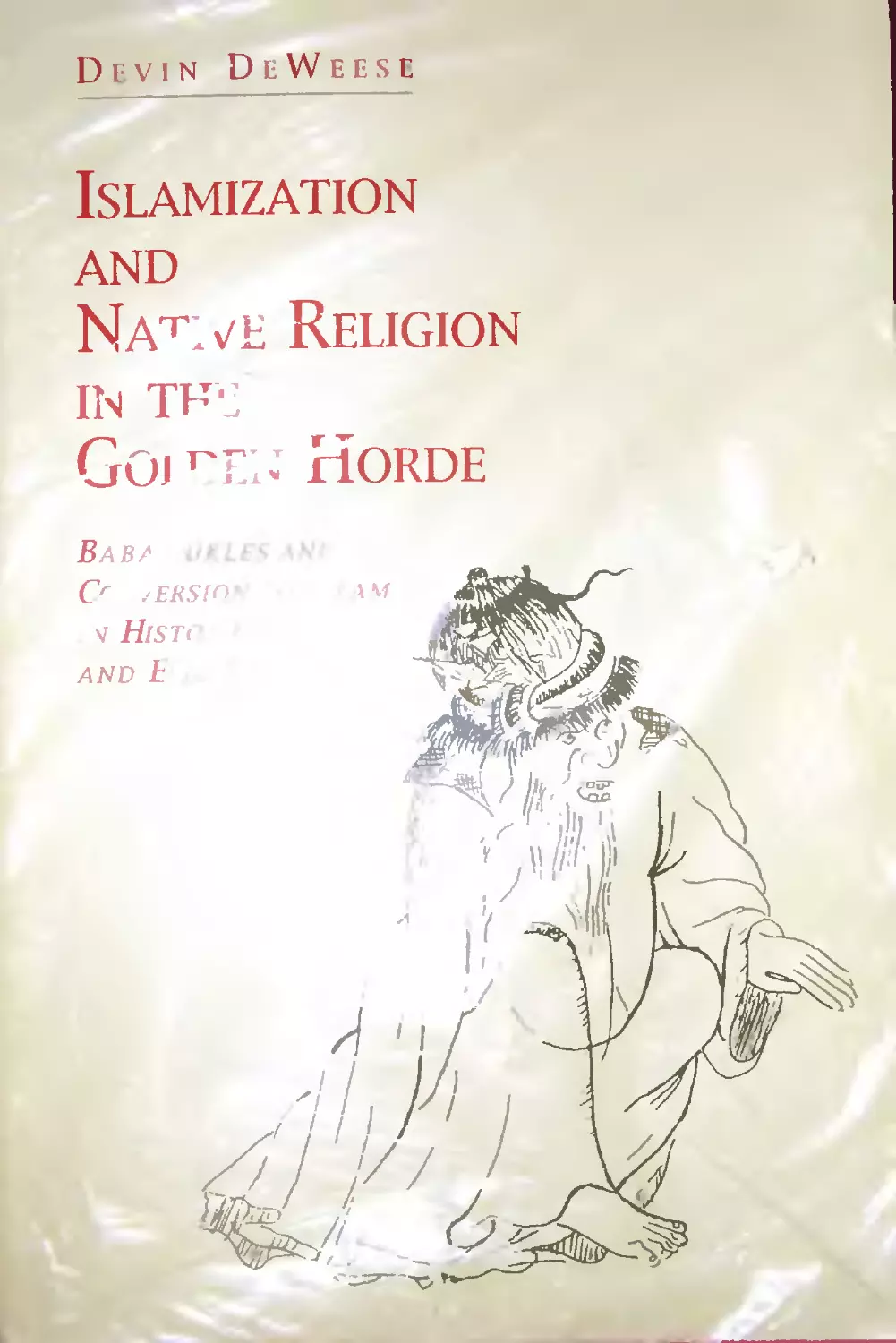


Автор: DeWeese D.
Теги: religion islam golden horde traditions islamization
ISBN: 0-271-01072-X
Год: 1994


Текст
                    Dfvin DeWeesc
ISLAMIZATION
AND
Na^e Religion
IN TH-j
Goj ^e;: Horde

ISLAMIZATION
AND
NATIVE RELIGION
IN THE
GOLDEN HORDE

HERMENEUTICS: STUDIES IN THE HISTORY OF RELIGIONS
KeesW.Bolle, Editor
Advisory Board: jean Bottero, Jaan Puhvel, William R. Schoedel
Eric J. Sharpe, Margaret Washington, Guy R. Welbon
RtiSeS„e;s^rK0okhba in Traditi°nai j-h Litoature:
'~^fcSa's Magic c,othes: Re-Visionin*Kingship
Devin DeWeese Mam- i-
BabaTuklesandrT Na"Ve Reli§ion in the Golde" Horde:
"nd Converse to Islam in Historical and Epic Tradition
Devin DeWeese
ISLAMIZATION
AND
NATIVE RELIGION
IN THE
GOLDEN HORDE
Baba Tiikles and Conversion to Islam
in
Historical and Epic Tradition
The Pennsylvania State University Pnss
University Park, Pennsylvania

Ubnm of Congress Cataloging^- Publication D;,ta
DeWeese Devin A. 1956-
JSS: ^6ion: rGoidcn "°^ ^ ™>« -<< ™,n,,
niSt0ncai and eP'c tradition / Devin DcWccse.
^«-C3SSS(rte "y1- Fr of rcl,g,0"s)
ISBN 0-2" 1-0107? v/ n c,ltcMP- ) and index.
1 Wam-Sov id^^'en hPaper)~ISBN °-271-0107^-8 (p|,L )
BP63j\4S6644 1994 rmcneut,Ci. studies in the history of religions (1980- )
29 S8'0902-dc20
93-18488
CIP
* P'"' ht 1994T, d
p»»tediritfleU,„M
u,t ol America
f <A Ii li d h Tl u
]t i th 'i y f n
"•^re"'^-" '^UlU ]!"]"»* * *l„„s. ..kIIk.-,,^!...
F""n n 7, " 'U'" nr,..N ,'■ ,'C,I,,fi,,^»'' ■•■■« «mU.I sl„rl satisM"*
1 rf,|,'»'M"|l|" "f,!,,,-Sl-»'.l....ll,„ |ll!,llll,l.„,„S,-..-..c-cs
For Sandy

Et miror quis diabolus portavit illuc legem Machometi...
—William of Rubruck, 1255
..and so those [Tatar] infidels have taken possession of the Northern Country.
And since they have taken control of it they have not forced change upon the
Community of this [final] Prophet, nor do they order the people to alter their
religion; for there is no religion among them that requires this. Thus the people of
this Community remain in their country as they were, except that dominion alone
has departed from them. So there is benefit in those infidels for the Community
of this Prophet (may God bless and keep him); and this is so because they have no
religion that is incompatible with the religion of this Community, and their
intermingling with this Community is what is inducing [those infidels] to enter into it.
And so, after all, they are reckoned among its people, and lands of other infidels
are being added to those countries they have already conquered. Therefore, in the
end, the lands of this Community have expanded.
-Ibnan-NafTs, 1270
Among the instruments of Muhammadan propaganda at the present time, it is
interesting to note the large place taken by the folk-songs of the Kirghiz, in which,
interwoven with tale and legend, the main truths of Islam make their way into the
hearts of the common people.
-T. W. Arnold, The Preaching of Islam, 1896
Contents
List of Tables
Acknowledgments
Abbreviations
Introduction
1 The Religious Environment: Worldview, Ritual,
and Communal Status
Islam and Conversion
Indigenous Religion in Traditional Inner Asia
Islamization in Inner Asia
2 The Historical Setting: Baba Tiikles and the Conversion
of Ozbek Khan
Islamic Antecedents in Western Inner Asia
The Conversion of Ozbek Khan
The Conversion of Ozbek Khan in the Account
of Otemish HajjT
3 Conversion Narrative and Religious Meaning, I: The Setting
Story, History, and Religious Meaning
in Conversion Narrative
Debate and Contest
Ritual Intrusion and Displacement
4 Conversion Narrative and Religious Meaning, II: The Drama
Baba Tiikles and Shamanic Narrative
The Oven-Pit: Ordeal, Sacrifice, and Sacred
Enclosure in Forging a Conmumity
Displacement and Assimilation

\iii Contents
5 Baba Tiikles in History and Genealogy 321
The Hero of the Conversion Narrative: Baba Tiikles 323
Edigii and the Noghay Horde 335
Reworking the Account of Otemish HajjT:
cAbd al-Ghaffar Qiriml in the Eighteenth Century 352
Making Sense of Diverse Traditions: A New Account
from Khorezm in the Eighteenth Century 366
Baba Tiikles and the Full Genealogy of Edigii: Tatar
Historiography, Bukharan Hagiography, and Russian
Heraldry 381
6 Baba Tiikles in Epic Tradition and Folklore 409
The Epic Tale of Idige 411
Baba Tiikles' Role in the Tale of Idige 420
Baba Tiikles and the "Noghay Epic" 435
Baba Tiikles as a "Nativized" Bringer of Islam 442
7 Baba Tiikles and the Uses of Sacred Origins 491
Baba Tiikles and Legends of Origin: Parallel Structures
and Themes 492
The Mythic and Narrative Development of Baba Tiikles:
Reconstructions and Parallels 506
Religion and the Articulation of Communal Identity
in Islamic Inner Asia 516
Appendix 1 Otemish Hajjl's Account of the Conversion
ofOzbek Khan: Text 533
Appendix 2 Otemish Hajjl's Account: Translation
and Commentary 541
Appendix 3 An Eighteenth-Century Khorezmian Account
ol the Conversion of Ozbek Khan: Text 567
Bibliography ^
Index
617
List of Tables
5.1. The Genealogy of Edigii and Baba Tiikles
According to Historical and Epic Accounts
5.2. Some Russian and Central Asian Genealogies
Stemming from Edigii
Key to Map (page 425) and Table 6.1.
Versions of the Idige Tale Featuring Baba Tiikles
6.1. Narrative Elements in Versions of the Idige Tale
Featuring Baba Tiikles
7.1. Recurrent Motifs in Historical Legends of Origin
and Tales of Baba Tiikles

Acknowledgments
My work on this book in a sense dates back to the final weeks of 1983,
when I first examined the lone accessible manuscript of Otemish HajjT's
work in Tashkent and read and transcribed the conversion narrative; I
returned to the narrative only in late 1987, for a conference paper, and
since then a series of revisions, frequently interrupted by other
projects, has produced the present study. As my thinking about this
narrative and its implications developed, a number of friends and colleagues,
too numerous to mention, helped and contributed to the final product,
whether by reading earlier drafts, by answering specific inquiries, or by
suggesting new directions to consider, in the course of wide-ranging
discussions whose connection with the present work became evident
only much later. My appreciation of how much I have profited from
their insights removes any pretense that this study might be regarded as
the product of my efforts exclusively.
I am especially indebted to Yuri Bregel, not only for his longstanding
guidance and support, but for his interest in this particular project and
his helpfulness in reading through several preliminar) versions; manv
thanks are due also Larry Clark, who also read parts of several drafts and
offered much-needed encouragement and guidance. Through
conversations or correspondence, several colleagues have enriched my work on
this study in important and substantive ways, whether in specific
difficulties or in sharpening nn research and analysis; mv thanks go to Oleg
Akimushkin, Gustav Bayerle, Peter Golden, Jo-Ann Gross, Gvorgy Kara
Robert McChesney, Jiirgen Paul, Nazif Shahrani, Denis Sinor, Maria
Subtelny, Tiinur Beisembiev, and Uli Schamiloglu. Among ni\ students.
1 am particularly grateful to Allen Frank, David Tyson, and Bill Wood,

xii Acknowledgments
wh0 aided me enormously in bibliographical matters and also raised or
forced important elements of te arguments developed here.
Needless to add, I alone am responsible for all errors and omissions in
the book, and for the views and arguments sustained in it.
1 am also greatly indebted to the friends and colleagues who have
helped me so unstintingly during my research trips abroad to Central
Asia and India. Special thanks are due my colleagues who made my work
at the Institute of Oriental Studies in Tashkent so fruitful during my two
visits, in particular Dr. Buri Akhmedov, Dr. Dilorom Iusupova, Dr.
Muzaffar Khairullaev, Dr. Qivamutdin Munirov, Dr. Asom Urunbaev,
Dr. Orif Usmon, and the late Dr. Elena Poliakova; the Institute also
kindly provided me with a microfilm of Otemish HajjTs work, which greatly
facilitated my research. 1 am also grateful to Dr. Botirbek Hasanov for his
aid during my work at the Institute of Manuscripts in Tashkent, and to
Dr. Bakhtiyar Nazarov for his considerable help in arranging my second
trip to Central Asia. My work in India, to some extent less relevant to the
present study, nevertheless contributed in important ways: special thanks
go to Mr. N. B. Inamdar at Osmania University in Hyderabad; Dr. A R
Bidar and Mr. Atiqur Rahman at the Khuda Bakhsh library in Patna; Mr.
Akbar Ah Khan Arshizadah of the Raza Library in Rampur; and Dr.
Awsaf Al, of t e Indian Institute of Islamic Studies in New Delhi.
ftet^ R7"*^™ l98M4 W3S ™de P°sslble ^ a grant from
^^Sn^^^IAlM^ Philosophical Society. For
American Fellowship pJTrf rtn™ ' am gFateful t0 the Ind°"
rfjScholars, -hichLdeLy^rTV^ Inte™tio»al Exchange
Fellowship support from the\Z i « du"n8 the summer °f 1988-
f^itated completion of th's~lEn^wment for the Humanities
^devotedtootherc ^« ^ « *e preparation of forth
kSS1 ^ "< * -We ,^ ^3 —film of the manu-
lmPortant account of Nurullah
^S^ » ^fer1 " ^ ^ « copy of
1Udm^-^ 2> -te 185), of the
h'" CHK-name. Fa^cPa«d by the late V. P.
1 e> penvod, transkriptsiia,
er
ere.
Acknowledgments xiii
tekstologicheskie primechaniia, issledovanie V P. ludina; Podgotovila k
izdaniiu Iu. G. Baranovci; Kommentarii i ukazateli M. Kh. Abuseitovoi
[Alma-Ata: Gylym, 1992]). The work contains ludin's Russian translation
and transcription (into the Cyrillic script as adapted for the modern
Qazaq literary language in Soviet times) of the entire text, facsimiles of
the manuscript, textological notes, and indexes prepared by M. Kh.
Abuseitova; it includes also a reprint of ludin's article, "Ordy: belaia,
siniaia, seraia, zolotaia . . ." (cited in Chapter 2), as well as three
previously unpublished studies by ludin based on Otemish HajjTs work, a
brief introduction by ludin's wife, Iu. G. Baranova, and a foreword by
the editor-in-chief, B. A. Akhmedov.
ludin devoted no special attention to the conversion narrative that is
our central focus here; his understanding of the text is for the most part
in accord with my own interpretation, with two substantive exceptions:
(1) he treats the term I have taken as representing the word "qoruq"
differently, but unfortunately gives no explanation for his reading; and (2)
he offers a somewhat different understanding of the drinking ceremony
described in the narrative, one that is entirely plausible and perhaps
preferable to my own. However, ludin's textological notes, as published,
are far from complete, dealing for the most part only with textual
emendations rather than lexico-semantic questions, and it appears that the
materials he left at his death may likewise offer few clues as to his
understanding of particular terms; Baranova's introduction mentions a lexicon
prepared for the text by ludin, apparently with attention to syntax and
usage, but this remains unpublished, and in any case it is usually onl>
from his translation that we may judge how he interpreted a given term.
In all fairness, however, ludin has dealt with the entire text, and not
merely the small part of it discussed here.
I have sought, for the present work, to incorporate ludin's
interpretation of these two problematic issues, and of other textual points he raises,
in my notes to the text and full translation of the conversion narrative
(Appendixes 1 and 2), but with few exceptions 1 have not added further
notes in Chapter 2 regarding his analysis of the work as a whole or his use
of the work as a historical source; of special interest in this regard is his
discussion of the tradition of "steppe oral historiography" (pp. 57-75),
which includes a discussion of several names that figure in Otemish
HajjTs account of Ozbek Khan's rise to power.
ludin worked, of course, as have most researchers, without access to
the Istanbul manuscript of Otemish HajjTs work; unfortunateK he was

xiv Acknowledgments
also unable to consult two published works useful in analyzi tU
(cAbd al-Ghaffar QirimT's history, based in part on Oteniish H -' ^ ^
and the study of Mustafa Kafali, who was able to consult tl T W '
manuscript), and both the philological analysis included in t/ ^
lished work, and the historical commentary as well, are far fr if
tive and in general are disappointing. This new publication^ thuT
no means the final word on Oteniish HajjTs work. Nevertheless I l >
efforts, and those of his colleagues who prepared his work fo" ?
hcation promise to make Otemish HajjTs work widely accessible^
scholars for the first time and, as such, mark a significant stenforw.
the study and appreciation of this remarkable source P ^ *
Abbreviations
AEH
AEMA
AN
BSO(A)S
CAJ
CHlr
ED
EI', EI2
E/r
ERE
CAL(S)
Acta Ethnographica Academiae Scientiarum
Hungaricae
Archivum Eurasiae Medii Aevi
Akademiia Nauk
Bulletin of the School of Oriental (and African)
Studies
Central Asiatic Journal
Cambridge Histoiy of Iran
(Clauson, see Bibliography)
Encyclopaedia of Islam, 1st & 2nd eds.
Encyclopaedia Iranica
Encyclopedia of Religion and Ethics
Carl Brockelniann, Ceschichte der arabischen
Litteratur (\> Supplement) (Leiden: E.). Brill.
1937-42 [Suppl.J, 194V49 [revised editions of
vols. 1-2])

CRVl
HJAS
HUS
l\
10 ME
w Abhc^i*ons
Claviiaia RecKiktsiia Vosloolmoi l.ilcialm >
(Moscow)
Han-ard journal of Asiatic Studies
Harvard Ukrainian Studies
Islam Ansiklopcdisi
Izvcstiia Obshchestva arkheologii, istorii, i etno-
grafii pri Imperatorskom kazanskom universitete
IVAN Uz Institut vostokovedeniia Akademii nauk
Uzbekistan (formerly IVAN Uzbekskoi SSR)
lzd-\o Izdatel'stvo [Publisher]
}A journal asiatique
(AH Journal of Asian Histor\>
JA0S Journal of the American Oriental Society
1MS Journal of the Royal Asiatic Society
Korosi Csoma Archivum
Kefeti Szemle
KSz
LOIVAN
PIA
PIAC
i
os-
^qTo °e0tdelenie ,,lstit,»;' vostokovcdc.iiis
Z , NowP«erburgskii filial |lls|iUlla v
Vre on Inner Asia
s,oreyFL t>;'n,ane",,"le-'-'A,la,s,icc:o„r,,,K.e
-•■ A. Storev P
cal Survey I mlaU Literaiun; A Iho-bibliograplu
At
t> revia r xvii
Storcy-Bregel', PL
PSRL
RE/
RHR
SAA
SE
Sochineniia
SPb
SVR
Tiz
TMEN
WO/RAO
UA/
WZKM
ZVOIRAO
ZDMC
Ch. A. Stori Persidskaia literatura; Bio-bibli gra-
ficheskii ohzor, ed. & tr. Iu. E. Bregel'; 3 vr 1 .
(Moscow: CRVL, 1972)
Polnoe sobranie russkikh letopisei
Revue des etudes islamiques
Revue de Ihistoire des religions
Soviet Anthropology and Archeology
Sovetskaia etnografiia
(Bartol'd, see Bibliography)
St Petersburg
Sobranie vostochnykh rukopisei Instituta
vostokovedeniia AN UzSSR
(Tizengauzen, see Bibliography)
(Doerfer, see Bibliography)
Trudv vostochnago otdeleniia Imperatorskago
Russkago Arkheologicheskago Obshchestva
Ural-Altaische Jahrbiicher
Wiener Zeitschrift fur die Kunded's Mainland s
Zapiski vostochnago otdelmiia Imperatorskago
Russkago Arkheologicheskago Obshchestva
Zeitschrift der Deutsche Morgenliindisehe
(Icsellscfnift
7YS
Acntralasiatische Studien

ISLAMIZATION
AND
NATIVE RELIGION
IN THE
GOLDEN HORDE

Introduction
In 1253, the Franciscan friar William of Rubruck encountered Muslims
where he may well not have expected, and certainly did not wish, to find
any. Rubruck was acquainted with the Islamic world, having spent
considerable time in the Middle East in the course of the French king Louis
IX's crusade in Egypt and Palestine; but in 1253 he was traveling, at
Louis' behest, through the lands of the Mongol khan Batu in what was to
become known as the Golden Horde, on his way to the court of the
Mongol Great Khan, Mongke. It is possible that even before his
departure, the friar had heard reports of "Saracens" in Batu's realms from
earlier travelers, but much of the world through which he journeyed was
virtually unknown to his contemporaries. In any case, in his report to King
Louis, completed most likely in 1255, Rubruck noted the presence of
Islam and Muslims in the lands of the Golden Horde, including three
noteworthy comments that at once evince his dismay at finding his own
faith's chief rival there, and at the same time nicely encapsulate for us
sentiments that have dominated popular and scholarly attitudes toward
Islam in the Inner Asian world down to our times.
Of Berke, Batu's brother, whose accession to the throne in 1257 was to
mark the first official "establishment" of Islam in a Mongol state, Rubruck
wrote, "he makes himself out to be a Saracen";1 and like Rubruck, a host of
1. Peter Jackson, tr., The Mission of Friar William of Rubruck: His Journey to the Court of the
Creat Khan Mongke, J253-J255 (London: The Hakluyt Society, 1990), p. 127 and n. 2; cf. the
translation "by a mm of Stanbrook Abbey" in Christopher Dawson, ed., I'he Mongol Mission
(London: Sliced and Ward, 1955), p. 124: ". . he pretends to be a Saracen." For the text, see
Anastasius Van den Wyngaert, ed., Sinica I'ranciscana. 1: Itinera et relationes fratrum minorum sae-
culi Xlll et XIV (Quaiacchi-Klorence, 1929), p. 209: Est alius qui dicitur lierca, frat r Baatu . . . t
Hie fat-it se sarracenum, et mm permittit in curia sua cvmedi carries porcinas.

4 Introduction
Western travelers, observers, and scholars, doubting the "serio
Muslims in this "exotic" world, have made an assumption of "light" "^ °^
rial" Islamization a cardinal feature of most approaches to Islam in I n°mi
Of the Bulghars of the Volga, whose Inner Asian state had ad "
Islam already in the tenth century but was a victim of the Mong- I A
in 1237, Rubruck complained that they "are the very worst kind ofT^
cens, clinging more firmly to the law of Mohammed than any othtr'i
and like Rubruck a similar host of Western observers, when the e " \
dismissing Islam there as merely superficial became clear, has resorted t
dismissing the "quality" of Islam in Inner Asia, falling back on the all t
familiar Western motif of fanatical Islam.
And regarding the same Bulghars, whose land was held to be not far
from the fabled "Land of Darkness" and lay, as Rubruck noted ano h
five.days' ]0urney north of Batu's encampment, the friar gave vo^ce a
np£tg2tmldeiment th3t Unf0rtUnat^ h3S ^ b~n Lch™
Muh could h' 1 dCVl1 Cariied the l3W °f Machom^ there.-
«* ^tLteea:ren; 3nd ,°Ught t0 be' 3bout ^ -.conceptions
** ^%*S I "^ 3m0ng InnCr ^^ Pe°PH
toward Islam that color h tT I t 7^ 3 Persistent fear and hostility
combined with general t .°Iarly and Popular attitudes in the West,
rende*d Islam in iTn'^A ^^ with the Inner Asia" world, have
^Peoples are not Jm, ' f°CUS of Western hopes (that Inner
"I M^ms, after allM } and fears <that they «e as fanatical as
riV!;e °1'^ l-storv aneHStln§ °r ^ "me ^ral bewilderment
^ ^ Friar Williarn^ S,§mflcance of Islam in Inner Asia, as
°ut aim here k co™ments.«
on 1 ci now ever '
nner^a)0ronlslam'^ to discuss the ways in which specialists
1 Daw*.. ThP m ' 6 C°ntlnued [0 show their essential surprise
^nt^iiQCc °ngo'M'«ion p I26
miscon4tion°nly W0tth no^ ^C,,0n,e"'- ' "' P ' 3 *' Wy»gaert, p. 2 J 2: ef miwr
\^^^^t^ U]7 « — often the "culpnt" in these
•aSta^ on bT "* S^^ay °< dis^' Inner Asia» components of the civiliza-
*•** ^^ S ?" °f C ," ^°mplai11 about *e role of Islam; **
ndco-«Pl^eXtlaneo^bK ,1Uliee"ous In"^ Asian cultural ele-
natl°nal heritaf f ,,U Sllccess"'e campaigns by Soviets
^ 0fIl,n« Asian peoples.
and^tion
Introduction 5
and bewilderment upon finding Muslims in Inner Asia, through their
contradictory dismissals of Islam there as either ungenuine or uncivilized;
suffice it to say that such characterizations still dominate even contemporary
press accounts of present-day Muslim peoples of the former Soviet Union.
Rather, I would like to consider "what devils" brought Islam to Inner Asia,
by paying attention to accounts of Islam's introduction and spread among
Inner Asian peoples as far removed from the sympathies evident in
Rubruck's remark (and most scholarly accounts today as well) as possible:
accounts created and transmitted and adjusted among the Muslim
peoples of Inner Asia themselves—that is, among communities for whom
those who brought Islam are not devils, but saints. More precisely the
present work is a study of one conversion narrative and its many echoes, in
the context of the religious issues it was evidently designed to address, and
above all in the context of one central character in the conversion drama
and the ways this character resonated for subsequent generations.
Elements of the narrative in question must have developed already
during or soon after the reign of the Mongol ruler whose conversion it
recounted, Ozbek Khan of the Golden Horde (r. 1313-1341). It is not
until the middle of the sixteenth century, however, that we find a well-
developed version of the narrative set down in a written form that survives
to this day, in a rare and little-studied work from Central Asia known as
the Tdrikh-i Dust Sultan, written by a certain Otemish Hajjl; and it is this
version — the earliest to which we can have access —that we must adopt as
our basis both for envisioning the religious import of the narrative in the
two centuries between the "events" it recounts and its reduction to
written form, and for evaluating later developments of the tale or its elements
in written and oral venues.
That this conversion narrative survived, with much of the content
reflected in our earliest written form intact, at least down to the earlv
twentieth century is confirmed by scanty, but convincing, evidence, thus
attesting to the continuing power of the story as a whole. More
important, perhaps, the central character in the conversion narrative —an
enigmatic figure called Baba Tiikles —was the object of a truly remarkable
range of narrative elaboration, popular devotion, genealogical
appropriation, and saintly and shamanic invocation, among the peoples of the
western half of the Inner Asian world.
In particular, the account in question casts new light on the origins of
this "Baba Tiikles," whose name is well known from semi-historical and
epic narratives produced among the peoples of the Golden Horde. Those

6 Introduction
t) inirouu«-»v"
A the new account confirms, that Baba Tiikles was
narratives suggest, ana ^ ^ ^ brought the new religion to the
known first as a bearer o ^^.^ role was assimilated in popular
Golden Horde but■ J* , ancestor and mythic progenitor. This
memory with the ticular the Jirecft'on of assimilation, argues
assimilation rf, and J^ Is,amizalion and "ethnic" identity than
ta'p^lbeen acknowledged for Inner Asian peoples; the account
n nuestion helps to reveal the essential equivalence of conversion
narratives and legends of origin, both recounting the essentially sacred act
of "founding" a community and defining it in fundamentally religious
terms. For what emerges in considering the various stages of Baba Tiikles'
development from "Islamizer" to "nation former" to "mythic ancestor" is a
clear pattern linking Islam with indigenous Inner Asian values —most
important, with Inner Asian conceptions and formulations whereby the
origin and legitimacy of human communities are sacral ized.
The strange and powerful figure of Baba Tiikles was hailed as the
bringer of Islam to the fourteenth-century Golden Horde; he was recalled
as an Islamizing ruler among the twentieth-century Noghays of the
North Caucasus; he was credited with "creating," in effect, a number of
Inner Asian peoples ranging from the Uzbeks to the Qalm'iqs; he was
claimed as an ancestor by a startling array of "Inner Asian" nobility
ranging from the sixteenth-century rulers of the Noghay horde, to Sufi
shaykhs in seventeenth-century Bukhara, to Russian aristocrats in
twentieth-century America; he was turned into a mythic ancestor and patron
spirit ,n an oral epic cherished among perhaps more Turkic-speaking
peoples than any other, including Noghays, Tatars, Bashkirs, Qaraqal-
shrine ?Vf u112^1 he ** rCVered as a saillt "early as widely, with
l«™^^Tj^^in* Mushm Sa"ltS incorporated into
^::;::c: t:rron Baba mw -^<*«*
and Popular among the M.kV fourteen^ century to the twentieth
is> among peoples who in ^ °f Central a,'d limtr Asia~that
Wear to have been consci! T^'^ and transniiltiiig such narratives
oHslam in their own conceT ^ "nconscioils,y asserting the cenlrality
darity. Perhaps more inipJ T*/Coil»»"»«l origin, identity, and soli-
dePendant finally Upoi „ ' U,c exUinl forms of these popular tales,
y P°» ** conversion narrative.ha.il the center-
Introduction 7
piece of the present study, were clearly significant markers of both
popular and learned attitudes. They formed a store of common "historical"
knowledge tapped by popular bards, tribal and village elders, and court
historians; they were not only "preserved" as inherited tradition, but
were "kept alive" in a real sense by being altered and updated to reflect
changing communal concerns and aspirations.
In this way, the conversion narrative that provides the basis for the
present study, like other conversion narratives from Inner Asia whose analysis
must await a later setting, offers invaluable insights into the dynamics of
Inner Asian peoples' encounters with Islam, and, what is perhaps more
significant, adds to the sources at our disposal for understanding those
encounters a hitherto ignored or undervalued dimension: the voices of
Inner Asian peoples themselves. Such an effort to listen to indigenous
voices not only gives us insight into "what devils" brought Islam to Inner
Asia and into why and how those bearers of Islam became saints revered
among Inner Asian peoples; it also serves, ultimately, to undermine those
larger misconceptions about Islam in Inner Asia.
A Note on "Inner Asia"
It may be appropriate to clarify what is meant by "Inner Asia" here in
the context of Islamization, since the cultural and historical referents of
the term "Inner Asia" remain unfamiliar even to many specialists in the
civilizations that border the Inner Asian world. As a geographical term
"Inner Asia" refers to the interior "heartland" of the Eurasian landmass,
corresponding to the present-day political units of Mongolia, Tibet and
Xinjiang in the People's Republic of China, what until recently were the
"Soviet" republics of Central Asia, and substantial portions of Siberia, as
well as of European Russia, within the Russian Federation. Today it
hardly needs to be mentioned that in considering the Islamization of
Inner Asia, we are in effect seeking to understand one element, and, 1
would argue, an often decisive one, among the distinctive historical
processes and cultural traditions that gave the so-called Muslim republics of
the former So\ iel Union their "independence" from Moscow long
before this was reflected politically.
The region comprises in the main the three ecological zones, from
north to south, of forest, steppe, and desert; its primai\ cultural referents

8 Introduction
a;c civilizations of the steppe regions, and the
are the pastoral n°mac" civiiizations with the commercial and agri-
mutual interactions of rn desertzone, and with the peoples of the
cultural centers of the sou^ ^^ defined in such cultural terms Inner
vast forest belt to the nor^ ^ contracteG through history.
Asia's borders have expan ^ ethno-cultural regions, which have
Inner Asia includes an ^ ^^ ^ „ ^ ^ chmcttr_
enough in common to Deg ^ ^^ features (often the
ized by distinct,ve: pohh« , ^ ^ outlying peoples) ^ ^
result of specific Pattern* hin ^ Inner Asian sphere; the «bor_
r - s^^^ *** hist°ricaiiy'but am°ng the -
tants may be mentioned eastern Mongolia and Manchuria on the
Chinese frontiers, the Mongol steppe and Junghana, Tibet, Islamic
Central Asia (including the steppes of present-day Kazakhstan, with East
Turkistan added as a distinctive component in the fifteenth century),
and the Volga-Ural basin. Islamization has "happened" in all three
"ecological" regions of the Inner Asian world, and in several of these cultural
regions, but only in the western half of Inner Asia, with Islam's chief
"competitor," Buddhism, prevailing in the east.
In political terms, Inner Asia's history is dominated by the periodic
steppe-based nomadic empires, but includes also the local polities of
hunting and trading communities in the forest zone, and small-scale city-
states or regional "kingdoms" of the desert region. Islamization has
"happened" in each of these contexts as well, and the history of the spread of
Islam in Inner Asia thus comprises the Arab conquest of the city-states of
sedentary Central Asia and the subsequent transformation of the entire
region into a major center of Islamic civilization, as well as the
penetration of Islam into the Inner Asian steppe north of sedentary Central Asia;
it includes the assimilation of Inner Asian Turks through the Islamic
system ot notary slaves, through "tribal conversion" (e.g., the Seljiiks), and
hrough .mperiar conversion (e.g., the Qarakhanids); it includes the
state of tt eSta,blishme,lt of Mam among the western successor
peld 1 r e?lre ft0m "'e thirteentlTcentury to the fifteenth,
>he spread of Isll g ' m conte»'Porary terms; and it includes
Siberia and in TvTtlT °f "* $teppe a"d f°rest Z°"eS' both '"
a Process continuing downr '.l8'0"' T™ C,Uri"g RuSsia" ""P0™1 rU'e'
not only Turkic nPnnl i , ^ twenticll. century and involving
Pe°PK but IWUgric groups as well.
Introduction 9
The conversion narrative explored here represents one of the three
broad areal spheres of Islamic culture in Inner Asia (Central Asia proper, the
Volga-Ural region, and East Turkistan); its impact however, was even
more widespread, through its echoes in popular tales circulated for
centuries throughout western Inner Asia, from the Crimea to Siberia and from
Kazan to Khorezm.
Aims, Assumptions, and Approaches
The motivation for examining this narrative and its echoes stems in part
from the misconceptions alluded to above regarding the character of
Islam in this Inner Asian world. In particular, I would highlight two
issues underlying our explorations in this study:
First, the lack of any substantial and serious study of Islamization in
Inner Asia, combined with the relative neglect of the problem of conversion
in Islamic studies in general, has produced in those scholarly books and
articles that cannot avoid at least touching upon the impact of Islam in
Inner Asia a litany of uncritically accepted pronouncements on
Islamization, with a standard theme: Islam "sat lightly" upon the Inner Asian
nomad, whose "conversion" was in name only and failed to have any serious
impact on his daily life or consciousness. Such a view, that Islamization in
effect did not matter, is not only clearly flawed by a remarkable
misunderstanding both of the nature of Islam and of the indigenous religious
conceptions that preceded Islamization, but is at the same time patently
uninformed by any of the conceptual tools developed over the last century
for the humanities and social sciences by the field of Religionswissenschaft.
A more balanced consideration of the issue allows us to counter both the
prevailing view and the prevailing "approach" by suggesting that
Islamization did matter, and in a fundamental way that was both
transformative and at the same time characteristically attuned to pre-Islamic
traditions. With this basic assumption we may examine the conversion tale
and its echoes as examples of fundamentally religious discourse that
illustrate the reinforcement and recasting of deeply held values through
the encounter with Islam and evince a native understanding of sacred
communal origins as well as a conscious, "assertive" evocation of communal
solidarity.
Second, the interplay of religious and national/ethnic identities amon^

10 Introduction
r • 11 Muslim peoples of the former Soviet Union-the heirs of
the traditionary N™ long been discussed by students
the-Islarmzed P^^J^ Asian affairs, and has taken on even
0f contemporary^^ ^ ^ ^ ^^ ^
rnTSSS as «* peoples reassert then right to define their
own historical Entities. This same issue however, has never been
seriously examined in its historical context, as the outgrowth of traditional
conceptions among the peoples of Central Asia regarding how, when, where,
and by whose influence they became Muslims and thereby took on a new
communal identity; rather, "explanations" of the varying degrees of "Islamic
consciousness" embedded in national feeling have rarely looked further
than nineteenth-century descriptions, and, more important, have never
"listened" to indigenous accounts of intertwining religious and ethnic
identities.
It is the critical value of such indigenous accounts of conversion that
must be stressed here, for I would argue that our only access to the
meaning of conversion for those peoples lies in such narrative responses.
"Conversion" is inevitably a process of such considerable psychological
and social complexity that even a thorough reconstruction of the
historical setting and events that occurred, and even a precise description of
"what happened" could not convey the significance of the conversion
understood and felt, religiously, by the adherents of the new faith and
heir communal heirs. The "conversion" happened, and had historical
beZTT l C°f?qUenCeS' but in and of itself was at the same time
J!k™ °f !list0rif * -constructions, and yet important and
X^X^^i therlves in«™^ — ^with
countings we find efin 1 reC°Unted ^ re,ated| in th°S6
meaningful in the convei ** **"*** M imP°rtant and S°Cially
Beyond the general '
leamed from listening toT aSSUmPtions regarding what may be
the present study based ' ^ "^ V°iCeS' the sPecific hypotheses of
ber of other conversion nTr UP°n the Prelimi»ary analysis of a num-
the Point of departure here? V? add'tion to the one lhat serveS aS
>are as follows:
1 C •
°fh/slaini^tioTta1rthrciemSelveS Cemral ele'"e»t* i" ^ process
^'« *esses its brMk ^™n,ty ari;cl,/(,/es ils is,alI1jc„css alld
P^-Mamictraditions orvdue ^ " R"ds Co"""<>" S™"1"1 *"''
Introduction 11
2. Conversion narratives are assimilable, in structure, content, and
function, with the "legends of origin" reasonably well known among Inner
Asian peoples telling of the creation of the world and/or of the "first
man": in structure because they follow similar narrative patterns as
employed in legends of origin; in content because they frequently
employ specific symbols and narrative elements strikingly similar to
those found in legends of origin; and in function because, like
legends of origin, they appear to have been asserted and "rehearsed" as a
means of declaring the sacral integrity of a particular collectivity on
the basis of identity in origin.
3. For this reason we often find development of these narratives in two
apparently opposite directions: the "Islamization" of indigenous mythic
creation narratives, and the assimilation of figures and events associated
with Islamization to sacred figures and events in pre-Islamic traditions
(as we will see, it is the later epic reworkings of elements in the
"original" conversion narrative that most closely parallel communal legends
of origin, but echoes of the themes evoked in such legends may be
found also in our earliest version of the conversion narrative itself).
4. The conversion narratives' capacity to provide a vision of communal
integrity prompts us in turn to ask for what further specific ends these
articulations of Muslim status were used beyond the essential assertion
of sacred values and communal self-conception. In this instance we
find at least two of particular interest: they are used (a) to support
claims of political legitimacy through religious charisma, and (b) to
lend prestige and authority to religiously defined subcommunities that
could claim credit for the conversion recounted in a given narrative
(certain conversion narratives clearly originated among Sufi groups
who came to be regarded as the principal forces in Islamization).
5. As the equivalent of "legends of origin" articulating a community's
understanding of its identity, conversion narratives express the
central ity of conversion to Islam in the formation of a particular tribal
ethnic, or "national" community.
6. Narratives of Islamization, as well as conversion narratives recounting the
establishment of other religions, are further illustrative of the patterns of
interaction between other "world religions" and indigenous Inner \sian
traditions, and among those world religions in the Inner Asian setting.
Our purpose in the present work is thus to aiuikze the varied complex
uf religious meaning conveyed b> the narratives about Baba 'Inkles, is

12 n r Ipments from that complex, from the perspec-
well as the further uses «c f Islamic religious values, with special
tive 0f Islam and from to*« F.^ q[^ ^ Our interest in the narra-
attentiontothefrequen ^ ^ ^ fof hish)ry per se, but for religious
tive and its echoes is as ^ ^ ^ re/fgfous w^s of comprehend-
values in general, and m ^ 0fconversion and its meaning for
coming and imagining ^^J^y discUss sources that properly belong to
munal identity. We wl " ^ and folklore, but our approach is not limi-
thc realms of history l era .^ discipiines; rather, our aim is to focus on
ted to one or allot these p ^ ^ illustrated by the sourceS| in order
the r^u^nemngc^ ^ ^ articuktcd in ^
S^SSS -cepHons of what is sacred in human
^InwSrAt study will intentionally fall short of an exhaustive
history of Islam and Islamization in Inner Asia; our concern here is not "what
happened/' but "what people say happened," in particular, the people who
consider themselves intimately connected in some way with the "reality,"
as they asserted it, of the conversion in question, and who repeatedly
rehearsed and adapted the account of the conversion. We will not restrict
or even concentrate our focus on any "historical facts" contained in the
conversion narrative or in its later echoes; indeed, it is central to our
working assumption that we would miss the point entirely were we to approach
the narratives exclusively as "historical" sources to be mined for historical
details. We will naturally attempt to discuss the historical settings in which
the various stages, or styles, of the narrative transformations developed; but
our focus is on the religious meaning revealed by the relationships between
successive narrative developments, not the relationship between "historical
reality" and the narrative tradition in part inspired by it.5
The argument advanced here with regard to the specific conversion
narrative of immediate concern is quite simple; but inasmuch as
presenting it depends upon discussing the conversion account itself (which,
since ,t has not been studied before, requires full philological analysis)
and upon introducing a wide array of material from relatively poorly
and'thel'lrJvenb'' ff '° reC°,1StrUct with s°™e degree of accuracy the historical context
va)ueofsudlanapproacKan CfTPa,med ^ C0,iversi™ of Ozbek Kha.'i to Islam, the limited
were possible) but miss the "s IA aC."OW,ed8ed- ^ we were to see only the events (if even that
thing of historical importance'| t" sig>»ficance, we would l.ave possibly missed so.ne-
value for understanding the d'e I ^ W°"ld ''^ in,tl»«lioiKibly missed something of critical
those responses reflect and i„flUePine"t0f"drralive «*!"»"« to the conve.smn and the way
nCe ^""Ptaiii of individual and communal identity.
Introduction 13
known historical and epic traditions of Inner Asia, it may be useful to
summarize it here as follows. The figure (Baba Tiikles) to whom is
ascribed, in an early narrative, the pivotal role in converting Ozbek Khan
to Islam became also a pivotal figure in the genealogical "myth" that lent
political legitimacy and religious sanction to the Noghay horde, one of
the major tribal confederations that emerged from the disintegration of
the Golden Horde; as such this figure's role was preserved in the
historical tradition of the Golden Horde's successor states and, what is for
us more significant, in the epic and folkloric tradition preserved among
the peoples of the former Jochid ulus. In that epic tradition, reflecting
both formulaic transmission and creative innovation among generations
of bards in western Inner Asia, are found clear signs of the implicit
equivalence, among the bards as well as their audiences, of the roles of
"Islamizer" and "ancestor," each serving as the "founder" of a given
community. And this equivalence serves to provide important, though
hitherto unappreciated, insights into the subtle but unmistakable process
whereby Islam was able to "fit into" and reinforce (rather than oppose)
the basic Inner Asian religious values associated with community and
with the centrality of human life in the communal context. Such insights,
finally, suggest in turn not only a potentially fruitful perspective to adopt
in attempting to understand the historical process of Islamization in
Inner Asia; they suggest also the need for a reevaluation of the role of
Islam, and of religious values and identifications in general, in providing
unity and definition to particular Inner Asian communities even today.
Specifically, the identification of the "Islamizer" who becomes
"Ancestor" is based upon the sixteenth-century account mentioned above,
which offers us a clear picture of the earliest stage of the narrative
traditions surrounding Baba Tiikles, as well as confirmation of the initial focus
of these traditions upon Islamization. We can in fact distinguish three
stages, or rather styles, in the narratives about Baba Tiikles produced from
the fifteenth century to the twentieth: first, the story of his miraculous role
in converting Ozbek Khan to Islam, as preserved in Otemish Hajji s account
but echoed in popular tales recorded as late as the 1920s; second, literan
accounts in the Tatar historiographical tradition from the seventeenth and
eighteenth centuries, which attempt to "historicize" Baba Tiikles but retain
his "Lslamizing" role while stressing his ancestry of EJigii, regarded as the
"founder" of the Noghav confederation; and third, oral tradition in the epic
accounts of the hero Idige (a figure inspired by the historical Edigii). which
recount Baba Tiikles' ancestry of the hero and often reflect his association

14 Introduction
• but in many cases also surround Baba Tiikles with
with lslamizatl^wn from indigenous, pre-Islamic Inner Asian religious
traditions. importance of Islamization, and of narratives
Herein we tino r £ of communal identities that has charac-
recounting it. in J■ ^ [n which political and social currents
terized much of i ^ extinctions often mask a change in al-
that appear as mass g ^^ ^ ^ ^.^ mythology„ fo. ^^
KS^K fold group. Precisely such a reshuffling is the stuff
c "temporary headlines as the peoples of the former Sovie Union
reevaluate their identities, and understanding Islamization is critical for
understanding that process: however much the impact and role of
Islamization may have been attenuated during the past seventy-odd years, as a
distinctly un-Islamic "confederative myth" was imposed upon the Muslim
peoples of western Inner Asia, both the "substance" of Islamization's
effects in Inner Asia, and the patterns of its evocation in national mythology-
building are likely to continue to be instructive as we observe the
emergence of new nations, and as these nations continue the process of defining
themselves.
The Plan of This Study
With these goals and assumptions in mind we will consider the central
conversion narrative and its resonance in its own time, and the later
reworkings of its central character, within the following general plan.
First, in an introductory essay, we will consider the general questions of
what Islamization means or might mean and, on the assumption that
Islam as a religious system is generally better known than the indigenous
religious traditions of Inner Asian peoples, we will consider in broad
outline the common, shared features of those traditions particularly relevant
to the issue of Islamization, in order to set the stage for the religious
counterpoints" that follow through the rest of our discussion.
Next, we will focus more closely on the particular time and place that
form the setting for our central conversion narrative, namely, the Mongol
successor state of the Golden Horde in the early fourteenth century, noting
the range of issues of relevance to the historical process of Islamization m
tins polity but considering in particular the available "historical" accounts
Introduction 15
on the "event" that is the subject of our conversion narrative the
"winning" of the ruler Ozbek Khan to Islam. We will then discuss'the "new-
source that provides our conversion narrative, and present the narrative
itself; an edition of the original Chaghatay Turkic text and a full translation
of the narrative are provided in Appendixes 1 and 2, since considerable
philological discussion, not all of which is directly relevant to the
religious issues at hand, is unavoidable in dealing with this source.
Following this discussion of the central conversion narrative, we will
begin the task of trying to understand and evaluate how this narrative spoke
to and conveyed religious meaning to its audience. The popularity and
longevity of at least some elements in the narrative—most important, of
the central figure ascribed the pivotal role in "converting" Ozbek Khan —
suggest that the narrative was religiously and socially meaningful in at least
certain communities for more than six centuries. Indeed, the rest of the
book is devoted to outlining the forms the narrative and its "spinoffs" took,
and to making an attempt—necessarily imperfect and tentative in view of
the nature of our sources—to discover why this tale and its central
character retained such a strong and persistent hold on the religious imagination
of Inner Asian peoples from the fourteenth century to the twentieth, from
the Crimea to the Altay, and from the Volga basin to Bukhara.
More precisely, we will first consider the wide range of religious
counterpoints in the primary conversion narrative itself, suggesting the ways in
which specific elements (and even individual words of particular resonance)
in the narrative's content and structure may have "packaged" religious
messages for an indigenous audience in the context of Islam, or in the context
of real or imagined features of pre-Islamic religion, or in the context of both.
Th is discussion will be accompanied by a more general treatment of a
central feature, both structural and semantic, evident both in the narrative as a
whole and in many of its distinctive components: the theme of
"displacement" and its variations. Here we will draw upon comparative material from
other Inner Asian conversion narratives that may parallel and illuminate this
theme, and suggest some conclusions regarding the use of "oppositional
and "assimilative" displacement in such narratives.
Next, we will trace the central figure in our conversion narrative, known
as "Baba Tiikles," and his narrative transformations, first in a variety of
"historical" sources and genealogical traditions, and then in j wide range of
oral epic and folkloric traditions. In effect in our preceding discussion of
the religious messages implicit in the original conversion narrative, we will
have examined how the figure of Baba Tiikles came to be surrounded

16 Introduction
. .c aura. in the subsequent discussions of
with an intense sacred and my "C.c 'nealogical and epic tradition, we
Baba Tukles' appearance in i ^^ ^ jn subseque„t generations
will explore what was made ? ^ audience appears to have lost
of his story's Inne._As*r>J> and counterpoints that infused thatorigi-
interest in many ot me ^ ^ sacred status> wlth rellgi0US
ncl narrative, "h,ch P* "^ to have clung to the figure of Baba
rSS me're^ of an impressive variety of sacra, function, vita,
t0 Z^«^^ - fch the figure of Baba TUk,eS
c„ firms uhpothesis that Inner Asian Islam.c conversion narratives are
trutur 1 y and functionally equ.valent to communal egends of origin,
SSibo* his 'ole in *e legitimati°n ° , §iay I" ! r f
ZdLJL into a mythic ancestor who is at the same time both Culture
Hero and First Man. This will lead us to consider again the .mphcahons
of the wide variety of religious meaning attached to Baba Tukles for
the broader issues of Islamization, and the role of Islam, in the Inner Asian
world. And finally, we will discuss some conclusions suggested by the case
of Baba Tukles with regard to what such conversion narratives may tell us
about Inner Asian "responses" to Islam in the important areas of political
legitimacy and communal self-conception.
1
The Religious Environment: Worldview,
Ritual, and Communal Status
Islam and Conversion
The process of conversion to Islam remains on the whole poorly studied
in either its social and historical, or affective and
personal/psychological, aspects. Despite the relatively recent and signal contributions of
Nehemiah Levtzion1 and Richard Bulliet2 who have advanced
innovative classificatory, methodological, and analytical strategies in the
framework of comparative and more localized approaches toward
Islamization, the complex of problems associated with conversion to
Islam still has not drawn sufficient attention from specialists on all
"fronts" of Islamization to allow a synthetic treatment of conversion to
Islam from either a theoretical or historical perspective.* If old notions
of forced conversion and the choice of "Islam or the sword" have been
abandoned, at least in scholarly literature, little serious analytical work
1. See above all the volume Common to Islam, ed. Nehemia Levtzion (N^ York/London:
Holmes & Meier Publishers, 1979), and Levtzion's contributions therein, J0™ a ^ "
parative Study of Islamization" (pp. 1-23) and "Patterns of Islamizat.on ,n West Afaca (pp.
207-216), as well as his bibliography (pp. 247-265), in which Central and! I„n« Aw - Pre
dictably poorly represented; cf.'.so his "Conversion under Muslim D«—^g^
Study," in Religious Change and Cultural Domination, ed. D. N. Lorenzen v
Colegio de Mexico, 1981), pp. 19-38. F - Quantitative
2. See his seminal work, Conversion to Islam in the Medieval ^^^and Status
lUstory, (Cambridge: Harvard University Press, 1979), and ™^^lZnous Christian
in Conversion and Continuity," introducing Conversion and Uonnn" je, G^.eK dnd R^mzi
Communities in Islamic Lands Eighth to Eighteenth Centuries, ed. i ^ ^ ^
Jibran Bikhazi (Toronto: Pontifical Institute of Mediaeval Mudie* i h VV
"Conversion Stories in Earl\ Islam" in the same volume (pp. 1- * J-^ hJstorica, survevs see,
3- For important theoretical considerations on conversion t o sa ^ ^ fc/f/m ,n the
r example, Marshall Hodgson's The \ enture of Islam, vol. l [ v
fo

18 Islamization and Native Religion
c nf reolacine older models and assumptions of
has been done as a means or H d jn spedfic contexts; nor, in
how Islam was adopted "nd«PP or reevaluated with an eye to
general, have primary sources been VV
the particular issue of ^^ .^^ with d to
In the case of Inner Asia «a^ J sub-Saharan Africa
f SSS —e>ve recognized the importance
?co" e 1 " historical and religious tssue in their respective
^ and their studies are often models for approaches to Is am.zat.on
n Cental and Inner Asia. But to date the study of conversion to slam m
the Inner Asian world has hardly begun, either from a historical or h.s-
toricist perspective, or from the perspective of Islam's religious and soc.al
interaction with indigenous traditions.
The primitive state of studies of Islamization in Inner Asia is suggested
ahead) by the meager bibliographical talley; the small quantity alone is
revealing, not to mention quality. To this day the only extended narrative
account of Islam's spread in the Inner Asian world is found in the quite
dated work of T. W. Arnold' and there remains no comprehensive survey
Middle Periods) (Chicago: University of Chicago Press, 1974), esp. pp. 532-574 (with a
distinctive slighting of Inner Asian Islam, however), and Ira M. Lapidus, A History of Islamic Societies
(Cambridge: Cambridge University Press, 1988), pp. 242-252 (as well as his more extensive
treatment of Inner Asia, with attention to conversion issues, pp. 413-436). See also the study of
John Wansbrough, The Sectarian Milieu: Content and Composition of Islamic Salvation History
Oxford. Oxford Universitv Press, 1978), and the insightful remarks of R. Stephen Humphreys,
loST Ul^\iVTameW0Tk f°r lnqUiTy'(revised ed> P'inceton: Princeton University Press,
IvVl), pp. 273-283. ;
Soll^lT3110" U nrlCa ne LeVtzi°n'S bib,i°g"Phy noted above. On Islamization in
fc^lf:,Br ^T^' "Earl>- ^Muslim Saints and Conversion," in
m^X^f-^; Fdedmann <Boulder> Colorado: Westview Press,
Martin ^Leiden- E I bS| 1W P ^ ' '" '^ ''" Local Contexts> ed" Richard C"
Carl W Emst.F J*, Card2^T \T * ^ StudieS' V°L 17>> PP- 27"43' cf" a,SO
(Albany: State Un.versitv of New YoT p' ^ "* PW,'"'CS * a South As<™ S^ Center
"Approaches to the Studv 0f Conver,in i .?' )? CSp PP l55"168; Richard M. Eaton,
Studies, ed. Richard C. Martin (T * " ^.T1" .,n India." !" Approaches to Islam in Religious
his'Siif; Pnii-i :... . ' Viucson. University of An,™, d.— mor, .„, ,-.-," j
The Religious Environment 19
of the history of Islamization in Inner Asia.6 For the Islamization of
Central Asia proper, general histories of pre-Mongol Central Asia note
the "fact" of Islamization, but to date most treatments skirt the real issues
involved in understanding it;7 similarly, the historical, documentary, and
numismatic evidence on the important Islamizing dynasty of the Qarakhanids
has drawn considerable attention, but its history remains obscure, as does
(Aligarh, 1896; repr. Lahore: Shirkat-i-Qualam, 1956); chapters 7 and 8 (pp. 206-253) treat
Islam's spread in Central Asia and "among the Mongols and Tatars." Thoroughly obsolete on
nearly all counts, Arnold's work is still the only extended discussion of Islamization in Inner Asia
as a religious phenomenon; its date is indicative of the deplorable inattention to this issue in
twentieth century scholarship.
6. In lieu of such a study, brief overviews are available in general historical surveys, such as
Lapidus's work cited above, and in a few other works: cf. Clifford Edmund Bosworth, "Islamic
frontiers in Africa and Asia: (B) Central Asia," in The legacy of Islam , ed. Joseph Schacht and
C. E. Bosworth (2nd ed., Oxford: Oxford University Press, 1974), pp. 116-130; Alexandre
Bennigsen and Fanny E. Bryan, "Islam in the Caucasus and the Middle Volga," and "Islam in
Central Asia," Encyclopedia of Religion, ed. Mircea Eliade (New York: Macmillan, 1987), vol.
7, pp. 357-377 ; Valeria Fiorani Piacentini, Turchizzazione ed islamizzazione dell'Asia Centrale
(VI-XVJ secolo d. Cr.) (Milan: Societa Editrice Dante Alighieri, 1974), which gives primarily a
political and ethnic history of Central Asia rather than a study of Islamization as such; and M. F.
Koprulii, L'Influence du chamanisme turco-mongole sur les ordres mystiques musulmans
(Istanbul, 1929). Additional studies of aspects of Islamization in particular periods or regions are
cited below; here may be noted my preliminary analysis of a conversion narrative from Central
Asia, "Yasavian Legends on the Islamization of Turkistan," in Aspects of Altaic Civilization II
(= PIAC XXX), ed. Denis Sinor (Bloomington: Indiana University, Research Institute for Inner
Asian Studies, 1990), pp. 1-19, which briefly treats some of the conceptual issues treated also in
the present study.
7. For reliable historical surveys, see Bartol'd, Turkestan Down to the Mongol Invasion, tr. V.
and T. Minorsky, ed. C. E. Bosworth (4th ed., London: Luzac & Co., 1977), but see also the
important work of Wilferd Madelung, "The spread of Maturidism and the Turks," in Actus do I\
Congresso des Estudos Arabes et Islamicos, Coimbra-Lisboa (Leiden: E. J. Brill, 1971), pp.
109-68; reprinted in the author's Religious Schools and Sects in Medieval Islam (London:
Variorum Reprints, 1985), No. II. Madelung's study, with its prosopographical approach to the
problem of early Islam in Central Asia and among the Turks, draws attention to important issues
too often clouded by assumptions derived from studies of Islam among the Turks of Anatolia,
uncritically transferred to Central Asia. The overemphasis on a supposed Shi ite and
heterodox" role in Central Asian Islam, dealt with for the pre-Mongol Islamization of the Turks by
Madelung, is the focus of an excellent, reasoned discussion by R. D. McChesney tor the
Timurid era (and after) in his Waqf in Central Asia: Four Hundred Years in the History of a
Muslim Shrine, M80-1889 (Princeton: Princeton University Press, 1991), pp 33-50. bee also
Yuri Bregel, "The Role of Central Asia in the History of the Muslim East," Afghanistan Council
Occasional Paper #20 (February 1980); R. N. Frye, "Comparative Observations on Condon
to Islam in Iran and Central Asia," Jerusalem Studies in Arabic and Islam 4 ( m), pp. o ^ .
C E. Bosworth, "Barbarian Incursions: The Coming of the Turks into the Islamic \\ orid. .n
Uarnic Civilisation 950-1150, ed. D. S. Richards (Oxford: Oxford Univers^ Pres W73j pp.
1-16; Bernard Lewis, "The Mongols, the Turks and the Muslim ^ '^ ^
K°»l Historical Society, 5th series' 18 (1968), pp. 49-68; M. A. Uananov. ^^^
"* i ego rol' v istorii Srednei Azii," in fz istorii obshchestvenno-fdosofskoi mysli. .olnodumna
Srec/nei Azii, ed. M. M. Khairullaev (Tashkent: Fan, 1991), pp. 10-26.

20 lslamization and Native Religion
f ir, Islamization.8 Still less is known of the actual condition
the course of its Islanuz ^ ^ ^ on
So e S — i, worse still. The process of Islamization in EasJ
Tukistan remains poorly studied and poorly known,* while even the
tablishment of Islam in the three western successor states o the much-
studied Mongol empire has drawn scant attention; the re-Islamization"
of Central Asia in the late Mongol and early Timund era remains
essentially unstudied, and the spread of Islam into southern Siberia has been
left virtually untouched as well.10
Soviet scholarship has added to this picture its own range of
misinterpretations, and not only from the standpoint of rigid Soviet ideology;
"nationalist" scholarship in each of the Qentral Asian republics has
contributed its own slant to the history of Islam in Inner Asia, and indeed at
8. For the Qarakhanids in particular, see Peter B. Golden, "The Karakhanids and Early
Islam," in The Cambridge History of Early Inner Asia, ed. Denis Sinor (Cambridge: Cambridge
University Press, 1990), pp. 343-370; cf. Robert Dankoff's introduction to his translation of the
Qutadghu Bilig, Wisdom of Royal Glory (Kutadgu Bilig), a Turko-Islamic Mirror for Princes
(Chicago: University of Chicago Press, 1983); Robert Dankoff, "Three Turkic Verse Cycles
Relating to Inner Asian Warfare," IWS, 3-4/1 (1979-80), pp. 151-165; Marcel Erdal, "Early
Turkish Names for the Muslim God, and the Title Qelebi," Asian and African Studies
(Jerusalem), 16 (1982, = PIAC XXIV), pp. 407-416; M. [sic] Barthold, "The Bughra Khan
Mentioned in the Qudatqu Bilik," BSOS, 3 (1923), pp. 151-158; and several studies of
documentary material that provides important linguistic and onomastic evidence to analyze for the
course of Islamization: Marcel Erdal, "The Turkish Yarkand Documents," BSOAS, 47 (1984),
pp. 260-301; Monika Gronke, "The Arabic Yarkand Documents," BSOAS, 49 (1986), pp.
454-507; §inasi Tekin, "A Qarahanid Document of A.D. 1121 (a.H. 515) from Yarkand," UVS,
3-4 (1979-80), pp. 868-883; plus older studies of CI. Huart, "Trois actes notaries de Yarkend,'
/A, 1914, 4, pp. 607-627, and Mohamed Khadr and Claude Cahen, "Deux actes de mqftiw
Qarahanide d'Asie Centrale," /A, 255 (1967), pp. 305-334 (and see the remarks by C. E.
Bosworth, /A, 256 (1968), pp. 449-453). See also the historical studies of Omeljan Pritsak, "Die
Karachaniden," Der Islam, 31 (1953-54), pp. 17-68; "Karachanidische Streitfragen, M.
Onens, 3 (1950), pp. 209-228; "Von den Karluk zu den Karachaniden," ZDMC, 101 (1951).
pp. 270-300.
9. For the distinctive, though still obscure, patterns of Islamization and cultural interaction
m fc.astTurk.sbn. from Qarakhanid times down to the post-Mongol era, cf. Haneda A fan.
Introduction (ch. 1, Problems of the Turkicization; ch. 2, Problems of the Islamization),'J*
Aj-taj., 34 (978) [Special Issue: Historical Studies on Central Asia in Japan], pp. 1-*= *"
E ]■ Moghuhstan," and Oda juten, "Uighuristan," in the same volume, pp. 46-60 and f
W '(tFT T' Wil,i3m Sam°lin' K«' '^kiaun to the Twelfth Century: A BrirfW"
a 25 11 , yru ^^ ° T^«imur-khane," in KaufmanskU shorn*, hAnW'P*
tantaKpt « ! *° ^ ""*** ^te/i* ' "*lrMia Turkestamkogo kraia, genera^
10 T, t■Kau/i,,flri^Moscowfl9lO),pp 161-202
in he Monl?01 7 * ^^ ™™ ''% ^i for the general issue of V-I^ „p
Mongol era, the "onomastic" approach suggested by Bulliefs work has been take"
The Religious Environment 21
least two generations of the educated and modernized Centra] Asian elite
have ignored or dismissed or underestimated the Islamic component of
their "national" culture in an effort to highlight the specifically "Turkic"
or, for example, Qirghiz, component of the civilization of which they are
the current bearers." It is thus uncertain whether our explorations in
the centrality of Islam and conversion to communal self-consciousness
in pre-modern times may still "speak" to the contemporary "heirs" of the
Golden Horde. But in any case, we find in narratives such as those
examined in this study an opportunity to approach these issues from the
indigenous perspective, and from one established prior to the Soviet-era
Communist and/or nationalist transformation of (or constraints upon) the
communal lenses through which Islamization is viewed.
In any case, most treatments of conversion to Islam, both in general and
in Inner Asia in particular, have been concerned with "how it happened"
and with imagining the conditions for and implications of extensive
Islamization, as historical questions. Far fewer are studies that approach
the question of Islamization from perspectives similar to that adopted for
briefly for the Chaghatay ulus in John E. Woods, "The Timurid Dynasty," Papers on Inner \sia,
No. 14 (Bloomington, 1990), pp. 9-12. For the spread of Islam in Siberia in the post-Mongol
era, cf. Abdiilkadir Inan, "Sibirya'da islamiyetin yayihsi," in Necati Lugal Armagam (Ankara:
Turk Tarih Kurunui Basimevi, 1968), pp. 331-338; and the interesting legendary material
discussed by N. F. Katanov, "O religioznykh voinakh uchenikov sheikha Bagauddina protiv
inorodtsev Zapadnoi Sibiri," Ezhegodnik Tobol'skogo Guhernskogo Muzeia, 14 (1904), pp. 3-28,
and "Predaniia tobol'skikh tatar o pribytii v 1572 g. mukhammedanskikh propovednikov v g.
Isker," in the same Ezhegodnik, 7 (1897), pp. 51-61.
11. This process began much earlier in some cases, with the fascination for things Russian
and European and "modern" found among westernized intellectuals in pre-Soviet Central Asia
under Russian rule. For an extreme example of a Europeanized Qazaq opponent of Islam, see
the short tract by the celebrated ethnographer Chokan Chingisovich Valikhanov (d. 1865)
entitled "O musul 'manstve v stepi" (published in his Sobranie sochinenii v piati tomakh, I [Alma-
Ata: Izd-vo AN KazSSR, 1961], pp. 524-529); Valiklianov's hostility toward Islam (and its
"fanaticism") is accompanied by an insistence (or perhaps wish) that Islam was never strong
among the steppe nomads, but he is at least open in his hope that Russian education will
prevent the emergence of a Shamil (the leader of anti-Russian Muslim resistance in the North
Caucasus down to 1859) among the Qazaqs. and he speaks admiringly of the American
example, where, he says, the Indian wars had virtually ended "since the government of the United
States began to civilize the Iroquois. Creeks, Choctaws, and other redskins.- For contemporarv
reflections of similar attitudes, but with the nationalist and anti-Russian element highlighted
and adopted bv a western observer, cf. Cuv I mart. "The Islamic Impact on Traditional Kirghiz
Ethnicity," Nationalities Papers, 14/1-2 (Spring-Fall 1986). pp. 65-S8; bv contrast for an
appreciation of traditional Mamie adaptations, cf. Edward Lazzerh.i. "The Revival ^Islamic
Culture in Pre-Revolutionarv Russia: Or. \\1iv a Prosopogniphy of the Tatar Ulenu? m i a*e
turco-tatar. present soviehque: Etudes offertes a Alexandre liennigsen, ed. Ch. Lemercer-
Quelquejav. G. Veii.stei... and S. E. Wimbush (Louvain/Paris: Editions Peeters/Ld.t.ons de
I'Ecole des Hautes Etudes, I9S6). pp. 367-372.

22 lslamizition and Native Religi<">
. . A..12 nur theme is not iiow it happened," but "how if
"'TV* tobve happened" among the peoples most directly affected.
: he e, of coursc'our objectives do not depart so nuich from those
in tne , dies 0f conversion to Islam, insofar as
XV^o rlhat may be learned from listening to "how ^
t rv was told" to our understanding of conversion as a historical
phenomenon^ first however, we must pay attention to the story rather than the
-history" as this latter term tends to be used by specialists today.
To this end it may be worthwhile to consider some more theoretical
aspects of Islam that inform religious practice and religious narrative and
are important for the issue of conversion. This is hardly the place for a
survey of "ideal" Islamic notions of conversion or of the proper relations
between Muslims and the unconverted; neither can we take up the
theoretical or historical referents of the terminology of dacwah (the "summons"
to adopt Islam) or tawbah ("repentance," "metcmoia" and hence
"conversion" in the personal sense of turning from evil to good). Rather, we will
note several points of special relevance for conversion narratives and for
conversion in Inner Asia, informed by other narratives not presented here.
First, the "terminology" of Islamization in Inner Asian conversion
narratives is relatively limited. The term tawbah is virtually never used, while
dacwah (with its Turkic equivalent in the verb iinde-, "to summon"), a term
that has come to mean active missionary-style proselytization in the modern
world, plays primarily a formal and structural role in the conversion
narratives. That is, the narratives record the "call" to adopt Islam issued by the
figure who brings Islam, but the call itself is rarely the focus of discursive
elaboration, while the "bearer" of Islam is not first and foremost a daci; the
summons is issued more as a narrative device to set up the decisive
conversion contest or struggle than as a significant addition to the story's content.
Similarly, in many conversion narratives the motivating factor that brings
a bearer" of Islam to an infidel land or community is not da'wah in the
sense of missionary propaganda" (although the summons is still issued,
rormulaically), but a desire to "open" territories to Islam; here the
significant term ,s the Arabic fataha, with its connotations ranging from
W naTne y R * ,',7 **. "^ 'W° sludi« j» «.e volume edited by Lev.zion refer. ■»
lirectly (though n 1 "^ *" C°nVmi°" M^ *>'» '"doncsia" (pp. 129-158) and. k*
'^mic religious con, ,? C°nCCrn f°r »»^^,.cli„g tl.e interph.y of indigene* !»*
'PR- 2l7-2"5 f a 'nS)'- ^T^ ] Fiillcr's "I>nnn.« a,.d ConvLL in Black Ah*
^nteRespones.oM . , ^w,,su^'»»'. "Mami/alicn, Reeonsulccd. An toning
(Jerusalem), 21 (198?7 H5'""""06 ''" '^ Nn,eU;e"11' (^'»»< Man and Afncan V""1
a
d
Isla
The Religious Environment 23
"conquest" to "revelation." The term fa mirrored in Turkic contexts by
the use of the verb al-, "to open," as in the phrase "Mam aia keldiler"
"they came to 'spread' Islam " '
More commonly, the terms used to refer to conversion to Islam
reflect the meaning of "islam" itself: a person or community will simply
be said to have "submitted" (aslama), or to have "become Muslim" (in
Persian or Turkic accounts), or to have "been ennobled with the
acceptance of Islam" (using a derivative of sharufa), or, finally, to "have
entered the faith of Islam." In the narrative of Otemish HajjT, for instance,
the motivation of the bearers of Islam is both to "summon" Ozbek Khan
to Islam, and, more pointedly, to make him a Muslim. What must be
noted here in connection with this terminology is what is implied in all
these cases: it is not a change of heart, as might be conveyed by the use
of tawbah or its derivatives, or of mind, as in the "intellectual" process
implied by dacwah or its derivatives, but a change of status. This change
in status is evident even in the use of the Arabic aslama, insofar as it
conveys an act of will and implies the well-known distinction between
"faith" (Tman) and "submission" to the divine will (islam), thereby
signaling a change of an individual's status before God; it is still clearer in
the terminology, which involves "becoming" something different or
"acquiring" a status that is deemed ennobling.
Most telling are the frequent instances in which conversion is spoken
of as an "entering" into the religion (din) of Islam, using both the Arabic-
based terminology with derivatives of dakhala, and Turkic kir-\ this
"entering" is clearly understood as referring to the central socioreligious
concept of Islam, the ummaht "community." This leads us to our second
point regarding the Islamic understanding of conversion to Islam, namely,
the inherent links between religious identity and communal identit).
The Islamic ummah defines itself, and other communities, on religious
grounds, and hence the adherents of other advan constitute distinct
social groupings or communities (as is further evident from the social and
religious meanings of millah, for instance). Conversely, this often means that
distinctive communal groups are expected to be marked by a particular
religious orientation; to change one's religion is to change one's
communal identity, and vice versa.
In this understanding of "conversion" are two important implications
for our subject of Islamization in Inner Asia. First. Islamic ideals of
community in effect sanction the intimate bonds betueen religious and
communal identity that in turn make "comm.mar conversion not onl>

24 lslamization and Native Religion
. 11. but in some cases normative. Second, in Us emphasis upon
acceptable, but in some conversely the communal
lio life prevalent in Inner Asian tradition, as we will discuss shortly,
n the Islamic context, the normative character of such communal
conversion should not be overstated, of course but it is present
nonetheless If the Qur'an idealizes "prophets without honor in their own
communities and individuals (e.g. Ibrahim) who break with farm y, even, in
devotion to God's will, both the social and theoretical development of
the Islamic ummah reinforce the equation of religious and communal
identities in such a way as to widen the expectation that people will
come to Islam not as individuals, but as communities. This is especially
pronounced in dealing with peoples well beyond the borders of the Ddr
al-hlam at a given time: if Muslim religious and political policy toward
non-Islamic communities within Muslim-ruled territory aimed at
fragmentation of communal bonds through "piecemeal" conversion to Islam,
hopes and expectations with regard to peoples beyond the frontiers of
Islam tended to envision their conversion en masse and as communities.
There is also a specifically Islamic paradigm for such "communal
conversion" in the "conversion-to-community" of the first century of Islam's
spread, whereby adoption of the "religion" of Islam amounted to joining
the "community" not of Muslims, but of Arabs, specifically in acquiring
"client" status in affiliation with a particular Arab tribe. While both the
understanding of Islam implied by such a practice, and the practice itself,
seem to have disappeared quite early (in part, no doubt, to resentment
among the growing block of "converts" toward their subordinate status in
the community), the paradigm remained as an understanding of
conversion with important latent potential.
Indeed, in Inner Asia itself (and in Inner Asian conversion narratives)
we often find a complementary divergence between paradigms of
conversion stressing lslamization of territory, on the one hand, and
lslamization of communities, on the other. In the first case we find that the
vocabulary of "opening" the land to Islam is employed while the
terminology conveying a change of status predominates in the latter. The
"territorial model, of course, as evident in the division of the world into
,;f™ and Daral-Uarb, is more familiar lo students of the Islamic
world, but is at once less "sociologically" sophisticated, and le*s p.ac-H-
colly relevant in the Inner Asian context; and fo, this reason the "com-
The Religious Lnvironment 25
munal" model is worth emphasizing here.
It is particularly noteworthy that a variety of "mechanisms" emerged in
popular and learned Islamic religious thought to explain and articulate
such "communal" conversion among distant or simply alien peoples the
Turks of Inner Asia among them; most of these mechanisms would appear
to be outgrowths of Islamic discourse itself, but were quickly appropriated
by the Islamizing community concerned as part and parcel of their
lslamization. Links with Islamized genealogies provided one obvious
mechanism, as in the case of the discovery of "Turk b. Yafith"; another
was the "seeding" of particular holy people through the world (as in the
discovery of cAdites in distant places, or in stories of the Prophets
companions appearing in various localities), while more mysticall) oriented
strategies include stories placing particularly prominent converts among
the Prophet's interlocutors during his micraj, or the theory of "UvaysT"
Sufis (who could provide not only conversion, but mystical initiation, for
noteworthy converts). Occasionally, indigenous models of sanctification
are adapted with a thin veneer of lslamization, as in stories of a "convert"
supernaturally conceived or of an infant who refuses his infidel mother's
breast; but still more often the "mechanism" used to explain communal
conversion is the one with which we are most directly concerned here:
legendary and hagiographical conversion narratives evoking both Islamic
paradigms and indigenous religious themes.
A final and fundamental feature of the Islamic understanding of
conversion is suggested already by both the communal paradigm of conversion,
and by the change of status (rather than change of heart) signaled b>
"conversion." It is also one of the most difficult to appreciate for those rooted in
Christian conceptions of religious conversion, or in modernist iconoclasm
and anti-ritualism, which insist upon the "heart" as more important than
"the law," emphasize "content" over "form," and consider "religion" first
and foremost as a matter of "personal belief"; they would be more
comfortable if "conversion" in Islam were indeed spoken of in terms of tawbah
and understood primarily as a "change of heart." This feature spring from
the distinctly Islamic approach to the formal and external, an approach
already clear in the divinelv and propheticalh sanctioned designation ot
Muhammad's religion as islam: to overstate the case, ue max suggest that
Hie Islamic tradition regards even purely formal and "external adoption ot
Islamic practices and patterns as religions!* meaningful, since those
patterns, even in their formal aspects, are comevors ut diwne giace. barakah
That is, as much as a true change of the inner man is demanded ^

2b
Islaun/ation and Native Religion
Ishni a purely formal, and even minimal, change of the externa man is
Jt to be dismissed as easily in the Islamic experience as ,.often is in the
Christian tradition, or for that matter among irreligious critics of rehgi0Us
"hypocrisy"- inherent in the Islamic outlook is the conviction that the
formal and external manifestations of Muslim religious obligations, as
ordained b\ God and exemplified by the Prophet, may themselves transmit
the divine grace which alone can "turn" the soul toward God and lead to a
"change of heart." In effect, it is laudable if a person truly "repents" of evil
and unbelief and in this spirit performs his obligatory prayers. But even if
he does not repent, his community should see to it that he performs those
prayers nevertheless, for if he does so, the divine grace inherent in those
external forms may eventually succeed in its transformative work; and as he
prostrates his body in prayer, his heart and mind may follow.
What this understanding of religiosity may mean or imply in other
contexts need not detain us here; what it means in the case of
conversion, however, is that from an Islamic perspective there is no such thing as
the purely formal or nominal or external adoption of Islam that is so
often noted with disdain by students of Inner Asia. Even a conversion-of
an individual or of a community—that is "imperfect" from the standpoint
of either full ritual attentiveness or inner spirituality is nevertheless a first
step toward deeper religiosity, and in any case should not be dismissed or
belittled inasmuch as it is, in however rudimentary a form, a token of
God's grace and solicitude toward his creature. To come full circle to our
emphasis upon communal status, what that "imperfect" conversion
signals, above all, is indeed God's greatest gift from the Islamic perspective:
the conferral of membership in a salvific community.
Such an approach is already sanctioned within Islamic tradition, with
specific Inner Asian relevance, as noted in an important article by Wilferd
Madelung with regard to a statement attributed to Abu Hanlfah. Asked
about "the status of a Muslim in the territory of polytheism who affirms
Islam as a whole but does nut know or affirm the Koran or any of the
religious duties of Islam/'" Abu Hanlfah affirmed that such a person could
still be counted as a "believer"; and, as Madelung observed, the dominant
theological school in Central Asia at the time of the conversion of the
urks no doubt intentionally "misread" part of this passage, turning';11
the territory of polytheism" (fj arda^lnrk) inlo "in the territory of ^
lurks (fiardat-turk). The response of AU, I lamtah was thus >P*f
ed m Cen,ral Asi^ tradition, and through a slight orlliograph"c
15-M-ddu«&''n.c Spread of M3|lirrdism.-M, 122 m
The Religious Environment 27
change an express statement of his leniency m matters of doctrine and
ritual was assigned to the specific context of deciding what made a
Central Asian Turk a member of the Muslim community
We will return to these issues shortly. For now, it is'hoped that this
brief consideration of the value of "external" Islamization as understood
within the Islamic tradition may already suggest alternatives to the tired
chorus of views on the "nominally" Muslim peoples of Inner Asia that
effectively dismisses the importance and effectiveness of Islamization. To
appreciate these alternatives from the Inner Asian perspective, as well as
from an Islamic one, however, we must turn to a consideration of the
religious traditions of the Inner Asian world.
Indigenous Religion in Traditional Inner Asia
The traditional indigenous religion of Inner Asian peoples prior to their
entry into Islamic or Christian or Buddhist cultural and religious "spheres
of influence" (as well as many traditions retained after their entry into
these originally foreign traditions) belongs to a realm of religious life,
common and even normative throughout the world and throughout
history, for which scholarship in the humanities and social sciences
has still failed to devise a suitable and "comfortable" terminologv. Labels
ranging from "primitive religion" and "animism" to "natural" or "archaic"
or "tribal" religion have been proposed or suggested or simply used, but
in the end found wanting; each conveys a set of assumptions or
implications objectionable in some way, whether as excessively pejorative or
as historically romanticizing, and none has been widely accepted as more
"scientific" or illuminating or useful, in am. particular way, than older
labels such as "paganism."
In part this lack of suitable labels stems from the nature of the
traditions themselves; the> are, in the final analysis, not something separable
from the course of life itself, from the human experience as a whole, as
organized and classified by the communities in which these traditions
prevail, and as such in most cases are not marked by special terminolcgx
native to the.se communities. We are thus ordinarily unable to rind a
"native" designation among peoples marked by such traditions, either or
"religion" in general or for "our religion" in particular, unless and until it
is recognized as distinctive by being opposed to some -religion horn out-

28 Islamization and Native Religion
side This absence of indigenous terminology is, however, hardly a sign
that conceptions and practices immediately recognizable as "religious-
are unimportant or poorly developed among such peoples; on the
contrary it is most often a sign that these "religious" conceptions and
practices' are so intimately linked with all aspects of life-that is, with all
aspects of what being human is considered by those peoples to mean-
that life is inconceivable without them, leaving no rationale for a separate
taxonomy devoted to "religion" as such.
For our purposes we will not belabor the terminological difficulties
presented by these "primitive" or "archaic" traditions, nor seek by using a
particular set of terms to suggest any special suitability beyond mere
convenience. Rather, we will speak of "indigenous" or "native" Inner Asian
religious traditions, only as a convenient way of referring to the "systems"
of belief and practices evident among Inner Asian peoples before those
peoples' contacts with and/or adoption of the religions of peoples beyond
the Inner Asian world. In settling upon this rather prosaic and colorless
(and misleadingly all-encompassing!) terminology we should not lose
sight of the rich diversity and conceptual depth of the mythic and
religious world created by Inner Asian peoples; nor at the same time should
we forget the real and often decisive distinctions of "ethnic" and
linguistic affiliation, geographical distribution, and economic and
environmental adaptation that characterize the diverse communities lumped
together in the phrase "Inner Asian peoples."
Moreover, by speaking of "native" or "indigenous" traditions among
these communities, we should not understand these traditions as somehow
hermetically sealed from "outside" religious influence down to the time
when we first find descriptions or other reflections of their religious life in
our sources; the heritage of contacts between the inhabitants of the Inner
Asian world and the civilizations of China, Iran, the Near East, and
Europe long predates our earliest historical records for Inner Asian peoples,
cinn 1 7ukaIb0lish t0 SUggCSt a ri§id body of flowed l"ditions ten3'
soZ; / V I"6'Asi3n pe°Ples" from *eir earliest appearance in our
onarl rlr \ " ^ °f their adoption of a particular "outside" n*
S^7' We find ilBtead is a dVnamic and fluid "tradit,on-in-
sponsesTonccnaiT10ng '"'^ AsiaM PeoPlcs. ''-aped ^ -indigenous" re-
early and repnl, "' ~a,l(l »'<•'•> interaction unquestionably i>»°M
" a"d lj,Cr C''n*ia«ity, Manicheis.u, Judaism, and Islam. ™*
The Religious Environment 29
we are concerned with is not to argue what was "indigenous" and what
reflects "outside" influence or "borrowing" in Inner Asian tradition in some
historically absolutist fashion, but to explore a pattern of indigenous
religious concepts, values, and practices that appear to have shaped not only
the "native" tradition as distinct from imported faiths, but the response to,
and modes of assimilation of, those imported faiths as well.
By the "indigenous Inner Asian tradition," then, we mean only the
adaptations of home-grown and "imported" religious concepts and patterns that
had been assimilated and appropriated as its own by a particular community
at a particular time, regardless of its "origin" as a cultural historian might
insist upon; and it is indeed a central theme of our discussion that Islam itself
eventually became part of that "indigenous" tradition just as earlier
"foreign" elements had. Our aim here, then, is to highlight the features of
conceptualization (rather than "belief") and practice that may be considered
central and fundamental to the Inner Asian peoples who encountered
Islam, at the time of that initial encounter, and to trace the echoes of those
features in the ongoing interaction between the Inner Asian worldview and
the religious ideals and communal expectations of the Islamic tradition.
Problems in Interpreting Inner Asian Religion
In identifying these central features, we are hampered by a number of
purely practical considerations surrounding the scholarly study of Inner
Asian religion. The most obvious is the relative scarcity of indigenous
sources prior to the recordings of oral tradition undertaken b\
ethnographers in the nineteenth and twentieth centuries; for earlier periods we
must rely, in most cases, upon accounts of Inner Asian religious practices
left by travelers, historians, geographers, or missionaries, from the
outlying civilizations of China, Iran and the Near East, and Europe, with their
inevitable mixture of hostilit) and misunderstanding and, in some cases,
idealization. As for the indigenous sources themselves, the) do exist, and
many have been studied, but arguably the richest repositon of
indigenous Inner Asian religious lore-the enormous bod> of oral tradition
especially epic narrative-has onlx recently begun to attract anal>sis. and
moreover appears to have suffered significant abuse in recent times in the
name of various modern ideologies. _
Similarly. « arc obliged not only to vie* Inner \»ian rehgiou* lite
trough (lie eyes of outsiders, but also to look through the pr.sm ot

30 Uamtafion and Native Religion
j r • , editions- and these, precisely because of their adop-
adopted foreign traditions, < _ ft^ „,„„ „lw„rin„ „r ...
and assimil;
vays than, the ^^ '"^ look to more recent ethnographic
among other tning», ___ ,^ Ucc sll|,;pf.t
m traditions; ami »—, r , r
, . ' >-nn ,nd nativization, are often more obscuring of ear-
descriptions of religious
life among peoples less subject to Islamic, or
escriptions or rengiuu, — -.-- „ L .
Buddhist or Christian, influence, since we rarely have comparable
descriptions for the peoples who adopted Islam or Buddhism or Christianity
prior to their conversion. In other words, we are compelled to rely upon
nineteenth and twentieth century accounts of religious life among
relatively un-Islamized peoples such as the Tuvans or Altays, for example,
since we have few accounts (and none comparable to ethnographic
descriptions) of religious life among the still un-Islamized "Uzbeks" of
the fourteenth century (leaving aside the obvious questions of ethnic
identity and continuity). We are obliged to assume some similarity
between the religious concepts and practices of these peoples, and as
justified as such an assumption may be in most cases, we must not lose
sight of its essentially conjectural nature.
Moreover, the traditional religious beliefs and practices and values of
Inner Asian peoples have not enjoyed the same level or quality of scholarly
attention as has been devoted to other "aboriginal" peoples, whether those
of North America, pre-Christian Europe, or sub-Saharan Africa. This is due
in no small measure to the historical fact of the incorporation of most of
Inner Asia into the Soviet state, where for the better part of a century the
academic study of religion was markedly stunted by official dogma and
academic predilections shaped by the state. While Soviet scholars produced
usable and in many cases quite admirable ethnographic studies including
extensive data on religious life, Soviet ideology precluded the development
of a serious interpretative framework for understanding religious life as
such. Even in the more "purely" academic works—not to mention the
frequent cooperation of academics in producing tracts belonging to the genre
of antireligious literature-the essential hostility and contempt for religious
"belief" and practice, as well as an uncritical adoption of a priori categories
and ideologically sanctioned evolutionary historical patterns offered by
Soviet Marxist orthodoxy, are often evident, both in outright dismissals and
categorizations of elements of religious life as "survivals," "superstitions,
and signs of backwardness and primitiveness to be abandoned by progressive
thinkers, and more insidiously in the analytical frameworks imposed iip°n
the data.
Finally, it must be remembered that the most recently nativized-h°w
The Religious Environment 31
deeply or successfully remains to be seen-foreign "faith" for many Inner
Asian peoples is precisely that Marxist-Leninist ideology which has
shaped not only the way the Soviet academic establishment has presented
Inner Asian religion, but the way native but Soviet-trained Inner Asian
scholars and the Soviet-educated Inner Asian public view their heritage.
It is unfortunately the case that scholarship among many of the newly
independent, or at least newly self-assertive, peoples of the former Soviet
Union is often not the best source for an "indigenous" understanding of
pre-modem Inner Asian religious life; all too often native Inner Asian
scholars brought up in the Soviet system have adopted the same Soviet-
style approaches noted above, or more recently have traded Soviet
ideological constraints for scholarship in the service of "national pride." In
either case the link between native elites and native tradition has been
significantly weakened. This in itself is not so remarkable if understood
as simply the current stage of the reworking of communal identities
among Inner Asian peoples, but we must remember that at each stage of
such reworkings in the past, something of the original flavor and intent
of indigenous traditions was lost in the rush to find in them a basis for
a native response to new political or social challenges; we must expect
something to be lost at this stage as well.
We thus cannot point to any adequate attempt at a synthesis of
"religion in Inner Asia," either for Inner Asian peoples as a whole
(presuming that such a grouping would be meaningful), or for individual Inner
Asian peoples or subgroups (whether historically defined or viewed, as has
been the unfortunate practice in most Soviet literature, from the
perspective of modern ethnic or national groupings). The scholarly edifice of the
study of traditional, indigenous Inner Asian religion remains to be built,
and the same holds true for the various parts of the Inner Asian whole
(with the exception of the substantial scholarship on Tibetan religion).
This means that the "structure" that might serve as the backdrop for
understanding religious change and conversion in Inner Asia is not
available, and unfortunately we cannot presume to construct it here, either for
"Inner Asia" as a whole14 or for the Mongol and Turkic worlds of direct rele-
H. Among surveys of some aspects of religious life in Inner Asia -nav be cited *e works of the
prolific Jean-Paul Roux, of which we may note his recent summarv w.th expensive(biM ograph
of his earlier publications). La religion des Turvs et des Mongol* (Pans: V^'1™*''™"-
et flore sacrees dans les societes altaique* (Paris: Librairie d'Amenque ei d Or^™"j
Maisonncuve, 1966); and La mart chez les peuples aliases anciens et medteraindap^r le><loc
uments ecrits (Paris: Librairie d'Amerique et d'Orient Adrien-Maiso.meme %>) ^
(ne Holmherg , Die religiosen Vorstellungen der altaischen Yolker iHclsmk.: Werner Soderstrom

32 Islamization and Native Religion
fnr ns " In the absence of such a survey we may sketch here a
vance tor us. ^ indi enous pre-Islamic religious world-
number of f"e;"nof ^generalization, note those features, in "syn-
view, and at tne n^ * us tQ understand the
issue at
thetic" and interpretative fashion, n y i
hand: Islamization in the J6chid ulus.
Inner Asian Religion: "Shamanism" and Beyond
If we examine the essential features of the ways in which the nature of
man and the cosmos is commonly conceptualized among Inner Asian
peoples, as evident in both indigenous sources (above all, oral tradition of
0^^938; Folklore Fellows Communications, vol. 125), which provides a detailed sur-
ve of conc'epts of the structure and origin of the world, souls and death, huntmg rites, sharnan
sm etc., remains an essential work, of which an "abbreviated" English version „ available: Uno
Holmberg, The Mythology of all Races, vol. 4, Finno-Ugric, Siberian (New York: Cooper Square
1964 [originally published 1927]). Perhaps the most comprehensive survey of religious beliefs
and practices among Inner Asian peoples appears in Wilhelm Schmidt's magnum oPus, Der
Ursprung der Gottesidee (Munster: Aschendorff; 1926-1955), of which vols. 9-12 cover the
indigenous religious traditions of Inner Asia; Schmidt's work is marred by an int"Pretat,v'e
framework based on his assumption of "original monotheism," and despite the wealth ot data
collected must be used as cautiously as much Soviet scholarship. .
15. A concise and readable introduction to Mongol religion is provided by Walther Heiss.g,
The Religions of Mongolia, tr. Geoffrey Samuel (London: Routledge & Kegan Paul, 1980). Un
religion among Turkic peoples see, in addition to the works of Roux and Schmidt mentione
above, Annemarie von Gabain, "Inhalt und magische Bedeutung der alttiirkischen In^h"^n'
Anthropos, 48 (1953), pp. 537-556; the excellent philological discussion of Alessio Bombaci,' *Qut "T
bolzun!' A Contribution to the History of the Concept of 'Fortune' among the Turks, VI.
(1964), pp. 284-291, and 38 (1966), pp. 13-43; Hans-Joachim Klimkeit, "Qut: Ein G™ndbe^r_
in der zentralasiatischen Religionsbegegnung," in Humanitas Religiosa: Festschrift f
aids Biezais (Stockholm, 1979), pp. 252-260; and Robert Dankoff, "Kashgari on the ^l'*^
Superstitions of the Turks," JAOS, 95 (1975), pp. 68-80. Of Soviet surveys, we may cite (w^
the caveats in place regarding Soviet religious studies in general) two of N. A. Alekseevs •
Rannie formy religii tiurkoiazychnykh narodov Sibiri (Novosibirsk: Nauka, Sibirskoe o e -
1980), and Shamanizm tiurkoiazychnykh narodov Sibiri (Novosibirsk, 1984), the latter wi
full German translation, Schamanismus der Tiirken Sibiriens: Versuch einer vergleic &
arealen Untersuchung, tr. Reinhold Schletzer (Hamburg: Reinhold Schletzer, 1987), an ^
tial English translation, "Shamanism among the Turkic peoples of Siberia," SAA, 28/1 ( "«
1989), pp. 56-107; promising recent exceptions to the primitive Soviet treatment or ^
include the collective series produced by E. L. L'vova, I. V. Oktiabr'skaia, A. M. SaSa ^
M. S. Usmanova, entitled Traditsionnoe mirovozzrenie tiurkuv luzhnoi Sibiri; the three v ^^
(bearing the subtitles Pmstramtvo i vremia; veshclmyi mir [Novosibirsk: Nauka, Sibirskoe ^
nie, 1988], Chelovek; ohshchestvo [1989], and Znak i ritual [1990]) provide an excellent ^^
ic survey of elements of religious conceptions among the Turkic peoples of southern ^ ^
based on ethnographic material. Of similar quality, with a wider ethnographic sc0^' ^
insightful work of E. S. Novik, Obriad i fol'khr v sihirskom shamamzme: opyt WoS'
The Religious Environment 33
epic and shamanic narratives) and in "solicited" descriptions of native
conceptual systems recorded by ethnographers, we note immediately that the
Inner Asian religious worldview is marked by an elaborate and quite
complex spiritual morphology of human beings, with systems of multiple souls
representing the rich spiritual and psychic capabilities of human life,16 as
well as an equally richly developed cosmological structure for the world and
its spiritual underpinnings; the elaborate cosmologies customarily involve
an axial center that at once separates, and provides for passage between,
the tripartite cosmos of underworld, earth, and heaven, multiple layers in
the heavens and underworld, and a host of spirits enlivening natural objects
and formations and inhabiting the entire mythic universe.17
These systems, however, are reflected in "practical" religious life
almost exclusively in connection with the individual spiritual experiences
and communally oriented ecstatic and ritual functions of the chief
religious specialist of the Inner Asian world, the shaman.18 Now in much of
the scholarship dealing with Inner Asian religion, and indeed in most
incidental surveys of Inner Asian religion by nonspecialists, the role of
the shaman has been emphasized to such an extent that it has become
commonplace to refer to the religious life of Inner Asian peoples prior to
their adoption of, say, Buddhism or Islam (and even after their
"conversion" as well) as "shamanism," as if the term could designate something
akin to the other religious "-isms" that entered Inner Asia. Without raising
here the conceptual issues involved in "defining" what is called
shamanism, and without raising the historical problems involved in equating the
stmktur (Moscow: Nauka, GRVL, 1984), of which a partial English translation appeared in SU
28/2 (Fall 1989), pp. 20-84, entitled "Ritual and Folklore in Siberian Shamanism: Experiment
in a Comparison of Structures." . , i,..,-
16. On conceptions of the soul see, for example, in addition to general works noted above.
Ivar Paulson, Die pnmitiven Seelenvorstellungen der nordeurasiSchenVolker:Eine «^^
graphische und religionsphanomenologische Untersuchung (Stockholm: ^W™?^^
seum of Sweden, f958); S. M. Shirokogoroff, The Psvchorne,,ta[^l*^^
(London: Kegan Paul, Trench. Trubner, 1935); and Ivan A.^ Lopatin,,lhe Cult of the Dea<l
among the Natives of the Amur Basin ('s-Cravenhage: Mouton & Co., 1 ^ .CosmoIogicJl
17. In addition to the general treatments noted above, see a. r. . .
Concepts of .he Peoples of,he North.' in .W,W ft^|S—■ J*^"^
(Toronto: Arctic Institute of North America, 1Vo5), pp. i? -- • ^N SSSR 1959).
Kosmologicheskie predstavleniia narodov Severn (Moscow/Leningrad z -■ * ^ T^sk"lPrinceh)n:
18. Mircea Eliade, Shamanism: Archaic Techniques of Ecstasy, tr. 1
Princeton Umver.il, Press, 1972), is the standard j"^^* "X'. which other
ally unreliable for Inner Asian shamanism, it remains tne slSj" ich) begin. For Inner
studies (by supporters or, now moie commonly, critics 0 uce s • ^^.^ and/or use_
Asian shamanism in particular, the literature is now quite txtenM .

* Islamization and Native Religion
Uir shaman" with the religious specialists noted among
modern "ethnographic dwy ^ ^ object fo this tendency ^ ^
historical '"""J8" PheP 'nds that the emphasis upon the spiritual
grounds above 1 o * the more normative domestic and
career of h^ ^er Asian religious life. These domestic and com.
^Tto^^tal, as we will cons.der shortly, for understanding the
Toea of Islam (or rather the way in which Islam was appropriated with a
oLunal focus) in the Inner Asian setting; they are often ost sight of,
however due to the frequent overemphasis upon the role of the shaman.
That role is, to be sure, of profound interest, both because the shaman
is the central religious specialist charged with the deepest knowledge in
the community of both "practical" and "theoretical" religion, and
because the shaman fulfils vital social functions beyond his ecstatic
expertise-19 moreover, as we shall see, the "heroic" shaman's ecstatic journey
provides an important model for our understanding of several aspects of
ful bibliographical guides, see the work of Alekseev, Shamanizm tiurkoiazvchnykh narodov
Sibiri; Vilmos Voigt, "Shamanism in Siberia (A Sketch and a Bibliography)," Acta Ef/mo-
craphica Academiae Scientiarum Hvngaricae, 26 (1977), pp. 385-395; Mindly Hoppal.
"Shamanism: An Archaic and/or Recent System of Beliefs," VA] [Bloomington], 57 (1985), pp.
121-140; T. M. Mikhailov, Buriatskii shamanizm: istnriia, struktura i sotsial'nye funktsii
(Novosibirsk: Nauka, Sibirskoe Otdelenie, 1987). See also Abdulkadir Inan, Tarihte vebu°un$a-
manizm: materyaller ve arastirmalar (3rd ed., Ankara: Tiirk Tarih Kurumu Basimevi, 1986).
Among the most useful and detailed ethnographic studies of shamanism among Inner Asian
peoples are the works of Vilmos Dioszegi, including his "Pre-Islamic shamanism of the Baraba
Turks and some ethnogenetic conclusions," in Shamanism in Siberia, ed. V. Dioszegi and
M. Hoppal (Budapest: Akademiai Kiado, 1978), pp. 83-167, and The Problem of the Ethnic
Homogeneity of Tofa (Karagas) Shamanism," in Popular Beliefs and Folklore Tradition in
Siberia, ed. V. Dioszegi (Bloomington, Indiana/The Hague: Indiana University/Mouton, 1968),
pp. 239-329. One of the first analyses of the religious meaning conveyed by various components
of the shaman's costume (a subject emphasized by Eliade, Dioszegi. and indeed most student*
of shamanism) remains standard: Uno Harva [ne Holmberg], "The Shaman Costume and lb
Significance," Annales Universitatis Fennicae Ahoensis, scr. B, 1 (2) (1923), pp. 1-^6. For a more
recent examination of the social functions and '■ritual" methods of the shaman based on Siberian
material, see Anna-Leena Siikala, The Rite Technique of the Siberian Shaman (Helsinki
Suomalainen Tiedeakatemia, 1978; Folklore Fellows Communications, v. 220). Account
shamamc practices among the Turks and Mongols down to the fourteenth century have been
collected by John Andrew Boyle, "Turkish and Mongol Shamanism in the Middle Ag*
Folklore, 83 (1972), pp. 177-93; see also Jean-Paul Roux, "I.e nom ch. cha.nan dans I* "*
turco-mongols," Anthropot, 53 (1958), pp. 133-142, and Ins "U- cha.nan gengisk!»n'*-
Anthropos, 54 (1959), pp. 401-432.
19. See in particular on the social roles of the shaman the work of Siikala cited above -nd*
.nterestmg article of I. R Kortt, "The Shaman as Social R.p.escu.ative in .he World e> »*
m^amannm in Eurasia, ed. M. Hopp.il (CJoUingen: F,li.,„» lk-roc!o., 1984), vol--»
The Religious Environment 35
the conversion narrative of central concern here. But it is usually the
mdividud elements of the shamans life that receive attention, whether
his initial sickness and alienation from his community or his initiation
and ecstatic performances; and the shaman, in turn, despite his impor
tant social roles, is often cast as a kind of spiritual "loner," set apart from
his community and serving it almost grudgingly. In any case it is often
overlooked that the shaman's specialist services are called upon primarily
in times of individual crisis or communal imbalance, leaving the vast
realm of everyday religious life, of sacralized norms of living in a human
community, outside the purview of "shamanism"; with minimal
exaggeration it is safe to say that the ordinary, workaday religious life of everyone
but the shaman is all too often ignored or neglected, as if it were less
interesting—or less central in the Inner Asian religious tradition—because
it is less dramatic than the shaman's spiritual tour deforce.
Inner Asian religious life is much richer and more diverse than the label
"shamanism" suggests. However extensive a role the shaman may play
in explaining elements of this domestic cult, or in officiating at communal
versions of ancestral rites, or in "mobilizing" a community to observe
certain norms, the fact remains that the ancestral and communal focuses of
Inner Asian religion were customarily more directly linked with the daily
lives of most people—affecting their conceptions of individual and
communal "health" and soundness, affecting their life-supporting economic
activities, from hunting to animal husbandry to agriculture, which
ancestral spirits were believed to protect, and affecting their individual status
as members of a family and their conceptions of belonging to a
particular tribe or "nation" —than were the ecstatic performances or personal
religious journeys of the shamans.
For the ordinary individual who is not a shaman, neither the wealth of
souls nor the elaborate cosmological structures are experienced directly
(aside from exceptional cases of visionary experience); he of course knows
of them, for they fill and inform the entire spectrum of the shaman's
dealings with both the individual and with the entire community and as such
the shamanic cosmology and "soul-culture" shape even the ordinary
individual's religious expectations. But as a rule the ordinary person docs not
come face to face with them except through the shaman's mediation, nor
does he manipulate them or interact with them ritually.
Both the macrocode and microcosmic worlds of the Inner Vs.an
spiritual universe, then, are well developed conceptually, but the religious
"practice" associated with them-the "handling" of human souls and the

36 lskmization and Native Religion
"navigation" of the vast spiritual worlds as a guide or seeker of souls-is
reserved for religious specialists. Little of the elaborate cosmology evident
in shamanic narratives or even epic tales is ntually significant for most
people at most times: we find virtually no examples in Inner Asia, for
instance, of publicly reenacted creation myths of a type well known from
ancient Chinese, Indian, or Mesopotamia!! religion, wherein the creation
of those macrocosmic structures is ritually repeated to celebrate, and
ensure the preservation of, cosmic order and, thereby, human life. Nor do
we find significant evidence of an abstract or speculative inquiry into the
nature of the multiple human souls that might have both reflected and
encouraged aspects of "practical" religion at an individual level ranging from
asceticism to alchemy, as evidenced in Indian or Chinese thought-systems.
If we seek instead the sphere of religious activity that directly and
regularly affects and involves the ordinary individual in Inner Asian societies,
what we do find is an emphasis not upon the origin of the cosmos as
such, but upon the origin of the human being, and, more important, of
man as a social creature. Inner Asian traditions clearly belong to the
normative class of "aboriginal" religions in which life and health are the
chief values, with ritual action focused on "life-sustaining" activities;
these naturally involve "crisis intervention" on the part of religious
specialists, the shamans, at times of sickness and death. But the distinctive
Inner Asian focus on what makes life possible is communal and ancestral.
That is, with its central religious focus, broadly speaking, directed toward
the maintenance of human life, Inner Asian tradition outside the
occasionally "individualistic" spiritual career of the shaman knows only one
setting within which such life is deemed religiously meaningful and thus
conceivable and even possible: community.
This focus on the maintenance of human life in a communal setting
infuses virtually all religious activity in traditional Inner Asia, including
but not limited to the individual and social healing performances of the
shaman, from life-cycle rites and the concern for healing, to the system d
taboos and ethical norms, and from household offerings to ancestral spu*
at the hearth to other domestic rites linked with enhancing economic
success m animal husbandry, agriculture, hunting, or craft production.*"*
same focus infuses the very sense of community and social belonging-
cdel^f mV COmmunity " Hie equivalent of birth, often nW
1 an, as such, while to be deprived of one's community is to &.**
a.Srn? " eVidUlCCd hl the frcM"c'" occurrence in I"»f ^
elsewhere, of communal ethnonyms denoting simply "people/' "1^
The Religious Environment 37
beings." In both cases such conceptions have not only to do with the
living community, but with the souls of deceased members in the afterlife
and, with notions of the "cycling" of souls within the bounds of a given
community (i.e., through common beliefs that a newborn child is
inhabited by the soul of a deceased ancestor), with the future of the community,
those yet unborn, as well.
One of the central features of indigenous Inner Asian religious life may
thus be found in its steady and persistent focus on the centrality of
community as the setting for human life, and naturally for religious life as
well. Here we find a key to Inner Asian religion deeper and more
revealing than is suggested by calling that religion "shamanism." And in
any event, the unifying concern that ties the domestic ancestral cult
with the activity of the "specialist" shaman is the essential recognition that
"religious" life consists —like economic life and political life—of ways of
understanding and manipulating the world in order to maintain the
central sacred value of (communal) life and (communal) well-being.
A natural and vital focus of such religious life, designed to maintain
and promote life and well-being, falls naturally upon the Ancestors, who
are the key to the community's health and well-being as protectors not
only of the family's stock and lineage, but of its economic foundations as
well. The ancestor spirits are customarily assimilated to the spirits of the
earth and soil in agricultural communities, are regarded as protective
patrons of the herds' fertility in pastoral nomadic communities, and are the
recipients of offerings and appeals for thevsuccess of a hunt, alongside the
master spirits of nature and of the intended victim, among hunting
communities; they are likewise assimilated to the patron spirits of craft
production, and play a vital role as the tutelary spirits of shamans. More
important, the ancestral spirits, as the "numinous" embodiment of the
social structures of family and community, are a central focus of the most
common and most sacred religious practice among Inner Asian peoples:
for the vast majority of individuals and communities, religious life lies
primarily not in recourse to a shaman or "worship" of some deity, but in the
periodic offerings to the ancestral spirits in their various forms, intended
to preserve the health and continuity of the family and community.
Herein we find already an important clue to the centrality of communal
self-identity for religious practice (and religious conversion!), and vice
versa. The most sacred and fundamental religion, rites are those focused
on spirits regarded as the ancestors of the famih and ^r^;,^
quently, (he wavs in which the family and community are defined, thau^ii

38 Islamization and Native Religion
i • „,A mnhial obligations as well as through as-
contemDorary re ahonships and mutual ou g 6 as
ertioTs of genealogical ties, have direct and profound culhc s.gnmcance,
and 1 encega profound religious component; conversely, that rehgI0Us
component, both in its "affective" and ntual aspects, provides many 0f
l"symbolic structures employed in the process of asserting the definition
of a given community. Communal identity shapes he form and content
of the" central rites and "sentiments" that belong to the sphere of
"religion" rites and sentiments that "conversion direc ly affects; and at the
same time the religious worldview, thus infused with specific communal
content in turn provides the discursive paradigms, and their ritual "reifi-
cation/whereby the legitimacy and sacrality of familial and communal
groupings are asserted.
Accordingly, it is the origin of, and ritual celebration or, the familial
and communal group that is the religious focus of Inner Asian domestic
cults, and the origin of the communal group, immediately assimilable to
the origin of humankind, is one of the central elements of Inner Asian
religious life in which both "myth" and "ritual" elements were of
ongoing vitality and importance.20
Before considering these domestic myths and rites more carefully,
however, we may note here, in connection with the reflection of social
organization in the Inner Asian religious worldview, yet another common
feature of the prevailing scholarly approaches to Inner Asian religion
that, alongside the fixation on the shaman, has tended to skew our
understanding of the foundations of that worldview. This is the attention, at
times inordinate, devoted to the sacral foundations of, or religious
legitimation of, political rule at the broadest levels of social organization in
Inner Asia. One of the most prolific writers on Inner Asian religion, Jean-
Paul Roux, has gone so far as to speak of an "imperial cult" in Inner Asian
history, as an apparent constant that is called up at times of political
unification and is expressly opposed to the shamanic religion (which Roux
20. The mvthic focus on the origin of human community does not seem to have produced in
inner As.a an abstracts explaining the origin of the cosmos as such in human and/or social
terms; we fmd no Inner Asian equivalent to the Vedic Purusha-hvmn in wh.ch the world is
formed through the ritual dismemberment of the Cosmic Man nor do we find either the ritual
development reflected in such an abstraction, or the speculative and mvstical thought such *>
tuTl°nn Kfei' 'm InnCr Asia tlie oriSj» °f *e local community is more often
vTh ItH " I' I' 0n§'n, °Vlie W°Hd' " at leaSt of the ™W ** matters-the social world-
me" n a h " t0, C fr<3UOn °f the e,emenb of «1« cosmos; whatever -'mythic abstH*
To!nt s tl Tm ° ( eXamP'eS ma>' be f°ll"(1 j" so'^ »n"er Asian myths), the import
Sie or ^ I If" nCVer WCre take" 3S the b«" ^r ritual practice, which remained focused on
the ongin of human commumty, at the family, clan-tnbal, and state level.
The Religious Environment 39
casts as nonimperial). A full evaluation of this view, and others that assume
a structural bifurcation between "imperial" and "domestic" religion in
Inner Asia, lies beyond the scope of this study; but it must be noted here
that the present exploration of Islamization, and especially of the "nativi-
zation" of Islam, suggests quite different approaches to the relationship
between what may be more properly regarded not as two competing "levels"
of religious thought and ritual, but as "imperial" and "domestic" styles of
evoking essentially the same system of religious values and practices.
These issues will be taken up later in connection with the legitimizing
functions of narratives relating communal origin and/or conversion, but
for now we must reemphasize the central importance of domestic rites in
the ordinary, "everyday" religious life of most people at most times.21 In
general the "ancestor-cult" among Inner Asian peoples, and the closely
linked and pervasive offerings to familial and household spirits, have not
received the attention they deserve, but it is difficult to escape the
conclusion that this domestic religious practice is the focus of meaningful
and ongoing religious life for the majority of people. It is precisely the
meaningfulness of the religious complex at this most basic level of social
organization in Inner Asia that on the one hand impels indigenous
"imperial" state-formers to appeal to it, and on the other hand makes the
nativization of a "foreign" religion within the familiar structures of that
same complex such a potentially potent weapon both for "imperial"
reformers and for groups and individuals hostile to the status quo and in
need of an affective basis to unite people in dnrz'-imperial structures. It is
in this light that we may understand the use of the central conversion
narrative under consideration here both by Chingisid representatives of
imperial prerogatives and by their opponents.
The Domestic Rites and Their Universalizing Role: An Inner
Asian Mythic Compl ex
ls Precisely in the domestic cult that we find the only recognizable ritual
location of cosmological principles in Inner Asia, through the mythic as-
s»nnlahon of the focus of domestic rites with the central structures of the cos-
an ..." Even Roilx> «'ho has so strongly emphasized the role of the slunun and of what he sees as
the j,niper,a' rnK,ition" in Inner Asian religion, seems to grudgingly acknowledge the cenrrality of
celt 10Upe!10,d ai'cesrral offerings, writing. "II n'est pas exclu. meme. que pour !e bas peuple
e rehgion intime soit la religion essentielle" (La mort. p. HI).

40 Islamization and Native Religion
i i ^ annreriate why appeals to sacred communal
^i::^^™^<t?complex embodr
origins as aracuui powerful resonance not on y
;t^ii « welh To understand this more clearly we must explore
L domesdc ritual and the mythic complex associated wtth it more c osely.
The system of domestic rites is typically focused within individual
households in the offerings made to ancestral spirits most often conceived of as
dwelling at or near the hearth, and within communities, in the often
seasonal (fall and spring) communal rites involving offerings to protective clan
spirits22 the latter in particular are, as noted, often clearly economic" in
focus 'involving appeals to the protective and engendering capacities of the
ancestors to fructify herds, to help make hunts successful, or to make
croplands fertile and productive, with household rites likewise involving
appeals for successful hunts as well as for blessings on various types of craft
production, but more often linked to more direct human and familial
concerns of health, protection of children and aid in childbearing, and fertility.
The household rites are usually quite simple in form, involving
offerings of food and drink to the ancestral spirits, both by smearing fat or
grease on the mouth of wooden or felt figures ("idols") representing the
ancestors or household spirits, and through offerings of meat or fat directly
in the hearth fire as burnt offerings, accompanied by libations of kumiss
(fermented mare's milk) or other drinks (either sprinkling the liquid into
the fire, or casting it into the air). Even when the figurines are used,
however, the connection with the hearth is maintained by keeping the "idols"
either wrapped up or enclosed in a small chest near the hearth.23
Such offerings are noted first in the thirteenth century among travelers
to the Mongols, including Rubruck and Marco Polo, but appear also in
descriptions of religious customs among many Inner Asian peoples from
travelers and ethnographers down to the present century; they are among
the chief constants in daily life that not only affirm the temporal continu-
22. See Harva, Die religidsen Vorsteltungen der altaischen Vblker pp. 570-577 on seasonal
offerings to clan protectors.
23 Cf. Harva, Die religidsen Vorstellungen, pp. 230-238; Roux, La mart, pp. 117-131- See
also the excellent account of domestic rites among the Tuvans in Erika Taube, "Die Wider-
spiegelung rehg.oser Vorstellungen im Alltagsbrauchtum der Tuwiner der Weshnongolei," m
F«n °7o£gWZlet Para-rdiZ™™ des peuples altaiques (Paris: Presses universitaires tie
ance2 I ' ~~ T ^ PP 119-,38> «P" PP- 128-131 on libations and burnt offerings to
ancestral f.gunnes kept near the hearth. For illustrations of such wooden and felt images, cl.
(L^N^lZ9)altaitSeV' klukm l SUM'kh <«". XVUl-pervaia chetverf XX *
The Religious Environment 41
jty and "solidarity" of individual households and families and
communities, but provide the foundations upon which sentiments of inclusion in
communal structures of larger scale must be built. Although accounts of
such images predominate among peoples not yet "converted" to Islam or
Buddhism or Christianity, a steady series of Western travel accounts
affirms their ongoing significance in the domestic rites of Inner Asian
peoples even after their adoption of other religions; in particular ancestral
offerings focused upon the hearth and involving the use of such jarringly
un-Islamic "idols" are repeatedly mentioned by outside observers as a
continuing presence in the homes of nomadic Muslim peoples of Inner
Asia (i.e., in places rarely, if ever, mentioned in indigenous sources) in
the post-Mongol period,24 suggesting not so much the inferior quality of
the Islam adopted there as the enormous strength of the specifically
ancestral rites that survived, often with "Islamized" form, from the old pre-
Islamic ways. It is precisely this ancestral complex (including related
funeral customs) that inevitably persisted most strongly after the adoption
of Islam, seamlessly integrated, in both ritual practice and in
conceptualization, into the sacralized daily lives of peoples now considered (by
themselves and others) as Muslims; this survival in turn provides the rationale
for the prominence attached to "Islamized" ancestral spirits not only in
domestic rites, but in the mythic articulation of sacred origins that is most
relevant for our focus in the present study.
The central role of the hearth in such offerings, both as the seat of the
fire, honored in its own right and as a conveyor of sustenance to the
ancestors, and as the ritual and "orientational" center of the household, is
evidenced even earlier in Inner Asia; it was Herodotus, after all, who af-
24. Cf. Roux, La religion des Turcs et des Mongols, pp. 231-2H Giles Fletcher, describing
Hie Tatars of the Crimea in the latter sixteenth century, writes: "Herein they differ from the
Turkish religion, for that they have certeine idole puppets, made of silke or like stuffe. of the
fashion of a man, which thev fasten to the doore of their walking houses, to be as Janusses or
lepers of their house. And these idols are made not bv all. but bv certeine religious women,
which they have among them for that and like uses" (Edward A. Bond, ed.. Russia at th Close
of the Sixteenth Century, comprising The Treatise "Of the Russe Common Wealth.'by Dr. Giles
Fletcher; and The Travels of Sir Jerome Horsey [London: Hakluvt Society. Series I. No. -U,
•856], p. 90; cf. Giles Fletcher, Of the Rus Commonwealth, ed. Albert J. Schmidt [Ithaca .\e»
)ork: Cornell University Press / Folger Shakespeare Library. 1966]. p. 96). Captain John Smith
(better known for his adventures in Virginia) describes similar felt "puppets," and theirfeeding
jmong the Crimean Tatars, though he cribs from Rubruck (cf. The Compl-te \\orksoLaptam
hhn Smith (1S80-16311 ed. Philip L. Barbour (Chapel Hill: Uimcrsiti of North.Carolina Pre*
Williamsburg, Virginia: Institute of EarK American Histon and Culture. l«*t>). voL >. |£
92-193. For the use of such "idols" among the Islamized Baraba Tatars of southern Siberia, cr.
U.oszegi, "Pre-lslamic Shamanism of the Baraba Turks," pp. SS-95. l^-bv

42 Ishmization and Native Religion
finned that no oath was more sacred among the Scythians than one sworn
Me royal hearth fire. This in itself suggests the close l.nks between the
hearth and the seat of sacred human identit.es, but the explicit seatmg"
of communal life and identity in the hearth ,s especially well evidenced
among peoples of Inner Asia. The Altay and Teleut, for instance regard
the hearth fire as the preserver of the life of each family and clan and
refer to the "stone hearth (ochoq) dug out by the mother; the hearth fire
is not to be taken outside the home, except in the ntually controlled
context of family ceremonies (e.g., when brothers establish new homes), and
the extinguishing of the hearth fire is typically regarded as the symbolic
equivalent of a clan's extinction.25 From Herodotus through accounts of
the medieval Turks and Mongols to modern ethnographic descriptions,
we find the recurrent observation that Inner Asian peoples regard fire as
among the most sacred things, and in most instances this is to be
understood not as referring to "fire" in the abstract, but to the particular hearth
fire in each household;26 and the ritual use of the domestic hearth is, as
noted, one of the central familial and communal religious practices of the
"old" religion to survive among Islamic Inner Asian communities.27
The sacrality of the hearth and hearth fire in the domestic cult is of
particular importance, for the hearth and its symbolic significance convey
religious meaning both in ritual and in spatial or "orientational" contexts,
in both cases linked to the Ancestors. In the first regard, the hearth is
clearly the locus of ancestral spirits (and of the figures that represent them
and "receive" offerings to them), as noted; but the spatial orientation of
the hearth as the "center" of the household also links it to a larger cosmo-
logical symbolism that both solidifies the hearth's familial, ancestral links
25. Cf. N. P. Dyrenkova, "Kul't ognia u altaitsev i teleut," Sbornik Muzeia antmpologii i etno-
grafn, t. 6 (Leningrad, 1927), pp. 63-78 [esp. pp. 63, 66-67, 74-77].
26. Cf. Taube, "Wiederspiegelung," pp. 122-123; Dyrenkova, "Kul't ognia," p. 63; L'vova et
al., Traditsionnoe mirovozzrenie (1988), pp. 136-147; and in general on the sacredness of fire, cf.
i?onnraR°UX'"Fonctions chamaniques et valeurs du feu chez les peuples altalques," WW.
noik \P£ fl; ' a"d N- P°Ppe' "Zum Feuerkultus bei den Mongolen." Asia Major, 2
(1925), pp. 130-145. b
27 We have, for example, a revealing description for a people who will be of importance for
of ;hA^°fayS;,,n t,he,°^rVati°nS °f a ninetee»* century observer who notes the importance
aid rl r h 7 , Ky ,fe ° thC Pe0ple" AsSertinS ^ W«n had weakened the "cult of fire
Zt?7< I 7l r Tt °f SpintUal ^ificance, Hie writer nevertheless notes one "sur-
m lv membe f /^ I* ^ Cult Ancestors": he describes a festival in which all
ftTth ^ZT Tf ar°U,ld thC hCarth Whi,e -numbering deceased relatives, belie**
th htI C M I" V T" [° thC h°meS °f their ,ivi"g -latfves and join in the revelries at
50-15 no?e])' ^"^^ *«*» «, 4 \ k". I (1893), pp. 133-173 [pP-
The Religious Environment 43
and ties it to a larger system of beliefs and conceptions vital to an
appreciation of communal identity in Inner Asia. It is through the hearth as a
gateway to the world of the Ancestors, both ritually (in the domestic
offerings) and conceptually (in the symbolic equivalences known through
cosmological assumptions and shamanic report), that we find the keys to
the "universalization" of domestic ritual experience in the mythic
assimilation between the center of the dwelling and the center of the world.
This assimilation, which lies at the heart of the evocative power of the
legends of origin and conversion narratives we will be considering, in
effect equates the individual domestic hearth at the center of the
household with the center of the universe (that is, of the religiously and humanly
significant world), a sacred center marked by a number of recurrent and
virtually universal images evoked also in cosmogonic myth, heroic epic,
shamanic narrative, and straightforward, ethnographically solicited
"descriptions" of the spiritual cosmos that Inner Asian peoples inhabit.
The images most often associated with the sacred cosmic center, and
thus assimilated domestically to the hearth, are the axial and chthonic
symbols of a Mountain, a Tree, a Stream or Lake or Pool, a "Goddess" (i.e., a
feminine spirit), and a Cavern (or hollow or other subterranean enclosure):
the Mountain and Tree are immediately implied in the microcosmic,
domestic context by the axis linking the hearth with the smoke-hole of the
dwelling; the Goddess is mythically reduplicated in the ancestral female
spirits (the "grandmothers") who dwell by the hearth in each family's
household (and she herself implies the nourishing "water of life" that fills
the Stream or Lake at the macrocosmic level, for she offers the sustaining
liquid to the First Man born there either from the pool itself or from her
own breasts); and the Cavern finds its mythic equivalent in the hearth
itself, since both are passageways to the chthonic world of the Ancestors
(the hearth being "dug" into or "hollowed out" of the earth, and at the
same time being the seat of the ancestral spirits who in macrocosmic
conception are believed to dwell in the underworld).
These images are usually found together, occasionally associated with
other mythic motifs and at times, perhaps, with one or another image
hissing from the set (though no doubt mythically implied by the others
P^sence); their recurrent reflection in legends of origin from throughout
foe Inner Asian world is an important indication that these images together
amount to a potent mythic complex intimateh connected with sacred
0rigins at both the universal and particular level, and hence repeated*
ev°ked in the religious, economic, social, and political circumstances in

44 Islamization and Native Religion
which such sacred ^^^^^e, above all by the
At the umversal ^"^^J^ images usually combined
^TXt^t^^birthplace; this universal and
^^c^^bited by a feminmesp.it who, regardless of the
form she takes in the varied evocations of this myth, is none other than
rJlfoLn,^ and she serves variously to give birth to the First
Man and/or to nourish him with the water of the sacred Lake or Stream
that completes the basic mythic complex. Reflected in an enormous
range of Inner Asian traditions, this mythic complex of Mountain/Tree/
Cave/Water/Goddess is one of the primary religious conceptions central
to traditional Inner Asian life, belief, and ritual. It is a standard feature of
shamanic narratives, and is frequently depicted on the shaman's drum
and costume; linking the heavens and the underworld, the Mountain and
Tree form the orientational centers for the shaman's ecstatic journeys in
either direction, and shamanic narratives thus repeatedly affirm their axial
nature. Among the Altai-kizhi, for instance, shamanic descriptions tell
of a mountain in the center of the earth, with the Milk Sea at its peak
and the "holy golden poplar" {bay terek) rising from its top as well, at the
"navel of earth and heaven."28
But this mythic conceptualization does not by any means belong to
a purely "shamanic cosmology." Rather, it appears consistently in popular
songs and epic tales among Inner Asian peoples; it appears in Inner Asian
"iconography," as well, and, is clearly reflected in the domestic religion
that occupies most people at most times, i.e., when the shaman is not
needed.
In popular songs praising the World Tree collected among the Turks of
Minusinsk in south-central Siberia, for instance, nearly all elements of
the mythic complex are evoked: "Piercing the twelve heavens / On the
summit of a mountain / A birch in the misty depths of air. / Golden are
the birch's leaves, / Golden its bark, / In the ground at its foot a basin /
Full of the water of life, / In the basin a golden ladle . . ,"29 Similarly, the
complex appears in hero-tales that clearly combine in one figure the traits
proper to both shaman and First Man. In the Altay epic tale of Madciy
Qara, for instance, the hero dwells in the Altay mountains in a stone yurt
where seventy rivers flow together and the "eternal poplar with a hundred
boughs, the Bay Terek, stands reaching up to heaven. When his people
28. Cf. Alekseev, Schamanismus, |> 98
™n"«™^ 35°' Citi"e A"t°» Sclucfner, Ileldensagen dcr
The Religious Environment 45
are nearing destruction, he leaves his son, the future hunter-hero Koguday
Margan, atop a high black mountain beneath a birch tree, whose juice
will sustain the boy; through his protective abandonment-a familiar
theme in legends of origin-he hopes to ensure the child's survival, and
indeed, as the hero's people is defeated and enclosed in an iron prison,
the boy is found and cared for by an old woman, "the mistress of the
Altay," under whose tutelage he grows up to eventually free his people.30
The structuring of this mythic world is remarkably similar throughout
Inner Asia, and one of its most frequently invoked, and ritually
significant, elements is the sacred Tree.31 Its symbolism may well be in evidence
already in the archaic motifs of the so-called animal-style art of Scytho-
Siberian civilization in Inner Asia,32 and as the "Tree of Life" it is an
essential feature of most Inner Asian worldviews. This Tree, on the
cosmic Mountain, is typically the dwelling place, and often the birthplace,
of the First Man, and the tree itself is frequently identified with, or
simply houses, the "goddess" who nourishes him. The tree's spirit is
customarily feminine, appearing as a woman to the First Man—himself born
from the tree —and nourishing him from her breasts; and this intimation
of the tree-spirit's close association with a clan's life and continuity is
quite normative. Among the Evenki (Tungus) of northeastern Inner Asia,
for instance, the female clan spirit is believed to reside among the roots
30. See Ugo Marazzi, tr., Madax Qara: An Altay Epic Poem (Naples: Istituto Universitario
Orientale, 1986), pp. 30-32, 46, 58 ff, and the synopsis, pp. 9-10.
31. See, on the Tree of Life, Roux, Faune et flore sacrees, pp. 357-380, and his La religion des
Turcs et des Mongols, pp. 148-154, and, more generally, E. A. S. Butterworth. The Tree at the
Navel of the Earth (Berlin: De Gruyter, 1970). On the Terek or Ba\ Terek ("mighty poplar") as
the sacred clan tree, see also the material collected in the valuable work of R. G. Akhmetuno*.
Obshchaia leksika dukhovnoi kul'tury narodov srednego Povolzh'ia (Moscow: Nauka, 19SR pp.
94-96; on echoes of the notion of the world tree in the Volga-Ural region, cf. G. M. Davletshin.
0 kosmogonicheskikh vozzreniiakh Volzhskikh bulbar domongol'skogo perioda," in Iz istorii
tatarskoi obshchestvennoi mysli (Kazan. 1979), pp. 44-55 [pp. 50-54]. Of some interest for the
contemporary resonance of such image* mav be noted the evocations of such elements in mod-
Crn Central Asian literature, as in the case of the Uzbek writer Mamadali Mahmudovs Ote
^Wi/c/r (1981), in which a .-acred tree at the edge of a high cliff figures repeatedly in the ston;
|he ^ee is the object of pilgrimages, and the hem appeals to it before battle, addresses it as his
'"°"ier." and is restored to health in a cavern at its base (cf William Fiernun. 'Cultural
a't'onaliSI11 in Soviet Uzbekistan- \ Case Studv of 77u- Immortal Cliffs . Soviet Union Union
*,;,^.I2/I[I9S5j,pp.Mi[pp.g-ioi). , , „
5- On the tree symbolism of the sMized ee.vine antlers so prominent in the annual-style art.
*e hst|ie. laeobson. "The Stag u.th Bird-Headed Antler lines. \ Study in InwgeTijns-
0rnwt.o„ :I,ul Meanmg." Bulletin of the Museum of Ear Eastern Antiquities. ^6 (1*>4 . PP-
-1M>: esseutK.Hv the same v.eu is advanced. aPPaientlv independent ibut less well cie-
;j.d in A"»Uy I Marhnov. The Ancient Art of Northern V««i. h. Pemitri B. Shimkin and
1 M- Uimiki,, (U.bana: Unive,.s,t\ ot Illinois Pu-ss. l*>n. pp. ^"l-

46 Islamizalion and Native Religion
of a sacred clan tree that is symbolically identified with the World Tree *
The connection between this cosmological conception and individual
life and domestic rites is well illustrated in conceptions of the Turkic
peoples of the Altai: the Milk Sea is found in the third heaven, where
Paradise is located, atop a high mountain in the midst of a great forest
containing the Tree of Life; from the base of the Tree of Life flows the
same substance as that which fills the Milk Sea, and this same M.Ik Sea
is the source of the life-force placed by the birth spirit (yayuchi) into each
child as it comes into the world.54 This life-force is qui, a term with a
wide range of numinous connotations among the Turkic peoples of Inner
Asia, from this humble use to refer to the "embryonal force" that enlivens
children, to its use in designating the "fortune" that ensures a
household's health and physical well-being when it falls through the smoke-
hole (i.e., above the hearth) in the tent, and finally to more exalted uses
signaling the power and prosperity that divine favor grants to a monarch;
in each case, however, the term's association with the sacred power that
underlies the security of a family's or community's health, economic
foundations, and reproductive continuity is evident at each level of its use,
and in each case should remind us of its conceptual association with the
mythic complex under consideration.
The mythic complex and the cosmic structure it signifies are thus well
represented in ethnographic accounts and epic literature for a wide range
of Inner Asian peoples; most important for our purposes, the complex
provides the mythic framework for many Inner Asian legends of origin
and for a number of Inner Asian "nativizations" of conversion narratives,
as discussed below, although the appearance of this mythic complex in
such tales has not always been recognized as such. But what makes the
features of this mythic complex so compelling as elements in hero tales
and shamanic narratives, and as a basis for legends of origin, is their
symbolic assimilation of the universal and particular focuses of Inner Asian
religious conceptions and practices.
As suggested, this assimilation works in both ancestral and
cosmological directions. First, the hearth is closely associated with the feminine
ancestral spirits who are the preservers and transmitters of the veritable
substance" of the family and clan, both as the "dwelling-place" of these
11 pf AH F" ^l"10*' "Geological Concepts," p. 176.
-Quli "w™!>"jfgiihe" VOTte"uW PP- 85^> 170; o„ .his use of gut see Bomb*
The Religious Environment 47
spirits and as the point of intimate ritual contact with them; these
feminine spirits, represented in the wooden or felt figures and offered food
and drink in this form, are more often than not assigned the telling
appellation of "the grandmothers" (i.e., the emegender"). Second, the
hearth, as center of the dwelling, is spatially associated with the axis
joining the upper world through the smoke-hole of the yurt, for instance,
with the chthonic world of the Ancestors reached spiritually through the
hearth itself (which is conceived as an opening into the earth, whether it
is actually a pit or enclosed oven in form, or is merely marked by three
stones, etc.); as such the hearth is "orientationally" equivalent to the
center of the earth where the Axis of the world, conceived as the World
Mountain and/or World Tree, meets the earth and joins the three realms of
Heaven, Earth, and Underworld, and it is ritually equivalent as well. And
both conceptions are joined in the mythic assimilation of the
"grandmother" spirits to the feminine spirit who dwells at the base of the World
Tree and nourishes shamans and heroes either with her own breasts or
with the Water of Life.36
The hearth is thus the symbolic equivalent of the center of the earth,
ritually reiterated in each household; and the feminine spirits who inhabit
the domestic hearth correspond to the feminine figure, appearing
alternately in the form of a beautiful maiden, a maternal nourisher, and a
grandmotherly protector, as well as in other forms (including animal
consorts and guides), who inhabits the base of the World Tree at the site
where a spring wells up or a stream flows. Through this mvthic
identification of the niicrocosmic individual hearth with the macrocosmic center of
the world, the system of universal sacred symbols is localized in each
Inner Asian dwelling, and the individual ritual center is universalized,
allowing the individual family group to participate in a symbolic cosmos
.?5. Cf. Harva, Die religiosen Vorstellungen, pp. 173-174; see also E. Lot-Falckf "A propos
d'Atiigan, Deesse mongole cle la terre," RHR, 149 (1956), pp. 157-196 [pp. 186-190 on "the
grandmothers"]. On the Turkic feminine spirit Umax and her conceptual development, cf. L. P.
Potapov, "Umai-bozhestvo drevnikh tiurkov v svete etnograficheskikh dannykh.' m lturk
°nty Border'\rea Studies (Taipei: National Chengchi University, 19S4), pp. 1"T"1-I7S1.
*>. The Water of Life, of which heroes and shamans partake, is mythically associated with the
J7 °; water situated at the base of the world tree on the world mountain; it is no doubt this
'<"« that is symbolized, for example, in stone carvings of medieval Turkic warriors holding
t, fuf ;heir chests, and the ,mU,ic bestowal of the uater of life to the hero ancestor beneath
Paz I-' d TrCe mosl ,ike,v fou»d P^o"'*1 expression in the famous Sevthian gold«ork and the
>ryk felt hangings.

4S 1st unw \tion and Native Rrlipion
whose e^enlial struchucs avc known not onlv throughoul a pan, tUr.r
communirN.butthrou^uuiUhecM.tirelniKM Vsnm world.
Our point hcio is not lo iiirthei exploit- the ncli symbolism of ||lis
mvthic complex or lo analv/e its on.ins horn a,i> particular perspective;
nther the importance ot this mvthic complex-whrh will be taken up
liter in Tecifie connection with legends ofongm-l.es m its being thc
meetin-place of household domestic rites preserved at the local level
throughout Inner Asia even alter comeision to othei religions, and a wide-
spread cosmogonic mvth common among Inner Asian peoples through at
least two and a half millennia. In the elements of this mythic complex that
recur among so mam communities over such a long time we find reflected
one of the simplest and most powerful religious values of Inner Asian
peoples, namely, the assumption that significant (i.e., ritually relevant) cos-
mogonv consists of the origin of human beings, and not of human beings in
the abstract or as individuals but as familial and communal groupings. In
effect, the creation of the world and its structures may be recounted, but it
no longer has ritual significance—onl) human origins are reflected in the
domestic cult.
^et what the domestic cult celebrates in its "universali/ed" aspect is not
merelv the origin of Huinanitv in the abstract or in the whole; rather, it is
onlv when the framework for human origins, provided bv this mvthic
complex of Ylountain/Tree/Cave/Water/Feminint Spirit, is given particular
social content that it becomes ritually significant in the domestic and
communal context At its basic level this social contenl is obviously the family
and clan, and some religious meaning is potentiall) quite sustainable at
this level; for social and political meaning, however, the social content
infused into the traditional mvthic context must be located somewhere
between the individual family and the abstraction of all huinanitv.
In effect the very ubiquity of this imthic complex suggests that siuiph
recounting the birth of the Hero or bust Man at the World free on Hie
World Mountain by the World Stream, and his nourishment and guid-
anc to personhood by the feminine spirit the.e, might become is ritnalh
irrelevant a th story f the earth's creation; the same molds mav recur in
uch recounting, but th > become a eosinogomc, or rathe, tthnoguuic
myth ill when ...fused with particular names and identities that bear
• c.al and communal ignificance. And this consuld Hum m turn tell* u>
that a co mogony that is both relevant and iclu.ic.usls nuamnrful »ll»l
re -cunt particular collectivity's origins w.thm the st.uctu, .1 lii.im^ik.
h' n . t JV within th. orial ,x,«cl.lions imhraUd bv tlu .eminent
Hi h i t r
ni()|lfs flh iauuliar mythic r mpl . Ih ■ mr hf f r tf
nicinsof imivcrsdi/uig md mr tifying thr ,\\ \mt nm j|n J
it with th normativ md holy tructur jf th j fIl , nH tKi f ,
ih Icgitim.i 7 .nd sacrality. When tho uni cr li m mi r li
with the "personnel" — i.e., "ancestral' n im —" Jj
link an assemblage of household and coi imuniti hich r.
iheir acceptance of those universal motifs in their d m ti i 1
into a larger confederal"!ve or imperial structure, the ag b
cally significant ritual affirmation, alongside the pohhcalh i
rativc affirmation of what amounts to a communal chart r
The present study will be less concerned with the ritual i
social cohesion than with thc social and political implications
ter," as evidenced in our central conversion narrative and its ;
this issue will be considered later, after looking at the recurr nc rn
conversion narrative and the tales rooted in it, of the mvthic "ram
which legends of origin are repeatedlv hun Here it is p p
e\er, to note brieflv the political implications of this mvthic imi
the universal and domestic, for in the ancestral focus of the lap r e
in the "creational" focus of the former lies an enormouslv po ent svm
basis for the conceptualization of communal inte ritv and identity
the legitimation of political inclusion and organization. That myth'
plex links the universal and domestic, and so naturallv we find it ev v. i
legends of origin seeking to mobilize people for whom the domes es
are sacred and valid, into accepting the social, political, and ulti h
sacral validitv of a larger-scale collectivitv.
When ancestral spirits are honored md fed in a particular h > o d,
the members of the household express their membership in a ^m u tv
that includes not onl\ the household and its deceased and unbo i^
hers, but other descendants of those ancestral spirits as well a* a lei *
'»ii\ be actualK or assertivelv "remembered," all in a ritua > tti -, *
Jteh and universalis recognized as the local reflection >"sacked cos l
structures. When an entire LOimnunitv (e.g., a tribal eiwjmpme it or a
village) celebrates a memorial feast for the departed "communal jiw^o.
I*-*-, those not specificalK commemoiated), it HUuL w k ts «. mmu-
lwl ^'"itit> and ^lidarirv in a wav that saerali es t . eommumtvs o , *
aiul anetMu m the context ot that >ame cosiuok-v V. th s Vvel n e tin
^»rU evoked communalK ba>ed imth> of th First Man \ntotor ***
ll* assemblage- ot mvthic elements a»ociatcd uith Mich t.*w« «n Ini^r
W- that ,s. Ut. a0 uot vApcvt to find the mmeisali-t.on o pa tuui

50 Islamization and Native Religion
• , ir-cf jvhn but we do find communal ancestors
Zprec^Z "assertive" character of such universal izahons of communal
ancesors since the social grouping -imagined by them is already „ot
"LtlT and inevitable; rather, it is held together m part by the affective
anneals communally endorsed and rehearsed, to a common ancestral
figure who is surrounded with the mythic accoutrements appropriate to First
Man and Founder of "a people." The conscious discursive act-which we
witness above all in oral tradition-of attaching those mythic
accoutrements to an ancestral figure accepted by or asserted for a community is
itself a political statement on the ultimate legitimacy of that community,
essentially marking an assertion that the community's origins are
equivalent to the origins of the universe, or at least of the universe's significant
and relevant component, that of human beings.
It is thus not surprising to find stock features of legends of origin present
in what amount to "confederative charters," giving us confederative
legends of origin in which a common ancestor is "discovered" or "asserted"
and sacralized as founding a legitimate community in a number of ways
that most commonly involve (1) the universalization of the ancestor as
First Man (for the community in question at least) through surrounding
him with the mythic symbols appropriate to First Man, and/or (2) the
legitimizing power of a "new religion" that the ancestor is regarded as
introducing through conversion.
We will discuss the potential political functions of such confederative
legends of origin at the conclusion of our study, but here we may note that
the power of "rehearsing" the communal "charter" clearly rests upon the
religious and magical/ritual functions of narrative recitation, and indeed of
speech itself, in Inner Asian tradition; the impact of religious modes of
language beyond specifically religious contexts has been noted, especially in
the case of shamanic narratives,37 but has wider implications for social and
political organization in Inner Asia, as we will see.
37. On the relationships between religious language (in shamanic narrative or in ritual and
magica contexts) and heroic epic and folklore, cf. Arthur Hatto, "Shamanism and Epic Poetry
in Northern Asia," ,n his E«o>* on Medieval German and Other Pinitry (Cambridge: Cambridge
Un.vers.ty Press, 1980), pp. 117-138; Novik, Obriad i fol'klor; D. K. Zelenin, "Religio^
magjcheskaia funktsiia fol'klornykh skazok," in Sergeiu Veduravichu Ol'dmhurgu k fiatM*
^,",SfW^n«' deiatel'nottt 1882-1932: Shomik .tutei (Leningrad: kd-vo AN
Shaln VP', 5~24°; E- Taube' "So«»» Sil>—' and Central Asian Hero Tales ".d
Shaman.shc R.tuals," in Shanumivn in Eurasia, ed. Hoppal, vol. 2, pp. 344-352; and P>
The Religious Environment 51
Islamization in Inner Asia
In view of these considerations on Islam and conversion and on the nature
of indigenous Inner Asian religious conceptions, how are we to understand
the encounter of these two traditions? This, or at least some pieces of the
puzzle, is essentially what we will hope to learn from exploring the
conversion narrative and its echoes in the following pages; but a few further
general considerations on the integration and assimilation that occur in the
meeting of Inner Asian and Islamic vvorldviews may now be in order, as a
means of underscoring the assumptions adopted here regarding what
"Islamization" may mean.
We must acknowledge first off that the process signified by the
unfortunately inelegant term "Islamization" is in reality a dual process that
necessarily works in two different directions: on the one hand the introduction of
Islamic patterns into Inner Asia involves the "imposition" of Islamic norms
in a new setting, an alien environment; on the other hand, the nativization
of Islamic patterns involves their incorporation and assimilation into
indigenous modes of thought and action. That this process of integration
and assimilation —which after all would be expected naturally on the basis
of other local adaptations of Islam —requires comment at all in the case of
Islam in Inner Asia is indicative of the imposing array of primarily modern
voices that, for quite diverse motives, have ignored or rejected outright this
normal and ordinary integration, often seeking in the process to fragment
or destroy the integrity of traditional religious life among Inner Asian
peoples who considered themselves Muslims.
The diversity of such voices is as remarkable as the extent to which
they have virtually silenced other views. They range from Tsarist Russian
missionaries and educators eager to weaken Islam but often willing to
make a Christian accommodation with, for instance, the cherished
ancestral veneration, to largely westernized (in this case Russianized)
intellectuals from among particular Inner Asian peoples who viewed their
communities' inherited mythic and ritual patterns with embarrassment or only thinly
veiled contempt. They range from homegrown Muslim purists who with
reasonable legitimacy, from the internal logic of Islamic discourse (which.
after all, was implicitly and potentially endorsed by their communities
by virtue of their adoption, even if "only nominal." of Islam), sought to rid
Troiakov, Tromysluvaia i nu^icheskaia funktsiia ska^vaniia skazok »^™''^J?£^0
2- PP- 24-34. with an E„ellsh transition. Economic and Magical Punches of Taletell. s
d,»°"g the Khakasy," SaCh/1-2 (Summer-Fall 197S). pp. Ho-lo7.

52 Islamization and Native Religion
their communities of non-Quranic practices, classed as either remnants
of paganism or as bid'ah, and to move closer to an ideal defined in strictly
Islamic terms, to modern nationalists seeking to evoke pre- or non-Islamic
elements of "national culture" as a means of asserting yet another vision
of communal identity along lines of modern (and essentially European)
notions of the nation. They range from moderately westernized and
modernized Muslim "reformers" eager to root out backward- and
irrational" or "unscientific" elements of both strictly Islamic, and pre- or non-
Islamic origin, more or less equally hostile to backward elements of both
origins but simply inclined, analytically, to distinguish the two, to Soviet
academics, both Russian and "native," who by training and by institutional
orientation learned to analyze religious life and practice into bits and
fragments whose "origins" could be assigned to various Marxist-ly conceived
eras of history or pre-history (since by demonstrating such "origins" they
supported the central governmental and academic goal, whether
unspoken or openly avowed in a particular context, of showing the essential
irrationality and incoherence of "religion"). In all cases the approach is
essentially modern and western and "scientific," and often proudly
committed to ignoring or belittling the voices of the simple, "primitive,"
"uneducated," "ignorant," and "backward" peoples of Inner Asia; in the
end these approaches are more or less equally divorced from the realities
of ordinary life and religion, as it touched most communities, in the
traditional Inner Asian world.
By and large this array of voices intent upon minimizing the historical
role of Islam in Inner Asia have successfully reinforced the standard
assumptions of "light" Islamization in this region. In some measure these
assumptions stem from the general lack of serious analysis of Islam in
Inner Asia, and from ideological motivations suggested earlier; more
insidiously, they stem from two more basic, and in some ways contradictory,
assumptions, both of which I believe are seriously off the mark, though
ingrained in much traditional scholarship on Islam. First is an assumption
that Islam in local settings relatively isolated from the urban intellectual
centers of "Islamic civilization" is essentially ignorant, substandard, and
uninformed by the richness of intellectual life and social relations thought
to be limited to urban settings; in part this assumption rests on an
understandable, though still pernicious, tendency in academic settings to
admire what is most compatible with one's own outlook and experience,
namely "intellectual" and "cultural" life in urban environments. Second,
there is an assumption, touched upon above, which is more difficult to
The Religious Environment 53
dismiss: that Islam is not Islam-or, more generally, that religion is not
religion-if it is "only external" or "merely nominal." This assumption
stems from a similar academic emphasis upon intellectual systems whose
internalization is supposed to be the mark of "genuine" adherence to a
religion, and from a neglect of the patterns of daily living that are the
focus of most traditional religion.
The first issue has been targeted in recent decades through the social
sciences, as anthropologists, especially, have shown the richness and,
more important, the meaningfulness of Islam outside the urban
environment (or outside the intellectual elite even in cities). Recently, for instance,
assumptions of the "ignorant" or "primitive" nature of Islam in Afghanistan
have been targeted, with arguments that the knowledge of Islam that
reaches rural villages and nomad camps is not defective or significantly
different in qualitative terms from the "high" Islamic tradition; to the
contrary, extensive "textual" bases may be found for the literary and oral
transmission of the material needed to develop knowledge of Islamic-style
discourse, including handbooks, verse summaries of the essentials of the
faith, hagiographies, poetic divans and prayer collections, and heroic and
romantic tales enunciating Islamic themes, but including as well the
individuals able to communicate those literary sources to an even wider
audience.'8 In this context the role of epic narratives with "Islamized" heroes
may be added as well, as will be discussed further below.
At the same time, however, we may widen our consideration of what
the local and "popular" understanding of Islam amounts to. If on the
basis of textual sources widely known among supposedly ignorant and
unlettered Muslims we can stress the solidity of Islamic values and the
role of such texts as internalizes of these values, we are coming close
°nce again to the assumption that if [he beliefs and practices of local
rural "unlettered" Muslims were to be regarded as "mere forms and
externals," they would be somehow less important behaviorallv, culturally
and socially. That is, it is undoubtedly important to show the relative
sophistication of local knowledge of Islamic ideals and practices, but we
should not lose sight of the depth of the transformation already effected
ntside those textual bases if a community has adopted forms-even if onh
onns-from Islamic models, within a traditional religious environment
W which is already well-supplied with formal behavioral and ritual expec-
*Cf. M- Nazif Shaluam. "Local kmmledge of Islam and Social Disburse '"^anistn,
£d ^"fan m the Mocl.ru Period.- it. Turko-F^a in Wstorical Ptnfrrtv • *d. *^rt L"
•I,he'd (Cambridge: Cambridge Universitv Press. 1«W1). pp. lol-lSS.

54 Islamization and Native Religion
a a ■ ,* riiP c-ime spheres of life as the "new" Islamic riles (since
rations addressing the .same spuci whirh indivirl,,.,ic ,
these rites were not entering a vacuum), and (2) in which individuals and
.roup do not ordinarily do something new and without precedent among
Z Ancestors without a specific reason and without an accompanying
Assertive" assimilation of the new to pas precedent. The strength and
depth of the change is all the more remarkable if we note that m adopt-
in, new behavioral and ritual forms, the community is acknowledging
those new forms as more efficacious-and implicitly more meaningful
relieiously-than inherited traditional norms. ^
Here we must again avoid the "idealist" insistence that meaning" be
always or primarily in "intellectual" terms; to turn prevailing attitudes
upside down, we may argue that if Islam offered a nomad or peasant only
intellectual and discursively articulated religious "meaning," we might
well question the depth of Islamization. But when Islamic norms of
behavior, Islamic patterns of social discourse, and even external Islamic
ritual forms offer the nomad or peasant greater "meaning" than
indigenous ways in the practical economic and social spheres that are the focus
of traditional religious life—as is assumable on the basis of their
adoption _we should recognize the profound and intimate sphere they have
touched. Even in the case of "old" ways not entirely displaced by Islamic
ones—the usual situation, after all, with some ritual patterns retained and
others more consciously adapted to Islamic patterns3fJ—we should keep in
mind the extent of what has been "let in" through "nominal" Islamization,
recalling that these old pre-Islamic ways have survived alongside the deep
and intimate aspects of life affected by Islamization (self-designation on
personal and communal levels, ritual performance, in many cases
conceptions of purity linked with the performance of ablution and methods of
slaughtering animals, etc.). For what has been "let in" is the potential for
more-than-nominal Islamization, with the introduction of new discursive
reference points and new values and figures to evoke in social dialectic.
39. It should be stressed that finding such clear examples of pre-Islamic thought and practice
in the lives of Muslims-a favorite analytical approach in the Soviet ethnography of pemzhitki-
should not mislead us into expecting that such "survivals" would he legardccl by the people who
cherish them as anything other than normative religious practices in a community whose self-
understand.ng as "Muslim" immediately "Islamites" those "survivals." Ii. other words, if we look
at the rehg.ous behavior of p, ople who considci themselves Muslim, instead of only al *»
<ab traction of I lam," ■ '
Hi omniunitic
The Religious Environment 55
Understood in this way, Islamization is perhaps less "dramatic " and its
immediate impact on traditional ways of life less pronounced, than
upholders of a strictly Islamic ideal would like; it is also less of a
"historical watershed," insofar as taking on Islamic identity was "simply" another
stage in the "reshuffling" of communal and confederative identities and
designations with which Inner Asian history abounds. But for precisely
this reason the centrality of Islamization in communal self-designation is
underscored.
It may be objected that in focusing on the adoption of the name or
status of "Muslim," or of a name linked to or defined in terms of
Islamization, we are in effect acquiescing in the purely "nominal" and superficial
character of Islam among Inner Asian peoples; in this objection we find
the "affective" counterpart of the argument that the nomads, and Inner
Asian peoples in general, adopted Islam only "formally," taking only some
external signs and ritual forms.
This objection is, I would argue, fundamentally misdirected, from
two perspectives. First, from the indigenous Inner Asian perspective to
downplay or underestimate the depth and importance of adopting the
self-designation "Muslim," or of an awareness of bearing a communal self-
designation rooted in or explained by Islamization, is to seriously
misunderstand the signal importance of the name and the spoken word in
traditional Inner Asian society. The name and its utterance have a sacred
character; utterance has power, and the correspondence of a thing's name
and its essence or reality is assumed, not in some abstract or metaphysical
sense as argued in Chinese or Indian philosophy, but in terms of a
virtually physical and magical link between the name and the named. To call
oneself "Muslim" or by a name whose mention evokes recollection of
an Islamizer, or of an entire "sacred history" or genealogy linked to
Islamization, is no trivial matter. To adopt a name is to change one's reality, and
in this sense there is hardly a deeper "conversion" than a nominal one; in
any case such a nominal conversion, reflecting a change of status, is
particularly well-suited for expression through the discursive patterns of
conversion narratives modeled upon legends of communal origin.
Similarly, ritual forms or spoken ritual formulas (as well as central
elements of language itself, especially those vital to social decorum and
etiquette) are not to be trifled with: old ones are not lighth *iven up *itn-
°»t a corresponding conscious chaise, and, in later generations uvurrent
affirmations of the "choice" made hv the coumnuuh and the pam i
e,^iled las indicate of its senousness). In particular, the "ritual tonnu-

^6 lslamization and Native Religion
las involved in "genealogical" constructions of identity, through the
acknowledgment of ancestors, are centra to the entire cope of rehgl0us
life in Inner Asia; the acknowledgment of, for example a Muslim saint as
one's individual or communal ancestor marks a singularly vital assimila.
tion of Inner Asian and Islamic values: the centrahtyo the Ancestor in
Inner Asian tradition ensures that he is not renamed lightly, while his
Islamic character (even when evoked in popular lore quite succinctly,
through simple external symbols indicative of Muslim status) conveys the
religious and indeed communal status of his "descendants."
Second, from the Islamic perspective, the name and form," are
also similarly linked with sacred power; they are understood to be rooted
in reality, and so are not to be taken lightly. With the name, in
particular we find a clear and profound conception of the correspondence of
the name, at the fundamental level of utterance and the word's oral
"shape," with reality, tied to the notion of the sacred origin of names in
the speech of God.40 It is in this light, for instance, that we should
understand the famous "lslamization" of the ethnonym "Turk" through Arabic
semantic analysis of its "root," whereby it is properly situated, potentially
and implicitly, in the Qur'an.
Beyond this, the Islamic assumptions regarding the sacred power of the
external to affect the internal, of the form to shape the spirit, and of
religious ritual and "ritualized" and sacralized social interaction to serve as
a channel for divine grace, all shape an Islamic approach to "conversion"
wherein adoption of the name and basic ritual forms are the crucial
first step. From a deeper Islamic perspective as well, then, "nominal" and
"external" conversion is not regarded as inherently superficial or without
meaning. Rather, such "conversion" amounts to, as implied in the typical
Muslim term for the spread of Islam, an opening: Islamic rule (and
identity) is established, and the observance of external forms is facilitated,
thus "opening the way" for the lslamization of hearts.
Finally, the adoption of the name and form, moreover, amounts to an
implicit and potential communal endorsement of "Islam" as an ideal,
thereby opening the way, through new, Islamically defined latent
possibilities, to new sets of transformative forces that are both "Islamic" and
"native" at the same time. lslamization not only brings the reaffirmation
and integration of certain "assimilable" native traditions; it also brings the
bII'JV^6^?"? °ra,ity in ,slamlc re,ieio"s conceptions in William A- Graham,
clZnl U " ^ Or*1**** «f Suture in the History uf Religion (Cambric^
Cambridge University Press, 1987), pp. 96-115. rib
The Religious Fnvironment 57
potential for more socially and politically transformative action for ^
/ i i" i l' r i i ■. y iui even
the "purely nominal adoption of Islam allows into the community
potentially, the entire "casl of characters" of Islamically defined religious
ancl political figures, who would renew or reform or purify or strengthen
or defend "Islam" as they imagine it. What is important here is not
simply that we find such, figures and movements, but that it is the
"original" adoption of Islam, however "nominal" or superficial it may have
been, that makes these figures "native" rather than alien forces-more
to the point, that the original lslamization is often at least tacitly evoked
by these figures to justify their program. At the same time, that "original"
lslamization may hand indigenous "reformers" a potentially powerful tool
to use, in combination with native mythic patterns, in challenging an
existing social and political order.
We must also consider here, finally, another objection to the depth or
quality of Islamic "conversion" in Inner Asia, for these are doubted not
only on the grounds of conversion's nominal or superficial character, but
on the grounds of "impure" or "nonreligious" motives as well. We often
read, that is, that such and such a community or ruler "converted" to
Islam only for the somehow implicitly base motive of seeking thereby-
diplomatic or economic or political benefits; such portrayals amount to a
dismissal of the "quality" of the underlying "sentiment" upon which the
"conversion," inappropriately regarded as a "change of heart," is based,
since in this way of thinking "religion" ought to be primarily a matter of
belief rather than of practice or status.
If we adopt such a view, however, we are clearly letting modernist and
Christian-based and idealist sensibilities intrude too far into our
consideration of lslamization and its conditions and implications. From the
Muslim perspective, again, there is nothing inherently base in conversion to
Islam for economic or even political benefit; such conversion offers the
same potential for effecting an "opening" of hearts as does the "purelv
nominal" conversion, and from the early days of Islam the promise of
participating in the material benefits enjoved by and ensured by the Muslim
community by joining it was recognized as a legitimate and in no way
disreputable inducement to the change of status involved in "conversion to
IsIam. If the change of status led to a change of heart, so much the better;
but Islam promises blessings of various kinds in this life. aUne all the
b,essings, tangible and intangible, derived from normal participation in a
hu"ian communis sacralized by divine forms. We should not belittle me
°Pe» and avoued Islamically defined acceptance of "conversion tor ie*

*a lsl.mu ation aiul Native Religion
than Spiritual" motives, since the ma.crnl or social bcncfil. b.ongh, |)y
comer, on form part ol the "materia." w;dge tha J-n P-ulc the op,M.
in - needed to effect chants in the <p.r.t as well a ... the form. I hCse
considerations must be kept in nund as we eoi,ider the important ways i„
winch Islam, and narrative of Islamization were used pohhea Uy in
Inner W we have become accustomed to dismissing the political use"
of reli-ion'as inevitablv conical and deceptive (and ultimately usurious to
region itself), but the political use of religion .s much of what Islam is
about in social terms.
In attempting to understand Islam in Inner Asia rrom an Islamic
perspective, then, we would do well to recall the famous hadith affirming
that Islam was not meant to be a burden on humanity; rather, Islam is,
from an Islamic perspective, an avenue for divine grace, and encompasses
a wide spectrum of behaviors and attitudes, some set as ideals, some
enjoined, and some merely accepted or tolerated. Islam entails for
individuals and communities alike an aspiration to the best and highest in
spiritual moral, social, and ritual life; an enjoining of a set of formal and
minimal obligations (of faith, ritual, and morality) expected of all serious
Muslims; and an acceptance of even quite substandard "performance" of
those obligations so long as the divine grace of membership in a sacra-
lized (and salvific) community is not blatantl) rejected through an act of
apostasy. As would be expected, Islam in Inner Asia offers examples of
individual and communal religious life at all three of these levels; but all
too often the vitality of Islam in Inner Asia is judged sulelv on the basis of
the first two, missing the profound significance —again, from the Islamic
perspective itself—of the retention of a sclf-identitv signaling
membership in that salvific conmiunil).
But even if the quality of some person's or some community's
conversion to, or knowledge of, Islam in the Dashti Q'i'pchaq, for instance,
would not satisfy a jurist at al-A/har—and why after all, would we adopt
him a a standard bv which to judge the Lslain of Inner Asia?—it seems
reasonable to pay more attention to what the change (in status, in name,
m patterns of social and religious ritual) amounts to ftom tlu pcnpedivi
thepr n rcommunity that underwent the change
If e k c| this tandard in mind, we must lirst iccall that m tiadilioiwl
Inn r A idn religi >u, on of th chief, it nol tlu preeminent, pumoso
ftli pher ff activity that w would label "itligious" is piccisch to
tjiuA 1i " thjt js> to ,HoUct health and th ■ su.vival ol Hi coin-
mum* lo ii iiu mat rial w<|| king and pio peiit\, to liuclil) hcuK and
fields, to render "in nufactured ' craft , bj t ff chv .
ctc.Aloi.gs.dtlK's economic aims are th political p,Jrpr ' ?* " h '
i„g rule and organi ational principles in rder to en ur the
|iv- * _
etc.Aloi.gsid -tlK-s economic aims are th political purpr""" %
ing rule and organi' ational principles in rder to en ur the cr " * ""
life and prosperity in relation to other peoples, that is thr ^T™^
i —i in , r »_'•■>, uir ijgn art r
diplomacy, andtrade. In all cases one does not-in Inner Asian r fori „
tradition, as in normative Islam - employ "religion" concep
tices to escape or downplay these fundamentally human aim butV ' '
gotiate them. ' n "
So to find that a particular individual or ruler or community h e
cided that the value system and complex of rites which the ociety in
question has long recognized as efficacious for upholding life-hoisting in
it and investing it with individually affirmed credence, socially enforced
expectations, and ritually (and ecstatically) evoked numinous po er-is
after all no more useful or effective than 'the wa> of the Muslims," or is
even less powerful, is to admit a transformation of enormous import, p e-
cisely because of its "banality." To acknowledge that elements of one's
communal tradition are less efficacious in securing the things that
religious life" is intended to secure in traditional societv is perhaps
somewhat staid and undramatic from our customarv perspective, because in
this case what Islam is sought for, or adopted for, is the same thing souji
from the "old" tradition. However, it is just because of this banahtv.
because of the enormous ps\ etiological and social shift signaled bv
seeking the same ends but through what had been an "alien" svstem of world-
view and rites, that the shift is all the more remarkable and notevvorthv
from the indigenous perspective.
The Example of Almambet
hi order to illustrate the tvpe of revaluation we are su^tstin re^ardins
Warn in Inner Asia, we ina\ consider briefly the lesson* oia convers'on
»iirrati\e of ;i tvpe quite different from those prinurilv literarT account*
Mil" which we will be concerned in the balance A this >tudv. The
account in question comes, b\ contrast, from Inner \sian oral tradition.
tr"Mi the QirgliYz epic evele oi Manas*1 mtl provides an excellent illus-
41 ■ Sic mm tlu- new c-Jilion nut EiwiIinI. turn! ilioii ot the nujoi J.ve^ble mid-niiwiecnth
™tl,,> »«-«uli„g olthr tTu. h \itliui f llalto, Ih \Janos. Wi/ Kj » vu<^ de»
"« n-i„JiiOWJUi |Vt)0) bi^.tl upon KadU-N publication. IV " J« *^ ,r . ' .
"ordl'^n turktvfun Stomnu (Riumjii title Obr^tsx wih/'wi i *» ' !" ' N> *

60 Islamization and Native Religion
tration of the narrative displacement so prominent in the originally 0rai
tale preserved by Otemish HajjI. In this massive Kirghiz epic corpus the
theme of the Muslim struggle with the infidel Qalmaqs may well
represent simply the latest "cultural overlay" on more archaic structures of
heroic and shamanic struggles and journeys; but in one substantial
section the theme of conversion to Islam is especially well developed, and is
clearly highlighted as in tension with ancestral and communal identities.
The section in question42 recounts the early career of Almambet, a hero
who becomes Manas's most trusted friend and ally, though born a Qalmaq;
the account also clearly signals the tension between Chingisid khan
and "commoner," with the latter "justified" by Islam, for Almambet is a
khan's son but rejects his patrimony for the sake of Islam.
The account of Almambet begins by posing an essential and primeval
distinction between the infidels (kapi'r) and Muslims (busurman), a
distinction assumed, in a natural "universalization" of communal
experience, to be as basic as the elemental dichotomies of creation: "When
land became land, and water water, there were the infidels, Sons of six
Fathers, and the Muslims, Sons of Three." This distinction can be
overcome, however, through "heroic" choice, and this is perhaps the central
message of the story. Among the infidels was born Almambet, the son of
the Oyrat [i.e., infidel Qalmaq] khan; but Almambet's destiny was
evident already before his birth, for in the epic account he is said to have
been conceived through the intercession of the "saints" (oliya; i.e.,
awliya) and the Muslim God {azrat Alda). That Almambet's Muslim
destiny was evident even before his birth is further emphasized in one
variant, in which Almambet is born already circumcised, while in a theme
piemen) (SPb., 1866-1907) [hereafter "Radlov, Prohen"], ch. 5, "Narechie dikokamennykh kirgi-
zov" (SPb.f 1885), with the Manas cycle on pp. 1-368; cf. Hatto's "Kirghiz, Mid-Nineteenth
Century," in Traditions of Heroic and Epic Poetry, vol. I, The Traditions, ed. A. T. Hatto
(London: Modern Humanities Research Association, 1980), pp. 300-327. For an extensive
survey of the variants of the Manas cycle and its episodes, see A. S. Mirbadaleva, N. V. Kidaish-
Pokrovskaia, and S. M. Musaev, "Obzor zapisei variantov eposa 'Manas,'" in Manas: Kirgizskii
geroicheskn epos, kn. 1 (Moscow: CRVL, 1984), pp. 443-491. As 1 latto has stressed (as an
antidote to the modern Soviet Qirghiz "nationalist" appropriation of Manas), the heroes of Manas
are called Noghays, suggesting the borrowing of epic narratives and personages from Qawq
tradition (see his Manas, introduction, pp. xiv-xvi, with further pertinent comments on
hventieth-century "intellechializations" of the epic, and his The Memorial I'east for K«"
f Qf/of ^'" A"): A KirS'"'Jf KPic P<>™ fOxfcd: Oxford University Press, 1977,
pp. VI, 1/2); the various themes found in the Manas epic aie thus potentially more closely
relevant to a d.scussion of "the Noghay epic" th „, is suggested by labeling it strictly "Qftg"**-' .
.J ,Ha!lMfl"fl'' ],]1 H~27' ^'""Vs edition, pp. 6-01; cf. Manor, kirgizskii geroiclu^'
po«, h, 2 (Moscow: CRVL, 1988), pp. 188fl. (text), 51 Hi. (t )
The Religious Environment 61
quite common in the context of Islamization-well known from the lee
end of Oghuz Khan and applied also to the Jochid khan Berke-another
variant has Almambet suckled by a Dungan (Chinese Muslim) woman
upon his birth, whereupon he refuses to return to his infidel mother «
In view of the intimate association, which both nature and tradition
strengthen, between the complex of womb, birth, and
childhood-nurturing on the one hand, and the spiritual and physical continuity of the
family and community on the other, such a displacement is of no small
consequence—that is, we see (1) the displacement of the ancestral spirits
who oversee the conception, birth, and protection of the child by Muslim
saints and Allah; (2) the implicit displacement of traditional "infidel" rites
performed for newborn children by the "rite" of miraculous prenatal
circumcision;44 and (3) the displacement of the birth mother from the
infidel community by a Muslim mother. In each case, we should not expect
exposition of the meaning: the evocation of these powerful images and
their juxtaposition with their Muslim replacements makes the point quite
clearly for an audience familiar with current traditions and familiar
enough with notions of what traditions preceded the current ones to
43. Hatto, Manas, p. 408, note to I, 2, lines 99ff. The close parallel in narrative structure
between this part of Manas and the story of Berke's Muslim upbringing and subsequent
conversion (see the following chapter) should probably not be taken as establishing the story of Berke
as a prototype for Muslim conversions, which the Manas bards mimicked; rather, the parallels
probably point to "narrative imperatives," suggesting, as we would expect, that the indigenous
accounts of Berke's conversion reflect developed oral narratives featuring such a sequence of
Muslim inclination through miraculous Islamic intervention at birth (the Muslim mother's
milk) and then the "choice" of conversion in adulthood, just like Alnumbet.
44. The treatment of circumcision here invites comparison with that in the tale of ErToshtuk.
often included as part of the Manas cycle (discussed more fully below), in an earl> episode in
which the shaman-hero comes upon the dwelling of a hideous woman, Bek Toro. while
searching for his father's lost herds (a theme recalled in Herodotus's telling of a ScUhian legend of
origin, as discussed below). The woman promises to aid the hero in his search if he will spend the
n'ght; he eats and drinks and falls asleep, waking at midnight to find the hut resplendent with
]'gk and the woman beautiful and alluring. But as he begins to caress her hair and undo ™*
blouse, Bek Toro stops him, revealing that she knows his identity and origin, and that indeed it
was she whose prayers ensured his birth; she is thus his spiritual mother, but what she tells mm
J° allay his amorous intentions suddenly takes on a distinctl> Islamic cast: "Do not touch me.
TBshtiik! You are still impure of body, von have not vet been circumcised, iou remain unu -
"'" She laments that she would have taken him for her own. "but this lower world is ta Ho
'^•nishes,- and so she resold to -reclaim" him on the Day of ludgnicnh eventual!) she m^ -
'I'nbndge U,1ivc..sity l'.css, 1%9], pp. 101-102).

62 Islamization and Native Religion
understand that "what we do now" and "who we are now" were
determined bv just such a sacred displacement
Despite the early signs of his Muslim destiny, it is still the mature
Almambet who must be "converted" and make the fateful choice that pits
him against his family and community.45 The agent of his conversion is
the Muslim Kokcho, who befriends Almambet and awakens his desire
to become a Muslim; it is to Kokcho that Almambet declares his wish
to cast off the signs of his Qalmaq heritage, and it is in his presence that
Almambet opens the Qurcan and reads (naturally, without instruction or
assistance) and announces, "I will become a Muslim!" (men busurman
holom). But following this lone allusion to Almambet's conversion as his
individual act, the communal focus comes plainly back into view: he at
once announces his intention to make his people Muslims, and to break
with them if they do not heed him, and his words clearly reflect the
notion that his people, as a community, should enter "the Muslim tribe"
(busurman qomi, i.e., the qawm of Muslims).
Almambet then journeys back to his people, and at every step we find
a challenge to Qalmaq tradition: he enters his father's house and greets
him, in the Qi'rghiz version of the Muslim greeting, "Asalau malikim,
atam" but receives no answer; he stands "at the head of the hearth," the
sacred center of the yurt (oy), where the fire-pit dug in the earth to join
the underworld with this world meets the celestial world, beneath the
opening in the yurt through which good fortune is portrayed as
descending, and there challenges his father and his people to become Muslims.
In the refrain, the elements of the conversion he demands from them
are made clear: let us, says Almambet, learn the Qurcanic words "Kul-
kuldabat kualdat;"% let us "seek a place between Mecca and Paradise;"
let us become Muslims; and, in a tellingly sophisticated encapsulation of
45. In the hero's Muslim birth followed by decisive contest-induced conversion we see a
parallel to a common structure in other conversion narratives, wherein an initial inclination is
followed by a conversion provoked by some threat or crisis and effected through a dramatic
"contest , the initial inclination, in turn, may be presented "theologically" bv evoking the primeval
fitrah of humankind, "miraculously" through intercession for the hero in the womb or at birth,
or historically" through the hero's affiliation with a previously Muslim people (the latter
strategy is common in accounts of the Turks and Mongols cast as "historical" traditions, with their
latter-day descendants depicted as having fallen away from a pmneval Islam adopted by legendary
ancestors, e.g. Oghuz Khan; it is not at work in the case of Almambe. inasmuch as the Muslim
Kahr distinction is itself primeval, disallowing both a primeval conversion and the fit*h, and
highlighting the dunce entailed in changing religious communities).
affirm T™' P- 4H' n°te t0 '' 2' H"e 217' i^'"'-fies this as the words of surah 112
affirming monotheism, qui huwallahu aluid[un].
The Religious Environment 63
what Islam had to offer his people, let us "seek" or "learn" "the goodness
0f this world with That World."47 Almambet tells his people to discuss the
issue in council (kengdsh), thus appealing for a communal decision, and
promises to return in the morning to learn the choice.
Almambet's father, however, not only refuses to adopt Islam, but
effectively disowns his son, wondering how Almambet could speak such words
and ordering his people to keep his son from his sight and to kill him
when he returned in the morning; he refers to Almambet as his "spent
arrow" and his "hard excreted turd," expressions that may be said to
"amount to a formula of unclanning or disinheritance."48 Almambet
manages to reach his father the next morning and again repeats his summons,
urging his people, "Rather than be khans of the Infidel, let us be
Muslim slaves";49 here, the frequently encountered opposition between khan
(implicitly Chingisid) and "commoner" is clearly invoked and linked to
the legitimacy accorded to the latter by conversion to Islam. His father,
however, flatly refuses to become a Muslim, and departs. Almambet
next goes to his mother, reporting his father's rejection and appealing
to her not to abandon her child, but the mother sides with the father,
and Almambet resolves, in effect, to renounce his patrimony, his family,
and his community; recalling his unheeded appeal to his people, he
declares again his individual choice to prefer being a "Muslim slave" over
being an infidel khan.
As he prepares to do battle with his infidel kinsmen, then, Almambet
first invokes the aid of the Muslim hero Koshoy, whose success he ascribes
to the protection of his ancestor-spirits (arbak) and angels (berishta).
Koshoys Muslim status is affirmed as Almambet praises his turban, calls
him "my Khoja," and compares his voice to the prayer-summons (azan),
and the new convert asks that his ancestral spirits and angels support him
as well.5" It is thus made clear, in another instance of displacement, that
Almambet has cut himself off from the protective ancestral spirits of his
°wn people and must seek protection from Muslim spirits.
He next appeals to his Muslim friend Kokcho. or rather to the
proteose spirits who support Kokcho; in a foreshadowing of Ahnambefs
disappointment with Kokcho-as a result of which he will leave him and take
l,P with Manas-we are told that Kokchos "angels" (berishta) could not
V- °<liini> minim hu duno jaknhk surup kvtiili. a Juno minJn hu duno jakkhk /uvui bilM.
»■ [Wto. Al./,w,. pp. -f 1 [—M2. note- to I. 2. lines 2-Tff. ^
^pndm klim hoi,ulH,0 bllsumum ku[u imu, p.::. i. 2. ii»«:9; - *f-
U- 11;'ltu, A/.„„„.. ,, 24-^S ,-f ,,p 41 w-H-l. notes to 1. 2. Iin« W»-

64 Islamization and Native Religion
help Almambet, but Manas' ancestral spirits (arbak i e., arvah), did come
to his aid without even being invoked (and withou Almambet ever
having met Manas), clearly demonstrating their solicitude for the new
Muslim converts Thus supported, Almambet slays myriad Oyrat
infidels and then departs. His falling-out with kokcho still in the future,
Almambet in effect seals his conversion to Islam and his new membership
in the Muslim community as he again meets his friend and the instigator
of his conversion: he has returned to his true community, for his greeting,
asalau malikim, left unrequited by his own father and his own people, is
returned by his friend Kokcho.
Incidentally, the story of Almambet is also instructive with regard to the
role of the narrative itself: in recounting the hero's adoption of Islam and
his struggles in defending it against the challenge from his own family, the
bard and audience effectively relive the dramatic tension vividly enough
to appreciate the fact that "we" are not forced to face it again; the reason
"we" need not face the disruption of family, way of life, etc., is that we are
now part of a Muslim community (and must take care not to fall away
from Islam), thanks to the early heroes whose difficult choice we need
only reaffirm.
A final element in the "Islamization" of Almambet and his physical
and "familial" integration into the Muslim community occurs after his
disenchantment with Kokcho (who remained only his "friend") and his
coming to Manas (who becomes his "brother"). To be sure, the figure of
Manas may appear less explicitly Muslim than Kokcho, in large part
because he is more richly developed than Kokcho, and because of the
latter's specific role in Almambet's conversion. But a prominent, if not
paramount, theme of the epic is the nobility and superiority of Almambet,
a convert to Islam, contrasted with the venality and outright betrayal
exhibited by characters born Muslim, and this superiority is highlighted
most effectively in Almambet's valor in defense of Manas.52
51. Hatto (AW, p. 415, note to I, 2, lines 426ff.) sees in this "an effort to bridge the contr,-
d.c ions between new and old in the outlook of the superficially hlamized Kirghiz;" see below
on this supposed superficiality.
51 Cf. Hatto AW, p. 227; the contrast is most clear in the case of Koz-kaman, whose life *
the Oh" ^"T"15; he WdS a "Noghay," bom a Muslin,, bn. was abducted as a child by
worsfo TnPd , . ^ ,,C hi,nSClf rebined «"»< «?'» «f '- «"*". '- «**<** :,rC ^
but w,:; of' t'mt l° tlrCUmC",S,°" " a fo"'A" «f-ccpUng Wan. (pp. 262-2*}
fe^S "'.^'-N-eteeHth-Oen.nry Kirghiz Kpic,' ,n CeLk* and »
2Ih ^ V°" m',hl'S P<*l*' <"' Wal.],., Ilcss.g and Klaus So**'
(W.esbadcn. Otto Harrassow.tz, 198V;, p,, lV)^5> wlu.rc „, ,,,^-J w\lU „,* episode I-
The Religious Environment 65
In any event, Manas's Muslim status is never in doubt in the epic
Although Manas's army includes both Muslims and infidels, the
dialogues among Manas and his companions are repeatedly punctuated with
Muslim greetings, and together Manas and Almambet lead holy wars
against the infidel Qalmaqs, Russians, and Chinese; Manas likewise is
restored to health, after being poisoned, through the intercession of "Kan
Kojo" of Mecca, and he himself travels to Mecca to revive his Forty
Companions.53 The bond between the two heroes is likewise portrayed in a
telling mix of Islamic and pre-Islamic elements: when Almambet is first
spotted on the way to Manas's camp, Manas is drawn to him as he
observes him from a distance, noting that although his form resembles that
of an infidel, the "golden traits" of his countenance "resemble a Muslim's;"54
and later, when they have become the closest of companions, Manas
praises Almambet's conversion to Islam, when "Rather than be a Kalmak
khan, you said T shall become a Muslim slave!'" as the event that brought
them together.55
The most dramatic element in forging their bond, however, comes
when Almambet, alienated from his own mother through his conversion
to Islam and his effort to extend that conversion to his people, in effect
takes Manas' mother as his own: as, miraculously, the withered breasts of
Manas's mother again flow with milk, Manas and Almambet each suck
one breast, thereby becoming brothers and affirming Almambet's
inclusion in a new family and community.56
The archaic mythic and "shamanic" themes of the Manas epic are
often cited as evidence of the "superficial" Islamization of the Qirghiz,
and it is possible to find quite little of a certain type of Islam even in the
account of Almambet's conversion, if that is what one is looking for.
Nevertheless, although it is true that "Islam" as a doctrinal structure or
developed literary tradition or urban-style cultural system was noticeably
^s prevalent among the nomadic Qirghiz than, say, among sedentary
communities of Mawarannahr, to call Qirghiz Islam superficial is to
ignore the historical devotion of the Qirghiz, from the Farghana valle> to
E^t Turkistan, to Sufi shaykh*; it ignores the incorporation of Muslim
"^^^hc Kirghiz valued was not -ace. but a wavof lire. "ieir own s^k could deteri-
°ra* U"d,r Kal„,ak influences: an Oirot [sic] prince converted to Islam could be the Khan.
lr"sted bosom friend!" (p. MO).
*>• "atro, Manas, pp. 29S--01; cf. p. 228.
H Wiilto, Manas, pp 02-6^.
' " ^o, Manas, pp 272-27v
bll^.'M^,v.pp.7U-7l;cf.p.-l9

66 IslamizaHonandNativeRehg.cn
one the girghiz; it ignores the lslamic-style
patterns in life-cycle rites anio g ^^ the proliferatioil of ^^
sacralization of Qirgniz r >on of QYrghiz genealogies; it ignores
shrines; it ignores the lsl vvith the islamic world; and it ignores
QiighTz communal idenni ^ accounts themselves. Whether
the assimilative acts eviden ^ ^^ [he adoption of Q
the Islamic features in '^y established Islamic elements, 0r
and Noghay ^ ^Ihm^s after the adoption, we find a remark-
the addition of Islamic eieincii ^
able inclusion thf ^?^ ^L was superficial ignores also the
T,ie argumen that yg ^ ^ it is haidly ^^
J^/z of he Islamic elemen a, break in the
ble that the ^^^ or trivial by the epic's audience.
SeTureX "reformist" Muslims who sought to strengthen thens^
of Islam among the QirghTz would have found Qirgniz Islam superficial;
but we should not judge the level or depth of Islamization solely or even
primarily from the standpoint of a particular group s ideals of Islamic
doctrine or practice-to do so concedes the validity of tnat group's vision
of Islam, which may or may not be suitable in a given instance, but
beyond this it involves us in a fruitless academic pursuit for an abstracted
and ideal Islam instead of a more appropriate examination of Islam as
self-defined Muslims live it. Rather, the depth of Islam and of the change
that Islam entailed should be judged on the basis of their relationship
with values and self-conceptions native to the QYrghiz, not in relation to
the values of some "normative" Islamic standard from an entirely
different environment.
The story of Almambet, then, offers insight into the indigenous
appropriation of Islam and the often decisive impact of this appropriation.
Despite its "heroic" rather than "historical" character, it also includes
a number of more specific parallels to the conversion narrative with
which we are most directly concerned. To appreciate these, however, we
must consider that narrative in its historical context and in the religious
meaning—at times shared with the tale of Almambet—that it conveyed
l~ :l,. _.. J:
to its audience.
The Historical Setting: Baba Tukles
and the Conversion of Ozbek Khan
Within a century of its emergence as a distinctive political and
administrative unit, the westernmost division of the Mongol empire, the ulus of
Chingis Khan's eldest son Jochi, commonly known as the Golden Horde,
became firmly and self-consciously a part of the Dar al-hlam.1 Its Islamic
character, of course, never manifested itself in a complete or even large-
scale rejection of the typically Inner Asian political structures and
traditions inherited from the Mongol empire; rather, the Golden Horde was
marked by the coexistence, assimilation, or even fusion of Inner Asian and
1. There is as of yet no serious study, from any perspective, of the Islamization of the Jochid
ulus or, for that matter, of any of the Mongol successor states; the lack of attention to the spread
or Islam is all the more glaring when compared with the considerable body of literature on
Christianity in the Mongol empire, which for all its interest lacked the ongoing impact which
Islamization had. For a brief overview, see the recent summary article by M. A. Usmanov.
Etapy islamizutsii dzhuchieva ulusa i musul'manskoe dukhovenstvo v tatarskhikh khanstvakh
XIII-XVI vekov," in Dukhovenstvo i politicheskaia zhizn na Blizhnem i Srednem Yostoke v
period feodalizma (Moscow: Nauka, GRVL, 1985), pp. 177-1S5. A good treatment of one
period, with a thorough consideration of virtually all available sources and a refreshing
skepticism toward the old distinction between "real" history and legend, is the recent article of Istvan
Vasary, "'History and Legend' in Berke Khan's Conversion to Islam." Aspects of Altaic
Civilization III (=PIAC XXX), ed. Denis Sinor (Bloomington: Indiana University. Research
Institute for Inner Asian Studies. 1990). pp. 230-2^2. Aside from this the subject has not fared
well. From the standpoint of source analvsis, lean Richard's "La conversion de Berke et les
^buts de 1'islamisation de la Horde d'Or"'(RL<:i. ^5 [ 19o7|. pp. 17MS4) is incomplete and bv
now outdated even foi the limited period covered, while from the theoretical standpoint of
understanding conversion as a social and religious process, the brief remarks of the late Joseph
Richer pubhshed recently ("The Mongols: Ecological and Social Perspectives H/.W -to
V|986], pp ] l_50; of relcv;mce |K.rei ,,_,,. ulKler the heading. "Why did the Mongols
invert to Islam but not to Othei Religions?-), full of allusions to "nomadic religions and the
llke, can lurdly bc said to ,uve Im)k(In „,,v conceptual ground; likewise. jean-Paul Koux>

68 Islamization and Native Religion
■ iv,« society and culture, with its Islamic charac-
Islamic elements in politics so^ ^ ^ ^ leadershipf in the leader_
ter evidenced in the avowed ' ^ [n the state's identification with
ship's patronage of Islamic ins i ^ ^^ christendom ^
the Muslim world in the r g ^ ^ least UIlderstood j
the spread of the Islamic religio h
nessoflslamicaffiliation-amo J W^ faIJ
V s"' of the Golden Horde's Islamizauon ,s known primarily through
ac ounts focused on the khan's court and adrn.mstrat.on, it is clear that
the emergence of a consensus on Islamic afhhation among the Turkic
population of western Inner Asia dates to this pivotal period From the
Tatars, in a sense the direct heirs of the Islamic polity of the Golden
Horde, to the Uzbeks who entered and came to dominate sedentary
Central Asia, a significant majority of the peoples and nationalities
of Muslim heritage that until recently belonged to the Soviet Union can
trace their Islamic roots to the Golden Horde; at the same time, the
Islamization of the Jochid ulus added an important religious dimension to
the later struggle between the Muscovite princes and other successor
states of the dismembered Golden Horde, thereby setting the tone for
centuries of Russian interaction with the Muslim world.
A comprehensive study of the process of Islamization in the Jochid
attempt to analyse religious "pluralism" in Inner Asian societies ("Les religions dans les societes
turco-mongoles," RHR, 201 [1984], pp. 393-420) remains colored by outmoded assumptions of
"Mongol tolerance" and other anachronistic categories; and the brief remarks on Islamization in
the Golden Horde in Charles J. Halperin, "Russia in the Mongol Empire in Comparative
Perspective,' U]AS, 43 (1983), pp. 239-261 (cf. pp. 255-256) likewise refer to "vestigial Mongol
religious tolerance from the shamanist Chinggisid era." In the absence of more appropriate
reatments of a process of such profound significance, the standard surveys must suffice: for the
wth T'nl u SpUler' Dk G°ldene U°rde- Die M^golen ^ Inland 1223-1502
St^ O ,° t™' j%5)' PP- 8^ 213-22°; C A. Fedorov-Davydov, Ohshchestv.myi
tl^^fl^T:^0 M°sk0VSk0S° Univ«siteta, ^73), esp pp. 100-107; M. G.
PP 166-169- then 1 ♦ i i ' ° °rd(' ' ee Padmk Moscow and Leningrad. 1950),
Schamiloglu, i^^^^t I H ?*' °' ^ G°,dcn ""^ '?' '
especially i,s relations with llkl ld In 'p ■ '^ "* in ^ '^ M°ngo1 "°rlt'' ^
Empire," GA/, 22 (1978) pp 186 244 S T JU °"' "T,,c Dissolution of the Mongol
veytikselif devirleri (Istanbul 197Q r \/° Mustaf:i K;,fl,ll> AUin Orda hanhgmm hirulm
Yale University Press 1953V W.mi\u^ ,en,adiky. '^ Moh^/s and Russia (New [law
' >> lu,r, II. Iloworth, UlHt(ir), ofthe Mfj-|iffj/s ^ ^ i)(h (() ,/l(f ,,
rn
The Historical Setting 69
ulus, or for that matter in any particular area within the long history of
Islam in the Inner Asian world, would necessarily entail a much more
extensive work than the present contribution. Such a thorough investi
nation of Islamization in the Golden Horde would require consideration
ofthe development of Islamic institutions of state, based on a careful
reexamination of the full range of written sources (from contemporary
Arabic, Persian, and Russian chronicles to later historical works, from as
far afield as India, which may preserve relevant material from the Jochid
ulus, as well as diplomatic and numismatic material), to identify the
sequence of the appearance, coexistence, and/or displacement of pre-
Islamic steppe institutions and Islamic ones. It would require
acquaintance with the abundant archeological research produced especially in the
Soviet era, as clues to the adoption not only of Islamic architectural styles
or burial methods, but in general of patterns of spatial organization
reflecting sacred Islamic models;2 it would take account of the epigraphic
evidence, above all in the extensive "Bulghar" grave inscriptions, as sources
on patterns of naming, places of origin, and the distribution of Muslim
communities, for instance;3 and it would be informed by a thorough
analysis of literary production in the Golden Horde, both as a clue to the
adoption of Arabic and Persian and Islamized Turkic linguistic features and of
adaptations of indigenous Turkic or Mongol terminology in the religious
lexicon, and as evidence of the development of patronage relationships
between khans and princes of the Golden Horde and Muslim literati and
Century, Part II, "The So-Called Tartars of Russia and Central Asia," Division 1 (London:
Longmans, Green, 1880); Charles J. Hal perin. Russia and the Golden Horde (Bloomington:
Indiana University Press, 1985); Rene Grousset, The Empire ofthe Steppes: A History of Central
Asia, tr. Naomi Watford (New Brunswick: Rutgers University Press, 1970), pp. 392-408; and
much more briefly David Morgan. The Mongols, (Oxford: Basil Blackwell. 1986), pp. 136-145.
2- Cf. for example the Arkheologicheskaia karta Tatarskoi ASSR; Predkam'e (Moscow: Naub.
1981); see esp. E. A. Khalikova. Musul'mamkie nekropoli Volzhskoi Bulgarii X-nachab XUI v.
(Kazan: Izd-vo Kazanskogo univeisiteta, I9S6).
3- The best introduction remains C. V Iusupov. Yvedenie v bulgaw-tdtarskuiu epigrafiku
(Moscow/Leningrad: lzcl-vo AN SSSR I960), which covers also much later times. On the
thirteenth and fourteenth centuries in particular see now Andras Roiia-Tas and S. Fodor. Epigraphy
M&arica: A volgui holgdr-torok fcliratok (Szeged. I97^; Studia uralo-altaica. 1). which provides
t"SeluI tabulation (p. 17-1) of dates on the monuments studied (ranging from the 1-Mta to
357)i Talat Tekin, V„/gcl ,W§llr kitdhclcri iv Yolga Hulgarcas, (Ankara: Turk Tarih, Kurumu
^"mevi, 1988); the survci of O. Prilsak. ■■Bol^no-'lVhuwasdnca." I'A/ *1 ( ^-;PP-
;'+->»■»; the o|(l MlK,ics of , K, Hi .-No[lce et ,i0jti011 des inscriptions de Bo ghan /. •
-,,d1i«- 8 (1831). pp. .Js,_,0, J1K, N , As|imjmii -Bok.HV i chuvashi.- IOA1 ■ IM- ^-;
J" - J2: a„d the works of F S. Khaknn.unu, •F.p.grafichesk.e pa.niat,uk, ,. b^

70 Islamization and Native Religion
religious figures.4 In addition, the rich body of folklonc" and epic oral
literature among the peoples whose communal roots go back to the
Golden Horde includes much material that, used prudently, may illUrni.
nate the integration of Islamic religious terminology and personages into
the fabric of the traditional pre-Islamic worldview.
In each case however, the groundwork remains to be done, and the
present study is much more limited. The goal here is not to analyze historical
accounts of the "spread" of Islam or the Islamization of institutions or even
of the personal or political or economic or social motives that might have
spurred adoption of Islam by common people or by sovereigns; rather, it is
to consider narrative accounts that relate the course or "event" of royal
conversion, and to approach them not as sources of "facts" about the
conversion itself, but as sources of popular conceptions of the conversion and,
more important, of the conversion's significance to a given community that
repeatedly rehearsed and adapted the account of the conversion.
Here we must acknowledge that the actual human, historical process
covered by the term "Islamization" is extremely problematical to define and
understand; such a process itself is not easily susceptible to the tidy but
superficial "terminological" analysis implied by a careless and summary
appeal to "Islamization," a word that hides a vastly more complex range of
essentially discrete historical, cultural, communal, personal, and
psychological events than historians unaccustomed to grappling with (or simply
insensitive to) the structures and categories of religious life have
appreciated. This is true in general for virtually every region that underwent this
process, with the situation in the Golden Horde further complicated by the
relative scarcity of sources. For the sources counted as reliable by most
historians tell us of events at court, of administrative and fiscal developments,
of international relations, and of life in the cities; they inevitably lend
themselves to a focus on the social and political leadership of the Golden Horde
(in particular the Chingisid royal family and urban mercantile interests)
and on the implicit diplomatic and commercial motivations within the
leadership for a "policy" of Islamization. They tell us little, in general, about
the nomadic population of the Golden Horde, and, in particular, virtually
Inscriptions," AOII, 40/1 (1986), pp. 173-177; and especially his two philological studies of two
corpuses of, respectively, forty-three and forty-five inscriptions lazyk epitcifii Volzhskikh Bulgar
(Moscow: Nauka, 1978), and kpigraficheskie paimatniki Volzhskoi Bulgurii i ikh iazyk (Moscow
Nauka, 1987).
4. On the development of Turkic Islamic literature in the Golden Horde, see the survey of J
Lckmann, 'Die kiptschakische Literatur," Philolo&ae Turcicae Vundamenta, II (Wiesbaden: Olio
Harrassowitz, 1964), pp. 275-304.
The Historical Setting 71
nothing about what Islamization meant to this population and how "Islam-
was understood and received at the communal or individual level.
In the face of this situation we may despair of our sources and surrender
all hope of understanding the process of Islamization at any level below
that of the khan and his administration; or we may widen the range of
available sources that may speak to us by including materials usually
dismissed as "legendary" and therefore irrelevant to "real" history. If we adopt
the latter course, I believe, we will find that we are not so ill-served by the
sources as has been assumed. In particular, we may often find, scattered in
sources judged to be of questionable "reliability" in conventional
historiography, traces of quite instructive narratives about the conversion to Islam
of an individual ruler of the Golden Horde. These narratives are instructive
not because they tell us "what happened" when a particular khan adopted
Islam, but because they show us how conversion to Islam was understood
among the people who looked to that khan's adoption of the new religion
to explain their own adherence to Islam; these narratives show us "how the
story was told," and in so doing can provide important clues for
understanding how Islam was fit into the traditional worldview of Inner Asian
peoples and made suitable for appropriation by them. In short, if we ask of
such sources the questions they were intended to answer, we may find
them more illuminating, in previously unexplored directions, than the
tendency to dismiss them as "fantastic" would suggest.
The assumptions underlying the historical approach adopted in the
present chapter, then, are that new approaches to the religious "history" of the
Golden Horde, beyond the narrow confines of traditional historiography
and beyond even the more recent fashions in political, social, and
economic history, are necessary in order to begin to define a conceptual
framework for understanding the process of Islamization at the popular
level and in general, and that a search for religious meaning in the
legendary" native accounts of Islamization may provide one such approach
that is both particularly apt (since we are dealing with a transformation
defined in fundamentally religious terms) and potentially' fruitful.

"*2 Islamization and Native Religion
Islamic Antecedents in Western Inner Asia
Islam and Narrative Tradition in the Volga Basin
before the Mongol Conquest
The broad outlines of the Golden Horde's Islamization and its
implications are generally appreciated, at least in the context of its political
development and international position. The process of Islamization was
favored by commercial, cultural, and political patterns, some surviving the
Mongol conquest from earlier periods and others emerging as a result of
it; commercial ties in particular linked the Volga valley with the Islamic
world through Central Asia along the great north-south axis of
international trade which at the time rivaled the better-known east-west routes
of the old Silk Road.5 Drawing upon the local Muslim tradition of the
Volga Bulghars, where Islam was implanted in the tenth century; upon
the established centers of Islamic civilization that fell within or near the
sphere of influence of the Jochid ulus, such as Khorezm and the Caucasus;
and upon the close ties with Egypt and the Near East that developed from
the second half of the thirteenth century, the Golden Horde was to a large
degree predisposed to become part of the Islamic world, and historians
have often highlighted the political, diplomatic, and commercial
advantages of Islamization for the rulers of the Jochid ulus.
The influence of Muslim figures from Central Asia and the Caucasus
in the Golden Horde was inevitably heightened by the general
commercial and diplomatic consequences of Mongol political domination, and
especially by the incorporation of the north Caucasus and part of Khorezm
into the administrative structure of the Golden Horde itself. At the same
time the Islamic heritage in the heartlands of the Jochid ulus, in the
Volga valley from Bulghar southward and in the steppes north of the
Caspian and Black Seas, is of particular importance for us, both because the
peoples inhabiting those regions at the time of the Mongol conquest were
already, in many cases, acquainted with Islam, and because those peoples,
who naturally constituted the bulk of the Golden Horde's population
base (and thus the foundations of later "ethnic" communities that formed
5. On these commercial ties and the role of [he Volga Bulghars. cf. Thomas S Noona".
"Suzdalia's Eastern Trade in the Century before lh< Mongol Conquest." Cahiers da nimh"**
et Hovielique, 19 (1978;, pp. 371-384, ami the article immediately following by M^1*
Benmgsen, "Contribution a l'elude cln commerce des lou.iu.es msscs: La ionic de la ^
avant I'invasion moiigole H le .oyanme des Bulghars," pp. 38S-399.
The Historical Setting 73
in the Jochid ulus), had evidently already been active in the crearin f
narratives recounting their conversion to Islam and the centrality of rt,°
conversion in their communal lives. y nat
With this in mind it is worth reviewing the history of Islam in th
western part of Inner Asia, a region marked, before its organization as the
Jochid ulus in the Mongol era, by large-scale imperial structures such as
the Khazar state, by less centralized nomadic confederations of Turkic-
peoples bearing such names as Pechenegs, Oghuz, and Qumans and
by principalities of the forest belt with Turkic, Slavic, and Finno-Ugric
populations. If the heritage of Bulghar Islam, as noted, goes back to the
tenth century, in the larger sphere of western Inner Asia, Islam makes
its first appearance already in the seventh-century Arab raids across the
Caucasus frontier, where the Arabs faced the Khazar empire. It seems
likely that military operations against the Khazars were accompanied bv
the conversion of some groups within the Khazar state to Islam; already
from the year 737 we find a defeated Khazar khdqdn reportedly receiving,
upon his request, two jurists who taught him the principles of Islam,
whereupon he duly acknowledged himself a Muslim.6
Although the Khazar ruling class eventually adopted Judaism, there is
no doubt that a strong Muslim presence remained in the Khazar state
even before the celebrated conversion of the Bulghars in the earl> tenth
century. This is clear from the accounts in the Arabic geographical works
of Ibn Rustah, al-Istakhrl and al-Mascudl all writing in the first half of
the tenth century, ^s well as from the travel account of Ibn Fadlan, who
visited the Bulghars in 922; all describe the sizable Muslim population,
numbering more than 10,000 according to al-Istakhrl. of the Khazar
capital on the Volga, and mention the mosques and schools that served the
Muslim inhabitants.7 Even allowing for exaggeration or wishful thinking,
the evidence points to the existence of a substantial Muslim community
with a quite respectable institutional base, in the Khazar state that
dominated western Inner Asia from the seventh to the tenth centuries; we
cannot point to clear evidence of continuitv in Muslim traditions from this
• M. Dunlop, lire I listorv of the Jewish Khazars (Princeton: Princeton University Pre*.
B4; Cf. Peter B. Golden. Khazar Studies: An Htstorico-Philolo.ical l*quuv ,mo th
f/,a'/, d. .1 ... - - • ' "
6. Cf. D
l954), p. 84
On
Rll:
fit
- •^inin assigned Imii as a khazar (ct. V Zeki \ alidi logjn. ">« '
uP*ig. 19^9; Ahhaiidlungeu fur die KmiJe des Morgenlandes. Wl\ >|. P-

74 Islamization and Native Religion
earh period, but at the same time il is not unlikely that Islam and fc
l !„lh,ral and linguistic impact upon the indigenous populat
^tSe ^ion^t later became pa, of the Golden
least by the middle of the ninth century
The leeacy of Bulghar Island is of parhcu ar interes because of its evi-
dent^stret gtl and stability as well as its early establishment. We cannot
her e plo're this legacy in full, but the adoption of Islam among the
Bulghars points to two particular issues of direc relevance for our study:
First Islam was adopted, by all accounts, when the Bulghar state was
subiect'to the Khazar qaghan, by a ruler with a title indicating his
subordinate status ,0 a title borne also by an earlier vassal of the Khazars in the
North Caucasus whose conversion to Christianity was the subject of
legendary narratives, as discussed in Chapter 4; this suggests clear political
motivations for conversion to Islam, not in the crass sense of irreligious
opportunism (the hope, mentioned by Ibn Fadlan, for relations with the
Caliph notwithstanding), but in the sense of a search for a potential source
of communal solidarity and political legitimation outside the discursive
8. See further Dunlop, History, pp. 108-109 on the antiquity of Islam within the Khazar state.
9 The locus classicus on the establishment of Islam among the Bulghars is the travel account of
Ibn Fadlan, who went as the Caliph al-Muqtadir's envoy to the Bulghar king in 310/922; see
Togan, Ibn Fadlan s Reisebericht; A. P. Kovalevskii, Kniga Akhmeda Ibn Fadlana o ego puteslmtii
na Vohu v 921-922 gg. (Khar'kov, 1956); and an unpublished English translation by fames E.
McKeithen, "The Risalah of Ibn Fadlan: An Annotated Translation with Introduction," Ph.D.
dissertation, Indiana University, 1979. The status of Bulghar Islam is also well described in medieval
Arabic geographical literature, especially in the works noted above and cited extensively in
Dunlop's study of the Khazars. On Bulghar Islam, see further Peter Golden, "The Peoples of the
Russian Forest Belt," in The Cambridge History of Early Inner Asia, ed. Denis Sinor (Cambridge:
Cambridge University Press, 1990), pp. 229-255 [pp. 237-242]; idem, Khazar Studies, pp. 42-49,
86-88; I. Hrbek, "Bulghar," EP, I, pp. 1304-1308; V. V. Bartol'd, "Bolgary," Sochinmiia,M,
pp. 509-520 (from EI1, I, pp. 819-825); and on the archeological remains of Bulghar Islam cl.
Khalikova, Musul'manskie nekropoli; V. F. Gening and A. Kh. Khalikov, Rannie bolgary na \dff
(Moscow, 1964); A. P. Smirnov, Volzhskie hulgary (Moscow, 1951; Trudy Gosudarstvenn^
istoricheskogo muzeia, vyp. 19), esp. pp. 35-52; B. D. Grekov, "Volzhskie Bolgary v IX-X vekak ■
predvariteFnye zamechaniia," Istoricheskie zapiski, 14 (1945), pp. 3-37, repr. in his bfiwnjp
trudy (Moscow, 1959), vol. 2, pp. 519-553; A. Iu. Iakubovskii, "K voprosu ob '1%{0U^^
topografii Itilia i Bolgar v IX i X vekakh," Sovetskaia arkheologiia, 10 (1948), pp. 25„,^.
more recently A. Kh. Khalikov, "Kul'tura naroclov Srednego Povolzh'ia v X-XIH vekakh \qW
istorii, 1976, No. 4, pp. 102-119, of which an English translation (marred by uncheckea J""*J"
r , , . . v . ' . . . 5 _ .,.,,-.. caa ifi/1 Sunlit
tions of Arabic-script names based entirely on the Cyrillic) was published in SAA, 16' v u .
1977), pp. 49-86. Still of value is the old survey of I. Berezin, "Bulgar na Volge," Vche™JJaUi
Kazamkogo universiteta, vyp. 3 (1852), pp. 74-160, with archeological and epigraphs i™
ii ...-..,. _ . . . .
well as attention to indigenous sources on Bulghar Islam. .e name
10. Ibn Rustah, writing nearly twenty years before Ibn Facjlan's visit to Bulghar, give ^
of the Bulghar "king" (malik), whom he says "professes {yantahilu) Islam," nS "'n^ijothetf
text, ed. M. J. de Goeje, Kitab al-a<lak au-rwfha |Leiden: E. J. Brill, 1892;
The Historical Setting 75
framework of the political symbolism that legitimized the Khazar i
system. The use of Islamization, and above all of narratives recounHn,
Islamization, in political legitimation will be a recurring theme when
turn to the stories of Baba Tiikles, and it is worth noting here our sources'
intimations of this pattern's precedents already in pre-Mongol times
Second, the Bulghar conversion itself inspired legendary conversion
narratives, that are clearly attested as early as the twelfth century but are
most richly developed in popular literary accounts of the late eighteenth
and nineteenth centuries. The contemporary "eyewitness" account of Ibn
Fadlan gives no hint of the legendary conversion narrative that had
developed by the twelfth century; here the adoption of Islam by the Bulghar
king entails his appeal to the Caliph for someone to instruct him in the
principles and laws of Islam and construct a mosque and minbar for him,
as well as a fortress for defense against hostile kings. This account itself is
attractive for its sober and straightforward approach to the adoption of
Islam, as distinct from the "miraculous" elements, which so trouble
historians, in the legendary conversion narrative; nevertheless it should not
be accepted at face value, since it is already at variance, for instance,
with the account of Ibn Rustah, which has the same king professing
Islam already twenty years earlier. In any event, as is most often the case
in the "historical" and "legendary" accounts of later conversions, there is
virtually no common ground between Ibn Fadlan's depiction and the
atmosphere and details of the conversion legend (except for the mention
in both of military and political tension with the Khazars).
The fact that the Bulghar conversion inspired narratives of the sort
with which we are concerned for a later period highlights the antiquity of
this kind of communal response to Islamization; indeed, we can trace in
pre-Mongol times three apparent reflections of the kind of oral
conversion narrative with which we will be concerned.
The early echoes of the Bulghar conversion legend are preserved in
the Arabic account of the twelfth-century Andalusian traveler, Abu
G^raTh^irnTrabicorum VII]. p. 141; tr. Gaston YViet, Us atours precieux ^ro: Publications
^ la Societe de Geographic d'Egypte, 1955), p. 159); this name is certain]* to be .dentine
w*h the "Almish ibn ShilkT Viltauar" who wrote to the Caliph and who, ^^W***
urging, adopted the name Ja'far b. 'Abdullah (thereby posthumouslv Islamizmg is , ^
whose paganism he expressed his regret) for use in the khufbah (cf. Togan. *™^nc ' ■£ "'
1M6). On the title yL^/ComnTon Turkic elteber, cf. Golden. ^^J^ ^
Togan, Heisehericht, pp. 105-107, and the comments of V. Minor kv H^du
H'ons of the World/ A Persian Geography 372 xH.-%2 xD. (2nd ed.. ed. U b- * -
Lo'Hlon: Luzac & Co.. 1970), p. 461.

ory
Mil
air
icd
in
"0 U imr tfion .nul N.iti* ' Koli"imi
HnuuKd-Ghauutt ui ^" ^ M70); «"ho vi«l ,1 RulKl,,r lIlt, s
nUhoNokavallev in llu- «.rh H^' lie nl« a. n« «m,,cc |.„ >ks s,(
a R-nJbfi BuWJr. "hieh he a>cribes lo a-qaji l-hul^r vvll()
■,U:harnaH identifies as among the pup.ls ( i*h<ih ot Abu'l-M^
d-luvvavm^th.sc/JiJf al-Bulghan i> in him nu.l probably to |,t. U|c,irifie
vuth the </J<Ji Ya'qub b. an-Nu<man, ulmm .il U.amati says he „lc, ;,
RinVhar.i; , . ...
flu account in al-Charnat! s work begins w.lh Ilic note thai Hie ,laiIle
"Bulbar" means -«isc man; and the storj in etleet explains why i]lis
appellation came to be applied lo this country. I he elunology [s illCor,
rect of course, but evidently reflects an attcnipl to link the name to t|lL
Turkic verb bik "to know"; it is not clear whether we should assume
an "authentic'" folk etvmolog\ here, or a (semi)-learncd interpretation,
although the latter seems more likely.
In am event the story runs thus: A Muslim merchant who was also a
aqih and well \ersed in medicine came for commercial icaserns to this
land, where the "king" (malil) and hN wife were suffering from a grave
illness; "thev treated them w ith such remedies as they knew," but their ill-
n S5 worsened. The Muslim asked them if thc\ would enter his religion if
he treated them and restored them to health; the\ agreed, he cured them,
thev became Muslims, and the people of the countr) became Muslims
too. Th n the king of the Kha ars came against them with an enormous
armv and made war upon them, angrv, that the\ had entered (his religion
without his command. The Muslim told the new converts nut to fear, but
r ther to lonfy God; and the people, crying out " Whlhu akhar" and praiv-
in God and blessin the Prophet and Ins family, fought with the king
and routed his army to the point that lit was compelled to make peace
with tlicm. The king likewise entered their newfound religion, and told
I The a unl al-Charn tT survive* in lm own work entitled iil-Mueiib 'an ba'ilWib
ib td'r al-mathib [Bio kelrnami (CM I 47"M78, CAJ S I 878) cito the *ork s
/ hnb ' btf4 'aia'ib al buldan], and in 4 sl^htlv ditftrent torin 111 an apparent citation
* du » or rou, an intermediary work) bv Aikum 1 al (Ja/vlnl (d 0^2/128^); tlitr latter
1 1 pubh ltd I uitliCdbnelFeiMiid'sediiioii oljlCIhiriijn'i other hmou»»oil
lubfat It b d Abu Humid al AndalmT al-Carnat» ed.le dap.es les Msv J67.2U*
i bBibliuth u \atonal el le Mb d Al^er, /A, 2tT (|nlv Dctembti il>2S),|»p l-Hs
[p 2?7J In e Hi Mu'nl it If *«piibliilird with tuiuUion amlcomiiwnunj
t r u iiiinji / CrouatJtni y u ftlcii u it J. Hti/f par tuna* truidnaiuu iM*"1
11 ' dl «' 1- ' 1 j.pp 11 I2<iexn,54 55tn
1 tl mi, llt |,|, ,uu t AUlMa'al. 'MdalMalik aljim.u.. M7K/1""'
1 '< 'SI,,, 71
' ' V I m., m Hrnif in n, \V <(
n, h
' f r» I " M,r 77
,|IC Muslim in -flKinl A/7//1 Hi if, clurin th Ur| }, hdd
iiK)|IS „,«.,. mounted upon wl.ili h hor c. Lulling |„' tr„ /' ''. T'
l|u,M ,0 Highl; th • Muslim explained to hi,,, Hut th , \. fh '
G()(| (juudu'lldh). Ilic account coi.clud s with th pfe^ "? f
wise uk... Mini) is called among those per pie "b.lar" lnt nd d
dciilly, to retlecl the participial form "hilar"), and j th y call d V~
country "b.lclr" implicitly in honor of that wise Mu hrn wh ha br i H
Islam to them;14 the name "Bulghar," concludes al-Gharnatl, r fl c an
Arabi7ccl form of this native term for "wise man."
The narrative al-GharnaU relates thus comes complete with the am
of a Muslim in Bulghar, the conversion of the ruler in return frr this
Muslim's prompt cure of the ruler and his wife, the ensuing conver ion of
the entire country, a challenge from a hostile king, the victory of the n I>
converted Muslims over this king through reliance upon Cod, the report of
a miraculous intervention on the Muslims' side, and finally an ehmol
linking the name of the new Muslim people with the name or statu* of the
Muslim who brought the new religion. In short, manv of the standard
features and structures of conversion narratives appear here; but as in mam
cases, the fact that we have this narrative preserved onlv in an "e\ emal
retelling means in this case that am appeals, in the "oripinal" oral
narrative, to elements of the pre-lslamic tradition have been attenuated to th
point of virtual disappearance ^with onlv a faint echo of a probable c n-
test" with native healers 111 the story of the curing of the ruler and his ite
This latter element—a "contest" involving Muslims healing, in thii
case, not the king and his vvite, but the king's daughter—appears as tie
pivotal event in a late (eighteenth-century) conversion narrative
recounting the establishment of Islam in Bulghar. This narrative, found in a
curious lurkic "historv" of this re^ ion15 produced at a time when Bu)-har
had become an important religious and "national" focal point for Mudims
of the \o!gt, \;,11C\ lmJer Russian rule, is ot enormous interest, shown.,
Js it does a much clearer appeal to both Islamic and Inner V^ian re1 Jous
H Qiz\lni s jceoimt evidentK owmt; to die anibi^uiN of al-Chamatl* *orJ>
'mdahum * usamml b lar). >.i^ that B lar vwu the nam*, or the Muslim who b ^ MI
lS- l1,e *u«k in Mue>tion btais the title iuvJrrt/w flu/,; arlwA. and e\i>fcin »"'«*(

78 Islamization and Native Religion
values than is evident in the narrative preserved in al-Gharnatl's work.
In this late narrative the Bulghars are converted by companions of the
Prophet, sent with an inkstand, a staff, and a turban given them by the
Prophet himself; the decisive cure is effected when the khan s daughter is
scrubbed in a steambath with branches of a birch tree that had gr0Wn
miraculously, in midwinter, from the Prophets staff, placed in the
inkstand as one of the companions donned the turban and prayed. As our
purpose here is to demonstrate the currency of narratives of Islamization
in the lands that became part of the Golden Horde in pre-Mongol timeSj
we must defer full consideration of this later account to a subsequent
study. It is nevertheless worth noting here that conversion narratives
regarding the Bulghars cannot be traced in sources between the
thirteenth and eighteenth centuries, although they must have survived; they
appear to have found literary elaboration only when Tatar Muslims under
Russian rule began to appeal to the heritage of Bulghar Islam as a
unifying (and communally sanctifying) force.
Islam was not only a force among the Bulghars in the forest belt of
western Inner Asia; it was clearly of some importance in the steppe between the
North Caucasus and the Black Sea and the middle Volga basin where
Bulghar lay. It was established to some degree among the Khazars, as
noted, and survived them as well, although we have only minimal
information on Islam among the Turkic nomads, from Peehenegs to Oghuz to
Qumans, who inhabited this region in the centuries between the Khazars
and the Mongols. Nevertheless, in one instance we find echoes from this
region as well of a legendary conversion narrative worth noting here.
version) was published together with the text by Kh. D. Fren (C. M Fraehn), De mimorvm hul-
garicorum forte antiquissimo, libri duo (Casani [i.e., Kazan], 1816), pp. 75-86; the latter work
was probably the basis for the brief retelling of the tale found in the work of an English visitor to
Kazan published in the mid-nineteenth century (Edward Tracy Turnerelli, Russia on the
Borders of Asia: Kazan, the Ancient Capital of the Tartar Khans [London: Richard Benlley,
1854), vol. II, pp. 244-245). Berezin's account was in turn the basis for the notes by Ch. Ch.
Valikhanov published in his Sohranie soclunenii v piati lomakh (Alma-Ata, 1964), t. I
pp. 181-185, 566-567. For the text, see MS LOIV B749, ff. 18a-19a [cf. Opisanie tiurkskikh
rukopisei Instituta nawdov Azii, ed. L. V Dmitrieva, A M. Muginov, S. N. Muratov, t. I
(Moscow: Nauka, GRVL, 1965), pp. 56-58, No. 36]; MS LOIV B3492, ff. 5b-6b [cf. Opisanie
I, pp. 63-64, No. 46]. Berezin published extensive excerpls from one manuscript of the work in
his ruretskaia khrestomatiia, t. II (Kazan', 1862), with the conversion narrative on pp. 126-128,
the conversion narrative is given in transcription into modern Cyrillic-script Tatar, according lo
a angle manuscript, in Boringi Tatar Adabiyati (Kazan Tatarstan Kitap NashriyatV. 1963).
iPP a m 4 i3' aiKl' W"h acco,,,Pa»ying Russia., translation, according to yet another manuscript,
by A. N. Khairullm, "O novom spiske Tavarikhe Bulgariia' Muslimi," in Istonko-linovisticheskn
anahz stawpis'mennykh pamiatnikov (Kazan', 1983) pp 132-139
The Historical Setting 79
For the Peehenegs of the Pontic steppe we have the interesting reD0rt of
the geographer al-Bakri (d. 1094), in whose
account we most likelv find
echoes of indigenous oral narratives about the Peehenegs' communal
conversion. According to al-Bakn, who cites reports from Muslims captive
for a time in Constantinople, it was after the year 400/1009-1010 that a
Muslim prisoner who was a faqlh arrived among the Peehenegs, who had
formerly practiced what al-BakrT calls the "Magian" religion;'this man
taught many of them the doctrines of Islam, and these Pechenegs'embraced
the religion sincerely. The "call" (defwah) to Islam spread among the
Peehenegs, but those who remained uncoverted grew hostile, and the
tension between these and the new Muslim Peehenegs ended in war between
the two groups; God gave victory to the new Muslims, even though they
numbered around 12,000 as against twice that number of infidels. The
converts killed the non-Muslims, and the remnants embraced Islam; and
al-Bakr!'s account closes declaring that the entire nation is presently
Muslim, and includes scholars, jurists, and Qur'an-reciters.16
However "reliable" or unreliable the account may be historically as an
attestation to a genuine Muslim presence among the Peehenegs, we find
in this brief report a series of elements that seem to clearly echo the style
and themes of an indigenous conversion narrative in oral circulation: the
coming of a "teacher" of Islam; the internal dissension produced by his
success in converting some Peehenegs; the warfare between the Muslim
and infidel members of the community; the victory of the Muslims against
daunting odds; and the elimination of Islam's opponents through death
or through the submission and conversion of the remainder of infidel
Peehenegs. The report is thus of interest here as a possible indication of
the antecedents of Islam in the lands of the Golden Horde; but its real
interest, as in the case of the Bulghar story reported by al-Gharnatl, lies
in the currency, and evident popularity, it suggests for oral narratives
recounting communal Islamization in those same lands.
Finally, we may also find echoes of an oral conversion narrative, with
less clear historical referents, in a curious interpolation, regarding a
J6- C. Defremery, tr.. "Fragments de geographes et d'historiens arabes et persans inedirs
relatifs aux anciens peuples clu Caucase et de la Russie meridionale." /A, 4th ser. 1> (184 ),
PP- 457-522 (tr. pp. 467-468; text p. 461). The report of al-Bakn is noted bv Golden. The
peoples of the South Russian Steppes." in the Cambridge History of Early Inner Asia, p. -£ cr.
u- Pntsak, "Thc Pecenegs: A Case of Social and Economic Transformation." A£Ai 1.1 (IV >J,
PP- 211-235 (p. 230); and Edward Trvjarski, "Les religions des petchenegues." in Traditions
>f fuses et para-reltgieuses des peuples altaiques (PIAC XIII, 1970) (Paris: Presses U,u«rs.tures
de Prance, 1972), pp. 139-HS(p. 146).

80 Islamizarion and Native Religion
northerly outpost of Islam, in the famous account of "Sallam the
Interpreter" and his journey to the Wall of Gog and Magog in the time of the
'Abbasid Caliph al-Wathiq (r. 227-232/842-847). First cited in the ninth-
century geography of Ibn Khurdadhbih,17 the account describes Sallam's
journey north through the Caucasus, through the realms of the Armenians
and Alans, to the king of the Khazars and further north where his party
reached the mountains in which the Wall was located; there he found
people speaking Arabic and Persian, who were Muslims, able to read
the Qur'an and possessing schools and mosques. The passage in Ibn
Khurdadhbih's work recounts beyond this only the report of these
Muslims' astonishment upon hearing of the Caliph in cIraq, but the
geographical work of al-ldrlsl, completed in 548/1154 for the Norman king
Roger II of Sicily, provides a slightly different version of Sallam's account,
omitting mention of the Khazars but naming the "Basjirt" between
the Alans and his destination; more importantly, al-ldrlsl identifies
the Muslims encountered by Sallam as subjects of the "khdqan of the
Adhkash,"18 and recounts the story of their adoption of Islam as
purportedly told to Sallam. Sallam, writes al-ldrlsl, asked them about their Islam,
whence it had come and who had taught them the Our'an. They replied
that Islam had come to them long ago, brought by a man riding on an
animal which they described in such a way that Sallam understood it to have
been a camel. The man "settled among us and spoke to us with words we
could understand; then he taught us the laws and obligations of Islam,
and we accepted them, and he taught us also the Our'an and its
meanings, and we learned it and memorized it from him."19
Sallam's account of these Muslims was designed to portray them as the
guardians of the Wall of Gog and Magog, whose vigilance was vital to
ward off the forces of barbarity and unbelief; nevertheless, the addition of
al-ldrlsl has the ring of a popular tale of communal Islamization, and its
17. M. J. de Goeje, ed., Kitab al-masalik wa'l-mamalik [Liber viarum et regnorum) auclorc
Abu'l-Kastm Ohaidallah ibn Abdullah Urn Khurdadhbeh et excerpta e Kitab al-Kharadj audorc
kodama ibn Drffar (2nd ed, Leiden: E. ] Brill. 1967; Bibliotheca Ceoeraphorum Arabicorum.
' ' .—>.u-,^uuu[.l.j oiiii, ivo/; mmiotneca ^eograpnoruni nidi-"*-"
VI), pp. 125-126 (tr.), 163-164 (text). Cf. C Barbier de Mevnard tr "Le Livre des Routeset
des Provinces par Ibn Khordaclbeb." JA, 6th ser. no. 5 (1865)' pp 490-496- and Etienne Zichi.
Le voyage de Sallam, I'interprete, a la muraille de Cog et de Magog" KCsA, 1 (1921-1«>>-
PPio h~i2^' The San,e account 'S S'ven l)V Ib" R»s*al': cf. Wiet, tr.. Us atoms, pp. 167-172
18. Tins name is listed already by lb,, Khmdadhb.h (cd. de Goejc-, p. M) among the Turk
peoples, m the sequence 7ughuzgbuz, Knnak, Ghuzz, "j.f.r" (= Chigil?), Bajanak, Turbsh-
Adhk.sh, Klufshakh, KhirkliTz, Kharlwkh, Kl.alaj; Kashghan also identifies il as the name of a
I urkic tribe.
19. For the text see the new edition of al-ldrl.T, Opus oeu^raphicum, ed. A. Bo.nbjci. l»
The Historical Setting 81
most likely explanation is that al-IdrTsT knew of such ■
with "northern" peoples, independently of Sallam' S associated
the account to elucidate and "confirm" Sallam's aT** .a^0unt' and added
guards at the Wall. The misguided "historicizatSr °f ^ Muslim
nally circulated for quite different reasons is a com™ T^ ^P
treatment of originally oral conversion narratives f^^ °f the
origin) by later "literary" interpreters, as we will see ^ °f
Islam and the Jochid Ulus
The political structure in which the social and religious changes entailed
in he re-Iskunization of western Inner Asia were played out L tl e £
of Jocht,-" which emerged, at least in name, with Chingis Khans asstn
inent of territories conquered by the Mongols to his sons, alreadv in l?fs
but which actually took shape following the campaign of 1236-1241 Into
western Inner Asia; this campaign, led by Jochis son Batu, saw the con
quest of the Bu^iar state and the Russian principalities, as well as the
subjugation of the OYpchaq nomads and thrusts deep into central Europe The
actud organization of the Golden Horde is usually assigned to the years
following this campaign, with Batu ruling until his death in 653/P55
As was the case in other parts of the Islamic world that came under
-^ongo^domination in the thirteenth century, the Mongol conquest at first
Riafc.no, et al. (Leiden: E. J. Brill / Naples-Rome: Istituto Universitario Orientale de Napoli-Istituto
al.ano per ,1 Medio ed Estremo Oriente, 1978), fasc. 8. pp. 935-936; cf. La Ceographie
I97c1 „ P,errc-Amedee Jaubert (1836-1S40; repr., 2 vols, in one. Amsterdam: Philo Press.
U'V, 11, pp. 417-418.
Eerati-!, * '"n™ S°UrCeS °n thC hiSt°ry °f the Coklen Hortle Jre Arabic chronicles of Mamlufc
realm'Xr31 I" " °ften S>"n'ai1, Provei,ance. as well as Persian historical works from the Ilkhanid
pp 188-lQn CUSSIOM °f l,K relative l,i',ses of these §r°nps of works, see Jackson. "Dissolution."
J«embl I sections of most of these sources relevant to the Golden Horde have been
& tr S/"' USU''"y Ultl' l,ot'1 tcxrs 'llul translations, in the standard works of V Tizengjuzen. ed.
,;;>,/,'/■//'"I mati'r'lllov' "tTiusiaslicliiklisia k istorii 'Aolotoi Ordv. t. I. Iz^lecheniia iz sochincmi
Publisl 1 ' l0,vtV I'creaHcr 'Tiz 1"; the Persian sources assembled b\ Tizengauzen were
'l'izeuoK\m '9fl l"K,er lhe sanic ht,t'- [ 2- ^•'fc/itn/'w iz pcrsidskikh sochmeniisobnnmv V. C.
•\N SSSR^l'r" ' ohrabotunnyc •v v Rumaskevichem i S /.. Yolinvm (Moscow/Leningrad: Izd-vo
ume A/ ' Hl]' hereafter "Tiz 11." CA also the Turki>h translation of Tizengauzen's Arabic 10I-
,9"*1) Vo'"° CltVltti Ulrillhlc ait nt^inler. tr: Jsmail H.ikki izinirli (Istanbul: Maarif Matbaasi
ff n!...°! ,h!rtller and more iii>to-dak- discn^iou of m.inv of the Arabic sources used by Tizengauzen.
■'■ . i-. \..,./wi'v nf Arabic
c'f Don-I /p ICr;"K' lnore lll>-ro-dak'discii^iou of m.inv of the Arabic sources u>cuu. . —-^
Annalist' ' rt'berilVt" LiUlt"> X» Introduction to Mamlilk Historiography. An Analysis of Arabic
Micsb '! t"hlJii,^rut)l'ic"l Entrees for the Rayi ofal-Malik an-Sasir Muhammad ibn QalJ'un
U«mlufen-'-l'T''"lZ StL'llwl Ver,J«- [L)~0)- *"d VUl"U HajniKiiui. Qucllcnstudien zur fruhen
e'KeU (,,,rt"'l>urg nn Bicis-au: K. Sdiw jr/. 1970V e>\>. pp. ^^-1 IS.

82 lslamization and Native Religion
dealt a number of blows to the position of Islam in western Inner Asia. The
Bulbar state was destroyed, if its cultural legacy endured, and the
destruction of the Khorezmshah's empire-which had furthered the extensive
commercial and political links, as well as the growing cultural and
religious ties, between the Turkic nomads of the Dasht-i Qipchaq and the
urban Islamic civilization of Central Asia-removed, albeit temporarily, an
important source of "Islamizing" momentum for the western steppe. The
internal life of the Turkic nomads was itself disrupted, their ethnic
identities 0ften reshaped in the administrative assignments of peoples and
territories among Mongol princes of the blood and important commanders and
early supporters; precisely this disruption, however, may have actually
furthered the social conditions in which Islam might be adopted or appealed
to as a potential focus for communal identity and political legitimacy.
The absence of state patronage for Islamic institutions was likewise not
so damaging to the position of Islam in the lands of the Golden Horde as
it was in Iran and Central Asia, perhaps because such patronage had never
been so extensive or deep. At the same time, however, the Mongols of
western Inner Asia were avidly courted by European powers eager for an
ally against the Muslims, and the Jochid ulus became the scene of
extensive Christian missionary activity that lasted well into the fourteenth
century.21 There is substantially less evidence for the Golden Horde of a
significant Buddhist presence; Buddhism was a serious rival of Islam, at court
at least, in Ilkhanid Iran, but it is not clear that the presence of Buddhists
in the Jochid ulus, as implied by the well-attested Uyghur presence
there, posed any specifically religious challenge to Islam in the way that
Christianity did.22
21. Cf. the sources assembled in Girolamo Golubovich, Bihlioteca Bio-bibliografica delta
Terra Santa e dell' Oriente Francescano, II—III (Florence: Collegio de S. Bonaventura, 1913.
1919); and see further the study of Jean Richard, La papaute et les missions d'Orient au Moyen
Age (XIlle-XVe siecles) (Rome: £cole Franchise de Rome, 1977 (esp. pp. 86-98, 156-163,
230-246), and his surveys, "Le christianisme dans l'Asie centrale," Journal of Asian History, 16
(1982), pp. 101-124, and "Les missions chez les Mongols aux XIIIC et XIVe siecles," in Uistoire
universelle des missions catboliques, I. "Les missions des origines au XVIe siecle" (Paris, 1956),
pp. 173-195. Cf. also Mefkure Mollova, "Traces des uuerellcs religieuses dans le Codex
Cumanicus," AOIJ, 39 (1985), pp. 339-351; Istvan Vasary, '-Orthodox Christian Qumansand
Tatars of the Crimea in the 13tli-14th centuries," CAJ, 32 (1988), pp. 260-271. Bain's
immediate (and short-lived) successor, Sartaq, probably adopted Christianity, and Franciscan
missionaries claimed important converts well into the fourteenth century, as noted below.
22. As elsewhere in the Mongol-ruled world, the principal bearers of Buddhism in the Colde"
Horde were most likely Uyghur bakhslm, whose religious rule was accompanied by the" ru*
general political and cultural contribution as scribes at the Mongol courts; the term ^*'"j,'
thus subject to wide-ranging semantic development (see on the term Doerfer, W^
The Historical Setting 83
Nevertheless, the weight of cultural and commercial links between th
Golden Horde and parts of the Islamic world-from Khorezm to th*
Caucasus to the Near East-helped to bring about an earlier "royal con*
version" there than in any other Mongol dynasty, with the accession of
Berke in 1257. From then on ,n coinage and diplomacy, the Golden
Horde belongs to the Muslim world, despite the "unconverted" status of
most of Berke's successors down to the time of Ozbek Khan.
The conversion of Berke has drawn relatively more attention than that
of Ozbek Khan, most likely because the former was the first Chingisid of
consequence known to adopt Islam, and certainly the earliest Mongol
khan to rule also as a Muslim monarch. We need not enter into the
question of when or how Berke became Muslim;23 we may note only the
nearly unanimous opinion that the Bukharan Sufi shaykh Sayf ad-Din
pp. 271-277), at times clearly meaning a Buddhist monk, at times meaning only a scribe literate
in the Uyghur script, and in some cases referring to religious "specialists" not of Buddhism, but
of the indigenous tradition. It is difficult to judge how soon the latter use of the term developed.
The word bakhshi became, in Central Asia, the standard term both for "shamans" and for the
"bards" who combined elements of shamanic performance and epic recitation, and the mention
of bakhshTs as the religious figures whom Toqtogha honored but Ozbek killed (see below),
combined with the minimal evidence of extensive Buddhist activity or presence in the Jochid ulus,
suggests that this semantic development began quite early; it may be, however, that the term
bakhshi was used by the Arab writers imprecisely, merely as a generic designation for Islam's
opponents. In any case, the Uvghur script was certainly in wide use in the Jochid ulus, and in
itself attests to the presence of individuals most likely linked by origin and culture with the
Buddhist Uyghur world; the designation "Uyghur" itself seems to have carried, in the Golden
Horde as well, a more specifically "Buddhist" connotation than even the term bakhshi. It is thus
not impossible that Buddhist elements survived in the Jochid ulus, as suggested by the early
fifteenth-century report of Schiltberger apparently referring to "Uyghur" Buddhists active there
(cf. Hans Schiltbergers Reisebuch nacb der num'berger Handschrift herausgegeben, ed. Valentin
Langmantel [Tubingen. 1885], p. 40, where he ascribes to these "Uygiur." whom he claims to
have seen in "Siberia" while with the Chingisid khan Chegre ["Tzeggra"], the worship of an
'mage of the infant Jesus; Telfer's English translation of the work published by the Haklmt
Society [cited below] gives the name as "Ugine"), and by Barbaro's remark on the effective
lslamization of the region onlv under Edigii (see Chapter 5 on these sources); but our
information is too scanty to allow a proper evaluation of Buddhism's role in the Golden Horde. On the
continuation of the use of the Uvghur script in the Jochid ulus. see now Istvan Vasary. "Bemerkungen
z"rn uigurischen Schrifttuin'in der Goldenen Horde und bei den Timuriden,' UAJ. Neue
Jolge, 7 (1987), pp. 11 5-J26, published also in Besinci MiUetler Arast Turkoloji KongresL Istan-
V 23-28 Eylal mS; Tebligfer. I. Turk dili. cilt 2 (Istanbul: Edebiyat Fakfiltesi Basimevi.
.1987), pp. 235-2-17. On the dual meaning of the term bakhshi in the Jochid ulus. both religious
£u,< figure" and scribe, cf. M. A. Usnianov. Zhalovanmx dfcv Dzhuchkva ulusa \1\-MI w.
( f;,n: ,z<*-vo Kazanskogo universiteta, 1979), pp. 125-12S. „
2l See on the.e issues the articles of Jean Richard and Istvan Vasan noted abort^™!
a,,aW of the .sources on Berke's conversion remains to be undertaken. See farher on berke^
re'g" Bartol'd's treatment, "Berkai." Sochinemia. Il/I, pp. W-S07 ^from M . I. pp. - >
Priced by J. A. Bovle in /■/-, I. pp. 1 187-1 188).

S4 lslamization and Native Religion
Bakharzl played a crucial role in Ins religious deve opment - and fc
earh testimony, from Berke's contemporary the historian JuZjanl, ^
Berke's religious training had begun already in his early youth. The
femark b William of Rubruck noted at the outset is often cited as
evidence that Berke's "conversion" certainly predated his accesston to the
throne as against the Mamluk sources, which seem to suggest, at least,
that Berke's conversion accompanied his accession. There is most like]y
no real discrepancy here, since the letters Berke dispatched to Egypt
had no doubt the dual purpose of announcing his accession and
proclaiming his fidelity to Islam, with the political and diplomatic shifts
implied thereby. .
The impact of Berke's adopted religion upon his rule seems quite
substantial. Without overemphasizing the religious bases of his quarrel
with Hulegii, which led to chronic warfare between the Jochid and
Ilkhanid states over the Caucasus, it is hardly deniable that Hulegii's sack
of Baghdad served to provoke Berke's resentment and sharpen the growing
tensions between the two Mongol successor states. The extent of
"genuine" adoption of Islam is difficult to judge, of course, but Arabic
sources speak of "most of his people" and "most of his army" as becoming
Muslims at the same time as Berke did,25 and the important account of al-
Mufaddal reports that the amirs of Berke had converted to Islam, each
maintaining a mifadhdhin and imam in his service.26 The detailed
account of Rukn ad-Din Baybars cites a letter from the new khan listing the
"Tatar" households in which Islam had been adopted, and actually gives
several of the names of Berke's relatives and amirs who became Muslims."
A well-known story first related by an-Nuwayrl mentions that Berke's wife,
Jijak-khatun [i.e., Chichek] also converted to Islam and had a portable
tent-mosque built to accompany her retinue;28 and a well-known Hanail
24. Their relationship is affirmed already in Jilzjani's work (c. 1260) and by Jamal Qarshr(earh
fourteenth century), in addition to the fourteenth-century Arabic sources from the West; see a so
mv "The Eclipse of the Kubravlyah in Central Asia," Iranian Studies, 21/1-2 (1988), pp. &»
[pp. 47-50].
25. Cf. the accounts of an-Nuwayrl and adli-Dhahabl in 'I iz 1, pp. H0-M1 (text), 151 (tr).:,n
pp. 202 (text), 205 (tr.), respectively. fc
26. Tiz I, pp. 183 (text), 194 (tr.); cf. Moufazzal ibi. Abil-Fazn.l, llistunv des sultans rm/«<'°" "
ed. and tr. E. Blochet, pt. 1, m VatuAogxa Orientalis, I 12 fasc. 3 (Paris. 1919), pp. 454-46-
27. Tiz I, pp. 77 (text), 98-99 (tr.). ' ' |lftt
28 Tiz I, pp. 130-131 (text;, 151 (tr.); cf al-'Aynl's account, pp. 478, 507. See also the
edition of an-Nuwayrl, Nihayat al-arah ft fumm al-adab, -I Sa'ld «Asl.iir, M. M»S^»'
Fu>adI «Abd al-Mu'tT as-^ayyad (Cairo: 1 )ar al-Kuh.b al-M,,rTvah, 1405/1985), vol. - ■
358-359 on Brae's Islam
T'he Historical Setting 85
faqlh is said to have dedicated a treatise to Berke Khan » Berk ' 1 1
continued to play a role in his diplomatic exchanges with the MaS
court; the report of one embassy s further mission to go on to Mecca and
Madlnah to pray for Berke there is no doubt instructive in this regard »
Of greater interest for us in connection with Berke is the fact that
legendary narratives based upon his conversion were evidently in circu
lation quite soon after his accession to the throne. The earliest echo of
this appears in the tales surrounding Berke's Islam cited in Juzjanl's
Tabaqat-i Nasirl(c. 1260),?1 including the report that the newborn Berke
was nursed, on his father's instructions, by a Muslim midwife, in order
to make him a genuine Muslim.32 By the time of the sixteenth-century
Shajarat al-atrak, in which much of the information dates to the mid-
fifteenth century, the story has changed somewhat, with the infant Berke
supposedly refusing his own mother's milk and eating nothing until
nursed by a Muslim woman; the same story appears in the sixteenth-
century work of Otemish Hajjl, which contains the conversion story of
primary concern to us.33 As has been observed,34 this motif of refusing
the milk of a non-Muslim mother bears striking resemblance to the
account in the "Islamized" Oghuz-namah known from Rashld ad-Din and
Abu' 1-GhazT and other historical works (discussed more fully below), in
which the infant Oghuz Khan refuses his mother's milk until she consents
29. The late sixteenth-century Arabic chronicle of al-Jannabl (d. 999/1590-91) mentions a
risalah entitled "an-Ndsinyah" composed in Berke's honor by Mukhtar b. Mahmud az-Zahidl (d.
658/1260), a well-known Khorezmian jurist (see on him Brockelmann, CAL, I, p. 3S2. CALS, I, p.
656); the work has apparently not survived. This information is cited by al-jannabl from "the
history of al-Malik al-Mu'ayvad." ruler of Hama. apparently referring to the Syrian historian of the
early fourteenth century, Abu'1-Fida; the passage is not found, however, in the extant version of
Abff I-Fida's work (on similar citations by other historians, cf. Little. Introduction, pp. 40-41). The
section of al-Jannabl's work cited here is not given in Tizengauzen's collection; I have consulted a
fragment of the work appearing in MS British Museum Or. 1761. ff. 295b-:!09a [f. 29Sa on this
faqih], which Rieu (III. 1023b) describes as an anonvmous Arabic history of the Dasht-i Qipchaq.
30- Tiz I, pp. 420 (text), 4^1-432 (tr.) (al-Maurlzi); cf. pp. <2. 61-62 (Ibn <Abd az-Zahir).
31- Cf. Tabakat-i-Nasiri A General Iliston of the Muhammadan Dynasties of \sta . .^>
Maulana, Minhaj-ud-Dm, Ahu-'Vmar-i-'Vsman. tr. H. G. Raverty (Calcutta. 1SS1: repr. .Ne»
Delhi: Oriental Books Reprint Co.poration, 1970). vol. 11. pp. 12S-1293.
, 32 Tr. Ravertv, II. p. I2^; the account is discussed In Richard. "La conversion de Berke. P£
78-l«. A possible echo of this element of the storv. that Berke's father jochi -shed h mo
^■ome a Muslin, nun- be found even earlier, in an-NasawI's histon of the last ttorez.rfOh s *n.
^ «!-Dm; an-NasawT reports that a sister of Jalal ad-Din. taken captive bv the Mon oL^
<**!«! in getting word to her brothc, that the khaaan (it is not clear who » meant tn till. - s
'wJioiiHiad assigned |,er to teach the (Jin'an to his children.
I" Ok-niisl, l.Iajp's wu.k (discussed bckm). Tashkent MS. ff. 4la-K
H Cf" V:i^'y, " '1 lisluiv and Legend,' " p. 2™.

86 Lsbmization and Native Religion
, . , vVe thus find stories associated with legendary heroes
to convert to Islam. we niu Berke as the hrst con „
such as Oghuz Khan ^trf" ^
Islam among the Mongo nnere.^ narratives that sprang up around
Similarly, 'm0^Jh* 0^ of his association with the Sufi shaykh Sayf
Berke's ^^^rluhr, Bakharzl figures in an elaborate legendary
^^^^on^ accession in Otemish ^jjls VVo^
account or UerKe d jth appropriate hagiographical dialogs
ani ^t^ttL^ <**« ***** ^ ^.» The8n:
3 £hons of Berke's conversion are thus important examples of the
pji t^- ^ -rr>rom the post;Mo sg°; r <*•
S assigns the central role in the rulers conversion to a Sufi shaykh;
however important Bakharzls influence may have been, the religious fig.
ures whose presence is noted at the court of the Golden Horde are more
often jurists and theologians than dervishes, and it may be that the role of
Sufis in "royal" conversion as recounted in later sources is somewhat
exaggerated, reflecting the social position of Sufis in the age of the sources
rather than the age of the conversion. Nevertheless, it appears likely that
Sufi shaykhs did in fact play an increasingly important role in the Islamization
of Mongol-ruled western Inner Asia, and the case of Berke's conversion
provides our earliest illustration both of the likely actual role of Sufis, and
of the literary elaboration of that role.
Less often noted than Berke's adoption of Islam is the report of
conversion to Islam by Berke's second successor, Tode Mengii (Mongol form
Tode Mongke, r. 1280-1287), included in several historical works which
already noted the conversion of Berke. In the TashrTf al-ayyam wa'l-cusur
ft sirat al-Malik al-Mansur, a biography of the Mamluk Sultan Qalawun
ascribed to the historian Ibn cAbd az-Zahir (d.692/1 292-1293), we find
the earliest mention of Tode Mengu's conversion,58 and the report is
expanded in the universal history, entitled Zubdat al-fikrah fi tdrlkh al-
hijrah, of Rukn ad-Din Baybars al-MansurT (d.725/1 ^25—1325), a high
official under al-Malik an-Nasir, and an authoritative writer on affairs of
35. Berke's renown as a Muslim Mongol kliun is further echoed in ;i fifteenth-century Ottoman
work, reflecting popular tradition, linking Berke Khan to the "Istamiziiig" career of the saint
Sari SaJtiq (on whom see Chapters 4 and 5); cf Paul Wittek, "Yazijioghlu cAlT on the Christian
Turks of the Dobrnja," BSOAS, J4 (J952), pp 639-668, c-.p. pp. 648 WV).
36 Vasary surveys tin's account (" 'History ;„„| Impend ' " i,n 246 247- cf Tashkent MS It
4]a-^3a ' '
37. Cf Va Ary, " 'HUory and Legend,' " p. 24 I
3 li/l,pi>.GH(lr.),()f}(u-y.t).
^ Historical Setting 87
the Golden Horde;39 on that basis the story is repeatef1 - ,
nedic work of an-Nuwayrl (d.732 or 733/1331-133^ « '? , encycl°-
!Pbn ahFurat (d. 807/1404-1405)- The account report ^ °f
682/1283-1284 of an embassy announcing the adoption of ill T^ *
Mengii, who had acceded to the "throne of Berke" V I Y T5de
0f two men from among the "fuqaha al-Qifjaq» who'T^ COnsisted
as Majd ad-Din Ata (a clear reflection of the Turkic honorific ^ f*1
and NOr ad-Din, and they brought a letter ^^^2,."^
the letter was translated, it was seen to contain a renort nn ' i l
accession and "entrance" (dukhul) into the religion of III ^ i ^
further that the khan had established the laws of Islam and i !j j?*
request that the Mamlok Sult.n facilitate his perfb™.^^^
age to Mecca. The envoys further conveyed the khan's request mat T~
Sultan supply him with banners appropriate to a Caliph and a Suit n
under which he might fight against the enemies of religion
Nothing more is known of the consequences of this announcement of
conversion, which clearly seems to involve an official "establishment" of
Islam as well. Tode Mengii did not become popularly associated with
Islamization so far as we know, perhaps due less to the relative brevity of
his reign (seven years) than to the succession struggles that followed it
Appeals to Islam may well have played a role in those struggles and in
any case the request conveyed by the Qipchaq faqihs for Islamic religio-
political symbols to use in the struggle against the "enemies of religion-
suggests that religious issues, and in general the tension between
proponents of Islamization and those hostile to it, were already a factor in
mobilizing opponents and supporters of Tode Mengii.
The reports of this khan's conversion thus attest to the still unresolved
tensions within the Jochid ulus resulting from Berke's initial decision to
declare himself on the side of Islamization, whatever that mav have entailed.
For what Berke's conversion appears to have ushered in was a period of
tension between growing forces favoring "official" Islamization on the one
hand, and those in favor of preserving indigenous traditions; these tensions
,y- On the work, sec further K. Ashtor. "Some Unpublished Sources for the Bahri Period." in
"dies m Islamic Histoid and Civilization, ed Uriel Hevd: "Scripts Hieroselymifciiu." \ol. *
■rusalem: llchieu Umversilv. 1%1). pp. 11-^0 [pp 12-P on B.ivkirs]. The passage appears
r»z 1. pp. 10S ^tr.)v S2-S" (text); ;. huefei .uvount is included in BjvKirs's other work. jfTu/i/jf
"l-iiiuhUlvah fT-tUlawlat at-turhlvak, of T.z I. pp. 122 (tr.). ^ ^textV
'l) I'zl.pp \(*[U.), 14 w|-H next), od '.WiiiieULvol 2"". p. ^
" S^' <-n this u(,.k Vsl.toi. "So.ue Uupuhhshed Somce>." pp. I--24; Little, pp. "-"\ the
Pjss;irc uppca.s in Ti/ 1. pp. "^2 Ui.1, iSS-^o ^text).
Studies
(leru
in Ti

88 Islamization and Native Religion
were often used, undoubtedly, in the political struggles between vying ^
tenders for the throne and between those contenders and the leading triba]
chieftains and "commanders." We are no doubt justified in assuming ^
adoption of Islam was often inspired or influenced by the hope for acW
tages (in external relations perhaps, but with an internal constituency as
well) in such political struggles; this is clearly the situation, after all, po,
trayed in most of the accounts surrounding the decisive adoption of
Islam in the Golden Horde by Ozbek Khan, as we shall see.
The case of the famous Noghay, the powerful figure who served as
Berke's chief military commander and whose support was vital in
engineering the succession of most subsequent khans down to Ozbek's
predecessor Toqtogha, is instructive with regard to these tensions and their
political implications: already Rashld ad-Din, writing before this khan's
death, portrays the enmity between Toqtogha and his former mentor
Noghay as having been fueled by religious resentments. Noghay's own
family may indeed illustrate the religious confrontations frequent in the
Jochid ulus at that time. A Franciscan source reports the baptism, in 1286
or 1287, of a certain "Yaylaq," identified as a wife of Noghay, in the
Crimea; she had been converted to Christianity after visiting a Franciscan
convent at Solkhat.42 Noghay himself, however, was evidently a convert to
Islam; shortly after Berke's death, Noghay dispatched a letter, in 669/
1270-1271, to the Mamluk Sultan al-Malik az-Zahir, proclaiming his
sincerity in his new faith and quite transparently seeking the support of
the Egyptian ruler.45 We should no doubt understand here an indirect
appeal by Noghay to the "Islamizing" party within the Jochid ulus, a party
no doubt actively courted by Berke but a potentially powerful force still in
the second half of the thirteenth century. According to Rashld ad-Dins
account of Noghay's fall, Toqtogha's father-in-law, the Qonghrat tribal
chief Saljiday Guregen, whose realm was near Khorezm, had sought the
hand of a daughter of Noghay for his son,44 but after the marriage was
consummated, Noghay's daughter became a Muslim; her new husband,
however, was an "Uyghur," a term here most likely indicating Buddhist incli-
42. Golubovich, Biblioteca, II, pp. 443-445; cf. Richard, La papaute, pp. 89-91, noting the
growing Islamic presence reflected in the letter reporting the event, which was dated 10 April
1287, in Kaffa.
43. The letter is included in the 7Mbdat al-fikrah of Rukn ad-Din Baybars (d. 725/1325); cf.
Z !' pP' l01-102 <tr)> 8°-81 (text). It is mentioned also in al-Macmzl's history with the date
speahed as Murjarram, 669/August-September 1270 (Tiz I, pp. 422, 434).
"• lne sons name was Yaylaq, according to Rashld ad-Din, recalling the "Yaylaq" mentioned
above, named as a wife of Noghay and a Christian convert. Yaylaq Khatun is named as Noghay's
T^e Historical Setting 89
nations (since his tribe was already identified as Qonghrah n I
treated Noghay's daughter, prompting Noghay to complL £*£"*
The khan refused Noghay s demands for satisfaction against L a § "
his son, and the tensions culminated in the open warfare ri!J ,7 ^
Noghay's defeat and death in 1299.« ? ^ that ended with
This explanation of the enmity between Noghay -md his f
& naturally veils other political and military calculations as well as ten"
sions resulting from familial, tribal, and regional rivalries- neverth 1
Rashld ad-Din's account points to the likelihood that expressions of D2
cal resentment might already be enhanced and legitimized for cer ■ 1"
audiences if couched in terms of religious differences.
If tensions persisted after Berke's reign between Muslims at court and
in the ruling dynasty, and upholders of Mongol, Inner Asian traditions
there seems to have been at least some appreciation of the meaning of
Berke's conversion for the Golden Horde. Later Muslim historians often
refer to the Jochid ulus as the realm of Berke, writing, for instance about
the holders of "Berke's" throne long after his death; more revealingly the
geographical term "Dasht-i Qipchaq" (i.e., the Qipchaq steppe),
commonly used by Muslim historians and geographers as a synonym for the
Jochid ulus, was sometimes replaced by the term "Dasht-i Berke,"
evoking a play on words that equated the Mongol name "Berke" with the
Arabic barakah ("spiritual grace," "blessing") spelled the same way.
It is not certain, however, to what extent this appellation reflects only
learned views of external observers rather than internal evaluations of
Berke's significance; certainly in the dominant "internal" tradition, such as
we know it, Berke's role paled next to that of Ozbek, and indeed the source
that provides our central conversion narrative, the work of Otemish HajjT,
is unique among sources that reflect indigenous traditions in portraying a
wife by Rukn ad-Dm Baybars and an-Nuwayri, as well (Tiz I, pp. 86, 108-109, and pp. 13b.
157-158, with the form "Baylaq"; an-Nuwayri, ed. cAshur et al., vol. 27, pp. 368-369), and is
portrayed as playing a prominent role in his relations with Toqtogha early in the latter's reign; it is
possible the names, relationships, and roles in the story have been confused in one of the sources.
ut it is difficult to judge which is more correct. In support of Rashld ad-Din's version, one
fragmentary manuscript of the Turkic Muhabbat -namah (composed by the poet Khorezm! in the mid-
ourteenth century) identifies the poet's patron, the Qonghrat Muhammad Khoja Bek. as the
R0/" °f "Yay,agn Qutlugh;" cf. the discussion in H. F. Hofman. Vurkish I iterature: A Bio-
MiographicalSun'ev-, Section III (Chaghatai), Part I (Authors) (Utrecht. 1969). III. pp. 262-26$.
>• Cf. The Successors of Genghis Khan, tr. John Andrew Boyle (New York: Columbia
^niversity Press. 1971), pp. 126-127; essentially the same account appears in the slightly later
work of BanakatI, Tarikh-i BamlkatT, Rawzat iilVl-alhab fi ma'rifat at-tavarikh va'1-awuh, ed.
'a ^r Sru'ar (Tehran, 1348/1969), pp. 396-397.

90 Islamization and Nati\c Religion
general "apostas\" following Berke's conversion, necessitating Ozbek's C0ll
version as the decisive event in the Islamization uf the Golden Horde.
The Conversion of Ozbek Khan
As noted, although Islam found its initial royal sponsor in the Golden
Horde in the khan Berke (r. 1257-1266), it was not until the first qUarter
of the fourteenth century that Islam was effectively and definitively
established at court. The decisive Islamization of the Golden Horde is ascribed
in native tradition among the peoples of thejochid ulus and in Islamic
historiography to the reign of Ozbek Khan (1313-1 341); the Noghay
saying "din ozbekten qaldi" ("religion has remained since Ozbek")* reflects
an awareness among the peoples formerly part of the Golden Horde that
the firm establishment of Islam among them dates from his reign, and
historical sources from the Muslim world are in agreement on Ozbek Khan's
active support and patronage o[ Islamic institutions.47 It is to Ozbek
Khan s reign, and in particular to the circumstances of his accession and
the nature of his "conversion," that we must turn in order to set the stage
for evaluating this previously unknown version.
'ie
zan
46. Ci. Usmanov, "Etapy islamizatsii," p. 179; cited also in lin, Tatarskie istorichesk
istochniki, p. 84. Usmanov cites the late iiinelcciitli-cciitury Mlistcifad al-akhhar fi alival Qaza,i
va Bulghar of Shihab ad-Din MarjanT, printed in Kazan (1 li.nc consulted the second edition of
vol. 1, issued in 1897, pp. 101-102, for Ozbek Khan); the abridged edition recently published
in Cyrillic-script Tatar (Shihabetdin Marjani. Mostafadel-iikhhar fi akhvali Kazan vii Bol^ar,
ed. A. N. Kha'yrullin [Kazan. Tatarstan Kitap Naslniyati, I9.S9J) does nol include the relevant
section. Marjanl's report of this Noghay aphorism is souk what out of character, insofar as his
work generally reflects a quite "'modernized' appioach t<> "histoiic.il scholarship" that left
MarjanT hostile to "legendary" and "fantastic" elements within popnlai traditions; on his workas
a historian, see Uh Schamiloglu, "The Komiation ol a 1 at.n 1 listoiii al Consciousness: ^ihabacldiii
Ma ream" and the image of the Golden Horde." Central Asian S/mvy ')/2 (lWU), pp ^-49
47 See in general on Ozbek Khan's reign .iiid hi-, i-uiiwrsiiiii Spulei, Pie Coldene Horde.
pp 85-99, cf pp 212-220, Safargahev, Kaspad, \>\> iH-71. Cukov ami lakubowskii, 'Auldm
Orda, pp 90-94, Hanuner-Purgstall, Ccschu-lite dci CnUkneii Uaide. pp 281 -W4. K.ifali. .Aftm
(Jrda, pp. 73-82, Jloworth, UuAory of the Mongol:, ll/l. pp 148 ff We mav note heie, iccillin?
the remarks m the introduction, that iiiom-in 'hi-.loii< al" . v.iln.itioiis ol O/liek Khan's Islam
have been of two basic type- we find flranissab. ol tin- mjmiiIk am c ol In*, i uiiuimoii. |»<»iti:nvd
as a move inspired by "mere" pohhr al r on\i<|<i.iliom> .mil aigiud on the basis ol < V.bik's
continued adherence to Mongol Mistoms <md on lh< basis ol the .ilr.nm ol "genuine" Islaiine senh-
menr in his dealing, with tin- lllli.ui' and with lh<- M\/ n.tuu s (U ulm h sI.iiuI.ikK the •>lK",fl'
'•auce of iridiiy Muslim rulei / Isl.im might b< rh hh-.m <h, and, ■ oi.\.i.el\. we Inul ^Vds in'el
Ozb 1 turn from the "tob r.iw < ' of his Mongol jm-.l. . ■•.-.i.i . to Muslim "laualuisin ' I"""
"nieHi-trici ■ ttin 1
The Reign of Ozbek Khan and the Establishment fhlam
Ozbek became khan early in 1313 through the death of his unrl t ^
, 1291-1312) and the succession struggle that ensued Zif **
ut evident internal challenge for nearly thirty y t^ f T^
1341. His reign, the longest of any khan of"the Goldn U ^ "
exceeded only by that of Qubilay among effective khans of J,°Pt' ^
successor states, is almost universally regarded as the highest J ?°ngL
politic*! development of the ,5chid ulus, an era of relLTs^and
solid centralized control. This image is enhanced by the stark conX
offers with the internecine struggles that preceded his reign incl d
the struggle between the commander Noghay and a serie's of khan!
unable at first to assert their power, and with the virtual disintegration of
the Golden Horde in the succession struggles that followed the'death of
Ozbek's son JanT Bek (r.1341-1357). The picture of stability evS in
the sources may itself be somewhat misleading, of course, and the near
unanimous applause for Ozbek's successful assertion of the khan's
prerogatives against the "centrifugal forces" represented by the interests
of the tribal chieftains may reflect more a taste for centralized
administration among historian, than a balanced evaluation of the political
situation under Ozbek. As is clear from the accounts discussed below in
connection with his conversion, Ozbek's accession to the throne was
hard-won and involved not only a veritable coup d'etat by his supporter*
but widespread reprisals against his opponents in which bv minimal
count at least a hundred Chingisid princes and members of the tribal
''aristocracy" were killed;4* this in itself mav account for the respite from
internal struggles anions Chingisids and betwen the khan and tribal
chieftains that seems to characterize Ozbek Khan's reign.
In any event, the era of Ozbek was indeed marked bv a heightened
profile tor the Golden Horde in its international relations and bv important
interna] political and cultural developments. He initiated or maintained
diplomatic contact with the B\zantine state and with Mamluk Eg\pt. in
111 cascs cementing relations through political marriages; he fostered
couimeivial relations with the Mediterranean world through the Genoese
<-' if^nj ., „00{\ nH\icA[oi oi ||K. ^ittiUKio.N uiKleihiiit; such poitia\als is Groussets citation of
2\ tt,Kt °l U'1h'^ KIi.ui in 1 v0. toibuMiiii: the iin^iii^ of bells .it SuJaq in the Cnnwa. as a
W '-it the C.ohhu H.mJi- w.is iiKiciMii^h .lluiklonin^ Mongol tolerance in f.nor cf ~ totali-
•"^" MikIu,, I.mi.iIkmm,,- l/.„//,„l. ()/ tiu. Supp.s. pp 4i>\ ol"^
l " '''e um|>IKm!iIM,s ,.( (.link's M-ruif ot ivhci toi Miccc^ion in the Kvhid i.L>. cf.
'^""■■'^ulm.ow,,/^,,,,,,,,,,,,,,., io; io'

92 Iskimization and Native Religion
and Venetian trading colonies on Hie Black Sea coast; and he continUp,
the struggle, by his time more than a half-century old, between the JSchTl
ulus and the llkhanid state over Azerbaijan and the Caucasus. cl
In the latter case Ozbek's efforts were markedly unsuccessful. He man
aged through threats of invasion to gam small concessions from Oljevh--
in 1315, when the latter agreed to execute a renegade Jochid prince wh"
had taken refuge with the Ilkhanids following an attack against Khore2ni
(an attack that Ozbek's forces were unable to punish without help frorn
Chaghatavid prince), but in general Ozbek's policies toward the Ilkhanids
failed to secure any advantage. He suffered setbacks in several early Carn
paigns into the Caucasus and Khurasan from 718-723/1318-1323 jn
which he appears to have cooperated with princes of the house of
Chaghatay,49 while his peace with Abu Sa'ld in 1323 seems to have been
prompted more by military necessity brought on in part by a cooling 0f
relations with the Mamluks than by the avowed reason of Abu Sard's
Islam.50 In any event, the death of Abu Sacld brought a renewed offensive
by Ozbek's troops, which nevertheless failed despite the growing
fragmentation of the llkhanid state.
Similarly, though we are relatively poorly informed about Ozbek's
relations with the other Mongol successor states, we find occasional
evidence of hostility toward his succession, or dissatisfaction with his
reliability as an ally, both among the Great Khans in the east and among
the rulers of the Chaghatay ulus.S] Internally the course of Ozbek's
reign is less well known, due largely to a lack of sources interested in
internal events in the Golden Horde beyond issues of succession. We
know of his "administrative" shift in moving his "capital" from the older
center, referred to as Saray Batu, further up the Volga to Saray Berke,
known also as Saray al-Jadld, "New Saray"; in general the growth of
urban life in the Golden Horde is linked to his reign, fostered in part by
the extensive construction of, in effect, monuments to Ozbek's adoption
of Islam.'2 From the standpoint of internal politics, however, we can
only conjecture, on the basis of available sources, about the
administrative implications of the apparent "dismissal" or "retirement" and
subsequent recall of a central figure in Ozbek's reign, the amir Qutlugh
49. Cf. the accounts oflbn Duqmaq, Tiz I, pp. 319, 321 (text) 326 328 (tr.); of Ibn khaldun,
pp. 372 (text), 387-388 (tr.); and of al-'AynT, pp. 491 (text), 521 (tr.).
50. Cf. al-'AynT, in Tiz I, pp. 494 (text), 524-525 (lr.).
51. Cf. Tiz II, pp. 139-14] (tr.), 243-244 (text).
52. Of the buildings erected under Ozbek Khan, none of ll.ose built in Saray Berke have sur-
The Historical Setting 93
Temiir;*5 similarly we can do little more th,n
strative developments suggested by the various^ °" ^ admini'
ulus, developments complicated by the joining or 1V1S1°nS °f the Jbchic1
strative structures for the urban areas (Khorezm th^r^ °f admini-
for the nomadic population. And we have only the C a' etc-) and
still not thoroughly analyzed, on the domestic*! T^T informati°n,
tween Ozbek Khan's power as supreme ruler of the qT^10™1^5 be-
the nominally autonomous rulers of th* ^^ C - Horde and
ulus- 3Stern Wl"g of ^e Jochid
A relatively minor "internal" event of Ozbek Khan' ■
nevertheless widely known because of its imnart an!/eign' which is
came in 1327 with the suppression of an uprising in Tver"fn" T?'
premier Russian principality and the chief rival to Moscow RnZt V ?
his suppression of the revolt itself, which effectively^£ ?J^
the chief rival to the more loyal Moscow, and in JfoZfhJ "
Muscovite troops in dealing with the rebels in Tver' 67K.I- If ^ .t0
effect boosted Moscow to the position of primacy arnon it £lZ
cities that it en,oyed ever after It is ironic to find the khan credited wi h
establishing Islam in the Golden Horde also responsible in lame mea
sure, for raising Moscow to the status that enabled it to absorb the rem
nants of the Golden Horde some two centuries after Ozbek's death
Ozbek Khan's conversion is also registered in the Russian chronicles
but without any particulars; the standard entry notes only that in the
year 6821/1313 the khan "Tokhta" died and the new khan, Ozbek took
the throne and "became a Muslim" (obesermenilsia)" Russian
chronicles and hagiographies recalled Ozbek's Muslim status as part of the hos-
vived, wh,le the structures surviving in Urgench dating from his reign are linked with the name of
his governor m Khorezm, Qutlugh Temiir. The only surviving structure dating to Ozbek's reign is
the mosque-madrasah complex built in 1314 in Solkhat, in the Crimea, the site of the old citv
ca ed Qirim;" cf. A. L. Iakobson, Srednevekowi Krym: Ocherki istorii i istorii material'noi kul'tury
(Moscow/Leningrad: Izd-vo "Nauka," 1964), pp. 106-108, and photographs in plates XX\ -XX\ I.
53. Cf. Ibn Duqmaq, in Tiz I, pp. 321 (text), 328 (tr.); Ibn Khaldun, pp. 372 (text), 387-3SS
(tr.); and al-eAynT, pp. 492 (text), 522 (tr.).
54. Cf. Th. T. Allsen, "The Princes of the Left Hand: An Introduction to the History of the Ulus
°t Orda in the Thirteenth and Early Fourteenth Centuries," AEAL-Y, 5 (1985 [1987]), pp. 5-40,
esP- pp. 24-26. The chronology adopted by Allsen for the rulers of this eastern wing is open to
considerable question, however, due to his reliance upon the work of Mii'Tn ad-Din Njfcmzl,
whose chronology for the Jochid ulus is hopelessly confused: he inserts Ozbek Khan's father as his
Predecessor on the throne, assigning him a reign from 720/H20 to 737/13", with Ozbek himself
ascribed a reign from 737 to 767; figures from the eastern wing called contemporaries of Ozbek
nan thus cannot be dated with certainty on this basis.
". Cf. the chronicle of Nikifor Simconox. ed. in PSRU i. 18 (SPb.. 1<J13). p. 88; the Nikonian

94 Islamization and Native Religion
e
in
, as
tile image they presented of him, and that hostility remained in popular
memory even in the absence of his identification with Islam;56 but
without question the growing identification of Mongol rule with Islam that
so shaped Russian attitudes toward the Muslim world may be said to
have begun in Ozbek Khan's reign.
It is, finally, that definitive Islamization of the Golden Horde f0r
which,'as noted earlier, Ozbek's reign is best known. This should not
necessarily be understood in "official" terms of "proclaiming" Islam th
"state religion," although announcements that could be construed
such a sense were evidently sent with embassies to Muslim courts, uo
reported in the historical sources of Mamluk and Ilkhanid provenance
discussed below. These should no doubt be understood as declarations
intended to formally remove any grounds, at the Mamluk court in partic-
chronicle, PSRL, t. 10 (SPb., 1885), p. 178, cf The Nikonian Chronicle, tr. Serge A. Zenkovsky
and Betty Jean Zenkovsky, vol. 3 (1241-1381) (Princeton: Kingston Press, 1986), p. 97. The other
standard setting for reference to Ozbek Khan's conversion is in the accounts of the execution of
Prince Mikhail of Tver' at the khan's camp in 6826 or 6827/1318 or 1319 (see The Nikonian
Chronicle, vol. 3, pp. 104-111, in which, however, the element of the khan's conversion is riot
worked into the account); in several versions of this account, Ozbek Khan's entry into "the
Saracen faith" (voide v bogemerskuiu veru srachin'skuiu/ sratwnskuiu) and his consequent merci-
lessness toward Christians are mentioned as prelude to Mikhail's "martyrdom" (cf. the late
fifteenth-century "Muscovite Chronicle," PSRL, 25 (Moscow/Leningrad, 1949), p. 161; the
Piskarevskii chronicle, PSRL, 34 (Moscow, 1978), p. 105; the "Tipografskaia" chronicle, PSRL,
24 (Petrograd, 1921), p. 108).
56. For an analysis of the treatment of Ozbek Khan's status as a Muslim in medieval Russian
chronicles and hagiographies, with further references, see Charles J. Halperin, The Tatar Yoke
(Columbus, Ohio: Slavica Publishers, 1986), pp. 81-93; not noted by Halperin are echoes of the
hostility evoked later by the Muslim status of "Ozbek the son of Toghnlcha," which may be
found in the epic tale of the hero Sukhan, put in written form as early as the mid-seventeenth
century, wherein "Tsar Azbuk Tovruevich" is made the leader of a pagan Tatar host threatening
the Russian land and the Christian faith (cf. V. I. Malyshev, Povest' o Svkhane: Iz istorii russkoi
povestiXWIveka [Moscow/Leningrad: Izd-vo AN SSSR, 1956], pp. 63-64, and text pp. 135-139,
139-143; cf. pp. 217-219); tr. in Serge A. Zenkovsky, tr., Medieval Russia's Epics, Chronicles, and
Tales [2nd ed., New York: E. P. Durton, 1974], pp. 505-510). As Malyshev notes, the same "tsar,"
called variously "Azviak Tavruevich," "Vozviak Tavrol'evich," "Vezviak Vez'iakovich," or "Zviaga
Tavrorevich," figures as the Tatar ruler in the much older song of Shelkan Dudent'evich, which
is regarded as echoing the events of the Tver' uprising in 1327 (for the chronicl es' version of the
uprising, cf. PSRL, t. 15 (Petrograd, 1922), cols. 42-43, and the translation in Basil Dmyrryshyn,
Medieval Russia: A Source Book, 900-1700, 2nd ed. [Hinsdale, Illinois: Dryden Press, 1973],
pp. 151-152). Here again "Vozviak" is not specifically Muslim, but a bloodthirst)' Tatar who
demands that Shelkan drink blood before he will be granted the city of Tver' as his "prize; cf. the
versions in A. F Gil'ferding, Onezhskie byliny, III (Moscow / Leningrad: Izd-vo AN SSSR, 1951),
pp. 273-275, 341-342, 404-405, 451-453; Drevnie rossiiskie stikliotvnreniia sobrannye Kirsheiu
Damlovym, ed. A. P. Evgen'eva and V. N. Putilov (Moscow/Leningrad: Izd-vo AN SSSR, 1958),
pp 28-32, 595-597; and V. N. Putilov, "Pesiiia o Shchelkane," in Russkii fal'klor. Material)' i
i ■ledrvamia, t 3 (Moscow/Leningrad: Izd-vo AN SSSR, 1958), pp. 46-68. Curiously, each of
The Historical Setting 95
lHr for religiously motivated (or religiously rationalized^ h™> r
;;;ding relatTs with the Golden Horde. To suPpose Jj^
proclamation of Islam as an offical state religion" would be both
aPnachronistic in general, and contrary to the specific traditions of rule
nd administration current in the Mongol-ruled world.
2 Ozbek's association with Islamization should rather be understood as a
reflection both of the khan's genuine and avowed status as a Muslim and
0f the heightened profile of Islamic figures and institutions in his reign-
in the final analysis it undoubtedly rests as well in the popular narratives
about his Muslim status that dramatized the effects of his conversion
narratives that are the focus of the present study. In any event, it goes
without saying that Ozbek Khan's status as a Muslim hardly entailed an
overnight transformation of the Golden Horde or the instant elimination
or repression of "rivals" to Islam, however much the popular narratives
we will examine may portray his "conversion" in such stark terms. Rather,
in the first regard, the "work" of Islamization at the institutional and
social levels continued well after Ozbek's time; his son Jan! Bek is
especially closely linked with even stronger support for Islam than his
father,57 and important personages in the history of the Golden Horde
continue to be honored for particularly close ties with Islamization well
into the fifteenth century, as we will note in the case of Edigii.
As for Ozbek's treatment of rivals to Islam, the verdict is mixed. On the
one hand Muslim sources consistently link his elimination of Mongol
princes and amirs who opposed his accession to their stubborn refusal to
abandon their religion for Islam; their religion would appear to have
these specialists suggests an explanation for the patronymic "Tovruevich" or ■Tavrul'evich,"
without recognizing in it the name of Ozbek Khan's father Toghrulfcha].
57. The history of Mu'Tn ad-Din NatanzT, from the early fifteenth century, credits Jam Bek
with having "brought the entire ulus-i uzbak to Islam," and with the destruction of idol temples
and the construction of mosques and madrasahs (Muntakhab at-tavarlkh-i Muclni, ed. Jean
Aubin [Tehran: Kitabfurushl-i Khayyam. 1336/1957], p. S3. While he mentions Ozbek's
conversion (as noted below), NatanzT devotes considerably more space to Jam Bek"s solicitude for Islam.
In the late fifteenth century, the Timurid historian Mlrkhwand ignored Ozbek altogether,
highlighting Berke's Islam and Jam Bek's justice and respect for the culama (Rawzat as-sjfa, vol. ^
[Tehran: Khayyam, 1339/1960, p. 222). Jam Bek figures prominently in se\eral Central Asian
•egends of Islamization that we cannot take up here; he is also credited with military and
administrative changes evidently marked bv Islamic influence, such as in the report that he instituted
elements not only of Islamic, but of specifically Sufi, garb as standard military dress. This is
mentioned b> the chronicler ash-SluijaeT. who records (twice, under consecutive years'* that
upon lus consolidation of power (after killing his brother Khizr Bek). JanT Bek ordered the Tatar
troops to wear the turban ('inulmah) and "mantel" (farajah); cf. Tizengauzen. 1. pp. -54~:^
(^xt), 263-264 (tr.), ai.cl the new edition and translation by Barbara Schafer. ed. D* Chnrnk

% lslamization and Native Religi
v.- «f ihr Mongols and Turks, but it ;„
been the indigency tn,<J Ho,^ .£ N ^ ^ ^ U
impossible that some ofll.cn «c Q
ten, totfts/ir appl.cJ to m n> o . Oz chrisHans erh,nd
despite complaints about hi, pc«cc «Porb of
not
'V the
espite complaints abou. ^ ^ ^.^ ^ ™ ot
rionks martyred during Im rcibn, vors to
■ I Text (Wiesbaden: Franz Steincr, 1977), pp. 214, 234- a ,
as-Suga<Ts, crstej Teil. ^abisc iei - Muhammad h. Qalamln as-$alilu wa-au{J}«
Sams ad-DTn aS-Suga<T, '<"<M^ 0hcrsetzung (Wiesbaden: Franz Steiner, 1985), pp ^
[sic], tr. Barbara Schafor z«a ^ -^,7,^." and gives without comment two reading
267-268. Scoter reads to « ^ ^ ^ mm|Ue manuscript) is to be &
for which the version o izc g ^ ^ ^^ occurrencei where the delai| j$ •
Scl^fer reads consistent^ ay . m Tize ,s , ^,ad ^. ^ ^
the am7« killed T.n. Beku ^^ ^ ^ lhey ki]le(] h|m ..|m Gebjet ^
reads in text bi-bdad saray ^ ^ ^ ^ .^ of ^ translation by Karl-Heinz Golzio, CA| 3]
(neither of thesej lapses ■are^ ^ ^ ^ TizengauzelVs car|icr edilion and tmnsiation ^
(198/). pp. I^.1'-'' , reIevant to me Golden Horde). See also on this issue the remarks of
sections from this chrome ^ o/isc/|e We/freic/.e: AI-<Umarl\
a,.«Uman from the "^""^^ Wer* M^/i* c/^r A mflmaW a/,
"d"' StoH— .1 1^ . PP- H7 M- ^0 [„. 165], text p. 84). With regard b£
[W.esbaden: Otto^Harr, ^ ^ dipIoinalics suggested by ^ ^ and
Be s I^n,z,ng ol ma ^ ^^ ^ ^ .^ ^^ ^ ^ ^ rf
r ,7 ^Ho d he P vith -Husbecho" from 1333 begins with a formula that is elearlv the
'L^ of tl,t found in old Mongol decrees beginning "By the power of the eternal Heaven.. ;
eCiU , - n0; "■ ef Diblumatarium Veneto-Iwantimim, ed. George Martin Thomas
{;!;:rrS8r;"Ne, v., z »«**». ^ >. * ^« *, a. p. gt,, v.p.
C • 'ev "Iarlvk Uzbeka venetsianskim kuplsa.n Azova: Rekonstrukts.ia soderzhanna,' in
IstonZrafUa i istoclnukoredenie istorn stran Azii i Afriki, vyp 13 [Leningrad: Izd-vo Leningradskogo
• "• . loom „,-, 74 107 esu pd 81-82); the same holds true of the treat)' with his successor
S^^n2Z, I. P- 261), but the 1*7 pact with JOnT Bek begins",
nomine Domini etManmethLpmfeteTartamrum (I. p. 311).
58 On his reported persecution of Christians, see the account of William Adam discussed
below For reports of Franciscan friars martyred or persecuted in the Golden Horde under
Ozbek see Golubovich, Biblioteca, HI. pp. 1S1-182. 223-224, 424. Among the more celebrated
cases was the martyrdom of the Hungarian friar Stephen in HH which is mentioned alsoma
letter dated 1338 by the Spanish Franciscan Pascal of Vittoria. who traveled through the Golden
Horde, spending a year in Saray learning the "Chamanian" [i.e. Quman] language and ihe
Uvghur script; he notes, apparently as a contrast with his own ucll-being in the Colden Horde
(Pascal himself was martyred in Almalic,, in the Cliaghatayid ii/ii*. about a year after he wrote
this letter) that only three years earlier this friar Stephen had been martyred by the Saracens
in Sarav, which he calls *a city of the Saracens of the Tartai cnp.re" (cf. Henry \ukUtm
and the Way Thither, Iking a Collection of Medieval Natives on (:/mw. new ed., revised ■. ■ .
Henri Cordier, III |London: llakluyt Society (2nd ser , No. 37). 1^14 |. pp. 81-88 tor 1^
letter;. Pascal's martyrdom, in lum, is reported in lli«- iiic-moirs of the klorentine '""^
John de Marignolli, who traveled th.ougl. the Golden I h.idc .... Ins way to Khanbaliq asg^
a papal legation to the Grejl Khan, Marignolli nol.s li.s ovm. gootl I.ealment in Saray )>^^f
Khan, who provided hi-, party will, horses and M.|.|»li<*sf h.rlg.ng lliun through Hie w^ ^
1339-1340 Of Pascal, Maiignolh wwU; "ll.i". oiu- w.v. a piopl..-! and saw the ,,L';lvei,:'^ jt||f
foretold the martyrdom wI.kI, -J.ould lx-l;ill him and his 1.1,-llnci., and the overt now
r"c Historical Setting 97
Christian conumunhe.s in his realm, both with regard to apparent mer
c,ntile and diplomatic advantages,^ aIld in connecHon ^ "*™-
^clesiastical matters. In particular, his yartiqs to the Russian Orthdox
clergy are well known, and Franciscan sources also preserve his conf r-
niationf in 13H, of an earlier yarhq (apparently from Mongke Temurt
granting privileges to the Friars Minor, exempting them from military
service and acknowledging the khan's protection of their churches and
convents.61 Catholic bishoprics and Franciscan monasteries are registered
in cities of the Jochid ulus from the Crimea to Saray and even Urgench
and possibly Bulghar,62 while the Christian presence in Ozbek Khan's
realm had among its most interesting consequences the compilation of the
famous Codex Cumanicus, a language manual for Qipchaq Turkic
complete with translated versions of Christian prayers and hymns."
Tartars of Saray by a Rood, and the destruction of Armalec in vengeance for their martyrdom
and that the Emperor would be slain on the third day after their martyrdom, and many other
glorious things" (Yuie/Cordier. Cathay, III, p. 212).
59. Ozbek's good relations with the Genoese and Venetian mercantile centers in the Crimea
are in marked contrast to the hostile measures adopted by both his predecessor, the non-Muslim
Toqtogha. in 1308, and at least temporarily by his successor, the Muslim Jam Bek, whose
expulsion of the Italians from Tana in 1343 and siege of Kaffa in 1345-1346 (the occasion of
the transmission of the Black Death to Europe via Genoese ships) are well known.
60. Cf. M. D. Priselkov, Khanskie iarlyki russkim mitropolitam (Petrograd. 1916); PI. Sokolov,
"Podlozhnyi iarlyk Uzbeka mitropolitu Petru," Russkii istoricheskii zhumal, kn. 5 (Petrograd,
1918), pp. 70-S5; A K. Borovkov. "Opyt filologicheskogo analiza tarkhannykh iarlykov, wdan-
nvkh khanami Zolotoi Ordy russkim mitropolitam," hvestiia Akademii nauk SSSR, seriia liter-
atury i iazyka, t. 2^ (1966), vyp. I, pp. 1 3-24; V. Grigor'ev, O dostovernosti iarlykov, dannykh
khanami 7,olotoi Orc/y nisskomu dukhovenstvu (Moscow, 1S42), esp. pp. 112-118.
61. Cf. the Latin translation published by M. Bihl and A. C. Moule, in "Tria nova documenta
de missionibus Fr. Min. Tartariae Aquilonaris annorum 1314-1322." Arcliivum frajiciscanum
historiciim, 17 (1924), pp. 55-71 [p. 65]. The decree is in the name of "Vsbek," and confirms
privileges granted by "Culuk progenitor noster" and his successor, "our elder brother;" on these
designations as references to Mongke Temi'ir and Toqtogha. see Paul Pelliot. Notes sur I'histoire
de la Horde d'Or (Paris, 1949), pp. 58-62, and Richard. Lj papaute. p. 9\ See also Denis
Sinor, "Some Latin Sources on the Khanate of Uzbek." in Essa\s on Uzbek History. Culture and
Language, ed. Denis Sinor and Bakhtiyar A. Nazarov (Bloomington: RIFIAS, 19Qv Uralic and
Altaic Series, vol. 156. pp. 110-119
62. Cf. Richard, La papaute, pp. 157-lo3: Golubovich. Biblioteca. II. pp. 266-26$. 111.
PP- 197, 205; cf. Vule/Gordiei. C\ii//c/v. 111. p. 84. n. 2 to p 8\ citing a list often coments in
the custodia of Sarav (he mention* without naming them four more in the eustodu ot U^ariJ-
ie.. the Crimea); one of the ten is Organae/Orgune. but on p. SZ 11 2. Yule/Cordier doubt that
this is Urgench because of the "bigoted lslamisin" of that cin's people.
63. For descriptions and discusMO.is of the noik's o.igins. see A. xon Cahain. "P'e konuni^cne
Literatur." Philolo^iae I'macac l-undamenta. II (Wiesbaden. l*o4». pp -4;--sl: \[teX ,
Golden, -Ihe Code^ Cumamcus." in Central \snm Monuments, ed Hasan B. aksoi llstinbul.
^ Press. 1092), pp. Vw(lV and eTecullv Louis L.ueti. "Piolegomena to the Codex I uinanM.*.
'^//,35/l([cAS1) pp ,_s.j

98 Istamization and Native Religion
It is not unlikely, however, that the Franciscans, at least, who no doubt
were dismayed by Ozbek's overtures to Constantinople and Mamlofe
Egypt, did indeed enjoy greater prestige under Toqtogha than Under
Ozbek. This is suggested by the reports of numerous baptisms b
Franciscan friars, reported among court figures and the imperial famil}
as well as among military commanders and "barons," evidently fron]'
the time of Toqtogha's reign,64 and by the reported conversion of the
"emperor" himself, called "Coktoganus," with his mother "Thodothelia*
his wife "Kerley," and his three sons, "Georgio," "Curamas," and "Abusta,"«
the latter mentioned also independently, as "Abuscan" the son 'of
"Cosogan" or "Cotogan," as a convert.66 The identity of this "Coktoganus"
remains unclear,67 as do his relationships with (1) the "Cathogonti," buried
in Sarav, mentioned as the brother of the Tartar emperor« (2) the
"emperor of the Tartars" called "Iohannes," described as having been
converted, with his mother, by Franciscans and as having been moved
from his grave thirty (or thirty-five) years after his death to another burial
place,69 and (3) the unnamed emperor described as "recently deceased,"
who died a Christian and left three Christian sons, two of whom
apostatized in an ultimately vain attempt to appease the Tartar lords and
64. Cf. Golubovich, Biblioteca, II, p. 73, III, p. 182, citing a collection of Franciscan material
relating to the Orient compiled in 1329 or before. The baptisms include three "princes" of the
emperor's court, whose names are given as "Tholethemur," "Gassur," and "Petra the son of
Caramus" (the latter figure perhaps to be identified with "Curamas," one of the three baptised
sons of "Coktoganus," on whom see the following note); a prince, five or six years old, named
"Petrus," whose father was a "Saracen baron" named "Dolossa" of "Sarray;" many commanders
of a thousand and of a hundred, with their sons; a certain "Tharmagar," son of a commander,
baptized by Henry the German; and "Estokis," lord of "Baschaidia," with his wife and sons.
65. Cf. Golubovich, Biblioteca, II, p. 73, III, p. 170. citing the same Franciscan collection
mentioned in the preceding note. In his Shvcab-i panjgdiwli, the genealogical supplement to
the Jamic at-tavdrlkh preserved in a single manuscript at the Topkapi Sarayi Miizesi in Istanbul
i'MS Ahmet III, No. 2937, f. 43a), Rashld ad-Din gives the names of four sons of "Qutuqan," a
brother of Toqtogha, as "Naymtay" (?), "Ab.Sqah," "KfuikTz, also called Kurklz," and "Kur.mas."
The latter three correspond well with the three sons of the converted "emperor" (with "Kurlaz"
the Turkic/Mongol equivalent of "Giorgio"), rendering it less likely that "Coktoganus" should
be identified with Toqtogha, but it is possible that either the Franciscans or Rashld ad-Din (or
their copyistsj have confused the relationships involved.
66 Cf Golubovich, III, pp 210-21 1, citing letter, addiessed to "Abuscan" in 1321 and P2-
from Pope John XXII. .
67 for discussions, cf Pelhot, Notes, p. 71; Kielianl. La fmpauie, p. 157; Golubovich,
biblioteca, III, pp I70-J77j.
60 Golubovich, II p 272, 111, p 17l.ulingdP.aiK .scan v.urcv «)l the l.Htci fourteenth n.<n "^
69 Golubovich, III, p. 170, riling j f liiomdr ol tin- Plane isc.ll. older cou.pdcd l)l',4m"" ^
and 1374 (Chronica XXIV Ceneralium (Jnlhw, Miiioium. in Analicta inmascana, lU ^"'^
'hpograpbid Gollegj, S Jioi.avenlmae, 1HV7|, p IV,). .mil anodic. Fum-isc.ni lmt»'!
The HistO"cal Setting 99
1 ereby vvin succession to the throne.70
M The most likely explanation seems to be that MCoktoeaniK» / n
a common scribal error for "Toktoganus") is indeedToInh^^
ported in several Islamic sources as having had three sons (th0Ch the
names do not correspond with those reported in the FranciscansoUrceV
Toqtogha would thus have received baptism and adopted the n
Johannes/' and this emperors brother "Cathogonti," also a conv Tu
perhaps to be identified with the Qoduqai" or "Qoduqan" named'b
Rashld ad-Din as a brother or hal brother of Toqtogha (or, assuming
similar tic scribal error, with his half-brother "Todeken").7' "Coktoganus"
is said to have been buried in a Franciscan center called "St. Johns" the
burial place ascribed also to "Iohannes," who was later moved from that
site as noted; one of the accounts of lohannes's removal specifically
mentions that he was transferred along with his (unnamed) brother, whose
grave was taken by a "demonic Saracen," and a similar story is told of the
tomb of the "Cathogonti" who is called the emperor's brother; and the
three converted sons of the unnamed Christian emperor mentioned
in the letter of 1323 from the Franciscan friars in Kaffa seem to correspond
to the three sons of "Coktoganus."
Moreover, the same letter, which mentions the unnamed emperor
who died a Christian, also describes the circumstances of the succession
to this emperor in such a way that they seem to reflect the events
surrounding the accession of Ozbek Khan. As noted, the Christian emperor
had three sons who had adopted Christianity, two of whom abandoned
the faith "out of ambition for imperial honors"; the individual who did
become emperor killed these two on account of their conspiracy against
him, and although the new emperor confirmed the privileges accorded
to the Franciscans, the friars complained of new impediments
hampering their work under this ruler, who is portrayed as dealing evenhand-
c HS5; both refer to the period of tenure of a particular Franciscan general, from 1304 to 1M\
tlie first noting that ■'Iohannes" was buried in accordance with solemn imperial custom in a place
called "Sanctus Iohannes," .some tlnee miles from Sarav. and lav beneath the earth for thirty-five
years [thirty, according to the .second source| before being transferred by the friars, "on account of
wars," to Sarav itself Both sources note that when he was transferred, he was found whole and
""corrupted, provoking even the Saracens to amazement: the second source reports that he was
"loved togethei with his lm.tl.er "to whose sepulclue a demonic Saracen was delivered.
70 These events a.e desenhed ... a letter tiom Kranc.scan "fratrcs »»'" '<• *e Colden
"o.de. dated I^Mav 1^ at karfa nuhhshed hv M B.hl and A. C Moule. "Pe duabus ep.stcv
lls ,,"'"»»m M.„„u„„ Ta.ta.iac Vuiulonans an l^V Arc/i.viiin francucanum hvtmcum.
1,921>. PP- M 112 |p,> lil„ | i: loi tins lette,. ,v 111 iui the discussion or the success.^].
71. (.If. \\o\\c, ti Sinccsso/s. |>. KW.

a
ers 0f
nd0f
in
■n the
100 Islamization and Native Rel.g.on
edly wi* "a., sec, and 1^ ^^h2™£ %£ " *
conspiracy against tne confirmation of privileges n 1
the less hospitable, en n of Qzbek Rhan as ed
finding clear echoc of he ^^ ^ .the
Muslim purees discusse ^ ^ ntit> of
"Coktoeanus" and ToqtogHa. i nei u.e emperor
Jno succession is noted in this letter «s Ozbek khan, ln vi
1te and if indeed the Franciscans had gained special status through
fhe r' role in converting Toqtogha and his family, the loss of distinct*
mnerial favor accompanying Ozbek s succession may well have entailed
TovLll setback in the friars'ambitions.
What may be suggested in any case is that Ozbek s Islam and his
treatment of other religions should be considered-outside the rather hackneyed
framework of assuming "religious tolerance" on the part of the Mongols, a
tolerance that Ozbek is usually blamed (along with other converts to Islam
among the Mongols) for abandoning. What is at work is not a break with
"tolerance," but a shift from one policy to another, both based upon assump-
tions of the communal basis and implications of religious affiliation.75
It is not so much the actual historical and competitive position of Is
under Ozbek that is of primary concern for us, however, but rather
popular memory of his Muslim status and its significance among _
Muslim community, as known from narrative accounts of his conversion.
To come to terms with these narratives —and in particular, with the "new"
narrative that is our chief focus here —we must nevertheless consider the
treatment of Ozbek Khan's Islam in the available historical sources, many
of which bear signs of reflecting "legendarized" oral reports, and allot
which may help us to understand the elements of the literary tradition
surrounding Ozbek that appear also in the oral narratives concerning him.
72. Cf. Bihl and Moule. "Dc duabus epislolis," p. 111
73. As avowedly hostile as they were toward each other and toward Inner Asian "paganism.
medieval Christian and Muslim observers were no doubt better positioned than moderns to
understand the close link between religious affiliation and communal identity; and that lni'^
assumed by the medieval Mongols as well, as suggested by the well-known comment of \\i "">
of Rubruck in connection with Sarlaq, brother of Batu and comert to Christian belief-. ^ore*
took our leave of Sartach . |thcv] said to us, 'Do not sav that our master is a Christian, or ie
not a Christian but a Mongol ' This is because the woid Christianity appears to them to ^
name of a race, and they are pioud to such a degree that although perhaps they l)C ,c*e
thing of Christ, nevertheless thev are unwilling lo he called Christum, wanting their own '
i }-> I In lttnn""-
that is, Mongol, to be exalted above every othei name" (A/o/(go/ Mission, p. i-U- ' ^ ^ ^
the Mongols' rejection of the Christian label lo tlieii "pride,'" Rubruck is perhaps
Islam
the
mong the
The Historical Setting 10i
The Conversion of Ozbek Khan in Islamic Sources
In narrative historical and biographical sources for the era of tl
accessor states, the standard paradigm for the establishment of II ^
u particular region is that of '"royal conversion" at the hnnA '"
usliallv a Sufi sliaykh. As indicated above, the prelimimm- W * ***'
the Golden Horde under the khan Berke (r. 1257-1266) isT^011 °f
his conversion and training by the KubravT shavkh Sayfad Dl^U ^
alUl other Sufis are credited with the conversion of the Cine I 7™\
Tughluc, Temur and even of the Ilkhanid Ghazan. Most of the IS
accounts of Ozbek Khan's conversion produced within the context of U\
political legacy-that is, among constituent elements of the Golde'5
Horde —follow the same pattern. n
In literary sources of Central Asian provenance, the conversion of Ozbek
Khan is ascribed to a saint of YasavT lineage of the early fourteenth centurv
known as Sayyid Ata. This figure is known from the famous Central Asian
Naqshband! hagiography, the Rashahdt-i cayn al-hayat, completed at the
very beginning of the sixteenth century as a biography of Khoja Ahrar and
his predecessors, as one of four disciples of the Sufi shaykh known asZangl
Ata, a disciple of Hakim Ata, who was in turn a disciple of Khoja Ahmad
YasavT. According to the Rashahdt, Sayyid Ata was a contemporary of the
eminent shaykh of the "proto-Naqshbandf" silsilah of the "Khojagan,"
Shaykh cAll cAzIzan Ramitan! (d. 736/H36); Sayyid Ata and his
companions—Uzun Hasan Ata, Sadr Ata, and Badr Ata —entered the service of
ZangT Ata in Tashkent after their period of study in a Bukharan madrasah.14
The Rashahdt tells nothing of Sayyid Ata's role in converting the Dasht-i
Oi'pchaq to Islam, bul a roughly contemporary source clues make this
connection. The anonymous Shajarat al-atrdk, evidently based upon
materials collected under the patronage of the Tiniurid ruler Ulugh Beg (d.
1449) but certainly edited into its extant form unly in the early sixteenth
century," recounts Sayvid Ata's storv along the lines of the Rashahdt, but
"",UI1 Kiieiaiice oi ecumenism, ana cenanm nui iuii;iu»' "^ ■-
'hat religion js ;,l,ovc :1]] ., „u|k.r of practice mk\ communal affiliation, not of "belief^
^ CA\ RasluilHlt-i'avn al-lundt ed <Ali A^luir MiiHuivui. f I elnan. 1-^6/1-^0/1 . ).
PP ^-2^ On Savvid Ala. see further ,m brief aiticle. "Ata'Tva Order." l-nwlopaal* howca
II. on WW (Jm::
".pp 9fH-yi)5
7S On llns uork ... general. ... add.tion to the studies cited ... the followiiis: note. m-c Muro-

102 Ishimizarion iincl Native Religion
adds tint he was sent from Tashkent by ZangT Ala to spread Islarn •
Dasht-i Qipchaq. The account in the Shajarat al-atrdk is not heavi]v f
matized: in it we learn simply that Sayyid Ata converted Ozbek Kh
renamed him Muhammad Ozbek Khan, and led those among the p*?'
of the Dasht-i Qipchaq who joined their khan ,n embracing Islarn V*
Turkistan. Those who accompanied Sayyid Ata, the story affirms, tookM
name Ozbek, and this account was the basis for the most widespread .J
ular understanding of the origin of the ethnonym "Ozbek."* This \Z
feature of the account of Sayyid Ata already points to an important Inner
Asian adaptation in understanding the process of Islamization, nameJ
the assimilation of the role of religious "founder" to that of ethnic or
Bregel', PL II. pp. 777-779. and V. V. BartoI'd, "Ulugbek i ego vremia," Sochineniia, \\/i
141-142 and the English translation by V. and T. Minorskv, Four Studies on the H,SI0'(
Central Asia, vol. II, "Ulugh-Beg" (Leiden: E. J. Brill, 1958), pp. 136-138. The Shajarat aiatrl
has been curiously neglected in studies of Mongol history, and to date there is no thorough hisfo.
riographical analysis of the work and its relationship to the so-called "Tarikh-i arba'ah ulus"
ascribed to Ulugh Beg. The likelihood that the material presented in the Shajarat al-atrdk was
indeed gathered at Ulugh Beg's court is of some relevance for our purpose, since at his court were
no doubt several people with important insight into the traditions about Ozbek Khan's
conversion. More precisely, two of Ulugh Beg's wives were apparently lineal descendants of Ozbek Khan
through the amir named "Nanghidav" or "Nighday," who was prominent at Ozbek's court and
who figures in traditions about Sayyid Ata. One wife, BakhtT Bl Khatun (see Woods, "The
Timurid Dynasty," pp. 43-44), was a daughter of Ac] Sufi of the Qonghrat tribe, while another
wife, Aka Bekl for as BartoI'd transcribes it, Oge Beki, cf. Woods, pp. 29-30] was a daughter of
Muhammad Sultan, who was in turn born to Temiir's son [ahfmgTr and his bride Sevin Beg; arid
Se\in Beg was a daughter of the same Ac] Sufi". Aq Sufi's brother, Vusuf Sufi, had arranged this
marriage in 775/1374, following Temiir's punitive expedition against Khorezm; Yusiif §uff had
become ruler of Khorezm when his brother Ilusayn Sufi died during Temiir's siege of the cih',
and sought to restore peace with Temiir. It is possible, incidentally, that there were only two
brothers, since the work of Otemish I.lajjT (Tashkent MS, it. 53b-54a) refers to "Aq Hiisayn. the
son of the Qonghrat Naghadav," as ruler of Khorezm; il is not clear whether the earlier sources
have divided one person into two, or the later source has combined two persons into one. In
•uneven t, the two or three "Sufi" brothers were sons of Naughi'dfiv, according to two sources from
the early fifteenth century, the works of MucIn ad-Din NalanzT (htuntakhab. ed. Aubin, pp. 411,
427; cf Tiz II p. 155, n. 1) and Sharaf ad-Din cAli YazdT (cf the facsimile edition published by
A Urunbaev, Slwrafuddin Ali Yazdiy, Zafarnonia |Tashkeiit. 1972), ff 148a-b; cf. 146;i, where
Husavn .Sufi's father is called "Tanghaday"), Yazdl writes that Sevin Beg was Aq Sufi's da lighter
by a "daughter of Khan Ozbek," and such a relationship is quite reasonable in view of Hw
Battutah's testimony that the amir "Naghatay," whom he met m the khan's encampment, was the
father of Ozbek Khan's second khatun, Kebek The links between Ulugh Beg and the family of
the Khorezmian "Qonghrat Sufi" dynasty aie i leai. and these lint .s in turn nnl oiili I"' his court to
the lineage of Ozbek Khan, but do so though piec is.ly the figme who in later tuililionf**
below; is said to accompany Sayyid Ala to klionv.ni following ()/bek khan's coiiveision, a km
who is at the same lime probably identifiable with a i lose coml.ei of O/bek Khan knoivii from
Ibn Battutah's eyewitness report, as discussed hiiIIk-i bebm , ..
76. for Hit account of the Sluijauit al-utrak, < f 1 ■/ II, on li)(> 207 (ti.). 2(>6 (M; M'
^he Historical Setting m
national "founded or ancestor; we will later return to this theme
Elements of this basic story, first encountered in the Sha
ennear frequently in Central Asian sources. The exnl™ ,.laTatral-QiTdK
Pon m "Ozbek" appears in the ^^^^^** *
history, entitled Shajarah-i Turk va Moghul, by the ChiS?JU,kicf
Khorezm, Abu'1-GhazT, who reports that Ozbek brought thff ^ °l
realm" (el v* ulus) into the religion of Islam and that it was thZh w
that the entire people were ennobled by the honor of Islam- he Jl *1
thenceforth the entire "people" (el) of Jochi began to be called "OzhT"
and would be called thus until the Day of Resurrection. Abu'l-GhazI o
the role of Sayyid Ata, however, perhaps because of the khan's distrusTof
the political ambitions of the saint's descendants.77 The nineteenth
century Khivan history of Mu'nis, also written in Chaghatay Turkic"
closely follows Abu'l-GhazI in recounting Ozbek Khan's reign noting
that he adopted Islam, summoned his people to Islam, and commanded
that all those who became Muslims under him should be called by his
name; "and after that they called the people (el) of Jochi the people of
Ozbek."78 Elsewhere in the same work, however, Mu5nis gives an
account, known from no other source, probably taken from oral tradition
among the Qonghrat tribes of Khorezm, in which the role of Sayyid \ta
in converting Ozbek Khan to Islam and naming the Jochid el "Ozbek" is
cplicitly highlighted, in the course of recounting the history of "Naghdav,"
Qonghrat amir who accompanied Sayyid Ata to Khorezm following his
lissionary endeavors;7*' this amir is no doubt to be identified with a
figure whom Ibn Battutah met at Ozbek Khan's court, as discussed below.
ex
a
in
Office, Ethe 172. ff l^a-l^a. The obsolete English translation by Col. Miles. The Shajrat ul
Atrak, or Genealogical Tree of the 'Turks and Tatars (London. 1S3S). obscures all personal, ethnic,
and geographical names, but at least conveys the essentials of the narrative vpp. 231-2^2). The
work is discussed, with reference to the account of Sawid Ata's role in the conversion of Ozbek
Khan, by B. A. Akhinedov, "Ulugbek i ego istoricheskii trucl Tarikh-i Arba'ulus."" h istorii nauki
epokhi Ulugheka (Tashkent: Fan. 1^7^), pp. 2°~^o. and bv A. A Semeno\. "K voprosu o
proiskhozbdenii i sostave uzbekuv Sheibani-khana." Material? po istorii tadzhikov i uzbekov
Srednei /\zu. 1 (Truth Instituta istoiii. arkheologii i etnografii AN TadzhSSR. t. XII. Stalinabad.
•954), pp. 3_37 (pp. 14-17 on this account).
77. Cf. Uistoirc des \io//g(,/«,' et des Tatarcs par Ahoul-Cdidzi Behddour Khan, ed. and tr^P. I.
Desmaiioiis (St. Peteisbuig. 18" 1-I8"2). 1 (text), pp. T4-173. II (tr.). pp. 1SMS4. Abul-ChazT
notes approving!!- that an eaihei Savvid Ata'T descendant declined political power (I [textj. pp.
1%-ly7, 11 In.), pp 211-212). but is critical of a late, descendant who meddled in political affairs
C P|> 288-28^. H. pp 3()o 3|l)); ^ -.Uj'hj Oulei." p ^M
7« Sl.T, Muhammad Mfrah \lu.u> and Muhammad RizJ Miiab .\gahi. Virdaws M<jbal:
Uiston-ofkhon-zm. ed \un B.e-el (l.eiden. K. ]. Biill. T>^. p ^.
79. Tudans al-lqhll. pp 204 -20S. ,,,d the tianslation in Yuri BiegpK "Tribal Tradition and

104 Islamization and Native Religion
Most interesting, Sa\yid Ata's role in Islamization is described inde
dently in a seventeenth-century work that clearly preserves traditions n^
down orally within a family that claimed descent from Sayyid Ata *>o ^7
work also reflects the Sufi tradition about Sayyid Ata and his three corrm
ions and their service to ZangI Ata, but tells more of Sayyid Ata's activity^"
the Jochid ulus, where he was sent by ZangI Ata. He went to the Dalr
Qipchaq and to "the farthest reaches of the Manghit and Tatar," and th
ere,
am.
)terj
grew
the Jochid ulus, where he was sent by ZangI Ata. He went to the Dasfc
Qipchaq and to "the farthest reaches of the Manghit and Tatar," and the,
through wonders and miracles, he led "most of the Uzbek khans" (^
az khanan-i uzbakivali),S] who were still infidels, to the felicity of Is]
"Many groups," we are told, "among the ulusat-i uzbak va tatar" accepted
Islam through his efforts, and day by day the religion of Islam grew
stronger, until "in the steppes of those regions the sound of prayer and the
summons to prayer replaced the voice of the ozan^1
The figure called "Sayyid Ata" is himself the focus of an extensive W
endary elaboration in Central Asian "historical" sources that we can trace
from the seventeenth century to the twentieth; these cannot be taken up
here, but I intend to devote a separate study to them. The name of Sayyid
Ata, however, is virtually unknown in the historical and hagiographical
literature produced in the Golden Horde itself or in its successor states.85
Dynastic History: The Early Rulers of the Qongrats according to Munis," Asian and African Studies
(Journal of the Israel Oriental Society), 16 (1982), pp. 357-398 fpp. 369-371]; cf. my "Ata'lya
Order," and notes on "Naghday" above and below. Interestingly, Mu'nis' account makes Ozbek
Khan "Islamize" the Turkic title biy by assigning it to Naghday in place of its Mongol equivalent
novon, "to distinguish this from the custom of the infidels" (tr. Bregel, "Tribal Tradition." p. 370)
Both biy (equivalent to bek) and noyon, of course, were used among the pre-Islamic Mongols and
Turks to refer to tribal chieftains, and were both rendered by the Arabic amir (whence, through
Persian amlr-zadah, the additional equivalent mirzd); it is a small bill telling example of the
"Islamization" of native Inner Asian terminology to find Mu'nis appealing not to the Arabic amir,
but to the Turkic biy, as the title that would effectively distance ih> bearer from infidel ways.
80. The Mandqib al-akhydr, known from the description of the only manuscript registered in
published catalogues as "Maqdmat-i Sayyid Atd3T," is preserved in two manuscripts: one in the
India Office Library in London (Hermann Elbe, Catalogue of the Persian Manuscripts in the
Library of the India Office, I [Oxford, 1903], cols. 268-270, No. 644; ff. I6a-b for the conversion
account;, and a second, complete copy that I discovered in the Raza Library in Rampur (l'adhhirah
.No. 2378; ff 20a-b). The work is discussed further in Chaptei 3; see also my "A Neglected Source
on Central Asian History: the J7rJi-Ceiirury YasavT J lagiography Mandqib al-akhydr" in Essavson
Uzbek History, Culture and language, ed. Sinor and Na/.arov (Bloominglon, 1993), pp. 38-50.
HI. This phrase may reflect an earlier tradition, ascribing the conveisioii of "Ozbek Klun" to
Sayyid Ata, "modernized" on the basis of the later understanding of (lie "khans of the Ozbeks."
HI he-jd-yi dvaz-i oZan haug-i namdz-u-azdn haland kardhl: the trim nzan refers to the singers of
popular narratives among the nomadic Tuiks, usually irb-nlificd with <»< associated with shamans.
83 1 lie one exception is the mention of a des<-i-iidaiil of Sayyid Ata among the chief
organizers of the defense of Kazan against a Russian atta< 1 in 1SS0, .is described in the coiiU-i»P°ran
eyewirnt", report by Sharif HajjI-tarklifmi piiblishr-,1 by Zeki Vclidi Togaii, "Kazan Haiilig'"(J
TheHi*rical Setting )05
As we shall see, the historical material on Ozbek Kl '
substantial information on the Muslim jurists poets'n? i*'8" provides
cians, and shaykhs active in the Jochid u/us during ftTt J^"8* P'lysi"
but with one possible exception none of these is suiteW ■ '"'&■
fication with "Sayyid Ata"; and the other material from th an 'demi~
before now-late historical works and oral literatu ^reglonkno*n
vaguely of Ozbek Khan's acceptance of Islam unon'tr*1** rather
realm of "Baba Tiikles." This Baba Tukles figures 11 ""'^ in his
,10ted, in the historical legends produced in the T°. P™miner% as
emerged from the Golden Horde's breakup not nrima ?[ *? that
•■founder" or "bearer" of Islam, but as an ancestor of Jh, f '* " ' gi°US
chieftain Edigii Bek, as is discussed in Chapter 5 ThesameTh T^'"
cloaked in archaic mythic garb as a quasi-supernatural pro/enitm" 1
plays a prominent role in a series of epic tales based on the „W°f
Edigii. For confirmation of this Baba Tukles' role in popul
"bearer" of Islam we must look outside the better-known^toricaT aid
ep,c tradition of the Golden Horde, to the poorly known source that nro
vides us with our central conversion narrative.
Before we can do that, however, we must consider the earlier historical
sources available for Ozbek Khan's conversion to Islam, both as a basis
for comparing the account of Otemish HajjT with earlier and more sober
sources, and as confirmation of the early and nearly unanimous depiction
of Ozbek's role in Islamization. In considering the historical material on
Ozbek Khan's conversion, we will first examine the earliest accounts that
mention his status as a Muslim, and note the elements of the historical
tradition about his conversion that remained standard features in histories
down to the fifteenth century; we will then explore the available evidence
on the religious figures active at Ozbek Khan's court as known from such
outside sources, including several explicitly or implicitly credited with
converting him to Islam, and consider the more general issue of the
circles responsible for promoting Islam in the Golden Horde.
We may note here again, however, that all of these earlier, and yet
external," sources are at variance with both the tale of Otemish HajjT
and with the developed Central Asian tradition about Ozbek Khan's
sain Tiirk Kiillinii (Kaiumi zamaniiulj 1 "0 de Kazandan gonderilen bir rapor)," lsldm
lel™lcri Enstitiisii IX-rojsi v^-4 (llW-o0) PP P^lM ite\t p. 1S^: ci. p. I%: the text and
lr;inJ.,i; ... . . . ..'". ,, . ,- i • l • J..J.;
■"'MMLn i<,nstitiisii IXrgisi, V^-4 (|^9-b0). pp. 1^-204 ^text. p. ISO; ct p. 1%: the text and
IniiislaUiiii ;ire reprinted in part in A N Kmats A-WW. YiizxilUinla Karudemz kuzevindeki
'"* kavimlcri n< dcvlctUn |AnL.u. Ti..k Tarih Kmi.nu. Basimevi. \*~2 ed.. pp. 1SK "01).
l,c;'«o,,nt e.xpheilU mentions tft.it the defenders invoked the spi.it of Sjwid Ata as thev went
"to l>:ii||<.
Ir;
'i
I
'"to |);,|||c

106 Munition and Native Religion
,1 count* AH of them place his conversion at 0r
comersion on severa fo fhe throne; none of the religious fk
implicitly prior to h,s acce ^ man by ,bn ^^g
ures mentioned in me^njnent at Ozbek Khan's court bears any resem;
discussed below) ^ P'0™^ Tuk]es; and n0ne of these sources mentions
blance to Sayyid Ata o n for recounting the conversion of
what is usually the underj g ^ ^.^ ^^ ^ understa
Ozbek Khan m the Cent ^^ for ^ adoption of ^ g
that his conversion to Islam
as a oommunal designation^ examining the accounts is the con-
A final point worth not g ^ .. ^ Khan ^ ^ appearance rf
^"tmeifts in rhistoriographical tradition surrounding him. New
new elements ofher extant sources appears for the first time
information not ^^ fifty and one hundred years after Ozbek
Khn^Xand if we are not to assume pure fabrication on the part of
Khan s ciea , unlikely we must consider these new elements as
theCTna^tive traditions accessible to the compilers and possibly
Xtl Cthentic" information (i.e., reflecting both "real" events and
[ndigenous narrative responses to such events).
OZBEK KHAN AND ISLAM IN MUSLIM HISTORICAL TRADITION:
THE EARLY SOURCES . .
The fact that Ozbek Khan was a Muslim is mentioned already in the
Persian work of the Ilkhanid historian BanakatT, writing in 717/1317"
who describes "Ozbek the son of Toghr[il] Bek the son of Mengii
Timur," the ruler of the Jochid ulus "at present," as a ,ust and Mu J
ruler More vividly, his contemporary Vassaf, writing around 728/1328,
describes Ozbek Khan as a pious Muslim in the course of recounting h.s
campaign into Arran in 718/1319; the historian notes that Ozbek (to-
patched several close companions to make a pilgrimage to the tomb and
khanqah of Pir Susayn « and describes the khan's harsh pumshmer, o
two of his soldiers who had stolen property belonging to the tomb swiff
84. Tarikh-i Banakall, ed. Shi'ar, p. 397; the work was not '^]uM^TT^T46W^
85. On this famous site and the shaykh buried there (Pir Husayn Sh.n'anan, £ ^ sSR)
ee V. A. Krachkovskaia, Izraztsy mavzoleia Pir-Khusema 0 bll,s,:(/z^v0 A AW«iiii m»*
1946 ; A. A. Seid-zade, "Pir-Khuseiu Shirvani (Shirvaiiaii). iJoWd#| dvus,jshiia
Azerbaidzhanskoi SSR, 16/12 (I960;, pp. 1265-1268; L. T. ^"f^"^ sliz!uk"»
na iran lorn i/ra/rse XIII v.," in Kul'tunme nasledie Vus(uk*lr»blemy,P ^ ?.^ ;
,L ningrad. Nauka, 1985), pp. 297-306; S. B. Aslmrbeih Kl,a/,a^J,, Vos/<1fcrvH
Shirvan lukhi,' in Duktmven.Lvo i palili -h skaia zhizn' n<i Mrhnem i ^
^e Historical Setting 107
I jli]Ci otherwise harrassed the Sufis there 86
""our earliest extended account of Ozbek Khan's rise to power ho
makes his support for Islam a central element in the struggle cnn!TT'
Session. This is the Persian Tarfkh-i OljtytuSultan ofe n
.Abdullah b. 'All Qashani," written most probably soon after the dea'th 'f
the Ilkhanid ruler Oljeytu in 716/1316 (the author was evidently ^11°!
in 724/1324).88 This account became the standard version of Ozbek's
accession in most later Persian historical sources that deal with the event-
it was later repeated, with minor variations, by Hafiz-i Abru in the early fif
teenth century and, possibly independently of Hafiz-i Abru, by Haydar
RazT in the early seventeenth century.89 Qashanl's account is of special
interest not only because of its early date, but because of its dramatic
structure, in which Ozbek Khan's support for Islam engenders hostility
among the tribal amirs, whom he must overcome; the decisive
confrontation involves a feast, and in this and some other particulars the narrative
echoes the style of Otemish Hajjl's account of Ozbek Khan's accession
(though not his account of the khan's conversion).
Qashanl's account appears in the context of his report on the arrival,
on Sunday, 10 Dhu'l-hijjah 712/8 April 1313, of ambassadors from the
new ruler of the Jochid ulus, led by figures he calls Kok-Timur Giiregan,
feodalizma (Moscow: Nauka, GRVL. 1985; "BartoFdovskie chteniia," 1982), pp. 32-36; M. S.
Neimatova, "Nadpisi kak istochnik dlia izucheniia istoriia khanaki Pir Khusaina," in Vostochnoe
istoricheskoe istochnikovedenie i spetsial'nye istoricheskie distsipliny, wp. 1 (Moscow: Nauka,
GRVL, 1989; "Bartol'dovskie chteniia," 1984), pp. 292-298.
86. Cf. Tiz II, pp. 86-87, citing the Bombay lithograph edition, pp. 635-636; the same edition
underlies the paraphrase of Vassaf's-history, Tahrir-i Tankh-i Vassaf, ed. cAbd al-Muhammad
AyatT (Tehran: Intisharat-i Bunyad-i Farhang-i fran, 1346/1967), pp. 364-365, where, however,
the name "Ozbek" has been transformed into the word "awrang" In Persian historiogaphv,
between Vassaf's work and the Tankh-i Shaykh Uvays (discussed below), we find onlv a brief
mention in Hamdullah Mustawfl QazvTnl's Tarikh-i guzidah, from 730/1330, that Ozbek Khan
had become ruler in the realm of Jochi and "spread Islam" there (ed. cAbd al-Husavn Na\a'I.
Tehan, 1339/1960, repr. 1362/1983, p. 585).
87. His nisbah is given in the form "Qasham" in his history of Oljeytu, but is known also in
the form "KashanT;" both forms of the place-name are common in the fourteenth century.
88. On him, see Storey-Bregel', PL, I. pp. 320-^22; II, p. 76S; III. pp. 1W-P96. This
important work, which Tizeiigauzen did not use, sur\i\es in only two manuscripts, in Paris and
Istanbul; excerpts from the latter copy (Ava Sofva 3019/3, dated "52/1^1) were published in
"ores to NajTb <Asim's edition of <Abd al-Ghaffar QirimT's work (see Chapter 5). pp. "-"4
More recently the entire work has been edited: AbiTI-Qasim 'Abdullah b. Muhammad
al-QashanT, Tarikh-i Uljavtu, ed. MahTn Hamblv (Tehran: Bungah-i Tarjinuh va Njshr-i Kitab.
1348/1969; Persian Texts Series No 40). pp. 144-145 on Ozbek Khan's accession.
f9- On Haydar RazT, cf. Storev-Bregel'. I. pp. 427-42S. The editors of Tizengauzen s r enian
;o»»'ne state that Haula, Razl's account is based .nostlv on NaJanzT. with the addition ot■ drtnb
tro,n So"* other sou.'ce, hut it is clear that he used QasluuT, either directh or Ma HaH.-i AMO.

108 Lslamiiuiio" am. .«.»■
;e of
ashanl
ecessr
?* ""^ :rS Sc end of .he relgn of OzLk's pre^
'«* rCC0Unt "! -e/in the form Tuqta (i.e., Toqtogha). The latter ^
^ascnamehegi^ " » ^ had bcen M Vo
^father for aid, and, faced with Ins fathers forces, the younger son ha
J d 1 the elder confirmed as ^^^^ *ha„ had then
placed his nephew Ozbek the son of Toghr.1] Bek at the head of his arm,
but shortlv thereafter, on his way back to his own capital, Toqtogha fel,
i,l and died near Sarav, on a boat carrying him across the river ItU (the
Volga), on Wednesday 4 Rabl< 11 712/9 August 1,12
Upon Toqtogha's death, the amirs and noyons of the ulus assembled to
choose the khan's successor. The "amir of baray," Qutlugh-timur, spoke at
the assembly and supported the rights of Toqtogha's son to be made khan-
but he insisted that it was essential to deal with Ozbek first, whom he
called an enemy of the kingdom, and only then raise Toqtogha's son to
the throne. Those assembled agreed. When Ozbek heard the news of
Toqtogha's death, he left his army and set out at once, evidently to claim
the throne; someone had warned him of the amirs' treacherous intentions,
says the account, which further explains the reasons for the hostility
toward Ozbek among the amirs: he constantly demanded "islam va man
from them. The chief of the amirs had refused, giving Ozbek a veiled
warning: "O padshdh, you demand Islam (musulmanl) from us, but how
can we obey and comply with this demand? What complaint have we with
the vdsd and yosun of Chingiz Khan that you summon us to the old
sharlcah of the Arabs?"92 According to OashanT, Ozbek killed this
recalcitrant amir on the spot, whereupon the other amirs and noyons, repelled by
such a deed, conspired to kill Ozbek.
They took counsel iklngac, that is, kengesh) with one another and
resolved to invite him to a feast and finish him off there. Ozbek came to the
feast (tuy), and after he had drunk two or three cups of "wine" (arghuvmi),
90 "Bany-al" in the edited lext ..
91. 7lie only other sources of comparable .mlii|iiity to name Toi|loglia's sons ascn c un»
three Banakatl lists Tiikel Bii<|;l \t.w U yuqa\, ll-Basfn \vasCir in the printed edition • an
"£jrij<" (?,, while Ra-Jiid ad-Din (in the SluScih-i pan^amih, MS Topkapi. Ahmet .-^
2937 f 43a; nan.r-s 'I filal Bikja, U-Basai, and "Tfil il Ui.qf." (?); Mir middle son is an imp<*
figure in the story of the sine ession If) 'I o<|loglu as gi\«-n in lain sources, as disuisst ^
92 H.5h/-i Ahru's vr.iou C\ i/ II, pp H I |li |, 2-l-i 2-1S |lcxl|) has thr fiiu"-N^I«,ress z* fjj||r
"You ,if hoping for oiii submission ;md ohcdicin < , what hu ancss ol \oins is oui '<■ b
na
is
althou
m
men
The Historical <;»«■
Jr,^l betting 109
as singers performed, one of the amirs gave him a surrentir -
impending attack; Ozbek understood, and on the Dre .^ of the
relieve himself he got up and went outside. The amir h h needing to
signal came out after him and confirmed the plot whereu ° A ^ the
0I1ce on a fast horse; he gathered several thousand meT"11 fld at
strength to attack the duplieitous amirs, seizing and kill "TT^ '"
together with more than a hundred princes and sons of Tunr t£ ^
who had warned him, however, enjoyed the care and favor of fh }amTr
becoming Ozbek's adviser and confidant; and the account clos T u
Ozbek sent out envoys announcing the good news of his accession*
A number of problematical issues raised by this account ar
itely unresolvable on the basis of available information Th ^ rtu~
the role of Qutlugh Temur, here evtdently cast as an oppon^^T
though his prominent role in the new khan's reign is a standard feature of
ost later accounts of Ozbek Khan and is confirmed already by Vassafs
...enhon of him, along with <Isa Guregan, as the chief amirs of the ulus of
Jochi under Ozbek.94 In other accounts that mention Qutlugh Temiir he
is portrayed as the central figure in Ozbek's accession, whose crucial
support is in some versions of the story exacted at the price of Ozbek's
conversion to Islam. It is clear that OashanT's account disturbed the later
historians who clearly must have consulted the Tdrikh-i Uljdytu: the early
seventeenth-century Tdrlkh-i Haydari gives the same account of Ozbek's
rise but omits all mention of Qutlugh Temiir,95 while Hafiz-i Abru96 meets
the problem head-on: he mentions the amir Qutlugh Temiir who spoke
against Ozbek at the initial assembly, and then notes that another amir, also
named Qutlugh Temiir, warned Ozbek of the plot against him. stating
pointedly after repeating OashanT's comment on Ozbek's favor and
solicitude for this amir that "this was the Qutlugh Temiir who for a long time
served as amir in the countries of the Dasht-i Q'ipehaq and Khorezm."
It seems likely that OashanT's account is already garbled or abbreviated,
or evidences a conflation of two or more accounts. In particular, the
initial reference to the assembly of amirs and princes and the hostility toward
Ozbek continued there, appears to reflect a separate story joined to the
"lore complete account of hostilih bred by Ozbek's efforts to impose
AncKvhy would we ahandon the tilrah and wlsaq of Chintz Khan to enter the .Arab religionr"
^- Uavdar Rn?T adds here that follow me Ozbek Kh:in"s reisjn. the ulus of Jochi Khan became
k"oun ;,s the ulfis-i uzhuk {Tiz 11. pp. 2 I ^ [t..|. Z"Z [text]).
H V.i»ijf. ,„ yiz 11. pp. S". 8l> (Bomhav od.. pp. o"l\ tv$\ paraphrased. AutT. p. ^oo.
^ I 12 II im ~> 1 ^ ii. \ ->-"! ,. .. .\
^■'Hzii. Pp zrMt..). :::'(k-xn.
M- 1"11- IM> HI ltr.1. M-|-M^|exO

10 Idamization and Native Religion
Islam on the amirs; as a whole the account is somewhat disjointed
and it seems clear that Hafiz-i Abru has made the narrative noticeabk
"smoother" in adapting Qashanl's original version. In any case we >
choose to distrust Qashanl's account as it stands and either follow Hafe:
AbrQ's "improvement" or assume that Qutlugh Temiir s role at the assem
bly was confused with that of another amir (possible candidates are sup
gested by later sources discussed below); otherwise, we must envision a
historical rapprochement between the powerful Qutlugh Temur and the
khan whose elevation he forcefully opposed. We have little basis for
deciding between these interpretations, but it seems more prudent to assume
errors or omissions in Qashanl's narrative (produced before Qutlugh
Temiir's prominence under Ozbek might have induced him to correct his
account) than to explain away the nearly unanimous later verdict on the
relationship between Ozbek and Qutlugh Teniiir.
The combination of the feast and the "signals" appears also in Otemish
Hajjr's account of Ozbek Khan's accession, but otherwise Qashanl's
account includes several of the common elements found in later Persian
and Arabic histories from outside the Golden Horde, in particular the
hostility toward Islam among opponents of Ozbek Khan, and the killing
of the most vocal of those opponents of Islam. His account—again, the
earliest one extant—thus portrays a virtual coup d'etat against the house
of Toqtogha, with the latter implicitly associated with opposition to Islam;
Toqtogha's religious status becomes a common element in later sources
about Ozbek's accession, and is often portrayed in quite positive light, but
it is difficult to judge whether Qashanl's account, as an Ilkhanid work
produced in a political environment governed by the hostility between
the Jochid khans and the Ilkhanid rulers (hostility that Ozbek Khan
himself furthered on several occasions), has portrayed Ozbek's accession as
more of a wrongful usurpation than it was.
It seems likely that Ozbek Khan and his supporters indeed regarded his
accession as a return to direct lineal succession, "restoring" his father's
line.9' If such is the case, we may see support for Islam as a genuine political
97. In support of this may be cited a note bv Riislml acl-Dln (Slm'ab-i panigSnuh. MS
Topkapi, Ahmet III, No. 2937, f. 43a; cf. Boyle, Successors, pp 124-126); in the Shu'dhS
concise account, he lists ten sons of '•Mf.nkka Ti.nfir" (the manuscript's orthography appears lo
reflect the Uyghur-script versions of the name given alongside those in Arabic-script), and next
to the name of one of them is found this remark: "This Alglu.v his brother Tiighnlchah. TuL.
Bijua, and Kunchak together seized the kingdom from Tiida Munkka. and for five years the)
ruled jointly; after that, Tuuta. with the aid of Tuqay \sic for "NuunO, seized the kingdom
from them and became ruler." That Ozbek's accession may be regarded as an "overthrow *
The Historical Setting 111
Mtegy important to Ozbek's success, especially since Toqtogha was famous
the vanquisher of the amir Noghay, who may also have used support for
Mam as a strategy in his struggle with his former protege, as noted earlier
Whit is clearly assumed in Qashanl's account, however, is that Ozbek was
Iready a Muslim even before his accession. This clearly contradicts, as do
^ost early sources, the account of the Shajarat al-atrak as well as that of
Otemish Hajjl, according to which Ozbek reigned for several years before
the conversion. What is at work in the later sources, it may be suggested, is a
narrative adjustment designed to break up the story of the khan's accession
from the account of his conversion, a split quite clear in Otemish Hajjl's
work, us discussed below; where earlier the element of Ozbek's Islam may
have served to legitimize his seizure of power for an audience supportive of
Islamizing policies, by the lime of the developed conversion narrative
evident in Otemish Hajjl's work (and in the Shajarat al-atrak), the same
element had taken on larger communal significance, legitimizing not merely
one khan's accession, but a community's formation.
In any case, we next hear of Ozbek Khan's accession and simultaneous
"establishment" of Islam in the Golden Horde in the encyclopedic work
of Shihab ad-Din Ahmad an-Nuwayr! (d. 732 or 733/1331-1333) the
Nihayat al-arah ft funun al-adab; in this work an-Nuwayrl mentions—in
both the section on the history of the Mongols, and in his history of the
Mamluks—that an embassy arrived at the court of al-Malik an-Nasir, on
Saturday 26 Dhu'l-hijjah 713/13 April 1314,<>s announcing the accession of
the "king" Ozbek on the throne in Saray as ruler of the "country of the
house of Berke," and bearing extraordinary gifts; and through the embassy,
Ozbek Khan
presented our lord the Sultan al-Malik an-Nasir with the
good tidings of the spread of Islam from China (as-Sin) to
the most distant lands of the west; and he said that there
had remained in his realm a party adhering to a religion
other than Islam, but that the king had offered them the
choice between entry into the religion of Islam, or war;
oqtogha's illegitimate lineage is suggested In dociimentarv evidence as well; when the Russian
metropolitan Petr (d. B26) sought to have his privileges confirmed upon the new khan's
accession. Ozbek evidently repeated the terms and language of a xarliq of Moiu:ke Temiir rather than
10* of a more recent xarliq, £mvcii in HOS from Toulo^ha. Cf M D. Priselkox. K/um-Jtif iur-
■ [»t precise date is Kh?n onlv in the l.i.sto.v of the M.imliiU ci Tu 1. p. H> ^texO. p. 166
\"->- liirkishtd. pp. 29S-299.

112 Islamization and Native Religion
and further that they had refused and had fought, and
that he had attacked them and annihilated them, slaying
or capturing them; and he provided our lord the Sultan
with a number of the captives."
After Nuwayn's account the next work, chronologically, to refer to
Ozbek Khan's conversion is an important chronicle not included in
Tizengauzen's collection of sources on the history of the Golden Horde,
namely the universal history of Ibn ad-Dawadarl, completed in 736/
1335-1336, still in the lifetime of the khan. He reports the arrival at his
sovereign's court, on 25 Rablc I 720/5 May 1320, of an embassy "from the
country of Berke," escorting Ozbek's niece, who was to be given in
marriage to the Mamluk sultan; in the embassy, says Ibn ad-Dawadarl, was"a
qazl named Nur, and they say that it was this qazi who guided the king
Ozbek to Islam."100 This qazl is named also by al-Mufaddal, but neither
source gives any further information allowing us to identify him, nor do
any other sources expand upon his role.
Of greater importance, in terms of its echoes in subsequent sources, is
the work of al-Birzall (d. 739/1338-1339), al-Muqtafa li-tarikh ash-
Shaykh Shihab ad-Din Abi Shamah, written as a continuation of the
thirteenth-century chronicle of Abu Shamah;101 al-Birzall reports that
Toqtogha died in Rablc I 712/August 1312, as OashanT confirms, but
includes an evaluation of Ozbek's predecessor that became a standard
feature of many later Arabic accounts. Toqtogha, writes al-Birzall, was an
infidel in the "school" of idol worshippers, and loved the "Uyghurlyah,"
who were hakhshis and sorcerers, and paid them great honor; but he was
just and inclined toward worthy people of all religious communities
(millah), preferring Muslims above the others and loving wise men
and physicians. Furthermore, the account affirms that Toqtogha had a
son who had converted to Islam and loved to hear the Qur'an recited,
99. Cf. Tiz I, p. 141 (text), p. 163 (tr.); and the new edition of the Nihayat al-arab,tA.
cAshur et al.7 vol. 27, p. 375. The account of the Mongols in an-Nuwayr7's work is drawn largeh
from Rukn ad-Din Baybars' slightly earlier 'Aubdcit cd-fikrah, but the sections of the latter work
containing the account in question are no longer extant.
100. Kanz ad-durar wa jamic al-glnuar, a universal history, of which the ninth part, separate!)
entitled ad-Dun al-fakhir fl slral al-Malik an-Nd?ir, covers 098-736/1298-1336; cf. H. R-
Roemer, ed., Die Chrimik des Jim ad-Dawadari, nemitcr Teil, Dei Bcrieht iiber Jon Sultan a -
Malik an-Nasir Muhammad ibii Qala'un (Cairo, 1%U; Deutsches Arehaologisches lnst't"1
Kairo; In Kowinissioii bci Saim al-Khandji), p 302. On Ibn ad-Dawadarl sec further llaarinann.
Quellemtudien, pp. 61-84, and the discussion in Chapter 4.
101. Tiz 1, pp. 172-175, text and tr.; cf. lalllc, pp. '16-53
The Historical Setting IB
-even though he did not understand it/' and planned upon his accession
f0 lhe throne to allow only Islam m hts realm; but this son died before
Toqtogha who had then designated this son's son as his successor 4ut
Ozbek Khan, the son of Toqtogha s brother and a good Muslim, suc-
ceeded in estabhshmg himself: He killed a number of the am* and
notables and killed a sizable group of the Uyghurs and the bakhshls and
the sorcerers; and he spread the word of Islam, and ascended the throne
of the kingdom at the end of Ramazan in the year 712/late January 1313"
Al-Birzall also reports an important source of his information on the size
of Ozbek Khan's realm, a source who must have also supplied much of
the information about the succession and conversion; we will return to
this figure later.
The account of al-Birzall thus echoes the report of opposition toward
Islam (and toward Ozbek) and the deaths of many opponents of Islam
(including, evidently, both amirs and religious figures), but adds
important elements to the tradition surrounding Ozbek Khan's accession and
his establishment of Islam: first the mention of his predecessor's justice
and inclination toward Islam despite his infidel status; and second, the
mention of Toqtogha's son (though not by name) and intended successor,
who is here said to have been a Muslim and to have predeceased his
father. The two accounts of al-Birzall and an-Nuwayrl provided the
foundation for mention of Ozbek Khan's conversion by most subsequent Arab
chroniclers. After al-Birzall's account,103 from the mid-1330s, it is nearlv
seventy years before significant extended narratives of Ozbek Khan's
accession and "conversion" appear in Arabic historical sources from Egypt
and Syria; instead we find only brief acknowledgements that Ozbek was a
Muslim, recorded most often under the vear of his accession or the year of
his death, all based upon the accounts of an-Nuwayrl and al-Birza
„lL104
102. The mention of this Muslim son is often omitted from later histories that base their
accounts of Toqtogha and Ozbek on al-Birzall.
'05 It is possible that important information on Ozbek Khan appears in the chronicle
of al-Yusuft, which survives in a fragment covering 733-7"S \.n.. identified in Donald P. Little.
The Recover)- of a Lost Source for BahrT MainliTk Historv: al-YusufT's Suzhat al-mzir ft sirat
<u-Malik al-Nasir" /A()S. 9-f (1974), pp. 42-^4. The work is especially valuable for Mamliik-
foiigol relations, according to Little; see further his "Notes on Aitamis. a Mongol Mamluk." in
'e ,s/«""'*7ic Welt zwisclwn MittcMtcr und Keuzcit: Festschrift fur Ham Robert Rxan-r zum b-
s* ''/& «'■ l'hieh Ila.nmann and Pete. Bachmann ^Beirut: In Kommniission bei Fians
' e''»ei■ Veil;,K, Wiesbaden, 19^9). pp. vS7-40L The source unfoituiuitely remains inaccessible.^
^ . I ■ r':vt" -d-Ulnun (J. 749/1 MS -19). who eLeuhere discusses the status of Islam in rL
•ody« Ih.ule as noted helou, makes onlv the briefest mention of his contemporary OJ
,J"S lsli»": on one occasion he names O/bek. rule, of the house of Beike in Saray. Khorez
the
bek
in.

114 Islamization uid Native Religion
an
ims;
ie
le
Meanwhile, we find an important independent treatment of Hle e
surrounding Ozbek Khan's accession in a "post-IIkhanid" Persian sour"
The TarTkh-i Shaykh Uvays,m completed in the 1360s by Abu Bakra]'
QiYim. and the Dasht-i Qipchaq, as among Muslim khans of To ran (Tiz I, p. 228 [text] p 2Sn
[tr.]), while elsewhere he notes that Ozbek Khan is a sincere Muslim, "observant of religion a
firm in the sharVah? who keeps to his prayers and is persistent in fasting (cf. Klaus Lech's „
tial edition and translation, Das mongolische Weltreiche, p. 68 [text], p. 137 [tr.]). The enornT*
historical work of adh-Dhahabi (d. 748/1347-48), the larikh al-hlam, remains largely lInava;|S
able. The excerpt given by Tizengauzen (I, pp. 202-203 [text], 206 [tr.]; cf. Little, pp. 6, A"
cites some particulars about the Jochid vlus taken from al-'Umarl, but follows al-Birzalr
account of Toqtogha's devotion to "sorcery" and admiration for Muslims, as well as his son's
love of Qur'an recitation, and Ozbek's accession and sincere Islam; adh-Dhahabi gives much
the same account in the continuation which he himself added to his work al-<Ibar fj khabai
man ghabar (cf. Muhammad Rashad cAbd al-Muttalib. ed., Min dhuyul al-<lbar H'dh-Dhahabl
wa'l-Husavnl [Kuwait: Matba'ah Hukumat al-Kuwayt, n.d.], pp. 72-73). A contemporary^ of
al-'Uman 'and Dhahabr, Ibn al-Wardl (d. 749/1348-49; cf. Little, pp. 66-67), appears to have
based his account (which is not included in Tizengauzen's collection) entirely on that of
al-Birzall: under the year 712 he notes that in it died "Taqtaqay, king of Qifjaq," who died
infidel who worshiped idols, but loved worthy people from all nations and preferred Musli.,,,
the account also mentions his son who planned to establish Islam in the realm when h
acceded to the throne, but died, and concludes noting that the king after him was Ozbek, the
son of his brother, who was a Muslim (Tatimmal al-mukhta$ar fr akhbar al-hashar, known
also simply as Tarikh Ibn al-Wardi, ed. Ahmad Rifcat al-Badriiwi [Beirut. 1389/1970], vol. 2,
p. 373). The historian al-Mufaddal, writing around 759/13*58, likewise records the accession of
"KingYuzbak Khan" in the last decade ofRamazan 712/late January 1313; the new khan was a
sincere Muslim, who "killed a number of the cm/Irs and notables, and killed a party among the
bakhsliis and sorcerers" (Tiz I, p. 186 [text], p. 197 [tr.]; Moufazzal ibn Abil-Faza'i'l, Histoiredes
sultans mamlouks, ed. and tr. E. Blochet, pt. 3, in Patrologia Orientalis, t. 20, fasc. 1 [Paris,
1928], pp. 228-229). The universal history of Ibn Kathlr (cl. 774 or 775/1373-74; cf. Little, pp.
69-73) reports similarly that "Tughtay Khan" had been firm in the religion of the Tatars,
worshiping idols and the stars, but that he honored physicians and wise men, and especially
honored Muslims; he died in Ramazan 712, and after him ruled Ozbek Khan, son of his brother;
"he was a Muslim and spread the religion of Islam in his country, and killed people among the
infidel amirs, and raised the Muhammadan laws above other laws . ." (Tizengauzen, I, pp. 274
[textj, 277 [tr.]; al-Bidayah wa'n-nihayah fi't-tarlkh, ed. Cairo, 1932-1939, 14 vols., here vol.
14, pp. 67-68). This pattern of brief references continues even after the new elements found in
fifteentli-century works noted below; for example, al-Qjlqashandl (d. 821/1418-19), drawing
upon al-cUman, notes Ozbek's conversion and his sincerity but gives no details (Tiz I, pp. 397
[text], 406 [tr]; Subh al-acshci fi sina'at al-msha [14 vols., Cairo: al-Malbacah al-Amlrlyah,
191 3-1919], vol. 4, p. 474), while the account of al-MaqrTzi (cl. 845/1441-42; Tiz. I, pp
417-442, esp 425. 427 [text], 437, 441 [tr.]; cf. Little, pp. 76-80, Iv Rosenthal, KJ:, VI. pp.
193-194) combines al-Birzalr's mention of Toqtogha's devotion to the idol-worshiping hakhdns
with an-Nuwayn's account of the khan's sending the Cliingisid princess to Egypt, and otherwise
mentions Ozbek Khan's conversion only when reporting his death. The account of aI-Qali|:ishandi
is, however, of some interest for highlighting the "falling away" horn Islam between Berke am
Ozbek, an issue also addressed in the account of Oleiuish I.lajjT. R
105. The work was described, with a translation and facsimile of its "original" pari. '>} >
Van Loon l'a'rikh-i Sluiikli Uwais (History of Shaikh Uwais), An Important Source for'"
IILlory of Adharbaijan in the I'onrteenth Century ( VCravenhage, 1954); cf. Sloiey-Brege .
The Historical Setting 1 ] 5
tb! al-AharT, speaks of a conspiracy between Ozbek and Qutlugh
T nur to ensure the former's accession; here Qutlugh Temur is not hostile
6zbek as in QashanT's account, but cooperates with him in a synchro-
t0 d assault on his rivals that in part echoes the description of Ozbek's
"'cession in the account of Otemish HajjT, as discussed below. Although
^account in al-Aharl's work is quite problematical,106 the passage is
,rth noting precisely because it does not say anything about Ozbek's con-
wo
version
And in the Dasht-i Qifchaq, Tughta5107 died in the same year.
He had a son named IlbasmTsh.108 And Oadaq was grand-emir
and wished to install IlbasmTsh on the throne after Ghazan.109
Uzbek, the son of Tulljah, conspired in Khwarizm with Qutlugh
Timur, and pretending to pay their obsequies to the king, they
entered the camp ("urdii") and Uzbek stabbed IlbasmTsh, and
Qutlugh Timur stabbed Oadaq at the same moment and they
killed them both. And the reign passed into the hands of Uzbek
and he ascended the seat of government.
The passage thus accounts only for his accession to the throne, and in
this it mirrors Otemish HajjT's account, where Ozbek's accession is the
subject of a narrative altogether distinct from the story of his conversion.
Together the two accounts suggest the circulation of narratives that per-
I, pp. 337-338. For the account in question cf. p. 49 (text facsimile, pp. 146-147). See also Tiz
II, pp. 100 (tr.), 229 (text); he too cites the Leiden manuscript.
106. The evident problems in the account most likely reflect a garbled transmission at some
point. In its extant form, to begin with. al-Aharl's work appears to recount Ozbek's accession
under the year 703 instead of 712. suggesting a lacuna in the available early manuscript; the
account mentions Toqtogha's son "llbasmish" (on which form see below) as the candidate of
me senior amir, Qadaq (not known from anv other source), for the throne, but names the
llkhanid Ghazan (whose death in 70 ^ is correctly reported just before the account of Toqtogha's
death in the Dasht-i Qipchaq) as the ruler whom this "llbasmish" was to succeed (Tizengauzen
treats this as a simple error and emend* to Tokhta).
107. The form "Tfighta'" probably reflects this author's source's "Tiightagha." the final ghaxn-ha
igature taken by a copyist as a final hainzah: likewise, Ozbek's father's name, given here in the
orni liilljah," probably masks an original "T.e r 1 iah," the original glnixn-ra ligature becoming
avav. ^ ' - & -
■ "ie form "IlbasmTsh" given here instead of the name il-basar." etc.. found in other
"rces, may have been suggested In the mention of one oi the llkhanid Ghazan's umlrs named
"^nlsh" shortly before tins passage.
the • I 'C ""nt °f tllC 1U'cr "'u>,n llbaMiiTsh u.is to succeed is written here "Ghazan." while
'ii lor everywhere el.se writes "Clu/an" when tefeiiiug to the llkhanid ruler; this ma\ be a
«s'gn of the text's eo. .upturn at this point

116 blainizalionaiidiw--"6"
f llv pirated the circumstances of Ozbek's usurpation of
haps purposefullv fPf^' of ,slam.
power from those of h.sado » of Qunugh TemOr in thp
™ ^Tl^ ^cession! the prohlen, of th.s figure, ^
account or UzDck , . earliest source on these events thP
Ozbek's accession a per^ ed ^ ^ ^ ^ fc
^SSS' c ount as the governor of Khorezm, Qut,
in Ibn Battutahs travel with Qzbek Khan>s ^ gh
" KS S r ^ ^ the fifteenth century. Also cuno^t
S°UrCeS U; 1 e in garblecfform, of Toqtogha s son Il-Basar, who is ^
rPPTalready bi BanakatT and appears in Arabic sources from the f0u,
honed already D}^ ^^ however, Il-Basar is said to have died in
7eneQn/nOC9e-1310 ',S° precluding his actual installation on the throne as po,
traved in this Persian source. Finally, al-Aharl's work is distinctive in
explicitly situating the events surrounding Ozbek s accession in Khorezm,
rather than in the more westerly heart of the Golden Horde as is at least
implied in other sources."1
After the Tarikh-i Shaykh Vvays, we find no further information
Ozbek Khan in Persian historical sources until the emergence of
Timurid historiographical tradition in the early fifteenth century, _,
here again the narrative treatment is minimal. In the Muntakhab at
tavarfkh of MucIn ad-Din NatanzT, dating from 817/1414 and, for the
Golden Horde in particular, evidently dependent upon oral tradition, we
nevertheless find only a summary account of the effects of Ozbek Khan's
reign: in his reign, writes NatanzT, the Dasht-i Qipchaq, "which had
alwavs been a place of unbelief and heresy and a site of rebelliousness
and sedition, became an abode of worship, and buildings for pious endeav-
on
the
but
110. Cf. Baybars, in Tiz I, pp. 98 (text), 123 (trj, and al-cAynT. pp. 484 (text), 513 (tr.); in
Tizengauzen's version (pp. 140 [text], 162 [tr.J), an-NmvayrT dates his death to 707, but the
edition of cAshur et al.fvol. 27, p. 375) gives 709. As noted below. Toqtogha's son "ll-basar" is also
mentioned as having predeceased his father in Otemish Hajji's work. In any case his death
before that of Toqtogha suggests his identity with the convert to Islam designated as Toqtoghas
successor according to al-Birzall, who does not give his name; al-Birzall is the only original
source to specify that Toqtogha's son had converted to Islam. We may note here in connection
with the name assigned to the son in these early sources and in Otemish Hajji's work (and
echoed, at least, in the lankh-i Shaykh Uruys), it is possible that we do not in fact have lk
son's name as such, but a reflection of a general designation of the son as "heir-apparent, as
"usurper/" or as "oppressor," all plausible meanings loi the term il-basar.
Ill I have briefly discussed al-Ahari's account, with reference lo events in Khorezm JS
alluded to in yet another source, in "Hfiba Kamfil jandl and the KubravT Tradition among ihe
7urh of Central Asia," her lulain ("forthcoming).
'"* Historical Setting i17
ors (biqdF-i khoyr) and places for devotional practices (maWazi< i <■!.-,
ere revived.""2 NatanzT's reliance upon oral material n 1 I ^°
X accounts collected by Otemish H,))T, in .^ ^fl"
vVOrk an important record of oral tradition (however dimly refleTtedT K !
has also rendered its chronological and genealogical details qu te Con
fused, and such is clearly the case in the account of Ozbek Khan
Similarly, of the Timurid historians who might have made mentio f
Ozbek Khan's conversion, the two principal chroniclers Nizam ad D
Sham! and Sharaf ad-Din 'All YazdT, offer nothing at all on his comer"
sion or accession; only Haf.z-i Abru discusses Ozbek's accession and his
account is dependent upon QashanT's. Otherwise after this we come
to the time of the Shajarat al-atrak, which, as noted earlier, combines
material drawn from oral tradition and recorded under Ulugh Beg but
probably reflects a sixteenth-century Shibanid redaction of the material
In general we may infer from the Timurid-era material that the
importance of Ozbek Khan's status as the first Muslim ruler of the Jochid ulus
was well known,11' but bore no particular dynastic significance to
warrant special historiographical treatment.
It is at the beginning of the fifteenth century that we next find new
details reported about the events surrounding Ozbek Khan's accession, in
two important Arabic sources. Perhaps the richest of these is the universal
history of Ibn Duqmaq, entitled Nuzliat al-anam ft tarikh al-islam, which
remains relatively little studied."4 Ibn Duqmaq includes two references
to Ozbek Khan's Muslim status, one obliquely under the year 720/
1320-1321 when he records the arrival in Egypt of the Jochid princess
supplied to the Mamluk Sultan by Ozbek, noting that among the members of
112. NatanzT. Muntakhab, eel. Aubin. pp. S2-S3; Tiz II. pp 128 (tr.). 232 (text).
113. In his famous letter to "Dfiv Ming." the pcldshcih of China. Teniur's son Shahrukh
summarized the signal events in the spread of Islam to the Chingisid dynasties of Iran and the
Golden Horde; in the latter realm ("Sarav and Q'iri'm and the Dasht-i Qipchaq"), "some rulers,
such as Ozbek and )anl Khan, accepted the religion of Islam and adhered to Islam and the
Muslim way, and acted in accordance with the shan'at of Muhammad, the Prophet of God. and
of his people" (cf. the text in cAhd al-Husavn Nava'7. eel.. AsnJc/ \\i mukutabat-i tarikhl-i Iran oz
llmfirta Shah hwJ'Tl [Tehran: Bimgah-i 1 arjimah \a Nashr-i kitab. P4I/19&2]. p. H4).
• 14. Cf. Tiz I. pp. ?1 S-V,|); Little, pp. 84. l>4. mentions his works but has not jiulyzed them
On the iinporui.ce of his Nuzhat al-anam, see the discussion of Ash tor. "Some Unpublished
Souiccs," pp. 27-30; Ashtor lands Ibn Oiicpniiq's work .is comprehensive, detailed, and objec-
,j*\ ii"ting that "above- all Ik- ,cpoit» on the events in the t«o Mongol states in Western Asia
'"Hi Southern Russia the first that of the IVisian Ilkl.ans, the second that ot the Golden Horde.
T'u- historv of ihoe lu„ states K folloued »itl. part,cula. interest, the author not contenting
"'"■sell wilh meielv leuisleium the dvnastic changes as usual "

1I8 Ishimization and Native Religion
the delegation was the imam of Ozbek, a certain Shaykh Burhan ^
nitry he reports Ozbek Khans death under the year 743/1 ^/J,
nlng of him that he was a pious ruler who honored shaykhs and ^
Th! most important account, however, appears earlier, m the desclr
JoS"cce«ion. Under the year 713/1313-1314,- Ibn ,JJj
reports the death of 'W" without an hen, and notes that "Q^
tilr," who had governed the realm dunngTuq ays rcgn sought aa J
arranging the succession from the semor khatun of the late khan; the na,
of this queen is given later in the account, but Ibn Duqmaq specifies here
that she had formerly been the wife of Tughnlja, the father of Ozbek m
Qutluq-timiir and the senior khatun agreed on installing Ozbek as succes
sor'and Ibn Duqmaq adds the important element that Qutluq-timur had
obtained Ozbek's promise to become a Muslim and support Islam Upon
his accession; and indeed, when Ozbek took the throne after his uncle's
death, "he entered the religion of God in all earnestness, and had a
mosque built for himself in which he performed the five prayers at their
appropriate times."119 Some of the Tatar amirs opposed Ozbek, however,
and conspired to destroy him; of these Ibn Duqmaq names Tunghur" and
"Taz b. Miinjuk."120 But when Ozbek Khan's rule was consolidated, he
killed both of these as well as a party among the Tatar notables, aided in
this by the jurist cImad ad-Din b. al-Masklrl. The same figure allowed
] 15. Tiz I, pp. 320 (text), 327 (tr.).; tin's is reported also by al-eAynT (Tiz I, pp. 489 (text), 51%).
116. Tiz I, pp. 322 (text), 329 (tr.).
117. Tiz I, p. 316 (text), 323 (tr.).
118. This corroborates one part of what Otemish HajjT's account says of BayaTi'n, namely that
Toqtogha had taken Bayali'n, the wife of "Tughrul," for himself after Tughrul's death. Otemish
tfajjl's other major claim about BayaTi'n — that she was Ozbek's mother—is contradicted by all other
early sources, which if they provide any details note that Ozbek Khan took her as his wife, an
act that required special juridical dispensation and could be approved because her former
husband, though Ozbek Khan's father, had been a kafir, a point added for the first time by Ibn
Duqmaq.
119. This element was adopted from Ibn Duqmaq's account by Ibn Shuhbah al-Asadi (d.
850-851/1446-1448; cf. Tizengauzen, I, pp. 443-448) in his al-l€'lan hi-tarikh ahl al-lslam/m
which most of the account follows al-Birzall (through Ibn KatliTr, evidently) on Toqtogha's idol-
worship and Ozbek's Islam.
120. The first of these names is no doubt to be emended to ,Tmigluiz" (cf. Tizengauzen), it.
the Turkic tonguz, "pig" perhaps suggesting a narrative that pointedly mentioned the term in
order to emphasize an implication of hostility toward Islam These two amirs figure prominently
m the account of Noghay's fall, earlier in Toqtogha's reign given by Rukii ad-DTn Baybarsan
an-Nuwayn (cf. Tiz I, pp. 86-93, 108-117 fBayba.sj, pp 1 37-140 I 58-161 [an-Nuwayrl]. aod
the latter source ed. <Ashiir et al., vol. 27, pp. 369-372 lading f.n.g.r]): Taz b. Miinji*^
ncd Noghays daughter and was among the amirs who .ought icfuge from Toqtogha w*
Noghay as their relations worsened, while Tm.gu," is named as a ua'ib ol Nogha/s son " J.b
The Historical Setting 11
rrv Bavaliln, his father's wife, says Ibn Duqmaq, on the
- i i kTinn to marry v*j
0zbek Khan ^^ ^ been fl kafn
ground t'iatI_ 7 accolint thUs echoes the succession crisis, the role of
[bn Duqmaq between support for Islam and support for Ozbek,
Qutlugh Temur'enc| 0f Ozbek's opponents, all known from the Tarikh-i
and the vio en ^ ^ ^ ^^ ^ ^ killing of the hostile amirs, from
^dytUf the Arabic sources as well. But Ibn Duqmaq adds several impor-
010 6 ts- the names of Bayalun, wife first of Ozbek's father and
tant e erne • , of two 0f tne hostile amirs; and of a faqih
then ot the knan lu^t & ' . , .
i m "nVled" Ozbek in destroying his opponents and pronounced
who born diu
his marriage to Bayalun lawful. .
lb Duqmaq's account is also of particular interest tor its portrayal or
O tlugh Temiir. In Ibn Duqmaq's work we find the first explicit
assertion that Qutlugh Temiir's support for Ozbek was (1) confirmed in
collusion with Bayalun Khatun and (2) dependent upon Ozbek's consent to
convert to Islam. Qutlugh Temiir's role during Ozbek Khan's reign is
further clarified by Ibn Duqmaq, who twice portrays him as the khan's
chief adviser and follows his later career.
The better known of the two early fifteenth-century Arabic historians
is the famous Ibn Khaldun (d. 808/1406),m whose Kitab al-cibar
likewise provides the names of several figures instrumental in engineering
Ozbek's seizure of power. Ibn Khaldun reports the death of Tuqtav's son
Il-basar in 709/1309-1310 and ofTuqtay himself in 712/1312—1313,
noting of Il-basar only that he had been given the domains formerly
accorded a brother of Tuqtay after that brother conspired against the
khan with a son of Noghay,122 a sequence somewhat resembling the
situation reported for Toqtogha's sons by Qashanl. Of Ozbek's accession Ibn
Khaldun tells the same story as Ibn Duqmaq, except for identifying
Bayalun only as the wife of Tughriljay, Ozbek's father, and omitting
mention of the names of the chief amirs who opposed Ozbek and of cImad
ad-Din al-Masklrl; following the reference to Ozbek's marriage of his
tether's wife, however, Ibn Khaldun adds an element expanded in al-
Aym's work a half-century later, remarking that Ozbek Khan made
yutiuq-hnuir" governor of Khuarazm and Ur-ench after
renunnip
ation wit^rLY I'1'' ^ llV° '"'"" :,re l,iliietl in Mh ^counts, which relate their reeoneili-
.H logtogUa us t|lev luriu.j insl N hav
"22." t!z I Pf i ^5~,tM= ^ 1-ilHe. PP- 75-76.
a,-tAvnT ivin.'-mVi'71 (lt>Xt)' '84 (t,)' I1-has'">s Je.ith in TOO is also noted In Bj\bars anJ
' ' "h -"i-Nuu-ayrl ghillg 707 or 71)0 (see note 110V

120 Islamization and Native Religion
their previous governor, who was the brother of the khatun Ba -l-
It is the cIqd al-juman ft tankh ahl az-zaman of the Egyptia i^1'
al-cAynI (d. 855/1451) that marks the culmination of the his tori ^l
tion surrounding Ozbek Khan in Arabic historiography; al-cA
It is the clqd al-juman ft tankh ahl az-zaman of the Egyprj/"i"
radi-
-om.
from sources that have not survived. Under the year 71S/lSlVi7en^
al-cAynI (d. 855/1451) that marks the culmination of the histoVi 7
tion surrounding Ozbek Khan in Arabic historiography; al-cA - *
bines several of the earlier reports, but adds still new detail* ' i°0ni"
• i n. j__ L) . ,, lb> evider
al-cAynT reports the death of Tuqtay, who had been an idol-worsting
devoted to the bakhshis, but honored the Muslims above all, foI]OWj^
the standard account given first by al-Birzall. Then al-cAyn! notes fl^
Ozbek Khan was aided in his accession by "Qutluq-timur," adding that
the latter's two brothers, $aray-timiir,124 and Muhammad-Khwaja [s/ci
conducted affairs for him; it is not clear what role, if any, in the accession
of Ozbek Khan is ascribed to these two brothers by their mention here
As in the accounts of Ibn Duqmaq and Ibn Khaldun, Qutluq-timiir js
said to have sought aid from Bayalun, the wife of Ozbek's father, and to
have secured Ozbek's promise to convert to Islam upon his accession
and al-cAynT repeats Ibn Duqmaq's report on his fulfilment of this
promise virtually word for word. Similarly, he records the names of the amin
who opposed Ozbek, given in Tizengauzen's text as "Tayfur,"125 "Taz"
and "Miinjiikl," making two persons out of Ibn Duqmaq's "Taz b.
Miinjiik." Like Ibn Khaldun, al-cAynT omits the name of the "scholar"
who approved Ozbek's marriage to Bayalun, but adds two details in
recounting Ozbek Khan's dismissal of Bayalun's brother from the
governorship of Khorezm and Urgench and his conferral of this post upon
Qutluq-timiir: first, he gives the brother's name as Bay-timiir (b.y.d.m.r.),
and second, he recounts Bayalun's anger over this, Ozbek's apology
following her strong rebuke, and their reconciliation (although there is no
mention of the khan's having undone his replacement of Bay-timiir).
Altogether, the above sources display essential agreement on several
points, beyond the often unreconcilable divergences in details; many
of these points are found also in Otemish HajjT's account of Ozbek's
accession. They suggest a succession crisis due to the death of Toqtogha's
son and designated successor, as Otemish HajjT confirms; they suggest
123. Tiz I, pp. 485-486 (text), 514-515 ftr.); this passage from al-eAyn7s work (for nioslof
which there is still no edition; cf. Little, pp. 80-87) is also published in notes to Najlb 'Asim'j
edition of cAbd al-Ghaffar al-Qinmi's history of the Joehid ulus (see Chapter 5), pp. 35-36.
J24. Vassaf, in the account noted earlier, mentions a hrolhci of Quthigh Temiir named
"Saray Quthigh."
125. I.e., for lb,. Duqmaq's "Tunghui," reflecting "Tongl.ii/" (see note 120), all three ortlio-
graphically similar.
fhe Historical Setting 121
affiliation and support in the crisis, whether through
Hieroleofrelig^sj ^^ ^ ^^ on the parf of the intended uc,
asserting the P "j"^^ Toqtogha's own religious leanings, or through
cessor, through c^._Isjamic character of opposition to Ozbek (absent in
highlighhng tie an ^^ ^ ^ turmoil entailed by Ozbek's accession,
Otemish Hajjih ^ hostile infidels he killed and in the curious stories
both in"16 or™ en Ozbek and Bayalun over appointments (Otemish
of_te_nsI°" efia ]un hut omits the issue of appointments, and reports
yajji nan , Toqtogha's death but limits the bloodshed to a
the turmoil entaiieu uy j & a, ,,
i ncirnerV and they perhaps suggest opposition to Ozbek s usurpa-
*« omone Muslims, through mention of a jurist willing to sane-
hon even fli"u & z± . . »-r_.-_\
hon a questionable marriage (absent from Otemish Hajjl).
' Finally, from as late as the second half of the fifteenth century, we find
vv element involved in Ozbek Khan's conversion alongside material
adopted from other extant sources, in the history of Ibn Taghribirdi, an-
Nujiim az-zahirah ft muluk Misr wa'l-Qahirah. Ibn Taghribirdi follows
al-Birzall's account under the year 713 A.M., on the death of 'Tuqtay," but
adds that "the one who aided Ozbek Khan in attaining the throne was
one of their amirs, from among the Muslims, called 'Outluqtamur,' who
administered the country";126 it is not certain from which earlier source
this addition was drawn. Of greater interest, however, under the year ~42 a.h.
Ibn Taghribirdi reports the death of Ozbek after a rule of about thirtv
years; he applauds his justice and summarizes the religious consequences
of his reign as follows: "He had become a Muslim, and his Islam was
sincere; he urged his subjects toward conversion to Islam, and some of them
converted. After he became a Muslim Ozbek Khan did not wear the
samqujat, but wore instead a girdle of steel, for it is said, "wearing of gold
is forbidden to men." He was inclined toward religion and goodness, and
frequented the company of faqTrs."ir
The term given as an Arabic plural, samqujat, reflects the term
saraquj,™ a Turkic designation for a type of headgear the Mongol rulers
^^'^Xr^'l'noU1 "WUU' Ai'*r w'l-QJhinh. vol 9 (Cairo: MatbuMh DJr
'27- Nuja o ,ole 'nT m^72)- P- ~* l>™ "^
J—' ma ..oie til Js'sl !,lH9: ^r-l%,-,ir2>- P" "■*■ «»* —' » ^ ™-
graphical diction-,/ / \, / ^ llPPca,m" Mh '" ^"/'""' -»"J «» IHi RiiihrlbirdT's
fonclsA.., N0 7a7 )"\ c'^hmlui1 "™/< (citmn MS l\u.<. n.hliotheque National*. W.
Ulm^ aU)araiii--mrs | '"Ul ^ V'C"IU N'° ' '"^ f ,0ml- Js uo11 JS in U*»"l-<\bbjS
'WU^C,\\ i| '.!;'l' ; ^'"'^"tl.-cc-nlun uo.L \khbj, jJ-Juujl uj JthJr .i/.muj/ ion
I7v f>c ... '' ' I' U|- t"-\/.S. 11. „ \\2)
l**Z^til\lbV™
. .■■,[' .1^1.

122 Islamization and Native Religion
were famous for wearing. It is not clear whence Ibn Taghrlb' j_
this brief allusion to a religiously inspired change in Ozbek Kl '. Ved
rial insignia, but it is of interest as an echo of the changes in 1 °S 'I7lpe~
ated with JanT Bek's policies of Islamization; in both cases th ^ aSS°C|"
a change in dress offers yet another indication of the externil entl0llof
and its communal significance, entailed by the adoption oft I Snl
same time, however, we may note that the wearing of the M *" le
gear, in this case called saruquj, as well as of a jewel-enc a ~
girdle or belt (hiydsah) is attested for the Muslim Berk-p «,-i.i C ^en
able comments, in the description given by a]-Mufaddal l29 inravor-
Such are the sources on Ozbek Khan's accession and adont'
Beyond these accounts we have further information w/nrfl-, ^ ■, °
• ■ i- ■ i i ■ i- , 7 "or»i considering
various individuals assigned important roles in both the acce '
version of Ozbek; the information is of interest not only for ill^? .^ C<
religious "personnel" who shaped the environment in which ^J"8*'16
court, Islam was established, but also because one or more of the^' r *
uals may have served as the prototype, either historical or nTll f
both), for the figure of "Baba Tukles" as the bearer of Islam to &£^
■am.
on
con-
idn.
THE ISLAMIC PRESENCE IN OZBEK KHAN'S REALM
We are generally poorly served when it comes to biographical
information on Islamic religious figures of the Golden Horde, owing to the lad
of indigenous sources.150 Mamluk sources give some details, and in the
growing body of Turkic literary production from the Golden Horde we
find some allusions to patronage relations between Muslim religious
figures and poets and the khans; but the earliest biographical compendium
on jurists, for instance, to pay close attention to the lands of the Jochid
ulus does not appear until the latter sixteenth century in the still
unpublished work of al-KaffawT. Sufi biographical literature likewise covers the
Jochid ulus quite sparsely until long after the demise of the Golden
Horde. We are left only with scattered information on several figures who
may be linked to Ozbek Khan and deserve attention here.
(Oxford, J 972) [hereafter "Clauson, ED"], p. 849, s.v. "saraguc," which form he explains as a
metathesis from sarugac, from saw-, "to wind, wrap," and thus a a woman's hood or head dress;
see further G. Doerfer, Turkische und mongolische Elemente im Neupersischen (Wiesbaden.
1963-1975, 4 vols.) [hereafter "Doerfer, 7'MEN"), III, pp. 242-243, saraguc (cf. pp- 221-2-1
saruqci, "turban").
129. Ed. Blocher, pt. 1 (Patmlogia Orientalis, 12/3 [Paris, 1919], p. 460.
130. See the brief discussion of such figures in Fedorov-Davydov, Obshchestvenrm */"»,
pp 100-103.
fhe Historical Setting 127
the figures specifically linked to Ozbek Khan
To begin with, amo g^ ^^ ^ ^ mentioned the amlr QutIugh
conversion or sUPfP°nknown tribal origins whose high rank under both
Tenuis a flS"rl ^ is confirmed by a number of sources; Ibn Duqmaq
Toqtogha a™ z ^ specjfjcally ascribe Ozbek Khan's conversion to
is *cear!^S[1^ir Ximur's promise of support, however, and it is not
IS,anl -hie that such a scenario is modeled on the widely known stories
'""T'h the amir Nawruz is portrayed as having demanded the conver-
111 Mam of the llkhanid ruler Ghazan in return for his pivotal sup-
S,°rt ^Duqmaq and Ibn Khaldun, as well as al-cAynI, suggest also the
lhatiin Bayalun's support for Islam in reporting her collusion with
O flush Temiir, but nowhere is she depicted as an important player in
the religious aspect of Ozbek's accession.
Whatever Qutlugh Temiir's role may have been, he evidently
continued to serve Ozbek for the rest of his life; he is portrayed as counseling
the khan against accepting an offer from the amir Chuban, made
following Oljeytii's death, to assume power in the llkhanid realm,131 and
led campaigns against Abu Sacid's armies before being "dismissed" to
the governorship of Khorezm;132 his continuing importance is signaled
by reports of the disarray that struck Ozbek's army, sent against Iran
after Abu Sacid's death, upon word of Qutlugh Temur's death.153
As for specifically "religious" figures—jurists, Sufis, and literary figures
who produced works with a mystical or religious coloring—we find
relatively few who can be directly linked to Ozbek Khan's court We know of
no Islamic religious work explicitly dedicated to or commissioned b\
Ozbek Khan, with the possible exception of the Qalandar-namah, a
Persian Sufi work comprising five "books," and written in imitation of
Kumi sMathnavl by a certain Abu Bakr Qalandar, who lived in the
Cnrnea but calls himself "Qalandar-i Ruml." The work includes manv
^ries about famous Sufi shaykhs, but these are apparently all or mosth
ml.!SS!flSaints>lthough %"es ^ late ,s 'Attar and RumI
are
mentioned) The worl- u 6 ate JS A"3r dnd Ro™ —
« ™oreVanTel T '" 720/132°-I ^21 i„ the Crimea and
*" written under OzbeTJ. ^"t^ the {"« four of the books
Ozbek Khan, w,th the fifth under his son "Jam Bek
■ ^ed already h„ w-^j..,,,,
az*7nl in the continuation of his Varlkh-i
i/iw-i^n^'^t*. *°/ Ri,srl' Kh"sf,T M
J> "i, p. -to. and the Russian translation.
133'N';;e'dPP1^1 (text), 328 (tr.) "
?*dah. cf. T^nt ^ «af^ullah Mustawfr Qaz
K^MF-^ MPJ ; * »h< ™eenth-centur)
IMashhad, 1339-H41/1960-19^1

124 Islamization and Native Religion
Mahnuid."1'4 In an> case the Crimean provenance of Sufi literary
suggested by this work coincides well with the impression conveyed h/i'i^
Battutah, as discussed below. n
The jurist named by Ibn Duqmaq as having blessed Ozbek's "Un
ventional" marriage is otherwise unidentifiable from available bioo"^'
cal sources, and the same holds true for most other figures ascribed aT l'
in Ozbek's conversion by external sources: for example, the other^
unidentifiable "qazl named Nur" mentioned by Ibn ad-Dawadarr"86
a member of the delegation that escorted Ozbek's niece to Egypt ^
720/1320, noting that "they say that it was this qazT who guided the kin"
Ozbek to Islam." As suggested, this figure is probably to be identified
with the "Shaykh Nur ad-Din" whose recent death was reported, accord
ing to al-Mufaddal, by an embassy from the Golden Horde which arrived
in Cairo in Jumada II 724/Iate April-May 1324;135 al-Mufaddal
specifically identifies him as the person who had accompanied Ozbek's niece
in 720/1320. In the same context, however—that is, as a prominent mem.
ber of the escorting delegation —Ibn Duqmaq (and after him al-cAynI)
mention instead a Shaykh Burhan ad-Din, named as the imam of
Ozbek Khan.156
Mudzhmal-i Fasikhi (Fasikhov svod), tr. D. Iu. Iusupova [Tashkent: Fan. 1980J, p. 59).
134. SVR IX (Tashkent: Fan, J97J), pp. 47J-474, cat. no. 6705, inv. no. 11668; accordinglo
the description, the author affirms that the third book was finished in 740. This substantial wort
(400ff.) is preserved in a unique manuscript copied in Sha'ban 761/June-July 1360 by Shavkh
Bayazld al-'Ushshaqi" as-Samanni" [s.m.r.b/n/y/.nt] (the nisbah may be connected with a town
named Samar in the Golden Horde, possibly on the site of the town of Samara, later Kuibyshev
on the middle Volga; cf V. L. Egorov, htoricheskaia geografiia Zolotoi Ordy v XIU-XIV n
[Moscow: Nauka, 1985], pp. 132, 139). Incidentally, one cAll b. Muhammad b. Dihqan [cAli
an-Nasaff] al-Baykandl (i.e., from Paykand near Bukhara) wrote a commentary on the third
section of the famous grammarian Siraj ad-Din Yusuf as-Sakkaki's Miftah al-'ulum, completing it in
Khorezm in 718/1318 (CAL, I, p. 294, where the commentator's nisbah is given as "Kabindr);
evidentally on the basis of a copy of this commentary no longer extant (or at least not registered
in a published catalogue), Shihab ad-Din Marjani (Mustafad al-akhbar, 1, p. 102) says that (lie
work was finished in Shacban 719/September-October 1319 and presented to Ozbek Khan, and
it is not unlikely that other works produced in Khorezm in this era may bear dedications !o
or benedictions upon Ozbek Khan. Literary patronage seems to have expanded considerably
under Jan! Bek, to whom a number of Arabic and Persian works were dedicated; the Turkic
Muhahbat-namah was evidently produced during his reign, and even his short-lived predecessor
Ti'ni" Bek was the dedicatee of the Turkic version of Khusraw va ShTrTn by the poet "Qutb."
135. Cf. Samira Kortantamer, Agypten und Svrien zwischen H17 und 1341 in der Clironikdes
Mufaddalb. Abi l-Fada'il (Freiburg im Breisgau: Klaus Schwarz Verlag, 1973), p. 9?. Tizl.p
187 (text), p. 199 (tr.), gives the year as 732, bul this is certainly an error, no doubt ascrilublelo
the incorrect ordering of the pages iu the unique manuscript; the incorrect pagination «•"
noted by Kortantamer (p. 92, n 3), but vvilljo.it refeiei.ee to Tizengauzeii's wo.k.
136. Tiz J, pp. 320 (text), 327 (tr.).; for al-<Ay..I, pp. 489 (text). 519 (tr.).
The Historical Setting 125
.. _ fi„Lires linked with Ozbek's conversion and
One of the most inte^tmg g^^ ^ ;n ^ late 1330s. As an
mpor^"lsource 7 1 nlso supplied much of his information about the
3* * ^^f^Zou, al-Birz,ll names the worthy Shaykh
succession struggle _ ^ Daw,atshah b. -All al-Khwarazml al-Hanafl,
c0, ad-Dm fj1^" u; jn RamaZan 718/November 1318, remained there
lvhocame to uai ^^ on to the Mamluk court in Cairo, where he
^f^'vear before making the pilgrimage and returning to "his
Sta) » A bek Khan It was then, apparently, that al-Birzall met him
maSteI" II "w This remarkable man, al-Birzall writes, had left his home-
f TT he age of twenty-one, had traveled to numerous lands, studied
l 'dialectics and medicine, and had returned to his own country in
70gl1/C1301--1302,'attaching himself to its "king," Malik-Temur (i.e., Malik-
dm r)- he served him as physician and became the chief physician of the
hospital (maristan) in Khorezm. Later in his account al-Birzall states that
this Nu'mSn was born in Khorezm in the middle of Ramazan 657/early
September 1259, allowing us to suppose that he left his native land in
678/1279-1280 and spent twenty-three years "abroad" before returning to
Khorezm in 701/1301-1302.
From his service to "Malik Temiir" in Khorezm, Shaykh 'Ala3 ad-Din
an-Nueman had been sent to the king Tokhtay (whom al-Birzall here calls
the son of Berke!), king of the country of the Dasht al-Oibjaq; when this
king died, Ozbek Khan, a Muslim, ruled after him, evidently making use
of Shaykh Nucman's services. The new khan furnished the shavkh with
money to donate to several khdnkah [sic] in al-Ouds [Jerusalem] and to
bestow upon the mujavurs at the noble sanctuaries [Mecca and Madlnah];
the latter element Is not further explained in the extant portions of al-
Birzall's Muqtafa, but is considerably elaborated in later sources that may
Have used fuller versions of al-Birzali s work, as we will note below.
This Khorezmian shavkh is also cited in the encyclopedic work of Ibn
Nlulahal-'Umarl (d. 749/n4S-H49), the MasCilik al-absar. Here, how-
■iltir' I 'l USUall>' leferred r° as C/Xhv <ld-DT» lbn Nucinan al-khorezml.
V<7 M c OCCl,sional,.v citcd uilh ^ morels "qaLi'n-nu'mJnr implv-
J iat Nu'man was indeed his ism: it is not certain whether al-^Umar!
1,111 personally ur merely cites him from a fuller version of al-Birzalls
Daiiuscui inX7U)PfS|tr0llV,l"RilZal' N Uoii dlcJ hv I'izcn^iuzcn .ilso lefei to thi> figure's visit to
(,ale^«ivei, Iv(\' ,W T av(,l,,lktl H»f extent of Ozlvk\ umIih. but it .seems likeh th.it the
ri^s llic omission „f lU1 -jr n, the mam.sonpt o, punteJ text.

126 Islami/ation ami Native Religion
le
as in
ie
work ,,s The considerable confusion over llie proper form of hjs n
onh worsened by Ibn BaHQtah, who remembered him as .<N|*eis
ad-DTn al-KhwarazmT"; but more imporhinl, Ibn B^utali confix
his prominent position at the court of Ozbek Khan as indicated^
al-BirzalT. In Saray Berke, Ibn Battufali notes, lie visited the zaWJyah ]
this "Nucman ad-DTn," whom he calls faqih, imam, and <alim; ^^
was one of the distinguished shaykhs, "of good qualities and geTiet®
soul," and was both full of humility and "exceedingly harsh toward Hie
people of the world." In illustration of this he notes that Sultan Ozbek
would visit the shaykh every Friday, but that the shaykh would not come
out to meet the khan or even rise before him; rather, the Sultan would
sit opposite the shaykh, speaking "sweetly" to him and showing ft
utmost humility while in his presence. The shaykh's behavior was ii
stark contrast to the khan's deference, although, Ibn Battutah affirms, thc
shaykh was exceedingly kind toward the poor and unfortunate, and
toward strangers.139
There can be little doubt that the same figure is intended in all these
accounts. Moreover, it is worth noting that this Nucman al-Khorezml was
clearly a scholar of some eminence, and was also a Sufi renowned for his
understanding of the mystical works of Ibn cArabl. In the first regard,
Nucman al-Khorezml is named as the author of a commentary on an
important work by the famous Hanafl jurist Biirhan ad-Din Nasafl; the
likelihood that this particular Nu'man KhorezmT is the author in
question is suggested, if not confirmed, by the dates of Nasafl's death
(687/1288) and the (apparently unique) manuscript's date (900/1494).m
138. Cf. al-cUmarT/Lech, p. 31; Lech notes that aI-cUmarI might have met KhorezmT in
Damascus or Cairo, but that he never cites this source using phrases indicating direct contact
between them; what is clear is that aI-cUmarI cites Shaykh Nu'maii for information not found
in the extant sections of al-Birzalr. Both include the shaykh's report on size of country, but
al-cUman (Lech, pp. 79-80 [text], H4-M5 (tr.J) has him report also (I) on the size of the arm)
of the Golden Horde, for which KhorezmT relates figures from the war between Toqtogha and
the Chaghatayid khan Esen Bugha; (2) again on llie exlenl of llie country, but with expanded
information on lands to the north, including Alexander's Iron Gale and his journey to Hie Land
of Darkness, and mention of the land of YCiglna, and the Land of Darkness; and (3) on llie
population of the Golden Horde, where he relates ilia! llie Turks of the Dasht-i Qi\>M
include both Muslim tribes and infidel tribes.
^ 139. Voyages d'Ibn Baltuta, ed. and Ir C. Defremery and H. R. Sanguinelli (Paris, ISS4; repr
Fditions Anlhropos Paris, 1969), II, p. 449; ef the Knglisli translate, by H. V R- c:i|)l)''/l1'
Travels of Ibn Battuta AD. 1325-1351, 11 (Gambmlge: Gamhiid^ Univcisitv Pie», I96-'-
p 516 (since Gibb's translation is keyed Id the text published by IVhenieiv and SangU""*-
future references will be given only to llul edition] .
140. CAI. I, p. 615 mentions d commentary by him on Nasalf's work entitled Ali/^''""'"
rlieHi t n<dS rhn 127
xt c nn\ reputation as a student of Irn Arab!
More striking is th« ^£jn commentaries on the latter* Fu *
Jicisn."1 One of the.earlcs f q{ ^ K,sh,nl/Q,y arl , -
%km was written . 74 13 ^ ^ ^ introductlon t fh
e in ^"' TZt he So consulted Nu<man al-Khorezml« in tudv-
UsMrazl n*tW^camc^ he specifies, in 739/133 -1339 in
jng the FmiiK *c«r J^ ^ business took him to the Golden
Saray Berke. He gu ^ ^ ^^ {wn] Nucm^n KhorezmT an expli-
Horde, saying ori y ^ ^ ascertaining the meanin s
C3tr rfTtoS ^ "s-H- in his age." Nucman told Rukn
°Vn-nVrhat he had heard that part of the commentary was already v, it-
*Z d insisted upon seeing it; Rukn ad-Din let him.examine ?t and
L c an he says urged him to complete it and showed great solicitude
forhis work so that Rukn ad-Din's text was finished still during "the davs
of his blessed life." This latter indication confirms that Shaykh Neman's
death must have come between 739 and 743, near the time of Ozbek
Khans death, and indeed, a fifteenth-century source records the death or
Nucman ad-Din KhorezmT on 25 Muharram 740/2 August 1339.I4J
Further details on Nucman KhorezmT's close relationship with Ozbek
Khan appear in two works of the mid-fifteenth century, one the famous
fi'l-jadal m'l-khilafwa'n-nazar; see also Wilferd Madelung. Eh, IX. p. 51, s.v. "Borhan-al-Dln
Nasaff," where he mentions the commentary on this work by "an otherwise unknown"
Nucman KhorezmT. Both Brockelmann and Madelung cite onlv one manuscript, \V. \hlwardt
Verzeiclmis der arabischen Ilandschriften der koniglichen Bibliothek zu Berlin [Berlin, 1S5~-1S°9\
vol. IV, pp. 468-469, No. 5167, MS Mq.55, 95ff.. copied 900/1494. a commentan- on an-Nasaffs
Fuful by Nu'man al-Khwarazml. entitled Wuful an-ntfmanl fl sharhfu^ul al-burharii.
141. We may note in this regard that an "cAla5 ad-Dm KhorezmT" is named bv farm as a SuS
teacher of al-Yafi<T; cf his Nafahat al-uns. ed. MahdT Taw hTclTpO r (Tehran, 1-" 19^1. p. -S>.
142. One manuscript variant cited in the recent partial edition of Shirans work confirms this
Nu'man al-KhorezmT's laqab as <Ala> ad-DTn. Cf. Nu?u? al-khum ft tarjamat al-fufH*. sharh-i
^ma-lnkam-i Mulmd-Du, Ibn 'Arab!, az Rukn ad-Din Mas'ud b. 'Abdullah S IrZz: ed
1359/19% * (Tdiran: McGi" U"iversih /Tehran ^™e«ih. I™*** of Islamic ladies.
\W,,/ tCXt'rJP; 5~6 (cf the intro^>ction bv Jalal ad-Dm HumaM. pp. "10.' 'l^Y. cf
^lran>c«, 5 (1982). p. IbS. No. %2. We mav note here that a figure who is surcN to be
^"^■Icpract^s f, r .f Km Wa* thtMe Hj»"J-»^ Jisappr^eJ of thi. shav .h's
4 • • '», p. *»h; Kussian ti.. p t>s

128 Islamization and Native Religion
"centennial" biographical compendium of Ibn Ha^r al^ adD
al-kaminah, and the other the history of al-'Aym cited above. The d *
lished text of ad-Durar al-kaminah assigns two biographical entries JT
figure, evidently signalling two separate sources. In one'* he is cai,ed°>
Nu'man b. Dulat-shah [sic] b. 'All al-KhwarazmT"; he is said * ^
been born in the year [6]47 (but two manuscripts give this date as ^
in BirzalT), and in the mention of serving "Tuqtay b. Berke" and *
"Qan Ozbek" as a physician, this entry shows its reliance upon al-Bir V
directly or indirectly. The date of his death is missing in this entry frrI '
suggesting as its source a work compiled before the shaykh's death.' *
In the other,145 much of his name is omitted, with a blank space left-
manuscripts; he appears as "an-Nu<man b al-Uzbakl," and the J!
states that "the king Ozbek, the Mongol, ruler of Rum[!], was devoted t
him and honored him," since he had been with Tuqtay earlier and h d
been kind to Ozbek. In this and in the entry's rather garbled account of
Shavkh Nubian's unsuccessful efforts to build a madrasah in Jemcai
we see the echoes or a more complete account given in the work of lb
Hajar's contemporary al-cAynT (d. 855/1451), who gives an extended and
revealing anecdote illustrating the close relationship between Nucma
and Ozbek Khan. It is not certain where this account originated- most
probably it was found in a part of al-Birzall's work no longer extant and
was adapted independently by both Ibn Hajar and al-cAynI, whose more
detailed version may thus reflect much earlier information than his own
fifteenth-century date would suggest.
Under the year 722/1322 aI-cAynI records the return to the Mamluk
court of Suhan Nasir's ambassador to the Golden Horde, complaining
of his treatment by Ozbek Khan. The origin of his complaints, writes al-
cAynI,146 lay in Ozbek Khan's displeasure over the treatment of "a man
named Shaykh Nucman" when the latter had accompanied the Chingisid
princess delivered to the Mamluk Sultan (i.e., in 720/1320). When
Shaykh Nucman had described his mistreatment to Ozbek Khan, the khan
had been angered to the point of allowing his amirs to kill a merchant
favored by the Mamluk Sultan and plunder his goods; this act had in turn
prompted the dispatch of the Mamluk ambassador to complain to Ozbek
Khan, but the khan had ignored his appeal and harrassed him, and had sent
nJV J'"! J:Ia,ar a|-CAsc!alriIlT> ^-Duraru'l-kdmwa fi a'vtnii'l-mi'alilh-thamma.ml^
(Hyderabad.- Da'iralu'l-m^rifi'l-OsnKn.ia, 1*96/1976). up 161-162, No. 2429.
145. Hyderabad ed„ VI, p. 162, No. 2430.
146. 'Iqd al-juman, Tiz 1, pp. 492-493 (text), 523-524 (l,.).
Hie flistorical Setting 12
■ri , letter complaining that Shaykh Nu'man had not
his0W,n envoy wji' ^ for WQTsh{? in Jerusalem with funds pr -
been ^owed to d ^ ^ plirpose. The khan's letter specifically c n-
vided by the kh^ ^^ .^ shaykh Neman's case with the permission
trasted the Su .an^ ^ 0{ Georgia to build a church in Jerusalem.
he had grantee ° ^ tJie Sultan ignored the message and sent the
According to a ' dispatching a return embassy; and in report-
rents al-cAynT appears intent upon explaining the cooling of
'"f HieSs between Mamluk Egypt and the Golden Horde following
/1322 The change in relations may more likely reflect the failure of
h?khan's efforts to enlist Mamluk support in the struggle with the
Ilkhanid ruler Abu Sa'id, a struggle marked by several reversals for
0 bek Khan between 718 and 721, noted above; in particular, Ibn
Duqmaq records, under the year 722, the heightened tension between
the Mamluk Sultan and Ozbek Khan over the former's conclusion of
peace with Abu Sacld, which he justified in a message to the khan b}
invoking the Ilkhanid's Islam and his entry into the true faith.14"
In any event al-cAynT's account is of further interest for its explanation
of the tremendous esteem with which Ozbek Khan regarded Shavkh
Nu°man. The latter had been at Tuqtay's court and had treated Ozbek
kindly before his accession; when Ozbek would come to Tuqtav's court
writes al-cAynI, "Shaykh Nu'man would say to him in secret, 'The
kingdom will fall to you, and you will be ruler after Tuqtay.' "
We thus have in Nucman Khorezm! a Muslim scholar and Sufi of
considerable reputation established in Ozbek Khan's capital, with direct and
powerful influence over the khan himself; in al-cAynI's account the same
figure is ascribed a role in inciting Ozbek to seek the throne. As a
historical figure Nucman Khorezm! would appear to be eminently suitable for
identification as a "bearer" of Islam to Ozbek Khan. But intact we have
no basis for identifying him with either of the figures who in actual
conversion narratives are ascribed the pivotal role in the khan's conversion-
j^vy'd Ata and our Baba Tukles-nor can we identify am of the other
gures (,.e., t|le cjazT Shavkh Nur ad-Din. Shavkh Burhan ad-Din) su-
hvo n1ItePTn,,1ClUph,yCrS hl lhe LsIamization «f Ozbek Khan with the*?
Hon m""^' \ Sll°rt' tllC'e is vimu,1K no ^ise-uith one possible e\cep-
defincd l'-l i'§Ur0S m°l b> ,bn Bi,ttntah —in which we can link well-
'Muncal personages with the "legendary" figures linked to Ozbek
l'}7T,2l-i>i>-:i(icxo.^gu,).

1 ^0 lslamization and Native Religion
Khan's conversion. This means, on the one hand, that we are workings
tml> "legendary" figures, that is, figures for whom a "historical" basi
essentially impossible to uncover beyond the simple assumpti0n lh*
there may have been one; and on the other hand it suggests that none
the historical figures found at Ozbek Khan's court was sufficiently cllar
matic to project his personality or even his identity into popular tradition
about the lslamization of the Golden Horde.
We must turn, at last, to one of our best sources on the religious envj
ronment of Ozbek Khan's court, the travel account of Ibn Battutah"
already noted in connection with his visit to Nucman Khorezmi's "Con'
vent" in Saray Berke. Ibn Battutah visited Ozbek Khan's court in I334
first at his camp near Beshdagh in the steppe north of the Caucasus, and
then again at the capital of Saray; he also traveled extensively in t|le
Golden Horde, visiting the Crimea, HajjT Tarkhan, Saraychiq, an{]
Khorezm as well.14S His account provides extensive information on the
"presence" of Islam in the Jochid ulus and on the links between Islamic
figures and institutions in the Golden Horde with both Central Asia and
the more westerly Islamic lands. In particular, Ibn Battutah's
observations attest to the prominence at Ozbek Khan's court and in his realm of
Islamic religious figures whose origins seem to lie primarily in Central
Asia, with some from cIraq and Rum and the Caucasus.1"19
148. On the dates and itineraries of Ibn Battutah's travels in Ozbek's domains, see Ivan
Hrbek, "The Chronology of Ibn Battutah's Travels," Archiv Oriental™, 30 (1962), pp. 409-486
[pp. 469-473,482-483].
149. In this connection may be noted that the places of origin of foreign Muslims suggested by
the nisbahs preserved on thirteenth- and fourteenth-century Bulghar tombstones strengthen jn
impression of the Caucasian and Central Asian role in the Islamic presence in the Golden Horde;
most names appear without nisbahs, and most individuals were no doubt native to the region, but
on the basis of the lists provided by Khakimzianov (lazj'k, pp. 188-191, and p. 89; iipigraficheskie
pamiatniki, pp. 180-181) we may tabulate the nisbahs by region: in addition to 8 from Bulghar
(and several others from the Volga basin), we find four from Central Asia (one each from
Samarqand, Kardar [in Khorezm], Jand, and "Qurasan"), and three from the Caucasus region
(one "Shirvanl" [sic] and two Shamakhls). As a clue to the wider contacts of Muslims in this
region, we may note that there are evidently seventeen individuals bearing the title hajji
indicating that they had made the pilgrimage to Mecca. See further Berezin, '"Bulgar na Volge/'and
Iusupov, Vvedenie, pp. 48-50; and on the role played by Khorezmians in particular in religious
developments in the Jochid ulus, see A. lakubovskii's deceptively entitled "K voprosu o proiskhozh-
denii remeslennnoi promyshlennosti Saraia Berke," lzvestiia Cdsudarstvewwi Akademii istoni mate-
rial'mr kultury, 8/2-3 (1931), pp. 1-48 (esp. pp. 22-25). I lwve not discussed here the nuny
religious figures Ibn Battutah met in Khorezm, although r.uny of these no doubt also spent
time at the khan's court; one, for instance, RazI acl-Dln Yahya b. Fakhr ad-Din al-Qasa"
al-BarchVnliql (Ibn Battutah, III, pp. 7-8), was in Saray al-Jaclid at the lime of his death in
740/1339 (Mujmal-i 1-aslhl, III, pp. 57-58; Russian ti., p. 65- cf my "Bf.ba Kamal J.indr").
fheHi t ncdlS ttin^ J 31
, he notes that the cathedral mosque of the city had
In *e CrimeT tfthe Mamluk Sultan al-Malik an-Na ir, Ibn ,attutah
heen bui^ by order ott. Khurasan; there also he met a
d in * rf^ ZJlteUi e "the Ossetian"), as well as Shaykh
Mu?affaF Sh moved on to Azac, (Azov), governed by a native of Khc-
there Ibn BatW ' ^^ acquaintance of an eminent man who provided
rezm, where He i ^^ ^ Bichaqchl; he does not indicate this per-
food and lodging^ fic^]y identifies him as a member of a futuwwah
son's origin, Du ^ ^ ^ ^ ^ ^ ^_^ ^ Battutah was also enter-
°rgan!ZTZzMvah of a'shaykh of'Iraq called Rajab an-Nahrmaliki, and
T , Kirle the city near a rahitah named for Khndr and Ilyas (II, p. 369).
' Mhctown of Majar (north of the Caucasus) Ibn Battutah lodged
in 1[ another zdwiyah, this one belonging to Shaykh Muhammad
g"_Bafa>ihl, also from cIraq, whom he identifies as a successor (khalifah)
of"the famous Sufi shaykh Ahmad ar-RifacT. This zdwiyah housed about
70 faqirs, notes Ibn Battutah, including Arabs, Persians, Turks, and
Greeks with some married and others celibate, all subsisting on alms;
the people of this country, explains Ibn Battutah, have a high regard for
faqirs, and bring horses, cattle, and sheep to the zdwiyah. This shaykh
and his zdwiyah were also patronized by "the Sultan (i.e., Ozbek Khan)
and his wives (al-khawdtin), who frequently visited the shaykh to receive
his blessing and bestowed many gifts upon him, "especially the women,"
who gave alms (sadaqah) in great amounts (II, p. 375). The "preacher"
{waciz) in that city's mosque, whom Ibn Battutah calls cIzz ad-Din, was a
faqih from Bukhara,151 while a certain Husam ad-Din al-Bukharl was an
imam and Qur'an-reciter in Ozbek Khan's retinue whom Ibn Battutah
met at Beshdagh in the North Caucasus (II, p. 398).
In discussing the peoples represented in the population of Ozbek
Khan's "capital" of Saray Berke, Ibn Battutah notes that some of the Mongol,
[mughul) are Muslims, but he groups the Oipchaqs together with the
Uierkess, Russians, and Greeks as Christians ^11, p. 44S); amon- the emi-
Ltr rt cf 3?y BerkG hC namCS a LeZgJ' ?adr ad"DTn S^man al~
tle^1L? -Sm*7 fdqlh> and an E©P*ia». Shams ad-Din akXHsrl. as
Mal,U fa*hm '" «* »nie city he notes the zawiyah of a pious..*/*.
^^^ H. PP- ^*. Subsequent ,,-
y. «e should no doubt find evidence of M.,„1lr.l ...fl. ' ;« .S u
evidence of Mamluk influence in vXbek Kh
an s

1 ^2 lslaiiiizalioii and Native Religion
Nizam ad-Din, as well as the zawiyah of Nucman ad-Din al-Kh
noted abo\c. And yet another zawiyah, run by a pious and aged T^'i'
whom Ibn Battutah identifies only as "Ata," provided the traveller' 1 a
ing in Saraych'i'q as he made his way toward Khorezm (III; pp. \_i) ^
Beyond these figures in various parts of Ozbek Khan's domains (
ting Khorezm here), Ibn Battutah provides important information on rh~
environment within the khan's immediate retinue, including remark
the religious figures prominent there. His information is unfortunat 1/
limited, however. Of Ozbek Khan's conversion Ibn Battutah tells
nothing. Rather, he attests to his status as a Muslim by referring to him-
on only one occasion—as "the great Sultan Muhammad Ozbek Khan"
whom he styles "the conqueror of the enemies of God, the people of
Constantinople"^, pp. 381-382), thus going halfway in linking him
with a feat not to be accomplished and turned into a royal epithet for
another 120 years. Beyond this Ibn Battutah notes on two occasions the
permissive attitude toward fermented liquor (nabidh) in Ozbek Khan's
domains, which he ascribes to the prevailing Hanafl madhhab, once in
the case of buzah offered at the zawiyah of Amir Tiiluk Temiir,1" on their
way between Q'l'rTm and Azaq,1*4 and once in the case of the honey-wine
offered at the feast marking the end of Ramazan, discussed below.
Similarly, he notes with evident irony the large meals brought during
Ramazan to Ozbek Khan, who nevertheless in keeping with what Ibn
Battutah regarded as Mongol custom would not touch the plate of sweets
that the traveler had had prepared as a gift for the khan (II, p. 365).
Ibn Battutah also refers, if obliquely, to Ozbek Khan's Islam in noting
his deference to Nu'man ad-Din Khorezm! in Saray Berke, as noted
above, and in mentioning his treatment of the Islamic religious figures
who evidently formed part of his retinue, traveling with the khan. Of
these Ibn Battutah names altogether five, who must have been of
particular prominence among the many unnamed shaykhs, qdzis, jurists,
sharifs, and faqirs noted as in attendance at two feasts arranged by Ozbek
Khan (II, pp. 386 ff., 403 ff.). These five are the qazi Hamzah, (II, pp.
386, 398, 403), the imam Badr ad-Din QivamT, (II, pp. 398, 403), the
imam and Qur'an-reciter Husain ad-Dln al-BukharT noted above (II, p-
apparent attempt to have llie four orthodox |inidical schools rcpicseiik-d in his realm.
153. He was governor of (he Crimea under Ozbek Khan, :nul aided lliii Baltiitali i" llis )olir"
ney; apparently a grandson of his (cAll-Bek h. cTsa h. Tiiliik Temiir) was also governor of iw
Crimea sometime aflei 750 a.m. (cl. al-Miihihhl in Ti/1, pp. 101 |lexl|. fn[lr|).
154. II, pp. 366-367; \\w zawiyah was al ;i place which ll.n RaUfi|ah calls "S.j.jan."
T},e Historical Setting B}
,08) the chiefs (qctzT'l-quzdt) Shihab ad-Din as-Sa>ilT,'» and the f„-
.cmllv referred to as-Sayyid ash-sharif, identified only as Ibn <Abd al
None of these figures can be conclusively identified from other sources
but it is the latter figure who is of special interest for our purposes. He is
mentioned more often than any of the other religious figures in Ozbek
Khan's retinue noted by name, and seems to have been of special
importance. He is identified, when first mentioned, not only as a descendant of
the Prophet, but as the chief of the sayyids, using a term of considerable
|ater importance in this context, namely naqib ash-shurafa; bevond this
explicit appellation, it is clear that he is the descendant of the Prophet of
signal importance in Ozbek Khan's retinue, since he could be referred to,
as he is in two instances (II, pp. 409, 410), by that designation alone (i.e.,
as-sayyid ash-sharif), without adding his name. This figure spoke with the
khan on Ibn Battutah's behalf; he is the only individual specifically named
among the many faqihs, qdzTs, talibs, shaykhs, and faqirs summoned bv
the khan's daughter It Kuchiik (who figures prominently in Ibn Battutah's
account and was married to an amir named cIsa, who must be identified
with the cIsa Guregen paired by Vassaf with Qutlugh Temiir as Ozbek
Khan's chief amirs); he is reported, quite significantly, as having been
entrusted with the education (tarbiyah) of Ozbek Khan's second son (and
later khan) Jam Bek, whom he, along with other named religious figures,
recommended to Ibn Battutah; and he was prominent among the honored
guests at the feast arranged by the khan to celebrate the end of Ramazan.
The latter occasion is of special significance, for it is here that Ibn
Battutah implies a special relationship between Ozbek Khan and this
Sayyid. As Ibn Battutah describes, the khan was somewhat late in arrixin^
for Friday prayer at the mosque opposite the enormous tent that had been
set up to accommodate the guests at the feast. When the khan came, still
staggering from the effects of the drinking at the feast, "he greeted the
noble Sayyid [Ibn cAbd al-Hanilcl] and smiled at him." and here Ibn
Battutah adds that the khan "used to address him as V-Ud.' which is -father'
'» the Turkic language." We thus have Ibn Battutah's eyewitness testi-
mo"y on the presence at Ozbek Khan's court, anions the inanv religious
d'giiitaries there, of a Saw id of particular prominence, who had been
entrusted with the education of the khan's second son. who was regarded
as '<«#, and u ho uas addressed b\ the khan as Ataf it is difficult not to
.. "> P -I0v |K. is [Hcsmn^iv llo, t|u. s„110 %1S t|u. sh.nn> jJ-Dln as-Sa'llT named as the

134 Islamization and Native Religion
see in this figure —whose ism is never given —the inspiration for the figu
of Sayyid Ata. Despite the available genealogies of this saint, in whic|
Sayyid Ata's father is called variously Abu Bakr and 'Abdullah, but never
"cAbd al-Hamid," it seems likely that Ibn Battutah's Sayyid Ibn <Abd
al-Hamld is as close to the "historical" Sayyid Ata as we are likely to come
In this connection it is worth stressing that this Sayyid Ibn cAbd
al-Hamld, addressed as "Ata" by Ozbek Khan, was among the religious
figures who evidently preferred the khan's younger son Jam Bek to his
elder brother, the designated heir Tim Bek, because the former was
"better and more virtuous" than his elder brother. The Sayyid and his
associates urged Ibn Battutah to stay in the camp of JanT Bek "because of his
excellence," and Ibn Battutah's account, set down already well after
Ozbek Khan's death in 1341, includes mention of these two brothers'
eventual fate: the younger son became khan after Tim Bek had reigned
only a short time as his father's successor and "then was killed on account
of the shameful matters for which he was responsible."'156 The specific
statement that this Sayyid was charged with JanT Bek's education, together
with the clear preference for the younger son evidently imparted by the
Sayyid and others to Ibn Battutah, are important to note in considering
the later role of "JanT Bek" in the legends of Sayyid Ata, as well as in
interpreting the variety of accounts about the figures responsible for Ozbek
Khan's conversion and the establishment and strengthening of Islam in
the Golden Horde; for it may be suggested that Sayyid Ata's prominence
was emphasized in accounts passed down within court circles allied to the
partisans of JanT Bek, while the narrative built around "Baba Tiikles"
reflects traditions of different provenance. In support of this may be noted
further the reports that JanT Bek implemented Islamically inspired militarj
reforms,157 and the Central Asian tradition ascribing an important military
function to the descendants of Sayyid Ata, as discussed in Chapter 3.
It is also worth noting that in the same place where Ibn Battutah met
all these figures, including the Sayyid addressed by the khan as "Ata," the
traveler also met the amir Naghatay, father of Ozbek Khan's second
khatun, Kabiik.158 This figure is surely to be identified with the amir
156. On the succession struggle after Ozbek's death, which ended with JanT Bek's victory, see
the account of ash-Shujac7 cited in note 57. The heir-apparent TinV Bek had been dispatched on
a campaign against the Chaghatayids, and Janl Bek conspired with his mother and supportive
amirs; a group of the latter met the returning Tim Bek in Saraychiq and killed him. and the new
khan's younger brother Khizr Bek was soon murdered as well.
157. See note 57.
158. II, pp. 392-393, 397. Ibn Battutah notes that this Naghatay was suffering from gout.
The Historical Setting 135
diiday" who, as noted above, is named in fifteenth-century sources
nnection with the Qonghrat Sufi dynasty of Khorezm and linked in
T Nineteenth-century Khivan work of Mu'nis with the subsequent move
It"1 \A Ata to Khorezm following Ozbek Khan's conversion.
0fSayyIU ^l
HISTORICAL "BEARERS" OF ISLAM IN THE GOLDEN HORDE:
GENERAL CONSIDERATIONS
We may ask, after all, a more general question: who, or what types of
je were responsible for the Islamization of the Golden Horde? We
will examine the "popular" Muslim answer to the question in the
remainder of this book, but here we may suggest the likelihood of some degree
of correspondence between the popular accounts and "actual" history. To
begin with, it is clear that the popular accounts inevitably "popularized"
the figures ascribed the central role in Islamization: our early sources
show us Islamic jurists and scholars surrounding the khans, while the
popular accounts portray dervishes as instrumental in conversion. The
two types of sources are not necessarily incompatible, since jurists,
physicians, and merchants alike were often Sufis as well, but the difference in
tone is instructive. Where the later hagiographical accounts are most
likely in error is not so much in assigning Sufi shaykhs important roles in
converting Mongol khans to Islam, but in linking those shaykhs with the
kind of Sufi activity, and the kind of Sufi organizations, characteristic of
the later ages in which those hagiographies were produced.
It is worth recalling in this regard the absence of any evidence for
an organized, state-supported, Islamic missionary endeavor among the
Mongols, of the type clearly and purposefully undertaken by Franciscan
Jnd, to a lesser extent Dominican, friars during the thirteenth and
fourteenth centuries. The hope of converting the Mongols to western
Christianity, fueled by general missionary impulses further strengthened
at the time by doctrinal and practical developments as symbolized b\
the hvo new orders, but also clearly oriented toward making the Mongols
allies in the struggle against Islam (or at least preventing their alliance
with Muslim states), was an issue of genuine concern in Europe,
especially m the latter thirteenth century as Franciscan and Dominican "the-
lo he notes as a common malady among the Mongols; MucTn ad-Din Natural, who men-
^nstiec/mrr-NrmghVclnj" (or "Nangghiday") among the powerful figures killed in the turmoil
^'■ng Berdi Bek's murder (ed. Aubin. pp. S5-S6; Tiz II. pp. 1» [tr.]. 2-4 [textl). notes else-
bodvT'n th'S Nringhlchl>' u;,s remembered "in the lands of the Uzbeks" for the stoutness of his
mhamat-i juththah) (NafcinzT. Muntakhah. cd. Aubin. pp. 9S-"9: Tiz II. pp. 1-. 2^\

136 Islamization and Native Religion
orists" argued methods and justifications for missions to the "Tart
with several popes and monarchs actively engaged in the debates. 1,^'
Islamic world of the time, however, we find nothing of the sort; as rn I
as Sufi circles and futuwwah organizations may have engaged in pros |
tizing activities comparable to those of the friars, and as populg^
dervish shaykhs appear to have been among the Mongol and Turk^
nomadic groups in the western Mongol successor states in the thirteenth
and fourteenth centuries, we find no clear evidence in the Islain"
world either of a concerted or organized effort to convert the Mongols [
Islam, or of a clear articulation of the importance of their conversio
whether in spiritual or religio-political terms. The effects of the Mongol
conquests in Islamic lands were, of course, discussed in religious term
and those effects no doubt included a considerable rise in social and
religious self-examination regarding the nature and meaning of the
Islamic ummah; similarly, the conversion of Mongol rulers and their
realms was noted and applauded, with appropriate congratulations on
the enlargement of the Dar al-lslam.159 But we find no written sources
arguing the importance of converting the Mongols to Islam, nor any
urging Sufis or akhls to carry Islam to the infidels.
In large measure this absence of organized and articulated Islamic
missionary activity reflects the fundamentally different paradigms of the
spread of religion in the Christian and Islamic traditions; if the paradigm
of carrying the Gospel throughout the world sets the expectations to be
met in recounting "conversion" in the Christian environment, it is rather
the paradigm of holy war that informs most accounts of Islamic
conversion. The "organized" Muslim counterpart to Christian "mission" is thus
"holy war," and here of course we find concerted, state-supported
endeavors that also spurred theoretical argument; and in narrative terms, as well,
the paradigm of holy war was so strong that accounts of the spread of
Islam in regions where little or no military activity was involved in
establishing the faith almost invariably assign holy war a prominent place in
159. Ibn an-Nafls's discussion of the Mongols' conversion in llie Golden Horde, for instance,
cited in part at the outset of tins study, welcome-, iheii adoption of Islam and the spread ol
Islam's borders entailed thereby; but lie ascribes their conversion onl\ to the intermingling^
the Mongols with Muslims native to the northern regions thev had conquered. Cf. the edition
and (mostly suuuuaryj translation by Max Meverhof and Joseph Schacht, The Theohgu*
Autodidactus of Ibn al-Nafls (Oxfoid Clarendon Press, iMnK), pl> Cu-o7 (tr.), 41-4^ (text); and
a later (poorer; edition by cAbd al-Muncim Muhammad MJmar, ui-Hisulal al-Lwnln-dh /i^r"'
an-tiahawiyah la'lif alfaqlh (il-„,uta(abbib 'All <AbV ,ul Dni h Mri'l-iLizm ulnunishl <'/-»'<''"''
bi-Ibrt an-Nafis KJano, \')H5j, pp. I 58-1 S<;
The Historical Setting 137
hc story (this is especially pronounced when Islamization is described in
lorial, rather than communal, terms). u m
teWliat emerges in the Mongol era, however, alongside the paradigm of
h0ly warfare, is a new style of recounting conversion to Islam, on° ..
emphasizes neither mujafuds nor da'Ts as such, but rather highlights the
role 0fS1.fi shaykhs of various types. Because of the prevalence of nana
Hves ascribing royal conversion to Sufi shaykhs, most of which date from
t|ie post-Mongol centuries, it is often difficult to judge to what extent the
narrative paradigm reflected the actual emergence of Sufis as "bearers" of
Islam to infidel courts, rather than a mere narrative convention based in
say, sixteenth-century realities and imposed upon thirteenth-century events'
through hindsight. To a degree the alternatives are overstated here; clearly
the strong political and social roles of Sufis in the sixteenth century, even
if they led to the reshaping of conversion narratives set in the Mongol era
to stress the role of Sufi shaykhs, were themselves more than literary
devices, and it is likely that those roles were already emerging in the
thirteenth century. But the question is worth pondering in the stark terms
suggested by the alternatives as stated, both because we know so little of
the actual role of Sufis in Islamization. and because our image of the
Sufis themselves has been shaped by later sources.
What seems clear is that conversion by Sufi shaykhs becomes the
typical "historical" paradigm160 for recounting conversion to Islam in the
Inner Asian world from the Mongol era on; while this mav reflect a
"literary" development, the literary development itself reflects a new religious
development in which Sufis are linked with conversion in popular
consciousness, which in turn must reflect to some degree a historical reality
of an increased Sufi role in serving as the "bearers" of Islam in infidel
environments. And, as noted, the clear social and political prominence of
Sufi shaykhs in post-Mongol times presupposes historical developments
for which often the onlv sources are hagiographies already infused, in
many cases, with the social and religious atmosphere ot post-Mongol
times. What this means is that we must be prudent in utilizing those
sources, taking care nol to impose features of sixteenth-century Sufism
onto thirteenth-cenliir\ Sufis, nor automaticalh to read those features
'nto .sources produced between the thirteenth and sixteenth centuries. If
*? do so, I believe we w ill find that the Mongol era does indeed witness a
",0- Rt ■■l.i.slu.ie.,]" I am u-rc-ni.u; to accounts that a.e at lea>t >on.e*lut concerned uith
^">Mul„m, cioi^l, at h-ast \o speak ofco.nc.Mon in h.stoncal utlioi than imtlnc terms, and to
Jsc"Ih: comers,,,,, |0 U,ulVs „,|u., ,|UI1 ||u. hophet. etc

138 Islamization and Native Religion
distinctive and quite important new phase in the "missionary" activity 0f
Sufi shaykhs, but that this activity was not yet coordinated or organiz^
within a framework of Sufi "orders"; rather, it was in many cases narrativ
reports about the "heroic deeds" and "wonders" displayed by individual
Sufi shaykhs in the work of spreading Islam in the Mongol-ruled world
that lent prestige and authority, at court and among the people, to famjl_
ial and spiritual lineages linked to those bearers of Islam, thus providing
the "currency" with which Sufi "orders" developed into large-scale orga
nizations. That is, the prestige of conversion, as articulated by particular
Sufi communities, provided a basis for (or at least a model for) social and
political authority and influence that could best be exploited through the
organizational structures of the developed tariqah; and we should thus
appreciate the impact of the Mongol era on the emergence of actual Sufi
"orders," as Sufi communities responded organizationally and
intellectually to the challenges posed by Mongol rule.
Without here exploring the issue in full, I will outline an argument I
hope to develop further in other settings,161 inasmuch as it is relevant, at
least in part, to the specific questions of Islamization considered in the
present work. I would suggest that the narrative tradition presenting Sufi
shaykhs as Islamizers in the Mongol era indeed reflects an important new
development within the Sufi tradition in general during the thirteenth
century, but not the development often supposed. It is often assumed that
Sufi orders were well established as such by the thirteenth century, and
that those orders were instrumental in spreading Islam among the Turkic
and Mongol tribes brought face to face with the Muslim world following
the Mongol conquest. My contention is, rather, that the narrative
traditions about Sufi Islamizers do indeed rest upon historical foundations, but
were extensively elaborated and codified during the era that saw the real
crystallization of Sufi orders —an era that should be understood to have
come at least a century later than is ordinarily assumed. More specifically,
I suggest (1) that, in Central Asia at least, the Sufi orders emerged with
the standard, definitive features of the orders as known in the sixteenth
and seventeenth centuries no earlier than the end of the fourteenth
century (and most likely well after that); (2) that hagiographical literature
underwent a significant shift in style and orientation at the same time,
reflecting the political and social strategies of the orders as they competed
161. These remarks ;ire informed by examination of sources on the earlv Kubnivl, ia>.»'.
Naqshbaiidl, and, to a lesser extent, KhalvalT, ShaHarT, c\s\u\i, and SafavT lineages, most ot t»«l
reflecting "orders" supposed to h;n'e taken shape as early as the thirteenth eeiitniy; I suspec
the same conclusions may be drawn fioni ;i reexamination of MavvlavT :iinl SuhravarclT I iter J
fhe Historical Setting 139
. f for political patronage and popular support; and (3j that
ttidi°nean ies ^^ played an important role in the "new" hagio-
c0I1version ston ^ ^ "founcJer" of the order or some other significant
graph)', ascn '"£ arnered by winning an infidel ruler to Islam.162
figure the pres ig^ ^^ formation of actual "orders" than is usually sup-
In sugges ,n^ cjenying the existence and growing social importance of
posed, ^f^ cornmunities in the thirteenth and fourteenth centuries;
organize distinguish such cornmunities, marked in those centuries
rather, m^on^ patterns based on local and regional traditions and
by organi j. lineages of shaykhs, or on the individual charisma
^'articular teachers or wonder-workers (of varying degrees of "ortho-
j P«\ from the actual Sufi tarfqahs organized around specific silsilahs
°7 nscious of themselves as distinct spiritual communities based upon
ticular "way" of doctrine and practice that lent charisma to the "order"
"t If and not just to an individual shaykh. The emergence of the orders
aturally rested in part upon the cultivation of political patronage in the
centuries following the Mongol conquest, and that cultivation itself in
many cases presupposes a pattern of actual, historical influence wielded
by Sufi shaykhs among the khans and amirs of the western Mongol
successor states. But I believe that that influence belonged originally to sha\khs
who, although they may have established local communities of their
followers and enjoyed considerable esteem among particular villages and/or
tribal groups, nevertheless did not understand themselves as representing
an "order;" such shaykhs were suitable for "adoption" several generations
later, however, by individuals and "orders" —who mav in fact have had
familial or silsilah links with those shaykhs, or on the other hand ma\
have shared only the earlier shaykh's prominence in a particular locality -
eager to show to a sixteenth-century ruler both the importance of pawner
attentton to Sufi shaykhs, as the ruler's thirteenth-century predecessor
wuldj* portrayed as observing, and the traditional ties between the
shtotLlM ]°T]f by that eaH,er sha>"kh' and th^ herit^e of ruler-
t"at linked the thirteenth- and stxteenth-centurv severe^
ofSufisTh m SUPPrf °f the actUa1' J,ul Mot »'wK- ^^ importance
^ «n bnngmg Islam to the peoples of the Golden Horde is found in
J6?;'^ developed so„,e
;diee— sL.;oi ^rr r;m;-ulljlH PuWi*jh™ soas ^ *<^^
lr,'lAsia' '>U.No.22(igyV)I ■ ° L,X°"°"U 0t Sj"^ - the RoIiSun,S Histen of
an
Leoiin
M
M;
C

140 Islamization and Native Religion
somewhat unexpected sources: Catholic missionary writings of the early
fourteenth century, contemporary with Ozbek Khan. In a letter written in
"a Tartar camp in Bascardia" (that is, the land of the people then called
Bashkirs, near the juncture of the Volga and Kama rivers) in B20, a
Hungarian Franciscan who calls himself Brother Iohanca describes'to
his superior the missionary activities that he and his companions (tw0
Hungarians and an Englishman) undertook in the Golden Horde;l6?
noting that the four friars, "wandering for the honor of God," had found the
life of accompanying the Tartar encampments more productive in
souls than the life of the cloister, the writer says that they journeyed to
"Baschardia, a great nation subject to the Tartars," and describes the
monks' encounters with Mongol officials there. The account provides a
vivid illustration of the extent of religious competition in the Golden Horde
well beyond the urban centers of Saray or the Crimea: in "Bascardia" the
Franciscans encountered not only many Muslims, but also Mongol
leaders familiar with Nestorian Christian it)', and the letter affirms that while
the friars were in "Bascardia," envoys arrived from the Tartar governor of
"Sibur" (i.e., Siberia) requesting that Latin monks be dispatched there
and describing the missionary activity of a schismatic "Ruthenian" (i.e.
Russian) cleric, who had baptized many people in those parts. Of
particular importance, however, is the description of the friars' "competitors"
among the "Saracens": these, he says, have a "sect" especially known for
piety, whose "brethren" are called faqirs.16*
More striking, and more directly linked with Ozbek Khan, are the
words written (perhaps as early as 1317) by the Dominican William
Adam, who in the early 1320s was named archbishop of Sultanlyah, the
Ilkhanid capital. William's remarks appear in his treatise De modo sarra-
cenos extirpandi,16^ in which he calls for increased missionary work
among the "Tartars" in order to counter "Saracen" influence and to
further the century-old dream of an anti-Muslim alliance between Christian
Europe and the Mongols. His account is already of value as independent
confirmation, apart from Muslim sources, of Ozbek Khan's conversion to
163. Cf Bihl and Moule, "Tria nova documenta," pp. 65-70; cf. Richard, La papaute, p. %■_
164 Saraceni autem qui propriam legem makometi babent, sectarn quamdam habent reh-
giosarn reputatam, cuius fratres falsarins vacant (Bihl and Moule, p. 66); the editor notes lhatinc
term faharias ought to be read falcbarios, representing the term faqir.
165. Guillelmus Adac, "De modo sarraccnos extirpandi." ed. Ch. Kohler, in Recueil da
historiens de.s Craisades, Documents Armenians, t II (Paris: Imprimerie Nationale, 1906)^ |pp.
521-555 fpp. 530-531 for the account of interest here]; cf. Richard, U Papaute, pp. l/0t';
Coluhovich, Biblioleca, III, p. ISO.
The Historical Setti
ing 141
; William does not mention the khan by name, but from the time in
which he wrote, and from his descr.ption of the four «emPires» ^
-Tartars,"166 there is little doubt whom he has in mind. But beyond this
thc account explicitly ascribes the conversion of this emperor of the
-northern Tartars to the influence of the same facjJrs mentioned by
Friar Iohanca, described by William as Saracen monks" sent to the
khan of the Golden Horde by his Mamluk ally.
William's remarks follow his enumeration of the four Tartar empires He
laments that the emperor of the "northern" Tartars has recently become a
close ally of the soldanus of "Babylonia," by which designation he clearly
refers to the Mamluk sultan as the leading ruler of the Muslim world; their
alliance and cooperation, writes William, were specifically targeted against
the two rulers' mutual enemy, the Tartar emperor of Persia (i.e., the
Ilkhanids). The emperor of the northern Tartars, writes William, sends
ambassadors and gifts to the soldanus, as well as slaves, and receives from
the Mamluk sultan "Saracen facarii, that is, monks," and others of various
kinds, in his realm; moreover, he writes, on account of these facarii sent by
the sultan, the Tartar emperor "has lately, along with many other Tartars,
become a most evil Saracen, an enemy and persecutor of Christians."167
The identification of the Muslims responsible for the conversion of
Ozbek Khan and the "perversion" of his people as "faqirs" is repeated
shortly after this, in a passage in which William complains bitterly about
the Genoese merchants who out of greed, contrary to God and the
Church, facilitate the contacts between the Tartar emperor and the
Mamluk sultan. Were it not for the skill and cooperation of the Genoese,
he writes, the two rulers could not maintain their ties: the sultan would
be unable to send "to the Tartar emperor the facarii, that is Saracen
monks, and other envoys, in order to pervert him and his people," while
the Tartar could not supply the sultan with slaves: "for indeed whatever
these two, the Tartar and the sultan, want to send each other, the
Genoese transport it in their ships and galleys."168
The two writers thus agree in asserting the important role played b\
•66. William describes these as ihe "first and greatest" in the east called "Catav;"' the second
111 ^ north, called 'Gazaria" (i.e.. "Khazaria." the ulus of Jochi): the third in the south,
comprising Persia; and ihe fourth in between the southern and the first, called "Doa vel Ca>do
(le-.|lie Clugliatay ulus, assigned the names of the renowned rulers Duwa and Qa\du).
•67. ".Wciofiios ejus lacunas, id est manacbas, et alios quoseumque in sua dovumo recepit.
JD,m'f' el tuetur. per quas tandem ipsemet, cum multis aliis Tartans, Sarraeemis pessunus et
"■'rf/cmori/,,, imuueus et persecutor est effeetus" (p. 5 >0>.
'6S. "Has vera sneietates predieti duo unperatares per se traetant et firmant. scientibus rf coopa-

142 Islamization and Native Religion
these "Saracen monks," figures who must be understood as Sufis
dervishes, in spreading Islam in the Golden Horde. It is of course poJ
ble that each writer may have overemphasized the role of the faqirs •'
spreading Islam both at court and among the people in the Jochid u/J
perhaps regarding the dervishes as the counterparts of their own orders'
Dominican or Franciscan, and thereby implicitly elevating their own
communities' contributions as well. William, in particular, must have
been thoroughly familiar with Sufi shaykhs and their followers through
his extended residence in Iran and Anatolia; SultanTyah, in particular
was near a number of Sufi centers of the late thirteenth and early f0Ur!
teenth centuries, from Suhravard and Sujas to Gllan and Qazvln, as well
as Ardabil, and it is not implausible to suggest that he overstated the
strength of such faqirs in the Golden Horde on the basis of their growing
power in precisely the region in which he was posted. But it seems more
likely that these accounts indeed reflect an awareness, in circles directlv
involved with proselytization among the Mongols and their subjects, th
"Saracen monks" were among the primary bearers of Islam to the peopl
of the Jochid ulus.
that
es
The Conversion of Ozbek Kh?n in the
Account of Otemish Hajjl
In the treatments of Ozbek Khan's accession and establishment of Islam
considered above, we find a number of elements and themes echoed also
in Otemish Hajjl's work; what is most important to note about these
sources, however, is that every one of them was produced outside the world
directly affected by Ozbek Khan's inclination to Islam. As "reliable" as they
may be as historical sources, and as much as they reflect information and
narratives stemming from the Jochid ulus itself, these accounts remain
external sources; whether able, as "Islamic" sources, to applaud the
extension of the Islamic ummah to the Golden Hurde, or inclined, as some
antibus fanuensibus, sine quibus ban coUi«aciones inter se minime face re possent, nee soldanus i <•
'I'artaw imperatori facarios, id est nionacbos sairacenos, et alios nuncios, ad peivertendum u»'
suum populum, nee 'l'artarus soldano posset mittere pueros et bujusinodi encenni priivi
Quicquid enim isti duo, videlicet 'l'artarus et soldauus, sibi uiutuo volant miltere, hoc ll"m'^
tramvebuut in suis uavibus el galeis; ct talis iuiquitatis ininislri el cooperatives efjccti. CXl,TlLI*'1 .^
ad lucrum et ad pecunias iuiantes, ail omne quod contra Deuiu ct l-'.cclcsiam est. et «<■ "'
Sarracenorum et 'lartarorum ci'nniua fan tores et promotores se exlubcul el adores" (p. 5- ')■
The Historical Setting 143
A Persian sources, to highlight the savagery and treachery involved
Ilthanl cession of a khan whose realm remained an enemy of the Ilkhanid
in the ^vn to its collapse, the accounts were nonetheless produced out-
(!ynaS5 Inner Asian Mongol world and give an essentially external view.
sl C n "internal" view we are in a far less fortunate position with regard
es for no written history of the Golden Horde reflecting an internal
t0S0UIctive appears until the fifteenth century at the earliest; and when
per|P"internal" sources are produced, they come not from the centers of
T Golden Horde itself, but from Central Asia, where they emerge first
Timurid, and later from Shibanid Uzbek, patronage of Islamic his-
' graphical endeavors. There is thus no indigenous historiographical
dition in the jochid ulus; if something existed along these lines, no
mnantor record of it has survived. What did exist in the way of "histori-
al" production was the body of oral tradition reflected in the historical
vorks produced in Central Asia and Iran. These sources thus often
provide only dim reflections of the "historical" traditions preserved among
the peoples of the Jochid ulus, but for an indigenous perspective they are
all we have; moreover, for our particular focus on Islamization they are of
signal importance, for they provide insight into the way "conversion" to
Islam was portrayed and understood among the peoples and communities
who owed their affiliation with the community of Islam to their (or their
ancestors') status as constituents of the Golden Horde.
Of the sources that provide important material, evidently based in part
on oral tradition preserved among the peoples of the Jochid ulus (including
those who moved into Central Asia beginning from the late fifteenth
century), the most directly reflective of this oral material is the work of Otemish
HajjT, which we shall discuss below. At the same time, the Central Asian
historiographical tradition of the Uzbek era clearly includes works (such as
the seventeenth-century Bahr al-asrar or the slightly later works of the Khlvan
khan Abu'l-GhazT) which transmit reliable and authentic fragments of oral
tradition from among peoples formerly part of the Golden Horde;
unfortunately for our purposes, there is only minimal treatment in these works of
*e reign of Ozbek Khan or the process of Islamization.1^
0111 an earlier period, other examples oi such sources include the
1135M)!rl"Ch:'Z'.S ;lccollllt «-js noted above Ihe Bah al-asrar [>cc Store\-Brevet". PI . II.
contr <~ distinctive in making no mention otO/bek khan> comersion to Islam, on the
oilierlr> ,tat,n,n,tes ,lis elevation to the throne to the tact that "he was di.-tin^inshed above all
°rfl»e LoTV"! tlK l'lUS °f '0t''" K,u" '" >llst"-"<' -">d >» "oh>ei\ance of the vjsJ and \osun
No Mtc? m ■ W°rKI (*"v/w»-*/Mc/n-V l'" o . Thin-is Khan) VMS la>hkent. IVAN I'.-. lm
i:>(>>, t. 11 lb).

144 Islamization and Native Religion
early Timurid "history" of MucTn ad-Din NatanzT, the Muntakh h
tdvclriklu which almost certainly reflects oral tradition from the ^ ]°U
ulus (and often in garbled form, the garbling as likely due to Nata -
efforts to "historicize" his sources as to the oral sources themselves)anZl'S
the more problematical Shajarat al-atrak, both discussed above F^
the same era comes the Turkic Tavarikh-i guzidah-i nusrat-namah w^T
however, contains nothing on the conversion of Ozbek Khan in its ex!
form. Between these works and the age of Abu'l-GhazI, however, weV*!!
an important though rarely utilized Turkic source on the history 0f H
Jochid ulus that gives an elaborate legendary account of the conversi^
of Ozbek Khan; though this work, like that which ascribes Ozbek Kh^
conversion to Sayyid Ata, is also of Central Asian provenance, its autl
traveled widely in the lands of the Jochid ulus and collected oral an
dotes and tribal lore from among its inhabitants. The work thus provid
a useful glimpse of early oral tradition about the Islamization of th
Golden Horde, and its account of Ozbek Khan's conversion may serve a
a convenient focus for exploring the figure of Baba Tukles and the
important assimilation of his roles as "bearer" of Islam, genealogical
ancestor, and mythic progenitor.
The Work ofOtemish Hajji
The work in question is the Tarlkh-i Dust Sultan, written by Otemish
Hajji b. Mawlana Dust! in Khorezm in the 1550s and dedicated to Dust
Muhammad Khan170 (d. 965/1557-1558) of the Khorezmian Uzbek
"cArabshahid" dynasty. The work's chief value, as well as its major
limitation, as a historical source, stems from its author's reliance upon oral
tradition; he writes, "The words and stories written in this work are not found
in any daftar or chronicle; I have written all of them from what I have
heard. And it is well known that most of the talk that one hears is a lie."1'1
That the work ofOtemish Hajji has not drawn more attention as a
historical source, or as a valuable record of historical legends transmitted
J 70. See on hi... Abu'l-Gl.a/7, c-cl Desma.sons, pp. 234-236 (text), 251-253 (tr.); he was a
son
of Biichuglia KJian. whose father was Ainlnak, who with his hrolhcrs Berke (or "Burge ) an
Abulak fall sons of Yadgar; headed the JoH,K| lineages which ruled in Khorezm after the Safaw
occupation of 1 510—1 5 J J
J7J MS IVAN Uz 1552, ff 37a-b, tins n.lrod.n to.y sc lion of the text was published by
Bartol'd i„ his "Olcl.M o kon.aiidirovke v Tuikeslaii," SW/ii/ii-mi'/.i. V1IJ, p. 105 (see below).
The Historical Setting M5
orJ]ly among the peoples of the Jochid ulus, has been due I i
inaccessibility of the two known manuscript copies-'" \8 y t0 the
either manuscript. Otemish HajjT's work has been '", /bsence of
throllg|, the usually incomplete and often misunderstood P,"marily
thc original work included in <Abd al-Ghaffar Qirimi's el P3raphrases of
Ottoman Turkish historical work, the cUmdat al-akhbd^T^^^
in the partial edition published by Najlb cAsim.17* The^' T ™ ^^
ofOtemish HajjT's work was owned by Zeki Velidi Tocan i^0™/1^C0Py
still remains in his private library; Togan apparently v\L'a i Z^Y
text,- and at least two Turkish scholars have been abTe , ' f ^
ma„uscript,'* but this copy remains, regrettably, essentially unable.'^
^cl11^" ^ 'S d,SCUSSed- W'th fUH refer—' '" ™™> Turklsh
173. This redaction was published as a separately mpinn^M c, i
F^-^i M«™«. 15-16 (1925-26): it inSludJ^StS<^,D *efT« ^-a
history) dealing with the Golden Horde and the Crimean khnni L (? T^'
Najlb «A5inVs publication that the TarTkh-i Durf S„/H„ wa^ M fT" ^7?
Tiukedehh-ahtarilii (Istanbul 197M ™ ^4 «< -n,"-:_. .l° ™\R KoPru,u: cf- his
lurkedelnyatt tanlu Istanbul. 1926), pp. ,84-385. The unique manuscript of the <Umdat al-akhbor
,s preserved ,n Istanbul at the Suleymamye Library, in the Esad Efend, collection No m\ I
print of a portion of the work from microfilm was kindly supplied to me by my colleague Ul
Schamiloglu In the case of the account of Ozbek Khan's conversion, the manuscripts text
shows virtually no divergences from the text published by Najlb <Asim. «Abd al-GhaffaYs work
and.m particular his version of the conversion narrative, are discussed more fully in Chapter 5 '
1/4. Cf. his Vostochny.a rukopisi v Ferganskoi oblasti," ZVO/R/VO 22 (1915) pp 303-3?0
T^!Lfr\!teiPrKleS the fuI,est-known description of the manuscript in question: it ^
dated 1019/1610-11. and comprised 75 folios, of which ff. 15b-46b correspond to the text
preserved in the Tashkent copy. See also his Tarihde mill (Istanbul: Ibrahim Horoz Bas.rnevi.
I;hJ). p. 241, and his liugimku Turkili (Tiirkistan) ve vakm tanlii, Cilt I. Bati ve kuzey
U.rk.stan (Istanbul: Arkada;. ibrahim Horoz ve Cuven Bas.mevleri. 1942-1947), pp. 41-42.
"■ 19. pp. 147-149; curiously, while noting elsewhere (p. 197) the appearance of "Baba Tiiklas"
(sic) in the genealogies of Manghit mlrzas and his mention in a now-lost YasavT hagiography
see Chapter 6, note 171). Togan apparently nowhere alludes to Baba Tiikles' role in"Otemish
HaijT'swork.
I75', Cf; 9,aSatll>' U'ucay and Martin B. Dickson. '-Unpublished Works of Prof. Z. V. Togan."
<eh Velidi Togan'u Anuaoa„ (Istanbul, 1950-1955), pp. xlvii-xlviii; cf. Nazmiye Togan. Isen-
ike Aricanh, and Tuncer Baykara, "A. Zeki Velidi Toganin Kendi Tasnifine Core Mesa."
_vraki, in b'en-F.dahivat Fakii'ltcsi Ar^tmna Dcr^isi; Ord. Prof. Dr. Ahmad Zeki Velidi Togan
wSayisi. fasiikiil 1, sa\. B tlirziiriiin: Atatiirk Oniversitesi Basimevi. 198^). pp. 40. =50.
j,- Mustafa Kafah used the manuscript in an article. "Cuci siilalesi ve su'beleri." I'drih
■■'MHmij /)«,;■,,,,. 1 (1970). pp. 10^-120. and in his studv of the Golden Horde mentioned above
0 !'"/.W" lu"ll'Zl">» turnip ve riikvli? dcvnlen); cf. p S2. where he refers to the passage on
Z)ck wall's coiivcrM„„ In "Baba Toklcs " citin- ff. ^2j--4j of the To-an manuscript. Much
U '"' AlH,»lkidir liuii cited a portion oi the same passage ("ft ' 1-"" ol the "unique, old nianu-
^r'lJt "' Hie IuukLs »f Alinu-i Zc-k, Wlidi Bc-i"^ .i> evidence of the Pre>euce of "Pede Korkut at
* t011" «f O/lK-k Khan (,,, Ih-Iou note no [10| in the eonnncitan to the translation in
,)ck Kll;m's fouvLTMoii In "Baba Toklcs " citin- ff. ^2a-^4a of the To-an manuscript. Much
Jr,,« Abdiilkad.r I,,.... L.itctl ., p(>l,IOI1 of t|K. ,JI1U. pjss.,et. ^'ff ^l-"" of the "unique, old nianu-
r'lJt "' l»»c lunnLs „f Ahnu-i Zc-k, Wlidi ln-v"l ..s ev.denee of the Pre>euce of "Pede Korkut at
|c t0»" ol O/Ih-L Kb.,,, (SC1. belou note no [10| ... the eonnncitan to the translation m
■|,,,t,,d^ -■ on tins quc.st.onl ,„ "Kitah-, lVde Ko.kuf lukknuU" nrkivat Skcmuusi. 1

14b Islamization and Native Religion
As To^an noted.1"7 he acquired this copy in Orenburg from MRi2auddi
Fakhmddinov," the famous Tatar writer, historian, and religious figure who
died in 1936. Fakhrutdinov, who later served as the head of the MUsjj
Religious Board based in Ufa during the time of the most intense Soviet
anti-religious campaign, was editor of a Tatar newspaper and journal pub_
lished in Orenburg when Togan obtained the manuscript of Otemish
HajjT's work from him; he himself produced a number of important
historical and biographical works, and investigation of these may reveal how
extensively, if at all, Fakhrutdinov may have cited or described the copy jn
question, but his works remain largely unpublished and inaccessible.1^
The other copy of Otemish HajjT's work is preserved in the Institute
of Oriental Studies in Tashkent, as part of a manuscript that also
contains the oldest and best text of Abu'l-GhazT's Shajarah-i tarakimah;m
the manuscript also includes extensive genealogical and hagiographical
(1925), pp. 213-219 (p. 215 on this passage), reprinted in his Makaleler ve hicelemeler (Ankara:
Turk Tarih Kurumu Basimevi, 1968), pp. 165-172 (p. 167 on this passage).
177. Cf. "Vostochnyia rukopisi," p. 320.
17S. On this figure see the brief article of Mahmud Tahii, "Rizaeddin Fahreddin," Central
Asian Survey, 8/1 (1989), pp. 111-115, and Mirkasi'ym Gosmanov [M. A. Usmanov], "Rizaetdin
Fakhretdinev miras'i'," in his Vtkdnndn-kildchdkka (Kazan: Tatarstan Kitap Nashriyafi, 1990),
pp. 51-70, and the same author's "Katlauli chorn'mg karshi'hkh' vakile," Kazan utlari, 1984, No.
1. pp. 142-157 (with the following article, by Anver Kha'yiullin, "Galimneng kul'yazma miras'i,"
pp. 157-164); the importance of Fakhruddinov's biographical compendium, entitled Athar, was
highlighted by Edward Lazzerini, "The Revival of Islamic Culture," pp. 371-372. and the work
was recently used bv Hamid Algar. "Shaykh Zaynullah Rasulev, the Last Great Naqshbandi
Shavkh of the Volga-Urals Region," in Muslims in Central Asia: Expressions of Identity and
Change, ed. Jo-ann Gross (Durham: Duke University Press, 1992), pp. 112-133.
179. Abu'l-Ghazl's work appears on ff. 65a-106a, and was adopted as (he basis for the text
edition; cf. A. N. Kononov, Rodoslornaia turkmen: sochinenie Abu-l-Cazi Khana Khiviwko*o
(Moscow/Leningrad: Izd-vo AN SSSR, 1958). pp. 25-26. The manuscript was examined also by
George Larry Penrose for his 1975 Ph.D. dissertation, "The Politics of Genealogy: An Historical
Analysis of Abu'l-Gazi's Shejere-i Teratoma" (Indiana University; June 1975); cf. pp. 7, 60-62. As
Penrose noted, Kononov and other students of Abii'l-Ghazl's work have neglected the passage
that follows the text of the Sliajarah-i tardkimah in this manuscript, giving a genealogy that
stems from Oghuz Khan and concluding with the statement that the work — presumably nol
only the genealogy but Abii'l-Ghazl's work as well, which is in the same hand —was copied m
1079, the year of the clog, on a Monday in the month of Rablc I, in Maiigq'i'sblaq yurt' [i.e.. on
the 5th, 12th, 19th, or 26th of RabTc 1, corresponding to 13, 20, 27 August or 3 September 166,.
this date is problematical, however, inasmuch as bv the standard conversion, the year of the og
did not begin until a year and a half later, in Shawwfil lUSO/Ma.ch 167U|. Penrose concludes
from this that a copy of Abu'l-GhazT's work was made in 1079/1d»H in Mangishlaq. with a |*r
sonal" genealogy appended to it, and that th< extant MS IVAN Mz lnv. No. 1552 probably rcprej
sents an eighteenth-century <opy made liom that 1079/1 hUH copy; Penrose was not co"cer"tc
with Otemish HajjT's lusroiy, but il is possible that this woik was also included m the coHF
tured seventeenth-century inaiiusciipl.
The Hisrorica 1 Setting 147
• 1 n YasavT Sufi saints,180 and all of these works appear to be
^ Jthe same hand.181 The text of Otemish HajjT's work in this
written ^ incomplete at the end, breaking off in the account of
manUSC ^ kut it nevertheless provides important material on the
) -Aulus down to the late fourteenth century—including naturally the
'0CUfl of Ozbek Khan. First described in 1889,182 this copy was studied,
pe" xcerpts from it were published, by Bartol'd,183 but aside from the
h" f catalogue description184 from 1952 and a recent article by V. P.
/fin citing its account of the structure of the Golden Horde,185 the
T shkent copy has lain virtually unstudied for decades. I was able to tran-
cribe portions of this manuscript during my trip to Tashkent in
1983-1984; I examined the manuscript again in 1991, and a microfilm of
the entire text of Otemish HajjT's work, obtained following my initial trip,
180 This material includes: ff. 24a-b, a nasab-namah listing ancestors and descendants of
Khoja Ahmad YasavT; ff. 25b—35b (immediately preceding the text of Otemish HajjT's work), a
collection of tales about the YasavT saint Hakim Ata (quite similar to those published by K. G.
Zaleman, "Legenda pro Khakirn-Ata," Izvestiia Imperatorskoi Akademii nauk, 9/2 [SPb.. 1898],
pp. 105-150); f. 60a, a genealog)- of Sayyid Ata; and ff. 63b-64b and 110a—114b, further stories
and prayers of Hakim Ata.
181. Pending the promised publication of facsimiles, it may be noted here that the hand of the
Tashkent manuscript of Otemish HajjT's work bears a close resemblance to the style of handwriting
common in manuscripts provening from the Volga vallev region in the eighteenth century, which
remain little studied. These include, for instance, several copies of the Tavdrikh-i Bulghdrixah.
noted above, and a quite similar hand is found in the Turkic manuscripts) discovered in Bashkiria
and published by E. I. Fazylov (cf. "Un texte inedit en proto-Cagatav," Turcica 4 [19~2], pp. 4^-
[facsimiles pp. 47-54], and the manuscript published, but without indication of where it was
found, in Fazylov's Fragment}' neizvestnoga starotiurkskogo pamiatnika [Tashkent: "Fan," 1Q~0],
facsimiles pp. 59-69); remarkably close, likewise, is the handwriting in the Messerschmidt
manuscript of Abu'l-GhazT's Shajarah-i Turk (now preserved in the Niedersachsische Staats- und
Uriiversitatsbibliothek in Gottingen, cf. Die Ilandschriften in Gottingen [Berlin: A. Bath. 1S94;
Verzeichnis der Handschriften im Preussischen Staate. 1. Hannover, v Cottingen]. pp. 4S1-4SZ. MS
Turc 22), copied in 1129/1717 in Tobol'sk in western Siberia.
,, E' Ka''' ^"'^"d. tirabskiia i tiurkskiia rukopisi Turkestanskoi Publichnoi Bibliouki
Tashkent: Tipografi,a Okruzhnago Shtaba. ISSQ). pp. ^l--4. No. SO; Kal' included in his
jsenphon a brief excerpt from the text dealing with the composition of the work and its author.
'J .'" the later catal°gue description (see below, note 184V Kal" wron^h concluded that the
nfA|U-TAP.hVaS C°pied 'n 1()7l/loo0-lool. which date is in fact noted as the date of composition
^^'sShajarah-itarakiwah.
(1904) " '?' C^het ° kt">iandi.ovke v Turkestan." published originalk m ZA01R.\0. 1-
IS-mVc6-"^2* a,ul rtTrintei1 in 'lis Svchincniia. VIII. pp. 1d4-1o^.
185" V p i e"°!: ^ ' SVR* l (Tashkcnt. 10^- P- ^- >^- l^ vhn No. 1-2 IIP
Twntral'n ' i'''11' ^' ^t''JK1- s"'uiaia, seraia. zolotaia " in Kaza<h.<tan. Srcdniaia i
'^ji'swork'lv ' V'VV/AV/// n' lAi,,K>--^«- l*>^. PP I0o-lo\ more recenth Otemish
Tllc Pri„ces o'f l'''''^1, mroi,S,> hidm\ article and PaitolM's exoeipts. bv 1'hoiiU-N T Allsen in
'lisstudy of B - L- ,K C """'■ Jlu' me "l'-'s'hkent manusciipt itself was consulted b\ Vasan foi
"e* convulsion isec note IV Publication or a faoMinilc and translation of this man-

14S Islamization and Native Religion
is available in the Central Asian Archives at Indiana University.
Otemish HajjT's work is, as noted, structured as a history 0f the JoCnj
ulus, but his treatment, especially of the origins of the Golden Horde
naturally shaped by the interests of his patron, whose Shibanid lineage ^
especially (and anachronistical^) glorified in the account. According *
his account,186 Shiban himself was one of three sons of Jochi distj
guished by special honors from Chingis Khan shortly before their grand*
fathers death: Chingis established three great territorial and tribal
divisions within Jochi's realm, the account goes, comprising (1) the a/^
bosaghali aq orda ("the White Horde of the Golden Threshold"), assigned
to Savin Khan (i.e., Batu); (2) the kumus bosaghali kok orda ("the Blue
Horde of the Silver Threshold"), assigned to Ichen (i.e., Orda); and (3)
the bulat bosaghali boz orda ("the Grey Horde of the Steel Threshold")
assigned to ShYban. Otemish HajjT notes further that the descendants of
Shiban, based on this early division, used to boast of their preeminence
to the descendants of Toqay Temur, a later (thirteenth) son of Jochi who
was not thus distinguished by Chingis Khan, but who rivaled and
generally excelled the Shi'banids in actual status and influence during the
disturbances in the Golden Horde which followed Jam Bek's murder.
Aside from its Shi'banid bias, Otemish HajjT's work is also marked by a
more obvious feature worth noting here, inasmuch as it bears on our
evaluation of the work's silence on a key aspect of later elaborated
narratives of Ozbek Khan's conversion, namely, the ancestral ties between the
figure who converted Ozbek Khan —Baba Tiikles —and the ManghTtM
Edigii. The feature in question is the work's clear pro-Chingisid tone,
and although such a tone is hardly distinctive in Central and Inner Asian
historiography—since, after all, with the exception of the Timurid
historical tradition, most histories were commissioned by Chingisid khans-it
stands in contrast to the often anti-Chingisid flavor of the later
elaborations of Baba Tiikles' story. Despite its Chingisid bias, however, it appears
that the history of Otemish HajjT had only minimal circulation in
Central Asia; it seems to have been better known in the Volga basin, as
attested by cAbd al-Ghaffar QirimT's use of it, but a century after Otemish
HajjT wrote in Khorezm, Abu'l-GhazI was evidently unaware of the work
(he never mentions it) and lamented the lack of such historical literature.
uscript, prepared by Iudin, was announced by (he Kazakh Academy of Sciences, in late -
planned for the fourth quarter of J991; this work has not yet appeared. [See the postscript o
Acknowledgments, pp. xii-xiv.]
186. Tashkent MS, ff. 38a-b
The Historical Setting H9
Otemish HajjT's account thus follows the familiar seau^r c L
kJialls of thc Golden Horde, distinguished only by the oripi,^ie
acter of its information. The work treats the rule of Batu and Berk
riding, as noted, an interesting conversion narrative for the latter khan^"
follows the succession through Mongke Temur and Tode Mengu
ing the proper sequence of their reigns, but devotes only a few l^Tthe
former; the account of Tode Mengu, meanwhile, is taken up entirely b
anecdotes, one a wonderfully comical story illustrating the khan's idiocy >r
Otemish HajjT then provides only a summary treatment of Toqtogha's reign
before dealing with Ozbek's accession and conversion. Ozbek is clearly a
major figure for Otemish HajjT, with more than eight pages188 devoted to
his accession and conversion, out of a total of forty-seven pages
constituting the Tashkent manuscript whose account breaks off in the reign of
Toqtami'sh; although it is not our focus here, we may add that the
remainder of the accessible portion of the work, covering the latter half of the
fourteenth century, is especially deserving of study, since it contains oral
traditions of particular importance for the obscure years between Jam
Bek's death and the rise of ToqtamTsh.
The account of Ozbek Khan's conversion in Otemish HajjT's work
follows his account of the khan's rise to power (MS, ff. 45b-47b), set during
the end of his predecessor Toqtogha's reign.1S9 This account is of special
interest in judging the authority of the narratives preserved in Otemish
HajjT's work: in several instances his account clearly reflects stories known
otherwise only from the most reliable Mamluk and Iranian sources.
Among the most striking cases is in the mention of Toqtogha's intention to
have his son Il-basar succeed him, a plan thwarted by the son's death; this
is known from Ibn Khaldun and Ibn Duqmaq, but is implied already by
the earlier accounts of al-BirzalT (who does not name the son) and the
Tarikh-i Shaykh Uvays. That Toqtogha had a son named Il-basar190 is
mentioned already by BanakatT and other early sources-sources that Otemish
HajjT quite plainly did not consult. Likewise, in the setting for the final
drama in which Ozbek seizes the throne, Otemish HajjT's account echoes
the independent versions of QashanT and the Tdrlkh-i Shaykh Uvays.
,87-Tashkent MS. ff.4>b-Hb ,
1S8. Not counting the additional pa*e (ff. "a-b) discussing the fate of the golden tent-palace
ha"<'ed down from Ozbek and jam Bek. . . . ,.<■,,
189. The account of Ozbek's accession in Otemish llajjTs work is summarized .n Mil..
!'CI Sll,«»lesi." pp. 106-107. 110, citing ff. 27b-*lb ofTogan"s manuscript.
^ See on hnn Pelhot. Notes sur /vfirfoinr. pp. 71-72: Spuler. I* Go/A* Honk P- 9- "it
». Colubovich, Bibliateca, III. pp. 170-171.

1 ^0 Lslambah'on and Native Religion
It is remarkable to find these narrative elements preserved in the o
tradition upon which Otemish Hajjl drew for his account. In fact, his ,
sion is much more "complete," which would seem to suggest that th
Mamluk and Ilkhanid sources knew only abbreviated echoes of simj]
narratives, or else heavily "edited" fuller versions available to thenv i
any case, it seems unlikely that the richer detail of Otemish Haj'ji's
account should be attributed to his own invention or elaboration, rather
than to the richness of his oral sources, since for this to be so we would
have to assume that Otemish Hajjl consulted some of these Mamluk
chronicles or Iranian histories—which though not impossible is certainly
more unlikely than the conclusion that he is recording authentic oral
tradition about these events. This conclusion, in turn, reinforces the notion
that the conversion narrative that Otemish Hajjl reports also reflects
authentic oral tradition from the Jochid ulus that was preserved and
transmitted virtually from the time of the events they were intended to reflect.
The Mamluk and Persian sources thus attest to the circulation, in the
early fourteenth century, of narrative accounts about Ozbek's accession,
while Otemish Hajjl's account confirms that quite similar accounts must
have been circulating in oral form still in the mid-sixteenth century; with
this in mind we are justified in assuming that Otemish Hajjl's conversion
narrative reflects traditions of comparable antiquity.
Despite the striking convergence of some elements in Otemish Hajjl's
narrative with accounts of earlier but more distant sources, one glaring
discrepancy must be noted. Nowhere in Otemish Hajjl's account does the
name of the figure ascribed in earlier sources the central role in Ozbek
Khan's succession, and often in his conversion as well, appear: Qutlugh
Temiir does not figure in the narrative in any way, not even at junctures
where his role was, according to the earlier sources, pivotal (e.g., seeking
support through Bayal'm, the struggle with the amirs). Instead we find the
names of two chief supporters of Ozbek Khan among the heks, and the
most likely conclusion to draw from this is that the narratives preserved in
Otemish Hajjl's work represent traditions passed down within the tribal
groups, or families, who celebrated these two amirs' support for Ozbek
Khan well after Qutlugh Temiir was forgotten. Indeed, Qutlugh Temiir--
so prominent in many earlier accounts and likewise so prominent in i's
own time as governor of Khorezm (where Otemish Hajjl's work was
produced)—ceases to play any part in the histories of Ozbek Khan transmits
within the oral and written historical tradition of Central Asia.
At any rate, Otemish Hajjl's account runs as follows. The khan Toqtogi*
The Historical Setting 151
i »\ Ivid killed off all his relatives, seeking to ensure that his
('Tuqtfg _ WJ jj succeed him; but as he neared the end of his life
son Il-basa ^QT€ ^UUf me khan came to regret bitterly his annihi-
jind his son es^ Tjien his wife Bayalln,192 who had been the wife of
latl0n °\ " brother Tughrul [sic], revealed to him that she had secretly
Toqtog1^ Ozbek to the mountain of the Cherkes195 to ensure his
cent Oil ner s . j , i f :U f
sent on .-—^ kjian was overjoyed, and sent a large force with two of
1 'ed heks, Astay of the Oiyat tribe,10"1
t0 bring Ozbek back to assume the throne.
SUmV* teibeks, Astay of the Oiyat tribe,194 and Alatay of the Sljut tribe,
After these amirs had gone to fetch Ozbek Khan, however, Toqtogha
j- J and his counselor (ataliq) Bajir Tilq Bugha195 proclaimed himself
th ' and succeeded in winning support from many princes and beks and
"hers Otemish Hajjl ascribes his assumption of the throne, despite his
191 In the MS, il b.syar, the same form appearing in cAbd al-Chaffar's Ottoman \ersion; the
latter work also specifies (p. 32), without indicating a source, that this "Il-bisyar" was Toqtogha s
son by "a daughter of the khan of Khitay," hut Otemish Hajjl makes no mention of this.
192. Otemish Hajjl always refers to her as "KelTn Bayalln"; i.e., "the bride Bayali'n"; here
again cAbd al-Ghaffar (p. 32) "supplements" Otemish Hajjl's account from an unidentified
source, noting that Bayalln was among the daughters of the "salatln-i Chaghatay."
193. There may be an echo here of a hero's "protective abandonment" bv his mother, often
on a mountain; the theme, as discussed in Chapters 6 and 7, recurs in many legends of origin,
including the epic cycle in which Baba Tukles figures. Interestingly, the nineteenth-centurv
history of Mu'nis identifies the amu "Naghday" as Toqtogha's governor of the Cherkes before he
befriended Ozbek (cf. Bregel, "Tribal Tradition," p. 369).
194. BartoI'd ("Otchet," in Socliineniia, VIII, p. 168) transcribed this figure's name as "Kat-Astai."
on the basis of the same manuscript, but the reading "Oiyat" is clear; he is named also in the
Turkic work of Qadir cAll Bek JalayirT, from the early seventeenth century, as discussed below
(note 203). A descendant of "Oiyat Astay Bek" is named in the Turkic Tavarikh-i guzidah-i
numt-namah, written in Mawarannahr at the beginning of the sixteenth century for (or bv)
Muhammad ShihanT Khan, among the supporters of the latter's grandfather Abu'l-Kha\r Khan
during his rise to power around 1430; cf. the facsimile of the British Museum manuscript vOr.
266tflbl,Shed b>A" NI' Akramov' TavariM-i guzida-Nusrat-name [sic] (Tashkent: Fan. 1%~ .
Lion nV \/9^' W'1ere thC descendant's I11,me appears as "Budanjar Bek," and the Russian trans-
khali IvJ ^'"^ °f port,ons of tnis worlc published in Material? po istorii kazakhskikh
l%9)V lfm" Vek°V (hvlec,ieniia lz P^idskikh i tiurkskikh sochinenii) (Alma-Ata: \auka.
ancestors ,°n anot,ier manuscript, with the form "Buzanjar Bek;" ludin transcribes the
^ndableT"1635!-ISiltay,)' ^ Klnie Passa6e (Sivill§ thc fornls "Turan Dzhar Bek" [an under-
'''"""o/o-jr'Tk'^^1'1'1 "Gkiiat Asstili") appears in I. Berezin. tr.. SheibaniaJa. istoriia
PP- MO [tr f 244 f "l"' 'S49; Bib,ioteka vostoc,iinkh istoriko*. t. I). p. li\. Hafiz-i \bru iTiz II.
^nt toOljevtc ■ I!?/, mc,Uions a certain "Aq Buqa" of the Qivat "bone" as Ozbek*s emov
raic,s in Khorezm- t f> $ *° ^"^ ^ '^^ °f ^ fl'S'tive CnaShata>"iJ Prince Ejba 0*.hul's
,ax°lxervanrpnfli ^ * e"VOy 'S Portl;lvetl as reprimanding one of Oljevtifs vassals on his
195 This f■ eyc,st"/ancl)-(wu;,.
C£,lU,rv. x\Zl a,n TPearS m the U'°'k of Cadir CA,T Bt"k Kl,avirI flom the ejrh -^enteenth
** below (note 203); t|le forni of his lumtf JS preservea in t|ut bter StWe

152 Islamization and Native Religion
status as a "commoner" (qara kishi), to the "suggestion" (vasvasah) of S
and indeed makes much of the indignity of such a qara kishi been *"'
khan (and taking Bayalln and the late khan's other women as well) K^
in fact his account may suggest another reason for the evident hos't'l^
toward Bajir Tuq Bugha in the narrative tradition Otemish Hajji t/
mits, by noting that this usurper was of the Uyghur "clan" (fiw/,-"
umdql'i). Although Otemish HajjT treats the designation "Uyghur" a
sign of tribal affiliation,196 as it certainly was by his time, the identif
cation of this figure as an Uyghur may well reflect narratives in which th
designation "Uyghur" implied "Buddhist"197 and in which, as the previ
ous khan's "infidel" counselor, Bajir TOq Bugha served as a convenient
villain for an account of Ozbek Khan's rise to power—a rise that by most
other accounts looks itself like a wrongful usurpation. We may thus see
personified in the figure of Bajir Tuq Bugha the strong opposition to
Ozbek among powerful amirs in the Jochid ulus, and the inevitable
narrative portrayal of this opposition as rooted in religious antagonisms; by
Otemish Hajjl's day, of course, emphasizing the "Uyghur" nature of
Ozbek Khan's opposition would hardly have conveyed any sense of
religious antagonism or the Uyghur's identification with Buddhism, and it
was thus only natural for Otemish HajjT, writing for a Chingisid
audience, to stress the usurper's non-Chingisid character.
In any event, Ozbek had the support of the two beks whom Toqtogha
had sent to fetch him, and presumably their army as well, thus setting the
stage for the climactic confrontation. Here, as Otemish Hajji tells the
tale, we find clear echoes of the accounts in Persian sources in which
some kind of feast or celebration or assembly is the setting for the
decisive blow whereby Ozbek Khan seizes power, as well as a possible
exculpatory tale in which accounts of Ozbek Khan's assassination of a rival are
justified by the rival's plot to do the same to Ozbek. In Otemish Hajjl's
account, the setting appears to be the funeral feast for the deceased khan
("BachqVr-TQqbugha") suggests an echo of Bashkir "'ethnic" affiliation, but Otemish Hajji s
work carries no such implication.
196. In addition to using the term umaq, he stresses that Bajir Tuq Bugha's "tribe was
mighty people" {qawmu-qahilasi [sic] kop-kiidiik el erdi). , jf
197. Such may still have been the case in the early fifteenth century, a century and a w
before Otemish Hajji wrote, when MueTn ad-Din NafanzT produced his history, for he aigj^
repedts Rashld ad-Dm's account of the enmity between Toqtogha and Noghay as roote m^
mistreatment of Noghay's Muslim daughter by the "Uyghur" son of a QonghratdHIir &v<j[^ ,0
Toqtogha (Nafanzl, Muutaklwh, ed. Aubin, p. 77); he evidently did not feel conipe e
explain what "Uyghur" meant in this context.
The Historical Setting 133
Toqtogha; he describes what he calls a "Qahnacf Custom, noting that
vheI1 one of their rulers or great men died, they would come in ,r0UD
ivith their tribes and conduct the mourning (yas, for Arabic ya>s) Lin
out 'jaw ja»' th-e times; in the Ulugh Tagh,«* that same customstl
existed among them. For this funeral, however, Bajir Tuq Bugha had
arranged with his beks to destroy Ozbek and his supporters when he gave
the signal, by waving his hand, after only two cries of mourning.
One morning before dawn, the story goes, Ozbek and his beks were on
the move when a man wielding a lasso (uqruq) rode up from behind his
party and passed it; when he shouted out, "Say jaw and say je\"m the first
time, no one paid attention, but when he did it again, the Qiyat Astav
became curious and rode after him. The man200 told him,
Bajir Tuq Bugha has joined with his beks and agreed that when
you come to the gate of the orda, after saying "jaw jaw" twice in
mourning, he will wave his hand for you to be destroyed. If you do
not wave your hand and move against him after saying "jaw" one
time, you would all perish; this was the point of what I said to you
Astay conveyed this warning, and Ozbek's party agreed to act:
The next morning they arrived at the place where the orda was;
Bajir Tuq Bugha was in the orda seated upon the throne, and his
198. Evidently the place name, for the mountains in central Kazakhstan between the Aral Sea
and the Irtysh, is intended here, rather than a generic "great mountains." As noted below, oral
tradition from the Dasht-i Q'ipchaq recorded in the sixteenth century places tine tomb of Jochi in
the Ulugh Tagh.
199. The latter form is spelled simply jlm-hd.
200. He gives his name as "Sanggsun," telling Astay "You will understand it as ,Sunggusun;"
there is apparently a play on words here, perhaps signaled bv the optative ending -sun attached
to two hypothetical verb stems sang- and sungu-. but the forms as implied bv the spelling in the
text yield no suitable explanation. Iudin {Chingiz-name, p. 104) translates the passage as My
name is Sangusun [he writes the name thus, without comment], vou will understand the rest.
but the text's "sunggmun" is orthographicallv peculiar if indeed a possessive version o^f^S
(,e-. "the end of it") is intended. Curiouslv. <Abd al-Chaffar QirVmT (printed vers.on. pp. " > )
g'v« his name as \Sangguysm," and sa'vs that he «as a Qonghrat bahadur who served the
^mgisid dynasty; his source for this addition to Otemish HajjT's account is unclear but ctepi"
Abd al-Cliaffar's evident misunderstanding of much terminology in the text, it is ot course not
'possible that he had access to a copv of Otemish HajjT's work fuller than the textu.the
'*nt manuscript. In am case, the form he gives for this fibre's name recalls the torn,
^'W cited In Rashld ad-Din as the name of one of three important mm *ho de.e
°8lav m his fi»al battle with Toqtogha (cf. Bovle, Successors, p. 127).

1 54 Islamizalion and Native Religion
beks and nokers had surrounded the gate. These [supporters
Ozbek] came and stopped at the gate; and after they hac] p°
formed the mourning by saying "jaw ;mr" one time, they shouted
uje" and rushed upon Bajir Tuq Bugha. Before he could rise fro
the throne, Astay reached him and struck at his neck; and T
head fell one step away.
Ozbek's supporter "Alata>" [sic] "speared it with a dagger201 and raised
it high," and warned those present not to move from their places; and
indeed "everyone became still and remained seated, and after that
they took the head off to the qoruq"2"2 proclaiming that by this act no
"commoner" should ever be made khan again (qara kishi khan bolmaq
mund'in kesilsiln). Having thus slain Bajir Tuq Biigha, the beks raised
Ozbek Khan to the throne; and there follows a brief account (ff. 47b-48a)
of how Ozbek Khan, angered by the support given to the "commoner"
Bajir Tuq Bugha, summoned "the princes [descended from] the 17 sons
ofYuji (i.e., Jochi) Khan born from another mother" and angrily rebuked
them for supporting a qara kishi; in retribution Ozbek Khan gave them
and their peoples over to his chief supporters in the struggle with Bajir
Tuq Bugha, namely, the Oi'yat Astay and the Sljut Alatay.203
201. The term here, buydah, is explained in cAbd al-Ghaffar's version onlv as "a knife called
buydah," as is deducible from the context; I have not found the term in standard dictionaries for
Chaghatay Turkic, but Radlov {Opyt slovaria thirkskikh narechii [SPb. 1893-1911; repr.
Moscow, 1963] IV, col. 1801) lists the term buida as Qazaq and cites the phrase "buida
p(i)shaq" (i.e., "buida-kmfe") with the meaning "Qoqandian knife."
202. The phrase here is unfortunately unclear, and seems again to indicate that the copyist
did not understand the passage; cAbd al-Ghaffar's Ottoman version is of little help here (publ.,
pp. 33-35, esp. 34 on this passage), for it is heavily abbreviated, and the author appears not to
have understood the passage in question either, for at this point his version says only that Alatay
"speared the head and threw it outside"! The passage in Otemish HajjT's work appears to read
"bu basni qurqur I qudqur I qurqud-ga kedhdunlp." The latter term I have understood as a
peculiar spelling for the verb kezdtir-, a causative form meaning "to convey," rather than as a
causative formed from the archaic form of the stem kiy-, "to wear," since such a reading allows
no plausible interpretation. As to the term spelled q.w.r/d.q.w.r/d, the place to which Ac
usurper's head was taken, there appears to be no reasonable reading outside of assuming, yet
again, that the spelling masks the word qnruq, a term discussed more fully below, which Me
copyist was not certain how to interpret. A possible emendation in the present context woul c
qudvq, "well," but it is difficult to imagine that the copyist and eAbd al-Ghaffar w0U!jL **
found such a common term incomprehensible. Reading the term as qoruq presents the dif icu^
of having the head of the "commoner" portrayed as having usurped the throne taken to ^
sacred royal burial ground; but Bajir Tuq Bugha had taken the throne as khan, according <^
account, and so may have been regarded, in the logic of the original narrative, as entitle
ial there. ludin's interpretation is discussed in Appendix 2.
203 Aside from the parallel account in <Alxl al-Chatfar QiimiT's history, clearly deriv
cl from
The Historical Setting 1>5
The Conversion Narrative
The account of special interest here, dealing with the conversion of
Ozbek Khan, begins immediately after this story of this khan's rise to
power and the consolidation of his rule; the account,** summarized
below, portrays the "interruption" of a court ceremony enjoyed by Ozbek
Khan, occasioned by the arrival of four Muslims-Baba Tukles among
them-as the setting for a dramatic contest proving the superiority of
Islam over the prevailing "pagan" religion of the Jochid ulus. The text,
from the Tashkent manuscript, and a full translation, with philological
notes, are provided in Appendixes 1 and 2. It should be noted here that a
number of uncertainties remain in the reading and interpretation of the
text, and these are analyzed in the notes to the translation, together with
my arguments on how I have understood the narrative.
The account begins thus: "The cause of Ozbek Khan's conversion to
Islam was [that] inspiration came from God most high to four saints
[vali] from among the saints of that age: 'Go and summon Ozbek to
Islam.' And by the command of God most high they came to the door of
Ozbek Khan and sat outside his royal reserve" [qoru]. The arrival of these
Muslim holy men at Ozbek Khan's court was blamed for spoiling a
ceremony conducted by the khan's religious counselors. The ceremony is
described in such a way as to leave little doubt that the "historical core"
Otemish HajjT's, these three central characters in the story of Ozbek Khan's accession-Qi'vat
Astay, Sljut Alatay, and the villain Bajir Tuq Bugha-appear in the same role only in the work
of Qadir cAll Bek Jalayiri from the beginning of the seventeenth century (see Chapter 5). In
discussing the descendant of Qiyat "Isatay" named in the Tavarikh-i guzTdah-i nusmt-namak Iudin
notes (Materialy po istorii kazakhskikh khanstv, p. 493, n. 8) that Qadir <A1> Bek's work identifies
"lsatay'VAstay as the figure who installed Ozbek Khan on the throne. Iudin cites ff. 60a-b of a
manuscript of the latter source, but provides no information on the copy he consulted; and the
text of JalayirT's work published by Berezin {Sbomik letopisei. Tatarskii tekst [Kazan. S>4;
Biblioteka vostochnykh istorikov, t. II, ch. 1) does not include such a passage (the text is clearly
corrupt, however, at the place where Ozbek's accession should be recounted, p. 155 ot Berezin s
edition, although "Bachq.r Tf.q-bugha" does appear here just before the eudent break in me
text). A recent transcription of JalavirT's work, based upon both Berezin's text and the Baruain
manuscript discovered in 1922. clarifies the situation, confirming that this early s«vente.e" _
century source in effect summarizes the account of Ozbek Khans accession known from L«
,sh HajjT's work (R. C. Svzdvkova, lazx'k "Zhami'at-tauarikh" Zhalairi [Alma-Ata: Nauka..1 _. .
M28): according to this version (which omits the plotting and the dramatic confronton)
Q'yat Istay" and -fin iut M Alahn - wnl to Iian[!]. brought back Ozbek the sor,jo f^nlc
*!• ™* made him khan killing the usurper "BacqVr Toqbu^a." It , difficult ^^ tQ
t,1IS -fleets actual use of Otemish HajjT's work by jalayirT . or simply the latter liters acces
d»milar stock of oral tradition.
ZU1 MS IVAN Uz 1552, ff. t8a-49b; the text is giien in Appendix 1.

156 Fslamization and Native Religion
of this pari of the narrative must have described a ritual conducted by ft
khan's shamans and reasonably well attested from accounts at onC
Mongol courts; the setting for the ceremony allows us to specify fUrthJ
that what is echoed in the description may have been a libation ritual J
honor of the khan's royal ancestors, for the setting appears to be a sacred
royal burial ground, also well attested as a feature of Mongol royal
practice. The esteem of the khan for his shamans is affirmed in the account- he
"considered all his sorcerers and diviners as his shaykhs, and, seating them
at his side, he paid them great respect and honor."
When the ceremony is spoiled, however, the stage is set for the
religious confrontation. When the khan asked why the ceremony had
failed,
His shaykhs said, "Probably a Muhammadan has come near, and
this is his sign." The Khan commanded, "Go and look beyond the
royal reserve, and if there is a Muhammadan there, bring him"
When the servants went out and investigated beyond the royal
reserve, they saw that outside the royal reserve four persons of a
different appearance were seated with their heads cast down. The
servants said, "What kind of people are you?" They said, "Take us
into the Khan's presence;" and they brought them there. The
Khan's gaze settled upon them; and because God most high
illuminated the Khan's heart with the light of guidance, an attraction
and affection appeared in his heart toward these whom he saw.
He asked, "What kind of people are you, and on what business
have you come?" They said, "We are Muhammadans, and we
have come by the command of God most high in order to make
you a Muslim."
At this moment the Khan's shaykhs cried out saying, "These
are bad people; one should kill them rather than speak with
them." The Khan said, "Why would I kill them? I am a pcidshah;
I have no cause for alarm from any of you. Whoever's religion
may be true, I will be with him; if their religion is not true, why
was your work today confounded and left without effect? So
debate with one another; whoever among you has the religion
that is true, I will follow him."
These two parties fell into discussion with one another, and
together made much lurmoil and coiilenlion. At last they gave In™
their decision: they would dig two oven-pits (tanilr) and fire upeac
The Historical Setting 157
011e with ten cartloads of tamarisk {siiksuk) wood; one person fro
among the sorcerers would enter one oven, and one person from
among these saints would enter the other oven. "Whoever em,™
1 ■ 1 ii- i- -ii 1 *'^v,vci emerges
without being burned, his religion will be true," they resolved.
They prepared the ovens on the following morning, and the four Muslim
saints discussed among themselves which of them should enter the fire.
These saints [cazizlar] were solicitous for one another, saying
"Which of us shall go in?" One of them was called Baba Tulles,
because all of his limbs were covered with body hair [tiik]. He
said, "Give me permission; let me go in. You fix your attention on
me." The other saints recited the fatihah on his behalf. Then that
Baba said, "Prepare armor [jiba] for me;" and when they had
prepared the armor, he put it on over his bare flesh
Thus donning what was evidently a chain-mail cuirass, Baba Tiikles
began to walk toward the oven-pit, reciting the Sufi dhikr and
exhibiting one clear sign of his spiritual fervor: "They say that the Baba's body
hair stood straight up and came out through the eyelets of the armor;
everyone saw this phenomenon."
Baba Tiikles then entered the oven; "and they brought the flesh of a
sheep and hung it over the oven, and fastened its opening." At this point
the narrative shifts its focus briefly to the "pagan sorcerers," who grabbed
one of their fellows and cast him into the oven assigned to them; when
the khan and the assembled people saw that this unfortunate sorcerer was
immediately consumed, "their hearts turned away from the infidel
religion and inclined to the Muslim way." Meanwhile, Baba Tiikles' voice
could be heard, still reciting the dhikr.
And the voice of the Baba uttering his recitation came uninter-
mptedlv out of the other oven. When it was presumed that the
sheep's'flesh was fully cooked, they opened the mouth of the
oven; and the Baba, w iping the sweat from his blessed face, came
out of the oven, saying "Why did you hurry? If you had held or
for a time, my business would have been finished." They sa« tha
iHe armor was ghm in- red hut. but bv the power of God most
high not a hair of the Baba's body was burned. When all the
people, beginning w.lh the Khan, saw this situation, they at once

15S Islaniization and Native Religion
grasped hold of the hems of the shaykhs' garments and b
Muslims; praise be to God for the religion of Islam! mt
The account then closes with, in effect, a summary of the Golden H 1 >
religious history:
The Ozbek nation205 had become Muslim in the time of B L-
Khan, but after him they apostatized and became infidels R
the great Ozbek Khan became a Muslim, and since then tl
Islam of the Ozbek nation has not wavered.
The account of Otemish HajjT is quite rich, and offers a number of imno
tant religious counterpoints that, by highlighting the religious tension of th
narrative, underscore the pivotal role and sacral function of Baba Tiikles
whose "career" in later tradition must be understood as rooted in the richness
of this "original" account. The setting of the account and its structure require
further consideration of several aspects of the pre-Islamic religious practice
characteristic of the Mongol courts in the thirteenth and fourteenth centuries-
these aspects appear often in the account only in evocations that in effect
mark a "code" signaling a complex of pre-Islamic religious conceptions and
practices. It is to these that we turn in Chapters 3 and 4.
205. The phrase rendered here as "Ozbek nation" is "Ozhek hPifa-sl" which may also be
understood as "the people of O/bek"; while the tern, "nation" cannot he understood in a .nod-
em sense, of course, the distinction between the "appellative" construction in "Ozbek nation
and the possessive" construction in "people ol Ozbek" is artiheial, violating not only H'^'g"^
cant linguistic ambiguity, but conceptions of communal identity proper to the context as veil.
3
Conversion Narrative and Religious
Meaning, I: The Setting
To understand the widespread currency and evident popularity of tales
about Baba Tiikles and his role in Islamization and/or "nation-forming"
in subsequent centuries, we must understand why and how he, as a
narrative figure, and the narratives about him, captured the imagination of
earlier generations: if we assume that the status of Baba Tiikles from the
sixteenth century on, when we begin to find his story and his personality
evoked in various historical, genealogical, and eventually mythic venues,
was naturally dependent upon the currency and popularity of an earlier
stratum of narratives focused on his activity in the Jochid ulus, how then
are we to account for the particular resonance he and his stor\ held
during the fourteenth and fifteenth centuries, when his reputation and
image must have begun to coalesce? To a degree the answer is simple,
and its obviousness is indeed part of our argument: Baba Tiikles was
important because he was credited with bringing Islam. But it was the
my lle brought Islam, or more precisely the wav his bringing of Islam
was recounted in narrative tradition, that ultimately must explain the spe-
C,al res°nance of Baba Tiikles for later generations; this is wh\ we must
insider carefully the earliest form we have of the narrative tradition
surrounding him, and the wealth of religious themes conflated in it.
to ^jUr cons'deration will necessarily~lead us far afield as we seek parallels
w Je tnenies and fragments of themes evoked, often b\ onlv a single
\vh/C|° -raSe' m ^tcniisn Uajjl's account; but these themes —some of
ici survived, some of which fell into obscurity —provided the essential
"arrai up iff • •
in lsj dmrniations ol Baba Tiikles' sanctity and sacred power in bnn^-
dm to tno Golden Horde without which his survhal as a dvnamic

160 Islamization and Native Religion
and "productive" character would have been unlikely. This 1
the assumption underlying the explorations here and in ChaDt I 'S
we must try to understand what it was about Baba Tiikles and th '
story was told that ensured his enduring significance in Islamic I a
through six centuries. To do so we must begin with all the riche ^
more evident than others, to be mined from Otemish HajjT's narrat'; ^
Story, History, and Religious Meaning in
Conversion Narrative
In light of the echoes, in Otemish HajjT's account of Ozbek Khan's
accession to the throne, of historical events known from much earlier sources
it would not be entirely inappropriate to seek some "historical core" in
his account of Ozbek Khan's conversion; it is, however, less relevant for
our purposes, since what we are concerned with is not the extent to
which certain narratives reflect "historical reality," but the way in which
those narratives were constructed and transmitted, building upon earlier
accounts and inspiring later narrative transformations. In general, as
noted above, the accounts of Ozbek Khan's conversion found in Otemish
HajjT's work and those preserved in Central Asian narratives of Sayyid
Ata—which place his conversion several years after his accession to the
throne—are at variance with the weight of historical evidence from near-
contemporary sources, which in one way or another link Ozbek Khan's
acceptance of Islam with his seizure of power in the Jochid ulus. But this
divergence from more historically reliable sources—all of which were
produced outside the world directly affected by Ozbek Khan's
conversion—should not deter us from appreciating the value of later accounts
such as those of Otemish Hajjl, which reflect indigenous oral traditions
circulated among communities more immediately concerned with the
impact of that conversion on their own lives.
It would be easy to deride the account of Otemish Hajjl as fantastic
and ahistorical, and on that basis to decide that it should be disregarded in
attempting to understand Islamization in the Jochid ulus. This approach
however, not only ignores the enormous popularity, for more than si
furies, of the traditions first reflected in Otemish HajjT's narrative, but un
darnentally misses the mark with regard to the meaning of those tra 11° ■
Underlying the supposition that some "historical core" underlies a
Conversion Narrative and Religious Meaning, I 161
,» account such as that of Otemish Hajjl is the assumption that
'"Jriduals and communities are inclined to organize and remember their
rience first and foremost as history. It would then be natural to suppose
TTaii early, "reliable" narrative account was produced by "eyewitnesses,"
1 to be distorted by later generations. The assumption here is quite the
Oll)osite: namely, that important events in communal and individual life
°Pre more likely to be structured in memory and in narrative with
essentially religious language, suitable to "sacred" values, and that the religious
language in question naturally included a wide range of latent styles of
discourse, from the mythic to the dogmatic; the narratives usually developed
within several of these styles, but often tended to become less multivalent
in the course of their development (as we will see in Chapter 5).
Far from representing a "distortion" of the sober eyewitness narratives
that historians might like individuals to produce and communities to
preserve, the later narratives, at least in the literary forms in which we gain
access to them, often show signs of an attempt to "historicize" them. That
is, the historians and writers who made use of oral material were often
uncomfortable with its multivalent character, and often with the essentially
religious nature of its language, and so sought to "demythologize" it in the
hopes of distilling a kernel of "historical" truth; such an approach, after all,
has predominated in most modern scholarly treatments of the later narrative
traditions that echo Otemish HajjT's account, as we will consider below. It is
our assumption here, however, that the hearers and transmitters of the oral
narratives that underlay our sources were rarely interested in what passes
today for "historical" truth, but sought to express their vision of human and
communal truths with the religiously charged language at their disposal.
We ought to analyze these sources with this in mind.
In this case we must simply accept that, as in similar circumstances in
other communities, in constructing narratives expressive of the religious
and political meaning of Ozbek Khan's conversion to Islam both in his
time and among his subjects' descendants, the raw materials for such
narratives were not "historical events" as conceived by historians, but rather
°tner, earlier narratives, widely circulated and adapted as circumstances
required. In particular, such narrathes or narrative themes as we will
consider below had been applied to earlier social and religious tensions
^aentto communities that were more or less acquainted with the chief
co0reign"-Muslim or Inner Asian, as the case ma> be-tradition that
" ranted them, and were therefore suitable for adaptation to express not
haPPened," but "what must haxe happened." In other xxords. who-

162 IsUmization and Native Religion
e^er may have put together the narrative reflected in Otemish Hajji's «h-
tori-
^ v^v— . ~ ; —; »«i prevailed in
Ilkhanid Iran, but with narratives that, though developed in response to
, . _ _1 |.„ „,^ra rl/^cirrn^rl f"n mcxVf* flinch c«^,»-~ — .
e\er may nave pui iu6^—* ™..„au najji's'
ton'" was working not with chronicles or accounts recorded for "histor
calw purposes as in the Islamic historiographical tradition that prevail, '"
historical events, were designed to make those events meaningful to
quite different audience; they thus adapted or evoked stories, episodic nar
ratives and "floating" themes that were well known to their audience J
and therefore accessible and meaningful to them —precisely bee
a use
were not "original" tales descriptive of "new" events, but were rather y
flective and evocative of fundamental verities or of conditions deem d
normative or universal, conditions that provided the basis for making sense
out of the Islamization of the Golden Horde under Ozbek Khan.
We are thus not so much concerned with the extent to which the
narrative elements in Otemish Hajji's conversion narrative "accurately" reflect
historical events or practices; in some cases they may, but this is not
the point, nor, certainly, is it the chief contribution our narrative has to
offer. Rather, we will assume that the themes evoked in the narrative
reflect religious counterpoints in the meeting of Islam and indigenous
traditions, not "as they were," but as they were imagined among later
generations. It is in light of this assumption that we may fully explore the
religious meaning provided by the conversion narrative for Islamic, or
Islamizing, communities in Inner Asia, without being inordinately
troubled by the lack of historical evidence on the links between themes that
are clearly conflated in the narrative; the narrative evidence is in most
cases quite decisive. In the final analysis, even though we may find signs
of the "practical" encounter of Islam and indigenous traditions, our chief
concern is with the narrative response to that encounter. We want to know
how the communities most directly affected by the simultaneous
confrontation and assimilation of the two traditions talked about the process
and made sense out of it, using discursive patterns drawn from both
traditions; this, after all, was a substantial, though too little appreciated,
aspect of the "practical" encounter of Islamic and Inner Asian traditions,
with quite real historical consequences.
In seeking the narrative elements (rather than the "historical facts)
that underlay Otemish Hajji's account, we are hampered, to be sure, by
the virtually total absence of any identifiable record of oral tradition, as
such, that may have provided the raw material for producing the
narrative he transmits; that is, Otemish Hajji's work is in general our earlie^
record of what is clearly oral tradition in the Jochid ulus, and we are n
Conversion Narrative and Re,igiousMeaningI ^
better served by the historical traditions of Mongol-ruled Iran or CW
n0t to mention regions left outside Mongol domination '
Nevertheless, we can identify a number of themes in the
Ozbek Khan's conversion that appear to echo elements of n^iT^
religious practice attested at various Mongol courts in the thirteen h Ta
fourteenth centuries; these echoes, often faint and more often distorted
not only reflect popular knowledge of-or imaginings of-Moneol re
ligious practice, but also and more important, they reflect popular aware"
ness of-or, as is more likely, efforts to shape popular awareness of-the
contrast, tension, and opposition between those stereotypical Mongol
religious practices and the Muslim norms whose fostering was no doubt a
primary purpose of the narratives themselves as they evolved.
They tell us not so much that Otemish Hajjl or his informants knew of
these practices and sought consciously to evoke them in their accounts of
Ozbek Khan's conversion; rather, they suggest that narratives originally
inspired by these practices-or, more properly, by a stereotyped
conceptualization of these practices' opposition to or tension with normative
Muslim usage —must have circulated in the world where Mongol and
Muslim ways confronted one another from the thirteenth to sixteenth
centuries, to be attached to events, such as the conversion of Ozbek Khan,
that sharply and dramatically expressed that confrontation. That this is
the case is further suggested by the apparent conflation of narrative
motifs known from other contexts to produce the multivalent version of
the tale as found in Otemish Hajji's work.
The motifs we find evoked in the narrative account of Ozbek Khan's
conversion as preserved by Otemish Hajjl thus provide us with at least
some evidence of the way in which those earlier tales and stories, out of
which Otemish Hajji's account must have been built at some stage in its
development, must have "spoken to" and conveyed religious and human
and communal meaning to their earlier audiences. Taken individually-
each of these motifs is only thinly reflected in the "final" version we have
in Otemish Hajji's work, and in view of the absence of earlier records
of oral tradition, and of the absence of clear written sources consulted b)
Otemish Hajjl, there is no case in which we can actually trace a narrative
development as such. Taken together, however, these motifs provide a
substantial basis, I believe, for arguing that at some unfortunately
indeterminable stage in its development, the narratixe complex reflected in
Otemish Hajji's account of Ozbek Khan's conversion evoked a number
of themes reflecting primarily "oppositional." but also "assimilative, ens-

164 Islamization and Native Religion
placement, intended to highlight the tension between Mongol and
Muslim ways and to applaud, and reassert, the "right choice" made by the
khan and his people-who were, of course, understood as the "forebears"
of that narrative complex's audience.
In this regard it is probably more, rather than less, supportive of this
argument, that the "motifs" are reflected in Otemish Hajji's account often
without elaboration or explanation; as obscure as this lack of exposition
renders the extant account for us today, it suggests that the mere
mention of or allusion to the litany of "oppositional" themes was enough
to evoke the desired atmosphere, in which that "choice" would be
reaffirmed by the tale's audience. In short, in having only Otemish Hajji's
work at hand, we are most likely dealing with an account that reflects
not so much complete narrative expansions of the full range of earlier
motifs, but a series of encoded, "shorthand" allusions to themes whose
particulars were either immediately familiar to at least early generations of
the tales' audience, or could be quickly expanded upon by the tale-tellers,
or both.
The "oppositional" nature of these motifs is worth stressing here,
because it is precisely this element that soon disappears in many of the
echoes of the narrative of Ozbek Khan's conversion produced in later
centuries. As we will see, the one element of the narrative not only to survive,
but to be developed in remarkably productive ways—the figure of Baba
Tiikles—becomes a figure whose evocation usually reflects not
opposition, but the assimilation of Islamization to indigenous, pre-Islamic ways
of conceptualizing communal origins and identity. It is certainly
instructive, in seeking to understand the process of Islamization from an "inside"
perspective, to note that the tension between Islam and pre-Islamic
ways seems to be stressed more at the beginning of a community's
relationship with and entry into the Dar al-Islam —when the "choice" was a
clear memory and a clearer metaphor—but is increasingly forgotten or
ignored as the now-Islamic community, in typical Inner Asian fashion,
"universalizes" its communal history and assumes, or asserts, that it was
always, inherently and essentially, Islamic, and that its essentially Islamic
character is to be understood in language familiar to the Inner Asian
traditions of the community (now regarded as not incompatible—for how
could an Islamic community's traditions be incompatible? —with the
norms of Islam).
We may also note that while the narrative themes and structures to be
discussed are of primary importance in illustrating how Baba Tiikles
sanctity and religious power were evoked and asserted in the earliest
Conversion Narrative and Religious Meam> I
lt to which we have access, they also, in one case of pivotal impor-
aCC0UIsUggest that already in Otemish HajjT's narrative sources, mythic
taTvmboHc motifs employed to identify the founder of a religiously
Af ed community had been attached to Baba Tiikles. We are thus con-
H ring not only the ways in which Baba Tiikles was "made" holy, but
S| specific element of that holiness-its power to forge communal
hnds-which becomes especially important in the "historical" and epic
elaborations of Baba Tiikles' character.
In any event, we will concentrate for now on the ways in which this
arliest available form of the Ozbek Khan conversion narrative may have
spoken to recently Islamized, and more properly hlamizing, communities
in
the
the Jochid ulus. These "oppositional" themes, which, again, reflect not
tne"real" historical tensions or oppositions but rather ways of articulating
the import of the change from and break with the old traditions, are
evoked in the narrative through a series of elements that may be
classified and analyzed within the following framework (which will provide
the structure for this chapter and Chapter 4):
1. The doctrinal and ritual setting, involving:
(a) The theme of the "contest" and/or "debate" among
representatives of various religious communities;
(b) The theme of ritual intrusion and displacement, involving
first the motif of the qoruq or royal burial ground the setting for
the conversion, and the "intrusion" into it by the Muslim saints;
and second, the theme of the drinking ceremonial "spoiled" bv the
Muslim saints' appearance, a theme whose form in Otemish Hajji's
narrative reflects most likely a conflation of several related ritual
or celebratory practices from the Mongol courts, linked with the
role of the shamans.
2. The structure and meaning of the decisive drama, involving:
(a) The shamanic structure of the narrative, explored through
parallel accounts;
(b) The theme of the oven-pit wherein the chief Muslim saint is
tested and proves his faith's power, a theme that again reflects the
conflation of a wide range of Islamic and Inner Asian elements; this
,s the most dramatic and pivotal of themes, and the one in which
e nahon-forgina" niotif is most clearlv evident at this sta^e of the
narrative;
(c) The thematic and structural role of assimil-itioii and displace-

166 Islamization and Native Religion
ment, likewise explored through comparison with other conversion
narratives;
(d) The figure of Baba Tukles himself, explored in the remaining
chapters.
In each case, but especially in the ritual displacement and the drama
of the oven-pit, we are suggesting the likelihood that in mentioning
a practice or even a single term, or even in only obliquely evoking some
aspect of pre-Islamic religious tradition, the narrator was in effect using
a "code" signaling an entire complex of associated terminology and
activities belonging to the old tradition. Early on in the narrative development
those elements of the pre-Islamic tradition suggested by these "codes"
might be more fully elaborated by a narrator for a particular audience, or
might more often be left without commentary, since they would be
immediately recognized by and meaningful to the audience; later, when the
traditions were in many cases forgotten, the code words remained in the
narrative, with explanations imagined or contrived for them, or without
further elaboration.
With regard, finally, to the comparative material adduced in the fourth
chapter it is worth noting that we will consider structural elements in the
narrative that add to its religious "meaningfulness," though in apparently
disparate directions, highlighting two especially striking features in
particular: first the echoes of shamanic narrative in Otemish HajjT's account
of Baba Tukles, and second the centrality of oppositional and assimilative
displacement in other, comparable conversion narratives. In the first
regard, we can point to specific thematic and general structural parallels
between Otemish HajjT's account of Baba Tukles on the one hand, and
narratives of shamanic journeys and initiations on the other. These
parallels let us understand yet another element in the religious resonance of
the tale of Baba Tukles, namely, that the account of his confrontation
and ordeal at the court of Ozbek Khan is assimilable to the type of
shamanic journey, confrontation, and ordeal recounted in an abundance
of narratives known to have been widespread in eighteenth-, nineteenth-,
and early twentieth-century Inner Asia and assumed to have been well
known earlier as well. Second, we will consider the consistent
appearance of the structural narrative device of "displacement" in a number o
other conversion narratives, strengthening thereby our understanding o
how such displacement was used, and what it may have meant, in
narrative tradition whose traces remain in Otemish HajjT's account.
Conversion Narrative and Religious Meaning I 167
Debate and Contest
Otemish ffajjT's account, the decisive test of faiths in the fire-
according o , tne representatives of the two sides, Muslims and
pitST aTthe most suitable method for judging the truth of the com-
infideis, settled on this method after what is described as an
petmg re |8 ^uJtuous debate, as the two parties "fell into discussion
appropn ^ together made much turmoil and contention." This
• "debate" is, in turn, identified as the result of Ozbek Khan's
Prel v tive and is thus portrayed as the royally sanctioned method for
j" 'ne the true religion, suggested by the khan himself. Otemish
h-'T's account thus belongs to the circle of narratives that, even if they do
" t ,;rm uV "court debate" a pivotal role in conversion, at least include
not assign mc <- i r i • ■ r . . ■
the motif alongside others in setting a scene or religious confrontation.
This element of Otemish HajjT's narrative, as incidental as it appears in
the extant account, falls clearly within the literary and/or historical
tradition of the royally sponsored formal debate among representatives of
major religious communities, held at court and convened with the
express purpose of comparing the claims of competing religions against
one another and, in cases where the debate is aimed explicitly at the
conversion of the "presiding" monarch, against an indigenous tradition.
Within this motif of "debate" must be included both staged discussions
among religious figures and individual interrogations of "holv men"
by rulers; the image of the "hero" confronting a ruler at his court had
epic resonance as well, as we will see. The motif of debate, moreover,
itself belongs structurally in the larger framework of religious "contests"
that range from the calm and rational debates depicted in historical,
hagiographical, and doctrinal works, to the heated argument alluded to in
Otemish HajjT's account, to the raw and dramatic duel between wielders
of holy power of distinctly nondiscursive type.
Examples of such dramatic contests will be considered later. They
0 en ht the pattern of "intrusion and displacement," since they involve
^e victory of the new religion's representatives, over those of the native
mostT' m man,Pulating Mgns of sacred power: in particular, those sisjns
muni^'1 FefleCt m°dcS oFsacralitv cherished by the indigenous com-
nitiesb t\ "^ precisel>- moa« of saeralitv imputed to those commu-
y heir converted "desceiulants"'-and as such serve the theme of
As is most evident ■
c"<, in uur c:ise. in the rework.nK of the Bjba Tiikles njrratixe in cAbd

io> iNi.nni jlion ;nul \:ih\e Kdi»;iou
displacement when (he lu.uei of the new lclit'ioii nn«.«.
o " |m,vCS llloi'C i 1
moie poweihil. than an uphuldci of (he indigenous Inulit" ■ |},> °r
liiij* the \en sign> ot'sacred power pioper to thai iiuliucnniK 'i 'V'
- . . . o '"'m ir;i(|j|i
c«nlrol-
'Oli.
or
in undoing the "pagan" holy man's use ot thai power
However, this "displacement" is qualitative!) different from th-
cussed below, where specific ritual is involved: in those cases H 'S
religion's rites are intruded into a setting of ritual significance in n n
tradition and theieb) displace the old cultic complex. In t|,e "conr [
motif, it is one individual or group that displaces another, and the
frontation is more personal than ritual, pitting holy men ae-iincf
,.,,,. 5ui|iM one
another, rather than holy rites.
In am case, the \ery drama of the contests suggests their lack of h"
toricitv. With the motif of debate, however, the situation is less clea
It is difficult to judge whether and when the numerous accounts of such
debates reflect actual practice or reflect only dramatized confrontations
or e\en literary conceits; certainly in the case of debates or interrogations
held to aid a monarch in choosing a new religion there is less
historical basis, but actual cases are not unknown. In any event, the very fact
that the accounts of such debates or interrogations involve royal figures
is indicative of a traditional paradigm evidenced also in Otemish Hajif's
narrative; the image of the holy man confronting a sovereign and being
"tested" b\ him is of virtually universal resonance.
At least as literary conventions, the associated complexes of court
debate and roval interrogation were well known throughout the ancient
and medieval Eurasian world. On the one hand the motif of the court
debate or dialogue between representees of two or more religions was a
common format for the presentation of theological arguments going
back at least as far as early Christian/Muslim polemics in the West
and Taoist/Buddhist disputes in the liasl; on the other hand the motif of
a holy man's royal questioning often serves as the impetus for ductrinal
exposition preserved in specific treatises, and underlies a wide range of
hagiographical episodes, from the meeting of Zoroaster and Vislitaspa
and the Buddhisl Questions of Kino Milimlii, In the liials of eminent
Sufis- and the interrogations of figures such as jesus and Mam.
J-CJuffer QirunT' wort in .-IikIi tli< Mongol-, .ilium llicii \u»islii|> <>t hie. .mil ll«-» 'k'1k' '"
Ufa tl.< trongul jikJ lioln- I linn? i m mIc tin n-.ruii t<u llu »<miii c>( llit" "t ciiiUnI' hilw^i'
U Mij Jim ■ iinh dri'l tin infiilc I on <-n i,(-(-(-( lu|j|fi n
~ for * di ' • Af,u of tin li.ii;ioFi.i|,liv "I inli iiulv ... ( .ill U I'.n-.l. W »"/* "I i'W''M '"
i V ii i.t. I i.i . i .I. ,| ., . 1,,,J I',. V) • |M, '>' I lc
<"^mri„N,rr,hv lfl J , ,, , „ M ^ ^
Such theu.es w-r • cl arly -vi.l nt in th JIlfl r A Mn
rCIcvaiic • to us, a well, both in i„ fig „ m ^ in * n r
i.../"■Lin, «.#» Muslim fir fvnrr.r-.^. ... I .. r' III d
direc
C0L1
interview
„ts by Chinese, Muslim, or I'airopean b rv-r.Jh d A-
inrerview and patronage is implicit in the r port. 'J ^^ "' T al
t|ie residence of Buddhist monks at th court f qaghan A* ■ "
of the first Turk empire, and in a Soghdian inscription fr m -P1"n "
firming patronage of the Buddhist sangha? imilarily th [Jv',h ""
version to Manichaea.nsm is reflected in the Chinese in c T ""-
Qarabalghasun, from c. 820, which describes the qaghan brin f '
Manicliaean teachers to his realm to teach the Uyghur peopl ^
posing his instruction by them in the course of the "conversion" h/' ^
went during a military campaign in China,4 while an Uyghur Turk""* '"
recounts the counsel and discussion between the Manichaean ' ^
Bogii Qaghan, the first royal convert in the Uyghur state.5 WhaHs\ rfh
noting here is the standard assumption that "conversion" and th*
tablishment of a "new" religion are first and foremost matters of state c ""
ccrn; this assuinption, combined with the "heroic" character of the hoT
man tested before a monarch, made tales of "royal conversion" such^s
thahn Otem.sh Ha„T's work the typical paradigm for articulating a vision
ot the spread ot Islam and other religions in Inner Asia.
Closer to the region of concern to us, we find some of the most viv
Inner Asian examples of the "court debate" in the pre-\lonSol period
The celebrated stars of Vladimir s search for the best religion for the RuV
state in 987-988 allows representatives of Christian, Muslim, and Jewish
communities to make their case in roval audience; in this well-known
account.* Bulbars. Jews, Germans, and Creeks first come to the kievan
court and present their doctrine, whereupon \ ladimir sends his emis-
T^nm ■C!t,,"Mn T H,e ^ ri"k ClU^' Ci Anncnurie von Catuin. Bud hi,^h
>«cnC« I "°^ '^^ ^-'^ Lou, Buzin. Tuns et S.. ' s
K«il<Bll2t M ,,,"r,pr»,0:, ' BlU;Uf M°,,li0,,e' in W 'Ln^s ln* **» ■» *
pp.^7-45 s^r>" V '7ll',m l't,,,u>1^ ^c-.c-.^ / Societe ile lin<iii,rique de Pans i^-
R««cl" UHlXn 7o^0",V, "kl X LKl"n" V l »** I™1 " I** ^<J«n Insc.iption F ,
s« II I ii.,.,, U^',"k'S;"uI ,>U|1 lV,,K,t- l " ,[-'"r iiuinchecrn retromc en Chine/ Pt 2 .V
5^^^Jm' >n\PP lW |lW:°' ;0-Mon\ian,chJeJ,mm.esp.pF l^-l^"
Ml"'k.U[J |yt,Li7U"1 "iV-T V Vun,^u- \"^MJm7f StuJi ^ iii Vldi-K^ hi nC.pen . i
() ''"»v>r vao! ' IM,ji ' ,S' '"Kl U"tlu'1 u*tc,c11^ Mo* m Chjpter 4

1"0 lslamization and Native Religion
saries to report on the ritual practice of each religion in its "ho
consensus is clearlv in favor of Creek Christianity, but Vladimir' 1 •
awaits the need for a miraculous cure of blindness, while the m ,S1Tl
tism of his subjects awaits the ritual humiliation of pagan idols Tl ^'
posite nature of the extant account in the Russian Primary Chro ' 1
evident from the variety of themes evoked and the multinle VI;™
i Liirnaxcs
and in this, as in other composite conversion narratives, we find a -l
lei to the account of Otemish HajjT. The same pattern of conflated m t'f
and fused narrative traditions—with a court debate among them—ann
especially clearly in the case of the Khazar conversion to Judaism a 1
the vivid account of the conversion of a group of "Huns" in the Nortl
Caucasus in the late seventh century, both discussed in Chapter 4 Fo
now we may note that the historicity of Vladimir's court debates has
recently found defenders, in the age of glasnost' and perestroika, in Soviet
scholarship inspired by the millennium of Christianity in Russia;7 it would
appear that an insistence on the historicity of Vladimir's "choosing of
faiths" is perhaps one reflection, in the Soviet academic world, of the
recent humiliation of ideological idols.
After the conversion of the Russians, perhaps the most widely reported
case of a court debate staged to facilitate the right choice of faiths in an
Inner Asian state is that of the Khazar conversion to Judaism in the eighth
century.8 The best-known account of this debate is also the latest: a styl-
". Cf. I. la. Froianov, A. Iu. Dvomichenko, and Iu. V. Krivosheev, "Vvedenie khristianstva na
Rusi i iazycheskie traditsii," Sovetskaia etnografiia, 1988, No. 6, pp. 25-34; English translation,
"The Introduction of Christianity in Russia and the Pagan Traditions," SAA, 29/3 (Winter
1990-1991), pp. 12-24. The authors insist that the element of "faith choosing" in the narrative
"is not a popular folklore plot, but a historical reality" (English tr., p. 23, n. 24); the editor of the
journal issue, Marjorie Mandelstam Balzer, adds a note (pp. 21-22, n. b) essentially rejecting
the authors' acceptance of this theme's historicity, but perhaps we should rather recognize it as
yet another example of reevaluating a body of "historical" tradition with an eye to changing
ideological parameters and the need for a new "charter" in an age of political uncertainty. Part
(over-)reaction to Marxist-Leninist dismissals of the conversion legend, part reflection (by
asserting historical reality instead of merely narrative function) of the historicist and materialist
assumptions encouraged by Soviet dogma, and part affirmation of the ties between Chnstiani-
zation and Christianity (fought by the Soviet regime) and "pagan" Russian folk traditions (o ten
glorified, at least by contrast, by that regime)—an affirmation intended perhaps to fit into an^
advance a view of Christianity's role in Russian history suitable for the era oiglasnab an^
beyond —the article is itself a document of relevance to our theme of the reworking o com
sion narratives as a process with important political and communal implications. ^
8. The standard account remains Dunlop, History of the Jewish Khazars, with the avai^
account of the conversion analyzed pp. 89-170. For more recent surveys seeG,"J, o"colcleii,
The Khazar Kingdom's Coiiver ion to Judaism," //US, 2-3 (1978), pp. 261-281; 1. ■ ^
"Khazaria and Judai rn," AKMA, 3 (1983;, pp. 127-156; and the discussions ol Noin
Conversion Narrative and Religiou Meaning I 171
between Christian, Muslim, and jew was used by the il-
ized dialogue ^^ j_jaievj jn the twelfth century both as a pur-
lustrious i account of the eighth-century Khazar conversion tj
portedly literary device to structure his defense of his faith the
Judaism 9 -te jts ciear adoption as a literary device in this
jlar work, tn
,f,,clims. sta^
i npirs in accounts of Khazar Judaism in two Hebrew accounts
a faith, appear
ork the motif of a religious debate among Christians, Jews,
rt'u l'ms staged by the Khazar ruler as a method for choosing
part
Mus
vv^ll before Halevi's work,1" as well as in one eleventh-century
a b" account." These widespread and evidently independent attesta-
vvould seem to support the historicity of some kind of court debate,12
but more important, clearly suggest the currency of tales recounting the
conversion and originating among the Khazar Jewish community itself.13
Here it is certainly of interest, for comparative purposes, that such
accounts made their way, through travelers' reports and correspondence (and
in this case the "authenticity" of the Khazar correspondence is hardly
relevant), to Jewish communities outside the Khazar state and to the Muslim
world as well. What is of interest in the present discussion, however, is not
only the transmission of an original narrative into various sources and in
and Omeljan Pritsak in their Khazarian Hebrew Documents of the Tenth Century (Ithaca: Cornell
University Press, 1982). As Dunlop discusses (pp. 84-86). Muslim sources record the conversion
of the Khazar "khaqdn" to Islam in 737 (i.e., prior to the adoption of Judaism), following his
defeat by Arab armies, noting religious discussions between the Khazar ruler and two faqih^sent
lo instruct him; it is difficult to judge whether this account obliquely attests to a "historical
core in the story of religious debates at the Khazar court, a suggestion Dunlop finds attractive
or merely reflects the theme of "royal interview" used bv Muslim authors
trireV,\W°u (thC HoreW tranSlat,"°n bearS the title Sefer l"-lwnl » mailable in English
^k£T? TTl6-The Book ofkuzan by ]udah Hal1™ <N« ^ **««-
K^S^*™ kU™ (Klt«b <**»»* «"** H*W (12tH Century «New
10 Th '
«*"/**. LJTL ^ ^ *e Schecht« «>«* (ft™ its first editor): cf. Dunlop
"*»*wE.-^£ V5'\ ^^ ?'^ "The "»» Kingdoms Co':
^^Bi^^:^^iti0n a"d trJmla"°" °f ^ SCheChter ** !n
, 2 ^ Ue„ specif I ^ f" ' T: P- "'S'""'"' "* ' Kish KAj:Jre- P- ^
r"at("Tl.ekl,,2,ri- , ,

172 feminization and Native Religion
several forms (some garbled, some purposely adapted, as is clear in ,
BakrT's account of the Jew having the Muslim poisoned to prevent the L
ter's otherwise inevitable victory), but, again, the incorporation of thee]1
ment of court debate or religious contest within a larger narrative that
evokes also other themes (e.g., the cave theme discussed below); it ;s «y
situation that mirrors the narrative of Otemish HajjT in its brief and "coded"
evocation of a series of pregnant themes. Other conversion narratives
discussed below likewise parallel Otemish HajjT's account in joining a number
of themes, suggesting both the conflation of multiple narrative traditions
and the capacity of brief allusions to signal a host of narrative associations
Of primary importance among Inner Asian conversion narratives is one
set in the eighth century, but recorded only in the thirteenth century
(thus perhaps reflecting motifs drawn from Mongol tradition); we will
discuss its larger significance below. This is Juvaynl's account of the
conversion of the Uyghur ruler Buqu Khan: as problematic as his account may
be,H Juvaynl affirms the topos of contest and conversion, noting that the
khan staged a debate between Buddhist monks he invited from China
and the native shamans (qam) with the aim of adopting the religion of the
victorious party; the monks recited certain religious texts (nom is the term
used, a Turkic equivalent of the Buddhist term dharma used as a
designation for sacred texts), whereupon "the qam were completely
dumbfounded" and the Uyghurs "adopted idolatry as their religion."15 Juvaynl's
account is also of interest for implying a foreshadowing of the conversion
in the khan's dream of an old man dressed in white,16 and for providing
evidence, in his account of the maiden who visited the khan by night
through the smoke-hole in his tent and took him to the mountain called
Aq-Tagh,17 of the attachment of indigenous Inner Asian signs of sacred-
ness to the figure —Buqu Khan —revered for his conversion to a foreign
the Cambridge document as "an indigenously Jewish account, rather than a proselytic one.
14. Juvaynl portrays this as a conversion to Buddhism (i.e., to the religion of the toyws,
Buddhist monks, invited from China), which is historically mistaken (since the ruler with whom
"Buqu Khan" is certainly to be identified, the eighth-century Uyghur qaghan called Bogii,
converted in fact to Manichaeanism), although quite sound from the tendentious perspective that
by rights characterizes conversion narratives (since it reflects the Buddhist status of the Uyg'«irs
in Juvaynl's day); see further on this account J. Marquart, "Guwai.u's Bericht iiber die Bekeir-
ung der Uiguren," Sitzungabericlite der Koniglicli Preussischcn Akademie der Wissenschaf en
(Berlin), 27(1912), pp. 486-502.
1 5. Juvaynl, tr. Boyle, 1, pp. 59-60
16. JuvaynT/Boyle, J, p 58.
17. Juvayiil/Boyle, I, p. 57 The account, which has the kl.an converse ivilli the ma,t,e|j^,
night until dawn for over seven years and lcccive fioiu her a promise of great power on
Conversion Narrative and ReligioUS Meting,, m
feilh, a pattern evident also in the case of Baba Tukles, as we shall see
The Mongol era produced an abundance of accounts of court deb t
and royal interrogations, best known, and of quite likely historicity are
Rubruck's accounts of his audiences with the great khan Monrke and
ofthe debates arranged for the khan pitting Rubruck against Nestorian
Christians, Buddhist monks, and Muslims.'* Also celebrated but of ques
Honable historicity, are the Buddhist-Taoist debates supposedly convened
by Qubilay in 1258, before his accession to the throne, to choose a
"winner" for the benefits of state patronage.19 Similar accounts in Muslim
literature of the Mongol era are less well known, but they do exist; the
historian Rashld ad-DTn left an account of his religious discussions with the
Ilkhanid ruler Oljeytu, and we have also a brief personal account ofthe
"interview" by Oljeytii's brother Ghazan of the Sufi shaykh Sadr ad-Din
Ibrahim HammuyT. Both royal interrogation and court debates are
recorded in the case of the famous Sufi cAla> ad-Dawlah SimnanT, who
left descriptions of his doctrinal debates with Buddhist monks,
encounters arranged by SimnanT's patron Arghun.
In these latter cases there is little reason to doubt the historicity ofthe
debate or interview; the Mongol era also inspired numerous accounts,
however, especially in Christian literature, in which it is just as clear that
the debate or interview was no more than a literary device, as in several
works of the Catalan mystic Ramon Lull (who used a pagan but earnest
"Tartar" seeking the true religion — now as a foil, now as a participant—in
narrating a theological dialogue among a Christian, a Jew, and a "Saracen,"
a device aimed both at demonstrating the victory of Lull's own faith and at
inspiring his coreligionists to missionary work among the Mongols).20
Both the actual religious debates in the presence of Inner Asian rulers,
night when they say farewell, is uncannily reminiscent of one ofthe legends of origin ofthe
Turks known from Chinese sources, as discussed in Chapter 7; only the site ofthe meeting (a
mountain instead of an underwater cave-uhich are assimilable, after all) differs, and the story
of human sacrifice following the Turk legend is omitted in this account.
18. For reflections on these audiences and debates, and of Qubilay's religious discussions
*'fh the Polos (with, however, the familiar assumptions of "Mongol tolerance"), see Leonardo
Olschki. Marco Polo's Asia: An Introduction to his -Description ofthe U odd" called "11 Mihone
(Berkeley and Los Angeles: University of California Press. I960), pp. 17S-IS9.
19- On the Buddhist-Taoist debates at the Mongol court of China, see E. Chaxannes. "Inscnp-
,101^et pieces cle cha.uelle.ie chinoises Je lePoMue mon-ole." Toi/Kg pao. ser. II. - (1¥H>.
PP- >5M47 esp pp ,o(>__KH aiu| nou Moins Ross:i|>i -KAuWi|. K7wn: Hls Lite and lm>s
(Berl*lev and Los Angles: University of California Press. USS). pp. ^-K *ith further refer-
dices.
20- 1*11 wrote a "Book ol the Centile and the Th.ee WW Men.- in 12": or I2~ and later a

ICIIllll .1UV.I H.llllV- IU.ll^U'11
and their fictional counterparts narrated for didactic numnco
the currency of. cxpectahons that the conversion of monarcl
entail debate and argument over religious dogma. To an extent tl ^
sion of this element in conversion narratives stands as an advert' "
for scholastic theology, but we should not lose sight of how often tl ^
pier and more dramatic "arguments" for the faith far outshine any rel' "'^
disputation; such is certainly the case in Olemish HajjT's narrative US
These simpler arguments are the religious contests with whicl
many Inner Asian conversion narratives reach their climax. The sn 'f
contest of Otemish HajjT's narrative —the episode of the fire-pit is 1"
cussed more fully below, together with other conversion narrativ
employing that same motif. Here we may simply call attention to a num
ber of other conversion narratives, of Inner Asian provenance, emplovin
the religious ''contest" as the decisive event of the story.
These include the following already well-known cases:
1. the account of the Chaghatayid khan Tughluq Temiir's conversion
to Islam in the mid-fourteenth century, preserved in Mlrza Muhammad
Haydar Dughlat's sixteenth-century Tcirikli-i Rasludi, involving a
wrestling match between the Sufi Islamizer and a Mongol hero;21
2. implicit contests, resulting in mass conversion, between Sufi
"Book of the Tartar and the Christian." in 1285 or 12S6, both cast as debates among
representatives of the three major Western traditions in the presence of an outsider whose character is
clearly inspired by the appearance of the non-Christian, non-Muslim, non-Jewish Mongols; cf.
E. Allison Peers, Ramon Lull: A Biography (London: Society for Promoting Christian Knowledge,
1929), pp. 83-97, 197-200; Raymundus Lullus, Liber 'I'artari et Christians, in his Opera
(Frankfurt am Main: Minerva, 1965; reprint of the Mainz edition of 1737), IV, pp. 347-376,
and see my "The Influence of the Mongols on the Religious Consciousness of Thirteenth
Century Europe," Mongolian Studies, 5 (1978-79), pp. 41-78 [pp. 60-70]. A later example of a
similar literary device is found in the De Pace l<idei of Nicholas of Cusa (cl. 1464), where
representatives of a wider range of peoples —French, Spanish, Italians, Germans, Creeks, Arabs,
Indians, "Chaldeans," jews, Syrians, Persians, Turks, and "Tartars" —discuss the unit)'and
diversity of the world's religions; cf. Etienne Gilson, Ims metamorphoses de la Cite de Dieu (Pans.
Librairie Philosophique J. Vrin, 1952), pp. 154-181.
21 Cf. N. Elias and E. Denison Ross, A I Iistory of the Moguls of Central Asia, being the Tankh+
Rashidi ofMirza Muhammad I laidar, Dughldt (2nd cd„ London, 1898; repr. London: Curzoii
Press / New York: Barnes and Noble, 1972), pp. 10-15 for the conversion story; this account to -
lows the partem discussed below, of an initial acceptance of Islam, a Mibscquent challenge, ■» '
decisive demonstration of the new faith's powci in the dramatic contest. We may note it
L. I Alishanina and I B. Inoiatova, "Toponim I Jzbckislau," m ( hiomastika SredneiAzn, - ( r
IJiin, 1980), pp. 226-230, describe a smiilai wu-stliug contest y.s the decisive event in the coii^
'.ion of an unnamed khan of tin- Cohh-n I lo/dc, tiling the Russian translation of jean- r<>
La Harpe\ Abrege de VUkluire generate des vuyages (Pa.is, 1780-1801), itself ba^cd i'Pu11 ' "
Conversion Narrative and ReligiousMeaningI ^
.iaykhs and QTrghTz infidels, recorded in the seventeenth
J^b-ndT hagiography Ziy* al^ul*, involving m ^^
calnl fearlessness before a warnor who is about to slay him but instead
felIs from his horse and dies and in another the Sufi's eure thrlh
prayer, of a siek Qirghiz chief whose people had been unable to cure
him by offerings of food to a silver idol hanging from a tree-22
3. the "contest" between a missionary bishop and "pagan sorcerers" i
an account of the conversion to Christianity of a group of "Huns" in the
North Caucasus in 682 (discussed below in connection with the theme of
"assimilative displacement");
4. the "healing competition" in an account of the conversion of the
Bulghars to Islam reported in a twelfth-century travel account and
echoed with further developments in a late eighteenth-century Turkic
"history" of Bulghar. referred to earlier.23
The theme of the contest is perhaps starker, appearing in tandem with
the theme of "displacement," in the brief report on the adoption of
Christianity by an unspecified Turkic people in 644, preserved in an
anonymous Syriac chronicle of the late seventh century; in this account,
a Turkic ruler's "priests" conjured up a violent storm with clouds, winds,
thunder, and lightning, a clear case of the activities of the shamanlike
yadachi who wielded the fabled "rain-stone" to produce storms;24 when
Francois Prevost d'Exiles' Histoire generate des voyages (Paris, 1746-1789); this work is clearly
based, however, upon the account known from the Tdnkh-i Rashidi, as confirmed by the name
assigned to the Chingisid khan who converts ("Togalak"), and the story has nothing to do with the
Colden Horde (cf. htoriia o stranstviiakh voobshche po vsem kraiam zemnago kruga [Moscow,
1782-1787], "book 5," in vol. 8, pp. 602-603).
22. Cf. Joseph Fletcher, "Confrontations between Muslim Missionaries and Nomad
Unbelievers in the Late Sixteenth Century: Notes on Four Passages from the "Diva5 al-Qulub,'" in
Tractata Altaica: Denis Sinor sexagenarw uptime de rebus altaicis merito dedicata (Wiesbaden:
Otto Harrassowitz, 1976), pp. 167-174, esp. episodes 2 and 3, pp. 171-172; episode 4, p. 172.
involving a fire "contest," is discussed in Chapter 4.
23. The motif of the miraculous healing of a ruler (or a ruler's daughter or son. etc.), which
'mplies a "healing contest" insofar as the representatives of the indigenous religion are unable to
effect a cure, also appears in the eighteenth-century legends about Sa»id Ah and his comer-
S'on of Ozbek Khan, alluded to in Chapter 2. in the'account of Russia's adoption of Christianity
"nder Vladimir, noted above; and in the legend of a Mongol prince converted to Russian
Christianity following a bishop's miraculous healing of the khan Berkes son (on the latter bale.
*e Hie discussion in Ja.oshm Pelensk. Russia and Kazan: Conquest and Imperial Ideology
^~15(Ak) (The Ilague/Pai„. Mouton. I<T4). pp. ^0-2^. J"d ■» ™ller treatment by
i;nar,« I Halpeii,,. " \ Clung.sMd Saint of the Russian O.thodox Church: The Lite ot reter.
""•.•vie/, of the H„rde.- Canadnm-Amenean Slavic Studies. *n (1^). pp. "+->-
-4- O" the 'ram-stone" ,„ Iu.km Am... .Inch still avuits a thorough staJv. see the note t>>

176 Islamization and Native Religion
the Nestorian metropolitan was able to disperse the storm 1
the sign of the cross, however, the ruler understood the do ^
"new" religion and became a Christian. toe
. . . the king said to him, "If thou showest to me a sign ' 1
those shown by the priests of my gods, I shall believe™ ^1°
God." And the king ordered the-priests of the demons ,,k '" y
accompanying him, and they invoked the demons whom th
were worshipping, and immediately the sky was covered ,"7
clouds, and a hurricane of wind, thunder, and lightni f /
lowed. Elijah was then moved by divine power, and he mad tl "
sign of the heavenly cross, and rebuked the unreal thing that th
rebellious demons had set up, and it forthwith disappeared c
pletely. When the king saw what Saint Elijah did, fie fell down
and worshipped him, and he was converted with all his army
The saint took them to a stream, baptised all of them, ordained
for them priests and deacons, and returned to this country.25
Here a raw demonstration of sacred power —couched in this case as
mastery of the weather rather than power over fire as in the Baba Tiikles
legend, or physical strength as in the TdrTkh-i RasJudi— seals the
establishment of the new religion, and although the theme of "contest"
predominates, the links between communal identification and "mastery of the
wind and rain"26 among the Turks of the sixth and seventh centuries may
Quatremere in his Histoire des Mongols de la Perse (Paris, J836; repr. Amsterdam: Oriental
Press, 1968), pp. 428-440, and M. F. Koprulu ["Keuprulu Zade Mehmed Fuad Bey"], "Une
institution magique chez les anciens Turcs: Yat," in Actes du Congres International d'Histoire
des Religions (Paris, 1923), t. 2 (Paris: Librairie ancienne Honore Champion, 1925), pp. 44(M5I;
cf. also Boyle, "Turkish and Mongol Shamanism," pp. 187-193, S. E. Malov, "Shamanskii
kamen' "iada" u tiurkov zapadnogo Kitaia," Sovetskaia etnografiia, 1947, No. 1, pp. 151—I6U,
and the recent review of Adam Molnar, "Qam, Yatc"i' and Biigii: Notes on Old Turkic
Shamanism," in Besinci Milletler Arasi Tiirkoloji Kongresi (Istanbul, 1985), Tebligler, I. Turk Dili,
cilt 1 (Istanbul: Edebivat Fakiiltesi Basimevi, 1985), pp. 197-204.
25. Tr. A. Mingana in his survery, "The Early Spread of Christianity in Central Asia and r
Far East: A New Document," Bulletin of the John Rylands Library, 9 (1925), pp. 297-371 [pp. 30MM;
cf. Noldeke's somewhat more sober translation, "Die von Guidi herausgegebeiie syrisn
Chronik, iibersetzt und kommentiert," Sitzungsberichte der Wiener Akademie derW'issenscwt^
128 (1893), No. 9, pp. 1-48 (p. 40], as well as Erica C. D. Hunter, "The Co"versl°no° the
Kerait to Christianity in a..,. 1007," '/AS, 22 (1989-1991), pp. 143-163 [p. 160] an ^
source, K. Czegledy, "Monographs on Syriac and Muhammadan Sources in
Remains of M. Kmosko," AOIl, 4 (1955), pp. 19-90 [pp. 44-45, 58], hjj imlgic to
26. Medieval Islamic accounts of the rain-stone assign "pioprielary" rights o
Conversion Narrative and Religious Meaning,, 177
be recalled as well, to lend this contest and displacement some en
lull ritu-1 signhcance.
As a final example of Inner Asian evocations of both the "debat "
contest" motifs we may note a late popular legend of origin ami tn
Dungans» In the legend,- the Dungans are portrayed as descendant of
, group of Arabs, led by a figure identifiable with Sa'd b. Wanna, (J
^e appears as Vankhas or Seid al Vakhas), who were invi^S^
by the T'ang emperor Tai-tsung following a frightening dream- he saw
himself chased by a dragon29 or hideous monster in his palace, and res-
-^j^T^kic"peoples, most often the Oghuz; similarly, the theme of "power over wind a H
„,-„" figures in a legend of origin reported for the sixth-century Tiirks, as discussed in Chanter 7
27. The Dungans are Chinese-speaking Muslims of Central Asia, dwelling primarily in th
former Soviet republics of Kyrgyzstan and Kazakhstan and adjacent areas of the People's
Republic of China.
28. The versions of the Dungan legend are discussed in Svetlana Rimsky-Korsakoff Dyer
TangT'ai-tsung's Dream: A Soviet Dungan Version of a Legend on the Origin of the Chinese
Muslims," Monumenta Serica, 35 (1981-1983), pp. 545-570; in addition to the version of this
legend which she gives in full (pp. 552-560), she describes two others recorded in the early
1940s among Soviet Dungans in the Kazakh, Kirgiz, and Uzbek republics (p. 551), and another
version recorded in Kazakhstan a decade earlier (pp. 564-565). The legend also appears in
Chinese versions known to early students of Islam in China (cf. p. 554. n. 24), which Dyer
discusses only for comparison with the Soviet Dungan versions. Her treatment tends to focus on
the "historicity" of the legends, but she observes that these tales, which "the Dungan people
seem to treasure" (p. 565), can "provide us with insights about the people who have created
them and about the needs they satisfy" (p. 547); she also highlights the rhetorical excesses of
Soviet specialists intent upon portraying the legend as the creation of "Muslim reactionary
clergy and Dungan feudal lords," designed to strengthen "ideas of pan-Islamism. religious
fanaticism and nationalism" (pp. 565-566, citing M. Sushanlo, Dungane (istoriko-etnografich-
eskiiocherk [Frunze: Him, 1971 ], pp. 46-49). Here it may be added that, as silly as such scripted
Soviet evaluations may sound, they in fact support the argument made here, attesting to the
centrahty of tales of Islamization in the (pre-Soviet) communal self-consciousness of Muslim
peoples in Inner Asia; the very vehemence with which the Soviet academic establishment
sought to discredit such legends (and to replace them with tales of Sovietization) may be
regarded as an additional measure of how closely Islamic identity was interwoven with commu-
»al self-definition.
29. At the beginning of the full version presented by Dyer (cf. pp. 5^2-553). the monster who
orments the emperor is identified as the "King of the Dragons of the Eastern Seas," whom the
emperor had angered by failing to protect him as promised from the "sage and fortuneteller"'
MuV even[llillly interpret Tai-tsung's dream as signifying the need for assistance from the
fishS|h'niS| ThC SagC' Seekin§ a remecly for the empress's illness, had made a deal with a talking
dnd ^^ ^ W3S ab°Ut t0 Prescril:>e as medicine; the fish turned out to be the dragon king's son.
'he clre Sag^.agreed t0 set him free in return for the real medicinal fish. Upon learning of this.
s "8°n klnS' sceptical of the sage's talents, challenged his ability to predict the weather: the
agreed r en "'"' ^ t,R,g°n k'"g re')liecl tlu[ "one ""ou,d fil11' a"d the hV° ^^ ^ iwhile%
*eather8c ^ lvhoever lva-s riSll[ ^otikl cut otf the loser's head. When the sage "won" the
and tiler_COI,teSt* flle dragon kin" succeeded m winning the emperor's promise of protection.
clllPero. arranged to ensure that the sage would fall asleep and be unable to fight the

178 Islamization and Native Religion
cued by a young man wearing a turban and green robe and
rosary.30 A debate staged at court between "Vankhas" and a R *n^ a
"priest" follows, interestingly involving not only doctrine but n • ^
well; the emperor, impressed by both the dogma and ritual of th l-C-3S
of Muhammad ("especially with the rites of the worship of the a ^
and the dead"), declares his adoption of Islam. Then follows the ff *■**
fulfillment of his dream: the northern nomads31 attack Chin ^
Vankhas and his Arabs come to the rescue. The struggle is decide 1 1
contest of weather-control between the Buddhist lama of the no 1
who sends a hailstorm upon the Arabs, and Vankhas, who sends a v * l'
storm to turn the hail back upon the nomads.32
dragon king; as the sage slept, however, he began sweating profusely "as if he were battling ■%
someone," and soon awoke with the announcement that he had cut off the dragon kine's h A
The soul of the dragon king then became the monster of the emperor's dream. This part of th
legend, as Dyer observes (p. 553, n. 24, p. 561), is found only in the Soviet Dungan version- it
includes a number of motifs —the sage at the sea, the serpent, the control of the weather th
zealous struggle with the dragon —that appear in the legends of origin discussed below,
including a number of versions of the mythic tale of Baba Tukles. It is also structured in such a way as
to suggest an entirely separate mythical "commmunal origin-by-contest" tale grafted onto a
more explicitly Islamic legend of origin through the device of "reviving" the slain dragon king
and inserting him in the emperor's dream. We thus see the sage involved with the dragon
through his efforts to heal the empress, a challenge to the sage and his "contest" with the
dragon, and his final victory over the dragon, all constituting a coherent tale that on the one
hand would seem to reflect a generic legend of origin-by-contest complete with a number of the
themes characteristic of such legends as discussed below, and on the other hand is infused with
Islamic significance by preceding the explicitly Islamic tale of the emperor's dream, whereby
that tale's identifications may be projected back upon it: the sage will become in effect the
"bringer" of Islam, while in the emperor's initial protection of the dragon we find reflected the
dramatic device of the ruler's devotion to the opponents of Islam, a devotion not undone until
the dragon turns on the emperor in his dream and must be countered by the sage calling in the
Muslim forces.
30. In one version, the emperor is menaced by "a big snake" in his dream (Dyer, "T'angTai-
tsung's Dream," p. 565); in another, the emperor appears not to be threatened himself, his
dream instead pitting a green lion symbolizing Islam against a white elephant representing
Buddhism (Dyer, p. 551).
31. Dyer notes that a Chinese version of the legend has the Muslim army assist in the defeat
not of northern nomads, but of the An Lu-shan rebellion (756-762) against the Tang
(pp. 558-559, n. 39).
32. Two elements found in this Dungan story —the infidel northern nomads symbolized a
dragon in a dream, and rival attempts at weather-sorcery waged by a Muslim saint an
Muslim holy man during a pivotal battle between new converts and infidels —figure
associated with the Islamiziiig figure of Sayyid Ata produced in early-eighteenth-century «^
Asia, alluded to earlier. These more dramatic elements are absent in yet another versi
Dungan conversion tale, preserved in a Turkic "history" of East Turkistan from ' ' .j.-zi
teenth century, the Tankh-i jarldah-i jadldah of gar! Qurban-'AlT b. Khalid fcIa»' ^
(MS LOIV C578, ff 62b-68a; the work, published in Kazan in 1889, is described in
Conversion Narrative and Religious Meaning, I i79
Here we find several stock motifs common to other conversion nar
ratives in Inner Asia: the assertion of genealogical links to Muslim sainb
from the centers of Islam; a dream impelling the monarch to seek
assistance from the soon-to-be-adopted religion (implied also in JUvavnrs
account of the Uyghur conversion); a court debate; and a weather-contest
between holy men. Once again, as is likely the case in Otemish Ham's
narrative, we find the debate motif included almost incidentally as a
minor but nevertheless obligatory element in the complex of dramatic
tensions evoked in the story as a whole.
In the final analysis Otemish Hajjl's inclusion of the "debate" pales
in dramatic decisiveness beside the pivotal contest in the fire-pits; but its
appearance nevertheless points to a narrative tradition recounting^ court
debate, a stock feature of Inner Asian conversion narratives, and
undoubtedly identifying the Muslim participants in the debate as Sufis. We
will encounter further elaborations of the tale of Baba Tukles in which
his Sufi character is especially pronounced; in Otemish Hajjl's account,
this element is decidedly muted, evoked only through Baba Tukles'
identification as a "saint/' through his Sufi-style recitation inside the fire-
pit, and here, perhaps, in the debate with the infidels, a challenge
typically assigned to Sufi shaykhs.
Ritual Intrusion and Displacement
The Qoruq and Ancestral Tombs
The setting for the initial confrontation between the Muslim saints led bv
Baba Tukles and Ozbek Khan with his retinue of infidel "sorcerers" is a
place designated in Otemish Hajjl's work by a term whose most likely
reading is as a variant of the Turkic word qoruq or qoriq. The saints sit
outside it when they arrive at Ozbek Khan's court, and the khan sends his
servants outside it when the "ceremony" is spoiled, indicating that the cere-
n>' itself, as well as the subsequent interrogation of the Muslim saints,
are to be understood as occurring inside this "place." As noted, the read-
Ulg Us term is problematical; it evidently occurs four times in Otemish
hiU\nc\PlSC'nie tilnkskikh nkopisci. I, p. Hv No. H7). where, however, a nun in a white tur-
dream n, ^1 e lvlt'1 a r0S;,rv i" one hand and a staff in another appears in the emperor's
^t mduees his conversion.

ISO lshunization and Native Religion
nar-
ave
e
HajjTs account (plus one possible occurrence outside the conv ■
rative), and the specific textual, paleographical, and philoloriraP
connected with the reading of the term" are taken up in the nc/ ^^
complete translation in Appendix 2. But here we must keep u-^0^
problematical reading in mind in suggesting what it may have C ^
the hypothetical audience of "earlier" versions of the Baba Ttikle T ^
In the first place, the uncertainty with which the term appears tr/l
been written, further discussed in Appendix 2, in itself suggests thaUh
appropriateness of the qoruq as a site for the events described was unci *
to the copyists of the two known manuscripts. It is likewise clear thatcAhl
al-Ghaffar QirirnT, writing in the eighteenth century, did not understand
the term, evidently interpreting it in the form qur and glossing it
jamacat, i.e., "gathering place."34 Our manuscripts and our external
sources thus fail us on this issue, and we are left to rely on somewhat
circular reasoning: the probable semantic and religious implications of the
term are themselves important elements in arguing for the form "qoruq"
as the most likely reading (and indeed the only one that can make sense)
while my argument, in turn, that it is specifically the religiously charged
meaning, among two or three possible meanings for the word qoruq, that
is most likely in the present context naturally depends upon assuming
that qoruq is the most likely reading. This assumption is adopted here,
however, on the basis of (1) the way the term is written in the
manuscripts) and (2) the fact that there is no other satisfactory explanation for
the term as used in Otemish HajjT's work.
Inasmuch as this assumption adds such important dimensions to the
"original" religious message of the Baba Tiikles narrative, we must
consider the meaning of qoruq in the context of the time and place in which
the term was included —with pointed religious significance, I believe-in
the narrative that eventually found its way into Otemish HajjT's work, and
I will argue that it means precisely what the term meant most often in the
33. Pie problems evidently appear in hutli manuscripts, although 1 have been able to examine
onlv one directly, see the discussion in Appendix 1. • •
34. In his version the four saints wait "outside the qur-lar, that is, the place of assem ^
ijama'ai), which was outside the dlvan-i UianT," glossing the term read as ^7^1-"^;,
explain it in itself attests to its nnfannliai.ty-as a place for '•assembly"; the various uric^ ^
of the form qur. howcv.-i, appear U, have no suitable meanings either in this context on ^
meaning "jama'at" (qur is noted with meanings mk.Ii as "hell," "girdle, ran ". J"c j.jj)ies \\
!■, nv-d for a row oi tier, as m :i comse ol masonry, cf. Clauson. l:D, P- U4i. ''"J "g. ' |j§2).
P<-dhouv-, A lurlh.li and h„g//.-,/, \,exu.<„i | l.S'W. n-,»i Istanbul Qign Y:,>'J,,h,r'\ h ,.]r'j"jT's textas
'AM al-f J.affar if-i.dri-. u/hv-.pi<-ut o< < ... ieu.es ol lln- trim appearing m Oteims
qoru oi qrrri' :r.e(i:.l-m, i •■ , "aimy," \ulhoiil IuiiIk i eoiiimeiil
Conversion Narrative and Religi0us Meani
ng.1 181
extensive thirteenth- and fourteenth-century attestations of the term- Hi.
saCred and inviolable burial places of the khans in the Mongol empire
THETOMB-QOKL/Q AND SACRED INVIOLABILITY
The term qoruq as used for inviolable royal burial grounds has not
drawn the attention it deserves in studies of Inner Asian religion « To
be sure, although we find many customs associated with the qoruq de
scribed among Inner Asian peoples such as the Huns, Turks, Khazars
and Qumans, it is not until the Mongol era that we can decisively (if
still not exclusively) link the practices with the term; but the centrality
of the term in the burial and funerary customs of the Mongol age is
so clear that its neglect is surprising.
The best accounts of the term qoruq and its cognates in the Mongol
era appear in an article by Bartol'd36 and in the extensive discussion
by Paul Pelliot in his notes on the publication of Marco Polo's travel
account," with important material on the term's use in the Ilkhanid
domains adduced by Ouatremere38 (curiously ignored by Bartol'd) and
more recently by Doerfer.39 The term is surely of Turkic origin, being
derived from the verb qor'i-, meaning "to fence in," "to protect," "to
enclose." Attested in Old Turkic in the form qorigh,*0 it implies a
"reserved," forbidden area set aside for private (usually royal) use in capaci-
35. It is not mentioned at all, for instance, in Harva, Die religiose Vorstellungen, or in Roux's
La mort (or in his other works), even though both writers discuss some practices associated with
the qoruq; nor does it appear in N. F. Katanov, "O pogrebal'nykh obriadakh u tiurkskikh piemen
sdrevneishikh vremen do nashikh dnei." IO/UE. t. 12. vyp. 2 (1894). pp. 109-142.
36. "K voprosu o pogrebal'nykh obriadakh turkov i mongolov" [Sochineniia. IV, pp. 377-^96;
cf J. M. Rogers's translation. "The Burial Rites of the Turks and Mongols." CAJ, 14 (1970),
PP- 195-227; cf. also Abdiilkadir hian's Turkish translation in Belleten. No. 43 (1947;, reprinted
in bis Makaleler ve hicelemeler, pp. 362-3S6).
37. Paul Pelliot, Notes on Marco Polo (Paris. 1959). I. pp. ^5ff.
?8. E. Quatremere, "Notice cle I'ouvrage persan qui a pour titre: Matla-assaadem ou-Madjma-
Jlbaluein et qui contient l'histoiie des deux sultans Schah-Rokh et Abou-Said." Sotices et
entrails des manuscrits de la Bibliothequc du Roi et autres hiblwtheques. 14/1 (1S45). pp. o5-66.
59- Doerfer. TMEN, 111, pp. 444-450.
■W- Cf. Clauson. K/). p. 6^2. noting among the more common forms a "Qipchaq" form qoru
Slve» in a fourteenth-cotim A.ab.c-Turkic ^lossa.v. cf p. 4* [s.v. "atac"]. *here qori*h is cited
1,1 a context linkup ,t with the voWi ftuneial tea>fV See further on the term Doerter. cited
Jbwe. -'»J L. BudagoN. Suivnitchivi stovar' tuichko-LiUrskikh narevhu KSt Petersburg 1^:
rtPr- Moscow, l%u^ ]| pp :p_^ c.r pp -s_-g Rt.J|lou>e. I urkish and b'n^h Lexuvn. e.t-
'"8 ll* form qoru ^spdlcd qun) ,s \, puvc of iiie.ido« or fo.est land kept for private use
'I'- H'^); Radlov. O/n-,. II ,-oK ^-^> cilm- koni in Ottoman, meanm- a park or forest pre-
ictVt »«' P>ivate huuln.u. koruk ... "U^hm" ami Hush-Hax. niejiun* J phce protected bx a
C,,te 0r *Jll. *.„„,/, m I'lu.lui,, meamn, a fo. tilled place, a P,e«M*e. o. P^mes reined

182 Islamization and Native Religion
ties ranging from that of a hunting preserve to that of a bur' I
thus refers to a place, or less often a thing, characterized t^- ^
"reserved," "protected," "inviolate," "taboo," or "sacrosanct." As s ^h -g
used to refer to a wide range of places and things, the most f ' ^
encountered of which are two: a special, often fenced-off " &
enclosing an expanse of pastureland (or of forest or of hnnUn FVe
j f ,i i • r ., , ' , nuntlng grounds)
reserved tor the exclusive use or the ruler, or the sacred ro 1 k
grounds, the forbidden precincts of the imperial cemetery
Now in Central Asian usage from the sixteenth century on the f
use predominates, and indeed the term qoruq became a standard
for royal hunting reserves in the Central Asian khanates down to ri
nineteenth century.41 Similarly, as Bartol'd noted,42 the only use of tl
term known to him from pre-Mongol times, in Narshakhl's histo
referred to a royal reserve of pastureland enclosed by a palisade Earl'
occurrences not known to Bartol'd do occur, as noted above in Old
Turkic sources; some appear to reflect only the sense of lands "reserved"
for royal or other private use, while one clearly implies that the term was
associated with death and burial: in the eighth-century Origin
inscription, a son addresses his father, saying, evidently, that he has duly
celebrated "your funeral feast" {yog) and established "your qor'ig."^ Both uses
clearly survived into the Mongol era; but it seems likely that the term
qoruq was used in the Mongol era primarily to refer to something sacred
and forbidden connected with death and burial, most often the sacred
for the ruler, and an interesting meaning for the Teleut form korii: "a place on the body which
must be protected, which is easily injured, for example the temple." The term is also in use in
modern Uzbek, Qazaq, and Qi'rghiz, with "preserve" the only attested meaning in each case; the
modern Uzbek term qoriqkhana (with khanii, "room," "house," "abode"), meaning a
state-protected nature preserve in which hunting is prohibited, may be noted here, as well as the terms
use, recalling its sacred connotations as discussed below, in a recent environmental slogan
proclaiming that the ana sayyara ("mother planet") is a qoriqkhana.
41. Cf. the chapter on "khanskii kuruk" in R. N. Nabiev, Iz istorii Kokandskogo khamtva (feo-
dal'noe khoziaistvo Khudoiar-khana) (Tashkent: Fan, 1973), pp. 133-162; Ivanov, Khoziaisbv.
p. 73, n. J; and A. L. Troitskaia, "Zapovedniki kuruk kokandskogo khana Khudaiara," in Shorn*
Cosudarstevennoi Publichnoi Bihlioteki im. M. K. Saltykova-Shchedrina (Leningrad) vyp.
(1955), pp. 122-156, as well as her Katalog arkhiva Kokandskikh khanov XIX veka (Moscow:
Nauka, GRVL, 1968), p. 550. This meaning appears to have been standard already by ^J3^
sixteenth century, as suggested by its use in Babur's memoirs, cf The Bahur-nama in '»g's -
A. S. Beveridge (London: Lu/ac & Co., 1922, repr. 1%9), pp. 8Iff
42. "Burial Rites," tr. Rogers, pp. 2U4-205. . how.
43. Cited in Clauson, ED, p. 43; for a review of differing inteprehihons o this p.l Jj^
ever, see Bruno Ohrig, Bestattungsriten alttiirkischer Aristukratia mi Lichle (er
(Munich- Minervd, 1988), pp. 162-165.
Conversion Narrative and Religious Meaning I 183
1 burial grounds of the Chingisid khans.44
r°To be sure, as Pelliot observed,45 a qoruq was not necessarily an actual
tomb-site in the Mongol age; the term could refer to any forbidden
precinct, and as Bartol d observed, the term was not restricted to
"topography" in its application: the name of a deceased khan, which was not to
be used or spoken for three generations, is spoken of as qoruq, i.e.
"taboo," by Rashld ad-Din, and the term qorugci applied to the
guardians of the royal tombsites was also used for guardians of the royal
harem.46 More commonly, though, the term qoruq was used for plots of
land, especially forest or pastureland; while he does not use the term, the
Franciscan traveler Piano Carpini is certainly describing a grove of trees,
intended "to grow for his soul," set aside as qoruq by the Great Khan
Ogodei: "he ordered that no one was to cut there, and anyone who cuts a
twig there, as we ourselves saw, is beaten, stripped and maltreated. And
when we were in great need of something with which to whip our horse,
we did not dare to cut a switch from there."47 Here it is not impossible,
however, that we should understand the "forbidden" nature of the trees
in this inviolate grove to derive from the locality's status as, or designation
as, a royal burial site; that is, it is not altogether clear that the
"inviolate" nature of trees, or of game, etc., found in the territory of a qoruq is
the primary motive for a region's designation as a qoruq: rather, thev mav
be off-limits "secondarily," as things that happen to be on a site declared
qoruq as a proposed or actual burial site.
The "Great Qoruq" of the Mongol era, spoken of by the Persian
historian Rashld ad-Din as goruq-i buzurg and by the Mongol designation
yeke qoruq, was the burial place of Chingis Khan himself; we need not
take up the question of its exact location,48 especially since it was onlv
natural for a number of localized cult sites to be claimed, in time, as the
real burial place of the heroic ancestor. Of more interest than its actual
location is the tradition reported by Rashld ad-Din concerning the
selection of the site: Chingis Khan had come to the spot near the sacred
ha ' h ^^ ad"DTn also refers to a <7oni(7 °f Chingis Khan's enemy, the kerevt Wang-khan, as
X'trf h" P'Underecl; cf- Bartol'd/Rogers, p. 206. Bartol'd noted the uncertaint> left regarding
r is qoruq was the ruler's pastures or sacred groves or ancestral cemeteries.
^ Notes on Marco Polo .1 .p. 3\S
^Bartol'd/Rogers. -Burial Rites." pp. 205-20o.
48' S I?',ylis.siou< P- ' 3> cf- l^iot. NoUs on Marco Polo. I. p. "S.
Rites" ^ ™discussion, Notes on Marco Polo. I. pp. "9-3" >: Bartol'd Rogers, "Burial
anded Tl 210' 215-21b; and Paul Ratehnevsk\. L? mhis Man: His life and I -jo\ tr.
wmas Nivison Haining (Oxford. Basil BlacUell. 1<W1). pp. 142-144.

1S4 Islamization and Native Religion
mountain Burqan Qalclun, where he found "an exceptionall
tree" by itself on the steppe, and after resting beneath it for ,. n
had declared that he should be buried beneath that tree- the 1 ^
ant
e
s
rigi.
became the Great Qoruq, and soon so many trees grew up that rh
nal lone tree could no longer be identified.49 This story seems t
conceptions of the World Tree at the center of the cosmos as d'
earlier, and may reinforce the idea that the "inviolate" nature of
groves was often a secondary outgrowth of a place's status as a bu ' I •
or as a ritual center of some kind established in the context of th
mogonic complex discussed above.50
For the practice of establishing tomb-qoruqs in the Mongol world f
the thirteenth and fourteenth centuries51 we have virtually no inform
tion from the Chaghatayid ulus, but considerably more from the realm of
the Great Khan in Chinese sources, and from the Ilkhanid state,
assembled by Bartol'd, Pelliot, and Quatremere. All these sources and
descriptions show the preponderance of thirteenth- and fourteenth-century
evidence on the use of the term qoruq to refer to royal burial grounds and
in view of the evident appearance of the term in Otemish Hajjl's
conversion narrative, such an understanding is indeed the only one that makes
sense. While it might be reasonable for the narrative to place the khan in
his "royal hunting reserve," the ceremony described (however obscurely)
in the account clearly does not belong in the hunting grounds. And
although we cannot be certain that such a ceremony was actually, in
historical terms, performed in the royal burial grounds, the evidence points
in that direction; the ceremony, portrayed after the fashion of a drinking
ceremony and/or libation ritual, will be discussed below, but it seems
likely that such ceremonies may indeed have been associated with
ancestral rites tied to the royal burial grounds. And in any case, it is at least rea-
49. Cf. Pelliot, Notes on Marco Polo, I, p. 336; Bartol'd/Rogers, "Burial Rites,"' pp. 209-210.
50. Citing RashTd ad-Din's story, Bartol'd ("Burial Rites," tr. Rogers, p. 210) suggests that the
royal cemeteries "seem to have been established in the context of a cult of forests or groves o
trees," but it would appear that such cults in themselves ought to be understood in the context
of the larger mythic complex of the World Tree and associated imagery.
51. See in addition to Bartol'd, Pelliot, and Quauemere as cited above, I. Berezin, "Ocher
vnutrenniago ustroistva ulusa Dzhuchieva," i VOIRAO, 8 (1864), p. 447; J. A. Boyle, "Hie
Thirteenth-Century Mongols' Conception of the After Life: The Evidence of their^Funerary
Practices," Mongolian Studies, 1 (1974), pp. 5-14 (pp. 8ff on the qoruq); Boyle, "The Buru
Place of the Great Khan Ogedei," Acta Orientalia, 32 (1970; = PIAC XI), pp. 45~5°:^°Vtr
translates the term as "inviolable saiictuaiy"j; B. Vladiniirlsov, le regime social des'Mon°°^n*
Michel Carsow (Paris, J948), p. 146; and llemy Serruys, "Mongol 'Qori/: Reserva i
Mongolian Studies, 1 (1974), pp. 76-91.
Conversion Narrative and Re]i?ious Meanj^, ^
son** to suggest A.I whate^r the "actua,» histo ical ^ ^
nau^- .ill i -L , police in such
ponies, it would have been quite natural to link the elements 0f
Icestral libations and ancestral burial grounds in narrative
The weight of the evidence thus shows the predominance of the funer
ce
ancestra
nit-"— o . . -- ""'-^ ui me
ary associations of the qoruq in the era that inspired the conversion narra
tive in Otemish HajjTs work; and it is certain that the use of the term
aorucj to mean a sacrosanct royal cemetery continued in a number of con
texts. Even in Central Asia, where we find the term used mostly to refer
to"
iw- -"- .ill- , ".v,oLiy iu lerer
w hunting reserves or other lands privy to the khan, we find a possible
survival of the use of the term qoruq to refer to a sacred tomb in a very
telling case: the term is apparently used, in an early nineteenth-century
work, to refer to the burial place of the Naqshbandl Sufi saint Khoja
Baha' ad-Din Naqshband. One manuscript of the work in question, a
universal history in Persian entitled Gulshan al-muluk and completed
around 1246/1830 by Muhammad-Yacqub b. Muhammad Daniyal-bly
(the youngest son of the Manghit amir Daniyal Bly, the actual ruler of
the Bukharan khanate from 1758 to 1785), includes a marginal note
apparently by the author mentioning the burial of the Ashtarkhanid ruler
Subhan-Qull Khan at the "qoruq of the illuminated grave" in Bukhara in
1114/1702.52 More widespread, certainly, is the survival of the term qoruq
to refer to putative graves of Chingis Khan himself among the Mongols
down to the present. A site in the Ordos in Inner Mongolia where the
cult of Chingis Khan still flourishes is centered at the putative shrine of
Chingis, called Ejen Qorug-a."
Finally, in arguing the probability that it is the qoniq-cemetery that is
intended in Otemish Hajjl's narrative, we may note its suitability for the
theme of displacement, as a sacred site into which the Muslim saints
intrude after spoiling a ceremony being performed there. That the qoruq
52. The passage is noted by McChesnev, Waqf in Central Asia. p. 161. n. 3y McChesne\
suggests the reading furaq, noting quruq as an alternative, without indicating the vowelingof the
text; the khan is said to have been buried Mondav 2* Jumada 1 1114/17 October POZ; the

186 Islamization and Native Religion
into which the Muslim saints were led was a place regarded
limits" to outsiders is suggested by the sorcerers' call to have the In
this element clearly heightens the dramatic effect (and establish k
the khan's independence from the sorcerers and the seminal n
of God's guidance in the khan), but its specific evocation mav fl ^
knowledge of the tradition of inviolability adhering to the qoru
the Ordos site claimed as Chingis Khan's burial place, for instance tl
principles of secrecy and inviolability are maintained in the ceremon'
at which offerings to Chingis are made; a "special" language is used (r
calling Chinese accounts of using a "secret" name of the deceased and
speaking only the native language), and those who were on their way to
perform the ceremony would beat those whom they happened to meet
on their way;54 this no doubt ritually stylized practice reflects the
tradition of slaying those encountered on the way to a khan's burial site as
well as the sorcerers' appeal, in Otemish Hajji's account, to have Baba
Tiikles and his companions killed as intruders.
The latter point highlights two particular themes regarding the qoruq
that appear consistently in European, Islamic, and Chinese sources as
evidence of the sacrosanct nature of the burial ground; these themes
are no doubt more reflective of what seemed most striking to outside
observers, than of the real significance of the qoruq in native tradition,
but they are nevertheless based upon authentic elements in the
establishment and maintenance of qoruqs. First is the theme of secrecy: this is
affirmed through anecdotes about the process of burial (sod is carefully
removed over the gravesite in order to be replaced later, and horses are
ridden over the site to ensure that it blends in with the rest of the terrain
and cannot be distinguished) and about the killing of anyone who might
be so unlucky as to meet the burial party or otherwise discover the site.
Anecdotes of both kinds are well represented not only for the Mongols,
but for earlier Inner Asian peoples as well.55 The second, related theme is
that of inviolability: the precincts are marked in some way, and guards
are posted to keep "unauthorized" people away from the site, with heavy
penalties exacted from those who even unwittingly violate the taboo.
54. Chiodo, "Book of the Offerings," pp. 218-219.
55. E.g., the killing of those who buried Attila as reported by Priscus (cf. Otto J. Maenchen-
Helfen, The World of the Hum: Studies in their History and Culture, ed. Max Kniglit [Berkeley and
Los Angeles: University of California Press, 1973], pp. 276-278); the "flooding" of the Kliazar
royal burial site, as well as the killing of those who buried the qaghan, reported by Ibn Fad'"1
(cf. Dunlop, History, pp. 111-112).
Conversion Narrative and Religious Meaning, I 187
Tl ese themes of secrecy and inviolability are noted in Chinese sources
already soon after the death of Chingis Khan, with a Chinese
datlI1fdescribing the practices of trampling the burial site, and of marking
^acred precinct by setting up arrows stuck in the ground and posting
theSds.56 n0 terminology is given in this early account, however. Pelliot
^ simile accounts from later Chinese sources that emphasize the
"Oration" of the gravesite to an undisturbed appearance in order to
^ure its secrecy.57 Similarly, the European travelers Piano Carpini and
Rutruck noted these practices, again without terminology. The strong
boos against violating the burial grounds are mentioned by Piano
Carpini; speaking of the two cemeteries in the Mongol lands, he writes,
"No one dare go near these cemeteries except the keepers who have been
ut there to look after them. If anyone does approach them, he is seized,
Gripped, beaten and severely maltreated. We ourselves unwittingly
ntered the bounds of the cemetery of the men who were killed in
Hungary, and they bore down upon us and would have shot at us with
arrows, but, since we were envoys and did not know the customs of the
land, they let us go free."58 Carpini also describes the secrecy involved in
Mongol burial practices,59 noting that one among the "less important"
men would be buried "in secret in the open country," seated inside one of
his dwellings and furnished with meat and a goblet of mare's milk for
nourishment in the next world, as well as with horses for shelter and
transportation. For their "chief men," however, "they go in secret into the
open country and there they remove the grass, roots and all;" after digging
a pit and completing the interment, "they put the grass over it as it was
before so that no one may be able to discover the spot afterwards. The
other things already described they also do, but his tent they leave above
ground in the open." Rubruck, similarly, remarks: "Near the grave of a
dead man they always leave a dwelling, if he is of the nobilih, that is of
the family of Chingis, who was their first father and lord. The burial place
of him who dies is not known; and always around those places where the\
56. Cf. Pelliot, Notes on Marco Polo, 1, p. 3-3, and now Peter Olbricht and Elisabeth Pinks.
Meng-fa Pei-lu und Ilei-ta Shih-liieh: Chinesische Gesandtenberichte iiber die jriihen Mongo/en
'•■21 und 1237; nach Vorarbeiten von Erich llaenisch und Yao Ts'ung-wu ubtrsetzt und kommen-
M (Wiesbaden: Otto Harrassowitz. 1980; Asiatische Forschungen. Bd. 56\ pp. -M--^-
57- Cf. Pelliot, Notes on Marco Polo, 1, pp. >"-3M; see also Paul Ratchne\sl\. "Cber den
"jongolischen Kult am Hofe der Groxskhane in China." in Mongolian Studns. ed. Louis Ligeti
lAnmerclam; Verlag B. R. Griinei. 1970), pp. 417-44- [pp. 4^-4421.
^■'^AloHgo/Mission, p. 14.
59-T/>eMoiigo/M,Woii,pp. 12-1 *

1SS Islamization ami Native Religion
bur)1 their nobles there is a camp of men who guard the tombs "«>
Marco Polo likewise noted the secrecy and inviolability of th 1U
tombs: 1S°1
And you may know truly that such a custom is obse
all the great Kaan and the great lords of the Tartars M ' ^
descended from the line of their first lord Cincrhic 1/ '
. i r i • i i Li ii. b",s l\an ?
are
are
carried for burial when they are dead to a very great m ^
which is called Altai. And wherever the great lords of the t" ^
die, if they die a good hundred days marches away fronTt^
mountain, they must be carried there to the said mounts' f
burial with the others, nor are they willing to be bur' 1 ^
another place. Moreover I tell you another great wonder th
they have this custom that when the bodies of these great Ka f
the Tartars are carried to that mountain to bury, though thev
be distant forty days marches or more or less, all the peonl
whom they met by the way by which the bodies are carried are
put to the edge of the sword by those who conduct the said body
And they say thus to them when they kill them, Go serve your
lord in the other world. For they have come to such foolishness
and the devil has so blinded them and surrounded them with
such madness that they believe truly that all those whom they kill
for this cause must go to accompany & to serve the great lord in
the other world. And they do the same with the horses which
they find on the road, & say that he has so many horses in the
other world. For when the lord dies they kill all the best horses,
camels, & mules that are left that the lord had. They have them
killed believing that the lord may have them in the other world;
& so they all believe. And you may know that when Mongu the
fifth Kan died more than twenty thousand men were killed on
the way, as I have told you, all those who met the body when it
was being carried by the horsemen, who held this wicked and
firm belief, to that mountain lo burial/'1
60. The Mongol Mission, p. 105; Knbruck further describes burial practices he ascribes
specifically to the Comans, involving building mounds over the tomb, erecting a statue ot a ma
facing the east and holding a cup in fiont of his navel, setting up horse-skins on poles racing i
cardinal directions, and providing kumiss and meat lor the deceased —despite the rac. i
Rubrur k, that lie had been baptized. . p i|j0,
61 Marco Polo, The Description o\ the World, <d. and Ir. A. C. Moulc ami Paul "C
ConversionNarrativeanda,.,,^^^^ ^
And the Catalan friar jordanus of Severac, in his brief A. ■
,e -Great Khan" of the Tartars (written around 1330\ T^" °f
-When the emperor dies, he is carried by certain men with aT that''
treasure to a certain place, where they place the body, and run awL^
^ devil were after them and others are ready incontinently to snatch
the body and bear it m hke manner to another place, and so on to *
lace of burial, and they thus do that the place may not be found and
consequently that no one may be able to steal the treasure."" '
One of the best descriptions of the establishment of the qorua A
one curiously neglected by both Bartol'd and Pelliot,« is of particular
interest insofar as it comes from an Islamic source and deals with the
death of Batu, the real founder of the Golden Horde. This relatively early
account, from Juzjam's Tabaqat-i Nasiri (c. 1260), includes other
important elements discussed further below; here we may note that it describes
Batu's burial in an underground chamber seated on a throne and supplied
with weapons and various vessels; it includes the notice that, in Raverty's
translation, "In the night-time the place is covered up, and horses are
driven over it, in such a manner that not a trace of it remains."64
Although the two themes of secrecy and inviolability are mutually
contradictory in their most extreme formulations (i.e., why post guards if the
tomb sites are genuinely and completely unknown?), they thus recur
regularly in thirteenth- and fourteenth-century sources, and reduce to a
common foundation of the tombs' status as taboo. This in turn makes
intrusion into the qoruq an important violation of both Chingisid
legitimacy and indigenous notions of sacred power, and hence a potentially
powerful image in stories of Islamization.
(London: George Routledge & Sons, 193S), I (tr.), pp. 167-168; cf. the popular translation b>
Ronald Latham, The Travels of Marco Pnln [Harmondsworth: Penguin Books. 195S]. p. 97. The
emphasis here upon burial on a great mountain not only recalls the mythic complex of
Mountain and Tree, but is reflected as well in Rashld ad-Din's comment that the body of the
khan Baraq of the house of Chaghatav was sent to a mountain for burial (tr. Boyle. Successors,
P 141, cf. p. 1S3); and Otemish HajjT. of course, affirms the same tradition in his account of
Toqtogha's obsequies as noted in Chapter 2. See further Magdalena Tatar. Two Mongol Texts
Concerning the Cult of the Mountains," \OU. -0 (1976), pp. 1-^S (esp. pp. ^-7).
62. Mirahilia Descripta. The Wonders of the East, hx friar Jordanus. of the Order of Preachers
fl"d «».v/iop ofColumhum in India the Greater (circa I"0), tr. Col. Henn Yule (London:
Hakluyt Series No. M. lSo^), p. 48. ,.
63- Boyle, however, does cite it in "A Form of Horse Sacrifice amongst the hth and Hth
Century Mongols." CAJ. 10 (1%^). pp. 14S-1S0 [p. US], and after him. Ratchneisky. L t>er
dc»i inongolisdien Knit." p. 4^).
^Juzjani.t,. Raverty, 11. p. 1 17 v

190 Islamization and Native Religion
THE QORUQ AND ISLAMIZATION
Bartol'd insisted that I he tradition of the qoruq was forgotten e 1
areas that Islam came to dominate.6S To an extent we must agr * °^ 'n
the obscurity of the term, as well as of the practices it signaled V"^
the sixteenth century and after, is here assumed to be the caus' T^
uncertainties arising from the extant versions of Otemish HaT""'
Bartol'd missed, however, not only JuzjanT's description of Batu's 1 ^
but indeed most of the available material on the qoruq in the nil
realm, as well as some on the Golden Horde; and Pelliot fnr lv
vJl> iui Ills Dlrh
acknowledged that "I have no information on the tombs of the me !
of the branch of Jo£i . . ."66 Since the role of the qoruq in these event T
Islamized parts of the Mongol-ruled world is of primary important f ^
our concerns, it is worth examining in more detail.
In the Ilkhanid context/17 the sense of the term qoruq is difficult
trace precisely because of its common use in designating places of c
siderable diversity. The common denominator in places designated oom
is the fact that ordinary people are forbidden to enter them, but the rea
sons for this are not always clear. Rashld ad-Din uses the term to refer to
such "inviolate" places, noting that a particular site was "made qoruq-"
this use does not necessarily imply any association with tombs, but there
are some indications that each khan was provided with a new qoniq so
that the number of places called by ihis name proliferated; we have
frequent reference to the visitation of the several qoruqs by subsequent
khans. In particular, the movements of Oljevtii (r. 703-716/1304-1316)
show repeated visits to various sites designated as qoruqs, and to the tomb
of his brother and predecessor Ghazan near Tabriz; but it is not clear if
any of the qoruqs he visited were primarily tomb-sites.r,s It may be that
this proliferation reflects already the growing shift from "tomb-qoruqs" to
qoruqs as hunting or recreational preserves.
On the other hand, specific places of particular importance to the rul-
65 Bartol'd/Ro^ers, "Buiial Rites," p 221. Ik- notes llie iapid disappearance of all memory of
these royal burial preserves in areas wliich came under Islamic influence. Bartol'd makes no
mention of the use of this term in the piesciit .luoimt, despite his earlier stuclv of Otemish
HajjT's wort
(>(> Pelliot, Notes on Alara, Pnli, I u IV)
67 As noted above, the best assemblage of data on the q<mt<j in Ilkhanid sources is given m
Cxiafremere. "Notice "'
68 CJf Clurles MHville, "'| he llm.-.ai.<-, <>l Sultan < Mjritii, nitl-lo." Iron, 28 (I0tM-
\j\j 55-70 Melville notes I \, 57) Olpytu's li<-.|ii<nl \imK during the c;irh \ears (Irom
704-70*1/1304 Y'M)) of l,i-, 1,-ij.m to <;li:i/;in\ tomb, he in.de.stands Ua.shain's (/i/r."^^'"1
error for qun%, but iM<.-ipiH\ this ahv.ivs as ' huntiii).; (.Mounds."
Conversion Narrative and Migious Meaning,, ,„
• „ dynasty as imperial centers and/or burial sites are also „,„ ■
J* the qontqs named by Rasl,d ad-D. and other „kh^ ~
The new city completed during Oljeytu's reign to serve as the fflch a
-capital; Sultanlyah is frequently called a qoruq, and is linked with in2
J state ceremonial occasions-such as enthronements- in several con
texts. Rashld ad-Din speaks of a qunltay (assembly of Mongol princes) held
in ^ qoruq of Sultanlyah and its role in enthronements is suggested
in BanakatT's history, in which the last event recorded is the Ilkhanid
Abu Sa'Td's enthronement in 717/1317 "in the qoruq of Sultanlyah" (pos
sibly associated with the well-known grave of his predecessor Oljeytii in
that city).69 Likewise, the Persian Bahr al-asrar, a history completed c. 1640
by Mahnuid b. Amir ValT of Balkh, mentions the ghoruq-i a<zam of Abaca
(r. 663-680/1265-1282), already during his life, as the site where the khan
received an embassy from the Jochid u/us;70 the place also served as the site
of Abaqa's second, ceremonial enthronement (reflecting his confirmation
by the Great Khan), according to earlier sources.71
Unfortunately our only information on the Ilkhanid qoruqs comes
exclusively from Islamic sources dating from after Ghazan's conversion to
Islam, and again aside from the regular visits and the occasional linking
of a new khan's enthronement with a particular qoruq (as in the case of
Abu Sa£ld), we find no mention in the Muslim sources of any ritual
performance at the qoruq. Nevertheless, the preponderance of evidence
suggests that the "older" meaning of this term, and its association with
imperial burial, remained current certainly in Oljeytii's day, since it was
still known in the mid-fourteenth century.
This is confirmed bv the only use of the term qoruq in the Ilkhanid
realm which is clearlv and explicitly linked to a royal burial site, in
connection with the place near Sajas [or Sujas] where Arghun (r. 683-690/
1284-1291) was buried. The designation "qoruq-i Arghun" became, to be
sure, a simple place name noted in sources down to Timurid times at
least,72 but there can be little doubt that the site of Arghun's tomb was
originally designated as a qoruq with precisely the same meaning implied
by that term when attached to the burial place of Chingis Khan or other
69. Banakat!. ed. Shi'fu. p 478; the exent is also noted m the .nid-fifteenth-centun
compilation of Fasih Klnvah, the Muhiial-i Rtsllu. ed Kanukh. III. p -0. tr lusupota. p 4o
70. MS IVAN U/., lm No HS*. t" IOSj: he.e the place i> apparenth spelled jUtutvd. no
^loubt renc,1ii,K the laimhai plaee name ••|a-hatu." ^
7> Cf. the notes .,. <ll„un '1 eeh. I\« ,mm*olisdv Wdhcich. P "V cit..i$ KjshiJ Jd-L in
anclMiiMawfT\ Nn^/Itl/ .,/-t/ii/ri/^
'- Cf. QiKilicnuMo. "Noliee." p (^

192 Islamization and Native Religion
khans. The best evidence of this appears in a well-known
important mention of this qoruq appears to have been ove 1
Quatremere, Pelliot, and Bartol'd; the passage, from Hamdullah M ^ ^
QazvInT's Nuzhat al-quluh (completed in 740/1340),7? is doubl USt3WfT
cant for our purposes, because it also suggests the importance of i'
Islamic institutions and Muslim "holy men" into the sacred ^
Mongol tradition. qoru<l °f
In describing the region of Sajas and Suhravard, QazvTnT writes "Th
grave of Arghun Khan is in the mountain of Sajas, and as was the Ivl
custom, they had concealed it; they made that mountain a qiiruph 74
affliction would come to people who crossed its borders;75 but (A V •
daughter, Oljey Khatun, making her father's grave public, establish d
Sufi hostel at the site and settled people there.
The passage provides a clear example of the "violation" of the qoruah
a Muslim convert, Arghun's daughter, involving not only the indignity f
the "secret" place's exposure, but the specific intrusion into that inviolate
site of the bearers of Islamic-style sanctity. This in turn supports the sun-
position that such an intrusion is suggested already in the narrative of
Otemish HajjT, as one of several instances of "displacement" consciously
intended to reinforce the religious meaning of the account.
A further sign of the tension between the maintenance of the
sepulchral qoruq and conversion to Islam is indicated without specific
reference to the term "qoruq" in the Timurid historian Sharaf ad-Din cAli
Yazdi's note on the burial of the Ilkhanid khan Ghazan, famous for his
conversion to Islam; Yazdl writes that Ghazan was buried near Tabriz
within a domed tomb (gunbadh) that he himself had built, as is well-
known from other sources, but adds that "before him the graves of the
Mongol sovereigns were not public (dskdrd)."77
73. C. Le Strange, ed. and tr., The Geographical Part of the Nuzhat-al-Qulub composed k
Hamd-alldh MustawfT ofQazwTn in 740 (1340) (London: Luzac & Co., 1915 [parti, text], 1919
[part II, tr.J), text, p. 64, transl., p. 69.
74. I, text, p. 64: a variant is qurTgh;
75. va marduin-ra az hudiid gudhashtan zahmat rasidi.
76. dukhtarish uljcly khatun qabr-i padar-rd ashkdr karde dnjd khdnqdh sakht va mardumhc-
nishamd; cf. Le Strange's translation: "The sepulchre of Arghun Khan was made in the
mountain of Sujas, and according to Mongol custom, they concealed the place, making the w i
mountain an inviolable Sanctuary [Qilrugh], so lhal people could not without difficulty pas
way. Arghun's daughter, Uljay Khatun, however, made manifest her fathers grave, ^
a DarvTsh-liouse, and settling a community here." Arghun's burial in Sajas is note
BanakatI (ed. Sliic3r, p. 446), but without mention of the site's designation as a qoruq.
77. Yazdl, '/.afar-nanwh, Tashkent facsimile ed., f. 7Ub.
Conversion Narrative and Religious Meaning I l93
What is clear for the Ilkhanid domains is (1) the frequent link h.h
the named qoruqs and enthronement sites named at the accession o^
fans, suggesting dynastic ancestral symbohsm, (2) an implicit ^
Uen the adoption of Islam and the maintenance of .violate imp ^
ombs, and (3) the exphc.t account from Mustawfi of an "intrusion" oT
U community into the qoruq m which an infidel khan was buried
(heme implicit in Otemish Ha,,1 s account of Baba Tukles and his com
panions. The association of the qoruq with royal enthronement and the
example of Muslim intrusion into the qoruq as a sign of conversion both
all0w us to suggest the likely existence among the Muslim community of
narratives linking the notion of the qoruq with the khan's death and
burial, the enthronement of his successor, Mongol ancestral rites, and
the intrusion of Muslim holy men as a sign of Islamization.
The qoruq of the khans of the Golden Horde was probably near
Saraycm'q, on the lower Yayiq/Ural river; this was Bartol'd's conclusion,"8
and although other burial sites are recorded for various Jochid khans'79
Saraychiq is indeed the site most commonly noted as the burial place (and
enthronement site) for the khans of the Golden Horde. The seventeenth-
century Bahr al-asrar affirms that Ozbek Khan's predecessor "Tuqtay" was
buried in "Saray-juq,"80 while somewhat later the seventeenth-century
Khivan khan Abu'1-Ghaz! specifies that Ozbek's predecessor Toqtaghu"
was buried there, as was Ozbek's son and eventual successor Jan! Bek, and
the report that Jam Bek assumed the throne in Saraychiq (as did Jam Bek's
successor Berdi Bek) probably implies that Ozbek Khan himself was buried
there as well —or rather was expected to have been buried there.81
78. Cf. Bartol'd/Rogers, "Burial Rites," p. 221; on Saraychi'q, see Egorov, Istoricheskaia
gcogra///'a Zolotoi Ordy, pp. 124-125, where, however, there is no mention of its status as the
Jochid qoruq. It may also be noted here that with the diminutive suffix -d~iq. the very name of the
royal burial site ("the little palace") recalls the practice of constructing a courtlike sepulcher for
a ruler's burial, as attested at least as early as Ibn Fadlan's account of the Khazars. and the "'tent"
or dwelling left atop the grave as reported by Piano Carpini and Rubruck.
79. Bartol'd ("Burial Rites," tr. Rogers, pp. 221-222) cites the sixteenth-century Central .Asian
history of'Abdullah Khan, the Sharaf-ndmah-i shaln (MS LOIY DSS. f. ^4b. a portion not yet
Polished in facsimile), as mentioning the mazdr ofJochi Khan himself in the region between
Sari Su and Ulutau (i.e.. Otemish HajjT's "Ulugli Ta^h"); the text is published in V. V.
'elWinov-Zernov, h^cdovame o kasiuwvskikh tsarUikh i tsarevichakh. II (SPb.. 1S64;
°J- MS Tashkent, IVAN UzSSR. Inv. No 1 vSS. f. 11 lb.
,.,; Ed D«'naisoius. 1 (text), pp. 174-l"b 11 (tr.). pp. 1S-1S^ Colubouch (Biblioteu bio-
ZTh m' P- ,76>- Lites « Stoiia Vmvcrsale published in Amsterdam in 1~*1 js affinning
moK I . WaS bl,rlcd' ^ouUnt- to his instruction.-, iRMr the citv of "Shari Sjrayjik : this *as
F bly based upon AlnTl-Cliazfs work. He also note* tfl. P- ^^ that "Sanicik" ** «**

194 I$lami7ation and Native Religion
If Abu'l-GhazT's report on Jan! Bek's burial site is correct S
evidently maintained its status as the site of the royal burial pt /°
the Islamization of the Golden Horde; but the city, later the mo '
tant center of the Noghay horde in the fifteenth and sixteen^ „ . ^°r"
i i ■ ■ j -l i j , LCC,ltn centuries
mav nave also maintained its sacral and ancestral associations f '
Noghay horde. According to Ibn cArabshah's history of Timur the h" ^
cal Edigu, regarded as a descendant of Baba Tiikles and as the found
the Noghay confederation,82 may have been buried there;8* an eighte \h
century source has Edigii's son Nur ad-Din buried there as well,84 and rl
cit>' appears to have retained associations with sepulchral inviolabirtv
well after Edigii's time. In discussing the Jochid qoruq, Bartol'd noted th
complaint of a Noghay prince, recorded in diplomatic correspondence
that that during the destruction of Saraychi'q by the Cossacks in 1581 the
attackers did not stop with the living, but "pulled the dead as well from
the ground and destroyed their graves";85 Bartol'd did not draw attention
tioned as the place of sepoltura de Kan e low zecca, (i.e., the tomb and mint of the khan), and
assigns the same description to the cit)' on the map in that volume, but his source for this is not
clear.
82. As we will see below, Edigii's charisma rested, in genealogical ascription and in epic
"advertising," upon Islamic bases of sanctity often contrasted with Inner Asian notions of
Chingisid legitimacy, including one case of a mocking derision of the "inviolable" graves of the
Chingisid khans; nevertheless, Edigii's burial there (or stories about it) may reflect an
appropriation of the qoruq's symbolism rather than an outright rejection of it.
83. For Ibn cArabshah's problematical account, which appears to have Edigii drown in the
"Sayhun" (the Syr Darya or the Yayi'q in this context?) but pulled out at (or more likely carried
for burial to) Saraychi'q, see Tiz I, p. 473; cf. Saadet Cagatay, '"Die Adiga-Sage," UAJ, 25/3-4
(1953), pp. 243-282 [p. 271, citing the 1718 Ottoman translation]; the reference to Saraychiq
(often spelled as Sarayjuq) disappears in }. H. Sanders' English translation (Tamerlane, orT/'mur
the Great Amir [London, 1936], p. 87), where we read, "they drew him out of the river Jaxartes
on to the dry land of Huq"! Togan called attention to this error and suggested that the "Sayhun
refers here to the Ural/Yayiq River in "Timur's Campaign of 1395 in the Ukraine and North
Caucasus," Annals of the Ukrainian Academy of Arts and Sciences in the U.S., 6 (1958),
pp. 1358-1371 [cf. pp. 1370-1371, n. 29]). A tradition of Edigii's burial at Sar3ychiq may
be reflected in a late (nineteenth-century) anonymous work preserved in MS 13881.a
Kazan University; the work bears no title, is appended to a copy of the genealogical history o
"Bulghar" by the Bashkir Taj ad-Din b. Yalchighul from the beginning of the nineteenth ceii-
tury, and is clearly based in part upon the late seventeenth-century Daftar-i Uungiz-nw
(discussed in Chapter 5), although it otherwise reflects local oral traclition.Jn a list ° ""'^
cast as successors of the "Followers" of the Prophet's Companions, it names Icluka i
being buried in Saraychiq (I am indebted for tlm reference to Allen Frank, who photogwp
the manuscript in 1992). ij;s.
84. According to the 'Umdat al-akhhar ol <AIkI al-Cluiffir yiiinil (mentioned above an^ ^
cussed more fully in Chapter 5), Nur dd-[)Tn died in "Tuni" and was taken to Sarayc m|
ial (MS Esad Efendi No. 2331, f 323a [L.,tm]/32f,a |Arabic]). .|ieiiceil»
85. BartoI'd/Rogers, "Burial Riles," p. 221; Baitul'cl cites the history of Karan.zin (w R
Conversion Narrative and Religious Meaning I 1 f
this as an evident allusion to a heightened sense of outrage connected
\ the inviolable burial ground, but this complaint would seem to sup-
W'rt the association of the region of Saraychiq with the sacrosanct qoruq
PfV Golden Horde. To this may be added another report, from 1577,
rfiat a Noghay prince had complained to a Russian envoy that a band
of people in state service had come to Saraychiq and desecrated the body
°f his deceased father; other accounts as well confirm the reports that the
1581 destruction of Saraychiq, when the city was plundered and burned,
Was accompanied by the evidently purposeful destruction of the Noghay
cemeteries.86
Pelliot, as noted, professed ignorance on the qoruq of the Jochid khans,
but assumed that "they must have been buried in the basin of the Volga."
He suggests, however, that the burial place of the Mongols killed in
Hungary, mentioned by Piano Carpini, "must have lain somewhere
between Kiev and the Volga;" Piano Carpini himself gives no details of this
cemetery's location, but it seems possible that in claiming that the
Mongols have two cemeteries —one "where the Emperors, chiefs and all the
nobles are interred" and "one where lie buried those who were killed in
Hungary"87—Piano Carpini is unwittingly attesting to the existence of
separate qoruqs in the two Mongol realms in which he spent the most time and
in which we may presume he received his information: one in the realm
of the Great Khan, and one in the ulus of ]6chi. The latter, which he
accidentally violated, may well have been described to him as the place where
those killed in Hungary were carried for burial, since it was the Jochid
princes who were, after all, responsible for the Hungarian campaign.
Further material on the burial place of the Jochid khans not cited b\
Bartol'd was mentioned by Joseph von Hammer-Purgstall in his history of
the Golden Horde;8s here and more fully in an earlier review of literature
on the Black Sea littoral89 he notes that the Venetian map of Francesco
"rchtfn ^ H°WOrth- Uiston' uftlu' U™*°ls. H/2 [1SS0J. p. 10^\ who in turn cites the
specific ll°N,me.,ltS °U Rl,ssijn Jealil'Ss with the No^havs. the so-called Sozaiskie dela"
[St PeJ ! , f°r the -vear ^8L f H0 (N M Karamzin. htoriia ^cwuJjrsh-j ro^iiska^o
86 Bo"h Evg- Evdoki,,,OVJ- 18Q2)- 1-V P- HS. n. t>o6V ~
KforiiiJ,-1 .repor,ts|are citetl »' G. 1. PerehatkovK-h. Fovolzh\- v \\ i \\7 vekakh .ocherki iz
87 r/ " ;t*,,70'''^'<> (Moscow. 1877). pp. ^-^Oo.
tobeNucnt/l'e'/C,Co/l/t''U'n iil,fl/l''" K,>'*-k'*. P ■ I 1. J" J p. ISO. n v SaraxehTq is also said
rfu ljev<"*t ill i\jT''tl0lKtl :,S "K hmul pUv ot tlu> khjus '" U Ht>ul- Uist0lIt' du ^'"""^v
"akkert p)Sy\ <>U"-V^'. tr and cd K tvi\n.uul vl.eipjii;. 1S8\ repr \msteruanv A M.
"C 'tT Jl7 '■'^''">» l\ ien.i.0, (^ Oanuau-Maioh. l^4V pp 1-M. esp. pp P-IO.

196 Islamization and Native Religion
Pizzigani, dated 1367, labels a point on the Yay'i'q/Ural river "T
Sepulchrum lmperatorum, qui decedunt circa flumen de Sera," that is "T ' U
the tomb of the emperors who die near the river of Saray," a clear f ^'
to the khans of the Jbchid ulus. The map referred to by Hammer-P ^
is one of two well-known maps done by Francesco and Marco Pizz' • •
Venice, one a large chart dating from 1367 and the other a "portol- "'"
set of nautical maps produced in 1373; the latter has been more exte '
described,91 and contains a detailed chart of the Black Sea hnf An *
r ul uocs not
appear to include the north coast of the Caspian Sea. It is thus the nr H
tion of 1367 to which Hammer-Purgstall must have referred, but in
case, it seems reasonable to assume that both cartographic production f
the Pizzigani brothers reflect the same sources of information, and in v'
of the well-known Venetian role in the Black Sea commerce with th
Golden Horde, and of the map's early date,92 the Pizzigani map is of
considerable importance in establishing the early currency of the notion that
the Jochid tombs were near Saraychiq.93
90. Von Hammer suggests a reading reflecting the term turbe, which seems unlikely; it is of
course difficult to judge without access to the chart itself, but it may be suggested that reading
the initial t as a c would give an original form that might reflect the term qoruq.
91. See its description in Theobald Fischer, Sammlung mittelalterlicher Welt- und Seekarten
italienischen Ursprungs (Venice: F. Ongania, 1886; repr. Amsterdam: Meridian, 1961),
pp. 148-150; see also Visconde de Santarem (Manuel Francisco de Barros), Estudos de
Cartographia Antiga, I (Lisbon, 1919), pp. 60-66, and A. E. Nordenskiold, Periplus: An Essay
on the Early History of Charts and Sailing Directions, tr. Frances A. Bather (Stockholm: P. A.
Norstedt & Soner, 1897), p. 58.
92. The age of the information reflected in the map is suggested on p. 188 of Fischer's
Sammlung, where he refers to the Pizzigani map's depiction of two castles in the Caucasus
region, the border between the Jochid and Ilkhanid realms: one is marked "hie est custodia
Husbeci" (i.e., Ozbek Khan), while the other is "custodia Bunsa" (i.e., the Ilkhanid Abu Sa'ld,
d. 1335). Fischer's remarks on the two castles are noted, and a photograph of the Pizzigani map
is reproduced (but so reduced in size as to be illegible) in Edward Luther Stevenson, Genoese
World Map, M57: Facsimile and Critical Text Incorporating in Free Translation the Studies of
Professor Theobald Fischer revised with the Addition of Copious Notes (New York: American
Geographical Society / Hispanic Society of America, 1912), pp. 30-31. The passage was noted
already by von Hammer, ]ahrbiicher, p. 17.
93. An even earlier attestation may be found in an anonymous atlas, called the Portouno
Laureiiziario Gaddiano," dating from 1351, which contains an especially detailed depiction o
the Caspian Sea; near the mouth of the "Jancho" (i.e., the Yayiq or Ural river), roughly halM
between "'Organicliy" (Urgench) and "Agitarcliam" (Astrakhan) along the Caspian ll"ora^
places a "City of Monuments," which may allude to the notion that the khans' buna mo™
rnents were located there (this atlas is briefly described in Nordenskiold, Periplus [p. ]> H
the relevant portion, showing the Caspian, is leproduccd as Plate X). The world "^1 ^
Mauro, dating from 1459, likewise depicts the burial place of the rulers of Saray in '^.^
region; alozig the lower "laincho" river, the "Sepultura Imperial" is shown, but witliou me
Conversion Narrative and Religious Meaning, I I97
Von Hammer also called attention to the account in the Jahan-numa,
geographical work of Ha,]i Khahfah or Katib Chelebr (d 1067/
,J) which includes a description of the cities along the shore of the
-c a of Baku" (i.e., the Caspian)/" The author mentions the river he
lis "Yayqu,"95 which rises in Slblr, evidently the Yayiq/TJral; then he
tes "Near the mouth of the aforenamed river there is a city {shahr)
iled Qarnlnazar,96 in which the khans of the trans-Volga (zdvulq) Tatars
used to be buried." This city had been destroyed, however, by the
-Perekop" (i-e, Crimean) Tatars. He next mentions the city of Qanaburl,97
and then the "Janqu" river (i.e., the laincho of many European maps),
near the mouth of which is found the city whose name is given in a form
that clearly conceals the name "Saraychiq";98 HajjT Khallfah notes that
this city was formerly the capital of the Qumans, but had been restored
by the Noghay Tatars, whose "khans" now dwell there.
As von Hammer showed," HajjT Khallfah's account is drawn primarily
ca
notes
ca
use
of the city Saraychiq (cf. L. S. Bagrov, Materialy k istoricheskomu obzoru hart Kaspiiskago moria
ISPb.: Tipografiia Morskogo Ministerstva, v Glavnom Admiralteistve, 1912], pp. 26-28, 82-89;
the relevant features as depicted on the Fra Mauro map are not described by Bagrov, but the
relevant portion of the map itself is reproduced as Plate 16). It seems likely that Fra Mauro's
map depended upon earlier charts for some information on the Volga-Ural region, but the mid-
fifteenth-century production also reflects the campaign of "Tamberlan" in the Golden Horde
and may attest to more current information on the tombs of the khans of the Jochid ulus. Less
clear is the brief caption on the world map of Andrea Bianco, dated M36, identifying a "temple
of the emperors" near the northeastern coast of the Caspian Sea (cf. Periplus, p. 19; the map is
also reproduced in the work of Vincenzio Formaleoni, Sdggio sulla nautica antica de'
Veneziani, con una illustrazione d'alcune carte idrografiche antiche della Biblioteca di S. Marco
[Venice: Presso PAutore, 1783], between pp. 34 and 35). Of comparable vagueness,
unfortunately, is a large tomb depicted to the north of the Caspian Sea on a fifteenth-century Catalan
world map and described as the former burial place of the great khans; this may indicate
knowledge of the Jbchid qoruq near Saraychiq, but just as well may reflect traditions about the burial
place of Chingis Khan and his immediate successors further east (cf. the description by Konrad
Kretschmer, "Die Katalanische Weltkarte der Biblioteca Estense zu Modena," Zeitschrift der
Ceselhchaft fur Erdkunde zu Berlin, 32 (1897), pp. 65-111. 191-21S [pp. 209-210 on this
caption]).
91 Uuve consulted the printed edition published in Istanbul at the Muteferrika press in
1145/1732. p. 373, and a manuscript (Paris. Bibliotheque Nationale. Suppl. Turc 215 Ullochet.
Il'rc> I, P- 265), a copy in 243ff.. dated 1142/1729. f. 21Sb.
5- The printed edition has "bayqu," the manuscript could be read as either "fcJv</il" or
babqu."
^■[n the printed e,\., qCnnhnth-zar.
• 1" the pri„tefl edition. q.tabuzT, said to be near the K.s.l river,
clearl ^ mu,,l,scriPl- "s.vSn.j" or ".v.vc/v./_■/.;" in the printed edition. 's.\'J\kh." The form
99 IT3"?CalS tllC ,,a,,,e "Sarri^"''q." Js confirmed bv the Italian source.
lle full discussion appears in Juhrhiicher, pp. 17-20; cf. Ctschichh. p. 2S0. n. v "In der

198 Islamization and Native Religion
from an Italian geography from the latter sixteenth cenhirv ;- i ■ ,
1 .. c \. «r> ■ j • if- r>'m wnich th
relevant passage rerers to Caminazar, dove si sepellivano gl\ \mh
Tartari Zavolghensi"; the Italian account makes it clear that ir ■ ■ ,
c i -■ /«o • i »»\ .1 L ■ L- i , . . ls "ideed
relevant passage refers to "Caminazar, dove si sepellivano e/j lmh
Tartari Zavolghensi"; the Italian account makes it clear that it ' 'a
SaravchTq ("Saraich") that is mentioned as nearby the burial <\
adds nearly a century to the antiquity of the information.
Against Abu'l-GhazT's report on Toqtogha's burial place is the evid
of Franciscan sources, discussed earlier, about the burial of a Ch " v
"emperor" whom it may be possible to identify as Toqtogha. One so
speaks of the emperor's initial burial, with full imperial solemnities
a place three miles from Saray, and of his body's transfer to Saray itself
thirty-five years later, while another speaks of his removal after thirty
years together with his brother, with the curious addition that a "demonic
Saracen" was then delivered into this brother's tomb; yet another source
mentions the grave of an emperor's brother, linking it with a similar
"wonder": a Saracen was carried into the brother's tomb "by a devil."100
These accounts of a "Christian" Mongol prince or ruler removed from
his grave and "replaced" by a Muslim are difficult to interpret, but it may
be that we should find therein echoes of stories similar to that reported by
Hamdullah Mustawfl, namely, an account of a Muslim "intrusion" into
the sacred royal qoruq; if this is indeed the case, and if the "emperor" in
these accounts is indeed Toqtogha, we may suppose that the original
account referred to "SaraychYq" as the "initial" burial place, but that this
was later "corrected" to the more familiar Saray. The timing of the
transfer may also be of significance, again if Toqtogha is the emperor in
question. His death in 1312 would place his disinterment and transfer in either
1342 or 1347, the former date corresponding to the death of Ozbek and
the accession of JanI Bek, a time of possibly heightened religious tension
due to the latter khan's more overt support for "Islamizing" policies.101
aus der fabrica del mondo Lorenzo Agnani's ubersetzten Stelle des Dschihannuma wird
Kaminezar, in der Na'he von Seraidschik . . ., als die Grabsta'tte der zawolhensischen Chane, d.i.
derer von Serai, angegeben, und auf der Pizziganischen Karte steht am Jaik: Tercel (vielleicn
Turbe), Torcel, i.e. Sepulchrum Imperatorum, qui decedunt circa {lumen de Sera ; ct. p.
where he mentions SaraychYq as the chief city of the Noghay horde, and then notes, In
Nahe desselben erwahnt die Pizziganische Karte lorccl's, als deb Begrabnissortes der Chane,
und die beste italienische Erdbeschreibung des Mittelalters nennt Caminazar als (en
Begrabnissort der Chane jenseits der Wolga." p,
100. Golubovich, liihlioteca, III, pp 170-171, 11, p. 272; cf. Fr. Barthobmaeo de Pisa «J
tonformitate vitae beati Francisci vitam Domini lesu (written between H85 and ;■
Anatecta Francincana, IV (Quaracclii: ExTypogiaphia Collegii S. Bunavenhirae, 1906), p- -^
101. These considerations suggest the plausibility of a historical reconciliation <>t em ^
HajjT's account, placing Ozbek Khan al the royal qwuq at the time of his dramatic con\er:>
Conversion Narrative and Religious Meaning, 1 199
SaraychYq's status as a pre-Muslim cult center would have
In any eve j gt Symbo]ic importance in stories of Islamization, a
lent it po
i e the case in the account of Otemish Hajjl, if we may assume
rnayin'a£ t as mentioned in the tale to be the ancestral burial
^zbek- Saraychiq- Here we may recall that Abu'l-GhazI specifies
plaCe n- tablished by Batu, as the site of Berke's conversion to Islam,102
Saraychiq. es^ ^^^ of Qzbek Kjian>s conversion by Baba Tukles,
^ i discussed below in Chapter 5) was recently discovered and is
j t- nf Otemish HajjT's work, explicitly identifies SaraychYq as
independent oi
th s;te of the conversion.
r dless of where the Jochid qoruq may have been, it seems likely that
•" h Haiil's narrative preserves an echo not so much of the historical
t" e of maintaining a goru^-cemetery, but of the potent symbolism of
!\ j-«n nnnn that inviolate sacred center in the course of introducing
intruding upon l" . &
ll m The potency of the symbolism derives, as we might expect, both
f m Islamic and Inner Asian conceptions. From the Islamic perspective
the Qoruq resembles, and would certainly have reminded Muslims of, the
Islamic notion of the sacred and inviolate, haram,m and its displacement
with other information on his reign, informed also by the association of the qoruq with ancestral
veneration as discussed further below With this in mind, and in view of the evidence suggesting
Ozbek Khan's hostility toward his predecessor Toqtogha (as in the apparent removal of his
designated successor, and in Ozbek's apparent confirmation of his grandfather's varliq without
regard for Toqtogha's earlier confirmation), as well as the Franciscan report of the khan who
converted to Christianity (probably identifiable with Toqtogha) being removed from his grave to
make way for a Saracen, a rationalization of disparate sources might suggest that we imagine the
khan at the qoruq, ritually (and as a pointed political assertion) removing from the sacred site
those linked to Toqtogha and regarded by Ozbek as illegitimate, and perhaps posthumously
restoring" his father's rights by giving him Toqtogha's place in the imperial tombs; here the
erroneous later tradition, reported by NatanzT, that Ozbek's father indeed ruled as khan mav
teRect such a posthumous restoration through altered history, as the discursive counterpart to
the ritual act in the qoruq. In any case such a reconstruction must remain purelv speculative.
and its historical plausibility is not our central focus here.
|j|2. Ed. Desmaisons, I (text), pp. 172-17*. II (tr.). p. 1S1).
M. Bartol'd noted this equivalence (Bartol'd/Rogers, "Burial Rites," pp. ZO^-ZOb); and the
"antyofthe Muslim notion of liaram (particularly in connection with prohibitions on the cut-
idv'r55111'1 °n lninting in t,le Silcre,-, environs of Mecca) with popular Turkic customs associ-
»i i tomb-sanctuaries and the cult of the dead was noted (without reference to the term
NewVwT* '" F" W H:isk,ck- Christianity and Islam under the Sultans (Oxford, 1^: repr.
tanbCtu -ae°n B°°b' W"')' l PP Z^-:4°- aiul in Se,,eral his discussion vPP- --&--"" <>f
Mllsiiln I"*'65.'8 "1strudive with regjul to the focuses of assimilation between Muslim and pre-
^aplwred CO,U:c:lilions- !t ,m,sl ^ uolcd, however, that kashgluii and other Muslim levi-
^auseof ll°- V° ''I)l>e;'rito 'UKe 0XP'a',,e,-l qoniq in terms of the Aiabic h.aram. perhaps preaseK
*eeleincut of "J °' tCnU S ii'kltx' ass^"-"iatioiKs (oi because ot the other meanings ot«/«. ruq\ rather.
Protection" {al-hwnl) is emplusi ed (cf. vAuison. KP. p. &ZY

200 Islamization and Native Religion
b) figures claimed in later accounts to have come from the Islam'
aries marks a displacement of local sanctuaries by the new faith's ' ■ ? U"
sacred center. From the Inner Asian perspective, we find an emnl-m • 3 C
i r 1 r i rIiaSlS Upon
the sacrosanct nature ot the graves ot royal ancestors as far h I
Herodotus's report on the Scythians; and the sacredness and invinlaka-u !
., . . | . ... . A . . ,,lviUiaDllity of
the qoruq is in keeping with common Inner Asian notions of the kev I
played by ancestral spirits in the health and survival of the familv/c
munity/nation, both "physically" (through care for and protection of pre
nant women and children, reflected in the functions of the "grandmother"
at the hearth and in the nourishing function of the feminine spirit at the
cosmic Mountain/Tree/Lake) and "economically," through their
protection, ensured by offerings and other guarantees of their satisfaction with the
living, of the herds or the fields or the hunters' game.
Such inviolability is thus rooted in the complex of ancestral links to the
community, and was a feature of communal cemeteries that survived in
Inner Asia, long after the terminology of the qoruq and the "royal"
associations of the sacred burial ground were forgotten, in clan or communal
cemeteries that reflect assumptions that the community encompasses
the dead as well as the living, and that communal intimacy and the
concomitant suspicion of outsiders prevail in death as in life.104
Lest the qoruq-cemetery appear of minor importance among the
themes evoked in Otemish Hajjr's conversion narrative, we may also
recall the evident appearance of the qoruq elsewhere in Otemish Hajjl's
work, as the place to which the severed head of a usurper-khan was
taken, as well as the theme, in one of the versions of the Idige tale
discussed below, of a non-Chingisid figure's disdain for the Chingisid burial
ground, as he speaks of having taken a Chingisid's head and left it in
Saraych'i'q. The theme of the severed head of a khan being taken to the
qoruq may well have formed a powerful image lending itself to various
uses in narratives, since it evokes a severe violation of sacred norms: its
use in Otemish Hajjr's account of the usurper BajTr Tuq Bugha not only
reinforces the Chingisid right to supreme power, but also, by according a
non-Chingisid usurper at least a nominal burial according to a soon-to-
be-outmoded royal ritual —and thus showing that although Chingisid
legitimacy still mattered for political power, at least one old ritual expres-
104. On Qazaq clan cemelerics, for instance, cf. S. N. Akalaev, "Kul'l predfcov u kazaJ^^
proshlom i Zoroastrizm," Izvestiia AN KazSSR. seriia obshcbestvennaia. 1973, No. -. PI ■
pp. 44-451; on Baraba clan slirh.es. their location known onlv lo clan members and ton"
1 1 "7 I 4 Q
to outsiders, cf. Dioszegi, "Pre-lslamic Shamanism of llie Baraba Turks," pp. H/-i-» •
Conversion Narrative and Religious Meaning, I 201
f that legitimacy was no longer meaningful and could be trifled
S'011 t imphes a rupture between the pre-lslamic sacralization of that
*'lth"] nd Hie new Islamic style of legitimation signaled by Ozbek
p°^ licrn- similarly, by Mongol custom a Chingisid khan's blood was
boliz
•,. \ feign', $llinia J' j ° °— J ^'^u vvdi
be shed, and leaving a Chingisid's severed head in the qoruq sym-
3in both for Chingisid inviolability and for the qoruq, as is
dige tale. And in both cases the murder of a khan —in which
^Mongol norms of avoiding the shedding of his blood were no longer
°b erved itself signaled the general social disorders understood as
° S mpanying the breakdown of older value systems.
As a final example of the narrative motif of Sufi shaykhs "intruding"
■ to the burial grounds of Inner Asian nomads may be cited a brief
account from a sixteenth-century Central Asian hagiographical work,
the Jdddat al-cdshiqTn, written in 966/1573 on the life of the Kubravl
Shavkh Kamal ad-Din Husayn Khorezm!.105 This work relates the shaykh's
travels, on the hajj, from Khorezm to Saraych'i'q, Hajjr Tarkhan, and
"Azaw" [i.e., Azaq, Tana], on to the Crimea and finally Istanbul and
beyond, but the passage relevant here appears in a different context, in
the account of the shaykh's chief successors. One of these, Shavkh Artuq
ManqTshlaqT, personally recounted to the author—Husayn Khorezm!'s
son—his experience when he traveled once from Manghishlaq (on the
eastern shore of the Caspian) to "Uzbakistan," which here clearly refers
to the realm of the people elsewhere in the work called "uzbakdn-i
manghiti," that is, the Noghay horde. A group ot amirs among that
people had been acquainted with Shaykh Artuq, and told their pddshdhs of
his mystical achievements and virtues and wonders. "A shavkh from
among the successors of the holy master Shaykh Husayn Khorezm! has
come," they reported; "he has wondrous power over hearts, and tells the
^atus of the people of the grave."
The shaykh was naturally taken, to be put to the test, to the graves of
we Ozbeks"' ancestors, and when he looked upon them their
inhabitants were at once revealed to him "in their original forms." so that he
e to address his royal examiners, saving, "this is your father's
j e' ancl tms 's your mothers' grave." and so on. The people were
^pressed by his accuracy, and brought him horses and sheep in abun-
Ch' TIlng the "^hor to conclude that "the good fortune which
u e« from the blessing of serving his holiness [Shavkh Husa\n
encestol,Je W°rk See ,llv "Ed'|Ke oftlu- KuIhj\T\jIi." iv tt\ u. ol, jiuI p. "I. n. £; tor refer-

202 Islamiz.ition and Native Religion
Khorezml] gave assistance also in this world."106
The "unveiling of graves" is of course a theme not uncommon ■ c
literature, in which contemplation of death is one of the centr r
cations of the pious visitation of saints' tombs;107 it is curious to '"^^
motif evoked, however, with regard to the tombs of the royal°hT ^
the "Manghit Uzbeks," wherein the issue is made the focus of aTe °»
with the clear implication that the saint's power to "look into" th '
cestral graves was crucial to his acceptance and prestige among the^
The narrative here is of course not linked in any evident vvav t
account of Baba Tukles, nor is it explicitly tied to the conversion of tf/
community that "tested" Shaykh Artuq, although the "reconfirmation" f
this saint's power and what he represented is certainly implied. But th
narrative unquestionably does attest to the currency, still in the late
sixteenth century, of tales pitting Muslim saints against native religious
traditions among the peoples of the Dasht-i Qipchaq, traditions "encoded"
in terms of these communities' devotion to ancestral burial grounds. And
this narrative milieu —in which a saint is tested in the heart of the
community's cemetery and demonstrates the strength of the Islamically
encoded power to "uncover" the graves—helps us to understand the way
in which the motif of the qoruq in Otemish HajjTs account conveyed
similar meaning to a similar audience.
The qoruq thus serves as a focus for ritual intrusion and displacement
in its various roles: (1) as a sacred inviolate center of royal and political
importance (and, with the assimilation of Ruler = First Man, of religious
importance for the community the khan represents), its violation by Baba
Tukles threatens communal order and in this narrative restructures it
with Islam as the focus; (2) as a specifically royal reserve, its violation
raises the specter of non-Chingisid political legitimation, an issue
resolved in Otemish Hajji's narrative as Baba Tukles lends the Chingisid
Ozbek Khan legitimacy by converting him to Islam, but given quite
different resolution in the later tradition surrounding Baba Tukles and
Edigii; and (3) as a place inviolate and sacrosanct, its violation implies
that Mongol notions of the sacred have given way to Islamic conceptions
106 MS Aligarh SubhanuIIah No. 297.71/1, ff. 204a-b; MS India Office _pth^ 1p^ian
112a-b; MS Hyderabad (Andhra Pradesh Government Oriental Manuscripts Library),
MSS, Tadhkirah No. 168, pp. 254-255. Mtbdhikr
107. Cf. al-Chazall's discussion in The Remembrance of Death and the Afterhfe ^
al-mawt wa-ma ba'dahu; Book XL of The Revival of the Religious Sciences, U\ya> 'ulnm <
T. J. Winter (Cambridge: Islamic Texts Society, 1989), pp. 149-169.
Conversion
Narrative dnd Religious M aning I 203
A renters and in this regard it is worth noting
nnv^bilityand ^^ta rakta. in Ins later narraHvetransfor-
of licit link5 asserted ror ^ the Kacbah.
!^^S^£ 5**«°™«in 0temish fiirs
C^* WC Tthe basis of a well-developed theme, nor is its s.g-
>*^W«ized (beyond the curious repetition of the
^f± f .L decisive religious confrontation; nevertheless,
Hastl'e Hon of the terra with the royal bunal sites, and the
lf]estrong associauo ^ ^ ^.^ ^ as invio]ate sanctuanes
*arrXr3clan that "embodies" the state and people, are sug-
,eSCrV f, 7notential resonance of the religious complex associated
jgliveof the pote „, , • in„» audience of the fourteenth and fif-
"^E When we recall the implicit "intrusion" of Muslim
£5> "he w of Arshun-as noted in the Nuzf fquf:as
«lbs the more explicit "intrusion" of a Sufi saint into the bunal sites
of the sixteenth-century Noghays, in the Jaddat al-cashiqln, we are fur-
Iher inclined to accept that the repeated mention of the term qoruq in
Otemish Hajji's account is not coincidental; rather, however much it
may have lost its meaning by the time Otemish HajjT recorded his narra-
hVe, the mention of the qoruq was most likely quite pointedly included
in earlier stages of the narrative as a means of evoking the religiously
charged 'intrusion" of Islamic sanctity into the setting of an "infidel"
sanctuary whose importance and inviolability would have been well
bom to earlier audiences if obscure in later times.
For now we will leave this issue by merely suggesting the probability
lnatthis is what the qoruq must have meant in the hypothetical "ordinal"
■a** about Baba Tukles; the likelihood of this interpretation will
taraedearer when we consider the rich conflation of themes evident
iX it tpit- Tc;allv the theme °f interment that
paralleling h el ? 7' Whe" Ue "^ m,"at"e sl™<*ire«
"*"itiv ft '7 I miTWn" and d'sPla«™"t in other con-
°"'Chapter ) 2 '""" As,i"1 »wld- F«"lh, as we will see later
*">&« 5K mM,U\°{^ J*hid qoruq is point-
;*% «* asser o t Z"n^T*" °f ^ tak °f Babj ™les.
«ience over Chingisid legitimacy

204 Islamization and Native Religion
The Drinking Ceremony:
Ancestral Libations and Court Protocol
Otemish Hajjl's description of the ceremony conducted, by all appear
ances, in the qoruq and spoiled by the appearance of Baba Tiikles and h'
companions is perhaps the most problematical passage in the entire con-
\ersion narrative. It is obscure because of uncertain readings of the
crucial terminology; because of uncertain meanings for the terms; because
the procedure apparently described is not exactly paralleled in other
accounts, at least insofar as the unresolved terminological problems allow
us to presume; and, no doubt, because what appears in Otemish Flajji's
account most probably is the result of a conflation of several strands of
tradition, each reflecting (however dimly) memories of distinctive ritual
or ceremonial practices known from the Mongol courts of the thirteenth
and fourteenth centuries. At the same time, the obscurity of the passage
in Otemish Hajjl's account is balanced by the wealth of accounts from
European, Islamic, and Chinese sources describing ceremonies that must
have underlain the account in Otemish Hajjl's work, involving
ceremonial libations and drinking rites; our problem is that we cannot with any
certainty or precision match the terminology found in our narrative with
the specific practices described in thirteenth- and fourteenth-century
sources. Consequently, as clear as it is that accounts of similar ceremonies
are echoed, the earlier sources do not resolve the terminological
problems in Otemish Hajjl's account. As in the case of the qoruq, the textolog-
ical and philological difficulties involved in understanding Otemish
Hajjl's description have been relegated to the notes to the full text and
translation in the appendixes; here we will focus on those several strands
that appear to be reflected in the description, with the goal of
understanding the religious meaning conveyed by recounting the Muslim
saints' disruption of the ceremony.
To this end we may note the principal structural elements in this
description that are not beset by uncertainties. First, the ceremony is
clearly portrayed as being conducted by figures ("sorcerers and diviners")
in whom we must recognize the shamans active at the Mongol courts;
their role at court is attested in European, Chinese, and Muslim
accounts, and there is little doubt that "shamanic" figures indeed
officiated at rites such as the one described in Otemish Hajjl's narrative; but
we are less concerned with the actual practices than with the likelihood
that narratives reflecting those practices, no matter how imperfectly, pro-
Conversion Narrative and Religious Meaning, I 205
• for conveying religious meaning to an Islamizing audience.
^ T'the ceremony or ritual is expressly characterized as a "won-
^ mat) and we are to understand that just as the effe ctive pro-
y1^*1 "miraculous" event was the foundation of the khan's devo-
duction ° shamarus the equally wondrous disruption of the ceremony
ti°n t0 , t^e initial undermining of his devotion to infidel ways and
Tmade possible the khan's conversion.
I ■ 1 and less "clear" in the particulars but still certain, the cere-
!'■ olves the manipulation of liquids and containers for liquids —of
T"! honey is the only one explicitly named —in such a way that we are
■Vl'r d in interpreting the passage as echoing descriptions of a libation
'U 1 or of a court drinking ceremony, or as conflating both kinds of
tees (a "conflation" that may have occurred in reality as well as in nar-
t've) In either case, the ceremony was likely associated with both
ancestral and "economic" concerns of communal importance, aimed at
sustaining the viability and productivity of the herds but also signaling the
stability and well-being of the state; it thus had important court
associations but wider and more popular currency as well, and here its
disruption marks the direct usurpation of native ritual intimately linked to
communal integrity.
Fourth, the ceremony may also echo a court drinking rite in which
submission to the khan as well as status and rank were ritually demonstrated
in an elaborate pattern involving expressions of obeisance through
kneeling and repeatedly presenting cups while praising or congratulating the
khan; its disruption thus potentially challenges not only the place of the
shamans at the ceremony, "replaced," as they were, at the khan's side by
the Muslim saints, as we will see, but also the entire ritualized structure
of obeisance to the khan, thus providing another seed for casting Baba
Mies in opposition to Chingisid legitimacy in later tradition. At the
same time, this court drinking ceremony appears to involve an "orien-
tahonal" component, as suggested by the specific allusion to the "seating
arrangement" in which the "sorcerers" sit close b> the khan's side; this
ortentational" component is one of the clearest indications that the cere-
,10nym ^stion involves the kind of court protocol widely described for
ei ongoJ courts, and in this component we find a clear case of the "dis-
acement at work in this and other conversion narratives.

206 Islamization and Native Religion
HONEY AND ITS NUMINOUS ASSOCIATIONS
The philological and historical questions regarding the beverages a
ently employed in the drinking ceremony described by Otemish Hr^"
discussed in the commentary to the translation in Appendix 2; it ma'* ^f
fice to note here that the narrative seems to suggest the use of kumiss tff
standard beverage used in Inner Asian ceremony and ritual, mixed w>h
honey. It is honey, however, that is specifically mentioned in the nar'
tive, and the recurrence of this element in contexts of Islamization merT
some consideration.
To begin with, the use of honey-based drinks as part of Mongol court
ceremony is widely attested in the thirteenth and fourteenth centurie
and it would not be surprising to find it mentioned in accounts of court
life; what is more curious, however, is the recurrent appearance of honey
in stories of Islamization, and in reports reflecting the "interface"
between Islam and Mongol custom. Of particular relevance in the latter
regard are Ibn Battutah's descriptions from the court of Ozbek Khan, in
which he mentions the use of fermented honey (nabidh al-casal) in the
Muslim context of cId al-fitr, the festival of breaking the fast of Ramadan,
a practice he explains through the adherence of Ozbek's people to the
Hanafl madhhab, supposedly allowing them to consider fermented liquor
to be licit.108 Similarly, the historian al-Mufaddal notes that in his
audience with the Mamluk ambassadors in 1262, Berke provided them with
q'imi'z and "boiled" honey (al-casal al-matbukh).109
At the same time, honey and honey-based drinks (both are covered by
the Turkic term bal) were products closely associated with the lands of
the Golden Horde, with the Crimea in particular renowned for its
honey;110 it was perhaps the combination of the fame of the region's
honey, of the borderline legality of honey-based drinks in the Islamic
practice of the region, and of an awareness of the use of such drinks at
the Mongol courts that shaped the curious inclusion of honey in a
number of conversion stories, including that of Otemish HajjT. In this regard
we may note the survival of the element of honey in stories circulated
about Baba Tiikles as late as the early twentieth century, as discussed in
108. Cf. Ibn BattOtah, ed. and tr. Defremery and Sanguinelti, II, pp. 378, 386, 392-393, 408-
109. Cf. E. Blochet, ed. and tr., Ilistaire des sultans mawlouks, pt 1, in Patrologia Orientate,
12/3 (Paris, 1919), p. 46J.
110. Cf. A. Samojlovif [sic], "Beilrage zur Bicnenziiclil in der Krini im H-"17"q«T
hundert," in Festschrift Ceorg Jacob, ed. Theodor Men/el (Leipzig: Olio Ilarrassowitz, 19 L),
pp. 270-275
Conversion Narrative and Religious Meaning, I 207
Chapter 6; but the role of honey in other conversion stories is also worth
^iTthe^1"* Place> we find a CUri0US echo of the ominous associations
f I oney combined with kumiss (as well as of other elements of the epic
les discussed below) in the seventeenth-century Ottoman work
rvankh'i Dasht-i Qipchaq by 'Abdullah b. Rizvan. In this work is pre-
ved an account of the divinely ordained destruction of the "city" of
OMrn (the Crimea) as retribution for its inhabitants' miserliness and
their scornful rebuke of a certain shaykh Kamal Ata's attempts to collect
*akat from them. Seven districts were spared, however, because of a
saintly khatun who met the shaykh respectfully, offering him through
her two sons bal and qaymaq (cream or curdled milk); and the author
remarks that those seven districts are still flourishing and are famous
for their bal and qaymaq.IU
We find similar echoes in a conversion legend reported in connection
with the Crimea in the well-known assemblage of tales about the Turkish
saint Sari Saltiq; this figure, whose legends bear other parallels with the
tales of Baba Tiikles, is discussed more fully in Chapter 4. Of interest
here is again the figure of Kamal Ata, this time cast as a mund of Sari
Saltiq, who is responsible for the conversion, not of the Crimea as such,
but of a group of kdfirs there; the incongruities in the story suggest that
independent stories of Kamal Ata and his activities in the Crimea were
grafted onto the legendary cycle of Sari Saltiq through the familiar
mechanism of making Kamal Ata a young follower of the cycle's principal
hero. The story is found in the fifteenth-century Saltuq-ndmah (which
may have undergone further editing before the late sixteenth-century
date of its earliest extant manuscript);112 the work includes a longer series
of tales about Sari Saltiq's own sojourn in the Crimea, together with
companions such as Kamal Ata, etc., but the present tale is found separately.115
111. La chronique des steppes kiptchak, Tevanh-i Dest-i Qiptaq du X\ Ik siicle, ed. Ananias
Zajaczkowski (Warsaw: Paristwowe wydawnietwonaukowe, 1966), pp. 29-^0 (text). 80 (abridged
eighteenth-century- French translation).
112. This work and its legends are discussed more fully, in connection with the figure of ban
Saltiq himself, below in Chapter 4.
IB- Kamal Ata does appear earlier in this work among the companions of Sari Saltiq during
h's sojourn in the Crimea and Kaffa where he is one of the leaders of an arm* of g/u:i$ who
'°«k the klum of the Crimea in tighting the Russians (MS. ff. «M-H»a cf. Fahir Iz. ed..
W'4-Mdine: Ehul-ljayr Rumtnin sozlii rivavctlerden topladiy $jn $dtuk m^nakibi f Pjrts-
Umbndge: Harvaid Unne.sitv. 197-t-NS-l; Soiuces ot Oriental Lances and literatures,
*■ Snasi Tekin and Gonul Alpav Tekm. Tu.k.c Sources. 4]. pt. 2. pp. \*\-Z\m; cf- Ebu ttbjH

20S Ishimization ;ind Native Religion
The story runs as follows. San Salti'q, we are told, had a yoim
named Kamal, from Qirim, who was said to be second in estee§ T^
only to Sari Salti'q himself. His reputation for saintliness was so J^ I^
kafirs feared him and would not come to Qirim. One day, howev
ship of the infidels was on the verge of sinking, and the infidels decT' *
that if they were saved from this danger, they would give two cTt
of wine they had to Kamal Ata as a votive offering (nadhr), noting thaM *
could sell it to the infidels since he would not drink it himself. With"6
the hour God gave them agreeable weather, and the ship landed safel"
The leader of the infidels aboard the ship, though, told his fellows that it
would be a sin to give the wine to Kamal Ata; they should instead sell it
buy oil (ydg) and honey (bal), and give that to him in fulfilment of their
vow. The kafirs tried to do just that; but during the night Kamal Ata
entered their dreams and told them, "bring those two casks to me; I will
not accept anything else." The infidels thus went to Kamal Ata's zawiyah
in Qirim, with the two casks, and presented them to him; he ordered
them to open the casks, revealing that one was full of oil and one full of
honey. The infidels were amazed and became Muslims in Kamal Ata's
presence; they made their homes near his tekke and became his murTds.
In an echo of the account in the Tavdrikh-i Dasht-i Qipchdq, the story
concludes by noting that QYrim was at that time quite prosperous
(macmur), with 12,000 homes, and that Sari Salti'q had a mosque built,
funded by its khardj, and had a zawiyah built as well, in which Kamal Ata
resided; and in a "prescriptive" ending common to many such hagio-
graphic tales, we are reminded that Kamal Ata was still famous in Q'iri'm,
where the people recognized his sanctity and brought him many votive
offerings and sacrifices.114
The honey in Otemish Hajji's narrative, to be sure, plays a quite
different role, but here again we should keep in mind the likelihood that the
tale of Ozbek Khan's conversion already reflects a number of
independent stories, combined and "rationalized" by the mid-sixteenth century; it
may be that this rationalization was necessitated by the very diversity of
tales in circulation and focused on Islamization, of which fragments
survive in scattered narratives such as those considered here.
Rum',, Saltuk-name, ed §iikrii HjI.U Akuli... I | Ankara: Knll.ir ve rl urizin Baka.digi, 1987],
pp. J 56-178), suggesting a close identification between Kamal Ata and Cinncaii Islam.
114 Iz, ed., Saltuk-name, pt 4, pp. (M- GSf, (ff 3271,-1281>)
Conversion Narrative and Religious Meaning, I 209
ONDER" OF THE CEREMONY
THE"Wns element in Otemish Hajji's description of the drinking/libation
ACUr,°nv may als° fmd eCh°eS m earllCr S0UrCeS- 0tCmish WaiiT notes in
'^^that the ceremonial process conducted by the "sorcerers" amounted
paSS1''gvonder" or "miracle" (kardmat); why this was so might naturally be
tC 3 Vr if we had a better understanding of the process itself than the nar-
clea,reprovides, but in any case we may note that descriptions of "mechani-
^r'Vncl "magical" wonders connected with drinking ceremonies were
i uncommon in thirteenth- and fourteenth-century accounts of the
Mongol courts. The idea that a "wonder" is involved in the dispensation
'fbeverages is reminiscent of the "marvel" of Guillaume Buchier's silver
link-dispensing tree noted by Rubruck at Mongke's court;115 more to the
""t we find in Marco Polo's book an account of a drinking ceremony
at°Qubilay's court quite clearly reminiscent of the tenor of Otemish Hajji's
description. As he describes, it is the bacsiU(> who officiate at this ceremony,
working a "marvel" that, if not precisely matching the "wonder" described
in Otemish Hajji's account, at least reflects the currency of stories to the
effect that such ceremonial occasions were the setting for strange "shows"
involving the beverages to be consumed, conducted by the khan's religious
advisers:117
And again you may know quite truly that these bacsi of whom 1
tell you above, who know so many enchantments, do among the
rest so great marvel past all belief as I shall tell you. For I tell you
that when the great Kaan sits at dinner or at supper in his chief
hall in his capital city, at his great table, which table set apart
for the eating of the lord is more than eight cubits high, as will
be said in the next book, and the golden drinking cups are after
their manner on a table in the middle of the pavement on the
other side of the hall quite ten paces away from the table and are
full of wine and of milk and of other good drinks tor the lord,
then these wise clianuers of whom 1 have told you above, who
are named bacsi, the\ do so much by their enchantments and b>
. Il5 Cf. The Mongol Mission, p Po; see. tor fmthor examples of >neh deuces, Ouatremere
'"'fotoire des Montis </e Li l\;sc p ^S. m n P\ vituii; e\ample> tiom M.uco Polos
ac«Hi.itat Uubilay's eouit. I.o.n \ ass.it at SuUaiuAak and f.o.n Clawio in lVmiir\ Samarkand.
J- «-e.. the hakhshls ot Muslnu accounts tu ulnch .1 appear that M.neo Polo too moans
1(1 "d monks, allium^!, llu- u-mi uas applied to s1i.iui.ihn eaiK on
U/ ''Moule/tVlliot.l. p 1S^>

210 Islamization and Native Religion
their arts that those full cups are lifted of themselves fr
pavement where they were and go away by themselve^"] ^
through the air to be presented before the great Kaan * T*
he shall wish to drink, without anyone touching them. And^V"
he has drunk, the said cups go back to the place from which^
set out. And they do this sometimes while ten thousand men 1 T
on, and in the presence of whomsoever the lord wishes to
and this is most true & trustworthy with no lie, for it is don^'
the table of the lord every day. And indeed we shall tell you th
wise men of our land who know necromancy say that it can vv 1]
be done.
In the role of the "charmers," in the manipulation of vessels for the khan's
benefit, and in the daily character of the wondrous performance we well
may find traces of narrative fragments associated with Mongol court ritual
that also found their way into Otemish HajjTs conversion narrative.
LIBATION RITUALS AND ANCESTRAL VENERATION
In light of the substantial evidence available on the role of kumiss
libations in Inner Asian ritual, it is not unreasonable to see in Otemish Hajji's
account a description of an apparent kumiss ceremony directed by the
shamans and conducted, if the "royal reserve" (qoruq) indeed refers to the
sacred burial ground, with undoubted links to the cult of royal (and
implicitly "national") ancestors. There is no doubt that the Muslim saints'
disruption of this ceremony marks a crucial point in the narrative and
the religiously meaningful displacement of the pagan tradition; but the
specific displacement of an ancestrally focused shamanic rite involving
kumiss libation is obviously not noted explicitly in Otemish Hajjf's
account. To suggest that it is nonetheless present implicitly, or that such
a specific displacement was implicit in the already conflated narratives
that provided Otemish HajjT with the source for his account, requires
some further discussion.
The ritual use of kumiss libations in Inner Asian religion is well
known from both historical accounts and ethnographic descriptions."
rrJ ■ i A 3 dlSCUSSIOn of ^ ro,e of kumiss in Inner Asian and especially Mongol religion, see
T 7m, I ? t0 He0ry SGTWy*> tr" Kumiss Ceremonies and Horse Races: Yhree Mongolian
Son! ^fT ^ °rit0 HarrasMW''". WO), pp. 1-17, and see further V. Droszegi, "Lib
rhY r™^iC^.nAI-II, 19 (1970), pp. 95- 106, and W. jochelson, "Kumiss Festiv:
rakut and the Decoration of Kumi Vessels," Unas Anniversary Volume (New York, I'
Libation
jls of
1906),
Conversion Narrative and Religious Meaning I 211
, nbations, the central practice of the Mongol /"/^-ceremonies, for
SU e were a standard mode of "offerings" made to spirits for a wide
'^"of religious purposes; they were above all a means of "honoring"
range°its who could exert control over the life and health of individuals
the/ihe community, and of "including" them in the enjoyment of the
munity's prosperity so that they might participate in and take a
cornln interest in communal life. From these motives we find kumiss
^lled in the air for the spirits of the earth and sky prior to virtually all
SPrious undertakings; we find it daubed on the mouths of ancestral
Murines in domestic ritual; we find special "first fruits" rites marked by
kumiss libations and intended both to celebrate a new season's kumiss
d to gain further protection of the herd's health and productivity by
iving the spirits a stake in the celebration; we find a container of kumiss
supplied to the dead in the course of burial rites, and depicted icono-
phically jn representations of dead heroes; and we find a particularly
close connection between kumiss libations and ancestral veneration and
memorial feasts.
Already in the thirteenth century, libations of kumiss were a key
feature both in seasonal "first fruits" rituals designed to guarantee the well-
being of the herds and in royal ancestral rituals centered upon the cult of
Chingis Khan; such libations have remained a central element in Inner
Asian religious ritual,119 and the ritual use of kumiss libations is especially
well described for the thirteenth- and fourteenth-century Mongols of
most direct relevance to the setting of our conversion narrative. The
Franciscan William of Rubruck reports a ritual consecration of the white
mares who are to produce the new year's kumiss, conducted bv the
"soothsayers" and held in the spring; the first new kumiss was sprinkled
on the ground, and Rubruck recognized the rite as similar in purpose to
the "first fruits" offerings known to him from Christianized European
PP- 257-271. The Yakut kumiss festival (vsvaJWi) is briefh described, with references to bter
descriptions than reflected in Jochelson's article, in G. U. Ergis. htorictusku predaniij i r ^*d.n,
wjutov, ch. 1 (Moscow/Leningrad: Izd-vo Akademii nauk SSSR. 1%0\ p. r«. n. IS. where a
el|ng, typically Soviet, remark suggests the continuing importance of assimilating still newer
fe igious" or ideological values to ji\ important old communal ceremony: "V present eolleo-
rm w°rkers also organize the vsvuWi, but its content has been altered, and no rituals are
™w celebrated. The wviHi has become a holidav for demonstrating the economic and cultural
c|'evementsof the collective farms, with displays of amateur artistic talents."
fo'efe "ff'iK,aUS S,ISllst"> °'V U wst CeschichU: Kine iiMiii.o/m-/u Qu 'II zur I h von ^n
nn 5ni ™ "g*" utld Mart in I'ihct und i/ir Uongo/zV iWieshaden: Otto Haiussowitz. N>\
H-W-208,2*U 2^.^^St,);Semi>s.kui.i«*CVW»»uwii *. PP. 1-^-

212 Islamizaticm and Native Religion
usa^e.120 What was more important for the use of kumiss in
rites', he noted, was the ritual use of felt "idols" among the M^^
These idols were images of deceased ancestors venerated in the ord
domestic cult; they were sprinkled with kumiss before others drank" vvlT
libations were made to the air and earth as well.121 ' Vllle
Perhaps the best description of the seasonal "first fruits" libation ■
provided by Marco Polo, speaking of Qubilay's court; the account SS *
crests the association of the libation rites with the prestige and sacral „ g
t> r ., ° a^idi aura
of the imperial family:
And when he comes to the twenty-eighth day of the moon of the
said month of August the great Kaan leaves this city of Ciandu
and this palace each year on this day, & I will immediately tell
you why. It is true that for the greater part of the food of this lord
he has a breed of white horses and of mares white as snow
without any other colour, and they are a vast number, that is that
there are more than ten thousand white mares. And besides he
has a great number of very white cows. And the milk of these
white cows and mares no one else in the world dares drink of it
on that day except only the great Kaan and his descendants, that
is those who are of the lineage of the empire, that is of the
lineage of the great Kaan. Yet it is true that another race of people
of that region that are called Horiat can indeed drink of it. And
Cinghis the great Kaan gives them this honour and this privilege
as reward for a very great victory which they won with him to his
honour long ago, and they have this preeminence. He wished
that they and all their descendants should live and should be fed
on the same food on which the great Kaan and those of his blood
were fed. And so only these two families live on the said white
animals, that is on the milk which is milked from them.
Moreover I tell you that when these white animals go grazing
through the meadows and through the forests and pass by some
road where a man wishes to pass, one does them so great
reverence that if, f do not mean only the ordinary people but, a great
lord and baron were lo see them passing there he would not dare
for anything in the world lo pass through the middle of these
animals, but would wait (ill they were all pasl or would go so far for-
120. The Mongol Mission, p. ]')%.
121. Hie Mongol Mission, pp. %, 184; cl. Si-nuys, Kumiss Ceremonies, p.l.
Conversion Narrative and Religious Meaning, I 213
ward in another direction, quite half a days journey, that he
w0uld have passed them. All give way to them and all do what is
possible to please them, and as 1 have said they are respected by
all with no less honour and reverence than would be done to
their own master. And the astrologers and the idolaters122 have
told the great Kaan that he must sprinkle some of this milk of
these white mares through the air and on the land on the twenty-
eighth day of the moon of August each year so that all the spirits
which go by the air and by land may have some of it to drink if
they please, and the earth and the air and the idols which they
worship, so that for this charity done to the spirits they mav save
him all his things, & that all his things may prosper, both men
and women, and beasts, and birds, and corn, and all other things
which grow on the land. And from there the great Kaan departs
in the month of August from the aforesaid park for this reason
and goes to another place, as I have told you, to make with his
own hand that sacrifice of milk to his gods. And on the dav of the
festival mares' milk is prepared in vast quantity in honourable
vessels, and the king himself with his own hands pours much of
the milk hither and thither to the honour of his gods. And the
astrologers say that the gods drink the milk poured out. After
the unspeakable sacrifice the king drinks of the milk of the white
mares. So this rite is solemnly observed on the 28th day of August
for ever.123
The celebration of such seasonal "first fruits" offerings was clearlv
connected with the ruler's ritual responsibility to ensure the prosperity and
well-being of his realm; at the same time, that responsibility was d\nastie
as well, and the general assimilation of ancestral spirits to the spirits who
protect and fructify herds or fields is undoubtedly at work here on an
imperial scale. The close link between kumiss libations and ancestral
veneration, as suggested b\ Rubruck's account of the felt idols sprinkled
with kumiss, was clearlv felt both at the domestic level and at the level of
the khans court.
The ancestral focus of kumiss libations is already suggested by the
121 0,,e v<-'"ion ot tlK. text leads "incuntatims." rocillin*: the terminolop of Otemish fcUjiT**
account.
12? Ed- mul tl- Mull,c> llu, lvMi , y ls-_lSS> a; v :;-}: 0f. Pelliot. .Wson Ma ^
'0'°. I,p. 240.

214 Islamization and Native Religion
offerings to "idols" and the supply of kumiss to the dead f
next world. In general the use of kumiss offerings and libaf ^ "^ *n t,le
and ancestral rites is widely known in Inner Asia fro tu^ ^ *"Uneral
goblet of mare's milk with the deceased to provide
m ™e burial of a
next world, as attested for the Oghuz by Ibn Facjlan, for th 'fT' ^ the
Joinville, and for the Mongols by Piano Carpini,I24to the*- mans ty
reflection of the goblet in the famous carved stone statue^n011081^1110
"warriors" holding cups before themselves at waist-level- we "T* ^^
ever, find extensive evidence on the central role of kumis^T^ ^
ceremonies surrounding the cult of imperial ancestors am l°ns in
teenth- and fourteenth-century Mongols. °ng tnir-
These ceremonies are best described in the case of th
Great Khan in China, for which the Chinese dynastic histoiTtT V- ^
shih provides extensive accounts of Mongol ceremonies Cha^"
includes a description of the ceremony of "aversion «/.>K " >
which paraIJe.3 Marco Polo, descriptor, but ^S,^*-
ancestral connections: F ceremony's
Every year the Emperor visited Shang-tu and on the 24th of the
sixth'" (lunar) month he performed a sacrifice called W on
w, h mare's m,lk;» one horse and eight castrated rams, an'
bolts each of varicolored satin and softened coarse silk and nine
ears (of corn) wrapped in white sheep's wool, and three sable
skins were needed. A Mongol shaman, and four Mongol and
Chinese intelligent officials" with the rank of hsiu-t/oi were
ordered to conduct the ceremony: they made two reverences and
announcements to Heaven and invoked the august name of the
Oreat Ancestor Cinggis and pronounced a wish (dm): "Relying
upon Heaven and upon the Fortune of the Emperor we shall sac
nfice and hold (horse) races every year." Once the ceremony
[was] completed, the officials in charge were each given one
inner and outer garment of sacrificial silk; the remaining silks
and the sacrificial objects were equally divided among all the
participants.126 6
'24. the Mongol Mission, pp. 12-13
125. Or eighth; see Serruys' note
»■ parti uhrTn^l^"10'11"11' P' ^ * Kytd,"ev%> "Ober den mongolisclu-n Kt.lt,"
on m dS,iersioii ceremony. I-o. Hie .iccoimt of Chinese envoys in the
Conversion Narrative and Religiou Meanin I 215
"'flthe "ancestral rite descr fc distjnct> the classifies* n
^ I-ibed Se'^ctiS s stemafzation thari to a r a,
I* ires may owe . f nf the rites- the "ancestral rite" includ
**&** -!^°U;rr nvocat ""f the "secret names" f the
jS**" InlhTnat Mongol language, while the rite f a -
^^Per°r'"lk" despite its seasonal character hkew.se mvolve
^ ^IZvocations of the "personal name" of the .mpenal an-
Ulibat,onV, '"'There are further indications in Chinese accounts
«*r-Chi"K n Polo's description as well) that attendance at such liba-
(confrmingMarc^ ^.^ tQ members of the imperial family, likewise
jon ceremonies iyn£st\c associations.129
aggeangancest ^ of kumiss Hbations in the
i. k nne thing, nowevei,
Ji° « to°the sprits of deceased khans, and onto bast, to
anCe^i 1Sish HajjI's account reflects a somewhat garbled descnp-
*S drinking ceremony involving libations to ancestral spirits; it is
Tanother to suggest that such a ceremony was actually associated in
radiceas well as in narrative development, with the setting in which
Otemish Hajjl seems to portray it as being performed: the qoruq. The
latter interpretation is not entirely without foundation, however. On the one
hand we have scant basis for assigning the qoruq itself a specific ritual role
in connection with memorial feasts or ancestral offerings; on the
contrary, descriptions of the qoruq often depict it as such a secret and unre-
first half of the thirteenth century see Olbricht and Pinks, Meng-ta Pei-lu und Hei-ta Shih-lii rz„
pp. 77-78,82ff.
127. Cf. Ratchnevsky, "Ober den mongolischen Kult," pp. 418—421.
128. Ratchnevsky, "Ober den mongolischen Kult," pp. 418-421. 426-42"; see also Frederick
W. Mote, "Yuan and Ming," in Food in Chinese Culture: Anthropological and Historic I
fc¥«&w,ed. K. C. Chang (New Haven: Yale Universih Press. 197"7). pp. 19s-2" Mote
ate the Yiian-shih, chapter 77, as revealing that "when the Mongols engaged in their tradi-
uln, ^ thC,r °ljn J'1CeSt0rS' emPlo>»»g ^eir oiui shamans as masters of ritual and
sacrificL, pi T'' thcy StreSSed SUch *>Pical stePPe culturjl ^™nt* •* sprinkling the
maintained £SL^™' *"* !\e ac"ficin6 of hors^ IP- =05); his *o,ds on the dirtmc*
^rfMuslimsTt Sm86 i "g01 rilUal '^ liUw,Se rdevant- n° doubt *> th* «**«*-
omiii jt tne Monpol rni.ric .....1 ._W . i r
account of C
izei1 pattern
rulers ap
(P- 209).

216 lsliimization and Native Religion
coverable" site that it would seem unlikely to have enjoyed a '
ritual role.no On the other hand, we do have some suggestions8^31^
qoruq, as the imperial cemetery, might have been the site of c ^ ^
ligiously charged ceremonial functions. Otemish Haiil -ifW 11 m re"
account of Ozbek's accession during the funeral rites for Toqto h
trays this occasion as a ceremonial gathering of clear politi i'^°r~
implicitly religio-political, importance, combining feasting and d 'i
with acknowledgment of the new khan's ritual and political prerogatives
this much is clear even if our interpretation of the qoruq's appearance in
this part of the narrative remains conjectural, and it is this combination
of a royal ritual involving ceremonial drinking and libation offerings'
conducted in the sacred qoruq, which seems to be evoked also in
Otemish HajjT's account of Ozbek Khan's conversion. Here we may stress again
that regardless of the "historicity" of the qoruq's ritual role, the association
of all three elements —ancestral libations plus ceremonial drinking
conducted in or near the qoruq—is not only natural, but is attested to in
some early sources.
In particular, there are some indications that libations to the ancestral
spirits were often made within the sacred precincts of the qoruq; as noted
above, there are indications that qoruqs of some type were the sites of the
enthronement of new khans, in the Ilkhanid and Jochid domains, while
similarly, the seasonal character of visits to the Ilkhanid qoruqs as recorded
in Oljeytu's case may mask a ritual purpose similar to the seasonal libation
rites noted for the court of the Great Khan.131 And the celebrated secrecy
of the qoruqs was most probably the object of considerable exaggeration.152
130. Likewise, the "restricted" character of court libation rites clashes with the "public"
character of court feasts, including even the presence of "foreigners;" such contradictions have not
prevented the two themes from being conflated in Otemish HajjT's account.
131. On the seasonal nature of these rites, cf. Serruys, Kumiss Ceremonies, p. 4.
132. The consensus of descriptions of the sacred, forbidden burial precinct is that its very
location was generally unknown, and such extreme inviolability would seem to be in conflict
with the notion that khans visited the qoruq and conducted ceremonies there. In fact, however,
this conflict should not disturb us greatly, for the qoruqs were probably never so secret as certain
accounts would have us believe (cf. on this point Bartol'd/Rogers, "Burial Rites," p. 208, n. 56).
As noted above, some accounts go so far as to emphasize (with horses trampling the ground, or
those who conveyed an imperial body to the qoruq being slaughtered) that the very location was
unknown, but it seems likely that such stories reflect a degree of hyperbole, no doubt
purposefully engendered, regarding precisely the "forbidden-ness" and "unknowability" and inviolabilitv
of die qoruq; in other words, such stories heightened the sac-redness of the burial grounds, and
the assurances of secrecy were no doubt magnified both by popular imagination and with at
least the tacit approval, if not active encouragement, of the Mongol leadership. At the same
time, these accounts may reflect a lopos long associated with Inner Asian royal burials. In a")
Conversion Narrative and Religious Meaning, I 217
point, there is some more direct evidence of a ritual role
[Vlore to the Pa-n in me Case of the realm of the Great Khan where we
for the ^oru^, ag .nc}icatjons of the close association between libation
find the -giving the ritual drinking of kumiss, and the veneration
cerenion»es' ! Jn ciiapter 100 of the Yuan-shih, there is yet another
0f royal ances mony entailing offerings of milk to the deceased
descript1011^^ specifically called the "Golden Tombs' Mare-Milking'
Mongol ru ^ ^ ^ passage nave focused on its descriptions of the
rite i« Uisc ^ quality or refinement of the kumiss supplied, and on
dations in
g responsible for caring for the mares and preparing the drinks;
the figures r of the «scene" at the ceremony is startlingly remi-
but the descripti*
sntc
l> o^nnnt of the feast he attended at the court of Ozbek Khan
gapahsaccoujn _
f the accounts from Marco Polo, the Yuan-shih, and Ibn Battutah
iscerl ■ ^* rpremonial protocol at court feasts (we shall consider Ibn
describing the cereinu v , , . , „*..__.
IN
fully below). Beyond the linking of ancestral veneration and kumiss
lb tions evident in this rite's appelation as the "Golden Tombs' Mare-
vriking" nte, it is clearly described as a kumiss ceremony at which the
khan princes, and officials assembled in an enormous tent, while large
numbers of carts laden with containers of kumiss were brought and
apportioned to the assembled guests.
Of further interest in this regard is an interesting Mongolian text that
has recently come to light, describing the rituals associated with the cult
of Chingis Khan; the text evidently dates to the latter sixteenth or early
seventeenth century, and despite its Buddhist overla\ gives a detailed
description of the offerings to the spirit of Chingis Khan characteristic of
indigenous Mongol tradition.1'4 His cult itself, which has survived into
event, the notion that the qoruq's location was secret or even entirely forgotten should not be
taken literally; even for the Mongol era, most of our accounts come, it may be recalled, from
individuals who only heard about a qoruq; when someone did come upon a qoruq. he found
keepers" there to protect it from trespassers, and the very eurrencv of the term qoruqfi for the
custodian" of the sacred burial precinct attests to the fact that the site of the qoruq was known
at least to a few, as explicitly indicated in Raslud ad-Dlu's account of the people assigned to the
guardianship of Chingis Khan's burial place. And if keepers were assigned to the precincts, it
s«itis a small step from their role as custodians to the assumption of a ritual role for foe qoruqs
13} T| I
• i ne relevant section in the Yuju-shih (chapter 100, on the administration of the im-
Perta horse pastures) is recounted b\ Seiruvs. Kumiss Ceremonies, pp. 4-v he does not indicate
Mj,":lme °f tlie ceremony, which is, however, noted b\ Ruth Mesewe. "The Ytidii Shih and
encest f ng°lia"'" Mo"-o/'1"1 s''"'''«. '" {\™0\ pp 1 P-l M. esp. p 1 N: see both for refer-
134 O? \ Sludies' a" ofull"» m? limit"! to philological cousideiatioiuv
"TlicB V f"St porlio" ut tlu' ^ 'ws hei-n ti.uisl.iteJ a> of the time of writing: Chic\U\
00*oi the Offerings.'" /AS. 22 i,K*>-hMi\. pp \^)-220.

21S Islamization and Native Religion
this century especial!) among the Mongols of the Ordos region ( ,|
one tradition places his tomb), features the performance of kun ' ,lere
tions and other ancestral rites at the site of the "sacred precin T"
referred to as qorugh™ But the description in this newly discovered f'"
is of particular importance for us. for it includes what would apnea T*
striking parallels (again without clarifying terminology) to the cere ^
described in such garbled fashion in Otemish HajjT's work. "y
The elaborate ceremony in honor of Chingis Khan described in H •
text156 involves (1) ceremonial processions of participants according t
clearly delineated hierarchy, into the khan's enormous pavilion; (2) th
ritual presentation of vessels filled with several kinds of drinks, and f
other sacrificial offerings; (3) the sprinkling of libations and the drinking
of kumiss and other beverages according to a strict and elaborate
hierarchical protocol; (4) the participation of a wide range of officiants,
including a "master of the tents" in charge of the ceremony and other ritual
actors; (5) the performance of ritual obeisance in the form of bowings and
offerings (reminiscent of Ibn Battiitah's description). Most intriguing, the
account describes complicated sequences of pourings from certain vessels
into others, in the course of which the officiants present vessels to the
khan for him to offer in libation or to drink; the terminology, again,
does not match that of Otemish HajjT's account (and after all, the text is
in Mongol), but the parallel between the process described there and
the sequence of pourings and offerings in our conversion narrative is
quite striking.137
In any event, this newly found text makes clear what is evident from
other sources as well, that court ceremony involving libation and drinking
rites comparable to the pattern echoed in Otemish HajjT's narrative was
intimately linked to the ancestral cult, with clear political implications in
each case (both in the ritual homage to the emperor and in the
affirmation of dynastic legitimacy); it is thus likely that this link was not entirely
forgotten or meaningless by the time the narrative antecedents of Otemish
HajjT's account took shape. All told, the evidence is not so extensive as we
135. Cf. Chiodo, pp. 214-215; on the use of kumiss libations in royal ancestral rituals
centered upon the cult of Chingis Khan, see also Sagaster, Die Weisse Ceschiclite, pp. 207-208,
230-232, 354-356.
136. Cf. Chiodo's translation, esp. pp. 202-208.
137. On kumiss offerings in connection with ancestral rites, see further Henry Serruys, "The
Cult of Cinggis-Qan: A Mongol Manuscript from Ordos," '/AS, 17 (1984), pp. 82-117, esp. the
rite described on pp. 46-47, in which the ceremonial distribution of the kumiss portions from a
goblet follows a prescribed hierarchy and is accompanied by sequences of kneelings and bowings.
Conversion Narrative and Religious Meaning, I 219
• elative terms it is not insignificant either It suggests
^twish, but in r were cl0Se]y linked to the ancestral cult of royal an-
Jatkum^^^^ance of which was naturally restricted to the royal
cestors, ^e ° ^ve involved the ritual use of the inviolate royal burial
familyand may ^ also the specific clement of the manipulation of
grounds; '* sUg^cce^jVe pourings and aspersions and in drinking, as a
vessels, used in^ ancestraj libation ritual, and this feature strongly sug-
conipolient° -11Q* cllCh an elaborate manipulation of ceremonial
geStSt rl t Otemish Hajjl's account reflects, however poorly.
utensils ma r at consequence that the ancestral libations are not
^ ^hc\ cribed as having been conducted at or in the sacred royal
coiisisten / ^ same time, of course, other kumiss ceremonies ex-
biirialgr°u^ ^^ connections to the cult of royal ancestors. What is
f-VI t is that both the ancestral libations and the practice of re-
S1^m val burial grounds were known among Muslims as features of
^"l 1 mic Mongol religious and court ceremony, and their narrative
P • ,jon is entirely reasonable even if their actual association is less
frequently recorded.
It thus seems likely that one of the narrative threads found in Otemish
Hajji's account reflects a memory (already "stylized") of a libation
ceremony in honor of the khan's royal ancestors (but with the inevitable
economic benefits sought thereby), conducted by the shamans and restricted
to the khan's family; even if such ceremonies did not take place within
the inviolate precincts of the qoruq, their restricted nature may have
contributed to the conflation of the two elements (since both are also tied to
ancestral veneration). In Otemish HajjT's account we are left with onlv an
implicit portrayal of the kumiss ceremony being conducted inside the
sacred royal reserve, but the conflation heightens the impact of the
displacement entailed when the Muslim saints spoil the rite and intrude
upon the qoruq. The qoruq itself was naturally tied to the cult of ro\al
ancestors, and ritual practice associated with this cult clearK involved
dements typical of kumiss libation ceremonies;l3S to find both "the kumiss
"tesand the qoruq portrayed together in Otemish HajjT's narrative, then.
even it only ln allusion, uould seem to reinforce the idea that the an-
c« focus of both the.e elements, as a kex feature of >^in" religion
wklT8 A00'1' Was tlle "lar^r ^"^lier versions of Hie narrative
eknowfrom Otemish l.IajJT's sixteenth-century version.
n8-Se"u^KUmi8tC,a.„,oi„Vs.p.lV

220 lslamizarion and Native Religion
It ma> be suggested, moreover, that it is not only Hip f
"" '"° """. "U""J"»S associations, with the sner.T T With
ceremony performed m connection with the veneration rf the^ ''
of s.milar ritual practice that link Hle general ku^^Z"' ele«
their "first fruits" and fructifying associations, with the specificT
ceremony performed in connection with the veneration of the im ■
ancestors. As Marco Polo's account suggests, the royal responsibility?
ensure the realm's prosperity was both explicitly stated by the "astrolo
and idolaters," and was implicitly stressed by the restriction of parhV
pation in this festival to the royal family. From this and other descriptio
we may conclude that the imperial ancestral lineage is directly
responsible for the entire realm's well-being; in effect the khan and his deceased
ancestors' spirits, whether addressed at the royal burial ground or in some
other sanctified reserve, come to represent the whole people, thereby
further underscoring the vital communal and political imperatives requiring
the veneration of imperial ancestors.
Finally, we may note that the very term qoruq, as well as its specific
association not only with burials but with funeral feasts, appears to
have survived in Qazaq usage139 at least through the nineteenth century.
An article published in 1895 recounts a Qazaq as (funeral feast) in Sary-
tav volost' of Karkaralinsk uezd, celebrated for a wealthy Qazaq named
Jamanbala Kurmanov, with over 10,000 guests and enormous amounts of
meat, kumiss, and tea; the account mentions the selection of a "reserve"
(urochishche), by a river and well supplied with vegetation and water, as
the site for the funeral repast, assigning the place the designation Koryk
as a proper name.H0 Such funeral feasts are described often in local news-
139. In modern (Soviet "Kazakh") dictionaries the term is defined only in terms of an
enclosed and restricted "preserve," without any explicit tie to burial rites.
140. The account itself has not been available to me; it is summarized in the bibliography of
literature on the Qazaqs compiled late in the last century by A. E. Alektorov, Ukazatel hug,
zhumal'nykh i gazetnykh statei i zametok o kirgizakh (Kazan: Tipo-litografiia Imperatorskago
Universiteta, 1900), p. 665, citing an evidently unsigned article, entitled "Iz nashei zhizni.
Kirgizskiia pominki," in the journal Perevodchik, 1895, No. 19. Other such accounts may also
include the terminology of interest here; this is the only one which for which Alektorov s
abstract clearly shows that it does. See further on Qazaq funeral feasts N. Zh. Zhakhanova.
"Pishcha v pogrebaPno-pominaPnom komplekse kazakhov (XlX-nachalo XX v.)," in Kratkuc
soderzhanie dokladov sredneazialsko-kavkazskikh chlenii: Voprosv etnonvtsial'noi i kul turnoi
istorii Srednei Azii i Kavkaza (Leningrad. Nauka, November 1983), pp. 21-22; and the
description, with further references, in A. V. Konovulov, Kazukhi iuzhiwgo Altaia (Pmblemy
formimvaniia etniclieskoi gruppy) (Alma-Ata: Nauka, 1986), pp 112-124. The contemporary
resonance of such burial customs is evidenced in the popular novel of the Qirghi'z writer Chingiz
Aitmatov, available in English translation as The Day I .cists More than a Hundred Years, tr. Job"
French fBloomington: Indiana Uuiveisity Press, 1983), in which the heio's "i|iiest" is to bury J
friend according to IsJamized y«i/aq rites in his hereditary clan cemetery, whose site has been
Conversion Narrative and Religious Meaning, I 221
• urnals, of difficult access today, from prerevolutionary
papers and jo^ ^ ^ cage at jedst we finc] a clear indication that the
Kazakh^"' ^ ^^ implications as the site of funeral feasts in Inner
^n to quite recent times.
r CEREMONIAL AND RITUAL PROTOCOL
C llels between Otemish Hajji's account and descriptions of
Ifthe rtation rituals remain somewhat tenuous, the protocol linked
A " king ceremonies at the Mongol courts is echoed with con-
ffith heater strength. The scene described by Otemish Hajjl would
Sldera to involve a special setting and a ceremony conducted in the
appeaF of and possibly with the participation of, a substantial crowd; it
Prese, involves the manipulation of drinks and drinking utensils by
^khan's shamans, culminating in the offering of the beverage to the
II ■ and it suggests an element of hierarchical protocol through men-
• of the honored position accorded the "sorcerers" by the khan, who
h ored "these shaykhs" and seated them beside himself. In each case
vefind parallels to descriptions of court drinking ceremonies well known
from the Mongol-ruled world of the thirteenth and fourteenth centuries.
We may note to begin with that such drinking ceremonies themselves
most likely included the ritual libations of kumiss noted above; these
libations were standard features of a number of festivals celebrated in
connection with ancestral veneration, enthronements and funerals, the
khan's birthday, and "first fruits" rites, and there is little doubt that they
accompanied virtually all court celebrations involving feasting and
drinking, for whatever purpose. This concurrence of rites is evident of funeral
and memorial feasts, with (heir ancestral focus, alreadv in Juvavnl's
description of the enthronement of Ogbdev, when the celebration
involved not only the customary drinking ceremom (those present kneel
three times with their cups, wishing the new khan well), but the games
and entertainments characteristic of libation rites as well as a three-day
incorporated into the forbidden zone of the Soviet space center, the novel is even structured as a
surname journey to guide the soul to the land of the dead, complete with the celebration, jour-
2n,eSlS'a"d ,WrgainilIS (ic- wiMl tlu" "deeper" of the land of the dead\ typical of such
guards"'0 !larnU'VeS (;,S w,,eu l,u' l»ero-who. incidentally is named Yedi*ei-must confront the
'Rdhi'lthT|C0Mn0CllOMie^ "US lllulclKm- slum.inic .stiiicture is not noted in liena JeJorska.
CenMA-- U'S-'" llU Novd" ot tMiin-iz Aitmatov." m Cultmal Clump and Continuity in
Foruu, Smc SIm"1 A^"cl (London Kei;an Paul International Cential \sian Research
Kirghiz" I •' ^ ls-70. whore, houevei. lcfeience is made to other aspects ot

222 Islamization and Native Religion
memorial feast for Chingis Khan (including the sacrifice
and many horses "to join his spirit")."' The association f maide*
mom and libation ritual is likewise suggested in the Ar °Urt Cere-
of Kirakos: "And when drinking ymuz and wine one of T^"1311 accoum
his hands in a large vessel and having drawn some out^ ^ * ln[°
scattered it skywards and then to the east and west and s 'V ^^ CuP
and then he that scattered it having drunk a little of it ff j"d north;
most senior person."142 °ttered »t to the
It is thus not clear that we should make a sharp disrirw l
the features of Otemish HajjI's narrative that recall libat Cen
those that recall court ceremonial, because the two wenTcnnk^ ^
actual practice, and their combination in narrative would be o 1 in
In the case of court ceremonial, however, we have more e^"
descriptions that allow us to note the parallels with Otemish H*-
count: in particular the element of "orientation" in the searina '' * **
ment assumes special importance. g arrange"
The ceremonial aspects of kumiss drinking and court feask in i
Asia have attracted considerable scholarly attennon,- and "he M^.
the Mudi^GtaSSK "h ° <°n80' PrmCeS 3nd m"rrS Under
No. 1385, f. 110b). ' Cd PreParatlons for the rites (MS IVAN Uz Inv.
[plmT' l A" B°y,e' "K,rak°S °f Ganjak °n the Mongol" CA/f 8 (1963), pp. 199-214
"Zerernon/el e Tr/nksZ ,1 2* " °nm*«™i" P"tocoIf is that of Robert Bleichsteiner,
fUr V6il^^^^^ bei ^n turko-mongo.ischen Non.den," AM
otrazhaiushchii nervobv^nn I K u- ,' pr?mPted in Pa* by L. P. Potapov, "Drevnii obychai
Uzbek court ceremnn.,1 a 7 . '" tUm commented in part on Bartol'd's study of
pn dv0re "iZ^lii^iz ihsrereerh<e,,,u;r ** -^ rT—a>
1* (1909)1 DD 793-^OR c V ' ' V chest ■ ■ ■ potamna [ZIRCO po otd. etn.,
PP- l59-160?Doerfe! lS,~; "?; ^ 388~3"); See further To&"> ^™ht'
Weltreich pp 107 245 n 177 ^' 166' Sv" "6ran" LechAUmarT, Das mongolische
monies see also the " 7 V 3 °" the S°C,al ynd ritl,al facets of COLirt drinking cere-
Artart <zi |fc CW onlT/ lg/ne,7arkS °f Leonardo Olschki, Cuillaume Boucher, A French
For descriptions and I T (?a,limorc: Joh»s Hopkins University Press, 1946), pp. 52-58.
Wroglu.S.raMfaD^r/ri ?■■ T"^5 dePicti»8 ^h ceremonies, cf. M. §■
Steiner Verlag 1964- V I ,beliande mi!i de» Primer Sammlungen (Wiesbaden: Franz
PP- 22-23 (and Plate VII^'j; "" °r,ei,t:J,isc,*e" Haiulscliriften in Deulsclilaiicl, Bd. VIII),
■ fl Narrative and *>»*"-
Conversion Narra
», « Polo l45 Ibn Battutah,H and th
„ fro. R^-ckVhe desTri ons found in these Eur, p n,
«.< ;rUell-^W"-^ Jkably similar: they de -nb th
^ Chinese «<»»"*£££„„ arrangement, the equence . f
J*lls „d the risings and kneeling r and othef b ver.
"3#"« th%TeTd7ttron:" who serve the guests and
^^Sj^c* of the ceremony is suggested ,n
41st etiquette. The re igio ures ^ t pre]ate
5tei:rP'tttrpite themselves before the khan
,h0 ana*"* *" ^H of an -aitar- bearing the khan s name
gnoses *e«n ^ tfje same ^^ ^ ^ reflected> ln st>l
to^^f!lLish HajjI's narrative, Ibn Battutah's description is of
d\ Inhere Its interest lies in its confirmation of the type ot
r Serwise known most thoroughly from the court of the Great
tain China but also in the divergence of Ibn Battutah's account, in
one noteworthy particular, from the situation portrayed in the narrathe
of Otemish Hajjl. In the latter account, a court ceremonv evidentlv
marked by ritual drinking is the setting for a religious confrontation that
in effect ends with the displacement of the old infidel wars bv Islamic
customs, and with the displacement of the pagan "sorcerers" by the
Muslim saints. Ibn Battutah's account describes a drinking ceremonv of a
type that must have inspired the narrative preserved by Otemish Hajjl: \et
in his account, although Ibn Battutah does not explicitly make the point.
the celebration is the setting not for confrontation, but'for a remarkable
integration of the holy people and holy customs of the two traditions
JMand Muslim, still in the process of being assimilated one to
"'-deed the fact that Ibn Ba«utah describes the ««,„ »ithouc con,
144 H
fZZSSfit^b>'"**?£?>. s l>n-pp lr-i:j'
^^u^- r:i^ trric rju,h-'s"—- «
e

224 Islamization and Native Religion
ment, and without insisting upon the point, that highlights, through rl ■
almost inadvertent juxtaposition, the linking of Mongol and Muslim f^
tures in the celebration. Ibn Battutah begins by noting that the occa '
was the end of Ramazan and then describes the appearance of the kh
his wives, and several bodies of troops, naming the Muslim dignitaries
ticipating as well. He then recounts the protocol observed by the Mong 1
amirs in approaching the khan, describing the huge tent erected to serve
as an audience- and banquet-hall for the amirs as well as the ritual and
hierarchy observed as the royal family and amirs partook of the drink of
fermented honey. The khan's daughter first presented a cup to the khan
then gave another cup first to the senior khatun and then to the other
wives according to their rank, with each presentation accompanied by
greetings; then the heir-apparent (i.e., Tim Bek) took the cup and offered
it, in order, to the khan, to the khatuns, and to his sister; next the khan's
second son (i.e., JanT Bek) took the cup and offered it to his brother, after
which the great amirs rose and each offered the drink to the heir-apparent,
followed by the abna3 al-muluk (evidently the princes of the blood,
Chingisids) doing the same to the second son (JanT Bek); finally the lower-
ranked amirs presented the drink to the "sons of the kings."
This detailed description of Mongol court protocol is followed by
mention of the grand tent set up opposite the mosque for the Muslim
dignitaries, Ibn Battutah among them, which included the qazf, the khatib,
the Sayyid Ibn cAbd al-Hamld, and other faqThs and shaykhs; these were
served, he says, by "the nobles of the Turks."149 Some among the faqihs
present ate, he reports, while others abstained rather than eat from tables
made of gold and silver; Ibn Battutah notes that as far as he could see there
were carts laden with skins of q'im'iz, which the khan ordered distributed
among the people present. The festivities ended, insofar as Ibn Battutah
describes them, with the Friday prayer in the mosque; as he notes, before
the khan's delayed arrival (and his inebriated greeting of the Sayyid Ata),
those assembled at the mosque discussed whether the khan would come or
not: some said he would not, because he was overcome by drunkenness,
while others said that he would not neglect the Friday prayer.
149. Cf. Marco Polo's "barons" who serve at the feasts (Moule/Pelliot, pp. 219-220). Both
terms may refer to the offices of the bavurclu, the royal cook (cf. Doerfer, TMI'IN, I, pp.
202-205) or the bokavul, a more powerful figure with extensive responsibilities for supply and
organization with respect to both court and military protocol (cf. 'I'MKN, II, pp. 301-307); the
latter figure is described as a kind of "master of ceremonies" jt the court of the Golden Horde,
cf. C. S. Sablukov, "Ocherk vnutrenniago sosloianiia kipehakskago tsarslva," IOAIE, t. 13, vyp. 2
(1896), pp. 89-146 [p. 123]
Conversion Narrative and Religious Meaning, I 225
The net effect of this narrative juxtaposition of Mongol and Muslim
usage, with descriptions of Mongol drinking ritual interspersed with
remarks on examples, evidently not universal, of Muslim abstemiousness,
and with the well-made point of the integration of both worlds in the
person of the khan himself—confirming in part the expectations of both
parties at the mosque by attending to his prayers but doing so while still
drunk and ritually impure —is the portrayal of a community learning,
slowly, to be Muslim and in no way willing to jettison even those features
of cherished communal custom that lent themselves to such vivid
contrasts with Islamic values as are implicit, for a more seasoned Muslim
audience, in Ibn Battutah's narrative. The picture presented is not one of
a once-and-for-all choice made in response to the "summons" to Islam,
but of an integration, a two-way assimilation in which Mongol/Inner Asian
values and customs make way for Muslim counterparts, while Muslim
religious figures make way for infidel habits in celebrating at least non-
Qur5anic Islamic rites.1,10
This assimilative image in Ibn Battutah's account is a further
indication that the narrative expectations entailed by the Islamic paradigm for
"conversion" required a heightening of the tension presumably
necessitated by the "choice" exercised in adopting Islam, and thus required the
transformation of what appears in Ibn Battutah's account as a joint
celebration of a Muslim holiday and a Mongol feast, held by the Muslim
calendar and with Muslim figures "officiating," but observing significant
aspects of Mongol/Inner Asian protocol and food ways, into a
confrontation between two traditions presented as unalterably and
uncompromisingly opposed. If Ibn Battutah's "assimilative" portrayal undoubtedly
reflects the actual situation at an early phase of Islamization, the
narrative highlighting the oppositional displacement of the old tradition b>
Islam should be understood as reflecting a subsequent phase, in which
Islam was being posed as an alternative basis for political organization
and legitimacy, and "oppositional" Islamization as a paradigm for
mobilizing support. At the same time, however, we should no doubt
refrain from attaching a strict chronological sequence to the emergence
150. It may be noted here that what is missing from Ibn Battutah's account is any mention of
shamans or hakhshix or any indigenous Mongol religious figures among the khan's retinue: it is
impossible to judge whether lie simply chose not to mention such inconvenient figures, or
whether there were indeed no longer such figures with Ozbek Khan, in which case ^ might
point to the Mamluk sources' testimony on the khan's extennination of the supporters of infidel
ways as having had real effect ouls.de the specifically court-ielated customs described by Ibn
BaUiiUili as still flouiishing.

226 folamizarion and Native Religion
of "oppositional" narratives, since groups and factions inclined f
use of such narratives mav well have emerged quite earlv on r,™ 11' '
i i- ■ r i i • . J ' Possibly ir
the most preliminary stages or Islamization.
Finally, we may consider a central element in the ceremonial as
of the "drinking" ritual echoed in Otemish Hajjfs account, one that
ticularly highlights the role of "displacement" in the conversion nar
tive. This is the element of orientation and seating, an issue that figur
prominently in descriptions of Mongol protocol from the thirteenth and
fourteenth centuries. What is most remarkable about this issue is the
clear echo of a particular theme, which must have been significant in the
"original" conversion narrative, in two independent traditions for which
elements of that narrative must have served as sources. That is, we find
Baba Tukles and his companions implicitly displacing the "sorcerers" of
Ozbek Khan, whose place of honor at his side was earned through their
role in the ceremony that the Muslim saints magically spoiled; quite
independently we find a similar displacement implied in the case of the
other figure credited with the conversion of Ozbek Khan, the "Sayyid
Ata" of Central Asian tradition. In the latter case the displacement is
implied by the curious report, known from a number of Central Asian
sources, that the place of honor at the khan's side among the Islamized
"spiritual" descendants of Ozbek Khan was reserved to holders of the
rank of naqib, and that this rank and the accompanying place of honor
had been vouchsafed to the descendants of Sayyid Ata on account of his
role in the conversion of Ozbek Khan.151
The best-known report on the naqib's position appears in the
important seventeenth-century Central Asian historical work of Mahmud b.
Amir Vail, the Bahr al-asrdr; written around 1640, this work includes the
author's account of the customs and etiquette observed during a drinking
ceremony at the court of the Ashtarkhanid ruler of Balkh, an account
noted some eighty years ago by BartoI'd.152 The author ascribed these
customs to the yasa and yosun of the "Mongols," and it is clear that much of
the ceremonial described reflects pre-Islamic steppe customs preserved
among the Uzbeks. The place of highest honor in such ceremonial
gatherings, according to the Bahr al-asrdr, was assigned to the naqib: the
Uzbeks honor the left side above the right because the heart is on the left
side of the body, and the most honored place, to the immediate left of the
J 5J. J have deal! with this issue at length in "The Descendants of Sayyid Ala and llic Rank of
Naqib in Central Asia," to appear in a forthcoming issue of /A US'.
J 52. Cf. BartoJ'd, "Tseremonial;" Polapov, "Drevnii ubychai;" Hlnchsteiiier, "Zeieiiioiiielle."
Conversion Narrative and Religious Meaning, I 227
Khan, is the place of the naqibs (orun-i nuqaba)- and the regard shown to
them,' the account continues, is so great that all the princes, including
I jiejr to the throne, sit below the naqibs.
This passage makes no mention of the hereditary holders of the rank
of naqib, an element confirmed, however, by another important
discussion of the naqib in the Bahr al-asrdr that Bartol'd did not mention. In
this passage,1" following a biographical account of a particular naqib
who was a descendant of Sayyid Ata, the author notes that for about 200
years this post "had been attached hereditarily to the descendants of
Sayyid Ata," on the basis of some unspecified, but, we are told, widely
known, oral tradition; Nadr Muhammad Khan, however, the ruler of
Balkh in the author's time, had recently transferred the title to a natural
and spiritual descendant of Baha3 ad-Din Naqshband.
Less well known, but some fifteen years earlier, than the Bahr al-asrdr,
is a rare hagiographical work (noted above in connection with its
account of Sayyid Ata's missionary work in the Dasht-i Qipchaq) that
confirms this exclusive reservation of the post of naqib to the descendants of
Sayyid Ata; the work is of particular importance in that it explicitly links,
as Bahr al-asrdr does not, the hereditary right to the post of naqib with
Sayyid Ata's role in the conversion of the tribes of the Dasht-i Qipchaq
to Islam. The work in question is the Manaqib al-akhyar, completed in
1036/1626 by a certain Muhammad Qasim, known by the takhallus
"Rizvan," a descendant of Sayyid Ata, and recounts the life and sayings
of the author's father, Sayyid Jamal ad-Din, known as "Khoja Divanah
Sayyid Ata>r" (d. 1016/1607).154
After noting Sayyid Ata's central role in the conversion of the "Ozbek
and ManghYt and Tatar" tribes to Islam (see above), the author goes on to
stress the close relationship established between the khans of the Uzbeks
and Sayyid Ata's family; the description of the naqib's status is quite close
to that of the Bahr al-asrdr. He notes the establishment of kinship ties
through marriage, and states that Sayyid Ata's descendants were admitted
to councils of the padshahs and princes and were seated to their left; this
place, he says, was called the "orun-i niqabat" (the seat of the naqib), and
"in the customary law [tore] there is no higher place than the orun of the
IS. MS India Office. Elbe S7S. f 286b-287h, esp. 287a; noted by Buri Akhmedov. lstoriia
Ba/A/ui (Tjshkcnl. 1982), pp. 148-149.
1S4 Sec mm on this work i.iv "Neglected Souice." and the manuscript references given
above ... Chapter 2; the account of interest heie appears in the India Oftice MS. ft- 1 a b.
Raiupur MS, if. 21a-l>.

22S Islamization and Native Religion
left hand, for as that people says, the heart is on the left." Hp a^
note the participation of the Sayyids in the kengeshs (councils) and °
(feasts) of the Uzbeks, observing that the brothers and sons of trT
padshdh would be seated "below" the seat of the naqTb occupied b th
Savvid. As a result, the author writes, "this tarlqah has been stron? f
the time of the holy Sayyid Ata down to the present." He notes, hovvev
that the position of Sayyid Ata's descendants had recently been threat'
ened by another group that had gained the khans' favor; this statement
appears to allude to the growing political power of Naqshbandl shaykhs
in Central Asia, suggested also by the passage cited earlier from the Bahr
al-asrdr, reflecting yet another "displacement," not of shamans by Sufis in
this case, but of one Sufi "dynasty" by another.155
Now the rank of naqTb has a long history in the Islamic world, and is
linked above all with notions of the hereditary sacrality reserved to the
Prophet's descendants; the naqTb appears most often, indeed, as the head
of the cAIids or sayyids of a particular city, although the title was later
applied to the heads of various religiously tinged groups such as craft
guilds and futuwwah organizations. In Central Asia during the Uzbek
period (sixteenth-nineteenth centuries), however, the post of naqTb is
universally described in a military context: the bearer of the title is
entrusted with the ordering of ranks and units and with the matters of
military supply, and is usually portrayed as one of the most important
figures in the khan's administration, often as a figure with unparalleled
access to and intimacy with the khan himself. The reservation of this
apparently important post to the Sayyid Ata°I family reflects, according to
the testimony of the seventeenth-century hagiography, as well as of the
late legendary history, the prestige associated with the descendants of
the person who brought Islam to the Dasht-i Q'ipchaq.
It is also possible that there is a clue to the native understanding of
Islamization in the assignment of this post to the descendants of the
Islamizer. It suggests that the post was not merely a prize handed out as
a result of respect for that Islamizing role, but that the functions associ-
155. Yet another source affirms the hereditary niqabat of Sayyid Ata's descendants, a
legendary history of Central Asia compiled in the early eighteenth century and full of legendary
and folkloric material on the Mongol and Timurid eras; entitled Kunilz al-aczam (for a brief
description of this work, cf. Storey-Bregel', PL, II, pp. 812-815), the work notes that Sayyid Ata
served in the army of the newly converted Ozbek Khan in the military post of naqTb, prompting
the khan to promise Sayyid Ata's descendants the niqabat for as long as their descendants lived.
This account makes no mention of the Sayyid Ata'T naqlb's cere'iionial status, nor does it refer
to die loss of the title to the Naqshbandlyah.
Conversion Narrative and Religious Meaning, I 229
.ted with the niqabat as well-namely organizing and leading the army,
especially an army portrayed as one involved in war against
unbelievers-were considered appropriate to those linked with the process of
Islamization. It is therefore interesting to note, in view of the military
implications of the rank reserved to one tradition's "bearer" of Islam in
the Dasht-i Q'ipchaq, the likely association of Sayyid Ata with Ozbek
Khan's son JanI Bek, and the latter's association with military innovations
in the Golden Horde. The close ties between the figure, mentioned by
Ibn Battutah, whom it may be possible to identify with "Sayyid Ata," and
Ozbek Khan's son JanI Bek, are noted by Ibn Battutah, but the persistent
appearance of JanI Bek in the later conversion stories focused on Sayyid
Ata suggests a popular memory of their ties as well. And, as noted earlier,
Jam Bek is specifically named, by sources contemporary with his reign, as
having instituted a requirement that his troops wear clothing identified
not only with Islam, but with Sufism: he introduced the wearing of
turbans and of the farajTyah, the latter a designation for a shirtlike tunic
closely associated with the garb of dervishes.
The theme of the Islamizer's intrusion into pre-Islamic court protocol
associated with drinking ceremonies is thus clearly evoked in the Central
Asian tradition surrounding Sayyid Ata, whose esteem in the Jochid ulus
is implicitly linked with that intrusion. The Central Asian tradition itself
may have further ramifications for Islamization and the role of Sufis in that
process that may be relegated to a separate discussion;156 for present
purposes what it offers is additional evidence of the likelihood that such
intrusion and displacement are to be found in Otemish Hajjl's narrative as well.
We may recapitulate: The central point in this ceremonial component of
the narrative is the Muslim saints' disruption of a ritual that involves
multiple, in some ways conflicting, elements of indigenous Mongol tradition
posed against the sanctifying power of the Muslims; the conflation of
themes evident in Otemish Hajjl's version, as in the case of the qomq. no
doubt added to the multivalence and flexibility of the narrative. The
Muslim saints intrude into a sacred, reserved setting properlv restricted to
the khan and his religious advisers, and there they disrupt a ceremony
whose description evokes the sacred ancestral and political associations ot
ancestral libation rites and of ritual affirmations of sovereignty Here we ma\
156. I.e., in my '•Descendants of Sj\vid Ata," and planned studies of the Central \sian
legends on the life of Say) id Ata.

230 Islamizarion and Native Religion
emphasize, in anticipation of the centrality of Baba Tukles in the na
as sealed in the decisive "ordeal" in the fire-pit and as elaborated in lat h^
dition, that the ceremony is directed by the shamans: its disruption h t
lenges their power at court, and sets the stage—if we keep the "shania ' "
character of Baba Tiikles' activities, discussed below, in mind —for th
usurpation of the role of shaman by the Muslim saints; in this case the ce
tral focus of these shamans' displacement is Baba Tukles himself, who
religious meaning is further explored in subsequent chapters.
The themes of the qoruq and the drinking ceremony, finally, offer an
additional lesson with regard to our understanding of Otemish Hajjl's
conversion narrative. In each case we must be certain to appreciate the
specifically narrative purpose involved and not fall into the trap of
presuming to find "historical fact" underlying the dramatic structure of the
conversion narrative. To be sure, some historical, factual core obviously
does underlie the creation and circulation of the narrative. Naturally, we
must consider more historically based descriptions of Mongol-era
religious practices in order to understand both the significance of the
religious counterpoints highlighted by the narrative, and the currency of
the practices themselves as likely focuses for such religious
counterpoints. But it is not the "historicity" of the practices as described and
combined in Otemish Hajjl's narrative that is of concern here, much less the
historicity of the specific "events" recounted in the story of Ozbek Khan's
conversion. Rather, our task is only to show the "historicity" of the
narrative conventions and perceived religious tensions that together lent
potential religious significance to the conflation of motifs used in the
narrative construction that underlies Otemish HajjT's account.
4
Conversion Narrative and Religious
Meaning, II: The Drama
In the foregoing discussion we have considered some particular elements
in Otemish Hajjl's account of Baba Tukles and the variety of religious
themes, both Inner Asian and Islamic, that they evoke. We may turn now
to a consideration of the dramatic structure of the account, and the
parallels between this structure and other types of religious narratives. We will
first consider the shamanic character of several features in the narrative,
features that together allow us to find elements of a structural parallel
between the narrative about Baba Tukles and accounts of shamanic
journeys and, especially, initiatic experiences; next we will examine the wider
range of religious meanings evoked in the climactic episode of the oven-
pit, in which we find reflections of both Islamic and Inner Asian religious
symbolism and narrative paradigms; finally, we will consider the
examples of several other conversion narratives that offer thematic and
structural parallels to the conversion narrative focused on Baba Tukles, as a
basis for exploring the themes of oppositional and assimilative
displacement in such narratives. We will then turn briefly in Chapter 5 to several
issues connected with the name of Baba Tukles himself, before turning
to the later developments of his tale in historical and epic traditions.

2^2 Islamization and Native Religion
Baba Tiikles and Shamanic Narrative
In at least three moments in Otemish HiijjTs narrative, all tied dire H
the oven-pit episode, we find actions and elements that may be rep I °\
as echoes of shamanic performance and, especially, initiation. It ma' 1
objected that these elements are loo general and the parallels too c
trived to provide a sufficient basis for arguing that we find a clear slv
manic element among the features that add religious meaning to the nar
rative. I believe a case can be made, however, when these elements are
considered together, and indeed, the shamanic character of at least part of
the narrative is confirmed most convincingly b) the parallels between
Otemish HajjT's account and a narrative of unquestionably shamanic
origin, as we will see shortly.
Baba Tiikles himself is, of course, a rather "shamanic" character in his
approach to the task of converting Ozbek Khan, but we will consider his
persona later. The three signal moments in the narrative all appear in the
context of Baba Tiikles' decision to enter the fiery oven-pit; the oven-pit's
various associations (with fire, sacrifice, and tomb) are likewise discussed
later in this chapter, but here we may note another, less obvious one. As
Baba Tiikles enters the fire, evidently to be consumed there (as is in fact
described in the case of the infidel sorcerer), we see a parallel to the
symbolic dismemberment of the shaman, often involving fire and the
"cooking" of the shaman in a cauldron, which is a virtually universal feature of
narratives recounting shamanic initiation.1 The three moments are then
(I) the act of putting on the protective "armor,"2 which amounts to Baba
Tiikles' donning of a shamanic costume; (2) the act of entering the fire-
pit, which parallels a prospective shaman's submission to the initiatic
ritual (often regarded as occurring within a cave or cauldron), as is further
signaled by the "ecstatic" fervor implied when his body hair stands on
end; and (3) the commission to Baba Tiikles' three companions to pray for
him and fix their attention upon him, which amounts to the shaman's
appeal to his protective and guiding spirits.
From this perspective we may regard Baba Tiikles' entry into and safe
emergence from the oven-pit—a narrative element whose links to the
legends of origin based on "emergence" from a formative "enclosure" are
also discussed later in this chapter—as an echo of the shamanic initiation
1. Cf. Eliade, Shamanism, pp. 33-4 5
2. Tlie iron ringlets tliat evidently make up the jiba that Baba Tiikles put UM already recall the
Conversion Narrative and Religious Meaning, II 233
ritual death and rebirth. Here we may add the role of shaman to the
° "hie complex attached to Baba Tiikles, for he is Hero and Ancestor
"'d First Man and Nation-Founder and Shaman, all subsumed in one
numinous figure. That it is not excessively contrived to regard these
features as specifically "shamanic" will be argued below on the basis of
combative material; for now, however, we must point out the links between
Baba Tiikles' shamanic character and his community-forming role.
In most treatments of shamanism, the shaman is approached as an
individual figure, a loner beset by spiritual experiences he must learn to
control; as noted above, his social roles are less often emphasized. From
such a perspective we might be content to view Baba Tiikles' "shamanic
initiation" in the oven pit as the climax in his "legitimation" as a Hero and
Ancestor, viewing it as an individual experience of importance in shaping
the mythic persona of Baba Tiikles. But there is probably much more
at work here; indeed, the shaman's social role should not be understood
solely in terms of the various practical functions he provides as healer,
arbiter, ritual celebrant, and counselor. It has been suggested recently,3
in arguing against the excessively "individualistic" approach to
shamanism adopted by Eliade, that the shaman's initiatic dismemberment
and reconstitution themselves involve vital communal aspects, and that
the completed initiation experience amounts to an important
reconstitution, or reaffirmation, of communal integrity. The shaman thus "stands
in" for the community as a whole, establishing his identification with the
group when he dons his costume (an act that allows his helping spirits to
"recognize" him) and undergoing symbolically the breaking down of the
body politic and its reestablishment as a functioning whole. Such an
interpretation may go too far in assuming the ritual and/or magical
identification of the shaman and his community, but it opens fruitful new
perspectives from which to consider the meaning of narrating the shamanic
i r
experience, if not the content of the experience itself.
From this perspective, a narrative of the initiatic experience, in which
the shaman's bones are pulled apart and then put back together, should
lilt SUtlllklll S UU11C3 ell*- pmn-vi «-.^~- *
be understood as a discursive reaffirmation of the integrity and solidarity
of the community which the new shaman is to sen*; the shaman embed es
the community, his bones representing the constituent elemen s ol the
larger group (as indeed the clan-based kinship groups that ton., the con-
bits of iron often found on shaman.-.' costumes. .. ,, e
3. See the insightful analysis of Kortt. The Shaman as .octal Kep.^ntat.e.

234 IsLimization and Native Religion
stituent parts of Inner Asian communities are often termed "bo
the shaman himself recounts the experience, those communal bo A
accepted and affirmed by his audience, and, as a narrative recount' t*
experience is appropriated by the community, to be abstracted f
particular shaman and to become part of the communal picture of fh
world, the symbolism is reinforced of a composite whole tested A
forged before emerging into the world as a community.
In the specific context of Baba Tiikles, then, the element of conversion
adds a new twist: Baba Tiikles brings his helping spirits, agrees to subm't
to an initiatic "test," and by surviving it accomplishes nothing less than
the reconstitution of the community into which he came as a Muslim
community, with him as its spiritual guardian. He took on the role of
representative of the Islamic community—soon to include the "Ozbek"
community—when he claimed the right to undergo the test and donned his
"armor"; in the acceptance of Islam following his emergence from the
fire-pit we see a parallel to the ceremonial communal acceptance of a new
shaman following his successful completion of the initiatic "ordeal."
In addition to the structural ways in which the narrative of Baba Tiikles
parallels shamanic narratives, as well as the shamanic-style imagery of
Baba Tiikles' own sanctity, we may note here that the element of fire
is itself evocative of the shamanic character of Baba Tiikles insofar as
mastery over fire is a common motif in accounts of shamans' lives, and
demonstrations of imperviousness to fire often figure in shamanic
performances.4 Further resonance is added to the fire motif when the specific
element of the oven or furnace is added, for now additional, potent
religious symbolism is evoked as well. On the one hand the oven/furnace is
an enclosure, as explored below. But insofar as it serves as a furnace in
itself, we should recall both the significance of the cauldron or furnace as
the place where the future shaman undergoes his symbolic
dismemberment and reconstitution, with its important social implications, and the
role of "metallurgical" and alchemical symbolism in religious dialectic, as
analyzed by Eliade in The Forge and the Crucible.5
In the latter connection, we find a curiously suggestive parallel to the
Baba Tiikles narrative in Eliade's discussion of an Indian story that sets a
group of smiths and their furnaces against a heavenly divinity offended by
4. Cf. Eliade, Shamanism, pp. 412-413, 472-477; Roux, "Fonclions chamaniques," virtually
ignores this feature of shamanic initiation and performance.
5. Mircea Eliade, The l'orge and the Crucible, lr. Stephen Corrin, 2nd ed. (Chicago: University
of Chicago Press, 1978), esp. pp. 65-70.
Conversion Narrative and Religious Meaning, II 235
man
smiths seek
their smoke; the god comes down to earth in the form of a weak old
whose presence spoils the functioning of the furnaces. The smiths __
his advice on how to repair them, and the old man advises them to offer a
human sacrifice, for which he duly offers himself as the victim; he enters
the furnace, spends three days within its flames, and emerges bearing
gold and jewels. With this example the smiths themselves are eager to
enter the fire, but they are quickly burned alive.6 Eliade discusses this
tale as an expression of antipathy toward smithing and its associations,
but even if this interpretation is correct the tale's potential as a paradigm
for religious change in more general terms is remarkable: the holy man
on the side of heaven overcomes the practitioners of the offending
customs by entering the fire and surviving it while the local smiths/shamans
are consumed in their own furnace.
The parallels with the structure suggested by the narrative of Baba
Tiikles are striking; there is no basis for a direct comparison, insofar as
parallel stories are not known from an Inner Asian setting, where the
history of metallurgy and smithing is relatively poorly known, and in any
case there is no specifically metallurgical element in the tale of Baba
Tiikles. What may be noted here, however, is the currency of specific
metallurgical symbolism in Inner Asia, in the close association of the
functions of shamans and smiths, making them potentially assimilable as
opponents of Islamization,7 and the frequent appearance of metallurgical
symbolism in legends of origin (i.e., the Tiirks as blacksmith slaves, the
widespread tales making Chingis Khan a smith, the legend of Ergene
Qun), discussed further below.
The shamanic interpretation of this portion of the Baba Tiikles story
thus suggests a rich new approach to the conversion narrative, one that
also feeds the theme of displacement to be discussed shortly. But of special
interest here is one implication of regarding Baba Tiikles as a shamanic
figure and the establishment of Islam as the communal acceptance and
appropriation of a new shamanic protector/healer/etc. Looking at him this
way highlights the pivotal point in the narrative at which Baba Tiikles
actually "constructs" a new and Islamic community: it is, in effect, the
moment when he emerges from the fire-pit, safe and whole and soon to
be acknowledged by the entire communitv. This identification of the
6. Eliade, l-'ori-c', pp. 6S-dt». . . . ,_ .. . ,t
7.Cf A Popov "Cousec.ation Ritual for a Blacksmith Novice among the Yakuts, loumJof
America,, Folklore, 4b (19«). PP- 2^7-271; the symbolism of blacksmithing .» occas.onallv
developed in the literalu.e of Central Asian Turkic Sufism.

236 MamizaHon and Native Religion
nation-forming moment as ihe emergence fmm M r-
"s, further, to understand the particular !| f,ei> enc'°sure ,11
nation-forming act, found i„C ethtei rh°n °f ,his m°S '
Chaffer QlrVmT, based on Ote ish H """'^ w°* °f <A mV
additions, as d.scussed in C^ 'j^ ^™« ^ wift **£
ha.taKon that the "nation-for,„,ng» o 0f Bal" t-m SUggeSt *'*£
sen .nOWh^, 8* °f ^ Tukles is alread «
nnphed evocation of the theme of "enclos 1" • * PreSent » an
-es as a familiar exogenic motif " I, f'"^""" H>4
g.n as explored later ,„ fins chapter } """ As'a" '« °f ort
For confirmation of the essenH-,11,. -i
role in converting Ozbek K^ "£ ^fe T^ °f ^ ^
ative material of clearly shamamc ml ^t T° '^ ^ C0,11P-
parallels, both structural and hem 2 ",A °"g ^ m°St s*t
of Baba Tukles are those^^ ,^ "T ^^ »«* —
1-ro of distinctly shaman,/^X tt^^ °" & ^ «
underworld. The tale of Er Tosh.nl P , ^ Set P»™rily i„ the
versions, esPeciallv the £ XitdT^iT M kn0Wn '" '* <***
ment the tale was' often, bu no 1 ■ d,°V' '" lls &**** ™iron-
of AW, but Er Tosto* in its H } "^orated into the epic cycle
independent narrative de Z^-^ ^f^ ^ ^''"
Qazaqs,' and one version was recoTd ^ , P°PU,ar a,no,1g Hle
western Siberia." Er Tosh*k !sT ^^ ^ TjtdTS" of Tiume,,' i„
Asian Turkic epics with a subL7 M^ ^ * ^ "'^ few l»™
»' *e West, a!ld has beei ad "l °r>' ^ """'"^ alte»'ion ™
QVrghVz version bv Pertev Bora"av " All '7T" '" ^^^ frora »
naturally, from 0nh the mid-ni„etcenth ., ^^ Versions date'
ally considered one of the I1I0st d» 1S ?"' ^ *C ^ 'S ^r-
The tale of Er Toshtuk is lavishlv reJ LfcZn T ^ ^
may be regarded as a "heroicized" nar attve n f^1""0 I,naSer>'' a',d
m itself (together with the signs of the i,, J * S,lama,lic Journey; this
g u the incorporation of Islamic ritual and
8. Radlov, Prober,, ch. 5 (1885), pp. 526-SS9
A Versions were reeo.ded b\ Divae* and Pohnm < f R ,
0. Radlov. !WOT, d, 1 ,;., pp. 443-47<T "'^ Jnd Ba"» «*ed belou,, pp. I 3-19.
J J ^ventures mcn-eilleuses . de Vr-lbshtuk ti■ R
upon .he Qrrghfc version of Sajakbav Kaulae^,'publ,^'- "it [^^^ is based prnnanlv
wl"le rhe ,-IlhocIllc,ioil piovldes sy, "^ rf ^ » ■ -,2e (now BisIikck) m 1956
H.e Radlov tex, IS p.ov.ded bv Cludwicfc n, C'had«-,cfc „ I / lr 'rS,,0"S A S-V"°Psii b"«* «»
A^, pp. 100-104; ,1ns snnnnan- nnforiuna.elv onn.s .1 d^a 'f"^'',0^ ''>" »l^"<"'
ordeals in the undervvoild! S <A ,lle ''^o's adventlIre.s and
Conversion Narrative and Religious Meaning, II 237
conceptual elements into the tale at significant junctures) makes it a rich
source on the integration of Inner Asian and Islamic vvorldviews, but it
ajso features a number of remarkable and specific parallels not only with
other epic tales (and legends of origin), but with the conversion narrative
centered upon Baba Tiikles. What is perhaps most significant for our
purposes is that the tale of Er Toshtuk combines narrative structures and
motifs paralleled in Otemish Hajjl's narrative of Baba Tukles with motifs
found explicitly only in the mythic and epic elaborations of Baba Tiikles'
persona, in particular in evocations of the same mythic cosmogonic
complex discussed earlier; we thus have a parallel to the development of Baba
Tukles, a parallel that combines, in a single narrative, elements found
separately in the various "stages" or styles of the Baba Tukles narratives.
The central events of the tale of Er Toshtuk, following accounts of
the hero's birth and early spiritual encounters (including one with his
"spiritual mother"), begin in fine shamanic fashion with the loss of his
soul. More specifically, Er Toshtuk's father is forced to hand over the steel
file that contains his son's soul, which is said to be kept under the
hearthstone, to an evil, monstrous sorceress. The circumstances of this encounter
are noteworthy: the father meets the sorceress when, camped by a river
near a giant poplar —in a Oazaq version it is the Bay Terek, the World
Tree —he spies a lung floating on the water; when he pulls it out with his
lasso, the lung turns into the monstrous woman.12 The theme of pulling
from the water something that turns out to be a woman (whether a wife,
or a demon as in this sinister turn on the motif, or both) appears
frequently in Inner Asian legends of origin, and is frequently linked with the
figure of Baba Tukles, as we shall see.
Er Toshtuk soon succeeds in retrieving his soul from the sorceress,
but when she pursues him to steal it back, Er Toshtuk falls through a
hole into the underworld. There begins a scries of ordeals and quests that
eventually end successfully, and the subterranean exploits conclude when
Er Toshliik goes to the center of the world and finds a dragon coiled
around the base of a tree (which is again identified as the Bay Terek in the
same Qazaq version); he kills the dragon, thus saving two eaglets it was
about to devour, hi gratitude the mother eagle swallows Er Toshtuk and
then disgorges him, transformed and rendered invulnerable, his bones put
back together strong as steel, and Hies him up to the surface of the earth.15
In these features i\s well we find parallels to mythic developments in Baba
12. Cf \vifntim-s p. Hii. JiicI the s\nopses of the other xcimoiis. pp. H-18.
13. Cf. .\v,-ntun>S, pp. 102-loS, jikI Hic sv.iop^-s ... the introduction

23S Islamization and Native Religion
Tiikles' character discussed in Chapter 6 (in the mythical b' A
whose back the hero rides), as well as clear evocations of the cosm ^°n
complex of the world tree with the serpent at its base. lc
It is in the ordeals and quests in the underworld that we find the 1
est structural and thematic parallels with that part of the Baba Tiikl
dition preserved in Otemish HajjT's narrative. For the setting in vvh' K
these ordeals and quests unfold is the encounter of Er Toshtuk and th
or four companions (sometimes more) with a khan at the latter's palac
and one of the "tests"—one, too, that appears in all versions ofErToshtiih
except the Qirghiz — involves the enclosure of one or all of the
companions in an "iron house" heated up by fire on all sides.
The structural parallel with Otemish Hajjr's narrative is clear in the
case of the companions and in the element of the contests or ordeals. Er
Toshtiik meets the companions before reaching the khan, and the
number of companions varies; in Divaev's Qazaq version there are six
altogether, as in the Siberian Tatar version, while of Potanin's Qazaq variants
one has three, another four, companions. The Qirghiz version has four
companions, referred to as "the four Mami'ts," since each is named Mamit
(i.e., Muhammad).14 More important, they are invariably assigned specific
talents or abilities, which are usually called upon in meeting the tests set
by the khan. The six companions include a man who hunts a stag with
millstones tied to his feet; a man who overturns mountains; a man who
listens to the earth; one who drinks all the waters of a lake or sea; one who
cuts trees with a wooden axe; and one who sees everything from a great
distance. In other Qazaq versions, the "constants" among the companions
are the lake-drinker and mountain-destroyer; the talents of others include
divining the future and running swiftly. In any event, Er Toshtuk is
"armed" with these helpers when he faces the khan and is put to the test.
The tests themselves also vary from version to version, as do the
motives for them, but all the versions are structurally consistent in
including both the companions and the tests; herein we find reflections
of the shamanic character of the tale, with the companions assimilable
to the shaman's tutelary spirits, and the tests to the obstacles
encountered in his ecstatic Journey. Most often Er Toshtuk asks for the daugh-
14. Cf. Aventures, pp. 122-128; their Islamized character is suggested also, with what may be
even more specific referents than noted by Boratav and Bazin, in their exclamation following
one of their successes (cf. p. 208): they cry out "Babe-din," which Boratav and Bazin suggest
reflects hab-i din (gate of religion), an unlikely phrase in any case, but which probably reflects
an appeal to the figure whose name is more often pronounced "Bavadln" throughout Central
A ia, namely "Baha5 ad-Din" [Naqsliband].
Conversion Narrative and Religious Meaning, II 239
ter of the khan, who sets the tests as conditions, but in one Qazaq ver-
sioni5 nie daughter is merely a pretext; Er Toshtuk is required to bring
|he golden hair of the khan to the band of eighty old women whom he
met upon his descent into the Underworld, and after finally winning this
khan's daughter, the hero kills her father, leaves the maiden to his
companions, and takes the golden-haired head to the eighty hags. Each test is,
as noted, usually tailored to the special prowess of one of the companions';
they include races on horseback and on foot and individual combat with
the khan's champions, and in several versions a final feat is to retrieve a
giant cauldron from the bottom of a well (or a lake, in one version, and in
yet another the item to be retrieved is a set of precious bones).
Most relevant, as suggested, is the test or ordeal found in all the Qazaq
and Siberian Tatar versions. In most of these accounts this episode is indeed
cast as a test, but in one of Potanin's Qazaq versions (the same one whose
departure from the others was noted above), the khan'imposes this
particular ordeal in anger, as punishment for Er Toshtuk's effrontery in asking for
his daughter. In any case, the description is the same: Er Toshtuk, usually
with his companions, is shut up inside a "house of iron" that is heated up by
a fire kindled on all sides; in the same distinctive Qazaq version, it is even
saksavil wood that is used for the fire. This obvious parallel to the narrative
of Baba Tiikles is followed by a natural departure, since it is not the hero's
steadfastness in dhikr, nor his protective body-hair or armor, that saves him,
but the "intercession" of one of his companions: the lake-svvallower spits
out the water he has drunk in and extinguishes the fire. The Qazaq version
adds, in connection with this motif of enclosure in an iron house, a
subsequent feat for the companion who lifts or overturns mountains; when the
fire is put out, the khan's people heap still more iron on top of the
companions' enclosure, but this mountain-lifting helper is able to cast it off and
open a way out of the iron house.
The pattern of the shamanic-style hero meeting several companions,
traveling with them to confront a powerful ruler, and undergoing various
tests imposed by him, appears also in the Altay tale of Madav Qara,
where the hunter Kogiidey Mergen appears as the central character. The
epic of Mdday Qara belongs to the Altay oral tradition, generalh regarded
as one of the most archaic among Inner Asian peoples; a full version ot
the tale was recorded in 1964 and published in 1973." The "quest in
|S. Potanin's first, ^^^'^f^ ed aIIJ tr. S. S Surazakov ,Moscow: NauU
16. Maadai-Kara. \ltmskn gewicluskn tpos, eci. a i
197^ ,i • ,ii •- fi,r M n izzi's English tiansLition cited earlier.
l^i■>), tins was Ine basis tor i\ui.i"' ■> &

2-10 Iskimization and Native Religion
this ease is a search for the hero's bride-to-be anrl
underworld. b..( in a distant land. Nevertheless thr^ '^ m «*
man.e character of Kogudey Merge,, is clear through™, 'hT^^ sl*
Ihe hero-companions in this tale, seven in all tchul r nana,i«-"
recognizable from the tale of Er Toshtiik- one nnnv.7 gUres cleafly
tens to the earth, one leaps across mou.Uai,"^ "f' "* '*
they are expressly described as identical in ■ „„S°^ "P ^
Merger,." Upon the,r arr,va, the co^i™ vSTe %*«**>
cla.mmg to be the eldest hero, recalling in an atmosphere of h ' *''
petition the solicitous concern of the Muslim saints whe" (■ ' T"^
ordeal in Otemish H.jjrs tale. Each of the h ^ ' S,^.*!
upon for h,s particular expertise during the tests but ■, ' ' a"ed
bally face together the first ordeal of being e. losed , t T mi"
■ron prison" that, as in the para He. tales, ,s LtJ^o ^St»
An enormous amount of coal is placed beneath he "oven" and lit and
the flames beneath the iron prison are fanned with bellows e pi
becomes white hot, but after seven days the lake-swallower release
of the lakes w,th,n him and cools down their enclosure The 1 roe
.ns.de begin to sing and dance for joy, the ruler's agents and tl p *
mg the bellows however, begin to ci.rse their fadnre. saying drat «
p nt-master of the Altay" must have entered the oven together wUh
them. They thus redouble their efforts, adding „10re coal and Inning
flames to make the iron prison red-hot a second time. But the la el
:ZZ"T, ownf!-eroes'encW>aiidthep—»» ^
w t o the tSd 1 I" " f'T"P,t ?iS°de ends dedsi-'v -'-" *e cold
water of the third ake released cracks the iron prison into sever parts
The subsequent tests close y parallel in„,,n'„„ ,., , ',
C1„n, „f ... f . „f ^ T.. , ' H, Cl'ln nuny cases, those found in ver-
the Mtay region is the ^^^^Z ^Z
n,c motif ,n an environment virtually untouched by Ionization I "of
course possible that the episode reflects the narrative influence of'the Ab
rahannc paradigm from the Islamic world, but its appearance among the
17. Cf. Marazzi, Maday Qara, p. 8, citing the study of B Chichlo "I '
mongoles ...el siheriennes, 12 N93I), pp. 35-1 12 [pp. 42-43] ' fS chama"e," Glides
18. Cf. Marazzi, pp. I I 5-1 19, for the encounter with the companions
19. Marazzi, pp. 123-124 on the fire-pi I episode; cf. on 8^-84 on ik
lereen's people, awaiting deliverance by the hero, in an iron nric™, ti Kogudey
Conversion Narrative and Religious Meaning, II 24]
Altay makes such a view much less appealing than it might be were the
episode known only among the Qirghiz or Qazaqs or in the story of Baba
Tukles. In any case it supports the argument that in Otemish Hajjl's
narrative the theme of enclosure in the fire-pit would have appealed not only
[0 Islamic models, but to indigenous Inner Asian religious symbols as well.
This specific thematic parallel to the enclosure of Baba Tukles in the
fire-pit not only suggests the justice of interpreting Otemish Hajjl's
narrative on the basis of Inner Asian religious symbolism, however attenuated; it
also suggests that certain elements of evident shamanic provenance
appearing in the tales of Er Toshtiik and Kogudey Mergen had already been
attached to a figure celebrated for his role in Islamization in Inner Asia at
least three centuries before the stories of Er Toshtiik and Kogudey Mergen
were recorded. This in turn suggests that the attachment to Baba Tukles of
motifs reflective of shamanic contests is not unique, but occurs in the case
of other heroic figures as well, leading to the conclusion that the cases of
Baba Tukles, Er Toshtiik, and Kogudey Mergen stand as evidence of a
larger symbolic pattern in which a hero is "defined" and his character
signaled by appeals to themes of shamanic and cosmogonic origin.
In other words, we should not suppose either that the Baba Tukles
narrative as such was drawn upon by the bards who transmitted the tales of
Er Toshtiik or Kogudey Mergen, nor that these tales existed as such in,
say, the fourteenth century, and provided Otemish HajjT or his informants
with several components for the tale of Baba Tukles. Rather, what we
appear to have here is an indication of Baba Tiikles' typological status as
Hero already in the earliest narrative in which he appears, suggesting that
even by the sixteenth century he was the object of the kind of m\thic
elaboration proper to such a status. This in turn attests, from a particular
perspective, to the "nativizing" equation of Islamizer = Inner Asian Hero;
the same equation is evidenced even more widely from a perspective to
which we shall come below, not in the ascription of motifs that can be
clearly identified as shamanic, through their parallels in the tales of Er
Toshtiik and Kogudey Mergen, as in the present case, but in the
attachment to Baba Tukles of motifs and symbols proper to the realm of
ancestral and cosmogonic imagery.
To be sure, the theme of enclosure is in itself an important part of
cosmogonic imagery in Inner Asia, and the specific echoes, in the tales of
Er Toshtiik and Kogudey Mergen. of Inner Asian legends of origin that
involve "breaking out" or simply "emerging" from behind or within
mounta.ns-and espeeiall) the elements of iron and fire that appear in
'7^77^, in«l Yarkand iLuud: C. XV K. Cleenn, ,946. Lunds VWfe* .i«Wft, N.
K Avd. 1. Bd. -H. No. 4). pp. «-« («* «1J- PP- W-,0)-

242 Islamization and Native Religion
legends of Turkic and Mongol origins —suggesl (1) the further exten '
of our "nativizing" equation, which when all the components are i 1 T"
will make it clear that Islamizer = Hero = Ancestor = First Man- a
that it is not so farfetched as might first appear to find echoes of th
mogonic associations of enclosure in and emergence from the f
already in Otemish Hajjl's narrative of Baba Tiikles.
We will leave a discussion of the further cosmogonic motifs in W a
of origin until Chapter 7, however. For now we would emphasize vvh
we may draw from the tales of Er Toshtiik and Kogiidey Mergen to ill
minate the conversion narrative involving Baba Tiikles. We see here'
both a narrative pattern and specific thematic elements found both in a
sixteenth-century "recording" of a narrative of Islamization in the Jochid
ulus, and in a popular "shamanic" epic, one associated with Q'ipchaq
peoples (with which Er Toshtiik is often identified) and recorded in the
nineteenth and twentieth centuries. If we add to this the parallels,
alluded to above, between episodes in Er Toshtiik and in the tale of Kogiidey
Mergen and elements of the mythic elaboration of the figure of Baba
Tiikles, as discussed below, we are rightfully struck by the larger pattern
of the incorporation of Islamic elements in narratives built around Inner
Asian shamanic and/or cosmogonic symbolism. And as suggested, it is
pointless to speculate on some "influence" of one narrative upon another;
were we to do so we would be compelled by chronology to find the
narrative in which Islamization is most explicit (that of Otemish Hajji")
influencing narratives in which the Islamic component is still quite thin, but
the lessons to be drawn from these parallels lie elsewhere.
What they suggest is that a narrative structure involving a hero and his
companions confronting a khan and engaging in a series of "contests" in
the ruler's presence, as well as the specific thematic element of enclosure
in a fiery pit and deliverance therefrom, belonged to a body of indigenous
Inner Asian concepts linked both to shamanic experience and to ethno-
gonic myth, and that that body of native tradition was readily drawn upon
to provide the narrative framework and symbolic development for heroic
figures, whether they be "standard" epic heroes, shamanic journeyers, or
bringers of Islam. That the evocation of this narrative framework, and
especially of the specific motif of enclosure in the fire-pit, either "continued"
or recurred not only in a distinctly un-Islamic context, as in the case of the
Altay tale, but also in an Islainizing part of the Inner Asian world, is clearly
evidenced in the tale of Er Toshtiik in its nineteenth- and
twentieth-century versions; this in turn supports an interpretation of Otemish Hajjl's
Conversion Narrative and Religious Meaning, II 243
account ofBaba Tiikles that supposes that the narrative was intended in
structure and themes, to present an Islamizer in terms both familiar and
ligiously meaningful to a much earlier audience.
The Oven-Pit: Ordeal, Sacrifice, and Sacred
Enclosure in Forging a Community
The climactic moment of the tale of Baba Tiikles in Otemish Hajjl's
account conies when the holy man emerges unharmed from the fiery
"oven" after the pagan "sorcerer" had been instantly consumed. This
episode, despite its stark and simple drama, is one of the most complex
elements in the narrative, for an extraordinarily wide range of motifs and
themes, of Inner Asian and Islamic resonance, are detectable in it. The
"composite" nature of the central element in this episode—the oven-pit—
attests at once, as in the case of the conflation of themes in the qoruq and
drinking ceremony, to the impossibility (and irrelevance) of searching for
an exact historical counterpart to the description in Otemish Hajjl's
account; but we must remember, as in the other cases of such conflation,
that it is precisely the multivalent character of the incident, yielded by its
"composite" character, that makes the narrative so rich and so potent and
so "developable." At the same time we may recall that it is precisely this
dramatic event, so replete with symbolism of ordeal and deliverance, that
consitutes the "formative" moment for the new communit}' created by the
conversion of Ozbek Khan, and it is thus not surprising that several
themes frequently employed in narratives of other types of origins in Inner
Asia are at least alluded to here.
The separate elements evident in this episode may be summarized as
follows. First, Baba Tiikles enters a fire that is at once symbolic of
• the fire-ordeal described for other Islamic saints, based on the
Qur'anic paradigm of Ibrahim;
• the tormenting fire of islamic eschatology surrounded by images of
sweating in inverse proportion to the sweating induced by exertions
for religion;
• the fire of testing and ordeal, for proof of faith or truth;
• the fires of purification in Inner Asian tradition;
• the fire of the hearth, in llie homes central and most sacred place,
u here burnt offering are made (recalled here by the sheeps flesh);

2+f Islamization and Nalire Religi011
the "reconstitutive" fires i„ w|lic,. ,. , .
IS-
ing
ran-
the Islamrc gr f , ^f_P7nbol«c of
»med in Abraham* parad g n bv , i" emerSes "reWran
flesh is consumed; P § by the °ffering of the sheep ^
* the Islamic "protective encU„r»» i- i ,
nal religious integrity. end0SUre' J'"ked *ith notions of comm,
• the Inner Asian grave, in which Bab-i Tnll ■
stones of human sacrifice in Inner taT " '"^ ^ * i»
■" a display of Man,, greater powe . "' ^ m'raCU,OU% Merges
he h lh pi, as a p]ace Qf ^
the subterranean enclosure/cave wherein sin,
nations formed in Inner Asian IorT T ™mans ar« tested and
emergence from the pi fn2 the ( 7*. ™ "&" See that '-
Islamized community) eonsutunve moment of a new
ioo^gtt^S^ ant eVOkfd * *« ^«* «-He oven-pit
symbolism, then examining^117"^ m°ddS imPlicit'" * ^
Practices echoed in CternisT^ • ^ °f Mo"gol-«a religious
exploring the specifically comm,™ ' * C°niposite account, and finally
motif in the narrative, involving th
significance of the central structural
Sainton behalf of his community enciosure and emergence of the
Islamic Resonances in the Fire-Pit-
1 he Abrahamic Paradigm nnrl u ' ■
Tu , f gm and Hagiographical Parallels
The element of the fire-pit in the 1 "'""«*«>
images heavily laden with Islamic ^h ^ ^ Tak,CS includes severaI
Islamic resonance. In this regard the slT? ^ COnveys a specifically
the punishing fires of hell, from whicld V "' °f fire recalls boHl
which unrepentant unbelievers perish T?"" 'S SOUSht (a,ld in
which the Qur'anic Ibrahim was subjected ^ °f "testi»g" io
In the first case, it is not Hie fires of hell ,s ,n , „
narrative of Baba Tiikles, for he is of course a ■ are evoked in the
ance from them assured to the faithful ]ln * ^"i*' bul" nil]ier lhe deliver-
■ ere ^ have a quite specifically
Conversion Narrative and Religious Meaning, II 245
Islamic allusion, for Baba Tiikles' deliverance from the fire is symbolic of
the deliverance that will be necessary for all mankind in accordance with
a distinctive Qur'anic teaching: everyone will be brought to hell, with
only the virtuous rescued from it.20 Conversion to Baba Tiikles' faith thus
amounts to joining the community that may escape the flames, as he
does, while the rest are left in torment, as symbolized by the infidel
sorcerer, left to perish and consumed outright.
There is also in Otemish HajjT's narrative, undoubtedly, an allusion to
the Islamic teaching of "proactive suffering", i.e., the expectation that
suffering and exertion on behalf of the faith in this world will diminish
the punitive torments to be suffered beyond the grave. Interestingly, the
element of "sweating" in holy exertion plays an important role in this
complex, recalling Baba Tiikles' state as he emerged from the oven.
The tradition is not Qur'anic in this case; but a number of hadfths form
the basis for the belief that on the Day of Judgment, "the sun shall draw
nigh to the earth so that mankind shall perspire."21 In al-Ghazall's
discussion of death and the resurrection, he devotes a section to "The
Perspiration" (al-caraq), when, as he describes, "perspiration pours forth
from the root of every hair."22 This affliction, he stresses, comes before
judgment and will be so intense that some will seek deliverance from it
even to Hell; he adds that the depth to which people will be engulfed by
their own sweat will be determined by their zealousness for Islam:
You should know that all the sweat which you did not shed
through some effort in God's way, such as the Pilgrimage, the Holy
War, the Fast, standing [in night prayer], regularly fulfilling the
needs of a Muslim, and sustaining hardships in enjoining what is
good and forbidding the wrong, will be driven forth by shame
and fear on the plain of the Arising, thereby prolonging your
suffering to perspire through undertaking difficult works of
obedience is easier to bear and less enduring than to perspire at the
Arising in distress and misgiving.2,
20. "There is not one of you but shall approach it. That is a fixed ordinance of thy ^. ™eii
We shall rescue those who kept from evil, and leave the evil-doers crouching there (\I.\
cf. al-Ghazall, The Remembrance of Death, pp. 219-220. .
21. A hadlth reported bv <UMba b. 'A.nir, cited in al-ChazalT. Remembrance of Ueam. £i; -
For a survey of the religious aviations of sweat, cf. 11- J- T. Johnson. "S«eat, S«eat-Hou.e.
WW, 12, pp. 127-129.
22. Remembrance of Death, p. ISO.
23. Remembrance of Death, p. 1S1.

24c< Islami'Mh'on and Native Religion
Presumably Baba Tiikles' trial in the oven-pit served as an ex-
such hol\ exertions to the newly converted —or, more to the n ' i-
those who heard of their conversion as it was recounted and elaborat ri °
It is the fires of "testing" and "ordeal" that most clearly echo specifi
calh Islamic motifs but at the same time evoke Inner Asian paradigms f
holiness as well; all these motifs are evident in Baba Tiikles' "survival" f
the fire he entered as a test, and his emergence from it unscathed Thes
themes are, of course, not in themselves specifically "Islamic," for they
recall notions of purification and ordeal common in ancient Indo-Iranian
religion and in other traditions;24 but they received Islamic sanction early
on, and appear in the tale of Baba Tukles and comparable narratives in
ways that allow us to see the specifically Islamic themes evoked alongside
indigenous traditions, of Inner Asian origin. The Islamic character of
these themes is further supported by their appearance in a wide range of
Islamic narratives wherein the Islamic models are more explicitly evident
than in the account of Otemish Hajjl, including many with a specifically
Inner Asian setting and with the specific issue of conversion at work, as
we will see shortly.
The most immediate parallel to the story of Baba Tiikles' sojourn in
the oven-pit is the biblical tale of Daniel's companions who enter the fire
for refusing to worship a golden image, but survive unharmed, without
even the hair of their heads singed.25 This narrative does not seem to
have been further developed in Islamic tradition, but it is not impossible
that the theme of saints cast into a furnace was known in the Jochid ulus
through influence from Christian or Jewish circles. In view of the
extensive Christian missionary activity undertaken by Franciscan and
Dominican monks in the Golden Horde during the early fourteenth
century, we might expect a Christian medium for the Daniel tale26 but the
legacy of Khazar Judaism should not be overlooked.
Similarly, the fire-ordeal by which Siyavush is tested in the Shah-
24. For a survey, see Carl-Martin Edsman, "Fire," in the Encyclopedia of Religion, ed. Eliade,
vol. 5, pp. 340-346.
25. Daniel 3:8-30.
26. The currency of the motif of fire as a means of testing in religious confrontation is
evidenced by Christian stories from the Golden Horde, above all in the account of the martyrdom
of the Hungarian Franciscan friar Stephen; this young monk wearied of "some severe
discipline" and renounced his faith, publicly proclaiming his adoption of Wain; he then .eg.elted
his ra h act and, again publicly, "recanted his apostasy," angering the Muslims, who "hacked
him in piece m tight of the fire that w /v to have burnt him" (cf. \ ule and Cordier, Cathay and
the Way 1 hither, III, pp. 83-84, n. 2).
Conversion Narrative and Religiou Meaning, II 247
namcih11 (an episode made the subject of countless miniatures) comes to
mind as a suitable parallel, and possible inspiration, for Baba Tiikles'
oven-pit; although the fire in this case is lit in an open plain, not in an
enclosure or pit, Siyavush nevertheless proves his veracity before a kin,/
by passing unscathed through the fire, recalling Otemish Hajjl's narrative
thematically and structurally. Here again, however, it is difficult to assert
any direct evocation of the "Islamized" model of Siyavush beyond the
appearance of the "generic" hero's feats and qualities; and such heroic
fire-ordeals are featured prominently in epic narratives closer to Baba
Tukles' Inner Asian provenance, as noted above.
More clearly relevant in the present case, the issue of entering a fiery
furnace has a strictly Islamic resonance as well, in the Qur'anic allusions
to the story of Ibrahim.2S The number of motifs associated with the ston- of
Ibrahim and the fire that are also evoked in the tale of Baba Tukles
renders it highly unlikely that Otemish HajjT's narrative was constructed
without consciously evoking these Qur'anic allusions. Ibrahim is
portrayed as opposing his father and people on account of their worship of
idols, a tension of clear significance in the context of a conversion
narrative, where the new faith is implicitly (and often explicitly) set in
opposition to religious traditions defended by their adherents as ancestral;29
Ibrahim is solicitous for his own father and community,'0 but the choice
between Islam and ancestral ways is ultimately decided when the
community itself tires of Ibrahim's preaching and seeks to destro\ him. In
addition to this general setting and its suitability for evocation in conversion
27. Cf. Abu'l-Qasem Ferdowsi, The Shahnameh {The Book of Kings), ed. Djalal khaleghi-Mobagh.
vol. 2 (Costa Mesa, Calif.: Mazda Publishers. 1990), pp. 2^-239. lines -TO-S^S for this episode.
28. Allusions to the story of Ibrahim appear in several more or less extensi\e passages; cf.
XIX.4I-48; XXI.51-70: XXVI.70-104; XXIX.24-25: XXXYII.8*-«S.
29. Ibrahim's people worship idols not because they help or threaten, but because that is what
their forefathers did (XXVI.74).
30. Ibrahim attempts to intercede for his father bv pra>inq to God [\\.\H: XIX.4": XX\ Lbb:
LXX.4), but only until "it became clear to him that he was an enemv to God.' since It is net
fitting for the Prophet and those who believe, that they should pray for forgiveness tor Pagans,
even though they be of kin. after it is clear to them that thev are companions of the Fire [^hdt
al-iahTm) (IX 113-114) The particular resonance, for an Inner \sian audience, ot a choice
•>et«ee„ the Islamic ummah and one's ru.ents (and implicitly one's ancestral ™«r»*> »
^ggestcd by the Chaghataj Turkic tale of the Prophet Muhammad and his son Ibrahim
published by A I E Rodroghgeti. J/J/*s Ston- of Ibrahim: A Central .\*un Umac \o** ui Lrf
Cln^TuL (LcidcufEJ. Brill. 1975). cf pp. 4 l?.„op«). ^ ^Vvh^h^m
'he Piophet notes that he had -ascd his attempt, to mtercede for his^arenb. ^Xnd
the R J of hell, when .he angel ,ib,..>Tl fo-c-cd h,.„ to choose between them a, d h, ^- -
■lu-n makes a similai cho.«. he sae.ifiee, his son as -ell. and it ,s this choice that earn*

:4S klam'>-iHo"amlN;1[i«- Religion
narrathes, we then find specific ih
Tukles: the "hero's- entrv no1hc c T ^^ '" ^ ^ of R ,
his safe emergence, and the ido ter J 7^°" th«* by <£,*"»
God savs, "O Fire' Be rim,, ^ 1 V smashes their idol, k ,
(xx..69). He is ^J^z^t lt of)rfe*for ^
unbelievers; and it is the idola™Z ',""T^' I™a Pr°°f to «■«
their idols, where they vv,U bicL F '" Hle fire> ^ong with
lb-tan warns his torrC J ' S TZ Sr^ P^^ -
own each other and curse each other" ^/ud6me« y<= shall di,
ye shall have none to help" SlX 25) ^ ^ wi" be the Fire- a"d
i*5f^S3t-,denUe elaborafon ■•» w-
the gathering of wood for tl e L " [ "^ ^^ ^My:
fire is k.ndled, and the sweat be n J I";108"6 °f ,bratam before *«
figure seen with Ibrah rn n heI! T ,- T ^ *"* <'" fh'S CaSe ^
^ is no doubt this Uk^^S?" ^ >? °f Shade")!'
occurrence of tales of Muslim sainfs n ' *' WideSpread
that such tales are so comnj i^ nnerTs "^ ***** " M b>' ^
nner Asia suggests a particular Inner
well-known right to intercede for 1 '
The Qu^nic story of Ibrahim ^usl^^Zde^nt!'''?'0 T^' °n lhe Da>' of Judgment
of fighting one's own people," a model ecnoed in 77 u ^ ^ dlC ProPhet Muhammad,
pride his enmity with the infidel Ht.legu his „J„ «fl , ." H°rde when Berke *tt™s "ith
D. Ayalon, "The European-Asiatic Stepfi A Ma" R ^ '5,°°d'' this "* -ted already in
rudy XXV Mezhdunarodno.o Kon^L I, 7.^ °f P— *>' the Isl amic World," in
Vostochnoi Literatury, 1963)" pp. 47-52 [pp 50 52I 7 f °SC°W' 1%0)' L U <M«cow: Izd-vo
this paradigm might be provided by the system of fenrU i* ?* ^ Inner Asia11 counterpart to
s.ve "assertive" elaboration in oral tradition cf. Larrv V r\ i *"* '^""^ aine"able to exten-
Secret History of the Mongols," in Aspects of Altaic Aw , J^ Theme of Revenge 1'11 ™e
Indiana University Uralic and Altaic Series vd IH Q7m °"/ (= P,AC *** Bloomington:
31. For the traditional elaboration of the' tale'of IbMh"'
al-anbiya genre, cf. the twelfth-century work of al-Kis3T tr W 1^"^ ^ fire in ,he **<«
the Prophets of al-Kisa>T (Boston: Twayne Publishers, G K Hdl Ovlf0"' K The 7"tfte o/"
Ibra-hlm is first cast into an iron furnace, and then, when he Sllr , }* PP ,4?-H8, here
with so much wood that four years were needed to gather it E.rli ""!* 11 ' '"^ U grea' pit flllecl
well-known history of at-labarj; cf. The History of al-Tahari 'vol V'"P °? ^ inc,ude<' '» ^
tr. William M Brinner (Albany: State University of New York Pre« 'iqU? a"d P*"*«"i'arclis,"
"' J ^a/), pp. 58-60.
Conversion Narrative and Religious Meaning, II 249
Asian resonance as well, but the Quranic model is never far below the
surface in most of these tales. Such is certainly the case in Otemish
T-fajjl's narrative, and in the further development of his narrative in the
work of cAbd al-Ghaffar QtrimT, but there are other instructive examples
of Inner Asian provenance.
First, the motif of the fire-ordeal appears, but with a particular twist, in
at least two of the several hagiographical works devoted to the renowned
NaqshbandT shaykh Khoja Ahrar;32 both works must date from the very
end of the fifteenth century, and thus amount to our earliest attestation of
the fire-ordeal motif in connection with the Golden Horde. The story,
given in slightly different form in the two works, is set in Saray, where a
figure called in both texts "Kamal Khujandl" exposes a local "saint," who
claims the ability to walk unharmed into a fire, as a charlatan. The story is
related in much the same form in both the Masmii'at*3 compiled by Mir
cAbd al-Avval Nishaburi, a son-in-law of Khoja Ahrar, and the Silsilat
al-cdrifin^ of Mawlana Muhammad QazI, another direct disciple; in both
cases it is Khoja Ahrar himself who relates the story, which runs as follows.
Shaykh Kamal Khujandl55 was once in Saray, where the populace was
devoted to him; while he was there a man appeared claiming the status of
a shaykh and inciting "factional rivalry" (tacassub), declaring that he
could perform the wonder of entering fire without being burned. People
32.1 am indebted for these references to Dr. Jiirgen Paul, who kindly supplied me with
photocopies of the relevant sections of the Tashkent manuscripts of the two works; he has outlined the
story in his doctoral dissertation, now published as Die politische und soziale Bedeutung der
NaqSbandiyya in Mittelasien im IS. Jahrhundert (Berlin/New York: Walter de Gruvter, 1991). p. 61.
As Paul notes, the motif may have been a common "floating narrative," a similar story appearing
in the interesting hagiographical work, devoted to a fourteenth-century "Khalvatl' shaykh,
analyzed by Jean Aubin in "Un santon quhistani de Pepoque timouride," REI, 35 (196 ),
PP- 185-216 [p. 205]; here the story is set in Baghdad, where the shaykh was renowned For
entering a heated oven naked, until his method of rubbing his body with oil was exposed
al-'Ulama Madrasah, Tasavvuf FarsT 172/2457. ff. I2«-b. , ,
34. MS Tashkent, IVAN UzSSR. hn. No. 4452 (uncatalogued) ff. 1 5b-Ut».
Maulana Azad Library, Subhanullah Collection. No. 297.7/7., t. 1 a •
35. His title is -Khoia- i„ *e S^rt „» I. ^ -tarn ho^ = ^ ^ ^
name appears to be that of the famous poet Kama 11kluuanl ^
1400-1
by
his name is' often' mistakenly assigned to the earner ngure u. ^ -^j- „ -Khujandl.-
Najrn ad-Din Kubra. sn.ee this shavkh's untannl.ar nvbah »a> often

250 Islamization and Native Religion
were drawn to him, although Shaykh Kamal realized thsH
of the marks of genuine masters. On the advice nf *as dev°id
Qasim," Shaykh Kamal proposed that the claimant be Z'f S™
ing that he had rubbed himself with some medicament mpm-
thwarted the effects of the fire, Shaykh Kamn. pro oLd to t th " **
hammam for several days and induce him to sweat so much H»t ^ (° a
ment would wear off; then if he could enter the fire „nl a!theoint-
Kamal would believe in him. They did o ma Z thT ' %^
hot, and the man sweat profusely, ken they emefg5 f&TV?
they prepared a great fire. The false shaykh h mself was afr'd t f'
the fire, knowing his protection was gonef but his ,nuj^^
must go m lest they be exposed as liars, and finally they seized hi™ !
cast h.m into the flames to perish; the account of LvKu^
Qaz. specf.es that .t was an "oven" (tanur) into which he wasZwn
whereupon he burned up at once. In the Masmu'at alone the sZ eL
w,th a comment by Khoja Ah* that gives the tale yet anoth turn t
Sufi dialectic: he master used to say, as a joke, writes the author th th
no longer had the strength to involve himself in people's a fair a
before due to h,s old age and frailty; but the people would not acce
h., refusmg to allow him to give up his work with such an excuse, 1 -
ng Kho,a Abrar to conclude that he was in the same predicament s th t
shaykh who, havmg formerly been in the habit of entering the fire wa
compelled to do so even when he no longer wished to
Inne^AT "' Tf™ T^ **"* <** into the fire aPPears al» " »
Inner A ,an context ,n the seventeenth-century Persian hagiography
referred to above, the Z^ al-qulnb; in one passage* tins wo/deLibi
This Baba Kamal was active in the towns nf Hip m;jji„ j i
the Golden Horde, and although we hano c e MX\ 7 ^ ^ ^ bd°nged to
.sited more westerly reg.ons o§f the Joch d 2 e s^reT. "' " " ^ ""''"^ ** **
the inspiration for the figure of "Kan',1 Ata" who tZoZ^ 7^ *"* '" "* "*
(see my "Baba Kamal Jandl") and appears also in he le.en 1 S'am,Zati°n j" the Crimea
(see Chapter 3). It is thus possible t.'t the sto'wa ci cu at d^ ^ $ T^!'1* S»« S^
JandT, but was already conflated with the traditio o ^ K» "T^ ^^ ?f
time it became known to Khoja Ahrar. Khu,andi s stay .„ Saray by the
36. He is called "Mir Qasim" in the Silsilat al-'arifm His irWih ■ i . , „ r ,
da'T Sayyid Qasim al-Anvar (757/1356-837/H33) comes immec 1^ " ? U"C,Can ^ ^
cally with Kamal KhujandT, but another Qasnn figures in very late eid ? \ *"* ^ ^^^
material about Sayyid Ata's career in the Dasht-i QYpchan On O^in, a ^ legendar>'
15th Century Safavid Propagandist at Harat," in Tricon One,ZlS^^'n^ »' ^71' ^
Centennial Volume, ed. Denis Sinor (Bloomiugton. Indiana University P^ o7o """'■' W
37. In Muhammad Qazi's account, he rubbed himself with oil. l PP" l89~197-
38. The description here follows that of Joseph Fletcher, "Confrontations "
Conversion Narrative and Religious Meaning, II 251
the confrontation between four disciples of the Naqshbandl shaykh Khoja
Ishaq and a group of Qalmaqs (i.e., Buddhist Oyrats, but in narrative
terms simply pagan Mongols). Khoja Ishaq had sent the four disciples to
these Qalmaqs, who were worshiping a fire they had built when the
Muslims arrived; the four summoned the Qalmaqs to Khoja Ishaq, but the
infidels mocked them and cast them into their fire, saying that if what
their Khoja Ishaq taught was true, they would not be burned, but would
come forth unharmed. Just then Khoja Ishaq arrived and cried out,
invoking divine aid to bring a strong wind and drive the fire toward the
Qalmaqs; "and it burned many people of those Qalmaqs, and some 1,000
families . . . became Muslims." By contrast, the account specifies, "not so
much as a thread of the four disciples' clothes was yellowed by the fire."
Perhaps the most striking parallel to the motif of the holy man's ordeal
in the fire is found in the legendary cycle of Sari SaltYq, a prominent
figure in Sufi and popular lore of Anatolia and the wider domains of the
former Ottoman empire, especially in southeastern Europe; his specific
connection with the Crimea and other lands of the Golden Horde makes
him of special interest for us as well. Stories of SarY SaltYq39 appear in the
fifteenth-century history of Yazicioglu cAll, where he leads many clans of
Turkish nomads to claim the region of Dobrudja between the Danube
and the Black Sea coast; in fifteenth- and sixteenth-century Bektashi
hagiographies, where he appears as a wonder-working saint who
miraculously converts kings and peoples to Islam; in the
mid-seventeenth-century travel account of Evliya Qelebi, who describes his miracles and
extensive travels and makes him a disciple of Ahmad YasavT and
companion of HajjT Bektash; and, most important, in an enormous hagio-
graphical compendium entitled Saltuq-namah compiled by a certain
Abu'l Khayr Rum! in the 1480s.
It is the latter two sources that are of particular interest here, since
both connect San SaltYq with the lands of the Golden Horde and
both describe his "ordeal" by fire. In the first regard, San Saltiq's links
with the Golden Horde are'alreadv attested in the fourteenth-centur\
travelogue of Ibn Battutah, which is indeed the earliest source to
mention him. Ibn Battutah passed through the village of "Baba Saltuq" as he
traveled from HajjT Tarkhan (Astrakhan) to Constantinople in the
company of Ozbek Khan's wife, daughter of the Byzantine emperor; he men-
*>. A good summary of the sources on San SaltYq. with a survev of tombs ascribed to ^ » pro-
' • • - - n , c.„:... ••<;,„„, Tiirhes/Mawms of Sari Saltuq, an Earlv Anatolian Turki>n Uizi-
vided hv Grace M. Smith, "Some Tiirhes/Maqdms
Saint," Turcica, 14 (19S21. pp. 210-225.

252 Islamization and Native Religion
tions only that this Saltuq was an ecstatic (mukashif) figure of
able orthodoxy.40 Evliya Qelebi is more explicit in describing SarvTh"*
"missionary" travels to the lands of the former Golden Horde h -^
him visit the Crimea and Moscow in addition to his "feats" of co' / '^
in Poland and Dobrudja;41 he relates these exploits on the authoritT'f
BektashT dervishes he met at the site of one of several putative to h
of Sari" Salti'q in the Dobrudja region. More significant, Evliya says
elsewhere, in recounting his travels among the Noghays and Tatars of ft
Volga basin, that the "Hashdak" [i.e., "Istak"] tribes, by which term he
refers to the Bashkirs inhabiting the region of Astrakhan, were converted
to Islam by "Muhammad Bukharl Saltiq-bav," known also as Sari Salti'q
Sultan.42 ' H
The Saltuq-ndmahr> reflects narratives similar to those recorded by
Evliya, but much more extensively. This work was compiled on the basis
of oral material collected by AbuTKhayr Rumi in extensive travels
inspired by the commission of his patron, Cem Sultan, who in turn became
interested in the legends of Sari' Salti'q upon hearing of him from the
saint's followers in Dobrudja. Here "Sayyid Saru Saltikh," as he is called,
travels literally throughout the world, including Hindustan and Turki-
stan, but several important episodes are set specifically in the Crimea
("Qir'im shahri") and Kaffa (the Genoese port of the Crimea), where he
fights against the Russians.
Interestingly, as noted above, one of the tales linked to the Crimea
recounts the miraculous conversion feats of one of Sari' Salti'q's murids
40. Ibn Battutah, ed. and tr. Defremery and Sanguinetti, II. pp. 416—417, 445.
41. For Evliya Ce'et>''s account of the legends of Sari' Salti'cj, and further material on his
tombs, see Hasluek, Christianity and Islam under the Sultans, vol. 2, pp. 429-439, and the
"'poorer version" of this section in his "Studies in Turkish History and Folk-Legend," Annual of
the British School at Athens, No. 19 (1912-191 3), pp. 198-220 (II, "The Story of Sari Saltik,"
pp. 203-208). See also Smith, "Some Turbes." p. 218.
42. See the Russian translation, prepared by A. D. Zheltiakov and A. P. Grigor'ev, Evlua
Chelehi: Kniga putcshestviia (lzvlecheniia iz sochiueniia turetskogo puleshestvennika X\'ll veka),
perevod i komtnentarii; vyp. 2, Zemli Sevenwgo Kavkaza, Povolzh'ia i Podon'ia (Moscow: Nauka.
CRVL, 1979), p. 133.
43. A facsimile of the entire Topkapi manuscript, comprising 619 folios, has been published
in facsimile by Iz, Saltuk-name, cited earlier; of a planned three-volume "edition" (in a
transcription based on modern Turkish) prepared by Siikni Maluk Akalm (EbuTHayr-r Rumi, Saltuk-
name), I have seen only the first volume (Ankara: Kiiltiir ve Turizin Bakanhgi, 1987), covering
the Topkapi manuscript clown to f 226b (thus breaking oif before the narrative of the ordeal by
fire). See also, on manuscript copies of the Saltuq-nilmah, Smilli. "Some Tilrbes," p. 217, ... 4.
and in general the fine study of the work, and of the figure ol San Saltu, by Ke.nal Y.ice, Saltuk-
n'amede Tarihi, Dini ve Efsanevi Unsurlar (Ankara: Kult.ir ve Tunz.n Bakaul.g,, 1987).
Conversion Narrative and Religious Meaning, II 253
a billing the proselytizing activity of the Kamal Ata
n«nd ^VSX- Oasht, QiPchaq as well as the possible mode]I for
Led in ^ TflVfln* ,, who lls0 undergoes an ordeal by fire in the Ahrar
^ T]:i no fire ordeal for Lnd Ata in the Sari' SaltVq cycle,
btograpl^5' ^TlS ° appear earlier in this work among the compan-
^ ^1'" du n -sojourn in the Crimea and Kaffa where he
ions of Sari Sa tiq « J who ^ khan of the
>one of XS^^™r m*« S^esting a close identifica"
«&X>^1 A^S!S.tion and the lands of the
Thc links between the Sa„ba , ^ s
Golden Horde suggest *'™™^ £e region that produced our
confrontation -"d con^.on pre a*ly g^ ^ ^ ^
narrative of Baba Tukle • '^ * interest The story is related
-tef in the fire that is ^^aJmah^ and both place the event in
by Evliya Celebt and ^^^e kingdom, and especially the
Dobrudja, where San Salt^ sa™ a c*hristian monk (retried
king's daughter, from a *™™wj^>^ ^ Sal,-q as a «sor-
to claim credit for the miracle, howew* * ^ no
cerer' (,*>). The Muslim sairi tp^^ of our Prophet." The
but evidence of sanctity (vdaya) an I ^ the ordeal IS
nl0nk thus challenged Sari Saltiqto heje H,jiT,acCount.
described with language that rec 1 J^n that would be heated up.
They agreed to be enclosed w, h-dr ^ ^ ^.^ ^
resolving that -whichever of u does
(qangimuzyanmazsaolvalT dur) ^ each of which
>hey each thus entered a separate uk W ^
was filled with water and covered wi 1 ; n - J^ ^^ h
ions (as in the case of Baba 1 ukles S r Sa q ^ t hat
shut \bermiler) and set a fire bene, ^ ^ m^ the jn
infidels came from every counrr, to *i* ^^ sa,.ng tM£
began to cry out, begging to be taken^ ^ ^ Saltiq caHe
Js, in effect, "cooked to, A* ^ the inf^l- ^^
out from inside h.s "f lclr°2 noble [sawiJ] (s^nf\^J&ce^r
monk out, and "out of fear o the ^ ^ ^ hft cne
until the monk's voice ^^^ collfinue, "thev opj^^
"When morning came the ^ _^ ^ cauldr011. .ate
drons. The sharlf came ou |7S. . wl_50,.
44 Ci. ff %..-l09a. 'j-P^X'Topkap. ..K.nusc.pt. tt. - •
45. Hie account here lone

254 Iskimization and Nalive Religion
and not a single hair was out of place."*"5 The monk, however, was V I
almost beyond recognition, and this was shown to each of the kaf
sent; at once they fell at the feet of the sayyid Sari' Salti'q, and the ac
closes with the interesting responses of the infidels: "Some of th
became Muslims, and some of the unfortunate ones agreed to pav \h
kharaj; they showed affection to the shanf, and, acknowledging that h
was indeed a saint, brought gifts and offerings to his tekke. And the sane-
tit)' of the sayyid spread throughout the world."
The vivid example of Sari" Salti'q's ordeal in the fiery cauldron thus
provides a close parallel not only to the fire-pit in Otemish HajjT's account
but to the use of the ordeal by fire in what amounts to a conversion
narrative.47 The possibility of direct "influence," that is, of a narrative developed
around one figure and then borrowed and attached to another, is naturally
suggested by the close similarity between the accounts of Baba Tukles and
Sari Salti'q, both in the occasion of the ordeal and in its particulars, as well
as by Sari' Salti'q's clear and frequent association with the Crimea and the
Golden Horde. Unfortunately we cannot be certain of such influence, nor
can we say with any conviction which narrative must have developed
earlier. Baba Tukles is naturally linked with a historical environment of the
early fourteenth century, and Sari Salti'q with a somewhat earlier age, but
this is hardly a basis for judging the relative antiquity of particular legends
around either figure. We find the Baba Tukles narrative in a mid-sixteenth-
century work preserved in a late eighteenth-century manuscript, while Sari
Salti'q's legend is recounted first in an apparently fifteenth-century work
preserved in a late sixteenth-century manuscript. A possible argument for the
earlier provenance of such a tale, at least in Anatolia, is suggested by the
parallel account in a fifteenth-century treatise by a Hungarian captive
among the Ottomans, entitled Tractatus de moribus condictionibus et nequicia
Turcorum; the account was translated by Hasluck:48
But another marvel also must I tell for its manifest truth, and
this is told by men who were themselves at that time living.
Now there were on a time certain religious men of that place
which was near to us, and these were slandered that they had
46. The latter phrase, hir qilina khafa kelmemiS, is precisely the same phrase used in cAbd
al-Ghaffar QMinl's version of the Baba Tukles tale, discussed below in chapter 5 (cf. Najfb
cAsim's edition, p. 37).
47. In Evliya Celebi's version the king of Pobmdja converts to Islam.
48. Hasluck, Christianity arid Islam under the Sultans, vol. 2, p. 498, the author is known variously
as George of Hungary and George von Muhlenbacli and was a slave in Anatolia c. 1436-1458.
Conversion Narrative dnd Religious Meaning, II 255
made a complot against the king. Who, being exceeding wroth
thereat, gave order that they should all be burnt alive. But he
that was chief among them, after that he had essayed vainly to
excuse or justify himself and his fellows, did publicly protest his
innocence and theirs, and himself before the king entered first
into the furnace to be burned. And for that the fire fled back
before him, he went unscathed and abated the rage of the king
and saved himself from imminent peril of death, leaving unto his
descendants and to all people of that persuasion this solemn
example. And the shoes that with him went unscathed in the
furnace are conserved to this day in those parts.
This version of the tale gives no names, however, and undoubtedly
reflects, as do both the Baba Tukles narrative and the episode in the cycle
of Sari Salti'q, a floating narrative combining the motifs of ordeal by fire
and test of faith. In the end we most likely have in these accounts
independent evocations of a common mythic theme of religious legends,
and it is no doubt fruitless to conjecture about hypothetical "borrowing" of
accounts or themes of this type. What is most instructive is not the possible
borrowing of such a theme, but the parallels in its use in separate settings
to make similar points. In both cases the usefulness of the theme is tied to
its distinctive ability to convey religious meaning in the context of an
Islamizing community, by speaking to both Islamic and pre-Islamic
traditions, and evoking symbols common to both, as the Islamic resonances of
the fire-pit join with its Inner Asian shamanic and ethnogonic symbolism.
In the first regard, the cauldron or furnace serves as the venue for the
shaman's spiritual death and regeneration, a process that not only ar-
r--' ■' ' '-: if I--1- .11,11 Kp rppnrded as amounting to a ritual
fects the shaman himself, but ma\ be regarded as
regeneration of Ins community as well, as discussed above, * *"ch ™
process is already not unlike the "ordeal" suggested by the _Ab«Jmic
Ldel, which the -saint" undergoes for the sake of his faith• ,th the
Qu^nic Ibrahim portrayed as unwillingly delivered ***£«* £
hostile community here the "oppositional" contrast is e^
tween ancestral community and community of tat thButu the
Asian context there is only one commumh. ^^^oushthe
nonetheless in need of periodic ^^^^Zh^ «nan to
shaman's ordeal. In this context we uould naturally expert th
5ublllil to the ordeal on behalf of his eoimnumh.. *bo nt
wholeness is affirmed l» his survival and emergence from

-56 Islamization diul Native Religion
ft is in both senses that we slmnM i
Baba Tukles' enclosure ,,, t lc fi« '1. ST""? "* ""**** lo ■
counts to .us subnnssion ,0 a, Cr ' , I" 'S> ,HS e,% mte e f °f
onJy result in benefit, to h,s re£ ° -"-essful surviVal^
«■>]! in effect create and sanctify a ,''■ / ^""""^ng ,ts tnit ' °'
in the fllmace along w,th the hoi n H r^ T^11 *£
^aspects of the religious vision of ,he wt Kt ""^ °f ** £
Tukles-the Islamic paradigm of the sai, or '^ "leet'" U3
community of faith „lore Ly HJ ™' r^ ,„ effect forgm b
Inner As.an paradigm of the shaman for£mP °,nmUnit>'> and the
trough his holy ordeal-we find neof 1^°"^ commu^
narratne tradition surrounding Baba Tfifc 1, " * "^ °f *e
Peoples; here as well we ^^ f«J «*" '"„„ Asian
he Islam,c tradition to speak to Inner TZ„l n * ^ ^^ <*
t-nt, to do so on the latter traditu^L^T ^'^"v'^ ™re ™Por-
to its Islamic character fen"S but witll°«t being un rue
Nfln»tfw Responses t0 M
Sacrifice, Purification, and Entombment
^oT&ASXS^ Hnked W'th th£ fire-Pi( j" *e narra-
teenth-century Mongols at "?"* °f the thlrtee"^-and four-
*em. In part these feflet !"0"'n t0 ,0r »»ag'ned by peoples subject to
"P in a "caricature" of Mongol ! SaCredness of fire- <• Hieme taken
ration of Otemish Haiil's ," ,6'°" ,n,an eiShtee"tl>-century elabo-
elements, however ZlZT, T be'°W; a "u'»b- °f Wc
f-d by reference to MonToTerT V^ ^ ^ aCCOUnt ™V be clan-
evocation ,n religious na^T 8'°US PMCb'Cet a"d «!***% **
BURNT OFFERING
\/[r i r, ■/ U1C J uan-hhiti, and ls probablv r^f~ 1
Mongol Secret //,5torv as well. J„ the latter source hti ^ ^ '° '" "'e
from between 1227 and 1251, „6eln„, the widowed n 1^f^
Conversion Narrative and Religious Meaning, II 257
Chingis Khan, is challenged by her relatives and effectively ostracized
lVhen she is excluded from "the sacrifice to the ancestors consisting of
offerings of food burned in the ground."" The phrase describing this
sacrifice is problematical, and the translation is based upon the Chinese
gloss on the transcribed Mongol text; its ancestral character is clear,
however, and the probable accuracy of the Chinese explanation is suggested
not only by the Yuan-shih's description but by the survival of a similar
memorial rite in the Ordos featuring the burning of meat in three pits
hollowed out of the ground.50 The ancestral focus of the rite is of
particular interest in view of its utilization in the Secret History's narrative as the
occasion for Ho'eliin's break with her people, setting the stage for her
son's later revenge upon those who had thus deprived her of her rightful
place in her clan.
The Yuan-shih's description is brief and does not explicitly link the
food offering with ancestral veneration, but the invocation of the deceased
ruler's "personal" or "secret" name mentioned as part of the rite suggests
an ancestral focus as well. According to this description, Mongol male
and female shamans would dig out a pit in the earth in which to burn the
sacrificial offering, which consisted of part of the flesh from a horse and
three sheep, sprinkled with kumiss; the rest of the flesh, of course, would
be consumed, although this is not specified in the Yuan-shih's account
(it is clear from the Secret History), and the offerings were accompanied
by both male and female shamans calling the personal name of the
deceased ruler, in the "national language."51 The latter element suggests the
exclusively Mongol character of this rite, again supporting its ancestral
character but highlighting also its restrictive nature, a feature that
recalls the principle, if not specifically the terminology, of the qoruq; and.
49. Igor De Rachewiltz, tr., "The Secret History of the Mongols," Papers on Far Eastern
Vision* (Canberra), 4 (September, 1971), p. W, §70; chapters 1-2 appear in this vol..
PP- 1 15-163, the rest of work in later volumes. Cf. Francis Woodman Cleaves, tr.. The Secret
History of the Mongols (Cambridge: Harvard University Press. 1982). p. 19; Cleaves translates,
"they offered to the ancestors the sacrifice called yajaru inert." noting that the latter phrase is
glossed as "to burn food in the earth and offer [it] in sacrifice."
50. See the discussion of Antoine Mostaert. "Sur uueluues passages de VHistoire Secrete des
Mongols," ///AS, 1* U9S0). pp. 2S5--6I. esp. pp. 298-^OS; the modem rite is noted on p. >0~
withbrefeience to an article of Mostaeifs that has not been accessible to me See also De
Rachewiltz' note to his translation, p 1 «?$. §70. ul.ere he observes that the Mongol term used in
the text is obscure and that his translation was ba.sed on the Chinese gloss. ot. Cleaves
translation and note also, as well as Paul IMliot and Louis Hambis. tr.. Wstoirc Jes campagws cf
Cenois Khan: ChcnK-»vu fc'in-tc/ie.i*! /m< (Leiden. E. J. Brill, l^h.p- *-*
Si Ratclinevsk>. "Ober den nuu.golisohen Kult." p. 429; .ited also in Boyle. I he
Thirteenth Century Mongols' Conception of the After Life," pp. 12-1 v n. 7.

25S Islamization and Native Religion
as distinct from most other Mongol rites discussed in the Yiian-shih'
account of "National Customs and Old Rites," this ritual of burnt food
offerings was exclusively Mongol: no Chinese officials are named amon
those participating, from which we may conclude that it was a rite
substantially less open to, or at least less conducive to, assimilation with
Chinese ritual practice.52
Here we may add, however, that the role of the sheep also has an
important Islamic resonance; in the theme of the sheep's flesh cooked in the
oven while Baba Tiikles remains unharmed there is, in addition to a
reflection of Inner Asian sacrificial practice, an undoubted allusion to or
evocation of the Qur'anic story of Ibrahim preparing to sacrifice his son
(Ismacrl), when the boy was "ransomed" (XXXVII. 107) at the last
moment, as, according to tradition, a sheep was sacrificed in his place.53
Baba Tiikles thus proves his faith and submission to the divine will and is
saved; and the Abrahamic paradigm is of further potency since through
his ransomed son Ismacll, after all, Ibrahim is the founder of the Islamic
ummah just as Baba Tiikles would become the founder of the new Islamic
community in the Golden Horde.
PURIFICATORY FIRES
The two fires, one for the Muslim and one for the infidel, may reflect
stories current in both the Muslim and Christian worlds about the
Mongol requirement that visitors and ambassadors purify themselves
and their belongings by passing between two fires before being
presented to the khan; observance of this requirement, which is well
evidenced in earlier Inner Asian practice,54 was, as a sign of submission to
the custom of infidels, immediately assimilable to submission to an
impious rite, and in both Islamic and Christian contexts was portrayed
as a violation of one's faith. This purification rite is attested in Inner
Asia as early as the sixth century, in the celebrated account of Menander
Protector concerning the Byzantine ambassador Zemarchus's reception
at the court of the Western Turk ruler Ishtemi: the delegation was met
by "conjurors away of evil omens," who took the party's baggage for
purification by fire.
52. Ratchnevsky, "Uber den mongolisclien Kulr," p. 430.
53. Cf. al-Kisa>r, tr. Thackston, Tales of the Prophets, pp. 161-162; The History of al-Tabari,
vol. 2, tr. Brinner, pp. 92-96.
54. Cf. Roux's discussion in "Foncrions chanuniques," pp. 77-81, and rhe examples gathered
by Boyle, "Turkish and Mongol Shamanism," p. 183.
Conversion Narrative and Religious Meaning, II 259
The Mongol era produced numerous accounts of such purificatory
rites,55 in most cases explicitly involving a passage between two fires: Piano
Carpini himself, as well as the gifts he brought, had to pass between two
"sacred fires" for purification; Rubruck records the same requirement in
his case; and the custom was mentioned as a point of contention in
diplomatic relations between the Ilkhanid Arghun and the French court in
1289.
There can be little doubt that such ritual purifications were performed,
and must have been experienced by Muslim travelers among the
Mongols as well; the practice appears to be only rarely attested in Islamic
sources, however. The major Muslim historians of the Mongol era (i.e.,
JuvaynT, JuzjanI, Rashid ad-Dln) make no mention of the custom, but a
remarkable parallel to the European accounts has recently been brought to
light. It appears in a geographical-historical work compiled around 679/
1280-1281 by the historian cIzz ad-Dln Muhammad b. cAll b. Shaddad
al-Halabl, known as Ibn Shaddad (d. 684/1285), better known for his
history of the Mamluk Sultan Baybars; the third volume of the former work,
entitled al-Aclaq al-khatTrah ft dhikr umara? ash-sham wa'l-jazirah, was
recently edited, and includes an account of the author's participation in a
mission to the Mongol army besieging the city of Mayyafariqln in 657/
1259, shortly after the destruction of Baghdad. Using the Turkic term (qam)
for "shaman," Ibn Shaddad describes an encounter with a group of Mongols
who were to convey the delegation to their ruler, noting the treatment of
the men, animals, and gifts borne by the part)': "A group of Mongols came
upon us, and with them were shamans {qamat). The> inspected all of our
people, and the beasts with us. Then they set up fires on two sides and
passed through them with us, while beating us with sticks. From the
examination of the cloth, they took a piece of gilded Khita'I cloth, and cut off
from it a cubit-long . . . section. From this, they cut smaller pieces, tossed
them down and burnt them in the fire.">6
More remarkably, we have one example of an account .n »hich
submission to such a purificatory fire is proposed as an antidote to the
error of converting to Islam, all in the context of what amounts to a con-
i • , ■■« rl^ flklvinid ruler Ohe\tus adoption ot
version narrative; the occasion is the Ilkliunia ruiei w , t_
c, „. , , ,i i . l,:., rhronicler Oashani. in his iankn-i
Shlcite Islam, as recounted b> nu> cnronicici. ^
rr ™ , , ■- n I. -Turkish and Mongol Shamanism," pp. 18*-184.
55. These are assembled... Bo,le. 1 £ * * ^ of ^ T„e man among the
56. Tr. Reuven \ni.ta-Pre.ss. budence 10 ^ ^^ rf ^ ^ ^^ rf
Mongols," /RAS. 1991. pp. ^3-61 ltr" Pg: , , ' 4o->_49*
al-A'laq bv \abya 'Abburah (Damascus. 197b). vol. ... pp. 49. 49,.

260 Ishimizdtion and Native Religion
Vljaytu Sultan. The full account" is in miny
Ml Mongol-era conversion story. It includes dlZZT^ °l' fa
ure who provokes debates and discussions (involving H°? Feligio^fg-
,an* as well as Shl-ite.) in the khan s present ^11^ <
and bakhdus urgmg adherence to the rites and hws 0f p M°ngola«^
even includes a pointed exposition of the fu'ndam ^ Khan-"
between Sunn! and S„<, ,slam, explained in ij^^'f***
equate the chansma of Prophetic descent with that of CM ", IT **«
he passage is worth recalling when we conside he ST ^
Islam in undermining Chmgisid ideoWv fnr „ A, ' P°tentlal °f
tells the khan, «,n the religion of Islam J Z ^^ '^ «*
Mongol y^a, would confider th£^,"f Vr^' " "*
to be his rightful successors after him £ ^ ^ h°e S "^-^
one that regards an arnfr as worthy of h/s place -» 'S *e
«^£3; :;rcth°eT,r drr,pt,on
religion, an act to be se led b^h s passat h iTT6 *' "°
between two fires)- the i*,ralM-, X g, Ugh f're (Pr«umably
The account asPivenbvP0 l W,*I°tem'sh «s account is striking
tfanafl Jults a^ eneouS" '^ ^ debate betWeen Sh^ ^
moved t'o ask ^f r'matahr'r,li0HS ** ™ Mm** «"* "»
and yosun of Chinriz KlU ] ' d°ne' tUrninS from the W
with'its seventy dfsect?" S ^ ** °<d ^W^ °f ^ Arabs!
toward a return to thlp?'- ^ent among the amfrs leaning
Oljeyta's engage movCe'fT V^' ^ ^ "»" '—If wavering"
spring of 1308- at one stop a IS - aStUreS' ^ Pr°bab'y '" ,he
ing struck and killed several se™„ J"";'^0™ develoP^, and light-
entourage. "The amfrs appealed t,ening ^ a'ld h'S ent're
former rites and the yasaq of ChmcJvl'-^'^ '" accordance with the
They brought the bakhsL, who £U1H r lT T' ^ throu«h fire/"
declared that the lightning strike was a re's, iff^ f^0"* and the>'
Islam and the Muslims- if Olievtu " l I misfortiine brought by
and the sequence of adhan and salatZ "d°n the five-foId PraVer
' '' hls rePentance and recanting will
57. Ed. Hambly, pp. 90-108; i, ,„ay be Ieca]|e(|
™. z^tt sim,lar ,o "m *- * °<-^",Ts •ccou", of °2i-k k"""'s
59. Ed. Hambly, pp. 98-99; cf. Melville 'Tlieltin-r • r
ent is mentioned by Boyle (CUlr, V, p. 402; ^n^CZV^ °l]cim" P- 65" ™> "'""
e does not cite the Tankh-i Oljaytn Sultan; RU1IX "Tonci ,8 S,'a"'«'»s"i." p. 184) hi.l
e episode (citing Boyle) but wrongly idc.iifies Hie khan i„T C,la,I,a"''M«'«," p. 81, mentions
Conversion Narrative and Religious Meaning, II 261
I rendered efficacious and acceptable by passing through fire."
6Evidently Oljeytu did not submit to this rite; at least, if he did, the
chronicler did not register it, turning instead to the further discussion that
led to the khan's adoption of Shlcism. The account is important as evi~
jence that the juxtaposition of Islam and Muslim ritual with the specific
Mongol ceremony of "entering" fire was probably an actual occurrence,
but unquestionably a well-known narrative theme, one not only current in
the early fourteenth-century, but religiously charged as well, with explicit
connection to a Mongol khan's religious dilemma and eventual conversion.
In any case, the well-attested practice of purification by passing between
two fires in itself provides the basis for the transformation of the two fires,
as symbolic of infidel rites, into a narrative motif of resonance in
conversion stories. It is no doubt this transformation that is at work in the stories
cited above of Muslim saints forced to enter fire, an interpretation of the
Inner Asian practice in line with the Abrahamic paradigm.
The rich potential adaptability of the practice, and of stories describing
it, for use in narratives of religious confrontation, is best illustrated in the
case of a Russian narrative reflecting events in the Golden Horde. In a
well-known account from the fifteenth-century Novgorod chronicle,60
the practice of passing between fires is assimilated to pagan tree- and
fire-worship and idolatry, and submitting to the rite turned into a test of
Christian faith. The occasion for the account is the "martyrdom" of Prince
Mikhail of Kiev at the court of Batu (in Russian sources, Baty) on 18
September 1245. The prince had been summoned to the khan's court, where
Batu had the following custom: "If any one came to do obeisance, he
would not order him to be brought before him, but wizards used to be
ordered to bring them through fire and make them bow to a bush and to
fire; and whatever anyone brought with him for the Tsar, the wizards used
to take some of everything and throw it into the fire, and bowed to the
bush, their idols, for the glory of this world." Prince Mikhail however.
resolved not to submit to this custom, which he regarded as a cowardh
compromise of the Christian refusal to bow to anything but Christ. His
<-- l F..n^r tnn warned him of the pressures to observe the custom.
... iK^nori the fire
/ I«l6-H7i ^London:
.. , ... ,r The Chronicle of hov'orod. Wlt>
W) Robot Micl.clK.iul Nev.ll I'o.u*. ^ ss_o2.
wiiikIci. Society, i '• r>

2o2 Islaniization ami Native Religion
Recognizing that refusal would mean martyrdom, Mikhail
his commander Fedor set off for Batu's camp, and when they^rriTl
the khan ordered his "wizards" to have the two men observe Hip JT
•l t-i n ii i „ . ^wvv^ uie custom-
ary rite. The Russians were led to a place "where fire was laid on both
sides," and saw that "many pagans were going through the fire and
were bowing to the sun and to the idols. And the wizards led Mikhail
and his \oyevoda Fedor through the fire." At this point the prince voiced
his objections to bowing to the "idols," whereupon the wizards re
ported to Batu that Mikhail "does not listen to thy command, does not
go through the fire and does not bow to thy gods." The khan became
angry and ordered them to bow or be killed; a number of other Russian
notables at Batu's court urged Mikhail to submit and save his life but
both the prince and Fedor steadfastly refused. As the executioners
came, the two began to sing and then took communion, and once again
affirmed their choice of martyrdom; then both were killed, and although
Mikhail was first beaten by the Mongols, it was a Christian apostate
who cut off his head. The martyrs' bodies were miraculously preserved,
with a pillar of fire appearing where they lay and reaching to heaven,
lor the confirmation of Christians and for the conviction of the
faithless who leave God and bow to things, and for the terrifying of the
pagans. 3 b
TiiTf/ ^T. eC'10eSrseVeral SPecific fea^es of the narrative of Baba
frTrlflV" T T,° °f H,e "°rdea1'" the singing a"d communion
own "S„5e b'TSmgS/ecited ^ ^ companions^ Baba Tiikles'
Zes more8 " '" ? P" ' ^ *' "^^nratory" fire above the holy
talon of Inn T ' * ^^ a" il,ushaH<»> °f " "««** ada^
set at the court of the^o.^!^ °f ^'f" Pr~Y
tions that appear throughout the ta e ofV '"t n "iT^ P
and complementary layer, to Ms^^ TukleS> add'"g "Ve
THE TOMB PIT AND MUSLIM CAPTIVES-
ENTOMBMENT AND DELIVERANCE
The "enclosure" of Baba Tiikles in the nil- f n
widely known in the thirteenth • If y' rec;llls tlle accounts,
the Christian and Islamic worlds about ?Urteenth centuries in both
inevitably understood as non-Mongols16 "T.nnenl of ,ivi"g slaves-
Muslims—in the graves of MoimrJ t\, ' . 1,ence. ni our context,
lords. l|le practice itself,
Conversion Narrative and Reli^iou Meaning II 2
, • h the servants, much like food, drink, and other objects placed in
'" , were buried with their master in order to serve him in the
iCld is well attested throughout Inner Asia down to the Mongol
I!« and several accounts of Mongol burials describe similar customs.-
" As a fine example of the appeal of such narratives from he Mongol
nd from among a people inhabiting the lands of the future Golden
Sree Xbe cTt'ed t.Amous account of a Quman burial from
Joinville's Life of St. Louis, completed in 1309:
Philiope de Toucy also told us of a most amazing spectacle he
h J wttnes ed while in the Comans" camp. A knight of very high
ankamong them having died they had dug a grave very deep
and wide, In the earth. In it they had placed the ".g^, ^
richly attired and seated in a chair; they had lo*e«dthe
best horse he had, and his best sergeant ino the g„« ^
Before, however, the sergeant had been pu into the ffiveh h
taken leave of the King of the Comans -d "^^ t
While he was ^^^^^X to hL
a great quantity of gold and s.lver into back ^
"When 1 come into the other worf ou ha^ . ^ ^
I now put into your care. 1 hat i wi
sergeant had replied. rnmnns had given the sergeant a
Next the great King of the Coman* ha g ^ ^
letter addressed to the firs, of Jen I ngs^ ^ ^ ^
worthy man, having lived a &°oa the sergeant had been
deserved to be duly rewarded. Arte ^ ^ ^ ^ horse
lowered into the grave with Ins - ^^ b> throtting
Then the mouth of the grave h'* .|e a„ the men in the
closely fitting boards across it. brfore going t0 rieep
army had run to get stones and « ^ ^ the tomb ,„
tlJmght they had «^X*.-
t L- rru-chi.eh) Burial Customs." .\OH. *S
e„tTurk(l u cmic , fl.nerajres turques
ght they ii-u "~-h buried,
memory ofthose they had t^s

2t>4 Islamization and Native Religion
For the Mongol era the practice-or more important for „
the currency of tales reporting the practice-of live buriah „M "**"'
their masters is attested also by Jordanus (c. 1330), who wri es "n ^
lords when they die, are buried with a horse, and with one or J f^'
best beloved slaves alive"* somewhat earlier is the rlTrt? r If*"
Monte Croce that twenty living slaves are j£^?£*
Tartar emperor to serve him « Likewise the ArnL i
s bune , they lald some of his men-servants and maid-servaiSl
m the tomb, because, they said, they might wait on him ^ PI™
SnT/th z°rof r°ngo! brai practic--67 n°ted at- i- ~
vbmbl d! V °, 'n,Clude,S a" element su68«h'w of stori- ^ou,
burials. Descnbmg the burial of the Mongols' "chief men," he notes:
They go in secret into the open country and there they remove the
grass ,roots and all> and ^ dig & ^ ^ ^ ^ ^ rf ^
Z , i0Wu°Ut 3,graVe Under the earth; a"d they put his favorite
he no ^f ,,m,HeLlieS tHere Under the b°dy until he is almost at
his thev /I63 'the" th6y dra§ him out t° let him breathe, and
wards It Z anT " !* t" ^ ^ hJS ^ '* iS "»*
tantman in hTma^f" d° "^ he Pleases and is an imP°r"
masters camp and among his relations.
In Islamic sources a simil
of 6gedey,«> and bv Vasssf in n practlce is noted by JuvaynT in the case
however, describe an actuaT" °T °f Halegfl;CT both of these accounts,
than, rather than the live ■ Sac lce" of maidens to serve the deceased
with the latter theme is Ibn'Vtt-6"' °f " favorife servant. More in line
Khanbaliq in China; he recou t h deScriPtion °f a Mongol burial in
six private mamluks, each hold" S inte™ent of four slave girls and
that after they entered the W^V C"P fu" o{ some beverage, noting
ge subterranean chamber prepared for the
64. Jordanus, Mimbilw DescrMa ,, v,.l
65. J. C. M. Laurent, ed P„™1', ■" 47"
W^"^Td£^^^Z%°,U°' «** J- C Hinrichs, 1864),
68. Cf. Juvaynl/Boyle, 1, p. 189, a passage „„,„, ,
that accompanied a three-dav mem™;.,! r r above with r»~. j
69. Ci,edPi„ Juvaynr/Boyle,™* ^ KhT, "S^ to "" d™ki"e «■«"■*
paraphrase, l*r,.i]l« V^r, p. 30 Mc«„^ "^"PurgsWI, p „ _„„, AyatT,
'« Bombay edition's first volume].
Conversion Narrative and Religious Meaning, II 265
I rt] the "door" was shut and earth heaped over the pit.™ Similarly,
^ ^'reports such a live burial in the case of Batu, the founder of
'^Golden Horde- more important, however, JuzjanT's account
illustrates the narrative possibilities of the theme, in a story that in several
ds evokes the atmosphere of the tale of Baba Tukles and the fire-
lit and is strikingly reminiscent of Piano Carpini's account. Describing
Liu's grave as mentioned above, Juzjart notes, in Raverty's translation:
"They furnish it with a throne and covering for the ground, and they
place there vessels and numerous effects, together with his arms and
weapons, and whatever may have been his own private property and
some of his wives, and slaves, male or female, and the person he loved
most above all others. When they have placed that accursed one upon
the throne, they bury his most beloved right along with him in that
PlaOf s'till greater interest is the curious narrative that follows this
description Its appearance in the mid-thirteenth-century work of
JuzjJ attests to its early currency; while its later currency cannot be
confirmed by its repetition or clear adaptation in other sources the n -
rative is of unquestionable interest for understanding features in the
account of Baba Tukles because it combines the e e ments °^
and the fire, in the context of a burial site that rec.Is th«^J|
the name of defending a faithful Muslim agains [^^ Rash\d
infidels. The account was related to Juz,ani by a cert ^^ ^
ad-Din, a native of Balkh, when he came to ma De]hj
648/1250-1251 for commerce and accompanied the autno
to Multan; it is presented as an "astonishing anecdot .
One of the Mughal lords, in ^""^ofgreTweaX'tdied
possessed numerous followers an (o be pre.
and] went to hell. They -«=ori'"Jy^he interment of that
pared, with the ™V*Thim'.rms and other effects, and
accursed one, and placed with hm ^ ^^ ^ ^^
furniture and utensils m great q ^.^ fo ^ a,0,lg mth
n 32, aiKl fro., him i" ^"^uenl I—'Se'
one luis drawn attention to mc

266 Islamiziition ami Nathe Religion
whom among his servants they should inter «,h„
one to «horn he „„s most attached. WOuld be «*
There was a youth of the confines of Tirmid of Kh. -
in his childhood, had fallen captive into the hinlrfTT" *'
fabr in the beginning of the misfortunes rfKh^*^ ?"
he reached puberty, and grew into youth J^T^^
unto man s estate, he turned out exceedingly hve int "^
-pert, and frugal, in such wise, that everything S^fe
accursed one, in whole and in part, came uncfer the yo* di
posal; and, as this Mughal had called hfm * l
Saltd onVrthif il 7/ "ft* ^ *
one accord, girded LZT' , ™ ^ MughabJ' wi*
"The decease" IgLTsed'"5;: ^f ** ^ "^
this youth- it i, „ J ' t0 reSard any one more *an
object t:t^h7y::t:tdi:r,°^with him"Their
the sway he had eJZ A ,' d take vengeance °" him for
The Musalman you I in^i ■" >' '" *" Proce«>i»g. "11 agreed,
and resigned his heart fc1 * ^ °f ^'^ was astounded>
no succour save !n H , ]' ^^ that he ,lad »° asylum and
stretched out the hanH f ' , Hdper of tlle Helpless. He
"who hears the distressedI wM^0" * ^ ^^ °f """'
formed the ablution of n f y Pray Unto Him'"'2 and Per"
placed his foot within ,1,^"' donned elean clothes, and
When they J^***"™"" ^"^
poor creature turned his face t^' *" ° C°mer °f th'S chamber' t,iat
of two genuflexions, and the °Wards ^ qiblah> repeated a prayer
Muslim creed. Suddenly, a s^d^^T^'^ himself in repeating the
persons, so majestic and'awe ■? 1 chuniber opened, and two
thousand lions, at their aspect"' n ^ H,e biIe of a »»"cIred
of them bore a fiery javelin Cf 'V" t0 Water' entered- Each
and the flames encircled Hie c , lch issi|ed flames of fire,
round; and a small spark fro,,, thr °f Hle lf,e^l] Mughal all
c u^)' sparks [issuing from the
72. Qur>an XXVJI.63.
Conversion Narrative and Religious Meaning, II 2 7
flames], about the size of a needle's point, fell upon the cheek of
that youth, burnt it, and made it smart. One of these twr
persons said: "There appears to be a Musalman here"; and the other
turned his face on the youth and asked: "Who art thou?" The
youth states that he answered: "I am a poor and miserable captive,
captured by the hands of that Mughal " They demanded: From
whence art thou?" and I replied: "From Tirmid." They then
struck one side of the chamber with the heads of their javelins,
and it rent asunder to the extent of about [the size of] a doorway,
and they said: "Go out!" and I placed my foot without, and I
found myself in the Tirmid country.
From that place, namely, Qara-Quram of the Mughals to Tirmid,
is a distance of six months' journey and more; and, up to this rime,
that youth is dwelling upon his own property and possessions on
the confines of Tirmid; and whatever salve he continues to apply to
the hurt occasioned by that spark of fire, it is ineffectual to heal it
and it continues open to the size of a needle's point and to
discharge as before. Glory to Him who contrives what He pieces.
We have no clear indication of this narrative's "influence" on the
account of Baba Tukles, beyond the shared elements of the pit the -
and the implicit "contest" of faiths; in addition, *e find ^^^
the same intrusion of Muslim saints into the Mongo tomb as is su^e t d
in the narrative evocations of the qonu,. ^^1%^^
Rani's work illustrates the kind of narratives ^^^Lisk
frontation of symbol-laden cultures that inspired " elements and
HajjI. VVe cannot but be struck by the recurrence of several
their use to make similar points."4
- v i ;» rA <Abd al-Haw HabTbr.
73. Jiiz|anT, tr. ftavertv, tr., pp. H/-» »' AQ^-hOb , c ,-
v°l- 2 (Uhore: Majba«ah-i KiUi-i Nur. 1954). pp. W- ^ tninsference from a place or d.s-
74- This motif of "visionary disappearance ami n ^ ^ ^^ of onvers.on nar-
f nt jeopardy to his home-both in ...» ''"^.^ ^the conven,on to Nestonan Chmfan.h b> a
1 ' _i- „..<■*« belcw.°ri,,c .__ , ,l. ia„,k m theearh
■I'liiMrlt back in Ins own e... ■; . ■ (|l/l. j„ WJ [C
cf. L. E. lWne.T/ic Ki-Zi/^ «>/l'w "

26S Islamization and N-ilive Religion
Entombment, Enclosure, and Emergence-
Magic and Metaphor in Communal Sanctification
The "enclosure" and "deliverance" of Baba Tiil-I« • >i
complex of associated themes invit Z ^ "!,• ^ °^ -lis.
and/or punitive enclosure of a hero or ho v m n , ^^ SaCrificial
the enclosure confirms his faith or creat an T ^'^ fom
Baba Tiikles' emergence from tl Jf , COmmumt>'- The fact that
Otemish HaijI, narrat ve, Ife? 1 ,7 * °f '^ h
even if it were not. But the elemef? ' '' ^ be C'uite <***
with the roles of shan an an 1 enh , "^^ that link Baba ™*
may be useful to excC M F° "* n0t S0 tra»^em, and it
> c mam to explore this issue at ereater IpnoHi it .„ \ i . ,
begin with that in view of the later frW f r7 ** n°tet' l°
Tukles, which we have yenoZ*2e7 1°™ "V^ °f Ma
find echoes of sham™;, „ ' U does "°* seem at all surprising to
ments may anoe rn gC °f hlS St0I>; but the fo«°*ing argu-
developme'nts Td t "al eT ""l" ^ C°mbined Wei§ht of *~ ^<
taleinLennre^l^tmi;; t,Va'ent CharaCter °f " ^
ove^Yto W,?/ -toflkeeP " nl,nd here is ^ ^ emerging from the
Pates'in ^IM "^ MUS'im com'™%. Baba Tukles partici-
Inner As,an wv of r T T^'™ 6V0Cative of both Muslim and
In Islamic terms me n"! "g , °W 3 communi'>' « formed and defined,
munity of faith in sha " ,Ve S',0WS.nim win»ing or confirming a com-
ordeal on behil'f nf u- nic terms u sllows him surviving his initiatory
Asian term7(beVond;hpCOmmrnin/; and '" m°re g-erally Lonant Inner
— !iy " SpeC,flCal,y Slla,nanic paradigms discussed above),
19*3], p- 102, and D M Dnnlnr, -ti v ■
PP. 276-289 [P- 278]); the S^,^^r;n;[in"tern AS,a'" BSOAS' " f^"19461'
dehverance is discussed later in this chanter Th § * COnversio" that follows his miraculous
one s faith with «visi disappearan^^ 'ZZ'Z? f 'al« linking conversion or fidelity to
centunes attested in these stories from JuzjanT and ^ ^ '" the hve,fth and lhirteen,h
the French history of St. Louis by Joinville The hie in'Y* SUFested *!«> by the parallel story in
certam prince, who reported thai he had ascended a Z ?■ *' ^"onth disappearance of a
™narch , his court; the monarch ed a ou ua,n and there encountered a splendid
gen upon their adoption of Christianity. This repor s X T "^ f°r the Mongols, connn-
Tartar V.s.onary," Medium Aevum> J7/, { rt ^-n Lionel J. Friechnan "joinville's
Jo.nv.He s tale to a story in a work of the same era by Thorn ' F"!dn»" »otes the similarity of
a^cof S* ?m f° P" HdiraeUS'S acc°»»' (^ Wean0°[Can«'"P"S. both focused on the
X'Voa^ b" S.U«-ynan,. but despite his "know^ ^ *? more fl'">' mimculou,
ur" in |„i ,^ narat'VeS CUrreni m thjt era' he concentrates*„ , ' H,eSe a,ld other accounts
^e ,n Jo.nv.lle s tale with the Mongol shaman Teb Tengri ,mt°rical correlation of the fig-
Conversion Narrative and Religious Meaning, II 269
■t shows him being "enclosed," surviving, and "emerging" whole and
' in what amounts to his own "birth" and that of his newly formed
community. Baba Tukles, in Otemish Hajjl's narrative, is thus "like" other
lation-formers when he emerges from his ordeal of enclosure, and is "like77
a shamanic communal protector in his fiery "initiation"; the narrative is
not merely metaphorical, however, for underlying it are assumptions not
only of the magical efficacy of these acts to "create" a new community, but
also of the quasi-magical efficacy of recounting the creative force of these
feats to define a community. We will thus consider in greater depth the
themes discussed in the preceding section in connection with their echoes
in other Mongol-era narratives; here our concern will be the use of these
themes to articulate notions of communal origin and sanctification,
keeping in mind the "shamanic" parallels to Otemish Hajjl's account of Baba
Tukles as noted above.
SACRIFICIAL ENTOMBMENT AND SANCTIFYING A COMMUNITY
The theme of enclosure in the earth, with its creative and communib-
forming power, recalls the general and widely observed sacrificial practice
of entombment to sanctify and "vivify" structures of various types, such as
the burial of a child in the foundation of a building. Such a practice is
explicitly linked with fire and furnaces in rites discussed by Eliade in The
Forge and the Crucible, where he notes the use of human fetuses in the
consecration of smiths' furnaces; the furnace would be built above a
hollow in the ground in which a fetus, aborted through magical means was
burned" Eliade's examples are from Africa and ancient Babylon, but it
these appear too distant or of questionable relevance for use in intaprehng
our narrative, we may note the same motif much <*™*°UT**%*i
tale recorded late in the last century among the so-called ^^J^_
who nomadized in the steppes north of the Caucasus andI belongrf ^
Mly to the Little Noghay horde we fin^^ ^^^L
this practice (or at least an example of ts e oca enc,osure
the sanctifying and "communi^ hoh .^zrat
m a pit. The tale- is focused on a Nogh ^hero c ^ ^^
Khamat,- a powerful 7™'-^^^^ had been
mosque in Astrakhan that at the time the
75. Eliade, The Forg* and the Cmfbl^fP.\^.7^Z kharukteristiki .mizykalnago horchesha
76. Recorded by V. Moshko* in his ^ ^^ j orenburgskikh tatar," IO\lb. I 1-.
"lorodlsev Volzhsko-kamskago kraia. 11.
vyp- 1(1894), pp. 1-67 [pp. 6^64 foiH^^i"

270 Islamization and Native Religion
turned into an orthodox cathedral- the point of ri
the origins of the Muslims' "misfortune" in |wmlT^ * t0 exPlain
into a church (and implicitly in their subjugation by theR "^ ^
According to the tale, Hazrat Khamat ofdered theS^,
que to seize the first young boy who came by the e an d „*" » *•** "**
ground; "whoever the boy is whoever'* son L T T ^ him in the
said the saintly hero. It JppenedX he "' e hlm and ^ hi<
-e first; but the builders S^ t^™*™™ ^ * **
ing instead a Russian boy and burying hZ ™uld no/ se*e him, tak-
came and asked the builders if Z^l i . ■ / f^ "^ Khamat
what had happened and he 1 \a i f the ^ ^ told him
command, predLtt tha bT" !, "T f°r n0t ^ fulfilled *
and so it happened ^ " °f ^ ^ W°rk ™M be - vain;
world. What is n or 11 mP £S "* n0t common elsewhere in the
the enclosure or burial oTZ^ T T^^ * ^ L1"dersta^ing that
que and ensured that U s A T Y W°M have S3nCtified the mos'
Noghays of Astrakhan thereof/ ^ immunity, in this case the
when a Russian boy was bud d "g re,.lgIOUS and communal integrity;
religious victory of the Rus ' ^ lnStead, lt was rather the political and
here we have not only an omenTA.^6^0^^5 tHat WaS Presaged ^and
inevitable by the error in "rif i» V ltUre' but an occurrence made
^ this connection we iTfeJ^T^
hnked with Baba Tukles and disc^li ^ Ba$hkir genealogical legend
tribe delineates its territory and M '" ChaPter 6> in which a particular
opening of a Muslim saint's burial T ^ ldentity Llpon the dl'scovery and
m effect "found" (or at least san KM St°rieS °f SUch discoveries, which
with a particular homeland are° J * COmm"nity and establish its link
recall also the general sanctifv.no Uncomm°n. More broadly we may
virtually universal feature dl'i^***™* of tombs of holy figures, a
level. Here the specific "sacri£ " ge°graPV' at the local, communal
unless the person entombed is clear.*1*** °f the e»tombment is absent,
omb nevertheless provides a powerful^ "^ but in general a saints
ies ,n wh.ch the saint's story bJ^XiZ ^g'' presence for comnumi-
here the enormously complex issue of Z , "T^ We ca»not take UP
sanchficauon; even to survey the s,Jf °le of holy tombs in communaI
As.an context would require a separate ^ ^ an IsI— or Inner
earlier remarks i„ connection with the aoZ^ But alo"g-de the few
7°ru9 and the Is];mi: * .„ „f
Islamic resonance of
Conversion Narrative and Religious Meaning II 271
« ■ a" into graves, it is worth at least observing, to suggest the issues
levance for our concerns here, that the religious meaning of saintly
ons' entombment in a given community is not limited to the indi-
idual (or even communal) benefits derived from pious visitation to the
site nor to the social, economic, and political impact of pilgrimage
centers and shrine patronage. Rather, such shrines often form the sacred
center that provides religious and "orientational" meaning (and territorial
"protection") to the community, a center assimilable to the hearth and the
"cave" at the center of the world in Inner Asian terms, and reflecting in
Islamic terms a localization of the sacred power that is more properly
restricted, at least for orthodox sensibilities, to Mecca. The Inner Asian
resonance of a "founder's" sacred tomb is evident in the inviolability of
the qoruq, as discussed earlier, but is also clearly evoked in a fourteenth-
century account, noted below, in which the cave that served as both
birthplace and tomb for the ancestor of the Turks is said to be a focus of
worship; although it is naturally both capacities that are celebrated in
the veneration of this "ancestral" cave, it is specifically the presence of
one ancestor's "image" erected in the cave that further sacralizes the
site. And with the "ancestral" hero enclosed in a pit and venerated by
his people, we find clear parallels with the story of Baba Tukies and the
oven-pit, and in general with the motif of an "entombed" saint adopted
as ancestor. .r
Here in the notion that a holy persons death (whether as sacr.fice or
martyr or neither) and interment may sanctify a particular «*'"d/or
community, we find further a curious and suggestive van a ton on the two
often distL and contrastingparades of W^ ^"l
conversion to Islam noted earlier. In effect »efindI * ^ ^
*gm evoked by the .toman* resonance o f*e*0 ^^^
his so,oiim in the fiery pit understood as a slum ^ ^ ^^ ^
for his community's restoration or >f °"™h0"re is ^crucial factor, and
terpretation; here the initiatic ordeal ot me ^ ^ .communar
parage element of the pit in the narrative ^e^ ^ ve vvin see bel0*

272 Islamization and Nnthc Relit:
ion
tomb, recalls a provocative interpretation suggested by a recent study by a
specialist on Mongol religion, Magdalcna Tatar.77 Noting that "human
beings have the right to use a territory" because "they are related to the
master spirits of the place and because they give gifts of sacrifices to
them," Tatar suggests thai one means whereby foreign or alien individuals
may be integrated into Inner Asian communities lies in their "adoption"
of the territorial spirits regarded as of "alien" origin in a particular
community, that is, spirits of foreigners who died in the community's territory.
In other words, a given community would continue to recognize thefor-
eignness of those spirits residing in its territory, spirits that came to inhabit
that territory through the death there of some foreign traveler; the fact
that those spirits now resided in the community's territory, however,
perhaps assimilated to the indigenous "master" spirits of natural features,78
would make them "native," while the fact that their foreignness was
recalled would make them suitable for adoption as "ancestral" spirits by
outsiders seeking "admission" to the community. In effect, communal and
territorial identity merge, and the social and religious integration of
"immigrants" is made possible, all through the original outsider's death (and by
extension interment) in the community's territory.
To gain "territorial" rights thus requires the "death" and "burial" of a
figure suitable to serve as an "ancestor" for the foreigners; or, more likely,
it requires the narrative assertion of such a death and burial. It is only a
small jump from this point to suggest that this is what Baba Tiikles
supplies for the Muslims (who are "foreigners" in Inner Asian communal
terms) through his symbolic death and burial in the ordeal and
enclosure in the pit. Tatar discusses examples of communal memory of actual
foreigners who supplied their spirits, through their deaths, for such inte-
grating functions; but of equal significance, we would suggest, is the
"invention" of stories by an incoming "foreign" group (e.g., Muslims) re-
counting the arrival and "death" and "interment" of the figure adopted as
the new group's "ancestral" spirit.
It is thus not unlikely that the narrative form in which the tale of Baba
Tiikles reached Otemish HajjT reflected a number of mythic and symbolic
77. Magdalena Tatar, "Tragic and Stranger Ongons among the Altaic Peoples," in Altd^ilC
Studies (PIAC XXV, 1982), ed. Gunnar Jarring and Staffan Rosen (Stockholm: Alinq*"»sl ^
Wiksell International, 1985), pp. 165-171.
78. As Tatar notes, the "master spirits" of nature are oftc-n "recanted" among ancestors
associated with these sites in their lifetimes or through then burial place and were likewise assini'"
lated to the "nonspecific" ancestors, i.e., those whose individual lives were lost to living nieiiior)'
but were still celebrated communally.
Conversion Narrative and Religious Meaning II 273
themes typically evoked in recounting origins, especially communal
origins, and that among them appeared both the theme of "sacrificial" burial
to sanctify a community, and that of emergence from enclosure as a nation-
forming event (the theme to which we now turn); it is also likely that
already in Otemish HajjT's time these indigenous Inner Asian themes had
been closely interwoven with religiously resonant themes evoking Islamic
paradigms, through the medium of Muslim hagiolatry.
ENCLOSURE AND EMERGENCE IN LEGENDS OF ORIGIN
Less explicitly evident, though detectable, in Otemish HajjT's narrative,
are echoes of the theme of "enclosure" and "emergence" as the pivotal
features of legends of origin and conversion myths. In the case of Baba Tiikles
it is his emergence from the fire-pit that marks the climactic point of the
narrative and in effect signals the beginning of a new, convinced,
converted Islamic community; the element of fire appears central, but the
digging of the pit for the fire, and the closing of its opening, allow us to add to
the mix of themes conflated in the extant narrative not only the complex of
religious associations of fire and burnt sacrifice, as discussed earlier, but
also the themes of enclosure and emergence. This association appears in
the story from Juzjanl discussed above, where the enclosure becomes the
grave; more important, the themes of enclosure and emergence are central
elements in many Inner Asian legends of origin, wherein they are most
often closely linked to the mythic complex noted in Chapter 1, involving a
Mountain, a Tree, a Cave, Water, and a Female Spirit.
EKGENE QUN Perhaps the best-known example of the function of
enclosure and emergence in ethnogonic tales is the legend or krgene
QGn, as preserved in accounts by Rashld ad-Din from the earh
fourteenth century, and by later works not always wholv dependant upon
h- account, of which the best known is the work of Abu 1-Gha from
^e mid-seventeenth century." According to the tale, the Mongols
U 1 ed \ ^ Romaske\ich. L. A.
^"agurov, A. A. Ali-zade (Moscow: Nanka. CK\ L. I o I. pp (Moscovv/LennKrad:
««°n, Sbom,k kU.pi.ci. c. 1. kn. 1. h. L. A KhetaSn,o> «"■ A A^iMns ^ pp. *I-«, Ir,
•«ho AN SSSR, 1952). pp. IS'-IW: Ahnl-Chaz,. ed. and * D««*■ ^ ^ .^ „,,
PP- 51-53. Between these hvo accounts »e h..J the ^"'^ Tla^. laUdl al^thjr («M-
P«sia„ S,,,,,.,,,,, aUltrSk fifteenth to sixteenth ""'''"" j"^™',;,„,,«,,; ^1<IM n*n»
**«lh ecntnrv), and. a.nong I"**1*1 ""' ,', M^um Or. -"• * *** *.** <~
"«'W. from the ea.lv sixteenth cc.urv (M* bnhJ. Muse, , _MuHaMmlh- hom the
*■* Plll,l,shed „„r. annotations b> ^™]^^lMarmnJJ Bnkhan. .*« -"<"»<-"
e»<l of the same cent,,,,' (cf- W^" la",S"

2^4 Islamization and Native Religion
once all but wiped out in a war with their Turkic enemies an 1 ,
men, named QVyan and Niikiiz, with their famil.es, sumV J tnT"?
refuge in a place described as a well-watered and fertile vall' . k
from the outS1de world by high mountains and denote V"! *
was called Ergene Qf.n, a name explained as meaning "spllol'r
more interest is the explanation of the name of Q.ya.f, whichftdh
mean a torrent which comes down from a mountain swiftlya d c°
ful y, recalling the "torrent" that plays a central role in yet anoSe.
echo of the same mythic complex, namely the accoL of b
d-Dawadarr, discussed below. When the descendants of the l0
m.l.es ecame too numerous to fit ins.de the mountainous en cos ?e
thepeople^ssembled, recalled their ancestors' homeland outside, aid
CRVL, 'ml! ttal S's7\hC:, a"d " M' A' S^«*™°. ch. I [Moscow: Naub,
Ahmad T,il™ShSh«n !h C T™ °f Ras™ ^'"'^ account wiih .hat of
in! A '™'z'Jcbl''lh™>>°l'-nomal, from the late 1330s (cf. Storey-Breed' PL II P 77S1
C Vo&, sp7,Js°t vfn .r Sour i°\"" n*a"id ^od^'pell'S
gence" from a Lnn, i , " ECh° °f the ^ of M°"S°] °''S™ '" ""= "<™r-
histo^ „Hhe Z r "I uUre 'S "° dt>Ubt '° be found in *« late thirteenth-centur,
ou,o7,helUnZ heZheT°n' '" "^ " ^ "Ch-guis" leading his people
to Changuis's pravl a„H o ^ S , **" 'm'°'VeS * par,in6 of M,ers> as Golt resP°"d!
d'Orient"mXI; Irf't ^ ' ,,Vay'hrou6h the s<=a (cf. "La Flor des estoires de la Terre
National* .906) 1 7n t"w *,,1&Di»<«* D««* -»«, t 2 (Park Imprimerie
text]). From Hav'tonl' "^"V"' th,s acc™"h PP- 153 [the old French text], 288 [Latin
Malcolm Letts ManllmTr T'l™*"** *' P°Pular ,ravels of John Mandeville, cf.
1953), pp 15 A 58 Tte ' Aa:t TeXtS "nd T™<°«ons, I (London: Hakluyt Society,
^ la bTograph e 0 J^fdned °f El»™ Q5" ™ aU° di—d in Denis Sinor, "A propos
and"Theieglaa;rg of^Torkf.?;'ft; 23' (1939»' PP' ™~™ IPP- 552-553],
Victoria Zygas and Pet Jv™ h ™. Fo'*'onM; Festschrift for Felix]. Oinas, ed. Egle
"82), pPs2g23-257 c 2v;6°_r 4t, (l :°rtn: Research ,nsm^ *» '■»*' ^s,ute
f iking parallels with the Christ an J o ' "T"" °f ,he ,ale' in *e C°"tat "' '"*
"The Alexander Romance ,,, Central Mia -^AS Tf.SS"1 °f AleXander' in '' A' BOy'e'
thoroughly in his "The Alexander Legend irfr, I . '' PP' 265_273 [P' 269]' and m°'e
PP. 217-228 [p. 223); the legend ofljrgen" n ," 'f ^" PMhn- 85 <W""«' 1974)'
parallels in the Alexander romance and (o its 1 dlsc"»ed, with attention to its
Pan-Turkism," in Richard Hartmann "Ereen y.,hven"'eth-century evocations in
Theodor Menzel (Leipzig: Otto Harrassowib IwT"' !To Fes«*Wr Ceorg lamb, ed.
'"verse, between such Inner Asian legends of enclos, PP,68-79 >■> view of the parallels, if
stones from Europe and the Middle East about the "F 1 emer6ence. and the well-known
w"h the Alexander romance, Boyle argues that the |n. .. Peoples," especially as linked
Nestonan Christian versions of the Alexander romance'..5'1"1 Versions re(lect borrowing from
gend o. emergence" from a mountain-ringed dI-iiii /
sPread into Inner Asia; the Tiirk
such influence, so it may be more appropriate to snlT c ) W°ultl s«m to predate any
incorporated into legends of Alexander. In any case he-. h- U,'C I,lner Asia» h>«« hei^
■mportant for us as the fact that it was quite readily 'aild ^T^" °T[&n of «* ^ ^ not so
mythic structure. Y vvidely assimilated mtn , • r ^..,
aica nito an indigenous
Conversion Narrative and Religious Meaning, II 27'
, , ta look for a way out; they were unable to find a path until a
!ft~ i" recalled an exposed bed of iron in the mountains and showed
lie who gathered firewood and eoal and made bellows out of
' Tin, Thev set fire to the wood and blew with the bellows and
;2g ew hot enough to open a small hole in the iron face of the moun-
L The people thus went out, and the descendants of Q.yan mcluded
• nan ed BQrtah Chlnah (the "Blue-Grey Wolf" of the Mongol Secret
mory), an ancestor of Ching.s Khan, who was chosen as ruler. Abu 1-
GhW adds that the Mongols marked the time of their emergence bv
observing the sun and moon, and have celebrated that day ever s.nce as
festival M. with a "metallurg.cal" rite recalling the..: ongujs: each ve r
the khan, followed by the bete, heats a p.ece of .ran, holds .t w.th tongs
places it atop an anvil, and strikes it with a hammer; and the_ bek honor
that day, regarding it as the day they went out from their ^lc-sure
(aabal) and entered their "ancestral homeland" (ata yurti). 'ne
Hon" of the Mongols thus described was even accompan.ed bv the a.spatc
of envoys by the khan Burtah Chinah to announce their emergenc
The story of Ergene Qun thus exhibits several features hat pa«lW
themes in the story of Baba Tukles, and in the ePic tale of Er Toshtuka,
well: the enclosure; the gathering of fuel; the fire .tseir, a ^ ^^
ous and "revivified" emergence from the «cl~urea and/or enclo-
ethnogonic narratives in which only the mot.t ot me we find
sure is evoked, the number of Paral,els.?°7 ™S "n the Turks of
echoes of such a motif in legends of origin ocus ^^ centurv on
Mongolia in the sixth century, on the Oghuz o ^.^ ^ ^ite
'he "Turks" and Mongols from tire fourteenth ce, .^ ^^
Cresting variation, on the Uyghurs from the ^ ^
, frci- pnse it ^'3S rem*-'1' -
THE S/XTH-CENTL/RY TURKS In the tirs^he'mk legend of origin
1 know, who first noted the parallels b^elfl -caverI1- or mountain val-
involving enclosure in and emergence trom^ ^^ ^ question, one of
ley, with the story of Ergene Qun." * * ^ the peoPle

Z"6 Islamization and Native Religion
three such stories that are all known only from Chinese sources
recounts the Tiirk ancestor's protective enclosure within a mountain-ringed
meadow that was itself inside a cave in a certain mountain; the ancestor
was carried there by a nurturing she-wolf that fed him and became his
mate, and their descendants later emerged from their enclosure, led by a
particular heroic figure whose memory was evidently preserved.84 As noted
earlier (and discussed more fully below), "ancestral caves" of the Turks
are mentioned relatively often, and appear as part of the general
Mountain/Tree/Cave/Water/Goddess complex outlined earlier; in this case, we
find ritual echoes of this myth in the rites reportedly performed by the
qaghan and leading dignitaries inside the "ancestral cavern" of the Turks.
This ritual role of the cave among the Turks is mentioned in Chinese
annals contemporary with the first Tiirk empire, and is directly linked
there with ancestral rites; this allows us to suggest the religious meaning of
the cave rite as evocative of the Turks' sacred origins (or those of their
ruling dynasty, inasmuch as the two are mythically and religiously
equivalent), thus giving us the full complement of a "mythic" legend of origin
rooted in the familiar Inner Asian complex of sacred ethnogonic symbols,
and a "ritual" reenactment (or at least celebration) of that myth. The
Chinese account itself is brief and specifies only that "each year the
qaghan [of the Tiirks] leads the nobles for sacrificial rites to the ancestral
cavern";85 for a more detailed exposition of the mythic and ritual
components we must have recourse to an Islamic source from the fourteenth
century, discussed shortly, that attests quite vividly to the ancestral
associations of caves among Turkic peoples in western Inner Asia.
More suggestively, however, the earlier Chinese account affirms that
the "ancestral cavern" still ritually employed by the Turks was located in
the famous "sacred refugium" of the Tiirks in Mongolia, the high
mountain valley called "Otiiken" and reflected not only in Chinese sources,
but in the native Turkic inscriptions from the period of the second Tiirk
empire (681-744), as well as in later Uyghur lexis."6 With the Oriiken-a
with the ErPene Om, n ■
tocT: dwe"i"*s "'"' ■-=t=.llu«icl \-l, ,-a l " S',"f" ■■> "*">°'y -one the Turb of ll.«'
*«■ «•»■<: tramlaio Deis !,„„ t ,• f ' "? *•''" '"'W"< "'"SOurc " n„ SS2-55U
«. K,r furllK, refcrei|ce5 om |ht
Conversion Narrative and Religious Meaning II 277
11 atered forested plain near high mountains that evidently featured a
•uUp fnr ritual use —understood as a sacred territorial center and
cave suiwujc j
ultic site for celebrations of ancestral, and thereby communal, origins,
we would appear to have a concrete manifestation of the religious
symbolism expressed also in the fragments and echoes of the various Inner
Asian legends of origin discussed below. As such, it not only attests to
the antiquity of the mythic complex evident in later reworkings of the
tales of Baba Tukles, but also reinforces the sacred associations of caves
and "enclosures" to aid our understanding of the religious significance
of incorporating these elements into conversion narratives and legends
of origin. While it appears that the appeal of the "Otiiken" as a sacred
center was evoked and transformed in the "nativistic" ideology so
distinctively articulated in the eighth-century Turkic inscriptions (where we
find its sacrality concretized in an insistence that the Otiiken serve as the
political center of the Tiirk state), it is clear that the use of the Otiiken's
"image" then in defining and mobilizing the "Tiirk people/nation" must
rest upon its sacred associations with the ancestral mvth of the Turks
involving the themes of protective ancestral enclosure and communal
emergence, of at least two centuries earlier.8'
The period of the Tiirk empires thus affords us an excellent
illustration not only of the mythic and ritual importance of -'enclosure an
emergence" in'ethnogonic legends, but of those legends political
potential as well, as a focus for assertions of communal identity and solidary.
~7. . f UiWi Fcsedv "Tribe and
OKikan'," UAJ. ^5 (l%3). pp. 2H-Z1S. see also the comments of HjIdJ^; ^ ^ ^
Tribal Society in the Oth Century Turk Empire." .VOH. > (ll - . PP- - Jj^ .. R^R ,6l
Jean-Paul Roux, "La religion des Turcs Je I'Orklion cles \ II et _ ,d within
C%2).pp. 1-24 [pp. 16-lS], .here he notes the Otuken-s role JS the center oMhe
l|ie cosmological framework of the World Mountain. ,„0nalization" of the
87. What we may he witnessing in the Old Turkic inscriptions: ,s the ^ of jncestrJl
'"ore "generic- legend of origin implicit in the Otiiken s mih.il '" * "ofthe imthic setting
"H'al: when the Otiiken venerated as the site tor the i.tual reineniD ^ ^ ^ ^ humanity (i.e..
of »he "first man's" birth, for a communih uaturallv equating . >e conlext 0f the inoun-
fi«t human = lirst link, and thus both ascribed mythic ^"'V' ,, c^m" aild thus a
t;'"i/etc. complex), becomes the Otiiken hailed as the pl-j^e o i - ^^ uimersalization
Cc»Uer for national rule, we see a familiar pattern of '»J'Se,,L. ^ mig]tlt be expected.
Allied i„ in.penal ideology to. purposes oi politic, leg.tmn ^ ^^ that ,e-
l,,«-" iiicviL.l.k- "eoiicctization" of i.ntluc sMi.nols Vo> ^ ^,,K" * , 'imperial le*el entails a
^...pau.es their app.op.iat.on to. political leg.t.in.^ .on a tenn, 0f the.r ongoing
J»«H.u,.io„ ot then ou.n.al ...Mine and icl.g.ous nu.lt.valeiuc "j^^ |s jn ,eliera! richer
lutein,;,!, hut ... tens of di>cu..sivc to.mulat.o... .since u li$." - =■
man pohtieal language.

: s
Islamization and Native Religion
THE OGHVZ All echo of the themes of enclosure and emergenc
linked with the theme of guidance by an animal spirit (as found in the
Turk legend), is reflected also in (he twelfth-century Syriac chronicle of
Michael the Syrian (1126-1199), who gives an extended account of the
Turks—above all the Oghuz tribes who had moved into Anatolia. Michael
notes that the Turks used to live within mountains called "the breasts of
the earth," from which they could emerge through only two gates; in their
most recent migration, when they emerged from their mountain enclosure
and spread throughout the earth, they were guided by an animal,
"resembling a dog," that had guided earlier generations in their emergence and
migrations. The creature in effect indicated when the people should
move,88 and where they should halt. Its supernatural character is clear, for
"it walked before them, but they could not approach it," and after having
led them for a long time, it disappeared. Its sacred character was
acknowledged by the writer as well; he sees it as a sign that God guides each
nation, through what is familiar to it, to what is useful, and compares the
guiding creature to the means by which God guided the Hebrews in the
wilderness and the Magi to Bethlehem.89 Michael's account undoubtedly
reflects oral tradition among the Turks, refracted through an uncertain
number of intermediaries and Michael's own theological views.
IBN AD-DAWADARJ Further attestation of the central role of caves
and enclosures in ethnogonic myth and ritual among the
Mongols is found in the remarkable but still little-known90
Turks and
account of
88. It did so by raising its v '
IU,«C Verb/f °r **-• m«nin°gCto w£"8 "f U~C $3yS Michael. a dear allusion to .he
pom, „ mad by } .n «»'*«* or move" an encampment.
mpment. Precisely the same
Proceeding of the 7 Wn,y-7 W* " T* *'■»* Abo B^TSi'!' " ^ ^ ^"leV N"
Denis Sinor (London: Royal to*X ?* ^^ ^ r^ (XIVC *ifed^
Y ^'al.c Soclc.y, Iy5u ^ ^J^ntah^ (Ca,„biidge, 1951), e
A Iron, Ruiulav's brief discussk
(I
;cnssion
Conversion Narrative and Religiou. Meaning II 279
Turkic traditions preserved in the work of the Mamluk historian Ibn
ad-Dawadarl, completed in 736/1336.91 This rich account is purportedly
based upon a book with which Ibn ad-Dawadan became acquainted in
710/1310, a book he says was highly respected among the Qipchaqs and
Mongols. He gives its title in various forms that appear to reflect the
Turkic Ulu Khan Ata Bitigi, which he explains in Arabic as "The Book of
the Great Father King"; this book was itself based (insofar as the material
Ibn ad-Dawadarl cites from it is concerned) on an Arabic translation,
dated 211/826 and ascribed to the Christian Jibrll b. Bukhtlshuc,
physician at the cAbbasid court,92 who in turn drew upon a Persian translation,
ascribed to Abu Muslim, from a Turkic original that belonged to the
Sasanid royal counselor Buzurjmihr, here cast as Abu Muslim's ancestor.
The general reliability of Ibn ad-Dawadarl strongly supports the
authenticity of the book, popular among the Q'ipchaqs and Mongols, which he
claims to cite; it must have been in existence by the beginning of the
fourteenth century, and in view of the close links between the Mamluk
and Jochid realms it is not unreasonable to assume the stories it contains
were well known in the Golden Horde of Ozbek Khan's era. As for its
earlier history as related by Ibn ad-Dawadarl, we have virtually no basis
for judging the actual age of the traditions it preserves; the Christian
physician is perhaps an unlikely figure to insert in the "book's" pedigree,
but in fact legendary stories of his family's medical practice were current
in the Mongol era,93 while with Abu Muslim and Buzurjmihr we have
i. 2S6-2S-"), while Inan's mention
iscnen Mamluken, Uer isiamt ?i V17' 'J> vr- "* -rVuz Ka^an . h\ lu. \- ouc^.
[Ahmet B. Ercilasun], "Nekotorve soobrazhenna o dastane ug° -Bukhtlshu'*
Sovetskaia tiurkologiia, 1987, No. 6, pp. 2S-U in which the attempt to rp
as an error for bakhshi may be discounted. _ the accoUnt of Turkic
91. His universal history is entitled ^*^™J*™^ ^titled ad-Durr al-rnotlCbJJ
Khan that evokes the same .mclnc comP ex. - nu, Lllt Riehter-Bernburg, hlr n .
92. Cf. D. Sourdel. V.l\ I. P- ^r^jZf.n^ father, son. and gumboil, senedthe
PP-
Ca
giv<

2S0 Islamization and Native Religion
figures mythologized alrcuch quite early in Hie Islamic era Htl
their connection with Turks may belie a particular development f
Saljuq era in Central Asia and Iran). In any case the age of the tr V ^
is not so crucial for our purposes as their authenticity, and in most'''0'15
the additions and interpretations made by Ibn ad-Dawadan JrYT
sources?) are plainly distinguishable from the core of the myth V
The account first describes a mythic topography that reflects quite well
the Inner Asian mythic complex outlined earlier, and then recounts th
origin of the First Man and Ancestor. In the first regard, the focal poim
is the great mountain, east of the frontiers of China (a's-Sin) called in
Turkic "Qar, Tagh," the "Black Mountain." Springs that rise on the 2,1
tain s west side fill a lake, from which a river runs, and along the river are
two great cities that were built, we learn later, by the son of the First Man-
beyond them the river divides into many branches, which water a land of
abundance and plenty, described as a veritable paradise in which no
disease is known, but only joy and long life.''-1
As for the origin myth itself, it is naturally set at the sacred center, the
mountain called Qara Tagh. In the mountain, we are told, was a cave,
lonl TtT a,gtllden g3te at its entrance and » worshiped by the
rainwl Z V™ ^'""'"S °f time- h—ver, a torrent- of
If "I °f the c-e, in the shape of a human being. The
fou elZ:t \ C°mn "liS rUt t0 a womb- -'d !* was here tit the
en was 2 HC wt'^d ^ '?"" *" F'^ M™ the water from the tor-
iem was mixed with the phh-t fk~ i
mixture was warmed by th L "Tr1 °f fire WaS addcd when *<
months, until the human beinp l'f T* ^ L1R°n * ^ "^
sion and emerged from the cave «TU°T "^ °Ut" °f the *'*"*
the Turks call "Ay Atam " evnl "■ account says, was the figure
years alone until another person ^ "M°°n ^^ he ,ived ^
imperfectly), to become his wife ■ T Created '" Hle Same Way ^
producing forty children The m-u v ^g^her they lived eighty years,
' dH dled at H'e age of 120, and his eldest
cessors, where a story connected with the use F
thick body hair when rubbed on the arms « Inl1^1101'1^ dePi,a»°'V stone, able to remove
TaqT Mudarris RizavT [2nd ed., Tehran- Intishir T 1° B"kUt™*' («l. Sayyicl Muhammad
PP-2*6-287). Jrjl-' 'W'^St, R6VI984I p HS-no; cf
94. Ibn ad-Dawadan, text, pp 219-221
95 — -
Ab
96
95. This element in the account is reu.i„iSCeill ,
•Ol-Chazl to the name of one of th, Mongol ^ "J'™"."* ™lihc* l* "^d -lT)Tn and
96. A remarkable parallel to tins story of "sPollt:illc.0ns , e,u-,ose*> wiH.n. F.,Bci,c ()f.i.
gU,C,i"'^"" is used, will, Site different
Conversion Narrative and Religious Meaning, II 2 I
s0n laid his body in the same rut inside the cave, "hoping that he would
come to life again." When, instead, the body was found decayed upon the
mother's death forty years later, the son buried them both in the cave and
placed the golden gate at its mouth, posting custodians to guard it r It
is that cave, the account affirms elsewhere, that is worshiped by the
people of that country; servants and guards are still found there, and when
the people swear oaths by the Qara Tagh, they are referring to that
ancestral cave.98
The son of the First Man succeeded his father as ruler of their progeny,
whose number had increased considerably; he built the two cities noted
above, and ruled for forty years. His son, in turn, succeeded him, but this
time the royal father's body was treated differently: his body was placed
within a hollow human likeness made of gold, and seated upon a throne
in a "house" erected as a "temple," with golden candles kept burning
constantly inside and custodians posted for service. The site was thus a place
of pilgrimage, where the people would gather on the anniversary of this
king's death to perform prostrations and prayers and to bring offerings; the
account closes with the explanation that subsequent rulers of this king's
lineage bore the title "Altun Khan" beca use of this golden sarcophagus.99
Following this description of the ancestral "temple" set up for the
Turkic dynasty whose members are called "Altun Khan," the narrative
turns to Chingis Khan and his struggle with the "Altun Khan" of his day,
first reporting from a different source an account of Mongol origins that
reflects the same mythic complex. In this account, a woman from Tibet
went, though pregnant, to gather firewood, and gave birth to a boy who
was quickly seized by an eagle and carried to the wild forest at the foot of
the Qara Tagh; the boy grew and came to rule over the beasts there, and
he himself took on the appearance and behavior of a wild animal.
a"n, in the treatise entitled ur-Risulat al-ktlmitivuh bv the physician-theologian Ibn an-Nafls (d.
687/1288) of Cairo (mentioned in Chapter 2); his purpose was to develop the "natural" origin of
knowledge of the Creator of man's social nature, and of the need for a law delivered by a prophet,
trough observation and rational thought on the part of the "Perfect Man" (al-Kamil) bom in the
cave from clay and herbs mixed bv a spring torrent (see Meyerhof and Schacht. ed. and tr..
''Wogu* Mtodtdactus, P. >9 [tr.]. p. 4 (text]). As indicated In the passage from this treatise cited at
the outset Ibn m-N ifis was quite interested in the Mongols and in the eomers.on or Berke. and it *
^ unlikely that this striking parallel reflects the currency in Mamluk Egypt ahead* >ome hfl> jears
l*fo,e I|„, ad-Dawadan wrote, ot quite similar accounts of Q,pch;u, or Mongol legends of origin.
l^7 Text np ?">">-"'",4
l>8 Text p ->""•" Foi fuitlu'i discuss.on ot the cave, as lefuge/prison tomb birthplace, see
ilasiuck, c;/i,«f/d»ifv .me/ M*»unJ*rthe Su,td"*'l w- 22°-2—
W. Text, p. 227.

2S2 lsl miization and Native Religion
Eventualh a band of seven people, flee.na t|lcir n.lf ■ , ,
astray in the fore., and the wild' hoy. aftersavn! ,|£l^T?'°"' ««
from among them as his wjfe: tlle ,e arg * ^«. ^ka maiden
he son born to the refugee girl and the wild boy wls the R' and
Mongols, called Tatar Khan," whose linear led J CI, T'0'0'«*
said to have learned the art of the blac^i^S'S^ ^ "
Tagh named in the Turkic legend of origin) >«• ear 2arS
Ibn ad-Dawadarl's account stops short of narrating an actual -
gence from the Mongols' protective "enclosure"; he porC ci"""'
Khan as consulting a blacksmith for aid not in breth° • g'S
mountains, but in conquering a fortified J Never ,Z 'T^r
the account remains for us to surmise the esLce 0f t P ' '
that bn ad-DawadarT mi„t hn» l • Sence ot tlle story °r stories
and his laL^onL^u? T^^ and COnceaIme»t of the ancestor
home, The ^ "^ who C°me t0 his «™>te and wild
refugees *^n^r™£ ^" Merest: the story of the
and for a Bashkir tribw" S^ °T "'T^ f°r *c Kraeb
tor recalls a similar deserin n condition of the Mongol ances-
TOkles' descendant as ^S IIT^ ^ " ^ ,ater ^ ^ B^
THE UYGHURS Finally the th r
appear alongside several other element f°!i e,!C,0Sure and emergence
the Uyghur legends of origin noted in P ^ mythic C°mpleX in
Mongol era, best known through th -T^ ^ Chlllese s°urces of the
origin of the account is unclear- h„ VeTS'l°n given bV JllvaynT- The
themselves, and he was certainly 2^ ^ '* ** * ^ °f the UyghurS
tales. The fact that much of it appeTr * POS,.hon to liave access to such
account also suggests its authenticity^ an"1.* SOmewhat later Chinese
was evidently known to Marco Polo as w 11 traditio", and the story
ticular value for situating the story w^uY^ /UvaynT>s account is of par-
framework of Uyghur origins involving "tVk■ ' mythi° a"d llistorical
ends of origin discussed more fully below ? para,lels with other leg-
consider only the particular narrative nfli fpter 7>m for now we will
the enclosed" ancestors, foi
100. Text, pp. 227-231; cf. Haarm.,,,,,, "AlUm Ijan "
101. His account of the conversion of J3r,cji, Kl.aiWj„iu \~uL
; was "°ted above, in con-
Conversion Narrative and Religious Meaning, II 283
ill lvaynT gives by far the mosl complete version. Juvaynl begins by
Wl- that the Uyghurs placed "the beginning of their generation and
11 # » »on j-lie banks of llic river Orqon [i.e., the Orkhon in Mongolia],
,1 e source flows from a mountain which they call Qara-Qorum"; in
■ 11 thirty rivers have their sources there, with a different people dwelling
along each river, and the Uyghurs constituted two of the groups. Despite
the relative geographical reliability of this account, there is little doubt
that it also evokes the Mountain/Water symbolism noted earlier; the
symbolism is clearer still in the subsequent account of the origins of Buqu
Khan, a sacred ruler said to have arisen among the Uyghurs some five
hundred years after their "origin" along the Orkhon:
In that age two of the rivers of Qara-Qorum, one called the
Tughla [Tula] and the other the Selenge, flowed together in a
place called Qamlanchu; and close together between these two
rivers there stood two trees. . . .,02 Between the two trees there
arose a great mound, and a light descended on it from the sk>;
and day by day the mound grew greater. On seeing this strange
sight, the Uighur tribes were filled with astonishment, and
respectfully and humbly they approached the mound: they heard
sweet and pleasant sounds like singing. And every night a light
shone to a distance of thirty paces around that mound, until just
as with pregnant women at the time of their deli^ door
opened and inside there were five separate tent-hkc; cettn each
of which sat a man-child: opposite the mouth o -^
. r • i j u- oc rpmiired- while aDo\e nie lcul
a tube which furmshed milk a eqin. ^ ^ ^
was extended a net of silver. The chieb o ^^ ^
this marvel and in reverence bowed he ^
wind blew upon the children they gather ed* en t ^, %^
move about. At ^.^^ X"< "» *' ^
confided to nurses, while r. ^ ^ ^ ^ ^ neaned and
monies of service and honoi ^ ■ * nli their parents and
were able to speak the> >"V" ^ rh^ .lpproached the trees
the people pointed to those % jutifu, chl|dren make to their par-
ami made much oheisanct.*> fo [he d -m tthich
cuts; they also showed respect a,u
iiMrtion with ihe tluincs ot ilel-J" a'.U .'""jpHous of the trees.
102.1 have cimtled the ii->m«J""1 '

-M lslamization and Native Religion
H e trees grew. 1 he lrcos iIk,, |)rokc
children, adorned tviH, .ho noWes, virtues • ^ ,d ^ "Good
path, observing Iheir duty ,o their p^nk M^T'V^ «*
and your nmnes endure forever!1 A1J ,|lc t V '^ be S
came to view the children and showed e„ J"* that «g«£
the sons ot kings; and as thev left they pTi^ *" (o
eldest they called Sonqur Tegin the ,1 , A y a name: «>e
third Tukel Tegin. the fourth OTellZTPnl' ^ «*
After considering these strange«"H , ^ ^
they must make one of the cl Id'n Z .T^ 3greed **
for they were, they said, sei StS "^ ^ k"*
Khan to be superior to the other chMd^§ ■ , y f°Und ButIu
and strength of mind and judg^e n „ '" T^ °f *""««
tongues and writings of riJ ,?! ,,loreover he knew all t|)e
of one accord that I ^ wt^Kf ^ a" «™
together, held a feast and „l,,,Khan; and s0 *ey gathered
Khanate.'"' C' P'acecl hlnl <"> the throne of the
Juvaynl's rich account strikp
noting, from the luminary imnl * !"" °f evocat"'e elements worth
Khan's ancestor as weT, of ZT i^^ " ^ tM °f CI™Sis
injunction of parental and zncZ *8rakhanid "V^ty) to the specific
future communal blessings Foil Venerati°n and its importance for
narrate several other reliLuslv T'"8 ,11S aCC0U,U 'uvay"T goes on to
eluding his nightly trysts with?, ged St°rieS abo»f BdqQ Khan, in-
an old man in a dream and h? S"pernatu«' maiden,"" his visitation by
damans (qam) to "idolatry"- • * COnveis'°n from the old religion of the
accounts of his rule and his'conn??ed11among ^ese stories are br.ef
narrative pattern found also ^T ' T"^ Us to ^cognize here „
Oghuz Qaghan, in which mythic anV°Ug 'y c°ntemPorary legend of
mes a catalogue of canlpalgns and^ SllP«natural symbolism accompa-
earth (only the element of «flam"d,t°"Clu«'s as far as the ends of the
contrived folk etymologies, is n^ubW Peoples, with a series of
103.juvayrt,tr. Boyle I pp 55 57 r0m ,UvaynT's accounl). In any
between two trees and p «d I " f ''°W ""« «*a » »"°™lMc opinio,, „, oO):
And so he deceived them until he ,, '1 WOril"l>l*-l il, :„,d 1, '" ",e "'iJdl' »f *■ Tl,c"
cn,onof»>«cTr.rkiCgClu|oroiigl-llf
Conversion Narrative and Religious Meaning 1/ 2 "
event, his version of the Uyghur legend is of additional interest for us
inasmuch as its treatment of the figure of Buqu Khan offers perhaps the
closest parallel to the process of development we find for Baba Tiikles;
this too will be taken up later.
The Chinese version of the tale known to JuvaynT appears in the Ytian-
shih, the official dynastic history of the Mongols compiled soon after the
fall of the dynasty in 1368. In chapter 122, in the biography of Barchuq
Art Tegin, the ruler105 of the Uyghur kingdom of the Tarim basin who
submitted to Chingis Khan in 1211, the early "history" of the Uyghurs is
recounted; the first part of the account, in Bretschneider's translation and
with his transcriptions intact, runs thus:
I-du-hu [i.e. idiqut] is the title of the kings of Kao ch'ang, who in
former times dwelt in the country called Wei-wu-rh [U\ghur].
There was in that country (where the Uigurs originally lived) a
mountain called Ho-lin [the Chinese name for Qara-qorum], from
which two rivers took their rise, the Tu-hu-la and the Sie-ling-k'o
[the Tula and the Selenga]. It happened once in the night-time
that a stream of light fell from heaven upon a tree standing
between the two rivers; whereupon the tree began to swell like a
pregnant woman, and after nine months and ten days gave birth to
five boys. The youngest received the name Bu-k'o han. He was
afterwards elected king and subdued the neighboring countries.106
Here the role of the tree is stressed to the exclusion of the "mound of
earth," but the luminary impregnation and swelling clearly reflect the
same tradition. The tree is likewise emphasized in Rashrd ad-Dins
remark that the Uyghurs described Biigii Khan as having been born from
a tree, and in the same story's echo in Marco Polo, who notes of the
Uyghurs that "they say that the king who originally ruled over them was
not born of human stock, but arose from a sort of tuber generated by the
sap of trees."107 Yet another echo of the same story, applied, however, to
another people, is found in two versions of a narrative of Mongol origins
preserved in Raslild ad-DTn's account of Indian hisror\; his informant for
i^dvl^^ the ancestor and , feminine spirit in her underuater home vcf Sinor.
"Legendary Origin," pp. 2^0-2*U-
105 He bore\he tit\e idiqut < idhuq-qut, SM:Te,\ tottiiw.
100 Tr E Bretschneider. Medial ^searches from East rn Asutttc Sounds .London.
Kegan Paul, Trench. T.uhner. 1910). vol. I p 2-J7
107. Tr. Lallunn [Pei.pi""]. p. ** «* ^ >» !»""lT *" l> P" *6> " 16'

2Sb Islamization and Native Religion
hese tales was Kamalashri, a Kashmiri Buddhist h. : n
hnks Mongol origins to an ancient Indian dy «1 [, i Each Vefsi™
an effort to situate Mongol origins within S, J '" ** ^ *««*
effort that was extensively developed in ter Mot0 * ?£ ^ («
ographv); but the elements of a L„1mon Inner Z',?6^ Wori-
as are echoes of Ibn ad-Dawadarr's account of Mo "°" arc clear-
version a man and woman take rej fn m^ T8'™ in each
which in one account is hollow and pTo es bo h "?* ' «"* "*■
for the woman and a birthplace foth, . u P ^ enclosure
dude specific affirmationthat th/In "^ and b°th versi™ *-
the tree .os that the ch,ldren "™ said to be the offspring of
a ^Sp^f; t Tu sho;,ld thus be understood«* «*<*» ^
evocation of the Inner WeT '"' ""l01* *al induded a cl-
swelling of the land at mT e*n°g°»lc myth, in the "impregnation" and
but the ancestors thus conceived^ ^Y"™ "^ * ^ ^ §r0WS;
symbolically equivalent to th are Protected inside *e earth,
eventually emerge In this VT^ ^ mountain-encl°sed meadow, and
story of Baba Tiikles In hi * flnd the important parallel with the
his legend, which we have Tf " 'S,"0t Unfi' kter elaborated versions of
of the Mountain/Tree/Wat ^ that
we find parallel evocations
account the theme of enclosur^?lism; but aIready in Otemish Hajjf's
us to speculate that the entire^ l emerSence is clear enough to allow
a few of the motifs combined i^h i * ^ su&ested hY the inclusion of
an approach is reasonable is forth gCr mythic associati°n. That such
and pleasant sounds like singing"? SU^P°rted bV the *eme of the "sweet
vaynT's account: while the miracul l ^ in$ide the enclosures in Ju-
rulers, are inside their "chambers" '°nCeiVed ^ the future Uyghur
singing from within, just as Baba Tito ^^ the PeoPIe 0lltside hear
The motif of murmuring voices he, ?f V°1Ce is heard from inside the pit
a common feature of the well-known m inSide a ^enclosure is also
1 tales of the Enclosed Peoples of
A 10N8; Th?e„tW° accoun* ^ translated in K, I i ,
the Mongols," in Charisteria Or,V„# l ^H Jall,1> "An |„ i- ,
Kubtfkova, and Ivan Htk ^^^^C " Legeml °n the Descent of
Curiously, ahn (p. 25 n" ts H"fth" ^^^jTi'T"0- ^ Fdi* TaUer' ^
ance witH the Tu'rko-J ^ ^" — M^ ^^ 1956), pp. 120-127.
purely Indian and Buddhist pat^ WhT/ " ^ 3re WmI" " ^ Y^' *?Z
an indigenous Inner Asian tradition of «I ^l?5 together" i US' ^ SCeS '" ^
woven into a Buddhist structure of "sacred '2' °ti*» "id i "'"t "' "'' " the ?"■'
Islamization, ,s is discussed below "^ ; si'"'lar pat^n arljo'^' "enclosure' .s
le"is are ;,t work in stones of
Conversion Narrative and Religious Meaning II 2 7
foe and Magog; in Muslim tradition this element appears at least
as early as the ninth-century story of Sallam the Interpreters voyage to
the Wall of Gog and Magog, in which Sallam himself put his ear to the
gate of the Wall and heard the noise made by the people shut up
behind it.109
ISLAMIC ECHOES OF ENCLOSURE AND COiMiMUNAL SACRALIZATION
The theme of "protective enclosure" is thus a standard feature of several
Inner Asian legends of origin; a number of specific features included in
narratives based on this theme are paralleled, moreover, in Otemish Hajjf's
account of Baba Tiikles, most noticeably the element of fire and that of the
sounds heard from within the enclosure. Were only these two elements
evident in the story of Baba Tiikles, we might not think to look for signs of
more extensive thematic parallels with Inner Asian legends of origin in
Otemish Hajjl's narrative; but, as we will explore shortly, Baba Tiikles came
to be surrounded by such a wide range of mythic motifs associated with
legends of origin that it does not seem unreasonable to find those further
echoes already among the narrative themes and structures preserved, at least
in allusions, in Otemish Hajjl's work. The further resonance of these| legends
of origin, and the full range of motifs explicitly linked with Baba Tufchs
outside the story given by Otemish Hajjr, are discussed in subsequent chapters,
before leaving the theme of enclosure and emergence, however, it is wo
considering a number of elements in its more specifically M?™cun
landing, to complete the circle of Inner Asian and ^'sl'mass;™^e
The theme of "protective enclosure" appears fe?**;J-^
of course, in connection with "both sides" of the enclosure bu:m «ch -
closely associated with notions of communal and religious inte ^ ^
element of the cave itself has an important Islamic ^onance,^ .^
the place of revelation, in the cave of Hira. but as a >p ^ ^ ^.^
enclosure as well; Muhammad and Abu Bakr are kept s ^^ rf
the hijrah, while according to Islamic tradition r ^ ^^
Ibrahim was born in a cave, and was kept enclosed ».th n ^ ^
as well, to protect hi... fto... harm, mirroring t heaccou .
and "protective abandonment" in Inner Asian ^[° '_ . the Qlir>a„ic
The best-known case of "protective enclosure. ho».
mi,„, Kin,*, -H. <«• B»;bi« X^^^Xi^"-^^
dr.). it.vi.,4 ,.«•); "»■ Ri;s-'a;,"
MmUm-li.tr. U Stningf, W;'"' "' . , tr Briimer. p.'I.
110. Cf T/.« Ilirf.»>-»/'',-'u*ar'- "

288 Islamization and Native Religion
account (w.th its elaborations in later tradition) 0f Dhtfl O
Islamic Alexander) and the Wall of Yajui n S^'^-fc
Magog"), the evil and unbelieving people siiut L^T ^ "G°§ ^
mountains for the protection of the lcivi Ld! (Z 1 V^ * ^ '^
account of the Walls construction (XVHI 9 99" f?^ WOr,d' **
motifs evident in the legend of Er*eno O-, Cady lniPortant
iron" and the blowing, u "th be^wfto fa^H ' T* "^ *< "^
the Mongol legend celebrating he'ue d £ ^ ^^lie-
the mountainous "walls" and InZ^I^T "^ '° break *">«*
Quranic account as in otherln^ , ' *" emer£ence that in the
Christian and M^^^Z^f I? G°f and M^ » ^
Perhaps more silica t hn ? T *^ end °f history-
story of Gog and Mat s he cT' * 1 ^ Spedfic ^l * «*
^d the curious "inversion" n* 1 f G°gr3nd Mag°g j» good repair,
^ked with that respon bili ' t " °f ?"**** -closure often
Prophetic hadfth prescruW £h ^ reSp°nSlbilit>' itse* « evoked in a
the Wall of Gog and l^^T^ * * ~unh* to ^ openings in
the Interpreter referred to above ^ n * T m°US aCCOUnt of Sall*m
Muslim community "posted" n !, „ describes the special duty of the
-ch Friday (i.e., the d^ Comn ^ * ^ ^ *>te *«° «™
P^ of Gog and Magog of the Id ■ ^^ in °rder to vvarn the peo-
. But a significan;^leme^
« expressed in the liturgical re^r Vlgllance" of the Muslim community
community, of the eighteenth c^/00; ?°h Fdda^ before the assembled
the surah of the Cave.- T^f ?*< ^'^ -titled 8fiwrt ./-«
Qarnayn and the Wall of Goe L7^ mcludes aJso the tale of Dho'l-
to the widespread story of the all ^ if ^ the tltJe refers> of course'
or Companions" of the Cave a ZI °* a'bdb alk^f, the "People"
appeals, enclosed in a cave to ZT °*y0Uth* whom God> UP™ *eir
Idolatry o the world; the story i ^7 ^ *°m the wickedness and
Seven Sleepers of Ephesus/> 2^1 °n the ChrisHan legend of the
;;'Cf.A.I.WensinckinE/I Iv p , M2 ^ ^^ en°™0US P°P^
ed. Y. Moubarac (Beirut: Dar 3^1,7^ '^W' I "^ °f itS reC,'tat,'°n' *
bled by Moubarac from several of M "' l%^ v°l 3 „ n*"1' in his 0P<™ »"'™ra>
Dormants Martyrs d'E^^^S^^^ Xe ^^ * -nd - study —
Chret.ente," O^rc m,norfl, vol. 3, pp. U9-I80 Uni°n 0ri^t occ^j^^Popul-re des VII
Conversion Narrative and Religious Meaning, II 289
throughout the Islamic world.113 The story itself evokes the theme of
protective enclosure in a "pit" where "saints" are preserved by God7 and has
lent itself to a wide range of popular and mystical interpretations; the
Companions of the Cave are invoked in inscriptions and amulets for
protection against fire and other dangers,114 while their "sleep" in the cave is
taken by Sufis as a symbol of withdrawal from this world. For our purposes
what is worth noting is the recitation of the Qur'anic version of the story
as a communal undertaking intended for a quite clear and specific
purpose: tradition ascribes to its recitation the function of maintaining and
preserving the integrity of the Islamic community, for the weekly
recitation of the surah of the Cave repairs the breaches made in the Wall of
Gog and Magog by those infidel barbarians whose irruption from behind
that barrier will herald the end of the world.
Just as the Muslims mentioned in Sallam's account strike the wall
each Friday to announce the ummah's vigilance, so also does the
community of ordinary Muslims declare its vigilance each Friday by reciting
this surah that recounts the stories both of the holy people enclosed by
God to preserve their sanctity and of the unclean peoples enclosed to
protect the faithful from their depredations. Here then lies the Muslim
paradigm for finding in the enclosure of holy persons, in sealing them up
in a pit, a sign of God's solicitude for his community, and of that
community's integrity. The communal bulwark is threatened from outside by the
infidel barbarians, and from within by the sinful and negligent: it is thus
not surprising that a conversion narrative appealing to Muslim
communal integrity would address both threats, the former through the
conversion itself (and the defeat of the most obstinate infidels), the latter
through Baba Tiikles' saintly example of endurance and self-sacrifice.
In this way we may understand that Baba Tukles' enclosure in and
emergence from the oven-pit reflect both Inner Asian and Islamic notions of
communal formation and preservation. On the one hand he is the
shaman tested in the flames to effectively "reconstitute" his community; he is
"buried" and enclosed in the pit in the same \va\ as ancestors and
communal culture heroes are, and his emergence marks the formation ot a
new people. On the other hand, he is the ancestral figure modeled on
113. Massignon. "Le culte liturgique," profiles a catalogue of localized ones ascribed to the
ahl al-kahf from Spain to Turfiin.
1M In addition to Massignon's discussion, see Hasluck. Christianity and Islam under trie
Sultans I. pp. ^09-319 on popular veneration of the "Seven Sleepers."

290 Islamizjition and Nati\*e Religion
Ibrahim, suffering for his devotion io the true faith and setting an examDl
of steadfastness and vigilance, like the Companions of the Cave, to nr
serve communal integrity. The fire-pi 1 is at once a place of punishment
from which he is delivered; a place of testing in which his survival proves
the power of a new faith; a place of enclosure where his faith protects
him; a place of entombment, wherein his "death" sanctifies a locale and a
community; and a place of birth or rebirth, in which he is heroically and
shamanically reconstituted. In each case motifs are evoked that typically
accompany tales of communal "founders" and heroes; to find these motifs
implicit in the tale making Baba Tiikles the bearer of Islam—already, that
is, at the earliest stage we know in the development of Baba Tiikles'
persona—helps us understand the later mythic elaborations of Baba Tiikles
well beyond the sixteenth-century work of Otemish Hajjl".
Displacement and Assimilation
^^tZ^™^? *"* « «■*«» "-nter
device used to ™™ n rtemish H3"1 have in common a structural
version" n he?„„?■ n'8'? meanin« that ,les * «" '-art of
"conniption of the ir, MUS'lm "^ into the 1°™,; in their dis-
"contest" w, h th khl Ver"m0ny ^"^^ there; "' ^e ^"t and
mastery over fie dj ""T"* ^ '" ",e rich complex of themes-
fa- -rec, Siot r:rk t::; rerrnt/,mpTnmemand "rebirth"
confrontation, in the fire-p*i , J a f'T T^"" °' me religi°US
I'gion into the old and Hw- */ P "ted ""™<°» of tire new re-
Th.s structural paradignr of intrusionand 2 "^ ^ °f '*
cast as a clear and vivid uprooting of dlsP,ace.nent is sometimes
when the drinking ceremony ioiled or 1 ^'^ °f H'e °,d WayS' aS
■n the fire. I„ other cases we find a is !'?* ? T^'is consun,ed
between the fealUres representing the Iwo 2i "^ rehl'°nMi>
«» brought into the Horu,, thereby in^dn ' ^ t Whe" H'e -"*
Someth,ng whose sanctity depends upon f|,e ntt, "" PreSe"Ce '"^
other cases, most vividly i„ the conflation „ ", 0^v II,t,°"- A"d »> sfi"
°f the fire-pit, the two religious .rudition, are cvenT '" '" "'e cPisode
even ,„0re slrollg,y .issiM|i_
Conversion Narrative and Religious Meaning II 291
lated: there is no question that the Muslim saints emerge victorious but
their victory is sealed not only when they halt a pagan ceremony, or when
the pagan sorcerer is destroyed in the fire, but when one of them submits
to a "test" whose character is determined by conceptions and practices
proper to the native tradition, and not only meets the test to the
satisfaction of that native tradition, but infuses it with religious significance
sanctioned by Islamic paradigms as well.
This theme of displacement is thus not always expressed in entirely
hostile, "oppositional" terms; in some cases it is, but we see also what
may be termed an "assimilative" displacement. The two are naturally
closely connected, for we rarely find a narrative highlighting a purely
oppositional displacement; old ways may be rooted out, but the vacuum
left by their abandonment is most often quickly filled (in the narrative,
that is) by some element of the new religion, and what we may take note
of is the extent to which that element is in some way related to (again in
narrative terms) the displaced feature of the old tradition. "Oppositional"
and "assimilative" displacement are thus relative terms and should not be
taken as absolute and unrelated processes; the fact of filling a void, in
oppositional" displacement, is itself indicative of an assimilative process,
evoking as it does the importance of some particular aspect of
indigenous, pre-Islamic tradition requiring replacement or alteration.
Examples of what we are calling "oppositional" displacement would be
the frequent accounts of the destruction of idols in other narratives, or
,r* our case the disruption of the libation ceremony. Oppositional
displacement is likewise at work in the "modified" tale of Baba Tiikles found
in cAbd al-Ghaffar QiriinT's reworking of Otemish HajjI's narrative,
discussed in Chapter 5, when fire is cast as something worshiped outright by
the Mongols; Baba Tiikles' emergence from the fire is thus not mere!} an
ordeal (and cAbd al-Ghaffar's version omits many of the more "archaic"
elements of the fire-pit episode), but an actual victon over something
revered by the Mongols.
Under assimilative displacement must be classed the intrusion of the
Muslin, holy men into the "pagan" holy site of the qoruq: here the
sanctuary's holiness is not directly attacked; it is not destroyed as in the case of
similar sanctuaries that figure in a conversion narratixe focused on the
North Caucasian Huns in the seventh centnr\, discussed below, but is
instead infused with renewed and transformed sacrality not only by the
Presence of the Muslim saints, but by the implicit occurrence there of
llj ]..-.•.. "icst" that confirms Islam's superiority and in effect "torses

292 Islamizjtion and Native Religion
the new, Islamized community. This assimilation is clearer still when
note that Otemish HajjI's narrative reflects pro-Chingisid sentiments i
which even largely forgotten symbols of the khans' inviolate lineage such
as the qoruq might still be honored enough to spare them from outright
destruction or mockery; such mockery is precisely what we find, however
when we see Baba Tiikles' legitimizing reputation put to work in an anti-
Chingisid context, as we will see in Chapter 6.
The themes of intrusion and displacement are evident in other Inner
Asian conversion tales that highlight the religious importance of situating
the central act that "seals" the conversion in a setting of ritual
significance within the indigenous, "pagan" tradition being displaced —either a
cultic site itself, or at least a setting marked by the ritual appurtenances
of the "old" religion; "5 a consideration of some examples of this theme
of displacement as found in other Inner Asian conversion narratives may
serve to clarify what the narratives that formed the basis for Otemish
Hajjfs account may have signified for their earliest audience, and may
lend weight to our assumption that the motifs of intrusion and
displacement are indeed present in that account. Similar complexes of intrusion
and displacement are implicit in well-known conversion narratives
focused on the conversion to Armenian Christianity of an unidentified
Inner Asian people termed "Huns" in 682; on the conversion of the Kha-
zars to Judaism; and on the adoption by an unspecified Turkic people
(perhaps the Kereyt) to Nestorian Christianity in 1007.
The Conversion nfAl*' r/M>
*> Armenian ChrLZ/J *' "* HlS P™P^ * 682,
°ne of the most vivid and r ,-
KLd rith Inner A-n ee:;t:imt'eval con~ — *« «*
• The '^entity of these -H • T °f ^ CaUCaSUS
,I5 j . S' whose appellation may
°Id ways, were elements nf "^ "0t co™dered si^nifi! ■ e,e,,,en& of the "old" re-
Chris«a„ized Qr ^°f domesHc and fanuly.ancestr: g ^ '" contrast.^ t,,e new and
"6 °., these NortC utd.e,'™««nU. "^ «'* «.n,ived in Is.anuzed or
259"«1; see also ,,£'^~ H-s cf. Golden, Khazar &Wfef
3r,J J"d i"^.*,,,,- pp. j28_J2Q. £*". I pp. 90-93, 2-1-1-246,
°P'II,stt>ry of the Jewish
Conversion Narrative and Religious Meaning, l\ 293
fl t the generic use of the term to refer to Inner Asian nomads and not
ssarily their connection with the Huns of the fourth and fifth cen-
i. ipQ remains uncertain; the description makes it clear that they wor-
[tirico, it- l l l • i- ■ • j
I ined "T'angri Khan' and that their religious practices and conceptions
vere quite similar to those known from Turkic and other Inner Asian
peoples of the time,117 while it is also clear that their leader, called "Alp'
Ilit'uer," was in the service of the Khazar qaghan (whose realm was then
still centered in the steppes north of the Caucasus) and bore a title
indicating his subordinate status with respect to the qaghan. In any case they
belonged to the Khazar state politically, and to the Inner Asian (and
probably Turkic) world culturally, and are thus relevant for our attention.
The account is preserved in the history ascribed to Movses Das%uranci,
generally regarded as a tenth century compilation but probably put in
final form as late as the early twelfth century. The narrative is of value for
the insights into the "pagan" religion of these "Huns," but, more
important for us, in recounting their conversion it stresses explicitly and
repeatedly the displacement and transformation of those "pagan" ways by
Christian rites and symbols.
The account118 describes the bishop Israyel's journey to the "Huns"
during Lent and his hospitable reception by their "prince," then turning
to the conversion narrative itself. First the pagan ways of the people are
outlined:119 they consider a person or thing killed by lightning a sacrifice
to the god "K'uar";120 they sacrifice horses to a "gigantic savage monster
invoked as "T'angri Khan"; they celebrate funeral rites bv "beating drums
and whistling" over the body, "weeping and wailing" and lacerating then-
faces and limbs, and engaging in staged combat horse races, games, and
^nces; and they sacrifice to "fire and water and to certain gods ot me
^TTiTEolden mentions their conversion, and recounts the ^^f^Z
*ligion, but neither he nor Dunlop discusses the convers.on narratne "^fCernom Karkaz ■
--ion of the account in la. A. Fedorov ,nd C. S. Fedorov, Ranrue fturfa ^*™ 3,
'17. It is not ..possible that the description of these F uns re g on fleet,
-h Peoples o^to have *^^ P— h~-
^atever this might entail as to the fac ot » d them an arrJV of
jver. it is the narrative tradition surrou, d * - ^^ ^ more clearlv
fel'efs and practices wholly m keep.ng; «.« " ^ ^
for other, less obscure Inner As.;." P-P^ . . Caucasian Albanians by \lo«* D^ran.,
H8. C. I. F. Dowsetl. tr /;%, /;7>p/,S5-l66.
(London: Oxford Univeisity Pie**. 1 *">■ H
J19. Dovvselt,P. 156 |J^tflau«/«».I.p.:W.si®j«K..«TuAicch-..KJ«Si«.
120. On this name cf. CoKIen. ^

1<H fc,an,izJti°n and Native Rcligio,,
»ad», and to the moon a,ld loallcr-,,,
be in some way remarkable " ti , es c°»sidered in H ■
'°ng address to the peon ' ,"S ^^ *<* the st 1 ^ to
Pnests, but ,n view f . sorcerers, wizards, and chief naran
--c0unted followlng the b ho^«SS °' *< W fa*h's «tabfenZ
'g.na,11,-independent accc3 LeT^' 'f ~ likely that J
be nd didactic version, the nex a 1 ^ ^ ^^ the first a «►
Jallenge and contest;^ wlj lv mo*dlamatic narrative marked by a
d't-on ,n which a „ ^ » ay we1 have been a third narrative 4-
omewhat more smoothly near th a T^ ™nt' is incorporated
Je n ngmify ^ ^ y nea t,e end of the entire account - but
CJ'shan power would again se^T ' ^maKc demonstration of
'nd^d accommodated byflj"™, * ^ that * third tradition was
In any event, the orohnM COmP'ler of the history.
chane"Ve V 1S° ro«^d 4 T rctCef0f ^ -t section of the
"Ten.r« , 'ar tree be cut down f "°P Isra^' commands
dSr e/a T *" ^ «^-» ^T^ ^ dediMted *
trees rl, ■ e °ne which was the ^ r ln ^uestion is further
•-d ottVu in tHe name ^i"d ™»*er of al, the tall
thev hZ \ r S Worsll'PPed, the princl j ?d Which ma»y of the
7 hdd 'f of a" the idols to be and Ule nob'es mcluded, for
I2'- D°™«. pp. .«.,« a'Ul U(e-e^ and be-
j£ Domett, pp ]65_i6(_.
Mtl,-Cc„iuiy Mongols," CA/, JO /19657 ' A F°r'» of Horse
IW&5J.PP. H5-J50) I
Conversion Narrative and Religious Meaning, II 295
stower of all good things."124 The pagan sorcerers rebuke the prince for
abandoning "the native gods whom you and your forefathers
worshipped" and for threatening "the fair-blossomed tree, the guardian and
saviour of our land"; the emphasis on tree-worship naturally sets the
stage for the central assimilative displacement wherein the tree becomes
the cross, but the narrative retains enough of the native "defense" of the
tree to suggest its clear links with the mythic complex of the "cosmic
tree" so widespread in Inner Asia.
In response, the prince sets the terms of the "contest" that follows,
challenging the "wizards and sorcerers and magicians" to use their wiles
against the bishop: if they can frighten him or afflict him with illness
or death, says the prince, he will return to the old ways; otherwise he
will destroy them "with the trees and temples."
The pagan sorcerers then begin their "frenzied aphrodisiac witchery,"
performing "incantations and false geomancy"; their usual success in such
efforts is described, as is their ability to "conjure up fantastic visions and
make heavy rains appear," thus including their skill at weather control125
as in other conversion narratives. This time, however, they failed, and the
bishop went to the sacred grove and made the sign of the cross as the
priests accompanying him cut down the great tree; what follows is worth
citing in fullf as an illustration of the assimilative displacement at work:
The bishop ordered it to be taken into the town ofVaracan, and
summoning skilled carpenters he ordered them to transform it
into a beautifully balanced well-finished cross with painted
ornaments; and he made various images and glued them to it
covering it with accurately painted pictures, embellishing it from top
to bottom with similar beautiful things. He likewise fastened
shining crosses to it, arranging them beautifully in a row from
one end to the other along the right side with strong nails, and at
the base he made a little square door which could be opened
from both sides and upon which a lily was carved: inside this
there was a silver cross containing a relic of the Lord's cross.
Having thus arranged and decorated the tree with main
wonderful ornaments, he erected it as a place of pilgrimage and prayers in
the royal court facing the east, and he said: "Before this sunbol
124. Dowsett, p. 101. ||in,llive |Mopi.,, Jurin- the account of his journey to the north.
125 I ..or to the- ™™tlSl ilispLlveJ/1iSahi!ih to calm a furious snowstorm (Dousett, p. 1*4)
e bishop lsuyel luil aireauj m-i

2% Islamization and Native Re I
igiou
which brings salvation to all. worship the Lord your God, thatv
who were accustomed to worship your tree in the error of your mind
might still in accordance with your habit and custom worship this cross
and the invisible image of the Divinity. Since you eat and drink
the flesh and blood of your animal sacrifices offered to the
demons before the trees, He has erected His cross in the midst of
your land and in place of the blood of the sacrifices He has given
His blood for the redemption of us all."126
The ritual "assimilative displacement" is completed when, after the
prince orders the "diabolically deluded, demoniac tribe of sorcerers and
wizards and the principal chief priests" to be handed over to the bishop,
the "pagan golden images" worn by some of the pagans are taken from
them and crushed into the shape of a cross by the bishop, with his own
hands. The pagan sorcerers themselves, or at least some of them, were
ordered cast into a fire; with this we should probably see the ending of
the second section of the narrative, for despite the failure of the sorcerers'
magic and the decisive victory of the Christian bishop, the narrative turns
to yet another, superfluous, "contest," held on Easter morning.
In this final section, we find "many of the chief pagan priests and
principal magic sorcerers" brought, "still in painful fetters," for a public
disputation:
... all the citizens were assembled and a court and tribunal
constituted. When each side was disputing before the crowded assembly,
the bishop began to preach from the holy scriptures, and sternly
refuted them and put them to shame. The wretched priests of the
false religion were put to shame by the Lord's cross which the
bishop held constantly in his hand, and were discouraged and
disheartened, and accusing themselves, they confessed their sins and
were converted to the true faith. They gave their destructive dice
of witchcraft into the hands of the bishop, who burned them, and
they themselves were made worthy of rebirth in the holy font.12'
With even the pagan priests now prepared for baptism, the prince and
his people, the account says, were "still more strengthened in the love ol
the Christian faith and estranged from the vain worship of abomina-
126. Dowsctt, pp. 163-164; italics .nine
1Z7. Dowsett, p. 165.
Conversion Narrative and Religious Meaning, II 297
[■ s" A final and potent symbol of the abandonment of the old ways
rnained however. On the day when the cross carved from the sacred
tree was to be consecrated, the bishop challenged the prince and the
newly converted pagan priests to participate in the destruction of the
"royal graves,"128 declaring this to be the Holy Spirit's "test" for them:
When the pious prince of the Huns heard this, he immediately
authorized him to destroy the sanctuaries. Then the bishop and
the prince sent Movses, a man skilled in the arts, and other priests
to demolish and burn down the sanctuaries with the cooperation
of the ranks of pagan chief priests, and together they burned
down the filthy temples of the hero-idols.
Thus ends this extremely rich account; it is instructive both as a likely
example of the pattern of narrative compilation and thematic conflation
that is evident in other conversion narratives, including that of Otemish
HajjT, and as an example of several of the specific themes and motifs that
appear in those other narratives. In the latter regard may be noted the
inclusion of burnt offerings and pagan priests cast into fire; the final focus
on the royal tombs as a communal symbol into which the new faith must
intrude; the combination, even more incongruously than in Otemish
HajjT's account, of both "contest" and "debate" motifs; and the evocation
of a central ritual focus of the old religion-in this case the sacred tree
as the setting for the climactic contest and assimilative displacement.
The account thus provides fine examples of "oppositional
displacement in the burning of the grave sanctuaries and of the skins P^senea
from blood sacrifices, and of "assimilative" displacement in the idols and
the sacred tree fashioned into crosses, and in transformation of a sacriticia
meal into the Eucharist. The narrative is especially explicit in oppo^in
and at the same time appropriating, the pagan symbolism of the^sacred
tree and the pagan rite of a sacrificial meal on the one hand and the cen
tral Christian symbol and rite on the other; m so doing ^ J .^
the centralis of those former beliefs andI prachecs m the, co~^
the "Huns/but also the power of the Chnshan holy nun o » e
, r i \~f mifl practice with new meaning that is iiuenuc*.
tansforn, pagan be e a,c '• ^ ^^ peop|e as a
serve the similar hintnon &
Christian community
. „, . tt.xt ,s Copuv and is explained as the roval burial mounds: cf.
128. The term given ... ,!,t ,drS<wJlV,. l. p. :59.
Dowsett, p. 1S6. and Golden, W.o-u

2^S Islamization and Native Religion
It may be objected, of course, that the narrative as preserved in [h
Armenian chronicle reflects only literary embellishment of a legend of
Christianization, rather than an indigenous narrative development
among the "heirs" of the conversion for whom the "events" retained
some decisive and definitive meaning; indeed, we have virtually no
evidence of any long-lasting effect of such a conversion, nor any clear
picture of precisely what people or community is meant, let alone any
direct evidence of an oral narrative tradition underlying the extant
account. Nevertheless, if we link the "Huns" of the narrative with the
Khazars, as seems justified, and consider the half-century (or more)
between the conversion described in this source and the initial stages of
the Khazar conversion to Judaism, it appears quite reasonable to assume
that ample time was available for a Christianizing community in the
North Caucasus to develop a respectable array of narrative traditions—
and after all, three are probably reflected in the extant account—of their
adoption of the new faith. Even if this particular Christianizing
community left no traces outside these narratives,129 it is not unreasonable to
understand the extant account as reflective of earlier written
descriptions based in turn upon the oral or written reports of the proselytizers
(especially the "didactic" first section) or of the converts themselves.
In the latter case it is not altogether certain, however, which direction
the narrative development of the converts' own oral versions, prior to
their fixation in written form, should be understood as taking. In light of
what we find in the case of the Baba Tiikles narrative, we might suppose,
for example, that the narrative reworkings by a more solidly Christianized
community would have played down the "oppositional" elements expected
to predominate in early versions, by noting the bishop's "Christianizing
interpretation of their community's former, and hence stylized,
indigenous religious symbols and practices (tree = cross, sacrificial repast =
Eucharist); the "original" oppositional emphasis, from this perspective,
would have featured only the cutting down of the tree and the
destruction of the sanctuaries, etc., and the adaptation would signal a shift in
communal religious needs, from asserting the greater power of the new
faith in contrast to the old way's impotence, to asserting the essential!)'
sacred antecedents of a sacralized community's pre-Christian religi°n
(there is more than a hint in this account of a claim thai the "Huns'
129 As told in the chronicle, Hie newly convened comiiiiinily repeatedly asked for Israycl 1°
be appointed its bishop, but no such appointment is mentioned, and the "I hms" appear to lwvC
been left without a patriarchal see (Dowsed, pp. 16G-17I).
Conversion Narrative and Religious Meaning, II 299
native religion would not in itself have been so evil had it not been for
the deceit and wickedness of the "sorcerers"); that is, the bishop's
"^interpretation" of the sacred tree and sacrifices may conceal the notion
that the indigenous tradition already bore signs of affinity to Christian
doctrine and practice, an affinity evoked also in the Nestorian
conversion of 1007. Here we may find echoes of an effort, evident as well in
narratives of the Khazar conversion to Judaism, discussed below, to assert
that these "Huns" were originally or primordially members of the "new"
faith's religious communities, in this case Christians, or at least close to
Christianity, but had gone astray, only to be hindered on the road to
recovering their lost tradition by the evil sorcerers.
Alternatively, we might assume that one or more "original" accounts
reflected an "accommodationist" perspective, in which the bishop was
portrayed as quite freely making use of the indigenous tradition's symbols
and rites and asserting their compatibility with Christian teachings;
such accounts might then have been reworked by a more "orthodox"
Christianized community intent upon superimposing more suitable or
orthodox approaches to a narrative deemed insufficiently hostile to pagan
ways. Thus, a narrative of the bishop's skillful appeal to the religious
heritage of a pagan community —a community portrayed throughout the
account as essentially open to Christianity and downright worshipful of
Israyel — would have been overlaid with the bishop's denunciation of
the pagan priests and his violent destruction of the community's sacred
symbols.
There is, finally, no wav for us to know which direction the narrative
development took, nor indeed any sure sign that the extant narrative was
not itself "original" as it stands; assuming some narrative compilation and
conflation, both alternatives have their attractions, but I believe the first of
die two is more likely, largely on the model —of questionable applicability
to be sure —of developments in other conversion narratives.
In anv event, we should not discount the likelihood that the conversion
In any event, we should uui ».^ — — - .
.- x i- nV> \rnieniau history indeed reflect, at kasr in pau.
narrative^ preserved in the Armenian i ..fitted bv the
■■hi ,k- n-Ksed down within the community artectea d\ i
originally oral accounts pavstii ulu her
conversion narratives ^1(k u.de-rau.M.u; narrative elaborations o
remarkably little time is needed tor u ik . . compiled
, .,,,,1 ( eve op nit epeiKlentlx. Dtiorc Dein& ^ t
such events to emerge and ciot i i
, r- . »• fm.ii i more learned liteian accounc.
and "ft together to [ouua

300 lslamizatioii ami Native Religion
The Khazar Conversion to Judaism
Three accounts of the Khazar adoption of Judaism in the eidrth >
uate the p.votal event i„ a cave. De if , ™ '§hlh centuiy *
associates of the cave in these .ccl^ZJi'^^
cu It no. to recall in this context the "ancestral ca e " of th 'S " f
of by a Chinese source as the siJpnf.n,, 1 ■,. i V Urks' sPoken
and the Turk aristocracy The Sn " T 7*"™? b>' "* <*•
ca. heir in the Kuhan L L^Z^Z^^
KhazarZi efr3 T r ^^ P"^05" "mon« the P~L
temrs bu^t trans 1' ' T" aSS°Ciatl°11S °f Hle Cave' ™sked '" Jewish
pZcal re " ^ aS,Cnba,ble t0 lnd,gen0US ^itions-the g neral
KsJgnS' '^ CUltUraI com-o"alities between the Khazars and
and dtu , ° STm riUStii)' the ™™P*°n that caves bore numinous
men ble fo?0C,a ^nS ^ the Khazars aS wel1" associations of a type
Tdic,1~kh0nl and tra"sf°"™,ion in converse, narratives.
amon, he T 1 V£' " ^ °f Hle Cave in communal ancestral ritual
first Tnk el 'S ?£Sted ln C'linese sources contemporary with the
Hon- that mT? '? Ib" ad-Da^darT's fourteenth-century descrip-
seTen h Cen T ^ mai»tai»<*l among the western Tiirb in the
hed lZTw\ T^ releVa"Ce for *e Khazars, is confirmed in
Turks "senA ,V tll£ SU'' Which notes that ^ch year the western
in order to „ff, ^ fU"f °"ar>' to "« cavern where their ancestors lived
to offer a saer,f1Ce there.-, ,„ ^ ^ ^ ^ ^ ^ .^
Kh^r^.^^' ra"'i,;tieS,'ie':Vee"*e "*'" "'"' »«.ern Turk e„lp,r« and .!«
J"*"™," pp. 128-129 diLull"H "'iT ? C°nversio"'" P- 261, Golden, "Kh^ria and
u i . ' aiscusses the parallels between u'1-.-.i ■ i r . i
-rgely on the account of bishop Israyel's mission anc the . °WM °f KhaZar religi°n ^
1-ly suggestive of the Cose po LaUnd r ^s ^,g': ^ TD* emP!l~ ^
'-penal tradition are the starthngly similar independ u " ' ^ ^ and lhe ^
and seventh-century Chinese source,, of the prait^ of ^P' ^ te,'ri"enh»y Arab,C
nearly to death, described among the Khazars and me ^ ^t^ '"^ i,,S,a"Cl1 ^/U'"
^uA«.I.p.42,a,.dhis-KI,aZariaai,dJ„dais.„,-pp 149-1SO ' r7 r * (See Go,dcn- ^'"^
text or a discussion of the institution of dual kinship inelndl, r flciC,iP,io>' '» lhe c0""
count and, for the Chinese account of lhe eastern Turks '7? re*;rtn«* to al-lstakhrl's ac-
Nachnchten zur Geschkhle der (M-Tilrken |Wicsbaclcn Olio 11 M'MHsai' '>"' clunesischen
see further j. C. Frazer, "The Killing of ,he Khazar Kings • //„W ?»'*• ,95«1. '• P 8); and
131. Edouard Cliavani.es, tr., Documents si.r les T<,u-kiue'(TUrc.)n ' Z,(l9l7)> PP ?82-K)7.
} C)cn<le"la»x (St. Petc-.sbo.ng.
Conversion Narrative and Religious Meaning, If 301
an
H-ritual" complex attested, linking the ritual role of the cave to an
I nogonic myth; and in the case of the Second Turk empire, as noted,
find what is no doubt a high-level politicization of this ethnogonic
wth an(] ritual, in the political and "ideological" importance attached to
the Otiikan in the Old Turkic inscriptions. It would thus be surprising
not to find echoes of this complex among the Khazars, even if those
echoes appear already in the context of conversion tales.
It is not unreasonable, then, to see, in the conversion narratives
relating the adoption of Judaism among the Khazars, reflections not only of
themes drawn from Jewish lore, but of themes that would have conveyed
religious meaning to the Khazars as well. We thus see not only the new
religion intruding into an old cultic center, but the symbolic "co-opting"
of that ancestral cavern, the sacred "womb" of the people, as the site of
the "rebirth" of a transformed religious community.
The case of the Khazar conversion to Judaism is particularly
instructive in part because the specifically religious aspects of the conversion
and the narratives describing it have been examined recently, with
admirable regard for both the Jewish and indigenous traditions. Of immediate
interest here, the "epic" character of the indigenous narratives regarding
the conversion has been noted.'^ Of further interest are the illustration ot
the persistence of indigenous tribal symbols and practices even alter me
"reform" of Khazar Judaism, and the suggestion that the ^«*^
shamans (qams) "assumed the office of Jewish priests m the. eariv stages o
the Khazldoition of Judaism- here we ^J^^^^
argued speculation regarding the assiimlahon or coex^ ^ unJstan[l_
traditions with the newly adopted religion, arrin^ ^ ^^ ^^
ated assertions of such processes as are or er . ear]ien t0 nlinimize
in Inner Asia, assertions usually intended, as su^g
— . Rllleriqile et d'Orient. 1941; repr. Taipei:
'903; repr. with additional notes. Paris: L'braine c - 1 „Neuf notes.» p. ;H. ,1. 2.
Ch'eng Wen Publishing, 1969), p. 15; "^^n*. pp. 2S-29(Colh noting a.
Establishment of the 'Ku^nO; *»*^j of the two Hebrew accounts ^™^-
(noting of the account P^^^^ ^> « ^t^^i
'he Khazar conversion arc tlu " ^ l„mrAsia
lives and cpic-sh le legeiuls ot ongi uff||.fl/Si p. 27.

302 Islamization and Native Religion
the impact of the "new" religion or to deny its significance beyond small
circles within an Inner Asian state or people.
Similarly, the case of the restructuring of Jewish practice among the
Khazars and its reform along lines of rabbinical Judaism provides an
important example of how "nominal" religious conversion —even in
Inner Asia! —need not remain nominal and without effect; rather,
however crude or primitive the forms of an adopted faith may seem among a
proselytized people at the time of conversion, as judged by standards of
long-standing and/or pure/orthodox members of that faith's community,
conversion naturally marks an entrance into a religious community with
modes of religious action and discourse of its own, which may then take
on independent life in the newly, perhaps only nominally, converted
community.134 In other words, adopting a new faith makes a community
"liable" to the entire spectrum of religious action and discourse that had
developed within the adopted religion's "home" community prior to the
conversion, and subsequent religious developments within the newly
converted community may range from syncretic creations of new
and distinctly indigenous varieties of the adopted religion, to "purist" or
"fundamentalist" movements, including in between these extremes,
more normatively, the kind of gradualist influence that could win
"reforms" of Judaism among the Khazars or a strengthening of the
specifically "Islamic" content in the life and religion of Inner Asian Muslims.
The accounts citing the role of the cave in the Khazar conversion
appear in the sources referred to in Chapter 3 in connection with
examples of the theme of the court debate among representatives of
competing religions. In one account, from Judah Halevi's book, the king of the
Khazars, after two dreams in which an angel exhorted him to find the
true religion to practice ("Thy way of thinking is pleasing to God, but not
thy way of acting"), traveled with his minister "to the deserted mountains
on the seashore, and arrived one night at the cave in which some Jews
used to celebrate the Sabbath. They disclosed their identity to them,
embraced their religion, were circumcised in the cave, and then returned
to their country, eager to learn the Jewish law."135 The mythic elements
evoked here (regardless of however dimly this account may reflect even
134. See, for example, the discussion in Golb and Pritsak, KJiazarian Hebrew Documents, pp. 24-32.
135. Book of Kuzari, tr. Hartwig Hirschfeld, p. 82; cf. Pritsak, "The Khazar Kingdom's
Conversion," pp. 270-271, and Dunlop's somewhat different translation History of the Jewish
Khazars, pp. 117-118; cf. Golden, "Khazaria and Judaism," p. 139, for a histories! interpretation of
the cave story, which Dunlop offers as well.
Conversion Narrative and Religious Meaning, II 303
tten "history of the Khazars" that Halevi cites as his source, not to
,■ n Hip oral sources of that lost work) thus include the complex of
mention rue , r
itain sea, and cave, a common association in Inner Asian legends or
>in Nevertheless, the site is presented as of religious importance to
those who are to convert the Khazar king and his minister to Judaism;
indeed the definitive ritual marking the conversion (and the joining of a
community) takes place in this setting. And this setting is particularly
suitable for such a ritual recognition of conversion because of its dual
symbolism: it is implicitly sacred in the context of indigenous Khazar
religious symbols, and is explicitly pronounced to be sacred for the
Jewish community that the Khazars are to join. The nature of the
audience for whom the original narrative was intended may perhaps be
judged by noting which of the two traditions, native Khazar or Jewish, is
assumed to be familiar, and which requires a specific narrative assertion.
More interesting from the structural perspective is the echo of the
cave theme in the so-called Schechter-text, known also as the "Cambridge
document." Here the decisive moment in the victory of Judaism over
the "Greek" and "Arab" participants in the religious disputation comes
when, in the midst of the arguments, the "officers" of the Khazars-tnat
is, the military commanders-declared that there was a cave in a
certain plain (TYZWL), a place considered to have been the site of the old
Khazar capital;
"... bring forth to us the books which are there >^*™£
& , t i ti,0.. wmt into the miasr 01 mc
them before us." They d.d so. The> «^,n there> and the
cave: behold, books of the Torah of jVlose>» $ ^
sages of .srael «P'«"««^S ,Lel, with the people of
which they had spoken. I nen reu ^
Qazaria, (to Judaism) completely - - •
1 d or preserved in caves has a long
The theme of sacred books conceaie t ^^ ^^ sacralit>
history in Jewish lore,"7 and the Inner Asian
■ Hebrew Documents, p. 111. a"J see the svnop-
156. Tr. Golb. in Coin and Pritsak. ^^"llversion." p. 276.
sisP. lOvcf prits-.k TheKhaza. • Kingd*" s ^. jM)S. 80(1*60). pp. *f/->59: m addition to
*7 Cf N P h "\Vho Were the Maganj-h?; M f> he di$cusses three other
• <7. Cf. N. Colb. \\ ho \U cOIlverS1o.. »■' f,£ Co|b tloes Ilot inention it. but tl
u,e two accounts of Hie WiJW' pp. ,-50-^-J- ^
u'e two ircoinits of lie Nnazai , -SU--0-A ^.^
P'ophel Jeremiah took the taMlljC

W lshmization and Native Religion
are less evident in this passage —from a le\l that Pritsak judges, by [|lc w.
to stem not from Khazar proselytes, hut from among Jewish inhabitants' f
the Khazar state of non-Khazar origin.ns Nevertheless, the inclusion of the
theme of the cave may have evoked not only traditions of Jewish lore, but
sacred associations of eaves for the Khazars as well; and structurally, too, we
find parallels even to Olemish I.lajjTs account, wherein the truth of the
new religion is confirmed when a sacred man (rather than sacred books)
emerge from a pit (which in both examples evokes sacred images from
both the indigenous tradition and the new religion).
Paralleling this story is an account from the "Khazar correspondence"
between the Cordovan Jewish courtier Hasday b. Shaprut (915-990) and
the Khazar "King Joseph;" the account of the religious disputation found
in the letters ascribed to King Joseph has been noted earlier, but the
cave motif appears in the letter ascribed to Hasday himself in which he
seeks answers to questions about Khazar Judaism. In one question
Hasday asks for confirmation of traditions current among Spanish Jews
(but certainly of Khazar origin) regarding "how Israel came to be in that
place." Citing stories of "the old men of the former generations who can
be relied upon," Hasday gives the gist of the tradition about the flight of
persecuted Jews to the land of the Khazars, where they evidently forgot
their tradition:
... on account of their faithlessness a persecution was decreed,
and an army of Chaldaeans rose up in anger and wrath. They
hid the books of the Law and the Holy Scriptures in a cave, and
for this reason they prayed in the cave. On account of the books
they taught their sons to pray in the cave morning and evening,
till the times were lengthened and they forgot and no longer
knew about the cave, why they were accustomed to pray
therein. But they practiced the custom of their fathers without
knowing why. After a long time there arose a man of Israel who
was eager to know why. He entered the cave found it full of
law ms.de, naturally) to "the mountain where M ,
of Cod/' and sealed up these sacred objects ins^i? ^ U^ i,ncl ^ seen the inheritance
unknown until Cod gathers his people togell.e a "■CaVC'ldec,a»»e U.at "the ph.ee shall be
2:4 8; lhe NeW Oxford Annotated Hikl. Jh tneA^T* sho- «"- mercy" (II Maccabees
1973,. Here we find further parallels lo llle ,„*?£^ Revised Standard vlsu.n, Oxford,
connect.™ with communal integrity. S':in '"<"" «>f enclosure and clelivc.ancc in
138. Cf. Colb and Pritsak, Khazarian Hebrew Documents
CConversion Narrative and Religious Meaning JI 3 "
books and brought them out from there. From that day they et
themselves to learn the Law. Thus have our fathers told us, as the
earlier generations heard, the one from the other. The whole
matter is ancient.13''
The wider issue of the "authenticity" of the "Khazar correspondence,"
and of the significance of this tale's parallels with the equally
controversial Cambridge document/Schechter text, has been discussed extensively
in the literature on Khazar Judaism; much of the debate loses
significance if, as Pritsak has recently suggested, the accounts are approached
as "epic" narratives rather than evaluated from the standpoint of their
"historicity." In any case what is important for our concerns is these
accounts' preservation, however abbreviated or altered, of originally oral
narratives that in all probability originated among those directlv affected
by the Khazar adoption of Judaism.
It is of course more difficult to judge whether the tales should be
ascribed to the "bringers" of Judaism or to native Khazar converts: in the
first place, we should expect that distinction to have gradually been
blurred, and we should expect, in any case, the two groups to haxe used a
common narrative language that would speak to the converts' traditions,
the "bringers" to reach them and the native converts to express the
religious significance of the conversion with terms and s>mboIs that would
still resonate for them-terms and symbols that, in this case, were ot
double value insofar as they derived from the "old ways" but could be under
stood, in light of the new faith, as reflecting an earlier adherence to that
new faith and therefore a "return" rather ^^^ ^ narrative
To be sure, Pritsak is certain y ^^^^ and the Rha-
traditions in the divergences of the pm^ ^ the dScription of
jar correspondences it is not so clear^ ^^ ^ ^ ^ ^
khazar Judaism's origins to 'refugee > . be faken as a sign 0f the
Khazar converts on the other should ne ^ Khazar converts might
tradition's provenance in the wav. n^nces^] Jinks with Jewish tribes as
be just as likely to assert their ancl^" ^rt their primacy in bringing the
immigrant Jews would have been o a *
religion to the Khazars. "Khazar correspondence" is striking
In any case, this passage from J ^ ^^ ^ fl memoiy 0f -pagan"
for the way it rationalizes wlu
139. Tr. nm.lop. /I»*»v of° uehv* Documents, p. I *-

*0b Islamization ;md Nali\e Religion
Khazar religious practice associated will, caves -,s a 1
ongmal Judaism; the account thus melds the uiomT™** SUrvivaI°f
regarding books concealed in caves with an evocatio of T ^ ,0re
cance of caves in Khazar tradition (and not, afcZ^T**^
iMt but of the memory or imagination of the pract ce) '°/ ^^
Jg' to the native Khazar commumty the true cU^l^^
d-hons, and appealing as well to a more orthodox Jud4 'm ^**
a famihar pattern of "primal" rectitude, a "falling J^lXeT^^
As m the case of the Hun conversion discutsed lo e l^"
d^cult to judge the direction of narrative deXmerWe0^' * "
theless suggest that the clear reflection of an JeTtT ^ never"
and Khazar traditions in the exHnT an/ttemPt *<> assimilate Jewish
the central elemen of Lh T ^ ^ Sh°Llld n0t °bscure
"original-ve^soT ^ft/eKh r"" ^ "^ haVC been PreSent "
the "intrusion" o ne foS^ e^r^100 ^7' ^ C,ement ^ in
Judaic covenant into a rh 1 COmniu™I rite of admission to the
Such attempt to as IT* "^ t0 ^ indi^ ^didon.
been nam al as me ZT'^^ °nd Khazar ^i*™ would have
Judaism grewnt T ^^^y *bbinic content of Khazar
tnulition fatTeast K^d ' .^^ ^ °Id "^^ ^
"rehearsed" the conversion 7 T PC ' transmitted> and, we presume,
lytic tradition became uncomfo* M "' ^ chief Pu™*°" of the pros*
of the old ritual structures wh v T UnfemiIiar> with the very features
meaning to their commun 1 ^ placement had conveyed profound
frontation" that we may und a"Ce*t0rS' That is> the central ritual "con-
relating the intrusion of Je^sh ° ^ ^ CV°ked in earlier ta,es
well have provided the pivotal " 1 nte„lnto khazar sacred center may
conversion, however, fostered ''leSSage" of lhose tales; the "success" of the
familiarity with the former imD °T ^ the Same ti,Iie 0) a dwindling
center, thus rendering the drainat" ^'^ °f ^ indiSenous Klli,zar cultic
merit less meaningful, and eventuaH T^ °f the intrusion and displace-
piece of the narrative awaiting rein/ "6 that demeilt into a fossilized
'new" system, and (2) an inclinatitFpretatlon '" Hne with the successful
alike to "nativize" the new faith bv dk aiIl°"6 Prosely'es and "converters'*
conversion Khazar life were in fact noTh^""6 thal Certai» feiI"ires of ^€'
erate forms of a prior Judaic tradition orr °t,ler lha» »>ore or less degen-
That most of the later, extan. version?"! T""* llie Khazar*.
of the flight of persecuted jews to Kl, J C ,a,e aPpeal to the device
number of) generations before lilc conversi^'1 (U' a" »">l-cifie(1
IO|,» and their intermarriage
Conversion Narrative and Religious Meaning U 307
with Khazars-thus implicitly establishing genealogical links with non-
Khazar centers of Judaism among the Khazars of the generation by whom
and for whom the conversion tales were developed-should not seem
particularly surprising in light of the parallel we see in the case of
Islamization, as exemplified in the development of the Baba Tiikles
tradition. For here we find, already in the relatively old version of the
conversion tale given by Otemish Hajji, only dim reflections of the former cultic
significance of the various elements preserved in the narrative, so dim in
fact that we are inclined to assume the melding of several distinct
traditions, each emphasizing certain features echoed in the narrative as the
focus of the intrusion and displacement, such as the qoruq, the libation
ceremony, and the complex of the oven-pit. In the first case, whatever
religious meaning implied by the intrusion of the Muslim saints into
the qoruq has been lost almost entirely in Otemish Hajji s narrative, while
the libation ceremony has been retained as a "wonder" whereby the up
holders of the native religion maintained their influence with the khan,
with the impact of the Muslim's "intrusion" left as a pivotal point in the
narrative (i.e., the failure of the rite). The fire motif, on the other hand,
also remains a pivotal point, and it is not certain whether the occurrence
of so many explicit or implicit pivotal points (including, bevond these
two, the khan's decision to bring the saints inside the qoruq, and the
argument between the two camps) suggests several separate narratives,
focused on distinct dramatic moments, combined into one, or simply a
well-developed original narrative (if the latter were the case, we might
surmise that the onl> echoes of its original religious meanings-and
several are implied-would seem to be the presence of two fires, the tact
that the fires are in pits, and the detail of the sheep's flesh). Instead, what
we find is an implication of an Islamized understanding of a point
originally fraught with dramatic tension through the intrusion of the Muslim
saint into a Mongol ritual setting; that is. the story is told with implicit
reference to the Quranic model of Ibrahim being cast into the tire and
emerging unharmed. n drives ouicklv
e
lo the traditional '•";"■;; t,,e'bearers of tin- ,«•» region (...< authen-

*0S Islnmization and Native Reli'oi
on
tic Jews or as legitimate Muslims), ami n..livi7es then, , „
new land and bear children (a ll.cn,, a\wavs menli„ne , **?*'"**
logical' account of Baba Tukles cluscnssccllx-low S ' r' W
in that nativization. however, uc find divergent • L ' !l ""' *Se
examples, reflecting no doubl the „,ili„, ,„ °,.:., .Ppr°dc.h« '" *e hvo
'0
re
e
ing
examples, reflecting no doub, the miheu ,n which we fi„A? '" *' *
narratives preserved. In the Khazar case the rabbini. "le resP«^
only extant tradition in effect Indaize •,' KI,' , '^"^ of *«
ther t , from,js;^ei:,rss^
Tukles tradihons. the most thorough nativization comes n en *
examined below, in which Baba Tukles is made no". 'T"
mythic ancestor. ^ picj| lnner Asian
T/ie Nestorian Conversion, 1007
based upon a letter JMSK7 m"" ^ "" ^^
Marv, involves the intruZ o^l V f ^"^ Mefr0Polita" of
ual practice in the oTZr "7 ^ ",h> * Ce',tml featUre °f *
placement. In this case * corresPOIldi»g assimilative dis-
Otemish HajjT's account H ^ "" apParenl libafio» ceremony, as in
symbols and for the use ' f Sett"lg f°r the intmsion of Christian
crate and validate the new sZboh H^'",^ "P"8""" tradition to C°'1Se"
test" or debate, nor any exn]Zit f ' "^ iS "0 me,,Hon of an>' "COn'
the incorporation of the drink „ f° ^ "°ld reli?ion" al a"' a"d
haps smoother in the rw i- "^ cereni0"v '» the conversion tale is per-
unties with the Eucharist N I '" V1CW of suc1' a ritllill's formal
resolution is all the more strik'0" ^^ l'le simul,aneoils tension and
kmg had made a tent to serve^ PFeCISeIy bec^.se of this affinity: "The
therein. . . . He had tethered ^ *" ^^ wiHl a cross aild a Gospel
before the Gospel and the cross "sT** W,1°Se "lilk ,1C l°°k a,ld P,aCed
he signed it with the cross then tr T"^ SUcU prayers as ,le kncu' over 'll
gregation."'"" From the "pavilion", *' Sl,l> *s did the rest of the cc
and the use of the milk in a eeren.o I U,lIking of ,,le »^t!iered nun
H, T n . -n ^ ,l appears '»alf-l< uchanst, ha»
HI. Tr.Dunlop/'fl.e traits," p]J 278-270 r
Hunter, -Conversion of the Ker.it " „ l 5, ' Mi"&'na, "Karlv S,„ I •■ *n« - 1 1 -..id
pp. t/-<W, OU. J Ins conversion is recoiim,-,! . K" s«»ic(- p, 1 , ... , 1 ''
"-" ;i1I"moii |0 ,|K. ,1St. l)( kl,llllSS in
it,
011-
rcs
llf
CJonvcrsioi. Narrative and Religious Meaning, II 3f 9
libation ritual, the passage implies the intrusion of Christian symbols into
the "pagan" ritual setting, as well as, ultimately, the greater power of the
new religion to incorporate and give new meaning to the forms of
practice in the old religion. As brief as it is, this portion of an Inner Asian
conversion narrative conveys, in a more synthetic manner than we find in
most other tales, the important themes of intrusion and displacement
linked almost seamlessly with the theme of assimilation: a central
Christian rite is performed in an Inner Asian cultic setting, and as ritual
materials of the native tradition are used to celebrate the Eucharist, the
Eucharist suddenly infuses a new style of sacrality into an age-old feature
of the native tradition.
The mutual assimilation evoked in this account may well bear the
marks of later reflection that sought to "Christianize" the ritual setting,
paralleling the examples we have considered of "Judaizing" elements of
native ritual echoed in the Khazar conversion stories, and of "Islamizing"
certain corresponding elements in the stories of Baba Tukles; that is,
the implicit equation (kumiss ceremony = Eucharist) may indicate the
"reflective" interpretation, by a more thoroughly "Christianized"
generation, of a received tradition recalling an imperfectly performed
Eucharist, or the mechanical overlay of a native celebration with the Christian
rite. If the implication of mutual assimilation were added by "outside"
interpreters of the story (i.e., Marl b. Sulayman), it would perhaps be
less instructive for us. If, however, that assimilation was already evident in
the "original" account or in the tradition as reworked among those
directly involved with the newlv converted community (whether as
proselytes or "missionaries"), as seems likely in view of its report through the
Metropolitan of Marv in Central Asia, we have a powerful example ot a
conversion narrative structured to emphasize both displacement and
assimilation.
In this connection we have interesting comparative material in the
Russian conversion narrative referred to in Chapter ?. more precisely in
th(
or it may be considered .1^. — r l ~' , h the nuTi
1 , ^, ■ • r,w 1 recent reeva nation conies ck^er to rne iujin,
by a later Christian writer, a recc
— 1 N-msnortint; of the lost kin*. 111 the cvcles.astiejl histon of Bar
H.e lCi.clK.rist o. the ...i.a.-i.lou* u \ ^ ^ ^.^ rf CzftjW?. "Monographs.
I-Iobracus (J. 1280). ami "»"«■ ' .omereil>1I of the Kerait." For the -prologue" to thi* "tual
jp. -fO-SD (>2-o\ and llu""-1-
PP „,
assinnLitioii. st-e ahove. n. /

'10 Ishimization and Native Religion
I believe, by stressing that the early Russian Christ,-,,-, , ■> ,
well the meanings of the "pagan" symbols and P t cIf H f^*
the narratives, but falls short by insisting that tilsZ ^ to ™
Christianity "was accepted in Russia in a kind of pln ^^ ^
-mputing a less-than-subtle historic,,, to the „.miSSSS*' *'»
More reasonable, I suggest, ,s to acknowledge that J"' .,
ronr the available record whether those who £ 0"J^^.<* ^
slam or Judaism among a >gan" people stressed the^ SET? °'
■es with he people's cherished traditions, or instead eZhai Z
faiths exclus,veness and the need for a decisive choice T, ""
for either alternative both „„ ™; - . - ' a Case can be m*
» extreme alternates nhe ffi "I M '^^ """« W
properly evaluating, how er ,s tie - It-^ Y f "* "" C°me ^ b
cases we have two or ™ «' development, since in many
In the cale 5 H, R generations" of the narrative tradition.
acknowkd £th ' e nU:S,a^d0lS' ^r^' * 1S ™«™»y important to
models but e okL a, ^V10' only appealed to Christian, biblical
simHar'c n lus 0 's ZZ H "f ^T^ >g"n" "■*■*» « "* °
narrative But ucl ^^ °f °Ur discussion °f Otemish HajjT's
be either hostile o ZZlT 17^ ^^ "nd PraCticeS ™>
ated on the basis rfrt " SC alternatives must first be evalu-
express these attitudes To^T"? develoPments- where possible, that
and practices in the extant ace ^ evocation of "pagan" symbols
ally incorporated into the .. °Unts' ^at tnose pagan elements were actu-
new faith seems eir-«.;
^missionary" activities of those who brought the
Rather, we should considerV |j1St°ricisr and essentially misleading,
rative traditions that eventual? !lkeIihood that the framers of the nar-
were both committed uphold Y "f their Way int° the extant acC0UIlts
"immigrants" reasonably fam^" J** new faith and eitller "natives" or
that the new faith displaced (as" 1 ^ features of the "pagan" tradition
memory of those pagan features' ^^ °f C0Urse)> or at Ieast with HlC
segments of the community still ^T^ differenHally among various
Islamizing. Our task is then to trap11!. pr°Cess of Christianizing or
evinced by the various framers of the atHtudes toward ^ Pagan wa>*
narrahve traditions as they evolved.
142. These approaches are discussed in F ■
Russia," esp. pp. 19—21 Th^ „,>u roianov et a! -ti .
and pagan LTures fromThe avail3" ^ uP°n < ivi ^ nh*»cHo„ of Chnstianity..
the question of the use of Lse " """^ s"^ i» foe § ^'^ me,din8 °f Chli**n
motivations for employn^tde^ .^^ as a ,,a 17 7" have bee" ,he « ^
I V ig this dev,ce-ls |iard|y addressed J" f,evice-and of the possible
Conversion Narrative and Religious Meaning, II 311
Here again it is not always clear, as we have already discussed, that the
accounts will insist upon greater "breaks with the past" as distance from
the time of conversion increases. Rather, we can more clearly see in the
case of the Baba Tiikles tradition an opposite development, with greater
hostility toward the old ways reflected in chronologically earlier accounts,
and more extensive incorporation of pre-Islamic religious elements in
the later versions; at the same time, the earlier version does repeatedly
evoke elements of the "pagan" tradition, but with hostility and opposition.
The same development may be supposed in the case of Khazar Judaism,
although we lack the hypothetical earlier, explicitly hostile evocations of
indigenous Khazar tradition; likewise, with the "Huns" of the North
Caucasus, we find clear signs of the hostile or oppositional evocation of pre-
Christian rites and beliefs, but they are found alongside assertions of the
assimilation of native rites with Christian ones, and the probable
composite nature of the chronicle robs us of any external chronological basis
for positing a sequence of development.
Perhaps the most reasonable solution would be to suggest not a
chronological evolution of the narrative treatments of the "old" religion,
but to ascribe hostile evocations of native tradition to parties more
concerned with orthodoxy, and more assimilative evocations to
"popular'circles. This approach fails, however, in the case of Khazar Judaism, where
it would seem to be rabbinic circles that assimilated the Turkic cave rite
into a Jewish practice, and Khazar Jewry itself into refugees from other
Jewish centers. In the final analysis our data is too sketchy to allow us to
go further even with the considerable comparative material availawe
what we can insist upon, in any case, is that the narratives be aPProached
first from the standpoint of their development as narratives, before
conclusions are drawn about the "historical facts" they illustrate.
It is important to note that in each example. Jeuish. Christian^ and£
W, we fmd -o^^^
Sergius or Bishop Israye\ ywup ^ ^ ^ rftff e-
m the conversion, but an acti^ ^ ^^ of th
sentative of the new religion is inserrtu ^
■ v i-.- fhp circumcision occurs in me cjyc.
indigenous tradition: the ^ .g formed> in the >ettmg, ofa
carved from a sacred tree t < ^ g^ m]e, recites his dhib
libation ceremony, with marc
within the fire in the• qoiuq- ^^ rf the -historicisr incline-
But here we must reuiip

512 lslamization ami Niilivc Rl-1
igion
tions of most specialists concerned will, ll„.v„
the extant narratives nor whatever for,,, ,c n^J^l ""',' "«*«
cedents must have taken should be uppro J ed " '"^
intrusion of a figure or ritual rcprcse.lt!, £' h f™^. °f a W
ritual center of the indigenous tradition in ■, „ , T g'°n int° «
is. finally, unproductive to ask who eh , r "^ ^uf ^ "
as -accurate" accounts of even* leading ^ HZ™?'' ^ «
on the one hand, we usually have no independentT ^T'0"'
—tancesr^tSnt^
^i:uddemi-0 ~,on"as a pradigm ^ «w**«
counted since inT l r I'"8 P°"lf' and aS sucn sll0"ld llot be
Mission; morX^anT ' f IV'dUalS U'Klerg° the «Perie„ce of conver-
pivotai pltT«idndet8r/,g su;h an experience-with a defiMMe
tain relig,ou commun f ~ I " ^ " biog™P>'y-of ."embers of cer-
of thosewho we"e raised /T "0t "^ in * tradition <a»d ewn
pointless to protest that I 1 adltlon '" sectarian settings). It is thus
fact of conversion (if not ti %'* U"likely °r overdone. because tl,e
tives) is no more unlikely ilT j c,rcilmstances cited in the narra-
rulers who take center <t, an ° lumla|i experience ascribed to the
We may naturally crl^ ^'T^ ',arraHves-
than our positivist predecessor f ' laps less vehemently or smugly
miraculous elements iu conver^ * cen[UTY ago, at the "fantastic" and
further astray if we attempt IT" St°rieS' ^ ' W0llIcI argL,c that U'e g°
accounts, by "de-mytlloi0gi2in » e,Xtracl:a "hisl°"car core from these
as they stand. My point is ,10t tlnl [T\ if We accelDt lhem wholesale
conversion narrative as "historic-ipT \^ ^^ "'e Parliculms ofan>'
the accounts for whal tliey are-^i , rat,ler H,i,t we s,,oul(i iicce^
process, thai the traditional "popula'' i WG S,,ou,d acccl* in Hie
might have been much more mulhval ", ers,a,,di»g of these accounts
the assumptions of many specialists wo, I T^ UUlCh ,ess simplislic ilia"
cated" audiences for whom these filel" 'mp,y; l"'Vo" l,lc ""nsophisti-
more sensitive to the richness of religious u'6 'd,eai'^1 were no doubt
a,le,I«geiI,an manyscl.olaisof
Conversion Narrative and Religious Meaning, U 313
positivist bent. In any case, our effort should not be aimed at
reduplicating the errors of Muslim or Christian or Jewish scholars and historians
who rationalized and historicized the traditions they collected and in the
process distorted the original integrity of the accounts, weeding out the
impossible and fantastic. Rather, we should focus on understanding why
these traditions, as imperfectly as they have been preserved, were
constructed and transmitted as they were: we will be led into absurdities if we
hunt for a "historical" core, but this does not mean we should not search
for the "narrative" core. We should not ask, "What happened?" but "What
did they say happened, and what did it mean to them?"
What these conversion narratives tell us is not "how it happened,"
but "what was accomplished," and the conventions of religious language
require expressing the effects of what "happened"—which historians ma>
choose to understand as a gradual process—in dramatic terms signaling
the overcoming of native practices and their displacement by the new
faith's ordinances, a displacement that from the religious perspective
marked the pivotal event without which any subsequent "gradual
process" would not have occurred. Telling the story of that gradual process
is not the job of religious language or religious narrative.
Because of the paucity of early indigenous written accounts in general
clearly provening from among Inner Asian peoples, we are of course on
somewhat shaky ground in assuming that the accounts taken as examples
here reflect narratives constructed among and/or on behalf of the
particular Inner Asian peoples who adopted the new faith in question (or their
rulers, which is usually as far as we can gp-cuius regio, ems rehgio). In
Part it is the element of displacement itself that supports this contention,
since evoking ritual associations of the "old" religion would seem to
make sense only for an audience familiar with those former wavs: bevond
,, • ■• • :.i«.^c r,n fhp nmvenance 01 the
sto
hav _
gether I .kel^'f wo"uld argue, ^^^Uy genenlted and transmit-
of conversion m Inner As.- reflect ta * or J^ ^ ^ ^ .^
ted among the people comeTted ^ ^ ^^ ^ ^ ^
edit for the conversion a. ^ ^ m some jepth. in view of
uiuty's traditions and ua^\.Mi oeop,es_especially the Lslamized coni-
cre
in
"uinuys nauiiK"" "--- '*,-.., peoples—especially mc imumh^vi ^...
examples from later Inner / m^ ^^^ ^ frequent narrative "rehearsal"
inuuities we are focusmg^1 important element in oral litera-
of their (ancestors') conversion w.

314 Ishimizjtion and Native Rclig
ion
e to
Part
hire and in assertions of communal solidarity, it is not unreasonabl,
assume that recitations of conversion narratives formed an important
of ("nativized") religious and social ritual in earlier contexts as well.145
Yet another theme evoked structurally in the narratives of "intrusion and
displacement" likewise reflects an understanding of "conversion" clearly
drawn from the "foreign" traditions that entered Inner Asia; it involves a
two-stage interaction with the "new" religion and suggests an initial
conversion, a falling away, and a decisive commitment to the new faith. This
theme is common to several Inner Asian conversion narratives, whether
the details of the initial conversion are narrated or not. The Turkic
account of the Uyghur ruler Bogii Khan's conversion to Manichaeanism
noted in Chapter 3 presupposes an earlier, preliminary acceptance of the
new faith, a conversion that was not solid enough to prevent the grievous
lapse alluded to in the account, but that was serious enough to leave the
ruler open to the exhortations and threats of the Manichaean clergy; their
counsel finally led to the khan's repentance and decisive conversion.
This sequence appears in the Armenian account of the "Hun" conversion
of 682 as well, where we find in fact several events, possibly reflecting
two or more traditions about the conversion, but no doubt mirroring in
their compilation a sequence expected in conversion.
Likewise, the "epic" Hebrew accounts of the Khazar adoption of
Judaism suggest a conversion in at least two stages. One recounts an initial
conversion prompted by an angelic apparition to a Khazar king,
whereupon his people adopt the religion, he leads them in victorious military
campaigns, and he produces various elements of the new faith's ritual
apparatus; next comes the account of religious disputation, ending in the
143. Such a celebratory "recounting" of a conversion may be implied in the famous "Bogii
Khan" text inspired by the Uyghur qaghan's adoption of Manichaeanism in 762-763. Following
the definitive repentance of the ruler under the guidance of his Manichaean preceptors, tt>e
account says, his people rejoiced and enjoyed games and entertainments in a festive celebration
that lasted until dawn, and the activities in this celebration seem to have included the retelli
of the events of the "conversion," if the phrase hir ikintika sawlaiTip istriiZiip o"rundiiliiiiti ("th
rejoiced, speaking and recounting to one another") m-i» ' '
rejoiced, speaking and recounting to one another") „iav be T l*trii*"P agrunCulQnti ("they
they related among themselves was a., account of the precerl "" ,,ood as implying thai what
the understanding of the text's editors and translators ("erz'n'h S°le,,,,»"li«; such, at Icasl, was
Idas Vorgefallene] und freutcn sich") (cf W. Bang and A TV* ^ Wiedei m,d wi"'er
lexte. II Manichaica," repr. in Sprachwissemchaftlidte)^!) .aillt "Tl''*ische Tmlan-
i or chung, Bd. 2 [j ei,/ig: Zeiitxalanlicjuarial der Deutsche,, D T* ^ ^'"t^hen Ttnfun-
I p. 31-50 [pp. 41 1-430 according to the original pagination!- f'!"., la,ISrhe'1 »<«-p»blik, 1972],
55-56], pp. 30 [416] (text;, 37 [4I7J (tr.) ). U ",t; P™*.gC in question [hncs
Conversion Narrative and Religious Meaning, II 315
adoption of Judaism, which is followed by a description of what Pritsak
refers to as the "rabbinical reform" of Khazar Judaism several generations
later.144 The other account speaks of Jewish refugees fleeing to the
Khazars and intermarrying with them, becoming "one people"; this
implication of an initial Jewish presence is followed by an account
wherein a Jew rises to military prominence among the Khazars and is
made "chief officer" over the Khazar army, evidently straying from his
faith in the process until won back through the example and appeals of
his wife and father-in-law. At this point the narrative turns to yet another
threat to the religion, in the form of Byzantine and Arab indignation over
the adoption of Judaism; this provides the basis for recounting the
religious disputation, which is resolved dramatically by the discover)' of the
sacred books in the cave, as noted above, and the decisive repentance of
"Israel with the people of Khazaria."145 In its original form this multiple
sequence of the establishment of and threat to the religion mav indicate
two or more original narratives, one of which was already marked bv the
"nativization" of Judaism through the device of Jewish refugees, as noted
earlier; in any case, whether indicative of multiple narratives or a single
complex one, the extant account becomes subsumed into a narrative
structure of Judaism's prior endorsement among the Khazars (by the
acceptance of Jewish refugees and by their descendant's success) followed
by a threat against, and decisive affirmation of, the new religion.
What is at work here is a standard religious and hagiographical
narrative structure rooted in paradigms of "conversion" itself, involving a
sequence of summons, consent, test, and decisive affirmation. In Otem-
ish Hajjl's narrative as a whole this structure is onlv implicit, since all we
see in the account is the test and affirmation; at the end of his account
however, when, alluding to the earlier narrative of Berke's conversion, he
notes that the "Ozbek people" had previously converted but hid fallen
away, we may understand that despite the intervening accounts of khans
between Berke and Ozbek, the sequence of initial adoption of the new
faith, lapse, and decisive conversion is present here as well.
A final and vital point mav be noted here in connection with the other
conversion narratives discussed for comparative purposes. In each case,
the narratives considered above, though preserved onh in nonindi^enous
accounts, most likely reflect narratives created and circulated bv com-
1-H Pnlsals "Tlu' Kbaz.n Kingdom's Conversion." pp. 2"*2—2~rc>.
1-15 Piitsak, "The khaz ir kingdom's Couveision." pp. ^^-Z^o.

Mo Islamization and Native Religion
V pro-
oulcl n0
's con-
munities or factions within the sooIh;,
doubt unagine. for example. ,he neco,,,,', of t "VT ' I**"*
version .chufe as a reflecfion m ° ''* B,sh0p Israyel's Cu,
ino doubt sever.] ,ere kn0H, to mc J" £ ' e"*»««*. of „arratives
b> a "Christianizing" eonrnu.nih wit|Z',, ^^ above) ^W
Caucasian Huns, that was eager o fosr t T' ^ °f tlle Norfl,
citable for that larger socie£ T V° * re,'?'°" * «d adopted as
*e other cases as well; ,„ Zj]lr T. T" '"'^ be eXpected *
m the narrative of Ozbek K L'7 P n™ " 'M0St "H evident
-count, in ,hich J^ ^3 ^d ,n Ote.ish ^
devised, at a time when the I,l,m;J7 r , °f "arrat,ve den»*
well advanced, by groups 1"^°" °f "le G°kIen Horde ™ "<*
1 here is one crucial diff P
Islamization reflected in 6 Tu h°Wever> betweei1 the account of
of conversion to Christian,^ t , ,,!'S WOrk and the earIier counts
of all these narratives 2,°^U*?T' '" ^ °f ^ Sim^ PUrPoses
voted subgroups aiming at the Z 7 ^^ °VigmS among Sma11 de"
*e might reasonably TLTdt * ,fhening of their religious "platform,"
fencing a strong popular fl "? CqUaIIy HOt as P°PuIar creations
evictions, but as essentially ^S1I?I,atl0n of the new faith with the old tra-
parties within their societies I T^" pr°ducts of small "assimilationisf
case of the Islamization narrat I ^ ^ haVe been S0; but in the
found wide popular acceptance^' ^ ^ the re,igion i[ supported,
In the case of the other tl
the actual historical impact o^H^T^011 Harriltives, we know little of
community the respective ni e;ell6lons whose place in a particular
designed to reinforce. If the N^' accordi»g to this view, were
focused on Kereyt society, and ncT *," Co,lve«ion story was indeed
Christianity became more widel"^ Y aHached lo tliem when Kereyt
we assume the dating of ,he conve '^ '*" ^ H,ir»^"th century, and if
could assume an approximately ZT" * ^ l° be -curate, then we
Christianizing party inigllt h/Ve ^^ Period, at most, in which a
narrative discussed above. In a J d Its ^.tform with the aid of the
of Kereyt Christianity for IIIOrt ^ »« cannot trace a lasting survival
dence of how w.dcly a Christiaili>iIlft <"l^"^' "«r do we have cvi-
he case of the Kha.ars, we can trac",, " !? Was a^P'«L Sin.il.rly, in
for approximately two centuries of K\v» T °' "'C —version legend
' dr ,I,sl«ry, ujij.o.^h Ihc story
Conversion Narrative and Religious Meaning, II 317
itself had greater longevity outside the community directly concerned by
it; the extent and legacy of Khazar Judaism remains a hotly debated issue,
but we are certainly justified in assuming that the narrative of the Khazar
conversion did not "speak to" an active Jewish community that adopted
that conversion story as the defining moment in its history for more than
four centuries at the very most. As for the North Caucasian Huns, the
legacy of the conversion recounted in the Armenian narrative, and of the
indigenous resonance of the original narrative elements, was evidently
quite short-lived, and its conscious traces had certainly vanished within a
century or two at most after the events reflected in the narrative; the
"Christianizing" community among them must have remained small and
ineffective.
In the case of the conversion reflected, supported, and rehearsed in the
narrative elements Otemish HajjT recorded, however, we are dealing with
a much more persistent legacy. Not only do we have at least a six-century
history of Islam among the peoples formed out of the Golden Horde; and
not only do we also have nearly the same longevity for the specific ston
recounting the original conversion; but in addition we have a five- or six-
century period in which the central character in the Islamization
narrative captured the imagination of peoples and communities throughout
western Inner Asia. He retained his links with Islamization and thus
reinforced, in quite specific fashion, the "message" conveyed by the earliest
stories told about him. At the same time he was important and "sacred'
enough to be suitable for a remarkable degree of elaboration and a wide
range of religious and social and political uses.
The original narrative surrounding Baba Tiikles maj thus be better
understood with the aid of its parallels in themes and structures with
other conversion narratives. In the end, however, it was more successful
by far than any of those considered here, and its success ma\ be measured
above all by the longevity of its central character-a longevity not onlv as
a fossilized name in an old storv. but as a dynamic and living presence in
the political and religious life of much of Islamic Inner Asia It is tni»
dynamic presence that will be the focus of the remainder of this book.
It may be useful here, before luruing our attention to Baba Hikles and
.is extraordinary development in Islamic Inner W to suinnun ^
d.ematic and structural elements ot Otennsh UaIjT s narrate J-
must assume eonveved sutficient reh.u.us resonance m t c Jo, h d «if«
lo surround Ihc figure of Baba Inkles uith Ins intense .acred aura.

vl$ Islamization and N.itixe Rclio
ion
IS
e and
vve
sug-
ian
or
be^in with, he is cast anions the Muslim siink ™,
Ozbek Khan to bla.u. to Aid, one. he ^Z^X'T* * »»«
ealK undoes the sorcerers' Wle" in conducting I, Z^T' "?
brought into the inviolable sanctum of flu* PI,' • i ,e ny' and :-
his fellows debate with the mfide , am 2l^l7 ^ «
see Baba Tukles marked bv signs and .c^^X^^
gestae ot a number of religiously charged roles from ffi^.
and Islamic perspectives: (1) he dons armor, displays his ec If
(through the symbols of hair and sweat), and submi s t n^ £
communal shaman, while at the same time he enters the fire m H *
after asking for the f^Hak from hi, fellow )^^^^
jgious exertion like a genuine mujahid; (2) his voice is heard fr „ iZ
™^T££T*m Heard fr°ni Within the -Cl— of comni
Eh! fh!Samf I1"6 WHat he Utters is the d-ine remem-
iaehS ^^ (3) a ShCep 1S "SaC"ficed" at ^ pit he enters,
fles^ while at the same tL a sheep's
of substitution; (4) he enS the n> " T ' ^ r"8 ^ IskmiC ^
tern familiar from both indi f 7 ^ **'*#* h°m '*> eVok'1^ * &
of eommuna oTgin n whth H ^"^a™ ™^™ ™* ^
tive enclosure anTanc Jl ^ " * 0nCe the -d™^> a protec-
a Muslim by beingThuTuc m'i ^ * *" Mme time he is W"
theme of burial and reb rth A * ^ * °I1Ce Symb°liC of a gened
tion of a Muslim buried iXTt^f^ °f the SPecific narrative tradi"
and (5) he does all this JitfMO'lgo1 ^°^ but miraculously delivered;
"pagan" Mongol religious rit context of a ritual intrusion into
by the Muslim saints' dis^til^T*!^ by ^ SettinS °f the ^ and
As noted at the outset the im dnnking rite,
narrative must be inferred ^nlmportance of these motifs in the "original"
themselves in narratives of comT U^ ^^ ^ ech°eS °f tHe m0tifS
parable style, (2) parallels in strict ^ °r C0I11Parable aim or com-
comparable conversion narraHvernr6'-aUd leSS °ften in motifs, from
motifs in Inner Asian religious tr'achdence on the importance of the
fact of the enormous religious reson-0" °f ^ Mon8o1 era> allcl (4) the
The motifs are, furthermore, evident i,"^ °f ^ figLire of Baba TiikleS'
mentary and/or conflated fori,,. Mol" ^ eXtaUl IlarraHve only in frag-
appear to have survived intact inu/lTl. llllpor[UIll» 0,1ly a few of them
Tukles; specifically, only his entry inh/lhe persio.us uf ,,ie t;ilcs of Baba
with honey as in the drinking rite, are'e T' ^^ ,lairiliess, and his link
Sliced in twenlieth-cenluiy
Conversion Narrative and Religious Meaning II 3K
echoes of his saintly reputation, outside the general association of his
name with Islamization and "nation-forming." We must thus leave our
often conjectural interpretation of how the themes and structures that
surrounded Baba Tukles in the earliest extant version of his story
conveyed religious meaning in the formative period of his legendary persona,
and turn to the most productive and long-lived element of the early
conversion narrative: the figure of Baba Tukles himself.

5
Baba Tukles in History and Genealogy
It may be somewhat misleading to consider the treatment of Baba Tukles
in historical" (or more properly "historicizing") works and genealogical
traditions, before examining his treatment in oral epic tales. The order
here is adopted primarily for convenience, and should not be construed
as intended to posit either a chronological evolution, with sober
"historical accounts emerging first and forming the basis for later elaboration,
corruption, or "fantasization," or an intellectual devolution (with an
assumption that the epic tales and mythic elaboration of Baba Tukles'
character are somehow more "primitive" or unsophisticated than the
accounts in "historical" sources). On the contrary, it seems quite likely
that oral tales of a kind closer to those extant in epic accounts involving
Baba Tukles must have been created quite soon after the time of Edigiis
career, and these oral traditions were in turn, no doubt, the '"sources" the
historians" incorporated or adapted for their accounts.
The assumption that the epic accounts to be considered later amount
to a "distortion" of history underlies much of the scholarship on the epic
cycle surrounding Edigii, and seems to reflect a more general
assumption, perhaps dear to historians, that individuals and communities tend to
organize and articulate their experience first and foremost as "history."' or
at least in ways amenable to historical analysis. We will adopt a different
assumption namely, that people more often cast and recast their
experience in ways reflective of their fundamental values, and thereby more
suitable to other t> pes of inquiry-
i. • , ' ■ _i.. Hie arrested narrative development of the accounts
It is, rather, preciseJ\ rue r
j , . • , . s "historical, as well :is their earlier reduction to writ-
ani re erring o c lt for the societies we are dealing with —that
ten form —a form Jess if.^i &
;:i

*~ lshmiizution and Nati\e Religion
argues tor their consideration first, for they tell us Hip 1 ,,
do tell us something) about Irou the story of B.,b, Tnll ,°Ugh S
sion of Ozbek Khan "spoke to" commani.ies ha,1 TtI leC°nve'-
and Baba Tukles. Thej are less revealing for I" 13 ^ ^
the historians aH-too tjpieal approach t^ ^ t^t^
exP aur awa> the m0re "fantastic elements," and i^lnl^T}
"event; and that ^J^'^t ZZ^^
sought to impose upon it constraints the historians
mer:i;hUrtheStle ff J 1 ^ " ^ "^^ ™ ***
OMmr here we fm^ !^ ^^ the woik of cAbd al-Ghaffar
TflU^'that^ 11 }T^lZmg aPPr0aches to the myth of Baba
Wid lta SK he ,Ceur1 Asi3n devd°Pments of *e myth of
ateS"pett Wi 1 ^^^^ - * bearer of Islam who 'a*
svnthet cr^1 H !■* T^' disC0Vercd teXt discussed bel™ providesa
Clh To 'I •: t°hf;ari-VTditi°nS °n Baba ™es' sSfi statu,
contention o f fr"S^ST H ^ ^^ ^^ "* ^
form of the geneaW of b! 4^1 ^ "^ * * * *' ^
surpassed) the spec^caUv m ^ ^ " ^ the historians lacked (°F
to do what historians cZZ^^V1™ ™d ^'^ and ^
legends and myths that were7evel f g ° rati°nal interPretati°n °f
tory" in the contemporary sense ^T, "* ^ pr°Vide Pe°ple with * "^
selves and their origins We wllH ,° T** them in imaginin§ then>
Baba Tiikles-which make 1 firSt with these treatments of
the founder of the Uzbek peTl armySticaI inte^ocutor with Ozbek Khan,
Muslim Qalmiqs), and an ancestor^ k( * ,peculiar °™ssion, of the
norland Russian princes. Noghay mfrzas, Bukharan shaykhs,
These accounts will be dealt with 1
of their appearance in written forii T^ "^ *" the cllronological orcler
increasing "distance" from the accou' f •" * secluence basecl on their
examine these narrative reflections"^ R P^"^ ^^J' Before WC ca"
explore first some problems connected '] Ti'kIes» however, we must
and what it may tell us of his numinouT ^ "aine °f H,is sainl,y her°
historical setting in which the historicalV,^01^' 3lltl ,l,en consic,er the
discussed here emerged. a £e,iealogical traditions to be
B,iba Tukles in History and Cenedlrgy 323
The Hero of the Conversion Narrative: Baba Tukles
To begin with, nothing is problematical about the saint's designation as
"Baba." This is a common Turkic honorific applied to Sufi saints and other
holy personages, meaning "grandfather" or "old man" and equivalent to ata
(father) and dede (grandfather), the former more standard in Central Asia,
the latter in Anatolia; indeed, baba often alternates with these equivalent
terms in connection with the same figures, and in the case of Baba Tukles
we find occasional reference to him as "Tukles Ata," in epic and folkloric
contexts. In this regard it is worth noting that the Turkic appellation "Ata"
as applied to Muslim saints is explicitly likened to pre-Muslim Mongol
practice by Abu'l-Ghazl. In his Shajarah-i Turk, he twice explains the
Mongol title ecige (father) applied to Chingis Khan's protector Monglik bv
noting that the Turks call "saintly persons" (cazTz kisiler) "Ata," citing the
examples of Hakim Ata and Sayyid Ata; Monglik, he savs in the first
passage, likewise earned the honorific ecige because he was the cazlz kisi of the
Mongols, or, as he says in the second passage, more clearly evocative of
Muslim conceptions, because he "served as shaykh" (shaykhliq qilur erdi)
and "was the spiritual master of all the Mongols" (barca mogul-ning piri
erdi)} Monglik, of course, an intimate of Chingis Khan's father, was himself
the father of the shaman Kokochii, known as Teb Tengri, the holy man who
according to Mongol tradition echoed in Muslim and European sources
declared Chingis Khan (a title Kokochii bestowed) to be divinely favored,
thereby "proclaiming" him khan; the shaman in effect initiated the
Chingisid principle of imperial charisma and legitimacy, and with his death
following a failed challenge against the khan uhom he had blessed
Kokochii likewise sealed that principle with autonomous religious
authority independent of further shamanic sanction.
tm i . f n,h.i Tfikles' name is more problematical.
The second element of Baba 1 iiKie* lhfPninN to
rp, ,11 «.,^1 liner / u' k Icis) eludes all attemprs ro
The term Wlto" (indicated by a sp^in t^ ^ ^ a ^
prov.de a satisfying etymobg), > \n J0^} suggests that it might
and tins (together with ib obM. ire £ of ^ name inchlde a
even be of non-Turkic origin- 1 I * ^ ^ ^ ^^ word uit}] fl n]ean_
plausible, if problematical, '"^P^'^^ be excluded that the form
jug thai fits our sa in ts_ story ^^^ origill aild meaning.
UikUis" is, in whole or in pJ» » Tukles is explained alreadv in
•lo be-in with, the name of VM >
1. Ed. Df.Mii:iisons, pi
„5,, 72 0«0. ». "I"-1'

^24 Islaniization and N-ilive Religion
Otemish Hajjl's account itself, as based on a physical characteristic
this explanation is implicit in the forms of the saint's name (based ontl
form "tiikir) preserved in the epic accounts discussed below. The exnl-
nation is simple: the saint's limbs were covered with (hick "body hair"
the latter phrase translating the term tiik used in the account. Here the
name is implicitly analyzed as tiik plus a suffix +Ias, and both these
elements require comment. The former term is somewhat problematical in
Otemish Hajjl's text, appearing once clearly as tiik but in another
instance in a form suggestive of the word tiiliig; the latter term is a
suffixed version of the older form of the word for ''body hair," tii, which
appears to have been superseded by the form tiik (at least in unsuffixed
emironments) in texts dating after the thirteenth century.2 The textual
problem is discussed further in the notes to the full translation in
■\ppendix 2, but is worth mentioning here insofar as we must clearly
presume the form tiik, evidently a more recent, post-thirteenth-century form,
as underlying the suffixed form tiiklas that appears in our text, if we
accept the explanation of the name "Tiiklas" as given by Otemish HajjI.
That is, if Baba Tiikles' name indeed alludes to his hairiness, as Otemish
HajjI tells us, and is not instead of some other origin and meaning, we
might reasonably expect his name to have appeared in that form only
after the thirteenth-century, a situation consistent with the "historical"
setting of Baba Tiikles' earliest appearance.
The "other half" of an interpretation of the type supplied by Otemish
HajjI is naturally the suffix +las attached, presumably, to the Turkic word
tiik, and signifying "possessing," "endowed with." Unfortunately for this
interpretation, we would expect here the standard Turkic suffix, +// / +/*'
(or older forms in +lig, +lug, etc.), used to create adjectives with the sense
of "having" or "possessing" the thing signified by the unsuffixed noun, to
2 The material gathered by Clauson (ED, p. 433 [s.v. "tii:"] and p. 498 [s.v. "tir.lug"]) suggests
that the simple form tii, attested since the eighth century, disappears everywhere (with the
possible exception of Anatolia; after the thirteenth century, wilh tiik or tug (forms that do not appear
befrre the thirteenth century) replacing it in all texts later than the thirteenth century; only i"
the fossilized, suffixed form tiiliig, "hairy," did the earlier form survive (alongside tiikliig , UiylH&)>
but even in this case something is awry: Clauson cites one example of the adjectival form tiiliig,
from a late fourteenth-century Chinese-Uyghur glossary (see L. Ligeli, "Uu vocahulaire sino-
ouigjur d- Ming," AO//, J9 [1966|, pp. 117-199, 257-316 [p. 271 j), hut cites both the adjecli-
val form luk-tiilukliig, "hairy," and khk-tuliikliig, "grey-haired" (bulh from D,e Uygliui-sciipl
leg nd f Oghii? Qaghaii, on which see below) and ihe nominal hum tiik-tuliik (from the same
'hine e-Uyghur glos ary), which suggest iImI llu snllixed lumi tiiliik itself cam iu l,c „sl.,| us a
ul tantivt. For later forms cf Kadlov, (>pyt, III, cols. 1528-1529 {hii, tuilu), 153U {tiik),
J 533-1534 ( affixed verbal and adj ctival forms, e.g. tiiklan-, tuklii, tiiktii, tuksth , elc.).
Baba Tiikles in History and Ceneal gy 325
give us, perhaps, the form tiiklii; and indeed this very form, with the
meaning "hairy," is attested both in an Arabic-Turkic vocabulary of the
early fourteenth century,3 and in the Codex Cumanicus* in both cases
reflecting the Qipchaq Turkic language most widespread in precisely the
place and time —the southern steppe lands of the Golden Horde in
the first quarter of the fourteenth century —in which Baba Tiikles'
Islamizing activity is supposed to have occurred. The appearance of
the suffix + las instead of +li or +lii, etc., thus suggests either (1) that
the analysis of the name "tiiklas" as tiik, "body hair" plus +lds is
incorrect, with the entire word reflecting some entirely different origin, or with
one or more of the elements to be interpreted differentiy; (2) that while the
analysis is correct, the suffix + las reflects a non-Turkic element added to
the term tiik; or (3) that the suffix + las is indeed Turkic (the unfamiliar
form perhaps masking some common Turkic suffix through phonological
changes) and conveys a meaning similar to that of +li, but is simply rare.
It is of course not impossible that a Turkic suffix +lds/+las existed with
the same essential meaning as +li, but no such suffix is evidenced down to
the period in which Baba Tiikles' name must have appeared.' In viev\ of the
political and social environment of the Golden Horde in which Baba
Tiikles' story took shape, we might reasonably expect to find in such a figure's
designation a name or suffix of Mongol, Finno-Ugric, Slavic. Iranian, or e\en
Caucasian origin, but there appears to be no clearly suitable candidate.
In this regard we may recall immediately the appearance of the ending
-la&l-las in Mongol and Inner Asian tribal names of the thirteenth and
fourteenth centuries, as known from the Secret History6 of the Mongols
3. Cf. A. Caferoglu, ed., Abu-IIawan. Kitab al-Idrak li-lhan al- \trak (Istanbul: E\luf Matbaasi.
1931), pp. 109 (index), 39 (text): he gives the phrase "tiiklii alma" i.e.. "fuzzv apple."'
explaining it as the "Qipchaq" word for "quince" (as-safarjal). A similar formation, but from the older
form of the word, is found in the terms ttilug and tiiliig eriik applied to various fruits vplums.
peaches, apricots) deemed "hairy;" cf. Ligeti, "Un vocabulaire sino-ouigour." p. IT
4. Cf K Crpnbech ed., Kamanisches \\ vrterbuch: Tiirkisch r WortinJex zu Codex Cuma-iicus
(Copenhagen: Einar Mun'ksgaard. 1942), p. 259; cited b> Clauson. ED. p. 4<K the editor gives
the form tuklii on the basis of the original's tuclu. explained as "hair\," piUssus in the original,
and ah>o gives tiiksiiz on the basis of original's tucsus.
5 As an independent uoid, the form "las" is attested in Chaghatav and modern Uzbek,
meaning "the' coarse part of silk" that is combed out. or "lint" (cf. Budagov. II. p. IS61; Radio*. HI.
736) the initial /- makes this term's non-Turkic origin clear, and it is found in Persian
dictionaries i' • -11 hi view of its meaning, it would not seem unreasonable to find it combined with tit*.
buUilkL is a quite unlike!) fo.n. for their combination to take.
c S • - N P Shastiiia. "Mongol and 1 urkic Ethuonum in the Secret History or the Moiu,ol>.
P ••• h s in Altaic I ungmig^s, ed. Louis Ligeti (Budapest: Vkademiai Kiado. W\ = P'^
\l\).pp. 2H 244.

^2o Isl;uniz.:ilion and Native Relijj
ion
and from Rashid ad-Din. Here we find the tribal names spell d
"QurfilasY'Qiirlns"7 and "Barillas"* (the latter famous, in the form Barla
as the name of Temiirs tribe), while less often cited is the tribal name
spelled variously "Tolas," "Tii'alas," and even "Tiikalas" and "Tuklas"-9 the
latter two forms are near and exact graphic equivalents of our name
"Tuklas," but as tempting as it might be to find such an ethnonym
figuring in the saint's designation, the form "Tdgeles" yielded by the form
with foa/"appears to reflect only an orthographic imitation of the Uyghur-
script spelling of "To'a'las," a tribal name found also in the Secret History
and perhaps identifiable with the "Tolash" of the eighth-century Turkic
inscriptions.10 In any case, these tribal names are themselves of uncertain
origin, and there is no Mongol suffix +las that would justify even the
analysis of these ethnonyms as parallels to the name "tuklas"; moreover,
even if there were a basis for suggesting that "Tuklas" was an ethnic
designation of uncertain origin but paralleled by the "Mongol" tribal names,
we find no other examples of the combination of ethnic designations
with popular religious honorifics such as "Baba."
A suffix that may be suitable for identification with the + las suggested
by the "folk etymology" that Otemish HajjT gives appears in modern
Bashkir, where among "less productive suffixes" is noted the ending -les:
examples given are birlds, "single" (from bir, "one" ); kirtlas, "toothed" or
"jagged" (from *z'rt-/common Turkic kert-, "to notch");11 itlas/itlath,
"meaty" (from if/common Turkic et, "flesh"); tirlds, "elevated" (from
iir/common Turkic or, "height," "high ground"); yonlds, "shaggy", "hairy^
(from yon/common Turkic yung/yun/yiin, "wool"); and qartlas, "old man
(from qart, "old man").12 These examples highlight what is also men-
7. The name Qurlas is found frequently in Rash id ad-Din; cf his account of Mongol an
Turkic tribal divisions, Rashid ad-Din, Dzhamic at-tavarikh. t. I, cli. J, ed. A. A. Romaskevici,
L. A. Khetagurov, A. A. Ali-zade (Moscow: Nauka, GRVL, 1965), pp. 388, 404, 407, 495, etc.,
and the Russian translation, Sbornik letopisei, t. 1, kn. I, tr. L. A. Khetagurov, ed. A. A. Semen
(Moscow/Leningrad: Izd-vo AN SSSR, 1952), pp. 78, 160, 164-165, 183, and t. 1, kn. 2 (tr. O. •
Smirnova, Moscow, 1952), p. 10 (where Alan Qo'a is said to have been from the Qurulas tribe;.
The tribal name appearing usually as JkTras or Inkiras appears once in a single manuscript
variant as "IkTras" (text I p. 76; tr 1/1, p. 75;; the usual form is confirmed by the Secret History; bu
the manuscript variant may suggest that such a suffix was plausible for a tribal name.
8. Text J pp. 87, 530; tr. 1/1, pp. 78, 189: "B.rulas."
9. Text, I, p. 82; tr., 1/1, p. 77 (but MS variant is "B.rlas"); text, I, pp. 233, 236; tr
pp 121-122 Tulas var Tu'alas, a branch of the Buic|iir/Barghut. The form "Tuklas |»
ed from Blocl.efs text in Rashid ad-DT.., Sbornik letopisei t II, ,r. In. P. Vcrkhovskn
loscow/ Leningrad: Izd-vo AN SSSR. I960), d. 77. n. 86: cf. Bovl, v.
1/1
cjte
(M
Baba Tiikles in History and Genealogy 327
Honed in the description of this suffix: it forms "intensifying" adjectives
when added to both nominal and verbal stems, a highly unusual feature
for native Turkic suffixes, which are by rights exclusively verbal or
nominal not both. Now three of these suffixed forms are clearly paralleled in
Kazan Tatar by the forms qartlac, yonlac, and itldc,u with the same
meanings as their Bashkir counterparts, and the Bashkir term kirtles is
likewise paralleled by the Kazan Tatar form kirdlac, meaning "cliff" (i.e.,
a "jagged" landform).14 An additional Tatar example with the suffix +/dc,
though not paralleled by an attested Bashkir form, is of interest: yertlac*
derived from the common Turkic verb yirt-, "to rend," "to tear apart"; the
latter term is attested in several forms with a number of meanings, i.e.,
yirtlas, "rut," "fissure in the earth," cited as "Chaghatay"16 (as well as the
forms yirtmas and yirtmac with the same meaning), and, further
suggestive of an equivalence between the suffixes +lac and +te, the "Chaghatay
form yirtlas, meaning (1) "torn asunder," "broken to pieces, and (2)
"shameless," "impudent."1' .. r rm
These fonns may thus suggest a saffix +/tf as ^ ^"didate for the ta
underlying the name of Baba Tiikles; indeed, such a suffix has been
suggested as existing in pre-thirteenth-century Turluc in wh.c .tjuaUv
fppears in names of likely foreign origin for birds or fly.ng creatures or
fC "n T M Caripov Bashkirskoe
12. The latter four are cited as bearing this unproductive suttix in . " ^ Bjshkir.
imennoe slavoobrazovanie (Ufa: AN SSSR. Bashkirskn ™'a^f/Mirehanova. luxhmi dtalekt
Russian dictionary lists qartlas and itlath^(plus qirtas rrfge ) ^ ■ ^ .^ ^ southern
bashkirskogo iazyka (Moscow: Nauka. lV/Vj,_P- '- ' , . h jssumes +„& to be an as-
Bashkir dialect of the use of the adjectival suffix +'" <^ Turkic bd. Wl.
similated form): UrlUs, bill*, "concave." Ipmg ^sMfton£tfcon ^ ^ ^ ^
and tuhannas, "low place" (from tiibar, lo« " J ^^ °q /£,, in the ^as.ve" language
form tunic, meaning ^-^^^X^^^ name: cf Alebee, R«
of hunters, used so as not to forewarn the.rp .
fonnv religii. p. 261. . orammatikusi (morfoloSiva ham "'"'^J/^"^
_ H. The. three are ^" t^f Rad.ov. Op,, I 1*5 1**).". Z0Z ^ °f
Ugnc languages "•»-' it vvit|, 1 jtar jiki r nmu-v 5.- •-
"wizard" or "saint." and conip- ■ fimctioll of the "nutchina.-
will, meanings linked to the ^)^:h-ia [Mo5COw: Nauka. JQS1J. PP- 9 -<*>• ™^ _f
duklmvnni hil-tun- narod^ W ^^ mig,lt itw,f be denved from
ing Ik- cites for the Basilar o ■ filing decisise.
bI, Tukle, and here agam there-
M. Bmlagm.ll.P- 1^; 97
^.loUirtele^nM^
l7.R.ullov.O^MH.qi7-

;:S klamization and Native Religion
words otherwise suggestive of flight or Vi„c,e(lnc« »i« r ■
TflkW shamanic character, as well as his hairiness'.s cVTf Ua
without dependence upon the meaning of his mme it ,7 **»&<'
prising to find in his appellation an eLcn X^T ' T^
features and flight, or of animal symbolism Jplc 0f °,°m'thoI°^l
and shamans themselves. Inasmuch as ffi* ref™ „ 1 T^ Spirib
hair, but to the "fur," -doftn - and/or "fcatS llrZ^T^ H
fraught with shamanic symbolism we mLT, rPP P V*5
understanding "Takles" to n«n ^7^" inT^ ^
shamanic costume or at !east to a shLanic e S S^Th^'
explanatton would then stand as a more "domiticat d? e^ rft
pre-Islamic associations ot the wild, hairy man
earlSZ^^TT ^ ^ ^ ™S" iS " ^oP-nt from an
Stem st H iir TK both'"deed meanin« ""^ir-covered" as suggested by
th Tame? 1 / T™* ^ ^ > ^ "^ '" the <" fo™ <*
to findT K CfhIarctenstic °f Bashkir, and it would not be surprising
rf name ^ " * "" ^^ ^ bea""g a Bashkir form
fWki.- , Presence' albeit sporadic, of the suffix +las in modern
an hi ' nqUf1V! f,° tHe f°rm +lai '" Tatar' ™y *"*« support this
hal- Unf0rtUnate'y' we h^ no basis for maintaining that the sound
isS m qU? °? aPPeared 3S ear'y as the fourteenth century, nor indeed
ZtiLll S Si°r eqUati"S Hle moder" Tatar ""d Bashkir suffixes
Th*,?1™'"11 f'X +^~if indeed such a suffix existed at all."
analv,; TlT, *' SUffix is tUuS ^ n° ™™ clear; the indigenous
Tnkt °H , , = ^ might reflect knowledge of the tale of Baba
rectll V °f tUk ln U' in Wllldl case we '™ght suppose an
incorrect popular interpretation and simplification of a name with an originally
KSshgharr) toSte' h a g l " P , °f ^ ",ou"""'» resembling g ,rlic (p. 185. from
»c y^maaghu liilig); qargilad, swallow" (p. 657 known c-„ m i • « ■ .1"
formonvfromK^llr,hJr i t ti , mui> sa.vs Clauson, m tins original
J,1,y »om Ndshghan, but common m tie metal hesized form « /-- ■ v • , • ■ „„
he atter form as "original," however, cf. the discussion m D^^ ^f' ^ ^^
torykh drevnetiurkskikh nazvanii ptits," SW^ia i.Wfc./og/J,975^ T^f ".^
o<7-/< USed descriptively in describing a tall cap or ha, (p^TgIio ' k", '.^ '^ / ' '
a small bird (p. 837, from Kashghan, but aUested also in fo, ,t ^''g^ri); and *,,,</«
eighteenth-century Sanglakh). "'""""•-cenfmy sumce and ... llie
1 >. Although riauson li-ts the forms cited in the previous note -is cc .
eem more likely that these are foreign terms adopted n, whole '' °C^,,,cl,ces ol ;l s,,ffjX' ''
mean certain that th el-meiil +las should be analyzed :„ all „„ ','[ ° ',l,klc' :,,kI jl is ,J> "°
app-dr« to be the f .rm ii la ■ {ED, v. 26, ci. p. xli), which is aliesttl oi'.l ' ^ ^ °",V cxcc|>,it"1
by Ka hgharla a name for m apiwrenlly Iridml-shaped auow (i e 1, "' ^.°l1,ce :"ul '5 ^P1 lil,t"tl
• ■•""»« 1 nrkic «*?, "Huee").
as
iar
Baba Tiikles in History and Geneal & 329
quite different meaning. In particular, the prevalence of forms such
tiikli or the equivalent tiikti in the epic tradition led some scholars famil
with the saint's epic persona to seek other explanations of his name
The conjecture that comes most readily to mind would interpret part
of the name as concealing a form based on Arabic tawakkul- this was
indeed suggested by Saadet Cagatay in her survey of the Idige epic,
where the form tiikli suggested for her the takhallus of the famous author
of the fourteenth-century Safavid hagiography, the Safwat as-$afa,
"Tawakkul!."20 This is rendered less likely by the earlier attestation of the
form tiiklas rather than tiikli, not only in the sixteenth-century work of
Otemish HajjT (of which the manuscripts are later), but in seventeenth-
century Central Asian, Russian, and "Tatar" sources as well; nevertheless,
a connection with an Arabic form is not entirely unreasonable. The form
tawakkul is not uncommon as a name, of course, and was open to
"assimilation" with the Turkic term "Tiikel," meaning "complete" or "perfect,"11
typically spelled the same way as Arabic tawakkul, and attested as a name
or as an element of a name among Mongol princes in the thirteenth
and fourteenth centuries;22 we may note, additionally, the name of
T.w.k.l b. Mawla Sayyid Ahmad, who died in 897/1491 at age twenh-
three, on a gravestone from Tatarstan, where the name is said to be quite
common on early Muslim gravestones.23 None of these forms, however,
20. Cagatay, "Die Adiga-Sage," p. 276, n. 4. Qagatav does not mention it. but at least one
relatively early manuscript of the Safwat a?-$afa evidently includes a marginal note explicitly vou-
elling the author's name as "TuklT," as noted by E. G. Browne in his A Literary Histon of Persia.
vol. 4, Modern Times (1500-1924) (Cambridge: Cambridge University Pres. 1930), p. H n. *.
citing the Ellis MS dated 1030/1620; on the hagiographical work see now Heidi Zirke, Em
hagiographisches Zeugnis zur persischen Ceschichte aus der Mitte des 14. fahrhunderts: Das
"elite Kapitel des Safwat a^afa in kritischer Dearbeitung (Berlin: Klaus Schwarz Verlag, 1«S :
Islamkundliche Untersuchungen, Bd. 120), where the author, however, receives little attention.
21. Cf. Clauson, KD, p. -*S0; alternatively the name "Tiiliik." as in the Tuliik Temur
mentioned by Ibn BattQtah as Ozbek Khan's governor in the Crimea, comes to mind, but again we
can make no clear connection
22 E p v creat-orandson of Jochi named bv RashTd ad-Din .tr. Boyle. Succ ssors. p. l^: ct.
p. 3 12, another bearer of the same name, and p. 110. two first cousins of Ozbek Khan named
Babuch and Tukel-Buua. and see also Pelhot. Notes sur rhteoin. pp. *2-«. " ^ ^; ^ **
name "Tiikel Qnth.gh Senggun Bay" appearing in one of the Turkic-bnguage (U>^r£
birch-bark fragments from the Co den Horde discovered .n^lrf. N ^
•7 . . i ., -..toDis" na bereste. Smvtskw wstokowdenu; 2 1941 . pp. J>I-I^ + VM%
Zolotoordvnskaia riiKop.s iui l , , irf,er ,cf
a, , o->i{ ,| the amir Tiikal. governoi of Kat and Khiva during Tinuirs earh career ^cr.
lP' J, t ih,h ed Vuhin. pp. 119-120. 210-211; \'i?ani ad-DTn Sha.ni. ?afaiiJmah,
frv' ' L des conauctcs de Tamerlan (Prague: Orientals ushiv. |Q^7), I. p. N-
' , \ f r'v' h.'si.pov. \ vedenie. p. 145; idem. "Tatar.k.e epigutlcheskie pamiahiifc. M*.
L Lhu/hdc.ii kazansk.kh tatar)." l>piKrafika \ ostoka, 5 (l^R pp. "S-*» [p- **l
VO|)IObll O plOlbkllO/.llU'-

^0 lslamiziition ;uul N;itivc Religion
comes close to providing a convincing explanation for cither the for
"Tukla's" or the meaning attested in Oleniish I.IajjT's account.2'1
After all, despite the rarity of the suffix +ltis and the uncertainty of its
origin or essential meaning, a case can be made for the basic soundness
of the interpretation implied by Otemish JJajjT: that tiiklas must have
been understood to mean "covered with body hair," an interpretation that
mav already have masked earlier shamanic evocations. To begin with,
the element of body hair plays a central role in the story; as a sign
of the saint's fear and fervor, it stands on end,25 and the declaration that
his body hair was not singed in the fire stands as the climactic moment in
the narrative. That declaration survives even in cAbd al-Ghaffar Qiriml's
\ersion of the account, in which the rest of Otemish HajjT's description of
the saint's body hair—the explanation of his name and the account of his
body hair standing up straight and protruding out throught the eyelets of
his armor—has been omitted; its omission is perhaps a sign that both the
morphology through which tiiklcis meant "covered with body hair," and
the shamanic nuances of the saint's hairiness, were lost on cAbd al-Ghaffar,
in the later linguistic environment in which he lived, and in the more
refined and more thoroughly Islamized religious atmosphere that his
version of the narrative reflects.
Body hair, of course, had strong numinous associations. As noted, the use
of the term tiik to refer to "down" or "feathers" as well recalls the
"ornithological" symbolism frequently encountered in shamanic costumes and
performances, while "hairiness" itself links the shaman both to the
symbolism of his tutelary and protective spirits conceived in animal form, and
to traditions of ancestral figures who lived in the wild like animals, as
noted earlier from the account of Ibn ad-Dawadan. More strikingly, m
connection with Baba Tiikles' body hair, it may be recalled that precisely
the same element appears in the famous Turkic "Legend of Oghuz Qaghan
24. A final conjecture seems to do even more violence to the shape of the word, but the term
t'dgdld, spelled without waw or alif or sf/i (i.e., t.k.lah, cf. Budagov, I, p. 562), meaning a short
tunic, might have been adapted to refer to a particular type of clothing appropriate to dervishes;
this remains most improbable, but appellations for Sufis drawn from articles of clothing or from
fabric are not unknown (cf. the twelfth-century Tabriz! saint Baba Faraj). The currency of lbe
term in the relevant era is affirmed by its appearance (voweled "tcgle") in ;, Mongol-Persian gl°s'
sary from the middle of the fourteenth century; cf. N. Poppe, "Das inoiigolischc Sprachn.aterial
einer Leidener
Hjndscliriftf"/zwfi/iwAN.S.SSK, 1927, Nos. J2-H, pp. 1009-1 (MO • Nos. 15-17,
pp. 1251-1274; 1928, pp. 55-80 [pp. 1039, I270J.
25. The same image appears in an Uyglun Buddhist text fioin pre-Mongol times, m
connection with a "terrified" man: tii Itibleri yoqaru tump, "the loots of his body |l;lll stooj lip» (cj|Cll
byClau on,/'.'/), p. 433).
Baba Tiikles in History and Genealogy 331
preserved in an Uyghur-script redaction dating most probably from the
latter thirteenth century; in its epic style and in its content, clearly drawn
from oral tradition, this text is often reminiscent of parts of Otemish
HajjT's work. Alongside the various animal evocations in the physical
description of the young hero Oghuz Qaghan, an additional numinous
feature is noted, namely that "his entire body was covered with thick hair"
(baddni-nung qamagi tiik tiiluklug erdi).26 In this regard it is worth noting
that Baba Tiikles' body hair remained part of the tradition about his
saintly status down to the twentieth century, as discussed in Chapter 6,
though with a slightly different function (protecting him from the fire
rather than proving his imperviousness to it); and outside the narrative
settings in which his Islamizing role was emphasized, as well, Baba Tiikles
himself was often portrayed in oral tradition as a "wild" man of the
wilderness, even when the specific element of his body hair was not explicith
mentioned.
As will be evident from the discussion of Baba Tiikles in epic tradition,
his name was only exceptionally preserved in that presumabh original form
in the oral tales; rather, the element tiiklcis appears in various forms such as
tiikli or tokti, in which the common Turkic suffix +li has been added to tiik
to mean "having body hair," "covered with tiik" and this in turn suggests
that the form "tiiklcis" was immediately analyzed in oral tradition as having
the same meaning as tiikli; despite the possibility, noted above, that this
analysis was already affected by traditions about Baba Tiikles, it seems on
balance more likely that his name was indeed originally intended to
highlight his most distinguishing physical, and numinous, feature.
Finally, and still in the realm of conjecture, a possible attestation
of the name "Tiiklas" itself, from the Jochid ulus in the mid-fourteenth
century, appears on coins struck in the Golden Horde in the year
26. Cf. the edition ot W. Bang and G. R. Rachniati. -Die Legende von Oyuz Qaiwj'SPW-
RI.il -Mist Kl-i«e XXV I9>2, pp. 6S3-72-J (text p. 6$b, tr. p. 68"); that of A M. Shcherbak,
Oguz-name MuluibbJt-nrtme. Vamiatniki Jnvntuigurskoi i starou;b -k*koi pismnnosh (^Jo*:
Ul-vo vostochnoi literature 1959), pp. 23 and 67; the presentations of the text bv I. \ SteNejJ
"Pofeticl.esL.ia slrukturj -Oguz-name.' "' J* mennrc lamiotoiki \ ostoka.JW. pp. -. W
(P 7W)- uul the publication of Ceng Sh.mm and lursun Au.p, Qaaimy u^huHanun^
\| • r_/j). a.ui ine pi _ _ ,n„;;;lU,. Millar Nashrivati. 1°S0). ». 3. On the work in general

>^2 Ishiniizarion and Nnlive Religion
"6Syn6^-1367. The coins themselves arc decidedly anomalous- c
trarv to the conventions of Islamic coinage observed in the Jochid ulu
they bear the name of a deceased khan, in this case Ozbek Khan's so '
Janl Bek, who is specifically referred to on the coin as "the late" (marhum)
although his name is followed by a standard formula invoking God's
preservation of his rule. More curiously, on the other side of these coins
is found an inscription that appears to read "Bulad Timur ibn Tuklas"
with the year 76S, but without any title such as "khan" or "sultan"
ascribed to this "Bulad Timur." Now the element in his name that is of
interest to us is evidently not clearly legible in most specimens of this
coin; there is apparently no doubt about the reading of "Bulad Timur" or
about the fact that the name of this figure's father appears (itself a
numismatic rarity), but the first student of these coins, the Russian numismatist
P. S. Savel'ev, read the father's name as "Nugan," and his reading has
made its way into historical surveys of the Golden Horde.27 In 1954,
however, a coin hoard was found in Tatarstan which included seven of
Bulad Timur's coins from 768 a.ii.; these were studied by A. G.
Mukhamadiev of what was then the Kazan branch of the Soviet Academy
of Sciences, who concluded that the name of the father on these coins
should be read "Tukla Bl," a name Mukhamadiev sought to identify with
the figure called "Tovlubii" in the Russian Nikonian chronicle.2S Now
this Tovlubii was a powerful "prince" in the era of Jim! Bek and his son
Berdi Bek; but Mukhamadiev's suggestion already begins to founder on
this Tovlubii's portrayal in the Russian source as the figure responsible
for Berdi Bek's assassination of his father and for Berdi Bek's own
murder soon thereafter.29 Indeed the figure called "Tovlubii" in the Russian
chronicle is surely to be identified with the "TughIn Bav" named by
NatanzT as among the conspirators against Jam Bek responsible for his
death, and most likely for Berdi Bek's as well.™ It would seem odd for
the son of the man responsible for Jam Bek's death to include h's
father's name when having a coin struck that commemorated the
murdered khan; and the form of the name in both Russian and Islamic
27. Cf. Safargaliev, Raspad, pp. J 18-1 19.
28. A. G. Mukhamadiev, Hulgam-'iutarskaici moiwtnaia sistema Xll-XV vv. (Moscow Nauka.
1983), pp. VB-95.
29. Cf. RSKLX (SPb., 1885; rcpr. Moscow, 1965), pp 229-2^0; |,. Zenkovsky, The Nikoniii"
Chronicle, vol 3 (\cJH0), pp. 180-183. Mukhamadiev mentions ||,,.S account wiihout discussing
Hie specific deeds of "Tovlubii "
30. Tiz II, pp. 128-129 dr.), 211 (text); cf. MunLikluib, cd Aubin, ,,,, H.,_iSS Scc .,|s0
Safargaliev, Raspad, pp. 108-1 10; Kcdorov-Davydov, ()bsl,rlieslvc,„,yi strai, pp. I }(,_]-}7.
Baba Tukles in History and Genealogy 333
sources argues against its representation on the coin with a kaf}*
Beyond this, however, and most important, Mukhamadiev himself
provides the most convincing evidence that the graph he interprets as the
title bi is instead to be read as the letter sin: he notes that on one
of the coins he studied from the hoard found in 1954, "it is distinctly
visible that the letter written separately at the end of the name has three
'teeth' and can in no way be read as nun." His aim was to improve upon
Savel'ev's reading, which assumed a final nun, but what he is clearly
describing is a final sm that combines with the form tw.k.la-or t.w.k.L- to
give "Tuklas" as the name of Bulad Timur's father. Mukhamadiev's
eagerness to find the powerful "Tovlubii" echoed on the coin evidently led
him to ignore the clearly written sin at the end of the name and interpret
it as an element in the titulature of "Tovlubii."
What this suggests is the currency of the name "Tuklas" in the middle
of the fourteenth century in the Jochid ulus; it was evidently borne bv
someone whom it would not be unreasonable to connect with Jam Bek
in view of the curious inclusion of the late khan's name on the coin.
What is more interesting, as Mukhamadiev observes,52 Russian chronicles
report under the year 6869/1361 that "Bulat Temir," "prince of the horde,"
seized Bulghar and all the cities along the Volga,53 a move suggesting his
intent to carve out a realm for himself or for a patron as the turmoil that
followed Berdi Bek's murder deepened; this "Bulat Temir" appears in
Russian chronicles as late as 1367, corresponding to the time of the coins
issued in his name, but in that same year, apparently, he was defeated in
an engagement with Russian forces during a campaign against Nizhnii
Novgorod and fled to the Khan cAzIz —who, however, according to
the Russian sources, put him to death/'4
31. The Russian form "Tovlubii" most likely masks a Turkic name that would be written Jn
Arabic script with a ghayn in the place of the Russian -v-, as in the case of NatanzT s "Tughlu;
even if these names from the Russian and Persian sources did not refer to the same person, the
Russian form with which Mukhamadiev seeks to identify Tiikla Bl" would require a back vowel,
rather than a front vowel as would be implied by the spelling of the name with a kJf on the
coins In addition, it would be unlikely to find the title bek written on a coin of this era with a
final Wi. so as to reflect the pioiumciatioii blv (which inav well have been alreadv current,
however) instead of with the spelling b.k or bik most favored bv orthographic convention.
^2 Mukhm.ad.ev. pp. lM-^. tf pp. W-01. Ct. Safar-aliev. Raspad. pp. 11S-1I". Jiid V/;
CngorVv "Zololoo.dvnskie klui.v oO-70-kh godov MV v, khronologiia pravlenii." in ktono&aPia i
ist.K-hnihn-cdvmc istorii tiran .Vzii i .\fiiki. vvP " (Leningrad. bJ-to Len.ngradskogo I'n.vers.tefa.
NS^) lip 9-S-f Ipp. ^--M|: Ciigoi'ev's chronological leeonsruictions foi this evtreinelv oP*cure ana
dill.eull period unfo.tu.K.telv do not comincm-lv add.ess the i»iic-> raised b> Biilad rimur"> coins.
^ C'f the Nikonian chionicle. RSRl , \. p. 2^; tr. Zenkovskv. vol. \ p. IS^.
, | rsRL XI. p- l>; t' Ze.ikovsky. vol. -. p. 201. RSRL. \\7l. col. Sv cf. MukhainaJiev. p. <H.

33-t lslamizalion and Native Religioi
Now our sources for this period are extremely sparse (BoHd -
instance, ,s evidently not mentioned in Muslim sources! ,„^ T' **
to trace the no-doubt-shifting alliances imo^^Z****
and non-Ching,sids, in the struggles within the foci, d „ ? ^
1360s, but it seems clear that Bfllid Timur at e m/ed n f 1? "? *e
bank of the upper Volga around Bu.gh " S^S^
- have been active (i.e!^T,l^^nriTjJT
coinage of 768/1566-Uf^ „.„ n . lJL"&"',r ln i>bl and Ins
between on Z ^67) reasonably consistent lines may be drawn
them "^1 M 1" la'ld' ^T a',d hiS PUPP« kl— (^ief among
of khan!whlttdT ,"ear thf Cri'llea' and' °" ,he 0ther ha»d. a -riJ
amon" whim M - 'I ""'f C°mS) fr°m Sara>' al"'adTd and G»'^n,»
among whom Mund (coins from 762-764/1360-1363) and 'Aziz Shavkh
(coins from 766-767/1364 Hfifi\ ,., . y
miesofMamayand'AbduIrah m°St P,0m,nent ^ *« '"'■
^ri^lnThtTrsi^a1^ ?■ ^ T"llQr "^ ^ ^ *
coin. mm« , „ , Place' ,f 1S not cerfai» "'here Bulad Timor's
inXahn" rTf-,anr B,£k W6re iSSUedl Mufchamodiev cites one exemplar
name K I8 ,M ^ ™nt-Slte' but aS lle 110tes. this c™ lacks the
miXl*lr I|Wll°,,SS?d !t 'f llis coi'ls *ere indeed issued there, we
'Aziz ShLTl a" t3' 'le WaS '10Stile to tlle kha™ »ch as Murld and
tha re 2 r" "1,T1366-J36? SUCCeeded '« °""ing the latter, or
e s ir •W,t': them a"d '"OVed in tllat year to defend their inter-
o„Ps rucH agafcS[ MTlay' T',e f°rmer suPP°*tion fits somewhat the
flX X ° ^^ "' Wll° aSSUmeS the ""^ng independence of
the LI Z "\ ?r,'t0ry Cent,£red °" Bu'gliar' a'ld '- I«»Klity toward
Russ , ourt rl '" ClrHnDTd,S"J' al"'adTd^ it also accords with the
M 0 e °on 6 r "b|f I 3d ™ dea,h to tllc *'"" 'AzTz Shaykh
Butt T ' I'"cldental|y- date "° 'ater than 768, when his "victim"
£1 ,™;1r1 :"°.'%7d -1 T'r 'rtter s'"^ifi°». <* ^ «*
* par! i ^,Z 7 r'„ L ,Mllkl!,amadi-^ -construction, despite
»ic apparent incongruity of the khan's execution" nf in «• ■ » ,1 ,
Russian source suggests; in supper, of this recoZrut if Mm" "
notes sever-,1 H„ JT ' V 1 r Llctlon- Mukhamadiev
tcs several Iluss.au princes disregard of a yarlic, i,sued by <AzIz Shaykh
1 l,e ^cation of lliis important town remains uncertain it is
al-JacKd (cf. Kjjorov, Istundieskaia gengrafiia, p. I H), b,.t Mnkh ,,„• i"* ly ljli,Cci' "^'r S;irIiv
>t was farther north, near Bulghar. ' *' P|J 2l~2^, Jigucs that
36. Raspad, p. I 25.
Baba Tiikles in History and Genealogy 335
in 1365, and suggests that Bulad Timur's failed campaign against Nizhnii
Novgorod in 1367 was a punitive expedition on behalf of cAzTz Shaykh.
If, on the other hand, Bulad Timur's coins were issued elsewhere —
perhaps in the region of Bulgliar, which he seized in 1361—we may more
freely imagine him either (1) as hostile to both cAzlz Shaykh and Mamay
(in which case his coins in the name of the deceased Jam Bek may have
been intended to assert his independence from both sides and/or to project
a particular religio-political orientation which Jam Bek's name may have
evoked); (2) as an ally of the khans Murld and cAzTz Shaykh in their
struggles with Mamay (with his odd coins issued in 768/1367 as a continuation
of their challenge to the growing power of Mamay and the khans under his
patronage); or (3) as an ally of Mamay, positioned to the north of the lat-
ter's base as a counter to cAzTz Shaykh, for instance (with his coins intended
to counter the Chingisid holders of power in the old centers of the Golden
Horde). In any case, the Russian chronicle's account of Bulad Timur's
death by cAzlz Shaykh's order, which would seem to support the first or
third of these alternatives, does not necessarily rule out at least a temporary
alliance between the two, given the complex and shifting patterns of
allegiance in this obscure period of the Golden Horde's history.
We unfortunately have no firm basis for resolving the relationships
among these figures. Nor, after all, do we know anything of who this
Bulad Timur's father was; if indeed he bore the name "Tuklas," we have
no solid grounds for assuming that he bears any connection with the
Baba Tiikles ascribed the conversion of Ozbek Khan. It is interesting,
however, to see the son of a man who bore this name, with the
etymological problems it poses, active in the northerly region of Bulghar and in
campaigns against Nizhnii Novgorod, further west along the Volga upnver
from the region of Bulghar; it adds at least some small weight to the
supposition that the origin of the name "Tiiklas" might be sought outside an
exclusively Turkic environment.
More interesting connections are suggested by the possibility which
Mukhauiadiev assumes, that Bulad Tinulr was in effect allied with Murld
and <AzIz Shavkh. Little is known of these khans; the work of MucTn
ckI-DTu NatanzT portrays both as Chmgis.ds of the eastern half of the
Jochid uliis. the Kok Orcla (which NatanzT wrongh calls the Au Orda).
Iml this source is notoriously unreliable for the Jochid ulus. The second
of these Ghin-isids. however, uhom NatanzT calls 'Aziz Khan, is evi-
dcntl/lmked with the Imcage of Savvid Ata: he >s .aid to have repented
,. - , .,-.,rilv) troiu some unspecified evil habits at the hand or
(but only leinpoiariiw i

^t> Islimization and Native Religion
"a descendant of the Sultan al-cArif7n Sayyid Muhammad57 -il-Y-ic. -
known as Sa>yid Ata," to whom the khan gave his daughter in marriag '
The reference to the saint is somewhat obscure/8 but if NatanzT '
correct in this detail we may see here the son of a man named Tiiklas
serving a khan who also honored a descendant of Sayyid Ata.
We will explore further the parallels between the figures of Baba
Tiikles and Sayyid Ata in Chapter 6; for now, we may avoid going deeper
into hypothetical conjectures and leave the questions tied to our central
character's name unresolved, turning instead to the transformations of his
personality and functions in historical and folkloric material.
Edigii and the Noghay Horde
In all of the treatments of the tale of Baba Tiikles considered here as "his-
toricizing" developments, one common thread is the saint's identification
as an ancestor of Edigii,39 the powerful amir in the Golden Horde during
the latter fourteenth and early fifteenth centuries who came to be regarded
as the "founder" of the Noghay horde following the fragmentation of the
Jochid ulus. While Edigii has enjoyed some attention in historical studies
of the Golden Horde, the history of the Noghay horde has been seriously
neglected, and even Edigii himself has been approached primarily from
37. In one MS "*'-'-
37. In one MS, "MahmQd
*C *PP-n» identif,cation of ££ J£™£.1"*»&»" "■ —age as "Savyid Ata." b«
5»l'Al,n»d Y.„vI]. -» well „ bo , h Mle U" fMfl"'I'^l-dard designalion of
M^mud, poinnc a garble tram,,lisX;;'he ""e sWd" =".d ll,e name "Mulu.n.nad" (or
*™ so comply. T|l(: f ^> «°. <lcsp,,c „,e artificbl1Vrfdis.h*„ishi»g Ik
■an, r' ?\X-r"M ""'"«> »"d ** '•« «« " I T""'ifiM "-"S" «' «" «»»" -"
c™f£ '/"'^ rokl„a„,yl|,a, T.nnn-KuHuL, , Saad.•t,".. "<|U'"">1'- <* > BcK-zin. Ta,k-
d,, VV1' 47^49' 6I^62. fccM.nil,- fac,„R „ |7, ,,'. ' |Ka*'" 'l'i|».Si:.liia I l„i>c,„lela.
Be, if3" W0' >'tJr "f "« '*«-*■ 4.1 I 34 I e,■', "' ' * '-'"' "'Ten,,,, OnlM,.
^ '• fi'j",lkil: i:,rl>'k'- " I'-'l-nve iarlyti T./l ■ , ', '^ " """«' "■ Ihe elm-?/.,* (of.
Sh f'a A""''''''' '<"•»'"*'''' AK-«,fc,n;; N„„*, |v|8 ,„, .,"',"'!"JV"li l '■"MwTi.nu,
& .are ad-D„, -AH Ya,dl gives .!„• f„„„ -Id.l,r ,d /,',/;„„ '"" ' l2'' ll'L- I I I 2- I I22|).
""■""""'""AiaWul.'.l.i,,.,.,
Baba Tukles in History and Genealr^ 337
the standpoint of his impact in Russian history; his role, and that of his
descendants, has rarely been placed within its Inner Asian context. We
cannot take up here a detailed examination of either Edigii's career or Noghay
history, but because neither is widely familiar a few general remarks are in
order by way of orientation; as we will see, it is precisely the Noghay
confederation led by Edigii's descendants that provides the historical setting for
the elaboration of Baba Tiikles' genealogical and mythic persona
Edigii's career40 encompassed virtually all of western Inner Asia and
spanned more than thirty years, a period divided roughly in half by the
deaths of the figures whose ambitions he managed to exploit in the first
phase of his political and military activity. He first appears in our sources
as one of the chief amirs of Toqtarnish, khan of the Golden Horde, and
the first half of his career was dominated by his intrigues, with other amirs
and rival Chingisid princes, against the khan; in these efforts he inevitably
sought the support of Temiir, as the khan of the Jochid ulus and the
master of the Chaghatayid and Ilkhanid legacy in Central Asia and Iran vied
for power. The clash of these two figures was obviously based upon more
than Edigii's intrigues, but he succeeded in exploiting their rivalry to
maintain and enhance his position; and the "flight" of Edigii from
Toqtami'sh to Temiir, celebrated in the epic tale based on Edigii's career,
which we will consider later, was clearly based in his actual mission to
Temiir, of which Toqtami'sh complained in a famous yarli'q.
The culmination of the struggle between Toqtami'sh and Temiir came
with the latter's final campaign into the Golden Horde in the spring or
1395 and his crushing defeat of Toqtami'sh. Toqtami'sh survived to anno>
Edigii and subsequent Chingisid khans for another ten years, during
which Temiir's attentions turned to Iran, Syria, Anatolia, and India,
leaving the Jochid ulus to Edigii and his rivals. From then on until his death,
Edigii was among the most powerful figures in the Jochid ulus. and its vir-

■^S Islamization and Native Religion
tual ruler for much of that time; he was challenged only by occasio 1
Chingisid princes and their supporters, and by renewed attempts by ft
fugitive Toqtamish to assert his power. The most serious challenge was
met in 1399, as Toqtamish and his ally, the Lithuanian prince Vitovt, were
badly defeated at the Vorskla river by Edigii and the khan Temiir Qurlueh
but even then Toqtamish s efforts did not cease. According to Sharaf
ad-Din cAll Yazdi, Temiir received envoys from Toqtamish in Otrar, within
a month before the amir's death there; Temiir, now concerned with
checking Edigii's power, agreed to support Toqtamish against Edigii with
another campaign into the Golden Horde after he returned from his
planned expedition to "Khitay." With Temiir's death neither campaign
took place, and Toqtamish himself appears to have died shortly thereafter.
The years immediately following the death of Temiir saw the high point
of Edigu's power. He maintained authority in the Golden Horde, and
effectively, albeit briefly, reinforced the Jochid ulus control in Russia with
his siege of Moscow late in 1408; and he even seized part of Temiir's
domains during the succession struggles among the Timurid princes,
holding Khorezm from late 1405 until 1412. Within five years, however, his
fortunes faded. A Chingisid khan installed with his blessing turned against
him, forcing him to take refuge in the power base he had established on
the periphery of the Golden Horde, in Khorezm; and although his stay
there appears to have allowed him to recover and reenter the struggles in
the more westerly centers of the Jochid ulus, his power was never so secure
as it had briefly been following the departure from the political scene or
Temiir and Toqtami'sh. At any rate, he himself left Khorezm, and his
lieutenants there were forced out by troops of Shahrukh, who thereby added
Khorezm to the parts of his father's domains in which he was able to
consolidate his power, though not before one Timurid army withdrew from
Khorezm upon rumors of Edigu's return.
The last years of Edigii are rather obscure. We know nothing more or
his relations with Shahrukh,41 whose sons and commanders had to
contend with other forces from the Dasht-i Qi'pchaq, led by Chingisids and
tribal chiefs alike. Following his departure from Khorezm, Edigu's
activity seems to have been concentrated in the west, where he raided Kiev
and sought an alliance with the Lithuanian Vitovt against the sons of
41. According to the Timurid Mu'izz al-ansdb (see Woods, "The Timurid Dynasty," p. 45),
Shahrukh's son Muhammad Juki (804/1402-848/1444) married a daughter of "Idrgfl Manqiit";
from the prince's birrhdate it seems likely that this arrangement was made after Edigu's
withdrawal from Khorezm.
Baba Tiikles in History and Genealogy 339
- , ,r the same time, however, he is said to have undertaken a
Toqtanl,S,\owtn Siberia, perhaps to the ulus of Shiban, and ,t
CanipalgH, t iTe'retained the ability to maneuver with some success
*■ -"£ ^^^^ -J "». '*»822/1419 and
career: the most ic antagonist Toqtamish.4-
ascribes it to Qad,r-berd> - .a * J rf popula ^
Ed.gu's life bf «™e Ihe tocu ^^ jn ^ fo|lovv.
perhaps already in hisMem,e the* ^^ ^
ing chapter, but cert " « , are worth noting here. To begin
have heightened his leSen^vePPnvolved a str0ng element of popu-
with, Edigu's power seems c en ^ ca ful
lar* appeal. It is of course ^ytoth ^ mjcal and mil-
cultivated by his descendants as a strategy PP dence" from
itary support from the tnbal pow base £ ^
the Chingisid khans may have been gr: ^ po||flcal
oped at a time when asserting su. h ,.ndepend ^ ^
needs) than in fact; but .t is dou^ hat ^ 8 of di , rte
lar appeal could have 'fed5™ tribal amir or bek, may indeed
portrayal by his heirs. Rather, Edgu^ ' from the chingis-d
Lve cultivated tribal suppor ^ £ among the ord,nar>
political tradition and lent him ge>
tribal population. t of the Egyptian h.stor a
The latter is suggested by Je r ^ vho ..forbade the Tatars to sell
al-Maqrlzt identifying ^"^te number of slaves supphej »
their children," thus greatly edue ng frade enriched the urban
Egypt and Syria from the JocM'- J< ^ (herebv benefite t a --
mercantile centers ot the GoW« ,g efforts t0 ""demur*
this action may have ee„ mo £* . ^ ^ ^ Ed^.W"**,
Chingisid rivals economic^ conscic,,sneSs of he assn
expo" of "Tatar" slaves ^^Jic population cthe Jo chid
the Chingisid nobd.t). ■
500-501 (text). 5- <t ^ janr Bek ,„
r:, i n. 474. u. I- ...chitl „/„,- ,s also j^ribeu
42. Tiz I, pp
^:CiIedi.iT«J.P-; ; ;orb no... ihe

3^6 Islamization MK\ Rilive Religion
"a descendant of the Sultan al-cArifln Sayyid Muhammad37 al-Y
known as Sa\yid Ata," to whom the khan gave his daughter in marria '
The reference to the saint is somewhat obscure,38 but if Natanzi '
correct in this detail we may see here the son of a man named Tiikli"
serving a khan who also honored a descendant of Sayyid Ata.
We will explore further the parallels between the figures of Baba
Tukles and Sayyid Ata in Chapter 6; for now, we may avoid going deeper
into hypothetical conjectures and leave the questions tied to our central
character's name unresolved, turning instead to the transformations of his
personality and functions in historical and folkloric material.
Edigii and the Noghay Horde
In all of the treatments of the tale of Baba Tukles considered here as "his-
toricizing" developments, one common thread is the saint's identification
as an ancestor of Edigii,39 the powerful amir in the Golden Horde during
the latter fourteenth and early fifteenth centuries who came to be regarded
as the "founder" of the Noghay horde following the fragmentation of the
Jochid ulus. While Edigii has enjoyed some attention in historical studies
of the Golden Horde, the history of the Noghay horde has been seriously
neglected, and even Edigii himself has been approached primarily from
37. In one MS "*/i~i— - '»
37. In one MS, "Mahnuid."
**. Cf. Muntakhab ed. Aubin n 91 • tu ► i ■
lying the man who guided the khan and re n™ ''" ^ "' P" ' 3°' is C,earl>' in error identi"
the apparent identification of Savv d Afc ^^d^ter in marriage as "Sayyid Ata," but
Khoja Abroad YasavT], as welf a boH,Th ■ ^ ^^ ^ *»"*«* ^esignahon of
^^P^ttoa ""< '»&*' and the name "MuhanLd" (or
"sin8*efo^diglthe°„7ei t0 the histor-al Personage, arbirrarilv
tW° S° completely. The name itself It^ ^°' ^ ^ artific«% of distinguishing the
™ m the Uyghur script yurtodT^" '." Y'^T "^ M " W'7^" "Ad^-" *<«*-
R-J-b 795, year of the heny=2^Mav B9 ' I r ^T'0" Grand Pr",Ce ^dI° ^ted S
o T,mur by severaj M; ^ » e ^s ^ g ^ ^
--ye iarlyfci Tokhtamysha Timur KuTukl ■ ? TV;;6-' l° Tot"amJsh: cf- ' Berezi,,. "Tark-
1851], cf. pp. 47-49, 61-62 fa Z let " ,J;et,Cir,a' |KaM,,: T,>erafi- Umversiteta,
dated 6 Shacba-n 800, year of * .^ZS" 3981 rT" "" ^ °F Wir Q"*^
Berezm, "Khanskie iarlyki, II- T-,rkh! nnve hII T U ^ gU * ',amed * "* chief*** (<*
l*"-"'. 1851], pp. 3 24 anI *N "J if' 'fh^m3f=■ Timur-Ku,!^ i Saadet-Oirl"
Kaluga," /zm,/;a ^f <" A" ^ S n,,ovlc , .Nesko, t pop,avok fc .
Sliaraf ad-Din cAIt Y.vrlr - /^adcwn NriuA, ' ^' 8, pp. 1109-1124 f,Jp ],p 1177M
uzAaA), (he same fo.m llu.l appears in ||„, <Arabsl.5l.-s I.is.u.y
Baba Tukles in History and Genealogy 337
the standpoint of his impact in Russian history; his role, and that of his
descendants, has rarely been placed within its Inner Asian context. We
cannot take up here a detailed examination of either Edigu's career or Noghay
history, but because neither is widely familiar a few general remarks are in
order by way of orientation; as we will see, it is precisely the Noghay
confederation led by Edigu's descendants that provides the historical setting for
the elaboration of Baba Tukles' genealogical and mythic persona.
Edigu's career40 encompassed virtually all of western Inner Asia and
spanned more than thirty years, a period divided roughly in half bv the
deaths of the figures whose ambitions he managed to exploit in the first
phase of his political and military activity. He first appears in our sources
as one of the chief amirs of Toqtam'ish, khan of the Golden Horde, and
the first half of his career was dominated by his intrigues, with other amirs
and rival Chingisid princes, against the khan; in these efforts he inevitablv
sought the support of Temiir, as the khan of the Jochid ulus and the
master of the Chaghatayid and Ilkhanid legacy in Central Asia and Iran vied
for power. The clash of these two figures was obviously based upon more
than Edigu's intrigues, but he succeeded in exploiting their rivalry to
maintain and enhance his position; and the "flight" of Edigii from
Toqtam'ish to Temiir, celebrated in the epic tale based on Edigii's career,
which we will consider later, was clearly based in his actual mission to
Temiir, of which Toqtam'ish complained in a famous yarliq.
The culmination of the struggle between Toqtam'ish and Temiir came
with the latter's final campaign into the Golden Horde in the spring of
1395 and his crushing defeat of Toqtam'ish. Toqtam'ish survived to anno\
Edigii and subsequent Chingisid khans for another ten years, during
which Temiir's attentions turned to Iran, Syria, Anatolia, and India
leaving the Jochid ulus to Edigii and his rivals. From then on until his death.
Edigii was among the most powerful figures in the Jochid ulus, and its vir-
40. On Edigii's historical role, see Spuler, Die Coldene Honk, pp. P6-1^4; Creko\ and
Iakubovskii, Zolotaia Orda i ee padenie, pp. 374-405; Howorth. History of the Mongols. II/l.
pp. 225-272; Hammer-Purgstall, Ceschichte der Coldenen Horde in Kiptschak. pp. ">t)+""_^ •
Vernadsky, The Mongols and Russia, pp. 277-2SS; Safargaliew Raspad. pp. 22>--^l:
A. P. Crigor'ev, "'Iarlyk Edigeia": analiz tebta i rekonstruktsiia soderzhaniia," lstoriografua i
istochnikovedenie istorii stran -Wi iAfriki, wp. 11 (Leningrad: Izd-vo Leningradskogo Unnersiteta.
1988), pp 5S-93; and especially Bartol'd's article, "Otets Edigeia." Sochimniia. II/l. pp °2-S04
(see also his article on "Toktaniysli," Svchineniia. V, pp. Sb4-S67. from El1). For the earliest
prinnry sources to devote special attention to Edigii (be\ond his ties to Temiir). cf. Natanzi.
Muntakhah. ed. Aubin. pp. 97-101; lbn <Arakshah/tr. Sanders, pp. "5^0. SZ-S". :v^-259. md
Tiz I pp 157-459, 467-474 (translation only); and al-c \wu, in Tiz I. pp. 499-501 (text*.
531-53Mtr).

^S Islamization and Native Religion
tual ruler for much of that time; he was challenged only by occasi
Chingisid princes and their supporters, and by renewed attempts by M
fugitive Toqtamish to assert his power. The most serious challenge vv
met in 1399, as Toqtamish and his ally, the Lithuanian prince Vitovt, wer
badlv defeated at the Vorskla river by Edigii and the khan Temiir Qutlueh
but even then Toqtami'sh's efforts did not cease. According to Sharaf
ad-Din cAll Yazdl, Temiir received envoys from Toqtamish in Otrar, within
a month before the amir's death there; Temiir, now concerned with
checking Edigii's power, agreed to support Toqtam'ish against Edigii with
another campaign into the Golden Horde after he returned from his
planned expedition to "Khitay." With Temiir's death neither campaign
took place, and Toqtamish himself appears to have died shortly thereafter.
The years immediately following the death of Temiir saw the high point
of Edigii's power. He maintained authority in the Golden Horde, and
effectively, albeit briefly, reinforced the Jochid ulus' control in Russia with
his siege of Moscow late in 1408; and he even seized part of Temiir's
domains during the succession struggles among the Timurid princes,
holding Khorezm from late 1405 until 1412. Within five years, however, his
fortunes faded. A Chingisid khan installed with his blessing turned against
him, forcing him to take refuge in the power base he had established on
the periphery of the Golden Horde, in Khorezm; and although his stay
there appears to have allowed him to recover and reenter the struggles in
the more westerly centers of the Jochid ulus, his power was never so secure
as it had briefly been following the departure from the political scene of
Temiir and Toqtamish. At any rate, he himself left Khorezm, and his
lieutenants there were forced out by troops of Shahrukh, who thereby added
Khorezm to the parts of his fathers domains in which he was able to
consolidate his power, though not before one Timurid army withdrew from
Khorezm upon rumors of Edigii's return.
The last years of Edigii are rather obscure. We know nothing more of
his relations with Shahrukh,41 whose sons and commanders had to
contend with other forces from the Dasht-i Qipchaq, led by Chingisids and
tribal chiefs alike. Following his departure from Khorezm, Edigii's
activity seems to have been concentrated in the west, where he raided Kiev
and sought an alliance with the Lithuanian Vitovt against the sons of
41. According to the Timurid Mu'izz al-amah (see Woods, "The Timurid rw.«tv " d 45),
Shahrukh's son Muhammad Juki (804/1402-848/1444) married a d ||ter ^^anquf-.
from the prince's birthdate it seems likely that this arrangement was made after Edigii's
withdrawal from Khorezm
Baba Tiikles in History and Genealogy 339
Toqtamish; at the same time, however, he is said to have undertaken a
campaign to western Siberia, perhaps to the ulus of Shiban, and it
appears that he retained the ability to maneuver with some success
throughout the territory of the Jochid ulus until his death. It was finally
his enmity with Toqtamish and his family that ended Edigii's remarkable
career: the most reliable version of Edigii's death dates it to 822/1419 and
ascribes it to Qadir-berdi, son of his antagonist ToqtamTsh.42
Edigii's life became the focus of a substantial body of popular tales,
perhaps already in his lifetime; these are discussed further in the
following chapter, but certain features of his historical career that seem to
have heightened his "legendary" appeal are worth noting here. To begin
with, Edigii's power seems to have involved a strong element of
"popular" appeal. It is of course likely that his "popular" image was careful!)
cultivated by his descendants as a strategy to appeal for political and
military support from the tribal power base, and his "independence" from
the Chingisid khans may have been greater in later reputation
(developed at a time when asserting such independence served new political
needs) than in fact; but it is doubtful that Edigii's reputation and
popular appeal could have rested entirely on an exaggerated or distorted
portrayal by his heirs. Rather, Edigii, as a tribal amir or bek, ma\ indeed
have cultivated tribal support in ways that set him apart from the Chingisid
political tradition and lent him genuine support among the ordinan
tribal population.
The latter is suggested by the report of the Eg\ptian historian
al-MaqrlzI identifying Edigii as the ruler who "forbade the Tatars to sell
their children," thus greatly reducing the number of slaves supplied to
Egypt and Syria from the Jochid ulus;r> if the slave trade enriched the urban
mercantile centers of the Golden Horde and thereby benefited the khans,
this action may have been motivated by Edigii's efforts to undermine his
Chingisid rivals economically, but it is also likely that Edigii's halting the
export of "Titar" slaves reflects a growing consciousness of the assimilation
and common identity among the nomadic population of the Jochid ulus,
no longer easily divisible into "Mongol" conquerors and "Oi'pchaq
subjects. Such a consciousness would most likely reach (both affectively
and practically) tribal commanders such as Edigii before it would reach
the Chingisid nobility,44 and it is probably not too anachronistic to sup-
42. Tiz 1, pp- "500-501 (text), 532 (tr.), trout al-« Win.
43. Cited in Tiz 1. p. 4~4, n. 1
4-1. The halting of sla\e exports from the Jochid ulus is also ascribed to the Uun Janf bek in

*40 ^"iizaHonaiKlN;iliveRc|igioil
pose that Edigu's altitude toward (he .shi\-c trade brought him enj
lovaltv from the tribal population upon which military power still re 1
Be\ond such specific measures, however, the very opposition between
the amir Edigii and the Chingisid khans may have ensured his positiv
reception in popular memory, whatever his actual policies; and many
more modern examples should relieve us of the need to look for evidence
of just or humane rule on his part (rather than "mere" strength and
effectiveness) as an explanation for his popular appeal. We may also note in
this regard, by way of comparison, the remarkable persistence and
widespread popularity of tales and legends about Edigu's amlrid counterpart
in Central Asia, Temiir. What the two figures share is not a reputation for
justice or humanity, but a status as tribal leaders who successfully
challenged the power of the khans (however much they may have acquiesced
in, and exploited, the khans' symbolic prerogatives); this status may well
have been decisive in producing the enormous body of popular legends
about both Temiir and Edigii, that continued to dwarf any popular
literature devoted to Chingisid khans even as (or perhaps precisely because)
the Chingisid dispensation was reasserted both in Shi'banid Central Asia
and in the successor states to the Golden Horde.45
Edigu's non-Chingisid status was considerably elaborated in the epic
narratives based upon his life, as we will see, and his descent from Baba
Tiikles and implicit links to Islamization provide the important
counterweight to Chingisid prestige. Edigu's association with Islam, however,
may also have been a feature of his historical career, and not merely an
"ideological" strategy of his descendants in undermining Chingisid
charisma. Ibn cArabshah speaks of Edigu's devotion to the sharicah and
intimacy with faqirs, noting his observance of the precepts of the Our'an and
the Prophetic sunnah™ while the celebrated pilgrimage of Edigu's wire
connection with other "Islanhzing" reforms, suggesting, as with Edigii, a specifically Islamic
component in the emerging communal identity piesumed here, cf. ihc chronicler ash-Shuja'i (I'z
1, pp. 254 [text], 263 [tr.], Schafer, eel., p. 214, tr., p. 249).
45. "Edigii Bry" is mentioned, incidentally, in the work of Orenu'sh HiijjT, who does not,
however Cat least in the portion of the extant text preserved in the Tashkent manuscript), link In"1
with Baba Tiikles. Oteinish I.IajjT makes no mention of any tensions with Chingisid power—he
was, after all, writing for khans—but rather reports a "saying" of Edigii, further suggesting Ins
popular status as a source of aphoristic wisdom. The passage (Tashkent MS, ff. 4^1)—14a) reports
that Edigii used to say, "If you seek to wish evil upon your enemy, make your appeal Ihns: CJ
One God, make my enemy ignorant (biligsiz), and make him pay no heed l<> the speech or
those who are knowledgeable.' If a person does not know by himself, but will heed the wouls ol
those who know, this is still wisdom, and nothing else."
46. Tiz I, pp. 473-474.
Baba Tiikles in History and Genealogy 341
and her retinue in 819/141647 may well have been intended as a pointed
political statement of adherence to Islam, as much for internal as
external consumption.
From a somewhat later time we find a much clearer indication not only
that Edigii was the focus of popular tales, but that he was specifically
associated with Islamization in popular memory already within a generation
after his death.48 The Venetian ambassador Iosaphath Barbaro (d. 1494)
was based in Tana (Azaq=Azov, at the mouth of the Don near the Crimea)
from 1436 to 1452, and his account of his "Voyage to Tana," written
around 1490, includes these remarks on Islam among the "Tartars":49
The faith of Machometo began to become customary among
the Tartars around 110 years ago. In truth some of them were
machometani earlier, but everyone was at liberty to adhere to
whatever faith pleased him, so that some worshipped statues of
wood or of rags, which they carried on their carts.
Constraint to adhere to Machometan faith came in the time
of Hedighi, military commander [capitano dela gente] of the Tartar
emperor called Sidahameth Khan.50 This Hedigi was the father
of Naurus, of whom we shall speak now . . .
Barbaro goes on to relate the events of 1438, when Edigu's son Nauruz,
who was likewise the "capitano" under Ulugh Muhammad Khan,
quarreled with the khan and switched his support to Kichik Muhammad, aid-
47. Cf. Tiz I, pp. 423 (text), 442 (tr.) [al-MacpTzll. and pp. 4*1. W (Ibn &W &**&**
both writers, from the second quarter of the fifteenth eentur,. report o he *™*'" ^* ™
819/November-December 1416. of "Khatun." the wife of "Amir Id.k,. ruler of the Da.ht.
accompanied bv *00 retainers, to continue on the ban horn Damascus.
jo i- i- -■ ■ ' ■ i •• v" ch-Ie treatments in Russian tradition as well, where he is pernap-
Moscow, %5 . cols. 17/-too;, ^''^ ^l.f^'-.na "Ha£arene.
f , .,-, ,. . , ,, ■-ceiled when ie is repeatedh shied an Ishmaelite ami nat,jic
of the 'Tatar' with Islam is sealed wnen i i Society Series I.
ao ',- /,■/',, m(l Tenia bv Barbara and Contanm (London. Hakimt ^uen.
4l>. 1 ravels to l ana uml 'l , i i- i i .kl.-h^l h^r^ is "the quaint old
on 1-V.rhm-ite \ the En" hsh version puMiMied nere is mc sLIJ
No. 49. 1873). Pp 8-«: u»«o^' ^ ^ ^^ ^ ^ E^d v, c, the Ita,,jn
translation" by WiIIkhii I "j ^ ^ K Qh Skr2nmsLlja. Barbara . Kontarmi o K«*h: K
text and Russian t™"^ho" ( . y " le|lilli;rjj: NauU 1971). pp. 1 P .text). 140vtr.Ul*
istoriiitalo-,usskikhsvuizn ■ ' SuviJ ' Mlin;U, KhlI1 (r n^-Hto). a clear anachronism:
SO. This apparenth ,tfl ^ Bek K|um nvM ,H. appIOprijte as the khan whom Edigu
Skrzhinskaia suggests Mia ^'^^j ot,u.r k|uns woM ht. jppropr.ate j> well. J«J >» JPf*JR
"served" as ■■cuinniaiuki. ■ telescoped matter, linking two prominent figures
.lion- likclv Hut Ba.bjros mem . .

^ IsIamizaHon and Native Religion
ing the latter in his seizure nf „
Mentific Na,ri-lz as rroflrr \;;;di,,is rage ■* °- again
stra.ned into the Mahometan faith"»'■' " W,,0m Tart"ia Was J "
It seems likely that Barbara's reference t(1 ,l ,
"0 jean ago- should be understood e^vj; ■?***«** °f «*»
and thus ma, refer generallv to the latte fn' ,^ when he *<* »
the avowedly vague cb.o^J.Sj'"* ^ '» «V ^
.nsjsten upon Edi a^^ £" ™Portanr than Barbaro'
Jochid uftls, a theme that ^'th the firm Is amization of the
femiharilj- with oral accounts areJ T Y lmg °ther than Marc's
"30s, that linked E«Wc reeS r^^ P£rhaPs as early as t
Islam in the Golden Horde » M' with the ^blishment of
«* s?K^s5^to,r rthe qteady■"*■*»■ * **
««on of a remarkably early l^T ,** " tUm ^ be a» 'ndi"
Wamizing flgure of Baba ^ te °r 'jf, J"^ °f EdiS° "ith *e
to fmd even sporadic evidence that thl M " interestin& ih™,
Ed.gu-either through his „"„, /* amizing role ascribed both to
pendently-and to Ozbek VhTg' "" W,'th Baba Tfik1^ or inde-
Baba Tukles or otherwise-,TyZTh ' "^ ^^ the ^ °f
tance that in popular historical^ 7° Str°n« and °f Slich imPor-
were conflated. We find refer ?-m0ry' the ro,es of Edigii and Ozbek
^ the second half of the nineteen^ h '"f""'/0 No§hay l^ds noted
ancestor of the Noghavs wa, A ! , y' which maintained that the
the Noghays moved J h!ir , , ', ^ that jt was u»der Jam Bek that
the.r lands along the Volga.- Here the roles cos-
5i-Hakluyted n 9-9U I i
u 52. Skrzhinskai^p ,67 „ ^ Russi- " ■ p. 141, Italian »ext „ |,7 ,H
seel a™ 'n,enti0n °f '»>ki»8 .he ^'V'" H30^ B-'»ro, l.u.ever, seems .0
^krLT Tmy '° h,vcfo *e his.orfca M '°" '" °Zhek Kha" °' '"s tunes and i.
in« Hamg ' f ° ,mP'y ,ha* Edi8". *!«« »n I™ ...Tt ,■'" a"V C',SC' B"t"» -uld hardly
5} , ™ 10 y"ri l";fore «'e H30S '"" 1,erSO,laM^ »■» responsible for s.reng.hen-
Ed,gu's C"oL i„d,MOUn,ed.,hat Ba'karo's «P«« .my indeed rc-fl -c ,1
for U,em |Jy Ule v.''" d" old '"""ine" „„lsidt. ,|,e ci,y, wl,e,, l,c ,11 , 7"Z "'"' H'e kl,a"
Russian ,r.fpM« Sr"" f""1 " ",dr ">"" -ared ''^ ' II^T"^ ""i' S'f'S dis'M,,:l":J
54 Cif,.a d " ":,<,' P 1IS. 817). ,yl "'■■ !>• '«; Skr2hii.sL,ia,
d. Hell, ,rmd, ,„ UHSleppe.,4 lh-C,»pia„ Sea, ",c-C ,r^d/,"",""
r"nca, the Caucasus,
Baba Tukles in History and Genealogy 343
tomarily assigned to Edigii and his sons have been transferred to Ozbek
and his son, respectively. Similarly, Evliya Qelebi relates a story in his
account of Saray about that city's destruction by Temiir. It is not clear
whether Evliya is inventing wholesale, exercising his penchant for the
fantastic, or recording a popular tale current in the seventeenth centurv;
in any event, the story he gives here is a respectable reflection of the
conflict between Temiir and ToqtamYsh, except that the name of the figure
who plays the historically recognizable role of Edigii (i.e,. his conflict
with ToqtamYsh, his flight to Temiir, and his return with Temur's armv in
the campaign against ToqtamYsh) is given as "Ozbek Khan" who is
specifically identified as having converted to Islam.55 The conflation here
suggests, again, the real possibility that the strong popular association of
both these figures with Islamization — an association that may have
involved Baba Tukles in each case —led to their confusion in oral tradition
still in circulation in the seventeenth century.
A final element in Edigii's career worthy of consideration here is his
relationship with his native tribe, the Manghi'ts.56 The Manghi't tribal
group emerged as such following the Mongol conquest and the
"reorganization" of much of the Inner Asian tribal population; its homeland was to
the north and east of the Caspian Sea, along the lower Yayi'q (Ural) and Itil
(Volga) rivers, and it formed the basis of the tribal confederation that
emerged there, later to move westwards, which was known in Western
sources (including Russian, Polish, Crimean, and Ottoman histories and
documents) as the Noghay horde,57 but in Central Asian sources alwavs as
the "Manghit" ulus. The status of the Manghit tribe is obscure through
much of the fourteenth century, but its leaders, Edigii among them, appear
in Timurid histories on several sides of the conflicts within the Golden
Horde. Edigii himself, indeed, first appears around 77S/1376-1^ > before
•lis split with ToqtamYsh, as a Manghit amir fleeing to Temiir from Urus
* f. (London: Chapman and Hall. 1S-47), citing "traditions 1 collected among the Noguis
themselves."
". Kniga fjutcsltestviiu, v\p. 2 (Mo>cou. 1970). pp. 142-Hv
56 On this ethnonvm and tribal yroup see Vuri Bregel. "Mangir."' FT: M PP 41 "4I^ J*
well as the following article by Brcgel on the Mai^hit d\ nasty of Bukhara (pp. 418-419).
57 The origin of" the designation "Noghay" remains obscure; effoits to connect it with the
name of the c/mfr Noghav piominent in the Colden Horde in the latter thirteenth century ha\e
remained inconclusive, although the possible significance of Noghay's conversion to Islam, as
discussed in Chaptci 2.' lus gcneiallv been overlooked in seeking a rationale for the application
of his nunc to a particular people. In am event, no better alternative has been successfully
i i •.. . ii< with the likelihood of some connection between the amn and the ethnonvm.
aigucd, leaving us vvu«
but one that .emamsimeNpIamed.

M-f Islamizatioii and Nalixc Religion
khan. Ibqtarnish's enemy; hkligii came to w;mi Teiniir thai Urns Khan
preparing to pursue 'IbqtamYsh, who was then under lemurs protection
Ke\ertheless, one of the envoys sent bv Urns Khan to demand rhatTemiir
hand o\cr Toqtanri'sh was likewise a IManghVI, and both Sharaf ad-Din
c\ll Yazdl and Nizam ad-Din Sham! blame the later enmity between
ToqtaniYsh and Temiir on a group of "Manghi't idiots," who led Toqtarnish
astray from friendship with his erstwhile patron."
Although Edigii's Manghi't origins are clear,51' it is difficult to assess the
actual dependence of Edigii upon his tribe, which seems to have been
particularly prone to rebellion against not only ToqtamYsh, but any
Chingisid ruler. Certainly other Manghi't tribal leaders made and broke
alliances independently of Edigii, and the latter's political and military
activity in the Golden Horde exceeded the bounds of the Manghi't tribal
domains; it is likewise difficult to judge to what extent Edigii's core of
loyal supporters was drawn from the Manghi'ts once he rose to the height
of his power. It is thus not clear whether Edigii should be regarded as the
historical founder of the "Noghay horde" or "Manghi't ulus," nor is it
clear precisely when such a confederation can be said to have taken
shape. What is clear, however, is that Edigii's descendants played a
paramount role in the emergence of the Noghay horde and provided its
leaders by the latter fifteenth century, and certainly exerted strong influence
well before that. It was clearly Edigii's sons and grandsons who continued
his legacy; he had, according to Ibn cArabshah, "around 20 sons, each a
mighty king," and several lineages stemming from Edigii eventually
emerged as leading forces in the consolidation of the Noghay
confederation. Unfortunately the emergence of that confederation and the roles o
Edigii himself and his descendants remain obscure; the decisive period
seems to have been the middle quarters of the fifteenth century, a time
for which our sources are extremely sparse. What also appears evident,
however, is that the emergence of the Noghay horde, with its leadership
58. Cf Tiz II, pp. 107, 109 (SliamT), 148, 152 (Yyzclr); Tizen^iuztn emd/or the editors ol l«>
assemblage of Persian sources) claims not to know the meaning of the term tluit precedes '"Man^'"
in both sources, in the forms "tcilba" and "/ limit." but this is cltvnly the Turkic tclbc, "idiot."
59 The Timurid historians confniu tins, as does lalei tradition, but Ibn <Aral>shali, iiuiucalK-
calls his tribe Qonghrat; cf. Tiz I, \i 457. Saudcis, tr., p. 75, transcribes "Qonikomat"'; the test <>'
Ibn 'Arabsliali's work remains unavailable in critical edit.on, and Tizengau/.ei. did nut puM's'1
the corresponding sections of the onginal text loi this woik, but .»ne inaiiusenpt I have been
able to consult (Cambridge University labiary, MS Add. 32^7 |tlcsi mIh-,1 .i. ]■;. (.:. Hiiiimic <v
llajidli t of the Mubanimadan Manuscripts (Camb.idge, 1900), No. 079, undated but prob.iblv
fifteenth-ecuturyj, f. 25b) < learly gives the ionn tf.w.n.k.rtii.
Baba Tiikles in History and Genealogy 345
drawn from the house of Edigii, was linked closely, but in ways which
remain obscure, with the nearly simultaneous emergence of the tribal
confederation that came to be called "Uzbek."
The latter point deserves further comment here, because it is often
neglected in discussions of the roles of Edigii and the Manghi'ts in the
Golden Horde; it also may explain the divergence of the two bodies of
popular tradition about the Islamization of the Jochid ulus, one focused on
Baba Tiikles and the other on Sayyid Ata. The Uzbek confederation took
shape as such under the leadership of a Chingisid ruler from the lineage of
Jochi's fifth son Shiban, Abu'l-Khayr Khan, who had consolidated his
power in the eastern portion of the Jochid ulus by 1430. Despite his
emergence from the so-called ulus of Shiban, in the region of western Siberia
centered east of the Urals in the vicinity of Tiumen and Tura, a region
then called " Ibir-Sibir," h owever, Abu'l-Khayr's key support in the
consolidation of his rule appears to have come from within the Manghi't
confederation, with a particularly vital role played by one of Edigii's grandsons.
Vaqqas Bly. The support of the Manghi'ts followed their temporary
submission to a rival Shi'banid prince, Jumaduq, and it appears that Abu'l-Khavr
may have been an attractive prospect to some of the Manghi't blys because
of his youth and the likelihood that he might be a reasonably pliant figure
for use in rivalries with other bfys or with Chingisid contenders.60 In am
case, with Manghi't support Abu'l-Khayr was able to assert his authority in
the Shi'banid ulus, thereby setting the stage for his short-lived but powerful
Uzbek confederation, which successfully challenged Shahrukh, meddled
in Timurid affairs, and prepared the way for the conquest of Mawarannahr
under Abu'l-Khavr Khan's grandson, Muhammad Shiban! Khan.
The participation of Edigii's grandson Vaqqfis Bly in Abu'I-Khaxr
Khan's confederation is of particular interest. He joined the new khan
shortly before his campaign against Khoreziu in 834/14-0. suggesting an
interest among the Manghi't followers of Vaqqas Bl\ in reviving the claim
on Khorezm^established by Edigii's rule there from 1405 to HI-.
Although his temporary defection from AbiVI-Khavr is recorded, \aqqas
Bly seems to have been ck»elv linked with the khan in popular meinon
as well- he was recalled, in the Sh.bauid TararTkh-i -u.zldah-i nu$rat-
namahinnn the early sixteenth century, as having twice been "the reason
that Hie khan obtained ll.e throne of SavVn [Khan]" (i.e.. BatuV1 untie
\L| m-Ji'v CosuJ^ho koc/u-^kh uzhAov (\losco^: VmU CRVL. 1*6*). pp. ■** ff-
oO. Ct.lv \. A ^hisi.iim 0l ,222. f. I N..: cf Aki.n.K.vs publication, p. 2oo. ludins tunslj-
hl M.N "*lUsl .— huakhskikh klumstv, pp. lo-T. and Berlin. XheibjmjJa. p. IK.

i46 lsl imization and Native Religion
he is portrayed as Abu'l-KImyr's close confidant and virtual co-ruler '
one of the later Tatar histories, from the seventeenth century, discusse 1
below.62 At the same time, however, Vaqqas Bly's support evidently did
not entail the unanimous support of the Manghifs, or even of the
descendants of Edigii. The famous Timurid poet and official Mir cAll-shlr
Nava'T, for instance, mentions the death of a certain KubravF Sufi
shavkh, Mawlana Husayn KhorezmT—who had been honored by Abu'l-
Khavr Khan during his occupation of Khorezm — in the course of
"disturbances" in Khorezm caused by a certain "Tan Sufi,"63 who is surely to be
identified with the "Tan Sufi" who was yet another grandson of Edigu.64
Similarly, Abu'l-Khayr's grandson Muhammad Shi'banI Khan had to
contend with the shifting loyalties of Vaqqas Bly's son Musa, who at different
times supported the Abu'l-Khayrid ShibanT Khan and the rival Shibanid
prince Berke [or "Biirge"] Sultan b. Yadgar;65 other Manghi't
descendants of Edigii figure on both sides of the frequent conflicts between the
two "Uzbek" dynasties established in Khorezm and in Mawarannahr,
respectively, in the sixteenth century.
Abu'l-Khayr Khan's "Uzbek" confederation thus included many, but
not all, of the Manghi't tribal groups, and at least some prominent
descendants of Edigii; the same was true of the poJitical and tribal alliances
forged under Abu'l-Khayr's "Uzbek" descendants and under their
Shibanid rivals based in Khorezm, well into the sixteenth century. What is
not certain, however, is the extent to which "Manghi't" and "Uzbek" were
practically synonymous in the fifteenth and sixteenth centuries. There are
indications that the terms were indeed used almost interchangeably to
refer to the same groups. Nava'T specifically blames the shaykh's
"martyrdom" referred to above on the "Uzbeks," while Edigii himself, associated
with the "ulus-i uzbaki " already in the work of Muc7n ad-Din Natanzl,66
is specifically called "Edigii the Uzbek" both in fifteenth-century Timurid
62. Berezin, ed., Sburnik letopisei. 'I'atarskii tekst, p. 1 57.
63. Majolisun Nafois: ilmiy-tanqidiy tekst, ed. Suyima Ghanieva (Tashkent: Fan, 1961), lex*
pp. 9-10.
64. Cf. Alexandre Bennigsen, Pertev Naili Boratav et al., 1* khanat de Crimea dans les Archive
du Musee du Palais de Topkapi (Paris: Mouton Editeur/Eeole des Ihiutes Etudes en Sciences
Sociales, 1978), p. 74, and Veriaininov-Zcrnov, Izsledovanie, II, p. 243.
65. Cf. Abu'I-Ch3zT, ed. Desmaisons, pp. 189-190 (text), 201-202 (tr.). The nineteenth-
century Khivan historian Mri'm's makes this Musa Bly into a Qoughrul anur and a descendant of
the "Naghday" who was prominent al O/bek Khan's coint, us discussed in Chapter 2; as noted,
Mu'nis makes "Naghday" a devotee of Sayyid Ata (cf. Biegel, "Tribal Tradition," pp. 373-374,
391-3^2, and n. 141 for further historical references to Musa).
66. Cf. Pi II, pp. 133 (tr.), 238 (text).
Baba Tiikles in History and Geneal j^y 34~
sources67 and in later Central Asian sources.68 As late as the second half
of the sixteenth century, the lands of the Noghay horde were referred to
as "Uzbekistan" in the hagiographical work mentioned earlier, the Jaddat
al-cdshiqm, where the designation "Manghit Uzbeks" occurs often.
Altogether the close connection between the Mangh'fts, the house of
Edigii, and the "Uzbeks" (both those loyal to Abu'l-Khajr and others
called by that name), as well as the specific association of all three
designations with the region of Khorezm, suggest that the Noghay horde should
be understood as emerging as a separate political entity, centered north
and west of Khorezm, only after the collapse of Abu'l-Khayr Khan's
confederation upon his death in 1468, or perhaps as early as the severe shock
to his rule brought on by his defeat at the hands of the Mongol CKrats
(i.e., the "Qalmaqs" as they were known in Central Asia) in 145". B\ the
time of Muhammad ShibanT Khan's efforts to revive the Uzbek
confederation late in the fifteenth century, the Noghay horde already appears as a
distinct, though loose, confederation, with chieftains and tribal groups free
to act independently in connection with the states and alliances forming
on the fringes of the Manghit world. As noted, various Manghit
tribal groups and descendants of Edigii appear both among the emergent
Qazaq groups and among Shi'banl Khan's rivals and supporters;69 we must
thus understand the "fragmenting" of the Noghay confederation—which
left ManghYt and Noghay elements among the tribal components
established in Central Asia and among the Qazaqs, for instance—as an
ongoing process virtually contemporary with its "consolidation."
In any event, it appears that by this time the elements constituting the
Noghay horde came to be drawn increasingly into the network of political
relationships that were emerging in the more westerh portions of the
Jochid ulus from the mid-fifteenth century on, as the independent khanates
of Kazan, Astrakhan, and the Crimea emerged, their fate played out
between the competing ambitions of the Russian tsar and the Ottoman
sulfan; the subsequent history of the Noghay horde thus departs ever more
67. Cf. Y.izdl's /.afar-TiCimali. facsimile ed. Uumbae\. ff. -08b, 210a.
68. E.g., the scveuteenth-ceiituiv Baljr aUisrar. MS India Office Ethe ^75. ff. "j-*-b.
(»9. Some of his Manghit supporters nun have established themselves in the jjashua Dar>a
valley, which became the chief Manghit tiibal domain in Mawarannahr. and from which the
Manghit tribal chieftains came to dominate the khanate of Bukhara b> the mid-eighteenth ceu-
tmy. producing the ruling dwuistv of Bukh.ua that survived in power to 1°20. It is also possible,
however, that despite the piesence of Manghit foues in ShibanT Khan's annies. the Mjiighits or
Mawaiaiiiiahr were latei immigrants, as is most likelv the case with the Manghit groups in
Khoic-^m; cf. Kregel, "Tribal Tiadition." pp. vS9-W0.

^S Islamizatioii :i,K| Nn(ivc Rc|jlfj
sharpK from the history of the "llzbck" states established in Mawarannal
and Khorezin at the beginning of the sixteenth century. This, at least i h""
picture conveyed by the available sources, which themselves split'l
similar lines, as the Central Asian historiographical tradition increasingly
turns away from any interest in the affairs of the VoJga valley, which after all
was dominated by the Russians, and not Chingisids, after the middle of the
sixteenth century. The same historical divergence of the "Uzbek" and
"Noghay" states may also be reflected in the two traditions about the
Islamization of the Jbchid ulus, one tradition identifying the bearer of Islam
as Sayyid Ata, the other as Baba Tiikles; we will return to this issue.
The Noghay horde itself may thus be said to have coalesced under the
leadership of Edigii's sons and grandsons, beginning in the mid-fifteenth
century, with an especially prominent role played by the lineage of his
son Nur ad-Din; the figure of Nur ad-Din came to gain popularity
comparable to that of Edigii himself in oral tradition, and his name became
the title for the heir-apparent in the Noghay horde, whence it was adopted
also into the titulature of the Crimean khanate.70 Even Nur ad-Din's son
Vaqqas, mentioned above as Abu'I-Khayr Khan's ally, occasionally
eclipsed his father and grandfather in popular memory. In the early
sixteenth century, for instance, it was Vaqqas ("Occass") who was regarded
as the "founder" of the Noghay ("Nahaienses") Tatars according to the
Latin "Treatise on the Two Sarmatias" by the Polish historian Matthias
of Miechow (d. 1523). This account specifies that the sons of "Occass,
who is called "servant and officer" to the khan of the principal
"Zawolhensian" [i.e., "Trans-Volga"] Tatar horde, split from that horde
following their father's death; this split is dated by Matthias to some sev-
70. On the post of "Nuradin" in the Crimean khanate, cf. N. N. Pimenov. tr.. "Opisaiue
Chemago moria i Tatarii, sostavil dominikanels Einiclclio Dorlelli d'Askoli, prefekt Kufry, lararu i
proch. 1634," Zapiski Odesskago Obshchestva istoiii i drevnastei. 24 (1902), pp. o'V-ISO fp. I HJ;
Memoires du Baron de Tott sur les Turcs et Its I'artares (Maestriohl: J. E. Dufour lV Ph. R°IIX-
1785;, II, pp. 110-1J1; and see Carl Max Kortepeler. Ottoman Imperialism during the Reformatio'^
Europe and the Caucasus (New York- New York University Press, P>72). passim, with extensive
references to appointments of mlr ad-din On this rank and its origin among the Noghays. |af tr
Edigu's son] whence it was adopted in the Crimean khanate, see Vcl'iammuv-Zemov. lzslcdovaiM
o kasitnuvskikh Isariakh i tsarenchakh. eh. 2 (7VO//UO. ch If), SPb.. ISO-f), pp. 4J6-4J1'. U-
Alexandre Bennigseri and Chantal lAriiiercier-Oiieluiicjjy. "J<a Mo*covic. I'Empiie Olloiiun el la
crise successorale de 1577-1588 dans le Khanat de Crinice: La tradition unmade couIr- lejnod-
ele des monarchies sedciitanes," Cahiers du munde ntsse et sorietic/ue. 14 (|y?*). pp. 4 5 3-4.S/. esp
pp. 455-457 on the title nur ad-dln, cm the Noghav origin of the title and its connection with uV
name of Edigii's son. not discussed m tins article, see the same anthers' "I,a (Ji.mde I lo.de Nog-')'
et le prohleme des coimiiiinicalioiis «-nlri- I'Kmpue Ottoman et I'Asie Ccnlr.de en I 5S2-1 W>.
lurcica, 8/2 (l'J70), pp. 203-236 |p. 2UV, n. VJ
Baba Tiikles in History and Genealogv 349
enty years before he was writing (1517, hence the late 1440s), and
Matthias, noting that the horda they thus founded (which he calls "recens
et nova" and the last to emerge from the Trans-Volga horde) had by his
time become the largest among the Tatars, affirms that it was still ruled
by the sons and grandsons of Occass.71
Matthias appears to have relied upon oral accounts, perhaps from
travelers, merchants, or captives familiar with the region of interest to him, for
his information on the various "Tatar" groups in his day,72 and thus is of
interest here insofar as his account reflects (however dimly) oral tradition
among and/or about the Noghays. It is of course difficult, in view of his
distance from his subject, to draw conclusions from Matthias's silence on
Edigii, but it is not impossible that, already by the beginning of the
sixteenth century, certain groups among the Noghays found it useful —for
purposes that must remain obscure but that may have included an
assertion of the primacy of one lineage descended from Edigii over members of
rival lineages —to emphasize Vaqqas Bly and downplay Edigii;"3 and it
may be that this process is reflected in Matthias' account. To be sure,
Vaqqas Bly's prominence stems also from the pivotal role of his son Musa
71. Matvei Mckhovskii, Traktat o dvukh Sarmaliiakh, ed. and tr. S. A. Anninskii (Moscow/
Leningrad: Izd-vo Akadeinii nauk SSSR. 1936), pp. 92-93 (Russian translation), TO-Fl
(Latin text).
72. Cf. Anninskii's introduction, pp. 18-20. Matthias divides the 'Tatars" into "Zauolhenses"
(i.e., beyond the Volga), "Przecopenses" (i.e.. Perekop = Crimean), "Cosanenses" (i.e.. Kazan),
and "Nohacenses" (i.e.. Noghay) (cf. p. 63 [tr.]. p. 144 [text]); these four hordae have
"emperors," while a fifth, which he says lacks an emperor, is called "Kazacka" (i.e.. Qazaq). He notes
that the "Zauolhensian" horde is called the "Great Horde," but confuses it with the Chaghatav
ulus (the "Czahadai" Tatars), and elsewhere (pp. 85-93 [tr.], 164-171 [text]) explicitly portravs
the Perekop, Kazan, and Noghay Tatars —along with the Ottoman dynasty-as essentially
"branches" of the Trans-Volga Tatars. He knows virtually nothing of the Kazan khanate, and
does not mention the Qazaqs again; but his treatment of the Perekop/Crimean "horde"-which
he further identifies as the "Vlan" (i.e.. ughlaii. "prince.'' indicative of the dynast} "s Chingisid
status)-is by far the most complete, suggesting that his sources were most familiar with
Crimean affairs. Indeed, the nature of his inaccuracies in recounting the history of the "Tatars,
from "Cingos" or "Ciimkis" on. further suggests his dependence upon oral sources of Crimean
provenance: he inserts Temiir into his treatment of the Chingisid lineage clown to "Sziachmet
(i.e.. Shavkh Ahmad, a central figure in accounts of the formation of the Crimean khanatel b>
wioutdy identifying him with the Chingisid Temiir-Qutlush and thus creating "Aksak Kutlu
(cf pp 63-oo |tr.]ri44-l40 [text]), and elseuhere (pp. SQ-Q2 [tr.|. loS-PO [text]) refers to the
struggle between femur and "Tachtamis" (i.e.. I\kitarnish} specificially in the course ot
.ecotrntin-the Cr.inean khanate's histo.v
73 This possibility is further <u^ested In the account in Cpdir cAlT Bek Jjlavirl s >u>rk isee
below) where the close links between Va^ias Blv and AhtVI-Khai r Khan. leader of the nomadic
U/Lk confederation in the imd-fifteeuth century, aie stressed (of. Beieziu. eJ.. Sbontik Uto-
pisei. TiiLirskii U-kst. p l^-

^0 Islamization and Native Religion
and the hitter's many sons, most of whom were powerful figures in the tl
way relations among the Noghays, the Chingisid khanates, and Moscow
during the first half of the sixteenth century. It is these lineages, throuel
Vaqqas, that are best known through Russian sources, at a time when other
Noghax lines are poorly represented in Central Asian historical sources
In any event, from the mid-fifleenth century down to the middle of the
sixteenth century, the political concerns of the Noghay horde, and of its
princes or mlrzas from among Edigii's descendants, were focused on
resisting Chingisid domination by the khans of the Crimea and Astrakhan,
leading the Noghay chiefs into cooperation now with Moscow, now with
the Ottomans, and into involvement with the internal succession struggles
of the Crimean khanate. The competing interests aroused and addressed
bv such involvements served to heighten internal tensions among the
Noghays, resulting, by the first half of the sixteenth century, in their
division into Great and Little Noghay hordes, the former often cooperating
with Moscow and the latter drawn into the Ottoman/Crimean sphere of
influence. From the middle of the sixteenth century, as Russian pressure
increased, culminating in the destruction of the khanates of Kazan and
Astrakhan—a success facilitated by the cooperation of the Great Noghay
horde and by the disarray in the Crimean khanate stemming from
struggles between the khan and tribal chiefs—the two Noghay hordes were led
increasingly in these separate directions, with the Little Noghay Horde
seeking support from the Crimean khans and their Ottoman patrons, and
the Great Noghay Horde pulled into the Russian orbit. The Little Horde
managed to remain under Ottoman/Crimean patronage, serving as an ally
against Moscow; elements of the Great Horde joined in this status in the
seventeenth century in the face of Qalmi'q pressure. In the Great Horde,
however, internal dissension tended to work in Moscow's favor, and by the
end of the sixteenth century Russian domination was secure;74 we thus
find leaders of the Great Noghay Horde effectively in collusion with
Moscow against the Chingisids of the Crimea (as earlier, against the
Chingisids of Kazan and Astrakhan).
74. On later history of the Noghay hordes and their relations with the Crimean khanate, the
Ottomans, and the Russian state, see the useful recent study by B.-A. B. Kochekaev, Nogaisko-
russkie utnusheniia v XV-XV1JI w. (Alma-Ata, 1988), and the first section of the same author's
Sotsial'no-ekonamicliexkoe i pnliticheskoe razvitie nogaiskogo obshcliestva v XlX-nachale XX veka
(Alma-Ata: Karachaevo-Cherkesskoe Otdelenie Stavropol'skogo Knizhnogo lzdatel'stva, 1973); cf.
Kortepeter, Ottoman Imperialism, esp. pp. 13-18, 88-91, 97-103, llalil Inalcik, "The Khan and
the Tribal Aristocracy: The Crimean Khanate under Sahib Ciray I," 1IUS, 3-4/1 (1979-1980),
pp. 445-466 (esp. pp 456-458), arid the old survey by Howoilh, History of the Mongols, II/2
Baba 1 "tikles in History and Genealogy 351
Even after their submission to the Russian tsar, the Noghays of the
Great Horde managed lo maintain their territories north of the Caspian
Sea and in the Volga valley, where their pastoral economy was joined
with the urban mercantile centers of Saraychiq and Astrakhan; Noghay
links with the latter city were spurred by the Russian conquest of the
Chingisid khanate of Astrakhan and the failure of the Ottoman attempt
to drive out the Russians. Astrakhan thus became an important Noghay
center, its status strengthened upon the cossack destruction of Saraychiq
toward the end of the sixteenth century; its own position suffered shortly
thereafter, however, with the Qalmi'q advance.
In the east, tribal groups that had belonged to the Noghay
confederation must have begun their assimilation into the Qazaq hordes, as well as
among Bashkir and Qaraqalpaq groups, at this time; the process is poorly
understood, but the presence of Noghay groups among all these peoples
is clear from ethnographic data and epic survivals. In the west, the
Noghay hordes survived under Russian control, undergoing further
fragmentation and migration due to renewed pressure from the Mongol
Qalm'i'qs throughout the seventeenth century; Noghay domination in the
lower Volga valley was effectively shattered in the 1620s, with the advance
of the Qalm'i'qs, who drove the Noghays of the Great Horde westwards
and settled in the vicinity- of Astrakhan, and the Noghay-Qalmiq rivalry
persisted, to shape the Noghay heroic epics, even after the "return" of
the larger body of Qalm'i'qs to the east beginning in 1771. The Noghays
were increasing!}' pushed to the south and west, into the Kuban and the
steppes north of the Caucasus, but recognizable "Noghay" hordes
continued to exist above and beyond the individual designations of the
constituent tribes. The ethnonym "Noghay" survived as well, and although
several groups were eventually assimilated among the "Tatar" population
of the Crimean khanate, still others remained in the vicinity of Astrakhan
or moved into the steppelands of the North Caucasus, where the
"Noghay" nationality numbered more than 75,000 in the 19S0- Soviet
census; the modern Noghays are still divided into the Oara-Noghav and
Aq-Noghay groups, reflecting the former division of the Greater and
M8SU) )) 1011-1068. On the Noghay role in the Ottoman project of I^fj9 to time the Russians
f Mil , vl,>v niilre BeiuiiL'sen. "L'Expeilition turoue centre, \strakhan en l>t>9 dapres
horn Astrakhan, see Alt xanmt . , , ,. '.,,,., , , ., ■
. ... \|Y,jrcs importaiites ties Archives ortonianes. I. anwrs du monde russe ec st>wi-
v^io 71 i -P7-446 i»vith a survev of solutes and earlier studies^; Kortepeter. Ottoman
tique, 8(1 )b/). pp. ^~ ^ ^ |jttfr a|tk.|e of BtfI1III-gseil .11U| MlhneJ Berindci. "Astrakhan et la
hnpenalvm. pp- - - - (1qS7-1588)." J/l'S. *-»/! (1979-1980). pp. '1-91.
politique Ufb Slipp" r

^2 Islamization and Native Religion
Le*er NoglKn hordes, respeclively, a„d desptte ,|lcir s . f .
collect.v.zahon appear to retain „ conscioll J "*,r *Venation and
- tr.bes such as the ,al,san, JaiIlb|iyluqj y^^ (e,,
The histoi) of Edigii and the Noalviv ur 1
Jhe farther development of ^^ £b^ *« ^*oP for
act these developments are known from h^S ^^ '"^
through sourees produced outs.de the Nod ^en '^^ 0nly
unfortunately, but characteristically ™a i envnonme^ which
«e will see in Chapter 6 h Nol' T "t """^ V'te^ "
tradrtion crucia. forPour uZ^l rf fc^ ' f,^ *°
opment in historical and geneaW r f * vt *' ^ f°r his devel"
sources produced in each of ZT "' ?* "'"' tUm t0 ^
on the Noghav realm he Oh ,7'°' CuItural Centers bor^ing
and Russia ' * ^^ W°rld a"d the Crimea, Central Asia
Abd al-Ghaffar QMml In the Eighteenth Century
clmtlS tTS ■ ^ Baba,Ttik,eS m°St Cl0S^ reSe»lb,i"S *«' °f
tory, the Sja/" /V" "" .C,«hteen^«h.-y Ottoman universal his-
* um<ta a,_aWiWi written in the Cr.mea .n i ]57/)^ ^ cam
Bennigsrntnd^lll^WmVu'sh 'm'V'^'V': ""' f°rmer Swiet U"io"' <* Ai«a"dre
Indiana University Press, 1986) „n I7n m"c , S'""" Km*,i,e- A C"kll! (Bloomington:
of the Noghays of the North Ca ,,' ' i' , , a'S°- f°' e*"°g'aphic and historical studies
rav,!,V, S. Sh. Cadzhieva Mat.ri„7, .K°,cl,,?li,ev' S"'»'«''"«-«'f,,„m„c/,c,v*o« , palilicl^kac
N»uk.. 1976), and earlier (pre So' '7' """ ""S'"'^ " XK-»*/Mfc XX v. (Moscow:
nogaiskikh tatar, vodvorennykl, v M li, "i''?'' aCC°"n'S' e*: "Kril,kii «">«» polozheniia
"»'. ch. 33, pp. 3_23, 2,0-23 zet'^'l^0": ""^-eheskoi g„he |- IVfafc,,.
Turkmen," KavJW-,7 W««/ar' i8S9 rr ,'„„ "P°v' ^'''og^ficheskii ocherk Nogaibev i
ob Astrakhanskoi gubernii " V«„« 1™"','" 8' ''T "} ""' ™~^ ' "-"..lov. "Za^lU
<*■ » (1859,, oh? 2, pp -48 1 f v''r1"S° rsfo'g" C""«r«/-'-fc,g„ 0/,v/,W,*„,
S- V. Farfarovsk.i, "Narodn X 0!n„' n'^r^f: Bib'*> Vcrlug. ,,70), pp. WUfc
Baba Tukles in History and Genealogy 353
al-Ghaffar b. Hasan b. MahmCid b. <Abd al-Vahhab al-QirTml;7* the work
dedicated in its original form to the Crimean ruler Girey Khan b. Qaplari
Girey, is of value as an independent historical source on the Crimean
khanate and its Chingisid antecedents. It survives in a single manuscript,
in Istanbul,77 and has remained relatively little studied despite its
availability in published form.78
For our purposes the importance of cAbd al-Ghaffar's work lies in its
use of Otemish Hajjl's account for the earlier history of the Jochid ulus
from the time of Chingis Khan. In his introduction, cAbd al-Ghaffar
mentions Otemish Hajjl's history among his sources, referring to it as the
76. Cf. Bursah Mehmed Tahir Bey, Osmanli miiellifleri, ed. Ismail Ozen (Istanbul: ^avlacik
Matbaasi, 1975), vol. 3, p. 23, referring to cAbd al-Ghaffar b. Hasan Qiri'mi's "esteemed cUmdat
cil-akhbcir;" see also F. Babinger, Die Geschichtschreiber der Osmanen und ihre Werke (Leipzig,
1927), p. 280; and the Turkish ed., tr. Coskun Ucok, Osmanli tarih yazarlan ve eserleri (^Ankara:
Kiiltur ve Turizm Bakanhgi, 1982), pp. 306-307. The author indicates the date and his full
name in his introduction, NajTb cAsim ed., pp. 5-6.
77. MS Esad Efendi MS No. 2331, 329 ff.; described in Istanbul kiitupaneleri [sic] tarih-
cografya yazmalari kataloglari, I: Tiirkce tarih yazmalan, 1. fasikiil, Umumi tarihler (Istanbul:
Maarif Matbaasi, 1943), pp. 13-14, Cat. No. 3. The manuscript is paginated with two series of
folio numbers, one with "Latin" numerals and the other with Arabic-script numerals. The
Arabic-script series runs two behind the Latin series until f. 317 [Latin]/3I5 [Arabic], but
thereafter runs three ahead until the end of the manuscript (f. 318 [Latin] /32I [Arabic] through the
final folio, f. 326 [Latin] /329 [Arabic]; assuming the Arabic series to be the earlier of the two. it
would appear that five folios have been lost, as further suggested by the discrepancv in the
catchwords between Arabic folios 315b and 321a. The section on the descendants of Chingis
Khan, of which Prof. Schamiloglu provided me with a copy, begins on f. 243 [Latin] 241
[Arabic]; the main body of the text ends on f. 324a [Latin] /327a [Arabic], but the following
section (on the wise counsel of Buzurjmihr, ff. 324b-326a [Latin] /327b-329a [Arabic] is evidently
also by cAbd al-Ghaffar.
78. The printed edition of NajTb eAsim. which includes only the introduction and the sections
on the Jochid ulus- and the Crimean khanate, was noted earlier. The work was consulted by
Spuler, and since his work's appearance it has been used or noted in Barbara Kellner-Heinkele.
Aus den Aufzeiclinungen des Sacld Ciray Sultan: eine zeitgenossische Quelle zur Geschichte ds
Chanats der Krim urn die Mittc des 18. ]ahrhunderts (Freiburg im Breisgau: Klaus Schwarz
Verlag, 1975), in hialcik. "The Khan and the Tribal Aristocracy." again bv hulcik in his "Power
Relationships between Russia, the Crimea and the Ottoman Empire as Reflected in Tiruhture,"
in Passe turco-tatar, present sovietique: Etudes offertes a Alexandre Bennigsen, ed. Ch. Lemercier-
Qiieluiieiay G. Vciustein, and S. E. Wimbush (Louvain/Paris. Editions Peeters Editions de
1'Ecole des Halites Etudes en Sciences Sociales. IC^S6). pp. 1~5-21I. and in U. Schamiloglu.
"The Qaraci Beys of the Latei Golden Horde: iNotes on the Organization of the Mongol World
Empire " VKA/A. 4 ,19S4). pp 28^-297 [pp. :S4-2Ss]; the latter writer has now published a
sen-ii-ik' survev of the source, "The Vmdet iil-Ahbar and the Turkic \arrati\e Sources for the
C i\ I > i Ilinile and Hie Later Golden I loule," in Central Asian Monuments, ed. Hasan b.
P-iLso^ (Ist-iiibul: Lis Press. 1992). pp. Sl-9^ Cuiiously, cAkl al-ChaffaYs work is not nien-
t' ■ I in Mcniiiysen et al.. I* khanat de Cuinee. So far as 1 know onl\ Ca£ata\. "Die Adi\a-
S- i • " )t -s the iiu lusion ot the tale ot Baba Tiikles in the work (cf. p. 2~6).

"54 Islamizdtion and Native Religion
"Tarikh-i Dust Sultdn-i Ozhaki"-™ m,r] > • i
;-wi r«.„* „4^, .si:: *;^;«;^.
Jochid ulus. In most cases he did not however i y anS °f tlte
Hai.Vs account, but instead omitted o 2 ^1 aTiS ^ ?'emish
sought to introduce material from other source J, ItbTe 1^ ?
^7S^h^^-■«? ■* —vis;
e^t a rit , eX^ffSiTr^ =£?"
al-Gh fL' aCC°Unt °f °Zbek Kha»'S «™ion, howeve <Abd
Aerdt ecri * "'T^"^' Spends upon Otemi h m$j£
SS/ft^ U"k— mtem.edi.te source; in vil f
al-Gh 12 Z exIT ,H " S r^ th£ f°rmer 'S "lost llkel* bot'Abd
tion for SM st c ^ reW°rked the narrative' -panding some sec-
obscudne the nt 7 'ft1™*0* PUrP°s« (in the latter case usually
and2 , f K °riginal")' °mitting Some eieme»ts enHrf^
omitted 'e oft ""? 3dditi°nS °r inte'Pretations. The feature
" > tth'eTS'i; STts !n 6teTh HaiiI's -arrative'and *
did not „„j; T, •'■-Ghaffar chose to leave them out because he
o bee use hi M *?",•.bcMuse lle did ™ consider them important,
as it imolies H it "^''^ thcm: the latter »«mS unlikely, inasmuch
e the "am aTr, ff bel'eVf tll£ reSt' In °ther c— ^ -ems clear that
duced h l \ " th£ C°Pyist °r i-tennediale author who pro
al-GhaffSr h /"r K' w^"0" °f 0temish Ws work which «Abd
such m" .Set? 'he °ngina' aCC°U,lt illC°mprehe"Sibk;'"
rative or mell a':?haffar s verslon gives the impression that the nar-
m kesensro VrC r^™111010^ haS been "adjusted" in order to
al-Ghaff3r or his souTce * aCC°U'U """ ^^ Unfami,iar f° <AM
These terminological issues are noted in the commentary on the trans-
79. Najlb'Asimed., p. 7.
^^^"3] ^"pite1 ■ f ^f* ^ *° » "Umber °f °*»™" -«<> **"*
£AIT Yazdl's history o T ™^ 7 f^'" ^t^ a',d "CA,T aI"Y-dr» (i.e., Shnraf ad-Dm
H- earlier sections rfll^^1, |VcT "'^ .°",y IT Pr°VideC' h"n ""* »»^' br
Chingisids of the Dasht- ^ d^ d h'c " ' 7^7 1,,S'°ry '^ UP to a f°™ °" the
for Chingisid history are d e K» / '1 '«,-""? ° " "T^ '" ,,ameS °f d-r '<'«"»"*
material on Ozhek Khan's o, f ^^ *,,,ch Was "ol ,he so^ce of the supplententary
«*** here W^n^S^," 0",erWiSe U,lkUWWI "'""^ ^^ <**,*?
Baba Tiikles in History and Genealogy 355
lation of Olemish HajjT's account in Appendix 2; here we may mention a
few interesting variations on themes already present in Otemish HajjT's
account, before turning to the more substantive additions found in <Abd
al-Ghaffar's work. To begin with, his Ottoman version provides a stvlized
rationale for the choice of "tests" by evoking the Islamic topos of infidel
(in this case Mongol) "fire-worship"; the account ascribes the ordeal of
entering the ovens to the khan's command, since in his words, "Nothing
is stronger than fire, and so we worship it." This appeal to a stereotyped
version of the religious rival to Islam appears well within a tradition of
constructing conversion narratives around "contests" with "infidels"
imagined in such a way that only dim reflections of actual Inner Asian
religious practice remain.
cAbd al-Ghaffar's treatment of the drinking ceremony81 is discussed in
the notes to the complete translation in Appendix 2, but we may note
here that his version makes the four saints consciously and purposefully
set about reciting the dhikr and invoking blessings upon Muhammad
in order to disrupt the event, adding a Qur5anic reference for the
confounding of the Mongols' "sorcery."82 He also adds here the pagan
sorcerers' derision of the Muslim community as they explain why the ceremony
was spoiled: they blame the presence of men from among "the deluded
people (azgun td3ifah) called Muhammadl."
In the account of the ordeal itself, the two ovens (and in this case the
siiksegul wood), as well as the forced "entry" of one of the "sorcerers" into
the oven are noted as in Otemish HajjT's account; cAbd al-Ghaffar adds the
judgment that the unfortunate sorcerer was indeed cast into hell. cAbd al-
Ghaffar makes no mention, however, of several important elements
connected with the oven-pit as told in Otemish HajjT's version of the tale. Baba
Tiikles' armor is not mentioned, nor is his body hair, either in connection
with "explaining" Baba Tiikles' name or with regard to the vivid image or
the saint's bodv hair standing on end and protruding out through his armor.
The only allusion to the element of the saints bod. hair is m tact more
reminiscent of the tale of Sari SahVc, noted earlier; <Abd al-Ghaffar
remarks that when Baba Tiikles entered the oxen, "trusting ,n eternal life _
"he attained to the [state of] inH,nac> with and proxmnh- to the Creator o
Possibilities, and through the inviolabihh o those beloved bv God. not
... , , • l.inned." There is likewise no mention in the
a single hair of his was naruicu.
81. Ed. NajTb'As.n, p *o. Falsehood has perished, for Falsehood is ever
82. XV11.81: "S.iv: 1 runi n.i» •**" •
hound to perish.' '

^56 Islamization and Native Religion
Ottoman account of the sheep's flesh hung over the oven; and althouel
this "updated" version inserts an especially remarkable interpretation at the
point in the narrative when Baba Tiikles emerges from the fire-pit, as
discussed below, the drama of Otemish HajjT's account is somewhat lost in
cAbd al-Ghaffar's telling, which concludes by noting that when the people
opened the oven, the saint emerged sweating "as if in a fiammdm."
More significant for present purposes are the occasional additions in
this eighteenth-century work, or at least those that amount to substantive
insertions rather than stylistic or explanatory expansions of the account
known from Otemish HajjT's work. To begin with we may note two
additions cAbd al-Ghaffar makes outside the specific narrative of Ozbek
Khan's conversion. One appears near the end of the work, where he gives
a brief account of the descendants of Edigii and their role in the Crimean
khanate; before turning to Edigii's descendants, however, he traces
his ancestry, providing a genealogy, quite similar to those known from a
variety of works discussed below, which makes Baba Tiikles a sixth-
generation ancesror of Edigii. Remarkably, though, cAbd al-Ghaffar
presents this genealogy virtually without comment; although at this point in
his work he had already recounted Baba Tiikles' role in Ozbek Khans
conversion, here he simply lists the genealogical links, citing as his
source unspecified "histories of the Uzbeks."83
What is more interesting, in his introduction to the cUmdat al-akhbdr,
cAbd al-Ghaffar highlights the conversion of Ozbek Khan as a signal
event in the history of the Jochid ulus, and, summarizing the account
he gives more fully later, speaks of the time when "four saints possessed
of discernment came to Ozbek Khan from the holy presence of
Najm ad-Dm Kubra, and, summoning him to Islam and manifesting
miracles, brought him to the path of Islam."84 In this concise
statement cAbd al-Ghaffar alludes to what must have been already a well-
known feature of narratives about Ozbek Khan's conversion, namely,
the four saints referred to in Otemish HajjT's account, in the Central
Asian stories ascribing the conversion to Sayyid Ala, and in the
accounts drawn from the Tatar histories discussed below; cAbd al-
Ghaffar goes further, as we will see, giving names to all four of the saints.
In mentioning Najm ad-Dm Kubra, however, the eighteenth-century
83. MS f. 322b [Latin] /325b [Arabic]; Najlb <Asim eel., pp. 203-204. We will return to cAbcl
al-Ghaffar's version of tliis genealogy below, in connection with accounts in which Ldigii's
descent from Baba Tukles is a central element in the narrative, rather than an afterthought.
84. NajTb 'Asim ed., p. 8.
Baba Tukles in History and Genealogy 357
author is adding an element known from no other source dealing with
Ozbek Khan's conversion. Now it is well known that the disciples of
Najm ad-DTn Kubra, the renowned Sufi shaykh killed in 618/1221
during the Mongol assault on Khorezm, played an active role in promoting
Islam among the Mongols in the thirteenth and fourteenth centuries; in
the best-known examples, Sayf ad-Dm BakharzT's relationship with Berke
was noted above, and Sacd ad-Dm Muhammad HammuyT and his
son Sadr ad-DTn IbrahTm were both active among the Mongols of Iran,
the latter's efforts culminating, by most accounts, in the conversion of
the Ilkhanid ruler Ghazan Khan in 1295. Other followers also plaved
important roles in the Islamization of the Turkified Mongol tribes in the
three western Mongol successor states —the Golden Horde, the
Chaghatay ulus, and Ilkhanid Iran —and in the establishment of state
support for Islam at the Mongol courts; the irony of Najm ad-Dm
Kubra's death at the hands of the Mongols, followed by his disciple's
success in winning over the Mongols to Islam, was not lost on later writers.8'
It is in all likelihood in appreciation of this irony—which, however,
he does not mention, omitting any mention of the shaykh customarilv
ascribed responsibility for Ghazan's conversion in his account of this
khan86—or by extrapolation from the role of Savf ad-Dm BakharzT,
whose relationship with Berke he does discuss extensively-, following
Otemish HajjT's account,87 that cAbd al-Ghaffar, in his introduction,
links Najm ad-Dm Kubra with the four saints who converted Ozbek
Khan; there is no reference at all to Kubra in the actual narrative
account of the conversion, nor even in cAbd al-Ghaffar's additions to the
account.
Nevertheless, it is not impossible that some reference to the acttvth ot
Najm ad-DTn Kubra's disciples in the Jochid ulus may have been found
in sources at cAbd al-Ghaffar's disposal that have not survived. As I have
noted elsewhere,88 Kubra's disciple known as Baba Kamal JandT was
active among the Turkic nomads of the region along the lower S\r
S5. Cf. Husayri Karbalii'I Tabriz!, Rawzat al-jitum va jannat al-janan. ed. ]jcfar Sultan
al-QurrS'T, vol. 2 (Tehran: Bungah-i Tarjimah va Nashr-i Kilab. P49/J970). p. *2~: here Kubra. before
his death at Mongol hands, is made to prophesy his successor's role in the conversion of Ghazan.
86. MS f. 252a [Latin] /250a [Arabic]. .
87. See MS, ff. 259b [Latin] / 257b [Arabic|-260b [latin] / Z5Sb [ \rabic]: Najlb eAsnn ed..
pp ? 1-2-4. cAbd al-Ghaffar erroneously calls the shavkh who figures in the story of Berke "Xiyt
acl-Dln KhorezmT"; Otemish l.lajji's version of the story (Tashkent MS. f. 41b) gives no nisbah for
this Shaykh Savf ad-Din, but the shavkh's identitv is cleat from Otemish tfjjiT"s mention of his
appellation "Shaykh al-'Alam" and from his identification a> a successor of Najm ad-Din Kubra.
88 "ICclipse of the Kubravlyah," pp. 50-51; cf. im "BabJS K.iin.ll JandT."

^5i> Islamization and Native Religion
Darva that belonged to the Golden Horde, and echoes of his acti "tv
may have inspired stories of the "Kama! Ata" discussed above.
In an> event, we at present have no way of judging the inspiration of
cAbd al-Ghaffar's mention of Kubra in this context, and no other known
account provides any basis for linking the four saints mentioned in
connection with Ozbek Khan's conversion with Kubra; the most likely
explanation is that cAbd al-Ghaffar did indeed have access to narratives
mentioning the activity of Kubra's disciples among the Chingisids,
perhaps even echoes of Baba Kamal, and combined his sources in a way he
quite clearly did in other instances (see below) to discover that the four
saints must have been successors of Kubra. Otherwise, it is possible that
he had access to literary works in which Sayf ad-Din BakharzT's role in
converting Berke to Islam was displaced by the mention of BakharzT's
master, Kubra; such displacement occurs in some later Arabic histories,
but again we cannot be sure of cAbd al-Ghaffar's dependence upon them.
The other substantive additions provided by cAbd al-Ghaffar appear at
the beginning and end of the actual account of Ozbek Khan's
conversion, and it unfortunately remains unclear whether he might have
derived these additions from other, perhaps no longer extant, written
sources or adapted them from oral tradition known to him. At the
beginning of the account,89 beyond the supplementary detail that the four
Muslim saints came to the khan's "capital," Saray, cAbd al-Ghaffar's
account provides the names of all four of these saints, with an interesting
departure from Otemish Hajji's version: for Otemish Hajjl and
presumably for his source in compiling his work from oral narratives, Baba
Tiikles is the only one of the four saints whose name is recorded, but for
cAbd al-Ghaffar, Baba Tiikles is not even the senior saint among the four.
According to cAbd al-Ghaffar, "the greatest among these saints" (uSbu
cazizlerin biiyukleri) was Shaykh Majd ad-Din ShirvanT, "the grandfather
[or simply "ancestor," jadd] of the famous scholar, the holy Sayyid Yahya,
who was among the descendants of the holy cAll and a sayyid of sound
pedigree;" one of them was a descendant of Muhammad b. Abu Bakr
as-$iddTq (i.e., the son of the Caliph Abu Bakr), "Baba Tiikliis Shaykh
Najlb ad-Din;" another was Shaykh Ahmad, a descendant of "Muhanmiad-i
Hanafiyah-i cAlavTyah" (i.e., a descendant of the son of cAll known as
Muhammad b. al-Hauafiyah, born by another wife [from the I.Janan
tribe] of cAlT, and thus an cAlid but nut a sayyid); and the last was Shaykh
89. NjjTb cA$irn cd., pp. 35-36; MS f. 263a |J«iti»] / 201a [Arabic|.
Baba Tiikles in History and Genealogy 359
Hasan Kurkanl/GurganT, of whose lineage nothing is said.
This list is of interest in a number of regards. First, it is the only known
source to assign a standard laqab to Baba Tiikles, indicating that cAbd
al-Ghaffar, if he did not, as seems unlikely, simply invent it, had access to
some other written or oral source identifying Baba Tiikles as a "Najlb
ad-Din." In addition, cAbd al-Ghaffar's mention of Baba Tiikles' descent
from the Caliph Abu Bakr echoes this element of the accounts of Baba
Tiikles in the other Tatar histories noted below, in the Central Asian
hagiography where his genealogy appears, in Russian aristocratic
traditions, and in several of the epic tales discussed below. There is no
mention in Otemish Hajji's work of Baba Tiikles having been a descendant
of Abu Bakr, and it is clear that cAbd al-Ghaffar must have taken this
from some other source; the frequent and evidently independent
citation of this descent in these varied sources attests to the currenc) of
narratives about Baba Tiikles asserting his link to such a lineage. We may
note here that Baba Tiikles, although listed second among the four
saints after the senior figure named, is still the hero of the narrative in
cAbd al-Ghaffar's account; it is still Baba Tiikles who enters the fire and
provides the decisive proof of Islam's superiority. And, following the list
of the four shaykhs, cAbd al-Ghaffar inserts the note—taken up more
extensively at the end of his account of the conversion —that "the
aforementioned Baba Tiikles" is said to be the jadd-i acla [again,
"greatgrandfather," or "illustrious ancestor"] of Edigu [spelled in this work
adigu] Beg.
cAbd al-Ghaffar's mention of Shaykh Ahmad should most probabh be
taken as a sign of the Ottoman author's familiarity with narratives of
Central Asian origin ascribing a role in Ozbek Khan's conversion to
Sayyid Ata, whose name was Ahmad; at the same time, mention of this
Shaykh Ahmad's descent from Muhammad b. al-Hanaflyah may reflect
the existence of a tradition ascribing such a role to Khoja Ahmad Yisavl.
whose descent from Muhammad b. al-Hauaflyah was a standard
biographical element noted in Central Asian hagiographies dealing with Yasa\I, or.
as seems more likely, a simple confusion between Khoja Ahmad Yisa\I
and Sayyid Ahmad, known as Sayyid Ata, who was b\ all accounts a
spiritual descendant of Ahmad YasavT. As noted, there is reliable and early
testimony supporting the historicity of a figure known as Savvid tta having
contributed to Ozbek Khan's conversion; more important, narratives
explicitly ascribing this figure such a role were recorded relativelv early as well,
andboth tadors would appear to strengthen the likelihood that allusions

^oO Islamization and Native Religion
{->■
to, or explicit assertions of, Khoja Ahmad YasavT's role in Ozbek Kha '
conversion reflect a confusion or corrupt transmission of tales assignin
this role to YasavT*s spiritual descendant, Sayyid Ata, rather than to anv
"original" or independently transmitted narrative actually claiming such a
role for Ahmad \asavT. Such confusion is, finally, quite understandable in
view of the greater prominence of Ahmad YasavT, whose name was known
much more widely than that of Sayyid Ata. Indeed, the fact that cAbd al-
Ghaffar does not identify this "Shaykh Ahmad" as Ahmad YasavT probably
attests further to the confusion already present in the sources available to
the eighteenth-century author. cAbd al-Ghaffar would surely have known
of Ahmad YasavT, a figure of considerable prominence in traditions
known among Anatolian, as well as Central and Inner Asian, Sufi circles;
he may also have known enough about YasavT to be aware of his dates
and of his reputed genealogy, and his failure to identify "Shaykh Ahmad"
as Ahmad YasavT may with equal likelihood indicate either that his source
was silent on this question, or that as a critical historian concerned with
precisely those issues —such as dates—that mattered less to the transmitters
of the type of narratives in which Sayyid Ata could be easily displaced
by Ahmad YasavT, cAbd al-Ghaffar recognized the confusion in his
source and chose not to believe it, retaining from that source only the
name and the lineage.
Here we should stress that in naming these four saints, cAbd al-Ghaitar
was no doubt attempting to make "historical" sense out of traditions to
which he had access, just as in dealing with Otemish HajjT's narrative he
tried to make linguistic sense out of unfamiliar terminology, and religious
sense out of descriptions of practices that were no longer familiar. In
each case he may well have been approaching narratives based on oral
tradition with a historian's interest in comparing and utilizing the sources
available to him, and in each case his historian's motivation served to
obscure and distort rather than illuminate or clarify; in the process he
failed even to preserve the integrity of his sources.
In any event, it is worth noting that the identification of one of the foi»r
saints —whose number was known to cAbd al-Ghaffar from Oreiiiis'1
HajjT's account, ultimately—as "Shaykh Ahmad" represents a somewhat
artificial reconstruction based on the Ottoman author's learned
consideration of other accounts. Less artificial —and, thankfully, less '"learned" —
though of no greater or lesser "authenticity," may be ihc epic accounts in
which Baba Tiikles himself is identified as a saint named "Ahmad," as
discussed below; and we will sec yel another example of a "learned" effort lo
Baba Tiikles in History and Genealogy 361
make sense out of the multiple traditions surrounding the name and
identity of the figure or figures instrumental in the conversion of Ozbek Khan.
Of "Shaykh Hasan GurganT" nothing more is known or suggested. His
nisbah might appear to make him a native of Gurgan near the
southeastern shore of the Caspian Sea, but I have not yet found any reference to a
shaykh of this name in any other source. On the other hand the spelling
of his Jiisbah, "kur.kan," recalls the Mongol title "guregan," "son-in-law,"
borne, for instance, by Temiir, as a sign of marital bonds with a Chingisid
khan; but such a supposition is no more helpful in identifying the figure
cAbd al-Ghaffar had in mind.
With the first, and senior, saint, however, we have an interesting
innovation on cAbd al-Ghaffar's part, for here he links the conversion of
Ozbek Khan with a prominent figure in the lineage of the KhalvatT Sufi
order, Sayyid Yahya ShirvanT. The KhalvatT order, active throughout
the Ottoman world, was established in the Crimea as well,90 and cAbd
al-Ghaffar's insertion of a shaykh associated with it into this adaptation of
Otemish HajjT's narrative no doubt marks an effort (by cAbd al-Ghaffar
himself, or as is more likely, by KhalvatT shaykhs resident in the Crimea
to whose traditions cAbd al-Ghaffar had access) to link a Sufi order newlv
active in a part of the former Golden Horde with the establishment
of Islam there. Whatever cAbd al-Ghaffar's own relationship may have
been with the KhalvatTyah, the high status he assigns to Majd ad-DTn
ShirvanT ought to be borne in mind when considering other conversion
narratives shaped within Sufi circles, and further supports the contention
that "conversion" work brought considerable prestige.
The primacy assigned to this Majd ad-DTn ShirvanT in cAbd al-Ghaffar s
account thus seems clearly designed to highlight the prestige of the
natural descendants, and perhaps spiritual as well, of his "grandson" Savyid
Yahya ShirvanT, still known in cAbd al-Ghaffar's da\. As to the
"accuracy" of cAbd al-Ghaffar's information, it is difficult to judge. Little is
known of the natural genealogy of Savyid Yahya ShirvanT. who died
in 868 or 869/1463-1465 and is customarily regarded as the "founder"
of the KhalvatT Sufi order—or, more properly, of the longest-surviving
branches of this order that flourished in the Ottoman lands and Egvpt
down to the present century;1" our sources on him ^he only his Sun
90 rvlivu Qflfbi. »» die inid-se\enteentli centuiy. mentions KhaKatT lodges in Kaffa; of.
b'vlivil Cell'hi saYiih^t-nrmwsi. vol. 7 (Istanbul- Devlet Matbucasi. 1^28^. p. t>"~.
91 See on Sav.V'd Yal.iva Shmaiu jiul the KhaKatTyali. Hans Joachim Kisslii)£. * *•"-* del
C -\ -hie des JliaKetijjc-Oideiis," Z/)AI(J. HH \W*). pj>. 2"-2jW, and B. C- Maitin. "A

^o2 Islamization and Nalivc Religion
sihilah,92 which does not include any figure explicitly called "Maid A
Din Shirvanl." As for this Majd ad-Din, we have one mention of a fig
by this name in the early fourteenth-century Arabic biographical com
pendium of Ibn al-Fuwatl. He gives a short reference to "Majd ad-Din
Abul-Majd b. Sanjar b. Muhammad, who settled in Tabriz, ash-Shirvvanl"
who he says was a qazT in Shinvan; Ibn al-Fuwatl affirms that "I saw him
in Tabriz in the year 673; he was a learned shaykh and faqih and gnostic
he was qazi in Shinvan and a mudarris there."93 We have no basis on
which to insist on the identity of these figures, however, nor any indication
of cAbd al-Ghaffar's source for these names. It is nevertheless possible that
his account reflects internal traditions among KhalvatI groups (or sayyids
descended from Yahya Shirvanl) about their "ancestor's" role in the
Islamization of the Golden Horde; and as noted earlier, the Bulghar
tombstones attest to a substantial Shirvanl presence in the region.
cAbd al-Ghaffar's other substantive additions, and the most revealing,
come near the end of the account of Ozbek Khan's conversion as adapted
from Otemish HajjT's work. After recounting Baba Tukles' protest that he
was in no hurry to come out of the oven, the author adds a remarkable
interpretation evidently unique to cAbd al-Ghaffar's account: because Baba
Tukles did not finish his appeal and prayer, by God's will, he declared, a
certain number of tribes from among this Mongol and Tatar people had to
remain without the benefit of Islam; and in fact, the group from among
the Tatars whom they call Qalmaq, which is to be understood as the
Turgha'ut, was left without becoming Muslim."9"' This explanation,
whether it reflects cAbd al-Ghaffar's own originality or the currency in his
^X^in^^
Sayyid Yahya h"„ L ' " , ' , T "'^ hom ^'"nth-century sources, links
h.en7ot^
tilnlah adopted by the SafavTyah. Wrjhim Zahid, who also heads the
93. Portions of Ibn al-FuwatlVra/M.r* Ma/Wa/Wofc were edil„l I ,-,„•,/
Clkge Magazine (Lahore) from 1939 to 1947, with sepa a,',! ' , 'f""'' '" °""
ume, p. 217, No. 441 for this Majd ad-Dl,, a„d p 01 No 3 8*T Cf ,"'e l'1"'"'"" t
Abu Muhammad <Abd ar-Kal,r,„ I, <Abd al-<A J b. *^'^ "J*?1™ **>»•**»
' ' '" """'"liium nlmuyufj quldi.
Baba Tukles in History and Genealogy 363
time of popular tales asserting this etymological interpretation, provides a
striking example of imagining both self and other in term's of a holy
founder's action (or lack of it), and we will return to it shortly.
Next cAbd al-Ghaffar summarizes that when Baba Tukles came out of
the oven, Ozbek Khan and his commanders and troops accepted Islam
and those shaykhs taught them the statutes of religion and "from east to
west provided guidance (irshdd) to Tatarstan." Then, once again on a
genealogical note, he adds that in his time there were still descendants of
Sayyid Yahya Shirvanl living, and that "the descendants of Baba Tukles
followed the path of beglik," that is, served as beks;% and, adds cAbd
al-Ghaffar, "The statement to the effect that the illustrious and intrepid
[man] they call Edigu Bek was of his lineage is sound, and is declared in
the histories of the Uzbeks."96 Finally, the account concludes by noting
that "it is for this reason that these Tatars who became an Islamic people
are called 'the people of Ozbek'."97
cAbd al-Ghaffar thus joins a wide variety of authors in interpreting the
ethnonym Uzbek as rooted in Ozbek Khan's conversion to Islam. More
intriguing, however, is what he adds to this interpretation in his account
of Baba Tiikles' incomplete prayers inside the oven: some of Ozbek
Khan's "Tatars" did not become Muslims and adopt his name,
presumably because Baba Tukles did not get to them in the course of his appeals
to God to convert them to Islam. cAbd al-Ghaffar's explanation implies a
fine combination of two popular etymologies. First we find the familiar
etymology of the ethnonym "Oalmkj" (or "Qalmaq" as in universal
usage among the Turks of Muslim Inner Asia), referring to the western
Mongol tribes known also by the collective designations Ovrat and
Junghar; these western Mongol tribes, primarily in times of
confederation but separately as well, repeatedly posed a substantial threat both to
the Uzbek states of sedentary Central Asia and to the Qazaq. Qi'rghiz,
Turkmen, Bashkir, Noghay and Tatar nomads of the western Inner Asian
steppe, from the mid-fifteenth century to the late eighteenth century,
and their adoption of Buddhism through the medium of Tibetan lamas
cast a religious coloring to their long-standing hostilities with the at least
noininull\ Muslim Turks. The etymologv thus derived their collective
designation from the Turkic verb qalmaq. '"to remain," as appropriate for
•J5 va baba tiiklas avlad'i bcklik tariq'nm sulilk vtdi (in the \jjTb eA$im edition tanq^td).
'>(> Lklh'ii bck dciliklcri stifi'-i numdCir anin luisli cdiiki qavl $ahlh va tavdrikh-i uzbaki\ati-da
tctfilh-dir.
97 uSbil idiim ahli obm tCitoro iizbak klialqi dcitwsinc bj3ith uSbu sdbdb-d\.n-dir.

■"ii nnr lu'hmoii
Hie name of a oconlr „ I, ■■
MenKfring the parte! n IrC,,,i,,,,wl" ""isidc Han, „ ,
Turk, of «te:^lnl,ribe ™* houbC, 0 f^ in
^^^:^;;^:^7 ?r,ogies, hovvever
■ons encountered here: , J <Jy tf°$' t'T" ^'^ 4
^ of the converse 0f Ozbek K J "^^^^''er, the earliest narra.
ethnon>m «Qal „ jn *^h "J* Sayyid A(a JlW
t0-l focus: it is app]ied to J^ - tenns but with a spatiaJ or terri.
"U.-**,*,- h° rema",ed behi"d" «''- ««
*at QalmiHth " Wh° re,Urned" '0 Ae pri,„orrf 7 ''""'^ fr°m *e ™* '°™«*. "lo
became MusI^geneS'S lay amonS those who Z ,™g™' fai,h of b,a">- The notion
ChapTer2 A KM5 aPPeJr5 a'read^ in *• »££ JZ l' "' "'"""«'«'«" (he "Uzbeks'
case wniLt m°Kr^le account ofSni^ aCC°""t °f Sa»'i<l At* refe-d * '
fn- i, Ae F V-eC°, ^ ™ *e P«'*n AjS fT"."""^ ««* "left out" of Wan, (in thb
Uzbek na2? g^ ™U«y. -idenriy on He L" T ' T,p,'ed in *e hte sixteenth ce„-
<^w *t£«;t:rg. °nir *. ""P"*" C^t S i on °,f l,',e n",n"scrip,
«* ^& «' ^ St ft^^ J960J' ** <*" 23"25
^-ger, impi^ s/ns of -oT"' * '^J" '" *i -ont he oT" ^ ^^ ^'V
verted to JslL ■ , QalmSq," who was one of „■ Qalmicjs originated from Hie
eldest son ta d" \P"*^ «- After i ^ '""^ "Uzhek" trihal ancestors con-
*e "sea" ( ^ ^ 'T^"8 him f° ^ *« ^ er'std "" ^ appeared to ,,is ^
hereupon feto^je ^ ^ ^ S°' b»< ^ ™«^ 7 : ^ a V™'"*" "' H,e midst of
*« fen of an o $ '^ ^"6 *'" "**»» of the"Z V'"^' b"*»"c« upon his return,
^ey agreed " d\T "^ l° f"ld "'e My for il„ 7, $ grave- Fi,l;'">> Satan turned
^e saL tte c, " PTided 3" "»^ of "Q-lmac' 't I '? WOU,d do ;,s he commanded;
"~^^cr^le , ,MS b°dy' ''' a,S° —d« - -; vC^'Shl1; -Q"»'»*f seeks to th.art
•'•fid -Is are depnved of ,|IC Jca, gravebJnd „f J' legend d.seussed i„ Chapter 6),
"'^'^-^lan.ciorgcwy.
Baba TQkles in History and Genealogy 365
who did convert moved south toward Turkistan. In <Abd al-Ghaffar's
version, the decisive "nation-forming" activity-in both positive and
negative senses-is even more directly focused on the saint, since in the story
of Sayyid Ata the "Qalmaqs" clearly choose to remain unconverted, and
indeed each group, converts and nonconverts, had a hand in its own'defi-
nition as a group. In cAbd al-Ghaffar's account, however, we find echoes
of the kind of "magical" and tutelary connection between the saint and
the peoples who are created by his action: both the conversion of those
who by virtue of their conversion became known as Uzbeks, and the
exclusion of those destined to remain "Qalmaqs" and "Torghuts" were ordained
through the saint's prayers. In this account, the non-Muslim Qalm'i'qs did
not simply "stay behind"; they were quite literally "left out" And what
they were left out of was the tutelary and appellative connection linking
the new converts/new people with their patron saint Baba Tiikles and
with their "royal" and "paternal" namesake Ozbek Khan. We thus find an
intriguing example in cAbd al-Ghaffar's work of a community imagining
itself in terms of what its founder "left out" in the case of those alien to it.
As for Edigu, it is of no small significance that cAbd al-Ghaffar
mentions the genealogical link between Edigu and Baba Tukles. It confirms
that he had access to traditions asserting such a link; and indeed cAbd
al-Ghaffar's work is the only account we have linking (1) the specific
narrative of Baba Tiikles' role in Ozbek Khan's conversion given by
Otemish Hajjl— beyond the fact of that role affirmed in the Tatar
histories discussed below—with (2) the identification of Baba Tukles as
Edigu's ancestor and with (3) the assertion of the '"ethnogenetic" aspect
of the conversion. Here in particular it would be helpful to know whether
his knowledge of accounts affirming Edigu's descent from Baba Tukles
came through the Central Asian literary tradition, through the Tatar
historical works discussed above, or through oral tradition preserved among
the Noghays or in the Crimea; the first of these possibilities is favored bv
his mention of "the histories of the Uzbeks," which certainly in c\bd al-
Ghaffar's day could have meant only written histories produced in Uzbek-
ruled Central Asia. In this case we might take cAbd al-Ghafiar's remark as
testimony to the wider currency of stories about Baba Tukles or
genealogies
ex
ss of Edi^ii in the Central Asian historical corpus than is evident from
extant works. In any case, however, Edigii is of relativeh little interest to
cAbd al-Ghaffar, either in historical terms or in "ethnic" terms. \1 though
he does devote a small section of his work to listing the descendants
of EdiWi cAbd al-Ghaffar is more concerned with the Crimean khans.

■■"- «l£jlVJll
with their Chingisid descent, th;,n with Fdici , , L.
looked to bin, for their origin, „s „ peoplc> ^^ * Nogllays
Chaffars account of anv sanctifying or nution-fo , i" '^^^l-
Tukles nnght pla tor Edigu's descendants or for tireN ^ thaf B*
.mung that Baba Tukles' descendants were C Abe WT h C*
Uly l.m.b their status, and the only sanctifying nJ fha<6r imP'«-
that <Abd al-Chaffar ascribes to B ba 3 "^ ""^ SeiVice
Uzbeks (and negative,, of the 0.1^0^^,; "* "* rf«*
Making Sense of Diverse Traditions-
A New Account from Khorezm in the
Eighteenth Century
beTolS Si,°F "^t0rici2ef' '»'ta'««" of Baba Takles may
which so far as I knn g,^ fr°m the «"'? '&**"* center/
in an apptentlv "7 "" ^^ ^ attention Specialists; it exisl
haps due its I ^n'qT,CT' 3nd h3S remained enfi-'y -^own, per-
■tof whTcU '" P f,e deSCr'Pti0n in the 0n'y Pushed reference to
"**£ SX ]~d 'J ^ «* accident, while examin.ng
at the time f« , j C?tral As,an Archives at Indiana University;
conv r "n naZ- I 7^ °" Baba TtikleS and 0temish Ha»*
^21ZT' andKtHiS t£Xt'S menti°" 0f Ed'g" a»d B-b. Tukles
the par of het ' ^ ,"' " WM PUrE chance that l Paid a«ention to
This Drel ,anUSr'Pt th3t indudeS this brief but ""urkable account,
script volume n 7™ ** appearS on three folios bound in a manu-
KulhirbesiH. neS£ , n°7 '" the Staatsbibliothek zu Berlin-Preussischer
1889 catalogs of'thTulTg- " """ ^"'^ '" Wi,he,m PertSCh'S
and bears tit A ' manuscr'Pts in the royal library of Berlin,"'
238 folZ of TT u°" DiBZA Qu"rt- "■ The -"tire volume runs to
defective It rhV ^ "^''^ (ff" 12a-232a> co,lsfihlte a C0P*
*is Z^ZszTd* AbQ,,'Ghf's frous SA^W Tf
F was used by Desmaisons in his edition of the work, and it
fBerlin, \HH9 D/J ^It derJUrki!i^ Uandschriften der Kiiniglichen Bibliothek zu Berlin
PP- 228-230, Cat. No 2(£mllen-Verzeicl'ni**e der Kdniglichen Bibliothek zu Berlin, Bel. VI),
100 Tl •
D- rridij0n "g '"' Pdge 1,3S bee" rcpl-»ced will, a transcription supplied, says Pertscli, by
Baba Tukles in History and Genealogy 367
is to this least interesting part of the manuscript that Pert ch devoted
most of his attention. The copy is written in a poor nasta'liq, and was
copied by a certain Muhammad Husayn101 b HajjT Aqa-yi $ufl of the vil
lageofT.r.MT (Terek?); he completed it in Saint Petersburg (b.t.rburk
qalca-sinda) on Thursday, 15 Safar [sic] 1150; the date corresponds to 14
June 1737 (3 June according to the Julian calendar of relevance for Saint
Petersburg), which was a Friday, but differences of one day in figuring day-
and-date correspondences are not uncommon due to different methods of
calculating the beginning of the month. The copyist affirms that he
completed the work "during the blessed time of Her Grand Imperial Highness,
the glorious and just Anna Ivanovna, and in the shade of this world-
succouring sovereign,"102 suggesting that the Tsarina (r. F30-1740) was
the copyist's patron and that she actually commissioned the transcription
These particulars may be of importance in assessing the environment
in which the rest of the material in the volume was produced, but we
cannot be sure of this, since the other short texts are mostly by other
hands. Although it is difficult to judge from the microfilm, the paper
appears uniform throughout the volume, suggesting a common origin,
but in any case it is impossible to determine conclusively where and
when the other sections were produced. In addition to the different
handwriting, other dates appear elsewhere in the volume as well—most clearly
in the brief text of interest to us —and there is a correspondingly wide
variety of orthographic systems (all the texts are in Turkic, but some, such
as Abu'l-Ghazl's work, retain a more or less standard "Chaghatav" or
eastern Turkic orthography, while others are more heavily "Ottomanized").
The other texts in the volume were described cursorih or not at all bv
Pertsch, who dismisses them as "unimportant." The first eleven folios
comprise a collection of legends and stories, described b\ Pertsch as ot
"historical content," but in fact primarily de\oted to stories of the
Prophets and of the pre-Islamic Iranian kings- each entry begins with a
phrase such as "amma ravi rivayat eder kim . . ." or "' immCi sdhib-i nvaxat
der kim . . .," but there seem to be no tales of more "recent" setting
included here. The text is copied in a fine naskh, and the orthography in
these tales is the most "Ottomanized" of all the short texts in the volume.
The final folio of the Shajarah-i Turk (232a) includes miscellaneous
notes and verse, but ff. Z^b-Z^a, us Pertsch noted, constitute J separate
1U1. The clement "Husayn" is omitted in rYitsih s description.
102. Sawkatla eadalatlu anna IvanunJ impiratur-i ea;imT hd~ atl ri-ninn mubJr<ik vaqt-i
ea$r-da va piidSiih-i 'aLim-pandh-riing saya-sinda (f. 2^lb).

;oS Islamization and N.itivc Kcli^io
and
in
text giving :1 gencnlog, a,„i hriof ,,;
"■"?: «.th Chingis Khan a„d cndill„ v ,,„""■ Cr,,"Ca" W-a-u, besill
tlmd accession in 1143/1730. Th^x"V K,? Q"PUn6il^
Pe sch .udgc the handwriting ,o be JJZokt^^
Abu 1-Ghaz, s history; this is I10t impossibIc . ,., M,„e *«* a« that i
appears ,„ tact to be much less "h, till" ' Cn,nean hi^orv-
Aan the text of ^bu'1-GhazT and mo 1„ P ' '" * SmaUer "*4
~«ne that remains partly i W ™Z" "T * be "^ *
of the ink."" Y gC'" the m,crofl1'" d»e to the smearing
«*in <irusS its pecu,j;;tii t :d'ptS7e;Tai: rr-
the rest of the volume undescrib^ V 11S text' and intleed
ing folios, written by Zt , j remar,klng °'lly H'at "on the re™-
induding some on J?e h^j ft-™^ "^ °f —
been filled with n „.,,„ , j '6a' and the rest of that page has
«* of some ^ f ^^f h*tori«?" "°* *«'-^ *
"state" of OasJiv FUL j , heading promises an account of the
various m^asJ^T I* ^^ and the text relates the deeds of
note is written In! ldenhf'Catl0n would lead us too far astray. This
tive; the ortho:ranheVef V ^ C,°Se * ^ °f the conversion narra-
degree of-OttLanLnnl"8 T* ^ Sh°WS aPProximately the same
ness of these two r „ ^ conve™on narrative, but the separate-
texts is still supported insofar as the conversion narrative
Jo43: TttLT":!^ "^-"Sh^ "-ugh "1000" is hing.
on« on f. 236a (suggest,^''11 ^f^ '° be Wr'tten as ,,,a,,y as lhree nmes °" f- 234iI a,,d
spears to read "KalnLt binVM "Pr^H'ce" and thus possibly unrelated to the text).
aPPears as (I) k.l.m.t b n follow^ 1 V i*''" Wh'ch '"akeS ,itHe Sense' specifically, the name
f2) an initij] fe intended / ddlberately crossed-out word apparently written as w.n'.li;
h-rx w.lT (the first element of r I , * kdf'ldm ,igature but aban«»onecl, followed bv kalmal
characters interpretable as a I " / ^ VOwe,,ed vvi,,, /'"™*<7f), followed by nearly illegible
U) the word k.l m t aMi„ ' ".' »°r °'y * dfter ^'i0'1 Comes a clei,r,y 'egible a//'/" and final jim
" fc.*./, followed by a clear / VOWe,led dS in W> fo,,owed by characters interpretable as />-»
'milar tr those in (2) a„d ^ T" " *" ''" "'''''"' l'"S til,,C fo,,ovvec, b>' "e-'irly illegible characters
f- 236a, the initial ltd as i,, mPu r " "'y " °f tf A " °r dnd' ^""wecl bv «/ again; (4) on
be 'Culmat/» ,JUf j lT „ ,, by W,Ul i,|)lJC:,rs to ,)e *■/■'"■'■"■ The first elcn.ciil might
abbreviation (but relative!I r /l VOVVe,,eC, dS 'K^'nat," in which the Jcnent -mat is a Epical
tionj rf 'Muliannnjj " . y "Z'*'" y rcPresc,,t d oillioguipliically, though comiiion in proimncia-
Valr," buttjj re t of L , Sf 'lfJ",cnt JFIKais cp.il m.usiul; J,e h c.|t.:ll-|y ",jie son oi
r<- t of «,c IldIIIf has so l-,r deli-dcx.lar ■' = -
cji] lanalion.
BaM Ttikles in History and Genealogy 3f
is distinguished by the Qipchaq form u§ (three) instead of the form uc
that appears in the historical note.105
Finally, from f. 236b to the end of the manuscript, on f. 238b the
handwriting may well be the same, and appears close to that in the text of
Abu'l-GhazI, and closer still to the hand evident in the "Crimean
history," but again unrelated to the conversion narrative; the brief texts here
include one short collection of historical notes of the type reflected in
the "Crimean history" mentioned above.106
The conversion narrative itself, on ff. 234b-236a, appears without
separate heading and takes up three full pages of 17, 14, and 1" lines,
respectively, followed by 11 short lines written diagonally, with a good top
margin later filled, on f. 236a. It is written in a small naskh, not so fine as
that in the first section of the manuscript but quite legible; the hand in
fact bears some similarities with that found in the Tashkent
manuscript of Otemish HajjT's work, and resembles that found in many texts
copied in Khorezm and in the Volga valley in the eighteenth
century.107 Orthographically the text recalls the "mixed" texts common in the
Volga valley, in which some features characteristic of Ottoman language
and orthography appear side by side with features proper to the more
easterly Chaghatay tradition.108 As noted above, one surprising
orthographic feature is the graphic representation of the Qipchaq
pronunciation (iis)m of the Turkic word for "three," which according to Chaghatav
orthographical "conventions" was virtually always written uc, even in
Qazaq and Qirgh'iz environments in which the Qipchaq pronunciation
105. This note seems to be continued on the facing page, f. 235b, where it is added in the
margin. The marginal note on f. 235b (small parts of which have been lost due to the trimming
of the page) ends with a date, 1148/1735-1736. designated as that of the accession of Nadir
Shah in the Mughan steppe; but none of this appears related to the comersion narrari\e, and
the same is true for other miscellaneous notes at the top off. Z^a.
106. On f. 2^6b are two sets of notes, the first prescribing the appropriate frequenc) of sexual
intercourse for each decade of life from age twenty to seventy, and the second on the distance
between Istanbul and Mecca. On f. 237 begins a series of mathematical riddles introducing a
story about 'All that continues on through the top off. 23Sb; this final page is tilled with further
historical notes on the Crimean khans and Ottoman sultan, bearing dates from SSl) 14 - o to
993/1585.
107. E.g., manuscripts of the legendary histories of Bulgh3r referred to above in Chapter _.
notes 15 and 181. , , . . c , . .
108 For ex-miple the final -m; of the genitive ending is represented, in Ottoman fashion, hv
the single letter kj'f. as is often the case in the manuscript of Otemish Hajjl; the■ term vdi
appears alongside the more common m/«; both />«/- and c»/- are used; and the datne >uftix
appe irs both is a simple vowel indicated bv final ha. and as -*> i and -kii.
109."bv contrast the final V of the gmmd suffix, as in the form o/*}J«> that occurs once, is not
altered to -S.

•>~0 Ishunizatiou and N:iti\c Religion
was current well into the nineteenth century. The author of the t
evident!) a native of Khorezm, but this orthographic peculiarity sup
that he may well have been of Qazaq. or more likely Qaraqalpaq, origin S
The short text, translated below, is given in Appendix 3. The text
stands as a remarkable attempt, by a man evidently well acquainted both
with hagiographical literature and with tribal lore among the Noghays to
come to terms with conflicting traditions about the conversion of Ozbek
Khan; beyond the above comments and the "internal" evidence of the
text itself, we have no further evidence on where the author obtained his
information, but in view of his preliminary "disclaimer" and in his
frequent reference to Noghay lore, it seems likely that most of his
information reflects oral, rather than written, sources. Written sources, to be sure,
clearly inspired his "reconciliation" of accounts, but in this case his
sources are obvious; similarly, it is not impossible that the author actually
knew and used the work of Otemish HajjT, although if he did, its
influence must have been primarily negative, inasmuch as his account of
Ozbek Khan's conversion is quite different, both in its setting and in its
dramatic confrontation, from that of Otemish HajjT. It is also possible
that the author of this conversion narrative had access to the "Tatar"
historical works discussed below, which alone among written accounts of
Baba Tiikles' role in Ozbek Khan's conversion predate the brief text
discussed here;110 but in this case as well, there is little similarity between
this text and the accounts in the "Tatar" histories, beyond the fact ol
Baba Tiikles' role in converting the Khan, and the name of one son
of Baba Tiikles. Rather, we find that although the Khorezmian author of
the present text knows of the ascription of Bakrid lineage to Baba Tiikles,
he does not give the full Bakrid genealogy, or any part of it, as known
from the Tatar histories and other sources; at the same time, his narrative
of the conversion itself is much richer than the spare account in those
earlier "historical" works.
Most likely the author did not have access to any written versions ol
the tale of Baba Tiikles and Ozbek Khan, beyond possible written
registries of tribal genealogy similar lo the shajcirahs preserved among man)
Inner Asian Muslim peoples down to the present century. Rather, for the
material specifically dealing with Baba Tiikles and the conversion ol
Ozbek Khan we are clearly in the presence ol an ciglitceulh-ccntur)
recording of oral traditions about Baba Tiikles collected among the
I JO. cAl(i al-Cliaffar Qii inn's rewoifcinjj ol Oleinish I.J.ij/1 's ii:iii:iIivc w;i.s Mill nciily llnily
year in the future, if the date given in the text is eon eel.
Baba Tiikles in History and Cenealogy 371
Noghays of the Black Sea steppe a full two centuries after Otemish HajjT
He presents those traditions as common knowledge in those regions, and
however much he may have "clarified" those traditions himself, at the
very least his account confirms the continued currency and vitality of
popular lore linking Baba Tiikles both to the conversion of Ozbek Khan
and to the ancestry of Edigii and the Noghay mirzds.
Of the author himself, Nurullah b. cUbaydullah as-Siddfq al-Khorezmi,
nothing is known beyond his Khorezmian origin. As noted, he was
possibly a Qaraqalpaq, although we do not know whether the text as we have it
was actually transcribed by him; if the text was written independently and
later bound with the copy of Abu'l-GhazT's work, it may indeed be in the
author's hand and copied in 1131/1719, but if it was added to blank pages
included with the Shajarah-i Turk we must assume that it was copied no
earlier than 1150/1737, and certainly not in Khorezm. It is possible that
this figure might turn up in the rather meager historical or hagiographical
literature of eighteenth-century Khorezm; he is in any case not
mentioned by this name in Mumis' Firdaws al-iqhal, the only substantial work
to cover the period in which he must have lived, nor does he appear in
the eighteenth-century hagiographical compendium of Khorezmian
provenance, the Tadhkirah-i Tdhir lshdn.]n
TRANSLATION
Let it not remain hidden from men of perception and
discernment and masters of wisdom and sagacity-, [that] although the
words of historians and genealogists are not free from the
imputation of falsehood and invention, nevertheless, their predilection
for words is built upon widespread renown, and the reliability ota
genealogy too depends upon a foundation in repeated oral
transmission [tasdmuc]. Historians and genealogists require a narrathe
transmission; and the responsibility lies with the first narrator.
Anion" the Noghiivs and Mlrzas who dwell on the banks of
the Tdrl and Ouban, it is well known that AdlgT Biy is a
descendant oi Baba I ukles,"2 and that Ozbek Khan and the people (t'Z)
.subject to him were ennobled with the lienor of [converting to]
Islam through the summons {dacwit) of that saint {'azl.z^. Evidently
his name must have been Sadr ad-Oiu Ahmad, who i> known m
Ml 0„ this IVim.mi work, comph-ua in ll^/17-H. ct. S\'R. Ill (Tashkent. 19").
pp Mr\ -C^. Non IbVZ-ll**: I h-»'c" consulleil MS IV VNUz Im. No 8;v
112. Spell^l t.k.l.s.

^~I lshinii/ation and Native Relioioi
the countries of Kliorczni and M;,w;iraiii,;,|lr bv H, / ,
tof because he was covered with ban (^S) ,W "**
deal of body hair |U^n,n, ,,7*7 Jfcli Z n f a «
narnahl thej call bin, Hajjl Akhl as well bccCe 1 f (^
And the holy Sayyid Ata and fcdr Ata mulBaclr Ata „d OzOn
Hasan Ata-these four saints-were companions together n
same place smce childhood; and when they vvere'engag d
judying the exoteric sciences in Mawarannahr, a desired
the mvstical path of the shaykhs arose within them. Searching for
a Perfect Master (pfr-i kamil), they paid pious visitation to all the
shaykhs of Khorezm and Mawarannahr: the instruction [given] to
them by all the shaykhs was that they should go to the country of
iurkistan and seek their goal there.
And so these four saints, with the guidance of the shaykhs,
went to Turkistan and achieved their aims through ZangT Ata;
and ZangT Ata was licensed by Hakim Ata, and Hakim Ata was
licensed by Sultan Khoja Ahmad YasavT, may God's mercy be
upon them. Then ZangT Ata gave first to Sadr Ata the permission
[to certify disciples, rukhsat]; for this reason they call him the
chief successor (has khallfah). Later those |other] three saints
were licensed as well.
And then the holy ZangT Ata commanded Sayyid Ata and Sadr
Ata, Go to the Dasht-i Qipchaq and SaraycliTq, and summon
the infidels and people there to Islam!" At that time the ruler
WdSah) m Saraychiq was Ozbek Khan, who was a descendant
or Shiban Khan, the fifth son of ChingTz Khan's eldest sou Jochr
Khan. At that time, among the descendants of ChingTz Khan
tliere had still nol appeared a ruler who had become a Muslim-
And the holy Sayyid Ata and Sadr Ata went to SaraycliTq by their
master's command, and summoned Ozbek Khan to Islam;
althr.n J ^VC "? enc°untercd *I"S designation elsewhere for either Baha Tukles 01 Sadr ALL
thi des t ^ In'PlieS ",d' ,,C f°lll,d U '"" W,i"L" MM,rCCS- T,'e «P,a»="»"" fii"-» Uctc for
rneml S,g"f'°" Seen'S llu,te ""probable >i. view of ll.e common appellation akhl borne by
n tA a\r organizations and Sufi orders; the title (which incidentally is prohablv
" 'nVed Uom Arabic aM, "brother," hut from a Turkic ten, cf Clau.su,,, VA\ ,,. 78, s.v. "akO
TuthTr'} j0"""°" '" Arulo,ia a««» Iran i» the fourteenth cenlu.y, and il seems likely lliiil l\"
* y\X T a S l° ''^'Ogr^Fincal material asciibing "niissionaiy" activity to ;, h^ine linked
with ucli orgdin/dlif i,s and tlnjs inad - another of his learned identiliealionv
Baba Tlikles in History and Genealr^ 373
[235a] and they manifested many wonders and miracles
Ozbek Khan was intelligent and discerning, and knew well the
tales and histories of past kings. He said to these saints: "I know
the truth of your religion; let me set a condition. My condition is
this: at the time when Pharaoh's sorcerers {sahir-lar), confronting
the holy Musa (peace be upon him), did their conjuring {sihr), it
had no effect on Musa (peace be upon him); [rather], a miracle
(mucjizah) of Musa (peace be upon him) spoiled (batil qildi)
their conjurings, for his staff became a serpent and swallowed up
and destroyed all that they had conjured.114 At that time all the
sorcerers acknowledged their faith to Musa (peace be upon him);
and at once, through the good fortune of faith, the seven layers
of the earth and the seven layers of the heavens and the Throne
and the Seat (carsT va kUrsi [sic]) were revealed to those
sorcerers. If [these] are revealed in this way to me as well when I too
have become a Muslim, I will know that your religion is true."
Then the holy Sayyid Ata directed Sadr Ata [saying], "You are
the chief successor; this matter is consigned to you." And so the
holy Sadr Ata taught Ozbek Khan the profession of faith
{kalimah-i shahddat), and instructed him in the pillars of
faith and the conditions and principles of Islam and in ablution
and prayer. When it came time for the ritual prayer,""• they turned
toward the qiblah; then Ozbek Khan said, "If I do not see the
Kacbah, why should I perform the prayer?" When he had said
this, Sadr Ata raised his hand and pointed, and said. "That which
you see is the Kacbah"; and the veils were lifted from the vision
of Ozbek Khan and all the people standing there, [Z35b] and the
holy Blessed Kacbah became clearh and plainly manifest.
This was the first unveiling (kashf) which became manifest to
Ozbek Khan; and it is well known that Ozbek Khan used to sj\.
"Throughout my life, whenever I set about performing the ritual
111 For the story of Moses' staff and the confounding of Pharaoh's sorcerers, see the £ur>an.
X-80-81 XX-65-70; cf. Exodus 7:9-12. See also ihc Tales of the Profits ofdl-KhsJT. tr. Thackston.
p. 229 and further references in A. Fodor. The Rod of Moses in Arabic Magic.*' \OH. *2 1
(1978)' > i l-7 I 1Mt' initial (Jui'anic reference (X:SI) provides the model for the accounts
language of sorcuv'aml its "confounding": Moses tells the sorcerers. "What you have Jone is >er-
..,.p I .11 -lIK.|v render it of no effect" (ma jPtum bihissihru inna'lldha sd\ub(iluhu\
1 15 Written "bcSwiqtl nanulz bohb'erscl"- most likely the common phrase "b^i raqt-t ndin -.
'the tie tunes hu prayer." induced the writer 01 copwst to wnte b.s instead of b.s for the mtro-
ductory woid bus.

"""4 Islamiz.ition and Nati\c Religion
prayer (namelz). I v> ould not even utter the openiim « i ,„
1 had seen the ka'bah." In sun, on ,ha, da 7057* ^
ejinobled with the honor of [converting to] Islam: K^
God. who has guided us to this: never could we have foun 1 °
dnee. had it not been for the guidance of God.""7 C
There are contradictory views on the genealogies of §adr Ata
Some say that Sadr Ata is of the lineage of Imam Muhammad
Janafl " and some say [that he belongs to] the lineage of Abu
bakr-. Siddlq (may God be pleased with him). It is possible that
in these two traditions there is a basis for reconciliation for one
version may be according to the father's side, and one version
max be according to the mother's side. However, among the
Noghays he is known for belonging to the lineage of the holy
[Abu Bakr-i] SiddTq; and God knows best.
Sadr Ata's father was Darvlsh Adham, who was the youngest
son of Sultan Ibrahim b. Adham. Now Sultan Ibrahim was the
ruler in the country of Balkh. One night he was engaged in
worship upon his throne; someone walked on top of his palace.
Ibrahim asked, "Who is it on top of my palace?" The answer
came, "I am an Arab; I am searching for a camel." Ibrahim said,
"What a strange thing to say! How is it possible for a camel be on
top of this palace?" The answer came, "How is it possible to live
the life of a Sufi, and seek Almighty God, on top of a throne?"119
These words affected Ibrahim, and he abandoned his rule,
116. Literally, "I did not say the takhfr-i tahrimah" (i.e., the holy glorification of God that initi-
a es the prayer). Intriguingly, precisely the same statement-that he would not begin to utter the
vt t^nmah untl1 he n^ had a vision of the Kabbah-is recorded by the nineteenth-century
ft ITiS^T MU>niS JS haVing been P°PuIdr'y transmitted about "Naghday," the amir of
Uzbek Khan whom Ibn BattQtah met and who appears in Timurid-era sources as the father of
me brothers who founded the "Qonghrat Sufi" dynasty of Khorezm; Mu'nis, as noted above,
portrays this Naghday" as a devotee of Sayyid Ata who followed the Sufi shaykh to Khorezm
alter the conversion of Ozbek Khan. See the text in Mirtiis, h'irdaws ai-iqbal, ed. Bregel, p. 206,
and the translation in Bregel, "Tribal Trad.tion," pp. 370-371.
117. Qur'an VII.43.
118. I.e., of Muhammad b. al-Hai.afiyah, the son of cAll by a wife other th;m the Prophet's
ifg1 Tl Kb°'a Al)mad YaSavT is reeardtd as a descendant of Muhammad b. al-HanafTyah.
Tlm story of IbrahTm b. Adham's repentance, a common theme in Sufi literature, appears to
//'/•T? UP0" H,e accounl in Ru>"''s Mathnivl (cf R. A. Nicholson, lr., The Mathnawf of
lalalu'ddfn Rum/" [London- Lu/ac & Co., 1930, repr. W77|, translation, vol. 2, p. 318 |Book IV,
me jZ^-835|); tlie only significant diffeitnce is Riiun's iccounl of several people atop the palace,
a again t tin ac onnt's single "Arab." It is not clear wh Ihcr the account was adapU-cl hom the
Mathnavi its If, in view of it, popularity oi hom any number of Sufi works to repeat the sloiy.
Baba Tukles in History and Geneal vv 375
donned the habit of a dervish, and departed from Balkh, heading
for the Kacbah. His wife and son went in search of Ibrahim- they
went to the Kacbah and attained God's mercy there. And the
young[estJ son Adham chose the life of a dervish and left Balkh.
However, Sultan Jalal ad-Din RumI was not Sultan Ibrahim's
father; rather, he was a cousin of Sultan Ibrahim.
And the story is well known that Sadr Ata, who is at present
known by the laqab "Baba Tukles," took [in marriage] a fairy-girl
[pari qizln alub-dur]. Even if this story were confirmable, it
would be possible, because in the sharicat it is appropriate for a
man to marry a female-/'mn.120
All told, the Baba had three sons. The name of his eldest son
was Islam Baba; [f. 236a] he was versed in theoretical and
practical sciences, and the appellations "Shaykh" and "Ata" were left
to him. He settled in the country of Khorezm; and one son
settled in Turkistan, and one of them was orphaned. And the
Mangh'i'ts looked after him; the name by which he is famous is
Terme, who is the ancestor of all the niirzds among the Noghavs.
And God knows best the truth of the matter, and unto Him is the
return and the power.
The poor wretch needful of God, Nurullah b. cUbaydullah
as-Siddlq al-Khwarazml, produced this, [in] the year 1131 [24
November 1718-13 November 1719].
Commentary
Beyond the evident basis in oral tradition of this account's central point, as
noted above, a number of other features are worthy of comment. Abo\e
all, this text evidences a much stronger Sufi "flavor" than the account of
Otemish Hajjl; this is suggested not only by the author's evident
familiarity with the hagiographical tradition surrounding ZangI Ata s disciples, but
also (1) in the allusions to the famous Sufis Ibrahim b. Adham and Jalal
ad-Din RumI, (2) in the mystical visions of the Kacbah portrayed as
pivotal in the conversion, and (3) in the affirmation that one of Baba Tiikles
sons "inherited" his father's Sufi appellations of "shaykh" and "ata.
In the first regard. Nurullah Khorezm! was clearly acquainted with the
PU For further ictciences on the uucstion of the atlmissibilih of nuiriuges with the/inn. see
i " '/n l. .. Introduction to Islamic JVifo/oyv mid l+i*\ tr. \iuhas and Ruth Hamon
(Princeton: P-uvton U.»ve.s.tv »W l«fcl). p. o4. n. J*.

'6 Islamization and Nati\c Religion
t>-
story of ZangT Ata's four disciples, as mentioned above, first reco I 1 ■
the well-known earlv sixteenth-century hagiography, the Rashahat-ic
al-hayat. The Rashaliat is, of course, only the earliest hagiographic l
source to include the stor) of the four disciples of ZangT Ata, a storv '\
shares with the Shajarat al-atrak, in which is found the specific element
of ZangT Ata's instructions to his disciples to summon the peoples of the
Dasht-i Qi'pchaq to Islam; as noted earlier, an account similar to that of
the Shajarat al-atrak is found in a seventeenth-century Khorezmian
hagiography devoted to the life of one of Sayyid Ata's descendants, and the
Rashahdfs account of the four saints made its way into many hagiograph-
ical compendia produced in Central Asia and India from the sixteenth cen-
tun to the nineteenth, especially in the relatively few hagiographies devoted
to shaykhs of YasavT lineage. We cannot say for certain which of these
works, if any, was the direct inspiration for Nurullah KhorezmT's
identification of Baba Tiikles as one of those four; nor can we do more than
speculate, without a thorough study of the entire Central Asian hagiographical
corpus, on whether other extant works may contain a similar identification,
upon which Nurullah might have drawn for his account.
In the absence of any other attestation of the identification of Baha
Tukles with Sadr Ata, then, we must assign it tentatively to Nurullah
KhorezmT himself. But what is curious about our author's identification,
whether his original contribution or a borrowing from some unknown
source, is the choice of Sadr Ata as the saint to be identified with Baba
Tukles. Of the four saints, only Sayyid Ata clearly remained a strong focus
ofle gendary tales and genealogical ascriptions in Central Asia; his
putative descendants may be traced at least down to the nineteenth century,
and legends about his Islamizing role were circulated nearly as long. By
contrast, we know almost nothing of any literary, spiritual, or familial
legacy from the figure called Uzun Hasan Ata, while the other two
companions are only slightly better represented in later sources: descendant
of Badr Ata living in Khorezm are mentioned in the early sixteenth
century by a KubravT Sufi native to the region, while descendants ot Sadr
Ata are mentioned in the vicinity of ShahrukliTyah, near Tashkent, in a
hagiographical work from the latter fifteenth century.121 Sadr Ala was also
claimed as a seventh-generation ancestor by the sixteenth-century writer
Hasan NitharT BukharT, who notes also thai most of the tribes ot "Hie
ulus of Sa'in Khan" —he uses the usual Turkic designation of Batn, '^
121 llahthadioih MS IVAN U/„ J.,v No. H77 {SVR, \\\, ,,. 271, G,i. No. 2 I 11), f. 291,.
Baba Tukles in History and Genealogy 377
means the Jochid u/us-had been mufids of his forefathers in that lin
eage;122 NitharT does not explicitly mention Sadr Ata in this connection"
but his "family history" may add further support to the tradition of Sadr
Ata's "missionary" activity in the Dasht-i Qipchaq.
In any case, Sadr Ata's relative obscurity would seem on the one hand
to render him a less likely candidate for an entirely spurious
identification, one invented by Nurullah KhorezmT or his source, but on the other
hand would appear to reduce the likelihood of such an identification
being widely recognized as contrived. We are thus left without decisive
evidence by which to judge the plausibility of Nurullah's equation of
Baba Tukles with §adr Ata. Most likely the tradition of Sadr Ata's
involvement, together with Sayyid Ata, in the conversion of Ozbek Khan, or at
least with the spread of Islam in the Jochid ulus, was an early and
authentic tradition, and was known to Nurullah, probably through literary
sources; similarly, the traditions about Baba Tukles linking him both to
Ozbek Khan's conversion and to Edigii's genealogy were also known
to Nurullah, undoubtedly through reports he heard either from
Qaraqalpaq or Qazaq groups near Khorezm, or from Noghavs he mav
have encountered during travels he may have undertaken. His account
should thus be understood as an effort to reconcile the two traditions
about the figure(s) responsible for the conversion of Ozbek Khan.
In his allusions to Ibrahim b. Adham and RumT, our author is most likeh
betraying his familiarity with legendary genealogies, of the type preserved in
122. Mudhakkir-i-Ahbab ("Remembrancer of Friends") ofhhwaja Baha al-Dln Hasan Sithari
BukharT, ed. Syed Muhammad Fazlullah (Hyderabad: Osmania University, Da"iratu"l-\la£arif
Press, 1969), pp. 493-494, 505-506; cf. pp. 56-57. NitharT's genealogy makes Sadr Ata the
natural, as well as spiritual, son of Zangl Ata; see also Hofnian, Turkish Literature. II, pjx 10^-106
(on NitharT's grandfather cAbd al-Vahhab, known bv the takhallus "cArif"), I\ . pp. I"-^ (on
Nitharl himself), and V, pp. 1-4 (on his father Padshah Khoja). Padshah Khoja is famous as the
author of Turkic verse and of two Turkic prose works, one entitled CukSr (written in honor ot
the ShYbanid JanT-beg in 945/153S-1 539; excerpts were published in a uork that has remained
unavailable to me, Uzbek adiibivati tdrikhi khrestomiitixlisi [Tashkent. 1°45], pp. QO-^. and
the other Miftiih al-cadl (excerpts published in an anthology of Uzbek literature prepared^ the
famous Abdurrauf Fitrat, Ozbek adiibivati namunaliiri, Tashkent-Samarkand. WIS. pp. II--1-4:
the work has not been available to me). The two works of Padshah Khoja preferred to no* onh
as "Khoja") are discussed in the collective volume Ozbek niisri tarikhidJn. ed. I. Sultanov
and A. llayitmetov (Tashkent: Fan, 19S2), pp. 75-87, where further references are given to works
also unavailable to me: \. Zakhidoi, "O •Mittokhul-adle.'•, U-A »nve zapiski rashkentskoifl
Cosudarstvenmno IW<igogic/ii«*oy, histituta. vyp. 4 ifilologiia) (1°57); V. Zahidov. ""M,™"»-
adl' va "Culzar' liik|ida," in the collective volume O^bek Udiihiyati UlrikhidUn (Tashkent. WoU:
and M Mirzaahmedova. K/io/d (luhati vii ij^idi) (Tashkent. 19"^). The life and works ot
Padshah Khoja are also discussed at length bv N. M. Mallaev in his VzU-k Jjjfcivuft" tankhu vol.
1 (Tashkent: "Uuituvchi" Nasluivati. 1965), pp. ~,lS-"^4.

Islamization and Native Religion
the Tatar historical works discussed below, which include "Sultan lal"l 1
Dm" and "Adham" in the lineage of Baba Tiikles and Edigii. But at th
same time Nurullah Khorezml's intellectual milieu is illustrated by h"
extended discussion of Ibrahim b. Adham—a minor, and often unidentified
figure in the full genealogies of Baba Tiikles— complete with the story of
his renunciation drawn ultimately from RumT's MathnavT. We may note
here, however, that our author, if he was indeed acquainted with
genealogical narratnes of the type preserved in the Tatar histories, certainly
"adjusted" them, since the more complete genealogies reverse the relative
positions implied for Rum! and Ibrahim in Nurullah's work: "Jalal ad-Din"
is cast as Baba Tiikles' father in the genealogies, with "Adham" a distant
ancestor, while Nurullah makes "Adham" the father and indicates his
familiarity with tales making "Jalal ad-Din" the father of Adham's father Ibrahim
by rejecting this sequence. To be sure, Nurullah ascribes this lineage
specifically to Sadr Ata rather than to Baba Tiikles, and despite his identification
of the two it is not impossible that in this case the allusions to Ibrahim and
Ruml (linked originally, no doubt, through their common ties to Balkh)
reflect the author's familiarity with Central Asian traditions about §adr Ata
rather than with Noghay tales about Baba Tiikles.
In any event, it is worth noting that in affirming such ancestry, Nurullah
again shows his Sufi intellectual environment, for he is clearly affirming
the sanctity of Baba Tiikles/Sadr Ata by emphasizing the saint's descent
from the archetypal renouncer in Islamic tradition. Ibrahim b. Adham is
above all a ruler who gives up the throne, of course, setting Nurullah
Khorezml's portrayal of Baba Tiikles in quite noteworthy contrast to the
clear political intent of the better-known genealogies, in which Edigii s
ancestors, including Baba Tiikles, are all Muslim rulers.
The Sufi coloring of Nurullah's narrative is perhaps most clearly
manifested in his account of the conversion "contest," in which the
demonstration of sacred power begins not with a heated argument, but with the
khan's own calm recounting of the story of Moses; it ends, likewise, not
with an ordeal in the fiery furnace, but with the khan and his people
experiencing a mystical hal before their prayers. Aside from the saint's
role in inducing that experience, the magical elements so vivid in Ote-
mish Hajjl's narrative have been entirely replaced in this account by the
mystical.
Moreover, Nurullah's Sufi environment is no doubl reflected in the
"divisi n" of titles reported in the case of Baba Tiikles' sons. One
"inherited" the titles of "shaykh" and "ata" settling in Khorezm as a typical
Baba Tiikles in History and Genealogy 379
Sufi shaykh clearly regarded by Nurullah as the legitimate "heir" to his
father's most important functions. The other, the orphan Terme who was
raised by the Manghits, became the ancestor of the Noghay mirzas, and
we thus see again Nurullah's relative disregard for the heritage of ruler-
ship that was so central to the other treatments of Edigu's lineage as
discussed below.
In addition to these instances of Sufi interpretation in Nurullah's
account, we may note also other features of structure and content of
particular interest for appreciating our author's approach. To begin
with, the central narrative of the conversion of Ozbek Khan is itself a
hybrid; it begins with echoes of the account in Otemish Hajjl's work
noting Baba Tiikles' "summons" to accept Islam, then identifies Baba
Tiikles with Sadr Ata and turns to the account of the latter figure as
given in the Rashahdt, departing from it after the directive to go to "the
Dasht-i Qi'pchaq and Saraychi'q." Here we find a further conflation of
"Noghay" and "Central Asian" elements, as the emphasis upon Saraychi'q
seems to reflect Noghay traditions, while the "genealogy" ascribed to
Ozbek Khan —wrongly assigning him to the lineage of Shi'ban, whose
descendants did rule in Central Asia —reflects the persistence of this
error in Central Asian sources of the Uzbek era. Finally the account
returns to echoes of Otemish Hajjl's narrative, in the miracles at Ozbek
Khan's court and the mention of the "sorcerers"; here, however, the
sorcerers have been "sanitized," and the "contest" intellectualized, or
rather spiritualized: convincing the khan requires not only an
exposition of the principles of the faith, but the inducement of a vision or
"revelation" (the ability to induce such visionary experiences at will is,
of course, a standard mark of an especially accomplished shavkh in Suti
hagiographical lore). That the author has "edited" the traditions he
received about the conversion of Ozbek Khan, and not too well, is
suggested by the inconsistencies in the account: the khan
acknowledges the truth of Islam but requires several more proofs, promising
to acknowledge its truth if he experiences the same \ ision vouchsafed to
Pharaoh's sorcerers.
Further evidence of the author's vain attempt to reconcile disparate
accounts appears in his treatment of Sadr Ata s more distant ancestors, that
is, those prior to the figure (Ibrahim b. Adham s son) he has anachronisti-
callv cast as the saint's father. It is curious to find hnani x\ hi ham mad b. al-
1 lanaflyah alluded to as an ancestor of Sadr Ata; cAbd al-Chaffar Qmml also
Ters to him. but distinguishes Baba Tiikles from the "Savyid Ahmad

^0 Islami. ;ition and Native Relit:
ion
whom he casts as the descendant of Muhammad b ,1 II r ,
er t,gl,re is usualh lmked with Ahmad YtJ^'S^
Muhammad b. al-Hanaftvah is indeed an <Alid h „ deScenda»t«f
than with Sadr Ata, and it is not clear thatit 1 " "^ ^
VOrullah Khorezml reflect distinct til , '""^ cited V
TuUes and/or Wr Ata; ^St'rlfl"I^ ^ ^
Wn jo the author, of Baba Tukles with Ahnnad £,- ^
this texfs aul o Z'hl T P"lg ""* ^ aPProach a»d te™°'
h-adi A "ggeStS a rec°»ciliation of the two conflicting
cco^r'th '§ He n0" "^ Sa>' S° ^licit,>' j" "- -se of t e 2
mg narratnes of Ozbek Khan's conversion familiar to him
attest nor ™h7T °f thC f C°Unt 3re °f SPedal illterest because they
about Bah, T- I * °f ^ 'list°rical and '^-graphical tradition
enTurfe kT , T^ '" the kte —nteenth and early eighteenth
Se th I / r°, t ^^ 'm that era of *>*« ascribing to Baba
the ll t , f u da"rCe Wlth 3 "^-maiden" that we find in several of
!„£.," °f W,f T™e t0 fo™, our author seeks to justify these stories
n undical terms, but the fact that he was aware of such tales already in
TukhTht °Ur atteStati°" °f the m°™gMy "mythologized- Baba
^ervenH f 5? 'u6^^ (si"Ce the earliest ePic "wordings date from the
I e"d of the eighteenth century and the beginning of the nineteenth).
"rnf^» "! fu™ t0 the "divisi0n" of the fu»cti°^ °f "shaykh- and
tITw T Ja-b°Ve' W£ find an echo of Editions also implicit in the
BT!f? d'SCUrS,Sed more fu,1y bel°w- in the several "destinations" of
aba 1 ukles Here .n NQrullgh,s account th end u .n Khorezmj
connV r T "mmg tHe N0gh3yS' respectively; in the Tatar histories
°"e'Xg 't'°nS S£em t0 be i"cluded> so"le ™king all of his sons
N" L !eme . return" to Mecca, and others more closely paralleling
£u ullahs version by placing Baba Tukles' sons in "Urgench" (i.e.,
Khorezm), In the Crimea, and in the Volga-Ural valley. It is also insln.c-
.vc perhaps |,at Nurullah knew the nau.es of only two of Baba Tukles'
Nr^'ll-t T f iS Sdid t0 l,ave settled in Kliorezm, suggesting thai
nurullah knew of traditions in his nalive country perhaps ascribing such
M T-,/,"• Sai'"' Wl'ile "IC PrOM.inence of "Tern,e" among ll.e
•angmts (Ins name, as noted below, survived in Bashkir tradition while
oilier descendants of Baba Tukles were forgotten) ensured his mention as
•"'"'tor of Hie Noghay mnzcU, In any case, Hie clenienl of the saint's
Baba Tukles in History and Genealogy 381
sons moving to various regions no doubt reflects a common hagiographi-
cal response to an awareness of Baba Tukles' veneration in such widely
scattered locales, attesting once again both to the widespread currency of
tales about him, and to our author's penchant for reconciling those tales,
which had long since diverged in many particulars in their independent,
local developments.
Baba Tukles and the Full Genealogy of Edigii:
Tatar Historiography, Bukharan Hagiography, and
Russian Heraldry
Both the reworking of Otemish Hajjl's account of Baba Tukles by <Abd
al-Ghaffar Q'iriml and the independent attempt at "reconciling" disparate
traditions by Nurullah Khorezml date from the eighteenth century, 200
years after our earliest record of Baba Tukles' story. For the earliest
historical treatment of Baba Tukles and his genealogical ties with Edigu
we must turn to a different historiographical trad.tion reflected in several
quite diverse sources, all of which assign minimal importance it any. to
Baba Tukles' role in the conversion of Ozbek Khan, but stress the
genealogical connections whereby Baba Tukles legitimized Edigu and hi
descendants. While <Abd al-Ghaffar's account reflects Otemish tfis
narrative and adds a brief mention of Baba Tukles ancesrv of Ed gu
(with only passing attention to genealogical elaboration Nuuhah
Khorezml stresses Baba Tukles conversion of Ozbek khan but ibo
acknowledges his ancestry of Edigu demonstrating a cear fmdjh
with penealogical traditions linking Baba Tukles to Abu Bakr and to
w th gei ealogc ^ Khoiezmian author also provides a rationale tor
1 " ,Hon' o "Ve of Baba Tiikles' sons b, the ManghYt, whence the
the adoption ot one ^ ^ ^ ^^ discUJ d
saint's ancestry of the ^og ) klal„izing actiwtv: it is rather the
betow. Hide reniain;, rf£baTu ^ ^ ^ ^^ ^ ^ a„
full lineage ol bJDa 1 »^'
i ,,1-c hive in common,
these accounts nave

^ Wamization and Native Religion
BabaTiikles in Tatar Historiography The Wnrb „fi ,
and the Daftar-i Chinglz-namah °f Wa»'
This genealogical elaboration is known primarily from two works in *
Tatar historiographies! tradition, in which Baba Tukles fi™ *'
important link in the genealogy of Edigu. The existence of§ot C\T
hvelv earv vers10ns of the same genealogy (discussed beMpSbS
indicates that accounts, possibly written, of Edigu's lineage were IfS
drcula.on (especially among his descendants) Ld were ^^
rate bv he authors of these two "Tatar" works. Such a condS
reinforced by the apparent conflict between the Chingisid focus of
east one of these works and the likely motives of the genealogy "$£
tiom the two works preserve little of Baba Tukles' role in the conversion
rtt ^n 3S t0ld by °temish m»~l (and the der^rive work of <Abd
al-Ohatfar QfrimT), but instead portray Baba Tukles as a sixth-generation
ancestor ot Edigu, and as a fourteenth-generation descendant of the
v-aliph Abu Bakr; the probable motive of this genealogy is suggested by
the affirmation that Abu Bakr's descendants were rulers of various lands
or islam in each generation down to Edigu, who as a non-Chingisid is
thereby supplied with both religious and political legitimacy.
I he earliest of the two histories is the work known as the ]amic
at-tavarikh of Qadir <AlT Bek Jalayirl,^ written in 1602 in the "khanate"
ot Kasimov, where for a century and a half Chingisid dynasts had ruled
iJnrL?U thiS2,WoLk; thC bCSt descriPtion remains that of Usmanov, Tatarskie istoricheskie
\ZZ'lP\ %, PP" 82"84 °n the geneal°g>' of Edigu); cf. Z. A. Khisamieva. "Nekotorye
imtn IV fn°o my daStan°V Kady'r-Gali Bika," in htochnikovedenie i istoriia tiurkskikh
lazykov (Kazan, 1978) pp. 63-69, and Schamilogu, "The Umdet ul-Ahbar," pp. 85-86. The
akhiT tlTSSl 3nd CXCerPted m Veriaminov-Zemov's Izsledovanie o kasimovskikh tsari-
nnf , "revichakh> ch. 2. The text of one defective manuscript of the work was published, as
Tn tl■! \ '" m HiS SerieS "Bibliotcka vostochnykh istorikov," t. 2, ch 1- Shomik letoPisei
frn^T" 1 * TU8Shm P™**1™*™ (K3".!, 1854). Berezin's text (with supplementary material
orn another manuscript of the work, however) has now been published in a modifed Cyrillic
a script,™ with accompanying linguistic (hul not historical) analysis (aimed at placing the
work within a Qazaq, rather than Tatar, historiographies! t.adition) by Syzdykuva, hizyk
Miami at-tawankh- YJialairi [sic] (Alma-Ata, 1989). Neither Usmanov nor Syzdykova notes
me existence in Pans of an extensive (27GIF.) manuscript of a translation (into "Noghay Tatar")
A Kashid ad-Din ascribed to Qadir 'All Bek in Blocher's catalogue (E. Blochct ed Catalogue
aetmanu-crits turcs [Paris: Bibliotheqne Nationale, I932-I933|, II, pp. 57-58 S.'.ppl Turc 758;
this copy is noted by Uofmai. (Turkish literature, V, pp. 1 14-115); Blod.el gives the date ol the
work s completion as 1005/1596-1597, lather than 1011/1602 as given in the less extensive
copie known to Soviet researchers. Il is woith fuithcr investigation to dcleuuiuc whelhei llie
ans jpy rcpr scuts an earlier redaction ot the tianslation- and one tu which, in any ease,
th tran lator' snpplem nts w -re not a Idcd.
Baba Tukles in History and Genealogy 383
under Russian suzerainty; the author, indeed, dedicates his work, in a
florid encomium, to "Bans Fldravich Khan" (i.e., the tsar' Boris Godunov).
The work consists of a Turkic translation of portions of Rashld ad-Dln's
history (hence the title customarily assigned to it) and Qadir cAlT Bek's
own additions, in the form of nine dastdns or "tales," on later figures
from the history of the Golden Horde; eight of the dastdns are devoted to
Chingisid khans, and one to Edigu Bek. Less well known, and of less
clear provenance, is the Daftar-i Chinglz-ndmah,11* an anonymous
compilation apparently produced toward the end of the seventeenth century
somewhere in the lands of the former Golden Horde. It consists of six
epic-style dastdns, most of a decidedly more "legendary" character than
those employed by JalayirT, and non-Chingisids (including Temur, with
whom two of the dastdns are concerned, and EdigCi) figure much more
prominently in the anonymous work.
In the account of Qadir cAll Bek125 (essentially repeated in the Daftar-i
Chinglz-ndmah]2(>), the lineage of Abu Bakr down to Baba Tukles is
124 This work, one version of which was published long ago by I. Khal'fin (Zhizn1 Dzhwgiz-
khana i Ahak-Timura, Kazan, 1822) is discussed by Usmanov, Tatarskie istoricheskie afecAnifa.
pp. 97-133; cf. Koprulu, Turk edebiyati tarihi, pp. 278-280; and AMflttadir Inan. Destan-i
nesl-i Qengiz Han kitab, hakkmda," Azerbaycan Yurt B.7g* 3 19 4 pp. 9-14 31-b
(reprinted in his Makaleler ve incelerneler (Ankara, 1968), P^» V„T ton un3
the Idige epic cycle) with a brief discussion in Ahmet Ternir, "D.e alien Que led«^ton-und
nord Jrki chen Literatur (bis zum XIX. Jahrhundert," '" ?^«/" ^^^^Z
Lilacs printed to Sto* //-or, on ^^^^^^^
Jakobson and Shigeo Kawamoto (Tokyo: TEC Compaq ^e0graficheskie osoben-
619 620^urthercop,esofthe ^ ^ L ^1^ ^ M fe«:
nosti spiskov pamiatnika Dattar-i L,niugi^ » ^7_?g
Tezisy dokladov i soobshchenii (Moscow: NauL. OK ^^ text JS published in
125. Shomik Ictopisei. ed. Berezm P- 61 ^J (Alma_Ata. 1961). 1. p. 151 The
Ch. Ch. Vahkhanov, Sohrame sochmenu » pi ^ rations fr0m AbD Bakr doun to
printed text, based on a defective >™nu*"P- wqA]s confinned by Usmanov. Tatarskie
Baba Tukles; their presence inJul «^cop ^ ^ ^^^ ^ ^^ }cJ^
isturiclwskie istitclmiki, p. *>-. ',lK1 rne '
pp. 234-23S. ,..,./.„,(.; p 116) implies the si.nilarih of the accounts.
126. Usmanov (latarskie ^nchesk^^hnUa. p^ ^J^ ^ ^^ ^^ m^
but gives few particulars on the sect ^ Klial'fin's publication of the text has not
[rc/rtci/i| BTv" (which does not appear . y ^ from Khj,-fill-s text
Len available to me, but Vahkhaum » t««^ ecI. N. L \ese.ovskii [St. Petersburg. 1^04:
(Socluucnua Chokana Chin#^ * ' ^ 0bshchettnI po ofJ-fenfiu ^- t 2%
Zapiski Unpcratorskaoo ku^hP L**\n |he forms of ,Moper names and in tvio problenut.eal
pp. 228-229). despite seve.a diic«|,c . ^ ^ ^^ ^^ ^ ^ wnsuItonU one manu-
passages, slum* Hk- c«c-.,.uU k ^ ^ ^ ^.^ ^ FJjge ^e paris. Rerlia. ,nd
script of .he ruttor-i Ch'"»lZ^ illcidell|aIU. not mentioned at all in Usinano, s su.ev of
British Museum ,-o\nv^\o »ol)

"S4 lslamization and Native Religion
recorded,12" along with the dwelling- (and ruling-) places of each f
in the genealogy (e.g.. S\ria, Kg) pi, Madlnah and/or Mada5in, AntioT
Constantinople) (see Tables 5.1 and 5.2). Then the lineage ofB-T
Tiikles. who is said to have "ruled" in Mecca, is given through hi*
Ternic down to Edigii: this lenne {"t.r.mah") came to "Iclil-Jayici" (that'
the Volga-Ural region), and his son QarapchY (or "Q'i'zYjY or "QarTifyzs
lived there also, as did Jiis son Islam-Qiya129 and the hitter's son Qadir-
Qiva: Qadir-Oiya's son, however, named Qutlu-QYya, lived in "Qumkent"
and it was this Qutlu-Qiya (who was killed, says the account, by Urus
Khan), who was the father of Edigii.1'0
Following this genealogy from Abu Bakr to Edigii, the account returns
to Baba Tiikles, attesting at once to his central role in Edigii's lineage
and to the wide varieh of accounts already in existence regarding his
sons and his (or his son's) move to the Volga-Ural region:
manuscripts, p. 102-preserved in Edinburgh University Libraiy. MS No. Or. (Turk) 7, copied in
1240/1825 (on this copy see John R. Walsh, 'The Turkish Manuscripts in New College,
Edinburgh," Oriens, 12 (1959), pp. 178-179); the account of Edige here (ff. 64b—65b)
corresponds well with Valikhanov's translation and is nearly identical to the available portion of
Qadir c\\i Bek's account in Berezin's publication.
12". The lineage is as follows: Abu Bakr > Muhammad ["Mahmud" in Syzdykova] > Sultan
ka<b > Sultan Hurmuz > Sultan Khalid > Sultan Valid > Sultan Qaydah ["Qaydur" in
S\zd\kova] > Sultan Mavlud > Sultan Abu'l-cAs ["Abu Algha" (!) in SvzdvkovaJ > Sultan Sallm
> Sultan Sadaq > Abu'1-Haqq > Sultan 'Uthman ["'Ushman" (!) in Syzdykova] > Sultan jalal
ad-Dfn; the latter had two sons, one named Ibrahim (or "Adham"), the other Baba Tiikles. The
"historical" and epic versions of the Edigii/Baba Tiikles genealogy are summarized in Table 5.1,
and simplified genealogies reconstructed from Russian and Central Asian pedigrees discussed
below are presented in Table 5.2.
128. The spelling of this name varies widely, with forms interpretable as q.r.ji or q.rqi or
q.T.b.jT most common; the form q.z.jl also appears, which, with "orthographic license," recalls
the name of Qazanchi Bahadur, named by Mu£In ad-Din Natanzl as a commander under
Toqtamish's rival Urus Khan who, after the latter's death, deserted his second successor 'lemur
Bek Khan and entered Toqtamish's service {Muulakhab, ed Aubiii, pn 9-1 363, 422). Neither
form, however, is otherwise attested or easily interpretable. Svzdykova adopts the reading
"QarYj'i," but early epic versions of the genealogy (discussed in the following chapter) give the
name in forms reducible to "Qarapchl," a form reflected also in cAIk1 al-Clialfar Oi'iTniT's *'t'r"
sion and in early Russian adaptations, both discussed below.
129. The element qiya in the names of these figures is spelled q yj in Arabic-script texts, and is
often interpreted as "Qaya"—a vocalization suggested also by tianscriphon texts ol the epic ^'
sions discussed below. As an element in pcisonal names, however, the Uim js ccilaiuh t° pc
understood as the Mongol word qiya, meaning "page," "aide-dr-ramp," "hodygiuKl" (el Oocilei.
rMEN, I, pp. 445-^46, No 3 I 5;; the fonu k yd in some Arabic -sciipt texts ullccK the same leiui
130. AbO'l-Cha/7 also names as hdigii's fathei on- "Oiitlmj Oiya" <,| |1,C. /\,( Maio'liil tiilR"
( d D riidisons, 1 (trj, p 171, 11 (text), p. 162). On die lustuikal accounts ol lichen's l.ilhc-i.
ee Bartol'd, " t b Fdigeia," Sorhineniia, 11/1, pp. 797-8U4 (when- |lC ll{)ici, ,|K, L.llt,i m
D maicon's trail, lalion).
Baba Tiikles in History and Cenealogy 5
But Baba Tiikles had four sons: one of then, was the ruler (pMah)
at the Ka<bah, one of them lies [buried] beside the Ka'bah one rf
them lies in Urgench, and one of them lies in the Crimea in Uch
Utliik."' According to [another] account, Baba Tukles had three
known sons: one of them, named cAbbas, lies at the right side
of the Ka'bah; one of them, named <Abd ar-Rahman Khoja, also
lies at the Kacbah; and one of them, named Terme, came to
Idil-Jayi'q.
Then follows an obscure passage, unclear both in itself and in its
connection with the preceding accounts. It begins abruptly:
From the holy grave of the Prophet (God bless him and keep
him) a voice came to Sayyid Naqib [sic]; the second was
cAlam-Murtaza Sayyid; the third was the saintly miracle-worker
Baba Tiikles Ata.m When Ozbek Khan became a Muslim, he sent
Orek-chura [or "Uzek-chura"] to the holy Kacbah; he brought
these three men and [the khan] became a Muslim.m
Such is the account in the Tatar histories. The genealogical sections are
clear enough, while the second portion of the passage, dealing with Baba
Tiikles and his sons, evidently points to the wide disparity of traditions
surrounding Baba Tiikles and to the somewhat garbled transmission of the
traditions themselves (unless the obscurity in the narrative may be
attributed to the author's attempt to reconcile, or at least make sense out of, the
131. Valikhanov's notes on Berezin's text (Sobranie sochinenii. I. p. 15-* give the same
account, but his translation from Khal'fin's text (Socliineniia, p. 229) has the first son (the ruler at
the Kacbah), buried there, and the other three sons buried respectively in Urgench. "Keriman,
and Oeh-Utliik; this interpretation is clearly ruled out by both Berezin's text and the Edinburgh
manuscript of the Daftar-i• Cliingiz-namah.
132. The text (text appearing in the Edinburgh MS gi\en in {}. text only in Berezin gnen in
I], variant readings in < > ): paygambar (salld'lldhu cala\hi va sallanid)~mn£ {mubdrak} qabr-
laridin sayyid mlqib-qa <A/S: ndqihCiga> Civdz berip-dur; ikinCi cdlam murtazd suvw't/; iiCiin?i[si]
caziz kardmat{i} baba tiikles ata tunir. For the last four words S\zd\ko\a (p. 2-5v emends to
haba tukles atalsi] turur. but there seems to be 110 compelling reason to do so.
I 3^ Valikhanov's translation from Muffin's text [Soclimeniiu, p. 229) interprets the most
obseme part of this passage ditferenth. rendering dvdz berip-dur as "one honors" rather than as
'a voice came" (as he himself tiauslated the same woidx in his notes on Berezin's text, Sobram
sochinenii 1 P- lS-); ,ie mils l"K,t'lst;"u^ the passage to mean that the gia\e of the Prophet is
h moied above all otheis. but that the gu»\e of "'Alaiii-niiutaij" (i.e., <\\T) is second in esteem
1 id the inave of Baba Tiikles third While it is tempting to find such a meaning in an otherwise
' , „,„,,,.. both the context and the woidim; of the passage would seem to argue igainst it.
ohseuie j»as3«ifc«-> »■ r> r o

T McS.I. Th Omnligx of Ivdiuil and R.ibn 1 l'lkle. According to Historical-incl ICpic Accounts
CKniano*
AbQ Bakr
Muhammad
Sultan Ka'b
Sultan Hurmuz
Sultan Khalid
Sultan \"alid
Sultan Qaydah
Sultan Mavlfld
Sultan AbO'l-'As.
Sultan Salim
Jal'yirf/D ftar lusnpov
genealogy,
1654 list
Anil Bakr
Muhammad
["Mahmud" in
S)2dykova], Sham
Sultan Kacb
Sham
Sultan Hurmuz
Misr
Sultan Khalid
Sarsar
Sultan Valid
Sai^ar
Sultan Qaydah
["Qaydur" in
Syzdykova] Sarsar
Sultan YlavlQd
["Mulud" in
Sy2dykova] Sarsar
Sultan AboVAs.
["Abu Algha" (1)
in Syzdykova]
AntakTyah
SuKan Saftm
AntaViyah
\bubckkir
Magimct
Damascus
soltan Kegap
Damascus
soltan Girmez
Eg\pt
soltan Khaleb
Sarsar
soltan Zalid
Sarsa
soltan Kyiaye
Sarsar
soltan Kuled
Sarsar
soltan Abulgazy
Antioch
lusupov M;tt lab
genealogy, a(-(alibi n
1686 lisl
Ababuk/Babekir Abfl Bakr
Qara-NogJiay
epic account,
Anan'cv
Ababakiar
Cliod/.lco
Magomel
[missing]
Sultan
Muhammad
Abubekr-Saudyk AbO Bakr
as-5jidd7q
[missingj sultan Malimud Mul;ammad
Sultan Kegab Sultan Ka'b
Sultan Girmis [missing]
Sultan Khalid Sultan Valad
[missing] Sultan Khaldar
Sultan Mavlud
Soltan-Kiab
Soltan-Jrmiz
Soltan-Khanit
Soltan-Valit
Soltan-Kaida
Sultan Kuliud Sultan Qaydar Soltan-Mavlut
Sultan Abulgazi Sultan Abo'l-'As Soltan-Abul-Az
fAbd al-Chafrar Ming Bashkir
Qiri'ml Shajarah
(see Oh. (>)
Abfl Bakr Siddlq
sultan Ibrahim Shaykh Ka'b
Mul;amrnad
Sultan, MLr
Sultan Ka'b
Sham
sultan Abbas Shavkh Murad Sultan Hunnuz
Misr
sultan Hamza Shaykh Khalid Sultan Hafld
Sarsar
Khalid
Walid
Osman
Jalal-ed-Dvn
[missing]
Sultan
Sarsar
Shaykh Q.ydar Sultan Qayd [ J
$ar$ar
[missing]
Sultan Vfavlod
$ar$ar
Shaykh Khass. SuJtan Abu\-[ ]
soltan Selim
Antioch
Selii
Sultan SalTm
Soltan-Selim Abul-fCnliphch fmissingj Sultln S.ilTni
Sultan Sadaq
AbO 1-Haqq
Sultan cUthman
Sultan Sadaq
["Sadik" in
Sj'zdykova]
AntakTyah
AbO'l-tfaqq
Mada'in
Sultan'Uthman
soltan Syddyk
Antioch
soltan Abdiulkhak
Medoin
soltan Usmanor
Sultan Syddyk
Sultan
Abdel'khak
Sultan Osman
Sultan Safa Soltan-Sydak Salim
Shavkh Safa
[missing] Abdulkhak [missing] [missing]
[missing] Soltan-Osman [transposed] [missing]
l^Ushman" (!) Medoin
in Syzdykova]
Mada'in
Sultan Sadaq
Sultan 'I'thmSn
Madinah
Sultan <Ala>
ad-Dln
"Qustantah"
Sultan Jalal
ad-DTn
TfJlJasBaba
Terme [T.r.mali]
Qi/.U:\i\
Islam f/iy3
QSdir Qi>3
QtMlO f^iyS BTy
Mil?
Sultan Jalal
ad-Din
Qustanpyali
two sons: lbraliTm
(or "Adham")
&
BabaToHas
Ka'bah
Terme [1 .r.iiiah]
Idil-Jaylq
Qarapclif/Qizljl
Islam yryg
Qadir (Jlyi
Qoilo Q(y3
QiJJlil'cnt
ldic>
soltan
Dzhalialiaddin
Konstiantin grad
Babatiuklias
Kegai
Termes
Volga/Yay'lq
Karapclii
lslamkaia
Kadylkaia/
Kydylkaia
Kullnhiia.lo
Kutiil'eiil
Kdiy
Sultan
Dzhalialeddin
Babatiuklias
Kekhba
Term i a
Karapchi
Shimkai
Kudilyrkui
Kadlnkiii
Kimh-iil
Uldi^ci
Sultan Jalal
ad-DTn RuniT
Tflklas Baba
TOr.ni BTy
| missing]
M.lm (Jiy\ BTy
[missing]
yniintk| \nw]
QiyfJ lily
Wig. Ul>
Soltan
Dzhalaleddin
Babatukles
Tunna [Turme]
K/.ychi [K/.yche]
Islam-Kaya
[Islau-kayi]
Kwlvrkiiwi
Kullukaya
Ailigu
[transposed]
Babalilklas
Ti'irbiiy-Kuriibclii
Islatu-Ka^a
Kaclils r-K:i\:i
Kull\-kawi
Adimi
Jalal ad-Din
Sultan al-'LHamfl
Shaykh Baha>
ad-DTn Valad
(adds:) Sha\kh
Ibrahim
Baba'Alam-Slnnkh
'Arifbi'llairrnkias
TOrali-iiuili [iic]
Bek
Qarapelrt Hck
Mam Q'!> 1 Bek
Q.uhrijua Bok
Qnlhl iJiN i Hek
Mir-i KaMi
\dlnil Bek
Sultan Jalal
ad-DTn
"Qustantah"
Sultan Bnba
Tflklas. Ka'bal
Tirmah Khan
QaAinehl Bin
Islam Qi\1
QTilir vj>i\ T
ijniln cji\i
Klige Bis

^SS lslamization and Native Religion
Tabic ;.2. Some Russian and Central Asian Ocncalogics Steiiunin^ fioni Kilii»i
Ismail
056?)
I
Urus
Sat\i
Murza
Yfisuf
n
Murza
(1611)
I
Sciush
Murza
(1656)
Ibrahim
Murza
Sciush
Murza
Alcliagyr Khoja Murtazfi = (fulanah)
(julan) Khoja 'Abel all Indl
Qasim Murza Abdul Murza Abram Murza
bapL Kniaz' bapt. Kniaz" bapt. Kniaz'
Andrei Saheh Dmitrii Nikita
I'rusov (1694)
I I
Semen Grigorii (1730)
(1657) (Iusupov family)
I
Nikita (1692)
I
Alebei
Vasilii (1742)
I
Sergei (1787)
I
Nikita
Dmitrii (1853)
I
Leonid I1853)
Murza
Ishboldu
(?)
Ilashim Khoja
(1567-68)
Muhammad
MaiisflrMirzj
MilirNi^arKlianlm
Mali Siiltnnini = Khoja Sa'd juybari
Khoja Taj ad-Din jfiybiiri
Semen (1857)
I
Dmitrii (1903)
(?)
(?)
Istibnlat (bsipt. 1705)
I
(?)
(?)
I
\lalvci
I
Nikolai Matvccvieh I.shboldin (1807)
Sergei (1948) Petr(l93l)
Italy I
I
Yuni(b 1878)
Leonid Nikolai (1930,
fb. 1901) j
IVtr Nikii.i
liix children Vladimir Nikolai (1930) Inn, Nalal.a
, Lim (b IV25j (I,.'27) (I,. 1932j (h 1933)
1W-IW, New York Ncw York
Washington
Crigmii (1847)
Dm (1X96)
Sti^ei (l'H6) I'.iiin
Mous.S ImIiI,,,!,!!,,,!, IS'W)
Baba Tukles in History and Genealogy 389
various accounts). In fact at least three traditions appear to be reflected in
the second part of the account: one ascribes four unnamed sons to Baba
Tiikles and links one with Urgench in Khorezm and another with the
Crimea; the second lists three sons of Baba Tukles by name and
emphasizes the move of one of them to the Volga-Ural region; and the third, as
obscure as it is, was probably focused in its original form on the conversion
of Ozbek Khan, mentioning the prophetic "summons" that brought Baba
Tiikles himself—rather than one or two of his sons, who seem not to have
figured in this tradition —to the lands of the Golden Horde.
Of the three traditions condensed in the second part of the account, it
is most likely the second, in which Baba Tiikles' son Terme appears as
the first of his lineage to move to the Volga-Ural region, that formed a
continuous narrative together with the genealogical section. This is
suggested not only by the appearance of Terme and the focus on the "Idil-
JayYq" region within the account, but also by the striking similarity of the
genealogical section to accounts from several versions of the epic cycle
based on the career of Edigii, to be discussed in Chapter 6, in which
Terme appears as well; on this basis we can surmise that Qadir cAll Bek
made use of oral genealogical accounts about Edigii, similar to those
included in the "Idige" epic, that must therefore have reached a more or
less stable form by the end of the sixteenth century.
In the account of Qadir cAll Bek and those who followed him,
however, the genealogy and the three traditions are, if not fullv reconciled, at
least understood and presented as an integral narrative without explicit
internal contradictions; even the "three-son" account is made flexible and
nonexclusive when the author specifies that Baba Tiikles' known sons
numbered three. What may be derived from the entire passage, despite its
obscurities, as the common core of the account that made its wav into the
Tatar historiographical tradition, is that the ancestors of Edigii in the
lineage of Abu Bakr made their appearance in the Volga valley during the
lime when Ozbek Khan accepted Islam, through the arrival of Baba
Tiikles, who came from the sacred centers of the Muslim world together
with two companions, as well as, presumably his son Terme; this Terme
settled in llie Vol^a-Ural \alle\, where his descendants also lived until the
time of his great-grandson. Outlu-Oiva. the father of Edigii, who is said to
have dwelled in llie town of Ouinkent. If in fact the four-son and three-
son accounts represented separate traditions in need of reconciliation, it
w >i I I follow that llie'I'enne in the three-son account should be identified
willi the son buried in the Crimea in the four-son account: but in tact it

^°0 Islami ation and Native Religion
seems most likel) that the two versions of the number of Baba T"H
sons, as well as the garbled account of his two companions (or tl
including; his son), may represent different interpretations of the tr d*'
tion —encountered also in the work of Otemish HajjT — that Baba Tiikl
came to Ozbek Khan as one of a group of four saints. Similarly, the ke
figures in the genealogy are Edigii and Baba Tukles, and to a lesser extent
Terme, Qutlu-Q'fya, and of course Abu Bakr. The other links are no more
than mere names, and as such are more susceptible to both fragmentation
and recombination as the various epithets and elements in single names
were split into separate generations, or as distinct appellations from two
separate generations were combined in single names; these processes
seem to explain both the variations in the forms found in "historical" and
epic versions of the genealogy, and the relative stability of the accounts in
terms of the elements of names included in the lineage.134
The town of Qumkent mentioned in the account is significant: as we
will see, it plays an important role in several "mythologized" versions of
the epic tradition based on Edigu's career. The town is certainly to be
identified with the "Qumkent" mentioned by Abu'l-GhazI as a
flourishing town near the larger Khorezmian city of Vazlr; Vazlr, however,
appears to have been established only in the 1450s under Mustafa, the
Shibanid rival of Abu'l-Khayr Khan,135 while Qumkent appears as
the name of a Khorezmian town already in the works of Nizam ad-Din
Sham! (806/1404) and Mu'Tn ad-Din NatanzT (817/1414) —that is, in the
134. For a discussion of the signs and motives of alterations in oral genealogies, see David r.
Henige, The Chronology of Oral Tradition: Quest for a Chimera (Oxford: Clarendon Press,
1974), pp. 27-38 (on shortening or "telescoping"), pp. 38-64 (on lengthening). Both processes
are evident in the case of the Baba Tukles/Edigii genealogies, as will be clearer in the case o
versions given in the epic accounts, but it is difficult (and ultimately of little consequence) to
argue which extant version reflects the tradition closest to an "original" genealogy: the enrono-
ogy of the accounts themselves is not always clear, and it is impossible to insist upon a
normative sequence for the two complementary processes of alteration (as Henige notes [p- °J'
lengthening "often represents a belated effort to compensate for earlier telescoping")- Here it |s
worth noting that in one of the earliest versions we have of the story of Chingis Khans
genealogical links to a woman miraculously impregnated by a ray of light, it is Chingis hinisel
who is thus conceived (Boyle, "Kirakos of Ganjak," p. 202); other versions adopt this theme in
recounting Chingis's distant sacral ancestor Alan Qoa, and in this we have a parallel to the
wide range in genealogical distance reported in various accounts of the links between
Edigu/Idige and Baba Tukles.
135. Such is KhwandamTr's account, cf. Akhmedov, Cosndarstvo, p. 64; Mustafa, incident i"y*
occasionally enjoyed the support of the MuughTt Vaqqas Bly, a grandson of Edigii. VnzTr was
evidently already a prominent town by lh * time of Muhammad Shibaul Khan's campaign in
Khorezm in 1505; cf. Materialy p<> istorii kazakhskikh kluuislv, pp. 24-27 (from the TuvSfikh-i
guzTdah~i niu>rat-namalt).
Baba Tukles in History and Cenealrgy 391
lifetime of the historical Edigii."6 Abu'l-GhazI portrays Qumkent as rich
and populous as late as the mid-sixteenth century,157 and, of special
interest, links the nearby VazTr with the descendants of Sayyid Ata; we will
consider the implications of this in Chapter 6.
Little more may be learned from the genealogical and "historical"
material included in the works of Qadir cAll Bek and his successors. Here
Baba Tukles is an ancestor of Edigii, linking him with an Islamic
heritage and, more specifically, with a tradition of Islamic rulership; he is
also associated, though somewhat vaguely, with the general spread of
Islam in the Golden Horde. It must be noted that the form of the
genealogy given in the Tatar historiographical tradition is immediately
suspect, since Edigii can hardly have been separated from the time of Ozbek
Khan by six generations, but in any event, it is not the "historicity" of the
account, already discussed extensively,158 that is our chief concern; rather,
what we must bear in mind is the transformation of the figure of Baba
Tukles —whose role in the Islamization of the Golden Horde is
nevertheless still echoed in these works—into a genealogical link in Edigu's
"Islamized" pedigree, as well as the recurrence of various elements (of
detail and of tone), known from other sources on Baba Tukles, in the
cultured, educated literary tradition of the Tatar khanates.
Here we may note that cAbd al-Ghaffar Qi'ri'mT's presentation of
Edigu's genealogy in the cUmdat al-akhbar,1'9 referred to earlier, differs
from that of Qadir cAlr Bek and his successors in several noteworthy
respects that highlight the probable motives underlying the traditions
preserved by Qadir cAll Bek. First, in cAbd al-Ghaffar's work there is only
minimal connection between Baba Tukles' Islamizing activih and his ancestn
of Edigii: indeed, when the batter's full genealogy is recounted, Baba
136. The khorezmian Qumkent was evidenth of some significance bv the latter fourteenth
century, for it figures as a geographical landmark in these historians' accounts of Temurs hnal
campaign against Khorezm (i.e., Urgench) in 790/13SS, intended to punish the city for its
support of his enemy Toqtarnish (Shaml, Zafar-ndmah, ed. Tauer. I. pp. KT-10S; \atanzl.
hhmtakhtih, ed. Aubin, p. 340; cf. YazdT, Zafarnoma, facs. ed. Urimbaev. f. 194b).
137. Abui-ChazT, ed. Desmaisons. pp. 220-222 vtext), :>b-2^ (tr.); cf. BartolU "$\edeniia
oh Aral'skom more," Suchineniia, III, pp. 6\ 67, SS.
138. Bartol'd, "Otets Edigeia;" cf. the researches of \ . M. Zhirmunskii in connection with the
epic tale based on Edigii's career, cited below, and see also Pelliot. Sotes sur I'histoire d
I'UorJe d'Or, pp. 105-107.
139. MS, f 322b [Latiii| /325b [Arabic]; Najlb <Asim ed., pp. 20>-204. The lineage runs as
follows: MTr-i KabTr AdTgii Bek < Quthl QYva Bek ^ Qadir Qi\a Bek ^ Islam Qi\a Bek ^
QaiapL-hT Bek < Purali-niab [sic] Bek < Baba 'Alam-Shavkh [or 'd/im.'l e3rif bi'lldh Tfikbs -
Shyykh Ibrahim < Jalal ad-Din sultan al-eulamJ ash-Shavkh Baha> ad-Dui \ alad [sic] -- ash-
Shaykh Sata < ash-Slia)kli khass < ish-Sha\kh Q.ular < ash-Sha\kh Khalid - ash-Shaykh

^2 Ishmiization and N;iti\c Kcligion
Tukles appears in il hill with no n.cnlion of his role in Chbrl v,
vision. Second, «Abd al-Ghaffar offers no narrative «eJn ^
the inks in EdigOs genealogy: there is no ^ of^J.
lived or at u hat point the\ moved to ll^ Vnl™ „.m„.. * , S anc*s
w *«-""uii ui ins role in Cbh^ i/i
version. Second, <Abd al-Ghaffar offers no narrative "exoanT » r^^
the links in F.Hio-,r< o-^.l^,. n,_ .-„ ... C Tension" foranyof
lived or at what point the) moved to the Volga valley. More important°
haps, there is no hint, in cAbd al-Ghaffar's version, of the tradition ofrul
ship associated with Edigii's ancestors in Qadir cAll Bek's account, where
that tradition is both explicitly stated, as noted, and implied through the
title of sultan assigned to nearly every link in the genealogy. For cAbd al-
Ghaffar, Edigu's ancestors as far back as Baba Tiikles are simply heh\ and
from Baba Tiikles back to Abu Bakr, they are shaykhs.
As noted, cAbd al-Ghaffar cites "histories of the Uzbeks" for his
account of Edigu's genealogy, and it is entirely possible that his account
reflects, quite independently, traditions that differed from those recorded
in Qadir cAll Bek's work and the Daftar-i ChingTz-ndmah. On the other
hand, it seems unlikely that cAbd al-Ghaffar would have been entirely
unfamiliar with the earlier Tatar historiographical tradition as represented
by Qadir cAll Bek's work; if he was indeed aware of the presentation of
Edigu's genealogy in that tradition, both his brevity and his divergent
emphases may reflect a conscious decision to downplay the heritage and
role of the non-Chingisid Edigii. Qadir cAlT Bek, of course, also wrote for
Chingisids, but in his case their submission to Russian power may nave
rendered the assertion of Chingisid rights less of an ongoing concern
than in the case of the Crimean khans still compelled, in cAbd al-
Ghaffar's time, to wrestle with the prerogatives of the tribal aristocracy.
Baba Tiikles and the Naqshbandf Shaykhs of Bukhara:
I he JuybarT Khojas and Their Sacred Lineages
The relative stability of the genealogy attested in the accounts
discussed above is suggested further by its appearance, in a quite similar
form, in a Central Asian source produced far from the milieu of the
Murad < ash-Shaykh Ka'b < Muba.nn.ad < Abu Bakr fiddle,. This version ha, clearly
telescoped the generations between Abu Bakr aud Baba Tukles; the latter's designation seems to
echo the names found in the account of Qadir 'Ah Bek, but only vaguely the "Ibrfdnm" "l'°
appeared as Baba Tukles' brother in Qadir 'All Bek's account is here cas. as his falhcr while a
bm ha probably been omitted thai would have mad- "Jalal ad-Dm" [,„„ eXp|,c.lI) RuinT here]
Hi on or Balu» ad-Din Valad"; and ll.e Lille of «///,7ri assign d to most links in Ojclir 'All Bek's
v -r ion has be *n retained only for one, and tiansforined inlo a juridical lioimiilif^"
Baba Tukles in History and Genealogy 393
Tatar histories, namely a mid-seventeenth-century hagiographical work
entitled Matlab at-talibln, devoted to the famous JuybarT khojas of
Bukhara;140 this work's author was the son of Khoja Taj ad-Din Hasan
(d. 1056/1646), who was in turn a grandson of the real founder of JuybarT
power, Khoja Muhammad Islam (d. 971/1563), and the work includes
extensive genealogical material on the various lineages of the major
JuybarT shaykhs}" These NaqshbandT leaders, who played such a
prominent role in Central Asian political and economic affairs in the sixteenth and
seventeenth centuries, were well positioned to add to their Islamic
pedigree sacred lineages of Inner Asian origin; by the time the Matlab at-
talibin was written, the leading JuybarT shaykh's ancestors included AbuBakr
and, through cAfr, the Prophet, as well as Chingis Khan and Edigii.
The JuybarT lineage as outlined in the Matlab at-talibln (see Table
5.2) in fact includes two links to Edigii, both through Khoja Taj ad-Din's
mother, Mah Sultani'm; but only one is explicitly traced so as to include
Baba Tukles. Mah SultanTm's mother, we are told, was Mihr Nigar
Khani'm, who was descended from Shiban b. Jochi on her mother's side
and from Abu Bakr—through Edigii —on her father's side; her father,
more precisely, was Muhammad Mansur MTrza, his father was
Muhammad Tahir BTy, and his father was cAbbas, whose father was in
turn the famous Nur ad-Dm, Edigu's son. Khoja Taj ad-Din's maternal
grandmother was thus a great-great-great granddaughter of Edigii whose
lineage is given thus: EdigT Biy < Qutmuq [sic] Qi'ya Biy < Islam Q'na
Biy < Tur.m Biy < Tuklas Baba. The names are clearlv recognizable.
140. The Jdyban shaykhs remain little studied in the West, and in general. The onlv
substantial treatment remains that of P. P. Ivanov, Khoziaisfro dzhuibarskikh sheikhov. k istorii feodal'negc
zemlevladeniia v Srednei Azii v Wl-XVII w. (Moscow/Leningrad: Izd-\o Akademii nauk SSSR.
1954); though focused on the family's economic historv, the work includes the most extensile
survey available of the hagiographical corpus produced bv and about the JuvbarT shavkhs. See
also the more recent article of B. A. Akhmedov, "RoP dzhuibarskikh khodzhei \ obshchestvenno-
politicheskoi zhizni Srednei Azii XVI-X\ II vekov." in Dukhovensho i politicheskaia zhizn na
Blizhnem i Srednem Vostoke v period feodalizma (Moscow: Nauka. GRVL, 19S>). pp. lo-'l.
141. The fact that the Juvbari khojas were ascribed genealogical links with Edigii was noted b>
Ivanov in his Khoziaistvo dzhuibarskikh sheikhov. p. 4S, n. 2. citinq the Matlab at-tJlibm. hanov
noted as "curious" the fact that Edigii's "clearlv fantastic genealogv" is there traced back to AbQ
Bakr but did not mention Baba Tiikles; he did. however, note elsewhere that Edigiis descent
from Abu Bakr is asserted in the text (of the Daftar-i ChingTz-namuh) published bv Khal tin
("Ocherk istorii karakalpakov," in Materialv po istorii karakalpakov; sboniik [Moscow Leningrad:
Izd-vo Akadeinii nauk SSSR. 1935; Trudy bistituta wwfciJfcmvd niia. t. "J, p. 25, n. *). I ha\e
consulted the Berlin manuscript of the Matlab at-talibm ^Staatsbibliothek zu Berlin-Preussischer
kulturhesiu, Orientabteih.ng. MS Or. out. 1^40 [cf. Wrz ichnis d^r oritntali>chen llandschrifien
in IX-utschland, MV71, No. 15S]), wheie the genealogy in question appears on f. "Sa.

394 Ishmiznlion and Nati\c Religion
although two links (Qadir Qi'va and QarapcliY) arc omitted, reduc'
generational difference belvveen Edigii and Baba Tiikles to a mo ^
sonable four instead of six as in Qadir cAll Bek's version. Baba Tiikle ' 1"
eage back to Abii Bakr is also given,142 with some omissions and seve I
discrepancies when compared with the versions known from the Tat
histories and the epics vsee Table 5.1), but the identical forms of the
majority of names are more striking than the inevitable differences; they
attest not to any "real" genealogical links, but to an established tradition
of asserting the fact, and even the details, of these links. Interestingly, the
genealogy given here in the Matlab at-tdlihin adds to the name of Baba
Tiikles' father, called "Sultan Jalal ad-Din" in the Tatar histories, the
nisbah "RumI," recalling the account of Nurullah Khorezm! as well as
epic versions of the lineage as noted below.
The other link to Edigii145 proceeds through the paternal line of Khoja
Taj ad-Din's mother Mali Sultani'm; her father was Sayyid Hashim Khoja
(912/1506-1507-975/1567-1568), a descendant of Husayn b. 'All on his
father's side (adding yet another sayyid lineage) and a great-grandson of the
Manghi't Musa Bly, wdio is well known as a son of Vaqqas Bly b. Nur
ad-Din b. Edigii. Here the details of the relevant intermarriages are given,
and are of some interest in tracing the territorial parameters of Noghay/
Manghi't interaction with Central Asian sayyicls and Sufis. Sayyid
Hashim Khoja's paternal grandfather, we are told, called Khoja Murtaza,
was given in marriage the daughter of "Musa Bly, pddshdh of the Manqit,
who was among the descendants of the Commander of the Faithful Abu
Bakr as-Siddiq"; this happened when, "in the time of the Chaghatay
rulers," Khoja Murtaza came to Khorezm and settled there.144 The
"Chaghatay" pddshdhs mentioned here must refer to the Tiinurids or their
142. Abu Bakr > Sulfan Muhammad > Sultan Kacb > Sultan Valad [vs. Hurmuz elsewhere]
> Sultan Khaldar [vs. "Khalid"] > Sultan Mavliid [vs. "ValldMJ > Sultan Qaydlir [vs. "Qayclah;"
"Mavlud" omitted here] > Sultan AbiiVAs > Sultan Salim > Sultan Safe [vs. "Sadaq;" "Aim 1-
Haqq" and "Sultan cUlhman" omitted here] > Sultan Jalal ad-Din RuiuT (!) > Tiiklas Baba.
143. MS Berlin, f. 37a.
144. 'I he Shibanid 'l'avarikh-i guzTdali-i misrat-iiainah mentions a "Muilaza Khoja <u J
descendant of Sayyid Ata (cf. Material}- po istorii kazakliskikli Mianstv, p. 18; MS British
Museum Or. 3222, f. 148b; Akramov, p. 357), noting that Mahmfid Bahadur Sultan, a yoii"ger
brother of Muhammad ShibauT Khan, look a daughter of this Murtaza Khoja in marriage; tl'e
girl died, however, and Mai ini fid then married a daughter of Yumnaq Mfrza, a grandson of
Nawruz Bek b Fvdigii Bek. The Matlab ailalibtn makes no mention of a Sayyid Aliil lineage
for the Khoja Murtaza named as Khoja Taj ad-Din's great-great grandfather, hut if their identity
is assumed (as seems reasonable chronologically}, we have an interesting set of hadiliou.s linking
putative descendants of Sayyid Ala and Baba Tiikles.
Baba Tiikles in History and Cenealogy 395
governors in Khorezm, and from chronological considerations the period
envisioned here must correspond to the second half of the fifteenth
century, but no particulars are given; it is clear, however, that Musa Bly and
the Manghits were understood to have been of considerable prominence in
the vicinity of Khorezm still in the latter fifteenth century, as is indeed
plausible in view of this Musa Bly's involvement in the rise of Muhammad
Shi'banT Khan. The same Musa Bly was also the common ancestor of several
Russified branches of Edigii's descendants, as discussed below.
Finally, the Matlab at-tdlibin adds in this narrative account one
interesting detail to the genealogical list recorded for the first link to Edigii. The
same Sayyid Hashim Khoja (Khoja Taj ad-Din's maternal grandfather), the
account says, was highly esteemed by the rulers of Khorezm, where his
family had evidently lived from the time of his grandfather Khoja Murtaza;
when Din Muhammad Khan became ruler of Khorezm and then
conquered Marv, Baghbad [i.e., Baghabad], Nasa, Bavard [i.e., Abuard], and
Dirun in Khurasan, however, Din Muhammad gave Khorezm to his
brother cAlT Sultan and established himself in Marv, inviting Sayyid
Hashim Khoja to join him there and giving him "his own niece, the
daughter of Muhammad Mansur Mlrza," in marriage. The Khorezmian rulers
mentioned in this account, Din Muhammad Khan and his brother ca1t
Sultan, are clearly two sons of Avanish Khan of the Uzbek "cArabshahid"
dynasty, which was established in Khorezm c. 921/1516. Avanish Khan
was killed during the seizure of Khorezm by forces of the Shibanid
cUbaydullah Khan in 945/1538, and the events referred to in the Matlab
at-tdlibin would appear to correspond to the time when Din Muhammad
after defeating cUbaydullah Khan in 946/1539 and restoring Khorezm to
cArabshfihid control, moved his base to Khurasan, where he ruled until
his death in 960/1553.145 Din Muhammad was active in Khurasan well
before this time, however, and his assignment of Khorezm to his brother
cAll Sultan is not explicitly recorded in other sources, leaving uncertain the
time of Sayyid Hashim Khoja's marriage to \lihr Nigar Khaniiri and his
move to Man-; the date of 946/1 5^9 is not unreasonable in \iew of Sayyid
Hashim Khoja's birth- and death-dates.
In any event, according to the account of the Matlab at-tdlibin. Khoja
1-15 On Avanish and Din Muhammad, see Abu'l-Cmazl. eel. Pesnuisons. pp. 2P--"0.
">^7_7^9 (text) 22S-2-16, l^-l^b (tr.); Din Mulununad's conflict with cUbaydulIah is also
recounted in ILi«in-Bck RiiinliVs .V/imiii at-tarjrlkh (completed in ^SS/\>~7)r cf- UateriJv po
istmii twhncni Turbncmi, I II (Wl-XIX w.. hanskie. Bukharskie i Khiwnskie istochiiikP. ed.
V V Stiuve A. K. Borovkov. A. A. Roma.ske\ich. and P. P. Ivanov (Moscow/Leningrad: Izd-\o
AN SSSR, 19*8). m>- sg-6a

** Ishmiizalioi, and Native Koli^ion
Taj ad-DTns grandmother, Mil,r Ni^r k'l - ■•
chingisid dt„ Mllb;1„1IlliKl Kh ;nN i£ ™»»- .7 *„„ „
«ster was the wife of the M,ncll, ", "f w,de»*y, that the '
M-njr sUch marifa, coim;:s t:;;f;n^Ed^ mJ ■ 2
and the Manghrt cllieftai„s desce„d^ ll*^orezmian ^J
common; ue know from Abu'l-ChazT h, 7 , gU ^ in 6«1»e
-e born of Mangh.t women, a slav n * ' ^»»S ****h ^
daughters of mfe& in the other « c f °f Dm Muhammad but
he ongoing involvement, both friendlv i i ,'S h,storr ^so atteststo
Khorezmian affairs, and vicetrs. th 1 " | ^ °f "* **"** *
Of greater interest for our n,, § ,the "^"^nth century.
gecific Hneages to thf^g, ^n^edt «*"*" "*
Khorezrman Uzbek dynasty (unlike Ab.VI M - y mamage to the
eages go back to Edigfl- moreover t ''" ""*' ^ ^ the ^
such close links b twe y ,7* M f° the mai"tenanceof
Khorezmian Uzbek dvn- ^ g d«oendants of Edigii and the
Hajjl compiled hi 1 cot " 7" !° *' Very time in which 0^
member of that dvnatt?" f0^ traditi°n from fhe 'ochid "'»*>»
ongoing t.es belt Ete'd he; ^"^i0" °f *e M»"e a"d
with the rulers of Kh g deSCendante and Khorezm, and specifically
Khorezmian nro Jn r' " "J** keepinS in mind !" considering the
on Edig" and bTt'u ™ °f ^ hiSt°riCal and fo,kloric ™*"al
account of NorulSh « "^ ^ °tem'Sh Ha,'T's work" but the short
the epic treat™ J ,„°rezmi ^cussed above, and several versions of
specific elemTnK k J8*! eXP'°red below' stem from Khorezm. with
town of Q' m Ofa S* the,"hist0"cal" and epic accounts (i.e., the
the oral tradition , md,cative °f a Khorezmian "localization" of
tradition surrounding Edigu and Baba Tiikles.
industrialists Lm^ge among Russian Princes and
"hLor'car d"'dSt CUrious.reflection of Baba Tiikles' sacred personage in
ery_ ,f I,;, Senea!ogical tradition is the preservation—and rediscov-
/ Jl HIS IldlTie inrl I"
claimed desr f n,ledge among Russian aristocratic families who
,l! tr°ln Ech"- As noled earlier, both the growing power of
M6-Dei'"ai*>'*. PP. 213 (rext), 228-229 (,r.).
Baba Tiikles in History and Cenealogy 397
the Muscovite state in the sixteenth century, and the hostility of the
Noghay hordes and their biys toward the Chingisid rulers of the khanates
of Kazan, Astrakhan, and the Crimea, led perhaps inevitably to
the-cooperation of the Noghay chieftains and the fear's against Moscow's rivals-
this cooperation quickly entailed the nominal and later actual submission
of the Noghays to Russian power, with the Noghay biys-virtually all
descendants of Edigu-granted titles and ranks in the Russian aristocratic
hierarchy and thereby drawn into the circle of Russian nobility and its
inducements to conversion and assimilation. The history of the so-called
"service Tatars," who maintained aristocratic privileges through service to
the Russian state, as well as the far-reaching "Tatar" presence in "Russian"
families,147 is generally known and need not detain us here. We will note,
rather, the valuable documentary evidence on Edigii's genealogy that the
incorporation of the Noghay nobility into the Russian aristocracy served to
preserve, as well as a few instances of Baba Tiikles' "memory" among his
Russianized "descendants," a memory that led our Inner Asian saint far
beyond his homeland, not only to Moscow and Saint Petersburg, but to
Paris, New York, Washington, and Saint Louis as well.
In the first place, the evidential requirements of the Russian
aristocracy ensured the preservation of genealogies submitted by "Tatar" princes
enrolled in its ranks. It is for this reason that we have independent
attestation of essentially the same genealogies of Edigii known from the Tatar
historiographical tradition, fixed in written form well before the earliest
known copies of the Tatar histories; indeed, these genealogies are
comparable in antiquity to the Tatar histories, which as we have noted were
products of the seventeenth century. It was then, too, that descendants of
Edigu presented copies of their genealogical shajarahs to the famous
"Razriadnyi Prikaz" or "Office of Ranks," to be translated into Russian
and registered as a basis for authenticating claims to aristocratic status.
It seems likely that the archival collections in which this office's
documents are preserved hold a still largely untapped body of relatively old
information on "Tatar" genealogy and histor\;l4S research in such
material was naturally not encouraged in the So\iet era. but fortunately, early
documents relating to families that branched out from great-grandsons
147 Cf N A Baskakov, Russkie familii tiurkskogo proiskhozhdnniid (Moscow. Naukj. L-R\ L.
1979).
1-rS Cf the note by M. 1 Akhinetzianov. "Evoliutsiia tatarskikh shedzhere i ikh \idy. in
M t> ' !• I\ koiifcrentsii molodykh nauclmykh rabotnikov (Kazan: AN SSSR. Kazanskii filial.
lnsliUit iazyka, lik-ratui> i istoiii iin. G. Ibiagimova. 1976). pp. P0-P1

^°S Islamizntion 'ind Native Religion
rV Russian
logicaI
of" Edigii were employed in -,» •
H-Wic convene,!,,,,!:!;:,; ^'te ^^^ R,
stud.es among the postrevolutionary Ru , ^ ?™ '" geneal,
The nmeteenth-century studv is, , gfe con™unity.
tl>e histon of the lusupov 2C v n'TU°l,SVOlUme-in ^Parts on
jn 1866-1867-, it Js th 'w'fo^ T1 '" Sai"tP^
■n studies of two other lineage oAl'uV"1'".11^0^ ~ru*
the schboldins,-produce/i;;;;^^77P"nce]yfamilyl5„ando
of the latter works also utilized KhaVf nl p" ^ auth°*°fU
Ch^-namah, and Isehboldin cite Lo V 111 h0" °f *e ^
publications on the epic tale of Idle S,khanovs a,ld MdioBnAft
sented as historical mate rial tl[l I ( f'^^ 6)' a" of which »P*
but has the advantagTo "''rod ,c Tl" o^ ''* little more SWM.
documents in add.fon to "re, S * RuSsian feXt of the h™ centra
These two documen s are f f rUCh"g ^ fa'n,,>''s histo*
down to one of his ereattJY " ge"eal°gical history of Edigu's family
by a certain "Kul'sheev'« Al ^ j " *' written in Decemb« 1654
the family papers of rt,„ i al Sa'd to have been Preserved among
time of the hfstorvVeon '"7™ £"'"«*. evidently at least down to the
three additional generation', 1'°"' j"/ S?°nd' a geneal°Sical ** with
mitted, with signa urcS of t'heTaref- " ** KaW*>" P"te a"d ^
1686.'" Both dnr„m . ^en-hying lusupov princes, on 19 May
documents g,ve a lineage down to Ed.gu corresponding
149 N I
nim rossiiskikh gosudarli ' sXVldT* 7^° v'fv"' Sohranie ^izmopisanii ikh, gramot i pisem k
The first part preseifts f™2 "ZZl ITT" ' m> V^ ^ l' 2> S&.. ^'^
Papers; not included in this volunTl?\ 11 SeC°nd contains the documents, letters, and
Tukles from the lusupov lineaee r\i T !' 'J perhaps the mosr famoiIS "descendant" of Baba
Rasputin in 1916. On the Iusimnv f, T , ,p°V' who ^ined Variety for the murder of
, J 50" N. D. P,eshko, KnLXj " " " ? " ^^ 'W'« ^"'^ M "• No. 58.
Istoriko-Rodoslovnoe Obshchlstvn T ' 'f /W</*,": hto"ko^dosIovie (New York: Russkoe
No. 156. eSh° V Amenke' ,955); ^e further Baskakov, Russkie familn.
.-:, i._i i ■ ,.
PP. 187-189, No. 156.
Iftory (New°DelhfNew B;2^Soc7^f fT 'f^n *'" Al Bak'' Family," in his Essays on Tatar
also published what is evident^"X! ."^ T.^ '* * 59"^. The au thor, an economist,
'" the emigre journal Novik- ll^T T^i ,'" C,,aplcr' e"tit,ed '^ r^e Izhboldinykl,"
Ascent and thus "related" to theT Ml 7- "* MuS,im dy,,asK« c,ain»"^ Bak'id
W Ru«/tf. p. 282> n ?6d ^, ^i" °'dj;i!;|thlS a^le was cited by Vern.dskv (7^5/01^
°^ Ur KuPteev." r'
lusupov, O roe/€r ft|IIflz|f| lmupovyik,h ch ^ pp 343_347
Baba Tukles in History and Genealogy 399
quite well, allowing for the Russianization of names, with the lineages
known from the Tatar histories (and from some epic accounts, as
discussed below); not only the genealogy, but the narrative history of the
family as well, coincides so completely with the account from Jalayin's
history that the same tradition must underlie both the Tatar histories and
the two lusupov documents. It seems unlikely, however, that the lusupov
princes actually utilized jalayin's history in preparing the documents of
1654 and 1686. To begin with, we find no indications of links between the
lusupov princes, of Noghay origin, and the Chingisid rulers of the Kasimov
khanate, in which Jalayin's work was produced; in addition, the lusupov
genealogies were drawn up at a time when the family's representatives had
been thoroughly Christianized, distancing them both from the more
persistent Muslim traditions of the Kasimov khanate, and from the Islamic
tenor of Jalayin's work as well. In the latter regard it is worth noting that
the 1654 lusupov document's single significant departure from the
account of Edigii's lineage known from Jalayin's work is the omission of
any mention of Baba Tiikles' role in converting Ozbek Khan to Islam; this
theme is clear, if somewhat muted, in jalayin's account and its
derivatives, but the lusupov document ignores it altogether (though preserving
the recitation of ancestors who exercised rule in Muslim regions).
After a brief introduction on Abu Bakr as the successor to the Prophet,
both documents provide a genealogy down to Baba Tiikles' father, vvith
the 1654 document indicating where each figure ruled; the full
genealogies down to Edigii are given in Table 5.1, as transcribed from the
Russian forms.155 With "Soltan Dzhalialiaddin," the account turns to the
following narrative as taken from the earlier document (with the forms
given in the 1686 list included, if different, in square brackets, and the
term "emperor" used for the text's "tsar'" which probably reflects the
term "padshah" in the "Tatar" original):
From him were born two sons: the first son was Ad°em and
the other was Babatiuklias. Babatiuklias was emperor in Kegai
\Kekhba], and Mecca as well. Babatiuklias' son Terrnes [Termia]
was born between the Volga and the Yayicj. From him was born a
son, karapchi, between the Volga and the Yaviq. From Karapchi
155 The different forms of the names given in the Russian text are in all cases quite
understandable as efforts to transcribe name:, written in Arabic script, i.e.. with most vowels not writ-
., c ' ,i,...rlv sii'iial two copies of the \rabic-senpt geuealogv.. since some of the tonus
ten; the forms cltan\ ^c,"" i r ^
reflect typical scribal variants in Arabic-script texts.

400 I$hmiiz;ition and Native Religion
was horn .1 son hlamkaia [Slawkai], between the Vole
\avTq. And from Islamkaia was born a son Kadylkaia \Kadl 1 ^
between the Volga and the Yayicj. From Kydylkaia was born ■
Kutlukaia [Kadlukai], who seized Kumkent [Kunkent] and s
as ruler in Kumkent; and from this Kutlukaia was born a
Prince Edigi [Iddigei], and Edigii hek seized the yurr from Hie
emperor Dzhanbek [Dzhanibek] and served as ruler in his place
From Prince Edigi was born a son Nuradyk Murza [Narodyk-
Murza]. From Nuradyk Murza was born a son Prince Okas [Akas]
From Prince 0£tfs was born a son Prince Musa. From Prince
Musa was born a son Prince Iusuf, and from Prince /usuf was
born a son U'-Murza.
But Babatiukles had four sons: the first son was emperor in
.k<2g, while the second son is interred beside the Kagba. The third
son is buried in lurgench. The fourth son is buried in Krym. But
the emperor of the Kagba with Babatiukles had three sons [?]:156 the
first, called Abbas, is buried at the right side of the Kagba, while
the second, Ahdurakhman Khozia, is buried at the Kagba as well.
The third son was Terrnia, who was between the Yayiq and the Volga.
The 1686 list differs from the 1654 list in inserting the names of Baba
Tiikles' three sons (as given at the end of the earlier account, but without
the burial places mentioned there) in the course of the genealogy and
omitting entirely the account of Baba Tiikles' four sons as given in the
earlier list; the 1654 list thus conforms to the history of Jalayirl in its
confusing and apparently self-contradictory accounts of the number of Baba
Tiikles' sons. The later Iusupov list also gives a more extensive genealogy
for the generations after Musa, as noted below.
The genealogy presented in these sources thus attests to the relative
stability of the Bakrid genealogy ascribed to Edigii and of the five
generations between Baba Tiikles and Fdigii. They also reflect, more or less
accurately, the genealogy of Edigu's descendants as traced through ius
son and grandson who were most important in the political developing11
of the Nogliay horde, Nur ad-Dm ("Nuradyk," "Narodyk") and Vaqqa?
15C This passage is as unclear in the Russian ;is it is in the tuu Tatai veisions. <
Kagbinskogo U>aria u liabaiiuklesia byln tri syita " II, as scius likely, the Iusupov genealogies <■
not depend directly upon Jalayin's work, the (lose concspondeiue of the two vcisioi>»
diiiplete with parallel obscurities — suggests the existence ul :in caiher, independent u'Ht ll
ver ion of the genealogy used both by Jalayin and by the cmnpih i of the Iusupov family liii»lc>»)-
Baba Tiikles in History and Genealrgy 401
("Okas," "Akas"). The Iusupov, Urusov, and Ischboldin families share their
lineage down to Edigu's great-grandson, Vaqqas' son Musa, the same
Musa whose daughter appears in the Juybarl lineage. This Musa a
contemporary of the "Uzbek" ShibanT Khan, had several sons by his first
wife, including Yusuf (d. 1556), the ancestor of the Iusupov family, and
IsmacTl (d. 1563),157 whose son Urus gave his name to the Urusov princes;
both were on good terms with Ivan IV ("the Terrible"), cooperating with
him against the Chingisids of Kazan and the Crimea. By another wife a
son whose name is given as "Alchagyr" or "Alchegir" was bom to Musa,
and although the 1686 Iusupov genealogy describes this figure as
childless,158 the Ischboldin family history names one of "Alchagyr's" grandsons
as the head of that lineage, namely "Ishboldu," whose father is identified
only as the son of "Alchagyr" and the daughter of the Crimean khan
Mengli Girey.159 This Ishboldu, by contrast with the pro-Muscovite
leanings of the Iusupov and Urusov branches, is said to have participated in
the defense of Kazan against Ivan's troops in 1552,160 and in general the
Ischboldin family history reveals both a later Christianization, and more
persistent links with branches of the family that remained Muslim, than
in the case of the Iusupov and Urusov princes.
The subsequent development of these lineages is outlined, with the
attention to personal anecdotes and achievements, and to links with still more
prominent historical figures, that one expects of familv histories, in the three
studies noted above, each of which adds to the typical pride in
aristocratic heritage a kind of fascination with the "exotic" origins of the
respective families. We need not linger over their later historv, except to note the
evidence we have on the assimilation of the lineages, and to consider
the curiosity of our Islamizing saint's incorporation into the Russian nobilit}.
In the case of the Iusupov princes, the genealogy of 1686 gives names,
as noted, for three generations after "Il-murza" (d. 1611 or 1612), the last
prince named in the 1654 document; two of Il-murza's grandsons, out ot
1 57. This IsnuVTl is the 'Great Muise"' called "Smille" whom Anthony Jenkinson described as
master of the Volga and Yaviu vallevs, including "Serachick." in 15^S; he is "the greatest prince
in all Nagay. who hath slaine and driven awa> all the rest, not sparing his owne brethren and
children, and having peace with this Einperour of Russia he hath what he needeth. and ruleth
alone" (Vhc Principal Navigations* Voyages. Vraffiques & Discoveries of the En Jish\ation.ed.
Richard llakltiyt, M (Glasgow: James MacLehose and Sons. 1^0"). p. 4^4.
ISS Iusupov, O lode buazei iimipov\-kh, p. ^
1S9. hchboldm. "Histoiy," pp. 109-PO.
loO. Ischboldin. "HisUm-." pp. 17U-171: the Ischboldin ^enealogv is quite nieagerh
documented, compaied with the Iusupov and Uiuso\ studies, and the purported links are lett
unnamed at seveial geueiatious until the late eighteenth centun.

402 virilization and Native Religion
seven named, were baptized, while of his grcat-granelsons s
of eight named converted to Christianity. The lineage traced ' T
1S66-186" volume runs through N-murza's son "Seiush Murza" (1
1656) and his youngest son "Abdul'-Murza" (d. 1694), who received th
title "kniaz' " ("prince") instead of "murza" upon his baptism as Dmitrii
Seiushevich.161 Of this Dmitrii's three sons, all of whom bore Christian
names, one was a companion of Peter the Great and participated in his
seizure of Azov; and the lineage continues through Dmitrii's great-great-
grandson, the author's father. It is thus the second half of the seventeenth
centun that sees the total Christianization and Russification of the
Iusupov lineages reported in our nineteenth-century source; we of course
find no information in this work on the branches of Edigu's descendants
that remained outside Muscovite service.
With the Urusov princes we find a similar situation. The lineage
followed in the emigre study traces the family from Ismail's son Urus, his
son "Satyi murza," and the latter's son "Kasim murza," whose dates are
uncertain (he was alive between 1615 and 1640); this "Kasim" was
baptized as Andrei Satych Urusov, whom the compiler of the Urusov
genealogy is careful to designate as the Russian ancestor of the Urusov princes.
His descendants in the eleventh generation include the several princes
and princesses, born in the 1920s and 1930s to aristocratic refugees from
the Bolsheviks, registered as living in Washington and New York at the
time the work was compiled.
The Ischboldin family, as noted, is recorded in much less detail.
According to the compiler of its history, Boris Sergeevich Ischboldin, the
last known representative of the emigre branch of the family, wlio
produced the family history cited above, it was a certain "Ischbulat, a
descendant of Abu Bakr in the thirty-first generation, who was the first in
the family to be baptized, in 1705; he moved to Sarapul (along the
middle Kama), where his family resided for six more generations, until trie
time of Boris Ischboldin's own father (a seventh-generation descendant o
Ischbulat), who evidently lived in Moscow until the revolution and die
in Paris in 1936. At the same time, Boris Ischboldin notes that many °
Ischbulat's "near relatives" refused to abandon Islam and migrared
"northwards into the Finnish woodland or eastwards into the region or
Bashkirs who lived near the river Kama and the Ural mountains;"162 some
16J. Cf. Iusupov, O rode kmazei iunu/xtvyUi, ch. 1, pp. 71-75; cli. 2, p. 3-19, gives a document
on his baptism.
162. Ischboldin, "History," p. 176.
Baba Tukles in History and Genealogy 403
of these later adopted Christianity, forming "the younger Russified
branch of the family," but yet another branch of the Ischboldin family
also residing in Sarapul, remained Muslim as late as 1917.163
More interesting, perhaps, the Ischboldin family's apparent resistance
to Christianization, as well as its participation in the 1705 revolt of
Tata rs and Bashkirs, led to its exclusion from political and administrative
affairs, and for this reason, writes Boris Ischboldin, "both branches of
the Ischboldin family turned to commercial activity and founded one
of the biggest commercial and industrial dynasties of the region between
the Kama and the Ural mountains."164 It is perhaps only fitting that we
find, among descendants of Edigii and Baba Tukles who retained
knowledge of their heritage, not only Noghay princes, Bukharan Sufis, and
Russian aristocrats, but captains of industry on the frontiers of Russian
capitalism as well.
Beyond the interest of following the lives of these "descendants" of our
Baba Tukles, however, we may consider the curious response within
Russian "high society" in the nineteenth and twentieth centuries to the
genealogical traditions about Edigii and Baba Tukles. These responses
were shaped, naturally, by pride in the historical prominence of the
respective family lineages, but the way in which Baba Tukles, and his
quite evidently "unhistorical" genealogy, are dealt with is in itself
revealing. Most strikingly, all three family historians accept unflinchingly the
historicity of Edigu's descent from Abu Bakr, and for the most part respect
even the particular genealogical links from Abu Bakr to Edigii; in doing
so, however, they reveal their understanding of what it is in that
genealogy that legitimates their families, and that understanding most often has
little to do with Baba Tiikles.
The Iusupov prince who compiled his family histon in 1866—1S6
was intent upon showing his lineage's noble origins, based primarily
upon descent from Edigii; he is only slighth skeptical of the traditions
preserved in the seventeenth-century documents he cites recounting the
genealogy from Abu Bakr down to Edigii. But it is clear that this authors
interest lies neither in "sacred" descent from Abu Bakr nor in am aura of
sacrality surrounding Baba Tiikles or Edigii. Rather, it is specifically the tra-
16^ Ischboldin, "Historv."' p. 182; he mentions as the head of this branch of the familv dur-
inc World War I a certain '\astitdin Bahautdin Ischboldin." and says that mam Ischboldms
were invited to the conference convened in Kazan, to determine the future of the Tatar and
Bashkir regions, after the Kebuiaiv revolution of 19F.
lot. Ischboldin. "HiMor)," p. 176.

-KM lslamhation ami Native Religion
ditfon of rulership hcrcJihir) in Ihis lineage thai is meaningful for
lusupox fcimih. Edigii, the author writes, was an acknowledged del
dant of Muslim sultans who ruled in Hie various cities mentioned inT
genealogies; in support of this heritage of rulership he notes that his fe *
ily's namesake, \usuf, was addressed by no less than the Ottoman sultan
Suleunan as "prince of princes," and cites the inscription on the tomb
in Moscow, of his great-great-grandfather, Grigorii Dmitrievich lusupov
(1676-17"0) in which he is called a "branch" from the golden stock of
princes who ''wore the purple."165 The author devotes attention to Baba
Tiikles only as one of these ruler-ancestors buried in Mecca, and moreso
as the father of "Termes," who "moved from Arabia to the shores of the
\zov and Caspian seas" and "drew to himself many tribes of Muslims" to
form the powerful Noghay horde; he further shows his attachment to the
tradition of command and rule, and perhaps his sensitivity to the
relatively short genealogy between Abu Bakr and Edigii, by insisting that the
Abu Bakr mentioned in his family's history is not the Caliph Abu Bakr,
but another Abu Bakr from three centuries later who served the Muslim
caliphs as "Em/'r eV-Omra." This is clearly "history" for the author, to be
used to establish his family's tradition of political authority; all the same
he felt obliged to conclude,
The veil of the centuries has hidden much from the eye, an
much may seem doubtful, but even with the impossibility o
demonstrating with decisive accuracy the generational sequenc
of the ancestors of the lusupov family before Edigei, the origin o
the family from royal figures \ot tsarstvennvkh I its] is not subjec
to doubt. Nonetheless the descendants of lusuf endcavorec o
confirm their renown more through personal valor than tnroig
lofty origins."'6
Nearly a century later, and half a world away, the Urusov family
ry was produced for flip Wuc-cJ.... a~ *
to
a
Kl
j v.Ciiiury larer, and hall a world away, the Urusov family his-
y was produced for the Russian enngre community in America. Its
ChalT ^S i * ,Q U,lli/e several s,l,(,ies of "»c ^P'c account of Iclige.
B J J I" Pub ,CdHo1' ^ ^ n<iH«r-i Clnngiz-namah, and accounts of
tJie Ir ,e«e;,ds d«cuSScd below, all ol which he cited as "confinniin;"
"cntials of Kdigii's genealogy as known from the seventee.ith-
»«>■ I., "ipovfOi-o/eAi,i«'/,-ii.„/^*/,,c-l,. J,,,,,. M-l |.
Baba Tukles in History and Genealogy 405
century lusupov documents.16? On this basis he was able to "restore" to
the family history the Islamizing role of Baba Tiikles, ignored both by the
nineteenth-century lusupov genealogist and by the seventeenth-century
lusupov documents; he even mentioned (without citation) Tatar
legends, recorded by many ethnographers," that tell of the Manghit
people's inconstancy in Islam until the khan Ozbek summoned "Teria
Babatiukliasov" from Mecca to strengthen the people in the faith.168 His
motivation in this appears to have lain more in an aim to bibliographical
thoroughness than in heightening thereby the family's noble heritage,
however; he begins his genealogy seven generations before Abu Bakr,
having learned of them from the Encyclopedia of Islam, and includes, on
the basis of various secondary historical works, a great many Noghay
princes extraneous to his Urusov genealogy. It is only with much later
generations that genuine family traditions are cited, and in the case of
the Urusovs we cannot be certain of any substantial "memory" within the
family of its reputed origins before the time of the Noghay princes'
submission to Russia. The effort to search out "confirmatory" material on
those earlier genealogical links, however, reflects both a concern for the
family's heritage of rulership as in the lusupov historv, and a more even-
handed (though uncritical) assessment of Muslim and Russian '"sources."
In the case of Boris Ischboldin we reach the furthest extent of the
appreciation of, and fascination with, the lineage of Edigii among his
Russified descendants. His family history is, like the Urusov genealogy,
based largely on research in historical works for the early generations; it
is difficult to judge to what extent his work, and his own consciousness
of his lineage, were informed by any living family traditions {as
seems doubtful) rather than by the "discoveries" of his research. Certainly
he depended upon family traditions and papers for the later portions ot
his family history, but his extensive attention to Abu Bakr Baba Tiikles.
and EdU'ii and his sons may reflect his study of \arious sources, not the
nicmory&of such links within his family. Regardless of its origins how-
167 The author also mentions the account of the Urusov princes in the eiehteenth-centun
Ccrhuvnik Ihimanskikh familii (i.e.. the official heraldic guide to noble families^, which men-
lions Hie family's descenl from Abu Bakr and Noghav princes but names no individuals (not
■ P Uiiii) until Musa. piaised for his lovultv to Russia (Pleshko. Kriicir'id untfow. p. i); he also
criticizes (n ii) tlie genealogical guide of Prince Dolgorukov published in IS>~ as full of errors
l" ![ IZn » linei^e anions them the familv's ascription to the fourteench-centun Chingisid
on the Uiu>o\ liui.i-,"-. --• i
'l'l's Pleshko, knidz'ui unison; p. 4; the form of the name recalls Bashkir legends discussed in
Chaplei -«•

406 Islamization and Native Religion
ever, his familiarity with his reputed genealogy clearly led Ischboldin
identify closely with it, and to treat the accounts he found ofV°
"ancestors" as his own genuine heritage. He devotes about a page 0f hi*
study to Baba Tiikles, taking care to make sense out of the traditions he
knew from the publications of Khal'fin and others on the Idige epic-
Baba Tiikles, writes Ischboldin, came to the Golden Horde "as a
Mohammedan missionary," converted many Mongols and Turks to Islam,
and then ''returned to Mecca with his elder sons, where one of them
Abbas, became soon ruler."169 Ischboldin continues with his synthetic
family history, drawn from many of the sources we are considering here,
but for clearly different aims; Baba Tiikles' younger son, "Termez," he
writes, remained with Ozbek Khan, who appointed him ruler of the
Mongol and Turkic nomads of Bashkiria, and from the further
particulars he cites in this regard it is clear that Ischboldin is incorporating the
Bashkir legends of Baba Tiikles, discussed below, into his "history."
In effect, Ischboldin's family history reflects yet another effort to
reconcile and "make sense" out of the divergent traditions about Baba Tiikles,
an effort undertaken, like others we have noted, by someone for whom
this saint bore special significance. In Ischboldin's case this significance
was above all genealogical; he appears to have been much more
fascinated with his descent from Abu Bakr than with Baba Tiikles himself. As
with the Urusov genealogist, Ischboldin aimed to assemble all the
information he could find on prominent members of "his family"; his
excursus on Baba Tiikles simply reflects, as it does in the Urusov family
history, the abundance of material on this figure, for in both cases it is
above all descent from Abu Bakr that captured the imagination of these
twentieth-century Russian emigres. Ischboldin devotes nearly five pages
to Abu Bakr's life and family, as part of his own family's history, and
indeed often refers to himself in his book as "Boris Ischboldin al Baku ;
acquaintances of his from his years in Saint Louis confirm his pr'de ,n
his Bakrid descent, which he would reportedly mention to anyone ne
believed would understand its significance.170
What is finally most worthy of note about the preservation of the Baba
Tiikles story in this Russified environment is the way it highlights the c\~&r~
ismatic associations of the figure of Baba Tiikles among the "Islamized
peoples who revered his name; in the Russian aristocracy it is the Bakrid
169. Ischboldin, "History," p. 164.
170. 1 am grateful to Dr. Nelly Grosswasscr, a former collejgue, and Mr Tim Finneg;'11' *'
former student, both of St. Louis, who spoke with me about Professor Ischboldin
Baba Tiikles in History and Genealogy 407
genealogy and/or the tradition of rulership that was emphasized which
indirectly attests to the powerful pull of Baba Tiikles in a specifically
Islamic setting. It is indeed Baba Tiikles who is most prominent among
the Muslim Turks who honor Edigii, while Abu Bakr is incidental-the
reverse of the situation with the Russian aristocratic documentation
where the name of Baba Tiikles was preserved but Abu Bakr was
emphasized (at least until the legends of Baba Tiikles were "rediscovered" by his
Russian descendants through scholarship on Idige and Edigii). This
further suggests not only that Baba Tiikles must have been of considerable
importance to overshadow Abu Bakr in the memory of the Islamized
Turks, but also that Baba Tiikles must have meant something for his
Muslim "descendants" that he did not signify for his Russified and
Christianized progeny.
We may also note, with a view to future studies of Baba Tiikles in
genealogical tradition, that despite the ravages of the Soviet era in
matters of family tradition and religious life, it is not at all unlikely that
families claiming descent from Edigii have retained not only the memory of
that descent, but earlier written accounts as well; we have had to rely
upon prerevolutionary studies and emigre publications, and it appears
that little archival research was undertaken in the Soviet era to analyze
family histories, but it may be that such material will once again become
available, and regardless of whether it is authentically preserved or more
recently contrived, it may continue the process of "responding" to the
genealogical figure of Baba Tiikles after what amounts to, after all, a
fairly brief interruption.
Postscript to Chapter 5
rr c^veral genealogical
A Nasab-nam.h-i Edigii ««' 'PP""^^ of Mas'ud
supplements appended to the TOrrW-rAi« -1-^ ^ [copied
b. <Uthman KulustanT. eomp eted m 1,40 M ^LO ^ on th
998/1590; see Miklukho-Mak a,, Opisan.e I . No^1 .^^
work see Storey-Bre.el' I L 1, pp. >97- 9>, unl ke rf
all other supplements, wlneh are u, Pe ma . ej>r e ^ ^
srS^ £»»»■« "»-=Abo Bakr > Mi,l,ammiK (

40$ Islaniization and Native Reliaioi
Sulran Ka«b > Sullai. ValaJ > Sul|a.. Mavlud > Slllf,m ■,,.,.,
AbuVA? > Sultan Qubad > Salin, > Sul.n,, Sala > s'lr , m Sul|a»
Ru.nl. The latter had two sons. Tfikles Baba and Dan*IAM ^
written the genealogy appears ,o ascribe ,he remai.ung linea! to n"^ ?
Adham through his son "Sultan Ibrahim" "his ,n„» , , ^
T.r.nuh Q.r.b-clun," but no doubt the eop'vist to bLTf /^ be
clearh ascribe ".brahmr and "Tonne" to'DarWs A ',t JS/0
Baba, respecfvelv. It ,s less clear whether this copyist 1,1 f*
figures, Ten,ie- and -QarapchT." into one, or g.^es „ ear| e 'f **
accurate version of the na,„e spl,t into two ,' ^^^
6
Baba Tiikles in Epic Tradition and Folklore
Of all the settings in which Baba Tiikles appears, he figures perhaps most
prominently in oral epic and folklore traditions widely known across
western Inner Asia. If his appearance in the historical works discussed so far
has remained as little known as the works themselves, Baba Tiikles' role
in oral tradition has been more widely recognized, insofar as Turkic oral
literature has attracted relatively wide scholarly attention. Nevertheless.
Baba Tiikles' role in epic and folklore has not been properh appreciated,
precisely because the earlier history of his "character" has been poorly
understood; now that we have considered his role in conversion
narratives and historical traditions, however, we are in a position to examine
Baba Tiikles' appearance in oral tradition, and to reevaluate what this
most popular of cultural venues may tell us about his ongoing vitality and
flexibilih as ancestor, mythic progenitor, culture hero, and saint.
The epic environment is of particular importance for its indications ot
Baba Tiikles' prominent place in popular consciousness. We cannot take
up here a more general discussion of the Turkic epics.1 but it is important
lo note the vital social context of epic recitations. The oral epic tradition
was without question the single most important vehicle tor the arhcula-
, 0n ||u. lMl|ililllIa of rilIUc people in icncul -.;;-Jf'^ * f,^ ^uZ
0i ,, , |U.|iluu. tl, ,lu. ,.„.„."; ,||,ni lW. TIk- KPk luJ.hon -UMon, lu U * ~
„,„„, ,, , i|flJ ^ ,V„ lntn.Ju.tion to tin- \Yo,U's l.,cat talk hpes ^*™\^M
,,,,„• .,, S.ln-.iu .i"J I V,./.,/ V.. ^Uu,.mu;U,. l..Ju..;. I -m^.U. 1*. r .^
s'ru^ m.I 1 1 I I. I'll"'"-'- <■■ ^'»»^'- /7k" l W V'' 'I,,J ' ''l"Mfl"1' l>/ f'K Kj-Ja/i* l/
Cv'l^//.V.sM^n».'.l...»M PllU-l'llUCM-K 1W I^Sl.

410 Islamization and Native Religion
Hon, reinforcement, and redirection of communal values and
self-conceptions. It ordinarily provided the "meeting-place" between the
communis as a whole and the creative and traditional instincts of Hie
individual bard. The bard himself was an essentially sacred figure,
responsible for preserving and transmitting the community's tradition but
constrained by the nature of his craft to reach, in every new performance, a
dynamic synthesis of "memorized" passages, themes, and formulas that
were shaped through his apprenticeship with a master singer of tales, and
an internalized understanding of his community's values and worldvievv,
which in effect set the unspoken bounds for potential innovations.
The latter point—that the entire community participates, and not only
passively, in the oral epic's production and transmission —deserves
emphasis if, in "democratic" fashion, we seek to discover notions of communal
self-conception and human and social values current among "the masses,"
the ordinary members of a community; these we will never discover,
quite frankly, in view of the nature of our sources, but the closest we can
come is surely in the narratives of these epic singers who served as the
purveyors of communally endorsed traditions and whose performance
amounted to both a reaffirmation and rehearsal of sacred verities and
values, and truly "popular" entertainment. The social context for epic
performances,2 with the invitation of singers to perform in villages or camps,
with public competitions among bards, and with communal sanction
necessary for new singers after their apprenticeship, should remind us
that in finding recurrent themes in a wide range of epic recordings we
are finding reflections of values and personages that clearly "spoke to" the
widest possible spectrum of Inner Asian communities and served to give
meaning to their traditional values and way of life.3
2. On the social context of epic recitations, and tlit-ir performative aspects, sec the discussions ."
Chadwick and Zhirmunsky, Oral Epics of Central Asia, pp. 2H-2^ (Cliatlwick), 324-^9
(Zhirmunsky); Zhirmunsky also provides a concise discussion uf this social context of epic
performance in his "The Epic Folk-Singers in Central Asia (Trad.lion and Artistic Improvisation)."
VIJ Congres international des sciences anlhrupnh.giques el etlnmlogiques/Vll Mczlulunaroth^
kongress antrofx,logicheskikh i etnograficlieskikh nauk, Moscow 1 %4, t 6 (Moscow: Nai.b.
GRVL, 1969), pp. 234-241 See further on perfo.mance and its .social context Karl Rcichl. "Or.il
Tradition and Performance or the Uzbek and Karakalpak kp.c Singe.s " ... l-iagen tier mougolischcn
Ueldendwlilvng, Te.l III (Vortriige des 4 Kpeusymposmms des So,Klr,fo.scl,....gsbe.e.el.es 12,
Bonn 1983), ed. W. Hcssig (Wiesbaden Olio I lanassow,!/ I9»S- Asialr.el.e Ko.scln...^". Bl1
91/111), pp. 613-643; cf V M. Zlmmuusk.i and Kh T Zarilov, IhlLkski, nauMn pmich&kii *!**
(Moscow: Qgiz, 1947), pp. 23-58; and >ec also Slawo.ni.a Z,-,a,isl,a-Ko,.„.uk, "The I ilass.l.c:.^'
of Repertoire .n Turkmen Traditional Music/'Asiui. JVW, 21/2 (Spnug/Sumn.rr 1990), ,.,. Vl 1" ■
3. Such a democratic" focus is also an m.poitaut antidote to the usual lixat.on, ... m-Ik'1-"11
lil-ralureon Central and Inner Asian "Cullme," upon the tlun layer of weslerm/ed, R.issiam^.
^.balukles in Epic Tradition and Folklore 411
The Epic Tale of Idige
Baba Tiikles' chief role in Inner Asian oral tradition appears in the enic
tradition that grew around the life of Edigu, and it is here in this widely
known tale that Ins role is curiously and revealingly elaborated Vari
ants of the tale of "Idige B.y/' all based ultimately on the activities of
the historical Edigii m the Jochid ulus of the late fourteenth and early
fifteenth centuries, are known in the epic traditions of the Qazaqs,
Qaraqalpaqs, Uzbeks, Noghays, Bashkirs, and Tatars, as well as those of
various Siberian Turkic peoples. The extremely wide distribution of the
tale of Idige is generally acknowledged to result from the original
development of the epic's content and structure during the time of the more or
less united Noghay horde, in the fifteenth and sixteenth centuries; as the
Noghay horde splintered in the early seventeenth century, Idige, like
other tales comprising the so-called Noghay epic complex, accompanied
groups formerly part of the Noghay confederation as they regrouped
under other communal designations, leaving important Noghay elements
among most of the Turkic peoples of western Inner Asia.
The development of the Idige epic in the Noghay horde naturally
reflects the prominence of the historical Edigii and his descendants in
that confederation. The epic's focus on Idige, and its wide dissemination,
are the central arguments in assigning its "original" form to the fifteenth
and sixteenth centuries, when the Noghay horde enjoyed its most unified
state. It is naturally impossible to assign dates to the development of the
oral tales focu>ed on the historical Edigii that formed the basis for the epic
cycle of Idige; our earliest records of the epic based on actual oral
performance date only to the earlv nineteenth century, although some written
versions are preserved in manuscripts copied somewhat earlier, in e
,ate eighteenth centurv. The nature of oral tradition. ho^"\sh°fU^
^ution us against denying the tale's antiquity simply on the djm* *
"lativclv late appearance' in written form. And there are in he ^
indications that Edigii became the focus of popular narratixe> qu ,
f^bly eve,, in Ins lifetime. In particular, the historian Ibn \ «*
M- 854/1410) „olcd that Edigu was the subject of Tnarvellou* >tor .
' ■ — • n. w|,0 tt ere orten
^,0"'».sr ...U-lleeluak ot the Lit,, mne.eenth and <«ls *Cnt^^te^*in'*f'
^^ ^ves, m,U„tu„..leU. s.ul. n.lellee.uaU a.e often '^^^^ fo, ou. u.A«ti.ul-
*" 1U1 "" -Itu.al l.e..la,e o. C,nUA As.an people, »i«. "«^* -l
'* 0,t'"J-l.o„al patten., "

412 islamization and Native Religion
on
ing
es
tales";"1 Ibn cArabshah's extensive travels, to Khorezm. Saray, Astrakhan, an ]
the Crimea, suggest his direct familiarity with narratives of this sort' anc]
indeed his account of Edigii, which, bears traces of the structure and'styl
of the Idige tale,5 was most likeh based in part on such talcs.
There may well be echoes of the oral tradition surrounding the h>Ur
of Edigii in two other fifteenth-century sources. One is the account of
Barbaro noted earlier ascribing to Edigii a pivotal role in the Islamizati
of his realm; as suggested, the early attestation of oral accounts linki,
Edigii with Islamization, as well as the conflation of the Islamizing w\^
of Edigii and Ozbek Khan, may reflect the emergence of tales linking
him with Baba Tiikles much earlier than the seventeenth century as
reflected in extant written sources.
The other, even earlier, fifteenth-century account echoing oral
tradition surrounding the figure of Edigii is the work of Johannes Schiltberger,
written after his long captivity in the Ottoman, Timurid. and Jochid
realms.6 Schiltberger, a young Bavarian soldier, was captured in 1396
upon the Ottoman Sultan Bayazld Fs rout ol the European army led by
the Hungarian King Sigisniund in the "Crusade ol Nieopolis," onlv to
fall into Temiir's hands following the latter's defeat of Bayazld at Ankara
in 1402; after Temiir's death Schiltberger passed into the service of the
Great Amir's son Mlranshah, and, after the hitter's death in 1408, stayed
with Mlranshah's son Abu Bakr. Schiltberger remained for four years in
the entourage of Abu Bakr, with whom was also the Jochid prince ("the
4. Tr. Saunders, p. 87; cf. Tiz 1, p. 473; MS Cambridge Add. 3237. f. 2%: "wa lahu hikayat
cajibah wa aklibar wa nawddir gharlbab."
5. This is more readily apparent in his initial discussion of Edigu's role in the conflict
between Temiir and Toqtami'sh (cf. Tiz 1. pp. 457-458, 466-469. Saunders, pp. 75-76, 82-84),
and especially in the subsequent account of Edigu's struggles with Toqtamish, complete with
fifteen battles, Edigu's flight and wandering, his heroic journev to overcome Toqtami'sh in the
sixteenth fight, his supremacy over the khans in the Dasht-i Qipchaq, and his eventual fall and
death (cf. Tiz 1, pp. 469-474, Saunders, pp. S5-S7); the "epic" sl\le is less evident in Ibn
fArabshaTi's account of Edigii's occupation of Khorezm during the struggles following Temiir's
death (Saunders, pp. 25S-259; rizengauzen, "in order to observe chronological order," inserted
this account in the midst of the earlier discussion ol Edigii's career, p. 472), and in view of the
divergent tone of the two sections and their wide separation m the text, it seems likely that at
least two separate oral or written sources or bodies uf sources underlie the two accounts of
Edigii, one perhaps stemming from oral tradition accessible to Ibn cArabsliah during his travels
in the jochid ulus and reflecting Edigii's activity there, and one based on oral tradition or
written records of Tiinurid and Central Asian provenance and reflecting Edigu's involvement in
Khorezm
6. Cf 'Idler, tr , The Holiday and Travels nf Jnlumn Schiltberger. and Laiigmantel's edition
referred to in Chapter 2, n. 22.
Baba Tiikles in Enir-TY v.-
P,CTracl,ll0n^cl Folklore 4„
S0I1 of a king of Great Tartar/') Chegre, a Chi„gisid Drotf , f
111C, w]icn Chegre was summoned back to the jochid uL g°f
Edieii. Schiltberger accompanied Chegre, remaining in hJ**"1)^ W
S pet khan's death in a battle with Ulugh MubU^?
Schiltberger was thus directly familiar with Edieii and o '
accllrate account of his role in the succession 8^^'^^^
Horde during the second decade of the fifteenth century bur ?
acvertheless includes material probably drawn not f JhisoSST
tioll, but from popular tales alreadv in circulation. Such is most like vl"
casc-alrliough Schiltberger insists he witnessed the events-with h
curious account, in epic style, ot a "Tartar woman" who came to Etta
a„d Chegre, "with four thousand maidens and women," seeking revenge
upon the "Tartar king" (i.e., khan) who had slain her husband;8 and such
is certainly the case with his account of the country of "Ibissibur," toward
which Edigii and Chegre set off as soon as the latter joined his patron
Schiltberger's description of "Ibissibur"(i.e., "Siberia," referred to as
Ihir-Sibir) reflects standard European conceptions about the desolate
lauds at the ends of the earth, but in one detail we may find echoes of
other influences on his account. In the country of "Ibissibur," he writes,
there is an enormous mountain, and "on the same mountain there are
savages, who arc not like other people, and they live there. They are
covered all over the body with hair,l) except the hands and face, and
run about like other wild beasts in the mountain, and also eat leaves
7. Schiltberger aptly describes the relationship between Chingisid khan and the chief bek or
amir: "it is the custom tor the king, in Great Tartarv. to have a Chief to rule over him. who can
elect or depose a king, and has also power over vassals. Now at that time Idigi was the Chief"
i.tr. Telfer. pp. ^4-^5).
S. Tr Telfer. pp. 37-1S.
9 The "hairiness" of the people is .specifically affirmed in felfer's English translation, in C.
Siemes's German translation [Eine wunderbarliche unJ kur-weilige Historic, wie Schiltberger.
einer aus der Stadt MiJnvhen in luivem. von den Tiirken gefangen. in die lleidenaehaft gefiihret
mid wieder ist heiw kornmen . . . [ Leipzig lin Insel-Yerlag. (1917)]; note on cover. Schiltbergas
Reisehuch (Kncg.sge/^gen m Ynnlerasicn von 1W4-U21), p. 42: "unci sie sein liaarig an dein
ganzci, Leib"). and in the Russian translation of V. K. Brim ipublishecl in logann Shil'tberger.
hiteshestvw pn Kvro/jc. Xzn i \frikc n WH ginla do H2~ god. eel. Z. M. Buimatov [Baku: Elm
19S4]. p. 34 "Vse ikl. k-lo . . pokrvto w-Ua...,"); the recent German translation by Ulnch
Schlemmer (A/* Sklave im O.mamschcn Reich unJ bei den lataren. 1W-H2 [ilultsari:
Tlueneinai-iii. Edition Kidman.,. 1^|. p. I KM reads "an. ganzen Korper rot" One of the
earliest (hfteeuth-.cntu.O manuscript versions reads thus "U.ul ... den. ob^enanten perg do se.n
ft"ild lent, d.c cha.u wan..,,, lube pel Mn\^n n.enschcn und >.e sen. uber ranch an deni levD.
'"'^enumuu-n an do, hemic,, un,\ unto den. antlutz " 1,1 angnuntel. ed„ I/cins - c » ^ >
i^cbueh. p V,); cf the tacsmulc .cp.n.t of the 1-To Au-bnrg prn.tmg prepared bv hlisitx
Cck. Hans Scintillas R^chuch vW.okulcn Undo lV»le.. Ho* [no pag.nat.onj.

4B lslaniization and Nalive Religion
and grass, and am thing they can find. The lord of the country sent to
Edigi, a man and a woman from among these savages, that had been
taken in the mountain."10 Such descriptions of wild, and hairy, peopje
are not uncommon in accounts of the "monstrous races" beyond the
"civilized" world, but Schiltberger's specific linking of Edigii with a nian
and woman from among these hairy people recalls the account of
Mongol origins given by Ibn ad-Dawadari, as discussed in Chapter 4
involving a "wild" man who lives like an animal in the wilderness by the'
sacred mountain of the Turks, the "Qara Tagh"; that account describes
the occasion of his taking a wife, as well, and it seems plausible that
Schiltberger's description reflects stories similar to those in circulation a
century earlier, in Ibn ad-Dawadan's time. The passage further suggests
the possibility that, already in Edigu's lifetime, Schiltberger had heard
tales about the "special" circumstances of his birth, ascribed to the union
of a maiden of supernatural origin and a man whose very name affirmed
that he was covered with body hair; one relatively old version of the epic
tale of Idige, moreover, specifies that Baba Tiikles dwelt in the
mountains and ate grasses, and despite the frequent and general parallels
between descriptions of "barbarian" peoples and those of "antinomian"
holy men —in themselves quite telling—it is not impossible that we
should find in Schiltberger's account an echo of a specific feature in a
narrative tradition about Edigu's ancestry.
In any event, by the eighteenth century at least, and no doubt much
earlier, an extraordinary body of oral tales about Edigii was in circulation,
as noted both by Nurullah Khorezm! in the account discussed in the
previous chapter, and by cAbd al-Ghaffar Q'lrimT as well;11 both tapped some
of these tales for their accounts, but our best insight into their structure,
content, and focus comes naturally through the more extensive, though
more recently recorded, versions of the epic tale of Idige.
The Idige tale is known under various designations depending on the
protagonists in the particular portion recorded; most often il is known as
"Idige" or "Idige Bat'i'r" or "Idige Biy," but variations on the names "Idige
and Nuradin," from the prominent role of the hero's son, or "Tokhtam'i'sh,
from the major antagonist, are quite common. While it was one of the
earliest Turkic epics to attract scholarly attention, the Idige cycle was
10. Tr. Telfer, p. 35; in the notes, p. 139, the translator supposes that this story reflects the
appear mce of people dressed in animal skins due to the extreme cold of Siberia.
11. Ndjlb'Asiined., p. 203.
Baba Tiikles in Eoir Tr^v
ntP»cTrad,t,on and Folklore 415
eclipsed in both scholarly and popular literature during the S ■
other epics deemed more amenable to ideologically corJT? ** by
tions;12 some remarks on its study may thus be useful InterPreta-
The most extensive discussion of the Idige tale as a whole i > w
cal and literary contexts, appears in an article by V. M. Zhirmu^"» ""
12. The relative lack of scholarly, or even popular literary, attention to the "W -
stems no doubt from its condemnation (in 1944, predating even that of the rt^T^
"national" epics in the Soviet Un.on) as an anti-progressive work glorifying the feudM j
inciting nationalist sentiments and ethnic exclusivism; while other epics were "rehabTt f^ i
atively soon after the initial repudiation of Stalinism in 1956, the Idige tale remained \i
lished until the era of glasnost', appearing in modern Tatar and Bashkir editions only in \%£ A
1989 (see below). These most recent versions, as well as the political background of the scholarly
and literary struggles to publish them, are noted by Azade-Ayse Rorlich, "Idegey Joins the Famil
of Rehabilitated Turkic National Epics," Radio Liberty: Report on the USSR°\B9 (29 Septembeir
1989), pp. 23-24; essentially the same discussion appears in Rorlich's "The Volga Tatar"
Modern Identities of the Golden Horde," in Rulers from the Steppe: State Formation on the
Eurasian Periphery, ed. Gary Seaman and Daniel Marks (Los Angeles: Ethnographies Press,
University of Southern California, 1991; Proceedings of the Soviet-American Academic Symposia
in Conjunction with the Museum Exhibitions "Nomads: Masters of the Eurasian Steppe," vol. 2),
pp. 274-290 (pp. 284-286 on the Idige epic). More recently, the suppression of the epic was
discussed by the Tatar scholar Mirkasym Usmanov in an essay published with a Russian translation
of the "Tatar" version of the tale ("O tragedii eposa i tragediiakh liudskikh," in Idegei: Tatarskii
narodnyi epos, tr. Semen Lipkin [Kazan: Tatarskoe Knizhnoe Izdatel'stvo, 1990], pp. 247-254).
For a survey of the Stalinist attack on the "national" epics of Soviet Turkic peoples, see Alexandre
A. Bennigsen, "The Crisis of the Turkic National Epics, 1951-1952: Local Nationalism or
Internationalism?" Canadian Slavonic Papers, 17/2-3 (Summer and Fall 1975), pp. 463-4~4,
and more recently, with attention to the Tsarist colonial background as well, H. B. Paksoy,
Alpamysh:.Central Asian Identity under Russian Rule (Hartford, Connecticut: Association for the
Advancement of Central Asian Research, Monograph Series, 1989). The "forbidden" status of the
Idige tale in the Soviet Union was noted already by A. N. Kurat (in his [V-XWiJ. yuznllarda
Karadeniz kuzeyindeki Tiirk kavimleri ve de\'letleri [Ankara, 1972], p. 141, n. 2), who explained
thereby the omission of any discussion of the tale from the collection of Chokan Valikhanovs
works published in Alma-Ata in 1958.
13. V. M. Zhirmunskii, "P. M. Melioranskii i izuchenie epose 'Edigei,'" in Tiurkologicheskii
sbomik 1972 (Moscow. 1973) pp. 141-185; the same article (excluding the introductory section
[pp. 141-142] on Melioranskii's contribution) was published with the title "Skazan.e ob Idige
in the collection of Zhirmunskii's works on Turkic epics, Tiurkskii oewkhesku ^Leningrad,
1974), pp. 351-386 [citations in the present study are from this latter publication]. ZhinnuiBkii
also dealt extensively with the Idige tale in other works, especially in 'Epcheskie tauuu, o
--> rK. *.•*_,- -uw aim, more imeuv. in n" *-"■ "■"■ * , . !>,„,»■*■*«.» \W-
of the PCOples of Central Asia." in Trudv dvadtsat' pirtoff, ^^"Z^T^
Mnedov (Moscow. 9-16 August 1960), t. 3 (Moscow l^^^^^n*.
PP- 244-252, esp. pp. 248-249; cf. also his "Nekotorve itogi »^hfn»;8ew;,^ AN SSSR.
,,d°v Sredi.c, Azii." i„ \'„fcrc«v izuchcniia t>w<i narodov SSMx^ os^u - ■ j bv
19% pp. 24-65 [PI, 49-571. An earlier. 1c* complete c,cW of the Ulige tale, a^.np

416 Islamization and Native Religion
provides the fullest available listing of the recorded versions, published and
unpublished, of the tale. But in fact Zhirmunskii's researches provide only
an introduction to the study of this extremely rich body of epic material
which clearly deserves further exploration; the basic task, set already early in
this century by P. M. Melioranskii, of comparing and analyzing the
available variants of the Idige tale in a thoroughly detailed and exhaustive
manner, remains to be undertaken. In the absence of such a study we must have
recourse not only to the surveys of Zhirmunskii and others, but to the
accessible published versions of texts or translations of the tale. The earliest
known recording was a Russian recounting of a Qazaq version, published in
1820 by G. I. Spasskii,14 followed by an English account of a Noghay
version recorded in Astrakhan by A. B. Chodzko in 1830.15 Several versions of
the text of a newly recorded variant, is provided by Saadet Cagatay, "Die Adiga-Sage,"
referred to earlier; the tale is also discussed in Kopriilu, Turk edebiyati tarihi, pp. 383-386.
See also the brief popular account of the Idige tale in A. S. Orlov, Kazakhskii geroicheskii
epos (Moscow/ Leningrad. 1945), pp. 128-147. An overview and brief analysis of the
available variants, prepared by Melioranskii's student, A. N. Samoilovich, was published along
with Zhirmunskii's chief article (Samoilovich, "Variant skazaniia o Edigee i Tokhtamyshe,
zapisannyi N. Khakimovym," Tiurkologicheskii sbornik 1972, pp. 186-211). The study of
the Idige cycle completed by Samoilovich's student P. A. Falev before his death in 1922
appears to have been the most complete analysis of the work yet undertaken (including as
well another version of the tale recorded by Falev himself among the Stavropol' Noghays),
but it was never published (cf. Bartol'd, "Otets Edigeia," Sochineniia, II/l, p. 797, n. 1; on
Falev's work see B. V. Lunin, "Zhizn' i trudy vostokoveda-tiurkologa P. A. Faleva (K45-letiiu
so dnia smerti)," Obshchestvennye nauki v Uzbekistane, 1967, No. 9, pp. 43-48); the
manuscript of Falev's work was briefly described by L. V. Dmitrieva in a prilozhenie to the
publication of Samoilovich's article ("Rukopis' raboty P. A. Faleva ob epose 'Edigei' v Arkhive
vostokovedov Instituta vostokovedeniia AN SSSR," pp. 213-217), but Dmitrieva suggests
that the appearance of Zhirmunskii's study makes the publication of Falev's manuscript
unnecessary.
14. "Idige, Kirgizskaia skazka," Sibirskii vestnik, ch. 10 (1820), pp. 358-373, published as an
appendix to Spasskii's article, "Kirgiz'-Kaisaki bol'shoi, srednei i maloi ordy" (according to the
article's separate pagination, the Idige tale appears on pp. 189-204). The Russian paraphrase
probably conceals a reference to the "hairy saint," "Baba Tiikles Shashli Aziz," in the original
text: near the beginning of the tale Idige says, "My father had hair on his head and a vet)- long
beard" (otets moi imel na golove volosy i ochen' bol'shuiu borodu).
15. Alexander Chodzko, Specimens of the Popular Poetry of Persia, as found in the Adventures
and Improvisations of Kurroglou, the P>andit-Mimtrel of Northern Persia; and in the Songs of the
People Inhabiting the Shores of the Caspian Sea (London: Oriental Translation Fund, 1842),
pp. 348-362; this version was, according to Chudzko, "communicated to me by one of my Tatar
friends, Aly Beg Sharapow," who, however, explained its meaning in Persian for Chodzko's
recording. Chodzko refers to the "Adiga" saga as "ihe most favourite" uf I Ik- "Astrakan Tatars." A Russian
translation of Chodzko's English rendering was published by N. Semeiiov in 1895 (see n. 20). For
a survey of Chodzko's life and activity, with references U> oilier publications (thai might include
reference to this recording of ihe Idige lale), see Jean Ciilmard in i'.Ir, V, pp. 502-504,
.v. "Chod/ko."
Baba Tiikles in Fnir t j-.-
"t-p.cTradmonandFolklce 417
the text itself are included in Radlov's Proben « and text
Noghay versions" (to be discussed below) were published'by the'S'
one Qa^q veision recorded by Ching.s Cliokanovich ValikhL l $;
^ was published in 1905 by Meltoranskii, is not oJ ex emV^
but also perhaps the most frequently cited.'* Among later J£** ,'
Ushed only in translation or paraphrase may be noted a Oar,, i P
sion recorded by r A. Behaev in 1903 « a Noghay ^SS^
N. Scmenov in 1895/ and in particular the extensive presentations of
the tales appearing in several works of G. N. Potanin (cited below)
In the Soviet period, apart from the detailed treatments by Zhirmunskii
and others, relatively few actual texts of the tale have been published; a Qazaq
version was published in 1922 in Tashkent by A. A. Divaev,21 and a' handful
16. Radlov, Proben, IV (text vol.), pp. 35-56 (versions from among the Baraba and Omsk Tatars and
from among the Teleuts of the Altai); VII, pp. 99-122, 146-149,154-165,198-201 (Crimean versions)
17. Berezin, Osmanov and Anan'ev, see further below; in addition to these, and the Noghay versions
of Chodzko and Semenov (see below) published in translation only, yet another Noghav version,
which remains unpublished, was recorded by S. Farfarovskii some time before 1909. Described as
an "epic poem on the khan Tokhtamysh," it is clearly a version of the Idige tale, pitting the khan
against "Adyge" and "Nuradil," the son and grandson of a "murza" named "Kutlubai," whom
Tokhtamysh had killed; the brief description makes no mention of Baba Tiikles. The recording,
said to be made from a manuscript of which many copies were current among the Noghays, is
preserved at Kazan University; cf. S. B. Radzievskaia, Opisanie rukopisei nauchnoi biblioteki im. N. I.
lobachevskogo, vyp. I, "Fol'klor" (Kazan', 1958), pp. 12-13, No. 2.200.
18. P. M. Melioranskii, ed., '"Skazanie ob Edigee i Toktamyshe. Kirgizskii tekstpo rukopisi, pri-
nadlezhavshei Ch. Ch. Valikhanovu" (Saint Petersburg, 1905), published as a separately
paginated supplement to vol. 29 of the Zapiski Imperatorskago Russkago Geograficheskago Qbshchestva
po Otdeleniiu etnografii. The version published by Melioranskii was earlier translated into Russian
by Valikhanov (Sochineniia, pp. 233-264), by whom the text had been recorded in 1841-1841 Other,
unpublished, recordings of Qazaq variants are noted by Zhirmunskii. "Skazanie ob Idige." p. 353;
some of these may have been discussed by the famous Qazaq scholar and writer Mukhtar Auezov. to
judge from an index of his twenty-volume collected works (E. N. Zhanpeisov, Etnokul'tumaia lek-
sika kazakhskogo iazyka (na materialakh proizvedenii M Auezova) [Alma-Ata: "Nauka" KuzSSR.
1989], p. 256), citing the appearance of "Bahay ti.kti Shashti Aziz" in vol. 7, p. 80, and id. 16,
p- 86; these volumes have remained inaccessible to me.
19. "Skazanie ob Edigee i Toklitamvshe. Kara-kalpakskaia narodnaia poema." ftotofainvzasedami
ixnhshchmiia chlenov '/.akaspiiskago Kruzhka liubitclei arkheologu . istorii Vostoka (Ashkhabad).
VVP- 3(1917), separately paginated; pp. i-ix. 1-39; recorded from Beki.nbet jiraw of ^»".
20- N. Semenov. Tuzemtsy sevcro-vostochnago Kavkaza (Saint Petersburg. Ib9>). pp. *i- °o.
Mace, translation, and notes; cf. pp. 469-481 for his Russian translation of C"kos version I*
f^er notes pp. ,81-4.7). Semel's vers.on. recorded near Astrakhan in IWW&1. > a£*
lLl11 °'*. with ,ich elahu.ation of the hero's Islamic and Sufi character; it is d.scus*d hirther D
, 21- "' a collection entitled JWur/n,. of which "Mirza Edige" forms part v this has not r* ^
"b* '° '»«. lncidci.talU. ,he Qa,aq version published earlier h the same P"^ ,
^VSc-hatvr (KirBizska.a InliuaV Shomik nutenalov dliu *tati*tih ^^v [Talent.
^). PP. 12-32 Ucplill|ed as |ml 4 of ,us collected ^ograficl^ ^^c.
l90UD U one of the few ve.s.ons cf ,1, hli*- lak- not lo name Baba IT.klesas the h«o> f «l«

41S Islamizarion and Native Religion
of other versions appeared clown to the early 1940s, before the official
condemnation of the Idige epic in 1944. Zhirmimskii notes, however a
substantial number of archival recordings of the tale made in the 1920s
1930s, and late 1950s; in the present atmosphere it seems likely that
these will be published, probably in semipopular editions, with
increasing frequency. Such is the case with the recently published "Tatar"
version, based on the 1919 recording by N. Khakimov (studied already by
Samoilovich) and on that of N. Isenbetov from 1929,22 and the Bashkir
version, based on the Isenbetov text and a recording by M. Burangulov
(1888-1966) from the late 1930s2' (the recently published Bashkir
version includes a distinctive episode absent from other versions of the Idige
tale, and is therefore considered separately below). In addition,
recordings of Qaraqalpaq versions are often cited, and it is clear that the tale of
Idige has remained in the repertoire of baks'is and akins, especially
among the Qaraqalpaqs, down to the present day.24 Finally, the existence
22. Cf. "Idegay: Tatar khalik dastani," Kazan utlari, 19S9, No. 1, pp. 3-66; the text, in
modern Tatar transcription, was prepared by Flora Akhmatova, who also supplied a brief
introduction. The same version of the epic was also published in book form: Idegay. Tatar khalik
dastani, ed. M. G. Gosmanov, M. Z. Zakiev, A. G. lskhak, R S. Mokhanimadiev, and I. N.
Nadirov (Kazan: Tatarstan Kitap Nashriyati, 1988). Both publications are cited by Rorlich,
"Idegey Joins the Family"; and a Russian translation appeared in 1990, as noted above (n. 12).
23. "Idheukav menan Moradhim," Agidfiel, 1989, No. 1, pp. 19-74; the text was prepared by
Nur Zaripov, who provided commentary under the general heading "Idheiikay menan
Moradhim' eposYna qarata," in the form of an introduction on the histoiy and political fortunes
of the epic's studv ("EpostY oyraneii tarikhinan," pp. 16-18), a survey of the tale's relation to
history ("Eposting tarikhqa monasaba'ti," Agidhel, 19S9, No. 2. pp. 126-129), and a discussion of the
distinctive features of the Bashkir versions ("Bashqorl varianltarin'i'ng iidhensalege," pp. 129-137).
According to Zaripov (as noted also by Zhirmimskii, "Skazanie ob Idige," p. 353), Burangulov's
recording was based in part on a text copied from a manuscript dated 1762, llie earliest of any
known recording of the Idige epic; unfortunatelv there is no indication in the published
Bashkir text (or evidently in Burangulov's text) of material taken from that oldest manuscript,
nor is there any critical discussion of the material ascribable lo any of the various stages in the
"re-editing" of the epic. Burangulov's work is further discussed by Zaripov and M. M. Sagitov
in the introduction to Bashkirskue narodnoe tvnrchestvn, 1, "Epos" (Ufa: Bashkirskoe Knizhnoe
Izd-vo, 1987), pp. 10-11 , where he is said U> have given his collection ot recordings and verse
reworkings of various epic tales, including "ldukai and Muradini" (many ol which are said to
have been recorded even before 1917, with several in the 1920s), lo llie Bashkir filial of the
Soviet Academy of Sciences. The same authors note (pp. 9, II) the publication ot excerpts of
Bashkir versions of the Idige tale in local journals and newspapers of Kazan and Uta, including
two dating from 1897 and 1915, these have remained inaccessible. The existence of Bashkir
variants of the tale of "Irlukay" and "Mniadiin" is noted in M M Sagikn, "Otiazhenie konsoli-
datsii bashkirskoi naiodnosti v epicli'-skikh skazannakh," Aikheologiia i elnugrafiia ftashkirii, 4
(\97\), pp 278-281, with no references, however, to specific iccordings oi publications.
24. Variants of the Idige epic not mentioned by /lin uninskii include Qaiaqalpaq vcimoii*
described in 1977 as having been icconled "recently" honi live hauls (Oleiiiyaz jnaw, (Jips
Baki Tiiklcs in Epic rI raditiori and Folklore 4}
• inal literary versions in manuscript form (as distinct from ethno-
°f ^hfc1 recordings from living bards) may be noted; some of these may
gr3pllt0 be quite old. One, from Tashkent, is discussed separately below,
^others are likely to come to light, as are other ethnographic record-
hlt °as largely untapped manuscript repositories and folklore collections
liaces'such as Orenburg, Astrakhan, Ufa, and Kazan are explored.
but
ings
in p
The available variants of the Idige tale were produced by different bards
I longing to various peoples across much of western Inner Asia. It is
naturally impossible, then, to establish any single "authoritative" version of
tie text or even of the tale's structure; the various episodes recurring in
most versions often appear in different sequences, and show wide
variations not only in language and style, but in content as well. With this in
mind, we may consider the essential "story" as given, in a synopsis from
one unpublished version, by Samoilovich.2> Following a more or less
ji'raw, Jannazar jiraw, Esemurat j'iraw, and Jumabay j'iraw), with reference to the manuscript fond
of the Qaraqalpaq filial of the then AN UzSSR. R-137, cited in K. M. Maksetov. ed.. Ocherki po
istorii karakalpakskogo foiklora (Tashkent- Fan, 1977), p. 87 [pp. 87-S9 on the Idige tale]. The
last of the five bards mentioned b) Maksetov, Jumabav-j'iraw Bazarov (b. 1929), was also
recorded by Karl Reichl in Nukus on 24-2^ June 19S1 (cf. Reichl. "Oral Tradition and
Performance," p. 633); his repertoire included the Idige epic, as Reichl notes, but it is not clear
whether this was among the tales recorded, and in any case Reichl does not describe or synopsize
his version. Reichl cites another work of Maksetov {Qaraqalpaq jiraw baqs'ilari. Nukus. 19S3j.
which has not been accessible to me, as giving the name of Jumabav-jiraw's teacher. Esemurat-
ji'raw Nurabullaev of Kungrad, who was in turn apparently a pupil of Nurabulla-jiraw (born
1862); and the same account adds that jumabav-jiraw then (19S^) had two pupils, including one
of his sons. As for earlier recordings. Maksetov [Ocherki) remarks that the version, noted by
Zhirmunskii, recorded from Yerpolat-|ira\\ bv K. Av'imbetov [Russianized surname. "Aiymbetov"]
in 1929 was lost, but that the same bard was again recorded in 19^4; the latter was the basis for 2
published version issued in Moscow in 1939, which has not been available to me. The continued
inclusion of the Idige dastan in the repertoire of Qaraqalpaq bards vealled here bakhs'i and zhraO
is mentioned also in Nazhinr Davkaraev. Ocherki po istoru dorevoliutsiunnoi karakalpakskoi liU'r-
otury (Tashkent: lzd-vo AN UzSSR. 19S9), pp. Zs-Ho; Davkaraev includes the Idige tale among
™ chief epics recited by the -school" of "Soppash Spiia-zhrau" (i.e., the "Supra jiraw" who
Jppears in the Idige tale itself, in maiiv \er.sions\ meaning the bards who trace their training
tuough a lineage of singers that goes back to "Spira-zhrau" himself. Da\karae\"s work is also
noteworthy for its explanation of the enormous popularity of the bards and their art. which the
■>» iorinforms us is due to the total absence, doun to the Great October Revolution, of sources
anio7.tU|rUl Pl°gleSS SUCM •" <-"'"f»ii'i. theatei. and the press" The current of the tale of Idige
larak-i? I ^ar;,.q:,,l>*Kl-s is tuither acknowledged In L S Tolskna. 'Istoricheskii tol'klor
Wiiic?-I °V lst0clni'L dh.i i/.uclicnna etnouene.-a i etiiokuTtiumkh s\i.i-ei etogo naroda." in
alonVwi i"" ''S'°"";'folkl(n iMo^'^ N.mka. hr-1. pp 1-1 t-lo4 [pp lt»0-lo2]; she ascribes it.
2SS s'li'T"1 °llUl °l,U" taK'S' l° t,K' "No^,KU Luor" 1M L^^M-'^W ^lklo.e
d^ussVd"0 Kh' A'Ui'n,t ^-'-'"i'-i o l^hgee i lokhtannshe." pp l^-ZOl. Zhmnunskii his
( cxk"UM^k in his woik.s cited akne. the echoes of "actual history" in the Uipr tale.

420 Ishimiziition and Native Religion
extensive account of Idige's ancestry and birth —and it is here that B-1
Tiikles appears —we see kligc himself brought up at the court f
Tokhtami'sh Khan, who admires the young man and takes him into his s
vice. Idige. however, eventually fears the khan's jealousy (or seeks reven
for his father's execution by Tokhtami'sh, which occasionally displaces th
initial account of Idige's ancestry), and flees to "Shah Timur" (echoing the
historical Edigii's relations with the two famous rivals). Meanwhile, from an
ancient bard who served all the khans of the Golden Horde, TokhtamYsh also
learns of Idige's origins and of his future victory over the khan, and resolves
to kill him. Idige persuades Timur to make war on TokhtamYsh, who is
defeated and flees; Idige takes the throne and allows his son, Nuraddin, to
pursue the khan, whereupon Nuraddin slays TokhtamYsh and brings his head to
Idige. Idige and Nuraddin quarrel, and Idige is forced to flee; Nuraddin
threatened by Tokhtarnish's son, Qadir-berdi, is rescued by Idige, who is
mortally wounded in the fight. Qadir-berdi soon dies, and Nuraddin is left
as ruler.
Baba Tiikles' Role in the Tale of Idige
Within this larger tale, Baba Tiikles appears in most versions under various
forms of the designation "Baba Tiikles ShashiY cAzYz," which has generally
been understood as "The Hairy Saint Baba Tiikles"; he is nearly always cast
as Idige's ancestor, often as his father, but unlike the Tatar histories —which
likewise affirm Baba Tiikles' role as an ancestor of Edigii/Idige—the epic
accounts express the saint's sacralizing and legitimizing power in a striking
combination of Inner Asian and Islamic terms. In many versions Baba
Tiikles figures in Idige's genealogy, as recounted at one or more important
junctures in the epic tale; as an ancestor he both serves as a protective
patron spirit and links the hero with Abu Bakr, with sacralizing ancestors
cast in Inner Asian terms, ur with both. Likewise, Baba Tiikles is appealed
to as a protector in some versions, and rescues ihe heru from difficulty. Most
commonly, however, Baba Tiikles appears al one or more of three critical
points in the epic narrative, all of which empliasize his status as Idige's
ancestor but in each case relate that status, and "use" it, in different ways.
First, many versions include at the beginning a section on Idige's origins,
in which the hero's birth (and occasionally that of one or more of his
ancestors; is recounted in mythic terms. This section invariably portrays
Baba Tiikles in Enir-Tr i-.-
,bP,cr^'t«on and Folklore 42l
[digc as a foundling brought up at Toklitannsh's court with W
identified as Baba Tiikles and a supernatural maiden- as J ^ ^^
common features of the variants, while implicilly ^T^t
"Islamizing" function, more clearly link Baba Tiikles with an ar h i
clld of national/communal origin, here implicitly associated with th g"
cence of the Noghay horde under the descendants of the historical Ed*"*"
* Second, the occasion for mentioning Baba Tiikles' ancestry of if'
most widespread among the various versions comes at the time of Idic^
flight from TokhtamYsh, when the khan seeks to learn of his erstwhile
protege's true origins and summons an aged bard, more than 300 years
old,-6 who is usually said to be from "Khiva and Bukhara"; the bard comes
reluctantly and, after being plied with cups ofbdl (mead), recounts Idige's
ancestry. In the bard's account Baba Tiikles is a holy man and his sanctity
is usually described in Islamic terms; the bard also usually recounts his
age and mentions the sequence of khans he has seen and served. In this,
and in the mounting tension between Idige and Tokhtami'sh, we are
justified in seeing a hint at the use of Islamic symbols in challenging the
khan's Chingisid charisma, but it is only a hint: the full development of
this theme comes only in the third setting, which does not appear in all
versions. The bard, incidentally, usually bears a name reflecting
variations on the form "Subra-ji'raw"27 (var. "Safardau," "Si'pira-j'iraw," "Sip-
26. The motif of the bard's long life, which allows him to speak with authority about past heroes,
appears to have been a common stylistic device occasionally transformed unwittinglv into claims
of actual 300-vcar life-spans. Evliva Qelebi reports his meeting with three Qalmiqs aged 300, 270,
net 310 years, one of whom proposed to recount the stories of Berke Khan and Chingis Khan; the
Evliva describes is clearly one of an epic recitation (cf. K/iiiju puteshestriia. vyp. 2, p. 168).

422 Islamization and Native Religion
bashlT Si'pra," "Soppasli" Sabraw-ji'raw," etc.), and the element "Subra" i
particular has defied explanation; this figure is further discussed below
but it may be noted here that he is regarded even today as the "founder"
of initiatory lineages of bards among the Qazaqs and Qaraqalpaqs, at least
who often trace their apprenticeship and their inspiration to Subra-jTraw. '
Finally, near the end of the epic narrative, many versions portray Idige
himself, or more often his son "Nuradi'n," recounting his descent from
Baba Tiikles, often giving an extended genealogy, in the context of
specifically challenging the significance of the Chingisid descent of TokhtamTsh
(or of one of the khan's sons) and asserting his own charisma on the basis
of Islamic symbols.
Each of these venues for Baba Tiikles' appearance in the Idige tale is
discussed below. For now we may note that a comparison of available
versions, as given in Table 6.1, reveals a pattern of possible significance:
while these three settings for the mention of Baba Tiikles occur alone
and in different combinations in the various versions, it appears that No. 1
(Idige's origins recounted in mythic terms) and No. 3 fldige's origins
used to counter Chingisid charisma) do not occur together in any
version. While the likely existence of many more recordings and
manuscripts of variants of the Idige tale should caution us against drawing firm
conclusions, it would appear that the mythic development of Baba
Tiikles' ancestry as expressed in indigenous Inner Asian terms was
deemed somehow incompatible with the "political" use of Baba Tiikles'
ancestry as expressed in Islamic terms.
What this suggests is not that either of these modes of portraying and
using Baba Tiikles' ancestry necessarily predated the other, since we
would argue against the view that the "mythic" and "fantastic" elements
must represent later, "corrupted" or "degenerate" versions of the
narrative, and that the versions which stress genealogy and Islamic-style sacral-
ity are somehow more "historical." Rather, what the "incompatibility" of
"Sufrah Khoja," from among the people called "Ichki," as an earl\ supporter of Abu'l—Kliayr
Khan (cf. Material)' po istorii kazakhskikh khamtv, p. 16; MS British Museum Or. 3222, f. 119a;
cf. Akramov's facsimile, p. 266 and p. 463 for variants: the text of llie British Museum manuscript
appears to read "s.f.rah-jl ajali," but the latter portion is surely an error for "khwdjah"); this
would suggest the currency of such a name as might underlie "Subra," bul this figure is certainly
identical with the "Ichki" supporter of Abu'l-Khayr Khan whose name appears in Banna5! s
Shayhanl-namah (Material)', p. 96) and in the somewhat lalei Taukh-i Ahul-Kliayr Kluim (p
144) in the form "Safar Khoja" (the same form appears in Berezin, Sheibamaila, p. hv). On the
status of "Soppasli" Sipjra-zh'iraw" as the "ancestor" of bard-lineages among the Bashkirs, Noghays.
Qaraqalpaqs, and Qazaqs, cf K. M. Makselov, "Vzaimosviazi karakalpakskogo i bashkirskogo
geroicheskogo eposa," Arkheolugiia i etnografiia liashkirii, 4 (Ufa, 1971), pp. 268-272 (p. 270).
Baba Tiikles in Enir t i-
nLp'Crrad'"onand Folklore 423
these two modes suggests is that the mythically enhan i
Idige's charisma was consciously suppressed or ia", *
..j <^ial rircumstances reniiir^rl hw t„i_ • ,6 u Wn
expression of
en political
iu.b-- • ' , ;-''—-u UI ignored when noliti,
J social circumstances requtred that Islamic discourse be stresse to
counter the attractions of Chingisid charisma; when those political
cllmstances disappeared the mythic elements came to the fore uhile the
articulation of Islamic charisma in contrast to Chingisid legitimacy
disappeared or was fossilized. That this is indeed the case is suggested by the
likelihood that the epic tale of Idige developed during the formative
period of the Noghay confederation, m which opposition to Chingisid
authority was a hallmark of practical action, and, we may presume, of
affective discourse, among the Noghay leadership; it is precisely in
versions of the Idige tale recorded among those "heirs" of the Noghay
confederation who retained an ethnic identity as Noghay that the Islamic
counter to Chingisid charisma appears most clearly and persistently.
We must not overemphasize here the contrast between these mythical
and Islamic modes of depicting Idige's sacralized origins from Baba Tiikles;
as we will discuss below, the figure of Baba Tiikles retains his strong
association with Islam and Islamization even in the most "mythicized"
developments of the epic, and far beyond the specific confines of the Idige tale as
well. Even versions of the tale including the mythic origins of Idige and/or
Baba Tiikles may also include the Islamized Bakrid genealogy and
surround the hero with Islamic symbolism, while versions recorded among
the latter-day Noghays include some of the most mythically well-developed
variants; as noted, the Islamic/Chingisid tension is latent in all the versions
in which the bard recounts Idige's origins. Likewise, versions that stress
Islamic sacrality to counter Chingisid charisma also include clear
evocations of indigenous Inner Asian modes of sanctity. What seems to be
missing from these versions is the specific element of Idige's supernatural
origins from the union of Baba Tiikles and a "fairy-girl"; and even this
element was not necessarily incompatible with a depiction of Baba
Tiikles in thoroughl) Islamic terms, stressing his role in eomersion. as is
evident from the account of Nurullah Khorezml discussed in Chapter 5.
The point here is that the Iclifije tale itself, and the character of Baba
Tiikles within it, became the focus for a melding of Islamic and Inner
Asian mythic styles of articulating sacred origins. The separation of the
hvo modes no doubt reflects merely a continued awareness of the
politick potential inherent in the latent contrasts between Islamic and Inner
Asian paradigms; as noted, the fact of comersion to Islam in itself introduced
the potential for "purist" and "reformist" Islamic discourse that might take

Kty to Map and Tabic 6.1: Versions of the Idige Talc Featuring Baba Tiikles
Circled numbers on the map indicate variants for which we have more or less specific information on where they were recorded; numb
squar3 brackets indicite variants thai cannot be further localized within the general region to which they are assigned.
ers in
1. Qazaq: Valikhanov(lS41-1842)/Melioranskii, 1905 (text);
KokchetaVjAman Karachay okrug
2. Qazaq: Potanin. "Tiurkskaia skazka" (1897); no text; Tarbagatai
mountains. Semipalatinsk oblast'
3. Qazaq: Potanin, "Tiurkskaia skazka" (1897); no text; recorded
from Sultan D. Kh. Sultan-Gazin, who learned it in his
childhood in his homeland along the Tokrau river in Semipalatinsk
oblast'
4. Qazaq: Divaev, 1896; no text (probably southern Kazakhstan)
[no Baba Tiikles: unnamed saint meets three swans at spring,
etc.]
5. Qaraqalpaq: Beliaev, 1917; no text; from a manuscript obtained
in Chimbay (in the Amu Darya delta south of the Aral Sea)
6. Qaraqalpaq: summarized in Maksetov (1977); no text;
recorded in Chimbay in 1929 from Yerpolat-zh'irati Zhirmunskii,
TGE,p. 353)
7. Uzbek: "Tulumbii," versions (probably Khorezmian) in
manuscripts at Institute of Manuscripts, Tashkent (text)
8. Noghay: described by Zhirmunskii, TGE, pp. 354, 383; no
text; recorded in Karachay-Cherkes Autonomous Oblast' in
1958 by Ashim Sikaliev
9. Noghay: Radlov, VII, pp. 99-122; from Buyiik-Khojalar in the
Crimea (text)
10. Noghay. VaHkhanov/Potanin, "Otryvki," pp. 162-163; no text
11. Noghay: Qagatay (1957); recorded in Ankara from a man who
emigrated to Turkey in his youth, from the Crimea (text) [no
Baba Tiikles: Qutlu Qaya takes albasty for wife]
12. Noghay: Aleinikov, described in Potanin, "Tiurkskaia skazka,"
p. 320; no text [apparently no Baba Tiikles: Qutlu Qaya
marries albasty whose husband he shot in forest]
13. Noghay: Valikhanov/Potanin, "Otryvki," pp. 161-162; no text
14. Noghay: Osmanov, 1883; from Dagestan (text)
15. Noghay: Chodzko, 1842; no text; Astrakhan
16. Noghay: Semenov, 1895; no text; near Astrakhan
17. Noghay: Anan'ev, 1900; no text; North Caucasus
18. Noghay (?): Berezin, 1862 (text); "Turkmen" (Trukhmen
from North Caucasus?)
19. Noghay: Radlov, VII, pp. 1 54-165; from Qara Su Bazar in
the Crimea (text)
20. Tatar: 1988-1989 publications, based on Bashkir and Tatar
recordings (text)
21. Bashkir: 1989 publication
22. West Siberian Tatar: described in Samoilovich, "Variant;" no
text; recorded in 1919 from Syddyk-baba (1857-1927) in his
native town, Yi'lanli', in the former Tarsk uezd, in Omsk oblast'
23. Qazaq: Spasskii, 1820; no text; Siberia

Table 6.1. Narrative Elements in Versions of the Idige Tale Featuring Baba Tiikles
I 2 3 4 S 6 7 8 9 10 11 12 13 14 15 16 17 18 19 20
Q;i7.;K| Qa/.itq Qazaq Qaz;tq Qara- Qara- Uzlx-k Noghay Nogliay Noghay Noghay Noghay Noghay Nogliay Noghay Noghay Noghay Noghay Noghay Tatar
Qalpaq Qalpaq
Fact of
Baba Tukles'
anccslrx of
Idiqc
I'.lcmcnt.s of Name:
Baba Tiikles
Chachli'-'Aziz
Khoid Ahmad
Mythic Klement.s:
Supernatural
Wife: albaatr
or pari met al
pool or spring
Supernatural
Wife:
Dove/Swan
Maiden
Combing llaii
b\ the Sea
Three Conditions
Son Abandoned
Qumkenl
Baba Tukles'
father =
Baba cUmar
(Baba Tiikles'
role played b\
Qutlu Qi)a, other
ancestor, or
uimaiiicd saint)
SViiU-Oiim motif
X
X
X
X
X
X
X
X
X
X
X
X
X
X
X
X
X
X
X
X
X X X X
X X X X
X
X
X X
X X
X X
XXXXXXXX
[+21.22]
XXXXXXXX
XX XX
X XX XX
X X X
Table 6.1 continued
Quest for True
Ancestry:
Guide-Dog,
Ca^e, elc.
[21X1
Baba Tukles
Rescues Idige
Quest for True
Ancestry:
Subra Ji'raw
(Named only]
X X
(Involved in
revealing
ancestry j
Genealogy:
Bal.nd genealogy
acknowledged
Full line given
back to AbO Bakr
X X
X X
X X
X X
[+22X]
Links between
Baba Tukles
and Idige only
Notable Islamic
coloring for
Idig'- or
NOr ad-Oln
Anti-Criiri£isid
icntinicnt in boasts
of NOrad-Din:
X X
X X
X X X
X X

42S lslamization and Native Religion
issue with the popular combination of Islamic and Inner Asian values
Finally, in connection with this apparent incompatibility may be n
the parallel with the case of Otemish HajjT's conversion narrative. As
gested, that narrative may reflect the splitting of an earlier narrative tracf
tion recounting Ozbek Khan's conversion as a key element in | •
accession to the throne; the conversion, we may suppose, was in effe
removed as a legitimizing factor in Ozbek Khan's seizure of power whe
that seizure of power was no longer politically relevant, and was instead
employed as the basis for a communal legend of origin. In the case of Baba
Tiikles' role in the Idige tale, we may likewise suppose that narratives in
which the saint provided political legitimation in the face of a specific
threat (i.e., Chingisid charisma) gave way to narratives casting the saint as
the founder of a community. The fact that Baba Tiikles is a central
character in both developments is further testimony to his enormous resonance in
Islamic Inner Asia; we have yet to add, however, several further aspects of
this resonance.
The focus of the tales of Idige is naturally the exploits of the hero
himself, with which we will concern ourselves only minimally. Instead we
must consider the ancestral and genealogical role of Baba Tiikles in
connection with the quest for legitimacy in the Noghay horde and with the
articulation of sacred communal origins. The mythic elaboration of Baba
Tiikles in the environment of heroic epic is most richly developed in the
latter context, and we will accordingly turn our attention first to several
versions of the tale of Idige that offer a fuller account of the "mythic"
Baba Tiikles and his role in Idige's supernatural background.
In the best-known Qazaq version, recorded originally by Chokan Valikhanov
and first published in translation by Potanin,28 the Idige tale begins thus:
There once lived a prodigious miracle-working saint named
Baba cUmar [Baba Gomar], whose wife bore him a son named
Baba Tokty Chachty Aziz; when the son reached the age of 25
he went out into the world to work miracles, and one clay he
28. G. N. Potanin, "Otryvki iz kirgizskago skazaniia o Iclyge, iz zapisei Ch. Valikhanova.'
Zhivaia starina, 1891, vyp. 4, pp. 156-163 (llic portion of the Kazakh version dealing with
Baba Tiikles is recounted on p. 158); cf. Potanin, "Mar'ia Icbed" belai.i v bylinakb i skazkakh,"
Etnograficheskoe obnzrenie, 1892, No. 2-3, pp. 1-22 (p. 17 on this account of Baba Tiikles).
See also Valiklianov, Sochineniiu, pp. 233-235, for ll.c portion of his translation dealing
with Baba Tiikles. Essentially the same account is given, with m, source cited, in Orlov.
KazaUiskii gemicheskii ept>s, pp. 134-135. Kor the text itself, cf. Melioiauskii, "Skazanie ob
Edigec," pp. 2-4.
Baba Tiikles in EDirTr. it-
n^Trad,t10n and FolkW 42Q
came upon a girl sitting by the shore of the
golden hair with a golden comb. She saw him mA^"* ^
the sea, wherepon the young man thought to h" '"T- mt0
much as I am such a one as Baba Tokty Chachh, T* , "Inas"
jump in after her." And so he followed her in^ f^
the water he saw 60 white nuptial yurts, and in one sat th T
whose beauty was such that Baba Tokty backed away but tb i
caught hold of him and asked, "where are you going '1^
Tokty said, "I cannot talk to you; if 1 do I will bring a J
upon myself." But the girl said, "I have been looking for one like
you for a long time, and have finally found you; if you go away and
do not marry me you will bring even greater sins upon yourself."
Baba Tokty agreed that this was so and decided to stay with her
The girl asked him to promise three things, however: that he
would not look at her legs when she took off her boots, that he
would not look under her arms when she took off her blouse, and
that he would not look at her head as she washed her hair.
Baba Tokty eventually did all of these things, of course, seeing that her
legs were like goats' legs, complete with hooves, that her lungs were
visible under her arms, and that her brain was visible through her scalp as
she washed her hair (all clear indications that she was the daughter of an
albasfi, or demon, as is made explicit in other versions). When the girl
discovered that Baba Tokty had broken his word, she announced that she
was six months' pregnant, and that when her son was born she would
leave him for Baba Tokty to find on the banks of the great river "Nile,"
under the walls of the city of Qumkent; then she flew away. Baba Tokty
eventually found the child where she had said he would be, covered with
a silken wrap, and named the boy Idige; he brought the boy to the court
of Tokhtamish, the ruler of that country, and after raising the bov for
three years himself, he left him there to be further trained and educated,
and disappeared. . . , ,
This version then proceeds with the account of Idige himself, his
dealings with the khan Tokhtamtsh, and the career of Idige s son Miralm
(on whom see below). That the tale of "Baba Toktv" forms an integral par
of the Idige tale, and has not simply been added arttheuilh ton
account of Idige, is suggested In the words of Idige hinisel: cited Lit
i» Hie narrative; on one occasion he describes how his taffier .
Chachty Tokty Aziz," found him near Qumkent on the banks

430 Islamization and Native Religion
Nile and there named him Idige, while elsewhere, in the course f
asserting his noble heritage, he affirms that "While still a child I Sa >
my grandfather, Baba cUmar, and I often carried Baba Tokty Chachtv
Aziz upon m\ shoulders."29
The core of this version is thus Baba Tiikles' underwater dalliance with
a sea-maiden, whom he first spies combing her golden hair on the shore-
she becomes his wife upon his agreement to abide by certain conditions'
and when he violates them she flies away, first telling Baba Tiikles where
she will leave their son for him to find. The same story, given so fully in
this Qazaq version, is implied in several other versions in which Baba
Tiikles, or occasionally some other genealogical link between him and
Idige, is said to have married a supernatural maiden, usually a pan (or a
part's daughter) or an albasti or a female jinn; such is the case in
Beliaev's Qaraqalpaq variant and in a Qazaq version translated by
Potanin,'0 while in a version most likely rooted in Noghay tradition from
the Crimea it is Qutlu Qaya who lives with an albasti on a mountain.31
Similarly, another Noghay version from the Crimea, published by
Radlov, simply reports that Idige's father was a servant of God and his
mother the daughter of a jinn.'1 An Uzbek version discussed more fully
below has Baba Tiikles rnarry a parizdd, but here the element of water,
which figures so prominently in the Qazaq version, reappears; in this
case it is a spring used for ablution, however. And, as noted in the
previous chapter, the currency of tales reporting Baba Tiikles' marriage with a
pan-girl at least by the early eighteenth century is established by the brief
account of Nurullah KhorezmT.
These several variants, however, have only the "supernatural" character
of Baba Tiikles' wife in common, lacking the imagery of the underwater
encounter; indeed, of all known and accessible variants, this Qazaq
version originally recorded by Valikhanov is the only one to include this tale
of the maid by the sea in its full form. Much more common is a story that
in effect echoes the tale of the maid by the sea, but adds a distinctive
feature shared by a wide range of variants. This is the motif of the
swan-maidens, heavenly birds (usually three, and most often swans, but occasionally
29. Valiklianov's translation, Sochiueniia, pu. 251-252, Mcliounskii's text, pp 2U, 22; ct
Orlov, Kazakhskii geroiclieskii epos, pp. H4 -145
30. This is one of four versions give C N. Potainn, "TiinksLiia skazka o Itlyge," Z/i'v'"tJ
hlarina, Wfi, vyp 3-4, pp. 294-350 [pp 30I-304J.
31. rjagatay, "\)\c Arliga-Sage," pp 244, 248.
32 Radlov, I'roben, VII, p 104.
Baba Tiikles in EnirT a- ■
,bPlcT^lh0n and Folklore 4M
doves) who alight by a lake and take off their swan suits r k
ful maidens; Baba Tiikles appears in the role of the , °me bea«H-
and succeeds in "capturing" one of them to be his wif ^° ^ thern
ing the maidens' swan-suits and bargaining with them'lT^ by SteaI~
just by grabbing one as the others fly away. From this ™ f °CCasiona%
verges with that of the maid by the sea (and of course^ f^ C°n'
water is common to both): the girl exacts promises Bab,T'l T °f
the.n, and the girl flies off to leave their son at a specific)Ulac
In another Qazaq version, for instance, recorded in the T h
region," Baba Tiikles appears as three youths, named Babai Tuktl^A
Shash-Tazy, who chanced upon three swans alighting on a lake- the swans
shed their swan-covermgs and became beautiful girls, and as the three
maidens swam, the boys stole their swan-suits. The boys refused to return
them, and the girls had no choice but to marry the boys and live secretly
with them, hiding them from their fellow spirits. After several years the
youngest girl, married to Shash-Tazy, became pregnant, and the jealous
oldest girl told Shash-Tazy that his "wife" was not the daughter of good
spirits, but of demons; she urged him to observe her in secret, and when
he did so he saw the same telltale signs of her true origin as appeared in
the first version. Shash-Tazy's wife saw that he had seen her and at once
donned her swan-suit and flew off, hiding herself for eight days; on the
ninth day she returned and addressed him thus:
"Having paid heed to evil, envious people, you have injured
yourself and deprived yourself of your wife and of vour future
son; you will have to seek him in a foreign land, in the city of
"Kuingel," at a place where nine roads cross. I will leave your son
there; Azrail will feed him for six days, and jibrail for seven.'4 On
his head there will be a white turban, and "Kvdvr Ata" [i.e.
Khidr] will care for him for forty days; he will be fair-skinned,
and will have the seal of Azrail on his shoulder and the seal of
jibrail on his forehead."
Shash-Tazv v\cpt for his loss but resolved to search for his son.
Meanwhile, the bov was found bv a certain Azlui-Kozha. a caravan leader
w»o happened upon the place "where his mother had left him in the
- Pol........ ■Tiu.ULua xL,,U" w -^ -°" ^ ,hl> ^wn' *ilh <on^m^ F^ '"
Vl- n.» t.|,1IK.nl ls ll€ll UlllllJ m „,, ,im^o,.Jin* PU-e .n tlu- first iciaon but later h
'%■ '"Mils ,,„ H,,u H-Muu ...ul ,,,n..., T,.k. Tokh Ch.K-hh A,U upon h.s KkI.

4^2 Islimization and Native Religion
shade of a great tree; after both Azhu-Kozha and the ruler of the co
(who ga\e the bo\ his name, Idige) sought to claim the boy, Shash-T-
arrived and identified the boy by the marks on his shoulder and foreh ■ 1
But after departing for his native country with the boy, Shash-T
stopped at the home of an old childless couple who asked him to le-
the bo\ there with them; he at first was reluctant to do so, but finan
agreed to give them the boy in return for a horse on which to return t
his homeland. Idige thus remained with them, and no more is heard of
the "Baba Tiikles" of this version.
Other variants including the swan-maiden story include Noghay
versions recorded by Valikhanov and translated by Potanin," in which
doves figure rather than swans; in one Baba Tiikles marries the dove-
maiden, while his son "Kultu-kaya" does so in another. Similarly an
unpublished Noghay version recorded in 1958'6 has Baba Tiikles steal
the "clothes" of the swan-maiden, who bears him "Outl'i-qaya," who in
turn marries the daughter of an albasfi; here it is Baba Tiikles' son who
agrees to the three familiar conditions set by this supernatural maiden
and their son is Idige. Divaev's Oazaq version, which omits the name of
Baba Tiikles, nevertheless has an unnamed "saint" come upon a spring
where three swans take off their swan-suits, with the narrative then
following the familiar pattern.
Somewhat more complete, if less well reported, is an unpublished
Qaraqalpaq version recorded in the 1930s,'7 which has the added interest
of a possible link to a local shrine: the saint, named Baba Tukli-aziz, is
said to live at a grave called "Kubi'r," a name that would appear to mask
the name of Najm ad-Din Kubrd, whose tomb in Khorezm was naturally
well known among the Qaraqalpaqs of the region. At that shrine, the
account goes, there was a spring, and three doves used to fly down to
bathe in it; one time Baba Tukli-aziz stole their clothes, demanding that
one of them stay with him in return for the others' clothes. They agreed,
but set four conditions, which are not described in the available
synopsis. In any event, they were broken, prompting the dove/fairy left behind
also that lie had depended upon Azrti'il purista ("[lie angel A/uVil") tor six days, and upon llie
angel Jihrj'il for seven (Melioramkii's lexr, p. 22; [lie passage was nul Iranslak-d hy Valikhanov).
35 Valikhanov, Sochhieiiiia, pp. 265-273; Polanin, "Oliyvki," pp. lul-163.
36. Discussed hy Zhiriininskii, "Ska/.anie oh hlige," p 383
37. Synopsi/cd hy Maksetov, Ocherhi, pp 87-89, In- gives no spc< iti< nfeiciire to one of llic
several versions he mentions (set- ahove, n.2-t), hnl [lie vci-.ioii is most hkelv thai ol ^ eipolal-|iia«-
'I he rest of the narraliv- follows the hmili.n pallcin, iim hiding the appeaianee ul "Sipu.i |na\v .
I ut Mjk-'-lov does not indicate whclhri the h.wd in omits hlige's ;imc-.liy as m other versions.
lore 433
^T0klesinEpicTraditionandFoiki
t0 depart, with ^promise to leave the son with whom she m
under a tree for Baba Tukli-aziz to find. ne Was Pregnant
Finally, the last variation on the mythic portrayal of W
oral origins appears also in a Noghay version record,ifw?^
and translated by Potanin » It follows the same outhne i I T^'
cussed above, with Baba Tiikles witnessing a pigeon in 1 °thers dis"
int0 a maiden by the seashore, and the girl, whom according r^h '!?
some consider the daughter of the sun, and others the 21 ^
albas*, fleeing into the sea; Baba Tiikles jumps in after her IS '"
rative follows the same pattern as before. In this version however T
esting details are added on the origin of Baba Tiikles' himself 'at
ancestor of Idige; and they appear only in this version, insofar as this ma*
be judged from the state in which we have access to the various versions^'
According to this variant, a man came across a skull that bore an
inscription on its forehead claiming, "Alive I killed innumerable people-
in death I can kill forty." The man burned the skull, placed its ashes in a
pouch, and brought them home to his daughter to keep. The daughter
became curious and opened the pouch; seeing the white powder, she
touched her finger to it and tasted it, and as a result she became
pregnant. The son she bore was Baba Tiikles, who, the account affirms, was
an extremely intelligent lad. Once the Khan of the country had a dream
he wished to understand: he sat in the middle of a bridge over a great
river, as dragons jumped out of the river, twenty on each side of the
bridge, trying to devour him. The Khan's wise men were confounded,
but Baba Tiikles said he could interpret the dream if the fort)' wise men
would leave him alone with the Khan. They did, and he told the Khan
that the forty dragons were his wise men, who were conspiring against
him; the Khan confirmed that this was true and killed the fort}- wise men,
thereby fulfilling the inscription on the skull.'9 This portion of the tale
concludes by affirming that Baba Tiikles' origin from the white ashes of
the skull on the road is the reason that Idige Biy s descendants are called
aq-suyek, "white-bone," an appellation properly restricted to persons ot
Chingisid decent. . ,
This Not-hav version, then, portravs Baba Tiikles liimselt-and not
merely ldiKe-as of supernatural origin. It completes the nnthre muse o
Baba Tiikles. an i.na-e eentral to his transformation iiito a protectee sp
^. PoLmin. "OUvvki." p loZ; et WiliUuuoi. tocluncmhi. pp. -^-'-; " ' ' utioii and
"■ AhoIIkm u-.sion ol [he same tale, u ill. a sl.^h »^^^l« J*
Mlliout explicit ulcntitication ot the nu.-icjlh conceived child a> J -

434 Islanii?:ition and Native Religion
and communal founder, as is discussed more fully below. This versio
also makes Baba Tiikles a more distant ancestor of Idige, but the fact of
his ancestrv, if not the degree, is a nearly universal feature of accounts of
the epic "Idige Biy," and it is to these genealogical ties that we mUst now
turn our attention. Even if the supernatural element is not explicitly
recounted, Baba Tiikles' status as a forebear of Idige is a consistent theme
whether a particular account condenses the genealogy and makes Baba
Tiikles the father of Idige or multiplies the generations between them; we
will consider the details of this genealogical structure as developed most
lished by Potanin; cf. Kazakliskii fol'klor v sobranii G. N. Potanina (Arkhivnye material}' i pub-
likatsii) (Alma-Ata: Nauka, 1972), pp. 144-145, 329. Curiously, a virtually identical tale is
included in a cycle of oral tradition associated with a putative shrine of Shams ad-Din Tabriz! in
Multan, with Shams-i Tabriz as the son and Jalal ad-Din RumT as the finder of the skull; in this
version the daughter mistakes the powdered skull for flour, becomes pregnant, and bears Shams-i
Tabriz, while the fort)' people killed by the skull are slain as they attempt to protect his mother
from Shams' rage, prompted by his playmates" taunts that he is the bastard son of his own
grandfather. The rest of the cycle deals with RumT's search for Shams and the miracles worked by the
latter. This version was discussed by W. Ivanow, "Shums Tabrez of Multan," in Professor
Muhammad Shaff Presentation Volume I Armaghan-i 'Unit, ed. S. M. Abdullah (Lahore, 1955),
pp. 109-118 (p. 110 on this tale), with an appeal for additional references to the theme. The
more general theme of the prophesying skull is a common folkloric motif, with reflection in
Islamic literary traditions in the Persian jumjumah-namali ascribed to cAttar and the Turkic
Ddstan-i Jumjumah Sultan inspired by it (on which see Hofman, Turkish Literature, III,
pp. 145-149), as well as in the Turkic variants of the Kesek-bash kitab'i: cf. la. S. Akhmetgaleeva,
Issledovanie tiurkoiazychnogo pamiatnika "Kisekbash kitaby" (Moscow: Nauka, 1979); ]an
Ciopinski, "Kesik BdS Kitaby, Variante de Kazan," Folia Orientalia, 11 (1969), pp. 79-88, 12
(1970), pp. 61-68, 13 (1971), pp. 9-13; Fuat Ozdemir, " Hk dim destanlar ve Kesikbas destani,"
Folklor arastirmalan kurumu yilligi (Ankara, 1975), pp. 123-129; and most recently Ah met Yasar
Ocak, Turk Folkloranda Kesik Ba$ (Tarih-Folklor tliskisinden bir Kesit (Ankara, 1989). The
vitality of the motif in contemporary Central Asia is suggested by its apparent adaptation in at least
one example of what would appear to be widespread "oral hagiography," focused on popular
saints and healers, as known through the derisive accounts of Soviet antireligious literature; a
1983 article in the Uzbek newspaper Sovet Uzbekistan (24 July 19S3, p. 4: A. Dilmurodov,
"Avliyo emish . . .") scornfully recounted the fame and reputation of a certain Hasanbay Salievof
Samarkand, who tricked gullible people into trusting him as a saint and healer, and who claimed
to have gained his saintly powers following an encounter with a skull. Once as he was driving, the
story goes, Saliev saw a skull lying by the side of the road; he did not stop, but that night he saw
an old man in a dream, telling him that the skull belonged to one of the 1400 saints and that if
he would provide the skull with a proper burial, he would gain wondrous powers to cure the sick
(see the account in Timur Kocaoglu, "Recent Reports on Activities of Living Muslim "Saints" in
USSR," Radio Liberty Research, No. 346/83 (15 September 1983), pp. 1-5 [p. 1]; and an abbreviated
version in the same writer's "Islam in the Soviet Union: Atheistic Propaganda and "Unofficial
Religious Activities," journal, Institute of Muslim Minority Affairs, 5/1 (1984), pp. 145-152
[pp. 149-150]). Even through the distorting ideological lens we can trace the use of an old
hagiographical motif in a new setting, in a way that also implicitly evokes communal concerns
about maintaining Muslim burial rites (and most likely about the Soviet-era destruction ot
Muslim tombs, of saints and ordinary folk, as well).
Baba Tiikles in Fni^T .-•
lnEP'cTrachtl0n and Folklore 435
fully in the Noghay versions of the Idige epic R„i
finally, that the centrality of Baba Tiikles' anceitry fe T "^ here'
in a version of the Idige epic published by Berezir, n< '»? igly Stressed
TokhtaniYsh:* here Idige first recounts his geneaWy h ^ tale of
few names known from other traditions (Idige < Nadr K -T£ *' least a
Kiya Biy < Terme Kiya Biy < cAzTz Kiya Biy), but then affirms V ^
who is my original ancestor (tiib atam), it is Baba Tiikles Chashli 'A^ '^
Baba Tiikles and the "Noghay Epic"
The consistent appearance of Baba Tiikles in Idige's genealogy suggests
a fundamental link between Baba Tiikles and the confederation that
looked to the historical Edigu-as well as to the epic Idige-and his
family as the founders of its strength and even identity: the Noghay
horde. We have already touched briefly upon the origins and history of
the Noghay steppe confederation, but here we may recall that it
included tribal groups that later comprised major elements among the
Qazaqs, Qaraqalpaqs, Bashkirs, Tatars, and Uzbeks-thereby
accounting for the vast range of the so-called "Noghay" epic cycle of which the
Idige tale is a central element—as well as the smaller groups in the
Kuban and North Caucasus that have borne the designation "Noghay"
down to the present day.
It is not surprising that the versions of the Idige tale recorded among
those groups that retained the ethnonym "Noghay" are of considerable
importance in evaluating the role of Baba Tiikles and the rationale
behind the central role he plays. In particular, these versions, while
reinforcing the supernatural element in Baba Tiikles and thereby adding to
his mythic personality, also contain some of the most important clues for
correlating the various epic versions with the Tatar historical tradition
regarding Edigii, and for understanding the assimilation of Islamic and
40- It cannot be of Turkmen provenance to judge from the content and language (that clearly
places it in the Qipchaq group); Zhinuunskii refers to it in his survey as a Noghay version w.th-
out further explanation. Most likelv it reflects Noghay influence among the so-called Trukhmen
of the North Caucasus, who moved there from their earlier homeland in Manghishlaq. under
Qalmiq pressure, in the eighteenth century. , r
«!■ Kiya. spelled consistent in this text with fcflf rather than qSf. on this term see chapter .
n. 129.
42. I. Berezin, ed., Turetskaia khrestomatiiu, t II i.Kazun\ lSo2\ P- °4-

4>6 Islnmization and Native Religion
native Inner Asian conceptions of sacred communal origins.
In the first place, several Noghay versions give Idige's genealogy '
form more closely resembling the ancestry presented in the Tatar 1 '
tories (see Table 5.1); as indicated, the differences in Baba Ttikl •
genealogical position vis-a-vis Idige are no doubt less important tl
the fundamental element of his ancestry, but it seems clear that tl
more "distant" epic versions have condensed Idige's genealogy '
making Baba Tiikles his actual father rather than an ancestor; as a rul
intervening ancestors displace the mythic motifs elaborated upon i'
some epic versions. As noted, however, too many generations are in
eluded in both these Noghay versions and the Tatar histories to accord
with any sense of historical, genealogical reality. The Noghay variant
noted earlier makes Idige a ??/7?f/?-generation descendant of Baba Tiikles
(rather than his son, as in the Oazaq versions, or a sixth-generation
descendant, as in the Tatar histories), while another Noghay version
though presenting the same nine-generation separation, ascribes Baba
Tiikles' involvement with the bird-maiden by the sea to Idige's father
Outlu-Oiya,4' instead.
Neither of these versions names the intervening ancestors, but an
important Noghay version of the Idige tale published in 1883 by M.
Osmanov44 twice gives the same genealogy known from the Tatar
histories (Idige < Outlu-Q'i'ya < Oadir-O'i'ya < Islam-Oiya < OizIcT < Tenne
< Baba Tiikles); the same genealogy is recited once in the Noghay ver-
43. Potanin. "Otryvki," p. 162 (version 3); cf. Potanin, "Tiurkskaia skazka," p. 320. on a
Noghay version (recorded by fVl. Aleinikov) ascribing "Qutluqai's" marriage to an albasti to his
having killed her demon husband while hunting in the forest: here the bird and water motifs are
missing, although the same telltale signs ot her true nature appear. Zhirmuiiskii ("Skazanie ob
Idige." p. 3S3) cites a Noghay version recorded in 19SS in the Karachav-Cherkes Autonomous
Oblast, in which Baba Tiikles marries the maiden whose swan-suit he itole, and thus fathers
Qutli Q'l'ya, who in turn marries the daughtei of an albasti; it is this latter supernatural wife who
elicits from Qutli" Qi'ya the promise not to look at her in the three by-now familiar situations, and
their son, in turn, is Idige. The Crimean variant from "Bi'ivuk Khojalar" recorded by Radlov
(Pwhen, VII, pp. 99-122; cf. below, n 60) makes Quthi Oiva the son of Baba Tiikles and the
father of Idige; a Noghay version recorded by Falev in the Stavropol' district (but not published!
evidently gives the same account (cf the summa/y of his report entitled "Zapisi pioizvedenii nar-
odnoi slovesnosti u nogaitsev Slavropol'skoi gub. v sviazi s rannee npiiblikovannvm inaterialaiii,
XVO/RAO, 23 (1916), pp. v-vij Yet another inure recent unpublished Noghay version, recorded
in 1978, appears to ascribe the dalliance with a beautiful maiden beneath a tree by a river, who
turns out to be an 'albasli," to Idige himself, el". K. Kb. Kcreilov, "Mifologieheskie personazhi lia-
ditsionnykh verovanii Nogaitsev," Sovetskaui elno^rafiia, 1980, No. 2, pp. 1 17-127 (p. 121).
44. M Osmanov, No-^aiskie i hiuiykskit' Ichlv (Saint Pelersbmg, 1883). pp. ^2-N; the g<-'1R''
logy appears on pp. 35-36 (where it is recounted by the famous Supia |irau. uii whom s
above, n.27;, and again on p. 48 (with the generations beI ore Baba Tiikles given as well)
i-
see
Baba Tiikles in FnirT v-
EPlcT^.t,onandFolklore ^
sion recorded by Chodzko in 1830 « and in a O* m
published in 1900 we find essentially the same \wl? gby acc<*nt
bard "Suvra."- Of these intervening generations nT^ b> the
(and to a much lesser extent Tenne) are more than m QutIu-Q'ya
seems safe to assume that the supernatural dealin^ T^' and il
nlaiden were originally attached to the figure of Baba^ll ^ bird_
later ascribed to Qutlu-Qiya as the father of the "geneal 7* °Uk
What is more interesting, the Qara-Noghay account adds 2u ^
Tatar histories in the bard "SuvraV affirmation that Bab, Tr!li °- ,
al the site of our holy Ka'bah;" and in an even strontS tt
Tatar histories, in Osmanov's Noghay version Baba Tukles is IT
said to have ruled at the Ka'bah, and his fourteen ancestors going Ld?
Abu Bakr, matching quite well those found in the Tatar hi Jl-
i ,i T .i • r^\ i i , . im "'Mories, are
also named. ' In this case Chodzko s version provides the Bakrid geneal
ogy as well, but with only ten generations between Baba Tukles and
Abu Bakr,48 while the Qara-Noghay variant lists twelve generations
between them, again in a list appended to the narrative.49
Different names, interspersed with ones familiar from the other
variants, are given in the Noghay version recorded in translation by Semenov;
here the genealogy is first recited by the bard summoned by Tokhtam'i'sh
to reveal Idige's identity, but is alluded to in speeches of both Idige and
45. Here the same names, recited by the bard "Sobra" as he attempts to dissuade Tokhtam'i'sh
from pursuing Idige, are clearly masked by the transcription (Chodzko, Specimens, p. 355j:
"Baba Tiikla, then Turbay-Kurabchi [collapsing Terme and Qizi j"i/Q j rape hi" into one link], then
Islam-Kaya, then Kaddyr-Kaya, then Kiilly-Kaya."
46. Cf. G. Anan'ev, tr "Karanogaiskiia narodnvia istoricheskiia predan'ia," Sbornik materi-
alav dlia npmaniia mestnostei i piemen Kavkaza, vyp. 27 (Tiflis, 1900). otdel III. pp. 1-38. given
in Russian translation only (p. 4 for Suvra's account of 'Adige's" ancestry); he says that Adige's
"grandfather" {(led, but here evidently "ancestor") was "Babi-Tukles." who ruled at the Ka'bah;
his son was "Turine," his son "Kziche." and his son "lslan-kava" [sic in this list only), who were
all princes. Two additional links! naiueh "Islam-Kaya's" son "Kadyrkaya" and the latter's son
'■Kutlukava," who was Adige's father, are added in the full genealogy back to Abu Bakr appended
to the narrative (p. 16).
47. Baba Tiikles' genealogy appears thus in Osmanov's Noghay version: Baba Tukles <
Sultan Jalal ad-Din < Sultan MJthman < Abu 1-Haqq < Sultan-$adjq < ^n ^ im Omltan
AbuVAs < Sultan Maxlud < Sulfai. Qavdah < Sultan Valid ^ Sultan KhalTd Sultan Hunnuz
< Sultan Kacb < Muhammad < Abu Bakr. , , ■
48. In Chodzko. S>,,„am. V ™. a*iin. names and title, have evidently been ™*^f
several links onntlal Baba lukla . Salin, . Mu.l-Kalipl.eh . Jalakd-Dyn .^nun sAUI.
Khahd < sultan 1 lan.za < M.ltan Abba* . M.ltan Ibrahim . Miltan Mahmud . Abutx^r- _
^ Ana,, ev. ,, lo Babatuklo < Soltan Pzhalal-eddin . So ha" Osnun . Ab duWu
Soltan-Sydak . Soltan-Sehm . Soltan Muil-A, < Sollan M*lut . Soltan-Kaida . boltui
Sollaii-Khaiiit < Soltaii-lnmz >. Sollau-Kiab - Ahahakiar.

43S Ishimizntion and Native Religion
'"Nuradil."50 The bard notes that Idige is a descendant of Abu Bak
the lineage evidently runs thus: "Chachly-Aziz"51 > Batyr-kaya > B0 \
> Kadyr-kaya > Kutlu-kaya > Idige; the latter was born, says the h^A
through the prayers of "Koja Akhmat, who was called also Yasau-b' "
This designation, clearly understood as an allusion to Khoja Ah A
YasavT, is discussed further below. In Idige's own speech in this vari
'"Chachly-Aziz" is said to be the son of "Jalal ad-Din Khallfah," reflecti '
no doubt the traditions incorporating into the lineage a name usuall
interpreted as that of Jalal ad-Din Rum!.
What is worth noting in this regard is that despite the occasional diffe
ences in the names that figure in the lineage of Idige, it is only the
Noghay versions and closely related Tatar versions that pay attention to
the genealogy at all, suggesting that these versions are closer to the
political environment marked by concern for Edigii's own legitimacy and that
of his descendants. Such is the conclusion suggested by the retention of
essentially the same genealogical memory among the nineteenth-century
Noghays, apparently outside the framework of the Idige tale, as attested
in an ethnographic survey of Astrakhan and its environs published in
1852 52 The author, describing the Noghays of Astrakhan, whom the
Russians called "lurtovskie Tatary," records the history and genealogy of
these Noghays' chiefs on the basis of accounts related by natives of two
small settlements in the region:
'to1
The current Iurtovsk chief from Tsarevo, Abubekr Dzhan-Aliev,
and an inhabitant of Kelechi, Iskhaq Diuseev, relate according
to the legends of their ancestor, that the forefather of the branch
of the Noghays from which the Iurtovsk Tatars originated was a
certain Islam, by title "Kaya," [meaning] something in between
"Hajjl" and "Sayyid." Is/tf77?-Kaya had a son Karanki; he had a
son Babd-Tukles, and his son was Kydyr-Kaya. The great-great-
grandson of Kydyr-Kaya, son of Terme-Kaya and grandson of
Kutlu-Kaya (the son of Kydyr- Kay a),53 named Edigei, proclaimed
50. Cf. Semenov, Tuzemtsy, pp. 427-428, 443, 449. The bard, incidentally, is named in this
version "Parzdak the son of Shaban," of Khiva, instead of "Supra j'iraw."
51. Twice out of the three times his name appears, Semenov gives it as '"Chachly-Aliz,"
without explanation; it is not clear if he transcribed it thus for some reason, or if the error results
from a misprint.
52. Pavel Nebol'sin, Ocherki Volzhskcigo nizov'ia (Saint Petersburg: Tipografiia Ministerstva
vnutrennikh del, 1852), pp. 54-55.
53. So reads NeboPsin's text; either a link has been omitted, or, more likely, "great-grandson
BabaTiiklesinEpicTr,^-
piCl^.t,on and Folklore 439
himself "Biy" over the Noghays Ed' • k
received from their father the title "m! - ^° S°nS' who
Hur-Adil and the younger Mansur At tr/^ ' ^ elder Was
Khan ruled in Khorezm, Mansur-Murza md ^ Barak"
where he died a violent death, being blinded V ™? °n Khiva'
Nur-AdiZ-Murza had two sons: Okaz and 11 *n"°fBarak-
childless, but Okaz's successor to power ovef th m ^ ^
his son Musa-Biy. Musa-Biy had 30 sons th 8 yS Was
Al'chesmail, having induced all his brother ** 1 ^
themselves, deprived them of influence 21trT T^
became chief over the Noghays himself. Al'chesmau^a "I
Urus and from htm two grandsons, A9-San and DzhanJ2
the latter died without leaving heirs, but Ak-Sati* through his
son Alt and grandson Kazy, had descendants of whom some
branches converted to Christianity and were fully adopted into
Russia with the noble dignity befitting their origin, while some
remain to this day among the lurtovtsy.
It is of course likely that the early links in this genealogy were not wholly
"independent" of the Idige tale, but rather were recalled from the epic
context to serve as part of the Noghays' "history" upon the Russian scholar's
request; but this, of course, is precisely the point we are making about the
role such epic encodings of communal traditions play in providing historical
and popular identity. In this instance the Islamic component is not stressed,
and Baba Tiikles' role is minimal; we will consider similar accounts, hov\-
ever, in which titese elements are much more central to the narrative.
More important, the Noghay versions clearly reveal the social and
political motivations for stressing both the supernatural origin of Idige
and his descent from Baba Tiikles, namely the need for status and
legitimacy among the descendants of the non-Chingisid Idige (and indeed
within the structure of the Noghay horde itself). A hint of this is found in
the Noghay variant cited earlier, where a supernatural justification for
considering Idiee's descendants "white bone" was provided, but other ver-
*to lv"bv
should be read instead of "great-great-grandson." The intended geneaW .s grobabh^hu>
Islara-Kaya > Karanki > Baba Tiikles > Kydvr-kau, > Kutlu-Kava > Tcmie > EAg«. U« >
tempted to ascribe also the gencalogi's sequence, so different from any other voided.
Nebol'sin rather than to his sources. .. ,- pu^to Knidz'ia
54. On "Sat) i murza," ancestoi of the Russified IW princeh fanulv. ct. le. .
Unisov)', p. 30.

440 Islamization and Native Religion
sions are more explicit in pitting Idige's family against the epic antaeon"
(and Chingisid) Tokhtamish. In Anan'ev's Qara-Noghay account,55 Idiee'
son "Nuradil" (i.e., Nur ad-Din56) justifies his legitimacy saying "i
accepted the one God from birth, and the same God protected me- th
fact that I am not of Chingis Khan's lineage is of little consequence, for 1
am of the tribe of the glorious Turk hero Khochakhmat Babatukli." In the
corresponding passage in Osmanov's chrestomathy, Idige's son "Nur
cAdil" likewise appropriates Islamic symbols as he addresses his people
confirming his superiority over Tokhtamish: he notes that he was born on
a Friday, the Muslim holy day, and claims that the first sight he saw was
the "Night of Power" (qadr tan/)57 and that the first words he spoke were
those of the shahddah, "There is no God but God"; he affirms that he
can read Arabic and has "served" Khizr and Ilyas, and finally asks of what
consequence Tokhtamish's Chingisid origin can be, when "I myself am
the son of Qoji Ahmad Baba Tiikli Shashli cAziz Barkhdyah58 of blessed
Turkistan."59 A similar passage is found in a Crimean version of the Idige
tale recorded by Radlov; here Idige's son "Nuradin" declares that although
he is not of Chingisid origin, he uttered the shahddah, "There is no God
but God," as soon as he was born, knew Arabic, acknowledged himself a
55. Cf. Anan'ev, "Karanogaiskiia narodnyia istoricheskiia predan'ia," p. 12 for Nuradil's
declaration; the same passage is noted in M. G. Safargaliev, Raspad Zolotoi Ordy (Saransk,
1960), pp. 228-229, citing K. [sic] Anan'ev, "Karanogaitsy i ikh predaniia," Sbornik svedenii o
Sevemom Kavkaze, t. II (Stavropol'-Kavkazskii, 1906), pp. 7-9.
56.On the various forms of the name of Idige's son in the epic tales (Nuralin, Nuradin, Nur
cAli, Muradim, etc.), see Melioranskii, "Skazanie," introduction pp. 7-8, and Koprulu, Turk
edebivati tarihi, p. 386; the use of the name in Noghay and Crimean political nomenclature was
noted in the preceding chapter.
57. That is, the "Laylat al-qadr" on which the Qur'an was revealed to the Prophet Muhammad;
Chodzko's rendering includes this element, but without the specifically "anti-Chingisid"
conclusions drawn from it in other versions.
58. The reading of the latter term is unclear; the text (Osmanov, Nogaiskie i kumykskie teksty,
p. 43) reads bdrkhayah-ding, with the final element seemingly the genitive suffix (though -ning
would be expected) governing uuli, "son of;" but Cagatay ("Die Adiga-Saga," p. 276) reads this
as "baxayedinin," implying that the laqab "Baha* ad-Dm" is intended, while Melioranskii
("Skazanie," introduction, p. 10), evidently understanding the -ding as the genitive suffix, reads
"barkhai," with no further explanation. Zhirmunskii, citing Melioranskii, nevertheless introduces
his own interpretation of the word, again without explanation, as barkan ("Skazanie ob Idige,
p. 383). The form is probably reflected in the appearance of "Bor Kaya," interpreted as a proper
name, in some epic genealogies of Idige, but this does not clarify its meaning. A more likely
explanation, which requires the assumption that Osmanov's text is inaccurate or "corrupt,' is
suggested by the shamanic invocation of "Babay Tiikti Shasht'i Aziz" noted below, n.104, where an
appeal for this figure's aid is followed by an invocation of "bar kiiday," which the ethnographer
who recorded the shaman interprets as "universal God," i.e., Persian bar kluiddy.
59. Osrnanov, Nogaiskie i kumykskie tehty, p. 43.
Baba Tukles in Epic Tradir
Pradltlonand FolkW ^
servant of God, and was descended from ChashtiTuklu O ■ a
Semenov's version, as noted above, has the bard r f *
throught the prayers of "Koja Akhmat, known as Ya^0 ^ birth
that this Khoja Ahmad and "Chachlf-Aziz" are two disHncI' ^^
the former name is clearly placed in his family linear U ^T' but
when "Nuradil" declares to Tokhtamish's son Kadir-befdi <<T ^ ^
originate from Chingiz Khan! I myself am the son of the J ^
Turkistan, Khitay, Qipchaq, Qfrghiz, and Hindustan KhoiJh Tf
vvas the father of Chachli-Aziz, who was the father of SrbS^
prior to this affirmation, Nuradil recites the same litany as given in T
versions: he was born on a Friday, repeated God's name ceaselessly since
he could speak, reads the Arabic script, and prayed for forty days to Khizr
and Ilyas at a sacred spring. But Semenov's version has Idige himself
foreshadow Nuradil's speech to Kadir-berdi, further cementing the Islamic
symbolism evoked for legitimation. Idige tells Nuradil, whom he praises
for reading all the books of the four imams, of his life, affirming that he
prayed in thirty-two mosques, always journeyed in the footsteps of Khizr
and Ilyas, benefited from the guidance of Chachli-Aziz, and read the
entire Qur'an seven times, as well as the other three books sent from
heaven (the Torah, the Psalms, and the Gospel); he constantly repeats
the phrase subhdnulldh ("Glory to God!"), he continues, knows the num-
60. Proben, VII, pp. 160-162; the passage gives yet another genealogy: Idige < Qutlu Qiva <
Temir Qi'ya < Kar Amat < Ar Amat < Chashli' Tiiklii Qoj Amat. In another Crimean Tatar
version (Proben, VII, pp. 99-122, esp. p. 104), Idige is called the son of a "servant of God" who wjs
in turn a son of Baba 'l'ukli Chashli cAzTz, and his mother is described as the daughter of a jinn.
The recently-published Tatar version {Kazan utlari, 1989, No. 1, p. 50; Idegay. Mar khalik das-
tarn, p. 181) has Noradi'n scoff at Tuktamish's Chingisid origin and recount his own genealogy
(Idegiiy < Kotlikiya < Timerkiya < Ir Akhmat < Chachla-tokle Khuja Akhmat); here the various
evocations of Islam do not appear, although earlier in this version (in the journal, p. 8; in the
book, p. 23) the hero's "great ancestor" {olkcin baba&i) is called "Baba Toklas Khujakhmat, the
master of the saints {aiiliydlar pire)." The element '-Amat" appearing in several of the names in
these genealogies, including that of Baba Tiikles, recalls the name of the hero of one section of
the Daftar-i Chinglz-namah discussed above, namely the "dastan" of-'Amat the son of Msa (d.
Usmanov, Tatarskie istoricheskie istochmki, pp. 114-116). Here Jan. Bek Khan promises his
daughter to this '-Amat" but then reneges; Amat steals her away and lives with her on a
mountain near the Volga, where she bears him a son. but the son is stolen and taken to_***"»•
*here he grows up in a princely familv. The tale's characters are identifiable historical .gu
as Usmanov notes; at the same time the tale's similarity with features of the Id.gt <tato» ^
the "stolen" bride and son) suggests its conflation with the stor> of Idige. or. C0»veI^ rf ^
-non origin with the ld.ge tale (with "Amat" [= Ahmad] originally known as e
"Baba Tiikles" and Sayyfd Ata, as reported in several sources), the r*o subsequent!* undergo g
divergent development in different settings.
61. Semenov, Tuzemtsy, p. 449.

*B2 Islamization and Native Religion
her of Prophets and angels, and is well versed in the laws of Islam.6* Id-
is in fact frequently referred to as "sliaykh" in this version, and refers t
the many murids he has guided on the fartqah; but beyond this dear Suf
coloring, Idige declares that he will be his son's intercessor on the Dav f
Judgment, and later, while living alone in the steppe subsisting on root
and berries, cures his far-away son by facing Mecca and praying to God 6J
We thus find repeated intimations of the role Baba Tiikles must have
played at some early stage in the formation of the Noghay horde as
reflected in the epic tales handed down among many Turkic peoples of
western Inner Asia since the era of Noghay unity. He clearly provided a
source of political legitimacy for the Noghay leadership that claimed
descent from him, in an anti-Chingisid mold that was at the same time
"pro-Islamic"; but the pro-Islamic character of Baba Tiikles' legitimizing
function could also be, and was, carefully wrapped in layers of
symbolism evocative of ancestral veneration and mythic ethnogony to appeal
to an Inner Asian audience (one that happened to be in the process
of Islamization). It is in this careful and altogether striking combination of
Islamic and Inner Asian symbolism that the epic figure of Baba Tiikles
illustrates the potent process of the nativization of Islam; we will return
later to some general considerations of how Baba Tiikles served as a legit-
imizer and as a symbol of communal integrity, but for now we will turn
to this issue of "nativized" Islam, to consider the source of the sacred
power he lent to communities in Islamic Inner Asia.
Baba Tiikles as a "Nativized" Bringer of Islam
hlamized Natives and Nativized Muslims in Inner Asia
In the Noghay versions of the epic tradition surrounding Idige considered
above, it is descent from the figure known elsewhere as "Baba Tiikles"
that provides, in the epic context, political and social legitimacy for Idige,
his son, and the Noghay horde. There is a clear opposition between the
steppe tradition of Chingisid legitimacy and the Islamic mode of
legitimacy through the spiritual —and genealogical—sanction of the holy Baba
Tiikles. It is furthermore significant that this opposition places the
62 S -ineiiov, Tuzemlsy, pp. 440-444.
63 Semcnov, Tuzemtsy, p. 445.
B«d-Tukles in hpic Tradition arid Folklore 443
ls]amic mode of leg. una y square y■ cm the side of the nonimperial tradi-
ion of Inner Asian tribal and political confederation, highlighting the
political use of evocations o Islam as a force to unite communities who
Larded the Chingisid tradition with hostility or at best indifference
We will return in Chapter 7 to the significance of the tales about Baba
Tiikles in communal legitimation; for now, however, we must explore the
source of Baba Tiikles' legitimizing sanctity. Is it rooted in some
preexisting tradition of a figure known as a progenitor or founder who was
subsequently identified as a Muslim saint from the holy centers of Islam? Does
it simply stem from his reputed descent from the Caliph Abu Bakr, as a
means of sanctioning a dynasty's genealogy by linking it with an Islamic
one? Or is it based primarily on his role as the bearer of Islam (perhaps
reinforced, to be sure, by his sacred Islamic lineage and by
numinous associations of a distinctly Inner Asian type), in the memorv of the
peoples who adopted him as their "political" or mythological ancestor?
In other words, should we assume the existence, among the peoples of
the Jochid ulus, of a legend of origin centered upon a personage marked
by such numinous features as those surrounding Baba Tiikles, who was
then assimilated to the figure of "Islamizer" as those peoples sought
to explain the process of Islamization, in indigenous terms, through a
single "founder"? Should we consider the definitive sacralizing
element in Baba Tiikles to be his holy ancestry rather than an) active
role in Islamization, as might be argued from the accounts giving
prominence to the genealogies? Or should we suppose that a prominent figure
in the process of Islamization came to be surrounded with a variety of
stock sacralizing motifs, well known among the peoples of the Jochid
ulus, and thereby developed into a "founder," assimilable to "progenitor,'
as narratives of Islamization and legends of origin merged?
To a large degree, perhaps, the fact of this assimilation is remarkable
enough, and the specific direction it took mav be less important; I would
argue, however, that inquiring into the "original" source of Baba Tiikles*
legitimizing sanctity is not an idle pursuit since the first two alternatives
are fairly common in Inner Asia, while the third is much rarer and would
seem to indicate a remarkably strong link between Islam and
communal bonds.
The first alternative is perhaps best known as exemplified in Buddhist
Mongol tradition of the seventeenth and eighteenth centuries, where the
ancestral figure of Borte Cliino —the "blue-gre\ wolf" named as Chingis
Man's first ancestor in the I ^th-centiuv Sicret Hfstorv—was transformed

4^0 lslamization and Native Religion
Nile and there named him Idige, while elsewhere, in the
averting his noble heritage, he affirms that "While still a crTldT ^
mv grandfather, Baba cUmar, and 1 often carried Baba Toktv Pi T*
' i i i "70 J ^tiachtv
Aziz upon mv shoulders. - v
The core of this version is thus Baba Tukles' underwater dallian
a sea-maiden, whom he first spies combing her golden hair on the si ' ^
she becomes his wife upon his agreement to abide by certain condit' '
and when he violates them she flies away, first telling Baba Tukles wh '
she will leave their son for him to find. The same story, given so fullv '
this Oazaq version, is implied in several other versions in which Bab
Tukles, or occasionally some other genealogical link between him and
Idige, is said to have married a supernatural maiden, usually a pari (or a
parts daughter) or an albast'i or a female jinn; such is the case in
Beliaev's Qaraqalpaq variant and in a Oazaq version translated bv
Potanin,50 while in a version most likely rooted in Noghay tradition from
the Crimea it is Outlu Qaya who lives wish an albast'i on a mountain.*1
Similarly, another Noghay version from the Crimea, published by
Radlov, simply reports that Idige's father was a servant of God and his
mother the daughter of a jiim.u An llzbek version discussed more fully
below has Baba Tukles marry a parizad, but here the element of water,
which figures so prominently in the Qazaq version, reappears; in this
case it is a spring used for ablution, however. And, as noted in the
previous chapter, the currency of tales reporting Baba Tukles' marriage with a
pan-gh\ at least by the early eighteenth century is established by the brief
account of Nurullah Khorezml.
These several variants, however, have only the "supernatural" character
of Baba Tiikles' wife in common, lacking the imagery of the underwater
encounter; indeed, of all known and accessible variants, this Qazaq
version originally recorded by Valikhanov is the only one to include this tale
of the maid by the sea in its full form Much more common is a story that
in effect echoes the tale of the maid by the sea, but adds a distinctive
feature shared by a wide range of variants. This is the motif of the
swan-maidens, heavenly birds (usually three, and most often swans, but occasionally
29 ValiHianov's translation, Sochnwniia, pp. 251-252; Mdiuraiukii's lext, pp. 20, U\ c-
Orlov, Kazaklnkii geroichexkii epo.v, pp. 144-14 5.
30 This is one of four versions given in C N. Potanin, "Tiurksknia sLizka o Idyge," Z'"Vt""
Htarina, 1897, vyp 3-4, pp. 294-350 |pp 301-304 J.
31. Qagalay, "Uic Afliga-Sage," pp. 244, 248.
32 Radlov, I'wben, VII, p. 104.
Baba Tiikles in Fnir- rrv iv
**'<. rn.d.hon and Folklore 431
doves) who alight by a lake and take off their swan-suits to b u
ful maidens; Baba Tiikles appears in the role of the vn„m u^ Uti"
i l ■ » r i yOlltn Who SPe<; rl-,~~,
and succeeds in capturing one of them to be his wife usuallv\ ,
ing the maidens' swan-suits and bargaining with them 'but o
just by grabbing one as the others fly away. From this point thTstorT^
verges with that of the maid by the sea (and of course the element
water is common to both): the girl exacts promises, Baba Tukles break
them, and the girl flies off to leave their son at a specified place *
In another Qazaq version, for instance, recorded in the Tarbagatai
region," Baba Tiikles appears as three youths, named Babai, Tukty and
Shash-Tazv, who chanced upon three swans alighting on a lake; the swans
shed their swan-coverings and became beautiful girls, and as the three
maidens swam, the boys stole their swan-suits. The boys refused to return
them, and the girls had no choice but to marry the boys and live secretly
with them, hiding them from their fellow spirits. After several years, the
youngest girl, married to Shash-Tazy, became pregnant, and the jealous
oldest girl told Shash-Tazy that his "wife" was not the daughter of good
spirits, but of demons; she urged him to observe her in secret, and when
he did so he saw the same telltale signs of her true origin as appeared in
the first version. Shash-Tazy's wife saw that he had seen her and at once
donned her swan-suit and flew off, hiding herself for eight days; on the
ninth day she returned and addressed him thus:
"Having paid heed to evil, envious people, you have injured
yourself and deprived yourself of your wife and of your future
son; you will have to seek him in a foreign land, in the city of
"Kumgel," at a place where nine roads cross. 1 will leave vourson
there; A/rail will feed him for six days, and Jibrail for seven/4 On
his head there will be a white turban, and "Kvdvr Ata [i.e.
Kliidr] will care for him for forty days: he will be iair-skinned
and will have the seal of Azrail on his shoulder and the seal ot
Jibrail on his forehead."
Shash-Tazx wept for his loss but resolve,! to search tor h.s «£
Meanwhile, the hov was found bv a certain Azlu.-Kozha a caravan eade
who happened upon the place'where his mother had Wt hun .n
«. Pou,„„ "Tunuu,, »l,,U" ,-,. ^ fc. *» - """ -'^"'^"'
•^ m'c-oikI ...kI tliiul uimnts on pp. ^01 .uul ^'4 ^n\on but later, when
H Tim .Unu-ul i» not Knuul ... tlu* ^oiu-spoiiJiiiil P^' '» l * ' * ' his back, he notes
Wig* u-calU sec,.., B.h, <U..u. .„kI tMnviuil B..hu loktv Uuol.tv ^ V

452 lslan,i2ali°" ami Nalivc Religi,,,,
^de ofa great tree; afcr boll. A7lu,Kn I
H>o g^e the boy Ins nanic ,clf/P ~ f'* llll(l H.e ruler of t|,
ar"^d and identified the bo,' bvfh g " f° c,ain' *he bTS"*"*!
But after departing for hi" „1 ",arks °" '>" shoulderL^
topped at the home of , ol 'n » """^ "iH> «* b. '^
. Uther variants including the swan mri
rnS r5COrded ^ Valifchbanov nd ""„ t" f? Lnc,udc ^ -
doves figure rather than swans- in one fit Tn1""'" " which
ma'denf while his son <'Kultu-k rT ^ marries the ^e-
unpublished Noghay version ™ , f^ S° '" another- Similarly an
«* Clothes" of LU nide7^ 7 'T ^ ^ TflU« «
tu- carries the daughter of ^ ° f^.*1"11 "Q^W -Ho in
agrees to the three fam L r ; ^ " JS Baba ™des'son who
-nd rteir son is Idle D " 7n " ^ bV this ^^^ ™d«.
Baba Tukles, nevertheless h * q VerS,'0n' which 0mits the nameof
where three swans take off f *" Unnamed "sai»r come upon a spring
lo*ing the familiar pattern swan-su»^ with the narrative then fol-
Qaraqa]pac,dveXi^Crn1Plle!e' V^ Wel1 reP°*ed, is an unpublished
* a possible WtoTi 1 !" ^^ W,,ich haS ^ added interert
said to live at a grave J11 »vT' ^ ^'^ "amed Baba Tuk,i-*ziz> is
the name of Najm ad Dmr , * name fhat wou,d aPPear to mask
well known amone Ho, W tOI,lb in Khorezm «™ liatLira,1>'
account goes there C Waraqa,Pacls of t,le region. At that shrine, the
bathe in if one time fM * tTi^' ^ Hlree doves l,sed to fl>' down t0
one of them stav will, 1 U,k],-aziz stole their clothes, demanding that
b«* set four condition11", "Y^" ^ ^ °H'CrS' dolhcs" The>' aSreed'
S1's- in any event H,p , arC I10t describcd in the available synop-
' Cy Were broken> prompiing the dove/fairy left behind
a"^ Jib^il for ste"ttuoZ^!1 POr,Sla r',he ™&l -^il") for six days, and upon rh<
,;■ ^l,kh;J,lov> Sochineniia' ,„>' V,S 7vf .P ^ P:'SSage lVJS "°f ^»'^^«l hv Valikhanov).
36. D.scussed by ZlnnluI„a.'i "^ 3; 0,a,""> "0'™*i." pp 161-16?.
w-vemj versions he n.c.aions fsl f ' T, ^^ '" ^S "° *<*ifi* -'— '- «»- ^ ri"
Hi« res. of ||ie nurr.tive follows ,'7"' ", >' ^ ^ ^^ is ""*s» likd^ •»'■" "' Yc-rpohH""*
b"f Maksetovdoes Ilol ,-,,,1^^ i T '"r'"' ",C,,,,,,,,« ,,,e W-uncc of -.S>„a jVn.w";
Baba Tiikles in Epic Tradition and Folklore 433
to depart, with the promise to leave the son with whom she was pregnant
under a tree for Baba Tukli-aziz to find.
Finally, the last variation on the mythic portrayal of Idige's
supernatural origins appears also in a Noghay version, recorded by Valikhanov
and translated by Potanin.38 It follows the same outline as the others
discussed above, with Baba Tiikles witnessing a pigeon, in this case, turn
into a maiden by the seashore, and the girl, whom according to the tale
some consider the daughter of the sun, and others the daughter of an
albasfi, fleeing into the sea; Baba Tukles jumps in after her, and the
narrative follows the same pattern as before. In this version, however,
interesting details are added on the origin of Baba Tiikles himself, as the
ancestor of Idige; and they appear only in this version, insofar as this may
be judged from the state in which we have access to the various versions.
According to this variant, a man came across a skull that bore an
inscription on its forehead claiming, "Alive I killed innumerable people;
in death I can kill forty." The man burned the skull, placed its ashes in a
pouch, and brought them home to his daughter to keep. The daughter
became curious and opened the pouch; seeing the white powder, she
touched her finger to it and tasted it, and as a result she became
pregnant. The son she bore was Baba Tukles, who, the account affirms, was
an extremely intelligent lad. Once the Khan of the country had a dream
he wished to understand: he sat in the middle of a bridge over a great
river, as dragons jumped out of the river, twent) on each side of the
bridge, trying to devour him. The Khan's wise men were confounded,
but Baba Tiikles said he could interpret the dream if the fort}- wise men
would leave him alone with the Khan. They did, and he told the Khan
that the fort)' dragons were his wise men. who were conspiring against
him; the Khan confirmed that this was true and killed the fort}- wise men.
thereby fulfilling the inscription on the skull.*' This portion of the tale
concludes by affirming that Baba Tiikles' origin from the white ashes of
the skull on the road is the reason that fdige Biy's descendants are called
aq-siiyek, "white-bone," an appellation properly restricted to persons of
Chingisid descent.
This Noghay version, then, portrays Baba Tiikles himself—and not
merely Idige —as of supernatural origin. It completes the mythic iiiu^e of
Baba Tiikles, an image central to his transformation into a protecthe spirit
^S Pot-miii -Otrivki." p 162; if. \"jlikluno\. Sochineniia. pp. 2^ 1-2^2. -",---7J-
39 -\„«>ther version of the sjiik- talc, uilli a sli-hth different dream and interpretation And
u.lhoi.'t explicit identification of the magically conceived child as Baba Tiikles «as ako pub-

434 IsUmizatioii and Native Religion
and communal founder k ic A;*
al- make, Baba T^Z'^ "^ ^ ^o, T,lis v .
his ancestry, if nor the degree I f e V""'^ °f'%, but 7>
turn our attention. Even if the su" fn tlf'T " ** We m"^
recounted, Baba Tukles' status as a <K?a of M ^ '' "0t "1*5
whether a particular account condei^l0"d^,Bacon^tW
Tflkles the father of Idige or mulHpK«le ' rST ^ ^ "** ^
^* - detal]s of thls J^^^Z
hshed by Potanin- rf V 11 /■
« (Alma-Ata: N.utT Wif? H^7^ ^ ^'T <**"* «*'>">*-
included in a cycle of oral trad.tion assoc ated vi h 329" C.u"°«,y. a virtually identica tale \
Multan, with Shams-i Tabriz as the "and 1 d D ^^ ^ °f Shams ^-DlnTabrr,
-rs,on the daughter mistakes the powderedI ,ku|| f£? ^ * *' ^ °f "« **in «*
Tabnz while the forty people killed by the ku ?"'' ^ pregnant and bears Sha™
f°,m Sha™' rage, prompted by hisptl^ ? f"" aS thcv attcmP» *° P^ct his mother
fether. The rest of the cycle deals v^rT ? ^ he " H,e baStard S0» of his ™» P»*
>«tter. This version was discussed VW 1 $ "^ f°r Shams a"d the miracles -rked by the
^hammadShaf^ Presentation Volume^ T' ^ ^^ °f Mu,tan'" in Pro^
PP- 109-118 (p. 110 on this tale\ Z /ArmaShan-1 '''»"- ««■ S. M. Abdullah (Lahore, 1955),
more general theme of the nronhe ^ T ^ dclc,itional references to the theme. The
Islamic literary traditions in the P "g i " 3 COmmon folkloric motif, with reflection in
Dastan-i Jumjumah Sultan in n" 'um1umah-ndmah ascribed to 'Attar and the Turkic
PP- H5-H9), as well as in th T I '* (°" Wh,"ch SCC Hofman- T"rki°h Literature, 111,
hsledovanie tiurkoia-ychnoen J, 'T^ °f ^ Kesek-hash kitah'- *■ la. S. Akhmetgaleeva,
Ciopihski, "Kesik Bds Kit* J Jamiatn\ka "Kisekbash kitaby" (Moscow: Nauka, 1979); Jan
(1970), pp. 61-68, B (1971)'H? t" KaZan'" Folia °ri^alia, II (1969), pp. 79-88, 12
Folklor ara$t,rmalan kurum U~ , i 0zde,™'r> " Ilk dim destanlar ve Kesikbas deslam,"
Ocak, Turk Folklorunda kZlr ir ,' 1975)' PP" 123-'29' a,ld ™°« recently Ahmet Yasar
•ty of the motif in contemner r'M'/W U^kisinden bir Kesit (Ankara. 1989). The vital-
one example of what would"0 , As'a is suggesred by its apparent adaptation in at least
saints and healers, as known t^'l i * widesPread "oraI hagiography," focused on popular
1983 article in the Uzbek " lr°Ug e der'S''ve accounts of Soviet antireligious literature; a
"Avliyo emish . . .") scornfuli?WSPaPer ^"^ Vzhekistoni ^ July 19S3, p. 4: A. Dilnn.rodov,
Samarkand, who tricked Z\\'\ [eCol,nted the fa,lle and reputation of a certain Hasanbay Salievof
to have gained his saintly p0J- ^^n Ult0 trusting him as a saint and healer, and who claimed
Baba Tukles in Epic Tradition and Folklore 435
fully in the Noghay versions of the Idige epic. But we may note here,
finally, that the centmlity of Baba Tiikles' ancestry is revealingly stressed
in a version of the Idige epic published by Berezin as a "Turkmen" tale of
Tokhtam'ish:40 here Idige first recounts his genealogy, echoing at least a
few names known from other traditions (Idige < Nadr Kiya41 Biy < Qadir
Kiya Biy < Terme Kiya Biy < cAzTz Kiya Biy), but then affirms, "If you ask
who is my original ancestor (tub atam), it is Baba Tukles Chashli cAz!z."42
Baba Tukles and the "Noghay Epic"
The consistent appearance of Baba Tukles in Idige's genealogy suggests
a fundamental link between Baba Tukles and the confederation that
looked to the historical Edigii — as well as to the epic Idige—and his
family as the founders of its strength and even identity: the Noghay
horde. We have already touched briefly upon the origins and history of
the Noghay steppe confederation, but here we may recall that it
included tribal groups that later comprised major elements among the
Qazaqs, Qaraqalpaqs, Bashkirs, Tatars, and Uzbeks-thereby
accounting for the vast range of the so-called "Noghay" epic evele of which the
Idige tale is a central element-as well as the smaller groups in the
Kuban and North Caucasus that have borne the designation "Noghay"
down to the present day.
It is not surprising that the versions of the Idige tale recorded among
those groups that retained the ethnonym "Noghay- are of considerabfe
importance in evaluating the role of Baba Tukles and the rat.onale
behind the central role he plays. I" particular these vers.ons. while
reinforcing the supernatural element in Baba Tukles and thereby adAng to
his urvthic personality, also contain some of the most .mportan^^e. fo
," . , • ;„ ,w=rsinns w th the Tatar historical tradition
correlating the various epic versions win , ..in_- infi
i- i- i- ■• l fnr understanding the assimilation ot Islamic and
regarding Edigu, and tor uncierMun 6
,,-.nce to judge from the content and language (that clearK
40. It cannot be of Turkmen P^vend,^ek.. ^ fo it ,„ his surve> JS a Noghay version, vuth-
places it in the Qipchaq group); ^hirinJ,"ch Nog|iav influence among the so-called "Trukhmen"
out further explanation. Most likel) U re - ■ ^.^ homeland in Manghishlaq. under
of the North Caucasus, who >"°^d^
Qalmiq pressure, in the eighteent i ceii iir kar atlKT than qaf; on this term ^ee chapter 5.
41. Kiyd. spelled conststenth '» ^ lt
11 129- ... , l Ull khrcstomatiia, t. II (Kazan'. 1862). p. 64.
42. l.Beiezin,ecI., Ju«**',,<,A'1

43o lslainiz-ition and Native Religion
native Inner Asian conceptions of sacred connnunul oriein.
In the first place, several Noghay versions give Idige', „ ,
form more closely resembling the ancestry presented in tor®'**
tones (see Table 5.1); as indicated, the differences in Bl t',,*
genealogical position vis-a-vis Idige are no doubt less im„ , kles'
the fundamental element of his ancestry, but it seems cCtJt
more distant epic versions have condensed Idige's genL '
making Baba Tukles his actual father rather than an ancestor J", l"
intervening ancestors displace the mythic motifs elaborated udorli
some epic versions. As noted, however, too many generations are i,
1 j j • 1 1 1 »T — / s^'i'-iciiiuiis are in-
eluded m both these Noghay versions and the Tatar histories to accord
with any sense of historical, genealogical reality. The Noghay variant
noted earlier makes Idige a n/nf/i-generation descendant of Baba Tiikles
(rather than Ins son, as in the Qazaq versions, or a sixth-generation
descendant, as in the Tatar histories), while another Noghay version
though presenting the same nine-generation separation, ascribes Baba
Tukles' involvement with the bird-maiden by the sea to Idige's father,
Qutlu-Qiya,45 instead.
Neither of these versions names the intervening ancestors, but an
important Noghay version of the Idige tale published in 1883 by M.
Osmanov44 twice gives the same genealogy known from the Tatar
histories (Idige < Qutlu-Qiya < Qadir-Qiyo < Islam-Qiya < OizTcT <Terme
< Baba Tiikles); the same genealogy is recited once in the Noghay ver-
43. Potanin, "Otryvki," p. 162 (version 3); cf. Potanin. "Tiurkskaia skazka," p. 320, on a
iNoghay vers.on (recorded by M. Aleinikov) ascribing "Qulluqai's" marriage to an abort to his
navmg killed her demon husband while hunting in the forest: here the bird and water motifs are
missing, although the same telltale signs of her true nature appear. Zhirmunskii ("Skazanie ob
ge p. 5«3) ates a Noghay version recorded in 1958 in the Karachav-Cherkes Autonomous
O ? ' '" ,h Baba Tt,k,es mjrries th? "widen whose swan-suit he'stole, and thus fathers
j ! fya' * , '" tum marries the daughter of an alhastY; it is this latter supernatural wife who
cus trom yutl, Qiya the promise not to look at her in the three by-now familiar situations, and
>rlSO\m tUmriS IdigC- ThC Crin,ea» varia,lt fr0'» "'Bflyflk Khojalar" recorded by M«*
fath f n * PP\"-,122; Cf" be,ow. »■ 60) makes Qutlu QVya the son of Baba Tiikles and the
eviHenri ? g y VerSi°" reCOrded b>' Fa,ev '"» lhe Stavropol' district (but not published
orlnn I g,VCS SamC aCCOl,nl (cf" tl,e s««"™»iy of his report entitled "Zapisi proizvedenii nar-
Zv"onUOS2r^KMn°gaitSeV SlavroP0,'skoi g"b " sviazi s ranuee opublikova.mym materialan.
in IQ7C ' '' PP" V~V,)" Yet ano,her "'ore recent unpublished Noehay version, recorded
/8 appears to ascribe the dalliance with a beautiful maiden beneath a tree by a river, who
us out to be an albaslr," to Idige himself; cf. R. Kh. Kerei.ov, "Mifologicheskie personazhi tra-
d.tsionnykh verovanii Nogaibev," SWhte itnografiia, 1980, No. 2, pp. 117-127 (p. 121).
Iopv ' USmanov> N»g<"*kie i kumykskie teksty (Saint Petersburg, 1883) pp 32-19; the genea-
aho dPP77? °n PP 35_36 (whcre il is rec-oll"t«l •>>• Hie famous Supra Jiraw on whom see
<■, n.Z/), and again on p. 48 (with the generations before Baba Tiikles given as well).
>aba Tiikles in Epic Tradition and Folklore 437
sion recorded by Chodzko in 1830 « and in a Qara-Noghay account
published in 1900 we find essentially the same links, recounted by the
bard "Suvra."46 Of these intervening generations, only Qutlu-Qiya
(and to a much lesser extent Terme) are more than mere names, and it
seems safe to assume that the supernatural dealings with the bird-
maiden were originally attached to the figure of Baba Tukles and only
later ascribed to Qutlu-Qiya as the father of the "genealogized" Idige.
What is more interesting, the Qara-Noghay account adds an echo of the
Tatar histories in the bard "Suvra's" affirmation that Baba Tukles "ruled
at the site of our holy Kacbah;" and in an even stronger echo of the
Tatar histories, in Osmanov's Noghay version Baba Tukles is likewise
said to have ruled at the Kacbah, and his fourteen ancestors going back to
Abu Bakr, matching quite well those found in the Tatar histories, are
also named.47 In this case Chodzko's version provides the Bakrid
genealogy as well, but with only ten generations between Baba Tukles and
Abu Bakr,48 while the Qara-Noghay variant lists twelve generations
between them, again in a list appended to the narrative.49
Different names, interspersed with ones familiar from the other
variants, are given in the Noghay version recorded in translation bySemenov;
here the genealogy is first recited by the bard summoned by Tokhtamish
to reveal Idige's identity, but is alluded to in speeches of both Idige and
45. Here the same names, recited by the bard "Sobra" as he attempts to dissuade Tokhtamish
from pursuing Idige, are clearly masked by the transcription (Chodzko, Specimens, p. 355):
"Baba Tukla, then Tiirbay-Kurabchi [collapsing Terme and Qiziji/QarapchV into one link], then
Islam-Kaya, then Kaddyr-Kaya, then Kiilly-Kaya."
46. Cf. G. Anan'ev, tr., "Karanogaiskiia narodnyia istoricheskiia predan'ia." Sbornik materi-
ci/ov cilia opisaniia mestnostei i piemen Kavkaza, v>p. 27 (Tiflis, 1900), otdel HI. pp. 1-^8. given
in Russian translation only (p. 4 for Suvra's account of "Adige's" ancestry); he says that \diges
"grandfather" (ded, but here evidently "ancestor") was "Babi-Tukles," who ruled at the kacbah:
his son was "Turme," his son "Kzyche." and his son "Islan-kava" [sic in this listonlv], who were
all princes. Two additional links, namely "Islam-Kava's" son "Kadvrkava" and the latter s son
"Kutlukaya," who was Adige's father, are added in the full genealogy back to Abu Bakr appended
to the narrative (p. 16).
47 Baba Tiikles' genealogy appears thus in Osmanov's Noghav version: Baba Tiikles -^
Sultan Jalsl ad-Din < Sultan 'Utliinan < Abul-Haqq < Sultaii-$Jcl3q < Sultan Sallin < Sultan
Abii'l-'As < Sultan Mavliid < Sultan Qavdah < Sultan VjlTd < Sultan Kiialld ^ Sultan Hurmuz
< Sultan Kaeb < Muhammad < Abu Bakr.
48 In Chodzko, Specimens, p. 355; again, names and titles have evident!) been contused, and
several links omitted: Baba Tukla < Salim < Abul-Kalipheh < Jalal-ed-Dvn < Osiiuni < Walid >.
i/i i- i ^ ...Imii H unza < sultan Abbas < sultan Ibiuhim < sultan Mahnmd ^ Abubekr-Saud>k-
49 Anm'ev. p. 16: Babatukles < Solran Dzhalal-eddin < Soltan Osnun -. Abdulknak >-
Solhn-Svdak < Solt.m-Selim < Soltan-Abul-Az < Soltan Mavlut < Soltan-Kaida *. SoItJii-Valit v.
Soltan-Khanit < Soltan-Irmiz < Soltan-Kiab < Ababakiar.

•BS Islamizdtion and Native Religion
"Nuradil."5" The bard notes ll,at Idige is a descen , r
the lineage evidently runs thus: "Chachly-Aziz"" > Tl , U''^i
> Kadyr-kaya > Kutlu-kaya > Idige; the latter was £ f "f0^
Huough the prayers of "Koja Akhmat, who was cdKV* ^
Th,s designation, clearly understood as an allusion tn^3"'^
Vasavl, is discussed further below In [<W, n«m '" Ahmi
^chly-Aziz" is said to be the son of l^rS^ fr
no doubt the traditions incorporating into the lineal an H
interpreted as that of Jalal ad-Din Rum! § "^ ^
What is worth noting in this regard is that despite the occasional differ
ences ,n the names that figure in the lineage of Idige it is cmlI
Noghay versions and closely related Tatar verfions thafpa^ 2
the genealogy at all, suggesting that these versions are closer to the politi-
ca environment marked by concern for Edigu's own legitimacy an that
e sent 11C:, US- SUCh * ^ C°nClUSi°n ™^d b^he -tendon d
essentially the same genealogical memory among the nineteenth-century
Noghays apparently outside the framework of the Idige tale, as attested
in^a7n^^rgraph'C SUrVey °f Astrakhan a"d its environs published in
1B>Z. " 1 he author, describing the Noghays of Astrakhan, whom the
Kussians called "Iurtovskie Tatary? records the history and genealogy of
tnese Noghays' chiefs on the basis of accounts related by natives of two
small settlements in the region:
The current Iurtovsk chief from Tsarevo, Abubekr Dzhan-Aliev,
and an inhabitant of Kelechi, Iskhaq Diuseev, relate according
to the legends of their ancestor, that the forefather of the branch
of the Noghays from which the Iurtovsk Tatars originated was a
certain Islam, by title "Kaya," [meaning] something in between
Hajjl" and "Sayyid." Js/WKaya had a son Karanki; he had a
son Babd-Tukles, and his son was Kyc/yr-Kaya. The great-great-
grandson of Kydyr-Kaya, son of Terme-KayA and grandson of
kutlu-Kayi (the son of Kyc/yr-Kay a)," named Edigei, proclaimed
version "P.'6."?' Tuzemtsy> PP- 427-428, 443, 449. H.e bard, incidentally, is named in this
SiTwi ;e,SOn of Shaba".M ^li.va, instead of "Supra jVraw."
out explai V ,,lreC 'i,,,eS lMS ":m,c :,PP<--irs, Senienov gives il as "Ctiachlv-Aliz," wilh-
from ■ -ld '0n; " 'S n0' Cltar 'f 1,C '"iiscribed il thus for some reason, or if tlie error results
irom a misprint.
vm.Lm.U^^ Volxlttktl&> nizov'ia (Sam. Petersburg: Tipografiia Ministers.^
* 1Q>Z). PI> 54-55.
• > o reads Nebol'sin's text; either a link l.as been omitted, or, more likely, "great-grandson"
Baba Tiikles in Epic Tradition and Folklore 439
himself "Biy" over the Noghays. Edigei had two sons who
received from their father the title "Murza": the elder was
Nur-Adil and the younger Mansur. At the time when Barak
Kha n ruled in Khorezm, Mansur-Murza made a raid on Khiva
where he died a violent death, being blinded by order of Barak!
Nur-Acfc/-Murza had two sons: Okaz and Akas. The latter died
childless, but Okaz's successor to power over the Noghays was
his son Musa-Biy. Musa-Biy had 30 sons; the ninth of them,
Al'chesmail, having induced all his brothers to quarrel among
themselves, deprived them of influence over the people, and
became chief over the Noghays himself. Al'chesmail had a son
Urus, and from him two grandsons, Aq-Sati and Dzhan-Arslan:
the latter died without leaving heirs, but Ak-Satf,54 through his
son Ali and grandson Kazy, had descendants of whom some
branches converted to Christianity and were fully adopted into
Russia with the noble dignity befitting their origin, while some
remain to this day among the Iurtovtsy.
It is of course likely that the early links in this genealogy were not wholly
"independent" of the Idige tale, but rather were recalled from the epic
context to serve as part of the Noghays' "history" upon the Russian scholars
request; but this, of course, is precisely the point we are making about the
role such epic encodings of communal traditions play in providing historical
and popular identity. In this instance the Islamic component is not stressed,
and Baba Tiikles' role is minimal; we will consider similar accounts,
however, in which these elements are much more central to the narrative.
More important, the Noghay versions clearly reveal the social and
political motivations for stressing both the supernatural origin of Idige
and his descent from Baba Tiikles, namely the need for status and
legitimacy among the descendants of the nou-Chingisid Idige (and indeed
within the structure of the Noghay horde itself). \ hint of this is found in
the Noghay variant cited earlier, where a supernatural justification for
considering kite's descendants "white bone" was provided, but other \er-
should be re-id instead of "great-great-grandson." The intended genealogy is probabU thus:
M-im-K-ivi > Karanki > Baba Tiikles > Kydyr-Kava > Kutlu-Kaya > Tenne > Edigei. One is
', ' . ,\<ri H,t. ('enealotjv's semienic, =>o different from anv other recorded, to
templed to ascune also mc & :>. ■
Nebolsinrathei than to his sources
S murza," ancestor of the Russified Urusox princely tjinih, cf. Hesnko. SniiU w
llrusow, p. 30.

440 Islamization and Native Religion
sions arc more explicit in pitting Idige's family against th •
(and Ch.ng.sjd) TokhtamYsh. In AnanWs Qara-NX^" ****»
son Nurad.I- (..e., Nur ad-Din-) justifies hislSC°Unl'Sl1^.
accepted the one God from birth, and the same cT V SayilVl
fact that I am not of Chtngis Khan's llncn^T^!^ ^
-m of the tribe of the glorious Turk hero Lchakhl^S^i *'
corresponding passage in Osmanov's chrestomathv H lnthe
•Ada" likewise appropriates Islam, symbolsT^^°U ""*
confirming his superiority over Tokhtamislv he notes t at T*
a Friday, the Muslim holy day, and claims tlat 1 fit i1? ^ *
the "Night of Power" (qadr tiln^ and that the fat Sffi ^
those oftheshahadah, "There is no God but God'- hTaffinfe
can read Arabic and has "served" Khizr and Ilyas and firnl 7 f u
ml^ ded t T^ P?S3ge " f°Und in 3 Crimean version of ^ Idige
but G ^ gIS ,0ng,n' He Uttered the °>"h<ldah, "There is no God
God, as soon as he was born, knew Arabic, acknowledged himself a
decL^nATe'll7ar0gdiSkiia "T^3 isto»cheskiia predan'ia," p. 12 for Nuradil's
I960) pp 228 229 cit Tr,S Tl '" M" G" Safarga,iev> ***** Zo/L Onfy (Saransk.
Sewnon, Kavka-e t II f'sL™ Pli 7' Kara™g^y i ikh predamia," Shornik svedeniic
56 On th f r°po1 -Kavk^skii, 1906), pp. 7-9
Wr/Mumir^c5) seniMflthe "T* °f ^^ S°n in the elD,c ta,es (N"™''"' NwaA'n» N"r
«fe%iii tarihi p. 386- the uscofZ "^"m *.'" in^uctio., pp. 7-8, and Koprulu, Turk
noted in the preceding chapter '""^ ^ g X a"d Crimean P°,iHcal nomenclature was
^^l^J^llfT^-0^^ Hle Qui85n W3S reveaIed to the Prophet Muhammad;
elusions drawn fronfit in other v^ionT™'' ^ ^°* ^ ^iR^V "-"ti-Chingisid" con-
p- ^^^Z^Z!^^7; tf,\tot (°smanov' N^**fc' kuii^kie Mt
would be expected) wvemlna /■ - find'eJeme,,t seem.ngly the genitive suffix (though -fling
("Sbzanie,-int/oduTtion o 0 ,T ^ ^i"" is "<* "de| -hile Melioranski,
"^i," with notr "r e'pLi" 7 y ""^"^ *" ^ as the genit.ve suffix, reads
h« own interpretatio„ o I *2d\ Z,"T ' T* Mdi°™*". nevertheless introduces
p- m, Theimi ls PlZ::^:: :;z^^ ^« ^^- «*■*;
n-me. in so.ne epic genealogies of Idige, hut 1 is"o" ^ ^^'" "'^^ * a ^
exp anat.cn, which requires the ass,„npl7o , that OsmWs l ''^ "' '"'"""'fr A '"^ ''
gested by the sha.nanic invocation of "Bahay Tuk.i S ,7 X " «»^ci.r.,te or "corrnp..- is sug-
appeal for tins figurc's a,d is followed by a7i, t U^ oT"^k-Ti M™- " 1W- w,'crc1an
who recorded the sha.uan interprets as -.nnver.sal God ' fc ^f ^h «'e eth„ogra,J.er
Baba TQkles in Epic Tradition and Folklore 441
servant of God, and was descended from Chashli Tiiklii QojAmat®
Semenov's version, as noted above, has the bard refer to Idige's birth
throught the prayers of "Koja Akhmat, known as Yasau-biy," suggesting
that this Khoja Ahmad and "Chachli-Aziz" are two distinct'persons- but
the former name is clearly placed in his familial lineage later in the'tale
when "Nuradil" declares to Tokhtamish's son Kadir-berdi, "So what if you
originate from Chingiz Khan! I myself am the son of the wise man of
Turkistan, Khitay, Qipchaq, Qirghiz, and Hindustan, Khoja Ahmad, who
was the father of Chachli-Aziz, who was the father of Bor-kaya."6'1 Just
prior to this affirmation, Nuradil recites the same litany as given in other
versions: he was born on a Friday, repeated God's name ceaselessly since
he could speak, reads the Arabic script, and prayed for forty days to Khizr
and Ilyas at a sacred spring. But Semenov's version has Idige himself
foreshadow Nuradil's speech to Kadir-berdi, further cementing the Islamic
symbolism evoked for legitimation. Idige tells Nuradil, whom he praises
for reading all the books of the four imams, of his life, affirming that he
prayed in thirty-two mosques, always journeyed in the footsteps of Khizr
and Ilyas, benefited from the guidance of Chachli-Aziz, and read the
entire QuPan seven times, as well as the other three books sent from
heaven (the Torah, the Psalms, and the Gospel); he constantly repeats
the phrase subhdnulldh ("Glory to God!"), he continues, knows the num-
60. Proben, VII, pp. 160-162; the passage gives yet another genealogy: Idige < Qurlu Qi'va <
Temir Qi'ya < Kiir Ama't < Ar Ama't < Chashh' Tiiklii Qoj Amat. In another Crimean Tatar \er-
sion (Proben, VII, pp. 99-122, esp. p. 104), Idige is called the son of a "servant of Cod" who was
in turn a son of Baha Tiikli Chashli'Aziz, and his mother is described as the daughter of a jinn.
The recently-published Tatar version {Kazan utlari. 19S9, No. 1, p. 50; Idegav: Tatar khalik das-
tani, p. ]8I j has Noradin scoff at Tuktamish's Chingisid origin and recount his own genealogv
(Idegiiy < Kotli'ki'ya" < Timerkiva < Ir Akhmat < Chaclila-tokle Khuja Akhmat); here the various
evocations of Islam do not appear, although earlier in this \ersion (in the journal, p. S; in the
book, p. 23) the hero's "great ancestor" (iilkan babasi) is called "Baba Tokla's Khujakhmat, the
master of the saints {aiilivalar pire)." The element "Amat" appearing in several of the names in
these genealogies, including that of Baba Tiikles, recalls the name of the hero of one section of
the Daftar-i ChinoJz-namah diseuvxrd above, namely the -dastan" of "Amat the son of cIsa' (cf.
Usmanov Tatarskic isturicheskie istochniki, pp. I 14-1 16). Here Jam Bek Khan promises his
daughter to this "Ainat" but then reneges; Amat steals her awav and lives with her on a moun-
.. ., ,, j , vvhere she bears him a now. but the son is stolen and taken to Astrakhan,
\ ,' „ -,, ., nrincelv familv. The tale's characters are identifiable historical figures,
where he crows up in «« P'""-- ■ j- „- , -a,
. . , r „f ,iie s..mc time the tale s similarity with features of the luise dastan (wim
as Llsinanov notes; at me >dn«. -
. .. , .. I ■ i ,,,,1 enn^ su"cests it-; conflation with the storv or Idige. or. conversely, ifc coin-
the stolen hricle aim wv ju,o» ■ o
v th the Idige tale (with "Amat" [= \hmacl] origiualh known as the name of botn
mori oiigm wi i^^ r^ Mi as rcportcc| j„ seveial iources), the two subsequent undergoing
d!'vcr«e.,"d",lopme.V."i.. different setting,
6i:Sen.enov,r.^-m/.sv,p. HA

442 Islamization and Native Religion
ber of Prophets and angels, and is well versed m .1, ,
is in fact frequently referred to as "shaykh" i„ H V^ °f Isla^-62 Idiee
coloring, Idige declares that he will be his son's intercessor on the D
Judgment, and later, while living alone in the steppe subsisting on roor
and berries, cures his far-away son by facing Mecca and praying to God6}
We thus find repeated intimations of the role Baba Tiikles must ha'
played at some early stage in the formation of the Noghay horde as
reflected in the epic tales handed down among many Turkic peoples of
western Inner Asia since the era of Noghay unity. He clearly provided a
source of political legitimacy for the Noghay leadership that claimed
descent from him, in an anti-Chingisid mold that was at the same time
"pro-Islamic"; but the pro-Islamic character of Baba Tiikles' legitimizing
function could also be, and was, carefully wrapped in layers of
symbolism evocative of ancestral veneration and mythic ethnogony to appeal
to an Inner Asian audience (one that happened to be in the process
of Islamization). It is in this careful and altogether striking combination of
Islamic and Inner Asian symbolism that the epic figure of Baba Tiikles
illustrates the potent process of the nativization of Islam; we will return
later to some general considerations of how Baba Tiikles served as a legit-
imizer and as a symbol of communal integrity, but for now we will turn
to this issue of "nativized" Islam, to consider the source of the sacred
power he lent to communities in Islamic Inner Asia.
Baba Tiikles as a "Nativized" Bringer of Islam
Mamized Natives and Nativized Muslims in Inner Asia
abov'e itTs 7 VerSIT °f thC CpiC tradition surrounding Idige considered
that provides TnT' ^ figUr£ known e,sewhere as "Baba Tukles"
bis son and th N T* T^^' P°litical and social legitimacy for Idige,
steppe tradif * Tr\ C' There is a clear °PPosi»'on between the
macy through> sni r'TT* ,<*itimacy and the ,s,amic »lode of ]^
Tiikles It is f .pintua,-ai|d genealogical-sanction of the holy Baba
urtherinore significant that this opposition places the
&3.Sen.enov,7-(^,J^,p.445
Baba Tukles in Epic Tradition and Folklore 443
Islamic mode of legitimacy squarely on the side of the nonimperial
tradition of Inner Asian tribal and political confederation, highlighting the
political use of evocations of Islam as a force to unite communities who
regarded the Chingisid tradition with hostility or at best indifference.
We will return in Chapter 7 to the significance of the tales about Baba
Tiikles in communal legitimation; for now, however, we must explore the
source of Baba Tiikles' legitimizing sanctity. Is it rooted in some
preexisting tradition of a figure known as a progenitor or founder who was
subsequently identified as a Muslim saint from the holy centers of Islam? Does
it simply stem from his reputed descent from the Caliph Abu Bakr, as a
means of sanctioning a dynasty's genealogy by linking it with an Islamic
one? Or is it based primarily on his role as the bearer of Islam (perhaps
reinforced, to be sure, by his sacred Islamic lineage and bv
numinous associations of a distinctly Inner Asian type), in the memory of the
peoples who adopted him as their "political" or mythological ancestor?
In other words, should we assume the existence, among the peoples of
the Jochid ulus, of a legend of origin centered upon a personage marked
by such numinous features as those surrounding Baba Tukles, who was
then assimilated to the figure of "Islamizer" as those peoples sought
to explain the process of Islamization, in indigenous terms, through a
single "founder"? Should we consider the definitive sacralizing
element in Baba Tukles to be his holy ancestry rather than any active
role in Islamization, as might be argued from the accounts giving
prominence to the genealogies? Or should we suppose that a prominent figure
in the process of Islamization came to be surrounded with a varieh of
stock sacralizing motifs, well known among the peoples of the Jochid
ulus, and thereby developed into a "founder," assimilable to "progenitor,"
as narratives of Islamization and legends of origin merged?
To a large degree, perhaps, the fact of this assimilation is remarkable
enough, and the specific direction it took may be less important; I would
argue, however, that inquiring into the "original" source of Baba Tukles
legitimizing sanctitv is not an idle pursuit, since the first two alternatives
r ■ i -',. in,,pr Ash while the third is much rarer and would
are fairly common m Inner Asia, wimc uit
/ . ,. . , ^.-n-irk-iblv strong link between Islam and coni-
seeni to indicate a remarkaun Mimb
nuinal bonds. , it i • r» j m- i-
The first alternative is perhaps best known aS exemplified .n Bnddrnst
Mongol tradition of the seventeenth and eighteen* cenUir.es. where the
anccftnl fi«ure of Borte Cl.ino-the "blue-grev wolt named as Clnng.s
Khan's fir,t ancestor in the Hth-centnn Stent History-was transtormed

+H Islamization and Native Religion
into .1 Tibetan prince wfth links to Hie sacred ec
India, and implicitly linked with the rransniission Tn°(^'Mh^ in
Mongols- Here a -hero," -first king,- and Cel^'^' •» Z
Inner Asian origins-Chingis Khan_|,as been cast i„ RI,^fStioBaNr
and fitted into Buddhist sacred history. Less well kno ,Buddhi«eui*
developed are the popular traditions from the Islamic "Lir- If3^^
that transform Chingis Khan into a Muslim The sevZ /lnerA^
khan-namah, a little-studied mine of Cenh-,1 A ■ ,enth-«nturv
describes Chingis Khan's adoption of U,m « JhTeS r W**
an extended account of the dialogue accompanying dTjt ^
to Islam, an account punctuated by Evliva's >LZ « W'Sm
Harrassowitz, 1955 G^nPer't^ !'" V** ^^ CllWnicIe Mtan ™ (Wiesbaden: Otto
rate vers.on in the 'later Erdeni, I - Fo~hun8». B-d 5), pp. 112-113, and a more elabo-
Mongols: The Bejewelled SummZ IT n ■ h?™**"' Sagan« Seche"> Prince °^the 0rdos
H^y of the Eastern M^^^p^ ^ <&f™ "W™ <^'»> ^ *
of the World to the Death nf P i ■ ™ ' ChaptCrS °ne thw"Zh Five: From the Creation
Occasional Papers No " W^t" I' °227) <Blooming^ Indiana: Mongolia Society
teiike des Byamha'erke'da'F V V'' T Hans-Reiner Kampfe, tr., Das Asarayii-neretii-vin
(Wiesbaden- Otto Harra !^'i oo lasar(^e mongolkche Chronik des 17. Jahrhunderts)
accounts recorded in an Tw , As,ahsche Forechungen, Band 81), p. 46. The same
monk; cf. Sh Soninbaia "On .entUr)' h'Stoiy of Buddhisni wri»e» '" Tibetan by a Mongol
khronologii buddizma Th S°^hinen,Iakh mongol'skikh avtorov na tibetskom iazyke po
P^natnikovsredneveknv.hi I Mone°ni'" tr- R- E- ?"«*<*, in Istochmkovedenie i tekstolo<>iia
Pubaev (Novosibirsk N T "men Sfrana*/i T^ntral'noi Azii. Sbornik nauchnykh trudov, ed. R. E.
eral see also Herbert Fl < r/' PP" 163_17° (P" 165 f°r this account)- °» tllis thenie in gen'
Legitimation of the Yua 'n ' »™ Tr'bal Chieftain to Universal Emperor and God: The
Philosophisch Ilittnr- l" „.ynasty'" Sl^ngsherichte der Bayerischen Akademie der Wissensehaften.
"Srednevekovaia'nr^SSe\Jahrganfg ^ Heft 2 <Ml,nich' 1978>' ^ PP" 64"65; SK *"*'
Nriki, 1986 No6 ) 34_7:f 0noSraflla ° vzaimosviazi stran Tsentral'noi Azii," NawdyMiii
Mongols and Probfe P' ^ P' ^ and Tanuira J'tsuzo, "The Legend of the Origin of the
65- MS British }Z^^l^\m^0n:AclaA!siatic^ 24 <1973)> PP" M9-
Togan, "Das frbeldsrhTT A. ' (""catalogued), pp. 742-743; on the work cf. Zeki Velidi
"Hanname " in Necati i Ula,M,ame>" CAh 1 ('955), pp. 144-156, and Oman Saik Cokyay.
66. Text' Fvliva f / ^ Ar"W^am (Ankara: Turk Tarih Kurunui Basimevi, 1968), pp. 275-329.
Enjumeni Kulliyat, No H^'^^ '1<5/7'C'S7' V01' ? (Ista,lbl,,: Dev,et M^ba<asi, J928i Turk Tarlkh
Zuhuri DanKir,, i\ . °', PP" 627-634; iii modern Turkish, Evliya Qclehi seycihatneimesi, «l.
67- Cf P Ne," !Sh,nb"I: Karde? Matbaas., 1970), vol. 11, pp. 220-223.
01 sin, Narody Astrakhai.skoi gubemii: zaiiielki o -kl. Tatarakh,"
Baba Tukles in Epic Tradition and Folklore 445
Noghay traditions that the first human beings spoke "Tatar," the language
taught them by Jibra'Tl;68 a similar process is at work in Isla'mized popular
etymologies of ethnonyms. An explanation of the ethnonym "Noghay"
involving opposition to their Islamization is noted below, and as
mentioned earlier the "Uzbek" people were understood as the people who
followed Ozbek Khan in adopting Islam; a Qirghiz legend clothing the
famous "qirq-qiz" ("Forty Maidens") etymology in remarkable Islamic garb
is likewise discussed in Chapter 7. Even more strikingly, a Qazaq legend
noted in the late nineteenth century, for instance, mentions alongside the
traditional Qazaq hero "Alash" an even more important figure, a wise
man called "Qaz'i-aq" (i.e., "the [pure] white qazi"), to whom the people
deferred on all important issues and who was so highly honored that "the
newly formed tribe" began to call itself "Qazaq."69 In each case an
important element of indigenous ethnic identity, whether language or
self-designation, has been reinterpreted within an Islamic framework.
More to the point, the Islamization of ancestral "founders" well known
from pre-Islamic or non-Islamic Inner Asian traditions—such as Oghuz
Khan and a number of figures from the Chingisid lineage—is a common
process evident as early as the stories of "Turk the son of Yafith" in tenth-
century Muslim historical and geographical works, and well developed in
histories such as those of Rashld ad-Din and Abu'l-GhazT. The case of
Oghuz Khan is particularly instructive, since a substantial textual
fragment illustrating his mythic and legendary development in an entireh
non-Islamic environment has survived for comparison with his Islamized
legend in the works of Rashld ad-Din and Abu'l-GhazT, as discussed
further in Chapter 7.
The second alternative, of "discovering" sacred Islamic genealogies for
Inner Asian rulers and heroes, is likewise well represented in these same
instances as well as others. The process is at work in an Inner Asian
context both in the elaboration of genealogical links with the Proprietor
some Muslim saint for ruling dynasties, and in the identification of entire
tribal communities as sacralized descendants of particular saints. The
latter process is particularly well known among the Turkmens, but occured
-. ,.,-n nmnnp the Uzbeks and other peoples; and the grafting of sacred
as well among the
Russkcigo Ceogrufichnkagp Okhchntw. ch. 2 (1851). otd. \. pp. :
S-29;
Vestmk Inip«*^ ,$ (Jwrki \ olzhskago nizoSia, p. 108.
reported also in Nebois. . ore||b likh tJtar." p. 22.
fo ^Td "es^v "Prc^oe pnural'skikh .tepei , preck.ni.kh kirg.z K^hnsko.o
uezda Wrt l2/4 (,900)' PP' °95""0l°5 ^ ^^

-Ho Islaniiziition and Native Religion
genealogies onto royal or tribal lineages is hardly limited to 1
after all. The second alternative is, in short, a quite common re
religious change, and for this reason deserves to be underscored a ^t0
merit of Islamization in Inner Asia. But for the same reason ir ;« „ t CC
1 " io not D3r.
ticularly remarkable or surprising; it still involves the adoption of Isl
discourse to explain and assert the legitimacy of structures and values th
grew out of indigenous social and religious traditions.
But the third alternative —the adoption, in effect, of indigenous
religious language to incorporate a "foreign" holy man —points to an even
more interesting process, which, although actually fairly common in
Islamic Inner Asia, has not been recognized or discussed before. This
process implies a much deeper assimilation, I would argue, than is
evident with the first two alternatives, and the case of Baba Tiikles offers
perhaps our most vivid illustration of this most revealing process; for it
involves the "nativization" of a bearer of an "alien" tradition in the course
of constructing a "confederative" legend of origin.
To be sure, elements supportive of all three alternatives as to the origin
of Baba Tiikles' sanctity may be found in the Noghay versions of the Idige
tale (that is, versions circulated among the community most closely linked
with Baba Tukles), as well as in many of the other variants. To argue the
greater likelihood of the third alternative depends upon showing not only
the greater antiquity of Baba Tiikles' Islamizing role —confirmed by
Otemish HajjT's account—but the continued association of Baba Tukles
with Islamization; and the latter point in particular is suggested by a
number of considerations discussed in the remainder of this chapter.
as Communal Islamizer
THt ANTIQUI l-Y OF THE TRADITION AND ITS
TWENT,ETH-CENTURY SURVIVALS
of<& Kl!!';,',:?;,r',eS' h,T aCCOunl 0f ^ Tfiklc.-.hc account
ai.ccs.rul royul ]cg lacy as syl„|KJ|IZc(1 by |hc ^J Mn,
Baba Tiikles in Epic Tradition and Folklore 447
sion into the Khan's qoruq or inviolate ancestral burial ground and their
disruption of a drinking ceremony signifying both imperial ancestral
veneration and imperial regnal legitimacy. In this connection we may note
the words ascribed to Idige's son "Nur cAdil" in the same Noghay version
of the Idige tale, published in Osmanov's chrestomathy, in which descent
from Baba Tiikles was asserted to be superior to Chingisid descent; here
Nur cAdil, who has ignored his father's advice and slain the Chingisid
khan Tokhtamish, addresses Tokhtamish's son Qadir Berdi Sultan and
scornfully acknowledges the infidel custom of maintaining the sacred
burial ground while affirming his victory: "Believing the bones of the
khans to be inviolate, they have placed the khans in Saraych'iq; I have
taken your father's head and left it there too!"70 Saraych'iq, as noted
earlier, was probably the old qoruq of the Jochid khans, and this mocking
challenge to its status as asserted by Nur cAdil, a descendant of Baba
Tiikles, is the epic equivalent of Baba Tiikles' victory for Islam, achieved
symbolically, according to the account of Otemish HajjT, in the heart of
the infidels' sacred "royal reserve."71
The antiquity of the tradition linking Baba Tukles with conversion to
Islam is thus established by Otemish HajjT's work, which makes it clear
that stories ascribing him the central role in converting Ozbek Khan were
in circulation at least as early as the first half of the sixteenth century; the
fact that this account is also the earliest mention of Baba Tukles recorded
anywhere suggests further that this Islamizing function was central to the
role for which he was first, and best, known. But it is of equal importance
that this Islamizing function remained in popular memory alongside the
wide range of mythic motifs (those already discussed and others explored
below) attached to Baba Tiikles; indeed, we find that among the Noghays.
especially, his role as bringer of Islam remained an essential element of
stories preserved about Baba Tiikles clou n to the twentieth century.
This retention oi~ Baba Tiikles" Islamizing function is attested in
nineteenth-century accounts of the Noghaus of the North Caucasus. In the
survey of I. Bentkovskii. published originally in ISSZ-lSSx "popular legends"
are- cited concerning the origin of "the Tatars nomadizing in Stavropol
oubcniiLi: "they came from Bukhara, were previously idol-worshippers, fol-
"II Omivuiov Nu%iiiskiv i kuinrkskic tcksft. p. -T. text, qan siiraki kiw Jvp I qan-lardiqovgan
'- - / / j \, ,l7,n< /;«/s/m JinLi iikUlip qnv^an-intrn. The term translated as "inviolate" is kive.
II > B d \»v\ "• P '** ^s *- *nv^: ct- BaitolcI- Bunal Rites, tr. hogers. p 1.
"'"I "n- ^c\ Ill's'lioaJt notwithstanding, the historical tidigu may ha\e been buried there, as
. l!' ,-\ ,tf-r ^ therein intruding, horn the epic perspective, his nuii-Chingisid but
discussed in t-n-'lm ■ ,i •■ i ■■ i-.i ii
Islainiclh sac.cd origm '..to the .oval icseive ot the khans.

44$ Ishimiznlion and Native Religion
low
s
3\vcd the religion contained in the Yasa of Chineis Kl
lipped God in the form of fire. But when Sultan BiIvihV,,i> ' ■ vv°r~
,^ci,jciikui arrived f
Bukhara as a humble and pious pilgrim, and began to i
Muhammadan religion, man)' clans of the Uzbek people su I
Mangit. Kipehak, Noyman \sic], Yedishkul, and Yedisan, followed I*
teachings and became Muhammadans."72 A similar legend was re ^
in a study of the same Noghays published in 1909 by S. V. Farfaro'lr
who notes that according to their popular legends, (he Noghays wereori '
inally fire-worshipers until "Sultan Babatkul" became the "preacher of
Muhammadanism among them"; Farfarovskii himself collected abundant
popular lore and epic tales among the Noghays, but it is not clear
whether this report reflects an independent recording of this legend
or merely Bentkovskii's account, which he cites in general.73 Both
Bentkovskii and Farfarovskii attach this story to the well-known popular
etymology of the ethnonym "Noghay," said to derive from the derisive
words of those who did not adopt Islam, to the effect that those who did
become Muslims "will not succeed" — "ne onggay" — which Persianized
Turkic curse was modified by the newly converted to "Noghay"; here
again we find an example of the popular tendency to link communal
designation with Islamization. Bentkovskii further notes the political role
played by this "Babatkul'," in whom our Baba Tiikles is clearly to be
recognized, affirming that "the Noghay murzas together with the people
under their control consider themselves as originating from Babatkul. '
Still earlier testimony, with an important reference to the role of Baba
Tiikles' tomb as a shrine for the Noghays, is found in testimony we may
accept as reflecting direct oral communication among the Noghays ot
Astrakhan (and not merely conclusions based upon a study of the various
versions of the Idige tale), provided by Chodzko from the first half of the
nineteenth century. In commenting upon a version of the Idige tale (tie
72. I. Bentkovskii, lstoriko-stalisticlieskoe obuzrenie itwmdtsev-magometan. kuchuiushc irn
Stavropol'skoi gubernii; Nogaitsy, chast' I (Stavropol': Tipografiia Gubernskago Providing ^
Materialy dlia istorii kolonizatsii Severnago Kavkaza, reprinted from Starmpol'skie Cuberns
Vedommti for 1882 and 1883) p 3
73. S '' " '
7-apiski
vyp.
the
Anstall, 57 (191 J), September issue, pp. 122-126 [p. 122| , ■
74. Bentkovskii, p. 78, specking in particular of Kalauso-Sablin.sk and Beshtovo-kiunsK \>
stavstvos inhabited by Noghays of the Qasay, Yedisan, and Yedishkul Iribes.
Baba Tiikles in Epic Tradition and Folklore 449
earliest recorded), Chodzko attests to the continued memory of Baba
Tiikles' role as a bearer of Islam. Alone among the names included in the
genealogy of Idige recited before Tokhtamish, "Baba Tukla" is deemed
worthy of an explanation: "This man is much renowned among his
countrymen, not only as a distinguished warrior, but also as a most zealous
and successful propagator of Islamism. He converted many Kalmuks, and
was buried with great honours near the Kazzachi Bughor, a mile south of
Astrakan, where his tomb is still to be seen."75
More remarkably, we have some indication that elements of a narrative
tradition about Baba Tiikles quite similar to that preserved by Otemish
HajjT, and clearly featuring his identity as an Islamic saint, were found
among the popular repertoire of tales associated with this "tomb of Baba
Tiikles" near Astrakhan as late as the 1920s. An early example of Soviet
anti-religious literature —a genre often as rich in details about the
practices to be battled as in denunciations of religiosity—outlining religious
beliefs and practices among the peoples of the Volga valley contains the
following testimony to the still-living traditions surrounding Baba Tiikles:
The mud-walled tombs of the "saints" Tukli-baba and Sheikh-
Zaman are situated near Astrakhan. Customarily the tombs are
visited once a year by pilgrims, with chickens and sheep brought
as offerings. Pilgrims from more distant places come constantly.
A hatf-verst [approximately 580 yards] from the village of
Mashaikovo,76 where the graves are found, flows the river Baldy.
or "honey-laden" [i.e., baldi, common Turkic bal-li}. It is so called
because the holy Avliia sent from Bukhara, directly by water, a vat
of honey for Shaykh-Zaman. How is this am worse than the story
of Trifon Viatskii, who made a millstone float on the water? The
Muslim and Christian superstitions are worth just the same.
The holy man Tukli-baba (shaggy grandfather) is so called
because his bodv miraculously became covered with protective
hair when his enemies cast him into a fire.77
Unfortunate!) no sources are cited for this account, and it is particular!}
regrettable that we do not have at our disposal in their original language the
75 Chodzko, Specimens, p. 355, note.
' , , RusM-inized derivation trom musha'ikh. "the shavkhs.
£' V, Ti'Y ■ . ' Relmia u narodtn- Yvlzhsko-kamsko-o kraia prezhde i leper: iazvchestm -
, wbtaiitstvo (Mu-soow: "Bezbozhnik," 1929), p. SS.

VO Islamizjhon and Nalive Religion
— ,m, r,a„, s acCoun, are plainly evident- fh„7 S ™s s'milaritv Jt
1™, hB ordeal by fire, and even the v f" , !, de™enb of Hie^**
the,r evident "rearrange,™,," i„ thM^ln 7' "* 3" ^
cannot hide the echo, of ollr earhest -S^^W **
THE TOMB OF BABA TUKLES
The information in these accounts on the site „f R,l T-.,
some mterest for the continuing cultic X t uUeS'sh'ine»rf
«int Shrines ascribed to Baba Tflkl« e no """ 1 ^ ^°***
where his tomb is presumed in hlL to , > '" S°"them K*n
springs regarded as sanctified by B t , ' '^^ 3S are w* «*«
his tomb is placed i„ Rashl-ir 7 t ' "" n°ted below^ »™H
the "historic^ of t d,W h "^^ aS, wel1- But wi*°^ insisting o
*e veneration of ihi toriclP !" ' ^ '" vario,» locaI-^e
"localization" of sanent ' , , " 3 ^"^ ^^
ritual s,gnificance for shr ne I ^7^.' "T^ ^ * ^
with whom he is so closely Iink/d '^^ ^ Ae N°g'^
whl^Sllwfb'r C,Tly PkfS Baba TUk,es' tomb o«iWk
the 1920s Unfnrh.nof i * , * P°pular Pi'g'image at least as late as
Muslim Astrakhan 6y T, kn°Wled§e °f the "sacred topography" of
a resuh T^Tj "T^ imited" °n the one hand ^j-o"ubt
environs o2 n°n-Mushm domination of the region; though the
Power through the s^eLT * 7''°' TT °f N°g'lay habihltion "*
iert the Noghays only a minor part of the local popu-
Noghay version of the IoW 1 T i " i°f h°"ey P'ayS a r°'e of some c°™«l"ence in Semenov's
court of Tokhhmtfsh his father' T ll , VetS'0n' Hige' the son of Q"H"-<W, serves at the
changed his own son KuIjup 1 • 11 ij t"rou6h el,e ruse °f °ne of his father's servants, who «-
Tokhtami'sh eame to susnerMI a ^ when lhe [m" was to l>e killed >« his cradle. When
served the khans sinceC| ."'"''ofthe lad "Kubugul," he summoned the bard ivho had
Chachli'-Aziz, as already noted'8? 11 learninS of Idi8e's (rue identity and descent from
upon a vat full of honev that t' J° , m'sh or<iered Idige apprehended, but the youth jumped
the smoke-hole and down tort '" mMk of the >'"rt' -'"d from there jumped up through
several versions of the epic H f°U"d to make his escaPe (Semenov, Tuzemhy. p. 428). In
same used in Otemish Ha-' 'i ,e™ Used f°' "val" in connection with the honey is the
Matorin's account ' ™ d'«*ised below in Appendix 2; lhe same term may underlie
'*. Unfortunately tl l
l774), sheds no light on shrine' P'l ' Ryd'kov' Vve*/i/e k Aslrakluimkoi (o/>u»ra/>; (Moscow,
Baba Tiikies in Epic Tradition and Folklore 451
lation. Muslim holy s.tes thus fell into neglect, and the stream of western
Travelers to Astrakhan more often described Qalmiq Buddhist and
Russian Christian religious sites than Muslim ones; at the same time, in
the absence of a sizable and traditionally educated Muslim
"constituency" interested in saints' tombs and traditions surrounding them
(interest that if anything grew after the Russian conquest among the Tatars
and Bashkirs, for instance), local Islamic shrines rarely captured the
interest of the local intelligentsia of Astrakhan, and thus remain virtually
unknown in descriptions of the city.
We have one possible hint at the existence, in Astrakhan, of an
important shrine similar to that of Baba Tiikies as described in our nineteenth-
and twentieth-century accounts. It appears in the report of Adam Olearius,
who visited Astrakhan in 1636 and 1638 and gave an extensive
description, complete with a map of the region, in his travel account published
in 1656. Describing his departure from the city toward the south along
the Volga, Olearius notes that he passed a chapel, called "Ivantzuk."
some 30 versrs (about 20 miles) from Astrakhan, and then reached one of
the many islands formed by the river's branches, another 15 versts (about
10 miles) downstream, called "Perul":
On it stands a high wooden building, above which a sheep's
head was set up atop a long pole. They told us that a Tartar saint
lies buried there, at whose grave the Tartars, as well as some
Persians, when they are preparing to travel across the sea or have
successfully crossed it, kill a sheep, offer part of it in sacrifice,
and consume part in a sacrificial meal, performing their prayers
in the process with special ceremonies. The [sheep'sl head
remains atop the pole until either a new sacrifice is made, or it
falls down by itself. Hence this place is called by the Russians
'Tatarski molobitza" [i.e., mol'bishche, "place of prayer"], that is,
"Tartar Sacrifice."80
», M,..,, R.-vfhreibuno der Muscowitisehen und Persischen Rinse
80 Achnn Oiearius, ^'^^^r^: Ma, Nien.eyer VeHag. .971), p. *>;
(J»chlesW,g, 1656; repr ed Dieter L^ ^ ^ ^ ^^ ^ ^ ^ rf ^^
the woodcut showing the shrine, ^ ^ cf ^ Russia|i trJIls]jtioil Ac]an, Olejrii.
that accompanies the work, jppe, _ ^^- ^^...^ y Per$Uu f. obr(jtno tf v M LoviagilI
Opisanie puteshestvna v AIo& _1]6_4,7. excerpts in a different translation are published in
(SPb.: A. S. Smoriii. 1906), PP_ ^^.^ ohsilchestvom istledwatelei .\strakhanskai>o kraia.
Astrakliawkii shoniik, izdtivaein R j^j.^ }S96)> p S9. and in Istorichvskie puhshestviia:
vVp. I (Asliukhaii: Tipograliu in >-■

452 Islamization and Native Religion
The shrine described is also depicted in a fanciful woodcut 1
square structure, built of logs, topped by the sheep's head' l0Wln8a
standing by the sea; a ship sails in the distance, and pelicans d
sea birds circle in the sky or catch fish at the shore. °
We cannot say for certain if this shrine is the same one noted bvCh 1
and the Soviet anti-religious tract as the tomb of Baba Tiikles. The h °
sacrifice recalls the sheep consumed in Baba Tiikles' oven in Otem'h
HajjT's account, of course, but offerings of sheep are hardly unique to th'
saint; and unfortunately Olearius's description does not allow us to corre
late the site he describes with the geographical clues offered in the later
accounts. Chodzko places Baba Tiikles' burial site near a place known as
Kazachii bugor, that is, "Cossack hill," a reasonably well-known landmark
of Astrakhan;81 this, he says, is a mile south of Astrakhan, apparently much
closer than the island of "Perul" described by Olearius, but Astrakhan was a
much larger city in 1830 than in 1638. Our other landmarks, provided by
the Soviet-era description, are the river "Baldy" and the village of
"Mashaikovo"; the river's name associates it with honey,82 as the legend
m6™™""i^T0™ i ZapiS°k inostra™yM i russkikh puteshestvennikovpoVobev
fil TK V'v t V AlebeeV (Stali,1grad: Kraevoe Knigoizdatel'stvo, 1936), p. 80.
81. lhe kazachii bugor" was mentioned already by Pallas as a landmark of Astrakhan; he
does not precisely describe its location, but implies that it lies rather upriver from the center of
Astrakhan: going up the Volga, "I passed the convent of Bolda on the little river of that name,
which forms an isle near its source; and continued mv route in sight of the Kasatshei Bugor" (cf.
the English translation, Peter Simon Pallas, Travels through the Southern Provinces of the Russian
Empire ,n the Years 1793 and 1794, vol. 1 [London: A. Strahan, 1802], p. 121. Unfortunately
ralias who frequently devotes attention to tombs and burial places, makes no mention ofaspe-
T* t0p7,C0r;esP°nding eith^ to Olearius' description or to the shrine described specifically as
mat ot Baba Tukles; it may be, however, that either Pallas or Olearius or Chodzko erred in
remembering the d.rection or distance, since both Olearius and Pallas report passing a
aTT^^ or£onvent- An 184« description of the city (M. Rybushkin, Zapiski ob
^fham [Moscow: Tipografiia S. Selivanovskago, 1841]) mentions "Kazachii bugor" as one
^M>Pnn7 f°CCUpied by >e*nt-day» Astrakhan (p. 14, note), and explains further
time a mT, T * ^^ settIement in ^ «me of Catherine (p. 140); in the author's
of the M A f'Ce\VV*h its associated establishments, was located there, as well as the "church
sackltt^ f,n °, f D°nSk" Neb0l'S,'n likewise me»^'" the "Kozache-Bugrovskaia" cos-
Tata,vM \Z ?n \erkl' P' 24)- M°re reCent,y> howev". "Kazachii" is given as the name of a
olklenl \'" Vlad'un,r0vsk rai»»- i" the vicinity of Astrakhan; cf. L. Sh Arslanov, "Asterkhm
(Kazan ll7«far "7?\ Z"^™ *"**>" in ^ochnik^denie i istonia tiurkskikh ia^
opoera'nh! ' ^' ' U"do"btedly y triP *° modern-day Astrakhan might clear up the
™£ttinlUnC'T*lnti'* fr°m aVaildb,C deSCrilitioils and even locate the site of Baba
and2'iTlVJf betre" Baba Tfik,CS a',d b°nev' both in the conversion tale of Otemish W
account nf K-1 'FT* '" the S°Viet aCC°UMt °f ,929- «calls the role of honey in
accounts of Kamal Ata, known from the San SaltVq cycle and from the Tavarlkh-i D*M*
Baba Tukles in Epic Tradition and Folklore 453
noted above confirms, and the village's name likewise suggests a link with a
Muslim saint. "Mashaik" is listed in a description of Astrakhan from 1841 as
one of several villages in the city's environs, along the "Boldy" river, which
were inhabited by the lurtovskie Tatary, that is, Noghays;83 the "Baldy" is in
fact one of the major branchings of the Volga, but parts from it at a site (now
within the city) well north of the site of "Perul" described by Olearius.84 In
1852 Nebol'sin likewise identified the village of "Mashaik" or "Mashaek" as
a Noghay settlement, having a population of 185 men and 137 women
(among a total population for the Noghays of Astrakhan of 5293 men and
4576 women); elsewhere Nebol'sin describes a village near "Mashaik" as
located approximately seven versus (4.6 miles) from Astrakhan, "beyond
Kazachii-Bugor,"85 while a rural road linking Astrakhan with the village of
"Moshaik" is noted in a district guidebook from as late as 1918.86
In any event, the reports of Chodzko and the Soviet anti-religious tract
provide sufficient evidence both on the continued veneration of a site
regarded as Baba Tiikles' grave, and on the continued memory of Baba
Tiikles' role in Islamization, including specific elements of our earliest
account of the saint's Islamizing activity.
Qipchaq; a conflation of the two Islamizing figures, or of their tombs, would not be unlikely, and in
this connection we may note the testimony of Anthony Jenkinson, the English merchant who
traveled through Astrakhan and SaraychTq to Central Asia in 1558. Jenkinson describes a shrine,
evidently much closer to Saraychi'q than to Astrakhan, which may preserve the association of
Islamization and honey: eighteen days out of Astrakhan, he writes, his party "fell with a land called
Baugleata, being 74 leagues from the mouth of the said Volga, in the latitude of 46 degrees 54
minutes, the coast lying neerest East and by South, and West and by North. At the point of this land
lieth buried a holy Prophet, as the Tartars call him, of their law, where great devotion is used of all
such Mahometists as doe passe that way" (The Principal Navigations, ed. Hakluyt. vol. II. p. 457£
The form "Baugleata" would appear to reflect an original "Baghli Ata," but "BallY Ata' is both
equally plausible and more likely as a saint's appellation.
83. Rybushkin, Zapiski, p. 70.
84 Pallas mentions this river, as noted above; Olearius mentions the "Baltzik river, evidently
corresponding to the "Baldv." The same river, no doubt, is mentioned under the name "Boulda" in
a short tract purportedly written by an Irishman who had spent time in Astrakhan as a captive,
published in 1677 to accompany the English translation of Tavernier's travels (A Short De^pnon of
all the Kmgdoms which encompass the Euxine and Caspian Seas, printeI folio* mg lhe *« \ o*%*
oflohn Baptista Tavemier, London, 1677). p. 112; cf. Nebol'sin, Ocherh. p. 6 (calling .t Baldu ).
1 Z P h nfthe Dlltch traveler Cornelius de Bruijn from the early eighteenth cenrurv (Isto-
anc the accounts or tne l/uiu .__., -,Q5 "Rnij.-M
" / I" h tPvhestviia p 168 "Balda'), and of the German Gmelin from c. 1772 (p. -9-, Bolda ).
85 Nebol'sin OcherkL pp. 53, 59. Mashaik also appears, as a village with one mosque, two "re-
.. . ' C ° „' ,i 4^0 inhabitants, in Al'favitnye spiski armiano-grigorianskikh tsirkvei i ma*o-
hgious figures a"d Petersburg: Ministerstvo v nutrennykh del, 1SS3), pp. 21S-219
metansMh rnefu^n Jȣ J^^. ^, pfl|||ii|(l|afa knizhka M i918 g. (Astrakhan. WIS).
i "XlLodorozhnve i morskie puti soobshcheniia. pochtoiyia. zen.skiia i prosalechnya
under Z,neiiez , ^ ]Q ^^ «Ze|nsk|.jJ ; proselochn\ia dorogi' in Astrakhan uezd.
[sic] dorogi, p. iv, ",u

454 Islamization and NaHve Religion
Baba Tukles as Patron Saint and Ancestral Protect
Baba Tales' «,s,amizi< functl0n ,s r0fec^
the context of the H.ge tales in his roIeT a %™t* **** ^
spmt who .ntercedes with God to grant childreS^' P**,
fighting his enemies, and foretells the fate of the heS ^'^n
each case we see the holy man adopted as an anceswl T^ k
Tukles ln other settings quite apart from his role i X £e f n' ?*
a Muslim saint and miracle-worker beso.H,hi ll '> B*as
m^r; it is his "Islamizing" role that seemTtff Y ^"^ Wh° visithis
"Babai Tui Cha h » .Parenb ^ ^ night * the t0mb °f the *
intere t s the ver.1 7-ct ""T *' b°y ^ he is bora-" 0fsP^
D^ v- ;' wh tr , hMa Batyr" Published in Russ'an ^^U
ru ned torch f R K T* P"™*' '" °rfer '° SPend the ™Shta'fh
opoi;wto°f ^-^ty-chach,- trek through Central AsiL sacred
of th8e mPvth rea , 1£ ?'nt'S g,aVe" here Situated in * ^tting reminiscent
from 2S COmPh*°{M°Uniam' Tree- a"d Water. They follow a path
SavTam /nH TmTqa "^ aCrOSS the Syr-Darya, pass.ng Chimkent,
n L fruJ" 'Stai; '° ^ ^^ m°U"ta"1S> and *«' -d"0US i«*
mount:;:: ae:re7tarrive at the ho,y grave>iocated at the footofa
with hi.fnrt, g gF0WS near a waml sPr'ng: there the saint,
Thetr C0,T?T' aPRearS in a dream a"d P'omises a son.
often aZI "• I* ^ blrth t0 chi,dless Parents-in which the saint
son is o^ '" 3 eam f° H,e her°'S mother °r father and promises a
tec« ^ r;^1:: yv ■ ^Muslim saints appearing as the >o-
the sainHn tl e T 0 • s ^T'"? °f the her°'S career= Baba T"k'eS"
"AlDam'Kh" I i ■ , a Batyr as wel1 as in °»e of the versions of
whileT„ the O ^"W^ r°'e <S "10st commonly assigned to'MO,
Uazac, tale of «Sai„ Batyr„ ^ ^ ^^ ^ ^ ^.^ ^
s.v. «*■/.) cite rttt81!ame'of^S|i",n-",i 'S"'>™""' "W"'"e""' "'• W 97"y8; Bucbgov (I. p. 611.
san.e epic. ,Ji",u A*'z. tile "legendary holy man" of Hie Qazaqs, from IrK
its the tombs of'Sf g7','c/,«w*» ^<«. pp. 89, 97-98; Orlov notes that the father also vis-
Tukty Chad,." 3 Cer,ain Muhammad DarvTsh Ala on his way to that of 'Babai
89' A' ^ DiV3eV' '•""VficheMe nateriuly. p, ], "Shnra-Iiat,.," p,, ,_88.
Baba Tiikles in Epic Tradition and Folklore 455
"Baba Omar," the name of Baba Tiikles' father in one Qazaq version of
the Idige tale.w "Baba Tukty Shashty Aziz" also appears as the saint
instrumental in the hero's birth in one "Noghayli Qaraqi'pchaq" version
of the epic of "Koblandy Batyr."91
The latter theme appears fully developed, with Baba Tukles playing
an especially curious role, in the legend of "Aleuko Batyr" recorded
by Potanin.92 In this tale "Baba Tokty Shash Tazy" first appears as a white-
turbaned saint who succeeds in interceding with God on the hero's
behalf to gain for him a son and a daughter; he reappears, after the twins'
birth, as a "Sart duana" (i.e., a Central Asian divanah or "intoxicated"
dervish), astride a grey ass, who comes to name the children, and then
repeatedly intervenes in various guises to save the son's93 life as he fights
90. Cf. Zhirmmiskii, "Skazanie ob Alpamyshe i bogatyrskaia skazka," Tiurkskii geroicheskii
epos, pp. 1 39. 229, 240-241; in this version of "Alpamysh" (p. 139), Baba Tukles appears onlv as
■'Shashtv Aziz." whose tomb is found near a holy lake in the Karatau mountains. Paksoy
(A/fifliiivs/i, p. 128) notes the appeal to -Shashty Aziza" [sic] at a lake near the Karatau
mountains, both in the earlv printed version of Alpamysh (Kazan, 1899) and in the Qazaq vers.on
(Alma-Ata 1957). Orlov notes the appearance of the holy "Baba Aziz the Hairv" ma version of
"Alpamvsh- (Kazaklvkii gpwicheskii epos, p. 10). On Baba Omar in "Sain Batyr, c£ the^textm
Radlov.'iWKn, III (tr.), pp. 210-211; cf. Orlov. p. 56. Zhirmunskii (pp 150 229) e.tes Un.s
theme as evidence of growing "Islamic influence" on the Turkic epics. Baba Tukles role m the
Alpamvsh epic is also noted, "following Zhirmunskii. by Riza Mollov, who notes that the Oghu
and Qonghrat versions of Alpamysh cast as the heroes' protector e.ther Dede Qorqut Shah-,
mardln." '"the fortv saints," or "Sast, Aziz"; cf. his "Para, e entre AJpjm»«.A Car b
(Quelqucs observations sur I'evolution du sujet et de Hmage d As.k Canb). Mia OnentaUa .
(1970, = F1AC XI), pp. 167-189 [p 177] Koblan(lv batvr (Alnia-Ata:
91. Cf. O. Nurmagambetova. RazakhUu joch.* i P ^ ^ h£ro.s
"Nauka," 1988). pp. 291.; for a d.scuss.on of t e mot,f of^ ^^ ^ .^^
b.rth to a childless couple, see pp. .6-» a Cl f ^ ,,er0-s origins (without pointing,
able nature of the more- and less-Islam.zed xco^ f) jf is ^rth noting that of the
however, to any clear or necessarily 7'd,^3P.mlbetoJ.ai a]l but one ascribe the pregnancy
versions of "Koblandy Batyr" sun-eyed b> Nu » ^^ ^^ ^.^ fo the ^.^ ^
of the hero's mother to such saintly .iitcrce* |n.iiden uho appears to the mother in a dream
one that does not (sec p. 75) ascribe, it to a *wan-j -waterof the sunbeams" and the water
and bids her to drink from a cup in winch are .
of the Svr Darva. . . ■ jskje pretIaiiiia. legeiidv i skazki." Zhivaia starina.
92. Cf. Potanin. ■•Ka.akl.-k.rg.zsk.e i ^ - ^^ ^^ Kpriute(i in KazMskii toTklor v
1910. vvp. l-\ pp. ^-I9S (fW":ihc ,lirrativt. is recounted bv Zhirmunskii. "Skazanie ob
so/minii C. N Patanma. pp. ',0 ,"'j , ,c 0f protective spirit uho rescues his "protege but
■Mm.nvslie." PP. ISS-ISo. 2^-^ b;| q^ m ihc iersioil 0f "Sjin Batyr'
■-,.-■- • •-.- . . , ,7,). t|,e narrative is recounted t»v /.n.rmunsK,.. .>K
oluanii C. N Potannui. pp. ' " - ^ ^ of pr0tt.ctive spirit «ho rescues his pre
\lpa.nvshe." pp. lS^-lSb. 240— jt,lieci to "Baba Omar" in the ^ersioll of "Sj
colds him to. neglecting '"^J0" **"' *
le.cibed bv Orlov (pp- 57-5-S. 0 ■ plot;iiii|i.<i tmllstriptioii as "Orak": this name may ■
9v I'lie son's ii.inie is give" " ^ ,listorics as the person sent bv Ozbek Khan
"Orek." called c/nmi. imi.^I »• ^ ^.^ „0al- is ,limself% however, the hero c
\,lu '1'iikles and Ins t'0,,,l,:"."0..|l x,II11IV c)rak's twin sister, incidentally, bears the sai
.-. . i.;,.|, l,eis|>.'"ccl",u '

456 Islamization and Native Religion
the heathen QalmYqs. At one point the Qalm'i'cj khan warns his own
against battling Aleuko Batyr's son, because "the holy Baba Toktv SI l
Tazy is with him, and he will destroy you all"; in another of these
intentions, Baba Tokty Shash Tazy appears in the form of an eagle who fi
scolds the young man for not remembering who had helped him so often
in the past, and then again delivers him, this time flying him on his back to
the top of the mountain on which Aleuko Batyr convened his advisory
councils (kenges-tdbe).9* The motif of the hero flying on the back of a
supernatural bird is a well-known mythic theme, occurring also in Beliaevs
Qaraqalpaq version of Idige when Baba Tiikles turns into a swan to earn1
his son Idige to safety and then fly off to Madlnah; but this and the other
fantastic elements in the tale, as well as his role in the miraculous
conception of Aleuko Batyr's children, are perhaps less noteworthy than the
identification of Baba Tokty Shash Tazy as a holy man of foreign origin who
comes to the aid of "believers" (i.e., a sanctified community) in their
struggle against the infidels. This, in fact, together with the theme of
conversion, is the focus of the final intervention: in the midst of a protracted and
inconclusive battle with the Qalm'i'q champion, the hero mentions the
name of Baba Tokty Shash Tazy and at once overcomes his opponent, who
thereupon accepts Islam and builds a mosque.
At the level of folklore, then, Baba Tiikles became an ancestral protector
and "founder" even outside the confines of the Noghay horde and the
legacy of Edigii, where his "ethnogonic" role is affirmed in both
"historical" works and epic tradition. Now the very fact that the figure of Baba
Tiikles has often been the subject of either genealogical or, especia V.
mythic "ethnogonic" elaborations (or both) suggests the displacement )
these themes of the comparably "religious" but culturally alien function o
bringing the new religion of Islam; the displacement itself testifies to i
nature of the original role performed by Baba Tiikles. As will be discusse
below, the role assigned to Baba Tiikles in the less consciously Islamic \e
sions of his story suggests assimilation of the function of "Islamizer to '
of "nation-former." A vivid illustration of the assimilation of Islamic a
Inner Asian modes of communal sanclification is in tact found m <
as the twin sifter of Alpamvsh in llic version of the hitter's tale in which his parents ms"
tomb of "Shashty Aziz".
f>*. This lh
wl.icli the hero's f-\\ "lx T Q:,,;Kl^|^q version ol llic Idige lale recounted bv Beliaev. m
Form of a yeHow ] J ,"' dbd VnkU S,,;"'1'1' Azi.s," appeals, when h\\Kc is endangered, in t''e
(Beliaev "SL-,- ^ ^Vil"> l,fls '''"' "ilo the air, and ciniies him off lo safelv in an open field
*> -JKa/anie, p. 2i
Baba Tiikles in Epic Tradition and Folklore 457
episode from a Noghay version of the Idige tale, where Idige travels to the
grave of "Baba Tukty" and appeals to his "father." Baba Tukty answers him,
saying "My son, I have appealed to God on behalf of all your descendants";
but in a "prediction" of the calamities to befall the Noghays at the hands of
the Qalmiqs, he announces that although Idige himself will be fortunate
and powerful, "the last of your successors will fall under the power of the
infidels.'"'5 Here the Muslim saint is cast in the guise of an ancestral,
protective spirit invoked by the hero at his burial site for the sake of the
"community" of which he is the mythic founder; fittingly enough, the founder
here embraces the whole sacred history of his people, for he is present not
only at the origin of the community, but symbolically at its end as well,
in his apocalyptic prophecy of the imposition of infidel rule and the
implicit disappearance of communal integrity.96
Baba Tiikles' role as a communal protector and patron spirit extends far
from the Noghay environment and even beyond the Qazaq folkloric setting.
It appears that he was incorporated into Uzbek tribal identity as well,
although his presence there is much more attenuated than in the case of his
strong profile in Noghay epic and genealogy. First, at the end of a
nineteenth-century manuscript found in Tashkent containing a copy of a little-
known Turkic work of YasavT provenance, a list is appended giving the
supposed tribal affiliations of a variety of illustrious Sufi shaykhs, as well as
of lesser-known figures;97 here we find "Baba Tiikluk <AzTz" listed as
belonging to a tribe called "M.z.rat," a name not traced among Uzbek tribal
designations in any form approximating this spelling* This assignment ot S>un
95. Tr. Valikhanov, Sochineniia, p. 268. f^mmnn-il
96. The apocalyptic motifs are of particular interest with regard to notions of «^
integrity and their dependence upon ancestral patron spirits; implicitly the end of,com nun£
is in the care of its "founder- or ancestor, or simply of one of its P^f^f^ ^ £
include the story of one "Tova Bat.r." who fought the Russ.ans rather th"^'^
drowning in the Volga; he was said to be buried in Astrakhan, an the ^ ^. ^ ^
would rise to fight W (i.e.. DaJiaL the Antichrist) when this apocaM c hgure
through the mountains" (cf. Moshkov. "Melodii -gaiskikh . Orenburg ^ J^
cyclical mvthic theme of the end contained in the begn.11.11g is at ivork --
conunun,ty-s life span; it is likewise evident in the ancestral ^^^Zrlikspsn. and
as they die. in the parallel .heme of individuals (saints m par icf^^Zrnbd* indi-
in the theme (not uncommon in Inner Asian tradition and chan ct^r ,£al M hofhis
vitIluI, aiid roinmuliaI focu.es) of the ruler reared at his accesMO o de re th ^^
reign. The development of Can ancestor into protect,. ^\^^,^ SiuzhCtr
■ ii I „> , ..nil-Mamie context, in the case of \akut ep.es. in -V \ -&»"*■
7 I/' ,i .1-Zrnikakh p/„„«H (Moscow: Nauka. .990). pp. lb*-!"*
-.-, ..T i i „,f 1\ ANUz. nv. No. 12S/U (uncatalogued>. t. i>OD. , . , :,„
9!" ^ ' lb! (i i" -convmcin,) that this -M.±*f might ...ask a ,„etath«,zed vers on
of the deVi" Son «.»^ — ia.ecl with the descendants of Edigii and, hence, of Baba Tulle

45S Itemization and Native Religion
shaykhs to Uzbek tribal groups appears to reflect the "adoption" f
lar saints as tribal patron ancestors, and parallels similar processe "k
among the Turkmens; the appearance of Baba Tiikles among themsu ^
that further information on his memor}' among Uzbek tribes mayco
light through research in oral tradition or in the "popular" manuscript trad'
Hon of the late nineteenth and early twentieth centuries.
Of still greater interest, Baba Tiikles also appears in the preface to a
listing of the well-known "ninety-two Uzbek tribes" found in tvvo manuscripts
in Tashkent. Lists of the ninety-two tribes are known from a number of
sources and have drawn some scholarly attention;99 but what has not been
noted in earlier studies is the context for the listing of the ninety-two
tribes: a legend of origin for the Uzbeks.
Baba Tiikles appears in these two accounts as "Tulash Baba," a form
distinct enough to raise suspicions about its identity with "Baba Tiikles" were
it not for the correspondences between the genealogies cited in these
manuscripts and those appearing in the historical and epic traditions
surrounding Edigti/Idige. The accounts portray the Uzbeks as descended from
"Quhafah," regarded as Abu Bakr's father or ancestor (evidently echoing
Abu Bakr's designation as "Ibn Abr Quhafah"), through ninety-nine or
ninety-two men who came to the Prophet's aid in a battle with the infidels.
In one manuscript,100 bearing various dates as late as 1321/1903—190% tne
account is in Persian; here the ninety-nine Uzbek tribes are said to e
descended from a single ancestor, the Caliph Abu Bakr's father Quhafah.
with the following lineage: Quhafah > Abu Bakr > AbuVAs > Sultan
99. The lists of the ninety-two Uzbek tribes found in more "conventional" sources, narTiey.jj
sixteenth-century Majmuc at-tavankh, the nineteenth-century Tuhfat at-tavdfikh-i knam, m ^
IVANUz Inv. No. 4330 (cf. SVR, VI, p. 38, No. 4188J, and in several published lists based^
oral/ethnographic collection, are discussed in T. I. Sultanov, Kochevye plernena 'nar^,r^
XV-XV7J w. (Voprosy etnicheskoi i sotsial'noi istorii) (Moscow: Nauka, GRVL, 1982), pp- - '
cf. especially pp. 45-47 on the sources of the lists; see also the same author's earlier article,
analiza traditsionnykh spiskov 92 'piemen ilatiia,' " in Sredniaia Aziia v drevnosti i sredn
(htoriia i kul'tura) (Moscow: Nauka, GRVL, 1977), pp. 165-176. Of these versions, JPPare"aj.
only the Tuhfat at tavankh-i khanl (see Storey-Bregel', PL, II, pp. 1193-1195) includes ^F™
ogy with "Tulash" (cf. MS C440 of the St. Petersburg Branch of the Institute of Oriental ShH
of the Russian Academy of Sciences, f. 266a), although most are accompanied by a legend ^z
gin; one of the two manuscripts I examined that do include both these elements (MS IV
Inv. No. 3386) was discussed (along with MS IVANUz Inv. No. 4330) in B. A. Akhmedov, "0 «
pis'meniiykh pamiatnikov v izuchenii etnogeneza uzbekskogo naroda," Obshchestvennye n
Uzbekistan, 1981, No. 12, pp. 44-50 [pp. 49-50 on MSS 3386 and 4330], but Akhmedov g'^
no information about the "fabulous introduction on the origin of the Uzbeks" that precede
list of tribes in MS 3386. Sultanov does not mention MS 3386, and neither he nor Aklmie
mentions the legend and list as given in MS IVANUz Inv. No. 12870 (see n. 102).
100 MS IVANUz, Inv. No. 3386, ff. 182b-183b, bearing the title "Nasah-tulmah-i Ozblk.'
Baba Tiikles in Epic Tradition and Folklore 459
Qubfir Sultan Hakim > Sultan Safa > Sultan jalal ad-Din Riiml > Tulash
Baba > Saliiy Qabay. In the last-named figures time, the "realm" was
peaceful, and the ninety-nine men had become ninety-nine tribes (urugh), each
of which selected a "brand" {dagh) "so that worldly and religious affairs
might not be undone." In the other manuscript, undated but evidently
somewhat earlier, a Turkic version describes a band of people who do not
know Arabic or Persian rescuing the Prophet and defeating the infidels; the
Prophet asks Abu Bakr who they are, and he answers that they are Turks from
Turkistan and are kinsmen of "Imam Quhafah," with the following
genealogy: Quhafah > Abu Bakr > Muhammad > Sultan Dildar > Sultan Ja'iz >
Sultan Abu'l-Fa'iz [sic] > Quyuz > Khaklm > Sultan Safa > Sultan Jalal
ad-Din > Tulash Baba > Salay Qabay.101 And again, in the larter's time the
realm was peaceful, and the ninety-two persons became ninety-two tribes
and created their tamghas.
The accounts are not altogether clear, and it appears that the
genealogy given in each is intended as that of the chief of the ninety-nine or
ninety-two tribes in existence by the time of Salay Qabay; in any event
they thus install a figure identifiable with Baba Tiikles in the genealogy
of the Uzbek tribes, making him the father of the figure in whose era the
tribal structure of the Uzbeks was in effect codified. In this case, even
more so than in the appearance of "Baba Tiikliik cAzTz" as a tribal patron
saint, we find echoes of Baba Tiikles' association with Islamization.
through descent from Abu Bakr and, especially, through his kinsmen's
struggle against the infidels on the Prophet's behalf.
Baba Tiikles' status as a "patron saint" of Central Asian Muslims is also
reflected in his appearance in a Turkic account of the Russian conquest of
Central Asia published in 1894.102 The account, in effect commissioned by
the Russian scholar who published it, was written by "Mulla Khah-bai
Mambetov" (born ca. 1856), a Qazaq educated in Tashkent but clearh
familiar with Qazaq oral tradition as well. He based the work on the
recollections of his father, who had served among the Qoqandian troops fighting
the Russians down to the time of Tashkent's fall in June of 1865. Baba
Tiikles appears in a prayer ascribed in the work to the Qoqandian coniiiun-
101 MS IVANUz Inv. No. 12870. ff. S9b-91b. bearing the heading "NatTb-nJmah-i
ll h-l " r ■ 1 tl s section follows the list of saints and their tribal affiliation noted above.
Ortho Jphic similarities suggest thai Saliiy Qabav reflects the "Islan, Qj>r named in the
.. , I -is i genealogical link between Baba 1 iikles and Ecli^ii Idige.
Nogliay genealogie^. ^ ^ ^^ Kiryzskii rozskaz o russkikh zavo^aniiakh v Turkcstanskom
102. N. Vese ovi ' '/nniia (Sjillt Petersburg: Paro^ia Skoropechatnia P. O. lablonskago,
krae. Ickst, pcrevoa i y .
1894), pp. 13 [translation!. 22 [text].

400 lslaini/ation and Native Religion
dcr cAlim-qul, who is porrrayccl as seeking aid from God and the P
as well as from Ibrahim, cfsa, Adam, the first four Caliphs Idr ''R-
Tiiktr SachtT'AzTz," and finally a "Baba Murad" (identified as a saint 1 ^
in a local shrine); it is odd to find Khoja Ahmad YasavT omitted from I
list (the site of his shrine had already been conquered by the Russians) h
the omission seems indeed to heighten the importance of Baba Tiikles In
curious echo of the title associated with Baba Tiikles' putative descendants
he is addressed here as the "mlrzd of the saints;" to him the commander
pledges to fight bravely and sacrifice his life for the sake of religion. The
"prayer" is. of course, in all likelihood the author's own invention, but (his
in itself signals the special, protective character of the saint, whose
evocation in a time of communal crisis is thus included in a work designed to
reflect native sentiments about the Russian conquest.
Finally, in connection with the continued "ancestral" and "protective"
role ascribed to Baba Tiikles even down to the present day may be noted
his invocation bv Qazaq shamans (baks'i) during the course of their ecstatic
performances. The incorporation of Muslim saints, and Islamic religious
formulas, into shamanic ceremonies is well attested in Central Asia, where
saints such as Khoja Ahmad YasavT, ZangT Ata, and other figures usually
associated with the YasavT Sufi tradition are named among the spirits
appealed to for assistance, protection, and guidance during the shamans
journey.103 Baba Tiikles appears among them even in quite recent times,
evidencing his sustained resonance in Oazaq popular religion.
In material recorded between 1978 and 1983 from the Qazaq shamaness
Kenzhegiz Musaeva, born in 1898 and a resident of Sari'su rawn of
Dzhambul oblast in southern Kazakhstan, the baksi appealed first to "ie
saints of Turkisran, addressing "Sulayman" (i.e., Hakim Ata) and "Anslan
Bap" (i.e., Arslan Baba, Ahmad YasavT s master) by name along with Hie
"Khojas" in general; she invoked again the saints (ciulie) of Turkisran J"
Saniarqand, and again all saints in general (ciulie bolscmg qolday kor, »)°
are a saint, support |nie]!"), while her performance was repeatedly puna
ated with the Muslim shahadah or testament of faith, in a quite corrupt
but nevertheless recognizable pronunciation, according to llie elhiiOgr<
pliers transcription, "Laylaukha lillaukha, Muhhambettcn rasulht." sPeCK
attention was reserved for the figure of Baba Tiikles, as she invoked K
"spirits" (aruciq, i.e., arwah): "O my holy father, my ancestor, Babay-111'1
Shashli'-Aziz, O my ancestor, support me, support my work!"1"'1
103. See for example lhe lexis published and translated l>v Joseph Caslagne. "M-'^1C t-t l"
cisjue cliez les Kazak-Kirghizes cl antics pciiples lurks orienlaiix," Kb'. I. I (I'^D). pp <^~1 '' ,
104. ciulie atom babam-ay, Hiibtiv-Tiikli-SbiislUi-Aziz fmbum-iiv, (/uhLiv kor mem demep-^-
day heir nwnin isiindi, fioui material collcclcd Iiy K. H.iil>os>iniv and published in K. 13.iil>"s)
Baba Pukles in Epic Tradition and Folklo:
re 461
Similarly, in a shamanic performance by Bala-baksi", a resident of the
village of Karaotkel in Samarskii raion of Vostochno-Kazakhstan oblast',m
recorded in August 1982, the baksi invoked the same figure with the words,
"Tiikti Bahay Aziz Shash, siynamyn ozinge," that is, "Tiikti Babay Aziz
Shash, I venerate [only] you!"106
The continued invocation of Baba Tukles as a protective spirit of
shamans is perhaps the most vivid reminder of the continued meaning he
conveys to Islamized peoples of Inner Asia. On the one hand his
appearance in shamanic ceremonies might be taken as a distinctly un-Islamic
feature of religious "survivals" in Central Asia, belonging wholly to the
pre-Islamic substrate; but such a neat delineation of what is "Islamic" and
what is not belies the integration of these elements in actual life and
practice and worldvievv. The point is not only that Baba Tiikles is surrounded bv
Islamic symbols and language in these invocations; most important is the
way he serves as a focal point for integrating those elements of popular
religious life that specialists are wont to assign "historically" to different
traditions, but that are fused seamlessly, and meaningfully, in the ordinary life of
communities that regard themselves as Muslim. And the continued
resonance of Baba Tukles in melding Islamic and pre-Islamic traditions—of
sainthood and protective ancestry—even after seventy years of anti-religious
campaigns and social transformations is particularly noteworthy.
The Epic Baba Tukles as Sufi and Patron Saint
As noted earlier, the question of what to make of Baba Tukles was quite
often important to address in setting the tone of accounts, both for his
"Islamizing" role, and for his "ancestral" role, and one of the most
frequent resolutions of the question was to portray him as a Suti. Elements of
this appear already in Otemish HajjT's account, and the likelihood of an
and R. Mustafina. "Noue svedeiuia o kazjkhskikh shaiiiankakli." Some v etnografii: poLwe rcs/i-
dwaniici. vyp. I (Moscow. Nauka. I9S9). pp. 70-79; interesting. without further explanation
Baibosvnov renders the saint's name as siinplv "Baba-Tuklas" in his translation (p. 4).
I OS. Tins locale, incidentally, near Gorno-Altaisk not far from the border with China Jnd
Mongolia, marks llie easternmost site in w huh I have found the memory of Baba Tukles recorded.
106 S N Akataec. "K perezhitkain kulta Tcngri u kazakhov." Izwstiia Akademii nauk
Kiiziikhskm SSR. seriia obshchestvennvkh n.uik. I°S4. No. 2. pp. -40—IS. Akataev (p. 44) cites
milv this passage fioin the "text" ol the shamanic performance, but further describes' the spirit in
tnicstion as "the hairy old man Baki>." seeking lo associate "Tukti Babay" with the ScUhian
deitv "Piiiaeiis" mentioned In- Hcrodolus[.'J. More to the point, but without expressK indicating
111 it sue h a representation is found in Ins "text." \kataev notes that this "Tiikti Baba> Aziz
SI I " is "poilraved as an aimed wamor and protector of shamans."

462 Islamizition and Native Religion
actual role played by Sufis in the spread of Islam in the GoM
a ready been discussed. In the case of Baba Tukle ^ HorHs
character was much more clearly drawn by cAbd Aul^'^H
he was also made into a Central Asian Sufi shavkhT ^'^
century Khorezmian writer. His Sufi character is evident^-^^
ments, both in his popular identification as a "Sart ^2^^
above, and in his designation as "Khoja." More explicit ident fLl"• J
Sufism is evident in the Noghay version of the Idige ^^$
-Z2r Tei ?°^in which Baba mies ■""
Nuradd are described as "shaykhs" and repeatedly affirm theirasS
with Sufism by referring to their murTds and their guidance in theIJ
The Sufi identification of Baba Tukles, however, appears to have d
an independent resonance of its own, beyond the specific context rft
Noghay memory" of Edigu's ancestry and "sanctity." This is best
illustrated by a previously unknown literary version of the Idige tale, in mixed
T-°n ^os VerSe> preserved in manuscript form in Tashkent.107 Here Baba
ukles retains his mythical features, most prominently his dalliance
with a pari, but is specifically identified not only with Sufism, but with a
WnUnM tUt^°of ™^SCriptS °f the Academy of Sciences of the Republic of Uzbekistan,
nventory Nos. 109 (77ff.) and 110 (106ff.); the hvo volumes are bound together, and the hvo
versions d.ffer somewhat, although both are incomplete. I examined both copies in May, 1991; my
ZtTS ?r3Wn t0,them bV their Ascription in the recently published first volume of the cat-
19891 v it InSt't"teosomanUSCript collect''°n (Katalog fonda Institute rukopisei [Tashkent: Fan,
'.nn I80' Cat N0S" 91 * tInV" N°- 109> 'u^d to be an early nineteenth-century
/K-i r!°; / 10' Carly hve,ltie^-century copy]). There they are described as copies
IS d^n of TokhHmish Khan and fdaga Banr" said to attribute the hero's birth to the
SI f7/I - , Y": tHe le"er iTm is f^quently transcribed as "g" in this catalogue] aziz"
Inoll I*™ nam,edL Tan'Zad"; the Son is tiien ad°Pted by a certain Tulumbay, who appears in
or-s/rhr ca^-T ^ ^ Q^ah'i Tokhts^h Khan (not described as referring to either Idige
I'' f*lZ [P: 2]% Cat No" 9I°D ™ the ruler's vazlr. Unfortunately the provenance of the
UnleTT ^ n0t ,nd''Cated' and **" bating given in the catalogue appears conjectural at best
'Tulrm ST™- "uted Subsequeilt references are to MS No 109. From the appearance d
mentZ^'V" 7™°"' jt W°uld aPPear to be much *e ^ame as the tale of "Tulumbiy
attain, !f \ 'T^ 3S *" Uzbek variant of *e "ige b»le in which "the fable element -
of ^n L A ■ ^Pmenr ("°n the Comparative Study of the Heroic Epic of the ftopte
cites th '■ '" f°C XXV' voL 3 (Moscow' J963)> PP- 244-252 [p. 248]); Zhirmunsky ind,
bv Hadi 7 "f 7T, ° rT,l,1Unibiy" W3S inC,uded in the chrestomathy of Uzbek folklore published
•ion has nltlee^ av!ifltto ^'"^ ^^ ^ ^ ^'^ ^ ^ ^^ "
to f°4SM N!V^>hc-,nJme ,S SpeHed "twU" ie- "Ti',ke,>" at Hie beginning of the tale (down
tale at ffrl a« ' '"l iS SpeI,cd "twkLw" ie- "™"-" and in his final appearance in the
"t wle I '" p ^ 'twkylw" ie-. "Tiikilii"; in MS 1 10 his name is written consistently*
mam.t? ♦ COnv5n,ence l hd™ adopted the reading "Tuklii" in all references to these I
manuscripts, except for direct transcriptions of the text.
as
[wo
Baba Tukles in Epic Tradition and Folklore 463
particular type of Sufism. Moreover, Idige10' is not only not a Noghay or
ManghTt in this version; he is cast, rather, as a Qonghrat of Khorezm,
which is evidently where this manuscript recording of the tale was
produced. In this version Tokhtamish is the khan, and it is his vazlr, Tulurn
Khoja, who raises the foundling Idige; the hero is actually the son of
Baba Tukles, who retains his status as a protective spirit in Idige's battles.
Here, however, the hero's destiny is not cast in terms of anti-Chingisid
polemic, or even the personal struggle with Tokhtamish; rather, on the
instructions of Baba Tukles, and with his aid at crucial junctures, Idige
battles the Russians and Qalmiqs (urus qdlmdq), who are linked as the
common enemy of the Qonghrat and Uzbek people.
In this version the scene is set with this beginning: "Now the tellers of
tales relate thus, that in olden times, in bygone days, there was a ruler, a
very great ruler, in the town of Qonghrat in the province of Khorezm ...""°
The ruler held sway over Bukhara, Chin, Machln, Khita, and Khutan, and
his name was Tokhtamish; we next have the catalogue of his subjects on a
more local scale, for we learn that during this ruler's time "in the city of
Khorezm" there were 40,000 Qonghrat households, 40,000 Q'ffchaq,
40,000 Mangqit, 40,000 Qazaq, 40,000 "Qaraqalfaq," 10,000 "Oyshun,
10,000 Uyghur, 10,000 Nayman, 10,000 Nukiis, 10,000 Qangll, 40,000
Khitay, 40,000 Yomut, and 40,000 Chawdur. After introducing the
character of Tulum Khoja, however, the narrative switches to the origins of Idige.1"
In the vilayat of Khorezm, the story goes, there were two saints {cazTz),
who were elder and younger brothers. One was called Tuklii cAzIz and
was a darvTsh who lived in the mountains, while the other one was called
SachlT cAzTz and was a khanqdh-nishin, that is, a dweller in a Sufi hostel;
the other manuscript specifies that the first lived as a dervish eating grass,
while the second was an Ishan.111 Here we find not only the clear
identification of both these figures as Sufis, but a fine distinction between two
types of Sufi life-styles; and the figure of Baba Tukles is explicitly tied to
the more "unorthodox" and antinomian of the hvo, a characterization that
ino w is spelled in both manuscripts "a.v.d.h-kah" as two words (with a final ha in
IVJ. His name F ^ { h^e contimied to llSe the form -^ige" adopted for the
both cases), i.e., lda-gJ" »
epic hero. ^ a„(la"h rivdvat qilurlar he qadTm al-awamda otzan zamanda khvJrazm
110. cifiima raviMr _ » hlT fadshah bar erdi zivadah ulugh fadshah trJ,".
viliivatida Qongrat «<.^ m J()9 ff , ]b_19b; MS , 10, ff. l^-23a
1. This initia ep^ ^ MS M0> f_ ] 3a; ,immi7 Khujntzm vilJvatide iki 'aziz bar erdi. birinin°
2. MS 101 ,^ ■ t(lolarda kiik kivSh yeb darvfsfilik qilur erdi. vana birie.il Sachli ' \zfz
iitiga —
derlcr. ol kfnuiqJh-'^

46-) Isiamizjtion and Native Religion
fits Ihc somewhat "wild" tlesr-i-im,',,
j ■ i- , , "csciipdon given in ru
and imphed also bv his name & °tenils|i fejjr, „a
One day, the account continues Tiiklfi 'A,- "**
tains and came upon the s„rill ' , , lz xvas ^'king in ft,
Shaykh ,al„ Ata;"^ fe^ ^^ns (^ ^
aMutions there and took off h Jffi^iT' ™ * ^
another tale." The new story giving the fw °PS a"d sa^ V
orm, known from other verstmsi t^ STft J **
1-ed a p^ (i.e., fai bom) °^_On he fabled Kuh-i^
and returned to her mountain and decided to ,^f , t^*^
when Tuklu 'Aziz came to do his f,™ t0 Pfrfomi h« abluKons; and
her body, her radiance lit up the enH / ' " f" ^ ^^«hi„g
settled in the chest of TS csom n T"',3"' '^ *" *** **
After a long exchange Til „ t°f°m'dnd h,s heart became distracted."".
fairy laid do^t fndI 0 ^ ^f .^^^ hw C'°theS to ^ - k
he must not looat herS ^ * \ ^V"^ '" to ma"^
not look at 1 r heel « I " ,7 !" f,Perfbm,ed 'ler ablutions> '* ™st
she comb he hatH f' ?* '" mUSt "0f lo°k at her head <*»
niteWmarria'e 7 7? f° ^ COIlditi°™, and they performed,he
faS turned nrT>07); ^ """^ he broke '- P™^ ** **
After3„ Wh'teLd0Ve f3^^^) and flew away. -
Covering tlf "* >Y ^ <AzTz> the story -turns to the fairy-girl.
near egca "^°nth'°Umey in three da^ ^ reached a plane-L
there w^T" ^ BeS,de the Sea °f Hashturkhan [i.e., Astrakkrt]
commlnd ofr"? f * ^ md ali6hted on this phme-tree, and by the
from the nf T efPerie"eed a labor pain there'"1 and at once fell
moTe intensT" S?£ f ^ gr0Und> W,lere the pain of her labor bec^e
Pain but si ' i " rec,tl"g a lament that somewhat eased her
(bae'eah) «t *°on,c° apSed "i a swoon. When she awoke she saw a boy
■ur ed I i„ nTg ? °re h£r; She t0°k him '» her arms, kissed him, and
htm, telhng him, "Tiiklu <Azlz is this baby's father."'" She aban-
°» Khorezm J^'nTtl!" '^^ '* ",ei"io,":d by Ahii'l-Chazi, in connection with a Qalnml "a
ninteenth-centulv KlnvaTh" r^"''1 ?,"""> <Deslnais°"s. P 2?5 (text), p. 296 (It.), and by the
against Khiva by wav of "SI ,, " Wu'"'s. °'>ce in connection (villi a Russian camping"
s'lver mine) and as fl„ -.5 T3gh'" ("''''cl' Mu'"is ■<t«iKfies as the site of a gold a'"1
568, and Mrteriah, „„ ■ ,-, >*'' ,alTl A(a*s tomb <cf ''W"'« -Uqhal. ed. Bregel. |>p. ISS.
114. .WfcSlt" ,"■ "■- k'' kh""""- P|)'H60' •"i9»-
115. MS 109, ff.™|JiVXM'sC'/|''fer;r"''IS """''"'rw,"',^iiK'a#>,w*'«fe»'^'Ar-^'*W"''-''
H7. ■>»M'te"hZu7,ting a,m~.
Baba Tiikles in Epic Tradition and Folklore 465
doned him to God's protection, however, blessing him as she nursed him
and then again turned into a dove and flew away "8
The story then turns to Tulum Khoja, who finds the boy Idige; when
he is grown, his adoptive father sends him to "the Russian-Qalmaq
country" [bargil balam urus qalmaq yurtma"9) to make war. On his way,
however, Idige has his first encounter with his true father.120 He goes atop a
high mountain and there sees a baba with a radiant face; he approaches
him and greets him, and the baba raises his head, returns the greeting,
and says, "O my son, tell me of yourself, what garden's flower are you,
what grove's nightingale are you, from what garden have you flown and
in what rosebed will you alight?"121 His interrogation continues, in verse,
until Idige speaks in reply:
I am a servant of the one God, baba
My people, baba, is Qonghrat.
My origin, baba, is as a son of the Uzbek,
My place is [among] the Qonghrat.. .,22
Dissatisfied with this answer, the Baba responds, "0 my son, I too have
seen much of the Qonghrat people, and they say that name in Uzbekistan;
but now tell me your true name: whose son are you, my son, what is your
name?"12' Idige persists, saying his original name was Rahlm Berdi (i.e.,
"God-given," in view of the way he was found), but affirming that he is now
called Idige; and the Baba then relents somewhat to tell him of his true
origins: your name is indeed Idige, he tells the young man, and your father is
Tulum Khoja; but now these words, he says, are also true: "Your father is a
118. ay balam allah yaring holsun al imdi men ketdim dep kabutar bolup uchup, "She said, as she
nursed him, 'Take, and may God be a friend to you; now I am off"; and becoming a dove she flew off
119. Eg. ff. 31b, ?2b, V3a.
120. MS 109, ff. 39a-4lb. . ..
121. khabarinoni berip ketgil. qavsY hagh-ninz guli-sen va qaysi vhaman-nmg bulbuti-sm, qtnsi
bagh-dm uchup va qaysi guldhar-ga qonarsen? Such formulaic challenge and response
regarding the '"hero's" ancestry are characteristic features of shamanic performances, both when
summoning protective spirits and when encountering spirits on the journev cf. the exchange noted
linen >u»., „r„,arSt clin kdp kbrup-men uzbak-Tstanda laqal
ist dding-m oyt ■ ■ ■

466 Ionization and Native Religion
different person bv C^A' 1
Uzbeks garden, I am a servant of J c^yJ*"^ ' "•■» a rose of ft
% Kho,a,, am assured, an U2bek^;rFeJa° G°d. I ™ Ae son of Tulu
he Baba-who is now jrf '"%, ,„ their th.rd encounters
truth, winmng his apology. and! } '^-tells Idige the wh k
-id* of the hero's Inlf^t^TnT °f m'U ** is'"
battle with them, "Idige's blled fa*™T aS H'ge Wnti*
("H and stood i„ the mic j^ I^ " ^ aPPeared. -citing
Toklo 'Aziz addressed his sin X ,? ^ io°kinS at '%"'"
^e vengeance on the infidel, ^u"8 >Ur father has cometo
opened fire with s, f ae,s- but as Idige listened the infidels
Pearance of Tuklu «Aa,TL T ^f °f firearms'"2 with *« "V
^-nemy all bec^e Sm^ '"^ ^ in ^ a"d » *
'A^mafeno S!' ^ ^ 'S the C,imax' in ™V event "Tuklu
a°out this version isL ™ TT' ,WW ''S Per,laPs ™* ^marbble
attached to Baba Tukles , thorough,y developed Sufi coloring
'" battle as Idige's protect eVe" . Shlk'n8 '""S61? of his appearance
111 which this saintlv n.f SP'nt' the "^"formation of the struggle
Chingisid tensions aLdl"MUSt,aSSiSt 'dige: traces of Chingisid/non-
The Manghit identity of Ml they are not at a,i developed here,
remains of the Idi„e Lu< if S enflreIy disappeared, and nothing
ge tale s hnks with the Noghay horde; replacing these
J^4. anima senine at~
*™*> firag W,hdi* ""* °*&* ***** lurur . . taqdTr alm ^ ^ „„
!27. ZsCm ^Ts^11'^ Utalari '"«*■' 'Azfc ere//
2Q mc ,09' ff- 50l»-52i ''"'" % M'"tf °^™" '»'«' &»n cMholur-mer,
''IT/'m^' ^ <^rl^2 kr"atli 'imiii '*** ^ah-lUri ,nn,a yrlmin huwa H
J 32-1 »*y «i.«ui yt frum ^ ^2w "1 ' -?^' *f rW"fi °"*'" *«P '""'^
""imiraks and shamkhuls and iiiilttu/*.
Baba Tukles in Epic Tradition and Folklore 467
identities are those of the Qonghrat tribe, dominant in Khorezm, and of
the "Uzbek" people, but in fact Idige's fixation upon these is nothing
more than a component of his general ignorance regarding his true
origins; and even the Qalmiq enemy has been linked with the Russians to
highlight their common status as infidels rather than the tribal conflicts
between Qalmiqs and Noghays. In short, even with the thoroughly non-
Islamic imagery of the fairy-girl, the birth-nest, and the patron spirit this
version of the Idige tale is among the most insistent upon Islamic verities.
Idige is as wrong about his Qonghrat and Uzbek origins as he is about his
father; much of the drama here has to do with Idige's discovery that he
is not "merely" Uzbek or Qonghrat, but the sacred offspring of a Muslim
saint, and his discovery paves the way for his victory over the infidels
who in threatening his "communal" faith threaten his true identity and
integrity.
Here Baba Tukles is a Sufi saint and patron spirit, roles he fulfills in
Qazaq folklore as well as in the Bashkir tales discussed below; other
figures regularly appear as Sufi saints and patron spirits for tribal groups
throughout Islamic Inner Asia. What is distinctive about this literary
version of the Idige tale is that the saint's Sufi character appears to be
emphasized not as a means of sanctifying a particular tribes origins, nor
as a counter to claims, e.g. Chingisid, of political and social legitimacy,
but as a sign of affiliation with the universal Islamic ummah and as a
counter to narrower loyalties such as "Qonghrat" and even "Uzbek." As
we continue to trace the different directions taken by the character of
Baba Tiikles, we may observe here that these literal} accounts of the
Idige tale from Khorezm take his "Islamizing" function as far in the
direction of sanctioning a universal Islamic identity as ue will find.
Baba Tiikles in Bashkir Tradition:
Hero, King, Ancestor, and Preceptor
,i .-..rvM-psriiip roles in oral and written tales
Baba Tukles appears ,n sevend ^^ ^ ^ fQ ,,_ the
preserved among he ^ g is alK, the IoIlg histol> 0f the eth-
co,„plex.t.es °< B^hk^de^nation "Bashkir" and its various forms;
nonym that ""^Ik* our^ ,^ ^ ^^ ^^ ^ ^^ rf
suffice it to sa> We nu.yi ^ illchldillg ^veral with close connec-
Irihal groups of i,i.. ' ' , ps belonging for some time to the
lions to the QaMU^' l

468 lslamization and Native Religion
Noghay confederation.1'' It is surely these "Noghay" |.
ensured the preservation of Baba Tiikles' epic and a ^ *'lat kt
Bashkir folklore, but the richness of the Bashkir devel ^ ^^
them particular interest for us. ents lends
As noted earlier, the Idige tale has been preserved among the R
under the general designation "Idukay and Muradym"; a part" l i
tincthe episode from the Bashkir version is discussed below Bab T-'i
(in Bashkir pronunciation Toklcis or Tokldth) also appears hen ^
several other contexts as a heroic and ancestral figure in Bashkir folkl''"
To begin with, he is named among the "heroes" (batyrs) of the Y- "
(Ural) valley, a likely allusion to his Noghay associations, in the epic tal
of "Aqbuzat"1^ a continuation of perhaps the best-known Bashkir epic
that o{"Ural-batyrJ'y only his name is preserved in this context, but much
more of his Noghay connections, as well as his link with Idige, are
preserved in a story of "The Forty Noghay Heroes" recorded near Orenburg.15'
The transmitter of the tale ascribes the legend to local elders of Buransy
aid in Beliaev raion of Orenburg oblasf, of whom he names "Abdel'gali
Uzbekov," born in 1892. The tale itself tells of the forty Noghay batp
who lived in the past, whose heroic status was transmitted from father to
son as an inheritance; the names of the heroes are evidently drawn both
from the Noghay tradition and from other epic tales. True to form,
communal defense against infidels is invoked, and a communal designation is
derived from one of these heroes, with the entire story combining
elements proper to popular history, hero-tales, and hagiography:
One of the first forefathers was Tuklas-baba, after him was
Idukay, his son Muradim, Muradim's son Musa-khan, his son
Mamay-khan, Sura-batir, Yamgi'rsi, Agish-bati'r . . . and so it we
from generation to generation. Last of all, the youngest hero
that family was Koblandi . . .
Mamay-khan drove the Kalm'iks from these places. The name
of our auly Buransi, was left by a Noghay hero named Buran ■
They say that he was a contemporary and intimate ot l
133. For a brief survey and further references see Z. V. Togan in I'd1, I, PP L07?-
"Bashdjirr." ^ M N|
134. Cf. the Russian translation in Ilashkirskoe narodnue tvorchestvo, loin 1, hpus> e
Sagitov (Ufa: Bjslikirskoe Kni/hnoe izdatel'stvo, 1987), pp. 170, 172 (cf. p. 503, n. 9). ^
135. Given in Russian translation in Hashkirskoe naroduoe tvorchestvo, loin 2, Predentin'1 Lt>
ed. F. A. Nadrshina (Ufa: Bashkirskoe Knizlmoe Izcldlel'slvo, 1987), pp. 187-188, No. 199; cf. p-
Baba Tiikles in Epic Tradition and Folklore 469
[whose name is given also in the form "Izhukay"]. Izhukay came
fortli from the common people; they say that he was originally a
commander of a tiimen [ten-thousand]. As monuments to him
were left two gravestones. Along the left side of the road which
leads to Beliaevka, in a Muslim cemetery, are found two inscribed
stones. During a summer tourist outing we saw those stones with
our own eyes, and photographed them. The inscription is very,
very old, and it was difficult to understand anything. In the time
of Izhukay lived Habrau-y'irau.
After Idukay, Bayal-khan became khan. By origin Bayal was a
Qazaq, from simple, poor folk. He was an orphan. Persistence
and heroic nature helped him to raise himself. His sons, the
heroes Kunsu, Kuku, and Yesem, drove out the Kalm'iks from
those parts; a great many battles took place in those days....
Of interest beyond the mention of Baba Tiikles as the ancestor of
these Noghay'heroes and the appropriation of other epic heroes into his
lineage, are the implicit links with Islam in the mention of driving out
the Qalmiqs; the sacred aura surrounding "Idukay" as suggested by the
gravestones the emphasis upon the origin of Idukavand Bayaam ng
fhe "common" (i.e., qam) people; and the mention, thougi wiAotfu -
ther identification, of "Habrau," who figures prominentyithe Bak
version of the Idige tale, and who appears (as Supra-,iraw, etc.. >n
versions, as noted above), as a contemporary o » and the
The heroes in this account are rememb^\^^In of Baba
Bashkirs provide further ev^e^
Tiikles with the Noghays even when the ^°"«f the Bashkirs is
In particular, such a memory of Baba Tu^^^ recorded
attested in the eighteenth and ^^ ^^ne^on with the
about the city of Ufa; these traditions weie ^ ^ ^
Idige tale already by ^'^^ that before the
P. L. Iudin.157 Iudin mentions Bashkir le e mler of
Russian conquest of the mid-sixteenth centantte ^^ or
the town on the site of Ufa belonged to thebm .„ ^
"Babatu-Kulias"; he notes the existence of a versio
(1S95), p.151.

4"70 Islamization and Native Religion
Orenburg Central Archives, and refers to the description of the nr '
Orenburg published by Petr I. Rychkov in 1762.138 Iudin's accoum iT^
brief; but Rychkov's full account shows the richness of these tradition
The eminent Bashkir elder Kedrias Mullakaev139, of the No h
doroga in Karatabynsk140 district (volosf), stated in his account
that, as it were, long before the subjugation of the Kazan
kingdom and the Bashkirs to the Russian scepter, on the very site
where is now the city of Ufa, there was a great city, which
extended upstream along the Belaia river [White, i.e. Aq Idel] to
the mouth of the Ufa river and to the Ufinsk rivers, that is, to the
mountains located by the river, so that its inhabitants were
spread out along a distance of ten versts [approximately six and a
half miles]. The last ruler of the city was a Noghay Khan by the
138. Petr Rychkov, Topografiia Orenburgskaia, to est': obstoiatel'noe opisanie Orenburgskoi
gubemii (Saint Petersburg: Imperatorskaia Akademiia nauk, 1762), ch. 2, pp. 195-196; cf. the
German translation, Peter Rytschkov, Orenburgische Topographie, oder umstdndliche
Beschreibung des Orenburgischen Couvernements, tr. Jacob Rodde (Riga: Johann Friedrich
Hartknoch, 1772), Teil 2, pp. 152-153. Elements of the same legend, involving "Tiuria Babatu
Kliussov" as the last "Noghay khan" of Ufa, who departed to the south as the Russians advanced,
are recounted without reference to Rychkov's book in M.V. Lossievskii, "Byloe Bashkirii i bashkir
po legendam, predaniiam i khronikam (Istoriko-etnograficheeskii ocherk)," in Spravoclwaia
knizhka Vfimskoi gubemii, ed. N. A. Gurvich (Ufa: N. Vlokhin, 1883), pp.368-389 [pp.373,384].
It is not clear whether an independent transmission of the tale is reflected here, but in a series ot
archeological profiles of sites near Ufa published in 1870, R. G. Ignat'ev cites Rychkov's account
and notes also the existence of an apparently independent version of the legend (one mat does
not give the name of the "Noghay khan," however) focused on another site near the town ot
Birsk ("Turakhana dvorets," "Chortovo gorodishche" [Ufa], Chortovo gorodishche" [Birsk],
and "Khusein Beka (Nogaiskago imama) grobnitsa," in Drevnosti: Trudy Moskovskagp
Arkheologicheskogo Obshchestva, 2 [1870], pp.45-56); it may be that Lossievskii simply conflated
these accounts. On the similiarity of legends surrounding the two sites near Birsk and Ufa, see
also Ignat'ev's "Pamiatniki doistoricheskikh drevnostei Ufimskoi gubemii," in Spravochnaia
knizhka Ufimskoi gubemii (1883), pp. 328-355 [p.337]. The mouth of the Ufa river is named as
the yurf of "Tlrah Khan" (whose lineage is not given, however) in the Daftar-i ChingTz-n3tna\
from the late seventeenth century (MS Edinburgh, f. 66a); the site of his "palace" is said to be a
great hill (ubah) above Saratav (i.e., Saratov). The same figure, "Tiray Khan," is named in a s"d'
jarah of the Ayle Bashkirs as the ruler of the city of Ufa and the area at the mouth of the Dim ('e>
Dema) river; see M. Idhelbaev, "Ay ham Yuriidhan buy'i bashqorttarning shazharalare, 'n
Bashkirskie shezhere (Ufa: Institut Istorii, Iazyka i Literatury Bashkirskogo Filiala AN SSSK,
1985), pp. 61-73 [p.67].
139. in the German translation the first name is given as "Kerdra's." "Kadrias Mullakaev' ot
Karatabynsk volant' is named, in a document from 1735, among Bashkir elders who aided »lC
"Orenburg Expedition" of that year, which was charged with suppressing Bashkir resistance to
Russian rule; see I. G. Akmanov, "Novyi dokument o nachale bashkirskogo vosstaniia 1735-17™
gg.," in luzhnoural'skii arkh(u>graficheskii shnmik, vyp. 2 (Ula, 1976), pp. 343-351.
140. In the Cerman translation, "'Karjbatin."
Baba Tiikles in Epic Tradition and Folklore 471
name of Tiria141 Babatu Kliusov, who dwelt in it only during the
wintertime; in summer he lived along the Dema river, around 50
versus [approximately thirty-three miles] from the city of Ufa, at
two sites, namely, near the great lake Azirat, and on the stream
hlak, where there were quite a few dwellings. And indeed until
now there is a mosque at that lake, and on the stream hlak are a
mosque and a building, both of stone; but only recently they
have fallen into ruins.142 Subject to Khan Tiria were the Noghays
and twelve Minsk volost's [German: families] of Bashkirs, and they
paid tribute to this Khan with martens and honey. But somewhat
further down, at the Ufinsk site, which was then called Turatav
[Turatap],143 a great serpent appeared, which, coming to the city,
poisoned many people with its venom and killed them. And so [the
Khan] with all his Noghays went out to the Dema river, where he
dwelled for some time; he learned of the seizure of the city of
Kasimov by the Russians, and of their intentions against Kazan, and
for this reason, in fear of them, he left for the Kuban. And at the
141. In the German version, "Tira." According to Iudin. the archival material he saw refers to the
figure of "Tiria" as, instead, "Iskur-Babatu-Kuliasov," implying another versron ° ^^VtT^o
142. These sites are further described in the works of Ignat'ev c.ted ,n note I3&above. The £o
buddings along the stream Rychkov calls "Islak" are clearly the rums that, acco d^ngjo oca.eg
end, ha' bee^a mosque, and the well-preserved "palace" (actuaHy !™ ^^f^
ascribed by local legend to "Turakhan" (cf DrevnosU, pp. 46-4, ?—^ ^ indee£,
both located along the "Slak" river, fifty versts mm ^.^^^^ smce
equates this "Turakhan" with the "Tiria-Bebatu Khussov known ^on, R>chk^ ^ ^ ^
the local legend surrounding "Turakhan" (though making h.m . U« g - ^
of the Siberian kl.au Kuchum who quarreled with Kuchum ^ ^^^fc^t The
also describes his flight with the Noghays to the soutr, au ^ musf be
"mosque" at the lake that Rychkov calls "Azirat ^^^ira£ a name he explains as
identified with the "tomb of Husayn Bek" at the hakeIgnatv calls Akz^ ^ ^ ^^ .Q
meaning "white tomb" {Drevnosti. 2, pp. 54-56. W' '^^ istoricheSkikh i arkheo-
drevnikh pamiatnikakh v Ufimsko.n uezde .n Sbonnl:s . oubemiiam sobrannykh irazrab-
logtcheJh wdenii po b*M Orenburg « "^" fil£ Guoemskago Pravleniia 1S6SJ. pp.
oLnykh v techenii 1866 i 67 go. [Ufa: Tipografe,Ufim*jP ^ ^ . bshchenuu
river isiak t»«-»- - 7-}
Hashkirii, I v«-'ta. l9;b!±;thi< w;ls called Kazan tap in his lime.
H3. Rychkov not"""1

•T2 \s\,
slamizarion and Native Religion
^enS:1„1eH„1c)Suppo.secIly,||1atve„u,noiK
J« account ,s (1) Hle assertion of impSIl n ^ Whatis*arfre
descendant, in a "city" 0f the Basl^ ^Au ''?'r"'e °f Bab^uk!B
«»s fam.lv with a «ho]y» Iake ail " ; (2) fhe "mulbneous assochfarf
-tn,fy; (3) parallel ^ a J 1 , ^-f-'ding (,e., ^
eparture fern, the reg.on, tbo^SK^ ^ "* *"*
the Russians' advance; (4) the surviv,! f r S£rpents Im&^
about Baba Tiikles, mos n0" b)v ! '^ eC,,0eS °'°*«*«i
"ige's leap from a' vat ^ fe y *e ele"'ent of honey, (cf Otemish W,
tioned in the twentieth cent rv T ?"C aCC°Unts' the ll0'«
■mpHed struggle w.th £^3 cf H °, ^ ^^ ton"b* a"d thc
the serpent in yet another fiT ^ ,' ^^ in Hle khan's drea™-^
&1 attestation of ^1 " '" ^"^ ^ and <5) ^»
and his descendants' stat, / CU"f "°y °f traditi°ns about Baba Tiikfe
Bashkir groups. The tllreat f^ 1 S ^ fhe NoSha>'s and Particula[
connection with lepenH f ""^ . Serpcnf is of particular interest also in
wes in several echoes of H "T! SS£C' "' ChaPter 7 since " serPen,fi6'
nic" developments of Bal •%"? C°mpleX a'S° invoked in tlle "elhno«°'
in the Bashkir tale to which vv , PerS°"a; and jt is especially proniinenl
^nti„i0°|the,fTre °f "Baba Ttikles ShashlT<Azrz,"andone
ends of origin ;, „rnJ i'i , f° b°Hl ,sla">^ation and pre-lslamic leg-
«I legend of'one nf^y ^ f°l'nd in the **"/"«»* <>' tribal genealogi-
the collection of <7 7'°' ^^ Wbes' the Yl'""^ published in
^shkir history ITkuL^«'n'"' ha"S,1'ted !"tU RusS,'an b)' *!
• • ^uzeev. This accounl is quite clearly a legend
Baba Tiikles in Epic Tradition and Folklore 473
of origin with striking structural and thematic parallels to the Kimek
legend as related by GardlzT, discussed in Chapter 7; but it is also quite
evidently focused around "Noghay" elements in which two figures with
names recalling the epithets of Baba Tiikles appear. It includes, at the
same time, an emphasis upon the status of biy, as well as an element
strikingly reminiscent of both the earliest account of Baba Tiikles and of
an older legend of origin reported by Juvaynl for the Uyghurs; this is the
image of the holy man inside a tomb-pit who in effect sanctifies and
"creates" a community, and its depiction in this Bashkir tale recalls also the
Sufi theme of "seeing into" graves.
The account of the Yurrnafi shajarah begins by promising an account
of the khans since the time of "ChVngghVz Khan," but immediately turns
to the origins of the Yurmat'i, among whom was a certain "Tukhal
[Tiikhal?] Shaghall Biy"; this figure was called "Biy" by the people
because his clan was large, according to the account, but what follows is
evidently another explanation of the status of biy accorded to Shaghall
and his descendants. In former times, the account goes, the country of
the Yurmati, specifically the region of the Zai and Sheshma rivers
[tributaries of the Kama, in western Bashkiria], was inhabited by the Noghays.
Suddenly an enormous dragon {azhdaha yilan) appeared in that region.14'
and the people fought with it for many years; manv people died, but
finally the dragon "disappeared," and the people were left in peace and
security. At that time, the account continues, the people were under the
rule of a khan called "Amat Khamat";^ after a while, however, there
AVIii-XiX vv. (Moscow: MauKa. iv^. ™ , , ■ • * .h»iti dd 16"-195f and rurrnei ».. ».
Volga Tatars, see Usmanov. TatardAc istonch*k«^^^atiurk^khla^^^
Akhnretzianov. "Obshchinnve shedzhere." in ^"'^^ ^O.
Tenishev. I. A. Abdullin. and F. S. Khakimzianov (Kazan MV ^ ^ jbout ^ -Bbi
leenth century (see the Russian t^s'^'V^ tribes of the region (Evhva s Hasnu^ •
probably reflect .radinous nno,,^ ^ ^ ^ ^
dragon, he says, had despoded the rtt, aiu, IospelOU>. the c.t>
"Azluhirklifin." after the dr«iSi»i ^ ^ ^ Q Dobwl\om0i. Kroi»Kn
Wakhan's name is »« »^l. , (Ufa. W^). 1^ ""J^^ ^ bliritd Jurin, the .
Arfr.It/i.i.r." in ()n»'«-« 'A'/ ' ,zr it Kha.net" *-ho orclere I a )0 .»»,
Ho. This name re.aH> the 1. - ^K ^ ^^ m rhjpler 4.
st.uetionofAst.aklun-snH^ne.na *, .
on-

4~4 Islamizatiou and Nalive Religion
came a time of intense quarrels and struggles among various kl-
the account specifics that this was the time of "Janba'k Khan" ai ]*i^
Timer Khan," which was a time of discord, when the "homeland" (y J\^
beset by enemies on all sides. Ama't Khamat's realm collapsed, andliefN
"with a few people/' across a great river, coming to a site where they duga"
place for their homes (vort mini qazidilar) and settled. There the kha
announced that he had experienced a dream or vision (bir hal boldi)thai
indicated to him that they had come to a certain people's burial place-
"There must be the bodies of some tribe here," the khan said, and "among
these bodies there will be a saint (cazTz)." The account continues thus:
When he told them to look at the grave, they saw it at once; they
saw a tombstone (ziydrat tashi), and on the stone was written
"Chulka' Ata." The khan said, "Clearly this must be the saint."At
that time the date was 811. The khan ordered them to open the
grave to look, and when they looked, [they saw that) the grave
was covered over with bricks; but, wondrously, a dark-headed,
red-faced youth (yeget) was lying there as if alive. The khan said,
"O Shaghall Bly, there is no one wiser than you among the
people. Let this land and water be yours; you care for this saint [bu
cazTzni sen tarbiyah eyle]." Shaghall Bly was pleased, and
established his yort along the river called Shadliq ["joy"]-147 He made
a fenced enclosure (ihatah) over this saint, and each year they
would gather there and recite the Our'an.
After some time, the narrative continues, Shaghall BTy died and was
buried beside Chulka Ata148; his son,4,J cAll Shaykli DarvTsh succeeded
him as bly and under him the people returned to their fathers 'alK
former times, the region of the Zai and Sheshma rivers.150 When Shaykj
DarvTsh died, his son Chachl'i Darvish (in one version "Chasli-Dervisi
147. This may echo Hie name "Shad" in GardrzT's account of the Kin.ek legend of origin,
cussed in Chapter 7. . 0f
148. His name is here evidently written "Chachilka," further suggestive of a confix"
names. ■ j
149. Kuzeev understands the text to mean someone else's son, thus breaking the genealog'
link between ShaghalT BTy and llie later blys; this is surely not the intent of the text. ,
150. This pattern of flight, establishment in a safe realm, and return to a previous home J
reflects a common ethuogonic motif, and quite precisely matches the specific pattern i»
Kiniek legend of origin discussed in Chapter 7.
Baba Tiikles in Epic Tradition and Folklore 475
became bly, and his era is portrayed in glowing terms as a time of joy and
prosperity for the Noghays.
Herein is emphasized both the original brotherhood, and then the
long-standing hostility, between the Noghays and Bashkirs, however, for
at this point the account mentions the "Noghay custom" of referring to
bTvs as mirzcis (spelled m.r.zah), setting the stage for the division of
Bashkir bly from Noghay mirza. This Chachl'i Danish Blv had no sons,
according to the narrative; he had only a daughter, whom he had given
in marriage to a Noghay, and when this Noghay died young Chachl'i
Darvish himself raised his daughter's two sons, Burnaq and Yadkar.1'1
When Chachl'i Darvish died, the account says, the elder grandson
Burnaq became bly, while Yadkar became mlrzcl, and when several bad
years came, with long and harsh winters leaving the herds and people
hungry and impoverished, the ensuing stress brought about the division
of Noghays and Bashkirs. The Noghays, savs the account, assembled and
took counsel together, considering that "our ancestors had come from the
Kuban" seeking pastures and a cooler climate; but the intense cold had
proven more unbearable than the heat, and yet another affliction, more
troublesome than even the cold, had come from the north: the Russian
infidels (uris kuffar), who. it seemed, would become even more
numerous. The Noghays thus resolved ^^^^2^
set off, under the mirza \adkar, in the year 9»/ >*> >
the Kuban; a group of the V^^^^^T*
ever, and he changed his mind and agreed to shi *
Idel (i.e., the river Belaia, in ^^ of the Wmjtv blys in
The rest of the shajarah follow "^ ^ ^ e„d of the text
Bashkiria and their submission to ji^ ^.^ {^ 0{ the shajarah is
appears a summary account in w, ^.^ twQ figures j„ the lineage of
echoed; this time, however, i f0uouin£ sequence of "the khans
Yunnati blys are made ^^^ becailie khan in S11/H08-H09.
since ChinghYz Khan : < ma ^ ^ ^ ^^ -Alltropolliim * bashkirskikh
I 5 1 Srt- the discussion of this sec io 66_?] j 6?)
152.11,. slW'f ^tKl ,„ ,he RUM"'* ^fa h"kL rfi,,^'!^!
shajarah to A* M*^*

476 Islamization and Native Religion
then Janbak Khan, then Aqsaq Timir Khan[!], then Shaghali Kl
Shaykh T.r.w.sh [i.e., Darvish]; then Chachli' Darfvjish became 4""
then Purnaq became bly, and Yadkar became mirza. ^'
Such is the account of the YurmatT shajarah. It recounts the role f H
tribal chiefs, the blvs, as the decisive figures in the tribe's history f
the beginnings of the chiefly lineage and its dual sanction by a Chincisid
khan and by a Muslim saint (whose tomb both determines and sanctifies
the place where the tribe takes shape as a community), through a
succession of biys and the division of the people in a time of troubles, down to
the submission of the Yurmat'f to the Russians. The latter point is of
importance, for the shajarah is a notably "submissive," even despairing,
document, and no doubt stands as an example of "traditional" oral
histories, composed soon after colonial conquest, intended to justify the
subjugated people's (or more properly its rulers7) integrity as a community
and its rights in a particular territory;153 as such it was compiled out of
traditional oral materials, no doubt, that in some cases —the appearance of
the dragon, the prominence of the rivers, the saint's tomb-pit—reflect
quite archaic mythic themes, but it bears evidence of being intended
both to acquaint the tribe's new imperial masters with the political
structures accepted among the Bashkirs (respecting which the Russians might
expect minimal organized resistance) and to justify the necessity and
benefits of submission for a Bashkir audience.,,",
In any event, for our purposes it is important that in the shajarah,
compiled and transmitted for these likely purposes, we find hints of traditions
surrounding our Baba Tiikles; these are clearest in the name of Chaclin
Darvish, but may appear also in the name of the saint, "Chulka'7"ChachTlKa
Ata, and in the single reference to Shaghali Bly as "Tiikhal Shagnali
Bly."155 Beyond reflections of the name, beyond the general mythic corn-
153. Cf. similar examples in Henige, The Chronology of Oral Tradition, pp. 103-105.
154. The latter point is explicitly raised when the putative author of the shajarah — i'ie ■
who submitted — stresses that he had no choice but to submit
155. We may note here, finally, the slight possibility that the available manuscripts ot
YurmatY shajarah may mask an even clearer link with (he figure of Baba Tiikles. The name o
"author" appears frequently in the text, in a form transcribed bv Kuzeev as "Taligacli BatM
"Tatigach Bi," and Kuzeev "modernizes" the name in his notes to "Tatigas"; in the maniistr^
copy reproduced in facsimile, however, the name is consistently written "t.t.kdc" or "t.l-kf"-11 '
and in view of the long history of the text's transmission and I lie suciessive recopying we ml
assume—since the copy Kuzeev publishes most likely dates from the beginning of the tweiitu ^
century —it does not seem altogether implausible that this form may reflet-1 an original ' l-kjds
(or perhaps "/ k.lac"). Against tins may be noted (1) a rt-lcieiite lo ;i manuscript copy of a •"• "
jarah of Tatigas-biy of the Yunnan' tribe," in A. Faltakbuldhiov, "Ba.slikh.skic shezliere (kulK^
Baba Tukles in Epic Tradition and Folklore 477
plex of the serpent and rivers as evoked in some epic versions of Baba
Tiikles' role in the Idige tales, and beyond the general elements of a
legend of origin in an originally small community's flight to safety in
troubled times, we may see specific parallels to other "uses" of Baba Tukles,
in the account of "Chachli Darvish" raising sons left to him by a girl (in
this case his daughter, qizi, instead of a pari-qizi or the like) who here
also "disappears," at least from the narrative, and in the attention to
linking the ranks of bly and mirza among the Bashkirs and Noghays,
respectively, to descendants (and, practically, sons) of Chachli' Darvish; if
we are correct in assuming a Bashkir appropriation of a Noghav tale
focused on Baba Tukles, it would be entirely fitting for "Chachli' Darvish"
to be assigned two sons, since, as noted above, Baba Tiikles' ancestry of
the Noghay rulers appears to have been widely recognized among the
Bashkirs.
More interesting, in the curious account of the community "digging"
to establish homes in the midst of another community's burial ground,
inside which a clearly Islamic saint—his grave is, after all. a place for
pious visitation (ziydrat) — is found enclosed in a grave-pit, but
miraculously untouched by corruption (rather than by fire), we may see striking
parallels with the narrative of Otemish HajjT itself, with its elements of
digging the oven-pits, the qoruq, and the saint's emergence from the pit
unharmed. The saint's emergence, or uncovering, is the decisive moment
in founding a new community, in one case the "Ozbek ta>ifa-si wi h
Muslim khan, in the other the YurmatV with its lineage of trib.,1 chiefs
who make the grave, properly fenced off as .nv.ol.te. the ou f he
. i , . -j. .nrl nversee the communal recitation or
newly formed people's territory, and oversee me
the Qur'iin at the saint's grave.hl
,,. .. . ,//m, (lulologiclwskie issledovaniia i puUikabii
arkbeograficheskoe opisanie)," in ^'^^ ^..ging * one Sabit Tatigasos in the wl-
(Uh 1985) PP 8S-I2S[p-99.No.2S](tIes/^ JIld continues to onr davs. «th
i!ge of S-.dv in Sterlibashevskn ^ ^^e ^ , Karagulo, director of a
multiple genealogical branches ; - J ^ ^ fonI1 0f the name ,s I
cement fattorv in the city o Sterhbnu ,s & ^ ^.^ hidl t)
sources-un.ess of course all cop-* ^^ of .Tjtigas0v» as a surname.
.„- «t«l: and (2) more »tro .g< ■ rec0rtk
been corrupted; and (-)
Central.\sia.PP--'

"S '''""'""""'JNfcPMjt,,
"gures jn tribal
legends
genealogies of anoth
recall the names of "Toll •■' a
»»nt ancestors,'" but in ^ "^^'(ieVr1
u»a and
SS SS fhrStlX0;3"0"of Baba ™^ 'meae T - -
*e historical and epifac?0^ ^ ^ Bakr *> Ctl "**
form that suggests it<J acc°unts discussed earlier (J%,ron*>n
*°* °r theS^ JPend— "Pen a written^ JS ^ *■
«^e son, ca,,ed^£ ^ea\Id,'ge' ^ ^ ^f
Sarayehiq during the sixth ceT' ° 'S ^ to h^ ndeS '
thirty e shaWah follow.: h- i- ommon ancestor of (he
thirteen generations, along 1,,,:°° ^ for ano*er twelve
other Mlngsfe7-arafej but wh t j sip Prte fr°nl th0Se k™»n thro s
IslLt IT1* ah° fo,]-s a null of r° th£ Mi^ Wbal A
klr anid/nner Asia" •"ditionT inol Atherfromine"H''neageSfrom
& Pre-Is'amic prophets, cSlT "V^ of a™ent Iranian
moJTenge °f Baba Takles that is S f"- 0tt°manS" but * is «»^
most hal owed rVr.r. i ls Use<J to extend" ff. r .
Fi"ally a d!ft g °3nd Pr°ge"itor- anC£Stly
-tremeiy lch> uS^S^i^. *' "^ P"Wi.hed, and
lam.c orIgin of Baba TflW J" °f "* H'g* *ale appears to reinforce (he
S3Cred ge"eal°gy «y wl^^ ^ ",?« ^ setting idige's
. „ "arratlve trad't'°n of native legends
pp. 299-31q o j . ' nd °n f'ie Mine B^M ■
bussed heV^^ SeC Ku—, ProMkozhfini..
?ld Prime1100^0^^7'(ff ^^^MS ia^^PP" '*"*)■ ",W.
Sciences of BashT ♦ "ShtUte of H''srory Lanp„ , C°',ect,°» of Manuscripts and
Terence to A,"?„ ? '^ W''til ^seqifemgeneraJ " ^P6"5 °" ff 5a~b 0> ^ ™*
this ■**. the en the^f ■' Wh° flWd *-™n Su" ^"^ £ 28b- ' ™ ^Ld for ifai.
Hle Ming " ervan p ^ M''ng <"1Ces'or ^rad d Br f .V^"0'1 *"* l° ^ '» 1992. In
% "of the , I" ndG°d >• but evidently the for^ "M , " I .. ,*?? "Min« W^^ ^>
Kh*» is „a r?U'VW) ,S suW««ed ^ Je«e,Id A . ,-q,''"Uradach %" O'-e., Uwdach
Edinburgh "c^f": refere»Ce *o his h efg ; '7 ^"«ni.led orally. Chalpac,
' J)' W,'ere h« -'"' ^ is identtf e'd; 'L ; c f/r'' CA^-»^-A (MS
Baba Tukles in Epic Tradition and Folklore 479
of origin. The passage in question occurs during the hero's flight from
Tokhtamish as he makes his way toward "SatmTr" (i.e., "Shah Temiir")
Now the episode of Idige's flight from Tokhtamish to Shah Timur is well
known from virtually all of the recorded versions of the tale, and includes
a section in which Tokhtamish, learning of Idige's flight, seeks advice on
what he ought to do in response; after several "invitations" he has the
aged singer of tales, Supra Jiraw, who can foretell the future, brought to
his court. Provided with kumiss or other offerings, Supra Jiraw names the
khans he has survived in his long life (often beginning with Chingis
Khan), and predicts that he will outlive Tokhtamish as well, for Idige will
defeat him and seize his throne, property, and women; in several variants
it is here, in the course of this bard s prophetic recitation, that we learn of
Idige's descent from Baba Tukles.,S9 As a result of this prediction the
khan either tries unsuccessfully to appease Idige, as in some versions, or
resolves to kill him, as in others; in both cases he sends Idige's friend
Janbay to bring him back, but Idige refuses and continues on his way.
The Bashkir version includes this section, but inserts an otherwise
unknown episode160 in which "Idheukay" finds an old man guarding a chest
{scind'iq) containing the hero's genealogy; the old man reveals that he,
Baba Tukles, and Supra Jiraw161 had once been companions in the fight
against the infidels. Here Idheukay is guided in his journey by a blue
hound (kiik burdhay), who leads the hero into a cave inside a mountain;
there after crossing a lake they reach a high place where the road divides,
marked by a sign indicating that the road to the right leads to wealth, the
one to the left to warfare, and the one in the middle to the secret the
hero is seeking to uncover. Following the dog down the middle path,
Idheukay meets the white-bearded old man, who addresses h,m thus:
"R n T^l--,rh ,nd I were together at the Ka'bah; together we bat-
Both I oklatn ana i »C1C 6 , R , H , i j
tied the infidels who came into our homeland. Both Habrau
i > A hv Potanin and Valikhanov. a hostile 'Sabra Jirau"
159. In the Noghay version translates ^ affimling thjt -Baba-Tukt.
- . , .. i_._ „.^;fir fiuestion aDuin & __ ^ ^ o/,7^_ R*r«;n'< version
responds to TokhtamVsh's ^.?^ZcTsochineniia. PP 266-267): Berez.n s sewn
Chachli-azi" was his ancestor \ a -^no . ^ ^^ ^ ^^ Bab Tukle,
(pp 63-64) has "Hubir" (or "Hubnl) J.»^ * who in ^bj-r for
" otnanovs text (pp. 3^6, .. *J>*£ ^ ,ho he w>t rllIed ^ the Kabbah cf. note
TokhtamYsh gives Icliges genealog h«,m ^^ ^ ..^ recouIlt k,lge s ancestn. from
160. "IdheiiUv nie»n« M -clbn ^ ^ ^ ^^ .^ pp , ,__, ,4.
sion ot the epistle i» ,I,S *''...,,,■• allj -Habrau."
161. 1
,7PS.-Bal«Tokla.l."a1
ii Hasl'^"'

480 Islaiuization and Native Keligion
became companions of ToklahY and for ■, I
us were the closest of friends. The hoIy b2"V^^
secret with God: until a hero who wjuld tit ^^
" ""vc tne country wjr
born in Ural, until a hero wlio could wield the sword of Ural R -
arose, he told no one the place where it lay . . . and he sumn
me to safeguard the secret beneath the earth. To the old n
Habrau he assigned such a task: to go among the people in Ural
close his left eye, pay heed to the saints, and make beys of all men
who say they are men. I obeyed Toklath: from that day, making
me deaf and dumb, giving me the chest which bore the secret
and seating me on that rock, he turned me into a poor wretch. 1
had a wife; he had me leave her and made her a widow. I had a
single son; he turned him into an immortal dog—that very
companion of yours."162
The old man then notes that Habrau did not comply with Baba Toklath's
words; as a result, Baba Toklath angrily laid a curse on Habrau,
condemning him to live forever but in sorrow and misery.163 The old man
then speaks again:
"Now, young man, you have come, now you have learned the
secret. With your own hand take the key from around my neck,
and inside that chest you will find a great book; when you have
read that book, you will understand what has been."
Idheiikay opened the chest and took out a great book written
on deerskin. He opened it to the first page and looked at tne
book, and when he saw his genealogy laid out inside, and n
- fob/ ■ 1 1 As
own name written in blood, he was amazed and astonislieci.
he stared intently, he read these words:
163. From this, /aripov (p. j 33-134; i-.cp.e.s I Iilbrau «s a "pnpnh," :ilu, -clcillcX;nilic" cliarjrterl
Baba Tukles in Epic Tradition and Folklore 481
"From my grandson a man called Qotlo will be born who will
become a bey; the youngest of my children, the most beloved
son, the bey batir named Tora, will destroy the beylek of my
great-grandson Qotlo for not adhering to my ways; he will make
him and his clan —all of them, without a single one left out-
slaves.164 From Qotlo will be born my bastard son, and he will
call him Idheiikay; his heart will be stern, and he will go about
the country, seeking revenge; the son born from him will be
called Moradhim; he will shed blood relentlessly throughout the
whole of Ural."165
The book, then, is Baba Toklath's prophecy concerning his descendants; it
ends with the revelation that someone from among his descendants,
guided by a dog, will come upon this prophetic book, and promises power
and success to that person if he will "grasp the sword left to me bv Umer
Batir" (recalling the tradition that Baba Tukles' father was "Baba cUmar"),
and if he will seek out the grave of Ural Batir, don the larrer's helmet, and
mount a special steed that emerges from a sacred lake.
This unique episode from the Bashkir variant166 illustrates as well as
any the rich interweaving of Inner Asian mythic motifs with the still
164. The destruction of the beylik of Idheukay's father by Baba Toklath's youngest son is
recounted (as history, not prophecy) to Idheiikay earlier in this Bashkir vers.on. bv none other
than Habrau himself (p. 24). The tension reflected here between hgures portrayed a
descendants of Baba Tok.ath suggests the co, fining of ^.ct trad ■«J^£^~
try, one a specially Bashk.r trad.no,; ,„*«ng B^™^ ^ mvolving Baba
quiing man aunung; / ^*"~ • .... ,IV„,in / Holan tire^u vuii»»5 —
N, bulghanm anglarlnng. I Idheukay '""f^W^ ,fl> , fi^ irM tedhekp. ,Qan«harnon-
lotmaghcmghu vclamrfi. I
tumam tiuir Qotlonan. I
sip vadhilghan I Udh mmeiie *"'»«*' . : butip /Qotlo tigan ir tiuir; i
Oslio hiidhdhe uqYghan: I "^"f £" ^ / Q0\lo tigfiu bQliimdeng, I A
..__, f,„.„ the 1920s or IV>w. .. ii:I.;st:c Durp

US
169
the
- ,S,m,,1Za'io''^lN;1|,vcRellgioil
essentially IS|;llnic ch
fl'e'nner Asian elen^nt;;;,""^1 ^^ Baba TOM
'"gl.V reminiscent of the I lue v ff I gU'deS tlle hero in hi '^ S
Uvghur-script version of H > ^ g0es before *S T"*
ongin and ancestralU feS T^**1 '" '""er Asia„ ' "*
connection we may note that l ?CUSSed in C^Pter7 aT*rf
fi"t speaks to Satnir of hll ' '" ^ Sanie Bashldr vari 1'^
""d then on his return niakes7D1 U " ^ his m°*er b„re hi^
Je junct.on of two ^fe Je s.te, evidently,Si,
the grave of Baba Toklath alon, the 2 f, ^ a"d sou§ht *%
The secret" Jocked up in a ^ ^ Called Balakay and Tfirf!
"•* legends of origin here thZ ,^T™" m0[* °1^
>«g of a genealogy cast as pS L7 «f ^ ^ "Secrcl''**
community, fate), but occas'oTat h $'W 7^" '"* «**h
} le secret ls ^e ancestor himself
aPPear to exhibit elements th^ i
-e of «,lt » or '^J:^:;^^y -Wvated. More problemauca. is .
Z'°m/Wh^ (eg" the —s P-Paredb/th '" ^ "T™ Under'^g the published
af.°5 U;Cre a,reac,y library reivor^n^f MH * BuranSu,ov and Isenbetov in the
" nts include not only the ideoWa Cm f ^ ^^ here 'he P°s^ "contami-
? d f "*bndaidi^ "national" ^ th s a ' n™. I •'" f'0gUe * the "me a"d the *■« to disti,
and folklonc knowledge and edu«Ho„ !?H r ° ^ °f *e ^ but the Scholarl* *«»*
ough study of the fuII ra rf *£ho" ° the editors themselves, fn any case, without a thor-
tHe n°tion *at the recently published RM VerS'°nS " is '""V^Me to argue for or against
«P'c among tradit.onal bards thL k^ *? "^ refl-ts the form and content of the
t^t at least in the case of the fW Tn'V^? aSSUmed ,iere' With ih? additional assurance
Soviet-era ideological bmperinp] f 5k,ath" (whoSe ro,e ^ems hardly amenable to
167 Other parallels with this Ll "T" "° 8°°d FeaSOn to doubt »'* faithfulness,
^e wolf as gUlde see most ™J '^h.c epic" w.ll be noted in Chapter 7; on the tJiemeof
Jf meneniia obraza volka v tiur J IP?*8, " 'L,tS° V°lka h'agoslovenno . . .' (Stadial'nye
Swetskaia etnografiia, 1981 No I "f™ ^P°Se ' genealogicheskikh skazaniiakh),"
nykh pover'.akh • prnnetakh'Uzb,-' P"'■ ,l^' cf L" R PotaPov> "Volk v starinnykh narod-
vyp- 30 (1958), pp. m_H2 *b'kov. «n JW,e toobshcheniia Institute Etnografii AN SSSR,
that of some other animal) are , "TV? ^^ involving a wolf's guidance (or occasionall)
toncst mterpretation) bv R C v*rly vv,de^P^ad among the Bashkirs, as noted (with his-
acheletiia N. E. , .storna formTrov "'I' ^raJo-ara,'sk'e etnicheskie sviazi v kontse 1 t)-si-
Bashkirii, 4 (Ufa, 1971) pp n7a\7 b'AsWlTskoi narodnosH," in Arkheologiia i Zlnografm
geneticheskie Iege„dy j predanii-, I 1 l f 2°]* a"d in tbe sarne vo,l,n,e A- N- Kireev' "^
*■ P. Himbetov, "Kul't volka „ R f lk,^kog° na^a" (pp. 60-63); see also in the same volume
where popular etymologies for nV 1 ( ehl»°»ogizatsii etnonima "bashqart")" (pp- 224-228),
J6S Cf- pp. 63, 65f.*X rt,in°7ni invdv'"g the word ^^Volf," are addressed,
'dheiikay recalls his descent frn? T'^ ', CyC,,'cal lheme oHinking origins with endings,
169" TJ- thCI„e appe^s , 'l' t ^ ^ bef°re he dlCS ^ 73"
ancestor Bfirte Chi,IO as a T , , Mo"^0, 'edition, noted above, ideiiHrynig Chiiigis Khan's
P»nce, wl.o was locked „lfo -, 7 Pr,",Ce; "ie ,ane'"'S ,ilIeaSe is in h,,n ^ced to an Indian
opper box ailf| ,jirown inlo „Ie GilIlges ,0 be dlscoverec| by an
Baba Tiikles in Epic Tradition and Folklore 483
. s.imc time, however, the originally Islamic flavor of Baba
li-th's role is unmistakable: he is linked with Mecca, he fights the
T°f 1 Is who threaten the nation (i/), and he laments his descendants'
'i rture from the customs he established. Moreover, he is again por-
d as a figure instrumental in bringing Islam to a people; his role as
"fouler" is clearly the product of his active contribution to estabhsh-
■ Vlshm and not merely the result of any genealogical links sacred
•fan Islamic context (e.g., descent from Abu Bakr), which are not
ven mentioned in this Bashkir version. In short, thu; newly avatlab e
recount reinforces the conclusion that the figure of Baba Tuk es was
above all a bearer of Islam-no* merely a vehicle for grafting an Islamic
logy onto an Inner Asian one, and not a figure already known to
er A an tradition who was subsequently cloaked m Idaimc ga -
:d that it was in W. capacity as a bearer of Islam, and thus ^nd«rf
a religiously defined community, that he was *^ePhb^
ing" narrative transformations that in some ^^^^J^^
him with the trappings of traditional legends of origin, and in
recast him entirely as a mythic ancestor. rf assi d t0
We may note, finally, that the role of Islanuzer i cle^ y B
the figure with whom it may be possible to identify Baba Tukles,
with this issue that we conclude this chapter.
Baba Tukles and SayyidAta
f M-r nc\ Din's claims to legitimacy
The Noghay and Crimean accounts of Mur ac ^^ Baba TfikH
based on descent from the Turkistani san ^ designation,
Shashli ^Azlz" add an important element to Baba
.,.,-• IP) InaQazaq legend
recorded bv Divaev. Clnngis Khan h.mje - P ^ jn fl m,r, vhere ^-- ^ „
the boy's father was not her lawful lu.sl»n d^^ c q chillgiz khane ZU)^
and raised by a pan (A- Divae;. K-* ^^ ,,,^/v ^^ ^he sea
(1899), pp. 290-292. repnnteci .n h«^ ™ ^ diut up ,„ a -"^t.^„/I-d c/l/,rIov
while a QaraMalpaq legend has (Ji-ng-s Kh ,. y j „„ »^J 10_I2);
•/.akaspiiskago kruzhka linhUck, a W ^ zh Khoshnnazo L - J rf ^ mo|(f
see further on .his theme Kh. Lsb^^ - 22_26. Even closer ^ ^ jn ^
kurukalpuhkom fol^re (I ajhken Fa.u ^ ^^ T s^o rf ^ doRn per,
in t|lis Bashkir version o Id-«t -, • pf hjs s011> Kun Kl:u.^'^-^asun-for pos-
Snu^iuW l-hlto"*. ^ ^ I ,, tlu'r seal, and 9^ '» tHt?
k-ritylcf.Konoiiov,/«><«■

484 Ishnnizntion and Native Religion
namely the appellation "Khoja Ahmad." On this basis some
have assumed that these accounts assert a genealopir-il 1; ,reSearcWo
ir 1 • • ^5"-cU link with i^i
Ahmad YasavT himself, whose association with the town ofT i 'a
well known; indeed, the Noghay version of the tale pub^l'8
Semenov makes this identification explicit, but it is the only e ^^^
to do so explicitly, and it is not impossible that the translator him 1^
plied this "explanation." Now it is undoubtedly true that we sholl 1^
for YasavT connections in considering the possible "identity" f r°i
Tiikles; the activity of YasavT shaykhs among the Turkic tribes of V
Jochid ulus is attested in a number of historical and hagiogranl' *!
sources, and it is most likely not without significance that the rest of \h
Tashkent manuscript that contains the text of Otemish Hajjl's work o
the Jochid ulus (together with Abu'l-GhazT's Shajarah-i tarakimah)
consists of hagiological legends about Ahmad YasavT and his successors as
noted earlier. Yet the appearance of Baba Tiikles in Otemish HajjT's work
as the person responsible for the conversion of Ozbek Khan implies that
we should consider a YasavT171 contemporary of Ozbek Khan, and it is
suggested, accordingly, that in looking to the YasavT order we need not
go back to the "founder" himself; rather, Baba Tiikles may well be identi-
170. Cf. Melioranskii, "Skazanie," introduction, p. 10; Safargaliev, Raspad, p. 229;
Zhirmunskii, '"Skazanie ob ldige," p. 383; Usmanov (Tatarskie istoricheskie istochniki, p. 84),
evidently accepting Melioranskii's interpretation, also cites Safargaliev's mention of the Qarj
Noghay account of "Khochakhmat Baba Tulik" as evidence of Khoja Ahmad YasavT's
appearance in the legend of ldige, and feels obliged to explain the absence ofYasavl in the Tatar hislo-
ries as the result of YasavT's supposedly greater esteem among the Qazaqs and Noghays than
among the Tatars.
171. According to Togan, the important (but regrettably now lost) nineteenth-century hag*
graphical work by Sayyid Ahmad Nasir ad-Din MarghinanT devoted primarily to YasavT shayklis,
entitled Manaqih-i masha'ikh at-turk, specifies that "Baba Tiiktii §a§h Aziz" [Togan's
transcription] was a YasavT shaykh (cf. Bugunkii Tiirkili, p. 197, n. 210, referring to ff. 26a and j56b°^e
apparently unique manuscript preserved in Bayazit UmuniT Kutiiphanesi, HallS !u
199; Togan here refers also to Osmanov's chrestomathy and to the cUmdcit at-kmnkh[i.e.
Chaffer's 'Umdat al-akhhdr) on Baba Tiikles). Elsewhere fYesevilige dair bazi yeni inalim j^,
dogum yih munasehetiyle Fuad Kopnilu Armagam [Istanbul: Osman Yalcin Matbaasi, ^
525), Togan mentions that the same work (which he calls here 'l'ankh-i masha'ikh at '^.^
fies "Baba Tiikles" as a son of Jala] ad-Din RfiinT (interesting in itself in light of Hie asso^ ^ ^
the "prophetic skull" theme with both Baba Tiikles and with RfunT's "son" Shams-' ^ ^ ^
light of the genealogies found in the Tatar histories and in various Noghay vfr^"Sy0| ;K1-Dfn
tale naming Baba Tiikles' father "Jalal acl-Dlii"-wlio is in fact specified ^'S"''rf" isacCOunO.
Rumi in the Central Asian Ma[lab a(-(alibm, and appears also in NfnuHfih K,.,oreZf^JUIJillcly n°l
but makes no mention of the work's information on his YasavT affiliation. It lS'J^ is provi'^
dear from these two brief notices by Togan whal specific information on Baba u ^ ^..,
by this hagiography, ,,nd only its lediscuvery, 01 perhaps access to Togan's not«, ft
pr per evaluation of this potentially unpoilant souice.
Baba Tiikles in Epic Tradition and Folklore 485
ith the YasavT order's "other" Ahmad-Sayyid Ahmad, known as
fiable wit
SaiTsupped of this identification, beyond the shared function of con-
rting Ozbek Khan to Islam (and the specific element of the drinking
'eremony disrupted, at least implicitly, by both figures, as discussed in
Chapter 3), we should first stress the name Ahmad, well attested in
Central Asian sources as Sayyid Ata's personal name; the honorific
khoja, more closely associated with the Naqshbandlyah than with the
Yasavlyah, was nevertheless often used in Central Asia as an equivalent
of the term sayyid, implying descent from the Prophet Muhammad.
Sayyid Ata was from the region of Turkistan, if not from the town by that
name, but in fact his place of origin is probably concealed in the
designation by which our Baba Tiikles is most widely known in the epic
accounts: the Shashli/Chashli/Chachti cAzTz is surely not the "hair\
saint," but the "saint of Chach," or Tashkent,172 and Sayyid Ata's
association with Tashkent, where he served ZangT Ata and from where he was
sent to the Dasht-i Qipchaq, is also well attested in the Central Asian
hagiographical tradition.
In addition, the appearance of the town of Qumkent in both the Tatar
histories (as the dwelling place of Edigii's father) and in the epic tales (as
the place where ldige is left by his spirit-mother and found by Baba
Tiikles) may support the link with Sayyid Ata. Qumkent, as noted above,
is known from Abu'l-GhazI173 as the name of a town not far to the east of
172. Abdiilkadir Inan must have reached the same conclusion, judging from Qagab>'s
comment ("Die Adiga-Sage," p. 276, n. 4), but oddly enough Qagatay suggests instead that "Chashll
Aziz" means "the aged saint" (p. 264); Melioranskii also noted the possibility of interpreting
ShashlT 'Aziz" as "the saint of Shash" ("Skazanie," introduction, p. 10, n. 2). and suggested that
'"terpretation as "the hairy saint" was a later, derivative understanding. Zhirmunskii ("Skazanie ob
'%." P- 383) doubts the interpretation of "ShashlT" as "Tashkentian." but offers no basis for his
reservations. Despite the clear distinction between sach, "hair of the head.'" and tiik, bodv hair."
heappellation "Tiikles" might have encouraged the popular interpretation of ~ChachhcAzIz."
'73. Abtfl-ChazT. ed. Desmaisons. II (text), pp. 220-222; cf. BartoIU "Svedeniia ob AraKskom
™re, Sochmeniia, III, pp. 63, 67. 88. Zhirmunskii ("Skazanie ob ldige." p. '$') maintains.
mout citing his source, that the Qumkent of the ldige tales is to be found in the "ancient city
£umkeiit on the northern slopes of the Karatau [that is, in southern Kazakhstan]. *here also
asso"7 ;he legendary spring of this saint"; he notes that the Qazaq "cult" of Baba Tiikles *
ciated with this region, although "his mazar is also mentioned as a cult center in the enu-
On H ^trak1han-" Zhirmunskii makes no mention of the more famous Khorezmian QuniUnt
lenii7 , ent in t,,e K^"'. cf. E. 1. Ageeia and C. 1. P-itseiich. iz istorii osedlvkh P^e-
Ka\SSR Tr ill2,1"°go Kazakhstan:,.' Trudx Institute istorii arkluolozii. i Wncwm/« ^
descnl,. (Arkl*»logiia) (19SS), pp. U2-1H. uhere it is noted that this Qumkent i* no
Ctl ,n «iy written sources. The creator likelihood that it is the Khorezmian guinkent that

4S6 ,s,a"»zalio.,a„d Native Religion
Vhzit in Kliorezm, near the Amu Darya rather than Hi "M-
epics; Sa\)id Ala himself is said to have settled in Khorezm f i*i^ °ftJle
"missionar)" activity in the Dashl-i Qi'pchaq, and in fact vv T"^
from Abu'I-GhazT that Sayyid Ata's descendants continued to 1" S°-
region of Vazfr at least as late as the sixteenth century.174 'n
Moreover, a key feature in the "niyrhologized" tale of Uw n-
echoed in the life of Sayyid Ata: the epic account of Baba TiikJes'l '!
his son, explained as his spirit-wife's revenge for his violation of h'
vow, is paralleled by a well-known story about Sayyid Ata, in wh h
Sa)yid Ata's son is stolen by a band of "Turks from the Dasht-i QVpchaa"
in divinely ordained punishment for Sayyid Ata's hostility toward the
KhojaganI shaykh cAll cAzTzan Ramitani (d. 1321).175
Finally, Central Asian legendary cycles surrounding Sayyid Ata
include two curious elements familiar from Otemish Hajjl's account of
Baba Tiikles. In Turkic accounts preserved in at least two manuscripts in
Tashkent, the process of converting Ozbek Khan involves a similar ordeal
by fire (though here only one oven is heated up for both the kafir and the
Muslim saint),176 while in other accounts even the tiik for which Baba
Tiikles was named is associated also with Sayyid Ata: we learn in one
passage177 that Sayyid Ata was an extremely intense and zealous person, and
"when he got angry all of his body hair would stand straight up and come
out of his garment." The description so closely parallels the account of
Baba Tiikles in Otemish Hajjl's work that it may be taken as a
convincing indication that one and the same figure inspired both narratives.
%ures in the Idige/Edieii I™ A ■
"t?Ts^ l;r-- "<STcit'sits menhon •'"the ear,y "-^
nearby town, ofTnother LtltZfl^k! {?ns,->. W>- 211-212. The prominence, in ■
Muhammad Shfcanl Khan's conQue* o?kI *' ^ Na'ir «*">*- is at^ for the era of
lamah Cf" Material, p0 istorPZ'kl^??,™ '" J5°5 in Hle T™r7kh-i guzldah-i n^ral-
Tis-rt"t;t:^h «^X. p 23; Akramov facs'p-m) and in
teenlh *"*v?*£^^^a]*« €°Y* ^bayat at the very beginning of the six-
especally common in legends of ^n2?"'- ' ^ ^^ ^'^ °f ""*" *™*" are
of legihrnaHon or panegyric or both) to °ng'nS' preSUmjb,y because of a ivish (for purposes
Parens) of more humbfc origins suih,^ '" ^^ n°b,e stocfc f" "founders" (and
ures better represented as historical\Z '"'^ ^ ^ shaPe '"en * Hie case offig-
<«"ng the Ming lribaI d J™ *™°&°>*«* ™bnce. in the ividely known legend
( Golden Cradle"), an infant son whom R^ ^ ** desc«^nrs of"Alhin Beshik"
Plac* of tiik). No" l8S. '• 15b; l„v. No. 5398, f. 60b (l,ere usi„6 Persiilll mQy i„
Baba Tiikles in Epic Tradition and Folklore 487
There are problems with the identification, most notably in the Rene
;llogies ascribed to the two figures. The lack of correspondence between
tlie actual names in the genealogies of Sayyid Ata and Baba Tiikles is
perhaps less troublesome than the ascription of two wholly separate
Uneages to the two: Sayyid Ata is, naturally, of <Alid descent, while Idige
m\ Baba Tiikles are ascribed descent from Abu Bakr. This may be
explained by the growing disfavor toward specifically <Alid genealogies in
the Sunn! world from the sixteenth century, or more simply, by the
tradition preserved in Central Asian sources naming Sayyid Ata's father
"Abu Bakr."178 In any event, this discrepancy should most likely not weigh
heavily against the proposed identification of the figures of Sayyid Ata and
Baba Tiikles.
Against this identification may also be cited, naturally, the eighteenth-
century Khorezmian account identifying Baba Tukles not with Sayyid
Ata, but with his companion Sadr Ata. If we accept the unique text
asserting this identification as an authentic reflection of oral tradition current
in Khorezm, the case for seeing in Baba Tukles and Sayyid Ata the same
figure would be considerably weakened by this independent testimony.
It is more likely, however, as argued above, that the text in question
reflects a learned attempt by someone aware of both the oral traditions
about Baba Tukles—and here he seems clearly to transmit elements of
his legend derived from oral sources not reflected elsewhere—and of
the literary tradition in Central Asian hagiography that ascribed the
Islamization of the Dasht-i Qi'pchaq to Sayyid Ata and his companions.
An identification with the <Alid Sayyid Ata would then be out of the
question for this learned "historicizer," since the connection of Baba
Tukles and Edigu with Abu Bakr was too strong to allow anv confusion
of their lineages. .,
It is thus tempting to see in the figures of Sayyid Ata and Baba Tukles
both "saints of Tashkent," two legendary presentations of the activities o
one individual. The version focused on "Sayyid Ata" would represenr
tne account that became established in the Central AsianT.terary trad -
«on already in the fifteenth or sixteenth century, as ret ec e
Shajarat al-atrak, and that connected the establishment o fdam^
Sayyid Ata with the formative period of the Uzbek nation ^.^ ^
originated among the Qonghrat tribes near Khorezm, i . ^
Sayyid Ala's activity in converting the peoples of the D*ht U P
178. Maqamst-i Sawid Ma>T, MS India Oftice Ethe 644,1. i>d.
Office lithe 172, f. 151b.

•*SS Islamizarion and Nalive Religion
Islam was preserved among his natural and spiritual de
Khorezm and Bukhara.1 i} The version focused on "Baba T'l-1 "^ 'n
then represent the oral tradition widespread among all the oe I ^^
loehid ulus, who recalled Baba Tiikles as a Muslim siinF -,., 1 °,
, . . • ■ i , nd niade of
him a protective, patron spirit, but particularly strong ani0 ,
Noghays/Manghits, who conceived of the figure responsible for est K
lishing Islam among them as the "founder" of the Noghav "natio "■"
natural as well as spiritual terms. The appearance of Baba Tiikles in
sixteenth-century Khorezmian literary source is no doubt to be credited
to Otemish HajjT's extensive use ol oral tradition and to his own travels
in the western regions of the former Golden Horde, including Astrakhan.180
If Baba Tiikles and Sayyid Ata indeed reflect, at least, the same
legendary figure, the core of the tradition that grew around this figure's
acthity is fairly clear: he came from Tashkent with three companions,
and after a confrontation and contest with the representatives of the
native Mongol tradition at the court of Ozbek Khan, succeeded in
demonstrating the greater power of Islam and thereby converted the khan and
his people. The special place he holds in Noghay tradition may stem
from his links with Khorezm, with which the career of the historical
Edigii was closely bound; it may even be conjectured that the story of
Sayyid Ata's loss of his son, and its possible refraction in the tales of Baba
Tiikles' foundling son, allowed partisans of Edigii to claim sacred
parentage for him as the saint's "lost son."
It is considerably more risky, however, to attempt to reconstruct from the
genealogical, legendary, and mythic accounts the "actual" events and
Figures instrumental in the Islamizarion of the Golden Horde. Certainly no
such attempt is reasonable before a more complete study of the legendary
cycles surrounding the figure suggested as the Central Asian version of
Baba Tiikles, namely Sayyid Ata. Beyond this reservation, however, based
179. Cf. Maqamat-i Sayyid AtS'T. ff. 16a-b, and the legendary cycles preserved in lh«
Tashkent manuscripts cited above.
180. While Otemish HajjT cites no specific source of information for his account of Ozbek Khan
conversion, the origin of the sources he cites elsewhere in his work illustrate the strong "western on
entation of the oral material he presents. He names as sources of oral information M) a certain HJII
Niyaz, a wealthy man of Hajjl Tarkhan (Aslrakhan), (2) Shaykh Ahmad Khan of Hiljjr Tarklian,(>)
KJiipy Baba 'All, also of HajjT 'larkhan and an official of cAbd al-Karlm Khan, and finally (4) l"^'5
Khan, the founder of the Khoiezmiaii Uzbek dynasty (cf fiartol'd, Sochitieniia, VIM. pp l66-lt>/J.
of these even the "Khorezmian" Ilbars Khan grew up in ihe Noghay/Nhuighil-dnniinated regio"s
Hie Jocliid ulus. Of later "native" Khoreziuians he cites only PfM Sultan himself, v\bo provuW
information, however, not from his memory, but from his daftur
Baba Tiikles in Epic Tradition and Folklore 489
in the inadequate analysis of the full body of material bearing on the fig
urc of Sayyid Ata, the basic soundness of such an approach must be
questioned due to the prevalence of religious, symbolic, and literary
conventions (both written and oral) in the type of material available. To infer
fro„i the agreement of some accounts that indeed four Muslims went to
convert Ozbek Khan, including Sayyid Ata and perhaps his son, ascribes
historicity to what is most likely an Islamic (and also Inner Asian)
convention of four companions (the four Caliphs, the four "martyred imams"
of East Turkistan, the four companions of Er Toshtuk, etc.); to suppose
that the recurrent theme of the saint's body hair indicates not merely a
symbolic aura of sacred power,181 but a "historical" Sayyid Ata so marked
by this feature that he became known in the Dasht-i Q'ipchaq as "Baba
Tiikles," or that the account of the disputation and fiery "competition"
reflects an actual religious "contest" rather than the implicit link of an
Islamic paradigm (conversion as conquest) with an Inner Asian one
(religion as power), is not only to ascribe historical reality to narrative
conventions: it is to miss the point and misconstrue the sources. We are
dealing here not with any ordinary "history," but with sacred history,
and likewise not with any ordinary "legends" or bits of folklore, but
with accounts focused on the profoundly sacred matter of communal
(=human) origins. It is the specifically religious character of the
'"legends" that must be kept in mind here, for as fundamentally religious
narratives recounting "sacred ethnogony," these accounts inevitably
participate in the assertive character of religious language, which is
intended as much to make a reality as to report it. In sacred history the
"truth" of a narrative lies immediately in its telling, and subaccounts
must be appreciated as vehicles for evoking, reinforcing, and "mobihz-
ing"-and thereby re-creating-the affective bonds of social identity and
cohesion that may rightly define and constitute a human community.
In short, these accounts are not so much "sources" yielding clues on
"real history" as examples of an ongoing process of ^rt^lahng and
adapting the traditional stock of sacred narratives-not onh as reflections^
changing social and communal groupings, but as acme an. -
assertions of "history" designed in effect to create new see, g«up«^ *
reifying latent communal loyalties. What seems most st h- ma ^
these accounts, then, is not the reuorkmg of h»or into . ^
myth, but the reworking of one narrat.ve (admitted.) un.lti
181. See Chapter •» on the nunnnous aviations of tuk.

490 Islamization and Native Religion
original form), focused on Islami,,,'
'"1 origins that often appear 0^°^ 'm° nanali*» °f sac ,
character, but that i„ hc°M f° be °f «"*S ' ^
priaHon of Islam g ' *e """v.zation and ZI °^«>
^i
7
Baba Tiikles and the Uses of Sacred Origins
The multiple roles played by Baba Tiikles in the epic and folklonc
material examined in the preceding chapter-Tribal Ancestor, Mythic
Progenitor Communal Legitimizer, lslamizer, Patron Saint, Shamanic Protector,
Sufi Preceptor, etc. -have in common a focus on familial or communal or
confessional origins and an accompanying sense of the ongoing rekbon-
ship between the particular collectivity at issue and its originator U* „U
conclude our exploration of Baba Tukles' religious meaning n slam.
Inner Asia with more general considerations about his st rus afocu
for articulating notions of sacred origins, m par ,cular th no on,
sacred co—al origins that typically provide the ba« fc -«*
of communal integrity and legitimacy. Vtew.ll first con te *e spe
thematic and structural parallels that reinforce the q valence P
above, of ethnogonic tales and <°™™"Z hero of >** - will
light the enormous resonance of Baba 1 uues developme„t took,
then suggest the directions his mythicand ^ underlying
and finally consider the implications of the na P^ rf ^.^ and
tales of ethnogony and convers10n for broader q
communal identity in Islamic Inner Asia.

492 Islainization and Native Religion
Baba Tiikles and Legends of Origin:
Parallel Structures and Themes
As noted above, in the oral tradition surrounding the role of Bab T-i
in the formation of the Noghay horde, his "Islamizing" funcf
acknowledged at times explicitly, and at times only obliquely in/ ?
there is not even an echo, in the tales of Idige, of the actual narrat'.'
account of Baba Tiikles' activities as given by Otemish Hajjl, with th
possible exception of the Noghay version which recounts something of
"contest" between Baba Tiikles and an unnamed khan's "wise men." To h
sure, Baba Tiikles' initial prestige and sacred role as a national or ethnic
"founder" clearly stem from his "Islamizing" function, which is in a
sense implicitly present even in those developments of his character most
removed from a decidedly Islamic conceptual milieu. Even when his role
as originator of an Islamic community is only dimly preserved, however,
his status as a communal originator is almost never in doubt; if he is not
always cast in popular memory explicitly as a bringer of Islam, he is
nearly always cast as the founder/ancestor of a particular community (or
of a hero who serves as a focus for communal identity). This is so because
Baba Tiikles was incorporated, probably quite early but in any case quite
seamlessly, into the traditional, pre-Islamic Inner Asian conception of
how a people is formed, and indeed of how history begins.
While in Islamic terms a people's history (or at least its significant,
sacred history) begins with its entry into the Ddr al-Isldm, in Inner Asian
terms sacred history begins with the "First Man," understood as the
"Ancestor" and/or First Ruler of a particular tribe, clan, or confederation;
in both cases the focus is on the formation and/or organization of human
community, and while Sayyid Ata, for instance, serves as the "Islamic
originator" for the Uzbek confederation, Baba Tiikles fulfills, for the peoples
of the Jochid ulus in general, both the "Islamic" and "Inner Asian"
expectations for the "founder" or "establisher" of a people or community-
may conceptualize the process whereby Baba Tiikles came to fit both
patterns as occuring in three stages, as the "Islamizer" is first identified (ana
venerated) as the founder of a religious community, then equated with the
founder/ancestor of a more broadly defined human group (i.e., a "tribe or
"people," whose origins are no less prone to be understood as being of <>
"sacred" character for being defined in less narrowly "religious" terms), and
finally "universalized" into the mythic First Man. This conceptualization
Baba Tiikles and the Uses of Sacred Origins 493
suggests a sequential devebpment from a hypothetical Baba Tukles
,s founder of a religiously-defined subgroup (i.e., of the Muslims sav
0f Ozbek Khan's entourage, or of the Golden Horde at large) to Baba
Tiikles as "founder" of the Noghay confederation and ancestor of its aris
tocracy, to Baba Tiikles as mythic protector and First Man; but it is
probably wiser not to ascribe a neat chronological sequence for the
persona of Baba Tukles, however convenient such a model may be, since in
all "stages" what is at work is a fundamentally religious discourse able to
operate and convey meaning at multiple levels simultaneously.
In any event, the final "stage," a tendency to "universalize" the origins
of a particular community, is a common process facilitated by the
evocation of universal, sacred symbols and patterns as noted earlier, and seems to
occur naturally, without necessary connection to the first tvvo; that is, the
widespread communal, human inclination to understand "us" as the true
human beings, "our origins" as the beginning of (meaningful) time, "our
ancestors" as the First People, and "our destruction" as the end of the
world, would assert itself regardless of Islamization or other transforma-
tion.The key step, then, is that initial equation, of Islamizer as communal
founder. It is this crucial equation that informs the wealth of Inner Asian
"popular ethnogonies" making Islamization the central event in
communal origins (to be explored in a later setting); and it is this equation that
sets the stage for the full range of mythic elaboration we find for Baba
Tukles, as he is identified as the founder of a (sacral) community and
surrounded with mythic symbols and a discursive pattern proper to that role.
We thus find elements of legends of communal origin well known in
Inner Asian tradition attached to Baba Tukles, involving a number of
themes recurrently evoked in ethnogonic tales; specifically, in the epic
and folkloric context the most striking parallels appear in three major
developments of the figure of Baba Tukles, namely his "marriage^ to a
maiden found in or by the sea, his dalliance with the "swan-maidens, an
his origin from the ashes of a skull. Beyond these themes, we hnc
additional structural and thematic parallels with legends of origin in ^^
ther development of the Idige tale with which Baba Inkles is^ ^
associated (e.g., in the abandonment of Idige beneath a lree\ ' ed in
cussed earlier, themes and narrative structures W^fi> ^ ,hamdnic
recounting communal origins and communallv ^'^^j t0 Baba
quests (e.g., the themes of enclosure and emergence) are ^ hlight the
Tiikles already in the work of Otemish Hajjl. Here w ^^ mdterijl,
parallels with"legends of origin found in Hie epic aiu

494 Wamization and Native Religion
as the most "popular" and meaningful venue for the de' I
Baba Tiikles' character.
^P^ents of
Potanin long ago noted the similarity between the accou
Tiikles' involvement with the bird-maiden combing her hair I °u
and the episode in the Kimek legend of origin as reported bv 0 Jh*^
the eleventh century;2 in this account,3 the first ruler (and "founde "W '"
Kimek, called Shad, one day heard a voice coming from the wate i?
stood on the banks of the Irtysh; the voice said, "Shad, give me your h j
in the water." Shad, seeing only some hair floating on the surface of ri
water, tethered his horse and entered the water; he grasped the ha'
which turned out to belong to his wife-to-be, called Khatun, and uno'
inquiring, he learned that she had been seized from the riverbank by a
water dragon. GardlzT's story ends affirming the sacredness of the Irtysh
to the Kimek, but in fact the account includes a longer narrative on the
origins of the Kimek marked by several mythic motifs characteristic of
Inner Asian founder myths and legends of origin; it is, indeed, curious
that the close parallels between the account of Kimek origins (in its
entirety, and not merely the water-maiden motif) given by Gardlzl and
other Inner Asian legends of origin have apparently never been noted, for
the parallels highlight a mythic complex associated with sacred origins
that is strikingly common throughout Inner Asia.
In its entirety this ethnogonic mythic complex links the sacred mythic
symbols, discussed in Chapter 1, of a Mountain, a Tree, a Cave, a body of
Wo™lion cTOdrX n fed f "^ '"^T"' "* "S" **" «*» fc "^
was often closely aTdld in t? T*'" Tf °f "" epic accoul* °f ™* ™«, and A
WW,, „„TI " T° ' W"h "" SCa and SM *'«* <* '• Friedlaender,»
i-offtefemLneTeCg'ri, cf ^l.1913'-.'* » »<"-I2J. On Ih,*™* ^nW
2 P N P ■ .,ep'ct-iiIiade'S"ama"'sm, pp. 75-81
of- his "Doch lt'v -etn^ "t" ™*"**°""» ""f*^ *m (Moscow, 1899), p. 174
and I. MarLrt Os,«*' ', nTf !, ^ *** Vo,ks'um d« K°™'-"" (in W. Bang
; ividrquarr, Ustturkische Dialektstuden fBerlin 1914- AKl,o a\ j V ■ i- u
on ,he Kimek tpat^7arCHaMr-°n ! "'^ f™"1 * (1982)' "? 109-'75. » l2(M21
Baba Tiikles and the Uses of Sacred Origins 495
lCl a Feminine Spirit, with the birth of the "first man" (or of the
VVatef' of a particular people, or of the ancestor of that people's rulers,
aIlCf"° llv and symbolically equivalent), a threat to the ancestor (usually in
I,iyhlf cv) or to me "Pe0P^e" as a wn°le> an^ me n'gnt> concealment,
" t've abandonment," and/or "enclosure" of the ancestor (or, already,
Pr . 0ple); it »s a familiar archaic cosmogonic theme widely encoun-
° 1 ' Inner Asia, recurring (in its entirety or in varying combinations of
lfe lements) in an impressive number of legends of origin among Inner
tlC. eoples,4 as well as in the birth stories (and tales of rebirth) among
S! <j shamanic heroes. The mythic complex that provides the "setting"
Tr Hiese stories was outlined earlier, and we have considered several exam-
°es of legends of origin reported for "historical" peoples in the course of
examining specific elements evoked also in tales of Baba Tiikles. It may be
useful here, however, to summarize the major "historical" Inner Asian legends
of origin, recalling those discussed in part above and introducing others.
The Mythic Complex
To begin with, the associate of the first man, the "tree ofallsedC the
lake Vourukasha, the river spirit Harahvaiti, and the world mounb n
familiar from the ancient Iranian cosmogony;* this comp«c v« *^
known widely among the ancient Iranian ^™*J^^£
has the advantage of being "preserved," through echoes n *Ave
and Zoroastrian writings, in what amount to indigency sou
The same complex seems to be reflected ^^^rf
Scythian legends of origin recounted by Herodotusli > rysthenes,
the Scythians is the son of Zeus and the daughter of the river ^
while the second makes him the son of Heracles and P
encountered in a cave in a forest.
■ collection oflnner Asian
4. Roux <F„n. - /*». PP- ^^^1^^^^ «** **"* ^
legends of origin, without, however, highlighting _ E. ,.
tion under consideration here. ,_ i( 'The Early Peno
5. Cf. Mary Boyce, A History o ^f'*'' ' m_Hl. 27>-274.
Bri.,, 1975; Handhuch der Orientahst* ^S^ni?^^^Z ' " '
For
Inner
(Leningrad: Nauka, WW, PV- r^V-:/Moscow:
fAenJ: oPyt rekon.tn^i ,***» ***** (M°

496 Islamization and Native Religion
A Hun legend of origin reflected, imperfectly, in J0rd
History of the sixth century, probably masks a similar tale H /c
preliminary passage of uncertain origin followed by an accou ^
to the Byzantine historian Priscus, who traveled among th H^'
Attila's day.7 Jorda nes first cites old traditions" in characterizi
Huns as the descendants of "witches" expelled from among th P T
and "unclean spirits" in the "wilderness"; their offspring lived first' i*
"swamps," and specific mention is made of their barely human lane
In the supernatural origin itself, as in the elements of feminine "wit h"
spirits, early habitation of "swamps" (paralleling the description of tl
Turk ancestor's initial refuge), and a possible echo of the mention ofth
people's murmuring inside their enclosure, we may find traces of the
same complex. Jordanes next cites Priscus in again mentioning the Huns'
dwelling in swamps, and in recounting a clear parallel to the themes of
enclosure and emergence, and of guidance by an animal spirit: hunters
from among the Huns saw a doe appear to them that, "now advancing
and again standing still,"8 guided them into and out of the swamp to their
new abode ("Scythia"); "as they were quick of mind, they believed that
this path, utterly unknown to any age of the past, had been divinely
revealed to them," and therefore "returned to their tribe" and persuaded
them to move to the newfound land.
With the Turks of eastern Inner Asia in the sixth century, we find
three legends of origin that are likewise known exclusively from external,
7. The Cathie Hi^J^^cEfrl" Winter 1982-1983), pp. 80-122.
University Press 1915) L' £*;_86 r ^ ChnSt0P,ler Mi«°w (Princeton: Princeton
Byzantium and the Barbarians '(Ann Arhnr II ■ 9OT?°n- T/" A«e 0M"i7a: Fifth-Century-
only the section cited bv ^^10^""™'^ «*f ich*"n »** ]960)> P* 57-58, giving
history of Cassiodorus 487-583) I ***' Hl'nS w™ bascd on the lost Gothic
Maenchen-Helfen, World of the llZs]^ IZ^™^' C|L'°ted fr°m Pr,'SCUS'S aCC°UPt; ^
^•"'■"c^ of Hle mvthic dmmaI suidein
the theme of ancestral enclosure in an feme,11 /"*" * deSCriPtion of fhe Ofi""*- '" P™*
cussed in Chapter 4, is often linked with thefn"A ' m°linh,in-ri"ged P'™ or cavern, dis-
tive animal; when its gender is inrU, t i !i Cest°rs Protection and/or guidance bv a
protects the protective fe„.e D r fH ' ^ ^^ " invariab'e female, and this immediately
understand^ of the d"*^ The most reasonab,
."J -fleets the same mother/mate female spW f^^m § ■ ^ ^ ^ **" * **
the swan-.na.den, m the maidens who vis 1 the Sur 7'^ "V ^ "'^ '" "" ""V"
mythical pairs (wolf and doe, horse and bull) .hi J , a"d "" Tiirk" a"Ctstor' '" *'
Qnan legend noted below) or togetleo» rf 1^11" i '■ ^^ °f ^ "*" ^ **
(as in the Mongol Secret lLory). themselves at a sacred mountain
Baba Tukles and the Uses of Sacred Origins 497
■ rase Chinese, sources.9 One begins with the near-extermination of
1,1 T.. i s» ancestors; a single boy survived, in a marsh, and was nourished
he-wolf, who eventually fled with the boy to a cavern inside a dis-
* ountain by a sea. Inside the cavern was a broad and well-watered
l ' enclosed by mountains, which became the refuge for the boy and
l volf his "mother"-turned-wife; she bore the boy ten sons who
1 ame the ancestors of the Turks, and several generations later their
descendants were led out from the cavern.
A second involves one ancestral ruler of the Turks who was born from
a wolf and had power over the wind and rain; he married the daughters
of the Spirit of the Summer and of the Spirit of the Winter, one of whom
bore him four sons: one turned into a swan, while the other three are said
to have established their realms at particular sites marked by specific
rivers or mountains. The eldest of these sons gave the Tiirks the gift of
fire and the legend concludes by noting that this figures sons chose his
successor by gathering beneath a great tree and selecting the one among
them who could jump the highest up the tree.
The third is perhaps most reminiscent of elements of the tales o Baba
Tukles, and also bears striking parallels to the Uyghur legend reported by
Juveyn , as well as to the Hun legend. This tale involves ^«^J
!he Turks, who was brought each night mto;lake by ^ ^
by the daughter of the »^^^
continued for many years, until, on the eve or gr ^.^
told the man the conditions under whic^ ^ ^ emerging
he would see, the next day, a white deer w.m g d make sure
from the cavern where his ancestors were bom, ano^ ^^ ^ ^ of
that his arrow struck the deer. The next day e ^ ^ whereup0n the
the ancestral cavern; but a man from another■ 0f sacrificing a
Turks' ancestor beheaded the man and mst,tuted ^ ^ ^
man from the same tribe. The lake ^ ^^ he had failed to
their encounters were over-not e^7M\he bi00d of another man.
meet her conditions, but because he had Jed ^ ^ ^ of
The ethnogonic complex is J0« d , guiding/protec m
legends, in which the caverm J ^un legend) .«*" alongs.de
creature (here a wh.te deer, recall g
, t-1,-dd '2VZ57; see alio the P«rtWfe_
accounts bv Nobuo Ya.nacb■ ™£JW of Hilda Ecsedv. Tnbea
9 (I9S5). pp. 2^-«V"d^19V2). PP- *«62 ^ 2*°~" '
Century Turk Empire, W--

498 Islamization and Native Religion
le
as a
le
the supernatural maiden beneath the sea. If vve may a
Chinese accounts are rather garbled versions of Turkic lege 1 f'le
traces of the same complex are probably present in the se ' ,l0Weveri
(where the ancestress is the daughter of a spirit, either of th VerS'°n
of the winter, someone turns into a swan, and we learn of "st t » ^
lished between or along particular rivers and mountains) as well
first (in which elements of threat and flight, the animal guide/pr t" *
and protective enclosure in a cavern are combined). r'
The narrative kernel in this first Tiirk legend —the destruction f rf
ancestor's people, leaving him virtually alone, the flight of the ancest
with his "mistress" to a verdant valley, and the growth and spread amoi
the mountains of the people who made the ancestor their chief-
appears, with the order of elements rearranged, in GardlzT's full version
of the Kimek legend of origin. Here, before "Shad" finds his future wifi
in the water, he had come to the future Kimek land along the Irtyshas
refugee from his elder brother, whose succession to their father's rank Ik
had opposed; accompanied only by a slave-girl, Shad came to a land with
a great river, many trees, and good hunting, where they pitched their tent
and lived, dressed in animal skins. Soon seven men from among their
people joined them, seeking pasturelands; Shad was hospitable to them,
and they stayed through the winter. When one of them returned to their
homeland in the spring, however, he found that their enemies had
destroyed the country and killed most of the people; the survivors
listened to the man's account of Shad, and gladly joined him, soon
multiplying and forming the seven tribes of the Kimeks.
The same structure, of threat and flight, appears also at the beginning
of the genealogical "history" of the YurmatV Bashkir tribe discussed in
Chapter 6, which also includes the motif of the enclosed ancestor/saint;
it also appears in the Indian versions of the Mongol legend of origin,
known from Rashld ad-Din, in which the specific element of "tree-birth,
as echoed in accounts of Uyghur origins, appears as well (see Chapter t)-
We find other echoes of the same mythic complex in Islamic geographical
literature dealing with the Turkic peoples of Inner Asia. The tenth-century
al-Athar al-haqlyah of al-Blrun! and, no doubt based on it for this passage,
the eleventh-century Akcim al-marjan most likely written in Spain by one
Ishaq b. Husayn, record an account we may suppose to be based on travelers
tales ultimately reflecting local popular tradition. It appears in the midst o
geographical descriptions, but its mythic tone stands out clearly, and the
account may reflect either the Islamic writers' concretization of originally
Baba Tilkles and the Uses of Sacred Origins 499
mythic tales accessible to them, or the not unusual tendency to create or
imagine a concrete cultic reflection of a mythic complex. In the Akam
al-marjan, in the discussion of the land of the Turks, we find descriptions
paralleling accounts of the Kimeks known from other sources, and then the
following passage: "In their country there is a mighty mountain with a tree
on it- On the tree are the marks of two hands, two feet, and a knee, as if
(some one had been) worshipping there. And everyone of them who
notices those traces worships them."10 BlrGnT's account paralleling this
passage omits the tree, but adds a spring and more details on what may be
seen at this sacred site. BlrunT's description appears in the account of a lake
near Tus in Khurasan, which he then compares to a "spring of fresh water
in the land of the Klmak in a mountain called M.nkur"; and perhaps
reflecting narrative traditions asserting this spring's miraculous qualities as
an inexhaustible source, he continues: "The level of the water in it is up to
the brim, and sometimes an army drinks from it and it does not dwindle a
finger's breadth. Near this spring, there is a trace of a man's foot, of his
palms with their five fingers and of his knees, as if he had been
worshipping; and also traces of the steps of a child and of the hooves of a donkey.
And whenever the Ghuzz Turks see (that place) they worship it."" We are
no doubt justified in seeing in these accounts a description of the sacred
association of mountain, tree, and water, with echoes of a specific ritual
function; the "child" most likely reflects an ancestor's birth there in
the "original" of the narrative, and the donkey's hooves probably signal the
presence of a protective/guiding animal spirit as well.1-
From eastern Inner Asia, a QTtan legend of origin is reflected in
Chinese sources from the twelfth century.'Mt reports the origin or the eight
tribes of the QYtan from eight sons of a "divine man" on a white horse and
one holiday in the year on
there is) a spring and trees,
people), who is kahin [i.e.,
time. Then he approaches """^^-fiom a "^^l^ *» ^"^ , Socktr.
and evil, during the yeax 1 h« » , ^, ,^<< ,„,„„ o/ U«~ *»
Geographical Manuscr.pt, p. *-. \ , aiK, Feng Cliu
b I .. . ...,„d:it on in Kiri .-v
13. See the translation..

500 Islamization and Native Religion
a "heavenly maiden riding a cart drawn by a gray ox"; each t
a river to the point, near a mountain, where the rivers joined ^
these two ancestral figures met and mated to produce the Oit-
and Qitan ancestral veneration continued to entail the sacrifice f T '
horse and gray ox, suggesting these creatures' roles as "guidino" -^
... & & animal
spirits.
As noted in Chapter 4, the twelfth-century chronicler Michael H
Syrian records Oghuz legends of their origins among mountains call A
"the breasts of the earth," from which they emerged through theguidan
of a supernatural creature paralleling the guiding animal spirit of the
Huns and sixth-century Turks. Hints of the same mythic complex are
likewise evident in the legend of origin of the Uyghurs, as reported by
Juvaynl in the thirteenth century and by a fourteenth-century Chinese
account; elements of these tales were discussed in Chapter 4, but we mav
recall here the setting of the hero/ancestor's birth from the light-
impregnated mounds located beneath two trees at the juncture of hvo
rivers, the hero's visitation by a supernatural maiden (recalling one of the
Turk legends), and a migration of the Uyghurs, led by the cries of animals
(recalling Michael the Syrian's account of the Oghuz). The conception
and protection of the Uyghur ancestors within the subterranean
chambers likewise echoes the themes of enclosure and emergence found
both in a Turk legend of origin and in the tale of Ergene Qun, involving
a similar enclosure in a setting marked by the complex of Mountain/
Tree/Cave/Water; as noted earlier, in the case of the Uyghur
hero/ancestors, the people outside the enclosed chambers hear singing from within,
providing an additional parallel to the sounds of Baba Tiikles' voice heard
from inside the oven-pit. JuvaynT's account of the Uyghurs in fact
combines several motifs of interest for us, and suggests an important
developmental sequence; we will return to its larger significance shortly.
From the same era as our records of the Uyghur tale, the beginning ot
the Secret History of the Mongols, with the ancestral animals crossing the
sea and settling at the headwaters of a river by a sacred mountain, un-
Liao (907-1125) (Philadelphia: American Philosophical Society 1949- Transactions, n.s.,
vol. 36), p. 272; cf. the translations in Rolf Stein, "Leao- tche'" Toing Pao, 35 (1940),
pp. 1-154 [pp. 10-12], and in Herbert Franke, "The Forest Peoples of Manchuria: Kitans and
Jurchens," in Sinor, ed., Cambridge History of Early Inner Asia, pp. 400-423 [p. 405]. The ritual
counterpart to the Qitan origin myth, and its later reverberations', are explored in Francoise Aubin,
"Cheval celeste et bovin chtonien," in Quand le crible etait dam la paille Uommage a Perie*
Naili Horatav, ed. Remy Dor and Michele Nicolas (Paris: G.-P. Maisonneuve et Larose, 1978),
pp. 37-63.
Baba Tiikles and the Uses of Sacred Origins 501
ori-
e
doubtedly reflects the same structure.14 The Indian version of Mongol w..
gins, recorded by Rashld ad-Din, was mentioned earlier; it resembles the
Uyghur legend of origin as reported by Juvaynl, with the Mongols'
ancestress bearing children inside a hollow tree.
Finally, among "historical" legends of origin may be noted the
account, discussed in Chapter 4, from the fourteenth-century history of
Ibn ad-Dawadan, combining the Mountain/Water/Cave complex with
specific assertions of the ritual implications of the Turks' origin myth.
This account is of additional interest insofar as it illustrates the transition
from legends of origin reported for specific historical peoples to more
generic or abstracted stories preserved in literary accounts with less clearly
"historical" referents. Ibn ad-Dawadarl's account purports to recount the
origins of the Turks and Mongols together, rather than of specific Turkic
or Mongol groups at a given time, and in this regard mirrors the account
of Oghuz origins known from the versions of the story of Oghuz Khan.
The epic-style Uyghur-script version of the legend of Oghuz Qaghan,
reflecting similar tales in a literary context, describes the hero's encounter
with two beautiful maidens who bear his six sons, the first appearing in a
blue ray of light shining down from heaven, and the other found in the
hollow of a tree in the middle of a lake.15 Some of these legendary elements
appear also in the "Islamized" version of the story of Oghuz Khan as
preserved in Rashld ad-Din, Abu'l-GhazI, and other historical works, in which
the hero's Islamic character is introduced as well:16 as an infant Oghuz
1935, No. 6, pp. 33-4?. discuss.ng rt. P-6 ^ cons-dcnb^ ,,.,
"The Politics of Genealogy, PP- ( , Wt.nd prot|uced_m J- <;, f,mJ "Neskol ko ^
Persian and Turkic
time th<it would be
.introponimakh v C
NanU CRVU lQ7S). PP-

502 'S,am,Z-1h'0"a'»'Nahve Re|igion
refuses his mother's breast until she becomes a Muslim a A
name of God as a child, and when older he rejects several brid T^ f'le
not convert to Islam; then after defeating his infidel kinsmen and i ^^
khan, Oghuz forces his entire people to accept Islam, and, with Oe\ ^'^
thus established as ruler and "bearer" of Islam, the narratives turn t ^
logue of his conquests and, above all, accounts of his "forming" ne l V
assigning them names (usually explained through folk etymologies) ^
Oghuz Khan is thus both nation-former and bringer of Islam II-
Baba Tiikles, and it is worth noting that the Islamization of the legends f
Oghuz Khan must date to approximately the same time as the conversion
of Ozbek Khan. We unfortunately know little, with any certainty, about
the environment in which the "pagan" Uyghur-script version of the
legend was produced; but in view of (I)the differences between Abu'I-
Ghazl's account and the earliest version, of Rashld ad-Din, (2)the
frequent evocation of the Oghuz Khan legend in Shi'banid historiography
from Central Asia, and (3)the wide variety of late popular versions of the
tale, bearing the title Oghuz-ndmah, preserved in (unpublished) Central
Asian manuscripts but evidently reflecting oral tradition at least in part, it
seems reasonable to suppose that Islamized accounts of Oghuz Khan,
and the general processes, which such tales reflect, of assimilating Inner
Asian heroes and ancestors to Islamic norms, were well known in the
Jochid ulus and most likely developed there independently of Rashld
ad-Din's literary account.
The tale of Oghuz Khan thus provides a good example of the
assimilation of the role of indigenous culture-hero, ancestor, and nation-former
with the role of "first convert," as reflected in oral tradition; we find
elements of the familiar mythic complex used to mark such indigenous
figures, and elements of narrative structures employed in connection with
them (i.e., the catalogue of world conquest as in Juvaynl's legend of the
Uyghurs, and the naming of tribes), applied to Oghuz Khan, who is
likewise identified as the ruler responsible for establishing Islam. As noted
above, however, the case of Baba Tiikles is of particular note because his
character's development in oral tradition, though parallel to that ot
Oghuz Khan, runs in the opposite direction: Oghuz Khan begins as an
Inner Asian hero and becomes an Islamizer, while Baba Tiikles is
distinctive, as discussed, as a "nativized" Islamizer.
•" "ie salne century (tr Sa,a',.f£ / "f) JI l» the Persia,, history of
Y( ^U^dmova, ch. I, pp. 48-65)
Baba Tiikles and the Uses of Sacred Origins 503
Qh cial Ethnogonic Motifs within the Mythic Complex:
sJan Maidens and Skulls
ttem quite similar to the general motif of the hero's dalliance with a
ernatural maiden by or under the sea underlies the recurrent legend
f oriein involving the distinctive "swan-maiden" motif,17 in which pre-
' elv the same elements known from several versions of the Idige cycle
near This motif is especially prominent in more recently recorded
ethnogonic tales, but appears in "historical" recordings as well; it may be
echoed in the second of the Tiirk legends outlined above, in the figure
who flies off as a swan. The legend of origin of the Khori Buryats, for
instance, runs as follows: by the shores of Baikal the ancestor chanced
upon three swans, they turned into beautiful maidens, he stole one of
their swan-suits and married the hapless girl who was thus unable to fly
away, she bore him sons who became the ancestors of the eleven tribes of
the Khori Buryats, and finally flew off after successfully pleading that her
husband return her swan-suit.18 The ancestor of the Olot tribe of the
17. On the swan-maiden motif see A. T. Hatto, "The Swan Maiden: A Folk-Tale of North
Eurasian Origin?" BSOAS, 24 (1961), pp. 327-352; Nikolaus Poppe, "D* f?™^^™
in der epischen Dichlung der Mongolen," Fragen der mongolnchenfW^ 2'sbdd n
Vortrage des 2. Epensymposiums des Sonderforschungsbereichs 1 Bonr,1979 (W^£
Otto Harrassowitz 1981; Asiatische Forschungen, Band 72), pp 0 -108 1^™£T£
Idige cycle, dting Zhirmunskii, but does not mention Bab, Tuk.es); and ^'^'J™
pp 348-355. The" motif is extraordinarily widespread, appearing a.so ■" Hie Q«gh J C ^
the brothers ZhanVsh and Bayfsh, in which the two brothers steal the f^^^,
maidens, who become their wives (c£LB ^-^ ££&£££ £** with
graficheskii istochnik [Frunze: Il.m, 1983], pp. 17, 27 _»), it is . ^^ ^^ ^
the birth of Depe-Goz from a winged pun-maiden captured at a sp %y. ^_^ ^
The Book of Dede Korkut [Harmondsworth, Middlesex: ^"S111" ^ ^ ofDede Korkut:
the translation by Faruk Siimer, Ahmet E. Uysal, and Warren z ^ ^ ^^ ^ karkuta:
ATurkish Epic [Austin: University of Texas Press, IV *J, P - <- ■ [MoSCOvv/Leningrad: Izd-*o
Oguzskii geroicheskii epos, ed. V. M. Zhirmunsk.. and A. N. Kon _? ^ Depe.Goz-s
Afcdernifnauk SSSR 1962], in which Band's ^^.^ Jkuta"/' pp. 131-2%
birth]); cf. Zhirmunskii's discussion, "Oguzski, &™h^*, trfe Depe-Goz stor> .ith the
esP. pp. 226-227, citing other examples ^ m^J^sJ^o R. P. Mat«*». "^ o
account of Baba Tiikles and the swan-maiden ,n theIdige tae ^ r^.. ^ s,bm:
devushke-lebed, v russkoi i buriatsko, skazochnvkh ^tadits
hJedowiia , material* (Novosibirsk: Nauk, '^ ' ^^ h -,hjin;inskikh» rukop.se,
18. Described briefly by N. N Poppe, °l^Jemia Mademn nauk, 1 (Leningrad. 1^ .
Instituta vostokovedeniia," ^^t^^ Schwanenjungfraue.C p. 104= cU
nn ,c, 7nn [„n 195-196]; cited further b> roppe, ktoc|inik po etnicheskoi i>toru
fPT khono^^ealog'icheskie ^^'^jSL ^Novosibirsk: N-b.
buriat," in t'tnokuftumye protsessy v .ago-^locA*
1989), pp.164-172 [pp-167-168].

504 ,S,amiz;!h0«^»"d Native Religion
Oyrjts is likewise said to have been born from the union of Bo" CXI
Khan and a swan-maiden; abandoned by Boo Khan after thre faman)
wife, the swan-maiden flies off to heaven, leaving her child bene il°
that sustains him with the water of life.'9 The Manchu legend of o ' * i
the founder/organizer of the Manchu state born from one of thre h *
enly maidens who came to bathe in a Jake at the foot of a mountain Wh
they left the water to get dressed, the youngest of the girls found a red f '
laid on top of her clothes by a divine magpie, and, inadvertently
swallowing it, she became pregnant and was unable to fly to heaven; she gave birth
to a divine son, told him of his origin, gave him a boat, told him to go
down the river, and then rose into heaven.20
Finally, the Noghay version of the Idige tale in which Baba Ttikles'
mother is impregnated by the ashes of a skull, which curiosity led her to
taste from the pouch in which they were preserved, recalls an element
from another Qi'tan genealogical tradition, recorded in a Chinese source
that must have formed part of a legend of origin; it focused on the reigns
of three legendary "first rulers" of the Qi'tan, the first of whom was a skull
covered with felt and kept hidden inside a tent out of the people's sight;
the skull emerged in human form upon ceremonial occasions
involving the sacrifice of a white horse and gray ox, but eventually disappeared
because the people looked at it.21 More strikingly, the impregnation of
Baba Ttikles' mother in this way is paralleled in a late and wonderfully
Islamized legend of origin recorded among the QVrgh'iz of Osh, in
the Farghana valley, in the early twentieth century.22 This story combines
19. Cf. W. Heissig, "Shaman Myth and Clan-Epic," in Shamanism in Eurasia, ed. Hoppal,
Part II, pp. 319-324 (esp. pp. 320-321). On a similar motif in Darkhat folklore, see Rintchen,
"La genealogie des descendants de Djatak de la race des cent cvgnes blancs," VAJ, 39 (196/J,
pp. 230-247.
20. Cf. Stephen W. Durrant, "Repetition in the Manchu Origin Myth as a Feature of Oral
Narrative," CAJ, 22 (1978), pp. 32-43; Durrant's comments on the deletions and alterations in
the Chinese version of this tale, as compared with the Manchu version, are worth recalling
when considering Inner Asian legends of origin preserved only in Chinese or other "outside
accounts, such as those of the Scythians, Huns, Turks, and Uyghurs. On the Manchu legend in
the context of other Inner Asian legends of origin, cf. Roux, Vaune et /lore, pp. 293-294. ihe
versions of the Manchu legend are discussed further in jun Matsuniura, "The Ancestral Legen
of ihe Manchu Imperial House," in Proceedings of the I'nurth Kast Asian Altaislic Conference
(T'ai-pei, 1971), pp. 192-195; Pamela Kyle Crossley, "An Introduction lo the Qing Foundation
Myth," Ixite Imperial China, 6/2 (1985), pp. 13-24; and Pei Huang, "New Light on the Origins
of Ihe Manchus," ll/AS, 50/1 (1990), pp. 239-282 (esp. pp. 2-H-246).
21. See Wittfogel and Feng, History, p. 272, n 180, and Frauke, "Forest Peoples," p. 405.
22. Recorded by A. S. Sydykov, "Rodovoc deleuie kirgiz," in <\qd al-junnm. V. V. Hortold"
7urkestamkie dntz'ia, ucheniki i pochitateli (Tashkent: Obshclieslvo cilia izuehcniia Tadzhikisto"a
Baba Tiikles and the Uses of Sacred Origins 505
the motif of impregnation by ingesting holy ashes with the familiar
setting of a mountain and cave, but the central characters are based on
popularized tales of the Sufi saint al-Mansur al-Hallaj (d. 309/922); known for
his martyrdom on account of his blasphemous declaration "anal-haqq"
("I am the Truth"; i.e., "I am God"), al-Hallaj appears as "Sha-Mansur"
(i.e., "Shah-Mansur") in this tale, with his blasphemous utterance
transformed into his sister named "Anal."
Sha-Mansur and Anal, the tale goes, were pious believers; one evening
Sha-Mansur noticed that his sister was missing, and went to look for her,
finding her in a cavern in the nearby mountains, seated in the midst of a
group of drunken young men. Anal was drinking some unknown liquor,
and the sight of her at first angered her brother; he was offered some of
the drink and refused, but eventually gave in, and at once felt the effects
of the drink. Everyone left the cave except the brother and sister, and
Sha-Mansur, in his intoxication, began to shout, in Qfrghiz, "Anal haqq.
menam haqq"; i.e., "Anal is the Truth, I too am the Truth." When mullas
nearby heard the shouts, they declared them blasphemous and
condemned the brother and sister to death; the khan to whom they reported
their verdict consented, and the two were strangled. Their bodies
continued to shout the blasphemous words, however, so they were burned and
their ashes cast into a pool (hawd). It happened that the forty daughters of
the khan used to play by that pool. One day they saw that the water in the
pool was covered with foam, out of which came the words. "Anal haqq,
menam haqq"; out of curiosity each of them put some of the foam in her
mouth, and, thus impregnated, bore forty sons who became the ancestors
of the QTrghTz (here implicitly understood, according to a common
popular etymology, as "qirq-qiz" "Fort)' Maidens").
Here we find the Sufi martyr transformed into the progenitor of the
i i ■ 1Q?7} nn 27V300 fp. 2751; it was cited b\ Louis
i iranskikh uarodnostei za ego predelami, iv_/;, w ^ |Q4i_l9-f6 dp 77-78 (repr.
Massignon ,n "La legende de Ha.lace ^^ - ^»\™ AntnuscripLL
in hi, Opera Minora (1963). II p. 10 ), ^ *«.« b> ^ ^^ .$ ^^ .n A M
iarah of the QVrghTz evident^ conbu m ^ liealwjjiakh kirgizskogo naroda." in
Mokeev, "Sheikh-Mansur al-khaHad*h . eg^ ^^ . ^^^ (Moscow: Nauka,
Bartol'dovskw chtcniia, I9bl. god p'W • ~ q{ „sh;lvkh Man5fir Hallaj" himself.
CRVL, 1981). pp. 6^|6,:|h.erereD^,ra working of old QYrghVz legends by Sufi shuykh,
Mokeev suggests that the tale re| ^ ^ fhe QVrg|lVz tribes, and dates this reformulation to
deMgned to strengthen their posi ion ^' ^ most |jfce|v to0 early bul in general the develop-
the fil'teenth-sixteeiitli ""'""[^f p^,, j„ Sufi circles (but not quite so artificially as Mokeev
inciil of such Isla.nized legem so ^ ^ ^ ^^ ^ ^^ Tl|k,es> Jnd in other CJSes t0 be
implies) accord, well Willi u u
exan.ined in another settmg.

506 ,S,mniZah°»^NahYeRe,igion
Cfrghiz. ;n d narrati ,
;;-" p^ems (conipJefe H.' w fo indi
the same time reta.ns the elenients of ^ ^ .
di-HaJlaj, i e hi* wki , cmrdl Matures of rN~ i nd ^aterU s
SP"" of the tale, he"* ''f. SU—d, in the ti Tf* C°*„?
'^uchve because al H ,3 ." ?'"' T'"'s P«S ° t ^
(°ften in a form such as „i a,s° known, UntJPer ^'s "« the „,„
na'«e remains w.fhou h T"*S 3nd ^torical 1 "^ °f *•
** oral tale; here w 1 ' "l3"*"'0' "eth"°gonic' e 2 !'" ^ hi<
developments of Zr "'Ce Para,|e' to fhe JL , .n"10n fou"<i in
native figures versm n f , connection with f|„> 3| and "*
B^a Tukles S,"*V,2ed ,s,a™c figures 1 „ "** °f h]™^
f7-s ^ * ind: rfus,im saint -^^y*
"nhke Baba Tiikle, fi u ,, f °r,S,n to serve as a rl Y ° accou-
specifically with i ' Ha"a' aPP«rS to have , Pr°gen,tor' though
,a"er issued: ^^X °' ** the ,s,ata^.«^
o^tSdNar--Deve,opment
Constructions and Parallels
The point of citinafk^
mythic fh. T atUres forni part of , C0Illm°n elements, but to
^ -Xm:sf rupon ——cr ",ner Asian sfock of
afed as unL„a anT"'1^ origins, its alhere "T^* ^ "*
rsaj and essentially „0]v ; . , erence ^ a pattern vener-
ancestor of the Cr' . le'kh-Mansur." Tl,e ,„k ■ r
f>nly fro,, the early ru" eenH "^ '"" *e »*<**" cZ^hT" ^"^ *"<"*'«*. * Prob"
***** *A^:'V&W Cemi"y); ** Hle f-- IT ^ PreSe"eci'» manuscripts dating
^Stamtnesg,^™1'""'^^,, ff 2Ia> 22b 5^ "e,7y puW/s'^ by TagirdZha„o,
PP- ^7-206 [p"200J U"g dtr *«g«en und die Frage naci I ^J*™* <*& M. Abramzon,
J- 8e,,dci"iwrHerku,.fi.-AO//, H (J962),
Baba Tukles and the Uses of Sacred Origins 507
macy as a community, and not only or even primarily in the eyes of other
communities, but above all in the hearts of the potential members of
the community so asserted. At the same time it is instructive to note
especially the versions of ethnogonic myths drawn from historical sources,
rather than those collected by ethnographers in more recent times; these
"literary" versions not only reflect an era closer to that in which the
legends of Baba Tukles took shape, but also provide useful illustrations,
from venues paralleling those in which we find the conversion stories
centered on Baba Tukles, of the often garbled and fragmentary form in
which the mythic tales were frequently recorded and transmitted.
In each case we find elements and structures known from the various
tales of Baba Tukles serving as standard features in stories of communal
origins. The parallels are further summarized in Table 7.1; here we must
emphasize that the lesson of these parallels is that Baba Tukles too served
in a variety of ways as the central figure in communal legends of origin.
When we add to these the additional echoes of elements of this mythic
complex, and of hero-tales and shamanic narratives, found in accounts of
Baba Tukles, including the original conversion story, we find still more
evidence for the assimilability of conversion narratives and popular
ethnogonies. We may summarize the ways in which Baba Tukles serves
as a holy Ancestor/Shaman/Hero in a number of settings that evoke the
mythic complex of Mountain/Tree/Cave/Water/Goddess, and the theme
of communal formation in general:
• as the shamanic figure who enters the pit and in effect leads his
people out as a nation, evoked already in Otemish H ajjl's narrative;
as the shamanic figure forged in the initiatic fires which serve to
regenerate and "re-form" his community, also evoked in Otemish
Hajjl'stale; ...
as the holy Ancestral figure enclosed inside the earth, his mur-
murings heard from within, whose birth also marks the ongin of a
people evoked in the Bashkir tale of the buried saint and echoed.
at least, already in Otemish Hajjl's account;
as the Hero who confronts the King and meets the T«t t£^
establishing his heroic credentials, as alread) implicit in Otemish
Hjl! account and paralleled in other epic-stvle narra ives;
as me Ancestor who traps a wai.-ina.den. an ep.c development;
the Ancestor born of skull-dust, also an epic development;
the Ancestor who dallies with a water-spirit by or beneath the
• as
• as

Tabic 7.
Mrfif
I R
Em losurc
fn Earth
or behind
^ fountains
v'°rees from
Nifhin
Enclosure
Caw
Tree
Tr«- Birth or
Nourishment
Water ,
Sii
amps
Junction
ofRi\ers
Ancestor's
Wife is
Daughter
ofLale
Spirit
Ancestor
a"d Spirit
Wife meet
by or in
StTeam
Hair m
the Water
cu^"fAfohTi/nHIS/or,-c
x x- x
x x
X
X
X
X
X
X
X
x x
X
X
X
x x
x x
Serpent
Feminine
Spirit X
Animal Guide
Guide Walts
and Stops
Animal
Protector
rr>sts
b) Night
Bird-Wife/
Swan
r light/
Refuge
k-inergencc to
New Homeland
kestuf
People
join
Disc'jveieis
Sanctifying
Tomb finned
Saint, Slull
X
X
X
X
X
>
X
X
X
XXX
X
X X
\ \

510 Islamizarion and Native Religion
sea, an epic development for Baba Tiikles but a theme of
origins in Inner Asia; ancien
as the Ancestor/Kulturtrager who assumes his nation-formi
by displacing the "false" ancestral spirits, a displacement ac2
ritually by intruding himself into a royal and ancestral burial
place and disrupting an ancestrally focused ceremony, themes e!i
dent already in Otemish Ha/jT s work.
Keeping in mind the attachment of this mythic complex, indicative of
ancestral "nation-former" status, to Baba Tukles, we may recall the
equally dynamic personality of his Central Asian "counterpart" and suggest
a hypothetical sequence for the emergence of his many mythic and
historical personae. Whether or not Baba Tiikles can be considered the
"western," Noghay version of the Central Asian, "Qonghrat" Sayyid Ata,
it is clear that his function in legend and myth as the "founder" of his
people is reflected not only through his role in establishing Islam among
his people, but through his status as his "people's" ancestor, whether
conceived in genealogical or mythic terms. If we may assume that Baba
Tiikles and Sayyid Ata reflect the same figure—and they undeniably </o
in typological terms if perhaps not in narrow historical terms—then what
we seem to be able to trace here is the parallel development of traditions
regarding the conversion of the Jochid ulus to Islam.
The traditions begin with a focus on Islamizarion, which is
immediately correlated with the process of forming or reshaping a particular
human community; in the Central Asian strand, the narratives show the
newly converted people adopting the name of Ozbek Khan, a name
sanctified by Sayyid Ata, while in the western development the tales snow
the Noghays adopting Baba Tiikles as their progenitor, fitting his role as
sanctifier of their identity as a people into a genealogical framework, in
Central Asia the role of Sayyid Ata was quickly fixed in literary tradition,
although it seems to have survived also in oral tradition not written down
for several centuries; but in the Noghay horde, the "Islamizing" function
was joined by a much stronger emphasis upon the "nation-forming rote,
which developed as genealogy in the literary tradition and as mythic
cosmogony in oral tradition. The marked development of the nation-forming
role was no doubt itself enhanced by the usefulness of evoking the
Islamizing function in order to provide an alternative basis for politic;!
legitimation with which to counter Chingisid charisma; this trend was
quite pronounced in the Noghay horde, but is Jess evident in the Centra
Baba Tiikles and the Uses of Sacred Origins 51 ]
Asian tradition, although the emphasis upon tribal sanctification and
upon the role of Temur and other amirs that we find in the eighteenth
century tales of Sayyid Ata (not discussed at length here) suggests that
anti-Chingisid sentiment was carried over into Central Asia as well At
the same time, the specifically Islamic character of Baba Tukles' sanctity
was recalled in tales of his supernatural patronage of various heroes in
their struggles against the infidels, and we may even see evidence of "re-
Islamization" in the nativized narratives that introduce Khidr or Azra'll as
protectors of the foundling Idige; but here too an Inner Asian "style" of
sanctity, linked with archaic mythic themes and a focus upon spiritual
ancestry, colored the various narratives.
Narrative and mythic developments quite similar to those suggested in
the case of Baba Tukles are evident in the case of the Uyghur "hero" who
appears in JuvaynT's extended account of the Uyghur legend of origin; his
account confirms for the figure of "Buqu Khan" a narrative and mythical
development closer even than in the case of Oghuz Khan, whose
Islamization" appears to have followed, rather than preceded, his mythic
elaboration as hero and ancestor. In the case of the Uyghurs, however, we
find the figure of Bogti Khan, ruler of the Uyghurs, mentioned in sources
dating within a century of his reign, and in these earliest accounts he is
credited with the conversion of the Uyghurs to Manichaeanism; and as in
our earliest narrative of Baba Tukles, the role he plays is cast as distinctly
"oppositional," especially in the Qarabalghasun inscription, where the
khan is made to renounce the error of his former inclination to
Buddhism, call for the destruction of Buddhist images, and hail the
transformation of the Uyghur realm into the peaceful abode of the true
religion. By Juvayni's time, however, some five centuries after the
conversion itself, the pivotal role of the khan in adopting a new rehg.on
remained in popular memory even though the new religion he adopted
was almost entirely forgotten. Moreover, of even greater significance for
the parallels with Baba Tukles, the initial heroic bearer of the, new taith
, \ . r „,nT»„ orcount a mythic First Ruler and First Man,
has become, m Juvuyn, » ^T* J^,^ bjrth and his ^ with
surrounded w.th ™P?^ of added importance (hat he is not
a supernatural n,^ <*^ J his holiness, but with
erUnKeof or i ey eysa,ne ethnogonic image* mvoked in the case of
elements of prec.sel ^ .^.^ frees ^ amm$ mi
Baba Tukles i.e.. ^^ ^ |a((er paral|eled alreadv in
B"bTkT 'oven-pit and the relationship with the supernatural maiden.

'" '"-»«»«N,„,,R,.%„„
chosen tn „ i 0rs vvere born Th gndted mound, • °getl*r
,n f0 fule; he receive) i e >'0l,"fiest nf n ds ,ri whirl, n
1»' visitation fr0ln a m" ff eadl »«'" for mo^ °f *«». Bftp ^ lfce
ned him off to / 'den w'h° entered r " seve" years „ ' "*
0f B°q0 K-Ln. et, ^ alld Ae acco^ntf, ""* *e ^««V£*
In a dre^m an old m* !nten'e»f'°", when the W ,eSe is P^cededT
3 s'g" of his ru e 7" *-d ,n white hanSf" ?"' ** ** ^ *
COn^ion to Buddjl aCC°Um ">« tUrns"f JefC',anasP^alS(onet
Rmf"Hon, led tyfc- ™d concludes vf*£ ^ °f Boqo ifi
S , ^^ to «* ate U^°rt °f "* "W
The First Convert the R g ^ °f B^
r°ya' ancestor of thei I Bearer °f the „eB. ,. .
-" «'hen the ne^I^ 3»d •'» *, 1 c" |f °"> *U* b— «-
; tT the "'nth 2 ^ "0t We W £ J" "^ survived
""rh *« symbolic tnn y and the fh<>teenth7*fcW4
ancestor of the uSf"* °f ^ "*** Xm, ^* ** SU"°™«
Sandard symboIsSj, S "* rCCa"ed and ar^7 ™1 hk ^^sacred
3f a sa«ed cente ! "^ (rom *e Inner A '^ ^ ''"^'"g *e
Pe°P,e * conquest anTmU,neS »"f» a fcmalt7"'T*0^ he * **»
%W develoS'^ °Shu2 Khan- ^ th '^ 'atfer ^opmem,
Baba Tuk)es. Pment of F-rst Convert > fJT *e "«»«' parallel for the
Morcover>me a",S Precisely the case of
P^erve the des° ' . P^bly rlle f^^ a<*°»nt reflect Bogii
tm *e 9^^', X a,,,C,,aeanis'« ^ A UvlTmSSU—'-g^eoffi-
-ccessfuj ^ous precepfors ^^«rW ln ?6f fa tJ].
' ,ro,,» «iie i.evv reJigio,, he /, 3 / ,,er ach,al °F
Baba Tiikles and the Uses of Sacred Origins 513
earlier; the qaglwns public affirmation of Manichaeanism is then greeted
by popular acclaim and celebration. The account has the ring of an
"indigenous" eyewitness account, but probably one produced within Manichaean
"missionary" circles. It most likely represents an early story circulated not
among ordinary subjects of the Uyghur qaghan, but among devoted
converts and Soghdian court advisers, and was probably aimed at affirming
the faith and the importance of the qaghans patronage in primarily
Manichaean terms; the account is full of Manichaean religious
terminology, most of it in Soghdian garb rather than in Turkic equivalents or
explanations,24 and conveys the impression that what we have in the text is
members of the "Manichaean-izing" circle talking to one another.
In this text the only "enemies" of the new faith are the qaghans own
internal wavering and, apparently, an unnamed official who is portrayed
as having threatened the pro-Manichaean party. In the next narrative
account of the conversion we have, however, the rival to Manichaeanism
is quite clearly Buddhism. The Qarabalghasun inscription, erected in
the early ninth century in the center of the Uyghur state in Mongolia,
commemorates the same establishment of Manichaeanism in 763.
It recounts the qaghans proclamation that he had formerly "called
demons 'Buddhas,'" but could no longer serve those false gods now
that he had learned the Manichaean doctrine; the ruler calls for the
"sculpted or painted images of the demon" to be burned and utterly
destroyed- Curiously, the Chinese text (only this ™™*^™&
n * , . • l kctonrta v survived) is rull ot tenni-
nally trilingual inscnption te^^f™
nolopv rlnrnrterkHc of Buddhist teaching, ir is noi uic
noiogy characteristic or du iw or reflects a conscious effort
results from mere terminolopcalneco W ^ .^.^ ^^
to appeal to a constituency-fiun ur . esfabllshnlent. In
it rather than toward the ""f*"*? w„,ard Buddhist doctrine and
any case, the quitei pointec , ^ ^^ ^ ^^ a ne„ purpose
practice evident in me in:*-* i .^ ^e -eyewitness" account we
for recounting the conversion: i ^ ^ ^^ tQ affimi fhejr
find committed Mall,cl,'af^slin Inscription from a half-century later,
"mission," in the Qaraba gi o_^Ianichaean party recounting the
we find the qaghan and * bab^ political, message to potential
i rpliflioilS, 'U1U P
conversion as a i^ &
;^ Cf Chava..»« ^ Pt'h; :/0I,!: in the WoHA- Sumen. 29 (1982). pp. 1 -2 [pp. 21-^
-M'a„ic.hacaH KingslWF ^ aIK, riie Uvgln.r lexl on BoSu Klun's convcis.o,.].

5H 'Slamiza(i0n and Native Religio,,
Wwn -o.ilc^iT^ ^^Sf? * *
j*« Uyghur ,t.te'.?0puTft,S?' (t,10Ugh *«£»*
Mamchaeanism, vve have-, m u , 1C tlme of Hie r mUch <*
Mve, easting the state rp] . h C'earer «amPle of r erSi°"'»
-me role in JSi^^T "^ '» *« eady nmt,r^0"'8'^-
'f me religious and political ,'nfl ' as a ^ategy in coun
may «ve been entirely aLen ' ' M "" °f that riva'-mf]fenceT
ZT1 Wmni"Z °f -yal pat: n g°er &«£ * * ™ ■* at the time rft
on narranve for severa) ^W J" find no echoes ofthe
Sta.te col'aPsed, and Uyghur S dunng wh,ch the nomadic Uyghu,
-^ntary oasis cities Q>fjur J ngdoras established themselves X
w* the doniinant Buddhist cT S'n' States increasingly identified
-count of the Uygh^Z^™ ^ *> "* *irt^S
Manjchaeanism is at best aT m ' " ^^ in >UVa^'s history
*J'ch the central eharacter.'sd T^ ^ a c°™ersion narrative '»
*ho converted to ManichaLnLear/um0de,ed °n the ^gnur ?^„„
Bnddh sts; ln shor "f«"» ,s toM to exp)ain ^ „ * ££
B"ddh,sm, the second s'nv« -on mentions Mamchaeanism but no.
Bt.ddh,sm (but does so in Z^T"0^ makes fh* Wg*«m abfure
"h'k -n the last version M ">h ^ ^Ught wfth B^dh,st terminolo^),
g'on <s Buddhisrn itself Man'Cnaea™™ is forgotten and the "new" reli-
M°re important th
!nt0 a mythical hero, surround if"' CharaCter has bee" transformed
'""er Asian mythic complex" > " ?nbo,ic e™Cations °f the standard
or'g'n, evocations that hZA™"5* evident in legen* of communal
n he caSe of Baba Tukles ,St"k,nS similarities with those employed
fiance with a ,u "" ', "S m"aculous birth is recounted, as is his
hrongh his mi, ' ™ ma.den, and his heroic nature is affirmed
(w,th his dynastic lee T^n "^ ^""^ Ms sfaf^ as First Ruler
S CV recalled as well). With JuvaynT's "Buqfl
26'CfAs'nu«"-^*«Ap.H8
Baba Tukles and the Uses of Sacred Origins 515
/u " we find a thirteenth-century echo of an eighth-century figure,
h "e survival in popular memory and clothing in the mythic garb
ropriate to Ancestor, First Ruler, and First Man, can only be based
Tthe strong numinous associations of his conversion to a new religion,
and on the popular equation wherein First Convert = Communal
° We may imagine a parallel development in the case of Baba Tiikles,
with an "original" celebratory narrative circulated within the pro-
Muslim party at Ozbek Khan's court to recount its success, providing a
basis for a later revision, closer to the version reflected in Otemish
Hani's account, highlighting the tension between the Muslims and the
supporters of the native tradition. Such a revision, we might suppose
would have been necessary after opponents of Islamization had had
time to regroup and threaten the success of the P^fushm^f^!Z
case of Baba Tukles, however, there is clearer evidence of "itenchcd
hostility toward Islam well before Ozbek Khan's reign, and in any event
we have no firm basis for speculating on the contents of versions o the
narrative that must have preceded that of Otemish Ha,,.- ™**»«^
however, is that for Baba Tukles, his inclusion ^»[™f^™jZ
lent and religiously charged story known from Otemish J^ ^ ^
story that was itself an assemblage of allusions r ^ and
Asian religious life integrally linked to commun J1^^ in both
of pointed evocations of religious tranSt0r^es him as a pivotal figure
Islamic and Inner Asian terminology-estab is ^.^ ^ was suitabie for
in narrative tradition and popular me™ory' ,n . counts, into the wide
the transformations, in "historical" and toIMo ^ ^ ^ ^.^ in
range of roles tied to sacred origins in wh.cn
the twentieth century. . - « equaIs "nation-founder
This popular equation whcre.ii, bto« H ^.^ of the stan.
equals Westor," suggests ^-^^1-^ in ^l-aversion
dard interpretations of Inner Asian rel.g.o ^ ^ as f , «c
to "missionary" religions from ou^dc '^er ^^ . „y „^d
consequence; some ideal »°^"lred nomads, unequipped - they
are presumed to be rui i o

*16 IslamizaKoii and Native Religion
eign faith," all of which bc-ir sicm . r
highlight the fact that in t „ """">' ''"«"'* *»„,-, .
.""-in foreign; bnt ce^^^?". *»*" S>
-ndigenous mythic structures is Ji ' " °f bearerS of n °"ot
'^ive >Propriat1on» of Z V ,eSS P°tenf a *gn of he f^ »>»
4» '-ger issue in dept td s^k "'V1,ay St°P «h«t rfS*
from the /L„ctfoila/ ^ ,S^fst ^oader conelusjons J* ^'ng
ends of origin, ,,th r'egard J^S ^ ^ ,rf B^ Tal^T'
™nal and rehgious ,den% ,nP ^™* -Ia, o^,,^ JJ*
^o-plex evoked in ethnogomc nar't ,"' hiehI^«ng the myth.c
J,anM",c '™™ys; *e havelikeLe d , ',,?er°-taleS' and acc0™^ *
fc/« focused on Baba Tukles tj, ? '^ Spedfic events of the
f Pted so as f0 make his storl til u T *' "'*>' his Pe'™^ „
fn.ch.nd and thematic p LTns of T " 7^ °" hk™^** «*
""Portant than the structural 3 th T ^ 'ege"ds of °"^ ^
h0"al paralJeis, and ft ,, ™ "dtemauc parallels, however, are the func
way of suggesting some broader 1 /"I'6™ We wi" e*Plore b»efl>'. ^
^ Aat may be drawn K ^ f relew"ce to Islamization in Inner
°f the ethnogonic mythi eo^T'r ^^ ^^ F°r the events
T"kles-especially the enrll P u T^ '" the le«end* ab°»t ^
^rsion with the swan-maiden, *", ^ maM "* t,le sea («° which the
e'ement of the abandoned I,?, assimi'^d), but including also the
-nW in the Bashk.r ve ln nf' f' u' ^ and "enc'»««" *eme repre-
f *"» Tfifcle,- ordeaPa '°H A d'ge ta,e' and fhe "s,'-^nic" character
he portrayal of a figure ™? "!,0temish Ha/jTs account-clearly indicate
'"ner Asian ancestor whn f V500''^ with Wamizahon as a typical
expression of a people',T re,CO,,ecKon a»cl '"vocation are vital to the
communal solidarity °ng'nS aml mereby to the evocation of
rP| £ J*
"m^i''g" comn^i'?;'^di';0,,, "'A °"'y in "Paving," but above all in
5'°ry and articulating communal „„ri,,s have been
Baba Tiikles and Hie Uses of Sacred Origins 517
,-dcly discussed;27 witli regard to Inner Asia in particular, the role of (oral)
nealogies in articulating communal structures and relationships has
begun to be explored,28 but the "epic idiom" has remained too little
appreciated not to mention the general inattention to sacred history and religio-
27 Among general treatments, the classic work of Jan Vansina (cf the new edition, Oral
Tradition as History [Madison: University of Wisconsin Press, 1985J), while less attuned to a
specifically religious approach to oral traditions, offers a useful analysis of the functions of oral
narratives; the well-known work of Benedict Anderson, Imagined Communities: Reflections on the
Origin and Spread of Nationalism (London: Verso Editions. 1983), explores related issues but
with a distinctive neglect of nonliterate venues of communal self-expression. See also the
collection of essays entitled History arid Ethnicity, ed. Elizabeth Tonkin, Maiyon McDonald, and
Malcolm Chapman (London:'Routledge, 1989; ASA Monographs, No. 27), especiallv the editors'
introduction (pp. 1-21) in which the differential capacities of "nations" and subnational
communities to, in effect, field "armies" of definers, memorizers, and transmitters of communal "history"
are explored. Western discussions of this issue focused on Inner Asia in particular are remarkablv
few; cf. Walther Heissig, "Ethnische Gruppenbildung in Zentralasien im Licht mundlicher und
schriftlicher Uberlieferung," Studien zur Ethnogenese, I (= Abhandlungen der Rheimsh-Westfal-
ischen Akademie der Wissenschaften, Bd. 72. Opladen. 1985), pp. 29-55. While some Soviet
specialists have examined the Inner Asian epic traditions, and oral literature in general as sources on
"real" ethnogenesis and ethnic history- (cf. S. M. Abramzon and L. P. Potapov, "Narodnaia etnogo-
niia kak odin iz istochnikov dlia izucheniia etnicheskoi i sotsial'noi istorii (na matenale ^^
chnykh kochevnikov)," Sovetskaia etnografna, 1975, No. 6, Pf, ^^^IskL
Khoshniiazov, Etnograficheskie motivy v karakalpakskom folklore; TuIoIW. Gene^f
legendy"; and the collective volume Eol'klor i istoncheskaia etnografua (IVUxccn>:^U j;
especially L. S. To.stova, "Ispo.'zovan.e fo.'k.ora pri izuchenii etnogeneze , ^^i^
narodov (na sredneaziatskom matenale)" [pp. 6-.-J, ^a . _ ^ ^ knowledge has con-
sochineniiakh XIII-XIV w. mongol'skikh narodov [pp. WM WW. ^^ ^^ ^ h
sidered the creation, refinement, and transmission otsucn "'^^ ..rea]"process ofethnogen-
reifying the "formation" of a "people"-that is, not as ev'lden"n°r'°thr0llg|1 the evocation of some
esis, but as an integral part in asserting and forging group i *^ s^ The /after approach
recognizable and authoritative (albeit "revised ) version o ^ ^j. of Bruce Lincoln,
(without reference to Inner Asia, naturally) is suggested m y^ ^^ and classiflcation
Discourse and the Construction of Society: C""f"f™™ .M add an invaluable dimen-
(New York/Oxford: Oxford University Press 989); Lmco J ^ ^ ha„
• — /—h ^Vansinas) union te ■ identity and M>ths of
'■i to analyses of oral narratives (such asX •""""' Snlith -National Identih
:red character of the narratives. See also AnHiom. ^^^ 7 (/9S4). p|
Ethnic Descent," Research in Social Movements U ic M)th and S*™ ■ •--
, useful topology of legends of ongin,an^ uc« E ^ ^^ of Chicago Pre. W
in his The Quit: IHstory and Meanmg ,» ^^J^, ,„ . Centra. Asian «*^-
(:r;:;^t^i.s^^
and notions common among pre ^ ^ ^ ^^ jnJ
special-mne:i! of" storv J- ._, , ,..„, „,- C.enealogy: \ «!««■'_ -_ ^ ....k„-^„„ ihrnersih
?
Sedc
Pies.,, ..-./,,.
S«uc/KsiiiS«K-iVh-^//urf'

518 'S,i'miZa,io"-dNahveRe),.gion
Political language in Inner Asia W
To begin with, ds noted ■ , Xtoft**'<N
da^ the formation J\. ' Spec,aJi^ on the "N >
-ent of the Nol h VyC'e * fhe *W tf^fr «****
*erebyaceoun£It '" "* fift-nth an^ >S T'^
^cle among peopls J VV,desP^ad appearance o^'t Centu"«
'•"g Point for consider I ^bV'°US ",siSht » ^JllZn T **■ fc
iMt - of prob"gforga T SUbSeqUem d-ioptnS " *"*
would suggest that « '"^torical core" in l™ the eP,c 9*
*« histoffeal ot Srtr^-'- » °f e a t ~^ M|
motives (hnn a the ePic's forrmh-« g ^portance
Id> ■ KhouSihr;: st assigr* s ™rlegiti^
W'ge play such eruc.al rol [ ^ ^f^' '" whi'h Baba Tiikles mi
"> 2 ^keepfnS in ™nd p ctl ^^ mUSt 'laVe taken ^i
As an „ ^ No«hay ^ic cleZf\ "' "* ^^ Baba ™tf
,:;'* ^ tradit,0" with .Wfl ' „'? a"P'a>:s the full r,ch ness of Inner
a"d structures, it nevertheless Tevl 1 ^ my*ic and he™ Aen.es
A Tf C°nfederat-n that was S i* " <feh'nch've ^ ^le within
h' fact should in turn suggest 'Vr' thr°« °'a formative process;
^fleCh0n"b-a-n-S
,° {; ' r that co"federahon's unity and
in other words w
rtT KS,an COn^aHo„? oW ^ ^ "^ ^ ^ °*«
sec e^n and ^finnaKo; !f|n« ,foF '* V'"abi,i* on ^continuous
eassr; • ^ tj,e co«fcdeX A^ "* iegitima^ °f' ™* ^ benefits
Z7 °n 3nd ^nfirmaHon"; f ^ "^ further insider that such
;tS !n Edition to thIZTT " i,,VO]ved d'~ -d affective
™dt "* Nog|lay -c H,» Perspective, it seems reasonable to suggest
a°J^ho„dJ JnneJr A^ j -- -"tended to yrliculate, within the coifext
aJI the ^ments ofthe ^ai'df°fa ^itional worldview shared by
CCm ^federation, a vision of the Noghay
Baba Tiikles and the Uses of Sacred Origins 519
horde's unity, integrity, and legitimacy, all rooted ultimately in its
essential sacrality as a properly constituted human community.
That essential sacrality, in turn, was sealed by the figure of Baba Tiikles,
who in popular memory and in explicit epic portrayal distinctively
encapsulated the melding of indigenous values with Islamic identity. In this
connection the role of the narratives about Baba Tiikles within the Idige
tale is of particular significance. As a bringer of Islam transformed into an
ancestor—and in both capacities serving as legitimize^ patron, and
protector—Baba Tiikles serves as a key element in the "assertive" religious
discourse that we may assume was intended to provide the constructive
"myth"29 of the Noghay confederation, evoking which the bards and their
audiences could activate latent or potential social groupings and thereby
reify the religious, social, and political bonds of a confederation still in
the process of solidification. In other words, the nativization of a bearer
of Islam shows not only the native "appropriation" of Islam, but the
adoption of that appropriated Islam as the cornerstone of the "sacred history"
of a particular collectivity, and thereby as a definitive element within the
central social and communal structures of steppe society.
And appropriately enough, as the vehicle for reaffirming this potent
sacralizing mixture, the Noghay oral tradition itself developed into an
epic cycle so distinctive that its integrity is recognizable in the variants
and fragments collected throughout western Inner Asia long after the
disappearance of the ever tentative unity and integrity of the political
structure we may assume it was designed to affirm. In any event, it is in the
end the work of Otemish HajjT-in a real sense the earliest record of
that oral tradition among the peoples of the erstwhile Jochid li/i/s-that
clearly establishes what is only implied or hinted at in certain versions
of the Idige tale and in Baba Tiikles' legendary persona: that the ligure of
Baba Tiikles first gained his saintly reputation as the person sponsible
for bringing Islam to the Jochid ulus, and that the ^cn^^°™
of Baba Tiikles' role amount to "nativizing" interpretations of the process of
Islamization development, as explored above, suggests alread)
The direction of this developme 1 - » aIld convereion
one broad conclusion with regard to both convers
29.
as lie
tlie basis
JCtors evoke the seiitime
Construction of Society, pp. -"» >•

5:0 ^'"''^'"''^^iveReligio,,
'--on on the one han(f ™s »"">"*-rtf*^ <%ree of, ^
nahW2ah-on. of IfIam ^ »dJh degree of genuine" **°""<.rfe£
from narratives reflecting rt , T,lat is. «'e se, PP'°P"^on,",
^O'ces and contra X-t ^ ^ °f W- "a f""3' S^e
»We, or desirable, in 1 t'a > ' mUch m°re vel e^ "' «*^£
P^ced when the ^^ »° doubt,, fol^f—Pol
uPon stylized and sterenh ] Cre no ,0'iger a H, °? , y narr*es
ff^,c t,mes:r;s rbols for ,s,am's -■ o aei,her *
,s'^. This pattern Is inlZJ /^^ "ete""Vo' ^
*»« of refornrist n^^"^^) Z^Z****
°»ier external anrl h„ ' by Co]onial Dre™,r , y he e,lle'-
"><*■ ™ese ..Totftr?0"1—1 «X.nn5Ste.^--
R ** ^r rp]ore ,n ^--fi^As,an —-
P-entla m^^ '" traditio^f JX^?' ^ ™
structures r * COnve™on" and sJrfn a"d esPeci% for the
^a.t o n/0h; ?sr ^ *i?s]am^°» - «**
Hani) "n r • , 1,0h vve find the e^rl ! y e,emem in narratives of
ofl a T UZed" "^ adaP^d tolnnef r/- ^ in *e ^ ofO^emish
in tt en " aSSOCiahon with Is"m r tR,dih"°nS' ^"ing enough
Catio CXt °f **"*" folklore bu r" a" hhmiC co^ «
*Sn? T a my*ic ancesS'fi " ^ mUch 3S to P—t hislans-
na%focu 1 talCS SUnoun4Lm Tl" *< l1**0" of-haic mythic
between M ^ °n C0^™°n4 d r' T?,S"ahv^«on of a narrative origi-
^^T a"d »"** tra^-,0 S ?,M y f ?S-g outright conflict
spoken f C3nCe 0f MtmizatiZ 7 Parhcu,arly instructive with regard
^e Prof Pr7-^ of con e on ', /°^ te *e —Hal assimilab!%
P— of reca^ "Isla^T^ to ^nds of origin. In fact
30 JS ancestors" or 'nation-formers,"
Clupter2eSe0thernarraf'vesIllc.JlK|r
y' freCilie"^ Eluded to uCe egC"(h,ry C}'C,e assoc,ato' "•«' Sayyid At.'s
Baba Tiikles and the Uses of Sacred Origins 521
,'thin both the narrative structures and the mythic environment character-
■ f'c of communal ancestors or the "first man," is not uncommon in Inner
Asia as studies of other examples will reveal.
For now vve may note that the example of Baba Tiikles, as a "nativized"
bearer of a new religion, suggests further possibilities in understanding the
use of sacred genealogy and ancestral invocation in "constructing" new
collectivities. In particular, it has been suggested that ancestral invocation
"can only remobilize groups that existed previously but that have more
recently fallen into latency";51 when "ancestors" are drawn from among
representatives of a new religious order, however, "ancestral invocation"
would appear to become a quite powerful tool for redefining and remaking
communal borders.
To explore this issue we may return briefly to the question of political
legitimation in Inner Asia. To begin with, we may recall the prevalence,
noted in Chapter 1, of approaches to political organization and
legitimation in Inner Asia that stress imperial structures and "ideology" rooted
in royal charisma.52 It is as if Western scholarship, perhaps enchanted with
imperial models and centralized rule, or with the administrative marvel
implicit in vast land empires, has cast the grand steppe empire as the
normative goal or ideal against which political and social organization in
Inner Asia should be measured; empires decayed, in this view, when khans
weaker than their stalwart ancestors lost control of fractious tribes and
tribal chieftains blind to the benefits of imperial consolidation. In extreme
form this approach posits an "imperial ideology" as a constant in Inner
Asian history, a dream revived periodically from the Hsiung-ni.i to.the
Turks to the Mongols, with imperial centralization held up as a standar
31- Lincoln, Discourse, p. 20. . Mia peter B. Golden,
32. See on the issue of imperial ideology and royal charisma in ^ ^jiiggjsid Noniads of
"Imperial Ideology and the Sources of Political Unitv a,11°nSf ^krjk KolIiglum bei den
Western Eurasia," AKMA, 2 (1982), pp. 37-97; K. Czegl«l> . - ^ ^^ ^.^p in
Steppenvblkern," Nmnen, 13 (1966), pp. 14-26; Ma.iabuWa.da. c-,este de J, sou-
Central Asia," Humen, 23 (1976), pp. 179-90; Jean-Paul Rou^ L S n| t0 ^imn)
verainete clans les inscriptions paleo-turc,i,es," in J he ^,tM' N ^J liniversels chez les turco-
iLeiden: E. J. Brill. 1959), pp. 230-241, and his "Sacerdoce ^ eh ^^ rfSo WIgIL
mongols," RIIR, 204 (J987). pp. 151-174: Men ^^J^^, Orders of Submission to
Aetata, 4. (1981), pp. 47-75; Eric Voegejajhj Mo * ^^ ,o>eph_Fle •
European Powers. 1245-1255." Byzantwn I (WO > ^ . m,S. u4 j!9 9-19^ I .
H.lrco-Mongo.ian Nlonarch^l Tra^iho.-;^^ ^^^..^.perora.K^^
pp. 2^6-251; Herbert Franke. From Tnbal C .e ■ - in Tnb#««l!**
Barfield. "Tribe and State Relations: I lie Inner ■- P^ ^erkelevand Los ^
in the Middle Ka,t, ed. Philip S. Khoury an. o«ph K ^ ^ XhA: bebu ..
Universih' of California Press, 1990), pp. 15,-lS^ (t*- PP-

522 klamizah'on and NahVe Religio,,
attained in some eras of grandeur, poorly realized but aspired '
times, and obstructed by tribal rabble in ages of total disarray and d V^
Without denying the power and occasional longevity of variou ' ^
models, however, we should recognize the assertions of royal ch ^
and imperial legitimacy not as universally revered and accepted n ^
and of themselves, but as politically motivated "platforms" or ch /"
asserted in particular circumstances on the basis ofstill deeper univer //.
revered and accepted norms, with the aim of adding an affective counf
part to the bonds of political loyalty or submission engendered by militarv
power and/or economic advantage. With this in mind we may appreciate
the imperial models and their legitimizing symbolism in their proper
perspective, seeking those more basic patterns and norms as the genuine
constants in Inner Asian political discourse; at the same time, we can
better understand both the periods in Inner Asian history not "blessed" by
large-scale political formations, and the polities (e.g., the Noghay horde)
that survived outside and at times in opposition to the imperial ideal,
but that claimed legitimacy through parallel evocations of those more
fundamental sacred norms.
To consider those "genuine constants" we may suggest that the keys
to communal, and hence political, legitimacy most often detectable in
Inner Asian political discourse—which not only underlie the imperial
ideals, but also inform the "charters" asserted for nonimperial states
(i.e., tribal groups, large but loose tribal confederations, regional
"kingdoms")—are to be found in the sacred symbolism evoked by applying
the patterns of ethnogonic narrative (involving the now-familiar mythic
complex) to specific communal and political circumstances. Evoking
that symbolism, moreover, is an essentially "religious" act, for it involves
revising a taxonomy of the sacred: asserting a community's legitimacy
and sacrality amounts to asserting a symbolic equivalence in terms of
the sacred patterns of the mythic complex, involving the type of religious,
assertive language that can effectively claim that "this community" is "that
(sacred) world." This is indeed why the mythic pattern we have discussed
recurs so regularly: it is evoked again and again in the ethnogonic
narratives (which are often but the shells of assertive "charters") not only
because it reflects conceptions of universal sacred origins and was
therefore "popular," but above all because, due to its encapsulation of those
conceptions of universal sacred origins, asserting its "magical" and
symbolic equivalence with a particular collectivity appears to have been an
essential step for any ruling group seeking political legitimation.
Baba Tiikles and the Uses of Sacred Origins 523
we may recall the political potential, alluded to earlier, of the
, . assimilation of universal and domestic elements in the symbolic
' lence of the hearth and the sacred cosmic center. As suggested, the
v oJ.k; nf Hie domestic cult centered upon the individual hearth marks
centraiiry ui m<- r
■ affinitive ritual reflection 01 cosmological principles in Inner Asia,
d in it lies the key to the affective significance of appeals to the mythic
complex associated with those cosmogonic or ethnogonic principles.
That is, through the mythic identification of the microcosmic household
hearth (both ancestrally through the feminine spirits and orientationallv
through axial symbolism) with the macrocosmic center of the world, a set
of universally sacred symbols is particularized and evoked in each Inner
Asian dwelling, while the individual ritual center is universalized,
allowing the individual household to inhabit and participate in a symbolic
cosmos whose essential structures are familiar and popularly endorsed not
only within a particular community, but throughout the entire Inner
Asian world. The mythic complex itself is thus a meeting place for two
fundamentally important features central to an assertive legend of origin
aimed at "making" a people: first, a universalizing principle stemming
from the fact that this entire mythic complex speaks to cosmogony at me
truly universal level and in sacral terms; and second, the particular loca-
ized communal level of ancestral religious ritual ^d ^nceptualiaho^
It is through this mythic evocation that one ^*^*J^
religious life at the basic levels of communal W^^^l
the foundational elements out of which larger come:
imperial (and ultimately "ethnic") polities ^f^J^J^ in
structed. It is thus reasonable to understand the re_c ^^ ^^
ethnogonic narratives and hero-tales, o IJ™\onipIex to suggest both
above as rooted in the capacity ot that my ^ fhe macr0_
the microcosmically sacred cultic focus o^°™S bolisn, The
cosmically sacred conceptual fo^ °f^ ingthe smaller collectivih
domestic link of the complex appeaIs to p P ^^ ,nik appeals to
conceived of as clan or ancestrally based, ^ ^ ^^ fo sum.
them to consider larger links as ^' '» ^j$ nahiraIIy evoked in legends
mon both elements, this mvthic comply ^^ ^ are sacred
of origin that seek to mobilize peop
in the locus of riie fcmi"»« <'" S ^ cloI„eslic ri.es or Inner Asian p P
spirits, and the hearth in gene™'. of fhe u„rkl.
spaHal symbolism of *c he-rth-s*

524 Islamization and Native Religion
and valid into accepting the social, pollrical .„ , ,
of a larger-scale collectivity ' '' dnd u|timatelySac
If the ritual evocation of fannly ancesfr . . . * **>
hearth, however, the ritual evocation of Z t^T '* ""^ed at „
b) a communal legend of origin m„ct , rSa,,zed "peonle" "le
lar assertive fogeiJof o^Xh^Zt ' "^tt ^
communal bonds may bfcome a e XaS'f *« "'^ «^S
structure In such cases the ritual corm e"a " °h *"Bh°od °f C
end of ongm may focus on a de-mytholoTed • IT^^oW
community" (as is evident Jn the™g!^. ^" of the new »stat
OWken. and as may also appear „ e^S ?>*'' «& * fc
-es, as signaled in some subimpeaS'Tr "^ m0Ullt^ «
Aat ritual counterpart focuses on the 2' B" /T ^ ,ha" ™*
™ or dynasty respons.ble for forgin/ ," S.k". f° trU,mg%
the assertive legend of origin -,« if ff P°''t'cal union that required
tion of communal/stl " 1 h ^ Pr°P; that is'the ritol «"»
focused on the person or'^ f ,eXPressed j" the legend of origin is
community (an(Ja« H;„„f l Y °, the ruler> as the embodiment of the
the first Tark emoter ?■ *'^ ^ Man>> as we see in *« -eof
enduringlv in fn/. r l ™ ancestral cave, and more vividly and
In thfs ca"e w>h giS'd dynaSty'
with sacral dvn^' ntUal exPressions of communal sanctity bound up
-dinary doTx'T^' ^ "r°ya'" °r "'mperia'" ^^ °f "*
take on enorm . s~tnat is, the ancestral rites of the dynasty itself—
tombs of the imnS miP°ltance for the state, and thus, for example, the
forebears acqui A y"aSty' as we" as the ancestral offerings to royal
the domestic- Me Llrlble/eligious significance, participating both in
sanctity reserved f ^ °f any ancestral rite, and in the universal-style
A* the domestic^!6.5 """V"8 'ar6er communal groupings,
elements but 1 agam, ancestral veneration includes such ritual
of the livine celebratory and self-affirming "affective" evocation
may recosniz''0^"1""'17'5 b°"ds to Hle ancestors; in this connection «
the equivalent f aSSertion of tribal and confederational genealogies*
in its essenti- I v ancestral evocation on a larger scale, subsuming
of a confede V P° hcal character-that is, in the synthetic innovation
•"> essential t V ,arter" a""ed at constructing a viable collectiviry-
in the efficn r C°Illmon*to indigenous Inner Asian religious traditions,
it so tl,rn„„l •. ""f^10"5 language to assert a realily, and thereby maU
If. then l'rK ""ere,"ly ,"aeica' P°wer-
. parricular groups succeed in asserting power over a particular
Baba Tiikles and the Uses of Sacred Origins 525
mmuniries, beyond the tribal group, within that Inner Asian
range of con incaliv 0r regionally or imperially-they will naturally
ij wnetner lu^a.^ o j t
I ' rarchy of symbolic centers between the individual family and
inserts hier* oUc cosmoSj tnerebv (1) establishing intermediate
[hat univers. y ^ Otiiken, Burkhan Khaldun, the hearth of
"?■' fwan identified as the center of the world, etc.) between the
?h'ngf he rth and World Center, as "national" or "imperial" center,
necessarily) assimilable to First Man etc and (3) e^t«* fo
"charters" for communal integrity at levels rang ng fom^ con
"kingdom" to "empire," with the charters in each c se large.)
recognizable and value-laden form oflegends of °,^ ^ ^^
The "imperial" tradition should thus no ^be g ^ people at
ongoing and preserved and h°P«d*r^ rjaf upS; rather, «e see
large but probably even among specific imp ^ ^ intimately
not recurrent idw/s, but recurrent f"er"smic and domestic order,
linked assimilative mythic complex Electing and synlbo|s
This accounts for the remarkable s.mi r ty ^ ^^ c(jm ,
evoked in successive generations of sucee fle,;bilitv repeatedlv
and political mobilization; it also acco "* f^ ^^ ^ejr^
shown by the smaller communities m tempo fc retainlng the "
ties in aysuccesS1on of larger pohfca t " structures * d ^
localized loyalties that allow them to chag _ ^ h g«.
nomic or military vagaries con.pe 1 o fo rf j ^"J^d b>
surprising if we truly accept *« «" uld be con*"'' P .j^..
Ideal, for if it existed on a large scale icular gioup^b and
the r markable indifference 'hc*^,, as „ tooIh»f^ ideal * s^
integrity Rather, the "ideal' ex^ ^ ^^on. ot ^ rfwdlt,o„s

526 Islamization and Native Religion
Jation of the ethnogonic mythic coniolev • ■
iahon comes to be regarded as ., „„ ■ , 'S slSnaIed when u
charters, for here the political circumstances in which'th "T"3'
emerged were often of minimal longevity (e.g., the Chingisid ch^'
outlived the early Chingisid states), and the transformation of th ^
or imperial dynasty's ancestry into universalized form, while assertedt
the dynasty, may take hold imperfectly or not at all. In the Old T l/
inscriptions from the second Turk empire we find what would appear \
be just such assertions, which to judge from the short life span of the
dynasty's rule in the Mongol steppe enjoyed little success; in them we
find clear evocations of the domestic and universal mythic symbols
needed to induce the dynasty's subjects to "buy into" its legitimacy as an
"intermediate" center of sacralized legitimacy34 (i.e., the sacred center of
the Otiiken, transforming mythic images of the World Mountain, etc.,
into a state center; the ancestral myth, attaching cosmic associations to
"my ancestors" Bumin and Ishtemi, whose activity is situated at thatcos-
mogonic moment "when the blue sky above and the brown earth below
were created"; and the sacred charter intermediate between domestic and
universal, namely in the assertion of a Turk "nation" with a Turk God
and a Turk dynasty ruling from a Turk sacred center and successfully
resisting the threat of Chinese domination, while subduing the peoples
who, it was hoped, might also buy into the charter because of their
common recognition of the universal and domestic levels of the world-
view evoked and transformed).
More successful by far was the Chingisid dispensation, although
outside Mongolia proper the practical success of the ideological chare
asserting exclusive Chingisid rights to sovereignty was probably a vva)
less thorough than the record left by primarily pro-Chingisid court
historians would suggest. The repeated challenges to Chingisid a"'10'1/,
by tribal leaders in the Golden Horde (e.g., Mamay, Edigii), Ilkhani
Iran (the Chupanids), and the CIt.ict1-.of-- ../— 'rr~—-"- "
Iran (the p]"^10 ll\ u,t UUIUt" noi^ vv..5.f ,..„..._
obvious exam M '' ^ ^ Chagha'ay "'"* (Temfir is only the most
Noghay ho 1 f I ^ Wdl aS ,lon-Chingisid formations such as the
ChineisiH * * i flfteenH,-sevenreenth centuries and the checks on
suggest thirT1" emerSed '"n the khanates of Central Asia, would all
was rathe assumPr'°n of Chingisid rights was never complete, but
r, as often as not a political tool used-with the appropriate
"native" religion but * f^ested ,,lat ,,,e '"scriptions provide an indigenous record no! so much of
or nativishc" ideology among (he Tiirk ruling elite; see Chapter 4, n. 87.
Baba Tiikles and the Uses of Sacred Origins 527
• s of the mythic features— by powerful tribal chieftains as a
eV°C for their own political ends. The Chingisid ideology was not
SCrC M ne they had to at least pay lip service to, but something con-
S° • r to use as a charter, to assert and maintain a political structure
r which they benefited. The fact that it was so widely used, of course,
ts at least to the affective success of the Chingisid myth, if not its
tactical acceptance; indeed, the Chingisid myth was no doubt the
product of an unparalleled range of sacred themes and symbols."
In general we can hardly claim that the Chingisid "ideal" was entirely
meaningless; it plainly was not, as its remarkable longevity alone affirms.
Rather we are suggesting only that the Chingisid "ideal," as with the
"imperial ideal" of the eighth-century Turks, was not irreducible; it was not
itself an absolute "value" that survived through the centuries after (or even
before) the career of Chingis Khan as a normative H a^pted by al
peoples of Inner Asia, who were just waiting for a rightful khan tcmeet
hose shared expectations and who automatically gave ^^he
appeared. It was, instead, a charter built onginally *^J»%^
some of which survived while others were^scarded an ; ^« e
nents-of which the most potent, to judge f^ |^ d sacra]iry to
symbols drawn from ethnogonic myths thatlentl & «irreducible" politi-
communal formations-that should be regarded^ ^ ^ ^ ]eve] of
cal values for Inner Asian peoples, able to set ]e confedera-
political organization, from individual tribal units to lar0
tions to "empires." «mr,pn'jl religion" may be es
In any cLe, the trappings of the ^^enl of the values and
understood as pointed, evocat^as o^erta^ ^ „,»
practices characteristic of the don control_ careful) P
most of the people the imperial system ° | fhan at others) -*
aged (though at certain ««"« "^nd n.obto* -tive suppor
view to maintaining affective loyaltie •"?»!££

528 Fslaiiiization and Native Religion
the royal or imperial state. What is at iSsllP ,
nance of the "imperial" Un^ f i re Is not th* f
Hon.- but ratller *«" wtfXnUHOn- W " 'i^r **
suggested by the case of Baba Tole ,U l'P°n which it £ ^
- -ell a* appeals to Islam bo^ e thataPP«k to imperJ,>
mythic conceptions more deerTr ,UP°" evoc^°ns 0 r >■
than ether of those ideoLi 1 "" '" the ,ife of orit ^
failure of either tvTe ofatf . , ^'"'^ a^ tl a t^ ""I*
» ««. «u* con'ci;et,of„:PPeal dePendCd "«- * effector
Now such a static Dictnr. „f g
etc But the ^^ of reaffirm]I g'con™ "f^ d^ed, ^
Juried" in genealogical and mvtl^ w '^^^"^
P-ved not only stable but positielv d n "' ^^ ^ ^™
- Particular community underwent ^V"^™*** i™***
'enge to its value system and o Potentially fundamental chal-
conversion. fa tad£ " J^'ph°naI ^™ ™plicit in religious
"^ with the whole of Iifctng J T^™*"' "re,«ion" is ««*
^ents of mythic and r^'l * T ' ^ UnderSt°°d *rou* ^e
"-ligion" is'he „ oduct of ^™ cherish«* by ** community"; ones
«ct of "choice » no7som f|mem^rShip '" * com™nily, and nor a prod-
enunciation bein£ und T^ ! C°M be "re»—ed" without that
denouncer" himself in °d~by the community as well as by the
thus of life itself sin T^ C^S~as a rejection of communal life, and
nwnal context So it ^ ° i COnceivable co»text for life is the corn-
nearly always underst' T ^ "Conversion" °ften occurred, and was
munal group imap- 1 T * communaI context, with an entire corn-
certain significance"^ ^ Pt'ng the new religion as a &oup-^t of
munity would ine > M ^ C0I1Cern witb conversion narratives, the corn-
group under the llLZ ^ "nderstood as adopting the new religion as a
tral figure who f n °' * °ic fi8l,re' transmutable into an ances-
or ah his boldness in breaking with his community's past
ulating Hleir model and j?!""-0-*" °f ^ imperial vision were ordinarily more effective in
article" disposal, the latter oft eg,',IT,acy (since tl,ey had more material and rhetorical resources at
enunciated through that *" P'cd from oll,,)'i'ig sedentaiy societies even when the ideology
traditions) should not n ^"''j^ foreign rhetoric was avowedly hostile to foreign intellectual
universal "ideal" aspired?**! V CO"V,"ce l,s ,liat t,le'r vision was somehow the "norm" or a
,Siue (agdlI1) vvithout I, "lroug,loul history by all segments of Inner Asian society. On this
Reflections on Myth • Tn refercnls), see Graeme MacQucen, u Whose Sacred History?
L,0,l»»ance," Studtes in Religion, Mil (1988), pp. 14*-157.
Baba Tiikles and the Uses of Sacred Origins 529
] adopting the "true religion" nevertheless faces enemies who them-
111 are portrayed as violating communal norms.
The central figure in the conversion narratives is thus usually a khan
rince, but he becomes much more: he is a culture-hero," a just ruler
i organizes a state, a communal shaman who cares for the community's
'ritual needs, and eventually an ancestor of one kind or another, for he
typically gives his name to his newly converted (and hence newly formed)
people, and/or assigns various people under his rule their new eth-
nonyms; in each case the community's designation is sacralized by the
hero/ruler/ancestor's role in assigning it. And in the final analysis, as a
function of the typical universalization of the particular community's
experience, the hero/ruler/ancestor/bearer of the new religion is the First
Man ancestor of all (relevant) human beings.
When Islam is added to this pattern of symbolic evocations we hnd a
particularly receptive integration of religious values ^u^ ^
in the paramount emphasis, which Islam shares with mdige ous In-
Asian tradition, on community. Now it would not be surpn mg hnd
instances of the practical appeal to ^^^SS rf
mation in Inner Asian settings, or alliances Derv ^ ^ ^
Islamically sacred power and ^"JT^ frontiers' and have been
Such patterns are well known from other isian ^^ ^ we haw
noted » at least, in the Inner Asian context, i ^ jn [he GoMen
suggested (in Chapter 2) such uses of Isam.z gF wk rf Su ,
Horde itself, and it is hoped that fa'*" * ^llunrin.lr the actual,
shaykhs and orders in Central and Inner As,a, ^^
,7. As „ch he ,s „,so „ i-^'^JrJ^^S^ ^
in ,he Islamic context but no doubt «**'^ j, bK„ M-*^"^ . in Ote-ish
the device of former apostasy: e.g., «" „f his ul'. "'.e"" ,Kn1n<,n.rily)ast;f
fact Oghnz Khan, as in .he U-"^^. •»' -"""S"*'*ia"'" ,«M
HaiiT'slork. were restoring the «&**_«* ^ F a.« » N Kse„ ad,. Ntah
38. See, for example, N. ^^^^^^^Ih.«-*^;?i«
State in Africa, Pmpcct** Cultu"-. |QSS), pp. 9S-I^ ^ s* ^«» p,^
Abithol. and Naomi Ch—^ n ii Islamic H*»."^ fniversi^ » ^'^ R D.
Lapidus. "Tribes and State Fonn ° j L.^ rf m, ---JKc-1-fc
und
icu-
that
may serve ;»s »«o*"|s

530 Islamization and Native Religion
historical links between "religion" and "politics" in Islami I
For now, however, we will limit ourselves to suggesting inste- 1 fT^ ^
lying rationale that made those links plausible, appealing to 0 ^ "^
tion of Baba Tukles to illustrate why and how Jslam was able to CXanilna'
central feature in various strategies of legitimation. easa
That underlying rationale rests in the oppositional and assimi] ■
potential of conversion legends such as we find in the case of R T
Tukles, and its fruitfulness is confirmed by the narrative developme
have sketched above. For at first the conversion narrative affords
assertive vision of tension between old and new ways, suitable for use'
legitimizing a politically motivated challenge to an existing regime; this
emphasis upon the opposition and distinction between Islam and
indigenous traditions remains latent in conversion tales, to be called upon in
later generations, by spokesmen for particular visions of Islam's role in the
Islamized society, for use in political and social reform or opposition. Yet
at the same time the assimilative potential of the conversion narratives
provided the rationale for affirming both communal integrity and religious
legitimacy, more smoothly integrating indigenous values with the newly
introduced status entailed by Muslim identity and its consequences. This
assimilative vision is what appears most readily and popularly accepted,
to judge from the epic and folkloric treatments of Baba Tukles.
What we are suggesting here as the central focus of the assimilation
and integration of the two traditions, Inner Asian and Islamic, lies in the
"change of status" implicit in Islamization, and in the appropriation of
that status, both individually and communally, through the adoption of
the self-designation "Muslim" and of communal self-designations linked
in some way with the "sacred history" of the group's Islamization. In
other words, Islamization was understood as a change of status, especia )
communal status; but the "new" status was imagined in ways rooted in
traditional concepts of communal origin and identity, concepts re-
quently called upon, outside the context of Islamization, to legitimate tie
formation of new, large-scale groupings (e.g., tribal confederations) outo^
smaller and more basic units of social organization. Islamization tius
amounted to the "joining" of a new "confederation," which was
Islamic ummah in theory, but an Inner Asian community witn a
name (or a newly [rej-sacralized old name) in practice; there were, i^
Inner Asian tradition, well-eslablished discursive patterns with wine i
assert the integrity and legitimacy of such "new" communities
As a final suggestion as to the "lessons" of Baba Tukles with regar
Baba Tiikles and the Uses of Sacred Origins 531
lamization in Inner Asia we may highlight the frequent identification of
r- ba Tukles as a Sufi. Baba Tiikles' Sufi status is implicit in Otemish
(jr-y's account, where he is a "saint" and practices the dhikr, while his
c fi character is assumed in the Tatar historiographical tradition and in
st versions of the Idige epic tale. We may recall here also the rework-
. 0f Otemish HajjT's narrative by the eighteenth-century Crimean histo-
■ i c^bd al-Ghaffar Qi'r'i'ml, who clearly portrays the saints who appear
at Ozbek Khan's court as Sufis and goes so far as to provide names for
Baba Tiikles' companions —one of whom is the ancestor of a leading
figure in the KhalvatT Sufi silsilah. Similarly, the newfound Khorezmian
account of Ozbek Khan's conversion is especially insistent on Baba
Tukles' Sufi character. In the epic tradition, meanwhile, his appelation
"<aziz" identifies him as a Sufi saint; he is a "Sart dfvanah" in one Qazaq
epic tale, and in the Khorezmian version of the Idige epic he is clearly
portrayed as a Sufi shaykh, and one of a particularly "popular" type.well
suited for becoming a patron spirit. And as noted, Baba Tukles bun
status is strongly and repeatedly underscored in one of the Noghay versions
of the Idige tale. , „ v^nlo?ized"
In fact, Baba Tukles is only one among man,-popular jgtn g^
figures in Central and Inner Asian taditi?" "dt forrning, and
and ascribed central roles in conversion to iw ^ ^^ wha( js
sanctifying, particular human communities; t is' , circu|j(j0n of nar-
confirmed in other contexts, that the transmissio ^ ^ ^ g{
ratives focused on such "Islamizing PerScnagcen(ers and at the ullage
figures associated with Sufism, both m urDJ ^ ^ |inb prl.
and tribal level. The role of Central and Inner ^ ^ ,
marily to the YasavT .*** in *ff&r equals "a^tor^
equation of "Islamizer" equals naho Ilding of the roe
potentially important dimension^ »ur ^ h , c*n
popular Sufism in Centra and nne^ ^ ^ ^'^ersol
political and economic *c*g creator, <«"*" ^e(lieva, ,sla„,ic
acknowledge also the role of Soft ,.c0„struct,„g Wen
the vision or "myth" if""^
society in Central and Inner'- mstates
«W also iMthe case of Bb jn ,, „d
In the end, we uu-V "ffa -political" "^ hn^n *"*-
for us the actual b*« * ,nlier yiun^^ forme, Souet»or.d
of.slaminP-'-;^io,,a.l)l*'-^01
ical future of »ie

532 Islamization and Native Religion
has entered, with such remarkable speed, a new and d
development, it is worth pausing to recalfthe level of vo^T^ Peri°d of
ness at which Islam and Islamic-style discourse funcH 0nsciou»-
"successes" of the Soviet era in diminishing "religiosity"0"'^5^ the
(on purpose or "reactively") a "de-Islamized" intelli e^t .°reating
likely that for most ordinary people the virtually indivfsibl ^ " ****
between "Islamic" and "communal" (the latter term still * C°nnection
ate than "national") identity has remained dormant only outTf 3PPr°Pri'
and will again become one of the central "givens" shanina a ^T^'
attitudes and responses. This in turn may help to putTn cleat n ^
rive the course of "debate ' among claimants to'the JeTffi
spokesmen m the arhculation of those communal Islamic W'
the present considerations help to clarify, then, the level at which Islam
discourse may touch the communities in question, and why, then Baba
Tukles may remain of some relevance even today, if not for those
communities themselves (and here the question remains to be decided) then
at least for "outsiders" whose interest in Islamic Inner Asia is still all too
often fueled by concerns of "what devils" represent Islam there
App
e
ndix 1
Otemish HajjT s Account of
the Conversion of Ozbek Khan
(Tashkent: Institut vostokovedenna Akadeoii nauk
Uzbekistan MS No. 1552, ff.48a-49b)
^ Lj» cJ, ^ ^ £ ^
.*JJ* ^ ^* **
. _...„ LirO»nt* •ti-jncl-*-' . .,,j ., so as -V

534 \ppend ixes
I >•
10 ^ ^ ^^ -A* « o^s ^ u
follows. ' m emends to >^ > deleting the plural suffix to parallel the phrase that
5- Written t>U JU_ (?) ,, r
out; alternatively the'*/ ^"'^ "g U"clear ^L^-?) a,,d ^ ^ perhaps to be crossed
,^-I«*n',ta,racripti^^nt*at ^ -fended, as in the parallel (JL ^ ^ ^.)
i-e., to read JL SL, - "' (-5*^T"~" ' '" 'lis notes ne proposes such an emendation,
6- Written '^"ujf ^ ' ^ "^ f4J t0 ^ trans,atio»-
7- ludin's tr ' ^ " a,S° n°teS"
8- Written Zs0"1^'0" 3SSUmeS th,S read'n8' bllt '"" his "°tes lle eme,,c,s fo de,ete ^ "
JO." ReaLTunltn' Td^ ,n0dd °f ^ ,e"n'S su,^ue»l occurrences,
note f 101 \n A- , a'"' " '" SUSges,s emending to i^ljl , and transcribes accordingly. Sec
i j me translation.
12. Written thu l^ ^ ^^ h*"lscribes w*"tliout the fin.il is , without comment.
,US' 'Ut Kldin e«»ends lo ^U^ ; see note [ 11] to the translation.
Appendix 1 535
„ . < ^jujjI cjXa J±j- ji " j5^*y vjj>^
^ y.^ S^M ^ t^ »* " ' 48b 7 ^^
13. Written ^Jby, as Iudin also notes.
14. ^JU repeated, as Iudin also notes. _
15. Written ^ ^ ; Iudin also «nen*^ his transcr,pt,o» -nd note,
16. Apparently written ^^^to the translatio'1-
without comment. See note [1J a" " uence "^ "
.7. W,,ten ^/*J ^ ^ "t ;;tn-* » ^ s« -» Ml - "2) to ^
18. Written H»W l-*» emend-jlP .n ^ ,^y
.9. Apparently wriHen ^^ ' (rf ^ , aboie»; K*"- —P"
translation. , t,lllS, rjt^r than , bl)t two clots
20. Here perhaps to be ^ ^ ^ ^ ^ ^ ^ for, , is ind«cd P—«-
assumes ^ ■ , r«.^;^blc.
marking the single «£ -
22. Iudin also *»* j|(0 ,n.e»d- ^^ (he ^.M s
7^5 Written>--'-/".|lcU,ulo^l^
24. WritU'" Jl^
notes also-

5^6 Appendixes
»".»= «*A* "W .aaau. ^
->■>" ^^^ ^ JUL .. 4 _ ^ ^
m'ng of the mop r j- > rld$ >ee" ilC'deCl '" f,'e n,argin- bl" tJ<e stem is missing clue to the trim-
27- Added" ;,udlna,so emends Huis.
entire phrase ' ^ ^ reina,',is VJ'sible. fndin's facsimile shows the
■^o. Written it.i i
"V third letter ' "^ '" ^ ''^ mynuscril,t rCiK,s "^ , hut only two dots are visible above
microfilm Judj, ' -W°IC '° '^ addcd ,lcre is visible in the margin (ending in jL. ?) in «>>'
doubt cr.rr^, i ' CM"" C S IOWS 3U^J' a,ld ,lis fcuiciicliilioii, to read jlSjtf .iJloL — , is no
5,J-Written -.^.CV - ,
*i w, ^^c^jcl note j above.
31-Wn.ten thus, for Persian!^
?2. Written £*.,...<. '
?3 u/ -« ^ ^ ; cf "°,e J "hove
>4- Written -C- ,v t ■ r
>-^u-l;cf. notel above
«>" ^
Appendix 1 537
jS &^>y ^ ^-^ "^ is~iJi &■* c"*u^" ^' -*
■-. - ^v^u ^y j*»*# *******
j*y.j* y. P^ ^ . . Sj _,y ^
rL^ / 49a / >-M ^ ^ -,VL^I
34. What seems to be a, ; II .^Jlll.c^11
JJ Jjl^ ?) «"is inte.ulcd.
assumes J^ alo.-e- ^ .^ station.
.5. Here ^ ^ ^*" ,, tlle foUo*""* '"'^ ^ (?): see nor, f 1 .1
.6. Written tlu.sl^'" _^ ^ or ^ _ ^^ ^ ^ ■
ludiii's iu»t«=s L"-
39. Wiititf" ^

53S Appendixes
^<^r j^U ^ ^ ^ ^ L
41 ... . . * - • ^^J*^
— ^ * ^ ^ ^ ^ jV^(
->VU<* i&jH j>UU *jys ^^
^^1 0->l vil^ d^ ^ ^ ^ ^ ^
^l" ludln' in ltsUbt C°rreCt,y' eine,lded t0 ^ ^>
manuscript reads" '"""j"1*0" a',d "0tCS' treab this wading as an emendation, saying that Hie
two dots ar, „ ■! T ; photo6raPl«. However, clearly show a markaz for the * , and Hie
ts-cqu.te often omitted ,n this manuscript.
42. Written •! i>fc3. . t]]e , '
assumes <^ ~n "" "" seems quite appropriate here, but fudin's transcription
is the same "^ ^ ^ "^ CO"lineilt u" the spelling with C ). 1" cither case the meaning
ment ;nr ^ ^'^ 'm tra,lscr,"l,tio», '"din read this phrase as i*.^ IjLL- (he makes no com-
reciil:r J redd'"g is indeed plausible fioni the photograph, but the context
^ res dn intransitive vrrh *.., I, *■
u such as diq-, instead of the causative stem liqar-
Appendix I 539
u jrli'ojj- ^^ ^-^J-H ^ WW
vi JL* A jl^JI j^-Oh iUi-> V^ ^J^UI
^ ^ f5L.VI
J>- ^JGI (3^-LJ ,^w -v ^- " i j. l>J^-J
s - »T ■ cf »ote I above-
4, Written ^^- e.
4S Written ^^ > ^ ^ ^^
46. Written ^ " ^ or ,+ ; see note (-
47. Apparently written ^ ^ ^ ^ M in h, «*-
48. Written^ tra„scnpt«'» ^''"^l ^y. . the elements to read
49. Written .!»* 1^" ^ or ,s h, P^. h> ^ ,,„„ cOI»b.»e> -
ciuen.ling to ^J^ ,,oVe. as •»to
,0 J added i»»-f ;,]toflle.ranSla^-

Appendix 2
Otemish Hajji s Account:
Translation and Commentary
(MS IVAN UzSSR Inv. No. 1552, ff. 48a-49b)
Translation
[48a] . . . The aforementioned khan [Ozbek KhanJ peace be upon him
was a great ruler. When he had ruled for several years, he becam
Muslim through the favor of God most high.
The Story- of Ozbek Khans Conversion to ^ ^ ^^
The cause of Ozbek Khan's [converf'°" A from among the saints of that
came from God most high to ^^'U bv the comman of Cod
age: "Go and summon Ozbek to ^ A ^ d t lde
most high they came to the door g» ^»=>
fl ■ n , .Vmrr/ fl • jt JS . . j:,„|av such 4 wonaV.A rr „ r
[h
d

542 Appendixes
Khan as on ever)1 day observed the custom in the asseml 1
with his shaykhs, and all of them sat down; as on every d k °anie
his goblet (paymanah) and (he honey, and placed then k^^'11
kumiss vessel and the pitcher. [11] Quite a long time n C. tlle
which no honey was poured into the kumiss vessel as usual ^ ^
strained into the pitcher. The Khan said to these shaykhs of h'F "^
has this honey been left in abeyance?" [48b] His shaykhs said V k u
a Muhammadan has come near, and this is his sign." The Kh ^
manded, "Go and look beyond the royal reserve, [12] and if ther '
Muhammad[an], bring him." When the servants went out and invest'
gated beyond the royal reserve, they saw [that] outside the royal resen'e
four persons of a different appearance were seated with their heads cast
down [13]. The servants said, "What kind of people are you?" They said
"[Take] us into the Khan's presence;" and they brought them [there].
The Khan's gaze settled upon them; and because God most high
illuminated the Khan's heart with the light of guidance, an attraction and
affection appeared in his heart toward these whom he saw. He asked, "What
kind of people are you, and on what business have you come?" [14] They
said, "We are Muhammadans, and we have come by the command of
God most high in order to make you a Muslim."
At this moment the Khan's shaykhs cried out saying, "These are bad
people; one should kill them rather than speak [with them]" [15]. The
Khan said, "Why would I kill them? 1 am a padshah; I have no cause for
alarm from any of you. Whoever's religion may be true, I will be vvitn
him; if their religion is not true, why was your work today confounde
and left without effect? [So] debate with one another (sozlashingiz);
whoever among you has the religion that is true, I will follow him.
These two parties fell into discussion with one another, and toge ie
made much turmoil and contention. At last they gave him their decision-
they would dig two oven-pits (tanur) and fire up each one with ten ca ^
loads of tamarisk (suksiik [16]) [wood]; one person from among the ^^
ers would enter one oven, and one person from among these [s*
would enter the other oven. "Whoever emerges without being bum
his religion will be true," they resolved. . ... ^,
The next morning they dug two great oven-pits; they gatherec su ^
wood and heated them up. They assigned one to the sorcerers <in ^
other to the Muslims. These saints (cazlzldr) were solicitous or ^
another, [saying] "Which of us shall go in?" One of them v*as ' jr
Baba Tiiklas, [49a] because all of his limbs were covered with bo y
Appendix 2 543
Uiik) [HI- He said, "Give me permission; let me go in. You fix your
attention on me." The [other] saints recited the fdtihah on his behalf. [Then]
riiat Baba said, "Prepare armor (fiba [18]) for me;" [and] when they had
prepared the armor, he put it on over his bare flesh. Then he began to
recite the remembrance of God most high, and moved toward the oven.
They say [that] the Baba's body hair stood straight up [19] and came out
through the eyelets of the armor; everyone saw this phenomenon. He
walked [on] and entered the oven. [And] they brought the flesh of a
sheep and hung it over the oven, and fastened its opening.
Now we have come to the story of the soothsayers. The soothsayers
took out one among them by force and threw him into the oven; as soon
as he fell in, the ashes of [his body] turned blue and green [20] and the
flames [from his body] came out of the mouth of the oven. When all
the people, beginning with the Khan, saw this phenomenon, their hearts
turned away from the infidel religion and inclined to the Muslim way
(musulmdnliq).
And the voice of the Baba uttering [his] recitation came
uninterruptedly out of the [other] oven. When it was presumed that the sheep s
flesh was fully cooked, they opened the mouth of the oven; [and] the
Baba, wiping the sweat from his blessed face, came out of the oven sayi g
"-- ■ -' -, had held off for a time, my busine a would
■ ....„„ rcd hot [ilj,
ation, they at once gi^t— God for me nr..6.~ ot Benx
and became Muslims; pw*= * » becarne Mus«m » * fidel, (But)
Thus, the Ozbek nat.cn (fa *M JIld be^ ^ ^
Khan, [but] after him they »g£ , MusIira, and #*c
the great [22] Ozbek Khan bec^n ^
of the Ozbek nation h« not av ^ «*»*£*;(& "Ver,l>
They say Itba^Oze^n^^^h,,,,,.
ruled eighteen years. > eWrn [_JJ.
are Cod's and unto ll.«"

544 Appendixes
Commentary
At the end of several of the following notes (and in three new
have added comments upon the interpretation of the text found " '
recently published Chingiz-name of V.P. ludin (see Acknowledge n*
his translation of the relevant portion of the text appears on pp. 105—107
with the transcription of the text on pp. 132-134, textological notes '
pp. 191-195, and facsimiles on Plates XXVI-XXIX. With regard J the
facsimiles it is worth noting that although the reproductions in the publ'
cation are not of high quality, they are for the most part legible; what is
more important, and disturbing, the facsimile of folio 48b clearly shows
more of three marginal additions than what appears in the microfilm I
obtained in 1984. When the photographs were made for the publication
is not indicated, but (assuming that they have not been "improved" by
the editor) the difference suggests additional damage to the manuscript.
[1] quru, quri. The term qoru appears here in this form (qoru-ning
tasida) and in the same phrase on f. 48b where it is probably to be read
qori-ning tasida; it most likely appeared in the form qoru (or possibly as
qoruq) in two other places, as I emend the available text(s), but it was
apparently misunderstood by the copyist(s) (see note no. f 12J). The range
of meanings of the term qoruq (and variant forms qorig, qorug, qofiq,
goruq, etc., with the first vowel always indicated by wdw if written at all
and the second indicated by either wdw or yd if written) has been
discussed above in Chapter 3 (and in Chapter 2 with regard to the apparent
use of the term in Otemish HajjT's work outside the conversion narrative),
as were the arguments for the interpretation adopted here; we may recall
that in the present context the term may refer to the khan's private
encampment or "royal enclosure," or to an area reserved for private
hunting, but it very likely indicates a sacred center as the site of the tombs ot
the royal clan, the sacred site "reserved" for dynastic burials. If some
uncertainty must remain concerning the specific meaning ot qoruq
intended in Otemish HajjT's account, there can be little doubt that the
form here does indeed reflect the term more often found (in the Mongo
age, at least) in the form qoruq or qorug, etc. As noted earlier, vowel-fma
forms of the shape qori and qoru are attested, if uncommon, and as
suggested below, a final qaf may actually have been intended in the
manuscripts) from which (he extant copies were transcribed. In any case,, n^
other interpretation makes sense. The only word remotely phmsib e m
Appendix 2 545
,pvt is in fact a derivative from the same Turkic root from which
itself is derived: this is qoriya, known as a Mongol loanword in
'0r n and appearing also in the form qorah, meaning a fenced-in or
I vise enclosed place, a courtyard, livestock pen, barracks, or resi-
Mice of a prince (cf. Doerfer, TMEN, I, pp. 432-434); the term is used,
' stance, to refer to fenced enclosures constructed for princes and
manders in Timur's army in preparation for winter encampment,
■ (]1US appears suitable in the context of a nomadic military retinue.
The shape of this word (with final -a or -ah) appears less amenable to the
form in our manuscript than the term we have understood as qoruq,
however ludin reads this first occurrence of the term in the narrative as qoru
but elsewhere transcribes it as qor or qorqor, translating the terrain all
cases with the Russian word kureri, a term itself of Mongol orgin (ct.
Doerfer, TMEN, I, pp. 477-480) meaning an »«'«* "^J ™
used in Russian to refer to cossack settlements To he «*nf*"^
term imphes an enclosed space, the] translator^«^
provides no commentary on h,s readmg;dhMemor rf^ ^
To judge from his reading, he sough* ™le s conversiori narra-
which indeed first appears in the text (just d« ^ fcj.
tive, in the account of the killing of the usu p ^ ^ ^ resemb]ing
Ozbek's supporters, discussed '" 9»P^ ( maps assuming the
oiiraur-as a reduplicated version ot Hie J ^^ fom qgnHtt
preservation of the labial vowel hannmy h> g. me possessive suffix is not
in this occurrence, although we n^Jg ^ver, against to e
otherwise found in a form W+" '" *B. ^d: lib no. cte ■" d -
may note that no such redupl'«^n ««*" '" '"°Hor ° *
tionaries of Chaghatay, nor to^ ^ perhaps „ece*a. to
To be sure such a redupJia"* ^ term ,5 .n en . ^ ^
account for the peculiar way-J- ., chapfer«> * as «„
its five occurrences (once , *» of these *j£OC« suffix is
cussed below in note ( ?» eli|,ood rf'^ Onh in one
as the form quru here (^ .. ■• b> .^ "P ^ >r" po«-
Me. and ,n *» ' inWrp^« rcading 0-e »e,, reaJi„e> n.av
oritshyPo'^:';„,1,nt.c^oundS^

546 Appendixes
a word with the orthographic shape qur by Budagov (\\y pp 7? 7
A. Pavet de Courteille {Dictionnaire turc-oriental [Paris Jft7n ^
Amsterdam: Philo Press, 1972J, p. 425) are all either semantical]1 ^
propriate in the present context, or derivative (or erroneously inr ^ ^
meanings based on better-known Mongol or Turkic words (for H ^^
Clauson, ED, pp. 641-642, and Doerfer, TMEN, J, pp. 427-428^1^
ter discussing Mongol qor, "quiver", the basis for well-known terms
as qorkhanah ["arsenal"], qorbashi ["chief of armaments"] and a u
["bodyguard," cf. Doerfer, TMEN, I, pp. 429-432], and the probable^!
gin of cAbd al-Ghaffar Qiri'mT's rendering of the term as "caskar"
'troops," in one occurrence).
In sum: (1) Iudin's qorqor (A) is otherwise unattested, (B) makes no
sense (why would qor be doubled?), and (C) is preferable to qor by itself
only because it attempts to account for orthographic peculiarities that
argue against the reading qor; (2) the reading qor by itself is rendered
implausible (A) by the attested meanings of a word of that shape, none of
which makes sense in the context, and (B) by the ways the term is
written, ways that I argue mask a form of the term qoruq.
[2] The Arabic terms sdhir (sorcerer) and kdhin (soothsayer) are
standard equivalents for the Turkic qam, "shaman" (cf. BartoI'd, Sochineniia,
VIII, p. 444).
[3] The exact process described here remains unclear because of its
rather condensed presentation in the text and the considerable
uncertainties in both the reading and interpretation of the key terms; the range of
religious themes that may have been evoked by the description was discussed in
Chapter 3. The passage seems clearly to refer to a royal ceremony
(involving kumiss or another intoxicating drink) of a type well known from the
Golden Horde and other Inner Asian courts; the ritual aspects of such
ceremonies were discussed in Chapter 3, but none of our sources describes in
sufficient detail the process and its products and the native terminology
Unfortunately the extensive secondary literature on kumiss-making and on
beverages in general in Inner Asia, though helpful, does not offer a clear
resolution of the problem; among general surveys the best (though hard to
find) is F. A. Fiel'strup, "Molochnye produkly turkov-kochevnikov," in
Kazakh Shomik statei antropologicheskogo otriada Kazakstanskoi ekspedttsu
Akademii nauk SSSR; hsledovanie 1927 g., ed. S. I. Rudenko (Leningrad-'
AN SSSR, 1930; Materialy komhsii ekspeditsionnykh issledovanii, vyp. 15;
Appendix 2 547
rjj., Kazakstanskaia), pp. 263-301, and see also: G. Montell, "Distilling in
Mongolia" Minos, 2/5 (September 1937), pp. 321-332, with good illustra-
'. Sfcivvoj Szynkiewicz, "Nahrungsmittel und ihre Zubereitung," in Die
llongolen, ed. Walther Heissig and Claudius C. Muller (Innsbruck:
Pinguin-Verlag, 1989), pp. 142-149; Gustav Rank, "Gegorene Milch und
Kiise bei den Hirtenvolkern Asiens," Journal de la Societe Finno-ougrienne,
70 (1970), No. 3, pp. 4-21; Ulla Johansen, "Tranken die Alten Tiirken
Milch-Branntwein?" 17AJ, 33 (1961), pp. 226-234; Pentti Aalto, "Le lait
noir" chez Pline l'ancien," in Resid Rahmeti Arat Iqin (Ankara: Turk
Kiiltiirunii Ara§tirma Enstitusii, 1966), pp. 1-4; and N. L. Zhukovskaia,
"Tsentral'naia Aziia," in Etnografiia pitaniia narodov stran zarubezhnoi
Azii, ed. S. A. Arutiunov (Moscow: Nauka, GRVL, 1981), pp. 120-139, and
Konovalov, Kazakhi iuzlmogo Altaia, pp. 80-83, both with further
references. See also Doerfer, TMEN, HI, pp. 512-517, s.v. "qimlz," and on
Mongol-era food ways see Yan-shuan Lao, "Notes on Non-Chinese Terms in
the Yuan Imperial Dietary Compendium Yin-shan chang-yao," Bulletin of
the Institute of History and Philology, Academic Sinica, 39 (October 1969),
pp. 399-416; Herbert Franke, "Additional Notes on Non-Chinesejerms ,n
the Yuan Imperial Dietary Compendium Yin-shan chang-yao, Z£>,
(1970), pp. 7-16; Paul D. Bue.l, "T/, ^ <^^^
Dietary: Synopsis, Problems Prospects in ^^^ht Wuwer
Chinese Medical Literature, ed. Paul U. l/nscnu a ( ^ ^
Academic Publishers, 1989), pp. 109-127, and BueUs t_ „\ han
of the Qan: Changing Food ways of the Impenal Mongols,
O . i. .. . i-n n I - . t- • I 1
res, 13 (1990). pp. 57-81. b j tr,e individual
- he present text presents two primary me ^ nMnJpuIafion of ves-
terminological problems discussed belo*. r . ^ ^j of[ilml
sels as described in the account seems to retI J^ .p c|up|er 3 ,t„
hbations and/or presentations of dnnkmgcu ^ ^
regard to the ritual inlru,ion '"'P1 ^description of >^^
ernp,oyed, however, se.ns.at er £* a^S^J^T*
of a particular beverage, Pe " P ted is unclear: he.cc ^
of the beverage preparerI or pr« ^ (or di*M ^
refer either to the prj£°fc,y „ a fe"— ' ..tde from hone,
me0d °' h0n,ey.:S; le fc'—ed ("'^ " ' fftemnnoiogv. a number
or

54S Appendixes
of mares milk, while the phrase bal avw'i/bal " '
used and clearly indicates the use of honey in some f ''^ bel°n') '
nevertheless that the preparation of kumiss is inter,/?; 'f U'e ^
suppose thai the use of kumiss in the process wo, herc" ^
hv hV mf-.nrWl »„Ai~n^ -;>u„ r„... ,rOCCSS w°»ld have b
ere, we
een
must
by the intended audience either from the seltinc, nf f I
the context of the process-i.e., thai the vessel mention^
assuinec]
eorfrom
Hi
— * "uii,-u are SDerif"
cally kumiss vessels and therefore imply the use of kumiss. '
Second, there is likewise no explicit mention of fire or heirino i i
• ■ t , £ 6lri the
text, again requiring us to assume, it we suggest that a distilled dunk'
intended, that the process or vessels mentioned must imply the use f
heating.
Third, as unclear as the terminology may be, it seems certain that it
does not refer to the standard preparation of simple kumiss by churning
mare's milk in large leather sacks; rather, if it reflects the preparation of a
beverage rather than its ritual presentation, the account describes a
successive decanting of a drink (presumably in the course of purifying it or
strengthening its alcoholic content), a process that might properly be
interpreted in the context of either distillation or catalyzed
fermentation—again offering no decisive resolution.
Fourth, contemporary descriptions of drinks enjoyed at the Mongol
courts imply a clear distinction between kumiss and mead or other
beverages made from honey, but at the same time attest to the use of both; the
descriptions, as brief as they are, of the vessels used for these drinks,
might lead us moreover to argue against the rigid association of particular
vessels with kumiss. Marco Polo, for instance, does not indicate the
process of producing kumiss, but describes its use at court along with
other unspecified beverages; he does, however, describe the herd of
special horses kept to produce kumiss for the Great Khan and for use in
sacred libations (cf. Pelliot, Notes on Marco Polo, I, p. 240), as noted
earlier. Among other European travelers (cf. The Mongol Mission), Piano
Carpini notes the use of mare's milk and insists that the Mongols had no
mead or wine "unless it is sent or given to them by other nations" (p- h
and speaks only of "drinks" in gold and silver vessels on a table in Batus
tent; Rubruck, who mentions the use of "cosmos" al Baiu's court (p. 1-■ I
and in a major "drinking festival" sponsored by Mongke (p.. ,- ^'
describes a drink made from rice, millet, wheat, and honey used in ljeJJ
of kumiss (pp. 96-97) and maintains that four chief drinks are offeree <j
court: wine, "caracosmos" (the "refined milk of mares," whose Pre^
Hon by churning-induced fermentation he describes, p. 99), mead (\vn
Appendix 2 549
avs is called bal or boal; on the latter forms cf. Paul Pelliot,
r herches sur les chretiens d'Asie Centrale et d'Extreme-Orient [Paris:
^rimerie Nationale, 1973], p. 149), and a wine, "mead," or "ale" made
' ^ rice (pp. 149, 154, 163, 176, in the latter instance referring to the
f drinks provided by the famous "silver tree" devised for Mongke by
■ parisian master Guillaume Buchier). More relevant to our text, Ibn
R ttiitah's account of his stay at the court of Ozbek Khan includes fre-
uent reference to the use of kumiss in ceremony and hospitality; he
appears clearly to distinguish it from the drink of fermented honey
(nabidh al-casal) whose use he describes in the Muslim context of 'Id
al-fitr, the festival of breaking the fast of Ramadan, but his testimony that
this nabidh al casal was the drink most commonly used at court may be
tempered by his explanation that the adherence of Ozbek's people to the
HanafT madhhab allowed them to consider fermented liquor to be hcit
(cf. Voyages d'lbn Battuta, ed. and tr. Defremery and f"W™^£
pp. 378, 386, 392-393, 408). The account of al-Mufaddal **"*%*"
e of a distilled honey drink at the Mongol court „ menloned ab e,
he notes that Berke provided the, M^^^^s
"boiled" honey (al-'asal al-matbukh; E. Bocher ea ^ [n
sultans mamlouks, Patrologia Oriental*, ITJi (« ■ • ^ ^^ [o
short, although the contemporary desenphons rng ^
support the view that a honey-based dnnfc «« «* bcu
do not do so decisively. remains in itself, our author
And finally, as perplexing as; the accoun ^ ^ ^.^ Ml in
adds to the uncertainties by «*"'"*?. and (he seeming preponder-
all, despite the terminological AfeujK. (h Ius,on
ance of historical evidence ske d,as ^ , am incl.ne o *
that a drink of fermented hon v JP a(us emplo>eA .unto
basis of the probable interpret^ ot ^ rf d e s
stand the account as referring* * ^ (h 0 of a
catalyst or perhaps ^ ^ages *- ■££XX-> ~
mixing and presentat.o ^^ the spec,he e ^
nied by libations from *e conclusivene*. I fe ) ' s ^ (|)e |iWi.
.. ,1/..M>h no grearc. ■»., „,.,. stem, nicieeu,
accounts or
lar religious
point
spe-
hood that*«««£&.-ceo,-'''rr; ^w,***«^
an abbreviated ■- co„sole 01,rseK^ > r ^ ^ .^ sp.
counterpo">'5- " (he process sup"
of the narrate

550 \ppendi\es
c.al.stsfa,]ed on the occasion of,he MlIS,
he soothsayers' prestige and setting^ J" ?"* ^ und
on and "test"-is not in itself depl,den 'f for the '"^SS
the process in question. P "f 0n a Precise unde7 W*
Iudin again offers no discussion „r, • k^
but his transcription and t anJ '? ""^standing 0f ri ■
tation of son,e of the tern^ 1 n T^ SCem to -PporJ"^
Point; the key differ I" 7n°feho.U«h d'ff-"g oT ? ">.
'"terpretation, though no w t^r^T * ** ^B?
ways. Iudin's Russian translahnn d,ff,?u,hes. « attractive in . ^
Mh "They wouid ^^™»™»"l«* his brack ^
-nbes as ,^,-j to rj^jj^ ^fj^"- ** the term Iudin £
Then they would fit a coil for «p pe - 1" ^^ and "^d «it!
scnbes as /cgfcrtq to the jug and w ~n ' 0r *' term '"*" ^
ext's ctegWar]. Th£ , ; £ wou P^re cups [c^,, ^
decant ,nto the cup, and the cup t e, "fl™"'3* » ^e pipe and
ludm thus reads "tar!ir enft, « "P„M m°Ve f° ,hat Pe™-'
«*." ."would give," and 2le Wth '"^ '. where ' had read' 'to
descriptions of the presentaHo. f Y "g the account Pa*
monies, as discussed in Chaoh-rVf ^ " Mongol-e" linking cere-
Parallel to Marco Polo'. /l. Ud'" s readh'g provides a remarkable
trough the air, cited i„ the ame '7 °/ ^ t"^ "^ ^ ">'
"on is, above all the clea " i apter' ,n favor of Iudin's interpreta-
*e lack of a plUral suffix ™™e'' " Prides; grammatically, as well,
aostighan ozi") mjeru ' ' <and °f an accusative suffix after
("the vessel itself") fh 1°" "" lnterPretation making "dostighan ozi"
although the use of boH £" °f *' VCrb rather than the sorcerers,
The verb he interprets T " t0° irregu,ar to make much of this,
and although this spelling :, ,/S Written wit»out an alif, i.e., W
K,ve"), with the verb-stem "A "*■"-■ reServed for the verb-stem "ber-" ("to
"bar-" is occasionallv f ?*' f° g°") n'0re often written with an alif,
the conversion narrV "' W'tboui an ^f in this text (once, even, in
h-rUr", cf. i10(e [14| k ,' . In thls "Stance also in the aorist, i.e.,
graphic grounds In n u-?- "g n° rooin for objection on ortho-
drinking ceremony <^ 'Abd a,-Chaffar QmmT's version of the
describes a series Jf \eems.to d,,ow a similar interpretation (his text
t!|en "comes by itee]f i^n^Tf' on which sec note |4] below, but what
essdrily the vessel nr i°,i "'S ,iai,cI fa,,dJ [o the orfiers" is not nec-
text ,s more ambieuon, I lerm "^ lU" CLW'Z^ »' O^misli Haili's
gU°US 'hai1 CA^ al-ChaffaVs "kenJu/iginJen").
Appendix 2 551
t his interpretation include the remaining uncertainties
Objections^ o sunounding (he terminology of the account, as dis-
(ignored by following notes. in particular, the term he translates as
cu '"« ne" should probably be understood, instead, as a vessel pos-
"COil" 0I W " while the term he translates as "cup" seems more likely
SCSSWfSranoHo'a vessel from which one drinks (as implied if thrs vessel
',° K 'To1e recipient), but to a vessel from which one pours, h th.s
«m0ves to He recii ; translation of suzul- as to be
connection we may note that luorn s
canted" rather than "to be stramed seem off '£ ^
the description of the disrupted wonder e^'^V. ^ the par.
1L hone^mead to be stramed into «J^Sj^ strai„,ngS
ticular "wonder" is somehow to be found n Hie 6 (() ^ ^
rather than in the way in which the beverage or up ^ fo
to be sure, the entire process was thereby h tedJe £ ^^ ^
explicitly the failure of the ensumg «^3JU the narrafves
dismpted "wonder" at that pent would ™ ^ , ^
dramatic impact. Finally, we might ^'^ in describing such a o
seems altogether too dull ^^*^*%£Z
der." Compared with Marc 1*' *****st astonishing
both excessively attentive to me descr,bing «>e ■" b>. (hero-
noticeably understated ^^^ **«£ ^Jgh « are
moment in the sorcerers slio , ^.^^ w°"d* ' ft te been p«-
selves is what was intended as* ^ the account _n. read.
assuming a great deal of "tele o£a g^ us ^^Jla£^
sewed, these considerations r«^ ^ pi, ^ (^ „o( con.
ing too readily. The text ■ ^# w^*^.
reasonable, but sonie«h..sa.sfact0,,,,(erp ^

552 Appendixes
in boiling milk with heated pebbles for the preparation of a sn ■
ture of kumiss, whole milk, and boiled milk, as described by Fi Y^*'
("'Molochnve p rodukty," p. 281; cf. Radlov, Opyt, IV, 408-409). Hoi,^
a larger vessel is implied in what remains one of the best accounts fT'
preparation of kumiss and its distillates: A. V. Adrianov, "Airan v h" ^
minusinskago inorodtsa," Zapiski Imperatorskago Russkago Ceografichesk
Obshchestva po otdeleniiu etnografii, t. 34 (1909; = Sbornik v chest'se
desiatiletiia Grigoriia Nikolaevicha Potanina), pp. 489-524; Adriano
cites (pp. 500, 522) the term sapchak among the Sagais, meaning the "tub"
or "vat" used as the most characteristic part of one variety of the
apparatus used in the further distillation of kumiss (i.e., from ayran into araq)
but notes that the word is used also to refer to the entire apparatus. Now
Adrianov (pp. 497-501) describes two set-ups for distillation: one
involves an iron cauldron, in which the liquid is heated, topped with a
wooden "cap" from which a bow-shaped tube (called sorga among the
Sagais) extends to draw the steam and its condensate into a narrow-
necked collecting vessel, while the other consists of a large vat (the
sapchak) filled with the liquid, in which is set a conical cask topped by
an iron bowl (filled with cold water, to condense the steam); from the
side of the cask leads a grooved handle attached to a furrowed spade-like
paddle, whose grooves catch the condensing liquid and drain it outside
the cask into the collecting vessel. The second type of apparatus is also
described by Potapov among the Tuvans, who, however, call the grooved
paddle
shorga (cf. L. P. Potapov, Ocherki narodnogo hyta tuvintsev
[Moscow: Nauka, GRVL, 1969], p. 171, and his earlier study, "Material)'
po etnografii tuvintsev raionov Mongun-taigi i Kara-kholia," in Trudy
Tuvinskoi kompleksnoi arkheologo-etnograficheskoi ekspeditsii, 1 [Material)'
po arkheologii i etnografii zapadnoi Tuvy] [Moscow/Leningrad: Jzd-vo
AN SSSR, 1960], pp. 171-237 [p. 178]); similarly, among the Qalm'iqs,
Pallas described (with fine illustrations) an apparatus resembling Adrianovs
first set-up, but assigns the designation chapchak to the cover placed
over the "cauldron," calling the tube which conveys the condensatezorgo
(Peter Simon Pallas, Sammlungen historischer Nachrichten iiher die mon-
goliachen Volkerschaften; Erster Theil [Frankfurt and Leipzig, 1779; repr.
Graz: Akademische Druck-u. Verlagsanslalt, 1980], pp. 134-135, PI. »
[cf. Montell, "Distilling," pp. 329-330; see the similar apparatus depicM
in S. K. Krukovskaia, Astrakhanskii krai (Saint Petersburg, 1904), p. H*
and note the similar description, from among the "Tatars" ol west Sibc-rw
in 1721, by D. G. Messerschinidt, I'unchungsreise durch Sihiriui 1720-1727,
Appendix 2 553
d N A Figurovskij, Teil 1 (Berlin: Akademie Verlag,
ed E- WinAi afi2V Pallas also describes, more briefly, and illustrates a
1962)' PP- 6 TiJ'Adrianov's seCond as in use among the Buryats and
set-up resembling ^ ^ ^ ^ ^ ^ ^ doe$ notgive the nahve
^^f^Z^ouc text are thus appHed to different
Terms similar to tnose ]t ■ t ting t0 transpose
rf typical inner Ajmn d» h hng et p, J^ ^
ur text's terminology onto one_ at the* ^ ff wi(h
distillery set-up as a whole to he ,apchaq q with the collect-
either the tube or the grooved P"ddle;^™^ Jcham QVrVml's ,er-
L vessel. Such a reading is supported by Abd ^ rf^
1, where the first term was apparen y J J^^catindt^
into which the khan's 'sorcerers P1^ J6) h the dnnl
(mwtWK); the Polished ^j6^^ (on this form-cf-Budagov,.
Led into "a vessel [qllb] called chapch^ the Crlinea),
a tub or vat (m his Tatar , an" Tatarsj, and I, P- *'' V
shapshaq attested among other S.benan Ti, J *
a vi or large tub in the delect o«£^ «?^l
sel" [Zarf\ called chughraU «c m J „ lor dearand
finally poured into "a bowl [M while the A » ^ the
ter form is adopted in the H^^k oniis**" °f .
could be read either way, hatt^Jon this term • used ui *
■ ",°';i'E' -;. ->rt ",»*• "°"„:;"«' '•"f
... vl_ably with ^MH/^^^a^^iBen.'
(second: paym^- **£*\W * j"^ V" -»*»£,<! have fi*
«W«r «rf«-//r [here the *o«w h, ,£ ^ rea
been crossed out, s.nce P^ * ^ hr*e^ B^o
lowed it as in the *= , *&* or ">-"' rf
sapchaqi bah ^* >ch ,,,e . bl the cur«£ ^
shape, was a ^ > * ^ ^ *^*~ ^ "*
is how I have . •*> t»» « si0„s of H* ^^o." »Jt
bl,cl! i^yin> f-iu"^
this ternun^^ ,, o*
^ith ihc-ipP""

^54 \ppendi\es
preservation of the specific element of a vat of huney in the
centun tradition about Baba Tiikles preserved near Astrakhan /"^
tion, in the Idige tale, of bal specifically linked with two of the • "^
names of vessels found in Otennsh HajjT's account (i.e., sabch "*
tostuqan) ma> reflect a formulaic echo of the earliest versions of th ^
rath e elements that made their way into the account of Baba Tiikles f i
into accounts of other Islamizers as well).
The element of the sapchaq appears in the recently published "Tatar"
\ersion of the Idige tale (p. 16 in the journal version), in which the bard
Sobra is plied with drink before consenting to recount Idige's origins: he
was given "jellow honey with its chapchak" and three tustagans of honey
(chapchagi belan sari bal I och tustagan bal birde); the latter element
appears in other versions, as noted below. More remarkable is a passage
in the "Crimean" version published by Qagatay ("Die Adiga-Sage,"
pp. 244 [text], 249 [tr.]) and clearly reflected also in Semenov's Noghay
version (given only in translation, Tuzemtsv, p. 428), where the "vat" of
honey figures in what appears to be a stylized echo of an account of sha-
manic ascent: when the true origin of Idige (known at court up to that
point as "Qubul," the "KubuguT of several other versions) is revealed by
the aged bard, the hero flees by jumping upon a vat of honey and
escaping out the smoke-hole of the yurl (in Qagatay's text, bal gapcaqtcin
basip, §iyaraqtan Iciyip qa§ar boyay qubul).
An altogether different, though unlikely, reading is possible from the
manuscript, namely sachaq, in the meaning of "tablecloth" as reporter in
the Sanglakh (ed. C. Clauson, Muhammad Mahdl Xan, Sanglakh:'
Persian Guide to the Turkish Language [London, I%U; Gibb Me'»^
Series, n.s. 20], facs., f. 229v; cf Clauson, ED, p. 796 [s.v. "sacgak j,^
Pavet de Courteille, Dictionnaire turc-oriental [Paris, 1870], p. ' y'^^e
another reading is suggested by the use of derivatives [e.g., usual y o
form "saciq"] of the Turkic verb sad-, "to scatter," lo refer both toji^
aspersions of kumiss and to "scatterings" of cuius at royal audiences*
sign of the sovereign's munificence. .. -- triljis-
ludin, again without comment transcribes the term ^"^^'bUls
lating it simply as "zhban" (a "can" or "hooped wooden jug ); il l ^ |it,
transcribed tcxl (p. 133) reads "suhjaqi bill*" [sic\,i" ,,is J10^^, ;his „ote
suggests emending the text lo read "suhjaqi hilii bal" (sec above n
for other alternatives;.
Appendix 2 555
• r This word written always in this form, is the most problem-
[5) We terms in this passage. To begin with, its basic form is uncer-
atiC fmm the context it may be understood as an independent term
tain'S'^ pi- a possessive suffix. The word is attested in this latter
or as /urgtiat plus J who cites cWg/i^ m the dialect of
form only ^l^^l,^ Reparation of beer," unfortunately
fozan as a copper c seUoj p > ^
adding no useful details. However 6 in ^
thlls, appears in a ^^n^^^t Jruling Ming tribal
context of a genealog.calegend o ongm 1 ^
dynasty of the Qoqand khanate (discussed £ e checked aJs0 a
Shakhrukhr kak istorichesku istochmk PP^ ; [described in N;
manuscript of the Tarlkh-i *^^*^kh i tadzhiksM rub***
D. Miklukho-Maklai, ed. Opisame P^ sochineniia) (Mosc
Instituta vostokovedeniia, vyp. 3 I.tone f m ^„£
Nauka, GRVL, 1975), pp. 'f'; the context mate it clear ^
prets the tern, as "soured milk,' and th o [hc for„ gnenn
liquid; indeed, it seems reasonableJo*. ^ ^ rf ^ ^
nineteenth-century source as an ^ ^slV^J ^ p. 905,

556 Appendixes
problematical, but it seems likely that the tern, ,„, .
the word chorgha, of Mongol origin, which the slj ,7*"*** with
narrow-necked vessel "in which they beat soured mill" r ^'""Uas,
f. 212v [«*,], and p. 96; ef. Pavet dc Co„Se p ' o ft* C<
the mean.ng of "a narrow-necked jug " derive,' h„ , 'ausoi>. citi„s
chorgho, for which he cites the meanings "tube" W^™ M^
and gutter." As mentioned in the preceding note th el T* "^
form sorga, is noted by Adrianov ("Airan," pp 498*52^ % ''" the
suggesting that a more general meaning fnr .1 . Inchon-
Radlov (O^, III, 2020f cites th! foZI ^Z^^ "^
£ meanings, (I) tubes used ,n the distil^ 3 ^ ,'i! 1^
&r,h[ of S, M]°l0Chi;>/e Produk«y." PP- 283-284) reports that the
S ^ ?,rC.C, ^ r£fer t0 Nleir aPParatus for disti,ll"g k—r
"heiron H " ^ C/?0rg°;' beCaUSe the ^ chief components are
Gvora v i M°ngo1 c/lorg/i° was mentioned to me by Professor
annar f , SUgSested a suffixed form chorghotav, meaning an
apparatus 0ossm,„g such a tube or drain, as a possible basis for the form
I p«; >\? m faCl [he fonn ts°rghotoi is cited in this sense in F. D.
UnK M?nZ°lian-E*&*h Dictionary (Berkeley and Los Angeles:
thisf 1 Ca,lf0rnid Pre*s> 196U)> P- 198. The Turkic equivalent of
is att ™\Ch0rZhali&h> explained as a vessel "possessing" a tube or drain,
supp" I"-3 M'ng"era Si»o-Uygliur glossary (Louis Ligeti, "Clossaire
AOH l22(U)f aU VOCabllIaire siiio-ouigour du bureau dcs traducteurs/'
forms' f J ^' P' 23' wil1' references lo other Mongol and Turkic
text a-° gh<))' re'"forcing my inclination to regard the form in om
tyn/f l SO!Iiew,iat corrnplcil representalion of ll.e Mongol Icrm for a
natt 1MISS VCSSCl faMli,1Llr lu 'r,irk-s «ncl Mongols alike, one whose desig-
tub'e°n "l lail^l,ages was determined by the component (distillation
tioi^ 7 , rdlIl?; lhal wys I1,osl distinctive in both the form and the fmu;-
J" of the vessel; i,, any case {[ .|ppcars (Jl.,i |)ol], Sllffixct| :1nd noiout-
XC]? ;n,,S MIig,1, ^fer to a part of Hie apparatus or lo the whole.
rther sllPPor« for the reading "churghakiy" ni-iy Ik- 'omul in the u>w-
ti
fix
Appendix 2 557
f the corresponding term's ending in the manuscript of 'Abd
e"rf ffar OTriniTs work (MS, f. 263a [Latin]/261a [Arabic]); the femfah
" v inP the vowels are omitted in Najrb 'Asim's published version;:
.the term is clearly written "chagharataf; but in view of the inver-
' „rhra and ghayn and the other "incorrect" vowels it is difficult to
T tnn much reliance on the clearly vowelled ending -toy.
P'Wi houTre olving the problem of the ending. I am inclined to suppose
Witnom rc5uivn & r , ^ ^ Qj
that the term in our text refers to a vesse^ n ^c^ubt fitted^W ^
S0me sort, forming part of an apparatus us d for the furtj ^
raore probably, for the accelerated ferment ate» rfbrnj^. ^ ^
(csorgo) whose meanings ,nc ude ^e ch -J^ .„ thefonn
Hungarian, and was identified by Gyula N«r. .^
torgl in a tenth-century Greek text of Constan £ g ^^
there it appears as a "Turk" [meamng Hung-nM ^^ rfcb
bathing apparatus (which evidently 7lud^a^k lvords, cited from
any relation between this term and several ^ n0 ,^
Ralv, including the '^^^'^lEK
the Mongol terms (J. Nemeth, E.n "g^^duft. ^%mr
10. Jahrhunderts- in WWIg« *?.??%> 60. C****^
Literatiirforschung: Wolfgang Sfc«"^_- l965], PP-.^.^ >pe");
1965 dargebracht [Berlin: Akaden ^ ^.rtl hou( anV
Iudin transcribes jorgA-A and W ^ a^»g£ ^ the
1 have not found a word ol^»**Jg£*»*» «*
discussion on Iudin's part H « £ noted „, the p
term thus. The weight oi evi
ders his interpretation unlM- ,, „ ^« »_
<, more com-0"^ [^"J - ' lvork
tostugfta.., the term « " (jtfird/M «' hold „ „e ( = ^^^
neckt-d vessel «f .^ t,,e «-«J ^, but also c,^^ ^.on,
soiMcthing l'<=ldcb, of </»»"". C°„| .h« fi"-" ,«,). Budasov (I. P-

558 Appendixes
Qazaq and Qaraqalpaq. In the epic tale of Idige, the bard Sub - -■
induced to speak by being offered food and drink, as noted abov ~^'ts
eral versions (cf. Osmanov, p. 34, "us tustuqay bal berdi"; the tV" ^
sion published in Kazan utlari, p. 16; Radlov, Proben, VII, p. 147) jVe[*
given "three tostaghans of bal," and upon drinking them he [s r 1^
recount Idige s descent from Baba Tiikles, in a curious echo of the -°
association with bal as discussed above. From the present text I
inclined to understand it not as a cup itself, but as a vessel used to con •
to the recipients the final product of the process, and I am likewis
inclined to cite the term as further evidence, though not decisive in view
of the Sanglakh's account, of the implicit presence of kumiss in our text's
process. As noted above, it might seem possible to interpret the dostighan
as the collection vessel for a distillation apparatus, and the "straining"
mentioned in the text might be compatible with such an interpretation,
but the evidence seems to argue against a process of distillation. Iudin's
interpretation of this term as "cup" is entirely plausible, but the examples
cited above suggest a larger vessel.
[7] bal a.w.z.J. The first of these terms is clear enough, although its
precise meaning remains uncertain, while the second may be read in several
ways. In the case of bal, we may understand either '"honey" or "mead," but,
again, it is unfortunately not clear from the present text precisely what
procedure is described, and there is even less material available on the use
of honey in such circumstances than on the use of kumiss; the most
thorough treatment (Edward Tryjarski, "Beekeeping Among the Turks," Acta
Orientals, 32 (1970; = PIAC XIj, pp. 241-277) offers little assistance on
this point (Samojlovic, "Beitrage zur Bienenzucht," provides even less).
The phrase as a whole is reminiscent, orlhographically, of the compound
form hal-avuz meaning "wax" or "honeycomb," (cf. Tryjarski, "Beekeeping,
p. 261, citing the Codex Cumanicus, the medieval QVpchaq language
manuals, and modern Qipchaq languages); while this reading is not entirely
ruled oul by the context (since the phrase quyulur erdi |"vvas poured I
may also be read qoyulur erdi ["was placed"]), il seems unlikely that we
should envision wax or a honeycomb being placed into the chorghdti jnc
its contents then strained into the dostighan, and in any case the :1PPL^
ance of the phrase dostighan a.w.zJ (see below), as unclear as it may ^
seems to argue against this reading ol the word. As an entirely sCPJ£\
word, the second element in the phrase would appear to be >mip y ^.
implying the "self," "essence," or "best part" ot honey ur mead; Hie ex c
Appendix 2 559
f meanings attested for 6z (cf. , E. V. Sevortian, Etimologi-
sjve rang ? t{urkskikh iazykov (ohshchetiurkskie i mezhtiurkskie osnovy
ckeskli JuMoscow: Nauka, 1974], pp. 506-508) suggests this reading
nci ifMnye! ^ alsQ yppiy for the subsequent phrase dostighan ozi), by
(which mig1 ^^ understand some product of the distillation of
Wh 1 Wlecially in view of the meaning of oz cited by Abu Hayyan (cf.
niead-esp * j ^ ^ ^ ^ tQ fhe tQp when boihng
'l-twe've the Mamlok-era manual B^a^ftW*
f°° " !K; d^ing most probably from the mid-fourteenth cen^ry
turk m l-qi\m> uaui & l . f. .. farnjijar "Cobstrum, first
ol- for the form «vuf two ^£^£* *"- * * fo™
milk after parturition (i e., the term n, ^^
atfuz), and the second posslbly m s owe 1rf fo J ^
i°e a substance used to promote thc "« 6 ^ ,mt
Zajaczkowski, ed.. ^^TS^S^^riT
Mamelcuk {l-ire parte, Le nam) (Wars* m_mn*k««
naukowe, 1958), p. 9, facs p. 8; cf. S 0*", PP ^ rfelther 0
meaning seems a likely ^tfefc^*
("essence8" "pith") or «** (' co ostru J £ ^ adopti„g the rea^
would expect a&uz in th« ex, U^ ^ remains uncertn
M ftrf. 1„ any case, while .^ t0 a honey- -- .^
inclined to interpret the ph«* * ^ (he oJri (()e produd
fermenting agent, produced perft P dk it (tl,e tad fenTien(a-
at Berke^court, added to "« ' ificant ^J^i Altai Turb
in our text is strained is perM> >J rf h„„ey men, A ^ ukh
Hon process (for a ^"f^**^^*^
"Sanitarnyi ocherk °bsle' „a,» in K«fj the mention ot ■
i odezhdy zhitele. Ka* tllC B*l, , [t,J). honel»
uiniss" in Hatio, M<-' rflis rega"1 d „,rh H*^. l(h.cenWP
Finally - .«•>■ ":. on >><•»-C,;ro„. H* ^.^ Ata"). »

560 Appendixes
[8] dostighan a.w.zi. The same form as in the phrase bal dz /
here perhaps referring to the essence or "cream" of the honeyed ku ^^
may, of course, mean simply that "the dostighan itself" was given foV
people, but as noted above f am more inclined to understand thedostl I ^
as a vessel from which one pours than as one from which one drinks ^
[9] ydn-ldrida ydna-sa olturtup; on yanasa ("beside," "next to " fr
yanas-), cf. Budagov, II, p. 343. In cAbd al-Ghaffar Qirirnl's Ottoman
version this is altered to read that the "shaykhs" who directed the Mongols'
worship of fire were esteemed by Ozbek Khan and "sat knee-to-knee"
with him [zdnu ba-zdnu oturup]. The protocol of seating arrangements
and further echoes of such protocol in tales of Islamization, were
discussed in Chapter 3.
[10] Iudin emends this passage —which I have read "khan majlis
arastnda sunnat qi'ldi," "the khan observed the custom in the [midst of
the] assembly"—to read "khan majlis drdstah qi'ldi'," "the khan arranged
the assembly." The word I have interpreted as "sunnat" is indeed written
pecularily, with to. marbutah, and Iudin's emendation is attractive for
suggesting that the letters "-s'inda" were wrongly written instead of "-stah" and
were to be crossed out, the correct ligature added afterwards. In fact
neither interpretation is particularly satisfying: "sunnat q'i'1-" more commonly
has a meaning quite inappropriate in this context ("to circumcise"), while
the use of "drdstah" (more commonly "adorned" than "arranged") is
hardly typical in the context of a majlis.
[11] Iudin emends "dosfiganga" to "dostigann'i," translating the full
passage as "they brought the honey in the vessel; they brought also the
pipe and the cup and set them up." The emendation seems imprudent,
but would seem to make more sense than the text as it stands if we adopt
Iudin's interpretation of the drinking ceremony.
[12] Here the manuscript appears to read qorqut-din yiiriip istcingizhir,
and in the next line qorqud-din taftis qildilar ersa, and evidently the
inaccessible Togan manuscript reads the same: in his article mentioned above
in Chapter 2 ("'Kitab-i Dede Korkut' hakkinda"), Inaii interprets this
qorqut as the proper name of Qorqut Ata, i.e., Dede Korkut, whom he
thus casts as a leader of the "sorcerers" from whom the khan's servants are
ordered to learn why the procedure failed. While the suggestion is tanta-
Appendix 2 561
r ed rather to emend the text and assume that the
copying, I am '" "corrected" an unfamiliar form flora-din (or possibly
* in f WoTead qorqut-dtn; even this may have been done hesi-
,n<i.d;n) to re ^ ;,rrence in the Tashkent manuscript,* not at all
tatinS'y' I n( the second qaf-wa* ligature, in which the qaf bears no
clearly writtenth *ec f ^ rf ^ ^ ^ ,y
dots, appears to have been ^ ^ ^ ^ h
joined a + *a», *>'» anoth" £3^ M 0f the ablative suffix), while
learly been inserted clumsily bdo * ^ ™ on|y that the copyist
the ra0re ff.^fZM^^^ fom- ThC eroenda"
bd already decided how to interpret rffce tem qom ,„
Hon is suggested by the context and by the appe ^ m
'^though adm.ttedly ^e re= - o^JJ^n.
quick succession renders the emeniW"^ neither Togan
reading "Qorqut," however, is surely less des«*- ^ .^ since
i: Kagfal, menfoned it (the former ^J^ QMmI's Ottoman
there is no trace of such a ieadmj-in,AMa .^ by'askar,^,
version (which evidently renders the W»* jn the text andcte
"the troops"), smce "Qorqut" , no "^ ^ jc* 0-J
not seem to appear elsewhere in the ^^,«««£
Wjjf, work, from the Togan ma scrip. ^ . ,{ ^ ^
locating Qorqufs grave near baray since tfie passag
sense grammatically with Qonqu d,ffe'"ltant, *»»'■*
what appears to be a to.nscnpt.onPfcu( more "jpo ,„rt^
from tnt Tashkent manuscr^ by U$£k"*' ^
the improbability of his re aS Ko'1-" print):
um, clearly attested tw-£-^ <* *e l96 ' ^
is given thus (in the tran, r*ff£i±* **
suratliK ki? t (ivitn
. in ol'r

562 Appendixes
Iudms treatment of this term is discussed abnv*- i„
i ,- n n°te fli i ,
translation. L Ji to Hle
[13] Or "were seated and bowing their heads down" (bas 1
salip o!tur[ur] erdi), i.e., presumably performing Muslin/ ^ ^
qoyu ("downwards") cf. Clauson, ED, p. 596, s.v. "kodi:". qoyl^- °n
clearly in this text, but Inan's text (see preceding note) reads kov ^'^
has their heads resting on their bosoms; it is not clear if this vva f •
interpretation/emendation or if this form actually appears in th T^
manuscript
[14] The question is doubled as if from an idiom or from typical epic-
style repetition (ne iskd yilriyiir-siz ne iskd b[a]rur-siz, i.e., "on what
business are you traveling, on what work are you journeying"); other possible
implications from the repetition are unclear.
[15] The text is unclear here: soyldmdk-kd [ ] olturmak kerak, with an
illegible word added in the margin; see note 29 to the edited Turkic text
(Appendix 1).
Iudin emends this passage to read, "soyldmdk kdrekmdz olturmak
kerak" and indeed in the published facsimile off. 48b a clear, ifpecular-
ily written, "r.k.mdz" is visible; in the microfilm I obtained, the ra is
missing and only a hint of the kdf is visible. The emendation makes sense, but
two reservations may be noted: (1) the form -mdz would appear to be
anomalous in a text of this date, although as a "fossilized" form with kerek
may be less suspect; (2) the emendation supposes a spelling "kar.k" for the
word that is spelled "k.rdk" in the same line (although orthographic
inconsistencies are not uncommon in this text).
[16] The term suksuk appears to be another name for the shrub.or tree
known also by the name "saqsaul," whence the Russian sci sdu , ^^
terms referring to a type of tamarisk; in any case it refers to a hgi v^
known for its intense heat when burned. Cf. Racllov, Opyt, > /
Clauson, ED, p. 823; Budagov, I, p. 648. Pelliot (Recherches "urle"C
tiem d'Asie Centrale et d'Extreme-Orient, p. 149) prefere the ^m ^^
the basis of a fourteen I h-cen I ury Chinese transcription. The Yasavi si ^
incidentally, includes a saint known as "Suksiik Ala/' known from o «
dition as well as from a number of unpublished Yasavi hagiogrupine .
Appendix 2 563
body hair covered all
A to call one or mem uauu i um^, iu, w»j ,.«,. w......*, ~..
"T',ey V" (the "pluperfect" form in -ip erdi often suggests a prior condi-
hislimbs V ^ ^e examples cited by Janos Eckmann, Chagatay
ti0" VrRloomington: Indiana University Uralic and Altaic Series, No.
UamZ« I 179 6129) The words read as tuk yapip, however, are prob-
60,1966] p. 17 A 5 >^ bu( [o be mLi te,
lemahcal. The t.rst is w f properly adjectival, i.e., "hairy" (from
pretable as tri/ug o,^ J ^ >the word) and therefore
Ul according to Clauson, U. « 8 ye as a substantive in v,ew
inappropriate here, and the latter evidently^p
f the attested form tuluklug (°^?(°™^* '400, and Rad.ov,
433 [s.v. -Hi:-] and 498 [s.v. tu-Jug ], Buda£ - <.J 5).
Opt, HI. cols. 1530, 1533, as ^^S the clear intention
However, the latter form as we I wouldse m ^ ^ ^
of the passage, which is to explam aep** ^, hav,e prefer
and the form tuk is clearly written*.ce later ^
preferred to take the form in the ^"'J,,*^^
a simple error (one perhaps sugges;ted by ft ft ^ (0 d , ^
and read "**." The second word , * » ^ pf Mense-b^
and reading it as a gerund is suggest rf hv0 le« ' ° d
follows it. The stem, however ppe r , (ivc ver<^
only one is provided with p«n*£ ^ ut£. j ^ are
toby the accusative suffix ona;« dog,I ^
[cf. Clauson, ED, p. 299, »■* for .»»"«' 0f the "p*"
"to press," used in ^ ^ Uyghu'™ ^hap(er 5, reterr,
the sense called for; ^.h.^^BBWl^J
legend of Oghuz Khan ^ ^ body^^d Auib. P- £
to'he hero's body be" ^ „,. ^»?£ <>,»". f'^b three
phrase „fltf» M*»n".^c<n«"'0* ^ mdicated in "" frout,„elv
./("to close ove ' sr u-«jhie the do« -.« - „,
d(
le
n.us! be..^cei ,ajjr, «-orf-
uitvofO^"5'

S64 Appendixes
evident etymology. Iudin, without comment, opts for "basip," an
reasonable interpretation. en lr<%
[18] jebti. A "cuirass" of chain mail; a Mongol term cf D
TMEN, I, pp. 284-286. ' ' °erter-
[19] ord qopup. or- ("to rise," "to sprout up;" cf. Clauson, ED, p. 195)
plus qop- ("to rise," "to stand up;" cf. Clauson, ED, p. 580, s.v. "kop-") '
[20] kiili kokli ydsil-li bolup. Evidently, "his ashes became bluish and
greenish"; the use of the -li suffix with these adjectives of color is
peculiar, and it is not clear whether the phrase is purely descriptive or has
some idiomatic or symbolic connotation. Iudin translates, "his ashes
sparkled with all colors of the rainbow."
[21] jibe cog begin qizil bolup erdi. Evidently, "the cuirass had turned
red as a flame." The term interpreted as begin (or bigin), a common
postposition in Chaghatay meaning "like," "resembling," is not quite clear; it
is assumed here to be written as "b.kin," but in fact the kdf is unusual,
appearing more as a lam with a stray mark or overlining crossing it. The
form "b.lln" would be meaningless, but ba seems clearly indicated,
instead of yd; otherwise we might assume that the word intended was
yalin, "flame," understanding the substantive-pair cog yalin, "fire-flame"
as descriptive of qizil, "red" (and indeed cog yalin is a common hendia-
duoin; cf. Clauson, ED, pp. 405 [s.v. "co:g"] and 929 [s.v. "yalin"]). The
word yalin appears several lines above in the form yal.n, however, and
although the text is full of different spellings for particular words, it is
most likely begin that is intended here. See also note 47 to the edited
Turkic text (Appendix 1). On the postposition beginlbikin, etc., ct.
Budagov, I, p. 303; Clauson, ED, p. 686, s.v. "ki:b"; further references in
A. K. Borovkov, Leksika sredneaziatskogo tefsira XH-XIII vv. (Moscow.
Izd-vo Vbstochnoi literatury, 1963), p. 100; and citations from fourteenth-
and fifteenth-century texts, e.g., A. Bodrogligeti, A Fourteenth Century
Turkic Translation of Sa'di's Gulistan (Sayf-i Sardyi's Gulistan bi't-turki)
[Bloomington: Indiana University/The Hague: Mouton, 1970; Urahc anc
Altaic Series, vol. 104], vocabulary, p. 229 \bigi and bigin\; E. I. Fazyjov,
ed. and h\, Khodzhandi: Latafat-name, Kniga o krasote (Tashkent: Fan,
1976), p. 110; V. Rahmanov, Ozbek kldssik dddbiyati dsdrldri uchun
Appendix 2 565
hat (Tashkent: Oqituvchi, 1983), p. 36, citing Ata'T. Iudin reads
"cog Wfen-
A, «h» vol ke" (literally "this way, that"), evidently trans-
Wing the phrase as t __ ^ ^ m) ^, 0f
Muslim," >nstead of JW*. 6 f he same word and the word fe
t word V" * wilt£n above he * . ^ ^ ^
"[in] this way."
[23] Qur'an 11.156

endix 3
hpP
., renturv Khorezmian
An E^hteen^gntu lon rf ^ Khan
Account of the Conv Kulturbesitz,
Orientabteilung, MS U.ez
} -—" ■ . , ' 1J
. -1,1 '-^J1^ w »JVJ
,..,%\»0,,>"
, t.viJ«-",lh
2 w'niu-'1 ^
1 Oi ^ •

568 Appendixes
^ o-u^ ^ v>r ^ ^ ^
ojjjl j L;l ja^ j Li JfcUd j LI j!^ o^i^
<-ji\ jLM3 ^u, f>U J^^j » ^UTjjL. v^l
^ (>^ 5 j- VjJjI 1^ «jlj>J*L pUL- iJ^L, Ub
^ t5-^j^ OjLil 4_p jVl j^ £-jUL* <u>-jL eJU^LULJ
u~i Ji&X s~^ lj^ ^^j^i. ^jL 7 4^%j j^y
8 p^ U ^3 J ^LjlLJ j^u. j^ Ul ^oj ^,^1/
J_*-^l 4^>-lj->- jl jg l.„ U »-*£->■ J J->
Vjl U ^3 ^ ^^^Ip <S>I
4. Written j ^U , ;
5. Written y. .
6. Unclear; apparently written as y± and ll.cn altered to llic dative suffix (as was clear)
intended), but appears as M. instead of the expected «* .
7. Written thus, for ^^j .
8. Written ^. .
Appendix 3 569
** ^ ** '^Z? 3, ^ *» ^
^y « ^> ^^^ " 235a , ^1 ^^
q \\'ri»en
thus
, . possess^
without •■ V
esu
ftiN.
jnd c0
nsisU"
■iitlv so i
this
lest-
10.^irtenI'loWrl«H»e-
12 VV'ri«c" "

570 Appendixes
dUJ <p rM_j| 4_U _ , ST" ^-u
„ - «*-*' ^- ^ ^l. jj| JUJ| ^
r f ' M- , JLU Mj , ^
^^ VAJ^ / 235b / ^LL^_ dX)j^
13-Written below the line
H Written .^j ^_
J5- Written thus, for ^
16 Written thus, for ^.^'
J7. Written jl^. . ,he f
surdy ,lle word IIltended e °n" 'S C,ll,te dea'. ""<■ appears once n.ore below, but oL*, is
18. Written j^.
19- Written J~
20- Written thus, instead of v^ .
Appendix 3 57]
i ,j ol^ viL j jl a^ ja jj^i j ^1 y. c^1
j M^y- ^^ *i/>u ^ ** ^ ^ ***
ill UI.W
^ ^/^ ^ ^ ^ ^
21. Api,cJ
~~ , rrc-H t|,l,>'

572 Appendixes
^iiJoUiL ^Li 25 ^Jb jj^ jj ap^I^I j^^S^ ^
S^U j;£_U ^ j^^ 26 ^^ j ULi ^
<~1I» ^1^1 4,1 J^jI ^jU- ^^ 4^i> ^ 3 v^,
jlkL- U j ^ ^| JL^| ^j ^^ ^ ^ ^,
<T J, ^u-LJ ^L1 iiLj^l^l ulkL- ^jj ^i j^
^Jif^ 4»' l^ er~^ LL JUJI <£ LI jJL^ j
^Jl c& ^^ oLjI aT|^ ^^ ^ ^ cJZ
J C^ J J-*^ ^U / 236a / j> LL r">U ^T v-JLj Jp,|
24. Written ^U: .
25. Written ^t .
26. Written u^jjj .
27. Uncertain; appears to bc written oOl-^
28. The a/i/appears to have been added by a later band
Appendix 3 573
„ tiiils
29 Wr-^11 ,, .
W.^
/rill*'1
for -^

Bibliography
. "lnRe5MlW>me(.-Ami tf>'n (Ank>ra:
XYJIe sifcfc. Ed. Anamasz Zf l«"kOT*'m vy, , ihrer
naukowe, 1966; Prace oriental styczne.torn 5M dj£ Frage nach ,brer
rcmzon. S. M. "Die Stammef .ederung der Mrg
mmzon, S. M., and L. Y. i otapov. . ^na materiaic
dlia izucheniia etnicheskoi . sotsis> »° 5 No 6, pP-Z^^afcwr Kfcm-
*bG'l-Chazl. Histone des Mongols et f^JhuIg, 1871-72; repr.
Ed. and tr. P. 1. Desmaisons. baini ^ and tr.
Philo Press, 1970. 2 vols. ^-/-Co* *^ khvnns 0
Rodoslovnara furlfcmen: socmen«A^ aN ssSr, 1958 „ £d. C -
A. N. Kononov. Moscow/Lenmgrad fc^ ^ 0[^Armeniens. t "
Adam, William IGuillelmus AdaeJ ^ Croisades Docurr
Abra
Abra

576 Bibliography
*^tsss?srMoscow- Na"b"c^, ,oc,
'•rT'roIi pis'mennykh pamialnikov v izuchenii ctnogeneza 1
' n,rod-i " Obshchesfrennyc nauki v Uzbekistan, 1981, No. 12, pp' 44l\nekskogo
-Rol' dzliuibarskikh khodzhei v obshchestvenno-politicheskoi 2'hi2„ ,
' Azii XVI-XVII \ekov." In Dukhovenstvo , pohticheskaia zhizn' na n ■ ,redne«
Srednem Vostoke v perhdjeodalizma (Moscow Nauka, GRVL To*?'
Bartordovskiechteniia 1982) pp. 16-31 • 1985,
"TJlupbek i ego istoricheskn true! lankn-i Arba ulus.* " l„ /. ■ , ..
-epokAbeka (Tashkent: Fan, 1979), pp. 29-36. k 1Stor» *ufc
Akhmetgaleeva. la. S. hsledovame tmrkoiazychnogo pamiatnika "Kisekbash kitah,"
Moscow: Nauka, 1979. )'•
Akhmer'ianov, R. G. Obshchaia leksika dukhovnoi kul'tury narodov Srednego p^..
Moscow: Nauka, 1981. A ,fl-
Akhmetzianov, M. I. "Evoliutsiia tatarskikh shedzhere i ikh vidy." In MateriahlV
Konferentsii molodykh nauchnykh rabotmkov (Kazan: AN SSSR, Kazanskii fj
ial, Institut iazyka, literatury i istorii im. G. Ibragimova, 1976), pp. 130-132'
. "Obshchinnye shedzhere." In Istochnikovedenie i istoriia tiurkskikh iazykov ed
E.R. Tenishev, I. A. Abdullin,and F. S. Khakimzianov (Kazan, 1978),pp.45L50
AkhsTkandT, Sayf ad-DTn. Majmuc at-tavarikh. MS: Saint Petersburg Branch of the
Institute of Oriental Studies of the Russian Academy of Sciencs, MS B667.
. "Sobranie istorii:" Madzhmuc at tavdrlkh. Facs. ed. A.T. Tagirdzhanov.
Leningrad: Izd-vo Leningradskogo Universiteta, 1960.
Akmanov, I. G. "Novyi dokument o nachale bashkirskogo vosstaniia 1735-1740 gg."
In Iuzhnoural'skii arkheograficheskii sbornik, vyp. 2 (Ufa, 1976), pp. 343-351.
"Ak-Ziiarat." Protokoly zasedanii i soobshcheniia chlenov Turkestanskago Kruzhka I'm-
biteleiarkheologii. (Tashkent), 5 (1900), pp. 93-95.
Alekseev, N. A. Rannie formy religii tiurkoiazychnykh narodov Sibiri. Novosibirsk:
Nauka, Sibirskoe otdelenie, 1980.
• Shamanizm tiurkoiazychnykh narodov Sibiri. Novosibirsk: Nauka, Sibirskoe
otdelenie, 1984; German translation: Schamanismus der Turken Sibiriens:
Versuch einer vergleichenden arealen Untersuchung, tr. Reinhold Schletzer
(Hamburg: Reinhold Schletzer, 1987; Studia Eurasia: Monographienreihe
zur Anthropologic und Archaologie der Volker Eurasiens, 1); partial English
translation: "Shamanism among the Turkic peoples of Siberia." SAA, 28/1
(Summer 1989), pp. 56-107.
Alekseev, V., ed. Istoricheskie puteshesh'iia: izvlecheniia iz memuarov i zapisok mostm*
nykh i russkikh puteshestvennikov po Volge v XV-XVUI vekakh. Staling™-
Kraevoe Knigoizdatel'stvo, 1936. . ,,,,
Alektorov, A. E. Vkazatel knig, zhumal'nykh i gazetnvkh statei i zametok 0 kaff#*
Kazan: fipo-Iitografiia lmperatorskago Universiteta, 1900. . ••
Alfavitnyespiski armiano-grigorianskikh tserkvei i mugometanskikh mechetei vlmp*-
Saim P . ' ' S^0™"™*" tserkvei i maeometanshkh mecnem v -r
VatvfTf Zay'U,llal1 1WiIct' tlle l-f Creal NaqshhmJi Shavk of*
Chalet ,Ref °n■ ,» M»fim. in Central Asia: Expressions ofl^'f
Alishaniua, if/ ti°£'n ?r°SS (Dl,rham: D,lke U"ivcrsil>' Pna- '"2)' Pfr S,^
Azii 2 IF, « '""""ova. 'Topoiiiin Uzbekistan." I" Onoma.*^"
All.cn, Tl, T fce:.'""'. 1980), pp.226-230. „., rv0f,l.e
«'"» ofOIS, 'T:[IIk Uh ""'«!: An l..mxl..rlio.. to the lh*^s
(1985 [1987]) ", 5 l,irke"11' :"ul Kaily Kourlceiilli Centimes. ■>
Bibliography 577
Anan'ev, G., tr. "Karanoga.sk.ia narodnyia istoricheskiia predan'ia " Sbomik materialov dlia
opisaniia mestnostei i piemen Kavkaza, vyp. 27 (Tiflis, 1900), otdel III pp 1-38
Anderson, Benedict. Imagined Communities: Reflections on the Origin and Spread of
Nationalism. London: Verso Editions, 1983.
Anisimov, A. F. Kosmologicheskie predstavleniia narodov Severa. Moscow/Leningrad:
Izd-vo AN SSSR, 1959; English translation: "Cosmological Concepts of the
Peoples of the North." In Studies in Siberian Shamanism, ed. Henry N.
Michael (Toronto: Arctic Institute of North America, 1963; Anthropologvof
the North: Translations from Russian Sources; vol. 4), pp. 15"-229.
Arkheologicheskaia karta Tatarskoi ASSR; Predkam'e. Moscow: Nauka, 1981.
Arkhipov, A. "Etnograficheskii ocherk Nogaitsev i Turkmen." Kavkazskii kalendar'
18S9 (Tiflis, 1858, year 14), pp. 347-355.
Arkhitekturnye pamiatniki Bashkirii, I. Ufa: Bashkirskoe knizhnoe izdatel'stvo, 1956.
Arnold, T. W. The Preaching of Islam: A History of the Propagation of the Muslim Faith
Aligarh, 1896; repr. Lahore: Shirkat-i-Qualam, 1956.
Arslanov, L. Sh. "Asterkhan olkasendage tatar av'i'llan tarikhi'na karata." In
Istochnikovedenie i istoriia tiurkskikh iazykov (Kazan, 1978), pp. 115-124.
Ashmarin, N. I. "Bolgary i chuvashi." IOAIE, 18/1-3 (1902), pp. 1-132.
Ashtor, E. "Some Unpublished Sources for the BahrT Period." In Studies in Islamic
History and Civilization, ed. Uriel Heyd (Jerusalem: Hebrew University, 1961;
"Scripta Hierosolymitana," vol. 9), pp. 11-30.
Ashurbeili, S. B. "Khanaka na reke Pirsagat i Shirvanshakhi." In Dukhovensho i
politicheskaia zhizn na Blizhnem i Srednem \ostoke v period feodaluma
(Moscow: Nauka, GRVL, 1985; = Bartol'dovskie chteniia 193-), pp. >- >°.
Asmussen, Jes P. X»astvanTft: Studies in Manichaeism. Copenhagen: Mimksg .
Astrakhanskii sbornik, izdavaemvi Petrovskim obshchestvom izsledowtelei Astrakhanskcso
kraia. Vyp. 1. Astrakhan: Tipografiia N. L. Roshakova, Ib%. ^fa
Aubin, Fran?oise. "Cheval celeste et bovin chtonien." In Quand ^
paille . . . Hommage a Pertev Naili Boratav.cd Remy_Dor -
Nicolas (Paris: G.-P. Maisonneuve et Larose, 19 b), pp. f ■ ,- (1g6-)r
Aubin, Jean. "Un santon quhistani de l'epoque t.mounae.
pp. 185-216. „ ,fC cjinh Petersburg Branch ot
cAvaz Muhammad 'Attar. Tuhfat at-tavankh-i kham. \lb^™{ ^ncei MS C440
the Institute of Oriental Studies of the Russian Acaoen. ,„" ,,a No. 45S.
sTfrTiptpB*
^}^;^^^^^

5"S BibIiograph\
Baibosuiov, K., and R. Musbfma. Novye svede.ua o kazakhsk.kh shamankakh - N
v etnografn: poleiye issledovanna vjp 1 (Moscow: Nauka, 1989), pp. 7J *«**
R.nikatT TJrfM-i Bdiifltefr, JWzai ulil-albab ft ma'nfat at-tavankh va'la,Jl'
B jacf« Shi*ar. Tehran, 1348/1969; Silsilah-i Intisharat-i Aniuman-lti ^
Bane W '&A. von Gabain, eds. and trs. "Tiirkische Turfan-Texte: II, Manich ■
Repr in Sprachwissenschafthche Ergebmsse der deutschen Turfan-Forsh"
Bd 2 (Leipzig: Zentralantiquariat der Deutschen Demokratischen IW Sf
1972), pp. 31-50. epubl,ls
Bang W., and G. R. Rachmali, eds. and trs. 'Die Legende von Oyuz Qavi .-
Sitzumsberichte der Preussischen Akademie der Wissenschaften (Berlin^ £","
Hist. Klasse, XXV, 1932, pp. 683-724. 1,n'« ph'l-
Barbaro, Iosaphath. Barbaro i Kontarmi o Rossn: K istorii italo-russkikh sviazei v Y\>
v., ed. and tr. E. Ch. Skrzhinskaia. Leningrad: Nauka, 1971.
Travels to Tana and Persia by Barbaro and Contarini. Tr. William Tli
London: Hakluyt Society, Series 1, No. 49, 1873. 10nias-
Barfieid, Thomas J. "Tribe and State Relations: The Inner Asian Perspective" I
Tribes and State Formation in the Middle East, ed. Philip S. Khoury a d
Joseph Kostiner (Berkeley and Los Angeles: University of California Prt"
1990), pp. 153-182. ress'
Barthoiomaeo de Pisa. De conformitate vitae beati Francisci vitam Domini lesu. Analecl
Franciscana, IV-V. Quaracchi: Ex Typographia Collegii S. Bonaventurae 1906
Barrol'd, V. V. "Berke." EI', I, pp. 737-739; reworked by /. A. Boyle in EP I
pp. 1187-1188; in Russian, "Berkai," in his Sochineniia, 11/], pp. 503-507'
. "Bolgary." In Sochineniia, II/l, pp. 509-520; from EI1,1, pp. 819-825.
. [M. [sic] Barthold]. "The Bughra Khan Mentioned in the Qudatqu Bilik"
BSOS, 3 (1923), pp. 151-158.
. "K voprosu o pogrebal'nykh obriadakh turkov i mongolov." In Sochineniia,
IV, pp. 377-396; English translation: "The Burial Rites of the Turks and
Mongols," tr. J. M. Rogers. CA], 14/2-3 (1970; = "Rashid al-Din
Commemoration Volume (1318-1968)"), pp. 195-227; Turkish translation:
"Turklerde ve Mogollarda defin merasimi meselesine dair," tr. Abdiilkadir
Inan. Belleten, No. 43 (1947), reprinted in Inan's Makaleler ve incelemeler
(Ankara: Turk Tarih Kurumu Basimevi, 1968), pp. 362-386.
. "Otchet o komandirovke v Turkestan." ZVOIRAO, 15 (1904), pp. 173-280;
repr. in his Sochineniia, VIII, pp. 119-210.
"Otets Edigeia." Sochineniia, II/l, pp. 792-804
Soc/m/emitf. 9 vols. Moscow: Izd-vo Vostochnoi Literatury (vols. l-II/l)
/Nauka, GRVL (vols. II/2-IX), 1963-1977
Svedeniia ob Aral'skom more." Sochineniia, III, pp. 13-94.
1 oktamysh." Sochineniia, V, pp. 564-567, from EV, IV, pp. 874-876.
p serem°™l pn dvore uzbetskikh khanov v XVII veke." Sbornik v chest'.. ■
l! ?inf ■- Zfl$ki ImPe™torskago Russkago Geograficheskago ObshcheM
pp.388-399U Etn°graf,i' 34 I1909))- PP- 293-308; repr. Sochineniia, ^
MemSf fC- f B°SWOrth- Lo»d°n: lLc & Co., 1977; E. I W. Cl*
Memorial Series, 5.
^S r\ef Vre,mia-" Socl»™»»«, U/2, pp. 23-196; English transWi**
"uCh R ^V'0^' F°Ur Studies on the History of Central Asia; **■ »'
Ulugh-Beg. Leiden: E.j. Brill, 1958
Bibliography 579
mnna Turkic Peoples." In Heroic Epic and Saga:
|||u, ^he Epic Trad' ,on^ongT^ cl «j ^ ^ } ^
<!*** ,'°nMnS Press, 1978), pp. 310-3J5.
(Bl00min/rh.tt*c To™ I! fco., ed. M. M. Sagitcv. Ufa: Bashk.rskce
^roe'Sa^l^c1987. ^..^ . ^ p_ A Nadrshina.
, t;*S-» «"«°S° POM"**"*'. Moscow: Nauka, CRVL,
."T'cLles ed. and tr. The Mongo/ Cfcronicfc Man ^.Wiesbaden: Otto
Baden, Lwnes-eu Portinper Asiatische Forschungen, Band 5.
to, £%S M £ ^U— de MJron «
(Mongplie)." In Manges lingmsUques offerts a Emite *en
Editions Peeters/Societe de linguistique de Par ^? ^g" o/-^ Struggle
Beckwith, Christopher I. Tne Tibetan E,nP»ejn C^ral to A H^ ^ ^ ^
/or Great Power among T.fcefcms, Turfts, Aracs, a
Middle Ages. Princeton: Pri^^V^^WnSsfeii frtocr.ni*. Alma-Ata:
Beisembiev, T. K. "Ta'rikh-i Shakhruklu" kak .stortcheskn
Nauka, 1987. w ,, „„„jdm7 j SOobshcheniia chlenov
Beliaev, I. A. "lz predanii o Chingiz-khane. ?fokol)^Tstoka (Ashkhabad), vyp. >
Zakaspiiskogo kruzhka Uubitelei arkheologn , tstom \ ostoka i
(1917), pp. 10-12. , v r, L-nlnakskaia narodnaia poema.
. tr. "Skazanie ob Edigee i Tokhtamyshe. Kara-kalpa^ ^^ Uubltlei
Protokoly zasedanii i soobshchenna chlenov 2^^ % arate pagination,
arkheologn i istorii Vostoka (Ashkhabad). *yp. 3 (IVI h
? ->n • iot;i_1957- Local
pp. i-ix, l-?9. , . M.lh:onal Epics, 1^?1 17 "it/t 3
Bennigsen, Alexandre. "The Crisis of the Turkic Naj ona ^^ ^^ 17/__,
Nationalism or Internationalism? ^naa
(Summer-Fall, 1975), pp. 463-474. d'apres les R^^,
"L'Expedmon turque con^e ra^enl,, ^.^ Ju ffl0lMfc russ,
"Affaires importantes" des Archixes on
nmA.-9.1e, 8 (1967), pp. 427-446- akhan et la pohttquc des PP
Bennigsen, Alexandre, and Mihnea ?«indeK^ o7g_80), pp. 71-^'^ rf les
nord pontiques (1587-1588). HL/S^ 4/ I ^ ^ d cnn*e d&
Bennigsen, Alexandre, Pertev Na.h Bo"^, PliriS: Mouton Ed.teu
Arc/uves c/u Musee du P^/^s de-TopW- Middle
Haute. Etudes en Sciences Soces, 19 ^ ^ie Caucus -^ ^ Mircea
Bennigsen, Alexandre, and Fanny E Br>a m bpeJ,a ojMh,
Volga," and "Islam in Central^- ,5/ , 7. de Horde
Eli& (New York: M^m. bn ^ie^U«e.-^U^ et K^
Bennigsen, Alexandre, and Chuiit. 11 dons entre I bmp
8Nogay et le pnAle^ d« commu^ (1^6^-^^^
Bennigs^e^^
Bennigsen, Alexandre, and: S Cnde ^^.^ prt,s, ,9^
Gii/'t/e. Blooininglon. in""

580 Bibliography
Bennifisen. Elisabeth. "Contribution a 1 elude clu commerce des fourrures „
h route de la VolgJ avanr I invasion mongole et le royaumc des R ffS: La
Cdhiers du monde russe et sovietique, 19(197b), pp. 385-399 u,g''ars»
Bentfeoiskii, I. Istoriko-statisticheskoe obozrenie inorodtsev-magometan, 'kochuiushchi,
Stavropol'skoi gubernu; Nogaitsy. Chast I. Stavropol': Tipografih C.T v
rmvleiiiia, 18S3; Material}' dlia istorn kolonizatsii Severnago K l™5^0
printed from Stavropol'skie Gubemskie Vedomosti for 1882 and 1883 Za're'
Berezin, 1. "Bulgar na Volge." Uchenye zapiski Kazanskago universiteta M ,
(1852), pp. 74-160. lV>'M
Khanskie iarlyki. II: Tarkhannyc larlyh Tokhtamysha, Timur-Kutlukn ; c .,
' Gireia. Kazan: Tipografiia Universiteta, 1851. ' ifl«fo-
_. "Ocherk vnutrenniago ustroistva ulusa Dzluichieva." TVOIRAO, 8 (1864)
, tr. Shcibaniada, istoriia mongolo-tiurkov. Kazan, 1849; Biblioteka'vostochn'dJ,
istorikov, t. I.
_. Turetskaia khrestomatiia, t. II. Kazan, 1862.
Bernshtam, A. N. "Istoricheskaia pravda v legende ob Oguz-kagane." Sovetskaia etm
giafiia, 1935, No. 6, pp. 33-43.
Bihl, M., and A. C. Motile, eds. "De duabus epistolis Fratrum Minorum Tartariae
Aquilonarisan. 1323." Archivum franciscanum historicum, 16 (1923), pp. 9_|J2
Bihl, M., and A. C. Moule, eds. "Tria nova document de missionibus Fr. Min
Tartariae Aquilonaris annorum 1 314-1 322." Archivum franciscanum his
toricum, 17(1924), pp. 55-71.
B/ra, Sh. "Srednevekovaia mongol'skaia istoriografiia o vzaimosviazi stran Tsentral'noi
Azii." h'arody Azii i Afriki, 1986, No. 6, pp. 34-43.
Bleichsteiner, Robert. "Zeremonielle Trinksitten unci Raumordnung bei den turko-
mongolischen Nomaden."Are/z/v/ur Volkerkunde, 6-7 (1952), pp. 181-208.
Blochet, E., ed. Catalogue des metnuscrits hires. 2 vols. Paris: Bibliotheque Nationale,
1932-1933.
Bodrogligeti, A. J. E., ed. A Fourteenth Centur)' Turkic Translation ofSa'di's Gulistan
(Sayf-i SarayT's Gulistan bi't-turkT). Bloomington: Indiana University/The
Hague: Mouton, 1970; Uralic and Altaic Series, vol. 104.
, ed. and tr. Halis's Story of Ibrahim: A Central Asian Islamic Work in Late
Chagatay Turkic. Leiden: E. J. Brill, 1975.
Bombaci, Alessio. "'QufJuy bolzun!' A Contribution lo the History of the Concept of
'Fortune' among the Turks." UAJ, 36 (1964), pp. 284-29]; 38 (1966), pp. 13-43;
Boratav, Pertev Naili. "Le myth turc du Premier Homme d'apres Abu Bekr b.
cAbd-AlIali (XIVC siecle)." In Proceedings of the Twenty-Third International
Congress of Orientalists (Cambridge, 1954), cd. Denis Sinor (London: Royal
As.atic Society, 1954), pp. 198-199
Boratav, Pertev, and Louis Bazin, ed. and tr. Avcntures men-eiIleuses sous terreel
mlleursde Er-Toshtiik le giant des steppes. Paris: Callimard/Unesco, 1965.
Rn"^' Tata<M*biyatT. Kazan: Tatarstan Kitap Nashriyal., 1963. , , vf)
Borovkov, A. K. Leksika sredneazuitskogo tefsira Xll-XIII vv.. Moscow: h^°
vostochnoiliteratury, 1963
' "°lf .^gicheskogo analiza tarkhaunykh iarlvkov, vyda.mykh khana*'
Zooto. Ordy russkim milropolitam." Izvestiia Aka'demii naukSSSR.****
Boswonh rvn 'fr*?' L 2S (1966>> vvp- • - PP- 13-24. r h inl0
OxfoH nCf ?f,d- '" hhmic Civilisation 950-1150, ed. D. S. K'c"*
<Uxtord: Oxford University Press, 1973), pp. 1-16.
Bibliography 581
"Islamic frontiers in Africa and Asia: (B) Central Asia." In The Legacy of
^'Islam, ed. Joseph Schacht and C. E. Bosworth (2nd ed., Oxford- Oxford
University Press, 1974), pp. 116-130.
[Remarks on Khadr and Cahen, "Deux actes de waqf"} ]A 256 (1968}
-~~ pp. 449-453.
Bovce, Mary. A Histor)' ofZoroastrianism. Vol. I, The Early Period. Leiden- E I Brill
1975; Handbuch der Orientalistik 1.8.1.2.2A.
Boyle, John Andrew. "The Alexander Legend in Central Asia." Folklore 85 (Winter
1974), pp. 217-228. ' v
. "The Alexander Romance in Central Asia." ZAS, 9 (1975), pp. 265-273.
. "The Burial Place of the Great Khan Ogedei." Acta Orientalia 32 (1970 =
PIACXI),pp.45-50. ' V
■ "A Form of Horse Sacrifice amongst the 13th- and 14th-Century Mongols "
CAj, 10 (1965), pp. 145-150. e "
■ "Kirakos of Canjak on the Mongols." CAJ, 8 (1963), pp. 199-214.
. "Some Thoughts on the Sources for the Il-Khanid Period of Persian Historv "
ban, 12(1974), pp. 185-188.
."The Thirteenth-Century Mongols' Conception of the After Life: The
Evidence of their Funerary Practices." Mongolian Studies, 1 (1974), pp. 5-14.
. "Turkish and Mongol Shamanism in the Middle Ages." Folklore, 83 (1972),
pp. 177-193.
Bregel, Yuri. "Mangit," EI2, VI, pp. 417-419.
_. "The Role of Central Asia in the History of the Muslim East." New York:
Afghanistan Council Occasional Paper #20, February 1980.
.. "Tribal Tradition and Dynastic History: The Early Rulers of the Qongrats
according to Munis." Asian and African Studies (Journal of the Israel Oriental
Society), 16 (1982), pp. 357-398.
Bretschneider, E. Mediaeval Researches from Eastern Asiatic Sources. 2 vols. London:
Kegan Paul, Trench, Triibner & Co., 1910.
Browne, E. C. A Handlist of the Muhammadan Manuscripts . . . in the Library of the
University of Cambridge. Cambridge: Cambridge University' Press, 1900.
• A L/ferury History of Persia. Vol. 4, Modern Times (1500^1924). Cambridge:
Cambridge University Press, 1930.
Browne, L. E. The Eclipse of Christianity in Asia. Cambridge: Cambridge University
Press. 1933.
Budagov, L. Sravnitel'nyi slovar turetsko-tatarskikh narechii. SPb., 1869; repr. Moscow.
1960. „ ,
Budclrus, Ceor« "Spiecelungeii der Islamisierung Kafiristans in der mundhchen
Ubcrlieferuuc "&ln Ethnologic und Geschichte: Festschrift fur Karl Jettmar,
ed. Peter Snov (Wiesbaden: Franz Steiner Verlag, I9S3; Be.trage zur
Siidasienforscluing, Siidasien-Institut. Universal He.delberg, Band 86),
pp. 73-S8. ^ . f , . . .
Buell, Paul D. '•Pleasing the Palate of the Qan: Changing Foodways of the Imperial
Mongols." Mongolian Studies, H (1990), PP- S7~81- „ . n . .
-_ "Th? Yin-slum Cheng-yao, a Sino-Uighur Dietary: Synopsis, r roblems
Prospects " In Approaches to Traditional Chinese Medical Literature, eel. laul
LI UusclmUl (Dordrecht: Khmer Academic Publishers, 19S9), pp. 109-127.
Bullict Richard "Comersion Stories in Early Islam." In Conversion and Continuity:
' Indigenous Christian Communities in Islamic Lands Eighth to Eighteenth
Centuries, ed. Michael Cervers and Ramzi Jibran Bikliazi (Toronto: Pontifical

582 Bibliography
Institute of Mediaeval Studies, 1990: Papers in \a j-
pp. 123-133. PrS '" Med,aev^ SM^ 9)
. Conversion to Islam in the Medieval Period: An Essay h n '
Cambridge: Harvard University Press, 1979. * Quantitative H;sf
. "Process and Status in Conversion and Continuity "In
Continuity: Indigenous Christian Communities in Islami "/ nversion and
Eighteenth Centuries, ed. Michael Gervers and Rami0; n * Ei&htl* to
(Toronto: Pontifical Institute of Mediaeval Studies loon! Bikhazi
Mediaeval Studies, 9), pp. 1-12. ' VVU' Papers jn
Bursah Mehmed Taliir Bey. Osmanh muellifleri. Ed. ismail Ozen Ui k i
Matbaasi, 1975. - Istanbul: YayJacik
Butterworth, E. A. S. The Tree at the Navel of the Earth. Berlin- De Cm
Caferoglu, A., ed. Abu-Hayydn, Kitab al-Idr&k li-lisdn al-Atrdk Is^nh, 1°',
Matbaasi, 1931. *■ '"anbul: Evfaf
Cagatay, Saadet. "Die Adiga-Sage." UAJ, 25/3-4 (1953), pp. 243-282
Calmard, Jean. "Chodzko." Eh, V, pp. 502-504.
Castagne, Joseph. "Magie et exorcisme chez les Kazak-Kirghizes et ank#>« n i
turks orientaux." R£J, 4 (1930), pp. 53-156. peuples
Chadwick, Hector Munro, and N. K. Chadwick. The Growth of Literature 3 vol
Cambridge: Cambridge University Press, 1932-1940; vol. 3, pt. 1 (Pp j_226)
'The Oral Literature of the Tatars."
Chadwick, Nora K., and Victor Zhirmunsky. Oral Epics of Central Asia. Cambridge-
Cambridge University Press, 1969.
Chavannes, Edouard, tr. Documents sur les Tou-kiue (Turcs) Occidentaux. St.
Petersburg, 1903; repr. with additional notes, Paris: Librairie d'Amerique et
d'Orient, 1941; repr. Taipei: Ch'eng Wen Publishing, 1969.
. "Inscriptions et pieces de chancellerie chinoises de l'epoque mongole."
Toungpao, serie II, 5 (1904), pp. 357-447.
Chavannes, Ed., and Paul Pelliot. "Un traite manicheen retrouve en Chine." Pt. 2,JA,
ser. 11, 1 (January-June, 1913), pp. 99-199, 261-394.
Chichlo, B. "L'ours chamane." Etudes mongoles . . . et siberiennes, 12 (1981),
pp. 35-112.
Chiodo, Elisabetta. "The Book of the Offerings to the Holy Cinggis Qayan': A
Mongolian Ritual Text." ZAS, 22 (1989-1991), pp. 190-220.
Chodzko, Alexander. Specimens of the Popular Poetr)> of Persia, as found m the
Adventures and Improvisations of Kurroglou, the Bandit-Minstrel of Northern
Persia; and in the Songs of the People Inhabiting the Shores of the Caspian bca.
London: Oriental Translation Fund, 1842. ■■
Chronica XXIV
Generalium Ordinis Minorum. Analecta Franciscana, 111- y
Tipographia Collegii S. Bonaventurae, 1897. . ,,^9)
Ciopinski, Jan. "Kesik BdS Kitaby, Variance de Kazan." Folia Orientals, II W *
pp. 79-88; 12(1970), pp. 61-68; 13 (1971), pp. 9-13. , ,. ,n
Clark, Larry V. "The Theme of Revenge in the Secret History of the M°f^c]l
Aspects of Altaic Civilization II (= PIAC XVIII; Bloomington. 1 jc
Institute for Inner Asian Studies, 1978; Indiana University Uralic
Series, vol. 134), pp. 33-57. r .„ Turki^
Clauson, Sir Gerard. An Etymological Dictionary' of Pre-rhirteenth-^emi /
Oxford: Oxford University Press, 1972. n
"Turks and Wolves." Studia Orientalia, 28/2 (1964), pp. 1°^u: ., Hjrva*l
Cleaves, Francis Woodman, tr. The Secret History of the Mongols. Camo
University Press, 1982.
Bibliography 583
1 ia,Ip "An Introduction to the Qing Foundation Myth " Late Imperial
0^'rt (1985), pp. 13-24.
i'd'"Monoeraphs on Syriac and Muhammadan Sources in the Literary
^'lelinsof M Kmosko." AOH, 4 (1955), pp. 19-90.
•Dassakrale Konigtum bei den Steppenvolkern." Numen, 13 (1966), pp. 14-26.
■^r';rhmPiz-namah. MS Edinburgh University Library, No. Or. (Turk) 7.
nlS Robert. "Barac, and Buracj." CAJ, 15 (1971), pp. 102-117.
"Kashgari on the Beliefs and Superstitions of the Turks." JAOS, 95(1975;,
""""" pp. 68-80.
"Three Turkic Verse Cycles Relating to Inner Asian Warfare." HUS, 3-4/1
"(1979-1980), pp. 151-165.
, tr. Wisdom of Royal Glory (Kutadgu Bilig), a Turko-Islamic Mirror for Princes.
Chicago: University of Chicago Press, 1983; Publications of the Center for
Middle Eastern Studies, 16.
Dastan-i Amir Timur [ascr. Sayyid Muhammad Khoja b. Jacfar Khoja]: MSS. MS
Tashkent, IVAN Uz, Inv. No. 5738 (SVR, V, No. 3503); Inv. No. 185, ff.
lb-19a [SVR, I, No. 206); Inv. No. 5398 (SVR.VII, No. 5016; "Timiir-namah").
Davkaraev, Nazhim. Ocherki po istorii dorevoliutsionnoi karakalpakskoi literatury.
Tashkent: Izd-vo AN UzSSR, 1959.
Davletshin, G. M. "O kosmogonicheskikh vozzreniiakh Volzhskikh bulgar domon-
gol'skogo perioda." In Iz istorii tatarskoi obshchestvennoi mysli (Kazan, 1979),
pp. 44-55
Dawson, Christopher, ed. The Mongol Mission. Translated by a nun of Stanbrook
Abbey. London: Sheed and Ward, 1955.
Defremery, C., tr. "Fragments de geographes et d'historiens arabes et persans inedits,
relatifs aux anciens peuples du Caucase et de la Russie meridionale." ]A, ser.
4, 13 (1849), pp. 457-522.
e ^a Harpe, Jean-Frangois. Istoriia 0 stranstviiakh voobshche po vsem kraiam zemnago
kruga. Moscow, 1782-1787.
Ue Rachewiltz, Igor, tr. "The Secret History of the Mongols." Papers on Far Eastern
History (Canberra), 4 (September'l971), pp. 115-163 (chapters 1 & 2); 5
(March 1972), pp. 149-175 (ch. 3); 10 (September 1974), pp. 55-82 (ch. 4); 13
(March 1976), pp. 41-75 (ch. 5); 16 (September 1977), pp. 27-65 (ch. 6); 18
(September 1978), pp. 43-80 (ch. 7); 21 (March 1980), pp. 17-57 (ch. S); 23
(March 1981), pp. 111-146 (ch. 9); 26 (September 1982), pp. 39-84 (ch. 10);
30 (September 1984), pp. 81-160 (ch. 11); 31 (March 1985), pp. 21-93 (ch.
12); 33 (March 1986), pp. 129-137 (Additions and Corrections).
LteWeese, Devin. "Ata'Tya Order." EIr, 11, pp. 904-905.
■ "Baba Kamal Jandl and the KubravF Tradition among the Turks of Central
Asia." Der Islam, (forthcoming).
, "The Descendants of Sayyid Ata and the Rank of NaqTb in Central Asia."
JAOS (forthcoming).
-—^- "The Eclipse of the Kubravlyah in Central Asia." Iranian Studks, 21/1-2
(1988), pp. 45-83.
—__. "The Influence of the Mongols on the Religious Consciousness of Thirteenth
Century Europe." Mongolian Studies, 5 (1978-79), pp. 41-7S.
. "A Neglected Source on Central Asian History: the 17th-Centurj YasuvT H;wio-
graphy Manaqih al-akhyar." In Essa\s on Uzbek Histor)\ Culture, and Lan°ua°e,
ed. Denis Sinorand Bakhti\ar A. Nazarov (Bloomington: Indiana Uimersitv,°l«?9V;
Uralic and Altaic Series, vol. 1 ^6) pp. ^S-50.
"Sayyid 'Aft llamadam and Kubrawl Hagiographical Traditions." hi The

5S4 Bibliography
Lecacv ofMediaeval Persian Sufism. ed. Leonard Lewisohn (London- m
Nima'tullahi Publications / SOAS Centre of Near and Middle Eastern c^'1"'
I992).pp. I2J-J58. ern Studio
"An 'Uvaysl' Sufi in Timurid Mawarannahr: Notes on HagioKraDhv .
Taxonomy of Sanctity in the Religious Hislory of Central Asia " pm m tl,e
(1993), 36 pp. ' A No" 22
Tasavian Legends on the Islamization of Turkistan." In Astech nf m
Civilization III (= PIAC XXX), ed. Denis Sinor (Bloomington- R« "*
Institute for Inner Asian Studies, 1990; Indiana University Uralic 1nJu'Cl
Series, yol. 145), pp. I-I9. ' dnd ^ic
DhahabT, Shams ad-DTn. Mm dhuyul al-'Ibar li'dh-Dhahabl wa'l-HusaynT Fi
Muhammad Rashad cAbd al-Mutraiib, Kuwait: Matba'ah Hi.i-
al-Kuwayt, n.d.
Dioszegi, Vilmos. "Libation Songs of the Altaic Turks." AEH, 19 (1970), pp. 95_I06
. "Pre-Islamic Shamanism of the Baruba Turks and some Ethnogenetic Co
elusions." In Shamanism in Siberia, ed. V. Dioszegi and M. Hopnjl
(Budapest: Akademiai Kiado, 1978; Bibliolheca Uralica, 1), pp. 83-167.
. "The Problem of the Ethnic Homogeneity of Tofa (Karagas) Shamanism." In
Popular Beliefs and Folklore Tradition in Siberia, ed. V. Dioszegi (Bloomington-
Indiana University/The Hague: Mouton, 1968; Indiana University Uralic and
Altaic Series, vol. 57), pp. 239-329.
Divaev, A. A. Etnograficheskie material)'. Tashkent, 1900.
. "Kirgizskii razskaz o Chingiz-khane." ZVOIRAO, II (1899), pp. 290-292;
repr. in his Etnograficheskie material); pt. 7.
. "Murza Edyge-batyr (Kirgizskaia bylina)." Sbornik materialov dlia statistiki
Syr'-Dar'inskoi oblasti, 5 (1896), pp. 12-32; repr. in his Etnograficheskie
material)', pt. 4.
. "Shura-Batyr." In his Etnograficheskie materialx,pt. J.
Dmitrieva, L. V. "Rukopis' raboty P. A. Faleva ob epose "Edigei" v Ark hive vostokovedov
Institute vostokovedeniia AN SSSR." Tiurkologicheskii sbornik 1972, pp. 213-217.
Dmitrieva, L. V., A. M. Muginov, and S. N. Muratov, eels. Opisanie tiurkskikh ruko-
pisei Institute narodov Azii, I. Moscow: Nauka, CRVL, 1965.
Dmytiyshyn, Basil. Medieval Russia: A Source Book, 900-1700. 2nd ed. Hinsdale, HI.:
Dryden Press, 1973.
Dobrodomov, I. C. "Proiskhozhdenie nazvaniia 'Astrakhan'." In Onomastiko
Povokh'ia, 3 (Ufa, 1973), pp. 216-227.
Uoerfer G. Turkische und mongolische Elemente im Neupersischen. 4 sols. Wiesbaden:
Franz Steiner Verlag, 1963-1975
Donnelly, Alton S. The Russian Conquest of Bashkiria 1552-1740: A Case Study in
H„nl T?? S7" New "aven and Loudon: Yale University Press, 1968.
Uinlop D. Mjhe History of the Jexvish Khazars. Princeton: Princeton Universe
Iress, 1954.
g~ "The Karaite of Eastern Asia." BSO.AS, 11(1943-46), pp. 276-289.
currant SeP1euW. "Repetition in the Manchu Grig,,. My'h as a Feature of 0«l
Over oNaJahve- C*L 22 (1978), PP 32-43
vS ^"fy^rsakoff'% r,1I,hlIIIg.s orcaIII: A Sonet Dung
tylykov, s. D "ErlL i }' PP; 545-57,i / . Ami""'
Cw,? Mwlevicha Vladnnirlsova (Moscow: l/cl-vo Vo»l°<*
Ufy' 1958^' PP- 228-234 (with prilozhenie, pp. 235-274).
Bibliography 585
nvrenkova, N. P- "Kul't ognia u. altaitsev i teleut." Sbormk Muzeia antropologii i etna-
■ vrafii, t. 6 (Leningrad, 1927), pp. 63-78. K e Kino
Eiton, Richard M. "Approaches to the Study of Conversion to Islam in India" In
Approaches to Islam m Religious Studies, ed. Richard C Martin (TurJH
University of Arizona Press, 1985), pp. 106-123. ( UCSOn:
"Sufi Folk Literature and the Expansion of Indian Islam." History of Re/;*;,™
" 14/2 (November 1974), pp. 117-127. y ' ne"§,ons'
Ecknuinn, Janos. Chagatay Manual. Bloomington: Indiana University Uralic and
Altaic Series, No. 60, 1966.
. "Die kiptschakische Literatur." In Philologiae Turcicae Fundamenta II
(Wiesbaden: Otto Harrassowitz, 1964), pp. 275-304.
Ecscdy, lldiko. "Ancient Turk (T'u-chueh) Burial Customs." AOH 38 (1984)
pp. 263-287. ^ ''
. "A Note on 'Slavery' in the Turk Rulers' Burial Customs (Around 649
A.D.)."AOH,42(1988), pp. 3-16.
• [Hilda]. "Tribe and Tribal Society in the 6th Century Turk Empire." AOH
25(1972), pp. 245-262.
Edsnian, Carl-Martin. "Fire." In Encyclopedia of Religion, ed. Mircea Eliade (New-
York: Macmillan, 1987), vol. 5, pp. 340-346.
Egorov, V. L. Istoricheskaia geografiia Zolotoi Orc/v v XIU-X1\ w.. Moscow: Nauka.
1985.
Eliade, Mircea. "Cosmogonic Myth and 'Sacred History.'" In his The Quest: Historv and
Meaning in Religion (Chicago: University of Chicago Press, 1969), pp. "2-8".
The Forge and the Crucible. 2nd ed. Tr. Stephen Corrin. Chicago: University
of Chicago Press, 1978.
Shamanism: Archaic Techniques of Ecstasy. Tr. VVillard R. Trask. Princeton:
Princeton University Press, 1972; Bollingen Series, v. 76.
Emel'ianov, N. V. Siuzhety olonkho o rodonachal'nikakh plemeni. Moscow: Nauka, 1990.
Erdzhiliasun, Akhmed B. [Ahmet B. Ercilasun]. "Nekotorye soobrazheniia o dastane
'Oguz Kagan,'" tr. hi. V. Sheki. Sovetskaia tiurkologiia, 1987, No. 6, pp. 28-31.
Erdal, Marcel. "Early Turkish Names for the Muslim God, and the Tide
Celebi." Asian and African Studies (Jerusalem), 16 (1982, = PIAC XXIV),
pp. 407-416.
. "The Turkish Yarkand Documents." BSOAS. 47 (1984), pp. 260-301.
Ergis, G. U. Istoricheskie predaniia i rasskazy iakutov. Ch. 1. Moscow/Leningrad: Izd-
voAkadeniii nauk SSSR, I960. ' <,,
Ernst. Carl \V Eternal Garden: Mysticism, History, and Politics at a South Asian bun
Center. Albany: State University of New York Press. 1992.
— V\ ordx of Ecstasy in Sufism. Albany: State University of New Wk Press, ivco.
Esbergenov. Kh., and Zh. Kliushniiazov. Etnograficheskie motivv v karakalpaKKom
folklore. Tashkent: 1-'an. 19S8. ,, . i-
Kll»c. Ilerinunn. Catalogue of the Persian Manuscripts in the Library of tnem
Office Vol. I. Oxford: Oxford University Press, for the India Office. IW>-
EvRL-u'eva, A. P., and V. N. Putilov, cds. Drevnie rossiiskie stikhoh-orenna sobranmi
Kiisheiu Danilovym. Moscow/Leningrad: lzd-vo AX SSSR, 1 "V- m ,i.k.1e.,s,
Evliva Celebi. Evliya Chclehl sayahat-namesi. Vol. ~. Istanbul: Pevlet-\ia[iw . - .
1928 Tiirk IflrTkli Knjiinieni Kullivati. No. 1 1 (in Arabic script).
— F.vliia Chekbi: Kniga putcshestviia (hvlechcniia h sochmenna turetr» =.
pi,texhcsh-ennika \\7/ vcka). \\p. 2, Zc.nli Severing Kavkaza. fenorz .
Podo.i'ia, tr. and coinm. \. H. Zlieltiakov and A. P. Crigorex. .mo.
Nauka, CRVL. 1979.

584 Bibliography
'es,
Uoacv of Mediaeval Persian Sxifism ,cc\. I eonard Lcw.soh,, (London- KJ„ .
Mmatullahi Publications / SOAS Cc.i.rc of Near and Middle Eastern T
1992) pp 121-158. ^l,f"e:
'■An 'UvaysT' Sufi in Timurid Mawarannahr: Notes on Hagiograph
Taxonomy of Sanctity in the Rehg.ous History of Central Asia." PiA N
(1993), 36 pp. • °-22
"Yasavian Legends on the Islamizahon of Turkistan." I„ Aspect, 0f An ■
"Civilization IU (= PIAC XXX), ed. Denis Sinor (Bloomi„gron. ReSe ,
Institute for Inner Asian Studies, 1990; Indiana University Uralic and Air-
Series, vol. H5), pp. 1-19. C,Alta'c
DhahabT, Shams ad-Din. Min dhuyul al-'lhar h'dh-Dhahabl wal-Husavm Fl
Muhammad Rashad cAbd al-Muttalib, Kuwait: Matba'ah Hukomai
al-Kuwayt, n.d.
Dioszegi, Vilmos. "Libation Songs of Hie Altaic Turks." AEH, 19 (1970), pp. 95_I06
"Pre-Islamic Shamanism of the Baraba Turks and some Ethnogenetic C
elusions." In Shamanism in Siberia, ed. V. Dioszegi and M. Hopraf
(Budapest: Akademiai Kiado, 1978; Bibliotheca Uralica, 1), pp. 83-167.
. "The Problem of the Ethnic Homogeneity of Tofa (Karagas) Shamanism." In
Popular Beliefs and Folklore Tradition in Siberia, ed. V. Dioszegi (Bloomington-
Indiana University/The Hague: Mouton, 1968; Indiana University Uralic and
Altaic Series, vol. 57), pp. 239-329.
Divaev, A. A. Etnograficheskie material)'. Tashkent, 1900.
. "Kirgizskii razskaz o Chingiz-khane." ZVOIRAO, 11 (1899), pp. 290-292;
repr. in his Etnograficheskie material)', pt. 7.
. "Murza Edyge-batyr (Kirgizskaia bylina)." Sbornik materialov dlia statistiki
Syr'-Dar'inskoi oblasti, 5 (1896), pp. 12-32; repr. in his Etnograficheskie
material)', pt. 4.
. "Shura-Batyr." In his Etnograficheskie material)',pt. 1.
Dmitrieva, L. V. "Rukopis' raboty P. A. Faleva ob epose "Edigei" v Arkhive vostokovedov
Instituta vostokovedeniia AN SSSR." Tiurkologicheskii sbornik 1972, pp. 213-217.
Dmitrieva, L. V., A. M. Muginov, and S. N. Muratov, eds. Opisanie tiurkskikh ruko-
pisei Instituta narodovAzii, I. Moscow: Nauka, GRVL, 1965.
Dmytryshyn, Basil. Medieval Russia: A Source Book, 900-1700. 2nd ed. Hinsdale, III.:
Dryden Press, 1973.
Dobrodomov, I. G. "Proiskhozhdenie nazvaniia 'Astrakhan" In Onomastika
Povolzh'ia, 3 (Ufa, 1973), pp. 216-227.
Doerfer, G. Turkische und mongolische Elemente im Neupersischen. 4 vols. Wiesbaden:
Franz Steiner Verlag, 1963-1975
Donnelly, Alton S. The Russian Conquest of Bashkiria 1552-1740: A Case Study in
Imperialism. New Haven and London: Yale University Press, 1968.
Dunlop D. M. The History of the Jewish Khazars. Princeton: Princeton UnivcisilV
Press, 1954.
rwTnf1?!6 ^ara'!S °f Eastern Asia" KSOAS, 11 (1943-46), pp. 276-289.
Durrant Stephen W. "Repetition in the Manchu Origin Myth as a Feature of Oral
Narrative." CA/, 22 (1978) on 32-43
Dyer, Svetlana Rimsky-Korsakoff' 'T'ang Tai-tsungs Dream: A Soviet Dug
Version of a Legend on the Origin of the Chinese Muslims." Monun^
Serica, 35 (J98I-83), pp 545-570
Ltr t?a Mnlwcha Madimirtsova (Moscow: Izd-vo Vosloch"
^eratury, 1958), pp. 228-234 (with prilozhenie, pp. 235-274).
Bibliography 585
m p "Kul't ognia u altaitsev i teleut." Sbornik Muzeia antropologii i etno-
DyrCmfn, t. 6 (Leningrad, 1927), pp. 63-78.
Richard M. "Approaches to the Study of Conversion to Islam in India." In
k't011' Approaches to Islam in Religious Studies, ed. Richard C Martin (Tucson:
University of Arizona Press, 1985), pp. 106-123.
"Sufi Folk Literature and the Expansion of Indian Islam." History of Religions,
-—' 14/2 (November 1974), pp. 117-127.
f hninn Janos. Chagatay Manual. Bloomington: Indiana University Uralic and
' Altaic Series, No. 60, 1966.
"Die kiptschakische Literatur." In Philologiae Turcicae Fundamenta, II
" (Wiesbaden: Otto Harrassowitz, 1964), pp. 275-304.
Ecsedy Ildiko. "Ancient Turk (T'u-chueh) Burial Customs." AOH, 38 (1984;,
'pp. 263-287.
"A Note on 'Slavery' in the Turk Rulers' Burial Customs (Around 649
A.D.)."AOH,42(1988), pp. 3-16.
. [Hilda]. "Tribe and Tribal Society in the 6th Century Turk Empire." AOH,
25(1972), pp. 245-262.
Edsman, Carl-Martin. "Fire." In Encyclopedia of Religion, ed. Mircea Eliade (New
York: Macmillan, 1987), vol. 5, pp. 340-346.
Egorov, V. L. Istoricheskaia geografiia Zolotoi Ordy v XI//-XA w.. Moscow: Nauka,
Eliade, Mircea. "Cosmogonic Myth and 'Sacred History.'" In his The Quest: History and
Meaning in Religion (Chicago: University of Chicago Press, 1969), pp 7,-87.
. The Forge and the Crucible-2nd ed. Tr. Stephen Corrm. Ch.cago: Umversitv
of Chicago Press 197^ Tr Wi„ard R. Trask. Princeton:
. Shamanism: Archaic Techniques or tcsta^. i
Princeton University Press, 1972; Bollingen Series,*/°- ^ 1990
Erdzh.hasun, Akhmed B. \M™%\*™^ia fmrkologiia, 198". No. 6, pp. 28-31.
'Oguz Kagan,'" tr. Iu. V. Sheki. S™et™'a™ M J,^ Godj and Fthe Title
Erdal, Marcel. "Early Turkish Names for *e * "s =
Celebu Asian and African Studies (Jerusalem), l
pp. 407-416. „ rcoAS 47 (1984), pp. 260-301.
. "The Turkish Yarkand Document BSOAS 4 / ( ^ ^
Ergis. C. U. Jstoricheskie predannairasska^ lakutov, ^
voAkademiinauk SSSR, 960.
LUliveiaiiv i itw, ivi iwv. ... ,
Uffice. vui.-~- p.nlov eds Drevnie rossiiskie stikhotvoreniia sobranme
Evgen'eva, A. P., and V. N. M ^j rad: Izd_v0 AN SSSR. 19>S.
6 ...' . ■n.,.,;ta1ii. Moscow _c . w_, n ,stanbui: Deviet Ma(baeasi.
?£0
i
Nauka, Ch

5S6 Bibliography
Evliva Celebi sevShatndmcsi. Vol. 11. Ld. Zuln.r. Damsman. Isia„bu|. K.,r,
Matbaasi, 1970 (in modem Turkish). ■ "dc,
v u, P A "Zapisi proizvedenii narodno. slovcsnosl. .. nogaitsev Stavronnl' I ■
F gub v sviazi s rannee opublikovanny.n matcnalam." ZVOf/MO, 23^'
F fii-ov-ski^S V "Narodnoe obrazovanie ti nogailscv Sevcrnago Kavkaza v Svj •
ikh sovremennvm bytom." Zhumal Ministerstva narodnago prosveshche^r *
1909, ch. 24, No. 12, pp. 179-212.
"Nogaitsy Stavropol'skoi gubernn. Istonko-ctnografichesk.i ocherk." Zabkv
"" Kavkazskago otdela Imperatorskago Russkago Geograficheskago Obshchestv*
kn 26,wp.7(Tiflis,1909),pp.l-34.
FasTh Khwafl. Mudzhmal-i Fasikhi (Fasikhov svod). Tr. D. Iu. Iusupova. Tashkent-
Fan, 1980.
Mujmal-i FasThT. 3 vols. Ed. Mahmucl Farrukh. Masbbad, 1339-1341/1960-1962
Fattakliutdinov, A. "Bashkirskie shezhere (kratkoe arkheograficheskoe opisanie)." jn
Bashkirskie shezhere (Filologicheskie issledovaniia i publikatsii) (Ufa, 1985) pp
88-128.
Fazylov, E.I. Fragment)'neizvestnogo starotiurkskogo pammtiuka. Tashkent: Fan, 1970.
? ed. and tr. Khodzhandi: Lata fat-name, Kniga o krasoie. Tashkent: Fan, 1976.
. "Un texte inedit en proto-Qagatay." Turcica, 4 (1972), pp. 43-77.
Fedorov, la. A., and G. S. Fedorov. Fannie tiurki na Severnom Kavkaze (Istoriko-etno-
graficheskieocherki). Moscow: Izd-vo Moskovskogo Universiteta, 1978.
Fedorov-Davydov, G. A. Obshchestvennyi stroi Zolotoi Ordy. Moscow: Izd-vo
Moskovskogo Universiteta, 1973.
Fiel'strup, F. A. "Molochnye produkty turkov-kochevnikov." In Kazaki: Sbornik statei
antropologicheskogo otriada Kazakstanskoi ekspeditsii Akademii nauk SSSR;
Issledovanie 1927g., ed. S. I. Rudenko (Leningrad: AN SSSR, 1930; Material)'
komissii ekspeditsionnykh issledovanii, vyp. 15; seriia Kazakstanskaia), pp.
263-301.
Fierman, William. "Cultural Nationalism in Soviet Uzbekistan: A Case Study of The
Immortal Cliffs." Soviet Union I Union sovietique, 12/1 (1985), pp. 1-41.
FirdawsT: Abu'l-Qasem Ferdowsi. The Shahnameh (The Book of Kings). Vol. 2. Ed.
Djalal Khaleghi-Motlagh. Costa Mesa, California: Mazda Publishers, 1990.
Fischer, Theobald. Sammlung mittelalterlicher Welt- und Seekarten italienischen
Ursprungs. Venice: F. Ongania, 1886; repr. Amsterdam: Meridian Publishing,
1961. *
Fisher, Humphrey J. "Dreams and Conversion in Black Africa." In Conversion to
Islam, ed. Nehemia Levtzion (New York/London: Holmes & Meier, 1979),
pp. 217-235.
Fletcher Giles. Russia at the Close of the Sixteenth Century, comprising The Treatise
Of the Russe Common Wealth," by Dr. Giles Fletcher and The Travels of Sir
'^°mo^0rSey- Ed- Edvvard A- Bon^. London: Hakluyt Society, Series I, No.
W fa to* Commonwealth. Ed. Albert/. Schmidt. Ithaca: Cornell University
Fletcher \T i °.£Cr ?hakesPeare Library, 1966. ,. „
etcner jo eph. Confrontations between Muslim Missionaries and Nomad Unbelief
lbo!,lr^MiX-leenHl Centllfy: No*s °" Four Passages from the X>Tya' H
mritoh ? lT,da!a AHaica: D«™ Si™ sexagenario optime de rebus altars
^^^icsbjidemOHoIlarnaowi!/, 1976), pp. 167-174.
PP 11 50 g S: EC°,0giCal imd Social i^r.pec ties." UJASt 46 (1986).
Bibliography 587
"Turco-Mongolian Monarchical Tradition in the n»
—— HUS, 3-4 (1979-80), pp. 236-251. u"oman Empire"
Fodor, A. "The Rod of Moses in Arabic Magic." AOH, 32/1 (1978) PD l 71
Lmaleoni, Vincenzio. Saggio sulla nautica antica de' Veneziani 1, ; *
"tz, rmidrografiche antiche della m//°^ ^
Franke, Herbert. "Additional Notes on Non-Chinese Terms in the Yiian Imperial
Dietary Compendium Yin-shan chang-yao." ZAS 4(1970) pp 7_16
. "The F°re/l Pf°PleS °^churia:Kitansand jurchens." IrxThe Cambridge
History of Early Inner Asiaed Denis Sinor (Cambridge: Gamble
University Press, 1990), pp. 400-423. 5
• "From Tribal Chieftain to Universal Emperor and God: The Legitimation
of the Yiian Dynasty." Sitzungsberichte der Bayerischen Akademie der
Wissenschaften, Philosophisch-Historische Klasse, Jahreang 1978 Heft ?
(Munich, 1978), 84 pp.
Frazer, J. G. "The Killing of the Khazar Kings." Folklore, 28 (1917), pp. 382-407.
Fren, Kb. D. (C. Fraehn). De numorum bulgaricorum forte antiquissimo, libri duo.
Casani [Kazan], 1816.
Friedlaender, I. Die Chadhirlegende und der Alexandenoman: Eine sagengeschichtliche
und literarhistorische Untersuchung. Leipzig/Berlin: B. G. Teubner, 1913.
Friedman, Lionel J. "Joinville's Tartar Visionary." Medium Aevum, 27/1 (1958), pp. 1-".
Froianov, I. la., A. Iu. Dvornichenko, and Iu. V. Krivosheev. "Vvedenie khristianstva
na Rusi i iazycheskie traditsii." Sovetskaia etnografiia, 1988, No. 6,
pp. 25-34; English translation: "The Introduction of Christianity in Russia
and the Pagan Traditions." SAA, 29/3 (Winter 1990-91), pp. 12-24
Frye, R. N. "Comparative Observations on Conversion to Islam in Iran and Central
Asia." Jerusalem Studies in Arabic and Islam, 4 (1984)i, pp. 81-88.
"A New Arabic Geographical Manuscript." Journal of Near Eastern Studies, 3
Friedrich Weller, ed. Johannes Schubert and Ulnch Schneider (Leipzig u
Harrassowitz, 1954), pp. 161-173. in««hrifien " Anthropos.
"Inhalt und magische Bedeutung der altturk.schen Inschntten.
48 (1953), pp. 537-556. Philol0oiae Turcicae Fundamenta. II
'Die komanische Literatur. In Philoloiae
..-.^ }QM\ no. 24>--?l
.. "Die komanische uiti-^.. „ 243-251.
(Wiesbaden: Otto te**^™™^ v XlX-nachale
lieva, S. Sh. Material naiakultura „
XX v. Moscow:
Gadzhieva, S. Sh. Material naxa m* ° ^^
Nauka, 1976. . . • osobennosti spiskov paima . dkkdoY
Galiautdinov, I. G. "^5T^tt^& l981 (8°4P't
i soobshchenu (MM°°*n' on the Turks. Tr. A. r.
Gardizl. "GardTzT's Two Chapters ^^^
<1982>' PP". '^'al-Akhbar." Ed" -Dd ' 0 r Tehran:
-lzvlechenie « Zain ,34-/1968: repr. Ten*
VIII, PP- 23-62, £] .Hfay-Jablhi. Tehran.
Tdfikh-iGardiz'-L\ J36V19S4. . nr,. -y\J SS^-Ba>nK
Oghuznanw-

5SS Bibliography
Gcning, V. F.. and A. Kli. Khalikov. Rannie bolgary na V l0
al-GharnatT. Abu Hdmid el Granadino v su relation d °^' ^Iosco\v \Qrd
TV and ccnn, Cter E. Dubie, Madrid: Imp^^i^
J.Vrin, 1952.
Giuzal'ian, L. T. "Chetyre dvustishiia na iranskom izraztse XIII v." In Kul'tumoe nasledie
Vostoka: Problemy, poiski, suzhdeniia (Leningrad: Nauka, 1985), pp. 297-306
Gokvav, Orhan $aik. "Hanname." In Necati Lugal Armagaw (Ankara: Turk Tarih
' Kurumu Basimevi, 1968), pp. 275-329.
Golb, N. "Who Were the MagarTyah?" JAOS, 80 (1960), pp. 347-359.
Golb, Norman, and Omeljan Pritsak. Khazarian Hebrew Documents of the Tenth
Century. Ithaca: Cornell University Press, 1982.
Golden, Peter B. "The Codex Cumanicus." In Central Asian Monuments, ed. Hasan
B. Paksoy (Istanbul: his Press, 1992), pp. 33-63.
. "Imperial Ideology and the Sources of Political Unity amongst the Pre-Cing-
gisid Nomads of Western Eurasia." AEMA, 2 (1982), pp. 37-97.
. "The Karakhanids and Early Islam." In The Cambridge History of Early
Inner Asia, ed. Denis Sinor (Cambridge: Cambridge University Press,
1990), pp. 343-370.
. Khazar Studies: An Historico-Philological Inquiry into the Origins of the
Khazars. Budapest: Akademiai Kiado, 1980.
■ "Khazaria and Judaism." AEAIA, 3 (1983), pp. 127-156.
"The Peoples of the Russian Forest Belt." In The Cambridge History of Earl)'
Inner Asia, ed. Denis Sinor (Cambridge: Cambridge University Press, 1990),
pp. 229-255.
Goldziher, Ignaz. Introduction to Islamic Theology and Law. Tr. Andras and Ruth
Hamori. Princeton: Princeton University Press, 1981. . .
Golubovich, Girolamo. Biblioteca Bio-bibliografica della Terra Santa e deUUnem
Francescano. II-III. Florence: Collcgio de S. Bonaventura, 1913, 19 9.
Golzio, Karl-Heinz. [Review of ash-Shuja<7, ed. and tr. SchaferJ. CA/, >1 (W5//'
pp.150-152.
Gordon C- D. The Age of Attila: Fifth-Century Byzantium and the Barbarians, t
rv l ™r;,UriIversity of Michigan Press, I960.
Graham, William A. !W.™/ n.?iw ... '---
Ann
the
Ct
Gi
1 d-vo AN SSSRf ltstmUh /0lutaui (Jnla '' e<i f} ' L'nie- Mo^w/Uii"^
Bibliography 589
Tripor of Akanc . The History of the Nat.on of the Archers (the MoneoM Kv C ■
Gflg of Akanc'." Tr. Robert P. Blake and Richard N. Frye WAS fe
pp. 269-399. y H,A5' 1Z <1949)>
Crigor'ev, A. P. " 'laHyk Edigeia' ": analiz teksta i rekonstruktsiia soderzhaniia"
Istoriografiia i istochnikovedenie istorii stran Azii i Afriki, vyp 11 (Leningrad-
Izd-vo Leningradskogo Universiteta, 1988), pp. 55-93. ' 5 '
^__. "Zolotoordynskie khany 60-70-kh godov XIV v.: khronologiia pravlenii "
Istoriografiia i istochnikovedenie istorii stran Azii i Afriki, vyp. "* (Leningrad-
Izd-vo Leningradskogo Universiteta, 1983), pp. 9-54.
Crigor'ev, A. P., and V. P. Grigor'ev. "Iarlyk Uzbeka venetsianskim kuptsam Azova:
Rekonstruktsiia soderzhaniia." Istoriografiia i istochnikovedenie istorii stran Azii
i Afriki, vyp. 13 (Leningrad: Izd-vo Leningradskogo universiteta 1990)
pp. 74-107.
Grigor'ev, V. O dostovernosti iarlykov, dannykh khanami Zolotoi Ordy russkomu
dukhovenstvu. Moscow, 1842.
Grtfnbech, K., ed. Komanisches Wdrterbuch: Tiirkischer Wortindex zu Codex
Cumanicus. Copenhagen: Einar Munksgaard, 1942.
Gronke, Monika. "The Arabic Yarkand Documents." BSOAS, 49 (1986), pp. 454-507.
Grousset, Rene. The Empire of the Steppes: A History of Central Asia. Tr. Naomi
Walford. New Brunswick, Rutgers University Press, 1970.
Haarmann, Ulrich. "Altun Han unci Cingiz Han bei den agyptischen Mamluken."
Derlslam, 51 (1974)"pp. 1-36.
Quellenstudien zur friihen Mamlukenzeit. Freiburg im Breisgau: K. Schwarz,
1970; Islamkundliche Untersuchungen, Bd. 1.
Hafiz Tanish BukharT. Khafiz-i Tanysh ibn Mir Mukhammad Bukhari, Sharaf-nama-
ii Shakhi (Kni'ga shakshkoi slaw). Facs. ed. and tr. M. A. Salakhetdinova, ch. I.
Moscow. Nauka, GRVL, 1983. .
Halm, K. v. "Die Nogaier im Gouvernement Stavvropol (Ziskaukasien ). ur
A. Petermanns Mitteilungen aus Justus Perthhes geographischer Anstalt,
(1911), September issue, pp. 122-126.
HajjT KhalTfa. Jahan-numa. Printed ed., Istanbul: Muteferrika. 1145/1 ^;; Mi>. ™ns.
Bibliotheque Nationale, Suppl. Turc 215 (Blochet, Turc, 1. p. 26?).
Halevi, Judah. The Book of Kuzari by Judah Hallevi. Tr. Hartwig H.rschfeld. :Neu
York: Pardes Publishing House, 1946.
. The Kuzari (Kitab al-Khazari) of Judah Halevi (12th Century). Tr. Henn
Slonimskv. New York: Schocken Books, 1964
Halperin. Charles j. Russia and the Golden Horde. Bloomington: Indiana UrmeiMA
Press. 1985. . . - u/A's 4> H983).
"Russi\, iM the Mongol Empire m Comparative Perspective. HfA^ ■*■ l»
pp. 239-261.
pp. /3V-Z01. h slavica publishers, 19S6. 940
. The Tatar \ oke. ^"n™'hichte deT Coldenen Horde in ^P^.^fL^tur
llannncr-Puig^lI.^ Sea littoral]. JahrbUcher der UM*
■ [reVieX\°iqn-imum-Marcli, 1834). pp. 1-51 . Handschnften
(Vienna), 65 0J'"^ Ber|hl. V Bath, 19S4; \ erzuchw dcr Han
ie I Uuuhchriften m o » hmnoVer. >: Gottingen. ,-rt>bIein> of the
lancda Akira. ™l^]ZL% U^S) [Sl«^l Issue: HisK>ncal MuJ«.
C^P* fe!; Si^n ^^- - Convey »£» j
lardy, P- " V°;'•T v Pa limin uv Surve> of the Literature." In I on^uui
South vsia.

590 Bibliography
Nehenria Levtzion (New Y^A-n 1
Hartma™, R,eharcI. "E^o,^^01"- * Meie, 1979)
(Leipzig: OrtoHarrassowitz, 1932), pp. 68_„B 'ac°*. «l. T^P" 68-99.
Mfr
enzej
ouucicuwiii v/m^,,u.v, , x^w, , mMuie relJovvs Comniunicati'o "" VVerner
. "The shaman costume and its significance." Annates Unil T' V°'- J25
Aboensis, ser. B, 1 (2) (J923), pp. 1-36. '^sitatis FftIn.^
Hasluck, F. W. Christianity and Islam under the Sultans. 2 vols Ovfn l •«
New York: Octagon Books, 1973. ' Xrord' ]929; repr.
. "Studies in Turkish History and Folk-Legend." Annual of th* n v ,
at Athens, No. 19 (1912-1913), pp. 198-220 (II, "The Story of T $1Xo°l
pp. 203-208). } 5an Sal"V'
Hatto, Arthur T. "Hamasa; IV, Central Asia." EI1, III, pp. 115-119.
. "Kirghiz, Mid-Nineteenth Century," In Traditions of Heroic and Eh' P
vol. I, The Traditions, ed. A. T. Hatto (London: Modern HumanihvfR T
Association, 1980), pp. 300-327. Kesearch
, ed. and tr. The Manas ofWilhelm Radloff. Wiesbaden: Otto Harrassow't
1990; Asiatische Forschungen, Band 110. 2'
, ed. and tr. The Memorial Feast for Kokotoy-Khan (Kokotoydiin Asi): A Kirph'y
Epic Poem. Oxford: Oxford University Press, 1977; London Oriental SerL*
vol. 33.
. "Mongols in Mid-Nineteenth-Century Kirghiz Epic." In Gedanke undWirkunt
Festschrift zum 90. Geburtstag von Nikolaus Poppe, ed. Walther Heissig and
Klaus Sagaster (Wiesbaden: Otto Harrassowitz, 1989; Asiatische Forschungen
Band 108), pp. 139-145.
. "Shamanism and Epic Poetry in Northern Asia." In his Essays 0/2 Medieval
German and Other Poetry (Cambridge: Cambridge University Press, 1980),
pp. 117-138.
. "The Swan Maiden: A Folk-Tale of North Eurasian Origin?" BSOAS, 24
(196.1), pp. 327-352.
Ha) ton. La Flor des estoires de la Terre d'Orient. In Recueil des historiens des
Croisades, Documents armeniens, t. 2 (Paris: Imprimerie Nationale, 1906),
pp. 111-363.
Heissig, Walther. "Ethnische CruppenbiMung in Zcnlnilasien ini Licht niiindlicher
und schriftlicher Uberlieferimg." In Studien zur Ethuogenese, 1 (= Abhandlungp
der Rheinish-Westfdlischen Akademie der Wissenschaften, Bd. 72, Opladen,
1985;, pp. 29-55.
- The Religions of Mongolia. Tr Geoffrey Samuel. London: Routledge & Keg;l"
Paul, 1980. h
"Shaman Myth and Clan-Epic." In Shamanism in Eurasia, ed. M',J!
Hoppal (Gottingen: Edilion Ilerodol, 1<)M), Pi. 11, pp- 319-324. .
Hemge, David P. The Chronology of Oral I'mditimr. Quest for a Chimera, u-
Clarendon Press, J 974. Milled
Herodotus. Yhe Histories. Tr. Aubiey de Sclincou.l. I I:.rmo..<lsu'<»rlh. Mi* •
Penguin Books, 1972. 1- R-iyiiaiid- |
Heyd, W. Hhtoire du commerce du Levant au Moven-Age. Tr. and ccl. !'• O '
Leipzig, 1885; repr. Amsterdam: A. M. Ilakkeil, 1959. ,-„ the I
Hodgson, Marshall, [he Venture 0/ Islam. Vol. 2, The Expansion of M" I
Middle Periods. Chicago: University of Chicago Press, 1974.
Bibliography 591
r on H F Turkish Literature: A Bio-Bihliographical Survey, Section III (Ch „u . ^
|,ofn Part I (Authors); 6 vols, in 2. Utrecht, 1969. ^ °" UI (Cha?h^0,
Hommairc de Hell Xavicr. Travels m the Steppes of the Caspian Sea, the Cnmea the
Caucasus, A c. London: Chapman and Hall, 1847 '
Hoppal, Mihaly. "Shamanism. An Archaic and/or Recent System of Beliefs." VAJ
[Bloomington], 57 (1985), pp. 121-140. '
Howorth, Henry H. History of the Mongols from the 9th to the 19th Century Part II
"The So-Called Tartars of Russia and Central Asia," Division 1. London-
Longmans, Green, 1880.
Hrbek, Ivan. "Bulghar." El2,1, pp. 1304-1308.
. "The Chronology of Ibn Battuta's Travels." Archiv Orientalni 30 (1962) nn
" 409-486. '' VV'
Huang Pei. "New Light on the Origins of the Manchus." HJAS, 50/1 (1990)
pp. 239-282.
Huart, CI. "Trois actes notaries de Yarkend." /A, 1914, No. 4, pp. 607-627.
rludild al-cAlam, "The Regions of the World," A Persian Geography 372 A.H.-982 A.D.
Tr. V. Minorsky; 2nd ed., ed. C. E. Bosworth. London: Luzac & Co., 1970;
E. J. W. Gibb Memorial Series, n.s., XL
Humphrey, Caroline. "The Uses of Genealogy: A Historical Study of the Nomadic
and Sedentarised Buryat." In Pastoral Production and Society (Cambridge:
Cambridge University Press, 1979), pp. 235-260.
Humphreys, R. Stephen. Islamic History: A Framework for Inquiry. Rev. ed. Princeton:
Princeton University Press, 1991.
Hunter, Erica C. D. "The Conversion of the Kerait to Christianity in a.d. 100"."
ZAS, 22 (1989-1991), pp. 143-163.
Husseinov, Rauf. "Les sources syriaques sur les croyances et les moeurs des Oghuz du
VIP au XIP siecle." Turcica, 8/1 (1976), pp. 21-27.
Iakobson, A. L. Srednevekovyi Krym: Ocherki istorii i istorii material'noi kuiturv.
Moscow/Leningrad: Izd-vo "Nauka," 1964.
Iakubovskii, A. Iu. "K voprosu o proiskhozhdenii remeslennnoi promvshlennosti
Saraia Berke." Izvestiia Gosudarstvennoi Akademii istorii matenal'noi kultun,
8/2-3(1931), pp. 1-48. , ., „c .. •
— "K voprosu oh istoricheskoi topografii Itilia i Bolgar v IX i X vekakh. bmetsana
arkheologiia, 10(1948), pp. 255-270. . fQ . u rr
•bn 'Arabshah. 'Aja'ib al-maqdur. MS Cambridge University Library. M. Ada. -
(Browne. Handlist, 1900, No. 679). , Fll71ft.
- Tamerlane, or Timur the Great Amir. Tr. J. H. Sanders. London: Luzac
Co., 1936. ., _ H 1 g Qjbb.
!bn Battutah. The Travels of Ibn Battuta, a.d. J^-ISi-f. \°l- -' "; -Li series
Cambridge: Cambridge Universih Press. 1962; Hakimt Socieh. -no
No. 117. -1 c r •vinouinetti.
Voyages d'lbn Battuta. 4 Vols. Ed. and tr. C. Defremerv and b. k. ~ „
Paris, 18^4; repr. Editions Anthropos Paris. 1969. ^^ uber
Ibn ad-Dawadan. Die Chwnik des Ibn ad-Dawadari. S.ebter leii. u ^ch5olo.
die Avvubiden. Ed. Sa'Tcl <Abd al-Fattah. 'Asflr. Cairo: l*u*c mischen
gisches Institut Kairo, 1972; Snellen zur Ceschicnte uc. .
Agvptens, Rami lg; In koimnission bei Sehuarz Frelbu^ \tr(cht titer Jen
Die Chwnik des Ibn ad-Dawadan. Neunter TelV,^JrR ^oemer. Cairo:
Sultan al-Malik an-NJsir Muhammad ibn Qala'un. Ed. H. fcei Sanli
Peulsclies Arehaologischw Institut Kairo, lQoO; In Ko.n.n^io
al-Kliundji.

592 Bibliography
Ibn Fadliin. Ibn Fadldn's Reisebericht. Ed. and tr A Zeki V |-
1939; Abhandlungen for die Kuiide dcs Moigenlandes, XX\vl°m- Uip2ip
. kniga Akhmcda Ibn Fadlana o ego puteshestvii na Vnl« « %
A. P. Kovalevskii. Khar'kov, 1956. °/gu v 92/~922 gg ?
. "The Risalah of Ibn FaaMan: An Annotated Translation u'H '"
Tr. James E. McKeithen. Ph.D. dissertation, Indiana UnivPrIVn,tr°duc«on"
Ibn al-Fuvvati: Talkhls Majma' al-adab. Vol. 5; serialized I?' l9?9" "
Magazine (Lahore) from 1939 to 1947. Oriental C0//Cge
Ibn Hajar al-cAsqalanl. ad-Duraru'l-kamina fl acydni'l-mi3atith tha ■
Hyderabad: Da'iratu'l-ma'arifi'l-Osmania, 1396/1976. d" V°'- 6.
Ibn Karbala'T: Hafiz Husayn Karbala'T Tabriz!. Rawzdt al-jinan va ian -# /
Ed. Ja'far Sultan al-Qurra>T. 2 vols. Tehran: Bungah-i TariimT V,flnfin-
Kitab, 1344-1349/1965-1970. B ,lmah va Nashr-i
Ibn KathTr. al-Bidayah wan-nihayah fi't-tdrlkh. 14 vols. Cairo, 1932-1939
Ibn Khurdadhbih: Kitab al-masSlik wa'l-mamdlik (Liber viarum et repnorum)
Abu'l-Kasim Obaidallah ibn Abdallah Ibn Khordddhbeh et excerbta "TX
al-Kharadj auctore Kodama ibn Djacfar. 2nd ed. Ed. M. J. de Goeje Lid
E. J. Brill, 1967; Bibliotheca Geographorum Arabicorum, VI. C' e":
. "Le Livre des Routes et chs Provinces par Ibn Khordadbeh." Tr C Barb'
de Meynard. JA, ser. 6, no. 5 (1865), pp. 5-127, 227-280, 446-527. ' "*
Ibn an-NafTs: ar-Risdlat al-kdmillyah fl's-slrat an-nabawlyah taHlf al-faqih
al-mutatabbib cAll eAla3 ad-Dln b. Abl'l-Hazm al-Qurashl al-macruf bi-lbn
an-Nafis. Ed. cAbd al-Muncim Muhammad cUmar. Cairo, 1985.
. The Theologus Autodidactus of Ibn al-Nafls. Tr. Max Meyerhof and Joseph
Schacht. Oxford: Clarendon Press, 1968.
Ibn Rustah. Les atours precieux. Tr. Gaston Wiet. Cairo: Publications de la Societe
de Geographie d'Egypte, 1955.
. Kitab al-aclak an-nafisa. Ed. M. J. de Coeje. Leiden: E. ]. Brill, 1892;
Bibliotheca Geographorum Arabicorum, VII.
Ibn Shaddad, cIzz ad-DTn Muhammad b. cAlT b. Shaddad al-Halabl. al-A'laq
al-khatlrah fl dhikr umara3 ash-sham wa'l-jaztrah. Ed. Yaliya cAbbarah.
Damascus, 1978.
Ibn TaghrlbirdT. an-hlujum az-zdhirah fl muluk Misr wa'l-Qahirah. Vol. 9. Cairo:
Malba'ah Dar al-Kulub al-Misnyah, 1361/1942; repr. 1963-1972.
Ibn al-Wardl: Tatimmat al-mukhtasar fl akhbar al-bashar (Tdrlkh Ibn al-Wardi). Ed.
Ahmad Rif'at al-BadravvT. Beirut, 1389/1970. ,.
Idhelbaev, M. "Ay ham Yiiriidhan buyi bashqorltarmng shazharalare." In B®h*,T™
shezhere (Ufa: Inslilul Islorii, lazyku i Literntury Bushkirskogo Filiate A
SSSR, 1985), pp. 61-73 ' ,,•
Idige tale. MSS, Institute of Manuscripts uf the Academy of Sciences of the Repub*
of Uzbekistan, Inventory Nos. 109 (77 ff.) and 110 (106 ff.). -e
al-ldr7sl. La Geographie d'Edrm. Tr. Pierre-Amcclee jaubert. Paris: linpn**
Royale, 1836-40; repr., 2 vols, in one, Amsterdam. Pliilo Press, 197*-
" "pus gapaphkum. Ed. A. Bombaci, U. Ri/zilanu, K. Cenilli, et ai.
M- Brill/Naples-Ron.e: IsU.u.o Universilario Orie.ilalc de Napoli-M
iRiiat'ev ttr01^ril^edi0C<1^rc,,,00rif-»tt. 1^70-1984. . jj/l»
6»atcv, R.C pam.aln.ki dcm.oricl.cskikl. drevnostci Uf.msko.. gub^
S^hnaiaknizhka i}pmiikoi gubernii, cd. N.A. Curvich (Ufa: ^
M'), pp. 328-355. b ' .|lC|/
lB'"M, -»d Khusc, Ikka (No&iiskago nn.ma) grobnils.." ^^'
Bibliography 593
KM*ohffd«d«tf> P^ kl uezde " In Stem* Mistich-
f^hnei Vffi$gZ: Ufimskago Gubernskago Pravlenna, 1868),
Imam'- , Islamic lmpaci uii »
"-* ^^SltS^ffiffiSS: ^e C^ean Khana, under
•Power Relationships between Russ.a he Cnmea ^ E(ufe
— a Reflected in Titulature." In Passe tu^a^ ■ G Veinste.n
frt« i Ataan*. *" ™«T ^ ,?^ ^Peeters/Editions de l'Eeole des
id S E. Wimbush (Louva.n/Pans. taino
H mtes Etudes en Sciences Socmles, 1986), PP- V kkmda.» fcabaycan Yuri
,„a„, a£S "Destan-i nesl-, ^"'^'h^Mofc.^ v, incefe™,,
B/lgisi, 3 (1934), pp. 9-H, 131-1*!-, rep ^^^
(Angkara:TurkTarih Kurumu ffi™™^*^*, 1 (1925), PP- 2>-19'
" 'Kitab-i Dede Korkuf hakkinda lurtivat'
— repr in his M^-hbrv. IncfemcK PP^^a/ Armfl|a„, (Ankara: Turk
"Sibirya'da Islamiyetin yaynV ^Jl'^c S , Tilrk
• Tarih Kurunru Bas.mevi, 1968), pp. «^- '^ ^ 3rd ed. Ankara: Turk
T.rih Kurumu B«.mevU986. ,;, aus dcn Brfn,r Sammh^
IpSiroglu, M. S. S.my-A/ben: D.ezsche ff<>b°™ Verzeichnis der onentaUscn
P ^ Wiesb-ulen: Franz Sterner Ver ag 96+,
Hombchri^o in D.uteWa-.d, Bd. \ H^ Delhi: Ne„ Book Soc.etv ot
Ischboklin, Boris. Essays on Tatar Hisron. „„„;nwfc s«'
1963. , , , Kn,dinvkh " Nov* btonto-g««flto»'f
[-B. S. Izhboldin-1. -O rode IzhboldrnjU.. t
iu»l, 1945, pp. 29-51. ^^fog/un-1: Tfir*t« to"A wrm
Idanbu/ Hilupamkri tarih-cogmfta rf™'a .f Matbaasl. 1945 fe.. ,. smii.
fasiklil. Umumi tar.Wcr. Istanbul: M^toi lbernii." htomA *
ludia, P. L. -Razvaliii) drevmago gorocia s-re<fmuw i
denii kazanskikh tatar).' Lpig^ ^J MoScow/Len.«grad. W
lv,„uv P l\Wi..Mv» J;l,uib.„sk,hh *tof»-lL„d: uJ-vo Akaden"' ■
Srcc/iKi Vii v X\'l-X\'ll vv. Mosco«/l eny
Kl^ t

594 Bibliography
"Ocherk istorii karakalpakov." In Material)' po istorii karakalpakov ,l
• (Moscot/Lenir^grad: Izd-vo Akademh Nauk SSSR, 1935; Tnic^/nS^*
tokovedeniia, t. 7), pp. 9-89
Ivanov. S. V. S^v/'p^r. altaitsev khakasov , S,W>,M teter, XVlll-p^ .
XX v Leningrad: Nauka, iv/V. KKrr
t w "Shums Tabrez of Multan." In Professor Muliammad Shaft Pr0r .
l^m'v^Z^^^T^. S- KLAbdullah (Lahore 1955)™^
brlcson P "The Dissolution of the Mongol Empire. CAJ, 22 (1978), pp. 186-244
ibson Esther "The Stag with Bird-Headed Antler Tines: A Study in ,
S Transformation and Meaning." Bulletin of the Museum of Far Eastern Anting
56 (1984), pp. H3-180. quitles.
lahn, Karl. '"An Indian Legend on the Descent of the Mongols." In Charisteria
Orientalia praecipue ad Persiam pertmentia, ed. Felix Tauer, Vera KubfcW
and Ivan Hrbek (Prague: Ceskoslovenske Akademie Ved, 1956), pp. 120-127*'
lamT Ntir ad-Din cAbd ar-Rahman. Nafahat al-uns. Ed. Mahdl Tawhldlpur Tehr™
] ' KitabfurushT-i MahmudT, 1337/1958.
Jarring, Gunnar. Materials to the Knowledge of Eastern Turki: Tales, Poetry, Proverbs
Riddles, Ethnological and Historical Texts from the Southern Parts of Eastern
Turkestan, 1, Texts from Khotan and Yarkand. Lund: C. W. K. Gleerup 1946-
Lunds Vniversitets Arsskrift, N.F., Avd. 1, Bd. 43, No. 4.
Javvorski, J. "Quelques remarques sur les coutumes funeraires turques d'apres les
sources chinoises." Rocznik Orientalist)'czny, 4 (1926), pp. 255-261.
Jenkinson, Anthony. [Travels]. In The Principal Navigations, Voyages, Traffiques &
Discoveries of the English Nation, ed. Richard Hakluyt, vol. 2 (Glasgow-
James MacLehose and Sons, 1903), pp. 449-479.
Jeziorska, Irena. "Religious Themes in the Novels of Chingiz Aitmatov." In Cultural
Change and Continuity in Central Asia, ed. Shirin Akiner (London: Kegan
Paul International / Central Asian Research Forum, SOAS, 1991), pp. 45-70.
Jochelson, W. "Kumiss Festivals of the Yakut and the Decoration of Kumiss Vessels."
In Boas Anniversary' Volume (New York: G. E. Stechert, 1906), pp. 257-271.
Johansen, Ulla. "Tranken die Alten Turken Milch-Branntwein?" UAJ, 33 (1961),
pp. 226-234.
Johnson, H. J. T. "Sweat, Sweat-House." ERE, vol. 12, pp. 127-129.
Jones, Russell. "Ten Conversion Myths from Indonesia." In Conversion to Islam, ed.
Nehemia Levtzion (New York/London: Holmes & Meier, 1979), pp. 129-158.
Jordanes. The Gothic Histor)' ofjordanes. Tr. Charles Christopher Mierow. Princeton:
Princeton University Press, 1915.
Jordanus Catalani. Mirabilia Descripta. The Wonders of the East, by Friar Jordanus,
of the Order of Preachers and Bishop of Columbian in India the Greater (circa
1330). Tr. Col. Henry Yule. London: Hakluyt Series No. 31, 1863.
Juybari, Khoja <Abd ar-Rahlm b. Khoja Taj ad-Din Hasan. Maflab at-tdlibln. MS
Staatsbibliothek zu Berlin-Preussischer Kulturbesitz, OrientabteilungMS Or.
oct 1540 {Verzeichnis der orientalischen llandschriften in Deutschland,
XIV/l,No. 158).
JuzjanT, Mjnhaj ad-Din 'Uthmai, b. Siraj ad-Dm. Tabakdt-i-Nasirf. A General History
oftheMuhammadan Dynasties of Asia . . by Mauldnd, Minhdj-ud-Din,
Ahu-Umar.i-'Usmdn. 2 vols. Tr. H. G. Raverly. Calcutta, 1881; repr. New
tI -?rMltal B°°ks ^P"'" Corporation, 1970. , . v.h :
1984 8549"1954; 2nd cd> Kabul, 1342-43/1963-64; repr. Tehran, 1363/
Bibliography 595
. tafa Altm Orda hanhgmin kurulu? ve yilkselis devirleri. Istanbul: Edebiyat
Kafa' Fakiiltesi Matbaasi, 1976.
"Cuci sulalesi ve §u'beleri." Tarih Enstitiisii Dergisi, 1 (1970), pp. 103-120.
-rfp persidskiia, arabskiia i tiurkskiia rukopisi Turkestanskoi Publichnoi Biblioteki
Tashkent: Tipografiia Okruzhnago Shtaba, 1889.
fe Hans-Reiner, tr. Das AsarayCi-neretii-yin teuke des Byamba erke daii'mg alias
KamP '§amba jasay (Eine mongolische Chronik des 17. jahrhunderts). Wiesbaden:
Otto Harrassowitz, 1983; Asiatische Forschungen, Bd. 81.
Karamzin, N. M. Istoriia gosudarstva rossiiskago. SPb.: Izdanie Evg. Evdokimova, 1892.
Katalogfonda Institute rukopisei, t. 1. Tashkent: Fan, 1989.
Katanov N. F. "O pogrebal'nykh obriadakh u tiurkskikh piemen s drevneishikh vremen
do nashikh dnei." IOAIE, t. 12, vyp. 2 (1894), pp. 109-142; German
translation: "Ueber die Bestattungsgebrauche bei den Turkstammen Central - und
Ostasiens," Keleti Szemle I Revue orientate [Budapest], 1 (1900), pp. 100-113,
225-233, 277-286.
. "O religioznykh voinakh uchenikov sheikha Bagauddina protiv inorodtsev
Zapadnoi Sibiri." Ezhegodnik Tobol'skago Gubemskago Muzeia, 14 (1904),
pp. 3-28.
. "Predaniia Tobol'skikh Tatar o pribytii v 1572 g. mukhammedanskikh propo-
vednikov v g. Isker." Ezhegodnik Tobol'skago Gubemskago Muzeia, 7 (189"),
pp. 51-61.
Kellner-Heinkele, Barbara. Aus den Aufzeichnungen des Sacid Giray Sultan: eine
zeitgenossische Quelle zur Geschichte des Chanats der Krim um die Mitte des 18.
Jahrhunderts. Freiburg im Breisgau: Klaus Schwarz Verlag, 1975; Islamkundliche
Untersuchungen, Bd. 28.
Kereitov, R. Kh. "Mifologicheskie personazhi traditsionnykh verovanii Nogaitsev."
Sovetskaia etnografiia, 1980, No. 2, pp. 117-127.
Khadr, Mohamed, and Claude Cahen. "Deux actes de waqf d'un Qarahanide d'Asie
Centrale." JA, 255 (1967), pp. 305-334.
Khairullin, A. N. "O novom spiske Tavarikhe Bulgariia' Muslimi." In Istoriko-lingvis-
ticheskii analiz staropis'mennvkh pamiatnikov (Kazan, 1983), pp. 13_-1:>9.
. [Anver Khayrullin]. "Galimneng kul'vazma miras'f." Kazan utlari, 19S4,
No. 1, pp. 157-164. . .
Khakimzianov, F. S. "Epigraficheskie pamiatniki g. Bulgara." In Istochmkovedeme i
istoriia tiurkskikh iazykov (Kazan, 1978). pp. 21-36.
_■ Epigraficheskie pamiatniki Volzhskoi Bulgarii i ikh iazvk. Moscow: Nauka.
1987.
. lazyk epitafii Volzhskikh Bulgar. Moscow: Nauka. 19~S.
"New Volga Bulgarian Inscriptions." AOH. 40/1 (1^S6), pp. 17"-1" .
Khalikov, A. Kh. "Kul'lura narodov Srednego Povolzh'ia v X-XIII vekakh. \opro$\
istorii, 1976, No. 4, pp. 102-119; English translation. S.AA, 16/1 (Summer
1977), pp. 49-86.
Khalikova, E. A. Musul'manskie nekropoli Volzhskoi Bulgarii X-nachala X1U v. Kazan:
lzd-vo Kazanskogo universiteta, 19S6. .
Khalikova, R. Kh. Iazvk hashkirskikh shezhere i aktovykh dokumentov X\ I1I-X1\ w..
Moscow: Nauka, 1990. t
Kharisov, A. 1. Litcraturnoe nnsledie bashkirskogo naroda (W'M-XIX veka). L ta:
Bashkirskoe Knizhnoe lzdattTstvo, 19""v . .,
Khisainieva, Z. A. "Nekotorye tekstologichcskie problemv Justanov KaJ>ir-Gali Bika.
In IstochnikovedeiiK i istoriia tiurkskikh iazykov (K.i an. 19_7S). pp- 65-69.
Khoreznu, Nflrullah. lUntitled account of the conversion of Ozbek Khan]. M~:

596 Bibliography
Diez A Quarl. 14, (f. 234b-236a. ttlfl,»g. MS
t <lv,nficl-OTn Husavn. Jaddat al-cash,qTn. MSS: MS Alip.,ri c,
Kh0re2No 297.71/1 (uncatalogued): MS India Office, Ethe l^ffifr^
Anclhra Pradesh Govcrnnienl Oriental Maimsciipls Library, Persi b',(l'
Tadhkirah No. 168. '' Slan MSS,
t::reev A N. "Ehiogeneticheskie Icgcndy . predanna bashkirskogo m™ 1 ..
Arkhcologna ietnografiia Bashkirii, 4 (Ufa, 1971), pp. 60-63 & ar°da- In
nl Kisa'T T/k? Ta/es o/ the Prophets of al-KisaT. Tr. VV. M. Thackston lr R
Tuayne Publishers, G. K. Hall, 1978. "' >r" Boston:
Kissline Hans Joachim. "Aus der Gesch.chte des Chalvetijje-Ordens." Zda^p lfl,
(1953),PP.233-2S9. ' l03
Klaproth, J- "Notice et explicalion des inscriptions de Bolghari." /A, ser. 2, 8 (1831)
pp. 483-503.
Klimkeit, Hans-Joachim. "Manichaean Kingship: Gnosis al Home in the \\WM ••
Numen, 29 (1982), pp. 17-32. or,(l-
."Qui: Ein Grundbegriff in der zentralasiatischen Religionsbegegnune" J,
Humanitas Religiosa: Festschrift fiir Harolds Biezais (Stockholm 1979)"
pp. 252-260. ' ''
Kliastornyj, Sergej G. [sic], and Vladimir A. Livsic [sic]. "The Sogdian Inscription of
Bugut Revised." AOH, 26/1 (1972), pp. 69-102. '
Kocaoglu, Timur. "Islam in the Soviet Union: Atheistic Propaganda and 'Unofficial'
Religious Activities." Journal, Institute of Muslim Minority Affairs, 5/1 (19S4)
pp. 145-152.
. "Recent Reports on Activities of Living Muslim 'Saints' in USSR." Radio
Liberty Research, No. 346/83 (15 September 1983), pp. 1-5.
Kochekaev, B.-A. B. Nogaisko-russkie otnosheniia v XV-XVJ77 vv. Alma-Ata- Nauka
1988.
. Sotsial'no-ekonomicheskoe i politicheskoe razvitie nogaiskogo obshchesb'a v
XlX-nachale XX veka. Alma-Ata: Karachaevo-Cherkesskoe Otdelenie
Stavropol'skogo Knizhnogo Izdatel'srva, 1973.
Konovalov, A. V. Kazakhi iuzhnogo Altaia (Problemy formirovaniia etnicheskoi gnippy).
Alma-Ata: Nauka, 1986.
Koprulu, M. F. L'lnfluence du chamanisme turco-mongole sur les ordres mystiques
musulmans. Istanbul, 1929.
["Keuprulu Zade Mehmed Fuad Bey"]. "Une institution magique chez les
anciens Turcs: Yat." In Actes du Congres International d'Uistoire des Religions
(Paris, 1923), t. 2 (Paris: Librairic ancienne Honore Champion. 1925),
pp. 440-451.
. Turk edehiyah tarihi. Istanbul, 1926.
KormlovJ. "Zametki ob Astrakhanskoi gubernii." Vestnik Imperatorskago Rutth&
Vr, f yeo%af\chestyo Obshchestva, ch. 27 (1859), otd. 2, pp. 1-48.
Kortepeter, Carl Max. Ottoman Imperialism during the Reformation: Europe and W
Knm i »Z?Ul\NeW York: Nevv York University Press, 1972. ,f ,„,
°rtt' '■ R" Jhe Shainan as Social Representative in the World Beyond." In bham^
PP 289^306 Cd' M' "0ppal ^Ca,,i,,ge,,: ,,:di[ion I,er°t,0t' '
Kolwicz/w. "Re, :rf|ues conipl,mcIl|aires„ ([o ^ ,Quck|1It, remarC^'J-
MkoSv)rT\all>iiyCZny> 4 (!i)1(^ PI3" 261 ~2G6- , AM Cn*i>
SSR 194G ^ maVzoleiu Hr-Khuseina. Tbilisi: Izd-vo AN ^
Bibliography 597
■- |v/or polozbeniia nogaiskikh tatar, vodvorennykh v Melitopol'skom uezde
"Kr:l T,vricheskoi gubernii." Teleskop, 1833, ch. 33, pp. 3-23, 210-230, 269-29".
Konrad "Die Katalanische Weltkarte der Biblioteca Estense zu Modena "
KrelS Zeitschrift der Gesellschaft fur Erdkunde zu Berlin, 32 (1897), pp. 65-111,
191-218.
L-'iia Sofia Karlovna. Astrakhanskii krai. SPb.: Izdanie Peterburgskago
Kfl Uchebnago Magazina, 1904.
A N IV-XVJII. yiizydlarda Karadeniz kuzeyindeki Tiirk kavimleri ve devletleri.
Klirat' Ankara: Tiirk Tarih Kurumu Basimevi, 1972.
r ■ v-i T Kh "Antroponimy v bashkirskikh shezhere." In Onomastika Povolzh'ia,
KUSim°3 (Ufa, 1973), pp. 66-71.
3 (Ufa, iv/>;, pp. w-/1.
r eev R G Bashkirskie shezhere. Ufa: Bashkirskoe knizhnoe izdatel'stvo, 1960.
IZ Proiskhozhdenie hashkirskogo naroda: etnicheskii sostav, istoriia rasseleniia.
Moscow: Nauka, 1974. . . ..
"Uralo-aral'skie etnicheskie sviazi v kontse I tysiacheletua N E.i istoriia
" ' formirovaniia bashkirskoi narodnosti." In Arkheologiia i etnografiia Bashkmi,
Lao Ya'S;i9lNotes o^ Non-Chinese Terms in the YOan Imperial Dietary
LJ°' Compendium Yin-shan chang-yao." Bulletin of the Institute of History and
Philology, Academia Sinica, 39 (October, 1969), pp. ^'^ {
Lapidus, Ira M?A History of Islamic Societies. Cambndge: Cambridge Unneisib
Press, 1988. . u. * j -rTlhes and State
. "Tribes and State Formation in I£™ Hjstaj. "J^ph KosKner
Formation in the Middle East, ed. Ph.hp S^hou^and |osep .
(Berkeley and Los Angeles: University of Cal.forn. P** I»«>• PP .^
Laurent. J. C. M., ed. Peregrinatores Med,, Ae« Quatuo, Le,pz.g. I
1864. ,. ... . ,j r„nversion." In Ista'" A,w>
U™, XSi r rJ t£T Fr^^Se, Co,o, VV^e, Press.
Why a Prosopography.cf *eja ^™fn> ed. c„ Lemerc.e^uelg.;
G. Veinstein, and s.^- „„,. 5^7-" 2. , ii„jVersit;
de 1'Eco.e des H-^^Sv^BeAelc, -nd Los Vn.e.e,
Lessing, F. D. Moiigo/wn-Eiig/isn ri,nlDaraH^ Studv.
of California Press, ^ |im Doininatio,, ^«^ (M,,ic0
Levtzion, Nehemia. -'Convers.oN unc rumination. ed; D- N- .- HlirMn
«, ..-.,rf„/»Lu» 0th tnternatioiu
IsUnn, 1>P

598 Bibliograpli)
"Toward a Comparative Study of Islamization." In Levtzion l
to Islam, pp. 1-23. ' ecJ- ConversiQn
Lewis Bernard. "The Mongols, the Turks and the Muslim Polity " Tr
the Roval Historical Society, 5th series, 18(1968), pp. 49-68 actio'u of
Lewis, Geoffrey, tr. The Book of Dede Korkut. Harmondsworth, Middles d
Books, 1974. eSex: Penguin
Lieeti, Louis. "Glossaire supplementaire au vocabulaire sino-ouieour rl.. n
Traducteurs." AOH, 22 (J969), pp. 1-49, 191-243. * " bureau des
. "prolegomena to the Codex Cumanicus." AOH, 35/1 (1981), pp i_54
. "Un vocabulaire sino-ouigour des Ming." AOH, 19 (1966) DD n7
257-316. VV' M">
Lincoln, Bruce. Discourse and the Construction of Society: Comparative Stud-
Myth, Ritual, and Classification. New York/Oxford: Oxford University P
J 989. y ress'
Lindner, Rudi Paul. "What Was a Nomadic Tribe?" Comparative Studies in Sn,; /,
and History, 24 (1982), pp. 689-711. ****
Lipets, R. S. " 'Litso volka blagoslovenno . . .* (SladiaPnye izmeneniia obraza volkav
tiurko-mongol'skom epose i genealogicheskikh skazaniiakh)." Sovetskaia etno
grafiia, 1981, No. 1, pp. 120-133.
Lipkin, Semen, tr. Idegei: Tatarskii narodnyi epos. Kazan: Tatarskoe knizhnoe izda-
tel'stvo, 1990.
Little, Donald Presgrave. A/2 Introduction to Mamluk Historiography: An Analysis of
Arabic Annalistic and Biographical Sources for the Reign ofal-Malik an-Na$ir
Muhammad ibn Qala3un. Wiesbaden: Franz Steiner Verlag, 1970; Freiburger
Islamstudien, Bd. II.
. "Notes on Aitamis, a Mongol Mamluk." In Die islamische Welt zwischen
Mittelalter und Neuzeit: Festschrift fiir Hans Robert Roemer zwn 65. Geburtstag,
ed. Ulrich Haarmann and Peter Bachmann (Beirut: In Kommission bei Franz
Steiner Verlag, Wiesbaden, 1979), pp. 387-401.
. "The Recovery of a Lost Source for BahrT Mamluk History: al-Yusufr's Nuzhat
al-nazirfi shat al-Malik al-Nasir" JAOS, 94 (1974), pp. 42-54.
Liu Mau-tsai, tr. Die chinesischen Nachrichten zur Geschichte der Ost-Tiirken; 2 vols.
Wiesbaden: Otto Harrassowilz, 1958.
Lopatin, Ivan A. The Cult of the Dead among the Natives of the Amur Basin, 's-
Gravenhage: Mouton, 1960; Central Asiatic Studies, vol. 6.
Lossievskii, M.V. "Byloe Bashkirii i bashkir po legendam, predaniiam i khronifcani
(Istoriko-etnograficheskii ocherk)." In Spravochnaia knizhka Ufnnskoi gubcmu,
ed. N. A. Gurvich (Ufa: N. Vlokhin, 1883), pp. 368-389. fi)
Lot-Falck, E. "A propos d'Atiigan, Deesse mongole de la terre." RHR, 149 (1V> h
PP157"196- , •• Hnii
Lunin, B. V. "Zhizn' i Irudy voslokuveda-tiurkologa P. A. Faleva (K 45",f?,"s0 '
smerti)." Ohshchestvennye nauki v Uzbekistan, 1967, No. 9, PP-^"Tb. oe
L'vova, E. L., I. V. Oktiabr'skaia, A. M. Sagalaev, and M. S. Usmunon.Tradiw^
mnovozzrenie tiurkov luzhnoi Sibiri. Novosibirsk: Natika, Sibirskoe o ^
3 vols, bearing subtitles: Prostranstvo i vremia; veahchnyi mir (
., „. Chelovek;ohshchestvo(m9);imi\Znaki ritual (IWUY „ul re.iH""'"
McGhesncy, R. D. "The Amirs of Muslim Central Asia in the ^Vl1''V (i983),
Journal of the Economic and Social History of the Orient, W
PP-33-70. r„Shn*e-
' Yjlqfin CeiUral Asia: iW ll""<lred Years in the History of a M"sl"
i480-1889. Princeton: Princeton University Press, 1991.
Bibliography 599
vhcOueen, Graeme. "Whose Sacred History? Reflections on Mvhh ^A n •
Ma ^ Studies in Religion, Mil (1988), pp. 143-157. Y d Dornina™e."
\Iadelung, Wilferd. "Borhan-al-Dln NasafT." EIr, IV, p. 371.
"The spread of Maturidism and the Turks " Acta* An TV r . r,
— ArabeL Islamicos, Coimbra-Lisboa (UMe^^l^^o^S^
R^rm^Sr ^ ^ '" **"»*"* M™ <^"'Wm
Maenchen-Helfen J. The World of the Huns: Studies in their History and Culture
Ed. Max Kn.ght. Berkeley and Los Angeles: University of California ?Z,
MalimOd b. AmTr Vatl. Bahr al-asrar. MSS: MS Tashkent, IVAN Uz Inv Nn Mftq
(SVR, V, No. 3564); MS India Office, Ethe 575.
Maksetov, K. M., ed. Ocherki po istorii karakalpakskogo fol'klora Tashkent- Fan 1977
• "Vzamiosviazi karakalpakskogo i bashkirskogo geroicheskogo eposa "
Arkheologua i etnografiia Bashkirii, 4 (Ufa, 1971), pp. 268-272.
Maliavkin, G. "Kajanogaitsy." Terskii sbornik, vyp. 3, kn. 2 (1893), pp 133-173
Mallaev, N. M. Uzbek adabiyati tarikhi. Vol. I. Tashkent: "Oqituvchi" Nashriyati,
1965.
Malov, S. E. "Shamanskii kamen' "iada" u tiurkov zapadnogo Kitaia." Sovetskaia
etnografiia, 1947, No. 1, pp. 151-160.
Malyshev, V. I. PovesV o Sukhane: Iz istorii russkoi povesti XVII veka. Moscow/
Leningrad: Izd-vo AN SSSR, 1956.
Manas: kirgizskii geroicheskii epos. Ed. A. S. Sadykov, S. M. Musaev, and A. S.
Mirbadaleva. Kn. 1-3. Moscow: Nauka, GRVL, 1984, 1988, 1990.
Mandeville, John. Mandeville's Travels: Texts and Translations. Ed. & tr. Malcolm
Letts; I. London: Hakluyt Society, 2nd Series, No. 101, 1953.
Mano Eiji. "Moghulistan." Acta Asiatica, 34 (1978) [Special Issue: Historical Studies
on Central Asia in Japan], pp. 46-60.
Marazzi, Ugo, tr. Madav Qara: An Altay Epic Poem. Naples: Istituto Universitario
Orientale, 1986; Series Minor, XXV. „
Margulan, A. Kh. "O nositeliakh drevnei poeticheskoi kul'turv kazakhskogo naroda.
In M. O. Auezovu, Sbornik statei k ego shestidesiatiletiiu (Alma-Ata: Izd-vo
AN KazSSR, 1959), pp. 70-89.
MarjanT, Shihab ad-Din. Mustafad al-akhbdr fi ahval Qazan va Bulghar. Vol 1. _na
ed. Kazan: Tipografiia B.L. Dombrovskago, 1S97.
IShihabetdin Marjani]. Mostafadel-akhbar fi dkhvali Kazan va Bolgar. fcd.
A. N. Khavrullin (in Cyrillic-script Tatar). Kazan: Tatarstan Kitap Nashnvati.
Marc,ua!t98J9'"CuwamT's Bericht fiber die Bekehrung der Uiguren.- f^fltp"
der Koniglich Preussischen Akademie der \\ lSsenschaften (Berlin), ivi-.
^^^ifvolbtiun der Konumen." In \\ . Bang and J. Marouart.
O ^ D^iSUn (A^andlungen der K5nignchen OM**
Wissenschafteii zu Gfithngen. Pliil.-hisl. Klasse. n. t.. Bd. Mil. berliii,
M f T n~«fshort History of the Khalwari Order of Dervishes.' I» SM™
Martin, B. G. A ^,°[L"1^Ilj/|-m Religious Institutions since 1*00. ed. N.kU K-
S (Serket -5U V^e,: Uni«rsih ofCalifor.ua Pre,, 19/J.
pp. 275-J0^. vrf 0f northern Asia. Tr. Demitri B. Shimkin jnd
lyll0vJm,1SM Sliinikin. UrUuia: Universit) of Illinois Press, IW1.

600 Bibliogmpli>
l n.iis "Le culle lilurgique et populaire clcs VII Dnr,
Kto,gd^p^ (Ahl -I-K-1.0: Trail d'union oricnt-occidem fel* M.^
Chrcticnte." In bis Op^»n^, cd. V Moubarac (Beirut: Da !ujl la
Liban, 1963), vol. 3, pp. 119-160. a'-Maarif
'•I , leeencle de Hallace Mansnr en pays lures." RE1, 1941-194*
' rel in his Opera Minora, vol. 2, p. 103 "6' PP- 77^8;
«Les 'Sept Dormanls' apocalypse de 1 Islam." In bis Opera m/no_
■ 'np 104-118. 'Vol\
,f , •,/' „„ ;stor/i kazakhskikh khanstv XV-XVUI vekov (lzvlecheniia h * ■,
Me"l£ m soclunenii). Ed. S. K. Ibmgimov. N. N. Mingulov^KAtS*«?**
iina and V. P. Iudin. Alma-Ata: Nauka, 1969. ^ A" PlslichL1-
Materialy Po istorii turkmen, Turkmenii T. II (XVI-XIX vv,, iranskie, bukharskie i
khivinskie istochn.ki), ed. V. V. Struve, A. K. Borovkov, A. A. Romask™i
and P. P. Ivanov. Moscow/Leningrad: Izd-vo AN SSSR, 1938. lch'
Matorin, N. Religiia u narodov Volzhsko-kamskogo kraxa prezhde i tepef: iazychestvo
islam—pravoslavie—sektantsh'o. Moscow: "Bezbozhnik," 1929.
Matsumura, Jun. "The Ancestral Legend of the Manchu Imperial House." ln
Proceedings of the Fourth East Asian Altaistic Conference (T'ai-pei ]971 \
pp. 192-195. ' h
Matthias of Miechow [Matvei Mekhovsku]. Traktat o dvukh Sarmatiiakh. Ed. & tr. S A
Anninskii. Moscow/Leningrad: Izd-vo Akadcmii nauk SSSR, 1936.
Matveeva, R. P. "Motiv o devushke-lebedi v russkoi i buriatskoi skazochnykh traditsi-
iakh." In Russkii fol'klor Sibiri: Issledovaniia i material)' (Novosibirsk: Nauka
1981), pp. 25-40.
Melioranskii, P. M., ed. "Skazanie ob Edigee i Toktamyshe. Kirgizskii tekst po
rukopisi, prinadlezhavshei Ch. Ch. Valikhanovu." Saint Petersburg., 1905
(separately paginated supplement to Zapiski Imperatorskago Russkago
Geograficheskago Obshchestva po otdeleniiu etnografii, vol. 29).
Melville, Charles. "The Itineraries of Sultan Oljcitii, 1304-16." Iran, 28 (1990),
pp. 55-70.
Meserve, Ruth. "The Yuan Shih and Middle Mongolian." Mongolian Studies, 13 (1990),
pp. 117-131.
Messerschmidt, D. C. Forschungsreise durch Sihiricn 1720-1727. Ed. E. Winter and
N. A. Figurovskij. Teil 1. Berlin: Akademie-Verlag, 1962.
Michael the Svrian. Chronique de Michel le Syricn, Patiiarche Jacobite d'Antioche
(1166-1199). Ed. and tr. J.-B. Chabot. 4 vols. Paris: Ernest Leroux, Edileur. 1899-1910.
Michell, Robert, and Nevill Forbes, Irs. The Chronicle of Novgorod, 1016-Wl
London: Camden Socielv, 3rd scries, vol. 25, FM4.
Mikhailov, C. I. "M.fy v isloricheskikh socliiueuuakh XIIl-XIV vv. inongol'skikh iiaro-
K/r-i. . d°V" ,n Fol'^ur' ntoricheskaid etnografiia (Moscow : Nauka, 1983), pp. 8MU0-
M.kha.lov, T. M. Bunatskii shamanizm: istoriia, stmktura i sotsiaNve fimktsii. Novosibirsk-
K4-i. , ,Nauka' Sibirskoc Otdclenie, 1987.
M.klukho-Maklai, N. D., ccl. (Jpisdmc pm,c,,A,A.,, , /licfc/„W/it/i rukopisei liftuta>£
tokovedeniia. Vyp. 3 (lslonchcskie socliiiiciiiia). Moscow: Nauka. ChA K ' '
Mmgana A. "The Marly Spread of Clms.iam.v in Central Asia and the Nr Ea^
MinorskyV «^T" """f! '*ihc '"'»' ™<"1J* Uhn"Y,' 9 ('M" I fa
141-150 arS an '|,|lrk"S '" l,,c U("n tl,AU,r,lln-
MTbadaleva, A.S N. V. K,d:„sh-I>okrovskaia, and S. M. Musacv. ^^
vanan.ovcposa 'Manas.' " In Mt/Ilc/S: kugizskii geroichesku epo>.
(Moscow: CKVL,l%4),pp.W-4yi b
Bibliography 601
MTrkhwand- Tarlkh-i Rawmta^afa Vol. 5 Tehran: Khayyam, 1339/1960
Mirzhanova, S F\\uzhnyidialekt h^hkmkogo iazyka. Moscow: Nauka, 1979
Mokeev, A. M. Sheikh-Mansiir al-Khalladzh i ego mesto v genealogiiakh kirgizsWo
Moldobaev, 1. B Epos "Zhanysh i haiysh" kak istonko-etnograficheskii istochnik
Frunze: lum, IVo).
Mollov, Riza. "Parallel entre Alparms et ASik Garib (Quelques observations sur
revolution du sujet et de l'image d'ASik Garib) " Acta Orientalia 32 (ITO -
PIAC XI), pp. 167-189. uv u' "
Mollova, Mefkure. "Traces des querelles religieuses dans le Codex Cumanicm "
AOH, 39 (1985), pp. 339-351. v.umanicus.
Molnar, Adam. "Qam, YatCY and BiigiJ: Notes on Old Turkic Shamanism." In Bes'mci
Milletler Arasi Tiirkoloji Kongresi (Istanbul, 1985), Tebligler, I. Turk Dili, cilt
1 (Istanbul: Edebiyat Fakiiltesi Basimevi, 1985), pp. 19~-204.
Montell, G. "Distilling in Mongolia." Ethnos, 2/5 (September 1937), pp. 321-332.
Morgan, David. The Mongols. Oxford: Basil Blackwell, 1986.
Mori Masao. "The T'u-chCieh Concept of Sovereign." Acta Asiatica, 41 (1981)
pp. 47-75.
Mostaert, Autoine. "Sur quelques passages de YHistoire Secrete des Mongols." HJ\S
13(1950), pp. 285-361.
Mote, Frederick YV. "Yuan and Ming." In Food in Chinese Culture: Anthropological
and Historical Perspectives, ed. K. C. Chang ^New Haven: Yale University
Press, 1977), pp. 195-257.
Movses Das%uranci. The Histon' of the Caucasian Albanians bv Movses Das'/urancl Tr.
C. J. F. Dowsett. London: Oxford University Press, 1961.
al-Mufaddal. Agypten und Svrien zwischen B17 und 1341 in der Chronik des Mufaddal
b. Abfl-Fada'il. Tr. Samira Kortantamer. Freiburg im Breisgau: Klaus
Schwarz Verlao, 1973; Islamkundliche Untersuchungen, Bd. 23.
IMoufazzal ibn Abil-Fazail]. Histoire des sultans mamlouks. Ed. and tr. E.
Blochet. Patrologia Orientahs, t. 12, fasc. 3; t. 14. fasc. 3; t. 20, fasc. 1 (Pans.
Muhammad Havtr Dughlat. A Histon of the Moghuls of Cental Asia bemo theTankh-
i-Rashidi ofMirza Muhammad Haidar Dughlat. 2nd eck Ed. and t, V Hus
and E. Denison Ross. London. 1898: repr. London: Curzon Pre.s / Ne«
Mnl VOrkl mm- ^-M? Sani/Jv' V Persian Guide to the Turkish Languab br
Mubamniad Malic . k 1 an San^ . ^^ ^ & ^ ^
Muhammad Mahdi Xan. imc>- eu.
Cibb Memorial Series. ™^°-^ M$ Ta$hkenL IVAX Vz. Inv. Xo. 44^2
Muhammad OazT. ^ffa[^[ \"Iauiaiia Azad Libran. Subhanullah Collection.
(uncatalogucd); M> x"bJ" ' ■
No. 297.7/72. . ,j Danivnl-bTv. Gulshan al-muluk. MS: MS IY.W
Muhammad-Va^inb b- Nlu.u niu.ci l
U, Inv. No 15ll^ro;tJirshlul monetnaia sistema Ml-XV vv. Moscow:
Muklumadicv. A .^'- L"'»
1 -"»'.m»nini:il:h v Osuz-X'ame* iz sochi-
N
lukhainadiev. A. •■ Vn7-\'ame* iz sochi-
lukliMin.Hlova. A H|(||v| .. In OnomattiU itrcdna \
B|^s;:^^""»M*™
,U,,bJl::M/s'"M l/
M - .
il-lqbJl

602 Bibliography
Nabiev R. N. h istorii Kokandskogo khansh'a (feodahwe khoziaisfto Khudo'
'Tashkent: Fan, 1973. 'ar-«hantly
Nasab-namah-i UzbTk. MSS: MS Tashkent, IVAN Uz, Inv. No. 3386 ff lo,,
MS IVAN Uz, Inv. No. 12870, ff. 89b-91b ("Naslb-namah-i "bzbTk^\
NafanzT, Mu'Tn ad-DTn. Mwitakhabat-tavarTkh-i Mu'lnl. Ed. Jean Aubin Tpl
KitabfurushT-i Khayyam, 1)36/1957. ■ »ehran:
Nava'T, <Abd al-Husayn, ed. Asnad va mukatabat-i tarlkhU Iran az TimQr ts „ ,
Isma'Tl. Tehran: Bungah-i Tarjimali va Nashr-i kitab, 1341/1962 ah
Nava'T Mir cAll-shTr. Majalisun Nafais: ilmiy-tanqidiy tekst. Ed. Suyims Pi - ■
'Tashkent: Fan, 1961. Ulan*va.
Nebol'sin, Pavel. "Narody Astrakhanskoi gubernii: zametki o Kundrovskikh Tata Ih -
Vestnik Jmperatorskago Russkago Ceograficheskago Obshchestva, ch. 2 (185|\
otd. V, 30 pp. ' J)>
. Ocherki Volzhskago nizov'ia. SPb.: Tipografna Ministerstva vnutrennikh del 185?
Neikhardt, A. A. Skifskii rasskaz gerodota v otechestvennoi istoriografii Leninor I
Nauka, 1982. grad:
Neimatova, M. S. "Nadpisi kak istochnik dha lzucheniia istoriia khanaki PirKhusaina"
In Vostochnoe istoricheskoe istochnikovedenie i spetsial'nye istoricheskie disf
pliny, vyp. 1 (Moscow: Nauka, GRVL, 1989; "BartoFdovskie chteniia " 1984)
pp. 292-298. ' ;'
Nemeth, J. "Ein ungarisches Lehnwort in Byzanz im 10. Jahrhunderts." In Beitwc
zur Sprachwissenschaft, Volkskunde und Literaturforschung: Wolfgang Steinitz
zum 60. Geburtstag am 28. Februar 1965 dargebracht (Berlin: Akademie-
Verlag, 1965), pp. 291-294.
Nesterov, A. D. "Proshloe priural'skikh stepei v predaniiakh kirgiz Kazalinskago
uezda." ZVOIRAO, 12/4 (1900), pp. 095-0105.
Nlshabun, MTr cAbd al-Avval. Masmu'at. MSS: MS Tashkent, IVAN Uz, Inv.
No. 3735 (SVR, VIII, No. 5977); MS India Office, Delhi Pers. 890; MS
Lucknow, ShiblT Nucman! Library, Nachvat al-cUlama Madrasah, Tajavvuf
FarsT 172/2457.
NitharT BukharT, Khoja Baha> ad-Din Hasan. Mudhakkir-i-Ahbab ("Remembrancer
of Friends") of Khwaja Baha al-Din Hasan NitharT BukharT. Ed. Syed
Muhammad Fazlullah. Hyderabad: Osmania University, Da'iratu'l-Ma'arif
Press, 1969.
Noldeke, Th., tr. "Die von Guidi herausgegebene syrische Clironik, iibersetzt und
kommentiert." Sitzungsberichte der Wiener Akademie der Wissenschaften, I2o
(1893), No. 9, pp. 1-48.
Noonan, Thomas S. "Suzdalia's Eastern Trade in the Century before the Mongol
Conquest." Cahiers du monde russe et sovietique, 19(1978), pp. 371"38c4-...
Nordenskiold, A. E. Periplus: An Essay on the Early Historv of Charts and MM,
Directions. Tr. Frances A. Bather. Stockholm: P. A. Norstedt & Soner, W ■
Nov.k, E. S. Obriad i fol'klor v sibirskom shamanizme: afiyt ^postavleiwaf^
Moscow: Nauka, CRVL, 1984; partial English translation: "Ritual and ro^
in Siberian Shamanism: Experiment in a Comparison of Structures.
28/2 (Fall 1989), pp. 20-84. , ... Naubf
Nurmagambetova, O. Kazakhskii geroicheskii epos koblandy hatyr. Alma^-
Nuwayrt. N/fts^l al-arob ft funfm al-aJab. VA. Said 'Asl.nr, M- ^ff^A
Unlm^ a'-M"'tf ^-Sayyad; vol. 27. Cairo: 0;« al-K..lub al-**-
1405/1985 .. y$.
Ocak, Al,n,e. YafJr. lurk I'olklorunJa KcSlk Ua, (larlh-l'olkbr Ife**'"*"
Bibliography 603
Ankara: Turk Kulturiinii Ara§tirma Enstitiisu (Yayinlan, 25), 1989.
r,x i.,ten "Uighuristan." Acta Asiatica, 34 (1978) [Special Issue: Historical Studies
0(]a J on Central Asia in Japan], pp. 22-45.
nhrig, Bruno. Bcstattungsriten alttilrkischer Aristokratie im Lichte der Inschnften.
Munich: Minerva, 1988; Miinchner Ethnologische Abhanddlungen, Band 8.
Olbricht, Peter, and Elisabeth Pinks, trs. Meng-ta Pei-lu und Hei-ta Shih-lueh:
Chinesische Gesandtenberichte iiher die friihen Mongolen 1221 und 1237; nach
Vorarbeiten von Erich Haenisch und Yao Ts'ung-wu iibersetzt und
kommentiert. Wiesbaden: Otto Harrassowitz, 1980; Asiatische Forschungen, Bd. 56.
Olearius, Adam. Opisanie puteshestviia v Moskoviiu i cherez Moskoviiu v Persiiu i
obratno. Tr. A. M. Loviagin. SPb.: A. S. Suvorin, 1906.
. Vermehrte Newe Beschreibung der Muscowitischen und Persischen Reyse.
Schleswig, 1656; repr. ed. Dieter Lohmeier, Tubingen: Max Nieme\er
Verlag, 1971.
Olschki, Leonardo. Guillaume Boucher, A French Artist at the Court of the Khans.
Baltimore: Johns Hopkins University Press, 1946.
. Marco Polo's Asia: An Introduction to his "Description of the World" called "II
Milione". Berkeley and Los Angeles: University of California Press, 1960.
Orlov, A. S. Kazakhskii geroicheskii epos. Moscow/Leningrad, 1945.
Osmanov, M. Nogaiskie i kumykskie teksty (in Arabic script). Saint Petersburg:
Tipografiia Imperatorskoi Akademiia nauk, 1883.
Otemish HajjT. Tarikh-i Dust Sultan. MS Tashkent, IVAN Uz, Inv. No. 1552/111
{SVR, I, No. 148).
Ovvusu-Ansah, David. "Islamization Reconsidered: An Examination o( Asante
Responses to Muslim Influence in the Nineteenth Centurv." Asian and African
Studies (Jerusalem), 2\ (1987), pp. 145-163.
Ozdemir, Fuat. "Ilk din! destanlar ve Kesikba§ destani." Folklor ara§tirmalan kurumu
ydhgi (Ankara, 1975), pp. 123-129.
Paksoy, H. B. Alpamysh: Central Asian Identity under Russian Rule. Hartford. Conn.:
Association for the Advancement of Central Asian Research, Monograph
Series, 1989.
Pallas, Peter Simon. Sammlungen historischer Nachrichten Tiber die monoolischen
Volkerschaften; Erster Theil. Frankfurt and Leipzig, 1"9; repr. Graz:
Akademische Druck-u. Verlagsanstalt, 19S0.
—___ Travels through the Southern Provinces of the Russian Empire in the > ars
1793 and 1794. Vol. 1. London: A. Strahan, 1802.
>v, N. N. "Gorod Almalyk i Mazar Tugluk-Timur-khana." and "Legenda o
Tugluk-Timur-khane." In Kaufmanskii sbornik, izdannvi v pamiat' 25 ht.
istekshikh so dnia smerti pokoritelia i ustroitelia Turkestanskogo kraia, general-
ad'iutanta K. P. fon-Kaufmana (Moscow, 1910), pp. 161-202.
iirgen Die politische und soziale Bedeutung der \aqsbandi\va in Mittelasi n
-"- . . ^..„,/„r, Rerlin/New York: Walter de Cru>ter. l^l: Studien zur
Pantusov, N. N. "
P?" 27Snl2lrhnitivcn Seelenvorstellungen d>r nordeurasischm^olk^ 'n J^
Sweden, Monograph Series, v. 5. Amsterdam: Philo
^ ,. -ille A Dictionnaire turc-onental. Pans. Ib/U. repr. nm
Pavel ile Cour enic,
Press, lv/z-

604 Bibliographv
Peers E. Allison. Ramon Lull: A Biography. London: Society for PrornotJ
Knowledge, 1929. ,ng Chrishan
Pelliot, Paul. "Neuf notes sur des qucshons d Asic Centrale." Voung pan ,,
pp 201-266. SrGO'26(l929)
Notes on Atao Po/o. 2 vols. Paris, 1959 & 1963.
" Notes sur I'histoire de la Horde d'Or. Paris: Librairie d'AmeriqUe t ,,
' Adrien-Maisonnenve, 1949. ' etaOrient
Recherches sur les chretiens d'Asie Centrale et d'Extreme-Orie
Impn'merieNarionale, 1973. m- Paris.-
"Sur la legende d'Uyuz-khan en ecriture ouigoure." Toung Pao, 27 n9
Pelliot, Paul, and Louis Hambis, trs. Histoire des campagnes de Ceneis Khan ru
voutsin-tchenglou. Leiden: E.J. Brill, 1951. * fJutn- C^g-
Penrose, George Larry. "The Politics of Genealogy: An Historical Analysis of Ah 'i
Gazi's Shejere-i Terakima." Ph.D. dissertation, Indiana University, 1975
Peretiatkovich, G. I. Povolzh'e v XV i XVI vekakh (ocherki iz istorii kraia i eon l ;
nizatsii). Moscow, 1877. Cg0 Ao/°-
Pertsch, W. Verzeichniss der turkische Handschriften der Koniglichen Bibliothek -
Berlin. Bd. VI, Die Handschriften-Verzeichnisse der Koniglichen Bibliothek *"
Berlin. Berlin, 1889. "U
Piacentini, Valeria Fiorani. Turchizzazione ed islamizzazione dell'Asia Centrale
(VI-XV1 secolo d. Cr.). Milan: Societa Editrice Dante Alighieri, 1974-
Biblioteca della "Nuova Rivista Storica," No. 33.
Pimenov, N. N., tr. "Opisanie Chernago moria i Tatarii, sostavil dominikanets
Emiddio Dortelli d'Askoli, prefekt Kaffy, Tatarii i proch. 1634." Zapiski
Odesskago Obshchesh'a istorii i drevnostei, 24 (1902), pp. 89-180.
Pleshko, N. D. Kniaz'ia Uruso\y i ikh predki: Istoriko-rodoslovie. New York: Russkoe
Istoriko-Rodoslovnoe Obshchestvo v Ainerike, 1955.
Polo, Marco. The Description of the World. 2 vols. Ed. and tr. A. C. Moule and Paul
Pelliot. London: George Routledge & Sons, 1938.
• Le livre de Marco Polo, citoyen de Venise, conseiller prive et comrnissaire
imperiale de Khoubilai-Khaan. Tr. M. G. Paulhier. Paris: Librairie de Firmin
Didot Freres, Fils, 1865.
. The Travels of Marco Polo. Tr. Ronald Latham. Harmondsworth, Middlesex:
Pen guin Books, 1958.
Popov, A. "Consecration Ritual for a Blacksmith Novice among the Yakuts." Journal
of American Folklore, 46 (1933), pp. 257-271.
Poppe, N. N. "Das mongolische Sprachmaterial einer Leidener Handschrift." Izvestm
AN SSSR, 1927, Nos. 12-14, pp. 1009-1040; Nos. 15-17, pp. 1251-1274;
1928, pp. 55-80; repr. in his Mongolica (Wcslmead, Fa in borough ■' Gregg
International, 1972), No. 1.
"Opisanie mongol'skikh "shamanskikh" rukopisei Institura vostokovedeniia.
^P'MlnstitutavostokovedeniiaAkademiinauk 1 (Leningrad, 1927), pp. '^ '
repr. m his Mongolica, No. 2. - ,n
Die Schwanenjungfraueu in der epischc/i Dichtimg der Mongol":
Pragen der mongolian IIeldendichtung, Teil I: Vorlriigc des 2. EpensyinpQ»
des Sonderforschungsbcreichs 12 Bonn 1979 (Wiesbaden: Otto '«
sowitz, 1981;AsiaHsclieForecliiiiiP..'.. M ™ «- ,ni ,ny
sowitz, 1981-Asi-iK r""r'"'",,° ^' 'Jw"" "" \- ■-
- "7^otoordy,Wia „ F F?Isc,,l,»6<--", Bd. 72), pp. 101-108. ,
PP- 81-134Vtov mk°PlS ,,a hc^lc." SovelJoe voslokovedenie, 2 (^
- Zum Feuerkultm- uJ-'T1^ ,n ,,is Mongolica, No. 3. ,,,
tUi be' de» M-'golcn." Asia Major, 1 (1925), pp. 130-H5.
Bibliography 605
•n G N "Doch' moria v stepnom epose." Etnograficheskoe obozrenie 1892
Pot!l1 No.'1, PP-38-69.
Kazakhskii fol'klor v sobrann C. N. Potanma (Arkhivnye materialy i publi-
katsii). Alma-Ata: Nauka, 1972.
. "Kazakh-kirgizskie i altaiskie predaniia, legendy i skazki " Zhivaia starina,
' 1916, vyp. 2-3, pp. 47-198.
"Mar'ia lebed' belaia v bylinakh i skazkakh." Etnograficheskoe obozrenie, 1892,
' No. 2-3, pp. 1-22.
. "Otryvki iz kirgizskago skazaniia o Idyge, iz zapisei Ch. Valikhanova."
' " Zhivaia starina, 1891, vyp. 4, pp. 156-163.
. "Tiurkskaia skazka o Idyge." Zhivaia starina, 1897, vyp. 3-4, pp. 294-350.
. Vostochnye motivy v srednevekovom evropeiskom epose. Moscow, 1899.
Potapov, L. P. "Drevnii obychai otrazhaiushchii pervobytno-obshchinnyi byt
kochevnikov." Tiurkologicheskii sbomik, 1 (1951) (= Sbomik S. E. Malovu),
pp. 164-175.
. "Materialy po etnografii tuvintsev raionov Mongun-taigi i Kara-kholia." In
Trudy Tuvinskoi kompleksnoi arkheologo-etnograficheskoi ekspeditsii, I
(Materialy po arkheologii i etnografii zapadnoi Tuvy) (Moscow/Leningrad:
Izd-vo AN SSSR, 1960), pp. 171-237.
. Ocherki narodnogo byta tuvintsev. Moscow: Nauka, GRVL, 1969.
. "Umai —bozhestvo drevnikh tiurkov v svete etnograficheskikh dannykh."
Tiurkologicheskii sbomik 1972 (Moscow: Nauka, GRVL, 19"3), pp. 265-286.
. "Volk v starinnykh narodnykh pover'iakh i primetakh Uzbekov." In Kratkie
soobshcheniia iiistituta Etnografii AN SSSR, vyp. 30 (1958), pp. 135-142.
Povest' vremeimykh let. Ed. D. S. Likhachev. 2 vols. Moscow-Leningrad: Izd-vo
Akademii nauk SSSR, 1950.
Priselkov, M. D. Khanskie iarlyki russkim mitropolitam. Petrograd, 1916.
Pritsak, Omeljan. "Bolgaro-Tschuwaschica." UAJ, 31 (1959), pp. 2~4-314.
"Die Karachaniden." Der Islam, 31 (1953-54), pp. 17-68.
"Karachanidische Streitfragen, 1-4." Oriens, 3 (1950). pp. 209-22S.
. "The Khazar Kingdom's Conversion to Judaism." HUS, 2-3 (19~8), pp. 261-281.
. "The PeCene^s: A Case of Social and Economic Transformation." AEAH, 1
"V ?5!f Pr,P^!l!,k2zu5'den KarachaniJen." ZDA/C. 101 (1951), pp. rO-SOO.
iS. ^N^Pe^'o Snct,ka„e.;h,^f < ^p*« i «faW»fc. t
. n I Bfi0fa^:!l'^1^"MnSl^ 14 vol, Cairo. al-Matba<ah
al-Qalqashandi. $'lt>V I \q!q
al-Ai»Tnyali, 191^ - ^ Mu|umiimu, Tmkh_i Olj^tu. Ed. Mahln Hamblv.
Qasham, Abu ^J^g,^ Tarjimali va Nashr-i Kitab. H4S/I969; Persian Texts
Series No- -10- jarikh-i guzldah. Ed. <Abd al-Husaui NavS'T. Tehran.
^*-H^h^:Ln: Amlr-i W 1362/1.83.
l^y/wov. I /ct|/ part Qf thc Nuzhat-al-Qulub composed bv Hamd-allah
. The Ce^rJpa-wTn in 740 (1340). Ed. and tr. G. Le Strange. London:
MustauV l ^ - f j text)j ]Qig ( -> tr). E j_ xv Cibb Nlemorial
1 W7AC IX ^U., M
Series, vok 2 M.1.^--
- ^u'Til Gliifffir. 'Umdat al-akhbar. Ed. NajTb c.\sim. Separately paginated
OiniuT, AIh « f rJt Tarih Encumeni Mecmuasi. 1 =5-16 (192S-19Z6V

606 Bibliography
<Vmdatal-akhbar. MS Istanbul, Siileiiumye Library, Esad Efencli No ?*„
QuTFTemere, Etienne. [Notes and commentary ,„ Rashld ad-Din, Hist'oiL,
Mongols dele Perse]. _ e^s
tr "Notice de I'ouvrage persan qui a pour htre: Matla-assaadein ou-hWV
'albahrem et qui contient 1'histoire des deux sultans Schah-Rokh et Ah^""
Said " Notices et extraits des manuscnts de la Biblwtheque du R0{ pt U~
bibliotheques, 14/1 (1843), pp. 1-514. <""*,
Radlov, V. V. Opvt slovaria tiurkskikh narechn. SPb., 1893-1911; repr. Moscow l?f,
vo Vostochnoi Literatury, 1963, 4 vols, in 8. ■ l™-
proben der Volkslitteratur der nordhchen tiirkischen Stamme (Russian titl
Obraztsy narodnoi literatury severnykh tiurkskikh piemen). SPb., 1866-1907 *
Radzievskaia, S. B. Opisanie rukopisei nauchnoi biblioteki im. N. I. Lobachevsknpn
V>p. I, "Forklor." Kazan, 1958. °£°-
Raevskii, D. S. Ocherki ideologii skifo-sakskikh piemen: opyt rekonstruktsii skifskoi
mifologii. Moscow: Nauka, GRVL, 1977; partial English translation- "The
Scythian Genealogical Legend," tr. Michel Vale. SAA, 21/1-2 (Summer-Fill
1982), pp. 33-66, 21/3 (Winter 1982-1983), pp. 80-122.
Rahmanov, V. Ozbek klassik addbiyati dsarlari uchun qisqacha lughat. Tashkent-
Oqituvchi, 1983.
Rank, Gustav. "Gegorene Milch und Ka'se bei den Hirtenvolkern Asiens." Journal de
la Societe Finno-ougrienne, 70 (1970), No. 3, pp. 4-21.
Rashld ad-DTn. Dzhamic at-tavdrlkh. T. I, ch. 1. Ed. A. A. Romaskevich, L. A.
Khetagurov, and A. A. Ali-zade. Moscow: Nauka, GRVL, 1965.
. Die Ceschichte der Oguzendes RaSld ad-Din. Tr. Karl Jahn. Vienna: Hermann
Bohlaus Nachf., 1969; Osterreichische Akademie der Wissenschaften,
Philosophisch-Historische Klasse, Denkschriften, Bd. 100; Forschungen zur
islamischen Philologie und Kulturgeschichte, Bd. IV.
• Histoire des Mongols de la Perse ecrite en persan par Raschid-eldin. Ed. and tr.
Etienne Quatremere. Paris, 1836; repr. Amsterdam: Oriental Press, 1968.
. [Fazlallakh Rashid ad-D in]. Oguz-name. Tr. R. M. Shukiurova. Baku: Elm,
1987.
. Sbornik letopisei. T. 1, kn. 1, tr. L. A. Khetagurov, ed. A. A. Semenov.
Moscow/Leningrad: Izd-vo AN SSSR, 1952; t. 1, kn. 2, tr. O. I. Smirnova.
Moscow, 1952; t. II, tr. Iu. P. Verkhovskii. Moscow/Leningrad: Izd-vo AN
SSSR, 1960.
Shueab-i panjganah. MS Istanbul, Topkapi Sarayi Muzesi, MS Ahmet III,
No. 2937. >if )
. The Successors of Genghis Khan. Tr. John Andrew Boyle. New York: Columbia
University Press, 1971.
Ratchnevsky, Paul. Genghis Khan: His Life and Legacy. Ed. and tr. Thomas Nivison
Haming. Oxford: Basil Blackwell, 1991.
Uber den mongolischen Kult am Hofe der Grosskhane in China. '"
Mon8°^Studies, ed. Louis Ligeti (Amsterdam: Verlag B. R. Crimer, 197UJ.
Redhouse Sir James W. A Turkish and English I exicon. Constantinople, 1890; repr.
r - II !?Vbu,:<?agnYay,nUri,1978
S^L"^1 Iradih'°n dnd P«for,.iai,ce of H.c Uzbek and Karakal,x.k fcg
''■ In *ra&n <*er mongolischen Heldendichtung, Teil HI (V°r'*? y.
He&wH1^"1* ^ S^rforschungsbereicl,es 12, Bonn 1983), >
91/Up m^: U° l,arra»°wiUf 1985; Asiatische Forscl.uiig^
Bibliography 07
i i^n "Le christianisme dans 1'Asie centrale." Journal of Asian History 16
giC (1982), pp. 101-124.
"La conversion de Berke ct les debuts de l'islamisation de la Horde d Or "
-—' REJ, 35 (1967), pp. 173-184.
"Les missions chez les Mongols aux XIIIe et XIVe siecles." In Histoire uni-
""" VeTselle des missions catholiques, I: "Les missions des origines au XVIe siecle"
(Paris, 1956), pp. 173-195. ^
. La papaute et les missions d'Orient au Moyen Age (XiHe-XVe siecles). Rome:
Ecole Franchise de Rome, 1977.
Richter-Bernburg, Lutz. "BoktTsuc." Elr, IV, pp. 333-336
Rieu, Charles. Catalogue of the Turkish Manuscripts in the British Museum. London:
British Museum, 1888.
Rintchen. "La genealogie des descendants de Djatak de la race des cent cygnes
blancs." UA], 39 (1967), pp. 230-247.
Rona-Tas, Andras, and S. Fodor. Epigraphica Bulgarica: A volgai bolgdr-torok felira-
tok. Szeged, 1973; Studia uralo-altaica, 1.
Rorlich, Azade-Ays,e. "Idegey Joins the Family of Rehabilitated Turkic National Epics."
Radio Liberty: Report on the USSR, 1/39 (29 September 1989), pp. 23-24.
• "The Volga Tatars: Modern Identities of the Golden Horde." In Rulers from
the Steppe: State Formation on the Eurasian Periphery, ed. Gary Seaman and
Daniel Marks (Los Angeles: Ethnographies Press, University of Southern
California, 1991; Proceedings of the Soviet-American Academic Symposia in
Conjunction with the Museum Exhibitions "Nomads: Masters of the
Eurasian Steppe," vol. 2), pp. 274-290.
Rossabi, Morris. Khubilai Khan: His Life and Times. Berkeley and Los Angeles:
University of California Press, 1988.
Roux Jean-Paul. "Le chaman gengiskhanide." Anthropos, 54 (1959), pp. 401-4-:.
, Faune et flore sacrees dans les societes alta'iques. Paris: Librairie d'\merique et
d'Orient Adrien-Maisonneuve, 1966.
"Fonctions chamaniques et valeurs du feu chez les peuples alta'iques." RHR.
189 (1976), pp. 67-101.
La mort chez les peuples alta'iques anciens et medievaux d'apres les documents
tents. Paris: Librairie d'Amerique et d'Orient Adrien-Maisonneuve. 1%-.^
— "Le nom du chaman dans les textes turco-mongols." Anthropos, •>> (lv-»i> .
pp. 133-142.
"L'Origine celeste de la souverainete dans les inscriptions PaIec^-turque>.
In The Sacral Kingship (supplement to Sumen) (Leiden: E. J. Brill, IV? ),
pp. 230-241. .
- .. "La religion des Turcs de l'Orkhon des \ IIe et VIHe siecles. KrtK, 101
(1962), pp. 1-24.
. Lu religion des Turcs et des Mongols. Paris: Pa\ot, 19S4. ^ . ^ .
. .."Les religions clans les societes turco-mongoles.' RHR, -UI I
pp. 393—420. ^ -»i4.nQS"'l
. "Sacerdoce et empires universels chez les turco-mongols." RHK -<--* v
pp. 151-174. t ,
Ruhruck, William of. The Mission of Friar William of Rubmck: His Joum v *o m
Court of the Great Khan Mon^kt, 125S-12S5. Tr. Peter Jackson. London.
The Hakluyt Soeiet), 1990; Series 2. No. I7v [See also Dawson. 7ft Men ot
Mission].
Rmril, Abu'l-khayr. Saltu^-nOme. Ebu'l-tfavr RumVnin sozlii rmn tl r n to /»'
Han Su/ru* menakibi. 7 parts. Ed. Fahir h. Cambridge: Harvard I ni«wr*.

60S Bibliography
jQ74_19S4- Sources of Oriental Languages and Literatures eel Sin • ^
,„d Gonfll Alpay Tckin. Turkic Sources. 4. ' " ^ls< Tekin
rFhii'l-Havr-i RumfJ. Saltuk-iuhne. Ed. S/iikrii Halrtk Akalin Vol l a ,
" ioilrur ve turiz.n Bakanhg,. 1987. 0l- '" Anfc,^
o- ,7 i-ihl -id-Din The Mathnawiof Jalahi'ddm Rumf. Tr. R. A. Nicholson i ,
KUm,JLuZac?C0., ,926-1934, repr. 1977; E. J. VV. Gibb Memorial Ser^0*
IV 2, 4, 6. 'n"s-
Rybiishkin, M. Zapiski oh Astrakhan, Moscow: Tipografna S. Sclivanovskago 1841
Rychkov, Petr. Topografiia Orenburgskaia toest^obstoiatel'noeopisanie Orenburg:
gubemii. SPb.: Imperatorskaia Akadcmiia nauk, 1762; German translat
[Peter Rytschkov], Orenburgische Topographic, oder umstandliche Beschreib^'
des Oreiiburgischen Gouvernements, tr. Jacob Rodde. Riga: Johann FrieHri"?
Hartknoch, 1772. 'Ctl
. Vvedenie k Astrakhanskoi topografn. Moscow: Imperatorskii Moskovskii
Universitet, 1774.
Sablukov G. S. "Ocherk vnutrenniago sostoianiia kipchakskago tsarstva " JOAjp
t. 13, vyp. 2 (1896), pp. 89-146.
Safargaliev, M. G. Raspad Zolotoi Ordy. Saransk: Mordovskoe Knizhnoe Izd-vo, I960
"Safl " Fakhr ad-DTn cAll b. Husayn. Rashahat-i cayn al-hayat. Ed. cAlr Asehar
' Mu'TnTyan; 2 vols. Tehran, 2536/1 356/1977. 6
Sagang Sechen. Sagang Sechen, Prince of the Ordos Mongols: The Bejewelled Summaty
of the Origin of Khans (Qad-un undusun-ii Erdeni-yin TohCi), A History of the
Eastern Mongols to 1662; Part One, Chapters One through Five: From the
Creation of the World to the Death of Genghis Khan (1227). Tr. John R.
Krueger. Bloomington, Indiana: Mongolia Society Occasional Papers, No 2
1964.
Sagaster, Klaus. "Die Verehnmg Cinggis Khans bei den Mongolen." In XXIV
Deutscher Orientalistentag, vom 26. bis 30. September 198S in Koln, aus-
gewahlte Vortrage, ed. Werner Diem and Abdoldjavad Falaturi (Stuttgart:
Franz Steiner Verlag, 1990; ZDMG, Supplement VIII). pp. 365-371.
. Die Weisse Geschichte: Eine mongolische Quelle zur Lehre von den beiden
Ordnungen und Staat in Tibet und der Mongolie. Wiesbaden: Otto Harrassowitz,
1976.
Sagitov, M. M. "Otrazhenie konsolidatsii bashkirskoi narodnosti v epicheskikh
skazaniiakh." Arkheologiia i etnografiia Bashkirii, 4 (1971), pp. 278-281.
Samoilovich, A. N. "NeskoPko popravok k iarlvku Tiinur-Kulluga." hvestiia Rossiiskoi
Akademii Nauk, 1918, pp. 1109-1124.
"Variant skazaniia o Edigee i Tokhtamyshc. zapisaunvi N. Khakiniovym."
Tiurkologicheskii sbornik 1972 (Moscow: Nauka, GRVLJ973), pp. 180-21L
[A. Samojlovic]. "Beitrage zur Bicncnzticht in der Krini im H.-I7-
Jahrhuiidert." hi Festschrift Georg Jacob, ed. Theodor Mcnzcl (Leipzig: Otto
Harrassowitz, 1932;, pp. 270-?75
Samohn William. East Turkman to the Twelfth Centun: A Brief Political Sunn.
I he HagUe: Mouton, 1964; Central Asiatic Studies, ed. Karl Jahn and Jo'"1
K. Krueger, IX.
Santarem, Visco.jde de |ManueI Francisco clc Burros|. Estudos dc Cartography
Antiga;vol I. Lisbon, 1919 ,
Savory, R M. «A , 5,h ^ ^ ,, . ,„ AnlcrlClin Orie^
Society, Middle West Branch: ScL&cntrnnial Volume, ed. Den* >'«""
Schanu^run8nvIKiaU:1 ^T" Press' ,%9>' ^ t^7' Sih.l^"
K "> un. ll.e l«orniu!,on of a Tata. Historical Consciousness: S'|IJ|)*
Bibliography 609
Marcani and the Image of the Golden Horde." Central A<;„„ <?
(1990), pp. 39-49. ^entral Mian Survey, 9/2
"The Qaraci Beys of the Later Golden Horde: Notes on the fW >- c
■— the Mongol World Empire." AEMA, 4 (1984), pp. 283-297 gan,2at,0n of
."The Umdet iil-Ahhar and the Turkic Narrative Sources for the CnU* u j
■— and the Later Golden Horde." In Central Asian to^$^
Paksoy (Istanbul: Isis Press, 1992), pp. 81-93. B"
Schiefner, Anton. Heldensagen der minusinskischen Tataren. SPb., 1859
Schiltberger, Johannes. A/s Sklave im Osmanischen Reich und bei denTataren 1394-14?"
Tr. Ulrich Schlemmer. Stuttgart: Thienemann, Edition Erdmann, 1983
• T/ie Bondage and Travels of Johann Schiltberger, a native of Bavaria in Europe
Asia and Africa, 1396-1427. Tr. John Buchan Telfer London- HakmVt
Society, Series I, No. 58, 1879. ' y
■ Plans Schiltbergers Reisebuch [facsimile reprint of the 14~6 Augsburg
edition]. Ed. Elisabeth Geek. Wiesbaden: Guido Pressler, 1969.
. Hans Schiltbergers Reisebuch nach der niimberger Handschnft herausgegeben.
Ed. Valentin Langmantel. Tubingen, 1885; Bibliothek des Litterarischen
Vereins in Stuttgart, No. 172.
. Puteshestvie po Evrope, Azii i Afrike c 1394 goda do 142" god. Tr. F. K. Brun.
Ed. Z. M. Buniiatov. Baku: Elm 1984.
. Eine wunderbarliche und kurzweilige Historie, me Schiltberger, einer aus der
Stadt Aliinchen in Bayern, von den Tilrken gefangen, m die Heidenschaft
gefiihret und wieder ist heim kommen ... [on cover: Schiltbergers Reisebuch
(Kriegsgefangen in Vorderasien von 1394-1425)]. Tr. G. Siemes. Leipzig: Im
Insel-Verlag, [1917].
Schmidt, Wilhelm. Der Unsprung der Gottesidee. Vols. 9-12. Miinster: ^chendorff;
1949-1955.
Schubert, J. "Zum Begriff und zur Lage des 'Otukan.' " UA], 3> (1963), pp. -l?-^-
Seid-zade, A. A. "Pir-Khusein Shirvani (Shirvanan)." Dokladv Akademii nauk
Azerbaidzhanskoi SSR. 16/12 (1960), pp. 1265-1268
Semenov. A. A. "K voprosu o proiskhozhdenii i sostave uzbekov Sheibaru^ana in
Materialy Po istorii tadzhikov i uzbekov Srednei AziiJ (Trudy nshtuta storu,
arkheologii i etnografii AN TadzhSSR. t. XII Stalinabad 19>4 pp. >- -
_ i7 E ff- Ho., Kr T*,, Mo^n T,v, ««-
-•cm rollecrion ot
IC1-1SS. .. MS L«-o9/l iff- Li—^t>»-^ jnd
Shaiurah of the Mi«« ^f ^ f^ toks of the Institute ot H,^r>. L«U*
Manuscripts :u.d Old ' ;.'^Scit.IlCt.s of Bashkortostan. I'ti-

610 Bibliography
Shamr, Nizam ad-Din. Zafar-namah. Ed. Felix Tauer, Histoire do*
Tamerlan. Vol. 1, Texte. Prague: Orientalnf ustav, 1937. Con^etes de
Shastina, N. P. "Mongol and Turkic Ethnonyms in Hie Secret Hi
Mongols." In Researches in Altaic Languages, ed. Louis Lieet n?' °f tlle
Akademiai kiad<5, 1975; Bibliotheca Orientalis Hungarica 70 Di*idaPes^
pp. 231-244. g Cd'Z0 = PlACXlV),
Shaw M. R. B., tr. Joinville and Vilkhardouin, Chronicles of the Crusades Harm,, i
Middlesex: Penguin Books, 1963. ' armondsw0rth,
Shcheglov, I. L. Trukhmeny i Nogaitsy Stavropol'skoi gubernii: Svedeniia o kho ' ■
osedlykh i kochuiushchikh inorodtsev, russkikh krest'ian i khutorian-ovt^T^
v Trukhmenskoi i Achikulakskoi stepi Stavropol'skoi gubernii Sf S ov
Tipografiia Gubernskago Pravleniia, 1910. ' aiavr°Por:
Shcherbak, A. M., ed. Oguz-name. Muhahbat-ndme. Pamiatniki drevneuigursko' '
starouzbekskoi pis'mennosti. Moscow: Izd-vo Vostochnoi Literatury, I959 ' '
ShlrazI, Rukn ad-Din Mascud b. 'Abdullah. Nusus al-khusus fi tarjamat al-fmii
sharh-i Fusus al-hikam-i MuhyT'd-Din Ihn eArab\. Ed. Rajab-cAlT Mazluml'
Tehran: McGill University /Tehran University, Institute of Islamic Studies
1359/1980.
Shirokogoroff, S. M. The Psychomental Complex of the Tungus. London: Kegan Paul
Trench, Trubner, 1935.
Shoolbraid, G. M. H. The Oral Epic of Siberia and Central Asia. Bloomington:
Indiana University, 1975; Uralic and Altaic Series, vol. 111.
A Short Description of all the Kingdoms which encompass the Euxine and Caspian
Seas. Printed with The Six Voyages of John Baplista Tavernier. London, 1677.
ash-ShujacT, Shams ad-DTn. Die Chronik as"-SugacTs. Erster Teil, arabischer Text.
Ed. Barbara Schafer. Wiesbaden: Franz Sleiner, 1977; DeutschesArchaologisches
Institut Kairo, Quellen zur Geschichte des islamischen Agyptens, Bd. 2a.
.Tarlh al-Malik an-Nasir Muhammad b. Qalawun as-^alihi wa-auladihi [sic].
Zweiter Teil, Ubersetzung, tr. Barbara Schafer. Wiesbaden: Franz Steiner,
1985; Deutsches Archaologisches Institut Kairo, Quellen zur Geschichte des
islamischen Agyptens, Bd. 2b.
Siikala, Anna-Leena. The Rite Technique of the Siberian Shaman. Helsinki: Suonialainen
Tiedeakatemia, 1978; Folklore Fellows Communications, v. 220.
Sinor, Denis. "A propos de la biographie ouigoure de Iliuan-rsang." /A, 231 (1939),
pp. 543-590.
- "The Legendary Origin of the Tiirks." In Folkhrica: Festschrift for Fein J.
Oinas, ed. Egle Victoria Zygas and Peter Voorheis (Bloomington: Research
Institute for Inner Asian Studies, 1982), pp. 223-257. ...
"Oguz Kagan destani uzerinde bazi miilahazalar." Tr. Ahmed Ales. Turk DM
ve Edebiyatt Dergisi, 4/1-2 (1950), pp. 1-14. ,
"Some Latin Sources on the Khanate of Uzbek." In Essays on Uzbek Histon,
Cu/fure, and Language, ed. Denis Sinor and Bakhtiyar A. Nazaro
(Bloomington: Indiana University 1993- Uralic and Altaic Series, vol. /
pp. 110-119. y' '
"'Umay', a Mongol Spirit Honored by Hie Tiirks." In ^^"'^Jl
International Conference on China Border Area Studies (Taipei: Naho*
^hengchi University, W84), ,m 1771_|7fti ■ I,
&m„„ov A. P. VofcWi. hulg.ry. Mcicow, 195, 'i'rudv CoS„,lar.slvu„.ogo W*&
eskogo mueia, vyp. 19 ' J
Smith, Anthony D "NaHm.jl ' iA ... .^ » " Rested w
S c/d/Mrv" ;'°;dl fdu,,'ly a»rl Myths of Kflmi • Decent. *<-"
S cw/Mov ments, Conflict and Change, 7 (1984), pp. 95-130.
Bibliography 611
M "Some Turbes/Maqams of San Saltucj an Early Anatolian Turkish
Si* ^Saint " Turcica, 14 (1982), pp. 216-225.
i l The Complete Works of Captain John Smith (1580-1631). Ed. Philip L.
Smith- J°""j"our Vol. 3- Chapel Hill: University of North Carolina Press/
WlMamsburg, Virginia: Institute of Early American History and Culture,
, 1<?n "ODvt razbora odnoi bashkorskoi [sic] letopisi." Trudy Orenburgskoi
SoVol°VuChenoiarkhivnoikomm^
, i PI "Podlozhnyi iarlyk Uzbeka mitropolitu Petru." Russku istoncheskn zhur-
S°nalVn 5 (Petrograd, 1918), pp. 70-85. .
r ■ k nr Sh "O sochineniiakh mongol'skikh avtorov na t.betskom iazyke po
S°ninbkl onologH buddizma v Tibefe i Mongolii." Tr. R^ E. Pubaev. n
iTchndedenie i tekstologiia pamiatnikov srednevekoykh naukv stranakh
Z^aVnoiAzU. Shomik nauchnykh trudov, ed. R. E. Pubaev (Novosibirsk:
Nauka, 1989), pp. 163-170
Vostoka, 1969, pp. 289-309.
Stein, Rolf, tr. "Leao-tche." Toung **Wl™>. $57: facsimile and Critical Text
Stevenson, Edward Luther. ^"StofW-^F*
Incorporating in F* ^"^C^teNew York: American Ceograph.cal
revised with the Addition °fC°P'om'°,qu , . ■ ■
Society / Hispanic Society of Arnica, Wlj^ ^ ^^ .^fo, , „.
^•it^&tsstt^^ipcs-Moscow:
Surazakov. S. S., ed. and tr- , m Frunze-Him, 1971.
Syzdykola, R.C. '''f *.Nf|,nM.Pn"«e ™d «f(lnlisbruck: Pingu>n-Verlag, 19.9),
Szynkiewicz, Slawo . " cll!Ud,us O.
Walther M-t Arfs „ld PatnarvhS. tr. W Ulum
their M^rJ

612 Bibliographv
Tatar. Magdalcna. 'Tragic and Stranger Ongons anions i|lr AIl
Altaic Studio, (PIAC XXV. 1982), cd. Cunuar hVrl ^ Pc°ple," ,
(Stockholm: Almcjvist &. Wiksell Inlemational 1985^ g;lnd Staffan R 'n
. -Two Mongol Texts Concerning (he Cull of ilJ'ff" l65-^l °s^
(19-6), pp. 1-58. e fountain,., AQ
Tatar tele gramma tikasi' (morfologna ham sintaksis). Kaz-m- T-,i •. '
1959. ' ' U,rShln Ki^P Nashriv,,.
Taube, Erika. "South Siberian and Central Asian Hero T-1
Rituals." In Shamanism in Eurasia, ed. M. HoDiril vnlVS a'Ul Snarnanicr
• "Die Widerspiegelung religioser Vorstellungen 'im AI]hPP*I344""352
Tuwiner der Westmongolei." In Traditions religieuses et ^ auch^m der
peuples altaiques (Paris: Presses nniversiraires de Frmr, int^'cuses &„
Strasbourg, 1970), pp. 119-1 38. Ce' 19?2; PlAC XlU
TararTkh-i guzldah-i nusrat-namah. MS British Museum Or 3??7
Manuscripts, pp. 276-280); facs. ed. A. M. Akramov T (^U' Tl"*ttA
Nusrat-name [sic]. Tashkent: Fan, 1967. av<mkh-i gUzrda
Tekin, Sinasi. "A Qarahanid Document of a n 1121 (a n 51 ^ f \/
3-4 (1979-1980), pp. 868-883. ' ' °m Y"fcand." HUS
Tekin, Talat. Volga Bulger kitabeleri ve Volga Bulgarcasi. Ankara: Turk T.rih v
Basimevi, 1988. K lar,n Kurumu
Temir, Ahmet. "Die alten Quellen der Kazan- und nord-turki^l, r •
zum XIX. Jahrundert)." In Studies in General a, dO l/'^ (bis
presented to Shiro Hattori on the Occasion of his SixtilTl!?Pl*tlc*
Roman Jakobson and Shigeo Kawamoto (Tokyo TFCC ^ d"
pp. 612-626. ^OK>°- 1L(- Company, 1970),
Teufel, J. K. Eine Lebensbeschreibune des Scheie!™ cAli ; f-f^, j- - /
n0m^^^^'Tam'm *'"*"™*»»- Venice, ,880; repr.
T,zeng o^ rv^i:^r^s^r s ;rr *r
t on- AhmnrJ,, a i *± -,- aianskihii. Mix, J «M 1 urkis h transa-
M^rf^ 7'"^: ,r" '»»-1 »"■*' hnirli. Istanbul:
V C T™0„ ■ i ' Izvlechen"a * pcrsidskikh sochinenii sobranmc
Moscow/IT M ! obrahotannye A- *■ KoHWSfenc/ien, i S. L. \'o/inv^.
ogan, A. Zeki Vehd.. "Bashdjirt." Zl/2 I pp 1075-JQ77
- [Zeki Vc^?n,J^h!^HoroZ.ve GOve» Basmicvleri, 1942-1947.
~zarnanIndadlS15rigain]^'KaZa,n I,a,,,'g»'chi Islam Tfirk Kiiltiirii (Kanunl
ZnsmsuDerJm ^^k^^1"^" bir r^" }sl0m 7W*,'*/"f
- [Zeki Velidi T i -wV 59"19r,°^ PP- 179-204.
PP- H4-156. gan1' °aS 5zhcki^^- Epos Chan-name." CA/, 1 (&*)>
" C^^ of 139S in the Ukraine and North
6 (195*), pp. I 358-1 371 ,kV" Ac"f/c''»>' "M^ and Sciences in the U.S.,
^OJftAO 22 MO KC°V]- Vos,^'"iyia rukop.si v Ferganskoi oblash-
- [Zeki Velirli 'r U115^ PP-'03-320. ' ,
'ogan]. 'Tcsevdigc dair ,MZ1 vcni 111;llmil,L» ,„ 60 *4"«"b
Bibliography 613
W\7w%-52<f. K°Prm A™"|an' (,*nbul: °Sman Yal?ln Mattais..
Togan, Nazn.iye, isenbike Ancanli, and Tuncer Baykara. «A Zeki Velidi TWin
Kendi Tasmfine Core Mesa. Evraki." In Fen-Edebiyat Fakultesi AMrf.™-
13 (Erzurum: Ataturk Universitesi Basimevi, 1985), pp. 33-58
Tolstova, L. S. "Ispol'zovanie fol'klora pri izuchenii etnogeneze i etnokul'turnykh
sv.azei narodov (na sredneaziatskorn rnateriale)." In Fol'klor i istoricheskaia
etnografna (Moscow: Nauka, 1983), pp. 6-22.
■ "Istoricheskii fol'klor karakalpakov kak istochnik dlia izucheniia etnogeneza i
etnokul'turnykh sviazei etogo naroda." In Etnicheskaia istoriia i fol'klor
(Moscow: Nauka, 1977), pp. 141-164.
Tonkin, Elizabeth, Maryon McDonald, and Malcolm Chapman, eds. History and
Ethnicity. London: Routledge, 1989; ASA Monographs, No. V.
Tott, Baron de. Memoires du Baron de Tott sur les Turcs et les Tartares. Vol. 2.
Maestricht: ). E. Dufour & Ph. Roux, 1785.
Trofimukh, N. A. "Sanitarnyi ocherk obsledovaniia vodosnabzheniia, pitaniia,
zhilishcha i odezhdy zhitelei Kazakstana." In Kazaki: Sbomik statei antropologi-
cheskogo otriada Kazakstanskoi ekspeditsii Akademii nauk SSSR; Issledovanie
1927 g., ed. S. I. Rudenko (Leningrad: AN SSSR, 1930; Materialy komissii eks-
peditsionnykh issledovanii, vyp. 15; seriia Kazakstanskaia), pp. 163-228.
Troiakov, P. A. "Promyslovaia i magicheskaia funktsiia skazyvaniia skazok u
khakasov." SE, 1969, No. 2, pp. 24-34; English translation: "Economic and
Magical Functions of Taletelling among the Khakasy." S\A, 14/1-2
(Summer-Fall 1975), pp. 146-67.
Troitskaia, A. L. Katalog arkhiva Kokandskikh khanov XIX veka. Moscow: Nauka,
GRVL, 1968. , „, ., ., . t
"Zapovedniki kuruk kokandskogo khana Khudaiara. In Sbomik Gosudantyennoi
Publichnoi Biblioteki im. ME. Saltykova-Shchedrina (Leningrad), vyp. > (\9»),
TryiarskrEfe!cl6«Beekeeping Among the Turks." Acta Orientalia. 32 (19~0 =
I7AC ^I),PP' Uc^hrheneeues " In Traditions religieuses et para-religieuses
rf^X™ J.1A ("^ ».I. 1970) (Pari, P'reSSeS Un,vers,taireS de
eskoi istorn bunat. n ^ ^g^ 164-172
srednie re*d (NovosHbirs_: ai .. ^ -^.^ ^^ ^ ^.^ ^
Turnerelli, Edward Tracy iv«^« or« ig54
: M|i.k:usyiTij A. Lt ^ kll.m„tv.lkh X1I1-W1 vekov." In Dukhonmtvo i
u*n"""d ;ul-.r ^;;;? S::,::i ww. \ ^ v ^ ^,&r
H'"''-'' N ,uU C:R\ L, l^S^; BartolMo«kie chteniia. 1*S:). pp. 1 -!*•■>•

614 Bibliograph\
Bibliography 615
Kazt
rMirkasi'ym Gosmanov]. '"Katlauli chorniiig karsliTlYkli vakile
"' 19S4, No. 1 f pp. 1 42-1 57. " lxazan «tW,
"O tragedii eposa i Iragednakh liudskikh." In Idegei: Tatarskii
''epos, tr. Semen Lipkin (Kazan: Talarskoe Knizhnoe Izdatel'stvo^iol^''
pp. 247-254. ' '"0),
[Mirkasiym Gosmanov]. "Rizaetdm Fakhretdmev mirasY." In his f//t-
' kilachakkd (Kazan: Tatarstan Kitap Nashriyatf, 1990), pp. 51-70. *ann*n-
Tatarskie istoricheskie istochniki XVII-XVIII vv. Kazan: Izd-vo Ka;
Universiteta, 1972.
Zhalovannye akfy Dzhuchieva ulusa XIV-X\rI vv. Kazan: Izd-
Universiteta, 1979.
hno-
Usi
3zanskog0
-vo Kazanskogo
Usmanov, M. A. [M. G. Gosmanov], M. Z. Zakiev, A G Iskhak, R S. MskhSmmg.
diev, and I. N. Nadirov, eds. Idegay: Tatar khalik dastani. Kazan: Tatarstan
Kitap NashriyatiV 1988.
smanov M. A. "Rasprostranenie islama i ego rol v istoni Srednei Azii." In \z istorii
obshchestvenno-filosofskoi mysli i vol'nodumua v Srednei Azii, ed. M M
Khairullaev (Tashkent: Fan, 1991), pp. 10-26.
Valikhanov Chokan Chingisovich. "O musul'mansrve v stepi." Sobranie sochinenii v
piati tomakh, I (Alma-Ata: Izd-vo AN KazSSR, 1961), pp. 524-529.
_. Sobranie sochinenii v piati tomakh. Alma-Ata, 1961.
"Idige (dzhir). Vstuplenie" and "Edigei" (tr.). In Sochineniia Chokana
Chingisovicha Valikhanova, ed. N. I. Veselovskii; = Zapiski Imperatorska°o
Russkago Geograficheskago Obshchestva po Otdeleniiu Etnografii, t. 29 (SPb
1904), pp. 223-264, 265-273.
Vambery, Hermann. Das Tiirkenvolk in seinen ethnologischen und ethnographischen
Beziehungen. Leipzig, 1885; repr. Osnabruck: Biblio Verlag, 1970.
Van den Wyngaert, Anastasius, ed. Sinica Franciscana. I: Itinera et relationes fratrum
minorum saeculi XIII et XIV. Quaracchi-Florence, 1929.
Vansina, Jan. Oral Tradition as History. Madison: University of Wisconsin Press,
1985.
Vasary, Istvan. "Bemerkungen zum uigurischen Schrifttum in der Goldenen Horde
und bei den Timuriden." UAJ, Neue Folge, 7 (1987), pp. 115-126; published
also in Besinci Milletler Arasi Tiirkoloji Kongresi, Istanbul, 23-28 Eyliil 1985;
Tebligler, I, Turk dili, cilt 2 (Istanbul: Edebiyat Fakiiltesi Basimevi, 1987),
pp. 235-247.
" 'History and Legend' in Berke Khan's Conversion to Islam." In Aspects of
Altaic Civilization III (= PIAC XXX), ed. Denis Sinor (Bloomington: Indiana
University, Research Institute for Inner Asian Studies, 1990), pp. 230-252.
"Orthodox Christian Qumans and Tatars of the Crimea in the 13th-Hth
.. Centuries." CA], 32 (1988), pp. 260-271.
Vassat. Tahnr-i Tarikh-i Vassaf. Ed. <Abd al-Muhannnad AyatT. Tehran: Intisharah
Bunyad-i Farhang-i Iran, 1346/1967. „
Vel 'aminov-Zernov, V. V. Izsledovanie o kasimovskikh hariakh i tsarevicluikh. H.
JVOIRAO, 10 (SPb., 1864).
Si-'GM0rge; The Mon&l* ™d Russia. New I laven: Yale University Press, 1953.
veselovskii, N ed. and tr. Kirgizskii razskaz o russkikh zavoevaniiakh v TurkesUmskom
Tc% i ., ' PreV°d ' P^ozheniia. Saint Petersburg: Parovaia Skoropechat.ua
VI A- kMunskago, 1894.
V^rEri^ *¥F *OCl°l deS Mo'Wh- Tr Micl.c-I Carsow. Paris, 1948. „
htZr r^°nlg01 °r(,ers °'Submission to Eu.ope .11 Powers, 1245-1255-
Hyzantwn, 15 (1940-1941), pp. 378-413
"Shamanism in Siberia (A Sketch and a Bibliography)." Acta Eth
Voigf' ^fihica Academiae Scientiarum Hungaricae, 26 (1977), pp. 385-395.
&rc!? | ves' Astrakhanskii krai: Pamiatnaia knizhka na 1918 g. Astrakhan, 1918.
^d u !hu "Notes on Sacred Kingship in Central Asia." Numen, 23 (1976),
Waida, ^al}^9J190.
i\ R "The Turkish Manuscripts in New College, Edinburgh." Or/ens, 12
vValsh'n959) pp 171-189.
l Inhn The Sectarian Milieu: Content and Composition of Islamic Salvation
VVanSbr°H^ orv Oxford: Oxford University Press, 1978.
• I A I "Yadjudj wa-Madjud j." El', IV, p. 1142.
VVensinck, a. )■ i Q^ ^ ^ Uterature 0f fa Kazakhs of Russian Central
Wmn ^Durham: Duke University Press, 1958.
Wttek Paul "Yazijioghlu 'All on the Christian Turks of the Dobruja. BSOAS, 14
' r ' 'S AP and^fng Chia-sheng. History of Chinese Society: Liao (907-1125).
W ttfogel, Karl A , ana rcng p, ., °h- i Society 1949; Transactions, N.S., vol. 36.
phMdpJua: A™n«n %£$?£^\nner ^ No. ,4; Blooming:
' Tashkent: Fan, 1972 , f Unsurfar. Ankara: kiiltur ve
Yiice Kemal. Saltuk-namede Tank,, Dm, V
' Turizm Bakanl.g., 1987 Co/fedion o/M*<feW N<*» «
Yule, Henry. Cathay and the Way Tb*jr, g Cordier. London: HaUuvt
rhina. 4 vols. New ed.. revised... y
enry. ^»/-- _ , ■ ised ... by
China. 4 vols. New ea.,J~ ,7 4. iqi^_ivio. , ,,^,-I,
Zaiaczkowski, Ar.an.ao, ed. J^ War»w: Panstuowe wjdavvn.chv
me
1958.

616 Bihliograpln
Zlvinpeisov, E. N. Etnokul'turnaia leksika kazakhskogo ia-vka (
proizvedenii M. Auezova). Alma-Ala: Nauka, 1989. * ('la matenalakh
Zhirniunskii, V. M. "The Epic Folk-Singers in Central Asia (Tr.ditin
Improvisation)." In ^ // Congres international des sciences antl T' Arfisf«c
etlmologiqucs/W Mczhdiinarodnxi kongress tintropolooic}lesLjj'J0i)°logiques et
eskikh nauk, Moscow, 1964. t. 6 (Moscow: Nauka, CRVL 1969)' ' etno&afch.
. "Epicheskie skazaniia o nogaiskikh bogatyriakh v sVete ; .Pp: 234~24|.
istochnikov." In his Tiurkskii geroicheskii epos, pp. 389-516 ^ °nc,leslciMi
Narodnvi geroicheskii epos. Moscow/Leningrad, 1962.
"Nekotorye itogi izucheniia geroicheskogo eposa narodov Srcdn " a ■
Voprosv izucheniia eposa narodov SSSR (Moscow Izcl-vo AN cSr>" ln
pp. 24-65. ^SR- »958),
"Oguzskii geroicheskii epos i 'Kniga Korkuta.' " |M Zliirmunskii -md l-
eds., Kniga moego Deda Korkuta, pp. 1 31-258. N°nonov,
"On the Comparative Study of the Heroic Epic of the Peoples of C
Asia." In Trudy dvadtsaC piatogo Mezhdunarodnogo konoresla vn^i?1
(Moscow, 9-16 August I960), I. 3 (Moscow: Izcl-vo VostochnoMil
1963), pp. 244-252. L'terafury.
. "P. M. Melioranskii i izuchenie epose 'EcligeiV " In Tiurkologicheskii *hnrn;i.
1972 (Moscow, 1973), pp. 141-185. S 'sbom,k
. "Sbzanie ob Idige." In his Tiurkskii geroicheskii epos, pp. 351-386
Tiurkskii geroicheskii epos. Leningrad: Nauka, 1974.
Zhirniunskii, V. M, and A. N. Kononov, eds. Kniga moego Deda Korkuta- Opuzskii
geroicheskii epos. Moscow/Leningrad: Izcl-vo AN SSSR 1962
Zliirmunskii, V. M., and Kh. T. Zarifov. Uzbekskii narodnyi geroicheskii ktm
Moscow: Ogiz, 1947. y '
Zhukovskaia N L. "Tsentral'naia Aziia." In Etnografiia pitaniia narodov stran
zarubezhnoi Azu, ed. S. A. Arutimiov (Moscow: Nauka, CRVL, 1981),
pp. 120-139.
Zichy, Etienne. "Le voyage de Sallam, 1'interprele, a la muraille de Gog et de
7- t HM^°S"KCsA- ] (1921-1925), pp. 190-204.
1 M ' "!' ai?d tL Em ^B'ognphisches Zeugnis zur persischen Geschichte am der
Mitte des 14. Jahrhunderts: Das achte Kapilel des $af\vat as-safa in kritischer
warbeituiig. Berlin: Klaus Schwarz Vcrlag, 1987; Isla.nkundliche Untersi.clnmgen,
Ha. I/O.
[Untitled list of shaykhs and tribal affiliations in uncatalogued MS containing work of
ishaq Kho,a b. IsmaFfl Ala. MS Tashkent, IVAN Uz, I„v. No. 12870, f. 88b.]
Index
Abaqa (llkhanid). 191
cAblws, 385, 393
<Abbasid,279 ... ... ,,,
'Abel al-Ghaffar Qirimi, xiv, 107, 145, 148,
151 nn. 191-92, 153 n. 200, 154,167
n 1 180,194n.84,236,249,291,
377'330 352-66,370,379,381-83,
384 n P8 392, 414, 462, 484 n. 171,
531,546,550,553,557,560-61
<Abd al-Kanm Khan (Jochid), 488 n. 180
cAbd ar-Rahman Khoja, 385
'Abdullah (Jochid), 334
'Abdullah b. Rizvan, 207
•Abdullah Khan (Shibanid), 193 n. /v.
502 n. 16
'Abdullah-mmah, 273 n. 79
Abdul'-Murza, 402
Ablvarcl, 395 ,7,
AbQ Bakr (Caliph), 287 358-59^74
380-84, 389-90, 392-94 39940
412 4^0, 437, 438, 443, 458-59,-wo,
47911.159,483,487
Abu Bakr b. Mlranshah, 41-
Abii Bakr Qalaiidar, 123
AbiVl-Fida.85n.29
AbuHanlfah,26
Abul:hnyriu, 551, 55-1 ^ ]47
MHVl-ClurzT,85 03 4_4 9S_99>
nn. 181-82 l4S_N'_937lr
275. 280 n. 9 W,6„ IoMS4-S6,
^0-91,^6.44'),^
501-2 k). ,4^-48. 390.
AbiVl-Khayr khan (L
V?2 11. 27
AbuM"nsli.n.p9.1)92 l23. 129. NL
AbnSa-ld(ll^'»jU-'
196 .1. 92
Mmluk.H4...l70
\biiscaii. 9b
\b.i|al«.9S,,-°
\lnistl.98
ac-, "to open," 23
Adam (prophet), 460
adhdn, 260
Adhkash, m
cAdites, 25
Africa, sub-Saharan, 18, 30
Agish-bafir, 468
Agnani, Lorenzo, 198 n. 99
al-Aharl, Abu Bakr al-Qutbi. 115-16
ahl al-kahf, 288
Ahmad, Sayy\6, 379
Ahmad, Shavkh. 358, 359
Ahrar. Khoja, 249-50, 253. 529 a 38
Aitmatov, Chingiz. 220 n. 140
^ka BekT/OgeBeki. 102 n. ~5
Akdm al-marjan ofIshaq b. Husavn,
498-99
Akhbdr ad-duwal wa athar al-awwal
(al-Qaranianl), 121 n. 12"
akhi. 136
Akhl Bichaqchl, 131
akin. 41S
cAlam-Murraza Sauid. 3S5
Man Qo'a. 326 n.'"'. *% n. P4. >r n. 3"
Alans. 80
al-.Ylaq al-khaprah fl dhikr umdra3 ash-
sham wa'l-jazfrah, 259
Alash. 445
\larav. Ualav. 151. 154, 155 11. 20-
dlbastl 429-30. 4-2-". 4>6 11. 4^ (db<isli)
Uchag\r. 401
VPchesmail. 4>9
Aleuko Baht, 4^^,450
Movaiuler. 2S^
Alexander romance. 2~4 n. "9
Alghm. 110 n.97
'Ml (CalipM. ^1>, ^69 n. lOo. "~4 n. lib.
39-. 4^4,47 n. l>t>
«All-Bck b. «lsl b. Vviliik Temur. 1-2
V\ll Slui>khOar\Tsh.4^4

61S Index
<All Sultan. "95
<Alids.cAlid descent, 228, 4S"7
'Alim-quI, 460
Ahnaliq, 96 n. 5S
VImambet. 60-66
Almish ibn Shilkl Yil|a\var. 75 n. 10
Almush, 74 n. 10
Alp' llifuer, 292-94
Alpamish, Alpamysh, 454, 455 n. 90
\Itai-kizhi.44
Allay, 15,240
Altav (people), 30, 42. 44, 239, 241, 553
Altun Beshik. 486 n. 175
Alfun khan, 2S1
Aly Beg Sharapow, 416 n. 15
Amat, son of cTsa, 441 n. 60
Amat Khamat. 473-75
AmTnak, 144 n. 170
amh, 84, 108, 139, 224, 260, 334, 337,
339-40
Amu Darya, 486
An Lu-shan rebellion, 178 n. 31
Anal, 505
and'l-haqq, 505
Anatolia, 131,142,254, 278, 337
angels (berishta), 63
"animal-style" art, 45
"animism," 27
Ankara, 412
Anna Ivano\na, Tsarina, 367
Antioch, 384
AqBuqaQiyat, 151 n. 194
Aq Idel, 470, 475
Aq ManghYt, 384 n. 130
Aq-Noghay, 351
AqOrda, 335
Aq-Sati, 439
Aq SufT Qonghrat 102
aq-suyek, 433
Aq-Tagh, 172
Aqbuzat, 468
AqSa47^76Khan' AqSdC* Timer Khan-
Ar Amat, 441 n 60
^5.24^73,108.131 177-78,254,
Arabia, 404
'Arabshahid dynasty 144 395
Aral Sea, 153 n. 198
ArdabTl, 142
Arghun,173,191-92, 203, 259
arghuvdm, 108
Arfelan Bap, 460. See a/so ArsIailBl,
ark of the covenant, 303 n. ] 37
Armenian Christianity, 292
Armenians, 80
Arnold. T. W., vi, 18
Arran. 106
Arslan Baba, 460. See also Aristan Bap
arvalj, arbak (ancestral spirits), 63-64
ashab al-jalvm, 247 n. 30
ashab al-kahf, 288
Ashrarkhanid, 185
al-AsT, cAla> ad-Din, faqTh, 131
aslama, "submitted," 23
Astay, 151, 153-54, 155 n. 203
Astrakhan, 6, 251-52, 269-70, 347
350-51, 397, 412, 416, 417 n/20 419
438,441 n. 60, 448-53, 457 n. 96, '
464, 473 nn. 145-46, 485 n. 173 488
554 ' '
ata, 323, 378
Ata.Ata, 132-33,421 n. 27
ataliq, 151
al-Athar al-baqlyah (al-Blruril), 498
c Attar, Farld ad-Din, 123, 434 n. 39
Attila, I86.1. 55,496
Avanish Khan, 395-96
A vesta, 495
awliyd, 60
Ay Atam, 280
AyakuzT, Qari Qurban-cAll b. Khalid Hajji,
178 n. 32
Ayle Bashkirs, 470 n. 138
aMAynT, 84 n. 28, 86, 116 n. 110, 119,120,
123-24, 128-29
ayran, 552
azan, 63. See also adhdn
Azaq, Azaq, 131-32, 201, 341. Seealso
Azov
Azaw, 201
Azerbaijan, 92
al-Azhar, 58
Azhu-Kozha, 431-32
Azirat, 471
<aziz, 157,323,371,463,474,531
'Aziz Shaykh (Jochid khan), ">-"
Azov, 131,341,402, 404. Seealso Azaq.
A aw
Azm>i1,431,432ii. 34, 511
baba, 323
Index 619
Baba Faraj, 330 n. 24 Chashh Tiiklti Qoj Amat 441
Baba Murad, 460 Chasli-Dervish 474
BataOghul.151n.194 Khochakhmat Babatukli, 440
Baba Omar, 455 See also Baba <Umar Qoji Ahmad Baba Tiikli Shashli <Aziz
Baba Saltiiq, 251 Barkhayah 440
BabaTukles, 5-6, 11, 13, 15-16,75, Sachi1«Azlz,SachlT«AzTz SachlvPan
105-6, 122, 129, 134, 144, 145 n. 174 463-64
and 176, 148, 155, 157-60, 164-66, SasleAta 478
173, 176, 178 n. 29, 179-80, 186, ShashlT'Aziz 485
193-94, 199, 202-7, 226, 230-39, Sultan Babatkul', 448
241-48, 253-56, 258, 262, 265, TokloAta.478
267-70, 272-73, 275, 277, 282, Toklath, 468,479,480-83
285-87, 289-92, 298, 307-9, 311, Tuklas-baba, 468
317-19, 321-25, 327-28, 330-31, Tukli-baba,449
335-37, 340, 342-43, 345, 348, 352, Tiiklii'AzTz, 463-64,466
355-56, 358-60, 362-66, 370-72, Tiikti Babav Aziz Shash, 461
375-85, 389-94, 396-97, 399-400, Tulash Baba, 458
403-7, 409, 411-12, 414, 417, 420-23, Baba <Umar, 428, 430, 481. See also Baba
428,430-39, 441 n. 60, 442-43, Omar
446-63, 466-69, 472-73, 476-79, Babuch, 329 n. 21
481-89, 491-95, 497, 500, 502, 503 BadrAia, 101, 372. 376
n. 17, 504, 505 n. 22, 506-7, 510-12, Baghabad, 395
514-16, 518-21, 528, 530-32,542, Baghdad. 84, 249 n. 32. 259
554 558-59 Baha' ad-DTn 'All b. Muhammad b.
Baba Tokry Chachty Aziz, 428, 430, '"f-'l62 u^,, ,77 c /
431 ^ , J Baha* ad-Din Naqshband, 227. See also
Baba Tokry Shash Tazy, 455-56 Naqshband Baha^ ad-Din
Baba Ttiklas Shaykh Najlb ad-Dm, 358 Bohr al-asrar, 143, 191. 19,. „2- n. 141,
Baba Tiikles Chashii <AzTz, 435 "° "
Baba TQkles ShashlT'AzIz, 416, 420, 472 Bajka^ ^^ ^^ ^ ^ ^ ^
Baba Tukli-aziz, 432-33 545
Baba Tukli Shashli Azis, 456 n. 94 B5fcharzT Sayf ad-Din, 83, 86, 101, 3>~-5S
Baba Tiikluk 'AzTz, 457,459 takhshf, bakhshT. 82 n. 22. 83. 96, 112-13,
Baba Tukty, 457 209, 225 n. 150. 260
Baba Tukty Shashty Aziz, 455 Bakht_ By Kh3Wtl> 102 11. "1
Babai, Tukty, and Shash-Tazy, "^ al-Bakn. 79, 171 n. U. F2, 301 n. 1>2
Babai Tukty Chach. 4S4 Bakrid ]ineage. 3"0, 400,406
Baba-tu-Klius, 469 baksi. 418, 460
Babatu Kliusov, 473 n. 1« ^ balf 206-S, 421. 548-49. ^-<4.
Babatu-Kulias, 469 (lskur-Babatu- 55g60
Kuliasov.471ii.l-H) 46Q bal avuzT. 54S. ^8-60
Babay ToktT Sachff ***■ ™ 18_ Baia-baksY 4M
Babay Tukti Shashff Az«. 417 n k 4S2
440 n 58.454,460 Baldv. mer. 449. 452-«
cSa-WkleKliuia^h^-441 Balkh. 226-37. ^4-75, 47 n. I*
r,r\ * ■ -HS 441 BaiulkatT, S9n. 45, 106. lOSu. 91. 116.
V50 11 7S „, 75 477 K" Hebraeus. 26S n. -4. 309 „. 141
nMrhli Darvlsh. 474-/»■ Bar.lbj Barjba Tat.,rs 41 n ,4 ZQQ
Cliaclityc^,*'7?
11. 104.4l7ii. 16

620 Index
barakah.bO
Baraq (Chaghatavid). 1*9 n. 61
Birbaro. losaphath, "41-42. 41-
al-BarchV.iliql. RazT ad-Din ^alna b. Fakhr
ad-Din al-QajsarT. 130n. 149
Barchuq ArtTegin. 2S5
LtlUV.V.. 147, 1S1-82.1S4. 189-90,
192, 194-95,22
Bascardia. Bascliardia. 140
Bashkir(s), 6,140, 252, 270, 282. ^27-28,
351 363-64,380,402-4,406,411,
418! 422 n. 2~, 4*5, 450, 467-79,
4S1-S3.498, 516
Bashkiria, 6. 14" n. 181, 471 n. 142,473.
4"5
'Basjirt/'" SO
Batu. 3. 81, 82 n. 21. 148-49, 189-90, 199,
223 n. 144, 261-62, 265, 345, 376, 548
Baugleata,453 n. 82
bavurchl 224 n. 149
Bav-Buqa, 108
Bav Terek. 44, 45 n. 31,237
Ba\-Timur, 120
Baval-khan, 469
Bavalin, Ba\alun, Bavalun, 119-21, 123,
150-52
Bavan, 108
Ba\azTd I, Ottoman Sultan, 412
Baybars al-Mansurl, Rukn ad-Din, 84, 86,
87 n. 39, 88, 89 n. 44, 112 n. 99, 116
n. 110, 118 n. 120, 119n. 122,259
al-Baykandi, cAll b. Muhammad b. Dihqan
[cAlT an-NasafT], 124 n. 134
Ba>nal, 108
BavzavT, 354 n. 80
Bazarov, jumabay jiravv, 419 n ?4
bek, 148, 151, 154,275, 339, 363. 366, 392.
See also biy
BekToro,61n. 44
Bektashi, 251-52
Belaia river, 470, 475. See a/soAqldd
Behaevka, 469
BerdiBek, 135.i. 158, 193,332-33
Berke, 3,61, 83-86, 88-90 101 1J]_I2
206, 248 ,,30 315, 358, 421 ,, 26,
543, 549,559
Berke [or'bur^e"j Sultan LYadglr 144
n. 170,346 b
^-Baligh Besh-Bahc,, 278 „ 88,512
Bcshdagh, 130-31
Beshtovo-Kunisk, 448 n 74
Bethlehem, 278
Bianco, Andrea, 197 n 93
bitfah, 52
Birsk, 470 n. 138
BTrfis, 108 n. 91
al-BirunT, 498-99
al-BirzalT, 112-13, 114 n. 104, 116 n nn
121,125-26,128 149 l10'
Zhv, 104 n. 79, 345,397,472-73,475_77
See also bek
Black Sea, 72, 92, 195-96,251,371
blacksmith, 275
body hair. See tuk
BOgii Qaghan, Biigii Khan (Uyghur) 169
172 „. 14, 285, 314, 511-12. See also
Buqu Khan
bokdvul, 224 n. 149
Bolsheviks, 402
Boo Khan, 504
Boratav, Pertev, 236
Boris Godunov, 383
Bor Kaya, 440 n. 58,441
Borysthenes, 495
Borte Chino, 443, 482, 527 n. 35 See also
Burtah Chinah
Buchier, Guillamne, 209, 549
Buchugha Khan, 144 n. 170
Budanjar Bek, 151 n. 194
Buddhism, Buddhists, 8, 27-28, 30,33,41.
82,83.1.22,96, 152, 168-69,172-73,
178,217,251,282n. 101,286,330
.1. 25, 363,443-44,451,511-H
Biigii Khan. Bogii Qaghan (Uyglu.r), 169,
172... 14,285, 314, 511-12. See also
Butjfi Khan
Bukhara, 6, I 5, 185,322,347.1.69,3^,
421,447-49,463,488
Bukharan kh;inale, 185 ,7
iil-Bnkliarl, llusaui ad-l)Tn, imfim, 1>1-'-
Brilad'lnnui, 332-35
billaq-hawz, 464 , ,f
Bulgluu, 76-78, 97, 130 ... 14V, 3rM ,
362, V>9n. 107 , 07
Bulgl,ar(s),4,20,O9,72-75,78-791bl^
169, 175,520n 30
bulghat iil-imtshtuq /' Hhal'"""
wil'l-qifjtltl, 559
Biiniiii, 526 . Jul,
Buqu Khan, 172, 278 n-*«-2W'^
Index 621
28V35. 511-12. 514- S«r <tbo
BogO/BOgil Khaii
PliquTePn,lVl 418 482n.l66
BU?-S\dDTn Shaykh.118,124,129
^"rkh^rK^rj.., B—,^. Q.ldor., 184,
525
^'(S^S. See also Borte Chino
buydah, Mn.20\
Buyuk Khojalar, 436 n. 43
buzah, 132
Buzurjmihr,279,353n.77
Byzantine, 91, 315
Cairo, 125 , ,nc-
Cambridge document, 171 n.lC>03,305
Caspian Sea, 72, 196-97, 201, 361, 404,
464
Cassiodorus, 496 n. 7
Cathogonti, 98-99
Caucasus, Caucasian, 72-73, 83-8^, v_,
130-31,269,292,325,351
Cein Sultan, 252 nn
Central Asia, 7-10, 18-20. 26, 68 82 130,
143, 148, 150, 178 n. 32: 182 185
226, 228-29, 280, 309 3 2,,>7 HO
343.347.352.363.376 3/9 >92. 411
n. 3. 434 n. 39. 453.1-82. W.
459-61.485,502,510-11,520 n.3U,
S31 ,■ 148
Central Asian Archives, 140
Chach.485 44l n 60.
Chachla-tokleKhuiaAkhnKit, 44ln.
See also Balxi Tiikles 450
Cliaehl.Aziz.Chachlv-Az.z^.
n.7S. See al^Jf^^^bo
BabaTi.kles /.„ R iba Tiikle*
CI.,c-l,ly^lZ.-»85.^^ 7,. 327. ^67.
^n.itiu) M-ni£!uageJ. l
Cl.aglu.tav 1 u'k.c ^" b
^69
a,1T^.'f,'^'>';.:7:.^-
Ch _
S20
^69 ,m I ^4 ii- lS6' ,q
Muiglnitavicl n/«s. -
Cha li-Dervish, 474. See also Baba Tiikles
Chegre, 83 n. 22,413
Cherkes, 131,151,368
Chimkent, 454
Chin, 463
China, 111, 163. 172,178,223,280
Chinese, 36, 55, 65, 169,186, 187,204,
223, 258, 2"6,300, 364 n. 98
Chinggh'.'z Khan, 4~3, 4~5
ChingisKhan.67,81,108, 143 n. 169,
148 183,185-88, 191,197 n. 93,211
214-15,217-18,222,235,257,260,
264 275, 279 n. 91, 281-82, 284-35,
V\ 353, 368, 3-2, 390 n. 134.393,
4?ln. 26,440, 443-44.448 450 _
n 78 479, 482 n. 169,525,52 n. )
Chingisid(s), Chingisid principle 39^50
63 70,83 148,152.183.189 194 n.
87^00-203,205, 224.292.5IS,
>yy, -tui, .x,, .__
439-40, 442-43. 44 \ 44" 463,
466-67,476.478,510-11,518,
524-27
Choctaws. 21 n. 11
Chodzko. A. B., 416. 44S-49, 4^2-r
chorghati, 541. 5 5S
Christian, Christianih, Z5-lb. *0. 41, "".
67 n. 1. "4. 82.96-97,99 BLV5,
140-11, 168-71. 1"> r'^-~6. 19S.
211, 246. Z-^.Z^S. 2o 1-62.292-<H.
296-99, 308-11. M3.,16, 401-3.4^.
449.451
Chiiban. \2-
Cliiilka AtJ. "ChulkaT-Cfiachllka Ata.
4~4, 4"'6
Cliupanids, ^26
Codex Cumtinicus. 9". "s
9S-I00
Conuins. USb"rnhvr0i;enitus. -
Coiistant»l0P !«■- '
• . ">Q" 11- >-6
. .1^ 1^4. -ql
Cossack. ^
?T^n-U f 9l?41n.:4.
Creeks, -i >_ Kfw»atc- * ! "i —
Cri,'st^"-^-:4'|,t
B*'T"U"

622 Index
n 15M40. 145 n. 173,201.206-7,
250n. 35,252-54. 329 n.21, 334,
341 347-48, 350, 352, 354 n. SO, 356,
365' 368-69. 380. 385, 3S9, 392. 397,
400-401, 412, 430, 4S3, 553, 559
Curamas, 98
Daftar-i ChingTz-namah, 194 n. S3. 383,
385 n. 131.392,398,404.441 ii. 60,
470 n. 138, 478
dagh, 459
dan, 22, 137
Dajjal. 457 n. 96
dakhala ("to enter"), 23
Damascus, 125, 341 n. 47
Daniel, 246
Danube. 251
Daral-Harb, 24
Dar al-lslam, 24, 67, 136, 164, 492
Darkhat, 504 n. 19
DarvTsh Adham, 374
"Dasht-i Berke," 89
Dasht-i Qipchaq, 58, 82, 85 n. 29, 89,
101-2,104,109, II4n. 104,116,117
n. 113, 125, 153 n. 198,202,227-29,
250 a 36, 338, 341 n. 47, 354 n. 80,
372, 376-77, 379, 412 n. 5, 485-87,
489
da'wah, the "summons" to adopt Islam,
22-23, 79
"'Day Ming," padshah of China, 117 n. 113
Day of Judgment, 245, 248 n. 30, 442
De La Harpe, Jean-Francois, 174 n. 21
De modo sarracenos extirpandi (William
Adam), 140
De Pace Fidei, Nicholas of Cusa, 174 n 20
dede, 323
Dede Qorqut, 455 n. 90, 503 n. 17
Dema river, 471
Depe-Goz, 503 n. 17
adh-Dhahabl, 84 n. 25, 114 n. 104
dharma, 172
<to'"*M57, 239,311,466, 531
Dhu'l-Qarnajn, 275 n. 82, 288
Dm Muhammad Khan 395-96
Dirun, 395
Diuseev, Iskhacj, 438
Divaev,A.A.,238,417,432,454,483
n. 169
c/ivdna/2,455,462, 531
Dobrudja, 251-53
Dolossa, 9S n. 64
Dominican, 135, 142, 246
Don, 341
dostYghan, 541, 550-51, 553, 558-60
dual kingship, 3U0 n. 130
Diighlat, Mlrza Muhammad Hayclar 174
Dungans, 61, 177-78, 364 n. 98
ad-Durar al-kaminah (Ibn Hajar
al-cAsqalam), 128
Dust (Muhammad) Khan, Dust Sultan
144, 488 n. 180
Duva (Chaghatayid), 141 n. 166
Dzhambul oblast, 460
Dzhan-Aliev. Abubekr, 438
Dzhan-Arslan, 439
EastTurkistan, 8-9, 20. 65, 178 n. 32, 489
ecige, 323
Edigu (Manghit amir), 13, 83 n. 22, 95
105, 148, 194, 202, 321-22, 336-50
352, 356, 359, 363, 365-66, 371,
377-84, 389-98, 400-405, 407,'
411-14, 420-21, 435, 438. 456, 458,
462, 485, 486 n. 173, 487, 488, 526.'
See also Idige
Egypt, 72, 339, 361, 384
Ejen Qorug-a, 185
Eliade, Mircea, 33 n. 18, 233-35, 269
Elijah, Nestorian metropolitan, 176
elteber, 75 n. 10
emegender, 47
ErToshtiik, 61 n. 44, 236-42, 275, 489
Ergene Qun, 235, 273-75, 280 n. 95, 288,
500
Esen Bugha (Chaghatayid), 126 n. 138
Estokis, lord of Baschardia, 98 n. 64
Eucharist, 297, 308-9, 311
Europe, European, 28-29, 140, 169, 204
Europe, pre-Christian, 30
Evenki, 45
Evliya Celebi, 251-53, 343, 421 n. 26,444,
'473 n. 145
facarii, 141
Fakhruddmov, Rizaudclin, 146
Falev, P. A., 416 11. 1 3, 436 11. 43
falsarios/falcharios, 140 11. 164
faqlh, 76-77, 79, 85, 224
faqir, 131, 140-42, 340
farajah, farajTyah, 95 n. 57, 229
Farghaiiah, 65, 486 n. 175,504
Index 623
%£$£&«■ no
firdaws al-iqbal, 5 /1
torch, 62 n. 45
Fletcher, Giles, 41 n. 24
four "martyred imams, 489
Fra Mauro, 196 n. 93
Franciscan, 82 n. 21. 88, 96 n. 58, 97-100,
135, HO, 142, 183, 198, 199 n. 101,
211,246
Fusus al-hikam (Ibn£Arabl), 127
futuwwah, 131, 136, 228
Gaddiano, Laurenziano, 196 n. 93
Ganges, 482 n. 169
GardlzT, 473, 474 n. 147, 494, 498
Gassur, 98 n. 64
Gazaria, 141 n. 166
Genoese, 91, 141, 252
George of Hungary/George von
Muhlenbach, 254 n. 48
Georgia, 129
Georgio, 98
Germans, 169
al-Gharnatl, Abu Hamid. 75-77, 79, 477
n. 156
al-Ghazall, 202 n. 107, 245
Ghazan Khan (Ilkhanid), 101, 115, 123,
173, 190-92, 222 n. 141,357
g/i3zr,207n. 113
Ghuzz, 499
Gllan, 142
Girey Khan b. Qaplan Girey, *"
glasnost', 170 oC
Gog and Magog, 275 n-82 287-88
"Golden Tombs' Mare-M.lkmg r,te.2I/
Gorno-Altaisk. 461 n- 105
Gospel, 441
Goths, 496 ^ ^ Q
"grandmothers," 43 47,-
Great Khan, 195. 214 216-17.-'
"Great Qoruc/."lS3-b-t
^reekS'l31/Ne9lly406n.l70
Grosswasser, Neil).
Grousset, Rene, 91 .1-47
Gulistrm, 334
Culshan ol-muhk. 1»>
Culzar (Padshah Khoja), 377 n 122
guregtfn.361
Gurgan, 361
GurganT/Kurkanl.Shaykh Hasan, 359, 361
Habrau, 479-80
Habrau-yirau, 469
Hafiz-iAbru, 107,108 n. 92. 109-10 151
n. 194
/ia/7, 201, 341 n. 47
HajjT Akhi, 372
HajjT Bektash, 251
HajjT KhalTfah, 197
HajjT Niyaz, 488 n. 180
HajjTTarkhan, 130, 201.251,488 n. 180.
See also Astrakhan, Hashtfirkhan
HakTm Ata, 101, 147 n. 180, 323 372
460
hal, 378
Halevi, Judah, 301 n. 132, 302-3
al-Hallaj, 505, 506
HamadanT, Sayyid cAlT, 127 n. 142
hammam, 250, 356
HammOyT, Sadrad-Dm Ibrahim, 173,35"
HanafT, 132, 133 n. 155. 206,260, 549
haram, 199
Harun ar-RashTd, 279 n. 92
Hasdai b. Shaprut, 171 n. 10, 304
Hashdak, 252
Hashim Khoja. Sayyid, 394-95
Hashturkhan. 464
HaydarRazT, 107, 109 n. 93
Hayton, 274
Hazrat Khamat. 269-70
hearth, 36.40-43,46-47.62. 200. 23",
243-44.271,523-25
Hell, 245
Henrv the German, 9S n. 64
Herodotus, 41-42,61 n.H 200. 49^
hijrah, 2S7
Hindustan. 252. 441. See also India
Hira, 287
Ho'eliin. 2^6-57
,,0'1;i 42 547-51.^^55.5^8-60
Hsiung-nu._5:i _
Hudadal-'Alam *n.l0

624 Index
"Huns" (North Caucasus). 170, 175
291-94. 297-99, 306. 311,314. 316-1/
Hungarian. 254
Hungaiy« 195
Husayn b. 'All, 394
Husavn Bek, 471 n. 142
Husayn Sufi Qonghrat, 102 n. 75
al-'Ibarfi khabar man ghabar (adh-
Dhahabi), 114 n. 104
"Ibir-Sibir, 345, 413. See also Siberia
Ibn'Abd al-Hamid, Sayvid, 133-34, 224
Ibn'Abdaj-Zahir, 85 n. 30,86
Ibn'Arabl, 127
Ibn 'Arabshah, 194, 340, 344. 411-12
IbnBattufrah, 102 n. 75, 103, 106,116,
124. 126, 129-34, 206. 217-18, 222
n. 141,223-25,229,251,264,329
n. 21, 374 n. 116, 421 n. 27, 549
Ibn ad-Dawadarl, 112, 124, 274, 279-80,
282,286,300,330,414,501
Ibn Duqmaq, 117-20, 123-24, 129, 149
Ibn FadJan, 73-75, 186 n. 55, 193 n. 78,
214
Ibn al-Furar, 87
Ibn al-Fuwap, 362
Ibn Hajar al-cAsqaIanT, 128
IbnKathlr, I14n. 104
Ibn Khaldun, 86, 119-20, 123, 149
Ibn Khurdadhbih, 80
Ibn an-Nafls, vi, 136 n. 159, 281 n. 96
Ibn Rustah, 73, 74 n. 10, 75, 80 n. 17
Ibn Shaddad, cIzz ad-Din Muhammad b.
cAJlb. Shaddad al-Halabi, 259
Ibn Shuhbah al-Asadl, 118 n. 119
Ibn TaghrTbirdT, 121-22
Ibn al-Wardl, 114 n. 104
Ibrahim (prophet), 24, 243-44 247-48
255,258,287,290,318,460
Ibrahim b. Adham, 374, 375, 377 378 379
Ibrahim Zahid, Shaykh, 362 .. 97
lchen, 148
Ichki, 422 n. 27
'Id al-fUr, 206
JdhcOkay, 479-82. See «/so Idige
Wige(epic hero), 13,411-12 414-16
418-23,428-30,432-42 447 454
^56-58,462-63, 465-67* 478^9 483
51W9.531. 553-54, 558. See a!so
Iclige epic, Idige tale, 200-201 329 39n
383 n. 124. 389. 398,406 414110'
435, 441. 448, 450 n. 78, 457 46?'
467,484 11. I71,485n.l73,486 501
n. 17, 504, 518, 531 5
kill (Volga), 371
"Idil-Jayiq," 384-85, 389
idiqut, 285 n. 105
"idols," 40-41, 212, 214
IcIrTs (prophet), 460
al-ldrlsl, 80
Idukay, 468. See also Iclige
klukay and Muradym, 468
ilidfah, 474
Iklras, 326 n. 7
Ilbars Khan, 488 n. 180
Il-Basar, Tl-basar, 108 n. 91, 115 n 108
116,119,149,151
TlbasniTsh, 11 5
11-murza, 401-2
llkhanid, Ilkhanids. 82, 84. 92. 94, 101,
110, 123, 140-41, 143, 150, 162, 173,
181, 184, 190. 191, 196n.92, 216,
259,337,357,526
Ilyas, 131,440-41
'Irnad ad-Din [b.] al-Maskln, 118-19
eimamah, 95 n. 57
Tman. 23
India. Indian, 36, 55, 234, 337, 376, 444,
482 n. 169. See also Hindustan
Indiana University, 148
Inner Mongolia, 185
Institute of Oriental Studies, Tashkent, 146
Iohanca (Franciscan friar), 140-41
lohannes, 98. 99 n. 69
clqd al-juman fi tdrlkh ahl az-zamCin
(al-'AynT), 120
Iran, Iranian, 28-29, 82. 117 n. 113, 142.
143, 162-63.280.325. 337
'Iraq, 130
Iroquois, 21 n. 11
tnhad, 363
Irtysh, 153 n. 198,494.498
cIsa (prophet), 460
clsa Ciiregiin, t/;mr, I 09, 133
Ischboldin, Boris Sergccvich. 402-3, 405-6
Ischboldin (family), 398,401-3
Ischboldin. "Yasiildiii Bahauldin,"403
u. 163
Iscltbnlal, 402
Iseiibelov, N., 418, 482 ti. 16ft
Isfahan, 127
Jshan, 463 _
Ishaq b. Husayn, author of Akam al-marjan,
498
Ishaq, Khoja, Naqshbandl shaykh, 251
IshboldLi.401
'IshqT, H8 n. 161
Ishtemi, 258, 526
Iskur-Babatu-Kuliasov, 471 n. 141
Islafc, 471
islam, 23
Islam Baba, 375, 380
Islam-Qiya (Bly), 384. 393, 436, 459 n. 101
Isma'Tl, 258
Isma'll, Manghit, 401
Isravel (Bishop), 292-94, 298 n. 129, 299
'300n.l30,311,316
lstak, 252
lstakhri. 73, 300 n. 130
Istanbul, 201, 369 n. 106
ItKiichiik, 133
Itil, 343. See also Idil, Volga
Iudin, V. P.,xii-xiv, 147
IurtovskieTatan, 438,453
Iusupov (family), 398-405
lusupov, Dmitrii Seiushevich, 402
Iusupov. Feliks, 398 n. 149
Iusupov, Grigorii Dmitrievich. 404
Ivan IV ("the Terrible"). 401
Ivantzuk, 4SI
Izhukay, 469. See also Idige
elzz ad-Din. wci'iz, 131
Jaddat al-'ashiqTn. 201. 203. 347
Jagello, ^6 n. 39
Jaghfltii. 191 ii. 70
Jahaugir b. Teniiir. 102 n. 75
JahCin-numa, 197
Jalal ad-Din (b. Muhammad
Kliorezinsliah). 85 u. 32
lalll Ala. 464
jalaviri. Scv Qfidir cAlT Bck
Jau.al ad-Din. Savyid. "Khoja DTvf.nah
Sa\yid Ata'T." 227
Jaiual Oarshl. 84 n. 24
aiiihu\ luq,
fiinl
tt
/./fii|-ft//-/l/v.7rrA-/ilRaNl»idad-nTn).^»'
127n. 141
lami'at-tavurikli u^lM,m "" „ , \ ^S''
Janhak Khan. 474, 470
Jan bay, 479
6>
Ir>dex 625
JanlBek.91,95 96n 17 in ,
4M9, 193-94, ,98, ii 229 ,,7
_ ,^U39n.44.342 444 ' ?2'
Jane!, B0n. 149
JandT, Baba Kama], 249 n 35 3;7_«
al-Jannabl, 85 n. 29
Jannazarjiraw,4l9n. 24
Jenkinson, Anthony, 401 n. 157,453 n 8?
Jeremiah, 303 n. 137
Jerusalem, 125, 129
Jesus, 168
Fba, 157, 232 n. 2,543
Jibra'll, 247 n. 30,431,432 n. 34,445
Jibril b. Bukhtlshu'. 279
Jijak-khahln, 84
jinn, 375,430
Jochi, 67, 143 n. 169,148,153 n. 198.154,
190, 193 n. 79,329 n. 22,345. n
Jochid ulus, 13,32,67-69, "2-73,81-82.
88.91-93,97,104-5.107,1F, 122.
130, 141 n. 166.142-45,147-48.150.
152,155,159-60,162,165.191,
195-96, 197 n. 93. 203, ZI6. 229. 242,
246, 279,331-32.334-39,342,345,
347-48 353-54.356,377.396.411,
412 n. 5,413, 443,4S4.488,492, 502.
510,519
Joinville. 214, 263,268 n. 74
Jordanes. 496
Jordanus of Severac, 189. 264
•'Joseph." king of the Khazars. 1 1 n. 10.
304
Judah Halevi. 171
■ ■ ->q -1 169-71.246,29—vo,
Judaism, -b, \ i°y '»• '
300-^08.310-11. >b-l
julagh.2\[ _
jumaduq. ;45 ?
lumjumah-nanwh.+tfn-
Jungliar, >6;
Jungharia. o
iuTS.h3t. 55q ,--> i;q
:64.rs...s\--rH
::i.r°.
49o n. S.
Jtlzjji"
S*.
ISO-O0.
-? ii. $-
M'bal".
:o>.
-?-
?S5.4^

626 Index
Kabak, Kebek (khatun of Ozbek Khan),
102 n. 75. 134
Kafah. Mustafa, xii, 145 n. 176
Kaffa, 99, 20" n. 113,252-53
al-KaflawT, 122
kafir, 60, 207-8
kahin, 499 n. 12,546
Kalauso-Sablinsk, 448 n. "4
kalimah-i shahadat, 373
Kalmat bin ValT (?), 368 n. 104
Kama river, 140, 402-3, 473
Kama! Ata, 207-8, 250 n. 35, 253, 358, 559
Kamalashri, 2S6
Kan Kojo, 65
Kanz ad-durar wa jamic al-ghurar, 279
Kao ch'ang, 285
Karamzin, 194 n. 85
Karaotkel, 461
Karatabynsk, 470
Karatau mountains, 454, 455 n. 90, 485
n. 173
Kardar, 130 n. 149
Karkaralinsk uezd, 220
karamat, 205, 209, 549
Kasim murza, 402
Kasimov, 382, 399,471
Kashgharl, Mahmud, 80 n. 17, 199 n. 103
328 nn. 18-19
Katib ChelebT, 197. See also HajjT Khallfah
Kazachii Bugor, 449, 452-53
Kazakhstan, 6, 8, 153 n. 198, 221, 450, 460
Kazan, 9, 104 n. 83, 347, 349 n. 73 350
397,401, 403 n. 163, 419, 47l'553?
555 ' '
Kazan Tatar, 327
Kebek, Kabak (khatun of Ozbek Khan)
102 n. 75, 134
Kelechi, 438
kengesh, 63, 108, 228
kenges-tobe, 456
Kereyt,183n.44,267n.74,292 316
Kerley, 98
Kesek-bash kitabi, 434 n. 39
Khakimov, N., 418
KhalTin, I-, 398, 406
Khalvatl, 138 n. 161, 249,, 32, 361-62,
KhanbalYq, 96 n. 58, 264
Khan-namah, 444
khankah [sic], 125
khanqah-nithTn, 463
nan
khaqan, 71, 80, 171 n. 8. See also qaeh
kharaj. 208 V g ?'
khatTb, 224
khatun, khawatTn, 131, 207, 224
Khazars, 73-76, 78,80. 170-71 181 I fir
n. 55, 193 n. 78, 246, 292-93 ?Q8
300-308,311,314-17 '*" '
Kliazar correspondence, 304-5
Khidr, 131, 431, 494 n. 1. 511. See also
Khizr
Khitay, Khifav, 151 n. 191, 338,463
Khitay Baba <AlT of HajjT Tarkhan 488
n. 180
Khiva, 421
Khizr, 440, 441. See also Khicjr
Khizr Bek, 95 n. 57, 134n. 156
Khochakhmat Babatukli, 440. See also
Baba Tijkles
khoja, 485
khojagan, 101
Khorezm, 9, 72, 83, 88, 92-93, 102 n. 75
103, 109,115-16, 119-20, 123, 124 n
134,125,130-32,135, 144,148,150,
151 n. 194,201,338,345-48,357,
366, 369-72, 375-78, 380-81, 389-91,
394-96, 412, 432, 439, 463, 467,
486-88
KhorezmT (author of Muhabbat-namah),
89 n. 44
Khorezml, Mawlana Husayn, 346
KhorezmT, Nurullah. See Nurullah
KhorezmT
KhorezmT, Shaykh Kama! ad-DTn Husayn,
201-2
Khorezmshah, 82
Khori Buryats, 503
Khutan, 463
KhujandT, Kamal, 249, 250, 253
Khurasan, 92, 130 n. 149, 131, 265-66,
395, 499
khutbah, 75 n. 10
KhwSndamTr, 390 n. 135
Kichik Muhammad Khan, 341, 342 n. 53
Kiev, 195
Kimek(s), 282, 473, 474 n. 147 and 150,
494, 498-99
hr-, "to enter," 23
Kirakos of Ganjak, 264
Kisa'T, 248 n. 31 7,
Kitab al-a'laq an-nafhah (Ibu llustah), »
11. 10
Index 627
-/ „/^c/r(IbnKhaldun), 119
K''d? ,K/«Ur»(Juclal.Halevi),171
^urdadhbiM.SOn.l?
K//^^/.^7n.74,308
S^KoLn,dyB^455,468
KogudeyMergen, 45, 239-42
Koibal, 556
Kokcho, 62, 64
Kokficlui, 323
KokOrda,335
Kok-Timur Guregan, 107
Koshoy, 63
Koz-kaman, 64 n. 52
K'uar, 293
Kuban, 300, 351, 371 (Quban), 435, 471,
475
Rubra, Najm ad-DTn, 249 n. 35, 356->8,
432
KubravT, 101, 138 n. 161, 201, 346, 376
Kubugul, 450 n. 78, 554
Kuchum, 471 n. 142
Kuh-i Qaf, 464
kuk burdhay, 479
Kuku, 469
Kul'sheev Abdul, 398
Kumgel, 431. See also Qumkent
kumiss, 40, 206-7, 210-15, 217-23 257,
308-9,479,541-42,546-49,552,
554-60. See also qimiz
Kun Khan, 483 n. 169
Kunchak, 110 n. 97
Kundrov Tatars, 269
Kungrad.419n.24
Kunfici/-cifeWar,354n.80
Kunkiz/Kurklz, 98 n. 65
Kunsu, 469 -
Kunuzal-a<zam,}2S "u ^ m
KurkanT/Curgan., Sha>k?n70
Kurmanov, Jamanbala, -
Kur.mas, 98 n. 65 ,
KydyrAta,431.ScWSoKhK.r
a,-LakzT, ** ad-DTn Su.««-0n. I«
lama 178 nfin 138
Louis IX, 3
Lull, Ramon, 173
Maccabees, 303 n. 137
MachTn, 463
Maday Qara, 44, 239
Mada'in, 384
Madelung, Wilferd, 19 n. 7, 26
MadTnah, 85,125, 384,456
Magi, 278
"Magian," 79
Mah Sultanim, 393-94
Mahmud b. Amir ValT, 191, 226
Mahmud Bahadur Sultan, 394 n. 144
Mahmudov, Mamadali {Olmas qayaliir), 45
n. 31
Majar, 131
Majd ad-DTn Ata (envoy of Tode Mengu),
87
Majmuc at-tavarikh, 364 n. 98, 458 n. 99,
506 n. 23
al-Malik an-Nasir, Sultan, 86, 111, 128,131
al-Malik az-Zahir, Sultan, 88
Malik-Temur, 125
MalikT, 131
Mamay, 334-35, 455 n. 93,526
"Mamay-khan," 468
Mambetov, Mulla Khali-bai, 459
Mamits, four, 238
mamliik, 264. 2"9
Mamluks, Mamlok Egvpt, S4-85. VI-V-.
94,98,111-12 122.129,141,150.
225 n.'150
Manaqib al-akhvar, 104 n. 80, 22
Manaqib-i masha3ikh at-turk, 4S4 n. I I
Manas, 59-69, 64-65. 236
Manchu. 504
Manchuria, S
Mandeville. John. 2~4 n. "9 ^
ManghTshlaq. 146 n. I"9, Z01, 4_1 n. - ,
431 n. 40 ^
ManghTt(s). 104-5. 145 n. 1"4, 1-to. ">>■
227, 343-47, 3~5, 379-S0, ^4-96.
405.' 44S. 463. 466. 4SS. So. also
Noghavs
"Manfehi-t Uzbeks," 202. "H"
Mani. 16S .,
Manichaeanism. ZS. 16Q. "W. ^l~l*
MankQr.499
ManqishlaqT. Shaykh ArWq. -01. -U-
Munsur (Nogha\ tribe). "2
Mansur. Manghir. 4^9

628 Inde\
al-MaqnzT, S5 n.30, 88 n. 43,114 m 104,
339
Mar'AbdlshoS 308
Mar Sergius, 267 n. 74, 311
MarghinanT, Sayvid Ahmad Nasir ad-Din,
484 n. 171
Marl b. Sulayman, 267 n. 74, 308-9
MarignoIIi, John de, 96 n. 58
MarjanT, Shihab ad-Din, 90 n. 46
Marv. 308-9, 395
Marxism, Marxism-Leninism, 30-31, 52,
170 n. 7
Masalik al-absar (al-'Uman), 125
Mashaik, Mashaikovo, 449, 452-53
Masmffat, 249-50
al-Mas'udT, 73, 171 n. 11
Mathnavl (RumI), 378
Matlab at.-talibin, 393-96, 484 n. 171
Matthias of Miechow, 348-49
Mawarannahr, 65, 347 n. 69, 348, 372
Mawlavl. 138 n. 161
MayyafariqTn, 259
mazar, 454
Mecca, 65, 85, 87, 125, 199 n. 103, 203,
271, 369 n. 106, 380, 404-6, 442, 471
n. 142,483
Melioranskii, P. M., 398, 416-17
Menander Protector, 258
MengliGirey, 401
Mesopotamian religion, 36
metallurgy, 235, 275
Michael the Syrian, 278, 496 n 8 500
Miftahal-'adl (Padshah Khoja) 377
n. 122
Miftahal-culum(asrSMaVl), 124 n. 134
Mihr Nigar Khanim, 393, 395-96
Mikhail, Prince of Kiev, 261-62
Mikhail, Prince of Tver', 94 n 55
millah, 23, 112
Ming HadaqlT Oradach Bly, 478
Ming Bashkirs, 478
Ming dynasty (Qoqandj, 486 n. 175 555
Minusinsk, 44 *
micraj, 25
Mlranshah, 412
Mlrkliwand, 95 u 57
ill, 375, 379-81,596,475-77
»I-Misn. Slums ad-Di,, 131
M^eLU73,188,209,223„H4,
Mongke Temiir, 97, 110 n. 97 149
Mdnglik, 323
Mongolia, 7-8, 513
MoradhYm. 481
Moscow, 7, 93, 252, 338, 350, 397 402
404
Mountain/Tree/Cave/Water, etc. (mythic
complex), 43-44, 46-48, 172 200
273, 276. 280, 303-4, 482, 500~507
Movses Dasxuranci, 293
mu'adhdhin, 84
al-Mufacklal. 84, 112, 114 n. 104, 122 124
549 ' '
Mughan steppe, 369 n. 105
Muhabbat-ndmah (Khorezml), 89 n. 44
124 n. 134
Muhammad, 178, 248 n. 30, 287. See also
Prophet
Muhammad b. Abu Bakr a§-Siddlq, 358
Muhammad b. al-Hanaflyah, 358-59, 374,
379-80
"Muhammad al-YasavI," Sayyid, 336
Muhammad Husayn b. HfijjTAqa-yi $ufl
T.r.k.kT, 367 '
Muhammad Islam, Khoja, 393
Muhammad Juki, 338 n. 41
Muhammad Khoja Bck b. Yaylagh Qutlugh
(Qonghrat), 89 n. 44
Muhammad-Khwaja, 120
Muhammad Manjur Mlrza, 393, 395-96
Muhammad QazT, Mawlana, 249-50
Muhammad Sh'i'banT Khan, 151 n. 194,
345-47, 390 n. 135, 394 n. 144, 395,
f 401,486.1.174
Muhammad Taliir Bly, 393
Muhammad-Ya'qub b. Muhammad
Daniyal-biy, 185
mujahid, 137, 318
imijavur, 125
nw'jizah, 373
Mujmal-i Ft/jr/if (Fasjh KhwafT), 123
n. 133
Mukhtar b. Mal.iniiid az-ZahidT (d. 658/
1260), 85 ii. 29
Mulla BaqT, 475 n. I 52
Mulhikaev, Kedriiis, 470
Mfiiu.k.qiyay, 108
MunjiikT, 120
Mii»nis, 103, 104 ii. 79, 135, 151 n. I03-
346...65f371,374n. 116
Muntakhah at-Luvdnkh (Natan/T), 116' '^
Index 629
n. HO
Mutltadir (Caliph). 74 n. 9
al-Muqtafi li-tcinkh ash-Shaykh Shihab
ad-DTn AbiShamah (al-Birzali), 112
Muradim, 468
al-Mu'rib 'an baed cajd3ib al-buldan
al-maghrib (al-GharnatT), 76 n. 11
mund, 377, 462
MurTd (Jochid khan), 334-35
Murtaza, Khoja, 394-95
Musa (prophet), 373
Musa Bly (Manghit, son of Vaqqas Bly),
346,349,394-95,401,439
Musa-khan, 468
Musaeva, Kenzheg'iz, 460
Muslim Religious Board, Ufa, 146
Mustafa, SlVibanid, 390
Mustcifad al-akhbar ff ahval Qazan va
Bulghar (MarjanT), 90 n. 46
al-Mutawakkil, 279 n. 92
Muzaffar ad-DTn, Shaykh, 131
M.z..rat. 457
nabfdh, 132
nabTdh cd-'asciL 206, 549
nadhr, 208
Nadir Shah, 369n. 105
Nadr Muhammad Khan. 227
Naghadav, Naghdav, 102 n. 75, 103, 104
n. 79, 134, 151 ii. 193. 346 n. 65, 374
n. 1 16. Sec also Nanghi'dax
an-Nahrmalikl, Rajab. 131
NajTb'Asim. 145
namaz, 374
Nanglr.dav, 102 n. 7*. I". Sec also
Naghadav
naqTh. 226-28
naqTb ash-shuni/a. 133
NaqshbaudT. NaqshbaiulTyah, PS n. Io1-
171. |S5. 228, 249. 2H. ^-4£\,7
Naqsl.ba.id. Khoja BalKV:id-n.n. lb . - •
238 u. 14
Nasa, 391
Nasah-nCimah-iOzbik.Wn.lW
NasafT. Bu.han ad-DTn. l2o
cin-NasawT, Si n. 32
NasTb-namah-i OzbTk. 4W ". I
"un-Nt7?lrM,//."(M^'f'bMalm
az-ZalmlT). Si h- -l>
NatanzT, Mu'Tn ad-Dm, 93 n 54 95 n 5^
102 n. 75, 116-17, 144, 152 n 197 '
199 n. 101, 332, 335, 346. 384 n P8
390, 486 n. 173
"national epics," 415 n. 12
Naval, Mir 'AlT-shTr, 346
Navvruz, amir of Ghazan Khan, 123
Nawruz, son of Edigu, 341-42, 394
n. 144
Nayman, 463
Naymtay, 98 n. 65
ne onggay, 448
Near East, 28-29, 72. 83
Nestorian Christianity, 173, 176, 267 n. ~4,
292, 299, 308, 316
New York, 397, 402
Nicholas of Cusa, 174 n. 20
Nicopolis, 412
NTghday, 102 n. 75. See also Naghaday
NanghT'day
Nihdvat al-arab fifunun al-adab
(an-Nuwavrt), 111
nikah, 464
niqabat. 229
NTshaburT, MTr <Abd al-.Awal.Z49
NitharT BukharT. Hasan. 3"6- "
Nizam ad-DTn. hdjji, of Sarj\ Berke, 13.
Nizhnii Novgorod. 333,33-'
Nogaiskie dela, 195 n. 85
Noghay (Mongol commander in the
5Golden Horde). SS-S9. 91. 111. 1JS
n. 120. HZn. 19", I53n. ZOO. -4-
n 57. See also \uqa\
NoglKms).6.4:.,:-.60n.4I.64n.v.
66.90. IQ-, 19". Z0-. ^_0^;- ^4-
^4g_qi 363-00. 368. 3 0- 2.
;74_7^ 3", 3-Q-SI. 394^00,
401. 411.416-17. 422.■■_- -V;40
455 4-,;_;o. 442. 444-4•>. 44 -4S.
4,0; 4s- 45". 4-9 n. 101.462.
467-00. 4-1---. 4" 4" ,4 9ii.l^
4^4S4n.r0.4*S.49^04.sl0.
^hol6.13.I^I94J9Sn.99.
-01 20-5. "p-57- ,4*-"H- -
V 400. 404, 411. 421. 42S. 4-.
4^.44Z.4ib.466.492, ^10. UN
122, i2o
noktr, 1H.154. 36S
nont. 172
North America. 30

630 Index
North Caucasian Huns, 291, 316-17. See
also Huns
North Caucasus, 21, 74. 131, 170, 175,
298,311,351,435,447
Novgorod chronicle, 261
novon. 104n.79, 108
an-Nujum az-zahirah fi muluk Misr wa'l-
Qahirah (Ibn Taghrlbirdl), 121
Nukiis, 463
Nukus,419n. 24
Niikiiz, 274
Nu'man KhorezniT (Nu'man ad-Din
al-KhwarazmT, an-Nucman b.
Dawlatshah b. 'Allal-KhwarazmT
al-HanafT/AJa'ad-Dln), 125-30, 132
Nuqay, 110 n. 97. See also Noghay,
Mongol amir
Nur ad-Din (envoy of Tode Mengii), 87
Nur ad-Din (son of Edigii), 194, 348, 393,
400, 440, 483. See also Nur <AdiI,
Nuradin
Nur ad-Din, qazi, Shaykh, 124, 129
NurtAdil,440,447
Nurabullaev, Esemurat jiraw, 419 n. 24
Nuraddin, Nuradin, Nuradil, Nuralin, 417
n. 17, 420, 422,429,439-41, 462
nuradin (title), 348 n. 70
Ntirullah Khorezml (Nurullah b.
'Ubaydallah as-Siddlq al-Khwarazml)
371,375-81,394,396,414,423 430
484 n. 171
an-Nuwayrt, 84 n. 25 and 28, 87, 89 n 44
111-12, 113, 116 n. 110, 118 n. 120 '
hiuzhat al-anam fttarikh al-islam (Ibn
Duqmaq), 117
hiuzhat al-aulub (QazvTnT), 192, 203
ochoq, 42
Oge Beki/Aka BekT, 102
oghlan, 368
Oghuz,50,73,78,177n.26 214 275
278,496 n. 8, 500-501 '
Ogl.uzKha„,OghuzQJg|lanf6, 85 ,46
"179,284,330-31,445 48 3, 169
50.-502 5Il-l2,529n.37 563 '
Oghuz-namah,SS
Ogcidey, 183,221,264
Oleariu^Addin, 451-53
9'iey Kliatun, 192
Olieytu(llkha„id),92,l07f123 151
"194. 173, 190, 191/216,259^61
Olot. 503
Omsk, 417 n. 16
Ongin inscription, 182
OrTegin. 284
Orak/Orek,455n. 93
Orek-chura/Uzek-chura, 385
Orda, 148, 153
Ordos, 185-86,218,257
Orenburg, 146,419,468,470
Orenburg Expedition, 470 n. 139
Orkhon, Orqon, 283
orun-i niqabat, orun-i nuqaba, 227
Osh, 504
Otemish Hajjl, xi-xiv, 5, 13, 60, 85-86 89
102n.75, 105, 107, 110-11, 116 n '
110, 117,118n. 118, 120-21,142-5?
158-70,172,174,179-80,184-86,
189 n. 61, 190, 192-93, 199-200, '
203-6, 208-10. 213 n. 122, 215-16
218-19, 221-23, 226, 229-32, 236-38,
240-49, 253-54, 256, 260, 267-69,
272-73, 286-87, 290-92, 297, 304,
307-8,310, 317,322,324,326.
328-31, 340, 352-62, 365-66, 369-71,
375, 378-79, 381-83, 390, 396, 428,
446-47, 449-50, 452, 461, 464, 472,
477, 484, 486, 488, 492-93, 507, 510,
515-16, 519-20, 529 n. 37,531,541,
544, 550. 554-55, 561, 563
Oteniyaz j'i'raw, 418 n. 24
Otrar, 338
Ottoman(s), 251, 254, 347, 350-51, 361,
368,369,404,412,478
Otiikan, 276-7, 301, 524-26
oven-pit, 232, 234-35, 241-44, 255, 271,
290, 477, 500, 511
Oyrat(s), 60, 64, 251, 347, 363, 504
ozan, 104
OzbekKhan, xiii, 5, 12 n. 5, 13, 15,83,
88-91, 93-96, 98, 100-102, 105-9,
111-35, 140-44, 147, 149-55, 158,
160-67, I75n.23, 179, 193, 196 n
92, 198-99, 201-2, 206, 208, 215 n.
128,216-17,224,226,229-30,232,
243,251,279,315-16,318,322,329
n. 21,332, 335, 342-43, 346 n. 65,
356-65, 370-73, 377, 379-81, 383,
385, 389, 392, 399, 405-6, 412, 428,
445-47 455n.93,484-86,488-89,
493,502,51O,515,529u.37,53l,
541, 543, 549, 560, 565
Index 631
^ek-cluira/Orek-chura/Ozek-chura,
Oze
385
Padshah Khoja, 377 n. 122
Pallas, Peter Simon, 452 n. 81, 552
pan, 430, 462, 483 n. 169, 503 n. 17
pari-qizi, 477
parizad, 430, 464
Paris, 397, 402
Pascal of Vittoria, 96 n. 58
Pazyryk, 47 n. 36
Pechenegs, 73, 78-79
Pelliot, 181, 183-84, 187, 189-90, 192,
195,275
People's Republic of China, 7
Perekop Tatars. 349 n. 72
perestroika, 170
perezhitki, religious "survivals," 54 n. 39
Persians, 131
Perul, 451-53
Peter the Great, 402
Petr, Russian metropolitan, 111 n. 97
Petra, son of Caramus, 98 n. 64
Pharaoh, 373, 379
Philippe de Toucy, 263
PlrHusayn, 106
Pizzigani, Francesco and Marco, 196
Piano Carpini, John of, 183, 187, 193
n. 78, 195, 214, 259, 264-65,548
Poland, 252
Polo, Marco, 40, 181, 188, 209, 212, 215,
217, 220, 222 n. 141,223,282,285,
548,550,551
Pontic steppe, 79, 300
Potanin, C. N.. 238-39, 417. 428, 430,
432-33,455,469,494
Prevost d'Exiles, Antoine Francois, 175
n.21
"primiti\c religion," 27
Priscus, 186 n. 5S, 496
Prophet (Muhammad), 25-26, 76. 78, 133
228. 253', 256, 374, 3S5, 445, 458. 459,
460, 485. See also Muhammad
Psalms, 441
Purusha-h)iiin, 38 n. 20
Qadir «A1T Bek (jalavirt). Fl™^^
155 n 203,349u.73.382-b>,^.
^9l_9? ^94.399-400.4/8
Qadir Berdi,'339. 420. 441, 447
Qadir-Cj,ya,384,394.4>6
^^4* l69-276, 293, 300, 314 n. 143,
Qalandar-namah, 123
Qalawun, Mamluk Sultan, 86
Qalmaq (ancestor), 364 n.98
Qalmiqs, "Qalmaqs," 6,60, 62, 64 n 52
65,153,251,322,347,350-51 '
362-64, 365-66,421 n. 26,435 n 40
449,450-51, 456-57,463,464 n 113
465-67,552 ' '
al-Qalqashandl, 114 n. 104
qam, 172,259,284,301,546
Qamlnazar, 197
Qamlanchu, 283
Qangli, 463
Qaplan Girey I, 368
qara kishi, 152
Qarabalghasun, 169, 511, 513
Qarakhanid(s), 8, 19, 20 nn. 8-9, 284, 520
n. 30
al-Qaramanl, Abu'l-£Abbas Ahmad. 121
n. 127
Qara-Noghay, 351,43", 440, 484 n. TO
Qarapchi, QYzijT or "Qariji," 384, 394. 399
Qaraqalpaq(s), 6, 351, 370-71, 3". 411.
417-18, 419 n. 24, 422, 430,432,435,
456, 463 (Qaraqalfaq), 483 n. 169. 558
Qara-Qorum, 265, 267 (Qara-Quram), 283
Qara Tagh, 280-82.414
Qasa>, 448 n. 74
Qasav Bek, 36S
Qashanl, Jamal ad-DTn 'Abdullah b. 'All,
107-11, 115, IT, 119. 149, 190n 68.
259-60
Qashqa Dana. 347 n. 69
Qasim al-Anvar. 250 n. 36
Qasim. Sayyid. 250
Qaydu. 141 n. 166
qavmaq, 207
Qazanchi Bahadur, 3S4 n. 128
Qazaq(s), 6, 21 n. 11. 66. 200 n. 104. 220.
""36-39. 241. 347, 349 n. "2. 3S1, 363.
369. 377,41L4l6-r.4::,4:S.
430-32, 435-36, 445, 454-55. 457.
4^9-60. 4t)3. 467. 4o<>. 4S3 n. lt>°.
4S4n. PO. 4S^n. 173, 531. v^,
55~-s8
qOzT. 224
qazi Nur. 112, 124. &e also NQr :k1-D'»-
qazi
Qazi-aq, 445

6^2 Index
Qazvln. H2
QazunT. Haindullfih Musrawfl, 12". n. 1 »,
192-93. 198
al-QazvTnT, Zakariya. 76 n. I l.77n. 14
qiblah. 266
J/rafc, 206. 224. 547, 549. 557. bee u/so
kumiss
QiPchaqis),9-.131.1SIn.40,242.279,
325, 339, 369. 435 n. 40. 441. 46"
(Qifehaq), 555
Q.rglriz, 21, 59, 62, 65-66, 175. 236. 238.
241.363,369,441,445. 103 n. 17,
504-6, 555-56
Qmm. H4n. 104. 117 n. 113. 132. 133
n. 155. 20~-8,252
qirq-qiz, MS, SOS
Qissah-i Tokhtdmish Khan. 462 n. 107
Qitan. 496 n. S. 499-500. 504
QivamT, Badrad-Dln, imam, 132
qiya. 384 n. 129
Q'i'yan. 274-~5
Qi'vas ji'rau,418 n. 24
Qnat, 151,153-54, 155 n. 203
Qi'zTcI, 436
Qoduqai, 99
Qoduqan. 99
Qoji Ahmad Baba Tukli Shashli cAzTz
Barkhavah, 440. See also Baba Tukles
Qonghrat, 88-89, 103, 152 n. 197, 344
n. 59, 346 n. 65, 455 n. 90,463,
465-67,48", 510
"Qonghrat Sufi" dynasty, 102 n. 75, 135
Qongrat (town), 463. See also Kungrad
Qoqand, 459, 555
Qoqand khanate, 486 n. 175
qorqut, 560-61
qoruga, qoruqci, 183, 217 n. 132
qomq, 154, 165, 179-86, 189-95 196
n.90, 197 n. 93, 198-204 z'lO
215-21, 229-30, 243,257,264-65
267,270-71,290-91,307,311 318
447,477,544-46,561 ' '
qomq-i Arg/iun, 191
Qosy Korposh, 454
Q^o,m. See aUoQuilu Qiya
Qotur Tegin, 284
Qubilay, 91, 173,209 212
Q^tiotoofKi^Miiinda.m
Qubafah, 458-59
0»™». 73.78.181.197. 214. 26J. S «
01 o Romans
Qumkenl, 384. 389-91. 396,400 429 4R<;
Qi.rMn, 24, 26. 52. 56. 62. 79. fin' ,,/ "
244-45, 247, 288, MO, 440 „ 57 44,
474,477 ' ' ''
quriltav, 191
QfirlHsi 326
qut, 46
"Qulb"(poet). 124 n. 134
QutlCi-Qiva, Qutlu Qava. 384, 389-90 43n
432, 436-37, 450 n. 7S
Quilugh Teiniir. Qulluq-timiir etc 93
108-10. 115-16, 118-21 1?3 133 *
150 '
Qutmiiq [sic] Qiya Bly, 393. See also Qutlu
Q"i>a
rabitah ("hospice"), 131
Radiov. V. V., 236, 417, 430, 440
rdhib, 253
Rahlni Berdi, 465-66
rain-stone, 175-76
RamitanT, Shaykh cAllcAzTzan, 101, 486
Rashahdt-i eayn al-havdt, 101, 376, 379,
486 n. 175
RashTd ad-Din, 85, 88-89, 98 n. 65, 99, 108
n.91, 110 n. 97, 152 n. 197, 153
n.200, 173, 183, 189 n. 61,190-91,
217 n. 132, 259, 273, 275 n. 81,280
11. 95, 282, 285, 326, 329 n. 22, 383,
445,498,501,502,527
RashTd ad-Din, Khoja, of Balkh, 265
Rasputin, 398 n. 149
Razriadnvi Prikaz, 397-98
Richard, Jean. 67 n. 1, 82 n. 21
Ricoldo of Monte Croce, 264
ar-Rifa'z, Ahmad, Shaykh, 131
"Rizvan," Muhammad Qiisim, 227
Roger II of Sicily ,80
Roux, Jean-Paul, 31 11. 21, 38, 39 n. 21, 67
n. 1
Rubruck, William of, vi, 3-4, 40-41, 84,
100 n. 73, 173, 187, 188 n. 6U, 193
n. 78,209,211,213, 223,259,548
Rukn ad-Dm Baybars al-MansurT. See
Baybars al-MansurT
Rum, 130—31
RiiinT, Abu'l-Khayr, 251-52
RfimT, Jal.il id-DTn, 123, 374 n. 119, 375
377-78, 394,434... 39,438,459,484
11. 171
Rus 169
Index 633
Russia Russinn(s), 65, 81, 131, 140, 170,
195,207... 113,252-53,261,270,
W9-10. 322. 332, 338, 347, 350-52,
^64, 397, 450, 460, 463, 465, 467, 472,
475-76
Russian Federation, 7
Russian Orthodox church, 97
Russian Primary Chronicle, 170
Ruthenian, 140
Sachil cAzTz, Sachh'AzTz, Sachl'i Pan,
463-64. See also Baba Tukles
Sa'cl b. Waqqiis, 177
sadaqah, 131
SadrAta. 101,371-79,487
Safardau, 421. See also Supra J'Traw
SafavT, Safavlyah, 138 n. 161, 362 n. 92
§afwat as-safa, 329
Sagai, 556
sahir, 253, 373
as-Sa°ilT, Shihah ad-Dm, qdzi'l-quzat, 133
Sain Batyr, 454, 455 n. 90, n. 92
Sa'in Khan, 376. See also SayTn khan
Saint Louis, Missouri. 397, 406
St. Louis University, 398 n. 151
Saint Petersburg, 367, 397
Sajas, Sujas, 142, 191-92
as-SakkakT, Siraj ad-Dm \fisuf, 124 n. 134
saksav'il. 239
salat, 260
salalm-i Chaghatdv, 151 n. 192
Salay Qabay, 459. See also Islam Qiya
Saliev, Hasanbay, 434 n. 39
SaljTday Giiregen, Qonghrat tribal chief,
88-89
Saljuq, 8, 280
Sallam the Interpreter, 80-81. 287-89,
Saltuq-namah, 207, 251-53
Samarkand. 130 .1. 149, 209 n. 115, 454,
460
Samarskii raion, 461
Samoilovich, A. N., 418-19
sandYq, 479
Sanggstiii, 153 11. 200
sangha, 169
sapchaq, 541,551.553-54
SaqsTn. 76
Saracen, 140-42
Sarapul, 402-3
saraqui, sarut/n/. I-1-"—
Saiaio\.470n IV»
Saray, 96 n. 58,97-98, 108 III 117n co
130,140,196,198,249 3 8 4^5^
Saray Batu, 92 ' >01
Saray Berke, 92, 126-27 130-32
Saray al-JadTd, 92, 130 n. 149,334
Saray-timiir, 120
Saraychk|,96n.57,130,l32,B4n 156
193-201, 351, 372, 379,421 n 77 '
447, 453 n. 82,4-8,561
Sari SaltTq, 86 n. 35, 207-8 ?50 n 35
251-55,355,559
Sar.Su, 193 n. 79
SarTsu raion 460
Sart, 455, 462, 531
Sartaq, 82 n. 21, 100 n. 73
Sarytav volost', 220
Sasanid, 279
Sasle Ata, 478. See also Baba Tukles
Satmir, 479, 482
Satuq Bughrii Khan, 520 n. 30
Sat)i murza. 402, 439 n. 54
SayTn Khan, 148, 345, 3"6 (u/us of $aJin
Khan)
Sayram, 454
sflvyirf(s),228,485
Saw id Ahmad Khan. 341 n. 50
SawidAta, 101-6, 129, 134-35, 144. 14"
n. 180, 160, F5n.23, PSn. ^:.::4.
776-29. 250 n. 36.322-23. "35-36,
345-46 34S, 356. 359-60,364-65.
3">--4 376--" 391.394 n. 144.441
n. 60,4S3. 485-89.492. 510-11. ^20
n. 30
Sawid Aral, 22S
Sauid Naqib [sic], 3S>
n 106.49\Wn.-0
Scvtho-Siberian civilization. 4-
Second Tiirk empire ;01 __
SeidaF-Xakhas. 1 '
So.ilIsh Murza. 40-
Selenge. 263
Seljilks-S-t'^Jl^
Se.uirechve. ^o ^
-sen ioe Tatars." ^
9 -v n Sleepers of bphesib -W

634 Indev
Sen'nBeg, 102 n. 75
Shad. 474 n. 14", 494, 498
Shad. Bek Khan (Jochid), 341 n. 50
Shadliq, 4"4
Shafi'T, 131.260
Shaghali BTy. ShaghalT Khan, 474,476
"Shah Timur," 420, 479
shahadah, 440, 460
Shahanshah-namah 274 n. 79
Shdhnamah, 247
Shlhrukh. 117n.ll3, 338
ShahrukhTyah, 376
shajarah, 370, 397, 470 n. 138, 472-73,
475-76, 478, 506
Shajarah-i tarakimah, 146, 147 n. 182, 483
n. 169,484
Shajarah-i Turk va Moghul, 103, 147
n. 181, 323, 366-67, 371
Shajarat al-atrak, 85, 101-3, 111,117, 273
n. 79, 364 n. 98, 376, 487
Sha-Mansur, 505
shaman, "shamanism," 6, 33-38, 44, 156,
175, 204, 209-10, 214, 230, 232-35,
238, 242, 244, 255-57, 259, 268, 289,
318, 323, 328, 330, 460-61, 493, 499,
504,516,529,546
Shami, Ni?am ad-Din, 117, 344, 390
Shamil,21n. 11
Shang-tu, 214
Sharaf-namah-i shahl, 193 n. 79
shari'ah, 108, 340
Shashli 'Aziz, 485. See also Baba Tukles
ShattarT, 138 n. 161
Shaybanl-namah (Banna'T), 422 n 27 486
n. 174
Shaykh Ahmad khan of HajjT Tarkhan 488
n. 180
Shaykh Jalll Taghi, 464 n. 113
Shaykh T.r.w.sh [i.e. Darvish], 476
Shchelkan, Shelkan, 94 n. 56
Sheikh-Zaman, 449
Sheshma river, 473-74
Shiban b. Jochi, 148, 339, 345, 372, 379,
Shibanid, 143, 148,340
Shl'iim, ShFites, 260-61
ShTrazT, Rukn ad-Din, 127
ShirvanT, Sayyid Yahy'a 361
Shirvam, Shaykh Ma,d ad-Din 358
361-62
Shirwan, 362
Shorn Batyr, 454
Shu'ab-i panjganah (Rashrd ad-Din} OS
n.65,110.1.97 h
ash-Shuja'T. 95 n. 57, 134 n 156
Siberia, 7-9, 20, 21 n. 10, 44, 83 n 22
140, 147 n. 181,236, 339 345 4H
414.1.10 ' ' *
Siberian Tatars, 238-39, 553
SlbTr, Sibur, 140, 197. See also Ibi'r-Sibir
Sigismund, Hungarian King, 412
Sljut, 151, 154, 155n.203
Silk Road, 72
silsilah, 139, 531, 562
Silsilat al-carifm, 249-50
SimnSnl, £Ala' ad-Dawlah, 173
as-$ln, 280
Si'p-bashli" Sipra, 421. See also Soppasli
Sa bra w-jiraw
Sipi'ra-jiraw, 421, 432 n. 37. See also Supra
Jiraw
Siyavush, 246-47
Slavic, 325
Smith, Captain John, 41 n. 24
smithing, 235
Soghdian, 169, 513
Solkhat, 88, 93 n. 52
Sonqur Tegin, 284
Soppasli Sabraw-jiraw, 422. See also Supra
Jiraw
Soppasli' Spira-zhrau, 419 n. 24
sorcerer(s), 205, 221, 223, 253, 290-91,
294-96, 299, 318, 355, 373, 379, 499
n. 12
South Asia, 18
Soviet Union, 5, 7, 10, 14, 30-31, 68
Stavropol', 436 n. 43, 447
Stephen of Hungary, Franciscan friar, 96
n. 58, 246 n. 26
Sterlitamak, 477 n. 155
Subhan-Qull Khan, 185
Subra-jiraw, 421-22. See also Supra Jiraw
Sufi, Sufi shaykhs, 6, 65, 135-38, 168,
174-75,179, 185,201,203,322,379,
529,531
Sufrah Khoja, 422 n. 27
Suhravard, 142, 192
Suhravardl, 138 n. 161
Sui dynasty, 300
Sujas, Sajas, 142, 191-92
Sukhan, 94 n. 56
siiksiik, 157, 542, 562
Index 635
S^ToSnian sultan. 404
Suliamyah i-t - s to Baba Tukles
Sulhn,^ 419.24,436., 44, 438
SUprV50, 469, 479. See also Soppasli
Sabraw jiraw, Subra-jiraw
c.mraw-zh'i'raw, 469
Surabatir, 468. Sc^/soShora Batyr
sural al-kahf,2%%
Snvra 437. See also Supra Jiraw
s^nmaidenCs), 430-32, 455 n. 91, 493,
496 n. 8, 503-4, 516
Syr-Darya, 357, 454, 455 n. 91
Syria, 337, 339, 384
Syriac, 175
taeassub, 249
Tabaqat-iNasiri,&5, 189
at-Tabari, 248 n. 31, 354 n. 80
Tabriz, 190, 192, 249 n. 35,362
Tabrizi. Ahmad, 274 n. 79
Tabriz!, Shams ad-Din, 434 n. 39
Tabyldy, 477 n. 155
Tadhkirah-i Tahir'lshan, 371
T'ai-tsung, 177
Taj ad-Din Hasan, Khoja, 393-96
Taj ad-Din b. Yalchighul, 194 n. 83
TamimT, Shaykh Muhammad, 127
n. 142
Tan §Cifi, 346
Tana, 201, 341, 342 n. 53
T'ang dynasty, 177, 178 n. 31
T'angri Khan, 293. See also Tengri
tanur, 156, 250, 542
Taoist, 168, 173 ,
Taqtaqay, 114 n. 104. See also Toqtogha
Tarbagatai, 431
Tarlkh-i Abul-Khayr khanl, 407 ^
Tarlkh-i Apiishqa-vi ChingTzT,"* n.
Tarlkh-i arba'ah ultis. 102 n. 7>
TarTkh Bulghar, 76 .. } q
Tarlkh-i Dtet Sultan (OtenvshB^,
144,354 inhOizv-uiD. 12*
Tarlkh-i guzRhh(H*»uh>ti*hQ^
n. 133
Tdrlkh-i Havdarl. 109 QurhSn-'AH
rarikh-i iandah-i jadldah_i& ^ „ ,,
h. Klialid U^>';1^,,'
Timkh-i Rashldu 174. 1 ^ ,49
rankh-iShavkhU***-" '
Tarlkh-i QljaytuSullan fQashanl), 107, 109,
116,119,260
Tarim, 285
larlqah, 138-39,228,442,462
"Tnrtar(s)," 136, 140-41, 188-89, 264, 341
Tashkent, 101-2, 376,419,459, 485
Tashrif al-ayyam wa'l-cusur flslrat al-Mahk
al-Mansur (Ibn £Abd az-Zahir), 86
Tatar(s), 6, 13, 41 n. 24, 68, 78, 227, 252,
328, 339, 349, 363-64, 368, 39", 403,
418, 420,435-38,445, 484 n. 170,
485, 553-55, 558
Tatar Khan, 282
"Tatarski molobitza," 451
Tatarstan, 329, 363
Tatigach Biy, Tatigas Bly, 476 n. 155
Tatigasov, Sabit, 477 n. 155
Tavarlkh-i Bulgharlyah, "7 n. 15, 14
n. 181
Tavarlkh-i Dasht-i Qipchaq, 20"-8, 253,
452 n. 82, 559
Tavarlkh-i guzidah-i nusrat-namah, 1-H,
151, 155, 273 n. 79, 345, 394, 421
n. 27, 486 n. 174, 501 n. 16
tawakkul,'n9
tawbah, "repentance," 22
Tayfur,Tunghur,Tunghuz I20n.l-^
Taz(b.Munjiik), 118. 12U
. ->fo "u. ^3 57 n. ?>
Teb Tengri, 268 n. 4,-»-\>-
telbe, 344 n. 58
Te„ifBetKhan,J6chid.3S4n;i:S
TemarQuilugh0och.d).»6"-»-
149 n. 72
^•'75.379-80 ^5,389-90,3.9.
404.4^5-36
Than.iagar.9Sn. 64
Thodothelia. 9b
Tliolethemur. 9b n. 0 :s6. %3. 444.
Tibet. Tibetan, 7-8. ^- •
4S1 " 016101 116. 14^44.148.191
^hSravKha.,4"0n.l3S.
SiealsoTuvAhan
TiriaBabatuKliuso\.4

636 Index
Tirmidh, 266. 267
Tiumen'. 236 345
Tizengauzen.V-.81n.20
T6'alas,326
Tobolsk. 147 n.lSl
Sd:Me^^eMonfke,86.87,110
n 97 (Tudii Munkka), 14V
Togan,ZekiVelidi, 145-46
Togeles, 326
Toghrulcha (father ofOzbek Khan), 95
n 56 See also TughrTlchah
TokhtamVsh (epic figure) 414, 420-22, 429,
435, 437, 440-41, 447, 449, 450 n. 78,
463,479. See also Toqtami'sh
Tokhtay, 125. See also Toqtogha
Tbklo Ata, 478. See also Baba Tiikles
Toklath, 468, 479,480-83. See also Baba
Tiikles
Tolash, 326
ToqayTemiir, 148
Toqtaghu, 193. See also Toqtogha
Toqtamish, 147, 149, 249 n. 35, 336-39,
343-44, 384 n. 128, 39 In. 136,412
n. 5,42 In. 27
Toqtogha, 83 n. 22, 88, 91, 98-100, 108,
110-13,116,119,121,123,126
n. 138, 149-53, 1.89 n. 61, 198, 199
n. 101, 216. See also Toqtaghu,
Tughta1, Tuqta
Tora, 481
Torah.303,441
tore, 227
Torghuts, 364-65. See also Turgha'ut
Tova Batir, 457 n. 96
Tovlubii, 332
<ov, 228. See also fry
Toyalath, 482
TraCtalusde™»buscondictionibuset
wquiciaTuTcorum 754
wi TatarU4g>
rnfon Viatskii, 449
Jukhmen,435n.40
1 sarevo, 438
Tu'alas, 326
T4la,28" 'fer'458''99
Tughlo Bay, 332
^Jst£lan(a^^.ioi.
TogI^Sa!:;I^hrTl'^ughrV,i5y
lller of Ozbek K
19. 151. S„~i~
Toghrulcha
"•97. 1.8-19., SLS^^HO
Tughta', Tughtay Khan, 1H„. l04 ,,,
See also Toqtogha '
tuk ("body hair"), 157.318,324-75
329-31, 372, 485 n. 172, 486 489
n. 181,543,563
Tiikal (governor of Kat and Khiva), 329
n. 22
Tiikal as, 326
Tiikel, 329
Tiikel Buqa, 108 n. 91, 329 n. 22
Tiikel Qutlugh Senggiin Bay, 329 n V
Tiikel Tegin, 284
TukhalShaghalTBT, 473,476
Tiiklas-baba, 468. See also Baba Tiikles
Tukli-baba, 449. See also Baba Tiikles
Tiiklu cAziz, 463-64, 466. See also Baba
Tiikles
Tukti Babay Aziz Sha'sh, 461. See also
Baba Tiikles
Tula, 283
Tula Buqa, HOn. 97
Tolas, 326
Tulash Baba, 458. See also Baba Tiikles
Tiiliik Temiir, Amir, 132, 329 n. 21
TulumKhoja, 463, 465-66
Tulumbiy, 462 n. 107
Tunghur, Tunghuz, Tayfur, 118, 120 n. 125
Tungus, 45
Tuqta, Tuqtay, 108, 110 n. 97, 118-20,
128-29, 193. See also Toqtogha
Tura.Tura, 194 n. 84, 345
Turakhan, 471 n. 142. See also Tlrah Khan
Turan, 114 n. 104
Turatav, 471
Turgha'ut, 362. See also Torghut
Tiirk(s), 56, 169, 173H.I7, 176, 181,2A
275,277,284n. 104,300,496-98,
500, 503, 504 n. 20, 524, 526-27
Turk b. Yafilh, 25, 445 ,on
Turkistan, 102,252,365,372,375 380,
440-41,454,459-60,484-85
Turkn.ens, 363, 445, 458
Tus, 499
■Juvjiis, 30, 552, 556
ivy, 108. See also toy
Tver', 93, 94 n. 56 2o
T.w.k.l b. Mjwla Sayyid Alnnad,
Index
■Utaydullal. Khan. 395
g^469-k 473 ,,145,478, 481
'n. 164
Ulii Man Ata Bitigi, 279
UlughBcg.101,117
Ulugh Muhammad Khan (Jocliid), 341,
413
Ulugh Tagh, 153, 193n.79
ulus-i uzbakT, 346
u/us of Sa»in Khan, 376
ulusof Shi'ba.i, 345
Ulutau, 193 n. 79. See also Ulugh Tagh
al-'UmarT, lbn Fadlullah, 96 n. 57, 125
Umay, 47 n. 35
'Umdat al-akhbar, 145, 194 n. 84, 352,
356, 391
timer BalTr, 481
wninan, 23-24, 136, 247 n. 30,288-89,
530
ilnde-, "to summon," 22
United States, 21 n. 11
MJqba b. 'Amir, 245 n. 21
Uradach Biy, Uradas Biy, 478
Ural (mountains, river, region), 193, 194
n.83, 196-97,343,402-3,468,
480-81. See also Volga-Ural region,
Yayiq
Ural Batir, Ural-batyr, 468, 480-81
Urgench, 119, 120, 380, 385, 389, 391
n. 136, 400
i/rug/i, 459
Urus b. Isma'Tl (Manghit), 401-2
Urns Khan, 343-44, 384, 405 n. 167
Urusov (family), 398, 401-2, 404-6, 439
n. 54
Urusov, Andrei Satych, 402
"UvaysT" Sufis, 25 AO
Uyghur(s),82,8^..22,88, 113 152,169
172, 179, 275-76, 27S n-88 28 2h5,
284.,. 104.285-86,314.326 -0
1,25,3>6,,^46^47.496n.8.
497-98, ^00-2. 504 n. 20, 5Uo,
511-14*
UvgliCirTyali, 112
UysliQii, 463
■■dzhakistrni,"20l, H7^ 7??_08 ,22.
Uzbek(s), 6. M>. 68 14>-* ' ~ ,, 4,0.
545-|6i,*i1^ .406-67,487
4^. 441. 44b. 4^ - •
Uzbek confederation, ^
Uzbekov, Abdel'gali, 468
UzDn Hasan Ata, 101, 372, 376
Valikhanov, Chingis Chokanovich 21
n. 11,398,417,428,430,433
Vankhas, 177-78
Vaqqas Biy (Manghit), 345-46, 348-50
390 n. 135.394.400
Varacan, 295
Vassaf, 106, 120 n. 124,133,264
VazTr, 390-91.486
Vedic religion. 38 n. 20
Venetian, Venice, 92, 96 n. 5", 195-96,
341
Vishtaspa, 168
Vitovt, 338
Vladimir, 169-70, 175 n. 23
Volga, 92, HOn. 149,140.195,252.
333-35,342-43,348,351,369.392,
399,441 n. 60, 449,451,452 n. 81.
453,'457 n. 96
Volga-Ural region, 8-9. 15,45 n. 31, "2
76-77. 197 n. 93. 32" n. 13.328. 380.
384, 389
von Hammer-Purgstall, Joseph. 19>, 197
Vorskla river, 358
Vourukasha, 495
waei?, 131 „- ,g- -.oq
WallofGogandMagog.S0.-J)
VVang-khaii.183n.44
Washington. 397 40-
al-Wathiq (Gihph),bO
weather sorcery. 295
Western Turk. 2?6
William Adam. 96 n.SS.HUt
Xinjiang, 7
vadachi, 175
Vadgaraoch-d),!^"1
vndk;.r.4-sw6
a|-YafH I2~n- l41
yusu. yJsaq. \M- "
226. 260. 44i>

638 Index
^asavl.YasavTyah, 101, 138 n. 161, 145
n 1"4 147,359-60,374,380,438,
457 460. 484-85, 520 n. 30. 531, 562
Yasavi, Khoja Ahmad, 14" n. ISO. 251. 372.
460.471 n. 142,484
Yayiq, 193, 194 n. S3, 196-97, 343, 399,
46S, 482. See also Ural
Yaylaq, 88
iav laq khatun, SS n. 44
Yavqfl, 197
varuchi, "birth spirit" 46
Yazdi, Sharaf ad-Din 'All, 102 n. 75, 192,
336, 338. 344, 354 n. 80
^azicioglu cAlT. 251
Yedisan, 352, 448
Yedishkul, 352, 448
yeke qoruq, 183
Yerpolat ji'raw, 419 n. 24, 432 n. 37
Yesem, 469
yiltavar, 75 n. 10
vog,yogh, 181 n. 40, 182
Yomut, 463
yosun, 108, 143 n. 169, 151 n. 194, 226,
260
\svakh, 211 n. 118
Yuan-shih, 214-15, 217, 223, 256 sr ,
Yoghra. 126 n. 138 ^-o-58, 285
Yuninaq Mnrza, 394 n. 144
Yurmari", 472-73, 475-77, 498
Yflsuf (ManghH), 401. 404
Yflsuf SflfrQonghrar, 102 n. 75
Zai river, 473-74
zakat, 207
ZangTAu, 101-2, 104, 372, 375-76 ^77
n.122.460.485 ' 377
zawivah, 131, 208,421 n. 27
Zemarchus, 258
Zeus, 495
Zhani'sh and Bayisli, 503 n. 17
Zhinmmskii, V. M., 415-18
Ziva3 al-qulub, 175, 250
ziyarat, 477
Zoroaster, 168
Zoroastrian(ism), 28, 495
Zulxlatal-alhar, 273 n. 79
Zubdal al-fikrah fj tdrikh al-hijrah (Rukn
ad-Din Baybars al-Mansurl) 86 88
n. 43, 112 n.99 '