/































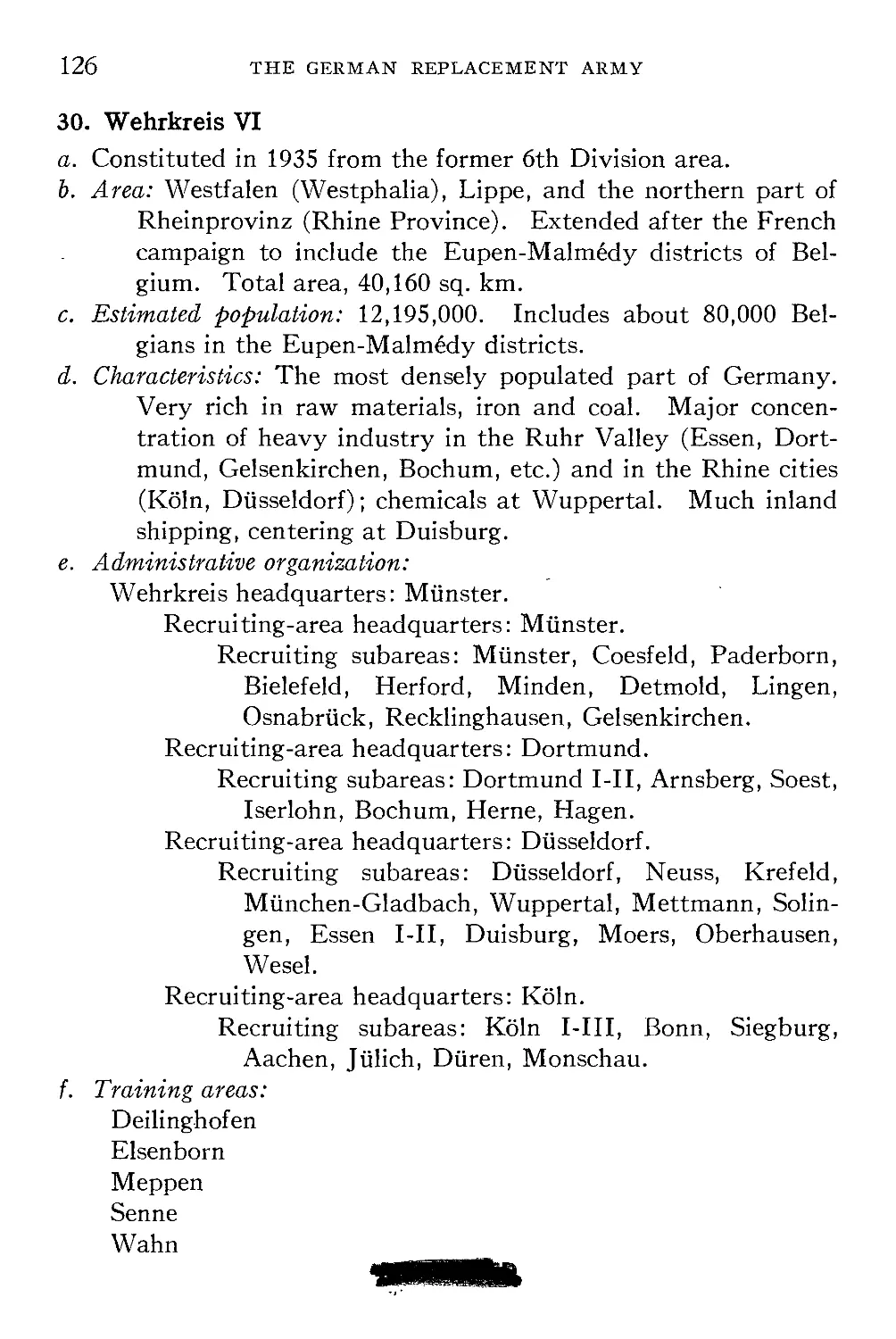
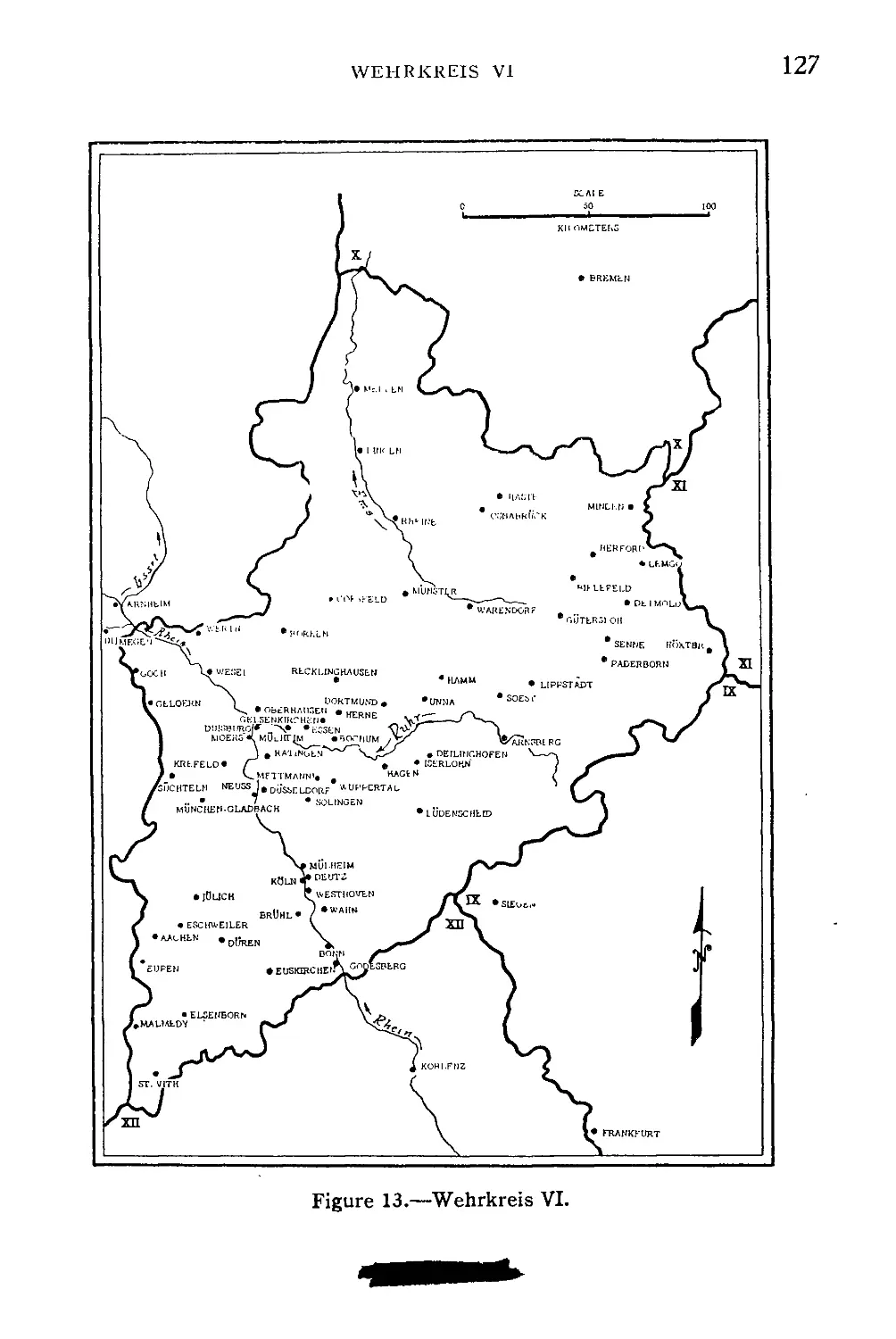


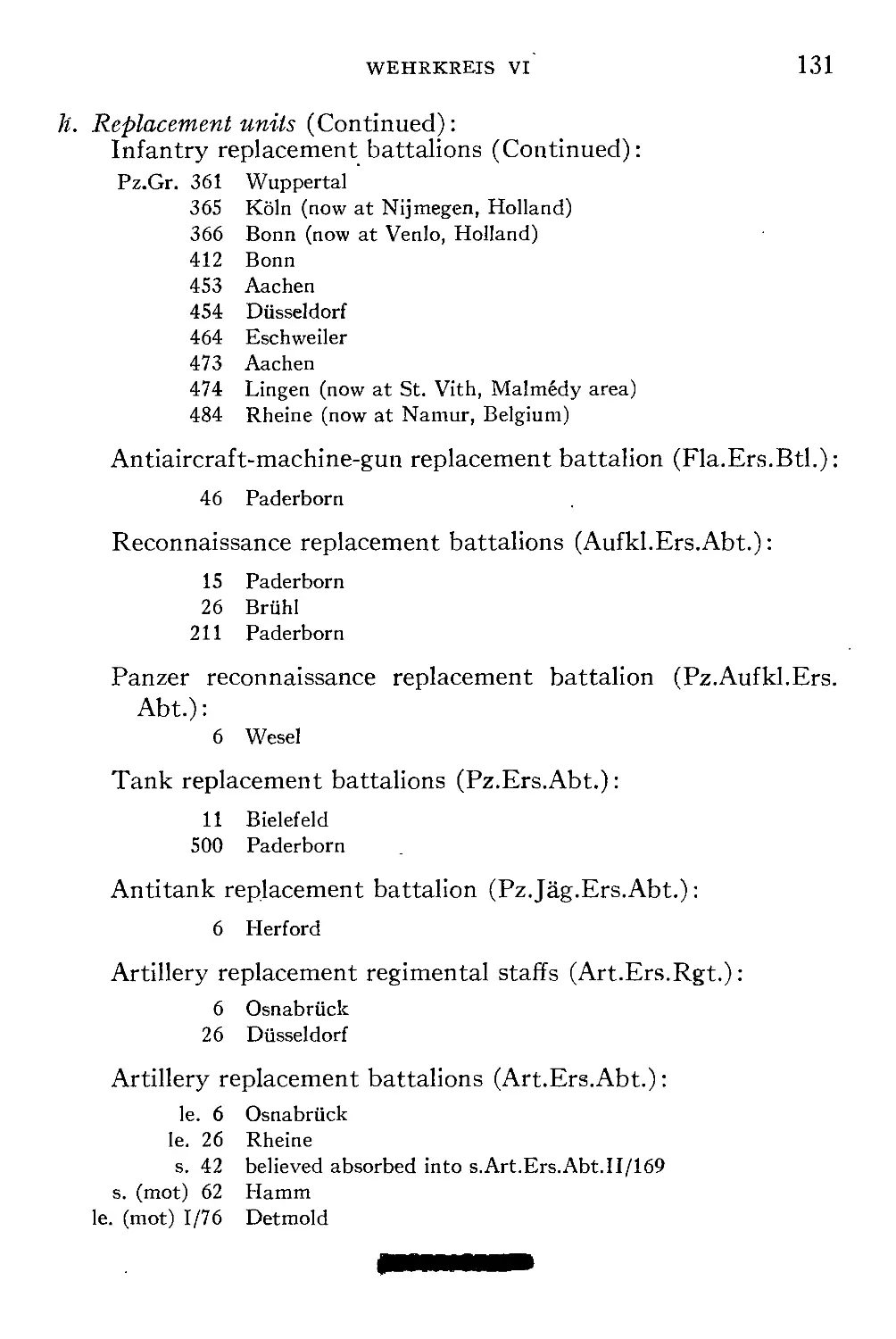
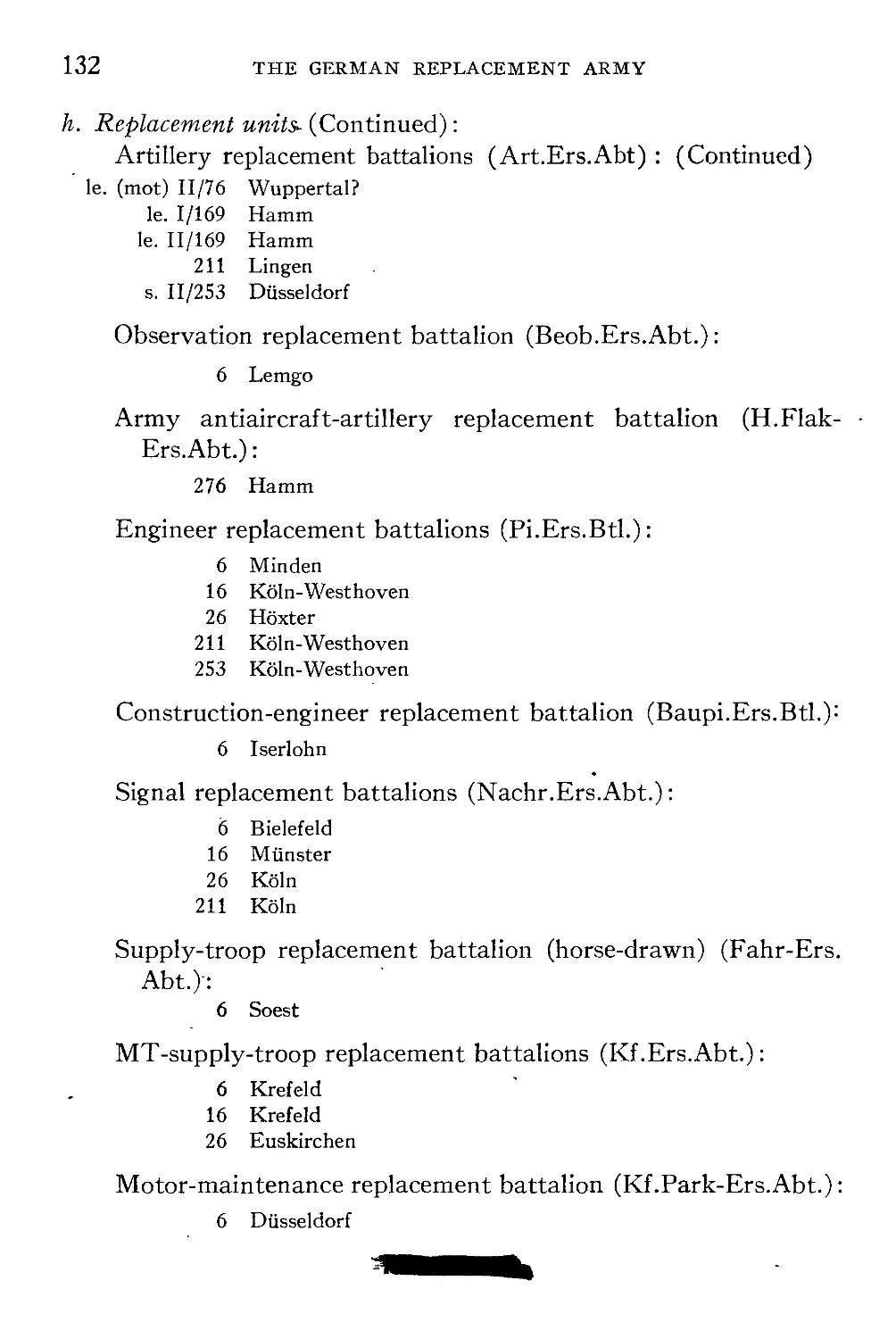
















































Теги: military affairs army
Год: 1944

Текст
THE GERMAN
REPLACEMENT ARMY
(ERSATZHEER)
APRIL 1944
This document must not
fall into enemy hands
MILITARY INTELLIGENCE DIVISION
WAR DEPARTMENT
WASHINGTON 25, D. C.
FOREWORD
This book brings together for the first time the great amount of
detailed information on the character, functions, composition, loca-
tions, and affiliations of all types of replacement units which are
comprised in the German Replacement Army. This material is
presented in such a form as to enable the user, after familiarizing
himself with the general arrangement of the book, to look up any
desired information with a minimum of delay.
The book is intended for use of intelligence personnel who are
already well acquainted with the organization and mode of employ-
ment of the German Field Army as described in the Order of Battle
of the German Army, to which it is the sequel. Its primary purpose
is to enable Order of Battle specialists, document exploiters, and
interrogators to trace connections between field and replacement
units which may prove invaluable in their work. The military
careers of prisoners of war can be traced much more accurately,
many unexplained allusions in documents can be clarified, and even
the identity of units in the field can be established by a proper use of
this material. In addition, the Army of Invasion is provided with
all details on the disposition of replacement units in the German
Zone of the Interior, and the Army of Occupation will be aided in
supervising the demobilization of the German Army.
Apart from the descriptive sections at the beginning and the in-
dexes at the end, the book gives the same basic material, namely,
detailed data on all specific replacement units, from three different
aspects: geographically according to Wehrkreise (section III), in
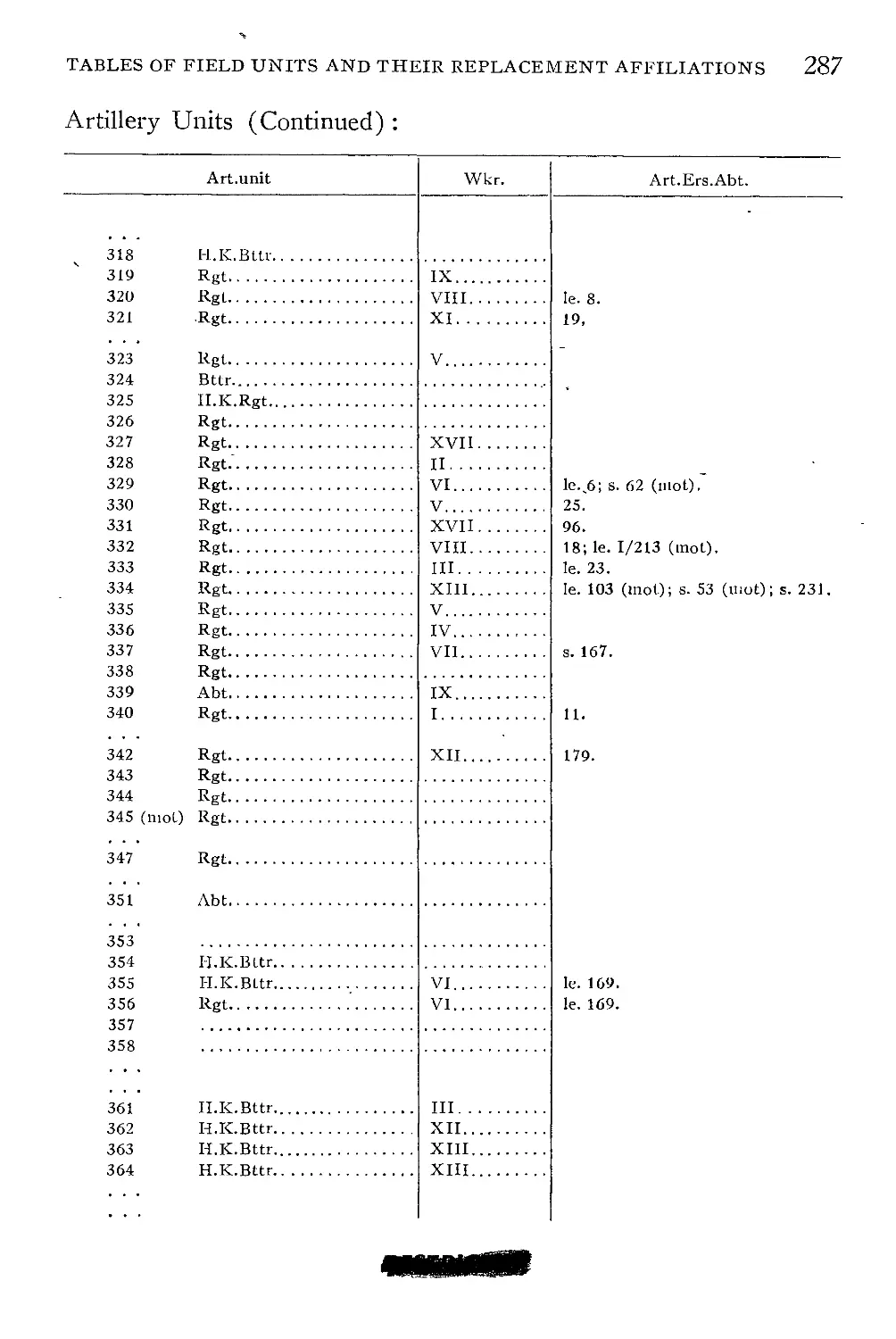
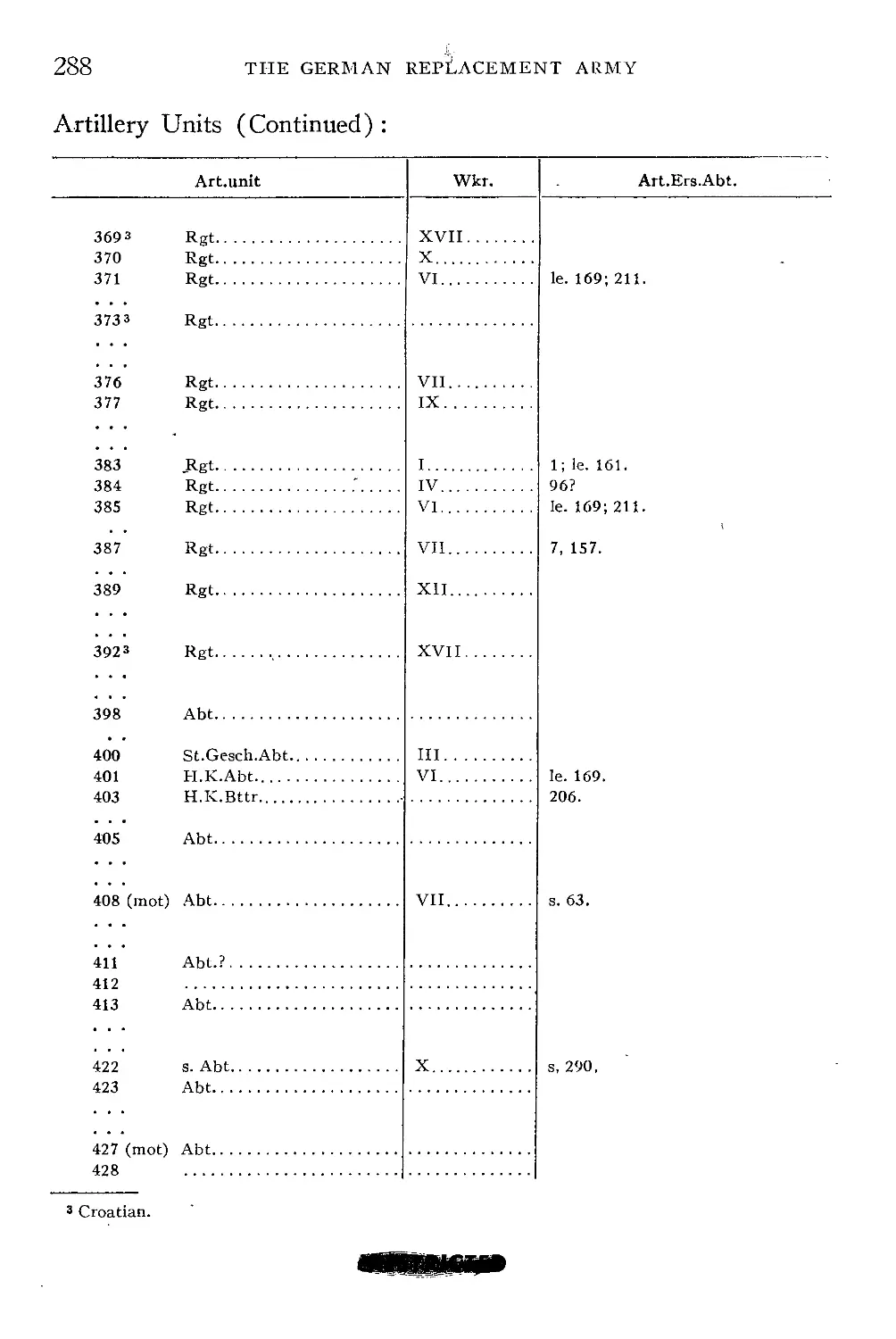
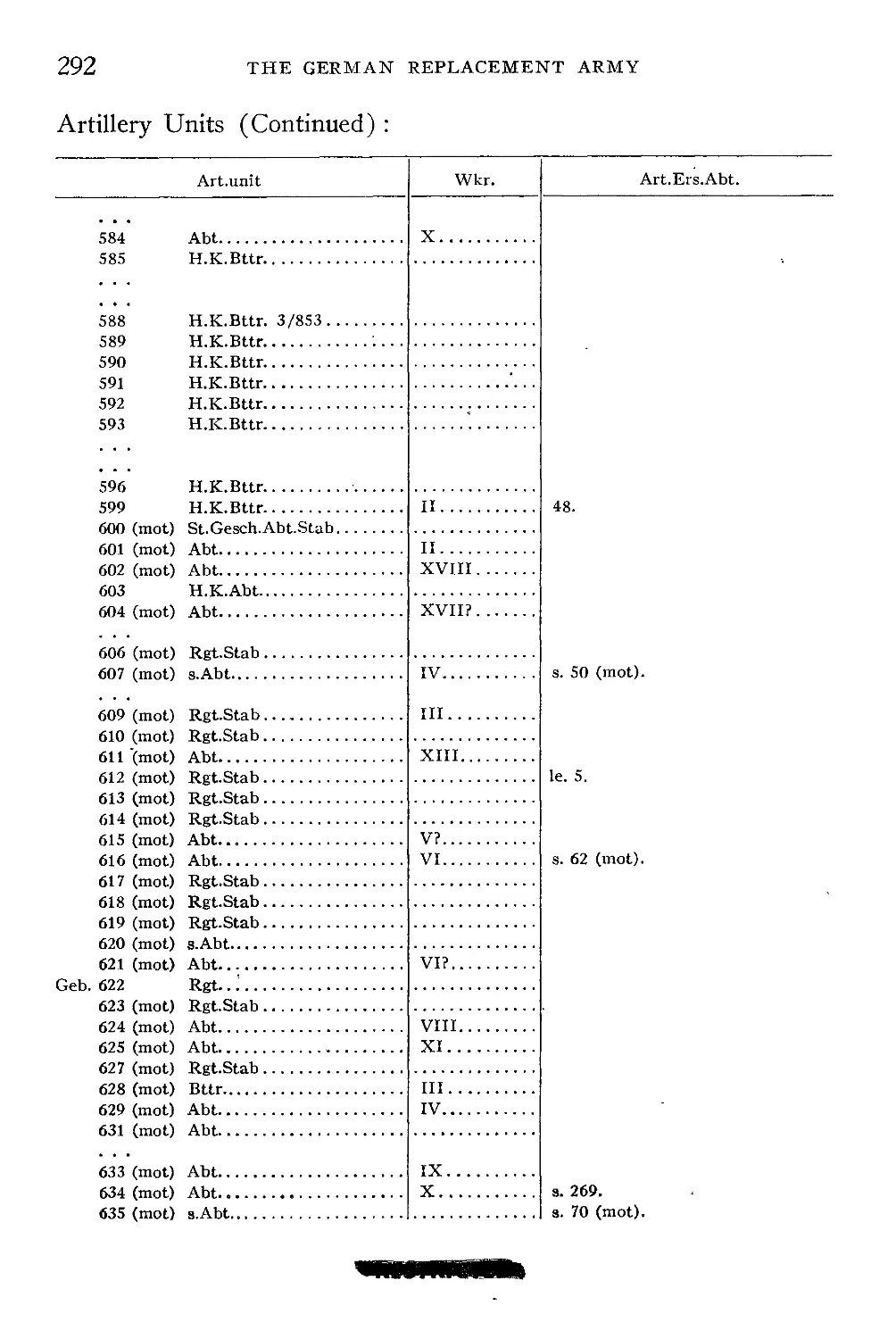
numerical tables of the replacement units themselves showing their
locations and their affiliated field units (section IV), and in numeri-
cal tables of the field units showing their affiliated replacement units
(section V). It also contains descriptions of the replacement system
in
IV
FOREWORD
of the Air Force ground organizations (section VI) and of the
Waffen-SS (section VII).
It is emphasized that with this book even very incomplete and
inaccurate information can be checked and evaluated by a liberal
use of the two indexes and a thorough understanding of the inter-
connections of the different types of tables.
Place names usually are given only in their German form; other
forms for localities in annexed or occupied territory will be found in
the Index of Cities and Towns (section IX).
This text should be used in conjunction with the following other
publications of the Military Intelligence Division:
Order of Battle of the German Army (February 1944)
The Exploitation of German Documents
Military Headquarters and Installations in Germany (March
1944)
Staff Officers' Field Manual: Enemy Forces, Organization, Tech-
nical, and Logistical Data, FM-E 101-10 (1942)
German Military Abbreviations, Special Series, No. 12 (April 12,
1943)
All comments on this publication, as well as corrections of factual
detail, should be transmitted promptly and may be addressed direct
to the Dissemination Unit, Military Intelligence Division, War De-
partment, Washington 25, D. C.
CONTENTS
Section I. INTRODUCTION:
1. Scope of the Book_____________1____________________ 1
2. Chain of Command of the Replacement Army___________ 2
3. Recent Development of the Replacement Army_________ 6
4. Movement of Replacement and Training Units_________ 8
5. Record-Keeping in the Replacement Army_____________ 15
6. Sample Case Histories of German Soldiers___________ 18
IL TYPES OF REPLACEMENT UNITS:
7. Introduction_______________________________________ 25
8. Infantry (Infanterie)______________________________ 28
9. Panzer Troops (Panzertruppen)______________________ 43
10. Artillery (Artillerie)_____________________________ 52
11. Chemical Warfare Troops (Nebeltruppen)_____________ 59
12. Engineers (Pioniere)_______________________________ 60
13. Signal Troops (Nachrichtentruppen)_________________ 66
14. Propaganda Troops (Propagandatruppen)______________ 69
15. Supply Troops (Nachschubtruppen)___________________ 70
16. Motor Maintenance Troops (Kraftfahrparktruppe)_____ 73
17. Medical Troops (Sanitatstruppen)___________________ 74
18. Veterinary Troops (Veterinartruppen)_______________ 75
19. Military Police (Feldgendarmerie)__________________ 77
20. Administrative Troops (Verwaltungstruppen)_________ 78
21. Local Defense Units (Landesschiitzen-Einheiten)____ 79
22. Secret Field Police (Geheime Feldpolizei)__________ 80
23. Miscellaneous Units and Schools____________________ 80
III. REPLACEMENT UNITS ACCORDING TO WEHRKREISE:
24. Introduction_______________________________________ 84
25. Wehrkreis I________________________________________ 86
26. Wehrkreis II_______________________________________ 94
27. Wehrkreis III_____________________________________ 100
28. Wehrkreis IV__________*____________________________ 110
29. Wehrkreis V________________________________________ 118
V
VI
CONTENTS
Section HI. REPLACEMENT UNITS ACCORDING TO WEHRKREISE
(Continued): Page
30. Wehrkreis VI____________________________________ 126
31. Wehrkreis VII___________________________________ 134
32. Wehrkreis VIII__________________________________ 140
33. Wehrkreis IX____________________________________ 148
34. Wehrkreis X_____________________________________ 157
35. Wehrkreis XI____________________________________ 162
36. Wehrkreis XII___________________________________ 168
37. Wehrkreis XIII__________________________________ 176
38. Wehrkreis XVII__________________________________ 182
39. Wehrkreis XVIII_________________________________ 190
40. Wehrkreis XX____________________________________ 196
41. Wehrkreis XXI___________________________________ 201
42. Wehrkreis Bohmen und Mahren______________________202
43. Wehrkreis Generalgouvernement____________________206
IV. TABLES OF IDENTIFIED REPLACEMENT UNITS:
44. Introduction____________________________________ 209
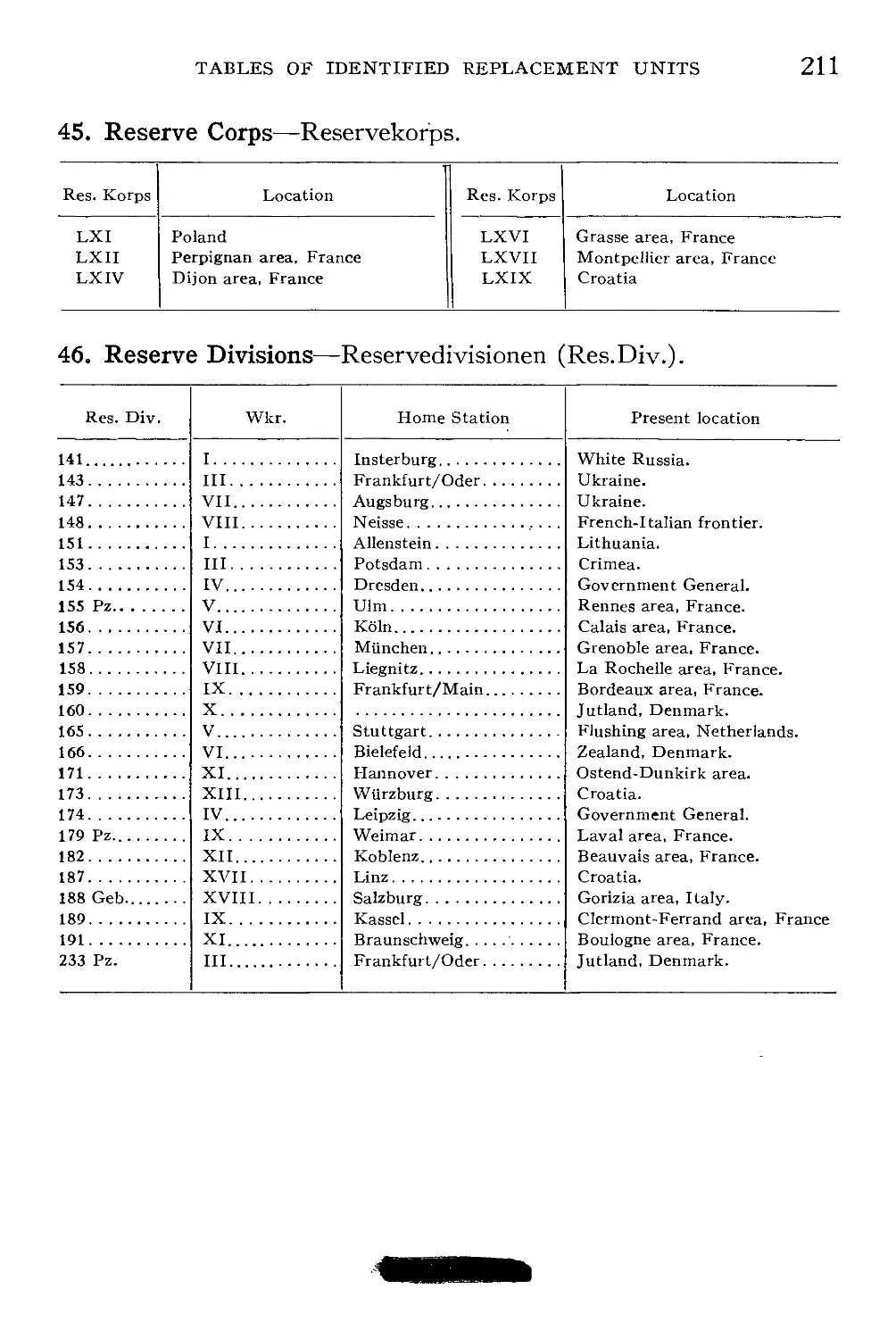
45. Reserve Corps___________________________________ 211
46. Reserve Divisions_______________________________ 211
47. Mobilization Divisions___________________________212
48. Special Administrative Divisions_________________212
49. Replacement Brigades____________________________ 212
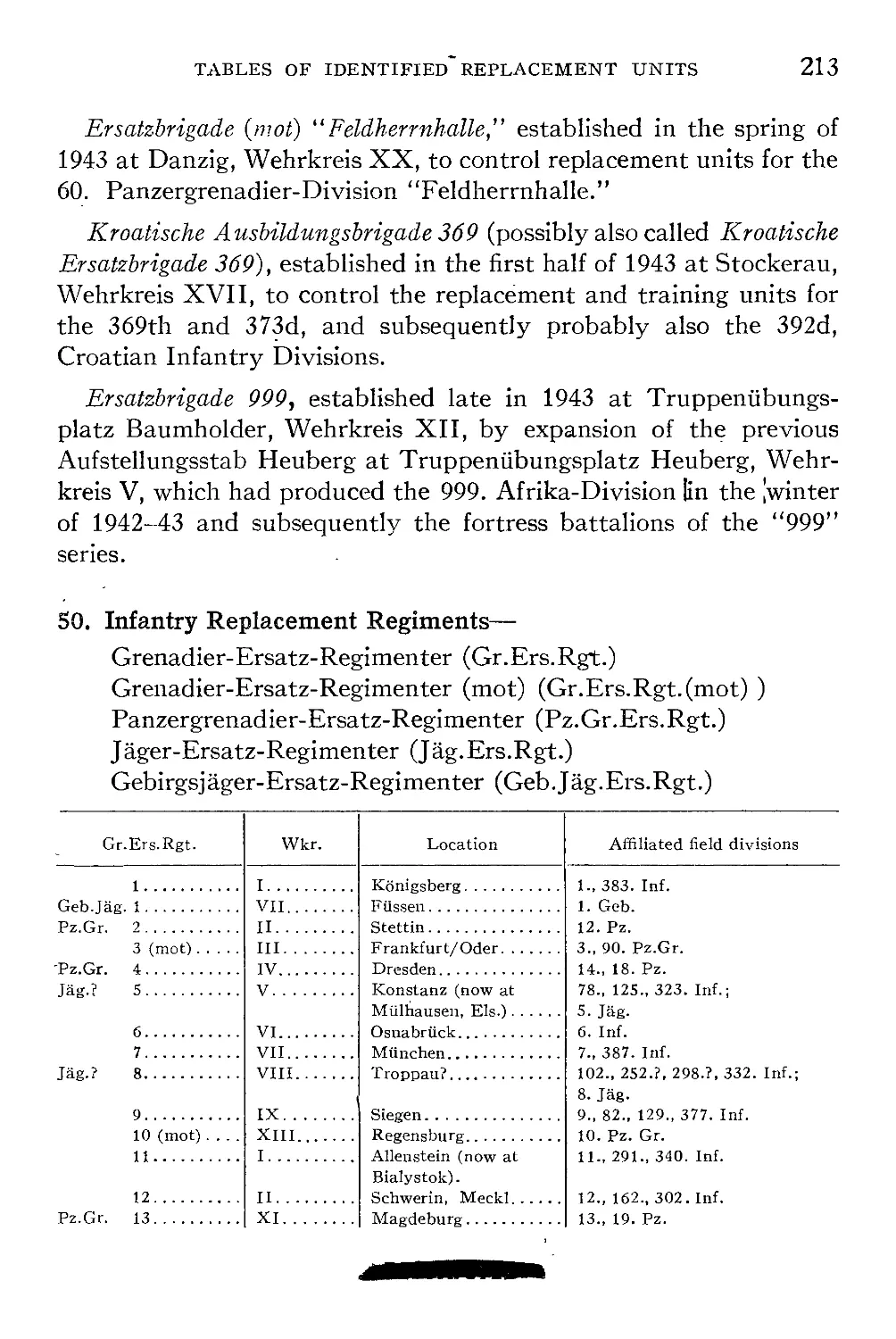
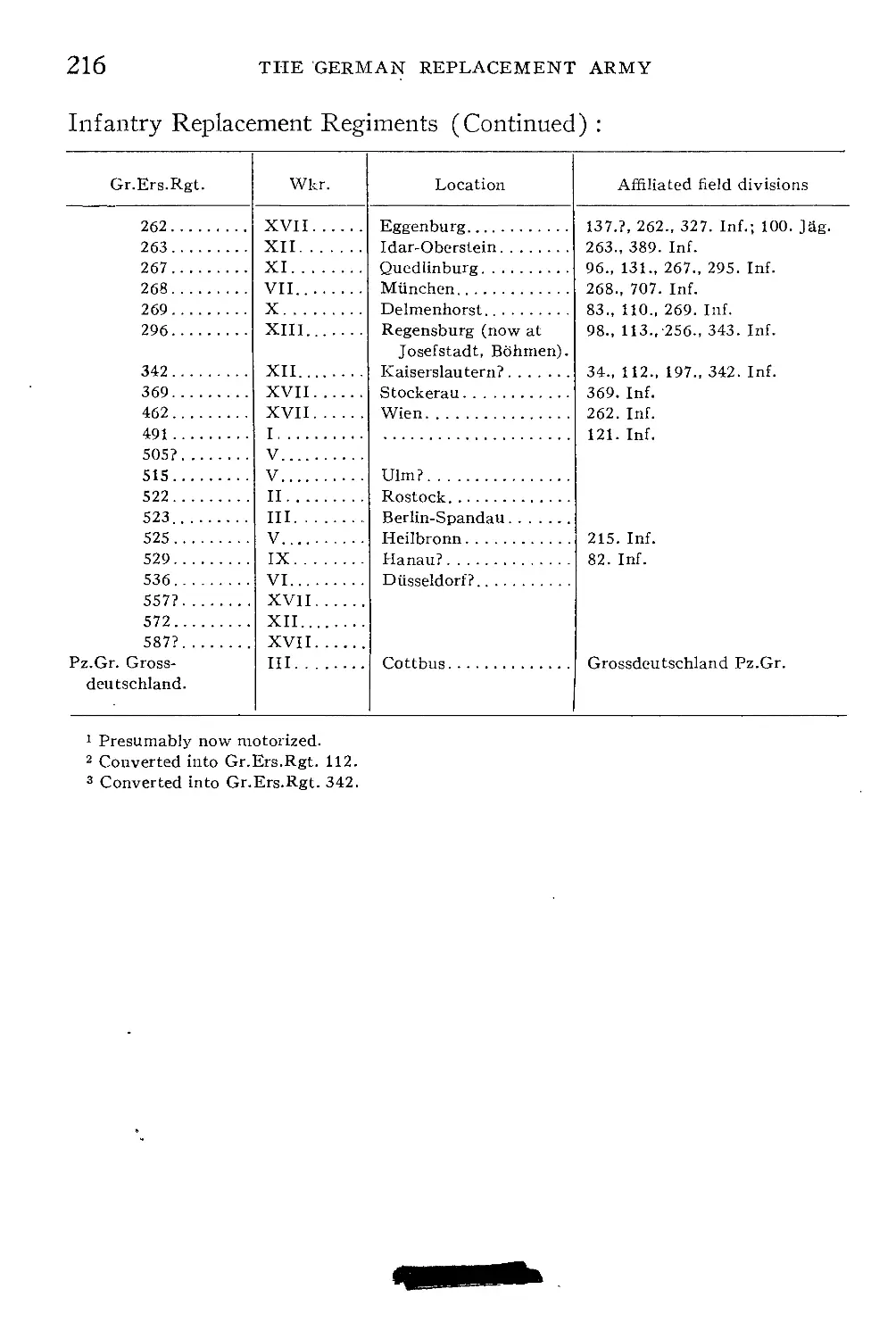
50. Infantry Replacement Regiments___________________213
51. Infantry Howitzer Replacement Companies__________217
52. Infantry Antitank Replacement Companies__________219
53. Infantry Signal Replacement Companies___________ 221
54. Infantry Engineer Replacement Companies__________223
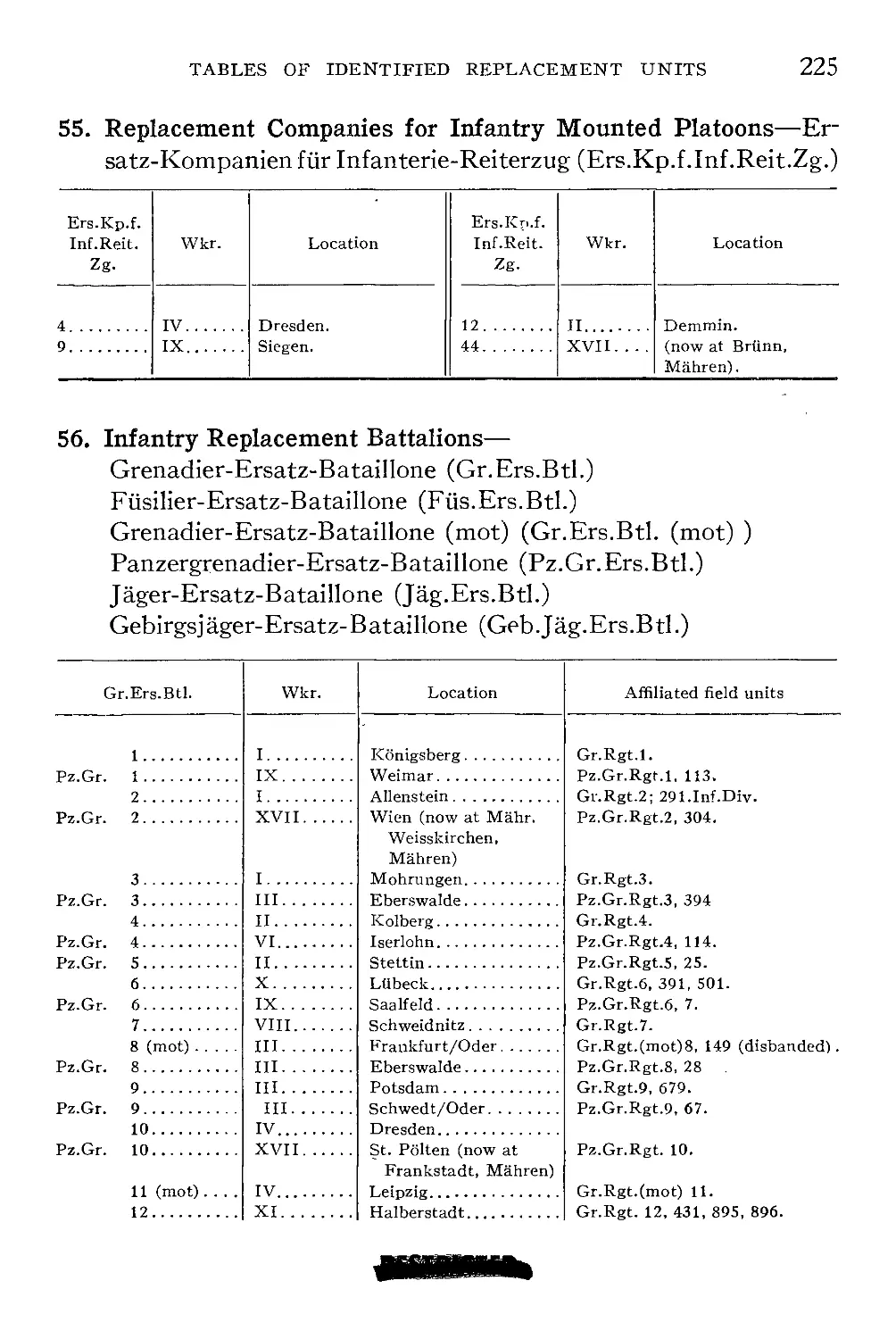
55. Replacement Companies for Infantry Mounted Platoons_ 225
56. Infantry Replacement Battalions_________________ 225
57. Machine-Gun Replacement Battalions______________ 234
58. Antiaircraft Machine-Gun Replacement Battalions____234
59. Reconnaissance Replacement Units_________________235
60. Panzer Reconnaissance Replacement Battalions_____236
61. Tank Replacement Battalions______________________236
62. Antitank Replacement Battalions__________________237
63. Artillery Replacement Regiments__________________237
64. Artillery Replacement Battalions_________________238
65. Observation Replacement Battalions_______________242
66. Assault Gun Replacement Battalions_______________242
67. Army Antiaircraft Artillery Replacement Battalions_243
68. Projector Replacement Battalions________________ 243
CONTENTS
VII
Section IV. TABLES OF IDENTIFIED REPLACEMENT UNITS
(Continued): Page
69. Engineer Replacement Battalions-------------------243
70. Construction Engineer Replacement Battalions______245
71. Bridge Construction Replacement Battalions--------245
72. Railway Engineer Replacement Battalions----------- 245
73. Signal Replacement Battalions-------------------- 246
74. Supply Troop Replacement Battalions (Horse-Drawn)— 247
75. MT Supply Troop Replacement Battalions----------- 248
76. Motor Maintenance Replacement Units_______________248
77. Medical Replacement Battalions------------------- 249
78. Veterinary Replacement Battalions________________ 249
79. Administrative Replacement Battalions_____________249
80. War-Economic Replacement Battalions______________ 250
81. Local Defense Replacement Battalions______________250
82. Antiaircraft Artillery Replacement Regiments------250
83. Antiaircraft Artillery Replacement Battalions-----251
84. Antiaircraft Searchlight Replacement Battalions__ 252
85. Air Force Field Replacement Battalions------------253
V. TABLES OF FIELD UNITS AND THEIR REPLACE-
MENT AFFILIATIONS:
86. Introduction______________________________________254
87. Infantry Divisions________________________________ 255
88. Motorized Divisions_______________________________ 257
89. Light Divisions___________________________________ 258
90. Panzer Divisions_________________________________ 258
91. Mountain Divisions_________________________________258
92. Infantry Regiments________________________________ 259
93. Motorized Infantry Regiments_______________________268
94. Light Infantry Regiments__________________________ 268
95. Armored Infantry Regiments_________________________269
96. Mountain Infantry Regiments_______________________ 270
97. Reconnaissance and Mobile Battalions______________ 270
98. Panzer Reconnaissance Battalions__________________ 273
99. Tank Units_________________________________________274
100. Antitank Battalions_______________________________275
101. Artillery Units__________________________________ 280
102. Observation Battalions____________________________300
103. Engineer Battalions_______________________________300
104. Signal Units______________________________________305
VIII
CONTENTS
Section VI. REPLACEMENT SYSTEM FOR AIR FORCE GROUND
ORGANIZATIONS: Page
105. Introduction_____________________________________310
106. Air Force Regional Organization__________________310
107. Antiaircraft Artillery (Flak)____________________312
108. Ground Combat Troops of the Air Force____________320
VII. REPLACEMENT SYSTEM OF THE WAFFEN-SS:
109. Introduction____________________________________________323
110. Regional Organization____________________________325
111. Recruiting and Replacement System________________328
112. Types of Units and Designations__________________331
113. Training Centers and Schools____________________ 334
114. Identified Replacement Units____________________ 336
VIII. INDEX OF GERMAN TERMS AND ABBREVIATIONS_______________ 338
IX. INDEX OF CITIES AND TOWNS______________________________ 359
CONTENTS
IX
ILLUSTRATIONS
Figure Page
1. Wehrkreise________________________________________________________ x
2. Chain of Command of the Replacement Army________________________ 3
3. Movements of reserve divisions____________________________ 12
4. Sample case history A: transfers_________________________________ 18
5. Sample case history A: movements_________________________________ 19
6. Sample case history B: transfers_________________________________ 21
7. Sample case history B: movements_________________________________ 22
8. Wehrkreis I_____________________________________________________ 87
9. Wehrkreis II____________________________________________________ 95
10. Wehrkreis III_________________________________________________ 101
11. Wehrkreis IV__________________________________________________ 111
12. Wehrkreis V___________________________________________________ 119
13. Wehrkreis VI__________________________________________________ 127
14. Wehrkreis VII_________________________________________________ 135
15. Wehrkreis VIII________________________________________________ 141
16. Wehrkreis IX__________________________________________________ 149
17. Wehrkreis X___________________________________________________ 156
18. Wehrkreis XI__________________________________________________ 163
19. Wehrkreis XII_________________________________________________ 169
20. Wehrkreis XIII____________________________________.____________ 177
21. Wehrkreis XVII________________________________________________ 183
22. Wehrkreis XVIII_______________________________________________ 191
23. Wehrkreis XX__________________________________________________ 197
24. Wehrkreis XXI_________________________________________________ 200
25. Wehrkreis Bohmen und Mahren____________________________________203
26. Wehrkreis Generalgouvernement_________________________________ 207
27. Luftgaue_______________________________________________________311
28. Regional organization of the SS________________________________326
и
Figure 1.—Wehrkreise.
Section I. INTRODUCTION
1. Scope of the Book
All units and all personnel in the German Army are assigned
either to the Field Army (Feldheer) or to the Replacement Army
(Ersatzheer'). The Order of Battle of the German A rmy dealt primarily
with the functions, composition, and disposition of Field Army
units; the present volume, which is designed to supplement it, de-
scribes all known replacement units and lists their affiliations with
units of the Field Army. It also includes sections on the replacement
system and the known replacement units and affiliations of the
ground organizations of the German Air Force (antiaircraft artil-
lery and ground combat troops) and of the Waffen-SS.
Wherever possible, duplication of material already contained in
the Order of Battle of the German Army is avoided. Thus it is as-
sumed that users of this text are familiar with the regional military
organization of Germany into Wehrkreise, the system of conscrip-
tion, and the general principles of the replacement training system
as outlined in section II of the Order of Battle and with the organi-
zation and functions of field units as described in section III of
that book. Additional technical information on these subjects is
included here only where it is believed essential to a proper utiliza-
tion of the mass of tabular data which constitutes the main part of
the book.
The Replacement Army is commanded by Generaloberst Fritz
FROMM as the specially designated Deputy of the Commander in
Chief of the Army (formerly BRAUCHITSCH, now HITLER) to
take charge of all matters not directly concerned with operations in
the field. It includes not only replacement units but also all per-
manent military installations in Germany and all training units, a
1
2
THE GERMAN REPLACEMENT ARMY
large proportion of which are now located in occupied territory.
The permanent military installations are dealt with in the publica-
tion Military Headquarters and Installations in Germany. The train-
ing units are largely under the control of reserve divisions and as
potential combat units are beyond the scope of this book. Their
numbering and nomenclature are identical with those of the corre-
sponding replacement units with the substitution of Ausbildungs-
or Reserve- for Ersatz-. Throughout this book the following nomen-
clature is employed:
“Replacement training unit” is used only for an Ersatzeinheit
before it was split into its replacement and its training elements in
the autumn of 1942.
“Training unit” is used for an Ausbildungseinheit of any kind
after it was separated from its parent replacement training unit.
“Reserve unit” is used for a training unit which is part of a re-
serve division.
“Combined replacement and training unit” is used for a unit con-
taining both replacement and training elements, which were either
not involved in the general separation in 1942 or were subsequently
reunited under a single control.
“Replacement unit” is used for an Ersatzeinheit in its present
sense, including the replacement function of a combined replace-
ment and training unit.
2. Chain of Command of the Replacement Army
The full title of FROMM is Chief of Army Equipment and Com-
mander of the Replacement Army {Chef der Heeresrilstung und
Befehlshaber des Ersatzheeres'). This book is concerned only with
the functions which come under the second part of his title; in addi-
tion he is responsible for the design, procurement, storage, and sup-
ply to the Field Army of all the items of equipment that it needs.
Figure 2 shows the chain of command in the Replacement Army,
classified according to its three principal functions of conscription,
training, and replacement. The following details are relevant to
this chart:
|Wehrersat^amt |
Ad EH ____________________
Abt. В
| WkJkcIo. I [ WKr Kdo. | | WKiJkcIo. |
| W. E, I. | | WE.I. | | W.E.I. |.
| W.B.K. 1 I W.B.K 1 I W.B.K 1
I W.M.A. 1 I WM.A. 1 I WM.A.1
I 1 I
I Must. Stb7~l I Must, stb~l
Re J? locemen t
[Ch H Rust uj]
FROMM
-I In 2 Inf. I
—| In 3 Reit-
-11 n 5 Pi.'
"~| In Fest
-4 Aq H Nochr
HIn 9 Heb. Tn. I
-|In 10 Eiscnb, Pi. |
-I Tn 11 Techn. Tn |
-|In 1Z Kf. ParKtr. |
ЧрГь
Schools and
frremilttary training
I Res. Korftsl
I Res. Div. |
Ch Au sb
KUNTZE
|stv. Gen. Kdc| [ Stv. Gen. Kdo.[ [sty. Gen.Kdo]
l<Sr. Ers. Rgt~l
I Ant. Ers, Rqt.l
|Gr. Ers. Btl~| | Art. Ers.Abt] |
iReqtl st>ec rebl ees]
1“ “ Replacement of med/ca! ^eroonnct
I —----► Replacement of veterinary fterjonne/
I— — l?e^>/acemeof of ordnance pensonne/
CONSCRIPTION . I TRAINING I REPLACEMENT
Figure 2.—Chain of Command of the Replacement Army.
INTRODUCTION
4
THE GERMAN REPLACEMENT ARMY
a. Conscription.—This being a matter that concerns all three
branches of the Armed Forces, it is supervised by the Military Re-
placement Office {Wehrersatzamt') of the Armed Forces High Com-
mand {O.K.W.). The interests of the Army are represented by the
Replacement Branch {Abteilung Ersatzwesen, Abt. E) of the Group
for Replacement and Army Matters {Amtsgruppe Ersatz- und Heer-
ivesen, Ag EH) in the General Army Office {Allgemeines Heeresamt,
AHA). Orders are issued through the various Wehrkreis head-
quarters {Wehrkreiskommandos, Wkr.Kdo.) to the Recruiting Area
Inspectorates {Wehrersatzinspektionen, W.E.I.) and from there to
the Recruiting Subarea Headquarters {Wehrbezirkskommandos,
W.B.K.), which control the Reporting Offices {Wehrmeldeamter,
W.M.A.) and set up from time to time in their districts the Muster-
ing Staffs {Musterungsstabe, Must.Stb.).
b. Training.—In the Replacement Army all training except that
of the Panzer troops is supervised by General der Pioniere Walter
KUNTZE as Chief of Training in the Replacement Army {Chef des
Ausbildungsivesens im Ersatzheer, Ch Ausb.). Training of the Pan-
zer Troops is in the hands of Generaloberst Heinz GUDERIAN as
Inspector General of Panzer Troops {Generalinspekteur der Panzer-
truppe, Gen.Insp.d.Pz.Tr.).
Subordinate to KUNTZE are the Inspectors of the various arms
{Waffeninspekteure), who control the training of their respective
arms through the Inspectorates of Arms {Waffeninspektionen),
known collectively as the Arms Sections {Waffenabteilungen) of the
General Army Office. The following are the names and authorized
abbreviations of these inspectorates:
Inspektion der Infanterie, In 2 (Inspectorate of Infantry).
Inspektion des Reit- und Fahrivesens, In 3 (Inspectorate of Rid-
ing and Driving).
Inspektion der Artillerie, In 4 (Inspectorate of Artillery).
Inspektion der Pioniere, In 5 (Inspectorate of Engineers).
Inspektion der Festungen. In Fest (Inspectorate of Fortifica-
tions).
Inspektion der Panzertruppe, In 6 (Inspectorate of Panzer
Troops).
INTRODUCTION
5
Amtsgruppe Nachrichtenwesen, Ag N (Signal Group). Former-
ly called Inspektion der Nachrichtentruppen, In 7 (Inspec-
torate of Signal Troops).
Inspektion der Nachschubtruppen, In 8 (Inspectorate of Supply
Troops). Formerly called Inspektion der Fahrtruppen.
Inspektion der Nebeltruppen, In 9 (Inspectorate of Chemical
Warfare Troops).
Inspektion der Eisenbahnpioniere, In 10 (Inspectorate of Rail-
way Engineers).
Inspektion der Technischen Truppen, In 11 (Inspectorate of
Technical Troops).
Inspektion der Kraptfahrparktruppen, In 12 (Inspectorate of
Motor Maintenance Troops).
Sanitatsinspektion, S In (Medical Inspectorate).
Veterindrinspektion, V In (Veterinary Inspectorate).
Feldzeuginspektion, Fz In (Ordnance Inspectorate).
The former Inspectorate of Cadet Schools {Inspektion der Kriegs-
schulen, In 1) apparently suspended activities when the cadet schools
themselves were superseded by special courses held at the special
service schools (Waffenschulen) or by special wartime officer-candi-
date schools. These and all other Army schools are either under
the direct control of KUNTZE or are supervised by the Inspector
of Army Training and Education {Inspekteur des Erziehungs- und
Bildungswesens des Heeres, In EB}, who is responsible to him.
Training in the Replacement Army is conducted in training units,
which take the form either of reserve units under reserve divisions
and reserve corps subject to the direct command of FROMM (or
for operational purposes of the field operational headquarters), or
of combined replacement and training units {Ersatz- und Ausbil-
dungseinheiten) in Germany, which are under the same command as
replacement units.
Training in the Field Army is controlled by Oberquartiermeister
II—0 Qu II—in the Army General Staff {Generalstab des Heeres,
Gen St d И), who naturally operates in close liaison with the train-
ing authorities in the Replacement Army.
c. Replacement.—Command of the replacement units as well as
responsibility for meeting the replacement requests of the Field
6
THE GERMAN REPLACEMENT ARMY
Army is delegated by FROMM to the Wehrkreis headquarters in
their capacity as Deputy Army Corps Commands (Stellvertretende
Generalkommandos, Stv.Gen.Kdo.f Each of these now normally has
one mobilization division (Division Nummer . . Div.Nr. . . .) to
control the replacement units, either directly, as in the case of inde-
oendent units of the supporting arms and services, or through the
infantry and artillery regimental staffs (Grenadier-Ersatz-Regiment,
Gr.Ers.Rgt.' and Artillerie-Ersatz-Regiment, Art.Ers.Rgt.f It is
these replacement units that are the main subject of this book.
Replacements of officers and of Armed Forces officials (Wehr-
machtbeamte') are the responsibility of the Army Personnel Office
(Heerespersonalamt, HP A} and the Army Administration Office
(Heeresverwaltungsamt, HVAf respectively.
3. Recent Development of the Replacement Army
The general functioning of replacement units and the manner of
their affiliation with field units are explained in section II, paragraph
7, of the Order of Battle of the German Army, together with an outline
of the stages in the development of the replacement training system
since the beginning of the war. The following further details re-
garding the effects of the separation of replacement and training
functions in 1942 will be of interest to the specialist studying the
Replacement Army and will be of value in understanding the rest
of this book:
a. At corps level.—To control the replacement functions (i.e., the
dispatch of trained replacements to the Field Army) of reserve
divisions .a number of reserve corps (Reservekorps) and one or more
reserve Panzer corps (Reserve-Panzerkorps") have been formed.
Orders issued to Wehrkreis headquarters relating to these functions
are now simultaneously addressed to the reserve corps, suggesting
that they act as channels for replacement requisitions in the same
way as Wehrkreis headquarters. On the other hand there is evi-
dence that some of them, at least, control one or more defensive
infantry divisions of the Field Army as well as their reserve divisions,
and to this extent they зёет to be similar to regular infantry corps
or at least to corps commands (Hohere Kommandos z.b. У.).
INTRODUCTION
7
Ъ. At division level.—Every reserve division which has been iden-
tified so far was formerly a mobilization division. Each one con-
trols a group of reserve regiments and supporting units from its own
Wehrkreis, but the allotment of battalions within the regiment no
longer necessarily follows the original pattern, which was based on
the subordination of infantry regiments to the field division of the
same number. Sometimes the battalions may even lose their
original numbers altogether and be numbered simply I, II, and III.
In other respects, also, the reserve divisions seem to have taken on
the character of defensive field divisions to an increasing extent;
several have gone into action on the eastern front, while others have
firmly established themselves in coastal sectors in the west and are
probably no longer concerned primarily with training.
In almost all cases there is now one, and only one, mobilization
division in each Wehrkreis, except the four new Wehrkreise, to con-
trol the replacement units. New ones have been created either with
numbers 300 or 310 higher than departed reserve divisions or by
conversion of z.b. V. divisions.
c. At regiment level.—The separation of replacement and training
functions occurred in the first instance at battalion level, since the
former replacement training regiments were essentially only control-
ling staffs. A large proportion of these staffs became the staffs of
reserve regiments in occupied territory and did not necessarily leave
behind corresponding replacement regiment staffs. Thus there are
now considerably fewer of the latter than previously, and they may
control up to six or even more replacement battalions. The subordi-
nation of these battalions to infantry replacement regiments no
longer necessarily corresponds to that of infantry regiments to field
divisions of the same numbers. Several new infantry replacement
regiments in the 500 series have been identified.
In view of these changes many of the identifications and affilia-
tions of infantry replacement regiments listed in this book may no
longer be valid.
d. At battalion level.—Under the original system each infantry re-
placement battalion normally contained a reception company
{Stammkompanie), four training companies {Ausbildungskompanien}
8
THE GERMAN REPLACEMENT ARMY
of which the fourth was a machine-gun training company, and one or
more convalescent and transfer companies (Genesendenkompanien
and Marschkompanien). At the time of the split the training com-
panies were withdrawn under the battalion staff and a new replace-
ment battalion staff was created to control the remaining com-
ponents having purely replacement functions. In some cases,
apparently, the new training battalion established a Marsch com-
pany of its own as a pool for trained men awaiting transfer to the
Field Army, while in other cases it seems to send them to the
Marsch company of the replacement battalion.
Training units which were not physically separated from their
corresponding replacement units were recombined with them, in
order to save administrative personnel, under staffs known as Grena-
dier-Ersatz- und -Ausbildungsbataillone (combined infantry replace-
ment and training battalions). These presumably have the same
components as the original replacement training battalions.
The above remarks apply correspondingly to the arms other than
infantry. In some of them all replacement and training units are
now under combined staffs; this is true of the medical units, the
armored reconnaissance units, and possibly other branches of the
Panzer troops.
4. Movements of Replacement and Training Units
Despite the fact that the original replacement training units were
intended to remain at the home stations of their corresponding field
units, acting more or less as the rear echelons of the latter, for vary-
ing reasons there have been numerous shifts of units in the Replace-
ment Army from one part of Germany to another and from Germany
into occupied territory and back again. In section III these moves
are described in detail for the units of each Wehrkreis; they are
summarized here for the whole of Germany according to the motives
which impelled them.
a. To make room for attacking field forces.—In the early years of
the war, when Germany still had neighbors to be attacked, the re-
placement training units were withdrawn from the border regions
several months before an offensive was to commence in order to free
INTRODUCTION
9
the barrack space and other military facilities for the assembling
field forces. After the area was no longer being used for this pur-
pose the replacement training units generally returned to their home
stations. The following instances of such evacuations occurred:
(1) In November 1939, the replacement training units from the
areas bordering France and the Low Countries, namely Wehrkreise
VI, XII, and V, were moved to the extreme east of Germany and
took up their stations in newly acquired territory. Those from
Wehrkreis VI went to Wehrkreis XX (mostly former (Polish terri-
tory), those from Wehrkreis XII to Wehrkreis XXI (western Po-
land), and those from Wehrkreis V to the Protectorate (Czechoslo-
vakia). All these units were returned to their original home sta-
tions in September 1940, after the French campaign was over.
(2) The replacement training units from Wehrkreis I were trans-
ferred to the Protectorate in September 1940, just as those from
Wehrkreis V were leaving that area. This made room for the initial
preparations in East Prussia for the campaign against the Soviet
Union, and also for the temporary housing of racial Germans re-
patriated from the Baltic states. The units returned to their home
stations in July 1941, after the offensive had been successfully
launched.
(3) In February 1941, the replacement training units of Wehrkreis
VIII, the Silesian assembly area for the Russian campaign, were
transferred to Alsace and Lorraine, which at that time were in pro-
cess of being unofficially annexed from France and in which Wehr-
kreise V and XII were taking over the military administration. The
units remained in these areas until after the split in the latter part
of 1942, when the replacement elements returned to their home
stations and the training elements were formed into reserve divi-
sions and moved on to other parts of France.
During the absence of the replacement training units from their
home Wehrkreise in the above cases, special machinery had to be
set up to handle both the replacement requisitions of the field forces
and the flow of conscripts into the units. Normally replacement
requisitions are transmitted from a field division to the responsible
Deputy Army Corps Command (Wehrkreis headquarters), which
10
THE GERMAN REPLACEMENT ARMY
sends them on through the mobilization division to the appropriate
replacement unit in the form of orders. When the units moved
away from a Wehrkreis the mobilization division which went with
them was designated as the direct recipient of requisitions from the
field units, thus skipping the channel through the Deputy Army
Corps Command. For all other administrative purposes as well as
for the general supervision of their training the units came under
the command of the Wehrkreis in which they were located. Con-
tact with the home Wehrkreis was not, however, completely broken
off.
New conscripts would normally be given orders by their local
Reporting Office or Recruiting Subarea Headquarters to report to a
replacement training unit not far from their home town. When the
units moved far away it was necessary either to send these men
individually or in small groups on long train journeys before induc-
tion or to assemble them in special collecting points known as
Wehrkreis-Ersatz-Depots. The latter were also used for receiving
men who returned from the field as convalescents or for any other
reason, and these men sometimes then had to be transported to the
appropriate replacement training units. After the units returned
to the Wehrkreis these depots were dissolved.
b. To garrison newly acquired territories.—All the moves of replace-
ment training units mentioned under a, above, and a number of
other moves concurrent with or subsequent to them served the
additional purpose of garrisoning the annexed or conquered areas
adjacent to Germany proper and thus relieved the field forces of this
responsibility. At the same time barracks and training grounds in
Germany were freed for the formation of new units for the constantly
expanding German Army, and the recruits were given training away
from home and under conditions more like those in the field. The
following moves of this category may be noted:
(1) The moves into the Protectorate, the annexed Polish areas,
and Alsace and Lorraine which were described above.
(2) The move of replacement training units from Wehrkreis IV
into the Protectorate (mostly Bohemia) and of units from Wehrkreis
XVII into Moravia immediately following the departure of the
INTRODUCTION
И
Wehrkreis I units from those areas. The Wehrkreis IV units left
toward the end of 1942, and their place was taken by units from
adjacent Wehrkreis XIII.
(3) In Wehrkreise XX and XXI, the annexed Polish areas, the
units from Wehrkreise VI and XII which were mentioned under a
above were replaced after September 1940 by units from adjacent
Wehrkreise II and III, respectively.
(4) After the departure of the Wehrkreis VIII units from Alsace
and Lorraine in 1942, these areas were occupied by units from the
original parts of Wehrkreise V and XII, into which they were being
incorporated.
(5) Wehrkreis XVIII units moved into Oberkrain (part of Slo-
venia) in 1942.
(6) Wehrkreis I units moved into the newly annexed areas of
Zichenau and Bialystok in 1942.
(7) Wehrkreis XII units were stationed in Luxemburg in 1942.
(8) Between 1940 and 1942 a few replacement training units went
into areas which were not annexed but which were close to the Ger-
man frontiers and far from the theaters of operations. Thus certain
units from Wehrkreis X moved into Denmark, from Wehrkreise VI
and X into the Netherlands, from Wehrkreis VI into Belgium, and
from Wehrkreis XII into eastern France.
It will be noted that all the above moves, except those whose
primary motive was the evacuation of assembly areas, were by units
in border Wehrkreise into adjacent occupied or annexed territory
immediately across the border. The movements thus amounted to
a slight extension of the German zone of the interior in all directions.
After the separation of replacement and training functions in the
autumn of 1942 the replacement elements of the units which were
still in newly acquired territories in some cases returned to their
home stations to resume their normal induction and replacement
functions, and the training elements were usually incorporated into
reserve divisions and moved farther afield. In other cases both ele-
ments remained in the new areas and took the form of combined re-
placement and training units {Ersatz- und Ausbildungseinheiten)
their present status is discussed under d, below.
Figure 3.—Movements of reserve divisions.
THE GERMAN REPLACEMENT ARMY
INTRODUCTION
13
c. To garrison occupied countries with troops on a combat footing.—
The disadvantages of the removal of replacement training units
from their home stations, from the administrative point of view,
were almost sufficient to outweigh the advantages. For this reason,
as has been shown, none of the moves except those dictated by mili-
tary necessity were very far from home, and the practice of garrison-
ing more distant occupied territories with replacement training
units was never resorted to under the old system. It was probably
these considerations as much as it was the growing shortage of man-
power which caused the German authorities, in September 1942, to
break up all the basic replacement training units into their two ele-
ments, even though in some cases they were reunited under a new
name. This made it possible for the replacement units to occupy
their home stations and for the training units to enjoy complete
freedom of movement. The latter were thenceforth used in large
numbers to occupy different parts of France, the Low Countries,
Denmark, Poland, Lithuania, the Soviet Union, Croatia, and north-
ern Italy in the form of reserve divisions. Combined training could
thus be carried on under more realistic conditions, and numerous
fully organized field divisions were released for service on active
fighting fronts.
The general direction of the movements of reserve divisions into
occupied countries since 1942 is shown in figure 3. It will be noted
that in virtually all cases the units from a given Wehrkreis went to
the country nearest them, so that few of the lines of movement cross.
This map will be useful in determining the approximate areas in
which men from any section of Germany are now being trained.
d. To continue the garrisoning of newly acquired areas.—It has
been shown that since 1942 some of the replacement training units
stationed in areas immediately beyond the old borders of Germany
have remained there as combined replacement and training units.
In addition, other units of this category have been sent into these
and similar areas. In Wehrkreise XX and XXI training units
(Ausbildungseinheiten) from Wehrkreis II have appeared, and the
corresponding replacement units are back at their home stations.
All these units just beyond the old frontiers seem to come under the
14
THE GERMAN REPLACEMENT ARMY
control of mobilization division staffs, or possibly in some cases
special administrative division staffs {Div.Kdo.z.b. У.), which are
usually additional to the mobilization division {Div.Nr.} controlling
replacement units back in the Wehrkreis proper. As they have not
achieved the status of reserve divisions, these division staffs con-
stitute a sort of intermediate stage between the system of replace-
ment training in the Wehrkreis as originally conceived and the
system of replacement in the Wehrkreis and training in occupied
countries as now practiced in the majority of cases. This is in all
respects parallel to the intermediate system which was applied in
these same areas just before the split, and it appears to have the
same advantages from the point of view of manpower and training
efficiency and the same disadvantages in administrative com-
plications.
Both the present locations and the home stations of these units
are shown in the lists in sections III and IV of this book.
In the following instances belonging to this category, most of
which are continuations of the-moves described under b, above, it
should be remembered that the character of this development is not
yet entirely clear and that any of the units involved may turn into
either reserve divisions or some new form of organization.
(1) Training units from Wehrkreis II are stationed in adjacent
Wehrkreise XX and XXI under Div.Nr. 152. It is possible that
this has turned into a reserve division and has been transferred, with
its units, to White Russia.
(2) Combined replacement and training units from Wehrkreis
XIII are stationed in adjacent Bohemia under Div.Nr. 193.
(3) Combined replacement and training units from Wehrkreis
XVII are stationed in adjacent Moravia, possibly under Div.Nr.
177.
(4) Combined replacement and training units from Wehrkreis V
are stationed in Alsace, and some may have moved into the adjacent
Epinal area of eastern France, possibly under a newly formed
Div.Nr. 465.
(5) Combined replacement and training units from Wehrkreis
XII are stationed in Lorraine, and some may have moved into the
INTRODUCTION
15
adjacent Nancy area of eastern France, possibly under a newly
formed Div.Nr. 462.
(6) Combined replacement and training units, or possibly only
training units, from Wehrkreis VI are believed to be in adjacent
eastern Belgium.
5. Record-Keeping in the Replacement Army
The apparently cumbersome system of replacement affiliations
can be operated efficiently only because of the traditional German
fondness for complete and carefully kept records. By an elaborate
array of forms and documents which are drawn up by the recruiting
authorities, replacement units, training units, field units, and hos-
pitals and which are passed back and forth among them under com-
plicated and frequently changing regulations, it is intended that
each agency concerned shall at all times have all necessary data
concerning every soldier in its care and shall do its full share in
keeping such records up to date and in properly advising the other
agencies involved.1 The following brief review of the record-keep-
ing duties of each such agency may help users of this book in inter-
preting documents, prisoners’ statements, and the like.
a. Recruiting authorities.—The competent recruiting authority
(Wehr ersatzdiensts telle) is usually the reporting office (Wehrmeldeamt)
near the man’s place of residence. For officers and for Armed Forces
officials, and in some localities for enlisted men as well, it is the Re-
cruiting Subarea Headquarters (Wehrbezirkskommando), and for
Germans residing abroad it is the Wehrbezirkskommando Ausland in
Berlin, operating through the German consulates. At the man’s
first registration this authority issues to him his permanent military
passport (Wehrpass'), which remains in his possession while he is a
civilian and in that of his unit while he is a soldier and follows him
from unit to unit throughout his military career. It also starts a
folder on the man known as the permanent military record book
(Wehrstammbuch), to which are added all the papers subsequently
sent in by all the units in which he serves. When the recruiting
1 For further details concerning these forms and documents, see The Exploita-
tion of German Documents, issued by the Military Intelligence Division in February
1944.
16
THE GERMAN REPLACEMENT ARMY
authority orders the man to-report to a replacement unit it sends
this document to that unit for temporary keeping, and it must also
send it to the replacement unit at any future time that the man is
serving there.
b. Replacement unit.—When the recruit arrives at his replacement
unit he turns in his Wehrpass and receives in exchange a Soldbuch
(literally a paybook, actually a service record and identification
book). This document remains in his possession until his discharge
from the Army, and every unit in which he serves is entered in it as
in the Wehrpass, though in somewhat different form. The Wehrpass
simply records the units in chronological sequence, with dates; the
Soldbuch is an evidence of his responsible replacement unit at any
given time, so that any reserve hospital, for example, which receives
him will know what replacement unit to contact for instructions on
his release. Both documents also contain much information regard-
ing such matters as promotions, campaigns, decorations, hospitaliza-
tion, equipment issue, pay, and personal data.
When a replacement unit sends a man to a training unit or to a
field unit, it must enter itself in section В of page 4 of his Soldbuch,
which is headed “sent to the Field Army by . . .” (zum Feldheer
abgesandt von . . .). It must then forward the Wehrpass to the
receiving unit and after a lapse of 3 weeks return the Wehrstammbuch
to the recruiting authority.
c. Training unit.—The training unit, on arrival of the soldier,
enters itself in his Wehrpass and in section C of page 4 of his Sold-
buch, headed “Field Unit’’ (FeldtruppenteiV), despite the fact that it
does not belong to the Field Army. It starts a roster sheet (Kriegs-
stammrollenblatt} for him, on which are entered all significant facts
concerning his previous career and his service in the present unit,
including his training record. This roster sheet is sent back to the
recruiting authority as soon as the man leaves the unit.
d. Field unit.—The field unit must go through the same opera-
tions as the training unit regarding the Wehrpass, Soldbuch, and
Kriegsstammrollenblatt. In addition it must inform the replacement
unit from which the man was sent of his joining the unit in the field.
Under the original plan this was not necessary, as the replacement
INTRODUCTION
17
unit knew automatically which field unit a man would join since it
gave him orders to report to a field unit to which it was affiliated.
At an early stage in the campaign in Russia, however, it was often
hound necessary to divert replacements to field units other than
those for which they were intended, and since then the affiliation
from the replacement unit to the field unit has been violated still more
frequently in view of the interpolation of the training unit and in
view of the increasingly stringent manpower shortage. The affilia-
tion from the field unit to the replacement unit, on the other hand, is
still carefully maintained and must always be entered by the field
unit in section D of page 4 of the Soldbuch, headed “Present respon-
sible replacement unit” (jetzt zustandiger ErsatztruppenteiT). Oddly
enough, this responsible replacement unit is not notified of the arrival
of the man, and if it is different from the unit which sent him it will
have no knowledge of his existence unless and until he is actually
transferred back to it by the field unit or by a hospital.
e. Hospital.—When a man enters a hospital it must naturally
notify his unit, giving particulars of his wound or illness and an
estimate of the time required for cure. After 8 weeks—until recently
4 weeks—in a field hospital (half as long for Air Force personnel), or
immediately upon acceptance into a reserve hospital, the institution
notifies the responsible replacement unit, as seen from the Soldbuch,
that the man is now a member of its convalescent company. It will
then receive instructions from the replacement unit whether to give
the man a furlough or to send him straight back to the convalescent
company upon his discharge. The replacement unit requests the
field unit to drop him from its rolls and to forward the Wehrpass
and other documents.
Among the papers not mentioned in the above account but which
are similarly forwarded from unit to unit under various circum-
stances are the health record (Gesundheitsbuch'), the suitability card
(Venvendungskarte, known as V-Karte), the roster kept by the
replacement unit (Truppenstammrolle'), and the record of punish-
ment {Strafbuchauszugfi
In view of the intricate nature of the rules and regulations govern-
ing the transfer of documents relating to personnel it is not surpris-
18
THE GERMAN REPLACEMENT ARMY
ing that German officers and noncommissioned officers frequently
make mistakes in carrying them out.
6. Sample Case Histories of German Soldiers
The two case histories which are outlined below and illustrated
in the accompanying maps and charts show how German soldiers
are transferred to various units and places under different circum-
Figure 4.—Sample case history A: transfers.
stances and exemplify the system of replacement affiliations, the
role of hospitals and furloughs, and other aspects of the relations
between the Replacement and Field Armies. They also throw some
light on the formation of new units during 1943 and the effect df
Stalingrad on the mobilization program. Both are actual cases
which are considered typical of the method of processing soldiers of
their respective categories. It is recommended that they be studied
carefully and that all units and affiliations be looked up in the ap-
propriate tables.
INTRODUCTION
19
a. Sample Case History A.—This is the brief career of a recent
recruit who was inducted in January 1943 until he joined his regular
field unit. (See figs. 4 and 5.) Born 1925 near Hannover. .Called
to the colors in January 1943 by his,local reporting office (Wehr-
meldeamt) and ordered to report to the reception company (Stamm-
kompanie) of Infantry Replacement Battalion 588 at Hannover,
Wkr. XI. Sent with nine other recruits immediately after induction
to a camp at Nijmegen, Netherlands, for a brief period of basic
training. Transferred shortly thereafter to Culenborg, Netherlands,
to join a training unit from his Wehrkreis, the 211th Reserve Infantry
Battalion in the 171st Reserve Division. Its responsible replacement
unit was the 211th Infantry Replacement Battalion at Hannover,
20
THE GERMAN REPLACEMENT ARMY
and it was to the transfer company (Marschkompanie) of this unit
that he returned on completing his training. Sent to Hameln in
June to join the 895th Infantry Regiment, a component of the
265th Infantry Division which was in process of being set up by
Wehrkreis XI. He was now for the first time in the Field Army,
although located in his home Wehrkreis. An existing Wehrkreis
XI replacement unit, the 12th Infantry Replacement Battalion at
Halberstadt, had been made responsible for the new regiment, and
he would have been sent to this battalion if for any reason he had
been transferred back to the Replacement Army.
The mobilization of the 265th Infantry Division was temporarily
interrupted when it was decided to reconstitute the divisions de-
stroyed at Stalingrad at the expense of the new units which had
been planned. In the general redistribution of manpower inside
Germany which followed on this decision it happened that this
man’s company (6.Gr.Rgt. 895) was sent to the Fallingbostel train-
ing area on the Liineburger Heide (still in Wehrkreis XI) and there
split up. He and some others were sent to the Channel coast to
join the 146th Regiment of the 65th Infantry Division, a unit which
had begun forming in 1942 but which had apparently had to give
up some personnel to help re-form the Stalingrad divisions.
His present replacement unit as a member of the 146th Infantry
Regiment is the 125th Frontier Infantry Replacement Battalion at
Saarbriicken in Wehrkreis XII. This battalion was originally the
replacement training unit left behind by the 125th Frontier Infantry
Regiment, which operated as an independent GHQ unit until after
the Balkan campaign in 1941. In Greece the 125th Regiment
became a part of the 164th Division, which then belonged to Wehr-
kreis IV, and later it was motorized and sent to Africa; all this in-
volved changes in its replacement affiliation. This meant that the
125th Infantry Replacement Battalion was relieved of its respon-
sibility for the regiment whose number it bears, and it was event-
ually designated as the responsible replacement unit for a number of
new units set up by Wehrkreis XII, including several fortress bat-
talions and the 145th and 146th Infantry Regiments of the newly
formed 65th Infantry Division. Thus this is the unit to which this
INTRODUCTION
21
soldier will return if he is transferred back to the Replacement Army
because of illness, wounds, demobilization, or any other circum-
stances.
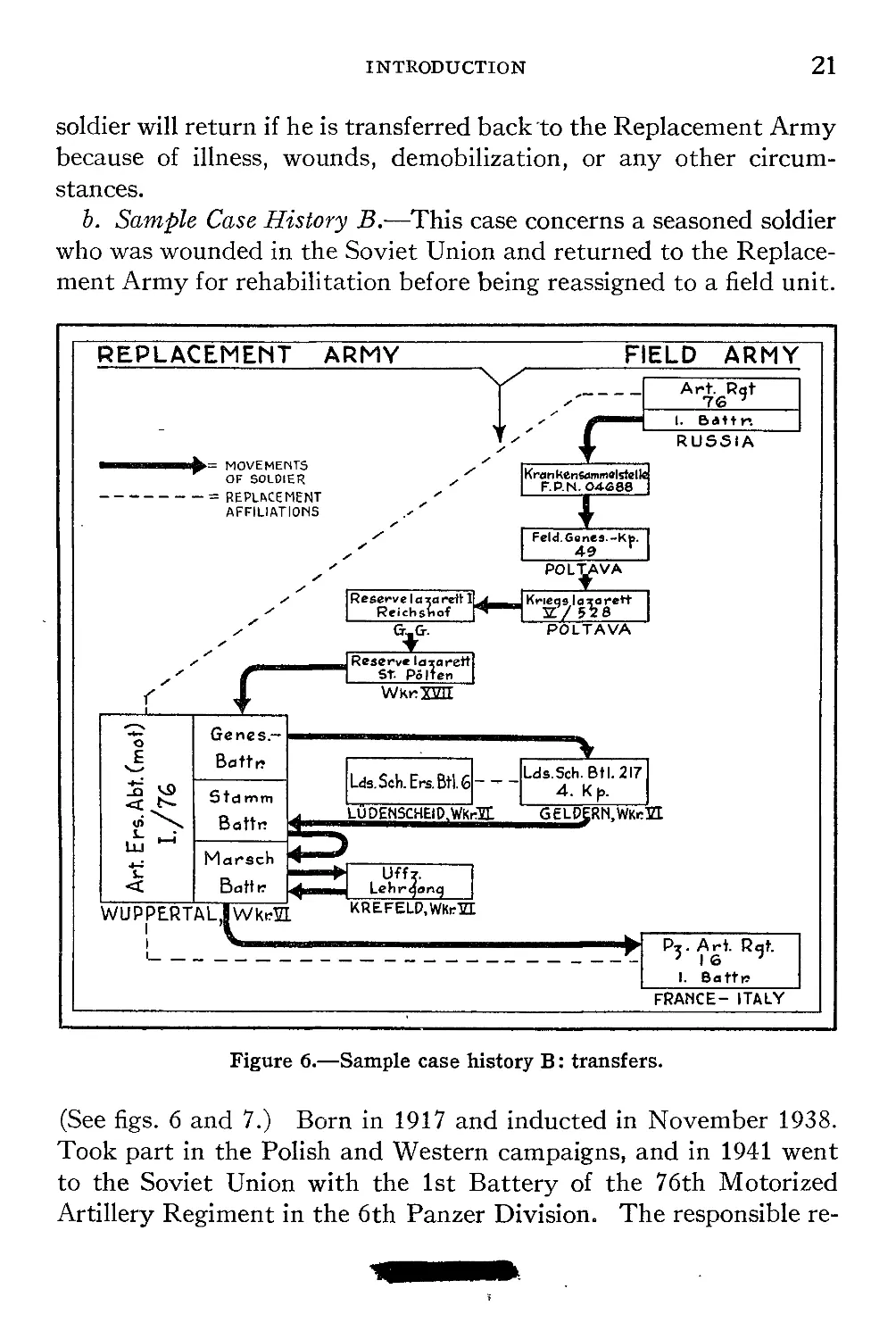
b. Sample Case History B.—This case concerns a seasoned soldier
who was wounded in the Soviet Union and returned to the Replace-
ment Army for rehabilitation before being reassigned to a field unit.
FIELD ARMY
REPLACEMENT ARMY
FRANCE- ITALY
Figure 6.—Sample case history В: transfers.
(See figs. 6 and 7.) Born in 1917 and inducted in November 1938.
Took part in the Polish and Western campaigns, and in 1941 went
to the Soviet Union with the 1st Battery of the 76th Motorized
Artillery Regiment in the 6th Panzer Division. The responsible re-
Figure 7.—Sample case history В: movements.
ьо
ьо
THE GERMAN REPLACEMENT ARMY
INTRODUCTION
23
placement unit for the light battalions of this regiment was the
Motorized Artillery Replacement Battalion I./76 at Wuppertal in
Wehrkreis VI. The man was wounded near Poltava on 17 August
1943; his wound was not serious, but he subsequently contracted
jaundice and after passing through several hospitals in the field was
sent back first to a reserve hospital in Poland and then to another
near Vienna in Wehrkreis XVII. The latter promptly notified
his responsible replacement unit at Wuppertal of his arrival, which
automatically placed him on the rolls of its convalescent battery,
entirely regardless of whether he himself had ever been in or near
Wuppertal and at a time when he definitely was not there. There
is nothing unusual in this procedure; convalescent units were
originally designed to provide a course of training to restore the
combat efficiency of wounded men, but because of the manpower
shortage they now serve principally as record offices for men in
reserve hospitals or on convalescent leave. As soon as the men are
fit for limited service the convalescent unit often directs that they
be sent to a local-defense (Landesschutzeri} unit where use can be
made of them as guards for prisoners of war or vulnerable points in
Germany until they are again fit for combat duty. That is what
happened to this soldier. After a convalescent furlough he reported
in person to the Genesendenbatterie of his replacement unit at Wup-
pertal and was shortly thereafter assigned to Landes schutzen Bat-
talion 217 at Geldern in Wehrkreis VI. Here his responsible replace-
ment unit was the Wehrkreis VI Landess chutzen Replacement
Battalion 6 at Ludenscheid. As soon as he was considered fully fit
he went back to his previous responsible replacement unit, Motor-
ized Artillery Replacement Battalion I./76, joining first the recep-
tion battery {Stammbatterie) and then the transfer battery (Marsch-
batterie"). Again no lost motion was permitted; while nominally on
the rolls of the latter unit he was actually attending an NCO course
at Krefeld and then on a short emergency furlough before his return
to the Field Army.
Motorized Artillery Replacement Battalion I./76 was responsible
for other motorized artillery units from Wehrkreis VI as well as the
one which bore its number. Thus the soldier was not returned to
24 THE GERMAN REPLACEMENT ARMY
his previous unit in the Soviet Union but was sent to France to join
the 16th Motorized Artillery Regiment, which was being re-formed
there after being destroyed, along with the rest of the 16th Panzer
Division, at Stalingrad. His present responsible replacement unit
as a member of this regiment is still the Motorized Artillery Replace-
ment Battalion I./76, which in consequence of air raids has mean-
while moved from the large industrial center of Wuppertal to the
smaller town of Detmold. Presumably because of his impaired
health the soldier received another long furlough while his unit was
in France and yet another after it arrived in northern Italy.
Section II. TYPES OF REPLACEMENT
UNITS
7. Introduction
a. General.—This section consists of a catalog of all the principal
types of replacement and training units in the German ground forces
of the status of regiments and below, with particulars of their Ger-
man designations, their numbering, their organization or subordina-
tion, and the manner of their affiliation with field units. They are
arranged according to arms and services (Waffengattungen), sub-
divided into regular units (replacement and training units which are
affiliated in the normal manner with various types of field units)
and special units (replacement and training units created for special
purposes), followed by a description of the schools connected with
the arm in question. General remarks concerning the character
and scope ,of each Waffengattung, its nomenclature, and its number-
ing system are included under each heading so far as they are per-
tinent.
b. Types and organization of replacement and training units.—
There are three general types of replacement and training units,
whose development and function within the German replacement
and training system has been described in section I. These are—•
(1) Replacement units (Ersatzeinheiten).
(2) Training units (Ausbildungseinheiten), which are called reserve units
(Reserveeinheiten) when they are controlled by reserve divisions.
(3) Combined replacement and training units (Ersatz- und Ausbildungs-
einheiteri).
Both the replacement and the combined replacement and train-
ing units have the function of providing personnel replacements for
their affiliated field units. The combined replacement and train-
ing units have the additional function of training recruits, whereas
the replacement units are relieved of that function by the separate
training units bearing the same numbers.
25
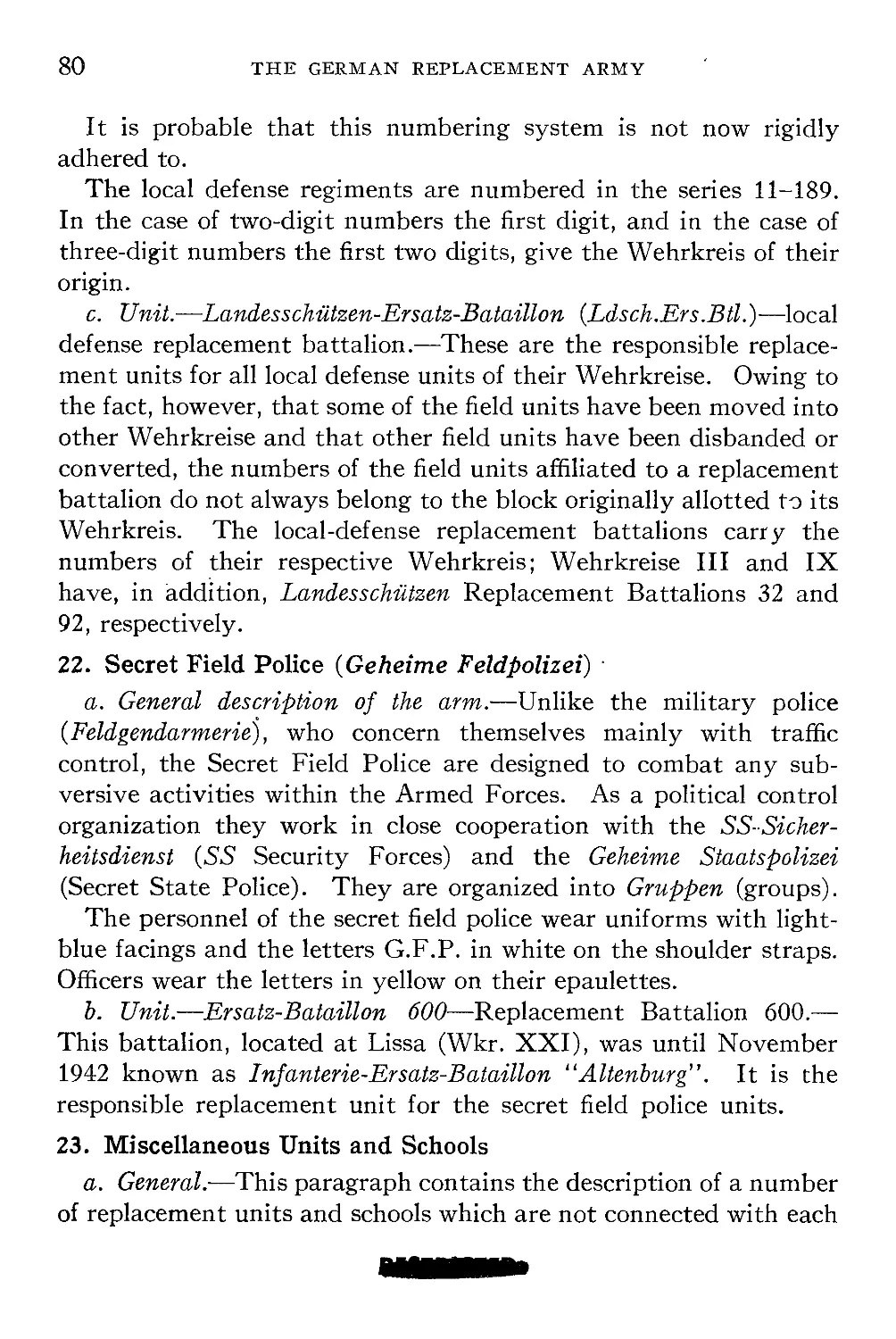
26
THE GERMAN REPLACEMENT ARMY
The functions of these three types of replacement and training
units are clearly defined and are uniform throughout the Replace-
ment Army, so that the fact that the name of a unit includes the
words Ersatz-, Ausbildungs-, Reserve-, or Ersatz- und Ausbildungs-
indicates at once how it fits into the entire replacement training
system. It is therefore considered sufficient in the following catalog
to describe in detail the numbering and mission of the replacement
unit only and to give only the German designations and proper
translations of its corresponding training units; the latter are listed
to the extent that they are believed to exist but not where there is
reason to assume that the type is never used.
Even if a given type of unit is known to exist only in the form of
combined replacement and training battalions it is listed and de-
scribed here as a replacement unit, since all such combined units
function in the replacement capacity as well as for training. This is
the case, for example, with the medical replacement units, which
exist only as combined medical replacement and training battalions,
and with the armored reconnaissance replacement units, which are
all in the form of combined armored reconnaissance replacement and
training battalions.
In general it has not been necessary to describe in detail the or-
ganization of the individual types of replacement and training units
mentioned in this section. All replacement units are alike in that
they consist of a staff and one or more recruit, convalescent, and
Marsch components. The components of the training units corre-
spond in each instance to those of their related field units. Thus
the fourth company of an infantry training battalion will be a
machine-gun training company, the reconnaissance training bat-
talion will have cyclist training troops (Radpahr-Ausbildungs-
Schwadronen) and cavalry training troops (Reiter-Ausbildungs-
Schwadronen), and the armored reconnaissance training battalion
includes training companies for armored-car crews (Panzerspdh-
Ausbildungs-Kompanien), for armored reconnaissance personnel
(P anzeraufkidrungs-Atisbildungs-Kompanien), and for motorcycle
and scout car crews respectively (Panzeraufklarungs-Ausbildungs-
Kompanien (Krad) or (Volkswagen)}. Units of regiment status
TYPES OF REPLACEMENT UNITS
27
will usually be commanded by a colonel, units of battalion status
by a captain, and units of company size by a first lieutenant. The
organization of individual units is mentioned only where special in-
formation is of significance.
c. Types of schools.—In the training system of the German Army
the following four types of schools may be distinguished; they are
listed below under their respective arms in this sequence.
(1) Schools for training in particular arms or services (Waffen-
schulen).-—The Waffenschulen, of which there are usually one or
more for each arm, are comparable to the U.S. special service schools
and have the function of developing the technical and tactical doc-
trines of their respective arms and conducting courses for personnel
of those arms as required. The principal Waffenschulen have dem-
onstration units {Lehrtruppen} permanently attached to them.
The Waffenschulen are subordinated to the Chief of Training
{Chef des Ausbildungswesens im Ersatzheer}.
The members of the school staffs wear the uniforms of their re-
spective arms with the letter @ on the shoulder straps. The
demonstration units wear thedetter 8 instead.
(2) Schools for officer training.—In the peacetime Army, the five
military schools {Kriegsschulen} at Munchen, Hannover, Dresden,
Potsdam, and Wiener-Neustadt took care of the training of officer
candidates. The wartime Army formed, to take their place, eight
schools for infantry officer candidates {Schulen fur Offizier-Anwdrter
der Infanterie}, one school for artillery officer candidates {Artillerie-
schule III}, and courses for officer candidates at the Waffenschulen
{Offizier-Anwar ter-Lehr gauge an den Waffenschulen} for officer can-
didates of the other arms. In April 1943, the designation of the
schools and courses was changed from Offizier-Anwdrter to Fahnen-
junker and Artilleriesch/ule III, for example, became Schule fur
Fahnenjunker der Artillerie.
These schools are controlled by the Army Inspector of Training
and Education {Inspekteur des Erziehungs- und Bildungswesens des
Heeres}.
(3) Schools for NCO training.—The training of noncommissioned
officers takes place in the Army noncommissioned-officer schools
28
THE GERMAN REPLACEMENT ARMY
(Heeres- Unteroffizierschulen). These schools also conduct courses
for officer applicants (0'ffizier-Bewerber-Lehrgange}. The noncom-
missioned-officer school usually consists of a headquarters and four
companies or batteries:
The personnel of the noncommissioned-officer schools wear the
letters U® on their shoulder straps.
These schools are likewise controlled by the Army Inspector of
Training and Education (Inspekteur des Erziehungs- und Bildungs-
wesens des Heeres}.
(4) Schools for special training.—There are various schools for
specialists which are usually connected with a particular arm but
often train specialist personnel for other arms as well. Their main
function is the training of personnel and instructors of the specialist
careers {Sonderlaufbahnen}, mostly concerned with the maintenance
of various types of installations and equipment and with the care
of men and animals. They are dealt with below under the various
arms under which they most properly belong.
Armed Forces specialist schools (Wehrmachtfachschulen) have the
purpose of preparing professional soldiers for careers in government
service after their discharge from the Armed Forces. In wartime
the only soldiers receiving such training are those who are no longer
fit for any kind of military duty. They are therefore not listed in
this book.
8. Infantry (Infant er ie}
a. General description of the arm.—This arm includes the infantry
regiments and reconnaissance units of the infantry divisions (Infan-
teriedivisionen), light divisions (Jdgerdivisioneri), and mountain divi-
sions (Gebirgsdivisionen) and various types of GHQ units, such as
Fla battalions, together with their corresponding replacement and
training units. The development of the infantry arm is supervised
by the Inspectorate of Infantry in the General Army Office (Inspek-
tion der Infanterie—AHA/In 2).
The distinguishing color of the infantry in general is white, of the
light and mountain infantry light green, and of reconnaissance units
(which originally were cavalry) golden yellow.
TYPES OF REPLACEMENT UNITS
29
b. Nomenclature.—The designation of the regular infantry regi-
ments was changed in October 1942 from Infanterieregiment to
Grenadierregiment. Some 10 regiments having traditional associa-
tions with Fusilier regiments of the old Imperial Army were granted
the honorary designation of Fusilierregiment. Infantry replacement
and training battalions may therefore be found with the corre-
sponding names of Grenadier-Ersatz- (or -Ausbildungs-) -Bataillon
and Fusilier-Ersatz- (or -Ausbildungs-) -Bataillon.
The replacement and training battalions for the light infantry
regiment (ffdgerregiment) and mountain infantry regiment (Gebirgs-
jdgerregiment) are designated Jager-Ersatz- (or -Ausbildungs-) -Ba-
taillon and Gebirgsjager-Ersatz- (or -Ausbildungs-) -Bataillon re-
spectively.
The term Infanterie is still employed to describe the infantry arm
as such and as a generic term to cover two or more of the above
designations; thus, the T/O which applies to Grenadier regiment,
Fusilierregiment, and Jagerregiment is entitled Infanterieregiment.
Moreover, the designation Infanterie is still used correctly to ex-
press the connection of a unit with the infantry arm. Thus, the
specialist units which are component parts of infantry regiments are
called infantry antitank company (Infanterie-Panzerjdger-Kom-
panie), infantry mounted platoon (ffnfanterie-Reiterzug), infantry
howitzer company (Jnfanterie-Geschutz-Kompanie), infantry signal
platoon and section {Infanterie-Nachrichtenzug und -staffel), and in-
fantry engineer platoon (Infanterie-Pionierzug).
c. Regular units.—(1) Grenadier-Ersatz-Regiment (Gr.Ers.Rgt.)—
infantry replacement regiment.—Consists of a staff which controls
a number of infantry replacement battalions. This number was
originally three but may now be as many as six or even more. At
the same time the infantry replacement regiment controls four re-
placement companies for the regimental specialist sub-units, namely
one each for the infantry howitzer companies, the antitank com-
panies, the signal subunits, and the engineer platoons. To these
may be added a fifth replacement company for the infantry mounted
platoons found in the regimental headquarters companies.
__________________________________
30
THE GERMAN REPLACEMENT ARMY
Most of these replacement regiments bear the numbers of active
divisions (1 to 36, 44, 45, 46, and 50) or of the three following waves
of divisions formed in 1939 (52 to 98, 205 to 246, and 251 to 269),
since they were originally thought of as the rear echelons of these
divisions and were located at their home stations. Some of those
in Austria, however, took the numbers of the regiments of the
original divisions of Wehrkreis XVII (the 44th, 45th, and 262d
Infantry Divisions) because, owing to the absence of trained man-
power there in 1939, there were no second- and third-wave divisions
from Austria. A few of the infantry replacement regiments have
been renumbered in the course of the war.
The reorganization of the Replacement Army which began toward
the end of 1942 has resulted in the formation of a number of new
infantry replacement regiments in the 500 series.
Because of successive changes in subordination the replacement
battalions controlled by an infantry replacement regiment no longer
necessarily correspond in their numbering to the regiments of the
field division whose number it bears.
The infantry replacement regiment is not now itself responsible
for supplying replacements to any field unit. Its principal function
since 1942 has been to serve as an administrative echelon between
the actual replacement units subordinate to it (infantry replacement
battalions and infantry specialist replacement companies) and the
mobilization division {Div.Nr. . . .).
Designations of corresponding training units:
Grenadier-Ausbildungs-Regiment (Gr.Ausb.Rgt.')—infantry training regiment.
Reserve-Grenadier-Regiment (Res.Gr.Rgt.')—reserve infantry regiment.
Grenadier-Ersatz- und -Ausbildungs-Regiment (Gr.Ers.u.Ausb.Rgt.')— com-
bined infantry replacement and training regiment.
(2) Jager-Ersatz-Regiment (Jag.Ers.Rgt.')—-light infantry replace-
ment regiment.—It is possible but not certain that this designation
is used for the 5th, 8th, and 28th Infantry Replacement Regiments,
whose numbers correspond to those of the three divisions which were
converted into light divisions in the winter of 1940-41.
TYPES OF REPLACEMENT UNITS
31
Designations of corresponding training units:
Jager-Ausbildungs-Regiment (Jdg.Ausb.Rgtj — light infantry training
regiment.
Reserve-Jager-Regiment (Res.Jiig.RgC)—reserve light infantry regiment.
Jager-Ersatz- und -Ausbildungs-Regiment (Jag.Ers.u.Ausb.Rgt.)—combined
light infantry replacement and training regiment.
(3) Gebirgsjager-Ersatz-Regiment (Geb.Jag.Ers.Rgt.") — mountain
infantry replacement regiment.—Similar in organization and func-
tions to the infantry replacement regiment, but usually controlling
only two mountain infantry replacement battalions and four moun-
tain infantry specialist replacement companies. The regiments are
numbered 1 (corresponding to the 1st Mountain Division from
Wehrkreis VII) and 136 to 139 (corresponding to the original regi-
ments of the 2d and 3d Mountain Divisions from Wehrkreis XVIII).
Designations of corresponding training units:
Gebirgsjager-Ausbildungs-Regiment (Geb.Jdg.Ausb.Rgt.')—mountain infantry
training regiment.
Reserve-Gebirgsjager-Regiment (Res.Geb.Jdg.Rgtj—reserve mountain infantry
regiment.
Gebirgsjdger-Ersatz- und -Ausbildungs-Regiment (Geb.Jag.Ers.u.Ausb.Rgt.)—
combined mountain infantry replacement and training regiment.
(4) Grenadier-Ersatz-Bataillon (Gr.Ers.Btl.}—infantry replace-
ment battalion.—Responsible replacement unit for one or more in-
fantry regiments from its Wehrkreis. It may also be the responsible
replacement unit for the* headquarters companies of subordinate
administrative headquarters in occupied territories {Feldkomman-
danturen), administrative units of prisoner of war camps, railway
station headquarters, and fortress battalions. Certain infantry re-
placement battalions have been designated as replacement units for
special types of field units. Thus, Infantry Replacement Battalion
203 in Berlin-Spandau (Wkr. Ill) is the replacement unit for the
specialists of the fuel and lubricant testing units etriebsstofpunter-
suchungstrupps'); Infantry Replacement Battalion 352 in Luxem-
burg (Wkr. XII) is the replacement unit for the cadre personnel of
the Special Field Penal Battalion (Feldsonderbataillon).
An infantry replacement battalion may have administrative re-
sponsibilities, such as pay and issue of equipment, for the personnel
32
THE GERMAN REPLACEMENT ARMY
of one or more of the regimental specialist replacement companies
which are subordinated to the same replacement regiment, if they
happen to be stationed near it.
The infantry replacement battalion usually bears the number of
a regiment of one of the active, reservist, Landwehr, or Erganzungs
divisions (first four waves) from its Wehrkreis. In Austria (Wehr-
kreis XVII) there are two replacement battalions carrying the
number of each of the original regiments (130 to 135 and 462, 482,
and 486), preceded by the Roman numerals I and II.
The infantry replacement battalion is normally, but not always,
the responsible replacement unit for the field regiment whose num-
ber it bears and often for one or more additional regiments.
Designations of corresponding training units:
Grenadier-Ausbildungs-Bataillon (Gr.Ausb.Btld)—infantry training battalion.
Reserve-Grenadier-Bataillon (Res.Gr.Btld)—reserve infantry battalion.
Grenadier-Ersatz- und -Ausbildungs-Bataillon (Gr.Ers.u.Ausb.Btl.)—infantry
replacement and training battalion.
(5) Grenz-Grenadier-Ersatz-Bataillon or Grenz-Infanterie-Ersatz-
Bataillon (Grz.Gr.Ers.Btl. or Grz.Inf.Ers.Btl.}—frontier infantry re-
placement battalion.—Units of this type have been identified in
Wehrkreise III and XII, numbered in the 120 series. They were
the replacement battalions left behind by the former frontier in-
fantry regiments stationed near the Polish and French frontiers
when the latter departed for the field. It is believed that these
battalions now function as ordinary infantry replacement battalions,
although one or two of them retain the designation Grenz-Grenadier-
Ersatz-Bataillon.
(6) Jager-Ersatz-Bataillon {Jdg.Ers.Btl.}—light infantry replace-
ment battalion.—Similar in character and functions to the infantry
replacement battalion. These are the responsible replacement units
for the light infantry regiments of the light divisions.
Designations of corresponding training units:
Jager-Ausbildungs-Bataillon (Jdg.Ausb.Btld)—light infantry training bat-
talion.
Reserve-Jdger-Bataillon {Res. Jag.Btl.')—-reserve light infantry battalion.
Jdger-Ersatz- und -Ausbildungs-Bataillon (Jdg.Ers.u.Ausb.Btld)—combined
light infantry replacement and training battalion.
TYPES OF REPLACEMENT UNITS
33
(7) Gebirgsjdger-Ersatz-Bataillon (Geb.Jdg.Ers.Btl.) — mountain
infantry replacement battalion.—Similar in character and functions
to the infantry replacement battalion. These are the responsible
replacement units for the mountain infantry regiments in the
mountain divisions. They bear the numbers of the active mountain
infantry regiments; in all but two cases there are two for each such
regiment, with the Roman numerals I and IL
Designations of corresponding training units:
Gebirgsjager-Ausbildungs-Bataillon {Geb.Jag.Ausb.Btl.)—mountain infantry
training battalion.
Reserve-Gebirgsjager-Bataillon {R&s.Geb.Jag.Btl.')—reserve mountain infantry
battalion.
Gebirgsjdger-Ersatz- und -Ausbildungs-Bataillon (Geb.Jdg.Ers.u.Ausb.Btl.)—
combined mountain infantry replacement and training battalion.
(8) Aufklarungs-Ersatz-Abteilung (Aufkl. Ers. Abt.)—reconnais-
sance replacement battalion.—The reconnaissance replacement bat-
talions have their origin in the old cavalry, and until April 1943
they were called either Kavallerie-Ersatz-Abteilung (cavalry re-
placement battalion) or Radfahr-Ersatz-Abteilung (cyclist replace-
ment battalion). They are usually commanded by a Rittmeister
(captain). Their components of company status are called Schwa-
dr on (troop).
The reconnaissance replacement battalions are the responsible
replacement units for the reconnaissance battalions of infantry,
light, and mountain divisions and the reconnaissance companies of
mobile battalions. However, the antitank, howitzer, and engineer
platoons of the heavy weapons troop in the reconnaissance battalion
are not affiliated with the reconnaissance replacement battalion,
but with the most conveniently located divisional antitank and
engineer replacement battalions and regimental howitzer replace-
ment company, respectively.
In some cases the responsible replacement units for infantry
reconnaissance battalions and mobile battalions are of company
size only. They are described under subparagraphs (22) and (23),
below.
34
THE GERMAN REPLACEMENT ARMY
Reconnaissance replacement battalions 3 and 5 to 23 carry the
numbers of the former cavalry regiments from which they were
originally formed. Reconnaissance replacement units with higher
numbers carry the numbers of the field units which they originally
served, which are in most cases at the same time the numbers of
held divisions formed in 1939.
Designations of corresponding training units:
Aufkldrungs-Ausbildungs-A bteilung (Aufkl.Ausb.Abt.)—reconnaissance train-
ing battalion.
Reserve-Aufklarungs-Abteilung (Res.Aufkl.Abt.)—reserve reconnaissance bat-
talion.
Aufkldrungs-Ersatz- und -Ausbildungs-Abteilung (Aufkl.Ers.u.Ausb.Abt.)—
combined reconnaissance replacement and training battalion.
(9) Maschinengeivehr-Ersatz-Bataillon (MG.Ers.Вtl.)—machine-
gun replacement battalion.—There are only very few of these units
identified. Most of them are probably motorized and should have
the addition (mot) to their names.
The machine-gun replacement battalions are the responsible re-
placement units for independent machine-gun battalions.
Designations of corresponding training units:
Maschinengewehr-Ausbildungs-Bataillon (MG.Ausb.Btl.)—machine-gun train-
ing battalion.
Maschinengewehr-Ersatz- und -Ausbildungs-Bataillon (MG.Ers.u.Ausb.Btl.)—
combined machine-gun replacement and training battalion.
(10) Fliegerabwehr-Ersatz-Bataillon (Fla-Ers.Вtl.) — antiaircraft
machine-gun replacement battalion.—These units have been iden-
tified in the numerical series 22 to 66; with the exception of numbers
47 (Wkr. XIII), 52 (Wkr. X), and 66 (Wkr. XII) the last digit of
the number has been found to indicate the Wehrkreis of each unit.
Most of the units are motorized, in which case their German desig-
nation has the addition (mot).
The Fla replacement battalions are the responsible replacement
units for Fla battalions.
Designations of corresponding training units:
Fla-Ausbildungs-Bataillon (Fla-Ausb.BH.)—antiaircraft training battalion.
Fla-Ersatz- und -Ausbildungs-Bataillon (Fla-Ers.u.Ausb.Btl.)—antiaircraft
replacement and training battalion.
TYPES OF REPLACEMENT UNITS
35
(11) Schwere Granatwerfer-Ersatz-Abteilung (s.Gr.W.Ers.Abt.')—•
heavy mortar replacement battalion.—This unit (one without num-
ber in Metz, Wkr. XII, identified) is the responsible replacement
unit for the heavy (120-mm) mortar battalions.
Designation of corresponding training unit:
Schwere Granatwerfer-Ausbildungs-Abteilung (s-Gr.W.Ausb.Abt.')—heavy mor-
tar training battalion.
(12) Feld-Ersatz-Bataillon (Feld-Ers.Btl.')—field replacement bat-
talion.—The field replacement battalion is not a replacement unit
in the proper sense of the term. It is a pool of trained replacements
for divisional units of various arms in the field. It may be organic
to a division, but its personnel may also go to several divisions in a
given area.
(13) Infanterie-Geschutz-Ersatz- Kompanie (Inf.Gesch.Ers.Kpi)—
infantry howitzer replacement company.—This unit sometimes ap-
pears as the 13th company of an infantry replacement regiment, and
in any case bears the number of such a regiment, by which it is con-
trolled. It is normally the responsible replacement unit for the
13th (infantry howitzer) companies of the infantry regiments belong-
ing to the division of the same number, and usually those of one or
more additional divisions from the same Wehrkreis. It also serves
the infantry howitzer platoon of the heavy-weapons troop in the
reconnaissance battalion (see subparagraph (8), above).
Designations of corresponding training units:
Infanterie-Geschutz-Ausbildungs-Kompanie (Inf.Gesch.Ausb.Kp.') — infantry
howitzer training company.
Reserve-Infanterie-Geschutz-Kompanie (Res.Inf.Gesch.Kp.')—reserve infantry
howitzer company.
Infanterie-Geschutz-Ersatz- und -Ausbildungs-Kompanie (Inf.Gesch.Ers.u.
Ausb.Kpf—-combined infantry howitzer replacement and training
company.
(14) Gebirgsjdger-Inpanterie-Geschutz-Ersatz- Kompanie (Geb.Jdg.-
Inf.Gesch.Ers.Kp.')—mountain infantry howitzer replacement com-
pany.—Responsible replacement unit for the mountain infantry
howitzer platoon in the heavy-weapons company of the mountain
infantry battalion and in the heavy-weapons troop of the mountain
36
THE GERMAN REPLACEMENT ARMY
reconnaissance battalion. Controlled by a mountain infantry re-
placement regiment, whose number it carries.
Designations of corresponding training units:
Geforgsjdger-Infanterie-Geschutz-Ausbildungs-Kompanie (Geb.Jdg.Inf.Gesch.
Ausb.Kp.)—mountain infantry howitzer training company.
Reserve -Gebirgsjdger - Infanterie- Geschiitz- Kompanie (Res.Geb. Jag. Inf.Gesch.
Kp.)—reserve mountain infantry howitzer company.
Gebirgsjdger-Infanterie-Geschutz-Ersatz- und -Ausbildungs-Kompanie (Geb.
Jag.Inf.Gesch.Ers.u.Ausb.Kp.)—combined mountain infantry howitzer
replacement and training company.
(15) Infanterie-Panzerjager-Ersatz-Kompanie (Inf.Pz.Jag.Ers.Kp.}
—infantry antitank replacement company.—This unit sometimes
appears as the 14th company of an infantry replacement regiment
and in any case bears the number of such a regiment, by which it is
controlled. It is normally the responsible replacement unit for the
14th (antitank) companies of the infantry regiments belonging to
the division of the same number and usually those of one or more
additional divisions from the same Wehrkreis.
Until 1940 these units were called Panzerabwehr instead of Panzer-
jager.
Designations of corresponding training units:
Infanterie-Panzerjdger-Ausbildungs-Kompanie (Inf.Pz.Jag.Ausb.Kp.')— in-
fantry antitank training company.
Reserve-Infanterie-Panzerjdger-Kempanie (Res.Inf.Pz.Jdg.Kpf—reserve in-
fantry antitank company.
Infanterie-Panzerjdger-Ersatz- und -Ausbildungs-Kompanie {Inf.Pz. Jag.Ers.
u.Ausb.Kp.}—combined infantry antitank replacement and training
company.
(16) Gebirgs-Infanterie-Panzerjager-Ersatz-Kompanie (Geb.Inf.Pz.
Jag.Ers.Kpf)—mountain infantry antitank replacement company.
—Responsible replacement unit for the antitank company of the
mountain infantry regiment and for the antitank platoon in the
heavy-weapons company of the mountain infantry battalion. Con-
trolled by a mountain infantry replacement regiment, whose number
it carries.
TYPES OF REPLACEMENT UNITS 37
Designations of corresponding training units:
Gebirgs-Infanterie-Panzerjager-A usbildungs-Kompanie {Geb.Inf.Pz. Jag.A usb.
Kp.)—~mountain infantry antitank training company.
Reserve-Gebirgs-Infanterie-Panzerjager-Kompanie {Res.Geb.Inf.Pz.Jdg.Kp.')—
reserve mountain infantry antitank company.
Gebirgs-rnfanterie-Panzerjdger-Ersatz- und -Ausbildungs-Kompanie {Geb.Inf.
Pz.Jag.Ers.u.Ausb.Kp.')—combined mountain infantry antitank replace-
ment and training company.
(17) Infanterie-Nachrichten-Ersatz-Kompanie {Inf.Nachr.Ers.Kp.')
—infantry signal replacement company.—This unit occasionally ap-
pears as the 15th company of an infantry replacement regiment and
in any case bears the number of such a regiment, by which it is con-
trolled. It is normally the responsible replacement unit for the
signal platoons in the regimental headquarters companies and the
signal sections in battalion headquarters of the infantry regiments
belonging to the division of the same number and usually those of
one or more additional divisions from the same Wehrkreis. It may
also be the responsible replacement unit for the signal section of an-
administrative subarea headquarters (Feldkommandantur).
Designations of corresponding training units:
Infanterie-Nachrichten-Ausbildungs-Kompanie {Inf.Nachr.Ausb.Kp.') — in-
fantry signal training company.
Infanterie- Nachrichten-Ersalz- und -Ausbildungs-Kompanie {Inf.Nachr.Ers.
u.Ausb.Kp.)—combined infantry signal replacement and training com-
pany.
(18) Gebirgsjager-Nachrichten-Ersatz-Kompanie {Geb.Jdg.Nachr.
Ers.Kp.}—mountain infantry signal replacement company.—Re-
sponsible replacement unit for the signal platoon in the headquarters
company of the mountain infantry regiment and for the signal sec-
tion in the headquarters of the mountain infantry battalion. Con-
trolled by a mountain infantry replacement regiment, whose number
it carries.
Designations of corresponding training units:
Gebirgsjdger-Nachrichten-Ausbildungs-Kompanie {Geb.Jdg.Nachr. Ausb.Kph)—
mountain infantry signal training company.
Gebirgsjager-Nachrichten-Ersatz- und -Ausbildungs-Kompanie{Geb.Jdg.Nachr.
Ers.u.Ausb.Kp.')—combined mountain infantry signal replacement and
training company.
38
THE GERMAN REPLACEMENT ARMY
(19) Infanterie-Pionier-Ersatz-Kompanie (Inf.Pi.Ers.KpP — in-
fantry engineer replacement company.—Responsible replacement
unit for the engineer platoons in the headquarters companies of the
infantry regiments of one or more divisions from its Wehrkreis, nor-
mally including the division of the same number as the infantry re-
placement regiment by which it is controlled.
Designations of corresponding training units:
Infanterie-Pionier-A usbildungs-Kompanie (Inf.Pi.A usb.Kp.')—infantry engi-
neer training company.
Infanterie-Pionier-Ersatz- und -Ausbildungs-Kompanie (Inf.Pi.Ers.u.Ausb.
Kp.}—combined infantry engineer replacement and training company.
(20) Gebirgsjager-Pionier-Ersatz-Kompanie (Geb.Jag.Pi.Ers.Kp.')
-—mountain infantry engineer replacement company.—Responsible
replacement unit for the engineer platoon in the headquarters com-
pany of the mountain infantry regiment and in the heavy-weapons
company of the mountain infantry battalion. Controlled by a
mountain infantry replacement regiment, whose number it carries.
Designations of corresponding training units:
Gebirgsjdger-Pionier-Ausbildungs-Kompanie (Geb.Jag.Pi.Ausb.Kp.)—moun-
tain infantry engineer training company.
Gebirgsjdger-Pionier-Ersatz- und -Ausbildungskompanie (Geb.Jdg.Pi.Ers.u.
Ausb.Kp.)—combined mountain infantry engineer replacement and
training company.
(21) Ersatz-Kompanie fur Infanterie-Reiterzug (Ers.Kp.f.Inf.
Reit.Zgf)—replacement company for infantry mounted platoons.—
It is believed that in each Wehrkreis an infantry replacement regi-
ment corresponding to one of the active infantry divisions originally
controlled a replacement company for infantry mounted platoons
and that these companies still exist under their original numbers
even if the division or the replacement regiment has since been
converted. These companies are the responsible replacement units
for the infantry mounted platoons in the regimental headquarters
companies of all the infantry divisions of their respective Wehrkreise.
Designations of corresponding training units:
Ausbildungs-Kompanie filr Infanterie-Reiterzug (Ausb.Kp.f.Inf.Reit.Zg.')—
training company for infantry mounted platoons.
TYPES OF REPLACEMENT UNITS
39
Ersatz- und Ausbildungs-Kompanie fur Infanterie-Reiterzug (Ers.u.Ausb.Kp.f.
Inf.Reit.Zg.')—combined replacement and training company for infantry
mounted platoons.
(22) Aufklarungs-Ersatz-Schwadron (Aufkl. Ers. Schwdf)—recon-
naissance replacement troop.—Most of the reconnaissance replace-
ment units are of battalion size and are described in subparagraph
(8), above. Some of them however, especially in the numerical
series 67 to 268, are only of company status. In most of these cases,
the infantry divisions bearing the corresponding numbers have
mobile battalions combining their reconnaissance and antitank ele-
ments and therefore require less facilities for replacement of recon-
naissance personnel. The reconnaissance replacement troops are
the responsible replacement units for the reconnaissance troops in
the mobile battalions (or reconnaissance battalions) of these divi-
sions and usually of one or more additional infantry divisions from
the same Wehrkreis.
Designation of corresponding training unit:
Aufkldrungs-Ausbildungs-Schwadron {Aufkl.Ausb.Schwdf) -— reconnaissance
training troop.
(23) Aupklarungs-Ersalz-Kompanie {Aufkl.Ers.Kp.}—reconnais-
sance replacement company.—Two of these units, numbered 67 and
68, have been identified, although their designation does not corre-
spond to the usual German practice. They furnish cyclist replace-
ments for reconnaissance battalions of mountain divisions from
Wehrkreis XVIII.
d. Special units.—(1) Jager-Ersatz-Regiment 1 (Special Light In-
fantry Replacement Regiment 1).—This regiment, stationed at
Arys (Wkr. I), presumably controls Jager-Ersatz-Bataillone A and
В (Raiding Replacement Battalions A and B) at Arys, which are re-
placement units for the Jdger-Bataillone, formerly called Jagdkom-
mandos (raiding detachments), used for special raiding or mopping-
up purposes on the Eastern Front.
(2) Infanterie-Ersatz-Bataillon 500 z.h.V. (Special Infantry Re-
placement Battalion 500).—This battalion, last located at Skiernie-
wice (Wkr. G.G.), receives soldiers guilty of misconduct and sends
40
THE GERMAN REPLACEMENT ARMY
them to the Bewahrungs-Bataillone (rehabilitation battalions), for
which it is the responsible replacement unit.
(3) Sonderabteilungen des Ersatzheeres (special battalions of the
Replacement Army).—-These units receive men undergoing their
basic training in the Replacement Army who, by their conduct and
character, endanger discipline and are therefore a burden to regular
training units. After remaining in the special penal battalions for
not longer than 9 months, such men are sent either to their regular
replacement units or, if they are still considered incorrigible, to the
Feldsonderbataillon (Special Field Penal Battalion).
There are four special penal battalions of the Replacement Army:
No. I in the Stablack training area (Wkr. I), for Wkr. I, XX, XXL
No. Ill in the Wandern training area (Wkr. HI), for Wkr. II, III, IV,
VIII, XI.
No. IX in the Schwarzenborn training area (Wkr. IX), for Wkr. V, VI, IX,
X, XII.
No. XIII in the Grafenwohr training area (Wkr. XIII), for Wkr. VII, XIII,
XVII, XVIII, Bohmen und Mahren.
(4) Ersatz-Bataillon 999 (Replacement Battalion 999).—Formerly
located at the Heuberg training area (Wkr. V) and serving as the
responsible replacement unit first for Afrika-Division 999 and later
for the various “999” fortress battalions, which were formed largely
from political offenders and ex-convicts. A unit with a similar
designation and function presumably now exists at the Baum-
holder training area (Wkr. XII) to comprise whatever infantry re-
placement elements are under the control of the newly created
Ersatzbrigade 999.
(5) Infanterie-SchaUmess-Lehr- und -Ersatz-Kompanie 17 (Inf.
Schallm.Lehr- u. Ers.K-p.17) (Infantry Sound-Ranging Demonstra-
tion and Replacement Company 17).—This unit was established at
the Grafenwohr training area (Wkr. XIII) in November 1942. It
serves as the responsible replacement unit for all infantry sound-
ranging detachments of the Field Army. A field division requests
the personnel needed from the headquarters of Wehrkreis XIII,
whereupon the replacement unit transfers trained men to the field
unit.
TYPES OF REPLACEMENT UNITS
41
(6) Gebirgs-Fliegerabwehr-Ersatz- und -Ausbildungs-Kompanie (mot)
700 (Geb.Fla-Ers.u.Ausb.Kp.(mot)700) (Mountain Motorized Anti-
aircraft Machine-Gun Combined Replacement and Training Com-
pany 700).—Located at Bad Hall, Tirol (Wkr. XVIII). Its purpose
is to retrain Fla personnel for operations in mountainous country,
especially in the handling of 20-mm pack antiaircraft machine guns,
and to organize them into units to be incorporated as third (antiair-
craft) companies into divisional antitank battalions. It probably
also serves as the responsible replacement unit for such personnel.
e. Schools.—(1) Special service schools (Waffens chulen).—(a) In-
fanterie-Schule (Infantry School).—Located at Doberitz-Elsgrund
(Wkr. III). Includes the Infanterie-Schiess-Schule (Infantry Gun-
nery School) and conducts special courses for the ordinary infantry
company and the machine-gun company.
Infanterie-Lehr-Regiment 900 (Infantry Demonstration Regiment
900) is usually stationed at the Infantry School and is employed to
demonstrate tactics and perform experiments with new infantry
weapons. Until 1943 it was controlled by Infanterie-Lehr-Brigade
900 along with Panzer grenadier-Lehr-Regiment 901, but the latter is
believed to have been moved to the ..School for Panzer Troops at
Krampnitz (see par. 9 e) when the armored infantry was incor-
porated into the Panzer troops.
(&) Gebirgsjager-Schule (Mountain Infantry School).—This school
is organized as follows:
Kommandostab (headquarters staff), Mittenwald (Wkr. VII).
Lehrgruppe I, Gebirgs-Schiess-Schule (Instruction Group I, Mountain Gun-
nery School), Camp Luttensee near,Mittenwald (Wkr. VII).
Lehrgruppe II, Fiihrung und Gefecht (Instruction Group II, Leadership and
Combat), Mittenwald (Wkr. VII).
Lehrgruppe III, Heeres-Hochgebirgs-Schule (Instruction Group III, Army
Alpine School), Fulpmes (Wkr, XVIII).
The Gebirgsjdger-Lehr-Bataillon (Mountain Infantry Demonstra-
tion Battalion) is attached to the Mountain Infantry School and is
usually stationed at Mittenwald (Wkr. VII).
(c) Aufklarungs- und Kavallerie-Schule (Reconnaissance and
Cavalry School).—Located at Bromberg (Wkr. XX).
42
THE GERMAN REPLACEMENT ARMY
The Aufkldrungs- und Kavallerie-Lehr-Abteilung (Reconnaissance
and Cavalry Demonstration Battalion) is attached to this school.
(<Z) Fliegerabwehr-Schule der Infanterie (Infantry Antiaircraft Ma-
chine-Gun School).—Located at Greifswald (Wkr. II). Until April
1943 this school was called Truppen-Luftschutz-Schule, and it was
originally located at Stettin-Altdamm. It conducts courses for en-
listed men belonging to infantry antiaircraft machine-gun units,
training them as leaders of gun sections, signal sections, and motor-
vehicle sections and as gunnery instructors for the Field Army.
(2) Schools for officer training.—The following eight schools for
infantry officer candidates exist at present:
Schute I fur Fahnenjunker der Infanterie at Dresden (Wkr. IV).
Schute II fur Fahnenjunker der Infanterie at Wiener-Neustadt (Wkr. XVII)
at the seat of the former Kriegsschule, the old Theresianische Militar-
Akademie (Maria Theresa Military Academy).
Schute III fiir Fahnenjunker der Infanterie at Potsdam (Wkr. III). This
school also takes care of the officer candidates of the propaganda troops.
Schute IVfiir Fahnenjunker der Infanterie at Ohrdruf (Wkr. IX).
Schute V fiir Fahnenjunker der Infanterie at Posen (Wkr. XXI). Until Sep-
tember 1942 this school was located at Doberitz-Elsgrund (Wkr. III).
Schute VI fiir Fahnenjunker der Infanterie at Metz (Wkr. XII).
Schute VII fiir Fahnenjunker der Infanterie at Milowitz (Wkr. B.u.M.).
Schute VIII fiir Fahnenjunker der Infanterie at Hannover (Wkr. XI).’
(3) Schools for NCO training.—(a) Heeres- Unteroffizier-Schulen der
Infanterie (Army Infantry NCO Schools).—In the following list only
the NCO schools at Jauer and Eutin have been definitely identified as
infantry, but the others are believed tobelong to the infan try arm also:
Wkr. I: Ortelsburg.
Wkr. II: Arnswalde; Treptow/Rega.
Wkr. Ill: Lubben im Spreewald; Potsdam-Eiche; Regenwurmlager uber
Meseritz.
Wkr. V: Sigmaringen.
Wkr. VI: Duren.
Wkr. VIII: Frankenstein; Jauer.
Wkr. IX: Aschaffenburg; Jena.
Wkr. X: Eutin.
Wkr. XII: Bergzabern; Biebrich; Saarlautern.
Wkr. XX: Marienwerder; Mewe/Weichsel.
Wkr. XXI: Hohensalza; Kosten; Leslau.
TYPES OF REPLACEMENT UNITS
43
(&) Feld-Unteroffizier-Schule der Infanterie (Field Infantry NCO
School).—Located at the Slid (south) training area, Deba (Wkr.
G.G.). The purpose of this school is the training and education of
active noncommissioned officers for the “conservation of the high
standards of training of the noncommissioned officer corps.”
Trainees must be in excellent physical condition for the strenuous
combat training of this school. It also conducts courses for the
retraining of noncommissioned officers of other arms for duty with
the infantry.
(c) Heeres- Unteroffizier-Schulen fur Gebirgsjager (Army Mountain
Infantry NCO Schools).—These have been identified at Turmitz
(Wkr. IV) and Worgl in Tirol (Wkr. XVIII).
(4) School for special training.—The Heeres-Lufts chutz-Schule (Army
Air Raid Protection School) at Potsdam (Wkr. Ill) is subordinated
to the Chief of Training in the Replacement Army. It conducts
courses for officers and noncommissioned officers of all arms, who
subsequently return to their units as instructors in air defense or as
air-raid-protection specialists.
9. Panzer Troops (Panzertruppen)
a. General description of the arm.—In April 1943 the arm known
as Schnelle Truppen (mobile troops) was dissolved and the arm
Panzertruppen was established instead. The General-Inspekteur der
Panzertruppen (Inspector General of Panzer Troops) was appointed
to supervise the organization, training, and development of the arm.
The new arm consists of the following types of field units and their
corresponding replacement and training units: Panzerregiment (tank
regiment) and Panzerabteilung (tank battalion), Panzerjagerabteilung
(antitank battalion) and other Panzerjager-Einheiten (antitank
units) with the exception of the infantry antitank units, the anti-
tank elements of the Schnelle Abteilung (mobile battalion), Panzer-
aufklarungsabteilung (armored reconnaissance battalion), and Eisen-
bahnpanzerzug (armored train), all of them with pink as their dis-
tinguishing color; Panzer grenadierregiment (armored infantry regi-
ment) with grass green as its distinguishing color; and Grenadier-
regiment (mot) (motorized infantry regiment), originally belonging
44
THE GERMAN REPLACEMENT ARMY
to the infantry, with white as its distinguishing color. (The tank
regiment, armored infantry regiments, and armored reconnaissance
battalion of the 24th Panzer Division,formed from the former 1st
Cavalry Division, have golden yellow as their distinguishing color.)
b. Nomenclature.—The designations of the replacement and train-
ing units generally correspond to those of the field units.
It should be noted that not all units whose names begin with
“Panzer” belong to the Panzer arm, since this word is automatically
prefixed to all elements of the Panzer division. Thus the Panzer-
artillerieregiment belongs to the artillery, the Panzerpionierbataillon
to the engineers, and the Panzernachrichtenabteilung to the signal
troops.
Confusion also arises from the inconsistent use of the term Panzer-
grenadier. It was first introduced in August 1942 for the armored
infantry regiments of the Panzer division, which had previously
been called Schutzenregimenter. In June 1943 the motorized divi-
sion, previously called Infanteriedivision (mot), was renamed Panzer-
grenadierdivision. Since then the motorized infantry regiments of
certain of these divisions have sometimes been referred to as Panzer-
grenadierregimenter, although they have not been reorganized as
armored infantry and their normal designation would be Grenadier-
regiment (mot).
The Panzer grenadierdivision “Grossdeutschland" is actually a Pan-
zer division in its organization, and its regiments, known as Grena-
dierregiment “Grossdeutschland” and Fusilierregiment “Grossdeutsch-
land” , are actually armored infantry regiments.
c. Regular units.—(1) Panzergrenadier-Ersatz-Regiment (Pz.Gr.
Ers.Rgt.)—armored infantry replacement regiment.—Consists of a
staff which controls from one to three armored infantry replace-
ment battalions; four replacement companies for the regimental
specialist subunits, namely one each for the infantry howitzer, anti-
tank, signal, and engineer subunits; and possibly also one Panzer
reconnaissance replacement battalion.
The armored infantry replacement regiment normally carries the
auxiliary unit number of an active division which is now a Panzer
division. Nos. 2, 4, 13, and 27 are the numbers of active infantry
TYPES OF REPLACEMENT UNITS
45
divisions which were converted into the 12th, 14th, 13th, and l'7th
Panzer Divisions in 1940; No. 57 is the auxiliary number of the
peacetime 1st Light Division, now the 6th Panzer Division; and
Nos. 81 to 85 are the auxiliary numbers of the 1st to 5th active
Panzer Divisions. Nos. 90 and 104 seem to be exceptions to this
numbering system.
Designations of corresponding training units:
Panzer grenadier-Ausbildungs-Regiment (Pz.Gr .Ausb.Rgt.)—armored infantry
training regiment.
Reserve-Panzergrenadier-Regiment (Res.Pz.Gr.Rgt.)—reserve armored infantry
regiment.
Panzer grenadier-Ersatz- und -Ausbildungs-Regiment (Pz.Gr.Ers.u.Ausb.Rgt.)
—combined armored infantry replacement and training regiment.
(2) Grenadier-Ersatz-Regiment (mot) (Gr.Ers.Rgt.(mot))—motor-
ized infantry replacement regiment.—Consists of a staff which con-
trols two or more motorized infantry replacement battalions and
four replacement companies for the regimental specialist subunits,
namely, one each for the infantry howitzer companies, the antitank
companies, the signal subunits, and the engineer platoons of motor-
ized infantry regiments.
There is one motorized infantry replacement regiment bearing the
number of each of the motorized divisions which had been created
up to the end of 1942.
Designations of corresponding training units:
Grenadier-Ausbildungs-Regiment (mot) (Gr.Ausb.Rgt.(mot))—motorized in-
fantry training regiment.
Reserve-Grenadier-Regiment (mot) (Res.Gr.Rgt.(mot))—motorized reserve in-
fantry regiment.
Grenadier-Ersatz- und -Ausbildungs-Regiment (mot) (Gr.Ers,u.Ausb.Rgt.(mot))
—combined motorized infantry replacement and training regiment.
The smaller replacement and training units controlled by the
motorized infantry replacement or training regiment have the same
character and functions as the corresponding nonmotorized infantry
units described in paragraph 8 c and are therefore not described here.
In each case except that of the antitank units their designation is
followed by (mot).
46
THE GERMAN REPLACEMENT ARMY
(3) Panzergrenadier-Ersatz-Bataillon (Pz.Gr.Ers.Btl.') — armored
infantry replacement battalion.—Responsible replacement unit for
the armored infantry regiments, normally the one whose number it
carries and the second armored infantry regiment of the same Panzer
division.
Designations of corresponding training units:
Panzer grenadier-Ausbildungs-Bataillon (Pz.Gr .Ausb.Btl.)—armored infantry
training battalion.
Reserve Panzer grenadier-В ataillon (Res.Pz.Gr.Btl.)—reserve armored infantry
battalion.
Panzergrenadier-Ersatz- und -Ausbildungs-Bataillon (Pz.Gr. Er s.u. Ausb.Btl.)—
combined armored infantry replacement and training battalion.
(4) Panzer-Ersatz-Abteilung (Pz.Ers.Abt.")—tank replacement bat-
talion.—Responsible replacement unit for the tank regiments of the
Panzer divisions and the tank battalions of the motorized divisions
as well as for GHQ tank units. With few exceptions tank replace-
ment battalions bear the numbers of the tank regiments which they
serve.
Designations of corresponding training units:
Panzer-Ausbildungs-Abteilung (Pz.Ausb.Abt.)—tank training battalion.
Reserve-Panzer-Abteilung (Res.Pz.Abt.)—reserve tank battalion.
Panzer-Ersatz- und -Ausbildungs-Abteilung (Pz.Ers.u.Ausb.Abt.)—combined
tank replacement and training battalion.
Tank replacement and training battalion 100 (Wkr. XII) is be-
lieved to be the replacement and training unit for all flame-thrower
tank battalions of the 100 series.
Tank replacement and training battalion 500 (Wkr. VI) is be-
lieved to be the replacement and training unit for all “Tiger” tank
battalions of the 500 series.
(5) Panzerjager-Ersatz-Abteilung (Pz.Jdg.Ers.Abt.')—antitank re-
placement battalion.—Responsible replacement unit for the divi-
sional antitank battalions, the antitank companies of mobile bat-
talions, the antitank platoons in the heavy weapons units of recon-
naissance and armored reconnaissance battalions, and GHQ anti-
tank units. In almost all cases it bears the number of the antitank
TYPES OF REPLACEMENT UNITS
47
battalion of an active division, to which it is affiliated; Nos. 17 and
18 bear the numbers of their respective Wehrkreise.
Designations of corresponding training units:
Panzerjager-A usbildungs-A bteilung (Pz. Jag. A usb.A bt.) —antitank training
battalion.
Reserve-Panzerjager-Abteilung (Res.Pz. Jag.Abt.")—reserve antitank battalion.
Panzerjager-Ersatz- und -Ausbildungs-Abteilung (Pz.Jag.Ers.u.Ausb.Abt.)—
combined antitank replacement and training battalion.
(6) Panzer-Aufklarungs-Ersatz-Abteilung (Pz.Aufkl.Ers.Abt.') —
armored reconnaissance replacement battalion.—Responsible re-
placement unit for the armored reconnaissance battalions in Panzer
and motorized divisions, with the exception of the antitank, how-
itzer, and engineer platoons of the heavy weapons companies, which
are affiliated with the most conveniently located divisional antitank
and engineer replacement battalions and regimental howitzer re-
placement company, respectively.
Armored reconnaissance replacement battalions have been iden-
tified in the series 1 to 55. The reconnaissance units in Panzer and
motorized divisions were reorganized in the latter part of 1942 and
were renamed and renumbered in April 1943. The reorganization
involved the merging of the old motorcycle battalion with the old
reconnaissance battalion, taking the number of the latter and drop-
ping that of the former. The subsequent renumbering order pro-
vided that an armored reconnaissance battalion in a Panzer division
would take the number of the division and in a motorized division
would receive a number 100 greater than that of the division. The
replacement units, on the other hand, were apparently renamed but
not renumbered under the April order. Hence some of them bear
the numbers of the old field reconnaissance battalions, and some
apparently have those of the old motorcycle battalions. It is pos-
sible that they have since been renumbered to correspond more
closely to the new numbering of the field units.
Designations of corresponding training units:
Panzer-Aufkldrungs-Ausbildungs-Abteilung (Pz.Aufkl.Ausb.Abt.") — armored
reconnaissance training battalion.
48
THE german replacement army
Reserve-Panzer-A ufklarungs-A bteilung (Res.Pz.A ufkl.A Ы.)—reserve armored
reconnaissance battalion.
Panzer-Aufkldrungs-Ersatz- und -Ausbildungs-Abteilung (Pz.Aufkl.Ers.u.
Ausb.Abt.)—combined armored reconnaissance replacement and training
battalion.
(7) Geschutz-Ersatz-Kompanie (mot) (Gesch.Ers.Kp.(mot))~mo-
torized howitzer replacement company.—Responsible replacement
unit for the howitzer platoons in the 4th and 8th (heavy-weapons)
companies and the heavy infantry howitzer company of the armored
infantry regiment and the howitzer platoon in the heavy-weapons
company of the Panzer reconnaissance battalion. It is controlled
by an armored infantry replacement regiment, whose number it
bears, and serves units of the division to which that regiment was
originally affiliated and often of one or two additional Panzer
divisions.
Designations of corresponding training units:
Geschiitz-Ausbildungs-Kompanie (mot) (Gesch.Ausb.Kp. (mot))—motorized
howitzer training company.
Reserve-Geschiltz-Kompanie (mot) (Res.Gesch.Kp.(mot))—reserve motorized
howitzer company.
Geschiltz-Ersatz- und -Ausbildungs-Kompanie (mot) (Gesch.Ers.u.Ausb.Kp.
(mot))—combined motorized howitzer replacement and training company
(8) Panzerjager-Ersatz-Kompanie (Pz.Jdg.Ers.Kp.)—antitank re-
placement company.—Responsible replacement unit for the anti-
tank platoon in the regimental headquarters company, the head-
quarters of the mechanized infantry company, and the antitank
platoons in the 4th and 8th (heavy weapons) companies of the
armored infantry regiment. Its subordination, numbering, and
affiliation are like those of the motorized howitzer replacement com-
pany (subparagraph (7), above).
Designations of corresponding training units:
Panzerjager- Ausbildungs-Kompanie (Pz.Jdg.Ausb.Kp.)—antitank training
company.
Reserve-Panzerjdger-Kompanie (Res.Pz.Jdg.Kp.)—reserve antitank company.
Panzerjdger-Ersatz- und -Ausbildungs-Kompanie (Pz.Jag.Ers.u.Ausb.Kp.)—
combined antitank replacement and training company.
TYPES OF REPLACEMENT UNITS
49
(9) Nachrichten-Ersatz-Kompanie fur Panzergrenadiere (Nachr.
Ers.Kp.f.Pz.Gr.)—signal training company for armored infantry.—
Responsible replacement unit for the signal platoon in the head-
quarters company and the signal section in battalion headquarters
of the armored infantry regiment. Its subordination, numbering,
and affiliation are like those of the motorized howitzer replacement
company (subparagraph (7), above).
Designations of corresponding training units:
Nachrichten-Ausbildungs-Kompanie pur Panzergrenadiere (Nachr .Ausb.Kp.f.
Pz.Gr.)—signal training company for armored infantry.
Nachrichten-Ersatz- und -Ausbildungs-Kompanie fur Panzergrenadiere {Nachr.
Ers.u.Ausb.Kp.f.Pz.Gr.)—combined signal replacement and training
company for armored infantry.
(10) Ersatz-Kompanie fur Pionierzuge (mot) (Ers.Kp.f.Pi.Ziige
(mot))—replacement company for motorized engineer platoons.—
Responsible replacement unit for the engineer platoons in the 4th
and 8th (heavy weapons) companies of the armored infantry regi-
ment. Its subordination, numbering, and affiliation are like those
of the motorized howitzer replacement company (sub-paragraph
(7), above).
Designations of corresponding training units:
Ausbildungs-Kompanie filr Pionierzuge (mot) (Ausb.Kp.f.Pi.Ziige(mot))-—
training company for motorized engineer platoons.
Ersatz- und Ausbildungs-Kompanie fur Pionierzuge (mot) (Ers.u.Ausb.Kp.f.
Pi.Ziige(mot))—combined replacement and training company for motor-
ized engineer platoons.
(11) Fliegerabwehr-Ersatz-Kompanie fur Panzer einheiten (Fla-
Ers.Kp.f.Pz.Einh.) — antiaircraft-machine-gun replacement com-
pany for Panzer units.—Presumably the responsible replacement
unit for any antiaircraft-machine-gun units designed to operate with
Panzer divisions. None have been identified.
Designations of corresponding training units:
Fliegerabwehr-Ausbildungs-Kompanie filr Panzereinheiten (Fla-Ausb.Kp.f.Pz.
Einh.)—antiaircraft-machine-gun training company for Panzer units.
Fliegerabwehr-Ersatz- und -Ausbildungs-Kompanie filr Panzereinheiten (Fla-
Ers.u.Ausb.Kp.f.Pz.Einh.)-—combined antiaircraft-machine-gun replace-
ment and training company for Panzer units.
50
THE german replacement army
d. Special unit.—Eisenbahnpanzerzug-Ersatz-Abteilung (Eisenb.
Pz.Zg.Ers.Abtj)—replacement battalion for armored trains.—When
last identified this unit was located at Rembertow near Warschau
(Wkr. G.G.). It furnishes replacements for the armored trains,
which are GHQ units.
e. Schools.—(1) Special service schools (Waffenschulen).—(a)
Panzertruppen-Schule I (School for Panzer Troops I).—Located in
the Bergen training area, District of Celle (Wkr. XI). Before April
1943, this school was known as Schule fur Schnelle Truppen Wilns-
dorf and was located at Wilnsdorf, District of Teltow (Wkr. III).
It conducts tactical and special technical courses for tank and anti-
tank troops and also the tank-gunnery courses at the Putlos train-
ing area, District of Oldenburg, Holstein (Wkr. X).
The Panzer-Lehr-Regiment (Panzer Demonstration Regiment) is
stationed in the Bergen training area at Camp Fallingbostel and is
attached to the School for Panzer Troops I. It consists of I and II
(tank) and III (antitank) battalions.
(&) Panzertruppen-Schule II (School for Panzer Troops II).—
Located at Krampnitz (Wkr. III). Before April 1943 this school
was known as Schule fur Schnelle Truppen Krampnitz. It conducts
courses for armored infantry and armored reconnaissance troops.
Panzergrenadier-Lehr-Regiment 901 (Armored Infantry Demon-
stration Regiment 901) is attached to the School for Panzer Troops
II at Krampnitz. It includes the Panzeraufklarungs-Lehr-Abteilung
(Panzer Reconnaissance Demonstration Battalion), whose person-
nel wear the letters §18 on their shoulder straps.
(2) Schools for officer training.—The Panzer arm has no special
schools for officer training. The following regular courses for officer
candidates are held:
(a) Fahnenjunker-Lehrgang I at Wilnsdorf (Wkr. Ill), probably
now at the School for Panzer Troops I in the Bergen training area,
District of Celle (Wkr. XI).
(&) Fahnenjunker-Lehrgang II at Zossen (Wkr. III).
(c) Fahnenjunker-Lehrgang III at Krampnitz (Wkr. Ill) at the
School for Panzer Troops II.
TYPES OF REPLACEMENT UNITS
51
(3) Schools for NCO training.—The following schools of this type
are known to exist:
(a) Heeres- Unteroffizier-Schule der Panzertruppen (Panzer schiltzeri)
(Army Panzer Troop NCO School for Tank Crews) at Eisenach
(Wkr. IX).
(&) Heeres-Unteroffizier-Schule der Panzertruppen (Panzergrena-
diere') (Army Panzer Troop NCO School for Armored Infantry) at
Eisenach (Wkr. IX).
(c) Heeres-Unteroffizier-Schule der Panzertruppen (Panzerauf-
klarer) (Army Panzer Troop NCO School for Armored Reconnais-
sance) at Sternberg (Wkr. VIII).
(d) Feld-Unteroffizier-Schule der Panzertruppen (Field Panzer
Troop NCO School) at the Rembertow training area near Warschau
(Wkr. G.G.).—The purpose of this school is the training and edu-
cation of active noncommissioned officers for the “conservation of
the high standards of training of the noncommissioned officer
corps.” Trainees have to be in excellent physical condition for the
strenuous combat training of this school. The school also conducts
courses for the retraining of noncommissioned officers of the artillery
for duty with the armored infantry.
(4) Schools for special training.—(a) Schule fiir Heeresmotorisie-
rung (School for Army Motorization) at Wilnsdorf, District of
Teltow (Wkr. III).—This school, though belonging to the Panzer
arm, conducts courses for technical motor-vehicle officials (Beamte
des technischen Dienstes im Kraftfahrwesen) and motor-vehicle
maintenance sergeants (Schirrmeister (Kf) from units of all arms.
Such courses were recently located at Kulm (Wkr. XX). Members
of the school staff wear the letters 2JZ© on their shoulder straps.
(&) Panzerschulen (Tank Schools).—Have been reported at Pa-
derborn (Wkr. VI), Heerweiler fiber Bingen (Wkr. XII), and Wischau
near Brunn (Wkr. B.u.M.).
(c) Panzerfahrschulen (Tank Driver Schools).—Have been re-
ported at Gelnhausen (Wkr. IX), St. Polten (Wkr. XVII), and
Posen (Wkr. XXI).
52
THE GERMAN REPLACEMENT ARMY
10. Artillery (Ar till er ie)
a. General description of the arm.—The artillery comprises all
Army artillery units (which do not include antitank units belonging
to the Panzer arm or infantry antitank and howitzer companies),
together with their replacement and training units. It includes the
Heeres-Flakartillerie (Army antiaircraft artillery) but not the Fla
(antiaircraft-machine-gun) units, which belong to the infantry.
The development of the artillery arm is supervised by the In-
spectorate of Artillery in the General Army Office (Inspektion der
Artillerie—AHAfln 4), headed by the Inspector of Artillery. Sub-
ordinate to him is the Inspector of Army Antiaircraft Artillery
(Inspekteur der Heeres-Flakartillerie}.
The distinguishing color of the artillery is bright red.
b. Nomenclature.—German artillery is classified, according to
caliber, as leichte (light), comprising guns up to 99 mm and howitzers
up to 129 mm (abbreviated le.); schwere (literally, heavy, but prop-
erly translated medium), comprising guns from 100 to 209 mm,
howitzers from 130 to 209 mm, and special howitzers (Mbrser) from
210 to 249 mm (abbreviated s.); and schwerste (literally, heaviest,
but properly translated heavy), comprising guns and howitzers over
209 mm and Morser over 249 mm (abbreviated sw.). Extremely
heavy guns are described as ilberschwere (superheavy).
According to their means of propulsion artillery units are classi-
fied as bespannte (horse-drawn), motorisierte or (mot) (motorized, for
guns drawn by trucks or tractors), and auf Selbstfahrlafette or (Sfl),
newer designation selbstfahrend or (Sf), (self-propelled).
Artillery regiments of infantry divisions usually have three light
battalions and one medium battalion, artillery regiments of light
divisions two light and one medium battalion. Artillery regiments
of the mountain divisions carry the prefix Gebirgs- (mountain) and
usually have three battalions of mountain pack howitzers and one
light battalion. Artillery regiments of Panzer divisions carry the
prefix Panzer- and usually contain two light battalions, one medium
battalion, and one antiaircraft battalion. Artillery regiments of
motorized divisions are designated (mot) (motorized) and are or-
ganized similarly to those of the Panzer divisions.
TYPES OF REPLACEMENT UNITS
53
Heavy (schwerste) artillery will usually be found only in GHQ
units. According to their tactical and local employment the follow-
ing special classes of GHQ artillery units are distinguished: Eisen-
bahn-Artillerie (railway artillery), Heeres-Kustenartillerie (Army
coast artillery), Heeres-Flakartillerie (Army antiaircraft artillery),
Sturmgeschutz-Einheiten (assault gun units), Beobachtungs-Einheiten
(observation units).
Artillery replacement units correspond in their nomenclature to
the field units which they serve, with the exception that both
Panzer and motorized artillery regiments (actually having the same
table of organization) are served by motorized artillery replacement
battalions.
The types of artillery replacement units whose designations are
prefixed by Gebirgs- and Panzer- or are followed by the abbreviation
(mot) are not listed separately below, since their character, func-
tions, and affiliations are in each case parallel to those of the ordi-
nary artillery replacement units.
c. Numbering system.—All artillery units with the exception of the
Army antiaircraft artillery, artillery observation units, and artillery
commanders and staffs carry numbers allotted from a single series
running from 1 to 999. This series includes both the divisional
artillery regiments, containing only a relatively small part of the
artillery, and the GHQ units. Within the series, the divisional
artillery regiments usually carry the number of the division or a
number 100 greater than that of the division. At the time of
mobilization the light, three-battalion artillery regiments of the
active infantry divisions in the series 1 to 46 received their fourth
(medium) battalions from the peacetime medium regiments. Artil-
lery Regiments 1 to 36 received the first battalions of medium
Artillery Regiments 37 to 72 (in consecutive order); Artillery Regi-
ments 96 of the 44th, 98 of the 45th, and 114 of the 46th Infantry
Divisions received the first battalions of medium Artillery Regi-
ments 97, 99, and 115, respectively. All these medium battalions
still carry their original numbers and are affiliated with medium
replacement battalions bearing the same numbers.
54
THE GERMAN REPLACEMENT ARMY
Most of the irregularities which are now found in the numbering
of divisional artillery units are explained either by the fact that
existing units were allotted to divisions without changing their
numbers, or by the fact that the number of a newly created division
was already taken by an existing artillery unit so that the new
divisional unit had to take a free number.
d. Regular units.—(1) Artillerie-Ersatz-Regiment (Art.Ers.Rgt.')—
artillery replacement regiment.—Consists of a staff which controls
from three to five light and medium artillery replacement battalions.
Each Wehrkreis usually has two or three artillery replacement regi-
ments, normally (except in Austria) bearing the numbers of active
infantry divisions. They control the responsible replacement units
for the artillery regiments of divisions mobilized in the Wehrkreis
and for GHQ units.
Designations of corresponding training units:
Artillerie-Ausbildungs-Regiment (Art.Ausb.Rgt.')—artillery training regiment.
Reserve-Artillerie-Regiment (Res.Art.Rgt.)—reserve artillery regiment.
Artillerie-Ersatz- und -Ausbildungs-Regiment (Art.Ers.u.Ausb.Rgt.')—com-
bined artillery replacement and training regiment.
(2) Artillerie-Ersatz-Abteilung {Art.Ers.Abt.')—artillery replace-
ment battalion.—Responsible replacement unit, depending on its
special classification, for the light or medium battalions of the field
regiment carrying the same number and one or more additional field
regiments. The light and medium replacement battalions com-
bined under the same regimental staff are able to take care of all
replacements needed by their affiliated field units.
Some artillery replacement battalions are really double or even
triple battalions, and their numbers are preceded by Roman nu-
merals I, II, and III.
Besides artillery regiments, the artillery replacement battalions
also serve GHQ artillery battalions and batteries and Army coast-
artillery battalions and batteries. In 1941 Army coast-artillery
units as well as assault-gun units were formed by converting com-
plete batteries from replacement battalions.
TYPES OF REPLACEMENT UNITS
55
Designations of corresponding training units:
Artillerie-Ausbildungs-Abteilung (Art.Ausb.Abt.)—artillery training battalion.
Reserve-Artillerie-Abteilung (Res.Art.Abt.)—reserve artillery battalion.
Artillerie-Ersatz- und -Ausbildungs-Abteilung (Art.Ers.u.Ausb.Abt.) — com-
bined artillery replacement and training battalion.
(3) Heeres-Flakartillerie-Ersatz-A bteilung (H.Flakart.Ers.A bt.)—
Army antiaircraft-artillery replacement battalion.—Responsible re-
placement unit for the Army antiaircraft-artillery battalions of the
same number and one or more additional antiaircraft-artillery
battalions. These units have also been identified as replacement
units for the antiaircraft battalions of Panzer artillery regiments in
cases where these had been formed by conversion of entire GHQ
antiaircraft-artillery battalions.
Designations of corresponding training units:
Heeres-Flakartillerie-Ausbildungs-Abteilung (H.Flakart.Ausb.Abt.) — Army
antiaircraft-artillery training battalion.
Heeres-Flakartillerie-Ersatz- und -Ausbildungs-Abteilung (H.Flakart.Ers.u.
Ausb. Abt.)—combined Army antiaircraft-artillery replacement and
training battalion.
(4) Beobachtungs-Ersatz-Abteilung (Beob.Ers.Abt.)—observation
replacement battalion.—Responsible replacement unit for the ob-
servation battalions as well as for the meteorological platoons and
meteorological sections. These units also serve as replacement
units for the staffs of the Artillerie-Kommandeure (artillery com-
manders). They bear the numbers of active infantry divisions.
Designations of corresponding training units:
Beobachtungs-Ausbildungs-Abteilung (Beob.Ausb.AЫ.)—observation training
battalion.
Beobachtungs-Ersatz- und -Ausbildungs-Abteilung (Beob.Ers.u.Ausb.Abt.)—
combined observation replacement and training battalion.
e. Special units.—(1) Schwere Artillerie-Ersatz-Abteilung (mot) 100
(schw.Art.Ers.Abt.(mot) 100)—Motorized Heavy Artillery Replace-
ment Battalion 100.—Located at Riigenwalde (Wkr. II). This
battalion is the responsible replacement unit for all railway artillery
(Eisenbahn- A rtillerie).
*]|The 3. (Vermessungs- und Einschiess-) Batterie (3.(V.u.E.)/schw.
Art.Ers.Abt.(mot) 100)—3d (Survey and Ranging) Battery—of this
56
THE GERMAN REPLACEMENT ARMY
battalion is the responsible replacement unit for all survey and rang-
ing platoons.
The Ersatztrupp fur Velozitdts-Messtrupps (Replacement Section
for Velocity-Measurement Sections), which is attached to this bat-
talion, is the responsible replacement unit for all velocity-measure-
ment sections.
(2) Artillerie-Lehrregiment (mot) 3 (A.L.R.(mot)3)—Motorized
Artillery Demonstration Regiment 3.—Located at the Gross-Born
training area (Wkr. II). The 1st Battalion of this regiment is the
responsible replacement unit for sound-ranging engineers (Truppen-
ingenieure der Fachrichtung Schallmesswesen) employed with the ob-
servation units.
The 6th Battery of this regiment is the responsible replacement
unit for the meteorological personnel of all reinforced meteorological
platoons (Verstarkte Wetterzuge).
(3) Artillerie-Lehrregiment (mot) 4 (A.L.R.(mot)4)—Motorized
Artillery Demonstration Regiment 4.—Located at the Gross-Born
training area (Wkr. II).
The III. (Vermessungs- und Karten-Ersatz-) Abteilung—11 Id
(Survey and Mapping Replacement) Battalion—of this regiment is
the responsible-replacement unit for all the following field units:
Karten- und Vermessungs-Abteilungen (Kart.u. Verm.Abt.)—mapping
and survey battalions; Felddruckerei-Abteilungen (Felddr.Abt.)—field
printing battalions; Leichte Karten-Druckerei-Abteilungen (le.Kart.
Druck.Abt.)—light map-printing battalions; Karten-Batterien (Kart.
Bttr.)—mapping batteries; Vermessungs-Batterien (Verm.Bttr.)—
survey batteries; Armee-, Korps- und Divisions-Karten-Stellen (A.,
Kps., Div.Kart.St.)—army, corps, and division map-reproduction
centers; Magnetische Messbatterien (Magn.Messbttr.)—magnetic sur-
vey batteries; Karten-Lager (Kart.Lag.)—map depots; Astronomische
Messtrupps (Astro-Messtr.)—astronomical survey sections; Kriegs-
Karten-Vermessungs-Amter (Kr.Kart.Verm.Amter)—war mapping
and survey offices; Militargeographen-Gruppen (Mil. Geo.-Gruppen)
—military geographic groups; Heeres-Messgerdt-Instandsetzungs-
Staffeln (Heer. Messger.Inst.Staff.)—Army surveying-instruments
maintenance section.
TYPES OF REPLACEMENT UNITS
57
(4) Sturmgeschiitz-Ersatz-Abteilung {Stu.Ges ch.Er s .Abt.)—assault-
gun replacement battalion.—Assault Gun Replacement Battalions
200 at Schweinfurt (Wkr. XIII), 300 at Neisse (Wkr. VIII), and
400 at Deba (Wkr. G.G.) have been identified. They are the re-
sponsible replacement,units for all assault-gun units.
(5) Heeresflieger-Stammabteilung (H.Fl.St.Abt.)—Army Flyers Re-
placement Battalion.—Located at Reichenberg (Wkr. IV). This
battalion is the responsible replacement unit for observers and
artillery aviators, including both officers and enlisted men. These
personnel receive their training in reconnaissance pilot schools of the
Air Force. They are not necessarily part of the artillery, but wear
the uniform and distinguishing color of their original arm.
This unit is subordinated to the Inspector of Training and Edu-
cation.
/. Schools.—(1) Special service schools (Waffens chulen).—(a) Artil-
lerie-Schule I (Artillery School I).—Located in Berlin (Wkr. III).
This school was newly established in July 1941 and began to offer
instruction in January 1942.
(b) Artillerie-Schule II (Artillery School II).—Located at the
Gross-Born area (Wkr. II). This school was originally the only
Waffenschule of the artillery and was known as Artillerie-Schule
Juterbog until January 1942, when it was renamed Artillerie-Schule
II. In the middle of 1943 it was moved from Juterbog (Wkr. Ill)
to Gross-Born (Wkr. II). It has Instruction Staffs (Lehrstabe) A,
В, C, and T and an Instruction Staff for Officer Courses (Lehrstab
fiir Offtzierslehrgange).
Artillerielehrregimenter (Artillery Demonstration Regiments) 1,2,
3, and 4, of which the last three are motorized, are stationed at
Gross-Born and attached to Artillery School II as demonstration
units. Motorized Artillery Demonstration Regiment 2 is connected
with a staff for the formation of new self-propelled artillery units
(Neuaufstellung von Artillerie (Sf) Einheiten). Motorized Artillery
Demonstration Regiment 3 has two or more observation battalions,
whose personnel wear the letters 53S on their shoulder straps;
it is connected with Instruction Staff B. Motorized Artillery
Demonstration Regiment 4 has one or more survey and mapping
58
THE GERMAN REPLACEMENT ARMY
battalions, whose personnel wear the letters 23? on their shoulder
straps; it is connected with Instruction Staff C. The latter two
regiments also serve as responsible replacement units for certain
specialized field units (see subparagraph e, above).
(c) Artillerie-Schule III (Artillery School III).—Originally known
as Artillerie-Schule Thorn and located at Thorn (Wkr. XX), this
school was transferred to the Suippes training area near Chfilons-
sur-Marne, France, in March 1943. In April 1943 it was renamed
as an officer training school (see subparagraph (2), below).
(d) Gebirgsartillerie-Schiess-Schule Dachstein (Mountain Artillery
Gunnery School Dachstein).—This school has its home station at
the Dachstein training area at Obertraun, District of Gmunden
(Wkr. XVII). In winter it normally moves to a new location; in
the winter of 1941-42 it was at Worgl (Wkr. XVIII) and in the
following winter at Bad Hall (Wkr. XVIII).
(e) Heereskiistenartillerie-Schule (Army Coast Artillery School).—
Normally stationed at Riigenwalde (Wkr. II), this school with its
demonstration units has moved to the Channel coast.
(/) Sturmgeschiitz-Schule (Assault Gun School).—Located at Burg
near Magdeburg (Wkr. XI). It has an assault-gun instruction staff
(Sturmgeschiitzlehrstab} at Burg and a staff for the formation of new
assault-gun units (Sturmgeschiitzaufstellungsstab') at the Altengrabow
training area (Wkr. XI).
The Sturmgeschiitzlehrabteilung (Assault Gun Demonstration
Battalion) at Burg near Magdeburg (Wkr. XI) is attached to this
school.
(2) School for officer training.—The Schule fiir Fahnenjunker der
Artillerie (School for Artillery Officer Candidates) is at the Suippes
training area near Chfilons-sur-Marne, France. This school was
known as Artillerie-Schule III until March 1943 (see subpar. (1)
(c), above).
(3) Schools for NCO training.—The following schools of this type
are known to exist:
(a) Heeres-Unteroffizier-Schule fiir Artillerie — Army Artillery
NCO School at Amberg (Wkr. XIII).
TYPES OF REPLACEMENT UNITS
59
(&) Heeres-Unteroffizier-Schule fur Artillerie —r Army Artillery
NCO School at Thorn (Wkr. XX).
(4) Schools for special training.—Artillerieschulen (Artillery
Schools), probably conducting special courses of various kinds, have
been reported at the following locations: Barth in Pommern (Wkr.
II) for rapid firing; Oppeln (Wkr. VIII); Beneschau near Prag
(Wkr. B.u.M.); Beziers (France).
11. Chemical Warfare Troops (Nebeltruppen)
a. General description of the arm.—The chemical-warfare troops
consist mainly of projector units, originally used for smoke projec-
tion but lately also for the launching of high-explosive projectiles.
The arm also includes decontamination and gas-projection units.
The development of the chemical-warfare troops is supervised by
the Inspectorate of the Chemical Warfare Troops in the General
Army Office (Inspektion der Nebeltruppen—AHA fin 9f
The distinguishing color of these troops is wine red.
b. Nomenclature.—Units of the chemical-warfare service have at
various times in recent years been designated Nebel- (smoke),
Nebehverfer- (smoke projector), and Werf er- (projector) units. The
last is at present in use. Regardless of nomenclature they are de-
signed to use smoke, high-explosive, or gas projectiles.
Werfer- units should not be confused with Granatwerfer- (ordinary
mortar) units.
c. Regular units.—Werfer-Ersatz-Abteilung (Werf.Ers.Abtf—pro-
jector replacement battalion.—Similar in organization to the artil-
lery replacement battalion. It is the responsible replacement unit
for projector regiments, projector battalions, and decontamination
battalions.
Designations of corresponding training units:
Werfer-Ausbildungs-Abteilung{Werf.Ausb.Abt.')—projector training battalion.
Werfer-Ersatz- und -Ausbildungs-Abteilung (Werf.Ers.u.Ausb.Abt.') — com-
bined projector replacement and training battalion.
d. Special units.—(1) Gebirgswerfer-Lehr-, -Ersatz- und -Ausbil-
dungs-Batterie (Mountain Projector Demonstration, Replacement,
60
THE GERMAN REPLACEMENT ARMY
and Training Battery).—Located at Wocheiner-Vellach (Wkr.
XVIII). Serves as the responsible replacement unit for all moun-
tain projector units.
(2) Heeres-Gasschutz-Schule 1 (Army Gas Protection School 1).—
Located at Celle (Wkr. XI). This school is the responsible replace-
ment unit for all chemical-warfare specialists in the entire Army.
These are either technical officials of the chemical-warfare branch
{Beamte des technischen Dienstes des Nebel- und Gasschutzwesens}, or
sergeants or corporals trained as specialists for chemical-warfare
equipment {Schirrmeister {Ch} or Schirrunteroffiziere {Ch}}.
e. Schools.—(1) Special service school (Waffenschule).—Nebeltrup-
pen-Schule (School for Chemical Warfare Troops).—Located at
Celle (Wkr. XI).
The Werfer-Lehr-Regiment (Chemical Warfare Demonstration
Regiment) is stationed at Celle and is attached to this school.
(2) Schools for special training.—{a} Heeres-Gasschutz-Schule 1
(Army Gas Protection School 1).—Located at Celle (Wkr. XI).
This school trains officers and noncommissioned officers of all arms
to serve as gas-protection specialists or as instructors in gas protec-
tion in their own units. It also conducts regular courses lasting 4
months for Schirrmeister {Ch} (specialists for chemical warfare
equipment). For its function as a replacement unit see subpara-
graph d, above.
{b} Heeres-Gasschutz-Schule 2 (Army Gas Protection School 2).—
Located at Bromberg (Wkr. XX). This school has the same status
and purpose as Army Gas Protection School 1, except that it ap-
parently does not conduct courses for Schirrmeister {Ch}.
(c) Gasschutzschulen (Gas Protection Schools) have been reported
at the following locations: Cuxhaven (Wkr. X); Thorn (Wkr. XX);
Lille (France).
12. Engineers {Pioniere}
a. General description of the arm.—This arm includes the regular
combat engineers as well as fortress engineers {Festungspioniere}.
Since October 1943 it has also included the construction engineers
{Baupioniere} who had previously formed the separate Waffengat-
TYPES OF REPLACEMENT UNITS
61
lung of Bautruppen (construction troops). On the other hand, it is
probable that the engineer arm does not include the railway engi-
neers {Eisenbahnpioniere) or the technical troops {Technische Trup-
pen). The two latter categories, however, are closely related to the
engineers and are therefore treated with them here.
The development of the engineer arm is supervised by the In-
spector of Engineers and Railway Engineers {Inspekteur der Pioniere
und Eisenbahnpioniere) and the Inspector of Construction Engi-
neers {Inspekteur der Baupioniere). The personnel matters, organi-
zation, training, and equipment of the technical troops, who consist
of technical battalions and their replacement units, are taken care
of by the Abteilung Technische Truppen (Department for Technical
Troops), established in May 1941 under the Chief of the Replace-
ment Army.
The distinguishing color of the engineers is black. The fortress
engineers wear on their shoulder straps the letters (for peacetime
units) or (for units formed on or after mobilization). The former
distinguishing color of the construction engineers, light brown, may
still be encountered.
The types of engineer replacement units whose designations are
prefixed by Gebirgs- or Panzer- or are followed by the abbreviation
{mot) are not listed separately below, since their character, func-
tions, and affiliations are in each case parallel to those of the ordinary
engineer replacement units.
b. Regular units.—(1) Pionier-Ersatz-Bataillon {Pi.Ers.Btl.)—en-
gineer replacement battalion.—Responsible replacement unit for the
divisional engineer battalion whose number it carries and for one or
more additional divisional and GHQ engineer battalions.
The engineer replacement and training battalions normally carry
the numbers of their corresponding field units, although there is no
evidence that the replacement units of divisions which have been
converted into Panzer divisions still feed the Panzer engineer bat-
talions. Engineer replacement battalions have been identified in the
series 1 to 40 and 54 to 89, corresponding to the engineer battalions
of active infantry, Panzer, and mountain divisions, and in the series
152 to 269 corresponding to engineer battalions of divisions formed
62
THE GERMAN REPLACEMENT ARMY
in 1939. Engineer Replacement Battalions 46 and 68 carry numbers
not of their affiliated field battalions (88 and 168) but of the field
divisions to which these battalions belong; the field battalions 46
and 68 are active GHQ units and probably not connected with the
replacement battalions bearing the same numbers. Engineer Re-
placement Battalions 43, 47, 123, 311, 334, and 900 likewise do not
fit into the series described above, although in most cases they seem
to feed the field battalions of the same number.
Designations of corresponding training units:
Pionier-Ausbildungs-Bataillon (Pi.Ausb.Btl.)—engineer training battalion-
Reserve-Pionier-Bataillon (Res.Pi.Btl.)—reserve engineer battalion.
Pionier-Ersatz- und -Ausbildungs-Bataillon (JPi.Ers.u.Ausb.Btl.)—combined
engineer replacement and training battalion.
(2) Pionier-Brucken-Ersatz-Bataillon (Pi.Brucken-Ers.Btl.') —
bridge construction engineer battalion.—Since July 1941 this has
been the responsible replacement unit for the Pionier-Brucken-
Bataillone (bridge construction engineer battalions). Before that
date the railway engineer replacement battalions provided the re-
placements for these units.
Designations of corresponding training units:
Pionier-Briicken-Ausbildungs-Bataillon (Pi.Brucken-Ausb.Btl.) — bridge con-
struction engineer training battalion.
Pionier-Briicken-Ersatz- und -Ausbildungs-Bataillon (Pi.Brilcken-Ers.u.Ausb.
Btl.)—bridge construction engineer combined replacement and training
battalion.
Bridge Construction Engineer Combined Replacement and Train-
ing Battalion 5 at Lindau (Wkr. VII) specializes in training and re-
placement of personnel for landing craft.
(3) Baupionier-Ersatz- und -Ausbildungs-Bataillon (Bau-Pi.Ers.u.
Ausb.Btl.')—construction engineer replacement and training bat-
talion.—These units, of which there is one in each peacetime Wehr-
kreis bearing the Wehrkreis number (and also Nos. 15 in Wkr.
V and 28 in Wkr. VIII), are the responsible replacement units for
the Baupionierbataillone (construction engineer battalions). [They
also handle the administration of civilian construction workers and
specialists employed with their affiliated field units.
TYPES OF REPLACEMENT UNITS
63
(4) Eisenbahnpionier-Ersatz- und -Ausbildungs-Bataillon (Eisenb.
Pi.Ers.u.Ausb.Btl.)—railway engineer combined replacement and
training battalion.—Responsible replacement unit for railway spe-
cialists for railway engineer field units. Identified in an independent
series from 1 to 8.
Signal personnel replacements for the railway telephone com-
panies (Eisenbahn-Ferns prech-Kompanien) are furnished by signal
replacement battalions (see par. 13 c).
c. Special units.—(1) Festungspionier-Schule (Fortress Engineer
School).—Located at Berlin-Karlshorst (Wkr. III). This is the re-
placement unit for fortress engineer authorities (Festungspionier-
Dienststellen), consisting mainly of Inspectors of Fortifications (Jn-
spekteure der Landesbefestigungen), fortress engineer commanders
(Festungspionier-Kommandeure), and fortress engineer staffs (Fe-
stungspionier-Stabe), and also for fortress maintenance personnel
(Festungs- Werkpersonal).
The replacement unit for auxiliary personnel of fortress engineer
authorities is determined by order of the Command of the Wehr-
kreis in which the fortress authority is located.
Fortress engineer personnel employed with a superior engineer
commander (Hoherer Pionierfuhrer) or a special engineer regimental
staff (Pionier-Regimentsstab z.b.V.) have the same replacement unit
as their field unit, usually a construction engineer replacement and
training battalion.
The Fortress Engineer School is also the replacement unit for all
technical officials of the fortress engineer branch (Wehrmachtbeamte
des technischen Dienstes im Festungs pionierwesen (FPf) and fortress
maintenance specialists (Wallmeister).
Officers and specialists of the infantry or artillery who are em-
ployed with fortress engineer commands retain their former artil-
lery or infantry replacement unit.
(2) Lehrstab C der Pionierschule fur schweren Bruckenbau (Instruc-
tion Staff C of the Engineer School for Heavy Bridge Construction).
—Located at Strassburg (Wkr. V). This is the replacement unit
for all technical officials of the engineer branch (Wehrmachtbeamte
des technischen Dienstes im Pionierwesen (Pf).
64
THE GERMAN REPLACEMENT ARMY
(3) Wehrgeologen-Lehr- und -Geratestelle (Demonstration and In-
strument Station for Military Geologists).—This station, located at
Sternberg (Wkr. Ill), is the replacement unit for military geologists
in all units and for the personnel of military geology stations.
(4) Technisches Ersatz- und Ausbildungs-Bataillon (Technical
Replacement and Training Battalion).—This battalion, located at
Pirna (Wkr. IV), is the responsible replacement unit for all technical
battalions (Technische Bataillone). It is also the replacement unit
for officials of the technical engineer branch (Wehrmachtbeamte des
technischen Dienstes im Pionierwesen (PT)).
(5) Technische Ersatz- und Ausbildungs-Abteilung (Technical Re-
placement and Training Battalion).—Located at Niederlahnstein
(Wkr. XII). This battalion is the responsible replacement unit for
all technical battalions (Technische Abteilungen).
(6) Ersatz- und Ausbildungs-Kompanie filr technische Gase (Re-
placement and Training Company for Technical Gases).—Located
at Frankfurt/Main-Fechenheim (Wkr. IX). This company is the
responsible replacement unit for all field units which produce tech-
nical gases with the exception of the hydrogen production sections
attached to army group ordnance parks.
The units for the production of technical gases as well as the two
types of technical battalions mentioned above under (4) and (5)
and their replacement units belong to the technical troops (technische
Truppen).
d. Schools. — (1) Special service schools (Waffenschulen).—
(a) Pionier-Schule (Engineer School).—Located at Dessau-Rosslau
(Wkr. XI). Up to the end of 1942, this school was known as
Pionier-Schule II.
Pionier-Lehr-Bataillone (Engineer Demonstration Battalions) 1
and 2 have been identified at Dessau-Rosslau, attached to the En-
gineer School. There is also a Pionier-Lehr-Bataillon z.b.V. at
Offenbach/Main (Wkr. IX), which specializes in mining and similar
activities.
(b) Festungspionier-Schule (Fortress Engineer School).—Located
at Berlin-Karlshorst (Wkr. III). Up to the end of 1942, this school
was known as Pionier-Schule I. It conducts courses lasting from 1
TYPES OF REPLACEMENT UNITS
65
to 3 years for fortress engineer specialists. These specialists are
either technical officials of the fortress engineer branch (Beamte des
technischen Dienstes im Festungspionierwesen (FPf) or specialists in
fortress maintenance (Wallmeisterf Its personnel wear the letters
$p on their shoulder straps.
(c) Wallmeister-Schule (Fortress Maintenance School).—Located
at Sternberg (Wkr. III). The courses at this school are similar to
the ones at the Fortress Engineer School, to which it is subordinated.
Its personnel wear the letters ^p on their shoulder straps.
(<Z) Pionier-Schule fur Schweren Bruckenbau (Engineer School for
Heavy Bridge Construction).—-Located at Speyer (Wkr. XII).
The Pionier-Lehr-Bataillon fur Schweren Bruckenbau (Engineer
Demonstration Battalion for Heavy Bridge Construction), until
March 1942 known as Bruckenbau-Ersatz-Bataillon 4, is attached to
this school.
(e) Lehrstab C der Pionierschule fur schweren Bruckenbau (Instruc-
tion Staff C of the Engineer School for Heavy Bridge Construction).
—In September 1943, Instruction Staff C of the Engineer School was
transferred from Dessau-Rosslau to Strassburg (Wkr. V.). In Oc-
tober it received its present name and affiliation. This instruction
staff conducts courses for higher technical officials of the engineer
branch (Beamte des gehobenen technischen Dienstes (P)) and supply
sergeants for engineer equipment (Schirrmeister (P)).
(/) Eisenbahnpionier-Schule (Railway Engineer School).—Lo-
cated at Rehagen-Klausdorf (Wkr. HI). Controls the cable railway
courses {Seilbahn-Lehrgdnge) at Mittersill (Wkr. XVIII).
Eisenbahnpionier-Lehr-Kompanien (Railway engineer demonstra-
tion companies) are attached to this school.
(2) Schools for officer training.—(a) Ingenieur-Offizier-Akademie
(Technical Officer Academy).—Former designation of an establish-
ment at Vaihingen near Stuttgart (Wkr. V). The Academy directed
the technical education in mechanical engineering, electrical engi-
neering, construction engineering, chemistry, physics, and geodetic
survey for prospective officers of the Ingenieur-Offizierkorps and for
the research department of the Army Ordnance Office. Early in
1943 the Ingenieur-Offizierkorps was dissolved and its officers trans-
66
THE GERMAN REPLACEMENT ARMY
ferred to the motor-maintenance troops, motorized units, artillery,
engineers, and signal troops. In July 1943 officer candidates of the
motor maintenance troops started a 2- to 3-month special course at
this school.
(&) Fahnenjunker-Lehrgange fur Pioniere (courses for engineer
officer candidates).—These courses take care of the training of
officer candidates for the engineers.
(3) Schools for NCO training.—(a) Heeres-Unteroffizier-Schule fur
Pioniere (Army Engineer NCO School).—Located at Neu-Breisach
(Wkr. V). A second such school is believed to be at Hanau/Main
(Wkr. IX).
13. Signal Troops (Nachrichtentruppen)
a. General description of the arm.—The signal arm consists of the
organic army group and army signal regiments, the corps and divi-
sional signal battalions and companies, and various GHQ signal
units, together with their replacement units. The personnel of
signal subunits in organic divisional units does not belong to the
signal arm but to the arm of the unit in which it serves.
The development of the signal troops is supervised by the Signal
Group in the General Army Office (Amtsgruppe Nachrichtenivesen—
AHAjAg N), formerly known as the Inspectorate of Signal Troops
{Inspektion der Nachrichtentruppen—AHA fin 7). In each Wehr-
kreis, under the Deputy Commanding General, the Commander of
Signal Troops is in direct command of the signal replacement bat-
talions belonging to his Wehrkreis.
The distinguishing color of the signal troops is lemon yellow.
b. Nomenclature.—The signal replacement and training units
serving the organic signal units of mountain divisions have the pre-
fix Gebirgs- (mountain).
The only Panzer signal replacement battalions identified are in
the 80 series; there is no evidence that the replacement battalions
in the regular series which are affiliated with Panzer signal battalions
in the field are designated as Panzer.
c. Regular units.—(1) Nachrichten-Ersatz-Abteilung (Nachr.Ers.
Abt.)—signal replacement battalion.—Responsible replacement unit
TYPES OF REPLACEMENT UNITS 67
for the signal battalion whose number it carries and for one or more
additional organic or GHQ signal units, including replacements of
nonspecialist personnel for the signal reconnaissance platoons
(Nachrichten-Aufklarungszuge) of these units. Signal Replacement
Battalions 1, 3, 4, 6, 7, 9, 10, 13 and 20 also furnish replacements of
signal personnel for the railway telephone companies (Eisenbahn-
Fernsprech-Kompanien), otherwise taken care of by the railway
engineer replacement battalions (see par. 12 &)•
The replacement battalions carry the numbers of corresponding
field units with the exception of 17 and 18, which derive their num-
bers from their respective Wehrkreise. Signal replacement and
training battalions have been identified in the series 1 to 67 corre-
sponding to the signal battalions of active divisions and of active
corps, 81 and 82 corresponding to the signal battalions of active
Panzer divisions, and 152 to 269 corresponding to the signal bat-
talions of divisions formed on mobilization. Also identified is Signal
Replacement Battalion 382.
Designations of corresponding training units:
Nachrichten-Ausbildungs-Abteilung (Nachr.Ausb.Abt.)—signal training bat-
talion.
Reserve-Nachrichten-Abteilung (Res.Nachr.Abt.)—reserve signal battalion.
Nachrichten-Ersatz- und -Ausbildungs-Abteilung (Nachr.Ers.u.Ausb.Abt.) —
combined signal replacement and training battalion.
(2) Dolmetscherzug (interpreter platoon).—Each Wehrkreis has
an interpreter platoon serving as the responsible replacement unit
for all translators and interpreters from this Wehrkreis employed
with units or authorities of the Field Army or Replacement Army.
This does not include the signal interpreters (see subpar, d (2),
below).
(3) Hunde-Ersatz-Staff el (dog replacement section)—Responsi-
ble replacement unit for all types of Army dogs and the personnel
which looks after them. Attached to some of the signal replacement
battalions.
d. Special units.—(1) Nachrichten-Ersatz-Abteilung 50 (Signal Re-
placement Battalion 50).—Located at Flensburg (Wkr. X). This
68
THE GERMAN REPLACEMENT ARMY
unit was formed in June 1941 for the replacement of the following
specialists: amplifier personnel (Ver starker personal}, cable soldering
personnel {Kabelloter}, teletype personnel {Fernschreibpersonal},
teletype mechanics {Fernschreibmechaniker), signal communications
mechanics {Fernmeldemechaniker}.
(2) Nachrichten-Dolmetscher-Ersatz-Abteilung (signal interpreter
replacement battalion).—Located at Meissen (Wkr. IV). This
battalion, originally the 11 Id Battalion of the Signal Demonstration
Regiment and renamed in May 1941, is the responsible replacement
unit for all signal interpreters who are mainly employed in signal
reconnaissance units for the interception of radio and wire messages.
(3) Nachrichten-Aufklarungs-Ersatz-Abteilung (signal reconnais-
sance replacement battalion).—Located at Frankfurt/Main (Wkr.
IX). Since May 1941 this has been the responsible replacement
unit for the specialist personnel of the signal reconnaissance (inter-
ception) units with the exception of signal interpreters. Non-
specialist personnel is furnished by the signal replacement battalions.
It contains one or more replacement companies for short-range and
long-range interception {Nachrichtenfernaufklarungs-Ersatz-Kom-
panie; Nachrichtennahaufkldrungs-ErsatzGKompanie}.
(4) Einsatzgruppe fur Fernmelde-Sonderpersonal (Eins.Gr.f.Fernm.
Sonderpers.}—pool of special signal communications personnel.—
This pool is attached to Signal Replacement Battalion 3 at Potsdam
(Wkr. III). It is the responsible replacement unit for certain types
of specialists supplied to the Army by the German Reich Postal
Service, the German Teledynamic Cable Company, and private
signal instrument manufacturing firms. These personnel serve in
telegraph construction detachments {Telegrafenbautrupps), cable
testing detachments (Kabelmesstrupps}, cable repair detachments
(Kabelinstandsetzungstrupps}, radio detachments (Funkeinsatz-
trupps), radio reconnaissance detachments (Funkerkundungstrupps),
mobile radio transmission units (fahrbare Rundfunksender). Wher-
ever they serve they remain under the control of the Einsatzgruppe.
e. Schools.—(1) Special service schools {Waffenschulen).—(a)
Heeres-Nachrichten-Schule I (Army Signal School I).—Located at
Halle (Wkr. IV).
TYPES OF REPLACEMENT UNITS 69
The Nachrichten-Lehr-Regiment (Signal Demonstration Regiment)
is attached to Army Signal School I at Halle.
(J) Heeres-Nachrichten-Schule II (Army Signal School II).—
Located at Glatz (Wkr. VIII), previously at Leipzig (Wkr. IV).
It conducts courses for technical officials of the signal branch
(Beamte des technischen Dienstes im Nachrichtenweseri).
(2) Schools for officer training.—Fahnenjunker-Lehrgange fur die
Nachrichtentruppen (courses for signal officer candidates) are known
to exist and are probably held at the Army signal schools.
(3) School for NCO training.—Heeres-Unteroffizierschule fur die
Nachrichtentruppen (Army Signal Troop NCO School).—Believed
to be located at Zerbst (Wkr. XI).
(4) Schools for special training.
(a) Heeres-Schule fiir Hunde- und Brieftaubendienst (Army School
for Dog and Pigeon Service).—Located at Berlin-Spandau (Wkr.
Ill), with a section for Army dogs at Sperenberg, District of Teltow
(Wkr. Ill), and a section for Army carrier pigeons at Berlin-
Spandau.
The personnel of the school wear, under the letter @, the letters
$53 on their shoulder straps.
(&) Heeresschule fur Nachrichtenhelferinnen (Army School for
Auxiliary Female Signal Personnel).—Located at Giessen (Wkr.
IX).
14. Propaganda Troops (Propagandatruppen)
a. General description of the arm.—In January 1943 the propa-
ganda troops, formerly belonging to the signal troops, were made
into a separate arm. They consist mainly of news reporters, photog-
raphers, film cameramen, and radio commentators. Their main
function is front-line reporting, but they also conduct propaganda
addressed to the enemy as well as to German troops. They are
under the command and supervision of the Chief of the Propaganda
Troops in the Armed Forces High Command {Chef der Propaganda-
truppen im OKW).
The distinguishing color of the propaganda troops is light grey.
70
THE GERMAN REPLACEMENT ARMY
b. Units.—(1) Propaganda-Ersatz- und -Ausbildungs-Abteilung
(Combined Propaganda Replacement and Training Battalion).—
Located in Berlin (Wkr. III). This battalion is the replacement and
training unit for the personnel of the propaganda battalions and
propaganda companies. It is believed to be of more than ordinary
battalion size and status.
(2) Propaganda-Einsatz-Abteilung (Propaganda Operations Bat-
talion).—This unit, also in Berlin, controls the allocation of trained
propagandists to headquarters in the field.
c. Schools.—Officer training for the propaganda troops is con-
ducted at Infantry Officer Candidate School III (Schule III filr
Fahnenjunker der Infanterie} at Potsdam (Wkr. Ill) (see subpar.
8e (2)).
15. Supply Troops (Nachschubtruppen}
a. General description of the arm.—The supply and motor-main-
tenance units of the German Army, originally combined under
Fahrtruppen (transport troops), were divided into two separate
arms in November 1942. The motor-maintenance units were
grouped under the Kraftfahrparktruppen (motor-maintenance
troops), and the transport and supply units were classified as Nach-
schubtruppen (supply troops). The supply troops consist of organic
units under the commanders of the division rear services (namely,
the divisional motor-transport battalions and the light columns and
trains) and various types of GHQ units.
It is not unlikely that all or most units of this arm, including the
replacement and training units, have been or will be renamed
Nachschub- and Nachschub- (mot} instead of Fahr- and Kraftfahr-.
The designations last reported are, however, used in the following
discussion.
The replacement and training units belonging to the supply
troops are not only called upon to serve as regular replacement
units for the field units of this arm but have the additional function
of furnishing trained drivers of horse-drawn vehicles as well as
motor drivers for nonmotorized field units of the infantry, engineers,
and medical troops, and drivers of nonspecialized vehicles for the
TYPES OF REPLACEMENT UNITS
71
artillery and signal troops. Motorized field units, on the other
hand, normally receive their driver replacements from their own
replacement and training units. The nonmotorized field units sub-
mit their requests for driver personnel to their own replacement
units, which forward the request to a replacement unit for supply
troops specially designated for this purpose by the Wehrkreis head-
quarters. Upon assignment to the field unit, the drivers automatic-
ally become affiliated with its regular replacement unit.
The distinguishing color of the supply troops is light blue.
b. Numbering system.—It seems that originally each Wehrkreis
had one replacement unit for drivers of horse-drawn transport and
one for motor-transport drivers, each bearing the Wehrkreis number.
Later on more replacement units were added, usually taking the
numbers of active divisions or divisions formed in 1939 belonging
to their respective Wehrkreise.
c. Units.—(1) Fahr-Ersatz-Abteilung (Fahr-Ers.Abt.) — supply
troop replacement battalion (horse-drawn).—Responsible replace-
ment unit for horse-drawn supply units and for driver personnel of
infantry, engineer and medical units from their Wehrkreis.
Designations of corresponding training units:
Fahr-Ausbildungs-Abteilung (Fahr-Ausb.Abt.)—supply troop training bat-
talion (horse-drawn).
Fahr-Ersatz- und -Ausbildungs-Abteilung {Fahr-Ers.u.Ausb.Abtf—supply
troop combined replacement and training battalion (horse drawn).
(2) Kraftfahr-Ersatz-Abteilung (Kraftf.Ers.Abt.)—motor trans-
port supply troop replacement battalion.—Responsible replacement
unit for motor-drawn supply units and for motor-driver personnel of
infantry, engineer, and medical units from their Wehrkreis. They
also furnish drivers of ordinary vehicles for the artillery and signal
troops, whereas these arms train their own drivers for specialized
vehicles.
Designations of corresponding training units:
Kraftfahr-Ausbildungs-A bteilung (Kraftf.Ausb.Abtf—Motor-transport supply
troop training battalion.
Kraftfahr-Ersatz- und -Ausbildungs-Abteilung (Kraftf.Ers.u.Ausb.Abt.') —
Motor-transport supply troop combined replacement and training bat-
talion.
72
THE GERMAN REPLACEMENT ARMY
Motor Transport Supply Troop Combined Replacement and
Training Battalion 3 at Rathenow (Wkr. Ill) is the responsible
replacement unit for the general personnel of all fuel and lubricant
testing units (Betriebsstoffuntersuchungstruppsf For specialist per-
sonnel of these units see paragraph 8 c (4).
(3) Krafavajgen-Transport-Ersatz-Abteilung (Kw.Transp.Ers.Abt.)
—motor-transport replacement battalion.—Responsible replace-
ment unit for the motor-transport regiments and battalions, which
are GHQ units.
Designation of corresponding training unit:
Kraftivagen-Transport-Ersatz- und -Ausbildungs-Abteilung (Kw.Transp.Er s.u.
Ausb.Abt.}—- combined motor-transport replacement and training bat-
talion.
d. Schools.—(1) Special service schools (Waffenschulen).—(a)
'Heeres-Nachschubtruppen-Schule (Army Supply Troop School).—
Located at Hannover (Wkr. XI). Until July 1943 this school was
called Fahrtruppenschule. Besides conducting courses for its arm it
contains a Motor Driver Demonstration Company (Kraftfahrlehr-
kompanie} and a Demonstration Troop for Drivers of Horse-Drawn
Vehicles {Fahrlehr schwadr on}.
(&) Feldschule der Nachschubtruppen (Field School for Supply
Troops)—Located at Otwock near Warschau (Wkr. G.G.). This
school conducts courses for officers, for officer candidates and platoon
leaders, and for noncommissioned officers.
(2) Schools for officer training.—Courses for officer candidates of
the supply troops are held at the Waffenschulen in Hannover and
Otwock.
(3) Schools for NCO training.—Courses for noncommissioned of-
ficers of the supply troops are held at the Feldschule in Otwock.
(4) Schools for special training.—(a) Heeres-Reit- und - Fahr-Schule
(Army Riding and Driving School).—Located at Krampnitz (Wkr.
HI). This school has a similar status to that of the Waffenschulen
and is subordinated to the Chief of Training. It originally had
three sections: riding school, driving school, and tournament and
racing section. It conducts courses for the training of corporals
TYPES OF REPLACEMENT UNITS
73
and sergeants trained as specialists for harness and similar equip-
ment {Schirrmeister (F) and Schirrunteroffiziere (F)).
(&) Wehrkreis-Reit- und -Fahr-Schulen (Wehrkreis Riding and
Driving Schools).—These were originally called Wehrkreis-Remonte-
Schulen. There is usually one of them in each Wehrkreis, located as
follows:
Wehrkreis I_____________________Lyck
Wehrkreis II____________________Demmin
Wehrkreis III___________________Beeskow
Wehrkreis IV____________________Grossenhain; Oschatz
Wehrkreis V_____________________Aalen
Wehrkreis VI____________________Warendorf
Wehrkreis VII___________________Dillingen
Wehrkreis VIII__________________Militsch
Wehrkreis IX____________________Babenhausen
Wehrkreis X_____________________Soltau
Wehrkreis XI____________________Gardelegen
Wehrkreis XIII__________________Bamberg
Wehrkreis XVII__________________Schlosshof near Marchegg
(c) {Heeres^kraftfahrschulen (Army Motor Driver Schools).—
These have been identified at the following locations:
Wehrkreis I________________________Schrottersburg
Wehrkreis III______________________Berlin
Wehrkreis V________________________Vaihingen
Wehrkreis IX_______________________Bad Hersfeld
Wehrkreis X________________________Glucksburg (Ostsee)
Wehrkreis XII______________________Heidelberg
16. Motor Maintenance Troops (Kraftfahrparktruppe)
a. General description of the arm.—In November 1942 the motor-
maintenance services and installations were combined to form this
new arm. Previous to that date they, together with the supply
troops, had constituted the Fahrtruppen (transport troops). They
consist of motor-maintenance units and motor-transport parks, all
of which are GHQ units. The Superior Officer of the Motor Main-
tenance Troops (Holter er Offizier der Kraftfahrparktruppe} under the
General of Motorization {General der Motorisierung) supervises the
development of the motor-maintenance troops in the Replacement
Army.
74
THE GERMAN REPLACEMENT ARMY
The distinguishing color of the motor-maintenance troops is pink,
with the letter J on the shoulder straps.
The motor-maintenance replacement units are numbered accord-
ing to their respective Wehrkreise.
b. Units.—Kraftfahrpark-Ersatz-A bteilung (Kf.Park-Ers.Abt.) —
motor-maintenance replacement battalion.—Most or all of the
Wehrkreise originally had one Kraftfahrpark-Ersatz-Kompanie
(motor-maintenance replacement company) each, which has since
grown into a battalion. Some replacement and training units of
company size may still be found. The motor-maintenance replace-
ment units are the responsible replacement units for the field units
of the motor-maintenance troops.
Designation of corresponding training unit:
Kraftfahrpark-Ersatz- und -Ausbildungs-Abteilung (Kf.Park-Ers.u.Ausb.Abt.')
—motor-maintenance combined replacement and training battalion.
c. School.—Kraftfahr parktruppen-Schule (School for Motor Main-
tenance Troops)—Located at Kornwestheim near Stuttgart (Wkr.
V). Until April 1943 it was located at Dusseldorf (Wkr. VI). This
is the special service school (Waffens chule') of this arm.
17. Medical Troops (Sanitatstrupperi)
a. General description of the arm.—The medical troops consist of
all divisional and GHQ medical units and their replacement units,
including personnel-decontamination units. Medical personnel be-
longing to this arm will also be found with units of all other arms.
Replacement and training units of all the other arms train approxi-
mately 5 percent of their recruits as auxiliary stretcher bearers
(ELilfskrankentrager).
The training of medical personnel is supervised by the Army
Medical Inspector (Efeeressanitatsinspekteur).
The distinguishing color of the medical troops is dark blue.
The medical replacement and training battalions carry the num-
bers of their respective Wehrkreise. The medical replacement
battalion of the Wehrkreis Generalgouvernement carries the name
“Weichsel” instead of a number.
TYPES OF REPLACEMENT UNITS
75
b. Units.—(1) Sanitdts-Ersatz-Abteilung (San.Ers.Abt.)—medical
replacement battalion.—One in each of the pre-war Wehrkreise.
Responsible replacement unit for all medical units from the re-
spective Wehrkreis in which it is located, with the exception of the
personnel-decontamination units. According to regulations 5 per-
cent of the medical personnel are trained in horseback riding and
15 percent in motor driving in the supply troop replacement and
training battalions.
Designation of corresponding training unit:
Sanitiits-Ersatz- und -Ausbildungs-Abteilung (San. Ers.u. Ausb. Abt.) — com-
bined medical replacement and training battalion.
(2) Truppen-Entgiftungs-Ersatz-Kompanie (Tr.Entg.Ers.Kp.)—
personnel-decontaminatioh replacement company.—Located at
Doberitz (Wkr. III). Since July 1941 this company has been the
responsible replacement unit for all personnel-decontamination
companies and installations.
c. Schools.—(1) Special service schools (Waffenschulen).— (a)
Heeres-Sanitats-Schule (Army Medical School).—Location and
present existence doubtful.
The Sanitats-Lehr-Abteilung (Medical Demonstration Battalion)
is probably attached to the Army Medical School.
(&) Gebirgs-Sanitats-Schule (Mountain Medical School).—Lo-
cated at St. Johann (Wkr. XVIII).
(2) School for officer training.—The Militdrarztliche Akademie
(Army Medical Academy) was until recently in Berlin (Wkr. Ill)
but may have been moved to Freiburg im Breisgau (Wkr. V). The
Academy directs the medical education of active officers of the
medical troops.
18. Veterinary Troops (Veterinartruppen)
a. General description of the arm.—-The veterinary troops consist
of the veterinary companies of infantry, light, and mountain divi-
sions and all types of veterinary GHQ units, including motorized
horse transport columns, together with the veterinary replacement
and training battalions. They also include veterinary personnel,
especially horseshoeing personnel, serving with units of various
other arms.
76
THE GERMAN REPLACEMENT ARMY
Prior to April 1941 the horseshoeing personnel was provided by
the respective replacement units of the units with which it was em-
ployed, and all other veterinary personnel by the supply troop re-
placement battalions (horse-drawn).
The training of veterinary personnel is supervised by the Veteri-
nary Inspector (Veterinarinspekteur).
The distinguishing color of the veterinary troops is carmine.
The veterinary replacement and training battalions carry the
numbers of their respective Wehrkreise. There are no replacement
and training units with numbers or names corresponding to the
Wehrkreise XX, XXI, Bohmen und Mahren, and Generalgouverne-
ment.
b. Units.—Veterindr-Ersatz-Abteilung (Vet.Ers.Abt.)—veterinary
replacement battalion. One in each of the pre-war Wehrkreise.
Since April 1941 the veterinary replacement battalions have been
the responsible replacement units for all personnel in the veterinary
services and installations of the entire Army with the exception of
the motorized horse transport columns (Pferde-Transport-Kolonnen
(mot)) and the specialists of the veterinary services (medical per-
sonnel, horse supply sergeants, and drivers). They are also re-
sponsible for veterinary officers and officer candidates and for horse-
shoeing personnel for the entire Army.
Each replacement battalion takes care of replacements for the
units from the Wehrkreis whose number it carries; in addition
Veterinary Replacement Battalions 1, 2, and 3 serve units from
Wehrkreise Bohmen und Mahren, XX, and XXI respectively.
The responsible replacement units for the motorized horse trans-
port columns are the motor transport supply troop replacement
battalions, except that horse grooms (Pferdebegleiter) are provided
by the veterinary replacement battalions.
Veterinary Replacement Battalion 3 at Furstenwalde (Wkr. Ill)
is also the responsible replacement unit for veterinary officers and
horseshoeing personnel of the Air Force.
Designation of corresponding training unit:
Vet er inar-Ersatz- und -Ausbildungs-Abteilung (Vet.Ers.u.Ausb.Abt.) — com-
bined veterinary replacement and training battalion.
TYPES OF REPLACEMENT UNITS
77
c. Schools.—(1) School for officer training.—The Heeresveterinar-
akademie (Army Veterinary Academy) at Hannover (Wkr. XI)
directs the veterinary education of active officers of the veterinary
troops.
(2) Schools for special training.—Heereslehrschmieden (Army
horseshoer schools).—There was probably originally one of these
schools for horseshoeing personnel in each Wehrkreis. The follow-
ing schools have been identified:
Wehrkreis III_______________________________Berlin
Wehrkreis VII_______________________________Munchen
Wehrkreis XI________________________________Hannover
Wehrkreis XII_______________________________Darmstadt
Wehrkreis B.u.M_____________________________Brunn
19. Military Police (JFeldgendarmerie)
a. General description of the arm.—This arm consists of the divi-
sional military-police detachments and GHQ military-police units.
Personnel belonging to this arm are also employed with units of
other arms. Their main task is traffic control.
The distinguishing color of the military police is orange. They
wear the Nazi eagle and swastika surrounded by an oak wreath on
the left upper arm, and a brown band with the word “Feldgendar-
merie” inscribed in silver on the lower arm.
b. Units. — (1) Feldgendarmerie-Ersatz-Regiment (Feldgend.Ers.
Rgt.)—military-police replacement regiment.—This regiment, lo-
cated at Litzmannstadt (Wkr. XXI), is the responsible replacement
unit for all military-police units and for all military-police personnel
employed with units of other arms.
(2) Feldgendarmerie-Ausbildungs-Abteilung (Feldgend.Ausb.Abt.')
—military-police training battalion.—Two such battalions have
been identified: No. I at Neustadt, Westpreussen (Wkr. XX), and
No. II at Zgierz near Litzmannstadt (Wkr. XXI). They conduct
the training of military-police personnel.
c. School.—ТЬё Feldgendarmerie-Offizier-Schule (Military Police
Officers School) is the only school of this arm known. Its location
is uncertain.
78
THE GERMAN REPLACEMENT ARMY
20. Administrative Troops {V er wdltung Struppen)
a. General description of the arm.—The administrative troops con-
sist of the divisional bakery companies, slaughter platoons, ration
supply offices, and equipment salvage depots, and of various GHQ
units, including the army field post offices.
The training of the administrative troops is supervised by the
Superior Officer for the Administrative Troops (Holter er Offizier
filr Verwaltungstruppen).
There is no distinguishing color for administrative units.
b. Units.—(1) Verwaltungs-Truppen-Ersatz- und -Ausbildungs-
Abteilung (Verw.Tr.Ers.u.Ausb.Abt.')—administrative troop com-
bined replacement and training battalion.—There are three of these
battalions, numbered 1,2, and 3, located at Grunheide near Erkner
(Wkr. Ill), Munchen (Wkr. VII), and Wien (Wkr. XVII), respec-
tively. They are the responsible replacement units of bakery and
slaughter units and other administrative personnel of field units
from one of the Wehrkreise to which each of them is assigned.
Administrative Troop Combined Replacement and Training
Battalion 1 was designated as the responsible replacement unit for
specialist personnel of the administrative services especially selected
for service in tropical regions.
(2) Eisenbahn-Kuchemvagen-Ersatz-Kompanie (Eisenb.Kuchen-
wagen-Ers.Kp.)—railway-kitchen-car replacement company.—One
of these units is apparently attached to each administrative troop
combined replacement and training battalion, carrying the number
of the battalion. It is the responsible replacement unit for railway-
kitchen-car battalions.
(3) Feldpost-Ersatz- und -Ausbildungs-Abteilung (F.P.Ers.u.Ausb.
Abt.)—Field Post Combined Replacement and Training Battalion.
—Since May 1943 this battalion has been the responsible replace-
ment unit for all field post units in the entire Armed Forces. It is
located in Barrack Encampment I at Meierhofen near Karlsbad
(Wkr. XIII).
(4) Heeres-Betreuungs-Ersatz-Abteilung (H.Betr.Ers.Abt.)—Army
Welfare Replacement Battalion.—This unit, located at Sprottau
TYPES OF REPLACEMENT UNITS
79
(Wkr. VIII), is the responsible replacement unit for all Army wel-
fare battalions and companies, including the Army delousing com-
panies. It is not certain that these units belong to the administra-
tive troops.
21. Local Defense Units (Landesschutzen-Einheiten)
a. General description of the arm.—The basic local defense unit is
the Landesschiitzen-Bataillon (local defense battalion). Two or
more of these battalions are usually controlled by a regimental staff,
called Landesschutzen-Regiment (local defense regiment). They are
composed of older personnel and of soldiers temporarily or per-
manently unfit for field service. They are employed for guard
duties within Germany, as support for the administration of occu-
pied countries, and for the protection of railway and river communi-
cations in occupied countries and rear areas of theaters of operations.
In accordance with the various duties which might be assigned to
these units they will be found under various designations, such as
railway escort battalion {Transportbegleitbataillon}, railway security
battalion (Transportsicherungsbataillon), train guard battalion
(Zugwachabteilung), river security battalion (Stromsicherungsbatail-
lon) (now renamed Landespionierbataillon), and security battalion
(Sicherungsbataillon). Some of them have also been converted into
construction engineer units.
The distinguishing color of the local defense units is white.
Their personnel wear the Latin letter L on their shoulder straps.
b. Numbering system.—The local defense battalions of each Wehr-
kreis were originally allotted a block of 50 numbers, starting with
201, as follows:
Wkr. Series
I____________________ 201-250
II___________________ 251-300
III_________________ 301-350
IV__________________ 351-400
V___________________ 401-450
VI__________________ 451-500
VII__________________ 501-550
VIII_________________ 551-600
Wkr. Series
IX_________________ 601-650
X__________________ 651-700
XI__________________ 701-750
XII________________ 751-800
XIII________________ 801-850
XVII________________ 851-900
XVIII_______________ 901-950
Various_____________ 951-999
80
THE german replacement army
It is probable that this numbering system is not now rigidly
adhered to.
The local defense regiments are numbered in the series 11-189.
In the case of two-digit numbers the first digit, and in the case of
three-digit numbers the first two digits, give the Wehrkreis of their
origin.
c. Unit.—Landesschutzen-Ersatz-Bataillon {Ldsch.Ers.Btl.')—local
defense replacement battalion.—These are the responsible replace-
ment units for all local defense units of their Wehrkreise. Owing to
the fact, however, that some of the field units have been moved into
other Wehrkreise and that other field units have been disbanded or
converted, the numbers of the field units affiliated to a replacement
battalion do not always belong to the block originally allotted to its
Wehrkreis. The local-defense replacement battalions carry the
numbers of their respective Wehrkreis; Wehrkreise III and IX
have, in addition, Landesschutzen Replacement Battalions 32 and
92, respectively.
22. Secret Field Police (Geheime Feldpolizei)
a. General description of the arm.—Unlike the military police
{Feld gendarmerie), who concern themselves mainly with traffic
control, the Secret Field Police are designed to combat any sub-
versive activities within the Armed Forces. As a political control
organization they work in close cooperation with the SS-Sicher-
heitsdienst {SS Security Forces) and the Geheime Staatspolizei
(Secret State Police). They are organized into Gruppen (groups).
The personnel of the secret field police wear uniforms with light-
blue facings and the letters G.F.P. in white on the shoulder straps.
Officers wear the letters in yellow on their epaulettes.
b. Unit.—Ersatz-Bataillon 600—Replacement Battalion 600.—
This battalion, located at Lissa (Wkr. XXI), was until November
1942 known as Infanterie-Ersatz-Bataillon “Altenburg”. It is the
responsible replacement unit for the secret field police units.
23. Miscellaneous Units and Schools
a. General.—This paragraph contains the description of a number
of replacement units and schools which are not connected with each
TYPES OF REPLACEMENT UNITS
81
other and which are not related to any specific arm and, for that
reason, could not be properly fitted into the system followed in
previous parts of this section.
b. War-economy and armament organization.-—(1) General de-
scription of the organization.—The purpose of the war-economy
and armament organization is the coordination of the production
of goods needed for the war effort and of the allocation of raw ma-
terials in Germany proper and in the occupied territories. The
central office of the organization was until 1942 at the Armed
Forces High Command, since divided into the War-Economy Office,
still under the direct control of the OK W, and the Armament Office,
now a part of the Reich Ministry of Armament and War Production.
Both branches have an elaborate network of inspectorates and con-
trol offices. The territorial organization consists of 25 armament
inspectorates {Rilstungsinspektionen), one in each Wehrkreis and six
in the occupied territories, usually headed by a general. Under their
control are 71 armament commands {Riistungskommandos), usually
commanded by a lieutenant colonel.
The replacement system of this organization is controlled by the
Inspectorate for War-Economic Replacements {Inspektion fur Wehr-
wirtschaftsersatz). The training is taken care of by a Staff for War-
Economic Training {Lehrstab fur Wehrwirtschaftliche Ausbildung).
(2) Replacement unit.—Wehrwirtschaftliche Ersatzabteilung {Wwi.
Ers.Abt.)—war-economic replacement battalion.—The five war-
economic replacement battalions are the responsible replacement
units for military personnel employed in the war-economy and arma-
ment organizations.
War-Economic Replacement Battalion 4 at Berlin-Spandau (Wkr.
Ill) is the responsible replacement unit for all technical officials of
the raw materials, mineral oil, and industry branches; War-Eco-
nomic Replacement Battalion 5 at Kassel (Wkr. IX) for all technical
officials of the agricultural branch; War-Economic Replacement
Battalion 3 at Dresden-Radebeul (Wkr. IV) for all technical offi-
cials not covered by numbers 4 and 5.
c. Miscellaneous schools.—(1) Heeresverwaltungs-Schule (Army Ad-
ministration School).—Located at Munchen (Wkr. VII), but moved
82
THE GERMAN REPLACEMENT ARMY
temporarily to Senftenberg in Bohmen. Among other things, the
school conducts courses for army paymasters (Heereszahlmeister).
Courses of this type were originally conducted in Munchen, Breslau
(Wkr. VIII), Dresden (Wkr. IV), and Hannover (Wkr. XI). In
September 1941 the courses in Hannover were moved to Munchen
and attached to the Army Administration School.
(2) Heeres-Feuerwerker-Schulen (Army Ordnance Schools):
Heeres-Feueriverker-Schule I (Army Ordnance School I)—
at Berlin-Lichterfelde (Wkr. III).
Heeres-Feuerwerker-Schule II (Army Ordnance School II)
—at Tiborlager uber Schwiebus (Wkr. Ill), newly
formed in April 1941.
Both schools conduct courses of varying length for the training of
Feuerwerker (ordnance sergeants) and subsequent courses lasting 3
months for officer candidates to be trained as Offizier e (W) (ordnance
officers). For some courses, a previous apprenticeship with an
Army ordnance equipment office {Heereszeugamt') and training with
an Army ammunition depot (ffleeresmunitionsanstaW} is required.
The personnel of both schools wear, under the letters the
Arabic number of their respective school on their shoulder straps.
(3) Heeres-Waffenmeister-Schulen (Army Ordnance Specialist
Schools:
Heeres-Waffenmeis ter-Schule I (Army Ordnance Special-
ist School I)—at Berlin-Treptow (Wkr. III).
Heeres-Waffenmeister-Schule II (Army Ordnance Special-
ist School II)—at Offenburg in Baden (Wkr. V).
These schools conduct courses lasting usually from 3 to 5 months
for the training of enlisted men as ordnance specialists (Waffen-
meister).
(4) Heereslehrkitchen (Army cook schools).—Originally there was
probably one of these schools in each Wehrkreis under the name
Wehrkreislehrkiiche. They conduct courses lasting 4 weeks to train
field cooks (ffeldkochpersonal) for the units under the responsibility
of their respective Wehrkreise. The following have been identified:
TYPES OF REPLACEMENT UNITS
83
Wehrkreis V, at Langensulzbach, Elsass.
Wehrkreis VII, at Munchen
Wehrkreis VIII, at Breslau.
Wehrkreis IX, at Frankfurt/Main.—This school serves also as
the convalescent unit for all members of any cook-school
instruction staff.
Wehrkreis X, at Hamburg.
Wehrkreis XVII, at Wien.
(5) Lehr-Regiment Brandenburg z.b.V. 800 (Special Demonstra-
tion Regiment Brandenburg 800).—This unit was formed on the
outbreak of the war as Bau-Lehr-Bataillon 800; it was later expanded
to a regiment and has recently been upgraded to divisional status.
Its home station is at Brandenburg (Wkr. Ill), where its recruits
are trained, but detachments from it may be encountered wherever
German forces are operating. Its primary function is sabotage (by
companies, platoons, and individuals). Its personnel includes Ger-
mans who have lived abroad and speak foreign languages fluently,
as well as foreigners of many nationalities. Different companies
of the regiment specialize in preparation for operations in specific
countries.
Although this is not properly a replacement unit in the usual
sense, it is included here since either it or other units under its
direct control really act as the responsible replacement units for the
personnel whom they train and send to the field. It may appear
under any of several disguised names.
Section III. REPLACEMENT UNITS
ACCORDING TO WEHRKREISE
24. Introduction
This section gives the essential details regarding the replacement
structure within each Wehrkreis. This description is in each case
divided into nine subheadings as follows:
a. The date and circumstances of the formation of the Wehrkreis.
b. The provinces and districts which it comprises, with details on
any extensions or curtailments it has undergone since the beginning
of the war. The total area is given in square kilometers (1 sq. km. =
0.3861 sq. miles).
c. The estimated population, together with any pertinent details
on its nationality if other than German.
d. Significant topographic characteristics and economic activities
of the Wehrkreis, so far as they have a bearing on the character of
the manpower mobilized there or the type of training most likely
to be carried on.
e. A tabulation of the administrative headquarters in the Wehr-
kreis: the Wehrkreis headquarters itself, the recruiting area head-
quarters (Wehrersatzinspektionen), and the recruiting subareas
(Wehrbezirke).
f. The principal training areas.
g. A list of all divisions known to have been mobilized in the
Wehrkreis, with the numbers of their infantry regiments, the ap-
proximate date and circumstances of their formation, and the theater
in which they have recently been operating. These data are in-
tended as a ready reference guide to aid in tracing affiliations of
replacement units on the basis of the main list which follows. Re-
serve divisions are included because, though belonging to the Re-
placement Army, they are now functioning very much like regular
defensive field divisions and also because their present locations
indicate where most of the training of units from the Wehrkreis is
going on.
h. A complete catalog of all the known replacement units in the
Wehrkreis, preceded by the numbers of the mobilization divisions
which control them. The replacement units are arranged according
84
REPLACEMENT UNITS ACCORDING TO WEHRKREISE
85
to arm, in the same logical sequence of arms as is followed elsewhere
in this book and in the Order of Battle of the German Army. Under
each type of unit the specific identifications are listed in numerical
order together with their locations. Every location mentioned will
be found on the accompanying map of the Wehrkreis.
The field units for which each replacement unit is responsible are
not listed here but will be found in section IV.
Designations in German are given only in abbreviated form. A
full description of each type of unit, with its proper nomenclature,
purpose, replacement responsibilities, and numbering system and
the designations of the corresponding training units, will be found
in the corresponding part of section II.
All units are included under the Wehrkreise in which they are
located even if they may properly belong to another Wehrkreis in
the sense that they are controlled by a replacement staff or serve
field units belonging to the latter.
No attempt is made here to show which infantry or artillery re-
placement battalions are controlled by which infantry or artillery
replacement regimental staffs. In the early part of the war these
subordinations were usually regular, corresponding to those of the
regiments in field divisions from the Wehrkreis, but as has been
explained in sections I and II, many of them were subsequently
changed, for various reasons. In particular, it is not unlikely that
the entire system of regimental control of replacement units has
been radically altered during the past year.
i. An account of all important movements of replacement and
training units to and from the Wehrkreis since the beginning of the
war. This will be of value in determining the past locations of
units from any given area, the direction of the flow of replacements
at any period, and the present areas where much of the training of
men from any section of Germany is being conducted. The motives
and significance of the successive waves of movements are described
in section I, paragraph 4.
As a result of air raids, minor changes in the location of replace-
ment units within a Wehrkreis have taken place recently and will
continue to take place.
86
THE german replacement army
25. Wehrkreis I
a. Constituted in 1935 from the former 1st Division area.
b. Area: Originally comprised Ostpreussen (East Prussia). Ex-
tended in March 1939 to include the Memel district, in the
autumn of 1939 the Zichenau and Sudauen areas, and in
1942 the Bialystok district. Gave up the Elbing area of
Westpreussen (West Prussia) to Wkr. XX when the latter
was formed late in 1939. Total area, 78,731 sq. km.
c. Estimated population: 4,667,000. Includes considerable Polish
elements in the areas annexed in 1939, and numbers of Poles
and White Ruthenians in the Bialystok district and Lithu-
anians in the northeastern frontier districts.
d. Characteristics: Mainly flat country with many lakes. Large
pine forests. Almost entirely agricultural. Famous for
breeding of horses. Oats, rye, and potatoes main crops.
Large estates prevail.
e. Administrative organization:
Wehrkreis headquarters: Konigsberg.
Recruiting-area headquarters: Konigsberg.
Recruiting subareas: Konigsberg I—11, Tilsit, Gumbin-
nen, Treuburg, Bartenstein, Braunsberg.
Recruiting-area headquarters: Allenstein.
Recruiting subareas: Allenstein, Lotzen, Zichenau.
f. Training areas:
Arys
Mielau
Stablack
g. Divisions mobilized:
Infantry:
Present
Div (inf regts) Date theater
1 (1, 22, 43)__________pre-1939____________________East
11 (2, 23, 44)_________pre-1939____________________East
21 (3, 24, 45)_________pre-1939____________________East
61 (151, 162, 176)_____summer 1939
(from reservists)__________East
121 (405, 407, 408)____October 1940_________________East
Figure 8.—Wehrkreis I.
WEHRKREIS
oo
88
THE GERMAN REPLACEMENT ARMY
g. Divisions mobilised: Infantry: (Continued)
161 (336, 364, 371)_____January 1940
(from Ersatz units)_________East
206 (301, 312, 413)_____summer 1939
(from Landwehr personnel)___East
217 (311, 346, 389)_____summer 1939
(from Landwehr personnel)___East
228 (325, 356, 400)_____summer 1939___________________(disbanded)
291 (504, 505, 506)_____spring 1940___________________East
311_____________________1940?_________________________(disbanded)
340 (694, 695, 696)_____January 1941__________________East
383 (531, 532, 533)_____winter 1941-42________________East
714 (see 114th L)_______April 1941
Cavalry:
1 (see 24th Pz)
Light:
114 (721, 741)__________early 1943
(from 714th Inf)____________Italy
Panzer:
24 (21, 26)_____________February 1942
(from 1st Cav)______________East
Reserve:
141_____________________early 1943
(from Div.Nr.)______________East
151_____________________late 1942
(from Div.Nr.)______________East
h. Replacement units:
Mobilization divisions (Div.Nr.):
401 Konigsberg
461 Bialystok
Special administrative division (Div.Kdo.z.b.V.):
421 Zicheaau
WEHRKREIS I
89
Infantry replacement regimental staffs (Gr.Ers.Rgt.):
1 Konigsberg
11 Allenstein (now at Bialystok)
21 Mohrungen
61 Konigsberg
206 Gumbinnen
217 Allenstein
228 Lotzen
491
Infantry howitzer replacement companies (Inf.Gesch.Ers.Kp.):
. 1 Konigsberg
21 Braunsberg
206 Gumbinnen
217 Allenstein
228 Gumbinnen
Infantry antitank replacement companies (Inf.Pz.Jag.Ers.Kp.):
1
11
61 Bartenstein
217 Allenstein
228 Lotzen
Infantry signal replacement companies (Inf.Nachr.Ers.Kp.):
1
11
61
206 Gumbinnen
Infantry engineer replacement company (Inf.Pi.Ers.Kp.):
1 Konigsberg
Infantry replacement battalions (Gr.Ers.Btl.):
1
2
3
Konigsberg
Allenstein
Fils. 22
23
24
43
Mohrungen
Gumbinnen
Rastenburg
Braunsberg
Insterburg
90
THE GERMAN REPLACEMENT ARMY
Infantry replacement battalions (Gr.Ers.Btl.) : (Continued)
44 Bartenstein
46 Goldap
151 Rastenburg (now at Bialystok)
162 Lyck
176 Heilsberg
301 Konigsberg
311 В ischof sb u rg
312 Tilsit
346 Allenstein (now at Lomscha)
356 Allenstein (now at Praschnitz)
389 Sensburg
400 Lotzen (now at Augustow)
Pz.Gr. 413 Insterburg
492 Schrottersburg
493 Modlin
494 Zegrze
Jag. A Arys
Jag. В Arys
Antiaircraft-machine-gun replacement battalion (Fla.Ers.Btl.):
31 Heiligenbeil
Reconnaissance replacement battalions (Aufkl.Ers.Abt.):
1 Angerburg
2061 Allenstein
Panzer reconnaissance replacement battalion (Pz.Aufkl.Ers.
Abt.):
24 Insterburg
Antitank replacement battalion (Pz.Jag.Ers.Abt.):
1 Allenstein
Artillery replacement regimental staffs (Art.Ers.Rgt.):
1 Insterburg
11 Allenstein
1 Identified only as reconnaissance replacement troop (Schwadron).
WEHRKREIS I
91
Artillery replacement battalions (Art.Ers.Abt.):
1
11
21
s. (mot) 37
s. 47
le. 161
206
217
le. (mot) 228
Konigsberg
Allenstein
Scharfenwiese
Mohrungen
Heilsberg
Insterburg
Gumbinnen
Allenstein
Pr.Eylau
Observation replacement battalion (Beob.Ers.Abt.):
1 Konigsberg
Engineer replacement battalions (Pi.Ers.Btl.):
1 Konigsberg
206 Lotzen
311 Modlin
Construction-engineer replacement battalion (Baupi.Ers.Btl.):
1 Modlin
Signal replacement battalion (Nachr.Ers.Abt.):
1 Konigsberg
Supply-troop replacement battalion (horse-drawn) (Fahr-Ers*
Abt.):
1 Konigsberg
MT-supply-troop replacement battalion (Kf.Ers.Abt.):
1 Bartenstein
Motor maintenance replacement company (Kf.Park-Ers.Kp.):
1 Konigsberg
Medical replacement battalion (San.Ers.Abt.):
1 Tapiau
92
THE GERMAN REPLACEMENT ARMY
Veterinary replacement battalion (Vet.Ers.Abt.):
1 Allenstein
Local-defense replacement battalion (Ldsch.Ers.Btl.):
1 Braunsberg
Special light infantry replacement regiment (Jag.Ers.Rgt.):
1 Arys
Special penal battalion (Sonder-Abt.d.Ers.H.):
I Stablack training area
i. Movements of replacement and training units.—Beginning in
September 1940 most of the replacement training units from
this Wehrkreis were stationed in the Protectorate. They
returned in July 1941.
Since the autumn of 1942 combined replacement and train-
ing units of Wehrkreis I have been stationed in the Zichenau
and Bialystok areas, which are newly incorporated parts of
the Wehrkreis.
Early in 1943 reserve units from this Wehrkreis were trans-
ferred to White Russia under 141.Res.Div.and to Lithuania
under 151.Res.Div.
WEHRKREIS I
93
94
THE GERMAN REPLACEMENT ARMY
26. Wehrkreis II
a. Constituted in 1935 from the former 2d Division area.
b. Area: Pommern (Pomerania), Mecklenburg, and a small section
of the northern part of Brandenburg. Total area, 56,409
sq. km.
c. Estimated population: 3,367,000.
d. Characteristics: Mainly flat country with a multitude of lakes.
Large-scale agriculture and sheep and dairy farming, with
some industry around Stettin and Rostock.
e. Administrative organization:
Wehrkreis headquarters: Stettin.
Recruiting-area headquarters: Stettin.
Recruiting subareas: Stettin I-II, Swinemunde, Star-
gard, Greifswald, Stralsund.
Recruiting-area headquarters: Koslin.
Recruiting subareas: Koslin, Stolp, Kolberg, Neustet-
tin, Deutsch-Krone, Woldenberg.
Recruiting-area headquarters: Schwerin.
Recruiting subareas: Schwerin, Rostock, Parchim,
Neustrelitz.
Л Training areas:
Altwarp
Gross-Born
Hammerstein
Wustrow
g. Divisions mobilized:
Infantry:
Present
Div (inf regts) Date theater
12 (27, 48, 89)_______pre-1939____________________East
32 (4, 94, 96)________pre-1939____________________East
75 (172, 202, 222)____summer 1939
(from reservists)_________East
122 (409, 411, 414?)__October 1940________________East
162 (303, 314, 329)___January 1940
(from Ersatz units)_______Italy
207 (see 207th Sich)__summer 1939
242 (916?, 917)_______summer 1943__________________West
I
Figure 9.—Wehrkreis II.
WEHRKREIS II
96
THE GERMAN REPLACEMENT ARMY
g. Divisions mobilized (Continued):
Infantry (Continued) :
258 (458, 478, 479)___ summer 1939
(from Erganzungs units) East
272 summer 1940 (disbanded)
274 (862, 865) summer 1943 Norway
292 (507, 508, 509) ___ spring 1940 East
302 (570, 571, 572)___. late 1940 East
328 (547, 548, 549)___ late 1941 East
347 (860, 861) 1942 West
702 (722, 742) April 1941 Norway
Motorized:
2 (see 12th Pz)___________pre-1939
Panzer:
12 (5, 25)___________autumn 1940
(from 2d Mtz)_________________East
Sicherungs:
207 (322, 374)__________winter 1940/1941
(from 207th Inf)____________East
h. Replacement units:
Mobilization divisions (Div.Nr.):
152 Stettin (now at Bromberg, Wkr. XX)1
192 Rostock
Special administrative division (Div.Kdo.z.b.V.):
402 Stettin
Infantry replacement regimental staffs (Gr.Ers.Rgt.):
Pz.Gr. 2 Stettin
12 Schwerin, Meckl.
32 Kolberg
75 Neustrelitz
207 Deutsch-Krone
258 Rostock
522 Rostock 1
1 May have moved as 152.Res.Div. to Mogilev area, White Russia.
WEHRKREIS II
97
Infantry howitzer replacement companies (Inf.GeschJErs.Kp.):
(mot) 2 Stettin
75 Neustrelitz
258 Rostock
522 Rostock
Infantry antitank replacement companies (Inf .Pz.Jag.Ers.Kp.):
2 Kolberg
12
32
75
207 Schneidemiihl
258 Rostock
522 Rostock
Infantry signal replacement companies (Inf.Nachr.Ers.Kp.):
12
75
207
258 Rostock
522 Rostock
Infantry engineer replacement companies (Inf.Pi.Ers.Kp.):
(mot) 2
12
207
Replacement company for infantry mounted platoon (Ers.Kp.
f.Inf.Reit.Zg.):
12 Demmin
Infantry replacement battalions (Gr.Ers.Btl.):
4
Pz.Gr. 5
25
Fils. 27
48
89
(mot) 92
Kolberg
Stettin
Stargard
Rostock
Neustrelitz
Schwerin, Meckl.
Greifenberg
98
THE GERMAN REPLACEMENT ARMY
h. Replacement units (Continued):
Infantry replacement battalions (Gr.Ers.Btl.) (Continued) :
94 Koslin
96 Schneidemiihl
172 Neustrelitz
202 Gustrow
222 Wismar
322 Schneidemiihl
368 Deutsch-Krone
374 Belgard
458 Stralsund
478 Rostock
Reconnaissance replacement units (Aufkl.Ers.Abt.):
5 Stolp
14 Ludwigslust
Antitank replacement battalion (Pz.Jag.Ers.Abt.):
2 Kolberg
Artillery replacement regimental staffs (Art.Ers.Rgt.) :
(mot) 2 Stettin
12 Schwerin, Meckl.
32 Kolberg
Stettin
Schwerin, Meckl.
Koslin
Prenzlau
Schwerin, Meckl.
Riigenwalde
Deutsch-Krone
Rostock
Artillery replacement battalions (Art.Ers.Abt.):
le. (mot) 2
le. 12
le. 32
s. 38
48
s.(mot) 100
207
le. 258
Observation replacement battalion (Beob.Ers.Abt.):
2 Belgard
Engineer replacement battalion (Pi.Ers.Btl.):
2 Stettin
Construction-engineer replacement battalion (Baupi.Ers.Btl.):
2 Stettin
WEHRKREIS II
99
h. Replacement units (Continued):
Signal replacement battalions (Nachr.Ers.Abt.):
2 Stettin
175 Schwerin, Meckl.
MT-supply-troop replacement battalions (Kf.Ers.Abt.):
2 Stettin
32 Schwerin, Meckl.
Motor-maintenance replacement company (Kf.Park-Ers.Kp.):
2 Stettin-Wendorf
Medical replacement battalion (San.Ers.Abt.):
2 Stettin
Veterinary replacement battalion (Vet.Ers.Abt.):
2 Deutsch-Krone
Local-defense replacement battalion (Ldsch.Ers.Btl.):
2 Stettin
Artillery demonstration regiments (Art.Lehr-Rgt.):
1 Gross-Born
(mot) 2 Gross-Born
(mot) 3 Gross-Born
(mot) 4 Gross-Born
i. Movements of replacement and training units.—From the latter
part of 1941 some of the replacement training units from this
Wehrkreis were stationed in Wehrkreis XX. After the
separation of replacement and training units in the autumn
of 1942, the replacement units returned from Wehrkreis XX
to their home stations in Wehrkreis II and the training units
remained in Wehrkreis XX, controlled by Div.Nr.152,
which may have been converted into a reserve division and
sent to Russia.
Since the autumn of 1942 some of the training units from
this Wehrkreis have been stationed in Wehrkreis XXL
100
THE GERMAN REPLACEMENT ARMY
27. Wehrkreis III
a. Constituted in 1935 from the former 3d Division area.
b. Area: Brandenburg. Total area, 36,883 sq. km.
c. Estimated population: 7,140,000.
d. Characteristics: Largely sandy soil. Many lakes and forests.
Berlin is the center of most governmental agencies and the
headquarters of the principal industrial and commercial
firms. It is also a major center for the armament and heavy
industries.
e. Administrative organization:
Wehrkreis headquarters: Berlin.
Recruiting-area headquarters: Berlin.
Recruiting subareas: Berlin I-X.
Recruiting-area headquarters: Frankfurt/Oder.
Recruiting subareas: Frankfurt/Oder, Kiistrin, Lands-
berg/Warthe, Crossen/Oder, Lubben, Cottbus.
Recruiting-area headquarters: Potsdam.
Recruiting subareas: Potsdam I-II, Neuruppin, Ebers-
walde, Bernau, Perleberg.
/. Training areas:
Doberitz
Juterbog
Tiborlager uber Schwiebus
Wandern
Zossen
g. Divisions mobilized:
Infantry:
Present
Div (inf regts) Date theater
3 (see 3d Mtz)_________pre-1939
23 (9, 67, 68)_________pre-1939____________________East
50 (121, 122, 123)_____pre-1939?___________________East
68 (169, 188, 196)_____summer 1939
(from reservists)________East
76 (178, 203, 230)_____summer 1939
(from reservists)________East
93 (270, 272)__________September 1939
(from reservists)________East
WEHRKREIS III
101
Figure 104—Wehrkreis^ III.
102
THE GERMAN REPLACEMENT ARMY
g. Divisions mobilized (Continued):
Infantry (Continued):
Present
Div (inf regts) Date theater
123 (415, 416, 418)_____October 1940_________________East
163 (307, 310, 324)_____January 1940
(from Ersatz units)________Finland
208 (309, 337, 338)_____summer 1939
(from Landwehr personnel)__East
218 (323, 386, 397)_____summer 1939
(from Landwehr personnel)__East
257 (457, 466, 477)_____summer 1939
(from Erganzungs units)_____East
273____________________________________________________(disbanded)
293 (510, 511, 512)_____spring 1940____________________East
333 (679, 680, 681)_____January 1941___________________(believed
disbanded)
719 (723, 743)__________April 1941_____________________West
Motorized:
3 (8, 29)_______________autumn 1940
(from 3d Inf)_______________Italy
90 (155, 200, 361)______June 1943
(from Afrika-Div.z.b.V.)____Italy
Light:
3 (see 8th Pz)__________pre-1939
5 (see 21st Pz)_________pre-1939
90 (see 90th Mtz)_______early 1941
(as Afrika-Div.z.b.V.)
Panzer:
3 (3, 394)______________pre-1939_______________________East
8 (8, 28)_______________December 1941
(from 3d L)_________________East
21 (192, 492)___________early 1941
(from 5th L)________________West
Sicherungs:
203_____________________summer 1942 ?
(from 203d Sich Brigade)____East
403_____________________spring 1940____________________(disbanded)
WEHRKREIS III
103
g. Divisions mobilized (Continued):
Reserve:
Present
Div (inf regts) Date theater
143______________________late 1942
(from Div.Nr.)______________East
153______________________late 1942
(from Div.Nr.)______________East
233 Pz___________________late 1943
(from Div.Nr.)______________Denmark
h. Replacement units:
Mobilization division (Div.Nr.):
433 Berlin
Replacement brigade (Ers.Brig.):
(mot)
Grossdeutsch-
land Cottbus
Infantry replacement regimental staffs (Gr.Ers.Rgt.):
(mot) 3
23
68
76
Pz.Gr. 83
208
218
257
523
Pz.Gr.
Grossdeutsch-
land
F rankf urt/Oder
Potsdam?
Guben
Brandenburg
Eberswalde
Cottbus
Spandau
Landsberg/Warthe
Spandau
Cottbus
Infantry howitzer replacement companies (Inf.Gesch.Ers.Kp.):
(mot) 3
23
68
208
(mot) Gross-
deutschland
Frankfurt/Oder
Guben
104
THE GERMAN REPLACEMENT ARMY
h. Replacement units (Continued):
Infantry antitank replacement companies (Inf.Pz.Jag.Ers.Kp.):
3 Frankfurt/Oder
23 Potsdam
68 Schwerin/Warthe
76 Brandenburg
208 Rathenow/Havel
218 Spandau
257 Schwerin/Warthe
Grossdeutsch-
land
Infantry signal replacement companies (Inf.Nachr.Ers.Kp.):
(mot) 3 Frankfurt/Oder
68 Landsberg/Warthe
208 Cottbus
218 Berlin-Ruhleben
Infantry engineer replacement companies (Inf.Pi.Ers.Kp.):
(mot) 83 Bad Freienwalde
218 Spandau
257 Kiistrin
258 Schwedt/Oder
Infantry replacement battalions (Gr.Ers.Btl.):
Pz.Gr. 3 Eberswalde
Pz.Gr. 8 Eberswalde
(mot) 8 Frankfurt/Oder
9 Potsdam
Pz.Gr. 9 Schwedt/Oder
(mot) 29 Ziillichau
Pz.Gr. 50 Kiistrin
. 67 Spandau
Fils. 68 Brandenburg
122 Guben
169 Schwerin /Warthe
178 Potsdam
188 Meseritz
203 Spandau
Fiis. 230 Brandenburg
270 Berlin-Ruhleben
271 Potsdam
WEHRKREIS III
105
h. Replacement units (Continued):
Infantry replacement battalions (Gr.Ers.Btl.) : (Continued)
309 Berlin-Ruhleben
323 Potsdam
337 Tiborlager
338 Crossen/Oder
386 Brandenburg
397 Berlin-Staaken
457 Landsberg/Warthe
466 Schwerin/Warthe
477 Meseritz
479 Landsberg/Warthe
512 Crossen/Oder
Machine-gun replacement battalion (MG.Ers.Btl.):
(mot) 8 Ziillichau
Antiaircraft-machine-gun replacement battalion (Fla.Ers.Btl.):
23 Sorau
Reconnaissance replacement units (Aufkl.Ers.Abt.):
9 Furstenwalde
257 Furstenwalde
Panzer reconnaissance replacement battalions (Pz.Aufkl.Ers.
Abt.):
3 Freienwalde
4 Stahnsdorf
8 Freienwalde
Tank replacement battalions (Pz.Ers.Abt.):
5 Neuruppin
10 Grossglienicke
Antitank replacement battalions (Pz.Jag.Ers.Abt.):
3 Potsdam
23 Potsdam
43 Spremberg
Artillery replacement regimental staffs (Art.Ers.Rgt.):
(mot) 3 Frankfurt/Oder
23 Potsdam
106
THE GERMAN REPLACEMENT ARMY
h. Replacement units (Continued):
Artillery replacement battalions (Art.Ers.Abt.):
le. 3
le. 23
s. 39
s. (mot) 59
le. (mot) 75
le. 168
le. 176
le. 218
le. 257
(mot)
Grossdeutsch-
land
F rankf urt/Oder
Potsdam
Kiistrin
F rankf urt/Oder
Neuruppin
Kiistrin
Potsdam
Potsdam
Frankfurt/Oder
Guben
Assault-gun replacement battalion (St.Gesch.Ers.Abt.):
Grossdeutsch-
land Guben
Engineer replacement battalions (Pi.Ers.Btl.):
3 Brandenburg
12 Schwedt/Oder
23 Spandau
43 Kiistrin-Neustadt
68 Kiistrin
123 Brandenburg
Pz. 208 Rathenow
257 Rathenow
Construction-engineer replacement battalion (Baupi.Ers.Btl.):
3 Crossen/Oder
Railway-engineer replacement battalions (Eisb.Pi.Ers.Btl.):
1 F iirstenwalde
4 Spremberg
Signal replacement battalions (Nachr.Ers.Abt.):
3 Potsdam
23 Berlin
Supply-troop replacement battalion (horse-drawn) (Fahr-Ers.
Abt.):
3 Furstenwalde
WEHRKREIS III
107
h. Replacement units (Continued):
MT-supply-troop replacement battalions (Kf.Ers.Abt.):
3 Rathenow
23 Sorau
Motor-maintenance replacement battalion (Kf.Park-Ers.Abt.):
3 Perleberg
Medical replacement battalion (San.Ers.Abt.):
3 Guben
Veterinary replacement battalion (Vet.Ers.Abt.):
3 Furstenwalde
Administrative replacement battalion (Verw.Tr.Ers.Abt.):
1 Grunheide bei Erkner
War-economic replacement battalions (Wwi.Ers.Abt.):
1 Berlin
4 Spandau
Local-defense replacement battalions (Ldsch.Ers.Btl.):
3 Strausberg
32 F iirstenwalde
Special penal battalion (Sonder-Abt.d.Ers.H.):
III Wandern training area
Infantry demonstration regiment (Inf.Lehr-Rgt.) :
Doberitz-Elsgrund
Armored infantry demonstration regiment (Pz.Gr.Lehr-Rgt.):
Krampnitz
Armored reconnaissance demonstration battalion (Pz.Aufkl.
Lehr-Abt.):
Krampnitz
Military geologist demonstration and equipment center (Wehr-
Geol.Lehr-u.Ger.St.):
Sternberg
108
THE GERMAN REPLACEMENT ARMY
h. Replacement units (Continued):
Allotment center for special communications personnel (Eins.
Gr.f.Fernm. Sonderpers.):
Potsdam
Propaganda replacement and training battalion (Prop.Ers.u.
Ausb.Abt.):
Berlin
Personnel-decontamination replacement company (Tr.Entg.
Ers.Kp.):
Doberitz
i. Movements of replacement and training units.—From 1941 some
of the replacement training units from this Wehrkreis were
stationed in Wehrkreis XXL After the separation of the re-
placement and training units in the autumn of 1942, the re-
placement units returned from Wehrkreis XXI to their home
station in Wehrkreis III, while the training units were
transferred to the northwestern Ukraine under the 143.
Res.Div.
Late in 1942 other training units from this Wehrkreis were
transferred to the east and eventually to the Crimea under
the 153. Res.Div.
Late in 1943 motorized and Panzer training units from this
Wehrkreis were transferred to Denmark under the 233.
Res.Pz.Div.
WEHRKREIS HI
109
по
THE GERMAN REPLACEMENT ARMY
28. Wehrkreis IV
a. Constituted in 1935 from the former 4th Division area.
b. Area: Sachsen (Saxony), and the eastern part of Thiiringen
(Thuringia). Extended in 1938 to include part of Tschecho-
slowakei (Czechoslovakia). Total area, 30,357 sq. km.
c. Estimated population: 7,875,000. Includes some Czech elements
in the Sudeten districts.
d. Characteristics: Mostly hilly country with mountains in the
south. Some mining of coal and ores. Mostly industrial,
especially textiles around Chemnitz, chemicals in the Halle-
Merseburg area, and small mechanical as well as automobile
industries in various districts.
e. Administrative organization:
Wehrkreis headquarters: Dresden.
Recruiting-area headquarters: Dresden.
Recruiting subareas: Dresden I-III, Pirna, Bautzen,
Zittau, Kamenz, Meissen, Grossenhain, Leitmeritz,
Bohmisch-Leipa, Reichenberg.
Recruiting-area headquarters: Leipzig.
Recruiting subareas: Leipzig I-III, Naumburg/Saale,
Halle/Saale, Altenburg, Eisleben, Bitterfeld, Wit-
tenberg, Grimma, Dobeln.
Recruiting-area headquarters: Chemnitz.
Recruiting subareas: Chemnitz I-II, Freiberg, An-
naberg, Zwickau, Auerbach, Plauen, Glauchau,
Teplitz-Schonau.
f. Training areas:
Konigsbriick
Zeithain
g. Divisions mobilized:
Infantry:
Present
Div (inf regts) Date theater
4 (see 14th Pz)_______pre-1939
14 (see 14th Mtz)_____pre-1939
24 (31, 32, 102)______pre-1939_____________________East
56 (171, 192, 234)____summer 1939
(from reservists)_________East
Figure 11.—Wehrkreis IV.
112 THE GERMAN REPLACEMENT ARMY
g. Divisions mobilized (Continued):
Infantry (Continued):
Present
Div (inf regts) Date theater
87 (173, 185, 187)_____summer 1939
(from reservists)___________East
94 (267, 274, 276)_____September 1939
(from reservists)___________Italy
134 (439, 445, 446)____October 1940___________________East
164 (see 164th Mtz)____January 1940
209____________________summer 1939____________________(disbanded)
223 (344, 385, 425)____summer 1939
(from Landwehr personnel)___East
255 (455, 465, 475)____summer 1939
(from ErgSnzungs units)_____East
256 (456, 476, 481)____summer 1939
(from Erganzungs units)_____East
294 (513, 514, 515)____spring 1940____________________East
304 (573, 574, 575)____late 1940______________________East
336 (685, 686, 687)____January 1941___________________East
384 (534, 535, 536)____winter 1941/1942_______________East
704 (see 104th L)______April 1941
Motorized:
14 (11, 53)____________autumn 1940
(from 14th Inf)_____________East
164 (125, 382, 433)____autumn 1943
(from 164th Inf)____________West
Light:
104 (724, 734)_________early 1943
(from 704th Inf)____________Balkans
Panzer:
14 (103, 108)__________summer 1940
(from 4th Inf)______________East
18 (52, 101)___________autumn 1940____________________East
Reserve:
154____________________late 1942
(from Div.Nr.)______________Poland
174____________________late 1942
(from Div.Nr.)______________Poland
WEHRKREIS IV
113
h. Replacement units:
Mobilization division (Div.Nr.):
464 Leipzig
Special administrative division (Div.Kdo.z.b.V.):
404 Dresden
Infantry replacement regimental staffs (Gr.Ers.Rgt.):
Pz.Gr. 4 Dresden
(mot) 14 Leipzig
24 Chemnitz
56 Naumburg/Saale
87 Plauen
223 Bautzen
255 Lobau
256 1? Meissen?
Infantry howitzer replacement companies (Inf.Gesch.Ers.Kp.):
(mot) 4 Dresden
(mot) 14 Leipzig
24 Chemnitz
56 Naumburg
223 Dresden
Infantry antitank replacement companies (Inf.Pz.Jag.Ers.Kp.):
4 Dresden
14 Leipzig
24 Chemnitz
87 Plauen
209 Bautzen
255 Bautzen
256
Infantry signal replacement companies (Inf.Nachr.Ers.Kp.) :
(mot) 4 Leisnig
(mot) 14 Leipzig
24 Zwickau
56 Dux
87 Lobau
209 Zwickau
223
294?
114
THE GERMAN REPLACEMENT ARMY
h. Replacement units (Continued):
Infantry engineer replacement companies (Inf.Pi.Ers.Kp.):
(mot) 14 Weissenfels
56 Dresden
Replacement company for infantry mounted platoon (Ers.Kp.f.
Inf.Reit.Zg.):
4 Dresden
Infantry replacement battalions (Gr.Ers.Btl.):
10 Dresden
(mot) 11 31 32 (mot) 53 Pz.Gr. 101 102 Pz.Gr. 108 171 173 185 192 197? 234 304 344 385 394 414 425 440 455 456 465 475 476 513 514 515 Leipzig Plauen T eplitz-Schonau N aumburg/Saale Altenburg Chemnitz Dresden Bautzen Naumburg/Saale Zwickau Bautzen Bautzen Brux Plauen Dresden Bohmisch-Leipa F reiberg Komotau Reichenberg Zittau Lobau Zeitz Weissenfels Dobeln Leitmeritz Leitmeritz Dresden
Reconnaissance replacement battalion (Aufkl.Ers.Abt.):
10 Torgau
WEHRKREIS IV
115
h. Replacement units (Continued):
Panzer reconnaissance replacement battalion (Pz.Aufkl.Ers.
Abt.):
18
Tank replacement battalion (Pz.Ers.Abt.):
18 Kamenz
Antitank replacement battalion (Pz.Jag.Ers.Abt.):
4 Borna
Artillery replacement regimental staffs (Art.Ers.Rgt.):
(mot) 4 Dresden
(mot) 24 Chemnitz
Dresden
Naumburg/Saale
Altenburg
Bautzen
Chemnitz
Dresden
Plauen
Frankenberg
Naumburg/Saale
Meissen
Artillery replacement battalions (Art.Ers.Abt.):
le. (mot) 4
le. 14
24
s. 40
s. (mot) 50
156
187
223
255
(mot) 256
Observation replacement battalion (Beob.Ers.Abt.):
4 Meissen
Engineer replacement battalions (Pi.Ers.Btl.):
14 Weissenfels
24 Riesa
156 Weissenfels
209
Construction-engineer replacement battalion (Baupi.Ers.Btl.):
4 Chemnitz
116
THE GERMAN REPLACEMENT ARMY
h. Replacement units (Continued):
Signal replacement battalions (Nachr.Ers.Abt.):
4
14
56
156
Chemnitz
Chemnitz
Glauchau
N aumburg/Saale
Supply-troop replacement battalions (horse-drawn) (Fahr-Ers.
Abt.):
4 Bautzen
24 Brux
MT-supply-troop. replacement battalions (Kf.Ers.Abt.):
4 Kamenz
24 Leipzig
Motor-maintenance replacement battalion (Kf.Park-Ers.Abt.):
4 Riesa/Elbe
Medical replacement battalion (San.Ers.Abt.):
4 Eilenburg
Veterinary replacement battalion (Vet.Ers.Abt.):
4 Frankenberg
War-economic replacement battalions (Wwi.Ers.Abt.):
2 Dresden
3 Dresden-Radebeul
Local-defense replacement battalions (Ldsch.Ers.Btl.):
4 Glauchau
14 Freiberg
Army fliers replacement battalion (H.Fl.Stamm-Abt.):
Reichenberg
Technical replacement and training battalion (Techn.Ers.u.
Ausb.Btl.):
Pirna
wehrkreis IV
117
h. Replacement units (Continued):
Signal interpreter replacement battalion (Nachr.Dolm.Ers.
Abt.):
Meissen
Signal demonstration regiment (Nachr.Lehr-Rgt.):
Halle/Saale
i. Movements of replacement and training units.—From the autumn
of 1941 some of the replacement training units from this
Wehrkreis were stationed in the Protectorate (mostly in
Bohmen). After the separation of the replacement and train-
ing units in the autumn of 1942, the replacement units re-
turned to their home stations in Wehrkreis IV, while the
training units were transferred to the northern half of the
Generalgouvernement under the 174.Res.Div.
Late in 1942 other training units from this Wehrkreis were
transferred to the southern half of the Generalgouvernement
under the 154.Res.Div.
118
THE GERMAN REPLACEMENT ARMY
29. Wehrkreis V
a. Constituted in 1935 from the former 5th Division area.
b. Area: Wurttemberg, Hohenzollern, and southern Baden. Ex-
tended after the French campaign to include Elsass (Alsace).
Total area, 38,814 sq. km.
c. Estimated population: 5,755,000. Includes about 1,100,000
Alsatians.
d. Characteristics: Flat in the north, mountains in the south. Small
farms, mostly vegetables, fruit, wine. Forestry. Machine
and other industries around Stuttgart, Ulm, Karlsruhe, and
Strassburg.
e. Administrative organization:
Wehrkreis headquarters: Stuttgart. Reported to have moved
to Schwabisch Gmiind.
Recruiting-area headquarters: Stuttgart.
Recruiting subareas: Stuttgart I-II, Schwabisch
Gmiind, Schwabisch Hall, Heilbronn, Esslingen/
Neckar, Ludwigsburg, Horb/Neckar, Calw, Karls-
ruhe, Pforzheim, Rastatt, Offenburg.
Recruiting-area headquarters: Ulm.
Recruiting subareas: Ulm, Tubingen, Ehingen, Ra-
vensburg, Sigmaringen, Rottweil, Donaueschingen,
Konstanz, Freiburg im Breisgau, Lorrach.
Recruiting-area headquarters: Strassburg.
Recruiting subareas: Strassburg, Miilhausen im Elsass,
Thann, Kolmar, Schlettstadt, Zabern, Hagenau.
/. Training areas:
Heuberg in Baden
Munsingen
g. Divisions mobilized:
Infantry:
Present
Div (inf regts) Date theater
5 (see 5th L)_________pre-1939
25 (see 25th Mtz)_____pre-1939
35 (34, 109, 111)_____pre-1939____________________East
WEHRKREIS V
119
Figure 12.—Wehrkreis V.
120 THE GERMAN REPLACEMENT ARMY
g. Divisions mobilized (Continued):
Infantry (Continued):
Present
Div (inf regts) Date theater
78 (14, 195, 215)______summer 1939
(from reservists)___________East
125 (419, 420, 421)____October 1940___________________East
198 (305, 308, 326)____early 1940
(from Ersatz units)_________East
205 (335, 353, 358)____summer 1939
(from Landwehr personnel)___East
215 (380, 390, 435)____summer 1939
(from Landwehr personnel)___East
260 (460, 470, 480?)___summer 1939
(from Erganzungs units)_____East
271---------------------------------------------------(disbanded)
305 (576, 577, 578)____late 1940_____________________Italy
323 (591, 592, 593)____late 1940_____________________East
330 (554, 555, 556)____late 1941_____________________East
335 (682, 683, 684)____January 1941___________________East
715 (725, 735)_________April 1941_____________________Italy
Motorized:
25 (35, 119)___________autumn 1943
(from 25th Inf)_____________East
Light:
5 (56, 75)-------------December 1941
(from 5th Inf)______________West
101 (228, 229)_________December 1940__________________East
Panzer:
10 (69, 86)____________late 1939 _•___________________West
23 (126, 128)__________1941___________________________East
Reserve:
155 Pz_________________late 1943
(from Div.Nr.)______________West
165--------------------autumn 1942
(from Div.Nr.)______________West
h. Replacement units:
Mobilization division (Div.Nr.):
465 Stuttgart (now in Epinal area, France)
WEHRKREIS V
121
h. Replacement units (Continued):
Special administrative division (Div.Kdo.z.b.V.):
405 Strassburg
Infantry replacement regimental staffs (Gr.Ers.Rgt.):
Jag. ? 5 Konstanz (now at Miilhausen, Els.)
(mot) 25 Stuttgart-Zuffenhausen
35 Heilbronn (now at Strassburg, Els.)
78 Tubingen (now at Kolmar, Els.)
Pz.Gr. 90? Stuttgart?
205 Konstanz?
215 Heilbronn
260 Ulm
505?
515 Ulm?
525 Heilbronn
Infantry howitzer replacement companies (Inf.Gesch.Ers.Kp.):
5 Kornwestheim
(mot) 25 Stuttgart-Zuffenhausen
35 Heilbronn
78 Tffbingen
205
215 Heilbronn
260 Tubingen
525 Heilbronn
Infantry antitank replacement companies (Inf.Pz.Jag.Ers.Kp.):
5 Konstanz
35 Heilbronn
78 Ttibingen
205 Konstanz
215
260 Tubingen
525
Infantry signal replacement companies (Inf.Nachr.Ers.Kp.):
5
78
205 Konstanz
215
122
THE GERMAN REPLACEMENT ARMY
h. Replacement units (Continued):
Infantry engineer replacement companies (Inf.Pi.Ers.Kp.):
5 (now at Strassburg, Els.)
35 (now at Strassburg, Els.)
Infantry replacement battalions (Gr.Ers.Btl.):
13 Ludwigsburg
14 Konstanz (now at Miilhausen, Els.)
Fiis. 34 Heilbronn (now at Hagenau, Els.)
(mot) 35 Pforzheim
Jag. 56 Ulm (now at Kolmar, Els.)
Jag. 75 Donaueschingen
Pz.Gr. 86 Ludwigsburg
109 Karlsruhe (now at Strassburg, Els.)
Ill Karlsruhe
(mot) 119 Stuttgart
195 Konstanz
Pz.Gr. 215 Reutlingen
238 Konstanz
335 (now at Miilhausen, Els.) 1
353 Tubingen (now at Kolmar, Els.)
358 Donaueschingen (now at Miilhausen, Els.)
380 Heilbronn
390 Karlsruhe (now at Mutzig, Els.)
435 Karlsruhe
460 Ulm
470 Tiibingen
Machine-gun replacement battalion (MG.Ers.Btl.):
4 Horb
Antiaircraft-machine-gun replacement battalion (Fla.Ers.Btl.):
(mot) 55 Ulm
Reconnaissance replacement battalion (Aufkl.Ers.Abt.):
18 Cannstatt
Tank replacement battalion (Pz.Ers.Abt.):
7 Boblingen
Antitank replacement battalions (Pz.Jag.Ers.Abt.):
5 Karlsruhe
35 Heilbronn
WEHRKREIS V
123
h. Replacement units (Continued): ,
Artillery replacement regimental staffs (Art.Ers.Rgt.):
5 Ulm
(mot) 25 Ludwigsburg
35 Karlsruhe
Artillery replacement battalions (Art.Ers.Abt.):
le. 5 Ulm
25 Karlsruhe
35? Karlsruhe?
(mot) 61 (mot) 90 le. 178 s. 205 le. 215 le. (mot) 260 Heilbronn Kornwestheim Ulm Ulm Heilbronn (now at Strassburg, Els.) Ludwigsburg
Observation replacement battalions (Beob.Ers.Abt.):
5 Ulm
35
Engineer replacement battalions (Pi.Ers.Btl.):
5 Ulm
35 Karlsruhe
215
Construction-engineer replacement battalions (Baupi.Ers.Btl.):
5 Schwabisch Ground
15 Schwabisch Gmiind
Bridge-construction replacement battalion (Pi.Briicken-Ers.
Btl.):
1 Kehl
Railway-engineer replacement battalion (Eisb.Pi.Ers.Btl.):
5 Strassburg-Griineberg
Signal replacement battalions (Nachr.Ers.Abt.):
5 Cannstatt
25 Pforzheim
178 Ulm
215 Heilbronn
124 THE GERMAN REPLACEMENT ARMY
h. Replacement units (Continued):
Supply-troop replacement battalion (horse-drawn) (Fahr-Ers.
Abt.):
5 Rastatt
MT-supply-troop replacement battalions (Kf.Ers.Abt.):
5 Miillheim
25 Mullheim
Motor-maintenance replacement battalion (Kf.Park-Ers.Abt.):
5 Neckarsulm
Medical replacement battalion (San.Ers.Abt.):
5 Ulm
Veterinary replacement battalion (Vet.Ers.Abt.):
5 Ulm
Local-defense replacement battalion (Ldsch.Ers.Btl.):
5 Rastatt
WEHRKREIS V
125
i. Movements of replacement and training units.—From November
1939 most of the replacement training units from this Wehr-
kreis were stationed in the Protectorate. They returned in
September 1940.
From February 1941 until late in 1942 some of the replace-
ment training units from Wehrkreis VIII were stationed in
Alsace under Div.Nr.158.
Since 1942 some of the combined replacement and train-
ing units of Wehrkreis V have been stationed in Alsace, which
is a newly incorporated part of the Wehrkreis.
In the course of 1942 training units from this Wehrkreis
were organized in eastern France under the 165.Res.Div.,
now in the Flushing area of Holland.
Late in 1943 motorized and Panzer training units from
this Wehrkreis moved to northwestern France under the
155.Res.Pz.Div.
126
THE GERMAN REPLACEMENT ARMY
30. Wehrkreis VI
a. Constituted in 1935 from the former 6th Division area.
b. Area: Westfalen (Westphalia), Lippe, and the northern part of
Rheinprovinz (Rhine Province). Extended after the French
campaign to include the Eupen-Malmedy districts of Bel-
gium. Total area, 40,160 sq. km.
c. Estimated population: 12,195,000. Includes about 80,000 Bel-
gians in the Eupen-Malm6dy districts.
d. Characteristics: The most densely populated part of Germany.
Very rich in raw materials, iron and coal. Major concen-
tration of heavy industry in the Ruhr Valley (Essen, Dort-
mund, Gelsenkirchen, Bochum, etc.) and in the Rhine cities
(Koln, Dusseldorf); chemicals at Wuppertal. Much inland
shipping, centering at Duisburg.
e. Administrative organization:
Wehrkreis headquarters: Munster.
Recruiting-area headquarters: Munster.
Recruiting subareas: Munster, Coesfeld, Paderborn,
Bielefeld, Herford, Minden, Detmold, Lingen,
Osnabriick, Recklinghausen, Gelsenkirchen.
Recruiting-area headquarters: Dortmund.
Recruiting subareas: Dortmund I-II, Arnsberg, Soest,
Iserlohn, Bochum, Herne, Hagen.
Recruiting-area headquarters: Dusseldorf.
Recruiting subareas: Dusseldorf, Neuss, Krefeld,
Munchen-Gladbach, Wuppertal, Mettmann, Solin-
gen, Essen I-H, Duisburg, Moers, Oberhausen,
Wesel.
Recruiting-area headquarters: Koln.
Recruiting subareas: Koln I-HI, Bonn, Siegburg,
Aachen, Julich, Duren, Monschau.
Л Training areas:
Deilinghofen
Elsenborn
Meppen
Senne
Wahn
WEHRKREIS VI
127
Figure 13.—Wehrkreis VI.
128
THE GERMAN REPLACEMENT ARMY
£•
Divisions mobilized:
Infantry:
Div (inf regts)
Date
Present
theater
6 (18, 37, 58)_____________pre-1939.
16 (see 16th Pz and
16th Mtz)__________________pre-1939
East
26 (39, 77, 78)_______________
39 (113, 114)_________________
69 (159, 193, 236)____________
86 (167, 184, 216)____________
95 (278, 279, 280)____________
106 (239, 240, 241)___________
126 (422, 424, 426)___________
196 (340, 345, 362)___________
199 (341, 357, 410)___________
211 (306, 317, 365)___________
227 (328, 366, 412)___________
253 (453, 464, 473)___________
254 (454, 474, 484)___________
264 (891, 892, 893)___________
306 (579, 580, 581)___________
326 (751, 752, 753)___________
329 (551, 552, 553?)__________
371 (669, 670, 671)___________
385 (537, 538, 539)___________
pre-1939________________________
summer 1942_____________________
summer 1939
(from reservists)_____________
summer 1939_____________________
September 1939
(from reservists)_______________
East
East
East
East
East
December 1940_________________East
October 1940___________________East
early 1940
(from Ersatz units)_________Norway
late 1939_____________________Norway
summer 1939
(from Landwehr personnel)___East
summer 1939
(from Landwehr personnel)___East
summer 1939
(from Erganzungs units)_____East
summer 1939
(from Erganzungs units)_____East
summer 1943___________________Balkans
late 1940_____________________East
late 1942_____________________West
late 1941_____________________East
May 1942______________________East
winter 1941-42________________(considered
716 (726, 736)________________April 1941___________________________West
disbanded)
Motorized:
16 (60, 156)_________summer 1940
(from elements 16th Inf)______East
Light:
1 (see 6th Pz)
pre-1939
WEHRKREIS VI
129
g. Divisions mobilized (Continued):
Panzer:
6 (4, 114) autumn 1940
(from 1st L) East
16 (64, 79) summer 1940
(from 16th Inf) East
25 (146, 147) early 1942 East
Reserve:
156 autumn 1942
(from Div.Nr.) West
166 early 1943
(from Div.Nr.) Denmark
h. Replacement units:
Mobilization divisions (Div.Nr.):
176 Bielefeld
526 Wuppertal
Special administrative division (Div.Kdo.z.b.V.):
406 Munster
Infantry replacement regimental staffs (Gr.Ers.Rgt.):
6 Osnabriick
(mot) 16 Rheine
26 Dusseldorf
Pz.Gr. 57 Wuppertal
69 Soest
86 Herford
211 Koln
227 Bonn?
253 Aachen
254 Lingen?
536 Dusseldorf?
Infantry howitzer replacement companies (Inf.Gesch.Ers.Kp.):
6 Osnabriick
26 Dusseldorf
(mot) 57 Wuppertal
86 Herford
211 Koln-Miilheim
254
536 Dusseldorf
130
THE GERMAN REPLACEMENT ARMY
h. Replacement units (Continued):
Infantry antitank replacement companies (Inf.Pz.Jag.Ers.Kp.):
6 Iserlohn
16 Rheine
26 Dusseldorf
69 Soest
211 Koln-Miilheim
227 Bonn
253 Aachen
254
Infantry signal replacement companies (Inf.Nachr.Ers.Kp.):
26
(mot) 57 Werth b.Bocholt
211 Koln-Miilheim
253 Aachen
254
536 Dusseldorf
Infantry engineer replacement companies (Inf.Pi.Ers.Kp.):
(mot) 57 Borken
69 Minden
211 Koln-Deutz
Infantry replacement battalions (Gr.Ers.Btl.):
Pz.Gr. 4 Iserlohn
18 Bielefeld
37 Osnabriick
Fus. 39 Goch
58 Munster
(mot) 60 Rheine
Pz.Gr. 64 Wuppertal
77 Miilheim/Ruhr
78 Geldern
(mot) 156 Lingen
159 Minden
167 Herford
184 Herford
193 Detmold
216 Herford
236 Detmold
306 Koln-Miilheim
317 Koln-Riehl
328 Aachen
WEHRKREIS VI
131
1г. Replacement units (Continued):
Infantry replacement battalions (Continued):
Pz.Gr. 361 365 366 412 453 454 464 473 474 484 Wuppertal Koln (now at Nijmegen, Holland) Bonn (now at Venlo, Holland) Bonn Aachen Dusseldorf Eschweiler Aachen Lingen (now at St. Vith, Malmedy area) Rheine (now at Namur, Belgium)
Antiaircraft-machine-gun replacement battalion (Fla.Ers.Btl.):
46 Paderborn
Reconnaissance replacement battalions (Aufkl.Ers.Abt.):
15 Paderborn
26 Bruhl
211 Paderborn
Panzer reconnaissance replacement battalion (Pz.Aufkl.Ers.
Abt.):
6 Wesel
Tank replacement battalions (Pz.Ers.Abt.):
11 Bielefeld
500 Paderborn
Antitank replacement battalion (Pz.Jag.Ers.Abt.):
6 Herford
Artillery replacement regimental staffs (Art.Ers.Rgt.):
6 Osnabriick
26 Dusseldorf
Artillery replacement battalions (Art.Ers.Abt.):
le. 6 le. 26 s. 42 s. (mot) 62 le. (mot) 1/76 Osnabriick Rheine believed absorbed into s.Art.Ers.Abt.11/169 Hamm Detmold
132
THE GERMAN REPLACEMENT ARMY
Wuppertal?
Hamm
Hamm
Lingen
Dusseldorf
h. Replacement units- (Continued):
Artillery replacement battalions (Art.Ers.Abt) : (Continued)
le. (mot) 11/76
le. 1/169
le. 11/169
211
s. 11/253
Observation replacement battalion (Beob.Ers.Abt.):
6 Lemgo
Army antiaircraft-artillery replacement battalion (H.Flak-
Ers.Abt.):
276 Hamm
Engineer replacement battalions (Pi.Ers.Btl.):
6 Minden
16 Koln-Westhoven
26 Hoxter
211 Koln-Westhoven
253 Koln-Westhoven
Construction-engineer replacement battalion (Baupi.Ers.Btl.):
6 Iserlohn
Signal replacement battalions (Nachr.Ers.Abt.):
6 Bielefeld
16 Munster
26 Koln
211 Koln
Supply-troop replacement battalion (horse-drawn) (Fahr-Ers.
Abt.)’:
6 Soest
MT-supply-troop replacement battalions (Kf.Ers.Abt.):
6 Krefeld
16 Krefeld
26 Euskirchen
Motor-maintenance replacement battalion (Kf.Park-Ers.Abt.):
6 Dusseldorf
WEHRKREIS VI
133
h. Replacement units (Continued):
Medical replacement battalion (San.Ers.Abt.):
6 Iserlohn
Veterinary replacement battalion (Vet.Ers.Abt.):
6 Soest
Local-defense replacement battalion (Ldsch.Ers.Btl.):
6 Ludenscheid
i. Movements of replacement and training units.—From November
1939 most of the replacement training units from this. Wehr-
kreis were stationed in Wehrkreis XX. They returned in
September 1940.
In 1941 and 1942 a few of the replacement training units
from this Wehrkreis were stationed in the Netherlands and
Belgium. Some combined replacement and training bat-
talions from Wehrkreis VI are now stationed there.
In the autumn of 1942 training units from the southwestern
part of this Wehrkreis moved to the Channel coast under the
156.Res.Div., now in the Calais area of France.
Early in 1943 training units from the northeastern part of
this Wehrkreis moved to Denmark under the 166.Res.Div.
134
THE GERMAN REPLACEMENT ARMY
31. Wehrkreis VII
a. Constituted in 1935 from the former 7th Division area.
b. Area: Oberbayern (Upper Bavaria), the southern part of Nieder-
bayern (Lower Bavaria), and Schwaben (Swabia). Total
area, 32,058 sq. km.
c. Estimated population: 3,208,000.
d. Characteristics: High mountains in the south. Mainly agricul-
tural. Waterpower highly developed. Manufacturing in-
dustry around Munchen and Augsburg.
e. Administrative organization:
Wehrkreis headquarters: Munchen.
Recruiting-area headquarters: Munchen.
Recruiting subareas: Munchen I-II, Pfaffenhofen,
Starnberg, Rosenheim, Traunstein, Weilheim, Augs-
burg, Kempten, Landshut, Pfarrkirchen, Ingolstadt.
f. Training areas:
Hohenfels (under jurisdiction of Wkr. VII but located in Wkr.
XIII).
Mittenwald (for mountain troops).
g. Divisions mobilized:
Infantry:
Present
Div (inf regts) Date theater
7 (19, 61, 62)_________pre-1939______________________East
27 (see 17th Pz)_______pre-1939
57 (179, 199, 217)_____summer 1939
(from reservists)__________East
167 (315, 331, 339)____January 1940
(from Ersatz units)________East
212 (316, 320, 423)____summer 1939
(from Landwehr personnel)__East
268 (468, 488, 499)____summer 1939
(from Erganzungs units)____past
277--------------------summer 1940___________________(disbanded)
337 (313, 688, 690)____January 1941__________________East
376 (765, 766, 767)____May 1942______________________East
387 (541, 542, 543)____winter 1941-42________________East
707 (727, 747)_________April 1941____________________East
Figure 14.—Wehrkreis VII.
WEHRKREIS VII
OJ
СП
136
THE GERMAN REPLACEMENT ARMY
g. Divisions mobilized (Continued):
Light:
Present
Div (inf regts) Date . theater
97 (204, 207)_________December 1940_________________East
Panzer:
17 (40, 63)___________autumn 1940
(from 27th Inf)____________East
Mountain:
1 (98, 99)____________pre-1939______________________Balkans
4 (13, 91)____________autumn 1940___________________East
Reserve:
147____________________late 1943
(from Div.Nr.)_____________East
157____________________late 1942
(from Div.Nr.)_____________West
h. Replacement units:
Mobilization division (Div.Nr.):
467 Miinchen
Special administrative division (Div.Kdo.z.b.V.):
407 Miinchen
Infantry replacement regimental staffs (Gr.Ers.Rgt.):
Geb. Jag. 1
7
Pz.Gr. 27
157
212
268
F iissen
Munchen
Augsburg
Munchen
Ingolstadt
Munchen
Infantry howitzer replacement companies (Inf.Gesch.Ers.Kp.):
(mot) 27
212 Ingolstadt
268 Munchen
WEHRKREIS VII
137
h. Replacement units (Continued):
Infantry antitank replacement companies (Inf.Pz.Jag.Ers.Kp.):
Geb.Jag. 1 7 27 157 212 268 Fussen Munchen Augsburg Munchen Ingolstadt Kempten
Infantry signal replacement companies (Inf.Nachr.Ers.Kp.):
Geb.Jag. 1
7 Munchen
(mot) 27 Augsburg
157 Oberammergau
Infantry engineer replacement companies (Inf.Pi.Ers.Kp.):
212
268 Neuhaus
Infantry replacement battalions (Gr.Ers.Btl.) :
19 Munchen
Pz.Gr. 40 61 62 63 91 Geb.Jag. 1/98 Geb.Jag. 11/98 Geb.Jag. 99 Geb.Jag. 100 179 199 217 316 320 423 468 488 Augsburg Munchen Landshut Ingolstadt Kempten Garmisch Garmisch Sonthofen Bad Reichenhall Traunstein Bad Reichenhall Lenggries Augsburg Ingolstadt Neuburg/Donau Fussen Lindau
Reconnaissance replacement battalions (Aufkl.Ers.Abt.)
7. Bad Reichenhall
27 Augsburg
268 Munchen
138 THE GERMAN REPLACEMENT ARMY
h. Replacement units (Continued):
Panzer reconnaissance replacement battalion (Pz.Aufkl.Ers.
Abt.):
7 Mtinchen
Antitank replacement battalions (Pz.Jag.Ers.Abt.):
7 Mtinchen
27
Artillery replacement regimental staffs (Art.Ers.Rgt.):
7 Mtinchen
(mot) 27 Augsburg
Geb. 79 Garmisch-Partenkirchen
Artillery replacement battalions (Art.Ers.Abt.):
7 Freising
27 Augsburg
s. 43 Landshut
s. 63 Landsberg/Lech
Geb. 79 Garmisch-Partenkirchen
157 Mtinchen
s. 167 Landsberg/Lech
le. 268 Augsburg
Observation replacement battalion (Beob.Ers.Abt.):
7 Mtinchen
Engineer replacement battalions (Pi.Ers.Btl.):
7 Mtinchen
27 Ingolstadt
47 Mtinchen
Geb. 54 Mittenwald
157 Ingolstadt
Construction-engineer replacement battalion (Baupi.Ers.Btl.):
7 Freising *
Bridge-construction replacement battalion (Pi.Briicken-Ers.
Btl.):
5 Lindau
WEHRKREIS VII
139
h. Replacement units (Continued):
Signal replacement battalions (Nachr.Ers.Abt.):
7 Augsburg
27 Augsburg
47 Munchen
387 Augsburg
Supply-troop replacement battalion (horse-drawn) (Fahr.Ers.
Abt.):
7 Munchen
MT-supply-troop replacement battalions (Kf.Ers.Abt.):
7 Munchen
27 Munchen
Motor-maintenance replacement battalion (Kf.Park-Ers.Abt.):
7 Greifenberg/Ammersee
Medical replacement battalion (San.Ers.Abt.):
7 Miesbach
Veterinary replacement battalion (Vet.Ers.Abt.):
7 Landshut
Administrative replacement battalion (Verw.Tr.Ers.Abt.):
2 Munchen
Local-defense replacement battalion (Ldsch.Ers.Btl.):
7 Freising
Mountain infantry demonstration battalion (Geb. Jag.Lehr-
Btl.):
Mittenwald
t. Movements of replacement and training units.—Late in 1942
infantry and mountain training units from this Wehrkreis
moved to France under the 157.Res.Div., now in the Grenoble
area.
Late in 1943 other training units from this Wehrkreis were
transferred to the East under the 147.Res.Div.
140
THE GERMAN REPLACEMENT ARMY
32. Wehrkreis VIII
a. Constituted in 1935 from the southeastern portion of Wkr. Ill,
b. Area: Niederschlesien (Lower Silesia) and Oberschlesien (Upper
Silesia). Extended in 1938 to include part of Tschechoslo-
wakei (Czechoslovakia), and in 1939 Ost-Oberschlesien (East
Upper Silesia) and the Teschen area. Total area, 56,091
sq. km.
c. Estimated population: 8,441,000. Includes considerable Polish
elements in Upper Silesia and Czechs in the Sudeten and
Teschen areas.
d. Characteristics: Mostly flat, with mountains in the south. Coab
iron, and zinc, with much heavy industry in Oberschlesien
around Kattowitz, Gleiwitz, and Beuthen. Also important
„ . manufacturing center at Breslau.
e. Administrative organization:
Wehrkreis headquarters: Breslau.
Recruiting-area headquarters: Breslau.
Recruiting subareas: Breslau I-III, Oels, Brieg, Glatz,
Waldenburg, Schweidnitz, Mahrisch-Schonberg,
Zwittau, Troppau, Jagerndorf, Wohlau.
Recruiting-area headquarters: Liegnitz.
Recruiting subareas: Liegnitz, Glogau, Sagan, Gorlitz,
Bunzlau, Hirschberg im Riesengebirge, Trautenau.
Recruiting-area headquarters: Kattowitz.
Recruiting subareas: Kattowitz, Konigshiitte, Loben,
Rybnik, Teschen, Bielitz, Oppeln, Neisse, Neustadt
in Oberschlesien, Cosel, Gleiwitz.
f. Training areas:
Hohenelbe
Lamsdorf
Neuhammer
Figure 15.—Wehrkreis VIII.
WEHRKREIS VIII
142
THE GERMAN REPLACEMENT ARMY
g. Divisions mobilized:
Infantry:
Div (inf regts) Date
Present
theater
8 (see 8th L)____________pre-1939
18 (see 18th Mtz)________pre-1939
28 (see 28th L)__________pre-1939
62 (164, 183, 190)_______summer 1939
(from reservists)____________
81 (161, 174, 189)_______summer 1939
(from reservists)____________
102 (84, 232, 233)_______December 1940__________________
168 (417, 429, 442)______January 1940
(from Ersatz units)__________
213 (see 213th Sich)_____summer 1939
221 (see 221st Sich)_____summer 1939
239 (327, 372, 444)______summer 1939___________________
252 (452, 461, 472)______summer 1939
(from Erganzungs units)______
298 (525, 526, 527)______spring 1940____________________
320 (585, 586, 587)______late 1940______________________
332 (676, 677, 678)______January 1941___________________
708 (728, 748)___________April 1941_____________________
East
East
East
East
(disbanded)
East
(disbanded)
East
East
East
Light:
8 (28, 38)____________December 1941
(from 8th Inf)____________East
28 (49, 83)___________December 1941
(from 28th Inf)___________East
Motorized:
18 (30, 51)___________autumn 1940
(from 18th Inf)___________East
Panzer:
5 (13, 14)______________________late 1938________________________________East
11 (110, 111)_________________1940__________________________________East
Sicherungs:
201 (406)_________________
213 (318, 354)____________
221 (350, 360)____________
summer 1942
(from 201st Sich Brigade)____East
winter 1940-41
(from 213th Inf)_____________East
winter 1940—41
(from 221st Inf)_____________East
WEHRKREIS VIII
143
g. Divisions mobilized (Continued):
Reserve:
Present
Div (inf regts) Date theater
148_____________________late 1942
(from Div.Nr.)______________West
158_____________________late 1942
(from Div.Nr.)______________West
h. Replacement units:
Mobilization divisions (Div.Nr.):
178 Liegnitz
408 Breslau
Special administrative division (Div.Kdo.z.b.V.):
432 Kattowitz
Infantry replacement regimental staffs (Gr.Ers.Rgt.):
Jag.? 8 Troppau?
(mot) 18 Liegnitz?
Jag.? 28 Mahrisch-Schonberg
62 Breslau?
Pz.Gr. 85 Gleiwitz
213 Mahrisch-Schonberg
221 Breslau
239 Gleiwitz
252 Neisse
Infantry howitzer replacement companies (Inf.Gesch.Ers.Kp.):
8 62 Mahrisch-Schonberg Glogau
(mot) 85 Gleiwitz
(mot) 128 213 Gorlitz
221 Breslau
2-39 252 Gleiwitz
Infantry antitank replacement companies (Inf.Pz.Jag.Ers.Kp.):
8 Troppau
78 Lauban
28
62 Lauban
144
THE GERMAN REPLACEMENT ARMY
h. Replacement units (Continued):
Infantry antitank replacement companies (Inf.Pz.jag.Ers.Kp.) :
(Continued)
213 Oels
221
239
252 Neisse
Infantry signal replacement companies (Inf.Nachr.Ers.Kp.):
Breslau
Breslau
Breslau-Carlowitz
Gleiwitz
Breslau
8
28
62
(mot) 85
221
239
252
Infantry engineer replacement company (Inf.Pi.Ers.Kp.):
28
Infantry replacement battalions (Gr.Ers.Btl.):
7 Schweidnitz
Pz.Gr. 13 Neisse
jag. 28 Mahrisch-Schonberg
(mot) 30 Gorlitz
Jag. 38 Glatz
jag. 49 Breslau
(mot) 51 Liegnitz
54 Glogau
jag. 83 Liiben
jag.? 84 Cosel
Pz.Gr. 110 Gleiwitz
164 Freudenthal (now at Tarnowitz)
183 Glatz
190 В reslau- Carlowitz
318 Lauban
350 Breslau
354 Sprottau
360 Oels
372 Gleiwitz
375 Wohlau
406 Rokitnitz
444 Bielitz
452 Ratibor
461 Mahrisch-Schonberg
472 Gorlitz
WEHRKREIS VIII
145
h. Replacement units (Continued):
Antiaircraft-machine-gun replacement battalion (Fla.Ers.Btl.):
(mot) 48 Breslau
Reconnaissance replacement units (Aufkl.Ers.Abt.):
8 Oels
(Schwadron) 252
Panzer reconnaissance replacement battalions (Pz.Aufkl.Ers.
Abt.):
28 Hirschberg
55 Hirschberg
Tank replacement battalion (Pz.Ers.Abt.):
15 Sagan
Antitank replacement battalion (Pz.Jag.Ers.Abt.):
8 Oppein
Artillery replacement regimental staffs (Art.Ers.Rgt.):
8 Troppau
(mot) 18? Liegnitz
44?
(mot) 116? Breslau?
Artillery replacement battalions (Art.Ers.Abt.):
le. 8
18
le. 28
s. 44
s. (mot) 54
le. (mot) 1/116
le. 162
le. (mot) 1/213
s. (mot) 11/213
le. 221
239
252
Konigshiitte
Bunzlau
Schweidnitz
Neisse
Glogau
Oppeln
Liegnitz
Oppeln
Glogau
Hirschberg
Neisse
Schweidnitz
Assault-gun replacement battalion (St.Gesch.Ers.Abt.):
300 Neisse
146
THE GERMAN REPLACEMENT ARMY
h. Replacement limits (Continued):
Army antiaircraft-artillery replacement battalion (H.Flak-Ers.
Abt.):
273 Brieg
Engineer replacement battalions (Pi.Ers.Btl.):
8 Brieg
18
28 Breslau
213 Brieg
Construction-engineer replacement battalions (Baupi.Ers.Btl.):
8
28 Neisse
Signal replacement battalions (Nachr.Ers.Abt.):
8 Liegnitz
28 Liegnitz
Supply-troop replacement battalions (horse-drawn) (Fahr-Ers.
Abt.):
8 Oels
(Schwadron) 62 Neustadt
(Schwadron) 213 Oels
MT-supply-troop replacement battalions (Kf.Ers.Abt.):
8 Neustadt
28 Liiben
Motor-maintenance replacement battalion (Kf.Park-Ers.Abt.):
8 Breslau-Rosenthal
Medical replacement battalion (San.Ers.Abt.):
8 Loben
Veterinary replacement battalion (Vet.Ers.Abt.):
8 Schweidnitz
Local-defense replacement battalion (Ldsch.Ers.Btl.):
8 Neustadt O.S.
Army welfare replacement battalion (H.Betr.Ers.Abt.):
Sprottau
WEHRKREIS VIII 147
i. Movements of replacement and training units.—In February 1941
most of the replacement training units of this Wehrkreis
moved to Alsace (under Stellvertr. Generalkommando V)
and Lorraine (under Stellvertr. Generalkommando XII).
Replacement training units in Alsace were controlled by
Div.Nr. 158 and the ones in Lorraine by Div.Nr. 148. After
the separation of the replacement and training units in the
autumn of 1942, the replacement units returned from Alsace
and Lorraine to their home stations in Wkr.VIII, and the
training units took part in the occupation of former unoc-
cupied France under the 158.Res.Div., now in the La
Rochelle area, and the 148.Res.Div., now in the French-
Italian frontier area.
148
THE GERMAN REPLACEMENT ARMY
33. Wehrkreis IX
a. Constituted in 1935 from portions of Wehrkreise IV, V, and VI.
b. Area: The western part of Thiiringen (Thuringia), part of Hessen
(Hesse), and part of Hessen-Nassau (Hesse-Nassau). Total
area, 37,654 sq.' km.
c. Estimated population: 5,427,000.
d. Characteristics: Mostly hilly. Agriculture and cattle farms.
Machine and chemical industries around Frankfurt and
Kassel.
e. Administrative organization:
Wehrkreis headquarters: Kassel.
Recruiting-area headquarters: Kassel.
Recruiting subareas: Kassel I-H, Marburg/Lahn,
Hersfeld, Siegen, Wetzlar, Fulda, Giessen.
Recruiting-area headquarters: Frankfurt/Main.
Recruiting subareas: Frankfurt/Mainl-H, Offenbach/-
Main, Aschaffenburg, Friedberg, Hanau.
Recruiting area headquarters: Weimar.
Recruiting subareas: Weimar, Sangerhausen, Gera,
Rudolstadt, Muhlhausen in Thiiringen, Erfurt,
Eisenach, Gotha, Meiningen.
f. Training areas:
Ohrdruf
Schwarzenborn
Wildflecken (under jurisdiction of Wkr. IX but located partly
in Wkr. XIII).
g. Divisions mobilized:
Infantry:
Present
Div (inf regts) Date theater
9 (36, 57, 116)_______pre-1939____________________East
15 (81, 88, 106)______pre-1939____________________ East
29 (see 29th Mtz)_____pre-1939
52 (163, 181, 205)____summer 1939
(from reservists)________East
WEHRKREIS IX
149
Figure 16.—Wehrkreis IX.
150
THE GERMAN REPLACEMENT ARMV
g. Divisions mobilized (Continued):
Infantry (Continued):
Present
Div (inf regts) Date theater
82 (158, 166, 168)______summer 1939
(from reservists)___________East
129 (427, 428, 430)_____October 1940___________East
169 (378, 379, 392)_____January 1940
(from Ersatz units)___________Finland
214 (355, 367)_________summer 1939
(from Landwehr personnel)_____Norway
251 (451, 459, 471)____summer 1939
(from Erganzungs units)_____East
299 (528, 529, 530)____spring 1940____________________East
319 (582, 583, 584)____late 1940______________________(?)
339 (691, 692, 693)____January 1941___________________East
356 (869, 870, 871)____summer 1943____________________Italy
377 (768, 769, 770)____May 1942_______________________East
709 (729, 739)_________April 1941_____________________West
Motorized:
29 (15, 17)________________spring 1943
(from 29th Inf)_______________Italy
Light:
2 (see 7th Pz)____________pre-1939
Panzer:
1 (1, из)
7 (6, 7)__
20 (59, 112)
27____________
pre-1939____
autumn 1940
(from 2d L)
.autumn 1940 _
summer 1942_
East
East
East
(disbanded)
Reserve:
159.
179 Pz.
189.
late 1942
(from Div.Nr.)
autumn 1943
(from Div.Nr.)
late 1942
(from Div.Nr.)
West
West
West
WEHRKREIS IX
151
h. Replacement units:
Mobilization division (Div.Nr.):
409 Kassel
Infantry replacement regimental staffs (Gr.Ers.Rgt.):
9 15 (mot) 29 52 Pz.Gr. 81 214 251 529 Siegen Fulda Erfurt Kassel Meiningen Aschaffenburg Hanau Hanau?
Infantry howitzer replacement companies (Inf.Gesch.Ers.Kp.):
9
15
(mot) 29
52
214
251
529
Hanau
Fulda
Erfurt
Kassel
Butzbach
Butzbach
Infantry antitank replacement companies (Inf.Pz.Jag.Ers.Kp.):
9 Siegen
15 Eisenach
29 Erfurt
52 Kassel
214 Aschaffenburg
251 Kassel
529 Fulda
Infantry signal replacement companies (Inf.Nachr.Ers.Kp.):
15 Marburg
(mot) 29
52
(mot) 81 Meiningen
251
529 Hanau
152
THE GERMAN REPLACEMENT ARMY
h. Replacement units (Continued):
Infantry engineer replacement company (Inf .Pi.Ers.Kp.):
52 Erfurt
Replacement company for infantry mounted platoon (Ers.Kp.
f.Inf.Reit.Zg.):
9 Siegen
Infantry replacement battalions (Gr.Ers.Btl.):
Pz.Gr. 1 Weimar
Pz.Gr. 6 Saalfeld
(mot) 15 Kassel
36 Friedberg
57 Siegen
Pz.Gr. 59 Jena
(mot) 71 Erfurt
81 Frankfurt/Main
88 Fulda
106 Aschaffenburg
116 Marburg/Lahn
163 Eschwege
181 Siegen
187 Muhlhausen
205 Butzbach
355 Giessen
367 Hanau
388 Aschaffenburg
451 Fulda
459 Eisenach
471 Butzbach
Antiaircraft-machine-gun replacement battalion (Fla.Ers.Btl.):
(mot) 59 Gotha
Reconnaissance replacement troop (Aufkl.Ers.Schw.):
251 Gotha
Panzer reconnaissance replacement battalions (Pz.Aufkl.Ers.
Abt.):
1 Meiningen
9 Sondershausen
29 Meiningen
WEHRKREIS IX
153
h. Replacement units (Continued):
Tank replacement battalions (Pz.Ers.Abt.):
1 Erfurt
2 Eisenach
300 Eisenach
Antitank replacement battalions (Pz.Jag.Ers.Abt.):
9 Biidingen
52 Gelnhausen
Artillery replacement regimental staffs (Art.Ers.Rgt.):
9 . Siegen
15 Fulda
(mot) 29 Erfurt
Artillery replacement battalions (Art.Ers.Abt.):
le.
le. (mot)
s. (mot)
le.
le.
le. :
s. •
le. 9
. 15
I 29
i 65
. 73
152
214
309
Muhlhausen
Frankfurt/Main-Bonames
Erfurt
Muhlhausen
Weimar
Wetzlar
Aschaffenburg
Fritzlar
Army antiaircraft-artillery replacement battalion (H.Flak-Ers.
Abt.):
279 Gotha
Engineer replacement battalions (Pi.Ers.Btl.):
9 Aschaffenburg
29 Hann. Munden
Construction-engineer^replacement battalion (Baupi.Ers.Btl.):
9 Langensalza
Railway-engineer replacement battalion (Eisb.Pi.Ers.Btl.) :
3 Hanau
154 THE GERMAN REPLACEMENT ARMY
h. Replacement units (Continued):
Signal replacement battalions (Nachr.Ers.Abt.):
9 Wetzlar
15 Wetzlar
29 Erfurt
Pz. 81 Gotha
152 Siegen
251 Marburg
Supply-troop replacement battalion (horse-drawn) (Fahr-Ers.
Abt.):
9 Fulda
MT-supply-troop replacement battalions (Kf.Ers.Abt.):
9 Hersfeld
15 Rudolstadt
29 Gera
Motor-maintenance replacement battalion (Kf.Park-Ers.Abt.):
9 Kassel-Niederzwehren
Medical replacement battalion (San.Ers.Abt.):
9 Kassel
Veterinary replacement battalion (Vet.Ers.Abt.):
9 F riedberg
War-economic replacement battalion (Wwi.Ers.Abt.):
5 Kassel
Local-defense replacement battalions (Ldsch.Ers.Btl.):
9 Muhlhausen
92 Frankfurt/Main
Special penal battalion (Sonder-Abt.d.Ers.H.):
IX Schwarzenborn training area
Replacement and training company for technical gases (Ers.u.
Ausb.Kp.f.techn.Gase):
F rankf urt/Main-F echenheim
WEHRKREIS IX
155
Special engineer demonstration battalion (Pi.Lehr-Btl.z.b.V.):
Offenbach
Signal reconnaissance replacement battalion (Nachr.Aufkl.Ers.
Abt.):
Frankfurt/Main
i. Movements of replacement and training units.—Late in 1942 train-
ing units from this Wehrkreis took part in the occupation of
former unoccupied France under the 159.Res.Div., now in
the Bordeaux area, and the 189.Res.Div., now in the Cler-
mont-Ferrand area.
In the autumn of 1943 motorized and Panzer training
units from this Wehrkreis were transferred to northwestern
France under the 179.Res.Pz.Div.
156
THE GERMAN REPLACEMENT ARMY
Figure 17.—Wehrkreis X.
WEHRKREIS X
157
34. Wehrkreis X
a. Constituted in 1935 from portions of Wehrkreise II and VI.
b. Area: Schleswig-Holstein, Oldenburg, Hamburg, Bremen, Lu-
beck, and the northern part of Hannover (Hanover). Total
area, 39,142 sq. km.
c. Estimated population: 5,443,000.
d. Characteristics: Flat country, mainly agricultural, with much
cattle raising. Shipbuilding in Hamburg and Bremen. Rub-
ber and tobacco industries.
e. Administrative organization:
Wehrkreis headquarters: Hamburg.
Recruiting-area headquarters: Schleswig-Holstein (Hq. at
Hamburg).
Recruiting subareas: Neumunster, Rendsburg, Schles-
wig, Kiel, Eutin, Lubeck, Hamburg I-VI.
Recruiting-area headquarters: Bremen.
Recruiting sjibareas: Bremeij I-II, Stade, Weser-
miinde, Oldenburg in Oldenburg I-H, Aurich,
Nienburg/Weser, Ltineburg.
f. Training areas:
Munster in der Liineburger Heide
Putlos
g. Divisions mobilized:
Infantry:
Present
Div (inf regts) Date theater
22 (see-22d Mtz)_______pre-1939
30 (6, 26, 46)_________pre-1939_____________________East
58 (154, 209, 220)_____summer 1939
(from reservists)__________East
83 (251, 257, 277)_____summer 1939
(from reservists)__________East
110 (252, 254, 255)____December 1940________________East
170 (391, 399, 401)____January 1940
(from Ersatz units)________East
225 (333, 376, 377)____summer 1939
(from Landwehr personnel)__East
158
THE GERMAN REPLACEMENT ARMY
g. Divisions mobilized (Continued):
Infantry (Continued):
Present
Div (inf regts) Date theater
269 (469, 489, 490)____summer 1939
(from Erganzungs units)___Norway
270____________________summer 1942__________________Norway
290 (501, 502, 503)____spring 1940__________________East
370 (667, 668)_________May 1942_____________________East
416? (930, 931)________1942
(from Div.Kdo.z.b.V.)_____Denmark
710 (730, 740)_________April 1941___________________Norway
Motorized:
20 (76, 90)____________pre-1939_____________________East
22 (16, 65)____________spring 1943
(from 22d Inf)____________Balkans
Reserve:
160____________________early 1943
(from Div.Nr.)____________Denmark
h. Replacement units:
Mobilization divisions (Div.Nr.):
180 Verden
190 Neumunster
Special administrative division (Div.Kdo.z.b.V.):
410 Hamburg
Infantry replacement regimental staffs (Gr.Ers.Rgt.):
(mot) 20 Hamburg
22 Oldenburg in Oldenburg
30 Ratzeburg
58 Luneburg?
225 Itzehoe
269 Delmenhorst
Infantry howitzer replacement companies (Inf.Gesch.Ers.Kp.):
(mot) 20 Hamburg
(mot) 22 Oldenburg in Oldenburg
30 Lubeck
58
225
269 Delmenhorst
WEHRKREIS X
159
h. Replacement units (Continued):
Infantry antitank replacement companies (Inf.Pz.Jkg.Ers.Kp.):
20 Hamburg-Wandsbek
22 Delmenhorst
30 Ratzeburg
58 Itzehoe
225 Hamburg
269 Delmenhorst
Infantry signal replacement companies (Inf.Nachr.Ers.Kp.):
(mot) 20 Hamburg-Wandsbek
(mot) 22
30
58
225
269 Delmenhorst
Infantry engineer replacement company (Inf.Pi.Ers.Kp.):
269 Nienburg/Weser
Infantry replacement battalions (Gr.Ers.Btl.):
6 Lubeck
16 Oldenburg in Oldenburg
Fus. 26 Flensburg
46 Neumiinster
47 Luneburg
65 Delmenhorst
(mot) 69 Hamburg
(mot)? 76 Hamburg-RahIstedt
(mot) 90 Hamburg
154 Oldenburg in Oldenburg
209 Flensburg
220 Schleswig
333 Rendsburg
376 Rendsburg
377 Itzehoe
469 Itzehoe
489 Oldenburg in Oldenburg
490 Heide in Holstein
Antiaircraft-machine-gun replacement battalion (Fla.Ers.Btl.) :
(mot) 52 Bremen
160
THE GERMAN REPLACEMENT ARMY
h. Replacement units (Continued):
Reconnaissance replacement battalions (Aufkl.Ers.Abt.):
13 Luneburg
23 Luneburg
Panzer reconnaissance replacement battalion (Pz.Aufkl.Ers.
Abt.):
20 Hamburg
Antitank replacement battalion (Pz.Jag.Ers.Abt.):
20 Harburg
Artillery replacement regimental staffs (Art.Ers.Rgt.):
(mot) 20 Hamburg
22 Bremen
30 Lubeck
Artillery replacement battalions (Art.Ers.Abt.):
le. 20 Itzehoe
le. 22 Verden
30 Rendsburg
56 Oldenburg
s. (mot) 58 Itzehoe
158 Rendsburg
le. (mot) 225 Hamburg
s. 269 Liineburg
s. 290 Ratzeburg
Army antiaircraft-artillery replacement battalion (H.Flak-Ers.
Abt.):
280
Projector replacement battalions (Werf.Ers.Abt.):
2 Bremen
3 Bremen
4 Bremen
12 Bremen
Engineer replacement battalions (Pi.Ers.Btl.):
20 Harburg
22 Nienburg
30 Lubeck
158
WEHRKREIS X
161
h. Replacement units (Continued):
Construction-engineer replacement battalion (Baupi.Ers.Btl.):
10 Harburg
Signal replacement battalions (Nachr.Ers.Abt.):
20 Hamburg
30 Oldenburg in Holstein
50 Flensburg
128 Hamburg
Supply-troop replacement battalion (horse-drawn) (Fahr-Ers.
Abt.)
10 Neumunster
MT-supply-troop replacement battalions (Kf.Ers.Abt.):
10 Hamburg
20 Bremen
176 Hamburg
Motor-maintenance replacement company (Kf.Park-Ers.Kp.):
10 Hamburg-Fuhlsbiittel
Medical replacement battalion (San.Ers.Abt.):
10 Neumunster
Veterinary replacement battalion (Vet.Ers.Abt.):
10 Hamburg-Osdorf
Local-defense replacement battalion (Ldsch.Ers.Btl.):
10 Liineburg
i. Movements of replacement and training units,—From 1940 to 1942
some of the replacement training units from this Wehrkreis
were stationed in the Netherlands and especially in Denmark.
Some combined replacement and training units from Wehr-
kreis X are now stationed in the Netherlands.
Early in 1943 training units from this Wehrkreis were
transferred to Denmark under the 160.Res.Div.
162
THE GERMAN REPLACEMENT ARMY
35. Wehrkreis XI
a. Constituted in 1936 from portions of Wehrkreise IV, VI, IX, and X.
b. Area: The southern part of Hannover (Hanover); Braunschweig
(Brunswick), Anhalt, and Provinz Sachsen (Province of
Saxony). Total area, 33,040 sq. km.
c. Estimated population: 4,149,000.
d. Characteristics: Mostly flat, with some uplands. Horse and
cattle country. Oil and potash. Rubber manufacturing at
Hannover; chemical and machine industries around Han-
nover, Braunschweig, and Magdeburg, with much wartime
development.
e. Administrative organization:
Wehrkreis headquarters: Hannover.
Recruiting-area headquarters: Hannover.
Recruiting subareas: Hannover I-H, Braunschweig,
Goslar, Hildesheim, Hameln, Gottingen, Celle.
Recruiting-area headquarters: Magdeburg.
Recruiting subareas: Magdeburg I-H, Stendal, Burg
bei Magdeburg, Halberstadt, Dessau, Bernburg.
f. Training areas:
Altengrabow
Bergen-Fallingbostel
g. Divisions mobilized:
Infantry:
Present
Div (inf regts) Date theater
19 (see 19th Pz)_______pre-1939
31 (12, 17, 82)________pre-1939______________________East
71 (191, 194, 211)_____summer 1939
(from reservists)_________Italy
96 (283, 284, 287)_____September 1939
(from reservists)__i______East
111 (50, 70, 117)______December 1940________________East
131 (431, 432, 434)____October 1940_________________East
181 (334, 349, 359)____January 1940
(from Ersatz units)_______Balkans
(elements
in the East)
Figure 18.—Wehrkreis XI.
WEHRKREIS XI
O\
164
THE GERMAN REPLACEMENT ARMY
g. Divisions mobilized (Continued):
Infantry Continued):
Present
Div (inf regts) Date theater
216 (348, 396, 398)____summer 1939
(from Landwehr personnel)__East
265 (894, 895, 896)____early 1943____________________West
267 (467, 487, 497)____summer 1939
(from Erganzungs units)____East
295 (516, 517, 518)____spring 1940___________________Norway
321 (588, 589, 590)____late 1940_____________________East
711 (731, 744)_________April 1941____________________West
Motorized:
13 (see 13th Pz)_______pre-1939
Panzer:
13 (66, 93)____________autumn 1940
(from 13th Mtz)____________East
19 (73, 74)____________autumn 1940
(from 19th Inf)____________East
Reserve:
171____________________late 1942
(from Div.Nr.)_____________West
191____________________autumn 1942
(from Div.Nr.)_____________West
h. Replacement units:
Mobilization division (Div.Nr.):
471? Hannover
Special administrative division (Div.Kdo.z.b.V.):
411 Hannover
Infantry replacement regimental staffs (Gr.Ers.Rgt.):
Pz.Gr. 13 Magdeburg
31 Braunschweig
71 Hildesheim
216 Hameln
267 Quedlinburg
WEHRKREIS XI
165
h. Replacement units (Continued):
Infantry howitzer replacement companies (Inf.Gesch.Ers.Kp.):
(mot) 13 Stendal
31 Braunschweig
71 Hannover
216 Hameln
267 Blankenburg
Infantry antitank replacement companies (Inf.Pz.Jag.Ers.Kp.):
13
31 Braunschweig
71 Hildesheim
216
267 Blankenburg
Infantry signal replacement companies (Inf.Nachr.Ers.Kp.):
(mot) 13 Magdeburg
31 Braunschweig
71 Hildesheim
Infantry engineer ^placement company (Inf.Pi.Ers.Kp.):
216 Holzminden
Infantry replacement battalions (Gr.Ers.Btl.):
12
17
Pz.Gr. 66
Pz.Gr. 73
82
191
194
211
348
396
398
467
487
497
588
590
Halberstadt
Braunschweig
Burg bei Magdeburg
Salzwedel
Gottingen
Hildesheim
Celle
Hannover
Hameln
Northeim
Goslar
Blankenburg
Quedlinburg
Bernburg
Hannover
Hameln
166
THE GERMAN REPLACEMENT ARMY
h. Replacement tmits (Continued):
Reconnaissance replacement battalions (Aufkl.Ers.Abt.):
171
3 Gottingen
216 Stendal
Antitank replacement battalion (Pz.Jag.Ers.Abt.):
13 Braunschweig
Artillery replacement regimental staffs (Art.Ers.Rgt.):
(mot) 13 Magdeburg
(mot) 19 Hannover
31 Braunschweig
Artillery replacement battalions (Art.Ers.Abt.):
le. 13
19
31
s. (mot) 49
le. 171
216
s. 267
Magdeburg
Braunschweig
Braunschweig
Dessau
Braunschweig
Gottingen
Hildesheim
Observation replacement battalion (Beob.Ers.Abt.):
31
Projector replacement battalion (Werf.Ers.Abt.):
1 Celle
Engineer replacement battalions (Pi.Ers.Btl.):
4 Magdeburg
Pz. 19 Holzminden
Construction engineer replacement battalion (Baupi.Ers.Btl.):
11 Halberstadt
Signal replacement battalions (Nachr.Ers.Abt.):
13 Hannover
19 Hannover
Pz. 82 Magdeburg
WEHRKREIS XI
167
h. Replacement units (Continued):
Supply-troop replacement battalion (horse-drawn) (Fahr-Ers.
Abt.):
11 Hannover
MT-supply-troop replacement battalions (Kf.Ers.Abt.):
11 Stendal
31 Magdeburg
Motor-maintenance replacement battalion (Kf.Park-Ers.Abt.):
11 Hannover
Medical replacement battalion (San.Ers.Abt.):
11 Buckeburg
Veterinary replacement battalion (Vet.Ers.Abt.):
11 Gottingen
Local-defense replacement battalion (Ldsch.Ers.Btl.):
11 Hildesheim
Tank-demonstration regiment (Pz.Lehr-Rgt.):
Bergen training area, Lager Fallingbostel
Assault-gun-demonstration battalion (St.Gesch.Lehr-Abt.):
Burg bei Magdeburg
Projector-demonstration regiment (Werf.Lehr-Rgt.):
Celle
Engineer demonstration battalions (Pi.Lehr-Btl.):
1 Rosslau
2 Rosslau
i. Movements of replacement and training units.—Late in 1942 some
of the training units from this Wehrkreis were transferred
to France under the 171.Res.Div., now in the Ostend-Dun-
kirk area; other training units were transferred to Belgium
under the 191.Res.Div., now in the Boulogne area of France.
168
THE GERMAN REPLACEMENT ARMY
36. Wehrkreis XII
a. Constituted in 1936 from portions of Wehrkreise V and VI.
b. Area: The southern part of Rheinprovinz (Rhine Province), part
of Hessen-Nassau (Hesse-Nassau), part of Hessen (Hesse),
and Saar-Pfalz (The Saar-Palatinate). Extended after the
French campaign to include Lothringen (Lorraine) and
Grossherzogtum Luxemburg (Grand Duchy of Luxembourg).
Total area, 36,471 sq. km.
c. Estimated population: 6,240,000. Includes about 700,000 Lor-
rainers and 300,000 Luxemburgers.
d. Characteristics: Hilly country. Wine industry. Iron, coal, and
chemicals. Heavy industry in the Saar district. Chemical
plants at Ludwigshafen.
e. Administrative organization:
Wehrkreis headquarters: Wiesbaden.
Recruiting-area headquarters: Koblenz.
Recruiting subareas: Koblenz, Trier I-H, Neuwied,
Kreuznach, Wiesbaden, Limburg/Lahn, Mainz,
Worms, Darmstadt, Luxemburg.
Recruiting-area headquarters: Mannheim.
Recruiting subareas: Mannheim I-II, Saarlautern,
Saarbriicken, St. Wendel, Zweibrucken, Kaisers-
lautern, Neustadt an der Weinstrasse, Ludwigs-
hafen, Heidelberg.
Recruiting-area headquarters: Metz.
Recruiting subareas: Metz, Diedenhofen, St. Avoid,
Saargemiind.
f. Training areas:
Baumholder
Bitsch
g. Divisions mobilized:
Infantry:
Present
Div (inf regts) Date theater
33 (see 15th Mt'z)____pre-1939
34 (80, 107, 253)_____pre-1939_____________________East
36 (see 36th Mtz)_____pre-1939
WEHRKREIS XII
169
Fig. 19.—Wehrkreis XII.
170
THE GERMAN REPLACEMENT ARMY
g. Divisions mobilized (Continued):
Infantry (Continued):
Present
Div (inf regts) Date theater
65 (145, 146, 147)_____summer 1942________________Italy
72 (105, 124, 266)_____summer 1939________________East
79 (208, 212, 226)_____summer 1939
(from reservists)____________East
112 (110, 256, 258)______December 1940___________________East
132 (436, 437, 438)______October 1940____________________East
197 (321, 332, 347)______early 1940
(from Ersatz units)__________East
246 (352, 404, 689)______late 1939_______________________East
263 (463, 483, 485)______summer 1939
(from Erganzungs units)______East
282 (848, 849, 850)______winter 1942/43__________________East
342 (697, 698, 699)_January 1941____________________East
348 (863, 864)______late 1942_______________________West
389 (544, 545, 546)_winter 1941-42__________________East
712 (732, 745)______April 1941____________________ West
Motorized:
15 (104, 115, 129)
36 (87, 118)
July 1943
(from 15th Pz).
autumn 1940
(from 36th Inf)
Italy
East
Panzer:
15 (see 15th Mtz)
autumn 1940
(from 33d Inf)
Sicherungs:
444.
early 1940.
East
Reserve:
182.
autumn 1942
(from Div.Nr.)
West
h. Replacement units:
Mobilization divisions (Div.Nr.):
172 Mainz
462 (now in Nancy area, France)
WEHRKREIS XII
171
h. Replacement units (Continued):
Special administrative division (Div.Kdo.z.b.V.):
412 Wiesbaden
Replacement brigade (Ers.Brig.):
999 Baumholder training area
Heidelberg
Wiesbaden
Koblenz
Landau
Darmstadt
Trier
Idar-Oberstein
Kaiserslautern?
Infantry replacement regimental staffs (Gr.Ers.Rgt.):
34
(mot) 36
79
Pz.Gr. 104
112
246
263
342
572
Infantry howitzer replacement companies (Inf.Gesch.Ers.Kp.):
34 Koblenz
(mot) 36 Wiesbaden
79 (now at Metz, Lothr.)
(mot) 104 Landau
112 Darmstadt (now at Saarburg, Lothr.)
246 Heidelberg
263
342 Kaiserslautern
Infantry antitank replacement companies (Inf.Pz.Jag.Ers.Kp.):
34 Koblenz
36 Wiesbaden
79 (now at Metz, Lothr.)
104 Darmstadt
112 Darmstadt (now at Saarburg, Lothr.)
246 Trier
263 (now at Morchingen, Lothr.)
Infantry signal replacement companies (Inf.Nachr.Ers.Kp.):
34 Koblenz
(mot) 36 Wiesbaden
79 Steinfeld, Pfalz (now at Metz, Lothr.)
112
246 Heidelberg
342 Kaiserslautern
172
THE GERMAN REPLACEMENT ARMY
h. Replacement units (Continued):
Infantry engineer replacement companies (Inf.Pi.Ers.Kp.):
(mot) 34 79 104 263 Koblenz (now at Metz, Lothr.) Heidelberg Koblenz
Infantry replacement battalions (Gr.Ers.Btl.):
80 Koblenz
(mot) 87 Wiesbaden
Pz.Gr. 104 Landau
105 Wittlich
107 Idar-Oberstein
110 Mannheim (now at Saargemiind, Lothr.)
Pz.Gr. 115 Darmstadt
(mot) 118 Kaiserslautern
124 Trier
Grz.Gr. 125 Saarbriicken
208 Koblenz (now at Metz, Lothr.)
212 Koblenz (now at Metz, Lothr.)
226 Montabaur (now at Metz, Lothr.)
256 Heidelberg (now at Pfalzburg, Lothr.)
313 Trier?
321 St. Wendel (now at Diedenhofen, Lothr.)
352 Luxemburg
Pz.Gr. 404 Heidelberg
437 Darmstadt (now at Saarburg, Lothr.)
438 Darmstadt (now at Duss, Lothr.)
463 Idar-Oberstein (now at Morchingen, Lothr.)
483 Idar-Oberstein (now at Saarburg, Lothr.)
485 Wittlich (now at St. Avoid, Lothr.)
697 Landstuhl (now at Diedenhofen, Lothr.)
698 Kaiserslautern (now at Diedenhofen, Lothr.)
Machine-gun replacement battalion (MG.Ers.Btl.):
14 Bitburg
Antiaircraft-machine-gun replacement battalion (Fla.Ers.Btl.):
(mot) 66 Wackernheim
Reconnaissance replacement battalions (Aufkl.Ers.Abt.):
6 Darmstadt
246 Darmstadt
WEHRKREIS XII
173
h. Replacement units (Continued):
Tank replacement battalions (Pz.Ers.Abt.):
100 Schwetzingen
204 Schwetzingen
Antitank replacement battalions (Pz.Jag.Ers.Abt.):
33 Landau
36
190 Landau
Artillery replacement regimental staffs (Art.Ers.Rgt.):
(mot) 33 Darmstadt
34 Koblenz
Artillery replacement battalions (Art.Ers.Abt.):
le. (mot) 33 Homburg
le. 34 Darmstadt
s. 69 Mannheim
s. (mot) 70
s. (mot) 105
179
246
(now at St.Avoid, Lothr.)
Kaiserslautern (possibly now at Metz, Lothr.)
Koblenz (now at Diedenhofen, Lothr.)
Trier
263 Koblenz
528 Mannheim
Army antiaircraft-artillery replacement battalion (H.Flak-Ers.
Abt.):
278 Mannheim
Engineer replacement battalions (Pi.Ers.Btl.):
33 Mainz-Kastel
34 Koblenz
Construction engineer replacement battalion (Baupi.Ers.Btl.):
12 Worms
Bridge-construction replacement battalion (Pi.Briicken-Ers.
Btl.):
3 Metz
174
THE GERMAN REPLACEMENT ARMY
h. Replacement units (Continued):
Signal replacement battalions (Nachr.Ers.Abt.):
33 Koblenz
34 Koblenz
Supply-troop replacement battalion (horse-drawn) (Fahr-Ers.
Abt.);
12 Mainz
MT-supply troop replacement battalions (Kf.Ers.Abt.):
12 Mannheim
33 Homburg
36 Trier-Feyen
105 Speyer
Motor-maintenance replacement battalion (Kf.Park-Ers.Abt.):
12 Mannheim-Freudenheim
Medical replacement battalion (San.Ers.Abt.):
12 Bad Kreuznach
Veterinary replacement battalion (Vet.Ers.Abt.):
12 Trier
Local-defense replacement battalion (Ldsch.Ers.Btl.):
12 Mainz
Heavy-mortar replacement battalion (s.Gr.W.Ers.Abt.):
Metz
Technical replacement and training battalion (Techn.Ers.u.
Ausb.Abt.):
Niederlahnstein
Engineer demonstration battalion for heavy bridge construc-
tion (Pi.Lehr-Btl.f.s.Bruckenbau):
Speyer
175
WEHRTCREIS XII
i. Movements of replacement and training units.—From November
1939 until September 1940 most of the replacement training
units from this Wehrkreis were stationed in Wehrkreis XXL
From February 1941 until late in 1942 some of the replace-
ment training units from Wehrkreis VIII were stationed in
Lorraine under Div.Nr. 148.
Since 1942 some of the combined replacement and training
units from Wehrkreis XII have been stationed in Lorraine,
which is a newly incorporated part of the Wehrkreis.
In 1941 and 1942 a few of the replacement training bat-
talions from this Wehrkreis were stationed in eastern France
and Belgium.
Since the autumn of 1942 training units from this Wehr-
kreis have been stationed in France under the 182.Res.Div.,
now in the Beauvais area.
176
THE GERMAN REPLACEMENT ARMY
37. Wehrkreis XIII
a. Constituted in 1937 from the northern portion of Wkr. VII.
b. Area: Unterfranken (Lower Franconia), Oberfranken (Upper
Franconia), Mittelfranken (Middle Franconia), Oberpfalz
(Upper Palatinate), and the northern part of Niederbayern
(Lower Bavaria). Extended in 1938 to include part of
Tschechoslowakei (Czechoslovakia). Total area, 49,900 sq.
km.
c. Estimated population: 4,771,000. Includes considerable Czech
elements in the Sudeten districts.
d. Characteristics: Hilly in the northern and eastern parts. Mainly
agricultural, with much forestry. Machine industry around
Nurnberg-Fiirth and Schweinfurt.
e. Administrative organization:
Wehrkreis headquarters: Nurnberg.
Recruiting-area headquarters: Ntlrnberg.
Recruiting subareas: Nurnberg I-II, Fiirth, Bamberg,
Bad Kissingen, Wurzburg, Ansbach, Coburg, Bay-
reutht Bad Mergentheim, Tauberbischofsheim.
Recruiting-area headquarters: Regensburg.
Recruiting subareas: Regensburg, Passau, Straubing,
Weiden, Amberg.
Recruiting-area headquarters: Eger.
Recruiting subareas: Eger, Kaaden, Karlsbad, Mies,
Marktredwitz.
f. Training areas:
Grafenwohr
Hammelburg
g. Divisions mobilized:
Infantry:
Present
Div (inf regts) Date theater
10 (see 10th Mtz)_____pre-1939
17 (21, 55, 95)_______pre-1939____________________East
46 (42, 72, 97)_______pre-1939____________________East
73 (170, 186, 213)____summer 1939
(from reservists)_________East
WEHRKREIS XIII
177
Figure 20.—Wehrkreis XIII.
178
THE GERMAN REPLACEMENT ARMY
g. Divisions mobilized:
Infantry (Continued):
Present
Div (inf regts) Date theater
88 (245, 246, . . .)___summer 1939
(from reservists)___________East
98 (282, 289, 290)_____September 1939
(from reservists)___________East
113 (260, 261, 268)____September 1940_________________East
183 (330, 343, 351)____January 1940
(from Ersatz units)_________East
231____________________summer 1939____________________(disbanded)
296 (519, 520, 521)____spring 1940____________________East
334 (754, 755, 756)____autumn 1942____________________Italy
343 (851, 852)_________late 1942______________________West
713 (733, 746)_________April 1941_____________________(existence
uncertain)
Motorized:
10 (20, 41)____________autumn 1940
(from 10th Inf)_________’___East
Light:
99 (see 7th Mtn)_______December 1940
Panzer:
4 (12, 33)_____________pre-1939___________________...East
Mountain:
7 (206, 218)___________winter 1941-42
(from 99th L)_______________Finland
Reserve:
173____________________September 1943
(from Div.Nr.)______________Balkans
h. Replacement units:
Mobilization divisions (Div.Nr.):
193 Regensburg (now at Prag, Bohmen)
473 Regensburg
Special administrative division (Div.Kdo.z.b.V.) :
413 Nurnberg
Infantry replacement regimental staffs (Gr.Ers.Rgt.):
(mot) 10 Regensburg
17 Nurnberg
WEHRKREIS XIII
179
h. Replacement units (Continued):
Infantry replacement regimental staffs (Gr.Ers.Rgt.) : (Cont’d)
46 Bayreuth (now at Prag, Bohmen)
73 Nurnberg
Pz.Gr. 84 Hof
231 Coburg
296 Regensburg (now at Josefstadt, Bohmen)
Infantry howitzer replacement companies (Inf.Gesch.Ers.Kp.):
(mot) 10 Amberg (now at Budweis, Bohmen)
17 Nurnberg
46 Bayreuth (now at Taus, Bohmen)
73 Nurnberg
Infantry antitank replacement companies (Inf.Pz.Jag.Ers.Kp.):
10 Regensburg
17 Nurnberg
46 Bayreuth (now at Altbunzlau, Bohmen)
73 Nurnberg
231 Wurzburg
Infantry signal replacement companies (Inf.Nachr.Ers.Kp.):
17 Niirnberg
46 (now at Prag, Bohmen)
73 Erlangen
Infantry engineer replacement company (Inf.Pi.Ers.Kp.):
173
Infantry replacement battalions (Gr.Ers.Btl.):
Pz.Gr. 12 Schweinfurt
(mot) 20 21 Regensburg Fiirth
(mot) 41 Erlangen
42 Bayreuth
55 Wurzburg
72 Karlsbad (now at Pardubitz, Bohmen)
85 Passau
95 Coburg
97 Eger (now at Jermer, Bohmen)
170 Bad Mergentheim
186 Ansbach
213 Erlangen (now at Laun, Bohmen)
260 Passau (now at Prag, Bohmen)
302 Weiden (now at Budweis, Bohmen)
180
THE GERMAN REPLACEMENT ARMY
h. Replacement units (Continued):
Infantry replacement battalions (Gr.Ers.Btl.) : (Continued)
319 Coburg (now at Taus, Bohmen)
342 Bayreuth (now at Neuhaus, Bohmen)
480 Nurnberg (now at Schlan, Bohmen)
481 Hof (now at Jungbunzlau, Bohmen)
Antiaircraft-machine-gun replacement battalion (Fla.Ers.Btl.):
(mot) 47 Wurzburg
Reconnaissance replacement battalions (Aufkl.Ers.Abt.):
17 Bamberg
73 Bamberg
Tank replacement battalions (Pz.Ers.Abt.):
25 Erlangen
35 Bamberg
Antitank replacement battalion (Pz.Jag.Ers.Abt.):
10 Straubing
Artillery replacement regimental staffs (Art.Ers.Rgt.):
(mot) 10 Regensburg (now at Pilsen, Bohmen)
17 Nurnberg
Artillery replacement battalions (Art.Ers.Abt.):
le. 10 Regensburg
le. 17 ' Erlangen
Ansbach
Ansbach (now at Prag, Bohmen)
Eger
(now at Pilsen, Bohmen)
Nurnberg
Wiesengrund
s. (mot) 53
le. (mot) 103
s. 114
le. 173
s. 231
s. 313
Assault-gun replacement battalion (St.Gesch.Ers.Abt.):
200 Schweinfurt
Engineer replacement battalions (Pi.Ers.Btl.):
17 Wurzburg
46 Regensburg
334 Regensburg
Construction-engineer replacement battalion (Baupi.Ers.Btl.):
13 Grafenwohr
WEHRKREIS XIII
181
h. Replacement units (Continued):
Signal replacement battalions (Nachr.Ers.Abt.):
10 Schwabach
53 Wurzburg
173
Supply-troop replacement battalion (horse-drawn) (Fahr-Ers.
Abt.):
13 Erlangen (now at Klattau, Bohmen)
MT-supply-troop replacement battalions (Kf.Ers.Abt.):
13 Deggendorf
46 Deggendorf
Motor-maintenance replacement battalion (Kf.Park-Ers.Abt.):
13 Fiirth
Medical replacement battalion (San.Ers.Abt.):
13 Bad Kissingen
Veterinary replacement battalion (Vet.Ers.Abt.):
13 Regensburg
Local-defense replacement battalion (Ldsch.Ers.Btl.):
13 Prachatitz
Special penal battalion (Sonder-Abt.d.Ers.H.):
XIII Grafenwohr training area
Infantry sound-ranging demonstration and replacement com-
pany (Inf.Schallmess-Lehr- u.Ers.Kp.):
17 Grafenwohr training area
Field-post replacement and training battalion (F.P.Ers.u.Ausb.
Abt.):
Meierhofen bei Karlsbad
i. Movements of replacement and training units.—Since 1942 some of
the combined replacement and training units from this
Wehrkreis have been stationed in Bohemia under the control
of Div. Nr.193.
In September 1943 training units from this Wehrkreis
were transferred to eastern Croatia under the 173.Res.Div.
182
THE GERMAN REPLACEMENT ARMY
38. Wehrkreis XVII
a. Constituted in 1938 after the annexation of Austria.
b. Area: Oberdonau [formerly Oberosterreich (Upper Austria)],
Niederdonau [formerly Niederosterreich (Lower Austria) and
Burgenland], and Wien (Vienna). Extended in autumn 1938
to include part of Tschechoslowakei (Czechoslovakia). Total
area, 38,934 sq. km.
c. Estimated population: 4,604,000. Includes some Czech elements.
d. Characteristics: Danube valley, rising to hilly country on both
sides. Mostly agriculture. Manufacturing industry around
Wien, Wiener Neustadt, and Linz.
e. Administrative organization:
Wehrkreis headquarters: Wien.
Recruiting-area headquarters: Wien.
Recruiting subareas: Wien I-IV, Melk, Zwettl, St.
Polten, Krems/Donau, Znaim, Wiener Neustadt,
Baden bei Wien, Nikolsburg.
Recruiting area headquarters: Linz.
Recruiting subareas: Linz, Steyr, Weis, Ried, Krum-
mau.
f. Training areas:
Bruck/Leitha
Dollersheim
Kleinkarpathen (located in Slovakia)
g. Divisions mobilized:
Infantry:
Present
Div (inf regts) Date theater
44 (131, 132, 134)____pre-1939______________________Italy
45 (130, 133, 135)____pre-1939______________________East
137 (447, 448, 449)___October 1940__________________East
262 (462, 482, 486)___summer 1939
(from Erganzungs units)____(disbanded)
297___________________spring 1940___________________Balkans
Figure 21.—Wehrkreis XVII.
WEHRKREIS XVII
184
THE GERMAN REPLACEMENT ARMY
g. Divisions mobilized (Continued):
Infantry Continued):
Present
Div (inf regts) Date theater
327 (522, 523, 524)___________late 1940______________________________
(existence
uncertain)
East
Balkans
Balkans
Balkans
331 (557, 558, 559)_______late 1941________________________
369* (369, 370)___________late 1942
(from 369th Inf Regt)_________
373* (383, 384)___________early 1943_______________________
392* (846, 847)___________autumn 1943______________________
717 (see 117th L)_________April 1941
Light:
4 (see 9th Pz)________pre-1939
100 (54, 227)_________December 1940________________Balkans
117 (737, 749)________early 1943
(from 717th Inf)__________Balkans
Panzer:
2 (2, 304)____________pre-1939_____________________East
9 (10, 11)____________autumn 1940
(from 4th L)______________East
Reserve:
187___________________autumn 1942
(from Div.Nr.)____________Balkans
h. Replacement units:
Mobilization divisions (Div.Nr.):
177 Wien (possibly moved to Mahren)
487 Linz
Special administrative division (Div.Kdo.z.b.V.):
417 Wien
Infantry replacement regimental staffs (Gr.Ers.Rgt.):
44 Wien
45 Krummau/Moldau
Croatian division.
WEHRKREIS XVII
185
h. Replacement units (Continued):
Infantry replacement regimental staffs (Gr.Ers.Rgt.) : (Cont’d)
Pz.Gr. 82 Wien (now at Mahr.Weisskirchen, Mahren)
130 Linz
131 Wien (now at Brunn, Mahren)
262 Eggenburg
369 Stockerau
462 Wien
557?
587?
Infantry howitzer replacement companies (Inf.Gesch.Ers.Kp.):
44 Nikolsburg
45 Kaplitz
(mot) 82 (now at Mahr.Weisskirchen, Mahren)
130
131 Wien
262
462 Gmunden
Infantry antitank replacement companies (Inf.Pz.Jag.Ers.Kp.):
44
45 Krummau/Moldau
130 Steyr
131 Wien
262 Eggenburg
462 Gmunden
Infantry signal replacement companies (Inf.Nachr.Ers.Kp.):
44 Lundenburg
45 Kaplitz
(mot) 82 (now at Friedeck, Mahren)
130 Linz
131 Wien
262 Ried
Infantry engineer replacement companies (Inf.Pi.Ers.Kp.):
(mot) 82 (now at Kremsier, Mahren)
130
131
186
THE GERMAN REPLACEMENT ARMY
h. Replacement units (Continued):
Replacement company for infantry mounted platoon (Ers.Kp.
f.Inf.Reit.Zg.):
44 (now at Brunn, Mahren)
Infantry replacement battalions (Gr.Ers.Btl.):
Pz.Gr. 2 Wien (now at Mahr.Weisskirchen, Mahren)
Pz.Gr. 10 St.Polten (now at Frankstadt, Mahren)
1/130 Krummau/Moldau
11/130 Amstetten
1/131 Nikolsburg
11/131 Engerau (now at Olmiitz, Mahren)
1/132 Znaim (now at Ung.Hradisch, Mahren)
11/132 Znaim
1/133 Linz
11/133 Steyr
1/134 Wien-Strebersdorf (now at Brunn, Mahren)
11/134 Payerbach
1/135 Ried
11/135 Ried (now at Iglau, Mahren)
369 Stockerau
448? Steyr
449? Krummau/Moldau
1/462 Horn
11/462 Krummau/Moldau
1/482 Mistelbach
11/482 Braunau
1/486 Weis (now at Kremsier, Mahren)
11/486 Horn (now at Kremsier, Mahren)
Reconnaissance replacement battalion (Aufkl.Ers.Abt.):
11 Eggenburg
Panzer reconnaissance replacement battalions (Pz.Aufkl.Ers.
Abt.):
2 Wien
11 Wien
17 Enns
21 Wien
WEHRKREIS XVII
187
h. Replacement units (Continued):
Tank replacement battalions (Pz.Ers.Abt.):
4 Wien-Laxenburg
17 Freistadt
33 St.Polten
Antitank replacement battalion (Pz.Jag.Ers.Abt.):
17 Freistadt
Artillery replacement regimental staffs (Art.Ers.Rgt.):
96 Wien
98? Linz
Artillery replacement battalions (Art.Ers.Abt.):
96
97
102
s. (mot) 109
le. 1/262
le. 11/262
le. III/262
Weis
Weis
Wiener-Neustadt (now at Olmiitz, Mahren)
Wien (possibly now at Brunn, Mahren)
Znaim
Znaim
Stockerau?
Observation replacement battalion (Beob.Ers.Abt.):
44 Stockerau
Army antiaircraft-artillery replacement battalion (H.Flak-Ers.
Abt.):
277 Wiener-Neustadt
Engineer replacement battalions (Pi.Ers.Btl.):
Pz. 80 Klosterneuburg
86 Krems
Construction-engineer replacement battalion (Baupi.Ers.Btl.):
17 Engerau
188
THE GERMAN REPLACEMENT ARMY
h. Replacement units (Continued):
Railway-engineer replacement battalion (Eisb.Pi.Ers.Btl.):
2 Korneuburg
Signal replacement battalions (Nachr.Ers.Abt.):
17 Wien
64 Wien
262 Znaim
Supply-troop replacement battalion (horse-drawn) (Fahr-Ers.
Abt.):
17 Stockerau (now at Goding, Mahren)
MT-supply-troop replacement battalions (Kf.Ers.Abt.):
17 Enns
45 St.Polten
Motor-maintenance replacement battalion (Kf.Park-Ers.Abt.):
17 Wien-Ebersdorf
Medical replacement battalion (San.Ers.Abt.):
17 Wien
Veterinary replacement battalion (Vet.Ers.Abt.):
17 Hollabrunn
Administrative replacement battalion (Verw.Tr.Ers^Abt.):
3 Wien
Local-defense replacement battalion (Ldsch.Ers.Btl.):
17 Hamburg
Training brigade (Ausb.Brig.):
(Kroatische) 369 Stockerau
i. Movements of replacement and training units.—Since the autumn
of 1941 some of the replacement training units (later com-
WEHRKREIS XVII
189
bined replacement and training units) from this Wehrkreis
have been stationed in Mahren, possibly under the control
of Div.Nr.177, which was last reported at Wien.
In the autumn of 1942 training units from this Wehrkreis
were transferred to Croatia under the control of the 187.Res.
Div.
190
THE GERMAN REPLACEMENT ARMY
39. Wehrkreis XVIII
a. Constituted in 1938 after the annexation of Austria.
b. Area: Tirol (Tyrol), Vorarlberg, Salzburg, Steiermark (Styria),
and Karnten (Carinthia). Extended in 1941 to include the
Oberkrain (Upper Carniola) and Untersteiermark (Lower
Styria) areas of Jugoslawien (Yugoslavia). Total area,
58,837 sq. km.
c. Estimated population: 3,046,000. Includes considerable Slovene
elements in the area annexed in 1941.
d. Characteristics: Almost entirely mountainous. Agriculture and
forestry. Iron in Steiermark. Some industry around Graz.
e. Administrative organization:
Wehrkreis headquarters: Salzburg.
Recruiting-area headquarters: Graz.
Recruiting subareas: Graz, Spittal/Drau, Klagenfurt,
Judenburg, Leoben, Leibnitz, Fiirstenfeld, Mar-
burg/Drau, Cilli, Krainburg.
Recruiting-area headquarters: Innsbruck.
Recruiting subareas: Innsbruck, Bregenz, Salzburg.
f. Training areas:
Seethaler Alpe
Wattener Lizum
g. Divisions mobilized:
Infantry:
Present
Div (inf regts) Date theater
718 (see 118th L)_____April 1941
Light:
118 (738,750)_________early 1943 •
(from 718th Inf)__________Balkans
Mountain:
2 (136, 137)__________pre-1939_____________________Finland
3 (138, 144)__________pre-1939_____________________East
Figure 22.—Wehrkreis XVIII.
WEHRKREIS XVIII
192
THE GERMAN REPLACEMENT ARMY
g. Divisions mobilized (Continued):
Mountain (Continued):
Div (inf regts) Date
5 (85, 100)____________autumn 1940__
6 (141, 143)___________winter 1939/40.
8 (142?)_______________late 1942_____
Present
theater
_ Italy
.Finland
_ (Germany?)
(existence
doubtful)
Reserve:
188 Mtn__-____________autumn 1943
(from Div.Nr.)
h. Replacement units:
Mobilization division (Div.Nr.):
Italy
Frontier guard (Grenzivacli) division staffs:
537 Innsbruck
538 Klagenfurt
Infantry replacement regimental staffs (Gr.Ers.Rgt.):
Geb.Jag. 136
Geb.Jag. 137
Geb.Jag. 138
Geb.Jag. 139
Landeck
Salzburg
Leoben (now at Marburg/Drau)
Villach
Infantry antitank replacement companies (Inf .Pz.Jag.Ers.Kp.):
Geb.Jag. 136
Geb.Jag. 138
Geb.Jag. 139
Landeck
Windisch-F eistritz
Klagenfurt
Infantry signal replacement companies (Inf.Nachr.Ers.Kp.):
Geb.Jag. 136 Innsbruck
Geb.Jag. 138 (now at Marburg/Drau)
Geb.Jag. 139
Infantry engineer replacement company (Inf.Pi.Ers.Kp.):
Geb.Jag. 138
Infantry replacement battalions (Gr.Ers.Btl.):
Geb.Jag. 1/136 Innsbruck
Geb.Jag. 11/136 Landeck
WEHRKREIS XVIII
193
Salzburg
Kufstein
Leoben
(now at Marburg/Drau)
Klagenfurt
Villach
Bludenz (now at Laak/Zaier, Oberkrain)
h. Replacement units (Continued):
Infantry replacement battalions (Gr.Ers.Btl.) : (Continued)
Gebjag. 1/137
Gebjag. 11/137
Gebjag. 1/138
Gebjag. 11/138
Gebjag. 1/139
Gebjag. 11/139
499
Antiaircraft-machine-gun replacement company (Fla.Ers.Kp.):
(mot) 700 Hall
Reconnaissance repla.cement battalions (Aufkl.Ers.Abt.):
2 Graz
67 Kufstein
68 Graz
Antitank replacement battalions (Pz.Jag.Ers.Abt.):
18 Bregenz
Geb. 48 Cilli ' •
Artillery replacement regimental staffs (Art.Ers.Rgt.):
111 Hall
112 Kufstein
Artillery replacement battalions (Art.Ers.Abt.):
Geb. 1/111
Geb. H/lll
Geb. 1/112
Geb. H/112
Geb. 111/112
Geb. 118
Hall
Innsbruck?
Hall
Hall
Villach
Kufstein
Projector replacement battery (Werf.Ers.Bttr.):
8 Wocheiner-Vellach
194
THE GERMAN REPLACEMENT ARMY
h. Replacement units (Continued):
Engineer replacement battalions (Pi.Ers.Btl.):
Geb. 82 Salzburg
Geb. 83 Schwaz
Construction-engineer replacement battalion (Baupi.Ers.Btl.):
18 Graz
Signal replacement battalions (Nachr.Ers.Abt.):
Geb. 18 Salzburg
Geb. 67 Innsbruck
Supply-troop replacement battalion (horse-drawn) (Fahr-Ers.
Abt.):
18 Graz
MT-supply-troop replacement battalion (Kf.Ers.Abt.):
18 Bregenz
Motor-maintenance replacement battalion (Kf.Park-Ers.Abt.):
18 Graz
Medical replacement battalion (San.Ers.Abt.):
Geb. 18 Saalfelden
Veterinary replacement battalion (Vet.Ers.Abt.):
18 Graz
Local-defense replacement battalion (Ldsch.Ers.Btl.):
18 Lienz
Mountain projector demonstration, replacement, and training
battalion (Geb.Werf.Lehr-,Ers.u.Ausb.Abt.):
Wocheiner Vellach
WEHRKREIS XVIII
195
i. Movements of replacement and training units.—Since 1942 some of
the combined replacement and training units of this Wehr-
kreis have been stationed in the parts of Slovenia which have
been incorporated into the Wehrkreis.
In the autumn of 1943 mountain training units from this
Wehrkreis were transferred to the Merano area of Italy under
the 188.Res.Geb.Div., now in the Gorizia area.
196
THE GERMAN REPLACEMENT ARMY
40. Wehrkreis XX
a. Constituted in 1939-40 from portions of Poland, Danzig, and
Wkr. I.
b. Area: Freistaat Danzig (Free State of Danzig), Polnischer
Korridor (Polish Corridor), and the Elbing area of West-
preussen (West Prussia) which between the wars was at-
tached to Ostpreussen (East Prussia). Total area, 26,057
sq. km.
c. Estimated population: 2,259,000. Largely Poles.
d. Characteristics: Flat country raising much wheat and rye.
Lumbering. Shipbuilding in Danzig and Gotenhafen.
e. Administrative organization:
Wehrkreis headquarters: Danzig.
Recruiting-area headquarters: Danzig.
Recruiting subareas: Danzig, Neustadt in Westpreus-
sen, Preussisch Stargard, Marienwerder, Graudenz,
Bromberg, Thorn.
f. Training areas:
Grossendorf
Thorn
g. Divisions mobilized:
Infantry:
Present
Div (inf regts) Date theater
60 (see 60th Mtz)_____August 1939
Motorized:
60 (120, 271)_________summer 1940
(from 60th Inf)__________East
h. Replacement units:
Mobilization division (Div.Nr.):
1521 Bromberg (from Wkr.II)
гМау have moved as 152.Res.Div. to Mogilev area, White Russia.
WEHRKREIS XX
197
Figure 23.—Wehrkreis XX.
198
THE GERMAN REPLACEMENT ARMY
h. Replacement units (Continued):
.. Special administrative division (Div.Kdo.z.b.V.):
428 Graudenz
Replacement brigade (Ers.Brig, (mot)):
“Feldherrn-
halle” Danzig
Infantry replacement regimental staff (Gr.Ers.Rgt.):
(mot) 60 Danzig
Infantry replacement battalion (Gr.Ers.Btl.):
(mot) 120 Danzig-Langfuhr
Reconnaissance and cavalry demonstration battalion (Aufkl.u.
Kav.Lehr-Abt.):
Bromberg
Military police training battalion (Feldgend.Ausb.Abt.):
Neustadt
i. Movements of replacement and training units.—From November
1939 until September 1940 replacement training units from
Wehrkreis VI were stationed in this Wehrkreis.
After their departure some of the replacement training
units from Wehrkreis II were transferred to Wehrkreis XX.
After the separation of the replacement and training units in
the autumn of 1942, the replacement units returned to
Wehrkreis II and the training units remained in Wehrkreis
XX under the control of Div.Nr.152, which may have been
converted into a reserve division and sent to the East.
WEHRKREIS XX
199
200
THE GERMAN REPLACEMENT ARMY
Figure 24.—Wehrkreis XXI.
WEHRKREIS XXI
201
41. Wehrkreis XXI
a. Constituted in 1939-40 from portions of Poland.
b. Area: Wartheland (Western Poland). Total area, 43,905 sq. km.
c. Estimated population: 4,635,000. Largely Poles.
d. Characteristics: Flat country. Important for grain crops.
e. Administrative organization:
Wehrkreis headquarters: Posen.
Recruiting-area headquarters: Posen.
Recruiting subareas: Posen, Lissa, Hohensalza, Leslau,
Kalisch, Litzmannstadt.
f. Training areas:
Schieratz
Warthelager
g. Divisions mobilized: The Wehrkreis has not mobilized any di-
visions.
h. Replacement units:
Mobilization divisions (Div.Nr.):
431 Litzmannstadt
Special administrative divisions (Div.Kdo.z.b.V.):
429 Posen
430 Gnesen
Military-police replacement regiment (Feldgend.Ers.Rgt.):
Litzmannstadt
Special replacement battalion (Ers.Btl.):
600 Lissa
i. Movements of replacement and training units.—From November
1939 until September 1940 replacement training units from
Wehrkreis XII were stationed in this Wehrkreis.
After their departure and until the autumn of 1942 some
of the replacement training units from Wehrkreis III were
stationed in Wehrkreis XXL
Since the autumn of 1942 some of the training units from
Wehrkreis II have been stationed in this Wehrkreis.
202
THE GERMAN REPLACEMENT ARMY
42. Wehrkreis Bohmen und Mahren
a. Constituted late in 1942 in the Protektorat Bohmen und Mahren
(Protectorate of Bohemia and Moravia). This area was pre-
viously commanded by the Wehrmachtbevollmachtigter beim
Reichsprotektor Bohmen und Mahren (Armed Forces Pleni-
potentiary attached to the Reich Protector of Bohemia and
Moravia), and functioned like a Wehrkreis so far as the re-
cruiting of the German-speaking minority was concerned and
in certain other respects, but with no Ersatz units of its own.
b. Area: Comprises the whole of the Protektorat Bohmen und
Mahren (Protectorate of Bohemia and Moravia). Total
area, 48,902 sq. km.
c. Estimated population: 7,500,000. Mostly Czechs but with Ger-
man minorities in some districts.
d. Characteristics: Mostly hilly or mountainous. Equilibrium be-
tween agriculture and industry. Industrial centers around
Prag, Budweis, and Brunn.
e. Administrative organization:
Wehrkreis headquarters: Prag.
Recruiting-area headquarters: Prag.
Recruiting subareas: Prag, Budweis (now taken over
by Prag), Brunn, Olmiitz (now taken over by
Brunn).
f. Training areas:
Kammwald
Milowitz fiber Lissa/Elbe
Wischau
g. Divisions mobilized: The Wehrkreis has not mobilized any di-
visions.
h. Replacement units:
Mobilization divisions (Div.Nr.):
1771 (from Wkr.XVII)
193 Prag‘(from Wkr.XI11)
'Last reported at Wien; possibly moved to Mahren.
Figure 25.—Wehrkreis Bohmen und Mahren.
WEHRKREIS BOHMEN UND MAHREN
204
THE GERMAN REPLACEMENT ARMY
h. Replacement units (Continued):
Frontier guard (Grenzwach) division staffs:
539 Prag
540 Brunn
Infantry replacement regimental staffs (Gr.Ers.Rgt.):
46 Prag (from Wkr.XIII)
Pz.Gr. 82 Mahr.Weisskirchen (from Wkr.XVII)
131 Briinn (from Wkr.XVII)
296 Josefstadt (from Wkr.XIII)
Infantry howitzer replacement companies (Inf.Gesch.Ers.Kp.) :
(mot) 10 Budweis (from Wkr.XIII)
46 Taus (from Wkr.XIII)
(mot) 82 Mahr.Weisskirchen (from Wkr.XVII)
Infantry antitank replacement company (Inf.Pz.Jag.Ers.Kp.):
46 Altbunzlau (from Wkr.XIII)
Infantry signal replacement companies (Inf.Nachr. Ers.Kp.):
46 Prag (from Wkr.XIII)
(mot) 82 Friedeck (from Wkr.XVII)
Infantry engineer replacement company (Inf.Pi.Ers.Kp.):
(mot) 82 Kremsier (from Wkr.XVII)
Replacement company for infantry mounted platoons (Ers.Kp.
f.Inf.Reit.Zg.):
44 Briinn (from Wkr.XVII)
Infantry replacement battalions (Gr.Ers.Btl.):
Pz.Gr. 2 Mahr.Weisskirchen (from Wkr.XVII)
Pz.Gr. 10 Frankstadt (from Wkr.XVII)
-72 Pardubitz (from Wkr.XIII)
97 Jermer (from Wkr.XIII)
11/131 Olmiitz (from Wkr.XVII)
1/132 Ung.Hradisch (from Wkr.XVII)
1/134 Brunn (from Wkr.XVII)
11/135 Iglau (from Wkr.XVII)
213 Laun (from Wkr.XIII)
WEHRKREIS BOHMEN UND MAHREN
205
h. Replacement unit# (Continued):
Infantry replacement battalions (Gr.Ers.Btl.) : (Continued)
260 Prag (from Wkr.XIII)
302 Budweis (from Wkr.XIII)
319 Taus (from Wkr.XIII)
342 Neuhaus (from Wkr.XIII)
480 Schlan (from Wkr.XIII)
481 Jungbunzlau (from Wkr.XIII)
1/486 Kremsier (from Wkr.XVII)
11/486 Kremsier (from Wkr.XVII)
Artillery replacement regimental staff (Art.Ers.Rgt.):
(mot) 10 Pilsen (from Wkr.XIII)
Artillery replacement battalions (Art.Ers.Abt.):
102
le. (mot) 103
s. (mot) 109
le. 173
Olmutz (from Wkr.XVII)
Prag (from Wkr.XIII)
possibly at Brunn (from Wkr.XVII)
Pilsen (from Wkr.XIII)
Supply-troop replacement battalions (horse-drawn) (Fahr-Ers.
- Abt.):
13 Klattau (from Wkr.XIII)
17 Goding (from Wkr.XVII)
i. Movements of replacement and training units.—From November
1939 until September 1940 replacement training units from
Wehrkreis V were stationed in the Protectorate. Their place
was taken from September 1940 until July 1941 by units from
Wehrkreis, I.
From the autumn of 1941 until the autumn of 1942 replace-
ment training units from Wehrkreis IV were stationed in the
Protectorate (mostly in Bohmen).
Since the autumn of 1941 replacement training units (later
combined replacement and training units) from Wehrkreis
XVII have been stationed in Mahren, possibly under the
control of Div.Nr.177, which was last reported at Wien.
Since 1942 combined replacement and training units from
Wehrkreis XIII have been stationed in Bohmen under the
control of Div.Nr. 193.
206
THE GERMAN REPLACEMENT ARMY
43. Wehrkreis Generalgouvernement
a. Constituted officially on November 1, 1943; in process of develop-
ment for about a year before that date. Previously com-
manded by the Militarbefehlshaber im Generalgouvernement
(Military Commander in the Government General) and
treated rather as an occupied country than as a Wehrkreis.
Still functions as a Wehrkreis only in certain limited respects,
such as administration of supplies.
b. Area: Comprises the whole of the Generalgouvernement (the
special political structure established by the Germans in 1939
in central and southern Poland and extended in 1941 to in-
clude southeastern Poland). Total area, 142,207 sq. km.
c. Estimated population: 17,957,000. Mostly Poles but with a large
Ukrainian element in the southeastern part.
d. Characteristics: Mountainous in the south. Mainly agricultural.
Industry around Warschau and Litzmannstadt.
e. Administrative organization:
Wehrkreis headquarters: Krakau.
Recruiting-area headquarters: Krakau.
Recruiting subareas: Krakau, Warschau, Lemberg.
f. Training areas:
Slid (South—Hq. Demba)
Mitte (Center—Hq. Radom)
Galizien (Hq. Janow near Lemberg)
Jablonna-Legionowo near Warschau
Pustkow near Krakau
g. Divisions mobilized: The Wehrkreis has not mobilized any di-
visions.
h. Replacement units:
Administrative-area headquarters (O.F.K.):
225 Warschau
226 Tarnow
365 Lemberg
372 Lublin
393 Piaseczno
WEHRKREIS GENERALGOUVERNEMENT
208
THE GERMAN REPLACEMENT ARMY
h. Replacement units (Continued):
Medical replacement battalion (San.Ers.Abt.):
“Weichsel” Warschau
Special infantry replacement battalion (Inf.Ers.Btl.):
500 Skierniewice .
Armored-train replacement battalion (Eisb.Pz.Zg.Ers.Abt.):
Rembertow
Assault-gun replacement battalion (St.Gesch.Ers.Abt.):
400 Demba
i. Movements of training units.—Since the latter part of 1942 train-
ing units from Wehrkreis IV have been stationed in the north-
ern half of the Generalgouvernement under the 174.Res.Div.
and in the southern half under the 154.Res.Div.
Section IV. TABLES OF IDENTIFIED
REPLACEMENT UNITS
44. Introduction
This section consists of numerical lists of all known replacement •
units, arranged by type, the types being arranged by arm (Waffen-
gattung) and the arms being given in the same logical sequence as is
followed elsewhere in this book and in sections III and VII of the
Order of Battle of the German Army. Opposite each replacement unit
is its Wehrkreis, its location within the Wehrkreis, and all the field
units for which it is the responsible replacement unit, so far as this
affiliation has been established or can be presumed beyond a reason-
able doubt.
Also included are replacement units for the ground organizations
of the Air Force.
The locations shown are normally the permanent stations of the
replacement units and therefore, by definition, the home stations of
their affiliated field units. As explained in section I, paragraph 4,
of this book, many replacement units have at various times been
moved away from their permanent stations, but it is believed that
most of them returned when tKe reason for their movement was no
longer valid. The chief exceptions to this rule are units from certain
border Wehrkreise which have been transferred across the old
frontier into newly annexed or occupied territory, often in the form
of combined replacement and training units (Ersatz- und A usbildungs-
einheitenf In all such cases the home station is given, with the
present location in parentheses.
Except for the lists of reserve corps and reserve divisions no train-
ing or reserve units are listed in these tables, for it is assumed that
every replacement unit either has a corresponding training (or re-
serve) unit with the same number and the same theoretical affilia-
209
210
THE GERMAN REPLACEMENT ARMY
tions or is joined with the training element in a combined replace-
ment and training unit. The only information thus omitted is the
present location of training units, and this is subject to frequent
change with the movements of existing reserve divisions and the
formation of new ones.
Under each type of replacement unit all the variants within the
type are listed together, and the various German designations and
their abbreviations are given at the top of each table. For example,
the table of infantry replacement battalions {Grenadier-Ersatz-
Bataillone) also includes the motorized, armored, light, and moun-
tain infantry battalions, as they are all either numbered in the same
series or are liable to be converted into others in the same group.
This means a slight departure from the principle that all units should
be arranged according to arms, in that the armored and motorized
infantry replacement regiments, battalions, and specialist companies
will be found with the regular infantry units of corresponding type
instead of separately under Panzer troops.
Where the column for affiliated field units is omitted it is usually
because the system of numerical affiliation is automatic: according
to the controlling replacement regiment in the case of the infantry
specialist replacement companies, according to the number of the
Wehrkreis as with the medical and veterinary replacement bat-
talions, or by some other regular system which is in each case ex-
plained in the appropriate part of section II. In the artillery re-
placement regiments no affiliation is shown because none can be
satisfactorily established.
The affiliations shown for infantry replacement regiments are
subject to the reservations discussed in the introduction to section
V, paragraph 86.
No tables are included for rare types of replacement units of which
only one or two specimens are known; these identifications will al-
ways be found in the appropriate parts of section II.
Gaps in the numerical sequence of units are indicated by dots
if it is thought likely that later identifications of missing units may
be made. In this way the tables may be used as work-sheets for
recording information of this sort.
TABLES OF IDENTIFIED REPLACEMENT UNITS
211
45. Reserve Corps—Reservekorps.
Res. Korps Location Res. Korps Location
LX I Poland LXVI Grasse area, France
LXH Perpignan area, France LX VII Montpellier area, France
LX IV Dijon area, France LXIX Croatia
46. Reserve Divisions—Reservedivisionen (Res.Div.).
Res. Div. Wkr. Home Station Present location
141 I Insterburg White Russia.
143 Ill Frankfurt/Oder Ukraine.
147 VII Augsburg Ukraine.
148 VIII Neisse French-Italian frontier.
151 I Allenstein Lithuania.
153 Ill Potsdam Crimea.
154 IV Dresden Government General.
155 Pz V Ulm Rennes area, France.
156 VI Koln Calais area, France.
157 VII Miinchen Grenoble area, France.
158 VIII Liegnitz La Rochelle area, France.
159 IX Frankfurt/Main Bordeaux area, France.
160 X Jutland, Denmark.
165 V Stuttgart Flushing area, Netherlands.
166 VI Bielefeld Zealand, Denmark.
171 XI Hannover Ostend-Dunkirk area.
173 XIII Wiirzburg Croatia.
174 IV Leipzig Government General.
179 Pz IX Weimar Laval area, France.
182 XII Koblenz Beauvais area, France.
187 XVII Linz Croatia.
188 Geb. XVIII Salzburg Gorizia area, Italy.
189 IX Kassel Clermont-Ferrand area, France
191 XI Braunschweig . .. Boulogne area, France.
233 Pz. Ill Frankfurt/Oder Jutland, Denmark.
212
THE GERMAN REPLACEMENT ARMY
47. Mobilization Divisions—Division Nummer . . .
Div.Nr. Wkr. Location Div. Nr. Wkr. Location
152 ... . II Stettin 409... . IX.. . . Kassel
(now at Bromberg, Wkr. 431 ... . XXI. . Litzmannstadt
XX) i 433 ... . III.... Berlin
172. .. . XII. . . Mainz 461 ... . I Bialystok
176. .. . VI.... Bielefeld 462 .... XII. . . (now in Nancy area, France)
177 ... . XVII.. Wien 2 464... . IV. . . . Leipzig
178. .. . VIII. . Liegnitz 465 ... . V Stuttgart
180. .. . X Verden (now in Epinal area, France)
190. .. . X . . Neumunster ' 467 .... VII... Munchen
192 ... . II Rostock 471?... XI. .. . Hannover
193 ... . XIII. . Regensburg 473 ... . XIII. . Regensburg
(now at Prag, Bohmen) 487. .. . XVII.. Linz
401 ... . I . .. Konigsberg 526 VI. Wuppertal
408... . VIII. . Breslau
1 May have moved as 152.Res.Div. to Mogilev area, White Russia.
2 Possibly moved to Mahren.
48. Special Administrative Divisions—Divisionskommandos z.b.V.
(Div.Kdo.z.b.V.).
Div. Kdo. z.b.V. Wkr. Location Div. Kdo. z.b.V. Wkr. Location
402 II Stettin 413 XIII Nurnberg
404 IV Dresden 417 XVII Wien
405 V Strassburg 421 I Zichenau
406 VI Munster 428 XX Graudenz
407 VII Munchen 429 XXI. . . . Posen
410 X Hamburg 430... XXI Gnesen
411 XI Hannover 432 VIII Kattowitz
412 XII Wiesbaden
49. Replacement Brigades—Ersatz-Brigaden.
The replacement units of the. various arms which are affiliated
with certain divisions or other field units of a special character are
comprised under mixed replacement brigades instead of under the
Div. Nr. which would normally control them. The following such
brigades have been identified:
Ersatzbrigade (mot) “Grossdeutschland” at Cottbus, Wehrkreis III,
controlling the replacement units for the Panzergrenadier-Division
“Grossdeutschland.”
TABLES OF IDENTIFIED REPLACEMENT UNITS
213
Ersatzbrigade (mot) “Feldherrnhalle" established in the spring of
1943 at Danzig, Wehrkreis XX, to control replacement units for the
60. Panzergrenadier-Division “Feldherrnhalle.”
Kroatische Ausbildungsbrigade 369 (possibly also called Kroatische
Ersatzbrigade 369), established in the first half of 1943 at Stockerau,
Wehrkreis XVII, to control the replacement and training units for
the 369th and 373d, and subsequently probably also the 392d,
Croatian Infantry Divisions.
Ersatzbrigade 999, established late in 1943 at Truppeniibungs-
platz Baumholder, Wehrkreis XII, by expansion of the previous
Aufstellungsstab Heuberg at Truppeniibungsplatz Heuberg, Wehr-
kreis V, which had produced the 999. Afrika-Division |in the ^winter
of 1942-43 and subsequently the fortress battalions of the “999”
series.
50. Infantry Replacement Regiments—
Grenadier-Ersatz-Regimenter (Gr.Ers. Rgt.)
Grenadier-Ersatz-Regimenter (mot) (Gr. Ers.Rgt. (mot) )
Panzergrenadier-Ersatz-Regimenter (Pz.Gr.Ers.Rgt.)
Jager-Ersatz-Regimenter (Jag.Ers.Rgt.)
Gebirgsjager-Ersatz-Regimenter (Geb.Jag.Ers.Rgt.)
Gr.Ers.Rgt. Wkr. Location Affiliated field divisions
1 I Konigsberg F iissen 1., 383. Inf.
Gebjag. 1 VII 1. Geb.
Pz.Gr. 2 II Stettin 12. Pz.
3 (mot) Pz.Gr. 4 Ill Frankfurt/Oder 3., 90. Pz.Gr.
IV Dresden 14.. 18. Pz.
Jag.? 5 v Konstanz (now at Miilhausen, Els.) Osnabriick 78.. 125., 323. Inf.;
6 VI 5. Jag.
7 VII Munchen 7., 387. Inf.
Jag.? 8 VIII Troppau? 102., 252.?, 298.?, 332. Inf.;
9 IX Siegen 8. Jag. 9., 82., 129., 377. Inf.
10 (mot) .... 11 XIII Regensburg 10. Pz. Gr.
I Allenstein (now at Bialystok). Schwerin. Meckl .... 11., 291., 340. Inf.
12 II 12., 162., 302. Inf.
Pz.Gr. 13 XI Magdeburg 13., 19. Pz.
214
THE GERMAN REPLACEMENT ARMY
Infantry Replacement Regiments (Continued) :
Gr.Ers.Rgt. Wkr. Loca tion Affiliated field divisions
14 (mot).... IV Leipzig 14., 164. Pz.Gr.
15 IX Fulda 15., 82., 299., 377., 709. Inf.
16 (mot) .... VI Rheine
17 XIII Nurnberg 17., 88., 296., 334. Inf.
18 (mot) .... VIII Liegnitz?
20 (mot) .... X Hamburg 20. Pz.Gr.
21 I Mohrungen 21., 383. Inf.
221 X Oldenburg in Oldenburg 22. Pz Gr
23 Ill Potsdam? 23., 93. Inf.
24 IV Chemnitz 24. 294. Inf.; 164. Pz.Gr.
25 (mot) .... V Stuttgart-Zuffenhausen 25. Pz.Gr.
26 VI Dusseldorf
Pz.Gr. 27 VII Augsburg 17. Pz.
Jag.?. . . .28 VIII Mahrisch-Schonberg. .. 298.?, 332. Inf.; 28. Jag.
IX Erfurt 29. Pz.Gr.
30 X Ratzeburg 30., 170. 290. Inf.
31 XI Rraii nschweig 31., 131., 265. Inf.
32 II Kolberg 32., 302. Inf.
33 2
34 XII Heidelberg 34., 65., 72., 197., 389., Inf.
35 V Heilbronn (now at 35., 78. Inf.
Strassburg. Els.).
36 (mot).... XII Wiesbaden 15., 36. Pz.Gr.
44 XVII Wien 44., 327., 334. Inf.; 117. Jfig.
45 XVII .... Knimmaii/Moldau .... 45., 137., 297., 331. Inf.
46 XIII Bayreuth (now at 4 46., 113., 296. Inf.
Prag, Bohmen).
52 IX .... К a ssel 52., 82., 299. Inf.
56 IV N aumburg /Saale 56., 94., 256., 294. Inf.
Pz.Gr. 57 VI Wuppertal 6., 16. Pz.
58 X Luneburg? 30., 58., 83., 110., 225., 290.,
416. Inf.
XX Danzig 60. Pz.Gr.
61 I Konigsberg 61. Inf.
62 VIII Breslau? 62., 81., 102., 168. Inf.;
213. Sich.
68 Ill Guben 68., 123., 293. Inf.
69 VI Soest 69., 106., 126., 210., 306. Inf.
71 XI Hildesheim 71., 111., 295. Inf.
73 XIII .... Nurnberg 73., 88., 98., 183. Inf.; 7 Geb.
75 II Neustrelitz 75., 302. Inf.
76 Ill Brandenburg 76., 163.?, 333. Inf.
78 V Tubingen (now at 78. Inf.
Kolmar, Els.).
79 XII Koblenz 79., 197. Inf.
IX Meiningen 1., 7., 20. Pz.
XVII Wien (now at Mahr. 2., 9. Pz.
Weisskirchen, Mahren).
1 Presumably now motorized.
2 Converted into Gr.Ers.Rgt. 112.
TABLES OF IDENTIFIED REPLACEMENT UNITS
215
Infantry Replacement Regiments (Continued) :
Gr.Ers.Rgt. Wkr. Location Affiliated field divisions
Pz.Gr. 83 Ill Tthprswaldp 3. 8., 21. Pz.
Pz.Gr. 84 XIII Hof
VIII Gleiwitz 5., 11. Pz.
86 VI Herford 86., 126. Inf.
87 IV Plauen 87. 94., 336. Inf., 164. Pz.Gr.
Pz.Gr. 90? V Stuttgart? 10. Pz.
Pz.Gr. 104 XII Landau 10., 21. Pz.; 15. Pz. Gr.
112 XII Darmstadt 112., 132. Inf.
125’
130 XVII Linz 45. Inf.
131. . XVII Wien fnow at Rriinn,
Mahren).
Geb.JSg. 136 XVIII Landeck 2. Geb.
Geb jag. 137 XVIII Salzburg 334. Inf.; 2. Geb.
Geb.jag. 138 XVIII Leohen (nnwat 334. Inf.; 3. Geb.
Marburg/Drau).
Geb. jag. 139 XVIII Villach 3., 6. Geb.
157 VII Miinchen 57., 167. Inf.
205 V Konstanz? 198., 205., 323. Inf.
206 I Gumbinnen 161., 206. Inf.
207 II Deutsch-Krone 292. Inf.; 207. Sich.
208 Ill Cottbus 93., 208. Inf.
211 VI Koln 95., 106., 211. Inf.
212 VII Ingolstadt 212. Inf.
213 VIII Mahrisch-Schonberg. . . 298., 320. Inf.; 213. Sich.
214 IX Aschaffenburg 82., 129., 210., 214., 299., 339.,
356., 377. Inf.
215 V Heilbronn 215. Inf.; 101. Jag.
216 XI Hameln 216., 265., 295. Inf.
217 I Allenstein 161., 217., 340. Inf.
218 Ill Spandau 218., 293. Inf.
221 VIII Breslau 168. Inf.; 221. Sich.
223 IV Bautzen 223. Inf.; 164. Pz.Gr.
225 .... X Itzehoe 110., 170., 225., 290. Inf.
227 VI Bonn? 26., 106., 227. Inf.
228 I Lotzen 161., 228. (disbanded), 291.,
340. Inf.
231 XIII Coburg
239 VIII Gleiwitz
246 XII Trier 197., 246., 712. Inf.
251 IX Hanau 52., 251. Inf.
252 VIII Neisse 102., 252., 298., 320. Inf.
253 VI Aachen 26., 39., 253. Inf. ’
254 VI Lingen? 254., 385. Inf.
255 IV Lobau 134., 255., 336. Inf.
256 IV Meissen? 256. Inf.
257 Ill Landsberg/Warthe. . . . 123., 257. Inf.
258 II Rostock ". 162., 258., 328. Inf.
260 V Ulm 260. Inf.
3 Converted into Gr.Ers.Rgt. 342.
216
THE GERMAN REPLACEMENT ARMY
Infantry Replacement Regiments (Continued) :
Gr.Ers.Rgt. Wkr. Location Affiliated field divisions
262 XVII Eggenburg 137.?, 262., 327. Inf.; 100. Jhg. 263., 389. Inf.
263 XII Idar-Oberstein
267 XI Quedlinburg 96., 131., 267., 295. Inf.
268 VII Mtinchen 268., 707. Inf.
269 X Delmenhorst 83., 110., 269. Inf.
296 XIII .... Regensburg (now at Josefstadt, Bohmen). 98., 113., 256., 343. Inf.
342 XII .... Kaiserslautern? . . 34., 112., 197., 342. Inf.
369 XVII Stockerau. 369. Inf.
462 XVII Wien 262. Inf.
491 I 121. Inf.
505? V
515 V Ulm?
522 II Rostock
523 Ill Berlin-Spandau . ...
525 V Heilbronn 215. Inf.
529 IX Hanau? 82. Inf.
536 VI Dusseldorf?
557? XVII
572 XII . . . .
587? XVII
Ill Cottbus Grossdeutschland Pz.Gr.
deutschland.
1 Presumably now motorized.
2 Converted into Gr.Ers.Rgt. 112.
3 Converted into Gr.Ers.Rgt. 342.
TABLES OF IDENTIFIED REPLACEMENT UNITS
217
51. Infantry Howitzer Replacement Companies—
Infanterie-Geschiitz-Ersatz-Kompanien (Inf.Gesch.Ers.Kp.)
Gebirgsjager-Infanterie-Geschiitz-Ersatz-Kompanien
(Geb. J ag. I n f. Gesch. Ers. Kp.)
Infanterie-Geschiitz-Ersatz-Kompanien (mot)
(Inf.Gesch.Ers.Kp. (mot) )
Geschiitz-Ersatz-Kompanien (mot) (Gesch.Ers.Kp. (mot) )*
Inf.Gesch. Ers.Kp. Wkr. Location Inf.Gesch. Ers.Kp. Wkr. Location
1 I Konigsberg.
2 (mot)*... II Stettin. 331 34 XII Koblenz
3 (mot).... III..... . . Frankfurt/Oder. 35 V Heilbronn
4 (mot)*... IV Dresden. 36 (mot).. . XII. Wiesbaden
5. . V. Kornwestheim. 44 XVII Nikolsburg
6 VI Osnabrtick 45 XVII Kaplitz
46 XIII Bayreuth
8 VIII Mahrisch-Schonberg. (nowat'l'aus.Bohmei't
9 IX Hanau. 52 IX Kassel
10 (mot).. . XIII Amberg (now at Bud- 56 IV Naumburg
weis, Bohmen). 57 (mot)*. . VI Wuppertal
58 X
13 (mot)*. . XI Stendal. 62 VIII Glogau
14 (mot).. . IV Leipzig. 68 Ill Guben
15 IX Fulda.
71 XI Hannover
17 XIII Nurnberg. 73 XIII Nurnberg
20 (mot).. . X Hamburg 75 II Neustrelitz
21 I Braunsberg 78 V T iibingen
22 (mot).. . X Oldenburg in Olden- 79 XII (nowat Metz, Lothr.)
23 24 Ill IV burg Chemnitz 82 (mot)*. . XVII (now at
25 (mot).. . V Stuttgart-Zuffenhausen Mahr.Weisskirchen,
26 VI Dusseldorf Mahren)
27 (mot)*. . VII
29 (mot).. . IX Erfurt 85 (mot)* VIII Gleiwitz
30 31 X XI Lubeck Braunschweig 86 VI Herford
* Unite marked with an asterisk are Gesch.Ers.Kp. (mot) serving components of Panzer
divisions.
1 Converted into Inf. Gesch.Ers.Kp. 112.
218
THE GERMAN REPLACEMENT ARMY
Infantry Howitzer Replacement Companies (Continued) :
Inf.Gesch. Ers.Kp. Wkr. Location
104 (mot)*. XII Landau
112 XII Darmstadt (now at
Saarburg, Lothr.)
128 (mot) VIII Gorlitz
130 XVII. . . .
131 XVII. . . . Wien
205 V
206 I Gumbinnen
208 Ill
211 VI Koln-Millheim
212 VII Ingolstadt
213 VIII
214 IX
215 V Heilbronn
216 XI Hameln
217 I Allenstein
221 VIII Breslau
223 IV Dresden
225 X
228 I Gumbinnen
Inf.Gesch. Ers.Kp. Wkr. Location
239 VIII Gleiwitz
246 XII Heidelberg
251 IX Butzbach
252.... VIII
254 VI
258 II Rostock
260 ' V Tubingen
262 XVII. . . .
263 XII
267....... XI Blankenburg
268 VII Mtinchen
269 X Delmenhorst
342 XII Kalserslau tern
462 XVII. . . . Gmunden
522 II Rostock
525 V Heilbronn
529 IX Butzbach
536 VI Dusseldorf
Gross-
deutschland
(mot)*... . Ill
* Units marked with an asterisk are Gesch.Ers.Kp. (mot) serving components of Panzer
diviaiona.
TABLES OF IDENTIFIED REPLACEMENT UNITS
219
52. Infantry Antitank Replacement Companies—
Infanterie- Panzer j ager-Ersatz-Kompanien
(Inf.Pz.Jag.Ers.Kp.)
Gebirgs-Infanterie-Panzerj ager-Ersatz-Kompanien
(Geb.Inf.Pz.Jag.Ers.Kp.)
Panzerjager-Ersatz-Kompanien (Pz.Jag.Ers.Kp.)
Inf.Pz.Jag. Ers.Kp. Wkr. Location Inf.Pz.Jag. Ers.Kp. Wkr. Location
1. . . . I 45. . . XVII . . Krummau/Moldau.
Geb.JSg. 1. . . . VII.... Fussen. 46. . . XIII. . . Bayreuth (now at
2* . . II Kolberg Altbunzlau, Bohmen)
3 . ... Ill Frankfurt/Oder. 52. . . IX Kassel.
4*. . IV Dresden.
5. . . . V Konstanz.
6. . . . VI Iserlohn. 58. . . X Itzehoe.
7. . . . VII.... Munchen. 61. . . I Bartenstein.
8. . . . VIII. . . Troppau. 62. . . VIII. . . Lauban.
9. . . . IX Siegen. 68. . . Ill Schwerin/Warthe.
10... XIII. . . Regensburg. 69. . . VI Soest.
11. . . I 71. . . XI Hildesheim.
12. . . II.... . . 73. . . XIII... Nurnberg.
13*. . XI 75. . . II
14. . . IV Leipzig. 76. . . Ill Brandenburg
15. . . IX Eisenach. 78. . . V Tubingen.
16. . . VI Rheine. 79. . . XII. . . . (now at Metz,
17. .. XIII. . . Nurnberg. Lothr.)
18. . . VIII. . . Lauban.
20. . . X Hamburg-W an d sbek.
22. .. X Delmenhorst.
23. . . Ill Potsdam.
24. . . IV Chemnitz 87. . . IV Plauen.
26. . . VI Dusseldorf. 104*. XII. . . . Darmstadt.
27*.. VII. .. . Augsburg. 112. . XII. . . . Darmstadt
28. . . VIII. . . (now at Saarburg,
29. . . IX Erfurt. 130. . XVII. . Steyr. Lothr).
30. . . X Ratzeburg. 131. . XVII. . Wien.
31. . . XI Braunschweig.
32. . . II Geb.Jag. 136. . XVIII . Landeck.
33 L.
34. . . XII. . . . Koblenz Geb.Jag. 138.. XVIII . Windisch-Feistritz.
35. . . V Heilbronn Geb.Jag. 139. . XVIII.. Klagenfurt.
36. . . XII. . . . Wiesbaden. 157. . VII. .. . Munchen.
44. . . XVII . . 205. . V Konstanz.
* Units marked with an asterisk are Pz.Jag. Ers.Kp. serving components of Panzer divisions.
1 Converted into Inf. Gesch.Ers.Kp. 112.
220
THE GERMAN REPLACEMENT ARMY
Infantry Antitank Replacement Companies (Continued) :
Inf. Pz. Jag. Ers. Kp. Wkr. Location Inf. Pz. Jag. Ers. Kp. Wkr. Location
255 IV... . Rantzen.
207 II Schneidemiihl. 256 IV
208 Ill Rathenow/Hav el. 257 Ill Schwerin/Warthe.
209 i IV Bautzen. 258 II Rostock.
211 VI Koln-Millheim. 260 V Tubingen.
212 VII. . . . Ingolstadt. 262 XVII Eggenburg.
213 VIII. . . Oels. 263 XII . . (now at Morchingen
214 IX Aschaffenburg. Lothr.)
267 XI ... Blankenburg.
215 V 268.. . VII . . Kempten.
216 XI 269 X Delmenhorst.
217 I Allenstein.
218 III Berlin-Spandau.
221 VIII. . .
225 X Hamburg. 462 XVII Grrm n den.
227 VI Bonn.
228 I Lotzen. 522 II Rostock.
231 XIII. . . Wurzburg.
239 VIII. . . 525
246 XII . . . Trier. 529 IX .... Fulda.
251 IX . . Kassel.
252 VIII. . . Neisse.
253 VI Aachen. III. ..
254 VI land*
• Units marked with an asterisk are Pz.Jag.Ers.Kp. serving components of Panzer divisions.
1 Subordinated to Gr.Ers.Rgt. 223.
TABLES OF IDENTIFIED REPLACEMENT UNITS
221
53. Infantry Signal Replacement Companies—
Infanterie-Nachrichten-Ersatz-Kompanien
(Inf.Nachr. Ers.Kp.)
Gebirgsj ager-N achrichten-Ersatz-Kompanien
(Geb. Jag.Nachr. Ers.Kp.)
Infanterie-Nachrichten-Ersatz-Kompanien (mot)
(Inf.Nachr.Ers.Kp. (mot) )
Nachrichten-Ersatz-Kompanien fiir Panzer-Grenadiere
(Nachr. Ers.Kp.f.Pz.Gr.)*
Inf.Nachr. Ers.Kp. Wkr. Location Inf.Nachr. Ers.Kp. Wkr. Location
1 I 33i
Geb. Jag. 1. . . VII.... 34 Xll ... Koblenz.
3 (mot) Ill Frankfurt/Oder XII.... Wiesbaden.
4* IV... . Leisnig. 44 XVII. Lundenbnrg.
5 V 45 XVII. . Kaplitz.
46 XIII. . . (now at Prag,
7 VII. .. . Munchen. Bohmen)
8 VIII. . . Breslau. 52 IX ...
56 IV Dux
57* VI Werth b. Bocholt.
11 I 58 X
12 II. 61 I
13* XI .... Magdeburg 62 VIII. . Breslau-Carlowit?.
14 (mot) IV.. . . Leipzig. 68 Ill Landsberg.
15 IX ... Marburg.
71 XI ... Hildesheim.
17 XIII. . . Nurnberg. 73 XIII. . . Erlangen.
75 II
20 (mot) X Hamburg-Wandsbek
22 (mot) X 78 V
79 XII . . . Stcinfeld, Pfalz (now
24 IV Zwic kau. at Metz, Lothr.)
81* IX Meiningen.
26 VI 82* ... . XVII (now at Friedeck b.
27* VII. . . . Augsburg. Mahr. Ostrau,
28 VIII. . . Breslau. Mahren).
29 (mot) IX
30 X ....
31 XI Braunschweig 85* VIII. . . Gleiwitz.
* Units marked with an asterisk are Nachr.Ers.Kp.f.Pz. Gr. serving components of Panzer
divisions.
1 Converted into Nachr. Ers.Kp. 112.
222
THE GERMAN REPLACEMENT ARMY
Infantry Signal Replacement Companies (Continued) :
Inf.Nachr. Ers.Kp. Wkr. Location Inf.Nachr. Ers.Kp. Wkr. Location
87 IV Lobau. Linz. Wien. Innsbruck (now at Marburg /Drau) Oberammergau. Konstanz. Gumbinnen. Cottbus. Zwickau. Koln-Mulheim. Berlin-Ruhleben. Breslau. 239 VIII. . . XII.... IX VIII. . . VI VI Heidelberg. Aachen. Rostock. Ried. Delmenhorst. Kaiserslautern. Rostock. Hanau. Dusseldorf.
112 XII. . . . XVII. . XVII. . XVIII.. XVIII.. XVIII.. VII. .. . V
246
251
130 131 252
253
Geb. Jag. 136. Geb. Jag. 138. Geb. Jag. 139. 157 254
258 II
262 XVII. . X ....
205 206 207
I II 269
208 III IV... .
209 1
211 VI... . 294? IV
212 V 342 XII... . II
215
522
218 Ill VIII. . . IV. . . .
529 IX
221
223
225 X 536 VI
1 Probably subordinated to Gr.Ers.Rgt. 223.
TABLES OF IDENTIFIED REPLACEMENT UNITS
223
54. Infantry Engineer Replacement Companies—
Infanterie-Pionier-Ersatz-Kompanien (Inf.Pi.Ers.Kp.)
Gebirgsjager-Pionier-Ersatz-Kompanien
(Geb. Jag. Pi. Ers.Kp.)
Infanterie-Pionier-Ersatz-Kompanien (mot)
(Inf.Pi.Ers.Kp. (mot) )
Ersatz-Kompanien fur Pionierzuge (mot)
(Ers.Kp.f.Pi.Ziige (mot) )*
Inf.Pi. Ers.Kp. Wkr. Location Inf.Pi. Ers.Kp. Wkr. Location
1 I Konigsberg. (now at Strassburg, Els.) Weissenfels. Hameln. 331 XII. . . . V . . . . Koblenz. (now at Strassburg, Els.) Erfurt. Dresden. Borken. Minden. (now at Metz,Loth r.' Meiningen. (now at Kremsier, Mahren) Bad Freienwalde.
II
34 . .
5 V 35
52 IX IV VI VI XII. . . . IX XVII . . Ill
12 II
56
57 (mot)* 69
IV VIII. . . XI
28
79
81 (mot)* 82 (mot)*. . . . 83 (mot)*
31
* Units marked with an asterisk are Ers.Kp.f.Pi.Ziige (mot) serving components of Panzer
divisions.
1 Converted into Inf.Pi. Ers. Kp. 112.
224
THE GERMAN REPLACEMENT ARMY
Infantry Engineer Replacement Companies (Continued) :
Inf.Pi. Ers.Kp. Wkr. Location Inf.Pi. Ers.Kp. Wkr. Location
104 (mot)*.. . . 130 XII. . . . XVII. . XVII. . XVIII.. XIII. . . II Heidelberg. (reported at Metz, Lothr.) Koln-Deu tz. Holzminden. Berlin-Spandau. 257 Ill Ill XII. . . . VII. .. . X Kilstrin. Schwedt/Oder. Koblenz. Neuhaus. Nienburg/Weser.
131
Geb.Jag. 138 . . 148 1
258 2
263
1731 .. . .
207 268
211 VI
269
212 VII. . . . XI Ill
216
218
* Units marked with an asterisk are Ers.Kp.f.Pi.Ziige (mot) serving components of Panzer
divisions.
1 Probably disbanded.
2 Controlled by Gr.Ers.Rgt. 258 at Rostock (Wkr.II); the corresponding field division was
formed in Wehrkreise II and III.
TABLES OF IDENTIFIED REPLACEMENT UNITS
225
55. Replacement Companies for Infantry Mounted Platoons—Ei~
satz-Kompanien fur Infanterie-Reiterzug (Ers.Kp.f.Inf.Reit.Zg.)
Ers.Kp.f. Inf.Reit. Zg. Wkr. Location Ers.Kp.f. Inf.Reit. Zg. Wkr. Location
4 IV Dresden. Siegen. 12 II Demmin. (now at Briinn, Mahren).
9 IX 44 XVII. . . .
56. Infantry Replacement Battalions—
Grenadier-Ersatz-Bataillone (Gr.Ers.Btl.)
Fusilier-Ersatz-Bataillone (Fiis.Ers.Btl.)
Grenadier-Ersatz-Bataillone (mot) (Gr.Ers.Btl. (mot) )
Panzergrenadier-Ersatz-Bataillone (Pz.Gr.Ers.Btl.)
Jager-Ersatz-Bataillone (Jag.Ers.Btl.)
Gebirgsj ager-Ersatz- В ataillone (Geb Jag. Ers.B tl.)
Gr.Ers.Btl. Wkr. Location Affiliated field units
1 I Konigsberg Gr.Rgt.l.
Pz.Gr. 1 IX Weimar Pz.Gr. Rgt.l, 113.
2 I Allenstein Gr.Rgt.2; 291.Inf.Div.
Pz.Gr. 2 XVII Wien (now at Mahr. Pz.Gr.Rgt.2, 304.
Weisskirchen,
Mahren)
3 I Mohrungen Gr.Rgt.3.
Pz.Gr. 3 Ill Eberswalde Pz.Gr.Rgt.3, 394
4 II Kolberg Gr.Rgt.4.
VI Iserlohn Pz.Gr.Rgt.4, 114.
II Stettin Pz.Gr.Rgt.5, 25.
6 X Lubeck Gr.Rgt.6, 391, 501.
Pz.Gr. 6 IX Saalfeld Pz.Gr.Rgt.6, 7.
7 VIII Schweidnitz Gr.Rgt.7.
8 (mot) Ill Frankfurt/Oder Gr.Rgt.(mot)8, 149 (disbanded) .
Pz.Gr. 8 Ill Eberswalde Pz.Gr.Rgt.8, 28
9 Ill Potsdam Gr.Rgt.9, 679.
Pz.Gr. 9 Ill Schwedt/Oder Pz.Gr.Rgt.9, 67.
10 IV Dresden
Pz.Gr. 10 XVII St. Polten (now at Pz.Gr.Rgt. 10.
Frankstadt, Mahren)
11 (mot) .... IV Leipzig Gr.Rgt.(mot) 11.
12 XI Halberstadt Gr.Rgt. 12, 431, 895, 896.
226
THE GERMAN REPLACEMENT ARMY
Infantry Replacement Battalions (Continued) :
Gr.Ers.Btl. Wkr. Location Affiliated field units
Pz.Gr. 12 XIII Schweinfurt Pz.Gr.Rgt. 12, 33.
13 V Ludwigsburg
Pz.Gr. 13 VIII Neisse 1 Pz.Gr.Rgt. 1.3, 14.
14 V Konstanz (now at Sturm-Rgt. 14; Gr.Rgt. 591.
Miilhausen, Els.)
IX Kassel Gr.Rgt.(mot) 15.
16 Oldenburg in Oldenburg Gr.Rgt. 252 399.
17 XI Braunschweig Gr.Rgt. 17 431 432, 894.
18 VI Bielefeld Gr.Rgt. 18.
19 VII Munchen Gr.Rgt. 19.
20 (mot). . . . XIII Regensburg Gr.Rgt. (mot) 20.
21 XIII Furth Gr.Rgt. 21, 245, 754, 755.
FUs. 22 I Gumbinnen Fiis.Rgt. 22
23 I Rastenburg Gr.Rgt. 23, 694.
24 I Braunsberg Gr.Rgt. 24.
25 II Stargard
Fiis. 26 X Flensburg Fiis.Rgt. 26.
Fiis. 27 II Rostock . Fiis.Rgt. 27* Gr.Rgt. 329, 571.
Jag. 28 VIII. . . Mahrisch-Schbnberg Jag.Rgt. 28,
Ill Ziillichau Gr.Rgt.(mot) 29.
VIII Gdrlitz Gr.Rgt,(mot) 30.
31 IV Plauen Gr.Rgt. 31, 515.
32 IV Teplitz-Schbnau . . Gr.Rgt. 32.
FUs. 34 V Heilbronn (now at Fus.Rgt. 34; Gr.Rgt. 577.
Hagenau, Els.)
V Pforzheim Gr.Rgt. (mot) 35.
36 IX. .... . . Friedberg Gr.Rgt. 36.
37 VI Osnabriick Gr.Rgt. 37.
Tele. 38 VIII Glatz Jag.Rgt. 38; Gr.Rgt. 676.
FUs. 39 VI Goch Fus.Rgt. 39.
Pz.Gr. 40 VII Augsburg Pz.Gr.Rgt. 40, 63.
XIII Erlangen Gr.Rgt. (mot) 41.
42 XIII Bayreuth Gr.Rgt. 42.
43 I Insterburg Gr.Rgt. 43, 533.
44 I Bartenstein Gr.Rgt. 44, 505, 506.
45 I Goldan Gr.Rgt. 45, 533.
46 X Neumunster Gr.Rgt. 46, 401.
47 Liineburg Gr.Rgt. 47 (disbanded), 254, 399.
48 II Neustrelitz Gr. Rgt. 48, 571.
тая. 49 VIII Breslau Jclg.Rgt. 49.
Pz.Gr. ' 50 Ill Kiistrin Pz.Gr.Rgt. 155, 200, 382?
VIII Liegnitz Gr.Rgt. (mot) 51.
IV Naumburg/Saale Gr.Rgt. (mot) 53.
54 VIII Glogau Gr.Rgt. 586.
55 XIII I Wurzburg Gr.Rgt. 55, 520.
JSg. 56 V I Ulm (now at Kolmar, Jag.Rgt. 56, 229; Gr.Rgt. 593.
Els.)
TABLES OF IDENTIFIED REPLACEMENT UNITS
227
Infantry Replacement Battalions ('Continued) :
Gr.Ers.Btl. Wkr. Location Affiliated field units
57 IX Siegen Munster Gr.Rgt. 57, 427, 428. Gr.Rgt. 58. Pz.Gr.Rgt. 59, 112. Gr.Rgt. (mot) 60. Gr.Rgt. 61. Gr.Rgt. 62, 541, 542. Gr.Rgt. 689, 690. Pz.Gr.Rgt. 64, 79.
58 VI
Pz.Gr. 59 IX Jena
60 (mot).... 61 VI Rheine
VII Munchen ...»
62 VII Landshut
63 VII Ingolstadt
VI Wuppertal
65 X Delmenhorst
Pz.Gr. 66 XI Burg bei Magdeburg... Rprlin-Spandau Pz.Gr.Rgt. 66, 93. Gr.Rgt. 272. Ftis.Rgt. 68; Gr.Rgt. 270.
67 Ill
Ftis. 68 Ill Brandenburg
69 (mot) .... 701 71 (mot).... 72 X FTamhurff
IX Erfurt Gr.Rgt. (mot) 71. Gr.Rgt. 72, 754. Pz.Gr.Rgt. 73, 74. Jag.Rgt. 75; Pz.Gr.Rgt. 129; Gr.Rgt. 420, 594. Gr.Rgt. (mot) 76.
XIII Karlsbad (now at Pardubitz, Bohmen). Salzwedel
Pz.Gr. 73 XI. ...... .
742 V Donaueschingen
76 (mot?) . . . X Hamburg-Rahlstedt.. . .
77 VI Mulheim/Ruhr Gr.Rgt. 77. Gr.Rgt. 78, 240. Gr.Rgt. 80, 253; Feld-Ausb. Rgt. 719. Gr.Rgt. 81. Gr.Rgt. 82, 431. Jag.Rgt. 83; Gr.Rgt. 677. Gr. Rgt. 84, 525.
78 VI Geldern
80 XII Koblenz
81 IX Frankfurt/Main
82 XI Gottingen
jag 83 VIII Liiben
VIII Cosel
85 XIII Passau
Pz.Gr. 86 V Ludwigsburg Pz.Gr.Rgt. 69, 86. Gr.Rgt. (mot) 87, 890. Gr.Rgt. 88. Gr.Rgt. 89. Gr.Rgt. (mot) 47 (disbanded), 90. Gr.Rgt. 688. Gr.Rgt. (mot) 92, 120. Gr.Rgt. 94, 411. Gr.Rgt. 95. Gr.Rgt. 96, 571. Gr.Rgt. 97, 268, 520. Geb.Jag.Rgt. 98.
87 (mot) .... 88 XII Wiesbaden
IX Fulda
89 II Schwerin i.M
90 (mot) .... 91 X Hamburg
VII Kempten
92 (mot) .... 94 II Greifenberg
II Koslin
95 XIII Coburg
96 II Schneidemiihl
97 XIII Eger (now at Jermer, Bohmen). Garmisch
VII
1 Converted into Gr.l 2 Converted into Gr.] Srs.Btl. 321. Jrs.Btl. 590.
228
THE GERMAN REPLACEMENT ARMY
Infantry Replacement Battalions (Continued) :
Gr.Ers.Btl. Wkr. Location Affiliated field units
VII Garmisch
Geb.Jag. 99 VII Sonthofen Geb.Jag.Rgt. 99.
VII Bad Reichenhall ...
Pz.Gr. 101 IV Altenburg Pz.Gr.Rgt. 52, 101.
102 IV Chemnitz Gr.Rgt. 102.
1043 4
Pz.Gr. 104 XII Landau . Pz.Gr.Rgt. 104. 115. 125 433
105 XII Wittlich Gr.Rgt. 105, 266, 545.
106 IX Aschaffenburg ... . Gr.Rgt. 106 768, 769.
107 XII Idar-Oberstein Gr.Rgt. 107, 253, 347.
Pz.Gr. 108 IV Dresden Pz.Gr.Rgt. 103, 108.
109 v Karlsruhe (now at Gr.Rgt. 109, 305, 576.
Strassburg, Els.)
110 XII Mannheim (now at Gr.Rgt. 110.
Saargemiind, Lothr.)
Pz.Gr. 110 VIII Gleiwitz Pz.Gr.Rgt. 110, 111.
Ill V .... Karlsruhe Gr.Rgt. Ill, 578.
1154
Pz.Gr. 115 XII Darmstadt
116 IX Marburg/Lahn Gr.Rgt. 116, 168, 428, 768.
118s 6
XII Kaiserslautern Gr.Rgt. (mot) US.
V Stuttgart
120 (mot). . . XX * . Danzig-Langfuhr Fiis.Rgt. (mot) 120
(‘' Feldherrnhalle ”)
122 Ill Guben Gr.Rgt. 121, 122.
124 XII Trier Gr.Rgt. 124, 612.
XII Saarbrucken Gr.Rgt. 145, 146, 253; Fest. Btl.
902, 904, 923, 925, 926.
127°
1297
1/130 XVII Krummau/Moldau.... Gr.Rgt. 130, 448, 557.
11/130. . . XVII.. . Amstetten Gr.Rgt. 130, 448, 557.
1/131.... XVII Nikolsburg
11/131 XVII Engerau (now at Gr.Rgt. 131.
Olmtitz, Mahren).
1/132 XVII Znaim (now at Ung. Gr.Rgt. 132, 595, 755.
Hradisch, Mahren).
11/132 XVII Znaim Gr.Rgt. 132, 595.
1/133 XVII Linz Gr.Rgt. 133, 448, 559.
П/133 XVII Steyr Gr.Rgt. 133, 448, 559.
3 Converted into Gr.Ers.Btl. 437.
4 Converted into Gr.Ers.Btl. 438.
8 Converted into Gr. Ers. Btl. 698.
6 Converted into Gr.Ers.Btl. 256.
7 Converted into Gr.Ers.Btl. 697.
TABLES OF IDENTIFIED REPLACEMENT UNITS
229
Infantry Replacement Battalions (Continued) :
Gr.Ers.Btl. Wkr. Location Affiliated field units
1/134 XVII Wien-Strebersdorf Gr.Rgt. 134; Jag.Rgt. 749.
(now at Brunn,
Mahren).
11/134 XVII Paverbach Gr.Rgt. 134. 755- lag Rgt 749.
1/135 XVII Ried
11/135 XVII Ripd (nnwflf Tgjaii Gr.Rgt. 135, 524.
Mahren).
Geb. Jag. 1/136 XVIII Tnnsbrurk
Geb.Jag. 11/136 XVIII T ,anderk
XVIII Salzbiiri?
Geb.Jag. 11/137 XVIII Kufstein Geb.Jag.Rgt. 137, 756.
Geb.Jag. 1/138 XVIII T ,poben
Geb.Jag. 11/138 XVIII (Now at’Marburg/ Geb.Jag.Rgt. 138.
Drau.)
Geb.Jag. 1/139 XVIII Klagenfurt Geb.Jag.Rgt. 139.
Geb.Jag. 11/139 XVIII Villach
151 I Rastenburg (now at Gr.Rgt. 151, 413.
Bialystok).
154 X Oldenburg in Gr.Rgt. 154, 251, 252, 255, 503.
Oldenburg.
156 (mot). . . VI T,ingen Gr.Rgt. (mot) 156.
159 VI Minden Gr.Rgt. 159, 241, 579.
162 I T ,yck Gr.Rgt. 162.
163 IX....... . Fsrhwegp Gr.Rgt. 163.
164 VIII Freudenthal (now at Gr.Rgt. 164, 233, 442, 525.
Tarnowitz).
167 VI Herford Gr.Rgt. 167, 424.
169 Ill Schwerin /Warthe Gr.Rgt. 169, 511.
170 XIII Bad Mergentheim Gr.Rgt. 170, 330.
171 IV Bautzen Gr.Rgt. 171, 267; Fest. Btl. 661.
172 II Neustrelitz Gr.Rgt. 172, 549.
173 IV Naumburg/Saale Gr.Rgt. 173, 276.
176 I Heilsberg Gr.Rgt. 176.
178 Ill Potsdam Gr. Rgt. 178, 679.
179 VII .... Traunstein Gr.Rgt. 179, 331.
181 IX Siegen Gr.Rgt. 181, 528, 769.
183 VIII Ola tz Gr.Rgt. 183.
184 VI Herford Gr.Rgt. 184.
185 IV Zwickau Gr.Rgt. 185, 274.
186 XIII Ansbach Gr.Rgt. 186, 343.
187 IX Muhlhausen Gr.Rgt. 187.
188 Ill Meseritz Gr.Rgt. 188, 196, 418.
190 VIII Breslau-Carlowitz Gr.Rgt. 161, 190.
191 XI .... Hildesheim Gr.Rgt. 191.
192 IV Bautzen Gr.Rgt. 192.
193 VI Detmold Gr.Rgt. 193, 426, 580,
194 XI Celle Gr.Rgt. 194, 518.
230
THE GERMAN REPLACEMENT ARMY
Infantry Replacement Battalions (Continued) :
Gr.Ere.Btl. Wkr. Location Affiliated field units
195 V Konstanz Sturm-Rgt. 195; Gr.Rgt. 866.
197? IV Bautzen
199 VII Bad Reichenhall
202 II Gustrow Gr.Rgt. 202, 572, 742.
203 Ill Berlin-Spandau
Rgt. 618.
205 .• IX Butzbach Gr.Rgt. 205, 529.
208 XII Koblenz (now at Gr.Rgt. 208.
Metz, Lothr.)
209 X Flensburg Gr.Rgt. 209.
211 XI Hannover. Gr.Rgt. 211, 287.
212 XII Koblenz (now at Gr.Rgt. 212, 332.
Metz, Lothr.)
213 XIII Erlangen (now at Gr.Rgt. 213, 245, 246;
Latin, Bohmen) Geb.Jag.Rgt. 218.
Pz.Gr. 215 V Reutlingen
216 VI Herford Gr.Rgt. 216.
217 VII Lenggries Gr.Rgt. 217, 315.
220 X Schleswig. Gr.Rgt. 220, 277, 930.
222 II Wismar Gr.Rgt. 222, 570.
226 XII Montabaur (now at Gr.Rgt. 226.
Metz, Lothr.)
Ftis. 230 Ill Brandenburg Ftis.Rgt. 230.
234 IV Brux Gr.Rgt. 234, 573.
236 VI Detmold
238 V Konstanz Gr.Rgt. 215, 238, 577, 850.
256 XII Heidelberg (now at Gr.Rgt. 256, 258.
Pfalzburg, Lothr.)
260 XIII Passau (now at Gr.Rgt. 260, 261.
Prag, Bohmen).
270 Ill Berlin-Ruhleben Gr.Rgt. 270.
271 Ill Potsdam Gr.Rgt. (mot) 271 (“Feld-
herrnhalle").
301 I Kdnigsberg Gr.Rgt. 301, 504.
302 XIII Weiden (now at Gr.Rgt. 302 (disbanded), 519.
Budweis, Bohmen).
304 IV Plauen Pz.Gr.Rgt. 382?
306 VI Koln-Miilheim Gr.Rgt. 278, 306.
309 Ill Berlin-Ruhleben Gr.Rgt. 270, 309.
311 I Bischofsburg Gr.Rgt. 311, 695.
312 . . . I Tilsit Gr.Rgt. 312, 364, 371.
313 XII Trier? Gr.Rgt. 313, 347.
316 VII Augsburg Gr.Rgt. 316. ,
317 VI Koln- Riehl Gr.Rgt. 317.
318 VIII Lauban. Verst.Gr.Rgt. 318; Gr.Rgt.
429, 527.
TABLES OF IDENTIFIED REPLACEMENT UNITS
231
Infantry Replacement Battalions (Continued) :
Gr.Ers.Btl. Wkr. Location Affiliated field units
319 XIII Coburg (now at Taus, Bohmen). Gr.Rgt. 319 (disbanded), 351.
320 VII Ingolstadt Gr.Rgt. 320. Gr.Rgt. 321.
321 XII St. Wendel (now at Diedenhofen, Lothr.)
322 II Schneidemuhl Verst.Gr.Rgt. 322; Gr.Rgt. 508. Gr.Rgt. 323. Gr.Rgt. 328. Gr.Rgt. 333, 391. Gr.Rgt. 335.
323 Ill Potsdam
328 VI Aachen
333 X Rendsburg
335 V (now at Miilhausen, Els.)
337 Ill Tiborlager Gr.Rgt. 337. Gr.Rgt. 338. Gr.Rgt. 342 (disbanded).
338 Ill Crossen/Oder
342 XIII Bayreuth (now at Neuhaus, Bohmen).
344 IV Dresden Gr.Rgt. 344. Gr.Rgt. 346.
346 I Allenstein (now at Lomscha).
348 XI Hameln Gr.Rgt. 348. Verst.Gr.Rgt. 350. Gr_Rgt. 347, 352, 404, 732. Gr.Rgt. 353, 683.
350 VIII .... Breslau
352 XII.. .. Luxemburg
353 V Tiibingen (now at Kolmar, Els.)
354 VIII .... Sprottau Verst.Gr.Rgt. 354. Gr.Rgt. 166, 355, 693. Gr.Rgt. 505, 696.
355 IX Giessen
356 I Allenstein (now at Praschnitz).
358 V Donaueschingen (now at Miilhausen, Els.) Gr.Rgt. 326, 358.
360 VIII Oels Verst.Gr.Rgt. 360; Gr.Rgt. 429.
VI Wuppertal
365 VI Koln (now at Nijmegen, Holland). Gr.Rgt. 239, 280, 365.
366 VI Bonn (now at Venlo, Holland). Gr.Rgt. 239, 366, 539.
367 IX Hanau Gr.Rgt. 367. Verst.Gr.Rgt. 368; Gr.Rgt. 509. Gr.Rgt. 369, 370. Gr.Rgt. 372 (disbanded). Verst.Gr.Rgt. 374; Gr.Rgt. 507. Verst.Gr.Rgt, 375; Gr.Rgt. 174. Gr.Rgt. 376. Gr.Rgt. 254, 255, 377, 502. Jag.Rgt, 228; Gr.Rgt. 380. Gr.Rgt. 385. Gr.Rgt. 386. Gr.Rgt. 388, 430, 530, 770, 870.
368 II Deutsch-Krone
369 XVII Stockeran
372 VIII Gleiwitz
374 II Belgard
375 VIII Wohlau •.. ..
376 X Rendsburg
377 X Itzehoe
380 V Heilbronn
385 IV Bohmisch-Leipa
386 Ill Brandenburg
388 IX Aschaffenburg
232
THE GERMAN REPLACEMENT ARMY
Infantry Replacement Battalions (Continued) :
Gr.Ers.Btl. Wkr. Location Affiliated field units
389 I Sensburg Gr.Rgt. 336, 389. Gr.Rgt. 390, 853?, 879. Gr.Rgt. 553? Gr.Rgt. 396, 516. Gr.Rgt. 397, 511. Gr.Rgt. 398; F.Ausb.Rgt. 619. Gr.Rgt. 400 (disbanded). Pz.Gr.Rgt. 126, 129, 140; Gr.Rgt. (mot) 890. Verst.Gr.Rgt. 406; Gr.Rgt. 527. Gr.Rgt. 241,412, 625 (disbanded) Pz.Gr.Rgt. 21, 26. Gr.Rgt. 423. Gr.Rgt. 425. Gr.Rgt. 435, 879. Gr.Rgt. 437. Gr.Rgt. 436, 438. Gr.Rgt. 439,440. Gr.Rgt. 444 (disbanded) Gr.Rgt. 448. Gr.Rgt. 449. Gr.Rgt. 430, 451. Gr.Rgt. 248, 417, 452. Gr.Rgt. 113, 453. Gr.Rgt. 454, 880. Gr.Rgt. 446, 455. Gr.Rgt. 456. Gr.Rgt. 416, 457. Gr.Rgt. 303, 458. Gr.Rgt. 459. Pz.Gr.Rgt. 129; Gr.Rgt. 460. Gr.Rgt. 233, 235, 461, 526. Gr.Rgt. 462, 596. Gr.Rgt. 462, 596. Gr.Rgt. 463, 863. Gr.Rgt. 340, 464. Gr.Rgt. 276, 465, 685. Gr.Rgt. 466. Gr.Rgt. 287, 467. Gr.Rgt. 468, 673, 747. Gr.Rgt. 257, 469.
390 V Karlsruhe (now at Mutzig, Els.) Freiberg
394 IV
396 XI Northeim
397 Ill Rerli n-Sta якеи
398 XI Croslar
400 I Lotzen (now at Augustow). Heidelberg
Pz.Gr. 404 XII
406 VIII Rokitnitz
412 VI Honn
Pz.Gr. 413 414 I IV Insterburg
Komotaii
423 VII Neuburg /Donaii
425 IV Reichenberg
435 V Karlsruhe
437 XII .... Darmstadt (now at Saarburg, Lothr.) Darmstadt, (now at Duss, Lothr.) Zittau
438 XII
440 IV.
444 VIII Rielitz
448? XVII .4teyr
449? XVII Krummau/Moldau.... Fulda
451 IX
452 VIII Ratibor
453 VI Aachen
454 VI Dusseldorf
455 IV I ,oba и
456 IV Zeitz
457 Ill Landsberg/Warthe. . . . Stralsund.. ...
458 II
459 IX Fisenach
460 V Ulm
461 VIII Mahrisch-Schonberg. . . Horn
1/462 XVII
11/462 XVII . . Krummau/Moldau . . . . Idar-Oberstein (now at Morchingen, Lothr.) Rschweiler
463 XII . . . .
464 VI
465 IV Weissenfels . ..
466 Ill Schwerin /Warthe
467 XI Blankenburg
468 VII Ffissen
469 X Itzehoe
TABLES OF IDENTIFIED REPLACEMENT UNITS
233
Infantry Replacement Battalions (Continued) :
Gr.Ers.Btl. Wkr. Location Affiliated field units
470 V Tubingen Gr.Rgt. 470.
471 IX Butzbach Gr.Rgt. 471.
472 VIII Gorlitz Gr.Rgt. 472, 587.
473 VI Aachen Gr.Rgt. 114, 473.
474 VI Lingen (now at St. Gr.Rgt. 474, 537.
Vith, Malmedy area)
475 IV Dobeln Gr.Rgt. 475,534.
476 IV Leitmeritz Gr.Rgt. 476.
477 Ill Meseritz Gr.Rgt. 477.
478 II Rostock Gr.Rgt. 478, 548.
479 Ill Landsberg/Warthe.... Gr.Rgt. 479.
480 XIII Nurnberg (now at Gr.Rgt. 289, 351, 480.
Schlan, Bohmen)
481 XIII Hof (now at Jung- Gr.Rgt. 268, 481, 852?
bunzlau, Bohmen)
1/482 XVII Mistelbach Gr.Rgt. 447, 449, 482; Jag. Rgt.
227.
11/482 XVII Braunau Gr.Rgt. 482.
483 XII Idar-Oberstein (now at Gr.Rgt. 483, 544.
Saarburg, Lothr.)
484. .. VI Rheine (now at Namur, Gr.Rgt. 484, 538.
Belgium)
485 XII Wittlich (now at St. Gr.Rgt. 485, 546.
Avoid, Lothr.)
1/486 XVII Weis (now at Kremsier, Gr.Rgt. 486, 597.
Mahren)
11/486 XVII Horn (now at Kremsier, Gr.Rgt. 486, 597.
Mahren)
487 XI Quedlinburg Gr.Rgt. 434, 487, 517
488 VII Lindau Gr.Rgt. 488.
489 X Oldenburg in Oldenburg Gr.Rgt. 255, 257, 489.
490 X Heide in Holstein Gr.Rgt. 490.
492 I Schrottersburg
493 I Modlin. Gr.Rgt. 407.
494 I Zegrze Gr.Rgt. 408.
497 XI Bernburg Gr.Rgt. 283,359, 497, 516.
499 XVIII Bludenz (now at Laak/ Gr.Rgt. 499.
Zaier, Oberkrain)
500» G.G Skierniewice All rehabilitation bns (Bewah-
rungs-Btle.).
512 Ill Crossen/Oder Gr.Rgt. 512.
513 IV Leitmeritz Gr.Rgt. 513, 575.
514 IV Dresden Gr.Rgt. 514,687.
515 IV
588 XI Hannover Gr.Rgt. 588, 589.
8 Called Inf. Ers. Btl. instead of Gr. Ers. Btl.; formerly at Fulda, Wkr. IX.
234
THE GERMAN REPLACEMENT ARMY
Infantry Replacement Battalions (Continued) :
Gr.Ers.Btl. Wkr. Location Affiliated field units
590 XI .... Hameln Gr.Rgt. 112, 359, 589, 590. All secret field police (G.F.P.) units. Gr.Rgt. 697. Gr.Rgt. 258, 698. Jag. Btl. 13. Jag.Btl. 12.
600 9 XXI Lissa
697 698 jag. a XII Landstuhl (now at Diedenhofen, Lothr.) Kaiserslautern (now at Diedenhofen, Lothr.) Arys
XII
I
I Arys
° Formerly Inf. Ers. Btl. Altenburg (Wkr. IV); now called Ers. Btl. 600.
57. Machine-Gun Replacement Battalions—Maschinengewehr-Er-
satz-Bataillone (MG.Ers.Btl.)
MG. Ers. Btl. Wkr. Location Affiliated units
1 4 8 (mot) 14 V Ill XII........ Horb Zilllichau Bitburg MG.Btl. 14.
58. Antiaircraft Machine-Gun Replacement Battalions—Fliegerab-
wehr-Ersatz-Bataillone (Fla.Ers.Btl.)
Fla.Ers.Btl. Wkr. Location Affiliated field units
23 Ill Sorau
31 I Heiligenbeil
46 VI Paderborn
47 (mot) .... XIII Wurzburg
48 (mot) .... VIII Breslau
52 (mot) . . . X Bremen • • 0 Pz.Jag.Abt. 2?
V Ulm Pz.Jag.Abt. 53?
59 (mot) . . IX Gotha
XII .... Wackernheim Fla.Btl. 606, Fla.Kp. 190
700* (mot) . . XVIII Bad Hall, Tirol
* Company only.
TABLES OF IDENTIFIED REPLACEMENT UNITS
235
59. Reconnaissance Replacement Units—
Aufklarungs-Ersatz-Abteilungen (Aufkl.Ers.Abt.)
Aufklarungs-Ersatz-Schwadronen (Aufkl.Ers.Schw.)
Aufkl arungs-Ersatz-Kompanien (Aufkl.Ers.Kp.)
Aufkl. Ers. Abt. Wkr. Location Affiliated field units
1 I Angerburg Aufkl.Abt. 114, 161;Schn.
Abt. 621.
2 XVIII Graz Schn.Abt.95.
3 XU Gottingen
4
5 II Stolp Aufkl.Abt. 175.
6 XII Darmstadt Aufkl.Abt. 34, 172, 348.
7 VII Bad Reichenhall Aufkl.Abt. 7.
8 VIII Oels
9 Ill Furstenwalde
10 IV Torgau
11 XVII Eggenburg Aufkl.Abt. 44, 45, 100.
13 X Ltineburg
14 II-’ Ludwigslust
15 VI Paderborn
17 XIII Bamberg
18 V Cannstatt Aufkl.Abt. 101, 305
23 X Ltineburg
26 VI Bruhl Aufkl.Abt. 26.
27 VII Augsburg Aufkl.Abt. 35.
35
673 XVIII Kufstein Aufkl.Abt. 67.
683 XVIII Graz Aufkl.Abt. 68.
694. . ;
734 XIII Bamberg
171 XI Aufkl.Abt. 171.
2044
2064 I Allenstein Schn.Abt. 206.
211 VI Paderborn Aufkl.Abt. 211.
216 XI Stendal Aufkl.Abt. 216.
2214 - Aufkl.Abt. 221.
2464 XII Darmstadt Schn.Abt. 246.
2514 IX Gotha Aufkl.Abt. 251.
2524 VIII Aufkl.Abt. 252.
257 Ill Furstenwalde Aufkl.Abt. 257.
268 VII Munchen Schn.Abt. 268.
4023 Aufkl.Abt. 402.
1 Although located in Wkr.XI this unit is believed to furnish replacements for reconnaissance
battalions from Wkr.IX, since the peacetime 3d Cavalry Regiment at Gottingen was under the
IX. A.K.
5 Although located in Wkr.II this unit is believed to furnish replacements for reconnaissance
battalions from Wkr.XI, since the peacetime 14th Cavalry Regiment at Ludwigslust was under
the XI. A.K.
3 Identified only as reconnaissance replacement company (Kompanie).
* Identified only as reconnaissance replacement troop (Schwadr on').
236
THE GERMAN REPLACEMENT ARMY
60. Panzer Reconnaissance Replacement Battalions—Panzer-Auf-
klarungs-Ersatz-Abteilungen (Pz.Aufkl.Ers.Abt.)
Pz.Aufkl.Ers.Abt. Wkr. Location Affiliated field units
1 IX Meiningen Pz.Auf kl.Abt. 1.
2 XVII Wien Pz.Aufkl.Abt. 2, 10.
3 Ill Freienwalde Pz.Aufkl.Abt. 3, 26, 103.
4 Ill Stahnsdorf Pz.Aufkl.Abt. 21, 164.
6 VI Wesel . Pz.Aufkl.Abt. 6, 16, 136.
7 VII Mtinchen Pz.Aufkl.Abt. 17.
8 Ill Freienwalde Pz.Aufkl.Abt. 8.
9 IX Sondershausen Pz.Aufkl.Abt. 19, 20, 23.
11 XVII Wien
17 XVII Enns
18 IV Pz.Aufkl.Abt. 18.
20 X Hamburg
21 XVII Wien
24 I Insterburg Pz.Aufkl.Abt. 12, 24.
28 VIII Hirschberg
29 IX Meiningen Pz.Aufkl.Abt. 129.
55 VIII Hirschberg Pz.Aufkl.Abt. 5.
61. Tank Replacement Battalions— Panzer-Ersatz-Abteilungen
(Pz.Ers.Abt.)
Pz.Ers.Abt. Wkr. Location Affiliated field units
1 IX Erfurt Pz.Rgt. 1.
2 IX Eisenach Pz.Rgt. 2.
4 XVII Wien-Laxenburg Pz.Rgt. 3, 4.
5 Ill Neuruppin Pz.Rgt. 5; Pz.Abt. 190.
7 V Boblingen Pz.Rgt. 7, 8, 201.
10 Ill Grossglienecke Pz.Rgt. 10.
11 VI Bielefeld Pz.Rgt. 11, 27.
15 VIII Sagan Pz.Rgt. 15, 24,31.
16 Pz.Rgt. 16.
17 XVII Freistadt Pz.Rgt. 17.
18 IV Kamenz Pz.Rgt. 18.
25 XIII Erlangen Pz.Rgt. 25.
32
33 XVII St. Polten Pz.Rgt. 33, 39.
35 XIII Bamberg Pz.Rgt. 35, 36.
100 XII Schwetzingen Pz.Abt. 100.
204 XII Schwetzingen Pz.Rgt. 204.
300 IX Eisenach
500 VI Paderborn Pz.Abt. 500, 504.
TABLES OF IDENTIFIED REPLACEMENT UNITS
237
62. Antitank Replacement Battalions—
Panzer jager-Ersatz-Abteilungen (Pz.Jag.Ers.Abt.)
Gebirgs-Panzerjager-Ersatz-Abteilungen
(Geb.Pz.Jag.Ers.Abt.)
Pz.Jag.Ers.Abt. Wkr. Location Affiliated field units
1 I Allenstein Pz.Jiig.Abt. 1; Schn. Abt. 383. Pz.Jag.Abt. 2, 258. Pz.Jag.Abt. 3, 39, 561. Pz.Jag.Abt. 4, 88, 220, 255. Pz.Jag.Abt. 5. Pz.Jag.Abt. 6. Pz.Jag.Abt. 7, 27. Pz.Jag.Abt. 8. Pz.Jag.Abt. 9, 92; Schn.Abt. 339. Pz.Jag.Abt. 10,49; Schn.Abt. 334. Pz.Jag.Abt. 13, 131, 267. Pz.Jag.Abt. 45, 327, 331.
2 II Kolberg
3 HI Potsdam
4 IV Borna
5 V Karlsruhe
6 VI Herford
7 VII Munchen
8 VIII Oppeln
9 IX Budingen
10 XIII .... Straubing
13. : XI Braunschweig
17 XVII Freistadt
18 XVIII Bregenz
20 X Harburg Pz.Jag.Abt. 20, 654. Pz.Jag.Abt. 23. Pz.Jag.Abt. 27. Pz.Jag.Abt. 33, 165, 229, 348; Schn. Abt. 246. Pz.Jag.Abt. 35. Pz.Jag.Abt. 36. Pz.Jag.Abt. 43, 561. Geb.Pz.Jag.Abt. 48. Pz.Jag.Abt. 152. Pz.Jag.Abt. 190.
23 Ill Potsdam
27 VII
33 XII Landau
35 V Heilbronn
36 XII
43 Ill Spremberg
Geb. 48 XVIII Cilli
52 IX Gelnhausen
190 XII Landau
63. Artillery Replacement Regiments—
Artillerie-Ersatz-Regimenter (Art.Ers.Rgt.)
Artillerie-Ersatz-Regimenter (mot) (Art.Ers.Rgt. (mot) )
Gebirgs-Artillerie-Ersatz-Regimenter (Geb.Art.Ers.Rgt.)
Art.Ers.Rgt. Wkr. Location Art.Ers.Rgt. Wkr. Location
1 I Insterburg. 7 VII. .. . Munchen.
2 (mot).. . II Stettin. 8 VIII. . . Troppau.
3 (mot).. . Ill Frankfurt/Oder 9 IX Siegen.
4 (mot).. . IV Dresden. 10 (mot).. XIII. . . Regensburg (now at
5 V Ulm Pilsen, Bohmen).
6 VI Osnabriick. 11 I Allenstein.
238
THE GERMAN REPLACEMENT ARMY
Infantry Replacement Battalions (Continued) :
Art.Ers.Rgt. Wkr. Location Art.Ers.Rgt. Wkr. Location
12 II Schwerin. 30 X Liibeck.
13 (mot).. XI Magdeburg. 31 XI Braunschweig.
15 IX Fulda. 32 II Kolberg.
17 XIII. . . Nurnberg. 33 (mot).. XII. .. . Darmstadt.
18? (mot). VIII. . . Liegnitz. 34 XII.. . . Koblenz.
19 (mot).. XI Hannover. 35 V Karlsruhe.
20 (mot).. X Hamburg. 44? VIII. . .
22 X Bremen. Geb. 79 VII. .. . Garm isch- Parten-
23 Ill Potsdam. kirchen.
24 (mot).. IV Chemnitz. 96 XVII . . Wien.
25 (mot).. V Ludwigsburg. 98? XVII . . Linz.
26 VI Dusseldorf. Ill XVIII . Hall.
27 (mot).. VII.... Augsburg. 112 XVIII . Kufstein.
29 (mot).. IX Erfurt. 116? (mot) VIII. . . Breslau?
64. Artillery Replacement Battalions—
Artillerie-Ersatz-Abteilungen (Art.Ers.Abt.)
Artillerie-Ersatz-Abteilungen (mot) (Art.Ers.Abt. (mot) )
Gebirgs-Artillerie-Ersatz-Abteilungen (Geb.Art.Ers.Abt.)
Art.Ers.Abt. Wkr. Location Affiliated field units.
1 I Konigsberg Art.Rgt. 1, 383.
le. II Stettin Pz.Art.Rgt. 2.
le. 3 Ill Frankfurt/Oder Art.Rgt. 293; Art.Rgt.(mot) 3;
H.Kust.Art.Abt. 903; H.Kust.
Bttr. 468.
le. 4 (mot) IV Dresden Art.Rgt.50,187; Pz.Art.Rgt.4,88
le. 5 V Ulm Art.Rgt. 35, 71, 178, 612;
Art.Rgt. (mot) 5.
le. 6 VI Osnabriick Art.Rgt. 6, 126, 169, 186, 329;
Art.Abt. 656.
7 VII Freising Art.Rgt. 7, 268, 387.
le. 8 VIII Konigshiitte Art.Rgt. 252, 320; Art.Rgt.
(mot) 8.
le. 9 IX Muhlhausen Art.Rgt. 9, 299.
le. 10 XIII .... Regensburg Art.Rgt.188; Art.Rgt.(mot) 10
11 I Allenstein Art.Rgt. 11, 291, 340.
le. 12 II Schwerin Art.Rgt. 12, 175, 258
le. 13 XI Magdeburg Pz.Art.Rgt. 13
le. 14 IV Naumburg/Saale
le. 15 IX Frankfurt/Main- (mot) 14; Art. Rgt. 15.
Bonames
TABLES OF IDENTIFIED REPLACEMENT UNITS
239
Artillery Replacement Regiments (Continued) :
Art.Ers.Abt. Wkr. Location Affiliated field units.
le. 17 XIII . . . . Erlangen
18 VIII Bunzlau Art.Rgt. 213, 332; Art.Rgt.
(mot) 18.
19 XI Braunschweig Art.Rgt. 131, 216, 321; Pz.Art.
Rgt. 19
le. 20 X Itzehoe
21 I Scharfenwiese Art.Rgt. 21.
le. 22 X Verden Art.Rgt. 240; Art.Rgt.(mot) 22.
le* 23 Ill Potsdam Art.Rgt. 23, 176, 333.
24 IV Altenburg Art.Rgt. 24; Art.Rgt.(mot) 220.
25 V Karlsruhe
le. 26 VI Rheine Art.Rgt. 26, 233, 253, 254.
27 VII Augsburg
Pz.Art.Rgt. 27.
le. 28 VIII Schweidnitz
le. 29 (mot).... IX Erfurt Art.Rgt.(mot) 29; Pz.Art.Rgt. 73.
30 X Rendsburg Art.Rgt. 30.
31 XI Braunschweig
le. 32 II Koslin Art.Rgt.32, 292.
le. 33 (mot) .... XII Homburg/Saar Art.Rgt.(mot) 36; Pz.Art.Rgt. 33.
le. 34 XII .... Darmstadt Art.Rgt. 34, 172.
35? V Karlsruhe? Art.Rgt. 35.
s. 37 (mot) .... I Mohrungen Art.Rgt. 37, 47; Art.Abt. 506;
Art.Abt.(mot) 536.
s. 38 II Prenzlau.
s. 39 Ill Kiistrin Art.Rgt 39, 293
s. 40 IV Bautzen Art.Rgt. 40, 255, 256.
s. 421 VI
s. 43 VII Landshut Art.Rgt. 43, 157, 268.
s. 44 VIII Neisse Art.Rgt. 44, 64, 181.
s. 47 I Heilsberg Art.Rgt. 47, 291.
48 II Schwerin Art Rgt. 48, 258, 292;
H.KUst.Bttr. 599.
s. 49 (mot) .... XI Dessau Art.Rgt. 49; s.Art.Abt.(mot) 430
H.Kiist.Art.Abt. 824.
s. 50 (mot) .... IV Chemnitz Art.Rgt. 50, 60 84; Art.Abt. 817
s.Art.Abt.(mot) 607;
H.Kiist.Art.Abt.(mot) 800.
s. 53 (mot) .... XIII Ansbach Art.Rgt. 53, 334;
H.Kiist.Art.Abt.(mot) 865.
s. VIII Glogau Art.Rgt. 54,
56 X Oldenburg in Oldenburg Art.Rgt. 56, 120.
3. X Itzehoe Art.Rgt. 58.
s. 59 (mot) .... Ill Frankfurt/Oder Art.Rgt.(mot) 59, 814; Pz.Art.
Rgt. 155; Art.Abt.(mot) 709;
s.Art.Abt. (mot) 816.
61 (mot) .... V Heilbronn Art.Rgt. 41, 61, 71;
Pz.Art. Rgt.90.
1 Believed absorbed into s.Art.Ers.Abt. 11/169.
240
THE GERMAN REPLACEMENT ARMY
Artillery Replacement Battalions (Continued) :
Art.Ers.Abt. Wkr. Location Affiliated field units.
s. 62 (mot).... VI Hamm Art.Rgt. 42 52 62, 329-Art.Rgt
(mot) 146; Pz.Art.Rgt. 16;
Art.Abt.777, 856; Art.Abt.
(mot) 616, 730, 842, 843;
Pz.Art.Abt. 91.
s. 63 VII Landsberg/Lech Art.Rgt. 63; Art.Abt.(mot) 408*
s.Art.Abt. 740.
s. 65 (mot) .... IX Muhlhausen Art.Rgt. 65- Pz.Art.Rgt. 92-
Art.Abt. 863, 864; s.Art.Abt.
(mot) 859.
s. 69 XII Mannheim Art.Rgt. 69; H.Kust.Art.Abt.
528, 533.
s. XII (now at St.Avoid,Lothr.)
le. 73 IX Weimar Pz.Art.Rgt. 73.
le. Ill Neuruppin Pz.Art.Rgt. 75 155; Art.Abt. 900
le. 1/76 (mot).. . VI Detmold
le. VI Wuppertal? / Pz.Art.Rgt. 16, 76.
772 V
Geb. 79 VII Garmisch-Parten- Geb.Art.Rgt. 79.
kirchen
V Kornwestheim Art.Rgt.(mot) 77; Pz.Art.Rgt.90.
96.. XVII Weis Art.Rgt. 96, 98, 137, 331, 384?
97 XVII Weis Art.Rgt. 97.
s. II Riigenwalde All railway artillery.
102 XVII Wiener-Neustadt (now Pz.Art.Rgt.102.
at Olmiitz, Mahren).
le. 103 (mot) . . . XIII Ansbach (now at Art.Rgt. 46, 334;
Prag, Bohmen). Pz.Art.Rgt. 103.
s. 105 (mot) . . . XII Kaiserslautern (possibly Art.Rgt. (mot) 105, 108.
now at Metz, Lothr).
s. 109 (mot) . . . XVII Wien (possibly now at Art.Rgt.(mot) 109;
Brunn, Mahren). s.Art.Abt. 848.
Geb. I/111 XVIII Hall ^Geb.Art.Rgt. 111.
Geb. 11/111 XVIII Innsbruck?
Geb. Geb. 1/112 TT/11 2 XVIII XVIII ^На11 ^•Geb.Art.Rgt. 112. 1
Geh TTT/119 XVIII Villach
s. 114 XIII Eger Art.Rgt. 46, 114.
le* VIII Oppeln Pz.Art.Rgt. 116.
Geb. 118 XVIII Kufstein Geb.Art.Rgt. 118.
le. 152 IX Wetzlar Art.Rgt. 129, 152.
156 IV Dresden Art. Rgt. 156.
157 VII Munchen............. Art.Rgt. 157, 387.
158 X Rendsburg Art. Rgt. 158.
le. 161 I Insterburg Art.Rgt. 161, 206, 383.
le* 162 VIII Liegnitz Art.Rgt. 162.
s. 167 VII Landsberg/Lech Art.Rgt. 337; Art.Abt. 167.
2 Possibly absorbed by Art.Ers.Abt.(mot) 90.
TABLES OF IDENTIFIED REPLACEMENT UNITS
241
Artillery Replacement Battalion's (Continued) :
Art.Ers. Abt. Wkr. Location Affiliated field units.
le. 168 Ill Kiistrin Art.Rgt. 168, 218.
Art.Rgt. 42, 52, 107, 126, 186
195, 227, 253, 371, 385;
le. le. 1/169 11/169 VI VI ^Hamm ) 1 H.Kiist.Art.Rgt. 836; H.Kiist. | Art.Abt. 144, 148, 401,484,485
486, 505, 746, 769, 826, 829,906;
H.Kust.Bttr. 355, 356, 813.
le. 171 XI Braunschweig Art.Rgt. 67, 171, 196.
le. 173 XIII (now at Pilsen, Bohmen). Art.Rgt. 173.
le. 176 Ill Potsdam Art.Rgt. 176.
le. 178 V Ulm Art.Rgt. 178, 205.
179 XII Koblenz (now at Art.Rgt. 165, 179, 229, 342.
Diedenhofen, Lothr.).
187 IV Plauen Art.Rgt. 134, 187.
s. 205 V Ulm Art.Rgt. 41, 205.
206 I Gumbinnen Art.Rgt. 206, 241;
H.Kust.Bttr. 403.
207 II Deutsch-Krone Art.Rgt. 122, 207.
211 VI Lingen Art.Rgt.107, 195, 211, 227, 306,
371, 385; Pz.Art.Abt. 91.
le. 1/213 (mot). . . VIII Oppein Art.Rgt. 332.
s. 11/213 (mot) . . . VIII Glogau Art.Rgt. 213.
le. 214 IX Aschaffenburg Art.Rgt. 182, 214; H.Kiist.Art.
Abt. 529.
le. 215 V Heilbronn (now at Art.Rgt. 215, 305.
Strassburg, Els.).
216 XI Gottingen Art.Rgt. 216.
217 I Allenstein Art.Rgt. 217.
le. 218 Ill Potsdam Art.Rgt. 208, 218.
le. 221 VIII Hirschberg Art.Rgt. 221.
223 IV Frankenberg Art.Rgt. 134, 223.
le. 225 (mot) . . . X Hamburg Art.Rgt.(mot) 225.
le. 228»(mot) . . . I Pr. Eylau Art.Rgt. 228.
s. 231 XIII Nurnberg Art.Rgt. 87, 188, 219, 231, 334;
H.Kust.Bttr. 747.
239 VIII Neisse Art. Rgt. 239.
246 XII Trier Art.Rgt. 246.
252 VIII Schweidnitz Art.Rgt. 252.
s. 11/253 255 VI IV Dusseldorf Naumburg/Saale Art.Rgt. 253. Art.Rgt. 255.
256 (mot). . . IV Meissen Art.Rgt. 256.
le. 257 Ill Frankfurt/Oder Art.Rgt. 257.
le. le. 258 260 (mot) . . . II V Rostock Ludwigsburg Art.Rgt. 258. Art.Rgt. 260; Art.Abt. 847.
le. le. 1/262 11/262 XVII XVII ^Znaim 1 J-Art.Rgt. 137, 262.
le. III/262 XVII Stockerau? J
242
THE GERMAN REPLACEMENT ARMY
Artillery Replacement Battalions (Continued) :
Art.Ers.Abt. Wkr. Location Affiliated field units.
263 XII Koblenz Art.Rgt. 263.
8» 267 XI Hildesheim Art.Rgt. 117, 267.
le. 268 VII Augsburg Art.Rgt. 188, 268.
s. 269 X Ltineburg Art.Rgt. 240, 269; Art.Abt.
(mot) 634.
s. 290 X Ratzeburg Art.Rgt. 290; Art. Abt. 422, 445.
s. 309 IX Fritzlar Art.Rgt. 182, 299, 309.
s. 313 XIII Wiesengrund H.Kust.Bttr. 313.
328 XII Mannheim H.Kiist.Art.Abt. 528.
Ill Guben Art.Rgt. (mot)Grossdeutschland.
(mot).
65. Observation Replacement Battalions—Beobachtungs-Ersatz-
Abteilungen (Beob.Ers.Abt.)
Beob.Ers.Abt. Wkr. Location Affiliated field units
1 I Konigsberg Beob. Abt. 1.
2 II Belgard Beob. Abt. 2.
4 IV Meissen Beob. Abt. 4.
5 V Ulm Beob. Abt. 5.
6 VI Lemgo Beob. Abt. 16.
7 VII Munchen
31 XI Beob. Abt. 31.
35 V Beob. Abt. 35.
44 XVII Stockerau Beob. Abt. 44.
66. Assault Gun Replacement Battalions—Sturmgeschiitz-Ersatz-
Abteilungen (St.Gesch.Ers.Abt.)
St.Gesch.Ers.Abt. Wkr. Location Affiliated field units
200 XIII Schweinfurt St.Gesch.Abt. 185, 189, 912.
300 VIII Neisse St.Gesch.Abt. 202, 667.
400 G.G Demba St.Gesch.Abt. 909.
Grossdeutschland Ill Guben St.Gesch.Abt. Grossdeutschland.
TABLES OF IDENTIFIED REPLACEMENT UNITS
243
67. Army Antiaircraft Artillery Replacement Battalions—Heeres-
flakartillerie-Ersatz-Abteilungen (H.Flak-Ers.Abt.)
H.Flak-Ers. Abt. Wkr. Location Affiliated field units
273 VIII Brieg
276 VI Hamm
277 XVII Wiener-Neustadt
278 XII Mannheim
279 IX Gotha
280 X
68. Projector Replacement Battalions—Werfer-Ersatz-Abteilungen
(Werf.Ers.Abt.)
Werf.Ers.Abt. Wkr. Location
1 XI Celle. Bremen. Bremen. Bremen. Wocheiner-Vellach. Bremen.
2 X
3 X
4 X
81 12 XVIII
X
1 Mountain projector demonstration, replacement, and training battery (Gebirgs-Werfer-Lehr-,
Ersatz-und-Ausbildungs- Batterie).
69. Engineer Replacement Battalions—
Pionier-Ersatz-Bataillone (Pi.Ers.Btl.)
Panzer-Pionier-Ersatz-Bataillone (Pz.Pi.Ers.Btl.)
Gebirgs-Pionier-Ersatz-Bataillone (Geb.Pi.Ers.Вtl.)
Pi.Ers. Btl. Wkr. Location Affiliated field units
1 I Konigsberg Pi.Btl. 1.
2 II Stettin Pi.Btl. (mot)42.
3 Ill Brandenburg Pi.Btl. 333; Pi.Btl. (mot)3,627
4 XI Magdeburg Pz.Pi.Btl. 4; Pi.Btl. 216.
5 V Ulm Pi.Btl. (mot)5.
6 VI Minden Pi.Btl. 6.
7 VII Munchen Pi.Btl. 7.
8 VIII Brieg Pi.Btl. 8, 102.
9 IX Aschaffenburg Pi.Btl. 9, 129, 182, 299, 319, 377;
Pi. Btl. (mot) 672.
244
THE GERMAN REPLACEMENT ARMY
Engineer Replacement Battalions (Continued) :
Pi.Ers.Btl. Wkr. Location Affiliated field units
121 Ill Schwedt/Oder ... . Pi.Btl. 12, 292.
13
14 IV Weissenfels
16 VI... Koln-Westhoven Pi.Btl. 186.
17 XIII Wurzburg Pi.Btl. 17.
18 VIII Pi.Btl. (mot)18.
Pz. 19 XI Holzminden
20 X Harburg Pi.Btl. (mot)20, 50, 630.
22 X Nienburg Pi.Btl. (mot)22.
23 Ill Spandau Pi.Btl. 23 176,234.
24 IV Riesa Pi.Btl. 24.
26 VI Hoxter Pi.Btl. 26.
27 VII Ingolstadt Pi.Btl. 268, 707.
28 VIII Breslau Pi.Btl. 28, 221.
29 IX Hann. Munden Pz.Pi.Btl. 16; Pi.Btl. (mot)29.
30 X Lubeck Pi.Btl. 30.
33 XII Mainz-Kastel Pz.Pi.Btl. 33; Pi.Btl. 73;
Pi.Btl. (mot) 220.
34 XII Koblenz Pi.Btl. 34, 348.
35 V Karlsruhe Pi.Btl. 35, 205, 215.
43 Ill Kiistrin Neustadt Pi.Btl. (mot) 190.
46 XIII Regensburg Pi.Btl. 88, 231.
47 VII Munchen
Geb. 54 VII Mittenwald
68 Ill Kiistrin Pi.Btl. 168- Pi.Btl. (mot) 654, 741
Pz. 80 XVII Klosterneuburg Pi.Btl. 80.
Geb. 82 XVIII Salzburg Geb.Pi.Btl. 82, 85.
Geb- 83 XVIII Schwaz
86 XVII Kreins
123 III Brandenburg Pi.Btl. 123.
156 IV Weissenfels Pi.Btl. 156.
157 VII Ingolstadt Pi.Btl. 157.
158 X Pi.Btl. 158.
206 I Lotzen Pi.Btl. 206.
Pz. 208 Ill Rathenow Pz.Pi.Btl. 39, 59, 200; Pi.Btl. 208
209 IV
211 VI Koln-Westhoven Pi.Btl. 211.
213 VIII Brieg Pi.Btl. 213.
215 V
253 VI Kohi-Westhoven Pi.Btl. 253.
257 Ill Rathenow Pi.Btl. (mot) 257.
311 I Modlin Pi.Btl. 311.
334 XIII .... Regensburg Pi.Btl. 334.
1 Although located in Wehrkreis III this unit furnishes replacements for components of Wehr-
kreis II divisions.
TABLES OF IDENTIFIED REPLACEMENT UNITS
245
70. Construction Engineer Replacement Battalions—Baupionier-
Ersatz-Bataillone (Baupi.Ers.Btl.)
Baupi. Ers.Btl. Wkr. Location Baupi. Ers.Btl. Wkr. Location
1 I Modlin. 10 X Harburg.
2 II Stettin. 11 XI Halberstadt.
3 Ill Crossen/Oder. 12 XII.... Worms.
4 IV Chemnitz. * 13 XIII. .. Grafenwohr.
5 V Schwabisch Gmiind. 15 V Schwabisch Gmtlnd.
6 VI Iserlohn. 17 XVII... Engerau.
7 VII.... Freising. 18 XVIII.. Graz.
8 VIII. .. 28 VIII . . . Neisse.
9 IX Lan gen sal za.
71. Bridge Construction Replacement Battalions—Pionier-Briicken-
Ersatz-Bataillone (Pi.Briicken-Ers.Btl.)
Pi.BrtickenErs.Btl. Wkr. Location
1 V Kehl.
3 XII Metz.
5 VII Lindau.
(i) XII Speyer.
1 Formerly No. 4. Now a demonstration unit for heavy bridge construction.
72. Railway Engineer Replacement Battalions—Eisenbahnpionier-
Ersatz-Bataillone (Eisb.Pi.Ers.Btl.)
Eisb.Pi. Ers.Btl. Wkr. Location Eisb.Pi. Ers.Btl. Wkr. Location
1 Ill Furstenwalde. Korneuburg. Hanau. 4 Ill .. . Spremberg. Strassburg-Griineberg.
2 XVII... IX 5 v
3 8
246
THE GERMAN REPLACEMENT ARMY
73. Signal Replacement Battalions—
Nachrichten-Ersatz-Abteilungen (Nachr.Ers.Abt.)
Panzer-Nachrichten-Ersatz-Abteilungen (Pz.Nachr. Ers.Abt.)
Gebirgs-Nachrichten-Ersatz- Abteilungen
(Geb.Nachr.Ers.Abt.)
Nachr.Ers.Abt. Wkr. Location Affiliated field units
1 I Konigsberg Nachr. Abt. 1. Nachr.Abt. 257; Nachr.Abt. (mot) 3, 420; Pz.Nachr.Abt. 39, 475. Nachr.Abt. (mot) 5. Nachr.Abt. 6, 253. Nachr.Abt. 7; Nachr.Abt. (mot) 427. Nachr.Abt. 8. Nachr.Abt. 9, 299. Nachr.Abt. 198; Nachr-Abt. (mot) 10. Nachr.Abt; 648. Nachr.Abt. (mot) 14. Nachr.Abt. 182. Pz.Nachr.Abt. 16 Nachr.Abt. 137, 327. Pz. Nachr.Abt. 19? Nachr.Abt. (mot) 20. Nachr.Abt. (mot) 23. Nachr.Abt. (mot) 25. Nachr.Abt. 26. Nachr.Abt. 28. Nachr.Abt. (mot) 29. Nachr.Abt. 30. Nachr.Abt. 220, 348; Pz.Nachr. Abt. 424. Nachr.Abt. 34. Nachr.Abt. 64. Geb. Nachr. Abt. 67. Pz.Nachr.Abt. 78, 190, 200.
2 II Stettin
3 HI Potsdam
4 IV Chemnitz
5 V Cannstatt
6 VI Bielefeld
7 VII Augsburg
4 8 VIII Liegnitz
9 IX Wetzlar
10 13 XIII XI Schwabach Hannover
14 IV Chemnitz
15 IX Wetzlar
16 VI Munster
17 XVII Wien
Geb. 18 XVIII Salzburg
19 XI Hannover
20 X Hamburg
23 Ill Berlin
25 V Pforzheim
26 VI Koln
27 VII Augsburg
28 VIII Liegnitz
29 IX Erfurt
30 33 X XII Oldenburg in Holstein.. Koblenz
34 XII Koblenz
47 VII Munchen
50 X Flensburg
53 XIII Wurzburg
56 IV Glauchau
64 XVII Wien
Geb. 67 Pz. 81 XVIII IX Innsbruck Gotha
Pz. 82 XI Magdeburg
TABLES OF IDENTIFIED REPLACEMENT UNITS
247
Signal Replacement Battalions (Continued) :
Nachr.Ers.Abt. Wkr. Location Affiliated field units
128 i X Hamburg
152 IX Siegen Nachr.Abt. 152.
156 IV Naumburg Nachr.Abt. 156.
157 Nachr.Abt. 157.
173 XIII Nachr.Abt. 173.
175 II Schwerin Nachr.Abt. 175.
178 V Ulm Nachr.Abt. 178.
211 VI Koln
215 V Heilbronn Nachr.Abt. 215.
251 IX Marburg Nachr.Abt. 251.
262 XVII Znaim
387 VII Augsburg Nachr.Abt. 387.
i Dog-replacement section (Hunde-Ersatz-Staffel) only identified.
74. Supply Troop Replacement Battalions (Horse-Drawn)—Fahr-
Ersatz-Abteilungen (Fahr-Ers.Abt.)
Fahr-Ers. Abt. Wkr. Location Fahr-Ers. Abt. Wkr. Location
1 I Konigsberg. 11 XI Hannover.
2 12 XII.... Mainz.
3 Ill Furstenwalde. 13 XIII . . . Erlangen (now at
4 IV Bautzen. Klattau, Bohmen).
5 V Rastatt. 17 XVII... Stockerau (now at
6 VI Soest. Goding, Mahren).
7 VII. . .. Munchen. 18 XVIII.. Graz.
8 VIII . . . Oels. 24 IV Brux.
9 IX Fulda. 621 VIII . . . Neustadt.
10 X Neumunster. 2131 VIII . . . Oels.
1 Reported as troop (Fahr-Ersatz-Schwadron).
248
THE GERMAN REPLACEMENT ARMY
75. MT Supply Troop Replacement Battalions—Kraftfahr-Ersatz-
Abteilungen (Kf.Ers.Abt.)
Kf.Ers. Abt. Wkr. Location Kf.Ers. Abt. Wkr. Location
1 I Bartenstein. . 20 X Bremen.
2 II Stettin. 23 Ill Sorau.
3 Ill Rathenow. 24 IV Leipzig.
4 IV Kamenz. 25 V Mullheim.
5 V Mullheim. 26 VI Euskirchen.
6 VI Krefeld. 27 VII.... Munchen.
7 VII. . .. Munchen. 28 VIII . . . Ltiben.
8 VIII . . . Neustadt. 29 IX Gera.
9 IX Hersfeld. 31 XI Magdeburg.
10 X Hamburg. 32 II Schwerin.
11 XI Stendal. 33 XII.. . . Homburg.
12 XII.... Mannheim. 36 XII.. . . Trier-Feyen.
13 XIII. .. Deggendorf. 45 XVII... St. Polten.
15 IX Rudolstadt. 46 XIII. .. Deggendorf.
16 VI Krefeld. 105 XII.... Speyer.
17 XVII... Enns. 112
18 XVIII.. Bregenz. 176 X Hamburg.
76. Motor Maintenance Replacement Units—
Kraftfahrpark-Ersatz-Abteilungen (Kf.Park-Ers.Abt.)
Kraftfahrpark-Ersatz-Kompanien (Kf.Park-Ers.Kp.)
Kf.Park- Ers.Abt. Wkr. Location Kf.Park- Ers.Abt. Wkr. Location
Ц I Konigsberg. 9 IX Kassel-Niederzwehren.
2 1 II Stettin-Wendorf. io1 X Hamburg-Fuhlsbuttel.
3 Ill Perleberg. 11 XI Hannover.
4 IV Riesa/Elbe. 12 XII.... Mannheim-Freudenheim.
5 V Neckarsulm. 13 XIII. . . Fiirth.
6 VI Dusseldorf. 17 XVII... Wien-Ebersdorf.
7 VII.... Greifenberg/Ammersee. 18 XVIII.. Graz.
8 VIII . . . Breslau-Rosenthal.
1 Company only.
TABLES OF IDENTIFIED REPLACEMENT UNITS
249
77. Medical Replacement Battalions—Sanitats-Ersatz-Abteilungen
(San. Ers. Abt.)
San.Ers.Abt. Wkr. Location San.Ers.Abt. Wkr. Location
1 I Tapiau. 9 IX Kassel.
2 II Stettin. 10 X Neumunster.
3 Ill Guben. 11 XI Buckeburg.
4 IV Eilenburg. 12 XII.... Bad Kreuznach.
5 V Ulm. 13 XIII. .. Bad Kissingen.
6 VI Iserlohn. 17 XVII... Wien.
7 VII.... Miesbach. 18 (Geb.) XVIII.. Saalfelden.
8 VIII . . . Loben. “Weichsel”.... G.G.. . . Warschau.
78. Veterinary Replacement Battalions—Veterinar-Ersatz-Abtei-
lungen (Vet.Ers.Abt.)
Vet.Ers.Abt. Wkr. Location Vet.Ers.Abt. Wkr. Location
1 I .... Allenstein. Deutsch-Krone. Furstenwalde. Franken berg. Ulm. Soest. Landshut. Schweidnitz. 9 IX Friedberg. Hamburg-Osdorf. Gottingen. Trier. Regensburg. Hollabrunn. Graz.
2 II 10 X
3 Ill 11 XI XII. .. . XIII. . . XVII... XVIII..
4 IV 12
5 V 13
6 VI 17
7 VII. .. . VIII. . . 18
8
79. Administrative Replacement Battalions—
Verwaltungstruppen-Ersatz-Abteilungen (Verw.Tr.Ers.Abt.)
Verw.Tr.Ers. Abt. Wkr. Location
1 Ill Grunheide bei Erkner. Munchen. Wien.
2 VII
3 XVII
250
THE GERMAN REPLACEMENT ARMY
80. War-Economic Replacement Battalions—
Wehrwirtschaftliche Ersatz-Abteil ungen (Wwi.Ers.Abt.)
Wwi.Ers. Abt. Wkr. Location
1 HI Berlin. Dresden. Dresden-Radebeul. Berlin-Spand au. Kassel.
2 . . IV
3 IV
4 Ill
5 IX
81. Local Defense Replacement Battalions—Landesschiitzen-
Ersatz-BataiJIone (Ldsch.Ers.Btl.)
Ldsch.Ers.Btl. Wkr. Location Ldsch.Ers.Btl. Wkr. Location
1 I Braunsberg. 10 X Liineburg.
2 II Stettin. 11 XI Hildesheim.
3 Ill Strausberg. 12 XII. .. . Mainz.
4 IV Glauchau. 13 XIII. . . Prachatitz.
5 V Rastatt. 14 IV Freiberg.
6 VI Ludenscheid. 17 XVII... Hainburg.
7 VII. .. . Freising. 18 XVIII.. Lienz.
8 VIII. . . Neustadt. O.S. 32 Ill Furstenwalde.
9 IX Muhlhausen. 92 IX Frankfurt/Main.
82. Antiaircraft Artillery Replacement Regiments—Flak-Ersatz-
Regimenter (Flak-Ers.Rgt.)
Flak-Ers. Rgt. Luftgau Location Flak-Ers. Rgt. Luftgau Location
1 III/IV.,.. Berlin-Lan kwi tz. 4 XI Hamburg.
2 XII/XIII. Frankfurt/Main. 5 XII/XIII. Nurnberg.
3 VII Munchen. 6 XVII Wien.
TABLES OF IDENTIFIED REPLACEMENT UNITS
251
83. Antiaircraft Artillery Replacement Battalions—Flak-Ersatz-
Abteilungen (Flak-Ers.Abt.)
Flak-Ers.Abt. Luftgau Location Affiliated field units
1 VII Ludwigsburg Res.Fest.Flak-Abt. 342. Flak-Transp.Bttr. 1/71; Flak-Rgt. 2; Res.Flak-Abt. 503. Res.Flak-Abt. 192, 905. Res.Flak-Abt. 141, 842; Flak-Rgt. 4. Res.Flak-Abt. 905. Res.Flak-Abt. 182, 606; Flak-Rgt. 6. le. Flak-Abt. 77; Flak-Rgt. (mot) 52. Flak-Rgt. 8. Flak-Rgt. (mot) 46; Flak-Rgt. 5, 6, 33; Flak-Abt. 192, 503, 860. Res.Flak-Abt. 211. Res.Flak-Abt. 121, 462; Flak-Rgt. (mot) 52. Res.Flak-Abt. 167. Res.Flak-Abt. 192, 235, 905; Flak-Rgt. 19, 43. Res.Flak-Abt. 242, 462. Res.Flak-Abt. 503; Flak-Rgt. 25 Fl.Abw.Kdo. Munchen. Flak-Rgt. 13, 43; s.Flak-Abt. 134, 334, 688. Res.Flak-Schw.Abt. 368; Flak-Rgt. 36. Res.Flak-Abt. 371; s. Flak-Abt 372, 376. Res. Flak-Abt. 182. Flak-Rgt. 44.
2 (Trop.).... VII Stephanskirchen
XII/XIII. . VI Regensburg
4 Iserlohn
5 XII/XIII. . XI Fiirth
Hannover-Bothfeld . . . . Magdeburg
7 III/IV
8 XVII Kreins
XII/XIII. . III/IV Fiirth
10 Dresden
S. 11 I/II Konigsherg
12 III/IV Berlin-Lankwitz
13 XI Aschersleben?
s. 14 III/IV Berlin-Lankwitz?
XI Greifswald
s. 19 III/IV Gotha
21 XVII Linz
22
23 III/IV Dresden
24 XI Rendsburg
s. 25 VIII Mahrisch-Ostrau
- 26 XI Barth
28 XII/XIII. . VI Kitzingen
29 Iserlohn
31 s. 33 I/II Heiligenbeil
III/IV Weimar
35 XVII Linz
s. 36 VI Wolfenbiittel Breslau
s. 37 VIII
38 XVII Linz
s. 39 XII/XIII. . VI Koblenz-Niederberg.. . . Munster
44
252
THE GERMAN REPLACEMENT ARMY
Antiaircraft Artillery Replacement Battalions (Continued) :
Flak-Ers.Abt. Luftgau Location Affiliated field units
45 VII Rottweil Res. Flak-Abt. 354; s. Flak-Abt 357, Res.Flak-Abt. 511. '
48 s. 51 52 XVII III/IV Graz Stettin
53 54 III/IV VI Gotha? Stichteln Flak-Rgt. 54.
59 XI Wismar
XI Wismar Res.Flak-Abt. 462; s.Flak-Abt. 616. Res.Flak-Abt. 397.
s. 61 s. 62 s. 64 67 XI XI XII/XIII. . XI Stralsund-Andershof. . . Oldenburg in Oldenburg Kassel Stralsund
72 73 le. 74 III/IV XVII VI Berlin-Lankwitz Budweis Koln
le. 83 le. . 91 III/IV XI Aussig Gustrow le.Flak-Abt. 876.
le. 92 le. 93 le. 94 le. 95 le. 96 le. 97 le. 99 le. 101 143 260 le. 290 XVII III/IV VI XII/XIII. . VI VII XVII VI III/IV VII XVII Wien-Kagran Komotau Ludenscheid Frankfurt/M-Hausen. . Dortmund Friedrichshafen Pardubitz Ludenscheid Dresden Ludwigsburg Wien le.Flak-Abt. 381, 690, 723, 750. Res.Flak-Abt. 723. le.Flak-Abt. 750. le.Flak-Abt. 95, 394, 734, 951, 990. le.Flak-Abt. 668. le.Flak-Abt. 856. Res.Flak-Abt. 391.
293
309 le. 770 III/IV Kiistrin
84. Antiaircraft Searchlight Replacement Battalions—
Flak-Scheinwerfer-Ersatz-Abteilungen (Flak-Schw.Ers.Abt.)
Flak-Schw. Ers.Abt. Luftgau Location Flak-Schw. Ers. Abt. Luftgau Location
5 XII/XIII Zirndorf. 24 XI. . . . Kiel.
8 XVII... . Krems. 29 VI Aschersleben.
13 VII Munchen. 43 III/IV Wittenberg.
15 VII Augsburg-Kriegshaber. 60
TABLES OF IDENTIFIED REPLACEMENT UNITS 253
85. Air Force Field Replacement Battalions—
Feld-Ersatz-Bataillone der Luftwaffe (Feld-Ers.Btl.d.Lw.)
Feld-Ers.Btl.d.Lw. Luftgau Location Affiliated field units
1 VI Giitersloh
2 XI Ahihorn in Oldenburg. .
3 XVII Olmtitz
4 I/H Rippin, Westpreussen. .
5 1/П Deblin-Irena Lw.Feld.Div. 9, 19.
Section V. TABLES OF FIELD UNITS AND
THEIR REPLACEMENT AFFILIATIONS
86. Introduction
The following tables include all known units of the principal
categories, from division downward, with the Wehrkreis and responsi-
ble replacement unit wherever known. They are the reverse of the
tables in section IV.
Armies and corps are not included. The responsible replacement
units for the personnel of these higher staffs are designated in the
annual orders of the O.K.H. Certain types of GHQ units, such as
those of the signal troops and engineers, are likewise omitted because
their replacement affiliations are unknown.
The replacement regiments listed opposite the divisions are not
responsible for the replacements for all elements of those divisions,
but were known to supply some of their infantry components before
the recent changes. They may still be responsible for the infantry
specialist companies of the divisions in question, as they control the
infantry howitzer, antitank, signal, and engineer replacement, com-
panies of the same number. They also control a varying number of
infantry replacement battalions, but these are no longer necessarily
the ones responsible for the regular infantry elements of the divisions
listed, because the subordination of such replacement battalions to
infantry replacement regiments has been altered. Consequently, to
determine the actual replacement affiliations of any division it is
necessary to look up each of its components.
254
TABLES OF FIELD UNITS AND THEIR REPLACEMENT AFFILIATIONS 255
87. Infantry Divisions—Infanteriedivisionen (Inf. Div.)
Inf. Div. Wkr. Gr.Eis.Rgt.
1 6 1 VI 1 6
7 VII 7
9 IX 9
11 I 11
12 II 12
15 IX 15
17 XIII 17
21 I 21
23 Ш 23
24 IV 24
26 VI 26, 227, 253
30 30, 58
31 XI 31
32 II 32
34 XU 34, 342
35 V 35
38
39 VI 253
44 XVII 44
45 XVII 45, 130
46 XIII 46
50 III?
52 IX 52, 251
56 IV 56
57 VII 157
58 58
61 I 61
62 Vlil 62
65 XII 34
68 Ill 68
69 VI 69
71 XI 71
72 XII 34
73 XIII 73
75 II 75
Ill 76
78 1 V 5, 35, 78
79 XII 79
81 VIII 62
82 IX 9, 15, 52, 214, 529
83 58, 269
86 VI 86
87 IV 87
88 XIII 17, 73
Inf. Div. Wkr. Gr.Ers.Rgt.
93 Ill 23, 208
94 IV 56, 87
95 VI 211
96 XI 267
98 XIII 73, 296
102 VIII 8, 62, 252
106 VI 26, 69, 211, 22 7
110 X 58, 225, 269
Ill XI 71
112 XII 112, 342
113 XIII 46, 296
121 I 491
122 II
123 HI 68, 257
125 V 5
126 VI 69, 86
129 IX 9, 214
131 XI 31, 267
132 XII 112
134 IV 255
137 XVII 45, 262
161 I 206, 217, 228
162 11 12, 258
163 Ill 76
167 Vll 157
168 VIII 62, 221
169 IX
170 X 30, 225
181 XI
183 XIII 73, 231
196 VI
197 XII 34, 79, 246, 34 2
198 V 205
199 VI
201 1 2 VIII
203 2 Ill
205 V 205
206 1 206
207 2 If.. 207
208 HI 208
210 3 69, 214
211 VI 211
212 VII 212
213 2 VIII . . . . 62, 213
214 IX 214
1 Sturmdivision.
2 Sicherungsdivision.
3 Kiistenvcrteidigungsdivision.
256
THE GERMAN REPLACEMENT ARMY
Infantry Divisions (Continued) :
Inf. Div. Wkr. Gr.Ers.Rgt. Inf. Div. Wkr. Gr.Ers.Rgt.
215 V 215, 525 292 II 207
216 XI 216 293 HI 68, 218
217 I 217 294 IV 24, 56
218 Ill 218 295 XI 71, 216, 267
221 2 VIII 221 296 X111 17, 46, 231
223 IV 223 297 XVII 45
225 X 58, 225 298 VIII 8, 28, 213, 252;
227 VI 227 Gr.Ers.Rgt. (mot)
230 3 299 IX 15, 52, 214
240 3 302 II 12, 32, 75
242 11 304 IV
243 305 V
244 306 VI 69
245 319 IX
246 XII 246 320 VIII 213, 252
251 IX 251 321 XI
252 VIII 8, 252 323 V 5, 205
253 VI 253 326 VI
254 VI 254 327 XVI1 44, 262
255 IV 255 328 II 258
256 IV 56. 256, 296 329 VI
257 ill 257 330 V
258 II 258 331 XVII 45
260 V 260 332 VIII 8, 28
262 XVII 262, 462 333 Ill 76
263 XII 263 334 XIII 17, 44
264 VI 335 V
265 XI 31, 216 336 IV 87, 255
266 337 VII
267 XI 267 338
268 VII 268 339 IX 214
269 X 269 340 1 11, 217, 228
270 3 X 342 XII 342
272 343 XIII 296
274 II 344
277 346 11
278 347
280 3 348 XII 263
281 2 II 355
282 XII 356 IX 214
284 2 357
285 2 359
2862 361
290 X 30, 58, 225 362
291 I 11. 228 367
2 Sicherungsdivision.
* Kiistenverteidigungsdivision.
TABLES OF FIELD UNITS AND THEIR REPLACEMENT AFFILIATIONS
257
Infantry Divisions (Continued) :
Inf. Div. Wkr. Gr.Ers.Rgt. Inf. Div. Wkr. Gr.Ers.Rgt.
369 4 XVII 369 416 X 58
370 X 442 2
371 VI 444 2 XII
373 4 XVII 454 2
376 VII 455 2
377 IX 9, 15, 214 702 II
381 8 707 VII 268
382 8 708 VIII
383 I 1, 21 709 IX 15
384 IV 710 X
385 VI 254 711 XI
387 VII 7 712 XII 246
388 8 713 XIII
389 XII 34, 263 715 V
390 8 716 VI
391 8 XII 719 Ill
392 4 XVII
403 2 Ill
* Sturmdivision.
2 Sicherungsdivision.
4 Kroatische Division.
8 Feldausbildungsdivision.
88. Motorized Divisions—Panzergrenadierdivisionen (Pz.Gr.Div.)
Pz.Gr.Div. Wkr. Gr.Ers.Rgt. (mot) Pz.Gr.Div. Wkr. Gr.Ers.Rgt. (mot)
3 Ill 3 10 14 36; Pz.Gr.Ers.Rgt. 104 16 18 20 22 X 22 25 29 36 60 3 14; Gr.Rrs.Rgt. 24, 87, 223
10 XIII 25 V
14 IV 29 36 IX XII
15 16 XII
VI 60 90 XX Ill .
18 VIII 164 1. . . IV
20 X
1 Division originally from Wkr. IV; components now served by Ersatz units in Wkr. XII, III,
and IV.
258
THE GERMAN REPLACEMENT ARMY
89. Light Divisions—Jagerdivisionen (Jag. Div.)
Jag.Div. Wkr. Gr.Ers.Rgt. Jag.Div. Wkr. Gr.Ers.Rgt.
5 V •5i 101 V 215
8 VIII 81 104 IV
28 VIII 281 114 I
97 VII 117 XVII 44
100 XVII 262 118 XVIII
1 Possibly designated Jag.Ers.Rgt.
90. Panzer Divisions—Panzerdivisionen (Pz.Div.)
Pz.Div. Wkr. Pz.Gr.Ers.Rgt. Pz.Div. Wkr. Pz.Gr. Ers. Rgt.
IX 81 82 83 84 85 57 81 83 82 90?, 104 85 2 13 14 IV 4 57 27 4 13 81 83, 104
XVII 15 i
Ill 16 VI
XIII 17 VII IV
VIII 18
VI 19 XI
IX 20 IX
Ill 21 Ill
XVII 22 2 XII
0 V 23 V
1 .... VIII 24 I
2 II 25 VI
3 XI . 26 Ill
1 Now Pz.Gr.Div. 15.
2 Disbanded.
91. Mountain Divisions—Gebirgsdivisionen (Geb.Div.)
Geb.Div. Wkr. Geb.Jag.Ers.Rgt.
1 VII 1
2 XVIII.. . . . . 136, 137
3 XVIII 138, 139
4 VII
Pz.Div. Wkr. Geb.Jag.Ers.Rgt.
5 XVIII .... Gr.Ers.Rgt. 73 -
6 XVIII
7 XIII XVIII
8
TABLES OF FIELD UNITS AND THEIR REPLACEMENT AFFILIATIONS
259
92. Infantry Regiments—
Grenadierregimenter (Gr.Rgt.)
Fiisilierregimenter (Fits.Rgt.)
Also includes Feldausbildungsregimenter (F.Ausb.Rgt.)
Festungsregimenter (Fest.Rgt.)
Festungsbataillone (Fest.Btl.)
Gr.Rgt. Wkr. Gr.Ers.Btl.
1 I 1
2 I 2
3 .... I 3
4 П 4
6 X 6
7 VIII 7
9 Ill 9
10?... IV
12... . XI 12
14.... V 14
17.. . . XI 17
18.... VI 18
19. . . . VII 19
21. . . . XIII. .. . 21
I 22
23. . . . I 23
24.... I 24
X 26
Fiis. 27. . . . II 27
31... . IV 31
32... . IV 32
V 34
36.... IX. .... . 36
37. . . . VI 37
VI 39
42. . . . XIII.... 42
43... . I 43
44.... I 44
45. . . . I 45
46.... X 46
48.... ii.; 48
50... . XI
55. . .. XIII. ... 55
57.... IX 57
58.... VI 58
61... . VII 61
62... . VII 62
67. . . . Ill
Fiis.68. . . . Ill 68
70.... XI
Gr.Rgt. Wkr. Gr.Ers.Btl.
72. . .. XIII. ... 72
77.... VI 77
78.... VI 78
80.... XII 80
81. . . . IX 81
82. . . . XI 82
84. . . . VIII.... Jag.Ers. Btl. 84
88... . IX ’. 88 ‘
89.... II 89
94.... II 94
95.... XIII.... 95
96.... II 96
97.... XIII. . . . 97
102. . . IV 102
105 . . XII 105
106. . . IX 106
107. . . XII 107
108...
109... V 109
110. .. XII 110
Ill. . . V 111
112. . . XI 590
113... VI 453
114... VI 473
116... IX 116
117.. . XI
121.. . Ill 122
122. . . Ill 122
123. . . Ill
124... XII "124
130... XVII... . 130
131... XVII.... 131
132... XVII.... "132
133... XVII.... 133
134... XVII.... 134
135... XVII.... 135
145... XII 125
146... XII 125
147... XII
151.. . I 151
260
THE GERMAN REPLACEMENT ARMY
Infantry Regiments (Continued) :
Gr.Rgt. Wkr. Gr.Ers.Btl. Gr.Rgt. Wkr. Gr.Ers.Btl.
154. . . X 154 209... X 209
158. . . IX 210?..
159. .. VI 159 211 .. . XI 211
161 VIII. . . . 190 212. . . XII 212
162. . . I 162 213. . . XIII. . . . 213
163... IX 163 214. . .
164... VIII.... 164 215 С. V 238; Pz.Gr.Ers.Btl
165?.. IX 216... VI 216
166... IX 355 217. .. VII
167... VI 167
168... IX 116 220. .. X 220
169. . . Ill 169
170. . . XIII.... 170 222 .. . II 222
171. . . IV 171 223?. .
172. . . II 172 224?..
173... IV 173
174. . . VIII 375 226... XII 226
Fils. 230. . . Ill 230
176. . . I 176
177. . . 232 .. . VIII. . . .
178. . . Ill 178 233 .. . VIII. . . . 164, 461
179. . . VII 179 234... IV 234
235... VIII 461
181.. . IX 181 236... VI 236
183. .. VIII 183 238... V 238
184... VI 184 239... VI 365, 366
185. . . IV 185 240.. . VI 78
186... XIII. . . . 186 241 ... VI 159,412
187... IX 187 245... XIII. . . . 21, 213
188... Ill 188 246... XIII. . . . 213
189... VIII
190... VIII 190 248... VIII. . . . 452
191 .. . XI 191 249?..
192. . . IV 192 250. ..
193 .. . VI 193 251 .. . X 154
194... XI 194 252 .. . X 16, 154
195L. V 195 253.. . xn:.... 80, 107, 125
196... Ill 188 254... X 47, 377
197... 255 .. . X 154, 377, 489
198... 256. .. XII 256
199 1 2.. VII 199 257. . . X 469, 489
202... II 202 258. .. XII 256, 698
203 .. . Ill 203
205 .. . IX 205 260 .. . XIII. . . . 260
208. . . XII 208 261... XIII. . . . 260
1 Sturmregiment.
2 Regiment List.
TABLES OF FIELD UNITS AND THEIR REPLACEMENT AFFILIATIONS 261
Infantry Regiments (Continued) :
Gr.Rgt. Wkr. Gr.Ers.Btl. Gr.Rgt. Wkr. Gr.Ers.Btl.
264?.. IV 317.. . VI 317
266. .. XII 105 318... VIII. . . . 318
267... IV 171 319 3.. XIII. . . . 319
268. .. XIII. . . . 97, 481 320. .. VII 320
270. . . III. 68, 270, 309 321 .. . XII 321
272. . . Ill 67 322... II 322
323. .. Ill 323
274... IV 185 324... Ill
276... IV 173, 465 326.. . V 358
277... X 220
278... VI 306 328. .. VI 328
279. .. VI 329... II 27
280. . . VI 365 330... Х1Ц. . . . 170
331.. . VII 179
282... XIII. . . . 332 .. . XII 212
283 .. . XI 497 333 .. . X 333
284... XI Ftis.334. . . XI
335 ... V 335
336... I 389
287... XI 211, 467 337... Ill 337
289... XIII. . . . 480 338... Ill 338
290. .. XIII. . . . 339... VII
291?.. 340.. . VI 464
341.. . VI
294?.. 343 .. . XIII. . . . 186
344.. . IV 344
345 .. . VI
298?. . 346.. . I 346
347... XII 107, 313, 352
348. .. XI 348
301 .. . I 301 349... XI
302 з.. XIII. . . . 302 350. .. VIII. . . . 350
303 .. . II 458 351. .. XIII. . . . 319, 480
305 .. . V 109 352. .. XII 352
306... VI 306 353 .. . V 353
307... Ill 354... VIII. . . . 354
308.. . V 355. .. IX 355
309.. . Ill 309
310. . . Ill 357... VI
311.. . I 311 358... V 358
312. . . I 312 359... XI 497, 590
313. . . XII 313 360... VIII. . . . 360
314... II 362... VI
315.. . VII
316. . . VII 316 364... I 312
3 Disbanded.
262
THE GERMAN REPLACEMENT ARMY
Infantry Regiments (Continued) :
Gr.Rgt. Wkr. Gr.Ers.Btl. Gr.Rgt. Wkr. Gr.Ers.Btl.
365 ... VI 365 415 .. . Ill
366... VI 416.. . Ill .... 457
367... IX 367 417 VIII 452
368... II 368 418.. III .. .. 188
369... XVII... . 369 419... V
370... XVII... . 369 420. .. V .iag.Ers.Btl. 75
371 .. . I 312 421... V
422 . . . VI
423 .. . VII 423
374.. . II 374 424... VI 167
375. . . VIII. . . . 375 425... IV 425
376... X 376 426... VI . . . 193
377... X 377 427... IX.. .. 57
378... IX 428 IX 5 7 116
379... IX 429 VIII 318 360
380... V...... . 380 430. . IX 388 451
431 .. . XI 12, 17, 82
383 .. . 432 .. XI 17
384... 434 XI 487
385 .. . IV 385 435 . v 435
386... Ill 386 436... XII 438
437... XII 437
388... IX 388 438. . XII 438
389... I 389 439. . IV 440
390 .. . V 390 440 4 IV 440
391 .. . 6, 333 441
392 .. . IX 442 VIII 164
443...
395?. . 444... VIII 444
396 .. . XI 396 445 IV
397... Ill 397 446. IV . . 455
398... XI 398 447... XVII.... 1/482
399... X 16,47 448 XVII 130 13.3 44R
449... XVII.... 449, 1/482
401 .. . 46 451 IX 451
402?. . 452 VTTT 452
404... XII 352 453. . VI 453
405 .. . I 454 VI 454
406... VIII. . . . 406 455. . . IV 455
407 .. . I 493 456... IV 456
408 .. . i :.. 494 457.. . Ill . ... 457
409... ii 458. . . II 458
410..: VI 459 IX 459
411.. . ii 94 460... V 460
412 .. . VI 412 461 VIII 461
413. . . i 151 462... XVII.... 462
414... IV 463... XII 463
4 Gr.Rgt. Rhodos.
TABLES OF FIELD UNITS AND THEIR REPLACEMENT AFFILIATIONS 263
Infantry Regiments (Continued) :
Gr.Rgt. Wkr. Gr.Ers.Btl. Gr.Rgt. Wkr. Gr.Ers.Btl.
464... VI 464 517... XI 487
465... IV 465 518... XI 194
466... Ill 466 519... XIII. .. . 302
467... XI 467 520. . . XIII. ... 55, 97
468... VII 468 521. . . XIII. ...
469... X 469 522... XVII....
470... V 470 523... XVII....
471. . . IX 471 524... XVII.... П/135
472. .. VIII.... 472 525.. . VIII Jag.Ers.Btl. 84;
473... VI 473 Gr.Ers.Btl.164
474... VI 474 526... VIII 461
475... IV 475 527. . . VIII 318, 406
476... IV 476 528... IX 181
477. . . Ill 477 529... IX 205
478... II 478 530... IX 388
479. . . Ill 479 531... I
480... XIII. ... 480 532. . . I
481... XIII. . . . 481 533... I 43, 45
482... XVII.... 482 534... IV 475
483.. . XII 483 535. . . IV
484... VI 484 536... IV
485... XII 485 537. . . VI 474
486... XVII.... 486 538... VI 484
487... XI 487 539... VI 366
488... VII 488 541... VII 62
489... X 489 542... VII 62
490... X 490 543... VII
544... XII 483
545... XII 105
•546. . . XII 485
497... XI 497 547... II
548... II 478
499... XVIII.. . 499 549... II 172
501... X 6 551... VI
502... X 377 552. . . VI
503... X 154 553. . . VI? 394?
504... I 301 554... V
505... I 44, 356 555... V
506... I 44 556... V
507... II 374 557... XVII.... 130
508... II 322 558... XVII
509... II 368 559... XVII.... 133
510... Ill
511. . . Ill 169, 397
512. . . Ill 512 569...
513. . . IV 513 570. . . II 222
514... IV 571. . . II 27, 48, 96
515. . . IV 31 572... II 202
516... XI 396, 497 573... IV 234
264
THE GERMAN REPLACEMENT ARMY
Infantry Regiments (Continued) :
Gr.Rgt. Wkr. Gr.Ers.Btl. Gr.Rgt. Wkr. Gr.Ers.Btl.
574... IV 622 6.. V
575... IV 513 623 6.. V
576... V 109 635 5.. IX
577... V 34, 238
578. . . V 111
579. . . VI 159 641 e.. XVII... .
580. . . VI 193 642 е.. Ill
581. . . VI 643 6.. Ill
582. . . IX 644 6.. VI
583. . . IX 645 6.. VIII. . . .
584... IX 646 6.. VIII. . . .
585. VIII 647 6..
586... VIII 54 648 е.. HI
587. . . VIII 472 649 6..
588.. . XI 588 650 е..
589... XI 588 590 651 e.. VIII... .
590... XI 590 652 6.. VIII. . . .
591... V 14 653 е.. XVII... .
592... V
593.. . V 655 е..
594. . . V. 656е.. VII
595... XVII.... 132 657е..
596... XVII 462 658е..
597... XVII.... 486 660 е.. XVII... .
598?.. 661е.. IV 171
599? . 662 е.. VI
663 е..
601 8 . V 664 е.. IX.. ..
602 5.. 665 6 XIII
603 5.. IV 666... X
606 5.. Ill 667... X
607 5.. I? 668... X
608 5.. Ill 669... VI?
6095.. XI 670. . . VI ....
6Ю8. . 671 . VI?
61 1 5. . 672 VTT?
612. . . XII 124 673... VII. . . . 468
613 5. . IV
614s. . IV
676... VIII.. . . Jag.Ers.Btl. 38
616s.. IV 677 VIII Jag.Ers.Btl. 83
6178. . 678 VTTT
6185. . Ill 203 679... III 9, 178
619s.. XI 398 680 . . . Ill
681.. . Ill
6216.. V 682.. . V
8 Feldausbildungsregiment.
6 Festungsbataillon.
TABLES OF FIELD UNITS AND THEIR REPLACEMENT AFFILIATIONS 265
Infantry Regiments (Continued) : **
Gr.Rgt. Wkr. Gr.Ers.Btl. Gr.Rgt. Wkr. Gr.Ers.Btl.
683 . . . V 353 751...
684.. - V 752 .. .
685 .. . IV 465 753 .. .
686.. . IV 754. . . XIII. . . . 21, 72
687 .. . IV 514 755. . . XVII... . 21,1/131,1/132,11/134
688.. . VII 91 756. . . XVIII.. . Geb.Jag.Ers.Btl. 137'0
689.. . VII 63 757. . .
690.. . VII 63 758. ..
691 .. . IX 759...
692 .. . IX
693 .. . IX 355
694.. . I 23 762?. .
695 .. . I 311 763?. .
696... I 356
697 . . . XII 697 765 .. .
698.. . XII 698 766.. .
699. . . XII 767...
768... IX 106, 116
769... IX 106, 181
7185. . XII 770. . IX 388
7195.. XII 80
720 5. . XII
722 .. . II (* * )
723. . . Ill
725. . . V
726. .. VI
727 .. . VII
728. . . VIII. . . .
729. . . IX
730 .. . X
731.. . XI
732. . . XII 352
733. . XIII ...
735 .. . V 846... XVII... .
736 ... VI 847 .. . XVII... .
739 .. . IX 848...
740. . . X 849...
742. . . II 202 850... V 238
743 .. . Ill 851 .. .
744.. . XI 852 .. . XIII. . . . 481
745... XII ' 853'1.. V? 390?
746 .. . XIII . . . . 854. .
747. . . VII 468 855 .. .
748 .. . VIII. . . . 856.. .
** Numbers between 780 and 840 occupied by Ostbataillone are not listed here, as they apparently
have no numerical Ersatz affiliations.
5 Feldausbildungsregiment.
11 Converted into Pz.Gr.Rgt. 361.
266
THE GERMAN REPLACEMENT ARMY
Infantry Regiments (Continued) :
Gr.Rgt. Wkr. Gr.Ers.Btl.
857...
858. ..
859...
860. . .
861 .. .
862 .. .
863 . . . XII 463
864. . XII? . . . 483?
865 .. .
866.. . V? 195?
867 .. .
868 .. .
869.. . IX
870 .. . IX 388
871 .. . IX
875‘2..
878?. .
87913 . V 390, 435
880 * 9.. VI 454
883 н.
885 .. .
88715 . XIII. . . .
888’6 .
891... VI
892 .. . VI
893 .. . VI
894.. . XI 17
895 . . . XI 12
896.. . XI 12
902 6 . XII 125
903 е .
904 6 .. XII 125
905 « .. I Ldsch.Ers.Btl. 1
906 е.
907е..
9086..
Gr.Rgt. Wkr. Gr.Ers.Btl.
909 е.
910е.
912 .. .
914...
916... V
917.. .
920. ..
923 e.. XII
9247. .
925 6. XII 125
926*. XII 125
927 е .
930.. . X 220
931 .. . X
932 .. .
933 . . .
934.. .
944...
945 ...
946...
950...
952 .. .
954...
955 .. .
956...
• Festungsbataillon.
7 Festungsregimentsstab.
9 Believed converted into Gr.Rgt. 578.
12 Believed converted into Gr.Rgt. 274.
13 Believed converted into Gr.Rgt. 577.
14 Believed converted into Gr.Rgt. 211.
15 Possibly converted into Gr.Rgt. 134.
19 Possibly converted into Gr.Rgt. 132.
TABLES OF FIELD UNITS AND THEIR REPLACEMENT AFFILIATIONS 267
Infantry Regiments (Continued) :
Gr.Rgt. Wkr. Gr.Ers.Btl. Gr.Rgt. Wkr. Gr.Ers.Btl.
9637. . V 995 .-..
9657 . . 9998..
9667 . . 1000 o.
9677 . . 1001 o.
974. .. 1004 е.
980 ... 1008 е.
981 .. . 1009 е. .........
982 .. .
987... 1012е.
992 .. . 1026 I7 1027 17
993 .. . *
* Festungsbataillon.
7 Festungsregimentsstab.
s Has 12 battalions carrying Roman numerals. Consists chiefly of ex-convicts.
17 Verstarktes Gr.Rgt.
268
THE GERMAN REPLACEMENT ARMY
93. I _ctorized Infantry Regiments—Grenadierregimenter (mot)
(Gi Rgt. (mot) )
Gr.Rgt. (mot) Wkr. Gr.Ers.Btl. (mot) Gr.Rgt. (mot) Wkr. Gr.Ers.Btl. (mot)
8 - Ill 8 1042
11 IV 11 1152
151 IX 15 118 XII.. . , 118
16 X 119 V 119
20 XIII. . . 20 1203 XX. . . . 92, 120
29 Ill 29 1252-
30 VIII. . . 30 1292
35 V 35 148 4
41 XIII. . . 41 149®
47 X 90 1526
51 VIII. . . 51 153 7 VIII. . .
53 IV 53 1552
60 VI 60 156 VI 156
65 X 200 2
711 IX 71 271 8 Ill 271
76 X 76 3612
87 XII. . . . 87 3822
90 X 90 433 2
92 II 92 890 9 XII. . . . 87; Pz.Gr.Ers.Btl. 404
10289 XII. .. . Pz.Gr.Ers.Btl. 115
OJears honorary title of Pz.Gr.Rgt.
2 See Armored Infantry Regiments (par 95).
8 Called Fiisilierregiment “Feldherrnhalle.”
4 Converted into Gr.Rgt. (mot) 15.
* Converted into Gr.Rgt. (mot) 8.
8 Converted into Gr.Rgt. (mot) 71.
7 Converted into Gr.Rgt. (mot) 29.
8 Called Grenadierregiment ‘'Feldherrnlialle.”
9 Verstarktes Gr.Rgt. (mot).
94. Light Infantry Regiments—Jagerregimenter (Jag. Rgt.)
Jag. Rgt. Wkr. Jag.Ers.Btl. Jag. Rgt. Wkr. Jag.Ers.Btl.
28 VIII. . . . 28 228 V Gr.Ers.Btl. 380
38 VIII. . . . 38 ' 229 V 56
49 VIII. . . . 49 721 I
54 XVII... . 724 IV
56 '. . . V 56 734 IV
75 V 75 737 XVII ..
83 VIII.... 83 738 XVIII...
204 VII 741 I
207 VII 749 XVII.. . Gr.Ers.Btl. 134
227 XVII.... Gr.Ers.Btl. 482 750 XVIII.. .
7 A.BLES OF FIELD UNITS AND THEIR REPLACEMENT AFFILIATIONS 269
95. Armored Infantry Regiments—Panzergrenadierregimenter
(Pz.Gr.Rgt.)
Pz.Gr.Rgt. Wkr. Pz.Gr.Ers.Btl. Pz.Gr.Rgt. Wkr. Pz.Gr.Ers.Btl.
1 IX 1 93 XI 66
2 XVII.... 2 101 IV 101
3 Ill 3 103 IV 108
4 VI 4 1041 XII 104
5 II 5 108 IV 108
6 IX 6 110 VIII. . . . 110
7 IX 6 Ill VIII. . . . 110
8 Ill 8 112 IX 59
9 Ill 9 113 IX 1
10 XVII... . 10 114 VI 4
11 XVII... . 1151 XII 104, 115
12 XIII.... 12 1251 XII 104
13 VIII 13 126 V 404
14 VIII. . . . 13 128 V
21 I 413 1291 V 404; Jag.Ers.Btl. 75;
25 /. . II 5 Gr.Ers.Btl. 460
26 I 413 140? XII 404
28 Ill 8 146
33 XIII. . . . 12 147
40 VII 40 1551 Ill 50
52 IV 101 160 1 2
59 IX 59 192?
63 VII 40 200 i Ill 50
64 VI 64 304 XVII.... 2
66 XI 66 3611 Ill
67 Ill 9 3821 IV 50?; Gr.Ers.Btl. 304?
69 V 86 394 Ill 3
73 XI 73 4331 XII 104
74 XI 73 492?
79 VI 64 961 3 V
86 V 86 9623 V
1 Mtz Inf Regt with honorary title of Pz.Gr.Rgt.
2 Disbanded in 1943.
3 Afrika-Schiitzen-Rgt., now disbanded.
270
THE GERMAN REPLACEMENT ARMY
96. Mountain Infantry Regiments—Gebirgsjagerregimenter
(Geb. Jag.Rgt.)
Geb. Jag.Rgt. Wkr. Geb.Jag.Ers.Btl. Geb. Jag.Rgt. Wkr. Geb.Jag.Ers.Btl.
13 VII 98 99 136 137 138 XVIII... XVIII... XVIII... XVIII?.. XVIII... XVIII... XIII.... XIII. ... 138 139 Gr.Ers.Btl. 213
85 XVIII... VII 139
91 141 142?
98 VII
99 VII 143
too XVIII... XVIII... XVIII... 144
136 206
137 218
97. Reconnaissance and Mobile Battalions—
Aufklarungs-Abteilungen (Aufkl.Abt.)
Schnelle Abteilungen (Schn.Abt.)
Aufkl.Abt. Wkr. Aufkl.Ers.Abt. Aufkl.Abt. Wkr. Aufkl.Ers.Abt.
1 I 54. . . . VII
V
6 VI
7 VII 7
8 VIII
‘ 9 IX
11... . I 67.... XVIII... . 67
12. . . . II 68.... XVIII.... 68
15. .. . IX
17.... XIII
21... . I 72. ...
24.... IV
26.... VI 26
28. . . . VIII
30... . X
31... . XI
32 II 94 . . . VII
34.... XII 6 Schn.Abt. 95. . . . XVIII.... 2
35. . . . V 35
97. . . VII
41... .
44... . XVII.... 11 99.... XVIII....
45. . . . XVII 11 100... XVII 11
46.... XIII 101.. . V 18
102.. . VIII
104... IV
TABLES OF FIELD UNITS AND THEIR REPLACEMENT AFFILIATIONS 271
Reconnaissance and Mobile Battalions (Continued) :
Aufkl.Abt. Wkr. Aufkl.Ers.Abt. Aufkl.Abt. Wkr. Aufkl.Ers.Abt.
168... Ill
106... VI Schn.Abt. 169. . . VI
171... XI 171
110... X 172. .. XII 6
173... XIII
112. . . XVIII....
113. . . XIII 175. . . II 5
114. . . I 176... Ill
117. . . XI
118. . . XVIII.... Schn.Abt. 178. . . V
120. . . XII 179... XII
121. . . I
122. . . II
123. . . Ill Schn.Abt. 182.. . IX
Schn.Abt. 183. . , X
125. . . V
126... VI
186... VI
Schn.Abt. 187. . . IV
1291. . IX Schn.Abt. 188. . . XVII
131... XI
Schn.Abt. 132. . . XII
134... IV 193... Ill
194... IV
137... XVII 195... VI
Schn.Abt. 138. . . 196... XI
Schn.Abt. 139. . . VI
Schn.Abt. 198. . . XIII
Schn.Abt. 199. . . VI
150... Ill
152. . . X Schn.Abt. 205. . . V
Schn.Abt. 206. . . I 206
207... II
156... IV Schn.Abt. 208. . . Ill
157... VII
158... X
211 .. . VI 211
161. . . I 1 Schn.Abt. 212.. . VII
162... VIII 213... VIII
Schn.Abt. 214. . . IX
215. .. V
165... XII 216... XI 216
217. . . I
Schn.Abt. 218. . . Ill
1 Pz.Jag. und Aufkl.Abt.
272
THE GERMAN REPLACEMENT ARMY
Reconnaissance and Mobile Battalions (Continued) :
Aufkl.Abt. Wkr. Aufkl.Ers.Abt. Aufkl.Abt. Wkr. Aufkl.Ers.Abt.
219... XIII
220. .. IV Schn.Abt. 290.. . X
221.. . VIII 221 Schn.Abt. 291.. . I
222. . . XI
Schn.Abt. 223 .. . IV 293.. . Ill
294.. . IV
Schn.Abt. 226.. .
227... VI 296... XIII
297... XVII
229... XII 298... VIII
299... IX
233. .. VI
Schn.Abt. 234.. . Ill .... II
235... V
305... V 18
238... VII VI
240... X
Schn.Abt. 241. . . I Schn.Abt. 319.. . IX
XII 246 XIII
248.. . VIII
328 . .. IX
Schn.Abt. 329 .. . VI
251 .. . IX 251 330 ... Ill
252 .. . VIII 252 331 .. . XVII
Schn.Abt. 253 .. . VI
254... VI Ill
255 . . . IV XIII
Schn.Abt. 256 . . . IV
257... Ill 257
258... II Schn.Abt. 339 ... IX
260. . v 342... XII
348... XII 6
262 . XVII 3562. . IX
263 .. . XII 373... XVII
264... VI 377... IX
267... XI
VII 268 Schn.Abt. 383 .. . I
Schn.Abt. 269.. . X........
* Believed to be Divisionsftisilierbataillon 356.
TABLES OF FIELD UNITS AND THEIR REPLACEMENT AFFILIATIONS 273
Reconnaissance and Mobile Battalions (Continued) :
Aufkl.Abt. Wkr. Aufkl.Ers.Abt. Aufkl.Abt. Wkr. Aufkl.Ers.Abt.
402 ... 403 .. . 402 Schn.Abt. 621.. . I 1
Schn.Abt. 504. . . 580.. . HI 670. . .
Schn.Abt. 602 . . . 776...
Schn.Abt. 608 .. . Schn.Abt. 819. . .
98. Panzer Reconnaissance Battalions—
Panzer-Aufklarungs-Abteilungen (Pz.Aufkl.Abt.)
Pz.Aufkl.Abt. Wkr. Pz.Aufkl.Ers. Abt. Pz.Aufkl.Abt. Wkr. Pz.Aufkl.Ers.Abt.
1 IX ... 1 21 Ill 4
2 XVII. . 2 22 V?
3 Ill 3 23 IX 9
4 XIII. . . 24 I 24
5 VIII. 55 25 VI
6 VI 6 26 Ill 3
7 IX 103 Ill 3
8 Ill .. . . 8 110 XII. . . .
9 XVII.. . 114 IV
10 XVII. 2 115 XII. . . .
11 VIII. . . 116 VI
12 I 24 118 VIII. . .
13 XI. ... 120 X
14 IV. . . . 122 X
16 VI... . 6 1251 V
17 VII.. . 7 129 IX 29
18 IV 18 136 XII. . . . 6
19 IX .... 9 160 XX. . . .
20 IX 9 164 Ill 4
190 Ill
1 Possibly superseded by Divisionsbataillon 25.
274
THE GERMAN REPLACEMENT ARMY
99. Tank Units—
Panzerregimenter (Pz.Rgt.)
Panzerabteilungen (Pz.Abt.)
Pz.Rgt. Wkr. Pz.Ers.Abt. Pz.Rgt. Wkr. Pz.Ers.Abt.
1 IX 1
2 IX 2
3 XVII. . . . 4 60 Abt
4 XVII.... 4
5 Ill 5
6 Ill 66 Abt
7 V 7 *
81 V 7
9 I 72 Abt
10 Ill 10 75 Abt X
11 VI 11
12 100 Abt.2 XII 100
101 Abt.2 IX
14 V? 102 Abt
15 VIII 15 103 Abt Ill
16 16
17 XVII. . . . 17
18 IV 18 110? Abt XIII
21 v 114? Abt IV
22 115 Abt XII
23 XII 116 Abt VI
24 15
25 XIII 25 118? Abt VIII ....
26 Ill
27 VI 11 120 Abt ,X
28 Abt
29 II
125 Abt V
31 VIII 15
32
33 XVII.. . . 33 129 Abt IX
35 XIII 35
36 XIII 35 136? Abt XII
37
39 XVII. . . . 33
40 Abt XVII. . . .
157 Abt
44 1 Possibly disbande d or renuml >ered.
2 Panzerabteilung (Flammenwerfer).
TABLES OF FIELD UNITS AND THEIR REPLACEMENT AFFILIATIONS 275
Tank Units (Continued) :
Pz.Rgt. Wkr. Pz.Ers.Abt. Pz.Rgt. Wkr. Pz.Ers.Abt.
160 Abt XX 5 7 204 330 Abt 500 500
164? Abt IV 339
189 Abt 377 Abt IX ....
190 Abt Ill
201 Abt V 386 Abt
202 3 Ill 387 Abt
203 Abt 500 Abt VI
204 4 XII
211 Abt
501 Abt IX?
502 Abt
212 Abt VIII 503 Abt
213 Abt 504 Abt VI
214 Abt 505 Abt
217 Abt 567 Abt
223 Abt
700 Abt XII
300 Abt
745 Abt
301 Abt...
Grossdeu tschland.
3 Converted into Pz. Rgt. 26; there may now be an independent Pz.Abt. 202.
4 Division disbanded; unit may still exist.
100. Antitank Battalions—
Panzerjagerabteilungen (Pz.Jag.Abt.)
Also include mobile battalions (Schnelle Abteilungen—
Schn.Abt.)
Pz.Jag.Abt. Wkr. Pz.Jag.Ers.Abt
1 I 1
2 II 2
3 Ill 3
4 IV 4
Pz.Jag.Abt. Wkr. Pz.Jag.Ers.Abt.
5 V 5
6 VI 6
7 VII 7
8 VIII 8
276
THE GERMAN REPLACEMENT ARMY
Antitank Battalions (Continued) :
Pz.Jag.Abt. Wkr. Pz. Jag.Ers .Abt. Pz.Jag.Abt. Wkr. Pz.Jag.Ers.Abt.
9 IX 9
10 XIII 10
11 I 61 .... III?
12 II
13 XI 13
14 IV 67
15 IX
16 VI
17 XIII 72 IV
18 VIII
19 XI
20 X 20
21 I
22 X 86
23 Ill 23 87
24 IV 88 IV .... 4
25 V
26 VI 90 v
27 VII 7
28 VIII 92 IX 9
29 IX 93 Ill
30 X VII
31 XI Geb. 95 XVIII . .
32 II
33 XII 33 97 VII
34 XII
35 V 35 Geb. 99 XIII
36 XII 36 100.... XVII
37 IX 101.... V
38 XVII 102 .... VIII
39 Ill 3
40 I
41 VI 106.... VI
42 IX
43 Ill 43
Geb. 44... . VII 110 ... у
45 XVII 17 Ill.... XI
46 XVII 112. ... XII
Geb. 47 XVIII . . 113 .... XIII
Geb. 48 XVIII. . . . 48
49 XIII 10 117.... XVII
50 XVII.. .. 121 ... . I
122... . II
52 XIII 123 ... . Ill
53 VIII
125. .. . V
Geb. 55 XVIII.. . . 126. .. . VI
56 X 127. .. . Ill
TABLES OF FIELD UNITS AND THEIR REPLACEMENT AFFILIATIONS 277
Antitank Battalions (Continued) :
Pz.Jag.Abt. Wkr. Pz.Jag.Ers.Abt. Pz.Jag.Abt. Wkr. Pz.Jag.Ers.Abt.
128. . . . V Schn.Abt.182. . . . IX
1291... IX Schn.Abt. 183... . X
131 ... . XI 13
Schn.Abt. 132.... XII 186.... VI
Schn.Abt. 187... . IV , .
134.... IV Schn.Abt. 188... . XVII
188....
189....
137. . . . XVII 190... . XII 190
Schn.Abt. 138. . . .
Schn.Abt. 139.... VI
140.... 193.... Ill
Schn.Abt. 194. . . . IV
195.... VI
150.... Ill Schn.Abt. 196. . . . XI
152.... IX 52 Schn.Abt. 198.. . . XIII
Schn.Abt. 199. . . . VI
156.... IV
157. . . . VII Schn.Abt.205. . . . V
158.... X 206.... I
207? .. II
160.... XX Schn.Abt. 208.... Ill
161 ... . I
162.... VIII
211... . VI
164.... Schn.Abt. 212. . . . VII
165. ... XII 33 213?2. . VIII
Schn.Abt. 214. . . . IX
215. .. . V
168.... Ill 216.... XI
Schn.Abt. 169... . VI 217.... I
Schn.Abt. 218... . Ill
171... . XI 219. ... XIII
172?... XII 220.... IV 4
173. .. . XIII 221?. . . VIII
222. .. . XI
175. .. . II Schn.Abt. 223. . . . IV
176.... Ill
Schn.Abt.225. . . . X
Schn.Abt. 178. .. . V Schn.Abt. 226. . . .
179. . . . XII 227. ... VI
229.... XII 33
181.... VIII 230... . IX
i Pz.Jag. und Aufkl.Abt.
2 Company only.
27%
THE GERMAN REPLACEMENT ARMY
Antitank Battalions (Continued) :
Pz.Jag.Abt. Wkr. Pz.Jag.Ers.Abt. Pz.Jag.Abt. Wkr. Pz.Jag.Ers.Abt.
233... . VI
Schn.Abt. 234.... Ill 304 IV
235... . V
236.... II 306.... VI
238.... VII
239.... VIII Schn.Abt. 319.... IX
240.... X 320.... VIII
Schn.Abt. 241 . . . . I
Schn.Abt.323. . . . V
Schn.Abt. 246. . . . XII 33
247....
248. . . . VIII 326....
327.... XVII 17
251.... IX Schn.Abt. 329. . . . VI
252. ... VIII
Schn.Abt.253. . . . VI 331.... XVII 17
254. . . . VI 332. ... VIII
255.... IV 4 Schn.Abt. 333.... Ill
Schn.Abt. 256.... IV Schn.Abt. 334. . . . XIII 10
257. ... Ill 335.... V
258.... II 2 336.... IV
260.... V 337.... VII
338....
262 .... XVII Schn.Abt. 339. . . . IX 9
263. .. . XII 340.... I
264?. . . VI
342 .... XII
267.. . . XI 13 348.... XII 33
Schn.Abt. 268. . . . VII 354....
Schn.Abt. 269. . . . X
360... .
Schn.Abt. 290. . . . X
Schn.Abt. 291. . . . I
292 .... II 369.... XVII
293... . Ill....... 370.... X
294.... IV 371.... VI
295.... XI
296.... XIII 373. ... XVII
297.... XVII
298.... VIII
299.... IX 376. . . . VII
377.... IX
Schn.Abt. 302 . . . . II
TABLES OF FIELD UNITS AND THEIR REPLACEMENT AFFILIATIONS • 279
Antitank Battalions (Continued) :
Pz.Jag.Abt. Wkr. Pz.Jag.Ers.Abt. Pz.Jag.Abt. Wkr. Pz.Jag.Ers.Abt.
Schn.Abt. 383. . . . I 1
384.... IV
385.... VI 567....
387.... VII
590....
389.... XII
Schn.Abt. 602....
427. ...
429.... Schn.Abt. 608....
463.... V 611... . II........
511 I 616. ... XI
521.... Schn.Abt. 621. . . .
522. ... 625....
525. .. . Ill
635. ...
529....
539.... 645.... XII
541... .
652. .. . XI
543... . Ill
654.. . . X 20
545.... XII
6563.. .
670. .. . VII
552. .. .
672. .. .
559.... Ill
560... . 721....
561... . Ill 3, 43
Schn.Abt. 819....
563... . Grossdeutschland Ill
3 Reported as schweres Pz.Jag.Rgt.
280
THE GERMAN REPLACEMENT ARMY
101. Artillery Units—
Artillerieregimenter (Art. Rgt.)
Artillerieregimenter (mot) (Art.Rgt. (mot) )
Panzerartillerieregimenter (Pz.Art.Rgt.)
Gebirgsartillerieregimenter (Geb. Art.Rgt.)
Artillerieabteilungen (Art.Abt.)
Artillerieabteilungen (mot) (Art.Abt. (mot) )
Sturmgeschiitzabteilungen (St.Gesch.Abt.)
Sturmgeschiitzbatterien (St.Gesch.Bttr.)
Heereskiistenartillerieabteilungen (H.K.Art.Abt.)
Heereskiistenbatterien (H.K.Bttr.)
Eisenbahnartillerieabteilungen (Eisenb.Art.Abt.)
Eisenbahnbatterien (Eisenb.Вttr.)
Art.unit Wkr. Art.Ers.Abt.
1 Rgt I 1.
Pz. 2 Rgt II
Rgt Ill le. 3.
Pz. 4 Rgt IV
5 (mot) Rgt V le. 5.
6 Rgt VI
7 Rgt VII 7.
8 (mot) Rgt VIII le. 8.
9 Rgt IX le. 9.
Rgt XIII le. 10.
11 Rgt I 11.
12 Rgt II le. 12.
Pz. 13 Rgt XI le. 13.
14 (mot) Rgt IV le. 14.
15 Rgt IX le, 15,
Pz. 16 Rgt VI
17 Rgt XIII le. 17.
Rgt VIII 18.
Pz. 19 Rgt XI 19.
20 (mot) Rgt X le. 20.
21 Rgt I 21.
22 (mot) Rgt X le. 22.
23 Rgt Ill le. 23.
24 Rgt IV 24.
25 (mot) Rgt V 25.
26 Rgt VI le. 26.
Pz. 27 Rgt VII 27.
28 (mot) Rgt VIII le. 28.
29 (mot) Rgt IX le. 29 (mot).
30 Rgt X 30
TABLES OF FIELD UNITS AND THEIR REPLACEMENT AFFILIATIONS 281
Artillery Units (Continued) :
Art.unit Wkr. Art.Ers. Abt.
31 Rgt XI 31.
32 Rgt II le. 32.
Pz. 33 Rgt XII le. 33 (mot).
34 Rgt. . XII le. 34.
35 Rgt V le. 5, 35?
Rgt XII le. 33 (mot).
37 Rgt I s. 37 (mot).
38 Rgt II s. 38.
39 Rgt Ill s. 39.
40 Rgt IV s. 40.
41 Rgt V 61 (mot); s. 205.
42 Rgt VI s. 62 (mot); le. 169.
43 Rgt. . VII s. 43.
44 Rgt. . VIII s. 44.
45 Rgt. . ’ IX
46 Rgt XIII le. 103 (mot); s. 114.
47 Rgt. I s. 37 (mot); s. 47.
48 Rgt II 48.
49 Rgt XI s. 49 (mot).
50 Rgt IV le. 4 (mot); s. 50 (mot).
51 Rgt IX
52 Rgt VI s. 62 (mot); le. 169.
53 Rgt XIII s. 53 (mot).
54 Rgt VIII s. 54 (mot).
55 Rgt XI
56 Rgt X 56.
57 Rgt XX
58 Rgt. X s. 58 (mot).
59 Rgt. . Ill s. 59 (mot).
60 Rgt IV s. 50 (mot).
61 Rgt V 61 (mot).
62 VI s. 62 (mot).
63 Rgt VII s. 63.
64 Rgt VIII s. 44.
65 Rgt IX s. 65 (mot).
66 R fft. X
67 R fft. - XI le. 171.
68 Rgt. . II s, 38,
69 Rgt. . XII s. 69.
70 Rgt XII s. 70 (mot).
71 Rgt V le. 5; 61 (mot).
72 Rgt XII
Pz. 73 Rgt IX le. 29 (mot); le. 73.
Pz. 74 Rgt XVII
Pz. 75 Rgt Ill le. 75 (mot).
Pz. 76 Rgt VI le. 76 (mot).
Rgt V le. 77, 90.
Pz. 78 ‘ Rgt. IX
282
THE GERMAN REPLACEMENT ARMY
Artillery Units (Continued) :
Art.unit Wkr. Art.Ers.Abt.
Geb. 79 Rgt VII Geb. 79.
Pz. 80 Rgt HI
81 Rgt VII
Geb. 82 Rgt ' XIII
83 Rgt XVII
Rgt IV s. 50 (mot).
85 Rgt V
86 - Rgt XII
87 Rgt XIII s, 231.
Pz. 88 Rgt IV le. 4 (mot).
Pz. 89 Rgt I?
Pz. 90 Rgt V 61 (mot); 90.
Pz. 91 Abt VI s. 62 (mot); 211.
Pz. 92 Rgt IX s. 65 (uiot).
Pz 93 Rgt XIII
Geb. 94 Rgt. . . . VII
Geb. 95 Rgt XVIII
96 Rgt XVII 96.
97 Rgt XVII 97.
98 Rgt. . XVII 96.
99 Rgt XVII
Rgt II
101 (mot) s. Abt XII
Pz. 102 Rgt. .. XVII 102.
Pz. 103 Rgt XIII le. 103 (mot).
104 Rgt HI
Abt XII s. 105 (mot).
Abt XII.
107 Rgt VI le. 169; 211.
Rgt XII s. 105 (mot).
Rgt XVII s. 109 (mot).
Rgt XVIII
Geb. Ill Rgt, . . XVI11 Geb. 111.
Geb. 112 Rgt XVIII Geb. 112.
Geb 113 Rgt XVIII
114 Rgt XIII s. 114.
115 Rgt XIII
Pz. 116 Rgt VIII le. 1/116 (mot).
117 Rgt XI s. 267.
Geb 118 Rgt. . XVIII Geb. 118.
Pz. 119 Rgt VIII
120 Rgt. . . 56.
121 Rgt I
П2 Rgt II 207.
123 Rgt Ill
Geb. 124 s. Abt
125 Rgt V
126 Rgt VI le. 6. 169.
TABLES OF FIELD UNITS AND THEIR REPLACEMENT AFFILIATIONS 283
Artillery Units (Continued) :
Art.unit ' Wkr. Art.Ers. Abt.
Pz. 128 Rgt V
129 Rgt IX le. 152.
131 Rgt XI 19.
132 Rgt XII
134 Rgt IV le. 14; 187, 223.
135 Abt
137 Rgt XVII 96; le. 262.
139 Rgt VI
V
142 Bttr.... ; XII
143 H.K.Abt VII
144 H.K.Abt VI le. 169.
145 H.K.Abt
VI s. 62 (mot); le. 76 (mot).
147 H.K.Abt
148 H.K.Abt VI le. 169.
150 Rgt HI
151 Rgt I
152 Rgt IX le. 152.
153 Abt Ill
VIII
Pz. 155 Rgt Ill s. 59 (mot); le. 75 (mot). 156.
156 Rgt IV
157 Rgt VII s. 43; 157. 158.
158 Rgt X
XX
161 Rgt I le. 161.
162 Rgt VIII le. 162.
XII 179.
167 Abt • VII s. 167.
168 Rgt Ill le. 168.
169 Rgt VI le. 6, 169. le. 171.
171 Rgt XI
172 Rgt XII
173 Rgt XIII le. 173.
175 Rgt II le. 12.
284
THE GERMAN REPLACEMENT ARMY
Artillery Units (Continued) :
Art.unit Wkr. Art.Ers.Abt.
176 Rgt . Ill le. 23, 176.
177 St. Gesch.Abt.. .
1782 Rgt V . . le. 5, 178.
179 Rgt XII 179.
181 Rgt VIII s. 44.
182 Rgt ; . . IX le. 214; s. 309.
183 Rgt X
184 St. Gesch.Abt.. . IV?
185 St.Gesch.Abt....
186 Rgt VI le. 6, 169.
187 Rgt IV
188 Rgt XIII le. 10, 268; s. 231.
189 St. Gesch.Abt.. .
Rgt Ill le. 76 (mot).
191 St.Gesch.Abt... .
192 St.Gesch.Abt....
193 Rgt Ill
194 Rgt IV
195 Rgt VI le. 169; 211.
196 Rgt XI le. 171.
197 St.Gesch.Abt....
198 R gt XIII
199 Rgt VI
201 St.Gesch.Abt.... I?
202 St.Gesch.Abt.... St.Gesch.Ers.Abt. 300.
203 St.Gesch.Abt....
204 St.Gesch.Abt....
205 Regt V le. 178; s. 205.
206 Rgt I le. 161; 206.
207 H.K.Rgt.Stab... II 207.
208 Rgt Ill le. 218.
209 St.Gesch.Abt.... XII?
210
211 Rgt VI 211.
212 Rgt VII
213 Rgt VIII 18; s. 11/213 (mot).
214 Rgt IX le. 214.
215 Rgt V le. 215.
216 Rgt.... XI 19, 216.
217 Rgt I 217.
218 Rgt Ill le. 168, 218.
219 Rgt XIII s. 231.
220 (mot) Rgt IV 24.
221 Rgt VIII le. 221.
222 Rgt XI
2Sturm-Artillerieregiment in Sturmdivision 78.
TABLES OF FIELD UNITS AND THEIR REPLACEMENT AFFILIATIONS 285
Artillery Units (Continued) :
Art.unit Wkr. Art.Ers.Abt.
223 Rgt IV 223.
Rgt X le. 225 (mot).
226 St. Gesch. Abt
227 Rgt VI le. 169; 211.
228 Rgt I
229 Rgt XII...- 179.
230 Rgt IX
231 Rgt XIII s. 231.
232 St. Gesch. Abt
233 Rgt VI le. 26.
234 Rgt Ill
235 Rgt V
236 Rgt II
237
2381 Rgt VII
239 Rgt VIII 239.
240 Rgt X le. 22; s. 269.
241 Rgt. . . . I 206.
242 Rgt
243 St.Gesch.Abt
244 St. Gesch. Abt
245 St.Gesch.Abt
246 Rgt XII 246.
248 Rgt VIII
249 St.Gesch.Abt.
251 Rgt IX
252 Rgt VIII le. 8; 252.
253 Rgt VI le. 26, 169; s. 11/253.
254 Rgt VI le. 26.
255 Rgt IV s. 40; 255.
256 Rgt IV
257 Rgt Ill le. 257.
258 Rgt II le. 12, 258; 48.
260 Rgt V le. 260 (mot).
262 Rgt XVII le. 262.
263 Rgt XII 263.
264 Rgt
267 Rgt XI s. 267.
268 Rgt VII 7, 27; s. 43; le. 268.
269 Rgt X s. 269.
1 Reported as St.Gesch.Abt.
286
THE GERMAN REPLACEMENT ARMY
Artillery Units (Continued) :
Art.unit Wkr. Art.Ers.Abt.
271
272
273 Abt HI
274* H.K.Bttr
277 St.Gesch.Abt
279
281 St.Gesch.Abt
282 Rgt
283 H.K.Abt
284 H.K.Abt
285 H.K.Abt
286
287 H.K.Abt VII
288 H.K.Abt VIII
289 H.K.Abt
290 Rgt X s. 290.
291 I 11; s. 47.
292 Rgt II le. 32; s, 48.
293 Rgt Ill le. 3; s. 39.
294 Rgt IV
295 Rgt XI -
296 XIII
297 XVII
298 VIII 1c. 28.
299 Rgt IX le. 9; s. 309.
302 II
304 IV
305 Rgt V le. 215.
306 Rgt VI 211.
309 H.K.Bttr IX s. 309.
311
313 H.K.Bttr XIII
315
•* Possibly now Art.Rgt. 274 in 274 Inf.Div.
TABLES OF FIELD UNITS AND THEIR REPLACEMENT AFFILIATIONS 287
Artillery Units (Continued) :
Art.unit Wkr. Art.Ers.Abt.
318 I-l.K.Bttr
319 Rgt IX
320 Rgt VIII le. 8.
321 Rgt XI 19,
323 V
324 Bttr
325 ILK.Rgt
326
327 Rgt XVII
328 II
329 VI
330 Rgt v 25.
331 XVII 96.
332 VIII 18; le. 1/213 (mot).
333 Rgt Ill le. 23.
334 Rgt XIII le. 103 (inot); s. 53 (mot); s. 231.
335 V
336 IV
337 VII
338 Rgt
339 Abt IX
340 I 11.
342 XII 179.
343
344 Rgt
345 (mol) Rgt
347 Rgt
351
353
354 II.K.Bltr
355 H.K.Bltr VI le. 169.
356 VI le. 169.
357
358
361 U.K.Bttr Ill
362 U.K. Bttr XII
363 U.K.Bttr XIII
364 H.K.Bttr XIII
288
THE GERMAN REPLACEMENT ARMY
Artillery Units (Continued) :
Art.unit Wkr. Art.Ers.Abt.
3693 XVII
370 Rgt
371 VI le. 169; 211.
3733 Rgt
376 VII
377 IX
383 Rgt I 1; le. 161.
384 Rgt IV 96?
385 Rgt VI le. 169; 211.
387 Rgt VII 7, 157.
389 Rgt XII
3923 Rgt XVII
398 Abt
400 St. Gesch.Abt Ill
401 H.K.Abt VI le. 169.
403 H.K.Bttr 206.
405 Abt
Abt VII
411 Abt.?
412
413 Abt
422 s. Abt X s, 290,
423 Abt
Abt
428
3 Croatian.
TABLES OF FIELD UNITS AND THEIR REPLACEMENT AFFILIATIONS 289
Artillery Units (Continued) :
Art.unit Wkr. Art.Ers.Abt.
XI s. 49 (mot).
431 H.K.Bttr
432 H.K.Bttr
Abt
434 H.K.Bttr
Abt
437 H.K.Rgt.Stab XVII
438 H.K.Abt.Stab
439
441 H.K.Abt
442 H.K.Abt
443
445 s, 290
XI
447 H.K.Abt
450 Abt
451 Abt
452 H.K.Abt.Stab
456 Abt
457 H.K.Abt
458
459
462 H.K.Bttr
463 H.K.Bttr
468 H.K.Bttr Ill le. 3.
470 H.K.Bttr
471 H.K.Bttr
472 H.K.Bttr
474 H.K.Abt X
475 H.K.Abt
477
478 H.K.Abt V
479 H.K.Abt VI?
290
THE GERMAN REPLACEMENT ARMY
Artillery Units (Continued) :
Art.unit Wkr. Art.Ers.Abt.
480 Abt ХШ
482
484 H.K.Abt VI le. 169.
485 H.K.Abt.Stab 1/853 VI le. 169.
486 H.K.Abt.Stab 11/853 VI le. 169.
487 H.K.Abt.Stab
488 H.K.Abt.Stab
490 H.K.Abt.Stab
491 H.K.Abt.Stab
492 H.K.Abt.Stab
493 H.K.Abt.Stab Ill
494 H.K.Abt.Stab
495 H.K.Abt.Stab
496
497
498 Н.К.АЫ
499 H.K.Abt.Stab ..
500 H.K.Abt XI
502 H.K.Bttr
503
504 H.K.Abt
505 H.K.Abt.Stab III/853 VI le. 169.
506 Abt I s. 37 (mot).
507 H.K.Bttr I
508 H.K.Bttr
509 H.K.Rgt.Stab
510 H.K.Abt XIII
511 I
512 H.K.Bttr
513 H.K.Bttr
514 H.K.Bttr
515 H.K.Bttr
516 H.K.Bttr
519
520 H.K.Abt
521 H.K.Abt
522 H.K.Abt
523 H.K.Abt
524 H.K.Bttr
525 H.K.Bttr
526 I
527 H.K.Bttr
TABLES OF FIELD UNITS AND THEIR REPLACEMENT AFFILIATIONS 291
Artillery Units (Continued) :
Art.unit Wkr. Art.Ers.Abt.
528 H.K.Abt XII s. 69; 528.
529 H.K.Abt IX le. 214.
531 H.K.Abt
532
533 H.K.Abt XII s. 60.
534 H.K.Bttr
535 H.K.Abt
Abt I s. 37 (mot).
537 H.K.Bttr
538 H.K.Bttr
540
541 H.K.Bttr
543 H.K.Bttr
546 H.K.Bttr II
547 H.K.Bttr
549 H.K.Bttr
550 H.K.Bttr
551
553 Abt
554? Rgt
557 XVIII
5601 Rgt XVIII
561 H.K.Bttr
562
563 H.K.Abt
568 H.K.Bttr.22/853
570 H.K.Bttr.26/853
571 H.K.Bttr. 7/853
572 H.K.Bttr. 4/853
573 H.K.Bttr.10/853
574 H.K.Bttr.l 1/853
575 H.K.Bttr.17/853
576 H.K.Bttr.19/853
577 H.K.Bttr.18/853
578 H.K.Bttr.20/853
579 H.K.Bttr.21/853
580 Abt
1 Reported as 6t.Gesch.Abt.
292
THE GERMAN REPLACEMENT ARMY
Artillery Units (Continued) :
Art.unit Wkr. Art.Ers.Abt.
584 Abt X
585
588 H K.Bttr. 3/853
589 H.K.Bttr
590 H.K.Bttr
591 H.K.Bttr
592 H.K.Bttr
593 H.K.Bttr
596 599 H.K.Bttr H.K.Bttr II
600 fmnt) St.Gesch. Abt.Stab
601 fmnt) Abt II
602 fmnt) XVIII
603 H.K.Abt
604 (mnt.) Abt XVII?
606 fmntl Rgt.Stab
607 ('mot’) s.Abt IV
609 fmnt) Rgt.Stab Ill
610 (mot) Rgt.Stab
611 fmoO Abt XIII
612 (mot.) Rgt.Stab
613 (mot)
614 (mot) Rgt.Stab
615 (mot) Abt. V?
61 6 (mot.) Abt VI
61 7 (mot.) Rgt.Stab
618 (mnt)
619 (mot) Rgt.Stab
620 (mot.) s.Abt
621 (mot) Abt VI?
Geb. 622 Rgt
623 (mot) Rgt.Stab
624 (mot) Abt VIII
625 fmnt.) Abt XI
627 (mot.) Rgt.Stab
628 (mot) Bttr Ill
629 (mot.) Abt IV
631 (mot) Abt
48.
s. 50 (mot).
le. 5.
s. 62 (mot).
633 (mot) Abt..
634 (mot) Abt..
635 (mot) s.Abt.
s. 269.
s. 70 (mot).
TABLES OF FIELD UNITS AND THEIR REPLACEMENT AFFILIATIONS 293
Artillery Units (Continued) :
Art.unit Wkr. Art.Ers.Abt.
636 (mot) Abt
637 (mot) Abt -
Abt
Abt
641 (mot) Abt
642 (mot) Abt
Abt IX
Abt IX
645 (mot) Abt
646 (mot) Abt V
650 Abt
651 Rgt.
652 Rgt XII
653 Rgt
654 Rgt IV
655 Eisenb.Bttr s. 100 (mot).
656 Rgt VI le. 6.
657 Rgt VII 27.
658 Abt
661 Rgt I
662 Rgt II
663 Rgt
665 St.Gesch.Bttr
666 Abt
667 St.Gesch.Abt St.Gesch. Ers.Abt 300.
668 Rgt XVIII
669
670 Rgt XVII
671 Rgt
672 Bttr
674 (mot) Bttr
676 (mot) Abt.Stab IV
Rgt.Stab IX
679 (mot) Abt.Stab
680 (mot) IX
Abt.Stab .. IX
685 Bttr
686 Abt
687 Bttr
688 Bttr
689 Bttr
294
THE GERMAN REPLACEMENT ARMY
Artillery Units (Continued) :
Art.unit Wkr. Art.Ers.Abt.
690 Eisenb.Bttr s. 100 (mot). s. 100 (mot)-
694 Ill
695 Abt
696 Eisenb.Bttr s. 100 (mot). s. 100 (mot).
697 Eisenb.Bttr
699 H.K.Abt
701 Bttr
IV
704 Rgt.Stab
705 Abt XII
706 H.K.Abt
707 (mot) Abt
708 H.K.Abt
709 (mot) Abt Ill s. 59 (mot). s. 100 (mot).
710 Eisenb.Bttr
711 Abt IV
712 Eisenb.Bttr s. 100 (mot).
713 Bttr
714 Abt V
716 s.Abt IX
s. 100 (mot). s. 100 (mot).
718 Eisenb.Bttr
720 (mot) H.K.Abt
721
722 Bttr .'
724 ~
VIII s. 100 (mot).
726 Bttr
727 H.K.Abt V
728 H.K.Abt.Stab
729 Abt
730 (mot) s. Abt VI s. 62 (mot).
731 (mot) s. Abt VIII
X
733 (mot) Abt XII
735 (mot) Abt XI
736 (mot) s. Abt XIII
737 (mot) Abt XVII
TABLES OF FIELD UNITS AND THEIR REPLACEMENT AFFILIATIONS 295
Artillery Units (Continued) :
Art.unit Wkr. Art.Ers.Abt.
738 H.K.Abt '
739 H.K.Abt
740 s. Abt VII s. 63.
741 H.K.Abt
742 H.K.Bttr
745 Abt VI
746 H.K.Abt. VI le. 169.
747 H.K.Bttr s. 231.
750 H K.Bttr II
751 H.K.Bttr
752 H.K.Rgt.Stab II
753 Abt IV
754 H.K.Rgt.Stab
755 H.K.Rgt.Stab . . .
756 H.K.Rgt.Stab
758 H.K.Rgt.Stab
761 Abt
763 ...
764 s. Abt V
767 (mot) Abt. .
768 ' Abt VII
VI le. 169.
770 H.K Abt. . XI
772 H.K.Abt XII
773 H.K.Abt
774 H.K.Abt VII
777 Abt VI s. 62 (mot).
778 H.K.Abt'
IV s. 100 (mot).
781 (mot) Rgt.Stab
782 (mot) Rgt.Stab
783 (mot) Rgt.Stab
785 (mot) Rgt.Stab
787 (mot) Rgt.Stab
296
THE GERMAN REPLACEMENT ARMY
Artillery Units (Continued) :
Art.unit Wkr. Art.Ers.Abt.
788 (mot) Rgt.Stab
789 H.K.Abt IV
793 Abt
797
799 H.K.Abt X
800 (mot) H.K.Abt s. 50 (mot).
801 Abt II
802 Rgt
803 (mot) Rgt.Stab
804 Abt XVIII
805 H.K.Abt VIII
808 s. Abt
809 Abt
810 (mot) Bttr
812
813 H.K.Bttr VI le. 169
814 (mot) Rgt IX
815 (mot) Abt Ill
816*(mot) s. Abt Ill s. 59 (mot).
817 (mot) Abt IV s. 50 (mot).
818 (mot) Rgt XI
820 H.K.Abt
821 H.K.Abt.?
822 Abt
823 H.K.Abt '. . . .
824 Abt s. 49 (mot).
825 H.K.Rgt.Stab
826 ' H.K.Abt VI le. 169.
827 H.K.Abt VII
828 H.K.Abt
829 H.K.Abt VI le. 169.
831 H.K.Abt VII
832 H.K.Abt IX
833 Abt.. .... Ill
834 H.K.Abt XII
835 H.K.Abt
836 H.K.Rgt.Stab VI le. 169.
837 H.K.Rgt.Stab VII
TABLES OF FIELD UNITS AND THEIR REPLACEMENT AFFILIATIONS 297
Artillery Units (Continued)
Art.unit Wkr. Art.Ers.Abt.
838 H.K.Abt
839 H.K.Rgt.Stab
840 H.K.Rgt.Stab
841 (mot) Rgt.Stab
842 (mot) Abt 843 (mot) Abt VI s. 62 (mot). s. 62 (mot).
VI
844 Abt
845 (mot) Abt
846 Abt II
847 Abt V le. 260 (mot). s. 109 (mot).
848 (mot) s. Abt
849 (mot) Abt XII
850 Abt XII
851 (mot) Abt XII
852 Abt
853 « H.K.Rgt.Stab Ill
854 Abt Ill
856 Abt VI s. 62_(mot) /
857 s.Abt XII
858 (mot) s.Abt
859 (mot) s.Abt IX s. 65 (mot).
860 (mot) Abt X
862 Abt
863 Abt '. IX s. 65 (mot). s. 65 (mot). s. 53 (mot).
864 Abt IX
865 (mot) H.K.Abt XIII
866 (mot) Abt V
869 H.K.Bttr
877 H.K.Bttr
880 H.K.Bttr
884 H.K.Bttr XVIII
887 H.K.Bttr
888 H.K.Bttr
889 H.K.Bttr
890 H.K.Bttr
5 Controls 26 coastal batteries (H.K.Bttr.) in Norway in the 500 and 900 series.
298
THE GERMAN REPLACEMENT ARMY
Artillery Units (Continued) :
Art.unit Wkr. Art.Ers.Abt.
893
894 H.K.Bttr.24/853 XI
895 H.K.Bttr
896 H.K.Bttr
897 H.K.Bttr
898 H.K.Bttr
900 Abt Ill le. 75 (mot).
901 H.K Abt v
902 Bttr
903 H.K Abt Ill le. 3.
904
905
906 H К Abt VI le. 169.
907 H.K Bttr
909 St.Gesch.Ers.Abt. 400.
910 H.K Abt X
911 Abt IV
912 St.Gesch.Ers.Abt. 200.
914 H.K Abt
919 H K.Rgt.Stab
997 H.K.Bttr
9?8 H.K.Abt V
979 H.K Abt XII
930 H K.Bttr
931 H.K.Bttr
938 H.K Bttr
940 H.K.Rgt.Stab
941 H.K.Bttr
942 H.K.Bttr
946 H.K.Bttr. 1/853
947 H.K Bttr. 8/853
948 H.K.Bttr.14/853
949 H.K.Bttr.16/853
950 H.K.Bttr.23/853
951 H.K.Bttr
952 H.K.Bttr
953 H.K.Bttr
TABLES OF FIELD UNITS AND THEIR REPLACEMENT AFFILIATIONS 299
Artillery Units (Continued):
Art.unit Wkr. Art.Ers.Abt.
954 H.K.Bttr
956 H.K.Bttr. 9/853
957 H.K.Bttr.12/853
958 H.K.Bttr. 6/853
959 H.K.Bttr.15/853
960 H.K.Bttr
961
962 H.K.Bttr
963 H.K.Bttr
964 H K.Bttr -
966 H.K.Bttr
* 967 H.K.Bttr
970 H.K.Bttr
971 H K.Bttr
972
973 H.K.Bttr
974 H.K.Bttr
975 H.K.Bttr
976 H.K.Bttr
977 H K.Bttr
978 H.K.Bttr
979 H.K.Bttr
980 H K.Bttr
981 H.K.Bttr
982 H.K.Bttr
983 H.K.Bttr
984 H.K.Bttr
985 H.K.Bttr.25/853
987 H.K.Bttr
988 H.K.Bttr
989 H.K.Bttr.
990 H.K.Bttr
991 H K.Bttr
992 H.K Bttr
993 H.K Bttr
995 H.K.Bttr
996 H K.Bttr.13/853
997 H К Bttr. 2/853
998 H.K.Bttr. 6/853
Ilk' P.ltr
Grossdentsehland (mot) Ret Ш Grossdeutschland (mot).
Grncedputarhland .СрягИ. Aht. . . m St.Gesch.Ers.Abt.
Grossdeutschland.
300
THE GERMAN REPLACEMENT ARMY
102. Observation Battalions—Beobachtungsabteilungen
(Beob.Abt.)
Beob.Abt. Wkr. Beob.Ers.Abt. Beob.Abt. Wkr. Beob.Ers.Abt.
1 I 1 23 Ill
2 II 2 24 IV
3 Ill 25 V
4 IV 4 26 VI
5 V 5 27 VII
6 VI 28 VIII
7 VII 29 IX
8 VIII 30 X
9 IX 31 . . .' XI 31
10 XIII 32 II
11.....’.... I 33 XII
12 II 34 XII
13 XI 35 V 35
14 IV 36 XII
15 IX
16 VI 6 Geb. 38 XVIII.. . .
17 XIII 40
Geb. 18 VIII 41
19 XI 42
20 X 43
21 XX 44 XVII 44
22 X
103. Engineer Battalions—
Pionierbataillone (Pi.Btl.)
Pionierbataillone (mot) (Pi.Btl. (mot) )
Panzerpionierbataillone (Pz.Pi.Btl.)
Gebirgspionierbataillone (Geb. Pi.Вtl.)
Pi.Btl. Wkr. Pi.Ers.Btl. Pi. Btl.. Wkr. Pi.Ers.Btl.
1 I 1 12 Ill 12
2 (mot).... II Pz. 13 IV
Ill 3 14 IV 14
Pz. 4 XI 4 15 IX
V 5 IX 29
6 VI 6 17 XIII 17
7 VII 7 VIII 18
8 VIII 8 Pz. 19 XI
9 IX 9 X 20
10 (mot) . . . XIII 21 I
11 I 22 (mot) . . . X 22
TABLES OF FIELD UNITS AND THEIR REPLACEMENT AFFILIATIONS 301
Engineer Battalions (Continued) :
Pi.Btl. Wkr. Pi.Ers.Btl. Pi.Btl. Wkr. Pi.Ers.Btl.
23 Ill 23 71 Ill
24 IV 24
25 (mot). . . 26 V 73 XII 73
VI 26 74 XII
Pz. 27 . VII .... Pz. 75
28 VIII 28
29 (mot) . . . 30 IX 29
X 30 Pz. 79 XIII
31 .... XI 80 XVII Pz. 80
Pz. 32 II 81 XVII
Pz. 33 XII 33 82 XVIII . . . Geb. 82
34 XII 34 83 XVIII . . Geb. 83
35 v 35 843
36 (mot) . . . XII Geb. 87 XVIII.. .. Geb. 82
Pz. 37 IX Pz. 86 XVII 86
Pz. Pz. 38 XVII 87
39 III Pz. 208 88 XIII. 3. . . 46
Pz. V 40 . . I. . . . . . Pz. 89 VIII
I
42 (mot) . . . 43 (mot) i . . II 2 91 XVIII....
Ш Pz. 92 IX
44 (mot) . . . 45 (mot) 2 . . 46 (mot) . . . 47 (mot) . . . IV Pz. 93
V ... Geb. 94 VII
VI Geb. 95 XVIII
VII
VIII 97 VII
Pz. 49 V Pz. 98 Ill
50 (mot) . . . 51 (mot) . . . 20 Geb. 99 XIII
XI 100 XVII
52 (mot) . . . XII 101 V
53 102. VIII 8
54 VII Geb. 54
104
Pz. 57 VI 106 VI
Pz. 58 IX
Pz. 59 Ill Pz. 208
60 (mot) . . . XI 110 X
Ill XI
62 (mot) . . . IV 112 XII
113 XIII
114
Geb. 67 XVIII.. . .
68
70 (mot) . . . XVII 117 XVII
1 Sturm-Pi.Btl.
2 Present existence doubtful.
3 Possibly disbanded.
302
THE GERMAN REPLACEMENT ARMY
Engineer Battalions (Continued) :
Pi.Btl. Wkr. Pi. Ers.Btl.
118
121 I
122 II
123 Ill 123
125 V ....
126 VI
Pz. 127
Pz. 128 v
129 IX 9
131 XI
132 VII.
134 IV . . . .
137 XVII
138
139 VI
Pz. 140
144 (mot) . .
145 V
146 (mot) . . VI
150 Ill
152 IX
156 IV 156
157 VII 157
158 X 158
XX
161 I
162 VIII
165
168 Ill 68
169 VI
Pi.Btl. Wkr. Pi.Ers.Btl.
171 XI
172 XII. . ..
173 XIII
175 II
176 Ill .... 23
178 V
179 XII
181 VIII. ...
182 IX 9
183 X
186 VI 16
187 IV
188 XIII....
Ill 43
193 Ill
194 IV
195 VI
196 XI
197
198 XIII
199 VI
Pz. 200 Ill Pz. 208
204
205 V 35
206 I 206
207 II
208 Ill Pz, 208
Pz. 209 IV
211 VI 211
212 VII
213 VIII 213
214 IX
215 V 35
216 XI 4
217 I
218 Ill
219 XIII
IV 33
221 VIII 28
222 XI
223 IV
TABLES OF FIELD UNITS AND THEIR REPLACEMENT AFFILIATIONS
303
Engineer Battalions (Continued) :
Pi.Btl. Wkr. Pi.Ers.Btl. Pi.Btl. Wkr. Pi.Ers.Btl.
225 X
290 X
227 VI 291 I
228 I 292 Ill 12
229 XII 293 Ill
230 IX 294 IV
231 XIII 46 295 XI
296 XIII
233 VI 297 XVII
234 Ill 23 298 VIII
235 v- 299 IX 9
236 II 300
238 VII 302 II
239 VIII
240 304 IV
241 I 305 V
306 VI
246 XII
311 I 311
248 VIII
319 IX 9
251 ’IX 320 VIII
252 VIII 321 XI
253 VI 253
254 VI 323 VIII
255 IV
256 IV
257 (mot) . . Ill 257 326
258 II 327 XVII
328 II
260 V 329 VI
330 V
262 XVII 331 XVII
263 XII 332 VIII
264 333 III....... 3
334 XIII 334
335... Г.... V
267 XI 336 3 IV
268 VII 27 337 VII
269 X 338
339 IX
340 I
274 II . . .
3 Possibly disbanded.
304
THE GERMAN REPLACEMENT ARMY
Engineer Battalions (Continued) :
Pi.Btl. Wkr. Pi.Ers.Btl. Pi.Btl. Wkr. Pi.Ers.Btl.
342 XII 658 (mot) . .
343 XIII
344 660 (mot) . .
348 XII 34 662 (mot) . . II
664
666 (mot) . . VI
353
671 (mot). . VI
369 XVII . . . 672 (mot) . . IX 9
370 X
371 VI 675 (mot). .
676 (mot) . . XVII
373
376 VII 688
377. . IX 9
383 I...
707 VII 27
385 VI 708
387 VII 709 IX
710 X
711 XI
712 XII
627 (mot). . Ill 3 713 XIII
715 V
X 20 716 VI
633 719 Ill
634
635 (mot) . .
741 (mot) . . Ill 68
742 (mot). .
743 (mot) . .
744 (mot) . . XII?
643 745 (mot) . . XVII?.. . .
64 (mot) III
652 (mot) . . VI
653 (mot). .
Ill 68 750 (mot) . . VI?
751 (mot) . . Ill
Ill 752 (mot). . VI
657 (mot) . . VII 753 (mot). .
TABLES OF FIELD UNITS AND THEIR REPLACEMENT AFFILIATIONS 305
Engineer Battalions (Continued) :
Pi.Btl. Wkr. Pi.Ers.Btl. Pi.Btl. Wkr. Pi.Ers.Btl.
754 (mot). . 900 (mot). . VI 927
Ш
999
104. Signal Units—
Nachrichtenabteilungen (Nachr.Abt.)
Nachrichtenabteilungen (mot) (Nachr.Abt. (mot) )
Panzernachrichtenabteilungen (Pz.Nachr.Abt.)
Gebirgsnachrichtenabteilungen (Geb.Nachr.Abt.)
Nachr.Abt. Wkr. Nachr.Ers.Abt.
1 I 1
Pz. 2 II
3 (mot).... Ill 3
IV
V 5
6 VI 6
7 VII 7
8 VIII 8
9 IX 9
10 (mot). . . XIII 10
11 I
12 II
Pz. 13 XI
14 (mot) . . . IV 14
15 IX
Pz. 16 VI 16?
17 XIII
VIII
Pz. 19 XI 19?
20 (mot) . . . X 20
21 I
22 X
23 (mot) . . . Ill 23
24 IV
25 (mot). . . V 25
Nachr.Abt. Wkr. Nachr.Ers.Abt.
26 VI 26
Pz. 27 VII
28 VIII 28
29 (mot) . . . IX 29
30 X 30
31 XI
32 II
Pz. 33 XII
34 XII 34
35 V
36 (mot) . . . XII
Pz. 37 IX
Pz. 38 XVII
Pz. 39 Ill 3
41 (mot) . . . I
42 (mot) . . . II
Pz. 43 Ill
44 (mot) . . . IV
45 (mot) . . . V
46 (mot) . . . VI
47 (mot) . . . VII
48 (mot) . . . VIII
49 (mot) . . . IX
50 (mot) . . . X
51 (mot). . . XI
306
THE GERMAN REPLACEMENT ARMY
Signal Units (Continued) :
Nachr.Abt. Wkr. Nachr.Ers.Abt.
XII
XIII
Geb. 54 VII
IV
V
Pz. 59 Ill
Pz. 60 XI
63 (mot) . . .
64 XVII 17
65 XVII
66 (mot). . . XVII
Geb. 67 XVIII... . 67
Geb. 68 XVIII.. . .
XVIII.. . .
72
74 IV
76 XIII
VIII
Pz. 78 XI Pz. 82
Pz. 79 XIII
Pz. 81 XVII
Pz. 82 VI
Pz. 83 IX
Pz. 84
Pz. 85 VIII
Pz. 86 I
Pz. 87
Pz. 88 IV
Pz. 90 V
Geb. 91 XVIII... .
Pz. 92 IX
Pz. 93
VII
Geb. 95 XVIII... .
97 VII
Geb. 99 XIII
100 XVII
101 V
1 Believed renumbered Pz,Nachr.Abt. 86.
Nachr.Abt. Wkr. Nachr.Ers.Abt.
102 VIII ....
104 IV
106 VI
110 X
Ill XI
112 XII
113 XIII
114 IV
117 XVII
118 XVIII . .
121 I
122 II
123 Ill
125
126 VI
Pz. 1271
Pz. 128 V
129 IX .
131 XI
132 XII . ..
134 IV
137 XVII 17
138
139? VI?
150
152 IX 152
156 IV 156
157 VII 157
158
XX
161 I
TABLES OF FIELD UNITS AND THEIR REPLACEMENT AFFILIATIONS
307
Signal Units (Continued) :
Nachr.Abt. Wkr. Nachr Ers.Abt Nachr.Abt. Wkr. Nachr.Ers.Abt.
162 VIII .... 211 VI
212 VII
2132 VIII
165 XII 214 IX
215 V 215
216 IX
168 Ш 217 I
169 VI 218 Ill ....
219 XIII
171 XI 220 IV 33
172 XII 221 VIII ....
173 XIII 173 222 XI
223 IV. ..... .
175 II 175
176 Ill 225 X
178 V 178 227 VI
179. . XII VI
229 XII
181 VIII 230
182 IX 15 231 XIII ....
183 X
233 VI
234 Ill
186 VI 235 V
187 IV 236 II ....
188 XIII
Pz. 190 XI Pz. 82 239 VIII . . . .
240 X
241 I
193 Ill
194 IV
246 XII
196 XI
248 VIII
198 XIII 10
199 VI
Pz. 200 XI Pz. 82 251 . . ; IX 251
252 VIII
253 VI 6
205 V 254 VI
206 I 255 IV
256 IV
208 Ill 257 Ill 3
209 IV 258 II
2 Company only.
308
THE GERMAN REPLACEMENT ARMY
Signal Units (Continued) :
Nachr.Abt. Wkr. Nachr.Ers.Abt. Nachr.Abt. Wkr. Nachr.Ers.Abt.
260 V 332 2 VIII... .
3332 Ill .. . .
262 XVII 334 XIII....
263 XII 335’ V
336 IV
3372 VII
267 XI 338
268 VII 3392 IX. ...
269 X 340 I
Pz. 341 VIII
274 342 XII
291 I
292 II
293 Ill 348 XII 33
294 IV
295 XI
296 XIII
297. XVII 370 у
298 VIII
299 IX 9
300 377 IX
301
302 II
380
304 IV
305 V
306 VI 383........ I
384 IV
385 VI
309
387 VII 387
312
400
320 VIII
321 XI 420 (mot) . . XX 3
323 V
423 (mot) . . VI
XII 33
326 V
327 XVII 17 I
3282 ii VII 7
329 428 (mot) . . Ill
330 V IV
331 XVII 430 (mot) . . XI
г Company only.
TABLES OF FIELD UNITS AND THEIR REPLACEMENT AFFILIATIONS 309
Signal Units (Continued) :
Nachr.Abt. Wkr. Nachr.Ers.Abt. Nachr.Abt. Wkr. Nachr.Ers.Abt.
4.31 (mnt) . X? . • Pz. 456 ....... VI
432 (mnt) Pz. 457... II
433 (mot) . VI 458
. 434 (mot)2 . Ill
435 (mot) . . VIII 460 (mot) . .
436 (mot) . . II
437 (mot) 2. XVII
438 (mot) . . VIII?
Pz. 439 IX
Pz. 440 XVII
Pz. 441 VIII
442 (mot). . Ill 702 II
443 (mot) . . XI
444 (mot)« . IV
445 (mot) . . XIII?. . ..
446 X 707 VII.. ..'..
Pz. 447 XX 708 VIII
Pz. 448 XXI 709 IX
44Q (mot) . . B.u.M .. 710 X
450 (mot) . . V 711 XI
451 (mot) . . XI 712 XII
452 (mot 1 . III. ... 713 XIII
453 (mot) . . XII
454 (mot) . .
455 (mot) . . V. . . . 719 Ill
2 Company only.
Section VI. REPLACEMENT SYSTEM FOR
AIR FORCE GROUND ORGANIZATIONS
105. Introduction
The following component parts of the German Air Force are
considered ground organizations:
Antiaircraft artillery (Flakar tiller ie}'.
Panzer Division "Hermann Goring.”
Parachute units (Falls chir meinheiten).
Air Force field units (Luftwaffenfeldeinheiten).
Not taken into account are the following branches of the Air
Force:
Flying units (ffiiegertruppe}.
Air signal troops {Luftnachrichtentruppe}.
Air Force construction troops (Luftwaffenbautruppen}.
Air Force medical units (Sanitdtseinheiten der Luftwaffe}.
106. Air Force Regional Organization
Germany is divided into Luftgaue (LG)—Air Service Commands
—under a system somewhat similar to the Wehrkreis system,
although Wehrkreise and Luftgaue do not always coincide. Origi-
nally there were 11 Luftgaue (see fig. 27), each having a head-
quarters known as the Luftgaukommando. For some functions
certain adjacent Luftgaue are combined under a single command
and are referred to as Luftgau I/II, Luftgau III/IV, and Luftgau
XII/XIII.
The Luftgaukommando controls its own schools and other install-
atiors and units stationed within its territory and supervises the
selection and training of enlisted personnel.
310
Figure 27.—Luftgaue.
REPLACEMENT SYSTEM FOR AIR FORCE GROUND ORGANIZATIONS
312
THE GERMAN REPLACEMENT ARMY
Additional Luftgaukommandos have been established in the
theaters of operations as controlling staffs for ground installations.
These are believed to have no functions in the replacement training
system and do not control replacement units. The following Luft-
gaukommandos outside Germany have been identified: Norwegen
(including Finland), Holland, Belgien/Nordfrankreich, Westfrank-
reich, Kiew, Rostow, Moskau.
107. Antiaircraft Artillery
a. General.—The antiaircraft artillery is a separate arm of the
Air Force. It comprises the artillery personnel, including signal and
driver personnel, as well as the general personnel of antiaircraft-
artillery regiments {Flakregimenter) and battalions (Flakabteilungeri)
operating with field units and of the equivalent regimental commands
(Flakgruppen) and battalion commands (Flakunlergruppen) in static
defense. It also comprises the higher staffs with the exception of
their signal personnel and controls the antiaircraft-artillery schools
(^Flakschulen) and antiaircraft-artillery ranges {Flakschiesspldtze).
Also part of the antiaircraft artillery are the searchlight regiments
and battalions (Scheinwerferregimenter and Scheinwerferabteilungeri)
and the balloon-barrage battalions (Sperrabteilungen).
Not part of the Air Force are the Army antiaircraft artillery
(Ileeresflakartillerie'), which belongs to the artillery arm, and the
antiaircraft-machine-gun units (JFla-Einheiten), belonging to the
infantry.
The Flak and searchlight regiments and battalions in the field
are subordinated administratively to Flak divisions and corps.
Each battalion contains from three to five batteries (usually four
for light battalions and five for mixed and heavy battalions). In
static defense the “groups” and “subgroups” are actually area
commands of regimental and battalion status, respectively, and
may come under administrative Flak brigades or may be subordi-
nated direct to the Luftgaukommandos. Each “subgroup” may
include from two to eight gun, searchlight, and balloon batteries.
The distinguishing color of the antiaircraft artillery is bright red.
REPLACEMENT SYSTEM FOR AIR FORCE GROUND ORGANIZATIONS
313
b. Nomenclature.—According to caliber, Flak batteries are classi-
fied as light (Jeichte}, medium (mittlere), heavy (schwere'), and super-
heavy (schwerste}. The light batteries contain rapid-firing automatic
guns of 20 to 36 mm, the medium batteries antiaircraft guns from
37 to 59 mm, the heavy batteries antiaircraft guns from 60 to 159
mm, and the superheavy batteries antiaircraft guns of 160 mm and
over.
The following types of Flak batteries have been identified:
Light—
12 20-mm ordinary and 3 20-mm four-barreled guns
12 20-mm ordinary and 3 20-mm four-barreled guns, and
5 60-cm searchlights
15 20-mm ordinary or four-barreled guns
15 20-mm guns and 5 60-cm searchlights
12 37-mm guns
12 37-mm guns and 4 60-cm searchlights
Heavy—
4 or 6 88-mm guns
4 105-mm guns
4 128-mm guns
Depending on their component batteries the Flak battalions are
either light (leicht), heavy (schwer), or mixed (gemischt), the latter
containing usually two light and three heavy batteries.
The prefix “Reserve,” which may be found in connection with
certain antiaircraft battalions, denotes a difference in their strength
(9 instead of 12, or 4 instead of 6 guns to a battery) and equipment
(usually the lack of organic transportation) from their regular table
of organization.
A Flakerganztmgsdbteikcng (antiaircraft-artillery feeder battalion)
is believed to be a pool of trained personnel held ready for immediate
use with any unit regardless of affiliation. Flakerganzungsabteilung 2
constituted a pool of personnel for Flak units employed in the African
campaign; it received convalescents returning from a stay of more
than 2 weeks in a hospital and returned them to field units as
required.
314
THE GERMAN REPLACEMENT ARMY
The staff of a Flakergdnzungsabteilung, however, may also control
fighting Flakerganzungsbatterien (antiaircraft-artillery feeder bat-
teries), of which two types have been identified, a light one, consist-
ing of 12 20-mm and 3 37-mm guns, and a heavy one, consisting of
6 88-mm guns.
Inside Germany proper, besides the regular antiaircraft artillery,
the Ileimatfiakartillerie (Home Guard Antiaircraft Artillery) has
been organized. It is manned by civilian workers designated as
Flakwehrmanner, with cadres of regular Air Force personnel. It
has light batteries consisting of 15 20-mm guns, heavy batteries
consisting of 6 75-mm guns, and balloon-barrage batteries consisting
of 24 balloons.
c. Numbering system.—The Flak units were originally numbered
according to a very elaborate system, which is explained in Order of
Battle of the German Army, February 1944, page 110. Owing to
many exceptions to this system and to numerous reallocations of
units it is difficult to draw definite conclusions from the number of
a unit as to its present affiliation.
All Flak replacement battalions are numbered in the series 1 to
1000. In this series, the following principal groups may be dis-
tinguished :
(1) Numbers from 1 to 69 designate replacement battalions cor-
responding to the original Flak regiments. Most of these replace-
ment battalions have been identified, and they may still serve the
regiments bearing the same numbers and one or more additional
Flak battalions stemming from these regiments (probably originally
as Reserveflakabteilungen) and recognizable by a certain numerical
affiliation to them. All battalions of the latter category are numbered
above 100, their middle digit being identical with the number of the
parent regiment or with the last digit of that number.
(2) Numbers from 71 to 99 designate light Flak replacement
battalions corresponding to light Flak battalions. They have been
identified with numbers scattered between 72 and 90 and in a
complete series (with the exception of 98) from 91 to 99.
(3) Numbers from 100 to 999. Only scattered replacement and
training units have been identified in this series. They may have
replacement system for air force ground organizations
315
been formed for special purposes. Some of them may have carried
the designation of replacement or training unit only temporarily
and been converted into regular field units.
The Flak replacement regiments are numbered in a separate series.
d. Replacement and training system.—The light and heavy Flak,
searchlight, and balloon-barrage replacement battalions were origi-
nally designed to take care of the training of personnel as well as
for the replacement functions of receiving recruits and holding
trained men in readiness for transfer to a field unit-. They consisted
of a headquarters, a headquarters and signal battery {Stabs- und
Nachrichtenbatterie) containing a signal platoon, three or more
replacement batteries (Ersatzbatterien), and one (usually the 5th)
so-called Sammelbatterie (collecting battery), corresponding to the
convalescent and Marsch units’in the Army. The replacement
batteries took care of the training and were therefore specialized
as to their equipment. The light Flak replacement battery had 12
20-mm guns or 9 37-mm guns, the heavy Flak replacement battery
4 88-mm guns or 4 105-mm guns, the searchlight replacement
battery 9 150-cm searchlights, the balloon-barrage replacement
battery 24 balloons. The replacement functions of the battalion
were concentrated in the 5th {Sammel} battery, which had one
or more convalescent platoons {Genes endenzuge) and replacement
platoons {Ersatzzuge").
In May 1942 the training functions were taken from the replace-
ment battalions and turned over to a newly created type of units
called training battalions {Ausbildungs-Abteihmgen). The change
was very similar to that which occured in the Army later in the
same year. The training battalion has a headquarters, a head-
quarters and signal battery, and usually three or more training
batteries. The training batteries are specialized in their equipment.
Light and heavy antiaircraft-artillery training batteries {Flak-
Ausbildungs-Batterien) are found with the same type of equipment
as the former replacement batteries mentioned above (including a
new type containing 9 20-mm guns and 3 20-mm four-barreled
guns). Searchlight training batteries {Flakscheinwerfer-Ausbildungs-
Batterien) are found with 16 60-cm, 9 150-cm, or 7 150-cm and 2
316
THE GERMAN REPLACEMENT ARMY
200-cm searchlights. Balloon-barrage training batteries {Luftsperr-
Ausbildungs-Batterien) have the same equipment as the former
replacement batteries mentioned above. Further, the training
battalion may have a motor-transport training battery (Flakkraft-
fahr-Ausbildungs- Batterie) for the training of its own driver person-
nel. The training in two or more training battalions is supervised
by regimental staffs (Flak-Ausbildungs-Regimenter).
The replacement battalion was reorganized to take care of its
remaining function, namely to receive recruits and hold trained
personnel in readiness for transfer to a field unit. It has a somewhat
changed staff and one or more replacement batteries, but it has lost
its headquarters and signal battery and its guns.
The newly created training battalions carried the same numbers
as the replacement battalions from which they originated and
remained affiliated with them. The functional split, however, made
possible a local separation which increased the mobility of the
training battalion and thereby added to its actual combat value
without impairing the local stability of the replacement battalion
which was desirable for administrative reasons.
In some cases training battalions have been identified outside
Germany proper, whereas the replacement battalions have remained
at their old locations.
The following Flak training battalions have been identified: 4, 6,
7, 9, 11, 12, 33, 51, 61, 64, 92, 96, and 698. No. 698 has no corre-
sponding replacement battalion.
In 1942 a systematic exchange of personnel between home Flak
units and front-line Flak units was put into action. Men who up
to that time had served only within Germany were sent to units in the
field either singly or in complete units in order to acquire front-line
experience. For this exchange, a "cartel relationship” between
certain home units and field units was established to create mutual
responsibility and to cultivate the consciousness of their common
territorial origin. So far as the exchange did not take place by
entire units it was organized in quarterly waves through exchange
collecting points (A ustauschsammelstellen), which were attached to
10 Flak replacement battalions.
replacement system for air force ground organizations
317
e. Types of replacement units.—(1) Flak-Ersatz-Regiment (Flak-
Ers.Rgt.)—antiaircraft artillery replacement regiment.—This is a
staff with control functions.
Flak Replacement Regiments 1 to 6 have been identified; their
locations are shown in section IV, paragraph 82.
(2) Flak-Ersatz-Abteilung {Flak-Ers.Abt.)—antiaircraft artillery
replacement battalion.—Responsible replacement unit for Flak
battalions and regiments. Those identified are listed with their
locations and affiliations in section IV, paragraph 83.
(3) Flakscheinwerfer-Ersatz-Abteilung {Flak schzv. Ers.Abt.)—anti-
aircraft searchlight replacement battalion.—Responsible replace-
ment unit for searchlight personnel. Those identified are listed with
their locations in section IV, paragraph 84.
(4) Luftsperr-Ersatz-Abteilung {Lftsp.Ers.Abt.)—balloon-barrage
replacement battalion.—Responsible replacement unit for balloon-
barrage personnel.
Balloon Barrage Replacement Battalion 1 at Bad Saarow
(LG III) is the only one identified.
f. Schools.—(1) Antiaircraft Artillery Schools (Flakartillerie-
schulen).—The Flakartillerieschulen are the Waffenschulen of the
antiaircraft artillery arm of the Air Force, with the purpose of
developing the technical and tactical doctrines of the arm and
conducting courses for its personnel as required.
There are five Flakartillerieschulen, with the Roman numerals
I to V. Each one of them seems to concern itself with a special
branch of antiaircraft artillery.
Flakartillerieschule I at Rerik (LG XI) specializes in heavy anti-
aircraft artillery.
Flakartillerieschule II at Bonn (LG VI), formerly at Stolpmiinde
(LG III) specializes in light antiaircraft artillery.
Flakartillerieschule III at Berlin-Heiligensee (LG III) specializes
in radio detection and ranging and includes a demonstration and
experimental group {Lehr- und Versuchsgruppe).
Flakartillerieschule ZE at Schongau/Lech (LG VII) specializes
in visual range finding and airplane recognition.
318
THE GERMAN REPLACEMENT ARMY
Flakartillerieschule V at Baden near Wien (LG XVII) specializes
in searchlight and sound location.
Flaklehrregimenter 1 and 2 (Antiaircraft Artillery Demonstration
Regiments 1 and 2) have been identified. They may be attached
to one or more of the Flakartillerieschulen as demonstration units.
(2) Air Force military schools {Luftkriegsschulen).—It is the
purpose of the Luftkriegs schaden to train officers for the Air Force.
Some or all of them conduct special courses for officer candidates
of the antiaircraft artillery arm, placing emphasis on their general
military education as well as on their special knowledge as Flak
officers.
The following Air Force military schools have been identified:
Luftkriegs schule 2 at Berlin-Gatow (LG III)
Luftkriegs schule 3 at Werder (LG III)
Luftkriegsschule 4 at Furstenfeldbruck (LG VII)
Luftkrlegsschule 5 at Schbngarten near Breslau (LG VIII)
Luftkriegsschule 6 at Bernau near Berlin (LG III)
Luftkriegsschule 7 at Tulin (LG XVII)
Luftkriegsschule 8 at Goppingen (LG VII)
Luftkriegsschule 9 at Tschenstochau (LG VIII)
(3) Field antiaircraft-artillery schools {Feldflakartillerieschulen)
Originally, each Luftgau apparently had a Luftgau-Flakartillerie-
schule bearing its number. The main purpose of theses schools was
the training of noncommissioned officers. They also conducted
courses for applicants for temporary officers’ commissions (Kriegs-
offiziernachwuchs-Lehrgange) with the purpose of selecting the best
men and preparing them for the course at a Luftkriegsschule. It
seems that the Ltiftgau-Flakartillerieschulen were later renamed
Feld-Flakar tiller ieschzden and renumbered in a numerical series
above 10 in order to avoid confusion with other types of schools.
A number of new schools were added to this series.
The following Feldflakartillerieschulen have been identified:
11 at Barth (LG XI), formerly Luftgau-Flakartillerieschule 11
12 at Kitzingen (LG XII), formerly Luftgau-Flakartillerieschule
12
13 at Stolpmiinde (LG III)
replacement system for air force ground organizations
319
14 at Lippstadt (LG VI), probably formerly Luftgau-Flak-
artiUerieschule 6
15 at Briisterort (LG I), probably formerly Luftgau-Flak-
artilleries chule 1
16 at Munchen (LG VII), probably formerly Luftgau-Flak-
artillerieschtde 7
17 at Wien-Stammersdorf (LG XVII), formerly Luftgau-Flak-
ar tilleriesch/ule 17
20 in Italy
30 at Antwerp, Belgium, probably formerly Luftgau-Flak-
artillerieschule Belgien- Nordfrankreich
31 at Chartres, France, probably formerly Luftgau-Flakartil-
lerieschule Westfrankreich
40 on the southern sector of the eastern front
41 in White Russia
42 in Latvia
50 on the island of Tromo, Norway, probably formerly Luftgau-
Flakartillerieschule Norwegen
51 in Finland
(4) Antiaircraft Artillery Ordnance School (Flakwaffentechnische
Schule der Luftwaffe}.—Located at Halle/Saale (LG IV), this school
takes care of the training of ordnance personnel of the antiaircraft
artillery and provides instruction in the proper use of arms and
instruments for officers and enlisted men. The ordnance specialists
are either Waffenwarte or Waffenunteroffiziere.
The Flak Ordnance School has five separate instruction staffs
(Lehrgangsleitungen):
(a) Instruction Staff Halle/Saale at Halle/Saale (LG IV) conducts
courses for ordnance specialists of 105-mm and 128-mm batteries
and fire directors, special courses for 105-mm antiaircraft guns
models 38 and 39 and special firedirecting instruments, special
courses for captured guns over 90-mm, courses for ordnance officer
applicants, and courses for antiaircraft-artillery ordnance officers.
(ff) Instruction Staff Halle-Wormlitz at Halle-Wormlitz (LG IV)
conducts courses for ordnance specialists of antiaircraft battalions
and 88-mm batteries and special courses for captured 50- to 88-mm
guns.
320
THE GERMAN REPLACEMENT ARMY
(c) Instruction Staff Greifswald at Greifswald (LG XI) conducts
courses for ordnance specialists of searchlight battalions and bat-
teries and barrage equipment and special courses for the 200-mm
searchlight and for captured searchlight equipment.
(d) Instruction Staff Stralsund at Stralsund-Andershof (LG XI)
conducts courses for ordnance specialists of light Flak battalions
and 20-mm and 37-mm batteries and special courses for the 20-mm
antiaircraft gun model 38, the 20-mm four-barreled antiaircraft
gun model 38, electrical antiaircraft sights, and captured guns up
to 40-mm.
(e) Instruction Staff Magdeburg at Magdeburg-Prester (LG III)
conducts courses for ordnance specialists in radio locator equipment
(Fu. M. G.} and special courses for radio technicians (Ubtrg. Ger.
37 fiir Fu. M. G.)
108. Ground Combat Troops of the Air Force
a. Panzer Division Hermann Goring.—This division, which grew
out of a special unit of the Air Force called the Regiment General
Gdring, is still part of the Air Force. It comprises a tank regiment,
two infantry (Grenadier) regiments, an artillery regiment, an anti-
aircraft-artillery regiment, and Panzer reconnaissance, Panzer
engineer, and Panzer signal battalions, all of them bearing the
designation “Hermann Goring.”
The Ersatz- ttnd Arisbildungsregiment “ Hermann Gdring” (Ers.u.
Ausb.Rgt.FI.G.')—Combined Replacement and Training Regiment
“Hermann Goring”—at Utrecht, Netherlands, is the responsible
replacement unit for all component parts of the division. It also
takes care of the training of its personnel. Component units of the
regiment have been located at Amersfoort, Alkmaar, and! Valken-
burg near Utrecht.
b. Parachute units (Fallschirmeinheiten).—(1) General.—The
parachute troops were organized by XL Fliegerkorps (XI Air
Corps), originally belonging to Luftgau XL They now consist
principally of parachute divisions (Fallschirmdivisioneri), each con-
taining three parachute infantry regiments (Fallschirmjagerregi-
replacement system for air force ground organizations
321
menter), a parachute artillery regiment (Fallschirmar tiller ieregi-
ment}, a parachute antiaircraft machine-gun battalion {Fallschirm-
Fla-Maschinengewehrbataillon), a parachute engineer battalion
(Fallschirmpionierba.taillon), and a parachute signal battalion
(Falls chirmnachrichtenabteilung}.
The distinguishing color of the parachute troops is golden yellow.
(2) Replacement and training units.—(a) Fallschirmjdgerersatz-
bataillon {Fallsch.Jag.Ers.Btl.}—parachute infantry replacement
battalion.—Located at Aschersleben (LG XI). This battalion is
the responsible replacement unit for all parachute infantry and
antiaircraft-machine-gun units.
(Z>) Fallschirmjdgerausbildungsbataillon {Fallsch.Jdg.Ausb.Btl.}—
parachute infantry training battalion.—Located at Salzwedel
(LG XI). This battalion takes care of the training of personnel for
all parachute infantry and antiaircraft machine-gun units.
(c) Fallschirmjagerergdnzungsregiment 1 {Fallsch.Jdg.Erg.Rgt.}—
parachute infantry feeder regiment 1.—Located at Stendal (LG XI).
This regiment was probably a training unit. It served also as a pool
for parachutists returning from a stay in a hospital of more than 2
weeks. It may have been dissolved.
(3) Schools.—-The following schools for parachutists have been
identified:
Fallschirmschule I (Parachutist School I) at Wittstock (LG XI).
This school has since been moved to France, possibly Chateaudun.
Fallschirmschule II (Parachutist School II) at Braunschweig or
Stendal (LG XI).
Fallschirmschule III (Parachutist School III) at Braunschweig
(LG XI).
Fallschirmschule IV (Parachutist School IV) at Freiburg im
Breisgau (LG VII).
c. Air Force field tmits (Luftwaffenfeldeinheiten).—(1) General.—
In the latter part of 1942 the Air Force formed some 22 Air Force
field divisions {Luftwaffenfelddivisioneri) from surplus personnel of
all its other branches. Some of these divisions have since been
dissolved. Each Air Force field division contains two light infantry
322 THE GERMAN REPLACEMENT ARMY
{Jager} regiments; an artillery regiment; antiaircraft artillery,
antitank, and engineer battalions; and reconnaissance and signal
companies.
(2) Replacement and training units.—(a) Feldersatzbataillon der
Duftwaffe {Felders.Btl.d.Lw.}—Air Force field replacement battalion.
—These battalions, of which numbers 1 to 5 have been identified,
are the responsible replacement units for the personnel of the Air
Force field divisions.
{b} Feldausbildungsregiment der Luftwaffe {Feldausb.Rgt.d.Lw.}—
Air Force field training regiment.—These regiments take care of
the training of personnel for the Air Force field divisions.
Section VII. REPLACEMENT SYSTEM OF
THE WAFFEN-SS
109. Introduction
a. General.—Although the Waffen-SS as a whole has been modeled
largely—-and increasingly—on the German Army in its organization,
equipment, training, nomenclature, and system of numbering, there
is little evidence as yet that it has adopted a system of replacement
affiliations as orderly or logical as that of the Army, which has been
described in the preceding sections of this book. Any attempt,
therefore, to present a picture of the replacement methods of the
Waffen-SS cannot at present go beyond a description of the control
of the recruiting, training, and replacement of personnel and a listing
of those replacement units, training areas, and schools which have
been identified.
b. Reasons for difference from Army system.—The following cir-
cumstances have made it impossible for the Waffen-SS to establish
and maintain a replacement system as carefully planned or as
permanent in character as that of the Army:
(1) Recruitment for the Waffen-SS is on a voluntary basis, at
least in name. This means that the flow of manpower into the
organization has always fluctuated according to political and
propagandist factors, economic inducements, and similar consider-
ations which do not substantially affect the universal conscription
system of the Wehrmacht.
(2) The SS regional organization exists not only as the home
echelon of the field forces, as does that of the Army, but also as the
regular territorial administrative structure of both the Allgemeine
SS and the police. The district headquarters are therefore concerned
with a multitude of day-to-day matters which the Wehrkreis
personnel do not have to deal with.
323
324
THE GERMAN REPLACEMENT ARMY
(3) The mission of the SS is the internal as well as the external
defense of the Nazi regime. It was therefore apparently found
expedient at an early stage to move much of the training for the
Waffen-SS and even some of its home stations into occupied territory.
(4) For operational reasons as well as for considerations of prestige
it has often been necessary to transfer large blocks of Waffen-SS
personnel from one field unit to another without regard to any
replacement affiliations that they may have.
(5) The rapid expansion of the Waffen-SS, especially in the past
year, has meant that the bulk of the training being carried on was
not for replacements for existing units but for personnel to constitute
new units.
(6) The increasing proportion of foreign personnel from eastern
Europe and the Balkans as well as from Scandinavia and elsewhere
made it inexpedient to follow the Army’s principle that every field
unit should have a home station and an affiliated replacement unit
in Germany.
c. Changes in nomenclature and numbering.—The following
important changes in the nomenclature and numbering of field units
of the Waffen-SS, bringing it more into line with the Army’s system,
took place toward the end of 1943:
(1) The term Panzer grenadier for the Panzer divisions of the
Waffen-SS was dropped in favor of the term Panzer', presumably
the former term was retained for the motorized divisions, in accord-
ance with Army practice. This means that an important source of
confusion has been removed but also that the nomenclature of
replacement units for the Waffen-SS has, at Fast temporarily, been
made more confusing than ever.
(2) All 55 divisions were assigned numbers, beginning with 1 for
the SS-Panzerdivision Leibstandarte-SS “Adolf Hitler,” 2 for SS-
Panzerdivision “Das Reich,” 3 for SS-Panzerdivision “Totenkopf,”
and so on up to 18 or more. The names and numbers are now
generally used together.
(3) The infantry regiments of the divisions (and probably also
those of the brigades) were renumbered in a continuous series,
REPLACEMENT SYSTEM OF THE WAFFEN-SS
325
starting with 1 and 2 for the Leibstandarte, 3 and 4 for the Reich,
and so on into the 40’s.
(4) All other divisional components were given the number of the
division.
110. Regional Organization
a. General.—For the territorial administrative control of all
branches of the SS and police, including recruitment and replace-
ment of the Waffen-SS so far as these are conducted within Germany,
the country is divided into 17 SS-Oberabschnitte coinciding exactly
with the peacetime Wehrkreise plus their extensions. Each Oberab-
schnitt is usually subdivided into 2 or 3 SS-Abschnitte. In addition
there are 3 Oberabschnitte outside Germany for control of SS and
police activities in the Netherlands, Norway, and the “Ostland”
and 1 independent Abschnitt in the “Protektorat.” The Oberab-
schnitte are referred to by names, usually indicating their geograph-
ical locations, while the Abschnitte carry Roman numerals as well
as geographical names.
For some time there was an SS-Oberabschnitt “Westmark”
comprising Lorraine and possibly the Saar-Pfalz and having its
seat at Metz. It is believed, though not yet confirmed, that this
area has been amalgamated with SS-Oberabschnitt “Rhein,”
possibly under the new name of “Rhein-Westmark,” just as Lorraine
has been incorporated into Wehrkreis XII.
The headquarters of the SS-Oberabschnitte in Germany are
always the same as those of the Wehrkreise except for “Mitte”
(Wkr. XI), which has its headquarters at Braunschweig instead of
Hannover, and “Fulda-Werra” (Wkr. IX), with its headquarters
at Arolsen-Waldeck instead of Kassel.
Each Oberabschnitt is headed by a Hoherer SS- und Polizeifuhrer
(Superior SS and Police Commander), who deals directly with the
Wehrkreis commander on any matters affecting their mutual
interests.
Figure 28.—Regional organization of the SS,
326 THE GERMAN REPLACEMENT ARMY
REPLACEMENT SYSTEM OF THE WAFFEN-SS
327
b. List of SS-Oberabschnitte—
Subordinate
Oberabschnitl Abschnitle Headquarters Wehrkreis
Alpenland........XXXV, XXXVI.................Salzburg.............XVIII
Donau............VIII, XXXI..................Wien.................XVII
Elbe.............II, XVIII, XXXVII...........Dresden..............IV
Fulda-Werra......XXVII, XXX..................Arolsen-Waldeck......IX
Main.............IX, XXVIII, XXXVIII.........Niirnberg...............XIII
Mitte............IV, XVI.....................Braunschweig.......... . .XI
Nord.........................................Oslo.................
Nordost..........VII, XXII, XLIV?............Konigsberg...........I
Nordsee..........XIV, XV, XX.................Hamburg..............X
Nordwest.....................................The Hague............
Ostland......................................Riga.................
Ostsee...........XIII, XXXIII................Stettin..............II
Rhein............XI, XXXIV...................Wiesbaden............XII
Spree............Ill, XII, XXIII.............Berlin...............Ill
Slid.............I, XXXII....................Miinchen.............VII
Siidost..........VI, XXI, XXIV...............Breslau..............VIII
Sudwest..........X, XIX, XXIX, XLV...........Stuttgart............V
Warthe...........XL, XLH, XLIH...............Posen................XXI
West.............V, XVII, XXV................Dusseldorf...........VI
Weichsel.........XXVI, XLI?..................Danzig...............XX
.................XXXIX.......................Prag................ . B.u.M.
c. List of SS-Abschnitte.—
Number Name Oberabschnitl Headquarters
I................Bayern....................Sud...........M Unchen
II...............Sachsen...................Elbe..........Chemnitz
HI.........................................Spree.........Berlin
IV...............Hannover-Braunschweig... .Mitte.........Hannover
V..........................................West..........Dusseldorf
VI.........................................Sudost........Breslau
VII..............Konigsberg................Nordost.......Konigsberg
VIII.............Oberdonau.................Donau.........Linz
IX...............Franken...................Main..........Wurzburg
X..........................................Sudwest.......Stuttgart
XI.........................................Rhein.........Koblenz
XII..............Brandenburg...............Spree.........Frankfurt/Oder
XIII.............Pommern...................Ostsee........Stettin
XIV..............Ost-Hannover..............Nordsee.......Bremen-Horn
XV...............Altona....................Nordsee.......Altona
328
THE GERMAN REPLACEMENT ARMY
Number Name
XVI.............Dessau................
XVII............Westfalen.............
XVIII...........Merseburg.............
XIX.............Baden.................
XX..............Schleswig.............
XXI.............Riesengebirge.........
XXII............Allenstein............
XXIII.................................
XXIV............Oberschlesien.........
XXV............'......................
XXVI............Zoppot................
XXVII...........Thur ingen............
XXVIII................................
XXIX............Bodensee..............
XXX.............Hessen-Nassau.........
XXXI............Niederdonau...........
XXXII. . . . :..Schwaben..............
XXXIII..........Mecklenburg...........
XXXIV.................................
XXXV............Steiermark............
XXXVI...........Tirol-Vorarlberg......
XXXVII..........Ostsudeten............
XXXVIII.........Egerland..............
XXXIX...........Protektorat...........
XL....................................
XLI. .................................
XLII..................................
XLIII.................................
XLIV..................................
XLV.............Elsass................
Oberabsehnill
Headquarters
Mitte............Dessau
West..............Munster
Elbe..............Halle/Saale
Siidwest..........Karlsruhe
Nordsee...........
Siidost...........
Nor dost..........
Spree.............
Siidost............
West...............
Weichsel...........
Fulda-Werra.......
Main..............
Sijdwest..........
Fulda-Werra.......
Kiel
Hirschberg
Allenstein
Berlin
Oppeln
Bochum
Zoppot
Weimar
Bayreuth
Konstanz
Kassel
Donau......•......Wien
Slid..............Augsburg
Ostsee............Schwerin
Rhein.............Kaiserslautern
Alpenland.........Graz
Alpenland.........Innsbruck
Elbe........ . Reichenberg
Main..............Karlsbad
(independent) ....Prag
Warthe............Posen
Weichsel?.........
Warthe............Gnesen
Warthe............Litzmannstadt
Nor dost?.........
Siidwest..........Strassburg
111. Recruiting and Replacement System
a. Central control.—-The nearest equivalent in the Waffen-SS to
the position of Generaloberst FROMM as Commander of the
Replacement Army {Befehlshaber des Ersatzheeres) is that of SS-
Gruppenftihrer Heinrich JURS as chief of the Replacement Office
of the Waffen-SS {Erganzungsamt der Waffen-SS) in Berlin. He is
sometimes referred to as Commander of the Replacement Units of
the Waffen-SS (Kommandeur der Ersatzverbdnde der Waffen-SS),
and in that capacity, like FROMM, he is presumably responsible
REPLACEMENT SYSTEM OF THE WAFFEN-SS
329
for obtaining and holding in readiness the manpower which the
field forces will require. He is not, however, the primary authority
over the territorial commanders, inasmuch as numerous offices of
both the SS and police outside his control have equal jurisdiction
within Germany; nor is he apparently in charge of training,
that function being vested in the Inspector of Training (ffnspekteur
des Ausbildungswesens) under the direct control of the Command
Office of the Waffen-SS (Kommandoamt der Waffen-SS). Moreover,
all matters relating to foreign personnel, including their recruitment,
training, and replacement, are under the separate supervision of the
Germanic Directorate in the Central SS Office (Germanische Leitstelle
im SS-Hauptamt). Replacement requisitions seem to be cleared
through the Kommandoamt, which also has a general control of all
policies executed by JURS.
b. Recruiting— (1) Within Germany.—In each Oberabschnitt the
Waffen-SS maintains an Enlistment Center (ffLrgdnzungsstelle der
Waffen-SS) bearing the name of the Oberabschnitt and the number
of the corresponding Wehrkreis. It is always located at the Wehr-
kreis headquarters city except in Oberabschnitt “Mitte,” where it
is at Braunschweig instead of Kassel, and in Oberabschnitt
“Weichsel,” where it is at Gotenhafen instead of Danzig. The
Enlistment Center conducts recruiting drives by public advertising
and by working through the Hitler Youth Organization, which often
persuades entire groups of its members to "volunteer” for the
Waffen-SS. Applicants are examined and approved by the Enlist-
ment Center and their personal records are borrowed from the local
Recruiting Subarea Headquarters (fWehrbezirkskommando) of the
Wehrmacht, to which they are sent back for permanent keeping
throughout the man’s military career just like those of an Army
conscript.
The minimum age for enlistment is still officially 17, but applica-
tions may be filed up to 1 year earlier, and much of the intervening
period is taken up by intensive premilitary training in the Military
Fitness Camps (Wehrertiichtigungslager) of the Hitler Youth, which
are largely under the control of the Waffen-SS, and by the reduced
3-month period of Labor Service which is prescribed for wartime
330
THE GERMAN REPLACEMENT ARMY
volunteers. Terms of enlistment are for the duration of the war,
4^2 years, or 12 years.
(2) Outside Germany.—In the occupied countries of western
Europe the Waffen-SS maintains Replacement Headquarters
(Ersatzkommandos der Waffen-SS) for the enlistment of foreign
volunteers. These are controlled by the Germanische Leitstelle in
Berlin rather than by the Ergdnzungsamt. Those identified are
“Flandern” and “Wallonien” at Brussels, '“Nord” at Oslo, and
“Frankreich” at Paris. Each one has a number of small recruiting
stations scattered through its district.
In the Baltic countries, Polish Galicia, Czechoslovakia, and the
Balkans it is probable that a different recruiting organization is at
work. In some cases the governments or puppet governments of
the countries concerned are persuaded to aid in obtaining enlist-
ments from the native population. In the course of 1943 nearly
100,000 men of German descent who were Rumanian, Hungarian,
or Slovak subjects were turned over wholesale to the Waffen-SS by
agreement with the three governments. It is not yet clear what
machinery was set up for their transfer, but it is known that large
numbers were shipped first to Wien before their actual enlistment
and that most of them were distributed throughout the existing
Waffen-SS divisions while a minority were used to help form new
units.
c. Replacement.—In theory, every Waffen-SS unit in the field is
permanently affiliated with a particular replacement unit at home.
Actually these affiliations have changed repeatedly and the replace-
ment units themselves have frequently moved, been reorganized,
and changed their nomenclature. There is little attempt to maintain
any territorial affiliation except that the original Standarten which
became regiments of the Waffen-SS at the beginning of the war of
course keep their traditional home stations.
At first each division of the Waffen-SS which took the field left
behind cadres in the form of replacement units bearing its own
name or the names of its regiments. These units were normally
located at the places where the field units originated. For more
REPLACEMENT SYSTEM OF THE WAFFEN-SS
331
specialized personnel a number of special replacement units serving
all divisions were formed at various locations.
The Waffen-SS moved most of its training into occupied countries,
particularly Poland and Czechoslovakia, at a much earlier date than
did the Army. Training grounds were established in the new areas
and newly enlisted men were apparently sent there direct from the
Enlistment Centers. Some of the training areas in Germany itself
were devoted more and more to the training of non-German per-
sonnel for the Waffen-SS. Later, even this form of training was
shifted to occupied areas. Today the Waffen-SS replacement and
training centers are scattered throughout German-occupied Europe.
At about the same time that the Army split up its replacement
training units into their replacement and their training elements
the Waffen-SS renamed its replacement units with the double title
of Ausbildungs- und Ersatzeinheiten (training and replacement
units). It appears that most, if not all, such units now bear this
title and that, unlike the Army, the Waffen-SS regularly uses the
same unit to perform both the replacement and the training func-
tions. It should be noted that this title is different from that used
for similar units in the Army, namely Ersatz- und Ausbildungsein-
heiten (combined replacement and training units).
112. Types of Units and Designations
The following pages review the designations of replacement units
of the Waffen-SS which have been encountered during the various
stages of their development and illustrate the constant changes
and inconsistencies in nomenclature of these units. In most cases
no English translation is attempted.
a. Infantry.—When, in 1939, the original Standarten were trans-
formed into field regiments, they left behind Ersatz-Вataillone which
carried their names. Since almost all these Standarten had names
their affiliation was easily recognized; for example, Ersatz-Bataillon
"Germania” served the "Germania” regiment of the SS-Division
"Wiking.” When this division became the SS-Panzer-Grenadier-
Division "Wiking” and the regiment was renamed SS-Panzer-
332
THE GERMAN REPLACEMENT ARMY
Grenadier-Regiment "Germania,” the replacement unit changed its
name accordingly to SS-Panzer-Grenadier-Ersatz-Bataillon "Ger-
mania.” On the other hand, the regiments of the Division Leib-
standarte-SS "Adolf Hitler” had no names and carried the numbers
1 and 2; accordingly the replacement training units were named
SS-Inf.Ersatz-Bataillon I and II Leibstandarte-SS "Adolf Hitler.”
Similar cases were the SS-Totenkopf-Ersatz-Bataillone (usually
abbreviated SS-T.Ers.Btl.), later renamed SS-T.Inf.Ers.Btl., of the
SS-Division "Totenkopf,” which were at first known as Erganzungs-
sturmbann der SS-T.Standarten. Replacement training units for
the SS-Polizei-Division were identified as SS-Polizei-Inf.Ers.Rgt.
and later as Ersatz-SS-Polizei-Grenadier-Regiment. Other divisions
had affiliated replacement training units which were simply named
SS-Ersatz-Bataillone with the name of the division.
Smaller units were identified in 1940 as Schiitzen-Ersatz-Kom-
panien and appeared to be parts of Ersatz-Bataillone. Other units
carried names like "Ost” and "Nord,” but for different reasons
entirely. While the SS-Gebirgsjager-Ersatz-Bataillon "Nord” was
a unit affiliated to the SS-Gebirgs-Division "Nord,” no such affilia-
tion was implied in the case of the SS-Ersatz-Btl. "Ost,” later
SS-Grenadier-Ers.Btl."Ost,” which seems to have been named in
this manner because of its location in eastern Germany.
In 1943 units were identified which carried the names of SS-
Grenadier-Ausbildungs- und -Ersatz-Bataillone and for the first
time strictly numbered units appeared, such as Ausbildungs- und
Ersatz-Btl.12, which may have'been so named in line with the
recent renumbering of all divisional regiments. Certain Grenadier-
Ersatz-Bataillone changed to Panzer-Grenadier-Ersatz-Bataillone
when their affiliated divisions changed from Panzer-Grenadier to
Panzer divisions.
The mountain units were identified in 1943 as SS-Gebirgsjager-
Ausb.u.Ers.Btl.; an SS-Gebirgsjager-Ausbildungs-Bataillon also ap-
peared. Similar denominations were found in Infanterie-Geschiitz-
Ausb.u.Ers.Btl. and Inf.Gesch.Ausbildungs-Btl.
The units of the Rekrufen-Depot Dgbica are invariably found as
companies, such as l./SS-Rekr.Depot, and these units seem to have
REPLACEMENT SYSTEM OF THE WAFFEN-SS
333
mainly the functions of induction. The term “Auffanglager” has
been identified for this depot.
The SS-Ausbildungs-Regiment Prag is probably an administrative
staff for training units in that area.
b. Cavalry.—The only replacement units identified are the SS-
Kavallerie-Ersatz-Abteilung with the subordinated SS-Fahrtruppen-
Ersatz-Sch wadron.
c. Reconnaissance troops.—The only replacement units identified
are the SS-Kradschiitzen-Ersatz-Bataillon, the SS-Kradschiitzen-
Ersatz-Kompanie, and (more recently) the SS-Panzeraufklarungs-
Ersatz-Abt.
d. Panzer troops.—-The former SS-Grenadier-Ersatz-Bataillon
was succeeded first by the SS-Panzer-Grenadier-Ersatz-Bataillon
and later by the SS-Panzer-Grenadier-Ausbildungs- und -Ersatz-
Bataillon and SS-Panzer-Grenadier-Ausbildungs-Bataillon in 1943.
A Panzer-Grenadierschule der Waffen-SS is believed to have an
SS-Lehr-Regiment.
The Panzer-Ersatz-Abteilung seems also to have been replaced
by the SS-Panzer-Ausbildungs- und -Ersatz-Abteilung and the SS-
Panzer-Ausbildungs-Abteilung.
In place of the former SS-Panzerjager-Ersatz-Abteilung the
Panzerjager-Ausbildungs- und -Ersatz-Abteilung is believed to exist.
Both an SS-Panzeraufklarungs-Ersatz-Abteilung and an SS-
Panzeraufklarungs-Ausbildungs- und -Ersatz-Abteilung were iden-
tified late in 1943.
e. Artillery.—The former SS-Artillerie-Ersatz-Abteilung and SS-
Artillerie-Ersatz-Regiment seem to have been superseded by an
SS-Artillerie-Ausbildungs- und -Ersatz-Regiment.
An SS-Sturmgeschutz-Ausb.u.Ersatz-Abteilung is also known.
It is doubtful whether antiaircraft units are part of the artillery.
The SS-FIak-Ausbildungs- und -Ersatz-Regiment seems to have
replaced the SS-Flak-Ersatz-Abteilung.
f. Engineers.—The only identified replacement unit is an SS-
Pionier-Ersatz-Bataillon, which is likely to have since changed its
nomenclature.
334
THE GERMAN REPLACEMENT ARMY
g. Signal troops.—Before 1943 the following units were identified:
SS-Nachrichten-Ersatz-Regiment, SS-Nachrichten-Ersatz-
Abteilung, SS-Gebirgsnachrichten-Ersatz-Regiment, and SS-Ge-
birgsnachrichten-Ersatz-Abteilung. The following appeared in the
latter part of 1943: SS-Nachrichten-Ausbildungs- und -Ersatz-
Regiment and SS-Maid-Nachrichten-Ersatz-Abteilung (for female
auxiliaries).
h. Motor transport.—Motor drivers retain their affiliation to their
replacement units regardless of their assignment in the field. SS-
Kraftfahr-Ausbildungs- und -Ersatz-Abteilungen are now found
instead of SS-Kraftfahr-Ersatz-Abteilungen and SS-Kraftfahr-
Ersatz-Kompanien.
i. Medical troops.—Previous to the 1943 reorganization an SS-
Sanitats-Ersatz-Btl. was identified.
j. Administrative troops.—The Ersatz-Abteilung SS-Verwaltungs-
dienststab is believed^to be connected with the SS-Schule der
Verwaltungsdienste.
113. Training Centers and Schools
a. Training centers.—The principal training activity of the
Waffen-SS at the present time is known to be going on in Poland
(especially in the Heidelager at Dgbica), in the Prag area, and,
particularly, in northern France and the Low Countries. South-
western France also has been used at various times. It is doubtful,
however, if any such permanent training establishments have been
set up in the western occupied countries as are found in the east.
The Waffen-SS has sometimes used Army training areas in Ger-
many for varying periods of time, but it is doubtful if any such
areas have been turned over to it completely and permanently.
Waffen-SS personnel may attend courses at the Army’s special
service schools.
The following more or less permanent training centers of the
Waffen-SS are known:
In Germany: Arolsen, Berlin, Breslau, Dachau, Ellwangen,
Goslar, Graz, Klagenfurt, Munchen, Nurnberg, Rastenburg,
Salzburg, Stettin, Trautenau, Wien.
REPLACEMENT SYSTEM OF THE WAFFEN-SS
335
In the Protectorate: Briinn, Prag.
In the Government General: Cholm, Dgbica, Krakau,
Warschau.
b. Schools.—Among the following schools those marked with an
asterisk (*) may belong to the Allgemeine SS rather than to the
Waffen-SS.
(1) Officer training schools.—SS-JunkerschuIe Bad Tolz; SS-
Junkerschule Braunschweig.
(2) NCO Schools.—Arnheim, Netherlands; Lauenburg, Pom-
mern; Loben, Schlesien; Radolfzell.
(3) Infantry schools.—None specifically identified as such (see
Unspecified, below).
(4) Cavalry schools.—Hauptreitschule der SS, Munchen; SS-Reit-
und-Fahrschule, Zamosc, G.G.
(5) Panzer-troop schools.—SS-Panzerschule, Berlin; SS-Panzer-
grenadierschule, Proseschnitz.
(6) Artillery schools.—SS-Artillerieschule I, Glau bei Trebbin;
SS-Artillerieschule II, Prag-Beneschau.
(7) Engineer school.—SS-Pionierschule, Hradischko bei Prag.
(8) Signal schools.—SS-Nachrichtenschule, Metz; SS-Nachrich-
tenschule, Unna; SS-Nachrichtenschule VII, Oberehnheim; SS-
Nachrichtenschule U II (SS-Maiden), Oberehnheim.
' (9) Supply-troop schools.—SS-Kraftfahrschule I, Apeldoorn, Neth-
erlands; SS-Motorschule, Herne*; Fahrschule des 2. SS-Fahrer-
depots, Berlin-Lichterfelde.
(10) Medical school.—SS-Arztliche Akademie, Graz.
(11) Administration schools.—SS-Fiihrerschule der Verwaltungs-
dienste, Arolsen; SS-Schule der Verwaltungsdienste, Dachau.
(12) Special schools.—Musikschule der Waffen-SS, Braunschweig;
SS-Ingenieurschule, Wien*; Waffentechnische Lehranstalt der
Waffen-SS, Dachau; Kraftfahrtechnische Lehranstalt der Waffen-
SS, Wien.
(13) Unspecified.—SS-ReichsschuIe, Valkenburg, Netherlands*;
Totenkopf-Schule, Radom*; SS-Schule, Brussels, Belgium; SS-
Schule Flandern, Merxen, Belgium*.
336
THE GERMAN REPLACEMENT ARMY
114. Identified Replacement Units
The following list includes only those units which are believed to
exist at the present time under the designations given.
a. Infantry.—
(1) SS-Gr.Ausb.u.Ers.Btl. IV, Nijmegen, Netherlands.
(2) SS-Geb.Jag.Ausb.Btl., Salzburg.
(3) SS-Geb.Jag.Ausb.u.Ers.Btl., Werschatz, Serbia.
(4) SS-Inf.Gesch.Ausb.Btl. I, Apeldoorn, Netherlands.
(5) SS-Inf.Gesch.Ausb.u.Ers.Btl. I, Breslau-Lissa.
b. Panzer troops.—
(1) SS-Pz.Ausb.u.Ers.Abt. I, Rastenburg.
(2) SS-Pz.Ausb.u.Ers.Abt. Ill, unlocated.
(3) Three unidentified SS-Pz.Ausb.u.Ers.Btl. at Beneschau,
Bitsch, and Weimar-Buchenwald.
(4) SS-Pz.Gr.Ers.Btl. “Ost,” Breslau.
(5) SS-Pz.Gr.Ausb.Btl. 9, Stralsund.
(6) SS-Pz.Gr.Ausb.Btl. 10, Brunn.
(7) SS-Pz.Gr.Ausb.u.Ers.Btl. I, Spreenhagen iiber Erkner bei
Berlin (probably for SS-Pz.Div. Leibstandarte-SS “Adolf Hitler”).
(8) SS-Pz.Gr.Ausb.u.Ers.Btl. I, Warschau' (probably for SS-
Pz.Div. “Totenkopf”).
(9) SS-Pz.Gr.Ausb.u.Ers.Btl. II, Prag-Rusin, with some Ausb.Kp.
possibly in the Netherlands (probably for SS-Pz.Div. “Das Reich”).
(10) SS-Pz.Gr.Ausb.u.Ers.Btl. Ill, Warschau (probably for 1st
Regt, of SS-Pz.Div. “Totenkopf”; possibly now located at Brunn).
(11) SS-Pz.Gr.Ausb.u.Ers.Btl. 4, Ede, Netherlands.
(12) SS-Pz.Gr.Ausb.u.Ers.Btl. 5, Klagenfurt.
(13) SS-Pz.Gr.Ausb.u.Ers.Btl. 36, Wildflecken.
(14) SS-Lehrregiment der Panzergrenadierschule, Networschitz
bei Prag.
(15) SS-Pz.Aufkl.Ausb.u.Ers.Abt. I, Ellwangen.
(16) Two unidentified SS-Pz.Aufkl.Ausb.u.Ers.Abt. at Majoren-
hof, Latvia, and Krakau.
REPLACEMENT SYSTEM OF THE WAFFEN-SS 337
c. Artillery.—
(1) SS-Art.Ausb.u.Ers.Rgt., Prag-Rusin.
(2) SS-Stu.Gesch.Ausb.u.Ers.Abt., SS-Truppeniibungsplatz Hei-
delager, Dgbica.
(3) Two unidentified SS-Flak-Ausb.u.Ers.Rgt. at Arolsen and
Munchen-Freimann.
d. Signal troops.—
(1) SS-Nachr.Ausb.u.Ers.Rgt., Nurnberg.
(2) SS-Geb.Nachr.Ausb.u.Ers.Rgt., Goslar.
(3) SS-Maid-Nachr.Ers.Abt., Nurnberg.
e. Supply troops.—SS-Kf.Ausb.u.Ers.Rgt., Weimar-Buchenwald.
/. Medical troops.—San.Ers.Btl.d.Waffen-SS, Stettin.
Section VIII. INDEX OF GERMAN
TERMS AND ABBREVIATIONS
The following index gives all German military terms, unit desig-
nations, and abbreviations used in this book, with references to the
page or pages on which the term is explained or the units of the type
in question are listed.
A
Abt.E (Abteilung Ersatzwesen), 4
Abteilung Ersatzwesen, 4
Abteilung Technische Truppen, 61
Afrika-Division 999, 40
Ag EH (Amtsgruppe Ersatz- und
Heerwesen), 4
Ag N (Amtsgruppe Nachrichten-
wesen), 5, 66
AHA (Allgemeines Heeresamt), 4
A.Kart.St. (Armee-Karten-Stelle), 56
Allgemeines Heeresamt, 4
Allgemeine SS, 335
A.L.R. (mot) (Artillerie-Lehr-Regi-
ment (mot) ), 56, 99
Altenburg (inf replacement bn), 80
Amtsgruppe Ersatz- und Heerwesen, 4
Amtsgruppe Nachrichtenwesen, 5, 66
Armee-Karten-Stelle, 56
Art.Abt. (Artillerieabteilung), 280
Art.Abt.(mot) (Artillerieabteilung
(mot) ), 280
Art.Ausb.Abt. (Artillerie-Ausbildungs-
Abteilung), 55
Art.Ausb.Rgt. (Artillerie-Ausbildungs-
Regiment), 54
Art.Ers.Abt. (Artillerie-Ersatz-
Abteilung), 54, 238
Art.Ers.Abt. (mot) (Artillerie-Ersatz-
Abteilung (mot) ), 238
Art.Ers.Rgt. (Artillerie-Ersatz-Regi-
ment), 6, 54, 237
Art.Ers.Rgt. (mot) (Artillerie-Ersatz-
Regiment (mot) ), 237
Art.Ers.u.Ausb.Abt. (Artillerie-Ersatz-
und -Ausbildungs-Abteilung), 55
Art. Ers. u. Ausb. Rgt. (Artillerie-Ersat z-
und -Ausbildungs-Regiment), 54
Artillerie, 52
Artillerie (inspectorate), 4, 52
Artillerieabteilung, 280
Artillerieabteilung (mot), 280
Artillerie-Ausbildungs-Abteilung, 55
Artillerie-Ausbildungs-Regiment, 54
Artillerie-Ersatz-Abteilung, 54, 238
Artillerie-Ersatz-Abteilung (mot), 238
Artillerie-Ersatz-Regiment, 6, 54, 237
Artillerie-Ersatz-Regiment (mot), 237
Artillerie-Ersatz- und -Ausbildungs-
Abteilung, 55
Artillerie-Ersatz- und -Ausbildungs-
Regiment, 54
Artillerie-Kommandeur, 55
Artillerie-Lehr-Regiment, 57
Artillerie-Lehr-Regiment (mot), 56, 99
Artillerieregiment, 280
338
INDEX OF GERMAN TERMS AND ABBREVIATIONS
339
Artillerie-Regiment (mot), 280
Artillerie-Schule, 27, 57, 58, 59
Art.Rgt. (Artillerie-Regiment), 280
Art.Rgt. (mot) (Artillerie-Regiment
(mot) ), 280
Astro-Messtr. (Astronomischer Mess-
trupp), 56
Astronomischer Messtrupp, 56
Auffanglager, 333
Aufkl.Abt. (Aufklarungs-Abteilung),
270
Aufklarungs-Abteilung, 270
Aufklarungs-Ausbildungs-Abteilung, 34
Aufklarungs-Ausbildungs-Schwadron,
39
Aufklarungs-Ersatz-Abteilung, 33, 235
Aufklarungs-Ersatz-Kompanie, 39, 235
Aufklarungs-Ersatz-Schwadron, 39, 235
Aufklarungs-Ersatz- und -Ausbildungs-
Abteilung, 34
Aufklarungs- und Kavallerie-Lehr-
Abteilung, 42
Aufklarungs- und Kavallerie-Schule, 41
Aufkl.Ausb.Abt. (Auf klar ungs-Au s-
bildungs-Abteilung), 34
Aufkl.Ausb.Schw. (Aufklarungs-Aus-
bildungs-Schwadron), 39
Aufkl.Ers.Abt. (Aufklarungs-Ersatz-
Abteilung), 33, 235
Aufkl.Ers.Kp. (Aufklarungs-Ersatz-
Kompanie), 39, 235
Aufkl.Ers.Schw. (Aufklarungs-Ersatz-
Schwadron), 39, 235
Aufkl.Ers.u.Ausb.Abt. (Aufklarungs-
Ersatz- undJ-Ausbildungs-Abteilung),
34
Auf Selbstfahrlafette, 52
Ausbildungsabteilung, 315
Ausbildungs-Brigade, 188
Ausbildungseinheiten, 2, 13, 25
Ausbildungskompanie, 7
Ausbildungs-Kompanie fiir Infanterie-
Reiterzug, 38
Ausbildungs-Kompanie fiir Pionier-
zuge (mot), 49
Ausbildungs- und Ersatzeinheiten, 331
Ausb.Kp.f.Inf.Reit.Zg. (Ausbildungs-
Kompanie fiir Infanterie-Reiterzug),
38
Ausb.Kp.f.Pi.Ziige(mot) (Ausbildungs-
Kompanie fiir Pionierzuge (mot) ), 49
Austauschsammelstelle, 316
В
Bau-Lehr-Bataillon 800, 83
Baupi.Ers.Btl. (Baupionier-Ersatz-
Bataillon), 245
Baupi.Ers.u.Ausb.Btl. (Baupionier-Er-
satz- und -Ausbildungs-Bataillon), 62
Baupionierbataillon, 62
Baupioniere, 61
Baupionier-Ersatz-Bataillon, 245
Baupionier-Ersatz- und -Ausbildungs-
Bataillon, 62
Bautruppen, 60
Beamte des gehobenen technischen
Dienstes (P), 65
Beamte des technischen Dienstes des
Nebel- und Gasschutzwesens, 60
Beamte des technischen Dienstes im
Festungspionierwesen (FP), 65
Beamte des technischen Dienstes im
Kraftfahrwesen, 51
Beamte des technischen Dienstes im
Nachrichtenwesen, 69
Befehlshaber des Ersatzheeres, 2
Beob.Abt. (Beobachtungsabteilung),
300
Beobachtungsabteilung, 300
Beobachtungs-Ausbildungs-Abteilung,
55
Beobachtungs-Einheiten, 53
Beobachtungs-Ersatz-Abteilung, 55,242
Beobachtungs-Ersatz- und -Ausbil-
dungs-Abteilung, 55
340
THE GERMAN REPLACEMENT ARMY
Beob.Ausb.Abt. (Beobachtungs-Aus-
bildungs-Abteilung), 55
Beob.Ers.Abt. (Beobachtungs-Ersatz-
Abteilung), 55, 242
Beob.Ers.u.Ausb.Abt. (Beobachtungs-
Ersatz- und-Ausbildungs-Abteilung),
55
bespannt, 52
Betriebsstoffuntersuchungstrupp, 31,72
Bewahrungsbataillon, 40
Brandenburg (regt), 83
Briickenbau-Ersatz-Bataillon, 65
C
Ch Ausb (Chef des Ausbildungswesens
im Ersatzheer), 4, 27
Chef der Heeresriistung und Befehls-
haber des Ersatzheeres, 2
Chef der Propagandatruppen im OKW,
69
Chef des Ausbildungswesens im Ersatz-
heer, 4, 27
Ch H Rust u.BdE (Chef der Heeres-
riistung und Befehlshaber des Ersatz-
heeres), 3
D
Division Nummer . . ., 6, 14, 30, 212
Divisionskartenstelle, 56
Divisionskommando z.b.V., 14, 212
Div.Kart.St. (Divisionskartenstelle), 56
Div.Kdo.z.b.V. (Divisionskommando
z.b.V.), 14, 212
Div.Nr. . . . (Division Nummer . . .),
6, 14, 30, 212
Dolmetscherzug, 67
E
Einsatzgruppe fiir Fernmelde-Sonder-
personal, 68, 108
Eins.Gr.f.Fernm.Sonderpers. (Einsatz-
gruppe fiir Fernmelde-Sonder-
personal), 68, 108
Eisenbahnartillerie, 53
Eisenbahnartillerieabteilung, 280
Eisenbahnbatterie, 280
Eisenbahnfernsprechkompanie, 63, 67
Eisenbahn-Kiichenwagen-Ersatz-
Kompanie, 78
Eisenbahnpanzerzug; 43
Eisenbahnpanzerzug-Ersatz-Abteilung,
50
Eisenbahnpioniere, 61
Eisenbahnpioniere (inspectorate), 5
Eisenbahnpionier-Ersatz-Bataillon, 245
Eisenbahnpionier-Ersatz- und -Ausbil-
dungs-Bataillon, 63
Eisenbahnpionier-Lehr-Kompanie, 65
Eisenbahnpionier-Schule, 65
Eisenb.Art.Abt. (Eisenbahnartillerie-
abteilung), 280
Eisenb.Bttr. (Eisenbahnbatterie), 280
Eisenb.Kiichenwagen-Ers.Kp. (Eisen-
bahn-Kiichenwagen-Ersatz-Kom-
panie), 78
Eisenb.Pi.Ers.Btl. (Eisenbahnpionier-
Ersatz-Bataillon), 245
Eisenb.Pi.Ers.u.Ausb.Btl. (Eisenbahn-
pionier-Ersatz- und -Ausbildungs-
Bataillon), 63
Eisenb.Pz.Zg.Ers.Abt. (Eisenbahn-
panzerzug-Ersatz-Abteilung), 50
Erganzungs-, 32
Erganzungsamt der Waffen-SS, 328
Erganzungsstelle der Waffen-SS, 329
Erganzungssturmbann, 332
Ersatz-Abteilung SS-Verwaltungs-
dienststab, 334
Ersatzbataillon, 331
Ersatzbataillon 600, 80
Ersatzbataillon 999, 40
Ersatzbatterie, 315
Ersatzbrigade, 212
Ersatzbrigade 999, 40, 213
Ersatzbrigade (mot) “Feldherrnhalle”,
213
INDEX OF GERMAN TERMS AND ABBREVIATIONS
341
Ersatzbrigade (mot) “Grossdeutsch-
land”, 212
Ersatzeinheiten, 2, 25
Ersatzheer, 1
Ersatzkommando der Waffen-SS, 330
Ersatz-Kompanie fiir Infanterie-
reiterzug, 38, 225
Ersatz-Kompanie fiir Pionierziige
(mot), 49, 223
Ersatz-SS-Polizei-Grenadier-Regiment,
332
Ersatztrupp fiir Velozitats-Mess-
trupps, 56
Ersatz- und Ausbildungseinheiten, 5,11,
25, 209,331
Ersatz- und Ausbildungs-Kompanie fiir
Infanteriereiterzug, 39
Ersatz- und Ausbildungs-Kompanie fiir
Pionierziige (mot), 49
Ersatz- und Ausbildungs-Kompanie fiir
technische Gase, 64, 154
Ersatz- und Ausbildungs-Regiment
“Hermann Goring”, 320
Ersatzzug, 315
Ers.Brig. (Ersatzbrigade), 212
Ers.Kp.f.Inf.Reit.Zug (Ersatz-Kom-
panie fiir Infanteriereiterzug), 38, 225
Ers.Kp.f.Pi.Ziige(mot) (Ersatz-Kom-
panie fiir Pionierziige (mot) ), 49, 223
Ers.u.Ausb.Kp.f.Inf.Reit.Zug (Ersatz-
und Ausbildungs-Kompanie fiir
Infanteriereiterzug), 39
Ers.u.Ausb.Kp.f.Pi.Ziigc(mot) (Ersatz-
und Ausbildungskompanie fiir
Pionierziige (mot) ), 49
Ers.u.Ausb.Rgt.H.G. (Ersatz- und
Ausbildungs-Regiment “Hermann
Goring”), 320
Erziehungs- und Bildungswesen des
Heeres (inspectorate), 5
F
Fahnenjunker, 27
Fahnenjunker-Lehrgang, 50
Fahnenjunker-Lehrgange fiir die
Nachrichtentruppe, 69
F ahnenj unker-Lehrgang fiir Pioniere, 66
Fahr-,70
Fahr-Ausb.Abt. (Fahr-Ausbildungs-
Abteilung), 71
Fahr-Ausbildungs-Abteilung, 71
Fahrbare Rundfunksender, 68
Fahr-Ers.Abt. (Fahr-Ersatz-
Abteilung), 71, 247
Fahr-Ersatz-Abteilung, 71, 247
Fahr-Ersatz-Schwadron, 247
Fahr-Ersatz- und -Ausbildungs-
Abteilung, 71
Fahr-Ers.Schw. (Fahr-Ersatz-
Schwadron), 247
Fahr-Ers.u.Ausb.Abt. (Fahr-Ersatz-
und -Ausbildungs-Abteiling), 71
Fahrlehrschwadron, 72
Fahrtruppen, 70, 73
Fahrtruppenschule, 72
Fallschirmartillerieregiment, 321
Fallschirmdivision, 320
Fallschirmeinheiten, 310, 320
Fallschirm-Fla-Maschinengewehr-
bataillon, 321
Fallschirmjager-Ausbildungs-Bataillon,
321
Fallschirmj ager-Erganzungs-Regiment,
321
F allschirmj ager-Ersatz-Bataillon ,321
Fallschirmjagerregiment, 3 20
Fallschirmnachrichtenabteilung, 321
F allschirmpionierbataillon ,321
Fallschirm-Schule, 321
Fallsch.Jag.Ausb.Btl. (Fallschirmjager-
Ausbildungs-Bataillon), 321
Fallsch.Jag.Erg.Rgt. (Fallschirmjager-
Erganzungs-Regiment), 321
Fallsch. Jag. Ers.Btl. (Fallschirmjager-
Er'satz-Bataillon), 321
F.Ausb.Rgt. (Feldausbildungsregi-
ment), 259
342
THE GERMAN REPLACEMENT ARMY
Feldausbildungsreginaent, 259
Feldausbildungsregiment der Luft-
waffe, 322
Feldausb.Rgt.d.Lw. (Feldausbildungs-
regiment der Luftwaffe), 322
Felddr.Abt. (Felddruckerei-Abteilung),
56
Felddruckerei-Abteilung, 56
Feld-Ersatz-Bataillon, 35
Feld-Ersatz-Bataillon der Luftwaffe,
253,322
Feld-Ers.Btl. (Feld-Ersatz-Bataillon),
35
Feld-Ers.Btl.d.Lw. (Feld-Ersatz-
Bataillon der Luftwaffe), 253, 322
Feldflakartillerie-Schule, 318
Feldgendarmerie, 77, 80
Feldgendarmerie-Ausbildungs-
Abteilung, 77
Feldgendarmerie-Ersatz-Regiment, 7 7
Feldgendarmerie-Offizier-Schule, 77
Feldgend. Ausb. Abt. (Feldgendarmerie-
Ausbildungs-Abteilung), 77
Feldheer, 1
Feldkochpersonal, 82
Feldkommandantur, 31, 37
Feldpost-Ersatz- und -Ausbildungs-
Abteilung, 78, 181
Feldschule der Nachschubtruppen, 72
Feldsonderbataillon, 31, 40
Feldtruppenteil, 16
Feld-Unteroffizier-Schule der In-
fanterie, 43
Feld-Unteroffizier-Schule der Panzer-
truppen, 51
Feldzeuginspektion, 5
Fernmeldemechaniker, 68
Fernschreibmechaniker, 68
Fernschreibpersonal, 68
Fest.Btl. (Festungsbataillon), 259
Fest.Rgt. (Festungsregiment), 259
Festungen (inspectorate), 4
Festungsbataillon, 259
Festungspionierdienststelle, 63
Festungspioniere, 60
Festungspionierkommandeur, 63
Festungspionier-Schule, 63, 64
Festungspionierstab, 63
Festungsregiment, 259
Festungs-Werkpersonal, 63
Feuerwerker, 82
Fla- (Fliegerabwehr-), 52
Fla-Ausb.Btl. (Fla-Ausbildungs-
Bataillon), 34
Fla-Ausbildungs-Bataillon, 34
Fla-Ausb.Kp.f.Pz.Einh. (Fliegerab-
wehr-Ausbildungs-Kompanie fiir
Panzereinheiten), 49
Fla-Einheiten, 312
Fla-Ersatz- und -Ausbildungs-Bataillon,
34
Fla-Ers.Btl. (Fliegerabwehr-Ersatz-
Bataillon), 34, 234
Fla-Ers.Kp.f.Pz.Einh. (Fliegerabwehr-
Ersatz-Kompanie fiir Panzerein-
heiten), 49
Fla-Ers.u.Ausb.Btl. (Fliegerabwehr-
Ersatz- und -Ausbildungs-Bataillon),
34
Fla-Ers.u.Ausb.Kp.f.Pz.Einh. (Flieg-
erabwehr-Ersatz- und -Ausbildungs-
Kompanie fiir Panzereinheiten), 49
Flak,316
Flakabteilung, 312
Flakartillerie, 310
Flakartillerie-Schule, 317
Flak-Ausbildungs-Batterie, 315
Flak-Ausbildungs-Regiment, 316
Flakerganzungsabteilung, 313
- Flakerganzungsbatterie, 314
Flak-Ers.Abt. (Flak-Ersatz-Abteilung),
251,317
Flak-Ersatz-Abteilung, 251, 317
Flak-Ersatz-Regiment, 250, 317
Flak-Ers;Rgt. (Flak-Ersatz-Regiment),
250,317
INDEX OF GERMAN TERMS AND ABBREVIATIONS
343
Flakgruppe, 312
Flakkraftfahr-Ausbildungs-Batterie,
316
Flak-Lehr-Regiment, 318
Flakregiment, 312
Flakscheinwerfer-Ausbildungs-Bat-
terie, 315
Flakscheinwerfer-Ersatz-Abteilung,
252, 317
Flakschiessplatz, 312
Flak-Schule, 312
Flak-Schw.Ers.Abt. (Flakscheinwerfer-
Ersatz-Abteilung), 252, 317
Flakuntergruppe, 312-
Flakwaffentechnische Schule der
Luftwaffe, 319
Flakwehrmann, 314
Fliegerabwehr-Ausbildungs-Kompanie
fiir Panzereinheiten, 49
Fliegerabwehr-Ersatz-Bataillon, 34, 234
Fliegerabwehr-Ersatz-Kompanie fiir
Panzereinheiten, 49
Fliegerabwehr-Ersatz- und -Ausbil-
dungs-Kompanie fiir Panzerein-
heiten, 49
Fliegerabwehr-Schule der Infanterie, 42
Fliegerkorps, 320
Fliegertruppe, 310
F.P.Ers.u.Ausb.Abt. (Feldpost-Ersatz-
und -Ausbildungs-Abteilung), 78, 181
Fiihrung und Gefecht, 41
Funkeinsatztrupp, 68
Funkerkundungstrupp, 68
Fiis.Ers.Btl. (Fiisilier-Ersatz-Batail-
lon), 29, 225
Fiisilier-Ersatz-Bataillon, 29, 225
Fiisilierregiment, 29, 259
Fiis.Rgt. (Fiisilierregiment), 29, 259
Fz In (Feldzeuginspektion), 5
G
Gasschutz-Schule, 60
Geb.Art.Ers.Abt. (Gebirgs-Artillerie-
Ersatz-Abteilung), 238
Geb.Art.Ers.Rgt. (Gebirgs-Ar tillerie-
Ersatz-Regiment), 237
Geb.Art.Rgt. (Gebirgsartillerieregi-
ment), 280
Geb.Div. (Gebirgsdivision), 28, 258
Geb.Fla-Ers.u.Ausb.Kp.(mot) (Ge-
birgs-Fliegerabwehr-Ersatz- und
-Ausbildungs-Kompanie (mot) ), 41
Geb.Inf.Pz.Jag.Ausb.Kp. (Gebirgs-
Infanterie-Panzerjager-Ausbildungs-
Kompanie), 37
Geb.Inf.Pz.Jag.Ers.Kp. (Gebirgs-In-
fanterie-Panzerjager-Ersatz-Kom-
panie), 36, 219
Geb.Inf.Pz.Jag.Ers.u.Ausb.Kp. (Ge-
birgs-Infanterie-Panzerjager-Ersatz-
und -Ausbildungskompanie), 37
Gebirgs-, 52
Gebirgs-Artillerie-Ersatz-Abteilung,238
Gebirgs-Artillerie-Ersatz-Regiment,237
Gebirgsartillerieregiment, 280
Gebirgsartillerie-Schiess-Schule, 58
Gebirgsdivision, 28, 258
Gebirgs-Fliegerabwehr-Ersatz- und
-Ausbildungs-Kompanie (mot) 700,
41
Gebirgs-Infanterie-Panzerjager-Aus-
bildungs-Kompanie, 37
Gebirgs-Infanterie-Panzerjager-
Ersatz-Kompanie, 36, 219
Gebirgs-Infanterie-Panzerjager-Ersatz-
und -Ausbildungs-Kompanie, 37
Gebirgsjager-Ausbildungs-Bataillon,
29, 33
Gebirgsjager-Ausbildungs-Regiment,31
Gebirgsjager-Ersatz-Bataillon, 29, 33,
225
Gebirgsjager-Ersatz-Regiment, 31, 213
Gebirgsjager-Ersatz- und -Ausbildungs-
Bataillon, 33
Gebirgsjager-Ersatz- und -Ausbildungs-
Regiment, 31
344
THE GERMAN REPLACEMENT ARMY
Gebirgsjager-Infantcrie-Geschiitz-
Ausbildungs-Kompanie, 35
Gebirgsjager-Infanterie-Geschiitz-
Ersatz-Kompanie, 35, 217
Gebirgsjager-Infanterie-Geschiitz-
Ersatz- und -Ausbildungs-Kompanie,
36
Gebirgsj ager-Lehr-Bataillon, 41
Gebirgsjager-Nachrichten-Ausbil-
dungs-Kompanie, 37
Gebirgsjager-Nachrichten-Ersatz-
Kompanie, 37, 221
Gebirgsj ager-Nachrichten-Ersatz- und
-Ausbildungs-Kompanie, 37
Gebirgsj ager-Pionier-Ausbildungs-
Kompanie, 38
Gebirgsjager-Pionier-Ersatz-Kom-
panie, 38,'223
Gebirgsjager-Pionier-Ersatz- und
-Ausbildungs-Kompanie, 38
Gebirgsj agerrcgiment, 29, 270
Gebirgsjager-Schule, 41
Gebirgsnachrichtenabteilung, 305
Gebirgs-Nachrichten-Ersatz-Abteilung,
246
Gebirgs-Panzerjiiger-Ersatz-A bteilung,
237
Gebirgspionicrbataillon, 300
Gebirgs-Pionier-Ersatz-Balaillon, 243
Gebirgs-Sanitats-Schule, 75
Gebirgs-Schiess-Schule, 41
Gebirgswerfer-Lehr-, Ersatz- und
-Ausbildungs-Batterie, 59, 194
Geb.Jag. Ausb.Btl. (Gebirgsjager-
Ausbildungs-Bataillon), 29, 33
Geb.Jag.Ausb.Rgt. (Gebirgsjager-
Ausbildungs-Regiment), 31
Geb.Jag.Ers.Btl. (Gebirgsjager-Ersatz-
Bataillon), 29, 33, 225
Geb.Jag.Ers.Rgt. (Gebirgsjager-Ersatz-
Regiment), 31, 213
Geb.Jag.Ers.u.Ausb.Btl. (Gebirgsj ager-
Ersatz- und -Ausbildungs-Bataillon),
33
Geb. Jag. Ers .u .Ausb. Rgt. (Gebirgsj ager-
Ersatz- und -Ausbildungs-Regiment),
31
Geb.Jag.Inf.Gesch.Ausb.Kp. (Gebirgs-
jager-Infanterie-Geschiitz-Ausbil-
dungs-Kompanie), 35
Geb.Jag. Inf.Gesch.Ers.Kp. (Gebirgs-
jager-Infanterie-Geschiitz-Ersatz-
Kompanie), 35, 217
Geb. Jag. Inf.Gesch. Ers.u. Ausb.Kp. (Ge-
birgsjager-Infanterie-Geschiitz-Er-
satz- und -Ausbildungs-Kompanie),
36
Geb.Jag.Nachr.Ausb.Kp. (Gebirgs-
jager-Nachrichten-Ausbildungs-
Kompanie), 37
Geb.Jag.Nachr.Ers.Kp. (Gebirgsjager-
Nachrichten-Ersatz-Kompanie) ,37,
221
Geb.Jag.Nachr.Ers.u.Ausb.Kp. (Ge-
birgsj ager-Nachrichten-Ersatz- und
-Ausbildungs-Kompanie), 37
Geb.Jag.Pi.Ausb.Kp. (Gebirgsjager-
Pionier-Ausbildungs-Kompanie), 38
Geb.Jag.Pi.Ers.Kp. (Gebirgsjiiger-
Pionier-Ersatz-Kompanie), 38, 223
Geb.Jag.Pi.Ers.u.Ausb.Kp. (Gebirgs-
jager-Pionier-Ersatz- und -Ausbil-
dungs-Kompanie), 38
Geb.Jiig.Rgt. (Gebirgsjagerregiment),
29, 270
Geb.Nachr.Abt. (Gebirgsnachrichten-
abteilung), 305
Geb.Nachr.Ers.Abt. (Gebirgs-Nach-
richten-Ersatz-Abteilung), 246
Geb.Pi.Btl. (Gsbirgspionierbataillon),
300
Geb.Pi.Ers.Btl. (Gebirgs-Pionier-Er-
satz-Bataillon), 243
INDEX OF GERMAN TERMS AND ABBREVIATIONS
345
Geb. Pz. Jag. Ers .Abt. (Gebirgs-Panzer-
jager-Ersatz-Abteilung), 237
Geheime Feldpolizei, 80
Geheime Staatspolizei, 80
gemischt, 313
General der Motorisierung, 73
Generalinspekteur der Panzertruppe,
4, 43
Generalstab des Heeres, 5
Genesendenbatterie, 23
Genesendenkompanie, 8
Genesendenzug, 315
Gen.Insp.d.Pz.Tr. (Generalinspekteur
der Panzertruppe), 4, 43
Gen St d H (Generalstab des Heeres), 5
Germanische Leitstelle im SS-Haupt-
amt, 329
Gesch.Ausb.Kp.(mot) (Gesch iitz-
Ausbildungs-Kompanie (mot) ), 48
Gesch.Ers.Kp.(mot) (Geschiitz-Ersatz-
Kompanie (mot) ), 48, 217
Gesch.Ers.u.Ausb.Kp. (mot) (Geschiitz-
Ersatz- und -Ausbildungs-Kompanie'
(mot) ), 48
Geschiitz-Ausbildungs-Kompanie
(mot), 48
Geschiitz-Ersatz-Kompanie (mot), 48,
217
Geschiitz-Ersatz- und -Ausbildungs-
Kompanie (mot), 48
Gesundheitsbuch, 17
Granatwerfer-, 59
Gr.Ausb.Btl. (Grenadier-Ausbildungs-
Bataillon), 32
Gr.Ausb. Rgt. (Grenadier-Ausbildungs-
Regiment), 30
Gr.Ausb.Rgt.(mot) (Grenadier-Aus-
bildungs-Regiment (mot) ), 45
Grenadier-Ausbildungs-Bataillon, 32
Grenadier-Ausbildungs-Regiment, 30
Grenadier-Ausbildungs-Regiment
(mot), 45
Grenadier-Ersatz-Bataillon, 29, 31, 210,
225,332
Grenadier-Ersatz-Bataillon (mot), 225
Grenadier-Ersatz-Regiment, 6, 29, 213
Grenadier-Ersatz-Regiment (mot), 45,
213
Grenadier-Ersatz- und -Ausbildungs-
bataillon, 8, 32
Grenadier-Ersatz- und -Ausbildungs-
Regiment, 30
Grenadier-Ersatz- und -Ausbildungs-
Regiment (mot), 45
Grenadierregiment, 29, 259
Grenadierregiment (mot), 43, 268
Grenz-Grenadier-Ersatz-Bataillo'n, 32
Grenz-Infanterie-Ersatz-Bataillon, 32
Gr.Ers.Btl. (Grenadier-Ersatz-Batail-
lon), 29, 31, 210, 225, 332
Gr.Ers.Btl.(mot) (Grenadier-Ersatz-
Bataillon (mot) ), 225
Gr.Ers.Rgt. (Grenadier-Ersatz-Regi-
ment) , 6, 29, 213
Gr.Ers.Rgt.(mot) (Grenadier-Ersatz-
Regiment (mot) ), 45, 213
Gr.Ers.u.Ausb.Rgt. (Grenadier-Ersatz-
und -Ausbildungs-Regiment), 30
Gr.Ers.u.Ausb.Rgt.(mot) (Grenadier-
Ersatz- und -Ausbildungs-Regiment
(mot) ), 45
Grossdeutschland (div), 44
Grossdeutschland (regt), 44
Gr.Rgt. (Grenadierregiment), 29, 259
Gr.Rgt.(mot) (Grenadierregiment
(mot) ), 43, 268
Gruppe, 80
Grz.Gr.Ers.Btl. (Grenz-Grenadier-
Ersatz-Bataillon), 32
Grz.Inf.Ers.Btl. (Grenz-Infanterie-
Ersatz-Bataillon), 32
H
Haupt-Reit-Schule der SS, 335
H.Betr.Ers.Abt. (Heeres-Betreuungs-
Ersatz-Abteilung), 78, 146
346
THE GERMAN REPLACEMENT ARMY
Heeres-Betreuungs-Ersatz-Abteilung,
78, 146
Heeres-Feuerwerker-Schule, 82
Heeresflakartillerie, 52, 53, 312
Heeres-Flakartillerie-Ausbildungs-
Abteilung, 55
Heeres-Flakartillerie-Ersatz-Abtei-
lung, 54, 243
Heeres-Flakartillerie-Ersatz- und -Aus-
bildungs-Abteilung, 55
Heeresflieger-Stammabteilung, 57, 116
Heeres-Gasschutz-Schule, 60
Heeres-Hochgebirgs-Schule, 41
Heeres-Kraftfahr-Schule, 73
Heereskiistenartillerie, 53
Heereskiistenartillerieabteilung, 280
Heereskiistenartillerie-Schule, 58
Heereskiistenbatterie, 280
Heeres-Lehrkiiche, 82
Heeres-Lehrschmiede, 77
Heeres-Luftschutz-Schule, 43
Heeres-Messgerat-Instandsetzungs-
Staffel, 56
Heeresmunitionsanstalt, 82
Heeres-Nachrichten-Schule, 68, 69
Heeres-Nachschubtruppen-Schule, 72
Heerespersonalamt, 6
Heeres-Reit- und -Fahr-Schule, 72
Heeressanitatsinspekteur, 74
Heeres-Sanitats-Schule, 75
Heeres-Schule fiir Hunde- und
Brieftaubendienst, 69
Heeres-Schule fiir Nachrichtenhelferin-
nen, 69
Heeres-Unteroffizier-Schule, 28
Heeres-Unteroffizier-Schule der
Artillerie, 58, 59
Heeres-Unteroffizier-Schule der
Infanterie, 42
Heeres-Unteroffizier-Schule der
Panzertruppen (Panzeraufklarer), 51
Heeres-Unteroffizier-Schule der Pan-
zertruppen (Panzergrenadiere), 51
Heeres-Unteroffizier-Schule der Pan-
zertruppen (Panzerschiitzen), 51
Heeres-Unteroffizier-Schule fiir die
Nachrichtentruppen, 69
Heeres-Unteroffizier-Schule fiir
Gebirgsjager, 43
Heeres-Unteroffizier-Schule fiir
Pioniere, 66
Heeresverwaltungsamt, 6
Heeresverwaltungs-Schule, 81
Heeresveterinar-Akademie, 77
Heereswaffenmeister-Schule, 82
Heereszahlmeister, 81
Heereszeugamt, 82
Heer.Messger.Inst.Staff. (Heeres-
Messgerat-Instandsetzungs-Staffel),
56
Heimatflakartillerie, 314
H.Flak.Ers.Abt. (Heeres-Flakartil-
lerie-Ersatz-Abteilung), 54, 243
H.Flakart.Ausb.Abt. (Heeres-Flak-
artillerie-Ausbildungs-Abteilung), 55
H.Flakart.Ers.u.Ausb.Abt. (Heeres-'
Flakartillerie-Ersatz- und -Ausbil-
dungs-Abteilung), 55
H.Fl.St.Abt. (Heeresflieger-Stamm-
abteilung), 57, 116
Hilfskrankentrager, 74
H.K.Bttr. (Heereskiistenbatterie), 280
H.Kiist.Art.Abt. (Heereskiisten-
artillerieabteiling), 280
Hoherer Offizier der Kraftfahrpark-
truppe, 73
Hoherer Offizier fiir Verwaltungs-
truppen, 78
Hoherer Pionierfiihrer, 63
Hoherer SS- und Polizeifiihrer, 325
Hoheres Kommando z.b.V., 6
HPA (Heerespersonalamt), 6
Hunde-Ersatz-Staffel, 67
HVA (Heeresverwaltungsamt), 6
INDEX OF GERMAN TERMS AND ABBREVIATIONS
347
I
In 1 (Inspektion der Kriegsschulen), 5
In 2 (Inspektion der Infanterie), 4, 28
In 3 (Inspektion des Reit- und
Fahrwesens), 4
In 4 (Inspektion der Artillerie), 4, 52
In 5 (Inspektion der Pioniere), 4
In 6 (Inspektion der Panzertruppe), 4
In 7 (Inspektion der Nachrichten-
truppen), 5, 66
In 8 (Inspektion der Nachschub-
truppen), 5
In 9 (Inspektion der Nebeltruppen),
5, 59
In 10 (Inspektion der Eisenbahn-
pioniere), 5
In 11 (Inspektion der Technischen
Truppen), 5
In 12 (Inspektion der Kraftfahr-
parktruppen), 5
In EB (Inspekteur des Erziehungs-
und Bildungswesens des Heeres), 5
Infanterie, 28, 29
Infanterie (inspectorate), 4, 28
Infanteriedivision, 28, 255
Infanteriedivision (mot), 43
Infanterie-Ersatz-Bataillon
“Altenburg,” 80
Infanterie-Ersatz-Bataillon 500
z.b.V., 39
Infanterie-Geschiitz-Ausbildungs-
Bataillon, 332
Infanterie-Geschiitz-Ausbildungs-
Kompanie, 35
Infanterie-Geschiitz-Ausbildungs- und
-Ersatz-Bataillon, 332
Infanterie-Geschiitz-Ersatz-Kompanie,
35, 217
Infanterie-Geschutz-Ersatz-Kompanie
(mot), 217
Infanterie-Geschiitz-Ersatz- und
-Ausbildungs-Kompanie, 35
Infanterie-Geschutz-Kompanie, 29
Infanterie-Lehr-Brigade 900, 41
I.nfanterie-Lehr-Regiment, 41, 107
Infanterie-Nachrichten-Ausbildungs-
Kompanie, 37
Infanterie-Nachrichten-Ersatz-
Kompanie, 37, 221
Infanterie-Nachrichten-Ersatz-
Kompanie (mot), 221
Infanterie-Nachrichten-Ersatz- und
-Ausbildungs-Kompanie, 37
Infanterie-Nachrichtenzug und
-staffel, 29
Infanterie-Panzerjager-Ausbildungs-
Kompanie, 36
Infanterie-Panzerjager-Ersatz-
Kompanie, 36, 219
Infanterie-Panzerjager-Ersatz- und
-Ausbildungs-Kompanie, 36
Infanterie-Panzerjager-Kompanie, 29
Infanterie-Pionier-Ausbildungs-
Kompanie, 38
Infanterie-Pionier-Ersatz-Kompanie,
38, 223
Infanterie-Pionier-Ersatz-Kompanie
(mot), 223
Infanterie-Pionier-Ersatz- und
-Ausbildungs-Kompanie, 38
Infanterie-Pionierzug, 29
Infanterieregiment, 29
Infanteriereiterzug, 29
Infanterie-Schallmess-Lehr- und
-Ersatz-Kompanie 17, 40, 181
Infanterie-Schiess-Schule, 41
Infanterie-Schule, 41
Inf. Div. (Infanteriedivision), 28, 255
In Fest (Inspektion der Festungen), 4
Inf.Gesch.Ausb.Kp. (Infanterie-
Geschiitz-Ausbildungs-Kompanie) ,
35
Inf.Gesch.Ers.Kp. (Infanterie-
Geschiitz-Ersatz-Kompanie), 35, 217
348
THE GERMAN REPLACEMENT ARMY
Inf.Gesch.Ers.Kp. (mot) (Infanterie-
Geschiitz-Ersatz-Kompanie
(mot) ), 217
Inf.Gesch.Ers.u.Ausb.Kp. (Infanterie-
Geschiitz-Ersatz- und -Ausbildungs-
Kompanie), 35
Inf.Nachr.Ausb.Kp. (Infanterie-
N achrichten-Ausbildungs-
Kompanie), 37
Inf.Nachr.Ers.Kp. (Infanterie-
Nachrichten-Ersatz-Kompanie),
37, 221
Inf.Nachr.Ers.Kp. (mot) (Infanterie-
Nachrichten-Ersatz-Kompanie
(mot) ), 221
Inf.Nachr.Ers.u.Ausb.Kp. (Infanterie-
Nachrichten-Ersatz- und
-Ausbildungs-Kompanie), 37
Inf.Pi.Ausb.Kp. (Infanterie-Pionier-
Ausbildungs-Kompanie), 38
Inf.Pi.Ers.Kp. (Infanterie-Pionier-
Ersatz-Kompanie), 38, 223
Inf.Pi.Ers.Kp. (mot) (Infanterie-
Pionier-Ersatz-Kompanie (mot) ),
223
Inf.Pi.Ers.u.Ausb.Kp. (Infanterie-
Ersatz- und -Ausbildungs-
Kompanie), 38
Inf.Pz.Jag.Ausb.Kp. (Infanterie-
Panzerjager-Ausbildungs-
Kompanie), 36
Inf.Pz.Jag.Ers.Kp. (Infanterie-Panzer-
jager-Ersatz-Kompanie), 36, 219
Inf.Pz.Jag.Ers.u.Ausb.Kp. (Infanterie-
Panzerjager-Ersatz- und
-Ausbildungs-Kompanie), 36
Inf.Schallm.Lehr- u.Ers.Kp.(Infan-
terie Schallmess-Lehr- und -Ersatz-
Kompanie), 40, 181
Ingenieur-Offizier-Akademie, 65
Ingenieur-Offizierkorps, 65
Inspekteur der Baupioniere, 61
Inspekteur der Heeresflakartillerie, 52
Inspekteur der Landesbefestigungen,
63
Inspekteur der Pioniere und
Eisenbahnpioniere, 61
Inspekteur des Ausbildungswesens
(SS), 329
Inspekteur des Erziehungs- und
Bildungswesens des Heeres, 5, 27, 28
Inspektion der Artillerie, 4, 52
Inspektion der Eisenbahnpioniere, 5
Inspektion der Fahrtruppen, 5
Inspektion der Festungen, 4
Inspektion der Infanterie, 4, 28
Inspektion der Kraftfahrparktruppen, 5
Inspektion der Kriegsschulen, 5
Inspektion der Nachrichtentruppen,
5, 66
Inspektion der Nachschubtruppen, 5
Inspektion der Nebeltruppen, 5
Inspektion der Panzertruppen, 4
Inspektion der Pioniere, 4
Inspektion der Technischen Truppen, 5
Inspektion des Reit- und Fahrwesens, 4
Inspektion fiir Wehrwirtschafts-
ersatz, 81
J
Jag.Ausb.Btl. (Jager-Ausbildungs-
Bataillon), 29, 32
Jag.Ausb.Rgt. (Jager-Ausbildungs-
Regiment), 31 /
Jag.Div. (Jagerdivision), 28, 258
Jagdkommando, 39
Jager-Ausbildungs-Bataillon, 29, 32
Jager-Ausbildungs-Regiment, 31
Jagerbataillon, 39
Jagerdivision, 28, 258
Jager-Ersatz-Bataillon, 29, 32, 39, 225
Jager-Ersatz-Regiment, 30, 213
Jager-Ersatz-Regiment “1”-, 39, 92
Jager-Ersatz- und -Ausbildungs-
Bataillon, 32
Jager-Ersatz- und -Ausbildungs-
Regiment, 31
INDEX OF GERMAN TERMS AND ABBREVIATIONS
349
Jag.Ers.Btl. (Jager-Ersatz-Bataillon),
29, 32, 39, 225
Jag.Ers.Rgt. (Jager-Ersatz-Regiment),
30, 213
Jag.Ers.u.Ausb.Btl. (Jager-Ersatz-
und -Ausbildungs-Bataillon), 32
Jag.Ers.u.Ausb.Rgt. (Jager-Ersatz-
und -Ausbildungs-Regiment), 31
Jager-Regiment, 29, 268
Jag.Rgt. (Jagerregiment), 29, 268
jetzt zustandiger Ersatztruppenteil, 17
К
Kabelinstandsetzungstrupp, 68
Kabelloter, 67
Kabelmesstrupp, 68
Kart.Bttr. (Kartenbatterie), 56
Kartenbatterie, 56
Kartenlagcr, 56
Karten- und Vermessungs-Abteilung,
56
Kart.Lag. (Kartenlager), 56
Kart.u.Verm.Abt. (Karten- und
Vermessungs-Abteilung), 56
Kavallerie-Ersatz-Abteilung, 33
Kf.Ers.u.Ausb.Abt. (Kraftfahr-
Ersatz- und -Ausbildungs-
Abteilung), 71
Kf.Park-Ers.Abt. (Kraft fahrpark-
Ersatz-Abteilung), 74, 248
Kf.Park-Ers.Kp. (Kraftfahrpark-
Ersatz-Kompanie), 74, 248 ,
Kommandeur der Ersatzverbande der
Waffen-SS, 328
Kommandoamt der Waffen-SS, 329
Kommandostab, 41
Korpskartenstelle, 56
Kps.Kart.St. (Korpskartenstelle), 56
Kraftfahr-, 70
Kraftfahr-Ausbildungs-Abteilung, 71
Kraftfahr-Ersatz-Abteilung, 71, 248
Kraftfahr-Ersatz- und -Ausbildungs-
Abteilung, 71
Kraftfahr-Lehr-Kompanie, 72
Kraftfahrpark-Ersatz-Abteilung, 74,
248
Kraftfahrpark-Ersatz-Kompanie, 74,
248
Kraftfahrpark-Ersatz- und -Ausbil-
dungs-Abteilung, 74
Kraftfahrparktruppe, 70, 73
Kraftfahrparktruppen (inspectorate), 5
Kraftfahrtruppen-Schule, 74
Kraftfahr-Schule, 73
Kraftfahrtechnische Lehranstalt der
Waffen-SS, 335
Kraftf.Ausb.Abt. (Kraftfahr-Aus-
bildungs-Abteilung), 71
Kraftf.Ers.Abt. (Kraftfahr-Ersatz-
Abteilung), 71, 248
Kraftf.Ers.u.Ausb.Abt. (Kraftfahr-
Ersatz- und-Ausbildungs-Abteilung),
71
Kraftwagen-Transport-Ersatz-
Abteilung, 72
Kraftwagen-Transport-Ersatz- und
-Ausbildungs-Abteilung, 72
Kriegskartenvermessungsamt, 56
Kriegsoffizier-Nachwuchs-Lehrgang,
318
Kriegsschule, 27
Kriegsschulen (inspectorate), 5
Kriegsstammrollenblatt, 16
Kr.Kart.Verm.Amt. (Kriegs-Karten-
Vermessungs-Amt), 56
Kroatische Ausbildungs-Brigade, 213
Kw.Transp.Ers.Abt. (Kraftwagen-
Transport-Ersatz-Abteilung), 72
Kw.Transp.Ers.u.Ausb.Abt. (Kraft-
wagen-Transport-Ersatz- und -Aus-
bildungs-Abteilung), 72
L
Landes-Pionier-Bataillon, 79
Landesschutzenbataillon, 79
Landesschiitzen-Einheite'n, 79
350
THE german REPLACEMENT army
Landesschiitzen-Ersatz-Bataillon, 79,
80, 250
Landesschiitzen-Regiment, 79
Landwehr, 32
Ldsch.Ers.Btl. (Landesschiitzen-
Ersatz-Bataillon), 79, 80, 250
Lds.Sch.Btl. (Landesschiitzenbatail-
lon), 79
Lehrgangsleitung, 319
Lehrgruppe, 41
Lehr-Regiment Brandenburg, z.b.V.
800, 83
Lehrstab, 57
Lehrstab der Pionierschule fiir
schweren Briickenbau, 63, 65
Lehrstab fiir Offiziers-Lehrgange, 57
Lehrstab fiir Wehrwirtschaftliche
Ausbildung, 81
Lehrtruppen, 27
leicht, 52, 313
leichte Artillerie, 52
leichte Kartendruckereiabteilung, 56
le.Kart.Druck.Abt. (leichte Karten-
druckereiabteilung), 56
Lftsp.Ers.Abt. (Luftsperr-Ersatz-
Abteilung), 317
LG (Luftgau), 310
Luftgau, 310
Luftgau-Flakartillerie-Schule, 318
Luftgaukommando, 310, 312
Luftkriegs-Schule, 318
Luftnachrichtentruppe, 310
Luftsperr-Ausbildungs-Batterie, 316
Luftsperr-Ersatz-Abteilung, 317
Luftwaffenbautruppe, 310
Luftwaffenfelddivision, 321
Luftwaffenfeldeinheit, 310
M
Magnetische Messbatterie, 56
Magn.Messbttr. (Magnetische Mess-
batterie), 56
Marschbatterie, 23
Marschkompanie, 8, 20
Maschinengewehr-Ausbildungs-
Bataillon, 34
Maschinengewehr-Ersatz-Bataillon, 34,
234
Maschinengewehr-Ersatz- und -Aus-
bildungs-Bataillon, 34
MG.Ausb.Btl. (Maschinengewehr-
Ausbildungs-Bataillon), 34
MG.Ers.Btl. (Maschinengewehr-
Ersatz-Bataillon), 34, 234
MG.Ers.u.Ausb.Btl. (Maschinen-
gewehr-Ersatz- und -Ausbildungs-
Bataillon), 34
Mil.Geo.-Gruppe (Militargeographen-
Gruppe), 56
Militararztliche Akadamie, 75
Militarbefehlshaber im General-
gouvernement, 206
Militargeographen-Gruppe, 56
mittlere, 313
Morser, 52
(mot) (motorisiert), 34, 45, 52
Musikschule der Waffen-SS, 335
Musterungsstab, 4
Must.Stb.(Musterungsstab), 4
N
Nachr.Abt. (Nachrichtenabteilung), 305
Nachr.Abt.(mot) (Nachrichten-
abteilung (mot) ), 305
Nachr.Ausb.Abt. (Nachrichten-
Ausbildungs-Abteilung), 67
Nachr.Ausb.Kp.f.Pz.Gr. (Nachrichten-
Ausbildungs-Kompanie fiir Panzer-
grenadiere), 49
Nachr.Ers.Abt. (Nachrichten-Ersatz-
Abteilung), 66, 246
Nachr.Ers.Kp.f.Pz.Gr. (Nachrichten-
Ersatz-Kompanie fiir Panzer-
grenadiere), 49, 221
Nachr.Ers.u.Ausb.Abt. (Nachrichten-
Ersatz- und -Ausbildungs-Abteilung,
67
INDEX OF GERMAN TERMS AND ABBREVIATIONS
351
Nachr.Ers.u.Ausb.Kp.f.Pz.Gr. (Nach-
richten-Ersatz- und -Ausbildungs-
Kompanie fiir Panzergrenadiere), 49
Nachrichtenabteilung, 305
Nachrichtenabteilung (mot), 305
Nachrichten-Aufklarungs-Ersatz-
Abteilung, 68
Nachrichtenaufklarungszug, 67
Nachrichten-Ausbildungs-Abteilung, 67
Nachrichten-Ausbildungs-Kompanie
fiir Panzergrenadiere, 49
Nachrichten-Dolmetscher-Ersatz-
Abteilung, 68, 117
Nachrichten-Ersatz-Abteilung, 66, 246
Nachrichten-Ersatz-Abteilung 50, 67
Nachrichten-Ersatz-Kompanie fiir
Panzergrenadiere, 49, 221
Nachrichten-Ersatz- und -Ausbildungs-
Abteilung, 67
Nachrichten-Ersatz- und -Ausbildungs-
Kompanie fiir Panzergrenadiere, 49
Nachrichtenfernaufklarungs-Ersatz-
Kompanie, 68
Nachrichten-Lehr-Regiment, 69, 117
Nachrichtennahaufklarungs-Ersatz-
Kompanie, 68
Nachrichtentruppen, 66
Nachrichtentruppen (inspectorate), 5,
66 .
Nachschub-, 70
Nachschubtruppen, 70
Nachschubtruppen (inspectorate), 5
Nebel-, 59
Nebeltruppen, 59
Nebeltruppen (inspectorate), 5, 59
Nebeltruppen-Schule, 60
Nebelwerfer-, 59
Neuaufstellung von Artillerie (Sf)
Einheiten, 57
О
Oberquartiermeister II, 5
Offizier-An warter, 27
Offizier-Anwarter-Lehrgange an den
Waffenschulen, 27
Offizier-Bewerber-Lehrgang, 28
Offizier (W), 82
OKH (Oberkommando desHeeres), 254
OKW (Oberkommando der Wehr-
macht), 4
О Qu II (Oberquartiermeister II), 5
P
Panzer-, 52, 324
Panzerabteilung, 43, 274
Panzerabwehr, 36
Panzerartillerieregiment, 44, 280
Panzeraufklarungsabteilung, 43, 273
Panzer-Aufklarungs-Ausbildungs-
Abteilung, 47
Panzer-Aufklarungs-Ausbildungs-
Kompanie (Krad), 26
Panzer-Aufklarungs-Ausbildungs-
Kompanie (Volkswagen), 26
Panzer-Aufklarungs-Ersatz-Abteilung,
47,236
Panzer-Aufkliirungs-Ersatz- und -Aus-
bildungs-Abteilung, 48
Panzer-Aufklarungs-Lehr-Abteilung,
50,107
Panzer-Ausbildungs-Abteilung, 46
Panzerdivision, 258
Panzer-Ersatz-Abteilung, 46, 236, 333
Panzer-Ersatz- und -Ausbildungs-
Abteilung, 46
Panzerfahrschule, 51
Panzergrenadier-, 44, 324
Panzergrenadier-Ausbildungs-Batail-
lon, 46
Panzergrenadier-Ausbildungs-Regi-
ment, 44
Panzergrenadierdivision, 44, 257
Panzergrenadierdivision “Gross-
deutschland”, 44
Panzergrenadier-Ersatz-Bataillon, 46,
225, 332
352
THE GERMAN REPLACEMENT ARMY
Panzergrcnadier-Ersatz-Rcgiment, 44,
213
Panzergrenadier-Ersatz- und -Aus-
bildungs-Bataillon, 46
Panzergrenadier-Ersatz- und -Aus-
bildungs-Regiment, 45
Panzergrenadier-Lehr-Regiment 901,
41, 50, 107
Panzer-Grenadier-Regiment, 43,44, 269
Panzer-Grenadier-Schule der Waffen-
SS, 333
Panzerjager-, 36
Panzerjagerabteilung, 43, 275
Panzerjager-Ausbildungs-Abteilung, 47
Panzerjager-Ausbildungs-Kompanie, 48
Panzerjager-Ausbildungs- und -Ersatz-
Abtcilung, 333
Panzerjager-Einheiten, 43
Panzerjager-Ersatz-Abteilung, 46, 237
Panzerjager-Ersatz-Kompanie, 48, 219
Panzerjager-Ersatz- und -Ausbildungs-
Abteilung, 47
Panzerjager-Ersatz- und -Ausbildungs-
Kompanie, 48
Panzer-Lehr-Regiment, 50
Panzer-Nachrichten-Abteilung, 44, 305
Panzer-Nachrichten-Ersatz-Abteilung,
246
Panzer-Pionier-Bataillon, 44, 300
Panzer-Pionier-Ersatz-Bataillon, 243
Panzerregiment, 43, 274
Panzer-Schule, 51
Panzer-Spah-Ausbildungs-Kompanie,
26
Panzertruppen, 43
Panzertruppe (inspectorate), 4
Panzertruppen-Schule, 50
Pferdebegleiter, 76
Pferdetransportkolonne (mot), 76
Pi.Ausb.Btl. (Pionier-Ausbildungs-
Bataillon), 62
Pi.Briicken-Ausb.Btl. (Pionier-
Briicken-Ausbildungs-Bataillon), 62
Pi.Briicken-Ers.Btl. (Pionier-Briicken-
Ersatz-Bataillon), 62, 245
Pi.Briicken-Ers.u.Ausb.Btl. (Pionier-
Briicken-Ersatz- und -Ausbildungs-
Bataillon), 62
Pi.Btl. (Pionierbataillon), 300
Pi.Btl.(mot) (Pionierbataillon (mot) ),
300
Pi.Ers.Btl. (Pionier-Ersatz-Bataillon),
61, 243
Pi.Ers.u.Ausb.Btl. (Pionier-Ersatz-
und -Ausbildungs-Bataillon), 62
Pionier-Ausbildungs-Bataillon, 62
Pionierbataillon, 300
Pionierbataillon (mot), 300
Pionier-Briicken-Ausbildungs-Batail-
lon, 62
Pionier-Briicken-Ersatz-Bataillon, 62,
245
Pionier-Briicken-Ersatz- und -Aus-
bildungs-Bataillon, 62
Pioniere, 60
Pioniere (inspectorate), 4
Pionier-Ersatz-Bataillon, 61, 243
Pionier-Ersatz- und -Ausbildungs-
Bataillon, 62
Pionier-Lehr-Bataillon, 64
Pionier-Lehr-Bataillon fiir schweren
Briickenbau, 65
Pionier-Regimentsstab z.b.V., 63
Pionier-Schule, 64
Pionier-Schule fiir schweren
Briickenbau, 65
Propaganda-Einsatz-Abteilung, 70
Propaganda-Ersatz- und -Ausbildungs-
Abteilung, 69, 108
Propagandatruppen, 69
Pz.Abt. (Panzerabteilung), 43, 274
Pz.Art.Rgt. (Panzerartillerieregiment),
44, 280
Pz.Aufkl.Abt. (Panzer-Aufklarungs-
Abteilung), 43, 274
INDEX OF GERMAN TERMS AND ABBREVIATIONS
353
Pz.Aufkl.Ausb.Abt. (Panzer-Auf-
klarungs-Ausbildungs-Abteilung), 47
Pz.Aufkl.Ers.Abt. (Panzer-Auf-
klarungs-Ersatz-Abteilung), 47, 236
Pz.Aufkl.Ers.u.Ausb.Abt. (Panzer-Auf-
klarungs-Ersatz- und -Ausbildungs-
Abteilung), 48
Pz.Ausb.Abt. (Panzer-Ausbildungs-
Abteilung), 46
Pz.Div. (Panzerdivision), 258
Pz.Ers.Abt. (Panzer-Ersatz-Abteilung),
46, 236, 333
Pz.Ers.u.Ausb.Abt. (Panzer-Ersatz-
und -Ausbildungs-Abteilung), 46
Pz.Gr.Ausb.Btl. (Panzergrenadier-
Ausbildungs-Bataillon), 46
Pz.Gr.Ausb.Rgt. (Panzergrenadier-
Ausbildungs-Regiment), 44
Pz.Gr.Div. (Panzergrenadierdivision),
44, 257
Pz.Gr.Ers.u.Ausb.Btl. (Panzergrena-
dier-Ersatz- und -Ausbildungs-
Bataillon), 46
Pz.Gr.Ers.Btl. (Panzergrenadier-
Ersatz-Bataillon), 46, 225, 332
Pz.Gr.Ers.Rgt. (Panzergrenadier-
Ersatz-Regiment), 44, 213
Pz.Gr.Ers.u.Ausb.Rgt. (Panzergrena-
dier-Ersatg- und -Ausbildungs-Regi-
ment), 45
Pz.Gr.Rgt. (Panzergrenadierregiment),
43, 44, 269
Pz.Jag.Abt. (Panzerjagerabteilung),
43, 275
Pz.Jag.Ausb.Abt. (Panzerjager-Aus-
bildungs-Abteilung), 47
Pz.Jag.Ausb.Kp. (Panzerjager-Aus-
bildungs-Kompanie), 48
Pz.Jag.Ers.Abt. (Panzerjager-Ersatz-
Abteilung), 46, 237
Pz.Jag.Ers.Kp. (Panzerjager-Ersatz-
Kompanie), 48, 219
Pz.Jag.Ers.u.Ausb.Abt. (Panzerjager-
Ersatz- und -Ausbildungs -Abteilung),
47
Pz.Jag.Ers.u.Ausb.Kp. (Panzerjager-
Ersatz- und -Ausbildungs-Kom-
panie), 48
Pz.Nachr.Ers.Abt. (Panzer-Nachrich-
ten-Ersatz-Abteilung), 246
Pz.Pi.Btl. (Panzerpionierbataillon),
44, 300
Pz.Rgt. (Panzerregiment), 43, 274
R
Radfahr-Ausbildungs-Schwadron, 26
Radfahr-Ersatz-Abteilung, 33
Reiter-Ausbildungs-Schwadron, 26
Reit- und Fahrwesen (inspectorate), 4
Res .Art .Abt. (Reserve-Artillerie-
Abteilung), 55
Res.Art.Rgt. (Reserve-Artillerie-
Regiment), 54
Res.Aufkl.Abt. (Reserve-Aufklarungs-
Abteilung), 34
Res.Div. (Reserve-Division), 211
Reserve-Artillerie-Abteilung, 55
Reserve-Artillerie-Regiment, 54
Reserve-Aufklarungs-Abteilung, 34
Reserve-Division, 211
Reserve-Einheiten, 25
Reserve-Flakabteilung, 314
Reserve-Gebirgs-Infanterie-Panzer-
jager-Kompanie, 37
Reserve-Gebirgsjager-Bataillon, 33
Reserve-Gebirgsjager-Infanterie-
Geschiitz-Kompanie, 36
Reserve-Gebirgsjager-Regiment, 31
Reserve-Geschiitz-Kompanie (mot), 48
Reserve-Grenadier-Bataillon, 32
Reserve-Grenadier-Regiment, 30, 45
Reserve-Grenadier-Regiment (mot), 45
Reserve-Infanterie-Geschiitz-Kom-
panie, 35
354
THE GERMAN REPLACEMENT ARMY
Reserve-Infanterie-Panzerjager-
Kompanie, 36
Reserve-Jager-Bataillon, 32
Reserve-Jager-Regiment, 31
Reserve-Korps, 6, 211
Reserve-Nachrichten-Abteilung, 67
Reserve-Panzer-Abteilung, 46
Reserve-Panzer-Aufklarungs-Abtei-
lung, 48
Reserve-Panzergrenadier-Bataillon, 46
Reserve-Panzergrenadier-Regiment, 45
Reserve-Panzerjager-Abteilung, 47
Reserve-Panzerjager-Kompanie, 48
Reserve-Panzerkorps, 6
Reserve-Pionier-Bataillon, 62
Res.Geb.Inf.Pz Jag.Kp. (Reserve-
Gebirgs-Infanterie-Panzerjager-
Kompanie), 37
Res.Geb Jag.Btl. (Reserve-Gebirgs-
jager-Bataillon), 33
Res.Geb Jag.Rgt. (Reserve-Gebirgs-
jager-Regiment), 31
Res.Gesch.Kp.(mot) (Reserve-
Geschiitz-Kompanie (mot) ), 48
Res.Gr.Rgt. (Reserve-Grenadier-
Regiment), 30, 45
Res.Gr.Rgt. (mot) (Reserve-Grenadier-
Regiment (mot) ), 45
Res.Inf.Gesch.Kp. (Reserve-Infanterie-
Geschutz-Kompanie), 35
Res. Inf. Pz. Jag.Kp. (Reserve-Infan-
terie-Panzerjager-Kompanie), 36
Res.Jag.Btl. (Reserve-Jager-Bataillon),
32
Res.Jag.Rgt. (Reserve-Jager-Regi-
ment), 31
Res.Nadir.Abt. (Reserve-Nachrichten-
Abteilung), 67
Res.Pi.Btl. (Reserve-Pionier-Batail-
lon), 62
Res.Pz.Abt. (Reserve-Panzer-Ab-
teilung), 46
Res.Pz.Aufkl.Abt. (Reserve-Panzer-
Aufklarungs-Abteilung), 48
Res.Pz.Gr.Btl. (Reserve-Panzer-
grenadier-Bataillon), 46
Res.Pz.Gr.Rgt. (Reserve-Panzer-
grenadier-Regiment) , 45
Res.Pz.Jag.Abt. (Reserve-Panzerjager-
Abteilung), 47
Res.PzJag.Kp. (Reserve-Panzerjager-
Kompanie), 48
Rittmeister, 33
Riistungsinspektion, 81
Riistungskommando, 81
S
Sammelbatterie, 315
San.Ers.Abt. (Sanitats-Ersatz-
Abteilung), 74, 249
San.Ers.Btl.d.Waffen-SS (Sanitats-
Ersatz-Bataillon der Waffen-SS),337
San.Ers.u.Ausb.Abt. (Sanitats-Ersatz-
und -Ausbildungs-Abteilung), 75
Sanitatseinheiten der Luftwaffe, 310
Sanitats-Ersatz-Abteilung, 74, 249
Sanitats-Ersatz- und -Ausbildungs-
Abteilung, 75
Sanitatsinspektion, 5
Sanitats-Lehr-Abteilung, 75
Sanitatstruppen, 74
Scheinwerferabteilung, 312
Scheinwerferregiment, 312
Schirrmeister (Ch), 60
Schirrmeister (F), 73
Schirrmeister (K), 51
Schirrmeister (P), 65
Schirrunteroffizier (Ch), 60
Schirrunteroffizier (F), 73
Schn.Abt. (Schnelle Abteilung), 43,
270, 275
Schnelle Abteilung, 43, 270, 275
Schnelle Truppen, 43
Schiitzen-Ersatz-Kompanie, 332
Schutzenregiment, 44
INDEX OF GERMAN TERMS AND ABBREVIATIONS
355
Schule fiir Fahnenjunker der Artillerie,
27, 58
Schule fiir Fahnenjunker der Infanterie,
42, 70
Schule fiir Heeresmotorisierung, 51
Schule fiir Offizier-Anwarter der
Infanterie, 27
Schule fiir Schnelle Truppen, 50
Schwadron, 33
Schw.Art.Ers.Abt.(mot) (Schwere
Artillerie-Ersatz-Abteilung (mot) ),
55
schwer, 52, 313
schwere Artillerie, 52
Schwere Artillerie-Ersatz-Abteilung
(mot) 100, 55
Schwere Granatwerfer-Ausbildungs-
Abteilung, 35
Schwere Granatwerfer-Ersatz-
Abteilung, 35
schwerst, 52, 53, 313
schwerste Artillerie, 52, 53
Schw.Gr.W.Ausb.Abt. (Schwere
Granatwerfer-Ausbildungs-Ab-
teilung), 35
Schw.Gr.W.Ers.Abt. (Schwere Granat-
werfer-Ersatz-Abteilung), 35
Seilbahn-Lehrgang, 65
selbstfahrend, 52
Selbstfahrlafette, auf, 52
Sf (Selbstfahrend), 52
Sfl (auf Selbstfahrlafette), 52
Sicherungsbataillon, 79
S In (Sanitatsinspektion), 5
Soldbuch, 16, 17
Spnderabteilung des Ersatzheeres, 40,
92, 107, 154, 181
Sonderlaufbahn, 28
Sperrabteilung, 312
SS-Abschnitt, 325, 327
SS-Art.Ausb.u.Ers.Rgt. (SS-Artillerie-
Ausbildungs- und -Ersatz-Regi-
ment), 333
SS-Artillerie-Ausbildungs- und -Ersatz-
Regiment, 333
SS-Artillerie-Ersatz-Abteilung, 333
SS-Artillerie-Ersatz-Regiment, 333
SS-Artillerieschule, 335
SS-Arztliche Akademie, 335
SS-Ausbildungs-Regiment, 333
SS-Division, 331
SS-Ersatz-Bataillon, 332
SS-Fahrerdepot, 335
SS-Fahrtruppen-Ersatz-Schwadron,333
SS-Flak-Ausbildungs- und -Ersatz-
Regiment, 333
SS-Flak-Ausb.u.Ers.Rgt. (SS-Flak-
Ausbildungs- und -Ersatz-Regiment),
333
SS-Flak-Ersatz-Abteilung, 333
SS-Fiihrerschule der Verwaltungs-
dienste, 335
SS-Gebirgsdivision, 332
SS-Gebirgsjiiger-Ausbildungs-Batail-
lon, 332
SS-Gebirgsjager-Ausbild ungs- und
-Ersatz-Bataillon, 332
SS-Gebirgsjager-Ersatz-Bataillon, 332
SS-Gebirgsnachrichten-Ersatz-
Abteilung, 334
SS-Gebirgsnachrichten-Ersatz-Regi-
ment, 334
SS-Geb.Jag.Ausb.Btl. (SS-Gebirgs-
j ager-Ausbildungs-Bataillon) ,332
SS-Geb.Jag.Ausb.u.Ers.Btl. (SS-Ge-
- birgsjager-Ausbildungs- und -Ersatz-
Bataillon), 332
SS-Gr.Ausb.u.Ers.Btl. (SS-Grenadier-
Ausbildungs- und -Ersatz-Batail-
lon), 332
SS-Grenadier-Ausbildungs- und -Er-
satz-Bataillon, 332
SS-Grenadier-Ersatz-Bataillon,332,333
SS-Infanterie-Ersatz-Bataillon, 332
356
THE GERMAN REPLACEMENT ARMY
SS-Inf.Gesch.Ausb.Btl. (SS-Infanterie-
Geschiitz-Ausbildungs-Bataillon),
336
SS-Inf.Gesch.Ausb.u.Ers.Btl. (SS-In-
fanterie-Geschiitz-Ausbildungs- und
-Ersatz-Bataillon), 336
SS-Ingenieur-Schule, 335
SS-Junker-Schule, 335
SS-Kavallerie-Ersatz-Abteilung, 333
SS-Kf.Ausb.u.Ers.Rgt. (SS-Kraftfahr-
Ausbildungs- und -Ersatz-Regiment),
337
SS-Kradschiitzen-Ersatz-Bataillon, 333
SS-Kradschiitzen-Ersatz-Kompanie,
333
SS-Kraftfahr-Ausbildungs-und-Ersatz-
Abteilung, 334
SS-Kraftfahr-Ausbildungs- und -Ersatz-
Regiment, 337
SS-Kraftfahr-Ersatz-Abteilung, 334
SS-Kraftfahr-Ersatz-Kompanie, 334
SS-Kraftfahrschule, 335
SS-Lehr-Regiment, 333, 336
SS-Maid-Nachr.Ers.Abt. (SS-Maid-
Nachrichten-Ersatz-Abteilung), 334
SS-Maid-Nachrichten-Ersatz-Ab-
teilung, 334
SS-Motor-Schule, 335
SS-Nachr.Ausb.u.Ers.Rgt. (SS-Nach-
richten-Ausbildungs- und -Ersatz-
Regiment), 334
SS-Nachrichten-Ausbildungs- und
-Ersatz-Regiment, 334
SS-Nachrichten-Ersatz-Abteilung, 334
SS-Nachrichten-Ersatz-Regiment, 334
SS-Nachrichten-Schule, 335
SS-Oberabschnitt, 325, 327
SS-Panzeraufklarungs-Ausbildungs-
und -Ersatz-Abteilung, 333
SS-Panzeraufklarungs-Ersatz-Ab-
teilung, 333
SS-Panzer-Ausbildungs-Abteilung, 333
SS-Panzer-Ausbildungs- und -Ersatz-
Abteilung, 333
SS-Panzer-Grenadier-Ausbildungs-
Bataillon, 333
SS-Panzer-Grenadier-Ausbildungs-
und -Ersatz-Bataillon, 333
SS-Panzer-Grenadier-Division, 331
SS-Panzer-Grenadier-Ersatz-Bataillon,
333
SS-Panzer-Grenadierrfegiment, 332
SS-Panzer-Grenadierschule, 335
SS-Panzerjager-Ausbildungs- und
-Ersatz-Abteilung, 333
SS-Panzerjager-Ersatz-Abteilung, 333
SS-Panzer-Schule, 335
SS-Pionier-Ersatz-Bataillon, 333
SS-Pionier-Schule, 335
SS-Polizeidivision, 332
SS-Polizei-Infanterie-Ersatz-Regiment,
332
SS-Pz.Aufkl.Ausb.u.Ers.Abt. (SS-Pan-
zer-Aufklarungs-Ausbildungs- und
-Ersatz-Abteilung), 333
SS-Pz.Ausb.u.Ers.Abt. (SS-Panzer-
Ausbildungs- und -Ersatz-Abteilung),
333
SS-Pz.Div. (SS-Panzer-Division), 324
SS-Pz.Gr.Ausb.Btl. (SS-PanZer-
Grenadier-Ausbildungs-Bataillon),
333
SS-Pz.Gr.Ausb.u.Ers.Btl. (SS-Panzer-
Grenadier-Ausbildungs- und -Ersatz-
Bataillon), 333
SS-Pz.Gr.Ers.Btl. (SS-Panzer-Grena-
dier-Ersatz-Bataillon), 333
SS-Reichs-Schule, 335
SS-Reit- und -Fahr-Schule, 335
SS-Rekrutendepot, 332
SS-Sanitats-Ersatz-Bataillon, 334
SS-Schule, 335
SS-Schule der Verwaltungsdienste, 334,
335
SS-Sicherheitsdienst, 80
INDEX OF GERMAN TERMS AND ABBREVIATIONS
357
SS-Stu.Gesch.Ausb.u.Ers.Abt. (SS-
Sturm-Geschiitz-Ausbildungs- und
-Ersatz-Abteilung), 337
SS-Truppeniibungsplatz, 337
Stabs- und Nachrichtenbatterie, 315
Stammbatterie, 23
Stammkompanie, 7, 19
Standarte, 330, 331
Stellvertretendes Generalkommando, 6
St.Gesch.Abt. (Sturmgeschutzab-
teilung), 280
St.Gesch.Bttr. (Sturmgeschiitz-
batterie), 280
St.Gesch.Ers.Abt. (Sturmgeschiitz-
Ersatz-Abtcilung), 57, 242
Strafbuchauszug, 17
Stromsicherungsbataillon, 79
Sturmgeschiitzabteilung, 280
Sturmgeschiitzaufstellungsstab, 58
Sturmgeschiitzbatterie, 280
Sturmgeschiitz-Einheiten, 53
Sturm gesch iitz-Ersatz-Abteilung, 5 7,
242
Sturmgeschiitz-Lehr-Abteirung, 58
Sturmgeschiitz-Lehr-Stab, 58
Sturmgeschiitz-Schule, 58
Stv.Gen.Kdo. (Stellvertretendes
Generalkommando), 6
T
Technische Abteilung, 64
Technisches Bataillon, 64
Technische Ersatz- und Ausbildungs-
Abteilung, 64
Technisches Ersatz- und Ausbildungs-
Bataillon, 64,116
Technische Truppen, 61, 64
Technische Truppen (inspectorate), 5
Telegrafenbautrupp, 68
Theresianische Militarakademie, 42
Totenkopf-Schule, 335
Transportbegleitbataillon, 79
Transportsicherungsbataillon, 79
Tr.Entg.Ers.Kp. (Truppen-Entgif-
tungs-Ersatz-Kompanie), 75, 108
Truppen-Entgiftungs-Ersatz-Kom-
panie, 75, 108
Truppeningenieure der Fachrichtung
Schallmesswesen, 56
Truppen-Luftschutz-Schule, 42
Truppenstammrolle, 17
U
iiberschwer, 52
iiberschwere Artillerie, 52
V
Verm.Bttr. (Vermessungsbatterie), 56
Vermessungsbatterie, 56
Vermessungs- und -Einschiessbatterie,
55
Vermessungs- und -Karten-Ersatz-
Abteilung, 56
Verstarkerpersonal, 67
Verstarkte Wetterziige, 56
Verwaltungstruppen, 78
Verwaltungstruppen-Ersatz-Abteilung
249
Verwaltungstruppen-Ersatz- und -Aus-
bildungs-Abteilung, 78
Verwendungskarte, 17
Verw.Tr.Ers.Abt. (Verwaltungstrup-
pen-Ersatz-Abteilung), 249
Verw.Tr.Ers.u.Ausb.Abt. (Verwal-
tungstruppen-Ersatz- und -Ausbil-
dungs-Abteilung), 78
Veterinar-Ersatz-Abteilung, 76, 249
Veterinar-Ersatz- und -Ausbildungs-
Abteilung, 76
Veterinarinspekteur, 76
Veterinarinspektion, 5
Veterinartruppen, 75
Vet.Ers.Abt. (Veterinar-Ersatz-
Abteilung), 76, 249
Vet.Ers.u.Ausb.Abt. (Veterinar-Ersatz-
und -Ausbildungs-Abteilung), 76
358
THE GERMAN REPLACEMENT ARMY
V In (Veterinarinspektion), 5
V-Karte (Verwendungskarte), 17
V.u.E. (Vermessungs- und Einschiess-),
55
W
Waffenabteilung, 4
Waffengattung, 25, 209
Waffeninspekteur, 4
Waffeninspektion, 4
Waffenmeister, 82
Waffenmeister-Schule, 82
Waffenschule, 5, 27, 317
Waffen-SS, 323
Waffentechnische Lehranstalt der
Waffen-SS, 335
Waffenunteroffizier, 319
Waffenwart, 319
Wallmeister, 63, 65
Wallmeister-Schule, 65
W.B.K. (Wehrbezirkskommando),
4, 15, 329
Wehrbezirk, 84
Wehrbezirkskommando, 4, 15, 329
Wehrbezirkskommando Ausland, 15
Wehrersatzamt, 4
Wehrersatzdienststelle, 15
Wehrersatzinspektion, 4, 84
Wehrertiichtigungslager, 329
Wehrgeologen-Lehr- und -Geratestelle,
64, 107
Wehrkreis-Ersatz-Depot, 10
Wehrkreiskommando, 4
Wehrkreislehrkiiche, 82
Wehrkreis-Reit- und -Fahrschule, 73
Wehrkreis-Remonte-Schule, 73
Wehrmachtbeamte, 5
Wehrmachtbeamte des technischen
Dienstes im Festungspionierwesen
(FP), 63
Wehrmachtbeamte des technischen
Dienstes im Pionierwesen (P), 63
Wehrmachtbeamte des technischen
Dienstes im Pionierwesen (PT), 64
Wehrmachtbevollmachtigter, 202
Wehrmachtfachschule, 28
Wehrmeldeamt, 4, 15, 19
Wehrpass, 15, 16, 17
Wehrstammbuch, 15, 16
Wehrw.Ers.Abt. (Wehrwirtschaftliche
Ersatz-Abteilung), 81, 250
Wehrwirtschaftliche Ersatz-Abteilung,
81, 250
W.E.I. (Wehrersatzinspektion), 4, 84
Werf.Ausb.Abt. (Werfer-Ausbildungs-
Abteilung), 59
Werfer-, 59
Werfer-Ausbildungs-Abteilung, 59
Werfer-Ersatz-Abteilung, 59, 243
Werfer-Lehr-Regiment, 60
Werf.Ers.Abt. (Werfer-Ersatz-
Abteiling), 59, 243
Werfer-Ersatz- und -Ausbildungs-
Abteilung, 59
Werf.Ers.u.Ausb.Abt. (Werfer-Ersatz-
und -Ausbildungs-Abteilung), 59
Wkr.Kdo. (Wehrkreiskommando), 4 .
W.M.A. (Wehrmeldeamt), 4
Z
Zugwachabteilung, 79
zum Feldheer abgesandt von. . . , 16
Section IX. INDEX OF CITIES
AND TOWNS
This index includes all localities mentioned in the book, followed
by the Roman numeral of the appropriate Wehrkreis and reference
to the page or pages on which they occur.
The following abbreviations are used:
Belg. = Belgium
B.u.M. = Bohmen und Mahren
Est. = Estonia
Finl. = Finland
G.G. = Generalgouvernement
Neth. = Netherlands
Norw. = Norway
Wkr. = Wehrkreis
German names which- contain umlauts (two dots sometimes
occurring above the vowels “a”, “o”, and “u”) are alphabetized
as if they were spelled without umlauts.
Cities and towns in Poland and other areas which were not within
the pre-war frontiers of Germany are indexed both under their
German spelling and under that of the country to which they be-
long, unless one form would immediately follow the other.
A
AACHEN, VI: 126, 129, 130, 131, 215,
220, 222, 231, 232, 233
AALEN, V: 73
AHLHORN in Oldenburg, X: 253
ALKMAAR, Neth.: 320
ALLENSTEIN, I: 86, 89, 90, 91, 92,
211, 213, 215, 218, 220, 225,231; 235,
237, 238, 241, 249, 328
ALTBUNZLAU
(STARA BOLESLAV), B.u.M.: 179,
204, 219
ALTDAMM, II: 42
ALTENBURG, IV: 80, 110, 114, 115,
228, 234, 239
ALTENGRABOW, XI: 58, 162
ALTONA, X: 327
ALTWARP, II: 94
359
360
THE GERMAN REPLACEMENT ARMY
AMBERG, XIII: 58, 176, 179, 217
AMERSFOORT, Neth.: 320
AMSTETTEN, XVII: 186, 228
ANDERSHOF, STRALSUND-, II:
252, 320
ANGERBURG, I: 90, 235
ANNABERG, IV: 110
ANSBACH, XIII: 176, 179, 180, 229,
239, 240
ANTWERPEN (ANVERS), Belg.: 319
APELDOORN, Neth.: 335, 336
ARNHEIM, Neth.: 335
ARNSBERG, VI: 126
ARNSWALDE, II: 42
AROLSEN-WALDECK, IX: 325, 327,
334, 335, 337
ARYS, I: 39, 86, 90, 92, 234
ASCHAFFENBURG, IX: 42,148,151,
152, 153, 215, 220, 228, 231, 241, 243
ASCHERSLEBEN, XI: 251, 252, 321
AUERBACH im Vogtland, IV: 110
AUGSBURG, VII: 134, 136, 137, 138,
139,211,214, 219,221,226,230,235,
238, 239, 242, 246, 247,328
AUGSBURG-KRIEGSHABER,
VII:252
AUGUSTOW, I: 90, 232
AURICH, X: 157
AUSSIG/Elbe (USTf/Labe), IV: 252
В
BABENHAUSEN, IX: 73 .
BADEN bei Wien, XVII: 182, 318
BAD FREIENWALDE, HI: 104, 105,
223, 236
BAD HALL, XVIII: 41, 58, 193, 234,
238, 240
BAD HERSFELD, IX: 73, 148, 154,
248
BAD KISSINGEN, XIII: 176, 181,
249
BAD KREUZNACH, XII: 168, 174,
249
BAD MERGENTHEIM, XIII: 176,
179,229 '
BAD REICHENHALL, VII: 137,
228, 230, 235
BAD SAAROW, HI: 317
BAD TOLZ, VII: 335
BAMBERG, XIII: 73, 176, 180, 235,
236
BARTENSTEIN, 1: 86, 89, 90, 91, 219,
226, 248
BARTH, II: 59, 251, 318
BAUMHOLDER, XII: 40, 168, 171,
213
BAUTZEN, IV: 110, 113, 114, 115,
116, 215, 220, 229, 230, 239, 247
BAYREUTH, XIII: 176, 179, 180, 214,
217, 219, 226, 231, 328
BEAUVAIS, France: 175, 211
BEESKOW, HI: 73
BELGARD/Persante, II: 98, 231,242
BENESCHAU (BENESOV), B.u.M.:
59, 335, 336
BERGEN, Kreis Celle, XI: 50, 162,
167
BERGZABERN, XII: 42
BERLIN, HI: 57, 70, 73, 75, 77, 100,
103,106,107,108,212,246, 250,318,
327, 328, 334, 335
BERLIN-GATOW, HI: 318
BERLIN-HEILIGENSEE, HI: 317
BERLIN-KARLSHORST, HI: 63, 64
BERLIN-LANKWITZ, HI: 250, 251,
252
BERLIN-LICHTERFELDE, HI: 82,
335
BERLIN-RUHLEBEN, HI: 104, 105,
222, 230
BERLIN-SPANDAU, HI: 31, 69, 81,
103, 104,106,107,215,216,220,224,
227, 230, 244, 250
BERLIN-STAAKEN, HI: 105, 232
BERLIN-TREPTOW, HI: 82
BERN AU bei Berlin, HI: 100, 318
INDEX OF CITIES AND TOWNS
361
BERNBURG, XI: 162, 165, 233
BEUTHEN, VIII: 140
BEZIERS, France: 59
BIALYSTOK, I: 86, 88, 89, 90, 92, 212,
213, 229
BIEBRICH, WIESBADEN-, XII: 42
BIELEFELD, VI: 126, 129, 130, 131,
132, 211,212,226,236, 246
BIELITZ (BIELSKO), VIII: 140, 144,
232
BISCHOFSBURG, I: 90, 230
BITBURG, XII: 172, 234
BITSCH (BITCHE), XII: 168, 336
BITTERFELD, IV: 110
BLANKENBURG am Harz, XI: 165,
218, 220, 232
BLUDENZ, XVIII: 193,233
BOBLINGEN, V: 122, 236
BOCHOLT, VI: 130, 221
BOCHUM, VI: 126, 328
BOHINJSKA BELA (WOCHEINER
VELLACH), XVIII: 60, 193, 194,
243
BOHMISCH LEIPA (CESKA LIPA),
IV: 110, 114, 231
BOLESLAV MLADA (JUNGBUNZ-
LAU), B.u.M.: 180, 205, 233
BOLESLAV STARA (ALT-
BUNZLAU), B.u.M.: 179, 204, 219
BONAMES,' FRANKFURT/Main—,
IX: 153, 238
BONN, VI: 126, 129, 130, 131, 215,
220, 231, 232,317
BORDEAUX, France: 211
BORKEN in Westfalen, VI: 130, 223
BORNA bei Leipzig, IV: 115, 237
BOTHFELD, HANNOVER, XI: 251
BOULOGNE, France: 167, 211
BRANDENBURG, HI: 83, 103, 104,
105, 106, 214, 219, 227, 230, 231, 243,
244
BRAUNAU, XVII: 186, 233
BRAUNSBERG, I: 86, 89, 92, 217,
226, 250
BRAUNSCHWEIG, XI: 162,164, 165,
166,211,214,217,219,221,226,237,
238, 239, 241, 321, 325,327,329,335
BREGENZ, XVIII: 190, 193, 194, 237,
248
BREMEN, X: 157, 159, 160, 161, 234,
238, 243, 248
BREMEN-HORN, X: 327
BRESLAU, VIII: 82, 83, 140, 143, 144,
145, 146, 212, 214, 215,218,221,222,
226, 231, 234, 238, 244, 257, 318, 327,
334,336
BRESLAU-CARLOWITZ, VIII: 144,
221, 229
BRESLAU-ROSENTHAL, VIII: 146,
248
BRIEG, VIII: 140, 146, 243, 244
BRNO (BRUNN), B.u.M.: 51, 77, 185,
186,187,202,204,205,215,225,229,
240, 335,336
BROMBERG (BYDGOSZCZ), XX:
41, 60, 96, 196, 198, 212
BRUCK/Leitha, XVII: 182
BRUHL, VI: 131, 235
BRUNN (BRNO), B.u.M.: 51, 77, 185,
186, 187, 202, 204, 205, 215, 225, 229,
240, 335, 336
BRUSSEL (BRUXELLES), Belg.:
330,335
BRUSTERORT, I: 319
BRUX (MOST), IV: 114, 116, 230, 247
BRUXELLES (BRUSSEL), Belg.:
330,335
BUCKEBURG, XI: 167, 249
BUDEJOVICE CESKE (BUDWEIS),
B.u.M.: 179, 202, 204, 205, 217, 230,
252
BUDINGEN, IX: 153, 237
BUDWEIS (CESKE BUDEJOVICE),
B.u.M.: 179, 202, 204, 205, 217, 230,
252
362
THE GERMAN REPLACEMENT ARMY
BUNZLAU, VIII: 140, 239
BURG bei Magdeburg, XI: 58, 162,
165,167, 227
BUTZBACH, IX: 151, 152, 218, 230,
233
BYDGOSZCZ (BROMBERG), XX:
41, 60, 96, 196, 198, 212
C
CALAIS-, France: 133, 211
CALW, V: 118
CANNSTATT, V: 122, 123, 235, 246
CARLOWITZ, BRESLAU-, VIII: 144,
221, 229
CELJE (CILLI), XVIII: 190, 237
CELLE, XI: 50, 60, 162, 165, 166, 167,
229, 243
CESKA LIPA (BOHMISCH LEIPA),
IV: 110, 114, 231
CESKE BUDEJOVICE (BUDWEIS),
B.u.M.: 179, 202, 204, 205, 217, 230,
252
CESKY KRUMLOV (KRUMMAU),
XVII: 182, 184, 185, 186, 214, 219,
228, 232
CHALONS-sur-Marne, France: 58
CHARTRES, France: 319
CHATEAUDUN, France: 321
CHEB (EGER), XIII: 176, 179, 180,
227, 240
CHELM (CHOLM), G.G. :335
CHELMNO (KULM), XX: 51
CHEMNITZ, IV: 110, 113, 114, 115,
116, 214, 217, 219, 228, 238, 239,
245, 246, 327
CHOLM (CHELM), G.G.: 335
CHOMUTOV (KOMOTAU), IV: 114,
232, 252
CIECHANOW (ZICHENAU), I: 86,
88, 92, 212
CIESZYN (TESCHEN), VIII: 140
CILLI (CELJE), XVIII: 190, 237
CLERMONT-FERRAND, France:
211
COBURG, XIII: 176, 179, 180, 215,
227, 231
COESFELD, VI: 126
COLMAR (KOLMAR), V: 118, 121,
122, 214, 226, 231
COSEL in Oberschlesien, VIII: 140,
144, 227
COTTBUS, III: 100, 103, 104, 212,
215, 216, 222
CROSSEN/Oder, HI: 100, 105, 106,
231, 233, 245
CUXHAVEN, X: 60
CZESTOCHOWA (TSCHENSTO-
CHAU), G.G.: 318
D
DACHAU, VII: 334, 335
DACHSTEIN, XVII: 58
DANZIG, XX: 196, 198, 213, 214, 327,
329
DANZIG-LANGFUHR, XX: 198, 228
DARMSTADT, XII: 77, 168, 171, 172,
173, 215, 21.8, 219, 228, 232, 235, 238,
239
DEBA (DEMBA), G.G.: 43, 57, 206,
208, 242
DEBICA (DEBICA), G.G.: 332, 334,
335,337
DEBLIN-IRENA
(DEMBLIN-IRENA), G.G.: 253
DEGGENDORF, XIII: 181, 248
DEILINGHOFEN, VI: 126
DELMENHORST, X: 158, 159, 216,
218, 219, 220, 222, 227
DEMBA (DEBA), G.G.: 43, 57, 206,
208, 242
DEMBLIN-IRENA
(DEBLIN-IRENA), G.G.: 253
DEMMIN, II: 73, 97, 225
DESSAU, XI: 162, 166, 239, 328
DESSAU-ROSSLAU, XI: 64, 65
DETMOLD, VI: 126, 130, 131, 229,
230, 240
INDEX OF CITIES AND TOWNS
363
DEUTSCH-KRONE, II: 94, 96, 98,
99, 215, 231; 241, 249
DEUTZ, KOLN-, VI: 130, 224
DIEDENHOFEN (THIONVILLE),
XII: 168, 172, 173, 231, 234, 241
DIEUZE (DUSS), XII: 172, 232
DIJON, France: 211
DILLINGEN, VII: 73
DOBELN, IV: 110, 114, 233
DOBERITZ, III: 41, 42, 75, 100, 107,
108
DOLLERSHEIM, XVII: 182
DOMAZLICE (TAUS), B.u.M.: 179,
180, 204, 205, 217
DONAUESCHINGEN, V: 118, 122,
227, 231
DORTMUND, VI: 126, 252
DRESDEN, IV: 27, 42, 82, 110, 113,
114, 115, 116, 211, 212, 213, 217, 218,
219, 223, 225, 228, 231, 233, 237, 238,
240, 250, 251, 252, 327
DRESDEN-RADEBEUL, IV: 81, 116,
250
DUCHCOV (DUX), IV: 113, 221
DUISBURG, VI: 126
DUNKIRK, France: 167, 211
DUREN, VI: 42, 126
DUSS (DIEUZE), XII: 172, 232
DUSSELDORF, VI: 74, 126, 129, 130,
131, 132, 214, 216, 217, 218, 219, 222,
232, 238, 241,.248, 327
DUX (DUCHCOV), IV: 113, 221
E
EBERSDORF, WIEN-, XVII: 188,
248
EBERSWALDE, HI: 100, 103, 104,
215, 225
EDE, Neth.: 336
EGER (CHEB), XIII: 176, 179, 180,
227, 240
EGGENBURG, XVII: 185, 186, 216,
220, 235
EHINGEN, V: 118
EICHE, POTSDAM, III: 42
EILENBURG, IV: 116, 249
EISENACH, IX: 51, 148, 151, 152,
153, 219, 232, 236
EISLEBEN, IV: 110
ELBING, XX: 86, 196
ELLWANGEN, V: 334, 336
ELSENBORN, VI: 126
ELSGRUND, III: 41, 42, 107
ENGERAU, XVII: 186, 187, 228, 245
ENNS, XVII: 186, 188, 236, 248
EPINAL, France: 120, 212
ERFURT, IX: 148, 151, 15.2, 153, 154,
214, 217, 219, 223, 227, 236,238,239,
246
ERKNER bei Berlin, HI: 78, 107, 249
ERLANGEN, XIII: 179, 180, 181, 221,
- 226, 230, 236, 239, 247
ESCHWEGE, IX: 152, 229
ESCHWEILER, VI: 131, 232
ESSEN, VI: 126
ESSLINGEN/Neckar, V: 118
EUSKIRCHEN, VI: 132, 248
EUTIN, X: 42, 157
F
FALLINGBOSTEL, XI: 50, 162, 167
FECHENHEIM, FRANKFURT/
Main-, IX: 64, 154
FEYEN, TRIER-, XII: 174, 248
FLENSBURG, X: 67, 159, 161, 226,
230, 246
FLUSHING, Neth.: 124, 211
FRANKENBERG in Sachsen, IV: 115,
116, 241, 249
FRANKENSTEIN in Schlesien, VIII:
42
FRANKFURT/Main, IX: 68, 83, 148,
152, 154, 155, 211, 227, 250
FRANKFURT-BONAMES, IX: 153,
238
FRANKFURT-FECHENHEIM, IX:
64, 154
364
THE german replacement army
FRANKFURT-HAUSEN, IX: 252 I
FRANKFURT/Oder, III: 100, 103,
104,105,106, 211, 213, 217, 219,221,
225, 237, 238, 239, 241, 327
FRANKSTADT (FRENSTAT),
B.u.M.: 186, 204
FREIBERG in Sachsen, IV: 110, 114,
116, 232, 250
FREIBURG im Breisgau, V: 75, 118,
321
FREIENWALDE/Oder, III: 104, 105,
'223, 236
FREIMANN, MUNCHEN-, VII: 337
FREISING, VII: 138, 139, 238, 245,
250
FREISTADT, XVII: 187, 236, 237
FRENSTAT (FRANKSTADT),
B.u.M.: 186, 204
FREUDENHEIM, MANNHEIM-,
XII: 174, 248
FREUDENTHAL, VIII: 144, 229
FRIEDBERG in Hessen, IX: 148, 152,
154, 226, 249'
FRIEDECK (FR^DEK), B.u.M.:
185, 204, 221
FRIEDRICHSHAFEN/Bodensee,
V: 252
FRITZLAR, IX: 153, 154, 242
FR^DEK (FRIEDECK),
B.u.M.: 185, 204, 221
FUHLSBUTTEL, HAMBURG-,
X: 161, 248
FULDA, IX: 148, 151, 152, 153, 154,
214, 217, 220, 227, 232,233,238,247
FULPMES, XVIII: 41
FURSTENFELD, XVIII: 190
FURSTENFELDBRUCK, VII: 318
FURSTENWALDE/Spree, HI: 76,
105, 106, 107, 235, 245, 247, 249, 250
FliRTH in Bayern, XIII: 176, 181,
226, 248, 251
FUSSEN, VII: 136, 137, 213, 219, 232
G
GARDELEGEN, XI: 73
GARMISCH-PARTENKIRCHEN,
VII: 137, 138, 227, 228, 238, 240
GATOW, BERLIN-, HI: 318
GDYNIA (GDINGEN,
GOTENHAFEN), XX: 196, 329
GELDERN, VI: 130, 227
GELNHAUSEN, IX: 51, 153, 237
GELSENKIRCHEN, VI: 126
GERA, IX: 148, 154, 248
GIESSEN, IX: 69, 148, 152, 231 '
GLATZ, VIII: 69, 140, 144, 226, 229
GLAU bei Trebbin, III: 335
GLAUCHAU, IV: 110, 116, 246, 250
GLEIWITZ, VIII: 140, 143, 144, 215,
217, 218, 221, 228, 231
GLOGAU, VIII: 140, 143, 144, 145,
217, 226, 239, 241
GLUCKSBURG/Ostsee, X: 73
GMUNDEN, XVII: 58, 185, 218, 220
GNESEN (GNIEZNO), XXI: 201,
212,328
GNIEW (MEWE), XX: 42
GNIEZNO (GNESEN), XXI: 201,
212, 328
GOCH, VI: 130, 226
GODING (HODONIN), B.u.M.: 205,
247
GOLDAP, I: 90, 226
GOPPINGEN, V: 318
GORIZIA, Italy: 195, 211
GORLITZ, VIII: 140, 143, 144, 218,
226, 233
GOSLAR, XI: 162, 165, 232, 334, 337
INDEX OF CITIES AND TOWNS
365
GOTENHAFEN (GDYNIA,
GDINGEN), XX: 196, 329
GOTHA, IX: 148, 152, 153, 154, 234,
235, 243, 246, 251, 252
GOTTINGEN, XI: 162, 165, 166, 167,
227, 235, 241, 249
GRAFENWOHR, XIII: 40, 176, 180,
181, 245
GRASSE, France: 211
GRAUDENZ (GRUDZI^DZ),
XX: 196, 198, 212
’S GRAVENHAGE (DEN HAAG),
Neth.: 327
GRAZ, XVIII: 190, 193, 194, 235, 245,
247, 248, 249, 252, 328, 334, 335
GREIFENBERG/Ammersee,
• VII: 139, 248
GREIFENBERG in Pommern,' II: 97,
227
GREIFSWALD, II: 42, 94, 251, 320
GRENOBLE, France: 139, 211
GRIMMA, IV: 110
GROSS-BORN, II: 56, 57, 94, 99
GROSSENDORF (WIELKAWIES),
XX: 196
GROSSENHAIN, IV: 73, 110
GROSSGLIENICKE, HI: 105, 236
GRUDZIADZ (GRAUDENZ),
XX: 196, 198, 212
GRUNEBERG, STRASSBURG-,
V:123, 245
GRUNHEIDE bei Erkner, III: 78,
107, 249
GUBEN, HI: 103, 104, 106, 107, 214,
217, 228, 242, 249
GUMBINNEN, I: 86, 89, 91, 215, 218,
222, 226, 241
GUSTROW, II: 98, 230, 252
GUTERSLOH, VI: 253
H
DEN HAAG (’S GRAVENHAGE),
Neth.: 327
HAGEN in Westfalen, VI: 126
HAGENAU (HAGUENAU), V: 118,
122, 226
HAINBURG, XVII: 188, 250
HALBERSTADT, XI: 162, 165, 166,
225, 245
HALL in Tirol, XVIII: 41, 58, 193, 234,
238, 240
HALLE/Saale, IV: 68, 69, 110, 117,
319,328
HALLE-WORMLITZ, IV: 319
HAMBURG, X: 83, 157, 158, 159, 160,
161, 212, 214, 217, 220, 227, 236, 238,
241, 246, 247, 248, 250, 327
HAMBURG-FUHLSBUTTEL,
X: 161, 248
HAMBURG-OSDORF, X: 161, 249
HAMBURG-RAHLSTEDT, X: 159,
227
HAMBURG-WANDSBEK, X: 159,
219,221
HAMELN, XI: 162, 164, 165, 215,
218, 223, 231, 234
HAMM, VI: 131, 132, 240, 241, 243
HAMMELBURG, XIII: 176
HAMMERSTEIN, II: 94
HANAU, IX: 66, 148, 151, 152, 153,
215, 216, 217, 222, 231, 245
HANNOVER, XI: 27, 42, 72, 77, 82,
162, 164, 165, 166, 167, 211, 212, 217,
231, 233, 238, 246, 247, 248, 325, 327
HANNOVER-BOTHFELD, XI: 251
HANNOVERSCH MUNDEN,
IX: 154, 244
HARBURG, X: 160, 161, 237, 244, 245
HAUSEN, FRANKFURT-, IX: 252
HEERWEILER bei Bingen, XII: 51
HEIDE in Holstein, X: 159, 233
HEIDELBERG, XII: 73, 168, 171,
172, 214, 218, 222, 224, 230, 232
HEILBRONN/Neckar, V: 118, 121,
122, 123, 214, 215, 216, 217,218,219,
226, 231, 237, 241, 247
366
THE GERMAN REPLACEMENT ARMY
HEILIGENBEIL, I: 90, 234, 251
HEILIGENSEE, BERLIN-, III: 317
HEILSBERG, I: 90, 91, 229, 239
HERFORD, VI: 126, 129, 130, 131,
215, 217, 229, 230, 237
HERNE, VI: 126, 335
HERSFELD, IX: 73, 148, 154, 248
HEUBERG in Baden, V: 40, 118, 213
HILDESHEIM, XI: 162, 164, 165,
166, 167, 214, 219, 221, 229, 242, 250
HIRSCHBERG im Riesengebirge,
VIII: 140, 145, 236, 241, 328
HODONfN (GODING), B.u.M.: 205,
247
HOF/Saale, XIII: 179, 180, 215, 233
HOHENFELS, XIII:* 134
HOHENSALZA (INOWROCLAW),
XXI: 42, 201
HOLLABRUNN, XVII: 188, 249
HOLZMINDEN, XI: 165, 166, 224,
244
HOMBURG, Saar, XII: 173, 174, 239,
248
HORB/Neckar, V: 118, 122, 234
HORN, BREMEN-, X: 327
HORN, Niederdonau, XVII: 186, 232,
233
HOXTER, VI: 132, 244
HRADEC JINDRICHUV
(NEUHAUS), B.u.M.: 180, 205, 231
HRADISKO, B.u.M.: 335
HRADISTE UHERSKE
(UNGARISCH HRADISCH),
B.u.M.: 186, 204, 228
HRANICE (MAHRISCH WEISS-
KIRCHEN), B.u.M.: 185, 186, 204,
214, 217, 225
HREBENY (KAMMWALD),
B.u.M.: 202
I
IDAR-OBERSTEIN, XII: 171, 172,
216, 228, 232, 233
IGLAU (JIHLAVA), B.u.M.: 186, 204,
229
INGOLSTADT, VII: 134, 136, 137,
138, 215, 218, 220, 227, 231, 244
INOWROCLAW (HOHENSALZA),
XXI: 42, 201
INNSBRUCK, XVIII: 190, 192, 193,
194, 222, 229, 240, 246, 328
INSTERBURG, I: 89, 90, 91, 211, 226,
232, 236, 237, 240
IRENA, G.G.: 253
ISERLOHN,-VI: 126, 130, 132, 133,
219, 225, 245, 249, 251
ITZEHOE, X: 158, 159, 160, 215, 219;
231, 232, 239
J
JABLONNA-LEGIONOWO bei
Warschau, G.G.: 206
JAGERNDORF (KRNOV), VIII: 140
JANOW bei Lemberg, G.G.: 206
jAROMEk (JERMER), B.u.M.: 179,
204, 227 '
JAUER, VIII: 42
JENA, IX: 42, 152, 227
JERMER (JAROMER), B.u.M.: 179,
204, 227
JIHLAVA (IGLAU), B.u.M.: 186, 204,
229
JINDRICHUV HRADEC
(NEUHAUS), B.u.M.: 180, 205, 231
JOSEFSTADT (JOSEFOV) bei Jermer,
B.u.M.: 179, 204, 216
JUDENBURG, XVIII: 190
JULICH, VI: 126
JUNGBUNZLAU (MLADA
BOLESLAV), B.u.M.: 180, 205, 233
JUTERBOG, HI: 57, 100
* HOHENFELS Training Area is under the jurisdiction of Wehrkreis VII
but is located in Wehrkreis XIII.
INDEX OF CITIES AND TOWNS
367
К
KAADEN (KADAft), XIII: 176
KAGRAN, WIEN-, XVII: 252
KAISERSLAUTERN, XII: 168, 171,
172, 173, 216, 218, 222, 228, 234,240,
328
KALISCH (KALISZ), XXI: 201
KAMENZ, IV: 110, 115, 116, 236, 248
KAMMWALD (H&EBENY),
B.u.M.: 202
KAPLITZ, XVII: 185, 217, 221
KARLSBAD (KARLOVY VARY),
XIII: 78, 176, 179, 181, 227, 328
KARLSHORST, BERLIN-, III: 63, 64
KARLSRUHE, V: 118, 122, 123, 228,
232, 237, 238, 239, 244, 328
KASSEL, IX: 81, 148, 151, 152, 154,
211, 212, 214, 217, 219, 220, 226,249,
250, 252, 325, 328, 329
KASSEL-NIEDERZWEHREN,
IX: 154, 248
KATTOWITZ (KATOWICE),
VIII: 140, 143, 212
KEHL, V: 123, 245
KEMPTEN im Allgau, VII: 134, 137,
220, 227
KIEL, X: 157, 252, 328
KISSINGEN, XIII: 176, 181, 249
KITZINGEN, XIII: 251, 318
KLAGENFURT, XVIII: 190, 192,
193,.219, 229, 334, 336
KLATT AU (KLATOVY),
B.u.M.: 181, 205, 247
KLEINKARPATHEN, Slovakia:* 182
KLOSTERNEUBURG, XVII: 187,
244
KOBLENZ, XII: 168, 171, 172, 173,
174, 211, 214, 217, 219, 221, 223, 224,
227, 230, 238, 241, 242, 244, 246, 327
KOBLENZ-NIEDERBERG, XII: 251
KOLBERG, II: 94, 96, 97, 98, 214, 219,
225, 237, 238
KOLMAR (COLMAR), V: 118, 121,
122, 214, 226, 231
KOLN, VI: 126, 129, 131, 132, 211, 215,
231, 246, 247, 252
KOLN-DEUTZ, VI: 130, 224
KOLN-MULHEIM, VI: 129, 130, 218,
220, 222, 230
KOLN-RIEHL, VI: 130, 230
KOLN-WESTHOVEN, VI: 132, 244
KOMOTAU (CHOMUTOV), IV: 114,
'232, 252
KONIGSBERG, I: 86, 88, 89, 90, 91,
212, 213, 214, 217, 223, 225, 230, 238,
242, 243, 246, 247, 248, 251, 327
KONIGSBRUCK, IV: 110
KONIGSHUTTE (KROLEWSKA
HUT A), VIII: 140, 145, 238
KONSTANZ, V: 118, 121, 122, 213,
215, 219, 222, 226, 230, 328
KORNEUBURG, XVII: 188, 245
KORNWESTHEIM, V: 74, 121, 123,
217, 240
KOSCIAN (KOSTEN), XXI: 42
KOSEL in Oberschlesien, VIII: 140,
144, 227
KOSLIN, II: 94, 98, 227, 239
KOSTEN (KOSCIAN), XXI: 42
KOTTBUS, III: 100, 103, 104, 212,
215, 216, 222
KRAINBURG (KRANJ), XVIII: 190
KRAKAU (KRAKOW), G.G.: 206,
335,336
KRAMPNITZ, HI: 41, 50, 72, 107
KRANJ (KRAINBURG), XVIII: 190
KREFELD, VI: 126, 132, 248
KREMS/Donau, XVII: 182, 187, 244,
251, 252
* KLEINKARPATHEN (Male Karpaty—Little Carpathians) Training Area
(Headquarters, MALACKY) is under the jurisdiction of Wehrkreis XVII but is
located in Slovakia.
368
THE GERMAN REPLACEMENT ARMY
KREMSIER (KROMErIZ),
B.u.M.: 185, 186, 204, 205, 223, 233
KREUZNACH, XII: 168, 174, 249
KRIEGSHABER, AUGSBURG-,
VII: 252
KRNOV (JAGERNDORF), VIII: 140
KROLEWSKA HUTA
(KONIGSHUTTE), VIII: 140, 145,
238
KROMERIZ (KREMSIER),
B.u.M.: 185, 186, 204, 205, 223, 233
KRUMMAU (CESKV KRUMLOV),
XVII: 182, 184, 185, 186, 214, 219,
228, 232
KUFSTEIN, XVIII: 229, 235, 238,
240
KULM (CHELMNO), XX: 51
KUSTRIN, III: 100, 104, 106, 224,
226, 239, 241, 244, 252
KUSTRIN-NEUSTADT, III: 106, 244
L
LAAK/Zaier (SKOFJA LOKA),
XVIII: 193, 233
LANDAU, XII: 171, 172, 173, 215,
218, 228, 237
LANDECK, XVIH: 192, 215, 219, 229
LANDSBERG/Lech, VII: 138, 240
LANDSBERG/Warthe, III: 100, 103,
104, 105, 215, 221, 232, 233
LANDSHUT, VII: 134, 137, 138, 139,
227, 239, 249
LANDSTUHL, XII: 172, 234
LANGENSALZA, IX: 153, 245
LANGENSULZBACH im Elsass, V:
83
LANGFUHR, DANZIG-, XX: 198,
228
LANKWITZ, BERLIN-, III: 250, 251,
252
LA ROCHELLE, France: 211
LAUBAN, VIII: 143, 144, 219, 230
LAUENBURG in Pommern, II: 335
LAUN (LOUNY), B.u.M.: 179, 204,
230
LAVAL, France: 211
LAXENBURG, WIEN-, XVII: 187,
236
LEIBNITZ, XVIII: 190
LEIPZIG, IV: 69, 110, 113, 114, 116,
211, 212, 214, 217, 219, 221, 225, 248
LEISNIG, IV: 113, 221
LEITMERITZ (LITOMErICE),
IV: 110, 114, 233
LEMBERG (LWOW), G.G.: 206
LEMGO, VI: 132, 242
LENGGRIES, VII: 137, 230
LEOBEN, XVIII: 190, 192, 193, 215,
229
LESLAU (WLOCLAWEK), XXI: 42,
201
LESZNO (LISSA), XXI: 80, 201, 234
LIBEREC (REICHENBERG), IV:
57, 110, 114, 116, 232, 328
LICHTERFELDE, BERLIN-,
HI: 82, 335
LIEGNITZ, VIII: 140, 143, 144, 145,
146, 211, 212, 214, 226, 238, 240, 246
LIENZ, XVIII: 194, 250
LILLE, France: 60
LIMBURG/Lahn, XII: 168
LINDAU, VII: 62, 137, 138, 233, 245
LINGEN/Ems, VI: 126, 129, 130, 131,
132, 215, 229, 233, 241
LINZ, XVII: 182, 184, 185, 186, 187,
211, 212, 215, 222, 228, 238, 251, 327
LIPA CESKA (BOHMISCH LEIPA),
IV: 110, 114, 231
LIPPSTADT, VI: 319
LISSA (LESZNO), XXI: 80, 201, 234
LITOMERICE (LEITMERITZ),
IV: 110, 114, 233
LITZMANNSTADT (LODZ),
XXI: 77, 201, 206, 212, 328
LOBAU in Sachsen, IV: 113, 114, 215,
222, 232
INDEX OF CITIES AND TOWNS
369
LOBEN(LUBLINIEC,LUBLINITZ),
VIII: 140, 146, 249,335
LODZ (LITZMANNSTADT),
XXI: 77, 201, 206, 212, 328
LOMSCHA (LOMZA), I: 90, 231
LORRACH, V: 118
LOTZEN, I: 86, 89, 90, 91, 215, 220,
232, 244
LOUNY (LAUN), B.u.M.: 179, 204,
230
LUBBEN im Spreewald, III: 42, 100
LUBECK, X: 157, 158, 159, 160, 217,
225, 238, 244
LUBEN, VIII: 144, 146, 227, 248
LUBLIN, G.G.: 206
LUBLINIEC (LOBEN, LUBLINITZ),
VIII: 140, 146, 249, 335
LUDENSCHEID, VI: 133, 250, 252
LUDWIGSBURG, V: 118, 122, 123,
226, 227, 238, 241, 251, 252
LUDWIGSHAFEN, XII: 168
LUDWIGSLUST, II: 98, 235
LUNDENBURG, XVII: 185, 221
LUNEBURG, X: 157, 158, 159, 160,
161, 214, 226, 235, 242, 250
LUXEMBURG (LUXEMBOURG),
XII: 31, 168, 172, 231
LWOW (LEMBERG), G.G.: 206
LYCK, I: 73, 90, 229
M
MAGDEBURG, XI: 58, 162, 164, 165,
166, 167, 213, 221, 238, 243, 246,
248, 251
MAGDEBURG-PRESTER, XI: 320
MAHRISCH OSTRAU (MORAVSKA
OSTRAVA), B.u.M.: 221, 251
MAHRISCH SCHONBERG (SUM-
PERK), VIII: 140, 143, 144, 214,
215, 217, 226, 232
MAHRISCH WEISSKIRCHEN
(HRANICE), B.u.M.: 185, 186, 204,
214, 217, 225
MAINZ, XII: 168, 170, 174, 212, 247,
250
MAINZ-KASTEL, XII: 173,244
MAJORENHOF, Latvia: 336
MANNHEIM, XII: 168, 172, 173,
174, 240, 242, 243, 248
MANNHEIM-FREUDENHEIM,
XII: 174, 248
MARBURG/Drau (MARIBOR),
XVIII: 190, 192, 193, 222, 229
MARBURG/Lahn, IX: 148, 151, 152,
154, 221, 228, 247
MARCHEGG, XVII: 73
MARIBOR (MARBURG/Drau),
XVIII: 190, 192, 193, 222, 229
MARIENWERDER in Westpreussen,
XX: 42, 196
MARKTREDWITZ, XIII: 176
MEIERHOFEN bei Karlsbad,
XIII: 78, 181
MEININGEN, IX: 148, 151, 152, 214,
221, 223, 236
MEISSEN, IV: 68, 110, 113, 115, 117,
215, 241, 242
MELK, XVII: 182
MEMEL, I: 86
MEPPEN, VI: 126
MERANO, Italy: 195
MERGENTHEIM, XIII: 176, 179,
229
MERSEBURG, IV: 110
MERXEM, Belg.: 335
MESERITZ, HI: 104, 105, 229, 233
METTMANN, VI: 126
METZ, XII: 42, 168, 171, 172, 173,
174, 217, 219, 221, 223, 224, 230,
240, 245, 325, 335
MEWE (GNIEW), XX: 42
MIELAU (MLAWA), I: 86
MIES (MZE), XIII: 176
MIESBACH, VII: 139, 249
MIKULOV (NIKOLSBURG),
XVII: 182, 185, 186, 217, 228
370
THE GERMAN REPLACEMENT ARMY
MILITSCH, VIII: 73
MILOWITZ bei Lissa/Elbe, (MILO-
VICE), B.u.M.: 42, 202
MINDEN, VI: 126, 130, 132, 223, 229,
243
MISTELBACH, XVII: 186, 233
MITTENWALD, VII: 41, 138, 139,
244
MITTERSILL, XVIII: 65
MLADA BOLESLAV (JUNGBUNZ-
LAU), B.u.M.: 180, 205, 233
MLAWA (MIELAU), I: 86
MODLIN, I: 90, 91, 233, 244, 245
MOERS, VI: 126
MOHRUNGEN, I: 89, 91, 214, 225,
239
MONSCHAU, VI: 126
MONTABAUR, XII: 172
MONTPELLIER, France: 211
MORAVSKA OSTRAVA
(MAHRISCH OSTRAU), B.u.M.:
221,251
MORCHINGEN (MORHANGE),
XII: 171, 172, 220, 232
MOST (BRUX), IV: 114, 116, 230, 247
MUHLHAUSEN in THURINGEN,
IX: 148, 152, 153, 154, 238, 240, 250
MULHAUSEN (MULHOUSE),
V: 118, 121, 122, 213, 226, 229, 231
MULHEIM, KOLN-, VI: 129, 130,
218, 220, 222, 230
MULHEIM/Ruhr, VI: 130, 227
MULHOUSE (MULHAUSEN),
V: 118, 121, 122, 213, 226, 229, 231
MULLHEIM, V: 124, 248
MUNCHEN, VII: 27, 77, 78, 82, 83,
134, 136, 137, 138, 139, 211, 212, 213,
215, 216, 218, 219, 221, 226, 227, 235,
236, 237, 240, 242, 243, 244, 246, 247,
248, 249, 250, 252, 319, 327,334,335
MUNCHEN-FREIMANN, VII: 337
MUNCHEN-GLADBACH, VI: 126
MUNSINGEN, V:118
MUNSTER in der Luneburger Heide,
X: 157
MUNSTER, VI: 126, 129, 130, 132,
212, 227, 246, 251, 328
MUTZIG im Elsass, V: 122, 232
MZE (MIES), XIII: 176
N
NAMUR, Belg.: 131, 233
NANCY, France: 170, 212
NAUMBURG/Saale, IV: 110, 113,
114, 115, 116, 214, 217, 226, 229, 238,
241, 247
NECKARSULM, V: 124, 248
NEISSE, VIII: 57, 140, 143, 144, 145,
146, 211, 215, 220, 226, 239, 241,
242, 245
NETWORSCHITZ (NETVORICE),
B.u.M.: 336
NEU-BREISACH (NEUF-BRI-
SACH), V: 66
NEUBURG/Donau, VII: 137, 232
NEUF-BRISACH (NEU-BREI-
SACH), V: 66
NEUHAUS/Inn, VII: 137, 224
NEUHAUS (JINDRICH1JV
HRADEC), B.u.M.: 180, 205, 231
NEUMUNSTER, X: 157, 158, 159,
161, 212, 226, 247, 249
NEURUPPIN, HI: 100, 105, 106, 236,
240
NEUSS, VI: 126
NEUSTADT in Oberschlesien, VIII:
140, 146, 247, 248, 250
NEUSTADT an der Weinstrasse, XII:
168
NEUSTADT in Westpreussen
(WEJHEROWO), XX: 77, 196, 198
NEUSTADT, KUSTRIN-, HI: 106,244
NEUSTETTIN, II: 94
NEUSTRELITZ, II: 94, 96, 97, 98,
214, 217, 226,229
NEUWIED, XII: 168
INDEX OF CITIES AND TOWNS
371
NIEDERBERG, KOBLENZ-, XII:
251
NIEDERLAHNSTEIN, XII: 64, 174
NIEDERZWEHREN, KASSEL-, IX:
154, 248
NIENBURG/Weser, X: 157, 159, 160,
224, 244
NIJMEGEN (NYMWEGEN), Neth.:
131, 231, 336
NIKOLSBURG (MIKULOV), XVII:
182, 185, 186, 217, 228
NORTHEIM, XI: 165, 232
NURNBERG, XIII: 176, 178, 179,
1 30, 212, 214, 217, 219, 221, 233,238,
241, 250,327, 334,337
NYMWEGEN (NIJMEGEN), Neth.:
131, 231, 336
О
OBERAMMERGAU, VII: 137, 222
OBEREHNHEIM (OBERNAI), V:
335
OBERHAUSEN, VI: 126
OBERNAI (OBEREHNHEIM), V:
335
OBERTRAUN, Bezirk Gmunden,
XVII: 58
OELS in Schlesien, VIII: 140, 144,
' 145, 146, 220, 231, 235, 247
OFFENBACH/Main, IX: 64, 148, 155
OFFENBURG in Baden, V: 82, 118
OHRDRUF, IX: 42, 148
OLDENBURG in Holstein, X: 50,161,
246
OLDENBURG in Oldenburg, X: 157,
158, 159, 214, 217, 226, 229, 233,
239,252
OLMUTZ (OLOMOUC), B.u.M.: 186,
187, 202, 204, 205, 228, 240, 253
OPAVA (TROPPAU), VIII: 140, 143,
145, 213, 219,237
OPPELN, VIII: 59, 140, 145, 237,
240, 241,328
ORTELSBURG, I: 42
OSCHATZ, IV: 73
OSDORF, HAMBURG-, X: 161, 249
OSLO, Norw.: 327, 330
OSNABRUCK, VI: 126, 129, 130, 131,
213, 217, 226, 237, 238
OSTEND, Belg.: 167, 211
OSTRAVA MORAVSKA
(MAHRISCH OSTRAU), B.u.M.:
221, 251
OSTROL^KA (SCHARFENWIESE),
1:91,239
OTWOCK, G.G.: 72
P
PADERBORN, VI: 51, 126, 131, 234,
235, 236
PARCHIM, II: 94
PARDUBITZ (PARDUBICE),
B.u.M.: 179, 204, 227, 252
PARIS, France: 330
PASSAU, XIII: 176, 179, 227, 230
PAYERBACH, XVII: 186, 229
PERLEBERG, HI: 100, 107, 248
PERPIGNAN, France: 211
PFAFFENHOFEN, VII: 134
PFALZBURG (PHALSBOURG),
XII: 172, 230
PFARRKIRCHEN, VII: 134
PFORZHEIM, V: 118, 122, 123, 226,
246
PHALSBOURG (PFALZBURG),
XII: 172, 230
PIASECZNO, G.G.: 206
PILSEN (PLZEN), B.u.M.: 180, 205,
237, 241
PIRNA, IV: 64, 110, 116
PLAUEN im Vogtland, IV: 110, 113,
114, 115, 215, 219, 226, 230,241
PLOCK (SCHROTTERSBURG),
I: 73, 90, 233
PLZEN (PILSEN), B.u.M.: 180, 205,
237, 241
THE GERMAN REPLACEMENT ARMY
372
POSEN (POZNAN), XXI: 42, 51, 201,
212, 327, 328
POTSDAM, III: 27, 42, 43, 68, 70,
100,103, 104, 105, 106, 108,211,214,
219, 225, 229, 230, 231, 237, 238,239,
241, 246
POTSDAM-EICHE, III: 42
POZNAN (POSEN), XXI: 42, 51, 201,
212, 327, 328
PRACHATITZ (PRACHATICE),
XIII: 181, 250-
PRAG (PRAHA), B.u.M.: 178, 179,
180,202, 204, 205, 212, 214, 221, 230,
240, 327, 328, 333, 334, 335
PRAG-RUSIN (PRAHA-RUSIN),
B.u.M.: 336, 337
PRASCHNITZ (PRZASNYSZ),
I: 90, 231
PRENZLAU, II: 98, 239
PRESTER, MADGEBURG-, XI: 320
PREUSSISCH EYLAU, I: 91, 241
PREUSSISCH STARGARD
(STAROGARD), XX: 196
PROSETSCHNITZ (PROSECNICE),
B.u.M.: 335
PRZASNYSZ (PRASCHNITZ),
I: 90, 231
PUTLOS, X: 50, 157
PUSTKOW bei Krakau, G.G.: 206
Q
QUEDLINBURG, XI: 164, 165, 216,
233
R
RADEBEUL, DRESDEN-, IV: 81,
116, 250
RADOLFZELL, V: 335
RADOM, G.G.: 206, 335
RAHLSTEDT, HAMBURG-, X: 159,
227
RASTATT, V: 118, 124, 247, 250
RASTENBURG, I: 89, 90, 226, 229,
334,336
RATHENOW, HI: 72, 104, 106, 107,
220, 244, 248
RATIBOR, VIII: 144, 232
RATZEBURG, X: 158, 159, 160, 214,
219, 242
RAVENSBURG, V: 118
RECKLINGHAUSEN, VI: 126
REGENSBURG, XIII: 176, 178, 179,
180, 181, 212, 213, 216, 219, 226, 237,
238, 244, 249, 251
REGENWURMLAGER bei Meseritz,
HI: 42
REHAGEN-KLAUSDORF, HI: 65
REICHENBERG (LIBEREC),
IV: 57, 110, 114, 116, 232, 328
REICHENHALL, VII: 137, 228, 230,
235
REMBERTOW, G.G.: 50, 51, 208
RENDSBURG, X: 157, 159, 160, 231,
239, 240, 251
RENNES, France: 211
RERIK in Mecklenburg, II: 317
REUTLINGEN, V: 122, 230
RHEINE, VI: 129, 130, 131, 214, 219,
227, 233, 239
RIED, XVII: 182, 185, 186, 222, 229
RIEHL, KOLN-, VI: 130, 230
RIESA, VI: 115, 116, 244, 248
RIGA, Latvia: 327
RIPPIN (RYPIN), XX: 253
ROKITNITZ (ROKITNICE), VIII:
144, 232
ROSENHEIM, VII: 134
ROSENTHAL, BRESLAU-, VIII:
146, 248
ROSSLAU, XI: 64, 65, 167
ROSTOCK, II: 94, 96, 97, 98, 212,
215,216/218,220,222,224, 226,233,
241 ‘
ROTTWEIL, V: 118, 252
RUDOLSTADT, IX: 148, 154, 248
RUGENWALDE/Ostsee, II: 55, 58,
98, 240
INDEX OF CITIES AND TOWNS
373
RUHLEBEN, BERLIN-, III: 104,
105, 222, 230
RUSIN, PRAG- (PRAHA-RUSIN),
B.u.M.: 336, 337
RYBNIK, VIII: 140
RYPIN (RIPPIN), XX: 253
S
SAALFELD/Saale, IX: 152, 225
SAALFELDEN, XVIII: 194, 249
SAARBRUCKEN, XII: 168, 172, 228
SAARBURG (SARREBOURG),
XII: 171, 172, 218, 219, 232, 233
SAARGEMUND (SARREGUE-
MINES), XII: 168, 172, 228
SAARLAUTERN, XII: 42, 168
SAAROW, III: 317
SAGAN, VIII: 140, 145, 236
SALZBURG, XVIII: 190, 192, 193,
194, 211, 215, 229, 244, 246, 327, 334,
336
SALZWEDEL, XI: 165, 227, 321
SANGERHAUSEN, IX: 148
ST. AVOLD in Lothringen, XII: 168,
172, 173, 233, 240
ST. JOHANN, XVIII: 75
ST. POLTEN, XVII: 51, 182, 186, 187,
188, 225, 236, 248
ST. VITH, VI: 131, 233
ST. WENDEL, XII: 168, 172, 231
SARREBOURG (SAARBURG), XII:
171, 172, 218, 219, 232, 233
SARREGUEMINES (SAARGE-
MUND), XII: 168, 172, 228
SA VERNE (ZABERN), V: 118
SCHARFEN WIESE
(OSTROLEKA), I: 91, 239
SCHIERATZ (SIERADS), XXI: 201
SCHLAN (SLANY), B.u.M.: 180, 205,
233
SCHLESWIG, X: 157, 159, 230
SCHLETTSTADT (SELESTAT),
V: 118
SCHLOSSHOF, XVII: 73
SCHNEIDEMUHL, II: 97, 98, 220,
227, 231
SCHONGARTEN bei Breslau, VIII:
318
SCHONGAU/Lech, VII: 317
SCHROTTERSBURG (PLOCK),
I: 73, 90, 233
SCHWAB ACH,XIII: 181, 246
SCHWABISCH GMUND, V: 118,
123, 245
SCHWABISCH HALL, V: 118
SCHWARZENBORN bei Treysa,
IX: 40, 148, 154
SCHWAZ, XVIII: 194, 244
SCHWEDT/Oder, HI: 104, 106, 224,
225, 244
SCHWEIDNITZ, VIII: 140, 144, 145,
146, 225, 239, 241, 249
SCHWEINFURT, XIII: 57, 179, 180,
226, 242
«SCHWERIN in Mecklenburg, II: 94,
96, 97, 98,'99, 213, 227, 238, 239,
247, 248, 328
SCHWERIN/Warthe, HI: 104, 105,
219, 220, 229, 232
SCHWETZINGEN, XII: 173, 236
SCHWIEBUS, III: 82, 100
SEETHALER ALPE, XVIII: 190
SELESTAT (SCHLETTSTADT),
V: 118
SENFTENBERG (ZAMBERK),
B.u.M.: 82
SENNE, VI: 126
SENSBURG, I: 90, 232
SIEGBURG, VI: 126
SIEGEN, IX: 148, 151, 152, 153, 154,
213, 219, 225, 227, 229, 237, 247
SIERADZ (SCHIERATZ), XXI: 201
SIGMARINGEN, V: 42, 118
I SJERADS (SIERADZ), XXI: 201
374
THE GERMAN REPLACEMENT ARMY
SKIERNIEWITZ (SKIER-
NIEWICE), G.G. :39, 208, 233
SKOFJA LOKA (LAAK/Zaier),
XVIII: 193, 233
SLANV (SCHLAN), B.u.M.: 180,
205, 233
SOEST, VI: 126, 129, 130, 132, 133,
214, 219, 247, 249
SOLINGEN, VI: 126
SOLTAU in Hannover, X: 73
SONDERSHAUSEN in Thiiringen,
IX: 152, 236
SONTHOFEN, VII: 137, 228
SORAU, HI: 105, 107, 234, 248
SPANDAU, BERLIN-, HI: 31, 69,
81, 103, 104, 106, 107, 215, 216, 220,
224, 227, 230, 244, 250
SPERENBERG, Kreis Teltow, HI: 69
SPEYER, XII: 65, 174, 245, 248
SPITTAL/Drau, XVIII: 190
SPREENHAGEN bei Erkner, HI: 336
SPREMBERG, Niederlausitz,
HI: 105, 106, 237, 245
SPROTTAU, VIII: 78, 144, 146, 231
STAAKEN, BERLIN-, HI: 105, 232
STABLACK, I: 40, 86, 92
STADE, X: 157
STAHNSDORF, HI: 105, 236
STAMMERSDORF, WIEN-,
XVII: 319
STARA BOLESLAV (ALTBUNZ-
LAU), B.u.M.: 179, -204, 219
STARGARD in Pommern, II: 94, 97,
226
STARNBERG, VII: 134
STAROGARD (PREUSSISCH
STARGARD), XX: 196
STEINFELD, XII: 171, 221
STENDAL, XI: 162, 165, 166, 167,
217, 235, 248, 321
STEPHANSKIRCHEN bei Rosen-
heim, VII: 251
STERNBERG, Neumark, HI: 64, 65’
107
STERNBERG (STERNBERK),
VIII: 51
STETTIN, II: 42, 94, 96, 97, 98, 99,
212, 213, 217, 225, 237, 238, 243, 245,
246, 248, 249, 250, 252, 327, 334, 337
STETTIN-WENDORF, II: 99, 248
STEYR, XVII: 182, 185, 186, 219, 228,
232
STOCKERAU, XVII: 185, 186, 187,
188, 216, 231, 241, 242, 247
STOLP in Pommern, II: 94, 98, 235
STOLPMUNDE, II: 317, 318
STRALSUND, II: 94, 98, 232, 252, 336
STRALSUND-ANDERSHOF,
II: 252, 320
STR ASSBURG (STRASBOURG),
V: 63, 65, 118, 121, 122, 123, 212,
214, 223, 228, 241, 328
STRASSBURG-GRUNEBERG,
V: 123, 245
STRAUBING, XIII: 176, 180, 237
STRAUSBERG, HI: 107, 250
STREBERSDORF, WIEN-,
XVII: 186, 229
STUTTGART, V: 65, 74, 118, 120,
121, 122, 211, 212, 228, 327
STUTTGART-ZUFFENHAUSEN,
V: 121, 214, 217
SUCHTELN, VI: 252
SUDAUEN (SUWALKI), I: 86
SUIPPES, France: 58
SUMPERK (MAHRISCH SCHON-
BERG), VIII: 140, 143, 144, 214,
215, 217, 226, 232
SUWALKI (SUDAUEN), I: 86
SWINEMUNDE, II: 94
T
TAPIAU, I: 91, 249
TARNOW (TARNOW), G.G.: 206
INDEX OF CITIES AND TOWNS
375
TARNOWITZ (TARNOWSKIE
GORY), VIII: 144, 229
TAUBERBISCHOFSHEIM,
XIII: 176
TAUS (DOMAZLICE), B.u.M.: 179,
180, 204, 205, 217
TELTOW, III: 50, 51, 69
TEPLITZ-SCHONAU (TEPLICE-
SANOV), IV: 110, 114, 226
TESCHEN (CIESZYN), VIII: 140
THANN im Elsass, V: 118
THIONVILLE (DIEDENHOFEN),
XII: 168, 172, 173, 231, 234, 241
THORN (TORUN), XX: 58, 59, 60,
196
TIBORLAGER bei Schwiebus, III: 82,
100, 105, 231
TILSIT, I: 86, 90, 230
TOLZ, VII: 335
TORGAU, IV: 114, 235
TORUN (THORN), XX: 58, 59, 60,
196
TRAUNSTEIN, VII: 134, 137, 229
TRAUTENAU (TRUTNOV), VIII:
140, 334
TREPTOW, BERLIN-, HI: 82
TREPTOW/Rega, II: 42
TREUBURG, I: 86
TRIER, XII: 168, 171, 172, 173, 174,
215, 220, 228, 230, 241, 249
TRIER-FEYEN, XII: 174, 248
TROPPAU (OPAVA), VIII: 140, 143,
145, 213, 219,-237
TRUTNOV (TRAUTENAU),
VIII: 140,334
TSCHENSTOCHAU
(CZESTOCHOWA), G.G.: 318
TUBINGEN, V: 118, 121, 122, 214,
217, 218, 219, 220, 231, 233
TULLN, XVII: 318
TURMITZ, IV: 43
U
UHERSKE HRADISTE (UNGA-
RISCH HRADISCH), B.u.M.: 186,
204, 228
ULM/Donau, V: 118, 121, 122, 123,
124, 211, 215, 216, 226, 232, 234, 237,
238, 241, 242, 243, 247, 249
UNGARISCH HRADISCH
’ (UHERSKE HRADISTE), B.u.M.:
186, 204, 228
UNNA, VI: 335
USTI/Labe (AUSSIG/Elbe), IV: 252
UTRECHT, Neth.: 320
V
VAIHINGEN, V: 65, 73
VALKENBURG, Neth.: 320, 335
VENLO, Neth.: 131, 231
VERDEN/Aller, X: 158, 160, 212, 239
VILLACH, XVIII: 192, 193, 215, 229,
240
VRSAC (WERSCHETZ), Serbia: 336
VYSKOW (WISCHAU), B.u.M.: 51,
202
W
WACKERNHEIM, XII: 172,234
WAHN, VI: 126
WALDENBURG, in Schlesien,
VIII: 140
WANDERN, HI: 40, 100, 107
WANDSBEK, HAMBURG-, X: 159,
219, 221
WARENDORF, VI: 73
WARSCHAU (WARSZAWA),
G.G.: 206, 208, 249, 335, 336
WARTHELAGER, XXI: 201
WATTENER LIZUM, XVIII: 190
WEIDEN, Oberfranken, XIII: 176,
179, 230
WEILHEIM, Oberbayern, VII: 134
WEIMAR, IX: 148, 152, 153, 211,
225, 240, 251, 328, 336, 337
376
THE GERMAN REPLACEMENT ARMY
WEISSENFELS, IV: 114, 115, 223,
232, 244
WEJHEROWO (NEUSTADT in
Westpreussen), XX: 77, 196, 198
WELS, XVII: 182, 186, 187, 233, 240
WENDORF, STETTIN-, II: 99, 248
WERDER, III: 318
WERSCHETZ (VRSAC), Serbia: 336
WERTH, Kreis Borken in Westfalen,
VI: 130,221
WESEL, VI: 126, 131, 236
WESERMUNDE, X: 157
WESTHOVEN, Koln-, VI: 132, 244
WETZLAR, IX: 148, 153, 154, 240,
246
WIELKAWIES (GROSSENDORF),
XX: 196
WIEN, XVII: 78, 83, 182, 184, 185,
186, 187, 188, 205, 212,214,215,216,
218,219,222,225,236,238,240,246,
249, 250, 252, 318, 327, 328, 330,334,
335
WIEN-EBERSDORF, XVII: 188, 248
WIEN-KAGRAN, XVII: 252
WIEN-LAXENBURG, XVII: 187,
236
WIEN-STAMMERSDORF,
XVII: 319
WIEN-STREBERSDORF,
XVII: 186, 229
WIENER NEUSTADT, XVII: 27, 42,
182, 187, 240, 243
WIESENGRUND, Kreis Mies,
XIII: 180, 242
WIESBADEN, XII: 168, 171, 172,
212, 214, 217, 219, 221, 227, 327
WIESBADEN-BIEBRICH, XII: 42
WILDFLECKEN, XIII:* 148, 336
WINDISCH-FEISTRITZ,
XVIII: 192, 219
WISCHAU (VYSKOV), B.u.M.: 51,
202
WISMAR, II: 98, 230, 252
WITTENBERG, IV: 110, 252
WITTLICH, XII: 172, 228, 233
WITTSTOCK, HI: 321
WLOCLAWEK (LESLAU), XXI: 42,
201
WOCHEINER VELLACH
(BOHINJSKA BELA),
XVIII: 60, 193, 194, 243,
WOHLAU, VIII: 140, 144, 231
WOLDENBERG, Neumark, II: 94
WOLFENBtiTTEL, XI: 251
WORGL, XVIII: 43, 58
WORMLITZ, HALLE-, IV: 319
WORMS, XII: 168, 173, 245
WUNSDORF, III: 50, 51
WUPPERTAL, VI: 126, 129, 130, 131,
132, 212, 214, 217, 227, 231, 240
WUSTROW, II: 94 '
WURZBURG, XIII: 176, 180, 181,
220, 226, 234, 244, 246, 327
Z
ZABERN (SAVERNE), V: 118
ZAMBERK (SENFTENBERG),
B.u.M.: 82
ZAMOSCH (ZAMOSC), G.G.: 335
ZEGRZE, I: 90, 233
ZEITHAIN, IV: 110
ZEITZ, IV: 114, 232
ZERBST, XI: 69
ZGIERZ, XXI: 77
ZICHENAU (CIECHANOW), I: 86,
88, 92, 212
ZIRNDORF, XIII: 252
ZITTAU, IV: 110, 114, 232
ZNAIM (ZNOJMO), XVII: 182, 186,
187, 188, 228, 241, 247
* WILDFLECKEN, located in Wehrkreis XIII, is the headquarters of a
training area which' is partly in Wehrkreis XIII and partly in Wehrkreis IX but.
is under the jurisdiction of the latter.
INDEX OF CITIES AND TOWNS
377
ZOPPOT, XX: 328
ZOSSEN, III: 50, WO
ZUFFENHAUSEN, STUTTGART-,
V: 121, 214, 217
ZULLICHAU, III: 104, 105, 226, 234
ZWEIBRUCKEN, XII: 168
ZWETTL, XVII: 182
ZWICKAU in Sachsen, IV: 110, 113,
114, 221, 222, 229
ZWITTAU, VIII: 140
UNITED STATES GOVERNMENT PRINTING OFFICE : 1944-582293