/
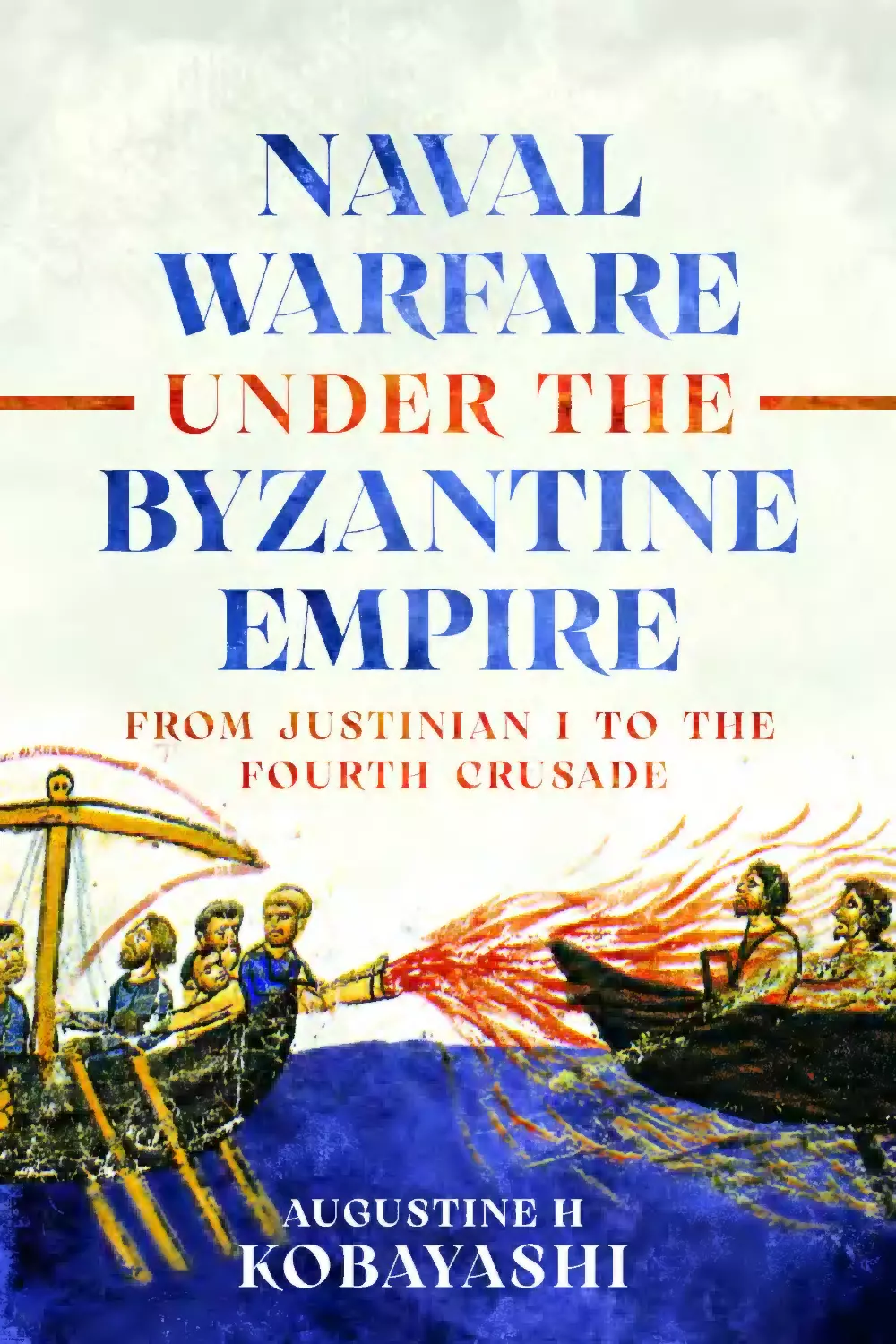


Автор: Kobayashi A.H.
Теги: military history history of the middle ages byzantine history byzantine empire navy
ISBN: 978-1-03614-498-2
Год: 2026

Текст
                    Naval Warfare
Under the
Byzantine Empire

This book is dedicated to my mother,
who had been so patient but, sadly, did not make it.

Naval Warfare
Under the
Byzantine Empire
From the time of Justinian I
to the Fourth Crusade

Augustine H. Kobayashi

First published in Great Britain in 2026 by
Pen & Sword Maritime
An imprint of Pen & Sword Books Ltd
Yorkshire – Philadelphia
Copyright © Augustine H. Kobayashi, 2026
ISBN 978 1 03614 498 2
The right of Augustine H. Kobayashi to be identified as Author of this work
has been asserted by him in accordance with the Copyright, Designs
and Patents Act 1988.
A CIP catalogue record for this book is available from the British Library.
All rights reserved. No part of this book may be reproduced, transmitted,
downloaded, decompiled or reverse engineered in any form or by any means,
electronic or mechanical including photocopying, recording or by any information
storage and retrieval system, without permission from the Publisher in writing.
NO AI TRAINING: Without in any way limiting the Author’s and Publisher’s
exclusive rights under copyright, any use of this publication to ‘train’ generative
artificial intelligence (AI) technologies to generate text is expressly prohibited.
The Author and Publisher reserve all rights to license uses of this work for
generative AI training and development of machine learning language models.
Typeset by Simon and Sons ITES Services Private Limited
Printed and bound in the UK by CPI Group (UK) Ltd, Croydon, CR0 4YY.

The Publisher’s authorised representative in the EU for product
safety is Authorised Rep Compliance Ltd., Ground Floor,
71 Lower Baggot Street, Dublin D02 P593, Ireland.
www.arccompliance.com
For a complete list of Pen & Sword titles please contact
PEN & SWORD BOOKS LIMITED
47 Church Street, Barnsley, South Yorkshire, S70 2AS, England
E-mail: enquiries@pen-and-sword.co.uk
Website: www.pen-and-sword.co.uk
or
PEN AND SWORD BOOKS
1950 Lawrence Road, Havertown, PA 19083, USA
E-mail: uspen-and-sword@casematepublishers.com
Website: www.penandswordbooks.com

Contents


Maps
ix
1

Prologue


Part II The Rise and Fall of the Komnenian Navy


Select Bibliography
173
Index
183

Acknowledgements

I

would like to express my heartfelt thanks to those who have helped me
produce this work in one way or another: Dr Chalamabos Dendrinos of
the Hellenic Institute, Royal Holloway, the University of London, for his
patient and passionate guidance on the history and language of Byzantium and
Greece; Dr Jonathan Harris of the same institute, for his advice and guidance
beyond my brief MA years in London; Professors Judith Herrin and Charlotte
Rouche, Dr Dionysios Stathakopoulos and Richard Alston of the University
of London, Professor John Haldon of Birmingham and then Princeton, and
Dr Antony Hirst of the Queen’s College, Belfast, for inspiration and excellent
teaching. The late Dr Eric Grove, a prominent British naval historian, gave
me valuable insight into naval and maritime history, from ancient to modern. I
have encountered countless fellow historians, students, and teachers who gave
me ideas at conferences and in classrooms over the years, especially Dr Chris
Wyatt, for his friendship and encouragement over many years, and Dr Brian
McLaughlin, for proofreading the early version of this book and for giving me
valuable suggestions.

Map 1. The Byzantine Empire under Justinian I. After Justinian I’s conquests, the Empire reached its greatest extent in
the second half of the sixth century.

Map 2.  The Arab conquests, seventh–tenth centuries. Major Arab naval conquests and raids against the Byzantine Empire.

Map 3. The Byzantines strike back in the ninth-eleventh centuries. The Byzantines regained their offensive momentum
in these centuries, pushing the Arabs back.

Map 4. Naval operations in the Age of the Crusades (1). Byzantine countermoves under Alexios I, John II and Manuel I.

Map 5. Naval operations in the Age of the Crusades (2). The main Latin naval actions from Bohemond’s war against
Alexios I in 1081 to the Fourth Crusade, 1203/1204.

Map 6. The coming of the Norse and medieval maritime trade. The Vikings and the Rus linking the northern
maritime routes with the southern, Arab-Byzantine maritime system in the ninth-eleventh centuries.

Prologue

I

n 537, it was the third year of the Byzantine Empire’s war to recover Italy
from the hands of the impertinent Gothic barbarians who had set up
their self-styled Ostrogothic kingdom there in 476. Now the Empire was
striking back, after the conflict at the imperial court of the imperial capital,
Constantinople, in the aftermath of the fall of the Western Empire, had finally
been sorted out. The war was hard going, although Belisarius, the leading
general of the Byzantine expeditionary force, would not flinch in the face of
extreme difficulties. The dreaded Goths, despite their reputation for barbarity
and martial prowess, were no match for his keen strategic vision and tactical
skills. Although his force was vastly outnumbered, he had moved quickly to
capture the vital port city of Naples and then Rome, the eternal capital of the
Roman Empire. The Goths, however, counter-attacked in force under their
energetic new king Vittigis, and Belisarius’ small army came under siege in his
prize conquest, Rome.
The situation looked dire, but Belisarius knew he still had the upper hand,
for the Goths were no experts at siege warfare. Yet the besieged were becoming
exhausted. Belisarius was doing everything he could to ensure that not just his
soldiers but also the citizens of Rome were fed and looked after. Though the
Goths were slow to realise that they were losing a war of logistics, Roman
patience was also wearing thin. He needed to break out soon, and decisively.
Thankfully, the Gothic siege was porous. Belisarius’ supply ships were getting
through by way of the River Tiber. The Emperor Justinian had been sending
supplies and reinforcements for the past months, albeit slowly, including a
cavalry force that had reached Rome’s vicinity under the command of a certain
John, more commonly known as John, nephew of Vitalian.
Vitalian was a Thracian rebel. He had raised an army, including Huns,
against Emperor Anastasius I (491–518) and attacked Constantinople, but
wisely decided not to assault the insurmountable Theodosian Wall. Instead, he
launched a fleet of warships, commanded by Marius the Syrian, in an attempt
to take the Queen of Cities from the sea. But this attack was repulsed by,
according to some sources, a kind of fire weapon – perhaps the original ‘Greek
fire’.1 In the shadow of his perfidious uncle, John was perhaps too eager to

2

Naval Warfare Under the Byzantine Empire

prove that he could be a good, loyal and able Byzantine soldier. Or maybe
there was a streak of the rebel in him after all; he was not satisfied by just
following orders, preferring to improvise and take the initiative when he saw a
chance to win his own glory.
His orders had perhaps left too much room for interpretation: he was
supposed to reconnoitre the enemy’s rear with his 2,000-strong cavalry force.
However, if the opportunity arose, he was also to capture and enslave Gothic
civilians in order to damage enemy morale and disrupt their supply lines.
This was John’s opportunity. When he reached Picenum on the Adriatic
coast he spied on the port cities there. They were indeed major strategic
objectives, as using the large ports here could shorten Byzantine supply lines
dramatically (so far, the main supply routes had been through Naples and
Portus, the port of Rome). As Procopius of Caesarea (Caesarea Maritima or
Caesarea Palaestinae, in Byzantine Syria Palaestina), the Secretary of Belisarius,
explained, the reason Belisarius kept possession of the strategic initiative was
the Byzantine command of the sea; this enabled Byzantine forces to receive
supplies and reinforcements, while denying them to the Goths.2 With control
of the Adriatic ports, he would be able to launch his final push to take the
Gothic capital, Ravenna.
So John must have felt perfectly justified in trying to capture a port or two.
While some were heavily defended, he found that Ariminum, modern Rimini,
was virtually unoccupied, so he took it unopposed. He was also setting his
sights on an even greater prize: with his conquest of this city he was now so
close to Ravenna that he hoped the Goths might panic and withdraw from
Rome, lifting the year-long siege and even ending the war by surrendering
then and there. He was partially correct. The Goths indeed did panic, so much
so that the lady Matasuntha, the estranged wife of the Gothic King Vittigis,
appealed to John to come quickly to Ravenna as she wished to marry him.
How could he refuse to rescue a damsel in distress!?
However, Vittigis was still a capable, if unsophisticated, war leader, and his
Goths regrouped and counter-attacked. Though he could not breach the walls
of Ariminum, the city came under siege, as Rome had, and John, cut off from
Belisarius and holed up in Ariminum, could do little about it. Trapped, John
and his horsemen would soon face starvation (March–April 538).
Some of Belisarius’ lieutenants were irate at John’s taking of liberties in
pursuit of personal glory (which he did indeed win when news of the capture
of Ariminum reached the army),3 causing this predicament. Was he a reckless
youth? Was he vainglorious? Certainly, his latest actions and the resulting
trouble did no good to his family name. But was Belisarius willing to abandon
him to his fate and lose a precious cavalry force? Fortunately, John had some

Prologue

3

friends among the high commanders who led the various contingents that
came as reinforcements, and their voices prevailed. Belisarius would mount a
rescue. He was planning to march towards the Adriatic coastal area anyway, in
order to push the Goths back towards Ravenna.
He divided his forces into three: one column which marched along the
coastal road towards Ariminum was ordered to look much more numerous
than it actually was (for example, by lighting more campfires than normal at
night); his main column, meanwhile, advanced along an inland route hidden
in the hills to attack from a different direction. The third division was an
amphibious element. A fleet of ships was assigned to outflank Ariminum,
threatening to land troops in the rear of the Gothic positions.
Having detected his movements on land, the Goths were already jittery.
Then came a further shock. At daybreak, with the rising sun behind them, a
large number of Byzantine ships were seen sailing past Ariminum, poised to
mount a full-scale amphibious landing:
On the succeeding day at sunrise they saw a fleet of ships in overwhelming
numbers bearing down upon them, and being plunged into speechless
terror, they made a rush to flee.4
This was not just to be a pincer movement by Belisarius. It was to be a complete
encirclement! Gothic courage and resolve simply crumbled. The Goths forsook
Ariminum and John, and abandoning their baggage, fled towards Ravenna
without a fight in total disorder.5 John was rescued, and Belisarius claimed a
bloodless victory.
The Goths would resist the Byzantines a little while longer after this
episode, but they could not stem the momentum of the Byzantine tide, which
was slowly building. The naval action at Ariminum might appear to be a small
footnote in the history of Byzantine wars, yet it was a supreme example of
economy of force, a case of raising a siege without paying a high cost in men
and money.6 We cannot be sure whether John’s contribution actually hastened
Belisarius’ conquest of Ravenna, or whether his hasty action, by nearly causing
a major disaster and thereby distracting Belisarius’ efforts, delayed it. But at
least it set the stage for a very interesting naval action, which helps us consider
some important aspects of Byzantine warfare at sea.
This incident was indeed typical of Byzantine naval actions in the Empire’s
long history. In this particular episode, which could best be described as a
naval or amphibious feint, no actual combat took place, since the Goths at
this stage did not possess any naval force to challenge the Byzantines at sea.
They did not even try to oppose the expected Byzantine landing. The fleet

4

Naval Warfare Under the Byzantine Empire

gave Belisarius extra flexibility, using the sea as the third avenue of approach
to maximise psychological pressure on the enemy.
We hear of few naval battles in antiquity after Actium (31 bce). But this
should not mislead us: though few naval encounters occurred, the sea, especially
the Mediterranean, was the vital superhighway for imperial communication
and transport, enabling the empire to project its power in remote places and
ensuring its dominance. The absence of naval battles was a reflection of the fact
that the empire’s enemies were so weak that it did not have to fight difficult
and unpredictable battles at sea.
Almost a millennium before the Gothic War in Italy, the Athenians had
fought for their very survival against the Persians at sea; the Romans, so secure
in their dominance of the seas around their empire after Actium, no longer
had to do so. However, the Romans in the Byzantine period (whom I will
reluctantly call ‘Byzantines’ for the remainder of this book), especially after
the loss of the western provinces, had a much harder time maintaining their
power; they faced many challenges, and they were not always successful. (In
this sense, we’ll use the year 476 as the watershed year when ‘Rome’ became
‘Byzantium’ – yet we should be aware that, for the Romans, their empire was
Roman throughout Romano-Byzantine history until the very end in 1453.
Procopius, for example, used the term ‘the empire of the Romans’ for their
state, though he admitted that the Romans in his time did not have the same
pedigree as the ‘Romans of old’). Yet, its sea power ensured Byzantium’s survival
and longevity. The Empire’s capital, Constantinople, the city of seven hills and
seven harbours, the unsinkable fortress at sea, was the ultimate symbol of its
place in history.

Introduction

What was Byzantine Naval Power?

I

n the eleventh century, Kekaumenos, a retired Byzantine general of
Armenian extraction, wrote in simple, clear Greek in his military treatise:
ὁ γὰρ στόλος ἐστὶν ἡ δόξα τῆς Ῥωμανίας. (For the fleet is the glory of
Romania.)1

What Exactly did He Mean?
In Roman and Byzantine history, naval warfare is not usually seen as decisive
or even relevant. In a typical history textbook, when it comes to naval warfare,
there is often a yawning gap between the Battle of Actium, where the tragic fate
of Antony (Marcus Antonius) and Cleopatra (Cleopatra VII Theo Philopator,
the last queen of the Ptolemaic dynasty of Egypt) was sealed, and the Battle of
Lepanto (1571), where Western civilisation was saved from the encroaching
hands of the Ottoman Turks. During this sixteen-century naval hiatus, nothing
significant appears to have happened in the Mediterranean, the Black Sea or
the Red Sea. This is extraordinary, since our ancient written history starts with
the daring naval ventures of fledgling Greek states in their mythical past and
deadly naval clashes between Greece and Persia. It is difficult to believe that,
with the coming of the pax Romana, people stopped being active at sea, either
in peace or war, for such a long time. The shores of the Mediterranean were
indeed teeming with a seafaring population, many of them living off the sea,
catching fish and carrying goods, or travelling in their wooden sailing ships to
sell their merchandise at markets. The imperial purple dye itself came from the
sea, extracted from the shells of tens of thousands of murex snails.
We have somewhat misleading ideas about ‘naval warfare’ because of our
experiences in modern times. We live in the age of long-range naval guns,
torpedoes, missiles, naval aviation, submarines and drones. Warships are
powered by engines using either oil or uranium as fuel, navigating with the
help of radar and sonar, giving them a vast range and mobility: all powers
which ancient sailors could not have imagined even in their wildest dreams.
Modern warships are deadly killing machines, with their high speed, sensory
capabilities and awesome weapon arrays, enabling opposing naval forces to

6

Naval Warfare Under the Byzantine Empire

engage with each other even beyond visual range, with decisive and deadly
outcomes in the middle of a vast ocean, resulting in a potentially high rate of
human casualties and destruction of expensive naval hardware. In comparison,
ancient and medieval warfare at sea, with only primitive technology available
to the navies of even the most powerful empires, 2 might look more like a
bunch of young men on small boats engaged in a drunken brawl.

Naval Evolution: from Greece and Rome to Byzantium
Surviving written sources say so little about naval warfare that we might
conclude that the Romans were a people with a landlocked mentality, despite
their empire’s immense coastline. This is because most historical records
were produced by intellectuals and members of the landed aristocracy, whose
livelihoods depended on economic and military activities on land. Although
some members of the ruling elite were keenly aware of the value of activities
at sea, their primary concern was with affairs on land. Thus, Thiel, a Dutch
historian in the 1940s, wondered whether the Romans were ‘landlubbers’. 3 In
the Byzantine period, this tendency seems, if anything, to have strengthened.
Only a handful of Romans were expert sailors. However, this should not
be taken as a sign that the sea was not considered important. Take a modern
example: Japan – the country of sushi and sashimi, raw fish delicacies –
has a remarkably small number of fishermen, sailors and ship’s crews, only
0.4 per cent or less of its working population, according to recent government
reports.4 (Modern Greece is little different: the recent figure is slightly less than
0.5 per cent. 5) This is despite Japan’s obsessive seafood culture and the fact
that, as an island nation, maritime trade and commerce are vital to the health
of its economy. So perhaps we should not dismiss the Romans as ‘landlubbers’
just yet, simply because most wealthy and high-ranking Romans regarded the
tough work of rowing, sailing and fishing as only suitable for members of the
lower classes, slaves, foreigners and immigrants, and abhorred the harsh and
dangerous life of the sea.
For Rome, the importance of the sea was obvious, for economic, commercial
and military reasons. Strategically speaking, Italy is practically an island, as its
only land bridge to Europe in the north is largely blocked by the high mountains
of the Alps. Rome’s own origin story had a strong maritime flavour to it: the
popular myth of Aeneas led Romans to believe that they were descendants of
the seafarers who had escaped Troy. Rome is believed to have been founded
some time in the eighth century bce and, as it grew, it found maritime trade
and commerce the means to become, within a few hundred years, a more
powerful city. We find many signs of early Roman maritime activities, such as

What was Byzantine Naval Power?

7

the use of the River Tiber as a waterway to access the Mediterranean for trade
and commerce with the outside world. 6
Rome’s expansion was inevitably a maritime and naval affair. Its wars with
its aggressive neighbours, inside and out of Italy, led to the need to develop a
strong navy. As Rome became not just an Italian but a Mediterranean power,
its ultimate victory over Carthage in three Punic wars (264–146 bce) was
due to Rome’s winning control of the sea, enabling it to transport armies at
will across the narrow points in the central Mediterranean, while denying its
use to Carthage. Hannibal’s march over the Alps was a spectacular military
achievement and later a fantastic spectacle on the screen, but it was also
testimony to Rome’s control of the sea. He had no means to assault Rome
directly across the Mediterranean, so had no choice but to go around its
northern shores.
After the elimination of Rome’s strong naval rivals, the Carthaginians and
the Hellenic kingdoms in the East, a naval power vacuum developed in the
Mediterranean, which ironically provided fertile ground for piracy and lowintensity sea warfare waged by small, independent powers (maritime enemies
were often pejoratively called ‘pirates’ as if they had been nothing but a
bunch of criminals. In truth, ‘piracy’ was undeclared war at sea).7 Institutional
momentum and this strategic reality gave Rome no choice but to continue
its naval wars against both external and internal foes. Rome rose to become
the sole empire of the Mediterranean by securing the coastal areas. Pompey
(Gnaeus Pompeius Magnus) became a superstar general primarily because
of his anti-piracy campaign, systematically destroying pirates’ hideouts and
making the entire Mediterranean safe for travellers.
Great contemporary events, such as the slave revolt of Spartacus (73–71
bce), Caesar’s exploits in Gaul (58–50 bce) or the Civil War (49–45 bce),
might give the impression that Rome’s wars were largely land-based affairs.
The entertainment industry has strengthened this impression, but the fact
that ships always played a significant part in these wars by providing logistical
support and transportation should not be overlooked. The progress and
outcome of land campaigns could be affected by what occurred at sea, and vice
versa (the supposed last stand of Spartacus happened because the transport
fleet promised by Cilician pirates failed to show up!). The naval dimension
made Rome’s wars remarkably dynamic and extensive, allowing Roman power
to be projected at distant places and giving Rome an edge over its rivals.
The man who became the first ‘emperor’, Octavian (Gaius Octavius,
27 bce–14 ce), learned this quickly and appointed a superb admiral in the
person of Marcus Vipsanius Agrippa. As he began to score important naval
victories, Octavian’s campaigns against his rivals gained momentum and he

8

Naval Warfare Under the Byzantine Empire

systematically won command of the seas. His victory over Mark Antony was
the result of this and therefore a foregone conclusion, even before the final
battle at Actium.
With the end of the Civil War, the Roman fleet was downsized, but this
did not mean that naval power had no further role to play. There was no need
to fight full-scale battles at sea but, in order to secure the empire’s expanding
borders, the riverine flotilla was useful, for example, on the Rhine to deal
with German threats or on the Danube against the myriad of unruly tribes
in the northern Balkans. Roman ships also sailed along the North Sea coasts,
patrolling, gathering intelligence, re-assuring Roman allies and clients and
deterring potential enemies by maintaining a visible presence of Roman power.
During the so-called ‘third century crisis’ of Rome, which saw breakaway
rebel empires spring up in Palmyra in the East and Gaul in the West, Roman
naval control of the northern seas also broke down. The Empire had always
maintained a sizeable naval force to keep German raiders in check, but as this
declined, the coastal regions were devastated by Frankish and Saxon pirates. 8
In the end, another rebel ‘empire’ sprang up there, when Carausius, the naval
commander tasked with the suppression of these pirates, either disillusioned
by the Empire or simply wishing to seize power for himself or on behalf
of his followers, rebelled in the 280s. He set up an enclave encompassing
coastal regions of northern Gaul and southern Britannia, proclaiming himself
‘emperor’ and issuing coins in his name. He used his fleet to good effect, based
at Dover in Britain and Boulogne in Gaul. However, he was assassinated by his
partner, Allectus, who became his successor. This rebel empire was eventually
destroyed by Flavius Valerius Constantius, the father of the future emperor
Constantine I the Great (306–337), who successfully attacked major ports
used by the rebels as their bases of operation in the 290s. Though Carausius
and Allectus were rebels, their actions demonstrated what could be achieved
if sea power was used effectively.9 Constantius, the victor, was rewarded with
an appointment as the governor of Britain, continuing his task of suppressing
piracy and rebel activities in the northern provinces and restoring Roman rule.
We don’t know how much his son Constantine was affected by these events
personally, but it seems likely that he learnt lessons about naval warfare and
strategy which would greatly help him in his struggle to reach the imperial
summit.
After the Empire lost effective control of its western half during the fourth
and fifth centuries, the Greek city of Byzantium on the Bosporus became its
sole capital, renamed Constantinople after the emperor who made this city
his new capital at the beginning of the fourth century. For the ‘Byzantines’,
the navy became increasingly important, since their empire was no longer

What was Byzantine Naval Power?

9

as powerful as in the days of Caesar and Octavian, and its army was much
smaller and relatively more expensive. Even though the Empire still did not
face a major naval opponent, strategic mobility was crucial, and the ability to
build a fleet to transport land armies became ever more important. Shifting its
relatively small armies to trouble spots quickly was a life-or-death matter for
the beleaguered Empire.
Historians have appreciated the importance of naval power to the survival of
the Roman Empire. For Ward-Perkins of Oxford, ‘It was the sea, and Roman
naval domination, that were decisive for the survival of the eastern empire –
invaders from the north could have bypassed Constantinople, to wreak havoc
on the interior of the empire, except that the straits and the Roman navy
presented an insurmountable obstacle.’10 Lionel Casson, the naval historian,
simply wrote, ‘One of the reasons for [the Empire’s] long life was sea power.’11
Even though the Romans and Byzantines themselves did not leave much
writing on the subject, either in the form of historical accounts or military
manuals, their track record of actual naval and maritime undertakings speaks
volumes. The ruling elite appear to have been well aware of the importance
of the navy and even had a special, sentimental attachment to the sea.
While not willing to become sailors themselves, the upper-class citizens of
Constantinople were fond of taking up residence in the area just above the
eastern harbours of the Golden Horn, with its spectacular sea views.12 The ups
and downs of Romano-Byzantine sea power were a result of how the members
of this ruling class understood the question of power and acted or failed to act,
what resources were available to them, and the effectiveness of their strategy
and political direction.

Technology and Strategy
Maintaining a standing navy was always difficult, since it was labour- and
resource-intensive (hence expensive) and technologically demanding. The
Romans knew this from the beginning, as soon as they began to organise
a naval administration in the early days of their maritime ventures. In the
Byzantine era, there was little technological improvement, so this aspect
of Roman sea power remained essentially unchanged for centuries. We are
actually looking at a long period during which naval technology evolved very
slowly. What was true for the ancient Athenians, rowing their triremes, was
also largely true for the Romans and Byzantines. To cite just a few examples:
fleets could not operate on their own in the open sea and needed to navigate
by hugging the coast; sailing ships used currents and seasonal winds to their
advantage; oared ships needed to make landfall frequently (usually daily), as

10

Naval Warfare Under the Byzantine Empire

their rowers required gallons of water (so they needed local knowledge of
where they could obtain it).13
The relatively slow pace of evolution in naval technology meant that warship
design in different periods mainly reflected the changing roles of navies due
to the changing strategic environment. We are familiar with the Athenian
trireme from the classical period, a purpose-built warship that served well in
the defensive war against the larger navy deployed by the Persian Empire. This
was followed by an era of big warships, led by the Hellenistic kingdoms in the
wake of Alexander III of Macedon’s conquests in the East. The most powerful
successor kingdoms of his vast empire, the Ptolemies of Egypt and the
Seleucids of Syria, competed keenly to build massive warships in their struggle
for supremacy. As newcomers to naval warfare, the early Romans followed suit
to maximise their fleet’s power against actual and perceived enemies. Rome
rose at the expense of Carthage and Macedon by winning a series of naval
wars, increasingly showing tactical and technological superiority over its rivals,
demonstrating its capacity for innovation and adaptation and its raw strength,
backed by what appeared to be inexhaustible manpower.
As the hegemonic empire, the Romans became the superpower ruling and
imposing order on the Mediterranean, which was now without an enemy
capable of fielding a fleet consisting of big ships. This made expensive and
cumbersome warships redundant. As the pax Romana was established, Rome
developed its main warship, the Liburnian. This was a light, fast galley, ideally
suited to giving chase to the small craft used by pirates, especially the Illyrians
based on the Dalmatian coast.14 Overall, the role of the Roman navy was
that of maritime policing, to ensure free and safe travel on the high seas by
suppressing the piratical activities of freebooting criminals or local warlords.
This Roman preference for small, lighter ships was reinforced by a
major naval engagement between Constantine and his rival Licinius at the
beginning of the fourth century. Constantine’s smaller fleet, consisting of more
manoeuvrable light galleys, won the battle. Ship design was influenced by
these experiences, and the light, bireme galley, generically known as a dromon,
began to develop in late Roman and Byzantine times.15
Small-craft operations gained greater importance in late Roman warfare as
naval operations on rivers and lakes often played a key part in land warfare.
The Roman navy’s ability to support the army’s operation deep into the inland
regions of Europe was extremely valuable, as it was in the coastal regions of
northern Europe and the Black Sea littoral. The Danube frontier became a
prominent theatre of naval war in the late Roman period as barbarian threats in
the Balkans became ever more serious. The fleet was vital for imperial defence
in this region, supporting river crossings, maintaining lines of communication,

What was Byzantine Naval Power?

11

transporting Roman and allied commanders and troops, and bringing supplies
to troops manning river forts. For this reason, Emperor Maurice’s military
manual in the sixth century, Strategikon, otherwise totally devoid of discussion
of naval warfare, includes a passage on riverine operations.16
However, at the same time, since full-scale naval battles now rarely took
place, the skills of naval combat and large fleet operations were steadily lost.
Intricate naval manoeuvres the ancient Greeks and early Romans used so
effectively, namely the deikplous (breakthrough) or periplous (outflanking and
encirclement) attacks, did not seem to be used widely either by the Imperial
Roman navy or its opponents. Naval combat was indeed a difficult art. Often,
warships were merely floating platforms on which infantry-style combat was
fought. Nor did sailors have much training or experience of combat. When
the Empire rebuilt a large fleet in order to counter an emerging threat, it was
necessarily manned by raw crews. Each naval campaign was a fresh learning
process, and it was horribly difficult to transmit hard-won skills and experience
to the next generation in peacetime.
What all this suggests is that ancient navies’ combat and operational
capabilities were very limited. By modern standards, ancient naval warfare
was hardly ‘naval’. A fleet might win battles and gain command of the sea;
yet, given the immense difficulties of maintaining a fleet permanently in
a given area, complete domination was hard to achieve; close blockade
in a modern sense was almost impossible. Ancient naval warfare, indeed,
should be classed more as amphibious or littoral (and riverine) warfare. The
fleet should be seen, in practical terms, as a supporting branch of the army,
providing extra mobility and flexibility and controlling coastal regions by
performing its transport and logistical roles, but not much more. While we
should not underplay the significance of this, we must be careful when dealing
with this topic. The importance of the naval dimension in Roman strategy
should not be discounted, but we must also take care not to overemphasise
the influence of sea power upon ancient history, at least not in a modern,
Mahanian sense.17
That said, naval strategy was undoubtedly crucial in the context of the
Empire’s political and strategic interests. It was a tool of political dominance
over enemies and allies alike, and ‘showing the flag’ was as a visible reminder of
Rome’s political influence and diplomatic commitments. The mere presence
of a powerful Roman fleet could work as a deterrent.18 Mobility by sea
gave the Empire an edge over rivals that might threaten it. When skilfully
employed, a powerful fleet to project land power and political authority, with
some luck (storms – supreme bad luck – were often more dangerous than an
enemy fleet; this added another major factor of uncertainty and unreliability

12

Naval Warfare Under the Byzantine Empire

to naval warfare), could boost the power of the Empire just enough to allow
it to prevail.
These aspects of Roman sea power became even more apparent when Islam
destroyed the Roman monopoly of the Mediterranean and nearly drove the
Empire to extinction in the eighth century. The Byzantine Empire survived by
reviving its navy and inventing new weapons, and its resurgence was the result
of subsequent naval victories. Though neither side was capable of dealing
a decisive, killing blow, the resulting struggles and stand-off, which led to
the development of a bipolar system in the Mediterranean, made the naval
strategic aspect of imperial power more visible to history.19
Following a century-long upsurge under the Macedonian dynasty (from
the late ninth to early eleventh century), the Byzantine navy experienced a
rough ride in the subsequent age of accelerated evolution in naval technology
and rapid change in the strategic environment. In the Komnenian period
of the twelfth century, the Byzantine Empire failed to keep up with these
developments and finally lost its command of the sea. This proved to be the
beginning of the Empire’s downfall.
Finally, we should also note that our knowledge of Byzantine warships is
very limited. The Byzantine chroniclers, unaccustomed to naval and maritime
affairs, were often not very precise in their use of naval terminology. For
instance, the name given to the most typical Byzantine naval vessel, ‘dromon’,
is suspected to be a designation popularly used by non-naval writers simply to
mean a large warship. The chroniclers were often intellectually trained, wellversed in classics, and used ancient Athenian terms, most notably ‘trireme’, just
as modern writers might use the term ‘battleship’ for any surface warship with
guns and missiles. Sometimes our chroniclers used the term ‘long ship’ (μακρά
πλοία) as a generic term for a warship. Given the navy’s central mission of
transporting troops (and horses), the distinction between dedicated warships,
transports and multi-purpose vessels was probably unclear to these writers; and
thus, trying to decipher what exactly a certain naval term meant has provoked
considerable debate among modern historians.
To attempt to formulate an answer to the question opening this chapter,
what did Kekaumenos mean? The fleet was the glory of Rome. Roman
(Byzantine) power directly resulted from its naval and military strengths. By
the same token, the fleet, or rather, the ability to maintain and operate a fleet,
arose from Rome’s power and wealth, its long tradition of operating naval
forces and winning battles, as well as its accumulated skill and ingenuity. Rome
became great because of its fleet, and the fleet was victorious because Rome
was great. If you examine the state of the Roman navy, you can tell how healthy
and powerful the empire was at any given time.

What was Byzantine Naval Power?

13

In our story, especially the main part of this book where we discuss the grand
fleet of the Byzantine Emperor Manuel I Komnenos (1143–1180), what we
will witness is the last hurrah of the Empire. Though it wasn’t evident to the
Emperor or most of his advisers at the time, the Empire’s ability to support a
major fleet was reaching its limit, and his grand naval ventures turned out to
result in fatal imperial overreach. With its fleet in terminal decline after his
death, the empire’s days were numbered. If you want to read about the decline
and fall of the Romano-Byzantine Empire, you must follow the decline and
fall of its fleet.
But now, we start with its heyday.

Part I

Defending Mare Nostrum

Chapter 1

The Reconquest of the West

Belisarius’ Green Fleet
What we know about the wars of Justinian I (527–565) in the West comes
mostly from the works of Procopius of Caesarea, who was the secretary of
Belisarius, the commanding general of the expeditionary forces against the
Vandals in Libya (including modern Tunisia) in 533 and the Goths in Italy
(535–551). The story is a crucial chapter in the history of the Empire of the
Romans. Justinian could congratulate himself that at the conclusion of his
long reign the Empire was once again one of the leading powers of the age, its
rule stretching from the Pillars of Heracles to Pontus. His other achievements
included the pacification of Spain and securing the Black Sea region, especially
the strategically crucial Danube basin, by implementing extensive fort-building
programmes along the coasts, mostly around the Danube Delta, as well as in
Crimea, Lazica (Georgia) and Armenia, leaving gaps in the north-western and
north-eastern quadrants (as they were obviously beyond Byzantine control).1
In addition, he maintained a naval presence as far as the Red Sea, making the
Byzantine Empire the true mistress of the seas.2 Whether these wars, with
their mounting costs in treasure and manpower, actually helped weaken the
empire by draining the imperial coffers in the latter half of the sixth century, is
moot. Procopius was not so sure. Similarly, many modern historians question
whether Justinian was justified in launching wars in the West. Coupled with
the effects of the pandemic of 541/542, which greatly reduced the whole
world’s population, the question is a complex one – and so the debate goes on.
Procopius himself seems to have been disillusioned by Justinian’s reign: it
is often pointed out that his account of the later stages of the war is halfhearted and had lost its earlier meticulousness and consistency. Though he
probably endorsed Justinian’s grand vision of making Rome great again3 he
was disheartened by the regrettable effects of the wars, for example, in laying
waste to Italy. Whatever the outcome of his ventures, at least Justinian should
not always be seen as responsible.4 This was an era when natural disasters
or military defeats were believed to result from God’s displeasure with the
unfaithfulness and incompetence of emperors and kings. Earthquakes, cold

18

Naval Warfare Under the Byzantine Empire

winters, plagues, as well as disastrous wars: all these were somehow Justinian’s
fault.
But this is all in hindsight. Justinian was determined to recover what had
been lost since the fifth century. In 476, when the Goths had abolished the
seat of the Western Emperor Romulus, nicknamed Augustulus (475–476), at
Rome, they did so under the pretence of ruling the Western empire on behalf
of the Emperor in Constantinople. Soon, however, it became clear that they
had no intention of doing so, and they made Italy their own kingdom. This
meant that the ‘Western Empire’ was now dead, rendering this year the ‘Fall of
the Roman Empire’ in the eyes of the West, even though the Eastern Empire,
which we call Byzantine, had no intention of letting the city of Rome go. Once
Emperor Anastasius had restored financial order to the Eastern Empire, it
was ready to reconquer the lost Western provinces. For this purpose, Justinian
chose Belisarius, the most successful Byzantine general of the day.
Belisarius first achieved fame when fought the Sasanian Persian Empire in
the Upper Mesopotamian region, winning a rare victory in a pitched battle.
His background is obscure; there has been speculation that he may have come
from a middle or even upper-class background, unlike his master and mistress,
Justinian and Theodora, or his own wife, Antonina.5 However, it is a reasonable
assumption that he had little or no naval experience, let alone expertise in
ship handling. He was obviously selected for his fame as ageneral, not for his
skill as an admiral. The Empire as a whole had had little experience in fleet
operations for decades.6 Where was it to find experienced naval commanders?
Procopius provides thorough details of preparations for the naval expedition,
recording experimentation with different methods to maintain the cohesion
of the fleet. Presumably, most sailors will have been skilful at handling their
own ships, so they were undoubtedly able to sail competently as individuals
or in a small group. But when there were nearly 600 ships (500 transports
and 92 warships, with crews totalling 30,000),7 how were they to coordinate
their movements? How to avoid collisions yet maintain a good formation? If
they sailed in a single line, there was no way ships in the van could actually
see most of the ships towards the rear, and vice versa. After some experiments,
Procopius says, they settled for a method of painting the flags of the leading
ships red, which somehow worked.
The Imperial Fleet was under the command of an Alexandrian, Kalonymos.8
But it soon became clear that he was not very competent or disciplined. After
departure from Constantinople, before the ships had even left home waters,
a lack of wind held up progress for several days; two bored Huns got into a
fight, one killing the other. Then a more serious problem arose. Mouldy bread
made soldiers who ate it ill and as many as 500 died. Procopius suspected that

The Reconquest of the West

19

a corrupt official had supplied improperly prepared food to save money and
had pocketed the difference.9
The whole venture looked doomed already, especially as people still
remembered that the last attempt to send a large invasion fleet against the
hostile shore of North Africa had been a total fiasco. In 467, Emperor Leo I
(457–474) decided to punish the Vandals for defying imperial authority and
occupying Libya. The Vandals were a Germanic tribe who originally inhabited
the border zone between Europe and Central Asia along the north shore of
the Black Sea. Under pressure from nomadic tribes to the east, especially the
greatly-feared Huns, they migrated westwards through the Balkans to Spain,
crossed to North Africa, turned eastwards and finally reached Carthage, where
they carved out their own kingdom.
Basiliscus, the ambitious brother of Empress Verina, was appointed to lead
this expedition to reconquer Libya, consisting of numerous ships ferrying
100,000 men. This impressive force, reminiscent of armies in the heyday of
Republican and Imperial Rome, stalled, however, as soon as it landed in Libya.
The hesitant Basiliscus failed to move quickly enough. Procopius thinks he
was a coward, but it is also possible it was due to sheer lack of experience; he
was unsure how to organise an amphibious operation and then press forward
inland. This gave Gaiseric, the ever-resourceful king of the Vandals, a chance
to regroup.10 The Vandal king managed to buy time by conducting peace talks
while waiting for a favourable wind. Then, when the wind he was counting on
finally began to blow, he unleashed fireships at the Byzantine fleet at anchor,
burning most of them. The surviving ships had to beat an ignominious retreat,
and Basiliscus fled in utter humiliation. If he had not been the brother of the
Empress, his life could have ended then. With this disaster still fresh in the
collective memory of the Byzantine elite, they were understandably fearful and
nervous.
What Procopius may be implying is that the expedition could easily have
floundered even before it had really begun. Everything had to be learnt afresh,
from navigation and food storage to the gathering of intelligence. Whether
Belisarius was a effective sailor or not, he was at least a good leader of men,
inspiring them to make the utmost effort to solve problems as they arose.
Procopius cannot be expected to have recorded all these problems, but he
is quite a meticulous source, not forgetting to record the contributions he
himself made by advising Belisarius. When the fleet finally arrived in Sicily,
he embarked on a fact-finding mission to gather intelligence regarding the
Vandal defences and the political situation. Later, in Italy, he was busily
engaged in dangerous missions to obtain supplies and ensure communications
with the imperial government were maintained. Given his contributions,

20

Naval Warfare Under the Byzantine Empire

we cannot fault Procopius for wanting to stress that many of Belisarius’ bright
ideas actually originally came from him! He was writing ostensibly to praise
the deeds of Emperor Justinian, but he never forgot to impress on his readers
that Justinian’s successes were owed to hard-working people like himself.
The expedition could easily have seen a repetition of the earlier attempt by
Basiliscus. That Belisarius was a professional and a stern disciplinarian helped,
although in all likelihood there were no other experienced naval commanders
who stood out. Procopius even hints at the possibility that Belisarius was less
than skilled at combined sea-land warfare. The crews were also terrified at
the prospect of fighting a naval battle, since they had no experience of naval
combat either. Luckily, the Vandal fleet was nowhere in sight. Belisarius’ fleet
safely reached the Tunisian shore from Sicily, landed and set up a bridgehead.
Secure on land, his small expeditionary force of 5,000 cavalry and 10,000
infantry undertook an overland march, with the fleet hovering in a supporting
posture offshore, providing logistical support and working as a lookout against
the sudden appearance of a Vandal fleet. Belisarius’ army advanced at a brisk
pace, menacing the enemy capital, Carthage.
The timing of this expedition was good, as the Vandal kingdom was
preoccupied with a rebellion by Goddas the Goth and had no idea that a
powerful Byzantine task force was approaching.11 For all the barbaric
reputation of the Vandals, when Belisarius’ Hunnic cavalry engaged them, the
outcome was almost an anti-climax. The Vandal king, Gelimer, also turned out
to be a weakling, weeping over the body of his brother who had been killed
in action, and his men scattered in the face of Belisarius’ determined cavalry
charges. The battle was so easily won that one might suspect that this Vandal
kingdom was no longer as tough as it was supposed to be.
Perhaps Justinian had received good intelligence about the internal affairs
of the Vandal kingdom which prompted him to embark on the expedition.
The prospect of success was indeed good. Christian leaders and merchants
in the Vandal-controlled areas had been clamouring for action because they
were suffering at the hands of the heretical Arian Vandals. He could therefore
expect a reasonable level of political support from many of the local elite,
and it is possible that they provided detailed information about the internal
problems of the Vandal rulers. In other words, the Vandals, without either
strong leadership or popular support, were already a soft target.
The next target was Italy. As in the Anglo-American campaign against
Nazi Germany during the Second World War, Belisarius first invaded Sicily
(December 535). Having pacified it, his army landed in Italy, and after a brief
siege by land and sea, he stormed Naples. He then proceeded towards the big
prize, the city of Rome itself. The Goths were not expecting an attack from

The Reconquest of the West

21

this quarter, having anticipated a direct attack on their capital, Ravenna, from
the north. They were completely wrong-footed. To make matters worse, they
were in the middle of a war against the Franks. Without a fleet of their own,
the Goths could not easily shift from one front to another, so they had to
concentrate their forces in the north, as a large Byzantine army was poised to
strike from there.12 Belisarius’ relatively small force might have looked like a
diversionary ploy. But, as the attack from the north experienced a false start
due to Gothic counter-moves and incursions by hostile tribes of the Balkans,
Justinian ordered Belisarius to attack from the south to prevent the whole
campaign from stalling before it could begin in earnest. Before the Goths
realised what was happening, Rome was in his hands (December 536).13
The Goths, however, could still march on foot, and quickly. The new Gothic
king, Vittigis, having put an end to the war with the Franks, gathered a massive
force, estimated as at least ten times the size of Belisarius’ army, arrived before
Rome and promptly besieged the city. The city wall was too strong for the
Goths, inexperienced at siege warfare, to breach, but they were tough fighters,
so the Byzantines could not break out and defeat them, as Belisarius quickly
found out in skirmishes with small cavalry units to try their strength. The
siege became a deadly stalemate.
Belisarius and his army were now isolated, together with the inhabitants
of the city of Rome. Having captured the very birthplace of the Empire,
Procopius nostalgically reports that the monument called the Ship of Aeneas,
commemorating the founding of Rome by the survivors of Troy, was still
standing, even after the ravages of time.14 However, it is doubtful that this
was a sentiment shared by most of the Byzantine troops. This imperial
army consisted of mostly non-Byzantine mercenaries, many recruited from
the Balkans; the cavalry element consisted of the Hunnic contingents who
were regularly employed by the Byzantine army after the Huns split up in
the wake of the death of their leader Attila in the previous century. It was
their fearsome charge that had smashed the Vandals in Libya. How would
they behave in Rome, reputedly a city of great wealth? No doubt Belisarius, a
stern disciplinarian, did his utmost to ensure that they behaved well towards
civilians, but soldiers rarely do so, especially when under siege and therefore
tremendous psychological, as well as physical, pressure.
To make sure his soldiers did not antagonise the citizens, who were already
resentful because the Goths were plundering their properties outside the city
walls, and they could not even visit the baths,15 Belisarius’ efforts were focused
on logistics, to ensure supplies got through and he could feed the inhabitants
of Rome as well as his troops. As the city’s main water-powered flour mills
could no longer be used after the Goths had destroyed all fourteen aqueducts

22

Naval Warfare Under the Byzantine Empire

(due to shortage of food, animal power could not be used either), he devised
watermills using the flow of the river.16
He needed more soldiers. His force, now numbering just 5,000 (since he
had to leave significant numbers of men to garrison captured cities and towns,
especially Naples), was suitable for a lightning campaign, but not sufficient to
resist an arduous siege. He appealed to Justinian for reinforcements. Byzantine
control of the sea, and especially of ports and the River Tiber, was thus vital,
to ensure the safe arrival of reinforcements and supplies. The Goths made a
fatal error in not occupying Portus, the port of Rome, quickly. Even after they
finally did so, the Byzantines could still use Ostia, the old port of Rome on the
other side of the river mouth. The Goths only half-heartedly tried to disrupt
their enemy’s efforts to bring supplies into the city. Belisarius used teams of
oxen to draw river boats, for he found that sailing boats were useless on the
river. Despite these boats’ slow pace, all the Goths could do was shoot arrows
at them sporadically, so most of them got through. In the end, their progress
was only set back when the oxen became exhausted!
The Goths either did not understand the logistics of war or were simply
not prepared or equipped for this kind of strategic situation. They preferred to
attempt to take Rome by storm; and failing that, they seem to have thought
that they could just sit it out, waiting for the tired and starving defenders to
capitulate. They persistently failed to interdict enemy supply routes, so enough
supplies were delivered for the defenders to continue to hold out. Although
the siege of Rome would last for nearly a year, the Byzantines inside the city
survived. This was indeed a victory for Byzantine sea power.17
The Goths, for their part, could not be re-supplied by sea. In the end, their
own supplies, exhausted by the size of their army, ran out, and they had to retreat
from Portus. By winning the war of supply, Rome narrowly avoided starvation.
If the Goths had imposed a tighter blockade on the city, Belisarius might
have had to surrender. But the Goths’ failure to appreciate the importance
of logistics, and their lack of a navy capable of challenging Byzantines at sea,
gave Belisarius just enough edge to survive and wear down the Gothic will to
fight. Foodstuffs and reinforcements reached Rome. So did funds. The money
was the crucial element, as the mercenaries would not fight without pay. They
might have even switched sides if the enemy offered them more.

Nature Intervenes
The siege was finally lifted. The Goths fled towards Ravenna, and Belisarius
resumed his advance. Taking full advantage of the Byzantine maritime
monopoly, he received a steady stream of reinforcements and supplies.

The Reconquest of the West

23

Belisarius now had the strategic initiative, even if he might be delayed by
local tactical situations. At his approach to Ravenna, however, the Goths’
courage simply evaporated. They panicked and surrendered, and Belisarius
entered Ravenna as a triumphant hero, met by the grovelling Goths, who
begged him to be their new king. He refused. Considering that Ravenna, a
city surrounded by waterways, was believed to be impregnable, the ease with
which he conquered it was indeed a prime demonstration of his ability, based
on his deep understanding of military psychology. It seemed as if he had won
a total victory in Italy.
Yet the war did not end there. As history often teaches us so brutally,
over and over again, just when you think you’re on top of the world, Mother
Nature strikes back. The year 536 was unusually cold and dark. Some point
the finger at a volcanic eruption in Iceland as the direct cause.18 Scientists
believe that the world climate had been changing since the fourth century,
with the generous warmth of the Mediterranean receding to the south.19
Whether this was part of a natural cycle of global warming and cooling is
debatable. In any case, unfavourable winds carried volcanic ash to Europe,
where the temperature plummeted.20 Crops failed; sea level rose;21 plagues
hit the advanced civilisations of Eurasia; earthquakes struck Constantinople
and cities in Asia.22 An unusually massive flood of the Nile, instead of
supporting this fertile granary of the Empire as in normal years, destroyed
crops and livestock.23 Today, this period is known as the Late Antique Little
Ice Age (LALIA). A little later, another severe earthquake caused a tsunami,
destroying the island of Cos.24 Doomsday prophesies were rampant. These
devastating events seemed too frequent to be a coincidence; the whole world
appeared to be destined for an even greater catastrophe.
In 541, a ship or ships arrived in the bustling port city of Pelusium at
the eastern edge of the Nile Delta in Egypt, carrying grain, foodstuffs,
manufactured goods and luxuries, such as silk and spices from the East and
ivory from East Africa. The port was busy with the usual routine labour of
sailors and dock workers. That ships carried stowaways, rats, was not unusual.
Nor were the fleas that lived on the rats’ blood. But at this time these fleas were
carrying a new strain of bacteria.25 Upon arriving at Byzantine ports, it did not
take long for these bacteria to pass to humans, their immunity already lowered
by the cold weather and their meagre diet.
The tiny organism carried by the fleas is called Y. Pestis, identified as the
cause of the bubonic plague that has hit Eurasia many times since.26 The
Byzantines thought it came from Ethiopia.27 Modern scientists have suggested
the Himalayan foothills, the Great Steppe of Central Asia, India, East Africa
or China.28 Today, the Central Asian origin is considered the most likely.29

24

Naval Warfare Under the Byzantine Empire

Yet what is crucial is that it was transmitted via the Byzantine Empire’s lucrative
Indian Ocean trade routes. This was the unfortunate consequence of bustling,
prosperous, seafaring global civilisation. Ships carrying luxury goods from
the East sailed all the way from India, helped by the circular monsoon winds
which reversed their direction twice a year, then via the Red Sea, sometimes
stopping at some East African ports en route. They could have picked up the
offending micro-organisms anywhere – then spread them.
After arriving in Egypt, they indeed spread quickly to Palestine and found
their way north. When Y. Pestis reached Constantinople, either by ship or by
the land route via Syria-Palestine, the effect on this highly urbanised, densely
populated, culturally and ethnically mixed city was devastating.30 This new
plague was much more potent than any experienced before. At its height,
several thousand people died every day. The only defences were the immunity
of some and care by nurses and family members. But these carers were at
risk, too, and helped to spread the disease. Doctors were overwhelmed. People
locked themselves in and rarely ventured out.
The outbreak of plague in the capital was particularly devastating in
541/542, and is thought to have killed off as many as a third or even a half of
the city’s population. Even the Emperor Justinian was struck down, though he
recovered. Plague did not just disappear after its first wave: outbreaks would
continue to hit the Byzantine world repeatedly, in varying locations, for the
next two centuries. Persia, Byzantium’s neighbor and greatest rival, did not
escape it either. Human borders and political divisions meant nothing to the
contagious disease. Altogether, it is estimated by modern scholars that the two
empires lost nearly half their population.
As Procopius did not draw any direct link between the plague and subsequent
problems in Italy, we can only speculate on the possible connection. Yet, it
seems reasonable to assume that the empire’s resources for war were severely
depleted as a result. And the war in the West was only the third priority for
Justinian (after the Persian and Balkan fronts).31 Once Belisarius left Italy,
his subordinates, tasked with pacifying (subjugating) and governing the
re-conquered imperial territories, predictably misbehaved and antagonised
the locals, Italians and Goths alike. These were corrupt commanders
(Procopius especially blames a general called Bessas) and officials. However,
it was perhaps not just greed or wickedness. It is possible that their pay was in
arrears, and seeking alternative ways to compensate themselves, they decided
to extort money from the locals. And why not? They were the conquerors,
after all.
We should also mention the Persian raid on Antioch. In 540, responding to
a Gothic appeal for help, the Persian King of Kings, Khosrow I Anushirvan

The Reconquest of the West

25

(531–579), one of the most successful and celebrated Persian monarchs, decided
to attack Syria, taking advantage of weak Byzantine defences. He captured
city after city, ransomed them, and finally reached Antioch, the third most
important city of the Empire, destroying it and leading away its inhabitants
to Persia. He held Roman-style games in captured cities. He even enjoyed
swimming on a beach in Lebanon. It was a sweet moment for the Persian
monarch, as access to the Mediterranean had been denied to the Persians since
Alexander’s conquest of Achaemenid Persia nearly nine centuries earlier. The
restoration of the ancient Persian Empire was always the ultimate aim of any
Persian monarch: to rule from the highland of Persis to Macedonia.
His other raison d’état for the invasion may have been fiscal, the plundering
of Byzantine cities in the east. He also resettled his captives in a replica city of
Antioch, built near the Persian capital, Ctesiphon, so he could increase his tax
revenue and make up for losses suffered due to the direct and indirect effects
of the global climate changes that preceded the outbreak of plague.32
But both the superpowers of this era were suffering from the force of nature
and their own wars. The upshot for the Byzantines was that, in the 540s, what
should have been sweet victory and the glorious reconquest of the Western
Empire turned sour. The newly conquered, rebellious West was a drain on
their resources, and the destruction of Antioch could hardly be overlooked.
The cash-strapped Empire could no longer exert its power effectively, allowing
its enemies free rein. To make matters worse, the Goths also learned lessons
that they would use to devastating effect. They realised, for example, that
they had to have a navy. Their new strategy focused on negating Byzantine
maritime supremacy in any way possible; this would turn the Gothic War into
a gruelling, protracted contest of strength and will.

Totila’s Turncoat Fleet
The people of Italy were now up in arms under the new young king of the
Goths, Totila. They were determined to oust their Byzantine rulers, under
whose misrule they were suffering. The urban Empire, badly hit by the plague,
had great difficulty finding the men, money and materials to deal with the
situation, while the Goths, more used to rural life, were better placed.
Totila succeeded in winning the hearts and minds of the Italians, so much so
that he was able to collect tax revenues that should have gone either to the local
Byzantine elite or the imperial coffers. He recovered important cities one after
another. This new king was not just politically astute but intelligent enough to
learn from the failure of his predecessor, Vittigis. The most important lesson
was that of naval power. He knew he must have a fleet.

26

Naval Warfare Under the Byzantine Empire

The Goths, however, lacked the skills to build ships. So Totila advanced
straight to Naples, catching the Byzantines there off guard and capturing their
entire fleet, together with its cargo, crew and commander, and the governor
of the city, Demetrius. It was a masterstroke. Totila not only deprived the
Byzantines of their means of stopping him, but also acquired a serious navy to
challenge Byzantine mastery of the sea.
The Empire’s communications were severely disrupted by the Gothic fleet,
even though the Goths, still inexperienced and lacking naval skill, appear to
have been unable to cut Byzantine supply lines completely. Rome was still in
Byzantine hands, but the city faced a real prospect of famine without grain
shipments from Sicily. Belisarius, who had been fighting the Persians in the
East after his triumph in Ravenna, had to be sent back to Italy to deal with this
new crisis. For all the talk of Belisarius being a military genius on a par with
Alexander the Great, this time, he was seriously under-resourced, whereas
his new opponent was vastly more able than his predecessor. Totila was both
clever and charismatic. Belisarius had met his match.
Belisarius once again tried to bring supplies to Rome using the Tiber, the
scheme that had been so effective previously. This time, however, the Goths
were ready and waiting for him. It was a hard fight, but just when it looked
as if Belisarius would prevail, a report reached him that Portus, his base of
operation, had been captured by the Goths, together with his wife Antonina.
He panicked, abandoned the task at hand and sped back to Portus – only to
discover that his wife was safe, and it was just one small group of overzealous
soldiers who had disobeyed Belisarius’ order to fight only defensive battles that
had been captured. Shocked and with his supply lines in ruins, he fell ill and
collapsed.33 He was human, after all.
Starving Roman citizens began to abandon Rome, and many died. Totila
captured the city and, if it had not been for a desperate plea from Belisarius, he
would have destroyed it. Totila did not want to lose momentum by clinging on
to Rome and thus withdrew, allowing Belisarius to recapture it. Ironically, now
he could bring supplies by the river without much hindrance. Nonetheless,
before the war’s end, Rome would change hands many times, and it was the
people of Rome who were ‘tossed around’ and suffered in this apparently
endless war.34 Rome might not have become a smouldering ruin, but the
demographic losses in this war were simply catastrophic. With its function as a
major city destroyed, it was reduced to the status of an insignificant provincial
town. Only in the ninth century, with the development of the Vatican just
outside the city on the far side of the Tiber, would Rome’s recovery slowly
begin.

The Reconquest of the West

27

The war was now a stalemate. With Belisarius tired and losing touch,
the Byzantine army wasn’t strong enough to crush the Goths, who in turn
could not completely eject the Byzantines from Italy. Yet it seems clear that
the Goths were gaining the upper hand. Belisarius was clinging on to ports,
keeping communication with the empire open, but that was as much as he
could do. He just could not find any way to penetrate further inland, leaving
most of Italy under Gothic control.

The Battle of Sena Gallica
This was a now forgotten and rather less than exciting naval encounter, yet a
decisive one and among the biggest of the sixth century.
Belisarius had wasted five years, unable to achieve anything, so was recalled.
The Goths were now seeking to control the sea not just with their new fleet
but by occupying the ports of Italy, which Belisarius could not prevent. His
return journey to Constantinople in 548 was an ‘inglorious’ (οὐδενὶ κόσμῳ)
one. Despite his fall from grace, however, a now bitter and disillusioned
Procopius was appalled (or envious?) at the wealth Belisarius had amassed
throughout his career fighting in Persia, Libya and Italy, and his fame was still
largely untarnished due to his earlier victories.35
Belisarius was out, nonetheless. He fades from history, giving rise to mythical
tales of his downfall in old age, blind and penniless (and even begging on the
streets of Constantinople!). Yet in reality he seems to have lost none of his
leadership ability even in old age, and he even gained some political clout as
well.36 He would fight his final battle to defend Constantinople when the
Kutrigur Huns and Slavs, led by Zabergan, invaded in 559 ( Justinian also
rebuilt a Danube fleet). But in the war in the West, he was now irrelevant.
Perhaps this was just as well, since too many people were jealous of him. But
this meant that the Byzantine field armies (and the fleet) were now led by
mostly mediocre commanders.
In Italy, without effective leadership, the Empire looked as if it was about
to lose the war. Totila captured the ports one by one, cutting off sea traffic
between Greece and Italy. Now he was in a position to challenge Byzantine
naval supremacy beyond. His 300-strong fleet sailed to the Ionian Sea and
raided Kerkyra (Corfu) and even the Greek mainland, capturing Byzantine
transport ships and seizing their cargoes.
Totila was also extending his naval war to Sardinia and Corsica. Procopius,
who was personally no longer closely involved in the Gothic war, failed to
understand why he did this.37 However, the Goths had conquered almost all

28

Naval Warfare Under the Byzantine Empire

of southern Italy and were poised to make the final strike at their old capital,
Ravenna, which was the last remaining Byzantine rallying point. Perhaps,
as Totila’s understanding of naval strategy deepened, he sought to secure
maritime supremacy around Italy, so that the Italian kingdom he had won
would be capable of repelling any future Byzantine seaborne attack.
For the Byzantines, without control of the sea, it was now a question of how
much longer they could hold out against the Gothic onslaught in the northeastern corner of Italy. The Empire, however, had no intention of giving up.
Justinian, recovering from the plague and the loss of his dear wife Theodora
(d. 548), finally rallied and renewed his efforts to win and end this war once
and for all.
His solution was a new ‘surge’ strategy. A large army was assembled under
the old Armenian eunuch General Narses, who marched overland towards
northern Italy, recruiting on the way mainly Heruli troops, with whom he
had been cultivating a close relationship. But naval communication was vital.
According to Procopius, northern Italy was reasonably quiet at this time. Yet
this northern route from the western Balkans into northern Italy was prone to
disruption by invading tribes from the north. Narses’ rear was far from being
secure. Sea communication was thus essential for the successful execution of
his campaign, but this was under threat from the Gothic navy. Totila’s fleet
had already captured Byzantine ships in the Adriatic, some of which carried
supplies for Narses from Greece.38 The Byzantines needed to win back control
of the Adriatic if their next phase of invasion by land was to succeed.
The only way to do so was to defeat the Goths in a major naval battle. As
Narses was about to launch his invasion, it all came down to one encounter
near Ancon (Ancona), known as the Battle of Sena Gallica (Senigallia), in the
autumn of 551.
This battle is usually seen by modern historians as a mere sideshow, or just a
prelude to the truly decisive final battle in which Totila was killed (553). Most
classical scholars and Byzantinists are not interested in naval warfare, and
since this battle was only a naval engagement on a modest scale (fewer than
100 ships involved), why would they bother with it? Only a few historians
have dealt with it and accepted its strategic significance.39 Yet Procopius, as
well as the commanders of the Byzantine fleet, knew how decisive it could
turn out to be.
The hero of this battle, at least according to Procopius, was John, the nephew
of Vitalian, whom we have met before. He and Valerian were co-commanders
of the Byzantine fleet, men who had fought under Belisarius. Some of Totila’s
naval commanders were Byzantine mercenaries who had switched sides,
presumably because they had not been paid. The promise of payment by the

The Reconquest of the West

29

Goths, who were seizing Byzantine funds, was just too enticing. One of them
was Gundulf or Indulph, a former member of Belisarius’s guard, who led a
Gothic naval force, including forty-seven ships, to take Ancon.
As told in the Prologue, John was a capable but volatile character. At the
Battle of Ariminum he had perhaps been too zealous and headstrong; thirteen
years later, perhaps he was still trying to prove something. When Valerian
realised Ancon was under Gothic siege by land and sea, he informed John,
who, despite being ordered to remain on the defensive, this time by none other
than Emperor Justinian himself, again refused to follow orders strictly and
decided to take the initiative himself.40 Yet Procopius gives us the impression
that he was also a seasoned and intelligent leader, who was well aware of the
larger strategic picture at this stage of the war. What was about to happen off
Ancon was not just another battle for personal glory or pride. This one would
determine the outcome of the war. John had thirty-eight warships, Valerian,
twelve, and together they hastened to Ancon from Salona (Split, Croatia),
making landfall at Sena Gallica, where they would await the enemy.
During their joint pre-battle pep talk to the men, they pointed out that
Ancon was the last port the Byzantines controlled south of Ravenna. Lose
it, and they would lose the last hope of recovering command of the sea, and
hence, of bringing in fresh troops and supplies to continue and win the war.
What really mattered in this war was logistics, especially naval logistics. If they
did not secure Ancon, the size of Narses’ army was irrelevant:
War depends for its decision in large measure upon the commissary, and
those in want of supplies are inevitably bound to be defeated by their
enemy. For valour cannot dwell together with hunger, since nature will
not permit a man to be starving and to be brave at the same time.41
John pointed out that the Byzantines no longer had any supply bases ‘from
Otranto to Ravenna where we can deposit food supplies for ourselves and
our horses’, as the Goths had total control of the land, and not a single town
was on their side. ‘It is on Ancon alone that our whole expectation is based
that the army sailing in from the opposite mainland can land here and be in
safety.’42
Speeches before battle such as this are typically used by Procopius to
explain the strategic and tactical importance of a particular encounter for the
benefit of his readers.43 Though such speeches were not pure rhetoric, it is
doubtful whether John and Valerian actually uttered these words. Still, their
understanding of the strategic significance of this coming naval battle cannot
have been far from that expressed in this speech. It simply sounds like the hard

30

Naval Warfare Under the Byzantine Empire

lessons they had learned fighting this deadly war since the late 530s. Also,
having fought imperial wars for many centuries, the well-trained Byzantine
soldiers were expected to have a good understanding of the vital logistical
aspect of expeditionary warfare. This was a major difference between some
barbarians, who just aimed to win the ground they were standing on, and the
civilised Imperial Byzantine army.
The Goths, by contrast, seemed to be confident and in an uplifted mood.
Totila’s pep talk (again, according to Procopius) shows no strategic insight,
let alone any mention of military logistics or naval power; he just attempts
to persuade his warriors to fight even harder than usual. But he emphasises
that their cause was just, since the Goths had inherited Italy fairly, and the
Byzantines were the oppressors. With one more push, they would win and
expel the enemy from Italy. Right is on our side, he said, and the Byzantines
are weakling Greeks (γραικοί) anyway!44
The opposing naval forces were of roughly equal size, with the Byzantines
having fifty warships against the Goths’ forty-seven. Using a Thucydidean
phrase,45 Procopius says that ‘the fighting was exceedingly fierce and resembled
a battle on land.’46 This is no rhetoric. Without the naval skills of the ancient
Athenians or the Romans of old, a naval battle was often organised in simple
line formations, just like a pitched battle on land. As the opposing fleets surged
forward, the archers opened fire.
After the exchange of missiles, with which the Byzantines blunted the
momentum of the charging Goths, the ships closed in for a melee. Reading
Procopius, it is unclear why the Byzantines should have had the edge over their
adversaries. The forces were equally balanced, and neither side had acquired
much experience in naval combat, if at all, during the 530s and 540s. It appears
that none of the named commanders on either side were expert captains.
Earlier, John had demonstrated that he was an energetic cavalry commander,
but there was no hint that he had any naval expertise. (Or had he learned to
become a sailor on the job in the previous months?)
Procopius seems to have assumed that the Goths’ lack of experience or
expertise in naval warfare doomed them. However, the Byzantine leaders
had a real appreciation of the strategic significance of this naval encounter,
while the Goths in contrast were only excited at the prospect of beating the
hated Byzantines once more, this time at sea. Their raids in Italian and Greek
waters had been successful so far, and they may well have been in a boisterous
mood, confident of their ability and underestimating the Byzantines, though
in reality they had little real training or experience in actual ship-to-ship
combat.

The Reconquest of the West

31

Procopius cannot tell us about the differing quality of sailors and marines
on either side. However, as the battle opened up, the Byzantine ability to fight
in good formation became apparent. The Gothic fleet lost cohesion, and some
ships became separated from the main formation, thus becoming easy targets.
In the din of battle, their crews lost track of what was happening and found it
difficult to fire missiles or wield spears or swords, because they were too busy
trying to avoid colliding with each other. Some Gothic ships did indeed strike
each other: ‘Being thus preoccupied by their difficulty with each other, they
themselves became the chief cause of victory for their enemy.’47
The Byzantines, skilfully maintaining their formation, seized the chance
to ram and board any straggling Gothic ships, overwhelming the Gothic
defenders. The momentum was entirely with the Byzantines. Hardpressed, the Goths began to give way; the Byzantines sensed it and moved
in for the kill. The Gothic retreat finally became a rout. All the Gothic
ships were abandoned and burned on the beach, except for eleven led by
Gundulf, who managed to escape. Their crews and the warriors they carried
fled further inland. The Byzantines followed up, finding the Gothic camp
at Ancon abandoned. It was the decisive victory which had eluded the
Byzantines for so many years.
Procopius concludes his account by claiming that Gothic morale was
shattered,48 even though modern historians are reluctant to take this at
face value. Still, it is quite possible that it finally dawned on the Goths that
the war would go on indefinitely, until they were exhausted and subdued.
For all their optimistic bravado, the Goths were war-weary. The shock of
defeat might have been just enough to tip the psychological balance in
the Byzantines’ favour. When the main Byzantine army of Narses arrived,
the Goths, and in particular, King Totila, seem to have lost their heads.
They were usually steady soldiers, but on this occasion they fought like
berserk savages who knew nothing about strategy or tactics and were
simply crushed by Narses. Totila fled but died of his wounds or, as some
say, pierced by a stray arrow.
Thus, after nearly twenty years of hard struggle, the Empire finally recovered
Italy. Some Goths continued to resist, and some mopping-up actions were
necessary, but they were more or less finished as a serious, organised force. The
Empire’s grip on Italy was still tenuous, however, which the Franks would soon
exploit.49 In the end, the plague spread belatedly to the West, and as a result,
fighting seemed to have petered out. A war-weary Procopius at first did not
even bother to conclude his account of the war. Given that the Empire would
lose control of Italy to the Lombards in the second half of the sixth century,

32

Naval Warfare Under the Byzantine Empire

he was perhaps more farsighted than his contemporaries. Thanks to his work,
however, we are more familiar with this war than any other military activities of
Justinian in the West which aimed at re-establishing and maintaining control
of the Mediterranean. Though the cost was by no means negligible, he largely
achieved what he set out to. Naval power, when used effectively, had proved to
be vital. Without the logistical support of the Empire’s navy, waging wars in
Libya and Italy would have been impossible, let alone winning them. In the
long run, all might have been in vain, but these wars show that the success or
failure of the Empire depended in no small part on naval power.

Chapter 2

Rome vs. Persia: Sea Power vs. Land Power

From the Red Sea to the Black Sea: the Great Game at Sea
with Persia
The legacy of Justinian’s reign is controversial. Modern scholars tend to agree
with Procopius’ negative appraisal, although often not for the same reasons,
since they have the benefit of hindsight and knowledge of what would happen
to the Byzantine Empire in subsequent years. After the turmoil of the fourth
and fith centuries, the empire had reached its post-476 zenith and appeared
to be on the road to recovery; but within half a century it was to plunge to
its nadir because of its own failings. These are viewed mostly as Justinian’s
doing, and the gallant and competent Belisarius is seen as a victim of his
emperor’s megalomania that did nothing to avert the cataclysmic upheavals of
the following years; plague or not, these events would completely remake the
geopolitics of the world and signal the beginning of a new era, which we call
the Middle Ages, with Islam and medieval Catholic Europe taking up leading
roles in redrawing the world map; in the meantime, the Roman Empire of the
East was sinking into irrelevancy.
Of course, it was not as simple as that. The protracted war in Italy was,
in fact, a sideshow for the empire; more serious challenges were found
elsewhere. Justinian was trying to restore the Empire in the West to keep the
Mediterranean as its Mare Nostrum, so that he could use its resources more
efficiently to tackle more serious security threats elsewhere. But, if relatively
minor wars in the West could be so troublesome, it can easily be imagined how
the empire’s imperial commitments in other theatres against more powerful
rivals were draining its resources and reducing its power and international
standing. However, having inherited the mess left by Justinian after his long
reign, his successors in the second half of the sixth century did not even seem
to try to re-evaluate the empire’s position vis-à-vis its rivals, or to reassess what
resources were still available and what strategic objectives were still attainable.
In hindsight, it appears that the Empire was embarked on a course that would
soon lead to its downfall.
On the other hand, some historians have argued that by the 600s the Byzantine
economy was recovering and robust,1 and that the Empire’s existential crisis

34

Naval Warfare Under the Byzantine Empire

in the seventh century was essentially a political and military one arising long
after Justinian’s death; it was not the result of inherent weaknesses arising from
economic problems or the religious controversies Justinian failed to resolve,
let alone the worsening strategic situation created by his grandiose military
ambitions. In some respects, until the Byzantine Empire’s loss of the vital
territories of Syria and Egypt to the Muslim Arabs in the next century, it was
doing rather well, gaining at the expense of its neighbours and maintaining
loyal allies.
One major reason that Byzantine power is seen as being in steep decline in
this period is related to how the Empire fared in its wars with Sasanian Persia.
At the beginning of the sixth century, the Sasanian Persian Empire resumed
its war with the Byzantine Empire, winning battles and causing some serious
damage; and it was usually the Byzantines who ended up begging for peace –
or so it seemed.
Persia had been a rival and a sworn enemy of Greek civilisation since the era
of Classical Athens and Sparta. Its autocratic government, hated and feared,
was contrasted with that of democratic Greece. This ancient animosity is
still alive in the toxic relations between Iran and the West today. However,
throughout the Greco-Roman-Byzantine epoch, the Greeks and Romans
mostly retained the upper hand. The Achaemenid Empire, which might
otherwise have appeared to be a ravenous monster gobbling up all nations in
its path, failed to conquer Greece in the face of valiant resistance by Athens and
Sparta in the fifth century bce. Then the tables were turned, and Alexander the
Great destroyed the Persian Empire. The Persians under the Parthian Arsacid
dynasty recovered some Persian lands from the Macedonian Seleucids, but by
then, the cultural legacy of Hellenistic influence had become firmly rooted in
this region. The Parthian rulers had to acknowledge this reality and even tried
to portray themselves as philhellenes.2
In the Roman period, ever since Marcus Licinius Crassus was gruesomely
killed at Carrhae in Syria during his failed attempt to conquer Parthia
(53 bce),3 the Parthians have often been depicted as the bane of Rome.4 But
ruling over such a diverse and multicultural empire, the Parthian state was
always a shaky political entity, and its most serious enemy was often within. Its
weakness was soon exposed, presenting opportunities to Rome. Capable (and
controversial) Roman emperors, especially Trajan (98–117) and Septimius
Severus (193–211), seriously undermined Parthian power by penetrating deep
into Mesopotamia, even sacking the Parthian capital Ctesiphon (now Ma’dain,
about 30 miles south of Baghdad in Iraq) on the Tigris.
The Sasanian Empire rose from Parthia’s ruins as the Roman Empire began
to wobble in the mid-third century, scoring some notable victories against the

Rome vs. Persia: Sea Power vs. Land Power

35

once-invincible Roman armies. Yet they came nowhere near to achieving their
ultimate goal of restoring the Achaemenid Empire, ruling from the Central
Asian steppe to Greece and Macedonia. They could demand that the Romans
return what was rightfully theirs, but they were usually laughed off.5 As Roman
presence was too strong and too close to the heartland of the Sasanian Empire
for comfort, acrimonious relations became the norm.
Yet the late Roman Empire is often depicted as the loser in these millenniaold hot and cold wars between East and West. This is understandable, because
Persian offensive actions often resulted in the loss of Roman cities, forts and
treasure in the border regions. The sixth century was a frustrating time for the
Byzantine Empire, as hostilities were reopened and it often found itself on the
defensive. Battlefield victories, which the Byzantine citizens at home longed
for, did not come easily, if at all. Belisarius became a celebrity by winning just
one battle against the Persians. But to win even once was a feat that eluded
other Byzantine generals.
Nonetheless, Rome generally emerged the winners in this 400-year war.
Most of the time, Rome kept Persia in check; sometimes, an overambitious
emperor penetrated deep into Persian territory and met a grisly end, such as
Valerian (Pubulius Licinius Valerianus, 253–260), who was reputedly captured
and skinned alive.6 However, Persia never managed to threaten, let alone
capture, the Roman capital as the Romans did Ctesiphon. The battlefields
of this perpetual war were Syria, Upper Mesopotamia, and Armenia, which
Sasanian Persians traditionally considered the heartland of their civilisation,
an extension of the lands of the Medes, the founders of their first empire. They
naturally wanted to push Rome back as far as possible. This contest for power
and influence between the two ancient superpowers might be seen as a great
game in which each constantly sought out the other’s weaknesses, hoping to
use them to increase their own security, power and prestige.7
In this struggle for supremacy, naval strategy was far from irrelevant, even
though Persia was a land power and the Romans did not have to worry about
naval attack. However, keeping it that way, by denying Persia any outlet to the
sea, was an important strategic objective of Roman and Byzantine diplomatic
and military commitments. Perhaps the most significant result of Alexander’s
conquests eight centuries earlier was to transform Persia into a state with
a truly landlocked mentality. The first Persian Empire’s naval power was
supplied by its seafaring subjects, the Phoenicians, Cypriots and Egyptians
(and some Greeks). These were all now under Romano-Byzantine control, and
the Persians themselves had no love for the sea. Due to a lack of shipbuilding
materials, their naval activities were limited in the Persian Gulf, Persia’s
most important outlet to the ocean. They used ships of local Asiatic origins,

36

Naval Warfare Under the Byzantine Empire

the so-called dhows, for transport, and Persian ‘naval’ operations usually
involved just small-scale transportation of troops.8 In contrast, having grown
to become a massive maritime empire, the Romans, then the Byzantines, took
their monopoly of the Mediterranean and the Black Sea for granted, although
the Sasanians did try to challenge this at least once at the height of their power
under Khosrow I.
In a broader sense, however, naval wars were constantly being fought against
Persia. Though Persia’s outlets to the sea were limited to the Caspian coasts
(nothing to worry Rome) and the Persian Gulf (too far away, and too few
trees), the rivers of Mesopotamia were the main stage for naval operations of
Roman and Byzantine forces invading the Persian empires, and these were
often the sole source of water for advancing armies. River flotillas provided
transportation of men and supplies and assisted in river crossing,9 though no
naval combat is recorded as occurring between Roman and Persian ships on
the Euphrates or Tigris. This approach was the winning formula established
by the second century, as attested by the victories of Trajan and Septimius
Severus: the Romans, by attacking cities along the rivers, could negate the
immense tactical advantage the Persians enjoyed in the strike power and
mobility of their cavalry, which was of no use in static siege warfare.10 Having
replaced the Arsacids, the Sasanians were much more formidable opponents;
but the Romans’ fundamental strategic principles, taking advantage of the
staying power of their legions, supported by auxiliary troops and river boats,
remained the same.
One clear case of a botched expedition, due to failure to stick to this
strategy, was that of Julian the Apostate (361–363). This emperor was famous
for rejecting Christianity, after Constantine the Great had made it the Roman
state religion, in favour of the traditional Roman pantheon. His death might
have been associated with this impertinence in the eyes of God, but he was
a capable general with considerable experience. His campaign against the
Sasanians followed the proven strategy of using the Euphrates to advance deep
into Persian territory.11 In March 363, he arrived in northern Mesopotamia,
where he made a feint for the Tigris. He then turned south, towards the
Euphrates, where he was joined by a fleet consisting of as many as a thousand
transports and fifty warships under the command of the tribune Constantian
and Count Lucillian, according to Ammianus Marcellinus.12 Unfortunately,
Ammianus does not give details about where this massive fleet, ‘as large as that
of mighty Xerxes’, was built or requisitioned.
Julian made good progress, making full use of this magnificent fleet, which
carried supplies and artillery for his army. He also used his ships to cross rivers

Rome vs. Persia: Sea Power vs. Land Power

37

and for amphibious attacks on forts and cities along the Euphrates. He finally
reached the Persian capital, Ctesiphon, using the canal Trajan and Severus
had dug in their earlier campaigns to link the Euphrates with the Tigris.13
Julian, against the advice of his generals, next ordered a bold night-time
amphibious assault to clear the river bank of the enemy. Having won this
hard-fought encounter, the Roman army was in a position to challenge the
Persian defenders in a pitched battle, in which the Romans’ superiority in setpiece combat was vividly demonstrated, inflicting far more casualties on the
Persians than they suffered themselves.
However, the Persian defence was stiffening, and Julian failed to attack
Ctesiphon. He decided to retreat, but instead of going back by the Euphrates, he
foolishly decided to use an inland route. He burned his ships, except for twelve
to be used for river crossing, which he carried on wagons so the enemy could
not capture and use them. He thought it was prudent to march further inland,
moving away from the river.14 Perhaps Julian had become too emboldened by
his successes to heed the opposing views of his generals, especially when he’d
just won a great victory against their advice. Did he misjudge the remaining
Persian strength? His underestimation of the logistical problems in Persia is
puzzling, as he had been using his fleet so effectively up to this point. Perhaps
it was hubris, one of the most ancient of human follies. In any event, he
quickly encountered immense difficulty in moving men and supplies. Without
boats, his army could not cross even minor rivers easily. His disorganised and
under-supplied army could not resist Persian counter-attacks effectively, and
he was finally killed by a Persian arrow. His untimely death was indeed a harsh
reminder that deviating from the major rivers of Mesopotamia without good
intelligence, securing sufficient supplies and alternative means of transport,
was foolhardy.
Now, let us pull back and take a look at a larger strategic picture. Rome’s
war, in addition to the main theatre of Syria and Upper Mesopotamia, was
fought in Armenia, and the eastern shores of the Black Sea in the north and
the Arabian peninsula as far south as Yemen formed the flanks of this massive
battlefront. However, Rome never had naval forces worthy of mention in
these remote areas. Instead of trying to build and maintain costly fleets there,
the Roman Empire used its alliance system, built on diplomacy and imperial
prestige, to achieve its goals.
The Empire’s neighbouring peoples desired closer and more profitable
relations with Rome, and Christianity – the soft power of Rome – was
spreading, in the view of its enemies, at an alarming rate. Facing the Roman
Empire, Persia was effectively outflanked by Christian allies of Rome.

38

Naval Warfare Under the Byzantine Empire

Even the Sasanian Empire itself was becoming ever more Christian as the
Syrian churches expanded their influence towards the east, along the silk routes
in the Upper Mesopotamian region, where the influence of Jewish culture
had traditionally been strong. Jewish and Christian merchants throughout the
trading cities had a certain amount of power and influence, which the Persians
ignored at their peril. At first, they posed little or no danger in Persia’s already
diverse, multicultural society. The number of these Christians, either Roman
refugees or local converts, was small. The Persians even welcomed Christian
refugees fleeing from persecution. However, with the Christianisation of
the Roman Empire, their presence within Persia’s borders posed political
and security problems. Increasingly, being Christian became synonymous
with being Roman. Christians in Persia could be seen as fifth columnists by
jealous Persians, who became alarmed by the increasing prosperity of the silk
merchants and the socio-political influence of converts among the local elite.
Indeed, the queen of the last great Sasanian King, Khosrow II Parviz (590–
628), was Shirin, a Nestorian Christian princess who was a close adviser to the
King on Christian affairs.15
On the surface, Christianity might be seen as a divisive force that weakened
Rome’s political unity by fuelling controversy and civil strife in Roman society.
Yet the Empire showed remarkable intellectual and diplomatic agility when
it came to foreign relations, capable of overlooking theological differences
in potential allies. They did not seem to care if the Christian church of a
neighbouring country was ‘heretical’ or not, so long as it was a potentially
useful ally against common enemies.
Christianity spread along the trade routes in many directions, including
maritime routes in the Mediterranean, the Red Sea and beyond. The legend
of St Thomas tells us that he reached India by sea, founding the very first
Christian community outside the Roman Empire. This is testimony to the
maritime nature of this religion, which particularly appealed to the welleducated and mobile classes of merchants and sailors. Christianity in the
southern seas gave the Byzantines another useful option to keep Persia in
check in the Indian Ocean, which Persia regarded as its own mare nostrum.
The Byzantine Empire used a Christian ally to threaten Persia’s maritime
monopoly here. This strategy appeared to be a low-key, fringe affair, but it
drew some sharp Persian responses.

The Kingdom of Aksum (Axum) and the Red Sea
Ethiopia had been a Roman ally since its King Ezana converted to Christianity
in the second quarter of the fourth century.16 The legend has it that Ethiopians

Rome vs. Persia: Sea Power vs. Land Power

39

captured two shipwrecked Syrian sailors, and the supposedly primitive natives
of this land learnt about Christianity from these civilised, cultured seafarers
and decided to convert and join the ranks of the Romanised international
community (although their Christianity was non-Chalcedonian and therefore
‘heretical’). Apparently motivated by a desire to participate in international
maritime trade in the Red Sea (both Ptolemaic Egypt and Rome had sought
to dominate trade in the Red Sea),17 the Kingdom of Aksum (Tigray Province
today, and originally formed by people of the Ethiopian highlands) expanded
its dominions towards the Red Sea coastal regions. Aksum stands out as a
unique African-Christian state, which had strong ties with the Alexandrian
Church of Egypt. Soon, as it grew more powerful and capable of influencing
matters on the other side of the Red Sea, it began to meddle in the affairs
of Yemen in southern Arabia. This move inevitably also disturbed Persia’s
southern flank. It is not difficult to imagine how threatened the Persians must
have felt by the subversive, underhand way in which the Byzantine Empire was
using an ally to undermine their control of the region. Though dominating
commercially in the Indian Ocean, Persian naval power was no match for that
of the Byzantines, and Yemen was simply too far away. Yet, the Persians, the
chief beneficiaries of the Indian Ocean trade, could not afford to overlook
these developments.
The most powerful kingdom in Yemen was Himyar. This south-west
corner of Arabia was a hidden gem of ancient civilisation, in which the
Himyarite kings occupied forts on the hilltops, while the peasants worked
the lands in the lush valleys below. The discovery of some sought-after
minerals bolstered its power and prosperity, and the frankincense mentioned
in the Bible, the gift brought by the Three Wise Men for Jesus, is believed
to have come from Yemen.18 Then Jews arrived as refugees from Roman
persecution in Palestine, and members of the upper classes converted to
Judaism in significant numbers.19 The Queen of Sheba mentioned in the Old
Testament was believed to be the monarch of an older kingdom in Yemen
(although modern scholars prefer to think that she ruled a northern Arabian
kingdom);20 thus, for the Jews, their coming to Himyar was a realisation
of the legendary union of their King Solomon and the Queen of Sheba. It
was a historical fantasy made real. But Himyar was in serious decline in the
middle of the sixth century, for reasons unknown. Archaeology has detected
a collapse of its irrigation system, which could be a cause or a result of some
unknown ecological crises that must have further exacerbated its troubles.21
Himyar was now vulnerable to foreign intervention.
Aksum, as a Christian Ethiopian ally of the Byzantine Empire,22 decided
to take advantage of this weakness. In doing so, Aksum practically preempted

40

Naval Warfare Under the Byzantine Empire

Persia’s similar move to secure its own southern periphery by installing a
friendly regime to fill the developing power vacuum. The Himyarites,
however, resisted, and massacred Christians in Najran in northern Yemen
some time in 522/523.23 Using this as a pretext, as Arab sources tell us, the
enraged Byzantine Emperor Justinian asked Aksum to act.24 This was a
perfect opportunity for him, given that he was already plotting to weaken
the Persian position both economically and strategically in the southern seas.
He sent a fleet to assist Aksum, and a sizeable Ethiopian army crossed to
Arabia in 525.25 They quickly overpowered local Himyarite resistance, and
the commanding general of the Aksumite force, Abraha, became the viceroy
of Yemen and made Sanaa his capital (it is still the capital of Yemen today).
He rebuilt a dam to revive agriculture, sought to spread Christianity in Arabia
and built new churches.
Unfortunately for the successors of Justinian, this Ethiopian rule of Yemen
was to be short-lived. In all likelihood, they never established firm control of
their Yemeni subjects. The Ethiopians, black Africans, were disliked by the
locals and by Arab merchants, whose control of the Red Sea they threatened.
And yet, these Ethiopians even dared to preach Christianity to the people
of Arabia! They resisted, and the frustrated Aksum ended up precipitating
its downfall by attacking Mecca, the major commercial hub of the Red Sea.
This legendary tale is known to Islamic history as happening in the Year of
the Elephant.26 This year, possibly c.570, the Aksumites attacked Mecca in
force. Their army was led by a crack unit consisting of eight war elephants,
headed by a particularly large bush elephant named Mahmud.27 As the
elephants advanced to batter down the city wall, however, a flock of birds
suddenly appeared out of nowhere and bombarded the elephants with
pebbles and fragments of clay. The frightened animals halted, knelt down as
if praying and refused to budge. The Ethiopian army was beaten, suffering
heavy casualties, and its leading general died soon afterwards. Aksum’s power
in Yemen was broken. (Modern scholars believe that the real cause of their
defeat was bad weather and an outbreak of disease; the appearance of birds
was purely coincidental.)28
This latest development presented Persia with an opportunity. One security
concern for Iran throughout its history has been its relations with the Arab
world, and the Persian Gulf was the key strategic point at which its naval
power mattered most.29 The founder of the Sasanian dynasty, Ardashir I
(c.224–242), had used a fleet to rid the Persian Gulf of Arab pirates.30 There
is a lack of historical sources or archaeological evidence for Sasanian military
and naval activities in the Persian Gulf, but Ardashir is known for having

Rome vs. Persia: Sea Power vs. Land Power

41

built and reopened ports there, in the hope of boosting maritime trade in the
wider Indian Ocean. A recent study indicates that Persian Christians were
playing a predominant role in this.31 It therefore appears natural that Khosrow
I should have stepped up military and naval commitments in the Gulf region
and beyond, in order to secure safe passage to the Indian Ocean.
It cannot be established that there was a direct link between the latest
move by the Byzantine Empire and Aksum and the subsequent Persian
actions, but it seems obvious that the Persians could not allow the Byzantines
to break their hold on the Indian Ocean trade routes. It appeared that, after
some delay, since it took time for the Sasanians to establish firm control of
the coastal region of south-eastern Arabia to make it possible to embark on
a naval venture beyond,32 Khosrow I finally launched a naval expedition in
575, embarking 800 soldiers. Of these, 600 survived the sea journey; aided
by these crack Persian troops, the Himyarites went on the offensive against
the already weakened Aksumites, regaining control of Yemen and the Gulf
of Aden.33 With this victory in their struggle for control of the vital entry
point to the Red Sea, the Persians managed to check Byzantine attempts
to undermine their control of the seas around the Arabian Peninsula, even
though this area was beyond the direct reach of Persian naval power.
As far as the records can tell us, the Byzantines did not make any further
effort to reverse this setback, most likely because the area was close to the
outer reach of Byzantine sea power, and it was not seen as an immediate
threat to the Empire’s strategic position and security. Of course, they did not
know that this was precisely the spot where ecological, economic, political
and military upheavals at the turn of the century would lead to the volcanic
new power alignment that was destined to produce Islam, which would pose
a very realistic threat to the Empire’s security (see next chapter); the Year of
the Elephant in Islamic history symbolises Islam’s role as the faith for those
who resist oppression and injustice. But, closer to home in the north, the
Byzantines were willing to make a more serious military commitment, as
the prospect of weakening their Persian rival’s strategic position was more
promising there.

The War in Lazica: Keeping the Black Sea a Roman Lake
Lazica was the medieval name for ancient Colchis, of Jason and the Argonauts
fame. Today it is Georgia, a small ex-Soviet republic nestling at the foot of the
Caucasus mountain range. From very ancient times, the story of this magical
kingdom has been tied up with sea travel, an embodiment of the maritime spirit

42

Naval Warfare Under the Byzantine Empire

of ancient Greek civilisation in search of wealth and knowledge.34 According
to Herodotus, Colchis was originally a colony of the Egyptians, who explored
the Black Sea in search of trade.35 It is nearly impossible to verify or refute
this claim, but given its geographical setting, which helped Colchis to play
an important role in the expansion of ancient maritime trade, Egyptian or
otherwise, its value in the eyes of the Byzantines and Persians was obvious.
Lazica flourished in the low wetlands between the Caucasus in the north
and the Armenian highlands in the south. In the centre of this fertile plain
runs the River Phasis, which was said to be the border between Asia and
Europe, at the eastern extremity of the Black Sea.
With the transfer of the Roman capital from Rome to Constantinople
and the intensification of Romano-Persian rivalry, Lazica, as well as
neighbouring Iberia and Armenia, became increasingly important
strategically. The Persians were fighting a losing battle. When the Parthian
Arsacid dynasty was overthrown, many Parthian nobles moved to Armenia to
preserve their independence from the Sasanian state. Any Sasanian attempt
to strengthen Persian unity and centralise state power over all the Persian
peoples only led to the alienation of these Parthians and Armenians.36 Even
those Parthians who held high office in the Sasanian Empire could rebel
for their own reasons, and frequent revolts often benefited the Romans. The
Parthian nobles were not united as a single political force either, making
Persian affairs extremely volatile and unpredictable. However, if there was
a consistent trend in Lazi and Armenian foreign relations, it was that of
increasingly closer ties with the Byzantine Empire, motivated by economic
and commercial interests.
Here, too, a shared religion was the cultural and ideological expression
of a desire to be on friendly terms with the Byzantines. Armenia had
become Christian even before Constantine the Great’s conversion in 302.
Iberia followed suit in 337. Constantinople sent missionaries to these
countries to assist in their Christianisation, but the Sasanians accused
them of meddling in the internal affairs of what they regarded as the
Persian cultural sphere. However, from the Parthian point of view, it was
the Sasanians who were meddling in their affairs. The Sasanians tried to
impose Zoroastrianism, the empire’s state religion, on Armenia, but this
only resulted in rebellion.
In the fifth century, Lazica’s ruling elite remained pagan. Yet, though
its kings did not convert, the people became increasingly Christian, to the
Persians’ further frustration and anger. Thus, the contest for influence in the
Transcaucasian region between the Byzantine Empire and Sasanian Persia

Rome vs. Persia: Sea Power vs. Land Power

43

intensified. Byzantine and Lazi attitudes were offensive to the Persian sense
of cultural affinity, shared history and common roots in this area, and losing
political influence and military access to this sensitive region was a life and
death matter for the Persians. Lazica was rich in grasslands, undoubtedly
coveted by Persia’s mainly cavalry army.37 More importantly, the defence of
the Caspian Gate was of paramount strategic importance to prevent incursion
by the nomads of the Central Asian steppe, a nightmare that had plagued
Persia since the very first Persian empire. Yet, their diplomatic overtures for a
joint defence, asking for at least financial contributions, had been rebuffed by
the Byzantines, who preferred to gloat over Persian defeats at the hands of the
Huns and Ephthalites.
The Lazi leadership played a cunning and subtle game of war and
diplomacy; their allegiance to either great power was never certain. They
sought to maintain their freedom of action, playing off the two powers against
each other. But given its ties with Byzantium through sea trade in the Black
Sea, Lazica inevitably gravitated towards Constantinople. Yet, the overbearing
attitude of the Byzantines often caused resentment among the Lazis, so a firm
alliance was by no means certain.
We don’t know precisely what tipped the scales decisively in the Byzantine
Empire’s favour in this diplomatic struggle. However, militarily, the
Byzantines steadily gained the upper hand after the resumption of war in
502 between Emperor Anastasius and the Persian King of Kings, Kavad I
(488–496; 498–531), fought in the Upper Mesopotamian region without
producing any clear results. The Persians managed to invade the vicinity of
Edessa, the major military base of operation for the Byzantines, and ravaged
the surrounding Osrhoene. When a truce was concluded in 506, the Persians
behaved as if they’d won and demanded annual payment from the Byzantines.
Little is known about the terms of the final treaty, but it is unlikely that the
Byzantines caved in to the Persian demands.38 Though the war was indecisive,
the people on the ground knew better. The trend of waning Persian influence
in Persarmenia and the Caucasus could not be reversed.
In c.522, Lazica’s self-styled ‘emperor’, Ztathios (522–c.527), converted to
Christianity, married the granddaughter of a Byzantine patrician and received
an imperial robe.39 Now, to the anger of Persia, Lazica was formally a Byzantine
ally, and their ties only deepened when Justinian gave monetary and military
assistance to follow up this diplomatic breakthrough. The Persians responded
by attacking neighbouring Christian Iberia under King Gourgenes, who had
to flee to Lazica when he came under attack by a large Persian army. The
Byzantines sent an army to Lazica to counter this incursion, but the Persian

44

Naval Warfare Under the Byzantine Empire

army was performing better in this phase of the war, and the hard-pressed
Byzantines desperately needed to stabilise the front. Belisarius, the newly
appointed Commander of the East, won a famous victory at the Battle of
Dara near Nisibis in June 530. Justinian’s strategy of using the Ethiopians was
also motivated by his desire to slow the Persian advance. In the end, by the
truce of 532, Persia had to accept the Byzantine position in Lazica. Though
the Persians attacked again in 540, when they succeeded in penetrating the
Byzantine defences and sacked Antioch, they were distracted by an internal
revolt, and the plague spread into Persian territories, affecting the army badly.
During this decade, neither the Byzantine Empire nor Persia was able to take
decisive action, resorting instead to diplomacy and some hard bargaining. But
the contest remained alive.
The Persians might have felt encouraged by the inconsistency of the
perfidious Lazis. Ever pragmatic, they were prepared to switch sides if their
current patrons acted against their interests, and in the 540s the Byzantines
did so, perhaps due to an inability to pay the officials and soldiers on the
ground as an indirect result of the plague, as happened in Italy. The Byzantine
administrators and commanders who were supposed to be assisting the Lazis
insisted on free trade in the Black Sea. This, in practice, meant a Byzantine
monopoly of maritime trade rights in some essential commodities such as salt,
depriving local Lazi traders of their often sole livelihood. The Lazi therefore
invited the Persians to return and aid them, suggesting in return that they
could provide a Black Sea fleet to attack Constantinople. The prospect of a
Persian Black Sea fleet was a serious threat to the Byzantines. The Byzantine
chroniclers Procopius and Agathias took this threat seriously indeed, and
so did Justinian.40 The vision of a hostile Black Sea fleet descending on the
Imperial Capital was too horrid to contemplate. Renewed diplomatic and
military efforts began in earnest to win back Lazi friendship and prevent
Persian attempts to acquire such a fleet.
We don’t know how seriously the Persians took this supposedly golden
opportunity. As no actual Persian fleet appeared, we might think that their
landlocked mentality and strategic thinking remained unchanged, and that
Byzantine fears may have been exaggerated. However, some attempts to send
shipbuilding materials were observed, and if Persia had a chance, it seemed
almost certain that they would at least try to lay down warships in the ports of
Lazica. This threat had to be dealt with.
So, the land war was resumed in earnest in the 550s. The main Persian
effort was led by Mihr-Mihroe (Mermeroes in Greek sources), a capable and
respected general. The early focal point of the war was Petra, a fortress on the

Rome vs. Persia: Sea Power vs. Land Power

45

Black Sea coast that had been taken by the Persians. The Byzantines, after a
dramatic siege, managed to eject the defenders and destroy the fort. The hero
of this battle was Bessas, once Belisarius’ subordinate in Italy, whose misrule
had led the Goths to resume their war on the Empire. But now he redeemed
himself, at least in the eyes of Procopius, by this remarkable military success.
Of course, he paid the price by being badly wounded in the battle.41 As a
result of losing this fort, the Persians redirected their military efforts to the
plains around the River Phasis, where the largest city of Lazica, Archaeopolis,
was located. Here, too, the Byzantines won a crucial battle, gaining a strategic
advantage.
Procopius mentions a minor naval/amphibious action which took place
just before Bessas’ major victory. A people called the Abasgi (considered the
ancestors of the Abkhaz nation) rebelled against Lazica and sought Persian
help. The rebels occupied a fortress built on a lofty ridge in the Caucasus
range, where a sheer coastal cliff made it impossible for any attacker to make
a safe approach by sea. The Byzantine and Lazi forces were thus divided into
two: the first group closed in on land, while the second bypassed the fort
with a fleet of boats and landed behind it, threatening to surround the rebels.
Discouraged by the prospect of encirclement, they retreated inland, where
they were hunted down and many were killed.42
In the meantime, the Persian general Mihr-Mihroe died of illness. Yet the
Persians still controlled a large swathe of Lazi lands and, to reinforce their
position, dispatched another large field army. The ensuing battle at Phasis
(the modern city of Poti), a town on the estuary of the River Phasis, became
this war’s final, decisive turning point. This was, in fact, an old, crumbling
wooden fort defended by an assortment of mostly mercenary Byzantine forces,
including contingents of Lombards, Heruls, Sabir Huns and Moors, among
others. The fort’s defence was also reinforced by a fleet of ‘triremes’ and ‘thirtyoared ships’.43 The exact numbers in this flotilla are not known. The ships
were mostly anchored in the river and used as floating platforms for archers
and missile-throwers. In addition, some large merchant ships were at anchor
near the seashore with small boats suspended on their masts.44 This unusual
arrangement provided the archers with high platforms, and they turned out
to be deadly, shooting downwards and inflicting many casualties among the
Persians.45 The Persians, however, had a strong unit of war elephants, and
when they charged, it looked for a while as though the Byzantine line might
buckle. But the Persians could not withstand a Byzantine counter-barrage
of arrows and missiles, and the battle now turned on the question of which
side would give way first. Finally, the Persians broke, losing cohesion as they

46

Naval Warfare Under the Byzantine Empire

sought to retreat. In the end, it became a rout, and the counter-attacking
Byzantines inflicted further casualties on the enemy, rendering their victory
complete.
By 557 the Persians had to concede defeat and recognise Byzantine
primacy at sea, which gave Byzantine forces logistical superiority in the
area. Khosrow, the Persian King of Kings, was forced to seek peace with
the Emperor of Rome, Justinian.46 Low-intensity warfare and intrigues
over control of Lazica would continue for some time, but Persian threats to
coastal cities and towns were mostly repulsed. There would be no Persian
fleet on the Black Sea. The Byzantine strategic goal of denying it to the
Persians out was achieved.47

The Showdown: Heraclius and Khosrow
Did this strategy of denying the sea to Persia actually work? Or was it
even relevant to the wars of the early seventh century that would upset the
established world order? Looking at the history of these Byzantine-Persian
conflicts from c.500 to their incredible finale in 628, sea power did not
seem to play a particularly important or influential role. Yet it seems that
the persistent failure and inability of the Sasanian Empire to force its way
into the Mediterranean and Black Sea, and thereby revive its navy, played at
least some part in its eventual defeat and the final downfall of the Sasanian
dynasty.
Considering that it was the Byzantine Empire that was on the defensive
throughout this last round of war, and that Persia even had a realistic chance
of taking Constantinople and driving the Empire into extinction, the final
Persian defeat was indeed extraordinary. In 626, the Persian army, without
a fleet, could not attack Constantinople directly and melted away on the
opposite shore of the Bosporus. This is puzzling. If Persians had dreamt
about resurrecting the Achaemenid Empire, they must surely have known
that they had first to develop a navy and establish at least a local maritime
supremacy to overcome the Byzantine fleet; otherwise their army could not
cross the sea and take the battle to Byzantine home territory. But they did
not do so.
This is indeed a mystery. However, from the few surviving sources and the
works of modern scholars, it appears that the Persians, having conquered most
of the Byzantine lands in the east, were satisfied with simply depriving the
Empire of its control of the Eastern Mediterranean, without acquiring sea
fleet of their own; they were confidently marching towards Constantinople,

Rome vs. Persia: Sea Power vs. Land Power

47

as if expecting that a final display of Persian military superiority would simply
lead to a Byzantine capitulation.
The drama of this war that could have put an end to the Byzantine Empire
has left little impression in history. It has been downplayed due to lack of
interest (in the West, because it does not fit the usual ‘Fall of Rome in 476’
narrative; in the Middle East, because it happened before the rise of Islam
and is therefore not considered worthy of mention) and scarcity of historical
sources. Yet this war, the final culmination of a 400-year confrontation
between the Byzantine Empire and the Sasanian Empire – successors,
respectively, of Imperial Rome and the ancient Persian empires (and if you
consider the Byzantine Empire as a successor to Ancient Greece, then, it
was indeed a millennium-old war!) – deserves more attention from scholars
and moviemakers alike. The new civilisations of Islam and medieval Western
Europe did not spring up in the vacuum left by Imperial Rome, destroyed by
Germanic invaders. They were the direct results of this cataclysm, played out
by the Byzantine Empire and its Persian rival, the grand finale of antiquity.

The Danubian Fleet in Action
The story starts in the 590s. Some say the Byzantine state was then healthy,
with an albeit slightly fragile but essentially sound economy and a fine and
victorious army led by capable generals; while others maintain that, starting
with Justinian’s reign, the empire was in terminal decline.48 However we
interpret the Byzantine Empire’s economic or military problems during this
decade, the winters were bitter at the turn of century in the Balkans, where
new enemies in the form of the nomadic Avars and the Slavs were posing a
serious threat to the imperial capital. The Slavs were in all likelihood not a
clearly identified tribe; it is considered to have been a generic name given by
the Romans and Byzantines to hostile tribes north of the Danube.49
Maurikios (582–602) – or Maurice – became emperor after his successful
career as a leader of mercenary soldiers under the title of comes foederatorum.
A stern disciplinarian and capable tactician, his battlefield victories over
the Persians earned him the imperial throne, and he married Constantina,
daughter of Emperor Tiberius II Constantine (574–582), whom he had
served.50 Unfortunately, he also inherited an empire burdened with financial
difficulties, which had made his father-in-law extremely unpopular. On
becoming emperor, his austerity measures to combat these problems did little
to solve them or increase his own popularity. He was also accused of nepotism,
and his stance on religious questions did not win him many friends.51 But he

48

Naval Warfare Under the Byzantine Empire

was at least a capable general with a winning record in the East. His fame
is indicated by the fact that his name is associated with the military manual
produced during this period, the so-called Maurice’s Strategikon.
In it, he instructed Roman armies operating in the Balkans always to carry
ship- and bridge-building materials, as well as carpenters and other trained
personnel, to aid in river crossings. Operations involving warships and
bigger transports were envisaged essentially as convoys to deliver men and
material safely to camps and forts along the river. Such fleets were no mere
‘attachments’ to the army, to be commanded by officers of high rank such as
generals and admirals. During riverine actions, the fleet commanders were
in charge, and the warships escorting transports were expected to carry naval
artillery to repel enemy attacks.52 The section on naval warfare in Strategikon
is brief, and there is no mention of tactics to be used in naval combat per
se. Yet given the nature of the enemies they expected to encounter on the
Danube, it is likely that the Byzantines did not expect to meet warships
comparable to their own.
The Eastern Roman Empire faced a succession of barbarians invading the
Balkans; the Danube frontier had always been an active one in the late Roman
and Byzantine periods. Beyond the Danube, Roman control of the coastal
region of the north-western Black Sea had never been strong.53 The Danube,
a natural barrier, was thus the focal point of Byzantine defence strategy.
Now, however, Maurice faced a seriously deteriorating security situation on
the Danube frontier as the Avars, an aggressive nomadic warrior tribe based
on the Pannonian plains, were invading from the north. One of his campaign’s
aims was to stiffen the defence of the Danubian frontier and, if an opportunity
presented itself, to launch a counter-offensive along and across the wide river
separating civilisation from barbarism. For this purpose, Priscus, the magister
militum of Europe, was dispatched, and he made good use of fast ships of the
Danube fleet to reach Singidunum (modern Belgrade) and other cities of the
Upper Danubian region.54
The enemy was elusive, mobile and devious. They did not know how
to build boats, so they made the Slavs they had subjugated, who were
reportedly excellent boat builders, build craft to cross the river.55 They then
moved up and down the Danube, raiding towns and villages. Their ability
to defeat a Byzantine army was demonstrated on more than one occasion,
so the threat to Constantinople was real. Then Mother Nature intervened
again, this time in the Byzantine Empire’s favour. In 599, plague broke
out killing seven of the Avar Khagan’s many sons and stalling the Avars’
latest attempt on Constantinople. The plague also affected the Empire

Rome vs. Persia: Sea Power vs. Land Power

49

badly, so much so that the frightened citizens even proposed abandoning
Constantinople and moving the capital to Chalcedon, on the Asiatic shore
of the Bosporus.56
Nevertheless, Maurice was determined to carry on, refusing a truce, since a
decisive victory seemed within reach. Unfortunately, not only had his soldiers
been complaining about the cold in the Balkans, there were also unresolved
disputes over pay. Worse still, when the Avar Khagan demanded ransom for
captured Byzantine soldiers, Maurice refused to pay up, and the prisoners were
all executed. The soldiers’ discontent with the emperor was reaching boiling
point.
Maurice might have thought that with just one more push he could win.
But when he ordered the army under his brother Peter to winter in the cold
countryside north of the Danube, the men rose in revolt. They proclaimed
Phocas, a centurion representing the ordinary soldiers, their emperor, and began
to march back towards Constantinople.57 Peter had no choice but to flee. The
emperor suddenly found himself surrounded by rebellious soldiers. The City’s
inhabitants were already tired of his harsh economic measures and the miseries
of the plague. Now, even his own army, which was supposed to follow him to
the gates of Hell, had turned against him. He tried to escape but was arrested
and executed with his wife and his nine children at a harbour just outside
Chalcedon.58 Peter and other lieutenants of Maurice in the Balkan front were
also killed. The severed heads of the dead emperor and his sons were put on
display to signal a change of regime. Phocas (602–610) was crowned emperor.

The Last Sasanian War
Khosrow II, the Sasanian King of Kings, now saw his chance. His pretext? He
had once been aided by Maurice when he’d been ousted by Bahram-i Chobin
Mihran, a rebellious Parthian nobleman. The young Khosrow asked Maurice
for assistance, and Maurice, seeing an opportunity to make the Persian ruler a
Byzantine vassal, intervened. The Byzantine army defeated Bahram, marched
down to the Persian capital Ctesiphon and reinstated Khosrow.
Having its own capital captured yet again by the Byzantines, and seeing
Khosrow declare Maurice his ‘father’, Persia had to bear this latest humiliation
at the hands of its imperial rival. So, when Maurice was ousted and killed,
Khosrow used his right to seek vengeance for his murdered ‘father’ as a casus
belli and opened hostilities.59 His authority within Persia was still relatively
weak, and the danger of more revolts was still very real. Now he had been
given a golden opportunity to conqueror the Byzantine Empire. What else

50

Naval Warfare Under the Byzantine Empire

could give him more power as a Persian monarch? If successful, he could even
re-establish the Persian empire of antiquity. His throne would be secure for
ever.
The Persian offensive produced some spectacular results in the following
decade. Edessa, a city crucial to the Byzantine Empire’s eastern strategy and
economy, and to Christianity in Syria, was captured. Byzantine morale was said
to have been shattered as a result.60 Phocas, despite his negative posthumous
reputation, did, in fact, keep the Persians in check for the first few years of
war, yet his troubles were constantly increasing.61 In addition to internal and
religious problems, he faced rebellions, and his army’s loyalty was divided. The
empire’s defences began to fall apart.
The most severe challenge emerged in Egypt. Heraclius, a soldier with ample
experience on the Persarmenian front under Maurice, was now the Exarch
of Africa. Loyal to Maurice, he and his son, Flavius Heraclius, rose against
Phocas. He built a fleet in Egypt and recruited soldiers in Libya, planning
to act in accordance with what Howard-Johnston calls ‘the inner maritime
heart of the empire’.62 It is ironic that the most extensive naval operations
since the wars of Justinian were to take place in a civil war. With Persian
pressure unabating, Phocas now had to fight an internal and an external war
simultaneously. The fleet of Heraclius was well-equipped with siege towers
and other machines of war. Having sailed to the imperial capital unopposed,
he launched a direct amphibious assault to remove the tyrant. Constantinople’s
people treacherously abandoned Phocas, and he was swiftly executed.63
Defeating an unpopular usurper was one thing; halting the advance of the
victorious Persian army was quite another. With each campaigning season, the
Persian army appeared able to penetrate deeper into the Byzantine Empire.
Unable to reverse the military position in the east, the younger Heraclius (610–
641), now crowned emperor, faced being promptly deposed just as Phocas
had been. His rebellion was already encouraging others to rebel. Alarmingly,
Heraclius suffered a series of defeats, allowing the Persians to occupy most
of Syria and cutting the empire in two. With Phocas’ death, Maurice was
avenged, but that did not stop Khosrow. In fact, the Byzantine Empire’s
weakness, which Heraclius himself helped to exacerbate, now gave the Persian
king a perfect opportunity of conquest, which he could not refuse to take. His
hope of restoring what should have been the proper world order now looked
so real. How could he ignore it?
The next phase of the Persian onslaught, starting in 611, was simply
unstoppable. Antioch fell in 613. In May 614, the unthinkable happened: the
fall of Jerusalem. Many of the city’s inhabitants were slaughtered, especially
priests, monks and nuns.64 Those who were captured had to be ransomed

Rome vs. Persia: Sea Power vs. Land Power

51

with a payment of gold.65 It was said that the rebellious Jews also took part
in the killing of Christian Byzantines.66 This may have been just a piece of
propaganda by the Heraclian imperial government, to win sympathy and to
rouse anger among Christians in the Byzantine and Persian empires.67 But
what was undoubtedly shocking was the Persian capture of the True Cross,
the piece from the cross on which Jesus had been crucified, now revered as the
holiest of relics. The Byzantine claim of authority to rule over the world and
to protect Christians everywhere now sounded hollow.
The Persian army led by General Shahen finally reached Chalcedon in 615.
Heraclius begged for peace, offering cities and lands, and even offering to
become Khosrow’s son.68 Khosrow refused, however, unless the Byzantines
were prepared to convert to Nestorian Christianity, the most widespread
Christian ‘heresy’ in Persia. So, was it a religious conflict after all? No, this was
more likely an excuse to continue the war.
Though the Persians could not take Constantinople on this occasion, as
they had no fleet to cross the Bosporus, Egypt was conquered soon afterwards,
some time between 619 and 621. However, Khosrow’s hubris in seeking to
dethrone Heraclius and subjugate the Byzantine Empire completely would
eventually come back to haunt him. The cornered Heraclius, who was
possibly even contemplating stepping down as emperor as the price of peace,69
nonetheless decided that there was no way out but to pursue his struggle for
survival to the bitter end.
Deprived of its richest sources of grain and other products, as well as a
significant portion of its naval forces, the Empire appeared to be on the brink
of total defeat. Heraclius needed to rebuild the demoralised imperial army
from scratch, but state finances were in a sorry state. His subsequent effort to
solve these problems has led to a view that he was a reformer, the initiator of
the so-called ‘theme’ system, by which he would decisively turn the Byzantine
Empire into a quintessential ‘medieval’ state.70 This notion has met with
scholarly scepticism, as the implementation of his ‘reforms’ was not clearly
observed at the time. Nevertheless, he was a man of grim determination,
solving problems one by one as they presented themselves. Amazingly, his
remedies began to bear fruit, leading to the most remarkable upset in ancient
history.
The overconfident Persian Shah was now becoming frustrated. His generals,
especially Shahrbaraz, who had been so successful in Asia and Armenia, were
increasingly watched with suspicious eyes by the great king, especially as he
retreated without being able to bring the enemy to battle, outmanoeuvred
and outsmarted by the ever-elusive Heraclius. And there was no sign that the
Byzantines would submit, while they refused to fight a decisive battle.

52

Naval Warfare Under the Byzantine Empire

Instead, Heraclius was working to train his inexperienced army, to improve its
discipline and skill, and to regain its efficiency and, perhaps most importantly,
its confidence by winning small engagements. Due to manpower shortages
and casualties in earlier defeats, the army could not absorb further losses. So,
instead of accepting a pitched battle, Heraclius, who turned out to be a master
of forced marching, attacked the enemy’s rear, directly threatening the Persian
lines of communication and even the heartland of Media and Persia, to the
humiliation of Khosrow. He won several battles by sheer surprise. On one
occasion, the Byzantine and Persian armies even spent a whole day in a staring
match without actually engaging at all. Now the Persians had begun to feel
fear. This was a psychological triumph for the Byzantines!71
In 626, the impatient Khosrow, alarmed by recent Persian defeats at the hands
of Heraclius, ordered Shahrbaraz to attack Constantinople and, this time, to
take the city and destroy the Byzantine Empire for good. The timing might
have appeared ideal: the Empire was practically reduced just to Constantinople
at this point, as the Avars, together with the Slavs,72 had launched a massive
offensive in the Balkans, crossed the Danube, invaded Greece and reached the
walls of the capital. Caught between the Avars in Europe and the Persians in
Asia, the empire’s fate appeared to have been sealed.
But Heraclius wasn’t even there. He was still on campaign in Armenia,
while at the same time seeking new allies against Persia and keeping in touch
with the imperial capital via the Black Sea.73 He approached the nomadic
Turks, who were already itching to invade Persia. Theophanes says that they
were the Khazars, the Central Asian nomadic group who would later convert
to Judaism. Kaegi points to a group called the Kök (‘sky’) Turks.74 Whoever
they were, they breached the Caspian Gates to invade Persia.75
In his absence, Constantinople faced a massive assault by an estimated
30,000 Avars (some sources say 80,000).76 In early August 626, fire signals
went up, informing the Persians that the Avars had arrived on the European
side of the Strait and were ready to attack. What should have been a joint
Avar-Persian assault, however, did not occur, as they failed to combine their
forces. The nomadic Avar warriors usually lacked patience and would bypass
well-fortified cities. On this occasion, however, they were surprisingly well
organised, bringing provisions and supplies for a long siege, even siege towers.
However, there was no guarantee that they could breach the Theodosian
Walls of Constantinople, undoubtedly the greatest achievement of ancient
military engineering. The Persians, whose contribution could have tipped the
balance in the Avar-Persian alliance’s favour, were standing by on the Asiatic
side. Incredibly, they still did not seem to have a fleet; some sources suggest
their fleet might have already been destroyed by Byzantine naval forces.

Rome vs. Persia: Sea Power vs. Land Power

53

The accounts are confusing, but it appears that the Slavs then tried to ferry the
Persian troops across in their primitive boats. They had done this a few years
earlier, when they had provided the Persians with naval transport to attack the
Aegean islands, at the height of Shahrbaraz’s success in Asia.77 The Slav boats
arrived after some delay on the Asiatic shore and began to ferry the Persians
over. However, they were discovered and beaten back by Byzantine warships.78
It is said that as many as 4,000 Persians perished in their attempt to cross.79
Regardless, the Avar Khagan initiated an all-out assault. The Slav fleet also
launched a diversionary attack, while the Persians maintained an offensive
posture on the other side of the Strait in the hope of putting psychological
pressure on the defenders. Unfortunately for the attackers, however, the Slav
ships were lured into an ambush by the Byzantine fleet and utterly destroyed.80
Having won these naval engagements, Byzantine morale soared. In contrast,
suffering heavy casualties and with dwindling supplies, Avar morale plummeted.
The Queen of Cities was, in fact, saved by direct divine intervention in the
form of the Virgin Mary, says the Byzantine chronicler.81 The patriarch of
Constantinople raised an icon of the Holy Mother and walked around the
Wall to encourage defenders. A later story has it that a supernatural apparition
of Mary appeared over the Wall, scaring the wits out of the simple Avars!
The Slavs were now questioning Avar leadership, and the Avars gave up and
withdrew, leaving the idle Persian army impotent on the other side of the Strait.
As to what happened next, the sources only give confused accounts:
Shahrbaraz refused to move; some speculated that he was fearful of the Shah’s
wrath after he failed to take the Byzantine capital. Another suggestion was
that the Shah’s jealousy of his battlefield successes made Shahrbaraz afraid of
approaching his master. Theophanes relates that Heraclius even intercepted a
letter from Khosrow instructing the Persians to kill Shahrbaraz.82 In the end,
he withdrew, ostensibly to intercept Heraclius, who was harassing the Persian
rear. However, some sources say that he was now in rebellion against the King.
Either way, he would remain inactive for the rest of the war.
In the meantime, Heraclius defeated the Persian army under Shahen. His
army was now marching towards Nisibis (Nusaybin) in northern Mesopotamia,
a Silk Road city and the seat of the East Syriac Church, in conjunction with a
Turkish invasion force invading Transcaucasia, aiming at territory ever deeper
into Persia. The panicking Persians hastily gathered forces under General
Rozbihan and confronted Heraclius near Nineveh (the capital of the ancient
Assyrian Empire) on the River Tigris in December 627 but were soundly
defeated.83 When the failure to take Constantinople and the sudden change
of fortune began to sink in, the Sasanian regime began to unravel. The Shah’s
trusted generals were falling out, and powerful nobles, especially those with

54

Naval Warfare Under the Byzantine Empire

Parthian links, were turning against him.84 His final stand at Ctesiphon
was another defeat; the enraged king punished his soldiers for their poor
performance, but this only fanned the flames of rebellion.85
Then it is said that Emperor Heraclius and General Shahrbaraz met
personally (in secret, allegedly even killing the interpreters with their own
hands);86 the Emperor promised to back the general if he wanted to take the
throne for himself. In 628, peace between the two empires was finally signed,
with the border restored to the line of 591 by which Khosrow II had had to
concede many territories to the Byzantine Empire as a price for Maurice’s
help. The True Cross of Jerusalem was also returned as a gesture of Persian
goodwill and submission.
It was a total Byzantine victory, but Heraclius did not destroy the Persian
Empire. His game was to keep the Persians divided and let their dynastic
struggles continue.87 Khosrow was promptly killed, leaving his Christian
queen, Shirin, desperately trying to protect her children. We don’t know exactly
what happened to her or how and when she died (it was widely rumoured that
she committed suicide in 628.) However, she became an iconic figure of this
bygone era in the Islamic Persia of later centuries, lauded in art and literature.88
The myths completely subsumed history, and her (true) love and devotion to
her husband became something of a legend. Yet the sad truth is, she became
irrelevant in the subsequent political turmoil at the Persian court, powerless
to stop the final descent of the house of Sassan in the aftermath of defeat, so
unexpected after the war that had lasted for a generation.
Given that the Byzantine Empire had been on the brink of extinction
just two years earlier, this was an incredible turn of events. It is possible
that post-war propaganda by the pro-Heraclian party distorted the whole
picture, exaggerating the extent of Phocas’ defeat and Heraclius’ final victory.89
Nonetheless, it was undoubtedly one of the most dramatic outcomes in this
contest between ancient world superpowers.
At the least, we can say that the Byzantine Empire won as a result of its
ability to endure hardships and military reverses, and because of the sheer
determination of its emperor to survive. The Turkish intervention was also
decisive, the fruit of the Byzantines’ broad diplomatic reach. The Empire’s
naval superiority also worked to its advantage, even if it did not play a direct
role, apart from the minor but disproportionately important and decisive naval
action at Constantinople in 626.
The Byzantine Empire’s centuries of denying Persia access to the
Mediterranean and the Black Sea was even more significant. The Persians,
without the experience or expertise to build and operate naval forces there for
so many years, did not even try to use a naval force to disrupt the enemy’s rear

Rome vs. Persia: Sea Power vs. Land Power

55

and flanks, let alone to attack the capital Constantinople directly, even after
they gained the control of the Eastern Mediterranean. With the loss of Egypt
and Syria, the Byzantines had lost command of the sea; deprived of ports and
the provinces where naval resources came from, the Byzantine navy seems
to have lost its offensive capabilities, leaving it with just enough strength, as
it turned out, to defend the capital. The Persian failure to capitalise on their
naval strategic advantage, on the other hand, was fatal. They did attack some
Aegean islands with the help of the Slavs, but this was a mere pinprick for the
Byzantine Empire. With the knowledge that his capital was secure, Heraclius
could thus concentrate on his ninja-like movements in Asia and Transcaucasia
in search of a chink in the otherwise impregnable armour of Persia. When he
did find one, the end was quick. The Byzantine Empire’s 400-year-old naval
strategy of denying the sea to Persia had finally paid off.

Chapter 3

Greek Fire and a Naval ‘Revival’

The Arabs: from Land Warriors to Seafarers
The Byzantine Empire’s dominance of the seas was so complete that the
intimidated Persians did not even think of challenging it. When it became
apparent that they could not defeat the Empire without a powerful enough
fleet to neutralise Byzantine sea power, it was too late. Yet they possibly
considered that it would be counterproductive to build costly ships when
Persian state finances were already overstretched;1 it would risk last-minute
reverses, as their armies were already inching towards Constantinople, in a
redundant attempt to gain supremacy over the Byzantines at the unfamiliar
game of sea warfare in the Mediterranean, where they had no experience of
operating a fleet for centuries. Thus, the sea was calm; as one historian put it,
it was a time of maritime peace despite the deadly land war being fought so
ferociously.2
But this was about to change, in a big way. The Byzantine naval monopoly
in the Mediterranean and the Black Sea, which ensured the Empire’s power
and prosperity by securing trade and commerce, was to be rudely shattered.
The Byzantines would be forced to rethink their naval strategy: from one of
taking general command of the sea for granted to a more localised defence
that entailed fighting actual naval engagements to protect Byzantine coastal
communities, port cities and islands.3 The new age was dawning, when
dominance at sea had to be won by hard fighting on land and sea. Such a
radical change was not going to be easy to manage.
What precipitated this change was the rise of the Arabs. Their new
religion, Islam, completely overturned the existing relations of Arab tribes
with both Byzantium and Persia, creating a new alliance of Arab forces in an
unstoppable tide. Their upsurge threatened to defeat the Byzantine Empire
more completely than the Persians had ever managed; moreover, the Arabs did
not repeat the Persians’ mistakes and build a navy to challenge the power of
the Empire head-on. After the hard struggle for nearly a century between the
venerable empire of Rome and the newly emerging empire of Islam, when the
dust finally settled, what would emerge was a radically transformed landscape

58

Naval Warfare Under the Byzantine Empire

of international conflict and diplomacy. The Byzantine Empire’s cultural
composition would undergo one of the most fundamental transformations
in its history as a result. Cut off from the largely Semitic Middle East, the
Byzantine Empire was to become decisively more Eastern European, Greek,
Hellenistic and Orthodox. (If we have to call this empire ‘Byzantine’, I believe
that this is the point at which we should start to do so.) It became a distinct
civilisation that would be one of the foundation stones of the modern world,
and the new naval strategic landscape was both a catalyst for and a result of
these changes.
The Arab Bedouin, the driving force of the Islamic revolution and wars
against the superpowers of antiquity, were land warriors, especially in the early
stages of their conquests, and abhorred the sea and ships. They were keener
on conquering the inland areas of Egypt, Syria, Mesopotamia and Iran. Of
course, the Romans were not originally natural sailors, but that had not stopped
them from becoming a naval power. Not all Arabs were landlubbers either;
in fact, many were consummate sailors, merchants (sometimes pirates) and
shipbuilders, making significant contributions to the international economy
by engaging in the Red Sea and Indian Ocean maritime trade.4 Most Arabs
were farmers, shopkeepers, craftsmen, administrators and scribes in highly
developed, often urbanised societies.5 Thus, as they became rulers in Syria
and Egypt and acquired coastal cities and ports, it was no surprise that they
experienced a naval awakening. As their campaigns spread, and they grew
from being a band of desert warriors fighting localised land wars to an ‘army’
fighting sustained campaigns in various geographical settings and strategic
conditions, they realised that naval power was essential if they wanted to hold
on to conquered territories against inevitable counter-attacks by the Byzantine
Empire.
It is often maintained that a Byzantine naval ‘revival’ also took place during
this period, as if there had been no Byzantine navy for centuries. As we have
seen, however, the empire had been defending itself using naval power with
good effect. Although history has recorded few major naval battles, that does
not mean that sea power was irrelevant to imperial defence. What changed
now was the kind of maritime threat the Byzantine Empire faced, and how it
was forced to respond.
Unfortunately, little information is available regarding the size or
composition of the Byzantine fleet, or the types of ships built and used; our
chroniclers were not naval experts, and their terminology lacks precision or –
in some cases – even accuracy. One prime example is the so-called dromon, a
name which had become synonymous with a battleship or major combat vessel
used by the Byzantine navy since the late antique period. After many years

Greek Fire and a Naval ‘Revival’ 59
of undergoing only minor refinements, however, its design and dimensions
now began to be changed at a greatly accelerated rate. The need to tackle
powerful Arab ships meant the Byzantines would need larger, more robust
vessels. Hitherto, the bulk of their fleet typically consisted of fast anti-piracy
craft and transport ships. Requisitioned commercial vessels were often added
to a fleet for transport and logistical purposes.
The Byzantine Empire’s most recent naval threat had come from the Slavs,
who were excellent boatbuilders. But their boats were small: those used in the
attack on Constantinople to aid the Avars and the Persians were described as
‘canoes’ (single-piece hull construction – μονόξῦλος).6 This was no departure
from the past, as the Empire’s enemies had usually only been able to build and
use small boats on rivers and in coastal areas. The Slavs crossed the Danube
by boat and raft and even ventured into the Aegean, conducting piratical raids.
The best counter the Byzantine navy could employ took the form of relatively
small swift patrol boats which specialised in chasing down pirates; this type
was called Liburnian in Imperial Roman times, but was now commonly known
as a dromon: a small, fast chaser, with as few as twenty rowers in the case of the
smallest types.
The Arab threat was a massive game-changer, however, and the Byzantines
soon realised that they would face a fleet of warships at least equivalent to their
own. The name dromon would acquire a whole new meaning, which came with
new strategic roles and operational and tactical requirements.

The Arab Conquest and Byzantine Sea Power
Even though the Byzantines had finally defeated the Sasanian Empire after
nearly two decades of crippling warfare, the resulting damage was such that
the restoration of imperial authority, economic activities and normal civic life
would take quite some time. The Byzantines were too busy to notice something
was afoot in the western coastal region of Arabia. Just as Heraclius began his
counter-offensive in Asia in 622, unknown to him, the Prophet Muhammad,
whose claim to be the Messenger of God was rejected in Mecca, had taken
refuge in the oasis of Yathrib, later known as Medina. However, he recovered
from this low point, conquering not just the city of Mecca but also all of
Arabia. It is no accident that those Arabs who flocked to the new movement
were the Bedouin, who provided inland transport services between coastal
cities and the ports of the Red Sea to complement maritime traffic. In times
of peace, the relationship between these Bedouin and the urban populations
should be considered symbiotic rather than predatory.7 It is possible that what
sparked off movements leading to the birth of Islam was a breakdown of this

60

Naval Warfare Under the Byzantine Empire

symbiosis, which drove these Bedouin tribes, who tended to be looked down
on by prosperous city merchants, to take radical action to overcome their
problems. The root causes may also have been climate change, earthquakes,
plagues and wars that destroyed their livelihoods and the fabric of their life.
Mecca, however, does not seem to have been hit hard by the economic
downturn of the sixth century, which might explain why Muhammad did not
find many sympathisers there.8 Once he overcame these obstacles, and the force
of Islam, led by the Prophet’s successors and followers, burst out of Arabia and
into Syria, the movement began to acquire new impetus and characteristics.
Other Arabs and opportunistic Syrians joined in, attracted by the prospect
of raiding and plundering defenceless towns and cities in the war-torn areas.
How much they were convinced by Muhammad’s teaching is not clear. Early
Islamic history is so obscure that it is impossible to know with any certainty.
However it started, this movement grew to become something more than
just temporary or localised opportunistic attacks. Perhaps the Arabs merely
intended to take cities hostage so that they could demand large ransoms from
the empires of Byzantium and Persia – but the tired superpowers had been
so weakened militarily and economically that no satisfying outcome resulted.
The Arabs stayed longer than expected in areas they had taken; soon they
began to behave like local warlords or crime bosses. In fact, it was probably
easier for them to take over the existing government in a town, city or district,
using established institutions and acting like legitimate rulers. The Quran,
the Muslim holy book, indicates that the Muslims had considered themselves
religious and political allies of the Byzantines, but were now acting to supplant
the corrupt Byzantines on the ground.9 They levied taxes paid in Byzantine
coins, and in return protected communities, which would then have to accept
them as rulers. Thus, this might have looked like a local reform movement
or rebellion in the eyes of the imperial government and the locals alike. As
the new Arab system of rule developed, its ability to organise serious military
forces also improved. By the 630s the Arabs were already capable of taking on
both the Byzantine and Persian Empires.
And so it happened: in August 636, the Arabs comprehensively defeated
a major Byzantine army led by an Armenian commander, Vahan (also called
Baanes), at Yarmuk in Syria.10 The Byzantines may have thought that they were
just dealing with the usual Arab raids, which had been a regular occurrence
in the desert regions of Syria, or perhaps a rebellion by Jews or Christian
heretics; but they could not have been more wrong (though there were reasons
to suspect this, since the Jews in Edessa, considered as traitors during the
Persian War, had asked the Arabs for help).11

Greek Fire and a Naval ‘Revival’ 61
The ageing Heraclius was caught off guard; he was trying to re-establish
Byzantine rule in the territories recovered from Persia and, lacking manpower
and materials, he found himself unable to respond effectively. The best he
could do was trade territory to buy time.12 The Arabs thus had a free hand
in Syria and Mesopotamia, and the Sasanians quickly succumbed to them.
Heraclius had hoped that Persia would become a Byzantine puppet because of
his interest in securing a stable Mesopotamian region. This hope was dashed,
as were his attempts to revive alliances with traditionally cooperative Arabs
such as the Ghassan tribes. In the absence of the post-war system he had
hoped to reconstruct, the power vacuum became more extreme; with Persia
gone and the Byzantine Empire unable to act forcefully. Syria and Egypt were
wide open. For the Arabs, filling this vacuum was simply the logical next step,
and their attacks were increasingly directed at the centre of Byzantine imperial
power.
Luckily, however, the mountains of Anatolia proved to be the Empire’s
greatest friends. And then there was the sea. The Arabs fighting in Syria and
Egypt were land warriors, content with occupying inland regions. They did
take coastal cities and even used ships to besiege Caesarea.13 Yet their landfocused mentality meant they were reluctant to take to the sea unless forced
to by circumstances. Most of Syria was now in their hands, and if fighting up
in the north turned out to be more difficult than expected, the next thrust of
conquest was westwards: to Egypt and beyond.
In 641, the Arabs attacked Egypt, conquering it by the following year. The
Empire was leaderless and incapable of decisive action, since Heraclius died
in this year, and the resulting court intrigues in Constantinople delayed the
imperial succession. The Bishop of Alexandria, Cyrus, readily surrendered,
granting the Arabs a relatively peaceful takeover of Egypt. Cyrus, who had
negotiated with the Arabs without the knowledge of the city’s inhabitants,14
was viewed as having betrayed the Empire. But given the city’s lack of
defences, he might have felt that he had no choice, fearing the fate which
might have awaited the Egyptians if they had resisted the Arabs, who were
seen as little more than violent criminals and brigands. Perhaps Cyrus and
other leading Alexandrians really hoped that this was just a temporary upsurge
of criminality, a rebellion or a protest movement in the wake of the Persian
war, and that imperial authority would soon be restored. Handing over Egypt
to the Arabs was meant to preserve lives and buy time at a difficult moment.
They were not wholly wrong, as a naval response from Constantinople was
soon forthcoming. Egypt, traditionally the granary of the Empire, the trade
hub and the centre of the shipbuilding industry, was too valuable to let go.

62

Naval Warfare Under the Byzantine Empire

As the Empire was on the defensive in Syria, there was no prospect of
reconquest by land. So the fleet was dispatched, and it reached Alexandria,
apparently unmolested on the way, in 645. This was no battle fleet, however; it
mainly consisted of transports and just a few dromons, bringing new officials and
commanders. It quickly captured Alexandria, thanks to the Arabs’ preference
for staying in the fort of Fustat (Old Cairo today) on the River Nile.
However, the Byzantine restoration was short-lived. This show of naval
power was expected to lead to a revolt against the Arabs by the local, mostly
Greek, Alexandrians. Unfortunately, the new Byzantine leaders turned out
to be unpopular and unable to raise local recruits, so they had to withdraw.
After nearly two decades of being without an imperial guiding hand during
the Persian war, it was difficult to buy loyalty from Egyptians, especially the
younger generation of Copts, who did not even remember what it was like to
live under Byzantine rule. (This was also the case in Syria.) The Copts were
unpredictable, and some Arab sources attribute the ‘betrayal of Rome’ to them.
Yet they were by no means entirely loyal to the new Arab rulers either, as we
will see.15 In any case, the city returned to Arab control, and the Byzantines
would never be able to retake it. However, this had been a wake-up call for the
Arabs. It showed them that the Byzantines still controlled the seas and that
the Empire’s ability to project its power was not to be trifled with. Its naval
power meant that the Empire could land an army anywhere it chose, at least
theoretically, and, if necessary, evacuate its citizens. To prevent this, the Arabs
need to gain control of the coasts and ports.
In the 640s, Mu‘awiyah, the Umayyad Caliph Umar’s (634–644) secondin-command and governor of Syria, was beginning to accept the importance
of sea power, as he faced difficulties controlling coastal cities in Syria which
the Byzantine navy could support from the sea. He asked the Caliph to allow
him to build a fleet.16 The Caliph, who had reportedly remarked that the
sea was like a piece of wood occupied by weak creatures like worms, denied
permission; it still had not dawned on him that a navy was needed if he wanted
to consolidate the Muslims’ gains and to make their rule in Syria and Egypt
permanent.17 In fact, at this stage, Muslim conquest was not really about
territorial gains, as the new followers of Islam were keener on looting. Naval
warfare was the last thing on their minds.
Then came the Byzantine attack on Alexandria of 645 and raids on the
Syrian coasts. Mu‘awiyah now had a stronger case to argue that the Byzantines
could still recover Arab gains with their navy. It is reasonable to think that
Mu‘awiyah, a prominent member of the Umayyad family of Mecca, may
have had at least a touch of naval mindset, as his family were part of a great
maritime community that had engaged in the Red Sea trade for centuries.

Greek Fire and a Naval ‘Revival’ 63
Luckily, unlike the timid Caliph Umar, his successor Uthman (644–656) was
more understanding, allowing Mu’waiya to go ahead with his plan to build
a navy so that they could raid and loot farther afield in the Mediterranean,
and even attack Constantinople itself. With Syria and Egypt in his hands, he
had already seriously undermined the Byzantine ability to build ships, while
he could draw on the same resources to build his own, of equal or even better
quality. The city of Alexandria was an especially valuable asset, with its abundant
shipbuilding facilities, as well as experienced shipbuilders and sailors. Greek
and Coptic shipwrights in these dockyards now served their new masters, the
Umayyad Caliphate. This was the beginning of the Arab navy.18

Constans’ New Fleet
Constans II (641–668), grandson of Heraclius and the new Emperor,
recognised the naval threat posed by the Arabs. Indeed, it was he should be
credited with bolstering the naval and maritime defence of the empire in
recognition of this clear and present danger. The Muslims under the new
Caliph were poised to conquer the Byzantine Empire by land and sea, having
learnt from Persia’s great failure to do so. Whether there was a clearly defined,
coordinated land and sea strategy is difficult to determine; many Muslims
were still keener on piratical attacks on coastal regions for tangible, shortterm gain. Yet the Arabs, with Egypt and Syria in their possession, already
enjoyed greater ability to build large fleets of warships and transports and to
wage a maritime war against the Empire. Piratical raids were also learning
opportunities for the fledgling Arab navy, and if successful, their increasing
momentum could undoubtedly lead them to targets much deeper into the
Empire; the biggest prize of all was the imperial capital. It was therefore
only prudent for a Byzantine emperor to assume that an all-out Arab naval
offensive against Constantinople would come sooner or later.
This necessitated a total overhaul of naval strategic thinking. For centuries,
the Empire had only had to deal with minor threats to its maritime position.
Though barbarians such as the Vandals, Goths and Slavs had learnt to build
and use boats, and thus had inflicted some damage on the Empire, they had
never been able to directly threaten its heartland. Now, the stakes were much
higher. To meet the new threat posed by the Arabs, a real war fleet was needed,
as opposed to an anti-piracy force or a flotilla of transport vessels. The new
strategic requirements also affected ship design. The dromon, the main warship
of the Byzantine navy, became larger, a trend which continued in subsequent
years. Bigger ships with higher decks gave archers on board an advantage,
allowing them to shoot from a better position; such vessels also had more

64

Naval Warfare Under the Byzantine Empire

impact when ramming and carried more soldiers for boarding. Moreover, they
were more seaworthy for long-distance travel.19
Meanwhile, Constans proved, however, to be a disaster. Deprived of Egypt
and Syria, his effort to shift the centre of naval construction did not go well,
and his new navy was not ready for some time. Also, it is doubtful that he was
fully aware of the tactical changes required, as described above. The so-called
theme system seemed to have finally begun to reshape imperial defence.
However, it took time to reallocate materials and personnel and bring the
process up to maximum efficiency. This gave the Arabs leeway in which to try
out their new navy and seize the strategic initiative.
The Umayyads, recognising the need to stiffen their naval resources, but still
mainly attracted by the prospect of gain from piratical raids on the Eastern
Mediterranean and Aegean islands, began their offensive towards the end of
the 640s. The first target was Cyprus (649).20 Mu‘awiyah had 1,700 ships of
different types. There were so many that ‘the sea came to resemble a forest
from the huge number of ships, concealing a large area of the water surface.’21
Terrified by this sight, or in some cases unable to believe that they were hostile
ships, thinking that they must be Byzantine vessels coming to their aid, the
Cypriots failed to mount a defence, allowing the Arabs to plunder the island
at will.
Cyprus would be attacked repeatedly in 650 and 654. Happy with the
way their new venture was going, the Arabs also raided Crete and Cos, then
Rhodes (653/654), a big prize. No detail of this attack was recorded, except
that the island was ‘destroyed’. Notably, they seized and melted down the
massive statue of the Colossus of Rhodes, one of the wonders of the ancient
world, and sold the bronze to a Jewish merchant from Edessa.22 The record is
obscure, but it appears that they may have reached and raided Sicily shortly
afterwards.
Now the ever-confident Mu‘awiyah ordered a major naval attack on the
Empire, its final objective being the imperial capital, Constantinople. He
appointed Abu al-A’war as the naval commander and had a fleet prepared at
Tripolis in the Levant to advance along the Cilician coast. At the same time, he
led the main Arab army towards Caesarea in Asia. Alerted by Byzantines from
Tripolis who managed to escape, Constans’ still raw fleet boldly intercepted
the Arab fleet off Phoenix (Finike in modern Turkey) in the summer of 654
(or 655, according to some sources). This engagement is commonly known as
the Battle of the Masts.
The Emperor assembled about 500 ships and led them personally, the first
Roman ruler to do so since Octavian at Actium. Ibn Abd al-Hakam, the Arab
chronicler, says that the Arabs had 200 shalandiyyat, the Arab warships based

Greek Fire and a Naval ‘Revival’ 65
on the Roman liburnian and the equivalent of the dromon, against a Byzantine
strength of 1,000 vessels.23 Perhaps these numbers were a literary exaggeration
to make the victory seem more impressive and demonstrate that Allah was on
the Arabs’ side. The Byzantine account is likely to be closer to the truth,24 but
it does seem that the Arabs were outnumbered.
The art of fleet combat, including the skills required for formation fighting
and ramming, was long lost. The Byzantines failed to approach the enemy
in good battle order, although this was a new experience for the Arabs as
well. The Arab troops were afraid of combat by sea, and many preferred to
fight on land after beaching their ships.25 The ensuing battle was chaotic,
yet on balance, the Arabs were perhaps better prepared.26 After the two sides
unfurled their respective banners, the Roman Christian cross and the Islamic
crescent, the battle began with an exchange of missiles. Then the opposing
forces moved in for close combat, the soldiers on board mostly armed with
swords. The Byzantines fought fiercely, inflicting heavy casualties on the
Arabs. Yet it was the Arabs, with more manoeuvrable ships, who managed to
board enemy vessels by grappling them with ropes, overwhelming them one by
one. The Byzantines, unable to take advantage of their superior numbers, were
ultimately defeated and suffered wholesale slaughter. According to chronicler
Theophanes, at the conclusion of battle, ‘the sea was mixed with Roman blood’
(καὶ συγκιρνᾶται ἡ θἀλασσα τοῖς αἳμασι τῶν Ῥωμαῖοι).27
The Arabs gave chase to the retreating Byzantine fleet. The Emperor himself
barely survived, saved by a brave soldier who donned the imperial tunic and,
taking his ruler’s place, fought on, killing many, until he finally succumbed.
Theophanes was critical of the Emperor for leading an unprepared and untried
fleet into battle and sacrificing it needlessly, then beating a humiliating retreat,
abandoning his men and ships in a cowardly manner. A slightly more positive
interpretation by a modern scholar is that Constans may not have realised how
numerous the Arab fleet was, and decided not to lead his ships into battle in
person at the last minute.28 He might also have given his imperial garment to
the brave soldier to keep up the morale of his troops. Even so, it is difficult
to view his conduct of battle in a favourable light. Constans was clearly
incompetent; he lacked the tactical skills, let alone the leadership qualities,
to direct his men in this naval battle, and amid so much uncertainty he failed
to inspire confidence or achieve anything effective. Also, the Byzantines were
perhaps a little arrogant, not believing that the Arabs knew how to fight at sea.
The sources are vague on these points, but there were apparently no proper
scouting expeditions prior to the battle. Nor did the Emperor conduct any
rigorous training in person. Perhaps he considered the Arab vessels to be no
more than an oversized pirate fleet and therefore no match for his imperial

66

Naval Warfare Under the Byzantine Empire

warships. If so, his underestimation of the Arabs, even after all the years of
Byzantine defeats since 636, nearly cost him his life and his empire.
The way to Constantinople was now open. Some sources indicate that the
Arabs tried to attack the capital immediately, but an untimely storm destroyed
many of their ships and siege engines.29 Fortunately for the Byzantines, the
Muslims were hardly united. As they were consolidating their gains in Syria, a
civil war, known as fitna in Islamic history, had erupted. The Caliph Uthman
was assassinated, and the Prophet’s cousin Ali (Ali ibn Abi Talib, 656–661)
became the fourth Caliph. This appointment was opposed by the Prophet’s
inner circle and by Mu‘awiyah’s supporters, who questioned the legitimacy of
Ali. The socio-economic and political dynamism that Islam had unleashed was
causing rifts and conflicts among the Arabs and the conquered peoples who
wanted to join the forces of Islam.30 This was ultimately a clash resulting from
a shifting power centre and differing developments in political culture between
Arabia and Syria; it led to tensions between the original close followers of the
Prophet, who saw their religious movement as aimed at internal reform within
Arabia, and those who advocated a new more expansionist Muslim leadership.
The latter were relative newcomers, in fact, despite their dubious claim to be
the direct successors to the Prophet.31 Many Muslims, and non-Muslims, who
were only interested in plunder, clamoured for more wars of conquest and
supported Mu‘awiyah, the new leader of the Umayyads. He defeated Ali in
Iraq and was recognised as Caliph, the leader of all the Muslims (661–680).
The empire of the Umayyad Caliphate was now the united force of Islam, once
again challenging the power and authority of the Byzantine Empire (although
the developing split between Sunni and Shia came about as a result). The next
round of conquest was about to begin.
The civil war within Islam gave Constans a brief breathing space, which
he used to rebuild his fleet and relocate his court to Syracuse in Sicily. It
is possible that he was even considering moving the capital to Syracuse,
or Rome (Constans was the first Roman Emperor to visit Rome since
476). After suffering a series of defeats he must have felt uncomfortable in
Constantinople, to judge by the tone of Theophanes’ criticism. But his gaze
was shifting towards the west, because this was where he could find resources
for his new navy. He had to expend a great deal of energy on improving the
diplomatic position in his European backyard, so that he could focus on the
real war with the Arabs. Unfortunately, his position at the Imperial court was
hardly secure, and his accumulating record of failures had made it even weaker,
so he failed to successfully exploit the Arab civil war. His antagonistic relations
with the Roman Papacy added a considerable burden to his already hardpressed diplomacy, and the Slavs were yet again threatening the Empire in

Greek Fire and a Naval ‘Revival’ 67
the north. In hindsight, he was hopelessly optimistic, but he might have had
a serious chance of recovering the lost territories eventually, in the same way
that Heraclius, his grandfather, had overcome internal and external foes and
gone on to defeat Persia so completely.32 The empire had withstood adversity
in the past and emerged victorious. So why not again? After all, Constans was
surrounded by court officials and advisers who had served under Heraclius, and
the former emperor’s spectacular comeback was still fresh in their collective
memory.
Ironically, it was Mu‘awiyah who survived internal struggles, while Constans
lost his life as a result of discontent within his empire. The Muslims now
resumed their attack on the imperial capital. Historical narratives become
muddled here due to the rewriting of the history of the Umayyad period by the
later Abbasid dynasty.33 Supposedly, the ‘first siege of Constantinople’ by the
Arabs happened some time in 674, with the Arab fleet entering the Aegean in
671/2.34 However, some historians have recently expressed doubts about this
widely accepted chronology, pointing out that the 670s was a period when the
Byzantines managed to turn the tide of naval war and were even launching a
counter-offensive in the Levant; they therefore offer the late 660s, when the
Arabs were raiding and blockading Constantinople, as the date of the first
Muslim attack on the capital.
If this was the case, even if there was no serious siege, Arab incursions
into the waters around Constantinople must have intensified in the 660s. This
might have turned out to be checkmate for the struggling Constans. Towards
the end of the 660s, his war in Italy, during which he used a fleet of a modest
size, had already become bogged down, and relations with the Slavs were
deteriorating, although he had won some battles against them. Moreover, his
religious policies were alienating the people of Italy and Sicily. Having failed
to secure his rear, the crushing burden of taxation imposed to finance his grand
navy also led to much resentment at home. And yet there was no discernible
return for his heavy-handed naval policy, with the security of seas around the
empire visibly threatened. Enough was enough. Finally, an Armenian general
of Persian origin, Saborios or Shabur, rebelled,35 and soon afterwards, in 668,
Constans was assassinated in the Daphne bathhouse in Syracuse.36

Greek Fire: the Last Resort?
Emperor Constans appears to have failed.37 But his legacy, in the form of
his new war fleet, was a blessing for his son Constantine IV (668–685), who
launched a counter-offensive as early as 669 with raids on the Syrian coasts. In
response (and no doubt incensed), Mu‘awiyah relaunched his own campaign

68

Naval Warfare Under the Byzantine Empire

to neutralise Byzantine naval power after the long delay created by the Islamic
civil war. Coastal defence was reinforced by diverting resources. He transferred
Persian and Jewish inhabitants from inland areas of Syria-Palestine to ports
like Acre and Tyre, which needed more manpower to function as his main
naval bases.38
Nevertheless, his fleet met a more formidable opponent than he had
bargained for. In c.674, the Byzantines managed to beat off the Arab fleet in
Lycia, using a new secret weapon, the so-called ‘Greek fire’, to good effect. This
engagement was subsequently confused with the first siege of Constantinople,
conjuring the image of burning fire destroying the Arab fleet on the water below
the city walls (this in fact took place during the second siege of Constantinople
in 717/718). But if the chronological revision mentioned above is correct, this
was more likely to have been a fleet battle, though we have no reliable detailed
information about it. The chronicler Theophanes tells us how the Byzantines
first used the new technology:
At that time Kallinikos, a chief architect from Heliopolis in Syria, who
fled to the Romans, having devised a sea fire, set fire to the Arab ships
and burned them with all hands. Thus the Romans returned with victory,
having discovered the sea fire.39
This was indeed a terrible naval battle, perhaps a revenge for the Battle of
the Masts. The Byzantine soldiers on board, with almost deliberate savagery,
poured liquid fire out of pots or small containers from close quarters onto the
helpless Arabs, who were burned alive. Defeated, and having lost as many as
30,000 men, Mu‘awiyah’s prestige was shaken, and the Byzantines were now
in a position to boldly follow up their victory.
What followed was a curious chapter involving a mysterious people called
the Mardaites. They functioned as a kind of special forces, numbering perhaps
a few hundred, inserted on the Syrian coast between Tyre and Sidon by the
Byzantine fleet. They occupied rough and rugged Mount Lebanon, which they
used as a base of operations, inciting rebellions and insurgency among locals and
recruiting runaway slaves and even criminals. Many disgruntled local Christians
were ready to rise against the Islamic Caliphate. Called Jarajima by the Arabs,
the name ‘Mardaites’ seems to have derived from a Syriac word meaning rebel,40
so perhaps this is not the designation of a particular ethnic or religious group;
in any case, their origin is obscure.41 They may well have been a group of Syrian
refugees who had fled to territories under Byzantine control and were eager
to hit back against the Muslims. Encouraged by the naval victory of 674, the
insurgency gathered momentum, further eroding the Caliphate’s authority.

Greek Fire and a Naval ‘Revival’ 69
This was a time of setbacks for Islam. Mu‘awiyah died in 680, and the
Caliphate was descending into another phase of civil war, or fitna. The
Christians in Syria and Palestine, at the instigation of the Mardaites, were
now threatening a general insurgency, actively supported by the Byzantine
fleet. The Muslims were paralysed, and the Caliph Abd al-Malik had to
accept a humiliating peace.42 But at least his demand for the withdrawal of
the Mardaites was accepted, and Justinian II (685–695, 705–711) pulled them
out and settled them in the vicinity of Attaleia, the Peloponnese, Nikopolis
and Kephallenia. They would reappear in naval history a few centuries later,
trained as naval crews and rowers, and expert in scouting roles and as corsairs.43

The Siege of Constantinople
Though the Empire could not recover the lost provinces, which no doubt
had an adverse effect on its political stability, at least its navy managed to
keep the Arabs in check at sea and in amphibious operations maintaining
communication with its agents on the ground. Thwarted, the Arabs had to
turn elsewhere in search of new conquests. As the centre of gravity of Islamic
civilisation was shifting towards Iraq from Syria in the wake of the second fitna,
which seriously eroded Umayyad authority and leadership, the main impetus
of empire-building also shifted towards the east, in Persia and Transoxiana,
pacifying the Persians and the Turks.
Meanwhile, in the West, where the Arabs did not encounter serious
geographical obstacles such as the high ground of Asia, their conquests
proceeded without a major setback. They captured Carthage easily in 698 and
then expanded their navy in Tunis; however, the anticipated Byzantine naval
counter-move never came. The city had been in economic and commercial
decline for some time anyway. It was not considered worthwhile for the muchweakened Empire to mount a costly seaborne invasion.
The subsequent Arab naval offensive against Constantinople, which started
in 715, was launched at a time when the Empire was in political turmoil; it had
been hard-pressed since the 690s after Justinian II ‘foolishly’ broke the peace
with the Muslims and provoked them to resume their military campaign
aimed at the capital.44 The land war was going against the Byzantines, and it
seemed inevitable that a massive naval attack would also come. They didn’t just
sit and wait, however. When they realised that the Arabs were cutting trees in
Lebanon to construct a fleet, they sent a fleet of their own to land troops in an
attempt to burn the timber. Unfortunately, this daring plan came to naught,
as the crew from the Opsikion theme (north-western Asia), which had been
Justinian II’s powerbase, was now opposed to the emperor and mutinied.45

70

Naval Warfare Under the Byzantine Empire

Justinian was deposed, reinstated, deposed again, and finally killed in a revolt.
There was no further serious attempt to intercept the Arab fleet on its way.
Attempts to halt the Muslim advance by diplomacy also failed, as the Arabs’
preparation was already too far advanced. So began a siege of the city, which
culminated in the summer of 717. The city was defended by Leo the Isaurian,
general of the Anatolic theme, who rebelled, overthrew the feeble Anastasios
II (713–715) and became emperor as Leo III in March 717 (–741).
Maslama ibn Abd al-Malik, the brother of the former Caliph Walid
(705–715), who had been appointed by the Caliph Sulayman ibn Mu’adh
(715–717) as the overall commander of the expeditionary force (Umar
commanded the fleet and the Caliph Sulayman led the land force in person),
had made a pact with the rebel Leo in his attempt to seize the throne. Leo
had even promised to hand over the city to the Muslims, or so Maslama
thought.46 But when Maslama realised that Leo had no intention of doing
so, enraged by this betrayal, he launched an all-out attack on Constantinople
with overwhelming force. However, this assault was repelled by liquid fire
hurled from Byzantine warships, and by the end of the campaign, practically
his entire army and navy had been wiped out.47
The battle was not won by liquid fire alone. The siege was a protracted,
gruesome, endurance match, which the Byzantines won because of the sheer
strength of the imperial capital’s defences, their new weapons and the tenacity
of the defenders. Maslama began his advance on the city by ferrying his army
from Abydos to the European side and marching through Thrace. He started
his siege of the city in August 717 [ June, according to Theophilus], deploying
his forces along the land walls. In September, he was joined by his fleet,
1,800-strong according to Theophanes. Then came the siege’s most famous
scene,
With God’s help, the pious Emperor [Leo III] immediately sent fireships
against them from the citadel, which turned them [the Arab fleet] into
blazing wrecks. Some of them, still burning, smashed into the sea wall,
while others sank in the deep men and all, and still others, flaming
furiously, went as far off course as the islands of Oxeia and Plateia.48
However, other sources indicate that Leo’s Bulgarian allies played a far more
critical role in defeating the Arabs, implying that the spectacle of liquid fire
burning Arab ships under the walls of Constantinople was little more than a
legend, or at best was only a small part of the story. According to Theophilus
of Edessa, when Maslama, having crossed into Thrace, personally led a cavalry
unit with 4,000 men to join the main force already encamped near the city,

Greek Fire and a Naval ‘Revival’ 71
the Bulgarian allies of the Romans fell upon him unexpectedly and
slaughtered most of the force that was with him, Maslama escaped by a
hair’s breadth and reached the safety of the greater encampment.49
This was only the beginning of the Arabs’ troubles. In subsequent battles they
were unable to defeat the Bulgars, and the psychological impact of this series
of defeats began to take its toll on the army of Islam. The ferocious Bulgarian
attacks steadily chipped away at the Arabs’ strength and made them fearful
of going out in search of provisions. Leo also used scorched earth tactics
in the surrounding countryside. At the onset of winter, the starving Arabs,
unaccustomed to the wet and cold conditions of Europe, were now the ones
besieged, and their Egyptian-crewed fleet was unable to help them. Perhaps
the greatest effect of liquid fire was to force the Arab fleet to withdraw, so they
were not able to give logistical support to the army or launch a coordinated
assault by land and sea on the city. In the spring of 718, an Arab reinforcement
fleet finally arrived. However, some Egyptian Coptic naval crew revolted and
went over to the Byzantines. Desperate, Maslama even lied to his troops that
the Byzantines were going to surrender any day soon, in a vain attempt to keep
up morale. It was true that the Byzantines in the city were suffering from a
lack of food, but so were the Arabs.
Hungry, cold and sick, the Arabs blinked first. The old and ill Caliph
Sulayman had died with the onset of winter snow. Urged on by the new
Caliph Umar II (717–720), Maslama was forced to withdraw, but the fleet
came under attack by the Byzantines, liquid fire burned more ships, and an
untimely storm destroyed even more. As the Arab ships limped back home, a
‘shower of fire’ rained on them, finishing off what remained of the fleet.50 It has
been suggested that this might have been an eruption of Thera (Santorini), the
island whose volcano had once destroyed the seafaring Minoan civilisation.51
The Roman Empire of the East had been saved from its worst crisis since the
Persian siege of the city in 626.

What is Liquid Fire?
The weapon that proved so effective against the Arabs and therefore became
a byword for superior Byzantine technology in the Middle Ages, commonly
known as ‘Greek fire’, was called ‘liquid fire’ (ὑγρόν πῦρ) or ‘sea fire’ by the
Byzantines themselves. It was so shrouded in secrecy that we still don’t know
its exact composition. When used in good conditions at close range, the effect
was devastating against a massed formation of slow-moving or stationary
ships struggling against adverse currents under the walls of Constantinople.

72

Naval Warfare Under the Byzantine Empire

The modern equivalent of this weapon is perhaps napalm.52 It killed not by
explosion but by spreading a sticky flammable liquid, which burned everything
it touched, including people.
Technology to exploit oil was very primitive in the pre-modern world, but
oil was abundantly available in places like the coastal regions of the Black
Sea, the Caucasus, Syria and Iraq, and its use as a weapon was not surprising.
The Arabs did not devise any oil weapon worthy of mention. However, with
their technological sophistication and scientific knowledge, the Byzantines
developed a weapon system incorporating a siphon, which could set fire to
the enemy at a short distance. It spewed out a chemical compound based on
oil, and when this unstable substance hit a solid surface or water, it ignited
with explosive violence. It was probably handled like a modern flame-thrower.
Descriptions from later centuries have led to speculation about liquid fire
hurled from a cauldron or as a clay pot filled with the compound thrown
from a catapult or by hand (like a modern hand grenade).53 It has also been
suggested that Byzantine warships were equipped with two of these siphons,
one at the bow and the other at the stern. But the details elude us54 and are
still hotly (pun intended!) debated by historians.55 An experiment by Haldon
in 2002 is the most prominent example of attempts to recreate liquid fire, with
its associated technology and means of handling, but the fact remains that
these are mainly guesswork.56
Some historians have pointed out that the formula had been known to the
Byzantines long before, citing records of the use of fire weapons; some of these
references may be dubious, while others could be genuine records of actual
technology. Kallinikos was then not an inventor of the chemical compound
itself but of a more practical and effective delivery system, just in time for the
main Arab assault on Constantinople.57
Even if the Arabs had known about liquid fire they would have no idea
about the siphon of Kallinikos or how devastating it might be in combat.
Underestimating Byzantine capability and resolve, they attacked, only to meet
enemy ships with fire weapons, against which they had no defence. Many
crewmen were burned alive, while others jumped overboard, only to drown or
be killed in the water, since liquid fire burned on the surface of the sea as well.
The Caliph Sulayman, who from the outset of the campaign had been in poor
health, died soon afterwards; one might wonder if the shock of defeat amid
such horrible scenes had finished him off ! The Arabs quickly learned their
lesson, and the fleet retreated. Though the actual effectiveness of liquid fire is
often questioned, it was certainly a terrifying psychological weapon; enemies
would be unnerved by the sight of flame belching out of the head of a bronze
dragon fitted to the bow of Byzantine warships.58 And probably the greatest

Greek Fire and a Naval ‘Revival’ 73
value of this secret weapon was in denying the sea to an enemy. Indeed, the
Arabs acknowledged this, believing that liquid fire was best used to control an
area of sea, not to destroy ships.59 After years of defeat on land and the loss of
supremacy at sea, the Byzantines had acquired a technological edge, and their
strategic position began to improve. The Byzantines held the monopoly of
this terrifying weapon, perhaps until the Arabs acquired the same or similar
incendiary devices, but not before the early ninth century.60
What was it like for the defenders of the imperial capital? Perhaps the
citizens of Constantinople ran up to high ground to view the spectacle of
enemy ships burning, cheering and jeering? It must have been an exhilarating
experience. So far, continuous Arab victories had been seen as proof of divine
favour to them and even the primacy of their new religion, Islam; but now
perhaps, were the citizens crying, ‘Look on whose side God is’? Conversely, for
the enemies of the Byzantine Empire, its victory was a cause of dismay. Despite
everything, this evil empire just wouldn’t fall. The walled city of Constantinople
was like an enormous, unsinkable imperial battleship, occupying the most
crucial intersection of civilisations, dwarfing all forces anyone could throw at
it. Whatever vision the Umayyads might have had for their conquests, the
destruction or absorption of the Empire was now beyond them. Without new
successes, they could face a crisis of credibility.
The repercussions of the Arab defeat were thus profound indeed. As had
been so visibly demonstrated, there was a limit to what the Muslims under the
Umayyads could do. Their followers’ faith in their leadership began to fade; the
end result was a fresh revolution and the downfall of the Umayyads, who were
challenged by a new Islamic dynasty based in Iran, the Abbasids. This would
result in further enlargement of the Islamic empire, but fortunately for the
Byzantine Empire, the Mediterranean became a sea of secondary importance
for Islam as its centre of gravity moved eastwards.
Nonetheless, the Middle Sea remained a dangerous and volatile place.
Greek fire might have been a battle-winning weapon, but it also symbolised
the new strategic position at sea in subsequent years. The Byzantines may
have survived, but they had lost their monopoly of the sea, and that would
present an insurmountable strategic challenge to the much weakened Empire,
which had not been in such a position since the era of Scipio or Pompey. The
Byzantines, if they were to survive, needed to reassess their strategy, devise new
approaches and redouble the effort to find ways of defending their dominions.

Chapter 4

The Pirates of the Mediterranean

The Empire’s Dark Time
The Arab fleet was in retreat, and Constantinople was saved. The Arabs
would never return. Yet the Byzantines were so exhausted materially and
psychologically that they were unable to follow up their victory of 718. No
army or navy chased the retreating Arabs, and the naval command of the
Karabisinioi naval theme in south-western Asia had to be dissolved in the
following year. The empire would be plunged into what modern historians call
the Byzantine Dark Ages – this period, with scarcely any written sources to
give us a clear picture of what was going on, lasted until the mid-ninth century,
when the Empire finally began to show real signs of life again.
During this period, there was a general decline in literacy.1 This alone is a
good indication of how dispirited and depressed Byzantine society had become
after so many years of defeat, retreat and territorial loss. It was inevitably a time of
self-doubt: had the Byzantines, supposedly God’s chosen people, been deserted
by Him for their sins?2 This spiritual crisis was also one of imperial ideology,
which led to antagonism and divisions involving both city elites and the rural
aristocracy. Available resources had been greatly diminished, and in order to
regenerate the power of the state, the Empire had to reunite, maintain control
of rural areas, and re-energise trading networks and the means of production.
The Empire had to change, or fall apart. To those on the ground, this was a
time of great uncertainty, controversy and civil strife. Leo III regarded himself
as the hero who saved Constantinople from the godless Arabs, with the help
of both artificial and heavenly fire, but his new ideas about how the Byzantine
Empire should secure divine favour in the future and reinvent itself would fuel
an explosive controversy in the imperial court and society as a whole. This
split took the visible form of a religious controversy over the use of holy icons,
commonly known in history as iconoclasm.
Historians have endlessly discussed this iconoclastic era. However, for the
purposes of the military and naval history of the Byzantine Empire, it must
be stressed that it represented a period of massive reorganisation, fraught

76

Naval Warfare Under the Byzantine Empire

with political discord and division that fatally undermined imperial naval
defence. As low-intensity naval warfare waged by opportunistic Arab naval
forces replaced an all-out Arab onslaught as the Empire’s deadliest danger, the
decline of Byzantine naval power meant a further retreat from its imperium,
exposing coastal communities and islands to external attacks, including
piratical raids; this could only further dent popular confidence in imperial rule,
not to mention the actual economic damage and loss of human life resulting
from the decline in maritime security.

The Abbasid Revolution and Naval Strategy
However, the Muslims were also traumatised by their defeat at Constantinople,
which led to revolutionary changes in Arab leadership and a change of direction
in Islamic expansion. This gave the Byzantines a desperately-needed breathing
space to reorganise imperial defence, still reeling from the battlefield defeats
and internal turmoil of the early eighth century. The reform of the theme
system finally began to take effect, producing local military forces capable of
hitting back at the Arabs. By the 740s, the Byzantines were capable of scoring
some victories, even re-establishing their control of Cyprus.3
The downfall of the Umayyads at the hands of the Abbasids took place in
the 740–50s, following revolts by the Persians and the Arabs who had settled
in Khurasan in eastern Persia. Al-Mansur (‘Abū ‘Jafar’ ‘Abd Allāh ibn Muh.ammad
al-Man.sūr), known for his political shrewdness and occasional furious outbursts,
despite his delicate physique and otherwise mild manners, proclaimed himself
the new Caliph (754–775) of a dynasty who claimed to be direct descendants
of the uncle of the Prophet, Al-Abbas ibn Abd al-Muttalib, beginning the
new era of Abbasid rule in the 750s.4 Their capital was Baghdad on the Tigris
in Iraq, a new city built about 30km from the old Persian capital, Ctesiphon
(Mada’in).
This shift of political gravity from Syria to Iraq meant a reawakening of the
old Persia, which was still reeling from the disastrous defeat of the Sasanians
at the hands of the Byzantines and then by the Arabs in the previous century.
Persia could not just revive the old empire of Persis, however; it needed to
reinvent itself under a fresh political ideology, religion and concept of empire.
Islam provided these. Persians were now Muslim converts, and Islamic Iran
was heading for a new golden age.5 In effect, the new empire of Islam took
over the Persian state system. Family members and descendants of many
former Sasanian and Parthian officials, now converts to Islam, joined the ranks
of the Abbasid ruling house. Among others, a family known as the Barmakids,

The Pirates of the Mediterranean

77

the architects of the Abbasid revolution, were not only close to the person of
the Caliph but were effectively in charge of the administration.
The golden years of the Abbasids came when the Caliph Harun al-Rashid
(786–809), of Arabian Nights fame, reigned with the backing of this family.
The times were said to be so peaceful and uneventful that the historian Tabari
did not bother to write more than a few lines for a year’s history.6 Soldiers from
Khurasan, the gateway to Central Asia, provided the regime’s military might.
Thus, it is fair to say that the Abbasids were an Iranian dynasty, the successors
of great Persian kings like Shapur and Khosrow.7 Just as the Greeks, though
conquered by the Romans, had captured Rome from within, the Persians
were remaking the Arab empire in their own image. The Achaemenids, the
Parthians and the Sasanians were gone, but Persia remained.
Now fully recovered, with the injection of new and powerful ideological
blood, the strategic tables were turned. The Byzantines were humbled and
pushed back, and Asia (Anatolia) was turned into a war zone. That would
teach the Byzantines their proper place in this new world! The Byzantine
‘empire’, now reduced to just Greece and Asia (and part of Italy), survived
only at the mercy and charity of the new Iranian-Islamic empire of Baghdad.
The Abbasids, however, would soon lose interest in the Mediterranean, so
far away from the banks of the Tigris. They had a greater sense of attachment
to the Indian Ocean via the Persian Gulf, where their chief economic and
commercial interests lay. This refocusing of Persian strategic vision, which
prioritised the old Persian maritime interests over Umayyad strategy, saved
the Byzantines. Yet, with control of the Eastern Mediterranean lost, along
with naval assets in Egypt and Syria, the Byzantine Empire was much
diminished as a maritime power. And the Abbasid retreat was not entirely
good news. It meant that no one power had overall control of the sea, with
unsettling implications for anybody living in the coastal regions of the
Mediterranean.
This meant that limited local wars and raids once again became the primary
strategic concern of the Empire. The smaller Byzantine fleet was back to the
familiar anti-piracy role of imperial Roman times, albeit intensified and much
closer to home. Also, although Arab threats were reduced, the Byzantine fleet
was active on other fronts. In the Balkans, in particular, a new threat emerged
in the second half of the eighth century in the form of the Bulgars, and this
became the preoccupation of the Emperors Leo III and Constantine V
(741–775). The fleet was playing the essential traditional role of providing the
army with mobility on rivers and the sea, and of communication, intelligencegathering and putting psychological pressure on the enemy. The army could
cross the Danube with the help of the fleet, or be transported by the fleet

78

Naval Warfare Under the Byzantine Empire

through the Black Sea and then into the Danube, so that it could land on the
north bank of the river.
The chronicler Theophanes talks of massive naval operations involving
fleets of hundreds, sometimes thousands, of ships.8 However, given that no
naval opposition in these theatres can be discerned in historical sources, the
vessels involved were likely to have been relatively small transports, even rafts.
According to Theophanes, the mere approach of a major fleet encouraged the
Bulgar khan to the diplomatic table at least once. At the same time, however,
the biggest threat to the fleet was often not the enemy but Mother Nature.
Strong northerly winds wrecked a fleet more than once, making Byzantine
emperors impatient of naval operations. One might wonder whether this was
the overriding reason they usually refused to lead fleets in person.
The Mediterranean was now a maritime no-man’s-land, with no power
claiming ownership or able to police the sea. Both the Byzantines and the
Abbasids were more concerned with maintaining internal stability, which
occupied a significant part of their reources in the ninth century, so they both
desired a stable relationship with their great power neighbour.9 However, this
did not stop them from conducting almost annual land and sea raids and
counter-raids. Nor was either empire capable of suppressing independent
players who might plunder any coastal community, carrying off the unfortunate
inhabitants as slaves. No one was safe.
The upshot of this was a shift of emphasis to coastal territorial defence.
In the 720s, the Byzantine imperial navy practically disappeared, and so the
Empire had to rebuild its naval defence force from scratch to meet these new
threats. Its warships were mainly built at Constantinople, but it also needed
to find alternative shipbuilding centres, with greater contributions from Asia,
the Aegean and Western themes to make up for the loss of Syria and Egypt.
Losing the first-class arsenals and shipbuilding facilities in these provinces
was indeed serious. They were major naval centres with actual shipyards (ports
did not automatically have the ability to build and maintain warships), which
provided not just naval hardware but also precious experienced shipwrights
and sailors. We are not even sure whether the warships were built locally in
the provinces in what was left of the empire,10 but with newly created local
commands, what would become ‘theme fleets’ would play more visible roles in
the defence of the provinces against external attack.

Iconoclasm: Navy in Paralysis and the Loss of Crete
The greatest political issue of this era was iconoclasm, the religious controversy
that sowed strife and divisions in Byzantine society, leading to some shocking

The Pirates of the Mediterranean

79

episodes, such as Empress Eirene (sole rule 797–802) blinding her son,
Constantine VI (780–797).
But we should not forget that the Byzantine Empire was searching for an
effective strategy to defend itself against hostile neighbours. The Arabs were
establishing a pattern of annual raids in Asia, almost a kind of sport for restless
young men who needed to sow some wild oats. Though this did not represent
an existential crisis, the continuing losses and weakening of the border regions
did result in a gradual decline of Byzantine power and led to some serious
military responses on the part of iconoclastic emperors of the Isaurian dynasty,
Leo III and IV (775–780), Constantine V and VI, and Eirene, who originated
from the eastern border regions of the Empire.
They were successful up to a point. Though not always victorious or able
to recover lost territories, they did score some significant victories which
prevented further Islamic expansion; this enabled them to justify their
approach to military and religious policy, and raised the morale of their
soldiers.11 However, their overemphasis on land defence in the East led to
serious internal dissent, paralysing naval defence efforts and causing losses.
Historians discuss the nature of iconoclasm as a religious phenomenon, but as
Ahrweiler points out, the crux of the problem was imperial defence.12
This era saw a number of naval defeats, and even rebellions, in the
Mediterranean. The most serious were revolts by naval themes. In 727, the
themes of Hellas and the Cyclades rebelled against Leo III, who launched a
‘great sea campaign’ to suppress them.13 The chronicler does not detail precisely
how big the rebel fleet was or how extensive and widespread the fighting. In
any event, the rebel ships reached Constantinople and tried to assault the city
on 18 April, but were utterly destroyed by liquid fire. After Leo died and was
succeeded by his son Constantine, civil war flared up again in 744. Again, a
warship equipped with liquid fire is mentioned, though whether it was ever
actually used successfully in combat is unknown, but unlikely.14
Even though the Isaurian dynasty ended with the deposition of Empress
Eirene of Athens, a keen iconodule (or devotee of icons) and supporter of
peace with the Muslims, things did not improve. The famous defeat in 811
of Nikephoros I (802–811) at the hands of the Bulgar Khan Krum (803–814)
was perhaps the true nadir of the Empire (Nikephoros was killed, and his skull
was made into a drinking cup by the Bulgar Khan, who would show it off
when meeting foreign dignitaries, according to medieval legend). The Empire
would begin to recover gradually in the later ninth century; however, before
things got better, they got worse, especially from a naval point of view.
The most serious event that followed was the revolt of Thomas the Slav
in 820. He was a commander of the corps of foederati troops,15 but using the

80

Naval Warfare Under the Byzantine Empire

assassination of Leo V (813–820) as a pretext, he rebelled in Asia against
Michael II (820–829), the first emperor of the Amorian dynasty. He represented
forces in Byzantine society that supported the iconoclastic movement and
resisted Greek influence. Thomas won followers in the naval themes of Asia,
including the Kibyrrhaiotai (or Cibyrrhaeot) naval theme, which had been
suffering economically from the policies of successive iconoclastic emperors
(the Kibyrrhaiotai theme was originally a sub-command of the Karabisianoi
theme, which had been one of the key naval defences since c. 678, and it
took over the Karabisianoi command around 710). Somehow, his supporters
believed that Thomas was actually an iconodule. Thus, having acquired
a powerful fleet, he attacked Constantinople in 821; yet, contrary to his
expectations, the citizens were not frightened by his show of force and did not
come out in support of his cause; his fleet was first scattered by a storm before
being finished off by the imperial fleet using liquid fire.16
The most serious consequence of this revolt was the stripping of naval
resources in the Aegean. The fleet of the Kibyrrhaiotai theme was the most
powerful theme fleet, manned by the vaunted Mardaites, who had been settled
in Attaleia after their successful incursions on the Levantine coasts in the
seventh century (see previous chapter). This was the only theme fleet equipped
with liquid fire, apart from the imperial fleet stationed at Constantinople,17
but due to the losses suffered in Thomas’ rebellion, it was either unavailable or
severely depleted, exposing the island of Crete to attack.
Little is known about Crete in the late Roman and early Byzantine periods,
but it experienced relative tranquillity, with the Roman peace holding and
their naval monopoly securing sea lanes. This peace was shattered when the
Arabs began to raid the coastal regions and islands of the Mediterranean.
Cyprus, Rhodes and Crete were all hit, yet the details of these raids elude us.
It is likely that there was no naval base to support major naval operations in
Crete, though a fleet might use the island as a staging post in long-distance
operations.
During the iconoclastic controversy, with the imperial fleet committed to
fighting Thomas, Crete continued to be powerless and unable to build its
own ships.18 The Greek historian Christides believes that the Arabs, desiring
Crete’s wealth, took advantage of the power vacuum to seize the island.19
Another Greek historian, Tsougarakis, however, doubts this: for one thing,
the empire did try to recover the island almost immediately, so there was no
‘naval power vacuum’20 – it was just that these counter-attacks did not succeed.
Crete was not ready for naval war, possibly because the island was not a
proper naval theme, lacking the command structure, expertise and facilities for
maintaining naval forces and mounting an effective defence. We simply don’t

The Pirates of the Mediterranean

81

know whether the Cretans were iconoclasts or iconodules,21 so it is difficult to
say whether the Byzantine authorities’ lack of political support played a part in
this. Perhaps the problem was the absence of an early warning system, which
might have enabled an approaching threat to be detected. Either way, the
Muslims from Spain led by Abu Hafs, having been expelled from Alexandria,
upon discovering that Crete was virtually undefended, set out at the coming of
spring, the sailing season, with only forty ships. This small fleet turned out to
be sufficient for the job.22 They ravaged the Cyclades on the way, finally landed
in Crete and conquered it with ease.23
Historians all agree that the loss of Crete fundamentally altered the strategic
picture in the Mediterranean. They cannot determine, however, the exact date
of the loss of Crete or how long it took the Muslims to complete the conquest.
It is likely, at least, that it did not happen during Thomas’ revolt. Some sources
point to the reign of Theophilos (829–842), but modern historians think it
was some time between 824 and 829. It was, in any case, simply disastrous for
the Empire, negating the iconoclast emperors’ achievements during the eighth
century: their successful defence of the empire in the east, the stabilisation of
the frontier regions and the securing of maritime trade routes from the Black
Sea to Sicily. With the naval balance of power now destroyed,24 the Empire
faced an entirely new, harsh reality in the Eastern Mediterranean, effectively
ending Byzantine command of the sea.25

A Byzantine Naval Comeback?
The naval history of the Byzantine Empire from this lowest point is a story
of its struggles to regain control of the seas. After surviving ferocious Muslim
onslaughts from the east, it now faced new forces challenging Byzantine
security from different quarters. Those Arabs who occupied Crete and turned
it into an ineradicable hideout for pirates undoubtedly represented one of the
most serious threats. But there was danger in the north, too: newcomers in
the shape of the Bulgars and the Rus, the wandering population of the Slavic
hinterland of eastern Europe, Scandinavia and western Central Asia, together
turned the Danube and the Black Sea into active and dangerous naval fronts,
forcing the Empire to mobilise its military, naval and diplomatic assets to tame
these restless enemies.
Another development that had implications for the future defence of the
Byzantine state was the shift in the centre of gravity in naval warfare towards
the West. In contrast to the Abbasids, the Muslims in the West were more
active in the Mediterranean. In the wake of Umayyad disintegration and the
Abbasid revolution, the Umayyads of Al Andalus (Spain) and the Aghlabids

82

Naval Warfare Under the Byzantine Empire

of Ifriqiya (Africa, based on Tunisia) emerged as bold naval powers who
turned the western and central Mediterranean into war zones, infesting the
sea with corsairs and pirates. The Aghlabids, in particular, with their territorial
ambitions, menaced Sicily and southern Italy. Corsica, Sardinia and Greece were
all in their crosshairs, too. In addition, the statecraft of the Western European
peoples, especially the Franks, was becoming more mature (Charlemagne had
challenged the authority of the Empire of the East Romans by proclaiming
himself Holy Roman Emperor, with Papal backing, in 800), and they were
beginning to learn the art of naval warfare. Their eastward expansion inevitably
led to a naval war in the Adriatic in the early ninth century.26 The Byzantines
had to handle these barbarians with the utmost care. The Westerners could be
valuable allies against the Muslims and the pirates, but by the same token, they
could easily become pirates themselves and turn against the Empire.
At the same time, this era of chaos was also a time of rebirth and new
opportunities. A new international maritime network was developing, creating
economic zones dominated by the Muslims and the Latin Westerners and
overshadowing the old Byzantine Empire. Its state finances were so reduced
that economic activities in and around the Aegean were said to be enough to
sustain it.27 Yet the Empire refused to be sidelined for long. Constantinople
was gradually regaining its position as the vital trade hub in this new system,
promoting international trade and maritime travel. As Pirenne argued, this
new system connected the venerable maritime worlds of the Mediterranean
and the Indian Ocean with the northern seas, stimulating the development
of European states from England to Russia.28 The North Sea and the Baltic
were no longer semi-mythical terra incognita. The notion of a ‘northern arc’
was introduced to describe how this new network connected the Western, the
Byzantine and the Islamic worlds.29 Newcomers such as the Scandinavians
eagerly made use of it, creating new identities and economic and military
forces as they sought new opportunities for trade and migration. This rapidly
changing world represented both a danger and an opportunity to the Empire
of the East Romans.

Crete, Africa and Tarsos
The Byzantines first had to suffer a series of failed military and naval ventures,
as well as internal instability, before the first signs of recovery could be detected.
Michael III (842–862) was vilified as a lazy young man whose passions were
sporting events and the theatre, and his attempt to recapture Crete with an
invasion fleet was a non-starter.30 No sooner had the expedition been launched

The Pirates of the Mediterranean

83

than the fleet was halted because of dissension between the emperor and his
uncle, Bardas, who was the real power behind the throne.
After the Byzantines’ repeated failures to assault, let alone reconquer, Crete,
the Arabs grew contemptuous of the Byzantine navy and the Empire as a
whole;31 justifiably so, since it posed little credible threat to them. The Arab
pirates based in Crete and Sicily ravaged the Cyclades, threatening the Greek
coasts and even penetrating deep into the Adriatic. They were becoming ever
bolder.
The end of the Amorian dynasty, iconoclasm and the ascent of the so-called
Macedonian dynasty represented the end of the Byzantine Empire’s slump
and the beginning of a new phase of offensive strategy. The struggle against
the pirates, however, continued to be a tough one. It took time before the
tables were turned and the Byzantine Empire really began to push its enemies
back on the naval front.
Byzantine naval counter-attacks, in turn, stiffened Abbasid naval defence.
Based on the first-rate naval bases of Alexandria, Damietta, Rosetta and Tinnis
in Egypt, the Arab navy maintained its formidable edge over the Byzantines.
The Byzantines made several attempts to destroy these facilities and finally
scored a notable success at Damietta in 853, which was a wake-up call for the
Muslims that the Byzantines might finally be recovering.32 This prompted
the Abbasid Caliph al-Mutawakkil (847–861) to order the construction of a
fortress. Another raid in 859 taught the governor of Egypt, Yazid ibn Abdallah,
that Byzantine naval power was no longer to be trifled with. He also fortified
other coastal cities and dispatched regular naval patrols.
In recognition of the changing naval balance, the Arabs now upped the
ante. The border regions between the two empires became active war zones,
with Arab emirs repeatedly mounting naval attacks on Byzantine territories,
and the Byzantines retaliating in similar fashion. In order to gain forewarning
of possible attacks, both sides constructed elaborate military intelligence
organizations in Asia and the Aegean.33 These included a system of smoke
signals so that news of any attack on land or sea could be transmitted from
the frontier to Constantinople in a matter of days (it has been suggested that
a chain of Aegean islands was used).
Tarsos (or Tarsus) in Cilicia became the forward base of Arab naval
campaigns against the Byzantine Empire, backed up by further bases in Syria
and Egypt. During Basil I’s reign (867–886), Yazman (or Esman) al-Khadim
(882–891), the Emir of Tarsos, attacked the port city of Euripos in Euboea.
However, this attack was repulsed with the use of liquid fire, inflicting heavy
losses on the Arabs, according to the chronicler John Skylitzes.34

84

Naval Warfare Under the Byzantine Empire

However, this did not deter Tarsos’ emirs from embarking on further attacks.
The Emir Yazman was reportedly highly skilled and won many engagements
against the Empire.35 Tarsos was a thorn in its side for some time, until it was
reconquered in the late tenth century. Luckily for the Empire, however, at
least naval attacks in the east and west were virtually independent affairs, since
the Arabs pursued their own individual interests and war aims. The pirates
of Crete were not involved on the Tarsos front.36 Thus, the Byzantines were
spared the fate of fighting all these groups in one coordinated campaign aimed
at destroying the Empire.
Under Basil, Niketas Ooryphas, a patrician who held the title of the
droungarios of the fleet (δρουγγάριος τῶν πλοΐμων), equivalent to the modern
rank of admiral, became the naval hero of the day. (This title, which had come
into use by the ninth century, indicated overall command of the imperial and
theme fleets. The theme fleets were usually under their own commanders,
but in combined operations they would take orders from the droungarios.)37
He raised the Arab siege (866–868) of the Adriatic city of Ragusa (modern
Dubrovnik, Croatia), and by demonstrating the Empire’s naval reach helped
boost its prestige in the eyes of the Serbs and Croats. His further exploits
in the West were legendary, especially his daring gambit of having ships
carried overland across the isthmus of Corinth to get behind the Cretan
pirate fleet ravaging the western coasts of the Peloponnese.38 Pouncing on
the unsuspecting enemy from a totally unexpected quarter, he destroyed
the Cretan fleet, executed its commander, a certain Photios, and killed the
captured pirates in the cruellest manner possible, apparently to strike fear in
the minds of the enemy and deter further attacks. Unfortunately, though Crete
was thus pacified for a while, there were other naval attacks from Africa, which
Ooryphas’ successor, a patrician named Basil Nasar, had to resist.
But before it sank in that the Byzantines were no longer a pushover, the
Arabs continued to disregard Byzantine naval power, accustomed as they
were to a generation-long maritime superiority. According to the fourteenthcentury Islamic scholar Ibn Khaldun, this was a time when ‘not a single
Christian board floated on [the Mediterranean]’.39 Hence, they may well
have been taken by surprise when they encountered skilful and imaginative
commanders like Ooryphas. Yet, on the whole, the Arabs still held the upper
hand throughout the ninth century and into the middle of the tenth. They
raided Athens in 896 and possibly even occupied the city for a short while.
The historian Tabari reports another devastating naval raid in 898, in which
as many as 3,000 Byzantine sailors were slain.40 This massive depletion of
naval manpower was indeed serious and resulted in an absence of Byzantine
naval activities at the turn of the century. Such humiliations may have been

The Pirates of the Mediterranean

85

the norm, but successful naval commanders like Ooryphas and Nasar did
succeed in bolstering naval defences, checking the Arabs’ further incursions
and proving that the Byzantine navy was capable of beating them. But, in
order to regain naval supremacy, they needed to win more consistently and in
a more decisive manner.

The Battle of the Lions
In hindsight, this era of the so-called Macedonian dynasty saw the Empire’s
unlikely resurgence, expansion of its sphere of influence and the Orthodox
cultural zone, as well as increased economic and commercial ties, which
Oblensky called the Byzantine Commonwealth.41 The Empire seemed to have
regained its vitality and sufficient economic resources to mount a counteroffensive, successfully reversing the trend of losing islands and coastal cities
and repelling attacks on the imperial capital by barbarians from the north.
However, contemporaries did not yet know that this was to come. The Arab
and Cretan pirates, who had inherited the old cavalier attitude towards the
Byzantines, were not easily deterred. Piratical attacks continued into the tenth
century, despite the Byzantine successes in the previous era. During Leo VI’s
reign (886–921), Arab naval activity reached a new high.42
In the West, attacks by pirates also continued to affect coastal communities.
Liudprand, the Bishop of Cremona and later the ambassador to Constantinople,
reported the case of a town named Fraxinetum, a Provençal settlement near
the Italian border, which fell prey to just twenty pirates on a ‘small ship’ from
Spain.43 They found the place defenceless, slaughtered the inhabitants and
took possession of the town, turning it into a stronghold from which they
ravaged a wider area of Provence by inviting in more pirates from their home
territory.
These attacks usually took the form of land raids. The image of pirates
firing broadsides and then boarding ships with swords to overpower their
crews comes from the early modern era of Western piracy. The pirates of the
Mediterranean in this period did not bother with risky battles at sea. They
would first spy out a prosperous and exposed coastal settlement, then land
and attack it. Their attacks were, in fact, small-scale amphibious assaults
specifically intended to hit soft targets on land (although pirate ships might
also attack small merchantmen near the coast.)
Muslim pirates attacked all over Italy, from Byzantine territories in southern
Italy to deep into the northern Adriatic. Even after the spirited exploits of
Ooryphas restricted their activities, it was impossible to eradicate the threat of
pirates in the Mediterranean at one fell swoop. The Byzantines did not have

86

Naval Warfare Under the Byzantine Empire

full command of the sea, so the most effective way of suppressing pirates –
attacks on their hideouts – was simply impossible, as their home ports were
often beyond the reach of Byzantine land or naval forces.
With the fall of Taormina in 902, the Arabs completed their conquest of
Sicily. They also took Lemnos. Then Tarsos took advantage of the Byzantine
preoccupation with the Bulgars, which must have tied down a significant
portion of the Byzantine fleet in the Black Sea and the Danube. Leo, a
Christian captive or renegade from Attaleia,44 known as Leo the Tripolites
after his naval base of Tripoli in Lebanon (also called Ghulām Zurāfah by
the Arabs according to Tabari),45 began a devastating attack in 904. The
unfortunate Byzantine admiral sent out against Leo was Himerios, who soon
found out how numerous Leo’s fleet was. He hesitated to engage (perhaps he
heeded advice from Leo VI that he should not do so unless he was sure his
fleet was superior), thus letting Leo roam freely and do as he pleased in the
Aegean.
To be fair, due to the costly and unpredictable nature of naval combat in
the Middle Ages, both sides avoided head-on confrontations between large
fleets; most naval engagements in this period involved small squadrons.46
Thus unhindered, but perhaps cautious about trying to force his way into the
Hellespont, Leo headed, instead of Constantinople, for Thessaloniki, which
he captured in July 904. The city was sacked, reportedly as many as 5,000
people were killed and 4,000 Muslim captives were freed. Leo retired only
when offered a substantial payment in gold.47
Naval victories were hard to come by. But this was not for want of trying.
Byzantine production of military and naval manuals is a feature of this
period, reflecting the acute need for more intense and efficient management
of military and naval activities. The most prominent manual, the Taktika,
which bore Leo’s name, includes a chapter on naval warfare, which is part
of a manuscript collectively known as the Ναυμαχικά (Naumachika, naval
warfare).48 It explains the importance of having a fully equipped fleet of ships,
crewed by well-trained men and led by skilful and competent skippers who
knew how to avoid storms (the biggest threat to a naval fleet!) and who were
capable of going into battle in good order.49 Years of naval defeats had taught
the Byzantines not to engage upon impulse: a naval battle should be the result
of careful preparation and well-thought-out planning, with firm strategic and
tactical direction.
In the manual, Leo first states that the main type of warship used to be
called trireme, but is now known as dromon.50 This was not just a change
in nomenclature; it also reflected changes in the shipbuilding industry and
technology, economic factors that contributed to the building of a fleet,

The Pirates of the Mediterranean

87

combat techniques and strategic objectives. The most visible difference in
ship design was the result of changes in naval tactics. The trireme of Ancient
Athens was employed as a naval missile, using highly intricate manoeuvres
to attack an enemy ship by ramming, trying to sink or disable her outright
with its weight and momentum. The dromon, originally a fast pursuer of
smaller and more primitive vessels used by pirates, now became much larger,51
designed for expeditionary naval warfare and capable of both fleet actions and
amphibious operations. This required sacrificing some manoeuvrability, so
naval tactics using complex movements became impractical. Instead, on both
the Byzantine and Arab sides, the exchange of missiles would be followed by
close combat between marines on deck; the standard aim was now to capture
the enemy ship, rather than sink her by ramming at a considerable risk of
damaging the attacker.
The dromon is commonly known for its lateen, rather than square, sail,
giving it a higher speed compared to ships of the late Roman period; also for
carrying a spur instead of a ram at the bow, to aid boarding. Its greater size
meant it could carry more soldiers, more weapons, more missile ammunition
and other supplies of all kinds. The munitions are said to have included a bag
full of poisonous creepy-crawlies, such as vipers, lizards and scorpions, to put
in a pot and throw onto enemy ships (whether this was actually practised is
unknown; in any case, considering that the aim was to capture enemy ships,
the claim does sound a little dubious).52 Where possible, dromons carried
siphons for liquid fire fore and aft; amidships was a square turret used as a
platform for artillery and archers. Leo warns, however, that the crew should
not overexert themselves in firing artillery, lest they become too exhausted to
engage in combat when boarding.53
It is odd that, while the Byzantine chroniclers mention the effective use
of liquid fire by the Imperial Fleet against various rebel fleets, there are no
such records of its use against the Arabs, let alone its successful use, with the
exception of the last siege of Constantinople. Nor does Leo explain how it
should be used in actual combat. It was probably a cumbersome weapon, and
it must have been horrifically difficult to aim at a moving target, with the risk
of setting fire to friendly ships in close combat. (Leo the Deacon says that a
warship equipped with the fire weapon should be ballasted, hinting that, in
order to operate it successfully, a ship would need extra stability.)54 It was best
used in a static defensive battle; thus, as a weapon to defend a walled city, most
notably Constantinople, it often scored spectacular successes, but it was less
effective in the open sea.55
Whether Leo’s instructions and advice were helpful or not (the emperor
himself was not a soldier or sailor to give practical advice based on personal

88

Naval Warfare Under the Byzantine Empire

experience), the poor droungarios of the fleet, Himerios, had a hard time trying
to repel the Arabs. Even though he finally scored a victory in 906, this did
not save his reputation in the eyes of the Byzantines back home, including
the rather pessimistic chronicler John Skylitzes.56 At least, his counter-attacks,
even when he lost, showed that the Byzantines were putting up a fight and
seem to have taught the Arabs that the Aegean Sea was no longer a free-forall area without a credible Byzantine naval presence. Also, these engagements
must have given his fleet some valuable experience.
Towards the end of Leo VI’s life, Tarsos took advantage of Byzantine
weakness once more, mobilising 300 ships in 911. This fleet was again
commanded by Leo the Tripolites, together with Damianos, Emir of Tyre.
The Byzantines were trying to recover Crete at this time. Ships from the
imperial fleet, as well as the themes of Kibyrrhaiotai, Samos, the Aegean and
Hellas, were assembled, with crews including the now familiar Mardaites
as well as Rus mercenaries.57 Himerios led this fleet of about 150 ships to
invade Crete but was again utterly defeated by the Arab fleet north of Chios
in October 912.58 His jig was finally up, and he was arrested and exiled by
Emperor Alexander (912–913), brother of the recently deceased Leo VI.59

The Rus
The Russians, newcomers from the north, were not deterred by the Roman
imperium. They were originally armed traders from Scandinavia, known as
‘Rus’ either after the names of their prominent leaders, notably Rurik, or
because of their reddish complexions.60 They were also known to have called
themselves Swedes on occasion.61 They had established their own khaganate
under Khazar influence by c.800 but had grown to develop their own unique
and independent state, known as ‘Kievan Rus’, some time between 840
and 862. Their expansive ambition was stimulated by their desire for trade,
navigating the rivers of Russia to reach the greatest cities of the medieval
world, Baghdad and Constantinople. Their way to Baghdad barred by the
still-powerful Khazar Khaganate, they increasingly eyed Constantinople as
their destination.
In 860, they appeared en masse before the imperial capital with 200 ships (or
boats), threatening to attack unless the Emperor granted them trading rights.
Of course, they could make no impression on the walls of Constantinople, and
in any case, a storm scattered their fleet. In the end, however, it was patient
diplomacy by the Patriarch Photios that persuaded them to retire.62 Photios,
the most trusted diplomat of Michael III, would eventually quarrel with the
young Leo VI after Michael’s death. One cause of their disagreement, aside

The Pirates of the Mediterranean

89

from a clash of personalities (the consummate old diplomat and patriarch
against the young emperor still trying to establish himself ), was Photios’
desire to engage with the Rus, with the aim of eventually converting them
to Orthodox Christianity. Leo, on the other hand, wanted to turn to other
fronts where the Empire was threatened. The Byzantines themselves seem to
have believed that the conversion of the Rus was achieved as early as c. 867 by
Photios.63 In reality, however, the conversion process took more than a century.
The Russian chronicle tells a fanciful story of a Russian prince sending out
envoys to various empires to decide which of the great religions of the day
should be adopted. They saw the most impressive, heavenly scenes in the
cathedral of Hagia Sophia in Constantinople, so the prince chose Orthodox
Christianity. The Emperor Basil II would eventually persuade his reluctant
sister Anna to marry the Russian prince to seal the alliance.64 Yet, behind this
story was a recognition by the Byzantines that the volatile Rus were there to
stay. Their leaders could be loyal allies and subordinates of the empire, given
titles and tangible support by the Byzantine fleet, and they ruled over areas
in and around Crimea on Constantinople’s behalf. Yet, when they sensed the
weakening of Byzantine power, or experienced what they thought was devious
and treacherous Byzantine diplomacy, they could easily resort to hostility.
They thus dared to attack Constantinople itself. On the surface, the Rus
were no match for the Byzantines in naval warfare. Their ships were much
smaller and more primitive. Despite this, throughout the tenth century,
they repeatedly descended on Constantinople in large numbers with new
demands, and actually attacked the city on at least three more occasions; they
were repeatedly annihilated by liquid fire, to which they never developed any
effective counter-measures. They did come up with a novel tactic of carrying
their ships overland to enter the Golden Horn, anticipating a similar move
by the Ottoman Turks some five centuries later, but to no avail. They did
not even learn the simple lesson that there was simply no future in attacking
Constantinople. And yet, by their sheer presence, they came to dominate the
Black Sea. As late as 1043, another Russian fleet slipped through the Byzantine
naval line, aided by bad weather and poor visibility at sea, and attacked the
capital yet again, to the consternation of the Constantinopolitans.65

The Triumph at Sea
Leo VI is often considered to have been a failure. Historians are scathing
about his foreign policy and military record, which both saw a series of
catastrophic losses and failures.66 Yet, just as Constans II’s naval policies had
laid the foundations for naval success during subsequent reigns in the seventh

90

Naval Warfare Under the Byzantine Empire

century, Leo’s legacy should be better appreciated. Indeed, the empire was to
bounce back onto the counter-offensive, recovering territories and punishing
pirates, and restoring its lost imperial authority, prestige and power. What
contributions Leo actually made may be a matter of historical debate. However,
some groundwork for future offensives was certainly being laid, which the
empire was to utilise to its fullest extent in the coming years.
While the Byzantine chroniclers painted a gloomy picture, the naval struggle
against the Muslims was about to cease being a one-sided affair. The power of
the Abbasids was now on the wane, as a result of internal dissent, civil strife
and revolts. Even the most devastating attacks of Leo the Tripolites could be
interpreted as a defensive counter to Byzantine raids, which took advantage of
the internal problems of the Abbasids and disagreements between the Emir of
Tarsos and the Caliph of Baghdad. In 900, the fleet of Tarsos was decimated
by the Abbasids; the following year, a Byzantine amphibious raid was said to
have taken 15,000 Muslims captive.67
Building upon Leo VI’s efforts, his successors began to score some notable
successes. In 924, Leo the Tripolites was once again mobilising a fleet, ending
a brief truce between the Byzantine Empire and Tarsos in the early 920s.68
The Byzantine Emperor was Romanos I Lecapenos (920–944), the former
droungarios of the fleet, a man with ample experience on the Danube front. He
was the first Byzantine naval commander to rise to the rank of emperor. The
fleet under its new droungarios, John Rhadenos, managed to catch the Arab
fleet at anchor off the island of Lemnos. Most of the Arabs were killed, and
Leo had to flee for his life; he was never to set sail again. Byzantine attacks
on land were also gathering momentum, advancing deeper into Muslim
territories. Remarkably, in 944, Byzantine forces reached Edessa, the key city
for control of Upper Mesopotamia, which had been lost to the Persians and
then the Arabs in the seventh century.
When Constantine VII Porphyrogenitos (913–959) regained the throne
from Romanos as sole emperor he moved to recover Crete, and possibly more
territory, in the Eastern Mediterranean. The chronicler cites the Cretan pirates’
incessant raids as the reason for this venture,69 but some modern historians
doubt the notion of Crete being a pirates’ hideout at this time.70 The Emir of
Crete was supposedly independent, with a loose connection to the Abbasids,
but he lacked a strong navy.71 Indeed, the latest Byzantine attempt to capture
the island had been thwarted not by Crete’s own pirate fleet but by Tarsos,
especially the fleet of Leo the Tripolites.
Crete was increasingly finding itself on its own, although the Fatimids
might have been in a position to support the island. This new Shi’ite dynasty
had taken over Africa from the Aghlabids and had been fighting Byzantine

The Pirates of the Mediterranean

91

forces in Sicily and Italy. They were also seeking to expand their territory
into Egypt at the beginning of the tenth century at the expense of the ruling
Ikhshidids. Yet they were less interested in piracy than legitimate maritime
commerce, their merchant ships reaching as far as the Don and the Volga.72
Under their rule, Egypt was to become an important international trade hub
in the tenth and eleventh centuries, and the Fatimids were more than willing
to enter into profitable relationships with the Byzantines and the Italian
maritime city-states. (Amalfi, in particular, would become a close trading
partner of the Fatimids.)73 With the Abbasids in decline, and the Umayyads
of Spain not in a position to challenge the Fatimids in the central and western
Mediterranean, Crete was ripe for reconquest now that Leo the Tripolites,
the bane of Byzantium, had been dealt with. As the empire was gearing up
for a wider war of reconquest in Syria, it was time to take Crete and avenge
centuries of humiliation at the hands of the Muslims.74
Constantine prepared an invasion fleet at a great expense, with contributions
from the theme navies. The number of ships in this fleet cannot be easily
determined, but one estimate suggests it was about 137, crewed by nearly 20,000
sailors and carrying almost 9,000 land troops.75 Chapter 45 of De Ceremoniis
of Constantine VII contains a detailed record of how this fleet was prepared,
giving us some insight into the development of naval warfare in this century.76
Most notably, from a tactical standpoint, the crew of the dromon was now
doubled in anticipation of similarly heavily manned enemy warships, so that
the Byzantines could repel enemy attempts at boarding. This was an expensive
arrangement, so it did not apply to all the main warships. The warship with
a standard complement of 110 men was now called chelandion (χελάνδιον),
whilst a crew of 220–230 (plus 70 soldiers) was assigned to a dromon to boost
its fighting power.77 It looked as if the dromon was now subdivided into ‘heavy’
and ‘light’ types, as it were, although this probably did not mean that the ship
itself was much bigger. Also mentioned were pamphyloi, either purpose-built
cargo ship or converted dromons or chelandions, most likely used to transport
horses.78
The fleet was to carry soldiers, cavalry horses, artillery and siege equipment.
The whole operation was supposed to be a major amphibious undertaking;
no serious naval combat was anticipated. Yet, the inclusion of the improved
dromon suggests that the Byzantines were cautiously ready for any eventuality.
The memory of their earlier failure was still fresh, and it was only sensible
to expect that another adversary of Leo the Tripolites’ calibre might appear.
In reality, the Byzantines were in luck. Though the Cretans had appealed for
outside help, none was forthcoming, either from Tarsos, or from the Fatimids.
Constantine, in fact, made sure by careful preparatory diplomacy that neither

92

Naval Warfare Under the Byzantine Empire

the Umayyads of Spain nor the Fatimids of Africa would intervene to help the
Cretans.79 The Empire was playing its cards well, and the invasion was set to
be launched in 949.
All the more puzzling, therefore, was the emperor’s choice of general –
an obviously incompetent court eunuch, Constantine Gongylios. The fleet
apparently reached the island safely, and the troops landed and established a
bridgehead. Yet Gongylios’ inability to conduct operations effectively led to a
major disaster: the army not only failed to conquer the island but was utterly
destroyed.80
So it was left to Constantine VII’s son, Romanos II (959–963), to deal with
this unfinished business. That he was capable of rebuilding such a large fleet
so soon after his father’s failure suggests much about the overall recovery of
the Empire. His choice of commander was also much better: the sturdy and
vigorous Nikephoros Phokas, a no-nonsense general with ample experience.
Reflecting surging enthusiasm for naval ventures, the conquest of Crete seems
to have given rise to various legends, one of which included a prophecy that any
admiral who conquered Crete would become emperor. Apparently, Romanos,
terrified by this, delayed the expedition.81 But not for long.
Nikephoros led an imperial fleet of about 250–270 ships and landed his
army on 13 July 960. He was not only a good commander but also added
some innovative personal touches, reportedly fitting ramps on the transport
ships so that troops could disembark more swiftly, to the astonishment of
the defending Cretans. These may have been the forerunners of the modern
landing craft, but the device is mentioned only by one source, and so, yet again,
the technical details, let alone the truthfulness of this information, elude us.82
The point is that the army, under his competent leadership, succeeded in
landing without suffering any serious reverses. He then defeated the Cretans
in a pitched battle, after which they fled to the fortress of Chandax (modern
Heraklion), where they held out throughout the rest of the year. He settled
in for a long siege, first securing the harbour and making sure that his fleet
had complete control of Crete’s coast, in order to establish his supply lines. In
the spring, he launched an all-out assault and captured the fortress in March
961. He returned to Constantinople as a conquering hero, and a triumph was
celebrated in the Hippodrome.
After more than a century of occupation by the Arabs, which had left the
islands and coastal regions of the Aegean a deserted wasteland,83 Crete was
finally back in Byzantine hands. True to the prophecy, Nikephoros II Phokas,
with countless other successes to his credit would soon become emperor
(963–969). This was no isolated triumph, either; Crete was part of a much

The Pirates of the Mediterranean

93

wider war of reconquest. During the siege of Chandax, Ali ibn Hamdan, the
Emir of Aleppo, also known as Sayf ad-Dawla (945–967), believed that, with
Nikephoros busy in Crete, Asia was defenceless and proceeded to ravage it.
Nikephoros’ brother Leo, however, ambushed his army, which was so heavily
laden with loot that it was unable to fight, and utterly destroyed it. From
this point on, Byzantine advances in Asia were uninterrupted by defeat.84
Nikephoros, with Crete in his possession, and having secured the throne after
Romanos II’s untimely death only two years after the triumph of Crete, went
on campaign in Syria, taking Tarsos and Cyprus in quick succession. Then he
won the real prize, Antioch, in 969. Nearly 300 years after losing it, this capital
of Syria, one of the birthplaces of Christianity and the third greatest city of the
Empire, was finally returned to the Empire of the Christian Romans. Aleppo
was also captured. The entire Lebanese coast, and possibly even the holy city,
Jerusalem, was now in the Byzantines’ sights.

The Apogee
The Empire now appeared all-powerful and was regaining the glory of ancient
Rome, with the victorious fleet spearheading its assaults. Liudprand, the
Bishop of Cremona, who visited Constantinople in early 969 as ambassador
for the Holy Roman Emperor, had several frank exchanges with Nikephoros.
He relates that the emperor boasted about his Empire, especially his naval
achievements, castigating the Westerners for possessing no credible naval
force.85
Given Nikephoros’ achievement, his view may have been totally justified.
Yet it is questionable whether this was a result of the Empire’s growing might
or simply the decline of its enemies. In any event, his empire was expanding
too rapidly. Despite its military and naval successes, it must be asked, was
the Empire really strong enough to sustain such rapid expansion? More
importantly, was it powerful enough to keep hold of its new imperium? The
court officials were indeed urging caution, since the loyalty of the inhabitants
of Syria could not entirely be assured.86
The reign of Basil II Vulganoktonos, or ‘Bulgar-slayer’ (976–1025) represented
the pinnacle of the medieval Byzantine Empire, making the name of Rome
supreme once more. The naval victories of the tenth century might appear to
have been a prelude to its final triumph. But behind the scenes, the Empire
was experiencing many domestic problems. Despite its external successes,
or perhaps precisely because of them, the power struggle within was fierce.
Basil’s predecessor, John I Tzimiskes (969–976), had assassinated Nikephoros,

94

Naval Warfare Under the Byzantine Empire

his uncle, to become emperor. Basil is famous for his victory over the Bulgars in
1014–1018 (hence his nickname), yet his true triumph was perhaps the defeat
of his rivals who vied for the throne.87 Twice he had to face major rebellions,
direct challenges to him by the powerful aristocratic families of Anatolia. This
sort of upheaval was to become the most pronounced feature of Byzantine
internal politics in the eleventh century. But a new storm was coming. The
strategic landscape of Byzantine naval warfare was about to change radically
once again.

Part II

The Rise and Fall
of the Komnenian Navy

Chapter 5

The Komnenian Naval Revival

Triumph and Tragedy
The eleventh century was a time of optimism and surging confidence.1
Antioch and Aleppo had been liberated from the Muslims. Armenia was under
Byzantine control, with friendly princes installed along the Euphrates frontier
to guard the empire’s eastern border. Here, George Maniakes, described as a
10ft giant,2 proved himself by recovering Edessa in the 1030s.3 In 1038, he
was to lead an expedition to capture Sicily. Operationally, this was similar to
the Cretan invasion, an amphibious landing followed by land war (and the sea
crossing should be much easier), though the particulars of the campaign and
the strength of the fleet are not known. He defeated the Emir of Syracuse, who
ruled the island, in land battles,4 and Sicily should have been conquered, just as
Crete and Cyprus had been. Yet his heavy-handed leadership style ended up
offending Emperor Michael IV (1034–41), who recalled him, which put an
end to the effort to recover Sicily. Maniakes, unhappy with the court’s refusal
to appreciate his achievements, then rebelled against Emperor Constantine IX
Monomachos (1042–55).
Though we cannot determine the strength of the Byzantine navy in this
period, the Empire, when it needed to, was certainly capable of building a large
fleet.5 Byzantine naval raids on the eastern Mediterranean coastal towns and
ports kept the Arabs on the defensive. It was certainly a time to boast of the
glory of Rome and of the Byzantine fleet. But just as in the sixth century, when
the plague of Justinian had marred his much-touted military triumphs, this
century also saw climatic downturns which hit the Eastern Mediterranean,
the Middle East and Central Asia particularly hard, starting in the 950s and
culminating a hundred years later. The Balkans and the northern shores of the
Black Sea were also severely affected.6 Food shortages and even famine were
rife, shaking the ruling dynasties of empires to the core.
Though Europe appears to have been mostly spared and even enjoyed a
warm spell (known as the MWP, or Medieval Warm Period) in some places,
it was, with the exception of southern Italy, often a dark, cold and miserable
time. This may have helped inspire stories about a sudden upsurge of religious

98

Naval Warfare Under the Byzantine Empire

feeling, people fearing that the Day of Judgement was nigh.7 Though the
effect of climate change on human history is hard to assess precisely, it seems
possible that a climactic downturn could have contributed to pushing already
weakened societies into revolutionary change, mass migrations, revolts and
wars.
The migration of the nomadic Turkish Seljuks might have resulted from
changes in their homelands, whether environmental, social or political.8
Starving and desperate to find warmer lands for their flocks, they chose a
strong leader, Tughril Beg (1037–1063), who played a pivotal role in creating a
powerful coalition of nomadic Turkic tribes known as the Seljuk Confederacy.
They descended on the famine-stricken Baghdad in 1055. The Abbasid
(Sunni) Caliph Al-Qa’im (Abū Ja‘far Abdallah ibn Ah.mad al-Qādir, 1031–
1075), who was just a figurehead under the ruling Buyid (Shi’a) dynasty,
foolishly thought he could make use of the Turks to wrest back effective power.
Though they were technically mere soldiers for hire, the Seljuks seized on this
golden opportunity to take power themselves. The beleaguered Caliph, to his
further humiliation, had no choice but to grant the title of Sultan to Tughril.
Luckily, the Seljuks had no intention of staying long in Baghdad, as the city
could not feed them. They were deeply unpopular among the populace, who
looked down on these Turkic horse warriors as dirty, uncivilised brigands and
resented their rule. True to their nomadic roots, the Seljuks thus moved on in
search of better places to support themeselves, becoming a major destabilising
factor in the whole region.
The next Seljuk Sultan, Alp Arslan (Muhammad Alp Arslan bin Dawud
Chaghri, 1063–1072), having thoroughly plundered the already faminestricken Mesopotamia and Iran, led the Turks south-westwards on a collision
course with the Fatimids of Egypt. However, not all the Turkish tribesmen
were under the tight control of the Sultan. Other Turkish tribes, under their
own leaders, also poured into Armenia and Asia, where they found rich pasture
in the highlands of Anatolia, ideal horse-breeding country for the Turks,
whose power depended on their mounted warriors. This precipitated the
famous showdown between the Seljuks and the Byzantine Emperor Romanos
IV Diogenes (1068–1071), who decided to apply a military solution to this
problem of illegal migrants squatting in Byzantine lands, against the advice of
the pro-peace party at the Imperial court.9 He duly confronted the Seljuks at
Manzikert, near Lake Van, in August 1071.
Romanos, a native of Anatolia, was obviously a larger-than-life character
and a fearsome general with a winning record. According to the Armenian
monk Matthew of Edessa, he ‘growled like a lion’ on hearing about the deeds
of the unruly Turks.10 He had been campaigning since 1068 to stabilise the

The Komnenian Naval Revival

99

eastern borders of the empire and was full of confidence that he could handle
these upstart and barbaric horsemen. Yet, on this fateful day, the Turks got
the upper hand, aided by the treachery of Andronikos Doukas, who was in
command of the rearguard division of the Byzantine force but deliberately
retreated prematurely (apart from self-preservation, his most likely motive was
because victory would have meant increased prestige for Romanos, Doukas’
political rival). The emperor was surrounded by the Turkish horsemen, and his
subsequent capture and defeat meant that he had to conclude a peace treaty
on Seljuk terms. Nonetheless, peace was peace. He attempted to return to
the capital with this deal, which had at least ensured that the Turks agreed to
halt further incursions into imperial territory, but it was too late. Doukas, the
traitor, insisted that Romanos was an impostor, as he had already informed the
court that the emperor had been slain in battle. Romanos was then blinded
and locked up in a monastery, where he died shortly afterwards.11
The peace treaty was now null and void. Alp Arslan was outraged. How
could the Byzantines write off a treaty their emperor had personally signed?
But this was an opportunity as well, for the Byzantine Empire was now in a
state of civil war, and the Seljuks and other independent Turkish tribesmen
resumed their incursions into the interior of Asia, encouraged by the Sultan.
The most damaging result was that important cities such as Nicaea (Iznik in
Turkish) and Ikonion (Konya) soon fell to the invaders, who set up their own
Turkish sultanates there. Senator Michael Attaleiates could not believe what
he was witnessing, lamenting that God must have abandoned the Byzantines;
they were now a degenerate race of corrupt, cowardly and callous people,
having failed to inherit the noble qualities of the Romans of old.12
The loss of Nicaea was a grave blow; not only because of this city’s historical,
cultural and sentimental value as the seat of the famous Council of Nicaea in
325, which had defined Christianity for the Empire, but also because its loss
had serious geo-strategic implications. It was very close to Constantinople
(approximately 63 miles or 100 km away), so the Turks based here could cut
Asia off completely from the rest of the Empire, depriving it of resources and
manpower essential for its defence. The narrow strait separating Europe from
Asia was the only thing now preventing them from reaching the imperial
capital.
Having come from the interior of Central Asia, the nomadic Turks were no
sailors. Yet, like the camel-riding Arabs before them, as they inched towards
the coasts of Asia they quickly realised that by mastering the sea they could
accomplish much, much more. What saved the Byzantine Empire was the
fact that the Turks were not yet united. Some were willing migrants who
became romanised where they settled, learned Greek and even converted

100

Naval Warfare Under the Byzantine Empire

to Christianity.13 As the Empire descended into a civil war in the 1070s,
some Turks were hired as mercenaries. Others fought among themselves for
power and territory. Indeed, in some respects, Turkish infighting was even
fiercer than their war against the Empire.14 But this also meant there were
many independent and unpredictable Turkish players who could easily be
turned against it. Just as the Arab era saw the proliferation of pirates in the
Mediterranean, the Turkish pirates, if no counter-measures were taken, would
infest the seas much closer to home.
At this juncture, another major upheaval of Byzantine politics was in the
offing, as the growing grievances of the landowners of Asia reached a critical
mass.

Alexios’ Improvised Fleet
In the West, historians’ main interest in Emperor Alexios I Komnenos (1081–
1118) and his daughter Princess Anna Komnene, who wrote The Alexiad, a
history of her father’s reign, is in investigation of the origins and course of the
First Crusade from a Byzantine point of view. However, for the Byzantines on the
ground in the 1070s and 1080s, there was the more down-to-earth and urgent
question of defending their interests and the territorial integrity of their empire
against direct threats from the east. Since the end of the Macedonian dynasty
in the middle of the eleventh century, Byzantine politics had been torn by petty
infighting and rivalries that damaged the empire’s interests as well as those of
the people involved. Finally, in 1081, a new coalition emerged in the form of
the powerful but jealous Doukai and Komnenoi families, representing Anatolia’s
powerful landed magnates, whose interests were threatened by the Turks. When
Alexios took the imperial throne in a coup, he was the visible, young and fresh
face of an audacious joint family project, with many members of the two dynasties
playing vital roles in the government of the new Byzantine state.
How serious was the situation? As Princess Anna Komnene put it, ‘The
Empire was almost at its last gasp.’15 This was indeed an existential crisis, a
matter of life or death for the Empire. Just when the Byzantines thought they
had managed to tame most of their external enemies, Arabs, Fatimids, Bulgars
and Russians, new and even more dangerous foes in the form of the Seljuks,
the Pechenegs and the Normans took their place. The Empire was squeezed
into one narrow corner of south-eastern Europe, deprived of resources for its
military, without which it could not survive, let alone recover lost territories
and expand. The Seljuks were now in control of most of what used to be the
Asiatic themes. This meant the Byzantine navy could no longer access the
regions from which its experienced seamen traditionally came.16

The Komnenian Naval Revival

101

The Empire of Alexios had no fleet, since his predecessors had demobilised
the navy, content with its victories of the tenth and eleveth centuries. Some
historians think that this was a supremely foolish move.17 However, it was not
unexpected, as the Empire’s navy was usually only rebuilt when circumstances
demanded. Warships were expensive to maintain, so it made sense to lay up
the fleet when there was no credible naval threat, leaving just a token force,
and to revive it again when required.18 The problem was that this time, the
Empire had to build a navy with severely reduced resources. Where would
Alexios find new sailors and shipbuilders, as well as vital raw materials such as
timber, iron and hemp?
Alexios could not hope to rebuild a navy quickly, so he had to seek help
wherever he could find it.19 Money and diplomacy would be key. He left
domestic matters in the hands of his family, especially his dominant mother,
Anna Dalassena, who was a capable, formidable and ruthless administrator,
allowing her son to concentrate on fighting his military campaigns. She did
not even flinch at the prospect of a head-on confrontation with the Church,
whose treasure she now identified as a source of funds for the army. As soon as
Alexios was crowned he was immediately faced with the problem of Turkish
incursions close to home. He had no time to prepare a combat-ready naval
force. Yet he and his advisers were resourceful and willing to learn. This would
ultimately save his crown, and his considerable talents as a commander could
be seen in the very first naval war he was forced to fight. He first needed to
push the Turks out of the coastal districts of Bithynia and Thynia with what
Ahrweiler called ‘an improvised fleet’.20
In fact, it was nothing resembling a fleet of warships. It was more a collection
of small boats capable of ferrying a few armed men each, of which there were
plenty around the imperial capital. When the empire lacked the funds (Anna
Komnene blamed Nikephoros III Botaneiates [1078–1081] for this)21 or time
to build a proper combat fleet, how else could a hostile naval power be stopped?
The only answer was to use whatever means were available to prevent him
from acquiring a war fleet: nipping the Sultan’s efforts in the bud before he
could launch his first warship. Alexios had to hurry, as the Sultan had already
decided to build a fleet at Kios (or Cius; today, Gemlik in Turkey), a coastal
town of Bythinia in the Propontis.22 The Turkish threat was all too visible. As
Anna put it:
The whole countryside of Bithynia and Thynia was unceasingly exposed
to Suleiman’s23 foragers; marauding parties on horseback and on foot were
raiding as far as the town now called Damalis on the Bosphorus itself;
they carried off much booty and all but tried to leap over the very sea.

102

Naval Warfare Under the Byzantine Empire

The Byzantines [Constantinopolitans] saw them living absolutely unafraid
and unmolested in the little villages and in the sacred buildings. The sight
filled them with horror. They had no idea what to do.24
Alexios, after ‘considering many schemes, with frequent changes and
experiments’,25 came up with a naval commando operation. Now his ability to
improvise strategy and his flexibility in operational details were given full rein.
Specially tasked raiding parties, ten men each, were formed. They were new
recruits, so they were not Mardaites, the Navy Seals of the Byzantine Empire.
Yet as the operation got going, they were surprisingly effective: they crossed
quietly onto the Asiatic shore in these small craft under cover of darkness,
then raided Turkish positions along the shore; by day, five of these groups
were combined so that they could undertake more widespread attacks and
wreak havoc among the Turks. They also attempted to burn the ships the
Turks were trying to build. The details of their exploits are not given, but the
Turks were so worn down and discouraged that the Sultan was finally forced
to agree not to build the fleet with which he had originally intended to disrupt
Byzantine sea traffic in the Propontis. Though it is doubtful whether this was
a permanent solution, it at least achieved the goal of removing a direct threat
to the capital for the meantime.

The Normans: Vikings at Heart
In the West, however, the same strategy of small amphibious raids could not
be used against the Normans, who were already on a full invasion footing.
Also called ‘men of the north wind’,26 or Norse, they had migrated from
Scandinavia, often resorting to the armed raids or outright invasion for which
their fellows were feared as ‘Vikings’ in Britain and Ireland. Some of them
settled in the region of northern France known thereafter as Normandy,
but they found it too small for their rapidly expanding population. Young,
impoverished noblemen, often victims of the recently introduced law of
primogeniture, were lured in droves by the prospects in the south, where they
could fight as mercenaries and success could win them titles, lands and wealth
(and women). The Byzantine war in Sicily against the Arabs, and in Italy
against the Lombards, offered ample opportunities to soldiers for hire from
the north. The Norman mercenaries kept switching sides opportunistically,
and some, even after being employed by the Byzantine army, did not hesitate
to conquer Byzantine lands. One particularly successful Norman, Robert de
Hauteville, who acquired the nickname Guiscard (‘cunning’), conquered most
of southern Italy in the late 1060s. In 1071, the last Byzantine port, Bari,

The Komnenian Naval Revival

103

finally fell to Robert’s fleet of ships equipped with siege towers; this completed
his conquest of Italy, making this year an annus horribilis for the Byzantine
Empire in which it lost both Asia and Italy.
Ten years later, with his son Bohemond, Robert was now eyeing the
heartland of the Byzantine Empire.27 His ambition knew no bounds. He had
even managed to intimidate the Roman Pontiff, Nicholas II (1059–61), who
made him Duke of Apulia.28 He then tried to cultivate diplomatic ties with the
Byzantines as well, securing a promise that his daughter would be betrothed
to Constantine, the son of Emperor Michael VII Doukas (1071–1078). This
marriage would, he perhaps hoped, give him enhanced status and considerable
funds, as well as some Balkan lands. He already possessed southern Italy, so
acquiring the other shore of the southern Adriatic would have made strategic
sense. Unfortunately, Alexios’ faction took over the imperial government
before this could happen, dashing his grand vision. However, this gave Robert,
whose daughter was stuck in Constantinople, a perfect excuse to wage war on
the new imperial government. He prepared a fleet of warships and transports,
some carrying siege towers, and in June 1081 this formidable fleet set sail from
Brindisi for the vital port town of Dyrrakhion (Dyrrhachium, modern Durres
in Albania).
With practically no imperial ships in the Adriatic, it looked certain that
Robert would win a bridgehead for his invasion of the southern Balkans, and
even menace Thessaloniki. However, this was an unusual summer. Just after
the Norman fleet had passed Kerkyra (Corfu) and was nearing its destination,
Dyrrakhion, it was hit by a sudden and ferocious storm; a strong wind began
to blow down from the mountains, bringing with it a heavy snowfall.29 Since it
was the middle of summer, the sailing season, when it was considered perfectly
safe to cross the Adriatic, this might have appeared to be a sign of God’s anger
at the audacity of Robert, the upstart duke who dared attack the Empire of
the Romans.
Nonetheless, Robert was determined not to back down. The Normans were,
after all, descendants of the seafaring Norsemen, who had successfully met
the challenge of rough sea crossings. Survivors of the fleet landed, although
they were too exhausted to fight; this gave Alexios precious time, since he
was still busy dealing with the Turks, and he dispatched George Palaiologos,
an experienced and trusted soldier and his brother-in-law, to Dyrrakhion.
Palaiologos immediately began preparing the city for the coming siege. But
there was no fleet readily available, so Alexios sought Venetian help. He
secured this by issuing an imperial chrysobull, which offered money and the
trading privileges the Venetians coveted, regardless of the outcome of the
battle with the Normans. This meant that even if the Venetian fleet were

104

Naval Warfare Under the Byzantine Empire

defeated they would still receive what was promised to them. It was too good
a deal to turn down. For Venice, Norman control of the mouth of the Adriatic
would be dangerously detrimental to her trade,30 and thus the Venetians had
every reason to join forces with Alexios. Reinforced by a small and hastily
assembled Byzantine fleet commanded by Michael Maurex, an experienced
naval commander,31 the Venetians attacked and defeated the Norman fleet led
by Bohemond, who was no match for the Venetians.32
Thus, the Venetian fleet kept control of the Adriatic, cutting off the
Normans in Dyrrakhion. The naval blockade soon began to hurt the city’s
starving occupants, and it seemed as if God had indeed been on the side of the
Byzantines: the year’s strange weather continued to be disruptive, and famine
killed many Norman soldiers.
Unfortunately, when Alexios arrived, he behaved rather rashly. Perhaps he
was overconfident after the good progress made so far, or he underestimated
the Normans (for he had already defeated and captured a rogue Norman
mercenary, Roussell, possibly making him believe that he knew what he was
dealing with). In any case, he attacked against the advice of Palaiologos and
other senior advisers, who believed that the Normans should be defeated by a
war of attrition, only to discover how deadly a Norman cavalry charge could
be. Alexios’ army was a collection of various mercenary contingents of differing
quality. Some were fierce fighters, but the loyalty of others was doubtful, while
yet others, though good soldiers, were tactically inexperienced. As the battle
began, he quickly lost his Varangian Guard, made up of Anglo-Saxons exiled
from England as a result of the Norman Conquest of 1066. Their reckless
charge, no doubt fired up by a thirst for revenge, resulted in their encirclement
and subsequent annihilation, when the Normans mercilessly set fire to the
church in which the survivors had sought refuge. Other units were scattered
by repeated Norman charges; Alexios was virtually abandoned and, standing
out thanks to his imperial helmet and tunic, was recognised by three Norman
knights, who chased him relentlessly. He was wounded in the head, but escaped
after personally killing all three.
Alexios’ army was wiped out, and he fled into the forest to lick his wounds.
Dyrrakhion was captured by the Normans in early 1082. Desperate but everresourceful, Alexios, however, still managed to fight the Normans to a standstill
using guerrilla tactics. More importantly, he used diplomacy and generous
subsidies to persuade Henry IV (1054–1105), the King of Germany (Holy
Roman Emperor 1084–1105), to attack Robert and the Normans in Italy. The
Lombards in Italy also rose up in revolt. Robert had no choice but to sail back
to Italy, leaving Bohemond in charge of his expeditionary force. Bohemond’s
efforts, however, were undermined by Alexios’ determined defence and the

The Komnenian Naval Revival

105

rough terrain of the mountains of Macedonia, both of which eroded Norman
morale. Then his attempt to take Larissa in northern Greece was unsuccessful,
which further sapped the Norman’s confidence.
In the next round of naval battles, in late 1084, the Venetians were defeated,33
and Byzantine-Venetian command of the sea was shattered. Though Robert
and Bohemond could therefore re-cross the Adriatic safely, the Normans were
finally decimated by an outbreak of plague, Robert himself dying of it in 1085.
Then, finally, the god of the sea expressed the true extent of his anger by
sending another ferocious storm. The Norman ship carrying Robert’s coffin
was caught in the tempest, and his remains were nearly flung into the raging
sea. It was an undignified end to this remarkable man. With Bohemond in
retreat, with his tail between his legs, the Norman war petered out. ByzantineVenetian naval power had bought just enough time to delay and weaken the
Normans in a war of attrition. The Byzantines heaved a huge collective sigh
of relief, for Alexios, despite his personal blunders, had saved the Empire and
his throne.

The Rise of Turkish Naval Power and Byzantine Response
There was no time for Alexios to rest. Slowly, his naval programme gathered
pace. What spurred it on was the emergence of the first serious Turkish navy.
In c.1090, taking advantage of Alexios’ preoccupation with the Pecheneg
threat in the Balkans, Tzachas, the Turkish emir of Smyrna (or Çaka Bey,
who is considered the founder of the Turkish navy),34 a former mercenary in
Byzantine service, requisitioned Byzantine naval assets and, with the help of
the Byzantines in Smyrna, built a formidable fleet, with which he ravaged
the Asiatic coasts. Abydos, Chios, Mitylene and Samos were taken, as well as
many other Aegean islands. The fear of the Turks gaining control of the northwestern quadrant of Asia and closing off the Hellespont became a reality.
Tzachas, with his successes at sea, was no longer a mere pirate or even an
upstart sultan; he was an imperial contender. He proclaimed himself Basileus,
Emperor, in a direct challenge to Alexios.35 His choice of means to achieve
his goal was his fleet, with which he sought to attack the imperial capital and
seize the throne.
Now the Emperor had no choice. This was no longer a task for a ragtag commando flotilla or a mercenary navy from the West. The Empire
needed to rebuild its fleet, no matter what. The problem remained that
the traditional maritime themes in Asia were under Turkish occupation,
so finance for the new fleet had to come from heavy taxation, which
was particularly hard on people in the coastal regions of what was left

106

Naval Warfare Under the Byzantine Empire

of the Empire. Alexios is often considered by posterity, and especially
by his daughter, to be the hero who saved the Empire. But he became
deeply unpopular at the time thanks to his costly naval policy, and his
relations with the Church, which was treated as a cash cow by the imperial
government, were also severely strained.
This expensive fleet was put under the command of John Doukas, the
former Duke of Dyrrakhion and brother of Empress Eirene.36 The fleet’s size
and composition are not recorded, perhaps because Anna was not well versed
in naval matters, and Alexios rarely took command of his fleets in person.37 It
may well have consisted of a collection of transports available in the vicinity of
the capital (ordinary grain supply for Constantinople alone required hundreds
of cargo vessels, and traffic across the strait was quite heavy in normal
times).38 The fleet avoided battle with Tzachas, exercising caution owing to its
inexperienced commanders and crews.39 Instead, it carried troops who defeated
Tzachas on land, and he ceased to pose a major threat to Byzantine provinces
around the Aegean. Some historians suspect that suppressing Tzachas was a
much more drawn-out and difficult process than Anna implies. Needless to
say, this was in any event just a temporary lull: Tzachas would rebuild his fleet
and harass the Empire again soon afterwards. He was eventually treacherously
killed, with Byzantine encouragement, by Sultan Kilij Arslan (Kilij Arslan ibn
Suleiman, the Sultan of Rum, 1092–1107).40
With their successes mounting, the Byzantine naval offensive began in
earnest by 1094, subduing the remaining Turkish naval forces, retaking coastal
regions of Asia and constructing a string of coastal fortresses which would
eventually reach the Levant by the decade’s end. This enabled the Empire to
recover territories further inland, and the vital coast of Pamphylia was also
secured.41 Byzantine naval supremacy in the Aegean, if not the entire Eastern
Mediterranean, was re-established, and the Empire of the Romans, despite the
fear of its early extinction at the hands of the Turks, would survive after all. A
great Byzantine naval revival was in progress under the auspices of the House
of Komnenoi.
This was only the beginning. Alexios’ struggle to win back the Empire’s
imperial authority and power still had a long way to go. What probably
made his task more challenging diplomatically was the death in 1092 of the
Seljuk Sultan of Baghdad, Malik-Shah I (1072–1092), with whom Alexios
had established friendly relations. Now the independent Turks had no one to
restrain them, and he would have to deal with each group individually.42 This
situation was expected to make the wars of the Empire ever more expensive,
and Alexios was already stretching imperial finances to their limit. Domestic
opposition was rising, and the threat of rebellions or even coups was staring

The Komnenian Naval Revival

107

the imperial government menacingly in the face. Alexios was therefore in a
dilemma: he needed to perform a careful balancing act between state finance
and military ventures. However, without success in the latter, the former was
not expected to improve. After a decade of squeezing his imperial subjects to
raise funds for imperial defence, discontent was rising. One more push for
ultimate victory could, ironically, easily cost him his throne by sparking off
rebellion. The governors of Crete and Cyprus in the late 1090s did rise up
in revolt, most likely as a protest against the heavy financial burdens incurred
for the defence of the imperial centre at the expense of the periphery and the
islands as a result of Alexios’ reforms.43 Alexios’ stout resistance to unpopularity
and his subjests’ resentment might have made him appear heroic in the eyes of
his daughter, Anna; but this would have been small consolation.
Though the existential crisis of the Empire was seemingly over, and it might
have recovered some lost territories, the fact remained that the Turks were very
much still on the wrong side of what should have been the Empire’s volatile
eastern border. Alexios sought anything that could help give him an extra push
to force them out of imperial territory, or to subjugate them. As a means of
outflanking and outmanoeuvring the Turks, the fleet was extremely valuable.
The Turkish menace had provoked Alexios’ solid naval response and led to
a new era of Byzantine naval ascendancy.44 However, to ensure continued
success, he needed to find reinforcements without bankrupting the Empire, in
which case, all would have been in vain.

The Crusade
With this strategic background, Alexios wrote a letter or letters to the Pope
and to Western magnates, and the ideas expressed in these letters worked on
the minds of their recipients, producing a torrent of popular movements aimed
at travelling to the East to retake the Holy Land for Christianity.
On 27 November 1095, in Clermont, France, Pope Urban II (1088–99)
gave a historic speech appealing to the population of France, a people with
special divine blessing, to help their fellow Christians in the East who were
under persecution by the godless Muslim Turks.45 Good Christians, he
reminded them, must endure hardship and even death; yet the spiritual reward
would be great. His powerful message, full of compelling religious rhetoric and
appeals to the emotions, as well as grossly exaggerated accounts of atrocities
committed by the Turks, fell on fertile ground.46 In Medieval Europe, the
power of the military aristocracy frequently overshadowed that of kings and
emperors. Armed landowning nobles fought each other for power, wealth and
honour. The Normans in Italy, Robert and Bohemond, were typical products

108

Naval Warfare Under the Byzantine Empire

of this age. However, some noblemen did not feel entirely comfortable with
their life of violence and war, at odds with the Church’s teachings, and many
sought the spiritual salvation provided by the Catholic Church. What could
be more fitting than to suffer and die for the cleansing of your sins? You would
be saved if you stopped attacking and murdering your fellow Christians and
turned your attention instead to the infidel Muslims. It was God’s will that
you should fight your way to Jerusalem, the City of God!
Urban made a tour de France, giving rousing sermons in town after town,
in part because he wanted to restore the relationship between the Eastern
and Western churches, which had deteriorated since July 1054, when the
two excommunicated each other. The Greek Orthodox Church, as its name
suggests, had no doubt that its faith was the correct one. Yet the Roman
Catholic Church had become increasingly assertive both theologically and
politically. What history calls the ‘Great Schism’ between the two was about
just one word added to the Creed by the Latins: filioque. The Orthodox
Church of Constantinople reacted with indignation at this unilateral change
to the Nicene Creed.
However, this great religious breach between East and West may have
also resulted from more down-to-earth military and political complications.
In 1053, Pope Leo IX (1049–1054) had just been defeated by that reviled
Norman, Robert Guiscard, who was conquering southern Italy and subjecting
the inhabitants to his brutal rule. Revolts by the Italians were rife, and finally,
heeding the pleas of those suffering at the hands of the cruel Normans, the
Pope had assembled an army to punish Robert. This army was supposed to be
reinforced by Byzantine troops, but they failed to appear, and the army was
destroyed by the Normans at the subsequent Battle of Civitate in northern
Apulia in June 1053, while Leo himself was made prisoner. Though Robert
treated the captive Pope well, the latter, in fury, blamed the Byzantines for
his defeat and humiliation. Thus the theological dispute might have been an
expression of his displeasure at the supposed Byzantine duplicity and betrayal.
The cunning Norman seized this opportunity with a diplomatic charm
offensive, turning the Vatican into his ally, helping to legitimise his conquests
in Italy and even providing papal blessing for his wars.
However, by the middle of the 1080s, several popes later, Robert had died,
and the latest round of the Normans’ war against the Byzantine Empire had
run its course. Urban II, the new Pope, was not only seeking a reconciliation
with the Eastern church but also wanted to enhance the prestige and authority
of the Catholic Church by initiating some grand venture that would unite
and empower all of Christendom, while putting an end to the ceaseless wars
among Catholic Christian rulers and their barons. But why pick on the Turks?

The Komnenian Naval Revival

109

Fighting Muslims was not a novel idea. He was convinced both spiritually
and intellectually that liberating Christian lands was the right thing to do;
wars of conquest in Spain and Sicily, with papal blessing, were already firing
the imagination and enthusiasm of the Western European aristocracy.47 Yet
Jerusalem offered a prize of incomparably greater spiritual importance; making
the pilgrimage routes safe and seizing the Holy City by force of arms would
be a holy endeavour.
Whatever the Pope wished to accomplish with his call to arms, the
Byzantines were fighting more desperate battles. To them, the notion of holy
war was nothing but an expedient means to recruit mercenary soldiers from
the West. Alexios’ main concern was the more urgent business of survival:
the defence of his imperium and his own crown. If he appealed to the Latins
for help, it was most likely to have been in the middle of his wars against
Tzachas and the Pechenegs, who were besieging Constantinople. It was a
time of desperation. Naval success against the Turks was not yet assured, and
the nomadic barbarians massing in front of the imperial capital must have
been a terrifying sight. The Emperor had already obtained Venetian help
in the Adriatic, and the Empire had been using both Frankish and Turkish
mercenaries, as well as Russians and Scandinavians, in imperial service. The
famous Varangian Guard, a unit of rugged, axe-wielding northerners (usually
Russians, Scandinavians or Anglo-Saxons) already enjoyed a well-established
reputation as invincible defenders of the Empire. One famous ex-Varangian
was the Norwegian Harald Hardrada, who fought the Arabs in Sicily under
George Maniakes and the Normans in Italy in the Byzantine army. After his
return to Norway, he invaded Anglo-Saxon England in 1066 but was defeated
by Harold Godwinson at the Battle of Stamford Bridge. In short, it was not
unknown for a Byzantine emperor to ask for help from the Latins to repel his
enemies and recover lands in Europe and Asia.
At this stage, Alexios needed to push the Turks back just a little more
in order to recover the interior regions of Asia, the home of the military
aristocracy and the Chalcedonian Christians.48 But the arrival of the Crusaders
was a surprising and to a certain extent unwelcome development: he’d asked
for aristocratic knights but got a huge and unruly army! First to show up in
July 1096 was a scruffy and vengeful hermit called Peter, leading thousands of
enthusiastic, mostly poor folk from Germany who had no military training, let
alone experience, and therefore served no purpose at all. They were butchered
by the Turks at their first encounter with them, although perhaps, by leading
the Turks to underestimate their enemy, they rendered some advantage to the
subsequent campaign. The main force that arrived in the spring of 1097 was
thankfully much more formidable, led by some ambitious and capable nobles

110

Naval Warfare Under the Byzantine Empire

such as Duke Godfrey of Bouillon, Count Baldwin of Hainaut, Raymond of
Toulouse, Robert of Flanders and Hugh, the brother of King Philip of France.
With them were countless rougher young knights.
The most alarming contingent of all, however, were the Normans, led by
Bohemond of Taranto, who had inherited his father’s devious nature. Bohemond
appeared to be behaving himself – but this only raised suspicions. Alexios and
Bohemond had a secret meeting in the imperial palace, presumably to discuss
what was expected of Bohemond and the rewards he should expect in return.
It must have been a curious encounter. Was Alexios still resentful and fearful
of this knight who nearly killed him when they had met on the battlefield of
Dyrrakhion sixteen years earlier? Was Bohemond seeking vengeance against
the emperor who had denied his family the rewards of conquest and even
killed his father, Robert Guiscard? In public, at least, Bohemond behaved in
an exemplary fashion, even scolding a young Frank who, against all ceremonial
and diplomatic protocol, sat down on the imperial throne. He was reportedly
handsome, which even Princess Anna grudgingly admitted, and he behaved
tactfully at court. In the West he was regarded as a most noble, honourable
man, embodying the ideals of chivalry.
The citizens of Constantinople did not, of course, see the Latins that
way. They thought them primitive, boisterous and, in any case, troublesome
barbarians, who might be useful as soldiers but needed to be shipped off to
the Asiatic shore of Propontis as soon as possible. For that task, the Byzantine
fleet and the countless ferry boats of the Bosporus came in handy.
Once ferried across to the Asiatic side, the Crusaders proved effective in
combat. But they often lacked the equipment necessary to assault Turkish
strongholds. Indeed, they were not fully equipped for a prolonged campaign,
since the Byzantines had been expected to provide their logistical support.
The first major target was Nicaea, now the capital of the Sultanate of Rum,
protected by a lake on its western side. The Turks were confident they could
hold out under siege, bringing in supplies by boat. The Crusaders therefore
asked Alexios to send some boats, which he promptly did, true to his word
that he would give naval support to the Latins. According to Gesta Francorum,
when the Turks saw that the Franks had boats and were beginning to cross the
lake, they ‘began to wail and lament’, while the Crusaders rejoiced.49 The Turks
offered to surrender to the Byzantine Emperor, not to the Crusaders; this was
to the latter’s immense displeasure, as it denied them the right to plunder. For
Alexios, however, it was a victory beyond all expectations. His strategy of using
the Franks on the cheap had been given a great kick-start (May/June 1097).
After the capture of Nicaea, the Crusaders marched deeper into Asia. They
then demonstrated the superiority of Norman knights over Turkish horsemen,

The Komnenian Naval Revival

111

winning an unlikely victory at Dorylaion (Dorylaeum, modern Turkish
Şarhöyük) against the Sultan Kilij Arslan in July 1097. Having lost many men,
Kilij could no longer challenge the Franks in pitched battle, so he resorted to
guerrilla resistance in the mountains of Asia Minor, no doubt realising that
the weakness, as well as the strength, of the Norman knights was their heavy
armour – though even the powerful Turkish arrows could not easily penetrate
it, the sheer weight of it hampered knights in infantry battles.50 The Turks
were increasingly on the defensive; Alexios could now turn this situation into
an opportunity to expand his war aims and proceed with a strong campaign to
consolidate Roman rule in Asia.
There has been much speculation about the nature of the emperor’s deal
with Bohemond in the imperial palace at Constantinople, and the extent
of Alexios’ territorial offers to him is a matter of historical debate. John
H. Pryor has recently suggested that it is quite possible, or even likely, that
Alexios was willing to use Bohemond’s services to push the empire’s borders
eastwards more aggressively, offering him substantial territorial rewards in the
Euphrates frontier region as an inducement.51 This does make sense, since
Alexios must have felt confident that he could control the fierce and tricky
Norman. What made this possible was his new, powerful and successful navy.
The navy gave Alexios powerful diplomatic muscle, because his fleet was the
sole means of transport and support for the Crusader army. Alexios was in
a strong negotiating position, obtaining the Crusaders’ pledge to hand over
re-conquered Byzantine lands, a promise to which even the likes of Bohemond
had at least to pay lip service.52
Although the details of his shipbuilding schemes are not known, it seems
that, as Alexios regained control of more territory, his navy continued to
expand both as a result of building and by requisitioning vessels. As the advance
acquired further momentum, capturing coastal towns in Asia, Alexios gained
even more ships. He now planned a sea/land campaign to regain complete
control of the eastern Aegean coastal region, appointing John Doukas, his
brother-in-law, as overall commander. According to Princess Anna, Doukas
gave the command of his fleet to Kaspax, under the title of thalassokrator, while
he led the land army. In the winter of 1097/1098 this campaign re-established
control of Smyrna, which was still possibly held by the son of Tzachas.53
In the meantime, the Crusaders continued to advance towards the Cilician
Gates. They split into two columns: a small cavalry force led by Baldwin swept
through the Upper Euphrates, probably tasked with finding alternative roads,
taking cities along the way. They met little opposition, as this region was
controlled by the Byzantine-friendly Armenians, who were more than willing
to cooperate with the Franks.54 The Christian inhabitants of Edessa55 invited

112

Naval Warfare Under the Byzantine Empire

Baldwin to enter, who promptly took control of the city. The main column,
however, had a tougher task: the siege of Antioch. Nestled in the Orontes
valley, Antioch, now held by the Turks, was a natural fortress, as the city was
protected by the steep hills on its eastern side and the Orontes River in the
west. The Crusaders settled down for a long siege in October 1097.
The promised Byzantine supply ships did not show up, and in the face of
Antioch’s formidable defences, starvation set in during winter, as all available
food in the city’s vicinity was consumed while the siege dragged on. Desertion
became endemic, including even some high-profile individuals, such as Peter
the Hermit, who had to be dragged back to the crusader camp by Tancred, the
nephew of Bohemond. The angry soldiers cursed the name of the emperor,
whose representative, Tatikios, fled, claiming he had to go back and ask Alexios
in person to send ships ‘laden with corn, wine, barley, meat, flour, cheese and
all sorts of provisions’.56 Some may have thought that he was a coward, afraid
of the approaching Turks, or even that he betrayed them on purpose because
the Byzantines and the Turks were now conspiring against the Franks, but the
real reason for his flight is baffling. One possibility, as Pryor suggests, is that
Bohemond was already in breach of his agreement with Alexios, and Tatikios
urgently needed to report this to the Emperor in person.57
Whatever was behind Tatikios’ action, Alexios’ failure to support the
Crusaders with the promised supply fleet needs explanation; this would not
only have made the Franks angry with the Byzantines, but would also have
endangered the whole expedition. Perhaps Alexios believed that the Crusaders
had already achieved their purpose, and that these expendable soldiers for hire
could simply be allowed to melt away, even though Anna says that he was
actually quite anxious to help them by leading a Byzantine army in person.58
If so, why did the Byzantine supply fleet fail to reach them? The most likely
explanation may be that the fleet under John Doukas was too busy against
the Turks in Western Asia. Anna relates that the fleet stayed in Smyrna while
John campaigned on land.59
In the end, it was Bohemond’s keen eye that spotted a weakness in Antioch’s
defence. The city’s population, predominantly Christian and Armenian, had no
love for the Turkish governor, Yagishiyan. Bohemond found an Armenian or
possibly renegade Turkish, soldier named Firuz, who offered to betray the city.60
With his help, Bohemond led an assault, the governor fled and the Crusaders
claimed Antioch. Yet the food situation did not improve immediately, and now
they were faced with the prospect of a powerful counter-attack by a coalition
of Turkish emirs led by Kerbogha, the Emir of Mosul.61 Tired and vastly
outnumbered, the Crusaders might have been doomed. Fortunately, however,
the Turkish force was a collection of troops with uncertain loyalty to the Emir,

The Komnenian Naval Revival

113

which saved the Crusaders, whose desperate counter-charge scattered them.
The Turks never returned, leaving the Franks as the masters of Antioch.
Having captured Antioch against all the odds, Bohemond claimed it as his
own principality, breaking his pledge to return it to the Emperor. Bohemond
argued that Alexios had forfeited his right to demand the city by failing to
provide the Crusaders with the promised naval support, so the city should
belong to its conqueror. Raymond and other noble lords had no choice but to
head for Jerusalem without Bohemond. They captured the Holy City in July
1099, once again against all expectations, undoubtedly helped by the absence
of a strong, united Muslim force to resist them.
Some later Western writers thought that it was always Bohemond’s design to
take Antioch and the fertile lands of Northern Mesopotamia as his own miniempire, and the emperor’s offer was a heaven-sent opportunity.62 However, it
was more likely that he had no pre-arranged master plan, since he was capable
of shrewdly seizing any opportunity to advance his claims. Alexios’ supposed
‘betrayal’ certainly helped him insist that Antioch was his and his alone. He did
not have the right of direct rule over Edessa, the second city in this supposed
domain of his; but Baldwin, the master of Edessa, acted as if Bohemond
was his superior, so it could be left alone. But even he was not immune to
misfortune and miscalculation. Campaigning in aid of the Armenians in 1101,
he was captured, perhaps in an ambush, by the Turkish emir Danishmend,
who ruled north-eastern and eastern Anatolia. He suspected that, this time,
the Byzantines and Turks really were conspiring against him. This was not
entirely without justification, as Alexios did not wish to have an independent,
unpredictable and ambitious neighbour occupying such a sensitive strategic
position, preferring a stable and more conciliatory Turkish sultan as his
negotiating partner. Even if Alexios had indeed promised to give these eastern
lands to Bohemond, the promise was meant to encourage Bohemond to fight
the Turks in the east instead of coveting imperial territory in the Balkans, as
he and his father had done in the 1080s. His personal fate was not now the
Byzantine Emperor’s concern.
Bohemond was imprisoned in Nikisar (modern Turkish Niksar, formerly
Neocaesarea), Danishmend’s capital, in north-eastern Anatolia. Following
his release in May 1103 with Armenian help,63 Bohemond vowed revenge.
Nevertheless, he was held up in the Levant, as Byzantine naval forces
practically severed his communications with Norman Italy.64 Anna Komnene
relates that a new naval war was fought after 1099, which appears to have
given the Byzantines command of the sea from the Aegean to the Levant
by 1104. The bishop of Pisa, Daimbert, slated to become the patriarch of
Jerusalem under Urban II, constructed a fleet 900-strong, including many

114

Naval Warfare Under the Byzantine Empire

warships, and sent it towards the Levant. In the Adriatic, the fleet showed its
hostility towards the Byzantine Empire by sacking Kerkyra (Corfu), Leukas,
Kephallenia and Zakynthos. Alexios therefore wanted to halt its progress, built
a great fleet of his own and appointed none other than Tatikios, who had just
returned to Constantinople, in overall command. He then wisely replaced him
with Landulph, an experienced and competent Lombard naval commander.
According to Anna, Alexios was worried about the superior quality of the
Pisan fleet, so he ordered his ships to be equipped with liquid fire, belching
out of the mouths of the cast bronze and iron animal figureheads at the prows
of the ships, to intimidate the enemy.65
This Byzantine force set off in search of the Pisan fleet, known to be sailing
somewhere between Greece and the Cilician coast, and caught up with them
just before they reached Rhodes. In the ensuing battle, Anna described a rare
case of liquid fire scoring a direct hit on Pisan ships.66 The frightened Pisans
tried to avoid battle, but Anna reports that they were deterred by a strong
contrary wind and rough seas. The Byzantines gave chase, but another violent
storm badly damaged their ships, and their advance came to a halt. Due to
Anna’s persistent problems with chronology,67 it is possible that this naval
battle did not occur as she described.68 Anna might have seen a demonstration
of liquid fire in the vicinity of Constantinople and used the image to dramatise
her narrative. However, it might have simply been a case of two fleets failing
to engage due to bad weather.
The key strategic issue in this naval war was control of the ports in the
Levant. Bohemond, without a large army or any fleet of his own, needed
reinforcements from the Latin West. He had to rely on the help of his naval
allies, such as Pisa, and he desperately needed to control a major port. He
intended to capture Kourikos in Cilicia in an effort to clear the sea routes
around Cyprus, but Alexios sent a new fleet to thwart this move. So far, the
campaign was a qualified success for the Byzantines. Even though some Pisan
ships got through, Bohemond, without a major port, was still in no position to
receive significant reinforcements or supplies.
As Alexios was now in a position to take control of Cilicia with both a
land force and a fleet, Bohemond next sought assistance from the Genoese,
hoping to be able to use the port of Laodikeia (Latakia in Syria), seized by his
nephew Tancred. Anna says that this phase of the war took place in the year
1100, but other sources strongly indicate 1104, when Bohemond, having been
freed from Turkish captivity, was anxious to return to Italy to raise an army.
Though Byzantine naval power looked strong, the technological limitations of
this period and the extensive coastlines of Cilicia and the Levant meant it was

The Komnenian Naval Revival

115

difficult to deny the sea to an enemy, let alone exert a tight naval blockade. A
new Byzantine fleet gave chase to the Genoese but was wrecked by a storm.
Only eighteen ships were seaworthy after this major setback, and this muchdiminished fleet, now under the command of a certain Kantakouzenos, failed
to catch the Genoese.69 Nonetheless, he besieged Laodikeia and occupied
the city, denying the use of the port to Bohemond, even though the Latin
defenders held out in the citadel. Despite this, in 1104 Bohemond was able to
sail safely from Soudi, the port of Antioch70 to Italy.
Anna tells us a fanciful story of Bohemond, having spread rumours that he
was dead, hiding in a coffin stuffed with chicken carcasses so that the stench
would convince people that there was a corpse inside.71 This could explain
his escape despite what she believed to be Byzantine naval superiority. Even
though Anna sometimes demonstrates her knowledge of technical aspects of
naval warfare, such as ships needing to be hauled out onto dry land to maintain
their seaworthiness,72 she perhaps did not quite grasp the naval realities of the
day.73 In any event, Bohemond, leaving Antioch in the hands of his nephew
Tancred, was back at Bari in Italy, safe and sound. He travelled to France
to seek support and recruits for a new war, this time against the Byzantine
Empire in the Balkans; he also got married to the daughter of Philip I of
France. The energetic Norman then obtained a blessing and a papal banner
from Pope Paschal II (1099–1118), Urban’s successor, allowing him to claim to
the church’s approval of war against the Empire; it would be a crusade,74 and
so the second round of the Norman war began.
Bohemond’s plans were fairly clear to Alexios.75 In a way, Bohemond had
learned little in these intervening years, and he looked to repeat his father’s
plan from back in the 1080s. Yet his tactical superiority, especially his skill
in siege warfare, as well as the strength of the Norman cavalry, were not to
be trifled with, so Alexios hoped that his much stronger fleet could prevent
Bohemond from crossing the strait. It was sent to Dyrrakhion under the
command of the newly promoted Megas Doux, Isaac Kontostephanos. This new
title, only recently created by Alexios, superseded the traditional droungarios,
giving even greater power and responsibility to a supreme naval commander.
Kontostephanos was even threatened with having his eyes gouged out if he
failed!76 This might tell us something about Alexios’ true character, but it also
suggests how seriously he took Bohemond and the Western threat.
Kontostephanos, however, avoided battle when the Norman fleet appeared,
in an imaginative formation which made it look much larger than it was. Anna
opined that this was because the new Megas Doux was incompetent and his
crews were timid and even cowardly.77 Bohemond managed to cross the Adriatic

116

Naval Warfare Under the Byzantine Empire

in October 1107, aided by calm weather. At this point, Kontostephanos was
lucky not to lose his eyes! But he did not entirely fail: the fleet then returned to
do what it was supposed to be good at, the interdiction of Norman sea traffic.
Indeed, it effectively implemented a blockade, forcing Bohemond to burn
his cargo ships.78 Cut off, Bohemond’s force became bogged down in trying
to take Dyrrakhion. The Byzantines resisted fiercely, using various weapons,
including liquid fire, if Anna’s account can be believed.79 In the end, lacking
supplies and suffering from hunger and disease, Bohemond had to give up,
finally accepting a humiliating peace with Alexios in the Treaty of Deabolis, in
September 1108. Though he was allowed to keep Antioch and other lands on
the Euphrates frontier, he was now a mere vassal of the emperor, and he was,
in any case, barred from travelling to his eastern possessions.
Thus tamed, Bohemond’s dream of gaining a little kingdom of the east
was dashed, and he might have died a disappointed man. He had desperately
wanted a title, lands and recognition, especially as his father’s conquests in
southern Italy mostly went to his younger half-brother, Roger Borsa, Count
of Apulia and Calabria. At least he still had Antioch, which he bequeathed
to his son, Bohemond II. Alexios outlived Bohemond by seven years and
died in 1118, succeeded by John II Komnenos (1118–1143). This was to the
consternation of Princess Anna, who believed that her husband, Nikephoros
Bryennios, or even – as the eldest child of Alexios – she herself deserved to be
emperor. She lost the ensuing power struggle and was confined to a monastery,
but this prompted her to produce the Alexiad, taking a sort of posthumous
revenge on her brother John by emphasising that the empire’s recovery from
the dark days of the Seljuk invasion and the civil war was all her father’s doing.
Her version of history must therefore be treated with a degree of caution and
scepticism, though we should equally avoid any sexist bias in interpreting her
version of events.
Her verdict that Alexios was the hero who ensured the Byzantine Empire’s
continued existence can on the whole be justified, some military and diplomatic
blunders notwithstanding (Anna is always suspected of omitting Alexios’
mistakes or changing a narrative to spare him from posthumous criticism).
Yet it is fair to say that without his strong leadership and tenacity (as well as
deviousness) the Empire would most likely not have managed to turn the tide
and prevent the encroachment on imperial territory by the Normans and the
Turks, among others. Importantly, in the 1080s, the navy, with Venetian help,
managed to maintain overall control of the Adriatic to keep the Normans
at bay; in Asiatic waters, thanks to the increasing strength of the Byzantine
navy and control of the coastal region, islands and ports, the Turkish advance

The Komnenian Naval Revival

117

came to a halt. Restored command of the sea set the stage for a successful
crusading campaign, which in turn accelerated Byzantine naval progress. In
this comeback, the navy was thus one of the most important elements in the
Byzantine war machine, keeping the potentially chaotic eastern front under
control in the interests of imperial defence. Its resurgence meant the resurgence
of the Empire. Alexios’ once rag-tag fleet had come a long way, regaining its
imperial glory.

Chapter 6

Manuel’s Grand Fleet

Komnenian Overstretch? John and Manuel
Alexios bequeathed a stable and powerful Empire to his son John and grandson
Manuel. Modern scholars are critical of these emperors, especially the latter, as
they failed to capitalise on Alexios’ achievements and allowed the Empire to
decline to such an extent that Constantinople became a victim of the greedy
Latins, who sacked the City in 1204 by unleashing the Fourth Crusade against
it rather than the infidel Muslims. The Empire was broken up, and from that
point on there was no stopping the process of decline, decay and territorial
loss, until its final demise in 1453 at the hands of the Ottoman Turks. Were
these emperors ultimately responsible for all this? Our primary sources for
their reigns, John Kinnamos and Niketas Choniates, were written with the
benefit of hindsight.1 While Kinnamos was often a personal witness to the
deeds of Manuel and impressed by his prowess on the battlefield, Choniates,
having lived through the horrific events of 1203/1204, was particularly critical
of the Komnenian dynasty. This was understandable, since he had lost so
much, and at the new Lascarid court of the so-called Empire of Nicaea, the
exiled imperial government of the Byzantines, he was not given any position
of importance and faced ruin. Writing history was almost an act of personal
vengeance, holding his superiors, colleagues and enemies alike responsible for
the the Empire’s fall.2
When John II Komnenos succeeded Alexios, there was no radical change
in Komnenian policies. He tried to carry on what his father had started.
Financially sound and militarily strong, the Empire was now even beginning
to expand. The navy had been so successful that John no longer had to fight
any battles at sea. The Propontis, the Aegean and the Cilician coasts were
secure, ensuring control of maritime communications. This meant that John’s
wars were mostly on land, with a fleet of transports in a minor supporting role.
His new enemies were the Seljuks and other independent Turks, as well as the
Serbs, Hungarians and Pechenegs. It appears that the Danube riverine fleet
was also back to its familiar tasks.3 During his Hungarian campaign in the

120

Naval Warfare Under the Byzantine Empire

spring of 1128, John used ‘swift-moving ships’ (νῆας ταχυναντούσας) to sail
into the Danube from the Black Sea. Upon encountering enemy forces, he led
his army across the river using another flotilla of (possibly locally constructed)
boats. His cavalry was victorious against the Hungarian forces, and he went
on to take more territory.4
However, as in the past, the lack of strong naval opposition led to demands
to economise by decommissioning most of the warships. In retrospect, this
can be viewed as a fatal mistake on the part of the imperial bureaucracy. When
combined with the poor handling of Venice by John, and later, Manuel, this
meant the navy was decaying just as creeping threats from the West were
reaching a dangerous level at the end of the twelfth century – hence the
soul-searching by historians. Yet, to John, the empire’s naval position seemed
extremely secure, since he could see no strong hostile fleet anywhere on the
horizon. Why should he waste money and materials, raised by unpopular and
politically dangerous taxation on coastal regions, to build warships in pursuit
of an unnecessary defence policy? He preferred to balance the budget and
spend money on the army. John’s primary concern was to maintain the internal
stability of the Empire by defending its territorial integrity, so that his subjects
remained happy with their Byzantine identity and united under imperial
leadership.5 In this he was largely successful, and some historians consider
him the greatest of the Komnenoi emperors.
However, from a naval strategic point of view, there was something
new, with dangerous implications, lurking just over the horizon. The geostrategic position had changed: in the past, the Empire’s naval adversaries
had been Muslim powers from the east and south; by the eleventh century,
with the Islamic Caliphates retreating and the Turks held in check in the
inland regions of Asia, the potential threats to the empire’s naval position
came increasingly from the West. Although this menace may have initially
appeared manageable, the Crusaders, by lodging themselves on the
Levantine coast in the various so-called Crusader states, were slowly but
surely redrawing the strategic map, in ways which would turn out to be far
more challenging to the Byzantines.
These Latin states, awkwardly sitting in the most strategically sensitive
areas of the Eastern Mediterranean, were indeed stumbling blocks for the
Byzantines. In order to sustain the Kingdom of Jerusalem in Palestine and
the Principality of Antioch that encompassed regions of Syria and Upper
Mesopotamia, maritime traffic between Italy and the Levant via Greek waters
became increasingly regular, and its volume rose rapidly. More Latin ships
were sailing to the Eastern Mediterranean, gaining experience and expertise,
and the Latins aimed to build yet more robust and seaworthy vessels.

Manuel’s Grand Fleet

121

From the Western point of view, the Byzantine Empire was wedged
between their homelands and their new acquisitions in the East, a threat
to their maritime communications. It was an irritant on their flank, just as
their appetite for long-distance trade with the East was growing fast. Their
economic and commercial contacts with Muslim societies stimulated this
drive, as tales of the alluring East whetted the Westerners’ appetite for wealth
and exotic goods. John could not have foreseen that this would pose a realistic
threat to imperial authority and security in the future, but he or his advisers
must surely have known that the mere presence of the Latins in the East
promised more than local complications.
Perhaps John did in some ways understand the need to deal with the
Latins; having faced Turks, Hungarians and others, he now turned towards the
Normans in the Levant. Antioch, as well as its surrounding countryside, was
now ruled by Raymond of Poitiers, who had become the Prince of Antioch
by marrying Bohemond’s granddaughter.6 He had every intention of pursuing
the vision of Bohemond, who had wanted to make the principality a proud
independent state, which could certainly expand at the expense of the Turks,
but mainly at that of the Byzantine Empire. John’s war aim was not outright
conquest but to win the submission of the Normans, so that they accepted
subordinate status to the Byzantine Emperor and ceased to threaten imperial
territory. Aided by Byzantine naval control of waters along the Cilician and
Levantine coasts, John’s military campaign was going well, when he died
unexpectedly in Cilicia.

Manuel and Naval Wars
Manuel I Komnenos, John’s youngest son, became emperor according to John’s
will in 1143 and took over his war against Raymond in 1144. One of Manuel’s
first acts as emperor had been to conduct his father’s funeral and send his
ashes from Cilicia on the imperial trireme for burial in Constantinople. Then,
following his coronation, the first question for the new young emperor was
what to do about the unfinished business in Cilicia.
He took up where his father had left off. Raymond was too serious a
menace to be ignored, since his principality was ideally situated to interdict
sea traffic off the Cilician coast, and he was already attacking cities in this
region.7 According to Kinnamos, Manuel sent both land and sea forces against
Raymond. The fleet, under the command of Demetrius Branas,8 landed troops
who plundered the coastal region of Cilicia under Latin control and burned
Raymond’s ships that had been drawn up onshore. Thus deprived of transport
by sea, Raymond finally submitted to the Emperor,9 although to sue for peace

122

Naval Warfare Under the Byzantine Empire

he was forced to travel overland in 1145. The strengths of the Byzantine and
Raymond’s naval forces are not recorded, so this episode gives no precise
picture of Byzantine naval power, let alone battle tactics. No specific types of
warship are mentioned on either side. We simply don’t know whether any naval
combat took place, but in all likelihood the imperial fleet consisted purely of
transports, carrying troops to reinforce the army fighting Raymond on land.

The Pirates’ Nest: Kerkyra
Judging from the subsequent behaviour of the Normans, the attempt to
impose imperial authority on the Latins was not successful. They were not
even deterred. Roger II of Sicily (King of Sicily 1130–1154), grandson of
Tancred of Hauteville and nephew of Robert Guiscard, was every inch a real
Hauteville. Originally Count of Sicily, he had succeded in elevating his domain
to the status of a kingdom. Now he aimed even higher, seeking a Byzantine
bride for his son, attempting to gain a family connection with the Imperial
dynasty, just like Robert before him. He also cultivated a relationship with a
Byzantine diplomat with the aim of being acknowledged as the equal of the
Emperor!10 Unsurprisingly, however, these efforts went nowhere, to Roger’s
frustration and resentment. So, instead of diplomatic overtures, he decided to
use muscle. Despite Byzantine command of most of the sea, there was a great
gap in western Greek waters, and Roger duly attacked Greece with a pirate
fleet, which took the island of Kerkyra virtually unopposed in the spring of
1147. Using this island as a springboard, the fleet then sailed around Greece,
pillaging as it went.
At the time, the Empire was preoccupied with yet another new enemy,
the Cumans, in the Balkans, and consequently, Greece was left defenceless.
The raiders first hit Euboea and Boeotian Thebes in a true piratical fashion,
combining Norman ferocity with Sicilian cruelty. As their fleet entered the
Gulf of Corinth, they landed and plundered lands around Thebes. Having
forced their captives to stand in line and declare how much money they had,
they then stripped the richer citizens naked and taunted them mercilessly.
Then, since they ‘met no resistance whatsoever either on land or sea’, they
raided the prosperous city of Corinth.11 Choniates, for whom the root cause of
Sicilian piracy was the foolish policy of downgrading coastal defences in the
west under John and Manuel, was emphatic about their inadequacy. There was
no regular patrol to detect and deter pirates, nor were there adequately manned
and defended coastal fortresses. These Sicilian pirates captured one of these
empty fortresses, from which they could not easily be dislodged by the local
defence forces. They then captured Akrocorinth with ease, for this supposedly

Manuel’s Grand Fleet

123

impregnable citadel was not defended by professional soldiers. They rounded
up the city’s inhabitants and enslaved the leading (richer) citizens and the
best-looking women.12 Laden with rich spoils (so much so that they needed
to bring in larger merchant ships, since warships did not have sufficient cargo
space), they retired to Kerkyra to celebrate their success.
Even the negligent elites of Constantinople realised that they had to do
something about the Sicilian Normans in Kerkyra. Upon hearing about the
gory exploits and barbaric deeds of these pirates in Greece, Emperor Manuel
became visibly upset and decided that he must punish Roger. He even made
peace with the Seljuks so he could give full military commitment to the West,
despite the fact that the Second Crusade (1145–1149) was already underway.
But offending the Latins further so soon after defeat in Antioch might not
have been desirable. Manuel assembled a council of advisers to consider his
options carefully, but his mind was already made up.13
Venetian help was secured by extending trade privileges, previously granted
by Alexios, to Crete and Cyprus,14 and Manuel built a massive fleet. Kinnamos
mentions up to 500 warships and more than 1,000 transport and supply vessels,
presumably without even counting the Venetian contingent.15 Choniates gives
a more modest total, but still has the number of warships and transports
combined at nearly a thousand, carrying tens of thousands of troops. He also
mentions that some of the ships were equipped with liquid fire.16 Whether this
weapon was put to use remains unknown (though unlikely). The impression is
that the entire Byzantine war machine was being mobilised to retake Kerkyra.
This gigantic naval expeditionary force was set in motion in the spring of
1148. The chronology of this war is confusing, and the contemporary accounts
by Choniates and Kinnamos are fraught with inaccuracies.17 It appears that
Manuel was still engaged in fighting the Cumans on the Danube front, but
having managed to beat them, then marched rapidly south and rendezvoused
with the fleet somewhere west of Thessaloniki. It took a while for the fleet to
reach Kerkyra and several more months before it was ready to invade.
The attack on Kerkyra itself was by no means a simple operation, made more
difficult by the inexperience of the Byzantine commanders and their uneasy
relationship with the Venetians. The citadel was in a solid defensive position,
manned by determined Norman troops. A frontal assault was impossible, so it
quickly developed into an artillery duel, in which the defenders had the edge
as they were shooting from a higher position. In the earlier stages of the attack,
the Megas Doux, the admiral of the fleet, Stephen Kontostephanos, either a
relative of the Emperor or one of his close advisers, was hit and killed. The
Megas Domestikos, John Axouchos, who turned out to be a better soldier, took
over command of the fleet.18

124

Naval Warfare Under the Byzantine Empire

The fleet was basically used as a platform for siege towers and artillery.
The Normans, under the command of a certain Theodore, knew that a
pitched battle would be suicide and consequently refused to leave the
fortress. The encounter became a deadly stalemate. To make matters worse,
a quarrel, perhaps even a brawl, broke out between the Byzantines and their
Venetian allies, to the annoyance and embarrassment of Manuel. Whether
a naval battle, in the sense of ship-to-ship engagement, took place is not
known, but it seems unlikely. Most of the Byzantine warships were ‘fiftyoared ships’ (πεντηκόντοροι) and ‘small pirate galleys’ (μυοπάρωνες) with
which the fleet could not hope to fight a real naval battle.19 It was essentially
an amphibious operation.
Roger the Norman, despite his courage and audacity, was, in all likelihood,
taken by surprise by the sheer scale of this Byzantine response. He had probably
assumed that there wasn’t much the Empire could do, given the situation in
the Balkans and the East. Roger’s aim was the consolidation of his nascent
kingdom, and he had intended his piratical activities to be nothing more than a
major raid aimed at damaging Byzantine prestige and demonstrating his naval
reach.20 Roger was involved in an ongoing war with the Muslims in North
Africa and did not have many warships to spare. Yet he managed to find some
ships and, instead of reinforcing the force in Kerkyra, which would not have
made much difference against Manuel’s armada anyway, he sent them against
Constantinople in order to harass and distract the Byzantines. Manuel sent a
detached squadron under a certain Chouroup to chase them. The account is
unsatisfactorily short and incomplete, but it appears that forty or so Norman
ships managed to survive both the elements and Byzantine opposition and
reach Constantinople, but failed to do much damage.21
Meanwhile, the drama of siege warfare continued. A Byzantine warship,
blown by a strong wind, was smashed against the cliff directly below the
citadel, and its helplessly trapped crew was bombarded by the Normans, who
rained down missiles and rocks from above. The Emperor went to the rescue
of the crew in person, and some brave soldiers attempted to scale the wall, but
their ladder broke just before reaching the top, many of them falling to their
death. The frustrated and furious Manuel even proposed leading a storming of
the citadel personally, only to be restrained by his subordinates. Realising that
the fortress was not to be taken by assault, Manuel had to accept that the best
course of action was to continue the siege. As it turned out, the Normans were
not prepared either materially or psychologically for a lengthy, full-scale war,
even though they fought with valour. When Manuel changed tactics and tried
to entice them to surrender by offering generous terms, the tired Normans
finally capitulated in the summer of 1149.

Manuel’s Grand Fleet

125

Pirates and Imperial Troopers
Manuel might have thought, all things considered, that the campaign had
gone well. The upstart Normans, like Robert Guiscard and Bohemond before
them, had been taught a painful lesson not to underestimate the Empire of
the Romans. The pirates were subdued at their base of operations, which was
back in Byzantine hands. Just as Pompey had conquered the Cilician coasts
and Nikephoros Phokas took Crete and Cyprus, Manuel is remembered as
one of the great Roman leaders who rid the Mediterranean of pirates. The
whole Western world had witnessed the greatness of the Empire in the form
of its grand fleet, completely eclipsing anything the Latins could yet throw
into battle.
The Latins, however, were not to be discouraged for long. Moreover, Venice
was an increasingly uneasy ally. Though Venice’s origins are mired in myth
and legend (the most famous tale is that the city was founded by refugees
fleeing from the Huns of Attila in the fifth century), it had emerged as a
major maritime and naval player since the late sixth century, possibly as a result
of the newly emerging strategic environment resulting from the Lombard
invasion of Italy.22 Venice was naturally closely concerned with what was
happening in the Adriatic and Italy, where expanding Frankish and Norman
power met Byzantine imperium. The decline of Byzantine naval power in the
Adriatic gave Venice no choice but to develop a fleet of its own to safeguard
its interests. Though often described as a Byzantine vassal, Venice was, in
reality, an independent Italian state, its relations with the Byzantine Empire
dependent on changing diplomatic and military circumstances in and around
the Adriatic.
John Komnenos had already had a serious confrontation with Venice. In
1119 he refused to extend the chrysobull (a trade and defence pact) of 1082,
originally granted by his father Alexios. In retaliation, the Venetians launched
a massive campaign of raids from the Adriatic to the Syrian coast. In 1122 it
was Venice that was attacking Kerkyra. As John was stubbornly seeking to
economise, he refused to reverse his policy of scaling down naval defence, and
the Venetians stepped up their attacks, striking all along the trade routes from
Greek waters to Rhodes, sacking places like Chios and Mitylene.
At this point, the Venetian fleet was still not prepared for a serious naval
war; its primary concerns were expanding maritime commerce in search of
lucrative new trade routes to obtain raw materials: cotton and silk to supply
expanding Venetian industries, food for Venice’s growing population, trade
goods such as beeswax and honey (from the Rus) and, of course, slaves.23
Their fleet mostly consisted of sailing ships, and war galleys were rare,24

126

Naval Warfare Under the Byzantine Empire

so even a small patrol fleet of fast warships might have been able to deter them.
Apparently, however, the Venetians encountered no such opposition, and so
their ships served perfectly well as raiding vessels (and for carrying off the
loot). It must have hurt the Empire, however, because John finally gave in and
granted Venice the coveted trade privileges by a chrysobull of 1126.25 Venice
was an ally once again, but it was still a tenuous alliance, and this represented a
major defeat for John. Fortunately, the Italian maritime states, Venice, Genoa,
Pisa, Ancona, and Amalfi, were locked in mutual competition at this time,
giving the Empire some room for diplomatic manoeuvre. Nonetheless, no
alliance with these volatile Italian states, each growing in naval power, was
of a permanent nature. Winning their friendship was increasingly expensive;
making enemies of them and fighting them would be costlier still.
In the meantime, aware of Manuel’s preoccupation with the Normans, the
Hungarians and Serbs were becoming restless on the Danube front, forcing
him to turn towards the Balkans again. This may have been a direct result of
Roger’s diplomacy, to prevent Manuel from attacking Sicily.26 In any event,
Manuel was thus unable to carry out his follow-up invasion plan of Sicily.
The Megas Domestikos, John Axouchos, was ordered to use Ancona as a base
to keep an eye on hostile activities in Italy while Manuel was away, in order to
keep up the pressure on Sicily. The Venetians suspected Manuel was actively
seeking to re-establish Byzantine sea power in the Adriatic at their expense.
They persuaded Axouchos not to sail far north in the Adriatic or approach
Venice itself, but the fleet was destroyed by a storm that scuttled the Emperor’s
invasion plans in any case.27
By the time of Roger II’s death in 1154, the Balkan front was quiet, and
Manuel could finally return to his plan for Sicily. A new fleet was built, and
mercenaries were hired to form an expeditionary force.28 In conjunction with
his German allies, Manuel’s army landed in Italy and initially made some
gains in Apulia. However, Roger’s son, William I of Sicily (1154–1166), far
from being the inexperienced youngster he was expected to be, proved to be
a superb soldier (as well as a harsh ruler who was hated by his subjects). He
soundly defeated the Byzantines at Brindisi in May 1156. In the end, the
remnants of the invasion force were hemmed in on the coast, unable to do
move and only wasting the Empire’s resources in a stalled campaign.
What was Manuel’s war aim anyway? Perhaps it was an attempt to
reconquer Italy, in a similar vein to Justinian’s conquests of the West in the
sixth century. It is just possible that he was thinking in terms of a full imperial
restoration. On the other hand, he might have had a more modest vision, but
he was certainly determined to achieve what he set out to do. He cannot be
faulted for merely trying to recover traditionally Byzantine areas of southern

Manuel’s Grand Fleet

127

Italy unjustly seized by the Normans in the 1050–70s. He was, after all, a
Komnenos, Alexios’ grandson. Like his forebears, he was in a combative mood,
eager to fight, keen to exert imperial authority and return the Empire of the
Romans to its former glory.
His personal view was perhaps fatalistic, even cynical: according to Choniates,
that there cannot be peace on earth, and the Emperor of the Romans must
constantly fight to keep evil in check.
[He contended] that those who shun warfare for the sake of peace utterly
forget that, as a consequence, a multitude of enemies burgeon as though
planted in a fertile piece of farmland, destroying their dominion and
making it impossible for them to enjoy any stable peace.29
Choniates must have been appalled that this was how the Emperor viewed
the world and humanity. It is true that Manuel’s grandfather Alexios had to
fight wars all around the imperium throughout his reign, but that was by force
of circumstance. The Empire’s history shows that it was decidedly preferable
to use more cost-effective, non-military means to achieve the same strategic
and political goals. Choniates, who was not in a position to give lectures to
Manuel, was in full Kaiserkritik mode in his book, emphasising how useless
this war was and how much money it wasted.30
With hindsight, a more charitable view is that Manuel was not fighting
wars which cost too much and whose aims were unrealistic.31 He was seeking
to uphold imperial prestige, which he believed to be the best way to ensure
peace and prosperity, by cowing his enemies, but unfortunately, the Empire was
surrounded by many dangerous and irreconcilable barbarians.32 Just as Alexios
had had to act like a fireman, extinguishing trouble all across the empire’s
borders, as described by his daughter Anna, Manuel was carrying out the same
mission: scrambling from one place to another, punishing belligerent Turks,
Latins and nomads, and restoring peace and tranquillity to the periphery of
his oikonomene; and in the process, attempting to civilise the world, which had
been the divinely ordained task for the Empire of the Romans since the time
of the first emperors.
Though Manuel has come under critical scrutiny from contemporary
chroniclers and modern historians alike, it is probably true that he was only
trying to force William of Sicily to come to terms.33 Still, the war in Italy
might have appeared to be a case of unnecessary imperial overstretch, wasting
men and money and achieving little if anything at all. Certainly, its positive
outcome was to be short-lived, as we will see. The root cause of general hostility
and piracy was not eradicated. That said, at least, the intensity of threats from

128

Naval Warfare Under the Byzantine Empire

the Sicilian Normans appeares to have been reduced to some degree. Manuel
could, therefore, turn his attention to the main aim of his grand strategy:
securing the East and reasserting the Empire’s authority. This meant dealing
with the Seljuks, the Crusader states and the Fatimids of Egypt.

Manuel: the Latinophile?
Historians have described the Komnenoi dynasty in various ways.34 They
were ‘Mafia-like’, for example, in the sense that they represented a coalition of
extended families of the old land-based Anatolian military/aristocratic class.
Their deep vested interests in land bound them together in a single-minded
drive to pursue Byzantine state power. Their tight control of the machinery of
state was resented by some, as it often led to heavy taxation, but it benefitted
certain classes of people.
Another characterisation of the Komnenoi was that they were ‘Latinophile’,
though this term could mean many things. In one respect, given the necessity
to obtain military assistance, it was about building and maintaining a working
relationship with the Latin West, whose interests partly coincided with those
of the Byzantine Empire, particularly in their hostility to the Muslim powers
and their eagerness to trade. One possible factor that influenced Komnenian
strategy is that Alexios and his successors might have been increasingly
pessimistic about the prospect of recovering the empire’s eastern provinces
from the Turks and making them a productive centre of the imperial economy
once again. Even if it was recovered, Asia remained a war zone suffering from
economic and demographic decline; the Empire therefore had to rely on the
wealth generated in their lands in Europe and/or their trade and commercial
relations with the Latins.
This reorientation of Byzantine foreign policy became very visible in the
person of Manuel himself. For one thing, he married two high-born Western
women; his second wife was Maria of Antioch (born 1145, empress 1161–
1180), daughter of the Byzantine Empire’s supposedly sworn enemy, Raymond,
Prince of Antioch. The Principality of Antioch was facing extinction at the
time, exhausted by wars against the Empire. Taking advantage of this, Turkish
warlords increased their efforts to conquer the city. In 1144, the second city of
the principality, Edessa, was captured by Zengi, the ruler of Mosul and Aleppo,
followed by the mass slaughter of its inhabitants. All the Frankish men were
killed, and the women and children were taken into captivity.35 Antioch then
came under attack by Nur al-Din, the successor of Zengi as Emir of Mosul
and Aleppo, in 1149.36 Raymond was killed in battle, and his head was cut
off and displayed in Baghdad. The Byzantine Emperor was widely suspected

Manuel’s Grand Fleet

129

of colluding with the Turks in trying to weaken the Crusader state so that
he could take it over (which he eventually did in 1159, turning what was left
of the Principality of Antioch into a Byzantine vassal). We might wonder
what Maria may really have thought of her marriage, but sadly we have no
way of knowing. It was clearly a union motivated by politics, but given her
youthful good looks, maybe Manuel merely wanted someone young, beautiful
and fertile as a new wife (apparently, his chief weaknesses were women and
money).37 At the same time, the marriage could have been a conciliatory
gesture to Raymond’s daughters, who would otherwise inherit nothing.
Manuel’s court culture, on the whole, was increasingly gravitating towards
the West. Indeed, it can be said that Manuel himself was a product of Latinising
processes in the imperial court under the Komnenoi.38 His mother was Irene
of Hungary, and before Maria, his first wife had been Bertha of Sulzbach,
a German. He encouraged the army to hold Latin-style tournaments and
personally participated in jousting. The court was already full of Latins serving
the emperor, and Italian merchants paid regular visits to Constantinople,
establishing Latin quarters in the city and becoming firm fixtures of Byzantine
commercial life. Since Alexios needed more mercenaries, the Komnenoi had also
sought better relations with the Pope, theological differences notwithstanding.
High-ranking officials such as Niketas Choniates were producing a religious
panoply (resources for believers to protect them from spiritual harm) aimed at
reconciliation with the Latin church,39 and Western scholars were encouraged
to study in Constantinople. Despite conflicts provoked by the Normans and
Crusaders, or precisely because of them, the Byzantines were seeking closer
and stronger ties with the West.
This led to Manuel’s new joint naval campaign. He must have been
feeling confident about what he had accomplished so far, despite what his
critics might say. He had punished and tamed some unruly Western pirates,
and Greek waters appeared to be relatively safe, however temporarily. His
Empire’s relations with the Italian republics were, on the whole, cordial; the
Venetians may have been considered typically vulgar sailors,40 but little more
could be expected of Western barbarians. He had enjoyed military success in
the Balkans, and the Turks, even the warlike Kilij Arslan II, Sultan of Konya
(1156–1192), were on the defensive.
And so the idea ‘suddenly’ struck Manuel, knowing that the country was still
rich in fruit and grain, of reconquering Egypt.41 Modern scholars doubt that
Manuel was actually that impulsive, or mad, as the godfather of Choniates had
prophesied.42 If modern interpretations of Manuel’s ‘strategy’ are correct, this
latest campaign was part of Manuel’s plan to restore the Empire as a universal
power, based upon recognition of his imperial authority.43 The Empire would

130

Naval Warfare Under the Byzantine Empire

then have to be recognised as the leader of Christendom and the protector
of the Latin East. To achieve this required regaining the Empire’s mastery of
the Eastern Mediterranean, and to do this, control of the Egyptian coast was
essential.44 Having resolved his wars on other fronts, this seemed to Manuel
to be the logical next step.
His prospects of success were surprisingly good. Fatimid rule of Egypt was
already on its last legs. Shortages of timber had become a serious problem
for the Arabs by the late tenth century, significantly contributing to the
weakening of the Fatimid navy.45 With the Fatimids showing no sign of
regaining their vitality, the Venetians took advantage, and their fleet, led by
the Doge Domenico Michiel, destroyed the Fatimid navy in 1123,46 easing
pressure on the crusaders, while at the same time raising their own confidence
and morale.47 The Fatimids suffered a series of defeats in the 1150s. The major
port cities of Tinnis, Damietta, Rosetta and even Alexandria were raided by
the Sicilian Normans, signalling the powerlessness of the Fatimids at sea.
Alexandria was burned by the Fatimids in a desperate attempt to slow down
the naval offensive by Amalric, King of Jerusalem (1163–1174), in 1167/68.48
In order to capitalise on this, in the summer of 1168, Manuel prepared a fleet
for a joint invasion of Egypt.
It was by now becoming clear that control of the Eastern Mediterranean was
passing into the hands of the Latin powers.49 Manuel was possibly hoping to
withhold complete command of the sea from the Westerners by maintaining
a visible Byzantine naval presence. His other concern was the meteoritic rise
in the East of Salah al-Din, more commonly known as Saladin, a Kurdish
warlord who had emerged from the border regions between Byzantine and
Turkish domains in south-eastern Asia and Upper Mesopotamia. He was now
vying to conquer Egypt together with his master, Nur al-Din. Manuel did not
wish to see either the Turks or the Latins become too strong here, so his new
grand strategy was possibly that of a careful balancing act, keeping rivals in
both East and West just moderately strong, drawing a new strategic map in
which the Empire would be able to regain the position of arbiter, dictating the
course of events in the Middle Sea.
Manuel’s joint expedition with Amalric was launched in July 1169. A fleet
of over 200 ships, including sixteen contributed by Greece, under the new
Megas Doux, Andronikos Kontostephanos, set sail for Egypt.50 It was much
smaller than the fleet used to attack Kerkyra, but still an impressive display
of the Empire’s might, although, understandably, its strategic and political
aims may have been largely missed by contemporaries.51 The fleet sailed via
Cyprus and then made a stopover at Jerusalem to hold a war council with the
King. Amalric, however, was hesitant. He delayed the departure of his army,

Manuel’s Grand Fleet

131

while Andronikos was becoming uneasy about food supplies. Finally, a joint
naval (the Byzantine contingent) and military (the Crusaders) invasion got
underway, but the Byzantine fleet preceded the Crusaders, reaching Egypt
first. Two villages, Tounion and Tenesion, were quickly taken, no doubt with
the aid of their predominantly Christian inhabitants.
Andronikos was frustrated by the slow progress of the Latins but, finally
joined by the king, he launched an amphibious assault on the vital port city
of Damietta, beaching his ships and landing his troops, who got the better
of the Egyptian defenders. Damietta now came under siege. The Egyptians
were not strong enough to break out, and the Byzantine army, joined by
the Crusaders, should have been able to capture the city. However, Amalric
behaved half-heartedly at best, offering little to the ongoing siege. Before they
could accomplish anything, the onset of winter, food shortages and a possible
outbreak of disease became serious concerns. Disgusted and frustrated,
Andronikos launched a full-scale assault on the city with his Byzantine
force alone. He led from the front, and just as the attack was achieving some
momentum, a furious Amalric rushed to the scene, declaring that the city was
about to surrender and urging that the attack should stop. To the bewildered
Byzantines he explained that he was already negotiating with the rulers of
Damietta, and that they were willing to sign a peace treaty. What followed
was a wholesale collapse of Byzantine morale. The soldiers, Byzantines and
mercenaries alike, their fighting spirit evaporating, ran back to their ships
and set off for home, despite the fact that it was already winter. Egypt might
have been still warm, but the Mediterranean was a treacherous sea at this
time of year, yet they did not care. Andronikos himself decided to return to
Constantinople by land. He had made the right decision, because most of his
ships didn’t make it. Some reached home, but many were abandoned carelessly
‘like Charon’s ferryboats’.52
This was a disastrous waste of naval resources. The only good that came out
of this expedition was that the Egyptians became so fearful of further naval
assaults by the Byzantine Empire that they made peace overtures. This was
more an expression of Egypt’s weakness than of Byzantine strength. However,
it also exposed the fact that goodwill and trust between Byzantines and Latins
were tenuous at best. The Crusader army’s delay was attributed to sinister
calculations on the part of Amalric, who let the Byzantine force bear the brunt
of the fighting so that he could claim his share of victory without losing too
many men. The Crusaders must have been resentful of this Byzantine attempt
to reassert their naval power at a time when the Latins were increasingly in
control. The Egyptians were also a wily lot, offering bribes to the Latins to
ease the pressure and sow discord among the allies.

132

Naval Warfare Under the Byzantine Empire

All in all, the venture failed to accomplish anything by way of turning the
strategic balance in Manuel’s favour, and it only gave a further spur to the rise
of Saladin, who would soon become the most powerful Muslim leader and the
man who overturned the balance of power in the Eastern Mediterranean. The
second half of this century belonged to Latin sea power, as the Muslims had
lost control of Syria to the Byzantine Empire and then to the Crusaders. With
the Fatimids of Egypt in terminal decline, they could not halt the expansion of
Latin sea power in the Levant or off the Egyptian coast. Having captured the
weakened Fatimid Egypt, Saladin, in his attempt to revive Muslim sea power,
struck deals to buy raw materials from the ever business-like Venice and Pisa
in 1172.53 By c.1177 he had begun his naval programme in earnest, rebuilding
the arsenal of Alexandria, and by the early 1180s Saladin’s navy numbered
nearly eighty ships, a war fleet big enough to challenge Latin naval dominance
as a first step to reconquest of the Holy Land. Yet his fleet lacked experience
and confidence, and it failed to deliver a decisive blow against the Latins, even
though it successfully attacked Acre. Saladin himself was no sailor, and he
made a series of disastrous mistakes in his attempt to take advantage of his
early victories. Even after he took Jerusalem in 1187, the Crusaders managed
to hold on to the vital port city of Tyre. The Third Crusade would then recover
Acre, and this tiny Crusader kingdom would last for another century.
All of this meant that, with its fleet making little impact in the defence
of the Crusader states, the Byzantine Empire was increasingly marginalised
in the East, a trend Manuel could not halt, despite his naval expeditions.
Naval warfare there was now an entirely Latin-Muslim show. Suffering from
the strains of what turned out to be expensive and fruitless military, naval
and diplomatic commitments, Manuel’s regime began to unravel, his gains
nullified by reverses late in his reign. He was lucky that the Turks did not take
advantage of their victory at Myriokephalon, a humiliating defeat in 1176
at the hands of Kilij II Arslan, the Sultan of Rum. However, the Empire’s
declining ability to dictate and control naval and maritime affairs in the face of
surging Western naval power would seriously undermine its security.

The Pirates of the Aegean
Western piracy was not suppressed for long. Despite the series of alliances
concluded between the Byzantine Empire and Venice, they were by no means
genuine friends. When Venice was offended, the working relationship could
easily break down, leading to a resurgence of piracy by the Venetians and
demonstrating their increasingly long reach and willingness to use violence
to defend their commercial interests. Other Italian maritime states followed

Manuel’s Grand Fleet

133

suit, raiding the long Byzantine coastline along the Adriatic from Dyrrakhion
southwards, the Ionian Sea, the Peloponnese, Hellas and Crete to Cyprus
and the Cilician coasts. Byzantine naval forces found it simply impossible to
defend so many coasts.
Nor did Manuel’s treatment of the Italians in Constantinople help to ease the
tension. His anti-piracy policy consisted, on the one hand, in the suppression
of raiders’ bases of operation, as seen in the Kerkyra expedition, and on the
other, in the formation of mutually beneficial working relations with the Italian
states, in order to remove their reasons to resort to low-intensity warfare at
sea. Unfortunately, the growing prosperity, power and sheer presence of the
Latins in Byzantine territory, especially Constantinople, were poorly received
by Byzantine citizens, restricting Manuel’s options. He ended up purging the
Venetians in 1171, provoking retaliatory raids; the Byzantine navy could not
repel their attacks before serious damage was done.54 Despite Manuel’s naval
offensives from the late 1140s until his death (he made another attempt at a
joint expedition against Egypt in 1177), and the repeated demonstration of his
naval might, piracy was not eradicated, since Latin sea power surpassed that of
the Empire in the middle of the twelfth century. The Sicilian war, if anything,
only antagonised the Normans further, sowing the seeds of further conflicts.
The conclusion of hostilities between them in 1158 offered only a temporary
lull, although this gave Manuel a false sense of security.
In modern naval strategic terms, the navies of Alexios, John and Manuel
were supposed to fulfil many important functions: command of the sea, denial
of it to enemies, projection of power (e.g. for the transport of troops). They
enjoyed a fair degree of success, and Manuel had reason to feel satisfied, even
towards the end of his life. If he had lived a little longer, however, he might
have witnessed the long-term effect of shortcomings in Komnenian naval
policy; but he was spared this fate.
His successors were not so fortunate. In the early 1180s, when Alexios II
(1180–1183) and Andronikos I Komnenos (1183–1185) came to the throne in
quick succession, the Empire was still in a strong position overall. Despite this,
the navy was to collapse quite suddenly after Manuel’s death, when the Empire
was abruptly plunged into the chaos of dynastic struggles, eventually leading
to the disaster of the Fourth Crusade and the the Empire’s fall in 1203/1204.
Modern historians point out that John and Manuel’s successors were chiefly to
blame for the dissolution of the navy.55 They could not overcome the financial
problems they inherited and, as a result, were forced to make drastic cuts in
naval spending. In addition, the power struggles and turmoil at the imperial
court, resulting in civil war, no doubt led to the paralysis of the navy. This
opened the floodgates to incursions, if not outright invasions, from the West.

134

Naval Warfare Under the Byzantine Empire

Thessaloniki: the Second Fall
The civil war was so debilitating that one participant, Isaac Komnenos,
disillusioned with the conflict, moved to Cyprus and set up his own
independent state. The Empire in disarray was also an opportunity for the
Normans. Precisely a century had passed since the failed first war of Robert
Guiscard and Bohemond. William II of Sicily (1166-1189) also nursed a
grudge against the Empire for, yet again, a Norman king’s plan to marry into
the ruling dynasty of the empire had failed (this time, the intended bride for
his son was Manuel’s daughter, Maria).56 Roger II and William I had been
at the receiving end of the Empire’s wrath, while in the East, the Norman
principality of Antioch, cut off by Byzantine naval power, had been reduced
to a Byzantine vassal state. Now it was being wiped out by the Turks, since
its vassal status, and consequent Byzantine protection, ended with Manuel’s
death. This was not a situation the Normans could stomach. William may
have been a benign ruler, known as ‘William the Good’, but that did not stop
him from plotting aggressively against the Empire. The Normans were back
with a vengeance.
They launched a massive ‘raid’ against Greece in the summer of 1185. This
war at sea demonstrated that the Normans’ skill at sea now rivalled their
prowess on land. They dispatched two naval task forces. The first headed
directly for Dyrrakhion, as Robert Guiscard had done in 1081. Troops landed
without facing much local resistance (this time, there was no one of Alexios
I’s calibre waiting) and headed for the second largest city of the empire,
Thessaloniki, using the old Roman road, the Via Egnatia. The second fleet
sailed around southern Greece, attacking some islands along the way. It arrived
at Thessaloniki almost simultaneously (just nine days later) with the main land
force.57 This co-ordination of military and naval movements was something
the Normans would not have been able to achieve before.
Attacked from both land and sea, the city stood no chance. In August 1185,
after a brief siege, the Norman soldiers poured in, killing and plundering
as they went. Nothing could save the Byzantines in the city, not even holy
icons. Curiously, the source for this episode, Eustathios, the Archbishop of
Thessaloniki, took pains to say that the Normans did not actually behave
that badly. When they went on their killing spree, for example, they dragged
their victims out of the churches in which they’d taken refuge, before killing
them. Apparently, they wanted to avoid desecration of sacred ground. Even
the Normans feared God, and thus butchered people in a proper manner!58
On the other hand, Eustathios was highly critical of the current imperial
government, including David Komnenos, the city’s governor, who had failed to

Manuel’s Grand Fleet

135

prepare its defences. Also, his account implies that the Byzantines were hardly
in a position to claim the moral high ground over the supposedly barbaric
Westerners. While the Normans were admittedly savage, the Byzantines, he
reminded his readers, had massacred the Latin population in Constantinople
under Andronikos I in 1182. Were they so different?59 This was undoubtedly
divine retribution.60
Eustathios’ narrative is strange, to say the least, since he was present in
Thessaloniki, an eyewitness to all the horrors that befell his beloved city.
Other Byzantines vilified the godforsaken Normans in no uncertain terms.
But perhaps this was a reflection of how divided Byzantine society was in the
1180s. The presence of the Latins (mostly Venetians, but also Genoese and
others) in the empire as soldiers and businessmen, though their numbers were
still relatively small, was now a fact of life. Some natives had close relations
with them and regarded them as friends and business partners, while others
disliked them for becoming rich and flaunting their wealth.61 This was too
much for the proud and jealous Byzantines! Yet many clergy, merchants and
middle-ranking officials thought it stupid to needlessly offend the Latins,
believing that treating them as if they were enemies within was both morally
wrong and disadvantageous in practice.
The triumphant Normans, in the meantime, after their orgy of violence in
Thessaloniki, resumed their march on Constantinople.62 What the Norman
fleet was doing is not clear (presumably, they were supporting the army
by sailing into Propontis), but the Norman forces encountered no serious
Byzantine army or fleet to bar their way in Thrace. At the capital, a hundred
longships were anchored, ready to set sail to confront the raiders and defend the
capital itself, but they do not seem to have put to sea either.63 Then, Emperor
Andronikos was ousted in a revolt and gruesomely murdered. Under the new
emperor, Isaac II Angelos (1185–1195), Byzantine morale was temporarily
restored, and commander Alexios Branas finally led out an army to face the
Normans. In November, he succeeded, capturing both the Norman general
and admiral.64 The capital was saved, but political chaos at the imperial court
deepened, enticing foreigners to take advantage and meddle in imperial affairs.
It was no longer a question of defending the imperial borders. Enemies were
already deep within.

Collapse
The Byzantine navy was by now in a desperate state. The low quality and
morale of its sailors, as well as its diminishing number of seaworthy vessels,
were all too obvious, but Emperor Isaac still made an attempt to recover

136

Naval Warfare Under the Byzantine Empire

Cyprus, the breakaway state ruled by Isaac Komnenos. A fleet of seventy
longships was sent but was soundly defeated by Isaac, who was joined by the
most feared pirate of the day, one Megareites, who usually worked for the
Sicilians. The sailors showed no fight, surrendered weakly and the fleet was
destroyed, the survivors representing nothing but a miserable husk of the once
proud imperial navy.65
Matters would become worse yet. Alexios Branas, the best general of the
post-Manuel years, described as one of the most intelligent soldiers of his time,
showed no loyalty to Isaac Angelos and inevitably tried to seize the throne
himself. The seafaring people of Propontis, many of them fishermen, joined
his side, converting their boats into makeshift warships and challenging the
imperial navy. What followed was a remarkable encounter, in which amateurs
humbled the so-called professionals:
Because of their great length and slowness in turning, the triremes could
not at once inflict damage on the adversary. As the fishing boats moved
forward en masse, many would randomly surround a single trireme;
attacking stern and prow on both sides, they won a resounding victory.66
If it had not been for a desperate counter-attack by the humiliated crews of the
imperial fleet, who were determined to restore some semblance of naval pride,
Branas could have crossed the strait to take the City and succeed in usurping
the throne (thus becoming Alexios III?).
As the Empire descended into ever greater chaos, the Aegean, devoid of
effective defence by land and sea, unsurprisingly became infested with Western
pirates. The navies of Italian city-states such as Venice, Genoa and Pisa were
still willing to offer their services to the Empire, but if they didn’t get paid,
they would collect their dues by whatever means and from any sources they
could find. Even underpaid and disgruntled Byzantine sailors joined the fray,
bringing ships which should have been part of the imperial fleet to join the
pirates.
The most notorious of these pirates was Gafforio (or Kaphoures), a Genoese
buccaneer who terrorised coastal regions and sacked cities from the Adriatic
to the Aegean.67 To take him on, Isaac II had to hire a Pisan pirate, John
Steiriones, originally from Calabria in southern Italy. After some setbacks,
his Byzantine-Pisan combined fleet (built with great sacrifice by the coastal
population of Greece) finally defeated and killed Gafforio. For this victory,
Steiriones was promoted to command of the Byzantine navy.68 Recruiting
ex-pirates into imperial service was now a regular practice; shifting alliances
with the Italian maritime states had become a fixture of Byzantine diplomacy

Manuel’s Grand Fleet

137

during the post-Manuel years. Yet the imperial navy’s decline both in quality
and quantity was all too obvious to many outside observers, not to mention the
Byzantines themselves, who were impressed by the quality of Western vessels.69
The aspiring naval captains of the Western world sensed the opportunities
that now awaited them in the East.
It is uncertain whether the imperial navy’s decline was due to technology,
shipbuilding capacity, command and training, or a lack of effective political
leadership and control. Most likely, all of these factors were at work. Technology
was certainly an issue; as Pryor says, this era saw the dawn of new naval and
maritime technology and the twilight years of the dromon.70 While Westerners
were investing in new naval technology, the Byzantines were complacently
continuing to use techniques that had evolved only very slowly for centuries;
as we will see, for example, liquid fire was no longer a weapon universally
feared by the empire’s enemies, due to counter-measures devised by the Latins.
The biggest problem, however, was funding, the lack of which stifled
technological innovation, naval recruitment, training and shipbuilding. It was
not just a question of how much money was available. The Komnenian reforms
had run their course, and their system of collecting taxes to build ships had
ceased to function effectively. Needless to say, with power struggles and civil
war at the centre, there was no political leadership or bureaucratic competence
to implement the necessary measures to cope with the fiscal shortfall.
Moreover, the little money that was raised was squandered by corrupt and
greedy men on the spot. For example, the Megas Doux Michael Stryphnos, who
was closely connected with the Empire’s ruling house by marriage, shirked his
responsibility to command and supervise the building and maintenance of the
imperial fleet. Described as a ‘pot-bellied man’ by Choniates,71 he accumulated
enormous wealth by pocketing public funds, taking advantage of the lack
of imperial oversight to privately sell shipbuilding materials such as spikes,
anchors, ropes and sails. In the second half of the 1190s, the Italian cities
were fighting their own wars among themselves in Byzantine home waters,
showing that the Imperial government could not even control the area around
the Propontis. By 1200, the Byzantine Empire had been stripped of practically
all its naval resources.

The Fall
In October 1202, when the great armada of the Venetians, carrying Frankish
warriors intent on travelling to the Holy Land to conquer Jerusalem from the
godless Turks, made a detour to Constantinople to solve Venice’s financial
problems, there was no naval opposition to bar their way anywhere from

138

Naval Warfare Under the Byzantine Empire

the Adriatic to the Aegean – not even in the Propontis, when it became
obvious that this fleet was hostile and intended to attack the eternal city of
Constantinople itelf.
The Byzantines had no excuse for being taken unawares by enemies
disguised as friends. The fleet was accompanied by the young Alexios Angelos,
son of Isaac II Angelos, the deposed and imprisoned emperor. When the
current emperor, Alexios III Angelos (1195–1204), Isaac’s brother, violently
usurped the throne, the young Alexios had managed to flee, seeking help from
Pope Innocent III (1198–1216), who sent him on to Philip of Swabia, who
was married to his sister, Eirene. Now, with Latin help, he was seeking to
regain his throne. So this fleet was in every way hostile to the current regime
in Constantinople.
According to Choniates, this internal strife in the Byzantine Empire was
a heaven-sent opportunity for Enrico Dandolo, the Doge of Venice (1192–
1205), a thoroughly vengeful man. He had been blinded when the Venetians in
Constantinople were purged by Manuel Komnenos (possibly during Venetian
retaliatory actions some time in the first half of the 1170s); whether the
Byzantines were directly responsible for this barbarous deed is not clear, but
his rage at them remained intense. Personal grudges aside, relations between
the Empire and Venice had become seriously strained towards the end of
the twelfth century. The Venetians had every reason to consider the Empire
an obstacle to their interests and their ambition to expand their maritime
commerce and trade with the East, since it barred their way into the lucrative
Black Sea trade routes. (The Empire had lost full control of the Black Sea by
1071 as its naval power and political influence diminished in the region; yet
simply by blocking the Bosporus, it could frustrate any Westerners wishing
to sail through into the Black Sea.) Moreover, the imperial government of
Alexios III imposed new taxes on the Italians in Constantinople; but, if we
can believe Choniates, these were for the enrichment of his own clique, not
for the state or to help Byzantine citizens who were resentful of the Latins’
commercial dominance.72 This led to fighting between Venice and Pisa in
and around Constantinople ‘on land and on the open sea’, as the Byzantines
gleefully stood by.
Although he was now old and frail, Dandolo’s determination to exact revenge
showed no sign of weakening. Many Venetians must have felt the same. But
the Doge did not dare wage war alone against the Empire. Seeking allies, he
welcomed the new Crusade called by Pope Innocent III, since it provided a
cover for his personal vendetta. Though their desire to recover the Holy Land
was genuine, the Latins’ hatred of and enmity towards the overbearing and
arrogant Byzantines also had been simmering for some time. After Emperor

Manuel’s Grand Fleet

139

Manuel Komnenos’ passing, the last vestiges of respect for Byzantine power
and culture disappeared and were replaced by suspicion and disdain.73 The
Byzantines were no longer Romans; they were nothing but perfidious and
untrustworthy Greeks!
The Byzantines, for their part, seemed to have forgotten the idea of Rome or
empire, leaving them hopelessly divided and without a clear sense of identity
or direction. In the wake of the sack of Thessaloniki in 1185, multiple revolts
threatened internal stability, and the imperial government was in a state of
perpetual panic. It even accepted, despite fierce domestic opposition, an
overture from Saladin, the conqueror of Jerusalem and hence the nemesis of all
Christendom, for an alliance. This only made the already tense relations with
the West potentially explosive. As Saladin, now an old man, was in no position
to help the Byzantines in case of a war with the Latins, such an alliance was
utterly useless – those who advocated it might have thought that it would at
least stabilise relations with the Turks in the East, but that could not possibly
have justified such a move, given what was about to befall the empire.
Perhaps even more alarmingly, all of this had reduced the Empire to nothing
but a mere target for Western naval and maritime ventures. The Venetians were
business-minded and not that keen on the lofty ideals of the Crusade. They
were willing to do business with anyone, including Muslims, even Saladin,
leading to complaints from Pope Innocent.74 It looked suspiciously as if the
Doge’s real agenda for the new Crusade was the conquest of the Byzantine
Empire and tangible monetary gain. In his memoir, Geoffrey of Villehardouin,
appointed Marshal of the Latin Empire of Constantinople after the Crusade,
does not specifically single out Dandolo’s personal agenda as the main driving
force of the expedition.75 Theoretically, its purpose was still the reconquest
of Jerusalem. In reality, however, Venice was only after treasure, and even
the Franks were mostly looking for monetary rewards which, according to
Choniates, Alexios the exile in his youthful folly readily promised them.
This new crusading expedition was staffed by a motley collection of minor
barons – unlike the Third Crusade, which had been led by monarchs who were
pursuing glory and honour and driven by religion. The new Crusaders chose
Marquis Boniface of Montferrat as their leader. Their fleet was built at great
expense, and the army it was carrying was one of the greatest in the history
of crusading. As the expedition departed Venice, it first headed for Zara (or
Zadar) in Croatia, since Venice wished to recover this important Adriatic port
city from the King of Hungary, subduing Trieste and some other cities of Istria
and Dalmatia along the way.76 The Venetians conquered Zara, having forced
the citizens of the city to switch their allegiance, and the Crusaders wintered
there, receiving a letter from King Philip of France asking them to help the

140

Naval Warfare Under the Byzantine Empire

young Alexios. This they readily agreed to. In the spring, the fleet set sail
again and navigated the familiar waters of the Adriatic, then passed southern
Greece and into the Aegean, stopping by Kerkyra on the way. Alexios joined
them there, meeting Boniface face to face. Now the goal of the expedition was
confirmed. Whether or not the presence of Alexios was just an excuse to attack
the Empire, the Latins were now a mercenary force in service of a rebel prince,
challenging the reigning emperor and his uncle in a dynastic feud; there was
no mistaking their objective or destination. They were hostile, if not to the
entire Empire, at least towards the current imperial government, and their
target was Constantinople.
And yet, as Choniates laments, Alexios III made no effort to prepare a
defence of his Empire against the Crusader fleet sailing directly towards the
imperial capital. Given that this hostile fleet had to pass through the narrow
channel of the Dardanelles, there would have been a good chance of halting
them with a determined naval force. Yet this had not been done in 1185, and
would not happen in 1203 either. Alexios was greedy and power-hungry, but
apparently no great military strategist; nor did he pay the remotest attention
to the good government of his realm. The imperial court was so concerned
with their daily routine and their lives of opulence and luxury that they
even prohibited any attempt to cut down trees in order to build warships.
Alexios was so ‘slothful and stupid’ that he utterly neglected to make the most
basic preparations for war, even though he had received information on the
movements of the Latins and the Venetian fleet.
When it was proposed that he [Alexios III] make provisions for an
abundance of weapons, undertake the preparation of suitable war engines,
and, above all, begin the construction of warships, it was as though his
advisers were talking to a corpse. He indulged in after-dinner repartee
and in willful neglect of the reports on the Latins; he busied himself with
building lavish bathhouses, leveling hills to plant vineyards, and filling in
ravines, wasting his time in these and other such activities. Those who
wanted to cut timber for ships were threatened with the gravest danger
by the eunuchs who guarded the thickly wooded mountains, that were
reserved for the imperial hunts, as if they were sacred groves, gardens, so
to speak, planted by God.77
The European hinterland of Constantinople and that side of the Propontis
and the Black Sea in general are known for their rich supplies of timber. It has
even been speculated that trees, especially conifers, were planted specifically to
provide timber for the capital’s shipbuilding industry.78 Throughout Byzantine

Manuel’s Grand Fleet

141

history, Constantinople had always been the main shipbuilding centre, playing
a major role in determining ship design and the materials to be used for both
warships and transports. It is no wonder, in the eyes of Choniates, that an
emperor refusing or reluctant to make use of it at this critical hour must have
been baffling and unforgivable.
The Venetian fleet left Kerkyra on 24 May 1203. It was helped by favourable
winds throughout and by the good advice of Dandolo, who was already familiar
with the geography of the region. On 24 June, it arrived at the imperial capital.
The Venetian fleet, including ‘transports propelled with oars’, ‘warships’ and
‘dromons’ (the term ‘dromon’ was now used to mean horse transport, as these
ships looked like typical Byzantine warships to laymen; ‘long ships’ were
galleys; Choniates often used the term ‘round ships’ for transports)79 landed at
Chalcedon on the far side of the strait, overlooking Constantinople. Emperor
Alexios urged them to leave and head for the Holy Land, which was the
expedition’s ostensible destination, with papal blessing. But his appeal was
rebuffed by the Latins, who made it clear that they first intended to reinstate
the rightful heir to the Empire, Alexios, son of Isaac.80
The Venetians soon realised that there was little to prevent them from
entering the Golden Horn, since the Empire had no credible fleet to speak
of, and they sailed directly into the harbour. The Golden Horn was defended
by an iron chain to bar ships from entering, but after a brief confrontation
between the Venetian and Byzantine naval forces, the Venetians, with fiftyodd warships, succeeded in breaking through, and the Byzantines were no
match for the enemy.81 Even though the Byzantine ships tried to put up a
fight, they were without competent leadership or tactical coordination, and
posed scarcely any challenge to the attacking Latins. They failed to take
advantage even when the attackers found themselves in difficulty.
It was a sight to behold the defenders fleeing after a brief resistance.
Some [Latin sailors] were slain or taken alive, and others slid down the
chain as though it were a rope and boarded the Roman [Byzantine]
triremes, while many others lost their grip and fell headlong into the
deep. Afterwards, the chain was broken, and the entire fleet streamed
through. As for our triremes, some were overpowered on the spot, and
those forced to shore suffered damage after they were emptied of their
men. The evil took many forms, such as has never entered the heart
of man.82
The general impression was of the determination and ferocity of the Venetian
attack, rather than any skilful or determined defence by the Byzantines.

142

Naval Warfare Under the Byzantine Empire

The Crusaders penetrated deep into the harbour, sailing straight to the waters
directly opposite the Blachernae Palace. The Venetians preferred to attack
from the sea; the Franks, having landed and taken up a position in Kosmidion
just outside the palace across the Wall, decided to attack on land. The main
assault began on 17 July. Interestingly, Geoffrey of Villehardouin says that the
Wall was defended by English and Danish mercenaries, most likely members
of the Varangian guard.83
Although Villehardouin emphasised that they were outnumbered by
the Byzantines, the Latins prevailed in the subsequent encounter, because
the defenders failed to show much fighting spirit. Byzantine actions were
uncoordinated and sporadic, little more than spur-of-the-moment counterthrusts, which failed to blunt the attackers’ momentum, even though Latin
sources emphasise that both sides suffered many casualties. Most seriously,
there was no overall leadership to guide the Byzantine troops. The Venetians,
assaulting the sea wall after landing, encouraged by Dandolo standing at the
prow of one of the leading ships despite his blindness, began to force their way
into the city by breaking through the gates. The Venetian ships were covered
with ox hides, an effective counter against liquid fire, so there was no repetition
of the spectacle of enemy ships burning under the wall, as had happened to
the Arabs or Russians in the past.84 Byzantine attempts to halt the enemy on
the beach failed, resulting in many casualties. The Latins elsewhere attacked
in force, against which some Byzantine soldiers fought bravely, but many
were wounded, and they were overwhelmed. The Latins then climbed scaling
ladders, taking sections of the wall and some of the towers.
Alexios III finally emerged in person, at the head of his enormous army. A
staring match ensued between the Byzantines and the astonished Latins. It
looked as though a great battle to decide the issue would follow and, if led by
a competent commander with some tactical nous, the Byzantines should have
had the edge. They certainly enjoyed a substantial numerical advantage, so why
did they not launch an all-out counter-attack? Yet the Emperor mysteriously
declined battle, turned around and headed back into the city, pursued by the
now elated and jeering Latins. Perhaps he was ill, his years of debauchery and
luxurious living catching up with him.85 Or, as Choniates says, perhaps he was
a fat, slothful degenerate with no stomach for a serious fight, even if he was
in good health. Choniates believes that Alexios had already decided to flee
when the Latins began to land.86 In fact, it was practically a surrender. He
gathered all the money he could and fled the city. A great cry of joy rose from
the Latin soldiery, and the deposed former emperor Isaac II was freed from
prison. Together with his son, the young rebel Alexios, he was then reinstated
as Emperor of the Romans.

Manuel’s Grand Fleet

143

From the Crusaders’ point of view, this was an immensely successful naval
campaign. The Byzantines, however, utterly failed to respond adequately,
showing little or no fight on sea or land. Some kind of Byzantine navy was
still present in the Golden Horn with perhaps a small number of ships (no
estimates given), but they offered no opposition whatsoever to the Venetians.
A small number of soldiers may have fought fiercely, but in the absence of
leadership by the emperor or a competent general willing to lead from the
front, their valour could not turn the tide of the battle. Nor was any coordinated
naval activity reported on the part of the Empire, at least at the initiative of the
virtually catatonic Alexios III.
Isaac II and Alexios IV Angelos, crowned as co-emperors, were unpopular
with many Byzantines, since they had clearly gained the throne with the help
of the Latins. Alexios III may have usurped the throne by force, but Issac
II and Alexios IV must have looked like Venetian puppets. Nevertheless,
Alexios, who needed the protection of his Latin allies if he wanted to retain
the throne (Villehardouin says he even begged the Latins to stay longer),87
could not pay the Venetians what he had promised for their assistance. In no
time, he fell out with the Latin barons, first with Lord Henry of Hainault88
and then eventually with practically all of them.89 The Byzantine nobles were
also distrustful of this young man’s ability to control the Latins, so they were
unwilling to back him. Choniates indicates that he was, in any case, too young
and ignorant of affairs of state;90 he had readily promised a vast sum of money
without considering where it might come from. And so, discovering that he
could not pay off the unforgiving Latins, he shamelessly stripped the city bare
of all its treasures, even melting down holy objects from the great churches.
Of course, that was not enough to pay his debts, and he turned a blind eye
as the Latins looted the city. He was, in any case, powerless. The Latins could
cross the straits in fishing boats to plunder at will, and there was no Byzantine
warship or even patrol boat to stop them. Alexios even launched a new war
in the Balkans in a desperate attempt to raise money. This predictably went
nowhere: if anything, it only made his subjects yet more exasperated with this
spoilt young man. His relations with the Latins, who were now coming to
realise that they would never get paid, broke down completely.91
Hated by foreigners and his countrymen alike, Alexios was increasingly
backed into a corner. Then fighting broke out spontaneously between the
Byzantines and the Latins, and the poorer inhabitants of Constantinople, full
of resentment against the Latins, reacted by attacking resident Italians, forcing
even friendly Amalfitans and Pisans to flee to the protection of the Crusaders.
In the middle of these brawls, a fire broke out in the city. Villehardouin did
not know who started it; Choniates says it was the Latins, in an attempt to

144

Naval Warfare Under the Byzantine Empire

defend themselves.92 Inevitably, the fire spread and engulfed a large portion of
the densely packed harbour district. Even Hagia Sophia was threatened by the
flames, and many citizens were made homeless.93 The Crusaders eventually
caused major fires in the city on at least three separate occasions, either
offensively or defensively, ultimately leaving half of it a smouldering ruin.
More intense and protracted fighting between Latins and Byzantines
flared up and continued throughout the winter of 1203/1204, with Alexios
IV looking on impassively as if he did not comprehend the seriousness of
the situation. His father Isaac even advised him not to get involved in the
doings of the lowly rabble of the city!94 The Byzantine sailors, now leaderless
and so probably on their own initiative, tried to destroy the Venetian fleet by
unleashing fifteen fireships on New Year’s Day 1204. After great efforts on
the part of Venetian sailors to deflect the fireships, this desperate attack was
thwarted,95 and thereafter we hear nothing more of Byzantine naval activities.
The Venetian warships, however, continued to sail up and down the coastline,
looting as they went. The sea was theirs.
Alexios IV, now thoroughly detested, faced a challenge from yet another
Alexios, surnamed Doukas but nicknamed Mourtzouphlos for his unique facial
features or his grim character (it is usually translated as ‘grumpy’ or ‘cranky’).
On 7 January 1204, he rode out against the Latins in an attempt to win the
Constantinopolitans’ favour, but his horse stumbled and the attack failed. The
angry and distressed people of the City rose up in rebellion; a large crowd
gathered around Hagia Sophia on 25 January, demanding the replacement of
Alexios IV. The people’s choice was Nicholas Kannavos, a young man picked
at random, who was forcibly crowned.96
Alexios Doukas, described as clever, arrogant and shrewd by Choniates,97
now saw a chance to raise his own rebellion. Latin sources simply say that he
threw the emperor into prison.98 Choniates supplies more interesting details:
as Alexios IV sought the help of the Latins to remove Kannavos, Doukas
tricked him into thinking that he was under attack by people who were angry
with him for his complicity with the Latins. Under the pretence of saving
the person of the emperor, Doukas imprisoned him. It was a palace coup,99
and Doukas was duly crowned as Alexios V on 5 February. There are some
discrepancies regarding the timing of the killing of Alexios IV and Kannavos,
but just before or after this date, both of them were dead, and Doukas was now
the sole emperor.100 As for old Isaac, he died, apparently of shock, on hearing
the news of his son’s deposition and imprisonment.101
In order to win popularity among the citizens, the new emperor now led an
army to fight the Latins.102 He tried to ambush a force led by either Baldwin
or Henry of Flanders on a foraging mission, but his soldiers were no match

Manuel’s Grand Fleet

145

for the Latins and took flight, abandoning their emperor. He managed to
escape by hiding, but the holy icon of the Mother of God was captured by
the Latins.103 With this massive blow to imperial prestige, the powerless
Constantinopolitans, now without divine protection,104 could only look on as
the Venetians prepared their ships for a final assault.
On 8 April 1204, the Venetians, their ships amply equipped with siege
engines, artillery and scaling ladders, launched an all-out assault by land and
sea, again led by the old and sightless Doge Dandolo in person. They met no
naval opposition, although unfavourable weather caused their ships to fall back
until the wind changed.105 Legend has it that the old Doge climbed a scaling
ladder and was the first to enter the city. This is unlikely to have happened,
but his leadership and determination surely must have been contagious.
Stimulated by his example, and perhaps more importantly, by their own greed,
the attackers kept up a constant fire from their bows and crossbows, climbed
the ladders, assailed the defenders and captured the towers one by one. As the
city fell, the powerless emperor fled, apparently in secret, in a fishing boat.
A single fishing boat, perhaps concealed among numerous other boats
carrying desperate citizens of Constantinople, and overlooked by the victorious
Venetian fleet, had the last emperor of Byzantium on board: this was perhaps
the saddest sight of what remained of Byzantine naval power, which had
defended its imperium and led its resurgence throughout the Empire’s long
and glorious history. Once a proud and glorious empire, now reduced to what
might be termed a failed state, New Rome had finally fallen. As the Latins
took possession of the burning city, watched by lamenting Byzantine officials
and citizens, including Niketas Choniates, what perhaps was lacking was the
fitting end to its remarkable history that the name of Rome truly deserved.
But, instead of fighting to the finish, the greatest empire of the ancient and
medieval world went down with just a whimper.
Yet, the name of Rome would be revived in just half a century’s time, when
the Byzantines retook Constantinople, even though the much-reduced Empire
was a shadow of the former self in terms of real power and prestige. In truth, it
was no longer an empire; it was more or less the beginning of what should be
referred to as a Greek kingdom, the ancestor of the modern Hellenic Republic.
In any case, the Empire was able to survive for two more centuries in the
absence of a viable successor state to dominate what used to be the Roman
Imperium. Its coup de grâce would be delivered in the middle of the fifteenth
century by the Ottoman Turks, who would finally erase the name of Rome/
Byzantium from the map. The fierce fight the Byzantines put up against the
Turks in Constantinople’s final, climactic battle would finally redeem their
reputation in history. By then, however, their navy was no more; most Greek

146

Naval Warfare Under the Byzantine Empire

sailors were now manning Turkish warships. That bitter reality is symbolic of
how and why the Empire finally fell.

What Went Wrong? a Strategic Reappraisal
Niketas Choniates, a consummate politician, official under the Komnenoi and
Angeloi dynasties and now a war refugee, having fled from the rampaging
Latins in 1204 and joined the court in exile of the Lascarids in Nicaea,106 sought
the cause of the Empire’s downfall primarily in the corrupt and incompetent
emperors and officials who infested the imperial court throughout the later
years of the Komnenoi. He blamed everyone (except himself ) for the tragedy
that had befallen the City: chiefly the members of the imperial household, the
bureaucracy and, of course, the violent and greedy Latins. The people were
not blameless either, since they were just as ignorant and degenerate as their
rulers.107 As he escaped Constantinople, he looked up and cursed the famous
Walls, now only a useless relic from a bygone era, for failing to protect the city
as in the past.108
While he emphasised the flawed character of the emperors who brought
divine anger and misfortune upon the Byzantines,109 when it came to individual
policies, it was officials who were chiefly responsible. During John II’s reign,
Choniates singled out John of Poutze (Πούτζης), who played a pivotal role in
scaling down the navy by decommissioning warships (‘triremes’) contributed
by the outer regions and islands of the Empire, at the expense of its vital naval
and coastal defence. He was a relentless tax collector, not just raising but also
inventing new taxes – ‘It would have been easier to make a stone smile or
laugh than to change his mind against his wishes.’110 Given authority and
power by the emperor, he simply stonewalled whenever he received a plea
from the overburdened people. His services were considered invaluable by the
imperial court, however, since John II desperately needed to pay off the debts
he had inherited from Alexios. However, in the long run, the Empire was to
pay a high price for his policies. The navy suffered the most:
Whatever contributions were collected by ship-money levies and
designated in the past for the fleet, he diverted into the treasury by the
use of convincing argument and very nearly scuttled the manned triremes
provided on demand by the islands. Arguing that the state and the public
did not always have need of the triremes and that the expenditures
made on their behalf were a heavy annual burden, and that these funds,
therefore, should be deposited in the treasury and that supplies and pay
should be provided the navy by the imperial treasury only when needed,

Manuel’s Grand Fleet

147

he appeared to be the best of men and an expert in the nature of public
affairs – he who resorted to the pirate’s plot of throwing his captive
overboard. By proposing such measures, he diverted the emperor from
excessive expenditures, and, in turn, the chancellor was pleased by the
moderation of expenses. Now, as a result of this ill-advised policy of
penny pinching, pirates rule the seas and the Roman maritime provinces
are harassed by pirate ships, and the enemy gloats.111
But was it just these officials – competent economisers but strategically shortsighted and uninspired – who were to blame? What about the system of
imperial defence? Although the Komnenoi rulers were keen reformers, they
did little to bolster defences in the west against low-level naval threats to
coastal areas. The dynasty’s assessment of danger was singularly unrealistic;
they did not grasp the implications of what was taking place in the West, and
therefore failed to see that their response was inadequate. The rise of the West
in the twelfth century represented a new development in the Central and
Eastern Mediterranean. The Italian maritime states and the Crusaders were
forces arising out of expanding social and economic activity, and the Empire
itself encouraged these trends while maintaining ambiguous relationships
with the new Western powers. Many Westerners were already playing a part
in the Empire as merchants or mercenaries, but their wish to be treated as
major players remained unanswered. Inevitably, this led to frustration on the
part of the Latins just when their appetite for eastward movement was further
stimulated by the hope of acquiring new wealth and status.
‘Piracy’, in this context, might have been seen as an inevitable collateral, the
price the Byzantines had to pay in exchange for the commercial advantages
and military assistance the Westerners might provide. Alexios was said to
have treated the Crusaders as if they were misbehaving children, and perhaps
this is how the condescending Byzantines generally treated Westerners.
His successors did not modify this approach, even though it was becoming
increasingly obvious that the Latins’ activities were having a destabilising
effect. The Byzantines did not know what to make of this and often turned
a blind eye to the growing danger of allowing the Latin ventures in the East.
In hindsight, it is easy for us to see the peril the West posed to the Empire,
but it was not so clear to those on the ground at the time. After all, unlike the
Persians or Arabs, the Latins did not express a desire to conquer or destroy – if
anything, they wanted to be treated as equals (and threw tantrums if rebuffed
or denied). Poutze’s appeal for economy fell on fertile ground.
Was it a mistake on the part of Alexios to give the Venetians trade privileges,
which deprived the empire of income just when it desperately needed money?

148

Naval Warfare Under the Byzantine Empire

At least militarily, Alexios had no choice, given the state of the Empire at the
time.112 After all, he had been winning wars with Venetian help. Given the
rise of Venice and other Italian maritime states, Alexios’ attempt to harness
them for the empire’s benefit was not unreasonable. In fact, this was not the
first time that Venice had been approached for naval assistance. Basil II, for
example, in his chrysobull of 992, had already made a similar arrangement.
What Alexios did probably surprised few people. Furthermore, Venice’s aid
was supposed to be a temporary, emergency measure while the navy was rebuilt.
Given the expansion of the Italian maritime cities, Venice’s maritime activity
would probably have grown in the late twelfth century, including engagement
in piracy, with or without Alexios’ concessions.
Alexios’ internal reforms were also meant to establish a new system of
imperial defence in place of the defunct themes.113 The traditional maritime
themes in Asia were in Turkish hands or severely disrupted, so the empire
needed alternative naval resources until the vital coastal regions of Asia could
be recovered.114 Though unpopular due to the heavy taxation they required,
Alexios’ reforms attempted to construct a system by which resources could
be channelled into the imperial coffers more efficiently, and raw materials
assembled for the specific purpose of shipbuilding. The new naval command
structure also aimed at centralised control, not just of combat command but
also of shipbuilding, maintenance and the recruitment of crews and marines.
Alexios’ newly created official, the megas doux, became the sole commander of
the entire imperial navy from c.1094 for just such a purpose.115
Thanks to these reforms, which to a certain extent remedied the adverse
effects of the loss of territory in the east and Venetian greed, the empire gained
a strong fleet. Yet the reforms were not completely effective, especially when
it came to local administrations in fringe areas of the west, particularly Hellas
and the Peloponnese. Consequently, provincial naval assets were mostly out
of the megas doux’s control. As a result, pirates were able to sail freely around
southern Greece in the late twelfth century.116 Here, the real shortcomings of
the Komnenian naval reforms were exposed. As the Western naval menace
often took the form of small-scale piratical attacks, incursions and land raids,
concentrating imperial naval forces under a centralised command proved
ineffective in practice, and expensive; it also presented naval commanders with
an irresistible temptation to corruption, in the absence of a strong guiding
hand from the emperor, which disappeared after Manuel Komnenos’ reign.
Sending a large fleet after pirates was a costly overreaction that only drained
the empire’s resources without achieving the desired end. Unfortunately, the
very success of Manuel’s attack on Kerkyra and Italy in pushing the Sicilian
pirates back for a while ensured this lesson was not learned.

Manuel’s Grand Fleet

149

But this strategy had been firmly embedded in Byzantine thinking. In the
past, the Empire’s existential crises had occurred when it faced the prospect of
attack by a large army and/or navy, which prompted a rebuilding of its grand
fleet. Conversely, Byzantine naval offensives were often part of a wider military
commitment, the dispatch of a large-scale expedition with a substantial army
(and if there was a body of water on the way, a fleet would have obvious value)
in an attempt to repel an enemy and recover lost territory.117 The West was
still seen as divided and unthreatening, so defence of the Empire’s Western
possessions was not a priority.118 It has been suggested that Western themes
such as Kephallenia must have possessed some local naval forces, though no
firm evidence for this has survived.119 The fact that the Normans successfully
crossed the Adriatic may indicate that local naval forces were never strong
there. Even the emergence of this new threat did not lead to major changes
in naval thinking, as the imperial government’s answer to the crisis in the
Adriatic was to apply the usual big fleet solution.
Alexios probably did not fully understand that the nature of relations with
the West had to change, as Western society was undergoing one of the most
fundamental transformations in its history. If anything, he saw men like
Robert Guiscard and Bohemond as social climbers who wished to join the
ranks of power players by serving the Roman emperor as mercenary leaders;
they coveted lands within imperial territory as a reward for their services,
playing according to rules set by Byzantine political tradition.120 But he failed
to perceive the new dynamic behind the eastward movements of the Latins.
His daughter Anna missed it too: although she thought that Robert was really
after the Byzantine throne, the ultimate prize as it were, she believed it was
simply out of greed and barbaric folly.121 The Byzantines had of course seen
this before: the Bulgar Tsars had entertained such an aspiration in the nottoo-distant past. The Normans appeared to be just another band of barbarians
whose services might be useful as mercenaries, but whose ambition had to be
reined in.
It is not clear to what extent Alexios recognised the long-term danger
posed by Western powers. What is clear, however, is that in dealing with this
and other serious internal and external problems, he enjoyed a certain degree
of military and diplomatic success. His successors John and Manuel thus
continued, to a large extent, his policy towards the Latins. Despite Manuel’s
‘Latinophile’ image, his reign does not seem to have inaugurated a new era in
Byzantine foreign policy, let alone in military and naval strategy. He was, after
all, a product of a well-established dynasty and a long tradition of Roman
imperium. Inheriting the results of Alexios’ and John’s hard-won political and
military success, Manuel sought to consolidate Byzantine power by sticking

150

Naval Warfare Under the Byzantine Empire

to what was believed to be the best formula.122 His reforms were meant to
produce resources in pursuit of this aim, but it didn’t occur to him that the
whole strategic vision of the empire might need a major overhaul.
Manuel therefore kept building new fleets in order to pursue his imperial
dream and punish offending barbarians. Towards the end of his reign, he tried
to regain naval supremacy in the Eastern Mediterranean in the face of the
surging maritime power of Venice and Norman Sicily. But it was too little and
too late. The Latin pirates had already shown their fellows that the sea was
theirs to exploit. Once the Crusaders had had to rely on the Byzantine fleet for
transport and supply; a century later, their naval skills had matured. Western
society as a whole was now more dynamic and wealthier, with greater access
to raw materials through the increasing volume of international trade both
within Europe and outside it. Now, the Latins could not just transport soldiers
and supplies to the east but also overwhelm both the Byzantine and Muslim
navies. The absence of a strong Byzantine navy, even in its home waters,
inevitably encouraged pirates, merchants, and eventually rulers, embarking
on great military projects like the Crusades, to ignore the Byzantine Empire
altogether. The Byzantines were sidelined and marginalised in their own seas.
Perhaps this was inevitable. At the beginning of the Komnenoi dynasty,
the Empire found itself in a terrible dilemma: to prevent it being overthrown
at sea by the Latins, it needed a strong navy; however, this required resources,
which were in short supply unless territories occupied by the Turks could be
recovered or alternative means of raising funds could be found. The Empire
needed Latin help, which could result in a usurpation of Byzantine naval
supremacy. However, without this help, the Empire would lose its naval
power anyway. But who could have the foresight to see that the Empire
was trapped in this impossible situation? It may be admitted that the
Byzantines did their best, managing to hold on for a whole century. Perhaps
this was the most remarkable achievement of the Komnenoi dynasty. But
the price they paid was high: they allowed the Latins to turn the Eastern
Mediterranean into their new commercial and military playground. It was
the strong personality and ability of Alexios, John and Manuel that ensured
the dynasty’s survival and success. However, without an effective strategy to
improve the Empire’s fundamental position, emperors of lesser quality were
bound to fail.123
In the western provinces there was a total mismatch between strategic
reality, defence requirements and the Empire’s resources. Local naval defence
was gradually declining, yet no fundamental reform was undertaken based
on a real understanding of changing strategic conditions on the ground.
No new response to the emerging Western threats can be observed.

Manuel’s Grand Fleet

151

When confronted by what should have been seen as a minor incursion,
Manuel built one of the biggest fleets in Romano-Byzantine history and
launched a massive expedition with the aim of punishing Norman Sicily
with overwhelming force. This ‘shock and awe’ approach, however, failed to
dent Norman naval power, let alone their will to confront the Empire, and
the Normans refused to be deterred from resuming their piratical activities.
Besides, once the imperial fleet sailed away at the conclusion of the campaign,
with Manuel’s attention being diverted to other fronts, the western seas were
free of any significant Byzantine naval force. All the pirates had to do was to
hunker down and wait until the fleet left or was destroyed by a lucky storm.
Moreover, they were in receipt of excellent intelligence: the ever-expanding
Latin merchant navy provided full information about the declining maritime
and coastal defences of the Empire.
As the Western navies became increasingly innovative and competitive, the
Empire faced the real danger of losing its edge in both quality and quantity.
The most fatal weakness, perhaps, was its pride in being the world’s foremost
civilization and in its long history of ruling over a good part of the known
world. The tragedy was that this stifled innovation and flexible strategic
thinking, blinding its leaders to the fact that the old ways were not always best.
Throughout its history, the Empire had won by denying its enemies control of
the sea, forcing them into battle at a place of the Empire’s own choosing; but
against the Westerners, they failed to develop a new strategy to achieve this.
In hindsight, small naval patrols (what the dromon warship was designed
for in the first place) and properly manned coastal fortresses, supported by
rapid-response mobile land forces (they had good cavalry) and backed by a
competent system of military intelligence to react to any incursion along the
coasts, might have prevented or at least delayed the reverses of the eleventh
and twelfth centuries. It is difficult to believe that these ideas did not occur to
the Komnenoi, since Alexios had implemented some such measures when he
was reconquering Asia from the Turks; Choniates’ main criticism of John’s and
Manuel’s advisers concerned their failure to think along these lines. Perhaps
the Empire should have gone back to the theme-fleet approach; unfortunately,
by this time, the provinces were so out of control politically, and so underresourced, that the imperial government had no choice but to stick to the
strategy of a big imperial fleet under central control. In addition, Greece’s
rugged terrain, as well as contemporary political and economic realities,
probably precluded any scheme to build and deploy local fleets. The imperial
government could not overcome the diplomatic dilemma of the strained
relationship with the West, and the impact of Turkish invasions was too
great for the Empire to turn its attention to the new threat from the West

152

Naval Warfare Under the Byzantine Empire

and think creatively. Perhaps they were simply blinded by their own past
centuries of glory. In any case, it is fair to say that the pursuit of an ineffective
strategy inevitably led to overspending and the financial ruin of the already
severely strained Empire, while failing to produce any positive results that
could have saved the Roman Empire of the East.

Epilogue

A

ncient and medieval navies were expensive and technologically
challenging to maintain, and the outcome of naval battles was
unpredictable. More fleets were lost to storms than in battle. Not
surprisingly, the role of a navy was limited, since most threats arrived by land;
the influence of sea power upon the history of this period should therefore
not be exaggerated. Despite the Athenian triumph over the mighty Persian
Empire in classical times, sea power should not be seen as deciding the fate of
states before the coming of advanced naval technology with the onset of the
modern world. (However, Plato and other Greek philosophers wished to warn
about the negative political and moral impact of sea power which could lead
to the downfall of states.)1
In his seminal study of naval and maritime strategy, the British naval theorist
Julian Corbett wrote:
Naval strategy is but that part of it which determines the movements of
the fleet when maritime strategy has determined what part the fleet must
play in relation to the action of the land forces; for it scarcely needs saying
that it is almost impossible that a war can be decided by naval action alone.2
If this was true for the great maritime empire of Britain even in the nineteenth
and twentieth centuries, then it was even truer for the navies of RomanoByzantine times. Byzantine naval forces were a supporting branch of the army,
and the navy rarely achieved anything alone.3 We cannot separate naval strategy
from strategy on land. In a major campaign, military and naval elements
were parts of an integrated whole, employed according to geographic setting,
specific strategic objectives, enemy dispositions and the means available. A
naval strategic objective could not be achieved by sea alone. As Alexander
the Great demonstrated, conquering port cities with a land army was just as
effective a way to control coastal regions, and therefore the sea too. As no
power in the ancient and medieval world possessed a permanent navy to speak
of, maritime strategy was about denying the enemy use of the sea by seeking
to destroy not just his fleet but also his ability to build, maintain and deploy

154

Naval Warfare Under the Byzantine Empire

one. Thus, controlling crucial land areas, ports, islands and coastal regions, had
to be the focal point of naval strategy, to be achieved by whatever means were
available. Success in this would severely limit an enemy’s strategic options, a
tactic capable Roman and Byzantine commanders consistently used to their
advantage.
So why possess a fleet in the first place? As Corbett considered, the chief
purpose of a navy was to protect trade and commerce by sea. Rome had
achieved this spectacularly well since the late Republican era, and the Empire
maintained its ability to do so for a remarkably long time. No other power
in world history to date has ever matched Rome in this regard. Indeed, the
point of empire itself seemed to be maritime protection and the unification of
multiple economic zones through seaborne trade.
Rome’s was essentially an agrarian economy, and the majority of its
populace might be said to have had a ‘landlubber’ mentality. Yet when the
economy grew, it inevitably stimulated maritime trade, which motivated the
Roman state to develop a navy in order to provide security at sea. The Empire
appeared strongest when its fleet dominated the Mediterranean and the Black
Sea, promoting the unhindered movement of people and goods. The glory
of Rome, its greatness, thus became manifest in its warships and merchant
vessels. The mission of the navy, although it was only occasionally expressed
as such, was to show the flag and keep imperial agents in remote areas in
communication with the centre; the whole point of Rome’s navy was to assert
its right to rule over such a vast area in Europe, Asia and Africa. Kekaumenos’
statement that ‘the fleet is the glory of Romania’ did not only relate to naval
warfare but also to the peace and stability guaranteed by the power of Rome,
which ensured a better life for people willing to live under its rule. The fleet
was a visible reminder of this.
The Byzantine Empire continued to seek to achieve the same goals,
but with diminishing resources. Having lost Egypt and Syria to the
Arabs, although clinging on to Asia Minor, the last great source of naval
power, the Empire’s naval and overall recovery was a result of a successful
restructuring of the Empire itself. However, one might quetion whether
the triumph of the Empire in the tenth and eleventh centuries was due to
its own strength or the decline of its rivals. Whatever the verdict of history
might be, even Asia Minor was finally threatened by the migrating Turks.
Alexios Komnenos did remarkably well to reform the state and to go on a
counter-offensive, albeit at high cost. Though successful in the short term,
the long-term trend of the Empire’s declining ability to build and operate a
fleet could not, however, be reversed while it was still deprived of the naval
resources of the lost provinces.

Epilogue

155

This was particularly fatal because the power of the West was growing
rapidly in relation to the Byzantine Empire. The surge of anti-Latin sentiment
in the 1170s and 80s in Constantinople was perhaps a sign that the Byzantines
sensed this shift in the balance of power, creating an entirely new geo-political
scene and relegating their empire to an inferior position. The Latins were
now richer, and the Byzantines would be in serious trouble if these economic
resources were translated into military power. There must have been a real
sense of impending doom in Constantinople; it may have been just a question
of when this would happen. Was anyone bold enough to speak out? Choniates
bitterly criticised the imperial government, but it was a retrospective rebuke.
At the time, no one seemed able to help, not even the heroic emperors of the
Komnenoi. The imperial government was clearly losing its strategic focus. The
massive, costly imperial fleets of Manuel’s reign were meant to send a message
that the Byzantine Empire was not to be trifled with, but actually the opposite
message was received by the upstart Latins. Instead of respect and awe at the
Roman imperium, they actually learned that the Empire was now vulnerable.
Most seriously, Manuel’s grand fleet turned out to be a disaster, especially
in terms of cost-effectiveness, helping to speed up the process of emptying
imperial coffers in exchange for meagre strategic and political returns. His
successors, lacking Alexios’ or Manuel’s charisma and personal drive, could
no longer maintain a large fleet, allowing pirates to infest the seas. Political
paralysis at the imperial centre worsened, which in turn led to more foreign
invasions and an undeclared war at sea. Trapped in this vicious cycle, the
Empire failed to produce leaders of quality, further contributing to its decline.
Along with its diminishing fiscal resources, the pool of human resources was
shrinking, now an irreversible trend. Some historians argue that the Empire’s
economy was still strong;4 however, in the wake of the century of Komnenian
reforms, what was left was a politically fragmented and militarily emasculated
Byzantine state incapable of holding on to power.
The Fourth Crusade was not just a story of Latins running amok and
brazenly attacking Constantinople, the Queen of Cities, out of greed and
personal grudges. It was primarily a tale of rapid decay in Byzantine leadership
and society, and of civil war, which the Latins readily exploited. After this
episode, the Roman or Byzantine Empire was an empire in name only, and
it survived until 1453 only because there was no great power to replace it in
either East or West. (It may be said that the Mongols tried, even though their
empire was short-lived. Yet they became a catalyst for the subsequent changes
in political alignment and economic development in inner Eurasia, paving the
way for the rise of the Ottoman Turks in the east and Catholic Europe as a
whole in the west.)

156

Naval Warfare Under the Byzantine Empire

When Rome was glorious it had a great fleet. It was not the other way
around. Simply having a great fleet did not make the empire glorious. Manuel
Komnenos failed to understand this and became stuck in imperial inertia that
stifled new thinking and innovation. To be fair, he was not alone. No great
power likes experimenting with new naval ideas because, if they fail, it could
lose its command of the sea before even losing a battle. This is especially true
when a great power’s economic and financial lead over its rivals is narrowing, as
was feared by the admirals of the Royal Navy in the first half of the twentieth
century. Perhaps these things are unavoidable and have contributed to the
downfall of countless empires since time immemorial. Rome’s glory at sea,
which had helped it survive for so long, proved in the end to be its undoing.
Perhaps, when the end came after so many years of Romano-Byzantine rule,
it was a welcome turning point in history. The only thing that is regrettable
from the point of view of posterity is that its naval power was handed down
in a fragmented manner to its successor states and empires, which certainly
has not helped to unify the Mediterranean region. We still live in that world.

Notes

Prologue
1.	Kargakos cites Athenian philosopher Proclus as the possible inventor of the fire
weapon. Socrates HE III:43; Καργάκος, p. 36. This claim is dubious at best, but is
perhaps a misreading of Zonaras. Καρατόλιος, Το Υγρον Πυρ, p. 19.
2. Procopius, History of the Wars, Book VI, vii.17; VI.xii.17.
3. Procopius, VI.x.8-11.
4. Ibid., VI.xvii.21. English translation by Dewing.
5. Ibid., VI.xvii.21-4.
6. Liddell Hart, Strategy, p. 39.
Introduction
1. Kekaumenos, Strategikon, p. 101.
2. Stanton, Medieval Maritime Warfare.
3. Thiel, Studies on the History of Roman Sea-Power in Republican Times.
4. 2023 figures.
www.mlit.go.jp/maritime/kaijireport/report_H23_13.pdf; www.jfa.maff.go.jp/j/
kikaku/wpaper/r03_h/trend/1/t1_2_3.html
5. Gastrofish Project by Innopolis, Centre for Innovation and Cutlure, Fishing Industry in
Greece. www.gastrofishproject.com/wp-content/uploads/2021/10/Fishing-industryin-Greece.pdf
6. Pitassi, The Navies of Rome.
7.	De Souza, ‘Rome’s Contribution to the Development of Piracy’, in Hohlfeder, ed.,
The Maritime World of Ancient Rome, pp. 90-6.
8.
The Germanic people were already active seafarers when the Romans first
encountered them. Haywood, Dark Age Naval Power, p. 17; pp. 41ff.
9. Casey, Carausius and Allectus, pp. 46ff; 105-24.
10. Ward-Perkins, The Fall of Rome and the End of Civilization, p. 60.
11. Casson, Ships and Seafaring in Ancient Times, p. 96.
12. Dark, The Eastern Harbours of Early Byzantine Constantinople, p. 157.
13. Morrison, Coates and Rankov, The Athenian Trireme.
14.	Unger, Warships and Cargo Ships in Medieval Europe, p. 236; Casson, Ships and
Seamanship, p. 141.
15. Casson, Ships, pp. 148ff; Pryor and Jeffreys, The Age of Δρόμων.
16. Maurice, Strategikon, XII.21.
17.	Starr, The Influence of Sea Power on Ancient History; Stanton, Medieval Maritime
Warfare.
18. Belfiglio, A Study of Ancient Amphibious and Offensive Sea-Ground Task Force
Operations, p. 122.

158

Naval Warfare Under the Byzantine Empire

19. Konstam, Byzantine Warship vs Arab Warship; Cosentino, Constans II and the
Byzantine Navy.
Chapter 1
1. Petratos, Defensive Architecture in the Black Sea during the Age of Justinian I.
2. Ahrweiler, Byzance et la mer, pp. 1-11.
3. Cameron, Procopius and the Sixth Centur y, p. 7.
4. Kaldellis, Procopius of Caesarea, p. 24.
5. Hughes, Belisarius. The Last Roman General, Chapter 1.
6. Lewis, European Naval and Maritime History, 300-1500, p. 11.
7. Procopius, Wars, III.xi.13-16.
8. Theophanes, The Chronicle of Theophanes Confessor, 6026.
9. Procopius, Wars, III.xiii.12-20.
10. Procopius, III.vi.10-12.
11. Theophanes, Chronicles, 6026.
12. Procopius, Wars, V.vii.26-37.
13. Ibid., V.xiv.14.
14. Ibid., VIII.xxii.7-16.
15. Ibid., V.xx.5-7.
16. Ibid., V.xix.12-29.
17. Ibid., VI.vii.17-18.
18. A suggestion has been made recently that the natural disasters during the sixth
century were caused by massive polar shift. Mulholland, ‘Can archaeology inform
the climate change debate?’
19. Fagan, The Long Summer, pp. 189ff.
20. Gibbons, Anne. ‘Eruption made 536 “the worst year to be alive”’, sicencemag.org,
November 15, 2018, volume 262, Issue 6416. https://history.fas.harvard.edu/files/
gibbons_a_2018_science_mag_re_ad536.pdf
21. Sarris, ‘Climate and Disease’, in Hermans, ed. Companion to the Global Middle Ages.
22. Chronicler Theophanes records a series of earthquakes in Asia and Syria in the
520s-550s. But some scholars point out that earthquakes were quite regular in this
part of the world.
23. Procopius, Wars, VII.xxix.4-8.
24. Agathias, The Histories, 2.15.
25. Rosen, Justinian’s Flea, pp. 174ff.
26. Little, Plague and the End of Antiquity, p. 5.
27. Evagrius, The Ecclesiastical History of Evagrius Scholasticus, IV.29.
28. McNeill, Plagues and Peoples, p. 137.
29. Rosen, Flea, pp. 194-5; Harper, The Fate of Rome, pp. 188ff.
30. Sarris, Climate.
31. Evans, The Age of Justinian, p. 171.
32. Tabari, The History of Al-Tabari, V., pp. 157-158; Simocatta, The History of
Theophylact Simocatta, V.6.9.
33. Procopius, VII.xix.
34. Cameron, Procopius, p. 201.
35. Procopius, Wars, VII.xxxv.1-8.

Notes

159

36. Hughes, Belisarius, pp. 231ff.
37. Cameron, Procopius, p. 202.
38. Procopius, Wars, VIII.xx.30.
39.	E.g., Bury, History of the Later Roman Empire, ii. pp. 258-60; Rodgers,
Naval Warfare under Oars, pp. 19-22.
40. Procopius, Wars, VIII.xiii.7-8.
41. Ibid., VIII.xxiii.15-16. Trans. by Ewing.
42. Ibid.
43. Kaldellis, Procopius, pp. 29-32.
44. Procopius, Wars, VIII.xxiii.25.
45. Bury, Later Roman Empire, ii., p. 429.
46. Procopius, Wars, VIII.xxiii.29. Trans. by Ewing.
47. Procopius, Wars, VIII.xxiii.34.
48. Ibid., VIII.xxiii.42
49. Agathias, Histories, 1; 2.
Chapter 2
1. Whittow, Making of Orthodox Byzantium 600-1025.
2. Rawlinson, The History of Parthian Empire.
3. Allegedly, the Parthians poured molten gold down his throat to kill him. However,
this was most likely a story invented by his political enemies. Plutarch relates that he
was killed in a scuffle which accidentally broke out during negotiation, by a Parthian
named Pomaxathres. Plutarch, Lives.
4. E.g., Brosius, Persians, p. 136-8.
5. Ammianus, The Later Roman Empire, 17:5.
6. Other sources indicate that his treatment as a prisoner was more humane. Tabari,
History, V., pp. 28-31.
7. Howard-Johnston, East Rome, Sasanian Persia and the End of Antiquity, p. 169.
8. Dimitriev, ‘“They are in the habit of sailing in big craft”: what kinds of warships did
the Sassanids use?’
9. Campbell, Rivers and Power of Ancient Rome, p. 185.
10. Mark K. Gradoni, The Parthian Campaigns of Septimius Severus: ‘Causes And Roles
In Dynastic Legitimation’, in De Sena, ed. The Roman Empire during the Severan
Dynasty.
11. Julian’s plan was almost identical to that of Septimius Severus in 197, down to the
fleet’s assembly point of Hierapolis on the Euphrates. Syvänne, Emperor Septimius
Severus, p. 168.
12. Ammianus, The Later Roman Empire, 23.3.6.
13. Ammianus, Roman Empire, 24.6.1. The Persians had blocked the canal so the
Romans could not use it, but they restored it.
14. Ibid., 24.7.
15. Baum, Shirin.
16. Phillipson, Ancient Churches of Ethiopia, p. 12.
17. Christian Julien Robin, ‘Before Himyar’, in Fisher, ed. Arabs and Empires before Islam,
p. 97.
18. Jeremiah, 5:20

160

Naval Warfare Under the Byzantine Empire

19. Yule, Himyar: Spätantike im Jemen, p. 95; Power, The Red Sea from Byzantium to the
Caliphate AD 500-1000, p. 73.
20. 1 Kings, 10; Crone, Meccan Trade and the Rise of Islam, p. 14.
21. Kennedy, The Great Arab Conquests, pp. 42-3.
22. Procopius, Wars, I.xx.9.
23. Chase Robinson, ‘The Rise of Islam’, in Robinson, ed., The New Cambridge History
of Islam. Volume 1, p. 178.
24. Power, The Red Sea, p. 20.
25. Tabari, History, V., p. 205.
26. The Quran, Surah 105.
27. Sayyid Sa’eed Akhtar Rizvi, The Life of the Prophet Muhammad https://www.al-islam.
org/life-muhammad-prophet-sayyid-saeed-akhtar-rizvi/year-elephant
28. Marr, Hubbard, and Cathey, ‘The Year of the Elephant’. Wikiversity Journal of
Medicine 2 (1).
29. Whitehouse and Williamson, Sassanian Maritime Trade, Iran, Vol. 11 (1973), 29-49.
30. Daryaee, Sasanian Persia, p. 46.
31. Malekandathil,‘The Sassanids and Maritime Trade of India during the Early Medieval
Period’, Proceedings of the Indian History Congress, Volume 63 (2002),156-173.
32. A possible Sasanian fort has been discovered in Oman, which might imply that the
Sasanians were trying to build a string of forts to secure the coastal areas in the late
sixth and early seventh century. Nasser Said al-Jahwari, et al. ‘Fulayji: a Late Sasanian
fort of the Arabian coast’. Antiquity 92, 363.
33. Dmitriev, The Sasanian Navy Revisited, pp. 731-3.
34. Braund, Georgia in Antiquity, p. 8.
35. Herodotus, The Histories, 2.104.
36. cf. Pourshariati, Decline and Fall of the Sasanian Empire.
37. Sarris, Empire of Faith, pp. 138-9.
38. Greatrex, Geoffrey & Samuel N.C. Lieu, eds. The Roman Eastern Frontier and the
Persian Wars. Part II AD 363-630, p. 77.
39. Malalas, The Chronicle, 17.9.
40. Agathias, The Histories, II.18.7.
41. Procopius, The Wars, VIII.xi.48ff; xii.30-4.
42. Ibid., VIII.ix.20ff.
43. Agathias, Histories, 3.20.4.
44. Ibid., 3.21.3.
45. Ibid., 3.25.6.
46. Ibid., 4.30.
47. Dmitriev, Sasanian Navy, p. 734.
48. Ostrogorsky, for example, says that Justinian’s work collapsed after his death, and
by 600 the empire was in the throes of a death struggle. Ostrogorsky, History of the
Byzantine State, p.83. Laiou also considers that the weakening Byzantine economy
was manifested in the deteriorating political and military fortunes of the empire,
even though what was left of the empire was still resourceful enough to enable its
recovery from the eighth century. Laiou, The Byzantine Economy, pp. 38-42. On the
other hand, Whittow postulates that the Byzantine state at the beginning of the
seventh century was powerful and backed by a sound economy. Whittow, Mark.
Orthodox Byzantium, 600-1025, pp. 53-68.

Notes
49.
50.
51.
52.
53.
54.
55.
56.
57.
58.
59.
60.
61.
62.
63.
64.
65.
66.
67.
68.
69.
70.
71.
72.

73.
74.
75.
76.
77.
78.
79.
80.
81.
82.
83.
84.
85.
86.
87.
88.

161

Curta, The Making of the Slavs, pp. 75ff.
Theophanes, Chronicle, 6074.
The Cambridge Ancient History, XIV, pp. 86ff.
Maurice’s Strategikon, XII.21.
Curta, ‘The North-Western Region of the Black Sea during the 6th and early 7th
Century AD’. Ancient West & East, p. 172.
Theophanes, Chronicle, 6084-94. Simocatta, The History of Theophylact Simocatta,
VII.10.
Simocatta, VI.3.9. Also footnotes by Whitby. Also, Curta, Slavs, p. 91.
Simocatta, VII.15.
Ibid., VIII.7.
Chronicon Paschale, 693.
Simocatta, VIII.15.7.
Greatrex, The Roman Eastern Frontier and the Persian Wars, p. 186.
Howard-Johnston, The Last Great War, pp. 35-6.
Howard-Johnston, The Last Great War, p. 71.
Theophanes, 6102.
Paschale, 704.
Greatrex, Persian Wars, p. 193.
Theophanes, 6106.
Howard-Johnston, Great War, pp. 90ff.
Paschale, 709.
Thomson, The Armenian History attributed to Sebeos, Historical Commentary II by
Howard-Johnston, p. 212.
Ostrogorsky, History, pp. 95-6.
Howard-Johnston, Great War, p. 241.
Their relations with the Avars are not very clear. Some Slavs appeared to have been
either allies or subordinates of the Avar khagan. Others, however, were perhaps
acting on their own initiative. Curta Slavs, pp. 107-19. Howard-Johnston says that
evidence to point to Slavs’ subordination to the Avars was strong. p. 206.
Howard-Johnston, p. 255.
Kaegi, Heraclius, Emperor of Byzantium, p. 142.
Theophanes, Chronicle, 6117.
Paschale, 717.
Howard-Johnston, Great War, p. 211.
Paschale, 724; Howard-Johnston, Witness to a World Crisis, p. 138.
Thomson, Sebeos, 123. Sebeos, however, seems to have confused this naval attack
with General Shahen’s earlier attack on the imperial capital in 615.
Howard-Johnston, Great War, pp. 279-82.
Paschale, 716.
Theophanes, 6118.
Theophilus of Edessa’s Chronicle, p. 75.
Pourshariati, Decline, pp. 140ff.
Tabari, History, V., pp. 317ff.
Tabari, V., p. 329.
Pourshariati, pp. 176ff.
Baum, Shirin, pp. 56ff.

162

Naval Warfare Under the Byzantine Empire

89. Howard-Johnston, Great War.
Chapter 3
1. Howard-Johnston, Great War, p. 180.
2. Ahrweiler, Byzance, pp. 13-14.
3. Ibid. pp. 9-14.
4. Christides, Naval History and Naval Technology in Medieval Times, Byzantion LVIII,
pp. 309-12.
5. cf. Hoyland, Arabia and the Arabs: From the Bronze Age to the Coming of Islam.
6. Paschale, 724.
7. Ibn Khaldun, The Muqaddimah, pp. 91ff.
8. Crone, Meccan Trade, pp. 234ff.
9. El Cheikh, Byzantium Viewed by the Arabs, pp. 21ff.
10. Hoyland, In God’s Path, pp. 45ff.
11. Kaegi, Heraclius, Emperor of Byzantium, pp. 194ff.
12. Kaegi, Byzantium and the Early Islamic Conquests, p. 87, 145.
13. Theophilus, p. 124. Most of the defenders managed to escape by ships.
14. Butler, The Arab Conquest of Egypt and the Last Thirty Years of the Roman Dominion,
pp. 331-2.
15. Kennedy, The Great Arab Conquests, p. 168.
16. Cosentino, Constans II and the Byzantine Navy, p. 583.
17. Ibn Khaldun, The Muqaddimah, p. 209.
18. Fahmy, Muslim Sea-Power in the Eastern Mediterranean, p. 28.
19. Zuckerman, On the Byzantine Dromon, pp. 69-72.
20. Theophanes, 6140.
21. Theophilus, p. 131. Translation by Hoyland.
22. Theophilus, p. 139; Theophanes, 6144.
23. Kennedy, The Great Arab Conquests, pp. 324ff.
24. Konstam, Byzantine Warship, p. 92.
25. Cosentino, Constans II, p. 588.
26. Konstam, Byzantine, p. 94.
27. Theophanes, 6146.
28. Cosentino, Constans, pp. 588-9.
29. Cosentino, Constans, pp. 590-2.
30. Hawting, The First Dynasty of Islam.
31. Hourani, A History of Arab Peoples, Chapter 2.
32. Haldon, The Empire that would not Die, pp. 41-3.
33. Jankowiak, The First Arab Siege of Constantinople.
34. Pryor, Δρόμων, p. 26.
35. Theophanes, 6159.
36. Ibid., 6160.
37. Haldon, Empire, p. 43.
38. Fahmy, Muslim Sea-Power, p. 52.
39. Theophanes, 6165. Other sources say that Kallinikos was from Baalbek. Theophilus,
pp. 166-8.
40. Howard-Johnston, The Mardaites.

Notes
41.
42.
43.
44.
45.
46.
47.
48.
49.
50.
51.
52.
53.
54.
55.
56.
57.
58.
59.
60.

163

Cvetković, The settlement of the Mardaites.
Theophilus, pp. 169-70; 182-5.
Makrypoulias, Byzantine Expeditions against the Emirate of Crete, pp. 160-1.
Theophilus, p. 185.
Theophanes, 6207. Kennedy, Arab Conquest, p. 330.
Theophilus, p. 212.
Theophanes, 6209.
Theophanes, 6209, 396. Trans. by Turtledove.
Theophilus, p. 212. Trans. by Hoyland.
Theophanes, 6210.
Γλύκατζη-Αρβελέρ, Γιρτί το Βυζάντιο, p. 33.
Condliff, ‘Lost treasures: The napalm of Byzantium’, New Scientist, 1 February
2012. www.newscientist.com/article/mg21328502-400-lost-treasures-the-napalmof-byzantium/
Some small clay pots have been discovered in Egypt and Syria; some believe these
were fire grenades, while other scholars advance the view that they were merely
containers for perfume. Sharvit, The Sphero-Conical Vessels, p. 102.
Konstam, Byzantine Warship, p. 100.
Haldon, ‘“Greek fire” revisited: recent and current research’, in Jeffreys, Byzantine
Style, Religion and Civilization, pp. 290-296.
John Haldon’s experiments in the 1970s and in 2002 can be viewed in a documentary,
Machines Time Forgot S01E02 - Fireship (Greek Fire).
Theotokis, Byzantine Military Tactics in Syria and Mesopotamia in the Tenth Century,
p. 203.
Harris, Constantinople, p. 49.
Khalilieh, Islamic Maritime Law, Chapter 4.
Theotokis, Byzantine Military Tactics, p. 204.

Chapter 4
1. Decker, The Byzantine Dark Ages.
2. Haldon, ‘The Byzantine state in the ninth century’, in Brubaker, Byzantium in the
Ninth Century: Dead or Alive?
3. Ahrweiler, Byzance, pp. 36-7.
4. Technically he was the second Caliph of the Abbasids, but modern historians think
that he was the effective founder of the dynasty.
5. Frye, The Golden Age of Persia.
6. Kennedy, The Prophet and the Age of Caliphates, p. 62.
7. Daryaee, The Limits of Sasanian History, p. 196.
8. Theophanes, 6254; 6257; 6265; 6266.
9. Shepard, ‘Byzantine relations with the outside world in the ninth century’, in
Brubaker, Byzantium, p. 169.
10. Ritter, Naval Bases, Arsenals, Aplekta: Logistics and Commands of the Byzantine Navy
(7th-12th c.).
11. Brubaker and Haldon, Byzantium in the Iconoclastic Era, c.680-850, pp. 163ff.
12. Ahrweiler, Byzance, p. 41.
13. Theophanes, 6218.

164
14.
15.
16.
17.
18.
19.
20.
21.
22.
23.
24.
25.
26.
27.
28.
29.
30.
31.
32.
33.
34.
35.
36.
37.
38.
39.
40.
41.
42.
43.
44.
45.
46.
47.
48.
49.
50.
51.
52.
53.
54.

Naval Warfare Under the Byzantine Empire
Ibid., 6235.
Skylitzes, Synopsis, 2.1.
Pryor, Δρόμων, p. 46; Skylitzes, Synopsis, 3.7-10.
Ahrweiler, Byzance, p. 44.
Skylitzes, Synopsis, 3.16.
Christides, The Conquest of Crete by the Arabs, pp. 86-90.
Tsougarakis, Byzantine Crete, pp. 39-40.
Ibid., p. 27.
Ahrweiler, Byzance, p. 39; Tsougarakis, Crete, p. 33.
DAI, 22.
Tsougarakis, Crete, p. 30
Ahrweiler, Byzance, p. 44.
Haywood, Dark Age, pp. 152–6.
Wickham, The Mediterranean around 800: on the Brink of the Second Trade Cycle,
pp. 165-71.
Pirenne, Mohammed and Charlemagne.
Gruszczyński, Jancowiak and Shepard eds., Viking-Age Trade. Silver, Slaves and
Gotland.
Skylitzes, Synopsis, 5.22–4.
Ibid. 6.33.
Falmy, Muslim, p. 36.
Christides, Military Intelligence in Arabo-Byzantine Naval Warfare, p. 281.
Skylitzes, Synopsis, 6.29.
Falmy, Muslim, p. 61.
Runciman, The Emperor Romanus Lecapenus and his Reign, p. 123.
Ritter, Logistic and Commands, p. 203.
Skyliztes, Synopsis, 6.26; 6.30-33.
Ibn Khaldun, The Muqaddimah, p. 210.
Tabari, History, V., p. 73.
Oblensky, The Byzantine Commonwealth.
Tougher, The Reign of Leo VI, p. 40.
Liudprand, 1:2-4.
Skylites, Synopsis, 7.23. Footnote by Wortley on Leo’s origin, p. 176.
Tabari, History, V., p. 148.
Christides, Crete, pp. 60-61.
Pryor, Δρόμων, p. 63.
Ναυμαχικά, based on manuscripts collected by A. Dain. See Κολιας, Ναυμαχικά;
Pryor, Δρόμων, Appendices.
The Taktika of Leo VI, Constitution 19.
Taktika, 19.1.
The original dromon referred to monoreme galleys of fifty oars, but by the tenth
century, a typical dromon was a bireme of a hundred or more oars. Pryor, Δρόμων,
p. 173.
Taktika, 19.60.
Ibid., 19.
The History of Leo the Deacon, Introduction, p. 40.

Notes
55.
56.
57.
58.
59.
60.
61.
62.
63.
64.
65.
66.
67.
68.
69.
70.
71.
72.
73.
74.
75.
76.
77.
78.
79.
80.
81.
82.
83.
84.
85.
86.
87.

165

Taktika; Konstam, Byzantine Warship.
Tougher, Leo VI, p. 41.
De Ceremoniis, Chapter 44.
Pryor, Δρόμων, p. 63.
Skylitzes, Synopsis, 7.33; 8.5.
Liudprand, V.15. Footnote by Squatrini.
Vasiliev, The Russian Attack on Constantinople in 860, p. 8.
Skylitzes, Synopsis, 5.18.
Poppe, Political Background to the Baptism of the Rus, p. 201.
The Russian Primary Chronicle, 108-10.
Psellos, Fourteen Byzantine Rulers, Book VI, 90-6.
Tougher, Leo VI, pp. 164ff.
Tabari, History, V., p. 97.
Skylitzes, Synopsis, 9.8; 10.11.
Ibid., 11.15.
Christides, Two Parallel Naval Guides of the Tenth Century, p. 59.
Christides, Crete, p. 186.
Christides, Raid and Trade in the Eastern Mediterranean, p. 79.
Lev, ‘The Fatimids and Byzantines 10th-12th Centuries’, Graeco-Arabica VI.
Haldon, Theory and Practice in the Tenth Century Military Administration,
pp. 240ff.
Tsougarakis, Crete, p. 58.
The Book of Ceremonies, Chapter 45.
Zuckerman, Dromon, pp. 80-2.
Ibid., pp. 83-91.
Pryor, Δρόμων, pp. 70-1.
Skylitzes, Synopsis, 11.15.
Tsougarakis, Crete, p. 59.
Leo the Deacon, Book I, 3.
Ibid., Book I, 6.
Ibid., Book II, 1-5.
Liudprand of Cremona, The Embassy of Liudprand the Cremonese Bishop
to the Constantinopolitan Emperor Nicephoros Phocas on behalf of the August
Ottos & Adelheid, 11.
Skylitzes, Synopsis, 15.3.
Holmes, Basil II and the Governance of Empire, pp. 217ff.

Chapter 5
1. Magdalino, Byzantium in the Year 1000, ix; pp. 266-7.
2. Psellos, Fourteen, Book VI, 77.
3. According to Skylitzes, he even recovered the letter of Jesus Christ to the King of
Edessa, Abgar, on this occasion. Skylitzes, Synopsis, 18.13.
4. Skylitzes, 19.16.
5. Pryor, Δρώμον, p. 86.
6. Ellenblum, The Collapse of the Eastern Mediterranean.
7. Lacey, The Year 1000, pp. 179ff; Reston, The Last Apocalypse, pp. 204-6.

166

Naval Warfare Under the Byzantine Empire

8. Traditionally, historians have not linked the Turkish migrations with climate change.
The Seljuk migration has often been explained by their falling out with the Khazars,
or as a result of an internal power struggle that led to Seljuk defeat, forcing them to
look for a new home. cf. Fleet, ed., The Cambridge History of Turkey.
9. Psellos, Fourteen, Book VII.
10. Chronicle of Matthew of Edessa, part 2, 69.
11. Psellos, Fourteen, Book VII, 19-34.
12. Holmes, The Byzantine World War, pp. 69; 124.
13. Alexander Beihammer, ‘The Formation of Muslim Principalities and Conversion to
Islam during the Early Seljuk Expansion in Asia Minor’, in Gelez and Grivaud eds.,
Les conversions à l’islam en Asie mineure, dans les Balkans et dans le monde musulman,
p. 78.
14. Durukan Aynur, ‘The Cultural Milieu of the Anatolian Seljuk Period I’, in Kadiroğlu
ed., Anadolu ve Çevresinde ORTAÇA 1, pp. 157-90.
15. Komnene, The Alexiad, III, 9.
16. Treadgold, Byzantium, pp. 26, 43-86, 100-1; Antoniadis-Bibicou, Études, pp. 29ff.
17. E.g., Lemerle, Cinq études sur le XIe siècle byzantin.
18. Pryor, Δρόμων, p. 87.
19. Angold, The Byzantine Empire, 1025-1204, pp.136ff; Magdalino, ‘Innovations in
Government’, in Alexios I Komnenos, Belfast Byzantine Texts and Translations, 4.1,
p. 146.
20. Ahrweiler, Byzance, p. 183; Komnene, III, 11.
21. Komnene, V, 1.
22. Ahrweiler, Byzance, pp. 183-4.
23. Suleiman ibn Qutalmish, the Sultan of Rum (1077-1086); he had captured Nicaea
in 1075, exploiting the civil war following Romanos’ death in 1071 by helping a
Byzantine imperial pretender.
24. Komnene, III, 11. Trans. by Sewter.
25. Ibid., III, 11.
26. William of Apulia, The Deeds of Robert Guiscard, Book I.
27. Komnene, III, 12.
28. William, Robert Guiscard, Book II. Loud, The Age of Robert Guiscard, pp. 118, 127.
29. Komnene, III, 12.
30. Nicol, Byzantium and Venice, p. 57.
31. What title he held is unknown but he was certainly considered an experienced naval
commander. Ahrweiler, Byzance, p. 181.
32. Komnene, IV, 1-2.
33. Komnene, VI, 5.
34. e.g., Doğukan Çakmak, Misak-i Zafer, ‘The Life of Çaka Bey’. 23 August 2020.
misakizafer.com/2020/08/23/the-life-of-caka-bey/ [20 March 2024]
35. Komnene, IX, 1.
36. Ibid., VII, 3.
37. Buckler, Anna Comnena: A Study, p. 386; Sewter, The Alexiad, Appendix II, p. 518.
38. Kodar, ‘Maritime trade and food supply for Constantinople in the middle ages’, in
Macrides, ed., Travel in the Byzantine World, p. 122.
39. Komnene, VII, 8.

Notes
40.
41.
42.
43.
44.
45.
46.
47.
48.
49.
50.
51.
52.
53.
54.
55.
56.
57.
58.
59.
60.
61.
62.
63.
64.
65.
66.
67.
68.

69.
70.
71.

167

Komnene, IX, 1-3.
Ahrweiler, Byzance, pp. 191-2.
Frankopan, The First Crusade, p. 64; pp. 81ff.
Frankopan, Challenges to Imperial Authority in Byzantium: Revolts on Crete and Cyprus
at the End of the 11th C., pp. 384-7.
Ahrweiler, p. 185.
Peters, ed. The First Crusade. The Chronicle of Fulcher of Chartres and Other Source
Materials, pp.26ff.
Hill, tans. Gesta Francorum. The Deeds of the Franks, I.i-ii.
Riley-Smith, The First Crusade and Idea of Crusading, pp. 15ff.
Stouraitis, Narratives of John II Komnenos’ Wars, p. 26.
Gesta Francorum, II.viii.
Komnene, XI, 6.
Pryor & Jeffreys. ‘Alexios, Bohemond, and Byzantium’s Euphrates Frontier: A Tale
of Two Cretans’. Crusades, 2023, 11:1, 31-86.
Lilie, Byzantium and the Crusader States 1096-1204, p. 7.
Komnene, XI, 5. Anna’s chronology is a little confused here, as she describes this part
of the naval war as if Tzachas was still alive, although he had already been killed.
Matthew of Edessa, 92.
Though they were not Chalcedonians, this did not stop the Byzantines from holding
them in high regard, acknowledging Edessa’s historical importance, including the
legend of its king corresponding with Jesus of Nazareth.
Gesta Francorum, VI. xvi.
Pryor & Jeffreys. Alexios, Bohemond, and Byzantium’s Euphrates Frontier, p. 74.
Komnene, XI, 6.
Ibid., XI, 5.
Hilenbrand, The Crusades: Islamic Perspective, p. 57.
Michael the Syrian, 167.
Yewdale, Bohemond I, Prince of Antioch, p. 135.
Matthew, 97, 105; Michael the Syrian, 168.
Ahrweiler, Byzance, p. 194.
Komnene, XI, 10.
Ibid., XI, 10.
Buckler, Anna, p. 470.
Anna Komnene was a mere teenager or a young woman in her early twenties
when these events took place. She rarely left Constantinople and therefore was hardly
a reliable witness to the events she was describing. Sinclair, ‘Anna Komnene and
her sources for her military affairs in the Alexiad’. Estudios bizantinos 2, pp. 170-3.
Komnene, XI, 11.
By now, Seleucia, the original port of Antioch, had become silted up and unusable.
Soudi, or St Symeon, though small, became the port of Antioch.
Komnene, XI, 12. Anna embellished her story to impress her readers with the boldness
of Bohemond and his determination to challenge Byzantium, and described how
Alexios and Bohemond played a game of ruse and deception to outwit each other.
Emily Albu, ‘Bohemond and Rooster: Byzantines, Normans and the Artful Ruse’, in
Gourma-Peterson, Anna Komnene and her Times, pp. 157-68.

168

Naval Warfare Under the Byzantine Empire

72. Komnene, XI, 10.
73. Hence, some historians, notably James Howard-Johnston, suspect that the Alexiad’s
real author was Anna’s husband, Nikephoros Bryennios, or at least that her writing
was based on his work, which she expanded. Ruth Macrides, however, demonstrates
that, though Anna did acknowledge her debt to her husband, The Alexiad was an
epic composed by Anna Komenene. Ruth Macrides, ‘Pen and Sword: Who Wrote
the Alexiad?’in Gourma-Peterson, Anna Komnene, pp. 63-82.
74. Fulcher, II, xxxviii-xxxix.
75. Komnene, XII, 1-2.
76. Ibid., XII, 8.
77. Ibid., XII, 9.
78. Ibid., XIII, 2.
79. Ibid., XIII, 3.
Chapter 6
1. Kinnamos was probably born shortly after John II’s reign. He was writing after the
death of Manuel, but before the fall of Constantinople in 1204. Kinnamos, Deeds of
John and Manuel Comnenus, Introduction by Charles Brand, pp. 1ff.
2. Simpson, Choniates, pp. 1-36.
3. Ahrweiler, Byzance, p. 229.
4. Choniatae Historia, p. 17:52.
5. Stouraitis, Narratives, p. 31.
6. Kinnamos, Deeds of John and Manuel Comnenus, 1.7.
7. Choniatae, p. 52.
8. Choniatae, p. 52; Kinnamos, 2.3.
9. Kinnamos, 2.3.
10. Kinnamos, 3.2., p. 75.
11. Choniatae, p. 74.
12. Choniatae, pp. 74-6.
13. Ibid., p. 76.
14. Ahrweiler, Byzance, p. 244.
15. Kinnamos, 3.2.
16. Choniatae, p. 77.
17. Magdalino, The Empire of Manuel Komnenos 1143-1180, pp. 56-61.
18. This John Axouchos was a Turk captured at Nicaea by the first crusaders and given
to Alexios I as a gift. He became a childhood friend of John II and, as he matured,
was elevated to the rank of Grand Domestic. Choniatae, pp. 9-10.
19. Choniatae, p. 77:16.
20. Houben, Roger II of Sicily, pp. 81-6.
21. Kinnamos, 3.5.
22. Gasparri, ‘The Origins of Venice. Between Italy, Byzantium and the Adriatic’, in
Skobar ed., Byzantium, Venice and the Medieval Adriatic.
23. Jacoby, Byzantium, the Italian Maritime Powers and the Black Sea before 1204.
24. Gertwagen, ‘Harbours and facilities along the Eastern Mediterranean Sea lanes to
Outremer’, in Pryor, ed., Logistics of Warfare in the Age of the Crusades.
25. Ahrweiler, Byzance, p. 232.
26. Magdalino, Manuel, pp. 54-5.

Notes

169

27. Kinnamos says this happened after the megas domestikos took over; Choniates says
that the fleet met its end as Manuel was trying to launch his invasion. Kinnamos,
3.6.; Choniatae, p. 89.
28. Kinnamos, 4.14.
29. Choniatae, p. 89:53-8. [Choniates, O City of Byzantium, p. 52. Translation by
Magoulias.]
30. Choniatae, p. 100.
31. Magdalino, Manuel, pp. 104-8.
32. The reactive nature of Manuel’s foreign policies has been pointed out recently (2012).
Gentry, Exonerating Manuel I Komnenos: Byzantine Foreign Policy (1143-1180).
33. Magdalino, p. 61.
34. My thanks to the phalanx of Byzantinists I have encountered over the years, at
conferences and in classrooms.
35. Matthew of Edessa, Chronicle, Continuation by Gregory, 136.
36. Kinnamos, 5.4.
37. Simpson, Choniates, p. 46.
38. Rodriguez, ‘The Sebastokrator Isaac Komnenos: Manuel’s Latinophile Uncle’, in
Slootjes and Verhoeven, eds., Byzantium in Dialogue with the Mediterranean, p. 183.
39. Simpson, Choniates, p. 39.
40. Kinnamos, 6.10.
41. Kinnamos, 6.9.; Choniatae, p. 159.
42. Simpson, Choniates, p. 46.
43. Magdalino, Manuel, pp. 66-78.
44. Hattendorf and Unger, War at Sea in the Middle Ages and the Renaissance, p. 99.
45. Unger, The Ship in the Medieval Economy 600-1600, p. 99.
46. Rose, ‘Islam versus Christendom: The Naval Dimension, 1000-1600’, in Rose, ed.,
Medieval Ships and Warfare, p. 204.
47. Nicol, Byzantium, p. 79.
48. Ehrenkreutz, The Place of Saladin in the Naval History of the Mediterranean Sea in the
Middle Ages, p. 103.
49. Rose, Islam versus Christendom, pp. 197-214.
50. Choniatae, p. 160.
51. Ahrweiler, Byzance, pp. 263-7.
52. Choniatae, pp. 160-8.
53. Hillenbrand, The Crusades, pp. 567-8; Rose, Ships, p. 39.
54. Nicol, Byzantium, pp. 98-9.
55. Pryor, Δρόμων, pp. 120-1; Magdalino, Manuel, p. 140; Ahrweiler, Byzance, pp. 288-97.
56. Eustathios of Thessalonike, The Capture of Thessaloniki, 50.
57. Ibid., 54.
58. Ibid., 100.
59. Brand, Byzantium Confronts the West 1180-1204, pp. 160ff.
60. Eustathios, 28-30.
61. Jacoby, ‘Foreigners and the Urban Economy in Thessalonike, ca.1150-ca. 1450’, in
Jacoby, Latins, Greeks and Muslims: Encounters in the Eastern Mediterranean, 10th-15th
Centuries.
62. Choniatae, pp. 296-320.
63. Ibid., p. 320.

170
64.
65.
66.
67.
68.
69.

70.
71.
72.
73.
74.
75.
76.
77.
78.
79.
80.
81.
82.
83.
84.
85.
86.
87.
88.
89.
90.
91.
92.
93.
94.
95.
96.
97.
98.
99.

Naval Warfare Under the Byzantine Empire
Ibid., p. 359.
Ibid, p. 370.
Choniatae, pp. 381: 35-40. [Choniates, O City, p. 209. Translation by Magoulias]
Choniatae, pp. 482-3. Setton, Athens in the Later Twelfth Century, p. 192.
Ahrweiler, pp. 290-1.
Whilst the know-how of warship building or liquid fire was lost, the Latins’ ability to
build larger ships with some innovative design features became increasingly obvious
even to the Byzantines. George Makris, ‘Ships’, in Laiou, ed., The Economic History of
Byzantium, p. 93.
Pryor, Geography, Technology, and War, pp. 135-52.
Choniatae, p. 491.
Choniatae, p. 537.
Angold, The Byzantine Empire, pp. 316-17.
Nicol, Byzantium and Venice, p. 124.
Geoffrey de Villehardouin, Memoirs of the Fourth Crusade and the Conquest of
Constantinople, pp. 19ff.
The Devastatio Constantinopolitana (DC), in Andrea, Contemporary Sources for
Fourth Crusade, pp. 214-15.
Choniatae, p. 540. [Choniates, O City, p. 296 [540]. Trans. by Magoulias.]
Akkemik and Kocabas, ‘Woods of byzantine trade ships of Yenikapi (Istanbul)
and changes in wood use from 6th to 11th century’. Mediterranean Archaeology and
Archaeometry, 14, pp. 301-11.
Choniatae, p. 542.
Villehardouin, The Fourth Crusade, pp. 34-5.
Pryor, Δρόμων, p. 122.
Choniatae, pp. 542-3. [Choniates, O City, p. 297. Translation by Magoulias.]
Villehardouin, The Fourth Crusade, p. 41.
Choniatae, p. 544.
Ibid., p. 534.
Ibid., p. 544.
Villehardouin, The Fourth Crusade, pp. 48-9.
Also known as Henry of Flanders, the brother of Count of Flanders, Baldwin, who
was elected Latin Emperor of Constantinople, 1204-1205, followed by Henry,
1205-1216.
Andrea commentary, DC, pp. 206-7.
Choniatae, p. 550.
Harris, Byzantium and Crusades, pp. 158-9.
Villehardouin, the Fourth Crusade p. 51; Choniatae, p. 553; also DC, pp. 217-18.
Choniatae, pp. 553-5.
Ibid., p. 561.
Only one Venetian ship was burned. DC, p. 219.
Choniatae, pp. 561-2.
Ibid., p. 565.
Villehardouin, p. 55.
Harris, Byzantium, p. 160.

Notes

171

100. Alexios was killed just before or after Doukas’ coronation; DC indicates that he
was killed by an angry Doukas after his defeat at the hands of the Latins in early
February. Choniatae, p. 564; Villehardouin, p. 56. DC, p. 220.
101. Villehardouin, The Fourth Crusade, p. 56.
102. A Latin source says this army was 15,000-strong. DC, p. 220.
103. Choniatae, p. 567. DC, p. 220.
104. Harris, Byzantium, p. 160.
105. DC, p. 221.
106. This is where, between 1206 and 1217, he revised and expanded his text. Simpson,
Before and After 1204: The Version of Niketas Choniates’ Historia.
107. Ibid., p. 4.
108. Choniatae, p. 591.
109. Magdalino, ‘Aspects of Twelfth-Century Byzantine Kaiserkritik‘, Speculum 58, p. 326.
110. Choniatae, pp. 54-5 [Choniates, O City, p. 32, Translation by Magoulias]
111. Choniatae, p. 55: 18-21. [Choniates, O City, p. 33. Translation by Magoulias.]
112. Ostrogorsky, History, p. 358; Nicol, Byzantium, p. 57.
113. Hussey, ‘The Later Macedonians, the Comneni and the Angeli 1025-1204’, in
The Cambridge Medieval History, vol. 4, p. 239.
114. Hendy, Byzantium, 1081-1204: An Economic Reappraisal.
115. Herrin, Realities of Byzantine Provincial Government: Hellas and Peloponnesus, 11801205, p. 257.
116. Ibid., pp. 269-70.
117. Haldon, Warfare, State and Society in the Byzantine World, 565-1204, p. 35.
118. Bury, The Naval Policy, pp. 24-6.
119. Ibid., p. 31.
120. Smith, Nobilissimus and Warleader: the Opportunity and the Necessity behind Robert
Guiscard’s Balkan Expeditions.
121. Komnene, IV, 1; Buckler, Anna, pp. 443, 449 ff.
122. Magdalino, Manuel, p. 45.
123. Without strong leadership, the state’s ability to centralise tax collection was also
undermined, as the Byzantines became reliant on agents, including increasing number
of foreigners, especially the Venetians and Genoese. cf. Nicholas Oikonomides, ‘The
Role of the Byzantine State in Economy’, in Laiou, eds., The Economic History of
Byzantium, pp. 973-1058.
Epilogue
1. The experience of the Persian wars and the Peloponnesian War led Plato to think
that sea power was the ultimate corrupter of democracy, turning Athens into a
tyranny. Sea power is thus something that should be avoided, and states were better
off letting affairs on land guide them. Momigliano, Arnaldo.‘Sea-Power in Greek
Thought’. The Classical Review, Vol.58, No.1 (May 1944). Plato’s story of the lost
city of Atlantis was perhaps an allegory of the evil of sea power. Plato, Critias.
2. Corbett, Some Principles of Maritime Strategy, p. 15.
3. Hattendorf and Unger, War at Sea in the Middle Ages and the Renaissance, p. 99.
4. Oikonomides, ‘The Role of the Byzantine State’, p. 1057.

Select Bibliography

Bibliographical note
Little is available on the subject of Byzantine naval history. Two publications
stand out. The first is Byzance et la mer (1966) by Hélène Ahrweiler; the
second is more recent, The Age of Dromon (2006) by John H. Pryor. Both
are monumental works of superb scholarship. However, they are not easily
accessible, primarily academic books. As for Ahrweiler’s book, getting hold of
a copy is almost impossible. I had to track it down to a second-hand bookshop
in an obscure location in Brittany (I think) and pay an inflated price. Pryor’s
book is undoubtedly the best recent work, pursuing the question of what a
dromon was. As I point out in this book, the Byzantine chroniclers’ use of naval
terms was loose, so when a word like ‘dromon’ was used, it could mean any type
of ship. Pryor has put considerable effort into describing the reality of these
warships and how they were used in every military and strategic context.

Primary sources
Agathias and Joseph D. Frendo trans. Agathias: The Histories (Corpus Fontium Historiae
Byzantinae, Vol 2a) (Walter De Gruyter Inc, 1975).
Ammianus Marcellinus. Walter Hamilton, trans. The Later Roman Empire (A.D. 354–378)
(London, 1986).
Andrea, Alfred J., Contemporary Sources for the Fourth Crusade (Leiden and Boston, 2008).
Choniates, Niketas, Nicetae Choniatae Historia (Berlin, 1975); also Magoulias, H.J, trans.
O City of Byzantium, Annals of Niketas Choniates (Detroit, 1984).
Constantine Porphyrogenitus. Romilly J.H. Jenkins trans. De Administrando Imperio
(Washington D.C., 2008).
Constantine Porphyrogennetos, trans. Ann Moffatt and Maxeme Tall, The Book of
Ceremonies. In two volumes (Canberra, 2012).
Cross, Samuel Hazzard and Olgerd P. Sherbowitz-Wetzor, trans., The Russian Primary
Chronicle (Cambridge, Mass., 1968).
Dain, A. ed., Naumachica (Paris, 1943).
Eustathios of Thessaloniki. John R. Melville Jones, trans. The Capture of Thessaloniki
(Canberra, 1988).
Evagrius Scholasticus. Whitby, Michael, trans., The Ecclesiastical History of Evagrius
Scholasticus (Liverpool, 2000).

174

Naval Warfare Under the Byzantine Empire

Fulcher of Chartres. Frances Rita Ryan, trans., A History of the Expedition to Jerusalem
1095–1127 (New York, 1969).
Geoffrey de Villehardouin, Memoirs of the Fourth Crusade and the Conquest of Constantinople,
trans. F.T. Marzials (London, 1908).
Hill, Rosalind M., trans., Gesta Francorum, Gesta francorum et aliorum Hierosolymitanorum:
The Deeds of the Franks (London, 1962).
Ibn Khaldūn. Franz Rosenthal, trans., The Muqaddimah (Princeton, 2005).
Kekaumenos. B. Wassiliewsky and V. Jernstedt, eds., Cecaumeni Strategicon (St. Petersberg,
1936).
Kinnamos, John. C.M. Brand, trans., Deeds of John and Manuel Comnenus (New York,
1976).
Κόλιας, Τ.Γ. ed., Ναυμαχικά (Αθηνα, 2005).
Komnene, Anna. E.R.A. Sewter, trans., The Alexiad of Anna Comnena (London, 1969).
Also Comnenae, Annae. Alexiadis (CSHB 2) (Bonn, 1839).
Leo VI. The Taktika of Leo VI. Text, translation, and Commentary by George Dennis
(Washington D.C., 2010).
Leo the Deacon. A.M. Talbot and D.F. Sullivan, with G.T. Dennis and S. McGrath,
trans., The History of Leo the Deacon. Byzantine Military Expansion in the Tenth Century
(Washington D.C., 2005).
Liudprand of Cremona. Paolo Squatrini, trans. The Complete Works of Liudprand of Cremona
(Washington D.C., 2007).
Malalas, John. Elizabeth Jeffreys, Michael Jeffreys and Roger Scott, trans., The Chronicle of
John Malalas (Melbourne, 1986).
Maurice, G.T. Dennis, trans., Maurice’s Strategikon. Handbook of Byzantine Military Strategy
(Philadelphia, 1984).
Peters, Edward, ed., The First Crusade. The Chronicle of Fulcher of Chartres and Other Source
Materials, second edition (Philadelphia, 1971).
Procopius. H.B. Dewing, trans. Procopius. I–V. History of The Wars, Books I–VIII.
(London, 1914–1928).
Procopius. H.B. Dewing, trans., Procopius VI. The Anecdota or Secret History
(London, 1935).
Procopius. H.B. Dewing, trans., Procopius VII. On Buildings (London, 1940).
Psellos, Michael. Sewter, E.R.A., trans., Fourteen Byzantine Rulers. The Chronographia of
Michael Psellus (London, 1966).
Skylitzes, John. John Wortley, trans., John Skylitzes: A Synopsis of Byzantine History,
811–1057 (Cambridge, 2010).
Tabari. The History of Al-Tabari: The Sasanids, the Byzantines, the Lakhmids, and Yemen
(Tabari//History of Al-Tabari/Ta’rikh Al-Rusul Wa’l-Muluk), 40 volumes (Albany,
1999–2007).
Theophanes Confessor. C. Mango and R. Scott, trans., The Chronicle of Theophanes
Confessor, Byzantine and Near Eastern History AD 284–813 (Oxford, 1997).
Theophilus of Edessa’s Chronicle. And the Circulation of Historical Knowledge in Late Antiquity
and Early Islam. Translated with an introduction and notes by Robert G. Hoyland
(Liverpool, 2011).
Thephylact Simocatta. Whitby, Michael and Mary, trans., The History of Theophylact
Simocatta. An English Translation with Introduction and Notes (Oxford, 1997).

Select Bibliography

175

Whitby, Michael and Mary, trans., Chronicon Paschale. (Liverpool, 2007).
William of Apulia. G.A. Loud, trans., The Deeds of Robert Guiscard (2008).

Secondary sources
Ahrweiler, Hélène, Byzance et la Mer. La Marine de Guerre, La Politque et les Institutions
Martimes de Byzance aux VII - XV Siècles (Paris, 1966).
Angold, M., The Byzantine Empire 1025-1204: A Political History (London, 1997).
Antoniadis-Bibicou, H., Études d’histoire maritime de Byzance: à propos du ‘thème des
Caravisiens’ (Paris, 1966).
Arbe, B. Hamilton, B. and Jacoby, D. eds. Latins and Greeks in the Eastern Mediterranean
After 1204 (London, 1989).
Bartusis, Mark C., The Late Byzantine Army: arms and society, 1204–1453
(Philadelphia, 1992).
Başan, Osman Aziz., The Great Seljuqs: A History (Routledge, 2010).
Baum, Wilhelm, Shirin: Christian - Queen - Myth of Love (2004).
Begley, Vimala and Richard Daniel De Puma, eds., Rome and India: The Ancient Sea Trade
(1992).
Belfiglio, Valentine J., A Study of Ancient Amphibious and Offensive Sea-Ground Task Force
Operations (2001).
Brand, C., ‘A Byzantine Plan for the Fourth Crusade’, Speculum 43 (1968), 472–5.
, Byzantium Confronts the West 1180–1204 (Cambridge, Mass., 1968).
Braund, David, Georgia in Antiquity: A History of Colchis and Transcaucasian Iberia, 550
BC–AD 562 (Oxford, 1994).
Brubaker, Leslie, ed., Byzantium in the Ninth Century: Dead or Alive? Papers from
the Thirtieth Spring Symposium of Byzantine Studies, Birmingham, March 1996
(Aldershot, 1998)
Brubaker, Leslie, and John Haldon, Byzantium in the Iconoclast Era c. 680–850: a History
(Cambridge, 2011).
Buckler, G., Anna Comnena: A Study (Oxford, 1929).
Bury, J.B., History of the Later Roman Empire. From the death of Theodosius I to the death of
Justinian. 2 vols. (New York, 1958).
Butler, Alfred Joshua and P. M. Fraser, The Arab Conquest of Egypt and the Last Thirty Years
of the Roman Dominion (Oxford, 1978).
Cameron, Averil, The Mediterranean World in Late Antiquity: AD 395-600
(Routledge, 1993).
. Procopius and the Sixth Century (Abingdon, 1996).
Cameron, Averil, Ward-Perkins, Bryan, and Whitby, Michael, eds., The Cambridge
Ancient History. Volume XIV: Late Antiquity: Empire and Successors, A.D.425–600
(Cambridge, 2000).
Canivet, P. and J.P. Rey-Coquais, Le Syrie de Byzance A L’Islam, viie–viiie siècles
(Damas, 1992).
Carr, John, The Komnene Dynasty. Byzantium’s Struggle for Survival 1057– 1185
(Barnsley, 2018).
Casey, P.J., Carausius and Allectus. The British Usurpers (London, 1994).
Casson, L., Ancient Trade and Society (Wayne State University Press, 1984).

176

Naval Warfare Under the Byzantine Empire

. Ships and Seafaring in Ancient Times (London, 1994).
. Ships and Seamanship in the Ancient World (Princeton, 1971).
Charlesworth, M.P., Trade-Routes and Commerce of the Roman Empire (1926).
Christides, V., The Conquest of Crete by the Arabs (c.824). A Turning Point in the Struggle
between Byzantium and Islam (1984).
. Naval History and Naval Technology in Medieval Times. The Need for
Interdisciplinary Studies. Byzantion, LVIII. 1988. 309–32.
. ‘Military Intelligence in Arabo-Byzantine Naval Warfare’, in Byzantium at
War, ed. N. Oikonomides (Athens, 1997), 269–81.
. Raid and Trade in the Eastern Mediterranean: A Treatise by Muhammad bn.
‘Umar, the Faqih from Occupied Moslem Crete, and the Rhodian Sea Law, Two Parallel
Texts. Graeco-Arabica V. (Athens, 1993), 63–102.
. Two Parallel Naval Guides of the Tenth Century: Qudama’s Document and Leo
VI’s Naumachina: A study on Byzantine and Moslem Naval Preparedness. Graeco-Arabica
vol.1 Athens (1982), 51–104.
Chrysostomides, Julian; Dendrinos, Charalambos; Harris, Jonathan, eds., The Greek Islands
and the Sea. Proceedings of the First International Colloquium held at the Hellenic
Institute, Royal Holloway, University of London, 21–22 September 2001 (Camberley,
2004).
Corbett, Julian, Some Principles of Maritime Strategy. With an Introduction and Notes by
Eric J. Grove (London, 1988) [originally 1911].
Cosentino, Salvadore, Constans II and the Byzantine Navy, Byzantinische Zeitschrift 100
(2007), 577–603.
. Goods on the move across the Late Antique Mediterranean: some remarks on
shipping, the management of ports and trading places. LRCW6 (Archaeopress 2021), 1–12.
Crone, Patricia, Meccan Trade and the Rise of Islam (Princeton, 1987).
Curta, Florin, The North-Western Region of the Black Sea during the 6th and early 7th Century
AD. Ancient West & East (2008) 149–85.
. The Making of the Slavs. History and Archaeology of the Lower Danube Region c.
500–700 (Cambridge, 2009).
Dark, Ken, The Eastern Harbours of Early Byzantine Constantinople, Byzantion 75 (2005).
Daryaee, Touraj, Sasanian Persia. The Rise and Fall of an Empire (London, 2009).
. The Limits of Sasanian History: Between Iranian, Islamic and Late Antique
Studies, Iranian Studies, 2016. Vol.49, No.2, 193–203.
Decker, Michael, The Byzantine Art of War (Yardley, Penn., 2013).
. The Byzantine Dark Ages (London, 2016).
Dendrinos, Charalambos, J. Harris, E. Harralia-Crook, and J. Herrin, eds., Porphyrogenita.
Essays on the History and Literature of Byzantium and the Latin East in Honour of Julian
Chrysostomides (2003).
Dmitriev, Vladimir A., ‘The Sasanian Navy revisited: An unwritten chapter in Iran’s
military history’, The International Journal of Maritime History 2017, Vol. 29(4) 727–37.
. ‘They are in the habit of sailing in big crafts’: what kinds of warships did the
Sasanids use?’ The International Journal of Maritime History 2019, Vol. 31(2) 222–32.
Eddé, Anne-Marie. Todd, Jane Marie, trans., Saladin (Cambridge, Mass., 2011).
Ehrenkreutz, A.S. ‘The Place of Saladin in the Naval History of the Mediterranean Sea in
the Middle Ages’, The Journal of the American Oriental Society 75.

Select Bibliography

177

El Cheikh, Nadia Maria, Byzantium Viewed by the Arabs (Cambridge Mass., 2004).
Ellenblum, Ronnie, The Collapse of the Eastern Mediterranean. Climate Change and the
Decline of the East, 950-1072 (Cambridge, 2013).
Ερμηνευτικόν Λεξικόν Αρχαιοελληνικών Στρατιωτικών Όρων (Αθηναί, 1972).
Evans, J.A.S., Procopius (New York, 1972).
. The Age of Justinian: The Circumstances of Imperial Power (Routledge, 2000).
Fagan, Brian, The Long Summer (London, 2004).
Fahmy, Aly Mohamed. Muslim Sea-Power in the Eastern Mediterranean. From the Seventh
to the Tenth Century AD (Tipografia Don Bosco, 1950).
Frankopan, P.D., ‘Challenges to Imperial Authority in Byzantium: Revolts on Crete and
Cyprus at the End of the 11th c.’, Byzantion 74 (2004), 382–402.
. The First Crusade. The Untold Story (London, 2012).
Fry, Richard N., The Golden Age of Persia (1975).
Gardiner R. ed., The Age of the Galley (London, 1995).
Gelez, Philippe and Grivaud, Gilles, eds., Les conversions à l’islam en Asie mineure, dans les
Balkans et dans le monde musulman (Athèns, 2016).
Gentry, Darryl Keith II, ‘Exonerating Manuel I Komnenos: Byzantine Foreign Policy
(1143-1180)’ (2012). Electronic Theses and Dissertations. 22
Gertwagen, Ruthy; Elizabeth Jeffreys, eds. Shipping, Trade and Crusade in the Medieval
Mediterranean (Farnham, 2012).
Γλύκατζη-Αρβελέρ, Ελένη. Γιρτί το Βυζάντιο (Αθήνα, 2009).
Gouma-Peterson, Thalia, Anna Komnene and Her Times (London, 2000).
Greatrex, Geoffrey & Samuel N.C. Lieu, eds., The Roman Eastern Frontier and the Persian
Wars. Part II AD 363–630. A narrative sourcebook (London, 2002).
Gruszczyński, Jacek and Marek Jankowiak and Jonathan Shepard eds., Viking-Age Trade.
Silver, Slaves and Gotland (London, 2021).
Haldon, John, Warfare, State and Society in the Byzantine World 565–1204 (London, 1998).
. Theory and Practice in Tenth-Century Military Administration: Chapter II, 44
and 45 of the Book of Ceremonies, Travaux et Mémoires, 13 (Paris, 2000), 201–352.
Haldon, John, ed., Byzantine Warfare (Aldershot, 2007).
. The Byzantine Wars (Stroud, 2008).
. Money, Power and Politics in Early Islamic Syria (Aldershot, 2010).
Harper, Kyle, The Fate of Rome. Climate, Disease & the End of an Empire (Princeton, 2017).
Harris, Jonathan, Greek Emigres in the West 1400–1520 (Camberley, 1995).
. Byzantium and the Crusades (London, 2003).
. Constantinople. Capital of Byzantium (London, 2007).
. The End of Byzantium (New Haven, 2012).
Hattendorf, John B. And Richard W. Unger eds., War at Sea in the Middle Ages and the
Renaissance (Woodbridge, 2003).
Hawting, G.R., The first dynasty of Islam: the Umayyad caliphate A.D. 661–750
(London, 1986).
Haywood, John. Dark Age Naval Power (London, 1991)
Heinsohn, Gunnar, ‘The Disastrous Tenth Century: Cataclysm and Collapse’, Academia
Letters, Article 2958, August 2021.
Hendy, M.F., ‘Byzantium, 1081–1204: An Economic Reappraisal’, Transactions of the Royal
Historical Society, Fifth Series, 20, 31–8.

178

Naval Warfare Under the Byzantine Empire

Herrin, ‘Realities of Byzantine Provincial Government: Hellas and Peloponnesus,
1180–1205’, Dumbarton Oaks Papers 29, 257.
Heuser, Beatrice and Anja V. Hartman, eds., War, Peace and World Orders in European
History (Abingdon, 2001).
Hillenbrand, Carole, The Crusades: Islamic Perspective (Edinburgh, 1999).
Hohltelder, R.L., ed., ‘The Maritime World of Ancient Rome’: Proceedings of The
Maritime World of Ancient Rome Conference held at the American Academy in
Rome 27–29 March 2003 (Ann Arbor, 2008).
Holmes, C., Basil II and the Governance of Empire (Oxford, 2005).
Holmes, Nick, The Byzantine World War. The Last Romans and first Crusaders (Kibworth
Beauchamp, 2019).
Howard-Johnston, James, East Rome, Sasanian Persia and the End of Antiquity:
Historiographical and Historical Studies (Aldershot, 2006).
. Witnesses to a World Crisis: Historians and Histories of the Middle East in the
Seventh Century (Oxford, 2011).
. The Last Great War of Antiquity (Oxford, 2021).
Hoyland, Robert, Arabia and the Arabs: From the Bronze Age to the Coming of Islam
(London, 2001).
. In God’s Path. The Arab Conquest and the Creation of an Islamic Empire (Oxford,
2015).
Hughes, Ian, Belisarius. The Last Roman General (Yardley, 2009).
Hussey, ed., The Cambridge Medieval History, vol. IV: The Byzantine Empire (Cambridge,
1966).
Jacoby, David, ‘Byzantium, the Italian Maritime Powers and the Black Sea before 1204’,
Bizantinische Zeitschrifte, Bd100/2, 2007: I Abteilung.
. Latins, Greeks and Muslims: Encounters in the Eastern Mediterranean, 10th-15th
Centuries (Farnham, 2009).
Jankowiak, Marek, The First Arab Siege of Constantinople. Travaux et Memoires 17:
Constructing the Seventh Century. 237–320. Constantin Zuckerman ed. Association des
Amis du Centre d’Histoire et Civilisation de Byzance, Paris, 2013.
Jiwa, Shainool, The Fatimids. 2. The Rule from Egypt (London, 2023).
Kadiroğlu, Mine, ed., Anadolu ve Çevresinde ORTAÇA 1 (Ankara, 2007).
Kaegi, Walter E., Byzantium and the Early Islamic Conquests (Cambridge, 1995).
. Heraclius, Emperor of Byzantium (Cambridge, 2007).
Kaldellis, Anthony, Procopius of Caesarea. Tyranny, History, and Philosophy at the end of
Antiquity (Philadelphia, 2004).
Καρατόλιος, Κωνσταντίνος, Το Υργον Πυρ & η συμβολή του στη βυζαντινή ισχύ (Αθήνα,
2014).
Καργακος, Σαραντος Ι, Το Βυζαντινο Ναυτικο: ‘Η επίδραση τῆς θαλάσσιας ἰσχύος στὴν
ἀκμὴ καὶ τὴν πτώση τῆς Βυζαντιῆς Αυτοκρατορίας (Αθήνα, 2007).
Kennedy, Hugh, The Armies of the Caliphs. Military and Society in the Early Islamic State
(London and New York, 2001).
. The Prophet and the Age of the Caliphates (Harlow, 1986)
. The Great Arab conquests: how the spread of Islam changed the world we live in
(London, 2007).
Khalilieh, Hassan Salih, Islamic Maritime Law. An Introduction (Leiden, 1998).

Select Bibliography

179

Kolovou, Ioulia, Anna Komnene and the Alexiad. The Byzantine Princess and the First Crusade
(Barnsley, 2020).
Konstam, Angus, Byzantine Warship vs Arab Warship. 7th–11th centuries (Oxford, 2015).
Lacey, Robert & Danziger, Danny, The Year 1000. What Life was like at the turn of the First
Millennium (1999).
Laiou, A.E and C. Morrison, The Byzantine Economy (Cambridge, 2007).
Laiou, A.E. and R.P. Mottahedeh, eds., The Crusades from the Perspective of Byzantium and
the Muslim World (Washington, D.C., 2001).
Laiou, A.E., et al, eds., The Economic History of Byzantium: From the Seventh through the
Fifteenth Century (Washington, DC, 2002).
Lemerle, Paul, Cinq études sur le XIe siècle byzantin (Paris, 1977).
Lewis, Archibald R. and Timothy J. Runyan. European Naval and Maritime History,
300–1500 (Bloomington, 2010).
Lilie, R.J. J.C. Morris and J.E. Ridings, trans., Byzantium and the Crusader States
1096–1204 (Oxford, 1988).
Little, Lester K., ed., Plague and the End of Antiquity: The Pandemic of 541–750 (Cambridge,
2008).
Loud, Graham, The Age of Robert Guiscard: Southern Italy and the Northern Conquest
(London, 2000).
Lyons, Malcolm Cameron and D.E.P. Jackson, Saladin. The Politics of the Holy War
(Cambridge, 1982).
Maalouf, Amin. Jon Rothschild, trans., The Crusades through Arab Eyes (London, 2006).
Macrides, R., ed., ‘Travel in the Byzantine World’. Papers from the Thirty-fourth Spring
Symposium of Byzantine Studies, Birmingham, April 2000 (Aldershot, 2002).
McNeil, William, Plagues and Peoples (New York, 1976).
Magdalino, Paul, Aspects of Twelfth-Century Byzantine Kaiserkritik, Speculum 58 (1983),
326–46.
. The Empire of Manuel Komnenos 1143–1180 (Cambridge, 1993).
Magdalino, Paul, ed., Byzantium in the Year 1000 (Leiden, 2003).
Makrypoulias, Christos G., ‘Byzantine Expeditions against the Emirate of Crete c.
825–949’, Graeco-Arabica Vols. VII-VIII 1999–2000 (Nicosia, 2000), 347–62.
Malekandathil, Pius, ‘The Sassanids and Maritime Trade of India during the Early
Medieval Period’, Proceedings of the Indian History Congress, 2002, Volume 63
(2002), 156–73.
Michael the Syrian, Robert Bedrosian, trans., The Chronicle of Michael the Great, Patriarch
of the Syrians (Long Branch, N.J., 2013).
Momigliano, Arnaldo, ‘Sea-Power in Greek Thought’. The Classical Review, Vol.58, No.1
(May, 1944), 1–7
Morrison, J. S., J. F. Coates and N. B. Rankov, The Athenian Trireme: The History and
Reconstruction of an Ancient Greek Warship (Cambridge, 2000).
Mullett, M. and D. Smythe eds., Alexios I Komnenos, Belfast Byzantine Texts and
Translations, 4.1 (Belfast, 1996).
Mulholland, B., ‘Can archaeology inform the climate change debate?’ Academia Letters,
Article 4385 (2021).
Nicol, D., Byzantium and Venice: A Study in Diplomatic and Cultural Relations
(Cambridge, 1992).

180

Naval Warfare Under the Byzantine Empire

. The Last Centuries of Byzantium 1261–1453. 2nd ed. (Cambridge, 1993).
Ostrogrosky, G., History of Byzantine State, trans. J.M. Hussey (New Brunswick, 1969).
Parkins, H. and Smith C., Trade, Traders and the Ancient City (Abingdon, 1998).
Petratos, Andreas, Defensive Architecture in the Black Sea during the Age of Justinian I.
(Thessaloniki, 2015).
Phillipson, David W., Ancient Churches of Ethiopia (Yale University Press, 2009).
Picard, Christophe. Elliott, Nicholas, trans., Sea of the Caliphs. The Mediterranean in the
Medieval Islamic World (Cambridge, Mass., 2018).
Pirenne, Henri, Mohammed and Charlemagne (1954).
Pitassi, Michael, The Navies of Rome (Woodbridge, 2009).
Pourshariati, Parvaneh, Decline and Fall of the Sasanian Empire: The Sasanian-Parthian
Confederacy and the Arab Conquest of Iran (London, 2008).
Power, Timothy, The Red Sea from Byzantium to the Caliphate AD500-1000 (Cairo and
New York, 2012).
Pryor, J.H., Geography, Technology, and War: Studies in the Maritime History of the
Mediterranean, 649–1571 (Cambridge, 1988).
Pryor, J.H. and E.M. Jeffreys, The Age of Δρώμων: The Byzantine Navy ca 500-1204
(Leiden, 2006).
Pryor, John H. ed., ‘Logistics of Warfare in the Age of the Crusades’. Proceedings of a
Workshop held at the Centre for Medieval Studies, University of Sydney, 30 September
to 4 October 2002 (Aldershot, 2006).
Pryor, John H. & Jeffreys, Michael, ‘Alexios, Bohemond, and Byzantium’s Euphrates
Frontier: A Tale of Two Cretans.’ Crusades, 2023, 11:1, 31–86.
Rauh, Nicholas K., Merchants Sailors & Pirates in the Roman World (Tempus, 2003).
Reston, James, The Last Apocalypse: Europe at the Year 1000 A.D. (New York, 1999).
Riley-Smith, Jonathan, The First Crusade and Idea of Crusading (London, 2003).
Ritter, Max, ‘Naval Bases, Arsenals, Aplekta: Logistics and Commands of the Byzantine
Navy (7th–12th c.)’, in Johannes Preiser-Kapeller, Taxiarchis G. Kolias, Falko Daim
(eds), Seasides of Byzantium. Harbours and Anchorages of a Mediterranean Empire. Byzanz
zwischen Orient und Okzident 21 (Mainz 2021).
Robinson, Chase F., The New Cambridge History of Islam. Volume 1. The Formation of the
Islamic World Sixth to Eleventh Centuries (Cambridge, 2011).
Rodgers, W. L., Greek and Roman Naval Warfare (Annapolis, 1937).
. Naval Warfare under Oars 4th to 16th Centuries. A Study of Strategy, Tactics and
Ship Design (Annapolis, 2006).
Rose, Susan. Medieval Naval Warfare 1000–1500 (London, 2002).
. Medieval Ships and Warfare (Farnham, 2008).
Rosen, William, Justinian’s Flea: Plague, Empire and the Birth of Europe (2007).
Runciman, Steven, The Emperor Romanus Lecapenus and his Reign (Cambridge, 1988).
Sarris, Peter, Economy and Society in the Age of Justinian (Cambridge, 2006).
. Empire of Faith. The Fall of Rome to the Rise of Islam, 500–700 (Oxford, 2011).
Setton, Kenneth M. ‘Athens in the Later Twelfth Century’, Speculum, Vol. 19, No. 2
(April 1944), 179–207.
Shepard, Arthur MacCarthy, Sea Power in Ancient History (London, 1925).
Simpson, Alicia, ‘Before and After 1204: The Version of Niketas Choniates’ Historia’,
Dumbarton Oaks Papers 60, 205–17.

Select Bibliography

181

. Niketas Choniates. A Historiographical Study (Oxford, 2013).
Skoblar, Magdalena, ed., Byzantium, Venice and the Medieval Adriatic (Cambridge, 2021).
Slootjes, Daniëlle and Mariëtte Verhoeven, eds., Byzantium in Dialogue with the
Mediterranean (Brill, 2019).
Smith, ‘Nobilissimus and Warleader: the Opportunity and the Necessity behind Robert
Guiscard’s Balkan Expeditions’, Byzantion 70, 509, 525–6.
Soward, Warren, ‘Agathias and the Persians’. Sasanika Sources.
Stanton, Charles D., Medieval Maritime Warfare (Barnsley, 2015).
Starr, Chester G., The Influence of Sea Power on Ancient History (New York, 1989).
Stouraitis, Yannis, ‘Narratives of John II Komnenos’ Wars: Comparing Byzantine
and Modern Approaches’, in A. Bucossi and A. Rodriguez Suarez, eds., John II Komnenos,
Emperor of Byzantium: In the shadow of his father and his son (Farnham, 2016), pp. 22–36.
Stouraitis, Yannis, ed., A Companion to the Byzantine Culture of War, ca. 300–1204
(Leiden, 2018).
Strootman, Rolf, Floris van den Eijnde and Roy van Wijk, eds., Empires of the Sea. Maritime
Power Networks in World History (Leiden, 2020).
Syvänne, Ilkka, Emperor Septimius Severus. The Roman Hannibal (Barnsley, 2023).
Theotokis, Georgios and Aysel Yıldız, eds., A Military History of the Mediterranean Sea.
Aspects of War, Diplomacy and Military Elites (Leiden, 2018).
Theotokis, Georgios, Byzantine Military Tactics in Syria and Mesopotamia in the Tenth
Century. A Comparative Study (Edinburgh, 2018).
Thiel, J.H., Studies on the History of Roman Sea-Power in Republican Times
(Amsterdam, 1946).
Tougher, Shaun, The Reign of Leo VI (886-912). Politics and People (Leiden, 1997).
Toynbee, Arnold Joseph, Constantine Porphyrogenitus and His World (Oxford, 1973).
Treadgold, W., Byzantium and Its Army 284–1081 (Stanford, 1995).
Tsougarakis, Dimitris, Byzantine Crete. From the 5th Century to the Venetian Conquest
(Athens, 1988).
Unger, Richard W., The Ship in the Medieval Economy 600–1600 (1980).
. Warships and Cargo Ships in Medieval Europe, Technology and Culture 22
(1981).
Vasiliev, Alexander A., The Russian Attack on Constantinople in 860 (Cambridge, Mass., 1946).
Wickham, Chris, ‘The Mediterranean around 800: on the Brink of the Second Trade
Cycle’, Dumbarton Oaks Papers, Vol.58 (2004) 161–74.
Whitehouse, David and Williamson, Andrew, ‘Sasanian Maritime Trade’, Iran, Vol. 11
(1973), 29–49.
Whittow, Mark, Making of Orthodox Byzantium 600–1025 (Basingstoke, 1996).
Yewdale, Ralph Bailey, ‘Bohemond I, Prince of Antioch’. A dissertation presented to the
Department of History and Politics, Princeton University ( June 1917).
Yule, Paul, Himyar: Spätantike im Jemen (Aichwald, 2007).
Zahariade, M., Bounegru, Octavian, Les Forces Navales du Bas Danube et de la Mer Noire
aux 1er–6ème Siècles (Oxford, 1996).
Zuckerman, Constantin, ‘On the Byzantine Dromon (with special regard to De Cerim II,
44–5’, Revue des Etudes Byzantines 73, 2015, 57–98.

Index

Abasgi (Abkhaz nation), 45
Abbas, al-, ibn Abd al-Muttalib, 76
Abbasids, 67, 73, 76–8, 81, 83, 90–1, 98,
163
Abd al-Malik, 69–70
Abraha, 40
Abu al-A’war, 64
Abu Hafs, 81
Abydos, 70, 105
Acre, 68, 132
Actium, 4–5, 8, 64
Aden, Gulf of, 41
Adriatic, 2, 3, 28, 82–5, 103–5, 109, 114,
116, 125–6, 133, 136, 138–40, 149, 168
Aegean, 53, 55, 59, 64, 67, 78, 80, 82–3,
86, 88, 92, 105–6, 111, 113, 119, 132,
136, 138, 140
Aeneas, 6
Ship of, 21
Africa, 19, 23–4, 39–40, 50, 82, 84, 90, 92,
124, 154
East Africa, 23–4
Ifriqiya, 82
Agathias, 44, 158–60
Aghlabids, 81–2, 90
Agrippa, 7
Aksum, 38–41
Al Andalus, 81
Aleppo, 93, 97, 128
Alexander (Emperor), 88
Alexander the Great, 10, 25–6, 34–5, 153
Alexandria, 18, 39, 61–3, 81, 83, 130, 132
Alexiad, The, 100, 116, 167, 168
Alexios Branas, 135–6
Alexios I Komnenos, 100–7, 109, 110–17,
119, 123, 125, 127–9, 133–4, 146–51,
154–5, 167–8

Alexios II Komnenos, 133
Alexios III Angelos, 138, 140–3
Alexios IV Angelos, 138–44, 171
Alexios V Doukas, 144
Ali, 66
Ali ibn Hamdan (Emir of Aleppo), 93
Allah, 65
Allectus, 8
Alp Arslan (Muhammad Alp Arslan bin
Dawud Chaghri), 98–9
Alps, 6–7
Amalfi, Amalfitans, 91, 126, 143
Amalric (King of Jerusalem), 130–1
Ammianus Marcellinus, 36
Amorian dynasty, 80, 83
Anastasios II, 70
Anastasius I, 1, 18, 43
Ancon (Ancona), 28–9, 31, 126
Andronikos Doukas, 99
Andronikos I Komnenos, 133, 135
Andronikos Kontostephanos, 130–1
Anglo-Saxons, see English
Anna, sister of Basil II, 89
Anna Dalassena, 101
Anna Komnene, 100–1, 106–7, 110–16,
127, 149, 167–8
Antioch, 24–5, 44, 50, 93, 97, 112–13,
115–16, 120–1, 123, 128–9, 134, 167
Antioch, Principality, 120, 128–29, 134
Antonina, 18, 26
Antony (Marcus Antonius), 5, 8
Apulia, 103, 108, 116, 126
Arabia, 37, 39–41, 59–60, 66
Arabian Nights, 77
Arabs, 34, 40, 57–73, 75–7, 79–81, 83–8,
90, 92, 97, 99–100, 102, 109, 130, 142,
147, 154

184

Naval Warfare Under the Byzantine Empire

Arab Bedouin, 58–60
Arab civil war, see fitna
Arab navy, fleet, ships, 59, 63–5, 67–72,
75–6, 83, 85, 88
Arab pirates, 40, 81, 83, 85
Archaeopolis, 45
Ardashir I, 40
Ariminum (Rimini), 2–3, 29
Armenia, 17, 35, 37, 42, 51–2, 97–8
Persarmenia, 43, 50
Armenians, 5, 28, 42, 60, 67, 98, 111–13
Arians, see Christianity
Asia (Asia Minor, Anatolia), 23, 42, 49,
51–3, 55, 59, 61, 64, 69, 75, 77–80, 83,
93–4, 98–100, 102–3, 105–6, 109–13,
116, 120, 128, 130, 148, 151, 154, 158
Athens, 34, 79, 84, 87, 153, 171
Athenians, 4, 9, 30
Attaleia, 69, 80, 86
Avars, 47–9, 52–3, 59, 161
Baghdad, 34, 76–7, 88, 90, 98, 106, 128
Bahram-i Chobin, 49
Baldwin (Latin Emperor), 144
Baldwin of Hainaut, 110–13
Balkans, 8, 10, 19, 21, 28, 47–9, 52, 77, 97,
103, 105, 113, 115, 122, 124, 126, 129,
143
Baltic, 82
Bardas, 83
Bari, 102, 115
Barmakids, 76
Basil I, 83–4
Basil II (Bulgar Slayer), 89, 93–4, 148
Basil Nasar, 84–5
Basiliscus, 19–20
Belisarius, 1–4, 17–24, 26–9, 33, 35, 44–5
Bertha of Sulzbach, 129
Bessas, 24, 45
Bithynia, 101
Blachernae Palace, 142
Black Sea, 5, 10, 17, 19, 33, 36–7, 41–2,
44–6, 48, 52, 54, 57, 72, 78, 81, 86, 89,
97, 120, 138, 140, 154
Black Sea fleet (Persian), 44, 46

Bohemond, 103–5, 107, 110–16, 121, 125,
134, 149, 167
Bohemond II, 116
Boniface of Montferrat, 139–40
Bosporus, 8, 46, 49, 51, 101, 110, 138
Boulogne, 8
Brindisi, 103, 126
Britannia, 8, 102, 153
Bubonic plague, see pandemic
Bulgars, 70–1, 77–9, 81, 86, 94, 100, 149
Buyid dynasty, 98
Byzantine navy, fleet, 19, 28, 46, 53, 58,
65, 67–9, 77–8, 80, 84, 86–9, 97, 100–1,
104, 110–13, 115, 117, 119, 121, 130–1,
133–7, 141, 143–4, 146, 149–51, 153
Byzantine sea power, 4, 9, 22, 41, 58,
114–5, 122, 125–6, 144–5
Caesar, 7, 9
Caesarea (Asia), 64
Caesarea (Palestinae), 2, 61
Cairo (Fustat), 62
Calabria, 116, 136
Caliphate, 63, 66, 68–9, 120
Carausius, 8
Carrhae, 34
Carthage, 7, 10, 19–20, 69
Caspian, 36
Caspian Gate, 43, 52
Catholic Church, The Vatican, 26, 66, 108,
115, 129
Caucasus, 41–3, 45, 72
Central Asia, 19, 23, 35, 43, 52, 77, 81, 97,
99
Chalcedon, 49, 51, 141
Chalcedonian Christians, 109, 167
Non-Chalcedonian Christians, 39
Chandax, 92–3
Charlemagne, 82
Charon, 131
Chios, 88, 105, 125
Choniates, see Niketas
Chouroup, 124
Christianity, 36–40, 43, 50–1, 89, 93,
99–100, 107

Index
Christians, 38, 40–1, 51, 68–9, 107–9
Christian heretics, 20
Arian, 38–9, 51
Nestorian, 60
Christendom, 108, 130, 139
Chrysobull, 103, 125–6, 148
Cilicia, 83, 114, 121
Cilician coasts, 64, 114, 119, 121, 125,
133
Cilician Gates, 111
Cilician pirates, 7
Civitate, Battle of, 108
Cleopatra, 5
Clermont, 107
Colchis, 41–2
Colossus of Rhodes, 64
Constans II, 63–7, 89
Constantian, tribute, 36
Constantina, 47
Constantine, the son of Michael VII
Doukas, 103
Constantine Gongylios, 92
Constantine IV, 67
Constantine IX Monomachos, 97
Constantine the Great, 8, 10, 36, 42
Constantine V, 77, 79
Constantine VI, 79
Constantine VII Porphyrogenitos, 90–2
Constantinople, Byzantium (city), 1, 4,
8–9, 18, 23–4, 27, 42–4, 46, 48–55, 57,
59, 61, 63–4, 66–73, 75–6, 78–80, 82–3,
85–9, 92–3, 99, 103, 106, 108–11, 114,
119, 121, 123–4, 129, 131, 133, 135,
137–41, 143, 145–6, 155, 167–8
Theodosian Walls of Constantinople, 1,
52–3, 70–1, 88, 124, 142, 146
the first (Arab) siege of, 67–8
the second (Arab) siege of, 68–70, 87
Constantius, 8
Copts, 62
naval crew, 71
shipwrights, 63
Corinth, 84, 122
Corsica, 27, 82
Cos, 23, 64

185

Cotton, 125
Crassus, 34
Crete, 64, 71, 80–4, 88, 90–3, 97, 107, 123,
125, 133
Cretans, Cretan fleet, 81, 84–5, 90–2
see also pirates
Crimea, 17, 89
Croatia, 29, 84, 139
Croats, 84
Crusade,
First, 100
Second, 123
Third, 132, 139, 150
Fourth, 119, 133, 138–9, 155
Crusader states, 120, 128–9, 132
Crusaders, 109–13, 120, 129–32, 150,
168
fourth, 139, 142–4, 147
Crusader fleet, 140
Ctesiphon (Ma’dain), 25, 34–5, 37, 49, 54,
76
Cumans, 122–3
Cyclades, 79, 81, 83
Cyprus, 64, 76, 80, 93, 97, 107, 114, 123,
125, 130, 133–4, 136
Cypriots, 35, 64
Cyrus, 61
Daimbert, Bishop of Pisa, Patriarch of
Jerusalem, 113
Dalmatia, 10, 139
see also Croatia
Damalis, 101
Damianos, Emir of Tyre, 88
Damietta, 83, 130–1
Dandro, Enrico, 138–9, 141–2, 145
Danes (Danish mercenaries), 142
Danishmend,113
Danube, 8, 10, 17, 47–9, 52, 59, 77–8, 81,
86, 90, 120, 123, 126
fleet, 27, 119
Daphne bathhouse, 67
Dara, 44
Dardanelles, 140
Dark Ages, Byzantine, 75

186

Naval Warfare Under the Byzantine Empire

David Komnenos, Governor of
Thessaloniki, 134
De Ceremoniis, 91
Deabolis, Treaty of, 116
Demetrius, 26
Demetrius Branas, 121
Domenico Michiel, Venetian Doge, 130
Don, 91
Dorylaion, 111
Dover, 8
droungarios (naval title), 84, 88, 90, 115
Dyrrakhion (Dyrrhachium), 103–4, 110,
115–16, 133–4
Edessa, 43, 50, 60, 64, 90, 97, 111, 113,
128, 165, 167
Egypt, 5, 10, 23–4, 34, 39, 50–1, 55, 58,
61–4, 77–8, 83, 91, 98, 128–33, 154, 163
Egyptians, 35, 42, 61–2, 71, 131
Eirene, Empress, wife of Constantine V,
79
Eirene, Empress, wife of Alexios I, 106
Eirene, m. to Philip of Swabia, sister of
Alexios IV Angelos, 138
Elephant, the Year of, 40–1
England, 82, 104, 109
Anglo-Saxons, 104, 109
English, 142
Ephthalites, 43
Ethiopia (Aksum), 23, 38–40, 44
Ezana, Aksumite king, 38
Euboea, 83, 122
Euphrates, 36–7, 97, 111, 116, 159
Eurasia, 23, 155
Euripos, 83
Europe, 6, 10, 19, 23, 33, 42, 47–8, 52, 58,
66, 70–1, 81–2, 97, 99–100, 107, 109,
128, 140, 150, 154–5
see also Latin West
Eustathios, Bishop of Thessaloniki, 134–5
Fatimids, 90–2, 98, 100, 128, 130, 132
Fitna, 66, 69
France, 102, 107, 115
Franks, 8, 21, 31, 82, 109–13, 125, 128,
137, 139, 142

Gaul, 7–8
Frankincense, 39
Fustat, 62
see also Cairo
Gafforio (Kaphoures), 136
Gaiseric, 19
Gelimer, 20
Genoa, Genoese, 114–15, 126, 135–6, 171
Geoffrey of Villehardouin, 139, 142–3
George Maniakes, 97, 109
George Palaiologos, 103–4
Georgia, 17, 41
Germany, 20, 109
Germans, 8, 19, 47, 126, 129, 157
Gothic fleet, navy, ships, 26, 28–9, 31
Gothic war, 4, 25, 27
Goths, 1–3, 17–18, 20–31, 45, 63
Holy Roman Emperor, 82, 93
Gesta Francorum, 110
Ghassanids, 61
Goddas the Goth, 20
Godfrey of Bouillon, 110
Golden Horn, 9, 89, 141, 143
Goths, see Germans
Gourgenes, King, 43
Great Schism, 108
Greece, 5–6, 27–8, 30, 34–5, 42, 47, 52,
77, 82–3, 105, 114, 120, 122–3, 125,
129–30, 134, 136, 140, 145, 148, 151,
157
Greek culture, 58, 80
Greek language, 5, 99
Greeks, 11, 30, 34–5, 62–3, 77, 139, 153
The Hellenic Republic (modern
Greece), 145
Greek fire (liquid fire), 67–8, 70–3, 79–80,
83, 87, 89, 114, 116, 123, 137, 142, 170
Gundulf (Indulph), 29, 31
Hagia Sophia, 89, 144
Hannibal, 7
Harald Hardrada, 109
Harold Godwinson, 109
Harun al-Rashid, 77
Heliopolis (Syria), 68

Index
Hellas, 79, 88, 133, 148
Hellenistic Kingdoms, 7, 10
Hellespont, 86, 105
Henry IV (King of Germany), 104
Henry of Flanders, 144, 170
Henry of Hainault, 143
Heraclius I, 46, 50–5, 59, 61, 63, 67
Heraclius, Flavius, 50
Herodotus, 42
Heruls, 28, 45
Himalaya, 23
Himerios, 86, 88
Himyar, 39–41
Hippodrome, 92
Holy Land (Palestine), 107, 132, 137–8,
141
Hugh, brother of King Philip of France,
110
Hungary, 129, 139
Hungarians, 119–21, 126
Huns, 1, 18–19, 21, 43, 125
Attila, 1, 125
Hunnic cavalry, 20–1
Kutrigur Huns, 27
Sabir Huns, 45
Iberia, 42–3
Ibn Abd al-Hakam, 64
Ibn Khaldun, 84
Iceland, 23
Iconoclasm, 75, 78–81, 83
Ifriqiya, see Africa
Ikhshidids, 91
Ikonion, see Konya
Illyrians, 10
see also Dalmatia
India, 23–4, 38
Indian Ocean, 24, 38–9, 41, 58, 77, 82
Innocent III, 138–9
Ionian Sea, 27, 133
Iran, 34, 40, 58, 73, 76–7, 98
see also Persia
Iraq, 34, 66, 69, 72, 76
Irene of Hungary, 129
Isaac II Angelos, 135–6, 138, 141–4
Isaac Komnenos, 134, 136

187

Isaac Kontostephanos, 115–16
Islam, 12, 33, 40–1, 47, 57–60, 62, 65–6,
68–9, 71, 73, 76–7, 79, 82, 84, 120
Istria, 139
Italy, 1, 4, 6–7, 17–20, 23–8, 30–3, 44–5,
67, 77, 82, 85, 91, 97, 102–4, 107–9,
113–16, 120, 125–7, 136, 148
Italian maritime states, Italian
Republics, 91, 125–6, 129, 132–3,
136–7, 147–8
Italian merchants, 129
Italians, 24–5, 108, 133, 138, 143
Norman Italy, 113, 127
Jerusalem, Holy City, 50, 54, 93, 108–9,
113, 130, 132, 137, 139
Jerusalem, Kingdom of, 120
Jesus, 39, 51, 165, 167
Jews, 38–9, 51, 60, 64, 68
Judaism, 39, 52
John Axouchos, 123, 126, 168
John Doukas, 106, 111–12
John I Tzimiskes, 93
John II Komnenos, 116, 119–22, 125–6,
133, 146, 149–51, 168
John Kinnamos, 119, 121, 123, 168–9
John of Poutze, 146–7
John Rhadenos, 90
John Skylitzes, 83, 88, 165
John Steiriones, 136
John, nephew of Vitalian, 1–3, 28–30
Julian Corbett, 153–4
Julian the Apostate, 36–7
Justinian I, 1, 17–18, 20–2, 24, 27–9, 32–4,
40, 43–4, 46–7, 50, 97, 126, 160
Justinian II, 69–70
Kallinikos, 68, 72, 162
Kalonymos, 18
Kantakouzenos, 115
Kaspax, 111
Kavad I, 43
Kephallenia, 69, 114, 149
Kekaumenos, 5, 12, 154
Kerbogha, 112

188

Naval Warfare Under the Byzantine Empire

Kerkyra (Corfu), 27, 103, 114, 122–5, 130,
133, 140–1, 148
Khazars, 52, 88, 166
Khosrow I, 24, 36, 41, 46, 77
Khosrow II, 38, 46, 49–54
Khurasan, 76–7
Kievan Rus, see Rus
Kilij Arslan, 106, 111
Kilij Arslan II, 129, 132
Kios, 101
Kök Turks, 52
Komnenian dynasty, the Komnenoi, 12,
100, 106, 119–20, 128–9, 133, 137,
146–8, 150–1, 155
Konya (Ikonion), 99, 129
Kosmidion, 142
Kourikos, 114
Krum, 79
Landulph, 114
Laodikeia (Latakia), 114–15
Larissa, 105
Lascarids, 119, 146
Latin Church, see Catholic Church
Latin East, 121, 130, 139, 147
Latin West, 82, 93, 105, 109–10, 114–15,
120–1, 123, 128–30, 133, 139, 149, 151,
155
Latin sea power, navy, 132–3, 139, 148,
151
Latins (Westerners), 82, 93, 108–10,
119–23, 125, 127–33, 135, 137–47,
149–51, 155, 170–1
Lazica, 17, 41–6
Lebanon, 25, 69, 86, 93
Lebanon, Mount, 68
Lemnos, 86, 90
Leo, brother of Nikephoros II, 93
Leo I, 19
Leo III the Isaurian, 70–1, 75, 77, 79
Leo IV, 79
Leo V, 80
Leo VI, 85–90
Leo IX, Pope, 108
Leo the Deacon, 87

Leo the Tripolites, 86, 88, 90–1
Lepanto, 5
Leukas, 114
Levant, 64, 67, 80, 106, 113–14, 120–1,
132
Libya, 17, 19, 21, 27, 32, 50
Licinius, 10
Liquid fire, see Greek fire
Liudprand of Cremona, 85, 93
logistics, supplies, 1–2, 11, 19, 21–2, 26,
28–30, 36–7, 52–3, 87, 92, 110, 112,
114, 116, 123, 131, 140, 146, 150
Lombards, 31, 45, 102, 104, 114, 125
Lucillian, Count, 36
Lycia, 68
Macedon, 10
Macedonia, 25, 35, 105
Macedonian dynasty, 12, 83, 85, 100
Mahan, 11
Mahmud, the elephant, 40
Malik-Shah I, Caliph of Baghdad, 106
Mansur, al-, 76
Manuel I Komnenos, 13, 119–30, 132–4,
136–9, 148–51, 155–6, 168–9
Manzikert, 98
Mardaites, 68–9, 80, 88, 102
Maria of Antioch, 128–9
Marius the Syrian, 1
Maslama ibn Abd al-Malik, 70–1
Masts, Battle of, 64, 68
Matasuntha, 2
Matthew of Edessa, 98
Maurice, 11, 47–50, 54
Maurice’s Strategikon, 11, 48
Mecca, 40, 59–60, 62
Media, 52
Medes, 35
Medieval Warm Period (MWP), 97
Medina, 59
Mediterranean, Middle Sea, Mare
Nostrum, 4–5, 7, 10, 12, 23, 25, 32–3, 36,
38, 46, 54–5, 57, 63–4, 73, 77–82, 84–5,
90–1, 97, 100, 106, 120, 125, 130–2,
147, 150, 154, 156

Index
Megareites, 136
Megas Domestikos (naval title), 123, 126,
169
Megas Doux (naval title), 115, 123, 130,
137, 148
Mesopotamia, 18, 34–8, 43, 53, 58, 61, 90,
98, 113, 120, 130
Michael Attaleiates, 99
Michael II, 80
Michael III, 82, 88
Michael IV, 97
Michael Maurex, 104
Michael Stryphnos, 137
Michael VII Doukas, 103
Middle Ages, 33, 71, 86
Middle East, 47, 58, 97
Mihr-Mihroe, 44–5
Minoan civilisation, 71
Mitylene, 105, 125
Mongols, 155
Moors, 45
Mosul, 128
Mu’awiya, 62, 64, 66–9
Muhammad, 59–60
Muslims, 34, 60, 62–3, 66–70, 73, 76, 79,
81–3, 86, 90–1, 97, 107–9, 113, 119–21,
124, 128, 132, 139
Muslim fleet, navy, sea power, 132, 150
Muslim pirates, 85
Mutawakkil, al-, Caliph, 83
Myriokephalon, 132
Najran, 40
Naples, 1–2, 20, 22, 26
Narses, 28–9, 31
Naumachika, 86
Naval power, sea power, 4, 7–9, 11, 25, 30,
32, 35, 39, 41, 58, 68, 76, 80, 82–4, 101,
105, 114, 122, 125–6, 131–2, 134, 138,
145, 151, 156
Naval strategy, 11, 28, 35, 57, 76, 149,
153–4
Naval tactics:
deikplous, 11
periplous, 11

189

ramming, 31, 64–5, 87
Naval technology:
lateen sail, 87
spur, 87
ram, 87
Nestorians, see Christianity
Nicaea (Iznik), 99, 110, 146, 166, 168
Council of Nicaea, 99
Empire of Nicaea, 119, 146
Nicene Creed, 108
Nicholas II, Pope, 103
Nicholas Kannavos, 144
Nikephoros III Botaneiates, 101
Nikephoros Bryennios, 116, 168
Nikephoros I, 79
Nikephoros II Phokas, 92–3, 125
Niketas Choniates, 119, 122–3, 127, 129,
137–46, 151, 155, 169
Niketas Ooryphas, 84–5
Nikisar, 113
Nikopolis, 69
Nile, 23, 62
Nineveh, 53
Nisibis, 44, 53
Normans, 100, 102–5, 107–11, 115–16,
121–30, 133–5, 149–51, 167
Norman fleet, 103–5, 115–16, 124, 135,
151
Norman Conquest of, 1066, 104
Sicilian Normans, 122–30, 133–5,
150–1
Normandy, 102
North Sea, 8, 82
Northern arc, 82
Norway, 109
Nur al-Din, 128, 130
Octavian, 7–9, 64
Oil, 5, 72
Orontes, 112
Orthodoxy, 89
Orthodox Church, 101, 106, 108
Orthodox culture, 5, 8, 85
Osrhoene, 43
Ostia, 22

190

Naval Warfare Under the Byzantine Empire

Otranto, 29
Ottomans, see Turks
Oxeia, 70
Palestine, 24, 39, 68–9, 120
Palmyra, 8
Pamphylia, 106
Pandemic, 17
bubonic plague, 23
Plague of Justinian, 97
Y. Pestis, 23–4
Pannonia, 48
Papacy, see Catholic Church
Paschal II, Pope, 115
Pax Romana, 5, 10
Pechenegs, 100, 105, 109, 119
Peloponnese, 69, 84, 133, 148
Persia, 4, 34–9, 41–3, 67–9, 76–7, 147
Persian Empire, Achaemenid, 4–5, 10,
25, 34–5, 46, 77, 153
Persian Empire, Arsacid (Parthian),
34–6, 42, 76–7
Persian Empire, Sasanian, 18, 24–7,
33–47, 49–55, 57, 59–63, 67, 71,
76–7, 90, 147, 159
Islamic Persia, Iran, 54, 76
see also Abbasids
Persian fleet, sea power, 35–6, 39, 41,
44, 46, 51, 57, 77
Persian Christians, 41
Persian Gulf, 35–6, 40, 77
Persis, 25, 76
Peter (Maurice’s brother), 49
Peter the Hermit, 109, 112
Petra, 44
Phasis, 42, 45
Philip I, King of France, 110, 115
Philip II, King of France, 139
Philip of Swabia, 138
Phocas, 49–50, 54
Phoenicians, 35
Phoenix (Finike), 64
Photios, 84
Photios, Patriarch, 88–9
Picenum, 2

Pillars of Heracles, 17
piracy, pirates, 7–8, 10, 64, 76, 85–7, 91,
147
anti-piracy (operations), 7, 59, 63, 77,
86, 133
Arab, Muslim, pirates, corsairs, 40, 58,
63–5, 76, 81–5, 90, 100
Cretan Arab pirates, 81, 83–5, 90
Latin, Western, Italian, pirates, 85, 129,
132–3, 136, 147–8, 150–1, 155
piracy as low-intensity naval warfare, 7,
46, 76, 133
Saxon pirates, 8
Sicilian Norman pirates, 122–5, 127,
148, 151
Slavic pirates, 59
Turkish pirates, 100, 105
Pisa, 113–14, 126, 132, 136, 138, 143
Pisans, 143
Plateia, 70
Plato, 153, 171
Pompey, 7, 73, 125
Pontus, 17
see also Black Sea
Portus, 2, 22, 26
Priscus, 48
Procopius of Caesarea, 2, 4, 17–21, 24,
27–31, 33, 44, 45
Propontis, 101–2, 110, 119, 135–8, 140
Ptolemies, 5, 10, 39
Punic Wars, 7
Qa’im, al- (Abu Ja’far Abdallah ibn
Ahmad al-Qadir), 98
Quran, 60
Ragusa (Dubrovnik), 84
Ravenna, 2–3, 21–3, 26, 28–9
Raymond of Poitiers, Prince of Antioch,
121–2, 128–9
Raymond of Toulouse, 110, 113
Red Sea, 5, 17, 24, 33, 38–41, 58–9, 62
Rhine, 8
Rhodes, 64, 80, 114, 125
riverine flotilla, fleet, 8, 11, 48, 119

Index
Robert Guiscard (de Hauteville), Duke
of Apulia, 102–5, 107–8, 110, 122, 125,
134, 149
Robert of Flanders, 110
Roger Borsa, 116
Roger II of Sicily, 122–4, 126, 134
Romanos I Lecapenos, 90
Romanos II, 92–3
Romanos IV Diogenes, 98–9, 166
Rome (City), 1–2, 6, 18, 20–2, 26, 42, 66
Romulus Augustulus, 18
Rosetta, 83, 130
Roussell, 104
Royal Navy, 156
Rozbihan, 53
Rum, Sultanate of, 99, 106, 110
Rurik, 88
Rus, Russia, 81–2, 88–9, 125
Russians, 88–9, 100, 109, 142
Russian fleet, 89
see also Kievan Rus
Saborios (Shabur), 67
Saladin (Salah al-Din), 130, 132, 139
Samos, 88, 105
Sanaa, 40
Sardinia, 27, 82
Sayf ad-Dawla, 93
Scandinavia, 81, 88, 102
Scandinavians, 82, 109
Swedes, 88
Scipio, 73
sea power, 4, 8–9, 11–12, 22, 41, 46, 57–8,
62, 126, 132–3, 153, 171
see also naval power
Seleucia, port of Antioch, 107
Seleucids, 10, 34
Seljuks, see Turks
Sena Gallica (Senigallia), 27–9
Septimius Severus, 34, 36–7, 159
Serbs, 84, 119, 126
Shahen, 51, 53, 161
Shahrbaraz, 51–4
Shapur, 77
Sheba, Queen of, 39

191

Shipbuilding, 35, 44, 61, 63, 78, 86, 111,
137, 140–1, 148
Shipbuilders, 58, 63, 101
Shipbuilding materials,
anchors, 137
hemp, 101
iron, 101
ropes, 65, 137
sails, 137
spikes, 137
timber, 69, 101, 130, 140
Ships, warships,
bireme, 10, 164
chelandion, 91
dhow, 36
dromon, 10, 12, 58–9, 62–3, 65, 86–7,
91, 137, 141, 151, 164
fifty-oared ship, 124
fireship, 19, 70, 144
liburnian, 10, 59, 65
longship, 12, 135–6, 141
pamphyloi, 91
shalandiyyat, 64
trireme, 9, 10, 12, 45, 86–7, 121, 136,
141, 146
thirty-oared ship, 45
Shirin, 38, 54
Sicily, 19–20, 26, 64, 66–7, 81–3, 86, 91,
97, 102, 109, 122, 126–7, 134, 150–1
see also Sicilian Normans
Sidon, 68
Silk, 23, 38, 125
Silk Road, 38, 53
Singidunum, 48
Slavs, 7, 47, 48, 52–3, 55, 59, 63, 66–7, 81
Smyrna (Izmir), 105, 111–12
Solomon, King, 39
Soudi, port of Antioch, 115, 167
Spain, 17, 19, 81, 85, 91–2, 109
Sparta, 34
Spartacus, 7
Spice, 23
Stamford Bridge, 109
Stephen Kontostephanos, 123
Sulayman ibn Mu’adh, Calif, 70–2

192

Naval Warfare Under the Byzantine Empire

Suleiman ibn Qutalmish, Sultan, 101, 166
Syracuse, 66–7, 97
Syria, 10, 25, 34–5, 37, 50, 55, 58, 60–4,
66–9, 72, 76–8, 83, 91, 93, 114, 120,
125, 132, 154, 158, 163
Syria-Palestine, 2, 24, 68
Syrians, 39, 60
Syriac Christianity, 38, 50, 69
East Syrian Church, 53
Tabari, al-, 77, 84, 86
Taktika, 86
Tancred, 112, 114–15, 122
Taormina, 86
Tarsos, 82–4, 86, 88, 90–1, 93
Tatikios, 112, 114
Tenesion, 131
Thalassokrator (naval title), 111
Thebes, 122
Theme (system), 51, 64, 76, 148
Aegean, 78–9, 88
Asiatic, Anatolic, themes, 70, 100, 105,
148
Cyclades, 79
Hellas, 79, 88
Karabisinioi, 75, 80
Kibyrrhaiotai, 80, 88
naval, maritime, themes, 79–80, 105,
148
Opsikion, 69
Samos, 88
Western themes, 78, 149
Theme fleet, 78, 80, 84, 91, 151
Theodora (Empress), 18, 28
Theodore, 124
Theophanes, 52–3, 65–6, 68, 70, 78
Theophilos, 81
Theophilus of Edessa, 70
Thera (Santorini), 71
Thessaloniki, 86, 103, 123, 134–5, 139
Thiel, 6
Third-century crisis, 8, 34
Thomas the Slav, 79–81
Thomas, St, 38

Thrace, 70, 135
Thucydides, 30
Thynia, 101
Tiber, 1, 7, 22, 26
Tiberius II, 47
Tigris, 34, 36–7, 53, 76–7
Tinnis, 83, 130
Totila, 25–8, 30–1
Tounion, 131
Trajan, 34, 36–7
Transcaucasia, 42, 53, 55
Transoxiana, 69
Trieste, 139
Tripolis (Lebanon), 64
Triumph (ceremony), 92
Troy, 6, 21
True Cross, 51, 54
Tughril Beg, 98
Tunis, 69
Tunisia, 17, 20, 82
Turkey, 64, 101
Turks, 52–4, 69, 98–103, 105–14, 116,
119–21, 127–30, 132, 134, 137, 139,
146, 148, 150–1, 154, 166, 168
Kök Turks, 52
navy, fleet, 105–6, 146
Ottomans, 5, 89, 119, 145–6, 155
Seljuks, 98–103, 106, 116, 119, 123,
128–9, 132, 166
Tyre, 68, 88, 132
Tzachas (Çaka Bey), 105–6, 109, 111, 167
Umar, Caliph, 62–3
Umar II, 70–1
Umayyads, 62–4, 66–7, 69, 73, 76–7, 81
Umayyads of Spain, 81, 91–2
Uthman, Caliph, 63, 66
Vahan, 60
Valerian (emperor), 35
Valerian (naval commander), 8–9
Van, Lake, 98
Vandals, 17, 19–21, 63
Varangian Guard, 104, 109, 142

Index
Venice, Venetians, 103–5, 109, 116, 120,
123–6, 129–33, 135–45, 147–8, 150,
171
Venetian fleet, 103–5, 125, 140–2,
144–5, 170
Verina (Empress), 19
Via Egnatia, 134
Vitalian, 1, 28
Vittigis, 1–2, 21, 25
Volga, 91
Walid, Caliph, 70
William I of Sicily, 126–7, 134
William II of Sicily, 134

Xerxes, 36
Yagishiyan, 112
Yarmuk, Battle of, 60
Yazid ibn Abdallah, 83
Yazman al-Khadim, 83–4
Yemen, 37, 39–41
see also Himyar
Zabergan, 27
Zakynthos, 114
Zara (Zadar), 139
Zengi, 128
Zoroastrianism, 42
Ztathios, 43

193

Above: The reconstruction of an ancient Athenian Trireme, Faliro Harbour, Athens. The
Byzantine Dromon is generally considered an evolution of the Athenian Trireme. Various
warships were developed according to the tasks they were supposed to perform. However, the
basic technology, propulsion, navigation and shipbuilding remained relatively unchanged. This
may be why some Roman and Byzantine chroniclers kept using the term ‘trireme’ long after
the days of the Athenian Trireme were over. We don’t know precisely what these Roman and
Byzantine warships may have looked like, but they were probably wider, longer or larger versions
of the Athenian Trireme. (Author’s photograph)
Below: The Roman Liburnian, a step in the evolution of Roman warships towards the Byzantine
dromon. These were smaller, nimbler types more suited to anti-piracy and riverine operations.
(Relief of Trajan’s Column via Wikimedia Commons/public domain).

Greek fire in action. The inscription reads, ‘The Romans hurling lots of fire upon the opposing
fleet’. (Public domain)

The forty Arab ships under Abu Hafs heading towards Crete, ca.824. (Public domain)

The Arabs landed in Crete and quickly conquered the island. (Public domain)

Leo of Tripoli landing and sacking Thessaloniki in 904. (Public domain)

Nikephoros Phocas conquering Crete in 961. (Public domain)

George Maniakes’ amphibious operation in Sicily, 1038. (Public domain)

Maqâmât (assemblies) of al-Harîrî: Abû Zayd asks to be taken on board (39. Maqâmât).
(Institute of Oriental Manuscripts of the Russian Academy of Sciences)

Detail of an historiated initial ‘E’(stez) with Bohemond and Daimbert, Patriarch of Jerusalem,
sailing for Apulia in a ship flying the cross of St George. (Histoire d’Outremer, British Library
Yates Thompson MS 12, fol. 58v via Wikimedia Commons/CC BY-SA 4.0)

Roger II of Sicily riding to war. Fighting
to consolidate the newly founded kingdom
of Norman Sicily, Roger II was renowned
as a fearsome knight. (From the Liber ad
honorem Augusti of Petrus de Ebulo, 1196/
public domain)
Alexios I Komnenos, the first emperor
of the Komnenian dynasty. (Wikimedia
Commons/public domain)

Constantinople: the Hagia Sophia. First built during Justinian I’s reign in the sixth century, this
‘church of wisdom’ represented the pinnacle of Roman and Byzantine civilization. Its influence
on medieval architecture was so significant that Islamic mosques essentially copied its basic
Romano-Byzantine design, with a dome on top of a square building. (Author’s photograph)

The Bosporus, Istanbul is still a busy waterway today. A portion of the sea wall is visible down
from the Topkapi Palace next to the Hagia Sophia, where this photo was taken. (Author’s
photograph)

Inside the Hagia Sophia.
The columns are elaborately
decorated, this one with a
maritime motif. (Author’s
photograph)

Above: Kerkyra: the Old Fortress of Corfu. The Venetian fortress of sixteenth-century
construction. The site of Manuel’s naval and amphibious operation and the subsequent siege,
1147–1148. (Author’s photograph)

Below: The Wall of Thessaloniki. The city was on a steep hillside, protected by its thick defensive
wall. Although it should have been impregnable, it was vulnerable to seaborne attacks. (Author’s
photograph)

Above: Thessaloniki’s archaeological excavation: metro construction revealed RomanoByzantine remains in the area around the Roman road, via Egnatia. This photo was taken in
2010. (Author’s photograph)
Below: Piraeus, the port of Athens. The circular inlet is called the Bay of Zea (in Ottoman times,
Paşalimanı), the military port of Piraeus in the Classical period, where the Athenians built and
maintained their triremes. During Byzantine times, the port was still in use but no longer a
major naval base. (Author’s photograph)