/















Автор: Reynolds Philip Lyndon.
Теги: religion christianity historiography middle ages
ISBN: 90-04-10022-9
Год: 1994
Текст
MARRIAGE IN
THE WESTERN CHURCH
SUPPLEMENTS TO
VIGILIAE CHRISTIANAE
Formerly Philosophia Patrum
TEXTS AND STUDIES OF EARLY CHRISTIAN LIFE
AND LANGUAGE
EDITORS
]. DEN BOEFT - R. VAN DEN BROEK - A. F.]. KLijN
G. QUISPEL -].C.M. VAN WINDEN
VOLUME XXIV
MARRIAGE IN
THE WESTERN CHURCH
THE CHRISTIANIZATION OF MARRIAGE DURING THE
PATRISTIC AND EARLY MEDIEVAL PERIODS
BY
PHILIP LYNDON REYNOLDS
EJ. BRILL
LEIDEN . NEW YORK· KOLN
1994
The paper in this book meets the guidelines for permanence and durability of the
Committee on Production Guidelines for Book Longevity of the Council on Library
Resources.
Library of Congress Cataloging-in-Publication Data
Reynolds, Philip Lyndon, 1950Marriage in the Western Church : the Christianization of marriage
during the patristic and early medieval periods / by Philip Lyndon Reynolds.
p.
cm. - (Supplements to Vigiliae Christianae, ISSN
0920-623X ; v. 24)
Includes bibliographical references and index.
ISBN 9004100229
(alk.
paper)
I. Marriage-Religious aspects-Christianity-History of doctrines
-Early Church, ca. 30-600.
2. Marriage-Religious aspects-
-Christianity-History of doctrines-Middle Ages, 600-1500.
I. Title.
II. Series.
BV835.R485
1994
234'. I 65'09-dc20
94-570
CIP
Die Deutsche Bibliothek - CIP-Einheitsaufnahme
Reynolds, Philip Lyndon:
Marriage in the Western church : the christianization of
marriage during the patristic and early medieval periods / by
Philip Lyndon Reynolds. - Leiden ; New York; Kaln : Brill,
1994
(Vigilae Christianae : Supplements; Vol. 24)
ISBN 90-04-10022-9
NE: Vigiliae Christianae
©
/ Supplements
ISSN
0920-623X
ISBN
90 04 10022 9
Copyright 1994 by E.]. Brill, Leiden, The Netherlands
All rights reseroed. No part qf this publication mqy be reproduced, translated, stored in
a retrieval .rystem, or transmitted in a'!Y form or by a'!Y means, electronic,
mechanical, photocopying, recording or otherwise, without prior written
permission from the publisher.
Authorization to photocopy items for internal or personal
use is granted by E.]. Brill provided that
the appropriate foes are paid directly to The Copyright
Clearance Center, 222 Rosewood Drive, Suite 910
Danvers MA 01923, USA.
Fees are suiject to change.
PRINTED IN THE NETHERLANDS
To the Memory if
John M. Todd
1918-1993
CONTENTS
Abbreviations
........................................................................
IX
Acknowledgments ................................................................
Xl
Introduction: the Christianization of Marriage . . ....
.
PART ONE:
..
.
.
.
.
MARRIAGE IN CIVIL LAW
I . Roman Law: the Formation and Nature
of Marriage .......................................... ........... ........
II. Roman Law: the Dissolution of Marriage
. .
III. Germanic Law: Betrothal and Divorce . .............
IV. Germanic Law: Irregular and Informal
Marriage ........... ............................................... ........
.....
PART TWO:
Xlll
..
3
44
66
101
MARRIAGE IN THE CHURCH
V. Lex Divina: the Distinction ..................................
VI. Lex Divina: the Historical Context . .. ... ..
VII. The Impediment of Inequality . ...........................
VIII. The Matthean Exception in the Fathers ......
IX. The Matthean Exception and the Doctrine
. of Indissolubility ....................................................
X . Separating to Serve God ......................................
....
.
....
...
.....
121
1 42
1 56
1 73
213
227
PART THREE:
AUGUSTINE ' S
THEOLOGY O F MARRIAGE
XI. Augustine on Marriage as Spiritual Union .......
XII. Augustine on Marriage as a Remedy .................
XIII. Augustine on the Sacrament in Marriage ....
.....
PART FOUR:
241
259
280
THE NUPTIAL PROCESS
XIV. Betrothal .................................................................
XV. Consummation .......................................................
XVI. Benediction .............................................................
315
328
362
CONTENTS
viii
XVII.
Marrying in the Frankish Church
.......................
386
Conclusion: from consortium omnis vitae to
sacramentum magnum
413
Bibliography
420
.............. . . . . .....................................
Index
........... . . . .................. .................... . . . . . . . . . . ...........
.....................................................................................
429
ABBREVIATIONS
Ahi.
Brev.
CCG
CCL
CCM
CJ
Cod. Theod.
col. , cols
CSEL
DD C
Dig.
G CS
Gratian
Ahistuifi Leges, in MGR Leges (folio) , vol. 4
( 1 868) .
Breviarium Alarici (ed. G. Haenel, Leipzig,
1849) .
Corpus Christianorum, series graeca. Turnhout,
Belgium, 1 977-.
Corpus Christianorum, series latina. Turnhout,
Belgium, 1953-.
Corpus Christianorum, continuatio mediaevalis.
Turnhout, Belgium, 1 966-.
Codex Iustinianus (ed. P. Krueger, Berlin,
1877) .
Codex T heodosianus (ed. P. Krueger and
T. Mommsen, 3 vols., Berlin, 1905) .
column, columns (used only when the
reference is to a selection that is less
than the whole of the work cited) .
Corpus Scriptorum Ecclesiasticorum Latinorum.
Vienna, 1866-.
Dictionnaire de droit canonique. Ed. R. Naz,
7 vols., Paris, 1935 - 65.
Digesta Iustiniani (ed. T. Mommsen, 2 vols. ,
Berlin, 1 870) .
Die gr iechischen christlichen Schriftsteller der
ersten drei jahrhunderts. Berlin, 1897-.
Gratian, Concordantia Discordantium
Canonum ( Decretum Gratiani). In Corpus
Iuris Canonici (ed. A. Friedberg, 2 vols.,
Leipzig, 1879-8 1 ) , vol. l.
Councils and Ecclesiastical Documents
relating to Great Britain and Ireland. Ed.
Arthur w. Haddan and W. Stubbs, 3
vols., 1869-78.
C. J. Hefele and H. Leclercq, Histoire des
Conciles. Paris, 1 907-52.
Institutiones Iustiniani (ed. P. Krueger,
Berlin, 1869) .
Lex Gundobada ( [ the Germanic code of
the Burgundiansl in MGH, Leges 2 . 1 ,
1892) .
Lex R ibvaria (in MGH Leges 3.2., 1954) .
Lex Romana Burg undionum (in MGH Leges
2.1, 1892) .
=
Haddan and Stubbs
Hefele-Leclercq
Inst.
Lex Gund.
Lex R ib.
Lex Rom. Burg.
x
Lex Vis.
Li.
Mansi
MGR
MGR Capito
ABBREVIATIONS
Lex Visigothorum (in MGR Leges 1, 1902).
Liutprandi Leges, in MGR Leges (folio ) ,
vol. 4 ( 1868).
Sacrorum conciliorum nova et amplissima
collectio, ed. Giovanni Domenico Mansi.
60 vols. Florence, 1 759 ff. ; Venice, 1 796
ff. ; Paris-Arnhem-Leipzig, 1901-27.
Monumenta Germaniae Ristorica.
MGR, Capitularia Regum Francorum
( Leges sectio II) . 2 vols., 1883-97.
MGR, Concilia ( Leges sectio III) . 1893-.
MGR, Epistolae (quarto) . 1887-.
MGR, Leges Nationum Germanicarum
=
MGR Cone.
MGR Epist.
MGR Leges
MGR Leges (folio) .
MGR Script Rer. Mer.
Nov.
Nov. Theod
p., pp.
PG
PL
Ro.
RSV
SC
X
=
(
=
Leges sectio I) .
MGR, Leges, folio series. 5 vols. 1835-89.
MGR, Scriptores Rerum Merovingicarum.
Novellae Leges ( [Justinian's novels] ed.
R. Schoell and G. Kroll, Berlin, 1895).
Novellae Theodosiani (in Cod. Theod.).
page, pages (used only when the
reference is to a selection that is less
than the whole of the work cited) .
Patrologia Graeca (i.e. Patrologiae cursus
completus, series gr aeca). Ed. J. P. Migne,
Paris, 1 857-66.
Patrologia Latina (i.e. Patrologiae cursus
completus, series latina). Ed. J. P. Migne,
Paris, 1 844-64.
Edictus Rothari, in MGR Leges (folio ) , vol.
4 ( 1868).
The Revised Standard Version of the
Bible.
Sources chretiennes. Paris, 1941-.
Liber extra (i.e. Decretales Gregorii IX) . In
Corpus furis Canonici (ed. A. Friedberg, 2
vols, Leipzig, 1879-81), vol. 2.
ACKNOWLEDGMENTS
In preparing this book, I have been indebted to a number of
colleagues and correspondents for their advice, information,
comments and criticisms. Among these are Dr Thomas
Wiedemann, Prof. John Rist, Dr Denys Turner, Dr Meg Davies,
Mr Michael Howarth, Prof. Pierre Payer and Dr Charles
Spornick. The responsibility for any errors and misconceptions
is entirely mine. I began working on the book while I was
Downside Research Fellow at the Department of Theology and
Religious Studies in the University of Bristol in England, and
I completed the first, rough draft while I was Newman Fellow
at the same institution. (I finished the book in Atlanta, where
I became Director of the Aquinas Center of Theology at Emory
in 1 992.) I am grateful to my colleagues at Bristol for provid
ing me with an agreeable academic home and with some fine
examples of scholarship. I am grateful also to the Downside
Centre for Religious Studies and to the Newman Fellowships
Trust. Among the members of these admirable charitable or
ganizations, lowe a special debt of thanks to Mr John Todd
and Dr Denys Turner, whose kindness and generosity extended
far beyond what holding the office of Chairman required.
INTRODUCTION
THE CHRISTIANlZATION OF MARRIAGE
This book examines the manner in which marriage acquired
a specifically Christian identity in the Latin West during the
first millennium after Christ. It is not concerned with the actual
married life of Christians during this period (a matter about
which we know very little) , but rather with the manner in which
men of the Church understood and regulated marriage. Thus
it deals with a Christian concept of marriage and with how bishops
and theologians developed their own understanding of the
nature and purpose of marriage in the light of the Gospel.
I shall treat some topics in the general area of early medi
eval marriage only very briefly or in passing or not at all. First,
although we shall note the function and significance of the
nuptial liturgy, this book does not contain a detailed account
of this liturgy and its history.l Second, we shall be concerned
with the regulation of sexual behaviour only insofar as this
pertains directly to the Christian understanding of the nature
and purpose of marriage. Thus I have little to say here on the
Church's attempts to suppress masturbation, homosexual acts,
buggery, coitus a tergo, intercourse at improper times and in
improper places, and so on.2 Third, the book refers only in
passing to the Church's laws on impediments of relationship.3
Fourth, there is no extensive treatment of the Church's general
response to the problems of sexual immorality, pre-marital sex
and the prevalence of concubinage.
1 Korbinian Ritzer has surveyed the history of the nuptial liturgy in great
detail in his Formen, Riten und religioses Brauchtum der Eheschliessung in den
christlichen Kirchen des ersten Jahrtausend ( 1962) (translated as Le mariage dans
les eglises chretiennes du Ier au Xle siecle [ 1970] ) .
2 On the regulation of sexual behaviour in the penitential literature,
see P. Payer, Sex and the Penitentials: the Development of a Sexual Code 5501 150 ( 1 983) .
3 On this, see J. H. Lynch, Godparents and Kinship in Early Medieval Europe
( 1986) , and F. X. Wahl, The Mat1imonial Impediments of Consanguinity and
Affinity ( 1934) . For summary accounts, see J. Goody, The Development of the
Family and Marriage in Europe ( 1983) , p p . 1 34-46 (on the prohibited de
grees of consanguinity and affinity) , and p p . 1 94-204, passim (on the im
pediments of spiritual kinship arising from sponsorship at baptism) .
XIV
INTRODUCTION
Christianization was the process by which marriage became
differentiated from its non-Christian origins and environment
under the influence of Christianity itself. The peoples of the
early Church and of the early Middle Ages brought with them
into the Church their own, pre-Christian laws and customs of
marriage, and to a large extent these laws and customs endured.
Insofar as the influence of the Christian faith ( that is, of the
Christian Scriptures and of specifically Christian beliefs and
ideals) caused marriage to become distinguished from the
relevant pre-Christian traditions, we may say that marriage had
become Christianized.
One should distinguish between two kinds of Christian in
fluence. On the one hand, Christians applied to the particu
lar case of marriage certain general ethical or societal principles.
On the other hand, there were Christian ideas and doctrines
that pertained specifically to marriage, and in this case the
distinction between what was Christian and what was non-Chris
tian was usually sharper. It is with the second kind of influence
that we are mainly concerned here. Although this distinction
is not always clear in practice, we may illustrate it with an
example from the New Testament.
In Colossians 3:1 8-4:1 , St Paul provides a simple code of
practice for each of the following three groups: husbands and
wives, parents and children, and masters and slaves. Paul takes
these parallel domestic relationships as he finds them in the
society of his day and applies certain Christian principles to
them. In each case, the dominant partner should show pa
tience and understanding, while the subordinate partner should
be obedient. Paul also provides some hints as to the theologi
cal source of these virtues: wives should be subj ect to their
husbands "as is fitting in the Lord;" children should be obedi
ent to their parents because this is pleasing to the Lord; mas
ters should remember that the Lord is their master. Although
Paul attaches each hint to one case, each of them points to
general principles that apply in all three cases. It would be
neither difficult nor inappropriate to extend Paul's code of
practice to commanders and soldiers, kings and their subj ects,
schoolmasters and pupils, and so on.
An elaborated version of this code appears in Ephesians,
whose author may have used the version from Colossians as
his model. As in Colossians, the author gives advice first to
husbands and wives (5:22-33) , then to parents and children
( 6:1-4) and finally to masters and slaves ( 6:5-9 ) . Here, how-
THE CHRlSTJANIZATION OF MARRIAGE
xv
ever, the first category is the subject of an extended theologi
cal reflection upon marriage in the light of Christ's union
with the Church, and the author assimilates the latter union
to marriage. He brings together the Pauline theme of the
Church as Christ's body and the idea taken from Genesis 2:24
that husband and wife are two in one flesh. (l Cor. 6 : 1 5- 1 7
may have suggested this. ) A husband should love his wife as
Christ loves the Church and should regard her as his own
body. It would be difficult to apply these considerations to the
case of parents and children or to the case of masters and slaves.
Likewise, Jesus' treatment of divorce in the synoptic gos
pels, where he declares marriage to be permanent because
God made husband and wife two in one flesh in the begin
ning, conveys a specifically marital ideology. One might extend
this teaching to other cases (for example, that of bishops and
their dioceses) , but only in an analogical way, by assimilating
the other cases to marriage.
As these examples show, the Christianization of marriage is
as old as Christianity itself. There are, however, special forms
of this Christianization that did not develop until two or three
centuries had passed.
First, the process of differentiation appeared in greater re
lief insofar as Christians themselves were aware of it and made
it an aspect of their own self-definition and sense of identity.
Thus Augustine- emphasized that marriage in the Church was
something very different from marriage among the Gentiles
( that is, the pagans) or among the Israelites. He thought that
marriage was indissoluble in the Church but impermanent
outside it. The Latin Fathers distinguished sharply between
the human law of marriage and the divine law of marriage.
(Again, indissolubility was the crux of the distinction.) This
differentiation appeared in still greater relief insofar as Chris
tian spouses seemed not only to obey different rules but to be
differendy related, as if the marriage of Christians was a relation
or state different from the marriage of non-Christians. This
sense of the distinctness of Christian marriage was present long
before marriage became regarded as one of the seven sacraments.
Even when distinguishing their own values from those of
the world at large, the Fathers sometimes j oined forces with
trends in pagan culture. Authors such as Clement of Alexandria,
Jerome and Augustine adopted elements of a sexual morality
that had originated in Graeco-Roman philosophy and was
manifest in pagan writers such as Plutarch, Musonius Rufus
XVI
INTRODUCTION
and Seneca. Without covering their tracks entirely, they made
it seem as though this moral teaching was something pecu
liarly Christian that had originated in the Gospel. There is no
reason in logic why a central tenet of Christian doctrine must
be distinctively or characteristically Christian, since what really
counts is that Christians should believe this tenet, and not
that non-Christians do not believe it. Nevertheless, in practice
the adherents of any religion define what is central to their
faith by distinguishing themselves from infidels, especially in
their early and formative period.
Second, there is an aspect of the Christianization of mar
riage that has no exact parallel in either of the sister-religions,
Judaism and Islam: namely, the distinction made, even within
the life of devout Christians, between the sacred and the secular
domains. Whatever the reason for this distinction may be, it is
related both to Christianity'S being a "mystery religion," with
her own forms of initiation and ritual, and to the recognition
that the Christian should remain obedient both to civil and
to divine authority (cf. Mark. 1 2 : 1 3-1 7 and Rom. 13:1-7) . From
one point of view, marriage seemed to be on the secular side
of the divide, for although Augustine emphasized the pecu
liarities of marriage "in the Church," those who devoted them
selves to God by becoming "dead to the world" rejected marriage.
Not only was their celibacy an important and necessary part
of their new way of life, but it was also a symbol of their rej ec
tion of the world and of its mundane preoccupations. Such
persons, like the prudent virgins of Jesus' parable, were ready
for the next life, in which no-one would marry or be given in
marriage ( Luke 20:35) . Contrariwise, to marry was to affirm
decisively that one remained in the world.
Nevertheless, Isidore of Seville included a discussion of
marriage in his treatise on the offices of the Church and on
their origins.4 Having discussed the liturgy of the Church at
length (in Book I ) , Isidore goes on to treat the following matters
(in Book II) : (i) the various clerical orders; (ii) monks, penitents,
virgins, widows and married persons ( coniugatz) ; and (iii) things
pertaining to initiation ( the catechumenate, exorcism, baptism,
the creed, chrism and so on) . The second of these three broad
4 De ecclesiasticis officiis, ed. by C. M. Lawson, CCL 1 1 3. Lawson argues
that the work was written between 598 and 6 1 5 AD ( p . 1 4* ) ; that it was
originally called De origine officiorum (p. 1 4* ) ; and that the division into
two books is not original ( pp . 1 6*-1 8 * ) .
THE CHRISTIANlZATION OF MARRIAGE
xvii
topics has been aptly described by Christopher Lawson as "special
,,
states of life within the Church. 5 In referring to virgins and
widows, Isidore was thinking of persons who had voluntarily
dedicated themselves to these ways of life as ways of serving
God, and they would normally have confirmed this dedication
by vows and by consecration. Thus Isidore thought marriage
to be a religious vocation. Christianity sets standards for other
relationships that are in their different ways analogous to
marriage, such as the relations between business partners,
between rulers and subjects, between masters and slaves, be
tween captains and sailors, and between soldiers and their
leaders. But these other relationships are not "special states
of life within the Church."
Isidore's inclusion of marriage among the states of life within
the Church is closely related to (and was probably influenced
by) Augustine's notion that one may divide Christians into three
kinds: clerics, monks or continents, and married folk.6 Because
of a typological interpretation of Ezekiel 1 4: 1 4, exegetes rea
soned that Noah, Daniel and Job ( the three persons whom
God would spare in a cursed land) respectively typified the
three vocations. This classification with its typology remained
popular at least until the twelfth century. In a related scheme,
the types were the three pairs of persons from each of which
the Lord would take one and leave the other when he re
turned ( Matt. 24:40-41 and Luke 1 7: 34-36) . Here the two
women grinding at the mill represented married persons.
Although exegetes assumed that married persons constituted
the humblest rank and were preoccupied with the things of
this world ( the saeculum) , they treated marriage, unlike such
things as farming and soldiering, as a religious vocation rather
than as an honourable alternative to one.
Third, the differentiation of the Christian understanding of
marriage caused the Church to institute her own matrimonial
jurisdiction. This aspect of the history of marriage in the Latin
West is the subject of two important studies by Pierre Daudet. 7
Ibid., p. 16*.
See G. Folliet, "Les trois categories de chretiens. Survie d'un theme
augustinienne," L 'annee tMoLogique augustinienne 14 ( 1954) , 82-96; and Jonas
of Orleans, De institutione Laicali II. 1 , PL 1 06: 1 69-70.
7 Both works are entitled Etudes sur L 'histoire de La jurisdiction matrimoniale,
and they are usually referred to by their subtitles: Les origines caroLingiennes
de La competence exclusive de L 'eglise ( 1933) ; and L 'etablissement de La competence
5
6
XVlll
INTRODUCTION
The Church was already excommunicating adulterers in the
third century, and this practice may have been as old as the
regime of excommunication and penance itself. The Church
also developed her own apparatus for prosecuting inquiries
and passing sentence. By the late fourth century in some Western
provinces (I shall argue) , the Church regarded remarried di
vorcees as adulterers in the strict sense and therefore excom
municated them. Under this regime, the sinners could come
back into the Church after a period of penance, but only on
condition that they at least abstained from sexual relations
with their new partners, whom the Church did not consider
to be their true spouses. Not only did bishops use ecclesiasti
cal tribunals and sanctions to enforce the Church's own pro
hibition of divorce and remarriage, but they reserved the right
to declare a putative marriage to be invalid. As in Roman law,
a judge could find that an alliance fell short of valid marriage
because the persons in question were not suitably qualified.
Nevertheless, marriage was still a civil matter as well, and the
Church was not yet in a position to determine the civil conse
quences of marriage (for example, those pertaining to inheri
tance and citizenship) . The history of the relationship between
these two jurisdictions is complicated. Suffice to say that not
until the high Middle Ages did civil jurisdiction become subor
dinate to ecclesiastical jurisdiction.
Marriage in the Christian tradition was both sacred and secu
lar. The rites of baptism and eucharist, while not without parallel
and precedent in the secular domain, were things that Chris
tianity created and introduced. They served to set Christians
apart from non-Christians. Marriage, on the contrary, was already
there. Moreover, in the Jewish tradition it was a domestic rather
than a priestly rite, and in Roman society getting married was
an entirely secular event.8 Marriage in the Roman Empire was
subj ect to secular laws that determined its criteria, its condi
tions of validity and its effects. As far as we know, members of
the early Christian community got married in same way as their
non-Christian neighbours. There is no evidence that the Church
required any special rite or even that Christians customarily
observed one. Thus persons who were already married before
ie i 'eglise en matiere de divorce et de consanguinite (France Xeme-XIIeme siecles)
( 1 94 1 ) .
8 The ancient rite of confarreatio had long fallen into desuetude by the
beginning of the Christian era.
THE CHRISTIANIZATION OF MARRIAGE
XIX
they converted to Christianity entered the body of Christ as
married persons. By becoming baptized, they committed them
selves to do whatever the Gospel required in respect of mar
riage, including Jesus' teaching against divorce and remarriage,
a teaching that was markedly at variance with contemporane
ous Judaic and Roman law. St Paul advised that even if only
one partner in a marriage converted and was baptized, the
believer should not leave an infidel spouse who remained
amicably disposed, since the latter would be "sanctified" by
the relationship (l Cor. 7: 1 2-1 5 ) . In short, Christianity did
not institute marriage, but rather baptized or christened it.
As we have noted, Christianization did not remove the secu
lar dimension of marriage, and this twofold aspect remained
a formative principle throughout the Middle Ages and beyond.
This twofold aspect of marriage was related to another that
was to raise acute problems throughout the patristic and me
dieval periods: namely, that marriage seemed to be on the
one hand a carnal relationship centred on sexual intercourse
and sexual procreation, and on the other hand something
essentially holy and sanctifying. While attempts to solve the
apparent disparity were formative, it was never resolved, as we
shall see in the cases of both Augustine and Hincmar of Reims.
Whether or not there was any Christian nuptial liturgy be
fore the fourth century is a matter that remains controvert
ible, but there is no evidence that the medieval Western Church
ever required priestly benediction or any other liturgical form
as a condition for validity. It is not until the ninth century
that we find anyone declaring that a marriage is invalid unless
a priest has joined and blessed the man and woman, and even
then the position was undermined by the denial of nuptial
benediction to remarrying widowers and widows and even to
those who had not preserved their chastity before marriage.
The marriages of such persons, while perforce unblessed, were
not invalid. The medieval Church tried to ensure that per
sons married in facie ecclesiae, but this was not a condition for
validity. (When the bishops at the Council of Trent made
clandestinity an impediment, they were explicitly innovating.
Clandestine [Le., non-ecclesiastical] marriage had long been
a sin, but liceity is not the same as validity. ) The normative
position in the West, therefore, was such that Christians who
married by the customary secular means would, if there were
no impediments, be recognized as validly married by the Church.
If the marriage of Christians was different from the marriage
xx
INTRODUCTION
of non-Christians, this was due not to the manner in which
the spouses became married but to their condition as bap
tized persons and as members of the Church.
Herein lies a major difference between the Christianization
of marriage in the West and that in the East.9 The Byzantine
emperor Leo VI (866-912) ruled that the Eastern liturgy of
nuptial benediction, including the ritual of crowning in the
case of a first marriage, was a necessary condition for validity.
Marriage came to be regarded as something done by a cel
ebrant to the spouses, and the exchange of vows, while a pre
condition for validity, was not part of the ceremony.lO Orthodox
writers treat marriage as but one aspect of the Church's life
of prayer and worship, and theological reflection upon mar
riage is hardly possible without reference to the liturgy.
The contrast between West and East in this matter is well
known, but certain questions remain. It is difficult to ascer
tain what motivated a liturgical trend of the Frankish Church
in the ninth century, when some were inclined to argue that
the nuptial blessing was necessary for validity. Was the aim
merely that the Church should supervise and witness marriages
to prevent abuses? or did Frankish churchmen attribute some
quasi-sacramental function to the nuptial blessing?
Christianization often involved the adoption of new rules
and new standards of behaviour. Sometimes, however, a rule
from secular law was adopted as it stood but given a specifi
cally Christian rationale. When Pope Leo I, for example, deter
mined that a man who had been cohabiting with a servile woman
was not married to her and was therefore free to marry another
woman, his position was that of Roman law, according to which
there could be no conubium between a free and a servile person
(in other words, such persons were not qualified to contract a
valid marriage between themselves) . But Leo did not appeal
to Roman law: on the contrary, he attempted to prove his
rule by means of a theological argument derived from the
fifth chapter of Ephesians. He argued that the marriage between
a freeman and a bondswoman was too unlike the union be
tween Christ and the Church to contain the nuptial mystery.
9 See C. Vogel, "Les rites de la celebration du mariage," in It matrimonio
nella societa altomedievale ( 1977) , vol. 1 , pp. 397-465; and Eve Levin, Sex
and Society in the World of the Orthodox Slavs, 900-1700 ( 1989 ) , pp. 83-88.
10 See K. Ware, "The sacrament of love: the Orthodox understanding of
marriage and its breakdown," Downside Review 109 ( 1 99 1 ) , pp. 83-86.
THE CHRISTIANIZATION OF MARRIAGE
XXI
Was the Christianization of marriage the same thing as the
coming into existence of Christian marriage? No doubt this
depends upon what one means by "Christian marriage. " Some
historians maintain that there was no such thing as Christian
marriage before the twelfth centuryY The point of this asser
tion seems to be that one can only speak properly of Chris
tian marriage, in this restricted sense of the phrase, insofar as
the Church considers the marriage of baptized Christians to
have attributes that do not belong to the marriage of non
Christians. For while Christianity may have her own doctrines
and laws about marriage, and while good Christian spouses
will pay heed to these, it does not follow from this that the
marriage per se of Christians is distinct from the marriage of
non-Christians. Modern canon law, on the contrary, considers
it meaningful to ask whether a particular marriage is itself
objectively sacramental or non-sacramental, and it determines
that if neither partner is a baptized Christian, the marriage
must be non-sacramental, regardless of what the spouses do
or feel or think. It is arguable that the roots of this distinc
tion lie in two medieval theories: the first is that a marriage
in which either or both of the partners is not baptized is dis
soluble; and the second is that the marriage of two baptized
persons, but not of two unbaptized persons, confers sacramental
grace. Both of these theories arose in high medieval theology,
and it is probably true to say that no such notion of Christian
marriage existed before this period. Indeed, whether it ex
isted in earlier periods is a question that one raises only from
the perspective of hindsight. Nevertheless, there was some sense
in earlier periods (in Augustine, for example) that being married
in the Church was fundamentally different from being mar
ried outside the Church.
Understood more broadly, Christian marriage consists in the
marital beliefs, rules, standards and practices that appear in
the theological and canonical sources. We shall examine this
broad subject area from a particular point view, for we are
concerned with the specifically Christian contribution to this
material. Several kinds of question arise. What does any par
ticular element owe to secular and pre-Christian traditions,
11
Cf. J. Bernard, "Theologie et droit matrimonial," Revue de Droit canonique
39 ( 1 989) , p. 69: "Pendant Ie premier millenaire, il n'y a pas de 'mariage
chretien, ' il n'y que des epoux plus chretiens que d'autres, repetent les
historiens. "
XXll
INTRODUCTION
and what does it owe to specifically Christian influence? In
what manner, and with what guiding convictions and intuitions,
was marriage the object of theological reflection? How did
Christian authors and bishops interpret and apply the relevant
texts from the Bible? We should also seek explanations for
two peculiarities of the Western tradition: that the nuptial liturgy
did not become central to the Christian understanding of
marriage as a holy and divinely instituted union; and the in
sistence on the absolute indissolubility of marriage.
The Biblical Sources
One of the striking features of the medieval theology of mar
riage is its reliance on a few short texts, whose meaning was
the subject of endless reflection. The story of the Christianiza
tion of marriage is the story of how churchme� interpreted
and applied these pregnant texts. In their view, three sources
expressed fully the Gospel ' s teaching on marriage: Jesus'
teaching on divorce, which appears in various forms in the
synoptic gospels; the fifth chapter of Ephesians; and the seventh
chapter of Paul's first letter to the Corinthians. The first two
of these sources refer to the same Old Testament text, namely
Genesis 2:24: "For this reason a man will leave his father and
mother and cleave unto his wife, and they shall be two in one
flesh." The Fathers also reasoned that the New Covenant's
vocation of virginity (as exemplified by Jesus and his mother)
had superseded the Old Covenant's obligation to procreate.
These sources set the agenda for those seeking to understand
marriage in the light of the Gospel and to inculcate the divine
law of marriage. We shall briefly review them here.
Jesus' teaching on divorce
When Jesus was asked for his OpInIOn on the Mosaic law of
divorce, which allowed a man to dismiss his wife and to re
marry, he explained that Moses introduced this law as a
concession to men's hardness of heart.12 In the beginning, God
made man and woman and said, "For this reason a man shall
leave his father and mother and cleave unto his wife and they
shall be two in one flesh . " It is of some significance, as
we shall see, that Jesus himself ascribes this dictum to God
12
Mark 10:2-9; Matt. 19:3-9 and 5 :3 1-32; Luke 1 6 : 1 8 .
THE CHRISTlANlZATION OF MARRIAGE
XXlll
(Matt. 1 9:4-5 ) . Jesus deduces that husband and wife are no
longer two, but rather one flesh, and that no man should sepa
rate what God has joined together. Not only have the two
become one, but this union is one of the things that God
made in the beginning. Although Jesus' point seems to have
been that God created this union in the beginning, the texts
may suggest that God somehow joins each couple.
What does all this suggest about the nature of marriage?
First, marriage is a union of "two in one flesh." This sug
gests that coitus is implicated in some way in the joining of
husband and wife. St Paul (rather shockingly) even applies
Genesis 2:24 to the case of sexual intercourse with a prosti
tute. He argues that the Christian man, as a member of Christ's
body, should not have intercourse with a prostitute, for it is
written: "they shall become two in one flesh." Thus the man
will become one body with the prostitute ( 1 Cor. 6 : 1 5) . If
marriage is a union of two in one flesh, is sexual intercourse
necessary for its consummation? And if marriage is indissolu
ble because it is a union of two in one flesh, is it coitus that
makes it indissoluble? If the answer to these questions is Yes,
what is one to say about the marriage of Mary and Joseph?
Second, the sources suggest that marriage is in some way a
union made by God. Spouses should not divorce because God
has joined them together, and because no human agent should
separate what God has joined. Does this imply that God may
separate the spouses? And what is the relationship between
the union that God makes and the union of two in one flesh?
The latter seems to entail sexual intercourse. The texts do
not distinguish the God-created union from the union of two
in one flesh, but one might expect that the gulf that existed
in the medieval mind between the spiritual and the carnal
would sometimes drive in a wedge of some kind here.
Jesus makes a further deduction: the person who divorces
and remarries commits adultery. Had he simply taught that
no person should divorce and remarry, the theory and per
haps the practice of the Western tradition regarding divorce
would probably have been very different. From a legalistic point
of view, the text seems to imply that a man who has divorced
his wife is really still married to her. Under these circumstances,
a second marriage may be invalid, and thus not so much pro
hibited as impossible. Note that deeming remarriage to be
adultery presupposes that marriage involves coitus, since adul
tery is an extra-marital sexual relationship.
XXIV
INTRODUCTION
One should not suppose that Jesus' words in themselves
determined the Western Church's strict prohibition of divorce
and remarriage. The command "you shall not kill" did not
abolish war. It is questionable whether one should interpret
what Jesus said as a law prohibiting divorce and remarriage.
Besides, the Church has made exceptions and concessions in
the application of divine precepts. As Henri Crouzel has pointed
out, while the Western Church rigorously applied Jesus' con
demnation of divorce and remarriage in Matthew 5:31 -32, the
Church failed to apply his categorical prohibition of oaths in
Matthew 5:33-37. On the contrary, "not only has the Church
always allowed oath-taking in public and private life, but she
has often condemned those who deny its liceity, and she has
imposed oaths upon members of the clergy, recognizing in so
doing that she lives in a world where 'evil'-that is, falsehood
still exists, even though the ideal of the kingdom entails abso
,,
lute sincerity. 13 Moreover, Augustine, as we shall see, had
considerable difficulty squaring the doctrine of indissolubility
with the apparent implication of the exceptive clause in Matthew
(since this seems to suggest that a man who has divorced his
wife for adultery may remarry). In any case, the strict regime
that became normative in the West probably did not become
established until the late fourth century. Hitherto, the field
was still open. The historian of doctrine must ask why and as
a result of what trends of thought the Western Church applied
this text so literally and so strictly.
Matthew's version of Christ's instruction on divorce adds an
exceptive clause about porneia ("unchastity"): "He who divorces
his wife, except for unchastity, and marries another commits
adultery."14 The word porneia in this passage, which became
fornicatio in the Latin versions, was universally understood from
the early patristic period to denote adultery (an interpreta
tion that has few adherents among modern commentators).
What kind of exception did Jesus make? And does the excep
tion apply to the wife of an adulterer as well as to the hus
band of an adulteress? Matthew's version of Jesus' discourse
(unlike Mark's) does not envisage the possibility of women
divorcing their husbands, so that the exception perhaps applies
13 H. Crouzel, L 'Eglise primitive face au divorce ( 1 971 ) , p. 33 (my trans
lation) .
14 Matt. 19:9. See also Matt. 5:32. There is no parallel in the corresponding
passages in Luke, Mark and 1 Cor. 7.
THE CHRISTIANIZATION OF MARRIAGE
xxv
only in the case of men divorcing women. Moreover, St Paul,
reaffirming the Lord's teaching that a man should not leave
his wife and that a wife should not leave her husband, adds
that a woman who does separate from her husband should
remain unmarried, but says nothing in this regard about the
man who separates from his wife (l Cor. 1 0-1 1 ) .
The Letter to the Ephesians
The fifth chapter of Ephesians transformed and as it were
inverted a traditional theme that had first appeared in Hosea:
namely, that of the marriage between God and his people.15
In the New Testament, Christ becomes the bridegroom.16 In
these cases, the familiar example of marriage illustrates how
God or Christ is related to his people. The author of Ephesians,
on the contrary, uses the union between Christ and the Church
to illumine marriage, although this discourse turns around
in such a way that it also illuminates Christ's union with the
Church. Wives should be subject to their husbands as the Church
is subject to Christ. Husbands should love their wives as Christ
loved the Church, for he sacrificed himself for her. Husbands
should love their wives as their own bodies, even as Christ
loves the Church, which is his body. Here the author quotes
Genesis 2:24: "For this reason a man shall leave his father and
mother and cleave unto his wife and they shall be two in one
flesh." He adds: "This mystery is a great one, and I am saying
,,
that it refers to Christ and the Church. 17 The Greek text speaks
of a great mystenon: that is to say, a truth about Jesus Christ
that was once hidden but has at last been revealed. The mys
tery to which the author refers may be either the text of Gen
esis 2:24 itself or the union between Christ and the Church.
Several translations of the final phrase ( eis Christon kai eis ten
ecclisian) occur in the various Latin versions, and the interpreta
tion of the text depended to some extent on its precise gram
matical form.18 The word mystenon in this verse was usually
translated by sacramentum. By Augustine's time, the term
15
16
The theme also appears in Isa. 50:1 and 62:4-5, Jer. 2:1-2 and Ezek 1 6.
E.g. John 3:29, Mark 2:19, Matt. 22:1-4 and 25:1-13, 2 Cor. 1 1 :2, Apoc.
19:8-9 and 2 1 : 9 ff.
17 Eph. 5:32 (RSV) .
18 Tertullian has in Christum et ecclesiam. Augustine and the Vulgate have
in Christo et in ecclesia. For the variants, see Vetus Latina 24.1 ( 1962-64) ,
pp. 258-62.
xxvi
INTRODUCTION
"sacrament" had acquired a range of powerful senses and con
notations, although its meaning was still far from determined
and settled. This accident of translation conditioned the Chris
tianization of marriage in the West.
The reference in Ephesians to Genesis 2:24 showed that one
might regard the latter dictum as a prophecy, and other ele
ments in the story of how God formed Eve as Adam's wife
lent themselves to typological interpretation. Who uttered the
original dictum? It was Adam who observed, "This is bone of
my bone and flesh of my flesh" and so on, but the verse that
follows ( i.e., Gen. 2:24: "for this reason a man shall leave his
father and mother and cleave unto his wife and they shall be
two in one flesh") seems to be an editorial gloss. As we have
noted, Jesus himself attributed it to God (Matt. 1 9:4-5 ) . The
Fathers were aware of this, but they attributed it both to God
and to Adam because Adam was speaking as a prophet. All
these considerations came together to confirm that the first
marriage, which Jesus treated as the norm for all marriage,
was a type of the union that the Passion would make between
Christ and the Church.
The First Letter to the Corinthians
The Hebrew Bible treats procreation as a duty to God (what
Augustine calls an officium) and progeny as a blessing, a gift
from God. Contrariwise, it treats sterility as a curse. When God
first made man and woman in his own image, he blessed them
and said to them, "Increase and multiply, and fill the earth."
God repeated this blessing after the flood when he blessed
Noah and his sons, commanding them to increase and multi
ply and reminding them that he had made man and woman
in his own image (Gen. 9: 1 , 6-7) . God promised to Abraham
that he would bless him with a myriad descendants (Gen. 22: 1 7) ,
and Rebekah's family betrothed her to Isaac with the blessing
"be the mother of thousands of ten thousands" ( Gen. 24:60) .
Rebekah proved to be barren at first, but she conceived after
Isaac prayed to the Lord (25:2 1 ) . Thus her fruitfulness was an
answer to prayer and a gift from God. The Psalmist likewise
treats progeny as one of the greatest of God's blessings (see,
for example, Ps. 1 26/1 27:3-5 and 1 27/1 28:3-4) .
The New Testament, on the contrary, seems to prize virgin
ity. Jesus himself was a virgin, as were both his precursor (John
the Baptist) and his mother. Virginity is incompatible with
procreation in all but one unique instance. Jesus called men
THE CHRISTIANIZATION OF MARRIAGE
XXVII
away from their families and from domestic life. Thus he said
to his disciples, "Truly, I say to you, there is no man who has
left house or wife or brothers or parents or children, for the
sake of the kingdom of God, who will not receive manifold
,
more in this time, and in the age to come eternal life., 19 Such
is the vocation of those who have "made themselves eunuchs
for the sake of the kingdom of heaven" (Matt. 1 9: 1 2) .
This difference suggested to the Fathers that the era in which
procreation was an obligation had passed. What, then, is good
about marriage now? Is it good for unmarried Christians to
marry and for widowed Christians to remarry? Should mar
ried Christians renounce conjugal relations and live as if they
were unmarried? St Paul provided the answers to these ques
tions in 1 Corinthians 7.
Paul clearly inclines to the view that "it is well for a man
,,
not to touch a woman, 20 but while preferring celibacy and
continence, he advocates marriage as a concession made in
view of human infirmity and as a solution to the problems that
frustrated sexual desire may cause. It is better to marry than
to burn (v. 9) . Thus sexual intercourse within marriage is not
only permitted but advisable. Each spouse has power over the
body of the other, and each owes the conjugal debt to the
other. Spouses may abstain in order to devote themselves to
prayer, but they should do so only by mutual agreement and
only for a little while, lest Satan take advantage of their frus
trated sexual appetites ( w. 3-5 ) . It is striking that Paul's way
of justifying marriage and sexual relations within marriage makes
no reference to procreation. Paul assumed that the Parousia
was imminent. This world would soon come to an end, and a
vigil for Christ's return had already begun (see w. 26 and
29) . Paul's sense of eschatological urgency remained in the
minds of the Fathers at least until the late fourth century.
As well as justifying marriage as a solution to the problem
of sexual desire rather than as the means to procreation, Paul's
discourse provided the Fathers with a way of situating marriage
Luke 18:29-30 (RSV) .
1 Cor. 7:1 (RSV) : "Now concerning the matters about which you wrote.
It is well for a man not to touch a woman." The verse might be punctuated
thus: "Now concerning the matters about which you wrote: [namely, that]
it is well for a man not to touch a woman." In other words, Paul was
probably citing the opinion of some of the Corinthians, which he found
too severe. The Fathers, however, assume that Paul himself proposed this.
19
20
xxviii
INTRODUCTION
in the scale of Christian values. For he writes (v. 38) that "he
who marries his betrothed does well and he who refrains does
better" (RSV). Although it has never been clear exactly what
this verse means or even how one should translate it, the model
that it suggests is clear enough: marriage is good, but celibacy
is better.
While these sources offered many possibilities for theologi
cal reflection and interpretation, three principal themes stand
out. The first is Jesus' teaching that marriage is a permanent
relationship because God joined husband and wife in the be
ginning, causing them to be two in one flesh, so that a per
son who divorces and marries again commits adultery. The
second is the teaching of the Letter to the Ephesians (which
was ascribed to St Paul until modern times) that the union
between Christ and the Church provides the model which
husbands and wives should seek to emulate in their own mar
riages. This discourse also provides a Christological perspec
tive from which one may understand marriage as part of the
Christian life. Moreover, it associates marriage with a "sacra
ment" pertaining to Christ and the Church. The third idea is
Paul's justification of marriage as a solution to the problem of
sexual desire. In Augustinian terms, this means that marriage
is a remedy for the sickness of concupiscence.
I stress the mutual distinctiveness of these three elements,
for I shall argue that in the Western tradition, the first of
them subordinated and displaced the second, and perhaps the
third as well.
Prospectus
This book is divided into four parts.
Part I treats marriage in Roman and in Germanic law. These
systems of civil law made up the context for the Christian
conception and regulation of marriage in the West. The Church
inevitably adopted much of the Roman law of marriage, but
the Latin Fathers considered that in some respects, especially
those pertaining to the dissolution of marriage, it represented
an all too human understanding of marriage. In this way, the
Christian conception of marriage developed in contradistinc
tion to civil law. This raises a question that is perennial in the
study of Roman law after Constantine: namely, to what extent
did Christianity influence Roman law itself ( in this case, the
laws on marriage)? When the Latin Fathers maintained that
the Roman law of marriage was lex humana, as opposed to the
THE CHRISTIANIZATION OF MARRIAGE
xxix
lex divina to which they adhered, they were making a theo
logical distinction, and not a sociological distinction between
Church and State. Theodosius and Justinian would not have
considered their own marital legislation to be merely secular
and not Christian. Similar questions arise regarding Germanic
law, although here the story is more complicated.
It is useful for our purposes to note some of the particular
laws relating to marriage in the Roman and Germanic systems,
but it is more important to discover the general principles
involved and the implied concepts of marriage, and thus to
establish in due course how these principles and concepts dif
fered from those of the Western Church. There are some se
rious problems that one must face here. The rationale that
underlies particular laws on marriage remains to a consider
able extent obscure and controvertible. Also obscure and con
trovertible are such matters as the degree to which the various
Germanic codes share a common basis, the extent of Roman
influence on Germanic law, and the constitution of vulgar
Roman law during the early Middle Ages. These are reasons
for first treating civil law on its own, rather than introducing
the relevant aspects piecemeal as we go along. It is important
that one should form as clear a picture as possible of these
systems of thought and judgment, and also that the author
should betray his own presuppositions.
In Part II, we turn from civil to ecclesiastical law. The first
two chapters in this part (chs 5 and 6) concern the distinc
tion made by the Latin Fathers between the human law and
the divine law (lex divina) of marriage. The distinction per
tained above all to indissolubility, which churchmen saw as
the salient and distinguishing feature of the Christian doc
trine of marriage. In the case of divorcees who remarried, the
Church would declare invalid a marriage that was valid in civil
law. I shall argue that the notion of a divine law of marriage
was central to the Christianization of marriage in the West.
Chapter 7 concerns the Christian response to the question of
whether there could be a valid marriage between a free and a
servile person, and it raises the question of whether the Church
ever declared valid a marriage that was invalid in civil law.
Chapters 8 and 9 examine the manner in which the Fathers
and ecclesiastical legislators interpreted the exceptive clause
in Matthew ("except for fornication"). Chapter 1 0 considers
the way in which churchmen reasoned that spouses had the
right to separate permanently to devote themselves to the
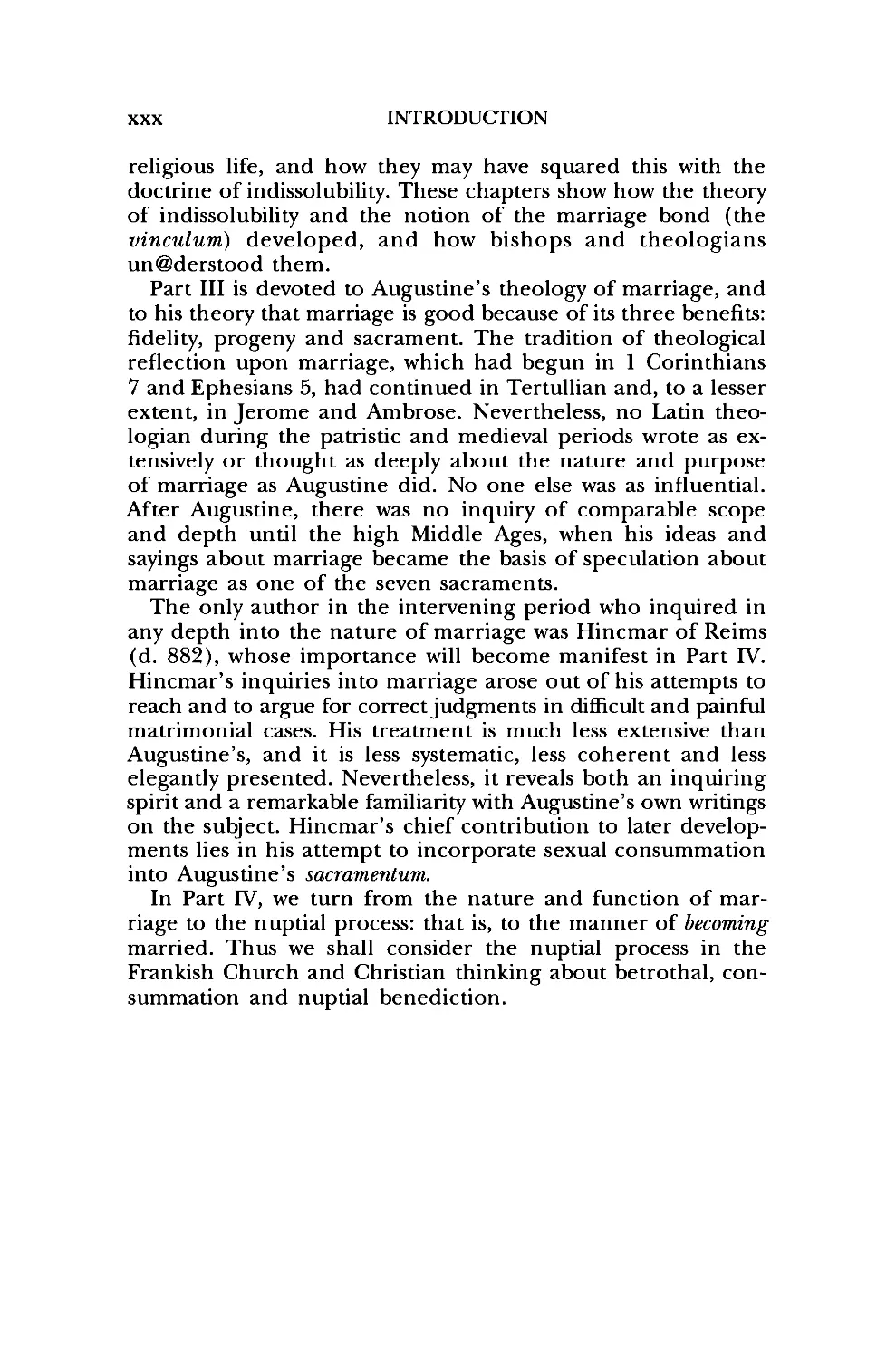
xxx
INTRODUCTION
religious life, and how they may have squared this with the
doctrine of indissolubility. These chapters show how the theory
of indissolubility and the notion of the marriage bond (the
vinculum) developed, and how bishops and theologians
un@derstood them.
Part III is devoted to Augustine's theology of marriage, and
to his theory that marriage is good because of its three benefits:
fidelity, progeny and sacrament. The tradition of theological
reflection upon marriage, which had begun in 1 Corinthians
7 and Ephesians 5, had continued in Tertullian and, to a lesser
extent, in Jerome and Ambrose. Nevertheless, no Latin theo
logian during the patristic and medieval periods wrote as ex
tensively or thought as deeply about the nature and purpose
of marriage as Augustine did. No one else was as influential.
Mter Augustine, there was no inquiry of comparable scope
and depth until the high Middle Ages, when his ideas and
sayings about marriage became the basis of speculation about
marriage as one of the seven sacraments.
The only author in the intervening period who inquired in
any depth into the nature of marriage was Hincmar of Reims
(d. 882 ) , whose importance will become manifest in Part IV.
Hincmar's inquiries into marriage arose out of his attempts to
reach and to argue for correct judgments in difficult and painful
matrimonial cases. His treatment is much less extensive than
Augustine's, and it is less systematic, less coherent and less
elegantly presented. Nevertheless, it reveals both an inquiring
spirit and a remarkable familiarity with Augustine's own writings
on the subject. Hincmar's chief contribution to later develop
ments lies in his attempt to incorporate sexual consummation
into Augustine's sacramentum.
In Part IV, we turn from the nature and function of mar
riage to the nuptial process: that is, to the manner of becoming
married. Thus we shall consider the nuptial process in the
Frankish Church and Christian thinking about betrothal, con
summation and nuptial benediction.
PART ONE
MARRIAGE IN CML LAW
CHAPTER ONE
ROMAN LAW:
THE FORMATION AND NATURE OF MARRIAGE
Betrothall
The classical model
A betrothal ( sponsalia) was a public agreement to marry in
the future (Dig. 23. 1 . 1 ) . Thus its essential constituents were a
mutual promise and an announcement. The jurist Ulpian
explains that the word sponsalia comes from spondere ("to
promise"), and that "our forefathers were accustomed to stipulate
and promise for themselves wives-to-be" (Dig. 23. 1 . 2 ) .
Betrothal was not a necessary first step to getting married,
and whether or not betrothal had gone before was a matter
of complete indifference as far as the validity of a marriage
was concerned (cf. Dig. 23. 1 .9 and 24. 1 .32.27) . In the early
Republic, betrothals were made by solemn promises (called
sponsa or sponsiones) between a man or his pater on one side
and a woman's pater or tutor on the other. The promise was
in effect a verbal contract, and it was probably actionable. When
free marriage became the norm, betrothals became informal
and were not actionable. Either partner could renounce the
engagement. We learn from Gaius that the dissenting partner
need only make a simple renunciation, and that the accepted
formula was "condicione tua non utor, " which we might loosely
translate as "I do not abide by your terms" (Dig. 24.2.2.2) . A
constitution from AD 293 determined that a woman who had
been betrothed to one man was not prohibited from leaving
him and marrying another.2 The agreement ( consensus) that
made marriage was theoretically distinct from the agreement
that made betrothal. It is not clear that an exchange of con
sent was a customary part of the marriage ceremonies, although
I See S. Treggiari, Roman Marriage ( 1 99 1 ) , pp. 1 25-160. See also P. E.
Corbett, The Roman Law of Marriage ( 1930 ) , pp. 1-23; A. Watson, The Law
of Persons ( 1 967) , pp. 1 1-18; J. F. Gardner;, Women in Roman Law and Society
( 1976) , pp. 45-47; and J. Gaudemet, L 'Eglise dans l'Empire Romain ( 1958 ) ,
pp. 521-24.
2 C] 5 . 1 . 1 : "Alii desponsata renuntiare condicioni ac nubere alii non
prohibitur. "
4
MARRIAGE IN CIVIL LAW
in the case of marriage by proxy, when the agreement of an
absent man was signified in a letter, agreement was the crux
of the proceedings. What established the existence of a true
marriage in law, however, was a settled intention to be mar
ried, and a mere promise to marry could not provide this.
When a betrothed couple became married, therefore, the ac
cord upon which the marriage was established went beyond
the promises that constituted the betrothal. In this respect the
Roman betrothal differed somewhat from that of the Germanic
tribes and from that of the Western Church, both of which
tended to regard the betrothal as the occasion upon which
the consensual aspect of a marriage was established.3
A simple agreement, without formality, ceremony or added
stipulations, was all that the law required for betrothal, and
neither witnesses nor written testimony were necessary.4 Paul
considers the case of a step-brother and step-sister whose be
trothal had been arranged by their respective mother and father.
The parents had attached a financial penalty to the agreement,
should it fail to be fulfilled. In due course, the step-sister refused
the match. In Paul's judgment, the stipulation need not hold
because adding it to the agreement to marry was not honour
able ( it was not secundum bonos mores) . He explains that one
should not fetter a marriage in this way (Dig. 45. 1 . 1 34, pr.).
As might be expected, the required consents were in prin
ciple the same as those for marriage (Dig. 23. 1 .7.1 and 23. 1 . 1 1 ) ,
which we shall consider in due course. Suffice to say here that
what was necessary for marriage was the agreement of the
partners themselves and also (if they were alieni iuris) of those
who had power over them, namely their patres. Corbett argues
that under classical and later law a father could not betroth
his son, even a filius familias, against latter's will, but that the
evidence leaves some doubt about the rights of a daughter in
power.5
Although a betrothal was merely a promise to marry, it car
ried with it some of the consequences of being married. Thus
a betrothal created impediments of relationship that were
equivalent to affinity. A father could not marry his son's former
3 See J. Gaudemet, " L'originalite des fian.;;ailles romaines," Societes et manage
( 1980) , 1 5-45; and idem, "Originalite et destin du mariage romain," ibid.,
1 40-84, esp. pp. 1 59-63.
4 Dig. 2 3 . 1 .7. Ulpian, in Dig. 23.1 .4, writes: "Sufficit nudus consensus ad
constituenda sponsalia."
5 See Corbett, The Roman Law of Marriage, pp. 2-5.
ROMAN lAW: 1HE FORMATION AND NATURE OF MARRIAGE
5
fianct�e, for example, nor a son his father's former fiancee
(Dig. 23.2.12.1- 2) . Similarly, a man could not marry the mother
of his former fiancee because she was considered to have once
been his mother-in-law (Dig. 23.2.14.4) .6 A rescript by Septimius
Severus, recorded by Ulpian, determines that a man may pros
ecute his fiancee for adultery since violating the expectation
of matrimony as bad as violating matrimony itself.7
In other respects, betrothal and marriage were clearly dif
ferentiated by their legal consequences. We may note four
examples. The first concerns the statutory period of mourn
ing during which a widow was prohibited from remarrying.
(Under Imperial legislation the period was one year.) If she
did marry again within this period, she incurred infamia and
severe financial penalties,s but the law did not require a woman
to mourn her fiance. If he died, she could marry another man
immediately (Dig. 3.2.9. 1 ) . Second, the law did not prohibit
gifts between the betrothed. Third, while a freedwoman who
had been married to her patron could not remarry without
her patron's permission (Dig. 23.2.45.1 ) , this rule did not ap
ply to betrothal. Therefore if she was merely betrothed to her
patron, she could break off the engagement and marry an
other without his consent (Dig. 23.2.45.4) . Fourth, children
could become betrothed before marriageable age. Modestinus
says, "in contracting a betrothal the age of the parties is not
defined, as it is for marriage. Accordingly a betrothal can be
made from early infancy" (Dig. 23. 1 . 1 4) . 9 In the Digest, the
text continues: "provided that both persons understand what
is being done; that is, that they are not less than seven years
old." This was probably added by Justinian's compilers, for it
clearly contradicts what has gone before.lO
6
7
These are impediments of "quasi-affinity" in medieval canon law.
Dig. 48.5 . 1 4. 3 : " . . . quia neque matrimonium qualecumque nec spem
matrimonii violare permittitur." See also 48.5. 1 4.8. On the crime of adul
tery and its penalties, see Corbett, pp. 127-46, and Gardner, pp. 1 27-3 l .
Only married women and their paramours could b e prosecuted. I n other
words, a man could be prosecuted for adultery only on the ground that he
had had a sexual relationship with another man's wife, and it did not
matter whether the adulter himself was married or not.
8 A constitution of AD 381 raised the tempus lugendi from ten months to
one year ( Cod. Theod. 3.8 . 1 ,
CJ 5.9.2) . A woman breaking this rule was
to be disgraced and to lose all the property she had acquired from her
husband, including betrothal gifts and anything left to her in his will.
9 Similarly Pauli sent. 11.19. 1 : "Sponsalia tam inter impuberes contrahi
possunt."
10
See Corbett, pp. 2-4.
=
6
MARRIAGE IN CIVIL LAW
As with marriage, ceremonial aspects were common, but they
were not legally necessary. The man would place a ring upon
the appropriate finger of his fiancee as a token (Pignus) of
intent, and he might also present her with gifts. From the
second century AD, the ring was regarded as an arrha: that is
to say, as a pledge of intent.ll The practice seems to have
come from the world of commerce, for in a text from Ulpian
we find references to both a sum of money and a ring being
presented as arrhae in business transactions (Dig. 1 9. 1 . 1 1 .6; cf.
19.5. 1 7.5) .
Betrothal under the Christian emperors
Legislation of the Christian Empire refers to the practice of
bestowing the arrha sponsalicia as an earnest of intent.1 2 The
practice was Eastern in origin. This arrha was usually a sum of
money, and the man gave it to his sponsa or to her repre
sentative or parents. If the betrothal was broken off by mutual
agreement or with good cause, or if some necessity such as
the death of one the partners terminated the betrothal, the
arrha would be returned, but it provided a way of penalizing
someone who broke off the betrothal unilaterally without good
cause. If a woman spurned her suitor and married another,
the arrha would be repayed fourfold. If a man simply refused
to marry his betrothed, or if he had failed to fulfil his prom
ise after two years, then the woman was free to marry another
and she retained the arrha. 13
The practice of making betrothal gifts was congruent with a
degree of formality and legal consequence that became attached
to betrothal in the law of the Christian emperors. Like the
counter-dowry, the arrha sponsalicia was a Greek custom, and
it is not clear how widespread it was in the Latin world. It is
difficult to determine whether Eastern elements that begin to
appear in legislation from the third century AD reflect
developments within Roman law or simply the fact that, after
the extension of citizenship in 2 1 2 AD , Roman law became
"vulgarized" as it had to take account of local Eastern practices.
The legislation of the Theodosian code regarding the arrha
sponsalicia, however, appears in the Roman codes both of the
II
L . Anne, "La conclusion du mariage," Ephemerides Theologicae Lovanienses
1 2 ( 1935 ) , pp. 526-28.
12
See ibid., pp. 5 1 8-23.
13
Cod. Theod. 3.5.4-5 and 3.5. 1 1 . CJ 5 . 1 .3, 5.1.5 and 5.3. 15-16.
ROMAN lAW: 1HE FORMATION AND NATURE OF MARRIAGE
7
Visigoths ( that is, Alaric's Breviary) and of the Burgundians.14
Betrothal in imperial law remained less formal than its Ger
manic equivalent. As we shall see, dotation ( in this case a gift
from the suitor to his wife-to-be) was an essential component
of betrothal in Germanic law. Moreover, the Germanic codes
emphasize formalities such as petition and the presence of
witnesses. Unfortunately, we do not know the position of West
Roman vulgar law on this matter.
There was a tendency among some of the Latin Fathers to
treat betrothal as marriage. Augustine, for example, points out
that Scripture calls Mary "wife" from the moment of her be
trothal ("coniux vocatur ex prima desponsationis fide").IS The
Frankish Church during the Carolingian period generally ad
hered more to Roman than to Germanic norms, but here
dotation was an integral part of betrothal. Frankish rulers and
churchmen added formalities to the process leading from
betrothal to marriage, for example by stipulating that there
should be an official inquiry into the relationship of the sponsus
and sponsa before they came together.
Marriage
Definitions
What is marriage? The classical jurists were not inclined to
reflect upon the nature of marriage. Roman law merely ap
plied and appealed to certain principles and maxims regard
ing marriage when it was necessary to determine whether or
not a man and his female partner were in fact married or at
what point they had become married. From the legal point of
view, it was necessary to determine whether a marriage was
valid because of its consequences, especially those pertaining
to the legitimacy of offspring. The law of marriage, therefore,
was chiefly relevant to questions of inheritance and status. The
two or three definitions of marriage that are found in Roman
law and jurisprudence are merely descriptive and were of no
legal consequence.
Marriage is "the union of a man and a woman" ( maris atque
feminae coniunctio) according to a text from Ulpian's Institutes
(Dig. 1 . 1 . 1 .3; see also Inst. 1 .2, pr.). Here Ulpian posits three
species of law: ius naturale, which is common to all animals;
14
15
Brev. 3.5 .4-6. Lex Romana Burgunionum 27.1-3.
De nuptiis et concupiscentia I. l l , CSEL 42, p. 224.
8
MARRIAGE IN CIVIL LAW
ius gentium, belonging to mankind; and ius civile, consisting of
such additions and changes to these laws as are made by Roman
legislators.16 Marriage, albeit a human institution, springs from
the the natural law:
The natural law is that which nature has taught to all animals.
For this law is proper to all animals and not only to mankind.
. . . From this comes the union of a man and a woman that we
call matrimony, and the procreation and rearing [educatio] of
children. (Dig. 1 . 1 . 1 .3)
The text implies, without explicitly affirming, that marriage
exists for the procreation and raising of children, an end in
scribed in the natural lawP Nevertheless, Ulpian does not specify
what kind of union of a man and a woman is called marriage.
A formal definition by Modestinus, a pupil of Ulpian, sup
plies the specific difference: "Nuptiae sunt coniunctio maris
et feminae et consortium omnis vitae, divini et humani iuris
communicatio" (Dig. 23.2 . 1 ) .18 The additional phrases ( consor
tium omnis vitae, divini et humani iuris communicatio) have been
variously translated, for example: "a partnership for life in
volving divine as well as human law;" "the sharing of their
entire life, the joint participation in rights human and divine;"
and "an association for the whole of life, in which the two
share the same civil and religious rights."19 It is clear that
husband and wife are considered to become a single social
unit. The phrase "omnis vitae" ("of all life" or "of the entire
life") probably pertains to the duration of life as well as to its
content. It may seem unlikely, in view of the ease with which
spouses could divorce each other under classical Roman law,
16
Ulpian died ca. AD 223. On this threefold division, see commentary
by J. A. C. Thomas in Institutes ofjustinian ( 1975) , pp. 6-7. The notion of
ius naturale posited in this text is unuual. According to the usual view, ius
gentium and ius naturale are the same thing: namely, the law suggested by
natural reason, for reason itself is common to all races: cf. Dig. 1 . 1 . 9 (Gaius) ,
Inst. 1.2. 1 1 , Dig. 1 . 1 .6.pr. (Ulpian) .
17 Cicero, in De officiis 1.4. 1 1 , observes that all animals (including human
beings) desire to form unions for the sake of procreation and to care for
the offspring.
18 On this definition, see J. Rabinowitz, "On the Definition of Marriage
as Consortium omnis vitae," Harvard Theological Review 57 ( 1 964) , 55-56; and
J. Huber, Der Ehekonsens im romischen Recht ( 1 977) , pp. 24-26. Regarding
the final clause, cf. Cj 9.32.4: " . . . [uxor] quae socia rei humanae atque
divinae domus suscipitur."
1 9 Quotations respectively from: The Digest of justinian ( 1 985 ) , p. 657; J.
F. Gardner, Women in Roman Law and Society ( 1 986) , p. 47; and G. H .
Joyce, Christian Marriage ( 1933) , p . 4 0 , n. 1 .
ROMAN lAW: TIlE FORMATION AND NATURE OF MARRIAGE
9
that the dictum meant that marriage was permanent. It is
perhaps difficult in any case to square the notion of consor
tium omnis vitae, however interpreted, with the rather slight
legal consequences of marriage in Modestinus's time. But the
Romans' conception of marriage should not be equated with
their law of it. What the law freely permitted may not have
met with the approval of society or of the family council, and
what was done may have fallen far short of what was consid
ered ideal. The fact that Romans regarded the univira ( the
woman who married and remained faithful to but one man)
as the ideal of womanhood suggests that there was at least an
ideology of marital permanence.20 Moreover, divorce was con
sidered to be something that had regretably crept in but had
not belonged to Rome's golden age.21 Romans would have have
concurred with Jesus' affirmation that there was no divorce
"in the beginning" (Matt. 19:8) .
A modified version of Modestinus's definition appears in
Justinian's Institutes. According to this, marriage is a union
between a man and a woman "involving a single, shared way
of life" ("Nuptiae autem sive matrimonium est viri et mulieris
coniunctio, individuam consuetudinem vitae continens") .22
Isidore of Seville's untranslatable definition ("Coniugium est
20 Cf. Inscriptiones Latinae Selectae, ed. Dessau ( 1902) , vol. 2, n. 8444:
"Postumia Matronilla inconparabilis coniux, mater bona, avia piissima, pudica
religiosa frugi efficaxs vigilans sollicita univira unicuba totius industriae et
fidei matrona, vixit annis n. LIII mensibus n. V diebus tribus." Similarly
nn. 8430, 8450, 8394. The same notion is reflected in Horace, Odes 111. 1 5 ,
line 5: "unico gaudens mulier marito," referring to Augustus and Livia
(although Livia was a divorcee ! ) .
21
According to Valerius Maximus (11. 1 .4) , the first man to have divorced
his wife (it was because of her sterility) was said to have been Spurius
Carvilius Maximus Ruga, in the sixth century after Rome's foundation.
Tertullian records the same Roman belief and notes that it agrees with
Jesus' teaching: see De monogamia IX.8, ed. P. Mattei (Le mariage unique, SC
343 ) , p. 1 72. See also Matthei's commentary on this text ( ibid., p. 306) .
22
Inst. 1 .9. 1 . It is usually this form of the definition, from the Institutes,
that high medieval canonists and theologians took up. See, for example:
Ivo of Chartres, Decretum 8 . 1 , PL 161 :583D; Panoramia 6. 1 , PL 1 6 1 : 1 244D;
Gratian, C.27 q.2, dictum ante c . l ( 1 062 ) ; C.29 q . 1 ( 1 09 1 ) ; Alexander III,
X 2.23 . 1 1 (355 ) ; Sententiae Magistri A, ed. H. J. F. Reinhardt, Beitriige zur
Geschichte der Philosophie und Theologie des Mittelalters NF 14 ( 1974) , p. 1 67;
Hugh of St Victor, De sacramentis, 1 1. 1 1 .4, PL 1 76:485C; Peter Lombard,
Sent. IV.27.2, Grottaferrata edition, vol. 2, 1 980, p. 422, and Tractatus de
coniugio, n. 2, ibid., p. 84*. See also J. Gaudemet, "La definition romano
canonique du mariage," in Speculum Iuris et Ecclesiarum ( 1967) , 1 07-14.
Gaudemet notes examples in the decretal collection Britannica (late 11 th
cent. ) , the Summa of Rufinus, Alexander III (cited in the Compilatio prima) ,
10
MARRIAGE I N CIVIL LAW
legitimarum personarum inter se coeundi et copulandi nuptiae")
comes from the same stable.23
Ancient definitions of marriage tell us very little about the
nature of marriage in Roman law or about what marriage was
in the minds of legislators and jurists. To discover what mar
riage in Roman law was, therefore, we need to consider the
matrimonial laws and the assumptions that legislators and jurists
made about marriage and applied to particular cases.
The effects of marriage
One approach to answering the question "what is marriage?"
is to consider what are the consequences of getting married.
In other words, what difference does being married make?
It should first be emphasized what Roman marriage did not
do. By the time of Christ's advent, Roman marriage was such
that a wife was not strictly in the same family as her husband.
In the ancient forms of marriage, which had involved the transfer
of manus, a woman was transferred from her own family into
her husband's, but manus-marriage, while still common in the
second century BC, was disappearing at the beginning of the
Christian era, and was long gone by the time of Justinian. To
appreciate the nature of Roman marriage, therefore, it is nec
essary to bear in mind the nature of the traditional Roman
family. Moreover, the peculiar nature of free marriage (that
is, marriage without the transfer of manus) is best understood
against the background of the ancient, more formal kinds of
marriage that it superseded.
In classical usage, the word familia denoted strictly all those
persons and even all things which were under the power of
the same paterfamilias. The pater himself, therefore, was strictly
not part of the family but its ruler. The family encompassed
his legitimate descendants and those who had joined them
either through adoption or (in the case of women) through
manus-marriage, as well as slaves. 24 All children born legiti
mately (that is, the issue of matrimonium iustum) came under
the paternal power (patria potestas) of their father from birth,
but he owed his power to his father, as long as the latter surand the Decretals of Gregory IX, as well as in Ivo and Gratian. He points
out that Stephen of Tournai quotes the version of Modestinus (Le. Dig.
23.2. 1 ) .
23 Etym. IX.7.20, ed. M. Reydellet ( Paris, 1984) , p. 233 ( PL 82:366B ) .
24 On the various senses o f familia, see Ulpian i n Dig. 50. 1 6 . 1 95. See
also D. Herlihy, Medieval Households ( 1985 ) , pp. 2-4.
=
ROMAN lAW: THE FORMATION AND NATURE OF MARRIAGE 1 1
vived. Although one may usually translate the word pater in
Roman law by "father," strictly speaking one should say that
the family's pater, who held power over his descendants, was
its oldest surviving male ascendant. The descendants of the
pater, including those who entered the family by adoption, were
legally dependent on him and were in his power ( they were
alieni iuris) . They might, however, become independent ( sui
iuris) , for example by emancipation. When the pater died, each
of his immediate descendants became sui iuris, and thus every
immediate male descendant became pater in relation to his
own descendants.
The relationship of agnation, therefore, was of more conse
quence in law than that of cognation or blood relationship.25
Agnation was a function of the transmission of paternal power
through the male line. All those who, whether by birth or
adoption, were descendants in the male line from the same
pater, and who thus either were or ( if he was deceased) would
have been in his power, were agnates. While all the agnates
might be said to belong to the same family, the family prop
erly so called included only those who were in the power of a
living pater (Dig. 50. 16. 1 95. 1-2 ) .
At one time paternal power may have been virtually unre
stricted.26 Descendants of the pater who were under his power
could own no property of their own, and whatever they ac
quired became his property. In the early Republic, a pater was
legally empowered to marry off his sons and daughters, to give
them in adoption, and in theory even to sell them, and he
was s ai d to h ave the right to take his offspring's life ( ius vitae
necisque) , although this right may not have extended beyond
infanticide. These powers waned in the course of the Empire,
first in practice and then in law.27
While patria potestas was the power of the head of a family
over those who were dependent on him through birth or adop
tion, manus was the power that might be held by a husband
over his wife.28 Thus a woman who was in manu to her husband
25
Herlihy argues that in late Latin usage and especially in Christian
writings, the word familia "assumed connotations of blood descent": see
Medieval Households, p. 3. This development was probably related to the
waning significance of patria potestas during late antiquity.
26
See Watson, The Law of Persons, pp. 98-1 00.
27
See Gardner, pp. 6-1 1 , and Thomas, Textbook of Roman Law, pp. 414-15.
28
On the terms potestas and manus, see Watson, Rome of the XlI Tables
( 1975 ) , pp. 47-5 1 .
12
MARRIAGE I N CIVIL LAW
was under his power, if he was sui iuris, or under the power
of his pater. Her legal status in relation to her husband was
considered to be equivalent to that of a daughter, so that she
became effectively his agnate. While manus was not in every
respect the same as paternal power, a wife in manu could hold
no property of her own. Anything she owned or acquired be
came the property of her husband or of his pater. By entering
into manus, a woman who was alieni iuris ceased to be in her
pateis power and thus left one agnatic family and entered
another. The theory that manus-marriage descended from a
primitive, Indo-Germanic system of brideprice, in which the
wife would be bought as a chattel,29 is romantic and specula
tive. Jack Goody has expressed considerable scepticism about
theories of this kind in regard to Germanic marriage.30
A woman entered manus by one of three ways, namely by
usus, confarreatio or coemptio. All three were probably listed in
the XII Tables (the earliest code of Roman laws, issued ca.
450 BC). 31 Confarreatio involved a religious ceremony, and was
named after the cake of spelt (jar) that was included in a
sacrifice to Jupiter. Coemptio was a notional or fictional sale of
a woman to her husband. In usus, a wife became in manu to
her husband by virtue of having lived with him for one year.
She could thus avoid manus by staying away from him for three
nights in the year, and avoid it indefinitely by repeating this
every year. It is difficult to determine, and perhaps pointless
to speculate, whether the transferring of manus was in itself
the process of getting married, or, on the contrary, something
in addition to getting married.32 Be this as it may, the exis
tence of the "three nights" rule suggests that marriage nor
mally involved the transfer of manus.
Cf. Corbett, The Roman Law of Marriage, pp. 1 , 1 1 , 69, 79, 8 l .
The Development of the Family and Marriage in Europe ( 1983) , pp. 240 ff.
See Watson, Rome of the XII Tables ( 1 975) , pp. 9-19.
Corbett, in The Roman Law of Marriage ( 1930) , p. 68, argues that "mar
riage and manus were originally not distinct concepts but one and the
same," and that the "legal forms of marriage were identical with the forms
for the creation of manus." A similar account is given in E. Schillebeeckx,
Marriage, vol. 2 ( 1965 ) , pp. 4-17 (pp. 233-43 in the one-volume edition) .
O n the contrary, Gardner, in Women in Roman Law and Society ( 1986) ,
p. 27 (n. 26) and p. 12, argues that " manus and marriage were separate
and distinct from the earliest times" and that "the performance of manus
ceremonial was not essential to constitute legal matrimony." For a judi
cious and somewhat sceptical treatment of this issue, see Watson, XII Tables
( 1975 ) , pp. 1 7-19.
29
30
31
32
ROMAN lAW: THE FORMATION AND NATURE OF MARRIAGE
13
The practice of free marriage-that is, marriage without
manu.r-had become the normal arrangement by the time of
the late Republic. In itself the fact that a marriage was free
in this sense did not entail that the wife was any more at lib
erty than under manus-marriage. Persons who were alieni iuris
still required paternal consent to get married. Moreover, when
a woman who was alieni iuris entered free marriage, she re
mained in the power of her pater. By marrying in this way, a
woman would not, strictly, become a member of her husband's
agnatic family, nor commit herself to a new power. The other
peculiarity of free marriage was its informality. While there
were customary ways to get married, these had little legal
significance. Marriage, as some scholars have put it, was
social fact.
Free marriage, therefore, had little effect on the spouses
themselves above and beyond the fact that they lived together.33
Its effects pertained primarily to the children who issued from
the union, for they were in their father's power from birth
and, as his agnates, had rights of intestate succession. Of course,
a woman' s entry into free marriage did have some legal con
sequences for her. She took her husband's rank in society, for
example, so that if he was of consular rank, so would she be.
Again, her domicile ( that is, her legally recognized place of
residence) was that of her husband, and similarly she was in
law a resident ( incola) of his municipality, to which she owed
her municipal duties.34 Being married, however, did not le
gally entail much in the way of obligations between the spouses.
For example, a wife had no legal claim upon her husband for
maintenance. Although she would probably have received a
dowry from her family and perhaps also a nuptial gift from
her husband, there was usually no legal requirement that she
should be so endowed. In principle, there were no rights of
intestate succession between the parties to a free marriage,
since they were not agnates, although some provisions were
made (Dig. 38. 1 1 ; [nst. 3.9.3-7; Nov. 53.6, 1 1 7.5) . By defini
tion, the wife in a free marriage was not under the power of
her husband (although by convention she was expected to obey
him). If she were alieni iuris before the marriage, and thus in
the power of her pater, she remained so after it. If she were
33 See Corbett, pp. 1 07-46, and J. F. Gardner, Women in Roman Law and
Society ( 1986) , pp. 67-80.
34 See Corbett, pp. 1 1 2-1 3 .
14
MARRIAGE I N CIVIL LAW
sui iuris, she would be under the guardianship of a tutor, and
would remain so when she married.35
Roman law prohibited husband and wife from bestowing gifts
upon each other (Dig. 24. 1 ) , although there were exceptions
to this rule.36 This was one reason why the question of the
validity of marriage arose in Roman law, for a valid marriage
would make gifts between the partners invalid. Ulpian explains
that the prohibition was made lest spouses, motivated by their
love to act intemperately, should impoverish themselves by
bestowing lavish gifts upon one another (Dig. 24. 1 . 1 ) .
Husband and wife were supposed to treat each other with a
conjugal regard that is variously described as reverentia (Dig.
23.3 . 1 4. 1 ) , reverentia maritalis ( C] 5. 1 3. 1 .7 ) , affectio et pietas (Dig.
32.41 ) and maritalis honor et affectio (Dig. 39.5.31 ) . Corbett ar
gues that although no-one could be made to observe the debt
of conjugal reverence, it was an important matter of legal
principle.37 For example, this is arguably why husband and
wife could not institute penal or defaming actions against one
another ( C] 5.21 .2, Dig. 25.2.2) . Moreover, when the Christian
emperors determined what were the legitimate grounds for
divorce and introduced penalties for those who divorced with
out good cause, infringements against proper conjugal respect
were among the accepted grounds for repudiation. Theodosius
II, for example, determined in AD 449 that a wife may repu
diate her husband if he brings immoral women into the home,
threatens her life or flogs her ( C] 5 . 1 7.8.2) . Justinian ruled
that a husband's battering of his wife did not constitute grounds
for divorce ( Nov. 1 1 7. 1 4) , but this probably reflects greater
stringency regarding the permanence of marriage, and not a
relaxation regarding the obligation to show conjugal reverence.
While Roman law presupposed that marriage was in essence
a sharing of the whole of life and that spouses should treat
each other with marital affection, it neither defined such things
nor treated them as legal obligations. Marriage was treated as
if it were a de facto condition that, once identified as such,
had certain legal consequences. In other words, it was not being
married per se but the consequences of being married that
35 In the Empire, there were ways whereby a wife could be released from
this requirement, including the ius liberorum, by which she could be re
leased if she had begotten three children. See Gardner, Women in Roman
Law and Society ( 1 986) , pp. 20-22.
36 See Corbett, pp. 1 1 4-17.
37 Ibid. , pp. 1 25-26.
ROMAN lAW: TIIE FORMATION AND NATURE OF MARRIAGE
15
were a matter of right (ius) and came under the purview of
the law.
Marriage and procreation
What is marriage for? An alien who came to observe the hu
man race would soon notice that marriage has something to
do with the begetting and raising of children. It was generally
presupposed in classical times that marriage existed for the
sake of the procreation and education of children, and this
supposition occasionally manifested itself in Roman legislation
and jurisprudence.38 Following the Augustan legislation con
tained in the lex Iulia de maritandis ordinibus ( 1 8 BC) and lex
Papia Poppaea (AD 9 ) , unmarried and childless persons were
penalized, while certain privileges and dispensations were
granted to those who had borne three legitimate children.39
The aim of these provisions was to discourage concubinage,
for the offspring of a man and his concubine were by defini
tion illegitimate and not his heirs. The ius trium liberorum freed
the mother who had begotten three legitimate children from
the requirement to have a guardian ( tutela) , while it granted
preferment in the matter of magistracies to the father. The
most significant penalties pertained to testamentary succession:
childless persons could only inherit half of what had been left
to them, while unmarried persons could only inherit from those
related to them by marriage or by blood within seven degrees.
Constantine, however, repealed the penalties for childlessness
in AD 320 ( CJ 8.57. I ) . Was he motivated by the Christian con
sideration that the "time to embrace" had passed and the era
of virginity had begun?
Majorian declared in a novel of AD 458 that he cared zeal
ously for the welfare of children and wished that they should
be procreated abundantly for the advancement of the name
of Rome.40 The Latin Fathers, on the contrary, considered that
the time for generating children had passed. Tertullian and
Jerome thought that the world was already too full, and
38 See J. Gaudemet, "Les legs du droit Romain en matiere matri,moniale,"
Societes et mariage ( 1980) , pp. 344-45; and cf. J. Gaudemet, L 'Eglise dans
L 'Empire romain ( 1 958 ) , pp. 5 1 8-19 and 535. Procreation was supposed to
be the natural reason for sexual intercourse. On the Stoic affirmation of
this thesis, see J. T. Noonan, Contraception ( 1965 ) , pp. 46-49.
39 See Noonan, ibid., pp. 20-25; Corbett, pp. 1 20-2 1 ; Gardner, p. 20.
40 Maj . Nov. 6.9: "Et quia studiose tractatur a nobis utilitas filiorum,
quos et numerosius procreari pro Romani nominis optamus augmento . . . . "
16
MARRIAGE I N CIVIL LAW
Augustine seems to have thought that Heaven itself was nearly
full.41
That marriage exists for the sake of procreation may be the
premise of rulings pertaining to marriage and potency. Cer
tainly it was assumed that persons should be able to have sexual
intercourse if they were to marry. A boy could not marry be
fore he was pubes nor a girl before she was viripotens (Inst.
1 . 10, pr.). In law, girls reached puberty nominally at the age
of twelve and boys at fourteen, but according to Justinian's
Institutes, p uberty had once been established by physical in
spection.4
Curiously enough, Ulpian seems to have believed that im
potence was an impediment to marriage only if it was the re
sult of castration (Dig. 23.3.39. 1 ) . Justinian added impotence
to the grounds for legitimate divorce, however, determining
that a woman (or her parents) could repudiate her husband
if he had proved to be unable to have sex with her by virtue
of a natural deficiency from the beginning of the marriage
until two years had elapsed ( C] 5. 1 7. 1 0) . Although sterility on
the part of the woman was never included as one of the for
mal grounds for divorce, it is likely that sterility was in fact a
common enough reason for divorce. A text in the Digest in
cludes sterility as one of the reasons for amicable separation
( divortium bona gratia) , 43 and Valerius Maximus tells us that
the very first divorce in Rome was for sterility. He adds that
while this was regarded as a supportable reason, there were
those who considered the divorce to be reprehensible, judg
ing that the desire for offspring should not be set above mari
tal fidelity.44 This is a most interesting reflection, not only
because of its careful balancing of the companionate and pro
creative virtues of marriage, but also because Augustine will
argue along similar lines.
In some texts, the assumption that marriage exists for the
4 1 See especially Jerome, De perpetua virginitate beatae Mariae 20- 2 1
(PL 23:21 3-16 ) ; and Augustine, De Gen. ad litt. IX.7, ( CSEL 28. 1 , pp. 275-76) ,
and De bono coniugali 9-10 ( CSEL 4 1 , pp. 199-202 ) . O n Tertullian, see P.
Mattei's remarks and references in Tertullian, Le mariage unique ( SC 343,
1988) , pp. 44-47.
42 Inst. 1 .22, pro See Corbett, p p . 5 1-52. Cf. Watson, The Law of Persons
in the Later Roman Republic ( 1 967) , pp. 39-40, and XlI Tables, p. 25.
43 Dig. 24. 1 . 60-62.
See also S. Treggiari, Roman Marriage ( 1 991 ) ,
p. 462, on sterility as a justification for divorce.
44 Val. Max. 11.1 .4.
ROMAN lAW: THE FORMATION AND NATURE OF MARRIAGE
17
sake of begetting children is explicit. For example, Justinian
explains that marriage confers "artificial immortality" upon
human kind and renders human nature eternal insofar as
this is possible. For this reason, marriage is sacred and a fitting
object of concern for the emperor.45
It seems to have been usual to include variants of the phrase
liberorum procreandorum causa ("for the sake of generating off
spring") when drawing up the tabulae nuptiales, a document in
which a marriage was registered and agreement regarding dotal
and other financial terms was recorded.46 A rescript by the
emperor Probus (AD 276-82) to a man called Fortunatus in
formed him that although no tabulae nuptiales had been drawn
up for his marriage, these were not essential to establish that
he was in fact married. The intention to beget children, how
ever, appears in this document as what makes their associa
tion a marriage:
If you have had a wife in your home for the sake of begetting
children [ liberorum procreandorum causa] , and your neighbours
or others knew this, and a daughter from the marriage has been
acknowledged [suscepta] , then, although neither a nuptial docu
ment nor a document pertaining to the birth of your daughter
have been drawn up, your marriage and your daughter are le
gitimate nonetheless. ( C] 5.4.9)47
The dictum is parallel to affirmations that tabulae nuptiales
are not essential for a marriage, which will exist provided there
is marital affection (e.g. Dig. 39.5.3 1 , pr.). The phrase liberorum
procreandorum causa in this context may be little more than
legal ja rgon , but its use suggests that Romans considered the
intention to raise children to be something that disinguished
marriage from more casual forms of sexual alliance. A man
would sow his wild oats before settling down to raise a family
and generate heirs. A concubine could bear children, of course,
but they would not be her consort's own children, nor his
agnates. The phrase liberorum procreandorum causa, therefore,
pertains not to mere biological procreation but to begetting
children within one's own familia, and the words liberi, proles
and filii normally denote legitimate children or descendants.
45
Nov. 22, pro Cf. Plato, Symposium 206e-207d.
See Gardner, p. 50. See Augustine, Contra Faustum XV.7, CSEL 25. 1 ,
pp. 429-30; Sermo 5 l . 1 3 (22) , PL 38:345; Contra Iulianum V. 1 2, PL 44: 8 1 0.
47 My translation of the last clause is merely a paraphrase. The Latin
is: "non ideo minus veritas matrimonii aut susceptae filiae suam habet
potestatem."
46
18
MARRIAGE I N CIVIL LAW
The children of incestuous marriages were filii in the broad
sense but were not filii in the narrow or proper sense.48 A
father was said "to take up" ( tollere) his child after the birth;
that is, to recognize it as legitimate. This expression is thought
to have derived from the custom whereby the newborn child
would be placed on the ground and the father would lift it
up as a sign that he recognized it as his own.49
Marriage was above all the source of legitimate heirs. In
one of Juvenal's Satires, Naevolus, the homosexual "husband"
of Virro, says that the latter has no reason to complain since
he has provided him with heirs. Naevolus has accomplished
with Virro's wife that of which Virro himself had proved inca
pable. Moreover, he has saved Virro's marriage, for the frus
trated wife was often ready to tear up the tabulae nuptiales and
walk out, and would have done so if Naevolus had not been
able to satisfy her. Naevolus has already provided him with
two heirs, so that Virro can not only demonstrate his man
hood but also come into his inheritance, and he will be happy
to put the number up to three (so that Virro can benefit from
the ius trium liberorum) . 5o
The origin of Christianity happened to coincide with a trend
toward stricter sexual ethics and a greater sense of propriety
in some quarters of Greek and Roman society. While this trend
originated in Graeco-Roman philosophy, it influenced some
among the governing elite. The Stoic doctrine that sexual in
tercourse took place according to nature only if it was per
formed for the sake of generating children was one element
in this new morality. Sexual intercourse for the sake of plea
sure alone or during pregnancy or the menstrual period was
abhorrent from this point of view. The Fathers, like Philo before
them, endorsed this doctrine and made it their own.51
Preconditions
Another way to approach the question "what is marriage?"
IS
48 Thus Cod. Theod. 3. 1 2.4, regarding the illegitimacy of marriage be
tween a man and his sister-in-law: "et filii, qui exinde fuerint procreati, et
successione excludanter nec inter filios habebuntur."
49 See Oxford Latin Dictionary,
"Tollo," 2. Cf. Juvenal, Satire 6.38:
"tollere . . . heredem."
5 0 Satire 9. 70-79.
51 See Peter Brown, The Body and Society
( 1 988) , pp. 20-24. For an
example of Philo's appropriation of the Stoic doctrine, see De specialibus
legibus III.32-36 (Loeb edition, vol. 7, pp. 494-96) .
ROMAN lAW: TIIE FORMATION AND NATURE OF MARRIAGE 19
to consider what a philosopher might call its necessary and
sufficient conditions. In regard to marriage in Roman law,
therefore, one should inquire as to the conditions of a valid
marriage, for the laws provide criteria by which one may judge
whether a man and a woman are validly married or not. If
certain conditions have not been fulfilled, they are not validly
married. If certain conditions are fulfilled, then they are mar
ried. Insofar as we have found out what these conditions were,
we know what marriage in Roman law was. But we need to
qualify this in two ways.
First, neither legislators (who make the laws) nor jurists (who
interpret and explain them) have the same objectives as phi
losophers and natural scientists. Laws can create conditions of
validity, and thus add to what is perceived to be the law of
nature or contradict or change widely accepted social norms.
Moreover, legislators and jurists have pragmatic aims. In the
case of Roman law, such persons were not concerned to as
certain precisely what marriage was, and their judgments were
not predicated on any precise theory or definition of mar
riage. They made certain assumptions (which often remained
implicit) and established criteria that were intended to be ser
viceable in practice.
Second, the conditions for valid marriage are of two kinds.
On the one hand, there are preconditions: that is, conditions
that must be satisfied before the persons in question are deemed
even to be qualified to marry. On the other hand, there are
the things that are considered to make or to constitute mar
riage. This distinction may be illustrated by examples familiar
in modern western society. We maintain that a man cannot
marry his sister. Among the preconditions, therefore, is the
absence of any impediment of relationship. We also maintain
that a man and a woman cannot be married unless a certain
mutual and voluntary agreement has taken place. This agree
ment, in our view, is not a precondition but rather is what
makes them married. In this section we shall consider only
the preconditions for marriage under Roman law. We shall
later consider what Romans thought made persons married.
As we have noted, to be qualified to marry the partners had
to have reached the age of puberty (Inst. 1 . 1 0.pr.; C] 5.4.24) .52
52 See J. Gaudemet, .oLe mariage en droit romain," Societes et mariage,
53-55.
pp.
20
MARRIAGE IN CIVIL LAW
Civil law also determined that a number of other precondi
tions should be satisfied, pertaining to citizenship, social sta
tus and relationship. Such conditions constituted conubium, the
legal capacity to marry.53
Slaves could not form valid marriages either between them
selves or with free persons. In law, the quasi-marital alliance
between two slaves was mere cohabitation ( contubernium) . The
customary relationship between a free man and a bondswoman
was technically also contubernium, according to the jurists,
although this form of alliance was also called concubinage
( concubinatus) . 54 Contubernium was in principle a monogamous
and fairly stable relationship, but one without legal consequence.
The offspring were not legitimate and they took the status of
their mother. If she were servile, so were they.
Varying restrictions regarding marriage between free persons
of differing social status were in force at different periods.
Following legislation by Augustus ( lex Iulia et Papia) , senators
and their male and female descendants for three generations
in the male line could not marry freedmen or freedwomen,
nor could they marry actors or the sons or daughters of actors
(Dig. 23.2.44.pr.) . The position regarding marriage between
the freeborn and the freed before this, in the late Republic,
is uncertain. The ruling regarding senators and their children
may have been issued to limit a general prohibition against
marriage between freed and freeborn citizens (cf. Dig. 23.2.23) .
The sanction against unequal marriage was probably simply
that the marriage itself was invalid.55
Roman citizens could not validly marry foreigners, unless
the foreigners in question had been granted conubium. The
scope of this impediment was radically altered in AD 2 1 2,
however, when Caracalla granted citizenship to all free persons
in the Roman Empire.
Impediments of relationship existed by virtue of blood rela
tionship ( cognatio) or because of relationships acquired through
53 See Corbett, pp. 24-53; Watson, XlI Tables, pp. 20-24; Watson, Per
sons, pp. 32-39; and Gardner, pp. 3 1-38.
54 Pauli sent. 11.19.6: "Inter servos et liberos matrimonium contrahi non
potest, contubernium potest." On the denial of conubium to slaves, see S.
Treggiari, Roman Marriage ( 1 99 1 ) , pp. 52-54. On the use of the words
concubinatus and concubina in reference to relationships between freemen
and their bondswomen, see J. Gaudemet, "La decision de Callixte en matiere
de mariage," Societes et mariage ( 1980 ) , p. 1 1 1 .
55 Cf. Dig. 24. 1 .3.1, 23.2.16.pr. and 23.2.42. l . See J. Gaudemet, "Le mariage
en droit romain," Societes et mariage, pp. 66-73.
ROMAN LAW: THE FORMATION AND NATURE OF MARRIAGE
21
adoption or through marriage ( affinitas) . These restrictions are
conveniently explained in Justinian's Institutes ( 1 .1 0).56 A ruling
by Justinian in AD 530 prohibits marriage between a man and
a girl whom he has received from baptism; that is, between
God-father and God-daughter ( C] 5.4.26). The ruling is made
as a particular application of the principle that a man should
not marry someone in loco filiae to him. Justinian explains that
nothing is so inducive of paternal affectioas the bond between
a man and a girl whom he has received from baptism, for
with this bond their two souls are joined by God. This seems
to be the first surviving reference to what will be known in
the high Middle Ages as the impediment of spiritual cognation.57
It is important to distinguish between two kinds of impedi
ments: those which merely entailed that an alliance was not a
valid marriage, and those which entailed that the alliance was
forbidden. The law condemned an incestuous alliance, for
example, as wicked (Inst. 1 . 1 0 . 1 ), but no blame attached to
an alliance that fell short of true marriage because of an im
pediment of citizenship. Nor was a man to be blamed for having
a servile concubine. Such relationships were perfectly respect
able but were regarded as concubinage, a monogamous and
fairly stable relationship that the Romans considered respect
able and churchmen usually had to tolerate as a fact of life.
Where conubium did exist between a man and a woman who
lived together, the only thing that was strictly necessary to make
them man and wife was an appropriate attitude or intention.
Even if they had never got married in any formal way, they
were considered in law to be married if they regarded each
other with a mutual regard known as marital affection ( mantalis
affectio) . According to Jane Gardner, there is marital affection
insofar as a couple "regard each other as man and wife and
behave accordingly.,,58 One cannot make the definition more
precise without begging further questions, for marital affec
tion was never defined in Roman law, and the scope of the
See also Cod. Theod. 3 . 1 2 . 2 and 3 . 1 2.4; Dig. 23.2. 1 7; Cj 5.4.26.
On spiritual kinship, see J. H. Lynch, Godparents and Kinship in Early
Medieval Europe ( 1986) . See also J. Goody, The Development of the Family
and Marriage in Europe ( 1 983) , pp. 1 94-204.
58 Gardner, p. 47. On marital affection in Roman law, see S. Treggiari,
Roman Law ( 1 99 1 ) , pp. 54-57. J. T. Noonan discusses marital affection in
some Roman laws as well as the use of the notion in medieval canon law
in his article "Marital affection in the canonists," Studia Gratiana 12 ( 1 967) ,
479-509.
56
57
22
MARRIAGE IN CIVIL LAW
term affectio (or affectus) ranges from "relationship" through
"attitude" and "intention" to "love."
Consensus
What made marriage, according to the Roman jurists, was
agreement ( consensus) . 59 But whose agreement was required?
The jurist Paul (fl. ca. AD 2 1 0) explains that the agreement
( consensus) of the spouses themselves and of those in whose
power they are is necessary for marriage.60 Thus the husband's
agreement alone sufficed if he were sui iuris, but if he were a
filius familias, the law required both his agreement and that of
his pater. We might still ask, in regard to any given period,
whether positive agreement or mere non-opposition was re
quired from the pater or from the son.
A woman who was sui iuris might need the consent of her
tutor. It is possible that in the early Republic the agreement
of a filia familias was not necessary at all. When it came to
choosing a spouse, patria potestas probably weighed more heavily
upon women than upon men.
What was necessary in law was probably less than what was
socially acceptable. Thus the family and piers of a filius familias
might expect him to go along with the wishes of his pater out
of filial piety, so that his own consent was a mere formality;
and a daughter sui iuris through the death of her father might
be expected to conform with the wishes of her mother or rela
tives or to comply with a previously arranged marriage. There
was a shift of importance during the Empire from the rights
of parents and guardians to the rights of the spouses them
selves. As the principle of patria potestas faded, the rationale
for parental interference shifted from patriarchal rights to the
need for protection against an ill-considered match. The consent
of a mother or other relative might be required, while a father's
consent might be considered necessary for the marriage of
even an emancipated daughter. In due course, marriages without
parental consent came to be regarded as valid, albeit improper.61
59 Dig. 35. 1 . 1 5 : "nuptias enim . . . consensus facit."
Dig. 23.2.2: "Nuptiae consistere non possunt nisi consentiant omnes,
id est qui coeunt quorumque in potestate sunt." See S. M. Treggiari, "Consent
to Roman Marriage: some aspects of law and reality," Classical Views n.s. 26
( 1 982) , 34-44.
61
See Gaudemet, "Droit romain et principes canoniques," Societes et manage,
pp. 1 27- 28; and P. Merea, "Le mariage sine consensu parentum," Revue
internationale de droits de l'antiquite 5 ( 1950) , Melanges Fernand De Visscher
IV, 203-17.
60
=
ROMAN lAW: TIIE FORMATION AND NATURE OF MARRIAGE 23
Persons who were in potestate needed parental consent to
marry (/nst. 1 .1 0.pr.), but what right had a son or a daughter
to go against a pater's wishes? Here again the position was
complicated. The lex Iulia ruled that any pater who wrongfully
prevented the marriage of someone in his power could be
made to arrange the marriage (Dig. 23.2.19). This rule im
plies that he would have the right to prevent the marriage
when there was good cause. A law in Justinian's Codex deter
mined that no-one should be forced to marry, to separate or
to be reconciled after a separation ( CJ 5.4.14; see also CJ 5.4.12).
Digest 23.1 . 1 3 (from Paul) says that a pater cannot betroth his
filius familias against the latter's wishes. According to Digest
23.2. 2 1 , a filius familias cannot be forced to marry, but the
next clause radically qualifies this ruling and takes us into the
realms of legal fiction:
If a man is forced by his pater to take a wife whom he would
not have taken of his own free will, he has nevertheless con
tracted marriage, which cannot be contracted against the wishes
of the parties; he is considered to have chosen this. (Dig. 23.2.22)
It seems, therefore, that while a son would have some right of
legal redress if his pater opposed his own choice of spouse
(Dig. 23.2.1 9), he had virtually no right to oppose his pater if
the latter forced him into a marriage.
Something of the position of a daughter-in-power can be
gleaned from the rulings on betrothal in Digest 23. 1 . Accord
ing to 23. 1 . 1 1 , betrothal requires the same agreement of the
contracting parties as marriage, and therefore, again as in
marriage, the agreement of a filia familias is required for her
betrothal. The following clause (23.1 .1 2), however, from Ulpian,
adds that she will be considered to have given her consent if
she does not oppose the will of her pater, and that she has the
right of dissent only if the man in question is morally disrepu
table.
Digest 23.2.28 says that the patron of a freedwoman may not
marry her against her will, but the next clause (23.2.29) adds
that this prohibition does not apply if her patron has
manumitted her in order to marry her. And if, having been
manumitted and married to her patron, she becomes divorced
from him, then she cannot marry another man without her
patron's agreement (Dig. 23.2.45 and 5 1 ; C] 5.5.1).
It is clear, therefore, that marriage in Roman law depended
on the agreement of the partners alone only if they were sui
24
MARRIAGE IN CIVIL LAW
iuris. (I leave aside here the question of the rights of tutors.)
The marriage of a person who was in potestate required in
addition the agreement of the pater, and it appears from Digest
23.2.22 that a father could effectively force his filius familias
into a marriage. The onus of agreement seems to fall on the
partners themselves, however, when we consider two other
aspects of the law of marriage: divorce and marital affection.
In the law of the Empire, a pater could neither force his hap
pily married child to divorce nor prevent his child from doing
so. And marital affection belonged to the partners themselves,
although in the case of partners who were alieni iuris, their
affection would have sufficed for marriage only on condition
that they had married with the consent of their paters or fami
lies.62 From this point of view, parental consent was a kind of
precondition.
Agreement was false if it was merely simulated. Hence "a simu
lated marriage is of no effect" (Dig. 23.2.30) . Insanity likewise
vitiates agreement, and therefore a mad person cannot get
married. Nevertheless, if insanity arises after the marriage has
been validly contracted, this does not dissolve the marriage.
"Insanity, " we are told, "prevents marriage from being con
tracted, because there must be agreement, but it does not
impede a marriage that has been validly contracted" (Dig.
23.2 . 1 6.2) .63 This ruling has been interpreted as evidence that
marriage was a quasi-contractual affair which required consen
sus for its inception but not for its continued existence,64 but
the rationale was probably entirely utilitarian.65 It would be
harsh indeed if a spouse who lost his sanity found himself ipso
facto no longer married.
Since divorce under Roman law required voluntary dissent,
just as marriage required voluntary agreement, an insane man
could not repudiate his wife nor an insane woman her hus
band, although her pater could do so on her behalf (Dig.
24.3.22.7; 24.2.4) . The agreement of an insane pater to the
marriage of a son or daughter would likewise be null, but in
62 Cf. Cod. Theod. 3.7.3: there is a valid marriage when there is "inter
pares honestate personas nulla lege inpediente consortium, quod ipsorum
consensu atque amicorum fide firmatur."
63 See also Pauli sent. II.19.7 and Dig. 1 .6.8. Some of the legal conse
quences of marriage might apply when a pater married off an insane daughter,
although the marriage would not be strictly valid: see Dig. 36.1 .79. 1 .
64 See J . Huber, Der Ehekonsens im romischen Recht ( 1 977) .
65 Cf. Dig. 24.3.22.7.
ROMAN lAW: lliE FORMATION AND NATURE OF MARRIAGE 25
that case the child could obtain the necessary consent from a
magistrate ( CJ 5.4.25; Inst. 1.1 0.pr.). Ulpian says that a father's
agreement to his child' s marriage is absolutely necessary if the
grandfather is insane, and that the grandfather's agreement
suffices if the father is insane (Dig. 23.2.9).66
The principle involved in these rulings is that an insane
person does not know his or her own mind and therefore
cannot provide the consensus that makes marriage. For the same
reason, the insane could not form valid contractual arrange
ments of any kind (Dig. 46. 1 .70.4; 44.7.1.12; 50.1 7.5). A mad
person was considered to have no voluntas: (Dig. 50.17.40:
"Furiosi . . . nulla voluntas est") , so that his or her expressed
wish had no legal force. Similarly, the madman and the pupillus
were considered to have no settled intention (no aJJectio or
aJJectus) .67
The sufficiency of marital accord
Roman legislators and jurists, as we have seen, considered
marriage to be founded on the accord of the parties. Inasmuch
as marriage was in their view a condition that the spouses had
contracted, the consent or agreement of the partners created
the marriage. The presence of marital affection, however, sufficed
to prove (other things being equal) that a man and a woman
who were cohabiting were married. Clearly, the mutual accord
of the parties was necessary for the existence of marriage. But
was this accord, together with any other necessary consents,
really sufficient to establish that a man and a woman between
whom there was conubium were married? There are a number
of texts which state that while accord (in the form of either
consensus or aJJectio) is necessary, something else that might be
considered integral to getting or being married is not in fact
necessary in law. Legislators and jurists eliminate ceremonies,
dotation and documentation in this way. Free marriage was
an essentially informal affair, and in this respect all that counted,
66 In the situation envisaged, the grandfather is the son's paterfamilias.
The ruling implies that as long as the grandfather survived, and if both
grandfather and father were sane, the agreement of both was required.
According to Dig. 23.2 . 1 6. 1 , the agreement of grandfather and father are
required for the marriage of a son, but the agreement of the grandfather
suffices for the marriage of a daughter.
67 Dig. 41.2.1.3, 43.4. 1 .6. These rulings are from Ulpian. Noonan, in "Marital
Affection," Studia Gratiana 12, pp. 487-88, argues that affectio took on an "emo
tional tone" in the later legislation of the Codex, denoting fondness etc.
26
MARRIAGE IN CIVIL LAW
apart from some exceptions that will be discussed below, was
the agreement or accord of the parties. Other sources state
that coitus and cohabitation are not necessary conditions.
The Roman dowry ( dos) consisted in wealth that was brought
into the marriage with the woman.58 It was normally bestowed
by the bride's father, but it might also come from other mem
bers of her family, or from an outsider, or even from the bride
herself. The dowry might consist either in actual wealth or in
the promise of wealth: in other words, in anything that in
creased the estate of the husband. Whatever he acquired as a
dowry became his property and was originally intended as a
contribution to the cost of the new marriage. Since a wife or
her family could recover all or part of the dowry if the part
ners separated or if the husband died, however, the dowry
afforded the wife some financial security and provided her family
with a way of providing it.
In legislation of the later Empire, we find the husband pro
viding a counter-dowry to his wife. This would support her
and her children if the marriage ended.59 At first the hus
band always bestowed this gift before the marriage and it was
sometimes associated with the betrothal. It was therefore known
as donatio ante nuptias. Justinian ruled that a husband might
endow his wife in this way after they had become married,
however, and thereby created a major exception to the law
against gifts between man and wife. The counter-dowry was
thenceforth sometimes known as donatio propter nuptias. The
custom of the counter-dowry was Hellenic, and it not clear
how widespread it became among Latin citizens. Nevertheless,
two novels by Western emperors, Valentinian in 452 and
Majorian in 458, affirm the need for a balance between the
dowry and the betrothal gifts ( sponsalicia largitas) . The former
declares that the two gifts should be of equal size and the
latter that the dowry should not be less than the betrothal gift.70
From the first century AD, it was customary to draw up a
document that would be signed and witnessed, usually but not
necessarily on the wedding-day.71 As well as conventional state68
See Corbett, pp. 1 47-204; Gardner, pp. 97-1 1 6; Thomas, Textbook pp. 428-3 1 ; and Watson, Persons, pp. 57-76.
69
See Corbett, pp. 205-10.
70 Val. Nov. 35.9; Maj . Nov. 6.9.
7J See C. Castello, "Lo strumento dotale come prova del matrimonio,"
Studia et documenta historiae et iuris 4 ( 1938 ) , 208-44; and H. J. Wolff, Writ
ten and Unwritten Marriages in Hellenistic and Postclassical Roman Law ( 1 939 ) .
ROMAN lAW: lliE FORMATION AND NATURE OF MARRIAGE 27
ments about marriage and its purpose, the document contained
agreements pertaining to the dowry and counter-dowry. The
existence of the document might provide evidence that the
man and woman were really married, and not merely cohabit
ing, but while the Greeks traditionally considered nuptial gifts
to be necessary for the validity of marriage, Roman law did
not. 72 Nor was dotal documentation necessary, although it is
evident that the dotal document was popularly regarded as a
kind of marriage contract. The rescript of Probus to Fortunatus,
noted above ( CJ 5.4.9) , implies both that people often thought
that the nuptial document was necessary and that this was not
in fact true in law. A constitution by Diocletian explicitly says
that a dotal instrument is not necessary for proof of the existence
of a marriage ( C] 5.4. 1 3 ) . Reading between the lines, we can
see that by the late third century dotal documentation had
become popularly regarded as necessary for the validity of
marriage and that legislators and jurists resisted this idea. It
should be noted that it was above all documentation, rather
than the dowry itself, that was in question. The law did not
strictly require documentation, although it must often have
been the easiest way of establishing the existence of a marriage.
A constitution by Theodosius and Valentinian in AD 428
affirms that where there has been neither dotal documentation
("donationum ante nuptias vel dotis instrumenta") nor cer
emonies ("pompa etiam aliaque nuptiarum celebritas"), the
marriage is nevertheless sound and its issue legitimate provided
that the following conditions are satisfied: first, that the mar
riage is between persons of comparable social status ("inter
pares honestate personas"); second, that there is no legal impedi
ment; and third, that the alliance existed with the consent of
the partners themselves and of their relatives ( amici) . 73 The
text may perhaps imply that formal endowment was necessary
for the validity of a marriage between persons of unequal status.
It seems that some did construe the ruling in this way, for in
the Codex it is followed by a constitution of AD 520-23 in
which Justinian notes that some old laws have ruled, albeit
obscurely ("licet obscurius"), that marriage between persons
of unequal status ("impares honestate") was valid only if there
was dotal documentation. Justinian firmly rejects this doctrine.74
72 See Wolff, ibid., pp. 152 and 207-09.
73 Cod. Theod. 3.7.3,
Cj 5.4.22.
74 Cj 5.4.23.7.
=
28
MARRIAGE IN CIVIL LAW
In AD 458, however, the emperor Majorian ruled that if a
man and a woman were united without a dowry (sine dote) ,
their union would incur infamia and would not be regarded
as marriage. The issue of the union would be illegitimate.75
But in a novel of AD 463, Leo and Severus abrogated certain
unjust laws by Majorian, including, it seems, the law making
the validity of marriage conditional upon dotation. Only those
parts of Majorian's novel of 458 that were in accordance with
the ancient laws were to stand (Severus, Novel l ) .
In AD 533, Justinian ruled that for the validity of a mar
riage, it did not matter whether there had been a dowry or
dotal documents ( dotalia instrumenta) . A marriage is valid if it
has been contracted with the consent of the woman's parents,
or with her own agreement if she had no parents, provided
that she was received with marital affection, "for marriages are
contracted not by dowries but by affection" ( el 5. 1 7. 1 1 ) .
A text by Gaius on hypothecs likens marriage to "obliga
tions that are contracted by agreement [ consensus] " as an ex
ample of a transaction that does not require documentation.
In a transaction of this kind, documentation facilitates proof
but is not essential, for the transaction is recognized as valid
if one can prove by any means that it took place (Dig. 20. 1 .4) .
Where conubium existed between a man and a woman who
were cohabiting but had never formally contracted to become
married, their relationship was marriage in the eyes of the
law if and only if there was marital affection.76 The jurists in
sist that it is marital affection that is decisive, and not dotation.
A text from Papinian (Dig. 39.5.31 , pr.) notes that gifts from
a man to his concubine do not become invalid if they later
marry, but adds that one should consider whether there was
marital honour and affection before they became formally
married, for "it is not documents [ tabulae] that make mar
riage." The existence of marital affection even before the
marriage was formally recognized, therefore, would have in
validated the gifts. Justinian ruled in AD 529 that when a man
has been married to a woman without documentation and has
had children by her, and then out of the same affection ( ex
eadem adfectione) has formalized the marriage by documenta
tion ( nuptialia instrumenta) and has had more children by her,
75 Maj orian, Novel 6.9.
76 A puzzling text from Modestinus states that cohabitation with a
freewoman is presumed to be marriage unless she is a prostitute (Dig. 23.2.24) .
ROMAN lAW: lliE FORMATION AND NATURE OF MARRIAGE 29
the latter children should have no advantage over the former
in respect of legitimacy ( C] 5.27. 10, pr.) . The implied argu
ment is that it is affection alone, and not documentation, that
creates legitimate matrimony. The case envisaged, he explains,
is to be distinguished from that of a man who has had chil
dren by a woman towards whom he did not have that affec
tion which would make her worthy to be called "wife," and
who later formalized the marriage by documentation when
affection came ( C] 5.27. 1 0 . 1 and 5.27. 1 1 ) . There was clearly
scope for subtle inquiries and fine points of law in such cases.
Justinian's Novel 1 1 7, from AD 542, applies a similar rationale
to cases involving divorce and remarriage. Suppose that a man
is married by affection alone and without dotal documenta
tion, and that he has children from the union. He dissolves
this marriage and marries again, this time with dotal docu
mentation, and has more children. The children of the second
alliance, Justinian rules, should have no advantage over those
of the first with regard to inheritance. For a marriage can be
constituted by affection alone. The same principle would apply
in the opposite case: that is, if the first marriage were docu
mented and the second were not (Nov. 1 1 7.3) .
In a novel of AD 538, Justinian notes that according to both
the legislation of his predecessors and his own constitutions,
marriages that existed by virtue of affection alone and with
out dotal documentation were valid. But he goes on to ex
plain that this has given rise, human nature being what it is,
to countless false allegations and deceitful acts. In future, licence
to marry in this way will belong only to the lowliest citizens:
that is, to uneducated farmers and common soldiers, and to
those leading an abject life, with little or no wealth ( 74.4.3) .
The illustres and higher dignitaries must observe formalities
such as the dowry and the donatio ante nuptias and everything
else that befits their rank (74.4. 1 ) . For the rest, three courses
of action are open. (I presume that they are set out in order
of preference.) A couple may observe the practice of nuptial
gifts and documentation. If they do not wish to do this, they
should present themselves to the advocate of a church who,
having summoned at least three clerics as witnesses, should
record their marriage. Failing this, a record of the marriage
should at least be retained in the archives of a church (74.4. 1-2) .
Unless they have properly documented their marriage in one
way or another, the man and woman will not be considered
to have been joined in nuptial affection (74.4.2) . Here Justinian
30
MARRIAGE IN CIVIL LAW
retains the theoretical principle that affection makes marriage,
but he rules that in practice documentation is required, ex
cept in the case of the humblest citizens, for the affection to
be recognized in law. In other words, the law requires docu
mentation as evidence of affection.
In Novel 1 1 7, from AD 542, Justinian modified and relaxed
these rules, providing more scope for marriage by affection
alone. The new ruling was a considerable climb-down from
the position of AD 538. Having outlined his previous ruling,
he introduces two exceptions regarding the illustres and higher
dignitaries. First, the requirement does not apply to those who
were already married before they were dignified, and in such
cases the children are legitimate even without dotal documen
tation. Second, barbarian citizens who have been so dignified
are exempt. Apart from these exceptions, the new require
ments remain in force for those of high status, but for all
others of lesser status, Justinian now rules that while they may
marry with dotal documentation if they wish, they are free
nonetheless to marry by affection alone (Nov. 1 1 7.4) .
We have noted that ceremonies (" pompa . . . aliaque
nuptiarum celebritas") were not essential, at least for persons
pares honestate, according to a constitution that Theodosius issued
in AD 428. In a constitution of 426, he had ruled that common
soldiers and bodyguards were permitted to marry freeborn
women without solemnity ( sine aliqua sollemnitate : C] 5.4.2 1 ) .
Perhaps Justinian included solemnities when he ruled that those
of the highest rank should be married with nuptial gifts and
everything else that befits their dignity (Nov. 74.4. 1 ) . Nuptial
ceremonies were common, and their central event was the in
domum deductio: that is, the leading of the bride into her hus
band's house. Typically, a banquet at the house of the bride's
father would be followed by a torchlit procession to her
husband's house, with the bride wearing a red veil ( the
flammeum) . Ribald songs and the throwing of nuts might in
voke fertility. The Roman ceremonies passed, mutatis mutandis,
into Christian custom. 77 It is striking that the question of whether
ceremonies are necessary for the legitimacy of a marriage rarely
even arises in the corpus of Justinian.
77 See L. Anne, "La conclusion du mariage," Ephemerides Theologicae
Lovanienses 1 2 ( 1935 ) , pp. 531-37; and S. Treggiari, Roman Marriage ( 1 99 1 ) ,
pp. 1 61-70. For a list of the typical elements, with sources, see S . Treggiari's
article "Roman Marriage," in Civilization of the Ancient Mediterranean ( 1 988) ,
vol. 3, pp. 1 349-50.
ROMAN lAW: mE FORMATION AND NATURE OF MARRIAGE 31
One sometimes had to determine when a marriage had begun.
According to a dictum from Ulpian in the Digest, a marriage
begins as soon as the woman is received as a wife ( ducta) ,
even if she has not yet come into her husband's bedchamber,
for marriage is created by agreement and not by sexual inter
course: "videtur impleta condicio statim atque ducta est uxor,
quamvis nondum in cubiculum mariti venerit. Nuptias enim
,
non concubitus, sed consensus facit., 78
A constitution by the emperor Zeno in AD 475 concerns
the practice whereby a man would marry his brother's widow
if the previous marriage had not been consummated, presum
ing that marriage is not really contracted until the couple have
come together carnally ("arbitrati scilicet, quod certis legum
condit6ribus placuit, cum corpore non convenerint, nuptias
re non videri contractas"). Zeno categorically rejects the doc
trine ( C] 5.5.8) .
These texts concern the inception of a marriage, and affirm
in effect that marriage begins prior to consummation. Another
text ascribed to Ulpian says that coitus is not a necessary con
dition for the presumption that an established marriage con
tinues to exist. If a woman and her husband have lived apart
for some time, but have continued to regard each other with
marital honour, then gifts between them are invalid as if the
marriage endured ("quasi duraverint nuptiae"), "for it is not coitus
that makes marriage, but marital affection" (Dig. 24. 1 .32.1 3) .
The maxims noted above, which the Digest ascribes to Ulpian,
are sometimes echoed in the Fathers. Ambrose says, with refer
ence to the Virgin Mary, that "it is not the defloration of vir
ginity that makes marriage, but the conjugal compact."79 Similarly
Augustine, again with the marriage of Mary and Joseph in mind,
argues that marriage is not made by libido but by conjugal
charity.80 The author of the Opus imperfectum in Mattheum says
that "it is not coitus that makes marriage but intent [ voluntas] ,
and deduces from this that mere physical separation does not
dissolve marriage.81 Cyril of Alexandria, commenting on John
4: 1 7-18, says that "it is not the coitus [synodos] that comes
from pleasure, but the consent ( synainesis) that is in accordance
"
78 Dig. 30. 1 . 1 5. The dictum "nuptias enim non concubitus sed consensus
facit" also appears in Dig. 50. 1 7.30, where it is ascribed to Ulpian.
79 De institutione virginis 6.4 1 , PL 1 6:331A.
80
Sermo 5 1 . 1 3 (2 1 ) , PL 38:344.
81
Ps.-Chrysostom, Opus imperjectum in Mattheum, 32, PC 56:802.
32
MARRIAGE IN CIVIL LAW
with the law, and the union which comes from chaste love,
that make blameless marriage."82 Some have even suggested
that the parallel dicta ascribed to Ulpian are really Christian
interpolations,83 but this seems far fetched to me. The Chris
tian conception of marriage as a union in one flesh empha
sized the place of coitus in marriage, and Jerome was swimming
with the tide of patristic opinion when he maintained that
Joseph was really Mary's guardian rather than her husband.84
Ulpian's dicta, therefore, look more Roman than Christian.
It would be rash to attribute to Roman law the purist variety
of consensualism that was introduced by Augustine and taken
up again by certain influential authors in the twelfth century
(such as Hugh of St Victor). From this perspective, sexual union
and procreation seemed to be something additional and even
incidental to marriage, so that Mary and Joseph were in the fullest
sense married to one another. The high medieval consensualists
not only affirmed that marriage was created by agreement alone
but also denied that in agreeing to be married one agrees to
have sexual intercourse. This theory was the product of exe
getical, theological and ideological concerns of which the clas
sical Roman jurists and legislators knew nothing. As we have
noted, marriage was assumed in Roman law to be a relation
ship that one enters for the sake of begetting children. Coitus
was no doubt assumed, in an unformulated way, to be a normal
part of marriage. Moreover, consummation in the marriage
bed was the normal conclusion of the traditional marriage
ceremonies.85 We can only speculate as to what the jurists would
have made of the marriage of Mary and Joseph (as it was tra
ditionally interpreted). Unlike Augustine, they might have had
some difficulty accepting that there could be marital affection
between a man and a woman when the latter had vowed even
before her marriage to remain perpetually a virgin.
Although marriage was considered to be made b� agreement,
it is arguable that this alone was not sufficient. 6 A difficult
text from Scaevola ( later 2nd century AD) affirms that a gift
82
83
Cyril of Alexandria, In Ioannis evangelium II, 4: 1 7-18, PL 73:302.
See E. A. Clark, '' 'Adam's only companion': Augustine and the early
Christian debate on marriage," in R. R. Edwards and S. Spector (eds ) , The
Olde Daunce ( 1 991 ) , p. 30.
84 Adversus Helvidium 19, PL 23:21 3B.
85
See S. Treggiari, Roman Marriage ( 1 99 1 ) , pp. 168-69.
86
See Charles Donahue, "The case of the man who fell into the Tiber,"
American Journal of Legal History 22 ( 1978) , pp. 6-1 1 .
ROMAN lAW: THE FORMATION AND NATURE OF MARRIAGE 33
may be invalid even if it was made before the deductio and the
signing of dotal documents, for marriage begins when there
is agreement.87 It seems from Digest 35. 1 . 1 5 ( noted above),
however, that a marriage was normally considered to have begun
when the woman was led ( ducta) to her husband's house. The
emperor Aurelian (AD 270-75) explicitly applied this prin
ciple to the case of a gift made from a man to a woman on
the day of their wedding. The question of whether the gift
was valid turned upon that of whether they were already mar
ried at the precise time when the gift was made. Aurelian de
termined that the woman had become married when she entered
her husband's home ( Cj 5.3.6) . The evidence suggests, there
fore, that the deductio was a necessary condition for marriage.
This would explain why a woman, unlike a man, could not be
married in her absence. In other words, she might be mar
ried by proxy to an absent man, but only if she was taken into
his house.88 If her husband died before returning home (for
example, by falling into the Tiber on his way back to Rome
after a dinner), the woman was nevertheless to be regarded as
his wife. She must therefore go into mourning for the pre
scribed period and would retain or acquire her dowry (Dig.
23.2.5-6) .89 It is arguable that deductio was not strictly a necessary
condition but rather served as presumptive or external proof
of marital intention and thus provided a useful rule of thumb
when the precise time at which a marriage had begun needed
to be determined.90 But the Roman law of marriage was an
applied and not a theoretical science, and one cannot always
safely distinguish between criteria for something (the stand
ards used for judging that something is the case) and its im
plied definition (the conditions that make something the case).
The deductio of the woman was probably regarded from the
legal point of view as a sufficient but notional indication that
the couple had set up home together. Marriage was regarded
as a form of cohabitation. When it was necessary to determine
87 Dig. 24.1 .66. The text is discussed but not satisfactorily accounted for
by Corbett (pp. 92-93) .
88 Corbett, pp. 91-94. Pauli sent. II.19.9: "Vir absens uxorem ducere potest,
femina absens nubere non potest."
89 See C. Donahue, "The case of the man who fell into the Tiber," American
Journal of Legal History 22 ( 1 978) , 1-53, for an account of how the high
medieval scholars of Roman law interpreted this text.
90 This is the line taken by R. Villers, Rome et Ie droit prive ( 1 977) ,
p. 215, and by Gaudemet, "Originalite et destin du mariage romain," Societes
et mariage, pp. 1 43-44.
34
MARRIAGE IN CIVIL LAW
whether an informal alliance between a man and a woman
amounted to marriage, the existence of marital affection was
sufficient, but it is improbable that a man and a woman who
had never lived together could have been deemed to regard
each other with marital affection. Probus told the man called
Fortunatus that he was validly married, even if there were no
nuptial documents, provided that "you have had a wife in your
home for the sake of begetting children, and your neighbours
or others knew this" ( CJ 5.4.9) . The constitution of Theodosius
and Valentinian of AD 428, which ruled that dotal documen
tation and ceremonies were not necessary to establish the legit
imacy of a marriage, says that a man and a woman's consortium
should be regarded as marriage if there is no impediment of
status and if the relevant parties have consented ( Cod. Theod.
3.7.3) . As the use of the word consortium indicates, the law
presupposes that the partners are cohabiting. Ulpian argues
that a man and a woman who no longer live together are still
married if they regard each other with marital honour, since
marriage is made by affection and not by coitus (Dig. 24. 1 .32. 1 3) ,
but he is referring to an already established marriage. He would
probably not maintain that there can be marital affection be
tween a man and a woman who have never lived together.
It is arguable, therefore, that consensus alone was not suffi
cient and that deductio was required in addition, but it may be
more accurate to say that deductio was necessary to manifest
the required consent. What was required for marriage was not
simply an act of agreement, as was the case in high medieval
consensualism, but rather a settled intention to be married.
That is why it could also be maintained that marriage was made
by marital affection. Until a couple set up home together, or
there was at least something that could notionally count as
setting up home from the minimalist perspective of the law,
there was insufficient evidence that the couple regarded each
other as man and wife.
r have emphasized that Roman law lacked both the support
of extensive theoretical reflection upon the nature of mar
riage and the presupposition that marriage, once validly formed,
was indissoluble. This being the case, one should not suppose
that one can deduce necessary and sufficient conditions for
marriage from texts that aimed to determine when a marriage
had began or whether it still existed. There was a general
presumption that men and women living together as man and
wife were married (other things being equal), and that persons
ROMAN lAW: TIlE FORMATION AND NATURE OF MARRIAGE 35
who went through the motions of getting married intended
to be married, but neither marital affection nor marriage it
self was ever precisely defined. Some undefined cultural givens
are built in to the notion of marriage in Roman law. One cannot
deduce a definition or a concept of marriage from rules de
termining whether a genuine marriage still exists or precisely
when a genuine marriage began to exist.
Continuous and existential accord
The ease with which divorce was possible under classical Roman
law suggests that the dissent of either partner was sufficient to
dissolve a marriage. Marriage was founded not so much on an
initial, quasi-contractual agreement as on a continuous accord.
This accord might be considered to obtain even after the spouses
had lost the positive will to remain married, but if either part
ner actually dissented from the marriage, then, since it takes
two to make an accord, the marriage no longer existed. When
Ulpian argues that spouses who have ceased to live together
are still married as long as they regard each other with marital
affection, he implies that they would no longer be married if
they ceased to regard each other in this way. From this point
of view, it seems that the accord which makes marriage is not
so much an initial, quasi-contractual agreement as a continu
ing condition. In other words, the endurance of the marriage
is a de facto, rather than a de iure, matter.
These peculiarities have given rise in the scholarly litera
ture to two closely related ways of characterizing Roman mar
riage. 9 1 First, Roman marriage is said to have been a verwirklichte
Lebensgemeinschaft or "social fact." According to ecclesiastical
and modern legal conceptions of marriage, getting married is
to take on a set of obligations that are defined and enforced
by law. Roman law, on the contrary, seems merely to deter
mine the juridical consequences of marriage, and these per
tain mainly to the offspring. As long as the partners regard
each other as man and wife, and sufficient evidence of this
fact can be obtained by the witness of relatives or neighbours,
they are considered to be married. Marriage is simply a fact
of life. (It should be noted, however, that conubium was a right,
and that the law determined who had this right.) Marriage in
91 See H. J. Wolff, "Doctrinal trends in postclassical Roman marriage law,"
Zeitschrift der Savigny-Stiftung fur Rechtsgeschichte, romanistische Abteilung 67
( 1950 ) , pp. 263-65.
36
MARRIAGE IN CIVIL LAW
itself, therefore, is a matter of fact ( res facti) rather than a
matter of right ( res iuris) . It is congruent with this that mar
riage was not automatically restored by postliminium (that is,
the right whereby someone who returned from captivity would
resume his former rank and privileges and his property in
land and slaves), although there is no evidence that the Roman
jurists themselves explained in this way the fact that postliminium
did not apply ( or at least did not apply automatically).92
Characterizing Roman marriage as a social fact has its limitations
but it is relatively unproblematic. It is safe to say (vaguely) that
Roman law tended to treat marriage as if it was a social fact.
Second, Roman marriage has been characterized by refer
ence to the nature of marital agreement itself. The argument
goes that whereas consensus in the Christian conception of
marriage is an initial act of agreement that creates a continu
ing and binding obligation, consensus in the Roman marriage
of classical law was a continuing condition, so that a marriage
would last as long as there was consensus and would cease when
consensus ceased. German scholars have named the two forms
of agreement Initialkonsens and Kontinuativkonsens respectively.
The idea was introduced by Manenti in 1 889 and has been
very influentia1.93 The theory is attractive not only because it
explains why divorce was easily available, but also because it
explains why marriage could be dissolved by unilateral dissent.
From this point of view it would seem that there was a partial
shift of emphasis from continuous to initial accord under the
Christian emperors.
The latter theory cannot be sustained on merely semantic
grounds, for there is no evidence that the word consensus ever
denoted continuous accord. Although Roman law never treated
marriage strictly as a legal contract, the spouses were said to
contract marriage ( contrahere matrimonium) , and marriage was
likened to business contracts in certain respects.94 Moreover,
the notion of marital affection may have arisen not so much
as an account of the nature of marriage but as a way of distin
guishing marriage from other forms of sexual alliance, such
as concubinage.
See Corbett, pp. 214-15.
Dell'inapponibilita di condizioni al negozi giuridici e in specie delle condi
zioni apposte al matrimonio (Siena) .
94 The use of the arrha in betrothals is a case in point. See also Dig.
20. l .4, on hypothecs, in which marriage is counted as an example of "ob
ligations which are contracted by consensus."
92
93
ROMAN lAW: TIlE FORMATION AND NATURE OF MARRIAGE 37
A study by Josef Huber aimed to disprove Manenti's thesis
by a careful analysis of divorce, nullity and impediments.95 For
example, an insane person could not contract marriage, but a
marriage was not ipso facto dissolved if one of the spouses be
came mad after the marriage had been established (Dig.
23.2. 1 6.2; 1 .6.8) . The point was that insanity vitiated consensus;
but if supervenient insanity did not dissolve marriage, then,
Huber argues, the requisite marital agreement must have been
initial and not continuous. However, as Gaudemet has noted,
neither continuous nor initial consensus is posited by the Roman
jurists themselves. Moreover, the rationale for ruling that
supervenient insanity was not an impediment was chiefly
humanitarian.96 The problem with Huber's analysis is that it
presumes that the Roman law of marriage was more consis
tent and more founded on theory than it really was.
We touch here upon the problem of inducing a rationale
from particular laws and judgments. The natural scientist at
tempts to reduce manifold particularity to a few natural laws.
Roman law, however, is a rational product of the human mind.
Hence the scholar looks for the rationale implied by the laws.
There could hardly be any serious study of Roman law with
out some use this method, but it can be taken too far, espe
cially when the scholar seems to know more about this rationale
than the legislators themselves did. Even the jurists reasoned
inductively from laws to reasons. The Roman law of marriage
was not a pure science, and it was the result of historical trends
and practical considerations.
The theory of continuous agreement is a product of hind
sight. The point is that the Roman conception of marital ac
cord differed markedly from that which prevailed in the Western
Church, in which marriage was regarded as a binding compact.
Thus a new vocabulary appears in patristic sources, where the
marriage bond is denoted by words such as pactio, pactum, foedus,
confoederatio and societas. 97 The Christian conception of an ini
tial, quasi-contractual accord was perfectly formulated in the
high Middle Ages, when marital agreement was defined as as
a verbal act that is the efficient cause of matrimony.98 From this,
95 Der Ehekonsens im romischen Recht ( 1 977) . See also E. Volterra, La con
cepJion du mariage d'apres les juristes romains (Padua, 1 940) , pp. 58 ff.
96 Revue d 'Histoire de droit 47 ( 1979) , pp. 1 7 1-73.
97 See J. Gaudemet, L 'Eglise dans l'Empire romain, p . 532; Huber, Der
Ehekonsens, p. 35.
98 See Peter Lombard, Sent. IV. 2 7 . 3 . 1 ( Grottaferrata, 1 98 1 , tome II,
38
MARRIAGE IN CIVIL LAW
retrospective, point of view, Roman law seems to have identi
fied the accord that makes marriage with a continuing rather
than an initial intention.
Concubinage
As we have noted, there were two kinds of monogamous and
relatively stable sexual relationship in Roman society: marriage
and concubinage. A man who took a concubine instead of a
wife would thereby have a companion and sexual consolation,
but the offspring of their union would be illegitimate and he
would not have the benefit of a dowry. Contrariwise, a man
would get married to produce posterity for himself in the form
of heirs, and he would try to find a bride who came with a
good dowry.
Concubinage cannot be understood in abstraction from
certain social conventions and standards of propriety whose
outlines are not entirely clear to us and which varied from
one era to another. Augustine's Confessions provides a vivid
glimpse of these conventions. His concubine, whom he never
names, was faithful to him and bore him a son whom he loved,
but his mother persuaded him to dismiss his concubine so
that he should be ready to marry a girl of suitable social standing.
Although both were heartbroken-we should say that they were
in love with each other-he regards the union as an arrange
ment made to satisfy sexual desire ( pactum libidinosi amori) .
The chief distinction between this kind of relationship and
marriage, in his view, is that unlike marriage it is not made
for the sake of procreating children. He explains that when
children spring from such a union, this is contrary to one's
intention, although they may thereafter force one to love them
(as Augustine was forced to love his natural son, Adeodatus).99
Concubinage was distinguished from marriage in four re
spects. First, as we have noted, the children of the union were
not legitimate: they were not the man's heirs, and in a sense
were not his children. Second, the man and woman did not
regard themselves as man and wife: in other words, they did
not regard each other with marital affection. Third, the woman
was normally socially inferior to the man and in some sense
his servant. Augustine's concubine was clearly inferior to him
in status. Pope Leo I, in a rescript to Rusticus, Bishop of
p.
422 ) .
99 Con! IV. 2 ( 2 ) , CCL 27,
pp.
40-4 1 .
ROMAN lAW: TIlE FORMATION AND NATURE OF MARRIAGE 39
Narbonne, maintained that a certain cleric who had been living
with a concubine and had had children by her was not mar
ried to her, and therefore was free to marry someone else.IOO
Here Leo's usage is such that a concubina is presumed to be a
bondswoman. Fourth, the relationship could be dissolved without
the need for a divorce. This became an important considera
tion under Constantine and his successors, who introduced
criteria and procedures for valid divorce.
Leo says nothing to indicate that he disapproved of the course
of action envisaged in the letter to Rusticus, whereby a man
would leave his concubine to marry another woman. He does
note an alternative: the man might have become legitimately
married to the woman whom he had been living with by
manumitting her and then formally marrying her with dotation
and public nuptials. (Dotation would have involved the prepa
ration and witnessing of a dotal document.) By custom, a man
who wished his concubine to be acknowledged as his wife would
marry her with all due formality so that her new status was
made clear and his new intentions ( in other words, his mari
tal affection) was declared. As we have noted, a constitution
issued by Theodosius in AD 428 seemed to imply that formal
dotation was necessary for the validity of a marriage between
partners who were of unequal status. Justinian himself, how
ever, maintained that marital affection alone, if there was
conubium, was strictly all that was required.lOl
When a man's concubine was his bondswoman, the dispar
ity itself prevented the alliance from being recognized as valid
marriage and the children were ipso facto illegitimate. When
there was conubium, all that distinguished the relationship from
marriage was the man's intention: that is to say, his lack of
marital affection.I02 If they became married, their marriage would
overcome the disparity of status.
Although there seems to have been some tendency within
the Church to assimilate concubinage to marriage, the Church
normally differentiated between the two relationships. Inas
much as concubinage was less than marriage it was a form of
100
101
102
Epist. 1 67, inquisitio 4, PL 54:1 204B-1 205A.
CJ 5.4.22 (=Cod. Theod. 3.7. 3 ) . Cf. CJ 5.4.23.7.
Thus Paul in Dig. 25.7.4: "Concubinam ex sola animi destinatione
aestimari oportet;" and Paul sent. 11.20. 1 : "Concubina igitur ab uxore solo
dilectu separatur. " It is rossible that in classical usage even an alliance
between persons of equa status, if there was no affection, might be called
concubinage.
40
MARRIAGE IN CIVIL LAW
fornication, but it was tolerated in the Church to a remark
able degree. Concubinage survived in various forms until the
high Middle Ages, when it provided a curious and semi-offi
cial solution to the problem of clerical celibacy.lo3
lV'hat was marriage ?
It should be clear from what has been said that defining mar
riage as conceived in Roman law is very difficult. According to
the traditional definitions noted by the jurists, marriage is a
union in which a man and women share a common life. Such
definitions were not without significance, but they were of little
or no legal consequence. Moreover, these definitions do not
take into account much of what civil law determines about
marriage, for example what constituted conubium. If we attempt
to define marriage in terms stated or implied in the laws and
in the opinions of the jurists, we quickly come unstuck. For
example, we are likely to want to include the notion of mari
tal affection in our definition, but that will make our defini
tion circular and vacuous. Again, if we try to define marriage
as an agreement to a certain relationship, we soon find that it
is difficult to define the relationship in abstraction from the
agreement. To make matters worse, we cannot assume that
the laws and legal opinions were fully supported by a consis
tent theory. Moreover, we cannot assume that the rationale
for these laws and opinions was static. They were the result of
trends and of shifts of emphasis.
What we must aim for is something looser than a defini
tion. We can reasonably expect to discover how legislators and
jurists conceived marriage and what kind of thing they thought
marriage normally or typically was.
A good point of departure is Ulpian's observation (Dig. 1 . 1 . 1 .3)
that the civil law adds to and modifies the natural law ( ius
naturale) and universal human law ( ius gentium) . Inasmuch as
marriage is the union of a man and woman and is associated
with the procreation and rearing of children, it springs from
the natural law, but it does not remain there. The civil law
determines between whom there can be matrimonium iustum.
The basis of the Roman idea of marriage is a commonplace
conception of an ordinary relationship by which men and women
form fairly stable pairs and raise families. Where does conubium
103
See J. A. Brundage, "Concubinage and marriage in medieval canon
law," Journal of Medieval History I ( 1975) , 1-17.
ROMAN lAW: mE FORMATION AND NATURE OF MARRIAGE 41
come in? One may ascribe some impediments of relationship
and of status to the natural law, but not all of them. For ex
ample, there was nothing natural about the law that prohib
ited the descendants of senators from marrying actors and their
children (Dig. 23.2.44) . And the denial of conubium to persons
who were not Roman cives was obviously an entirely civil matter.
One should not suppose that there were two kinds of mar
riage, matrimonium iustum and matrimonium iniustum, for an
invalid marriage is no more marriage than an artificial flower
is a flower or an imaginary castle is a castle.104 Therefore we
should not attribute to Roman legislators and jurists a twofold
notion of marriage, natural and civil. Laws alter the states of
affairs about which they legislate by redefining them. Roman
law assumed certain basic relationships (such as marriage) and
basic matters of right (such as ownership and contracts) and
added further conditions. The relationship between the basic
social data and the added stipulations is more complex where
intention is decisive, for the laws fix and institutionalize differ
ences that would otherwise be (and probably once were) de
termined by simple intention. Moreover, the legal system turns
upon itself, as it were, for by changing what it possible the
law determines what choices are available, and in so doing it
conditions the intentions of those making the choices. One's
intentions are affected, really or notionally, by what the law
says one may do.
The point is not that the law recognizes some common, non
civil form of marriage, but that civil law adds its own modifi
cations or determinations to what marriage is from a merely
anthropological point of view. Marriage is basically a relation
ship whereby, normally and typically, a man and a woman agree
to live together permanently ( other things being equal) and
to raise a family as his posterity. From this point of view, a
man who lives with a woman temporarily, without intending
to raise a family or to pass on his property to the issue of the
union, is not married to her. His intentions (his lack of mari
tal affection, in other words) distinguish this relationship from
marriage. Civil law then adds its own, artificial conditions of
validity.
The chief effect of the civil additions is to determine under
what conditions children are legitimate. For example, the
104
Here I follow E. Volterra, "Iniustum matrimonium," in Studi in onore
di Gaetano Scherillo ( 1972 ) , vol. 2, 441-70.
42
MARRIAGE IN CIVIL LAW
children will be illegitimate if the man and woman are deemed
to be of unequal status. This law is in part an institutionaliza
tion of a customary practice, for men of high standing would
normally choose women of low standing when they seek only
companionship and sexual consolation and not to raise a family
and to create posterity. But the effect of these laws is to deter
mine artificially when the offspring of such a union are not
the man's children (his !iberi) . Since she cannot be his wife,
his intentions towards her are at least notionally (and if he
has any sense, really) different. He should regard her as his
mistress or concubine, and the law deems him to lack marital
affection toward her. Contrariwise, the impediment of inequality
makes it opportune for a man who merely wants to shack up
with a women to choose someone who is not his equal but his
inferior, for then it will be clear to everyone what his inten
tions are and that she is not his wife. Thus the laws alter the
facts, but they do not so much create new distinctions as de
lineate exactly where old distinctions should be made. Thanks
to the laws, a man knows how to distinguish between his own
liberi and his merely biological offspring.
The recursive nature of law is manifest in Justinian's Novel
74 from AD 538, which determined that marriages of all except
the humblest citizens would henceforth not be valid without
documentation. The new law, as Justinian recognized, went
against the principle of long standing that marriages could be
contracted by affection alone, but this did not prevent Justinian
from saying that henceforth persons who had married with
out documentation "shall not be considered to have come
together with marital affection" (Nov. 74.4.2) . Once this law
was established, any man who lived with a woman without
documentation would show thereby that he did not regard
her as his wife. In other words, Justinian had incorporated
(temporarily, as it turned out) nuptial documentation into the
flexible notion of marital affection.
The Latin Fathers saw marriage in a new light, for they con
sidered marriage to be not so much a social fact as a com
pact.105 To get married, from their point of view, was to bind
one's self voluntarily to one person of the opposite sex. The
105 A
compact, in this sense, is both more and less than a contract: more,
because it is not necessarily dissoluble by mutual agreement, as a contract
is by nature; and less, because what precisely one must agree to is not
defined.
ROMAN lAW: THE FORMATION AND NATURE OF MARRIAGE 43
marriage itself, and not only its consequences, was a matter of
right ( of ius) . This attitude to marriage entailed a greater em
phasis on the initial act of becoming married, and there was,
correspondingly, a reduced emphasis on the experience ( rather
than the obligations) of being married. The Latin Fathers saw
marriage in this way because of three closely related convic
tions, namely: that in marriage two persons become as it were
one person; that each spouse owes to the other the "conjugal
debt;" and that marriage is indissoluble.
CHAPTER TWO
ROMAN LAW: THE DISSOLUTION OF MARRIAGE
The jurist Paul tells us that a marriage is dissolved by divorce
or by death or when either of the partners is taken captive or
becomes servile in some other way (Dig. 24.2 . 1 ) . The dissolu
tion of marriage by death need not detain us, but it should
be noted that Paul treats dissolution because of captivity as
something distinct from divorce. Let us consider the case of
captivity first.
Captivity
The rationale regarding captivity seems to have been that in
such cases there was no longer conubium between a man and
his wife, for a citizen who was taken captive by a foreign power
not only lost his citizenship but was regarded in law as a slave.l
Thus Paul assimilates cases of captivity to those of slavery. Slaves
did not possess conubium, and there could be no conubium bet
ween a free person and a servile one because of their inequal
ity. However much a captive's wife might wish to remain married
to him, and even if she remained in her husband's home, in
law the marriage ceased (Dig. 49. 1 5 . 1 2.4) . If he returned to
Roman territory, the right known as postliminium entitled him
to recover his rights and duties and his property in land and
slaves. His position in this regard would be as if he had never
been taken captive. Marriage was not restored automatically,
although the partners could restore it by agreement.
Scholars have variously interpreted the two principal texts
on the restitution of a marriage after the return of a captive.
Pomponius explains that when a man's son returns from cap
tivity, by postliminium the son recovers his rights (his ius) and
his father recovers the son. Pomponius adds, "A husband does
not recover his wife by right of postliminium in the same way
as a father recovers his son, but the marriage may be reinstated
1 Note that one cannot be sure whether a rationale of this kind really
preceded and motivated the law or, on the contrary, arose after the law
when persons (especially jurists) reflected upon it and tried to make sense
of it.
ROMAN LAW: THE DISSOLUTION OF MARRIAGE
45
by agreement."2 Paul provides a more expansive version of the
same doctrine: "A wife cannot be recovered by right of
postliminium in the same way as a son is by his father, but only
if she wishes this and if she has not yet . . . married someone
else. But if she is unwilling to remarry although there is no
valid reason why she should not, she is liable to the penalties
,,
for divorce. 3 The final phrase, whatever else it may mean,
suggests that the woman's refusal was assimilated in some re
spects to divorce.
Both these texts are ambiguous. On the one hand, they may
mean that postliminium does not apply to marriage at all. On
the other hand, they may mean that it does apply but not in
the same way as it does to fatherhood. According to one inter
pretation, therefore, whereas the application of postliminium
presupposes that the rights in question have been in suspen
sion, marriage ceases entirely to exist. If the partners wish to
be married, therefore, they must marry again, and a new mar
riage is then formed by a fresh act of agreement. Against this,
Corbett argues that postliminium applied to marriage but was
subject to the agreement of the other partner.4 Corbett has in
turn been criticized by Jane Gardner, who argues that mar
riage is fundamentally different from the rights automatically
restored by postliminium insofar as under classical Roman law
either spouse was always free even under normal circumstances
to terminate the marriage. "If one partner was taken captive,"
she argues, "there could be no automatic retention of rights,
since this would conflict with the liberty of the other partner
to end the marriage at any tirne . ,,
5
The question at stake here is this: either postliminium applied
to marriage but was subject to agreement; or postliminium did
not apply, and the marriage, having ceased, could be recre
ated by agreement. But nothing seems to depend upon which
answer one adopts. To induce from the laws a rationale that
does not appear there or even in the sayings of the jurists is a
2
Dig. 49. 15.4. 1 : "Non ut pater filium, ita uxorem maritus iure postliminii
recipit; sed consensu redintegratur matrimonium."
3 Dig. 49. 1 5 .8: "Non ut a patre filius, ita uxor a marito iure postliminii
recuperari potest, sed tunc, cum et voluerit mulier et adhuc alii post constitutum
tempus nupta non est: quod si noluerit nulla causa probabili interveniente,
poenis discidii tenebitur." The phrase in italics is presumed to be a Justinianic
interpolation.
4 P. E. Corbett, Roman Marriage ( 1 930) , pp. 2 1 4-15.
5 F. Gardner, Women in Roman Law and Society ( 1 976) , p. 88.
46
MARRIAGE IN CIVIL LAW
procedure that may be reasonable and even necessary (for the
sake of inquiry) but always risky.
Divorce in classical law
As we have seen, the law regarded a spouse who had been
taken captive or made servile as no longer existent. It was as
if he or she had died. In cases of divorce, on the contrary,
the two partners separated or "went different ways" (for such
is the meaning of the verb divertere, from which divortium de
rives). In other words, they dissolved their partnership and
became marriageable again. Thus a man may be said to repu
diate his fiancee but not to divorce her, for they cannot be
separated before they have come together.6
The word divortium usually denotes the deliberate termina
tion of a marriage by some recognized means.7 Divorce might
come about either unilaterally, when one spouse repudiated
the other, or bilaterally: that is, by mutual agreement. The
Christian emperors determined what where the legitimate
grounds for repudiation. Again, a divorce might occur in re
sponse to something of which the repudiated spouse was cul
pable, or it might occur amicably ( divortium bona gratia) . In
the latter case, no accusation of fault was involved.
Scholars often assume that divorce by common consent and
divorce bona gratia were one and the same, and in many con
texts this seems to be correct. Justin II, for example, notes
that in Latin consensual divorce is said to be bona gratia (Nov.
1 40, AD 566) . Nevertheless, the phrase clearly has a different
sense elsewhere. According to Justinian, divorce bona gratia is
not divorce by mutual consent, but rather divorce with good
cause but without fault (Nov. 22.4, AD 536) . He gives a wife's
repudiation of her husband for impotence as an example of
divorce bona gratia, and says nothing here about her husband's
view of the matter (Nov. 22.7) . In this context, I take it, divorce
bona gratia was not necessarily consensual. Rather, it was divorce
that was justified by a good cause for which the divorced part
ner was not culpable. Each partner in such cases would re
cover the wealth that he or she had contributed to the marriage:
that is, the woman recovered the dowry, and the man recovCf. Dig. 50. 1 6. 1 9 1 and 50. 1 6 . 1 0 l .
7 See H. J. Wolff, "Doctrinal rends in postclassical marriage law," Zeitschrift
der Savigny-Stiftung filr Rechtsgeschichte, romanistiche Abteilung 67 ( 1 950) ,
p. 270.
6
ROMAN LAW: THE DISSOLUTION OF MARRIAGE
47
ered any nuptial gift ( donatio ante nuptias or propter nuptias) .
Who had the right to dissolve a marriage by divorce? We
should expect that the parties who had rights of agreement to
marriage would have equivalent rights of dissent, and this
expectation is broadly fulfilled by the evidence. However, there
are some complications and doubtful areas to be noted. Until
Marcus Aurelius, a pater could dissolve his children's marriages
even against their will. Mter Marcus Aurelius, a pater had to
have good cause, and could not dissolve a happy and well
established marriage.8 Those who were sui iuris needed no
one's agreement beside their own. Corbett (citing Codex 5 . 1 7 . 1 2
and Novel 22. 1 9 ) argues that a daughter-in-power as well as a
son-in-power could dissolve a free marriage without the consent
of her pater. Against this, Gardner says that a daughter "mar
ried in free marriage could, at least until the late classical
period [i.e. until the late third century AD] , divorce only through
her pater." g Be this as it may, the jurists show little concern for
the rights of a woman's pater to bring about her divorce ex
cept in exceptional circumstances (such as in the case of an
insane husband). As to manus-marriage, in the early Republic
a wife in manu could not divorce her husband, and we may
presume that she was beyond the reach of her father, but it is
probable that in later law she or her pater could repudiate her
husband, perhaps because of the influence of free marriage.lO
How did one dissolve a marriage? Although marriage to one
person precluded marriage to another, in Cicero's time a spouse
who married again was considered to have divorced his former
spouse ipso facto, by virtue of the implied dissent, and the second
marriage was therefore valid.ll Getting married again was in
effect an act of repudiation. We have noted a text from Ulpian
regarding the husband and wife who live apart but continue
to regard each other with marital honour and affection. Ulpian
argues that gifts between them remain invalid as if their marriage
endured ("quasi duraverint nuptiae") because it is affection
8 See C] 5. 1 7.5 and Corbett, pp. 1 22-24.
9 Corbett, p. 242; Gardner, p. 1 1 . Gardner states on p. 1 1 that a son in
free marriage could divorce without his pater's consent, but on p. 86 she
implies that all persons in potestate would need paternal cooperation: "Per
sons sui iuris in free marriage could terminate marriage. Those in potestate
had to have the co-operation of the pater."
10
See Gardner, pp. 83-84.
11
See S. Treggiari, "Divorce Roman Style," in B. Rawson, ed., Marriage,
Divorce and Children in Ancient Rome ( 1991 ) , pp. 35-36.
48
MARRIAGE IN CIVIL LAW
that makes marriage (Dig. 24. 1 .32 . 1 3 ) . It ought to follow that
when marital affection ceased, the marriage ceased to exist in
law as well.
In practice, however, one partner normally dissolved the
marriage by a making a simple statement of repudiation to
the other, or to the other's representative. Gaius notes a couple
of standard forms-"tuas res tibi habeto" and "tuas res tibi
agito"-but he does not state that any form is essential (Dig.
24.2.2 ) . The repudiating party is sometimes said to send notice
of the dissent (e.g. Dig. 24.3.22.7) or a bill of repudiation (e.g.
C] 5 . 1 7.6) . Under legislation introduced by Augustus in the
lex Iulia de Adulteriis, a divorce could not be recognized as
valid unless an oral or written repudium was served in the pres
ence of seven witnesses.12 Whether the repudiated partner
received or understood the statement, however, was a matter
of no legal consequence.13 This procedure was intended to
provide proof that a divorce had taken place, and it did nothing
to limit the freedom to divorce.
While one normally achieved a unilateral divorce by a no
tice of repudiation, the precise form that this took was imma
terial. According to the jurists, it was the genuineness of the
will of those who divorced and not the form of repudiation
that counted. Paul explains that divorce requires a settled in
tention to dissent permanently. Therefore things said or done
in the heat of the moment do not bring about divorce, and
repudiation must be corroborated by subsequent behaviour.
A wife who repudiates her husband in anger, for example,
but returns to him shortly afterwards, has not divorced him
(Dig. 24.2.3) . The legislation of Augustus, however, must have
made repudiation definite and irrevocable. There is something
final about a written document, and it would have been diffi
cult to show that one had prepared and sent a bill of divorce
in the heat of the moment and without deliberation.
Insanity vitiated dissent just as it did the agreement to marry.
According to Ulpian, the insane person cannot repudiate because
he does not know his own mind ("quia sensum non habet":
Dig. 24.3.22.7) . Thus an insane woman cannot repudiate her
husband, nor can her curator, but her pater can repudiate her
husband on her behalf (Ulpian, Dig. 24.2.4) . A sane person is
Dig. 24.2.9. See Corbett, pp. 228-39, on the meaning of this text.
13 See S. Treggiari, "Divorce Roman Style," in B. Rawson, ed., Marriage,
Divorce and Children in Ancient Rome ( 1 99 1 ) , p. 37.
12
ROMAN LAW: THE DISSOLUTION OF MARRIAGE
49
legally entitled to repudiate an insane person, but Ulpian coun
sels that it is better not to divorce in such circumstances, and
this for humanitarian reasons. A husband ought to share his
wife's and a wife her husband's misfortunes (Dig. 24.3.22.7) .
It is probable that in the early Republic one could divorce
only on specific grounds, but in the classical period the law
required no justification. 14 Nevertheless, the notion of "grounds
for divorce" was not entirely absent.I5 To repudiate one's spouse
without good cause was dishonourable. Moreover, what hap
pened to the dowry after divorce might depend upon who
divorced whom and upon whether this was justified. Thus a
man might claim part of his wife's dowry if he divorced her
with good reason, such as for her adultery.I6
Amicable divorce ( divortium bona gratia) appears in a pas
sage from Ulpian qualifying the general law that forbade a
woman to manumit within sixty days of her divorce. Manumission
is prohibited whether the woman leaves her husband ( divertit)
or on the contrary is repudiated by him (that is, regardless of
which partner repudiates the other). Even if she manumits
while she is married, this is invalid if she can be proved to
have been contemplating divorce at the time, but there is no
prohibition if the marriage is dissolved because of her hus
band's death or because of some punishment imposed upon
him, nor if the marriage has ended bona gratia. A sequence of
texts in the Digest says that gifts are allowed between husband
and wife when they divorce, and adds that this often happens
when someone dissolves a marriage bona gratia for such rea
sons as entry into the priesthood, sterility, old age and mili
tary service (Dig. 24. 1 .60-62) . Whatever the precise sense of
the phrase bona gratia may be in this passage, the grounds for
divorce were clearly not offences or crimes. The repudiated
partner (in these cases, the wife) was not culpable. It seems
unlikely, however, that mutual consent was necessary.
The reforms of the Christian emperors
In AD 331 , Constantine defined the offences that justified
repudiation and the penalties for unjustified divorceP This
See Gardner, p. 83.
See S. Treggiari, Roman Marriage ( 1 99 1 ) , pp. 461-65 (on causes of
divorce) and 471-73 (on attitudes) .
16 See S. Treggiari, "Divorce Roman Style," pp. 38-39.
17 Cod. Theod. 3. 1 6 . 1 , De repudiis ( Brev. 3 . 1 6. 1 ) .
14
15
50
MARRIAGE IN CIVIL LAW
constitution apparently presupposed that a spouse would re
pudiate a partner for some stated reason, namely a fault or
crime on the other's part. Its aim was to limit and define such
reasons. Henceforth, a woman should not repudiate her hus
band for some exquisita causa. The fact that he was drunkard,
a gambler or a womanizer, for example, did not constitute
valid grounds for divorce. Similarly, a man should not repudi
ate his wife for just any reason ("per quascumque occasiones").
Repudiation was to be justified only in the case of certain
specified crimes. When a woman sought to repudiate her hus
band, therefore, there should be an investigation as to whether
he could be proved to be a murderer, a poisoner ( medica
mentarius) or a destroyer of sepulchres.IS Similarly, a man seeking
to divorce his wife had to prove that she was an adulteress
( moecha) , a poisoner ( medicamentaria) or a procuress. If a woman
divorced her husband on other grounds, her husband could
take all her property and she was to be deported to an island.
A man who divorced a wife who was innocent of the specified
crimes was to restore her dowry to her and should remain
unmarried. If he married again, his former wife had the right
to sieze his home and property and his second wife's dowry.
( Such penalties, pertaining as they do to wealth and property,
suggest that the law was aimed primarily at the better off.)
The law does not require that the man should leave his sec
ond (and now impoverished) wife. The inequality of the rules
should be noted, for only the man, and not the woman, may
divorce his spouse for adultery.
Constantine's law provided the model that his successors
usually followed, but there were exceptions. It seems that the
pagan emperor Julian introduced some liberalization in AD
363. He may even have completely abrogated Constantine's
rules and the penalties for unjustified repudiation.I9
18 Sepulchres were plundered for building materials. The practice may
have become more prevalent when Christians began destroying pagan
temples. Valentinian, in a novel prohibiting the destruction of sepulchres,
explains that the soul of a dead person remains attached in some way to
the body's resting place and rejo ices in the reverence shown to it
( Nov. Val. 23, AD 447 ) .
1 9 See R . S. Bagnall, "Church, state and divorce i n late Roman Egypt,"
in Florilegium Columbianum, ed. K.-L. Selig and R. Somerville ( 1987) ,
pp. 42-43; and ]. T. Noonan, "Novel 22," in W. W. Bassett (ed. ) , The Bond
of Marriage ( 1968 ) , p. 45, n. 5. The evidence consists in an obscure passage
by Ambrosiaster (as these scholars note) and in passages from Ambrose
and Augustine suggesting that divorce sine crimine (Le. bona gratia?) was
ROMAN LAW: THE DISSOLUTION OF MARRIAGE
51
The Western emperor Honorius issued a new law on divorce
in AD 421 ( Cod. Theod. 3 . 1 6.2) . His rules were based on
Constantine's, but he recognized that merely moral faults, and
not only criminal ones, might be grounds for divorce. In this
way, he introduced an intermediate category between divorce
without cause and divorce with good cause. A woman who
divorced her husband without cause lost her dowry and nup
tial gifts, was deported and was denied the right to remarry
(potestas nubendi) . Should she return, she had no right of
postliminium. Her husband (I presume) might remarry at once.
If she divorced her husband because of his bad behaviour rather
than for serious crimes, she lost the dowry and gifts and might
not remarry. If she remarried, her ex-husband had the right
to bring an accusation of immorality against her. We must
presume that she was not deported, as she would have been if
there had been no grounds for the divorce. (This is the new
intermediate category.) If she divorced him for serious and
proven crimes, then she regained the right to remarry after
five years.
A man who divorced his wife without cause lost the dowry
and nuptial gifts and was condemned to perpetual celibacy.
His wife might remarry after one year. If he divorced his wife
because of her bad behaviour rather than for serious crimes,
he lost the dowry but might recover the nuptial gifts he gave
to her, and he could remarry after two years. If he divorced
her for serious and proven crimes, however, he could recover
the dowry and the gifts and remarry at once.
The inequality regarding the intermediate category (i.e. di
vorce because of a spouse's moral failings) should be noted.
A husband who divorced his wife on such grounds had the
right to remarry, while a wife who divorced her husband did
not. It is arguable, however, that the new rules slightly strength
ened to woman's position.20
A novel issued by the Eastern emperor Theodosius II in AD
439 ( Nov. Theod. 1 2 ) ruled that whereas marriage could be
contracted informally, by agreement alone, marriage could
hencefortH be dissolved only if notice of repudiation was sent.
freely available under civil law. The whole matter is discussed below,
pp. 1 26-1 3 1 .
20
As Noonan argues in "Novel 22," p. 46. Noonan speculates that
Honorius's half-sister, Galla Placidia, may have had some influence here
( ibid. , pp. 47-48) .
MARRIAGE IN CML LAW
52
(The procedure no doubt included a proper investigation, as
required by Constantine.) The reason given is that divorce
should be made more difficult for the sake of the children.
However, the novel abrogated the harsh penalties imposed by
previous laws. In future the penalties should be in accord with
the ancient laws and with the opinions of the jurists. Whether
Theodosius intended to remove the penalties altogether is not
clear, but it certainly looks as though he wished to have the
law "returned to a pre-Christian state" (as Noonan puts it),
and this only a year after he had issued his code, which con
tains the constitutions of Constantine and Honorius.2l
In AD 449, Theodosius issued a new law on divorce that
ran along the lines established by Constantine and thus re
stored the principle that divorce without just cause was for
bidden ( CJ 5. 1 7.8) . The legislator notes again that divorce should
be made difficult for the sake of the children, but adds that
he desires to release from the ties of marriage men and women
who are oppressed by adverse circumstances. He says that this
is unfortunate but necessary. As in Constantine's law there are
two lists, the first giving the reasons for which a woman may
divorce a man, and the second the reasons for which a man
may divorce a woman. Many reasons occur in both lists, how
ever, and the rules may be condensed in the following way.22
(i) Infidelity
Either spouse may divorce the other for adultery. She may di
vorce him for shaming her by consorting with loose women in
the common home. He may divorce her for doing any of the
following without his knowledge or against his wishes: keeping
company with other men; staying out all night; attending games
or theatrical shows.
(ii) Violence within marriage
Either may divorce the other for threatening his or her life.
She may divorce him for wife-beating.
(iii) Crimes of theft, violence etc. outside the marriage
Either may divorce the other for being a murderer or a poisoner
( veneficus) , for machinating against the Emperor, for forgery,
21
See Noonan, "Novel 22," p. 48. Noonan speculates that this was due to
the influence of Theodosius' s wife Eudocia, a convert from paganism
(pp. 48-49) .
22
Cf. Noonan, "Novel 22," pp. 49-50, and note that Noonan's summary
is not entirely accurate. The most serious error is the statement that the
constitution "took the substantial step of clearly eliminating consensual
divorce." In fact, this constitution does not mention divorce by mutual
consent, and we must presume (as stated in Corbett, p. 245) that it con
tinued to be unpenalized.
ROMAN LAW: THE DISSOLUTION OF MARRIAGE
53
for stealing from sacred buildings, for the destruction of sepul
chres, for harbouring brigands, for kidnapping. She may divorce
him for brigandry or cattle-rustling.
According to this law, a woman may divorce an adulter just
as a man may divorce an adultera. This does not mean that a
woman, like a man, could divorce her spouse on the ground
of his mere infidelity to her. In classical Roman law and in
the lex Iulia de adulteriis, adultery consists in the extra-marital
sexual relations of married women. Thus the paramour of the
adulteress is an adulter because she is married, regardless of
whether or not he himself is married. That a husband was
unfaithful to his wife, therefore, did not in itself make him an
adulterer.23
While the constitution imposed penalties upon persons who
divorced without good cause, these were relatively mild. (The
distinction between moral and criminal fault had therefore
become redundant, and this law did not make it.) A wife who
repudiated without good cause lost the dowry and nuptial gifts.
She also lost the "power of marrying, " but recovered this after
five years. A man likewise lost the dowry and nuptial gifts. It is
likely that he lost the right to marry and regained it after two
years.24 The old harsh penalty of deportation is not imposed.
As well as unilateral divorce, imperial law recognised con
sensual or bilateral divorce; that is, divorce by mutual agree
ment ( communi consensu or ex consensu) . The right to divorce
in this way seems to have been taken for granted and is rarely
mentioned. Anastasius, in AD 497, ruled that where there had
been repudiation by mutual consent and the repudium con
tains none of the grounds for divorce recognised by Theodosius
and Valentinian,2 then the woman need wait only one year
rather than five before remarrying ( CJ 5 . 1 7.9) . (The husband,
we must presume, could remarry at once.) Perhaps the clear
est formulation of this right is that found in the Roman code
of the Burgundians. The code determines that notice of repu
diation may be given and a marriage dissolved by the agree
ment of both parties ("consensu partis utriusque"), but that if
a man wants to repudiate his wife when she is unwilling ("uxore
See s. Treggiari, Roman Marriage ( 1 99 1 ) , pp. 263-64; and Corbett,
1 41-42. See also Justinian, Nov. 1 34.10, where the married adulter is
distinguished from the unmarried adulter.
24
See Corbett, p. 245.
25
I.e., in AD 449, CJ 5. 1 7.8.
23
pp.
54
MARRIAGE IN CIVIL LAW
contradicente") or a woman wants to repudiate her husband
when he is unwilling ( "nolente marito") , this can only be for
certain stated reasons (namely Constantine's, as recorded in
the Theodosian code) .26 Divorce by mutual agreement was
permitted under imperial law and carried no penalty until
Justinian abolished it in AD 542 (Nov. 1 1 7. 1 0) , and then it
was restored soon after Justinian's death by Justin II (Nov. 1 40) .
Justinian 's laws on divorce and dissolution 27
In AD 528, Justinian ruled that a woman or her parents could
divorce her husband if he had proved to be incapable of having
intercourse with her for at least two years following the begin
ning of the marriage, but only if his impotence was due to
some "natural weakness." She would keep the dowry, while he
would recover the nuptial gift.
In AD 531 , Justinian made provision for the spouse, whether
male or female, who wished to follow the solitary life of a
religious ( CJ 1 .3.52. 1 5 ) . Neither partner was liable to the pen
alties for divorce. Therefore the partners would recover their
respective properties: the wife would keep the dowry, and the
husband would retain the nuptial gift. As far as the partner
who was left was concerned, the partner who had become a
religious was "useless." It was as if the latter had died. Any
agreement made in the event of the latter's death, therefore,
came into effect. Similarly, when a man left his wife to become
a monk, then she (like the widow) was not allowed to marry
for one year. This was to obviate doubts about paternity.
A constitution of AD 533 ( CJ 5 . 1 7. 1 1 ) supplements the laws
of Theodosius II on divorce (that is, CJ5. 1 7.8, AD 449) . Justinian
begins by bringing into the orbit of the law marriages entered
into by marital affection alone, without dowries and dotal
documentation. It should be remembered that the chief pen
alty for divorce without proven good cause under the Theodosian
rules was loss of the dowry, which the injured party kept. This
would not apply to marriage "by affection alone," for in such
cases there was no dowry. Justinian now rules, therefore, that
if a man who has been married to a woman by affection alone
divorces her without good cause, he must pay her one quarter
Lex Romana Burgundionum 2 l . 1-3, MGH Leges 2 . 1 , p. 1 43.
The following is indebted to J. T. Noonan, "Novel 22," in W. W. Bassett
(ed. ) , The Bond of Marriage ( 1 968) , 41-90, although I differ from Noonan
on several matters of detail.
26
27
ROMAN LAW: THE DISSOLUTION OF MARRIAGE
55
of his property up to a maximum of one hundred pounds.
The same applies to a wife who rejects her husband. The con
stitution also adds three new grounds upon which a man may
divorce his wife, namely: procuring an abortion, bathing with
men with libidinous intent, and attempting to marry another
man. All three causes are forms of infidelity.
These constitutions were included in the revised version of
the Codex, published in AD 534. More extensive marriage law
appears in two of the subsequent novels: Novel 22 (AD 536)
and Novel 1 1 7 (AD 542 ) . Only those parts of these novels that
pertain to the divorce or dissolution of marriage concern us here.
In the preamble to Novel 2 2 , Justinian explains that the
ancients did not concern themselves sufficiently with marriage
and remarriage, so that men and women were free to remarry
without penalty. He notes that the emperors Theodosius II
and Leo J28 did legislate extensively in this area, as he himself has
done; but now he is going to emend and improve these laws.
Justinian explains that because marital affection makes mar
riage, dotation is not necessary. Once marriage has been con
tracted, whether from affection alone or with the added formality
of a dowry and a dotal gift, it may subsequently be dissolved,
with or without penalty, for "of those things that occur be
tween human beings, whatever is bound is soluble." He him
self, Justinian notes, was the first legislator to prescribe penalties
in the case of marriages entered into without dotation.
Justinian's point is that since marriage is a human bond
created by human affection, it must be soluble. He apparently
alludes to Plato's Timaeus, where the phrase "whatever is bound
is soluble" occurs. Plato means that the gods whom the Demiurge
makes are neither mortal nor absolutely immortal, for while
on the one hand everything that the Demiurge himself makes
is indissoluble, on the other hand whatever is bound is solu
ble.29 Justinian means that only divine things are absolutely
permanent, while human ones are by nature impermanent.
There is a certain unconscious irony here, for the dictum "what
therefore God has joined together let not man put asunder"
( Mark 1 0:9) implies that it is really God who binds husband
and wife together, and therefore seems to imply that marriage
is indissoluble. (This was how the text came to be understood
in the West. )
28
29
Leo's laws on marriage have not survived.
Timaeus 41a-b.
MARRIAGE IN CIVIL LAW
56
Justinian does not say that marriage is dissoluble only on
certain grounds. On the contrary, he admits that marriages
can be dissolved, and adds that dissolution may be licit or
illicit. Divorce without good cause is illicit and should be pe
nalized, but it really is divorce: the marriage has ended. This
must be so, for divorce is as much as "social fact" as marriage.
Roman legislators sometimes punished those who divorced
without good cause, but they never tried to argue that persons
who had divorced were not really divorced but still married.
Having shown that divorce is always possible, Justinian dis
tinguishes four kinds of divorce: divorce by mutual agreement;
divorce with good cause that is said to be bona gratia; divorce
without fault, and therefore without good cause; and divorce
with good cause that is not bona gratia but rather on the ground
of some fault (Nov. 22.4) .
Of the first category he says nothing more, but proceeds to
the grounds for divorce bona gratia. As we have noted, the
right to divorce by mutual consent was usually taken for granted
and was rarely contested.
The first provision for divorce bona gratia regards the spouse
who elects to follow the better life of chastity and solitude. As
before, Justinian starts from the premise that the partner who
converts has effectively died from the other's point of view
(Nov. 22 5) .
The next ground for divorce bona gratia is the husband's
impotence. Here Justinian emends the ruling of AD 528
( C] 5 . 1 7. 1 0 ) by raising the period from two years to three.
This is because it has become clear since he issued the previ
ous law that a man who has been impotent for two years can
subsequently beget children. It should be remembered that
what is in question here, as the earlier law makes clear, is
impotence arising from natural causes and dating from the
beginning of the marriage (in other words, a natural failure
to consummate) .
Justinian counts as divorce bona gratia the dissolution of a
marriage on the ground that one of the partners, whether it
be the husband or the wife, has been taken captive by a for
eign power ( Nov. 22.7) . Constantine had ruled in AD 337 that
a wife whose husband had gone on a military expedition could
not remarry with impunity until she had had no news of him
for four years ( C] 5 . 1 7.7) , but this did not affect the ancient
principle that the known captivity of one partner dissolved
the marriage at once. The rationale for this (at least according
.
ROMAN LAW: THE DISSOLUTION OF MARRIAGE
57
to the jurists) was that the captive was effectively a slave, and
that there could not be a valid marriage between a free per
son and a slave. Justinian now finds this reasoning to be scru
pulous and subtle .30 Having considered the matter "more
humanely," he rules that the marriage should not be dissolved
as long as it is known that the captive survives. Otherwise, a
husband who remarries will lose the nuptial gift, and a wife
who remarries will lose her dowry. If it is not known whether
the captive survives or not (as was likely to be the case) , the
other should wait at least five years, but may then remarry
with impunity. There is no need in such cases to send a bill
of divorce. Justinian does not rule that remarriage while the
captive is known to be alive or before five years have passed is
invalid, and the penalties are mild. No provision is made for
the captive to forcibly reclaim his spouse.
Novel 22 contains little that is new with regard to the faults
justifying divorce. Here Justinian repeats the provisions of Theo
dosius II together with his own additions of AD 533: that is, the
three added grounds for which a man may divorce his wife,
and the provisions for the case of marriage by affection alone.31
In Novel 1 1 7 (AD 542) , Justinian again comprehensively
defined the legitimate grounds for divorce, affirming that thence
forth there were to be no grounds other than those stated
here. The laws of his predecessors and his own laws, he noted,
made it easy to divorce and admitted grounds that were un
worthy (Nov. 1 1 7.8) . These new laws implicitly abrogated many
previous laws, including some of Justinian's. The grounds for
divorce were fewer. In particular, most of the grounds that
involved some extra-marital crime (such as the violation of
sepulchers and cattle-rustling) were eliminated. The only extra
marital crimes remaining involved treason against the Emperor.
This will become apparent in what follows.
According to the new law, a man may divorce his wife with
out incurring any penalty on the following grounds: if she is
privy to machinations against the Emperor and fails to inform
her husband; if she commits adultery; if she threatens her
husband's life in any way, or is aware that others are so doing
and fails to inform him; if she dines or bathes with other men
against her husband's wishes; if she stays away from home against
30 See also Dig. 24.2.6, a text from Julian amended and supplemented in
accordance with Justinian's legislation.
31 Nov. 22. 1 5-18. Cf. Cj 5 . 1 7.8 and 5 . 1 7. 1 1 .
58
MARRIAGE IN CIVIL LAW
her husband's wishes, unless at her parents' home; and if she
attends public shows or games and her husband forbids this
or is not aware of it (Nov. 1 1 7.8) .
A woman may repudiate her husband with good reason on
the following grounds: if he is involved in machinations against
the Emperor or if he is privy to such and fails to report the
matter to the Emperor; if he threatens her life in any way, or
if he is aware that others are so doing and neither informs his
wife nor prosecutes them; if he threatens her chastity by at
tempting to make her commit adultery; if he attempts to pros
ecute her for adultery but is unsuccessful; and if he keeps a
mistress in the matrimonial home, or even in the same city if
he persists in so doing despite censure (Nov. 1 1 7.9) .
Theodosius II made wife-beating a just cause of divorce, but
Justinian now excludes this ground. A man who has beaten
his wife, unless he did so on some ground that would justify
his divorcing her, should give to his wife in compensation an
amount equal to one third of the nuptial gift, but such beat
ing does not justify her divorcing him (Nov. 1 1 7.8) .
Justinian 's most radical inovation in this novel is his aboli
tion of divorce by mutual consent, except in one case: namely,
when persons divorce because of a yearning for chastity. Pen
alties are prescribed for the person who, having divorced for
this reason, remarries or behaves licentiously (Nov. 1 1 7. 1 0) ,
but Justinian does not say or imply remarriage is ever null.
Justinian is rather strict regarding the wife of a soldier who has
failed to return from a campaign. He now rules that she may
not remarry until she can be sure that her husband is dead. If
she has had no news about him, therefore, she may not remarry,
regardless of how long she has waited. If she does get news of
his death, the matter must be confirmed with the proper author
ities. After this, she must wait one year before she can re
marry. A woman who marries before the year is up risks being
prosecuted for adultery, and her new husband likewise. If she
remarries after giving false testimony that her husband is dead,
and he returns, then he may reclaim his wife (Nov. 1 1 7 . 1 1 ) .
In the same novel, Justinian notes three further reasons for
which a marriage may be dissolved with impunity, merely af
firming that in regard to these his previous legislation stands.
They are impotence of the husband,32 entry of either partner
32
I.e. non-consummation. See C] 5 . 1 7. 1 0 and Nov. 22.6.
ROMAN LAW: THE DISSOLUTION OF MARRIAGE
59
into the monastic life and captivity ( Nov. 1 1 7. 1 2 ) . These were
three grounds for divorce bona gratia prescribed in Novel 22.
Only the second of these grounds calls for some additional
comment here.
In AD 535 (Nov. 22.5 ) , Justinian had noted that either a
husband or a wife may dissolve a marriage to pass over to the
better life of solitude and chastity, having first compensated
the remaining partner in a small way. There is no explicit
reference to monasteries here, although this is probably what
"solitude" implies. The substantive part of the text makes the
following provision: that if an agreement has been made whereby
one party was to benefit when the other dies, and the latter
has dissolved the marriage in order to answer the vocation to
chastity, then the agreement should come into effect. For since
the dissenting party has chosen to leave one way of life to
follow another, this party has died as far as the marriage is
concerned. The provisions made here are essentially the same
as those of an earlier constitution ( C] 1 .3.52. 1 5, AD 531 ) . In
neither of these laws, however, is it said that the divorce re
quires mutual consent. In Novel 1 1 7, however, Justinian abol
ishes divorce by mutual consent except when the partners are
motivated by their yearning for chastity (Nov. 1 1 7. 1 0) . Divorce
for this reason, therefore, is regarded as an instance of di
vorce by mutual consent. There are two problems of interpre
tation here. First, is divorce for the sake of chastity always the
same as divorce for the sake of conversion to the monastic
life? Second, did Novel 1 1 7 require or assume that a marriage
could be dissolved for the sake of conversion to the monastic
life only if there was mutual consent? And if so, was this an
innovation?
The legislator determines the consequences of justified di
vorce for the repudiated partner in each case. These usually
involve the loss both of nuptial gifts and dowry and of a further
proportion of his or her property. This wealth goes to the
innocent party and to the dependent children, if any. A man
who divorces his wife without good cause not only loses the
dowry and the nuptial gift but suffers an additional fine. The
penalty for a woman who divorces her husband without good
cause is severe: she is to be sent to a monastery for life. Her
ex-husband retains her dowry, two thirds of her property goes
to her children and the remaining third to the monastery
(Nov. 1 1 7. 1 3) .
Justinian rectified the inequality in AD 548, when he
60
MARRIAGE IN CIVIL LAW
determined that the penalties for men and for women should
be the same because equal crimes deserve equal punishments
(Nov. 1 27.4) . In keeping with this, Justinian's last piece of mar
riage legislation, issued in AD 556, ruled that anyone, whether
man or woman, who dissolved a marriage for reasons other
than those determined in Novel 1 1 7 was to be sent to a mon
astery for life, and that his or her property was to go propor
tionately to the monastery and to the descendants or ascendants,
"lest because of this contempt the judgment of God should
be contemned and our law transgressed." The prohibition of
consensual divorce was repeated (Nov. 1 34. 1 1 ) .
In the same novel, Justinian sets out a revised procedure
for cases of adultery ( Nov. 1 34. 1 0) . First, the penalties for
adultery determined by Constantine are to remain in force.
Second, if a man who commits adultery is married, his wife
takes the dowry and nuptial gift. (The point of this rule is
unclear. It seems to presuppose that the woman has divorced
her husband, but then she would get the dowry and nuptial
gift in any case. ) Third, an adulteress is to be beaten and sent
to a monastery. For a period of two years, her husband may
take her back if he wishes, but if he still has not done so after
two years, of if he dies in the meanwhile, she receives the
tonsure and the habit and remains in the monastery for the
rest of her life. Two thirds of her property go to her descend
ants and one third to the monastery. Justinian seems to have
intended to create a second chance and thereby save some
marriages.
Justin II, Justinian's successor, maintained Justinian's legis
lation on divorce with one important exception: divorce by
mutual consent. The novel in which Justin restores this right
reveals much of the attitude of the Christian emperors to the
permanence and dissolution of marriage (Nov. 1 40, AD 566) .
He first affirms the dignity of marriage, noting its importance
as the means by which humankind perpetuates itself and the
Republic is maintained. It is his earnest wish that all marriages
should be happy and fortunate and free of division. Certainly,
there should be no divorce without good cause. But with so
many marriages, conflicts inevitably arise. A remedy is need
ful, especially when husband and wife regard each other with
implacable hatred and their continued cohabitation has be
come intolerable. This is why the ancient laws permitted men
and women to divorce by mutual agreement (or bona gratia,
as one says in the mother tongue) . Justinian abolished this
ROMAN LAW: THE DISSOLUTION OF MARRIAGE
61
right, but his was a stern judgment, and one made without
consideration for human weakness. Until now, Justin has
maintained Justinian 's prohibition, but many persons have
come pleading to him, telling him how their homes are full
of strife even though they have no legal grounds for divorce.
Such persons are sometimes beyond any hope of reconcilia
tion and may turn to violence and even murder. What is
the point of such marriages? No children are begotten from
them.
While leaving Justinian's other laws intact, Justin now re
stores the ancient right of consensual divorce. Since the part
ners contracted marriage by mutual affection, it is fitting that
they may dissolve it by dissent and by mutual agreement to
part, provided that they send formal notices of repudiation.
Roman law and the Christianization of marriage
Corbett has spoken of "the successive efforts made by the
Christian Emperors to keep their subjects within the bounds
of holy matrimony."33 Scholars have usually assumed that these
efforts were an attempt to bring Roman law more into line
with Christian teaching, and have given a range of answers to
the question this raises, namely: why did the legislation re
main so much at variance with the doctrine of the Church?
There is nothing in Roman law to suggest that marriage is
indissoluble. Moreover, ifJesus permitted divorce on any ground
at all, it was only on the ground of porneia. Roman legislators,
on the contrary, permit divorce on many grounds.
In an important article published in 1 968, John T. Noonan
took a fresh approach to this problem.34 "The customary per
spective," Noonan writes, "from which the Roman law on di
vorce in Christian times has been viewed is from a supposed
Christian position on divorce, which the Roman law is seen as
reflecting, rejecting or accommodating." Noonan asks instead:
"What do we know of the Christian teaching on divorce from
the laws of the Christian emperors?"35 Noonan thus presup
poses that the legislators were influenced by Christian teaching,
but he does not beg the question of what this teaching was.
More recently, R. S. Bagnall has suggested that Christianity
The Roman Law of Marriage, p. 243.
"Novel 22," in W. W. Bassett (ed. ) , The Bond of Marriage ( 1 968 ) ,
pp. 41-96.
35 Ibid. , p. 41 .
33
34
62
MARRIAGE IN CIVIL LAW
hardly influenced the Roman law of divorce at all.36 He argues
that the Roman legislation on divorce was motivated by mat
ters such as "prudential considerations for family property"
that had "nothing in common with the dogmatic basis of the
Christian view of marriage." This seems to me to be correct as
far as it goes, but we must not assume that the Church's view
of marriage had a "dogmatic basis." Nor should we assume that
the emperors were simply following ancient pagan or secular
paths. They aimed to be Christian. It was the Christian em
perors, beginning with Constantine, who introduced the re
strictions on divorce, and Julian the Apostate seems to have
removed them. We cannot explain the difference between the
divorce law of the Christian emperors and the supposed teaching
of the Church in terms of the respective autonomies of Church
and State.
What was the attitude of the Christian emperors to divorce?
What was the underlying rationale for their reforms? Their
aim was to make divorce more difficult, and to ensure that
persons did not divorce without good cause. Insofar as they
provided a rationale for these aims, it was chiefly prudential
and humanitarian. That is to say, they discouraged divorce
for the benefit of the children, but they also acknowledged
that for various reasons of welfare, persons should sometimes
be permitted to divorce and remarry.
Thus Theodosius declared in AD 449 that divorce should
be made difficult for the sake of the wellbeing of children,
but that the dissolution of marriage, although unfortunate,
was necessary in certain cases. The law should provide the means
whereby those who are oppressed may be set free ( CJ 5. 1 7.pr.-I ) .
Justinian rejected the principle that the captivity of one spouse
automatically dissolved his or her marriage and set the other
spouse free to remarry, and he tells us why: he had taken a
more humane view of the matter ( Nov. 22.7) .
Justinian was zealous in his efforts to discourage unjustified
divorce, and his legislation on the subject became progres
sively more stringent. There is no reason to doubt that he saw
this as his religious duty. In what proved to be his last word
on the subject, he ruled that anyone who dissolved a mar
riage on any ground other than those he had permitted was
36 "Church, state and divorce in late Roman Egypt,"in Florilegium
Columbianum, ed. K-L. Selig and R. Somerville ( 1 987) , pp. 45 if., esp.
pp. 45-46 and 52-54.
ROMAN LAW: THE DISSOLUTION OF MARRIAGE
63
to be sent to a monastery for life. He did so "lest because of
this contempt the judgment of God should be contemned and
our law transgressed" (Nov. 1 34. 1 1 ) . When justin repealed
justinian's prohibition of consensual divorce, however, his reason
was again humanitarian. He would have preferred all marriages
to be happy, but some were the source of so much pain that
a remedy was needed ( Nov. 1 40) .
The Roman emperors assumed that the reason for divorc
ing was to remarry. The notion that divorce (even valid di
vorce) leaves the partners still married to one another was
foreign to them. Any person, therefore, who repudiated his
or her partner with good cause was free to remarry. And even
when the punishment for illicit repudiation was loss of the
right to marry (potestas nubendi) , the other spouse was nor
mally free to remarry. In short, we do not find in Roman law
the idea of the marriage bond. As Noonan has argued, justinian's
"guiding thought" in the matter of divorce was the principle
he expressed in Novel 22: namely, that "of those things that
occur between human beings, whatever is bound is soluble. "
All this i s strikingly different from what w e might call the
"normative Western position." According to this, divorce is
permissible only on the ground of adultery, and even then
the spouses cannot remarry because they are somehow still
married. The guiding thought of men like Augustine was the
premise that marriage not merely should not but cannot be
dissolved: to leave one spouse and to marry another was to be
guilty of adultery or bigamy, and therefore the new marriage
was not valid. The prohibition of remarriage was absolute. This
doctrine came from the injunctions of jesus ( Mark 1 0: 1 1-12,
etc.) , and it led Augustine to posit a marriage bond analo
gous to the sacramentum fidei conferred in baptism. It was a
doctrine that lent itself to theological speculation, and its jus
tification was scriptural and religious but by no means humani
tarian. No-one claimed that the doctrine made persons happier
in this life. From this point of view, for example, if the miss
ing soldier or even the prisoner of war at length returned, he
could expect his wife to be returned to him and her new
marriage to be annulled whether she liked it or notY
37 See Pope Leo I, Epist. 159. 1-4, PL 54: 1 1 35-37; Gratian (citing Leo) ,
C.34 q . 1 c . 1 , ( 1 256-57) . Some medieval theologians deduced, as a matter
of simple logic, that if a marriage has been annulled for impotence and
the man then remarries and is proved to be potent, the first marriage may
64
MARRIAGE IN CIVIL LAW
There is good reason to suppose, however, that this was not
what the Christian emperors knew as the teaching of the Church.
Justinian was educated in theology and he tried to make sure
that his legislation was orthodox. His laws cover matters of
doctrine as well as of ecclesiastical authority and discipline.38
As William Bassett has remarked, "the fact that the canons of
the councils are found side by side in the Code with the
elaborate divorce legislation bears out the conclusion that con
,,
tradiction was not to be expected. 39
As we shall see, some of the Latin Fathers insisted that re
marriage after divorce was permitted in human law but not in
God's law. This was a theological opinion about civil legisla
tion, and the beginning of a protest movement, but it does
not follow that the Roman laws in question were made with
out regard to Christian teaching. Pope Gregory argued that
the right to dissolve a marriage to enter a monastery existed
in human law but not in God's law, but Justinian' s motives for
allowing divorce on these grounds were devoutly religious.
I do not suggest that the divorce law of the Christian em
perors was simply a civil promulgation of the Church's teach
ing. The legislators were concerned chiefly with civil welfare,
and jurisprudence, like philosophy, was an ancient science with
its own traditions. I do suggest, however, that they aimed to
bring the law of divorce into line with Christian teaching, but
that what they knew as the Christian doctrine of marriage was
less dogmatic and less theological than the doctrine of men
like Tertullian, Ambrose, Jerome and Augustine. The perma
nence of marriage (like the proper submission of inferiors to
their superiors and the generosity of superiors to their inferi
ors) , seemed to them to be one of the virtues that Christian
ity stood for. This was what God expected of us. It was a part
of the righteous life. But it seemed sufficient to understand
the expectation in largely humanitarian terms. Likewise, Chris
tian children should respect and obey their parents, but not
always and absolutely and without exception. The emperor's
attitude to marital values was similar to the attitude of many
conservative Christians in America today to family values.
have to be reinstated: see Alexander of Hales, Glossa in librum IV Sent.
34.5; Thomas Aquinas, IV Sent. 34.2, resp. Cf. Gratian C.33 q. l c.2 ( 1 1 49) ;
and X 4. 1 5.5 (705-6) .
38 See, for example, Cod. l . 1-10, and Novv. 3, 6, 7, 9, 1 1 etc.
39 In The Bond of Marriage ( 1 968) , p. 94, commenting on Noonan's arti
cle "Novel 22."
ROMAN LAW: THE DISSOLUTION OF MARRIAGE
65
In the late fourth and early fifth century, the "normative
Western position" was becoming established not throughout
the Church but in some provinces of the Western Church.
North Mrica was an important center for this development,
and Augustine was its most influential proponent. We shall
piece together what we can of this development in due course.
The point to note here is that this position was one way
( although not the only way) of affirming that marriage is in a
special way holy. First, it set marriage apart from those do
mestic and secular relationships with which it seemed to have
much in common, namely family relationships (such as father
hood) and contractual relationships (such as business associa
tions and other forms of societas) . Marriage then seemed to
be rather like an initiation into a sacred condition, and thus
Augustine compared it, time and again, to baptism. Second,
the position categorically distinguished the Christian view of
marriage from the pagan and Jewish views of marriage. Thus
Augustine insisted repeatedly that while the Gentiles divorced
and remarried freely, there was no such possibility in the Church.
Marriage was henceforth one of those things (like baptism and
eucharist) to which Christians could look when they needed
to know what set them apart from infidels.
This was not the only possible way to Christianize marriage
the nuptial liturgy would offer another route-but it was one
very effective way. Measured against these standards, Roman
law hardly Christianized marriage at all.
CHAPTER THREE
GERMANIC LAW:
BETROTHAL AND DIVORCE
The Sources and their Interpretation
The "leges "
The laws and codes that the Germanic kings issued during
the period from the fifth to the ninth centuries are our chief
source of evidence about Germanic marriage in the early Middle
Ages, albeit one that is notoriously difficult to interpret.l One
can supplement this evidence with what can be gleaned from
formulae, chronicles and conciliar decrees.
The leges are the Latin laws of the Germanic tribes. As I use
the term here, it covers not only Germanic laws but also those
codes of Roman law which were prepared under the auspices
of Germanic kings for their Roman subjects. (The latter are
sometimes known as Romano-Germanic or Romano-Barbarian
codes.) All written Germanic laws on the Continent (unlike
the laws of England) were in Latin, and it is probable that the
Germanic kings commissioned Roman lawyers to write them.
The oldest surviving Germanic codes are those of the Visigoths
and the Burgundians. The Lex Visigothorum, which Reccesvind
issued and Ervig revised in the seventh century, was the result
of an extended process of revision and augmentation that began
with the preparation of the first substantial code under Euric
in the late fifth century.2 In 506, some thirty years before
Justinian published his Digest, Institutes and Code, Alaric II is1 C. Schott, "Der Stand der Leges-Forschung," Frilhmittelalterliche Studien
1 3 ( 1979 ) , 29-55, provides a useful review of leges scholarship. R. Buchner,
Die Rechtsquellen ( 1 953 ) , which suveys Germanic and Romano-Germanic law,
covers ecclesiastical sources, capitularies and formularies as well as the leges.
There are summary treatments of barbarian law in the Dictionary of the
Middle Ages, vol. 7: see "Law, French: in South" (Reyerson and Henneman) ,
esp. pp. 461-2; and "Law, German: early Germanic codes" (Drew and Rivers) ,
468-77. See also K. F. Drew, Law and Society in Medieval Europe ( [collected
articles 1 1988) . On Roman vulgar law in the leges, see P. Vinogradoff, Ro
man Law in Medieval Europe ( 1929 ) , pp. 1 1-42, and P. Stein, "Roman Law,"
Cambridge History of Medieval Political Thought ( 1988) , esp. p. 41 .
2 Lex Visigothorum, ed. Zeumer ( 1902 ) , MGH Leges 1 . For a summary of
the history of this code, see P. D. King, Law and Society in the Visigothic
Kingdom ( 1972) , pp. 1-22.
GERMANIC LAW: BETROTHAL AND DIVORCE
67
sued a comprehensive code for the use of the Visigoths' Roman
subj ects. This is the Breviarium Alaricanum or Lex Romana
Visigothorum, whose chief source was the Theodosian code.3
Alaric was probably motivated in part by his need to concili
ate his Catholic, Gallo-Roman subjects, for the Visigoths were
at this time still Arian, and the Catholic Franks were already
posing a threat to their security. The Breviary remained in force
for the Roman subj ects of the Visigoths only until the mid
seventh century, when Goths and Romans became subject to
the same law. Nevertheless, it remained in use among the Gallo
Roman population of Aquitaine, which had been under
Visigothic rule until the defeat by Clovis's Franks at Vougle in
507, and it was the chief source of Roman law in Western
Europe until the discovery of Justinian' s corpus in the high
Middle Ages.
In the late fifth and early sixth centuries, Gundobad and
Sigismund issued codes both for their Burgundian and for their
Roman subjects.4 The Germanic code is known as the Lex
Gundobada. The Merovingian Franks conquered the Burgundian
kingdom in 534, but because the Franks respected the prin
ciple of the personality of law, the Burgundians continued to
live under their own laws. The Roman code, which was issued
in the early sixth century, was only briefly in force because
Alaric's Breviary became the written source of Roman law in
Burgundy after 534. The Lex Romana Burgundionum acquired
most of its contents from the Theodosian code, but its organi
zation was original, being modeled on the Lex Gundobada. 5
The earliest code of law for the Salian Franks-the sixty-five
title version-is traditionally ascribed to Clovis himself. A number
of revisions and versions were made by Clovis's successors and
by the Carolingians through to the early ninth century.6 During
this period, the Salian Franks also issued codes for their sub
ject peoples: that is, for the Ribvarian and Chamavian Franks,
the Alamanni, the Bavarians, the Saxons, the Frisians, the
Thuringians and the Raetians, the last being a romance people
3 Ed. G. Haenel (Leipzig, 1 849) . On the compositIOn of the Breviary,
see J. Gaudemet, Le Breviaire d'Alaric et les Epitome, Ius romanum medii aevi
vol. 1 .2.h.aa.B ( 1965 ) .
4 Both the Germanic code (the Lex Gundobada) and the Roman code
are found in Leges Burgundionum, ed. von Salis ( 1 892) , MGH Leges 2 . 1 .
5
On the organization o f this code, see G . Chevrier and G . Pieri, Le loi
romain des Burgondes, Ius romanum medii aevi 1 .2.h.aa.h ( 1969 ) .
6 Ed. Eckhardt, MGH Leges 4 . 1 (Pactus legis Salicae) and 4.2 ( Lex Salica) .
=
=
68
MARRIAGE IN CIVIL LAW
inhabiting the region of eastern Switzerland.7 The code for the
Raetians (the Lex &mana Curiensis) is a greatly abbreviated ver
sion of Alaric's Breviary.s The others are codes of Germanic law.
In 552, the Ostrogothic kingdom in Italy fell to the Byzan
tine army of Justinian, but after 568, parts of the territory were
taken by the Lombards, whose kingdom was centred on Pavia
in the North, while the strip of territory from Rome to Ra
venna remained under Byzantine control. (The Lombardic
kingdom fell in turn to Charlemagne in 774.) Although the
Lombards ruled over a largely Roman population, they did
not issue any new code of Roman law. The code of Lombardic
law prepared by Rothair in 643 was supplemented and quali
fied by successive kings, most extensively by Liutprand in the
eighth century.9
Before the written codes were prepared, Germanic law was
unwritten and customary. Even imperial Rome had recognised
that established custom constitutes unwritten law.lO The prologue
to the Burgundian code, the Lex Gundobada, explains that custom
( consuetudo or mos) of long standing has the force of law ( "pro
lege habetur") , while what is properly called lex is the written
law, since this word comes from the verb legere ( "to read") . I I
There i s n o way o f knowing exactly how the written codes
were related to unwritten but customary law, and it is difficult
to determine how judges applied the two sources.12 One should
not suppose that there were no unwritten laws. The codes of
the Visigoths and the Lombards are fairly comprehensive, and
these give us something approaching a complete picture of
marriage law. The codes of northern Europe, on the contrary,
are patchy and far from comprehensive. The Salic codes do
not cover family law and therefore touch only rarely and inci
dentally upon marriage. The patchiness of these codes and
certain other anomalies have led Patrick Wormald to suggest
7 Les Alamannorum, ed. Lehmann ( 1 888) , MGH Leges 5.1; Lex Baiuvariorum,
ed. von Schwind ( 1926) , MGH Leges 5.2. Leges Saxonum, Lex Thuringorum,
Lex Ribuaria, Lex Francorum Chamavorum and Lex Romana Raetica Curiensis are
in MGH Leges (folio) , vol. 5 ( 1875-1889) , and Lex Frisionum is in MGH Leges
(folio) , vol. 3 ( 1 863 ) .
8 See J . Gaudemet, Le Breviaire d'A laric ( 1965) , pp. 50-60.
9 The Leges Langobardorum are edited by Bluhme and Boretius in MGH Leges
(folio) , vol. 4 ( 1 868 ) .
10
See Cod. 8.52.2 (Constantine) and Dig. 1 .3.32. 1 (Julian ) .
11
MGH Leges 5.2, pp. 200-20 1 .
12
In regard to these problems in Salic law, see R. McKitterick, The
Carolingians and the Written Word ( 1 989) , pp. 23-75, esp. 37-38.
GERMANIC LAW: BETROTHAL AND DIVORCE
69
that the primary motive for the provision of written law
( lex scripta) lay in the "ideological aspirations of Germanic king
ship" rather than in any practical exigencies. The kings sought
to follow the example of Rome and her emperors. For this
reason, Wormald argues, much "barbarian legislation . . . gives
the impression that its purpose was simply to get something
into writing that looked like a written law-code, more or less
,,
regardless of its actual value to judges sitting in court. 13
Roman law influenced all the Germanic codes but to vari
ous extents. The codes of the Visigoths, Lombards and
Burgundians in southern Europe were more Romanized than
those of the tribes who settled in northern Europe: that is to
say, than the codes issued for the Salian Franks after they had
settled in northern Gaul and the codes of those tribes who
settled east of the Rhine and outside the boundaries of the
Roman Empire. The Goths and Burgundians, as well as the
Lombards, found themselves ruling in lands where the major
ity of the population was Roman and was living by Roman
law. Unlike the Franks, they had experienced a prolonged and
formative contact with Roman civilization before they estab
lished their respective kingdoms. Thus the Burgundians and
Visigoths had codes of Roman law prepared for their Roman
subjects. The Lombards, on the contrary, seem to have left
their Roman subjects to their own devices. The Franks in the
North, who were less Romanized than the Goths to begin with,
moved into an area in which Roman law and culture were not
well established. Mter their conversion to Catholicism, the
Visigoths bec ame cl ose ly allied with the Church, and the co
operation of Church and State is apparent both in the councils
of the former and in the laws of the latter. The Carolingians
established a similar alliance with the Frankish Church, but
here the rulers gave their support to Romano-Christian tradi
tions and reforms.
The chief source of Roman law for the leges was the code
that Theodosius had issued in AD 438, but West Roman vul
gar law also influenced the leges. This requires a brief expla
nation.14 In the period after the classical jurists, and especially
during and after the era of Constantine, laws and legal concepts
1 3 "Lex Scripta and Verbum Regis," in Early Medieval Kingship, ed. P. H.
Sawyer and I. N. Wood ( 1 977) , 1 05-1 38. My quotations are from p p . 1 06
and 1 1 5.
1 4 See E. Levy, West Roman Vulgar Law: the Law of Property ( 1 95 1 ) , pp. 1-18.
70
MARRIAGE IN CIVIL LAW
arose in the Roman Empire that differed from those of classi
cal law and were the product not of imperial legislation but
of practice. They were inevitably regional, but one should dis
tinguish them from official provincial law. Vulgarization con
tinued beyond the era of Justinian and, in the West, beyond
the fall of the Empire. (All new elements in West Roman law
after the fall of the Empire are by definition vulgar. ) Our knowl
edge of these vulgarisms is for the most part indirect; indeed,
scholars hypothesized vulgar law to explain elements in
Justinian's law and in the leges. One may define West Roman
vulgar law narrowly as consisting of the additions made in the
West; or broadly as the whole law as it was practiced, including
its vulgarisms. (I shall use the phrase in the latter sense here . )
The Roman law o f the leges was not that o f Justinian. His
corpus was not well-known in western Europe in the early middle
ages (with the possible exception of areas under Byzantine
influence in Italy) . The Digest was almost entirely unknown.
Nevertheless, St Odo of Cluny's father, a Frank of the ninth
centuIT was said to have known the novels of Justinian by
'
heart,l and Gaudemet has argued that the Epitome Iuliani, a
Latin epitome of 1 24 of Justinian' s novels, was a source of
influence as early as the ninth century, and that this influ
ence is apparent in Hincmar of Reims.16
Some problems of interpretation
The scholar who aims to discover Germanic marriage in the
leges faces a number of severe difficulties, four of which are
worth noting here.
In the first place, laws give us a far from complete picture
of the practices they seek to regulate. They naturally assume a
good deal, and only settle whatever pertains to disputes and
matters that need to be defined, limited or changed. This is
perhaps as true of Roman law or of the Mishnah as it is of the
barbarian laws, but in the latter case the codes are briefer,
they are less well supported by other evidence, we have much
less evidence about the traditions and chains of thought that
15
So Odo is said to have recalled in John of Salerno's Vita s. Odonis I.5
( PL 1 33:46A) .
16
See "Le legs du droit romain en matiere matrimoniale," in Societes et
mariage ( 1980 ) , pp. 341 and 358-9. Julian of Constantinople prepared this
epitome in the mid sixth century. It was probably intended for use in Italy,
for Justinian 's novels were promulgated there in AD 554. It has been edited
by G. Haenel as Iuliani Epitome Latina Novellarum justiniani ( 1 873 ) .
GERMANIC LAW: BETROTHAL AND DIVORCE
71
preceded them, and we do not have the benefit of the writings
of juristsY Moreover, it is clearly not the case that Germanic
law was entirely reduced to writing, and we have, for the most
part, no way of knowing to what degree even legal practice
observed the written codes.
The fact that the evidence of the leges is incomplete and
fragmentary invites the interpreter to bring together evidence
from as many sources as possible, and to fill the gaps in one
source with material from another. But this raises our second
difficulty: that of knowing to what degree one should regard
the barbarian codes as manifestations of a single Germanic
substratum. German scholars in the Rechtsschule that flourished
from the late nineteenth century to the 1 940s tended to as
sume that there was a universal substratum of Germanic law.
For this reason, they exploited a wide and heterogeneous va
riety of sources-not only the leges, but also custom and litera
ture over many centuries-to determine what the common
elements were. The same scholars assumed that marriage in
all Germanic nations involved the transference of mundium or
power in exchange for brideprice. They also distinguished three
modes of marriage: Kaufehe or Muntehe (marriage by purchase
or the transference of mundium) , Raubehe (marriage by cap
ture) and Friedelehe (marriage by mutual consent alone) . These
suppositions have become deeply entrenched in historiography.
Some historians have adopted them uncritically while others
have used them as a basis for revision. I S
Despite the prodigious achievements of the Rechtsschule, one
ought to regard these supposedly universal norms with some
scepticism. While Germanic marriage did typically involve the
acquisition of a bride from her kin, and thus was in some
sense an acquisition of power over her, the laws do not always
17 A jurist, in this context, is one who reflects and comments upon the
laws, as opposed to one who makes laws (a legislator) . Justinian's Digest is
a compilation of such writings.
1 8 For an account of some of the theories and disputes, see R. Besnier,
"Le mariage en Normandie des origines au XIIIe siecle," Normannia 7 ( 1934) ,
pp. 93-8. On the three kinds of marriage, see. R. Kastler, "Raub-, Kauf
und Friedelehe bei den Germanen," Zeitschrift der Savigny-Stiftung filr
Rechtsgeschichte, Germanistische Abteilung, 63 ( 1 943) , 92-136. For a brief
review of the origins and use of this scheme, see S. F. Wemple, Women in
Frankish Society ( 1 981 ) , pp. 1 2-13. The theory is assumed uncritically in,
for example, J. Brundage, Law, Sex and Christian Society in Medieval Europe
( 1987), pp. 1 28-29, and C. Gellinek, "Marriage by consent in literary sources
of medieval Germany," Studia Gratiana 1 2 ( 1 967) , 557-79 (see esp. p. 559 ) .
72
MARRIAGE IN CIVIL LAW
treat this transference in a formal way as the transfer of mundium.
A dotation made by the suitor or by his parentes on his behalf
was central to the normal forms of the transaction, but some
scholars now doubt whether brideprice was ever a fundamental
form of dotation in Germanic marriage, and even whether it
ever existed.
Although the three postulated forms of marriage do corre
spond to three routes to marriage envisaged in the leges, the
categories overlap. Mter an abduction, the abductor might come
to an agreement with the woman's family and confer a dowry.
The alliance would then become in effect marriage by betrothal
( the scholars' Kaufeke) . Failing this, their alliance was not a
marriage in law. The term Friedeleke means different things to
different scholars, and its use is now more confusing than
helpful. When historians posit the triple scheme in isolation
from the evidence upon which it was based, the reader may
be misled into supposing that it was a scheme to which the
Germanic legislators themselves referred, and not what it is in
fact: a pattern discerned by modern scholars. The laws are
both more heterogeneous and more obscure than this kind
of theorizing would suggest.
The laws and institutions of the Germanic peoples varied
considerably. According to P. D. King, the assumption that a
common and enduring identity lay beneath the apparent
diversity of Germanic political structures should be "consigned
once and for all to the historiographical curiosity shop, to join
other nineteenth-century relics. "19 Nevertheless, in the laws on
marriage certain common elements and underlying structures
do emerge. The similarities are sufficient, I think, to justify a
comparative method that seeks to establish both the general
characteristics of "Germanic marriage" and the peculiarities
of each code.
Another range of difficulties appears when we attempt to
disentangle the three kinds of influence that shaped the leges:
that is, Roman, Germanic and Christian influence. The three
sources did not conveniently come together at the time of the
leges, and their interaction was no doubt gradual and com
plex. Even insofar as we can usefully speak of distinct sources,
we do not know very much about the state of these sources
immediately prior to their presumed interaction. We cannot
19 "The Barbarian kingdoms," Cambridge History of Medieval Political Thought
( 1 988 ) , p. 1 47.
GERMANIC LAW: BETROTHAL AND DIVORCE
73
safely assume, for example, that everything at variance with
Theodosian law was properly Germanic, for we cannot be con
fident that we know the state of Roman vulgar law in western
Europe at this time. It is commonly assumed that the Romano
Germanic codes represent the state of vulgar law at the time
and place of their preparation, but this is only an assumption.
The Breviary is essentially an abridgement of written sources,
and it may have been as much the result of textual scholar
ship as a reduction of current vulgar law to writing. The fact
that Alaric probably issued it not to satisfy any practical need
on the part of his Roman subjects but rather to convince them
that he was a good Roman-style emperor with their best inter
ests at heart does not inspire confidence.
Our fourth difficulty pertains to the questions of what pro
portion of the population in each kingdom was subject to
Germanic law and of what was the extent of Germanic influ
ence. We do not know the relative proportions of Germanic
and Roman populations in each territory. In due course, ter
ritoriality replaced personality and the notion that there were
distinct but cohabiting races passed away.20 A person's national
identity came to depend upon his country of origin, and after
the ninth century, no citizen of the Frankish kingdoms was
called romanus. Roman legal traditions must have continued,
especially in southern Europe, but in some respects marriage
seems to have become less Roman and more Germanic. For
example, the Roman dowry, brought by the wife, was super
seded by the characteristically Germanic gift from husband to
wife ( the dos ex manto) . It re-emerged later, first in the Midi,
Catalonia and Italy, in the eleventh century.21 It is possible
that the re-emergence of Roman-style dotation owed something
to the rediscovery of Justinianic law.
Historians of medieval marriage hold that the classical Roman
conception of betrothal and of its relation to marriage disap
peared in western Europe during the early Middle Ages. Jean
Gaudemet has argued that while a number of influences had
already threatened this pattern, Germanic traditions swept it
away and eventually triumphed.22 But by what process did this
20
21
See E. James, The Origins of France ( 1982 ) , pp. 30-31and 39-41 .
See J. H. Mundy, Men and Women in the Age of the Cathars ( 1990) , p. 88
and ff. ; D. O. Hughes, "From brideprice to dowry in medieval Europe,"
Journal of Family History 3 ( 1 978 ) , pp. 276 ff.; and J. Hilaire, Le regime des
biens entre epoux dans la region de Montpellier ( 1957) , pp. 25 and ff.
22 "Originalite et destin du mariage romain," Societes et mariage ( 1980) ,
74
MARRIAGE IN CIVIL LAW
influence triumph, and why? In the Midi and in Italy the majority
of the population continued to live according to Roman law.
We must presume that Germanic law would have applied only
to the dominant minority. Perhaps it applied only to those
with access to the royal courts. A different situation prevailed
in northern France, but even there one would expect the Church
to have continued to adhere to Roman law. Moreover, the
early medieval betrothal was not much different from that known
to the Latin Fathers. Germanic law and custom must have had
some influence on marriage in the Church, but it is very dif
ficult to determine the nature and extent of this influence. I
doubt that the conception of marriage that prevailed from
the ninth to the eleventh centuries and that the canonist Gratian
articulated (I have in mind especially the so-called coital theory)
owed much to Germanic traditions, and I doubt that the new
consensualism of the high Middle Ages, with its distinction
between consensus de futuro and consensus de praesenti, owed much
to the rediscovery of Justinianic law and the Digest. Peculiarly
Christian ideas and exigencies, it seems to me, generated both
the coital and the consensual theories. This is a matter that
lies well outside the scope of this book.
Marriage
Preconditions
As in Roman law, there could be no valid marriage between a
free person and a slave. Sexual relationships between free women
and servile men were regarded with particular severity: the
woman might be flogged, enslaved or even burned.23
The laws against incest in the codes pertain especially to
relationships of affinity. Thus men are forbidden to marry their
step-daughters, step-mothers, sisters-in-law and so on.24 These
prohibitions may represent reforms made under Christian or
Romano-Christian influence. Liutprand's ( Lombardic) laws
recognize the relationships of spiritual cognation that arise
when a man or woman sponsors someone 's baptism. Thus
p. 163: "deja menacees par les usages provinciaux et la doctrine ecclesiastique,
les notions romaines de fianc;:ailles et de mariage allaient etre ruinees par
les traditions germaniques, qui peu a peu triomphent dans tout l'Occident."
23 Lex Vis. 3 . 2.2-3, pp. 1 33-35; Lex Gund. 35.2, p. 69; Rothair 2 2 1 ,
PI>. 53-54.
24
Cf. Rothair 1 85 , p. 44; Liutprand 33, pp. 1 23- 24; Lex Alam. 39,
pp. 98-99; Lex Bai. 7. 1 , pp. 347-48; Lex Gund. 36, p. 69.
GERMANIC LAW: BETROTHAL AND DIVORCE
75
marriage is prohibited between a man and his commater ( that
is, his child's God-mother) , between a man and his God-daugh
ter, and between a man' s son and God-daughter.25
The most comprehensive treatment of the impediments of
relationship is that of the Visigothic code, which forbids sex
and marriage within six degrees of consanguinity.26 Here again
we find Romano-Christian influence at work. Under Roman
law, the seventh degree was the limit of consanguinity.27 (This
would determine who might be a man's heirs; the impedi
ment to marriage did not extend so far. ) Isidore says that
consanguinity extends to the sixth degree because there were
six days of creation and because there are six ages in a human
life.28 With regard to impediments of affinity, the Lex Visigotharnm
rules that a man may not marry his father's sponsa nor the
widow of his father, brother or son.29 Furthermore, even for
nication with a woman (such as a concubine) who has had
sex with one 's father, brother or son is regarded as a serious
pollution and may be punished by penitence and perpetual
exile.30 This code treats as incest the marriage of a man to a
nun, to a consecrated virgin, to a widow who has taken a vow
of continence, and to a penitent.31
Betrothal
In their treatment of betrothal, the laws envisage a typical situ
ation in which the girl who is to be married is to begin with
in the power of her family, a power that is vested primarily in
her father. Marriage is then in essence a contract of acquisi
tio n whereby a man acquires the girl from her family. The
process may be conveniently divided into four elements: petitio,
desponsatio, dotatio and traditio.
First, the suitor ( the petitor) asked for the girl. Second, if
25 Liutprand 34, p. 1 24. On spiritual kinship, see Goody, The Development
of the Family and Marriage in Europe ( 1 983) , pp. 1 94 ff.; and J. H. Lynch,
Godparents and Kinship in Early Medieval Europe ( 1 986) .
26 Les Vis. 3.5. 1 ., p . 1 59; 1 2.3.8, p . 435.
27
See Dig. 38. 1 0.4, pro
28 Etym. IX.6.29, ed. Reydellet, pp. 2 1 7, 225.
29 Lex Vis. 3.5 . 1 , p. 159.
3 0 Lex Vis. 3 .5.5, pp. 1 63-64.
31 3.5.2, pp. 1 59-6 1 . Germanic law did not regard the remarriage of a
widow or widower as per se invalid or improper (see Lex Vis. 3 . 1 .4, p. 1 26;
Lex Gund. 24, p. 6 1 , and 69. 1-2, pp. 95-96) , but the Visigoths adopted the
Roman tempus lugendi (see Lex Vis. 3.2 . 1 , p. 1 33; cf. Cod. Theod. 3.8 and Lex
Romana Burg. 1 6. 1 , p. 1 40) .
76
MARRIAGE IN CIVIL LAW
his petition was accepted, the girl was betrothed to the man
by her family. She was the obj ect of this agreement rather
than a party to it, and her consent was not always required.
The betrothal ( desponsatio) was a contract whereby the parties
agreed that the girl would be handed over to the man as his
wife in due course. Some laws, especially those of the Lombards,
regard the transaction as an acquisition a power over the girl
known as mundium. The word mundium is the Latin rendering
of mund or munt, meaning "hand." Thus the Germanic mundium
was exactly equivalent to the old Roman manus.32
Whereas according to the Roman jurists and under classical
and imperial Roman law, agreement alone ( nudus consensus)
was sufficient for betrothal,33 under Germanic law the betrothal
was effective only if it was ratified a donation from the man to
the girl or to her family. This is the third element, dotation
( dotatio) . The suitor (or his father or relative or representa
tive) might promise or give the dowry at the time of the be
trothal, or this requirement could be fulfilled later.
Finally, the girl's father or family handed her over to the
man as his wife, usually within a period agreed in the con
tract or specified by law. Some of the Germanic peoples, at
least, celebrated this last element, the traditio, with a nuptial
ceremony and perhaps also with a procession to the husband's
house ( the equivalent of the Roman deductio) . Graeco- and
Romano-Christian elements, such as the arrha and the bene
diction, might occur within this basic form. Since the Germanic
dowry was a gift from the husband's side to the wife, the Ger
manic peoples easily adapted to their own dotal regimes the
Roman laws regarding donations made by the woman's fiance.
The Germanic laws sometimes define betrothal as a promise
to marry in the future.34 The betrothal was in principle a binding
agreemen t (insofar as any agreemen t can be binding in legal
systems where compensation plays so great a part) , and it was
fulfilled by the traditio or handing over of the woman to her
husband. Thus it was an integral part of the process of get32 On mundium, see R. Huebner's account, quoted by K. F. Drew in Notes
on the Lombard institutions, repro In Law and Society in Medieval Europe ( 1988 ) ,
pp. IV.86-87, n. 38.
33 Ulpian, Dig. 23. 1 .4: "sufficit nudus consensus ad constituenda sponsalia."
34 See e.g. Lex Vis. 3.4.2, p. 1 47: "dato pretio et . . . ante testes factum
placitum de futuro coniugio fuerit definitum;" and 3. 1 .4, p. 1 26, where
the betrothal is called promissio coniugalis. These formulations may owe
something to Roman influence (cf. Dig. 23. 1 . 1 ) .
GERMANIC LAW: BETROTHAL AND DIVORCE
77
ting married, and in this respect it was of more consequence
than the Roman equivalent. Evidence for this difference is found
in the Burgundian codes.
Three laws under the heading "On betrothed girls and
women" (De puellis vel mulieribus desponsatis) in the Roman code
of the Burgundians determine what happens to the arrha when
a betrothal is broken off.35 If the woman spurns the suitor
and marries another man, the arrha that her fiance paid to
her parents must be repayed fourfold. But if the man simply
refuses to marry her or if he has failed to fulfil his promise
after two years, then she is free to marry another and she retains
the arrha. These laws came straight from the Theodosian Code.36
When we turn to the corresponding section of the Lex Gundo
bada, under the heading "On betrothed women" (De mulieribus
desponsatis) , we find evidence of a more binding kind of betro
thalY The law considers an actual case: that of Aunegilde,
Fredegisil and Balthamod. The parentes of widow Aunegilde
had betrothed her to Fredegisil with her consent, and they
had already handed over a maj or part of the dowry, when she
(being motivated, we are told, by lust) ran off with Balthamod.
Both deserved to be killed, although they were reprieved be
cause it was Easter. Instead of paying the ultimate price, they
payed amounts equal to their respective wergelds to Fredegisil.
They must have made their crime worse by acting against the
wishes of their parentes, but the text treats it as adultery and
not as abduction. Moreover, the Lex Gundobada is lenient towards
girls who elope, and it does not prohibit the survival of a mar
riage created i n this way o r regard it as a form of abduction.38
Despite this example, the strength of the betrothal bond
under Germanic law varied from one code to another. This
may have depended upon the extent of Christian and of Roman
Lex Rom. Burg. 27. 1-3, pp. 1 47-48.
Cod. Theod. 3.5.4; 3.5.5 (Brev. 3.5.4) , interp.; and 3.5. 1 1 (Brev. 3.5.6) ,
interp. Whereas Cod. Theod. uses the traditional language of sponsa, sponsalia
and despondere, the Burgundian version denotes the betrothed woman by
the word desponsata (from desponsare) : cf. Cod. Theod. 3.5.5 ("qui puellam
desponderit alteri eandem sociaverit) and Lex Rom. Burg. 27.2, p. 1 48 ("liceat
parentibus puellam desponsatam alii matrimonio sociare") . The word family
to which desponsare, desponsatio and desponsata belong rarely appears in classical
and imperial law but is common in the Latin Fathers: see J. Gaudemet,
"Originalite et destin du mariage romain ," Societes et mariage ( 1 980) ,
pp. 1 59-63.
37 Lex Gund. 52, pp. 85-87.
38 Cf. ibid., 1 00 (p. 1 1 3 ) , 1 0 1 (p. 1 1 4) and 1 2 . 1-4 (pp. 51-52 ) .
35
36
78
MARRIAGE IN CML LAW
influence. Moreover, the Roman laws on betrothal were readily
adapted, mutatis mutandis, to the Germanic desponsatio.
Under Roman law, a father or guardian who gave a sponsa
to another man should compensate the sponsus by giving him
four times whatever had been conferred as arrha. 39 If a sponsus
did not fulfil his promise to marry within two years, the woman
could marry someone else with a clear conscience, for the fault
lay not with her but with her fiance.4o A sponsus who failed to
fulfil his betrothal promise could not recover any gifts con
ferred as arrha and had to hand over any that had been for
mally promised but not yet given.41
The Lombards and the Visigoths adapted these laws, but in
different ways, the position of the Lombards being the closer
of the two to that of the Romans. A law in Rothair's code
determined what happened if a sponsus delayed for more than
two years after the betrothal had been formally contracted before
fulfilling his promise by marrying the girl.42 If he failed to do
so voluntarily, and not because of some necessity, the agree
ment was no longer binding on the woman' s side. The father
or brother of the woman, or whoever was her mundwald, might
give her to another man if she consented, and the sponsus was
required to give to the woman herself whatever he had promised
as meta (a form of dowry) at the betrothal. Except under these
circumstances, the agreement was in principle binding on the
woman' s side, although after a breach of promise the matter
could be settled, in characteristically Germanic fashion, by
composition ( that is, by the payment of compensation) . Thus
a man who took another's sponsa had to settle both with the
mundwald and with the sponsus. The former received 20 solidi
as compensation and another 20 to avert the vendetta, while
the latter received twice what had been agreed as meta. The
wronged sponsus then had no right to further action.43 Although
the agreement was no longer binding on the woman's side if
the sponsus delayed for more than two years, it probably re
mained binding, at least in principle, upon him. This is sug
gested by a law in Rothair's code which says that a sponsus
39 Cod Theod. 3.5. 1 1 (Brev. 3.5.6) . The law did not apply if the gifts had
been bestowed before the girl was ten years old.
40 Cod. Theod. 3.5.5 (not in the Breviary) and 3.5.5 (Brev. 3.5.4) , interp.
41 Cod Theod. 3.5.2.
4 2 Ro. 1 78, p. 41: Des sponsalibus et nuptiis. This law calls the betrothal
sponsalia.
43 Ro. 1 90, pp. 45-46.
GERMANIC LAW: BETROTHAL AND DIVORCE
79
should not be compelled to marry his sponsa if she has be
come leprous, blind in both eyes or demonically possessed
after the betrothal.44 The law implies that he might be com
pelled to take her as his wife if she were healthy.
The Lex Visigothorum also applied a two-year rule, but this
code explicitly states that the sponsus remains bound by the
contract even after two years have elapsed. (The position on
the woman's side is not made clear.) The period between the
betrothal ( dies sponsionis) and the wedding ( dies nuptiarum)
should not exceed two years unless either the sponsus has been
prevented by some necessity or both sides have agreed to a
further delay. Any new agreement, however, cannot postpone
the marriage for more than another two years. (This arrange
ment, it seems, can be repeated indefinitely.) Otherwise, a
sponsus who has failed to fulfil his promise must pay in com
pensation an amount determined in the contract, but he re
mains bound to marry the woman.45
A law in the Visigothic code under the rubric De non revocandis
datis arris determines that once a couple has become betrothed
and a ring has been conferred as arrha, then even if there is
no agreement in writing, the promise is binding unless it is
dissolved by mutual consent.46 The point of this law is revealed
by the rubric, which says that an arrha cannot be revoked once
it has been given. When a buyer conferred an arrha as a pledge,
the vendor was bound by the agreement but the buyer had
the right to recover the arrha and thereby withdraw from the
sale without incurring any penaltyY The law De non revocandis
datis arris, therefore, does not imply that the arrha was essen
tial to betrothal. Rather, it determines that where a betrothal
has been contracted in this way, the sponsus cannot dissolve it
by revoking the arrha. Here again, the law treats betrothal as
a binding agreement (in other words, as a contract) .
Although this code allowed a girl the right to marry with
out her family' s consent, she could not marry another man
once she had been betrothed. The code was severe on this
point. If a sponsa married a man other than her sponsus, both
were to be handed over in servitude to the sponsus, together
44 Ro. 1 80, p. 42: "tunc sponsus recipiat res suas, et non compellatur
ipsam invitus tollere ad uxorem."
4 5 Lex Vis. 3 . 1 .4, pp. 1 25-26.
46 3. 1 .3, p. 124.
4 7 5.4.4, p. 2 19.
80
MARRIAGE IN CIVIL LAW
with their property. If her father had promised her to one
man and another man had taken her by agreement with her
mother, brother or other close relative, this new agreement
had no force and the offending relative was to be fined one
pound of gold. The same applied if her father had agreed to
the marriage and to the dowry but had died before giving her
away: his will stood.48 If the girl's parentes ( that is, her father
or whoever had power over her) gave her to another man
after promising her to the sponsus, the man was regarded in
law as an abductor. He was to be handed over in servitude to
the sponsus, to whom the parentes had to give four times the
agreed dowry.49
The Visigothic code aimed to restrict the separation ( discidium)
of betrothed men and women in the same way as it aimed to
restrict divorce between married persons, and the same rules
applied. A fault on one side might free the other party from
the agreement and allow him or her to marry another. Failing
this, a betrothal could only be dissolved by mutual consent.
There was one exception to this rule: a sponsus or sponsa who
was mortally ill had the right to enter the religious life even
without the consent of the other party, as long as he or she
was sincere and moved by religious devotion, and was not using
this as a ploy to evade the marriage.50
Salic law, even in the Carolingian period, did not attempt
to prevent a betrothed man from withdrawing from the agree
ment, and it was content merely to state that if he did so, he
had to pay 62 1 h solidi as composition.51 Under traditional
Germanic justice, compensation could usually absolve one from
culpability for a crime.
Dotation
Whereas agreement alone sufficed to make a betrothal or a
marriage under Roman law, dotation was an essential element
of betrothal under Germanic law. The betrothal might precede
the conferring of the gift, or it might be confirmed by a token
gift such as the arrha or the Salic solidus and denarius, but it
Ibid. , 3 . 1 .2, p. 1 23 . See also Ervig's addition to 3.4.2, p. 1 48.
See 3.3.3, p. 1 4 1 , Si consentiant raptori parentes de disponsata puella.
See 3.6.3, p. 1 70 ( Ne inter sponsos discidium fiat) , which applies to be
trothal the rules on divorce determined in 3.6.2 (Ne inter coniuges divortium
fiat) .
51 Lex Sal. ( lOO-title version) 96, MGH Leges 4.2, p. 1 69. Lex Sal. Karolina
70, MGH Leges 4. 1 , p. 234.
48
49
50
GERMANIC LAW: BETROTHAL AND DIVORCE
81
remained incomplete until it had been confirmed by dotation.
Roman and Germanic dotations differed in another respect.
Tacitus reports that among the Germani the wife gives the dowry
to her husband, whereas among the Romans the husband gives
it to his wife.52 He describes how the relatives of the bride are
present at the dotation to approve the gifts. The dowry might
include oxen, a horse and bridle, a sword with shield, and a
spear. The woman gives her husband some gift of arms in
return. Tacitus is not a reliable source, and scholars have dif
fered from one another as to what Tacitus is describing and
as to how accurate his report may be.53 Some have argued
that what he described was the brideprice, given not to the
bride herself but to her kin, and others that what he described
was the morning gift. It is also possible that the report is es
sentially correct. Be this as it may, we should retain and under
line Tacitus's central observation: that the principal gift came
from the husband's side and not from the woman 's, as was
the case in Roman society. This difference is congruent with
the difference in function, for whereas the Roman dowry was
little more than an economic transaction (it contributed to
the cost of the marriage and provided insurance for the wife ) ,
the Germanic dowry (whatever else it may have done) confirmed
a contract. In some respects, at least, the transaction was like
making a purchase.
By the early middle ages, the practice whereby men bestowed
nuptial gifts upon their wives had become customary among
Romans in at least some parts of the Latin world. Such a gift
might take the form of a betrothal pledge ( the arrha sponsalicia)
or the counter-dowry that was given before the marriage took
place ( the donatio ante nuptias) . Isidore of Seville says that the
word dotem ( the accusative form of dos, "dowry") is derived
from "do item" ("I give again;" in other words, "I give in re
turn") , since the man's donatio is the first nuptial gift and the
woman's dos is the second. The reason for this pairing of gifts,
he explains, is that in ancient times the partners purchased
each other ( "invicem emebant") lest the woman should seem
to be the man's slave.54 (The assimilation of marriage to purchase
should be noted.)
52 Tacitus, Germania 1 8. 1 : "Dotem non uxor marito, sed uxori maritus
offert."
53
See Wemple, Women in Frankish Society ( 1 981 ) , p. 1 2 .
5 4 Etym. V.24.25-26: "Dictam autem dicunt donationem quasi doni
82
MARRIAGE IN CIVIL LAW
In Isidore, then, the man' s donatio has become the princi
pal gift and the woman's dos the counter-gift. Similarly, a law
in the Visigothic code refers to what it says is the Roman prac
tice of balancing the man's gift (here called dos) with a gift
from the woman.55 Among the Visigoths, the gift upon which
the transaction of a formal marriage depended was the man's
dos to the woman, while the woman's contribution was an op
tional counter-gift. Even in the Roman law of Burgundy, the
principal gift is that of the man to the woman, and this may
be denoted by the word dos. A passage in the Lex Romana
Burgundionum even reverses the traditional terminology by calling
the husband's gift the dos and what the wife contributes a
donatio. 56 The reason for this is probably that the technical
terms dos and donatio nuptialis have become synonymous, while
the common word donatio can still denote any gift. When this
code declares that marriage is not legitimate without donatio
nuptialis, it is referring to the husband's gift. 57
Among the Germanic peoples, the dowry was a condition
and in some sense a payment for the handing over ( the traditio)
of a woman to her husband. The suitor would normally con
fer this payment or agree to do so at the betrothal, and his
obligation was part of the contract. This might be called the
essential gift, for there were other, optional gifts that were
not necessary conditions for the transaction. Where Germanic
laws use the word dos, it usually denotes an essential gift that
the wife herself receives sooner or later, but where an essen
tial gift is denoted by other words, it is not always clear to
whom the payment ultimately went.58 As well as her dowry,
actionem, et dotem quasi do item. Praecedente enim in nuptiis donatione,
does sequitur. Nam antiquus nuptiarum erat ritus quo se maritus et uxor
invicem emebant, ne videretur uxor ancilla, sicut habemus in iure. lnde
est quod praecedente donatione viri sequitur dos uxoris."
55 Lex Vis. 3. l .5, p . 1 28: "iuxta quod et legibus Romanis recolimus fuisse
decretum, tantum puella vel mulier de suis rebus sponso dare elegerit,
quantum sibi ipsa dari poposcerit." The reference is probably to Valentinian,
Nov. 35.9 ( Brev. , Val. 1 2 ) : "Pars vero feminae tantum dare debebit quan
tum sponsalibus maritus intulerit" (that is, the dos should equal the sponsalicia
largitas) . Cf. Maj orian, Nov. 6.9 (not included in the Breviary) : the wife
should not give less as dos than she received as sponsalicia largitas (the
converse of the position of Lex Vis. 3 . l . 5 ) .
56
Lex Rom. Burg. 2 l .3, p. 1 44 (on the woman who justly divorces her
husband) : "Quod si . . . maritum demittat, et conlatam in se donationem
iure tuebitur, et dotem, quam ei maritus fecerit, vindicabit. . . . "
57 Lex Rom. Burg 37. 1-2, pp. 1 55-56. Cf. 1 6. 1-2, p. 1 40.
58 I use the word "dotation," in the context of Germanic marriage, to
GERMANIC LAW: BETROTHAL AND DIVORCE
83
the woman might receive a morning gift from her husband
and a gift from her father or family. (At one time, she must
have received the former on the morning after their wedding
night. ) These gifts were not essential; that is, they did not
constitute a formal condition for the traditio.
The precise purpose of the various gifts remains controvert
ible. They may all have been ways of passing on wealth from
one generation to another. The functions and relative values
of different kinds of gift may have reflected demographic trends
such as the relative numbers of marriageable men and women.
Scholarship in this field has until recently been dominated by
the notion of brideprice: that is, the notion that under Ger
manic law the husband originally obtained his wife ( or her
mundium) from her kin in return for a payment ( the brideprice
or bridewealth) that compensated her kin for their loss. Since
in the leges we often find that the essential gift goes directly
or indirectly to the bride herself, some scholars have reasoned
that the system of nuptial gifts evolved under the influence of
the Roman donatio nuptialis. Again, scholars have attributed
the supposed change to a degree of emancipation that gave
women both wealth of their own and the legal capacity to
marry (so that their consent became at least necessary and in
some cases sufficient) . The hypothesis of brideprice, once
adopted, dictates both how one should interpret the laws and
how one should understand their history.
Franc;:ois Ganshof has attempted to correlate the various forms
of nuptial gift with the status and legal capacity of women.59
In his view, comparisons between codes and between differ
ent laws in the same code can reveal successive phases in an
evolution from the regime of bride-purchase to the regime of
the dos (which the husband gave to his wife) . In bride-purchase,
Ganshof assumes, the bride was the object of the agreement
and not a party to it. When in due course women acquired
the right of consent and the legal capacity to contract marriage,
the bride herself received her husband's gift.
Ganshof finds no trace of bride-purchase in the Lex
Alamannorum, where the husband gives a dowry ( dos) to his
denote the transaction in which a gift is agreed to or given by or on be
half of the groom as a condition for the traditio of his bride, regardless of
whether this goes to his wife or to her kin.
59 "Le statut de la femme dans la monarchie franque," Recueils Jean Bodin
1 2 ( 1962) , 5-58, esp. pp. 1 8-29.
MARRIAGE IN CIVIL LAW
84
wife. In the case of the Lex Visigothorum, where all the husband's
gift goes to his wife as her dos, Ganshof finds a residual trace
of bride-purchase in a law ( 3 . 1 .6) that gives a girl's father the
right to claim and conserve the dos given to her. (If her father
and mother die, the heirs should not treat it as part of their
inheritance but should rather restore it to the wife.) This analysis
is convincing only if one assumes that a system of bride-purchase
operated in the code's prehistory. Moreover, it is far from clear
that (as Ganshof assumes) Visigothic law required the con
sent of an unmarried girl for her marriage.
The evidence of nuptial payments to the bride's parentes that
Ganshof finds in the Burgundian and Saxon codes is more
convincing. In the former, a gift called wittimon in the vulgar
tongue (and pretium nuptiale in Latin) is said to be given for
the girl ( "pro puella") . Two thirds of this amount went to her
fami , while the bride herself seems to have kept the remain
der.6 When a widow remarried for the first time, the wittimon
went to the nearest relative of her deceased husband, but a
widow remarrying for the second time ( that is, marrying her
third husband) could keep the wittimon herself.61 Ganshof points
out that in the first case the widow is said to be given in mar
riage ( "ad secundas nuptias traditur") while in the second she
herself is said to take a husband ( "tertium maritum accipere") .
In the case of the widow Aunegilde, we are told that after the
death of her first husband she had become betrothed to
Fredegisil and had received the greater part of the "nuptial
price" ( nuptiale pretium) .62 We find that widows are said to be
in possession ( that is, to have the usufruct) of what is called
both donatio nuptialis and dos.63 This dowry may, as Ganshof
suggests, be the portion of the wittimon that had passed to
them. It seems that in Burgundian law, some of what the hus
band paid went to his bride 's family and some went to the
bride herself. What is not evident, but what Ganshof aims to
show, is that these laws represent a modification of an earlier
and more severe regime based on bride-purchase.
In Saxon law, a suitor was required to pay an amount known
as the pretium emptionis ( "purchase price") to his bride's parentes
�
60 Lex Gund. 66. 1-3, pp. 94-95; 86.2, p. 1 08. See F. Beyerle, Gesetze der
Burgunden ( 1 936) , p. 1 70.
61 Lex Gund. 69. 1 -2, p. 95-96.
62 Lex Gund. 85.3. p. 85.
63 Ibid., 24. 1-2, pp. 6 1-62, and 62.2, p. 93.
GERMANIC LAW: BETROTHAL AND DIVORCE
85
or to her tutor (if she was a widow) .64 In the same code,
however, we find that the husband gave a dos to his wife
( probably in the form of a dower) .65 Ganshof sees in the Saxon
dos a distinct gift introduced under the influence of Frankish
law.
Diane Owen Hughes has argued that the regime of brideprice
was replaced by that of donation from husband to wife, and
that this in turn was replaced by the Roman-style dotation in
the late eleventh century.66 Hughes posits three categories of
gift: brideprice, which the groom paid to his wife's kin in re
turn for her mundium; the morning gift, which the groom paid
to his bride on "the morning after the consummation of their
marriage as the price of, or reward for, her virginity;" and the
father's gift to the daughter when she married ( the equiva
lent to the Roman dowry) .67
The data do not fit comfortably into this scheme. Hughes
is led to classify every nuptial gift from husband to wife as a
morning gift, even when it is called dos or donatio nuptialis in
the texts and even when it is conferred or pledged before
the wedding. Not withstanding this extended use of the term,
she finds in the morning gift a "symbol of a new, medieval
view of marriage" such that marriage "was based neither
on the consent of the parties, as it had been in Rome, nor
on the conveyal of rights through purchase, as it had been
earlier among the Germans. Instead attention focused on the
,,
sexual act. 68
This makes too much of the evidence. The term "morning
gift" ( that is, morgingab and its cognates) occurs rarely in most
of the leges. In the laws of the Lombards, where the term oc
curs not infrequently, it denotes an optional additional gift
made at the time of the marriage (rather than on the morning
after consummation) , and here the gift has no explicit con
nection with virginity or with sexual intercourse. Surprisingly
64 Lex Saxonum 40, p. 69: "Uxorem ducturus 300 solidos det parentibus
eius . . . . " Ibid., 49, p. 74: "Qui feminam ab alio desponsatam rapuerit, 300
solidos p,atri puellae, 300 sponso componat, et insuper 300 solidos emat
earn. . . . ' Ibid., 43, p. 72: "Qui viduam ducere velit, offerat tutori precium emp
tionis eius . . . . "
65 Ibid., 47, pp. 73-74.
66 From Brideprice to dowry in mediterranean Europe," Journal of Family
History 3 ( 1 978 ) , 262-96.
67 Ibid., p. 266.
68 Ibid., p. 275.
86
MARRIAGE IN CIVIL LAW
perhaps, there is little indication in the leges that consummation
is required for the formation of marriage, nor is it explicitly
treated as significant ( except in the case of abduction) . More
over, the rather rare morning gift is clearly different from the
usual and essential dowry given by the husband. In the Lex
Ribvaria, the widow whose husband has failed to leave her any
thing by written deed is entitled to 50 solidi as her dos together
with one third of their common earnings plus whatever he has
given her as her morning gift.69 In a comparable series of laws in
the Lex Alamannorum, the morning gift is valued at 1 2 solidi
and the dos at 40 ( or perhaps 400) solidi.70 The dos here is in
effect a dower ( that is, wealth inherited by a widow from her
husband) , but under Ribvarian law the dos was conferred by
written deed at the time of the betrothal.71 Even if she did
not come into possession of the gift until her husband died,
the fact that it was denoted by the word dos suggests that this
was simply another route whereby the husband could bestow
the essential gift upon his wife. Since in any case her husband
would have administered her property while he lived, it would
have made little difference whether it became hers at once or
not until she was a widow.
Some evidence that dotation was conditional upon the con
summation of a marriage comes not from the leges but from
Hincmar or Reims, who speaks of a certain woman keeping
the dowry that she would have gained if sexual union had
taken place.72 The marriage in question was unconsummated,
and in any case, Hincmar considered it to be invalid on the
ground of prevenient affinity. The man had apparently already
given the dowry to his spouse, for Hincmar suggests that she
should keep it in compensation. Since the word dotatio usually
denotes an agreement or contract, which might be prospective
and conditional, it is often difficult to determine when the woman
came into her property. Be this as it may, insofar as the dowry
( dos) was conditional upon consummation, the ancient morning
gift may have been its ancestor.
In recent years the notion of brideprice has fallen out of
69
70
71
72
Lex Rib. 4 1 . 2 , p. 95.
Lex Alam. 54.1-3, pp. 1 1 2-1 1 3.
Lex Rib. 41 . 1 , p. 95.
Epist. 1 36, MHG Epist. 8, p. 98: "et ipsa puella post desponsalia dotem
acceptam, quam de se ipsa, si carnaliter iungerentur, mercari debuerat, ut
eandem dotem habere non debeat, non ipsa, sed Stephanus, ut videtur,
commisit. . . .
"
GERMANIC LAW: BETROTHAL AND DIVORCE
87
favour.73 Jack Goody has argued that most gifts came sooner
or later to the bride herself. Even though some gifts may have
remained with the parents, he suggests, these constituted but
one element in a complex system and were not survivals of a
regime of bride-purchase. Goody is disposed to regard systems
of nuptial gifts as patterns of inheritance, since what went to
the wife passed on to her children in due course.74
Dotation served more than one function. First, whatever went
to the woman herself might give her a degree of security and
independence, although her rights regarding her dowry varied.75
Among the Saxon Westfali, for exam�le, a woman' s dos went
to her sons when her husband died. 6 Second, the dowry was
one means of passing money from one generation to the next,
for it would sooner or later be inherited by the woman 's sons.
Third, any payment that went to the bride's kin as bridewealth
would have compensated them for their loss. Fourth, the es
sential gift might serve as a pledge comparable to the arrha
sponsalicia, for under some codes a sponsus who failed to marry
his sponsa was liable to pay it as composition.77 Fifth, the es
sential gift, whatever it might be called and to whomever it
went, ratified the contract of betrothal. As Robert Besnier has
put it, dotation materialized the agreement of the parties.78
The process of betrothal and dotation, as we shall see, was
regarded as necessary for valid marriage in the Frankish Church,
and thus as what distinguished marriage from concubinage.
The process of betrothal may be illustrated by the examples
of Visigothic and Lombardic marriage, for it is about mar
riage among these peoples that we are best informed.
73 See, for example, K. F. Drew's expression of her change of mind in
Law and Society in Early Medieval Europe ( 1988 ) , "Comments and correc
tions," p. 3.
74 Jack Goody, The Development of the Family and Marriage in Europe ( 1 983) ,
pp. 240 if. Goody has subsequently pursued the question of brideprice in
pre-industrial Eurasian societies at length in The Oriental, the Ancient and
the Primitive ( 1 990) .
75 See Hughes, "From Brideprice to dowry," pp. 270-72.
76 Lex Saxonum 47, pp. 73-74: "Apud Westfalos: postquam mulier filios
genuerit, dotem amittat; si autem non genuerit, ad dies suos dotem possideat,
post decessum eius dos ad dantem vel, si deest, ad proximos heredes eius
revertatur." I presume that under this regime, the dos passed to or through
the wife when her husband died: cf. Lex Rib. 41 .2, p. 95, and Lex Alam.
54. 1-3, pp. 1 1 2-1 1 3.
77 Lex Salica E 96, MGH Leges I, vol. 4.2, p. 1 69; Rothair 1 78, pp. 41-42.
78 "Le mariage in Normandie," Normannia 7 ( 1 934) , p. 73.
88
MARRIAGE IN CIVIL LAW
Visigothic marriage
In the normal course of events, the process of getting mar
ried began when the suitor made his petition. This is evident
from a law by Leovigild that abrogates a previous ban on mis
cegenation, arguing that persons who are equal in rank should
not be separated when it comes to marriage. In future, a man
of either race can take a woman of the other race as his wife,
but certain conditions should be satisfied if the marriage is to
be regarded as a valid and honourable union ( honesta coniunctio) ,
namely: there should be a formal petition (petitio dignissima) ;
both parties should be free; there should be due consultation
with the woman's family; and whoever has potestas de coniunctione
over the woman must have agreed to the match.79 Formal
petition also crops up in a Visigothic dotal charter,80 but we
have no evidence as to what form it took.
The code determines who had potestas de coniunctione ( that
is, the right to refuse or accept the suitor and to give away
the girl in marriage) . 81 The power was vested primarily in the
girl's father. If he died, it passed to her mother, and if the
latter died or remarried it passed either to the girl' s brothers
or, if they were not of age, to the paternal uncles. In the case
of an orphan girl, the decision as to whether or not to accept
a suitor should be made by a family council consisting of the
paternal uncles or brothers and other close relatives.
The rights of the woman herself are not clear. King argues
that an unmarried woman who had reached the age of twenty
was sui iuns and could choose her own husband, while a girl
under this age could be betrothed against her will unless she
was already a widow.82 References to the need for a girl's con
sent to her marriage (rather than a woman's) are in the main
conspicuous by their absence, although one law in the code
prohibits a girl's brothers from giving their sister to a man
whose inferior rank makes him unworthy of her or whom she
does not wish to marry. If the brothers disobey this law they are
considered guilty of complicity to an abduction; they lose half
their property to their sister and receive 50 lashes in public.83
Lex Vis. 3. 1 . 1 , pp. 1 2 1-22.
Vis. 18, MGH Form. p. 582: "Nuptiarum solemnium festa petitio, quae
fautore Deo semper simplici voto quaerenti conceditur, tunc magnum sui
obtinet complementum, dum communium electione parentum perficitur."
81
Lex Vis. 3 . 1 .7, p. 1 30.
82
Law and Society ( 1 972) , pp. 229-30.
83
Lex Vis. 3.3.4, p. 1 4 1 .
79
80
GERMANIC LAW: BETROTHAL AND DIVORCE
89
The girl's right of consent here may arise from the fact that
her father is dead. (This law says nothing about the mother.)
An orphan boy was free to choose a wife for himself once he
reached adolescence ( presumably at the age of fourteen) .84
This law perhaps implies that he would not have been so free
while his parents were alive, but the code determines nothing
in this regard. The very structure of the betrothal emphasized
power over girls rather than over boys, for it was for the suitor
to acquire the girl from her family.
The Visigothic code often refers to those who gave a girl in
marriage and to whom suitors would apply simply as the
parentes.85 The word is difficult to translate, for its possible
denotation ranges from parents ( that is, father and mother)86
to any more or less close consanguineous relatives. In the context
of marriage, the word denotes those relatives who have potestas
de coniunctione over the girl, whoever they may be. This usage
is evident in some alterations by Ervig to an old law regarding
the betrothed girl who runs off with another man against her
father's will. Where the original text refers to any girl who
has been betrothed with the agreement of her father, Ervig
adds "or of other close relatives [propinqui parentes] to whom
this kind of power has been bestowed by law." Later in the
text, Ervig simply substitutes parentes for pater.87 Perhaps the
word parentes was useful because it denoted in an indetermi
nate way those who had power over the girl and to whom the
suitor would make his petition. It would have been inconve
nient to have had always to state precisely who held this power.
The betrothal was a contract between the sponsus on the
one hand and either the parentes of the sponsa or the woman
herself on the other. These parties normally entered into the
contract in the presence of witnesses.88 Dotation was an integral
part of this procedure, and there could be no binding be
trothal without it. Some laws in the Visigothic code indicate
84
85
3. l .7, p. 1 30.
E.g. 3.2.8 (p. 1 38 ) : "si absque cognitione et consensu parentum eadem
puella . sponte fuerit viro coniuncta, et earn parentes in gratia recipere
noluennt. . . . "
86
See for example 4.3. 1 (p. 1 90 ) : "ab utroque parente, hoc est patre vel
matre;" ibid. : "parentes ipsorum, pater videlicet et mater."
87 3 . l .2, pp. 1 22 (lines 1 5-17) and 1 23 (line 6) .
88
See 3.4.2, p. 1 47: "sicut consuetudo est, ante testes factum placitum
de futuro coniugio fuerit definitum ;" and 3 . l .2, p. 1 24; "inter eos, qui
disponsandi sunt, sive inter eorum parentes aut fortasse propinquos pro
filiorum nuptiis coram testibus precesserit definitio."
90
MARRIAGE IN CIVIL LAW
that the betrothal included an agreement regarding the dowry,
while others indicate that the gift of a dowry was part of the
betrothal. Thus one law determines that when a father has
made a contract for his daughter's marriage and has agreed
to a dowry, the betrothal remains binding if he dies before
giving away his daughter.89 Similarly, parentes who are guilty of
complicity in the abduction of a betrothed daughter are re
quired to palc to the sponsus four times the dowry that has
been agreed. 0 An instance of the other pattern, in which the
dowry is presumed to have been conferred, occurs in a law
regarding the betrothed girl or woman who commits adultery
or marries another man. If a dowry has been given and if the
sponsus and the woman' s parentes (or the woman herself, if
she is sui iuris) have agreed to the future marriage before
witnesses, as is customary, and if the sponsa then commits adul
tery, she is to be treated in the same way as the adulterer.
Both should either be killed or given to the sponsus, and the
dowry that the latter has given should be returned.91
This apparent inconsistency may be due in part to the fact
that the agreement in question was often a written deed of
gift. Examples of dotal charters are to be found among the
Formulae visigothicae, although there is some doubt as to how
many of these pertain to Gothic law.92 Ervig's law prohibiting
marriages without dowries (Ne sine dote coniugium fiat) presup
poses that dowries involved written documentation.93 The laws
refer with apparent indifference to dowries being either given
( data) or pledged in writing ( conscripta) . Giving and pledging
may have at one time been two distinct kinds of transaction,
but phrases such as eonferat vel eonseribat and nee data nee
89 3.l .2, p. 1 23: "Eandem legem precimus custodiri, si pater de filie nuptiis
definierit et de pretio convenerit, hac si ab hac vita transierit, antequam
eam pater suus nuptui tradat. . . . " The definitio was the contract or stipula
tion whereby the parties agreed to marry. It may have included an agree
ment as to the date of the wedding: cf. 3. l . 3 (p. 1 24) : "nuptialium federum
definitionem differant adinplere."
90 3.3.3, p. 1 4 1 : "Si parentes raptori consenserint, pretium filie sue, quod
cum piore sp�nso definisse noscuntur, in quadruplum eidem sponso cogatur
exsolvere . . . . ,
91 3.4.2. p. 1 47-48: " . . . dato pretio et, sicut consuetudo est, ante testes
factum placitum de futuro coniugio fuerit definitum . . . . "
92 MGH Form. , Vis. 1 4-20, pp. 581-85. Vis. 1 4 and 1 5 refer explicitly and
1 7 implicitly to Roman law.
93 3. l .9, pp. 1 31-32: "Nuptiarum opus in hoc dinoscitur habere dignitatis
nobile decus, si dotalium scripturarum hoc evidens precesserit munus. "
Note also the phrase "dotalium tabularum . . . honestas" ( p . 1 32) .
GERMANIC LAW: BETROTHAL AND DIVORCE
91
conscripta, by which the leges refer to dotation, are probably
instances of hendiadys.94
The suitor himself might confer the dowry, or someone else,
usually his father, might confer it on his behalf.95 When the
dowry came from someone other than the suitor, the donor
was a party to the agreement and might be regarded as having
contracted the marriage for the sponsus.96
Under Visigothic law, the entire dowry (which might be called
either dos or pretium) was a gift to the woman herself. If she
was not of age, her father or whoever had potestas de coniunctione
over her would take and conserve it on her behalf, but the
woman would receive it eventually (probably when she reached
the age of twenty) .97
A law by Chindasvind determined that among commoners
the dowry should not exceed one tenth of the man' s estate.98
Noblemen and primates palatii were permitted to give property
up to the value of 1 000 solidi and in addition ten slave-boys,
ten slave-girls and twenty horses. (Ervig modified this law, making
the standard maximum for nobles, as for commoners, one tenth
of all the property the man owned or stood to inherit and add
ing ornaments to the value of 1 000 solidi as an alternative to
the slaves and horses.) No-one was to confer more than this
unless the amount was matched by a counter-dowry from the
woman's side, as was the custom (the text explains) under Roman
law. If someone pledged an amount beyond these limits, the
agreement had no force and could be revoked, and the sponsus
(or, if he was unwilling, his kin) could then reclaim the excess.99
94 3 . 1 .5 (p. 1 27) : "in pueHe vel mulieris nomine dotis titulo conferat vel
conscribat;" ibid. (addition by Ervig) : "si contigerit, ut quicumque parentum
pro filio suo in nurus sue nomine dotem conscribere debeat;" ibid., rubric
(p. 1 26) : De quantitate rerum conscribende dotis; 3. 1 .9 (p. 1 32 ) : "conscribendi
dotem habet potestatem;" ibid. , rubric (p. 1 3 1 ) : Ut de quibuscumque rebus
dos conscripta fuerit, firmitatem obtineat; ibid. (Ervig's addition, p. 1 32): "Nam ubi
d?s nec data nec conscripta, quod testimonium esse poterit in coniugii dig
mtate futura . . . . "
95 3. 1 .5 (Ervig) , p. 1 27: "Quod si contigerit, ut quicumque parentum
pro filio suo in nurus sue nomine dotem conscribere debeat. . . . "
96 Thus 3 . 1 .9, pp. 1 3 1-32: "Cum quisque aut pro se aut pro filio vel etiam
proximo suo coniunctionis appetit . . . consribendi dotem habeat potestatem."
This may explain why the agreement of the parentes on both sides is envis
aged in 3 . 1 .3 (p. 1 24) : "inter eorum parentes aut fortasse propinquos pro
filiorum nuptiis coram testibus precesserit definitio."
97 3. 1 .6, p. 1 30. On the interpretation of this law, see King, Law and
Society, p. 244 (with n. 4) .
98 3 . 1 .5, pp. 1 29-30.
99 Ibid. , pp. 1 26 if.
92
MARRIAGE IN CIVIL LAW
The additional gifts permitted to nobles were a vestige of
the ancient morning gift. A Visigothic dotal charter in verse
that was composed before Chindasvind's time includes a grant
of ten slave-boys, ten slave girls, ten horses, ten mules, and
arms, adding that such was the ancient morning gift of the
Goths.IOO It seems that by this time the morning gift, as a gift
distinct from the dowry, was no longer in regular use.
The dotal charter provided a means whereby the betrothal
was documented, but there was an alternative to this procedure:
namely, the witnessed agreement might be ratified by the gift
of a ring as a pledge (that is, as an arrha) . In that case, documen
tation was not necessary and there might be no written evidence
of the betrothal. The dowry would normally follow in due course.
As in contracts of sale, the arrha had something of the func
tion of a deposit or down-payment. Thus the law De non revocandis
datis arris, which we have considered above, says that a be
trothal is binding (unless dissolved by mutual consent) once
the contract has been made before witnesses and a ring has
been conferred as an arrha, even if there is nothing in writ
ing. 1 O I Neither party can unilaterally dissolve the agreement,
and therefore once the requirements regarding the dowry have
been fulfilled in accordance with the relevant law ( presum
ably a reference to the law limiting the amount of the dowry) ,
the couple should proceed to celebrate their wedding.102
Isidore tells us that the ring was given by the sponsus to the
sponsa as a sign of faith and as a token (Pignus) that their
hearts were joined together, and that it was placed on the
fourth finger because a vein from there runs directly to the
heart. 103 The practice of conferring a ring was not of Gothic
but of Romano-Christian origin, being derived from the
subarrhatio cum anulo of the Roman betrothal. The ring had
taken on additional significance in the Church as a symbol of
union and fidelity ( the anulus fidei) . 104
100
101
102
Vis. 20, MGH Form., p. 584, lines 1 0-13.
3 . 1 .3, p. 1 24.
Ibid. : "Nee liceat uni parti suam inmutare aliquantenus volumtatem
[sic] , si pars altera prebere consensum noluerit; sed, secundum legem alteram
[i.e. 3 . 1 .5] constitutionem dotis inpleta, nuptiarum inter eos peragatur festa
celebritas." See also 3.6.3, p. 1 70 ( Ne inter sponsos discidium fiat) : "qui post
arrarum traditionem, aut facta secundum leges definition is sponsione,
coniugale fedus contemnentes . . . . "
103
De eecl. officiis 1I.20.8, CCL 1 1 3, p. 92.
104
On the subarrhatio cum anulo, see Anne, "La conclusion du mariage,"
Ephemerides Theologicae Lovanienses 1 2 ( 1 935) , pp. 527-28.
GERMANIC LAW: BETROTHAL AND DIVORCE
93
In due course, the sponsus and sponsa fulfilled the betrothal
by coming together and living as man and wife. A nuptial
ceremony of some kind seems to have been customary among
the Visigoths, 1 05 but we do not know what form this took. One
law refers to the clothes and ornaments lent to a girl for her
,,
wedding ("pro dignitate nuptialium federum ) . 1 06 Isidore de
scribes two kinds of nuptial veil . The first, called majors in the
vulgar tongue, was worn by the bride. The second, called vitta,
was coloured red and white and was placed over the couple
by the priest after he had blessed them to symbolize their
union. 1 0';
Veiling and benediction were probably already customary
in Spain in the fourth century, for they are mentioned in a
letter from Pope Siricius to the Archbishop of Tarragona in
AD 38 5 . 1 08 The only mention of nuptial benediction in the
Lex Visigothorum, however, occurs in a law by Ervig requiring
baptized Jews to marry with dotation and the blessing of a
priest.l 09 The law seems to presuppose that there would be a
formal wedding in any case, even without dotation and bene
diction, for it addresses those Jews who are going "to celebrate
the nuptial festivity" ( "nuptiale festum celebrare") , although
it is possible that this is merely a pompous way of saying "to
get married. " By the eleventh century, the Mozarabic liturgy
included ceremonies both for the arrha and for the blessing
of the bedchamber ( benedictio thalami) . In the former ceremony
two rings, one from the sponsus and one from the sponsa, were
blessed by a rriest and then exchanged, after which the couple
might kissY Practices of this kind may have gone on in the
Visigothic era.
Lombardic marriage
The Lombardic laws treat a man's acquisition of a wife as a
transference of a power or control known as mundium (the
Latinized version of munt or mund ) . This conception is re
markably similar to that of the old Roman manus-marriage,
and the word munt itself, like manus, means "hand." It is this
105
106
107
108
3 . 1 . 3 (p. 1 24) : "nuptiarum inter eos peragatur festa celebritas."
4.5.3, p. 1 99.
De eccl. officiis 11.20.6-7, eeL 1 1 3 , pp. 91-92.
Epist. ad Himerium, PL 1 3 : 1 1 36-37. The text also appears in PL 84:632
and PL 67:23 1 . See Ritzer, Le mariage ( 1970) , p. 231, n. 62 on these sources.
109
12.3.8, p. 436.
110
See Ritzer, Le mariage, pp. 297-302 and 435-37.
94
MARRIAGE IN CIVIL LAW
formal version of the nuptial process that we shall consider
here, although, as we shall see, the law permitted a woman to
marry without parental consent and thus without the transfer
ence of mundium. Her partner in this less than entirely regu
lar alliance was regarded as her husband ( maritus) , I I I but the
legal standing of such marriages remains unclear.
As in Visigothic law, the normative pattern was that of the
unmarried girl whose marriage involved her transference from
her own family to that of her husband. The process began
with a betrothal, whereby the sponsus contracted to marry the
girl within a period determined by law. Dotation was essential
to betrothal, and the agreement of the sponsus to confer a gift
of specified value was part of the contract.l l2 This gift, known
as the meta, was in some sense the price of the girl's mundiumY3
The agreement to a meta sealed the contract to marry. The
man did not always confer this gift on the occasion of the
betrothal, but he would at least promise to do so. Thus a law
in Rothair's code regarding the sponsus who fails to marry his
sponsa says that the former should fulfil that meta ( "adinpleat
metam illam") which he promised on the occasion of the be
trothal. The meta is then said to have been exacted ( exacta) . 1 1 4
One may perhaps translate the word adinpleat here as "he should
pay," but the underlying notion is that of fulfilling a promise.
The word meta is almost always used in the context of the
contract of betrothal, and only rarely is anyone said to have
received or to possess the meta. We might define meta, there
fore, as "what the sponsus, at the betrothal, agrees to confer as
the condition for his acquisition of his bride's mundium." When
the couple married, the meta became the girl's property as
her metfio, and she might receive an additional amount from
her husband as her morning gift. 1 l5
111
See Liutprand 1 1 4, p. 1 54.
Rothair 1 78, p. 41: "adimpleat metam illam, quae in diae sponsaliorum
promisit;" Rothair 1 79, p. 42: "dubla meta, quantum dictum est in diae
illa , quando fabola firmata fuerat;" etc.
113
Thus Liutprand 1 14, p. 154: "Si puella sine voluntate parentum absconse
ad maritum ambolaverit, et ei meta nec data nec promissa fuerit. . . . "
Cf. Rothair 1 99, p. 49. in reference to the widow who has been liberated
by her kinsfolk from her husband's family: "quantum pro mundium pater
aut frater liberandum ad parentes mariti defuncti dedit."
1 1 4 Rothair 1 78, p. 4 1 .
115
Lombardic laws denote this gift by several variant forms, for example
morgincap and morgenegab. The amount fixed as meta is sometimes subsumed
under the morning gift.
112
GERMANIC LAW: BETROTHAL AND DIVORCE
95
The fulfilment of the marriage consisted in the traditio, which
in Lombardic terms was the transference of the mundium from
the girl' s mundwald (normally her father or brother) to her
husband. l l 6 The girl would then normally receive, in addition
to her husband's contribution, a contribution from her father
or kin that was called her JaderjioY 7 The Jaderjio was in effect
her share in her family's inheritance, for once she had re
ceived it she could make no further claim on her family.l ls
According to Liutprand's laws, a girl should have reached
the age of twelve before she can become either betrothed or
married. Any man who becomes betrothed or married to a
girl younger than this is guilty of the very serious crime of
abduction. Curiously enough, a girl's father or brother may
nevertheless betroth her or give her in marriage to whomever
they wish and at any age (Li. 1 1 2) . Similarly, while Liutprand
severely criticizes and prohibits the practice whereby girls who
have reached maturity marry boys who are beneath the age of
twelve, he makes an exception for cases in which the marriage
has been arranged between the boy's father or grandfather
and the girl's parentes (Li. 1 29 ) .
It seems that when a girl' s mundwald was her father or
brother, he could give her away in marriage without her con
sent.ll9 A widow could not be married against her will, although
she could not marry without her mundwald's consent (Ro. 182,
Li. 1 20) .
We are not told the rules determining who normally had
the girl' s mundium, but it seems that the power was vested in
the girl's father while he lived and then in one of her brothers
if the father died. Lombardic laws sometimes refer to the holder
116
The notion of traditio is especially prevalent in the Lombardic codes.
See, for example, Rothair 1 83 (p. 43) entitled De traditione puellae aut mulieris,
which includes the following expressions: "ei tradatur ad uxorem;" "per
mano simili modo [vidual retradatur sicut priori marito tradita fuit;" "aliter
sine traditione." The wedding-day is called dies traditionis nuptiarum in Rothair
1 8 1 (p. 42) .
1 1 7 Rothair 1 82, p. 43: "et quod de parentes adduxit, id est faderfio."
1 1 8 See Rothair 1 8 1 , p. 42, and Liutprand 3 , p. 1 08. It is very difficult to
determine exactly what the meta, the morning gift and the metfio in Lombardic
law were and how they were related, and the meaning of these terms is
probably not entirely consistent.
119
Liutprand 1 19, p. 1 56: "Si quis filiam suam aut sororem sponsare
voluerit, habeat potestatem cui voluerit, libero tamen hominem . . . . "
Li. 1 2, p. 1 1 2 : "Pater autem aut frater potestatem habeant, cui aut in quali
etate voluerit, dandum aut spunsandum filiam aut sororem suam . . . . "
96
MARRIAGE IN CIVIL LAW
of the mundium as the mundwald ( mundoaUl) , 1 20 but more usually
denote the mundwald by a phrase such as "her father or brother
,,
or whoever holds her mundium. 1 2 1 A woman who had been
abducted was allowed to choose to whom her mundium should
belong, whether it might be to her father (if he was alive) , to
a brother, to a paternal uncle or even to the king. She could
take with her whatever property she might have ( Ro. 1 86) .
The contract of betrothal, as we have noted, included the
promise of the sponsus to confer a meta. As under Visigothic
law, however, the betrothal could also be confirmed by the
gift of a ring as arrha. This fact comes to light unexpectedly
in a law by Liutprand against marriage to women who have
taken the veil or become oblates but who have not yet been
consecrated (Li. 30) . The law says that if, as some maintain,
any man who takes a woman as his wife after she has become
bound to another by subharratio with a ring must pay 600 solidi
in compensation, 1 22 how much more is that girl bound to her
calling who has taken the veil?
Once a sponsus had entered into a contract of betrothal ("post
sponsalias factas et fabola firmata") , he was to marry the girl
within two years. If he refused to do so or failed to marry
within this period without the excuse that some necessity pre
vented him, the girl's mundwald could appoint an advocate
or surety (fideiussor) to exact from the sponsus the meta to which
he had agreed, and this became the property of the girl her
self (Ro. 1 78) . If the sponsa died before the traditio, however,
anything that the suitor had already given her as meta was to
be returned (Ro. 2 1 5 ) . If the sponsa was found to have had
sex with another man, the sponsus was released from the con
tract and the woman could be punished as an adulteress. 1 23
The girl's parentes had the right to try to clear her name by
compurgation with twelve oath-takers. If they succeeded in this,
the sponsus remained bound by the agreement and would have
to pay twice the agreed meta if he failed to marry her (Ro. 1 79) .
The sponsus was not bound by the contract if the sponsa be
came leprous, blind in both eyes or possessed (Ro. 1 80) .
120
E .g. Liutprand 1 2 and 100; Ahi. 15.
E .g. Rothair 1 78 (p. 4 1 ) : "pater aut frater, vel qui mundium eius
potestatem habet." Cf. Rothair 200 (p. 49) : "parentibus, qui earn ad maritum
dederunt."
122
Liutprand 30, p. 1 22. The law to which this refers is not extant, but
cf. Rothair 1 90-9 1 .
123
That is, she could be put to death: see Rothair 2 1 1-12.
121
GERMANIC LAW: BETROTHAL AND DIVORCE
97
If another man married the sponsa with her consent, the
former had to pay compensation both to her parentes and to
the sponsus. The latter was to receive twice the agreed meta
(Ro. 1 90 ) . Similarly, if her mundwald gave her in marriage to
another man, whether or not she consented, he had to pay
twice the agreed meta to the sponsus (Ro. 1 92 ) . Liutprand sup
plemented these laws by adding that in each case the guilty
party had to pay in addition the equivalent of his wergeld to
the king (Li. 1 1 9 ) .
The traditio seems to have normally involved a formal wed
ding of some kind. 1 24 The Lombardic codes have almost nothing
to say about the form of the nuptials, although bridesmaids
(paranymphae) are mentioned incidentally (Ahi. 1 5 ) . At the
time of the wedding (as I have said) , the woman received
whatever had been promised as meta, which became her metfio.
Her husband could increase his contribution by giving her a
morning gift (Li. 7 and 1 0 3 , Ahi. 1 4 ) . At the same time, she
received her share of the family inheritance from her father
(or from her brother, if her father had died) as her faderjio
(Ro. 1 8 1 ) .
If the woman's husband died, her mundium remained with
her affines but she was free to marry again. If she did so, her
new husband had to pay to the nearest heir of her late hus
band half the meta that been agreed at the original betrothal.
(This nearest heir, who might be her son, was presumably her
mundwald. ) If her mundwald refused to accept the suitor she
had chosen, she retained her faderfio and her morning gift1 25
and returned with her mundium to her own family. Her parentes
could then give her in marriage, but only with her consent
(Ro. 182) . A widow's parentes could also release her by paying
something (presumably half the original meta) to her affines
for her mundium (Ro. 1 99 and 1 83 ) . 126 She had the automa
tic right to return to her parentes if she was cruelly treated
(Ro. 1 82) . Rothair's code does not define what kind of mal
treatment justified her return, but the definition was later sup
plied by Liutprand, according to whom sufficient maltreatment
was constituted by failing to supply proper food and clothing,
124
Cf. Rothair 1 8 1 (p. 42) : "in diae traditionis nuptiarum;" Liutprand
103 (p. 1 50) : "in diem votorum [i.e. nuptiarum] ."
125
Here the metfio is subsumed under the morning gift.
126
It is likely that a widow had the automatic right to return to her
parentes if her affines rejected her suitor, and that in this case nothing
need be payed for the mundium.
98
MARRIAGE IN CIVIL LAW
excessive or unjustified beating, trying to marry the woman to
a slave or freedman, or forcing her to marry even a freeman
against her will (Li. 1 20 ) . If a widow in a situation such as this
had no legitimate parentes to whom she might return, her
mundium might pass instead to the king, who would then act
as her guardian (Ro. 1 8 2 and 1 83 ) .
If a woman's mundwald caused her to commit adultery, and
if the mundwald was neither her father or brother, he lost
her mundium. The woman was then free either to return with
her mundium to own family or to entrust herself to the royal
court (Ro. 196) . This law might have applied both to married
women and to widows.
As we have noted, a widow might return to her own family
if something was paid to her late husband's kin for her mundium.
This payment normally came from her father or from one of
her brothers (who, I assume, became her mundwald) . If the
father or brother subsequently died and the woman had not
remarried, she retained her morning gift and metfio, but she
shared her faderJio with her sisters in the following way: each
of her sisters would first receive the same amount as was paid
for her mundium; the remainder of the property was then shared
equally by all of them (Ro. 1 99) . 1 27 If a man killed his wife
without just cause, her husband's gifts and her faderJio went to
her sons, if she had any, or otherwise to the parentes who had
given her in marriage (Ro. 200 ) .
A widow was entitled under Liutprand's laws to bequeath
up to one third of her property "for her soul" ( that is, to the
Church) or to whomever she chose, but the remaining two
thirds remained in the power of her mundwald. If she had
legitimate sons, it was they who held her mundium. A widow
in this situation who entered a monastery could take one third
of her property with her and leave it to the monastery. If she
had no legitimate sons she could take as much as a half of
her property to the monastery (Li. 1 0 1 ) .
Lombardic marriage appears in the codes as a complex sys
tem involving the exchange of mundium and of associated pay-
127 A analogous method is applied to the case of brothers living together
after their father had died in Rothair 1 67. If one of them marries and the
inheritance is later divided up, each of the brothers takes an amount equal
to the meta given by the married brother (which was taken from the com
mon pool) and the remainder of the paternal and maternal property is
then shared equally among all the brothers.
GERMANIC LAW: BETROTHAL AND DIVORCE
99
ments. In this respect it was markedly different from the free
marriage of Roman law.
Divorce
Most of the Germanic codes contain remarkably little on the
subject of the dissolution of marriage. This fact may be due
to the ease with which persons (especially men) could dis
solve their marriages. Chindasvind's law in the Visigothic code
determining the grounds for which each partner may divorce
the other is headed Ne inter coniuges divortium fiat ( "Let there
be no divorce between married persons" ) . 1 28 This rubric and
the preamble that follows it suggest that the law was intended
to limit rather than to facilitate divorce.
Chindasvind's rules are influenced by Roman law, but they
are more strict. Whereas the Christian emperors allowed several
grounds for divorce, adultery is the only cause for which
Chindasvind permits a man to divorce his wife, and this must
be proved in a public hearing before a judge. If any man re
pudiates his wife without good cause and marries another, he
should be publicly flogged, his head should be shaved, 1 29 and
he should be condemned to perpetual exile or imprisonment.
The second wife, if she knew the man was already married, is
to be handed over to the first wife, who may do with her what
she wills, save only that her life should be spared. (A wife has
the same right over her husband's lover if he is unfaithful.l30 )
A couple may separate so as to follow the religious life, but
only if a priest ascertains that this has been mutually agreed,
and then neither may remarry. 1 3 1 Any wife who repudiates her
husband and marries another should be returned to her rightful
husband. If her husband becomes enslaved or is taken cag
tive, she should remain chaste unless he is known to have died. 32
Only if her husband either commits homosexual acts1 33 or causes
3.6.2, pp. 1 67-69.
Ibid. , p. 1 68: "ac turpiter decalvatione fedatus." It seems more likely
that he is shaved than scalped!
130 3.4.9, pp. 1 50-5 l .
131 3.6.2, p. 167: "Certe si conversionis a d Deum volumtas extiterit,
communen adsensum viri scilicet et mulieris sacerdos evidenter agnoscat,
ut null am postmodum cuilibet eorum ad coniugalem aliam copulam
revertendi excusatio intercedat." It is not clear whether both are supposed
to convert or only one of them.
132 See also 3.2.6, p. 137.
1 3 3 See also 3.5.7, p . 1 65.
128
1 29
1 00
MARRIAGE IN CIVIL LAW
her to commit adultery against her will is she permitted to
divorce him and remarry.
The Germanic codes do not explicitly permit divorce by
mutual consent, which was usually freely available under Roman
law. 1 34 P. D. King argues that Visigothic law must have permit
ted it because the Lex Visigothorum permitted a betrothal to be
dissolved by mutual consent, and a betrothal had much the
same legal force as marriage. 1 35 This argument is tenuous. There
are Frankish formulae for the mutual agreement to end a
marriage, but these do not pertain explicitly to Germanic law. 1 36
It is unlikely that a wife in any formal Germanic marriage
would have found it easy to divorce her husband. The Lex
Romana Burgundionum, following the Theodosian code, pro
vides reasons for which a woman may divorce her husband as
well as reasons for which a man may divorce his wife: that is,
he may divorce her for being an adulteress, a poisoner or a
procuress ( adultera, venefica, conciliatrix) , while she may divorce
him for being a murderer, a poisoner or a violator of sepul
chres ( homicida, veneficus, sepulchrorum violator) . 1 3 7 The Lex
Gundobada allows a husband to divorce his wife for adultery,
witchcraft and the violation of sepulchres ( adulterium, maleficium,
violatrix sepulchrorum) , grounds that evidently come from Roman
law. 1 38 If he dismisses his wife without grounds, he is required
to pay compensation to her. Regarding the woman who di
vorces her husband, the code says only that she is to be drowned
in a bog. 1 39 This law must have been intended to discourage
Burgundian women from following the example of their more
liberated Roman compatriots.
1 34
135
1 36
Cf. Lex Rom. Burg. 2 1 . 1 , p. 1 43.
Law and Society, p. 235, n. 6. Lex Vis. 3 . 1 .3, p. 1 24.
Tur. 19, pp. 1 45-46; Marc. II.30, p. 94; Merk. 18, p. 248; And. 57,
p. 24.
1 37 Lex Rom. Burg. 2 1 .2-3, p. 1 43-44. Cf. Cod. Theod. 3 . 1 6. 1 (Constantine,
AD 331 ) and also C] 5. 1 7.8. 1-3 (Theodosius and Valentinian, AD 449) .
1 38 According to Constantine, a woman can divorce her husband for being
a murderer, a medicine man, or a violator of sepulchres, while a man can
divorce his wife for being an adulteress, a medicine woman or a procuress.
The Lex Romana Burgundionum follows this. The Germanic code appar
ently conflates the two sets of crimes by ruling that a man may divorce his
wi(f for violating sepulchres.
39 Lex Gund. 34, p. 68.
CHAPTER FOUR
GERMANIC LAW:
IRREGULAR AND INFORMAL MARRIAGE
Abduction and elopement
Germanic law and the Theodosian code treat abduction 1 and
elopement differently in two important respects.
First, Germanic law permitted the abductor to settle the matter
by coming to an agreement with the woman and her family.
Abduction was a serious crime, and the laws treat it as a grievous
injury against both the woman concerned and her family, but
a man who was guilty of either abduction or violation might
evade punishment by paying composition.2 Moreover, some of
the Germanic codes permitted the abductor to make the alliance
legitimate by obtaining the agreement of the woman 's parentes
and paying something as composition or as dowry or as both.
Where a system of the transfer of mundium operated, as under
Lombardic law, the abductor could thereby become the woman's
mundwald.3 The Theodosian code strictly prohibited such agree
ments. Not only the abductor, but all those guilty of complic
ity in an abduction were to be severely punished, including
the woman's parents. Therefore the woman's parents deserved
to be severely punished if they came to an arrangement with
the abductor and allowed him to keep the woman.4
I It should be noted that raptus in both Roman and Germanic law usu
ally denotes abduction rather than sexual intercourse with a woman against
her will. Abduction is called raptus regardless of whether or not it has
been consummated.
2 See for example Lex Gund. 1 2 . 1-2, p. 5 1 , and Lex Baiuvariorum 8.3-7,
pp. 355-57. On violation and rape (Le. not abduction [raptus] but violent
sexual intercourse) , see Lex Frisionum 9 . 1 , p. 664; Lex Alamannorum 56,
pp. 1 1 5-16. Cf. Lex Romana Burgundionum 19. 1 , p. 1 42, which states that
a rapist should be put to death.
3
Lex Vis. 3.3.7, p. 1 42 (but see also 3.3. 1 with note 1 , p. 1 40 ) ; Rothair
1 86-87, pp. 44-45; Rothair 190-9 1 , pp. 45-46 (where another man's sponsa
is abducted) ; Lex Saxonum 49, p. 74 (but cf. 40, pp. 69-70) ; Lex Alam. 50. 1 ,
p. 1 09 (where the woman is married) and 5 1 , p. 1 1 0 (where a sponsa is
abducted) ; Capitula legibus adde nda (from the Capitularies of Louis the
Pious, AD 8 1 8 or 819) , cap. 9, MGH Capit. 1 , p. 282.
4 Cod. Theod. 9.24 (Brev. 9 . 1 9 ) . The section consists of a constitution by
Constantine with supplemental rulings by Constantius and Valentinian. See
also Lex Romana Burgundionum 9. 1-2, p. 132, which adopts the same position.
102
MARRIAGE IN CIVIL LAW
The second difference is this. According to the Theodosian
code, a man who took a maiden as his wife without the consent
of her parents was an abductor even if the woman herself con
sented. Her consent did not mitigate his crime but rather made
her a partner in it, and thus liable to the same punishment.
The willingness of the girl was a matter of degree. If she con
sented outright, she was as guilty as the abductor. But even if
she was unwilling, there might have been some degree of com
plicity or responsibility on her part. If she was abducted while
she was out of doors, she was guilty at least insofar as she should
have remained safe indoors until her marriage. And even if
the abductor broke into her house, she perhaps did not do
enough to defend herself, or did not cry out to summon help
from her neighbours. In such cases, the girl would not receive
the full penalty, but she was to be punished by being disinherited.5
Abduction under Roman law was what scholars call raptus in
parentes: that is, the taking of a woman who is alieni iuris with
out the agreement of her father or family. It follows that the
law made no distinction between abduction and elopement.
Under Germanic law, on the contrary, the woman's consent
mitigated the man's crime to a greater or lesser degree. More
over the laws clearly distinguish abduction (where the girl was
unwilling) from elopement (where the girl herself chose to
run off with a man without the consent of her parentes) . Those
who compiled the codes considered the two cases to be re
lated. They usually treated elopement alongside abduction, and
they sometimes treated it under the heading of abduction.6
Nevertheless, the laws did not treat elopement as a form of
abduction, and where there were penalties, these were usually
much lighter.7 The laws on elopement varied considerably, but
in general the codes were tolerant. They recognized that a
marriage might be founded on the mutual agreement of the spouses
instead of on an agreement between the suitor and the woman's
parentes. Those who got married in this way were usually re
quired to pay compensation. In certain circumstances, according
to some of the codes, the girl might suffer disinheritance. 8
Cod. Theod. 9.24. l .
See for example Lex Gundobada 1 2.4-5 (pp. 51-52) , where elopement
is treated under the heading De raptibus puellarum.
7 Cf. Lex Thur. 46 and 47, pp. 1 35-36; Lex Gundobada 12.1-3 and 1 2.4-5,
pp. 51-52 (see also 1 0 1 , p. 1 1 4) ; Rothair 1 86-87 and 1 88, pp. 44-45;
Lex Saxonum 40, pp. 69-70 (see also 49, p. 74) .
8 The penalty of disinheritance is applied in Lex Gundobada 1 2.5, p. 52
5
6
GERMANIC LAW: IRREGUlAR AND INFORMAL MARRIAGE
1 03
Three features of the laws on elopement in the Germanic
codes are particularly striking. First, it is always the woman
who is said to have acted without parental consent. Second,
the laws often emphasize the active and wilful nature of what
the woman does. The laws say that she has run off with the
man, or acted of her own accord, or acquired a husband or
married a man for herself.9 Part of the reason for this is prob
ably to distinguish such cases from abduction, but the empha
sis indicates the extraordinary nature of such marriages, for
in the normal course of events the suitor took the active role:
he petitioned for the girl, acquired her from her parentes and
took her as his wife. Third, the laws treat the alliance as mar
riage: the couple are husband and wife, and are sometimes
said to have married or to have become joined in marriage
even before the relationship is regularized. In this way, the
leges clearly distinguish elopement from mere fornication.lO
An antiqua or "ancient law" in the Visigothic code envisages
two distinct situations, in both of which a woman has run off
with a man without the agreement of her parentes. In the first
situation, the husband negotiates with the parentes before mar
rying the woman, while in the second the couple are married
without the knowledge of the parentes, who are therefore pre
sented with a fait accompli. The law says first that if a free girl
goes off with a freeman on the understanding that he should
be her husband but before he has consulted her parentes, and
if he is then able to arrange that she should be his wife (that
is, by obtaining the consent of her parentes) , then he should
pay the appropriate dowry to her parentes in accordance with
the law. Second, if he is unable to arrange this, the girl should
remain in the power of her parentes (she remains in parentum
potestatem) . Third, if the same girl of her own free will has
married the man without the knowledge and consent of her
parentes, and if they are not willing to comply with the match,
then the woman does not have the right to inherit along with
her siblings because she has gone to her husband without her
parentes' permission. If her parentes wish to give her something
(in the case of a Roman girl eloping with a Burgundian man) ; Liutprand
1 1 9, p. 157 (in the case of a sponsa) ; Lex Visigothorum 3.2.8, p. 138; and
Lex Thuringorum 47, pp. 1 35-36.
9 Cf. Lex Vis. 3.2.8; Rothair 1 88; Lex Gund. 1 2.4-5 and 100; Lex Thuringo
rum 47.
10
Cf. Lex Vis. 3.4.7, p. 1 50 (on fornication ) , and 3.2.8, p. 1 38 (on elope
ment) ; and similary Rothair 1 89 and 1 88, p. 45.
1 04
MARRIAGE IN CIVIL LAW
from their property, however, they are free to do so, and she
is free to do with this what she wishesY
Scholars usually consider that the girl referred to in the second
clause, who remains in the power of her parentes, has married
without parental consent. In that case, she has either married
without the transference of mundium (as the proponents of
Friedelehe would argue) or at least, as Merea has suggested, has
not been fully emancipated from her father because she mar
ried without his consent. 1 2 But marriage without parental con
sent and its consequences are treated in the clause that follows.
I take it the girl who remains in her parentes' power is pre
vented from marrying and returns to her family. If a marriage
is contracted without the knowledge of the girl's parentes, how
ever, so that they are presented with a fait accompli, the mar
riage should not be dissolved but the girl is disinherited. This
is the situation envisaged next. In short, a girl could marry
against the wishes of whoever had power over her, but by so
doing she lost her right to inherit from her fatherY
Wemple has stated that under the Bavarian code "a woman
had the right to arrange her own union" but that "in such a
quasi marriage ( quasi coniugium) she did not have the same
economic protection as in a formal matrimony contracted by
her parents." "If the man changed his mind," Wemple explains,
,
"she was entitled to claim only 1 2 solidi. , 1 4 According to other
laws under this, the eighth, title, the same indemnity of 1 2
solidi was due to the girl who had fornicated and whose lover
refused to marry her, while a sponsus had to pay 24 solidi to
his sponsa if he deserted her to marry another. A man who
deserted his wife through no fault of hers, but simply because
II
Lex Vis. 3.2.8, p. 1 38: "Si puella ingenua ad quemlibet ingenuum venerit
in ea condicione, ut eum sibi maritum adquirat, prius cum puelle parentibus
conloquatur; et si obtinuerit, ut earn uxorem habere possit, pretium do tis
parentibus eius, ut iustum est, inpleatur. Si vero hoc non potuerit obtinere,
puella in parentum potestate consistat. Quod si absque cognitione et consensu
parentum eadem puella sponte fuerit viro coniuncta, et earn parentes in
gratia recipere noluerint, mulier cum fratribus suis in facultate parentum
non succedat, pro eo, quod sine volumtate parentum transierit pronior ad
maritum. Nam de rebus suis si aliquid ei parentes donare voluerint, habeant
potestatem. Ipsa quoque de donatis et profligatis rebus faciendi quod voluerit
libertatem habebit."
12 See P. Merea, "Le mariage sine consensu parentum," in Revue internationale
des droits de l'antiquite 5 ( 1 950) , Melanges Fernand De Visscher IV, pp. 214-15.
1 3 On the penalty of disinheritance see also Lex Vis. 3 . 1 .8, p. 1 3 1 and
3.4.7, p. 1 50.
1 4 Women in Frankish Society ( 1 981 ) , p. 34.
=
GERMANIC lAW: IRREGULAR AND INFORMAL MARRIAGE
1 05
he had grown tired of her, had to pay 48 solidi to her parentes
and give the woman her dowry and whatever she had brought
into the marriage from her family. Thus a man might pay 48
solidi for abandoning his wife, 24 for abandoning his sponsa
and 1 2 for abandoning his lover. If Wemple's interpretation
is correct, he also paid 1 2 solidi for abandoning his Friedelfrau.
The scale of composition seems to suggest that the Bavarians
did not consider a match made by the woman herself, with
out the formal agreement of her parentes, to be a true mar
riage at all but rather a kind of tolerated fornication. It is not
clear that one should interpret the law in question in this
way, however, or even that it refers to Friedelehe or elopement.
Let us consider the text, for its meaning is uncertain.
The law simply says that a man who persuades a woman
quasi ad coniugem and then dismisses her in via, a situation
that the Bavarians call wanclugi, must pay twelve solidi in com
position. 1 5 There is no reference to parental consent or to its
absence. Clearly, the man has not abandoned his legitimate
wife, for that is covered by another law and has more serious
consequences, but there is no indication as to why the liaison
falls short of marriage. Nor does the law speak in terms of
quasi-marriage ( quasi coniugium) . 16 The phrase "suaserit quasi
ad coniugem" may mean not that the man persuades her to
live with him as if she were his wife but rather that he per
suades to go with him on the understanding that she would
become his wife. The situation would be much the same as
that envisaged in the first part of Lex Visigothorum 3.2.8, where
the woman runs off with a man intending to marry him, ex
cept that in this case the man has deceived and seduced the
woman. The phrase "in via eam dimiserit" may mean not that
he abandons his quasi-wife in due course but rather that he
abandons her before fulfilling his promise to marry her or
before finalizing the marriage . The word wanclugi probably
denotes some kind of marital fraud, and the rubrics suggest
that a deceitful promise is involvedY Thus the text may mean
15 Lex Bai. 8.17, p. 361: "Si quis liberam feminam suaserit quasi ad coniugem
et in via earn dimiserit, quod Baiuuarii uuanclugi vocant, cum XII solidi
componat."
16
Wemple misquotes the text (p. 2 1 6, n. 42) , giving coniugium instead
of coniugem. This reading is found in some of the variants.
17 See Lex Bai., MGH leges 5.2, p. 361 , n. 1, and the entry in the glossary on
p. 488 . For rubrics, see p. 226: "Si promissione feminam fraudaverit;" "Si
de promissione fraudaverit;" "Si feminam aliquis ad curvum iugem suaserit."
1 06
MARRIAGE IN CIVIL LAW
that if someone persuades a woman to live with him on the
understanding that she would be his wife, and then before
finalizing the marriage abandons her, then he must pay 1 2
solidi i n compensation. Be this as i t may, we cannot draw from
this law any safe conclusions regarding the standing of mar
riage without parental consent among the Bavarians.
The position of Lombard law, on the contrary, is evident.
Rothair's code determines that when a woman runs off with a
man of her own free will, accepting him as her husband, then
the man must pay 20 solidi as composition and a further 20
in place of the vendetta. The man may then obtain her mundium.
Unless the man paid composition (and perhaps also obtained
the agreement of the parentes) , he would not have the woman's
mundium, but the couple were nonetheless regarded as hus
band and wife: he was her maritus and he is said to have taken
her as his wife ( "earn accepit uxorem") . If the woman dies
before her mundium is transferred, however, her property re
verts to her mundwald and her husband suffers no further
penalty.I 8 A law in Liutprand's code deals with the opposite
case, in which the man has died. If a woman has taken a hus
band without the consent of her parentes, the law declares,
and no meta has been given or promised, and if her husband
dies before obtaining her mundium, then she has no right to
claim anything as meta from his heirs.I9 Liutprand determines
that an betrothed girl who elopes is to be disinherited and
that her father or brother is prohibited from giving or leaving
her anything.20
Much doubt remains about the precise status of these sponta
neous marriages. The Lombardic and Alamannian codes provide
for the transference of mundium after compensation has been
paid. But if the alliance were not regularized in this way, would
it have been regarded as fully legitimate matrimony? Would the
children have been legitimate heirs? Would the partners have
been subject to the same requirements regarding exclusivity,
adultery and permanence? And when the parents had the legal
right to receive composition, did the law allow the couple to
remain married if the man could not meet this requirement?
The evidence does not justify certainty in these matters.
1 8 Rothair 1 88, p. 45. Cf. Lex Alam. 53, p.
compensation and the transfer of mundium.
1 9 Liutprand 1 1 4, p. 1 54.
20 Liutprand 1 1 9, p. 1 57.
Ill,
which likewise involves
GERMANIC LAW: IRREGULAR AND INFORMAL MARRIAGE
107
Scholars have usually considered the laws on elopement, like
those on abduction, to be peculiarly and characteristically
Germanic. According to one interpretation, the result of elope
ment was a form of Friedelehe in which the mundium did not
pass from the mundwald to the husband. Paulo Merea, how
ever, has shown that the legislation may have originated in
Roman vulgar law.2 1 In Roman society, he points out, the prin
ciple of patria potestas gave way to a different rationale for
parental interference during the fourth and fifth centuries.
The consent of a widow might be required for her child's
marriage, for example, while a woman who was sui iuris, and
thus no longer strictly in the power of her father, might never
theless need parental consent to get married. This dilution of
principle seems to have led to a relaxation of paternal power
over marriage and thus to have made way for the toleration
of marriages without paternal or parental consent.22 Moreover,
there is some evidence that disinheritance became the cus
tomary penalty for a daughter who married in this way. One
such piece of evidence is a rule by Constantine that we have
noted above: girls who show a degree of complicity in their
own abduction are to be disinherited.23 Now disinheritance,
as we have noted, is the penalty for a girl who marries with
out parental consent in the Visigothic code, and the Lex
Gundobada says that this penalty applies when a Burgundian
marries a Roman girl. 24
Merea's thesis, then, is as follows: first, that vulgar Roman
law tolerated marriage without parental consent but regarded
it as improper, so that the girl was punished by disinheritance;
second, that this customary law attained written formulation
not in Theodosian or Justinianic law but in the Germanic codes.
21 "Le mariage 'sine con sensu parentum' dans Ie droit romain vulgaire
occidental," Revue internationale des droits de l'antiquite 5 ( 1950 ) , Melanges
Fernand de Visscher IV, 203-17.
22
Cf. Pauli sent. 11.20.2 (Brev., ed. Haenel, p. 368) : "Eorum, qui in potes
tate patris sunt, sine voluntate eius matrimonia iure non contrahuntur:
sed contracta non solvuntur: contemplatione enim publicae utilitatis
privatorum commoda praeferuntur. Interpretatio. Viventibus patribus inter
filiosfamilias sine voluntate patrum matrimonia non legitime copuluntur:
sed si coniuncta fuerint, non solvuntur; quia ad publicam utilitatem antiquitas
pertinere decrevit, ut procreandorum liberorum causa coniunctio facta non
debeat separari."
23 Cod. Theod. 9.24. 1 .2.
24 Lex Gund. 1 2 .5, p. 52. Cf. Lex Romana Burg. 9.2, p. 132, which may
imply that elopement was punished by disinheritance under Roman law in
Burgundy.
=
1 08
MARRIAGE IN CIVIL LAW
The theory of three distinct and definitive ways to get mar
ried, Kaufehe (or Muntehe) , Raubehe (marriage by capture) and
Friedelehe, each with its distinct consequent status of being
married, is misleading. The codes contain laws regarding the
formation of marriage by the normal and regular means: that
is, petition, dotation and betrothal. They also provide legisla
tion for alliances formed irregularly and without these for
malities: namely, when a man abducts an unmarried woman
and when an unmarried woman elopes. While the codes tol
erate alliances of the third kind and treat them, at least for
some purposes, as marriage, they treat abduction as criminal
and intolerable. Nevertheless, provisions are made whereby
penalities or retribution for abduction, as for some other seri
ous injuries in Germanic law, such as murder, can be obvi
ated by composition. Moreover, alliances formed irregularly
may be subsequently legitimized by post factum contract and
dotation. There are some grounds for supposing that marriage
after elopement had among some Germanic peoples a distinct
status as an irregular or incompletely legitimate way of being
married. The same cannot be said of marriage after abduction.
Informal marriage
The Germanic betrothal was formal contract. Normally the
parentes of the girl would agree to hand her over in due course
to the suitor, and the suitor conferred or promised to pay a
dowry. The parties made this agreement before witnesses. Power
over the girl passed from the parentes to the suitor. This norm
might be adapted mutatis mutandis according to circumstance
(as, for example, if the couple cohabited before the betrothal
or where the law permitted a woman to become sui iuris) . But
was the betrothal ( desponsatio) an essential part of getting
married? It might be argued that marriage could be contracted
without a witnessed agreement or without dotation. Some have
even maintained that Germanic marriage was in essence a "social
fact" (in other words, a condition existing de facto and not a
bond created by an act of agreement) .25 If marriage was es
sentially informal or de facto, the transference of mundium in
Lombardic law would not have been the essence of marriage
but rather a distinct transaction that accompanied marriage.
25
See, for example, King, Law and Society ( 1 972) , pp. 223-24; Brundage,
Law, Sex and Christian Society ( 1 987) , pp. 128 and 1 30; and Wemple, Women
in Frankish Society ( 1 98 1 ) , p. 35.
GERMANIC LAW: IRREGULAR AND INFORMAL MARRIAGE
1 09
The evidence for informal marriage is much more tenuous
than scholars sometimes suppose. In the laws and records of
abduction and on marriage without parental consent, we find
that the woman in question is said to become an uxor and to
be joined to the man in coniugium or matrimonium. The man
is sometimes said to be her maritus. But the meaning of these
words may be imprecise. What we need to know here, and
will have difficulty finding out, is the precise legal standing
both of the relationship in question and of its issue.
Whether children were legitimate was not so clear-cut as it
was under Roman law. Under Lombardic law, the children of
an alliance that was neither proscribed by some impediment
(such as proximity of relationship) nor formally contracted
were placed in a middle category, being neither illegitimate
nor legitimate but "natural." Natural children, unlike illegiti
mate ones, could inherit, but the lion's share went to the le
gitimate children.26 A similar secondary right of illegitimate
children to inherit appears in a Visigothic law that prohibits
men from marrying consecrated virgins and widows and from
marrying women to whom they are closely related by blood.
The law says that persons who have married in this way are to
be separated and that the marriages in question are false Y
(In other words, such marriages were annulled.) Nevertheless,
any children of the union may inherit as long as there are no
legitimate children with a prior claim and as long as they have
been baptized, since their baptism expiates the uncleanness
of the union.28
Merovingian alliances such as that between Theudebert and
Deoteria or that between Chilperic and Fredegund have been
cited as examples of informal marriage.29 All the chronicles
tell us, however, is that the couples in question got married;
that they did so without formality is mere supposition. Thus
Gregory of Tours tells us simply that Theudebert "associated
her to himself in marriage" ("eamque sibi in matrimonio sociavit") .30
26 See K. F. Drew, Notes on the Lombard Institutions, in Law and Society
( 1 988) , pp. 66-67.
27 Lex Vis. 3.5.2, p. 1 60: " . . . non licito conubio aut vim [sic] aut consensu
accipiat coniugem [huiusmodi] ; quia nec verum poterit esse coniugium,
quod a meliori proposito deducitur ad deterius, et sub falsi nominis copula
incestiva pollutio et fornicationis inmunditia perpetratur."
28 Ibid., pp. 1 60-6 1 : " . . . sunt tamen unda sacri baptismatis expiati."
29 See Wemple, Women in Frankish Society ( 1 981 ) , p. 37.
30
Historia Francorum III.23, MGH Script. Rer. Mer. 1 . 1 , p. 1 3 1 .
1 10
MARRIAGE IN CIVIL LAW
Gregory's account of Fredegund's marriage to Chilperic is
more interesting.3 1 Chilperic had married Galswinth, daughter
of the Visigothic king Athanagild, with due formality: he peti
tioned for her from her father, who gave her along with a
considerable fortune. Chilperic, Gregory tells us, received her
with great honour and they got married ("eiusque est sociata
coniugio") . Galswinth received five cities as her dowry and
morning gift.32 Now, in seeking to obtain the hand of Galswinth,
Chilperic had promised to give up his many uxorae. This could
mean that he was polygamous, but the word uxor need not
imply legitimacy. His uxorae may have been concubines. Among
these uxorae, it seems, was Fredegund. Chilperic fell out with
Galswinth because he still loved (or was conducting a sexual
relationship with) Fredegund, "whom he had had before. "
Galswinth was strangled. Perhaps Chilperic had arranged this.
Gregory then simply records that after a few days Chilperic
married Fredegund: "Rex autem . . , post paucos dies Frede
gundem recepit in matrimonio. " This may mean that Chilperic
formally married a woman who had previously only been his
mistress. Be this as it may, there is no reason to suppose that
the marriage was informal.
Robert Besnier has argued that an informal alternative ex
isted among the Vikings and survived as marriage more danico
during the early years of the Duchy of Normandy.33 He con
siders the marriages entered into by the first three Dukes of
Normandy: Rollo, William Longspear and Richard I. The
Normans were Vikings, and their territory at the mouth of
the Seine became the Duchy of Normandy under Rollo in 9 1 2.
During the tenth century, therefore, the Normans were in the
process of assimilating the law and custom that had been shaped
by the Carolingian Franks. Besnier' s source of evidence for
these marriages is the chronicle by William of]umieges, written
in the second half of the eleventh century.
Rollo took Poppa as a captive during a raid on Bayeux and
shortly afterwards married her in Viking fashion: "more danico
sibi copulavit." (This was before the formation of the Duchy. )
He later repudiated her and married another, this time in
Christian fashion. His successor, William, was a child of the
31
32
Ibid. , 4.28, pp. 163-64.
Hist. Franc. IX.20, MGH Script. Rer. Mer. 1 . 1 , p. 376.
33 R. Besnier, "Le mariage en Normandie des origines au XIIIe siecie,"
Normannia 7 ( 1 934) , 69-1 1 0 (esp. pp. 86 fr. ) .
GERMANIC lAW: IRREGULAR AND INFORMAL MARRIAGE
III
first union. Mter his second wife's death, Rollo took back and
formally married Poppa, perhaps with the intention of remov
ing any doubts regarding William's right to succeed him. William
followed his father's example: he married Sprota, the chroni
cle tells us, in Viking fashion ( more danico) .
These are the only explicit references to Viking-style marriage,
and unfortunately the chronicler does not tell us what its pe
culiarities were. Besnier, however, suggests that an alliance
between Richard and Gonnor, about which we are better in
formed, was also a Viking-style marriage.
Richard had married Emma formally: they were married some
time after becoming betrothed, he gave a dowry, and her father
gave her away. There is no record of any involvement of the
Church. Mter Emma died, Richard entered into an informal
alliance with Gonnor. It came about in this way. While staying
with a forestarius, Richard demanded that the latter's wife should
sleep with him. The forestarius and his wife tricked the Duke
by substituting the wife's sister, Gonnor. Richard was well pleased
with her. They had several children and she was regarded as
his comptissa. But a problem arose when Richard wished Robert,
his son by Gonnor, to become Archbishop of Rouen. Because
his mother was not desponsata, the chronicler tells us, Robert
was not eligible for preferment in the Church. Therefore Richard
and Gonnor were married in Christian fashion ( more christiano) ,
and the children were legitimized at the same time by going
under the pallium with their parents. According to Besnier,
their marriage had hitherto been more danico.
Besnier argues that the Icelandic sagas provide evidence of
an informal alternative to marriage by betrothal and dotation.34
By living together a couple were regarded as married, as long
as there was no obj ection from the woman' s parentes. The cou
ple's cohabitation implied their own mutual consent, while
parental consent was necessary if the alliance was to be distin
guished from raptus in parentes. Besnier suggests that marriage
more danico was a survival of the old informal marriage, and
that it was originally regarded as a legitimate form, although
the offspring's rights of succession may have been "moins solides"
34 On the formal marriage of Grrigris, a code of Icelandic law compiled
in the twelfth and thirteenth centuries, see R. Frank, "Marriage in twelfth
and thirteenth-century Iceland," Viator 4 ( 1 9 73 ) , p p . 4 74-77; and
J. M. Jochens, "The Church and sexuality in medieval Iceland," Journal of
Medieval History 6 ( 1 980) , p. 380.
1 12
MARRIAGE IN CIVIL LAW
(p. 9 1 ) . It was less binding than formal marriage (hence Rollo's
repudiation of Poppa) but required the consent of the parentes
(for Gonnor had been in effect given to Richard by her sister
and brother-in-law) . Besnier speculates that the assimilation
of Frankish norms in Normandy would have ousted Viking
style marriage by reducing it to the status of mere concubinage.
Besnier's interpretation of the Norman chronicle is inge
nious, but the evidence may be interpreted in other ways. First,
Rollo had abducted Poppa before marrying her, and it is pos
sible, therefore, that marriage more danico was the result of
legitimizing an abduction. Since the Carolingian reformers were
opposed to this peculiarly Germanic practice, it would not be
surprising if William of Jumieges looked back on it as Viking
style marriage. Secondly, we do not know that Richard's former
alliance with Gonnor was marriage more danico or even that
anyone regarded it as a true marriage. In saying that Gonnor
was not desponsata, William may have meant simply that she
was not married. Thirdly, Richard's formal marriage to Gonnor
was a Church wedding (hence the pallium) , and it may be
that this is precisely what the chronicler meant when he re
corded that they married more christiano. It is possible, there
fore, that marriage more danico was neither informal marriage
nor even legitimized abduction but simply secular marriage
contracted in accordance with Germanic law rather than ec
clesiastical marriage.
The evidence of the Lex Visigothorum, it seems to me, suggests
that among the Visigoths there could be marriage without dota
tion but that marriage was always a compact initiated by a
definite act. At least by Ervig's time, the laws presupposed that
becoming legally married involved some kind of formal
ceremony.
Consider, for example, the Visigothic law on elopement that
has been discussed above (Lex Vis. 3.2.8) . I have suggested
that the law envisages two situations, in both of which a girl
has run off with a man without parental consent. In the first
situation, he asks for her hand in marriage before marrying
her, while in the second they get married before the girl's
parentes have found out. If this interpretation is correct, the
law presupposes that even without betrothal and dotation a
couple can get married in some formal and definitive way that
is distinct from merely beginning to cohabit.
Two other texts corroborate this thesis. One is a famous
addition by Ervig to a law ruling that dotal agreements are
GERMANIC LAW: IRREGULAR AND INFORMAL MARRIAGE
1 13
binding.35 Ervig adds to the rubric the words Ne sine dote
coniugium fiat ("Let there be no marriage without a dowry") .
The verbal form implies a prohibition of marriage without a
dowry, and not merely an exhortation that there should be a
dowry. Nevertheless, Ervig does not declare that the marriage
is invalid if there is no dowry, and the law presupposes that
couples have in fact been getting married without dowries.
The text following the rubric reveals that it is not the dowry
itself that is important in Ervig's mind but rather the docu
mentation that goes with it. A dowry would have been con
ferred by means of a charter, in accordance with the Roman
practice. (Several Visigothic formulae for dotal charters have
survived. ) Therefore Ervig's text explains that marriage has
dignity and honour insofar as it follows written dotation. Without
this there will be nothing in years to come to testify to the
dignity of the marriage, for there will be no public acknowl
edgement that the marriage has been celebrated ( celebrata)
nor evidence in the form of dotal documents.
A note to Zeumer's edition of the text refers us to the
Emperor Majorian 's novel of 458 (in which Majorian decreed
that marriages without dowries were to be invalid) and also to
Leo's letter to Rusticus.36 But there is nothing in the wording
or in the argument of the text to link it with either source.
Nor is there any solid evidence from elsewhere that Majorian's
novel, which is not in the Breviary, was known in the Latin
West at this time. It may be noted that the argument is very
similar to that of Justinian's novel of AD 538 (Nov. 74.4) . Like
Ervig, Justinian requires dotation because of the need for
documentary evidence of the marriage.
The chief point to note here is that Ervig demands a written
dowry as proof that the marriage has been celebrated. We do
not know what form this celebration may have taken, but the
word implies more than the mere inception of cohabitation.
It is possible that a marriage could be contracted by a simple
verbal agreement. Some texts in the code suggest that a betrothal
could be contracted in either of two ways: either by confer
ring an engagement ring as an arrha or by written agreement.
In other words, the gift of a ring was an unwritten way of
sealing a betrothal Y The ring was probably normally regarded
35 Lex Vis. 3 . 1 .9, pp. 1 3 1-32.
36 Ibid., p. 1 3 1 , n. 2. Nov. Maj. 6.9.
37 The evidence consists in phrases such as the following: "post arrarum
1 14
MARRIAGE IN CML LAW
as a pledge that a dowry would follow, but the institution of
the arrha may have provided a way to marry formally but with
out dotal documentation.
One of Ervig's laws prohibits Jews38 from marrying within
six degrees of consanguinity and requires that henceforth when
any Jew or Jewess gets married there should be a written dotal
contract and the marriage should be performed within the
Church and with the blessing of a priest.39 The law refers to
the fact that Christians are now required to provide written
dowries (a reference, presumably, to Ervig's additions to
Lex Vis. 3. 1 .9) . Any Jew who disregards this law is to be fined
1 00 solidi or punished by one hundred lashes in public. There
is no indication that the marriage of one who disobeyed the
law would be dissolved or annulled. The point to note here is
that the Jew or Jewess in question, regardless of whether there
has been a dowry, is said "to celebrate the nuptial festivity"
( nuptiaLe festum ceLebrare) . The law thus seems to presuppose
that to get married is a formal act even when there is no
dotation; in other words, that becoming married is something
more definite than merely beginning to cohabit.
In sum, marriage by betrothal and dotation was no doubt
the norm among the Visigoths, but even when there was no
dotation, the spouses formally contracted marriage in some
way, so that beginning to cohabit did not in itself amount to
getting married.
As we have seen, Ervig wanted all marriages among his free
subjects to include dotation but did not require that a mar
riage should be dissolved if this rule was broken. The only
text in the Leges that explicitly requires formal dotation for the
validity of marriage occurs in a Roman code, namely in the
Lex Romana Burgundionum.40 The text in question comprises
traditionem, aut facta secundum leges definitionis sponsione" (Lex Vis. 3.6.3,
p. 1 70 ) ; "aut arrarum aut scripture celebrata confectio" ( 3 . 1 .4, p. 1 26) ;
"et anulus arrarum nomine datus fuerit vel acceptus, quamvis scripture
non intercurrant" ( 3 . 1 .3, p. 1 24 ) .
38
According to King, the Iudaei to which the law refers are those who
have become baptized (on pain of punishment and exile) but who have
not shown by formal profession that they have converted and who are there
fore not counted as christiani. See Law and Society, pp. 1 33-35 and 139 if.
39 Lex Vis. 1 2 .3.8, pp. 435-36. The rubric (Ne Iudei ex propinquitate sui
sanguinis conubia ducant, et ut sine benedictione sacerdotis nubere non audeant)
appears as one of the canons of the 12th Council of Toledo in AD 68 1
(see can. 9, PL 84:477B) .
40 Lex Rom. Burg. 37.1-2, pp. 155-56 (De nuptiis legitimis sive naturalibus filiis) .
GERMANIC LAW: IRREGUlAR AND INFORMAL MARRIAGE
1 15
two laws that occur in a section on legitimate marriage and
on natural offspring.4 1 The first law says simply that a mar
riage is contracted legitimately if it is celebrated in accordance
with the law: that is, if it is contracted with the agreement of
the parentes or of freemen and if it is preceded by the be
stowal of a dowry ( nuptialis donatio) . The second law is a gloss
on the classical principle that agreement suffices for marriage.
It says that between persons of equal rank agreement suffices
for marriage ("consensus perficit nuptias") , provided that for
mal dotation takes place ( "sic tamen, ut nuptialis donatio
sollenniter celebretur") . If this condition is not satisfied, the
children of the union are not legitimate and are not to be
counted among the heirs.42
The remarkable thing about this second clause is that is a
reworking of a law in the Theodosian code ( together with the
interpretatio) that it nevertheless contradicts.43 The latter law,
which appears also in the Breviary, says that even without dowry
and dotal documents a marriage and its issue are legitimate
as long as certain other conditions are satisfied: that is, if there
is no impediment, if the parties have agreed and are of equal
rank, and if neighbours ( amici) testify to the existence of the
marriage.
What influenced this apparently conscious departure from
classical Roman tradition is a matter that is open to specula
tion. As we have seen, there were attempts even within im
perial law to make legitimacy conditional upon dotation,
although these were limited in their scope and went mani
festly against the stream of tradition. The Church had her own
reasons for requiring formality and documentation. Lemaire
has argued that the requirement cannot have been Germanic
in origin,44 but in my view the status of informal marriage
41 Natural offspring, in contexts such as this, are by definition illegiti
mate. The term "natural" may have other implications (for example, that
there is nothing abhorrent or incestuous about the sexual relationship in
question) .
42 Ibid. , 37.2: "Quod si pares fuerint honestate persone, consensus perficit
nuptias; sic tamen, ut nuptialis donatio sollenniter celebretur; aliter filii
exinde nati legitimorum locum obtinere non poterint. . . . "
43 Cod theod. 3.7.3. The form of Lex Rom. Burg. 37.2 (cf. supra) is derived
from a sentence in the interpretatio: "sufficiet aequalibus personis conveniens
electio utque consensus, sic tamen, ut conscientia intercedat amicorum"
etc. The phrase "inter pares honestate personas" occurs in the constitu
tion itself.
44 A. Lemaire, "Origine de la regIe Nullum sine dote fiat conjugium", in
Melanges Paul Fournier ( 1 929 ) , p. 422.
1 16
MARRIAGE IN CIVIL LAW
and of cohabitation in Germanic law is uncertain, and Lemaire's
conclusion is therefore at best unsafe.
A formula from the region of Sens presupposes that mar
riage is invalid without dotation. This text, probably from the
Merovingian period, consists of a charter whereby a man can
make his natural offspring his inheritors. The transaction is
made in accordance with the Roman law whereby a man who
had no legitimate heirs could substitute his illegitimate off
spring. But in this case the problem has arisen because the
man married his wife without providing a written dowry as
the law requires. B);; law, therefore, the children are not legiti
mate but "natural." 5 The legislation to which the formula refers,
as Lemaire has suggested, may well be that contained in the
Lex Romana Burgundionum.46 The fact that the man is never
theless said to have married the woman should warn us that
persons who were said to be married were not necessarily le
gitimately married. We may wonder how the laws on adultery
and exclusivity would have applied in this case: for example,
would the union have constituted an impediment to marriage
with another woman? Be this as it may, we know that dotation
was a necessary condition for legitimate marriage according
to the Lex Romana Burgundionum, and a dotal charter from
the region of Sens testifies to the fact that dotation was also
necessary there, but these sources pertain to Roman law. They
do not tell us the position of Germanic law.
A canon from the Council of Mainz in AD 852 suggests that
mere cohabitation might at one time have been sufficient to
establish marriage, other things being equalY The canon de
termines that if a man has a concubine who has not been
betrothed to him, and if he then puts her aside and takes as
his wife a woman who has been betrothed to him, then the
latter woman is his wife. The point to note here is that the
decree presupposed that an alliance with a concubine that
had not been legitimized might be considered to constitute an
45 Cartarum senoniearum appendix l a, MGH Form., p. 208: "Ideoque ego
ilIe, dum non est incognitum, ut femina aliqua nomen ilIa bene ingenua
ad coniugium sociavi uxore, sed qualis causas vel tempora mihi oppresserunt,
ut cartolam libellis dotis ad ea, sicut lex declarat, minime excessit facere,
unde ipsi filii mei secundum lege naturalis appellant. . . . " For the date,
see Zeumer's note, ibid. , p. 183.
46 A. Lemaire, "La dotatio de l'epouse," Rev. hist. de droit fram;ais et etranger,
4th series, 8 ( 1929 ) , p. 57l .
47 Cone. Moguntinum (AD 852) 1 2, MGH Capito 2 , p. 1 89. Cf. Ben. Lev.
3.60 (PL 97:807B) .
GERMANIC lAW: IRREGUlAR AND INFORMAL MARRIAGE
1 17
impediment to marriage. (In other words, it might be consid
ered to amount to marriage. ) Be this as it may, it seems that
by the Carolingian period, at least in the eyes of the Church,
the difference between a concubine and a wife was simply that
the former was not desponsata while the latter was, for a woman
did not then need to be servile to be regarded as a concu
bine.48 Dotation was probably necessary to make the woman
desponsata. Such requirements probably applied only to the
nobility and not to the common people, and certainly not to
those with the status of servi.
Whence came the Carolingians' insistence on the formali
ties of petition, betrothal and dotation as conditions for valid
marriage? Was it due to the influence of vulgar Roman law?
or of Germanic traditions? or of Christianity? The Church had
good reasons for wanting marriages to be celebrated at least
in a formal and documented manner and preferably in church.
It was vital that ministers of the Church should be involved in
the process. How else could the ecclesiastical authorities even
attempt to ensure that persons did not marry within the for
bidden degrees of consanguinity, or did not casually abandon
their spouses and marry others? These authorities were not
inclined to favour the traditional consensualism and informal
ity of Roman law. Even Justinian had walked down this track,
but the Germanic betrothal, which was in effect a formal and
witnessed contract, recommended itself to Christian bishops
and reformers as something that they could adopt and Chris
tianize. The meeting of families became a public inquiry
supervised by the Church.49
48 See Hincmar, De divortio Lotharii et Tetbergae, resp. 2 1 , PL 1 25: 734B.
Cf. Jonas of Orleans, De inst. laicali 11.2, PL 106: 1 7 1A.
49 See below, pp. 401-12, passim.
PART TWO
MARRIAGE IN THE CHURCH
CHAPTER FIVE
LEX DMNA:
THE DISTINCTION
Christianity did not institute marriage but rather baptized it.
In the early Church, converts who had been married before
they were baptized became members of Christ's body as mar
ried persons, and by converting they committed themselves
ipso facto to the Gospel's teaching on marriage. Similarly, Chris
tians became married in the same way as their non-Christian
neighbours did. In some respects, St Paul's approach to mar
riage was the same as his approach to slavery: he accepted the
civil institution and the laws that defined it, but he explained
how the Gospel required persons to behave within these rela
tionships. I As a secular institution, marriage was the subject
of civil laws that determined who was qualified to marry whom
and what were the conditions or criteria for valid marriage.
In accepting the fact of marriage, the Church also accepted
the secular rules.
Civil law, however, even when modified by the influence of
Christianity, did not always seem to be in accordance with
Christian values and precepts. For example, civil law might
permit a man to divorce his wife and remarry, while the Church,
being mindful of Jesus' teaching that the man who divorces his
wife and marries another commits adultery, might forbid it.
In time, the Church was prepared even to deem invalid a marriage
that was valid in civil law. During the fourth century, Western
bishops and theologians began to insist that the Church had
her own marriage law, and to appeal to a distinction between
the human law ( lex humana) of marriage and the divine law.
In this chapter, I shall consider examples from patristic
sources in which authors explicitly contrast the Christian law
of marriage with the civil law. The notion of the lex divina oc
curs in many of these sources. In the next chapter, I shall set
these and subsequent developments in their historical context.
The following examples appear under four headings, accord
ing to the respect in which authors considered the divine law
1 Cf. Col. 3 : 1 8-19 and 3:22-4: 1 .
1 22
MARRIAGE IN THE CHURCH
of marriage to differ from human law. These headings pertain
respectively to the following questions: whether the prohibition
against adultery applies equally to both husband and wife; whether
divorce should be freely available, even without the justifica
tion of an offense; whether a marriage is dissolved automati
cally when one spouse is taken captive; and whether one spouse
can desert the other in order to follow the monastic life.
The equality of husband and wife in regard to adultery
In Roman law, adultery was the crime committed when a married
woman had a sexual relationship with a man other than her
husband. Both the woman (the adultera) and her lover ( the
adulter) were guilty of the crime, the latter because he had
had a sexual relationship with another man's wife. Having sex
with a woman other than his own wife did not of itself make
a man an adulterer in the jurist's narrow sense of that term.2
This notion of adultery, with its implied double standard, is
apparent in Constantine's law on divorce of AD 331 , accord
ing to which a man may divorce his wife if she is an adulteress
( moecha) . There is no corresponding provision for the woman
( Cod. Theod. 3. 1 6. 1 ) . The law on divorce by Theodosius and
Valentinian of AD 449 determined not only that a man could
divorce his wife if she were an adultera but also that a woman
could divorce her husband if he were an adulter ( CJ 5.1 7.8.2-3) ,
but here the word adulter must denote the man who has had
sex with another man's wife. A man's having a sexual rela
tionship with a woman other than his wife was not in itself a
crime. Such behaviour was acceptable as long as certain pro
prieties were observed. For this reason, the same law states
that a woman may divorce her husband if he consorts with
loose women in the common home. A man who visited brothels
was not culpable, nor was a man who had sex with his slave
girls. He would be culpable if he had a sexual relationship
with a married woman, or even with a virgin or widow from a
good family.
The Latin Fathers, for the most part, categorically rej ected
this double standard.3 They were not motivated by a sense of
fair play or because of any inclination to women's liberation.
2 See Corbett, The Roman Law of Marriage ( 1 930) , pp. 1 41-42; and
S. Treggiari, Roman Marriage ( 199 1 ) , pp. 262-64.
3 See for example Ambrose, De Abraham, I.4.25, CSEL 32. 1 .2, p. 519;
and Augustine, De adulterinis coniugiis I.8, CSEL 4 1 , p. 355.
LEX DIVINA: THE DISTINCTION
1 23
The Christian ethos favoured continence, and the Fathers
considered sex to be admissible (and even then, somewhat
grudgingly) only within the narrowest reasonable confines: that
is, within marriage, and preferably for the sake of procrea
tion. These standards applied as well to men as to women. In
this respect, the Fathers joined forces with the new puritan
ism of Graeco-Roman philosophy, a moral teaching that had
had some influence among the governing elite in Roman so
ciety even before the advent of Christianity.4 From the Christian
point of view, however, the double standard was unacceptable
chiefly because of the Gospel's teaching about the very nature
of marriage. Jesus had reaffirmed that husband and wife were
"two in one flesh." If they became in some way one thing,
their relationship was to that degree equal and symmetrical.
Paul confirmed the mutuality of the marriage bond in 1
Corinthians 7:2-5, where he said that each partner owned the
other's body and each owed the conjugal debt to the other. It
followed that extra-marital sex was as culpable for the husband
as it was for the wife.
The earliest instances of writers contrasting the divine and
human laws of marriage pertain to the rejection of this dou
ble standard. Lactantius, for example, writing in the early fourth
century, argues that 'Just as the woman is bound by the bonds
of chastity, so that she should not desire a man other than
her husband, so also is the husband constrained by the same
law, since God joined together man and woman in the union
,,
of one body. 5 According to Lactantius, the husband who is
u n fai thfu l to his wife is an adulterer in the same way as an
unfaithful wife is an adulteress. Divine law rules out the dou
ble standard:
. . . contrary to what is maintained in secular law [ ius publicum] ,
it is not true that only the wife who has another man is an
adulteress, while the husband is not guilty of adultery even if
he has several other women. Rather, the divine law joins two
people in marriage-joins them, that is, in one body-in such
a way that whichever partner divides the union of one body is
counted as an adulterer.6
If the same standards apply to the man as to the woman,
the right of a man to divorce his wife for fornication, which
4 See Peter Brown, The Body and Society ( 1 988) , p. 23.
5 Lactantius, Epitome 61 (66) .8, CSEL 19, p. 748.
6 Lactantius, Divinae institutiones VI.23, CSEL 19, p. 568.
1 24
MARRIAGE IN THE CHURCH
Jesus grants in Matthew 5:32 and 19:9, must be possessed equally
by the woman. Jerome vigorously expounds this aspect of the
Christian doctrine in his letter to Oceanus and at the same
time emphasizes how the law of God and the law of man are
at odds in this respect. The letter is a eulogy for Fabiola, who
not only divorced her husband but remarried. Jerome con
tends that she was right to divorce him but wrong to remarry,
although her remarrying was excusable because her motives
were sound and her understanding of the Gospel was still
rudimentary at the time:
The Lord commanded that the woman ought not to be dis
missed except on the ground of fornication, and that if she is
dismissed, she should remain single [ innupta] . Whatever com
mandment has been given to men must apply also to women.
For it cannot be that the adulterous woman [ adultera uxor] should
be dismissed while the unfaithful man [ vir moechus] is to be
retained. If "he who is joined to a prostitute becomes one body
with her" [ 1 Cor. 6: 16] , then likewise she who is joined to a
man who is a whoremonger and unchaste is made one flesh
with him. The laws of Caesar are different from the laws of
Christ. Papinian commands one thing and our own Paul another.
Among them, the bridle of chastity is slackened for the men.
Only illicit intercourse [stuprum] and adultery [ adulterium] are
condemned, while lust is given free rein among prostitutes and
slave-girls, as if it were the rank [of the women] and not the
promiscuity [of the men] which was the cause of guilt. Among
us, what is forbidden to women is equally forbidden to men,
and each is under the same obligation to the other.'
Two points in this text deserve further comment.
First, Jerome allows himself some freedom of interpretation
in regard to the Lord's precepts. According to Jerome, Jesus
commands that the woman should not to be dismissed except
on the ground of fornication, and that if she is dismissed she
should remain single. Jesus himself, in the text Jerome has in
mind, says that "everyone who divorces his wife except on the
ground of fornication makes her an adulteress," and that "who
ever marries a divorced woman commits adultery" (Matt. 5:32) .
Jerome retains the twofold form of the verse while substitut
ing for its second part a formula derived from 1 Corinthians
7 : 1 0. The best way to see what Jerome has done is to compare
the texts in question:
7 Epist. 7 7 ( A d Oceanum) 3, CSEL 5 5 ,
p.
39.
1 25
LEX DIVINA: THE DISTINCTION
Jerome : Praecepit dominus uxorem non debere dimitti excepta
causa fornicationis et, si dimissa fuerit, manere innuptam.
Matthew 5:32 (Vulg.): Ego autem dico vobis: Quia omnis qui
dimiserit uxorem suam, excepta fornicationis causa, facit earn
moechari; et qui dimissam duxerit, adulterat.
1 Corinthians 1 1 (Vulg. ): . . . praecipio, non ego sed dominus,
uxorem a viro non discedere ( quod si discesserit, manere
innuptam . . . ) et vir uxorem non dimittat.
Second, Jerome (unlike Lactantius) does not call the un
faithful husband an adulter. An unfaithful wife is an adultera
while an unfaithful husband is a moechus. He explains that among
the heathens a husband is free to have extra-marital sex with
prostitutes and slave girls, but that the heathens do condemn
adultery (i.e. sex with married women) and what he calls
stuprum. The latter word covers such things as bestiality and
incest but includes also illicit sexual relationships with virgins
and widows of appropriate rank. As it happens, Papinian is
our guide here. He explains that while the lex Iulia de adulteriis
used the words stuprum and adulterium indifferently, "properly
speaking, adultery is committed with a married woman . . .
but stuprum with a virgin or a widow."s
Ambrosiaster remained an adherent of the double standard.
In his view, one should take Matthew 5:32 and 1 Cor. 7: 1 0-1 1
at face value. A wife may separate from her husband, but she
must then remain unmarried, as Paul teaches. A man, on the
contrary, may remarry after dismissing his adulterous spouse.
This is because "the man is not constrained by the law in the
same way as the woman, for the man is the head of the woman."g
Even when bishops accepted that the same rules applied to
women as to men, the double standard was too entrenched in
Roman society for it to be easily removed in practice, even
within the Church. We know from a letter of Innocent I to
Bishop Exsuperius of Toulouse in AD 405 that men (in both
regions) could commit adultery with impunity.lO Whatever right
to prosecute her husband for adultery a woman may have had
in the episcopal courts was de facto ineffectual. Exsuperius asks
why the Church tolerates adulterous husbands but condemns
adulterous wives. Innocent begins his reply by affirming that
"the Christian religion condemns adultery equally in both sexes."
(In this text the words adulter and adulterium are applied in
Dig. 48.5.6. 1 .
9 Ambrosiaster, A d Corinthios prima 7: 1 1 , CSEL 8 1 .2,
10
Epist. 6.4, PL 20:499B-500A.
8
p.
75.
1 26
MARRIAGE IN THE CHURCH
the same way to husbands as to wives. ) Turning from doctrine
to practice, Innocent explains that it is not easy for wives to
prosecute their husbands for adultery because it is easier for
men than for women to commit the crime clandestinely. The
woman may have her suspicions, but proof is difficult and hidden
crimes cannot be punished. It is much easier for a man to
prosecute his adulterous wife before an episcopal tribunal ( apud
sacerdotesll ) , and once the crime has been proved, the woman
may be excommunicated.
Ambrose and Aug;ustine on divorce "sine crimine "
Both Roman and Mosaic law permitted remarriage after di
vorce. According to Ambrose and Augustine, on the contrary,
remarriage while one 's spouse is alive is always adultery, even
if follows a divorce that is valid in civil law and even if the
person in question has divorced his (or her) spouse on the
ground of adultery. A passage from Ambrose's De Abraham shows
how much the standards of the Western Church differ from
those of Roman law. 1 2 Not only does a man who remarries
after divorcing his wife commit adultery, Ambrose argues, but
his crime is all the more serious because he has sought legal
justification for his sin. He would be less guilty if he had simply
committed adultery informally, without getting a divorce first.
Far from justifying an alliance with another woman, a civil
divorce exacerbates the man' s infidelity.
Two texts are worthy of examination here, one from Ambrose's
commentary on Luke's Gospel and the other from Augustine ' s
De nuptiis et concupiscentia. Both affirm that while secular law
freely permits remarriage after divorce, the law of God pro
hibits it. Both seem to presuppose a civil regime on divorce
that is much more liberal than that which Constantine im
posed in AD 33 1 . And both contain the phrase sine crimine
("without fault" ) , which is ambiguous and requires careful
consideration.
The text from Ambrose (d. 397) is as follows:
Therefore you divorce your wife as if by right without fault [ quasi
iure sine crimine] , and you consider that you are allowed to do
this because human law [ lex humana] does not forbid it. But
11
Cf. Cod Theod. 1 .27.2, on putting a case to arbitration before an epis
copal tribunal: "Episcopale iudicium sit ratum omnibus qui se audiri a
sacerdotibus elegerint."
12
De Abraham 1 . 7.59, CSEL 32. 1 .2, p. 541 .
LEX DIVINA: THE DISTINCTION
1 27
divine law [ lex divina] does forbid it. You, who are obedient to
men, should fear God. Listen to the law of the Lord, who is
obeyed even by the men who make laws: "What God has joined
together, let not man separate" [Matt. 19:6] . . . . . But perhaps
someone says, "Why then did Moses command one to give a
bill of repudiation and to divorce his wife [Matt. 19:6] ?" He
who says this is a Jew, not a Christian. And therefore, to the
one who puts this objection to the Lord, the Lord replies, "Moses
allowed you to give a bill of repudiation and to divorce your
wives because of the hardness
of your hearts, but from the be
,
ginning it was not SO. , 13
Ambrose goes on to consider the significance of Jesus' remarks
about the Mosaic law of divorce.
The passage from Augustine 's De nuptiis et concupiscentia
(written ca. AD 4 1 8-20) is as follows:
The observance of this sacrament is so great "in the city of our
God, in his holy mountain" [i.e., in the Church] . . . that while
women marry and men take wives "for the sake of procreating
children," it is not lawful to leave a wife who is sterile in order
to take another who is fruitful. And if any man should do so,
he is held guilty of adultery by the law of the Gospel [lex evangeliz1 ,
just as in the case of a woman who remarries; though not by
the law of this world [ lex huius saeculi] , which permits men to
take other partners and marry again after a repudiation has
been issued without fault [ interveniente repudio sine crimine] . Moses
also, the Lord tells us, permitted the Israelites to do this be
cause of the hardness of their heartsY
Let us first consider the phrase sine crimine. It is ambiguous,
for the point being made might be either: ( 1 ) that no blame
attaches to the man who divorces his wife; or ( 2) that a man
may divorce his wife even without the justification of any fault
on her part.15 G. H . Joyce opts for the first alternative (divorce
is not a crime) in translating the passage from Ambrose. 16 The
second alternative ( there is no crime justifying divorce) ap
pears in the translation of Augustine's De nuptiis published in
Expositio evangelii Lucae, VIII.5 and 7, CSEL 32.4, p. 394.
De nuptiis et concupiscentia 1 . 1 1 , CSEL 42, p. 223.
It may be noted, in regard to Ambrose's phrase quasi iure sine crimine,
that with alternative-l the word quasi qualifies sine crimine (as well as iure)
while with alternative-2 it does not. Thus we have two possible senses: ( 1 )
"you divorce your wife as if you had the right to do so, as if this were not
a crime;" (2) "you divorce your wife as if you had the right to do so, even
when she has committed no crime."
16 Christian Marriage ( 1 933 ) , p. 3 1 1 : ''You dismiss your wife as though
you had the right to do so, and were open to no reproach on this score."
13
14
15
1 28
MARRIAGE IN THE CHURCH
the Nicene and Post-Nicene Fathers seriesY Although each op
tion seems prima facie appropriate to its context, there is good
reason to believe that Joyce is mistaken and that the second
alternative is correct in both cases.
It is clear that the first alternative (divorce is not a crime)
will not do in Augustine's case, for it would produce an unac
ceptable pleonasm: namely, that the law permits something to
be done legally. But if one adopts the second interpretation
in the case of Augustine, there is good reason to adopt it also
in the case of Ambrose, for the two texts are notably similar.
Moreover, the arguments to which Ambrose appeals in sup
port of the Christian prohibition would lose their rhetorical
force if the woman in question had committed some crime,
such as adultery, that might be considered serious enough to
justify her repudiation. Ambrose argues, following Matthew 5:32,
that a divorced woman is at risk because she may be driven by
sexual desire to commit fornication by remarrying. Divorce
offends charity, and divorcing a woman in the fragility of her
youth leaves her prone to danger, while leaving a woman des
titute in her old age shows a lack of pietas. If the emperor
respects and takes care of his veterans, and if a responsible
farmer does not turn out the farm labourer who has grown
too old to work, how much more should a man keep faith
with his wife, who is not his subject but his equal?lS Ambrose 's
rhetoric demands that we consider the woman in question to
be innocent, and to have been driven out because of some
flaw, such as old age, for which she cannot be blamed. It is
true that Ambrose also appeals to the husband's responsibility
to tolerate and emend his wife ' s behaviour, 1 9 but there is no
indication that he has in mind divorce for serious offenses,
such as adultery. On the contrary, in the case of fornication
Ambrose would permit the man to divorce his wife, although
not to marry another woman. I submit, therefore, that divorce
sine crimine is divorce sine causa in both passages.
If this interpretation is correct, both texts presuppose the
existence of very liberal regime that permits a man to divorce
his wife even sine crimine. The passage from the De nuptiis ech17 A Select Library of the Nicene and Post-Nicene Fathers of the Christian Church,
vol. 5, St Augustin, Anti-Pelagian Writings, p. 268: . . . though not by this
world's rule, which allows a divorce between the parties, without even the
allegation of guilt. . . .
18 VIlI.4, pp. 393-94.
1 9 Ibid. , p. 393.
"
"
LEX DIVINA: THE DISTINCTION
1 29
oes one from Augustine's De bono coniugali (ca. AD 401 ) , where
Augustine likewise remarks on the indissolubility of marriage
"in the city of our God, in his holy mountain." Who does not
know, Augustine asks, that the laws of the gentiles ( iura gentilium)
are otherwise? Among these people, either spouse may remarry
after a repudiation even without the justification of any guilt
on the other's part. Augustine adds that Moses permitted di
vorce and remarriage because of the Israelites' hardness of
heart.20 Augustine presupposes that the laws of the "gentiles"
freely permit divorce.
How are we to square this with the fact that in AD 331
Constantine determined which crimes justified repudiation ( Cod.
Theod. 3. 1 6. 1 ) ? Since this constitution was primarily intended
to prevent repudiation for offenses other than those stated,
one might argue that it says nothing about divorce sine causa.
Honorius's law of AD 421 , however, which amplifies and modifies
Constantine's law, refers explicidy to persons who divorce without
cause or merely because of dissent.2 1 Honorius prohibits di
vorce of that kind. A spouse may divorce the other only on
the ground of one of the stated crimes. If Augustine had re
ferred to the law of the pagans or of the infidels, then one
might argue that the secular law in question was Roman law
before Constantine's conversion. But Augustine expressly re
fers to lex huius saeculi: in other words, to the human law of
his own world and of his own time. The phrase can only de
note contemporary Roman civil law.
Was Augustine referring to divorce bona gratia or to consensual
divorce? Nothing in the Roman law of marriage was more at odds
with ecclesiastical doctrine than the right to divorce by mutual
agreement. Moreover, a text in the Digest includes sterility as one
of the common reasons for divortium bona gratia (Dig. 24.1 .6062) . In the above passage from the De nuptiis and elsewhere,
Augustine sees in the fact that a Christian man may not divorce
even a sterile wife, despite having married "for the sake of
procreating children," the crux of his theory of the sacramentum.
And since the word repudium, by its etymology, connotes dis
dain or contempt, it might seem that the phrase interveniente
repudio would not denote amicable or consensual divorce.
20
De bono coniugali 8, CSEL 4 1 , p. 197: "ubi interposito repudio sine
reatu aliquo ultionis humanae . . . . "
21
Cod. Theod. 3 . 1 6.2: "si [uxor] nullas probaverit divortii causas;" "si
[maritus] matrimonium solo maluerit separare dissensu."
1 30
MARRIAGE IN THE CHURCH
This last supposition is not true. In a rescript of AD 497,
Anastasius ruled that if, by the mutual agreement of both hus
band and wife while they were married, a notice of repudia
tion ( repudium) had been sent which contained none of the
reasons for divorce specified by Theodosius and Valentinian
(in AD 449) , the woman could remarry after one year ( C] 4.1 7.9) .
And the Roman code of the Burgundians states that with the
consent of both s� ouses, a repudium may be given and the
marriage dissolved. Likewise, the charters for divorce by mutual
consent found in earll medieval Frankish formularies bear the
title Libellum repudii. 2
Augustine's argument itself shows that he must be referring
to unilateral divorce . The Christian man, he affirms, may not
dismiss even a sterile wife, whereas the same prohibitions do
not obtain in Roman law. Moreover, he says that the law of
Moses is much the same as that of Rome; divorce under Mosaic
law was unilateral. The other text, from Ambrose, explicitly
refers to the divorce of women by men, and implies that the
divorced women would be most unwilling. Divorce by mutual
agreement does not provide the solution. The only credible
alternative is that Constantine' s rules were no longer in effect
when these texts were written, and that Roman law had re
verted to the lax position of pre-Christian times.
As it happens there is another text-a curious and obscure
aside in a work now ascribed to Ambrosiaster-which corrobo
rates this conclusion. The passage is as follows:
Before the edict of Julian, women were unable to divorce their
husbands, but once they had been given the power to do so
they began to do what they had not been able to do before.
For they began do divorce their husbands every day, without
restraint. 24
Scholars of Roman law have argued on the basis of this text
that the pagan emperor Julian removed the restrictions upon
divorce imposed by Constantine. Julian's law on dowries pre
served in the Theodosian Code may be a fragment of the edict
to which Ambrosiaster refers.25 If this thesis is correct, it is
22
Lex Romana Burgundionum 2 1 . 1 ( MGH Leges 2 . 1 , p. 1 43) .
Tur. 1 9 , Marc. 11.30, Merk. 1 8 ( MGH Form., pp. 94, 1 45, and 248 ) .
24
Quaestiones veteris et novi testamenti (Ps.-Augustine) , cap. 1 1 5, CSEL 50,
p. 322.
25
I.e. Cod. Theod. 3 . 1 3.2, dated AD 363. See R. S. Bagnall, "Church, state
and divorce in late Roman Egypt," in Florilegium Columbianum, ed. K-L.
Selig and R. Somerville ( 1987) , pp. 42-43; and H. J. Wolff, "Doctrinal trends
23
LEX DIVINA: THE DISTINCTION
131
probable that restrictions were not imposed again until
Honorius's law of AD 421 , which re-introduced Constantine's
rules in a modified and elaborated form. Augustine wrote the
De nuptiis et concupiscentiajust before the end of the liberal period.
Why does Ambrosiaster refer only to wives who divorce their
husbands? It may be that this was a consequence of Ambrosiaster's
own peculiar preoccupations, for he emphasized the inferior
and subordinate status of women where others emphasized
equality.26 Furthermore, he argued that while a man could
divorce his spouse for adultery and then remarry, a woman
could not, and this because the husband is the head of the
wife.27 Freedom to divorce and remarry would have seemed
much more shocking to Ambrosiaster in the case of women
than of men. Moreover, the right of women to divorce their
husbands was contrary to the Mosaic law, while the man's right
was not. It is not probable, in any case, that Julian's edict
gave women more freedom in this matter than men, and
Ambrosiaster suggests that under Julian the right of women
to divorce their husbands was virtually unrestricted. Augustine's
view of the difference between the "law of the Gospel" and
the "law of this world," and his perception of the uniqueness
of the Church's position, would have been much less sharply
focused if Constantine's rules had still been in force. From
his perspective, at least until AD 42 1 , it must have seemed
that while marriage in the City of God was a permanent bond,
marriage in City of Man was hardly a bond at all but a tempo
rary partnership, and that the State made no effort to prevent
dissolution and remarriage.
Captivity (Innocent I and Leo I)
Under Roman law, as we have seen, the rights and duties of a
person whom a foreign power held captive outside Roman
territory ceased or at least went into abeyance. He was no longer
a citizen, and someone else could claim his property in land
and slaves. His marriage was automatically dissolved (Dig. 24.2. 1 ;
24.3. 1 0, pr. ; 49. 1 5 . 1 2.4) . If this person was later set free and
he returned to Roman territory, he would regain his citizen
ship, his rights and his property in land and slaves by what
in postclassical Roman marriage law," Zeitschrift der Savigny-Stiftung fur
Rechtsgeschichte, romanistische Abteilung 67 ( 1950) , p. 262.
26 See P. L. Reynolds, "Bonaventure on gender and Godlikeness," Downside
Review 1 06 ( 1 988) , pp. 1 74 if.
27 Ambrosiaster, Ad Corinthios prima 7: 1 1 , CSEL 8 1 .2, p. 75.
1 32
MARRIAGE IN THE CHURCH
was called postliminium ( Cod. Theod. 5.7. 1 ) . His marriage was
not automatically reinstated, however, although the partners
might renew it by mutual agreement (Dig. 49. 1 5 . 1 4. 1 ) . While
he was in captivity, his wife was free to remarry, and in that
case her former husband, if he returned, had no right to claim
that he was still married to her or to get compensation for
losing her (Dig. 49. 1 5.8) . The sex of the captive was immate
rial in this regard: the same laws applied when a wife was taken
captive and her husband was left (Nov. 22.7) .
Justinian tried to prevent remarriage in such cases (Nov. 22.7,
AD 536) . The jurists had reasoned that the former marriage
ceased because the captive was effectively servile, but Justinian
found this interpretation to be specious, over-subtle and in
humane. The remaining spouse ought not to remarry unless
she (or he) knows that the other has died. If this cannot be
ascertained, she should wait at least five years before marry
ing. As always in such matters, the Emperor' s reason for op
posing dissolution and remarriage was humanitarian rather than
theological. Furthermore, while Justinian penalized remarriage
in such circumstances (except as allowed by the terms of his
edict) and considered it rash, he did not invalidate it or make
provisions for an ex-captive to reclaim his spouse.28
The position of the Church in Rome was different. If hus
band and wife became one flesh and were united for life, surely
the captivity of one partner should not dissolve the marriage.
In a letter to a certain Probus (presumably a civil official ) ,
Innocent I records that a barbarian invasion has brought a
case before him in his capacity to give legal decisions (jacultas
legum) .29 While the date of the letter is unknown, the barbar
ian invasion to which it refers must be that of the Visigoths,
who sacked Rome under Alaric in AD 410. The details of the
case were as follows.
A well-established marriage had existed between a man called
Fortunius and his wife, Ursa. Ursa was taken captive and For
tunius married again. Ursa was released and returned to Rome,
where she avowed to Innocent, with none dissenting, that she
was Fortunius's wife. Fortunius, we should note, had acted ac28
The wife of a soldier missing in action had to prove that he was dead
before remarrying. If she gave false evidence and remarried, and if the
soldier returned, he could then reclaim his wife (Nov. 1 1 7.1 1 ) .
29
Epist. 36, PL 20:602B-603A. "Conturbatio procellae barbaricae facul
tati legum intulit casum."
LEX DMNA: THE DISTINCTION
1 33
cording to his rights by the civil law, but according to Innocent
the rules of the Church ( sancta religionis statuta) were different.
As G. H. Joyce has pointed out, the phrase facultas legum
suggests that Innocent was acting in the capacity given to the
bishops by Constantine to hear legal cases and make binding
judgments ( Cod. Theod. 1 .27. 1 ) .30 By AD 410, however, this power
extended only over religious issues, for in AD 399 Honorius
had determined that the bishops should hear only religious
cases and that other matters should be dealt with according
to Roman law and (we must presume) in civil tribunals.3 1 This
would not prevent a bishop from arbitrating in a civil matter
when both parties agreed to it (cf. Cod. Theod. 1 .27.2) , but it
is unlikely, in view of the nature of this affair, that Fortunius
would have agreed to take the case to the Bishop of Rome,
and Innocent states explicitly that it was Ursa who approached
him. This line of argument suggests that by AD 4 1 0 such cases
might be regarded as religious, and that a woman in Ursa's
position had the right to take her case before an episcopal
tribunal. Ursa would not have found any redress under the
civil law. There would have been no point in her going "to
law before the unrighteous," as St Paul puts it ( 1 Cor. 6: 1 ) . It
is improbable that this tribunal's judgment would have had
any civil consequences, or that Innocent could have applied
any sanctions other than ecclesiastical ones, although it is
possible that the local power of the Bishop of Rome was ex
ceptional and extended into the civil arena. The judgment
Innocent conveyed to Probus was as follows:
. . . we determine, with the support of the Catholic faith, that
the alliance which was formerly established with God's favour
(gratia divina) is a marriage, and that the alliance with the sec
ond woman, as long as the first wife survives and has not been
dismissed in a divorce, cannot by any means be legitimate.
How should one interpret the words: "as long as the first
wife . . . has not been dismissed by divorce"? From the premise
that Fortunius cannot remarry as long as Ursa has not been
divorced it does not follow in strict logic that he would be
able to remarry if she had been divorced. Nevertheless, this is
the rhetorical implication of the text. G. H. Joyce sought to
evade this conclusion by arguing that Innocent, speaking in
30 G. H. Joyce, Christian Marriage ( 1933 ) ,
31 Cod. Theod. 1 6. 1 1 . 1 . See also 16.2.23.
p.
317.
1 34
MARRIAGE IN THE CHURCH
his capacity to give legal decisions, meant that the second
marriage was "invalid not only ecclesiastically, but by civil law
,,
as well. 32 Similarly, according to Crouzel's interpretation of
the text, Innocent meant that remarriage could not be allowed
even by civil law, since there had been no divorce.33 But this
kind of interpretation is unsatisfactory because in civil law the
dissolution of marriage in cases of captivity was automatic and
required no act of repudiation. Fortunius, as we have said,
was acting by his rights according to the civil law.
It seems, therefore, that Innocent allowed for the possibility
of divorce and remarriage in certain circumstances. The cir
cumstances in question may have occurred only in exception
ally difficult cases, such as captivity. It would not be very
surprising or shocking, for example, to find that the Church
was willing to dissolve a marriage and to permit remarriage
after a certain period had elapsed if there was no way of knowing
whether the captive was alive or dead. Then, if the captive
later returned, he (or she) would not be able to reclaim his
spouse. It is possible that Innocent was prepared to allow di
vorce after the captive had returned if he or she did not wish
to reclaim his or her spouse. (As we shall see, it seems that
even Pope Leo was prepared to concede that the second mar
riage should endure if the man returning from captivity did
not wish to reclaim his wife . ) This policy would have involved
a degree of compromise and an implicit admission that pasto
ral considerations might override theological ones. It would
probably not have found favour with purists like Jerome and
Augustine. But if we assume that the divorce Innocent had in
mind applied only in these difficult circumstances, we need
not be too embarrassed by Innocent's stance in his letter to
Bishop Exsuperius, dated AD 405. According to this letter,
spouses who repudiate their partners and remarry while the
former partners are still alive are committing adultery.34 In
cases of captivity, it would often have been impossible to know
whether the missing person was alive or not.
The problem of marriage and captivity appears in a rescript
of AD 458 by Pope Leo I to Bishof Nicetas of Aquileia, on
the northern coast of the Adriatic.3 Leo notes that while the
32
33
34
35
Ibid. , p. 3 1 7 witp. n. 2.
P. Courcelle, L 'Eglise primitive face au divorce ( 1970) , p. 28 l .
Epist. 6.6, PL 20:500-50l .
Epist. 1 59, PL 54: 1 1 36 ff. The section on marriage and captivity con-
LEX DIVINA: THE DISTINCTION
1 35
matters raised by Nicetas are very difficult to judge, care must
be taken that the wounds of war are healed by religious prin
ciples. The hostility to which Leo refers must have been that
brought by Attila's Huns, who invaded Northern Italy in AD
452. Some men have been taken captive and their wives left
destitute. And some of the latter, presuming either that their
husbands had died or that they would never be set free, could
not bear their loneliness and remarried. But now, with the
Lord's help, the situation has improved, and some of those
who were thought to have perished have returned. What is to
be done, Nicetas asks, if they have returned to find that their
wives have remarried?
Leo sympathizes with Nicetas's indecision but reminds him
of the teaching of Scripture: "a woman is joined to her husband
,,
by God; 36 and "what God has j oined let not man put asunder"
(Matt. 1 9:6) . "The compact of legitimate marriage must be
reintegrated." When the evils of hostility have passed, to each
must be restored what he once legitimately possessed, and every
care should be taken that each should receive what is his own.
The unfortunate man who had married the captive's wife
was not culpable. Leo writes:
Nevertheless, the man who took the place [persona] of her hus
band, reckoning that the latter did not exist, should not be
judged as culpable or as the invader of another's right. For in
this way many things which belonged to those who were taken
into captivity may have passed into the rights of others. But it
is altogether just that when they return, their property should
be restored to them. Now if this is rightly observed in the mat
ter of slaves or of land, or even of homes and possessions, how
much more should this be done when it comes to the re-estab
lishment of a marriage, so that what the adversities of war have
disrupted should be restored by the remedy of peace.37
In other words, since the husband who had been taken cap
tive was presumed to have died, no blame attaches to another
man who took the woman as his wife. If it turns out that the
captive has not died after all, then the second marriage is
strictly null and the second man must relinquish the woman
to her true husband if the latter wishes to claim her.
sists in cc. 1-4, cois 1 1 36-37.
36 "
a Deo jungitur mulier viro . . .
a Latin reading of LXX Provo
19: 14. Ambrose, Expositio evangelii Lucae, VIII.2-3, CSEL 32.4, pp. 392-93,
gives the reading: "a Deo autem praeparabitur viro uxor."
37 Cap. 2, 1 1 36C-1 1 37A.
•
•
•
,"
MARRIAGE IN THE CHURCH
1 36
The rights upon which Leo based his argument were those
of the postliminium. A constitution of AD 366, preserved in
the Theodosian code, determined that those who returned from
captivity might regain "by right of postliminium whatever they
formerly held in land or in slaves," even if such property had
passed to the im�erial fisc or had been given by the Emperor
to someone else. 8 Civil law explicitly excluded marria�e from
the scope of what could be restored by postliminium. 9 Leo' s
argument i s that i f such applies i n the case o f possessions such
as slaves and land, why should it not apply in the case of wives?40
It might seem that this second, legalistic, argument is funda
mentally different in nature from the first: namely, that hus
band and wife are united by God and cannot be separated by
any human agent. But the unstated premise that allows Leo
to apply the rights of postliminium to marriage comes from
1 Corinthians 7:3-4, according to which each partner in a
marriage owes his or her body to the other. The notions of
the conjugal debt and of a kind of reciprocal ownership in
marriage are closely related to the notion that the partners
are joined together and become one flesh. It is significant
that Justinian, while attempting to tighten up the law on dis
solution in cases of captivity, did not do so by extending
postliminium to such cases. Where Leo considers marriage to
be a compact and a matter of rights, Justinian still treats it as
a "social fact." Leo's interpretation of the precepts of Jesus
and St Paul is such that he treats marriage as a kind of con
tractually formed reciprocal ownership and thereby brings it
under the scope of postliminium.
Perhaps because of the logic of mutual rights, Leo does not
insist that the former marriage must always be re-established.
He only requires that the man returning from captivity has
the right to get his wife back if he so wishes:
And therefore, if men who have returned after long captivity so
persevere in the love of their wives that they want them to come
back to their partnership, then that which misfortune brought
38 Cod. Theod. 5.7.1 (=CJ 8 .50. 1 9 ) : "recepturos iure postliminii ea, quae
in agris vel mancipiis [seu aliis rebus] ante tenuerunt." The phrase in pa
rentheses is absent in Cod. Theod but appears in CJ
39 See Dig. 49. 1 5 . 1 4. 1 ; 49. 1 5.8; 49. 1 5 . 1 2.4.
4 0 Col. 1 1 37A: "Quod si in mancipiis vel in agris, aut etiam in domibus
ac possessionibus rite servatur, quanto magis in conjugiorum redintegratione
faciendum est. . . .
"
LEX DIVINA: THE DISTINCTION
1 37
about should be set aside and what fidelity demands should be
restored.41
The ex-captive is not obliged to take back his wife, even though
she is blameless. Nor does Leo suggest that the second mar
riage should be formally annulled if the first husband does
not wish to reclaim his wife. Since he calls only the first mar
riage legitimum,42 he may have tolerated the second marriage
as a matter of concession without recognizing its validity. As
for women who are "so seized by love of their second hus
bands that they refuse to return," they are in disgrace and
communion is denied to them. In other words, the Church
excommunicated them ( the strongest sanction available in
ecclesiastical law) .
Was Leo more moved by men 's than by women's misfor
tunes? Was the woman simply a man's property, to be reclaimed
in the same way as land and slaves, regardless of her feelings
and affections? To reason thus would be to miss the point
entirely. The woman 's second husband would be equally hurt
by the disruption of their marriage. The ex-captive had a prior
claim not because of his sex (which was immaterial) but be
cause his claim was based upon the only true and legitimate
marriage. His partner owed herself to him by virtue of their
marriage vows. She had given herself to him, as he had given
himself to her, for better or for worse. The situation would
have been the same (as in the case settled by Innocent) if the
wife was the one who had been taken captive and later unex
pectedly returned.
According to the jurists, it was not the captive 's presumed
death that dissolved the marriage, but rather his status. His
captivity created an impediment of inequality. Civil law itself,
however, only determined that captivity dissolved marriage; it
did not determine why. Leo seems to have known nothing of
the argument that becoming a captive was equivalent to be
coming a slave. When he argued that the second husband was
not culpable, he presumed that the woman had remarried
because she had supposed that her first husband had died.
From this point of view, there would have been no distinction
of principle between the case of the captive and the case of
41 Cap. 3 1 , 1 1 37A: "The word necessitas in this letter (cf. 1 1 36A9, 1 1 37A7
and 1 1 37B1 1 ) means something like "harsh and unavoidable adversity."
Clearly, the woman does not have to remarry.
42 See 1 1 36B 1 3 and 1 1 37B3.
1 38
MARRIAGE IN THE CHURCH
the soldier missing in action.43 The crux of the matter from
Leo's point of view was whether the mere presumption of death
was sufficient grounds for dissolving a marriage. He believed
that presumption alone could never be sufficient. If it was
reasonably certain that the captive had died, one would be
justified in remarrying on this assumption, but there was a
risk. One's assumption might be wrong. If the captive returned,
he or she had the right to reclaim the other partner, remar
ried or not.
Divorce and conversion to the monastic life
As we have seen, Justinian permitted either spouse to dissolve
a marriage in order to devote him- or herself to a chaste religious
life (normally in a monastery) . This much is clear, but in some
respects the texts in question are difficult to interpret.
In the novel of AD 535, Justinian noted with approval that
either spouse might dissolve his (or her) marriage for this
reason. The point of the law was that because someone who
did this forsook one way of life to follow another, he was deemed
to have died as far as his marriage was concerned. If there
was any agreement in existence (such as a will) whereby one
spouse was to have benefited on the occasion of the other's
death, this came into effect when the latter converted to the
religious life (Nov. 22.5) . The situation envisaged here was clearly
that in which one partner entered religion, leaving the other
in the world. (The remaining partner, one presumes, was free
to remarry.) We are not told whether the spouse who became
a religious required the other' s consent.
In the novel of AD 542, in the course of a series of laws on
divorce, Justinian forbade divorce by mutual consent in general
but left one exception: namely, that persons might divorce in
order to follow a life of chastity. Penalties were determined
for the person, whether male or female, who dissolved a mar
riage by agreement ( ex consensu) for the sake of conversion
and who then either remarried or lived licentiously ( Nov.
1 1 7. 1 0 ) . Here dissolution was expressly by mutual consent, but
it not clear whether both spouses had to agree to convert to the
life of chastity, or whether it sufficed that both agreed that one
of them should so. The latter interpretation is more probable.
4 3 Justinian does distinguish between these situations and legislates dif
ferently for them: cf. CJ 5 . 1 7.7 and Nov. 1 1 7. 1 1 (on the missing soldier)
and Nov. 1 1 7 . 1 2 and 22.7 (on captivity) .
LEX DIVINA: THE DISTINCTION
1 39
Perhaps the strictest civil laws on divorce in late antiquity
are those of the Lex Visigothorum. According to Chindasvind, a
man might not divorce his wife on any ground except adul
tery ("excepta manifesta fornicationis causa") , and a women
could n o t divo rce h e r husband even on that grou n d .
Chindasvind's rules followed the precepts of Jesus i n Matthew's
gospel to the letter. Separation for the sake of religion was
not forbidden, but in that case neither spouse could remarry.
Chindasvind ruled that "if there is the desire for conversion
to God, let their mutual agreement (that is, the man's and
the woman's) be clearly ascertained by a bishop [sacerdos] , so
that afterwards neither of them has any excuse for getting
married again."44 (This may imply that both partners were sup
posed to convert.) According to a law of Reccesvind, a man
or a woman could break off a betrothal to enter a monastery,
but only if there was mutual consent or if the one who con
verted was dangerously ill. He stresses that in such cases one
ought make sure that the religious aspiration was genuine.45
Divorce for the sake of conversion to the religious life was
rejected at a Council of Gangra, in Mrica, of unknown date.
The canon in question survives in a collection made by
Ferrandus, a deacon at Carthage, between AD 523 and 546. It
decrees that "if any woman dismisses her husband for the sake
of religion, let her be anathema.,,46
In AD 596, Pope Gregory the Great wrote to U rbicus, Abbot
of a monastery at Palermo, regarding a married man called
Agatho who wished to join the monastery. Gregory explains
that the community should receive and encourage Agatho, but
only if his wife also wishes to convert. For when two persons
marry, they become one body, and it is not fitting that one
part of this body should convert while the other part remains
in the world.47 The Pope' s directions were apparently ignored,
for in a letter of AD 601 to Adrian, a notary of Palermo, he
says that Agatho's wife has complained that her husband went
44 Lex. Vis. 3.6.2, MGH Leges 1 , p. 1 67.
45 Lex. Vis. 3.6.3, p. 1 70. A bethrotal could always be dissolved by mutual
consent and no justification was needed: see 3 . 1 .3, p. 1 24. Reccesvind may
envisage in 3.6.3 a situation in which one partner, by falsely claiming to
be converting to God, deceitfully persuades the other to consent to breaking
the espousal.
46 Ferrandus, Breviatio canonum 1 64, in C. Munier (ed. ) , eoncilia Africae,
eeL 1 49, p. 30 1 .
47 Gregory I , Registrum epistularum VI.49, eeL 1 40, p . 422.
1 40
MARRIAGE IN THE CHURCH
to live in the monastery against her will. Gregory directs Adrian
to make diligent inquiries and to ascertain whether she con
sented and whether she herself promised to convert. If this
turns out to have been the case, she must fulfil her promise.
If not, and if she has not committed fornication (which is the
only ground on which a man may dismiss his wife) , then the
man should be compelled to return to his wife lest his separa
tion should be an "occasion of perdition" for her. For although
the law of this world ( mundana lex) rules that a marriage may
be dissolved for the sake of conversion even when one spouse
is unwilling, divine law forbids this. Gregory repeats to Adrian
the theological explanation (regarding union in one body)
that he had given in the previous letter. 48
Pope Gregory had occasion to expound his position more
fully in another letter written in the same year, this time to
Theoctista, the Emperor's sister, in Constantinople. As far as
we can tell from the extant sources, this was the nearest any
representative of the Western Church got to protesting to the
Emperor about imperial divorce law. Gregory now affirms that
those who claim that marriages can be dissolved for the sake
of following the religious life are not really Christians ! Not
only Gregory himself but all Catholic bishops and the univer
sal Church anathematize them. Even if the lex humana rules
that marriages can be dissolved for the sake of religion, the
lex divina forbids it. Jesus said, "what God has joined man may
not separate," and that "one may not dismiss his wife, except
on the ground of fornication." It is written that "they shall be
two in one flesh." If they have become one flesh, it cannot be
proper for one spouse to lead a life of continence in a mon
astery while the other remains in the world and risks becom
ing polluted by illicit relations. If both agree to convert, this
is well and good. Marital relations are not illicit, but one may
renounce even licit things-good things, such as food, that
God created for our use-for the sake of an increase of merit
or in compensation for some previous demerit.49
What Gregory forbade, and feared that Agatho had done,
was not exactly the same as what he said human law permit
ted. On the one hand, Gregory ruled that one spouse could
not convert and leave the other in the world. Only if they
mutually agreed that both would convert could either of them
48
49
Ibid. , XI.30, CCL l 40A, pp. 9 1 8-19.
Ibid., X1.27, p p . 908-10.
LEX DIVINA: THE DISTINCTION
141
do so. His explicit objection here was not that Agatho had
converted without his wife's consent, but that the former was
in a monastery while the latter remained in the world. Gregory
would clearly have ruled out remarriage a fortiori on the same
grounds (namely, that husband and wife are one flesh and
cannot be separated) , but in fact the question of remarriage
did not arise. On the other hand, the precept that Gregory
attributed to human law was that marriages could be dissolved
for the sake of conversion even without the agreement of the
other partner.50 Here it was the lack of consent that was cru
cial. Gregory seems to have assumed that where there was mutual
agreement there would also be mutual conversion. In other
words, there would be consensus in the strong sense that the
partners were of one mind in this matter.
The civil law to which Gregory referred may have been
Justinian's novel of AD 535 (Nov. 22.5) . Justinian's novels were
officially promulgated in Italy in AD 554.
Conclusion
The Latin Fathers contrasted the human and divine laws of
marriage in respect both of their content (that is, of what the
respective rules permitted or prohibited) and in respect of
their authority. Human laws were merely human and would
pass away. Insofar as they contradicted divine laws, they had
to be regarded as imperfect or wrong. The contrast also im
plied a comparison, and thus an assimilation, for when the
Fathers affirmed that the lex humana permitted something that
the lex divina prohibited, they were presenting Jesus' teaching
on divorce as something comparable and alternative to civil
law. At the same time, this very assimilation set the prohibi
tion of remarriage after divorce beyond compromise and quali
fication. Since God was the legislator, this law was absolute
and unchanging.
50
XI.27, p. 909, lines 193-195: "Si enim dicunt religionis causa coniugia
debere dissolui, sciendum est quia, etsi hoc lex humana concessit, lex tamen
diuina prohibuit." XI.30, p. 919: "etsi mundana lex praecepit conversionis
gratia utrolibet inuito solui posse coniugium, diuina haec lex fieri non
permittit."
CHAPTER SIX
LEX D IVINA:
THE HISTORICAL CONTEXT
When Ambrose, Jerome, Augustine and Pope Gregory distin
guished between the divine and human laws of marriage, they
presupposed that the Church was a legislative authority whose
marriage law could abrogate that of the State. In their eyes,
the Church's law of marriage was divine law. Just as the Emperor
was the head of the Roman State, so Christ was the head of
the Church, and just as the Emperor was the State's legis lator,
so Christ was the Church' s legis lator. That is why Pope Gregory
writes:
if they say that marriages ought to be dissolved for the sake of
religion, it should be understood that even if human law allows
this, the divine law nevertheless forbids it. For Truth itself says:
"what God has joined man may not separate" [Matt. 19:6] ; and
it also says: "a man cannot divorce his wife, except on the ground
of fornication" [Matt. 19:9] . Who would contradict the heavenly
legislator? !
Similarly, Jerome compares Christ to Caesar and St Paul to
Papinian. Christ, like a Roman emperor, issued the laws of
marriage, while Paul, like a Roman jurist, interpreted them.2
When one remembers the treatment of law in the New Testa
ment, one may find Jerome' s attribution of these roles to Jesus
and Paul unexpected and startling.
To understand what these claims implied in the minds of
those who made them, one must consider the characteristics
of law in general and of Roman law in particular, and one
needs to place the claims in their historical context.
The rule of law
It is worth stating the obvious at this point. A ruler arbitrarily
imposing his will upon individuals is not thereby legislating.
The basic components of law are certain forms of authority,
relatively fixed rules and a means of enforcement. The last
1
Registrum epistularum XI.27, CCL 1 40A, p. 909.
2 Epist 77 (Ad Oceanum) 3, CSEL 55, p. 39.
LEX DIVINA: THE HISTORICAL CONTEXT
1 43
element normally involves penalties for law-breakers. A legal
system, therefore, such as Roman law, consists in a set of de
terminate and promulgated rules that are enforced by the proper
authorities and by means of prescribed sanctions. Considered
materially, a legal system is a collection of texts that can be
applied to particular cases. These texts may or may not ap
pear in the form of a codex. 3
The laws are general precepts that a competent authority
may apply to particular cases. In applying them, the authority
pays attention to the letter of the laws rather than to their
spirit. If the laws are wrong, they should be changed, but it is
not for the judge to do so. A legal system, therefore, involves
a certain fixing and objectification of social norms and ethi
cal principles, and a certain distancing of the judge, who ap
plies the laws, from the principles that the laws themselves
were designed to meet.
To apply the laws, one needs some form of judicial proce
dure. Under Roman law, a judge would hear the evidence,
determine how the law applied in this case, and finally either
issue an instruction or pass sentence.
On a level above precepts and penalties, there are a number
of related legal entities pertaining to rights, duties and obli
gations. The law not only recognizes but also conditions and
creates rights, such as one's ownership of something. The fact
that one is de facto living in a house does not mean that it is
de iure one's own house, or even that one has a right to be
there. Under some circumstances, rights can be passed on,
created by agreement, alienated or nullified by the State, and
so on. Closely related to rights are the matters of validity and
of a characteristic activity of legal systems that one might call
"deeming." The law may determine that an agreement between
two persons fails to be a contract in law, or that the relation
ship of a man and a woman falls short of marriage in law
(in other words, that it is not matrimonium iustum) . Hence the
3 Some definitions may be helpful here. A text is an oral or written
statement that is fixed so that many persons may refer it over a prolonged
period. A legal code (from codex, "book") is a written collection of laws
that a legislator has promulgated as a whole. The laws it contains will usu
ally have existed before it was prepared, but not necessarily so, and they
may appear there is modified form. Codes are usually systematic collec
tions, but not by definition. A (mere) compilation is a collection of already
existing laws: the laws contained therein have the force of law insofar as
they themselves have been promulgated, but the collection per se has
no legal force.
1 44
MARRIAGE IN THE CHURCH
law may deem that what seems to be an agreement is not an
agreement, or that what seems to be a marriage is not a marriage.
It is not difficult to see in what sense the West's doctrine of
divorce and remarriage is "legalistic. " From this point of view,
what Jesus stated was not a guiding principle but a rule that
one must follow to the letter and on pain of excommunication.
Those who break the rule by remarrying after divorce are not
really married at all, for their supposed marriages are invalid.
The origins of ecclesiastical marriage law
At what point does the Church's teaching on marriage be
come law?
The origins of ecclesiastical law lie in the regime of excommu
nication and penance. The regime of the insular penitentials of
the eighth century permitted the gradual development of a graded
and measured system of penance, but the early Church reserved
penance for very serious crimes such as heresy and murder. It
was a second chance that one could take only once in one's life
time. Penance took the form of public prayer and fasting for a
period of several months or years. Those who were of an espe
cially rigorist disposition maintained that there could be no sec
ond chance, and that excommunication should be final.
This regime seems already to have involved the essential com
ponents of a legal system, namely: laws, judges, judicial in
quiries and punishments. This was probably not how the early
Christians understood it. They were more interested in saving
souls than in maintaining order or regulating and protecting
rights. Moreover, penance was more a means of forgiveness
than of punishment. Nevertheless, the parallel was there.
Cyprian of Carthage noted that some rigorist bishops in his
province closed the door of penitence against adulterers and
refused to receive them back into the Church.4 This tells us
that adultery had been added to the list of sins that justified
excommunication by the mid third century. We do not know
under what conditions adultery warranted penance or was
considered by the rigorists to exclude the sinner permanently
from the Church. It seems unlikely that even rigorists would
have regarded a mere passing lapse so severely, or that an
adulteress who had repented and been reconciled with her
husband would have been excommunicated. As in the case of
4 Cyprian, Epist. 55 (Ad Antonianum) , 2 1 , CSEL 3.2, p. 638.
LEX DIVINA: THE HISTORICAL CONTEXT
1 45
heresy, it was probably those who persisted in their sin whom
the Church excluded from communion with the faithful.
Once adultery had become one of the serious crimes for
which bishops, on behalf of the Christian community, might
excommunicate sinners, the problem of divorce and ·remar
riage must have become crucial. The teaching of Jesus sug
gested that remarriage after divorce (except perhaps in the
case of a man who divorced his wife for adultery) was adul
tery. For this reason, bishops might excommunicate and sub
ject to penance a person who had remarried after a divorce
that was valid in civil law. Thus the Council of Elvira (ca. AD
300) determined that women who left their husbands and
married again, even if their husbands were adulterers, were to
be excommunicated. Similarly, women who knowingly married
men who had divorced their wives without good cause were to
be excommunicated.5
The Council of Elvira did not prohibit the remarriage of
men who had divorced their wives for adultery, but in due
course the rejection of the double standard became another
crux. A woman whose husband was being unfaithful to her,
for example, had no redress under civil law, but she could
take the matter to her bishop. If the man persisted, the bishop
could inquire into the matter and prosecute the man, and
then pass, or at least threaten to pass, sentence of excommu
nication. That might not have helped his wife very much, but
some recourse to law was better than none at all.
Constantine greatly enhanced the tendency of the Church
to become like an empire and of her bishops to act like judges.
A constitution made by Constantine already presupposes the
capacity of the Church to conduct iudicia (that is, binding
judgments that are in accordance with general and determi
nate laws or principles and made after due inquiry) . Many
scholars have doubted that this constitution is authentic, but
it is congruent with several other indications and scraps of
evidence. Litigants may take their cases to an episcopal tribu
nal ( episcopate iudicium) or even transfer them thence after a
hearing before a secular tribunal has begun. Judgment will
then be made in accordance with Christian law, and the secular
judges must "remain silent" ( Cod. Theod. 1 .27. 1 ) . Reaffirming
this in AD 333, Constantine added that a case must be referred
5
See canons 8-10, Hefele-Leclercq 1 . 1 ,
pp.
226-27.
1 46
MARRIAGE IN THE CHURCH
to an episcopal court even if only one of the litigants desires
this and the other is unwilling, and even if the secular hearing
is almost complete and the judge has begun to pass sentence
( Sirmond. 1 ) . The composition of these courts is not known. 6
At this time, there was not much in the way of Christian law
that would have been applicable to civil cases. It would be
inappropriate to speak of canon law in the patristic period,
for the law of the Church was not yet a distinct science with
its own scholars. Moreover, the Roman Church did not pos
sess a systematic compilation of laws until Gratian's Decretum,
nor a true code until 1 9 1 7. What served instead, as well as the
Bible itself, was a gradually accumulating quantity of decisions
by Popes and councils. (The opinions of authoritative doctors
made up a secondary corpus whose function was similar to
that of the writings and dicta of the Roman jurists.) We must
presume that the law applied by the episcopal courts was Roman
for the most part, and that when the bishops found Christian
law to be applicable but incompatible with civil law, Christian
law took precedence. It was not so much the law that differed
as the judges. St Paul urged the faithful of Corinth to take
their grievances to the "saints" for judgment, and not "to go
to law before the unrighteous." Since Christians are to judge
the angels, they are surely competent to judge in mundane
cases (l Cor. 6:1-7) . Ambrosiaster, commenting on this text
with contemporary Roman practice in mind, argued that "be
cause law exists more fully in the Church, where the Lord of
law is feared, [St Paul] says that it is better to prosecute a
case before the ministers of God. For by virtue of the fear of
,,
God they can more easily pronounce a true sentence of law. 7
The judgments of episcopal courts were preferable because
they conformed more closely with the will of God.
This regime must have done much to establish and to ex
tend the institution of episcopal tribunals, but it did not last
long.s A ruling by Gratian in AD 376 to the bishops of Gaul
and Spain appears to limit the competence of ecclesiastical
courts to minor offenses "pertaining to the observance of reli6 Cod. Theod. 1 6.2.23 (AD 376) distinguishes between secular tribunals
and "synods of the diocese." According to the interpretatio, the ecclesiasti
cal tribunal envisaged here is a synod of diocesan priests convoked by their
bishop, but Ga,udemet argues that the synod in question was probably pro
vincial: see L 'Eglise dans l'Empire romain ( 1958) , p. 234.
7 Ad Corinthios prima 6 ) , CSEL 8l .2, p. 59.
8 See J. Gaudemet, L 'Eglise dans l 'Empire romain ( 1958) , pp. 233-37.
LEX DIVINA: THE HISTORICAL CONTEXT
1 47
gion" ( Cod. Theod. 1 6.2.23) . In AD 399, Honorius, in the West,
ruled that while religious cases should go before the bishops,
other matters were to be dealt with accordin� to Roman law
(and, we must presume, before secular judges) . Honorius ruled
elsewhere that bishops could arbitrate if both parties agreed
to it, lO but this was only a special application of a common
right whereby any citizen could arbitrate provided that both
disputing parties made a mutual promise ( compromissum) to
abide by his decision. Valentinian confirmed these rulings in
AD 452, stating that any case between clerics or between lay
men could be dealt with by a bishop if both parties agreed to
this (in other words, a bishop could arbitrate) , but that other
wise bishops were only competent in religious mattersY
What became of marital litigation in the course of these
developments is largely a matter for conjecture. Constantine's
regime must have at least confirmed the principle that there
is an ecclesiastical law of marriage and an episcopal compe
tence to apply it. Bishops would have become very aware of
the coexistence of two conflicting legal systems, one secular
and the other religious. By the fifth century, a dual regime
had been established. On the one hand, judges dealt with secular
matters according to civil law, using secular sanctions to en
force their decisions. On the other hand, bishops dealt with
religious matters according to ecclesiastical law. No doubt they
relied for the most part on the respect due to their station,
but they were ready to threaten or apply the sanction of ex
communication and public penance when this was appropri
ate. Marriage must have been subject to both regimes. It is
not likely that ecclesiastical law could affect the civil conse
quences of marriage (for example regarding the rights of in
heritance pertaining to the sons of a remarried divorcee) .
The ascendancy of the Church as a legal authority provided
fertile soil for the strict marital regime of the West that devel
oped during the late fourth and early fifth centuries.
The interpretation of Jesus' prohibition of remarriage that
eventually prevailed in the West was not an inevitable deduc
tion from Jesus' teachings. The Fathers could, in good faith,
Cod Theod. 1 6. 1 1 . 1 .
Cod Theod. 1 .27.2 (AD 408) . Cf. the similar ruling by Arcadius in the
East, CJ 1 .4.7 (AD 398) .
,
II
Nov. Val. 35, pr. (AD 452 ) . Gaudemet ( L 'Eglise dans l 'Empire romain,
pp. 236-37) is surely incorrect in affirming that this novel precludes arbi
tration by bishops in civil cases.
9
10
1 48
MARRIAGE IN THE CHURCH
have treated Jesus' prohibition of divorce as they treated his
prohibition of oaths: namely (if I may put this bluntly) , as an
impractical ideal. Moreover, one does not always prohibit by
law what one admits to be morally wrong. For example, few
societies have laws against telling lies. The regime was partly a
consequence of a certain strictness as far as sexual and mari
tal matters were concerned (what Jerome called "the severity
of the Gospel") . By applying the prohibition of remarriage
strictly, the Latin Fathers made Jesus' teaching into a law an
tithetical to that of Rome. But there is one aspect of the West's
"legalistic" attitude to remarriage that we have not yet consid
ered in this chapter: namely, the doctrine that remarriage af
ter divorce is not only worthy of penance but invalid.
What is crucial here is not whether persons who remarried
were excommunicated, but rather what they had to do to sat
isfy for their crime and to be taken back into the Church.
According to what was to become the normative position of
the Western Church, the penitent has at least to abstain per
manently from sexual relations with the new partner. The
putative second marriage is invalid as long as both partners in
the first marriage survive, and sexual relations within it are
therefore adulterous. From this point of view, penance looks
more like a legal sanction than a means of atonement. Since
both Jerome and Augustine assumed that this regime was what
the Catholic faith required,12 we can be sure that it was in
place in some Western provinces or dioceses by the late fourth
century, but there is no firm evidence that the regime existed
before this time. Indeed, Giovanni Cereti argues that while
the Church during the early patristic period may have excom
municated and subjected to penance persons who had remarried
after illicit divorce, satisfaction did not originally require, as it
did in the West in due course, that the penitent should re
nounce the new partner at least to the extent of permanently
abstaining from sexual relations with her or him. 1 3 One may
interpret the eighth canon of the Council of Nicaea (AD 325)
in a manner consistent with Cereti's thesis. This canon deter
mined that certain rigorist clerics were to be admitted to the
Catholic Church provided that they remained in communion
12 See Jerome, Epist. 55, 5 (4) , CSEL 54, p. 494; and Augustine, De adulterinis
coniugiis, 11. 1 5-16, CSEL 4 1 , pp. 400-02.
13 G. Cereti, Divorzio, nuove nozze e penitenza nella Chiesa primitiva ( 1 977) ,
pp. 270-354.
LEX DIVINA: THE HISTORICAL CONTEXT
1 49
with those who had either remarried ( digamoi) or lapsed under
persecution but who had since done penance.14 Cereti argues
that remarried divorcees were included among the digamoi,
and that it was as remarried persons that they were to be re
ceived back into communion with the faithful after penance.
If Cereti's thesis is correct, the position of the Excerptiones
Egberti, an episcopal handbook of canons compiled in Eng
land around 1 000 AD, was not so much an aberration as a
survival of the old regime.15 Here we find the canon from the
Council of Carthage prohibiting remarriage, and immediately
after it the following dictum, which is ascribed to Augustine:
"If a woman has committed fornication, her husband is to leave
,,
her, but he is not to marry another as long as she lives. 16
Augustine may not have said this in so many words, but it was
certainly his opinion. The next canon says that a man whose
wife has left him and refuses to go back to him may remarry
after five or seven years with the consent of a bishop if he is
unable to remain continent. He should then do penance for
at least another three years after remarrying, and perhaps even
for the rest of his life, since "in the Lord's judgment" his second
marriage makes him an adultererY
Clearly, this was a matter of concession and toleration rather
than outright permission. The canons concede remarriage
because the man was unable to remain continent.IS He re
quired the consent of a bishop, and he had to do penance
for at least three years. The canon regards the second mar
riage as adultery, since this is what Jesus taught, but it does
not consider the marriage to be invalid.
The doctrine that remarriage is invalid under all circumstances
1 4 Decrees of the Ecumenical Councils, ed. N. P. Tanner ( 1 990) , vol. 1 , p. 9
(or Hefele-Leclercq, vol. I . l , p. 576 ) . The rigorists, who are called Cathars,
were probably Novatianists.
15 On this source, see R. A. Aronstam, "The Latin Canonical Tradition
in Late Anglo-Saxon England: the Excerptiones Egbertt (diss., 1974) .
16 Excerptiones Egberti 1 07, ed. Aronstam, ibid., p. 96.
17 Excerptiones Egberti 1 08, ed. Aronstam, ibid., p. 96: "Si mulier discesserit
a viro suo, despiciens eum, nolens revertere et reconciliari viro, post v vel
vii annos cum consensu episcopi ipse aliam accipiat uxorem, si contenens
esse non poterit, et penitet iii annos vel etiam quamdiu vixerit quia iuxta
sententiam Domini mechus comprobatur." Cf. Confessionale Pseudo-Egberti
26 (ed. Wasserschleben, Die Bussordnungen 26, p. 31 1 ) and Theodore's Peni
tential, 11. 12.20 (ed. Finsterwalder, p. 328, or Haddan and Stubbs, vol. 3,
p. 200 ) : if a woman leaves her husband and refuses to be reunited with
him, the man may remarry after five years with the permission of a bishop.
18
Cf. 1 Cor. 7:6.
1 50
MARRIAGE IN THE CHURCH
as long as both original partners are alive goes along with the
idea of the marriage bond. The Roman law of the Christian
emperors knew nothing of either the doctrine or the idea,
and it is unlikely that they found themselves in conflict with
the Church on this point. I suggest that the doctrine and the
idea were a Western development of the late fourth and early
fifth centuries. In effect, the Latin Church had appropriated
the notion of matrimonium iustum and the right to determine
its conditions under divine law. This presupposed a certain
maturity and self-reliance on the part of the Church as re
gards discipline and organization.
The very notion of the divine law of marriage implies a com
parison as well as a contrast, and the marital regime of the
Western tradition was partly a rejection and partly an adop
tion of elements of Roman law. The relationship between di
vine and human law was more complicated than one might at
first suppose. As we have seen in the previous chapter, Leo
rejected the Roman laws that permitted the spouse of some
one held captive to remarry, but he based his argument on
the Roman law of postliminium. Since he tended to regard the
marital relationship itself as a kind of ownership, and thus as
a matter of right, he reasoned that the returning captive had
the right to recover his spouse just as he had the right to
recover his land and slaves.19 Again, Leo adopted the Roman
principle that a marriage between a free person and a slave
was invalid, but he tried to ground this in theology.20
We should be clear about what this assumption of legal au
thority over marriage entailed; or rather, what it did not entail.
Canon law in the Roman tradition makes an important dis
tinction between ecclesiastical law and divine law. The Church
is considered able to interpret the divine law (whether natu
ral or positive) authoritatively and infallibly. She cannot alter
the divine law, but she can add laws to it and remove them,
as she has done in the case of certain marital impediments.21
(The divine law is usually assumed to be unchanging. ) From
this point of view, not all ecclesiastical rules are divine rules.
During the patristic and early medieval periods, on the con19
See above, pp. 1 36-37.
See below, pp. 1 62-68.
2 1 According to RC doctrine, the Church always has the power to dis
pense from purely ecclesiastical impediments, but only in certain excep
tional cases from impediments of the divine law. See A. H. van Vliet and
C. G. Breed, Marriage and Canon Law ( 1964) , qq. 80-81 (pp. 33-34) .
20
LEX DIVINA: THE HISTORICAL CONTEXT
151
trary, the distinction between divine and ecclesiastical law was
less clear. If it was recognized at all, it was not systematically
applied. Indeed, the tradition of the Church's law, like the
liturgy, was something to which a theologian might appeal as
an objective source of divine truth. Ambrose, for example, argues
that because the law of the Church prohibits marriage between
a Christian and an infidel, such marriages are not joined by
God and must be dissoluble (since man may separate a mar
riage that God has not joined) . 22 Bishops tried to use their
authority to make people conform as much as possible with
what they believed to be the will of God.
The Church 's view of civil marriage law
The Latin Fathers regarded the Roman laws permitting divorce
and remarriage, even when they came from Christian emperors,
as human and not divine. For the most part, Latin speaking
Christians in Roman society wished to introduce the City of
God as a society within or above the City of Man, which had
its own, civil law. They did not feel called radically to reform
the latter, nor to abolish the distinction between the two orders.
No Roman citizen could fail to have some respect for the ancient
legal tradition, and the civil law, for all its imperfections, pro
vided the basis for a civilized society. Perhaps it also provided
a useful background against which the divine law of marriage
stood out clearly. The distinction between the divine and human
laws of marriage may have dissipated rather than focused the
Latin Fathers' opposition to the civil law of divorce. It was not
necessary to protest that the law should be changed, for it
was, after all, only the civil law, and it would soon pass away.
We need not be surprised that the Latin Fathers rarely pro
tested against the Roman law of divorce. They only needed to
point out that the law to which they adhered was superior.
Matters may have looked different from the special perspective
of the North Mrican Church. The Council of Carthage in AD
407 not only forbade divorce and remarriage on pain of ex
communication but also expressed the wish that this rule should
be adopted as secular law. Augustine would have been present
at the council as Bishop of Hippo. The council decreed that:
22
Ambrose, Exposito evangelii Lucae VIII.2, CSEL 32.4, p. 392: . . . ostendit
[Apostolus] non a Deo omne coniugium; ne�ue enim Christianae gentilibus
Dei iudicio copulantur, cum lex prohibeat.' Ambrose has in mind 1 Cor.
7:15.
"
1 52
MARRIAGE IN THE CHURCH
In accordance with evangelical and apostolic discipline, neither
a man dismissed by his wife nor a woman dismissed by her
husband may marry another. Rather, they should remain as they
are or be reconciled to one another. Those who contemn this
law should be subjected to penitence.23
To this decree the bishops appended the clause: "In qua causa
legem imperialem petendam promulgari." In other words, they
requested that the prohibition of remarriage after divorce, which
they believed to belong to divine law, should be enforced by
the civil law. The State (I presume) would have then imposed
civil sanctions in addition to the ecclesiastical sanction of pen
ance. This ambition was unusual, and it did not materialize.
The context in which the distinction between the lex divina
and the lex humana of marriage arose was one characteristic
of the patristic period. A different situation prevailed in ninth
century Francia. On the one hand, Christians no longer needed
to set Christianity apart from other traditions and faiths. On
the other hands, certain aspects of Charlemagne' s administra
tion (for example the missi dominici: royal agents sent out in
pairs, each consisting of one spiritual and one secular lord)
suggest that Church and State were supposed to act in tandem.
The records of the numerous cases of marital litigation with
which Hincmar of Reims became involved (especially the cases
of Lothar II and Theutberga and of Stephen of Auvergne and
Count Regimund's daughter) show that some aspects of mar
riage were subject to dual jurisdiction. Whether a man could
dismiss his wife and remarry was an issue that he might have
to settle before both episcopal and secular tribunals, with each
order respecting the competence of the other. It is not clear
now either precisely what protocol was involved or how one
might have decided which aspects were subject to which com
petence (and it may not have been clear then) . As far as we
know, neither arm was subordinate to the other. The influ
ence of the Church was such that a nobleman could not af
ford to disregard ecclesiastical judgments. A further complication
arose when some of these cases were referred to the Papacy,
for the Pope would then insist that his word was final, so that
the case should not be referred again to any inferior court. 24
23 Dionysius Exiguus, Registrum Ecclesiae Carthaginiensis 102, in Munier
(ed. ) , Concilia Africae, CCL 1 49, p. 2 1 8 (or PL 67:2 1 5-16 or Hefele-Leclerq
2 . 1 , p. 1 58) . In the Hispana, the decree is attributed to the Council of
Milevis (AD 416) , canon 1 7: see CCL 1 49, pp. 325 and 366.
24 See J. McNamara and S. F. Wemple, "Marriage and Divorce in the
LEX DIVINA: THE HISTORICAL CONTEXT
153
In an important study of competence over matrimonial cases,
Pierre Daudet has argued that the Church was extending its
competence over marriage during this era.25 In due course, in
the high Middle Ages, the Church's competence over mar
riage would become total, even to the extent that the deci
sions of the eriscopal courts affected the secular consequences
of marriage.2 It was then for the Church to decide whether
any particular marriage was valid or not. Subsequently a divi
sion appeared again between secular and ecclesiastical com
petence, and the modern distinction between secular and
religious marriage arose.
Most scholars in the field have accepted Daudet's thesis in
broad outline,27 but it should be noted that in the cases in
which Hincmar was concerned, lay and ecclesiastical authori
ties applied the same rules. Hincmar said that a marriage could
not be valid if it was found to be illegal "according to Christian
laws; that is, secular and ecclesiastical laws. "28 The question of
any discrepancy between the precepts of human and of divine
law hardly arose. Hincmar assumed that there should be agree
ment between the civil and ecclesiastical authorities, and that
"Christian" rules should always be applied. In deciding whether
a marriage was valid, it was ultimately God's law alone that
counted. Hincmar said that a marriage that did not contain
the sacrament of Christ and the Church to which Paul re
ferred in Ephesians was "neither a mystical nor a legal mar
riage in the eyes of God."29 The marriage law that the State
now applied was what the Latin Fathers had declared to be
the lex divina.
Under the theocratic regime of the Carolingians, when the
decrees of councils were inscribed in the royal capitularies,
Frankish Kingdom," in Women in Medieval Society, ed. S. M. Stuard ( 1 976) ,
pp. 109-13, pass�m.
25 P. Daudet, Etudes sur l'histoire de la jurisdiction matrimoniale. Les origines
carolingiennes de la competence exclusive de l'eglise ( 1933 ) .
2 6 See P. Daudet, Etudes sur l 'histoire de la jurisdiction matromoniale.
L 'etablissement de la competence de l'eglise en matiere de divorce et de consanguinite
(France Xeme-XJJeme siecle) ( 1 941 ) .
27 But sec Jean Devisse, Hincmar, vol. 1 ( 1 975) , pp. 421-28 (with a critique
of Daudet on pp. 425 ff. ) .
28 Hincmar, De divortio Lotharii et Tetbergae, PL 125:730C: "si secundum
leges Christianas, forenses scilicet atque ecclesiasticas, inventum fuerit quod
ilia conjunctio legalis non fuerit. . . .
29 Epist. 1 36 (De nuptiis Stephani et /iliae Regimundi comitis) , MGH Epist. 8
(EPist, Karolini Aevi 6 ) , p. 95, lines 2 7-28: "Quapropter tales non mysticae
neque legales in oculis Dei sunt nuptiae."
"
1 54
MARRIAGE IN THE CHURCH
civil and ecclesiastical jurisdictions remained distinct, but the
notion of civil law versus ecclesiastical law no longer applied.30
As agents of reform, Pepin and Charlemagne were concerned
more with imposing Christian principles than with applying
Salic or Roman law. The formative opposition here was not
that between the human law of the State and the divine law
of the Church, but that between tradition and compromise
on the one hand and reform on the other: that is, on the one
hand the accommodation of Christian ideals to merely secu
lar law and custom and to human interests and practicalities,
and on the other hand the rigorist attempt to ensure that
Romano-Christian laws were applied to the letter. Pepin and
Charlemagne, under the influence of men like Boniface, were
the instigators of this movement of reform.
As we have noted, the Council of Carthage in AD 407 not
only prohibited the remarriage of divorcees on pain of ex
communication but also asked that this prohibition should be
promulgated by an imperial decree. Their desire was not ful
filled at that time, and the divergence between civil and reli
gious law on the matter of divorce remained large. It was
fulfilled, however, under Charlemagne.
Pope Zacharias had already quoted the decree of Carthage
in a rescript to Pepin circa AD 747Y Charlemagne included a
different version of it both in his Admonitio generalis of AD 789
and in his Capitulare missorum of AD 802.32 The source of this
version was the Dionysio-Hadriana: that is, the edition of
Dionysius Exiguus's collection that Pope Hadrian had given
to Charlemagne in AD 774. By AD 802, Charlemagne had
become Emperor. In this way, the wish of the Carthaginian
bishops that the rule should be promulgated by an imperial
law was granted at last. The lex divina, having arisen in con
trast with the lex humana, had now overcome it, although one
may doubt that this had much effect on the mores of the nobility,
let alone upon those of the ordinary people.
While Hincmar accepted the competence of both ecclesias
tical and secular courts, he considered that in the last analysis
See Devisse, p. 427.
MGH Epist. 3, p. 483 (cap. 1 1 ) . Cf. Zacharias's letter to Boniface about
the rescript, in which he says that he has written "simul etiam et pro illicita
copula, qualiter sese debeant custodire iuxta ritum christianae religionis
et sacrorum canonum instituta" ( ibid., p. 349 ) .
32 Admonitio generalis 43, MGH Capito 1 , p. 56; CapitulaTe missorum item
speciale, ibid. , p. 103.
30
31
LEX DIVINA: THE HISTORICAL CONTEXT
1 55
it was God' s law that ought to prevail in all questions pertain
ing to the validity and dissolution of marriage:
Let [those who err in such matters] defend themselves how
ever much they wish . . . , whether by civil laws [ leges mundanae] ,
if there are any, or by human customs [i.e., by written laws if
any are applicable, or otherwise by customary laws] . And yet
they should know, if they are Christians, that in the day of judg
ment they are to be judged by divine and apostolic laws, not by
Roman or Salic or Burgundian laws. In a Christian kingdom,
however, even the civil laws [ leges publicae] must be Christian:
that is, in agreement and consonant with Christianity.33
Hincmar respects the secular courts, but only because he pre
supposes that the secular regime and the civil law are Christian.
More precisely, as Hincmar notes, secular law must be conso
nant with divine law, for the former must contain much that
is arbitrary and neutral with respect to the law of God. The
Church's prohibition of remarriage is not simply one law among
others, but rather is the true law, the law that will stand the
eschatological test of time.
Insofar as the distinction between human and divine mar
riage law endured, it acquired a new significance in the Caro
lingian world. For while there were many legal systems (Frankish,
Bavarian, Visigothic, Roman and so on) , there was only one
law of God. Human law was arbitrary and ephemeral while
God's law was true and eternal. God's laws, and not human
laws, determined who was truly married.
This sensibility manifests itself in a ruling made at the Council
of Tribur in AD 895. Suppose a Frankish man marries a Saxon
or Bavarian woman. The discrepancy between the laws to which
husband and wife are respectively subject is not detrimental
to the validity of their marriage. Nor may the man later dis
miss her and remarry on the grounds that he did not betroth,
endow and accept the woman by his own, Frankish laws. If he
does so, he has transgressed the only law that really matters
in this case, namely that of the Gospel, and he must leave the
second woman and return to the first.34
De divortio, PL 1 25:658B.
Cone. Triburiense (AD 895) 39, and Cone. Tribur. iudieia 4, MGH Capito
2, pp. 207 and 235-36.
33
34
CHAPTER SEVEN
THE IMPEDIMENT OF INEQUALI1Y
We have seen in chapters 5 and 6 how the notion of the lex
divina of marriage arose in the Western Church during the
fourth and fifth centuries. The Church ruled that what human
law permitted was not always permitted under divine law, and
that what was valid under human law might be invalid under
divine law. All the examples we considered pertained directly
or indirectly to divorce and remarriage.
Did the Church ever rule that what human law forbade or
found to be invalid was permitted or valid under divine law?
Bishops sometimes judged that the conditions for marriage
required in civil law were insufficient, but did they ever judge
that they were unnecessary? There is one area in which one
might expect the Church to do this: namely, in the case of
the marriage of servile persons. Surely, if all persons have been
created in the image and likeness of the same God, and if all
Christians are members of the same body of Christ, then one's
social status cannot affect the validity of one's marriage in the
Church. That is how the matter seems to us, and it was how it
seemed to churchmen in the high Middle Ages; but was it how it
seemed from the perspective of the Fathers?
As we have seen, in Roman law there was no conubium be
tween two slaves nor between a free person and a slave. l The
barbarian as well as the Roman codes of the Germanic king
doms presupposed that a sexual alliance between two slaves
or between a free and a servile person could not amount to
marriage2 Such alliances were not necessarily forbidden. They
might have the intrinsic characteristics of marriage, but in law
they could only amount to concubinage or contubernium, and
1
See
s.
Treggiari, Roman Marriage ( 1 991 ) , pp. 52-54.
2 See C. Verlinden, "Le 'mariage' des esclaves," in It matrimonio nella
societa altomedievale ( 1977) , vol. 2, 569-593 The most explicit statement of
the principle regarding "mixed" marriages is that of Lex Romana Burgundionum
37.5 (p. 1 56) : "Inter ingenuum vero et ancillam, sive servum et ingenuam,
sicut consensus contubenia facere possunt, ita nuptiae non vocantur, et
qui ex his nati fuerint, deteriorem lineam secuti dominis adquiruntur."
The statement is based on Paul, Sententiae 2 . 19.6: "Inter servos et liberos
matrimonium contrahi non potest, contubernium potest."
.
THE IMPEDIMENT OF INEQUALI1Y
157
not to valid marriage ( matrimonium iustum) . I f a free person
married someone whom he believed to be free, but the latter
turned out to be servile, then the alliance need not be dis
solved, but it was not strictly a marriage from the legal point
of view.3 And because a slave was owned by a free person, he
had no property that was de iure his own. For this reason, the
children of two slaves belonged to their parents' masters and
not to their parents themselves. If one parent was free and
the other was a slave, then in Roman law the children took
the status of their mother, while in Germanic law they might
belong to the master of whichever parent was servile.4
One might well expect that in this regard, if in no other,
the Church would have ruled that alliances which could not
amount to true marriage in civil law did in fact amount to
true marriage in the eyes of God.5 St Paul tells the Galatians
that through baptism they have put on Christ, and that there
can be neither slave nor free because all are one in Christ
(Gal. 3:28) . It is not surprising to find authors in the high
Middle Ages citing Paul's affirmation in discussions of the
marriage of slaves. The canonist Gratian cites it in his intro
duction to the question whether a free woman who has mar
ried a slave in the belief that he is also free may dismiss him.
Gratian deduces from Paul's dictum that "it is not commanded
that the freewoman should marry the freeman, the bondswoman
the slave; rather each may marry whomsoever she wills, pro
vided only that it is in the Lord."6 Similarly, Pope Adrian IV
argues that since there is neither bond nor free in Christ, and
since the slave is not denied the sacraments of the Church, so
also slaves should not in any way be prevented from marrying
one another. (The consent of their masters, in other words, is
not a necessary condition for the validity of their marriages. ) 7
Bonaventure, referring to the new right ( ius novum) introduced
by Adrian, argues that a slave should be free to marry, even
3 See Nov. lust. 22. 1 0 and 22. 1 7, pro
See Cod. Theod. 4.8.7, and cf. Lex Romanum Burgundionum 37.5, which
probably reflects Germanic law.
5 On attitudes to the marriage of servile persons in the high Middle
Ages, see M. M. Sheehan, "Theory and Practice: marriage of the unfree
and the poor in medieval society," Mediaeval Studies 50 ( 1 988) , 457-87.
6 C.29 q.2, dictum ante C.1 ( 1 092) .
7 X 4.9 . 1 (2:69 1-62 ) . See P. Landau, "Hadrians IV. Decretale Dignum est
( X 4.9. 1 . ) und die EheschlieBung Unfreier in der Diskussion von Kanonisten
und Theologen des 1 2 . und 1 3 . Jahrhunderts," Studia Gratiana 1 2 ( 1 967) ,
5 1 1-53.
4
1 58
MARRIAGE IN THE CHURCH
against his master's wishes, since there is neither bond nor
free in Christ Jesus. If the Church excludes no Christian from
sacraments, how can there be a distinction regarding matri
mony, since it is one of the sacraments?8 Such are the kinds
of opinion that we have been conditioned to expect from
Christians, but matters did not necessarily appear in the same
light in the early Church.
It does not necessarily follow from Galatians 3:28 that mar
riages between slaves or between free persons and slaves are
valid. Paul said in the same verse that there was neither male
nor female in Christ, yet this equality did not preclude mar
riage, and there could be no marriage without the difference
between male and female. Moreover, Paul did not condemn
slavery. What precisely oneness in Christ meant to Paul is hard
to say, but he must have had in mind an equality of some
kind within the Christian community. Slaves were not equal
in every respect to free persons even in the Church (and women
were not equal in every respect to men) , but at least slaves
were citizens of this community, while they were not citizens
in the world outside. Paul did not seek to revolutionize the
latter order, for he expected it soon to pass away.
The supposition that Christians must always have recognized
the validity of the marriages of slaves is partly based on a false
premise: namely, that Christians always considered marriage
to be a partnership or societas that belonged to the religious
rather than to the secular order. In the early Church, I take
it, civil criteria determined who was married to whom. By the
fifth century, Western Christians supposed that marriage was
subject above all to the lex divina, but even then, ecclesiastical
law and competence regarding marriage were limited and co
existed with the law of the State. The Church was still in no
position to declare that a marriage between a free person and
a slave was strictly matrimonium iustum, for no judgment of the
Church would affect the most important civil consequences of
inequality in marriage: namely, the illegitimacy of the offspring.
Even if the Church were to rule that a servile marriage was
valid, civil validity would be one thing and religious validity
another, so that the Church would not oppose the civil law.
Moreover, such a marriage would probably appear even to
Christians as second-rate and suspect at best. We should not
8 IV Sent. 36. l . 1 , argo a; ibid. , resp.
THE IMPEDIMENT OF INEQUALITY
1 59
expect to find that the early Church always affirmed that free
persons were able to marry slaves. If it turns out that the early
Church accepted the secular rules for conubium in this respect,
we may wonder how matters changed when the Fathers began
to reason that marriage came under God's law, and not under
human law.
Here an interesting question arises. The Church pre
scribed rules for married persons, but who or what determined
who was truly married? For example, when the Church for
bade married persons to remarry, to what extent did the Church
also dete rmine which persons were truly married, and
thus subj ect to this law? In ruling that some marriages were
invalid in the Church even though they were valid in civil
law (namely, the marriages of divorcees) , the Church had
made a major step toward determining the conditions for
valid marriage.
For what remains of this discussion, I shall have to rely on
a few very well known scraps of evidence.
The attitude of the early Church to unequal marriage was
not uniform. In a ferocious attack on Callistus I, Bishop of
Rome from 2 1 7- 222, Hippolytus accused the Pope of permit
ting young women of high social standing, who burned with
passion and did not wish to lose their rank by marrying in
accordance with the law, to form alliances with whomever they
chose, whether free or servile, and to regard these partners as
their husbands.9 If the Pope had any theological rationale for
acting in this way, we are told nothing about it. In any case,
as Gaudemet has pointed out, there were probably pressing
pastoral motives behind the policy.lO
Legislation introduced by Augustus (contained in the lex Iulia
et Papia Poppaea) had determined that the descendants of sena
tors for three generations in the male linell could marry neither
freed persons nor persons engaged in the theatre.12 The sanction
9 Hippolytus, Refutatio omnium haeresium, IX. 1 2.24-25, ed. Marcovich
( Patristiche Texte und Studien 25) , pp. 355-56. For commentary on this text,
see especially J. Gaudemet, "La decision de Callixte en matiere, de mariage,"
Societes et mariage ( 1 980) , 104-115; and also H. Crouzel, L 'Eglise primitive
face au divorce ( 1970 ) , pp. 308 ff. For the interpretation that follows I am
much indebted to Gaudemet.
10 Societes et mariage, pp. 1 06-108.
11 I.e. their sons and daughters and their grand-children and great-grand
children in the male line of descent.
12 Dig. 23.2.44.pr. See Gaudemet, "Le mariage en droit romain," Societes
et mariage, pp. 66-73.
1 60
MARRIAGE IN THE CHURCH
against such marriages was probably nullity.13 Other forms of
unequal marriage may also have been forbidden, although the
precise rules remain obscure. The laws merely tell us that to
be legitimate, marriage had to be between persons of equal
standing.14 In the early third century, when the Church was a
small and sometimes persecuted society whose members were
still mainly drawn from the lower orders, it must have been
difficult for young Christian women of patrician rank to find
husbands of their own standing within the Church. If the Church
was to insist on matrimonium iustum, a patrician woman might
have had either to remain single or to lose her own status in
order to enter into legitimate marriage with a Christian of
lower rank. The young women to whom the text refers were
anxious to avoid this. Callistus, if Hippolytus is to be believed,
had relaxed the requirement by permitting Christian women to
form alliances that in civil law fell short of matrimonium iustum.
The marriage of a patrician woman with a slave was a different
matter, for in civil law there could be no valid marriage be
tween a free person and a slave nor even between two slaves.15
Be this as it may, Callistus seems to have permitted young
patrician women, who could not find Christian partners of
comparable standing, and who therefore could not marry le
gitimately within the Church, to form alliances with Christian
men of lower rank or even with slaves, alliances that the civil
law regarded as concubinage or contubernium. They were to
regard their partners as their husbands. The civil consequences
of marriage would not obtain in such cases, and the children
would have been illegitimate (since that was a civil matter) .
Callistus must have intended the normal requirements of
marriage in the Church ( fidelity, permanence and so on) to
apply as well to these alliances as to legitimate marriage. More
over, while the evidence for the existence of a nuptial liturgy
at this time is inconclusive, we must presume that these women
got married in the same way as all Christians did, whatever
this way may have been.
Even it one assumes that Hippolytus' s report is accurate,
13
Cf. Dig. 23.2 . 16.pr. , 23.2.42 . 1 , 24. 1 .3 . 1 .
CJ 5.4.22) : the necessary conditions for valid
ity are that the marriage is between persons of equal standing ( inter pares
honestate personae) , that there is no legal impediment and that the necessary
consents have been given.
15 On concubinage between free women and their slaves, see Gaudemet,
"La decision de Callixte," p. 1 1 1 .
1 4 See Cod. Theod. 3.7.3 (
=
THE IMPEDIMENT OF INEQUALI1Y
161
the significance of Callistus's action remains controvertible.
Some scholars have seen in Callistus's policy a decisive break
with Roman values. Johannes Quasten, for example, regards it
as "one of the greatest achievements of Callistus's pontificate."
He continues:
The Roman Empire placed an insurmountable barrier between
slave and free, stringently forbidding any marriage between
them . . . . It was an epoch-making advance when Callistus defied
the popular prejudices of his day and granted ecclesiastical
sanction to these unions for Christians. By giving her blessing
in such cases, the Church broke down the barrier between the
classes and treated their respective members as equals. She thus
took a tremendous stride forward in the direction of the abolition
of human bondage, and Callistus' startling innovation in the
ancient marriage customs stands as a striking testimony to the
social progress promoted by the Church in the Roman Empire.16
Callistus does seem to have made a bold decision and to have
implied that a marriage which was illegitimate (in civil law)
might nevertheless be valid (in the sight of God) , but the step
he made was in three respects rather less than Quasten suggests.
First, even if Callistus did make a decisive break with Roman
tradition, there is no record that others took the same view or
that the general policy of the Church shifted at this time. As
we shall see, Pope Leo I, in the fifth century, affirmed that
there could be no marriage between a free person and a slave.
Second, the policy, as reported by Hippolytus, was not in out
right opposition to the civil law. The Pope did not exactly
permit what the civil law forbade. He did not and was hardly
in a position to argue that the alliances in question were le
gitimate. Not until the fourth century do we find Christian
authors appropriating the term legitimum to their own ends
and making Christian rules, rather than civil ones, the criteria
for legitimacy. Callistus did not, it seems, even affirm that the
women were married. What he must have seemed to have done,
from the perspective of his own time, was to have given the
Church's blessing to concubinage. The interests of the Church
and of the State in this matter were not the same, for where
the former was concerned with fidelity, with permanence and
with the behaviour of the spouses to each other and to their
children, the latter was concerned with the legitimacy and rank
16 Johannes Quasten, Patrology, vol. 2: The Ante-Nicene Literature after Irenaeus
( 1962 ) , pp. 206-7.
1 62
MARRIAGE IN THE CHURCH
of the offspring. Third, it is likely that he made this conces
sion in view of certain serious pastoral difficulties. There is no
indication it sprang from any radically new thinking regard
ing either marriage or slavery.
Others considered that a marriage between unequals was
not acceptable even from the Christian point of view. It is
evident that Hippolytus found Callistus' s policy to be scandal
ous. Ambrose of Milan (d. 397) argues that men will learn
that they should not spurn marriage and form alliances with
unequals ( impares) if they are mindful that the children born
of such alliances are not heirs. In this way they may be moved
by considerations of heredity to seek a worthy marriage ( dignum
matrimonium) even if the� are insufficiently moved by consider
ations of what is decent. 7 Ambrose said this with concubinage
in mind, for in late Roman society it was customary for young
men of high social standing to form monogamous and fairly
stable alliances with women of inferior status. When the time
came for a man to settle down and to produce heirs, he would
dismiss his concubine (as did Augustine) . Ambrose presup
posed that a marriage that is true and worthy from a Chris
tian point of view must be one whose offspring are legitimate
heirs, and the latter was a matter determined by civil rules.
The men at whom Ambrose aims his argument, who were more
likely to be motivated by hereditas than pudor, shared the secu
lar values of Roman society and saw marriage as the means to
generate legitimate offspring. Ambrose baptized and did not
reject the distinction between concubinage and marriage.
Pope Leo I, in a letter written to Rusticus, Bishop of Narbonne,
in AD 458 or 459, reveals the same presuppositions. Here we
find the Pope not only adopting the position of Roman law
regarding the marriage of unequals, but even deducing it from
theological premises. IS
De Abraham 1. (3) 19, CSEL 32. 1 . 2 , p. 515.
Epist. 1 67, inquisitio 4, PL 54: 1 204B-1 205A. Gratian quotes most of
the text in C.32 q.2 c . 1 2 ( 1 : 1 1 23 ) . Leo's ruling is strikingly similar to a
spurious canon of the First Council of Nicaea preserved in Arabic: see
Eorumdem sanctorum patrum CCCXVIII sanctiones et decreta (trans. Abraham
Ecchellensis) , ch. 4, in Mansi 2, col. 1037. The work is a spurious record
of the decisions at Nicaea: see Hefele-Leclercq, vol. 1 . 1 , p. 5 1 7. The canon
states, first, that Christians may not marry bondsmen or bondswomen un
less the slaves in question have first been manumitted. In the latter case,
marriage should be contracted legally and dotation should take place, in
accordance with the custom of the region. Second, no-one may marry a
concubine unless the following conditions have been satisfied: that she
17
18
THE IMPEDIMENT OF INEQUALI1Y
1 63
Rusticus had inquired about a certain priest or deacon who
had given his daughter in marriage to a man who had had a
concubine and had had children by her. From Leo's reply, it
is clear that the concubine was a bondswoman. Was the man
to be regarded as already married? The fact that the question
arose at all shows that some were prepared to answer in the
affirmative, but Leo argued that since the woman was a slave,
she was not the man's wife but his concubine, and therefore
presented no impediment to the man's marriage. The text
needs to be considered in some detail.
"Not every woman," Leo's reply begins, "who is joined to a
man is his wife, because not every son is his father's heir." In
retrospect the reader may find here an echo of Genesis 2 1 : 10,
a text cited in the course of Leo' s reply, but in itself the state
ment accurately conveys something from Roman law. Not every
union between a man and a woman constituted matrimonium
iustum, for there was no conubium between a free person and
a slave. An alliance between a man and a woman who was his
slave could only amount to concubinage, and the offspring of
concubinage were not legitimate. If a man had children by a
concubine and then by a wife, only the children of the latter
alliance had the advantages of legitimacy. Indeed, this was the
main consequence and the chief index of the difference be
tween concubinage and marriage (cf. Dig. 39.5.31 , pr., Cj 5.27. 10,
pr., and Nov. 1 1 7.3) .
Leo goes on to explain why the union in question is not marriage:
A matrimonial compact [ nuptiarum foedera] is legitimate when
it is between free persons [ ingenui] who are of equal standing
[ aequales] . And this was instituted by the Lord, long before the
beginning of Roman law. Therefore a wife is not the same as a
concubine, just as a bondswoman is not the same as a
freewoman.19
We cannot ascertain what kind of equality Leo has in mind
when he says that marriage must be between equals. In any
has been publicly set free; that a dowry has been publicly bestowed; and
that the marriage has been contracted publicly and legally, in accordance
with the customs of free people.
19 I have translated the word ingenua by "free." It clearly does not mean
"freeborn," for later in the text Leo states that before a bondswoman can
marry, she must be ingenua facta. In classical Latin the word means "no
ble" and "freeborn" (as opposed to liberta, "freed") , but in early medieval
Latin it can mean "freed," so that an ingenuus is a freedman. See Niermeyer's
Mediae Latinitatis Lexicon Minus for examples.
MARRIAGE IN THE CHURCH
1 64
case, his main concern here is with a case of extreme inequal
ity: namely, that between a free person and a slave.
Roman law determines that there is no conubium with slaves,
but God (according to Leo) determined this long before Roman
law. When? Leo may be referring to the story of Hagar and
Sarah, to which he refers next, but he bases his argument on
the analogy posited in Ephesians 5:3 1-32 between marriage
and Christ's union with the Church. This text in turn reveals
the meaning and intent of Genesis 2:23-24. It was on the
occasion when the latter dictum was spoken, therefore, that
God first determined, albeit implicitly, that there is no conubium
with a slave.
Leo continues:
It was for this reason that the Apostle, in order to show how
such persons differ, put forward as evidence a text from Gene
sis [ 2 1 : 1 0] according to which it was said to Abraham: "Cast
out this bondswoman and her son, for the son of a bondswoman
shall not be heir with my son Isaac."
Leo
tian
sons
and
cites this text not merely to remind Rusticus that Chris
men should set aside their concubines and that not all
are heirs. It comes from the story of Sarah and Hagar,
St Paul himself interprets this allegorically in Galations
4:24 ff. Hagar, as a bondswoman, stands for the Old Covenant
and for the Jerusalem of this world. She bears children in
slavery. Sarah stands for the Jerusalem that is supernal and
free. She bears children in freedom, for they are the follow
ers of Christ. In other words, she stands for the Church. Only
marriage to a freewoman can represent Christ's union with
the Church,20 as Leo explains:
Since the nuptial compact [societas nuptiarum] was instituted from
the beginning so that, besides the union of man and woman
[praeter sexuum coniunctionem] , it should contain a sacrament of
Christ and the Church, there is no doubt that a woman in whom
it is proved that there has been no nuptial mystery does not
attain to matrimony.
20 A similar argument was used in the high Middle Ages to show that
marriage cannot be coerced: see Hugh of St Victor, De sacramentis 1.8. 1 3,
PL 1 76:315B and Thomas Aquinas, IV Sent. 29. 1 .3, sed contra. Thomas
argues that coercion invalidates marriage because "marriage signifies the
union of Christ to the Church, and this union is made through the liberty
of love," an argument repeated by the canonist Juan de Torquemada in
the 1 5th century: for the last, see J. T. Noonan, "Power to Choose," Viator
4 ( 1973) , p. 434.
THE IMPEDIMENT OF INEQUALI1Y
1 65
God instituted marriage in this way in Genesis 2:24. The phrases
"a sacrament of Christ and the Church" ( Christi et Ecclesiae
sacramentum) and "nuptial mystery" ( nuptiale mysterium) both
evoke Ephesians 5:32, sacramentum and mysterium being the
alternative Latin translations for the Greek word mystmon. By
the word sacramentum, Leo apparently means "sign" or "type."
God instituted the sacramentum in the beginning, and Roman
law, in respect of freedom in marriage, confirms what we might
deduce from the Bible.
It seems to me unlikely that the phrase sexuum coniunctio
denotes carnal union. Leo ' s point is surely that just as not
every sexual alliance is matrimonium iustum, so not every sexual
alliance contains the sacramentum of Christ and the Church.
The ambiguity of the word praeter, however, which might mean
either "in addition to" or "apart from," leaves room for doubt.
Gaudemet sees here a reference to the Roman legal principle
that agreement alone, without coitus, makes marriage.21
Leo concludes that the cleric in question need have no fear
about giving his daughter to the man who has a kept a
bondswoman as his concubine. He has not given her to a mar
ried man. But Leo adds, "unless perchance it is known that
the woman [i.e. the concubine] has been made free, legiti
mately endowed [ dotata legitime] and honoured by public nup
tials [publicis n uptiis honestata] . " 22
We should be careful not to read too much into this final
clause. Leo does not affirm, as early medieval churchmen and
some modern scholars have assumed, that no marriage is le
gitimate without dotation and public nuptials. There is no reason
to suppose that he strayed so far from Roman consensualism.
The case to which he refers is a special one: namely, that of a
freeman 's marriage to a woman who has been his servile con
cubine. Dotation was an accepted way of legitimizing an alliance
with a concubine (cf. C] 5.27. 1 0, pr. and Nov. 1 1 7.3) , for in
such cases one needed clear evidence that the concubine had
become a free wife and that the man's "affection" or attitude
towards the woman had changed. Nevertheless, Leo is much
stricter about the need for such formalities than Justinian will be.
21
"Les ongmes historiques de la faculte de rom pre Ie mariage non
consomme," Societes et mariage, p. 2 1 1 .
22
The phrase dotata legitime might be translated "bestowed with a dowry
in accordance with the civil law." It probably denotes not only endowment
but also documentation.
1 66
MARRIAGE IN THE CHURCH
Leo refers to Roman law. Andre Lemaire, in an important
article published in 1929, suggests that Leo's ruling owes some
thing to the constitution of Theodosius and Valentinian of
AD 428, which had been interpreted as requiring dotal docu
mentation between persons who were not of comparable rank
( impares honestate) . The same constitution contains a reference
to marriage ceremonies.23 Lemaire also suggests tentatively that,
since Leo's letter is dated 458-59, the expression dotata legitime
may refer to Majorian's novel of AD 458, which had ruled
that without endowment ( sine dote) , a sexual alliance could
not be recognized as matrimony, nor its issue as legitimate.24
These suggestions were repeated by Anne in 1935.25 Gaudemet
expressed some doubts about the suggested connection with
Majorian's constitution in an article first published in 1 953, 26
but this part of Lemaire's suggestion seems to have become
accepted as an established fact. According to both Diane Owen
Hughes (in 1 978) and Donnchadh 0 Corrain (in 1 985 ) , Leo's
letter conveyed Majorian' s ruling and thus transmitted it to
the Germanic and canonical traditionsY
There may well be some connection with the constitution
of Theodosius and Valentinian, although it is difficult to de
termine its precise nature. It should be noted, however, that
Leo does not say that all marriages that are not inter aequales
must be endowed, and it is far from clear that this is what
Theodosius means. What Leo says is simply that such mar
riages are not legitimate. There is no solid evidence that
Majorian's constitution influenced Leo's rescript. As Gaudemet
has pointed out, we cannot ascertain which text came first.
Moreover, as we have noted, Leo does not affirm that dotation
is necessary for the validity of every marriage, but only that it
is necessary when a man frees and marries his concubine. Leo's
requirements, unlike Majorian's, are not much out of step with
Roman legal tradition.
The answers Leo gives to two further questions merely underCod. Theod. 3.7.3 ( CJ 5.4.22 ) . Cf. CJ 5.4.23.7.
Majorian, Nov. 6.9. Andre Lemaire, "Origine de la regIe Nullum sine
dote fiat coniugium," in Melanges Paul Fournier ( 1929 ) , p. 417. Severus probably
abrogated the rule in AD 463: see Severus, Nov. l .
25 "La conclusion du mariage," Ephemerides Theologicae Lovanienses 1 2 ( 1935 ) ,
p. 523.
26 "Droit romain et principes canoniques," Societes et mariage, p. 128.
27 D. O. Hughes, ':From Brideprice to Dowry," Journal of Family History 3
( 1978) , p. 265. D. 0 Comiin, "Marriage in Early Ireland," in Marriage in
Ireland, ed. A. Cosgrove ( 1985) , p. 1 4.
23
24
=
THE IMPEDIMENT OF INEQUALI1Y
1 67
line what he has already established.28 First, there is no blame
if a man marries his daughter to a someone who already has
a woman, as long as the latter is not "in matrimony" (in other
words, as long as she is only a concubine) . Second, because
"a wife is one thing and a concubine another," to set aside a
bondswoman ( ancilla) and to take a woman whose free birth
( ingenuitas) is assured is not a "duplication of matrimony" but
rather an "increase in honour [ honestas] ." Leo envisages two
routes from concubinage to marriage: the man can either free
the woman and then marry her; or he can set her aside and
marry a free woman. Both courses of action are honourable
in his view.
Leo's policy did not directly oppose that of Callistus, for it
addressed an entirely different problem. Where Callistus dealt
with the case of patrician women marrying beneath their class,
Leo dealt with alliances between freemen and their servile
concubines. It is arguable that there was an opposition of prin
ciple. First, Leo could not accept that the Church could per
mit a sexual alliance between two partners, one of whom was
free while the other was not. Callistus (if one may trust
Hippolytus) was prepared to accept this. Second, Leo, in this
case at least, did not distinguish between the criteria for iustum
matrimonium in Roman law and the criteria for true marriage
in God's law. Callistus apparently did. Once again, a note of
caution is required. Where Leo is concerned with matters of
principle, Callistus was probably mainly concerned with a press
ing pastoral problem, and his policy may have been no more
than a matter of concession .
It i s not possible o n the basis o f these two texts alone (from
Hippolytus and Leo) to generalize regarding the Church's
attitude to marriage between free and servile persons during
the patristic and early medieval periods. It is clear that there
was often, until at least the early fifth century, a degree of
toleration within the Church for concubines and for men who
had concubines. If fidelity and monogamy were observed, such
persons were usually not precluded from baptism and eucharist,
although manumission followed by legitimate marriage was the
preferred course.29 Gaudemet suggests that Leo's reply, dated
Inquisitiones 5-6, PL 54: 1 205B.
See J. Gaudemet, "La decision de Callixte en mati�re de mariage,"
Societes et mariage ( 1 980 ) , pp. 1 1 2-15; and H. Crouzel, L 'Eglise primitive face
au divorce ( 1970 ) , pp. 306-12.
28
29
1 68
MARRIAGE IN THE CHURCH
458 or 459, was an index of historical changes pertaining both
to the development of ecclesiastical law and to the Pope's
authority and power vis-a-vis the State.3D The contrast between
the respective situations of Callistus, in the early third cen
tury, and Leo, in the mid fifth century, is clear enough. Ambrose,
however, in a passage from the De Abraham that has been dis
cussed above ( and that Gaudemet cites31) , presupposed that a
Christian man could not contract a true or worthy marriage
with a servile concubine. If there was a general shift in the
Church' s position, therefore, it must have taken place before
the fifth century. Moreover, it is one thing to tolerate
concubinage in the Church, requiring only that the persons
involved conform with Christian morality, and it is another to
affirm that an alliance of this nature constitutes an indissolu
ble bond and prevents the free partner from marrying an
other, free person. The latter is what is in question in Leo's
reply to Rusticus. Roman tradition itself would have suggested
to Romano-Christians that concubinage was, on the one hand,
a respectable, monogamous relationship, and on the other hand
something that fell short of true marriage.
Leo 's position, I submit, was a product of the notion of the
lex divina. From this perspective, it became possible to ask
whether a marriage was legitimate or valid in divine law, as
well as in civil law. The two legislations might be in direct
opposition, as they were in regard to divorce and remarriage.
In this case, divine and human laws were in agreement, for
Leo christened the civil principle that there was no conubium
between a free person and a slave. In the decision attributed
by Hippolytus to Callistus, on the contrary, the question of
the legitimacy of marriages that were invalid in civil law did
not arise. Callistus could declare that the alliances in question
were permissible and he could give his blessing to them, but
he could not declare them to be legitimate because the Church
had not yet appropriated the notion of marital legitimacy.
It is evident that there was always a range of opinion re
garding the toleration of such "mixed" alliances within the
Church. Callistus made concessions here but Hippolytus op
posed them. Concubinage was often tolerated in the fourth
century, provided that it conformed with the moral standards
of Christian marriage, but Ambrose maintained that any alli30
31
Gaudemet, "La decision,"
Ibid. , p . 1 05, n. 1 1 .
p.
1 1 5.
THE IMPEDIMENT OF INEQUALI1Y
1 69
ance that fell short of legitimate marriage was culpable.32 We
do not know whether the Church in the early period ( that is,
before the fourth century) treated an alliance of this kind as
something that contained an indissoluble bond and presented
an impediment to marriage with another, free person. Leo
thought not. Augustine (whose mistress must have been be
neath him is social standing, if not servile) and his mother
took a similar view. Legitimate marriage between two free per
sons was probably always considered preferable to concubinage
between a freeman and a bondswoman. If a man already had
a concubine, he could marry legitimately either by making a
mulier honesta of her or by dismissing her and marrying a woman
of his own class. It is the readiness to accept the latter course
that seems so shocking to modern readers of Leo' s letter to
Rusticus and of Augustine's Confessions (VI. 1 3 [23] and 15 [25] ) .
We are faced with values and ideals that are entirely different
from our own, and the root of this difference is that they ac
cepted the de iure existence of caste, servility and subservience
while we do not.
What of a marriage between two slaves? Here evidence is
lacking for the patristic period and one must rely on conjec
ture. Leo based his argument not on servility per se but on
inequality, for the concubine was in bondage to the man.
Moreover, by leaving his servile concubine and marrying a free
woman, a man may obtain what Leo calls "an increase of
honour" (profectus honestatis) , but there would be no such in
crease if a bondsman left one bondswoman to take another,
nor even if a bondswoman left a bondsman to become a free
man's concubine. The contubernium of slaves was unproblematic
from the legal point of view because questions of heredity did
not arise.
The Church probably expected Christian slaves to observe
the normal moral standards. From the Christian point of view,
the chief distinguishing attribute of true marriage was its per
manence or stability, but even in this regard there need have
been no opposition between the Church and Roman law from
the fourth century onwards. Constantine, in AD 325, affirmed
that families of slaves should not be broken up when an estate
is distributed among several owners. It is intolerable, he declares,
32 Ambrose, De Abraham 1.7.59, CSEL 32.1 .2, p. 540 "Habet quid em omnis
uiri mulierisque concubitus nulla legitimi matrimonii sorte celebratus
suam culpam."
1 70
MARRIAGE IN THE CHURCH
that children should be parted from their parents, sisters from
their brothers or wives from their husbands ( Cod. Theod. 2.25. 1 ) .
If the civil law affirmed that the marriages of slaves were in
violable, there can have been no obstacle to the recognition
of their permanence on the Church's part.
We have to wait until the early ninth century for an un
equivocal affirmation that a marriage between two slaves is an
indissoluble bond and that slaves are united in matrimony by
God in the same way as free persons are. At the Council of
Chalon-sur-Saone in AD 8 13, it was noted that some masters
had broken up the legitimate marriages of their slaves, ignor
ing the Gospel's injunction that man should not separate what
God has joined (Matt. 1 9:6) . The council ruled that married
slaves should not be separated even if they served different
masters, provided that the union was in accordance with the
law and had been contracted with the permission of their
masters. 33 The ruling of this council is similar to that of
Constantine in AD 325 ( Cod. Theod. 2 . 25 . 1 ) , but where
Constantine's reasons were humanitarian, applying as well to
parents and children and to brothers and sisters as to hus
bands and wives, the council invoked Jesus' precept that no
man may separate what God has joined. The rationale, in other
words, was rather theological than humanitarian.
Pope Leo could not accept that marriages between free and
servile persons were valid. His opinion was probably not un
typical in its time, but in the records of councils held under
Pepin in the eighth century a different position emerges: namely,
that if a man knew that a woman was servile when he married
her, the marriage is valid and he must keep her; but that if,
on the contrary, he believed that she was free, then he may
divorce her. The same rules applied in the case of a free woman
marrying a servile man.34 A text in Benedictus Levita says, "if
a freewoman has accepted [that is, married] a slave, in the
knowledge that he was a slave, she should keep him, for there
,,
is one law for both the man and the woman . 35 The explana
tion given at the end suggests that the marriage of a freeman
to a bondswoman was likewise valid, provided that he knew
her status when they married.
33 Coneilium Cabillonense (AD 8 1 3 ) 30, MGR Cone. 2, p. 279. This text
is repeated in Benedictus Levita, add. 111.54 (PL 97:878A) .
34 See Decretum Compendiense 7, MGR Capito 1 , p. 38; and Decretum Vermeriense
1 3 , ibid., p. 4 l .
3 5 Ben. Lev. 1.20, PL 97:707B.
THE IMPEDIMENT OF INEQUALI1Y
1 71
It seems, therefore, that the Church's attitude to the mar
riage of the unfree shifted considerably in Carolingian Chris
tendom. Perhaps this was because of a general raising of the
status of servile persons. The word serous did not mean in ninth
century Francia what it had meant in fourth century Rome.
The decision of the Council of Chalon-sur-Saone in AD 8 1 3,
noted above, may be another sign of the same shift. Leo's
affirmation, in his letter to Rusticus, that a concubine cannot
be validly married unless she has been set free, given a dowry
and married in a public wedding, often appears in Carolingian
sources, including Benedictus Levita,36 but here its import is
different. From the Carolingian point of view, Leo had affirmed
not that a freeman could not marry a bondswoman, but that
marriage is not valid without such formalities as betrothal,
dotation and even public nuptials. Thus the Council of Mainz
in AD 852, affirming that a true wife must be "legitimately
betrothed" ( legitime desponsata) , appeals to Leo's reply to Rusticus
and quotes from it without making any reference to bondage
or inequality:
On concubines. If anyone has had a concubine whom he had not
legitimately betrothed, and later, having dismissed the concu
bine, took a girl in marriage whom he had formally betrothed,
he should have the one whom he legitimately betrothed. Pope
Leo determines what is true in this matter as follows: there is
no doubt that a woman in whom we are taught there is no
nuptial mystery does not attain to matrimony. Those who have
been joined to men by their fathers' will are free of blame if
the men had women who were not married to them, for a married
woman is one thing a n d a con cubine another. 37
The crux of Leo' s discussion has disappeared. These bishops
appealed to his authority in support of a thesis which, as far
as we know, he did not maintain: namely, that there cannot
be a valid marriage without a formal betrothal (and thus with
out dotation, for this was an integral part of the betrothal) .
The legal validity of marriages between free and servile per
sons remained open to doubt and obj ection even in the high
Middle Ages. Nevertheless, by this time the attention of canonists
and theologians had shifted to the more complex situation in
which a free person married a slave unwittingly.38 In this case
36 Ben. Lev. I1I.59-60 (807B) and III. 1 05 (810B-C ) .
37 Cone. Moguntinum (AD 852) 1 2, MGH Cap it. 2, p. 1 89.
38 Error eonditionis liberae survived as a diriment impediment in Roman
1 72
MARRIAGE IN THE CHURCH
it was the error, rather than inequality per se, that impeded
the marriage. When Gratian affirmed that there was nothing
to prevent a freewoman from marrying a bondsman, nor a
bondswoman a freeman, as long as they married in the Lord,
and this because there was no distinction between slaves and
free persons in Christ,39 his reasoning was typical of the high
Middle Ages.
Looking with the benefit of hindsight at the contrasting
positions of Leo, in the early Middle Ages, and of Gratian, in
the high Middle Ages, one may be led to the sobering conclu
sion that theology can be remarkably passive vis-a.-vis prevail
ing social norms. One may perhaps be reminded of the manner
in which Christianity in our own era seems to have moved
from right to left in South America. Leo denied the validity
of marriages between free persons and slaves while Gratian
affirmed it, but both appealed to Scripture and to fundamen
tal theological premises. Were we to attempt to explain why
they differed in this way, we should have to appeal in the first
place not to theology or to Scripture but to social changes. It
might be argued that the benign influence of the Gospel en
couraged these social changes, but it is also arguable that the
social norms determined what was read out of Scripture (or
into it) . Inasmuch as this was the case, it seems that religion
does not shape but rather is shaped by prevailing social norms.
Catholic canon law until modern times.
39 C.29 q.2, dictum ante c . 1 ( 1 : 1092) .
CHAPTER EIGHT
THE MATTHEAN EXCEPTION IN THE FATHERS
Jesus teaches in the synoptic gospels that divorce was not part
of the original, God-given order of things. Man should not
separate what God has joined together. In Matthew's gospel
alone, Jesus makes an exception of some kind in the case
of porneia or "unchastity" (fornicatio in the Latin versions) .
Any man who divorces his wife, Jesus says, except Jor unchastity
and marries another commits adultery (Matt. 19:9) . One must
now regard the sense of this exceptive clause as obscure and
controvertible.}
Matthew sets the episode in the context of the contempo
rary rabbinic debate over the sense of Deuteronomy 24: l . 2 Some,
following the strict interpretation of Rabbi Shammai, main
tained that this text permitted a man to divorce his wife only
on the ground of sexual impropriety or infidelity. Others, fol
lowing the latitudinarian interpretation of Rabbi Hillel, main
tained that it permitted a man to divorce his wife if she
displeased him in any way. Thus in Matthew's version alone,
the Pharisees ask Jesus whether it is lawful for a man to put
away his wife "for any reason whatever." But this does little to
explain what Jesus meant by porneia. If Jesus meant adultery,
he would have been siding with the followers of Rabbi Shammai,
which is plausible, but he would also have been permitting
precisely what he was rejecting: namely, Moses ' concession
whereby a man may divorce his wife for adultery (Deut. 24: 1 ) .
In any case, porneia is an obscure way of denoting adultery
(for which the proper word would have been moicheia) . 3 Scholars
have made several suggestions. Porneia may here denote pre
marital intercourse or the infidelity of a betrothed woman
See The Jerome Biblical Commentary ( 1 968) , 43:38, 42:60 and 6:57.
See J. Jeremias, Jerusalem in the Time ofJesus ( 1 969) , pp. 370-7 1 . Mark,
on the contrary, presents the discourse as if Jesus were addressing the
Gentiles, for here Jesus refers to wives divorcing their husbands ( Mark
10:12) .
3 But see W. D. Davies and Dale Alison, The Gospel according to Matthew,
vol. 1 , pp. 528-3 1 . The authors favour the translation "adultery" for porneia,
although "only with great hesitation." They are persuaded chiefly, it seems,
by the antiquity of this interpretation.
I
2
1 74
MARRIAGE IN THE CHURCH
(cf. Deut. 22: 1 5 and Matt. 1 : 1 9 ) or prostitution or marriage
within the forbidden degrees or even supervenient incest. Be
this as it may, the pomeia of Matthew 1 9:9 and 5:32 was univer
sally assumed from the early patristic period to be adultery.
We should set the Fathers' opinions in the context of the
Biblical data with which they intended them to conform. Once
one grants that pomeia means "adultery," the implication of
Matthew 1 9:9 seems to be that a man whose wife is an adul
teress may divorce her and remarry without thereby commit
ting adultery himself; and the point of this implication seems
to be that a husband may divorce an adulteress and remarry.
The text does not say that the wife of an unfaithful husband
has the same right.
St Paul, while reaffirming Jesus' prohibition of divorce, adds
that a wife who leaves her husband should remain single: "To
the married I give charge, not I but the Lord, that the wife
should not separate from her husband (but if she does let
her remain unmarried or else be reconciled with her husband)
and that the husband should not divorce his wife" ( 1 Cor.
7:1 0-1 1 ) . The important notion that a person who divorces
his or her spouse for adultery should remain "unmarried"
( innuptus) as long as the other spouse is alive came from this
text. Note, however, that while Paul refers distinctly to both
men and women, he says only that women should remain un
married. Considered together, the witnesses of Matthew and
Paul on divorce suggest prima facie that a man may divorce his
wife for adultery and remarry but that a woman may not. She
may perhaps in some extreme circumstances leave him, but
she should then remain single.
The double standard entailed by this position would have
seemed reasonable from the perspective of pre-Christian tra
ditions. It was in accordance with both Judaic and Roman law,
even though the latter permitted a woman to divorce a man.
In Roman society, the univira (the woman who remained faithful
to a single husband) represented the womanly ideal. A wife
who remained faithful to her husband after his death was es
pecially admirable.4 But these were specifically feminine vir
tues. Moreover, adultery was a crime that a wife and her
paramour committed, and a man ' s infidelity to his wife did
4 On the manner in which Christians adopted these ideals, see P. Brown,
The Body and Society ( 1 988) , p. 1 49.
THE MATTHEAN EXCEPTION IN THE FATHERS
1 75
not in itself make him an adulterer.5 It was for this reason
that Constantine ' s law on divorce of AD 331 permitted a man
to divorce his wife on the ground of adultery but made no
corresponding provision for women ( Cod. Theod. 3 . 1 6. 1 ) .
If one rej ects the double standard, one cannot accept the
position outlined above. One may then interpret the Matthean
exception in either of two ways. On the one hand, the right
of a man to divorce an adulteress and remarry may be ex
tended to women. On the other hand, both men and women
may be permitted to separate from their spouses on these
grounds, but both would be required to remain unmarried
( innuptus) . It is difficult to square this latter doctrine with
Matthew 1 9:9, the text upon which the Church based the right
to divorce on the ground of fornication. Be this as it may, the
equality or inequality of men and women in respect of adul
tery is crucial to how one interprets the Matthean exception.
If husband and wife are equal, then the gender-specific as
pects of Matthew 19:9 and 1 Corinthians 7 : 1 0-1 1 must be in
cidental. Whatever the Bible says of him must apply equally to
her and vice versa.
It need hardly be said that Scripture is not always in favour
of equal rights for women. For an example of the subordina
tion of women one need go no further than 1 Corinthians
1 1 :3 ff. Nevertheless, there is solid Scriptural support for equality
in respect of the rights by which husband and wife are bound
to one another. First, Scripture says that husband and wife
become one flesh or one body, and this relation, as a partic
ipation in union, must be mutual and symmetrical. Second,
St Paul says that each spouse owes the conjugal debt to the
other. The wife has power over her husband's body just as he
has power over his wife's body ( l Cor. 7:2-5) . It follows that
marriage binds a husband to his wife just as it binds a wife to
her husband.
So much for the possibilities; what of the actualities? In fact
all three of the positions I have outlined occurred during our
period. What is in question here, it should be noted, is di
vorce on the ground of fornication followed by the remar
riage of the innocent party while the other is still alive. One
finds examples of the first position (inequality, with remar
riage for men only) in sources from the fourth and subsequent
5 See P. Corbett, The Roman Law of Marriage ( 1930 ) , pp. 1 41-42; and S.
Treggiari, Roman Marriage ( 1 991 ) , pp. 262-64.
1 76
MARRIAGE IN THE CHURCH
centuries, and it is arguable that this was the prevailing opinion
throughout the Church until at the least the mid fourth cen
tury. The second position (equality with the possibility of re
marriage) became the normative position in the East. The third
position (equality but no remarriage) became the normative
position in the West. Jerome and Augustine were among its
champions (its early champions, in my view) .
According to what we now regard as the normative Western
position, the only permissible ground for divorce is adultery.
On that ground, either partner may divorce the other, but
neither can remarry as long as the other is alive. When and
where did this regime originate? In what provinces and in what
periods did it prevail?
One should admit that the regime in any region or province
of the Church before the late fourth century, East or West,
remains obscure. On the one hand, there is little or no direct
evidence that the strict but egalitarian position prevailed in
any province of the Church before the era of Jerome and
Augustine. Indeed, there are very few surviving texts from the
earlier period that explicitly affirm that the husband of an
adulteress must not or should not remarry. On the other hand,
there are few if any texts from before the fourth century that
affirm unequivocally that a husband may remarry in these
circumstances.
Since the evidence is not decisive and can be interpreted in
different ways, a scholar's preconceptions regarding the re
gime of the early Church will determine how the evidence
should be interpreted. For example, when a medieval source
permits divorce and remarriage, those scholars who assume
that the strict regime existed from the beginning will suppose
that the source represents a decline or an aberration, while
those who believe that the strict regime was a fourth century
innovation will see i t as a survival . For similar reasons ,
Ambrosiaster's opinion that a man, but not a woman, who has
divorced his spouse for adultery may remarry may seem either
eccentric or conservative, according to one's preconceptions.
Can we come to any conclusion at all about the regime in
this early period, even an informed guess?
I think that in this case we may learn something useful from
the methods of Mr Sherlock Holmes. In Sir Arthur Conan
Doyle's story Silver Blaze, the solution of the case turns on what
a dog did in the night. Holmes reveals this at an early stage
of the inquiry, but no-one else can see the point, since there
THE MATTHEAN EXCEPTION IN THE FATHERS
1 77
are no reports of the dog's doing anything. But that is the
point: it is significant that the dog did not bark, for it shows
that the culprit was well known to the dog.
In our case, we find two significant silences. First, if a strict
regime that entirely excluded remarriage after divorce had pre
vailed in the early period, we should surely have heard about
it, for it is not the kind of thing that one leaves unspoken.
Second, if an egalitarian regime had existed before this time,
we should have heard about this as well, for such a regime is
contrary to the apparent sense of Matthew and Paul.
I assume that the position of inequality, with licit remar
riage for men only, prevailed until the late fourth century.6
We might call this the lex antiqua or l'ancien regime. The egali
tarian position probably became established in the late fourth
or early fifth century, first in North Mrica and then Rome.
While the remarriage of the husband of an adulteress, like
the remarriage of a widow, may always have been widely re
garded as something that fell short of the Christian ideal, the
regime that prohibited such marriage on pain of excommunica
tion was the product of a fourth- and fifth-century movement
of reform.
One should distinguish here between two aspects of the
normative Western position that are sometimes confused. They
are certainly closely related, but they are distinct nonetheless.
One aspect is the prohibition of remarriage in all circumstances:
not only the wife but also the husband must remain "unmar
ried" after divorce, and this even after licit divorce on the
ground of adultery. The other is the doctrine that remarriage
while one 's spouse is alive is not only forbidden but invalid.
In other words, it is not marriage at all, but adultery in a
strict and legal sense. Since liceity and validity are not the
same, the crucial question is what the person who had been
excommunicated for having remarried had to do to be received
back into the Church. It seems to me unlikely that this other
aspect of the normative Western position (namely, the annul
ment of remarriage) prevailed in any province of the Church
before the late fourth century. Rather, it was another product
of the same fourth- and early fifth-century reform. 7 Our chief
concern here is not with this aspect of the normative Western
6 Here I am indebted to Giovanni Cereti's Divorzio, nuove nozze e penitenza
nella Chiesa primitiva ( 1 977) .
7 See G. Cereti, ibid., pp. 270-354.
1 78
MARRIAGE IN THE CHURCH
position, but with the prohibition of remarriage and the doc
trine that adultery was the only valid ground for divorce. Never
theless, the two aspects were related, for those, such as Augustine,
who insisted on indissolubility argued that men could not re
marry after divorcing adulteresses, and that the male divor
cee, like the female divorcee, had to remain "unmarried."
Lactantius, who had died ca. 320 AD, had insisted on equality
in the matter of adultery, but we find in the writings of the
Latin Fathers of the late fourth and early fifth centuries, for
the first time, a tightly argued position in which the principle
of equality is crucial to a doctrine of indissolubility.
Roman law provides corroborative albeit indirect evidence
that what became the normative Western position was not
universal during the patristic period. Among the salient char
acteristics of the latter position are the following. First, one
may divorce one' s spouse only on the ground of adultery.
Second, a wife has the same right in this matter as a husband.
Third, one may not remarry under any circumstances while
one' s spouse is alive, even after a valid divorce on the ground
of adultery. The divorce law of the Christian emperors was
clearly different on each count. First, the emperors permitted
divorce on several grounds. Second, while they permitted a
man to divorce his wife for adultery, this was not among the
grounds on which a woman could divorce her husband.8 Third,
they freely permitted remarriage after licit divorce. That was
why one would divorce one's partner. As Noonan has argued,
it is highly unlikely that Theodosius and Justinian would have
rashly pursued a policy on divorce that was fundamentally at
odds with that of the Church as they knew it.9 The strict inter
pretation of the Matthean exception (the position of which
Jerome and Augustine were champions) makes no appearance
in Roman law. Nor does the notion of indissolubility.
With these presuppositions in mind, we may survey exam
ples of the old and of the reformed position.
8 That is to say, a woman could not divorce her husband merely for his
infidelity to her. She could divorce him for being an adulter : that is, for
having a sexual relationship with another man's wife.
9 J. T. Noonan, "Novel 22," in W. W. Bassett (ed. ) , The Bond of Marriage
( 1968) , 41-90.
THE MATTHEAN EXCEPTION IN THE FATHERS
1 79
The Position of Inequality: Remarriage for Men Only
With the notable exception of a passage from The Shepherd of
Hermas,1O there would seem to be no Greek patristic sources
prior to the fourth century that affirm unequivocally that the
husband of an adulteress may not remarry. A passage from
Origen's commentary on Matthew may imply, albeit indirectly,
that divorced women were not normally permitted to remarry.
Here Origen apparently refers to a recent case. He writes:
Some leaders of the Church recently permitted a certain woman
to remarry while her husband was still living. By so doing they
acted in a way that is not in accordance with the Scriptures, for
it is written: "a wife is bound to her husband as long as he
lives" [1 Cor. 7:39] ; and "she will be called an adulteress if she
lives with another man while her husband is alive" [Rom. 7:3] .
And yet what they did was not entirely unreasonable. Although
this concession is not in accordance with what has been ordained
and written from the beginning, it is very likely that they
made it in view of worse things that might happen. 1 1
Unfortunately, we do not know why the woman had left her
husband. Nor is it obvious whether Origen's point is that the
bishops acted wrongly but with good intentions, or that they
acted rightly (perhaps because in this case pastoral considera
tions overrode matters of principle) . Be this as it may, the
point of the text, and the possible source of scandal, seems to
be that some bishops have allowed a woman to remarry. The
passages from Scripture that Origen cites specifically admon
ish women not to remarry.
The gloss on Matthew 19:9 contained in the opus imperfectum
in Matthaeum (ca. AD 430) is of especial interest here because
its author's analysis of divorce on the ground of fornication,
while not entirely coherent, is diametrically opposed to
Augustine's.12 Whereas Augustine maintains that remarriage is
always invalid because divorce cannot completely destroy the
marriage bond, this author argues that divorce followed by
remarriage dissolves the previous marriage because marriage
is founded on intention ( voluntas) .
10
Hermas, Pastor, Mand. IV. 1 (29) .5-8, ed. M. Whittaker, CCS, pp. 25-26.
Comment. in Mattheum XIV.23, PC 1 3 : 1 245A-B.
12
PC 56:802-803. The commentary survives in a Latin translation but
was originally written in Greek. Its author may have been an Arian presby
ter of Constantinople called Timothy: see P. Nautin, "L' Opus imperfectum in
Matthaeum et les Ariens de Constantinople," Revue d 'Histoire eccLesiastique 67
( 1 972 ) , 380-408 and 745-766. The treatise was ascribed to Chrysostom in
the Middle Ages.
II
1 80
MARRIAGE IN THE CHURCH
Since Jesus says that "whoever divorces his wife except on
the ground of fornication and marries another commits adul
tery," the author begins by defining what kind of divorce is in
question. Because it is intention that makes marriage, and not
sexual intercourse, a man who divorces his wife but does not
remarry does not dissolve his marriage. He remains his wife's
husband. If he marries again, on the contrary, he dissolves
the marriage. In other words, he fully divorces his wife. The
author explains that in this regard marriage conforms with
God's relationship to his Church. Since the Christian man ought
to imitate God, he must behave towards his wife as God be
haves toward the Church, and God has never left his people
unless they were unfaithful to him and deserted him first: that is to
say, unless they joined the gentiles or became heretics. Simi
larly, a man should not divorce his wife except in the case of
her infidelity. If a man's wife is acting against her husband in
other ways, she may deserve to be divorced, but rather than
do this he should rather strive to correct her, by threats and
force if needs be, while continuing to be merciful towards her.
God treats his people and his Church in the same way. If God
had abandoned his people, they would have turned to the
worship of pagan gods. Similarly, a man who divorces his wife
may cause her to commit adultery (cf. Matt. 5:32) . But if a
man's wife is already unfaithful, then he may divorce her. God
only abandoned his people when they allied themselves with
the Devil and killed his son.
The author's analysis of divorce on the ground of fornication
suggests that a husband who divorced his wife on this ground
would be free to remarry. The author gives no statement or argu
ment to the contrary. There is good reason to suppose that in
the author's view, the wife of an adulterer could not divorce
him and remarry. First, the text envisages only the circumstance
in which men have errant wives, and not vice versa, and therefore
includes a discussion of the ways in which a man should try to
correct and discipline his wife. He may even beat her if she
proves unresponsive. Second, the analogy between a husband's
relation to his wife and God's relation to his people gives no
license to the woman. Third, the author's chief argument, which
comes from Matthew 5:32, is that a man who divorces his wife
and remarries commits adultery inasmuch as he may cause
his wife to commit adultery. It is not because he is still married
to the first woman that his second marriage is adulterous, but
rather because by marrying again and closing the door to
THE MATTHEAN EXCEPTION IN THE FATHERS
181
reconciliation h e has "fully divorced" her. The argument pre
supposes that former wife is obliged to remain single. Since
she may find this hard to sustain, a man should not divorce
his wife unless she is already guilty of adultery.
The position of the Council of Elvira (ca. AD 300 ) , insofar
as the record of the council can be relied upon, seems to
have been that a man could divorce his wife for fornication
and remarry, while a woman did not have this rightY First, a
woman who abandons her husband without just cause and re
marries is to be excommunicated for life (can. 8) . If her hus
band is an adulterer, she is still not permitted to marry again,
but the penalty for so doing is less severe: she is excommuni
cated as long as her ex-husband is alive, although she may
receive communion if she is seriously ill (can. 9) . Thus adul
tery on her husband's part mitigates her guilt if she remar
ries, but it does not remove it. Second, a man who knows that
his wife is an adulteress ought to dismiss her. If he does not
do so, he may be excommunicated for life. If he tolerates her
adultery for a while but subsequently leaves her, he is to be
excommunicated for ten years (can. 70; see also 65) . If a man
dismisses his wife without just cause and another woman mar
ries him in full knowledge of the circumstances, the latter woman
is to be excommunicated for life (can. 10) . 1 4 There is no indi
cation in the canons that a woman whose husband committed
adultery was required or expected to leave him. Nor is there
any indication that a man who divorced his wife on the ground
of adultery had to remain unmarried.
The following much-discussed decree from the Council of
Arles in 3 1 4 is more problematic:
Concerning those men who find that their wives are commit
ting adultery-these being young Christian men who are for
bidden to marry [prohibentur nubereJ -it is decreed that as far as
possible [ quantum possitJ they should be counseled [ concilium
eis deturJ not to marry again as long as their wives are alive,
even though the latter are adulteresses.15
13 See H. Crouzel, L 'i;glise primitive face au divorce ( 1971 ) , pp. 1 19-21 ;
and G. Cereti, Divorzio ( 1 977) , pp. 337-44.
14 The texts, with valuable commentary, are in Hefele-Leclercq 1 . 1 ,
pp. 226-227, 257 and 259.
15 Conc. Arelatense (AD 314) 1 1 ( 1 0 ) , CCL 1 48. p. 1 1 . See also ]. Gaudemet
(ed. ) , Conciles gaulois du Ne siecle, SC 241 , pp. 50-52 and p. 5 1 , n. 1 (text,
translation and commentary) .
1 82
MARRIAGE IN THE CHURCH
Clearly, the men in question ought not to remarry, but might
be inclined to do so because of their youth. The decree urges
that they should remain unmarried, but it does not require that
they must do so, nor does it impose any sanction upon those
who do not. The affirmation that as Christians they are for
bidden to remarry (prohibentur nubere) seems to contradict what
comes next. The hypothesis that the word non should be sup
plied before prohibentur is rash. Henri Crouzel is surely on the
right track when he argues that the first part of the decree
pertains to doctrine and the latter part to practice.16 The de
cree does not so much permit as tolerate or concede remar
riage. Permission to remarry takes the form of an indulgentia
made in view of incontinence. The last clause of the decree
("even though the latter are adulteresses") suggests that the
men in question would expect themselves to be free to remarry.
There is no provision for women to remarry.
Lactantius (d. ca. 320) says that "a wife must not be divorced
unless convicted of adultery, so that the bond [ vinculum] of
the marital compact should never be dissolved except when it
has been broken by infidelity."1 7 Adultery is a special case, for
the adulterous spouse takes the initiative in violating the rela
tionship. Lactantius probably believed that a man could re
marry in this circumstance, for he defines an adulterer as "he
who marries a woman dismissed by her husband, and he who
dismisses his wife except in the case of the crime of adultery
to marry another woman. ,, 18
Would Lactantius have extended the same right to the wife
of an adulterer? He rejected the double standard of civil law
in the matter of adultery, arguing that a man's infidelity was
as bad as a woman's. Since "God joined together man and
woman in the union of one body," the husband is "constrained
by the same law" as his wife . 19 He may well have accepted that
a wife had the right to separate from an adulterer. It is un
likely, despite his rejection of the double standard, that he
L 'i;glise primitive face au divorce ( 1 971 ) , pp. 1 21-23.
17 Divinarum institutionum epitome 61 ( 66).8, CSEL 19, p. 748: "Ideo praecipit
[praecepit?] non dimitti uxorem nisi crimine adulterii revictam, ut numquam
coniugalis foederis vinculum nisi quod perfidia ruperit resolvatur."
18 Divinae institutiones VI.23, CSEL 19, pp. 569-70: " . . . adduntur ilIa
[praecepta] . . . adulterum esse qui a marito dimissam duxerit et eum qui
praeter crimen adulterii uxorem dimiserit, ut alteram ducat . . . "
19 Lactantius, Epitome 61 (66) .8, CSEL 19, p. 748. See also Divinae institutiones
VI.23, CSEL 19, p. 568.
16
THE MATTHEAN EXCEPTION IN THE FATHERS
1 83
would have gone against St Paul' s admonition that a woman
who separates from her husband should remain unmarried.
Ambrosiaster, who was active during the pontificate of Da
mascus I (AD 366-384) , maintained that a man might divorce
his wife on the ground of fornication and remarry, but that
woman could not do so. If she does separate from her hus
band, she should remain unmarried. Commenting upon
1 Corinthians 7 : 1 0-1 1 , he remarks in regard to the final state
ment of this text ("the husband should not divorce his wife")
that the words "except for fornication" should be supplied.
He continues:
. . . [Paul] does not add, as he does when he speaks of the
woman, "but if he does separate, let him remain he is." For the
man is permitted to marry after divorcing his sinful wife, be
cause he is not constrained by the law in the same way as the
woman, since the man is the head of the woman.20
Ambrosiaster gives no indication that he was conscious of advocating
an unusual position. Rather, he aims merely to explain why
the position is what he assumes it to be. In this as in some
other matters, he probably reflects conservative Roman opinion.21
We know that the right of women to divorce their spouses
for adultery hardly existed de facto in Rome in the early fifth
century, despite the de iure acceptance of the Augustinian
position at this time. In AD 405, Pope Innocent I affirmed in
a rescript to Exsuperius of Toulouse that the woman's right
to prosecute her husband for adultery before an episcopal
tribunal, but he admitted that there was little chance of her
securing a conviction. His explanation (which is less than con
vincing) was that it was harder for women to gather the nec
essary evidence. 22 The right of women to prosecute their
husbands for adultery was not recognized even de iure in
Exsuperius' s diocese.
The Council of Vannes, in Brittany, which took place be
tween AD 461 and 491 , decreed that:
20
Ambrosiaster, Ad Corinthios prima 7 : 1 1 , CSEL 8 1 .2, p. 75. On the dat
ing of Ambrosiaster's commentaries on Paul and of his Quaestiones, see D .
G . Hunter, " On the Sin of Adam and Eve : a little-known defense o f mar
riage and childbearing by Ambrosiaster," Haroard Theological Review 82 ( 1989),
pp. 284-85.
21
On Ambrosiaster's conservatism, see David Hunter, " On the Sin of Adam
and Eve," Haroard Theological Review 82 ( 1 989) , 283-99, esp. pp. 286-87
and 298-99.
22
Epist. 6.4, PL 20:499B-500A.
MARRIAGE IN THE CHURCH
1 84
Those . . . who have left their wives, as the Gospel says, "except
on the ground of fornication," and who, without giving proof
of adultery, have married again . . . are to be cut off from com
munion, lest through our indulgence toward their sins others
should follow their example and be led into the license of error.23
In other words, men who remarry after divorce are to be ex
communicated for adultery except when the divorce is on the
ground of proven fornication. The decree simply translates
Matthew 1 9:9 into ecclesiastical law. G. H. Joyce argues that
since "there is no certain sign of any toleration of the abuse
[remarriage after divorce] by the bishops before the eight cen
tury," the canon cannot imply that bishops permitted divorce
and remarriage in the case of proven adultery. He concludes
that the aim of the canon was both to prohibit, on pain of
excommunication, remarriage after civil divorce, and to re
mind Christians that the only ground for divorce was adul
tery.24 This interpretation is a clear case of petitio principii. The
decree of Vannes is itself good evidence regarding the Gallic
regime in late antiquity, and there is little other evidence besides.
Joyce simply assumes that remarriage after divorce was abso
lutely forbidden from the beginning of the Christian era, and
reasons that any subsequent instances of toleration were de
viations from the ancient norm. Furthermore, consistency re
quires Joyce to assume that "the wording of the canon is clumsy."
Since the canon cannot mean what it seems to say, in other
words, it must mean something entirely different. If one as
sumes, on the contrary, that the text means what it seems to
say (and there is nothing obscure about it) , then one must
accept that a man who could prove that his wife was guilty of
adultery would not have been excommunicated if he married
another woman. The text says nothing about women divorc
ing their husbands.
A decree from the Visigothic Council of Agde in Southern
France, which took place in AD 506 under Caesarius of Arles,
implies that a man could not leave his wife and marry another
woman unless it had been proven before an episcopal tribu
nal that his wife was guilty of some serious but unspecified
crime. The decree concerns men who dissolve their marriage
because of some fault ( culpa gravior) 25 but without offering any
23 Cone. Venetieum (AD 461-491 ) 2, CCL 1 48, p. 152.
24
G. H. Joyce, Christian Marriage ( 1933) , pp. 320-2 l .
coniugale consortium culpa graviore dimittunt vel dimiserunt. . . .
25 «
•
•
•
"
THE MATTHEAN EXCEPTION IN THE FATHERS
1 85
grounds for divorce that can be proved, intending thereby to
enter into new marriages that are illicita aut aliena. 26 The council
determines that if men put away their wives before stating the
grounds for divorce to the bishops of the province and before
their wives have been condemned by a tribunal ( iudicium), 2 7
they are to be cut off from communion with the faithful, "be
cause they pollute both their fides ["faith" or "fidelity"] and
their marriages."28
This decree refers only to the circumstances in which a man
may dismiss his wife and says nothing explicitly about whether
or not he may then remarry. Moreover, it mentions remar
riage only as the motive for divorce. It is not likely, however,
that a person who merely separated from his spouse, without
remarrying or planning to do, would be subject to excommu
nication, a penalty reserved at this time for serious crimes such
as murder, adultery and heresy. And men who unjustly repu
diated their wives but did not remarry would hardly be said to
"pollute their faith and their marriages." The decree cannot
pertain only to divorce without remarriage. On the contrary,
the bishops did not envisage the possibility of the man's remain
ing unmarried after divorcing his wife, but rather assumed
that a man who divorced his wife did so in order to marry
another woman.
The position of the bishops at Agde, then, seems to have
been much the same as that of the bishops at Vannes. They
were ruling that a man cannot leave his wife and marry another
woman without first obtaining an ecclesiastical divorce. In the
case of Agde, the text does not say what constituted sufficient
grounds. Adultery may not have been the only ground, but it
must have been one of them. Both of these sources, Vannes
and Agde, refer exclusively to men divorcing and remarrying.
The same requirement that a man should prove that his
wife has committed adultery before he may divorce her and
remarry appears in a law ascribed to Chindasvind in the
In Gratian 's version of the text, nulla is inserted before culpa graviore: "for
no serious fault" (C.33 q.2 c. l , 1 1 50-5 1 ) .
26
The meaning of the last phrase in unclear. Joyce ( Christian Marriage,
p. 335) offers "unlawful or with other men's wives."
27 The word iudieium may refer either to a civil tribunal (as Joyce states)
or (more probably) to the bishops' determination or sentence: the man
would put the evidence for adultery before the bishops and they would
decide on the basis of this evidence.
28
Cone. Agathense 25, CCL 1 48, p. 204.
1 86
MARRIAGE IN THE CHURCH
Visigothic code.29 Here the double standard is explicit. The
preface to the constitution includes a complaint about lax stan
dards: some men are so moved by lust or ambition that they
put away their wives by fraudulent means and marry again.
The constitution itself begins by saying that no man may leave
his wife or formally divorce her "except on the manifest ground
of fornication." If he prosecutes her for adultery and a public
tribunal finds her guilty, she should be handed over to the
judge for him to do with her what he thinks best. A husband
who abandons or divorces his wife and marries again without
following this procedure may be publicly flogged, he may have
his head shaved, he may be sent into exile, and he may even
be given away as a slave. Husband and wife may separate to
serve God, but only by mutual agreement, so that neither has
any excuse for remarrying later. (It seems that they would both
convert. ) A wife may not leave her husband or (according to
an addition by Ervig) marry another man. There are two ex
ceptions to this rule: she may divorce him if he has commit
ted homosexual acts, or if he has made his wife commit adultery
against her own will, "because this kind of depravity must never
be permitted between Christians."3o In these cases, and in these
alone, she may marry another man if she wishes. We should
note that a husband's adultery is not an exception.
Chindasvind's chief aim was to bring practice into line with
the precepts ofJesus. There is no mistaking the echo of Matthew's
gospel in the phrase excepta manifesta fornicationis causa. Since
the right of a woman to divorce her husband for his making
her commit adultery is a natural extension of the principle
that the man may divorce his wife for adultery, the only out
right addition to the evangelical rule consists in the woman' s
right to divorce her husband for homosexual acts.
The early English penitential collections ascribed respectively
to Egbert of York and to Theodore of Canterbury recognize
the right of a man to divorce his wife for adultery, although
only in the case of his first marriage. The adulteress may re
marry after five years, but only if she does penance.31 Simi
larly, according to the penitential of Theodore, a man whose
29 Lex Visigothorum 3.6.2, MGH Leges I, vol. 1 , pp. 1 67-68.
30 Justinian likewise ruled that a woman could divorce her husband for
trying to make her commit adultery: see Nov. 1 1 7.9.3.
31 Penitential II. 1 2.5, ed. Finsterwalder, Die Canones Theodori Cantuariensis
( 1 929) , p. 326 (or Haddan and Stubbs, vol. 3, p. 1 99 ) . Confessionale Pseudo
Egberti 19, in Wasserschleben, Die Bussordnungen ( 1 85 1 ) , p. 308.
THE MATTHEAN EXCEPTION IN THE FATHERS
1 87
wife has entered a monastery may remarry, but again only if
she was his first wife.32 A woman, on the contrary, cannot di
vorce her husband, even if he is a fornicator, unless she en
ters a monastery.33 These early English penitentials are in general
tolerant of remarriage. Moreover, Theodore's penitential some
times reflects Eastern practices and regulations. The penitentials
presuppose some distinction, however, between liceity and
toleration, so that a man's remarriage after the divorce of his
wife on the ground of adultery is licit in some circumstances,
and not merely tolerated.
The right of men to divorce their wives for adultery and to
remarry was apparently recognized at the Council of Rome
convoked by Pope Eugenius in AD 826. Here the bishops de
termined that a man cannot leave his wife and remarry ex
cept on the ground of fornication. Some scholars have doubted
the authenticity of this source, but its antiquity is not in doubt.34
Some have supposed that these early medieval rulings were
deviations from the ancient traditions of the Church, the product
of backsliding and of compromising with the standards of secular
law and custom. But one may also, and with at least equal
likelihood, regard them as survivals of the regime of the early
Church. The significance of Elvira and Ambrosiaster and the
apparent sense of Matthew 19:9 and 1 Corinthians 7 : 10-1 1
point in that direction.
The Position of Equality: Separation or Divorce
Without Remarriage
The Shepherd of Hermas
As we have noted, few sources prior to the mid fourth century
affirm that a man who has dismissed his wife on the ground
of adultery should not remarry, but one that does so is a very
early source, namely The Shepherd of Hermas.35 The treatise was
composed, probably in Rome, in the mid second century.
Hermas asks the Angel of Repentance what a man should do
when his wife is an adulteress:
32 11.12.8, ed. Finsterwalder, p. 327 (Haddan and Stubbs, p. 1 99) .
33 11. 1 2 .6, ibid.
34 Cone. Romanum (AD 826) 36, MGR Cone. 2, p. 582: "Nulli liceat, excepta
causa fornicationis, adhibitam uxorem relin<J uere et deinde aliam copulare;
.
alioquin transgressorem priori convenit sOClari
coniugio.»
35 See G. Cereti, Divorzio ( 1977 ) , pp. 1 7 1-76.
1 88
MARRIAGE IN THE CHURCH
I said to him: Lord, if someone has a wife who is a believer and
he discovers that she is committing adultery, is it a sin for the
man himself to continue living with her? And he replied: As
long as he is unaware of it, he does not sin. But if he continues
to live with her even though he knows of her sin, and if the
woman does not repent but persists in her unchastity, then he
becomes culpable along with her and an associate in her adul
tery. I said to him: What should the man do if the woman con
tinues in her passion? He replied: The man should dismiss her
[ apotuo] and remain by himself [cf. 1 Cor. 7:1 1 ] . But if he dis
misses his wife and marries another woman, he commits adul
tery. I said to him: What if the woman, having been dismissed,
repents and wishes to return to her husband? Should he not
take her back? He replied: By all means. By not taking her back
he would commit a grave sin. He must take her back if she
repents, although not more than once [epi potu] , for there is
but one repentance for the servants of God. It is for the sake
of repentance, therefore, that a man ought not to remarry af
ter dismissing his wife. The same practice should be observed
both in women and in men.36
Three points should be noted in regard to this text.
First, we know why adultery is a special case. Inasmuch as
marriage is in essence a union in one flesh, the spouses should
endure most kinds of tension and discord. But adultery (from
this point of view) vitiates the very essence of marriage, for
the adulteress becomes one flesh with another man. By re
main ing with her, the husband involves himself in her in dec ency.
Second, Hermas's rationale is fundamentally different from
that which we shall see in later sources. According to Hermas,
the man should remain as he is, without marrying again, so
that his wife may repent and return to him. By cutting off the
possibility of her returning to him, he would take away her
only chance of making amends for her infidelity. While the
proponents of the later Western position, according to which
remarriage is absolutely forbidden, do not rule out the possi
bility of reconciliation, they rarely mention it either. Their
rationale is more legalistic and less motivated by pastoral con
siderations. Their thesis is simply that a man has a right to
divorce an adulteress but does not have the right to marry
again. They usually maintain that he cannot marry again because
he is really still married to the first woman. Whatever the reason,
the man is at liberty to regard the divorce as permanent.
Third, when Hermas says that the man may divorce his wife
36
Hennas, Pastor, Mand.
IV. I (29) .5-8,
ed. M. Whittaker, GCS, pp. 25-26.
THE MATTHEAN EXCEPTION IN THE FATHERS
1 89
but should remain as he is, he is paraphrasing 1 Corinthians
7: 1 1 . In that verse, however, it is the woman who has to re
main unmarried after leaving her spouse. Hermas later says
that the same practice should be observed both by women
and by men. He hardly needed to add that women should not
remarry, for no-one would have attributed more freedom to
them than to men. The point of the final remark, I take it, is
that a man, as well as a woman, should obey St Paul' s com
mand and remain unmarried after separating from an adul
terous spouse.
Scholars have seen in this text a witness to the antiquity of
the normative doctrine of the Western Church, but in fact it
is unique. We have to wait until the fourth century to find
other sources stating explicitly that a man who has divorced
his wife for fornication must not remarry.
Tertullian
When we turn to the Latin Fathers of the period before Ambrose,
we might reasonably expect Tertullian (d. ca. 225) to affirm
without equivocation that remarriage after divorce is entirely
prohibited and that the man who divorces his wife for forni
cation should remain unmarried.37 There was no keener cham
pion of fidelity. Even in his treatise to his wife (Ad uxorem) ,
which he wrote while he was an orthodox Catholic and before
he turned to Montanism, Tertullian maintained that widows
ought not to marry. (He conceded then that a second mar
riage was not forbidden. Later, as a Montanist, he believed
that it would be a form of adultery.) Tertullian raised the Roman
ideal of the univira to the status of an article of faith.
We have no direct evidence as to Tertullian's position on
the Matthean exception before he turned to Montanism,38 but
we are able to compare his views on the matter at two stages after
his conversion: that is, in the Adversus Marcionem, which he
probably wrote soon after his conversion and which contains
l i ttle explicit evidence of M o n tanism; and in the later
De monogamia, in which he treats marriage and remarriage from
a thoroughly Montanist perspective. In the former treatise he
37 See P. Mattei, "Le divorce chez Tertullian. Examen de la question a
la lumiere des developpements que Ie De monogamia consacre a ce sujet,"
Revue des Sciences reliqieuses 60 ( 1986) , 207-34.
38 The only statement on the subject is his remark in Ad uxorem II.2.8
( CCL 1, p. 386) that the Lord "prohibits divorce, except on the ground of
unchastity [ nisi stupri causa] , but commends continence."
1 90
MARRIAGE IN THE CHURCH
seems to assume both that remarriage after divorce on the ground
of fornication is not strictly forbidden and that it is contrary
to the spirit of the Gospel. In the latter treatise, he considers
remarriage to be forbidden and invalid in any circumstance.
Marcion maintained that the Old and New Testaments were
not mutually consistent, and that the God presupposed in the
Old Testament could not be the God revealed by Jesus. The
difference between the positions of Moses and of Jesus on di
vorce was a case in point. Marcion's objection ( as reported by
Tertullian) was as follows.39 Jesus taught that a man who dis
misses his wife and marries another is an adulterer, and like
wise that a man who marries a woman who has been dismissed
by her husband is an adulterer (Luke 1 6: 1 8) . He prohibited
both divorce and the marriage of a woman who had been
divorced. Moses, on the contrary, permitted a man to dismiss
his wife by means of a bill of repudiation if she did not find
favour with him because of h e r "immodest b e h aviour"
( impudicum negotium: see Deut. 24: 1-2) .40. "Do you not see,"
asks Marcion, "the difference between the Law and the Gospel,
between Moses and Christ." As Tertullian himself notes,41 this
is an odd line for Marcion to take since in his view the follow
ers of Christ ought to loosen those ties, including marriage,
by which they were bound to one another.42
Tertullian' s defense of his faith against Marcion leads him
to approach Jesus' treatment of divorce from an unusual angle.
Jesus himself seems to revoke the Mosaic law on divorce, ex
plaining that in the beginning it was not so. Commentators
usually emphasize the difference between the law of Christ
and the law of Moses. Tertullian, on the contrary, attempts to
demonstrate that the Old Law and the Gospel are essentially
in agreemen t.
In formulating his obj ection, Marcion cited Luke 1 6: 1 8 .
Tertullian points out that Jesus himself, responding to the Phari
sees in Mark 10:2 ff. and Matthew 1 9:4 ff., explains how he
stands with regard to the Mosaic law of divorce. Even while
confirming the law that God established as Creator, Jesus ex
cused and defended the constitution made by Moses.43 According
39 Adv. Marcionem IV.34, CCL 1 , pp. 634 ff.
40 The same source permits a woman who had been repudiated to marry
again, but this is not mentioned.
4 1 IV.34.5, p. 636.
42 See ibid. , 1.29 . 1 , pp. 472-73.
43 IV.34.2-3, p. 635.
THE MATTHEAN EXCEPTION IN THE FATHERS
191
to Marcion, Moses permitted divorce and Christ prohibited it,
but the opposition between them is not as complete as this
would suggest, for Christ's prohibition of divorce was not ab
solute but conditional:
For I say, in view of this, that Christ prohibited divorce on a
certain condition: namely, if a man dismisses his wife in order
to marry another woman. For he says: "He who dismisses his
wife and marries another commits adultery, and he who mar
ries a woman dismissed by her husband is likewise an adulterer"
[Luke 16:18] : in other words, a women dismissed on that ground
upon which it is not permitted to dismiss another, namely so
that one may marry another woman. Someone who marries a
woman who has been dismissed illicitly is as much an adulterer
as he would be if she had not been dismissed.44
The dictum from Luke, according to Tertullian, implies that
divorce is prohibited not absolutely but only when the reason
for repudiation is to remarry. One might gloss the text in the
following way: "He who dismisses his wife to marry another
commits adultery, and he who marries a woman whose husband
has dismissed her for this reason is likewise an adulterer."
Tertullian next clarifies the points he has made. A marriage
that has not been validly dissolved remains in existence, and
to marry a second person while one is still married to the first
makes one an adulterer. Since Christ prohibited divorce con
ditionally, he did not prohibit it in every case, but rather has
permitted it in some cases: namely, those such that the ground
on which Christ forbade divorce does not obtain ("ubi causa
cessat ob quam prohibuit") . This ground, as we have seen, is
to marry another. To this extent, Christ confirmed the justice
of divorce and did not contradict Moses:
A marriage that has not been validly dissolved [ non rite diremptum]
remains in existence, and as long as it does so remarriage is
adultery. Thus if [Christ] conditionally forbade men to divorce
their wives, he did not forbid this entirely, and what he has not
forbidden entirely he has permitted in some cases, namely those
in which the reason on account of which he forbade it does
not obtain. It follows that his teaching was not contrary to that
of Moses, whose precept he preserves (I do not go as far as
saying confirms) in certain respects [ alicubi] .45
Moreover, Moses and Christ are in agreement regarding the
ground upon which one may divorce one's spouse. Moses allows
44 IV.34.4, p. 635.
45 IV.34.5, pp. 635-36.
MARRIAGE IN THE CHURCH
192
a man to divorce his wife when she is guilty of immodest be
haviour ( negotium impudicum) . Similarly, Jesus says in Matthew's
gospel that "he who dismisses his wife except on the ground
of adultery makes her commit adultery."46 Tertullian believes
that Christ and the Prophet are using different names for the
same thing. They are at one with each other and with what
has been established by the Creator, for "except on the ground
of adultery, the Creator does not separate what he himself
,,
has joined together. 47
There has been considerable disagreement among scholars
as to how Tertullian interpreted the Matthean exception in
this passage, and in particular as to whether he meant that
remarriage after divorce is forbidden.48 His argument, with its
vertiginous use of double negatives, is extremely obscure, and
no interpretation makes complete sense of it. Its outline is as
follows. Christ condemns as adultery the remarriage of a man
who divorces his wife in order to remarry as well as the re
marriage of a woman who has been divorced for this reason.
(The premise is curiously convoluted. ) It follows that when a
man divorces his wife for this reason they are really still mar
ried to one another. A divorce that fails to end a marriage is
invalid, and therefore divorce is invalid when the reason is
remarriage. Divorce is valid when the reason for it is not re
marriage. Therefore divorce on the ground of fornication is valid.
It is convenient for our purposes to extract from this argu
ment two others that are contained in it. The first is as follows:
(i) Divorce is prohibited when the reason for it is remarriage.
(ii) Therefore divorce is permitted when the reason for it is
not remarriage. (Because this is an argument e contrario, it is a
non sequitur in strict logic.)
(iii) The latter condition is satisfied in the case of adultery.
The second argument is as follows:
(iv)
(v)
the
(vi )
A prohibited divorce is invalid.
An invalid divorce leaves the marriage bond intact, so that
persons in question are really still married.
Therefore the remarriage of either of them is adultery.
46 Matt. 5:32. I have literally translated Tertullian's version of the text,
which is not the same as the Vulgate 's.
47 IV.34.6, p. 636: "praeter ex causa adulterii nec creator disiungit quod
ipse scilicet coniunxit. . . . "
48 See P. Matthei, "Le divorce chez Tertullian," Revue des Sciences religieuses
60 ( 1 986) , pp. 2 1 8 ff.
THE MATTHEAN EXCEPTION IN THE FATHERS
193
The argument of (iv) -(vi) implies (by an acceptable argument
e contrario, although not in strict logic) that remarriage after a
valid divorce (as in the case of fornication) is not adultery.
The discussion is fraught with difficulties and obscurities.
The notion of a conditional prohibition is itself difficult. It
would seem more natural to maintain that divorce is permit
ted on certain grounds and otherwise prohibited. Again, there
would seem to be many other possible reasons for wanting a
divorce than the two posited by Tertullian (i.e., remarriage
and adultery) . If (as he apparently means) the absence of the
motive to remarry is not only a necessary but a sufficient con
dition for the liceity of divorce, it follows that there must be
countless valid grounds other than fornication. For example,
a man might want to divorce his wife because she is trying to
murder him. Again, Tertullian does not say whether someone
who divorced his spouse on the ground of fornication, and not
in order to remarry, is nevertheless free to remarry thereafter.
The crux, and the source of the difficulties, is the notion of
remarriage as a reason for divorce. Tertullian posits the con
dition as a purpose or intention: a man is not permitted to
divorce his wife in order to remarry; that is, when his reason
(the causa) is to marry another woman. 49 This reason is sim
ply the intention of the one who divorces. In other words, it
is the answer the man would give to the question "what for?"
What was Tertullian 's interpretation of the Matthean excep
tion? and what regime did he presuppose? Tertullian did not
at this time believe that a man who has validly divorced his
wife on the ground of adultery was in some way still married
to her. This thesis appears in the later De monogamia and will
a cornerstone of Augustine's treatment, but Tertullian had not
adopted it when he composed the Adversus Marcionem. The
notion of what modern canon law calls a divortium minus ple
num (or divortium a mensa et thoro) , in contradistinction to a
divortium plenum (or divortium a vinculo) , was as yet entirely
foreign to him. We do not know whether in Tertullian's view,
someone who divorced his spouse on the ground of adultery
(and without intending to remarry) was free to remarry. On
49 Thus: " ideo quis dimittat uxorem, ut aliam ducat; "ex eadem utique
causa dimissam, qua non licet dimitti, [Le.] ut alia ducatur;" "ubi causa
cessat, ob quam prohibuit." Cf. Matt. 19:3 ( "si licet homini dimittere uxorem
suam, quacumque ex causa" ) , Matt. 19:9 ("nisi ob fornicationem") , and
5:32 ("excepta fornicationis causa") .
1 94
MARRIAGE IN THE CHURCH
the one hand, the claim that a man could divorce his wife
validly only if he did not do so in order to remarry suggests
that the man was supposed to remain single. On the other
hand, the point of Tertullian's discussion was that Moses and
Christ were in agreement, and Moses certainly permitted re
marriage after divorce.
How far were Moses and Christ supposed to be in agree
ment? It is unlikely that Tertullian believed the teachings of
Moses and of Christ on the matter of divorce to be one and
the same. Rather, he aimed to show that there was some es
sential solidarity between them.50 Christ neither revoked nor
restated the Old Law, but rather perfected it. Tertullian did
not claim that the absence of intention to remarry had been
a condition of the validity of divorce under the Mosaic law.
The two laws were in agreement inasmuch as both permitted
divorce conditionally and both permitted divorce on the ground
of fornication. Moreover, the reason for both regimes was that
marriage was a union in one flesh. This was why Tertullian
said: "except on the ground of adultery, the Creator does not
separate what he himself has j oined together."51 Pagans usu
ally divorced in order to marry again, but this was contrary to
the teachings of both Christ and Moses. God permitted di
vorce, but only when adultery has vitiated monogamy. To this
extent, Moses and Christ were in agreement. If there was a
difference between the two regimes, it was that monogamy was
fully realized only under the New Covenant.
Tertullian did not say that a man who divorced his wife on
the ground of fornication could marry again, although he did
not say either that remarriage would be invalid. Remarriage
was invalid only when the first marriage was not validly dis
solved, and marriage was validly dissolved when the divorce
was on the ground of adultery. But whereas Moses simply ruled
that divorce was valid on certain grounds, Christ (according
to Tertullian) focused on the intention of the one who divorces
his wife. The true Christian divorced only to safeguard mo
nogamy. I think that Tertullian assumed that Christian men
who divorced their wives ought to remain single. That was
50 Cf. Adv. Marcionem IV.34.5, p. 636: "et iam [Jesus] non contrarium
Moysi docet, cuius praeceptum alicubi conservat, nondum dico confirmat."
Tertullian treats the respective teachings of Moses and Jesus on divorce as
mutually exclusive alternatives in V.7.6 (p. 683 ) .
51 IV.34.6, p. 636: "praeter ex causa adulterii nec creator disiungit quod
ipse scilicet coniunxit. . . . "
THE MATTHEAN EXCEPTION IN THE FATHERS
1 95
what he understood to be the Christian obligation. But even
while emphasizing that it was the endurance of a marriage
that made remarriage into adultery, he did not suggest that
marriage survived even valid and permitted divorce.
By the time Tertullian wrote the De monogamia, his Montanist
theology of marriage had caused him to develop the notion
of an indissoluble marriage bond. Here he treats divorce as
something introduced by Moses and eliminated by Christ, who
returned matters to their original and intended condition.52
He remarks in one passage that St Paul would not have al
lowed repudiated persons to remarry, since this would be against
the original precept ( pristinum praeceptum) . 53 In another pas
sage, he presupposes that even persons who repudiate their
spouses on the ground of adultery are not permitted to remarry:
It is because repudiation did not exist from the beginning that
even among the Romans there is no record of this kind of harsh
ness [ duritia] 54 having been committed until six centuries after
the founding of the city. They mingled adulterously, however,
even though they did not repudiate. But as for us, even if we
do repudiate, we are not permitted to [re] marry.55
Tertullian's point seems to be that whereas the ancient Romans
did not divorce their spouses even in the case of adultery, we
do repudiate on this ground but are not permitted to remarry.
But who are we? Some scholars maintain that because Tertullian
is comparing our practice with that of pagans, he is speaking
on behalf of Christianity as a whole and not only of Montanism.
But although it is clear that he is not contrasting Montanist
and non-Mo n tanist Christian practice , it does not follow that
he speaks on behalf of Christendom as a whole. In any case,
it is precisely the Montanists, according to Tertullian, who follow
the true Christian path. All that can be safely deduced from
this text is that one might not remarry after divorce on the
ground of adultery in the Montanist community of which
Tertullian was a member. Perhaps this was the policy of the
Church in North Mrica. To deduce that it was the policy of
52 See De monogamia 9 . 1 ff., ed. Mattei, se 343, pp. 1 69 ff.
53 De monogamia 1 1 . 1 0, ed. Mattei, se 343, pp. 1 84. Cf. 1 Cor. 7: 1 1 . Mattei
( ibid., p. 339) suggests that the pristinum praeceptum is the commandment
of Christ.
54 In referring to the duritia of divorce, Tertullian invokes Matt. 19:8:
Moses allowed divorce "ad duritiam cordis vestri."
55 De monogamia 9.8, ed. Mattei, se 343, pp. 1 72-74 (or eeL 2, 1242 ) .
1 96
MARRIAGE IN THE CHURCH
the Latin Church as a whole would be to go far beyond what
the evidence supports.
Tertullian explains why divorce was not permitted in the
beginning, and why Christ prohibited it again and restored
the original order. He also explains why Christ permitted di
vorce in the case of adultery:
As we have already established, to commit adultery is to mix
with one's self any flesh other than the original flesh that God
joined into two [in one flesh?] or found already joined.56 There
fore he has abolished divorce, which did not exist from the
beginning [cf. Matt. 19:8] , in order to defend what has existed
from the beginning, namely the perseverance of two in one
flesh, and so that the necessity or occasion of carnal union with
a third party [ tertia concarnatio] should not arise. He permits
repudiation on one ground alone: namely, when perchance what
he sought to avert has already happened.57
Divorce is prohibited because by abandoning one's spouse,
one exposes her to the risk of concarnatio (the union of two in
one flesh) with a third party. This would occur in the case of
either remarriage or fornication. The only exception to the
prohibition of divorce is that a person may divorce his spouse
on the ground of adultery, for in that case she is already cul
pable of the crime and her spouse cannot be accused of making
her prone to it. Tertullian gets this argument from Matthew
5:32. From this point of view there can be no question, whatever
the ground, of being so released from marriage that one is
free to remarry. Even a man who has dismissed his wife by a
valid divorce on the ground of fornication is still married to her.
Augustine will later teach the same doctrine, but I believe
that in Tertullian' s case it springs from a peculiar view of
marriage that he owes to his Montanism. This source is at
first obscured by his emphasis on the union in one flesh, for
one might reasonably suppose that death destroys this kind of
union. When a couple marry, he maintains, there is a concarnatio:
that is, they become two in one flesh. In the case of Christian
marriage, God either joins them together or, if they have already
56 "Adulteratur . . . qui aliam camem sibi immiscet super illam l,lristinam
quam Deus aut coniunxit in duos aut coniunctam deprehendit. Cf. 9.4,
p. 1 70: "Matrimonium est, cum Deus iungit duos in unam camem aut iunctos
deprehendens in eadem carne coniunctionem signavit." Regarding the sealing
of the union, cf. Ad uxorem 11.8.6, CCL 1 , p. 393: " [matrimonium] quod . . .
obsignat benedictio."
57 De monogamia 9.6-7, p. 1 72.
THE MATTHEAN EXCEPTION IN THE FATHERS
197
come together, "seals" their union (in other words, blesses it) .
I take it that the latter circumstance occurs when the couple
married before they became Christians, although Tertullian
could have in mind a pre-marital sexual relationship. (The
neologism concarnatio, for all its air of technicality, blurs the
distinctions between a marriage, a sexual relationship, and sexual
intercourse. ) From the Christian point of view, the subsequent
concarnatio of either spouse with a third party is adultery.
Tertullian defines marriage and adultery in the following way:
Let us see what marriage is in the eyes of God, and by this
means we shall understand what adultery is as well. There is
marriage when God joins two persons in one flesh or, finding
them already joined, seals their union in the same flesh. There
is adultery, however the two persons may have been separated,
when some other, alien flesh is mingled [with either of them ] ,
a flesh o f which i t cannot be said: "This i s flesh from my flesh
and this is bone from my bones" [Gen. 2:23] . For it is as true
now as it was then that once this has been said and done, one
may not unite with another flesh.58
Although any subsequent mingling with alien flesh is adul
tery, however, this is not strictly because it is a violation of an
existing "concarnation" or union in one flesh. For it is adul
tery, according to Tertullian, even if the other spouse has died.
In the Adversus Marcionem, as we have seen, Tertullian affirms
that the marriage bond remains in existence unless it has been
validly dissolved, and that only in the case of fornication does
God separate what he has joined together.59 The matter ap
pears in a different light in the De monogamia because Tertullian
posits marriage on two levels, one of them pertaining to this
world and the other to the next. A marriage may be dissolved
at the former level by death or by divorce; but it always re
mains at the second level.
Tertullian reveals this aspect of his theory in the context of
the passages quoted above. He aims to prove that a woman
remains bound to her husband even after his death, and that
a widow who remarries commits adultery for this reason. The
reason given by Christ himself for the prohibition of divorce
58 Ibid., 9.4, pp. 1 70-72.
59 Adv. Marcionem IV.34.4-5, eeL 1 , p. 635: . . . inlicite enim dimissam
pro indimissa ducens adulter est. Manet enim matrimonium quod non rite
diremptum est; manente <autem> matrimonio nubere adulterium est." Ibid.,
IV.34.6, p. 636: . . . praeter ex causa adulterii nec creator disiungit quod
ipse scilicet coniunxit. . . . "
"
"
MARRIAGE IN THE CHURCH
1 98
is twofold: first, because "from the beginning it was not so;"
second, because "what God has joined together man shall not
separate." The only agent who has the right to separate is the
one who joins together, namely God himself. God does not
separate by the harsh means of divorce,6o which he prohibits
(except in the case of fornication ) , but he does separate by
death. Nevertheless, once a person has married, any carnal
union with a third party is adultery, regardless of whether she
has separated from her husband by divorce or by death.61
It may seem that if God separates in death but does not
separate in divorce, remarriage ought to be permissible after
death but not after divorce. Tertullian's bases his first argu
ment against the marriage of a widow not on her union to
her husband but on her obligation to act in accordance with
God's will. If man should not separate what God has joined,
neither should man join what God has separated, and the widow
has become separated from her husband by God's will.62 But
this is not Tertullian' s only argument. Even though he affirms
that man ought not to separate husband and wife, he does not
maintain that man cannot do so. On the contrary, he is able
to accept, on one level, the reality of divorce. Tertullian says
that a woman who has fallen out with her husband and has
divorced him has been "separated from him in body and soul."63
But from the fact that she is no longer united in body and
soul to her husband it does not follow that she is free to re
marry. It was to prevent persons from exposing their spouses
and themselves to this risk that Jesus prohibited divorce.
At one point in his treatment Tertullian seems to accept
that neither the divorced woman nor the widow remains bound
to her husband. Whether it is divorce or death that dissolves
a marriage, the woman is no longer tied to her husband pre
cisely because the bond that tied them together has been dis
solved. If she remarries in either case, she sins against herself,
for as St Paul says, "he who commits adultery sins against his
own body."64 But the woman is bound to her husband in another
sense, for they will remain specially related to one another in
60
"
non per duritiam repudii. . . " . The word duritia is an allusion to
Jesus' dictum: "Moyses ad duritiam cordis vestri permisit vobis dimittere
uxores vestras" (Matt. 19:8) .
61
De monogamia 9. 1-4, pp. 1 68-70.
62
9.2, p. 1 70.
63
Ibid. , 10.2, p. 1 74: "et anima et corpore separata est."
64 9.5, p. 1 72.
•
•
•
THE MATTHEAN EXCEPTION IN THE FATHERS
1 99
the world to come. Even if the woman and her husband are
in a state of discord before his death, there remains a case to
be settled by God. Moreover, we shall be bound to give an
account of ourselves to each other after the resurrection. It is
true that there will be no marriage as such (Matt. 22:30 ) , but
although marriages will not be restored in the hereafter, the
spouses will remain bound to one another, for in that better
state there will be a higher, more spiritual companionship and
we shall continue to know both ourselves and our companions.65
As Paul Matthei has pointed out, Tertullian posits some
profound bond that persists even after the life-sharing union
(what Matthei calls la communaute de vie) has been dissolved,
but he never explicitly says what is the nature of this bond.
Matthei suggests that the persistence is due to the fact that
God himself has bound the couple together.66 The suggestion
is a good one, for Tertullian emphasizes that God joins each
Christian marriage and seals it with his blessing,67 but I suggest
that the bond is permanent, in Tertullian 's view, because it is
eschatological, looking beyond this world to the next. In the next
world we shall retain the identities we have acquired in this.
We shall remain who we are, and who we are depends upon
what we have done and have become. In that sense a man's
wife will always be his wife, even after divorce and after death.
From this perspective, remarriage in any circumstance what
soever is necessarily adultery, but not because of the union
that husband and wife share in this life, nor because they are
one "in body and soul. " Rather, it is because of a spiritual
and eschatological tie. The prohibition of remarriage is not
dependent on the premise that marrying again would violate
the spouses' life-sharing union or their mutual possession of
each other bodies, for the prohibition survives the death of
either partner. The widow is not obliged to live with the de
ceased, but she is still his wife.
Tertullian posits a marriage bond that is spiritual and everlast
ing. This conception is congruent with the way in which he
assimilates the monogamy of husband and wife to the monogamy
of Christ and the Church. The former was the prototype of
65 1 0.3-6, pp. 1 74-78.
66 See "Le divorce chez Tertullian," Revue des Sciences religieuses 60 ( 1 986) ,
p . 2 1 3 ; and se 343 (Tertullian, Le mariage unique) , pp. 79-80.
67 See Ad uxorem 11.8.6, eeL 1 , p. 393; De monogamia 9.4, ed. Mattei, se
343, p. 1 70; and ibid., 9.6, p. 1 72.
MARRIAGE IN THE CHURCH
200
the latter, and the latter is the exemplar of the former. So
closely does Tertullian relate the two unions that he writes in
the Exhortation to Chastity as if they were two manifestations of
the same principle. He argues that by interpreting the dictum
"they will be two in one flesh" as a reference to the spiritual
marriage between the Church and Christ, St Paul showed that
the law of monogamia or unum matrimonium was observed both
in the foundation (jundamentum) of human kind and in the
mystery ( sacramentum) of Christ. In this way the Apostle restated
and emphasized the law of monogamy. Whether we look to
our carnal origins in Adam or to our Spiritual origins in Christ,
we find that we came from a monogamous union ( monogamia) .68
In retrospect, what is most striking about Tertullian' s treat
ment of marriage and remarriage is its similarity to Augustine's.
Both insist that the bond of marriage survives the divorce and
separation of the couple, even when the divorce is valid. The
life-sharing union may be over, but there is still a marriage.
Both men emphasize the assimilation of marriage to the union
between Christ and the Church. But Augustine, unlike Tertullian,
accepted the orthodox doctrine that the ties of marriage do
not survive the death of either partner. The notion of the
marriage bond, I suggest, originated in Tertullian and was a
product of Montanist eschatology.
Jerome
Amandus, a priest of Bordeaux, attached the following note
to a letter to Jerome:
Ask him Qerome] . . . whether a woman who has left her husband
because he was an adulterer and a sodomite, and who has been
forced to marry another man, may remain in communion with
the Church without doing penance while the man whom she
left is still alive.69
This anguished message had probably come from the woman
herself, who is not named. She seems to have assumed that
she should not have remarried. Her question amounts to this:
does that fact that she was forced into the second marriage
excuse her, so that she need not do penance? It should be
remembered that penance in this era was a drastic measure:
68 De exhortatione castitatis 5.3-4, ed. Moreschini, SC 319, p. 88.
69 Epist. 55, 4 ( 3 ) , CSEL 54, p. 492. The letter is usually attributed to the
390s. It was apparently written before the Commentary on Matthew (AD 398) ,
to which it makes no reference.
THE MATTHEAN EXCEPTION IN THE FATHERS
201
the Church excommunicated the penitent, and the penance
was long, arduous and public.
jerome's response appears in a letter written at some time
before AD 398. If the woman expected sympathy and under
standing, she was looking for it in the wrong place. Jerome is
reminded of Psalm 1 40:4, which refers to those who make
excuses for their sins. Being human we are inclined to tolerate
our own vices and to attribute to the "necessity of nature"
what we are really doing by our own volition. It is as if a young
man were to attribute his promiscuity to the condition of his
body, or a murderer were to excuse himself on the grounds
that he killed to escape cold and hunger.
Jerome says that the woman should be obedient not to his
own judgment but to that of St Paul: she is bound to her
husband as long as he lives (cf. Rom. 7:1-3, 1 Cor. 7:39) . The
Apostle leaves no room for excuses of any kind. Even if a woman
leaves her husband because he is guilty of adultery or of sodomy
or of anything else, he is still her husband and she cannot
marry another as long as he is alive. Paul was not speaking on
his own authority but on Christ's, for this is what Christ himself
teaches in Matthew 5:32. The disciples themselves understood
what a heavy burden marriage was when they said: "If it is
thus, it is not expedient for a man to take a wife" (Matt. 19: 1 0) . 70
Jerome adds that he is not sure what the note means when
it says that the woman was forced to marry another man. In
any case, even if she was abducted, and the force used was
such that she was not able to resist it, why has she not di
vorced her abductor? If she failed to put up sufficient resist
ance, she is guilty of adultery herself, as she may discover in
the writings of Moses (Deut. 22:23-24) . One cannot drink both
from the Lord's cup and from the cup of devils ( 1 Cor. 1 0: 2 1 ) .
What fellowship can there be between light with darkness? What
agreement is there between Christ and Belial (2 Cor. 6:14-15)?
She must certainly do penance, but this will be to no avail
unless she at least abstains from sexual relations with her second
husband (who is not really her husband at all but an adul
terer) . If she finds this too hard, she is preferring her sexual
pleasure to the Lord.71
In the course of his eulogy for Fabiola (written in AD 400) ,
Jerome had to deal with the fact that she too had left her first
70 Ibid. , pp. 492-93.
71 Ibid. , 5 (4) , p. 494.
202
MARRIAGE IN THE CHURCH
husband and married another while the former was still alive.72
Although his stance regarding matters of principle and doc
trine is the same as in the letter to Amandus, the tone of his
response could hardly be more different. While in the former
letter he disdains those who make excuses for their· sins, in
the latter he is eager to defend and excuse Fabiola as far as
possible and to remove any suspicion of a stain upon her char
acter. And while in the former he disdains those who attribute
their crimes to the "necessity of nature," in the latter, while
admitting that Fabiola was at fault in not remaining unmar
ried, he pleads in mitigation that she was driven by "neces
sity" and was mindful that it is better to marry than to burn.
It was, it seems, common knowledge that Fabiola's husband
was not only an adulterer but utterly depraved. Jerome says
that even a prostitute or a slave would not have tolerated him.
The Lord himself commands that "a wife should not be dis
missed except on the ground of fornication, and that if she
,,
has been dismissed she should remain unmarried. 73 Since the
same rules must apply to women as to men, Jerome argues, Fabiola
was right to leave her husband.
Although Fabiola was acting in accordance with Jesus' pre
cept in leaving her husband, she acted in a way contrary to
the same precept when she married again. In the second part
of his defense, Jerome admits her guilt but presents a case for
mitigation:
If, however, the accusation is made against her that having re
pudiated her husband she did not remain unmarried, I freely
admit her guilt, but I appeal on the ground of necessity. "It is
better to marry," the Apostle says, "than to burn" [ 1 Cor. 7:9] .
She was still very young, and unable to persevere in widowhood.
She experienced a law in her members struggling against the
law of her mind [cf. Rom. 7:23] , and she found herself being
overcome and dragged as a captive to sexual intercourse. There
fore she judged that it was better to confess her weakness openly
and submit to the shadow, as it were, of an unworthy marriage
than to present the appearance of an univira while leading the
life of a courtesan. 74
72 Epist. 77 (Ad Oceanum) , 3, CSEL 55, pp. 38-40.
73 Ibid., p. 39. Jerome ascribes all this to the "Lord" (i.e., Jesus) , but
part of it comes from St Paul.
74 Ibid., pp. 39-40: "quam sub gloria univirae exercere meretricium." An
univira was a woman who had had only one husband, and who had re
mained faithful to him even if he had died. The univira was the ideal of
womanhood in Roman society. Cf. Inscriptiones Latinae Selectae, ed. Dessau
( 1902 ) , vol. 2, n. 8444: "Postumia Matronilla inconparabilis coniux, mater
THE MATTHEAN EXCEPTION IN THE FATHERS
203
jerome likens Fabiola' s condition after she had left her first
husband to widowhood. He appeals to 1 Timothy 1 5: 1 4-15,
according to which young widows should marry, have children
and look after their homes rather than leave themselves ex
posed to the wiles of Satan.
jerome concludes his defense by arguing that Fabiola was
acting from the best of motives and in ignorance of the full
rigour demanded by the Gospel:
Fabiola had persuaded herself and believed that she had acted
according to her rights in dismissing her husband. She did not
know the severity of the Gospel,75 according to which every ground
for remarrying is taken away from women as long as their husbands
are alive. Thus it was that she who had fended off many of the
Devil's blows was caught unawares and received this single wound.
jerome was able to present a strong case in defense of Fabiola,
and on grounds that were convincing both pastorally and
scripturally. Paul treated marriage as a means to escape the
problems presented by sexual desire and to avoid exposing one's
self to Satan. jerome was especially taken with this idea, as is
apparent in his treatise against jovinian: he saw marriage as
something undesirable in itself but good insofar as it provided
a defense against things that were even worse. It was a vile
medicine. The example of widowhood was highly pertinent:
the widow was to remain unmarried, other things being equal;
but she might remarry if her sexual appetites would otherwise
have provided Satan with a means of temptation. Of them
selves these powerful and well-founded pastoral arguments would
have justified Fabiola's second marriage. Set against them there
was just this: that jesus had forbidden any person who had
separated from his spouse, even if he had done so on the
ground of fornication, to remarry. This is the severity of the
Gospel of which Fabiola was not yet aware. jerome made no
attempt to justify the rule on pastoral or utilitarian grounds.
There is no suggestion that Fabiola would have been better
off personally or even spiritually had she remained unmar
ried: on the contrary, jerome's argument implied that she would
have been wretched and even prone to Satan.
bona, avia piissima, pudiea religiosa frugi effieax vigilans solicita unzvzra
unieuba totius industriae et fidei matrona . . . . " (See also nn. 8430, 8450,
8394.)
75 The text has "nee evangelii vigorem noverat" (p. 40, line 5); I assume
that Jerome intended rigor, not vigor.
204
MARRIAGE IN THE CHURCH
Jerome 's treatment of Fabiola's remarriage in the letter to
Oceanus can be looked at from more than one point of view.
The position he outlined was what we have come to regard as
normative and orthodox, but Jerome said that the issue of
her divorce and remarriage had met with a "storm of detrac
tors" ( procella obtrectatorum) . His aim was to defend Fabiola against
the many in Rome in whose eyes her behaviour was scandal
OUS. 76 What can be gleaned from Jerome's defense regarding
the position of these detractors? I suggest that what had seemed
scandalous was that a woman should have divorced and remar
ried. The standard by which they had found her behaviour
wanting was the same as that which one finds in Ambrosiaster:
namely, that although a man might divorce his wife for adultery
and thereby be free to remarry, a woman did not have this right.
Jerome might have argued simply that since her husband
was guilty of fornication, Fabiola was free to divorce him, but
that she was not free to remarry. In fact his line of defense
was more complex. First, he pointed out that her husband's
behaviour had been so bad that even a slave or a prostitute
would not have tolerated him. Even those who denied that a
woman had the right to divorce her husband on the ground
of fornication would have accepted that her continuing to live
with her husband might, under extreme circumstances, be
come intolerable. But having left him, she should remain
unmarried (as Paul demanded in 1 Cor. 7:1 1 ) . Second, Jerome
cited the Lord's precept that a wife should not be dismissed
except on the ground of fornication, and that if she has been
dismissed she should remain unmarried. He then argued that
whatever precepts applied to men had to apply equally to
women. The law of Caesar and Papinian permitted the hus
band to fornicate with impunity, the law of Christ and St Paul
did not. Jerome assumed that the detractors would have per
mitted men to divorce their wives for adultery, but he opposed
their double standard. As a reformer, he saw their conserva
tive Christian position as a compromise with the ways of the
world. Third, he conceded that they were right to object to
her remarrying. She should have remained unmarried. Here
Jerome had to separate the issue of divorce from that of re
marriage. The detractors assumed that one who divorced a
spouse validly was free to remarry. Jerome argued that remar
riage was forbidden even in this case.
76 Epist. 77.3, CSEL 55, p. 38-40.
THE MATTHEAN EXCEPTION IN THE FATHERS
205
In these letters, Jerome simply assumes that the law of Gos
pel permits divorce on the ground of fornication but prohi
bits remarriage. In his commentary on Matthew's gospel (dated
AD 398) , however, Jerome attempts to explain and to prove
the rule. Curiously, he does not advert to the exceptive clause
when he comments upon Matthew 5:32. 77 His only concern
there is with Jesus' statement that Moses permitted divorce
because of the hardness of men's hearts. His treatment of divorce
on the ground of fornication takes the form of a gloss on
Matthew 19:9. Jerome does not offer a detailed analysis or
exegesis of this text. Nor does he attempt to show how the
absolute prohibition of remarriage after divorce to which he
adheres can be squared with the text. Rather, he tries to ex
plain why divorce is permitted on the ground of fornication
and why remarriage is prohibited.
The husband of an adulteress , Jerome argues, may and in
deed ought to divorce her because her adultery vitiates both
the aJfectus or marital regard that is the essence of marriage
and the union in one flesh:
The only thing that overcomes a wife's marital relationship
[ affectus] is fornication. Indeed, since she has divided up the
"one flesh" into another and by fornication has separated her
self fram her husband, she ought not to be kept by her hus
band lest she brings the malediction upon him as well, for as
Scripture says, "he who keeps an adulteress is foolish and wicked"
(Prav. 1 8:22 ) . [Therefore] wherever there is fornication and
the suspicion of fornication, the wife is freely dismissed. 78
Strictly, it seems, the husband of an adulteress ought to dis
miss her, although when Jerome says that the man dismisses
his wife "freely" ( libere) , he may imply that the man is not
obliged to divorce her. Much would depend, no doubt, upon
whether she persisted in her crime or repented, although Jerome
does not advert to this.
Although he says in his letter to Arnandus that the husband
of the woman in question is not really her husband at all, but
only an adulterer, the argument here seems to presuppose
that a spouse 's adultery, by violating and vitiating marital af
fection and the union in one flesh, in some sense dissolves
the marriage. There is no indication of any vinculum that sur
vives separation. Remarriage is prohibited, not because men
77
78
Gommentariorum in Mattheum I, 5:32, GGL 77, p. 32.
Ibid. , III, 1 9:9, p. 1 67.
206
MARRIAGE IN THE CHURCH
remain in some way married to their divorced wives, but to
prevent false accusations of adultery:
And because it could happen that a husband would falsely ac
cuse an innocent woman, imputing a crime to his former wife
in order to marry again, he is commanded to dismiss the first
woman in this way: that he should not have a second wife as
long as the former is alive.
Jerome supports this argument with another of a more rhetorical
nature:
What [Christ] says is like this: if you dismiss your wife not be
cause of lust but because of the wrong [ iniuria] that she has
done, then why, having experienced an unhappy first marriage,
would you subject yourself to the danger of a second?
Jerome ' s pessimistic view of marriage begins to become evi
dent at this point. The reasoning that he imaginatively attributes
to Christ might be summed up in the maxim "once bitten,
twice shy. " In his letter to the widow Furia, in which he
commends her decision not to marry again after her husband's
death, Jerome rejoices that she has not behaved in the way
described in 2 Peter 2:22: "The dog turns back to his own
vomit, and the sow is washed only to wallow in the mire." 79
But this line of argument can prove at most that remarriage
is imprudent. It cannot provide a sufficient reason for the pro
hibition of r emarri age , for the latter obtains (in Jerome's view)
only as long as the adulteress is alive. Jerome adds, as a corol
lary to his demonstration, that the same rules must apply in
the case of a woman whose husband is an adulterer:
Likewise, because it could happen that a woman also might
repudiate her husband according to the same law, she is
commanded by the same warning not to marry another man
[cf. Mark 1 0 : 1 2 ] .
Finally, Jerome explain why Jesus adds in Matthew 1 9 : 9 that a
man who marries a divorced woman commits adultery:
And because a woman who is a harlot and who has once been
an adulteress does not fear opprobrium, the second man is
commanded that he is guilty of adultery if he marries a woman
of this kind.
79 Epist. 54, 4, CSEL 54, p. 469.
THE MATTHEAN EXCEPTION IN THE FATHERS
207
Augustine
Augustine' s treatise On Adulterous Marriages, dated AD 419,
consists in his responses to a man called Pollentius. The trea
tise is in two books. In Book I, the central issue is Pollentius's
interpretation of a statement by St Paul: namely, that the wife
must not separate from her husband, but that if she does sepa
rate, she must remain unmarried or else be reconciled with
him ( 1 Cor. 7: 1 0-1 1 ) . Pollentius supposed that women as well
as men were permitted to remarry after divorce on the ground
of forniCation. This he learned from Matthew 1 9:9. He main
tained for this reason that those women to whom Paul refers,
who must remain unmarried or be reconciled with their hus
bands, were wives who had left their husbands without the
justification of forniCation ( sine causa fornicationis) . Furthermore,
he suggested that women were permitted to leave their hus
bands for the sake of observing continence, and this even without
their husbands' consent. Paul' s prohibition would apply to a
woman in this position. Augustine maintains, on the contrary,
that Paul is referring to women who have left their husbands
on the ground of forniCation. Except on this ground, a wife may
not leave her husband at all, let alone remarry.80
Pollentius's interpretation of Scripture is a little eccentriC,
and he was not (as far as we can gather) in Augustine ' s class
as an exegete. Nevertheless, his suggestions were acute enough
to require Augustine to provide a detailed exegesis of the Pauline
text and to grapple with the problem of Matthew 1 9:9. Augus
tine is respectful toward his interlocutor and freely admits the
difficulties involved. In the Retractationes, written some eight
years later, Augustine says that he wrote the treatise against
Pollentius "to solve a most difficult question." He doubts that
he has solved all the problems involved and admits that he
had not "arrived at the perfection of this matter," but he claims
that he has sufficiently exposed the fundamentals of the issue
for the intelligent reader to work out the truth for himself.81
This supposition is unduly optimistic.
Augustine takes two fundamental premises as given. The first
is that the same rules must apply to men as to women.82 It is
necessary for him to point this out because of the "exclusive
Ad Pollentium de adulterinis coniugiis 1 . 1 ( 1 ) , CSEL 4 1 , pp. 347-48.
Retractationes 11.57(83) , CCL 57, p. 1 36.
See esp. 1.8, p. 355. See also De sermone domini in monte 1 . 1 6 (43) , CCL
35, pp. 47-49.
80
81
82
208
MARRIAGE IN THE CHURCH
language" of the texts under discussion (Matt. 1 9:9 and 1 Cor.
7: 1 0-1 1 ) , although Pollentius and Augustine seem to have been
in agreement on this point. The second premise is that Jesus
affirms unequivocally that a man may divorce his wife only on
the ground of fornication and even then cannot remarry.
Augustine presumes that this has been demonstrated in his
commentary on the Sermon on the Mount, and in particular
in his treatment there of Matthew 5:32.83
Pollentius's interpretation of 1 Corinthians 7: 1 0-1 1 , Augustine
argues, is unacceptable on two counts. First, Pollentius
presupposes that a woman might leave her husband in order
to remain continent, and this even without his consent. But
Paul says in 1 Corinthians 7:2-4 that each partner owes his or
her conjugal rights to the other, and that spouses should practise
abstinence only by mutual agreement and for a short time.
The woman who separates from her husband in this limited
sense cannot be properly described as "unmarried" ( innupta) .
Second, we know from Matthew 5:32 that a woman is permitted
to separate fully and permanently from her husband only if her
husband commits adultery. Then she really does become "un
married," for her divorce releases her from the co�ugal debt.84
Pollentius's interpretation of 1 Corinthians 7: 1 0-1 1 , there
fore, is mistaken. But how should one interpret it? Augustine
finds that the text seems at first sight to be paradoxical or
self-contradictory. Only by assuming that there is an ellipsis
and by supplying the missing element can one make sense of
it. The passage includes two precepts, namely: (v. 1 0) that the
wife should not separate from her husband; and (v. 1 1 ) that
if she does separate, she must either remain unmarried or
else be reconciled with her husband. The second precept
(v. 1 1 ) , by allowing the wife to remain unmarried after sepa
ration, seems to presuppose that she may do what the first
precept says she cannot do, namely separate from her hus
band. Augustine deduces that there must be some exception
to the first precept, and that the second precept applies in
this exceptional circumstance. Matthew 5:32 provides the ex
ception. Augustine' s interpretation may be summarized by
expanding the Pauline text in the following way: "To the married
I give charge, not I but the Lord, that the wife should not
separate from her husband except on the ground of fornica83
84
See esp . 1 . 1 , pp. 347-48, and 1.8, p. 355.
1.2, pp . 348-49.
THE MATTHEAN EXCEPTION IN THE FATHERS
209
tion, and if she separates on this ground she must either re
main unmarried or be reconciled with her husband."85
This interpretation is less than convincing for two reasons.
First, there is no reason to suppose that Paul had this, or any
other, particular exception in mind. If he had thought that
there was a specific exception to the prohibition against di
vorce he would surely have mentioned it. Second, Augustine's
premise that the text is prima facie paradoxical is only sound if
one assumes that v. 10 strictly forbids the woman to leave her
husband, but it is not clear that this is so even if one inter
prets the text literally, for the verb praecipere (in the phrase:
"praecipio . . . non discedere") could mean "advise", "teach",
"instruct", "admonish" or "warn." There would be nothing self
contradictory or paradoxical about the admonition: "You should
not separate from your husbands, but, if you do, you must
remain unmarried."
Augustine'S source for the premise that separation is for
bidden except on the ground of fornication is Matthew 5:32.
But what of Matthew 1 9:9: "whoever divorces his wife except
on the ground of fornication and marries another commits
adultery"? Does this not imply what Pollentius proposes in regard
to the Pauline text: namely, that the man who remarries after
divorcing his wife on the ground of fornication does not com
mit adultery? Augustine asks himself why, if remarriage while
one's spouse lives is always adultery, regardless of whether or
not she herself committed fornication, did Christ not omit
the exceptive clause and give the simple precept: "whoever
divorces his wife and marries another commits adultery"?
Augustine argues that by adding the exceptive clause, Christ
does not mean that a man who dismisses his wife on the ground
of fornication and remarries does not commit adultery, but
rather that his adultery would be greater if his wife were not
a fornicator. In other words, remarriage after divorce on this
ground is less adulterous than remarriage after divorce on other
grounds or in other circumstances:
"If he too is an adulterer who marries another woman after
dismissing a wife who has committed fornication, then why,"
you ask, "did the Lord place in the middle [of his dictum the
exceptive clause about] the ground of fornication, rather than
make the general statement: 'whoever dismisses his wife and
marries another woman commits adultery'?" I believe that it
85
1.3, p. 350.
210
MARRIAGE I N THE CHURCH
was because the Lord wished to make clear which is greater.
For who would deny that it is a greater kind of adultery to
marry again after dismissing a wife who was not fornicating than
to dismiss a wife who was fornicating and then marry again? He
did not mean that remarriage after divorcing a wife who was
fornicating was not adultery, but that it was less SO.86
Augustine also argues that in Matthew 1 9:9 Jesus only says
what happens when the wife has not committed fornication,
and that he remains silent about what is the case when the
wife has committed fornication. Mark 1 0 : 1 1-1 2 and Luke 1 6: 1 8
solve the ambiguity, for these texts make i t clear that a man
who dismisses his wife and marries another woman always com
mits adultery, regardless of the grounds upon which he divorced
his wifeY
Augustine notes that there are several versions of the exceptive
clause in Matthew 1 9:9. He prefers praeter causam fornicationis
to variants such as excepta causa fornicationis and nisi ob causam
fornicationis because it seems to lessen the undesirable impli
cation.88 (The clause might then be translated: "whoever dis
misses his wife on grounds other than fornication and marries
another woman commits adultery.") But while these may lessen
the unwanted implication, they do not remove it. In fact
Augustine does not deny that the exceptive clause in Matthew
1 9:9 seems to imply that remarriage after divorce on the ground
o f fornicati o n is n o t adultery. His case i n the final a n alysi s is
that Matthew 1 9:9 is a difficult text, and that Matthew 5:32,
Mark 1 0 : 1 1 - 1 2 and Luke 1 6 : 1 8 contradict its apparent sense.
It cannot mean what it seems to mean.
In the second book of the treatise Augustine reaffirms that
remarriage after a valid divorce on the ground of fornication
is adultery, and he deduces from this that divorce cannot dis
solve the bond ( vinculum) of marriage.89 The bond is like the
sacramentum of regeneration imposed in baptism. Neither infi
delity nor even valid divorce can remove it:
Just as the sacrament of regeneration remains in someone who
86 1.8, p. 355.
87 I . l O, and ff. , pp. 357 if.
88 I . l I-12, pp. 358-60. Augustine states that his preferred variant is the
correct translation of the Greek. Thus it seems that his Greek text had
parektos logou porneias (as in Matthew 5:32) and not ei me epi porneia ( nisi ob
fornicationem) .
89 11.3, p. 385: "non est coniugali vinculo per mulieris adulterium iam
soluto."
=
THE MATTHEAN EXCEPTION IN THE FATHERS
21 1
has been excommunicated for a crime, and is always with him
even if he is never reconciled with God, so also the bond of
the marital compact [ vinculum foederis coniugalis] remains in a
wife who has been divorced on the ground of fornication, and
is always with her even if she is never reconciled with her
husband . . . 90
.
This analysis, with its comparing of marriage to baptism, is an
extension of one Augustine uses elsewhere. In other cases, the
divorce in question is invalid. One may liken it to apostasy.
Here Augustine argues that the vinculum of marriage remains
even after a valid divorce, and he likens valid divorce on the
ground of fornication to excommunication. The innocent party
does not simply leave his or her spouse. Something more ac
tive and more complete is involved. Just as the Church cuts a
heretic off from her society, so may someone cut an adulter
ous spouse off from marriage. The societas between husband
and wife is annulled. Nevertheless, some bond remains be
tween them.
The logic of Augustine 's treatment should be clearly under
stood. His premise, which he claims to find in the Bible, and
in particular in the precepts of Christ, is that remarriage after
divorce on the ground of fornication is adultery. From this he
deduces that divorce on the ground of fornication does not
dissolve the marriage bond. Adultery is epistemologically prior
to the survival of the bond, but it is causally posterior to it,
for remarriage is adultery because the bond remains. The pattern
of explanation comes from the gospels, in which Jesus main
tains that a man cannot leave his wife and marry another be
cause he is bound to her. The husband is bound to his wife by
their life-sharing union. As St Paul says, each has power over
the body of the other. Augustine believes that divine law forbids
remarriage even when a valid divorce has dissolved the life
sharing union and the obligation to live together, but he retains
the pattern established by the Gospel inasmuch as he main
tains that a bond (a vinculum) survives despite the divorce.
The crux and premise of Augustine's argument is the thesis
that a person who divorces his spouse for adultery and remar
ries commits adultery. This thesis depends tenuously upon
1 Corinthians 7: 1 1 , but it runs contrary to the apparent sense
of Matthew 1 9:9, as Augustine himself recognized. He found
90 II.4, p. 386.
212
MARRIAGE I N THE CHURCH
it difficult to interpret the Matthean exceptive clause in a manner
consistent with his own doctrine, and his argument involving
degrees of adultery is unconvincing. While on the one hand
this shows us that his doctrine was not the inevitable product
of Scripture, it shows us on the other hand how deeply con
vinced Augustine was that his doctrine was correct.
CHAPTER NINE
THE MATTHEAN EXCEPTION AND THE DOCTRINE
OF INDISSOLUBILITY
The triumph of the strict interpretation
By the year 419, a person in Augustine's diocese who divorced
his spouse and married another woman was excommunicated
as an adulterer. The Church might receive him again after
penance, but only if he relinquished the second woman. We
know this because Augustine, in response to Pollentius, dealt
with objections to the regime and explained why it was just.1
Since the main point of this treatise was that remarriage was
really adultery even after divorce on the ground of fornica
tion, we know that the Church in North Mrica made no ex
ception in the case of a person who validly divorced his spouse
on this ground. A canon from the Council of Carthage in AD
407 may be another witness to this regime.2 Augustine would
have been present at the council as Bishop of Hippo. As we
have seen, Jerome, in his letter to Amandus, maintained that
the woman who had left her adulterous husband and remar
ried could not satisfy by penance unless she at least abstained
from sexual relations with the second man.3
The position of Pope Innocent I regarding divorce and re
marriage was remarkably similar to Augustine's. Among the
questions put to him by Exsuperius, Bishop of Toulouse, was
one pertaining to those "who after a repudiation has taken
place join themselves in marriage to others." In his letter of
AD 405, Innocent replied:
De adulterinis coniugiis II. 1 5-16, pp. 400-02.
Dionysius Exiguus, Registrum Ecclesiae Carthaginiensis 102, in Munier (ed.) ,
Concilia Africae, CCL 1 49, p . 2 1 8: "De his qui uxores aut quae viros dimittunt,
ut sic maneant. Placuit ut, secundum evangelicam et apostolicam disciplinam,
neque dimissus ab uxore, neque dimissa a marito, alteri coniungatur, sed
ita maneant, aut sibimet reconcilientur; quod si contempserint, ad
paenitentiam redigantur. In qua causa legem imperialem petendam
promulgari." In the Hispana, the decree is attributed to the Council of
Milevis (AD 416) , canon 1 7: see Munier ( ibid. ) , pp. 325 and 366.
3 Epist. 55, 5 (4) , CSEL 54, p. 492.
I
2
214
MARRIAGE I N THE CHURCH
Any man who hastens to marry again while his wife is alive,
even though his marriage seems to have been broken up [quamvis
dissociatum videatur esse coniugium] , cannot but be considered
an adulterer, to the extent even that the person to whom he
has become joined will also be considered to have committed
adultery. This is in accordance with what we read in the Gos
pel: "whoever divorces his wife and marries another commits
adultery" [Matt. 1 9:9] ; and similarly "whoever marries a divorced
woman commits adultery" [Matt. 5:32] . Therefore all such per
sons must be deprived of communion with the faithfu1.4
According to this ruling, any person who divorces his spouse
and remarries commits adultery, and the person, whether
married or unmarried, who marries the divorcee also com
mits adultery. Innocent finds proof for the first proposition in
Matthew 19:9 and for the second in Matthew 5:32. He con
siders that the divorcees are really still married even though
their marriage appears to have ended. In other words, the
interior bond remains even though the exterior association
has ceased. For this reason, the divorcee who remarries while
his or her spouse is still alive commits adultery. The sex of
the one who divorces and remarries is immaterial, for Inno
cent applies Matthew 5:32, which refers to a female divorcee,
to the case of male divorcees. Moreover, the prohibition applies
equally to the repudiating partner and to the repudiated partner.
Innocent must have ruled out remarriage after a valid, Christian
divorce on the ground of fornication, as well as remarriage
after civil divorce, for although he omits the exceptive clause
in quoting Matthew 19:9, if he had supposed that there was
an exception to the rule, he would surely have mentioned it.
Innocent's position in this matter, as in others, was in line
with the position of the Church of North Mrica. There is little
evidence that a man who divorced his wife on the ground of
fornication was prohibited from marrying again in any other
province of the Western Church before the Carolingian pe
riod. The Council of Angers in AD 453 decreed that men who
"abuse the name of marriage" with the wives of other men
while their husbands are still alive should be excommunicated,5
4 Innocent, Epist. 6.6. 1 2 , PL 20:500-501 . Innocent's response is quoted
in the following: Pope Stephen II (752-57) , Resp. 5, PL 89:1025A-B; Jonas
of Orleans De institutione laieali II. 1 3 , PL 106: 192B; and Benedictus Levita
lII.73, PL 97:808A.
5 Cone. Andegavense 6, CCL 1 48, p. 1 38: "Hi quoque qui alienis uxoribus,
superstitibus ipsarum maritis, nomine coniugii abutunter, a communione
habeantur extranei."
THE MATTHEAN EXCEPTION
215
but there i s n o indication that the women i n question had
been divorced on the ground of fornication. Decrees of the
councils of Vannes and Agde in the late fifth and early sixth
centuries, as we have seen, suggest that men who could prove
that their wives were guilty of adultery could remarry without
being excommunicated.6 A decree on remarriage from the
Council of Soissons in 744, which was convened under Pepin's
auspices, is at best ambiguous regarding the Matthean excep
tion. Having stated that a man should not remarry as long as
his wife is alive, and that a woman should not remarry as long
as her husband is alive, it adds that this is because a man may
not dismiss his wife except on the ground of fornication.7
Although the Augustinian position is not the only one that
we find in early medieval sources, it became a cornerstone of
the Carolingian reforms, and by the twelfth century it had
triumphed throughout the Western Church.
The decree of Carthage (AD 407) prohibiting the remar
riage of divorcees was influential in the eighth century. Pope
Zacharias quoted it in a rescript to Pepin circa AD 747,8 and a
version taken from the Dionysio-Hadriana collection appears
both in Charlemagne's Admonitio generalis of AD 789 and in
his Capitulare missorum of AD 802.9
Theodulf of Orleans (d. 8 1 8) , a member of Charlemagne's
court, set out the rules in unambiguous detail:
If a man's wife commits adultery, and he has discovered this
and made the fact public, he may divorce her, if he wishes, on
the ground of fornication. The woman . . . should do penance.
Her husband, however, is not free to marry another woman
under any circumstances. He is free, if he so wishes, to reconcile
the adulteress with himself [ cf. 1 Cor. 7:1 1 ] , but on condition
6 Cone. Venetieum (AD 461 /49 1 ) 2, CCL 1 48, p. 152. Cone. Agathenses
(AD 506) 25, CCL 1 48, p. 204.
7 Cone. Suessionense (AD 744) 9, MGH Cone. 2, p. 3 5 : "Similiter
eonstituemus . . . nee marito viventem sua mulier alius [Le. nec maritus
vivente sua muliere aliam] non accipiat, nec mulier vivente suo viro alium
accipiat, quia maritus muliere [m] sua [m] non debet dimittere, excepto
causa fornicationis deprehensa." Pepin was still major-domo at this time. Cf.
Charlemagne's Admonitio generalis (AD 789) 43, MGH Capito 1 , p. 56: "ut
nec uxor a viro dimissa alium accipiat virum vivente viro suo, nec vir aliam
accipiat vivente uxore priore."
8 MGH Epist. 3 (EPist. Mer. et Kar. Aevi 1 ) , p. 483 (cap. 12). Cf. Zacharias's
letter to Boniface about the rescript, in which he said that he had written
"simul etiam et pro illicita copula, qualiter sese debeant custodire iuxta
ritum christianae religionis et sacrorum canonum instituta" ( ibid., p. 349) .
9 Admonitio generalis 43, MGH Capito 1 , p. 56; Capitulare missorum item speciale
22, ibid. , p. 1 03.
216
MARRIAGE I N THE CHURCH
that he does penance along with her. Once penance has been
done, they may come into the grace of communion. The same
applies in the case of a woman: if her husband commits adul
tery, she has the power to divorce him on the ground of forni
cation. She must then remain unmarried [ innupta] as long as
her husband lives. For neither the man nor the woman has the
power to marry again as long as the former spouse lives. But
they do have the power to be reconciled with one another.1O
In AD 796 or 797, a council convoked by Charlemagne at Friuli,
under the direction of Paulinus, Bishop of Aquileia, decreed that:
when a marital bond has been dissolved on the ground of [a
wife's] fornication, the husband may not take another wife as
long as the adulteress is alive, even though she is an adulteress.
As for the adulteress, who ought to suffer severe punishments
or the torment of penitence: she may not marry another man
regardless of whether her husband, whom she was not ashamed
to cheat, is alive or dead.ll
It appears from the comments added to this decree that the
matter had been the subject of searching discussion. Some
one must have pointed out that Matthew 1 9:9 seemed to imply
that a man might remarry if he had divorced his wife on the
ground of fornication.
According to the report contained in the decree, the bishops
agreed that while Jesus permitted a man to dismiss his wife
on the ground of fornication , the Gos p el did not say that Jesus
also permitted such a man to remarry. On the contrary, the
Gospel unambiguously prohibited remarriage. An argument
seems to have arisen at the council regarding the sense of
Matthew 19:9, however, for it was admitted that the phrase
nisi ob fomicationem is ambiguous. One must obey the Lord's
precepts absolutely, but in this case one may reasonably be
uncertain as to what the Lord has commanded:
But since the phrase that comes in the middle-that is, "if not
on account of fornication"-is ambiguous, it is obviously possi
ble to inquire whether the phrase should be referred only to
the freedom to divorce one's wife ("whoever divorces his wife
except on account of fornication") or whether it should be re
ferred also to the freedom to take another wife while the former
is alive, as if he had said: "whoever dismisses his wife and mar
ries another, if not on account of fornication, commits adultery."1 2
10 Capitulare, PL 105:21 3C-D.
11
12
Cone. Foroiuliense (AD 796-97) 1 0 , MGH Cone. 2, pp. 1 92-93.
I.e.: "Qui [cumque] dimiserit uxorem suam et aliam nisi ob fornicationem
THE MATTHEAN EXCEPTION
217
This argument is obscure, and the suggested re-ordering of
Jesus' words can only produce a subtle shift of emphasis, but
at least the problem of Matthew 1 9:9 had come into the open.
They solved the problem not by exegesis but by consulting
Jerome' s commentary on the text in question, which was read
out and studied at the councilY According to Jerome, Jesus
gives license to a man only to divorce his adulterous wife, and
not to marry another. The report cites Jerome's explanation
of the prohibition against remarriage: namely, that if men were
allowed to remarry after divorce on these grounds, they might
falsely accuse their wives of adultery in order to take new partners.
The decree also adapts to the same end Jerome's argument
that carnal union with a third party vitiates the union of two
in one flesh. Jerome argued on these grounds that the adul
teress ought to be divorced. The decree takes the argument
further and complicates the arithmetic by arguing that the
remarriage of the innocent party would make matters worse:
the adulteress has already divided the two-in-one into three; if
her husband then remarries, he will divide three into four. 14
"As long as the adulteress is alive, " therefore, "her husband is
not able to contract a second marriage with impunity." Once
they had studied Jerome's commentary, it became clear to them
that as long as an adulteress was alive, her husband was nei
ther permitted to marry another woman nor able to do so
with impunity. We should note that Jerome offers no solution
to the exegetical problem of Matthew 1 9:9. It was Jerome's
authority, and not Scripture, that won the day.
Some o ther sources affirming that remarriage after divorce
on the ground of fornication is adultery simply assume with
out proof that this was the teaching of Jesus himself. Thus the
capitula of the Council of Paris in AD 829 determine that
"those who dismiss their wives on the ground of fornication
and marry others are shown by the Lord's decree [sententia]
to be adulterers."15 (The previous capitulum declares that except
duxerit moechatur," where Matthew has: "Quicumque dimiserit uxorem
suam nisi ob fornicationem et aliam duxerit moechatur."
13 Jerome, Comment. in Matt. 19:9 ( CCL 77, p. 1 67) .
1 4 P. 1 93, lines 20-23. "Non enim debet imitari malum adultere uxoris,
et si ilia duo, immo unam carnem per scissuras fornicationem divisit in tres,
non decet, ut maritus nequius [sie; iniquius?J exsequendo tres dividat in
quattuor." Cf. Jerome, Commentariorum in Matt. 19:9 ( CCL 77, p. 1 67) : " . . .
immo cum illa unam carnem in aliam diviserit et se fornicatione separaverit
a marito, non debet teneri ne virum quoque sub maledicto facial. . . . "
1 5 Cone. Parisiense (AD 829) 69, MGH Cone. 2, p. 67l .
218
MARRIAGE I N THE CHURCH
in the case of fornication, a wife should not be divorced but
tolerated. ) The capitula of the Council of Paris were pro
mulgated by Louis the Pious, and the capitula on marriage
appear again in the Diet of Worms and in Benedictus Levita.I6
The capitula of Paris also appear as headings or lemmata in
the De institutione laicali by Jonas of Orleans, who presided
over the councilY Jonas supports the decree by supplying
quotations from Jerome (commenting on Matthew 1 9 : 9 ) ,
Augustine (in the De nuptiis et concupiscentia) and Innocent I
(in the letter to Exsuperius) .
Hincmar cites the decree of Carthage in his letter on the
affair of Count Stephen of Auvergne (dated AD 860) . He also
argues that persons who have divorced on account of fornica
tion cannot remarry because of the sacramentum of nuptial union.
Following Augustine, Hincmar compares the bond of marriage
to the sacrament conferred in baptism, for the marriage bond
can never be lost once it has been conferred. A couple may
separate on the ground of fornication, but if they are united
again after the appropriate penance, the marriage bond does
not have to be created anew.I8 In Hincmar's view, reconcilia
tion is a religious as well as a domestic matter, and the sinner
must be reconciled as a member of the Church before he or
she can be reconciled as a spouse. The sacrament in marriage
is subordinate as well as analogous to that of baptism . Divor
cees must either remain single or else be reconciled, but in
the latter case the sinner must first undergo penance. Only
after he ( or she) has been reconciled with the Church and
has returned to the sacrament of eucharist is he ready to re
turn to the sacramentum of marriage, the nuptial mystery of
which St Paul speaks:
Because of the sacrament of nuptial union, [sacramentum nuptialis
coniunctionis] , a husband and a wife who separate from one
another on the ground of fornication will either remain
unmarried [ innupti] until either of them should die, or else
strive to be reconciled with one another. But the [marital] rec
onciliation of the one who has sinned ought to happen after
16
For the text in question, see: Episcoporum ad Rlodowicum Imperatorem
elatio (AD 829) 54, MeR Capito 2, p. 46, lines 3-4; Constitutiones Wormatiensis
(AD 829 ) , MeR Leges (folio) 1 , p. 345, lines 41-43; and Ben. Lev. 11.235,
PL 97:775. Benedict Levita's source is probably Jonas of Orleans (see be
low) .
17 For our text, see Jonas of Orleans, De institutione laicali 11.13, PL 106: 191192.
18
Epist. 1 36, MeR Epist. 8 (EPist. Kar. Aevi 6) , p. 1 00.
THE MATTHEAN EXCEPTION
219
penance and priestly reconciliation, s o that the sinner i s re
stored first in the sacrament of the Church and afterwards in
the nuptial mystery.19
Pope John VIII (AD 872-882) provides a definitive state
ment of the Western position in its most rigorous form in a
rescript to Ethelred, Bishop of Canterbury. He writes:
With regard to those who, you report, have acted in a manner
contrary to our Lord's precept by leaving their wives, our ruling
is as follows. A man may not separate from his wife nor a wife
from her husband except on the ground of fornication; and
even if someone separates on this ground, he or she must either
remain unmarried [ innuptus] or be reconciled with the other.
For, as the Lord says, what God has joined together man may
not separate. Therefore, since a man may not forsake the wife
who has been joined to him in legitimate matrimony, he is not
permitted for any reason whatsoever [ nulla ratione . . . prorsus]
to marry another woman as long as the former is alive. And if
he should do so and fail to strive to make amends by penance
[emendare sub satisfactionel , he must remain separated from the
company of the faithful. 20
Several points should be noted about this text. The first per
tains to the form of the letter. Ethelred's enquiry concerned
men who had left their wives ( and, no doubt, had also remar
ried, as John's response presupposes) . He says nothing about
wives who leave their husbands. Thus the first part of John's
reply is a general statement of doctrine, for it applies equally
to men and to women. Having established the principle in
volved, John then turns to the case in hand.
Second, the s c riptu ral basis of J ohn ' s position is manifest.
The men in question are acting contrary to the Lord's pre
cept (Matt. 1 9 : 9 etc . ) and to the principle that man cannot
separate what God has joined ( Matt. 19:6 etc . ) . Those who do
separate should either remain unmarried ( innuptus) or be
reconciled with each other, in accordance with the teaching
of St Paul ( 1 Cor. 7: 1 1 ) .
Third, those who divorce and remarry are to be excommu
nicated unless and until they make amends sub satisfactione.
This is ambiguous. The word satisfactio in contexts such as this
denotes penance, but its use suggests that the penance in
question is sufficient (since satisfacere means literally "to do
enough") . On the one hand, the ruling may mean that the
19 Ibid., pp. l OO-O l .
John VIII, Epist. 95 (AD 877) , PL 1 26:746B-C.
20
220
MARRIAGE IN THE CHURCH
man could be received back into the Church after fulfilling
the appropriate penance even without abandoning his second
wife. On the other hand, John may presuppose that the Church
required the man to break off his alliance with the second
woman. This was the regime known to AugustineY The second
interpretation is more likely.
In the early Middle Ages, therefore, the strict interpreta
tion of the Matthean exception became a cornerstone of the
Christian doctrine of marriage. This is not to say that the
Western Church adhered to this interpretation always and
everywhere during this period, but rather that those church
men who were concerned to remain true to the authentically
Christian doctrine of marriage adhered to it with uncompro
mising conviction. They did so because no other aspect of the
Christian doctrine of marriage was as fixed or as central as
the doctrine of indissolubility. Once one adopts this doctrine,
the exceptive clause in Matthew's Gospel can only mean that
while one may divorce on the ground of adultery, one cannot
then remarry, however difficult it may be to square this with
what Scripture actually says.
The Matthean exception became the test case, as it were, of
the doctrine of indissolubility. Even when divorce was valid,
there could be no remarriage as long as both spouses sur
vived. But why could neither partner remarry? The answer
seemed to be that while divorce certainly dissolved something,
it did not dissolve the marriage bond. This implied that mar
riage contained two kinds of relation: a dissoluble one and an
indissoluble one. Indeed, one might posit three relations: the
de facto sharing of one's life with another person; the de iure
obligation to do so, and especially to render the conjugal debt
on demand; and the marriage bond that can survive the ces
sation of both the de facto and the de iure relation. Augustine
had seen all this clearly.
A ugustine and the marriage bond
Augustine reasons that remarriage after divorce is adultery
because the divorcee is in some sense still married to his or
her spouse. Even if the spouses separate or undergo a civil
divorce, there remains a vinculum or a "something conjugal"
21
See Augustine, De adulterinis coniugiis 11. 1 6 ( 1 6) , CSEL 4 1 , p. 401 : "qui
dimittit . . . adulteram, si alteram duxerit, quamdiu ilia prior vivit, perpetuus
adulter est nee agit paenitentiam fruetuosam a flagitio non reeedens . . . .
"
THE MATTHEAN EXCEPTION
221
( quiddam con iuga le) that binds them together.22 Remarriage,
like re-baptism, is rather impossible than forbidden. This analysis,
with its characteristic shift from deontological matters (rules
and prohibitions) to ontological ones (bonds and states) ap
pears to be causal and explanatory: remarriage is invalid be
cause the bond remains. Augustine extends this analysis, as we
have seen, to the case of divorce on the ground of fornica
tion. Even though divorce in this case, uniquely, is justified
and valid, the divorcee is in some way still married.23 Pope
Innocent's perspective was the same. He maintained that a
man who remarries while his wife is still alive commits adul
tery, even though his marriage seems to have been broken up
("quamvis dissociatum videatur esse coniugium" ) . 24 Hincmar
of Reims follows Augustine exactly, and like Augustine he com
pares the marriage bond to the permanent aspect of baptism.25
I have suggested that this concept of the marriage bond
grew up with a reform that took place in the late fourth and
early fifth centuries. Tertullian apart, we find nothing like it
in the Fathers before Jerome and Augustine. Rather, authors
usually maintained that adultery was an exception to the prohibi
tion of divorce because it violated and therefore destroyed the
marriage bond. In this circumstance, the ties of fidelity no
longer applied. Even Jerome, in his commentary on Matthew,
argued in this way. Indeed, he spoke as if the adultery itself,
by vitiating affectus and the union in one flesh, had already
dissolved the marriage.26 The theoretical support of Augustine's
doctrine was not firmly entrenched even in early medieval canon
law. The Council of Friuli in AD 796 or 797, for example,
ruled that a man could not remarry after divorcing an adulteress,
and the report of the council contains a full account of the
bishops' deliberation on this issue, but the bishops made no
appeal to the survival of the marriage bond in this circumstance.
On the contrary, the decree assumes that the vinculum is dis
solved in the case of fornicationY Augustine had said, "the
22 De nuptiis et concupiscentia I. l l , CSEL 42, p. 223. See also De bono coniugate
6-7, 1 7 and 32 ( CSEL 4 1 , pp. 1 96-97, 209 and 226-27) .
23 Thus modern canon law distinguishes divortium a vinculo (or divortium
plenum) from divortium a mensa et thoro (or divortium minus plenum) .
24 Innocent, Epist. 6.6. 1 2 , PL 20:500-501 .
25 Epist. 1 36, MGH Epist. 8 (EPist. kar. aevi 6) , p . 1 00.
26 Comment. in Mattheum III, 19:9, eCL 77, p. 1 67.
27 Conc. Foroiuliense (AD 796-97) 10, MGH Conc. 2, p. 192: "resoluto
fornicationis causa iugali vinculo."
222
MARRIAGE IN THE CHURCH
bond of the marital compact remains in a wife who has been
divorced on the ground of fornication, and the bond is always
with her even if she is never reconciled with her husband."28
While the decree of Friuli expressed the conviction that hus
band and wife were bound for life, the language was impre
cise, and the theoretical basis of indissolubility was still shaky.
What kind of bond is it that survives a valid divorce? Jesus
does not say merely that God has forbidden divorce or that it
is contrary to God' s will. Rather, he explains why divorce is
prohibited. Genesis tells us that the man leaves his father and
mother, is joined to his wife and becomes one flesh with her.
This is what God established in the beginning. The writer of
Ephesians has this account of conjugal union in mind when
he says that the husband should love his wife, and nurture
and cherish her, as if she were his own flesh or his own body
(Eph. 5:28-29) . St Paul adds or makes explicit another dimen
sion: each spouse has power over the body of the other, and
each is obliged to satisfy the other's sexual appetite (l Cor.
7:3-4) . The message of the Bible seems to be that it is be
cause a man remains bound to his wife as long as she lives
that he cannot be free to marry another woman.
This model has several implications. First, it is because of
their union that husband and wife cannot be separated and
that their relationship cannot be set aside. Second, it is also
because of their union that neither can marry again as long
as the other lives, for the union is permanent and in certain
respects exclusive. Third, the union is specifically a life-shar
ing one. In other words, their union is such that they live
together, support each other and cooperate in achieving cer
tain ends. Fourth, because they are married, they are obliged
to live together and to satisfy each other's sexual appetite.
Medieval Latin usage perfectly conveyed this model of mar
riage. The joining together of husband and wife was often
called copulatio ("coupling") , for husband and wife go through
life as a couple.29 The union itself was often called a societas
28 Augustine, De adulterinis coniugiis II.4 (5) , CSEL 4 1 , p. 386: "ita manente
in se vinculo foederis coniugali uxor dimittitur ob causam fornicationis
nec carebit illo vinculo, etiamsi numquam reconcilietur viro . . . .
29 The word copulatio does not usually mean "sexual intercourse" in patristic
and medieval theology and canon law. It sometimes denotes the union
( copulatio carnalis) attained through sexual intercourse, and it sometimes
denotes some non-carnal element in marriage ( copulatio spiritualis) . It usu
ally denotes a condition or relationship rather than an act.
"
THE MATTHEAN EXCEPTION
223
(from socius, "companion") . A societas, in patristic and in me
dieval usage, was a partnership, association or confederation.
In one of its senses, the word denoted contractual partner
ships, such as business associations. A man and his wife were
considered to be tied together by a bond (a vinculum. ) They
were called coniuges because they had been joined together
( the verb is coniungere) , and because they were bound together
by a yoke ( iugum) . The image of the yoke suggested that the
spouses had become joined in a common domestic cause. They
were like a team of draught-animals cultivating a field together
and ploughing the same furrows.
From this perspective, the negative aspects of marriage
what it excludes or prohibits in regard to any third party
can be reduced to positive ones. In other words, the relationship
itself is such that certain relations with third parties are ex
cluded. This point may be illustrated by the example of sexual
fidelity. The fidelity observed by a certain man with regard to
a certain woman does not consist merely in the fact that he
does not have sex with any other woman. ( If this were so,
every celibate monk would be faithful to every woman, which
is absurd.) The notion of fidelity presupposes that the man
will not have sex with any other woman because he has given
something to his wife; in other words, because of some positive
aspect of their relationship. Remarriage while one's spouse lives
is precluded because one has given one 's self totally to one 's
spouse. Divorce and remarriage constitute a form of infidelity.
The Fathers and the medieval Church took the spouses' ob
ligation to live together and to render the conjugal debt ex
tremely seriously. It seemed to Jerome, indeed, that anyone
who considered the matter prudently would question whether
it was worth getting married at all. When the disciples real
ized that Jesus was ruling out divorce on every ground other
than fornication, they declared that it would be expedient to
remain single (Matt. 1 9 : 10) :
Having a wife is a heavy burden if one cannot dismiss her ex
cept on the ground of fornication. For what if she were a drunk
ard, hot-tempered, badly behaved, lustful, a glutton, inconstant,
quarrelsome or abusive? Must one retain a wife of this sort?
Like it or not, one must put up with her, for one has subjected
one's self to servitude while one was still free.3o Seeing what a
30 Cf. 1 Cor. 7:15: "non enim servituti subiectus est frater," which refers
to the Christian whose wife is an infidel and who may separate from her.
224
MARRIAGE IN THE CHURCH
heavy yoke [ iugum] having a wife must be, the disciples spoke
out from their hearts, saying: "If such is the case of a man with
his wife, it is not expedient to marry."31
Jerome heartily agreed with these disciples. Pope Nicholas I
insisted that Theutberga should return to her husband, King
Lothar of Lotharingia, even when it was clear that her posi
tion would be intolerable and her life at risk. Nicholas was
not callous-on the contrary, he was much concerned for
Theutberf"a's safety-but the demands of marriage were im
perative.3
The Western Church allowed that there were two excep
tions to the rule requiring husband and wife to remain yoked
together for life: namely, unilateral divorce on the ground of
fornication, and separation by mutual agreement for the sake
of conversion to the religious life. (Separation of the latter
kind will be treated in the following chapter. ) These two prac
tices and the rationale that attended them caused the model
outlined above to be radically revised. From Augustine's per
spective, it seemed that husband and wife remained in some
way bound to each other even after their life-sharing union
and their mutual obligations had ceased. The notion of the
marriage bond involved a certain mystique of marriage that
went deeper than the data provided in Scripture.
The doctrine of Augustine and the Western Church created
a category of divorce that was unknown in either Roman or
Judaic law. For while these traditions presupposed that one
obtained a divorce in order, other things being equal, to be
free to remarry, the Western doctrine recognized the possibil
ity of valid divorce but denied without exception the right to
remarry while one's spouse was alive. One source of the doc
trine was St Paul's admonition in 1 Corinthians 7: 1 1 that the
woman who leaves her husband should remain unmarried. The
person who has divorced on the ground of fornication be
came innuptus ("unmarried") .
How can a person who has become unmarried still be mar
ried? Part of the apparent contradiction here is merely ver
bal. The word nuptiae carried with it specifically sexual
Jerome may have Christian rather than ordinary freedom in mind.
3l Comm. in Mattheum III, 19: 1 0, CCL 77, p. 1 67.
32 See J. Bishop, "Bishops as marital advisors in the ninth century," in
Women of the Medieval World, ed. J. K. Kirshner and S. F. Wemple ( 1985 ) ,
53-84, esp. pp. 7 2 ff.
THE MATTHEAN EXCEPTION
225
connotations that do not belong to the word "marriage" in
English. Hence innuptus might mean "living in abstinence."
Furthermore, medieval authors regarded the sexual aspect of
marriage as a token for the other aspects of the shared life.
Indeed, they tended to speak as if sex was the only reason for
marrying, and consequently to reduce the life-sharing union
to the sexual relationship. Thus a man who had separated from
his wife could be described as innuptus even though he was
still married to her.
Yet problems remain on a deeper level. If marriage is a life
sharing union, how can spouses who are de iure separated re
main married? If marriage entails the obligation to live together
and to render the conjugal debt, how can persons whom the
Church has entirely and permanently absolved from these ob
ligations remain married? And if they are no longer joined in
a life-sharing union, what union does still bind them and pre
vent their remarriage?
The opposition between the teaching of the Gospel and the
position of secular law regarding divorce and remarriage is
very clear. So are the general principles that the man is joined
to his wife and becomes one flesh with her, and that man
may not separate what God has joined. One must emphasize,
however, that the prohibition of remarriage after divorce on
the ground of fornication is a special case, for divorce or sepa
ration is not permitted at all on other grounds. It is one thing
to argue that a man who has divorced his wife because she is
sterile is really still married to her, and therefore commits
adultery if he marries again , for in this case the divorce is
illicit. He is not free because he should have remained with
his wife despite her sterility, and because he ought to return
to her. It is quite another thing to argue that a man who has
divorced an adulteress is still married to her, for in this case
the divorce is licit and the man is permitted to leave his wife.
He may be reconciled with her if he wishes, but he is not
obliged to attempt to do so, and in any case it may become
evident that reconciliation is out of the question. According to
some sources, he must do penance if he does return to her.
No decent man could be required to do something that was
the source of so much shame. The Western tradition treated
the marriage bond as if it was some interior and unknowable
condition, and in this way cut off discussion of the possibility
of remarriage.
What does it mean to say that husband and wife are joined
226
MARRIAGE IN THE CHURCH
by an indissoluble bond? When the idea first arose, it was
probably only a way of saying that neither partner was free to
remarry as long as the other was alive. Already in the writings
of Augustine, however, the bond had become some undefined
entity (Augustine's quiddam coniugale) that caused both the pro
hibition of remarriage and the prohibition of divorce except
on the ground of adultery. The belief that coitus confirmed
the bond (as in Hincmar) confirmed Augustine 's reification
of the bond. From this perspective, the marriage bond was as
real and as concrete (though at the same time as mysterious)
as the state of virginity.
CHAPTER TEN
SEPARATING TO SERVE GOD
In the Western Church, either spouse could divorce the other
if the latter was guilty of adultery, but neither could remarry
as long as the other lived. They were to remain unmarried
( innuptus) . Moreover, according to the doctrine established
by Augustine, husband and wife remained married to one
another even after one had validly divorced the other. In that
case, they were no longer bound by the obligation to live to
gether and be available for sexual intercourse, but some bond
remained between them.
A similar doctrine emerged in regard to those who sepa
rated in order to devote themselves to God. Such persons were
not usually said to have divorced, and this provides us with a
clue as to how churchmen understood separation of this kind.
Paradoxically, the Church treated separation on these grounds
as a form of union. Nevertheless, the spouses separated per
manently, and neither could remarry. As in the case of di
vorce on the ground of fornication , they no longer shared a
common life. Their obligation to live together and to satisfy
each other's sexual needs ceased, but they were still consid
ered to remain married and even to remain one body.
Rupert of Deutz, who died in 1 1 29 or 1 1 30, states the doc
trine that we must try to explain and ttl understand very well.
Rupert notes Jesus' injunction in Matthew 19:6 that man may
not separate what God has joined, but he asks whether God
may separate what God has joined. He replies that this is en
tirely permissible. It happens whenever a husband and a wife
part company by mutual agreement so that they may devote
themselves to prayer ( cf. 1 Cor. 7:5) . In this way, they become
chaste spouses ( casti coniuges) who prefer love of the spirit
( amor spiritus) to love of the flesh. This is not really a separa
tion ( separatio) or a divorce ( divortium) , but rather a change
in the nature of their marriage ( honesta coniugii mutatio). God
separates what he has joined; or rather, he joins in the spirit
those whom he once joined in the flesh. The first kind of
joining is good but the second is better (cf. 1 Cor. 7:38) . 1
1 De sancta Trinitate, i n Gen., 11.36, GGM 2 1 , p . 230.
228
MARRIAGE IN THE CHURCH
Only the phrase amor spiritus betrays that this statement comes
from a twelfth-century source. Rupert summarizes better than
any modern scholar could ever do the tradition that passed
from Jerome and Gregory the Great to the early medieval
Church, not least because of his vacillation about the nature
of this kind of separation.
What were the sources of this doctrine? What influenced
and conditioned its formation? And what did it entail in re
gard to the conception of the marriage bond? The right con
formed with the moral ethos of Christianity. On the one hand,
it permitted devout married persons to renounce both sexual
congress and the distractions of life in the world; on the other
hand, one could not easily exploit it as a way to marry
again. It is easy, therefore, to understand what motivated the
Church's policy in such matters. In view both of the Church's
stern prohibition of remarriage and of the tendency of church
men to revile and to fear sex, the policy may seem to have
been inevitable. Nevertheless, it is not easy to see how church
men could h ave squared the practice with certain texts
from the Bible or with the Christian doctrine of marriage,
both of which emphasized union in one flesh and inseparabil
ity. When one looks for the rationale of the practice, one finds
only scattered suggestions and hints. Much is left to informed
speculation.
The regime itself was clear, for Gregory the Great had es
tablished it for the Western Church. His position was not one
to which all authorities universally adhered in the Western
Church during the eacly Middle Ages, nor even, perhaps, as
late as the eleventh century. But Gregory's regime was always
the norm for those who accepted absolutely the doctrine of
indissolubility.
As we have seen, Gregory ' s position regarding separa
tion for the sake of conversion to the monastic life was as
follows. First, it is improper for one partner to remain in the
world after the other has entered a monastery because by
their marriage they have become one body. (Whether Gregory
believed that sexual union was necessary for the formation or
completion of the union of two in one flesh is not clear.)
Secondly, they can only separate for the sake of conversion
if both agree to this and both convert. Thirdly, while the
law of this world rules that a marriage may be dissolved for
the sake of conversion even when one spouse is unwilling,
and permits the spouse who remains in the world to remarry,
SEPARATING TO SERVE GOD
229
divine law forbids both of these things.2
In his letter to Theoctista, Gregory appeals not only to the
principle that husband and wife constitute one body but also
to the principle that no-one may separate what God has joined.
Jesus and the divine law demand this. Human law, on the
contrary, permits one partner to convert while the other re
mains in the world and even remarries.3 Gregory does not
explain how a divine law that prohibits separation is conso
nant with the practice of separating to serve God.
It should be emphasized that although those who separated
for the sake of their conversion to the monastic life were con
sidered to remain married, they set aside their conjugal rights
irrevocably, and not only temporarily or provisionally. Once a
spouse had consented to the arrangement, he or she could
not recall the other to the marriage bed. This is clear from
Gregory's letter to Adrian of Palermo regarding the man who
had left his wife to enter a monastery. The man's wife wanted
him back. Clearly, even if she had once been in agreement
she was not so now, but Gregory asked Adrian to ascertain
whether or not the wife had agreed to the conversion. If Adrian
found that she had in fact agreed, she was to be compelled to
enter a monastery herself.4 (What kind of compulsion could
have been applied is not clear.) If she had not agreed (as
seems to have been the case ) , then her husband had to re
turn to his marriage. Hincmar of Reims has Gregory's letter
in mind when he says that neither party can retract once there
has been a mutual agreement to convert, and that if one party
subsequently changes his or her mind, he or she is obliged to
fulfil the agreement nevertheless.5
Some may have considered that a spouse who entered a
monastery should be deemed to have died, and that his or
her marriage was ipso facto ended. As we have seen, Justinian
permitted either a husband or a wife to dissolve a marriage in
order to pass over to the better life of solitude and chastity,
and he ruled that if an agreement had been made whereby
one party was to benefit when the other died, and the latter
2 Gregory I, Registrum epistularum VI. 49 , eeL 1 40, p. 422; ibid., XI.30,
eeL 1 40A, pp. 9 1 8-19; ibid., XI.27, eeL 1 40A, pp. 908-9 10.
3 Registrum epistularum XI.27, eeL 1 40A, p. 909.
4 Gregory I, Registrum epistularum VI.49, eeL 1 40, p. 422.
5 Hincmar, Epist. 1 36 (De nuptiis Stephani) , MGR Epist. 8, p. 1 00, lines
33-34: "Si autem ex communi consensu se mutare promiserint et quilibet
eorum se inde retraxerint, ad conversionem suum sequi parem praecipitur."
230
MARRIAGE IN THE CHURCH
had dissolved the marriage in order to answer the vocation to
chastity, then the agreement was to come into effect. For since
the dissenting party had chosen to leave one way of life to
follow another, this party had died as far as the marriage was
concerned.6 Theologians in the thirteenth century applied a
similar rationale to unconsummated marriage, arguing that it
could be dissolved by spiritual death ( that is, entry into a
monastery) because it was a spiritual union. Only carnal death
could dissolve a consummated marriage. 7
I have found no evidence, however, that this line of argument
was used in the Western Church during the patristic and early
medieval periods, and the argument from spiritual death pre
supposes that the marriage in question is ended. What we are
concerned with here, on the contrary, is a regime according
to which a marriage does not survive death but does survive
separation for conversion to the religious life. Moreover, con
version is permitted only if there is mutual agreement and if
both partners convert. Justinian's laws may have permitted
unilateral divorce, although this is not entirely clear. The high
medieval law certainly permitted a spouse to dissolve an un
consummated marriage even when her partner was unwilling.
Whereas divorce on the ground of fornication was based on
Scripture ( that is, on Matthew 5:32 and 1 9 :9) , there was no
explicit support in the Bible for the practice of separating to
serve God. There were, however, several sources in the Bible
to which bishops and theologians appealed.
First, there was 1 Corinthians 7, in which St Paul counseled
that those with wives were to behave as if they have none
(v. 29) . He also permitted husband and wife to abstain from
normal conjugal relations by agreement ( ex consensu) in order
to devote themselves to prayer (v. 5) . Paul emphasized that
they might do so for only a short time, and that they ought to
return again to each other lest Satan should use their incon
tinence as a means to tempt them. Perhaps some thought that
the coenobitic life was sufficient to ward off the attacks of
6 Nov. 22.5.
7 See William of Auxerre, Summa aurea IV. 1 7.2.2, solutio, and ibid, ad 3m
( Spiceligium Bonaventurianum 19 [Grottaferrata, 1 985] , p. 388 ) ; Albert, IV
Sent. 28.6, ad 6m (ed. Borgnet, vol. 30, pp. 1 95-·96) ; ibid. , 30. 1 2, ad 1m
(p. 225 ) ; ibid. , 27. . 3, ad 1m (p. 1 32) ; Thomas Aquinas, IV Sent. 27. 1 .3, solutio
2 (Vives edition, vol. 1 1 , pp. 85-86) . Regarding Albert's pharse "convolat
ad frugem vitae melioris" (27.3, ad 1 ffi) , cf. the Authenticum's "ad meliorem
migrans viam" and "aliud pro alio vitae eligens iter" (Nov. 22.5 ) .
SEPARATING TO SERVE GOD
231
Satan, so that a religious could overcome the problems that
made abstinence within marriage inexpedient. Jesus, however,
taught that in marriage a man cleaved to his wife and that the
two became one flesh. It is hard to see how husband and wife
were living in accordance with this principle when they be
came "dead to the world" and lived apart in their respective
monasteries.
Another source consists in certain of Jesus' hard sayings.
One thinks especially of Jesus' reply to Peter in Luke 18:28-30:
"Truly, I say to you, there is no man who has left house or
wife or brothers or parents or children , for the sake of the
kingdom of God, who will not receive manifold more in this
time, and in the age to come eternal life. ,,8 Peter was married,
and he must have left his wife to follow Jesus. The Excerptiones
Egberti, an episcopal handbook of canon law written around
AD l OOO, says that marriage cannot be separated except by
mutual consent and for the love of Christ, since Christ him
self said that he who leaves his wife will receive an hundred
fold and will possess eternal life.9 The reference is to Luke
1 8: 29-30.
Third, there is Jesus' teaching that no man should separate
what God has joined. An argument e contrario deduced that
God might separate what he had joined, and that for this reason
a couple might separate to devote themselves to the worship
of God. Jerome, commenting on Matthew 1 9:6, argues that
no-one can separate husband and wife except God. For while
"man separates when he dismisses his first wife because of his
desire for a second," "God separates us, who also joined us
together, when by agreement and in order to serve God we
behave towards our wives as though we had none, because
the time is limited."lo The last part of this statement echoes
1 Corinthians 7:29.
Versions of Jerome's argument appear in Hincmar's treatise
8 RSV. See C. N. L. Brooke, The Medieval Idea of Marriage ( 1989 ) , pp. 44-45.
9 Canon 1 05, ed. R. A. Aronstam, "The Latin Tradition in Late Anglo
Saxon England" ( 198 1 ) , p. 93: "Legitimum enim coniugium nullus separare
presumat, nisi ex amborum consensu et propter amorem Christi, qui ait:
Qui relinquerit uxorem et reI. centuplum accipiet et vitam eternam possidebit."
Canon 1 05 (p. 92) notes but rej ects the opinion of someone ( quidam) that
if one spouse takes up the monastic life with the consent of the other, the
latter can remarry. On the contrary, a man can convert only if his wife
agrees to this and vows to remain chaste. If she remarries, she becomes an
adulteress.
10
CCL 77, p. 1 66.
232
MARRIAGE IN THE CHURCH
on the divorce of King Lothar of Lotharingia and in a letter
from Pope Nicholas I to Lothar himself. Nicholas affirms that
"although it is written, 'what God has joined man should not
separate, ' it is God who separates, and not man, when mar
riages are dissolved in consideration of divine love with the
agreement of both spouses." l l Hincmar repeats Jerome's gloss
on Matthew 19:6 and adds that God separates the spouses not
in respect of the marital bond he has made between man and
wife but in respect of the carnal relationship that exists be
tween them. If they are not strong enough to abstain perma
nently, they should do so for only a little while, so that they
may devote themselves to prayer. They �hould then come to
gether again, lest Satan tempt them through their lack of self
control (cf. 1 Cor. 7:9) .12
The doctrine involves an apparent paradox. A husband and
wife can separate, under certain conditions, to devote their
lives to God; but having done so, they not only remain mar
ried but remain true to the Christian ideal of marriage as a
bond of union and fidelity. The paradox might be resolved if
one could distinguish between different aspects of marriage,
such that one aspect may be dissolved while another remains.
I have found two ways of making this distinction in the sources.
One way is to distinguish between the carnal and the spiri
tual aspects of marriage. Hincmar of Reims, in the passage
cited above, tries to maintain both that God can separate the
marriage bond and that the marriage bond, having been made
by God, is never separated. He maintains that only God can
separate what God has joined, but that when God does so he
does not separate the spiritual bond he created when he joined
the spouses. This explanation ( such as it is) requires Hincmar
to posit some spiritual, non-carnal bond or relationship in
marriage that is more fundamental than the carnal and life
sharing relationship. On the one hand, there is a carnal rela
tionship between the spouses (what Hincmar calls the carnalis
commercio et uxorea usus commistio); on the other hand, there is
the essential marital union that God created when he joined
them ( maritalis et uxorea secundum Deum inita coniunctio). Only
the former is dissolved when spouses separate to serve God.
Hincmar does not tell us in what the essential relationship
II Nicholas, Epist. 46 (AD 867 ) , MGR Epist. 6 (EPist. karolini aevi 4) ,
p . 324.
12 Hincmar, De divortio Lotharii et Tetbergae, PL 1 25:642C.
SEPARATING TO SERVE GOD
233
consists. This attempt to separate the union made by God from
the carnal union that the couple forge between themselves is
awkward and paradoxical. Moreover, Jesus himself gives no
indication that the two aspects of marriage can be separated.
Another way pertains to marriage inasmuch as it may be
regarded as a consensual and contractual relationship. According
to the orthodox view, separation for the sake of conversion to
the religious life is illicit unless it is by mutual agreement. It
should be noted that this mutuality has two aspects, although
they are usually conflated. First, each partner requires the
consent of the other, for only in this way can either be re
leased from his or her conjugal obligations. Thus Gregory objects
that civil law permits a person to convert without his partner's
consent. Secondly, the partners must both convert, or at least
both make vows of chastity. Thus Gregory argues that one spouse
cannot convert and leave the other in the world because they
have been joined by God and have become one body. We shall
return to the second, fuller or more positive aspect of mutu
ality in due course. For the moment, let us concentrate on
the contractual aspect.
St Paul posits a "conjugal debt" that each partner owes to
the other. The notion has two implications. First, it suggests
that when a man and a woman get married, each person vol
untarily becomes obligated to the other. Thus marriage itself
begins to look like a kind of contract: that is, a binding agree
ment. Secondly, the existence of the conjugal debt does not
of itself require that each partner should have sex with the
other, only that each should provide sex when requested by the
other. Each is at liberty not to demand sex of the other. Their
relationship consists in obligations that each owes to the other
by virtue of a prior agreement or contract between them. From
this point of view, marriage is a relationship from which ei
ther partner might be reasonably expected to have the right
to release the other.
This conclusion may seem rather alarming, but it would not
have been so from the perspective of Roman law, in which
divorce by mutual agreement was usually acceptable even under
the Christian emperorsY Not until Justinian's novel of AD
542 was divorce by mutual consent abolished (Nov. 1 1 7. 1 0 ) ,
and Justin I I soon restored i t (Nov. 1 40) . Justinian 's novel
13 See CJ 5 . 1 7.9; and Lex Romana Burgundionum 2 1 . 1-3, MGH Legum Nat.
Germ. 2 . 1 , p. 143.
234
MARRIAGE IN THE CHURCH
explicitly treats divorce in order to follow the religious life as
the only permissible case of divorce by mutual consent. His
aim was to exclude the latter in general while retaining it ex
ceptionally in this one circumstance. It is impossible to ascer
tain how prevalent divorce by mutual consent was in early
medieval Christendom, but the occurrence of a standard charter
for this purpose in formularies of the seventh and eighth cen
turies shows that it was by no means unknown. This was un
doubtedly due to the influence of Roman law, although the
charter justifies the separation on theological as well as pastoral
grounds, affirming that there is such discord between the
partners that godly charity ( caritas secundum Deum) no longer
obtains and that their continued life together has become
intolerable.14 By the agreement recorded in the charter, each
partner is at liberty to marry again or to serve God in a
monastery.15 The contractual model of marriage suggested by
St Paul (in 1 Cor. 7:3-4) was to this extent congruent with
Roman law and custom. Moreover, just as St Paul allows spouses
to abstain ex consensu (let us overlook the fact that he also
says ad tempus) , so also Roman law permitted spouses to divorce
ex consensu.
The similarity between separation for the sake of the reli
gious life on the one hand and divorce by mutual consent on
the other is apparent in some English eighth-century penitentials.
One canon in the penitential ascribed to Theodore of Canter
bury says that "a legitimate marriage may not be broken with
out the agreement of both parties. " The next canon adds that
"either spouse may grant the other leave to enter a monastery
in the service of God and may then remarry if this is the per
son's first marriage . . . but if it is the person's second mar
riage, remarriage is not permitted as long as the husband or
wife is alive." And shortly after this, a canon says that neither
husband nor wife is permitted "to serve God" if the other partner
is unwilling. On the contrary, "they may be separated only
14 See the following in MGH Leges 5, Formulae: Marc. 11.30 (p. 94) ; Tur.
19 ( pp. 1 45-46) ; Merk. 18 (p. 248 ) ; Sen. 47 (p. 206) .
15 Marc. 11.30, p. 94: "Dum et inter illo et coniuge sua ilIa non caritas
secundum Deum, sed discordia regnat, et ob hoc pariter conversare minime
possunt, placuit utrisque voluntas, ut se a consortio coniugali separare
deberent; quod ita et fecerunt. Propterea has epistolas inter se duas uno
tenore conscribtas fieri et adfirmare decreverunt, ut unusquisque ex ipsis,
sive ad servitium Dei in monasterio aut copolam matrimonii sociare voluerit,
licentiam habeat. . . .
"
SEPARATING TO SERVE GOD
235
with the agreement of both of them. ,, 16
This regime is very different from Gregory's. The peniten
tial permits the conversion of one partner while the other
remains in the world, and it permits the latter to remarry.
Similarly, the Council of Compiegne, held under Pepin's aus
pices in the mid eighth century, decreed that if a woman took
the veil without her husband's consent, he could take her back,
if he so wished, as his wife ( can. 5) , but the man could give
her leave to take the veil, whether in a monastery or other
wise, and was then free to remarry. A woman had the same
right if her husband wished to convert (can. 16) .17 In these
sources, as in Justinian's novel of AD 542 (Nov. 1 1 7 . 1 0) , sepa
ration for the sake of conversion to the religious life is re
garded as divorce by mutual consent. It seems that the rationale
derives from this right, with little regard for 1 Corinthians 7:5
or Matthew 1 9:9.
Now, the possibility of divorce by mutual consent, as we have
seen, presupposes that marriage is something like a contract.
Since the parties have become bound to each other by virtue
of their mutual agreement, they can release one another. From
this point of view, the marriage exists by virtue of something
each partner owes to the other. To what extent could this
model be applied to Christian marriage? The orthodox an
swer may have been that, thanks to Paul, it applied well enough
to the sexual side of marriage. Sexual procreation was not
considered (as it was in the ideology of the Old Testament)
as an obligation toward God. But from the orthodox point of
view, even though spouses might absolve one another perma
nently from the conjugal debt and from their other life-shar
ing obligations, the marriage did not end there. The couple
remained one body (as Gregory argued) and were still bound
together by God (as Hincmar argued) even when they were no
longer required to share a common home or a common bed.
In this respect, marriage was more like monastic vows than a
contract. Thus marriage remained impervious to dissolution
by mutual agreement precisely inasmuch as it was something
other than or more than a mutual contract. And to that extent
1 6 Penitential 11.12, canons 7, 8 and 13, ed. Finsterwalder, Die Canones Theodori
Cantuariensis, pp. 327-28 (Haddan and Stubbs, vol. 3, pp. 199-200 ) .
17 Decretum Compendiense (AD 757) , MGH Capito 1 , p. 3 8 . Cf. Decretum
Vermeriense (AD 758-768?) , can. 2 1 , MGH Capito 1 , p. 4 1 : "Qui uxorem suam
dimiserit veiare, aliam non accipiat." This may pertain to men who make
their wives enter monasteries so that they can marry again.
236
MARRIAGE IN THE CHURCH
their relationship was not something that each owed to the
other, for it is in the nature of a debt that the debtor can be
released by the one to whom he or she owes the debt.
We have noted that there were two aspects to the mutuality
required by the Western regime, although they were not usu
ally distinguished. Not only does each partner require the
consent of the other, but the partners must both convert. In
other words, there is consensus or mutual agreement in the
strong sense that they are of one mind and convert together.
Another possible rationale for the practice in question here
focuses on the partners' shared will and shared devotion to
God. From this point of view, it might seem that a husband
and wife remain at one when they convert together, and even
deepen their union by their manifestation of fidelity and gen
erosity. I have not found this idea in a patristic or early medi
eval source, but it was how the matter appeared to Hildegard
of Bingen ( 1 098-1 1 78) , who maintained that the husband and
his wife who separated to become religious were united by
their common will and their common love of Christ.I8 A similar
idea may well have been present from a much earlier period:
namely, that in converting to a life of service of God, even
though they sacrifice their common life, husband and wife
share the same goal and the same will. They are joined not in
carnal union, with all its disadvantages, but in spiritual liberation.
Let us sum up. How may one square with the doctrine of
indissolubility the right of couples to separate permanently so
that they could enter monasteries? And in what sense are spouses
who have separated in this way still married? The doctrine
presupposes that while the spouses cease to be married in one
sense they are still married in another sense, and I have sug
gested that two or three rationales for this supposition were
available. First, one may distinguish between two relationships
or bonds in marriage, a carnal one and a spiritual one (what
ever the latter may be) . The former is dissoluble (at least when
God dissolves it and when the spouses mutually agree to this) ,
while the latter is indissoluble (as long as both spouses are
alive) . Second, one may distinguish the contractual bond of
marriage (which is naturally dissoluble by mutual agreement)
from some other, non-contractual bond. Third, one may main
tain that spouses who separate in this way remain united, and
18
Hildegard, Scivias 1 . 2. 1 1 , CCM 43, p. 20.
SEPARATING TO SERVE GOD
237
indeed become united in a higher way: namely, by their com
mon will, by their charity, and by their shared devotion to Christ.
The doctrine flowed from the acceptance both of the ascetic
renunciation of marriage and of the doctrine of indissolubil
ity. It arose in contradistinction to Roman law, which permit
ted renunciation without confirming indissolubility. It arose
despite the well established doctrine that death dissolved mar
riage. (The remarriage of a widow was perfectly valid. ) Thus
the doctrine was not merely an extension of the old Roman
idealization of the univira.
Those who maintained both the possibility of renunciation
and the doctrine of indissolubility were required to posit some
bond that is other, and deeper or higher, than the mundane
forms of relationship that were usually treated, in the Bible as
in Roman law and pagan anthropology, as the very stuff of
which marriage is made: namely, sexual intercourse and the
shared life. In the Christian perspective, there is something
inevitably ambivalent and Janus-like about marriage. The spouses
make their own marriage, by mutual agreement, and yet it is
God who joins them. Thus marriage is both man-made and
God-made.19 It is both holy and unholy, and both carnal and
spiritual. What can be more spiritual than a union joined by
God? and what can be more carnal than the union of two in
one flesh? The practice of separating to serve God was not
the only reason for distinguishing between the carnal and the
spiritual aspects of marriage, but it was one of them, and some
explained it in these terms. It should be added that these dis
tinctions, in their application to marriage, carry with them
tension, ambiguity and paradox. It is tempting to read them
in the light of the idea of the Incarnation, but there was no
Chalcedonian solution to the dualities of marriage.
Separation for the sake of conversion, like divorce on the
ground of fornication, favoured the tendency to treat the
marriage bond as if it were some mysterious entity above and
beyond the carnal and life-sharing union and the mutual ob
ligations of the couple. Even if the formation or completion
of the bond requires sexual consummation (a thesis that
Augustine resisted) , the union of "two in one flesh" survives a
separation of the spouses that is both valid and permanent.
Christian marriage, from this point of view, cannot after all
19
Hence the modern notion of marriage as a "contract-sacrament."
238
MARRIAGE IN THE CHURCH
be in essence what many high medieval canonists and theolo
gians affirmed that it was: a union involving the sharing of
the spouses' whole life.20 Despite the notion of spiritual union,
the Western conception of the marriage bond tended to be
negative. It was something manifest not in any positive condi
tion or obligation but rather in what one could not do: namely,
marry another person. Marriage, from this point of view, was
above all the loss of one kind of liberty, while entry into the
religious life was the attainment of another kind of liberty.
It is important for our purposes to distinguish between two
kinds of marital renunciation. One kind consists in the prac
tice of separating to follow some form of the monastic life,
whether it be coenobitic or eremitic. The other kind consists
in the practice of chaste marriage, in which the spouses con
tinue to live together as brother and sister. Whereas in the
latter practice the spouses renounce only sexual relations, in
the former practice they renounce their shared life as well.
St Paul warns against abstaining from sexual relations within
the married life 1 Corinthians 7:5 (although this did not pre
vent some twelfth century theologians, such as Hugh of St Victor,
from favouring and advocating it) . What is chiefly in question
here is renunciation of the world to enter the monastic life . It
is not difficult to see how the conversion itself is a shared act,
but it is difficult to see how the life that follows it is a shared
act. 2 1 How can spouses who live apart, serving God in sepa
rate monasteries, continue to be united in any real sense? The
notion of marital union should be an open one, but to count
separation as form of union seems to be against the rules even
of a Wittgensteinian language game. By these standards, one
might deem anything to be anything.
20
The definition came from Dig. 23.2.1 ("nuptiae sunt coniunctio maris
et feminae et consortium omnis vitae, divini et humani iuris communicatio")
and Inst. 1 .9 . 1 ("nuptiae autem sive matrimonium est viri et mulieris
coniunctio, individuam consuetudinem vitae continens") .
2 1 Abelard and Heloise remained in communication with each other,
but this was an exception and not the rule.
PART THREE
AUGUSTINE ' S THEOLOGY OF MARRIAGE
CHAPTER ELEVEN
AUGUSTINE ON MARRIAGE AS SPIRITUAL UNION
Two considerations led Augustine to posit a spiritual, non-car
nal relationship as the essence of marriage. First, he was for a
while inclined to suppose that the marriage of Adam and Eve
before the Fall was a purely spiritual relationship, although
he came to rej ect this opinion during the first decade of the
fifth century. Second, in treatises that he wrote after his change
of mind regarding Adam and Eve, he insisted that marriage
was no less marriage when the spouses lived together chastely,
without sexual congress. We shall examine each of these aspects
in turn.
Marriage before the Fall
Augustine's conception of the state of original rectitude de
veloped in tandem with his conception of the fallen condi
tion. This twofold development was allied to a preoccupation
with the literal sense of the narrative of Adam and Eve. By
the time he wrote Book IX of the De Genesi ad litteram, at some
time during the first decade of the fifth century, Augustine
had come around to the view that the nature of our first parents
before the Fall was the same as our nature minus its defects.
Adam and Eve were mortal even before sin, although by the
grace of God and by virtue of the fruit of the Tree of Life
they would not have tasted death. And they were to repro
duce sexually, but calmly, without lust and without the
disordination and lack of rational control that characterizes
sexual activity in this fallen world, and that makes everyone
ashamed of the sexual act. Book XIV of the City of God con
tains Augustine's most thorough account of pre- and post
lapsarian sexuality.
The question at stake here was not whether Adam and Eve
had had sex before the Fall. It seemed sufficiently clear that
their first act of intercourse took place after the Fall, as re
corded in Genesis 4: 1 . Rather, the question was whether they
would have done so or whether God intended them to do so.
In other words: if sin had never entered into the world, would
there have been sexual procreation?
242
AUGUSTINE'S THEOLOGY OF MARRIAGE
At first, Augustine tended to suppose that Adam and Eve
would not have procreated sexually in Eden, although he never
insisted on this. He was in good company, for the notion of
coitus in Eden was alien to the Greek Fathers. His opinion
owed something to the Alexandrian tradition, but even John
Chrysostom, who was in the Antiochene tradition, considered
that if there had been no sin, God would have found some
other way to fill the earth with humankind.l Nevertheless,
Augustine ' s later, literal interpretation of the command to
increase and multiply was no novelty. Nor were men like
Jovinian and Julian of Eclanum, who were condemned as
unorthodox in their own lifetimes, the only ones to have af
firmed that sexual procreation was part of the original, God
given order of things. Ambrosiaster had argued the same in a
conservative but perfectly orthodox treatise that he composed
probably in the 380s.2 This is the treatise De peccato Adae et
Evae, from the Quaestiones veteris et novi testamenti. 3
In this treatise, Ambrosiaster argues that man4 is integral to
the world in which h e fin d s himself. God m ade all
things for the sake of man, and man's way of procreating is
the same as that of all animals. Therefore this way is good
and something that God intended from the first. Man's ani
mal method of procreating is not a consequence of the Fall.
God gave man the same blessing and the same command to
procreate that had been given to the irrational animals in
Genesis 1 :22:
For by this benediction those things were blessed that were
created for the sake of man, and by that benediction also man
was blessed, so that in a similar way, from male and female,
the progeny of mankind should increase and multiply over the
earth; and so that, just as seed is improved through cultivation,
so also mankind should take care and strive to achieve this
end: that having attained knowledge of its creator it should
control (frenaret] its life to make itself worthy of him, in order
that all things should advance for the praise and glory of the
creator.�,
1 De virginitate 1 7, PC 48:546.
2 See D. H. Hunter, " On the sin of Adam and Eve: a little-known defense
of marriage and childbearing by Ambrosiaster," Harvard Theological Review
82 ( 1989) , 283-99.
3 CSEL 50, pp. 399-41 6.
4 Exclusive language is appropriate where Ambrosiaster is concerned.
5 Quaest. 1 27.2, CSEL 50, pp. 399-400.
AUGUSTINE ON MARRIAGE AS SPIRITUAL UNION
243
To curse what God has blessed is heresy,6 and the goodness
of marriage is a straightforward and simple matter. 7 The evi
dence of nature, Ambrosiaster argues, corroborates that of
Genesis, for the various genera would not multiply and im
prove without God's benediction and continued favour. Nor
could they have increased by any other way than that "de
creed to the seed by God's will and benediction." The liturgi
cal benediction of marriage re-enacts or commemorates what
God did in the beginning and declares the continuing good
ness of marriage.s Childbearing became painful after the Fall,
but only the difficulty was new, and not the means of procrea
tion itself.9 Unlike Augustine, Ambrosiaster does not seem to
consider that the Fall has resulted in any fundamental dis
order of the will or that sexual intercourse is deeply tainted
with evil.lO
Augustine' s thought on this subject underwent a profound
change at the beginning of the fifth century. The change was
complex, and as several scholars have shown, it may be followed
in his manner of interpreting the command of Genesis 1 :28,
"increase and multiply." l l It pertains to his hermeneutics as
well as to speculation about the nature of the original, pre-Iapsarian
condition. A brief account of this story must suffice here.
One of the young Augustine's reasons for rejecting Christianity
was the apparent crudeness of the Bible.12 Having failed to
find there the wisdom he sought, he turned to the Manichees,
who were critical of the Old Testament. Augustine's resistance
to the Bible vanished when he heard Ambrose expounding
Scripture. He could now perceive the spirit that lay beneath
the letter, and he could therefore understand how the Old
Testament, far from being cruder than Manichean doctrine
6 Ibid. , 6, pp. 400-0 1 .
7 Ibid. , 14: "Est enim res aperta e t simplex."
8 Ibid. , 3, p. 400.
9 Ibid. , 30, p. 412.
10
See D. H. Hunter, " On the sin of Adam and Eve," pp. 291-93.
11
See Oeuvres de saint Augustin 49 ( [ De Genesi ad litteram VIII-XII] ,
Bibliotheque Augustinienne, 1 972) , ed. P. Agaesee and A. Solignac, note
42, pp. 5 1 6-530; Emile Schmitt, Le mariage chretien ( 1 983 ) , pp. 86 if.; Yves
Oeuvres de saint Augustin 46B
Marie Duval, in Augustine, Lettres 1*-7*,
(Bibliotheque Augustinienne, 1 987) , pp. 448-52; and E . A. Clark, "Heresy,
asceticism, Adam and Eve: interpretations of Genesis 1-3 in the later Latin
Fathers," in E. A. Clark, Ascetic Piety and Women 's Faith ( 1986) , 353-85. For
a summary account, see J. Cohen, "Be Fertile and Increase, Fill the Earth and
Master It" ( 1 989) , pp. 245-59.
12
Con! III.5 (9) , CCL 27, pp. 30-31 .
=
=
244
AUGUSTINE'S THEOLOGY OF MARRIAGE
and mythology, was immeasurably truer and wiser. Allegorical
method revealed the wisdom of the Old Testament and over
came the criticisms of the Manichees13. What he had heard
Ambrose practicing was allegorical exegesis in the Alexandrian
manner. Indeed, Ambrose was much indebted to Philo himself.
It was by using the techniques of allegorical exegesis that
Augustine defended the Biblical account of creation in his
De Genesi contra Manichaeos.
Also influential upon Augustine after he turned to Christi
anity was a kind of speculation about the origin of human
kind that Origen had introduced and others in what may be
broadly called the Alexandrian tradition had developed and
re-interpreted. Characteristic of such speculation was a tendency
to assimilate the original condition to the final one. Theolo
gians applied Jesus' reply to the Saducees in Luke 20:34 ff. ,
according to which the citizens of the Kingdom of Heaven
"neither marry nor are given in marriage . . . because they are
equal to angels," to the pre-Iapsarian condition.14 Not only
does one need allegorical method to extract this kind of mean
ing out of the first three chapters of Genesis, but the two ten
dencies, respectively exegetical and anthropological, are closely
related. Both involve a characteristically Alexandrian and
Platonizing tendency to devalue the material world.
Before he arrived at the point of affirming the literal truth
of the Bible's account of creation, Augustine had allegorized
the command that humankind should increase and multiply.
A late example of this approach ( perhaps around AD 401 ? )
occurs i n Book XIII of the Confessions. While not denying that
one might literally interpret the original blessing, Augustine
says that he prefers to interpret it figuratively or allegorically.
He concludes that the text refers to a fertility of the intellect
by virtue of which one can interpret an obscure passage of
Scripture in several ways! 1 5 Here Augustine avoids raising ques
tions about the nature of the original condition.
The allegorical method could be used not only to provide a
spiritual reading of the record of creation but also to derive a
1 3 Ibid., V. 1 4 (24) and VI.4 (6), pp. 7 1 and 77.
14 Cf. Gn,gory of Nyssa, De hominis opificio 1 7, PG 44:188-192. On Gregory's
thesis, see E. Jea\}neau, .oLe division des sexes chez Gregoire de Nysse et
chez Jean Scot Erigene," in Eriugena. Studien zu seinen Quellen, ed. W.
Beierwaltes ( 1 980) , pp. 36-46.
15 Con! XIII.24(35-37) , CCL 27, pp. 262-64.
AUGUSTINE ON MARRIAGE AS SPIRITUAL UNION
245
spiritual account of the original condition itself. In other words,
just as one may understand the command to procreate either
literally or allegorically, so may the original fecundity itself be
understood either as something carnal or as something spiritual.
In the De Genesi contra Manichaeos, written in the late 380s,
Augustine seems to suppose that our first ancestors were at
least in a moral sense less corporeal than we are. God endowed
their bodies with qualities that were analogous to the trans
parency and simplicity of the heavenly bodies, and Genesis
refers metaphorically to the change in their physical condi
tion when it speaks of God clothing them with garments of
hide (Gen. 3:21 ) . Augustine speculates that the change per
tained to a loss of harmony between body and soul, which was
such that human beings became able to practice deception,
for their bodies were no longer transparent to their thoughts
and feelings. Although he does not commit himself to any
theory of pre-carnal bodies, his treatment emphasizes the physi
cal nature of the change. Before the Fall, it seems, Adam and
Eve were immortal and incorruptible. While not categori
cally denying that God intended them to procreate sexually,
Augustine 's treatment makes this seem highly unlikely. The
fruitfulness to which God called Adam and Eve need not be
understood literally.16
In Book I of the De Genesi contra Manichaeos, Augustine asks
what kind of union ( coniunctio) existed between man and woman
before the Fall, and what kind of blessing God gave them when
he said, "increase and multiply, and generate, and fill the earth."
Should the blessing be understood carnally ( carnaliter) or spir
itually ( spiritualiter) ? His answer is evasive: "We are also per
mitted [ licet . . . nobis . . . etiam] to interpret it spiritually, so
that it may be considered to have been converted into carnal
fecundity after sin."17
Clearly, Augustine does not rule out the possibility of inter
preting the text literally, but what he offers can only be an
alternative, and not an addition, to a literal sense. Whereas in
his mature opinion, as expressed in the De Genesi ad litteram,
such texts must be understood literally but may also be under
stood spiritually, what he is suggesting here is that Adam and
Eve were not literally intended to procreate, or at any rate to
procreate sexually. The method of exegesis applied in the earlier
16
17
De Genesi contra Manichaeos I . l 9 ( 30) and 11.2 1 (32) , PL 34: 187 and 2 1 3 .
D e Gen. c . Mani. I. l 9 ( 30) , PL 34: 1 87.
246
AUGUSTINE' S THEOLOGY OF MARRIAGE
commentary is similar to Origen's. He assumes that in spir
itual or allegorical interpretation, the spiritual senses belong
to the text itself rather than to historical realities literally de
noted by the text. He makes no clear and consistent distinc
tion between typology and metaphor. The literal sense of the
creation story belongs only to the text and is nothing more
than a shadow. According to Origen, some texts can only be
understood spiritually because they make no sense literally.
Following Philo, he regarded the Biblical account of Adam
and Eve as a case in point. We cannot seriously suppose, Origen
argued, that God, like a farmer, planted a garden, that God
walked in the garden, or that there was a physical, tangible
Tree of Life in it. IS Just as Origen thought that literalism in
such contexts led to error and made the Gospel incredible to
thinking persons, so Augustine saves Genesis from the criti
cisms of the Manichees by means of spiritual interpretation.
Although he does not deny that the record of Adam and Eve
might be literally true-since all he needs for his defense against
the Manichees is the premise that the story may be interpreted
spiritually-the reader is left in no doubt as to Augustine's
preference for a non-literal reading.
Assuming that Genesis 1 :28 should be interpreted spiritually,
how are we to understand the original union of Adam and
Eve and the fecundity to which God called them? Augustine
suggests that there existed between Adam and Eve a "chaste
union" ( casta coniunctio) such that one ruled and the other
obeyed.19 Their spiritual progeny of "intelligible and immortal
joys" would have filled the earth. He finds evidence for this
thesis in Jesus' answer to the Sadducees in Luke 20:34 ff. Jesus
says that the "sons of this age" generate and are generated,
while those who will be deemed worthy to attain to the resurrec
tion from the dead will neither generate nor be generated. In
saying this, Augustine argues, Jesus implies that the carnal gener
ation of this life is of no value in comparison with the life to
come that has been promised to us. Before sin entered into the
world, Adam and Eve were not yet "sons of this age," and God
did not intend them to generate offspring by means of coitus.
18
Origen, De principiis IV.2.9 and IV. 3 . 1 , ed Crouzel and Simonetti,
vol. 3, SC 268 ( 1 980 ) , pp. 334-346.
19 De Gen. c. Mani. 1 . 1 9 ( 30 ) , PL 34: 1 87: "Erat enim prius casta conjunctio
masculi et feminae; huius ad regendum, illius ab [ sic; ad?] obtemperandum
accomodata. "
AUGUSTINE ON MARRIAGE AS SPIRITUAL UNION
247
There can be no doubt that Augustine found a spiritual
historical sense in the text, which seems to him to describe
the original condition of Adam and Eve when they were quasi
angelic beings, but even here, Augustine's mind moves quickly
to non-historical senses. The passage summarized above
(at least as it stands in the Patrologia Latina) incorporates a
disconcerting gloss upon itself: their progeny would have filled
the earth-that is, vivified the body-and they would have
subdued it-that is, kept the body in subjection so that it was
not a source of adversity and harm.
This allegorical-anthropological level of interpretation, which
also is characteristically Alexandrian, appears again in Augus
tine's gloss on Genesis 2 : 1 8 in Book II of the commentary.
God said, "It is not good that the man should be alone; I will
make an help [ adiutorium] fit for him." What help did God
make Eve to provide? Augustine answers that God made Eve
so that Adam should be able, by means of their spiritual union
( copulatio spiritualis) , to give birth to spiritual progeny: namely,
"the good works of divine praise." Adam would rule and Eve
would obey, for he would be ruled by Wisdom and she by
Adam. As St Paul teaches, Christ is the head of the man and
the man is the head of the woman ( 1 Cor. 1 1 :3) . At this point
in his commentary, Augustine's interpretation becomes anthro
pological. He distinguishes between two aspects of the soul: a
higher aspect that he calls the ratio virilis and a lower aspect
that he describes as the animal part and as appetite. Only the
lower aspect is directly involved with the body. Not only should
the body be subject to the soul, but so also should the lower
part of the soul be subject to the rational, virile part. Virile
reason needs the help of the lower soul to rule over the body.
God formed Eve as an exemplum (i.e., a type or illustration) of
the proper order between the lower and higher parts of the
soul. For what is plainly and evidently the case between hus
band and wife is also true of the inner man. (From the out
ward exemplum, we can learn something about the soul. ) If a
wife dominates her husband, their home is disordered and
wretched ("perversa et misera domus est") .20
A more refined version of the anthropological interpreta
tion will later appear in Book XII of the De Trinitate, where
Augustine supposes that Adam and Eve represent the higher
and lower aspects of reason respectively. The latter aspect is
20
De Gen.
c.
Mani. 11. 1 1 ( 1 5 ) , PL 34:204-05.
248
AUGUSTINE'S THEOLOGY OF MARRIAGE
simply reason inasmuch as one deploys it for temporal and
corporeal ends. By this means, Augustine also spiritually in
terprets 1 Corinthians 1 1 :7, and thereby obviates a thorny
problem, for the latter text seems to imply that God made
only man, and not woman, in his own image, a thesis that
Augustine cannot accept as literally true.21
In the De Genesi contra Manichaeos, therefore, it is possible
to discern at least three levels of meaning in Augustine's in
terpretation of Adam and Eve ' s relationship. First, there is a
spiritual-historical sense, pertaining to the original condition
of Adam and Eve as quasi-angelic beings. Second, there is an
allegorical-anthropological sense, pertaining to the proper re
lationship between the higher and lower parts of the soul.
Third, there is a moral or tropological sense, pertaining to
the proper relationship between husband and wife. What is
lacking is a literal-historical sense. Although Augustine fails to
commit himself to any definite theory regarding the nature
or the condition of humankind before the Fall, he instinc
tively resists the notion there might have been sexual procrea
tion before or in the absence of sin.
In the De bono coniugali ( ca. AD 401 ) , Augustine expresses
uncertainty as to whether one should understand the com
mand to increase and multiply figuratively or literally and as
to whether Adam and Eve were to have reproduced sexually
or asexually. He cites the formation of Eve from Adam, the
generation of Jesus from Mary and parthenogenesis in bees as
examples of asexual reproduction. Augustine suggests as one
possibility what will become his mature opinion: namely, that
Adam and Eve were ordinary fleshly beings, like us, who would
have procreated sexually; and that Adam and Eve were not
like the angels in the beginning, but rather were intended to
become like the angels in the end. Accepting this thesis en
tails abandoning the Alexandrian presupposition that the end
is a return to the beginning.
In Book III of the De Genesi ad litteram, Augustine still enter
tains the possibility that Adam and Eve would have reproduced
asexually, but by the time he writes Book IX, he has settled
on the alternative solution. Here he asks again what kind of
help God intended Eve to give Adam ( Gen. 2 : 1 8) , and the
21
CCL 50, pp. 356 ff. See P . L. Reynolds, "Bonaventure on Gender and
Godlikeness," Downside Review 1 06 ( 1988 ) , pp. 1 76-79.
AUGUSTINE ON MARRIAGE AS SPIRITUAL UNION
249
answer he now gives is quite different from that which he gave
in the De Genesi contra Manichaeos. 22 What help might Adam
have needed? It is unlikely that Adam would have needed as
sistance in cultivating the land, for he did not need to labour
until after the Fall. In any case, even if he had needed assist
ance of this kind, another man would have been more help
ful . Perhaps he was lonely, and needed the solace of a
companion. But how much more agreeable would the com
panionship of another man have been, for two male friends
are better fitted to share a common life and to converse together
than a man and a woman.23 It might be argued (as Augustine
himself argued in previous works) that it was needful that one
partner should command while the other obeyed, so that the
domestic peace was not threatened by a contrariety of wills.24
But this could have been the case if God had formed another
man from Adam. The second man, having been made after
Adam and formed from him, would have been by right subor
dinate to Adam. It follows that God made Eve to provide Adam
with the means of sexual procreation.25 But what was once a
duty (an officium) is now a remedy, for the Church has spread
into all nations of the earth and the duty to procreate is no
longer urgent.26
What had caused Augustine to change his mind? His atti
tude to exegesis had changed in such a way that he now placed
more emphasis upon the literal and historical sense. It is dif
ficult to ascertain to what extent this was an autonomous de
velopment and to what extent it was conditioned by a shift of
opinion regarding the goodness of the b o dy and sexual pro
creation. The historical reasons for the latter shift are well
known. Augustine wrote the De bono coniugali and the De sancta
virginitate in response to the arguments of Jovinian, according
22 De Gen. ad litt. IX.5, CSEL 28. 1 , p. 273.
23 "Hoc et de solado did potest, si solitudinis fortasse taedebat. Quanto
enim congruentius ad conuiuiendum et et conloquendum duo amici pariter
quam uir et mulier habitarent."
24
"Quodsi oportebat alium iubendo, alium obsequendo pariter uiuere,
ne contrariae uoluntates pacem cohabitantium perturbarent. . . . " Cf. De
Gen. c. Mani. 1 . 1 9 (30) , PL 34: 1 87: "Erat enim prius casta conjunctio masculi
et feminae; huius ad regendum, illius ab [ sic; i.e. ad] obtemperandum
accomodata."
25 This does not mean that Eve was nothing more than a means of pro
creation. Augustine finds in procreation not the reason for Eve's existence
but the reason why she was female. Since the female sex (in his view) is in
other respects defective, procreation must be the reason.
26
De Gen. ad litt. IX.7, CSEL 28. 1 , p. 275.
250
AUGUSTINE' S THEOLOGY OF MARRIAGE
to whom celibacy and marriage were of equal merit.27 Jovinian's
position was condemned at councils around AD 390 in Rome
and Milan under Siricius and Ambrose respectively.28 But
Augustine probably also intended the De bono coniugali to be a
response to the debate between Jovinian and Jerome that took
place in the 390s. Jovinian found the goodness of marriage
affirmed in Genesis, and maintained that the ascetic move
ment of which Jerome was an adherent was tainted with
Encratism and Manicheanism. Jerome 's response, his intem
perate Adversus Jovinianum, went far too far, and seemed to
make marriage something worthy of contempt by its very
nature.29 In the De bono coniugali, Augustine tried to redress
the balance by showing on the one hand that sexual procrea
tion was one of the good things created by God in the begin
ning, and on the other hand that marriage, while good, is not
as good as celibacy.30 Considered in this new light, Augustine's
spiritual interpretation of the command to increase and mul
tiply must have seemed to imply a denigration of the body
and of carnal intercourse and procreation. At the very least,
carnal life and procreation seemed alien to the original order
of things, the order that God had found good. From this point
of view, his early interpretation of Genesis 1-3, which he in
tended to dispel the criticisms of the Manichees, looked sus
piciously dualistic itself. He needed to show not only that
marriage was good and blessed, but also that sexual procrea
tion was good and blessed.
Some scholars attribute Book IX of the De Genesi ad litteram
to the earliest days of Augustine's anti-Pelagian period. Eliza
beth Clark, however, has argued convincingly that his treatment
of sexual division and procreation in that work was a response
to the debate over Jovinian. According to Clark, Augustine
probably wrote Book IX shortly after writing the De bono coniugali:
See Retractationes II.22 . 1 and II.23, CCL 57, pp. 107 and 109.
See Hefele-Leclercq, vol. 2 . 1 , pp. 78-80.
See ]. N. D. Kelly, Jerome ( 1 975) , pp. 1 82-89; and E. A. Clark, "Heresy,
asceticisim, Adam and Eve," in Ascetic Piety and Women 's Faith ( 1 986 ) ,
pp. 358-62. O n the influence o f the treatise i n the twelfth century, see Ph.
Delhaye, "Le dossier anti-matrimonial de l'Adversus Jovinianum et son in
fluence sur quelques ecrits latins du XIIe siecle," Mediaeval Studies 1 3 ( 1 95 1 ) ,
27
28
29
65-86.
30 See E. A. Clark, "Heresy, asceticism, Adam and Eve," in Ascetic Piety
and Women 's Faith ( 1 986) , pp. 366-68, on Augustine's responses in the
De bono coniugali to Jovinian's arguments and his middle way between Jovinian
and the Manichees.
AUGUSTINE ON MARRIAGE AS SPIRITUAL UNION
251
that is, early in the first decade of the fifth century, and well
before his first acquaintance with the teachings of Pelagius,
which cannot have occurred before the end of AD 4 1 1 Y
Augustine's new approach was later confirmed by his involve
ment in the Pelagian controversy, during which he had cause
to think carefully about the nature of the original state and
about precisely what had gone wrong with it. He also had to
defend himself against the painful charge of Manicheanism.32
He wrote the De nuptiis et concupiscentia (dated AD 418-420)
in response to the Pelagians, and especially to Julian, Bishop
of Eclanum.33 In the Contra Iulianum, written in AD 421 or
422, Augustine finds himself able to disown his earlier theory
with a clear conscience, declaring: "we do not say, as you falsely
accuse us, that the first married persons were so instituted
that they might be married without the carnal intercourse of
,,
the two sexes. 34 He should perhaps have said, "we no longer
say." In the Retractationes (AD 426-427) , Augustine notes his
spiritual interpretation of Genesis 1 :28 in the De Genesi contra
Manichaeos and rej ects it.35
Chaste marriage
In Book I of the De Genesi contra Manichaeos, as we have seen,
Augustine suggests that Adam and Eve were united spiritually
and not carnally before the Fall. Theirs was a "chaste union"
( casta coniunctio) such that one ruled and the other obeyed.36
In Book II, when Augustine asks what help God formed Eve
to provide, he answers that it was so that Adam might give
birth to spiritual progeny, "the good works of divine praise."
This would have been the fruit of a spiritual union. Adam would
have ruled and Eve would have obeyed, for he would have
been obedient to Wisdom and she to him. For this reason,
there would have been domestic peace.37
31 E. A. Clark, "Heresy, asceticism, Adam and Eve," in Ascetic Piety and
Women 's Faith ( 1 986) , 353-85.
32 On the accusation of Manicheanism, see E. A. Clark, "Vitiated seeds
and holy vessels: Augustine's Manichean past," in Ascetic piety and women 's
faith ( 1 986) , 291-349.
33 See ibid. , pp. 295-97 and ff.
34 Contra Iulianum V. 1 2 (47) , PL 44:81 1 .
35 Retractationes 1. 10.2, CCL 57, pp. 30-31 .
36 De Gen. c. Mani. I . 1 9 (30) , PL 34: 1 87: "Erat enim prius casta conjunctio
masculi et feminae; huius ad regendum, illius ab [siC; ad?] obtemperandum
accomodata."
37
De Gen. c. Mani. II. l l ( 1 5 ) , PL 34:204-05. On the natural order by
252
AUGUSTINE' S THEOLOGY OF MARRIAGE
The perspective of the De Genesi ad litteram is remarkably
different. Augustine does not deny that Adam and Eve were
spiritually but not carnally united before the Fall, since, as it
happened, sexual intercourse did not take place until after it,
nor does he deny that Adam and Eve would have been good
companions, but the emphasis and the perspective are new.
He now argues that God formed Eve from Adam so that human
kind could procreate. This was the help that Adam needed,
for had Adam' s need been that of solace and companionship,
another man would have been preferable. Whereas Augustine
had thought that Adam and Eve were spiritual creatures whose
progeny was to be joy, peace and virtue, he now thinks that
they were carnal beings whom God commanded in the begin
ning to beget children. His acceptance of sex and sexual pro
creation as part of the original, God-given order of things seems
to have been at the expense of his estimation of the place of
what might be called the spiritual relationship in marriage.
The two perspectives suggest different conceptions of mar
riage. If Adam and Eve were united spiritually before they were
united carnally, then it seems that marriage is primarily a spir
itual union. Just as the pre-Iapsarian, spiritual marriage was
historically prior to post-Iapsarian, carnal marriage, so is spir
itual union prior to carnal union within any marriage. In other
words, marriage is essentially a spiritual relationship, and the
carnal, procreative aspect of marriage is added to this rela
tionship. From the later perspective, it seems that God insti
tuted marriage for the sake of procreation. Procreation, in
other words, is the raison d 'etre of marriage.
Perhaps because of its transitional place in the development
of Augustine's thought on marriage, the De bono coniugali
presents a distinctive theory of the nature and the raison d 'etre
of the marital relationship. Augustine assumes that God made
marriage for the sake of procreation, but he subordinates pro
creation itself to friendship ( amicitia) , arguing that God caused
the human race to descend from one man because parent
hood and kinship favour friendship.38 Sexual intercourse is
not one of those goods (such as wisdom, health and friend
ship) that we may seek for their own sake, but rather one of
which wives should be subject to their husbands, see also De nuptiis 1. 10,
CSEL 42, p. 222.
38 De bono coni. 1, CSEL 4 1 , p. 187. This would seem not to be universally
true.
AUGUSTINE ON MARRIAGE AS SPIRITUAL UNION
253
those (such as food and sleep) that we should seek for the
sake of something else. When someone enjoys sexual inter
course for its own sake, there is always some sin, which may
be either damnable or excusable ( venialis) according to the
circumstances.39
What of marriage itself? Because friendship is the end of
marriage, the relationship that essentially constitutes marriage
is itself a variety of friendship. Since husband and wife should
walk through life side-by-side, it was fitting that God made
Eve from Adam's side. This was the first form of companionship,
the form from which all others would derive. "The first union
of natural human fellowship [ societas] ," Augustine writes, "is
that between man and wife . ,, 40 But this fellowship is prior to
sexual procreativity. Husband and wife are associated, Augustine
says, first by their companionship and second by their prog
eny, which is the product not of their union per se but of sexual
intercourse:
For those who walk together and together look wither they are
walking are joined to one another side by side. What follows is
the union of fellowship in children, which is the only worthy
fruit not of the union [ coniunctio] of man and woman but of
sexual intercourse [ concubitus] . For even without such intercourse
[ commixtio] , there could have been in each sex a certain friendly
and brotherly union [ amicalis quaedam et germana coniunctio]
between one who rules and another who obeysY
It is this amicalis et germana coniunctio that I have called, for
want of any better expression, the spiritual relationship. As
we shall see, Augustine ( rather like some modern feminists)
believes that in our fallen condition, this relationship and sexual
desire are mutually inimical.
Jesus affirmed that marriage is good by insisting on its in
dissolubility and by his presence at the wedding at Cana. But
what is this good? Augustine's first answer in the De bono coniugali
is that the good of marriage consists not only in procreation
but also in the natural fellowship ( societas) between partners
of opposite sex. For this reason, when spouses mutually agree
39 Ibid. , 9, pp. 1 99-200.
Ibid., 1 , pp. 1 87: "Prima itaque naturalis humanae societatis copula vir
40
et uxor est."
41
Ibid., 1, pp. 187-88: "Consequens est conexio societatis in filiis, qui unus
honestus fructus est non coniunctionis maris et feminae, sed concubitus. Pote
rat enim esse in utroque sexu etiam sine tali commixtione alterius regentis,
alterius obsequentis amicalis quaedam et germana coniunctio."
254
AUGUSTINE'S THEOLOGY OF MARRIAGE
to continence, or when they have grown old and their ardour
has died away and the possibility of begetting children has
receded, and even if they have had no children or if their
children have died, their relationship is nonetheless a true
marriage. For inasmuch as their ardour decreases, their mutual
charity may increase. "But now in a good albeit aged mar
riage, even if the ardour of youth [ ardor aetatis] between a
man and a woman has withered, yet the order of charity [ordo
carita tis] between husband and wife thrives . . . . "42
In part, Augustine was appropriating for his own purposes
a conception of marriage that had become manifest in the
writings of the Roman Stoics of the first century AD. For whereas
marriage had hitherto been considered a civic duty, moralists
began to focus on the relationship itself. While emphasizing
that sexual intercourse should be performed only for the sake
of procreation, they stressed the need for friendship ( amicitia)
and concord or harmony.43 Augustine's notion of a purely spir
itual relationship within marriage, however, sprang from properly
Christian ideas, among which were his early (although now
discredited) conception of marriage before the Fall, and the
example of Mary and Joseph. The Virgin Mary was never far
from his mind in these contexts.
In treatises composed after AD 410, Augustine emphasizes
that God made marriage for the sake of procreation and that
the proper purpose of marriage now is to provide a remedy
for lust. Nevertheless, the notion of a spiritual union in mar
riage arises whenever Augustine needs to argue that a sexual
relationship is not a necessary condition for the existence of
marriage. The topic usually arises when he considers Mary's
marriage,44 but as well as supporting the orthodox doctrine of
Mary's perpetual virginity, he aims to make a moral point.
Marriage need not involve a sexual relationship, and may flourish
in the absence of one. Augustine points out that elderly spouses
in whom the fires of lust have died down do not cease to be
married, nor do those who have taken mutual vows of conti
nence. Celibacy in marriage is honourable and can be profit
able. He never suggests that one would in normal circumstances
42 Ibid. 3,
43 See P.
pp. 1 90-9 1 . Cf. De nupt. et cone. . I . l 2, CSEL 42, p. 224.
Veyne, "La famille et l'amour sous Ie haut-empire Romain,"
Annales 33 ( 1 978) , 35-36.
44 See E. A. Clark, " 'Adam's only companion': Augustine and the early
Christian debate on marriage," in R. R. Edwards and S. Spector (eds.) , The
Olde Daunee ( 1 991 ) , pp. 22-28.
AUGUSTINE ON MARRIAGE AS SPIRITUAL UNION
255
marry with the intention of remaining celibate, for if that were
one 's intention, one would be likely not to marry but to be
come a priest or a religious. Even if one finds one's self drawn
unwillingly into marriage, one has to consider the debt to one's
spouse as well as one's self. In marriage, each spouse provides
as well as receives the remedy for lust. But there is no reason
why spouses cannot become celibate once the remedy for lust
is no longer required. In such contexts, Augustine sometimes
echoes the consensualism of Roman law.
Not only does marriage endure when the spouses have
mutually agreed to remain continent, but this makes the bond
between them firmer. In the De nuptiis et concupiscentia, having
explained how the benefit of sacrament pertains to marriage
and how the marriage bond survives separation and divorce,
Augustine adds:
Let it not be supposed that the conjugal bond should be broken
between those who have mutually agreed to abstain from the
use of carnal concupiscence. On the contrary, it will be firmer
inasmuch as they have entered into an agreement together that
must be observed with more endearment and more concord.
[They are bound] not by the voluptuous ties of their bodies
but by the voluntary affections of their minds.45
The angel did not lie when he said to Joseph, "Be not afraid
to take your wife Mary" (Matt. 1 :20) , even though there had
been no sexual intercourse between them. The Bible calls Mary
"wife" ( coniux) as soon as they had plighted their troth ( "ex
prima desponsationis fide") , even though Joseph had not nor
would ever know her c arnally.
A fuller statement of the same thesis appears in a sermon
on the genealogy of Christ preached shortly after Christmas
in AD 41 7 or 4 1 8. One should not suppose, Augustine argues,
that because Joseph had not had intercourse with Mary, he
was not Jesus' father, "as if it were libido that causes someone
,,
to be a wife, and not conjugal charity. 46 Many have taken St
Paul's advice that those who have wives should behave as if
they had none. They have mutually agreed in Christ's name
to abstain from concupiscence, but not to abstain from mutual
conjugal charity. The more they repress the former, the more
45 De nupt. et conc. 1 . 1 2, CSEL 42, p. 224.
46 Sermo 5 1 . 1 3 ( 2 1 ) , PL 38:344: "quasi uxorem libido faciat, et non charitas
coniugalis." Cf. Dig. 24. 1 .32. 1 3 : "non enim coitus matrimonium facit, sed
maritalis affectio."
256
AUGUSTINE'S THEOLOGY OF MARRIAGE
firm the latter becomes. Such persons do not mingle carnally
but they are joined together in their hearts. The wife is still
subject to her husband, for this is seemly. Indeed, she is more
subject to her husband inasmuch as she is chaste. And be
cause the husband loves his wife "in honour and sanctifica
tion" ( l Thes. 4:4) and as his co-heir in grace, he truly loves
her as Christ loves the Church (Eph. 5:25) Y This is a curious
reading of the passage on marriage in Ephesians 5, which
emphasizes corporeity and carnal union, and in which erotic
imagery is only just beneath the surface.
When Augustine answers Julian of Eclanum's criticisms of
the De nuptiis et concupiscentia, the marriage of Mary and Joseph
is an inevitable point of contention, for where Augustine argued
that Mary was truly Joseph' s wife, Julian objected that there
was no marriage without sexual intercourse. It would follow
from this, Augustine argues, that those spouses who cease to
have intercourse because of old age must cease to be spouses
and are ipso facto divorced. Must the old and infirm behave
like youn�sters, not sparing their tired bodies, in order to remain
married? 8 And yet Julian himself has stated that Joseph took
Mary as his wife "from the faith of the betrothal" ( that is, as
soon as they were betrothed) . This faith remained inviolate.
One should not dissolve "bond of conjugal faith" because the
hope of sexual intercourse has gone.49
Julian has defined marriage as the union of bodies ( corporum
commixtio) , but this is nonsense. Sexual intercourse and childbirth
can take place outside marriage. Contrariwise, there can be
marriage without sexual intercourse. If this were not so, spouses
would cease to be married when they grew old and either
became unable to perform the sexual act or, realizing that
there is no hope of generating children, too ashamed to do
it. Julian's definition is ill-considered. It would have been more
tolerable, Augustine adds, if Julian had stated that marriages
are not begun except through the union of bodies, since men
take wives "for the sake of procreating children" and children
cannot be generated except by means of sexual intercourse.5o
In Augustine's view, there was such a thing as libidinous
amor, but there could be no such thing as libidinous caritas.
47 Cf.
Jerome, Adversus Iovinianum 1 . 1 6, PL 23:246A-B.
48 Contra Iulianum V. 1 2 (46) , PL 44:8 10.
49
50
Ibid., V. 1 2 (48) , PL 44:81 l .
Ibid., V. 1 6 ( 62) , PL 44: 8 1 8 .
AUGUSTINE ON MARRIAGE AS SPIRITUAL UNION
257
One became the friend and companion of one's spouse to
the extent that sexual desire and coitus no longer intruded.
This conviction may have owed something to the custom of
concubinage. In Augustine's view, at any rate, the only reason
for taking a concubine was to satisfY sexual desire. Although
he was faithful to his own concubine, he described their rela
tionship as an arrangement made to satisfy sexual desire
( libidinosus amor) . 51 When she was sent back to Mrica so that
he could prepare for marriage, she vowed she would never
take another man. Augustine was heartbroken, but because
he was a slave of lust, and not a lover of marriage, he took
another woman. The wound he received by parting from his
former concubine remained and festered. We should say that
he was in love with her, and would not think the worse of
him for that, but he considers that he was bound to her only
by desire. He deeply regretted entire affair.52 Their bond was
one of the flesh, not one of the spirit. Of the woman herself
we are told nothing, not even her name, but as Peter Brown
has remarked, "our curiosity about her is a very modern pre
,,
occupation. 53 In Augustine's eyes, she was not so much a person
as an object of carnal desire.
Augustine tends to regard the spiritual relationship as the
very essence of marriage: in other words, that which must exist
if there is a marriage, and without which there would not be
a marriage. Thus he argues in the De nuptiis et concupiscentia
that the angel did not lie when he said, "Fear not to take
Mary your wife," because Mary:
is called wife from the first troth of the betrothal, although [Joseph]
had not known her carnally nor was to do so. The name of "wife"
was not destroyed nor did it remain as a lie, although there
had not been nor was there going to be any sexual intercourse.54
Similarly, in his sermon on the genealogy of Christ, Augus
tine counters the argument that Joseph, because he did not
have sexual intercourse with Jesus' mother, was notJesus' father,
with the response that it is not libido but conjugal charity
that makes a marriage.55
Con!, IV.2(2) , CCL 27, p. 4 1 .
Con!, VI. 1 5 ( 25) , p. 90.
P. Brown, Augustine of Hippo ( 1 967) , p. 6 1 .
De nupt. et cone. 1.1 1 , CSEL 42, p . 224. Cf. Isidore, Etym. IX.7.9 , ed. Rey
dellet, p. 229.
55 Sermo 5 1 . 1 3 ( 2 1 ) , PL 38:344: "quasi uxorem libido faciat, et non charitas
51
52
53
54
258
AUGUSTINE'S THEOLOGY OF MARRIAGE
Conclusions
Although Augustine argues that marriage can thrive in the
absence of a sexual relationship, it seems to me that his treat
ment of this spiritual relationship is largely negative. For while
it is apparent what this relationship is not (since Augustine's
depiction of libido is vivid) , he gives the reader little sense of
what it is. He sketched it out but did not know how to colour
it in. This is not surprising, for he did not rate the possibili
ties for companionship and conversation between men and
women very highly. 56 Elizabeth Clark argues that Augustine's
"estimate of woman's secondary status" was one of the reasons
for his "failure to develop fully the social and companionate
theory of marriage."57 This aspect of his mentality cannot be
entirely put down to the culture of his day. As Clark points
out, "Augustine never developed a circle of female friends with
whom he shared scholarly and emotional concerns, as did
Jerome and John Chrysostom."58
As far as we know, Augustine had close and deeply affecting
relationships with only two women: his mother and his concu
bine. He learned to revile the latter relationship, and the former
did not present a useful model for the "side by side" relation
ship of marriage. On a theoretical level, he set himself the
impossible task of finding a relationship that was heterosexual
inasmuch as it involved the union of a man and a woman,
and yet asexual inasmuch as it existed independently of sexual
desire and sexual union, and thrived only in the absence of
these things. When he looked for the substance of this rela
tionship, he could find nothing more than a certain orderly
discipline in which the husband rules and the wife obeys.
coniugalis." Cf. Ulpian: "nuptias enim non concubitus sed consensus facit"
(Dig. 35. l . 1 5 and 50. 1 7.30) ; and "non enim coitus matrimonium facit sed
maritalis affectio" (Dig. 24. l .32. 1 3) .
56 See De Gen. ad litt. IX.5, CSEL 28. 1 , p . 273.
57
E. A. Clark, " 'Adam's only companion': Augustine and the early Christian
debate on marriage," in R. R. Edwards and S. Spector (eds.) , The Olde
Daunce ( 1 99 1 ) , p. 28.
58 Ibid., p. 29.
CHAPTER TWELVE
AUGUSTINE ON MARRIAGE AS A REMEDY
When Augustine wrote his treatise on the good of marriage
(De bono coniugali) , around the year 401 , he was already tend
ing toward the opinion that sexual procreation had been part
of the original order of creation. He was soon to become firmly
committed to it. His new perspective did nothing to lessen his
pessimism about sexual activity and desire, for he always arti
culated that pessimism in terms of the Fall. The controversy
with Pelagianism would soon confirm and darken his view of
our fallen condition.
Augustine's chief aim in the De bono coniugali, however, was
not to speculate about the original condition and our Fall from
it, but rather to demonstrate the goodness of marriage. We
know from the Retractationes that the treatise was a response
to jovinian,l but it is likely that Jerome's Adversus Iovinianum
was in the background as well. Augustine was trying to find a
middle way by emphasizing (against jerome) the goodness of
marriage while maintaining (against jovinian) that celibacy was
a higher calling. Furthermore, Augustine aimed to show that
marriage was good even in this fallen world and even when
the spouses were sexually active. His aim was not to justify
some rare or ancient form of marriage, but rather marriage
as it was actually practiced by normal Christian men and women.
The goodness of marriage, according to Augustine, consists
principally in three bona or benefits: fidelity (fides) , progeny
(proles) and sacrament (sacramentum) . The theory of the three
benefits, having been adumbrated in the De bono coniugali, recurs
in some form in most of Augustine' s subsequent writing on
marriage. It is because of these three benefits that marriage is
good despite the evil that inevitably contaminates sexual congress.
Although Augustine often presents the benefits as a set of
three, the kind of goodness that he attributes to fidelity and
progeny is different from that which he attributes to sacra
ment. The benefits of fidelity and progeny are good, in his
view, because they constitute a remedy for that wound in our
1 See Retractationes II.22 . 1 , CCL 57, p. 1 09.
260
AUGUSTINE'S THEOLOGY OF MARRIAGE
nature whose chief symptom is libido or carnal concupiscence.
Their goodness is medicinal and utilitarian in nature. The
benefit of sacrament may also be remedial, but Augustine does
not explain it in this way. On the contrary, sacrament seems
to belong to another order. It exists above and beyond and
even despite of any utilitarian considerations. The Biblical basis
for Augustine 's theory divides along the same lines. His theory
of the remedy came from 1 Corinthians 7, while his theory of
the sacrament came chiefly from Jesus' treatment of divorce
and remarriage in the synoptic gospels.
To understand how marriage is good as a remedy, we must
first understand the nature of the disease it cures or assuages.
Fallen sexuality
According to Augustine's mature opinion, sexual procreation
was part of the original order instituted by God. God gave his
blessing to it in Genesis 1 :28. Nevertheless, while sexual pro
creation is intrinsically good, it became tainted with something
evil in the Fall. This consideration leads Augustine to wonder,
in Book XIV of the City of God, what sexual intercourse and
procreation would have been like if sin had never entered
into the world. There would surely have been no lust and no
shame. There would have been no libido and no ardor in con
ception, just as there would have been no pain in childbirth.
There would have been no inner struggle, no conflict of the
rational will against desire, no division of the soul against it
self. Whereas we now find the requisite motions difficult to
control, so that they occur uninvited or fail to occur when
one needs them, in Paradise they would have been subject to
the control of the will, just as our hands and feet are subject
to our will now.2 The member of the body that sows human
seed would have behaved in much the same way as a farmer's
hand sowing seed in a field. Insemination would have taken
place voluntarily and at the appropriate times with the inten
tion of generating children. Augustine acknowledges, and even
emphasizes, that this is foreign to our experience and is hard
for us to imagine. But even now there are some who have
extraordinary control over certain bodily movements. For
example, there are persons who can waggle their ears; some
2 Augustine was evidently thinking of the male genitalia and the male
libido, although his theory would apply in principle as well to women as
to men.
AUGUSTINE ON MARRIAGE AS REMEDY
261
can imitate the voices of other men, of birds and of beasts;
some can shed tears at will; some can even sweat at will; and
some can make melodies through their behinds.3 Sex without
sin would have been something like this.
Augustine maintained that in the fallen condition, the evil
of concupiscence inevitably contaminated sexual intercourse,
even within marriage, but he did not think that sexual inter
course was intrinsically evil. Nor did he consider that there
was anything intrinsically wrong with possessing a fleshly body.
In his mature opinion, sin itself could not always be attrib
uted to the failure of the rational soul to dominate the flesh.
He argued in Book XIV of the City of God that not all per
sonal sins arose from the flesh, and pointed out that Satan,
the arch sinner, was a spirit. Nevertheless, Augustine was con
vinced that the failure of the rational soul to master the flesh
was one of the chief consequences of the Fall. Concupiscence,
in his view, was literally a disorder, and nowhere was the
disordination that arose in the Fall more apparent than in
sex. Moreover, Augustine was convinced that it was by means
of lust ( concupiscentia or libido) that original sin passed from
generation to generation. "Behold," says the Psalmist (Ps. 5 1 : 1 ) ,
" I was brought forth in iniquity and in sin did my mother
conceive me." It was for this reason that Christ was born of a
virgin. While sexual intercourse was good per se, it had be
come tainted with an accidental but indelible evil because of
the Fall.
The fallen nature of libido appeared in its true enormity in
the moment of orgasm:
This [ libido] not only overpowers the whole body, and not only
overpowers one from without, but also from within, and it arouses
[commovet] the whole person. For the affection of the mind [animi
affectio] is combined and mixed with the appetite of the flesh,
so that the result is a pleasure [ voluptas] that is greater than
any other experienced in the body, and so much so that at the
moment when it reaches its climax, one's alertness, or the sen
tinel of one's thinking, as it were, is overwhelmed.4
It is not hard to understand why this momentary loss of ra
tionality (which may seem to us desirable and therapeutic)
seemed horrific to Augustine. He supposed that the rational
part of the soul ( the mens) was the part that was in God's
3 De civitate Dei XIV.23-24, CCL 4 8 , p p . 444-48.
4 Ibid., XIV. 16, pp. 438-39.
262
AUGUSTINE'S THEOLOGY OF MARRIAGE
image, for it is rationality that distinguishes homo sapiens from
other animals. From Augustine's point of view, the overwhelming
of reason by a carnal appetite was a kind of dehumanization
or bestialism. This disobedience of the flesh in the inner world
was exactly parallel to the disobedience of non-human forms
of life in the outer world. Both were punishments for Adam's
disobedience, for just as Adam had disobeyed his superior, so
had his inferiors (including his flesh) become disobedient to him.
Augustine did not deny that some kind of sexual appetite
would have existed even without sin, and he agreed with Julian
of Eclanum's statement that there could be no propagation
without "mutual appetite" and the natural act of sexual inter
course.5 It is far from clear, however, what this appetite would
have been. In particular, it is very difficult to see what place
Augustine left for the sexual appetite of the animal part of
human nature, since animal appetites ( such as hunger and
thirst) are by definition involuntary. In the Pelagians, and es
pecially in Julian of Eclanum, he came across the notion that
sexual desire was simply part of our nature as animals, and
therefore as humans, and this led him to qualifY his own posi
tion. While he still thought it probable that there would have
been no libido or carnal concupiscence in Paradise, he conceded
that there might have been libido, but with the proviso that it
would not have been the same then as it was after the Fall.6
Augustine presents his qualified theory succinctly in the Contra
Iulianum, where he writes:
But if no-one had sinned, sexual intercourse [ commixtio corporum]
for the sake of procreation would not have happened in the
same way then as it happens now. Let it not be supposed that
that most honourable happiness in Paradise was always in sub
jection to an aroused libido. Let it not be supposed that there
was anything pertaining to that peace of mind and body which
caused the original nature of man to be at war with itself. There
fore, if there was no necessity either to be subject to libido or
to fight against it, then either there was no libido then, or it
was not such as it is now. For now he who does not wish to be
subject to libido must struggle against it, and he who neglects
to struggle against it must be subject to it. Of these two things,
5 Contra Iulianum V. 1 6 (62) , PL 44:818.
6 On the question of whether there was libido in Paradise, see E. Schmitt,
Le mariage chretien dans l'oeuvre de saint Augustin ( 1 983) , pp. 96-105. On
the terms concupiscentia and libido in Augustine, see Schmitt, pp. 95-96;
and G. Bonner, St Augustine of Hippo ( rev. ed., 1 986) , Appendix C,
pp. 398-40 1 .
AUGUSTINE ON MARRIAGE AS REMEDY
263
one is grievous [ molestum] , albeit praiseworthy, while the other
is vile [ turpis] and wretched. Accordingly, in this age one of
these things is necessary for the chaste, but in Paradise both of
them were alien to the blessed. 7
Augustine believes that the turpitude of post-Iapsarian sexual
intercourse is apparent not only in promiscuity and perversity
but also in normal sexual relations between chaste married
persons. Libido as it exists in the fallen condition is incom
patible with peace of mind. One either succumbs to it and is
led astray, or one controls it. The latter course is virtuous, but
it is a kind of warfare. Moral struggles of this kind cannot
have gone on in Paradise.
Augustine states his position most fully in a letter he writes
to Atticus, Bishop of Constantinople, probably in the early 420s.8
Here Augustine distinguishes between two kinds of con
cupiscence: concupiscentia nuptiarum and concupiscentia carnis.
The Pelagians make the mistake of confusing these. The
concupiscence of marriage is also the concupiscence of con
jugal chastity, of the bond of fellowship ( concupiscentia vinculi
socialis) , and of legitimate procreation. The chief characteris
tic of carnal concupiscence, on the contrary, is that it is not
of itself ordained to procreation. It fights against the rational
will and must be subdued by chastity in one of two ways: mar
ried folk use it well ( that is, for procreation) ; and those who
are devoted to continence do not use it at all. In carnal
concupiscence, there is "only the desire for sexual intercourse,"
while in marital concupiscence, there is only "the office of
generating."9 The for me r produces a disordered motion ( motum
inordinatum) that may be used well in marriage, although it is
evil in itself. Alternatively, it may be given free rein, so that,
for example, a man may have sex with his wife whenever he
feels so inclined, even when she is already pregnant. Clearly,
neither alternative can have existed in Paradise.lO
7 Contra Iulianum V. 1 6 ( 62 ) , PL 44:818.
8 Epist. 6*. The letter was discovered by Johannes Divjak, whose first
edition of it is in CSEL 88, pp. 32 ff. A new edition, again by Divjak, is in
Oeuvres de saint Augustin 46B (Bibliotheque Augustinienne, 1987) , pp. 126 ff.
While Divjak originally dated the letter to the period AD 4 1 6-4 1 7 (see
CSEL 88, pp. LVI-LVII) , Yves-Marie Duval has argued convincingly for a
date between AD 420 and 425, and in any event not earlier than 420 (see
Oeuvres de saint Augustin 46B, pp. 444 ff. ) .
9 Epist. 6*.5, Oeuvres 46B, pp. 1 30-32.
10
Ibid., 6, p. 1 34.
264
AUGUSTINE'S THEOLOGY OF MARRIAGE
Before sin, therefore , either there was no carnal con
cupiscence, or there was a form of it that is very different
from what exists now. If the former is true (and Augustine
clearly prefers this alternative) , there would have been only
marital concupiscence, which would have preserved "the tran
quil charity of the spouses." I t would have commanded the
genitals in the same way as the rational will commands the
hands and feet. If there was carnal concupiscence, it would
not have been the same as that which those who struggle against
it to preserve chastity in marriage, in widowhood or in virgin
ity find harmful and hatefulY
Part of Augustine's complex theory of fallen sexuality is a
line of argument that we may summarize in the following way.
Since libido or carnal concupiscence (at any rate as we know
it) is a desire for coitus per se, and since the natural and proper
end of coitus is procreation, it follows that one must restrain
libido (as we know it) in the interests of virtue. In other words,
coitus is something one should use for the sake of procrea
tion, and not enjoy for its own sake, while libido leads us to
enjoy coitus and to find our pleasure in it. For this reason,
libido ( as we know it) was not congruent with the tranquillity
of Paradise.
Augustine cannot accept that libido is simply a natural in
stinct. Even if there was libido in Paradise, he reasons, this
could not have been something that arose involuntarily and
spontaneously. (In this respect, it would have been quite un
like hunger and thirst. ) Augustine makes his position clear in
the Opus imperfectum, the treatise against Julian on which he
was working at the end of his life. The libido against which
one must struggle if one is to avoid sin, he explains, cannot
have existed in Paradise. Either there was no libido then, or if
there was, it neither preceded nor exceeded the rational Will.12 He
explains elsewhere that the alternatives are as follows: either
there was no libido in Paradise, and the genitals would have
been moved directly by the will; or there would have been a
libido that arose at the command of the will when the spouses
foresaw that it was time to have intercourseY If there was
11
Ibid. , 7, pp. 1 34 ff.
opus imperjectum 1 . 1 22, CSEL 85. 1 , p. 253. See also ibid. , 1.68, p. 75.
1 3 Contra duas epistulas Pelagianorum 1.34, CSEL 60, pp. 450-5 1 : "aut tunc
ad nutum voluntatis libido consurgeret quando esse concubitum necessarium
casta prudentia praesensisset. . . .
12
"
AUGUSTINE ON MARRIAGE AS REMEDY
265
libido at all, it was merely an intermediary between the will
and the reproductive motions. The will would have summoned
the libido, and would not have answered its call.
Augustine assumes that one ought (ideally ) to be able to
claim entire responsibility for one's actions, and he fears those
aspects of sexuality that seem to happen to the person: in other
words, aspects that are passions rather than actions. Moreover,
the lower parts of human nature (for example, the appetites)
ought to be subject to the higher parts. Fallen concupiscence,
from this point of view, is a consequence of a kind of rebel
lion of the flesh with its animal appetites and motions against
the will or the mens.
What is the concupiscentia nuptiarum that Augustine posits in
the letter to Atticus? It is not a healthy and unwounded form
of carnal concupiscence, for Augustine distinguishes clearly
between these things. Although concupiscentia normally denotes
sexual desire in a pejorative manner, the possible semantic
scope of the word is very wide. When Julian asks Augustine
whether he still maintains that there would have been no
concupiscence in marriage if there were no sin, he replies:
I did not say "there would have been no concupiscence," be
cause there is also a praiseworthy spiritual concupiscence, by
which one yearns for [ concupiscitur] wisdom. What I said was:
"there would have been no shameful concupiscence."14
Augustine has in mind Wisdom 6:2 1 : "Therefore the desire of
wisdom [ concupiscentia sapientiae] leads to the everlasting king
dom." The argument is an evasive quibble and does not show
Augustine at his best.
I take it that Augustine arrives at the idea of concupiscentia
nuptiarum by means of an analogical transference of the notion
of sexual desire. In other words, it is the spiritual analogue of
c arnal love . In his view, there probably was no carnal
concupiscence in Paradise, but Adam nevertheless (in the
language of the Authorized Version) "cleaved unto" his wife.
Marital concupiscence is Augustine's spiritual relationship in
another guise. In the letter to Atticus, Augustine equates marital
concupiscence with a desire both for the marriage bond and
for legitimate offspring, but while he often associates the spir
itual relationship with the bond, he usually maintains that the
spiritual relationship exists independently from coitus and
14
De nupt. et cone. II.52, CSEL 42, p. 308.
266
AUGUSTINE ' S THEOLOGY OF MARRIAGE
procreation. Is this a fatal obj ection to the interpretation of
concupiscentia nuptiarum that I have outlined above? I think
not. The incompatibility between the spiritual relationship and
coitus is a result of the Fall, and it would not have existed in
Paradise. Moreover, it stands to reason that the marital union
of Adam and Eve in Paradise was by nature a fecund union,
since God commanded them to increase and multiply. It is a
strange kind of speculation that leads one, by something like
sublimation, to posit a non-carnal but carnally fecund union
between man and woman, but the possibility of this union is
the logical consequence of Augustine's premises.
Marriage after the Fall and after Christ
Augustine's ideas about the value and function of marriage
presuppose his beliefs about fallen sexual intercourse. Although
Mary and Joseph never consummated their marriage, Augus
tine recognizes that sexual intercourse and procreation are
normal concomitants of marriage, especially in its early years.
Someone who intended neither to beget children nor to have
sex would normally not get married at all, and in this sense
Mary's case was exceptional. Normally, Augustine assumes, one
chooses between the vocations of celibacy and of marriage.
But why choose marriage, and thereby choose to have a sexual
relationship, when sexual intercourse is inevitably contaminated
with evil? How can one justify this choice as one that is open
to God-fearing persons? Augustine posits two reasons: first, to
procreate and raise children, so that the City of God may be
populated; second, to provide a remedy against concupiscence.
The second reason has become apparent in the last age, the
age initiated by Christ, for now we are no longer called upon
to provide citizens for the City of God. In this age, the remedy
against concupiscence subsumes the good of procreation.
Augustine repeatedly affirms that procreation is no longer
necessary and that there is no longer a duty to procreate. The
duty existed under the old dispensation, but now that the
Church has gone out into all nations, the "time to refrain
from embracing" has come (Eccles. 3:5) . 1 5 At the root of this
theory was a difference between the Old and the New Testa
ments. Whereas in the Old Testament procreation was a duty
15 De bono coni. 9-1 0, CSEL 4 1 , pp. 200-02; ibid., 1 5 , pp. 207-08, and 1 7,
p. 210; De nupt. et conc. 1 . 1 4, CSEL 42, pp. 226-27; De Gen. ad litt. IX.7,
CSEL 28. 1 , p. 275; De adulterinis coniugiis 11.12, CSEL 4 1 , pp. 395-97.
AUGUSTINE ON MARRIAGE AS REMEDY
267
and a blessing, the New Testament sets little value upon it
and treats celibacy as the ideal.
This theory of a new dispensation was not novel. Tertullian
draws attention to the difference when he considers why it is
no longer permissible to have several wives, as the Patriarchs
did. He argues that the command to increase and multiply
of Genesis 1 : 28 has been superseded by the counsel of
1 Corinthians 7:29, where St Paul says that time is short and
that those with wives should behave as if they had none. For
God commanded mankind "to increase and multiply and fill
the earth." God encouraged marriage in the beginning, but he
later made a new dispensation . It is generally true that con
cessions are made in the beginning and restrictions in the
end. Likewise, a man plants a wood and allows it to grow up
before cutting it down at last. As Jesus himself said, "the axe
has been laid to the root of the tree" (Matt. 3: 10) .16 The unstated
premise of this argument is that the world is overcrowded.
Tertullian believed that the earth could barely support the
population of his era, and that disasters such as war, plague,
famine and earthquakes were a kind of providential pruning
of humankindY
Jerome, in his treatise against Helvidius, adopted and elabo
rated Tertullian's theory. He explains that in comparing vir
ginity and marriage, he does not imply any invidious comparison
"between the saints of the Old Testament and those of the
New": that is, between those who had wives and those who
have entirely avoided the "embrace of women." A different
rule applies now because of the different circumstances of our
time. Under the old dispensation, God commanded human
kind to increase and multiply and to fill the earth, and the
barren woman was cursed. All persons married and were given
in marriage, and having left their parents, they became one
flesh with their spouses. But now, as St Paul teaches, the time
is short, and those who have wives should behave as if they
had none (l Cor. 7:29) . Marriage in itself is always spiritually
disadvantageous to the spouses, and now procreation is no
longer needed. 18 Paul counsels that the unmarried should
16
De exhortatione castitatis 6, ed. Moreschini, SC 3 1 9 , pp. 88-90. See
P. Matthei's remarks and references in Tertullian, Le mariage unique, SC
343, pp. 44-47.
17
De anima 30.4, ed. Waszink ( 1947) , p. 42. See also Waszink's commentary
on p. 375.
18
Adv. Helvidium 20, PL 23:2 1 3-14.
AUGUSTINE' S THEOLOGY OF MARRIAGE
268
remain as they are because of the present distress ( necessitas) .
And Jesus himself says: "Woe unto those who are with child,
and who give suck in those days." What is the present distress?
The world is full, Jerome answers, and the earth cannot sus
tain us ( "iam pie nus est orbis, terra nos non capit") . The wood
grows up so that it may later be cut down, and the field is
sown so that it may be reaped. Every day persons are cut down
by war, taken away by disease and swallowed up by shipwreck.19
Where Tertullian saw such disasters as a providential pruning
of the population, Jerome sees them as signs of the times.
Augustine likewise adhered to an ascetic theory of a new
dispensation. His involvement in the controversies over Jovinian
and over Pelagianism confirmed both his opinion that celi
bacy was a better way than marriage and his pessimism about
sexual intercourse. But where Tertullian and Jerome argued
that the world was becoming over-populated, Augustine argued
that the number of citizens who would be in God's city was
fixed, and that sexual procreation was no longer needful be
cause there was now a better way to reach this number.
Augustine writes in the De bono coniugali that in his own
time "there is not the necessity to propagate that there was
then," under the old dispensation.2o In Book IX of the De Genesi
ad litteram, having concluded that God introduced sexual dif
ference for the sake of procreation, Augustine adds that what
was once a duty (an officium) is now a remedy because multi
tudes are coming into the Church from all the nations of the
world:
For whence would faithful and pious virginity have such great
honour and merit before God if not that in our own time, which
is the time to refrain from embracing, when a vast abundance
from all peoples [ex omnibus gentibus] suffices to fill up the number
of the saints [sanctorum numerus] , the urge [ libido] to experience
base pleasure does not claim for itself what is no longer de
manded by the necessity of obtaining sufficient progeny. 21
Similarly, Augustine argues in the De nuptiis et concupiscentia
that procreation was ojficiosissima for the saints of the old dis
pensation-that is, a matter of urgent or bounden duty-
19 Ibid., 2 1 , PL 23:215.
De bono coni. 1 7, CSEL 41 , p. 2 l O. Cf. De adulterinis coniugiis 1 2, CSEL
4 1 , p. 395: "Erat enim tunc quaedam propagandi necessitas, quae nunc
non est. . . .
21
De Gen. ad litt. IX.7, CSEL 28. 1 , p. 275-76.
20
"
AUGUSTINE ON MARRIAGE AS REMEDY
269
because of the need to generate and conserve the people of
God. Procreation is no longer a matter of the same necessity
( illa necessitas) , for an abundance of persons from all the nations
is being spiritually generated. Then was the time to embrace;
now is the time to refrain from embracing.22
In the passage cited above from the De nuptiis, Augustine
says that procreation was necessary under the old dispensa
tion so that the people of God could be generated and con
served. The necessity envisaged here seems to be that of
maintaining the number of living saints: that is, those mem
bers of God's people who are still living in this world and
who make up the Church Militant. Augustine provides no
explanation as to why quantity, as well as quality, is important.
When he refers to the number of the saints in the De Genesi
ad litteram, he has in mind the theory that God has predeter
mined the number of the elect. He maintains that this number
must be at least as much as the number of fallen angels,
although it may be greater.23 The terminus ad quem of history
will be reached when the number has been attained. He argues
in Book XIV of the City of God that if it were true that procreation
could not have taken place until after sin, it would follow that
sin was necessary to complete the number of the saints, which
is unfitting. On the contrary, one must believe that even with
out sin a sufficient number of saints would have been gener
ated for the City of God. The number generated in a world
without sin would have been the same as that now being col
lected by the grace of God from the multitude of sinners.24
Augustine's chief explanation for the fact that procreation
was no longer a bounden duty, therefore, was as follows. He
probably believed that he was living in the last times and that
the end would soon come. As St Paul had said, time was short.
The delay that had intervened after Paul had said this would
only have convinced Augustine that the end was very near in
deed. There must still have been places left in the City of God,
but Jesus Christ had made the Church accessible to the Gen
tiles, and persons were now coming into the Church by con
version and baptism from all the nations of the world. This
was the crux of Augustine's argument. The number of the elect
22
23
De nupt. et cone. I . l 4, CSEL 42, pp. 226-27.
Enchiridion 9 (29 ) , CCL 46, p . 65; and De civ. Dei XXII. I , CCL 48,
p. 807.
24
De civ. Dei XIV.23, CCL 48, pp . 444-45.
270
AUGUSTINE'S THEOLOGY OF MARRIAGE
could now be achieved, and achieved more quickly, by spir
itual rather than sexual generation, by rebirth rather than birth.
Augustine says that we do not know what the predetermined
number of the elect is.25 Nor do we know how many saints
have already been admitted. That God has predetermined the
number of the elect he deduces not from any numerical ob
servations, but from the premise that procreation was a duty
under the old dispensation but not under the new. We learn
this premise from the Bible and from the tradition of the
Church. Augustine never explicitly formulates his theory, but
it seems that in his view two factors work together to obviate
the bounden duty to procreate. First, the number of the elect
is fixed; second, large numbers of converts are entering the
Church. He probably also believes that the number of saved
persons is approaching its predetermined limit, and that this
world will soon come to an end.
Those Christians who marry, have children and raise them
as believers can have the satisfaction of knowing that they are
helping to populate the City of God and to hasten thereby
the end of this world of sorrow and pain. But because there is
no need for sexual procreation to achieve this end, it would
be better for all to remain celibate, other things being equal.
The proper and sufficient reason for getting married is to obtain
the remedy for lust, and not to procreate.
What would happen if everyone stopped generating children?
Augustine considered this question in the De bono coniugali:
But I know what some may be murmuring. "What," they say,
"would happen if all persons wished to abstain entirely from
sexual intercourse?" Would that all did wish to do this, as long
as they did so in charity "from a pure heart and a good con
science and sincere faith" [ 1 Tim. 1 :5 ] . The City of God would
be filled much more quickly so that the end of the world would
be hastened.26
The question had been put on the agenda by Jovinian as an
objection to the ascetics' preference for celibacy over marriage.27
Augustine could not have supposed that ceasing to generate
children could of itself have hastened the completion of the
number of the elect. His point may simply have been that if
the whole world abstained in the right spirit, all would ipso
25 See Enchiridion 9 (29) , CCL 46, p. 65.
26 De bono coniugali 10, CSEL 4 1 , p. 201 .
27 See Jerome, Adversus Iovinianum I.36, PL 23:271 ff.
AUGUSTINE ON MARRIAGE AS REMEDY
271
facto have become saints, so that there would have been a suf
ficient number to fill God's city. Or perhaps he reasoned that
a Church which had become so saintly and militant that all its
members became celibates would gather souls to herself at an
even greater rate than she was already doing. Marriage and
mission were mutually exclusive vocations. In any case, the
situation was wildly hypothetical. The existence of carnal
concupiscence would ensure that Christian babies would con
tinue to be born as long as this world endured.
When considered in the context of what some of his con
temporaries had said, Augustine's treatment of sexual procrea
tion was a middle way. At one extreme was Ambrosiaster's
conservative affirmation of the goodness of sexual procreation,
while at the other was Jerome's radical and negative position.
Ambrosiaster reasoned that human beings would continue to
procreate as long as this world endured because humankind was
integral to the order of creation. Because the irrational animals
existed for the sake of humankind, the benediction "increase
and multiply" applied to humankind as long as it applied to the
other animals. The world could not partly continue and partly
cease. It had to continue or cease as a whole. Of what use was
a body if some of its members thrived while others atrophied?28
Ambrosiaster's argument implies a certain naturalism with
regard to procreation. Human procreation is part of the natu
ral order of things and will continue as long as the world
continues. It will be soon enough to stop procreating when
the world ceases. This probably represents the response of a
conservative Roman cleric to the ascetic tendency of which
Jerome was an adherent.29 While Ambrosiaster emphasizes the
place of human procreation within the continuity of nature,
Jerome maintains that the time for procreating has passed.
The former reaffirms the place of mankind in the natural world,
while Jerome regards the world as a rapidly sinking ship from
which we must escape.
Although Augustine adhered to the ascetic movement's theory
of a new dispensation, he sought at the same time to avoid
the excesses of Jerome's Adversus Iovinianum. His moderation
becomes apparent in his use of the "good-better" model for
28
29
Quaestiones 1 27.4, CSEL 50, p. 400.
See D. H. Hunter, " On the sin of Adam and Eve: a little-known defense
of marriage and childbearing by Ambrosiaster," Haroard Theological Review
82 ( 1989 ) , 283-99, esp. pp. 288-89.
272
AUGUSTINE'S THEOLOGY OF MARRIAGE
comparing marriage and celibacy, a model derived from
1 Corinthians 7:38.30 Tertullian generalized this formula by
affirming that virginity should be preferred to marriage not as
one prefers something good to something evil, but as one prefers
something better to something good ( "non ut malo bonum,
sed ut bono melius") .31 This "good-better" model seems on
the face of things to be an affirmation of the positive merit of
marriage. It may even seem to make celibacy supererogatory.
But this was hardly Tertullian's position. In his view, especially
in his Montanist period, marriage can also be considered as a
lesser evil.32 If it is better to marry than to burn, marriage
may be good only inasmuch as it prevents burning, and this
does not present marriage itself in a very positive light. Again,
marriage is good as a remedy against the evil of sexual desire
and sexual pleasure; but remedies, such as the potions and
operations of medicine, are usually things that are vile or even
harmful in themselves and good only because of the worse
evil they prevent.
Such was the opinion of Jerome. His aim in the treatise
against Jovinian was to rebut the thesis that virginity and celi
bacy are not preferable to marriage and sexual intercourse.
Jerome points out that Paul says that it is good for a man not
to touch a woman, but only that it is better to marry than to
burn. He reasons that it is better to marry because to burn is
worse. If there were no carnal desire ( ardor libidinis) , Paul would
not have said that it is better to marry. Marriage is not good
per se, but only relatively good, just as it is better to have one
eye than none. Marriage is good only because it is a lesser
evil in respect of a greater evil. Jerome chooses for himself
not the lesser evil of marriage but a way that is good in itself
( simplex per se bonum) .33 He points out that Paul' s statement,
"he who joins his virgin in marriage does well," should not be
separated from the remainder of the dictum: "he who does
not join does better." He concludes:
Now where there is good and better, there good and better do
not merit the same reward. And where there is more than one
30 Vulgate: "Igitur et qui matrimonio iungit virgin em suam, bene facit:
et qui non iungit, melius facit."
31 Adv. Marcionem 1.29.2, CCL 1, p. 473.
32 See P. Mattei's remarks in his edition of the De monogamia, SC 343,
pp. 52-63.
33 Adv. Iov. 1.9, PL 23:233A-B.
AUGUSTINE ON MARRIAGE AS REMEDY
273
reward, there accordingly there are diverse gifts. The difference
between marriage and virginity is as great as that between not
sinning and doing well; or rather, to speak more lightly, as that
between good and better. 34
Augustine attempted to redress the balance in the De bono
coniugali by emphasizing that marriage is good in itself and by
providing a more positive interpretation of the "good-better"
model. Continence is to marriage, he explains, what immor
tality is to health or what charity is to knowledge, and not
what health is to sickness or knowledge is to vanity.35 Never
theless, the difference between Augustine and Jerome is only
one of emphasis. Like Jerome, Augustine believes that mar
riage normally involves something vile, and that marriage is
good only inasmuch as it prevents something even worse.
Marriage in our own time is good, but chiefly as a remedy.
Indeed, it is only by virtue of its remedial properties that
marriage is preferable to celibacy. As St Paul advised the com
munity at Corinth, "it is good for a man not to touch a woman,
but because of immorality each man should have his own wife
and each woman her own husband" ( 1 Cor. 7 : 1- 2 ) .36 Paul
assumes that the Parousia is imminent. Time is short (v. 29) ,
and the present order is passing away (v. 31 ) . In such circum
stances, the duty to procreate for the Lord no longer applies,
while there is good reason to devote oneself to God without
the distractions of married life (vv. 28, 32-35) . It is striking
that at no point in this discourse or indeed elsewhere in his
writings does Paul argue that procreation justifies marriage.
In 1 Timothy 2 : 1 5, we read that "woman will be saved through
bearing children," but this is because she can expiate for the
sin of Eve by the pain and travail of childbirth (see 1 Tim.
2: 1 3-14 and cf. Gen . 3: 1 6) . Marriage is justified above all as a
way to obviate the problem of sexual desire ( 1 Cor. 7:2) , for
"it is better to marry than to burn" (v. 9) .
34 Ibid. , 1 . 1 3, 243B. On the Adversus Iovinianum and the controversy to
which it gave rise, see G. J. Campbell, "St Jerome 's attitude towards mar
riage and women," American Ecclesiastical Review 1 43 ( 1 960) , 310-20 and
384-94.
35 De bono coni. 8, CSEL 4 1 , p. 198.
36 The introductory remark ("Now concerning the matters about which
you have written to me . . . ) may indicate that the statement "it is good
for a man not to touch a woman" expresses the opinion not of Paul but of
some Corinthians. Nevertheless, Patristic and medieval exegetes assume that
this is Paul's own opinion.
"
274
AUGUSTINE'S THEOLOGY OF MARRIAGE
It follows that the remedy for lust about which Paul spoke
to the Corinthians has taken the place of the "office" of the
Old Testament. Hence Augustine explains in Book IX of the
De Genesi ad litteram that while sexual difference was created
for the sake of procreation, there is no longer any need to
procreate because the Church has spread into all nations of
the earth. The "time to embrace" has passed, and the "time
to refrain from embracing" has come (Eccles. 3:5) . Marriage
is to be justified now only as a remedy:
. . . the weakness [ infirmitas] by which both sexes are prone to
fall into turpitude is rightly repaired by the honourable nature
[ honestas] of marriage, so that what was once a duty [ officium]
for the healthy is now a remedy for the sick.37
For this reason, the evil of concupiscence does not vitiate the
good of marriage. On the contrary, the good inherent in
marriage renders the evil of concupiscence excusable ( veniale) .
The good of marriage consists in three things. The first is
fides (fidelity) . The second is proles (progeny) : the procreation,
rearing and religious education of children. The third Augus
tine calls sacramentum. Because of the third of these benefits,
the partners in a marriage may not be separated and neither
of them may remarry as long as the other lives, even for the
sake of procreation.38 Here Augustine refers the reader to the
De bono coniugali, where he has already adumbrated the theory
of the three goods or benefits ( bona) of marriage.
The benefits of marriage
Marriage is a remedy, Augustine maintains, because the good
of marriage repairs to some degree the evil of concupiscence
and makes it excusable. It is time to consider how this rem
edy works. As we have seen, Augustine posits a threefold good:
fidelity, progeny and sacrament. He often posits all three ben
efits together, but when Augustine explains how marriage works
as a remedy, only the first two of these benefits are involved.
He explains in the De bono coniugali that the benefit of fidelity
(fides) consists in this: that neither spouse should have sex
with a third party, and that each should observe the conjugal
debt.39 In this way, one may control incontinence, and libido
37 De Gen. ad litt. IX.7, CSEL 28. 1 , pp. 275-76.
38 Ibid., p. 276.
39 De bono coni. 4, CSEL 4 1 , pp. 191-92.
AUGUSTINE ON MARRIAGE AS REMEDY
275
becomes excusable. The benefit of progeny ( proles) consists in
the procreation, rearing and religious education of children.
By virtue of this benefit, one may use incontinence and ar
dour not for their own sake but for the sake of procreating
children. Parental affection restrains lust so that it may "bum
as it were more bashfully."40
A more developed version of the same theory appears in
the De nuptiis et concupiscentia (AD 418-420) . Here Augustine
allows that if a couple can so control their lust that they have
sex for the sake of progeny alone, then coitus is in no way
blameworthy. Among these wholly righteous couples, the wound
( plaga) remains, but it is a source of bashfulness and not of
turpitudeY It was to avoid the effects of this wound that Jesus
was born of a virgin. The notion of a residual wound endur
ing even when there is no culpability is analogous to that of
the wound of original sin remaining even after baptism.
The source of Augustine ' s idea that marriage makes
concupiscence excusable or pardonable ( venialis) is 1 Corin
thians 7:6, where Paul, having explained the need to observe
the conjugal debt, adds: "I say this by way of concession
,,
[ secundum veniam] , not of command. 42 Augustine argues that
it cannot be marriage that is conceded, for this would imply
that marriage is a sin. Nor can it be sexual intercourse inas
much as the latter is ordained to procreation. What is con
ceded is sexual intercourse performed within marriage to satisfy
lust, lest serious sins should be committed. Marriage has the
laudable property of making pardonable something that does
not belong to its essence, namely lustY
Augustine is realistic, albeit pessimistic, about lust. In this
fallen condition, sexual intercourse cannot take place unless
the aroused libido moves the sexual organs. Such is our tragic
and pitiful condition. We might say, using the fluidic imagery
that has prevailed in popular psychology thanks to Freud, that
lust should be channeled into sexual procreation. But this fails
to capture the technical notion of use ( uti) in Augustine's
40
41
Ibid. , 3, p. 1 9 1 .
D e nupt. et cone. I . l 3, CSEL 4 2 , p. 226.
42 The Old Latin version of the text quoted by Augustine has secundum
veniam where the Vulgate has secundum indulgentiam. The former phrase
(which one might translate as "by way of forgiveness") puts the object in
question (sexual intercourse) in a more negative light than the latter.
43 De nupt. et cone. I . l 6, CSEL 42, p. 229; and Epist. 6*.7, Oeuvres 46B,
pp. 1 36-38. See also De continentia 27, CSEL 4 1 , p. 1 77.
276
AUGUSTINE'S THEOLOGY OF MARRIAGE
system. One uses something inasmuch as one employs it as a
means to an end, while one enjoys something when one is
pleased by it as an end in itself. The distinction can be em
ployed on a number of levels, as Augustine shows in a bril
liant and sublime exploration of this theme in the De doctrina
christiana. 44 From an ultimate and strictly theological perspec
tive, only God is a fit object for enjoyment, and all else should
be used in his service or "referred" to him.45 The pride of
Lucifer was the first and archetypal sin because he made of
himself a first principle.
From this elevated perspective, it seems that sexual intercourse
must be performed in the service of God. The benefit of progeny
consists in raising children for the Lord. Lust and sexual pleasure
( voluptas) come between us and God, and for this reason St
Paul assumes that one must abstain from sexual relations if
one is to devote one's self to prayer. Needless to say, this line
of argument begs a question, for it assumes that sexual pleas
ure within marriage cannot in itself be referred to the Crea
tor in praise and thanksgiving. Perhaps the collection of erotic
poems known as the Song of Songs is in the canon to show
that this is possible,46 but Augustine saw in the song not this
message but a coded message about Christ and the Church.
Augustine neither expects nor demands that lust can ever
be absent from sexual intercourse in the fallen state. He makes
his position clear in his first treatise against Julian of Eclanum,
in which he writes:
Then, quoting some other words of mine, you argue as if I
said: "sexual desire [ libido] is to be regarded as honourable when
it is used in the service of married persons for the propagation
of offspring." You can say what you like, but I never said this or
thought it. How can sexual desire be honourable in its use when
it is suppressed by the domination of the mind lest it should
rise up into licentious excesses. Accordingly, we do not say that
"the use of lust always entails some guilt." . . . For I say that to
44
45
De doctrina christiana I, esp. 3 (3)-6 ( 6) , CCL 32, pp. 8-10.
See ibid., 6 (6) , pp. 9-10. On Augustine's notion of referring creatures
to their Creator, see P. L. Reynolds, "Threefold existence and illumination
in Saint Bonaventure," Franciscan Studies 42 ( 1 982) , pp. 191-194.
46 Cf. Brevard S. Childs, Introduction to the Old Testament as Scripture ( 1 979) ,
p. 575: "The Song is wisdom's reflection on the joyful and mysterious na
ture of love between a man and a woman within the institution of mar
riage . . . . The frequent assertion that the Song is a celebration of human
love per se fails utterly to reckon with the canonical context. . . . The writer
simply assumes the Hebrew order of the family . . . and seeks to explore
and unravel its mysteries from within."
AUGUSTINE ON MARRIAGE AS REMEDY
277
use lust is not always a sin because it is not a sin to use well
something that is evil. From the fact that something is used
well by a good man it does not always follow that the thing
itself is good.47
Although one can harness libido in the service of procrea
tion, and thereby avoid sin, libido itself ( as least in its present
condition) is evil. Augustine does not accept that a moderate
and restrained carnal appetite for sex is innocent in the same
way as a moderate and restrained appetite for food is inno
cent. He does seem to suggest this at one point in the De bono
coniugali, but he dispels this impression in the Retractationes.
In the earlier work, he writes:
What food is to the conservation of the human being, this is
what sexual intercourse is to the conservation of humankind.
Neither is lacking in a certain carnal delectation, but this can
not be libido when it is moderated and brought into the service
of its natural use by a restraining temperance.48
He then compares promiscuity to eating forbidden foods, and
"venial" sexual intercourse in marriage to the immoderate
appetite for permissible foods. Commenting in the Retractationes
on the passage quoted above, he explains that just as using
good things in an evil way is evil, so using evil things (such as
sexual desire) in a good way is good. What he meant to say in
the De bono coniugali was that the good and right use of libido
was not itself libido. (In other words, one may subsume one's
libido under a non-libidinous intention.) Augustine adds that
he has pursued this and related matters diligently in his writings
against the Pelagian heretics.49
Because the evil of libido inevitably contaminates sexual
intercourse after the Fall, one can avoid this evil either by
avoiding sexual intercourse or by means of the benefits of
progeny and fidelity. These make lust pardonable. But pro
creation in itself no longer justifies marital sex. The Patriarchs
used lust and sexual intercourse because it was their duty to
beget children. The command or benediction, "increase and
multiply", was then in force. And because this was their inten
tion, coitus entailed no culpability, although the wound ( plaga)
remained. Our own situation, now that the "time to refrain
from embracing" has come, is different. It is not procreation
47
48
49
Contra Iulianum V. 1 6 (60) , PL 44:817.
De bono coniugali 18, CSEL 4 1 , p. 2 1 0.
Retractationes 11.22.2, CCL 57, p. 108.
278
AUGUSTINE'S THEOLOGY OF MARRIAGE
that requires us to marry, but lust. This is not because the
moral fibre of mankind has declined, but because those holy
persons who would have been dutifully procreating under the
old dispensation are now priests, religious, consecrated virgins
and the like. This elite is already living the life of the world
to come, in which there will be no marriage or giving in mar
riage. God instituted marriage for the sake of begetting chil
dren, but whereas the need to beget children was urgent in
former times, it does not exist now. Among the Patriarchs,
Augustine argues, "continence yielded to the office" because
of the need to procreate, but in our own time "the marital
bond remedies the vice of incontinence." For this reason, the
Apostle does not say "if they have no children, let them marry,"
but rather "if they cannot be continent, let them marry"
( l Cor. 7:9) . Procreation "compensates for what is conceded
to incontinence by marrying," and so by means of the benefit
of progeny, the evil of incontinence is made excusable.50
Augustine 's analysis, it seems to me, implies that because
one now marries to escape promiscuity, marriage rarely pro
vides a complete remedy for the sin that attaches to the sexual
act. Generally, it is only the infirm, the second class citizens
of God's kingdom, who get married, and they cannot be ex
pected to restrain their lust entirely. They are effectively bound
at least occasionally to have sex for its own sake, rather than
for the sake of procreation. This is in part why Augustine says
that marriage makes sexual intercourse "venial." His main
contention is that while lust per se is evil ( malum) , it can be
used well, and so without sin. But he also doubts that married
persons ever use it well enough to avoid some element of sin.
The Church excuses them in the same way as one excuses
naughty children as long as their behaviour stays within toler
able bounds.
Augustine's view of marriage was dark and pessimistic, but
it was not really Manichean. If it is true that the Manichees
were opposed to procreation rather than to sexual intercourse,
and would tolerate the latter, at least among the auditores,
provided that there was no issue, then Augustine had inverted
their values.51 In his opinion, sexual desire is tainted with evil,
50
51
De adulterinis coniugiis II. 1 2, CSEL 4 1 , pp. 395-96.
See E. A. Clark, '' 'Adam's only companion ' : Augustine and the early
Christian debate on marriage," in The Olde Daunce ( 1 99 1 ) , p. 20 (with
references) .
AUGUSTINE ON MARRIAGE AS REMEDY
279
sexual intercourse done for its own sake is sinful, and contra
ception is a grave sin. Progeny, on the contrary, is part of the
good that remedies the evil of concupiscence. While Augus
tine maintains in the De bono coniugali that procreation is good
because kinship extends friendship,52 in subsequent treatises
he maintains that procreation is good above all, if not exclu
sively, as a remedy. The notion that there are social benefits
pertaining to friendship that one may gain by having and rais
ing children, benefits that belong neither to the office nor to
the remedy, fades from his view. If he still believes in such
benefits, he does not think that they are worth the trouble of
arousing the demon of lust in persons who do not need a
remedy for it.
Augustine's affirmation of the goodness of marriage offers
only cold comfort to married persons. For while they may be
grateful for the remedy marriage offers, they cannot be ex
pected even to imagine, let alone aspire to, the wholly good
manner of using and experiencing sexual intercourse that God
created in the beginning. Augustine does not expect them even
to try to attain this. They will find to their infinite regret and
shame that what Augustine considers to be the defective and
vile aspect of sexuality is what attracts and holds them to each
other, what motivates them to have sex, and even what makes
coitus mechanically possible.
52
De bono coni. 1 , CSEL 4 1 , pp. 1 87, and 9, pp. 199-200.
CHAPTER THIRTEEN
AUGUSTINE ON THE SACRAMENT IN MARRIAGE
The third of Augustine's three goods or benefits of marriage
is sacrament:
. . . not only fecundity, whose fruit is in progeny, nor only chas
tity, whose bond is fidelity, but also a certain sacrament of
marriage is commended to married believers. Hence the Apostle
said, "Husbands, love your wives, even as Christ loved the
Church." !
"Sacrament," in Augustine's time as in our own, is a powerful
term. While its meaning may be unclear and controvertible,
its application is of great consequence. At the very least, saying
that something is a sacrament implies that the thing is holy
and special and that there is more to it than meets the eye.
Moreover, the application may determine what is permitted
and what is forbidden.
It would be misleading to say that Augustine himself con
sidered marriage to be one of the sacraments, or even to say
that he called marriage a sacrament. Augustine did not put
marriage in the same category as eucharist and baptism, although
he compared marriage to baptism. It is perhaps better to say
that he posited a sacrament in marriage than to say that he
posited a sacrament af marriage. The idea of sacrament was a
guiding principle in much of Augustine's writing about mar
riage, but he had no clear and fixed conception of the nature
of this sacrament. There is no single definition of sacramentum
with which one may gloss every occurrence of this word in his
writings about marriage. What we find instead is a range of
related ideas corresponding to a range of connotations that
the word had acquired from various contexts.
Insofar as a sacrament is simply a "sacred sign" (which is
one of Augustine's definitions) , then marriage is indeed a
sacrament of Christ's union with the Church. Curiously enough,
there are very few texts in which Augustine unequivocally calls
marriage a sacrament in this broad sense.2 In any case, the
I
De nupt. et conc. 1 . 1 1 , CSEL 42 p. 222.
,
2 One exception is Contra adversarium legis et prophetarum 11.9 (34) , CCL 49,
AUGUSTINE ON THE SACRAMENT IN MARRIAGE
281
fact that marriage is a sacred sign does not in itself place it in
the same genus as baptism and eucharist. The vine and the
mustard seed, incense and altar-candles, holy water and the
crucifix: all are equally "sacraments" in this sense. Augustine
also uses the word sacramentum to mean "rite" (whether pagan,
Hebrew or Christian) , but he never calls marriage a sacrament
in this sense or includes marriage among the sacramental rites
of Christianity.3 He says nothing about the nuptial liturgy. What
he does repeatedly affirm is that there are three benefits (bona)
of marriage, and one of these, as we have noted, he calls
sacramentum. This sacramentum is closely related to the mar
riage bond ( vinculum) . It is because of the sacrament that a
married couple can never be separated, except on the ground
of fornication, and that neither can remarry under any cir
cumstances as long as the other lives.
The crux of Augustine's theory of the sacrament in mar
riage is the premise that marriage is indissoluble in the Church.
That Christians alone observe the law of indissolubility is as
important to Augustine as the existence of indissolubility
per se. Although Jesus seems merely to have confirmed and
restored the inseparability that had belonged to marriage from
the beginning, Augustine repeatedly affirms that such insepara
bility is to be found only in the Church; or, as he prefers to
say, only "in the city of our God, in his holy mountain"
(a reference to Psalm 47) . The "law of this world" permits
divorce and remarriage, and so did Moses, because of the
Israelites' hardness of heart, but the "law of the Gospel" or
the "divine rule " forbids remarriage after divorce.4
Did Augustine maintain that marriage was indissoluble only
in the Church? Or did he suppose that while marriage was
universally indissoluble, only Christians observed its indissolu
bility?5 This is a reasonable question, and it is one that Western
canon law would later address, but I do not think that it is
one that Augustine addresses or one that we may address within
the terms of Augustine's theory of marriage. There are hints
p. 1 19, where Augustine writes "tantae rei sacramenta, id est, sacra signa" in
referenc� to Eph. 5:32.
3 See E. Schmitt, Le mariage chretien ( 1 983 ) , pp. 2 1 8-20.
4 De bono coni. 7, CSEL 41 , p. 1 97; De nupt. et cone. 1. 1 1 , CSEL 42, p. 223.
5 Roman Catholic canon law has taken a curious middle way here by
affirming both that marriage is indissoluble by the natural law and that
the marriage of non-Christians does not have the same absolute indissolu
bility as the marriage of Christians.
282
AUGUSTINE 'S THEOLOGY OF MARRIAGE
here and there by means of which we might attempt to answer
the question on Augustine's behalf, but never conclusively. If
I am right about this, we should admit that the question it
self, when asked about Augustine, is inappropriate.
Why does Augustine call the third benefit a sacrament? Many
reasons might be found, but the chief ones are these. First,
the word connotes a permanent personal bond. This is be
cause in classical usage the word's denotations pertained to
oaths and pledges. In particular, sacramentum denoted the
military oath of allegiance and by extension the obligation
consequent upon the oath. For this reason, sacramentum could
denote a bond created by an oath or by a vow. Lactantius, for
example, arguing that husbands should be faithful to their
wives, says that the husband should be content to observe
exclusively "the sacraments of a chaste and inviolate bed." Here
the word sacramenta refers indeterminately to the marriage vows
and to what Augustine calls fides: that is, the obligation to
remain faithful and to observe the conjugal debt.6 Lactantius
is saying, in other words, that husbands should not violate their
marriage vows. Marriage itself can be regarded as a sacra
mentum in the sense of a vowed bond. Ambrose may be using
the word in this sense when he exhorts men to abstain from
adultery lest they show themselves to be "unworthy of the
,,
sacrament. 7
Second, Augustine posited an analogy between the perma
nence of marriage and the permanence of baptism and ordi
nation , and in the latter c ases he calls what endures a
sacramentum. Third, the bond in marriage is a "sacred sign" of
Christ's union with the Church. Fourth, the application of the
word sacramentum to marriage is due in part to the influence
of Ephesians 5:32.
The influence of Ephesians 5:32
Whenever a theologian applies the word sacramentum to
marriage, Ephesians 5:32 must be implicated in some way. Paul
(as we may refer to the letter's author) argues that we should
regard the union between Christ and the Church as a model
for marriage. Husbands should love their wives as Christ
loved the Church, and they should love their wives as their
own bodies because we are members of his body, being from
6 Lactantius, Epitome 6 1 , CSEL 19, p. 748.
7 Ambrose, De Abraham 1.4.25, CSEL 32. 1 , p. 520.
AUGUSTINE ON THE SACRAMENT IN MARRIAGE
283
his flesh and from his bone (vv. 25 and 29) . Here the author
quotes Genesis 2 : 24-"For this reason a man shall leave
his father and mother and cleave unto his wife, and they shall
be two in one flesh"-and then comments: "This mystery is a
great one, and I am saying that it refers to Christ and the
Church."8
The original text speaks of a great mystmon: that is to say,
some truth about Jesus Christ that was once hidden and has
at last been revealed. The author may have been referring
either to the text of Genesis 2:24 or to the union between
Christ and the Church. It is unlikely that he was referring to
marriage. In the Latin versions of the New Testament, the
word mystmon was translated, with apparent indifference, some
times by mysterium and sometimes by sacramentum. As it hap
pened, sacramentum was the usual translation in the case of
Ephesians 5:32 (although mysterium occurred also) .
Augustine's Latin predecessors supposed that Ephesians 5:32
affirmed that the dictum from Genesis quoted in verse 3 1 was
a prophecy of Christ and of the union he would establish with
his Church. The sacramentum from this point of view was either
the prophecy itself or the mystery to which it referred. There
was good reason to interpret the text in this way. In the second
of the two accounts of creation in Genesis, the story of human
kind begins with one man, Adam, alone in Paradise. God de
clares that it is not good for Adam to be alone, and that he
will make a "help meet for him," as the Authorized Version
has it ( Gen. 2: 1 8) . This phrase (which introduced the word
"helpmeet" into the English language) serves very well as a
translation of the Vulgate'S adiutorium simile sibi. God makes
the beasts of the earth and leads them to Adam, who names
them, but because none of these is suitable ( 2:20) , God makes
a companion from Adam's own body. He puts Adam into a
deep sleep, and having removed one of his ribs, fashions Eve
from it. When Eve is brought to Adam, he recognizes her as
one of his own kind, saying ( 2:23) : "This is now bone of my
bones and flesh of my flesh; she shall be called woman
[ virago] because she was taken out of man." The following
verse comments (2:24) : "For this reason a man will leave his
father and mother and will cleave unto his wife and they will
be two in one flesh."
8
RSV.
284
AUGUSTINE 'S THEOLOGY OF MARRIAGE
Four texts in the New Testament invoke this gloss on the
creation of Eve from Adam (i.e., Genesis 2:24) . In Matthew
19:5 and Mark 10:7-8, Jesus himself quotes it to prove that
divorce did not exist in the beginning, and that no man should
separate what God has joined. Paul uses the text in 1 Corinthians
6: 1 6 as an argument against consorting with prostitutes. A man
cannot be both one flesh with a whore and one spirit with
Christ. Ephesians 5:31-32 refers the text to the union between
Christ and the Church.
The use of the text in Ephesians was the chief source of the
belief that it contained a prophecy, but other aspects of the
story of Eve 's formation corroborated this belief. Exegetes saw
Adam as a type of Christ, the new Adam, and Eve as a type of
the Church. Adam's sleep prefigured Christ's death on the
cross. Just as Christ was pierced in the side of his body, from
which flowed water and blood, so was a rib removed from
Adam's side and fashioned into Eve. The water and blood were
tokens of baptism and eucharist and of the grace that God
bestows by means of Christ's passion and merit. By Christ's
incarnation and death, God formed the Church of the New
Covenant as the spouse of Christ. John Chrysostom outlined
this allegory,9 and Augustine elaborates it in several passages.lO
There is another, more decisive factor to be considered. In
its original context, the verse seems to be an editorial gloss.
In Matthew 1 9:4-5, however, Jesus attributes the statement to
God, saying that he who made mankind in the beginning
(namely, God) said, "For this reason a man will leave his father
and mother and will cleave unto his wife and they will be two
in one flesh." The Fathers were aware of this, but they could
also ascribe the dictum, without contradiction, to Adam, for
they believed that Adam was prophesying. God was speaking
through Adam. The text itself suggested this, for God had
previously sent Adam into what the original Hebrew calls a
9 Catecheses ad illuminandos, third series, Hom. 3 "Ad neophytos," 1 7-18,
ed. Wenger, SC 50, p. 1 76.
10
De Genesi contra Manichaeos 24 (57) , PL 34:215-16; In Iohannis evangelium
9.10, CCL 36, pp. 96-97; ibid, 1 20.2, p. 661 ; Enarr. in Ps. 56. 1 1 , CCL 39,
p. 70 1 ; Enarr. in Ps. 1 26.7, CCL 40, p. 1 862. See also In epist. Iohannis ad
Parthos 2.2, PL 35: 1990; and Sermo 336, 5 (5 ) , PL 38: 1 474-75. Cf. Isidore,
Allegoriae n. 4, PL 83:99: "Eva designat Ecclesiam factam per mysterium
lavacri, quae de latere in cruce morientis Christi fiuxit, sicut Eva de costa
hominis dormientis." Hugh of St Victor's adoption of this interpretation
in the 1 2th century confirmed the popularity of this theme in the high
Middle Ages: see Hugh, De sacramentis 1.6.36, PL 1 76:284.
AUGUSTINE ON THE SACRAMENT IN MARRIAGE
285
tardemah ( "deep sleep") . The word tardemah became ekstasis in
the Septuagint. The Fathers reasoned that Adam uttered his
soliloquy on coming out of an ecstasy or trance. There was
good reason to believe that this sleep was some special, spir
itual state, and that Adam was not merely given a general
anaesthetic before undergoing a serious operation. First, an
anaesthetic would not have been necessary in Paradise. Second,
we read in Genesis 1 5 : 1 2 that God sent Abram into a deep
sleep (again tardemah or ekstasis) before revealing what was
going to happen to Abram's descendants and what was to be
God's covenant with them. Scripture associates this form of
deep sleep with prophecy.
The use of the word ekstasis would not in itself have dic
tated that Adam must have been prophesying. Indeed, Philo
Judaeus distinguishes the kind of ecstasy that Adam under
went in Genesis 2:21 from that which Abram experienced in
Genesis 1 5: 1 2. Commenting on the latter text, he argues that
while Abram's ecstasy was a prophetic trance or divine posses
sion, Adam's was merely a condition of mental passivity and
tranquillity. l l It seems to have been Greek patristic authors
who assimilated Adam 's ecstasy to Abram's and reasoned that
Adam had uttered in Genesis 2 :23 what had been revealed to
him in an ecstatic trance.12 Philo had no particular reason to
regard Genesis 2:24 as a prophecy, but Christian authors, being
mindful of Ephesians 5:32, did. Given Paul's lead in this matter,
everything fell beautifully into place.
Where the Septuagint has ekstasis in Genesis 2:21 , the Vulgate
has a less evocative term, sopor ( "deep sleep" or "stupefaction") .
Here the Vulgate follows some traditions of the Vetus Latina,
although the evidence of patristic sources shows that other
translations existed, including ecstasis as well as stupor and
somnum. 1 3 But the theory that Adam's sleep was a prophetic
trance was well known in the West. Tertullian reasoned that
Adam must have been temporarily translated from a psychic
to a pneumatic condition. Immediately after reverting to
his normal, psychic condition , Adam uttered the words of
vv. 23-24 as a prophecy of Christ and the Church, and the
meaning of these words was later revealed by Paul. Tertullian
II
Quis rerum divinarum heres 249-58 and ff. (Loeb edition, vol. 4,
pp. 408 ff. ) .
1 2 Cf. Epiphanius, Adversus haereses, PC 4 1 :864B-D.
13 See Vetus Latina, vol. 2 ( 1 95 1 ) , p. 5 1 .
286
AUGUSTINE'S THEOLOGY OF MARRIAGE
seems to have believed that Adam himself did not know the
deeper significance of what he said,14 but he reasoned that
the ecstasis or amentia which Adam underwent was a state asso
ciated with the prophetic power bestowed by the Holy Spirit.15
From the evidence of a passage in the De ieiunio, it seems that
in his view one might induce this condition by fasting.16
In Tertullian, Ambrose and Augustine, the notion that Adam's
dictum was a prophecy and that the first marriage was a type
of Christ's union with the Church passes over into the notion
that this union is the exemplar of marriage itself, as it is prac
tised now by married Christians. The first notion merges im
perceptibly into the second. In these writers, a certain haze of
mystery surrounds marriage inasmuch as it refers to or sym
bolizes Christ's union with the Church. When one is on the
threshold of the mystical marriage, in which the Church is
the spouse of Christ, it becomes unclear whether we talking
about a prophetic type or about an ever present mystery, and
unclear even whether we are talking about the Church's mar
riage to Christ or about marriages between men and women
in the Church.
A version of the prophetic interpretation of Ephesians 5:32
occurs in Augustine' s De Genesi ad litteram. It may be noted
that Augustine quotes variant readings of Genesis 2:21 in this
treatise. In Book VI, in a quotation of Genesis 2 : 1 8-22, he
calls Adam' s state mentis alienatio. At the beginning of Book
IX, in a quotation of vv. 1 8-24, the word he uses is extasisY
Augustine says in Book IX that Adam became in his ecstasy a
member of the court of the angels and entered the sanctuary
of God. When he awoke and saw Eve, he was filled with the
spirit of prophecy and annunciated ( eructuavit) the great sac
rament that St Paul commends in Ephesians 5:32: "For this
14 See note in J. H. Waszink's edition of Tertullian's De anima (Amster
dam, 1 947) , p. 198.
15 De anima 1 1 .4, CCL 2, p. 797: "Nam etsi Adam statim pro p hetauit
magnum ilIud sacramentum in Christum et ecclessiam: hoc nunc [etc., vv .
23-24] . . . , accidentiam spiritus passus est: cecidit enim ecstasis super ilium,
sancti spiritus uis operatrix prophetiae. " Ibid., 2 1 .2, p. 8 1 3 : "Si quia
p rophetauit magnum ilIud sacramentum in Christum et ecclesiam: hoc os
[etc., vv. 23-24] . . , hoc postea obuenit, cum in illum deus amentiam immisit,
spiritalem uim, qua constat prophetia." De ieiunio 3.2, CCL 2, p. 1 259: "Verum
et ipse tunc in psychicum reuersus post ecstasin spiritalem, in qua mag
num ilIud sacramentum in Christum et ecclesiam prophetauerat. . . .
1 6 Ibid. See Waszink's note in Tertullian, De anima ( 1 947) , pp. 197-98.
17 De Genesi ad litteram VI.5 and IX. l , CSEL 28. 1 , pp. 1 75 and 268.
.
"
AUGUSTINE ON THE SACRAMENT IN MARRIAGE
287
reason a man will leave his father and mother and will cleave
,,
unto his wife and they will be two in one flesh. 18 The great
sacrament is either Adam's dictum itself or, more subtly, the
mystery of the incarnation insofar as Adam gave expression to
it. Adam entered the sanctuary of God because the things at
tributable to grace, and in particular the mystery of Christ to
which St Paul refers in Ephesians 3:8-1 1 , cannot have pre
existed as potencies or seminal reasons in nature. The hidden
causes of such things constitute "the plan of the mystery hid
den for ages in God who created all things" (Eph. 3 : 1 0 ) .
Moreover, Augustine argues, it was fitting that those events
that in a special way foreshadowed such things, including Eve's
formation from one of Adam's ribs, should also have had their
hidden causes in God alone. Adam became privy to this mys
tery and gave utterance to it. In one and the same moment,
he understood the meaning of his marriage to Eve, he insti
tuted marriage and he prophesied the Incarnation.
Augustine seems to identify the sacramentum with Adam's
dictum in a passage at the beginning of the De Genesi ad litteram,
where he notes that some things in Scripture must be inter
preted figuratively:
For no Christian will dare to deny that [the things in Scripture]
should be interpreted figuratively when he attends to the Apos
tle saying, "Now all these things happened to them as figures"
[ 1 Cor. l O: l 1 ] , and [when he hears him] commending that great
sacrament in Christ and in the Church
,, that is written in Genesis:
"and they shall be two in one flesh. 19
Similarly, in the commentary on John's gospel, Augustine asks,
"What is this great sacrament: they shall be two in one flesh?"
By way of an answer he explains how the story of Eve's forma
tion prefigures that of the Church's formation.20
A closely related interpretation occurs in the Contra adversanum
legis et prophetarum (dated AD 41 9) . Here Augustine defends
St Paul's use of carnal and sexual things as figures for the
mysteries of the incarnation. The Apostle interpreted Abraham's
begetting of a child through Sarah as a figure of the forma
tion of the Church ( Gal. 4:22-26) , even though the focus of
18
De Gen. ad litt. IX. 19, p. 294.
adtendens apostolum . . . illud, quod in Genesi
19 Ibid., 1 . 1 , p. 1-2 :
scriptum est: ' e t erunt duo in c arne una, ' magnum sacramentum
commendantem in Christo et in ecclesia."
20
Tract. in loh. 9. 1 0, CCL 36, p. 96.
«
•
•
•
288
AUGUSTINE'S THEOLOGY OF MARRIAGE
this figure is an act of sexual intercourse (concubitus coniugalis) .
Again, after saying that man and woman "will be two in one
flesh," Paul adds, "This sacrament is great, I say, in Christ and
in the Church." Augustine describes both of these figures as
sacraments, adding: "that is, sacred signs." He likens his ad
versary, who is scandalized by such figures, to those who said
"this is a hard saying, who can listen to it?" when Jesus com
manded his followers to drink his blood and eat his fleshY
The comparison with the story of Sarah and Hagar shows that
Augustine here regards marriage qua sacrament chiefly as one
of the types of the Old Testament. The great sacrament, from
this point of view, is marriage inasmuch as it was (and per
haps still is) a figure of Christ's union with the Church.
The recognition that marriage is a figure or a type of Christ's
union with the Church may entail that it deserves respect by
virtue of what it signifies. Tertullian, in a difficult but interesting
passage of the Adversus Marcionem, implies that marriage must
be honourable because it is an image of something honourable
(although he is more concerned here with defending the good
ness of the flesh than that of marriage) . Just as a man will
love and honour the image of his bride, he argues, so the like
ness of a thing shares in the honour due to the thing itself.
Tertullian concludes that the Apostle does not set aside the
sacramentum in Ephesians 5:32 but rather interprets it.22 Never
theless, the fact that something is a prophetic type or a sign
of something holy does not in itself entail that it is holy. If it
did, Christians would venerate rocks. The Fathers consider that
marriage in some way shares the holiness of Christ's union with
the Church. Moreover, married persons are called upon to emu
late this union. In the De monogamia, Tertullian cites Ephesians
5:32 to show that those who are unable to follow the prefer
able path of virginity should at least imitate by their monogamy
of the flesh Christ's spiritual monogamy with the Church.23
That marriage was thought to be more than a mere figure
or symbol of Christ's union with the Church also owes much
21
Contra adversarium legis et prophetarum II.9 ( 34) , CCL 49, p. 1 1 9.
22 Adv. Marcionem 5 . 1 8, ed. Evans ( 1972 ) , p. 626 (or CCL 1 , p. 719) .
23 De monogamia 5.7, ed. P. Mattei, SC 343, p. 152: "Si uero non sufficis,
monogamus incurrit in spiritu, unam habens ecclesiam sponsam, secundum
figuram quam apostolus in illud magnum sacramentum iterpretatur in
Christum et ecclesiam, competentes carnali monogamiae per spritalem. Vides
igitur quemadmodum etiam in Christo nouans censum non possis eum
sine monogamiae professione deferre, nisi carne sis quod spiritu ille est. . . .
"
AUGUSTINE ON THE SACRAMENT IN MARRIAGE
289
the fifth chapter of Ephesians. For although verse 32 may be
interpreted as an affirmation that the dictum quoted in verse
3 1 was a prophecy, the chief topic of the discourse is not the
mystical union but marriage. The fifth chapter of Ephesians
uses the mystical marriage between Christ and the Church to
explain what Christian marriage should be like.
In one remarkable passage, Augustine assumes that it is not
temporal marriage that is the great sacrament but rather the
mystical marriage between Christ and the Church. Temporal
marriage, on the contrary, is a little version or mode of the same
sacrament. In other words, marriage is a great sacrament in
sofar as it exists between Christ and the Church. Thus, having
cited the verse in question, he argues that "what is great in Christ
and in the Church is very small in individual husbands and
,,
wives, but is nevertheless a sacrament of an inseparable union. 24
This interpretation depends upon the precise wording of
the verse. Several translations of the final phrase of this verse
( eis Christon kai eis ten ecclesian) occur in the Latin versions.25
One reading, which we find in Tertullian, follows the letter of
the Greek and uses an in-plus-accusative construction: "in
Christum et Ecclesiam." Now, the obvious meaning of in-plus
accusative in this context is "referring to." The sacrament would
then be the dictum spoken by Adam, or rather by God through
Adam. Tertullian sometimes takes Ephesians 5:32 to mean that
Genesis 2:24 ( "For this reason a man will leave his father and
mother," etc.) is a prophetic reference to Christ's union with
the Church. Similarly, he writes that Paul interprets the dic
tum in ( that is, as a reference to) this union.26 Another ver
sion has "de Christo et ecclesia."27 According to this version,
again, Ephesians 5:32 says that Adam's dictum is about Christ
and the Church. The associations of the word sacramentum are
complex, however, for it retains even in these contexts the
sense of "mystery" in patristic Latin, and the union between
Christ and the Church is itself one of the mysteries.
24
De nupt. et cone. 1.23, eSEL 42, p. 236.
See Vetus Latina 24. 1 ( 1962-64 ) , pp. 258-62.
26
See Tertullian, De anima 1 l .4, eeL 2, p. 797: "nam etsi Adam statim
prophetavit magnum illud sacramentum in Christum et Ecclesiam: Hoc
nunc [etc., Gen. 2:23-24] . . . . " See also De anima 2 l . 1 ( eeL 2, p. 8 1 3 ) ;
D e ieiunio 3 . 2 ( ibid., p. 1 259) ; and D e exhortatione eastitatis 5 . 3 ( ibid. ,
pp. 1 022-23) . See Waszink's note in Tertullian, De anima, ed. Waszink
(Amsterdam, 1 947 ) , p. 1 98.
27
E.g. Ambrose, Expositio evangelii Lucae VII.9, eSEL 32.4, p. 395.
25
290
AUGUSTINE'S THEOLOGY OF MARRIAGE
The version found both in the writings of Augustine and in
the Vulgate is as follows: "Sacramentum hoc magnum est ego
autem dico in Christo et in Ecclesia." This reading, with its in
plus-ablative construction, apparently means: "Now this sacra
ment is great, I say, in Christ and in the Church." It may have
given rise to Augustine's notion that the sacrament is great
inasmuch as it is "in" ( that is, inasmuch as it exists between)
Christ and the Church. It may also have suggested to him that
the indissolubility of marriage ( and thus the sacramentum) was
observed only in the Church.
Augustine was deeply influenced by a mode of discourse
that the fifth chapter of Ephesians had generated in the writings
of his predecessors. Here marriage or the marriage bond is
assimilated to its exemplar, the union between Christ and the
Church, while the word sacramentum is used to denote Adam's
prophecy or the mystery it annunciates. For example, Tertullian
argues that by interpreting the dictum "they will be two in
one flesh" as a reference to the spiritual marriage between
the Church and Christ, St Paul showed that the law of monog
amy ( monogamia or unum matrimonium) was observed both in
the foundation (jundamentum) of human kind and in the
sacramentum of Christ.28 The word sacramentum is here synony
mous with mysterium.
A passage from the commentary on Luke's gospel by Ambrose
contains perhaps the closest precedent. Ambrose maintains that
marriage is not indissoluble unless it has been j oined by God:
that is to say, unless both partners are baptized Christians.
This leads him to compare marriage with the union between
Christ and the Church:
. . . "every man who dismisses his wife and marries another com
mits adultery" [Luke 1 6: 1 8] . The Apostle rightly teaches that
"this is a great sacrament regarding [ de] Christ and the Church."
Here is a marriage that no-one doubts has been joined by God,
since he himself says, "no-one comes to me unless the Father,
who sent me, has drawn him" [John 6:44] . For he alone is able
to join together this marriage. Thus Solomon says mystically
[i.e., according to the spiritual sense ] : "the wife will be pre
pared for her husband by God" [Provo 19: 1 4 ] . Christ is the hus
band and the Church is his wife-a wife in charity, a virgin in
her wholeness.29
28
29
De exhortatione castitatis 5.3-4, ed. Moreschini, SC 3 1 9, p.
Expositio evangelii Lucae VIII.9, CSEL 32.4, p. 395.
88.
AUGUSTINE ON THE SACRAMENT IN MARRIAGE
291
It would be difficult to extract an argument from this text.
Perhaps one should regard it as a constellation of ideas. Be
this as it may, two curious features should be noted. First,
Ambrose crosses over entirely from temporal marriage into
the mystical marriage. We shall consider passages in which
Augustine makes the same move, maintaining, for example,
that there is no divorce in the marriage between Christ and
the Church . Second, Ambrose writes as if Paul was referring
to Jesus' prohibition of divorce when he said "this is a great
sacrament." His reason for doing so is that both Jesus' prohi
bition and Ephesians 5:32 are predicated on the same text,
namely Genesis 2:24, but by reading indissolubility into the
fifth chapter of Ephesians, Ambrose loses sight of the focus of
the text, which is marital charity and the union in one flesh.
Augustine confirms this manner of understanding how mar
riage contains a sacrament of Christ and the Church. Much
( though not all) of the theology of marriage in the Latin tra
dition after Augustine is focused almost exclusively on indis
solubility and is only marginally concerned with conjugal charity
and the relationship of husband and wife.
Augustine's understanding of what constituted the benefit
of sacrament came not so much from Ephesians as from Jesus'
treatment of divorce and remarriage in the synoptic gospels.
Jesus said that remarriage after divorce was adultery, and Augus
tine deduced from this that there was an indissoluble mar
riage bond. It seemed to him that this bond was analogous to
the "sacrament of faith" conferred through baptism. He also
recognized that there was some close relationship or analogy
between marriage and Christ's union with the Church. Augus
tine's notion of the benefit of sacrament expresses a three
fold comparison. One may liken the pattern of his reflections
to an upright isosceles triangle. At the apex of the triangle is
the union between Christ and the Church; at the lower left
corner is the union between husband and wife; and at the
lower right corner is the union between the individual Chris
tian and the Church . By virtue of the last union, which is
conferred in baptism, a person becomes a member of the body
of Christ, for Christ is the head of the Church. These com
parisons should now be considered in more detail.
Marriage and Christ 's union with the Church
Augustine sometimes not only likens Christ's union with the
Church to a marriage but regards it as a marriage, and even
292
AUGUSTINE'S THEOLOGY OF MARRIAGE
as the marriage par excellence. This is apparent in a passage in
his treatise on John'S gospel, where Augustine considers the
significance of the wedding at Cana. Having argued that mar
riage is made by God (and divorce by the devil) , Augustine
adds that even those who have vowed virginity are not "with
out marriage" because the very Church in which they stand
superior to married folk is itself the bride of Christ:
Nor are they without marriage who have vowed virginity to God,
although they hold a superior degree of honour and sanctity in
the Church [to married folk] . For they also pertain to mar
riage along with the whole Church, and in this marriage Christ
is the bridegroom.3o
It is as if each Christian marriage participates in the great
marriage of the Church to Christ. In a passage in the De nuptiis
et concupiscentia that we have noted above, Augustine suggests
that between Christ and the Church on the one hand and
between husband and wife on the other there is the same
sacramentum, great in the former case and little in the latter.
The text is in effect a gloss on Ephesians 5:3 1-33, which turns
from the great sacrament in Christ and the Church to the
marriages of individual couples within the Church:
[ 3 1 ] "For this reason a man will leave his father and mother
and be joined to his wife and they will be two in one flesh."
[32] Now this sacrament is great, I say, in Christ and in the
Church. [33] However, as for each one of you, let each one
[ et vos singuli, unusquisque] love his wife as himself, and let the
wife respect her husband.
In what might be regarded as Augustine's gloss, the bonum
sacramenti, as the third of the benefits of marriage, speaks for
itself as follows:
. . . of me it was said in Paradise before sin [entered into the
world] : "A man will leave his father and mother and be joined
to his wife and they will be two in one flesh," which the Apostle
says is a "great sacrament in Christ and in the Church." Therefore
what is great in Christ and in the Church is very small in indi
vidual husbands and wives [ in singulis quibusque viris atque uxoribus) ,
but is nevertheless a sacrament of an inseparable unionY
Because of Augustine'S received version of Ephesians 5:32,
his affirmation that marriage is indissoluble in the Church is
30
31
Tract. in loh. 9.2, CCL 36, p . 9 l .
D e nupt. e t conc. 1.23, CSEL 42, p. 236.
AUGUSTINE ON THE SACRAMENT IN MARRIAGE
293
curiously ambiguous: it can mean either that the marriage of
Christians is indissoluble or that the marriage of Christ and
the Church is indissoluble. Ambiguities of this kind are inherent
in Augustine's way of expounding the sacrament. He some
times seems to merge the two meanings, assimilating one to
the other, as in the following passage:
For this is what is preserved "in Christ and the Church": that
they [ i.e. Christ and the Church] should live together for eternity
with no divorce. The observance of this sacrament is so great
"in the city of our God, in his holy mountain"-that is, in the
Church of Christ and in each and every married believer, for
they are without doubt Christ's members-that even when women
marry or men take wives "for the sake of procreating children,"
a man is not allowed to put away a barren wife in order to take
another, fruitful one.32
Marriage and baptism
That some comparison should be made between marriage and
baptism is not surprising. In retrospect the comparison seems
inevitable, although, as far as I am aware, Augustine was the
first to make any significant use of it. The author of Ephesians
implicitly compares marriage with baptism by saying that Christ
loved the Church and gave himself up for her "that he might
sanctifY her, having cleansed her by the laver of water with
the word" (Eph. 5:26) . The word for laver-loutron in Greek
and lavacrum in Latin -occurs elsewhere in the New Testa
ment only in Titus 3:5, where it obviously refers to baptism.
(In the complex imagery of Ephesians it also refers to the
bath ing of the bride befo re h e r weddin g in the traditions of
Greece and the Middle East. ) The images of corporeal iden
tity and incorporation that run through Ephesians 5:23 ff. cannot
but suggest analogies between becoming married and becom
ing a member of the Church, which is Christ's body. The point
at which the parallel between baptism and marriage becomes
striking to Augustine pertains to indissolubility.
As we have noted, the crux of Augustine'S theory of the
sacrament in marriage is the premise that the marriage of
Christians cannot be dissolved. He derives this premise from
Jesus' rejection of divorce in the synoptic gospels. What most
impresses Augustine about these texts is the assertion that
someone who divorces and remarries commits adultery. Insofar
32
Ibid. , 1. 1 1 , p. 223.
294
AUGUSTINE'S THEOLOGY OF MARRIAGE
as this is the case, he reasons, the person in question must
remain in some way married to the original partner. Augus
tine perceived an analogy between the fact that marriage sur
vives the breakdown of the marital fellowship or societas and
the fact that the indelible consecration effected in baptism
survives apostasy and even excommunication. Following some
developments that took place in the twelfth century, theolo
gians have used the word "character" to denote this indelible
condition, but Augustine called it variously consecratio,
sacramentum fidei or simply sacramentum. (The word "charac
ter," in his usage, has a different significance.33) He regards
the consecration or "sacrament of faith" that is conferred in
baptism more as a form of membership than as a seal or brand
placed upon the soul.
Whereas in the De bono coniugale Augustine simply affirms
that divorce does not dissolve the marriage bond or the mari
tal compact,34 in the De nuptiis et concupiscentia he posits a re
sidual element that he calls "some conjugal thing" ( quiddam
coniugale) . Clearly, a person who has divorced and remarried
is in an ordinary and real sense no longer married to his original
partner, just as the apostate is no longer a member of Christ's
body. Their divorce is real at least inasmuch as they have gone
separate ways (for the word divortium comes from divertere :
"to go different ways," "to turn aside") . Moreover, if the di
vorce is valid in civil law, it will have civil consequences, and
Augustine is in no position to deny these. Whereas the endur
ing conjugal element used to unite the spouse to his or her
partner in a fellowship, it remains after the putative remar
riage as a source of guilt and damnation:
Thus there remains between the partners as long as they live
some conjugal thing [ quiddam coniugate] that neither separation
nor remarriage can remove. It remains, however, as a source of
guilt, and not as the bond of covenant [ vinculum foederis] . 35
Augustine's reasoning depends upon an analogy (and it is no
more than an analogy) between this marital residue, the en33 See N. M. Haring, "St Augustine's use of the word character," Mediae
val Studies 1 4 ( 1 952) , 79-97.
34 De bono coni. 1 7, CSEL 4 1 , p. 209, line 20 ( vinculum nuptiarum) ; 32,
p. 227, line 6 ( vinculum nuptiale) ; 7, p. 1 97, line 13 ( confoederatio nuptialis) .
35 De nupt. et conc. 1. 1 1 , CSEL 42, p. 223. See also De bono coni. 6-7
( pp. 196-97 ) , 1 7 ( p . 209) and 3 2 (pp. 226-27) ; and De adulterinis coniugiis
IIA, CSEL 4 1 , p. 386.
AUGUSTINE ON THE SACRAMENT IN MARRIAGE
295
during quiddam coniugale, and the enduring sacramentum fidei
that is conferred in baptism. He continues:
In like manner, when the soul of an apostate withdraws, as it
were, from her marriage with Christ, faith [fides] is destroyed
but she does not lose the sacrament of faith [sacramentum fidei]
that she received in the laver of regeneration. For what she has
lost by departing will without doubt be given back to her if she
returns. But in one who withdraws [from the faith] , the posses
sion of this [sacrament] works for the increase of punishment
rather than for the meriting of reward.36
It is perhaps not coincidental that Augustine arrived at the theory
of the bonum sacramenti while he was engaged in the Donatist
controversy, for it was in the course of this controversy that
he developed his theory of the enduring sacramentum in bap
tism and ordination.37
Inasmuch as infidel marriage is dissoluble, it does not con
tain the benefit of sacrament. Augustine says in the De bono
coniugali that:
once marriage has been entered into "in the city of our God,"
where even from the first joining of two persons there is in
marriage a certain sacrament [ quoddam sacramentum] , it can in
no way be dissolved except by the death of one of them.38
Augustine's explanation of this uniqueness in the De bono coniugali,
which contains his first adumbration of the theory of the three
benefits, is different from that in the later treatise De nuptiis et
concupiscentia. In the earlier work Augustine affirms that the
benefits of progeny and fidelity exist among all peoples while
the "sanctity of sacrament" exists only in the Church:
Therefore the good of marriage among all peoples and every
one consists in the aim of procreation and the faith of chastity.
But among the people of God the good consists also in the
sanctity of sacrament, by virtue of which it is unlawful for a
woman who leaves her husband, even by repudiation, to marry
another as long as her husband lives . . . . 39
It is apparent from his preceding treatment of the benefits of
progeny and fidelity, however, that Augustine attributes to these
36 De nupt. et cone. 1 . 1 1 , pp. 223-24.
37 See N. M. Haring, "St Augustine's use of the world character," Mediae
val Studies 1 4 ( 1952) , 79-97. Augustine compares the indissoluble bond in
marriage to the indissoluble sacramentum of ordination in De bono coniugale
32, CSEL 4 1 , p. 227.
38 De bono coni. 1 7, CSEL 4 1 , p . 209.
39 De bono coni. 32, pp. 226-27.
296
AUGUSTINE' S THEOLOGY OF MARRIAGE
benefits a special function in the Christian context, a func
tion that he would not expect them to have outside the Church.
This idea becomes explicit in the De nuptiis et concupiscentia,
where Augustine again affirms that the benefits of fidelity and
progeny are observed everywhere, even among pagans, but he
emphasizes that these benefits are observed in a special way
in the Church. The infidels fear adultery and desire progeny,
but the Christian is more concerned with his own fidelity than
with that of his spouse, for he is more concerned with his
own merits before Christ than with the injuries done to him
by his partner. Again, the Christian is more concerned with
the spiritual rebirth of his children than with their physical
birth. As for the sacramentum: Christians should observe this
with honour and chastity.4o
In the De adulterinis coniugiis, which he composed around
AD 419 (and which was therefore contemporaneous with the
De nuptiis) , Augustine takes a further step by maintaining that
the bond ( vinculum) remains even after a valid divorce on the
ground of fornication. Once again, Augustine finds a parallel
in baptism, for just as the sacrament of regeneration conferred
in baptism remains even after excommunication, so the sacra
ment constituted by the marriage bond survives even valid divorce:
Just as the sacrament of regeneration remains in someone who
has been excommunicated for a crime, and is always with him
even if he is never reconciled with God, so also the bond of
the marital compact remains in a wife who has been divorced
on the ground of fornication, and is always with her even if she
is never reconciled with her husband . . Y
.
It becomes clear, from this point of view, why it is better to
say that some marital thing or some bond remains than to say
simply that the couple are still married. For in the case of a
valid divorce, not only do husband and wife separate, but the
mutual obligations that bound them are dissolved. Their societas
or fellowship has ceased not only de facto but also de iure. Never
theless, Augustine maintains, something remains between the
spouses that binds them together.
In order to subject Augustine 's conception of the sacrament
in marriage to closer scrutiny, one may distinguish between
two aspects of the sacrament and consider each in turn. The
first aspect is the constitution of the thing itself, and the second
40
41
De nupt. et cone. I . 1 9, CSEL 42, pp. 231-32.
De adulterinis eoniugiis II.4, CSEL 41, p. 386.
AUGUSTINE ON THE SACRAMENT IN MARRIAGE
297
is the relation between this thing and the union between Christ
and the Church. In other words, the sacrament should be
considered (as Augustine might say) first as res and then as
signum. Since the existence of the sacrament is manifest chiefly
in indissolubility, we need first to consider the nature of the
marriage bond.
The nature of the bond
Why can a husband not marry another woman as long as his
wife is alive? As we have seen, Augustine provides two answers
to this question: first, it is against the divine law; second, the
spouses are bound by an indissoluble bond. Can one of these
premises be reduced to the other?
Augustine posits a bond because Jesus, rather than simply
prohibiting remarriage after divorce, declares that remarriage
is adultery. This thesis suggests that divorcees are in some way
still married. Furthermore, it suggests that remarriage is strictly
not so much illicit or forbidden as impossible. It is in reality
not something one ought not to do; rather, it is something
one cannot do and ought not to pretend to do. Augustine's
thesis takes the form of a causal explanation: the continued
existence of the bond makes remarriage adultery.
Augustine introduces notions such as that of the bond and
of the residual quiddam eoniugale because something of the mar
riage seems to survive the cessation of the existential relationship:
that is, the relationship constituted by social and psychological
conditions, the "social fact." Even though the spouses no longer
regard each other as man and wife, and even if they have
ceased to cohabit and have remarried, they are really still married
to one another. Is the bond simply a function of what the lex
divina forbids, or is it what has sometimes been called an
ontological or metaphysical bond? In other words, is it some
thing (in this respect like fatherhood) that exists as a fact but
has consequences regarding rights, obligations and so on? Or
is the quiddam eoniugale nothing more than a legal impedi
ment to remarriage ( that is, in effect, a law forbidding a man
and a woman who have entered into a compact of marriage
to marry again as long as both are alive) ? If the second opin
ion is the one Augustine holds, perhaps this is why he writes
that a Christian man is able ( possit) to dismiss a sterile wife
and remarry, but is not permitted ( lieet) to do SO. 42
42 De bono coni. 7, CSEL 4 1 , pp. 1 96-97.
298
AUGUSTINE'S THEOLOGY OF MARRIAGE
Augustine did not raise such questions or make such dis
tinctions in his own treatment of marriage, but the pattern of
his thinking in this matter seems to have been as follows. He
was convinced that remarriage after divorce was against the
divine law. There were in addition aspects of his conception
of the sacrament that he does not define or fully explain. For
example, he does not state exactly what is the precise nature
of the relation between marriage and Christ's union with the
Church. Moreover, Augustine preferred to explain the indis
solubility of marriage in concrete and metaphorical terms. He
offered no definition of the bond or the quiddam coniugale.
He does not tell us what these things are, only what they do.
In some passages, therefore, Augustine considers the sacra
ment to be constituted by rights and obligations and by what
the law permits and forbids. What he calls the res of the sacra
ment-that is, the sacrament as a thing rather than as a sign
consists in a compact ( nuptiale foedus) . In the De nuptiis et
concupiscentia, Augustine attempts to explicate this compact by
defining the obligations that constitute it:
The res of the sacrament is undoubtedly this: that a man and a
woman who are joined in marriage should persevere inseparably
as long as they live, and that one spouse cannot be parted from
the other except on the ground of fornication.43
From this point of view, the bond ought to be reducible to
certain rights and obligations, but it cannot be reduced to
obligations existing between the spouses if the bond survives
valid divorce and the suspension of all conjugal obligations
and duties. One might argue that a bond of fidelity remains
inasmuch as the possibility of reconciliation must be left open.
This was the position of Hermas.44 But Augustine does not
argue on these grounds. To be sure, he maintains that recon
ciliation is permissible and desirable, and believes that the
endurance of this possibility it one of the virtues of the posi
tion he maintains,45 but he does not attempt to derive the
survival of the bond from the need to leave a door open for
reconciliation. The permanence of the bond must simply be
accepted as a revealed but unexplained fact.
43 De nupt. et conc. I. l l , CSEL 42, pp. 222-23. Cf. De bono coni. 6, CSEL
4 1 , p. 1 96: "Usque adeo foedus illud initum nuptiale euiusdam saeramenti
res est, ut nee ipsa separatione inritum fiat. . . .
44 Hermas, Pastor, Mand. IV. 1 (29) . 5-8, ed. M. Whittaker, GCS, pp. 25-26.
45 See for example De adulterinis coniugiis II.5 ( CSEL 4 1 , p. 387) and ff.
"
AUGUSTINE ON THE SACRAMENT IN MARRIAGE
299
Augustine's convictions about indissolubility prevented him
from reducing the marriage bond to acquired rights and obliga
tions. Contrariwise, it was because of his refusal to admit that
there could be any exceptions or concessions to the law re
garding divorce and remarriage that Augustine explained the
permanence of marriage in concrete and metaphorical terms.
Augustine tended to mystify the marital relationship by reifying
it as a vinculum and then evacuating the vinculum of any com
prehensible substance. Something binds the spouses together,
and causes remarriage to be adultery even after a valid divorce;
but we cannot say what binds them together. This is a way of
talking about marriage that proved to be well-adapted to a
dogmatic and inflexible treatment of the question of remar
riage after divorce. Paradoxically, the usage gives the impres
sion that an appeal is being made to objective, definitive and
incontrovertible principles even though it is clear to no-one
what these principles are. The notion of the marriage bond
served the same end as the notion that Jesus, speaking as leg
islator of the lex divina, had absolutely prohibited remarriage.
One defect of this way of understanding marriage is that it
tends to the absurd idea that the bond that is the essence of
marriage is manifest chiefly in the impossibility of remarriage.
What is needed, and what Jesus himself outlines in the gos
pels, is a positive account of marriage as a relationship be
tween the spouses that entails in consequence that the spouses
should not divorce and remarry. In other words, it must be
because of what they owe to each other that neither is entitled
to give him- or herself to a third party. Augustine, who (despite
the De bono coniugali) did not think highly of marriage, was
content to regard marriage above all as a loss of individual
freedom and a form of sacrifice. All Christians should be pre
pared to bear their crosses.
The relation between marriage and Christ 's union with the Church
The very use of the word sacramentum suggests that marriage
is a "sacred sign," a visible representation of some invisible
and sacred reality. Moreover, the appeal made to Genesis 2:24
in Ephesians 5:32, where the "great sacrament" was first an
nunciated, suggests that marriage might be regarded as a pro
phetic type or figure. Augustine regards marriage as a type
when he argues that the sacramentum in the polygamous mar
riage of the Patriarchs signified the multitude that in our own
time would come into the Church and become subject together
300
AUGUSTINE'S THEOLOGY OF MARRIAGE
to God, while the sacramentum of the monogamous marriage
of the new dispensation signifies the unity of the world to
come, when all the elect will be as one, being subject to God
in the heavenly city.46 (Here indissolubility does not appear to
be the essential constituent of sacramentality. ) An obscure
remark of Tertullian regarding the polygamy of the Patriarchs
implies the same idea. May we not follow their example? Yes,
Tertullian answers, "if there still exist certain types of a future
,,
mystery [ sacramentum] that your marriage prefigures. 47 The
implication seems to be that polygamy in the Old Testament
period prefigured something that was realized with Christ. The
figures or signs should cease now that the reality has come. In
Augustine's view, however, marriage is more than a prophetic
figure of the mystical union. Moreover, marriage does more
than signify the mystical union, if by "signify" one means the
kind of relation that obtains, for example, between a crucifix
and the Cross of Christ. It emulates and in some way embod
ies this union.
As we have seen, Augustine appeals to the comparison be
tween marriage and Christ's union with the Church when he
discusses indissolubility. For example, he argues that marriage
endures until death in the case of human marriage even as it
endures forever in the great marriage, where there is no death.48
It is difficult to determine the purpose of this kind of com
parison. Is Augustine arguing from the premise that the two
unions are closely analogous to the conclusion that marriage
is indissoluble?49 Is he reflecting upon the meaning or signifi
cance of indissolubility, having already established that mar
riage is indissoluble? The second suggestion is probably nearer
46 De bono coni. 2 1 , pp. 2 1 4-15.
47 De exhortatione castitatis 6. 1 , ed. Moreschini, SC 319, p. 88: "Sane licebit,
si qui adhu�, typi alicuius futuri sacramenti supersunt, quod nuptiae tuae
figurent. . . .
48 Cf. De nupt. et cone. 1. 1 1 , p. 223: "Hoc enim custoditur in Christo et
ecciesia, ut vivens [Christus] cum vivente [ecciesia] in aetemum nullo divortio
separetur. . . . Ita manet inter viventes [virum et uxorem] quiddam
coniugale . . . .
49 I doubt if this argument is cogent. First, similar things do not need to
be similar in every respect ( as Aquinas points out in IV Sent. 44. 1 . 1 ,
quaestiuncula 1 , ad 1 m ) . Second, it begs the question of whether a mar
riage that signally fails to symbolize the union between Christ and the
Church in other salient respects (for example, because of implacable hatred)
must nevertheless symbohze the union in this respect. Third, the most
that could follow from the argument is that a marriage which is dissolved
does not symbolize the union, and not that marriage is indissoluble.
"
AUGUSTINE ON THE SACRAMENT IN MARRIAGE
301
the truth. Augustine believes (I shall argue) that God made
marriage indissoluble so that it might symbolize the union
between Christ and the Church. He also aims to make indis
solubility meaningful by setting it within a particular theologi
cal and ideological context. He asks his readers to think of
marriage in terms of the mystical marriage in which all Chris
tians participate and which is the archetype of Christian mar
riage. The aim is to inculcate a Christ-centred ideology, so
that one 's conception of marriage is shaped by its exemplar,
the mystical union, and so that the aspirations of Christians
with regard to marriage are caught up into the essential aspi
ration of their religion: namely, the faith, hope and charity by
which the members of the Church acknowledge that they are
collectively united to Christ, and united through the human
ity of Christ to God. He may have intended the comparison
to corroborate the doctrine of indissolubility, but the latter
depends chiefly not on the theory of the sacrament but on
Christ's prohibition of divorce in the synoptic gospels.
The manner in which Augustine assimilates marriage to the
union between Christ and the Church is exemplified in a state
ment we have already considered: "what is great 'in Christ and
in the Church ' is very small in individual husbands and wives,
,
but is nevertheless a sacrament of an inseparable union. , 50
The sense of this convoluted and highly rhetorical statement
depends upon the complex and equivocal meaning of the word
sacramentum. Augustine obscures the relation between the two
sacraments, so that we are momentarily prevented from seeing
that they are distinct. The point is that the little sacrament
(i.e. , the marriage bond) is a sacrament of the great sacra
ment (i.e., the mystery of the inseparable union between Christ
and the Church) . Indissolubility is the salient feature of the
comparison and the point of assimilation, although there is
little in the fifth chapter of Ephesians to suggest this.
In another revealing passage , Augustine appeals to the sac
ramental relation as the raison d 'etre of the indissoluble bond:
But if this [i.e. divorce and remarriage] is not permitted, as the
divine rule is seen to prescribe, is one not caused to ask what is
meant by this degree of firmness in the conjugal bond? I think
that it could not have been so strong were it not that from this
weak and mortal condition of mankind a certain sacrament of
some greater reality [ alicuius rei maioris . . . quoddam sacramentum]
50
De nupt. et cone. 1.23,
p.
236.
302
AUGUSTINE'S THEOLOGY OF MARRIAGE
has been taken, so that when people desert it and seek to dis
solve it, it remains steadfast and works to their punishment.
For the nuptial compact [ confoederatio nuptialis] is not dissolved
when a divorce occurs, and thus even separated persons remain
married to each other and commit adultery with those whom
they have [re] married . . . . 51
I think that Augustine is here saying that God made mar
riage indissoluble so that it might take on this special signifi
cance. The word sacramentum in the above passage seems to
mean "sacred sign," although in an elevated sense pertaining
to emulation. If this is true, then the res to which Augustine
refers must be the sacrament's signified: namely, Christ's mar
riage with the Church. Moreover, Augustine is seeking the reason
for a divine rule: namely, the prohibition against divorce and
remarriage. The argument is that God has prohibited the dis
solution of marriage so that marriage may serve as a sign of
Christ's union with the Church. I admit that Augustine does
not state this explicitly, and in any case the qualification en
tailed by the word quoddam ( there is a "kind of sacrament")
indicates that he is not quite sure what he is positing. Part of
what he wishes to affirm is that something analogous to the
sacramentum fidei of baptism remains between spouses despite
divorce and remarriage.
It should also noted that according to this passage, mar
riage would not be indissoluble were i t not that "from this
weak and mortal condition of mankind a certain sacrament of
some greater reality has been taken." This is a characteristi
cally Augustinian reflection. As in his epistemology, Augustine
looks above and beyond this changing world for an explana
tion whenever he comes across something permanent. Whereas
human laws may change, the divine law is eternal. That the
prohibition of remarriage is absolute cannot but indicate that
marriage is sacred. Augustine is well aware that there may be
good human reasons for divorce and remarriage, but in his
view such reasons can never be sufficient. They fall away in
the face of an absolute and God-given precept.
Although indissolubility is at the centre of Augustine's con
ception of the sacrament, he associated other attributes of
marriage with its sacramentality. He clearly believed that the
sacrament was closely related in some way to the fact that
marriage was not an essentially carnal relation and to the pos51 De bono coni. 7, p. 197.
AUGUSTINE ON THE SACRAMENT IN MARRIAGE
303
sibility of transforming marriage into something entirely spir
itual and charitable. This aspect of his thought is far from
clear, but it was very important to him, and it deserves careful
examination here.
The sacrament and spiritual union
Augustine does not explicitly assign any use to the sacrament
in marriage, not even one that pertains to the pastoral needs
of Christians. When he explains how marriage provides a remedy
against concupiscence, he does so in terms of the benefits of
fidelity and progeny, and not of sacrament. Contrariwise, when
he considers the problems that sexual desire might arouse for
a man who has validly divorced his wife on the ground of
fornication but may not remarry, his response amounts to saying
that we must do what Christ has commanded because Christ
has commanded it. He regards such problems as irrelevant to
the question of indissolubility. The meaning of Scripture, he
protests, cannot be twisted for the sake of those who find self
control burdensome. The incontinent must follow the law of
Christ, and the latter cannot be adapted to the needs of the fonner.52
If the benefit of sacrament were to be explained in terms
of some utility, the thesis of absolute indissolubility would be
untenable. There must be some circumstances in which divorce
and remarriage would be justified at least on pastoral grounds.
Nevertheless, Augustine does consider that the existence of
the sacrament implies or entails something pertaining to the
proper regard that the spouses should have toward one another;
in other words, to the spiritual union. Moreover, his treat
ments of the sacrament and of spiritual union respectively are
parallel inasmuch as both involve distinguishing between carnal
and non-carnal aspects of marriage.
From among the many prudential and utilitarian reasons
that might be proposed for divorce and remarriage, Augus
tine invariably mentions just one: sterility. Whenever he dis
cusses the benefit of sacrament in marriage, he points out that
a marriage must endure even when there is no issue, and that
remarriage is not justified even for the sake of progeny. 53 The
Romans traditionally supposed that marriage was a state one
52 De adulterinis coniugiis II.9, CSEL 4 1 , p. 393.
53 De bono coni. 7, CSEL 4 1 , p p . 1 96-97; 1 7, pp. 209-10; 32, p. 227. De
Gen. ad. litt. IX.9, CSEL 28. 1 , p. 276. De nupt. et conc. 1 . 1 1 , CSEL 42, p. 223;
I.19, p. 231 .
304
AUGUSTINE'S THEOLOGY OF MARRIAGE
entered into liberorum procreandorum causa ( that is, for the sake
of procreating children) . Variants of this phrase appeared in
the nuptial documents ( tabulae nuptiales) that recorded the
fact that a marriage had taken place and to what financial
terms the parties had agreed.54 Augustine himself declares that
God instituted marriage for the sake of procreation.55 Never
theless, a Christian man whose wife is barren cannot divorce
and remarry for the sake of progeny. It is this fact, according
to Augustine, that most distinguishes Christian marriage and
that reveals the existence of the sacrament. In the De nuptiis
et concupiscentia, apparently forgetting momentarily the benefit
of fidelity, he says that sacrament "is the only benefit that even
a barren marriage possesses , and this by right of piety
[ ius pietatis] , since the hope of fecundity, because of which
,,
the couple were joined in marriage, has been lost. 56
Why does Augustine focus on the case of sterility as the point
of contrast between divine and human law? As we have noted,
it is probable that the emperor Julian removed Constantine's
restrictions upon divorce, and that these were not imposed
again until AD 42 1 . If this thesis is correct, Augustine devel
oped his theory of marriage during a lax period in which one
could divorce for any reason whatsoever or for no reason at
all. In any case, neither Constantine's constitution of AD 331
( Cod. Theod. 3 . 1 6. 1 ) nor any other extant law includes sterility
among the valid grounds for divorce, but it may well have
been a customary reason. The historian Valerius Maximus tells
us that in the very first case of divorce in Rome the marriage
was dissolved because of sterility. He adds that while most
considered this to be a sufficient reason, there were those who
considered the divorce to be reprehensible, judging that the
desire for offspring should not be set above marital fidelity. 57
(The ideals that Augustine regarded as peculiarly Christian
were not unknown among the pagans. ) Sterility may have failed
to have appeared among the grounds for divorce because in
such cases there would usually be a divorce bona g;ratia (what54 See Augustine, Contra Faustum XV.7, CSEL 25 . 1 , p. 429: "ducunt enim
eas ex lege matrimonii tabulis proclamantibus liberorum procreandorum
causa . . . . " Cf. CJ 5.4.9.
55 De adulterinis coniugiis 1 I . 1 2 , CSEL 41, p. 395 . Contra duas epistulas
Pelagianorum I. lO, CSEL 60, p. 431 : . . . dicimus a deo nuptias institutas
propter ordinatam generationem filiorum . . . .
56 De nupt. et conc. I . l 9 , p. 23 l .
57 Val. Max. II.1 .4.
..
"
AUGUSTINE ON THE SACRAMENT IN MARRIAGE
305
ever that may mean ) . Be this as it may, the explanation for
Augustine's focusing upon sterility cannot be that he was op
posing some well known principle of civil law.
Augustine may have considered that the desire to generate
progeny was characteristic of the preoccupations of non-Chris
tians, who do not realize that time is short. But I suggest that
he focused on sterility as the chief ground for divorce because
this allowed him to differentiate between the natural and super
natural aspects of marriage; or, as it might be said, between
marriage in the natural law and in the positive divine law.
Augustine had come around to the of inion that God made
marriage for the sake of procreation,5 and the theory of the
sacrament in marriage grew up alongside his recognition that
sexual procreation is part of the natural order of things.
From one point of view, the intention to generate one's
own children is what distinguishes marriage from mere
concubinage. Augustine says that he learned from his own ex
perience with his concubine what differentiates marriage from
concubinage. One contracts the former for the sake of gener
ating children, while the latter is merely a pact made to satisfy
sexual desire (pactum libidinosi amori) . In the latter case, he
explains, children are born contrary to one's intention, although
when they have been born they may force one to love them
(as Augustine loved his natural son, Adeodatus) . 59
Likewise, Roman law regarded the intention to generate and
raise legitimate children (Augustine 's bonum prolis) as one of
characteristics of marriage. The emperor Probus ruled in a
rescript to a man called Fortunatus that, although no tabulae
nuptiales had been drawn up, these were not essential to es
tablish that he was married, and that the marriage was valid
"if you have had a wife in your home for the sake of beget
ting children [ liberorum procreandorum causa] , and your neigh
,,
bours or others knew this. 60 The phrase "for the sake of
begetting children" would have been inscribed on the nuptial
documents if there had been any.
Augustine 'S treatment of the spiritual relationship and of
the sacrament are parallel to one another in this respect. He
introduces the former when he argues that coitus is not a
58 De adulterinis coniuguiis 11. 1 2 , CSEL 41 , p.
Pelagianorum I . l O, CSEL 60, p. 431 .
59 Con! IV.2 (2) , CCL 27, pp. 40- 4 l .
60 CJ 5 . .9.
4
3 95.
Contra duas epistulas
306
AUGUSTINE'S THEOLOGY OF MARRIAGE
necessary condition for marriage. He deduces the existence
of the latter from the fact that one cannot divorce and re
marry even for the sake of procreation. In both cases he in
vokes the appropriate principle to show why marriage endures
despite the absence of something that normally pertains to
marriage, and in both cases Augustine distinguishes between
two aspects of marriage, one of which is carnal and the other
spiritual. The spiritual aspect is essential while the carnal one
(coi tus or procreation) is not.
There is no doubt that Augustine closely associates one thesis
with the other. In the De nuptiis et concupiscentia, for example,
having explained that there must be a sacrament in marriage
because a quiddam coniugale remains between those who sepa
rate and remarry, Augustine adds that the bond ( vinculum) is
not dissolved when husband and wife abstain by mutual agree
ment from sexual intercourse. On the contrary, the bond is
firmer because they are tied not by carnal pleasure but by the
affections of their rational will . This leads to a discussion of
the marriage of Mary and Joseph.6 1 The same association is
evident when Augustine responds to Julian 's criticisms of this
passage in the Contra Iulianum. Julian had argued that "be
cause sexual intercourse was lacking" between Mary and Joseph,
"there was in no sense a marriage." Augustine responds with
his customary argument about elderly spouses, who do not
need to keep having sex in order to remain married, and from
this he turns immediately and by way of further explanation
to the benefit of sacrament:
I , however . . . , besides the fidelity that spouses owe to one another,
lest they commit adultery, and progeny, for the sake of generating
which the sexes engage in intercourse, have also drawn atten
tion to a third benefit that ought to exist in the spouses, espe
cially in those belonging to the people of God . . . .62
Although Augustine closely associated the sacrament and the
spiritual relationship, that they cannot be one and the same.
The sacrament accounts for the absolute indissolubility of
marriage, and in the normal course of events it is precisely
when companionship is no longer possible that Christian spouses
come up against the indissoluble bond. They may find, as certain
medieval charters for divorce by mutual consent have it, that
61
62
De nupt. et cone. 1 . l 1-12, CSEL 42, pp. 222-25.
Contra Iulianum V. 1 2 (46) , PL 44:810.
AUGUSTINE ON THE SACRAMENT IN MARRIAGE
307
there is no longer any Godly charity between them and that
cohabitation is no longer tolerable,63 but because of the sacra
ment, their marriage cannot be dissolved. Nor can the sacra
ment be identified with an obligation to persevere in the spiritual
relationship, for it is because of the sacrament that one cannot
remarry even after a valid divorce on the ground of adultery.
Augustine 's thesis regarding the spiritual relationship in
marriage, therefore, is not apt to account for indissolubility.
On the contrary, if it is "conjugal charity" that makes mar
riage, there ought to be no marriage when there has been a
valid divorce after adultery, and even when husband and wife
are no longer well-disposed toward each other. Again, if the
bond is firmer when the couple are linked by the affections
of their rational will, we might expect that it would be dis
soluble when there is no marital affection between them.
Augustine's spiritual relationship is closely related to the aifectio
maritalis of Roman law, where marriage is notoriously dissolu
ble. The sacrament pertains to an aspect of marriage that begins
to exist when the partners marry and remains unalterable there
after. The spiritual relationship, on the contrary, pertains to
something that may or may not obtain in an existing mar
riage, and that, as Augustine himself emphasizes, can flourish
as the partners grow older. Augustine's problem, as I see it, is
that he is conflating an existential bond (a relationship, in
other words) with the indissoluble bond (whatever that may
be) . The premise that it is conjugal charity that makes mar
riage ought to entail that marriage is dissoluble.
The logical conclusion of this kind of consensualism is drawn
by the author of the Opus imperfectum in Matthaeum, an Arian
of the mid fifth century, commenting on Matthew 19:9. He
argues that because it is intent or will, and not coitus, that
makes marriage, a man who dismisses his wife and remains
unmarried does not dissolve his marriage to her, while a man
who dismisses his wife and remarries does dissolve their marriage:
Every thing is dissolved through the same causes that brought
it into existence. Now it is not coitus that makes marriage, but
intent [ matrimonium enim non facit coitus, sed voluntas] . It is not
separation of the body that dissolves marriage, therefore, but
separation of intent. Therefore he who divorces his wife and
does not marry another is still her husband, for even if he is
63 See the following in UGH Form. : Marc. I I . 3 0 ( P . 94) ; Tur. 1 9
(pp. 1 45-46) ; Merk. 1 8 (p. 248 ) ; Sen. 4 7 (p. 206) .
308
AUGUSTINE'S THEOLOGY OF MARRIAGE
now separated from her in body, he is nevertheless still joined
to her in intent. And therefore it is when he marries another
woman that he divorces her fully, and it is not he who dismisses
his wife who commits adultery, but he who marries another.64
The argument, while obscure in part, is remarkably similar to
that of Ulpian in Dig. 24. 1 .32. 1 3. According to Ulpian, if a
woman and her husband have lived apart for some time but
have continued to regard each other with marital honour, they
are still married, for "it is not coitus that makes marriage, but
marital affection."
The point I am making can be summed up in the following
way. The theory of the sacrament in marriage springs from
the belief that marriage is an indissoluble compact. Once it
has been formed, no one can dissolve it. The theory of the
spiritual union, on the contrary, treats marriage as a continu
ing, existential relationship. Consider the argument that elderly
spouses who no longer engage in sexual intercourse remain
married. Augustine could have argued that the invisible bond
or the sacrament remains whatever the spouses may do, and
even if they divorce, but in this context the focus is upon
what constitutes their continuing relationship. Augustine never
coordinated these two aspects of his conception of marriage,
or the two lines of argument and discourse associated with
them, although there is no doubt that he believed them to be
closely related. This failure is one manifestation of that fact
that his conception of marriage as a holy condition represent
ing Christ's union with the Church focused upon indissolubil
ity rather than upon the relationship of being married.
Conclusion
We began this chapter by admitting that one cannot define
the term "sacrament" in Augustine's treatment of marriage.
Augustine himself was inclined to qualifY sacramentum with the
word quoddam: the benefit, in other words, is a "kind of a
,,
sacrament" or "what might be called a sacrament. 65 How, then,
might one answer the questions "what is the benefit of sacra
ment?" and "what does he mean by 'sacrament'?" This much
64 Opus imperjectum in Matthaeum 32, PL 56:802. On the probable author
ship of the commentary, see P. Nautin, "L' Opus imperjectum in Matthaeum
et les Ariens de Constantinople," Revue d'Histoire ecclesiastique 67 ( 1972) ,
380-408 and 745-66.
65 De bono coni. 7 and 1 7, CSEL 4 1 , pp. 197 and 209; De nupt. et conc. 1.
1 1 , CSEL 42, p. 222.
AUGUSTINE ON THE SACRAMENT IN MARRIAGE
309
can be said in reply. When Augustine says that there is a sac
rament in marriage, he means at least three things: first, that
marriage is indissoluble, and that this attribute is what makes
it a holy and sacred condition; second, that there is a sym
bolic and representational relation between marriage and
Christ's union with the Church; third, that marriage, by vir
tue of its indissolubility, is analogous to baptism.
Augustine's reasons for introducing the analogy with bap
tism are difficult to discern. It was not just an illustration. Rather,
as an extension of the analogy between marriage and Christ's
union with the Church (for Christians become united to Christ
through baptism) , he probably meant it to support his rigorist
interpretation of Jesus' teaching on divorce and remarriage.
Baptism provided an example of what Christ demands from
his followers and of the price he exacts.
One might ask whether, according to Augustine, the sacra
ment exists only in Christian marriages. How one understands
this question depends upon what one considers the sacrament
to be. On the one hand, the question may be whether a cer
tain ontological bond exists between spouses who have not
been baptized. On the other hand, the question may be whether
non-Christians are not subject to the law of indissolubility or,
on the contrary, are subject to it but in their ignorance dis
obey it. Be this as it may, Augustine does not say in so many
words that the sacrament exists only in the Church. Rather,
he says that it is only in the Church that one finds the "sanc
tity of the sacrament," and he says that "the observance of the
sacrament" is so great in the Church that a man may not put
away his wife even if she is barren.66 Again, he affirms that the
sacrament "should be observed chastely and concordantly,"67
and he refers to the third benefit as something that "ought to
exist in married persons, especially in those who belong to
,,
the people of God. 68 It would be wrong to attribute to him
the doctrine that the sacrament exists exclusively in the mar
riage of Christians, although it would be rash to attribute to
him the opposite theory, for the sense of the word sacramentum
in his treatment of marriage was neither clear nor fixed.
66 De bono coni. 32, p. 227; De nupt. et cone. I. 1 1 , p. 223.
67 De nupt. et conc. 1 . 1 9, p. 231 .
68 Contra Iulianum V. 1 2 (46) , PL 44:810: . . . tertium bonum quod esse
in coniugibus debet, maxime pertinentibus ad populum Dei, quod mihi
visum est esse aliquod sacramentum, ne divortium fiat vel ab ea conjuge
quae non potest parere . . . .
"
"
310
AUGUSTINE' S THEOLOGY O F MARRIAGE
Augustine and the Christianization of marriage
We find in Augustine's writings extensive and searching theo
logical reflections upon the nature and purpose of marriage
that sprang from the three chief New Testament sources of
the Western Church's doctrine of marriage, namely: Jesus'
teaching on divorce in the synoptic gospels; the fifth chapter
of Ephesians; and the seventh chapter of Paul's first letter to
the Corinthians.
From the first source, Augustine derived his doctrine of in
dissolubility and the analogy between marriage and baptism.
It seemed to him that the peculiarity of the Christian concep
tion of marriage was manifest above all in the prohibition of
remarriage after divorce. This was for him one of the points
at which the Christian could recognize how far he or she had
been set apart from the heathens and from the Jews of the
Old Covenant. From the second source ( the fifth chapter of
Ephesians) , came the idea that marriage refers to ( perhaps
symbolizes or emulates) Christ's union with the Church. These
two ideas come together in his theory of the sacrament in
marriage. From the third source ( 1 Corinthians 7) came the
theory of marriage as remedy. Augustine's reflections under
the third heading enabled him both to situate marriage within
the context of the Fall and salvation and to show how mar
riage was good while celibacy was better.
Without the example of Ephesians 5:32, the notion of a
sacrament in or of marriage would probably never have arisen.
Augustine 's reflections upon the sacrament can be regarded
as an attempt to explicate this text. He himself writes:
. . . not only fecundity, whose fruit is in progeny, nor only chas
tity, whose bond is fidelity, but also a certain sacrament of
marriage is commended to married believers. Hence the Apos
tle said [in Ephesians 5:25 ] : "Husbands, love your wives, even
as Christ loved the Church."69
Yet an analogy of love is not prominent in Augustine 's treat
ment of the sacrament.
There is no reference to indissolubility in the discourse on
marriage in the fifth chapter of Ephesians. On the contrary,
the discourse is not about not being able to remarry but about
being married. Wives should be subject to their husbands, and
husbands should love their wives and cherish them as if they
69
De nupt. et cone. 1 . 1 1 , CSEL 42, p. 222.
AUGUSTINE ON THE SACRAMENT IN MARRIAGE
31 1
were their own bodies and as Christ loved the Church. The
treatment is idealistic, of course, but no more so than the
beatitudes. Augustine 's theory of the sacrament in marriage is
not an expansion or explication of these thoughts. Rather, it
focuses upon indissolubility, for in his mind it was this above
all that made marriage a holy condition. Nor did Augustine
argue from the nature of the marital relationship itself to in
dissolubility. That one could not under any circumstances
whatsoever remarry as long as one's spouse was alive seemed
to him to be something beyond all argument and compro
mise, something that brought one face to face with the in
eluctable and unfathomable will of God.
PART FOUR
THE NUPTIAL PROCESS
CHAPTER FOURTEEN
BETROTHAL
In the early Middle Ages, getting married was a process rather
than a simple act. The spouses initiated their marriage by their
betrothal, and they consummated it by sexual intercourse. Other
elements, such as customs of courtship and the nuptial liturgy,
might occur at various points between these terms or before
the betrothal. The state of partners after their betrothal but
before they began to live together or before they consummated
their marriage was intermediate and in some respects uncer
tain, for they were neither single nor married.
Although this model of marriage is one that we now associ
ate with the early Bolognese canonists, and especially with
Gratian (who died in the middle of the twelfth century) , it
may go back to the patristic era. Hincmar of Reims was the
first writer to attempt to define it and to speculate about its
nature and purpose, and Gratian's own formulation was de
pendent upon dicta that originated in Hincmar. The concep
tion of becoming married to which Gratian was a witness was
soon to become outmoded and replaced by the model that
still survives today, with its distinction between two kinds of
agreement: the promise to get married in the future (betrothal) ;
and the agreement that makes one married (marriage) .l
The origins and history of the early medieval model are
obscure in part. It is difficult to determine how this Christian
model differed from traditional Roman, Germanic and other
European models. It is not clear to what extent we should
attribute the nuptial process that we find in early medieval
sources to Christianity. We do know that this model devel
oped within a Christian culture, and that some patristic and
some medieval thinkers attempted to provide theological in
terpretations and Scriptural justifications of some of its aspects.
1 In English, married persons are called spouses, and the word "spouse"
comes from the French epouse, which likewise means "married woman,"
but the word epouse comes from the Latin sponsa, and this in turn is de
rived from spondere, "to promise." A sponsa is someone who has been promised
in marriage. In classical usage and Roman law, therefore, a sponsa is not a
spouse but a fiancee.
316
THE NUPTIAL PROCESS
Although betrothal and consummation are correlative terms
in the process of becoming married (for betrothal looks for
ward to consummation while consummation fulfils the be
trothal) , it will be convenient for our purposes to consider
each of the two aspects in turn.
The Fathers attributed more significance to betrothal than
was done in Roman law, for they considered it to be the first
stage of getting married and not an incidental preamble. From
their point of view, marriage was not merely something founded
on the appropriate consents or on marital affection. Rather,
marriage was a union that was founded on a solemn agree
ment ( the betrothal) and became complete when the woman's
father, family or guardian handed her over to her husband.
According to Ambrose of Milan, for example, one may say
that marriage, as opposed to adultery, is what happens when
a man has a sexual relationship with a woman who has been
betrothed and handed over to him.2
Betrothal was more binding under ecclesiastical than under
Roman law, and Germanic influence later confirmed this dif
ference. The Council of Elvira (ca. AD 300) decreed that parents
who broke off a betrothal ( sponsalia) should be excommunicated
for three years. They were to be excused if either the sponsus
or the sponsa had committed some grave offense (in other words,
the parents were entitled to break off a betrothal in that case) ,
but if the betrothed persons were guilty of immoral sexual
relations between themselves ( "si in iisdem fuerit vitium et
polluerint se" ) , the betrothal could not be broken off. If the
parents did break off the betrothal on these grounds, they
were liable to the above sentence of penance.3 As well as this
conceptual difference, one finds a some new terminology.
The Christian vocabulary of betrothal
In classical usage, the word for "to promise in marriage" was
despondere ( or spondere) , and a woman who had been promised
2 Epist. 59 (ad Paternum) , 1 , PL 1 6 : 1 234B: "si quis desponsata sibi et
tradita utatur, coniugium vocat."
3 Can. 54, Hefele-Leclercq vol. 1 . 1 , p. 251. In the Carolingian Church,
penalties for those who broke their betrothal promises were determined
by ecclesiastical as well as by secular law: see Hincmar, Epist. 1 36, MGH
Epist. 8 (EPist. Kar. Aevi 6) , p. 98: "Et quia ecclesisticae regulae de his
etiam diffinitionis sententiam proferunt, qui sponsaliorum fidem infringunt. . . . "
Cf. Additamenta ad capito reg. Franciae occident, 68 (Council of Meaux, AD
845) , MGH Capito 2, p. 414.
BETROTHAL
317
i n marriage was called a sponsa, from the past participle of
spondere. The woman's fiance was called her sponsus, a term
derived by analogy with sponsa rather than directly from the
past participle (since only the woman, and not the man, was
considered to be promised in marriage) . 4 The betrothal itself
(that is, the act of becoming betrothed) was called the sponsalia.
The new usage involved the verb desponsare (or sponsare) and
its derivatives desponsata (or sponsata) and desponsatio. 5 This
terminology was rare in classical and imperial Roman law. It
did not appear at all in the Codex Theodosianus, although the
form desponsata occurred twice in Justinian's Codex (as a syno
nym for sponsa) .6 The gospels referred to Mary as Joseph's
desponsata, however, and not as his sponsa. This usage was com
mon in the writings of the Latin Fathers, and it had become
predominant by the early Middle Ages. The Fathers neverthe
less continued to use sponsa and its cognates, and Jerome, for
one, seems to have regarded sponsa and desponsata as synony
mous. ' The Christian usage ( that is, desponsatio and its cog
nates) predominated in the leges, although even here the parties
to the betrothal were not uncommonly called sponsus and sponsa,
and the betrothal was sometimes called sponsalia.8 The shift in
usage is evident in the laws on betrothed women in the
Burgundian code of Roman law. These laws came from the
Theodosian code, but where the latter had used the traditional
language of sponsa, along with sponsalia and despondere, the
Burgundian version denoted the betrothed woman by the word
desponsata. 9 Here again, the forms sponsa and desponsata were
synonymous.
4 See Reydellet's comments in his edition of Isidore's Etymologies IX ( 1984) :
IX.7.4, p. 226, n. 345 .
5 See J. Gaudemet, "Originalite et destin du mariage romain." Societes et
manage ( 1980) , pp. 1 59-63. W. von Hormann, in Quasiaifinitat, vol. 2 ( 1906) ,
was the first to draw attention to the usage and its significance.
6 Cod. 5 . 1 . 1 : "Alii desponsata renuntiare condicioni ac nubere alii non
prohibitur." The other text is Cod. 9 . 1 3. 1 (AD 533) , which begins: "Raptores
virginum honestarum vel ingenuarum, sive iam desponsatae fuerint sive
non . . . . "
7 See for example Jerome, Adv. Helvidium 4, PL 23: 196, in which the
forms sponsa and desponsata are used indifferently, and in which the male
correlative is sponsus.
8 E.g. the rubric to Lex Vis. 3.6.3: Ne inter sponsos discidium fiat ; and Rothair
1 78: "et post sponsalias factas et fabola firmata."
9 Lex Rom. Burg. 27. 1-3. Cf. Cod. Theod. 3.5.5. ("qui puellam despondent
alteri eandem sociaverit") and Lex Rom. Burg. 27.2 ("liceat parentibus puellam
desponsatam alii matrimonio sociare") .
318
THE NUPTIAL PROCESS
The reasons for the ascendancy of the new usage and the
precise sense of the various forms remain obscure. Nor is it
clear how much significance one ought to attach to the shift.
Clearly, insofar as sponsa and desponsata were synonyms, this
was not simply a case of a new usage being coined for a new
institution. It is possible that the words sponsa and desponsata
sometimes meant different things, and similarly that sponsalia
and desponsatio were not synonyms, although the evidence is
inconclusive. If these terms have different meanings, sponsa
and sponsalia referred to the initial betrothal, which might take
place in infancy, while desponsata and desponsatio referred to a
confi rmed betrothal that required the active, consensual par
ticipation of the partners themselves. The differences between
classical and Christian conceptions of betrothal were subtle
and they developed gradually. The predominance of the new
usage may reflect the influence of the Bible, but why did the
translators of the gospels prefer desponsata to sponsa?
Betrothal and benediction in the patristic period
Tertullian says that "a betrothed woman [ desponsata] IS III a
certain way a wife [ nupta] ," but adds that there is difference
enough between "in a certain way" and "truly" in the case of
the Virgin Mary, although the principle applies in other cases.lO
The point of these remarks is that a betrothed woman is going
to become a married woman (a nupta) , and thus in a virtual
or anticipated sense is already her husband's wife. The Virgin
Mary, on the contrary, was never going to be Joseph's nupta.
Throughout the discussion that follows, Tertullian assumes that
nuptiae involves sexual union. Since the betrothal looks for
ward to sexual union, it commits the sponsa and sponsus to
become one flesh. He treats the condition of a woman who is
going to marry (a nuptura) as a potential or virtual marriage.
Hence Mary was never truly Joseph's nuptura.
Tertullian argues that since wives are veiled, so also should
girls be veiled as soon as they have reached the age at which
they begin to understand their own nature, and at which they
are able to attract the concupiscence of men and to be mar
ried ( nuptias pati) . Likewise, Adam and Eve covered themselves
as soon as they eaten the fruit of the Tree of Knowledge. A
girl ceases to be a virgin (in a virtual way) when she is able
10
De virginibus velandis 6.2, CCL 2, p. 1 2 1 5 .
BETROTHAL
319
not to be a virginY The betrothed woman, from this point of
view, is half-way along the path from potentiality to actuality:
. . . betrothed women [desponsatae] have Rebekah as their example
[Gen. 24:64-65 ] . When she was being led to her unknown be
trothed [ sponsus] , and was still unknown herself, as soon as she
knew that the man whom she had seen from afar was he, she
did not wait for the grasp of his right hand or the exchange of
a kiss or the expression of salutation, but having confessed what
she felt, that she was married [ nupta] in spirit, she denied that
she was a virgin by putting on the veil immediately.
Rebekah showed, Tertullian concludes, that she lived accord
ing to the discipline of Christ, for marriage ( nuptiae) , like
fornication, is something that one may do in one's heart.12
According to this account, Rebekah was betrothed before
being brought to her sponsus and before the kiss and the join
ing of hands took place. (Whether Tertullian would have called
her a desponsata before the confirmation of the betrothal is
not clear. ) In a passage that comes shortly after the one quoted
above, Tertullian presupposes that at least among Christians
it is customary for the kiss, the j oining of hands and the veil
ing to take place at the desponsatio:
If it is intercourse [congressio] with a man that makes her a woman
[ mulier] , she should not be covered until after the experience
of marriage [ nuptiarum passio] itself. And yet even among the
heathens women are led veiled to their husbands [i.e., at the
nuptials] . If, however, they are veiled at the betrothal [desponsatio] ,
because they are mingled with a man bodily and spiritually
through the kiss and the [joining of] right hands, by means of
which they first give up their modesty in spirit, through the
shared pledge of conscience by which they mutually agree to
their complete union [ tota confusio] , how much more will time
veil them, without which they cannot be betrothed [sponsari]
and by whose urging they cease to be virgins even without the
betrothal [ sponsalia] .13
The time in question, as Tertullian explains next, is the age of
puberty, which for girls is twelve years (and for boys, fourteen) .
While the argument of these passages is strained and may
be peculiar to Tertullian, they contain two important pieces
of evidence.
First, Tertullian evidently presupposed a custom whereby the
1 1 Ibid. , 1 1 .1-2, p. 1 220.
12 Ibid. , 1 1 .3, pp. 1 220-2 1 .
1 3 Ibid. , 1 1 .4-5, p. 1 2 2 1 .
320
THE NUPTIAL PROCESS
betrothal was confirmed by means of rituals such as the kiss
and the joining of hands. The bride must sometimes have worn
a veil at this ceremony. It is less clear, but plausible, that
Tertullian reserved the form desponsatio for this confirmation,
so that a sponsa would become desponsata at this time. Once
the betrothal had been confirmed, the woman's "prenuptials"
had taken place and she was in some sense as good as married.14
Second, a striking and salient feature of Tertullian's treat
ment of betrothal in this discussion is his emphasis on virtuality
and becoming. Getting married is not simply a change of state
but a process of fulfilment or of realization whose terminus ad
quem is the union of two in one flesh.
The betrothal kiss, which Tertullian regarded as an antici
pated consummation of the marriage, did not occur in North
Mrica alone. When Constantine issued a law to the vicarius of
Spain in AD 336 determining what happened to the betrothal
gift if either party should die before they got married, the
decision was to turn on whether or not the betrothal kiss had
taken place. If the kiss had taken place ("interveniente osculo") ,
the survivor kept half the gifts while the remainder went to
the heirs of the deceased. (In other words, half the gift re
mained valid and half was annulled. ) If the kiss had not taken
place, the entire gift became invalid and had to be returned
to the sponsus (if he was the survivor) or to his heirs (if it was
the sponsus who had died) Y From this point of view, a betrothal
that had been confirmed by the kiss was half-way to marriage.
At what point in the process from initial betrothal to con
summated marriage did the nuptial blessing occur? We might
well expect that the blessing would have been associated with
the formation or confirmation of the betrothal rather than
with marriage itself. Tertullian, as we have seen, associates the
ritual of dexterarum iunctio with the betrothal, and not with
the completion of marriage or with the nuptials. It is possible
that Tertullian had in mind a pagan, and not a Christian, tra
dition, but from the Christian point of view, this ritual re
enacted God's bringing of Eve to Adam as his wife in Genesis
2:22. Adam and Eve were supposed not to have consummated
their union until after God had expelled them from Paradise.
Once the betrothal had been confirmed by the joining of hands
1 4 Cf. De oratione 22.10, CCL 1 , p. 271, in which Tertullian, again discussing
the betrothal kiss and the j oining of hands, coins the verb praenubere.
15 Cod. Theod. 3.5.6 (Brev. 3.5.5, CJ 5.3. 1 6 ) .
BETROTHAL
321
and sealed with a kiss, it might be regarded as a solemn and
binding contract and even as a kind of virtual but unconfirmed
and unratified marriage. There was good reason also to keep
the religious aspects of marriage apart from consummation,
and apart also from the nuptials of pagan tradition, which
were far from solemn and included ribald and sometimes
obscene symbolic references to fertility. In the Book of Tobit,
the joining of hands and the blessing of the marriage took
place at the betrothal (Vulgate Tob. 7: 1 5 ) . As it happened,
this occurred immediately before the seclusion of the couple
in their bridal chamber (8: 1 ) , but Tobias deferred the con
summation of their marriage, so that they were 'Joined to God"
for three nights before entering "their own marriage" (8:4) .
Two early witnesses to the liturgical benediction of marriage
confirm this expectation. The first is a rescript that Pope Siricius
sent to Himerius, Bishop of Tarragona in Spain, in AD 385.
( Himerius had addressed his questions to Damascus I, who
had died in 384.) The text is as follows:
You have asked, regarding conjugal veiling [i.e., benediction] ,
whether a man may accept in matrimony a woman who has
been betrothed [ desponsata] to another. This we prohibit abso
lutely, because the faithful consider that it is a kind of sacrilege
to violate by any transgression the benediction that the priest
confers on a woman who is going to be married [ nuptura] . 1 6
According to the interpretation of some scholars, Siricius here
rules that a woman who is unfaithful to her betrothed by
marrying another man may not receive the nuptial benedic
tion ( i n other words, her marriage to the second man cannot
be blessed) Y But Siricius does not prohibit benediction; he
prohibits marriage. The point of the text, as Hincmar under
stood,18 is that the woman is not free to marry another man
once her betrothal has been blessed.
The rescript of Siricius suggests that a betrothed woman
(a desponsata) became a married woman (a nupta) when she
began to live with her husband (in other words, when the
deductio took place) . Consummation would have normally taken
place at this time. There is no indication in Siricius's response
that any liturgical celebration marked the deductio. Since in
16
Epist. ad Himerium, PL 1 3 : 1 136 and PL 84:632. See also Gratian, C.27
q.5 c.50.
17 See K. Ritzer, Le mariage ( 1 970) , p. 23 l .
18
Epist. 136 MGH Epist. 8 (EPist. Kar. Aevi 6) , p. 103.
322
THE NUPTIAL PROCESS
this case the question was whether a betrothed woman who
had already been blessed might marry another man, it must
have been customary to bless the union at some considerable
time before deductio and consummation. Benediction was as
sociated rather with the betrothal than with the nuptials.
The word desponsata in this passage may denote the woman
whose betrothal has been fully confirmed. She would be like
Rebekah, as Tertullian envisaged the story, after she had met
her sponsus and the rituals of the kiss and the joining of hands
had taken place. What is surprising is that Siricius seems to
assume that this desponsatio or confirmation is a liturgical matter.
There is no other evidence that the word desponsata was re
stricted in this way. Unfortunately, we do not know to what
question Siricius is replying. Be this as it may, he regards the
blessing as the point of no return in the process from be
trothal to marriage. He does not go as far as saying that mar
riage to another man would thereafter be invalid, but he does
prohibit it. The sponsa and sponsus become inseparably united
once the Church has joined them, and has thereby commemo
rated God's blessing and joining of Adam and Eve, even though
some considerable time may elapse before the partners begin
to cohabit and to share their conjugal bed. This doctrine was
one consequence of the Christian tendency to treat marriage
as something rather spiritual than carnal.
The other patristic text we should note here occurs in a
letter of Pope Pelagius I (AD 556-61 ) .1 9 It concerns a woman
who was betrothed to a certain cleric called Valentinus. The
woman had hitherto been "veiled with another man" ( cum alio
velata) . This man had died, and now she was to marry Valentinus.
Pelagius ruled that since she had not been married ( nupta) to
the previous man but rather remained a virgin ( virgo permanens)
at the time of his death, there was no obstacle in ecclesiastical
law to her taking the veil with Valentinus.
In this case, the woman's right to marry the second man
was not in question. Rather, the question was whether her
marriage could be blessed, for the Church would not bless a
widow' s marriage. In Pelagius's judgment, that she had been
"veiled" with the other man did not of itself make her a widow,
for she was never his nupta but rather remained a virgin. This
must mean either that they had never consummated their
19 For the text, see Ivo of Chartres, Decretum VI. 1 3, PL 1 6 1 :473; Gratian,
D.34 c .20 ( 1 30 ) ; and K. Ritzer, Le mariage ( 1 970) , p. 232, n. 65.
BETROTHAL
323
marriage, or, more probably, that they had never lived together.
Pelagius' s ruling, like that of Siricius, suggests that the confir
mation of betrothal by benediction might take place well be
fore the partners began to live together as man and wife.
The earliest extant liturgies for marital blessing and veiling,
which date from the seventh and eighth centuries, are nuptial
masses. Here the blessing marked the occasion when the spouses
came together, and it was the religious version of secular nup
tials. The benediction would normally take place immediately
before the partners began to live as man and wife. As we shall
see below and in the following chapters, sources from the
Carolingian period presuppose this procedure. The evidence,
such as it is, suggests that the place of the liturgical benedic
tion in the nuptial process shifted, so that having been associ
ated with the desponsatio in the patristic period, it became
associated with the deductio in the early Middle Ages. The
medieval pattern included, in its full form, what we should
regard as a Christian wedding. Liturgical benediction always
happened in medias res: that is to say, at some point between
the initial betrothal of the partners (who may then have been
minors) and the consummation of their marriage. At exactly
what stage it took place was something that might have varied
locally and over time without necessarily affecting any matter
of principle.
Betrothal and the Christianization of marriage
Was the conception of betrothal that I have outlined above
peculiar to Christianity? In Roman custom also, a woman would
become betrothed to a man and would later become married
to him by being brought to his home ( the ritual of in domum
deductio) .20 There is some evidence that a marriage did not
exist in law unless and until the bride was taken to her hus
band's home. Betrothal was not a matter of great consequence
under Roman law, but the notion that two distinct acts of
agreement were involved, one with reference to the future and
the other with reference to the present, did not appear until
the high Middle Ages. The occasion for a solemn plighting of
troth was the sponsalia, and there is no evidence that a dis
tinct exchange of vows took place on the occasion of the
marriage in the pre-Christian custom. The Bolognese glossators
20
On the traditional ceremonies, see S. Treggiari, Roman Marriage ( 1 99 1 ) ,
pp. 1 61-70.
324
THE NUPTIAL PROCESS
of the twelfth century, who studied the Digest carefully, thought
that marriage was constituted under Roman civil law by be
trothal ( sponsalia) plus the bringing of a woman to her new
husband or into his home ( deductio) Y Marital agreement was
distinct from betrothal in Roman law not because it was necess
arily a distinct act of agreement but because, from the legal
point of view, all that mattered was that the requisite consents
had been made and that the spouses' intention to be married
was genuine and settled. The form that these agreements took
was immaterial. The difference in question was one of empha
sis. Were there good Christian reasons for this emphasis?
Von Hormann, who was the first to draw attention to the
manner in which the Christian and classical notions of be
trothal differed, suggested that betrothal and marriage coalesced
in the marital rites of the Western Church, and that this pro
cess had already taken place by Tertullian's time.22 In this ritual,
he maintained, elements that had originally belonged to the
sponsalia, such as the ring, the arrha and the kiss, must have
occurred along with the j oining of right hands ( dexterarum
iunctio) and the dotal document ( tabulae nuptiales) , which prop
erly belonged to the nuptial. The evidence regarding the marital
rituals observed by Christians during this early period, how
ever, is sparse and difficult to interpret, and as Ritzer has shown,
it is not even clear that there was an ecclesiastical liturgy of
marriage before the fourth century.23 In any case, even if the
presumed shift in ritual did take place, it would probably have
been a consequence, and not a cause, of the way in which
Christians understood the betrothal.
Christianity may have inherited something of the Jewish notion
of betrothal.24 It is possible that Jewish nuptial rituals survived
in the early Church, but the chief medium of this influence
as far as the Western Church was concerned was the Hebrew
Scriptures and the gospels. Some texts in the Old Testament
indicate that a betrothed woman (a sponsa) was in some re21 See C. Donahue, "The case of the man who fell into the Tiber," American
Journal of Legal History 22 ( 1978) , 1-53, esp. 21-22. The glossators were
scholars of Roman civil law.
22 W. von Hormann, Quasiaffinitiit, vol. 2, pp. 1 2-60. See also Genestal
in Esmein and Genestal, Le mariage, vol. 1 ( 1929 ) , pp. 1 1 2-13, and Joyce,
Christian Marriage, p. 46, who accept Hormann's thesis.
23 See K. Ritzer, Le mariage ( 1970) , pp. 1 1 0 ff.
24 See J. Gaudemet, "Originalite et destin du mariage romain," Societes et
mariage ( 1980) , pp. 1 47-49 and 1 6 1 ; and Esmein and Genestal, Le mariage,
vol. 1 ( 1929 ) , pp. 1 1 0-1 1 .
BETROTHAL
325
spects already a wife (an uxor) . An example of this equating
of sponsa with uxor occurs in the following severe precept from
Deuteronomy:
If a man has betrothed [ desponderit] a girl who is a virgin, and
someone finds her in the city and lies with her, you shall bring
them both out to the gate of the city, and they shall be stoned:
the girl, because she did not cry out, being in the city; the
man, because he has humiliated his neighbour's wife [ uxor] .
(Deut. 22:23-24)
Deuteronomy 20:6-7, on preparations for war, declares that a
man who has planted a vineyard and has not yet enjoyed its
fruit should return to his home, for were he to die in battle,
another man would enjoy the fruit. Similarly, a man who "has
betrothed a wife and has not taken her" ("despondit uxorem,
et non accepit earn") should return home lest he should die
in battle, for then another man might take his sponsa. Not
only is the sponsa called an uxor, but the man completes his
marriage simply by "taking" the woman. These texts associate
taking with the enjoyment of sexual intercourse.
Deuteronomy 22:23-25 shows that a betrothed woman who
was unfaithful to her intended was treated as an adulteress. In
Hosea 4: 1 4, the Lord declares, "therefore shall your daugh
ters commit fornication [jomicatio] , and your betrothed women
[sponsae] shall be adulteresses [ adulterae] . I will not visit upon
your daughters when they commit fornication, and upon your
betrothed women when they shall commit adultery. . . . " One
might translate the word sponsa in this text by "spouse," as the
Douay and Authorized versions do, for there is no sharp dis
tinction between betrothed and married women, and what
distinguishes fornication from adultery is the fact that the women
have become betrothed. As daughters they commit fornica
tion, while as sponsae they commit adultery. (The principle
that a betrothed woman who was unfaithful deserved to be
treated as an adulteress was not unknown in Roman law.25)
The gospels say that Mary was both a desponsata and an uxor
at the time when she was pregnant, and that Joseph "took"
his betrothed. In this case, the act of taking is not associated
with sexual consummation. Luke records that an angel was
sent to Mary while she was a virgin betrothed ( desponsata) to
Joseph ( 1 :27) . In Luke 2:5, we find that when Joseph went to
25
Dig. 48.5.14.3 (Septimius Severus, recorded by Ulpian). See also 48.5. 14.8.
326
THE NUPTIAL PROCESS
Nazareth with Mary, she was both his betrothed and his preg
nant wife ("cum Maria desponsata sibi uxore praegnante") .
Similarly, Mary is Joseph' s desponsata in Matthew 1 : 1 8. Later,
Matthew records, the angel urged Joseph to "take his wife Mary."
Joseph took Mary, but they did not have sexual intercourse
before Jesus was born.26
The grammar of Matthew 1 : 20 in the Latin versions- "noli
timere accipere Mariam coniugem tuam"-permits at least two
interpretations. On the one hand, the setting of the word
coniugem in apposition to Mariam may mean that Mary was
already Joseph's wife (his coniux) once she was his desponsata.
One might translate the sentence thus: "do not be afraid to
take your wife, Mary." This seems to have been how Augus
tine understood the sentence, for he argued that the angel
who said it did not speak falsely (fallaciter) Y On the other
hand, the angel may have been telling Joseph to take Mary as
his wife, presuming that betrothal became marriage when the
sponsus took the sponsa ( that is, when they started to live to
gether) , but before sexual consummation. This seems to have
been Ambrose 's interpretation.28 Either way, betrothal was in
some sense already marriage: it only remained for the sponsus
to accept the sponsa, and no further exchange of vows or plight
ing of troth was necessary. In the normal course of events,
sexual union would follow acceptance, although this third step,
according to tradition, never took place in the case of Jesus'
human parents.
The Jewish betrothal that Matthew describes was something
quite different from the classical Roman sponsalia, for it was a
binding agreement that had much of the legal force of mar
riage. Its fulfilment required only that the man should accept
his wife, so that the couple began to live together in a sexual
relationship. The Latin Fathers of the fourth century, who knew
little about marital customs in first-century Palestine, were not
quite sure what to make of Mary's betrothal.
While references to betrothal in the Bible must have con
firmed the patristic conception, it is unlikely that the Bible
itself was the determining factor, for these references could
have been (and later were) interpreted in other ways.
26 Matt. 1 :20: "noli timere accipere Mariam coniugem tuam." Ibid., 1 :24:
"et accepit coniugem suam."
27 Augustine, De nuptiis et concupiscentia I. 12, CSEL 42, p. 224.
28 Ambrose, Liber de institutione virginis 6(41 ) , PL 1 6:330C-331A.
BETROTHAL
327
It is possible that the Latin Fathers' conception of betrothal
was a form of vulgarization ( from a Roman point of view) ;
that is to say, a product of popular and regional influences.
Nevertheless, there were two good Christian reasons for this
conception. Even if these reasons did not cause it, they must
have confirmed it. First, from the Christian point of view,
marriage was a compact and not merely a "social fact." Inso
far as the authorities insisted on the permanence of marriage,
the Church was less casual about the consent to marry than
the civil law had been. Insofar as marriage was permanent,
getting married required a solemn and binding pledge. The
promise to marry ( the sponsalia) , which was the only formal
pledge in the classical pattern, thereby took on greater sig
nificance. Second, Christians considered marriage to be the
union of two in one flesh. The agreement to marry, while
solemn and binding in its way, remained to be consummated
by sexual intercourse. It is to this other aspect of the Chris
tian pattern that we now turn.
CHAPTER FIFTEEN
CONSUMMATION
In Christian literature, the topic of consummation ( that is,
the perfection of marriage by means of the first post-marital
act of coition) may appear in either of two contexts. The first
has to do with when a marriage becomes indissoluble, and the
second with the place of sexual intercourse in marriage. Roughly
speaking, we may say that the first question was canonical and
the second spiritual or theological. Treatments of the second
question often consider the marriage of Mary and Joseph, for
if they were truly married, and if any husband and his wife
are truly married even before they come together sexually,
then it seems that sexual intercourse is not integral to mar
riage. This raises again the question: what is marriage?
The meaning of "nuptiae "
The Christian usage of the words nuptiae and nubere differed
from that of Roman law, for these terms came to refer to com
pleted and especially to consummated marriage. (We have noted
examples of this usage in the previous chapter. ) In classical
Latin, the verb nubere simply meant "to get married" or "to
marry." It was supposed to have come from nubes ("cloud") ,
and thus to signifY the bridal veil. The verb obnubere meant
"to veil."] Hence nuptiae chiefly denoted the wedding or nup
tials, but the word could also denote the act of getting mar
ried, whether or not there were nuptials, and by extension
the condition of being married.
The words nubere and nuptiae were also used metonymically
to refer to sexual intercourse, in much the same way as we
speak of persons sleeping together. This usage seems to have
come from Greek, but it was well known in classical Latin. An
example of the equivalent metonymy in Greek occurs in a play
by Demosthenes, where someone says that a certain woman
has been p ractising nuptials ( gamoi ) in broad daylight in an
outhouse. In other words, she was working as a prostitute.
1
2
Cf. Isidore, Etym. IX.7. 1O, ed. Reydellet ( 1984) , p. 229.
De corona 1 29.
CONSUMMATION
329
The metonymy was familiar enough in Latin for it be used in
a play on words. In Plautus 's Cistellaria, for example, when
one prostitute says to the mother of another, "it would have
been better to marry her to someone [ viro dare nuptum] in
stead," the mother's reply plays on the sense of the verb nubere
("to marry") :
Well, so she does, for goodness' sake! She marries a man every
day, she has married today and she'll marry tonight. I've never
let her sleep husbandless [ vidua] . For if she didn't marry, her
family would starve to death.3
The author of the Rhetorica ad Herennium (written ca. 85 BC )
includes this usage as an example of metaphor ( translatio) .
One use of metaphor, he explains, is to avoid obscenity: for
example, one may say that someone's mother "delights in daily
nuptials [ nuptiae] ." 4
Similarly, in early medieval Latin the verb nubere could mean
"to have sexual intercourse."5 This usage occurs in a rule that
appears in Benedictus Levita and in the penitential ascribed
to Theodore of Canterbury. The rule permits divorce on the
ground of non-consummation:
If a man and a woman have been joined in matrimony, and
later the woman says that the man is unable to have sex with
her [ nubere cum ea] , and if someone can prove that this is true,
she may marry another man.6
The phrase nubere cum ea might also be translated "to con
summate the marriage."
Since nuptiae connote s sexual intercourse, it is n o t surpris
ing that some considered marriage qua nuptiae to be incom
plete until it was consummated. A constitution issued by the
Emperor Zeno in AD 475 refers to certain Egyptians who sup
pose that a man may marry the wife ( coniux) of his brother
when the latter has died provided that she has remained a
virgin. They reason, as do certain legislators, that the partners
do not really contract marriage until they come together car
nally ("cum corpore non convenerint, nuptias re non videri
3 Cistellaria 42-43 (Loeb edition of Plautus, 1 9 1 7, vol. 2; my translation ) .
4 Rhetorica a d Herennium IV.34 (Loeb edition, 1 954, p. 342 ) .
5 See the article o n nubere i n D u Cange's Glossarium.
6 Penitential 11. 12.33, ed. Finsterwalder, Die canones Theodori Cantuariensis
( 1 929 ) , p. 330 (or Haddan and Stubbs, p. 20 1 ) ; Ben. Lev. 11.55 and 9 1
(PL 97: 737 and 760) .
330
THE NUPTIAL PROCESS
contractas") . According to Zeno, such alliances are contrary
to the ancient laws and are illegitimate.7 This text reveals how
ancient was the coital theory of marriage that we usually asso
ciate with the canonists of the high Middle Ages.
Because the word nuptiae connoted sexual intercourse, it was
an apt name for the relationship of spouses who had come
together and begun to cohabit. Scripture confirmed this usage.
St Paul says in 1 Corinthians 7: 1 1 that a wife who leaves her
husband should remain agamos ("unmarried") , and the Latin
Bible translates agamos as innuptus ( nuptus being the past par
ticiple of nubere) . According to a doctrine established in the
late fourth and early fifth centuries in the Latin West, either
spouse could divorce the other for adultery (and on that ground
alone) , but under no circumstance could either remarry as
long as the other lived. A person who had legitimately divorced
his or her spouse was to remain innuptus. The way in which
this text was collated with Jesus' statements on divorce in the
gospels suggested that the remarriage of an "unmarried" spouse
was adulterous, and this in turn implied that the unmarried
person was still in some way married to his or her partner.
There was some inconsistency in the tradition as to whether
one should draw this logical conclusion, but Augustine did so
explicitly and dogmatically.s From this perspective, it seemed
that while a divorce severed the life-sharing union and its mutual
obligations, including the conj ugal debt, the marriage none
theless endured. The condition of being nuptus was something
more than being simply married, and the spouses did not
become nupti until they began to live together.
The word nuptiae lost some of its sexual connotation in early
medieval Latin, where it was associated rather with the cel
ebration of nuptials. Nuptiae in this sense began when the
formalities and celebrations were complete. Hincmar of Reims,
while emphasizing the role of consummation in marriage, main
tains that the sponsa and sponsus "come together" and begin
to be man and wife ( coniuges) when the celebration of nup
tials ( nuptiae) has been completed. From this moment, other
things being equal, the marriage is indissoluble. (In the normal
course of events, sexual union would take place soon after
the nuptials. ) Hincmar refers to persons who have completed
the formalities and rituals of marriage but have not yet come
7 CJ 5.5.8.
8 See Augustine, De adulterinis coniugiis 11.4, CSEL 4 1 , p. 386.
CONSUMMATION
331
together carnally as nuptiati sed innupti ("married but unmar
ried") . The word nuptiati is the past participle of the late or
vulgar Latin verb nuptiare ("to marry") . Hincmar probably uses
it here because it does not have the sexual connotations of
nubere and because innuptus has come to mean "married but
not cohabiting." Once the betrothal has been confirmed by
means of the arrha, dotation and benediction, the sacrament
of Christ and the Church ( Christi atque ecclesiae mysterium) has
been "directed" to its perfection, although it has not yet been
completed in sexual union. The marriage of Mary and Joseph
had reached this stage when the angel told Joseph to accept
his wife Mary.9
The role of sexual union in marriage
Common sense suggests that marriage normally involves coitus,
and that marriage is a variety or species of sexual relation
ship. The ambiguity of the word nuptiae in classical usage would
be evidence, if evidence were needed, of this fact. Tertullian
refers to coitus euphemistically as the matrimonii res, a phrase
that one might loosely translate as "what goes on in marriage."lO
Despite the example of Mary and Joseph, the Fathers usually
treated virginity and marriage as mutually exclusive alterna
tives. Moreover, as Hincmar recognized, ecclesiastical prohibi
tions of marriage pertained to sexual relations. A marriage
within the prohibited degrees, for example, was incestuous and
invalid because sexual intercourse would have been incestu
ous. Similarly, remarriage while the former spouse was still
alive was adulterous because sexual intercourse would have
been adulterous. Hence in the regime of the Western Church,
a person who had remarried after a valid divorce could not
do satisfactory penance without suspending sexual relations
with the second partner, but satisfaction did not strictly re
quire that he or she should leave the second partner (although
this was no doubt the preferred course of action) . I I While it
9 Epist. 1 36, MGH Epist. 8 (EPist. Kar. Aevi 6) , p. 103, lines 28 ff.:
"Fornicationis autem causa separati aut innupti manebunt aux ex consensu
mutuo sibimet reconciliabuntur. De nuptiatis autem, sed innuptis, id est
de nuptiarum celebratione, in quibus arrae sponsaliorum et benedictio
sacerdotalis et dotationis confirmatio et Christi atque ecclesiae mysterium
ad completionis perfectionem dirigitur, sed non carnis unione completur. . . .
10
Adv. Marcionem 1.29.3, eeL 1 , p. 473, lines 9-1 0.
II
See Jerome, Epist 55 (to Amandus) , 5 (4) , eSEL 54, p. 494; and Augus
tine, De adulterinis coniugiis II. I 5-16, eSEL 41 , pp. 400-02.
"
332
THE NUPTIAL PROCESS
may always be difficult to determine precisely how coitus en
ters into the definition of marriage, the prevailing attitude of
most cultures is such that the question hardly arises. People
simply assume that coitus is ( as Tertullian puts it) the res of
marriage. The Fathers and their medieval successors, on the
contrary, found the relationship between coitus and marriage
to be acutely problematic.
From the Jewish perspective, there seemed to be no great
difficulty here. Procreation was a divine blessing, and to re
main celibate was to spurn this blessing. The Jews regarded
the Christian preference for celibacy as ridiculous and even
blasphemous. I The rabbis usually maintained that Adam and
Eve had consummated their marriage in the Garden of Eden.
Some Jewish sources assumed that consummation had taken
place outside the Garden, but as Gary Anderson has shown,
this was not because these interpreters thought that a fall had
taken place, but because they reasoned that the Garden was a
temple. The laws of purity prohibited sexual intercourse in
such a setting. In Jubilees, Adam and Eve consummate their
marriage before entering the Garden.13
It was a premise of rabbinic marriage law that a man' s be
trothed became his wife when their sexual relationship began
(or at least might be deemed to have begun) . Maimonides
says that a girl is forbidden to have sexual intercourse with
her betrothed as long as she remains in her father's house,
but that "he who has intercourse with his spouse after betrothal
and for the purpose of marriage, acquires her and makes her
wedded to him from the moment he initiates the intercourse
with her, and thereafter she is his wife in every respect." In
the normal course of events, she is deemed to be his wife
when they have been secluded in the huppah ( the bridal tent
or chamber) . The man takes the bride into his own house,
secludes himself with her, and thereby makes her exclusively
his own. "Once she has entered the bridal chamber," Maimo
nides explains, "she is called married, even if her husband
has not yet had intercourse with her, provided she is fit for
intercourse." A bride who enters the chamber while menstru
ating will remain the man' s betrothed because "the nuptials
12
See G. Anderson, "Celibacy or consummation in the Garden?", Harvard
Theological Review 82 ( 1989 ) , p . 122.
13 Jubilees 3:4-9. G. Anderson, "Celibacy or consummation in the Gar
den?", Harvard Theological Review 82 ( 1989) , 1 21-48.
CONSUMMATION
333
are not yet complete and she still has the status of an espoused
woman, even if she has already entered the bridal chamber
and has been secluded with her husband."14 These rules are
based on the ancient idea that a betrothed woman becomes a
wife when she enters her husband's tent and the marriage is
consummated. Thus Psalm 19:4- 5 likens the rising sun to a
newly married man coming out of his tabernacle ( huppah) .
This model of marriage, with its focus upon sexual union
and its conception of betrothal as an agreement that is ful
filled when the sexual relationship begins, is natural enough.
It owes something to the social circumstances of marriage, in
which parents agree that their offspring should leave them
and establish new homes, and something to its biological cir
cumstances ( that is to say, to sexual desire ) . The betrothal is
like a promise inasmuch as it is a prospective agreement, but
it is really an unconsummated marriage. To some degree the
contractual and consensual aspect of marriage is temporally
distinct from the corporeal and life-sharing union, for the
compact is formed before the latter begins.
One writer has argued that "the expression [ ' two in one
flesh' ] does not designate sexual union in genital intercourse;
or it does so only remotely. It designates primarily that the
man and woman stand as one person before the people and
the law."15 This fails to take account of the central place of
sexual union in the rabbinic law of marriage. Moreover, in 1
Corinthians 6 : 1 5-1 7, Paul applies Genesis 2:24 to the case of
fornication with a prostitute. Since the Christian man is a
member of Christ, Paul argues, he must not have sex with a
prostitute because he would thereby become one body with
her; for it is written, "they shall be two in one flesh," and
union in one flesh with a prostitute is incompatible with union
in one spirit with Christ. At least in Paul's mind, the union in
one flesh is more than remotely related to sexual intercourse.
It was Paul who added coitus to the conjugal debts that each
partner owes the other.16
Paul's application of Genesis 2:24 to fornication is surprising.
14 The Code of Maimonides, Book IV, The Book of Women ( 1 . l 0.2) , trans.
I. Klein ( 1 972 ) , pp. 61-62. Maimonides died in 1 204, but I assume that
what he says conveys an ancient tradition in spirit, even if not in every
detail.
15
T. Mackin, "Ephesians 5:2 1-33 and radical indissolubility," in Marriage
Studies III, ed. T. P. Doyle (Washington D.C., 1985 ) , p. 32.
16
1 Cor. 7:3. Cf. Exod. 21 : 1 0.
334
THE NUPTIAL PROCESS
Rabbinic law recognized sexual intercourse as a valid, albeit
improper, means of establishing a betrothalY If this is what
Paul had in mind, his reference was ironic, for sexual inter
course would only have established betrothal in the case of a
virgin. IS Moreover, there is an implied incongruity or absur
dity inasmuch as one prostitute becomes one flesh with many
men. Be this as it may, Paul clearly regards the union in one
flesh as a form of sexual union.
The notion that sexual intercourse perse creates some form
of permanent union, even outside marriage, is implicit in the
medieval understanding of the impediment of affinity, for simple
fornication created relationships of affinity. For example, a man
could not marry the sister of a woman with whom he had had
sexual intercourse.
The Vulgate version of the Book of Tobit (which we owe to
Jerome) contains one attempt to treat marriage positively but
from an ascetic perspective. Episodes emphasizing the virtue
of sexual continence have covered over a more typically Jewish
treatment of marriage. It is only in Jerome's version that we
find the story of the "nights of Tobias," in which the newly
weds devote themselves to prayer and abstinence for three nights
before coming together carnally.19 In the other versions, Tobias
simply prays before consummating his marriage. These three
nights entirely alter the character of the episode.
The original version of the book was probably in Aramaic,
but it is no longer extant. Jerome explains in his preface that
he used a Chaldaean ( that is, an Aramaic) text. Because he
did not know the language, a rabbi translated the text into
Hebrew and Jerome translated this into Latin. (It is evident,
however, that he was much influenced by the Old Latin version.)
We may perhaps attribute some of the peculiarities of the Vulgate
version to Jerome himself. Jane Barr has shown how Jerome's
attitude to women conditioned his translation of particular words
1 7 Mishnah Ket. 4.4 and Kid. 1 . 1 . Maimonides comments ( ibid. ) : "Even if
he had betrothed her by way of sexual intercourse, he is forbidden to
have intercourse with her a second time while she is still in her father's
house, until such time as he may bring her into his own house, seclude
himself with her, and thus set her aside exclusively as his own."
18 Cf. Deut. 22: 1 3-21 and Matt. 1 : 1 9 .
1 9 Some o f the continence passages also appear i n the 1 3th-century Hebrew
version of the work discovered by Gaster, but this text may well have been
influenced by the Vulgate. For the relevant passages, see Gaster's transla
tion in Proceedings of the Society of Biblical Archaeology 18 ( 1 896) , pp. 259-71
( passim) .
CONSUMMATION
335
and phrases in Genesis.20 But this tendency can hardly explain
such gross interpolations as the story of the nights of Tobias.
The theme of continence may be due to Christian influence,
but it is likely that Jerome found the interpolated theme in
his Aramaic version.
The theme of continence first appears in Sarah's prayer of
despair and lamentation (Tob. 3 : 1 4-16) :
You know, 0 Lord, that I never desired [ concupivi] a man and
have kept my soul clean from all lust [ concupiscentia] . Never
have I joined myself with them that play; neither have I made
myself partaker with them that walk in lightness. But I consented
to take a husband out of fear of you, not out of my own lust.
The theme appears again when Azarias (alias Raphael) allays
Tobias's not unreasonable fears about marrying Sarah. It is
because of their lust that Sarah's previous seven husbands
succumbed to the demon and died on their wedding night.
They approached marriage in such a way "as to shut out God
from themselves, and from their mind, and to give themselves
to their lust [ libido] , as the horse and the mule, which do
not have understanding. Over them the devil has power"
(Tob. 6: 1 7) . Raphael tells Tobias that when he and Sarah go
to their nuptial bed, they should refrain from consummating
their marriage, and that for three nights they should remain
continent and devote themselves to prayer (w. 1 8-22) .
On the first night the demon will be driven away, and on
the second Tobias will be "admitted into the company of the
holy patriarchs." On the third night, says Raphael, "you will
obtain a blessing that sound children may be born from you."
Mter this, Tobias should have intercourse with Sarah, but only
for the saKe of procreating children: "you will take the virgin
with the fear of the Lord, moved rather by love of children
than by lust [ libido] , so that in the seed of Abraham you may
obtain the blessing of children." Tobias tells Sarah that for
three nights they will be '�oined to God;" only after the third
night is over "will we be in our own marriage" (Tob. 8:4) .
The theme of continence appears again in Tobias's prayer:
"And now, 0 Lord, you know that not for fleshly lust do I
take my sister to wife, but only for the love of posterity, in
which your name may be blessed for ever and ever."
20
Jane Barr, "The Vulgate Genesis and St Jerome's attitude to women,"
Studia Patristica 18 ( 1 982) , 268-73.
336
THE NUPTIAL PROCESS
Although the book could be read allegorically,2 1 it was above
all Tobit's theme of continence that interested moralists of
the early Middle Ages like Jonas of Orleans (d. 843) .22 Having
argued at some length that one should get married or have
sex only for the sake of procreating children, and not out of
lust, Jonas turns to criticize the lax morals of the laity.23 Be
cause they are driven by lust or because they postpone getting
married for the sake of achieving an advantageous match, many
men fail to preserve their chastity until marriage.24 In this way,
they lose both the original benediction by which God blessed
Adam and Eve and the nuptial benediction that priests confer
"according to canonical authority and the practice of the Ro
man Church." For this reason, couples rarely receive the nup
tial blessing, and they beget illegitimate children. "Therefore,"
says Jonas, "those who want to take wives should listen to how
the angel Raphael instructed Tobias regarding the woman he
was going to marry." Here Jonas quotes Tobit 6: 1 7-22, in which
Raphael explains to Tobias what to do to avoid harm when he
marries Sarah: how they should abstain for three nights, devoting
themselves to prayer, and so on. Perhaps those who do not
take the advice of priests seriously, Jonas concludes, will at
least pay heed to the instructkm of an angel!
Jonas is not advocating the practice of the nights of Tobias.
Rather, he uses the story to show that men should preserve
their chastity until marriage. An early reference to the nights
of Tobias, however, occurs in a description of the nuptial process
in the pseudo-Isidorian forgeries. Mter the formalities of petition
and dotation have been fulfilled and the nuptial mass has taken
place, the couple should "devote themselves to prayer and pre
serve their chastity for two or three days, so that good offspring
are generated and that they may please the Lord by what they
do." 25 Caesarius of Arles is said to have introduced a custom
whereby a priest would bless the bride and groom three days
before they became married, so that they might show due
21
See Bede, In librum beati patris Tobiae, eeL 1 19B, pp. 3-4, 6-7, 10 etc.
De institutione Laicali II.1-2, PL 1 06: 1 68D ff. Cf. Ben. Lev. II.230 and
III.388 (PL 775A and 847A) , which affirm that marriage should be under
taken for the sake of procreating children and not causa luxuriae.
23 II.2, PL 106: 1 70D-1 7 1 C.
24
Cf. Caesarius of Aries, Sermo 43.5, eeL 103, p. 192; Ben. Lev. II.230
and I1I.388 (PL 97:775A and 847A) .
25 Ps.-Evaristus, PL 1 30:81B-C. The text also appears in Ben. Lev. III.463 ,
PL 97:859, and is quoted (ascribed to Evaristus) in Hincmar, De divortio,
PL 1 25:649A-B.
22
CONSUMMATION
337
reverence to their benediction.26 It is very likely that this custom
owes something to Tobias's three nights of continence. The
aim must have been to keep benediction well apart from coitus.
One effect of Tobit's influence may have been to encour
age the idea that the joining of a couple by God takes place
before, and not at the time of, the consummation of their
marriage. In Tobit, three nights of continence and prayer in
tervene between the seclusion of the couple in the nuptial
chamber and the consummation of their marriage. During this
period the partners are 'Joined to God," and only after this
do they enter "their own marriage" (here called coniugium) .
By this time the nuptial feast has already taken place. Simi
larly, God joined Adam and Eve as man and wife in Paradise,
but sexual intercourse did not take place between them until
after their expulsion from Paradise. Such influences may ac
count for the complex model of the nuptial process we find,
for example, in Hincmar of Reims, where God joins the cou
ple irrevocably (other things being equal) at the time of the
benediction, but where the marriage is nevertheless not com
pletely formed as the union of two in one flesh until carnal
consummation takes place. Whatever the sources of this idea
may have been, it was one way of resolving the intolerable
tension implicit in the notion that marriage is both a union
of two in one flesh and a union made by God.
Consensualism and coitalism in the Fathers
From the Christian point of view, marriage was both blessed
and cursed. While some thinkers, such as Ambrosiaster and
Julian of Eclanum, saw nothing in marital sex to be alarmed
about, the most influential of the Latin Fathers reviled sexual
intercourse. They espoused celibacy as the way to escape from
defilement, from the blandishments of women and from mun
dane preoccupations. On the other hand, they could not deni
grate marriage. Jesus had blessed it by affirming its permanence
and by what he did at Cana. God had blessed it in the begin
ning. If marriage was evil, who was the God who had created
and blessed it? The Fathers had to distance their own posi
tion from that of the Gnostics.
To some extent, the tension could be resolved eschatologically.
Tertullian, Jerome and Augustine, for example, maintained
26 Vita Caesarii episcopi Arelatensis 1 .59, MGH Script.
lines 1 5-16.
Rer.
Mer. 3,
p.
48 1 ,
338
THE NUPTIAL PROCESS
that there had been a duty to procreate under the old dispen
sation, but that this obligation no longer obtained under the
new dispensation that Christ had introduced. The "time to
embrace" had passed, and the "time to refrain from embrac
ing" had come. The Fathers also maintained that marriage
was good not despite lust but because it provided a remedy
for lust. And while Christian exegetes assumed that sexual
intercourse never took place in Eden, some (like Augustine)
were courageous enough to argue that sexual intercourse would
have taken place in Paradise if sin had never entered into the
world. This theory made it clear that marriage and sexual
procreation per se were good.
These solutions may have satisfied the intellect, but they could
not satisfy the heart. How could one maintain both that mar
riage was a good and holy condition and that what normally
went on in marriage was vile? The tension was difficult to
maintain. Some (like Jerome) assumed that marriage was an
essentially sexual relationship, and tended for this reason to
take a dim view of it. Others (like Augustine) maintained that
marriage was a holy and sacred institution, and reasoned that
sexual intercourse was not integral to it. Did not the example
of Mary and Joseph suggest that marriage was not an essen
tially carnal relationship? Those who reasoned along these lines
found some support in Roman law, where there was nothing
like the rabbinic rules on consummation. There was a general
and implicit assumption that marriage involved cohabitation,
coitus and the intention to procreate, and a marriage was not
recognized without the deductio of the bride to her husband
or his home, but the deductio was only a notional beginning of
cohabitation. It could even happen in the husband's absence.
Roman law emphasized not cohabitation and coitus but acts
and conditions of the mind: that is, on consent, intention and
attitude. Hence the slogans ascribed to Ulpian: "nuptias enim
non concubitus sed consensus facit" (Dig. 35. 1 . 1 5 and 50. 1 7.30) ;
and "non enim coitus matrimonium facit sed maritalis affectio"
(Dig. 24. 1 .32. 1 3 ) .
Christian attitudes to consummation were inevitably com
plex and ambivalent, for while there was good reason to play
down the importance of sexual union in marriage, the early
Church inherited from the Jewish tradition a conception of
marriage whose focus was on sexual union. Such was inescap
ably the teaching of the Bible. In marriage, a man leaves his
father and mother and cleaves unto his wife, and they become
CONSUMMATION
339
two in one flesh ( Gen. 2:24) . Jesus himself deduced from this
that marriage should be permanent:
Have you not read that he who made them in the beginning
made them male and female, and said: "For this reason shall a
man leave his father and mother and cleave unto his wife, and
they shall be two in one flesh." Accordingly they are no longer
two, but one flesh. What therefore God has joined together man
should not separate. (Matt. 9:4-6)
Jesus did not distinguish between carnal union and the union
that God made and no man could separate, and it was the
union in one flesh or in one body that the author of Ephesians
likened to the union between Christ and the Church. A man
should love his wife as if she were his own body, and as Christ
loves his own body, which is the Church (Eph. 5:21-33) .
Christian exegetes could not but associate sex with the Fall,
and all assumed that sexual intercourse did not take place
until after the expulsion from Eden. Many considered that
sexual procreation, while good, could not have happened in
Paradise. Augustine was of this opinion at first, and although
he became convinced in due course that there would have been
sexual procreation even if sin had never entered into the world,
his earlier thinking left a permanent mark upon him. He re
mained convinced that marriage, even though created for the
sake of sexual procreation, did not require coitus for its com
pleteness. Coitus and procreation, from 'this perspective, were
in some way additional to the essence of marriage, and not
integral to it.
The focus of this aspect of Augustine's treatment of mar
riage is Mary's relationship to Joseph. He writes in the De nuptiis
et concupiscentia:
. . . the angel did not speak deceitfully to Joseph when he said:
"Fear not to take Mary your wife" [ coniux] . She is called wife
from the first troth of the betrothal, although he had not known
her carnally nor was to do so. The name of "wife" was not de
stroyed nor did it remain as a lie, although there had not been
nor was there going to be any sexual intercourse. 27
Similarly, in his sermon on the genealogy of Christ, Augus
tine takes issue with any who would argue that Joseph, be
cause he did not have sexual intercourse with Jesus' mother,
27 De nupt. et cone. I. l l , CSEL 42, p. 224.
Reydellet, p. 229.
Cf.
Isidore, Etym. IX.7.9, ed.
340
THE NUPTIAL PROCESS
was not Jesus' father, "as if it were libido, and not conjugal
charity, that makes a wife [ uxor] . " 28
Like Augustine, Ambrose argues that Mary was Joseph's wife
even though coitus did not take place, but his version of the
thesis is more complex. One should not suppose, Ambrose
argues, that Mary ceased to be a virgin because Joseph "took
his wife" (Matt. 1 :24) . Rather, as someone who was already
Joseph's desponsata, she took the name of wife. Ambrose ex
plains that the relationship takes the name of marriage
( coniugium) as soon as the marriage begins ( initiatur) , for "it
is not the deflowering of virginity that makes marriage, but
the marital compact." The marriage begins as soon as the girl
is joined to her husband, rather than when sexual intercourse
takes place.29 This text was the source of Gratian 's notion of
matrimonium initiatum, but marriage is "initiated," according
to Ambrose, not when the woman is betrothed but when her
husband takes her. The position to which Ambrose adheres is
close to that of Roman law, which deems that marriage begins
at the moment of the deductio. Ambrose's maxim "non enim
defloratio virginitatis facit conjugium, sed pactio conjugalis"
is strikingly similar to Ulpian's "nuptias enim non concubitus
sed consensus facit" (Dig. 35. 1 . 1 5 and 50. 1 7.30) and "non enim
coitus matrimonium facit sed maritalis affectio" (Dig. 24. 1 .32.1 3) .
If Augustine tended to consensualism, his adversary Julian
of Eclanum tended to coitalism. According to Augustine, Julian
said that "marriage [ nuptiae] is nothing other than the union
of bodies [ corporum commixtio] ."30 Some of the Fathers consid
ered that Joseph and Mary were husband and wife in name
only and not in reality. According to Peter Chrysologus, for
example, Jose �h was Mary's husband in name but her sponsus
in conscience. 1 According to Jerome, Mary remained Joseph's
betrothed and never became his nupta. In maintaining this
28 Sermo 5 1 . 1 3 ( 21 ) , PL 38:344: "quasi uxorem libido faciat, et non charitas
coniugalis. "
29 Ambrose, Liber de institutione virginis 6(41 ) , PL 1 6:331A: "Cum enim
initiatur conjugium, tunc conjugii nomen adsciscitur, non enim defloratio
virginitatis facit conjugium, sed pactio conjugalis. Denique cum jungitur
puella, conjugium est, non cum virili admistione cognoscitur."
30 Contra Iulianum V. 1 6 (62) , PL 44:8 18.
31 See Peter Chrysologus, Sermo 1 75.4, CCL 24B, p. 1066: "Ioseph iIIe
maritus solum nomine, conscientia sponsus . . . . L. Anne, "La conclusion
du mariage dans la tradition et Ie droit de l'Eglise latine jusqu'au VIe
siecle," Ephemerides Theologicae Lovaniensis 12 ( 1 935) , pp. 5 1 5-2 1 , is a semi
nal discussion of this divergence of perspective among the Fathers.
"
,
CONSUMMATION
341
thesis Jerome assumes that marriage qua nuptiae involves coitus.
Helvidius, against whom Jerome wrote his treatise on the
perpetual virginity of Mary, argued that Mary must have come
together carnally with Joseph after Jesus' birth. The Bible says
that Mary conceived Jesus "when she had been betrothed to
Joseph, before they had come together." Helvidius reasons that
a woman is betrothed ( desponsata) inasmuch as she is going to
be married at some time in the future ( quandoque nuptura) .
Furthermore, the proposition that Mary conceived before they
came together ( that is, before coitus took place) implies that
they did come together later.32 Jerome has no difficulty de
molishing these arguments. He points out that to say that X
happened before Y happened does not necessarily entail that
Y did in fact happen. For example, it does not follow from
the proposition "Helvidius died before repenting" that Helvidius
repented after he died! The phrase "before they came together,"
therefore, means only that they were approaching the time at
which marriage ( nuptiae) would normally have taken place:
that is, the time at which she who had been Joseph's betrothed
( sponsa) would become his wife ( uxor) . The Evangelist means
that Mary was found to be with child before they exchanged
kisses and embraces ( oscula amplexusque miscerent) , and before
they had sexual intercourse ( rem agerent nuptiarum) , for the
time for this was near. In fact, Mary remained Joseph's sponsa. 33
What of Matthew 1 :20 and 24, in which Mary is called Joseph's
wife ( uxor) ? Jerome puts this down to the vagaries of Biblical
usage, explaining that Scripture often calls betrothed women
"wives," as it does for example in Deuteronomy 22:23-25.34
Why did Mary need to remain betrothed after she conceived
Jesus? (In other words, in the usage of the Bible, why did she
need a husband?) Jerome suggests three reasons: first, so that
Mary's genealogy should be established through Joseph's; second,
so that she should not be stoned as an adulteress; and third,
so that she had a companion in the flight from Egypt. Joseph
was rather Mary's protector ( custos) than her husband ( maritus) . 35
Jerome sums up his thesis in the following way:
Adv. Helvidium 3, PL 23: 1 94-195.
Ibid., 4, 1 95-96.
34 See also Jerome, Comm. in Matthaeum 1 : 1 6, CCL 77, p. 9: "Cum uirum
audieris suspicio tibi non subeat nuptiarum, sed recordare consuetudinis
scripturarum quod sponsae uocentur uxores."
35 Adv. Helvidium, 4, 1 96.
32
33
342
THE NUPTIAL PROCESS
We believe that God was born of a virgin, because that is what
we read. We do not believe that she married [ nuptisse] after
giving birth, because that we do not read . . . . You say that Mary
did not remain a virgin. I claim even more: that Joseph was a
virgin for the sake of Mary, so that from a virginal marriage
[ coniugium] a virgin son might be born. For since it is incon
ceivable that a holy man [like Joseph] would have committed
fornication, and since it is not written that he had another wife
(other than Mary, that is, whom he was said to have, although
he was rather her protector than her husband) , then it follows
that he who was worthy to be called the father of the Lord
remained a virgin with Mary.36
Jerome (I take it) assumes that Joseph was entitled, because
his marriage was never consummated, to leave Mary and to
marry another woman. It was not the bond of marriage that
held him to her, but his duty and filial kindness. Joseph was
not strictly Jesus' father, although he was worthy to be called
Jesus' father ("pater Domini meruit appellari") .
If husband and wife do not become nupti until their mar
riage is consummated, then there were no nuptiae in Eden.
Jerome makes this point in the Adversus Iovinianum: 37
As regards Adam and Eve , it should be said that in Paradise
before their offense they were virgins. Mter they sinned, how
ever, and outside Paradise, marriage [ nuptiae] took place at once.
This is why the Apostle, having quoted the verse "For this rea
son the man shall leave his father and mother, and cleave
unto his wife, and they shall be two in one flesh," adds: "This
sacrament is great, I say, in Christ and in the Church." For
Christ was a virgin in the flesh but was married ( monogamus)
in spirit. The Apostle had in mind Christ's monogamous union
with the Church when he said, "Husbands, love your wives,
even as Christ loved the Church." Jerome urges husbands to
emulate Christ's union with the Church by loving their wives
in chastity and holiness. Those who have wives should behave
as if they did not.
The course that Jerome's argument takes here is curious,
and his theory of the sacrament of Christ and the Church
proceeds to a reductio ad absurdum. Having proposed Christ's
union with the Church as the model for marriage, he goes on
to argue that marriage should be chaste; but since he considers
36 Ibid., 19, 2 1 3 .
3 7 Jerome, Adversus Iovinianum 1 . 1 6 , PL 23:246A-C.
CONSUMMATION
343
that coitus is integral to marriage, it transpires that the ideal
he proposes for married persons is best observed by single
persons. Married folk should imitate virgins and behave as if
they were not married. Ideally, spouses should abstain from
even licit sexual relations. One should take off the old man
and put on the new, which is renewed in knowledge after the
image of him who created him. Since there is neither male
nor female in this image (Col. 3 : 1 0-1 1 , Gal. 3:28 ) , there is no
place for sexual relations in the new man:
The image of the Creator does not possess the union of mar
riage [ nuptiae] . Where sexual difference is removed, and we take
off the old man and put on the new, there we are born again
into the virgin Christ, who was born of a virgin and reborn
through a virgin [ i.e. John the Baptist ] .
"Marriage [ nuptiae] fills the earth," Jerome concludes, "and
virginity Paradise."
The precise difference between Jerome's position and those
of Ambrose and Augustine is difficult to determine. It is not a
matter of outright opposition. On the one hand, Jerome as
sumes that there is no nuptiae without coitus, and his point is
that Mary was never nupta, but he calls the unconsummated
marriage of Mary and Joseph coniugium. Moreover, he accepts
that Scripture often calls a betrothed woman uxor, although
he considers this fact to be merely semantic. Jerome would
not deny that Mary was called Joseph's wife ex prima desponsationis
fide, for like Augustine, he was aware that the Bible calls Mary
Joseph's wife even when she was still his betrothed.38 Ambrose
and Augustine, on the other hand, maintain that the re can
be coniugium without coitus and that Mary was truly Joseph's
coniux and uxor. They do not maintain that there can be nuptiae
without coitus.
Did Augustine maintain that the sacrament in marriage was
fully formed even without sexual consummation, ex prima
desponsationis fide? The crux is whether an unconsummated
marriage, such as that between Mary and Joseph, can or can
not be dissolved, for according to Augustine the sacrament
exists inasmuch as marriage is indissoluble. Jerome seems to
have thought that unconsummated marriage was dissoluble.
Augustine, as far as I am aware, gives no direct answer to this
38 Matt. 1 :20 and 1 :24. Matt. 1 : 18 affirms that Mary was Joseph's desponsata
at this time, and she is called uxor desponsata ("betrothed wife") in Luke 2:5.
344
THE NUPTIAL PROCESS
question. It is not improbable that the right to divorce on the
ground of non-consummation was already recognized in the eccle
siastical law of his era. Although there are passages in which Augus
tine affirms that the sacrament exists even before or without
sexual union, his position is less clear than might be supposed.
Augustine writes in the De bono coniugali that "once mar
riage has been entered into in the city of our God, where
even from the first joining of two persons marriage bears a
certain sacrament, it can in no way be dissolved except by the
death of one of them.,,39 I take it that when he says "from the
first joining," Augustine means "from the moment of betrothal
and before coitus." Similarly, Mary was Joseph 's wife as soon
as they became betrothed ( ex prima desponsationis fide) .
Augustine says in the De nuptiis et concupiscentia that the
marriage of Mary and Joseph possessed all three of the benefits
of marriage, including sacrament:
Accordingly, every benefit of marriage was fulfilled in the par
ents of Christ: fidelity , progeny and sacrament. We know that
the Lord Jesus himself was their progeny; that there was fidel
ity, because there was no adultery; and that there was sacra
ment, because there was no divorce.4o
Augustine repeats this without significant alteration in the Contra
IulianumY When he says that there was no divorce, he may
be thinking of Matthew 1 : 1 9-20, according to which Joseph
was going to divorce Mary privately until an angel said, "fear
not to take your wife Mary," and explained that she had con
ceived of the Holy Spirit. But this is a very weak formulation
of the benefit of sacrament. To be sure, there was de facto no
divorce, but could they have divorced de iure? Moreover, de
spite Augustine 's affirmation that every benefit was fulfilled
( inpletum) , the benefits of fidelity and progeny occurred only
in an attenuated form. There was fidelity inasmuch as there
was no adultery, but not in the observance of the conjugal
debt, and there was progeny inasmuch as they raised Jesus
together and inasmuch as both were his true parents, but they
did not generate him together.42
Augustine was probably unsure of his ground. He had little
use for the notion of the union of two in one flesh in his
39 De bono coni. 1 7, CSEL 4 1 , p. 209.
40 De nupt. et conc. U 3, CSEL 42, p. 225.
41 Contra Iulianum V. 1 2 (46) , PL 44:810.
42 Adoption does not satisfy the duty to procreate in rabbinic law.
CONSUMMATION
345
speculations about marriage, but even if he was inclined to
the opinion that marriage was fully indissoluble without coitus,
he could not go as far as maintaining that a man and a woman
could become one flesh without coitus, and indissolubility
seemed to depend on the union in one flesh. The undefined
association between the sacrament in marriage and the spir
itual union of conjugal charity only obscured the problem,
for Augustine was convinced that conjugal charity and sexual
intercourse were mutually exclusive.
Augustine states his position vis-a.-vis the place of coitus in
the formation of marriage in the Contra Iulianum, where he
argues against Julian's opinion that marriage ( nuptiae) is nothing
else but the mingling of bodies ( corporum commixtio) . He takes
the last phrase to mean "sexual intercourse," although Julian
was probably referring to that union in one flesh which the
Bible treats as the essence of marriage. Be this as it may,
Augustine argues that there can be sexual intercourse without
marriage ( nuptiae) and marriage without sexual intercourse.
If this were not so, elderly spouses who no longer are able or
wish to have sexual intercourse would cease to be married. At
this point, Augustine makes a concession:
It would perhaps have been more tolerable if you had said that
it [i.e., marriage, nuptiae] is not begun except through the mingling
of bodies, because wives are taken for the sake of procreat
ing children, and children cannot be procreated in any other way.43
Augustine clearly recognizes some force in an argument that
proceeds from the premise that marriage is for the sake of
procreation to the conclusion that coitus is necessary to estab
lish a marriage. He insists nevertheless that sexual intercourse
is not integral to the continuation of marriage. Marriage does
not cease when coitus ceases. Given that a marriage begins in
coitus, therefore, one may still argue that an established mar
riage is in essence a spiritual, non-carnal relationship, and from
this point of view the alliance between Mary and Joseph would
have possessed and even exemplified the salient characteris
tics of an established but continent marriage, even if these
spouses were not strictly bound to one another. One should
note that this discussion, from the Contra Iulianum, concerns
the definition not of coniugium but of nuptiae.
43 Contra Iulianum V. 1 6 (62) , PL 44:818: "Tolerabilius forte diceres, non
eas [nuptias] inchoari nisi per corporum commixtio. . . .
"
346
THE NUPTIAL PROCESS
Consummation in legal and canonical sources
In the second century, Athenagoras, explicating Matthew 1 9:9,
says that a man cannot divorce a wife whose virginity he has
taken.44 Was the rule that marriage becomes binding only when
it is consummated widely accepted in the early Church? That
would seem probable, but the evidence is wanting. Indeed,
the rule was not explicitly stated in the Western tradition until
the early Middle Ages, and even then only rarely and with some
uncertainty.
In AD 528, Justinian ruled that a woman or her parents
could repudiate her husband without loss of the dowry if he
had proved unable to have intercourse with her for two years
after the beginning of the marriage, provided that his prob
lem derived from some natural weakness ( C] 5 . 1 7. 1 0) . He in
creased the period to three years in AD 536 (Nov. 22.6) .45
Since the ground for divorce here was not impotence per se
but rather the failure to perform the initial act of marital inter
course, the law presupposed the notion of consummation.
Divorce on the ground of non-consummation may have passed
into Roman from ecclesiastical law, for there is no such law in
the Theodosian code, in the Breviary or in the leges.
Some early medieval canonical sources decree or presume
that a marriage may be dissolved on the ground either of non
consummation or of the impossibility of coitus. It is not always
easy to distinguish between these two cases. In a rescript to
Boniface in AD 726, for example, Pope Gregory II deals with
the case of a man whose wife is unable, because of some malady,
to fulfil the conjugal debt. It would be preferable, Gregory
says, if they were to remain together and practice abstinence,
but not everyone is capable of this. If he cannot remain con
tinent, the man may remarry, but he should continue to sup
port his ex-wife, for the problem has arisen through sickness,
and not because of any guilt on her part.46 Unfortunately we
do not know the circumstances of this case, and Gregory's
response has been variously interpreted both in the Middle
Ages and in recent timesY The crucial question is whether or
not this was a case of non-consummation. If it was a case not
44 Legatio 33.5, ed. W. R. Schoedel ( 1 972 ) , p. 80 (or PC 6:968A) . The
treatise was written ca. AD 1 77.
45 See also Nov. 1 1 7.12, which confirms this law.
46 MCR Epist. 3 (EPist. Mer. et Kar. Aevi 1 ) , p. 276, lines 3-7.
47 For a virtually exhaustive survey, see William Kelly, Pope Gregory II on
Divorce and Remarriage ( 1 976) .
CONSUMMATION
347
of non-consummation but of a subsequent cessation of coitus
(which seems more likely to this reader) , Gregory's response
was without parallel in papal j urisdictionand and lax by the
usual standards of the Western Church.
Even if the case brought before Gregory was one of non
consummation, he wanted the partners to remain together and
granted them permission to remarry only as a concession in
view of incontinence. William Kelly has suggested that Gregory's
normal rule was that a husband should remain continent in a
case of this kind, but that this rule could not be applied to
the people in question, the Thuringians, because "it would
put too great a strain on Christians as yet unaccustomed and
untrained to Christian ideals."48 If what is in question was an
unconsummated marriage, Gregory did not consider that such
a marriage was simply invalid. Some kind of bond existed
between the partners, although it was one that might be broken
by way of concession.
Pope Stephen II ( 752-57) , in replying to various questions
that had arisen while he was staying at the monastery of Britan
nacus in Francia, says that if a couple have been joined in
marriage, and it happens that one of them is not able to fulfil
the conjugal debt, they are nevertheless not permitted to sepa
rate. Nor can they separate because of any other malady, un
less demonic possession or leprosy has arisen (superoenerit) .
He adds that, if the spouses were free' of the aforesaid two
maladies when they were joined in marriage, they should con
tinue to care for one another.49 There are some difficulties of
interpretation here, but it is clear enough that Stephen does
not permit spouses even to separate, let alone remarry, on
the ground of a inability to fulfil the conjugal debt when this
inability supervenes upon a valid and established marriage.
Unequivocal references to divorce on the ground of non
consummation in Western canonical sources are surprisingly
few and far between. A decree of the Council of Compiegne,
which took place under Pepin's auspices in AD 757, presup
poses that divorce for non-consummation is permissible. It
determines that if a man takes a wife and later, after they
have been married for some time, she says that he has not
had sexual intercourse with her, but he says that he has, then
his word should be taken because the husband is head of the
48
49
Pope Gregory II on Divorce and Remarriage ( 1976) , p. 3 1 5 .
Resp. 2, PL 89: 1 024.
THE NUPTIAL PROCESS
348
wife ( l Cor. 1 1 :3, Eph. 5:23) .50 The corresponding canon from
the Council of Verberie states that if a woman claims that her
husband has never had intercourse with her, "they should go
thence to a cross [ ad crucem] , and if it is true, they may sepa
rate, and she may do as she wishes."51
The penitential ascribed to Theodore of Canterbury rules
that "if a man and a woman have been joined in matrimony,
and later the woman says that the man is unable to have sex
with her [ nubere cum ea] , and if someone can prove that this is
,,
true, she may marry another man. 52 The ruling is ambigu
ous, but it almost certainly refers to non-consummation. The
same dictum appears in Benedictus Levita53 and in the peni
tential of Rabanus Maurus. The latter says that he cannot speak
"with authority" on this matter, and attributes the rule to an
unnamed collection of statutes ( quorundam statuta) . 54 It seems
that the right to divorce on the ground of non-consummation
was not entirely certain.
Hincmar cites a conciliar decree on non-consummation in
his letter on Stephen's marriage. He attributes the decree to
the Council of Leptinnes (AD 743) , which took place under
Carloman with Boniface attending. In this he may have been
mistaken,55 and he may have been confusing the Council of
Leptinnes with that of Compiegne (AD 757) .56 There is a similar
rule, as we have noted, in Benedictus Levita.57 Be this as it
may, the decree quoted by Hincmar is as follows:
If a man has betrothed, endowed, and led with public nuptials
a woman, but is unable to fulfil the conjugal debt that he owes
to her according to the Apostle, and if this is made evident
50 Decretum Compendiense 20, MGH Capit. 1 , p. 39.
51 Decretum Vermeriense (753/756?) 1 7, MGH Capito 1, p. 4 1 . On the pos
sible date, see Hefele-Leclercq, vol. 3.2, p. 9 1 7. It has been suggested that
the so-called canons of Verberie really comprise a draft composed by a
cleric in preparation for the Council of Compiegne: see J. Gaudemet, Societes
et mariage ( 1 980) , p. 262.
52 Penitential 11.1 2.33, ed. Finsterwalder, Die Canones Theodori Cantuariensis
( 1929) , p. 330 (or Haddan and Stubbs, p. 20 1 ) . Cf. Concilium liftinense
(AD 743 ) , MGH Conc. 2, p. 5 (canon as reported by Hincmar in Epist. 1 36,
MGH Epist. 8, p. 97) , where much the same ruling is given.
53 Ben. Lev. 11.55, and 11.91 (PL 97:757 and 760 ) .
54 Poenitentiale ( Epist. a d Heribaldum episcopum Antissiodorensem) 29, PL
1 10:491A. The penitential was composed ca. 853.
55 See MGH Conc. 2, pp. 5-6; and Hefele-Leclercq, vol. 3.2, p. 834, n. 1 .
56 Cf. Decretum Compendiense 20, MGH Capito 1 , p. 39; and Decretum Vermeriense
( 753/756?) 1 7, MGH Capito 1 , p. 4 1 .
5 7 Ben. Lev. 11.9 1 , PL 97:760. See also 11.55, PL 97:757.
=
CONSUMMATION
349
either by the confession of both partners or can be proven in
some way, they should separate, and the woman, if she is un
able to remain continent, may legally marry another man.58
Here the dissolution of the marriage is not only licit (as in
the other rulings considered above) but obligatory.
A council held at Tribur in AD 895 considered the case of
a man who had married a woman legitimately ( legitimam duxerit
uxorem) but had been unable, because of some "domestic in
firmity," to have sexual intercourse with her. Meanwhile, his
brother had had sex with the woman without the man's knowl
edge. It was determined that they must separate, and that both
men must keep away from the woman. The marriage, which
had been legitimate and licit, had been made illicit by the
woman's violation. The ex-spouses should ideally remain con
tinent, but in view of their infirmity they were to be permit
ted to remarry, if they were unable to remain continent, after
the appropriate penance had been done.59 This ruling is very
precise. The marriage in question was apparently not consum
mated, but it was nevertheless considered to be valid (legitimum) .
Supervenient incest had made it illegitimate, and for this reason
the spouses had to separate. It is unlikely that remarriage would
have been permitted if the marriage had been consummated
before the incest occurred.
This decree may be instructively compared with the corre
sponding text in a source that seems to have been a draft for
the proceedings at Tribur:
A certain man betrothed a woman and gave her a dowry
[ desponsavit uxorem et dotavit] , but was unable to have intercourse
with her. His brother secretly corrupted her and made her preg
nant. It is decreed that although she was not able to be mar
ried to her legitimate husband [ nupta esse non potuerit legitimo
viro] , the man's brother may not have the betrothed woman
[ desponsata] . The adulterer and the adulteress should suffer the
penalty for fornication, but they should not be prevented from
forming legitimate marriages. 60
The facts and the judgment are the same, but the usage and
the conceptual apparatus are different. Whereas in the text
from the council itself, the man is said to have "led" ( that is,
married) the woman, here he is said to have betrothed her and
Epist. 1 36, MGH Epist. 8, p. 97.
Cone. Triburiense (AD 895) 41, MGH Capit. 2, p. 237.
60 Iudieia Cone. Tribur. 5, ibid. , p. 207.
58
59
350
THE NUPTIAL PROCESS
given her a dowry. Because he could not consummate the
marriage, she was not his nupta. The betrothal, once it had
been confirmed by dotation, was sufficient to establish the validity
of the relationship, and no further formalities were needed,
but the marriage would have been consummated ( that is, it
would have become nuptiae) by means of sexual intercourse.
Since this had not taken place, the woman was still the man' s
desponsata, although h e had probably already "led" her ( that
is, brought her to his home) . Although the woman was not
her husband's nupta, the relationship was such that the broth
er's intercourse with her was in some way incestuous.
While on the one hand the unconsummated marriage should
be dissolved, leaving the partners free to remarry, on the other
hand the brother could not marry the woman. The ruling
contradicts the presumption that the brother could marry the
woman because her marriage was unconsummated. (Since she
was carrying the brother's child, there were good practical
reasons for her marrying him . ) In this respect the ruling is
comparable to that issued by the emperor Zeno in AD 475
against those who consider that a man may marry the wife
( coniux) of a brother who has died provided that she has re
mained a virgin. Such persons suppose that marriage ( nuptiae)
is not really contracted until the partners have been carnally
united ("cum corpore non convenerint, nuptias re non videri
contractas" ) . Zeno determines that marriages formed in this
way are illegitimate.61
The role of consummation in the Germanic traditions is
unclear. According to an entrenched scholarly tradition, coitus
was central to the Germanic conception of marriage in the
early Middle Ages, and no marriage was binding without con
summation. Scholars have regarded this as one of the chief
differences between Roman and Germanic matrimonial law.62
Unfortunately, there is little direct evidence for the thesis. Even
if one presumes that consummation, in the form of the tradi
tional bilage, was an important part of Germanic customary
ritual in the early Middle Ages63 (which is very plausible but
pure speculation) , it does not follow that consummation was
61 CJ 5.5.8.
62 See for example James Brundage, Law, Sex and Christian Society in Medieval
Europe ( 1987) , pp. 1 30, 1 35 and 1 44.
63 Cf. C. Gellinek, "Marriage by consent in literary sources of medieval
Germany," Studia Gratiana 1 2 ( 1 967) , p. 559, where the bilage is posited as
the normal conclusion to the process of getting married.
CONSUMMATION
351
necessary in law for the perfection of marriage. Similar cus
toms were observed in Roman society, where consummation
had no legal significance.64 It is true that in the Gragas, a verna
cular Icelandic code compiled in the twelfth and thirteenth
centuries, a marriage was formally concluded when the groom
was led with lights to his wife's bed. Unless husband and wife
were observed to go to bed together by at least six witnesses,
the marriage was not valid.65 But there is little if any indica
tion in the Latin codes that consummation was legally neces
sary for the perfection of marriage or even that it had any
legal significance.
The morning gift was probably originally associated with the
husband's taking of his bride' s virginity, but if so it had lost
much of this significance by the time the leges were prepared.
In some tribes, such as the Visigoths, the morning gift as some
thing distinct from the dowry ( dos) had fallen into desuetude
when the codes were compiled. Even among those, such as
the Lombards, who still conferred the morning gift, it was simply
an additional amount that the man gave to his wife at the time
of their marriage.
Perhaps the dowry was normally conditional upon consum
mation. Hincmar speaks of Stephen of Auvergne's spouse re
taining the dowIJ; that she would have gained if sexual union
had taken place. 6 The marriage in question (which Hincmar
considered invalid on the ground of prevenient affinity) was
unconsummated. Stephen had apparently already given her
the dowry.
While divorce on the ground of non-consummation may have
been recognized in early medieval civil law (although the evi
dence for this is wanting) , the conjugal debt was a peculiarly
Christian institution. When Stephen of Auvergne's scruples
caused him to refuse to consummate his marriage even though
all the formalities, including the nuptials, had been concluded,
his father-in-law, Count Raymond of Toulouse, brought the
case to the Council of Tusey in 860. The count wanted to
64 See S. Treggiari, Roman Marriage ( 1 991 ) , p. 54.
65 See R. Frank, "Marriage in twelfth- and thirteenth-century Iceland,"
Viator 4 ( 1 973 ) , p. 475; and J. M. Jochens, "The Church and sexuality in
medieval Iceland," Journal of Medieval History 6 ( 1 980) , p. 380.
66 Epist. 1 36, MGH Epist. 8 (EPist. Kar. Aevi 1 ) , p. 98: "et ipsa puella post
desponsalia dotem acceptam, quam de se ipsa, si carnaliter iungerentur,
mercari debuerat, ut eandem dotem habere non debeat, non ipsa, sed
Stephanus, ut videtur, commisit. . . . "
352
THE NUPTIAL PROCESS
force Stephen to consummate the marriage. As Pierre Daudet
has pointed out, this suggests that there was no means in civil
law to urge a husband to consummate his marriage, and that the
Church might at least have been expected to act in this way.67
The law of the Church, and not that of the State, emphasized
the role of consummation and the conjugal debt. Divorce on
the ground of non-consummation in ecclesiastical law should
perhaps be attributed not to Roman or to Germanic influence
but to a peculiarly Christian tradition that had roots in Judaism.
The evidence of early medieval canonical sources regarding
divorce on the ground of non-consummation leads to the fol
lowing two conclusions. First, the principle that non-consum
mation was a valid ground for divorce and remarriage was
familiar but not entirely certain and established. Thus Rabanus
Maurus admits that he cannot pronounce with authority on
the subject. Second, the status of a marriage that could not
be consummated remained undetermined, and opinions varied.
Gregory II (if this was a case of non-consummation) permit
ted divorce and remarriage but preferred the spouses to stay
together and to practice continence. The supposed decree of
Leptinnes determined that the spouses had to divorce. Several
sources permitted the wife of an impotent husband to leave him
and remarry. The Council of Tribur regarded the marriage in
question as legitimate but of such a nature that supervenient
affinity made it null.
That such uncertainties and differences of opinion existed
is not surprising, for the Fathers had bequeathed an ambivalent
tradition. On the one hand, churchmen were mindful that
marriage was a union made by God, that coitus was vile, that
Mary and Joseph had never consummated their marriage, and
that continence could be profitably practiced within marriage,
and this without detriment to the marital affection of the spouses.
They reasoned that even a couple who separated by mutual
consent to live in different monasteries remained true to their
marriage. On the other hand, marriage was the union of two
in one flesh. It seemed from the latter point of view that coi
tus completed the marriage bond and made it indissoluble.
My own reading of the evidence is that there was considerable
uncertainty about precisely when and how the marriage bond
became fully formed. The notion that God joined husband and
67 P. Daudet, Etudes sur l 'histoire de la juriJdiction matrimoniale. Les origines
carolingiennes de la competence exclusive de l'Eglise ( 1933) , p. 125.
CONSUMMATION
353
wife made the issue even more complicated, especially for those
who, like Hincmar of Reims, attached considerable importance
to the nuptial benediction. Hincmar was the only author (as
far as we know) before the twelfth century who tried to made
sense of all this and to formulate a model of the nuptial pro
cess that included agreement, benediction and coitus.
Hincmar and consummation
Hincmar of Reims was also the first to attempt to define the
function of coitus in the formation of marriage.68 In Hincmar's
view, a man and woman become "ordained" to marriage as
soon as they are betrothed. The betrothed person is less than
married but more than single. Betrothal is a solemn and binding
obligation between the partners, and although a prior betrothal
does not in itself invalidate marriage to a third party, the Church
has sanctioned the secular penalties for breaking a betrothal. 69
A betrothed woman is morally as good as married. In his trea
tise on abduction, Hincmar points out that some passages of
Scripture (i.e. Deut. 22:23 ff. , Hosea 4: 1 4 and Matt. 1 :20) re
fer to desponsatae as wives or say that they have committed
adultery. This implies that betrothal ought to be regarded as
holy and inviolable:
. . . the law of God intends the compact and bond of marriage,
once it has been initiated [ initiatum] with parental consent and
by petition in accordance with the law [ parentali auctoritate et
legitima postulatione] , to be so holy and inviolable, even before
nuptial union, that it treats a man's betrothed [desponsata] as
his wife [ uxor] . . . . 70
If betrothal initiates marriage, sexual intercourse brings about
the end and completion of the process. It is then that the
sacrament of Christ and the Church, or the nuptial mystery,
becomes complete. Although Hincmar derives his notion of
the sacrament in marriage from Augustine, he places a much
greater emphasis than his predecessor did on the notion of
68
On Hil}cmar's involvement in matrimonial scandals and litigation, see:
P. Daudet, Etudes ( 1933 ) , pp. 89-150 (esp. pp. 122-34, on the case of Stephen
of Auvergne ) ; ]. Devisse, Hincmar, Archeveque de Reims, vol. 1 ( 1 975 ) ,
pp. 369-466; and ]. Bishop, "Bishops as marital advisors in the ninth cen
tury," in ]. Kirshner S. F. Wemple (eds ) , Women of the Medieval World ( 1 985 ) ,
53-84 (passim) .
69
Epist. 1 36, p . 98, lines 7-15.
70 Hincmar, De coercendo et exstirpando raptu 6, PL 1 25 : 1 02 1 . Hincmar's
interpretation of Matthew 1 :20 here is not the same as that in Epist. 136.
354
THE NUPTIAL PROCESS
marriage as a union in one flesh. Even when Hincmar follows
Augustine in comparing marriage to baptism, his treatment is
unlike Augustine 's in its emphasis on incorporation. Follow
ing Gregoq, he supposes that husband and wife are parts of
one body.7 This aspect of his thought is entirely concrete,
and he offers no theory about what it is to be two in one
flesh. Husband and wife are simply and really one body.
The case of Stephen of Auvergne's marriage caused Hincmar
to think deeply about the place of sexual union and consumma
tion in marriage. The main events of the case were as follows.72
With the consent of his kinsfolk, Stephen had asked the
girl's father for her hand in marriage and had betrothed her
in accordance with the law. Stephen was then unwilling to
conclude the marriage and went into exile to escape the wrath
of the girl's father, Count Raymond of Toulouse. Stephen's
scruples were due to the fact that he had had sexual inter
course with a near relative of his bride before their marriage.
(We do not know what the relationship was.) Having been
forced to return by Raymond, and to conclude the arrange
ments, he gave her a dowry and accepted her with public
nuptials ( "dotavi earn, et publicis nuptiis honoratam accepi") ,
but he then refused to consummate the marriage. It was at
this stage that the girl's father brought the case before the
Council of Tusey.
Stephen declared to the council his willingness to obey the
bishops' decisions. He was ready to do whatever was necessary
for the appeasement in this life (secundum saeculum) of Count
Raymond, for his own eternal salvation, and for the salvation
and honour of his wife.73 The issue was vexed, and the bishops
consulted Hincmar, Archbishop of Reims, a man who was both
erudite and powerful. Some of the problems pertained to matters
of judicial procedure and competence, but the status of
Stephen's marriage, if it really was a marriage, was also in
question. The uncertainty of the bishops about this case (which
would have been straightforward in high medieval canon law)
should be emphasized. In attempting to provide a definitive
solution to the problem, Hincmar was sailing in uncharted
7 1 See De divortio, PL 12S, 64SA-B; Epist. 1 3S , MGH Epist. 8, p. 83, lines
1 1-13; Epist. 136, MGH Epist. 8, p. 94, lines 4-1 7.
72 What follows is from Stephen'S deposition to the Council of Tusey (near
Toul) in AD 860, as reported by Hincmar, Epist. 1 36, MGH Epist. 8 (EPist.
Kar. Aevi 6) , p. 89.
73 Hincmar, Epist. 1 36, p. 90, lines 2-S.
CONSUMMATION
355
waters. His letter of reply took the form of a speculative trea
tise.74 Although it is tortuous, rambling and often obscure (for
its author was a poor writer) , it was the result of much learn
ing and reflection.
Mter recounting the facts of the case and discussing some
of the procedural and judicial problems, Hincmar turns to
consider the nature of marriage as a union in one flesh. A
cursory reading of this part of his treatment might lead the
reader to conclude that in Hincmar's view Stephen's marriage
is dissoluble because it is unconsummated, but this is by no
means what Hincmar intends to prove. First, he accepts that
sexual intercourse between Stephen and his wife would have
been incestuous. Were they to have had coitus, in his view,
they would not have consummated a marriage but rather would
have entered a condition of turpitude (an "anti-marriage," as
it were) . Their marriage was invalid for this reason. Second,
Hincmar maintains that a marriage becomes indissoluble, other
things being equal, once benediction has taken place, and thus
even before consummation (which normally comes later) .
Hincmar says that there is a fully established, valid marriage
when a man is joined to a woman with whom the due formali
ties have been completed: namely, petition, betrothal, dotation
and public nuptials. ( He is j oined to a woman who is
"a parentibus . . . petita et legaliter desponsata, dotata et publicis
nuptiis honorata.") He also says that husband and wife are
joined in such a way that they become one flesh or one body.
Furthermore, no man may separate what God has joined to
gether (92.27-31 ) .
These are the basic facts of the matter. What do they mean?
Here Hincmar appeals to Leo's response to Rusticus regard
ing the man who was to marry despite having had a concubine.
Pope Leo said:
Since the nuptial compact [societas nuptiarum] was instituted from
the beginning so that, besides sexual union [ praeter sexuum
coniunctionem] , it should contain a sacrament of Christ and the
Church, there is no doubt that a woman in whom it is proved that
there has been no nuptial mystery does not attain to matrimony. 75
74 I.e. Epist. 1 36, MGH Epist. 8 (EPist. Kar. Aevi 6) , pp. 87-107. In the
following discussion, references in parentheses indicate the page- and line
numbers of this edition.
75 Leo, Epist. 1 67, inquis. IV, PL 54: 1 204-1 205. Quoted by Hincmar at
93.1-3.
356
THE NUPTIAL PROCESS
It follows from this, Hincmar argues, that marital union in
volves sexual intercourse. His idea seems to be that in Leo's
view sexual union in marriage carries with it the sacrament or
mystery pertaining to Christ's union with the Church. Hincmar
supports his interpretation in the following way:
Marriage does not contain the sacrament of Christ and the
Church, as blessed Augustine says, unless [ the spouses] have
used each other nuptially: that is, unless it has been followed
by sexual intercourse [ commixtio sexuum] . Nor can a woman with
whom it is found that sexual intercourse [ commixtio sexuum] has
not taken place attain to matrimony, just as [according to Leo]
there is no doubt that the woman with whom it is proved that
there has been no nuptial mystery does not attain to matrimony.
(93.6-10)
Hincmar's source for the opinion he ascribes to Augustine is
unknown. The opinion is entirely alien to Augustine's theory
of marriage, although Hincmar found his conception of the
function of consummation (surprisingly enough) in Augustine.
He reasoned that sexual intercourse completed the sacrament
about which Augustine had written.
These arguments lead Hincmar to the following conclusion:
the true union of legitimate marriage [vera legitimi coniugii copula]
occurs when, between free persons of equal rank, and with
paternal consent, a free woman who has been legitimately en
dowed and honoured by public nuptials is joined to a man by
sexual intercourse. It is then that marriage contains the sacra
ment of Christ and the Church and that the woman, in whom
it is proved that there has been both sexual union and the nuptial
mystery, is known to attain to matrimony. (93 . 1 6-20)
At this point Hincmar quotes Ephesians 5:28-32 ("He who
loves his wife loves himself," etc. ) .
Regarding the case under consideration, Hincmar notes that
Stephen concluded the marriage with the wrong motives. Since
he was under duress, he acted not out of the desire for progeny
but in order to evade exile or even death . Moreover, instead
of striving for fidelity, by which he would have preserved con
jugal chastity, he had to avoid the dire consequences of in
cest. As to the third of Augustine's benefits, the sacrament:
Stephen's marriage could never contain the "sacrament of in
corporation in the unity of Christ and the Church" because it
could never be consummated. Although the marriage was be
tween free persons of equal status, and although it had been
celebrated after betrothal and dotation and with paternal con-
CONSUMMATION
357
sent, it could not ever have become the "legitimate union of
marriage," nor could it ever have become established ( ratum)
and fixed. For if coitus had taken place, they would have com
mitted incest, and they could not have satisfied for this crime
by penance without separating permanently. Moreover, an
incestuous union, since it deserves penance, cannot contain
the sacrament of Christ and the Church (95 . 1 5-27) .
Hincmar concludes that their marriage was "neither mysti
cal nor legal in the eyes of God." If coitus had taken place,
there would have been sexual union of a kind, and they would
have become one flesh. For according to Paul, even a man
who has intercourse with a prostitute becomes one flesh with
her ( l Cor. 6: 1 6) . But they would not have become married.
Instead of the "nuptial good," there would have been "inces
tuous evil" ( 95.27-34) . Since their marriage was illegally joined,
they must be separated both in the eyes of God and in eyes of
men, lest the crime of incest should be added to their simu
lated marriage ( 96.22-25) .
Hincmar finds further support for his thesis in the decree
that he ascribes to the Council of Leptinnes (AD 743) :
If a man has betrothed, endowed, and led with public nuptials
a woman, but is unable to fulfil the conjugal debt that he owes
to her according to the Apostle, and this is made evident either
by the confession of both partners or can be proven in some
way, they should separate, and the woman, if she is unable to
remain continent, may legally marry another man.
In Hincmar's view, the decree is in accordance with the teaching
of Leo, who said that the woman in whom the sacrament of
Christ and Church, which is the nuptial mystery, has not been
formed by means of sexual union does not attain to matrimony
(97.4- 1 2) .
If separation and remarriage are licit when "impotence of
the flesh" prevents sexual union, how much more are they
licit when "reverence of the mind" prevents sexual union, as
in the case in hand. But once betrothal, dotation, and the
sacrament of marriage [ nuptiarum sacramentum] -that is, the
union of their bodies-have taken place, then the mystery of
Christ and the Church has occurred, and a conjugal union
exists that cannot be dissolved except by death (97. 1 3-1 8) .
In Hincmar's view, the marriage in question should be dis
solved and the girl should be returned to her father. With
her father's consent she may then be married "to whom she
wishes, only in the Lord" ( 1 Cor. 7:39) . No compensation is
358
THE NUPTIAL PROCESS
strictly due, but Hincmar counsels that Count Raymond's daugh
ter should keep the dowry in lieu of the compensation that
civil law, with the Church's support, prescribes as the penalty
for breaking a betrothal. For although the dowry is conditional
upon consummation, she has already received it. This ought
to be sufficient to put to rest the enmity between Raymond' s
family and Stephen (98.7-15) .
Stephen too may marry another woman if he is unable to
remain continent, but only after he has done penance for his
pre-marital fornication. He may then be reconciled with the
Church, some of whose members he has regrettably scandal
ized. His refusal to add the crime of incest to that of fornica
tion is commendable ( 1 05.24-1 06.6) .
Hincmar emphasizes that although the nuptials have been
celebrated and the girl may keep the dowry, this in no way
implies that Stephen and the girl are man and wife. Their
union is false (98. 1 6-33) . Indeed, had Stephen died while they
were still apparently married, she would have been able to
marry his brother (99.29-32) . ( Hincmar assumes that this would
not have been controversial.) For the supposed marriage, lacking
as it does both sexual union and the hope of progeny, does
not contain the "sacrament of faith."
Hincmar compares this sacrament of faith, by which a husband
and wife become one flesh, to that of baptism, which incorpo
rates each believer into the Church, the body of Christ (99.341 00.2) . Just as the sacrament of baptism never ceases to exist
once it has been conferred, so the marriage bond ( vinculum
coniugale) is indissoluble once it has been "legally and nuptially
celebrated." A couple may separate on the ground of fornica
tion, but they may be united again after the appropriate
penance, and in that case the marriage bond would not have
to be created anew. Penance is necessary because the sinner
must be reconciled with the Church before being reconciled
with his or her spouse. The adulterer is "first reinstated in the
sacrament of the Church, and afterwards in the nuptial mystery"
( 1 01 .32-102 . 1 0) . In Hincmar's view, the sacrament in marriage
is both analogous and subordinate to the sacrament of faith
by which the members of the Church are united to Christ.
Although Hincmar maintains that the nuptial mystery is a
form of corporeal or sexual union, this does not in his view
entail that marriage remains dissoluble until it is consummated.
It is this aspect of his treatment that makes his thesis difficult
to grasp and his expression of it not entirely coherent. He
CONSUMMATION
359
considers the case of St John, whom (according to a story
recorded by Bede) Jesus summoned as a disciple while his
wedding was in progress. Jesus did not call John away after
the nuptials but during the nuptials and before consumma
tion, for he came to fulfil the law and not to destroy it. Although
we do not know whether John' s sponsa remained continent or
married another man, it can be said that if the nuptials had
been completed-in other words, if John had led in public
nuptials a woman whom he had betrothed and endowed
she would not have been able to marry another man even if
they had not yet consummated their marriage. John and his bride
could only have separated then by a mutual vow of continence
( 1 02.19-29) . Likewise Stephen, having betrothed, endowed and
honoured with public nuptials Count Raymond's daughter, even
though the marriage was not consummated, would not have
been able to leave her and marry another, regardless of what
ever penance he might do, were it not for the fact that their
sexual union would have been incestuous ( 1 02.29-38) .
Hincmar found further confirmation for this theory in
Matthew's account of Mary and Joseph's marriage. Joseph found
Mary to be with child "before they came together" (Matt. 1 : 1 8) .
Whereas Jerome took this to mean "before they began to have
,,
a sexual relationship, 76 in Hincmar's view it means "before
they celebrated their nuptials" ( "antequam nuptiarum solemnia
celebrarent") . For whereas Jerome used the word nuptiae to
denote marriage after sexual union, in Hincmar it denotes
the nuptials. The term "coming together," he explains, does not
denote sexual intercourse itself but rather the nuptials ( nuptiae) ,
which normally precede sexual intercourse. It is at this time
(in other words, when the woman is led with public nuptials)
that she ceases to be a desponsata and becomes a wife ( coniux) .
Hincmar's reason for interpreting the passage in this way is
that Joseph was at first inclined privately to divorce Mary (Matt.
1 : 19) . Joseph surely did not suspect her of adultery. He must
have known that no other man had touched her, but he was
inclined, as a just and honorable man, to release his sponsa
from the betrothal. Realizing that she needed protection from
false accusations, however, and even from being stoned as an
adulteress, he accepted her as his wife (Matt. 1 :24) . The nup
tials took place, but both spouses remained continent. This
76 Cf. Jerome, Adv. Helvidium 4, PL 23:196A.
360
THE NUPTIAL PROCESS
was what the angel was advising Joseph to do when he said,
"fear not to take Mary your wife" (Matt. 1 :20) . And Siricius is
referring to a marriage of this kind-that is, a marriage that
has been confirmed by nuptials but remains unconsummated
in his response to Himerius of Tarragona ( 1 02.39-1 03.23) .
Between such spouses, who are married ( nuptiati) but still
unmarried ( innupti) , the mystery of Christ and the Church is
directed to its completion but is not yet fully complete: "Christi
atque ecclesiae mysterium ad completionis perfectionem
dirigitur, sed non carnis unione completur" ( 1 03.29-32 ) .
Hincmar does not maintain simply that unconsummated
marriage is dissoluble. Rather, his view is that the nuptials make
marriage indissoluble, but that since marriage is oriented or
ordered to sexual consummation, marriage is dissoluble, and
indeed invalid, if consummation is impossible. In that case it
is not ordained to the union in one flesh and the "sacrament"
can never be formed, for the union in one flesh completes
the mystery or sacrament of Christ and the Church. Such is
obviously the case when a husband proves to be impotent,
but it is equally the case when coitus would not perfect the
mystery of Christ and the Church but rather would create an
incestuous union. Stephen's marriage should be dissolved
(or rather annulled) not because it is unconsummated but
because it is "unconsummatable."
Hincmar's argument, therefore, is as follows. First, the rela
tionship between Stephen and his bride could never become
a consummated marriage because in their case coitus would
be incestuous. Second, the marriage itself is invalid for this
reason, and the partners are free to remarry. One may ask
why Hincmar's argument followed this indirect course. If the
girl with whom Stephen had had sexual intercourse was indeed
related to his wife within the forbidden degrees (as Hincmar
assumed) , then the relationship of affinity should have pre
cluded the formation of the marriage in ecclesiastical law. It
seems that Stephen and his bride had found themselves in a
kind of limbo or no-man's-land, such that they were bound to
one another but could not validly consummate their marriage.
Hincmar's argument was that because the marriage could not
be validly consummated, it was invalid and did not bind the
spouses.
Hincmar's theory regarding the place of sexual union in
marriage is a difficult one, and it is not without points of ten
sion, for he wished to maintain both that marriage was fully
CONSUMMATION
361
established by sexual union and that it became indissoluble
once the nuptials were complete. I suspect that the thesis arose
from two convictions, which were not easy to square with one
another. The first was the belief that marriage involved coitus
because it was a bodily union, a union in one flesh. The sec
ond was the belief that priestly benediction was a vital part of
the nuptial process, and the moment at which God joined the
spouses in a union that no man could separate. Hincmar ar
gued elsewhere that, when a couple separated by mutual agree
ment to serve God, they did not separate in respect of the
union formed by God, but merely in respect of their carnal
relationship.77
Hincmar could not entirely distinguish the God-created union
from the union in one flesh, for he identified the latter with
the sacrament or mystery in marriage. How could he get around
this problem? Only by maintaining that once the nuptial process
had passed the point of benediction, the sacrament, while still
incomplete, was directed or ordained to its completion. This
was an application of the idea that becoming married was a
process of realization or fulfilment. Whether it makes sense is
another matter. When does an egg become a chicken? When
does a potentially human life become a potential human life,
or a potential human life become a human life? A moment's
reflection will reveal that finding answers to such questions is
not always easy, especially when important moral and practi
cal decisions depend upon them and when the answers may
have painful consequences.
77 De divortio, PL 1 25:642C: "Separat autem Deus, non a maritali et uxorea
secundum Deum inita conjunctione, sed a carnali commercio et uxorei
usus commistione."
CHAPTER SIXTEEN
BENEDICTION
The central element of the nuptial liturgy was a priest's bless
ing of the bride or of the couple. Closely associated with this
blessing ( benedictio) were two other acts that the priest per
formed: veiling ( velatio) and j oining ( dexterarum iunctio) . In
the former, the priest placed a veil over the bride or over the
couple. In the latter, the priest joined the right hands of the
bride and groom. What were the sources of these rites? and
what was their significance?
The original blessing
Both nuptial benediction and nuptial joining commemorate
or re-enact things that God did in the beginning. Joining re
enacts God's bringing of Eve to Adam in Genesis 2:22. Bene
diction re-enacts the original blessing of Genesis 1 :28: "So God
created man in his own image . . . male and female he cre
ated them. And God blessed them, and God said to them,
' Increase and multiply, and fill the earth and subdue it; and
have dominion over the fish of the sea and over the birds of
the air and over every living thing that moves upon the earth' . "
God commanded humankind alone to subdue the earth, but
he also blessed the fish and the birds and commanded them
to increase and multiply ( Gen. 1 :22) . Mter the flood, God
renewed his benediction by blessing Noah and his sons, com
manding them to increase and multiply and reminding them
that he had made humankind in his own image (Gen. 9: 1 , 6-7) .
Clearly, the Bible associates God's blessing with the procreation
of children. Some texts even identifY the two things. God said
to Abraham, "I will indeed bless you, and I will multiply your
descendants as the stars of heaven and as the sand that is on
the seashore" ( Gen. 22: 1 7) . Rebekah's family betrothed her
to Isaac with the blessing, "be the mother of thousands of ten
thousands" ( Gen. 24:60) . Rebekah proved to be barren, but
Isaac prayed to the Lord and she conceived (25:21 ) . The Psalmist
sings, "Lo, sons are a heritage from the Lord, the fruit of the
womb a reward. Like arrows in the hand of a warrior are the
sons of one's youth. Happy is the man who has his quiver full
BENEDICTION
363
of them" (Ps. 1 26/1 27:3-5 ) . And again, ''Your wife will be like
a fruitful vine within your house; your children will be like
olive shoots around your table. Lo, thus will the man be blessed
who fears the Lord" (Ps. 1 27/ 1 28:3-4) .
Scripture suggests that God' s blessing of marriage is either
the gift of children per se or the good favour that procreation
finds in God's eyes. This is what the Latin Fathers usually have
in mind when they refer to the benediction of marriage. For
example, Augustine cites Genesis 1 : 28 in Book IX of the
De Genesi ad litteram, when he inquires as to what help God
intended Eve to give Adam. The text shows, Augustine argues,
that she was to provide Adam with the means of procreation.
Mter quoting the text he adds: "this reason for the creation
and joining of man and woman and also [this] benediction
did not cease to have effect after the sin and punishment of
man."l In other words, sexual procreation continued to be
one of the three "goods" of marriage. The construction of the
Latin sentence suggests that the reason and the benediction
are one and the same, for the verb is singular in number ("quae
ratio . . . atque benedictio nec . . . defecit") .
In the De nuptiis et concupiscentia, Augustine identifies the
benediction with God' s command to multiply. Here procrea
tion says of itself, as one of the three benefits of marriage
(i.e. the bonum prolis) , that it would have been happier in
Paradise, where there was no sin, because "that benediction
,,
of God-'increase and multiply'-pertains to me. 2
Whatever the precise semantics of benedictio in Augustine 's
usage may be, the central idea is clear enough. God's blessing
of Adam and Eve was the expression of his approval of sexual
procreation. In Latin, as in Greek, to bless something (benedicere)
is literally to speak well of it. Just as God sees that each phase
of his creation is good, so he approves of the mode of pro
creation that he has established for all animals, including
humankind. It is striking that Augustine did not associate the
blessing with any liturgical act. Priestly benediction, as far as
we can see, did not spring to his mind in this context, and it
had no place in his theorizing about the holiness of marriage.
I De Gen. ad litt. IX.3, CSEL 28. 1 , p. 271 : "Quae ratio eonditionis et
coniunetionis maseuli et feminae atque benedictio nee post peeeatum hominis
poenamque defecit."
2 De nuptiis et concupiscentia I.23, CSEL 42, p. 236: "ad me namque pertinet
illa benedictio dei: erescite et multiplieamini."
364
THE NUPTIAL PROCESS
In his Quaestiones veteris et novi testamenti, Ambrosiaster an
ticipates by some twenty years Augustine's acknowledgment that
God intended sexual procreation to take place in Paradise.3
He aims to show that man is integral to the world in which he
finds himself. All things were made for the sake of man and
man's way of procreating is the same as that of all animals.
This way is good because God intended it from the first. Man's
animal method of procreating is not a consequence of the
Fall. Ambrosiaster emphasizes that God gave the same bless
ing to humankind that he had given to the irrational animals
of the sea and of the air ( Gen. 1 : 22) . Indeed, he quotes
Genesis 1 :22 rather than 1 :28 as the Scriptural witness to the
blessing, adding that "mankind was also blessed in a similar
way." Even while emphasizing that God gave the same bless
ing to both irrational and rational animals, Ambrosiaster sees
in the blessing given to man a pious restraint by virtue of
which one may better serve God:
For by this benediction those things were blessed that were cre
ated for the sake of man [i.e. the irrational animals] , and by
that benediction also man was blessed, so that in a similar way,
from male and female, the progeny of mankind should increase
and multiply over the earth; and so that, just as seed is im
proved through cultivation, so also humankind should take care
and strive to achieve this end: that having attained knowledge
of its creator it should control [frenaret] its life to make itself
worthy of him, in order that all things should advance for the
praise and glory of the Creator.4
Ambrosiaster argues that because God has blessed sexual pro
creation, to curse it is heresy.5 That marriage is good is a straight
forward and simple matter.6 Like Augustine, he sees in the
original blessing an expression of God's good favour toward
sexual procreation.
The nuptial blessing as a re-enactment of the original blessing
Unlike Augustine, Ambrosiaster related God's benediction in
Genesis to nuptial benediction in the Church. He explains
that the evidence of nature corroborates that of Genesis, for
3 See D. H. Hunter, " On the sin of Adam and Eve: a little-known defense
of marriage and childbearing by Ambrosiaster," Harvard Theological Review
82 ( 1 989 ) , 283-99.
4 Quaest. 1 27.2, CSEL 50, pp. 399-400.
5 Ibid., 6, pp. 400-0 1 .
6 Ibid., 1 4, p. 405: "est enim res aperta e t simplex."
BENEDICTION
365
the various genera would not have continued to multiply and
improve without God's benediction and favour. Nor, he argues,
could they have increased by any other way than that "decreed
to the seed by God's will and benediction." This doctrine is
conveyed by the practice of nuptial benediction, which re-enacts
and commemorates what God did in the beginning:
The tradition of this matter continues in the Synagogue and is
now celebrated in the Church, so that God's creature is joined
under God's benediction. There is no presumption here be
cause the [ liturgical ] form was given in this way by the author
himself [i.e. GodV
The same notion that the nuptial blessing re-enacts the origi
nal blessing is presupposed in Ambrosiaster's commentaries
on Paul. In regard to Paul's opinion that the widow, while
free to remarry, will be happier if she remains single, Ambro
siaster comments:
When he says "let her marry," he is speaking with regard to the
natural law, although while the first marriage is from God the
second is [merely] permitted. Accordingly the first marriage is
celebrated in heaven [sublimiter] , but the second lacks glory even
in these times [ in praesenti] . 8
Commenting upon 1 Timothy 3: 1 2- 1 3, Ambrosiaster says that
"God has decreed that a man should have one wife, with whom
he is blessed, for no-one is blessed with a second."g These texts
suggest that the Roman practice of refusing benediction to
second marriages was already established in Ambrosiaster's time,
but in fact they refer only obliquely to the liturgy. His point is
that first marriages have God's blessing while second marriages
do not. Similarly, only the first of all marriages, that of Adam
and Eve, took place in Paradise in the presence of God. Uniquely,
God himself officiated at this wedding and, as it were, person
ally blessed the couple.
Isidore, like Ambrosiaster, reasoned that God himself initiated the liturgical form of benediction in the beginning:
When God created humankind, he determined that those who
join in marriage should be blessed by a priest. For it is written,
"And God made man, in the image of God he created him,
male and female he created them, saying: increase and multiply."
7 Ibid. , 3, p. 400.
8 Ad Corinthios prima 7:40, CSEL 8 1 .2, p. 90.
9 CSEL 8 1 .3, p. 268.
366
THE NUPTIAL PROCESS
In like manner, what was done then in Paradise is done now in
the Church.lO
The nuptial veil, Isidore explains, is called the vitia (as dis
tinct from the majors that the bride wore to the wedding to
signify her subordination to the groom) . The vitia is coloured
white and red, white to signify chastity and red to signify sexual
procreation. Again, since Paul, in 1 Corinthians 7:5, said that
couples may abstain for a while for the sake of prayer but
should then return to their conjugal relations, the white parts
of the veil signify abstinence while the red parts signify the
satisfaction of conjugal rights. I I
According to Hincmar of Reims, God joined Adam and Eve
in marriage by blessing them, and we commemorate this original
blessing in the nuptial mass:
. . . at the beginning of the world, God made a man and a woman
for the propagation of humankind, and he joined them with
his blessing, saying, "Increase and multiply." The holy Church
also, in imitation of what God did, has from ancient times protec
ted solemnly and with reverence those who were joined in marriage
in the Church, as if they were in God's Paradise, joining them
by the divine benediction and by the celebration of mass.12
Particular blessing
Granted that God blessed marriage in the beginning and that
the priest commemorates this in the nuptial mass, do we sup
pose that God blesses individual marriages, or merely that in
blessing the first marriage, God blessed the institution? A similar
question may be asked in regard to nuptial joining: does God
join each husband to each wife?
The notion that God intervenes by marrying each husband
to each wife occurs only rarely in patristic and medieval sources.
God's blessing of Christian marriages seemed for the most part
to be a generic blessing of the institution. What is in question
here is the meaning ofJesus' statement that what God has joined
man should not separate (Matt. 19:6 etc . ) .
The logic of generic blessing is manifest in a passage in
Ambrose's commentary on Luke. Here Ambrose asks why St Paul
counsels, "if the unbelieving partner would separate, let him
separate" ( l Cor. 7: 1 5 ) . If all marriage comes from God, and
10 Isidore, De ecel. officiis 11.20.5, CCL 1 1 3, p. 9 l .
Ibid. , 11.20.7, p. 92.
12 Hincmar, De coercendo et exstirpando raptu 4-5, PL 1 25 : 1 020D-I02 1A.
II
BENEDICTION
367
if no man should separate what God has joined, how can the
Apostle permit the dissolution of marriage? The answer, accord
ing to Ambrose, must be that not all marriage does come from
God. Moreover, he argues, the text from Paul shows implicitly
why there can be no divorce between Christians. The dissoluble
marriages to which Paul refers are mixed marriages: that is,
marriages between Christians and non-Christians. Inasmuch as these
are not from God, God has not j oined the partners together.
Ambrose' s initial proof that mixed marriages are not from
God consists in one brief sentence: "For Christians are not
joined to the entiles by the j udgment of God, since the law
prohibits this."R 3 1 Corinthians 7: 1 2-16 was the source of what
came to be known as the Pauline privilege (whereby, if one of
two unbaptized persons who were united in marriage has con
verted and been baptized, the convert may dissolve the marriage
under certain conditions) . But this is not what Ambrose has
in mind. Rather, he assumes that a Christian has married an
infidel. Since their marriage is illicit, he reasons, it cannot be
of God. And since God has not joined them, there is nothing
to prevent man from separating them.
Ambrose supplies a second argument that expands and
explains the first. The germ of this argument comes from
1 Corinthians 7: 1 5: "if the unbelieving partner would sepa
rate, let him separate; in such cases the brother or sister is
not subject to servitude. For God has called us to peace. " It is
the absence of peace in mixed marriages that makes them
dissoluble. Ambrose's point of departure, however, is not this
text but a dictum from Proverbs: "the wife will be prepared
for her husband by God" (an Old Latin reading of Prov. 19:14) .14
He points out that the word in the Greek text corresponding
to praeparabitur is harmozetai. What is lacking in a mixed mar
riage is harmony. It is harmony by which a number of things
come together and are adapted to each other, as in the case
of a well-tuned musical instrument, such as a pipe-organ. There
can be no harmony when a Christian illegitimately marries a
non-Christian. Therefore, "where there is harmony, God joins
[ the spouses] ; where there no harmony, there is contention
and dissension, and this is not from God, because God is love
13 Expositio evangelii Lucae VIII.2-3, CSEL 32.4, p. 392. Ambrose returns
to the issue of mixed marriages in VIII.8, p. 395.
14 Cf. Gen. 24:44: "ipsa est mulier, quam praeparavit Dominus filio domini
mei."
368
THE NUPTIAL PROCESS
[ caritas] ."15 How Ambrose would apply this analysis to mar
riage between infidels is not clear: there would be no source
of religious dissent, but Ambrose might not wish to conclude
that such marriages are j oined by God.
If marriage is dissoluble when there is no harmony in it, so
that it does not conform to the love ( caritas) of God, it may
seem that marriage ought to be dissoluble also when there is
what we would call marital breakdown. Early medieval char
ters for divorce by mutual consent state that the marriage is
to be dissolved because there is between the spouses not Godly
charity ( caritas secundum Deum) but discord, so that cohabitation
has become intolerable. 1 6 Ambrose 's point, however, is that
mixed marriages have not been harmoniously formed. For this
reason, they are apt to produce dissent. In Christian marriage,
on the contrary, the partners are adapted to live in concord.
God calls Christians to peace, but they are not always at peace.
According to this analysis, God joins husband and wife inso
far as they are already adapted to each other (especially in
regard to their religion) and insofar as their marriage is valid
in divine law. There is no suggestion that God intervenes to
j oin a particular couple.
The idea that God joins and blesses particular marriages
does appear in a few sources, and among these is the Vulgate
version of Tobit ( 7: 1 3-1 5) . Raguel hands Sarah over to Tobias
by placing her right hand in his, and with this he says: "The
God of Abraham, the God of Isaac and the God of Jacob be
with you, and may he join you together, and fulfil his blessing in you."
The same idea is especially marked in Tertullian. Korbinian
Ritzer has shown that certain passages in Tertullian that have
often been regarded as referring to a nuptial liturgy are rather
theological rather than liturgical statements. Ritzer's reading
of the evidence may be too conservative, for it is certainly
possible that the texts in question reflect liturgical practice,
even though none is sufficient evidence that there was such a
liturgy. A passage from the Ad uxorem, in which Tertullian de
scribes marriage "in the Lord" ( that is, between two Christians) ,
i s a case i n point:
15
16
Ibid., VIII. 3, p. 393.
See the followin g in MGH Form. : Marc. I I . 30 ( p . 94) ; Tur. 1 9
(pp. 1 45-46) ; Merk. 1 8 ( p . 248) ; Sen. 4 7 ( p . 206) .
BENEDICTION
369
How shall we ever be able to describe adequately the happiness
of that marriage which the Church founds [ conciliat] , the offering
[oblatio: i.e. eucharist] confirms, benediction seals [obsignat benedictio] ,
the angels proclaim [as witnesses] and the Father ratifies? ! 7
Whether or not Tertullian had any liturgical blessing in mind,
he does explicitly refer to God' s benediction of individual
marriages. This blessing does not consist only in God's gen
eral approval of marriage. In the De monogamia, Tertullian defines
marriage as follows: "There is marriage when God joins two
persons in one flesh or, finding them already joined, seals
their union in the same flesh."18 Precisely what the two situa
tions are is not clear. It may be that in the first case two Chris
tians marry, while in the latter two pagans marry and then
convert to Christianity. Be this as it may, Tertullian supposes
that God blesses the individual Christian marriage, and he
equates this blessing with God's joining of the couple.
The nuptial liturgy associates Jesus' dictum ( "what God has
joined together" etc.) with the rituals of joining and of the
blessing of the ring. Moreover, the Biblical saying " what God
has joined together" becomes the liturgical form " those whom
God has j oined together." In this way, the liturgy implies that
God j oins this man and this woman together. The ritual and
the form in question are still familiar. The Book of Common
Prayer, for example, directs the priest to join the right hands
of the partners and to say: " Those whom God hath joined to
gether let no man put asunder."19 This formula is at least as
old as the nuptial liturgy that Hincmar of Reims prepared for
Ethelwulf and udith daughter of Charles the Bald, in the
ninth century.2 Here the ring was conferred as a sign of faith
J
,
17 Ad uxorem II.S.6, CCL 1 , p. 393. For Ritzer's interpretation, see
Le mariage, pp. 1 1 0 ff. Schillebeeckx follows Ritzer: see Marriage ( 1976) ,
pp. 352-55.
18
De monogamia 9.4, ed. Mattei, SC 343, p. 1 70: "Matrimonium est, cum
Deus iungit duos in unam carnem aut iunctos deprehendens in eadem
carne coniunctionem signavit. " Cf. 9 . 6, p. 1 72 : "Adulteratur . . . qui aliam
camem sibi immiscet super illam pristinam quam Deus aut coniunxit in duos
aut coniunctam deprehendit."
19 For sources, see F. E. Brightman, The English Rite ( 1 921 ) , vol. 1 ,
p. cxxiii (note to p. S06) . The Encheiridion of Cologne has similarly "quos
deus coniunxit."
20
MGH Capito 2, p. 426: "Accipe anulum, fidei et dilectionis signum atque
coniugalis coniunctionis vinculum, ut non separet homo, quos coniungit Deus,
qui vivit et regnat in omnia saecula saeculorum. Despondeo te uni viro
virginem castam atque pudicam, futuram coniugem, ut sanctae mulieres
fuere viris tuis, Sarra, Rebekah, Rachel, Hester, Iudith, Anna, Noemi. . . . "
370
THE NUPTIAL PROCESS
and love and as a token of the bond because of which no
man should separate those whom God has joined together.
The minister himself is said to marry ( despondere) the woman
to her husband as his wife-to-be, and to re-enact in this way
God's joining of Eve to Adam.21 Similarly, dotal charters from
the eighth century refer to the future weddinr as the occa
sion when "God will have joined us together. "2
Nuptial benediction as petition
as commemorating the original blessing, the nuptial blessing
is a petition for God to look favourably upon the new mar
riage. In this regard, the Christian nuptial blessing seems to
have descended, by one means or another, from Jewish blessings.
In the Old Testament, a blessing was primarily a gift of God,
a mark of his good favour, but one might also make a bless
ing as an acknowledgment of God's gifts or as a petition for
them on behalf of someone else.23 Fathers, especially at the
moment of their death, blessed their sons or grandsons, asking
God to bestow fruitfulness and prosperity upon them (e.g. Gen.
27:27- 30 and 48: 1 6) .
The Book of Tobit was the chief Biblical source for the idea
that the nuptial blessing was a petition for God's good favour
upon a particular marriage. This book was known in the Latin
West chiefly in the shape of Jerome' s version, the Vulgate text.
The structure of the long benedictions in the earliest texts of
the nuptial mass-that is, the Pater mundi conditor of the Leo
nine and Gelasian sacramentaries and the Deus qui potestate
virtutis tuae of the Gregorian sacramentary -is the same as
that of Tobias's prayer for blessings upon his marriage in Tobit
8:7 ff. Since the structure and content of the Talmudic nuptial
benediction are similar,24 Tobias's prayer may have been based
on an existing formula for a nuptial blessing to be spoken by
As well
21
Cf. Extr. 1 . 1 3 ( l Oth cent.? ) , MGH Form. , p. 542, line 14: "Qui [Le.
Deus] ergo uni viro [Adam] virginem unam [Evam] despondit quique duos
in carne una constituit."
22
E.g. Lind. 7, MGH Form., p. 272, line 2: "et nos Deus insimul coniunxerit"
(with reference to the forthcoming wedding) ; Big. 6, ibid. , p. 230, line 1 1 :
"quando nobis dies felicius nuptiarum insimul nobis Deux coniuncxerit."
23
See, for example, Num. 6:22-27.
24 See G. Anderson, "Celibacy or consummation in the Garden?", Harvard
Theological Review 82 ( l989) , pp. 1 32-33 for a translation of the benedic
tion and some comments. Translations may also be found in The Author
ized Daily Prayer-Book (New York, 1946 ) , p. 1013, and in The Code of Maimonides,
Book Four, The Book of Women, trans. I . Klein ( 1972 ) , p. 62.
BENEDICTION
371
the Jewish bridegroom. The early Church may have contin
ued the Jewish blessing.25 Ambrosiaster, as we have seen, says
that the tradition of the benediction of marriage has remained
in the Synagogue and is now practised in the Church. (By
"Synagogue" he may mean 'Jewish religion," for the Jewish
marriage rite was a purely domestic one.) Any link between
the Jewish rite and the Leonine, Gelasian and Gregorian nuptial
masses, however, would be tenuous. Since medieval nuptial
liturgies contain explicit references to the Book of Tobit, and
since there is in addition some circumstantial evidence that
Tobit influenced these forms, it is probable that Tobit was
the chief means whereby elements of the Jewish ritual passed
into the Christian tradition.
The Book of Tobit contains three benedictions, namely those
of Raguel, Tobias and Gabael respectively.
The first benediction is spoken by Raguel when he espouses
Sarah, his daughter, to Tobias (Tob. 7: 1 3-1 5) . Raguel hands
Sarah over to Tobias by placing her right hand in his, and
with this he says, "The God of Abraham, the God of Isaac and
the God of Jacob be with you, and may he join you together,
and fulfil his blessing in you." Only Jerome's version depicts
the ritual of dexterarum iunctio and provides the words of the
benediction.26 Having blessed them, Raguel prepares the mar
riage charter, and after a minor feast, the couple retire to
their chamber.
Tobias tells Sarah that for three nights they will be 'Joined
to God;" only after the third night is over "will we be in our
own marriage" (Tob. 8:4) . On the first night, after the demon
is expelled, Tobias prays for God's blessings upon the mar
riage. In the Vulgate, Sarah adds her own petition, although
in the other versions she merely joins Tobias in saying "Amen."
It is this prayer, the benediction of Tobias, that seems to have
provided the structure for the longer benedictions in the early
nuptial liturgies. The structure comprises three sections:
(A) invocation of God as creator; (B) commemoration of the
creation of Adam and of the formation of Eve as Adam's help
meet; and (C) petition for blessings upon the present mar
riage (Tob. 8:7-1 0) :
25 That there was some continuity between the Jewish and Christian nup
tial benedictions is proposed in K. Stevenson, "The origin of the nuptial
blessing," Heythrop Review 21 ( 1 980 ) , 412-16.
26
Cf. RSV, 7: 1 3 : " . . . and taking her by the hand he gave her to Tobias
372
THE NUPTIAL PROCESS
And Tobias said, [A] "Lord God of our fathers, may the heavens
and the earth, and the sea, and the fountains, and the rivers,
and all your creatures that are in them, bless you. [B) You made
Adam of the dust of the earth, and gave him Eve for a helper.
[C) And now, Lord, you know that not for fleshly lust do I take
my sister to wife, but only for the love of posterity, in which
your name may be blessed for ever and ever." Sarah also said,
"Have mercy on us, 0 Lord, have mercy on us, and let us both
grow old together in health."
It may be noted that the third section (C) is in two parts re
ferring respectively (i) to the right use of the sexual act and
to procreation, and (ii) to longevity. Tobias affirms that he
has married not out of lust but because of his desire for progeny
(v. 9) , while Sarah petitions that they should grow old together
in good health (v. 1 0 ) . She also asks the Lord to have mercy
on them. These elements appear in rearranged form in the
earliest liturgical benedictions of the Roman tradition. (Although
the Vulgate version of the prayer differs from the other ver
sions in detail, the latter share the same tripartite structure
and general content. )
The book of Tobit contains a third marriage blessing. Gabael
says to Tobias (Tob. 9 : 1 0-1 2) :
The Lord God of Israel bless you because you are the son of a
man who is very good and just, who fears God and gives alms.
And may a benediction be said over your wife, and upon your
parents. And may you see your children, and your children's
children, unto the third and fourth generation. And may your
seed be blessed by the God of Israel, who reigns for ever and ever.
It was by virtue of its theme of continence that the story of
Tobit recommended itself to moralists like Jonas of Orleans
(d. 843 ) , 27 but some writers associated Tobit with the blessed
ness of marriage ( that is, with its approbation by God) , or
even with nuptial benediction itself. The angel Raphael's in
volvement in Tobias's wedding, like Christ's involvement in
the wedding feast in Cana, suggested that marriage had God's
approval. Thus a Salic dotal charter from the tenth or eleventh
century, having cited Genesis 1 :28 and 2:24, turns to the story
of Tobias and to the marriage at Cana:
to be his wife, saying, ' Here she is; take her according to the law of Moses,
and take her with you to her father.' And then he blessed them ."
27 De institutione Laicali 11. 1-2, PL 1 06: 1 68D ff. Cf. Ben. Lev. 11.230 and
111.388 (PL 97:775A and 847A) ; and Caesarius of ArIes, Sermo 43.5, CCL
1 03, pp. 192-93.
BENEDICTION
373
Moreover, we read that an angel came down from heaven to
Tobias, to corroborate his marriage. And our Lord Jesus Christ
deigned to sanctifY marriage by his presence, just as he had
acceded to it in the beginning, for he showed his esteem for it
by performing the first of his miracles in the presence of his
disciples, turning water into wine and making the hearts of the
partakers of the feast rejoice.28
Pope Nicholas I, describing the Roman nuptial procedures to
the Bulgarians (AD 866) , cites Tobit to justify the practice of
nuptial benediction. He explains that the bride and groom,
having entered the church bearing offerings, stand before the
priest. The latter blesses them and places over them the "celestial
veil," just as God placed Adam and Eve in paradise and blessed
them, saying, "Increase and multiply." In the same way as prayers
are said over marriage in the nuptial liturgy, Nicholas argues,
so Tobias prayed to the Lord with his wife before he joined her
in marriage. 29
The treatment of marriage in Tobit, therefore, was familiar
in the early Middle Ages and was associated with the practice
of nuptial benediction. Tobit's influence upon nuptial litur
gies from the eleventh and later centuries is explicit. Raguel's
benediction-"The God of Abraham, the God of Isaac and
the God of Jacob be with you, and may he join you together,
and fulfil his blessing in you" (Tob. 7 : 1 5)-appears in nuptial
liturgies contained in the Sacramentary of Vich and the
Benedictional of Archbishop Robert, both from the eleventh cen
tury.30 It re-appears in the Sarum marriage service (mid four
teenth century) .31 These three sources also contain a longer
benediction that is based upon Raguel's blessing but contains
a distant echo of Gabael's (i.e., Tob. 9: 1 0_1 1 ) . 32
28 Extr . I . 1 2 , MGH Form., p . 54 1 : "Sed e t angelum d e caelo ad
corroborandam nuptiarum copulam ad Tobin venisse legimus. Dominus
quoque noster Iesus Christus nuptias, quas in mundi origine concesserat,
dignatus est sua sanctificare praesentia, honorans eas initio signorum suorum
coram discipulis suis, aquam in vinum vertens et convivantium corda
laetificans." Cf. Ambrosiaster, Quaest. 1 27.7, CSEL 50, p. 401 : "Ipse [Christus]
enim rogatus ad nuptias ire non dedignatus est et non solum praesentia
sui inlustrauit eas, uerum etiam contulit quod deerat ad laetitiam. Scriptum
est enim, quia vinum laetificat cor hominis [Ps. 103: 1 5 ] ."
29 Epist. 99.3, MGH Epist. 6 (EPist. Kar. Aevi 4) , p. 570, lines 8-1 3 .
30 See Ritzer, L e marriage ( p . 1970) , p. 441 , n. 1 425 (for Vich) ; ibid. ,
p. 445, n. 1 2e (for Robert's Benedictional ) .
3 1 Missale Sarum, ed. F. H. Dickinson ( 1 861-83 ) , col. 834* .
32 See Ritzer, Le mariage, pp. 440-41 , n. 1 424 ( Vich) ; ibid. p. 445, n. 1 2g
(Robert's Benedictional ) ; and Missale Sarum, col. 835: "Deus Abraham, Deus
374
THE NUPTIAL PROCESS
The story of Tobias's nights of abstinence left its mark on
the liturgy as well. In Vich, immediately after Raguel's bless
ing, a rubric directs the priest to tell the bride and groom
before giving them communion "that out of respect for holy
communion they should keep themselves free of pollution until
the third night." In another blessing from Robert's Benedictionary,
the priest prays that the angel of God should be with them
and protect them from the ravages of the devi1.33 Moreover,
this Benedictionary contains a prayer that refers explicitly to the
story of Tobias and Sarah:
Look down, 0 Lord, from your holy heaven upon this covenant,
so that just as you sent your holy angel Raphael to Tobias and
to Sarah, Raguel's daughter, so also, Lord, should you deign to
send your blessing upon these young people, so that they might
remain steadfast and stand together in accord with your will
and live for many years in your love, as they grow up, grow old
and multiply.34
The Sarum rite included this prayer, and it passed thence into
the 1 549 English prayer-book.35
Although Korbinian Ritzer has shown that there is no strong
evidence either of marriage in facie ecclesiae or of a nuptial
liturgy before the fourth century,36 one cannot safely assume
that there was no nuptial liturgy or blessing before this time,
and it would be rash to suppose that such practices were not
observed in an earlier era. Be this as it may, no texts of the
nuptial mass from before the seventh century have survived.
Three early medieval texts of the nuptial mass are extant.37
One is in the Leonine Sacramentary, under the heading Velatio
nuptialis. The Leonianum is really a collection of libelli missarum
rather than a sacramentary in the proper sense. It survives in
one MS (Verona 85) , which dates from the mid seventh cen
tury. While it may have been prepared at Verona, much of its
content is of Roman origin. Another text is that contained
under the heading Actio nuptialis in the oldest extant repreIsaac, et Deus Jacob, benedic adolescentes istos, et semina semen vitae
aeternae in mentibus eorum; ut quicquid pro utilitate eorum didicerint,
hoc facere cupiant. Per [etc. ] . "
33 See Ritzer, p. 443.
34 Ritzer, p. 445, n. 1 2[.
35 It did not occur in the 1552 and 1661 versions. See Sarum Missal, col.
835*; and F. E. Brightman, The English Rite ( 1 92 1 ) , p. 810.
36 K. Ritzer, Le mariage ( 1970) , pp. 8 1-94 and pp. 1 04-23.
37 See Ritzer, Le marriage, pp. 238-46 for commentary on these texts,
and ibid., pp. 421-29 for the texts themselves.
BENEDICTION
375
sentative of the Gelasian family of sacramentaries (Le., MS Vat.
Reg. 3 1 6) . This source was probably prepared in the first half
of the eight century at the Benedictine abbey of Chelles, in
northern France. It is, ex professo, a sacramentary for the Roman
rite, although it contains some Gallican elements. The third
source comes under the heading Oratio ad sponsas velandas in
the Sacramentarium Hadrianum (or Gregorianum) , the mass-book
that Pope Hadrian I gave to Charlemagne in the late 780s.
These three early forms show that the practice of liturgical
benediction and joining, and the petitions that went with it,
provided the forum for a distinctive form of theological re
flection upon marriage. This focused on the right aspirations
of those who became married and on the place of marriage
in the history of world and in God's dispensation. Let us examine
these in detail.
The Leonine form
Mter an all-purpose collect, the Leonine form38 provides a secret,
a Hanc igitur and a post-communion that are specially adapted
to the nuptial mass. The secret asks God to receive the offerings
"in accordance with the sacred law of marriage." The Hanc
igitur that follows treats the offering (and by implication the
eucharistic sacrifice) as an oblation that "we" offer up on behalf
of the bride:
We therefore beseech you, 0 Lord, to accept this offering of
your maid-servant, which we offer to you on behalf of this woman
your handmaid. On her behalf we humbly entreat your majesty,
tha t jus t as you have gran ted that she should reach marriage
able age, so also should you complete what you have done in
her when she has been joined in marriage, so that she may
rejoice in having the offspring she desires, and that you should
grant that she might have the good fortune to grow old with
her husband. Through [Christ our Lord. Amen.]
The post-communion that follows ( Quaesumus omnipotens Deus)
asks God to grant longevity and peace to those whom he is
j oining together.
Mter another short prayer ( the Adesto domine supplicationibus
nostris) , the sequence ends with the long and splendid bene
diction Pater mundi conditor. The Adesto domine is in the style
38 For a diplomatic edition, see L. C. Mohlberg, L. EizenhOfer and
P. Siffrin (eds) , Sacramentarium Veronense ( 1 956) , pp. 1 39-41 . Ritzer, in Le
mariage, pp. 422-23, offers a conjectural reconstitution of the primitive text.
376
THE NUPTIAL PROCESS
of a collect but serves here either as a short benediction or as
an introduction to the benediction that follows. It asks God
to be mindful both of the supplications of those present and
of what he himself has instituted and ordained to be the means
whereby humankind should procreate, "so that what is joined
by you as author should be maintained with your help." The
prayer thus observes the distinction between getting married
and being married. The text attributes the joining of the couple
in marriage to God, whose help and protection is sought for
the married life that will follow.
The structure of the benediction Pater mundi conditor is es
sentially the same as that of the prayer of Tobias and Sarah in
the Book of Tobit, that is: (A) invocation of God as creator;
(B) commemoration of the creation of Adam and of Eve as
Adam's helpmeet; and (C) petition for blessings upon the
present marriage (cf. Tob. 8:7- 1 0 ) . The prayer begins (A) by
invoking God as the Father, the creator of the world, and the
source of all life, and goes on to describe (B) how God made
"with his own hands" the first man and the first woman, the
couple from whom all humankind would multiply. God made
Eve as a companion for Adam. She was bone of his bone, so
that her body was of the same form as his and yet marvelously
different. In making the first couple, God also instituted mar
riage as the means by which humankind would procreate, so
that the whole human race is linked together by its common
descent. Although the one whom God made like the man was
much weaker than the one whom he had made in his own
likeness, the addition of the weaker sex to the stronger was
the means that God chose for procreation. By this means, gen
eration succeeds generation, and the posterity of Adam and
Eve endures without end despite the brief span of mortal life.
Turning from these considerations to the man and woman
who are to be married, the priest next asks God (C) to sanc
tify the woman and her marriage, so that she may observe the
precepts of the eternal law. She has entered marriage not only
to be permitted to do what marriage makes permissible, but
also to fulfil the holy obligations of steadfast fidelity that she
has thereby acquired. The priest asks that she should marry
in Christ as a woman who is faithful and chaste, and that she
should follow the example of holy women, being as dear to
her husband as Rachel, as wise as Rebekah, and as long-living
and as faithful as Sarah. He prays that she should do nothing
that Satan, the author of transgression, can claim for himself;
BENEDICTION
377
that she should remain steadfast in fidelity, observing the pre
cepts; that, being devoted to the true God as his maid-servant,
she should fortify her weakness with the strength of discipline;
and that she should remain true to her marriage bed and
shun adultery. "May there be in her both a grave modesty
and a reverent propriety." Finally, the priest prays that the
woman, instructed in the teachings of heaven, should be fruit
ful in offspring, should remain proven and innocent, and
should attain at last the peace of the blessed and the king
dom of heaven.
The statement (in section B) to the effect that God made
Eve like Adam, while he made Adam like himself, derives ulti
mately from 1 Corinthians 1 1 :7. Here Paul argues that man is
"the image and glory of God," while woman is "the glory of
man." The statement conforms with Ambrosiaster's exegesis
of this text, for while Augustine argued that man and woman
were equally in God's image, Ambrosiaster took this text at its
face value and deduced that God made man alone, and not
woman, in his own image.39 In his view, the image consisted
in an analogy between the manner in which all mankind pro
ceeded from one man, Adam, and the procession of all crea
tion or all living beings from one principle, God. Following
Genesis 1 :28, Ambrosiaster associated the image with domi
nance and argued on this basis that God did not make woman,
the weaker sex, in his own image.4o This interpretation is un
usual in extant Latin patrology, but it may have been conven
tional and traditional in Ambrosiaster's milieu. The notion that
mankind is knit together by proceeding from a common an
cestor, which also appears in the Leonine benediction, is also
congruent with Ambrosiaster's theory (although the same the
sis is explicitly stated in the opening passage of Augustine's
De bono coniugali) .
The petition that the bride should be mindful that she has
married not only for the sake of licit sexual relations (ad licentiam
coniugalem) 41 may echo, as Ritzer suggests, Tobias's affirmation
that he has married not for the sake of lust (luxuria) but because
39 See P. L. Reynolds, "Bonaventure on Gender and Godlikeness," Downside
Review 1 06 ( 1988 ) , pp. 1 74-79.
40 See Quaestiones 2 1 , CSEL 50, pp. 47-48; ibid. , 24, p. 5 1 ; ibid. , 45,
pp. 82-83; ibid., 106. 1 7, pp. 243-4; ad 1 Cor. 1 1 :5-7, CSEL 81.2, pp. 121-2; ad
1 Cor. 1 4:34, CSEL 8 1 .2, p. 1 63; ad Col. 3:8-1 1 , CSEL 81 .3, pp. 195-7.
4 1 "Memineritque se, domine, non tantum ad licentiam coniugalem, sed
ad observantium fidei sanctorum pignorum custodiae delegatam."
378
THE NUPTIAL PROCESS
of his desire for progeny. This occurs in the corresponding
place in Tobias's benediction (Tob. 8:9, Vulgate) .42
It is interesting to note that the three holy women, Rachel,
Rebekah and Sarah, appear (with two more) in the version of
Tobias's benediction found in the London Hebrew MS of the
Book of Tobit.43 Here the women appear in the second part
of the prayer ( that is, the part spoken by Sarah) as examples
of childbearing. Perhaps this is mere coincidence.
The Gelasian form
In the text of the Leonine form, the two benedictions (Adesto
do mine supplicationibus nostris and Pater mundi conditor) come
at the end, after the post-communion. It is reasonable to assume
that the sequence of the liturgy followed the same order, although
we cannot be sure of this. The Gelasian form makes the sequence
explicit by means of rubrics.44 The prayers Adesto domine suppli
cationibus nostris and Quaesumus omnipotens Deus, which occur
after communion in the Leonine form, serve here as opening
collects. The secret that follows combines material from the
Leonine's Adesto domine supplicationibus nostris and Hanc igitur.
Pay heed, 0 Lord, to our supplications and to the offering of
these your handmaids, which they offer to you on behalf of this
woman, your servant. You have deigned that she should come
to the age of maturity and to her wedding day; may it please
you to vouchsafe that what has been brought about by your
disposition may be completed by your grace.
The handmaids, as Ritzer suggests, may be bridesmaids ( para
nymphae) .
42 The Leonine form is here nearer to the pre-Vulgate traditions than
to the Vulgate itself: according to the Vetus Latina Tobias marries "in truth"
( ipsa veritate, from LXX ep 'aletheias) rather than out of lust ( luxuriae causa) .
43 Ed. M. Gaster, Proceedings of the Society of Biblical Archaeology 18 ( 1 986) ,
p. 271, Tob. 8:20-2 1 : "And now, oh Lord, oh king, full of mercy, give ear
to my prayer, and hold not thy peace at my tears, as thou hast listened to
the prayer of our mother Sara; when she prayed to thee because of her
handmaid Hagar, and to the prayer of Rebekah when the children strug
gled together within her; and to the prayer of Rachel, the mother of children,
who was the barren woman in the house at the time when her sister pro
voked her sore; thou didst open her womb, and she bare children that are
standing in thy courts to serve thee." This verison, which is the only one
besides Jerome's that contains the passages emphasizing continence (among
which is the episode of the "nights of Tobias") , is thought to have been
influenced by the Vulgate.
44 See Ritzer, Le mariage, pp. 424-26; also Liber sacramentorum Augusto
dunensis, CCL 159B, pp. 203-04.
BENEDICTION
379
Mter a preface and a Hanc igitur, a rubric directs the priest
to say the canon and the Lord 's prayer and then to bless the
bride. This benediction takes the form of two prayers. The
first is a brief petition commemorating the original blessing
of marriage and of procreation, and asking God to pour out
his blessings upon this woman and her marriage now, just as
he blessed the marriage of Adam and Eve. The second is the
same prayer Pater mundi conditor that we noted in the Leonine
form. Communion follows. Finally, there are two post-commu
nions. The first is a benediction not of the bride alone but of
the couple (Domine, sancte Pater, omnipotens aeterne Deus) . Here
the priest prays that God should foster the joining together of
his servants and protect them from every scheme of the enemy,
so that they should be worthy to receive God's blessings and
be made fruitful with the issue of children. The priest prays
that God should confirm their marriage as he confirmed the
marriage of Adam, and that they should imitate the sanctity
of the Fathers ( that is, the Patriarchs) even in marriage itself.
The Gregorian form
The collect, secret, preface, Hanc igitur and post-communion
of the Gregorian form45 need not detain us. Mter these prayers,
the long benediction Deus qui potestate virtutis tuae follows. While
the third section of this prayer (C) is very similar to that of
the Pater mundi conditor, the first two sections (A-B) are new.
This famous and splendid prayer is worth quoting in full:
[A] 0 God, who by your almighty power have made all things
from nothing and who, all things having been established in
the beginning, [B] created woman as the inseparable helpmeet
of man, who was made in God's image, so that you made the
woman's body out of flesh taken from the man, thereby teach
ing that what you have been pleased to make from one princi
ple must never be permitted to be separated; 0 God, who made
the union of marriage sacred by this excellent mystery whereby
you prefigured the sacrament of Christ and the Church in the
compact of marriage; 0 God, through whom the woman was
joined to the man and who ordained this covenant in the be
ginning, and gave with it a blessing that alone neither the punish
ment of original sin nor the judgment of the flood could take
away; [CI ] look favourably upon this woman, your maid-servant,
who is to be joined in marriage. She beseeches you to fortify
her with your protection. [C2] May her marriage be to her a
bond of love and peace. May she marry in Christ as a woman
45 Ritzer, Le mariage, pp. 427-28.
380
THE NUPTIAL PROCESS
who is faithful and chaste, and may she ever follow the exam
ple of holy women: may she be as dear to her husband as Rachel,
as wise as Rebekah, and as long-living and as faithful as Sarah.
[C3] May she do nothing that the author of transgression can
claim as his own. Steadfast in faith and in the precepts, may
she remain faithful to her marriage bed, may she shun illicit
relations, and may she fortifY her weakness with the strength of
discipline. May there be in her grave modesty and reverent
propriety. [C4] Instructed in the teachings of heaven, may she
be fruitful in offspring and may she be proven and innocent.
May she attain at last the peace of the blessed and the king
dom of heaven. And may she see her children's children unto
the third and fourth generations and live to enjoy an agreeable
old age. Through [Christ our Lord. Amen.]
The final petition-"may she see her children's children unto
the third and fourth generations"-is from Gabael's blessing
in the Book of Tobit (9: 1 1 ) . The statements (in section B)
that through God "the woman was joined to the man," and
that God "ordained this covenant in the beginning, and gave
with it a blessing that alone neither the punishment of origi
nal sin nor the judgment of the flood could take away," echo
a gloss on Genesis 1 :27-28 in Augustine's De Genesi ad litteram. 46
Where Augustine affirms that original sin has not taken away
the blessing and justification of marriage, the Gregorian text
adds that the flood did not do so either, for the blessing given
to Adam and Eve in Genesis 1 :28 was repeated to Noah and
his sons after the flood ( Gen. 9 : 1 , 7) .
The Gregorian form incorporates (in section B) a reference
to the mystery of Ephesians 5:32: the compact of marriage
prefigured the sacrament of Christ and the Church ( that is,
their mysterious union) . The addition might seem inevitable,
but in fact the use of Ephesians 5:32 is rare in the nuptial
liturgy of the Latin West. Only rarely, likewise, was the Epistle
of the nuptial mass taken from the fifth chapter of EphesiansY
46 "Deus per quem mulier iungitur uiro, et societas principaliter ordinata
ea benedietione donatur, quae sola nee per originalis peeeati poenam nee
per diluuii est ablata sententiam." Cf. Augustine, De Genesi ad litteram IX.3,
CSEL 28. 1 , p. 271: "Quae ratio [Gen. 1 :27-28] eonditionis et eoniunetionis
maseuli et feminae atque benedictio nee post peeeatum hominis poenamque
defecit."
47 See Ritzer, Le mariage, p. 252.
BENEDICTION
38 1
The bridal blessing
Perhaps the theology of Ephesians 5 is implied in a curious
feature of the Leonine, Gelasian and Gregorian forms: namely,
the tendency to treat the nuptial liturgy as a blessing of the
bride alone rather than of the couple or of their marriage.48
Was she the only one who needed God's support? According
to a thesis proposed by De Jong and elaborated by Schillebeeckx,
the blessing of the bride must have evolved from the blessing
of the couple and their marriage. We should consider this
thesis and its evidence briefly. The relevant facts are these.
First, in its earliest form, the nuptial liturgy of Rome in
volved the veiling of the bride and groom together. This veil,
which the priest applied with his blessing, was distinct from
the veil that the bride wore to her wedding ( the Roman
flammeum and its descendants) . In due course, the practice of
veiling the couple spread throughout the Latin West. An early
witness to it is Paulinus of Nola (d. 43 1 ) , who describes how
the bishop, 'Joining the heads of them both under the conju
gal peace, veils them with his right hand and sanctifies them
,,
with a prayer. 49 Isidore of Seville, as we have seen, notes two
distinct nuptial veils: the majors worn by the bride to signify
her subjection to her husband; and the vitta that the priest
placed upon the couple after blessing them.50 The only men
tion of veiling in the early forms discussed above occurs in
the rubric of the Gregorian form, which calls the rite a "prayer
for the veiling of brides" ( oratio ad sponsas velandas) .
Second, the three early liturgies focus, as it were, upon the
bride. In the Leonine form, the Hanc igitur refers to the obla
tion that "we offer to you on behalf of this woman your hand
maid" ("quam tibi offerimus pro famula tua illa") . The petitions
and benedictions of the Pater mundi conditor all pertain exclu
sively to the bride. There is no explicit blessing of the couple
or of their marriage, although the prayer Adesto domine
supplicationibus nostris, which introduces the long benediction,
asks for God to sustain what he has joined. A similar pattern
occurs in the Gelasian form, where the short petition preceding
48 See Ritzer, Le mariage, p. 24 1 ; J. P. de Jong, "Brautsegen und
Jungfrauenweihe," Zeitschrift filr katholische Theologie 84 ( 1 962) , 300-22;
E. Schillebeeckx, Marriage ( 1 976) , pp. 304-12.
4 9 Carmen 25, 227-228, CSEL 30, p. 245 : "Ille iugans capita amborum
sub pace [i.e. sub osculo pads?] iugali uelat eos dextra, quos prece
sanctificat. "
50 De eccl. officiis II.20.6-7, CCL 1 1 3 , pp. 91-92.
382
THE NUPTIAL PROCESS
the Pater mundi conditor asks for God's blessings "upon this
woman your handmaid." In this rite, the post-communion
(Domine, sancte pater, omnipotens aeterne Deus) asks God to bless
and confirm their marriage, but there is no such prayer in the
Gregorian rite, in which both the Hanc igitur and the long
benediction ( the Deus qui potestate virtutis tuae) pertain exclu
sively to the bride.
What are we to make of this? Schillebeeckx observes that
"there was a marked tendency in the liturgy of Rome to give
the central position to the bride in marriage, and consequently
to regard the marriage blessing as a blessing of the bride."
Furthermore, he attempts to trace an evolution from older
forms in which the priest blessed the couple and their union.
He argues that the Adesto domine that introduces the long ben
ediction in the Leonine form is a vestige of an earlier form in
which the priest blessed the marriage itself, and that the same
"ancient marriage blessing" is further diminished by being
relegated to an opening collect in the Gelasian form. In the
Gregorianum, he argues, the rubric Oratio ad sponsas velandas
shows that the whole form has become "a blessing and a veil
ing of the bride alone." By virtue of the shift from the bless
ing of the marriage to the blessing of the bride, marriage has
been assimilated to the dedication of a virgin (a ceremony
which also involved veiling and blessing) . Schillebeeckx asserts
that the editor of the Gregorianum had the Leonine ritual for
the dedication of virgins in mind when he prepared the rite
of marriage. Schillebeeckx sees in these developments "an entire
theology of marriage" that pertains to 1 Corinthians 1 1 :7 and
above all to Ephesians 5:32. The priest blesses the bride alone
because her marriage symbolizes that of the Church to Christ.
Whereas in the dedication of a virgin, there was an actual
marriage to Christ, in the blessing of a bride there was a sym
bolic or "sacramental" marriage to Christ.
This theory is attractive, and there is probably some truth
in it, but as stated it contains much that cannot be substanti
ated. Without knowledge of the pre-history of these rites, the
evolution that Schillebeeckx posits is a matter of conjecture.
Bridal blessings may have had deeper roots in tradition, for
both the Roman and the Germanic peoples regarded marriage
as the giving of a bride by her father to her husband. Moreover,
the only direct evidence that there was a shift in the early
Middle Ages from veiling the couple to veiling the bride alone
is the rubric Oratio ad sponsas velandas in the Gregorian rite.
BENEDICTION
383
One might argue that in these rites marriage has become
an essentially priestly affair, so that the benedictions had more
to do with what was of concern to the clergy ( that is, the re
lation between Christ and the Church) than with the immedi
ate concerns of marrying persons. This would be a mistake.
When one looks at the texts of the benedictions, one finds
that they have more to do with married life itself than with
the symbolism of marriage.
Schillebeeckx's interpretation may distract our attention from
the most remarkable feature of these forms, namely that the
early nuptial liturgies contain little that pertains either to the
New Testament's treatment of marriage or to the theological
and canonical tradition that derived from it. The "great sacra
ment" of Ephesians 5:32 and the prophetic and symbolic rela
tion between marriage and Christ's union with the Church
were themes that were central to the treatment of marriage
by authors such as Tertullian, Ambrose, Augustine, Leo and
Hincmar. The nuptial liturgies, on the contrary, contain very
little reference to these themes, and indeed little reference to
the New Covenant. The dominant themes and influences (Adam
and Eve, Tobit, the Patriarchs and their wives, the blessing of
fecundity) belong to the Old Testament. This is fitting inas
much as the Latin Fathers tended to regard marriage as some
thing that belonged more to the Old Covenant than to the
New, but it is surprising none the less. Contrariwise, the no
tions of benediction and j oining remained undeveloped in
Western theology and canon law (and, one might add, played
only a minor and incidental role in the development of the
theory of marriage as a sacrament in the high Middle Ages) .
Conclusion
While the practice of nuptial benediction attracted to itself a
special form of theological reflection upon marriage and gave
rise to liturgical prayers of extraordinary beauty, the liturgical tradi
tion on the one hand and the theological and canonical tradition
on the other remained largely independent of one another.
One should not simply identify nuptial blessing with God's
blessing and joining, nor even regard it as the quasi-sacramental
occasion for God's action. It is true that some Carolingian
authors, including Hincmar, affirmed that there could be no
true marriage without public nuptials and benediction.51 While
51 See below, pp. 402-08.
384
THE NUPTIAL PROCESS
such statements involve a degree of rhetorical overstatement,
they cannot be entirely dismissed. Nevertheless, in the Roman
tradition, only those who were marrying for the first time could
be blessed by a priest. Ambrosiaster is our earliest witness to
this practice, and Pope Nicholas I mentions it in his reply to
the Bulgarians (written in 866) .52 Caesarius of Arles (d. 542)
is a witness to the Roman custom whereby not only widows
but also persons marrying for the first time who had not pre
served their chastity were precluded from benediction, and
he seems to have introduced this practice in his diocese.53 Jonas
of Orleans and Benedictus Levita testiry to the fact that by
the ninth century these Roman customs had become generally
adopted in Francia.54 But no-one claimed that widows, widowers
and corrupti could not legitimately marry. Hincmar of Reims
seems to have supposed that when a man and woman became
married by means of the normative nuptial process (which in
volved petition, betrothal, dotation and nuptials) , the nuptials
were the occasion when God blessed and united the couple.
Despite this, one should generally regard the ritual of veiling,
benediction and joining as symbolic. Hincmar himself, in the
passage quoted above, says that the Church blesses marriage
in imitation of what God did.
While we find Christianization of the most obvious kind in
the nuptial liturgy, the Western tradition by and large did not
treat this liturgy as if it was essential to the validity of mar
riage. The doctrine of indissolubility, and not the liturgy, was
the chief means by which the Western Church Christianized
marriage and set it apart from other forms of societas.
The nuptial blessing, then, commemorates the original bless
ing of Adam and Eve in Genesis 1 :28, when God blessed them,
and said "Be fruitful and multiply. " In blessing the bride or
the couple, the priest proclaims that marriage is part of God's
plan for humankind, and that it is the means chosen by God
for procreation. God's blessing can also be equated with the
good favour that all marriages, or at any rate all with the right
characteristics, find in his eyes, for in blessing the marriage of
Adam and Eve, God blessed marriage in general. The nuptial
52
Arnbrosiaster, Ad Corinthios prima 7:40, CSEL 81 .2, p. 90. Nicholas, Epist.
99.3, MGR Epist. 6, p. 570, line 13: "Verumtamen velamen illud non suscipit
qui ad secundas nuptias migrat."
53 Sermo 42.5, CCL 103, p. 1 88; and Sermo 43.5, ibid. , pp. 192-93.
54 See Jonas of Orleans, De institutione laicali II.2, PL 106: 1 70D-I71A;
and Ben. Lev. II. 1 30, II.408 and III . 1 79 (PL 97:765A, 798D and 820D ) .
BENEDICTION
385
blessing is also a petition th...t God should favour this particu
lar marriage, and in this regard it owes much to the to the
Book of Tobit and to the Jewish tradition. The idea that God
blesses individual marriages does appear in the Western tradi
tion, but it is not well developed.
Much the same might be said about joining. First, the origi
nal joining took place when God brought Eve to Adam in
Genesis 2:22. Second, God's j oining of the couple, from one
point of view, amounts to the indissolubility of their marriage
and of all marriages in the Church. Thirdly, one may suppose
that God intervenes in a particular way by joining individual
couples, although this idea remains undeveloped. Fourthly, the
nuptial joining of bride and bridegroom by a priest re-enacts
the j oining of Eve and Adam in the Garden of Eden and sym
bolizes the doctrine that no man should separate what God
has joined.
CHAPTER SEVENTEEN
MARRYING IN THE FRANKISH CHURCH
The Nuptial Process
A variety of sources provide a fairly good picture of the nup
tial process among the Franks. In accordance with Germanic
customs, the suitor would petition the girl's parentes or guard
ian for her hand in marriage. It was the custom among the
Salian Franks to ratify the agreement by the token payment of
a solidus and a denarius ( that is, thirteen denarii) to the girl's
father or guardian. The function of this payment was similar
to that of the Visigothic arrha, although some scholars have
regarded it as a vestigial brideprice.
The account of the marriage of Clovis to the Burgundian
princess Clotild in the chronicles of Fredegar illustrates some
of these points. Clotild was in internal exile, since Gundobad,
her paternal uncle, had murdered her parents. By means of
an intermediary called Aurilianus, Clovis sent a ring to Clotild
and asked for her hand in marriage. Clotild accepted, send
ing a ring in return to Clovis, and asked Clovis to petition
Gundobad for her hand by means of envoys. Clovis sent the
envoys, Gundobad agreed (being frightened lest he should
antagonize Clovis) , and the envoys gave him a solidus and a
denarius, as was customary, the narrator tells us, among the
Franks. Clotild was brought back to Clovis, taking with her a
considerable fortune (the equivalent of the Lombards' faderjio) .1
The giving of rings in this case seems to have been a preamble
to the betrothal, a form of preliminary courtship rather than
a case of a formal subarrhatio cum anulo.
During the early Middle Ages, among both Roman and
Germanic peoples, the nuptial process was elaborate. The various
elements of its normative and customary form, which might
take place sequentially over a considerable period of time, took
the couple gradually towards marital union. Gregory of Tours
records how as a young man St Liphard was persuaded by his
father to become betrothed. Mter he had given his sponsa a
I
Chronica Fredegarii 3 . 1 8 , MGH Script.
Her.
Mer. 2, pp. 99-lO0.
MARRYING IN THE FRANKISH CHURCH
387
ring, he proffered the osculum, presented her with a shoe and
celebrated the betrothal ( sponsalia) . 2 The word osculum prob
ably refers here to the betrothal kiss, although in early medieval
Latin the word came to connote, and perhaps even denote,
the deed of gift that the kiss confirmed, or even the gift itself.
It is not clear, indeed, whether the osculum in this sense was
always accompanied by a kiss.3
In St Liphard' s case, it is probable that the osculum and the
gift of a shoe took place at the time of the betrothal, although
we cannot be sure of this. In the case of St Venantius, the gift
of shoes took place after the betrothal. As a youth, the saint
was "tied with the betrothal bond" ( "sponsali vinculo obligatur")
by his parentes. In due course, having warmed to the relation
ship, he began to court the girl and had got as far as making
a gift of shoes to her before deciding that "it is better to re
main unpolluted and to serve Christ than to become ensnared
,,
by the contagion of this world through the bond of marriage. 4
Here it seems that the initial betrothal, while binding as far
as the parents were concerned, needed to be confirmed sub
sequently by betrothal gifts. Having been betrothed in infancy,
the partners would have expressed their own consent in due
course. There is no suggestion that Venantius committed a
sin ( quod absit! ) in failing to fulfil his betrothal promises,
although it may be significant that in his case, a higher call
ing obviated the nuptial process.
While the origin of the gift of shoes remains a mystery, the
origin and significance of the betrothal kiss are better known.5
It is possible that it originated as a pagan custom in the Latin
West, although there are no references to it in pre-Christian
sources. The betrothal kiss was familiar to the imperial admin
istration and well known in Spain as well as in North Mrica.
As we have seen, Tertullian referred to the practice,6 and
Constantine referred to it in a constitution he sent to the vicarius
2 Vitae patrum 20 (vita Leobardi) , MGH Script. Rer. Mer. 1 . 2 ( 1 885 edi
tion) , p. 741 : "Denique, dato sponsae anulo, porregit osculum, praebet
calciamentum, caelebrat sponsaliae diem festum."
3 See the article "osculum" in Niermeyer's Mediae Latinitatis Lexicon Minus.
4 Vitae patrum 1 6 (vita Venantii) , MGH Script. Rer. Mer. 1 .2 ( 1 885 edition) ,
pp. 724-25.
5 See L. Anne, "La conclusion de mariage," Ephemerides Theologicae
Lovanienses 1 2 ( 1 935 ) , pp. 529-3 1 ; and S. Treggiari, Roman Law ( 1 99 1 ) ,
pp. 1 49-52.
6 See Tertullian, De virginibus velandis 6.2, eeL 2, p. 1215; and De oratione
22. 1 0, eeL 1 , p. 271 .
388
THE NUPTIAL PROCESS
of Spain in AD 336. 7 The Lex Visigothorum says nothing about
the betrothal kiss, although it does appear in the Mozarabic
liturgy of the arrha.8 Constantine's law of AD 336 appeared in
both the Theodosian code and Alaric's Breviary. It is cited in
the preamble to a Frankish dotal charter from a ninth-cen
tury source, which says that the sponsus confers his gift upon
the sponsa at the betrothal by means of the charter and con
firms this with a kiss.9 This charter evidently pertains to the
Roman tradition.
The betrothal took place in the presencf of witnesses. These
would normally include relatives from both sides.lO We learn
from Gregory of Tours that the betrothal (sponsalia) of the
orphaned niece of a certain abbess took place in the latter's
monastery. The abbess, acting in loco parentis, received the arrha
in the presence of the bishop, members of the clergy and local
dignitaries.ll At least during the Carolingian period, a mar
riage required the consent of both families, and not only of
the bride's.12
Germanic law sometimes determined the standard amount
of the dowry. It might be worth 25 or 62 1 /2 solidi under Salic
law and 50 solidi under Ripvarian lawY Such gifts were modest
compared with the five cities that Chilperic gave to Galswinth
as her combined dowry and morning gift.14 The gifts specified
in formulae for dotal charters include things such as farmsteads,
fields, vineyards and cattle.
7 Cod. Theod. 3.5.6 (Brev. 3.5.5) .
8 See Ritzer, Le manage ( 1 970) , pp. 301-2.
9 Turon, app. 2, MGH Form., pp. 1 63-64: "Dum multorum habetur
percognitum, qualiter ego aliqua fernina aut puella nomine ilIa, filia ilIius,
per consensu vel voluntate parentum vel amicorum nostorum earn legibus
sponsare volo et, Christo propitio, sicut mos est et antiqua fuit consuetudo,
ad legitimum matrimonium vel coniugium sociare cupio, propterea placuit
mihi, atque bona decrevit voluntas pro amore vel dilectione ip sius feminae,
ut ante die nuptiarum per hanc titulum osculum intercedentis ha diae
praesente aliquid de rebus meis ei condonare vel conferre deberem; quod
ita et mihi placuit fecisse. Dono tibi, dilecta sponsa mea illa . . . . " Cf. Extr.
1.9 and 1. 10, ibid., p. 539, in which the osculum seems to denote both the
ceremonial kiss " (osculum intercedente," etc.) and the deed of gift itself
("per hunc osculum a die presente tibi trado;" "qui contra hunc osculum ali
quid agere") .
1 0 Pactus Legis Salicae 70, MGH Leges 4. 1 , p. 234: "Si quis filiam alienam
ad coniugium quaesierit praesentibus suis et puellae parentibus. . . . " The phrase
in (my) italics does not occur in the version of the law in the Lex Salica
(E 96, MGH Leges 4.2, p. 1 69) .
1 1 Historia Francorum X. 16, MGH Script. Rer. Mer. 1 . 1 (editio altera, 1937-5 1 ) ,
p. 506.
12 Sang. misc. 18, MGH Form., p. 388: "Ego N., cum filia N. . . . in coniugium
MARRYING IN THE FRANKISH CHURCH
389
Many of the surviving Merovingian and Carolingian dotal
charters pertain to Roman law. Some charters say that the
proceedings are secundum legem Romanum;1 5 others cite the
Theodosian code by name or quote its laws; 1 6 and some sug
gest a Roman context by echoes of Roman terminologyP Three
of the Frankish charters in Zeumer's collection, however, ad
here explicitly to Salic law.IS
These deeds of gift, both Roman and Salic, usually place
themselves in some sense between the betrothal and the wed
ding. The sponsus confirms that the betrothal has taken place
and looks forward to the day of the nuptials. Dotation seems
to be a necessary confirmation of the betrothal.I9 The gift is
sometimes said to take effect immediately20 and sometimes in
the future, at the time of the wedding.21 In some cases, the
charter appears to confirm and fulfil a previous agreement,
allowing for gifts to be added to what has already been
promised.22 In the Salic charters, the sponsus, addressing the
sponsa, records how, with the agreement of their peers and
parentes, they have become betrothed with the payment of a
accipere, parentibus et cognatis nostris consentientibus, decrevissem . . . . "
Turon. app. 2, pp. 1 63-64: "per consensu vel voluntate parentum vel
amicorum nostrorum earn legibus sponsare volo . . . . " Cf. Aug. B 24 (from
Reichenau, citing the Lex Alamannorum) , p. 357: "ego fabram tuam . . . pro
conventu parentorum nostrorum ex utraque parte accepissem." Conc.
Triburiense (AD 895) 39, MGH Capito 2, p. 235: " . . . Francus mulierem
Baioaricam, utrorumque consultu propinquorum legitime . . . in coniugium
duxerit."
1 3 See Ganshof, "Le statut de la femme," Societe Jean Bodin, Receuils 12,
p. 26, n.62; Lex Rib. . 41 .2, MGH Leges 3.2, p. 95.
1 4 Gregory of Tours, Historia Francorum IX.20, MGH Script. Rer. Mer. 1 . 1
(editio altera, 1937-5 1 ) , p . 437: "tam i n dote quam in morganegyba, hoc
est in matutinale donum." The two prestations lumped together here were
probably no longer distinguishable.
15 E.g. And. 40 and 54 (MGH Form., pp. 1 7-18 and 23) ; Tur. 15 (p. 143 ) .
1 6 E.g. Marc. I Ll 5 ( p . 8 5 ) ; Tur. 14 (pp. 142-43) ; Tur. app. 2 (pp. 1 63-64) .
1 7 E .g. the echo of sponsalicia largitas in And. lc, p. 5, lines 4-5 : "tam
pro sponsaliciae quam pro largitate tuae. "
1 8 I.e. Merk. 1 5 (pp. 246-47) ; Big. 6 ( p . 230) and Lind. 7 (pp. 271-72 ) .
Note also C . Sang. 1 8 (pp. 406-7 ) , which refers explicitly to Alamannic
law (as does the Alamannic formula Aug. B 24, p. 357-58) .
1 9 See, for example, Tur. 14, p. 142: "Dum multorum habetur percognitum,
quod ego te ilia, una cum consensu parentum vel amicorum nostrorum,
tua spontanea voluntate sponsavi, mihi placuit, ut aliquid de rebus meis
per hunc titulum libelli dotis ante dies nuptiarum tibi confirmare deberem;
quod ita et feci."
20 E.g. Sen. 25 (p. 196) .
21 Tur. 1 4 and 1 5 (pp. 1 42-43) ; Merk. 15 (p. 246) ; Big. 6 (p. 230) ;
Lind. 7 ( pp. 271-72) .
22 E.g. Tur. app. 3 (p. 1 64) .
390
THE NUPTIAL PROCESS
solidus and denarius, in accordance with Salic law. He records
also that he has agreed to confer something as her dowry,
and accordingly does so now, by means of this dotal charter.
The gift is then itemized. The woman is to have and to hold
the specified gift from the day of the nuptials, when God will
j oin them together.23
The timing of the dotation-whether it took place on the
occasion of the betrothal or subsequently, or even at the
wedding-is often difficult to determine. It is possible that in
accordance with Roman practice, dotation often took place
shortly before or at the time of the conclusion of the mar
riage, gifts such as the arrha or the Salic solidus and denarius
having been used to establish that the partners were betrothed.
But the effect of dotation was to confirm the betrothal. Once
a woman had been betrothed ( desponsata) and endowed ( dotata)
in accordance with the law, it only remained for her to be
given to her husband.24
Insofar as we have any evidence regarding the nuptial process
in this period, it probably pertains exclusively to the nobility,
but even this evidence is slight. There were no sociologists or
anthropologists in the Carolingian world, and no-one took the
trouble to record for us precisely by what means or stages a
man and a woman became married. Authors assumed that their
readers knew what the customary procedures were. Most of
the references to the nuptial process that have survived are
simply statements as to what conditions should be satisfied if
one is securely to establish the validity of a marriage. Hincmar,
for example, says that "no-one should doubt that, in accor
dance with sacred authority, a woman who has been legiti
mately betrothed [ desponsata] , endowed [dotata] and honoured
,,
with public nuptials is a wife. 25 The formula echoes Leo's
letter to Rusticus, in which the Pope concludes that a man's
servile concubine is not his wife "unless perchance it is known
that the woman has been made free, legitimately endowed and
23 Lind. 7, pp. 271-72.
24 Cf. Iudicia Cone. Tribur. (AD 895) 5, MGH Capito 2, p. 207: "Quidam
desponsavit uxorem et dotavit, cum illa vero coire non potuit;" Ben. Lev.
II1. 1 79, PL 97:820B: "tunc . . . earn sponsare et legitime dotare debet;" Ben.
Lev. III.463, PL 97:859C: "uxor petatur, et a parentibus propinquioribus
sponsetur et legibus dotetur."
25 De divortio Lotharii et Tetbergae, PL 1 25:708A: "Et secundum sac ram
auctoritatem, legaliter desponsatam, dotatam, et publicis nuptiis honoratam,
uxorem esse nemo qui dubitet."
MARRYING IN THE FRANKISH CHURCH
391
honoured by public nuptials [ publicis nuptiis honestata] ."26
Hincmar considered that these three requirements (betrothal,
dotation and public nuptials) applied to all women, and not
only to those who had been bondwomen before their marriageP
The forged decretals provide glimpses of customary proce
dures. The account of the nuptial process given by ps.-Evaristus,
in a passage that Hincmar cites as authentic, is as follows.28
First, the suitor petitions those who have power over the woman
and those who are her guardians. Second, she is promised in
marriage ( sponsetur) by her family. Third, she is "legitimately
endowed. " Fourth, when she has become of age (suo tempore) ,
a priest blesses her with prayers and oblations, and with
paranymphae (or perhaps paranymphz) and members of her family
in attendance. Fifth, the man asks for her at the appropriate
time ( tempore congruo) , her family give her to him in accor
dance with the law, and he solemnly receives her. Finally, the
couple remain continent for two or three nights, devoting
themselves to prayer, before consummating their marriage.
How far this text can be relied upon is uncertain, for it is a
forgery and seems to have been compiled from more than
one source. It is also somewhat idealistic. As it stands, it seems
to posit a sequence of five stages: petition, betrothal, dotation,
benediction, deductio and finally consummation. Dotation is
associated rather with betrothal than with marriage, and the
conjugal liturgy takes place some time before the spouses be
gin to live together (so that it is strictly not a nuptial liturgy
but a religious confirmation of the betrothal) . In the early
Middle Ages, however, the nuptial liturgy is usually the reli
gious celebration of the man's "leading" ( deductio or ductio) of
his betrothed. Having been betrothed and endowed, the bride
is "led with public nuptials."29
Hincmar was probably the author of splendid nuptial liturgy
for Judith, dau�hter of Charles the Bald, and Ethelwulf, King
of the Angles.3 The sequence of benedictions begins with a
prayer that God should bless the dotal gifts ("benedic, Domine,
26
27
28
also
Epist. 1 67, inquisitio 4, PL 54: 1 205A.
De divortio, PL 125:734B.
Ps.-Evaristus, PL 130:81B-C. Hincmar, De divortio, PL 1 25:649A-B. See
Ben. Lev. 111.463, PL 97:859C-D.
29 E.g. Hincmar, Epist. 1 36, MGH Epist. 8, p. 97: "si vir mulieri desponsatae,
dotatae ac publicis nuptiis ductae secundum apostolum debitum coniugale
non potuerit reddere . . . .
30 MGH Capito 2, p. 426.
"
392
THE NUPTIAL PROCESS
has dotes") . Second, the priest blesses the ring, and this is
conferred (perhaps by the groom) as a sign of love and indis
soluble union, for man should not separate what God has joined
together. Third, the minister marries the woman as a chaste
virgin and future wife to a single man ( "despondeo te uni
viro virginem castam atque pudicam, futuram coniugem") , and
exhorts the woman to follow the example of holy women such
as Sarah, Rachel, Ester, Judith, Anna and Naomi. Finally, the
priest blesses the couple and their marriage. The blessing of
the bride as queen and her coronation follow.
This occasion was unusual, and one should not regard the
nuptial liturgy recorded here as representative for its time. It
may be noted that the verb despondere in this text means "to
espouse" or "to marry," in the sense in which a third party
marries the couple. Similarly, a dotal charter says that God
"married [ desponsaverit] one woman, not several, to the first
man;" and again that God "married [ despondit] one virgin to
one man" (namely Adam) .31 The verbs despondere and desponsare
have come to denote a priest's confirmation of the betrothal.
The case of Count Stephen of Auvergne is unusually reveal
ing because the normal nuptial process was obstructed twice.
According to the deposition he made to the Council of Tusey
in AD 860,32 Stephen, with the consent of his kinsfolk, had
asked the girl's father for her hand in marriage, and had be
trothed her in accordance with the law ("una cum consensu
parentum et amicorum meorum . . . filiam . . . legaliter petii
et optentam legaliter desponsavi") . Stephen's scruples made
him unwilling to conclude the marriage ("ne sponsam meam
in coniugem ducerem") , and he fled into exile. Having been
forced by the girl's father, Count Raymond of Toulouse, to
return and to conclude the arrangements, he endowed her
and accepted her with public nuptials ("dotavi earn, et publicis
nuptiis honoratam accepi") . He still refused to consummate
the marriage. This story and Hincmar's reflections upon it
indicate that the nuptial process comprised four stages: be
trothal; dotation; deductio with public nuptials (including priestly
benediction) ; and finally consummation.
The rescript addressed by Nicholas I in AD 866 to Bulgar
ians who had converted to the Church of Rome contains a
31 Extr.I. l 3 , MGH Form., p. 542.
32 As reported by Hincmar, Epist. 1 36, MGH Epist. 8 (EPist. Kar. Aevi 6) ,
p. 89.
MARRYING IN THE FRANKISH CHURCH
393
unique description of the normal stages by which one con
tracted marriage.33 Whereas patristic and medieval authors usu
ally assumed that the reader was familiar with these stages,
Nicholas did not, for his aim was to give some general ac
count of Western customs to persons who were not familiar
with them. These customs differed considerably from the Eastern
ones known to the Bulgarians, but the process that Nicholas
depicts seems to be essen tially the same as that envisaged by
Hincmar. It begins with the betrothal ( sponsalia) , which Nicholas
defines as a compact in which the parties agree to a future
marriage.34 The betrothal requires the consent both of those
who are contracting it and of those in whose power they are.
This formula comes from a dictum of the classical jurist Paul
(Dig. 23.2.2) , but whereas in Paul (and likewise in the Digest)
these are criteria for the validity of marriage, Nicholas applies
them to betrothal.
Second, the sponsus betroths ( desponderit) the sponsa to him
self by placing on her finger a ring as arrha and as a symbol
of fidelity. This seems to have happened after the contracting
of the initial betrothal. The action may have provided a means
for the sponsus and sponsa to confirm their consent to an ar
rangement that had been made in their infancy (although even
the conferring of the ring may have taken place before they
reached marriageable age) . The gift of the arrha, if this inter
pretation is correct, would have been in effect a compact be
tween the spouses themselves rather than between their
respective families.
Third, the sponsus confers whatever dowry may be agreed
upon. He does this by means of a written contract and in the
presence of witnesses appointed by both sides.
Fourth, the sponsus and sponsa are conducted ( perducuntur)
to the nuptials ( nuptialia foedera) . This may take place soon
after the other elements, but if these took place when the
partners were still minors, the nuptials do not take place until
the partners have reached the minimum age determined by
the Church for marriage. They are led into a church with
oblations, which they offer up to God, and the priest blesses
and veils them. This commemorates God's blessing of Adam
33 Nicholas, Epist. 99 (Ad consulta Bulgarorum) , 3, MGH Epist. 6 (EPist.
Kar. Aevi 4) , pp. 570-71 .
34
sponsalia, quae futurarum sunt nuptiarum promissa foedera . . . "
Cf. Dig. 23. 1 . 1 and Inst. 1 . 1 0.pr.
"•
•
•
.
394
THE NUPTIAL PROCESS
and Eve in Paradise, when he said, "Be fruitful and multiply."
Those marrying for the second time ( that is, after widowhood)
do not receive the veil. Mter the wedding, the spouses go out
from the church wearing garlands or crowns ( coronae) that are
reserved there. The partners are thereby directed to lead an
,,
"undivided life 35 with God's help. Here the nuptials mark the
husband's ductio of his wife.
Carolingian reforms
The Carolingian rulers and the Frankish Church together tried
to ensure that persons (or at least noble persons) became
married in a regular and public manner and that ministers of
the Church were involved in the proceedings. First, they tried
to suppress or at least ameliorate the custom recognized under
Germanic law whereby a man who had abducted a woman
would subsequently settle with her family and regularize the
union, and in that way become legitimately married to her.
Second, they tried to make sure that persons became married
by means of a formal and public procedure that the Church
would administer. In other words, they tried to make sure that
marriages were contracted in facie ecclesiae (although that phrase
did not become current until the high Middle Ages) . We shall
consider each of these reforms in turn.
Abduction
One of the peculiarities of Germanic law, as we have seen,
was its provision for regularizing alliances that had been cre
ated by abduction.36 The gist of this matter is as follows. Ac
cording to the Theodosian code, an abductor could not come
to an agreement with the woman and her parentes and thereby
keep her. Moreover, if the woman went with the abductor of
her own accord, she thereby participated in his crime ( Cod.
Theod. 9.24) . Germanic law, on the contrary, distinguished
between elopement (in which the woman chose to run off with
a man) and abduction (in which someone carried her off
unwilling ) . Moreover, while abduction was a serious crime, the
abductor could settle the matter by compensation. He could
individuam vitam . . . " Cf. Inst. 1 .9 . 1 . : "Nuptiae autem sive
35 "
matrimonium est viri et mulieris coniunctio, individuam consuetudinem
vitae continens."
36 See above, pp. 1 01-08.
MARRYING IN THE FRANKISH CHURCH
395
then regularize the alliance and tum it into legitimate marriage
by means of dotation and agreement. In effect, a retrospective
betrothal took place.37 While some aspects of the Germanic
position may have come from Roman vulgar law, the practice
of settling by composition was characteristically Germanic.
The Frankish Church, from the Merovingian period, was
opposed to the Germanic accommodation of abduction. More
over, abduction was usually conceived as raptus in parentes, as
it had been in imperial Roman law. The consent of the woman
did not mitigate the crime but rather made her a party to it,
and there was no distinction between elopement and abduc
tion. The Council of Orleans of 5 1 1 dealt with the matter of
the abductor who evaded vengeance by fleeing to a church
with his woman and taking sanctuary there. The woman is to
be separated from the abductor and returned to her father
even if she was abducted willingly or has. consented to it after
the event. Although the abductor's life should be spared be
cause he took sanctuary, he becomes a slave unless he can
pay sufficient compensation to emancipate himself. If the woman
has consented, she too is guilty, although the fact that she
took sanctuary gives her impunity.38
The Merovingian kings were supposed to have prohibited
any man from marrying a girl or a widow without the consent
of her parentes. 39 A king might allow a man to marry a girl
without the consent of her parentes as a' royal boon, but the
Council of Orleans of AD 541 prohibited this practice on pain
of excommunication. The bishops declared that by marrying
a girl in this way, impiously disregarding the will of her parentes,
those involved made marriage into a kind of captivity.40
37 Lex Gund. 1 2 . 1-2, MGH Leges 2 . 1 , p. 5 1 ; Lex Baiuvariorum 8.3-7, MGH
Leges 5.2, pp. 355-57; Lex Vis. 3.3.7, MGH Leges 1 , p. 1 42; Leges Langobado
rum, Rothair 1 86-87, MGH Leges (folio) 4, pp. 44-45; Rothair 190-91 ,
pp. 45-46 (where another man's sponsa is abducted) ; Lex Saxonum 49, MGH
Leges (folio) 5, p. 74; Lex Alam. 50. 1 , MGH Leges 5. 1 , p. 109 (where the
woman is married) and 5 1 , p. 1 1 0 (where a sponsa is abducted) .
38 Cone. Aurelianense AD 5 1 1 , 2, CCL 1 48A, p. 5.
39 Cone. Turonense AD 567, 2 1 (20 ) , CCL 1 48A, p. 1 87: . . . cum non
solum domni gloriosae memoriae Childebertus et Chlotcharius reges
constitutionem legum de hac re custodierint et seruauerint, quam nunc
domnus Charibertus rex successor eorum praecepto suo roborauit, ut nullus
ullam nec puellam nec uiduam absque parentum uoluntatem trahere aut
accipere praesumat."
40 Cone. Aurelianense AD 541 , 22, CCL 1 48A, pp. 137-38. See also Cone.
Parisiense AD 556-73, 6, ibid., p. 208: "Nullus uiduam neque filiam alterius
extra uoluntatem parentum aut rapere praesumat aut regis beneficio estimet
"
396
THE NUPTIAL PROCESS
Gregory of Tours recalls one attempt to annul a marriage
on the grounds that the man did not have the agreement of
the woman's parentes. A woman called Ingiltrude, who had
founded an abbey, asked her daughter Berthegund, who was
already married, to leave her husband and children and to
enter the abbey. This her daughter did, on the grounds that
no person joined in marriage would see the kingdom of God.
Having been informed of the matter by the husband, Gregory
himself went to the abbey and pointed out to Berthegund that
the Church had condemned the practice of leaving a husband
on these grounds and in this way. Fearing excommunication,
Berthegund returned to her husband. At a later stage in the
affair, Berthegund' s brother, who was Bishop of Bordeaux,
became involved. This bishop claimed that Berthegund's mar
riage was invalid because she had been married without the
agreement of her parentes. Gregory comments that by this time
they had been married for nearly thirty yearsY
It is impossible to ascertain the intention behind this laconic
observation, which one might interpret in any one of at least
three ways. Gregory might have considered their having lived
together as man and wife to be sufficient ipso facto to establish
that they were married, whether or not there had been parental
agreement. Again, he might have been expressing scepticism
about the facts of the case: if there had been no parental
consent, why had the parents not objected before? He might
also have wished to argue that to tolerate a marriage for many
years was in effect to consent to it.
Since the Carolingian reformers sought to introduce Romano
Christian norms, they regarded abduction as a barbarian practice
that deserved to be suppressed. Nevertheless, some rulings from
this period betray a degree of vacillation and show that the
Church was willing to compromise. A capitulary of Louis the
Pious, issued between 8 1 8 and 8 1 9, accepts the traditional
Germanic system of composition. The ruling concerns the more
complicated case of a woman who, having been betrothed to
one man, is abducted by another. The abductor must pay the
appropriate compensation both to her sponsus and to her father,
postulandurn. Quod si fecerit, similiter ab ecclesiae cornmunione remotus
anathematis damnatione plectatur."
41 Historia Francorum IX.33, MGH Scrip. Rer. Mer. 1 . 1 (editio altera,
1937-5 1 ) , p. 453: "Prosequenti igitur viro eius dicebat [Berthchramnus] ,
quia: 'sine consilio parentum earn coniugio copolasti; non erit uxor tua.'
Erant enim iam fere XXX anni, ex quo coniuncti pariter fuerant."
MARRYING IN THE FRANKISH CHURCH
397
and must pay in addition a fine of 60 solidi to the king. If he
does not do this, he is to be exiled and he cannot marry the
woman.42 (I presume that he would have been able to marry
her if he paid composition. ) Another capitulary from the same
period shows that Louis later reconsidered the matter, and
attempted to make the laws conform with the Councils of
Chalcedon and Ancyra.43 The practice of getting wives by
abduction is evil not only according to human law but also
according to divine law (cap. 22) . An abductor must be ana
thematized. There is no way in which the alliance can become
a legitimate marriage (cap. 23) . The decree cites the eleventh
canon of the Council of Ancyra ( 3 1 4) , according to which
girls who have been betrothed and have been abducted by
others are to be returned to their fiances, even if they have
been used violently ( that is, raped) by their abductors.44 If
the woman marries her abductor, both should be anathema
tized. If the woman has not consented to her abduction, her
sponsus can still marry her if he wishes, but if she consented,
she is subject to the same penalty as her abductor (cap. 24) .
Here Romano-Christian norms had replaced Germanic ones.
Was Louis the instigator of this reform?
These rulings were reconsidered at Meaux in 845, in the
course of the Council of Meaux and Paris.45 A compromise
was reached. The council permitted the practice of settlement
and marriage after abduction, but only as a concession to human
weakness. At the same time, it exhorted against the practice
and ruled that persons who acted in this way should do pen
ance. The previous ruling against the abduction of betrothed
women was to be generally retained ( cap. 68) , but if an ab
ductor had come to an agreement with the woman's parentes,
the marriage should be allowed to stand. One capitulum (cap.
64) refers to men who have abducted maidens or widows but
who have afterwards married them by obtaining the agreement
of the parentes and bestowing dowries, as if they had been
42 Capitula legibus adenda (818-1 9 ) , cap. 9, MGH Capit 1, p. 282.
43 CapitulaTe ecclesiasticum ( 8 1 8-19) , capp. 22 and ff., ibid. , pp. 278-79.
44 Cap. 24, p. 279: "Disponsatas puellas et post ab aliis raptas placuit
erui et eis reddi quibus ante fuerant disponsatae, etimasi ei [sl a raptoribus
vis inlata constiterit." For the source (Ancyra, can. 1 1 ) , see R. B. Rackham,
"The text of the canons of Ancyra," Studia Biblica et Ecclesiastica 3 ( 1 891 ) ,
p. 1 49; Mansi 2 , col, 5 1 7; Hefele-Leclercq, vol. 1 . 1 , p. 3 1 3. The text is
quoted by Gratian C. 27 q.2 c.46 ( 1 076) .
45 Cone. Meldense-Parisiense (845-46) , cappo 64 ff., MGH Capito 2, pp. 413-14.
THE NUPTIAL PROCESS
398
betrothed to the women concerned.46 Men who had married
in this way were to undergo public penance, and even when
the penance was fulfilled, they were to defer married life for
as long as they could, with the consent of the other parties,
and devote themselves instead to good works. Any children
born of the abominable union ( vituperablilis coniunctio) that
existed before the couple became married could not hold office
in the Church. The same applied to children born after the
couple became married, unless perhaps their appointment was
justified either by great need on the Church's part or by great
merit on the part of the offspring. If the abductor had not
been able to settle the matter by agreement and dotation, the
girl was to be returned to her parentes and the abductor still
had to undergo public penance. But after his penance, the
man and woman might marry, as a concession to incontinence,
if there was agreement on both sides (cap. 65) .
The most famous case of raptus in parentes among the Franks
was the affair of Judith (daughter of Charles the Bald) and
Count Baldwin of Flanders. Having returned from England as
a widow, Judith was under the regal and paternal guardian
ship of Charles and in the care of the Church. If she had proved
unable to remain continent, Hincmar of Reims tells us, she
would have been able to marry again legitimately, in accordance
with the concession of St Pau1.47 In fact she eloped with
Baldwin.48 The various reports of the affair that have come
down to us-from Charles, Hincmar and Pope Nicholas I
reveal that, while she went willingly, Baldwin was considered
to have abducted or "stolen" her.49 As in the tradition of Roman
law, elopement was not distinguished from abduction. They are
46 Cap. 64, ibid.: "Raptores virginum et viduarum, qui etiam postea voluntate
parentum eas quasi desponsantes [i.e. desponsatas?] sub dotalicii nomine
in coniugium duxerunt, publicae penitentiae subigantur. . . .
47 Annales Bertiniani, AD 862, MGH Scriptores (folio) 1, p. 456, linies 15 ff.:
"sub tuitione paterna et regia atque episcopali custodia servabatur, donee,
si se continere non posset, secundum apostolum, scilicet competenter ac lega
liter, nuberet. . . .
48 Charles himself stated: "Filiam nostram Iudith viduam secundum leges
divinas et mundanas sub tuitione ecclesiastica et regio mundeburde consitutam
Balduinus sibi furatus est in uxorem" ( MGH Capito 2, p. 1 60, lines 30-32) .
49 Nicholas to Charles in AD 862: "Balduinus . . . qui vestram se habere
indignationem, eo quod Iudith filiam vestram . . . sine voluntatis consensu
in coniugium elegerit eamque volentem acceperit, ore proprio retulit" (MGH
Epist. 6 [EPist Kar. Aevi 4] , p. 272) . Nicholas to Judith's mother, Irmintrude
in AD 862: "hinc Balduinus . . . carissimam filiam vestram contra divinarum
legum sanciones rapuit . . . " ( ibid., p. 274) . And to Charles again, in AD
"
"
MARRYING IN THE FRANKISH CHURCH
399
said to have married, although the marriage was probably
illegitimate. Charles saw to it both that the Church excommu
nicated Baldwin and that the civil authorities condemned him.
Any person in the kingdom who found him should not give
him refuge but rather return him to undergo the appropriate
penance.
In due course, Baldwin successfully appealed to Pope Nicholas,
who interceded for him. Nicholas beseeched the king, but did
not command him, to forgive the couple and to hand over
his daughter formally as Baldwin's wife. He insisted that this
was legally permissible.50 Hincmar was prepared to accept that
the marriage should be legitimized, but not that the miscre
ants should get off scot-free. In his view, a period of penance
was necessary to satisfy for the injuries done to the Church,
and they should do whatever civil law demanded of them.51
He relented only after Nicholas threatened to excommunicate
him. The couple were formally married, although Charles him
self did not deign to be present at their betrothal and nuptials.52
Despite the hard line taken by the Carolingian reformers,
the principle of concession, as we have seen, permitted a milder
position to be maintained. Although the abductor ought not
to keep the woman, and indeed deserved to be put to death in
revenge by the woman's family, he could appeal to them for
clemency. The Christian doctrine of marriage did not of itself
demand that an abductor might not keep his woman if the
latter and her parentes were willing to agree to this. The Church
could sometimes be broadminded enough concede that a man
might regularize an abduction in the Germanic matter. The
process of composition and regularization would then amount
to a kind of retrospective betrothal, whereby an abductor ob
tained parental consent and bestowed a dowry upon the woman
whom he had already taken.
863: "Balduinum . . . qui natam vestram sibi furto in uxorem contra fas
sociavit . . . " ( ibid., p. 369) . Hincmar, Annates Bcrtinian� AD 862, MGH Scriptores
(folio � 1 , P ; 456: "Iudith, quae cum fure cuccurrit et adulteri portionem
se feCIt. . . . ,
50 Nicholas to the Council of Soissons (AD 863 ) : "nossemus, quod filius
noster Karolus gloriosus rex legaliter posset ei, si vellet, et filiam suam in
uxorem dimittere et misericordiae suae gratiam impertire, tamen non iussa
misimus, sed preces optulimus" ( MGH Epist. 6, p. 36) . See also Nicholas's
letter to Charles in the same year, ibid., p. 369, lines 33-36.
51 Hincmar, Epist. 1 69 (to Nicholas, AD 864) , MGH Epist. 8.1 (EPist. Kar.
Aevi 6 ) , p. 1 45.
52 Ibid., p. 1 46.
400
THE NUPTIAL PROCESS
An accommodation of this kind is evident in three extant
versions of a Frankish formula for a letter of composition to
be used by an abductor. The formula is a specially adapted
dotal charter. The abductor admits to his crime, and says that
both the girl herself and her parentes were unwilling. (The
case envisaged was abduction as understood in Germanic law,
and not raptus in parentes. ) He admits also that he deserved to
die, but adds that he has come to an agreement with the
woman' s family and hereby bestows upon the woman as her
dowry what he would have bestowed if there had been a formal
betrotha1.53
Benedictus Levita, in the mid ninth century, maintains the
strict position, affirming that an abductor can never marry the
woman whom he has abducted, even if he has endowed her and
come to an agreement with her parentes. 54 Hincmar of Reims, in
a treatise against abduction, provides an accurate and com
prehensive summary of the relevant laws in the Theodosian
code (which came to him via the Breviary) . Under Roman law,
he explains, not only abductors but also the women they ab
duct, if they have consented before or after their abduction,
must pay the ultimate price. Moreover, a woman may be guilty
because she had put herself at risk or because she failed to
call for help. Here Hincmar notes a parallel in Deuteronomy
22:23- 24, according to which a betrothed virgin who has had
sex with another man in the city may be stoned for adultery
along with her violator on the ground that she did not cry
out. These civil laws meet with Hincmar's approval, for he
considers them to be theologically sound. God himself j oined
Adam and Eve and confirmed their union with his blessing,
and we re-enact this in the nuptial liturgy of the Church. Even
the pagans, who know nothing of God, protect by their laws
what Hincmar calls the honesta et religiosa coniunctio of marriage.
Since marriage pertains to peace, charity and concord, it cannot
be licitly formed by means of discord, violence and impiety.55
We see here that like Leo I (in his treatment of concubinage) ,
Hincmar adopted the position of Roman law but gave it a
specifically Christian, theological explanation. But there are
differences between the two cases. First, Hincmar, unlike Leo,
53
and
54
55
Marc. II. 1 6, Tur. 16 and Merk. 19 (MGH Form., pp. 85-86, 1 43-44
248) .
Ben. Lev. III.395 and 11.96 (PL 97:848 and 761 ) .
De coercendo et exstirpando raptu 5 , PL 125: 1020D-102 1A.
MARRYING IN THE FRANKISH CHURCH
401
appealed explicitly to Roman law, which by this time was no
longer the infidels' lex humana but rather an ancient and provi
dentially civilizing tradition to which the Church adhered.
Charlemagne had revived and christened the idea of the Roman
Empire. Second, Hincmar's Christian accommodation of Roman
law was more convincing. The position of the Theodosian code
on abduction really is remarkably similar to that of Deuteronomy.
Ecclesiastical marriage
The Frankish Church prohibited clandestine marriage in the
Carolingian period. Some influential churchmen, including
Hincmar of Reims, even insisted that men should take their
wives with "public nuptials" and priestly benediction. This
movement of reform diverged considerably from the Roman
law of the Theodosian code, and even from that of Justinian,
although he too was inclined to demand documentation and
publicity where members of the higher social orders were con
cerned. It was in the Church's interests to ensure that the
contracting of marriage was public and that her ministers were
involved. Only in this way could the Church make effective
her own insistence on the permanence and exclusivity of mar
riage and her prohibition of marriage within certain degrees
of relationship. The position represented by Hincmar was the
final consolidation of a tradition that went back at least to the
seventh century.
In the seventh century, the Visigothic king Ervig had ruled
that no marriage should take place without a dowry because
dotal documentation provided evidence of the marriage.56 Ervig
also required that (baptized) Jews should marry with written
dowries and in church, and we may presume that his inten
tion was to make them conform to Christian norms.57 The
Collectio canonum Hibernensis, composed in the late seventh
century, preserved from Leo's letter to Rusticus of Narbonne
(a text which it mistakenly ascribed to a Synod of Nar
bonne) the requirement that there should be public nuptials.58
This source became influential on the Continent during the
eighth century.
In AD 755, the Council of Verneuil, convened under Pepin
the Short, ruled that all lay persons, whether noble or not,
56 Lex Vis. 3 . l .9 ( MGH Leges 1, pp. 1 3 1-32 ) .
57 Lex Vis. 1 2 .3.8 ( p . 436) .
58 See K. Ritzer, Le mariage ( 1970) , pp. 319-20.
402
THE NUPTIAL PROCESS
should marry publicly. 59 Other councils of the period required
what was marriage in facie ecclesiae in all but name. A council
in Bavaria held at some time between 740 and 750 required
that a marriage should be preceded by an inquiry into the
relationship of the couple. To this end, a priest, the parentes
and neighbours of the couple should be informed of the pro
posed match. If no impediment came to light, it was with the
counsel and consent of these people that the couple married.60
This ruling may reflect the influence of St Boniface. The Council
of Friuli (in north-eastern Italy) of AD 798 stated that marriages
should not be contracted furtively or in haste but only after
due consideration. Mter the man and woman became betrothed
("interventis pactis sponsalibus") , there should be a delay be
fore they married that was long enough for the people to ascertain
their relationship. The local priest should also be informed.61
A canon in the collection ascribed to Theodore of Canter
bury, which existed in several versions and was known in the
Franklands from the early eighth century, requires that a priest
should say mass and bless the couple in the case of a first
marriage. No doubt presuming that the bride and groom would
then consummate their marriage, the canon prescribes that
they should stay away from church for a thirty days and then
do penance for forty days, devoting themselves to prayer, be
fore receiving communion again.62
In AD 802, Charlemagne ruled that in order to avoid inces
tuous marriages, bishops, priests and senior members of the
laity should conduct an inquiry into the relationship of the
couple, and that a priest should then join and bless them ( "et
tunc cum benedictione iungantur") .63 Benediction had become
59 Cone. Vernense (AD 755) 15, MeR Capito 1 , p. 36: "Ut omnes homines
laid pubJicas nuptias fadant, tam nobiles quam innobiles."
60 Cone. Baiuvarieum (AD 740-50) 1 2 , MeR Cone. 2 . 1 , p. 53.
61 Cone. Foroiuliense (AD 798) 8, MeR Cone. 2 . 1 , pp. 19 1-92.
62 See version D . , canon 34, ed. Finsterwalter, Die Canones Theodori
Cantuariensis ( 1 929) , p. 242: "In primo coniugio debet presbiter missam
agere et benedicere ambos et postea abstineant se ab ecclesia XXX diebus
quibus peractis peniteant XL diebus et vacent orationi et postea communicent
cum oblatione." The parallel texts are as follows: version G. (ascribed to
Pope Gregory) , canon 62, ibid., p. 259; version Co., canon 78, ibid., p. 276;
and the so-called Penitential (i.e. version V) , 1 . 1 4. 1 , ibid. , p. 306. Version
Co. omits the forty days of penance. See Ritzer, Le mariage, pp. 323-25
and 335; and C. Vogel, "Les rites de la celebration du mariage," in It
matrimonio ( 1 977) , pp. 433-34.
63 Capitulare missorum generale (AD 802) 35, MeR Capito 1, p. 98. See also
Charlemagne's Admonitio generalis (AD 789) 68, ibid., p. 59.
MARRYING IN THE FRANKISH CHURCH
403
a legal requirement for valid marriage, but we do not know
how effective these reforms were even among the nobility. It
is unlikely that benediction became customary among the lower
social orders.
The Council of Mainz in AD 852 stated that if a man had a
concubine who was not betrothed to him, and if he then put
her aside and took as his wife a woman who had been be
trothed to him, then the latter woman was his wife. In sup
port of this the bishops cited Leo's statement, from the letter
to Rusticus, differentiating wives from concubines.64 The canon
presupposed that as in the Roman tradition, a man could legit
imize his alliance with a concubine by means of a formal be
trothal (which would have included dotation) . The traditions
of the Church were ambivalent regarding the status of
concubinage, for the survival of the Roman practice had been
met with opposite responses. The Church could either regard
concubinage as impermanent, and therefore condemn it as for
nication, or insist on its permanence and treat it as legitimate.65
This canon from the Council of Mainz did not provide a
definition of concubinage; it merely referred to what happened
in cases of concubinage. Nevertheless, the text implies that by
this time the difference between a wife and a concubine was
simply that the former was formally betrothed ( desponsata) while
the latter was not. A concubine, in other words, need not be
servile. There is other evidence that this had become the normal
view of the Frankish Church. Leo I had affirmed that a concu
bine did not become a wife unless she had been emancipated,
legitimately endowed and honoured with public nuptials, for
he was referring to a bondswoman. Hincmar expanded this
statement by adding that the concubine was to be emanci
pated if she was servile.66 Jonas of Orleans warned that the
children of concubinage were illegitimate even if both parents
were free persons.67
Curiously enough, Hincmar of Reims seems to have wanted
64 Cone. Moguntinum (AD 852) 12, MGH Capito 2, p. 1 89 : "De concubinis.
Quodsi quislibet concubinam habuerit, quae non legitime fuit desponsata,
et postea desponsatam ritae puellam duxerit abiecta concubina, habet illam,
quam legitime desponsavit." Cf. Ben. Lev. III.60 (PL 97:807B) : "De concubinis
reliquendis. Non est coniugii duplicatio, quando, ancilla relicta, uxor
assumitur, sed profectus est honestatis."
65
See A. Esmein, Le mariage ( 1 929 ) , vol. 2, pp. 1 3 1- 36.
66 De divortio Lotharii et Tetbergae, PL 125:734B.
67
De inst. laieali 11.2, PL 106:1 71A.
404
THE NUPTIAL PROCESS
to equate concubinage with marriage in the affair of Fulcrich,
a vassal of Lothar I, who had left one woman to marry another.
When Hincmar excommunicated Fulcrich, the latter appealed
to Pope Leo IV, who in turn wrote to Hincmar demanding an
explanation. Fulcrich reported to the Pope that the former
woman had been merely his concubine, and that he had taken
her only to satisfy his incontinence. When the relationship
was no longer agreeable to either of them, she had entered a
monastery with his consent. Still unable to contain himself,
Fulcrich had taken another woman, this time as his lawful wife.
He protested that Hincmar had excommunicated him with
out ascertaining the facts by means of a civil or ecclesiastical
inquiry. The Pope protested that if Fulcrich's story was cor
rect, he was much saddened by what had been done. He or
dered Hincmar to rescind the excommunication.68 If Hincmar's
understanding of the facts squared with what Fulcrich had
reported, his views must have altered considerably by the time
he became involved in the affair of Lothar II, Waldrada and
Theutberga, about a decade later. Hincmar would not allow
that Lothar should dismiss his wife in order to return to his
former mistress, and in his treatise on the affair, he repeat
edly cites Leo's letter to Rusticus, with its firm distinction be
tween concubinage and marriage.
The tendency to demand that persons getting married should
observe all due formalities reached its zenith in the forged
decretals, a body of canonical texts prepared in Northern France
in the mid ninth century.69 The most extensive treatment is in
the collection whose author was ( or assumed the name of )
Benedict the Deacon ( Benedictus Levita) .
Four of Benedict's texts come from Lex Visigothorum 1 2.3.8,
in which Ervig prohibited baptized Jews from marrying within
six degrees of consanguinity and from marrying without dotation
68
69
MGH Epist. 5 (EPist. Kar. Aevi 3 ) , p. 599.
For a detailed account of the treatment of marriage in Benedictus
Levita and in the Ps.-Isidorian Decretals, see Ritzer, Le mariage, pp. 340-50.
On the influence of the forged decretals, see H. Fuhrmann, Einfluss und
Verbreitung der pseudoisidorischen Fiilschungen (3 vols, 1972, 1 973 and 1974) .
For a brief account of the content, historical circumstances and intentions
of the forgeries, see Fuhrmann, ibid. , vol. 1 , ch. 2, esp. pp. 1 63-67 (on
Benedictus Levita) and pp. 1 67-178 (on the Ps.-Isidorian Decretals) . See
also Fuhrmann's article "False Decretals (Pseudo-Isidorian Forgeries ) " in
the New Catholic Encyclopedia, vol. 5, 820-24. Scholars sometimes call the
whole corpus the "pseudo-Isidorian forgeries," although the Ps.-Isidorian
Decretals constitute one work within the corpus.
MARRYING IN THE FRANKISH CHURCH
405
and benediction. The entire law is reproduced in a modified
form in Benedict's fourth appendix, which purports to be a
capitulary of Charlemagne made up of decrees from the Fathers
and edicts from the Roman Emperors.70 Where Ervig prohib
ited marriage beyond six degrees, Benedict's version prohibits
it beyond seven; and where Ervig addressed the law to Jews,
Benedict addresses it to Christians and Jews. The three other
texts in Benedict are derived from the rubric to Ervig's law
(which also appeared as the ninth canon of the Twelfth Council
of Toledo) .71 A comparison of two of Benedict's texts with the
rubric reveals the forger's craft. The rubric from the Visigothic
code indicates that Jews should not marry within the forbid
den degrees of consanguinity and should not marry without
the blessing of a priest. Benedict's versions say that Christians
should not marry within seven degrees of consanguinity
and should not marry without the blessing of a priest if
they are marrying for the first time or if they are marry
ing virgins:
[Lex Vis. 1 2.3.8, rubric] Ne Iudei ex propinquitate sui sanguinis
conubia ducant, et ut sine benedictione sacerdotis nubere non
audeant.
[Ben. Lev. 11. 1 30] Christiani ex propinquitate sui sanguinis usque
ad septimum gradum connubia non ducant; neque sine benedic
tione sacerdotis, qui ante innupti erant, nubere audeant.
[Ben. Lev. 11.408] Ne Christiani ex propinquitate sui sanguinis
connubia ducant, nee sine benedictione sacerdotis cum virginibus
nubere audeant. . . .
The Jews of the rubric became Christians in Benedict's ver
sion. Moreover, Benedict qualified the precept because by this
time the Frankish Church had adopted the Roman custom of
refusing benediction to persons who had been previously
married or who had not remained incorrupti. 72 Caesarius, Arch
bishop of Arles (d. 542 ) , recorded in one sermon that it was
the custom in Rome to refuse to bless the marriages of persons
who had not preserved their chastity. Another sermon makes
it clear that this custom had been adopted in southern Gaul,
at least in Caesarius's diocese. His aim in both passages was to
discourage men from taking concubines before they married.
70 Add. IV.2, PL 97:887A-C.
71 11. 1 30 (PL 97:765A) ; 11.327 ( 783D-784A) ; and 110408 (798D) .
72
See Ritzer, Le mariage, pp. 229-32.
THE NUPTIAL PROCESS
406
Refusing to bless the marriages of corrupti provided the Church
with a modest weapon against pre-marital concubinage.73
In another text, Benedict argues that just as a man expects
to find his bride chaste and uncorrupted, so should he him
self remain chaste and uncorrupted until he marries, so that
he can marry with the blessing of a priest. The text adds, ap
parently as an afterthought, that he should first bind himself
to the woman by means of a formal dowry.74 The exclusion
from benediction of persons who have not remained chaste
ought to preclude the thesis that benediction is necessary for
validity. Nevertheless, Benedict seems to insist on the latter
thesis. Another text begins with the decree that a wife must
be married legitimately to her husband and then comments
that we know from the Apostles and their successors and from
the Fathers that there is no legitimate marriage unless certain
conditions are satisfied. Benedict then sets out these condi
tions. A man should acquire his wife from those who have
power over her and with the agreement of her family; there
should be dotation, in accordance with the law; when she is
old enough, the girl should be blessed by a priest, according
to custom, with prayers and oblations; and at the proper time,
she should be taken to her husband, accompanied by paranymphi
(or paranymphae'5 ) and by members of her family, so that he
who has petitioned for her may solemnly accept her. The
newlyweds should preserve their chastity and devote themselves
to prayer for two or three nights ( the nights of Tobias) so
that they can bear good children and act in a way that is pleasing
to the Lord. By doing all this, they will not only please God
but will also ensure that their children are legitimate.76
A decree ascribed to Pope Evaristus in the Ps.-Isidorian
Decretals reproduces this text but reinforces its message. If a
couple unite in any other way than that stated above, there
73 Sermo 42.5, SC 243, p. 306, lines 22-26; Sermo 43.5, ibid. , p. 318, lines
1 4-20 (or CCL 1 03, pp. 188 and 192 ) . See Delage's note to the first text
( SC 243, p. 307, n. 3 ) , and Ritzer, Le mariage, pp. 276-77.
74 Ben. Lev. III.389 (847A) . Benedict's source may be Jonas of Orleans,
De inst. laicali 2.2, PL 106: 1 70D-1 71C. Note that Ben. Lev. III.388 (847A)
is derived from De inst. laicali 2 . 1 ( PL 1 06: 1 67-69) : marriage is a good
created by God; one should use it for procreation and not for lust; Job is
the type of the good marriage.
et a paranymphis, ut consuetudo docet, custodita et sociata a
75
proximis . . . . " There is no way of knowing whether the word paranymphis
refers to bridesmen (paranymphi) , to bridesmaids (paranymphae) or to both.
76 III.463 , PL 97:859C-D.
"•
•
•
MARRYING IN THE FRANKISH CHURCH
407
should be no doubt that their union is not legitimate mar
riage; rather, it is adultery, contubernium, fornication or inde
cency. Here the text adds a qualification: their marriage will
not be legitimate without the aforesaid formalities unless it is
supported by the agreement of the parties and by legitimate
vows ("nisi voluntas propria suffragata fuerit et vota succurrerint
legitima") .77 Scholars have interpreted the final remark, which
appears to contradict what has gone before, as a limitation or
qualification of the main contention. According to Joyce, for
example, the last remark shows that the formal conditions were
not essential but were merely the usual �rounds for presum
ing that a true marriage had taken place.7 Ritzer suggests that
the text is inconsistent and that the forger has taken the tag
from some other source, perhaps from an authentic decretal
to add verisimilitude.79 This explanation has much to com
mend it, but the forger probably thought that the text made
sense as a whole. Hincmar of Reims quotes the spurious de
cree as authoritative and ascribes it to Evaristus.8o
Part of Benedictus Levita's aim was to ensure that marriages
took place publicly. As we have noted, the Council of Verneuil
in 755 decreed that all laymen should marry with public nup
tials.81 Leo's letter to Rusticus corroborated this judgment, and
Leo required both dotation and public nuptials as things that
distinguished marriage from concubinage and created the
"nuptial mystery." The relevant passage in Leo 's letter appears
in Benedictus Levita.82 Although Leo was referring to the case
of a servile concubine, later authors assumed that his require
ments applied to any woman, whatever her status might have been
One of Benedict's dicta declares, "Let there be no marriage
without a dowry; nor should anyone presume to marry with.
77 PL 130.81B-C.
78 Christian marriage ( 1933) , p. 1 04 .
7 9 L e mariage, p. 3S l .
80 Hincmar, De divortio, PL 1 2S : 649A-B.
81MGH Capito 1 , p. 36, cap. I S : "Ut omnes homines laici publicas nuptias
faciant, tam nobiles quam innobiles."
82 II l . l O S (PL 97:810B-C) : "Dubium non est, earn mulierem non pertinere
ad matrimonium, in qua docetur nuptiale non fuisse mysterium. Igitur
quicumque filiam suam viro habenti concubinam in matrimonium dederit,
non ita accipiendum est, quasi earn coniugato dederit, nis forte ilia mulier
et ingenua facta et dotata legitime et publicis nuptiis honestata videatur.
Paterno arbitrio viris iunctae carent culpa, si mulieres, quae a viris habebantur,
in matrimonio non fuerunt, quia aliud est nupta, aliud concubina." See
also III.S9 and 111.60 (PL 97:807B ) , which come from the same source.
408
THE NUPTIAL PROCESS
out public nuptials." 83 The first part of the dictum-"Nullum
sine dote fiat coniugium"- comes from the rubric to Lex
Visigothorum 3. 1 .7 (in Ervig's version) . Another text justifies
the requirement that marriages should be public by pointing
out that grave errors may arise from clandestinity.84 Not only
may someone marry who is already betrothed or married to
another person, but there is the danger of incestuous unions.
The children of incest may be born blind, lame or deformed.
To avoid such evils, there must be a thorough inquiry before
the marriage, and the woman's husband should receive her
publicly. A priest in whose parish the marriage is to take place
should meet with the people in church and ascertain whether
there is any impediment of relationship, whether the woman
is already another man's sponsa or wife, and so on. If he finds
no impediments, then with the priest's benediction, if the woman
is a virgin, and with the agreement of the priest and the people,
she is betrothed and legitimately endowed. A ps.-Augustinian
text is quoted to corroborate this statement.85 The latter text
affirms that the bride, in accordance with the law, should be
chaste, legitimately endowed and married publicly. Accompa
nied by her paranymphi, she should be handed over by her
parentes to her husband. Such are the conditions to be satis
fied if a man is to take a woman lawfully ( licite) . Mter their
marriage (Augustine is supposed to have said) , the woman
should not separate from her husband except for the sake of
prayer. If she commits adultery, her husband may divorce her,
but he cannot remarry as long as she lives.86
What is astonishing about these texts is not that they de
mand the fulfilment of various formalities, but that they treat
all such things as necessary conditions for legitimacy. We should
not be too surprised to find betrothal and dotation among
the necessary conditions. This may well have been the normal
position of the Frankish Church . Nor is very surprising to find
public nuptials included, since the Frankish Church sometimes
insisted on these . But the affirmation that benediction is nec83 II. 1 33 (765A) .
84 III . l 79 (820) .
85 The text is from the Collectio Hibernensis: see Ritzer, Le mariage, p. 345
and p. 320, n. 36l.
86 See also Ben. Lev. II.87 (PL 97:760A) : "Quod si quisque propriam
expulerit coniugem legitimo sibi matrimonio coniunctam, si christianus esse
recte voluerit, nulli alteri copuletur; sed aut ita perman eat, aut propriae
reconcilietur coniugi."
MARRYING IN THE FRANKISH CHURCH
409
essary does not square easily with the denial of benediction to
corrupti and to persons who had been married before. To de
clare that such trappings as the paranymphi are necessary is
absurd. No amount of benign interpretation can make these
texts from the forged decretals on the necessary conditions
for marriage appear entirely coherent. Yet Hincmar of Reims
endorsed the decree of ps.-Evaristus.87
One may ask whether this insistence on formality and ritual
was a peculiarly Frankish or Carolingian development. On the
face of things, the position represented by Pope Nicholas I in
his rescript to the Bulgarian converts is strikingly different from
the position of Hincmar and the forged decretals.88 The nup
tial process that Nicholas describes (betrothal, the gift of a
ring, written dotation in the presence of witnesses, nuptials
with veiling and benediction) is not significantly different from
that envisaged by Hincmar, but Nicholas comments that con
trary to what the Greeks may teach, he does not maintain that
it is a sin to omit any of these things. Many persons are not
wealthy enough to make the necessary preparations. The only
thing that is essential for the legitimacy of a marriage is the
agreement ( consensus) of the spouses: "ac per hoc sufficiat
secundum leges solus eorum consensus, de quorum coniunc
tionibus agitur." Nicholas adds that if consent is absent, then
all the other elements, even including coitus itself ("etiam cum
ipso coitu") , do not suffice to create a marriage. Here he quotes
the dictum "it is not coitus that makes marriage, but intent
[ voluntas] ," from the Opus imperfectum in Matthaeum, which he
ascribes to John Chrysostom.
These remarks may indicate that the Roman Church had
remained true to the consensualism of Roman law while the
Frankish Church insisted on formality, publicity and the nup
tial liturgy. Nicholas's testimony contains several echoes of clas
sical Roman statements regarding marital consent, and his
statement that it is no sin if any of the formalities are omitted
is in marked contrast to certain sayings in Hincmar and in
the forged decretals. The latter sources affirm that marriage
is illegitimate if it takes place without betrothal, dotation and
public nuptials.
I think that there was indeed some difference here, but its
87 De divortio, PL 1 25:649A-B.
88 Nicholas, Epist. 99 (Ad consulta Bulgarorum) , 3, MGH Epist. 6 (EPist.
Kar. Aevi 4) , pp. 570-71 .
410
THE NUPTIAL PROCESS
nature and extent are difficult to determine. Nicholas con
ceded that poor people could marry without the formalities,
and the Frankish statements were surely not intended to apply
to poor people. Even Justinian advocated public marriage for
the higher orders of society. Nevertheless, the echoes of Roman
consensualism in Nicholas are striking, and there are no such
echoes in the Carolingian sources. The insistence on formal
ity, and in particular on the requirement that marriage should
take place in church and with the blessing of a priest, seems
to have been peculiar, as far as the Latin West goes, to the
Carolingians of the ninth century.
What was the purpose of marriage in facie ecclesiae in the
minds of the Carolingians? Whatever may have been the case
in other parts of Europe, the Frankish Church seems at first
to have demanded merely that a marriage should be public
and should follow an inquiry. The Church administered these
procedures, but the nuptial blessing was not obligatory. Under
Charlemagne, however, nuptials were declared to be neces
sary, and both the forged decretals and Hincmar insisted upon
elaborate rituals that included benediction. As we have seen,
Hincmar attributed some special religious significance to the
benediction, and maintained that the spouses normally became
bound to one another at this point. In his view, it seems, God
joined the couple when the priest blessed them. At this place
and time, the Western conception of marriage veered for a
while towards that of the East. Nevertheless, even the advo
cates of this position undermined it by maintaining that only
those who had preserved their chastity and who were marry
ing for the first time could receive the blessing.
Despite these reforms, the formation of marriage probably
remained, even among the nobility, a largely secular and pri
vate business. Helmholz concludes from his study of marriage
litigation in late medieval England that "the contract which
created the marriage bond remained, as it had been in the
early Middle Ages, a private act. It was done outside the glare
of village publicity and quite apart from the direction of the
Church."s9 It is clear that in this later period, couples often
got married without involving the clergy at all. While it is pos
sible that in many cases of privately contracted marriage, the
Church later solemnized the union, the evidence suggests that
people considered the contracting of marriage to be some89
Marriage Litigation in Medieval England ( 1 974) ,
p.
30.
MARRYING IN THE FRANKISH CHURCH
41 1
thing essentially domestic: a matter for the spouses and their
families, or even for the spouses alone. People took a lot of
convincing that they ought to contract marriage in facie ecclesiae.
There was nothing new about this view of marriage. It had
existed before the Carolingian reforms, and it survived their
efforts as well.
The Carolingian reformers' insistence upon marriage in facie
ecclesiae and upon the importance of the nuptial liturgy does
not seem to have fundamentally changed the criteria for legiti
mate marriage. A marriage was valid, in other words, if the
woman was betrothed and endowed ( desponsata et dotata) in
accordance with the law ( that is, provided that there were no
impediments and that the relevant consents have been given) .90
Some indication as to the attitudes that prevailed in the
tenth century is provided by Hucbald's account of the mar
riage of Adalbald to St Rictrude, respectively a Frankish noble
man and a woman from a wealthy Gascon family. Hucbald
died in about AD 930. ( Rictrude had died in AD 688. ) 9 1
Hucbald's aim was to present the reader with a model mar
riage, and some of what he says he deduced a priori, as it
were, from the premise that whatever ought to true of mar
riage must have been true in their case. Hucbald tells us that
Adalbald's reason for marrying was not incontinence but to
beget and to cherish children. As was customary, she chose
him for his strength, breeding, handsomeness and wisdom,
while he chose her for her beauty, breeding, wealth and good
behaviour. Hucbald did not obtain these criteria from bio
graphical research but from Isidore's Etymologies.92 Their mar
riage was honourable and their marriage bed undefiled (Heb.
1 3:4) . They were mindful that their bodies were temples of
the Holy Spirit ( 1 Cor. 6 : 1 9-20 ) . United in faith and charity
they became two in one flesh. They were one in mind, one in
word and one in deed, serving God the Father and Jesus Christ
all the days of their life. In accordance with Genesis 1 :28, God
blessed them with children, all five of whom, being raised with
due care, received the blessing of heaven, so that every one of
them became a religious.
90 Cf. Iudieia Cone. Tribur. (AD 895) 5, MGH Capito 2, p. 207: "Quidam
desponsavit uxorem et dotavit, cum ilia vero coire non potuit;" and Cone.
Tribur. c. 4 1 , ibid. , p. 237 (referring to the same case) ; "Si quis legitimam
duxerit uxorem."
91 Vita sanetae Rietrudis 5-6, PL 1 32 :834A-D.
92 Etym. IX.7.28-29, ed. Reydellet, pp. 237-38.
412
THE NUPTIAL PROCESS
How did the couple get married? All Hucbald tells us is that
Adalbald betrothed Rictrude according to custom, gave her a
dowry and received her in marriage. In other words, they
observed the customary secular formalities that had distin
guished marriage from concubinage since Carolingian times.
The deductio may have involved public nuptials and priestly
benediction, but if so, Hucbald does not consider the matter
worth mentioning.
The two reforms we have considered above were related,
for the manner in which Germanic law treated abduction was
not conducive to marriage in facie ecclesiae. As we have seen,
Hincmar was at pains to show that a girl who consented to
her own abduction did not mitigate the crime but rather be
came a party to it. (This was the position of the Theodosian
code.) By implication, Hincmar ruled out elopement, in which
a girl would run off with a man without her family's consent.
Such marriages would in the nature of things have been clan
destine and would not have followed the formal inquiry re
quired by the Frankish Church. If an abductor came to an
agreement with the girl's family, as under Germanic law, they
would probably have settled the whole affair privately. The
marriage would have been formed without a prior inquiry, and
as corrupti, the partners would not have been eligible to re
ceive the benediction. The aura of brutality, scandal, theft and
indecency that surrounded abduction was not in keeping with
the idea that marriage belonged in the Church.
In these reforms, we see the Church attempting to regulate
and to "police" marriages, and trying thereby to make mar
riages conform with ecclesiastical rules and clearly to distin
guish the sacred and indissoluble bond from impermanent forms
of sexual alliance. At the same time, churchmen were acting
on their understanding that marriage was not an entirely secular
institution, but rather something that took place in the Church.
Some Carolingian churchmen went a little further along this
road by insisting that the priest's benediction and the nuptial
liturgy had an essential role in the formation of marriage. This
was a logical step, but it was not one that the Western Church
was destined to follow.
CONCLUSION
FROM CONSORTIUM OMNIS VITAE TO
SA CRAMENTUM MA GNUM
The Christian principles of submission to God and of com
munion in the Body of Christ determined the standards of
behaviour in marriage as in every other walk of life. Thus
St Paul, writing to the Colossians, applied these general prin
ciples to three analogous social institutions: marriage, parent
hood and slavery (Col. 3 : 1 8-4: 1 ) . The New Testament also
contained specifically matrimonial teachings. Jesus' treatment
of divorce in the synoptic gospels and the treatment of mar
riage in the fifth chapter of Ephesians set marriage apart as a
specially holy condition and as a form of Christian vocation.
The intrinsic potency of nuptial symbolism undoubtedly cor
roborated these ideas.
The Latin Fathers associated the holiness of marriage with
its symbolic relation to the union between Christ and the
Church. This seemed to them to be one implication of St Paul's
statement about the "great sacrament" (Eph. 5:32) . In their
view, marriage possessed a referential holiness: that is to say,
it was sacred inasmuch as it symbolized or represented the
mystical marriage between the Church and Christ. Theologians
did not define the relation between the two unions during
the patristic and early medieval periods, and there was no con
sensus or consistency regarding what the word sacramentum in
Ephesians 5:32 denoted. Nevertheless, they believed in the
"sacramentality" of marriage, and they tried to find ways of
articulating it.
The word "sacramentality" may invite misunderstanding here,
although not in any person who has read the foregoing pages.
Theologians in our period did not say that marriage was one
of the seven sacraments (that was a high Medieval innovation) ,
but they did use the word sacramentum to express the specially
holy nature of marriage. This was especially true of Augus
tine. First, marriage was a "sacrament" inasmuch as it was a
"sacred sign." Second, St Paul had shown how marriage was
related to Christ's union with the Church when he spoke of
the "great sacrament." Third, it seemed to Augustine, for various
414
CONCLUSION
reasons, that the word sacramentum provided the best way to
speak about the distinctive holiness of marriage.
As well as affirming the "sacramentality" of marriage, the
Fathers wrote about its remedial aspect. The prevailing atti
tude of churchmen to sexual desire and pleasure was nega
tive, often extremely so. The Fathers usually rejected marriage
for themselves. Nevertheless, they could not condemn it. The
only way to handle it safely was to bring it into the Church.
One could not leave it outside the Church and treat it as a
secular matter like other forms of societas or other family rela
tionships. For these reasons, any adequate Christian theory of
marriage had to deal with the problem of lust. St Paul's dis
course on marriage in 1 Corinthians 7 showed how one could
do this. Marriage was a remedy for sexual desire, a way of avoid
ing its dangers. As Augustine argued, the evil of lust did not
make marriage evil; on the contrary, the good of marriage made
the evil of lust relatively harmless and pardonable. Celibacy
was not the only acceptable way of life for the Christian, but
for those who had the strength to undertake it, it was a higher
calling. One should prefer celibacy to marriage, albeit not as
one prefers something good to something bad, but as some
thing (much) better to something good. In this way, marriage
became part of Christian historiography. The Fathers could
explain what it had been before the Fall, what it had become
after the Fall, how the function of marriage and one's obliga
tions regarding marriage had changed with the advent of Christ,
and how there would be no marriage in the world to come.
In all these respects, Augustine was the West's great theorist
of marriage.
How might one best affirm that marriage is "sacramental"
in the broad sense outlined above? How might one set it apart
from other social relationships and treat it as a religious voca
tion? The Latin Fathers did this chiefly by insisting on the
indissolubility of marriage, and thus upon the prohibition of
divorce and remarriage. God permitted divorce, in their view,
only on the ground of adultery, and even in that case a divor
cee could not remarry as long as the other spouse survived.
Marriage was a compact, but unlike other compacts, its terms
were absolute and not negotiable. Its permanence was not
susceptible to any kind of exemption or exception. From this
point of view, any compromise or concession regarding the
prohibition of divorce and remarriage seemed to be a failure
to accept the demands of the Gospel. To reason that the rules
CONCLUSION
415
were inhumane or impractical was to set human reason and
human interests above what Christ had taught and commanded.
To do other than what the Church required in this matter was to
fail to take up one's Cross. The choice was between our will and
God's will, between human standards and divine standards.
This fundamental intuition found expression during the fourth
century, and thus at a time when the Western Church was
forging her own distinctive conception of marriage, in an
antithesis between the lex divina and the lex humana. Marriage
was dissoluble under human law but indissoluble under God's
law. The antithesis came from Jesus' treatment of divorce in
the synoptic gospels. The liberal toleration of divorce and
remarriage under Roman law, like the concession that Moses
made because of the Jews' hardness of heart, was a human
innovation. Adam had declared God's law in the beginning
when, speaking as an inspired prophet, he had said that man
and wife were to be two in one flesh. No human agent had
the right to separate those whom God had joined together.
The antithesis was fitting because permanence was an attri
bute of Heaven while impermanence belonged to this world
( cf. Matt. 6: 1 9- 2 1 ) . Moreover, the doctrine served as a
shibboleth, for Jesus' teaching on the permanence of marriage
had suggested that this was what chiefly distinguished the
Christian idea of marriage from that of the pagans as well as
from that of the Jews.
Augustine's theory of the sacrament in marriage ( the bonum
sacramenti) was a speculative formulation of these ideas. It in
volved treating what Jesus had taught about divorce as if it
contained a strict prohibition. The remarriage of a divorcee
was invalid because the original marriage, or at least some
residue of it, remained in existence as long as both the spouses
were alive. Augustine explained on pastoral and utilitarian
grounds why it was good for Christians to marry, but he re
fused to allow that similar considerations were relevant to divorce
and remarriage. He did not attempt to justify the prohibition
on utilitarian grounds. He suggested that by making marriage
indissoluble, God had formed from the ephemeral and infirm
material of human conduct a symbol of the enduring mar
riage between Christ and the Church. He saw this as the chief
point of assimilation between marriage and Christ's union with
the Church. Thus he and his successors treated the prohibi
tion or impossibility of divorce and remarriage as the princi
pal constituent of the sacramentality posited in Ephesians 5:32,
416
CONCLUSION
although that discourse makes no explicit reference to the
permanence of marriage or to divorce.
At the centre of Augustine ' s speculations about marriage
was a comparison between marriage and baptism. Just as bap
tism makes a person irrevocably a member of the Church, which
is the bride of Christ, so do man and wife become indissolubly
united when they marry. The baptized Christian who leaves
the Church does not cease to be a member of it. On the con
trary, the bond of union ( the sacramentum fidei) remains, but
instead of working for the person's salvation, it works for his
or her damnation. This is true even when the Church excom
municates the person for the "spiritual adultery" that is heresy.
Similarly, the bond of marriage ( the vinculum) remains be
tween man and wife as long as both are alive. If a person
divorces his spouse and remarries, the original bond remains
and works to his damnation. This is true even when one spouse
has licitly divorced the other on the ground of adultery. None
of this, as far as I can see, amounted in Augustine to an ex
planation or justification of indissolubility. It was rather a kind
of analogical reasoning or argument by isomorphism that aimed
to illuminate a regime of marriage by revealing its congru
ence with some of the chief elements of Christian belief.
The arrival of the regime of indissolubility was a great leap
forward in the Christianization of marriage. It brought marriage
into the Church; it distinguished marriage in the Church from
marriage among pagans and among the Jews; it distinguished
the Christian law of marriage from Roman law; and it set
marriage above merely human considerations. The regime in
question was by definition a strict and rigorist one. It admitted
no exceptions. I believe that it sprang up in the Western tradition
in the late fourth and early fifth centuries. What had existed
before that? Against what background ought we to set it?
Neither the doctrine that man should not separate what God
has joined, nor the idea that marriage represents Christ's union
with the Church, was new. It was a matter of how one inter
preted and applied these principles, and of what one used
them to justify. It is probable that hitherto the Church had
permitted the husband alone, and not the wife, to divorce an
adulterous spouse and to remarry. More important than this,
however, is the matter of what standing such rules had within
the Church. How strictly did the Church apply them? When
someone broke the rules by remarrying, did the Church de
clare the new marriage to be invalid?
CONCLUSION
417
I believe that Noonan is correct i n assuming that the mar
riage laws of the Christian emperors, especially Theodosius
and Justinian, give us a fair albeit indirect indication of pre
vailing attitudes in the Church as they knew it.1 The emperors
wanted to discourage divorce and remarriage, and to this end
they restricted the grounds for valid divorce, but because their
rationale was humanitarian, they allowed that there were valid
grounds for divorce. Moreover, they assumed that the point
of divorcing one 's spouse was to become free to remarry.
Although loss of the right to marry was sometimes the penalty
for illicit divorce, the unjustly repudiated partner was usually
free to remarry. The notion of the marriage bond was absent.
The emperors were seeking to inculcate Christian values, but
their policy had little apparent theological or dogmatic basis.
Moreover, since the Romans had always thought that marriage
was in principle a lifelong relationship, and that divorce and
remarriage fell short of the ideal and ancient standards, the
divorce laws of the Christian emperors did not amount to any
decisive break with Roman tradition.
While this civil regime was not the Church's own policy, it
must have been in keeping with it. The Church known to the
emperors did not have a doctrine of indissolubility, nor had it
yet decisively Christianized marriage in some other way. Chris
tianity made greater demands and set higher standards for
marriage, but it did the same for many other walks of life. It
set higher standards for the husband as it did for the pater
Jamilias in relation to his children and to his slaves. The West
ern Church effected a more radical and decisive form of Chris
tianization by identifying the "sacramentality" of marriage with
indissolubility. The Eastern tradition would later affirm the
"sacramentality" of marriage and bring marriage into the Church
by making it something essentially liturgical, a gift conferred
(and sometimes dissolved) by a priest.
A central claim of this study, therefore, is that what one
might call "the normative Western position" on divorce and
remarriage was relatively new and still localized in the era of
Augustine. At this time, it had not yet become established as
a canonical doctrine throughout the Western Church, and it
never became so established in the East. The chief features of
the normative Western position are as follows. First, divorce is
1 J. T. Noonan, "Novel 22," in W. Bassett (ed.) , The Bond of Marriage
( 1968 ) , 41-90.
418
CONCLUSION
licit only on the ground of adultery. Second, the rights of
husband and wife in this regard are equal, so that either may
divorce the other for adultery. Third, under no condition, not
even after licit divorce, may either spouse remarry as long as
the other is alive. Fourth, any person who remarries while his
or her (former) spouse is still alive becomes married only in
appearance. In reality, the new marriage is invalid and non
existent, and the new alliance is not marriage but adultery.
The Carolingian reformers did much to ensure that the law
on divorce and remarriage that had become established in
the late fourth and early fifth centuries became normative
throughout the Western Church. It was in their eyes a corner
stone: one of those doctrines that one could not question without
seeming to undermine the Church and the Gospel. A few
Carolingian thinkers developed Augustine's theory of marriage.
Viewed with hindsight and with later controversies in mind,
Augustine and Hincmar seem to have occupied opposite posi
tions regarding the formation of marriage, the former having
been a strict consensualist and the latter having been the first
to formulate the coital theory. This view, however, obscures
Hincmar's debt to Augustine, whose writings on marriage he
knew well and quoted from extensively. Hincmar adopted Augus
tine's theory of the sacramentum but tried to incorporate into
it the notion of sexual consummation. He took further a ten
dency already apparent in Augustine whereby the marriage
bond was reified; that is to say, he regarded it as a concrete,
quasi-physical union, and he reasoned that coitus confirmed
or completed the sacramentum because the spouses became two
in one flesh at this point. The metaphor of the vinculum deeply
influences one's attitude to marital permanence and dissolution.
While the distinction between divine and human law was
not central to the Carolingians' understanding of marriage,
they tried to bring marriage more securely within the Church
by insisting that ministers of the Church should take part in
the nuptial process. At first, this trend was motivated by the
Church's need to regulate marriage and to ensure that the
people obeyed the rules, but in time the trend led some to
suppose that the liturgy of marriage, especially the nuptial
blessing, was a vital stage in the process of becoming married.
Despite this, persons who were no longer incorrupti for one
reason or another could not receive the nuptial blessing, but
they could marry. Contracting marriage remained in essence
a private act.
CONCLUSION
419
The Western conception of marriage was not as rich as it
might have been. As befitted an outsider's view, it did little to
illumine the phenomenology of the married life. If the mar
riage bond survived not only childlessness and antipathy but
even valid divorce, one could not equate with it with any ap
parent condition or with any set of obligations between the
spouses. Nor could one justify the regime on utilitarian grounds
alone. The essence of a marriage, from this point of view, was
in effect the unavailability of another marriage. Whereas the
Roman jurists had defined marriage as a sharing of the spouses'
entire life, churchmen maintained that marriage endured when
the life-sharing union ceased, and they identified the marriage
bond not with anything positive but with something that pre
cluded remarriage and could become a source of damnation.
The fifth chapter of Ephesians depicted in outline a spiritu
ality of the married life. It said nothing about indissolubility.
Rather, the author explained how husbands should behave
toward their wives, and how wives should behave toward their
husbands. He tried to show that Christ's union with the Church
was the model that married Christians ought to emulate. The
"great sacrament," whatever it may have been, had something
to do with this theory. By identifying the "sacramentality" of
marriage with indissolubility, Augustine obscured the teach
ing of Ephesians.
Some medieval charters for divorce by mutual consent pre
supposed that spouses could dissolve their marriage when Godly
charity no longer existed between them and cohabitation had
become intolerable. To reject this possibility absolutely-in other
words, to maintain that dissolution could not be allowed under
any circumstances whatsoever-was to imply that the relation
ship between the spouses was not of the essence of marriage.
It was not what ultimately counted.
BIBLIOGRAPHY
Anderson, Gary. "Celibacy or consummation in the Garden? Reflections
on early medieval and Christian interpretations of the Garden of Eden."
Harvard Theological Review 82 ( 1 989) , 1 21-48.
,
Anne, L. "La conclusion du mariage dans la tradition et Ie droit de l 'Eglise
latine jusqu'au VIe siecle." Ephemerides Theologicae Lavanienses 12 ( 1935) ,
5 1 3-50.
Aronstam, Robin Ann. "The Latin Canonical Tradition in Late Anglo-Saxon
England: the Excerptiones Egberti." Ph.D. dissertation, Political Science,
Columbia Univ., 1974.
Baer, Richard A., jr. Philo 's use of the Categories Male and Female. Arbeiten
zur Literatur und Geschichte des hellenistischen Judentums III. Leiden:
Brill, 1 970.
Bagnall, Roger S. "Church, State and divorce in late Roman Egypt." In
Florilegium Columbianum (q.v. ) , ed. K.-L. Selig and R. Somerville, 41-72.
Balsdon, J. P. V. D. Roman Women: their History and Habits. London: Bodley
Head, 1962.
Barr, Jane. "The Vulgate Genesis and St Jerome's attitude to women." Studia
Patristica 1 8 ( 1 982) , 268-73.
Batey, Richard A. New Testament Nuptial Imagery. Leiden: Brill, 1971.
Bernard, J. "Theologie et droit matrimonial". Revue de Droit canonique 39
( 1 989) , 69-92.
,
Berrouard, M. Franc;ois. "Augustin et l'indissolubilite du mariage. Evolu
tion de sa pensee." Recherches Augustiniennes 5 ( 1968) , 1 39-55.
. "L'enseignement de saint Augustin sur Ie mariage dans Ie Tract. 9, 2
in Iohannis Evangelium." Augustinus 1 ( 1 967) , 83-96.
Besnier, Robert. "Le mariage en Normandie des origines au XII Ie siecle."
Normannia 7 ( 1934) , 69-1 10.
Beyerle, F. Gesetze der Burgunden. Germanenrechte: Texte und Ubersetzungen
10. Weimar, Gottingen: Akademie fur deutches Recht, 1 936.
Bishop, Jane. "Bishops as marital advisors in the ninth century." In Women
of the Medieval World (q.v. ) , ed. J. Kirshner and S. F. Wemple, 53-84.
The Bond of Marriage: an Ecumenical and Interdisciplinary Study. Ed. by William
J. Bassett. Notre Dame and London: Univ. of Notre Dame Press, 1968.
Bonner, Gerald. St Augustine of Hippo: Life and Controversies. Revised edi
tion. Norwich: Canterbury Press, 1 986.
Brightman, F. E. The English Rite. Second edition. Two vols. London:
Rivington, 1 9 2 1 .
Brooke, Christopher N. L. The Medieval Idea of Marriage. Oxford: Oxford
Univ. Press, 1989.
Brown, Peter. Augustine of Hippo: a Biography. London and Boston: Faber
and Faber, 1967.
. The Body and Society: Men, Women and Renunciation in Early Christian
ity. London: Faber and Faber, 1 989.
Brundage, James A. "Concubinage and marriage in medieval canon law."
Journal of Medieval History 1 ( 1 975) , 1-17.
--. Law, Sex and Christian Society in Medieval Europe. Chicago and London:
Chicago Univ. Press, 1 987.
Buchner, Rudolf. Die Rechtsquellen. In the series Deutschlands Geschichtsquellen
im Mittelalter. Vorzeit und Karolinger, ed. W. Wattenbach and W. Levison.
Weimar: H. Bohlaus, 1953.
Buckland, W. W. A Text-Book of Roman Law from Augustus to Justinian. Third
--
_
--
BIBLIOGRAPHY
421
edition, revised by P. Stein. Cambridge: C.U.P., 1963. [First published 192 1 .]
Cambridge History of Medieval Political Thought c. 350-c. 1450. Ed. J. H. Burns.
Cambridge: C.U.P., 1988.
Campbell, G. J. "St Jerome's attitude towards marriage and woman." Ameri
can Ecclesiastical Review 1 43 ( 1960 ) , 3 1 0-20 and 384-94.
Castello, Carlo. "Lo strumento dotale come prova del matrimonio." Studia
et documenta historiae et iuris 4 ( 1 938 ) , 208-44.
Cereti, Giovanni. Divorzio, nuove nozze et penitenza nella Chiesa primitiva. Studi
e recerche, 26. Bologna: EDB, 1977.
Chevrier, Georges, and G. Pieri. La loi romain des Burgondes. Ius romanum
medii aevi 1 .2.b.aa.d. Milan: Giuffre, 1969.
Childs, Brevard S. Introduction to the Old Testament as Scripture. London:
SCM Press, 1979.
Clark, Elizabeth A. "Adam's only companion: Augustine and the early
Christian debate on marriage." In The Olde Daunce (q.v. ) , ed. R. R. Edwards
and S. Spector, 15-31 (with notes on 240-54) .
. Ascetic Piety and Women 's Faith: Essays on Late Antique Christianity. Studies
in Women and Religion 20. Lewiston, N.Y., and Queenston, Ontario:
Mellen, 1 986.
. "Heresy, asceticism, Adam and Eve: interpretations of Genesis 1-3 in
the later Latin Fathers." In E. A. Clark, Ascetic Piety and Women 's Faith
(q.v. ) , 353-85.
. "Vitiated seeds and holy vessels: Augustine's Manichean past." In
E. A. Clark, Ascetic Piety and Women 's Faith (q.v. ) , 291-349.
Codex Theodosianus. Ed. P. Kruger and T. Mommsen. 3 vols. Berlin: Weidmann,
1 905.
Cohen, Jeremy. "Be Fertile and Increase, Fill the Earth and Master it. " The
Ancient and Medieval Career of a Biblical Text. Ithaca and London: Cornell
Univ. Press, 1 989.
Corbett, Percy E. The Roman Law of Marriage. Oxford: Clarendon Press,
1930.
Corpus Iuris Canonici. Ed. A. Friedberg. 2 vols, Leipzig, 1 879-81 .
Cosgrove, Art. "Marriage in Medieval Ireland." In Marriage in Ireland (q.v. ) ,
ed. Art Cosgrove, pp. 25-50.
Councils and Ecclesiastical Documents relating to Great Britain and Ireland. Ed.
Arthur W. Haddan and William Stubbs. 3 vols. Oxford: Clarendon Press,
1 869-78.
Crook, J. A. Law and Life of Rome. London: Tha]11es and Hudson, 1967.
Crouzel, Henri. "Divorce et remariage dans l'Eglise primitive. Quelques
reflexions de methodologie historique." Nouvelle revue theologique 98 ( 1 976) ,
891-917.
--. L 'Eglise primitive face au divorce du premier au cinquieme siecle. Paris:
Beauchesne, 1 970.
. "Remarriage after divorce in the primitive church: a propos of a
recent book." Irish Theological Quarterly 38 ( 1971 ) , 21-41 .
--. "Separation ou remariage selon les peres anciens." Gregorianum 47
( 1 966) , 472-91·
Daudet, Pierre. Etudes sur l'histoire de la jurisdiction matrimoniale. L 'etablissement
de la competence le l'eglise en matiere de divorce et de consanguinite (France
Xem�-XlIeme siecles). Paris: Sirey, 1941 .
. Etudes sur l'histoire de la jurisdiction matrimoniale. Les origines carolingiennes
de la competence exclusive de l'eglise. Paris: Sirey, 1933.
Davies, W. D., and D. C. Allison. A Critical and Exegetical Commentary on the
Gospel according to Saint Matthew. Vol. 1 (Matt. I-VII) . Edinburgh: T. and
T. Clark, 1988.
Decrees of the Ecumenical Councils. Ed. Norman P. Tanner. 2 vols. London
(Sheed and Ward) and Washinton DC (Georgetown Univ. Press) , 1 990.
=
--
--
--
--
--
422
BIBLIOGRAPHY
Depinay, J. Le regime dotal. Etude historique, critique et pratique. (Droit frant;ais,
etranger et international prive. ) Paris: Marchal et Billard, 1902.
Devisse, Jean. Hincmar, archeveque de Reims, 845-882. 3 vols. Geneva, 1975-76.
Dib, P. "Affinite." DDC 1 ( 1935 ) , 264-285.
Dictionnaire de droit canonique. Ed. R. Naz. 7 vols. Paris: Letouzey et Ant\
1 907-53.
The Digest ofJustinian. Ed. T. Mommsen P. Kriiger, with an English transla
tion by A. Watson. Philadelphia, Penn.: Univ. of Pennsylvania Press, 1985.
Donahue, Charles jr. "The case of the man who fell into the Tiber: the
Roman law of marriage at the time of the glossators." American Journal of
Legal History 22 ( 1 978) , 1-53.
Drew, Katherine F. Law and Society in Early Medieval Europe. London: Variorum
reprints, 1988.
Early Medieval Kingship. Ed. P. H. Sawyer and I . N. Wood. Published by the
editors under the auspices of the School of History, Univ. of Leeds, 1977.
Ennen, Edith. Frauen im Mittelalter. Second edition. Munich: Beck, 1 985.
. The Medieval Woman. Trans. E. Jephcott. Oxford: Blackwell, 1 989.
Esmein, Adhemar. Le mariage en droit canonique. Second edition, ed.
R. Genestal and J. Dauvillier. Two vols. Paris: Sirey, 1929-35. [First edi
tion Paris, 1 89 1 . ]
Etudes d 'histoire d u droit canonique. Dediees a Gabriel Le Bras. Two vols.
Paris: Sirey, 1965.
Ewig, Eugen. "Studien zur merowingishcen Dynastie." Friihmittelalterliche Studien
8 ( 1 974) , 1-59.
Fellhauer, David E. " Consortium omnis vitae as a juridical element of mar
riage." Studia Canonica 1 3 ( 1 979) , 3-1 7 1 .
Finsterwalder, Paul Willem. Die Canones Theodori Cantuariensis und ihre
Uberlieferungsformen. Untersuchungen zu den Bussbiichern des 7., 8. und
9. Jahrhunderts. Weimar: Hermann B6hlaus, 1929.
Flandrin, Jean-Louis. Families in Former Times: Kinship, Household and Sexual
ity. Trans. R. Southern. New York: C.U.P., 1979.
--. Un temps pour embrasser: aux origines de la morale sexuelle occidentale
(Vle-XIe siecle). Paris: Seuil, 1983.
Florilegium Columbianum. Essays in honor of Paul Oskar Kristeller. Ed.
K.-L. Selig and R. Somerville. New York: Italica Press, 1987.
Folliet, G. "Les trois categories de chretiens. Survie d'un theme augustinien."
L 'annee theologique augustinienne 14 ( 1954) 82-96.
Fournier, P., and G. Le Bras. Histoire des collections canoniques depuis les Fausses
Decretales jusqu 'au Decret de Gratien. Two vols. Paris: 1931-32.
Frank, R. "Marriage in twelfth- and thirteenth-century Iceland." Viator 4
( 1973) 473-84.
Fuchs, Eric. Sexual Desire and Love: Origins and History of the Christian Ethic
of Sexuality and Marriage. Trans. from the French by M. Daigle. James
Clarke, Cambridge, and Seabury Press, New York, 1983. [Originally pub
lished as Le desir et la tendresse in 1 9 79 . ]
Fuhrmann, Horst. Einfluss und Verbreitung der pseudoisidorischen Fiilschungen
von ihrem Auftauchen bis in die neure Zeit. Schriften der Monumenta
Germaniae Historica. Deutsches Institut fUr Erforschung des Mittelalters,
24, I-III. 3 Vols. Stuttgart: Anton Hiersemann, 1 972, 1 973, 1 974.
. "False Decretals (Pseudo-Isidorian Forgeries) ." New Catholic Encyclope
dia, vol. 5, 820-24.
Ganshof, F. L. "Le statut de la femme dans la monarchie franque." Societe
Jean Bodin, Recueils 12 ( 1962 ) , 5-58.
Gardner, Jane F. Women in Roman Law and Society. London: Croom Helm,
1976.
Gaudemet, Jean. "Indissolubilite et consommation du mariage. L'apport
d'Hincmar de Reims." Revue de Droit canonique 30 ( 1980 ) , 28-40.
--
--
BIBLIOGRAPHY
423
. "L'apport d'Augustin a la doctrine medievale du mariage." Augustinianum
27 ( 1987 ) , 559-570.
. L 'Eglise da�s l'empire romain (IVe-Ve siecles).
Histoire du droit et des
insitutions de l'Eglise en occident 3. Paris: Sirey, 1958.
. Le Breviaire d'Alaric et les Epitome. Ius romanum medii aevi 1 .2.b.aa.b.
Milan: A. Giuffre, 1965.
. "Le lien matrimonial: les incertitudes du haut moyen-age." Revue de
Droit canonique 2 1 ( 1971 ) , 81-105.
. Le mariage en occident. Le moeurs et le droit. Paris: Cerf, 1 987.
. "Recherche sur les origines historiques de la faculte de rompre Ie
mariage non consomme." Proceedings of the Fifth International Congress of
Medieval Canon Law. Ed. S. Kuttner and K. Pennington. Monumenta Iuris
Canonici, series C, subsidia, vol. 6 (Vatican City, 1 980 ) , 309-32.
. Societes et mariage. Strasbourg: CERDIC, 1 980. [Collected articles.]
. [Review of Joseph Huber, Der Ehekonsens im ROmischen Recht, q.v.] Revue
d'Histoire de droit, Tijdschrift voor Rechtsgeschiedenis, 47 ( 1979), 1 71-73.
Gellinek, C. "Marriage by consent in literary sources of medieval Germany."
Studia Gratiana 1 2 ( 1967) 557-79.
Goetz, Hans-Werner. Leben im Mittelalter vom 7. bis zum 13. Jahrhundert.
Munich: C. H. Beck, 1 986.
Goody, Jack. The Development of the Family and Marriage in Europe. Cambridge:
C.U.P., 1983.
--. The Oriental, the Ancient and the Primitive: Systems of Marrriage and
the Family in the Pre-Industrial Societies of Eurasia. Cambridge: C.U.P.,
1990.
Haring, Nicholas M. "St Augustine's use of the word character." Mediaeval
Studies 1 4 ( 1952 ) , 79-97.
von Hefele, Karl. j., and H. Leclercq. Histoire des conciles d'apres les docu
ments originaux. 1 1 vols. Paris: Letouzey and Ane, 1907-52.
Helmholz, R. H. Marriage Litigation in Medieval England. Cambridge: C.U.P.,
1 974.
Hering, Jean. The First Epistle of Saint Paul to the Corinthians. Trans. A. W.
Heathcote and P. j. Aflcock. London: Epworth, 1 962.
Herlihy, David. "The family and religious ideologies in medieval Europe."
Journal of Family History 12 ( 1 987) , 3-1 7.
--. Medieval Households. Cambridge, Mass. : Harvard Univ. Press, 1985.
Hilaire, Jean. Le regime des biens entre epoux dans la region de Montpellier du
debut du XIIIe siecle a la fin du XVIe siecle. Montpellier: Imprimerie Causse,
Graille et Castelnau, 1957.
Hill, Rosalind. "Marriage in seventh-century England." In M. H . King and
W. M. Stevens (eds ) , Saints, Scholars and Heroes (Collegeville, Minnesota:
Hill Monastic Manuscript Library, Saint John's Abbey and University, 1979) ,
67-75.
Hope, D. M. The Leonine Sacramentary: a Reassessment of its Nature and Pur
pose. London: O.U.P., 1971 .
von Hormann, W. Quasiaffinitiit. Rechtshistorische Untersuchungen zu den
Affinitiitswirkungen der Verlobnisses nach westlichem und kirchlichem Rechte. 2
vols. Innsbruch, 1906.
Huber, Joseph. Der Ehekonsens im romischen Recht. Analecta Gregoriana 204.
Rome: Universita Gregoriana, 1977.
Hughes, Diane Owen. "From brideprice to dowry in mediterranean Eu
rope. " Journal of Family History 3 ( 1 978) 262-96.
James, Edward. The Origins of France from Clovis to the Capetians 500-1 000.
London: Macmillan, 1 982.
Jeauneau, Ed9uard. "La division des sexes chez Gregoire de Nysse et chez
Jean Scot Erigene." In Eriugena. Studien zu seinen Quellen, ed. Werner
Beierwaltes, Heidelberg, 1980.
--
--
=
--
=
--
---
---
=
=
424
BIBLIOGRAPHY
Jeremias, Joachim. Jerusalem in the Time of Jesus. Trans. F. H. and C. H.
Cave. London: SCM Press, 1 969.
Jerome Biblical Commentary. Ed. R. E. Brown, J. A. Fitzmyer and R. E. Murphy.
Two vols. London: Chapman, 1969 [and New Jersey: Englewood Cliffs,
1968] .
Jochens, Jenny M. "The Church and sexuality in medieval Iceland." Journal
of Medieval History 6 ( 1 980) , 377-92.
Joyce, George Hayward. Christian Marriage: an Historical and Doctrinal Study.
London and New York: Sheed and Ward, 1 933.
Kalifa, Simon. "Singularites matrimoniales chez les anciens Germains. Le
rapt et Ie droit de la femme a disposer l'elle-meme." Revue historique de
droit franr;ais et etranger, 4th series, 48 ( 1 970) , 199-225.
Kelly, J. N. D. Jerome: his life, writings and controversies. London: Duckworth,
1 975.
Kelly, William. Pope Gregory II on Divorce and Remarriage: a canonical-histori
cal investigation of the letter ''Desiderabilem mihi" with special reference to the
response "Quod proposuisti ". Analecta Gregoriana 203, Ser. Fac. Iuris Can.
sectio B, 37. Rome: Universita Gregoriana, 1976.
King, P. D. Law and Society in the Visigothic Kingdom. Cambridge: C.U.P.,
1 972.
. "The Barbarian Kingdoms." In Cambridge History of Medieval Political
Thought (q.v. ) , 1 23-53.
Kostler, Rudolf. "Raub-, Kauf- und Friedelehe bei den Germanen." Zeitschrift
der Savigny-Stiftung fur Rechtsgeschichte, germanistische Abteilung 63 ( 1 943) ,
92-136.
--. "Ringwechsel und Trauung." Zeitschrift der Savigny-Stiftung fur Rechts
geschichte, kanonistiche Abteilung 2 2 ( 1 933) , 1-33.
Landau, P. "Hadrians N Decretale Dignum est (X 4.9.1 ) und die EheschlieBung
Unfreier in der Diskussion von Kanonisten und Theologen des 1 2. und
1 3. Jahrhunderts." Studia Gratiana [= Collectanea S. Kuttner, vol. 2] 1 2
( 1967) , 5 1 1-53.
Law, Church and Society: Essays in Honor of Stephan Kuttner. Ed. Kenneth
Pennington and R. Sommerville. Univ. of Pennsylvania Press, 1977.
Le Bras, Gabriel. "Mariage. La doctrine du mariage chez les theologiens et
les canonistes depuis l'an mille." Dictionnaire de theologie catholique 9.2,
2 1 23-2317.
Le lien matrimoniale. Colloque du CERDIC. Ed. R. Metz and J. Schlick. Stras
bourg: CERDIC, 1970.
Lemaire, Andre. "La dotatio de l'epouse de l'epoque merovingienne au
XIIIe siecle." Revue historique de droit franr;ais et etranger, 4th series, 8 ( 1 929)
569-80.
. "Origine de la regIe Nullum sine dote fiat coniugium." In Melanges Paul
Fournier (q.v. ) , 415-24.
Levin, Eve. Sex and Society in the World of the Orthodox Slavs, 900-1 700. Ithaca
and London: Cornell Univ. Press, 1 989.
Levy, Ernst. "Vulgarization of Roman Law in the Early Middle Ages, as
illustrated by successive versions of Pauli sententiae." Medievalia et Humanistica
1 ( 1943 ) , 1 4-30.
. West Roman Vulgar Law: the Law of Property. Philadelphia: American
Philosophical Society, 195 1 .
Lynch, Joseph H. Godparents and Kinship i n Early Medieval Europe. Princeton:
Princeton Univ. Press, 1986.
Mackin, Theodore. Divorce and Remarriage. New York: Paulist Press, 1984.
. "Ephesians 5:21-33 and radical indissolubility". In Marriage Studies
III (q.v.) 1-45.
McKitterick, Rosamond. The Carolingians and the Written Word. Cambridge:
C.U.P., 1989.
--
--
--
--
425
BIBLIOGRAPHY
McNamara, Jo-Ann, and S. F. Wemple. "Marriage and divorce in the Frankish
Kingdom." In Women in Medieval Society (q.v. ) , ed. Susan Mosher Stuard
95-124.
Maimonides. The Code of Maimonides, Book 4: The Book of Women. Trans.
Isaac Klein. New Haven: Yale Univ. Press, 1 972.
Manenti, C. Dell'inapponibilita di condizioni al negozi giuridici e in specie delle
condizioni apposte al matrimonio. Siena, 1 889.
Marriage in Ireland. Ed. Art Cosgrove. Dublin: College Press, 1 985.
Marriage, Divorce and Children in Ancient Rome. Ed. Beryl Rawson. Humani
ties Research Centre, Canberra, and Clarendon Press, Oxford, 1 99 1 .
Marriage Studies: Reflections in Canon Law and Theology. Vol. III, ed. Thomas
P. Doyle. Washington, D.C.: Canon Law Soc. of America, 1985.
II matrimonio nella societa altomedievale. Settimane di studio del Centro italiano
di studi sull'alto medioevo 24. 2 vols. Spoleto: Presso la Sede del Centro,
1977.
Melanges Paul Fournier. Publiees sous les auspices de la Societe d'histoire
du droit. Paris: Sirey, 1 929.
Merea, Paulo. "Le mariage sine consensu parentum dans Ie droit romain vulgaire
occidental." Revue internationale des droits Ie l'antiquite 5 ( Melanges Fernand
Visscher IV) ( 1 950) , 203-17.
Metz, Rene. "Le statut de la femme en droit canonique medievale." Societe
Jean Bodin, Recueils 1 2 ( 1 962 ) , 59- 1 1 3.
Meyer, H. "Friedelehe und Mutterrecht." Zeitschrift der Savigny-Stiftung fur
Rechtsgeschichte, germanistiche Abteiliung 47 ( 1 927), 198-286.
Michaelides, Dimitri. Sacramentum chez Tertullian. Paris: Etudes Augustiniennes,
1970.
The Mishnah. Trans. by H . Danby. Oxford: O.U.P., 1933.
Munier, C. "Divorce, remariage et penitence dans L'Eglise primitive." Revue
des sciences religieuses 52 ( 1 978 ) , 97-1 1 7.
Nautin, P. "L' Opus imperfectum in Mattheum et les Ariens de Constantino
ple." Revue d'Histoire ecclesiastique 67 ( 1972 ) , 380-408 and 745-766.
Nicholas, Barry. An Introduction to Roman Law. Oxford: Clarendon Press, 1962.
Noonan, John T., jr. Contraception: a History of its Treatment by the Catholic
Theologians and Canonists. Cambridge, Mass.: Belknap Press of Harvard
Univ. Press, 1965.
. "Marital affection in the canonists." Studia Gratiana 12 ( 1 967) ,
Collectanea Stephan Kuttner II, 479-509.
. "Novel 22." In The Bond of Marriage (q.v. ) , ed. W. Bassett, 41-90.
-,-. "Power to choose." Viator 4 ( 1973) , 419-34.
o Corrain, Donnchadh. "Marriage in early Ireland." In Marriage in Ireland
(q.v. ) , ed. Art Cosgrove, pp. 5-24.
Oesterle, G. "Consanguinite." DDC 4 ( 1949) 232-48.
The Olde Daunce: Love, Friendship and Marriage in the Medieval World. Ed.
Robert R. Edwards and S. Spector. New York: S.U.N.Y. Press, 1 99 1 .
Oppenheimer, Helen H . The Marriage Bond. Leighton Buzzard: Faith Press,
1976.
Quasten, Johannes. Patrology. 3 vols. Westminster, Md.: Newman Press, 1950,
1953, 1 960.
Rabinowitz, J. "On the definition of marriage as consortium omnis vitae."
Harvard Theological Revue 57 ( 1 964) , 55-56.
Rackham, R. B. "The text of the canons of Ancyra." Studia Biblica et Ecclesiastica
3 ( 1 89 1 ) , 1 39-2 1 6.
Reuter, Amandus. Sancti Aurelii Augustini doctrina de bonis matrimonii. Analecta
Gregoriana, vol. 27, Series Theologica, Sectio B (n. 1 2 ) . Rome: Gregorian
Univ., 1942.
Reynolds, Philip L. "Bonaventure on gender and Godlikeness." Downside
Review 1 06 ( 1 988 ) , 1 71-94.
=
-=
--
BIBLIOGRAPHY
426
. "Marriage, sacramental and indissoluble: sources of the Catholic
doctrine." Downside Review 109 ( 1 99 1 ) , 1 05-1 50.
Richardot, Hubert. Les pactes de separation amiable des epoux. Paris: Dalloz, 1930.
Ritzer, Korbinian. Formen, Riten und religioses Brauchtum der Eheschliessung in
den christlichen Kirchen de� ersten jahrtausends. Munster: Aschendorff, 1962.
. Le mariage dans les Eglises chretiennes du Ier au XIe siecle. Paris: Cerf,
1970. [Trans. from the German, Formen, Riten und religioses Brauchtum, q.v.]
Robinson, I. S. "Church and Papacy." In Cambridge History of Medieval Politi
cal Thought (q.v. ) , 352-305.
Rondet, Henri. Introduction a l'etude de La theologie du mariage. Paris: Lethielleux,
1 960.
,
Schillebeeckx, Edouard. Marriage: Secular Reality and Saving Mystery. Trans.
N. D. Smith. 2 vols. London and Melbourne: Sheed and Ward, 1965.
[New edition in one volume, London: Sheed and Ward, 1 976.]
Schmitt, Emile. Le mariage chretien dans)'oeuvre de saint Augustin: une theologie
baptismale de La vie conjugale. Paris: Etudes Augustiniennes, 1983.
Schmitt, J. "Tradition et relectures au premier siecle chretien." Revue de
droit canonique 30 ( 1 980) 55-68.
Schott, Clausdieter. "Der stand der Leges-Forchung." Frilmittelalterliche Studien
1 3 ( 1 979) , 29-55.
Schumpp, Meinrad M. Das Buch Tobias. Munster in Westf.: Aschendorff, 1933.
Sheehan, Michael M. "Theory and practice: marriage of the unfree and
the poor in medieval society." Mediaeval Studies 50 ( 1 988) 457-87.
Stein, P. G. "Roman Law." In Cambridge History of Medieval Political Thought
(q.v. ) , 37-47.
Stevenson, K. W. "The Origins of the Nuptial Blessing." Heythrop journal 2 1
( 1980) , 4 1 2-416.
The Theodosian Code. Trans. Clyde Pharr. Princeton Univ. Press, 1 952.
Thomas, J. A. C. Textbook of Roman Law. Amsterdam: North Holland Pub
lishing Company, 1976.
Thomas, P. J. Introduction to Roman Law. Deventer, Netherlands: Kluwer
Law and Taxation Publishers, 1 986.
Toubert, Pierre. "La theorie de mariage chez les moralistes carolingiens."
In Il matrimonio nella societa altomedievale (q.v. ) , vol. 1 , 233-82 (followed
by discussion, 283-85) .
Treggiari, Susan. "Consent to Roman Marriage: some aspects of law and
reality." Classical Views, Echos du monde classique, n.s. 26 ( 1982) , 34-44.
--. "Divorce Roman Style: how easy and how frequent was it?" In Mar
riage, Divorce and Children in Ancient Rome (q.v. ) , ed. B. Rawson, 31-46.
. "Roman Marriage." In Civilization of the Ancient Mediterranean: Greece
and Rome (New York: Scribners, 1988 ) , vol. 3, 1 343-1354.
. Roman Marriage: "iusti coniuges " from the Time of Cicero to the Time of
Ulpian. Oxford: Clarendon Press, 1 99 1 .
Verlinden, Charles. "Le 'mariage' des esclaves." I n Il matrimonio nella societa
altomedievale (q.v. ) , vol. 2, 569-93.
Veyne, P. "La famille et l'amour sous Ie haut-empire Romain." Annales 33
( 1 978 ) , 35-63.
Villers, Robert. Rome et le droit prive. Paris: Albin Michel, 1977.
Vinogradoff, Paul. Roman Law in Medieval Europe. 2nd ed. Oxford: Clarendon
Press, 1 929.
Vliet, A. H. van, and C. G. Breed. Marriage and Canon Law: a Concise and
Complete Account. London: Burns and Oates, 1964.
Vogel, Cyrille. "Le role du liturge dans la formation du lien conjugal."
Revue de Droit canonique 30 ( 1 980) 7-27.
--. "Les rites de la celebration du mariage: leur signification dans la
formation du lien durant Ie haut moyen age." In Il matrimonio nella societa
altomedievale (q.v. ) , vol. 1 , 397-465 (followed by discussion, 467-72 ) .
--
--
=
--
--
BIBLIOGRAPHY
427
Volterra, Edoardo. "Iniustum matrimonium." In Studi in onore di Gaetano
Scherillo (Milan: Cisalpino-La Goliardica, 1972, 3 vols) , vol. 2, 441-70.
--. La conception du mariage d'apres les juristes romains. Padua: "La Garangola,"
1 940.
Wahl, Francis X. The Matrimonial Impediments of Consanguinity and Affinity:
an historical synopsis and commentary. Washington, D.C.: Catholic Univ. of
Am . , 1934.
Wallace-Hadrill, J. M. The Frankish Church. Oxford: Clarendon Press, 1983.
Wasserschleben, Hermann. Die Bussordnungen der abendliindischen Kirche. Halle:
Graeger, 1 85 l . Repr. Graz: Akademische Druck- und Verlagsanstalt, 1958.
Watson, Alan. Rome of the XII Tables: Persons and Property. Princeton Univ.
Press, 1975.
. The Law of Persons in the Later Roman Republic. Oxford: Clarendon
Press, 1967.
Wemple, Suzanne F. Women in Frankish Society: Marriage and the Cloister,
500-900. Philadelphia: Univ. of Pennsylvania Press, 198 1 .
Williams, S . "The pseudo-Isidorian problem today." Speculum 2 9 ( 1954) ,
702-7.
Wolff, Hans J. "Doctrinal Trends in Postclassical Roman Marriage Law."
Zeitschrift der Savigny-Stiftung fur Rechtsgeschichte, romanistiche Abteilung
67 ( 1950 ) , 261-319.
--. Written and Unwritten Marriages in Hellenistic and Postclassical Law.
Haverford, Pa.: American Philological Association, 1939.
Women of the Medieval World: Essays in Honor ofJohn H. Mundy. Ed. Julius F.
Kirshner and S. F. Wemple. Oxford and New York: Blackwell, 1985.
Women in Medieval Society. Ed. Susan Mosher Stuard. Philadelphia: Univ. of
Penn. Press, 1976.
Wormald, P. "Lex scripta and verbum regis: legislation and Germanic king
ship, from Euric to Cnut." In Early Medieval Kingship (q.v. ) , ed. P. H.
Savage and I. N. Wood, 1 05-38.
--
INDEX
abduction, 394-40l . See also
Germanic law: abduction; raptus in
parentes; Roman law of marriage:
abduction
Adalbald and Rictrude, marriage of,
411-12
Adrian IV, Pope, 157
adultery, 63, 99, 1 22-26, 1 39, 1 44,
1 73-226. See also Roman law of
marriage: adultery
affinity, 2 1 , 74, 334
Mrica. See North Mrican Church
Agde (AD 506) , Council of, 1 84-85,
215
Alaric II, 66-67, 73
Albertus Magnus, 230n
Alexander of Hales, 64n
Ambrose of Milan, 243-44; De
Abraham, 1 26, 1 62, 1 68; Epist. 59
(to Paternus) , 316; Expositio
evangelii Lucae, 126-29, 1 5 1 ,
290-9 1 , 366-68; Liber de
institutione virginis, 326, 340
Ambrosiaster, 125, 1 30, 1 46, 1 83,
242-43, 271 , 337, 364, 364-65
Anastasius (Roman emperor) , 53,
130
Anderson, G., 332
Angers (AD 453) , Council of,
214-15
Aries (AD 314) , Council of, 1 81-82
arrha, 77, 78, 79, 8 1 , 87, 92, 96,
1 1 3-14, 331, 388, 390, 393. See
also Roman law of marriage:
arrha
Athenagoras, 346
Augustine of Hippo, 7, 3 1 , 38, 63,
65, 1 48; bona (benefits of
marriage) , 259-60, 274-79; bonum
fidei, 274-75, 277; bonum prolis,
275, 277, 363; bonum sacramenti,
280-309, 333-35; on chaste
marriage, 251- 5'7; concupiscentia
nuptiarum, 263, 265-66; on
divorce and remarriage, 207-12;
Genesis 1:28, his interpretation of,
243-51 ; on marriage after the Fall,
266-74; marriage and Christ's
union with the Church, 291-93; on
marriage as a remedy, 259-79; on
marriage as spiritual union, 241-58,
303-8; on marriage before the Fall,
241-51; marriage bond, 220-26,
281 , 294-95, 297- 99, 306, 307;
marriage compared to baptism,
210-1 1 , 291, 293-97; his mistress,
257; numerus sanctorum, 268-70;
officium, 268-69; on orgasm, 261 ;
on procreation, 252, 266-67, 303,
305; quiddam coniugale, 221, 226,
294-95, 297-98, 307; sacramentum,
meaning of, 282, 308-9; on sex
before the Fall, 260-61; on sexual
desire ( libido, concupiscentia,
ardor) , 254-57, 260-66, 275-77,
305; on sterility, 303-5; on "the
time to refrain from embracing,"
268-69, 274, 388; use and
enjoyment, 264, 275-76; women,
his view of, 258
Augustine of Hippo, works of:
Confessions, 1 69, 244, 305; Contra
adversarium legis et prophetarum,
287-88; Contra duas epistulas
Pelagianorum, 264-65; Contra
Iulianum, 251, 262-63, 276-77,
306, 309, 340, 344, 345; De
adulterinis coniugiis, 207-12, 2 1 3,
222n, 296, 298n, 303, 305, 330n;
De bono coniugali, 1 29, 248, 249,
252-53, 259, 270, 273, 274-75,
295, 297, 299-300, 301-2, 309,
344; De civitate Dei, 241 , 260-6 1 ,
269; De doctrina christiana, 276;
De Genesi ad litteram, 248-49,
250-52, 268, 269, 286-87, 363,
380; De Genesi contra
Manichaeos, 245-48, 251; De
nuptiis et concupiscentia, 1 27, 2 1 8,
221, 251, 256, 257, 268-69, 275,
289, 292-93, 295-96, 298, 301,
306, 309, 310, 326, 339, 344, 363;
De sancta virginitate, 249; De
sermone domini in monte, 207n;
De Trinitate, 247-48; Enchiridion,
270; Letter to Atticus, 263-64,
430
INDEX
265-66; Opus imperfectum (against
Julian) , 264; Retractationes, 207,
25 1 , 259, 277; Sermo 51 (on the
genealogy of Christ) , 255-56, 257,
340; Tractatus in Iohannem, 292
Aunegilde, Fredegisil and Balthamod,
case of, 77, 84
Bagnall, R. S., 6 1-62
baptism, 63, 1 09. See also Augustine
of Hippo: marriage compared to
baptism
Barr, Jane, 334-35
bath, nuptial, 293
"be fruitful and multiply,"
abrogation of in New Covenant,
266-70, 338
Bede, 336n
benediction. See blessing
Benedictional of Archbishop Robert,
373
Benedictus Levita, 1 70, 329, 348,
384, 400, 404-6, 407-8
Besnier, R., 87, 1 1 0-12
betrothal tokens: dexterarum iunctio,
3 19, 320-2 1 , 368, 369-70, 371 (see
also joining, nuptial ) ; kiss
( osculum) , 3 19, 320, 321, 387-88;
ring ( anulus fidei, subarrhatio cum
anulo) , 6, 92, 96, 1 1 3-14, 369-70,
392, 393; shoes, 387; solidus and
denarius (Salic token) , 80, 386,
389-90. See also arrha
betrothal, 315-27, 387; associated
with benediction in the patristic
period, 3 1 8-23; as a binding
agreement, 316; Christian
vocabulary of betrothal, 316-18;
Jewish betrothal, 324-26. See also
Germanic law: betrothal; Roman
law of marriage: betrothal
Bible, as a source for the Western
doctrine of marriage, xxii-xxviii
bilage, 350
bishops: as judges in civil or
religious cases, 1 33, 1 45-47
blessing, generic, 366-67
blessing, nuptial, 320-23, 358-60,
364-66, 370-83, 393-94, 402-3,
405, 406; of bride alone, 381-83;
denied to corrupti, 384, 394,
405-6; tripartite structure of,
371-72, 376-77, 379-80. See also
Church marriage; liturgy, nuptial;
Jewish marriage blessing
blessing, original, 267, 362-64,
393-94. See also "be fruitful and
multiply," abrogation of in New
Covenant; Augustine of Hippo:
Genesis 1 :28
blessing, particular, 197, 366-70
blessings in the D.T., 370
Bonaventure, 157-58
bond of marriage. See vinculum
Book of Common Prayer, 369
Breviarium Alaricanum (Lex Romana
Visigothorum) , 67, 68, 73, 1 1 5
bride-purchase, 83-84
brideprice, 72, 8 1 , 83
bridesmaids. See paranymphae
Caesarius of Arles, 1 84, 336-37, 384
Callistus I, Pope, 1 59-6 1 , 167
Cana, wedding at, 292, 337, 359
captivity, effect on marriage of,
44-46, 56-57, 59, 62, 63, 1 31-38
Carolingians, 67-68, 69; and formal
marriage, 1 1 7; marriage law,
1 53-55, 394-401 . See also Frankish
Church
Carthage (AD 407) , Council of,
1 5 1-52, 1 54, 2 1 3, 2 1 5
Cereti, G., 1 48-49, 1 77n
Charlemagne, 1 52, 215, 2 1 6, 402
Chilperic: his marriages to Fredegund
and Galswinth, 1 09, 1 10
Chindasvind, 9 1 , 99-100, 1 39, 1 86
Christian marriage, notion of, xxi-xxii
Christianization of marriage, xiii-xxii;
in Augustine, 310; and betrothal,
323-27; general and specific,
xiv-xv; and the Roman emperors,
61-65
Chrysostom. See John Chrysostom
church marriage, 40 1-12. See also
inquiry, pre-nuptial
Clark, E. A. , 32n, 250-5 1 , 258
Clovis, 67; his marriage to Clotild,
386
codex, definition of, 1 43n
coitus as essential to marriage,
340-43. See also consummation
Collectio canonum Hibernensis, 4 1 0
Colossians, Paul's Letter to, xii, 1 2 1
commater, 75
compact, marriage regarded as, 37, 42
Compiegne (AD 757) , Council of,
347-48
concubinage and contubernium, 1 60,
1 7 1 , 403 . See also Roman law of
marriage: concubinage
Confessionale Pseudo-Egberti, 1 86
conjugal debt, 1 23, 1 75, 222, 233,
235
INDEX
consanguinity and cognation, 202 1 , 75, 405
consensus and consensualism, 32,
74, 76, 337-46. See also Roman
law of marriage: consensus
consortium omnis vitae, 8-9, 1 4-15
Constantine, 15, 56, 133, 1 45-46; on
the betrothal kiss, 320, 387-88;
divorce law of, 49-50, 52, 122,
304; his law against breaking up
slave families, 1 69-70
consummation, 32, 58, 74, 85, 85-86,
321 , 328-61, 391, 402; in canon
law, 346-53; in Hincmar, 353-61;
in Rabbinic law, 332-33, 334. See
also coitus; Roman law of
marriage: impotence
contubernium. See concubinage
cppulatio, 222
o Comiin, D., 1 66
Corbett, P. E., 45, 47, 61
Corinthians, Paul's First Letter to,
xxvi-xxviii, 1 23, 1 24-25, 1 46, 1 74,
175, 183, 207-9, 222, 227, 267-68,
272, 275, 284, 330, 333-34
Councils, ecclesiastical. See under
names of locations
courtship, 386-88
Crouze!, H., 1 34, 1 82
Cyprian of Carthage, 144
Daudet, P., xv-xvi, 1 53, 352
decretals, ps.-Isidorian. See forged
decretals
deductio. See traditio
Demosthenes, 328
desponsatio. See betrothal
Deus qui potestate virtutis tuae,
379-80
dexterarum iunctio. See under
betrothal tokens
Dionysio-Hadriana, 1 54, 2 1 5
divorce and remarriage: for men
only, 1 74-75, 1 79-87; divorce sine
crimine, 126-31 ; Jesus' teaching on
divorce and remarriage, 124, 145,
1 73-74, 190-92, 194, 210-1 1 , 214,
2 1 6-17, 227, 284, 339; legend of
the first Roman divorce, 9n, 1 6,
304. See also Germanic law:
divorce; normative Western
position; Roman law of marriage:
divorce; separating to serve God
divorce by mutual consent, 234. See
also Roman law of marriage:
divorce by mutual consent
Donahue, C., 324n
431
dotal charters. See under formulae
dotation, 73, 1 1 4-16, 1 65, 358,
389-90, 391, 398-99, 40l . See also
Germanic law: dotation and dotal
documents; Roman law of
marriage: dotation and dotal
documents
double standard regarding adultery,
1 22-23, 1 25, 145, 1 74-75, 1 86.
See also divorce and remarriage:
for men only
Douzy (AD 860 ) , Council of. See
Tusey
dowry. See dotation
Eastern Church, marriage in, xviii
Egbert. See Confessionale Pseudo
Egberti; Excerptiones Egberti
ekstasis (Adam's "deep sleep") ,
285-86
Elvira (ca. AD 400 ) , Council of,
1 45, 1 8 1 , 3 1 6
Ephesians, Letter to, xiv-xv,
xxv-xxvi, 1 64, 222, 256, 289,
339, 356, 380, 381
Epitome Iuliani, 70
error conditionis liberae, 1 71-72
Ervig, 66, 88, 90, 9 1 , 1 12-14, 1 86,
401 , 405
Ethelred, Bishop of Canterbury, 219
Ethelwulf and Judith, wedding of,
369-70, 391-92
Eugenius II, Pope, 187
Euric, 66
Evaristus (pseudo-) , Pope, 391 ,
406-7
Excerptiones Egberti, 1 49, 231
excommunication, regime of, 144
Exsuperius, Bishop of Toulouse,
1 25-26, 1 83, 213
faderfio (Lombardic) , 97-98
family, Roman, 1 0-14, 1 7-18. See
also Roman law of marriage:
patria potestas
Ferrandus of Carthage, 139
flammeum, 30
forged decretals, 391, 404n, 406-7
formulae: for regularizing abductions,
400; dotal charters, 90, 370,
372-73, 388, 389-90, 392; libelli
repudii, 1 30, 234; for making
natural offspring inheritors, 1 16
Frankish Church, 152, 395; marriage
in, 386-412
Fredegar, chronicles of, 386
Friedelehe, 71-72, 104, 1 05, 1 07, 1 08
432
INDEX
Friuli (AD 796/797) , Council of,
216-17, 221
Fulcrich, case of, 404
Gregory of Tours, 109-10, 386-87,
388, 396
Gundobad, 67
Gaius (Roman jurist) , 3, 28, 48
Galatians, Paul's Letter to, 157-58
Gangra, Council of, 1 39
Ganshof, F., 83-85
Gardner, ]. F., 45, 47
Gaudemet, ]., 37, 70, 73, 1 65, 1 66,
167-68
Gelasian sacramentaries, 375, 378-79
Germanic law: abduction, 77, 88,
10 1-8 ( see also under formulae) ;
betrothal, 75-80, 86, 89, 96,
1 1 3-14; composition, 78, 87, 97,
1 0 1 , 104-5, 106, 108, 396-97, 399;
consummation, 350-51; divorce,
99-100; dotation and dotal
documents, 73, 76, 80-87, 89-92,
94, 105, 1 12-13; elopement, 77,
102-8, 1 12; impediment of
inequality, 74, 156-57; irregular
and informal marriage, 101-17;
Lombardic marriage, 93-99, 109;
miscegenation, 88; mundium
( munt) , 7 1 , 72, 76, 83, 93-94,
95-96, 104, 107; parentes, 89;
petition, 75, 88; potestas de
coniunctione, 88, 89, 95;
preconditions for marriage, 74-75;
Salic law, 67, 68, 80; Visigothic
marriage, 88-93; written and
unwritten law, 68
Germanic law codes: Lex
Alamannorum, 83-84, 86, 106; Lex
Baiuvariorum, 68n, 104-5; Lex
Gundobada, 67, 68, 77, 84, 107;
Lex Ribvaria, 68n, 86, 388; Lex
Saxonum, 84-85, 87; Lex
Visigothorum, 66-67, 75, 79, 82,
84, 88-93, 1 00, 103-4, 1 05, 1 07,
1 12-14, 139, 404-5; Lombardic
codes, 68, 78, 85, 93-99, 1 06;
Salic law, 67, 388
glossators, Bolognese, 324-25
"good-better" model, 271-72
Goody, J., 87
Gratian (canonist) , 9n, 63n, 1 57, 1 72,
314, 3 1 5
Gratian (Roman emperor) , 146-47
Gregorianum. See Sacramentarium
Hadrianum
Gregory I, Pope, 64, 1 39-4 1 , 1 42,
228-29, 233
Gregory II, Pope, 346-47
Gregory of Nyssa, 244n
Helmholz, R. H., 410
Hermas, The Shepherd, 1 79, 187-89,
298
Hildegard of Bingen, 236
Hillel, Rabbi, 1 73
Himerius, Bishop of Tarragona, 321
Hincmar of Reims, 70, 1 52, 315,
337, 383, 391-92, 403-4; De
coercendo et exstirpando raptu,
353, 366, 400; De divortio
Lotharii et Tetbergae, 152, 1 55,
231-32, 390, 409; De nuptiis
Stephani, 86, 2 1 8-19, 229, 330-3 1 ,
348-49, 351-52, 353-61 ; Epist. 1 69
(to Nicholas 1 ) , 399
Hippolytus, 159-61
homosexuality, 99, 1 86
Honorius (Roman emperor) , 5 1 , 129,
147
Hormann, H. von, 324
Huber, ]., 37
Hucbald, 411
Hugh of St Victor, 9n, 32, 238
Hughes, D. O., 85-86, 1 66
huppah, 332, 333
Icelandic marriage, 1 1 1, 351
impotence, impediment of, 63n. See
also Roman law of marriage:
impotence
indissolubility: and Christian identity,
xiii; in Augustine, 281 ff., 294-95,
301 , 3 1 0-1 1 . See also vinculum
Innocent I, Pope, 125-26, 1 32-34,
183, 2 1 3-15, 218
innupti, 1 74, 1 75, 1 76, 2 1 8, 219,
224, 225, 330
inquiry, pre-nuptial, 402, 408
Isidore of Seville: Etymologies, 10,
81-82, 4 1 1 ; De ecclesiasticis
officiis, xvi-xvii, 92, 93, 365-66,
381
Ivo of Chartres, 9n
Jerome, 1 48, 217, 271-72, 334-35;
Adv. Helvidium, 32, 267-68, 317,
340-41 ; Adv. Jovinianum, 250,
259, 272-73; Comm. in Matth.,
205-6, 2 1 7, 221, 223-24, 231;
Epist 54, 206; Epist 55 (to
Amandus) , 200-1, 2 1 3; Epist. 77
(to Oceanus), 124-25, 142, 201-4
Jesus: hard sayings of, 231. See also
INDEX
divorce and remarriage: Jesus'
teaching
Jewish marriage blessings, 365,
370-71
John Chrysostom, 242, 284
John VIII, Pope, 219-20
joining, nuptial, 362, 366. See also
betrothal tokens: dexterarum
iunctio
Jonas of Orleans, 2 1 8, 336, 372,
384, 403
Jovinian, 242, 249-50, 259
Joyce, G. H., 127, 133, 1 33-34, 1 84,
407
Jubilees, Book of, 332
Judith (daughter of Charles the bald) .
See Ethelwulf and Judith; Judith
and Baldwin
Judith and Baldwin, case of, 398-99
Julian (Roman emperor) , 50, 62, 1 30,
304
Julian, Bishop of Eclanum, 242, 256,
262, 337, 340-41
jurisdiction, respective, of Church
and State over marriage,
xviii-xix, 1 52-3, 1 58-59
jurists, 7 l n
Justin I I (Roman emperor) , 46, 54,
60-61 , 233
Justinian, 16, 1 7, 27, 66, 68; laws on
marriage "by affection alone,"
28-30, 39, 42, 54-55, 62-63; laws
on divorce and remarriage, 46,
54-61 , 1 1 3, 1 32, 1 38-39, 141,
229-30, 233-34, 346
Justinian, corpus of: influence in the
Middle Ages, 67, 70
Juvenal, 18
Kaufehe (Muntehe) , 71-72, 108
Kelly, J. N. D., 250n
Kelly, W., 346n, 347
King, P. D., 72, 88, 1 00
kiss. See under betrothal tokens
Lactantius, 123-24, 182-83
law codes, Germanic. See Germanic
law codes; leges
law: natural, 7-8; nature of, 1 42-44;
origins of ecclesiastical, 1 44-51;
Western Christian view of civil
marriage law, 121-41, 151-55
Lawson, C. M., xvi-xvii
legalism, Western Church's, 144, 148
leges, 66-70
Lemaire, A., 1 15-16, 166
Leo I (Roman emperor) , 55
433
Leo I, Pope, xv, 1 68-72; rescript
to Nicetas of Aquileia, 134-38;
rescript to Rusticus of Narbonne,
38-39, 1 13, 162-67, 355-56,
390-9 1 , 401 , 403, 407
Leo IV, Pope, 404
Leonianum, 374, 375-78
Leptinnes (AD 743) , Council of, 348,
357
Lex Romana BUTgundionum, 67, 77,
82, 1 00, 1 14-1 5, 1 1 6, 1 30, 3 1 7
Lex Romana Curiensis, 68
lex divina, xv, 64, 1 21-55
liberoTum procTeandoTum causa, 1 7,
304
Liphard, Saint, 386-87
liturgy, nuptial, xiii, xix-xx, 65, 93,
1 65, 323, 324, 358, 375-80,
391-92, 393-94; Mozarabic, 388.
See also blessing, nuptial
Liutprand, 68, 74
Lothar, King of Lotharingia, 232
Louis the Pious, 2 1 8, 396-97
Mackin, T., 333n
Maimonides, Moses, 332-33
Mainz (AD 852 ) , Council of,
1 1 6-1 7, 1 7 1 , 403
Majorian (Roman emperor) , 15, 26,
28, 1 1 3, 1 66
Manenti, C., 36-37
Manichees, 243, 278
Marcion, 190-91
Marcus Aurelius, 47
marriage bond. See vinculum
marriage in facie ecclesiae. See
church marriage
Mary and Joseph, marriage of, 32,
254-57, 266, 306, 3 1 6, 318,
325-26, 340-42, 359-60
matrimonium initiatum, 340
matrimonium iustum, 10, 40-4 1 , 1 43,
1 50, 1 57, 1 58, 1 60, 1 65
Matthean exception ("except for
fornication") , xxiv-xxv, 1 39; in
the early Middle Ages, 2 1 5-26;
in the patristic period, 1 73-2 1 4
Matthei, P . , 199
Meaux and Paris (AD 845 ) , Council
of, 397-98
Merea, P., 104, 107
meta and metfio (Lombardic) , 78, 94,
95-98
mixed marriages , xix, 366-67
Modestinus (Roman jurist) , 5, 8-9
Montanism, 1 89, 195
morning gift, 81, 85-86, 92, 94, 1 1 0,
434
INDEX
35 1 , 388
mundwald, 95-96, 101
mystery. See under sacrament
natural (as opposed to legitimate)
children, 109, 1 15, 1 16
Nicaea (AD 325 ) , Council of, 1 48-49
Nicetas, Bishop of Aquileia, 1 34
Nicholas I, Pope, 231-32, 373, 384,
392-94, 399, 409
nights of Tobias, 334, 336-37, 374,
391
non-consummation, impediment of.
See consummation
Noonan, J. T., 52, 6 1 , 63, 1 78, 4 1 7
Norman marriage. See Vikings
Normandy, Duchy of, 1 1 0
normative Western position, 63, 65,
1 48, 149-50, 1 76, 1 77-78, 2 1 3-20,
330; origins of, 1 87-21 2
North African Church, 1 5 1 , 195, 2 1 3
nuptiae, nupta, etc., 224-25, 3 1 8 ,
322, 328-31 , 341-43, 345, 350-51
nuptial ceremonies: Germanic, 93, 97,
1 1 3; Roman, 30, 1 66. See also
liturgy, nuptial
nuptial process, notion of, 315, 320
Odo of Cluny, 70
Opus imperfectum in Mattheum
(ps.-Chrysostom) , 3 1 , 1 79-81 ,
307-8
Origen, 1 79, 246
Orleans (51 1 ) , Council of, 395
Orleans (541 ) , Council of, 395
pagan culture: its influence on
Christian ethics, xv, 1 8
pallium, 1 1 1 , 1 1 2
Papinian (Roman Jurist) , 28, 124,
125
paranymphae (bridesmaids) or
paranymphi, 378, 39 1 , 406, 408
Paris (AD 829) , Council of, 2 1 7-18
Pater mundi conditor, 376-78, 379
Paul (Roman jurist) , 4, 22, 23, 44,
45
Paulinus of Nola, 381
Paulinus, Bishop of Aquileia, 216
Pelagius I, Pope, 322-23
Pelagius, 251
Pepin III, 1 54, 215
personality of law, 67
Peter Chrysologus, 340
Peter Lombard, 9n
petitio, 75-76,
Philo Judaeus, 246, 285
Plato, 55
Plautus, 329
pomeia, meaning of, in Matthean
exception, 1 73-74. See also
Matthean exception
postliminium, 36, 44-46, 5 1 , 1 31-32,
1 36
pretium (Le., pretium nuptiale,
pretium emption is, wittimon etc. ) ,
84, 84-85
Probus (Roman emperor) , 1 7, 27,
34, 305
procreation: as a blessing, 362-64;
and marriage in Judaism, 332-33;
in the Roman law of marriage,
1 5-18; view of the Latin Fathers
on, 15-16, 32
Quasten, j., 161
Rabanus Maurus, 348
raptus in parentes, 102, 395, 398-99
Raubehe, 71-72, 108
Reccesvind, 66, 1 39
Rhetorica ad Herennium, 329
Richard I, Duke of Normandy, I I I
Rictrude, Saint. See Adalbald
ring. See betrothal tokens
Ritzer, K., 324; 368, 374
Rollo, Duke of Normandy, 1 10-1 1
Roman law of marriage: abduction,
1 01-2; adultery, 5n, 50, 52, 53, 57,
58, 60, 122; affectio maritalis, l4,
2 1-22, 28-30, 35, 38, 47, 221,
307; arrha, 6-7, 36n; betrothal,
3-7; captivity (as a cause of
dissolution) , 44-46; coitus, 31-32;
concubinage and contubernium, 20,
38-40; consensus, 3-4, 22-25, 34,
36-38, 47; conubium, 20-22, 35,
39, 40-41 , 44; definitions of
marriage, 7- 10; divorce, 24-25,
44, 46-65, 1 30-3 1 ; divorce and
remarriage, attitude of Christian
emperors to, 150, 1 78; divorce by
mutual consent, 53-54, 59, 60-62,
233; divortium, meaning of, 46;
divortium bona gratia, 16, 46-47,
49, 56-57, 59, 60, 1 29, 304-5;
deductio in domum, 3 1 , 33-34;
dotation and dotal documents, 17,
26-28, 34, 39, 42, 5 1 , 304, 305;
effects of marriage, 10- 15; free
marriage, 13-14, 25-35; "grounds"
for divorce, notion of, 49;
impediments of inequality, 20, 24,
27, 39, 44; impediments of
INDEX
relationship, 20-2 1 ; impotence, 16,
54, 56, 58, 346; insanity in
marriage, 37, 48-49; ius trium
liberorum, 1 5 , 1 8;
Kontinuativkonsens v.
Initialkonsens, 36-38; lex Iulia de
Adulteriis, 48, 53; lex Iulia de
Maritandis Ordinibus, 1 5 ; lex Iulia
et Papia Poppaea, 15, 20, 159;
manus-marriage 10, 12, 47, 93-94;
nature of marriage, 40-44; patria
potestas, 10, 1 1-12, 22, 24-25, 47,
1 07; potestas nubendi, 5 1 , 53, 63;
preconditions, 18-22; procreation,
8, 1 5-18, 303- 4, 305; repudium
(bill of divorce) , 48, 53; "social
fact," marriage as a, 14-15, 35-38,
56; stuprum, 1 25; tempus lugendi,
5
Rome (AD 826) , Council of, 187
Rothair, 68
Rupert of Deutz, 227-28
Rusticus, Bishop of Narbonne,
162-63
sacrament, 63, 200, 218, 280-3 1 1 ;
sacramentality, notion of, 413-14;
sacramentum fidei, 291, 294, 302,
358; sacramentum ( mysterion) of
Eph. 5:32, xxv-xxvi, 1 64, 1 65,
282-93, 299, 331 , 357, 358, 383
Sacramentarium Hadrianum, 375,
379-80
Sacramentary of Vich, 373
Sarah and Hagar, 164, 287-88
Sarum rite, 374
Schillebeeckx, E., 382-83
separating to serve God: in Roman
law, 54, 56, 58, 58- 59, 64; in the
Western Church, 1 38-41 , 139, 1 87,
227-38
sepulchres, laws on destruction of,
50, 50n, 53, 1 00
sexual desire, 335. See also
Augustine of Hippo: on sexual
desire
Shammai, Rabbi, 1 73
Sigismund, 67
Siricius, Pope, 93, 321-22
Sirmondian Constitutions, 1 46
slavery: and marriage, 156-72; on not
breaking up slave families, 169-70.
See also Germanic law: impediment
of inequality; Roman Law of
marriage: impediments of inequality
societas, 37, 65, 222-23, 253, 294
Soissons (AD 744) , Council of, 2 1 5
435
Song o f Songs, 276
spiritual cognation, 21, 74-75
sponsalia. See betrothal
"spouse," etymology of, 3 1 5n
Stephen II, Pope, 347
Stephen of Auvergne and Count
Raymond's daughter, case of,
354-55, 392
synods. See councils, ecclesiastical
Tacitus, 81
tardemah. See ekstasis
Tertullian: Ad uxorem, 1 89n, 368-69;
Adversus Marcionem, 1 89-95, 272,
288, 331; De anima, 285-86; De
exhortatione castitatis, 200, 267,
290, 300; De ieunio, 286; De
monogamia, 195-200, 288, 369; De
oratione, 387n; De virginibus
velandis, 3 1 8-20, 387n
Theodore of Canterbury, penitential
ascribed to, 1 86-87, 234-35, 329,
402
Theodosian code: influence in the
early Middle Ages, 67, 69, 1 00,
1 15 , 3 1 6
Theodosius II, 2 7 , 30, 34, 3 9 , 1 66;
his laws on divorce, 51-53, 54,
55, 57, 58, 62, 1 22, 1 30
Theodulf of Orleans, 215-16
Theudebert: his marriage to Deoteria,
1 09
Thomas Aquinas, 64n, 230n
Tobit, Book of, 3 2 1 , 334-37, 368,
370-74. See also nights of Tobias
traditio ( deductio) , 76-77, 82, 83, 95,
32 1-22, 323, 391. See also Roman
law of marriage: deductio in
domum
Tribur (AD 895) , Council of, 1 55,
349-50, 41 1n
Tusey (AD 860) , Council of, 351,
392
"two in one flesh," xxii, xxiiii, xxv,
1 23, 1 32, 1 40, 182, 2 1 7, 228, 237,
282-83, 320, 331-37, 339, 344-45
Ulpian (Roman jurist) , 3, 7-8, 16, 23,
3 1 , 32, 34, 40, 47-48, 308, 338,
340
union, carnal. See "two in one
fl e s h "
univira, 9 , 1 74
Ursa and Fortunius, case of, 1 32-44
Valentinian (Roman emperor) , 50n,
1 47
436
INDEX
Valerius Maximus, 9n, 1 6, 304
Vannes (AD 461/49 1 ) , Council of,
183-84, 215
veil (nuptial) , 93, 320, 322-23, 366,
381 , 393. See also flammeum;
Tertullian: De virginibus velandibus
Venantius, Saint, 387
Verberie, Council of, 348, 348n
Verneuil (AD 755 ) , Council of,
401-2, 407
Vich. See Sacramentary of Vich
Vikings: marriage more danico,
1 10-12
vinculum (marriage bond) , 182, 200,
21 0-1 1 , 2 1 6, 220-26, 358. See also
under Augustine ( bonum
sacramenti; quiddam coniugale;
marriage bond)
virginity, xvi, 3 1 8-20, 343
Volterra, E., 41n
vulgar law, West Roman, 69-70, 73,
107
wanclugi (in Bavarian law) , 105
Wemple, S. F., 1 04-5
"what God has joined," 55, 135,
140, 231-32, 369-70
wife-beating, 52, 58, 97-98
William Longspear, Duke of
Normandy, 1 10-1 1
William of Auxerre, 230n
wittimon. See pretium
William ofJumieges, 1 10, 1 1 2
Wormald, P., 68-69
Worms, Diet of, 2 1 8
Zacharias, Pope, 154
Zeno (Roman emperor) , 31, 329
SUPPLEMENTS TO VIGILIAE CHRISTIANAE
1 . TERTlJLLIANUS . De idololatria. Critical Text, Translation and Commentary
by j.H. WASZINK and j.C.M. VAN WINDEN. Partly based on a Manuscript left
behind by P.G. VAN DER NAT . 1 98 7 . ISBN 90 04 08 1 05 4
2. SPRINGER, C .P.E. The Gospel as Epic in Late Antiquity. The Paschale Cannen of
Sedulius. 1 988. ISBN 90 04 0869 1 9
3. HOEK, A VAN DEN. Clement qfAlexandria and His Use qf Philo in the Stromateis.
An Early Christian Reshaping of a Jewish Model. 1 988. ISBN 90 04 08756 7
4. NEYMEYR, U. Die christlichen Lehrer im zweiten Jahrhundert. Ihre Lehrtatigkeit,
ihr Selbstverstandnis und ihre Geschichte. 1 989. ISBN 90 04 08 7 7 3 7
5. HELLEMO, G. Adventus Domini. Eschatological Thought in 4th-century Apses
and Catecheses. 1 989. ISBN 90 04 08836 9
6. RUFIN VON AQUILEIA De ieiunio I, II. Zwei Predigten tiber das Fasten nach
Basileios von Kaisareia. Ausgabe mit Einleitung, Ubersetzung und An-mer
kungen von H. MARTI. 1 989. ISBN 90 04 088�7 0
7. ROUWHORST, G.AM. Les hymnes pascales d'Ephrem de Nisibe. Analyse theolo
gique et recherche sur l'eyolution de la rete pascale chretienne a Nisib� et a
Edesse et dans quelques Eglises voisines au quatrieme siecle. 2 vols: I. Etude;
II. Textes. 1 989. ISBN 90 04 08839 3
8. RAD I C E , R. and D . T . RUNIA. Philo ofA lexandria. An Annotated Bibliog
raphy 1 93 7 - 1 986. In C ollaboration with R.A BITTER, N.G. COHEN, M. MACH,
AP. RUNIA, D. SATRAN and D.R. SCHWARTZ. 1 988. repr. 1 992.
ISBN 90 04 08986 1
9. GORDON, B. The Economic Problem in Biblical and Patristic Thought. 1 989.
ISBN 90 04 09048 7
1 0. PROSPER OF AQUITAINE. De Providentia Dei. Text, Translation and Com
mentary by M. MARCOVICH. 1 989. ISBN 90 04 09090 8
I 1 . JEFFORD, C .N. The Scryings qfJesus in the Teaching qf the Twelve Apostles. 1 989.
ISBN 90 04 09 1 2 7 0
yssa und der christ
1 2 . DROBNER, H.R. and KLOCK, C H . Studien zur Gregor von N
lichen Spiitantike. 1 990. ISBN 90 04 092 2 2 6
1 3 . NORRIS, F.W. Faith Gives Fullness to Reasoning. The Five Theological Ora
tions of Gregory Nazianzen. Introduction and Commentary by F. W NORRIS
and Translation by LIONEL \VICKHAM and FREDERICK WILLIAMS. 1 990.
ISBN 90 04 09253 6
1 4. OORT, j. VAN. Jerusalem and Babylon. A Study into Augustine's City qf God
and the Sources of his Doctrine of the Two Cities. 1 99 1 . ISBN 90 04 09323 0
1 5 . LARDET, P. L 'Apologie de Jblime contre Rzifin. Un Commentaire. 1 99 3 .
ISBN 90 0 4 09457 1
1 6 . RISCH, F.x. Pseudo-Basilius: Adversus Eunomium IV- V. Einleitung, Obersetzung
und Kommentar. 1 99 2 . ISBN 90 04 09558 6
.
1 7 . KLijN, AF.j. Jewish-Christian Gospel Tradition. 1 992. ISBN 90 04 09453 9
1 8. ELANSKAYA, A I . The Literary Coptic Manuscripts in the A.S. Pushkin State Fine
Arts Museum in Moscow. ISBN 90 04 09528 4
1 9 . WIC KHAM, L.R. and BAMMEL, c.P. (eds.). Christian Faith and Greek Philos
ophy in Late Antiquity. Essays in Tribute to George Christopher Stead. 1 993.
ISBN 90 04 09605 1
20. ASTERIUS VON KAPPADOKIEN. Die theologischen Fragmente. Einleitung,
kritischer Text, Obersetzung und Kommentar von Markus Vinzent. 1 993.
ISBN 90 04 0984 1 0
2 1 . HENNINGS, R. Der Briifwechsel zwischen Augustinus und Hieronymus und ihr Streit
um den Kanan des A lten Testaments und die Auslegung von Gal. 2, 1 1 - 1 4. 1 994.
ISBN 90 04 09840 2
22. BOEIT, J. DEN & HILHORST, A. (eds.). Early Christian Poetry. A Collection
of Essays. 1 993. ISBN 90 04 09939 5
23. McGUCKIN, J.A. St. Cyril oj A lexandria. The Christo logical Controversy. Its
History, Theology, and Texts. 1 994. ISBN 90 04 09990 5
24. REYNOLDS, Ph.L. Marriage in the Western Church. The Christianization of
Marriage during the Patristic and Early Medieval Periods. 1 994.
ISBN 90 04 1 0022 9