/


















Похожие
Текст
                    WAR DEPARTMENT -JUNE 1945
WAR DEPARTMENT FIELD MANUAL
FM 44-4
This manual supersedes FM 4-104, 30 June 1943
EMPLOYMENT OF
ANTIAIRCRAFT
ARTILLERY GUNS
WAR DEPARTMENT	•	JVNk 1945
DISSEMINATION OF RESTRICTED MATTER.
No person is entitled solely by virtue of his grade or position to knowledge
or possession of classified matter. Such matter is entrusted only to those
individuals whose official duties require such knowledge or possession.
(See also paragraph 23b, AR 380-5, 15 March 1944.)
United. States Government Printing Office
Washington, 1945
WAR DEPARTMENT
Washington 25, D. G, 5 June 1945
FM 44—4, Employment of Antiaircraft Artillery Guns,
is published for the information and guidance of all con-
cerned.
[AG 300.7 (18 May 45)]
By order of the Secretary of War:
Official:	G. C. MARSHALL
J. A. ULIO
Major General
The Adjutant General
Chief of Staff
Distribution:
AAF(20); AGF(40) ; ASF(2) ; T of Opns(5);
Arm & Sv Bd (1) except 44(2) ; Def Cornd (5);
HD(2); Gen & Sp Sv Sch(lO) except 44(250) ;
USMA(20); ROTC(l); Tng C 44(50); A(5);
,CHQ(5); D(2); В 4, 44(5); R 4, 44(5); Bn
44(5); AF(5). T/O & E: 44-7(2); 44-15(25);
44-115(25); 44-200-1(5).
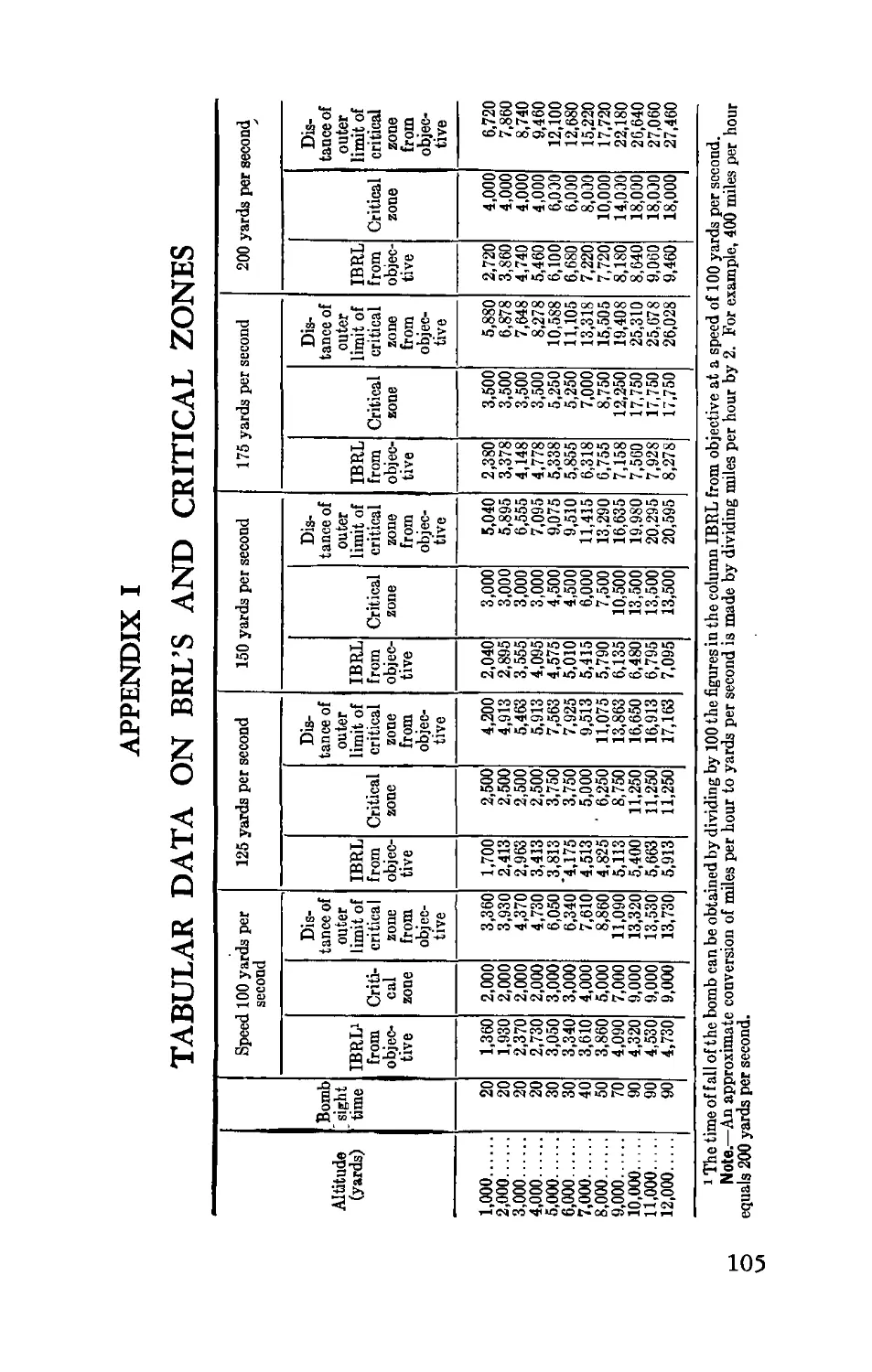
Refer to FM 21-6 for explanation of distribution
formula.
ii
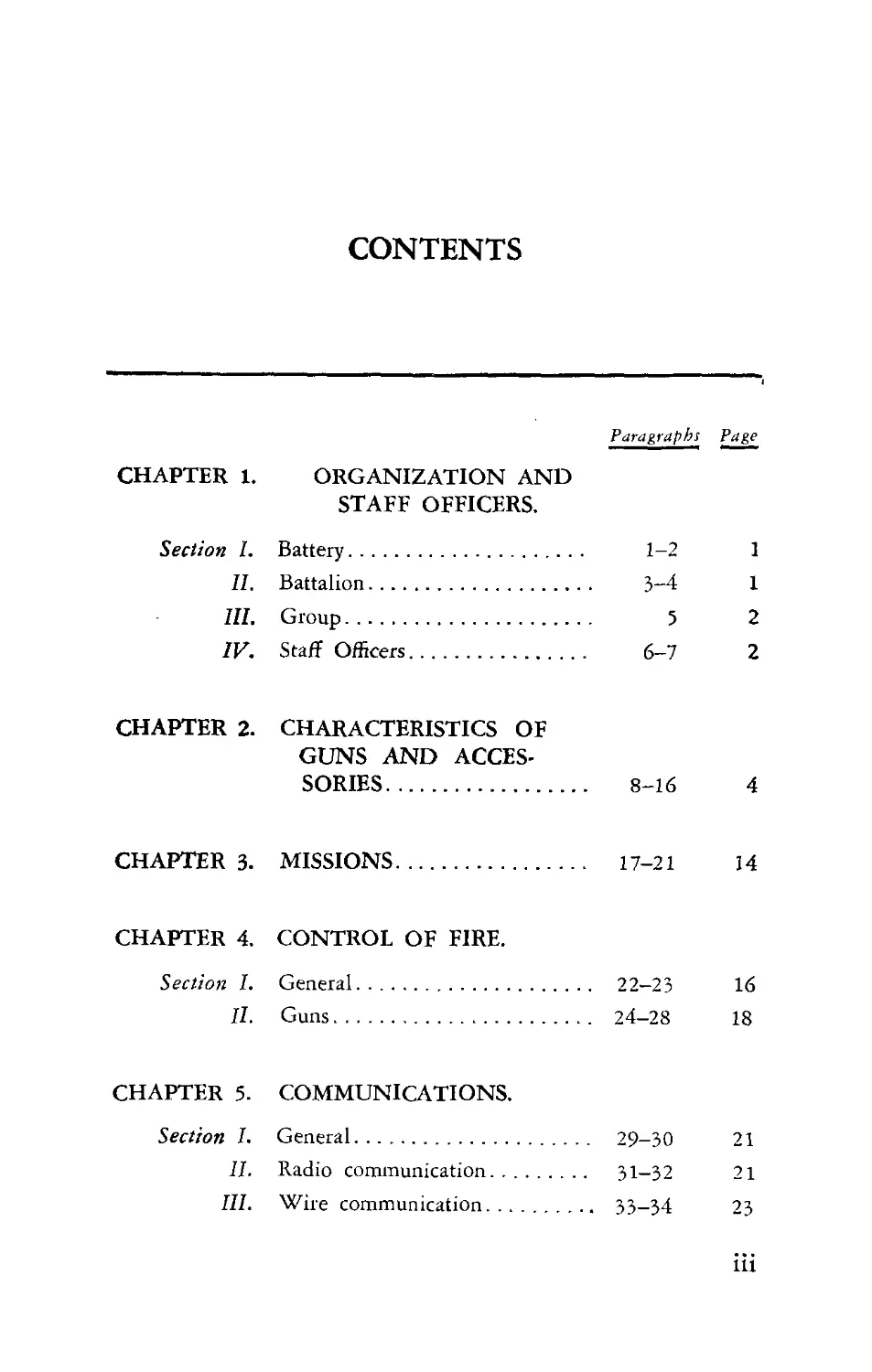
CONTENTS
Paragraphs Page
CHAPTER 1.	ORGANIZATION AND
STAFF OFFICERS.
Section I. Battery..........................
II.	Battalion.......................
III.	Group............................
IV.	Staff Officers..................
1—2	1
3-4	1
5	2
6—7	2
CHAPTER 2.	CHARACTERISTICS OF
GUNS AND ACCES-
SORIES........................... 8-16	4
CHAPTER 3. MISSIONS...............
17-21	14
CHAPTER 4.	CONTROL OF FIRE.
Section I. General.............................. 22—23	16
II.	Guns.......................... 24-28	18
CHAPTER 5.	COMMUNICATIONS.
Section I. General.......................
II.	Radio communication..........
III.	Wire communication...........
29-30	21
31-32	21
33-34	23
iii
Paragraphs Page
CHAPTER 6.	EMPLOYMENT	OF	AAA
GUNS.
Section I.	General.................... 35-51	27
11.	Static employment.......... 52-62	55
111.	Mobile employment.......... 63-72	' 62
CHAPTER 7.	EMPLOYMENT	AGAINST
GROUND AND NAVAL
TARGETS.
Section 1.	General......................... 73—75	72
11.	Engagement of mechanized
targets....................... 76-77	73
111.	Employment as antitank artil-
lery............................. 78—82	76
IV.	Assault of fortifications.	83-85	80
V.	Employment aa field artillery. .	86-89	82
VI.	Employment as seacoast artillery	90-94	84
CHAPTER 8.	RECONNAISSANCE, SELEC-
TION, AND OCCUPA-
TION OF AA POSITIONS.
Section 1.	General.................... 95-100	86
II.	Reconnaissance by higher,	eche-
lons	 101	87
111.	Battalion reconnaissance.. 102-109	88
IV.	Gun battery reconnaissance	and
occupation of positions. 110-104	90
CHAPTER 9.	SECURITY AND PROTEC-
TION.
Section I.	Concealment.................... 115-120	96
II.	Cover...................... 121-125	97
III.	Local security............ 126-131	98
tv
Paragraphs Page
CHAPTER 10.	SUPPLY AND EVACUA-
TION.
Section I. Supply................ 132—139	101
II.	Evacuation.............. 140-142	103
APPENDIX I. TABULAR DATA ON BRL’S
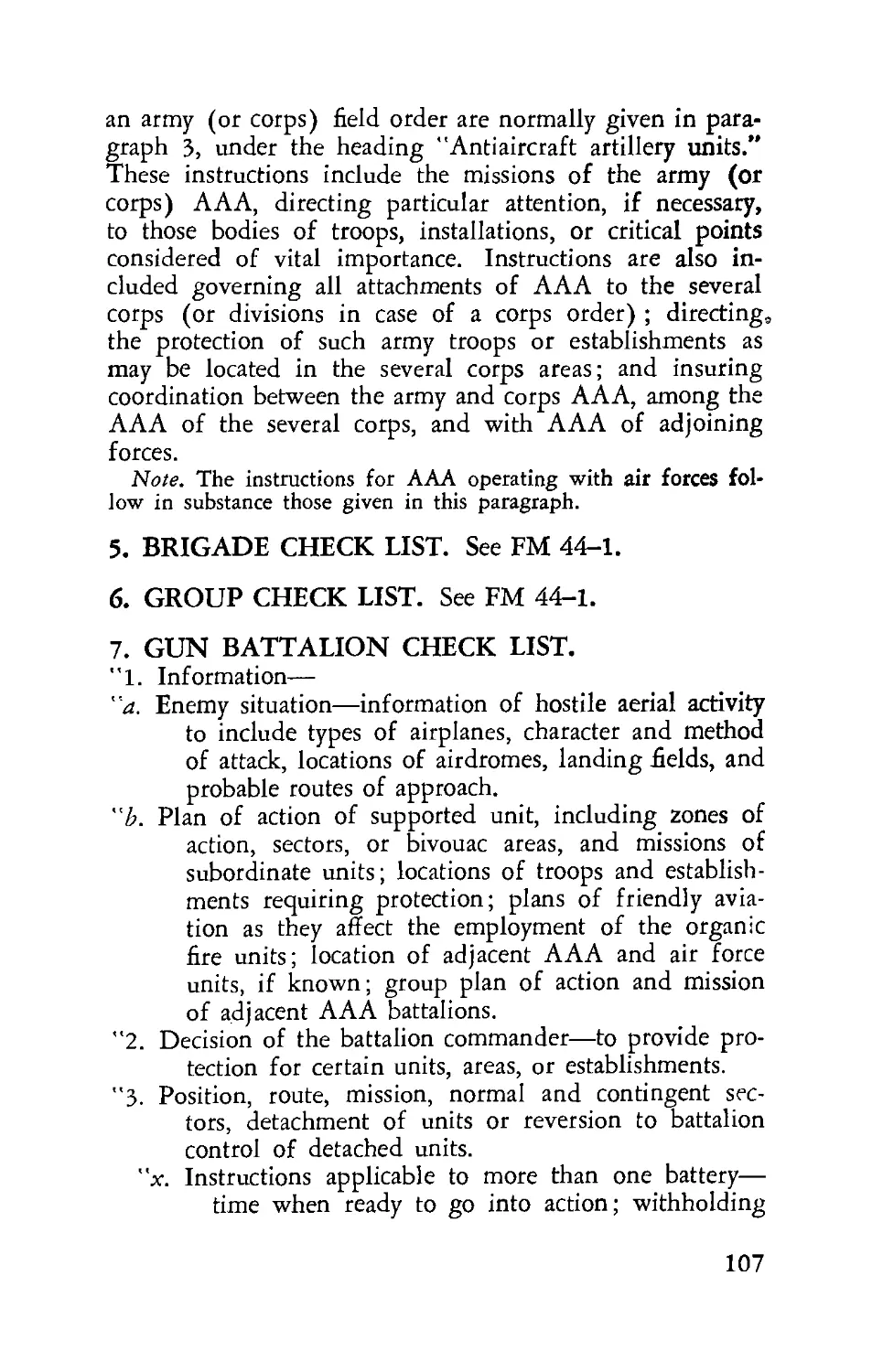
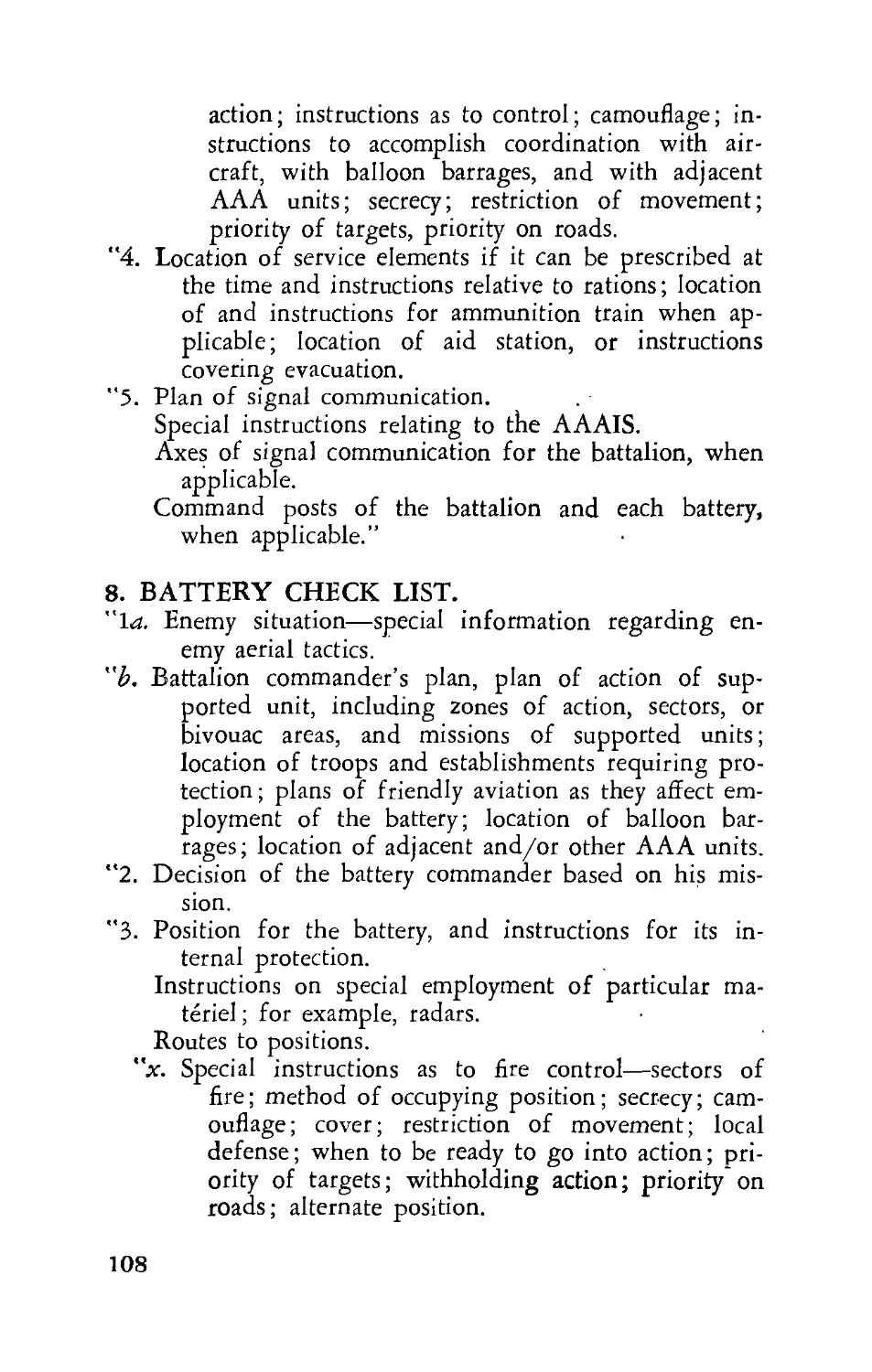
AND CRITICAL	ZONES.	105
П. ESTIMATES, PLANS, AND
ORDERS......................... 106
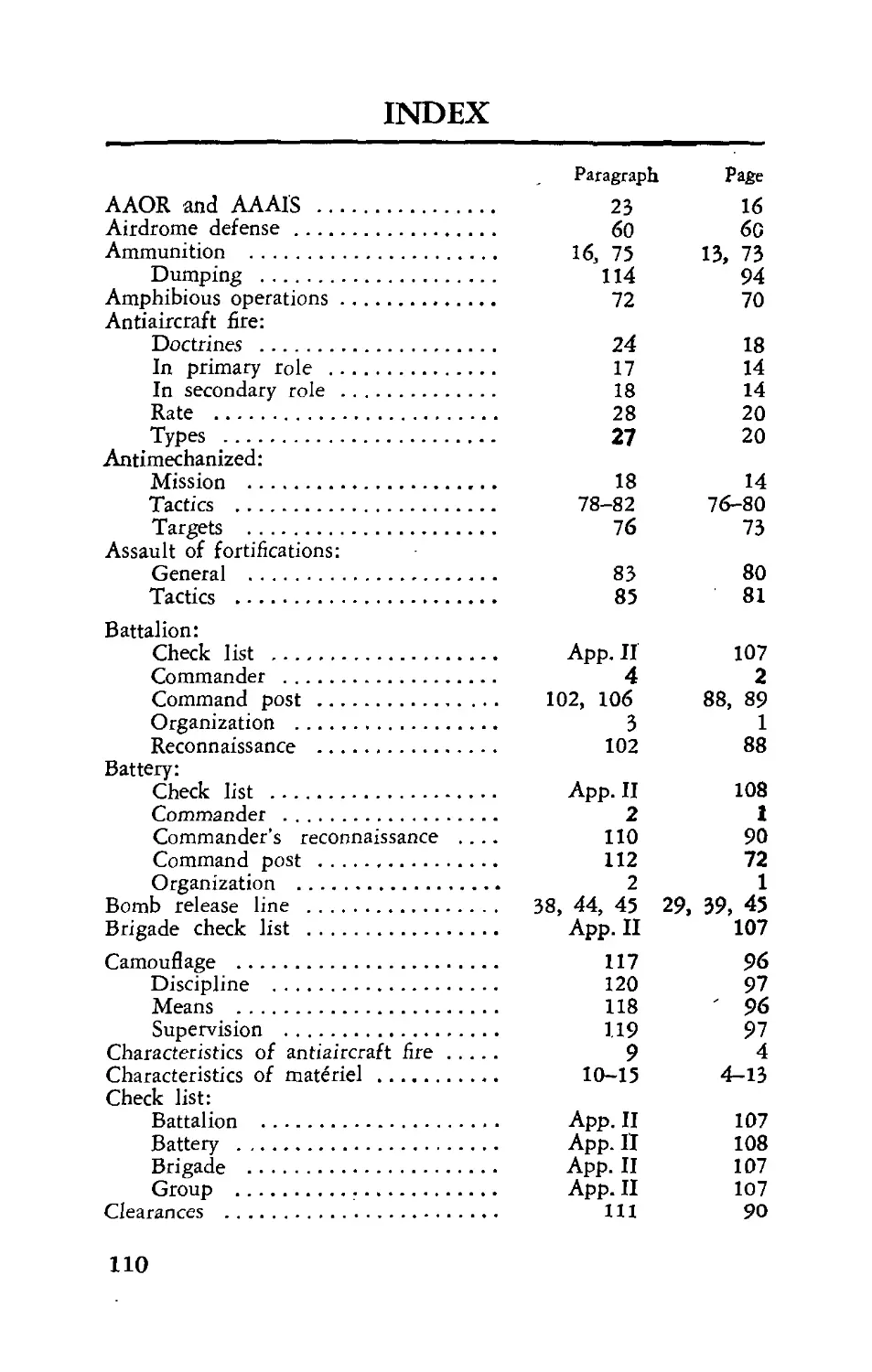
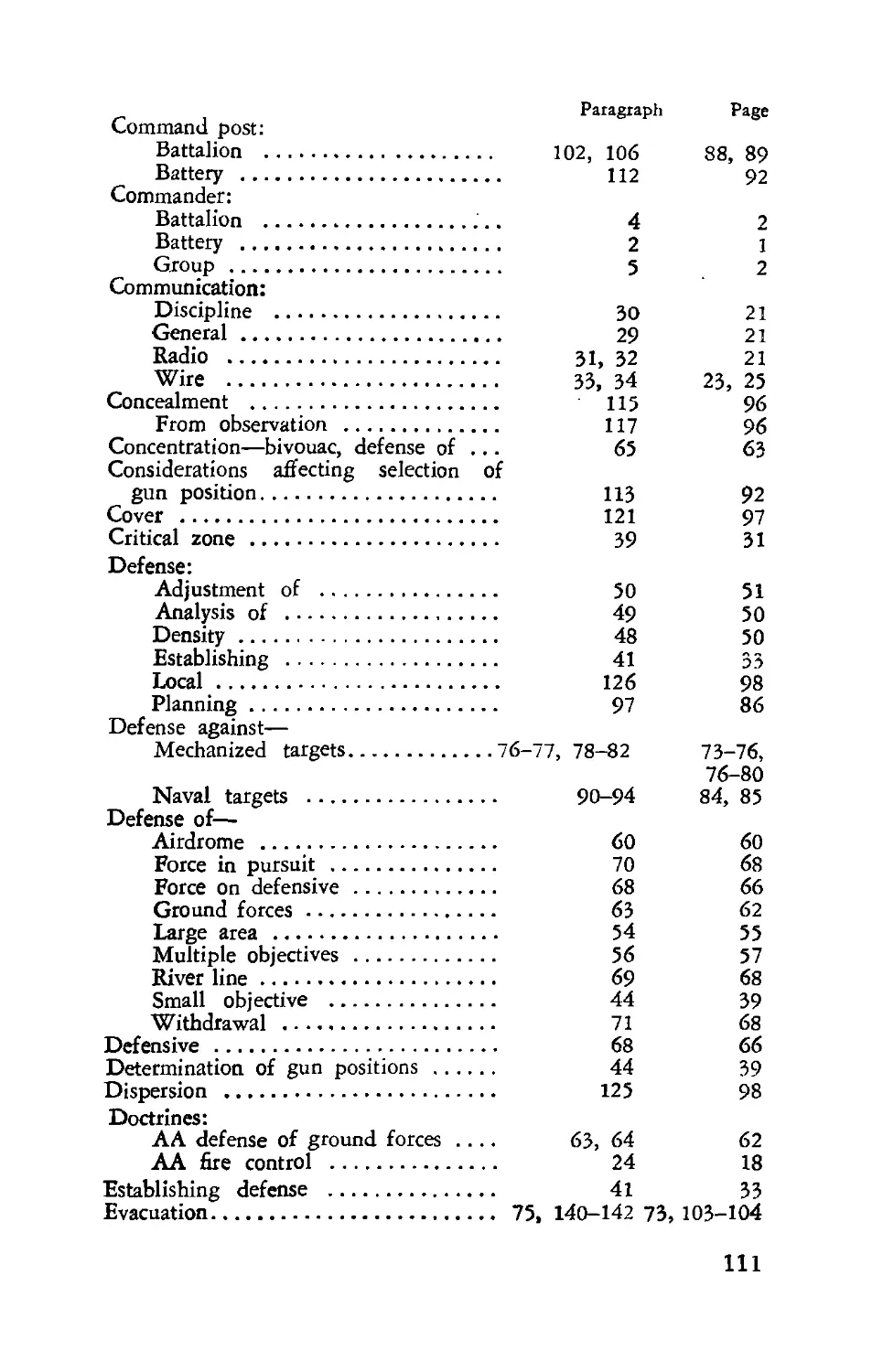
INDEX.......................................... 110
V
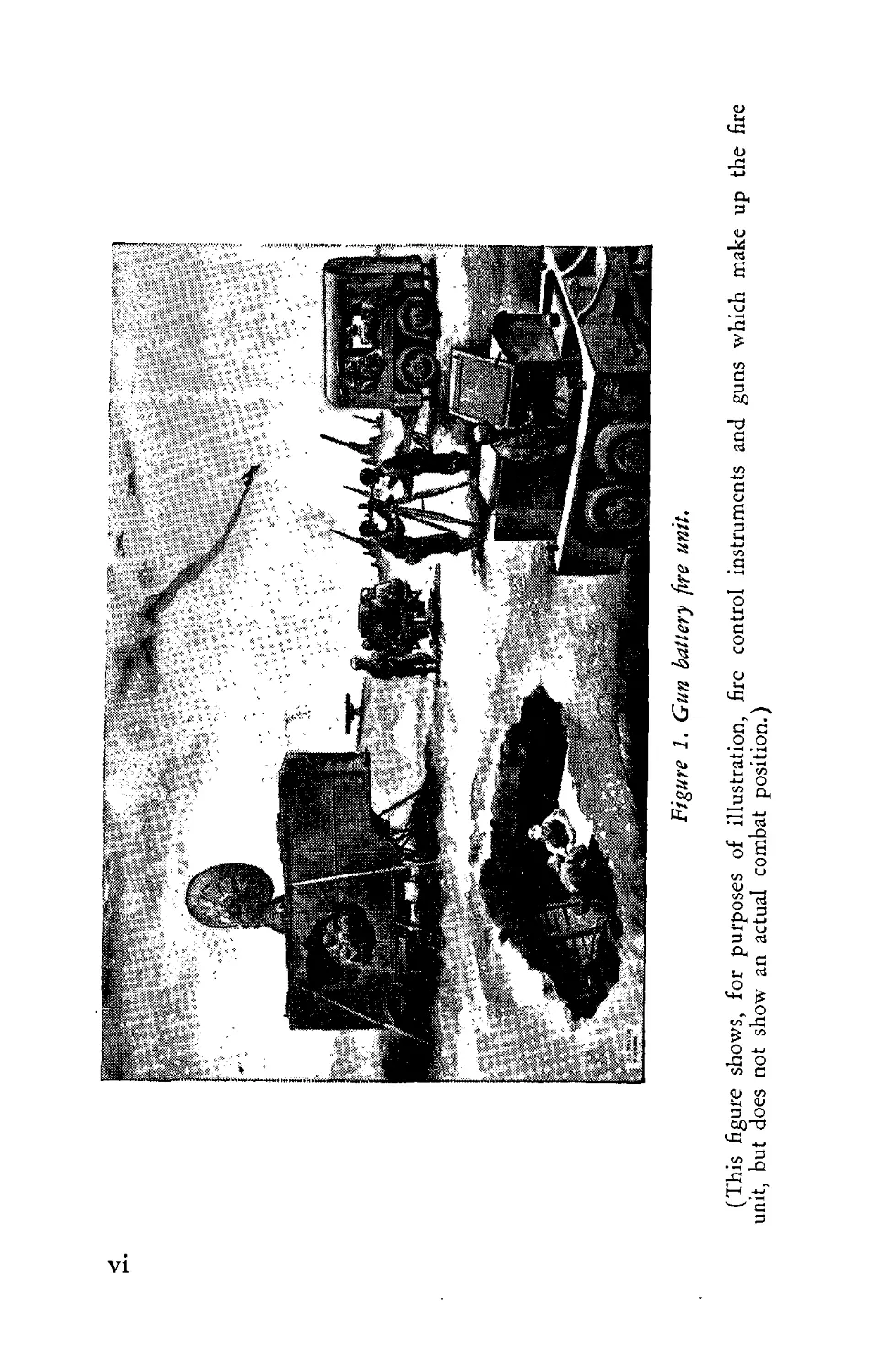
Figure 1. Gun battery fire unit.
(This figure shows, for purposes of illustration, fire control instruments and guns which make up the fire
unit, but does not show an actual combat position.)
RESTRICTED
This manual supersedes FM 4-104. 30 June 1943
CHAPTER 1
ORGANIZATION AND STAFF OFFICERS
Section I.	Battery
1.	FIRE UNIT. The fire unit of the gun battery consists
of four AAA guns (90-mm or 120-mm), four caliber .50
machine guns, the radar and fire control equipment, and
the necessary personnel. This fire unit must be relieved
from all details except firing. Additional elements are
included in the battery organization to enable the battery
to function as a unit.
2.	BATTERY, a. The gun battery consists of a battery
headquarters and a firing unit. Within the battery head-
quarters are the headquarters section, the maintenance sec-
tion, and the communication section. The firing unit con-
sists of a range-detector section, four gun sections, and a
machine-gun and executive officer’s section.
b.	The battery commander is responsible for the admin-
istration, training, and tactical employment of the battery.
He is assisted by a battery executive, a range officer, and
an assistant executive.
c.	The detailed organization for the mobile AAA gun
battery is contained in T/O & E 44-17 and that for the
semimobile battery in T/O & E 44-117.
Section II.	Battalion
3.	ORGANIZATION, a. The gun battalion consists of
a headquarters and headquarters battery, medical detach-
ment, and four gun batteries.
Note. For definition of military terms not contained in this
manual, see TM20-205 ; for list of training publications, see
FM21-6.
b.	The headquarters battery consists of a battery head-
quarters section, an administration and personnel section,
an operations and intelligence section, a communication
section, a supply section, a transportation section, and an
ammunition section.
c.	The organization of the mobile AAA gun battalion is
contained in T/O & E 44-15, and that of the semimobile
battalion in T/O & E 44-115.
d.	The essential difference between mobile and semi-
mobile organizations is the lesser number of motor vehicles
in the semimobile organizations, and the consequent fewer
personnel. Mobile organizations may be used in mobile or
static situations; semimobile only in static situations, unless
additional transportation is provided.
4.	BATTALION COMMANDER. The duties and re-
sponsibilities of the battalion commander are contained in
FM 44-1 (when published).
Section III.	Group
5. GROUP, a. General. The AAA group is a tactical
and administrative unit, flexible in its composition. It
normally consists of two or more battalions and a group
headquarters and headquarters battery. Any combination
of the various type AAA battalions may be organized as a
group. For detailed organization of the group headquar-
ters and headquarters battery, see T/O & E 44-12.
b. Group commander. The duties and responsibilities
of the group commander are contained in FM 44-1.
Section IV.	Staff Officers
6. GENERAL, a. The functions, duties, and responsi-
bilities of a commander are not only commanding, leading,
and directing, but also planning, controlling, and coord-
inating all agencies to carry out his will. Since in the larger
units it is physically impossible for one man to carry out all
of these functions, some of them must be delegated to
assistants (staff officers). The responsibilities of command
and leadership cannot be delegated.
2
b. The staff assists the commander by providing basic in-
formation and technical advice by which he arrives at his
decisions, by developing details of the commander’s plan,
translating the plan into orders, and transmitting the orders
to subordinate agencies, and by insuring the execution of
the orders by constructive inspection and observation for
the commander. Staff action must frequently be rapid, and
some of the steps may not be reduced to writing. Members
of a staff keep the commander informed on important mat-
ters pertaining to their functions. The staff anticipates
future needs and drafts tentative plans to meet them. It
supplements the commander’s efforts to secure unity of
action throughout the command.
c. AAA battalion and higher commanders are provided
with unit staffs. Certain duties growing from their func-
tions are assigned to staff assistants.
7. DUTIES OF STAFF OFFICERS, a. General. See
the appropriate T/O for designation of staff officers for
AAA units.
b. The duties of staff officers are contained in FM 44-1
and FM 101-5.
3
CHAPTER 2
CHARACTERISTICS OF GUNS AND
ACCESSORIES
8.	GENERAL. The disposition of AAA guns is influ-
enced by the characteristics of the weapons and accessories.
9.	RANGES, a. The limit of possible fire at air targets
is not the maximum range of the guns but is fixed by the
time element of the fuze. The maximum horizontal range
at which a target can be engaged decreases with an increase
in the altitude of the target. The average maximum effec-
tive slant range of antiaircraft artillery guns for AA fire
is generally considered to be as follows: for the 90-mm
gun, 12,500 yards; and for the 120-mm gun, 16,000 yards.
b.	However, for the 90-mm gun, the maximum hori-
zontal range is 19,560 yards and the maximum vertical
range is 13,426 yards. For the 120-mm gun, the maximum
horizontal range, is 27,162 yards, the maximum vertical
range, 19,151 yards. Theoretically it would be possible,
by using fuzes and fire control equipment designed for the
purpose, to fire AA fire out to these maximum ranges, al-
though, dispersion would be great at extreme ranges.
c.	Time fire at terrestrial targets, with mechanical time-
fuzed shell, is limited to the ranges indicated in a above.
Percussion fire at terrestrial targets is limited only by the
maximum horizontal range of the guns (b above), but the
dispersion is great at extreme ranges.
10.	MOBILITY. Tactical mobility necessarily must con-
sist of many factors in addition to the physical movement
of the equipment from one site to another. AAA gun
equipment is heavy (10 tons, 90-mm Ml Al guns; 16 tons,
90-mm М2; 31 tons, 120-mm Ml; 10 tons, SCR-584; 16
tons, M4 tractor; 7 tons, M9 director and trailer). There-
fore, it is limited to movement over fairly good roads and
bridges, and solid terrain. While 90-mm AAA guns may
be positioned to fire with on-carriage sights in a few min-
utes, a much greater period of time will be necessary to
4
install, orient and synchronize the complete fire control
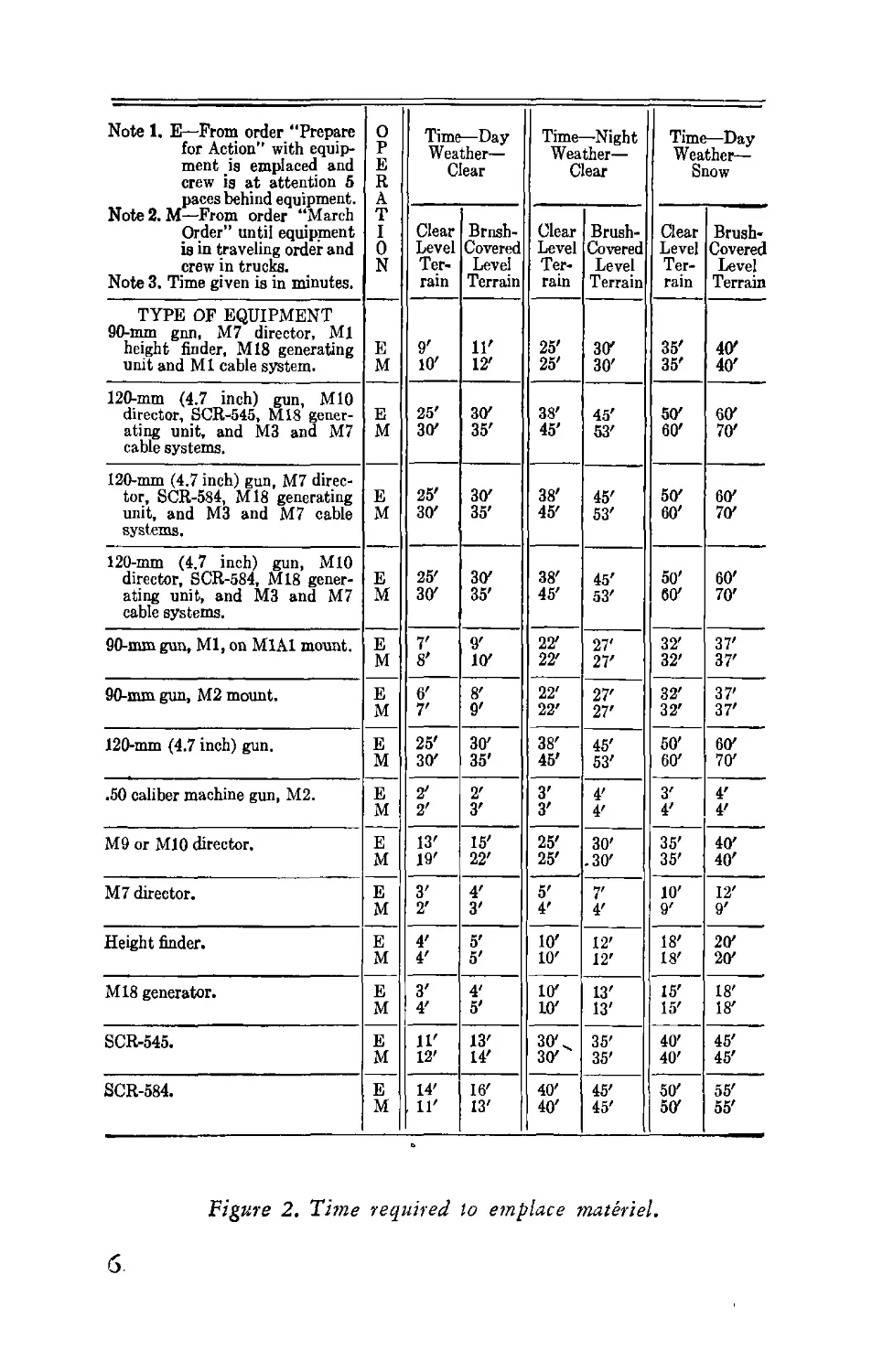
system for the unit concerned. The time elements shown
in figures 2 and 3 are based on clear weather and favorable
conditions. Detailed adjustments on fire control equipment
were not considered in the estimates. These figures may be
increased for unfavorable weather conditions, also for an-
noyance by enemy fire. Night work is approximately two-
thirds as effective as day work and such work should be
planned to take full advantage of moonlight hours.
11.	LIMITING RANGES, a. (1) Figure d shows the
limiting ranges of a 90-mm gun using a 30 fuze number
mechanical time fuze. This figure is constructed by plot-
ting on the 90-mm trajectory chart the cam limits of the
M7 director. Figure 5 shows the limits of the M9 director
using the 30 fuze number mechanical time fuze, and its
capabilities without regard to fuze or gun limitation.
Whereas individual directors function within varying limi-
tations, the limits graphically indicated show a composite
of the performance of many directors. These representa-
tions are merely vertical projections and show the limiting
ranges with the gun fired at any single azimuth. The line
labeled "Trajectory of 80° quadrant elevation” is the tra-
jectory produced by the gun when it is fired at its maxi-
mum practical elevation.
5
Note 1. E—From order “Prepare for Action” with equip- ment is emplaced and crew is at attention 5 paces behind equipment. Note 2. M—From order “March Order” until equipment is in traveling order and crew in trucks. Note 3. Time given is in minutes.	0 p E R A T I 0 N	Time—Day Weather— Clear		Time—Night Weather— Clear		Time—Day Weather— Snow
		Clear Level Ter- rain	Brnsh- Covered Level Terrain	Clear Level Ter- rain	Brush- Covered Level Terrain	Clear Level Ter- rain	Brush- Covered Level Terrain
TYPE OF EQUIPMENT 90-mm gnn, M7 director, Ml height finder, M18 generating unit and Ml cable system.	E M	9' 10'	11' 12'	25' 25'	30' 30'	35' 35'	iff 40'
120-mm (4.7 inch) gun, MIO director, SCR-545, M18 gener- ating unit, and М3 and M7 cable systems.	E M	25' ЗО7	ЗО7 35'	38' 45'	45' 53'	бО7 60'	60' 70'
120-mm (4.7 inch) gun, M7 direc- tor, SCR-584, M18 generating unit, and М3 and M7 cable systems.	E M	25' ЗО7	ЗО7 35'	38' 45'	45' 53'	5(Y 60'	6 O' 70'
120-mm (4.7 inch) gun, M10 director, SCR-584, M18 gener- ating unit, and М3 and M7 cable systems.	E M	25' 30'	ЗО7 35'	38' 45'	45' 53'	50' б O'	60' 70'
90-mm gun, Ml, on M1A1 mount.	E M	7' 8'	9' IO7	22' 22'	27' 27'	32' 32'	37' 37'
90-mm gun, М2 mount.	E M	6' 7'	8' 9'	22' 22'	27' 27'	32' 32'	37' 37'
120-mm (4.7 inch) gun.	E M	25' ЗО7	ЗО7 35'	38' 45'	45' 53'	50' 6 O'	6 O' 7 O'
.50 caliber machine gun, М2.	E M	2' 2'	2' 3'	3' 3'	4' 4'	3' 4'	4' 4'
M9 or MIO director.	E M	13' 19'	15' 22'	25' 25'	30' .30'	35' 35'	4 O' 40'
M7 director.	E M	3' 2'	4' 3'	5' 4'	7' 4'	10' 9'	12' 9'
Height finder.	E M	4' 4'	5' 5'	10' 10'	12' 12'	18' 18'	2(У 2(У
M18 generator.	E M	3' 4'	4' 5'	10' 10'	13' 13'	15' 15'	18' 18'
SCR-545.	E M	11' 12'	13' 14'	30\ ЗО7	35' 35'	40' 40'	45' 45'
SCR-584.	E M	14' 11'	16' 13'	40' 40'	45' 45'	50' 50'	55' 55'
Figure 2. Time required to emplace materiel.
6
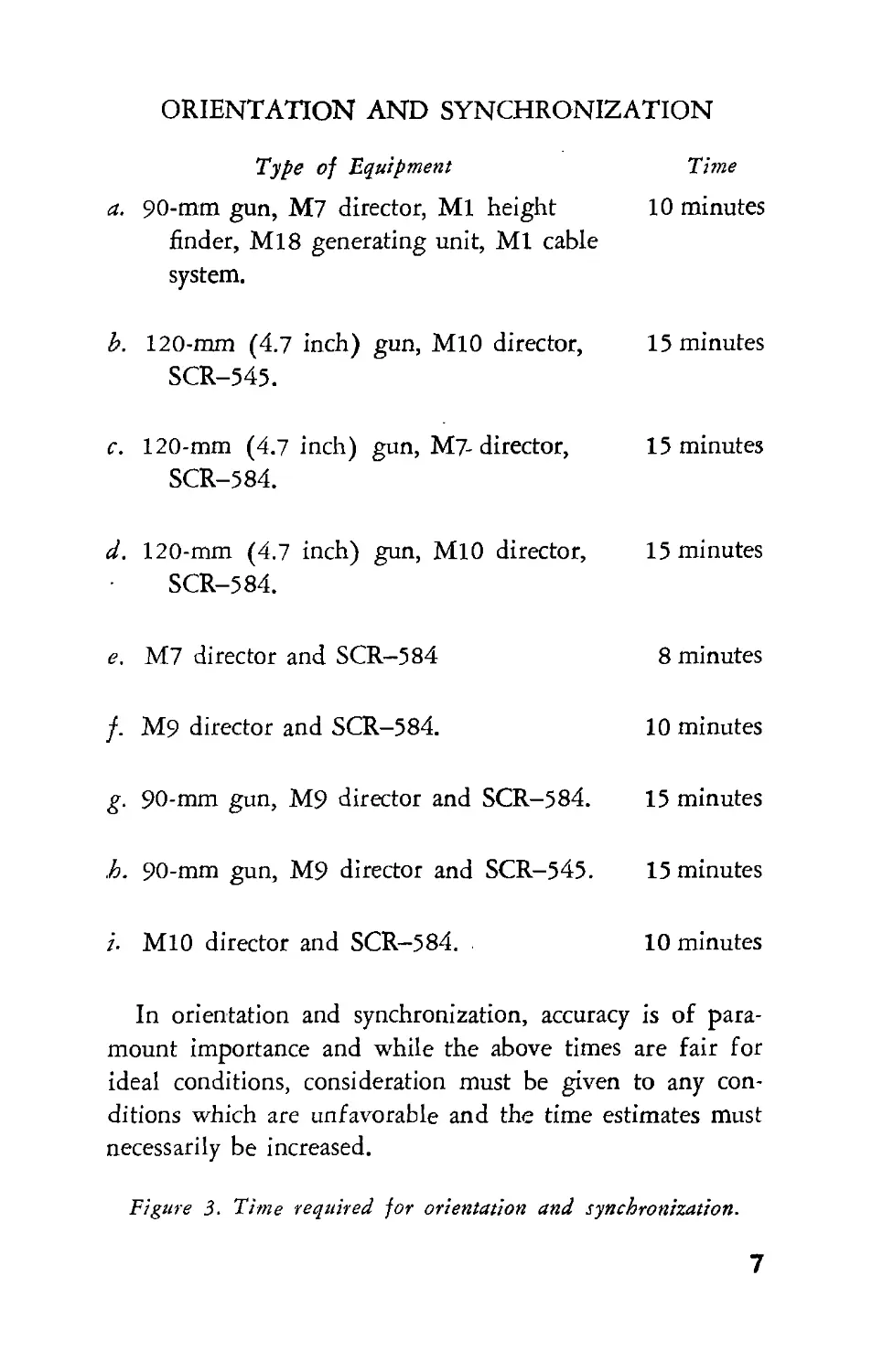
orientation and synchronization
Type of Equipment	Time
a.	90-mm gun, M7 director, Ml height 10 minutes
finder, M18 generating unit, Ml cable
system.
b.	120-mm (4.7 inch) gun, M10 director, 15 minutes
SCR-545.
a. 120-mm (4.7 inch) gun, M7-director, 15 minutes
SCR-584.
d.	120-mm (4.7 inch) gun, M10 director, 15 minutes
SCR-584.
e.	M7 director and SCR-584	8 minutes
f.	M9 director and SCR-584.	10 minutes
g.	90-mm gun, M9 director and SCR-584.	15 minutes
,b. 90-mm gun, M9 director and SCR-545.	15 minutes
i. M10 director and SCR-584.	10 minutes
In orientation and synchronization, accuracy is of para-
mount importance and while the above times are fair for
ideal conditions, consideration must be given to any con-
ditions which are unfavorable and the time estimates must
necessarily be increased.
Figure 3. Time required for orientation and synchronization.
7

		ж [ш	‘Ш	У////Л	я
	I									-CAM	UM»TS


1
I
												к


гроо 4.ооо 6.000 е.ооо ю,ооо 12,000
HORIZONTAL RANGE - YARDS
Figure 4. Limiting ranges for 90-mm gun (using the M7 director).
8
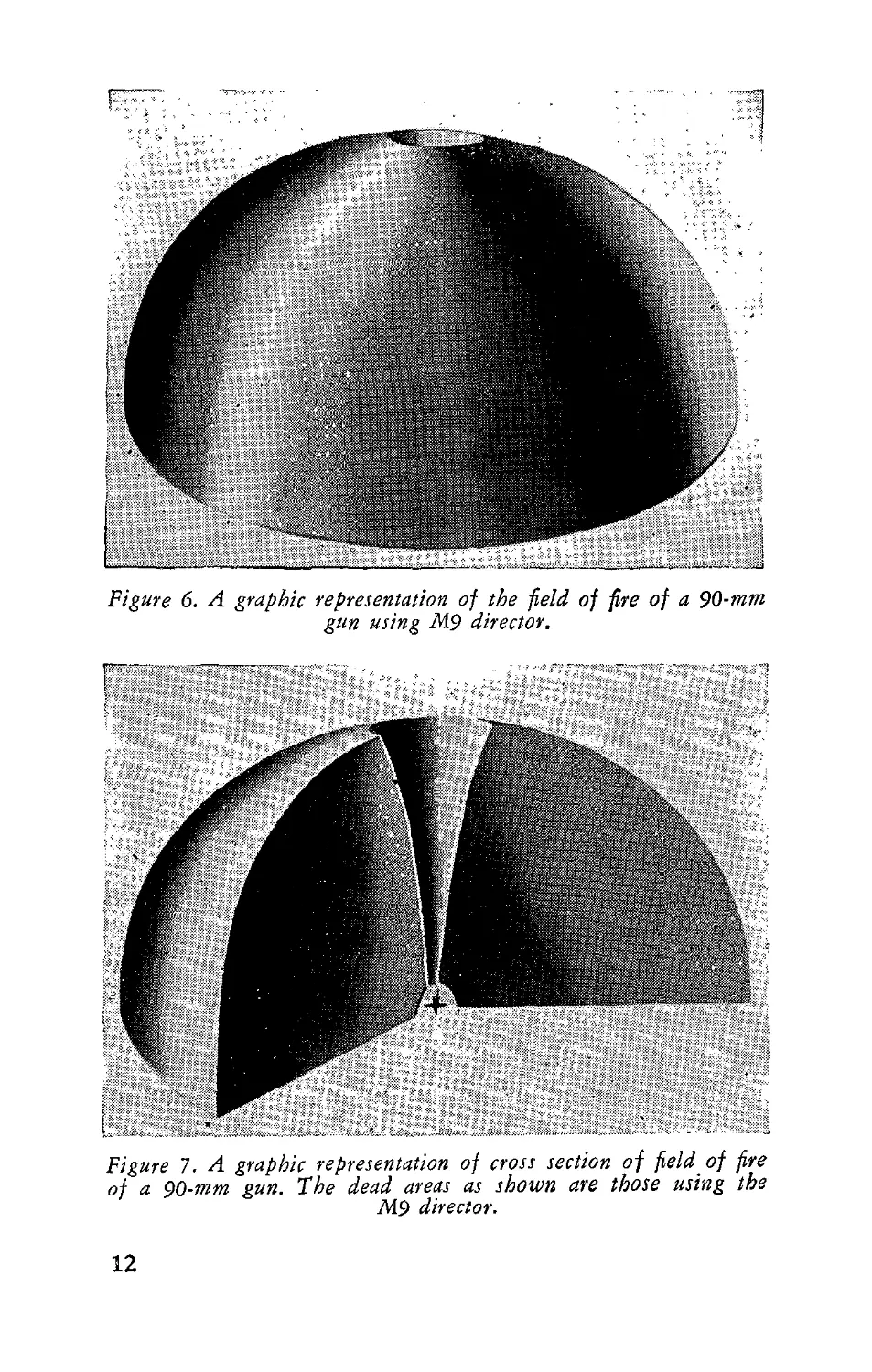
(2) A better conception of the entire field of fire of a
single 90-mm gun, using the M9 director, can be obtained
from a study of figure 6. This figure was obtained by ro-
tating that portion of figure 5 showing the fuze limitation
360° about the gun as a center.
(3) The outer limits of fire are clearly shown in figure
6. If a segment is removed from this figure by making
vertical cuts through the center of the model, it results in
figure 7. This figure shows the exact shape of figure 6 and
gives both the inner and outer limits of fire. This figure is
put to further use in developing a defense in chapter 6.
b. In addition to the limitations imposed by materiel and
ammunition, weather conditions, time of day, and degree
of visibility will limit effective fire when visual tracking of
fire control instruments is employed instead of radar data.
Under certain conditions, due to equipment failure, jam-
ming, ground clutter, or storm cloud formations, the oper-
ational efficiency of the gun laying radar may be reduced
to such a degree as to require visual tracking. In this event,
ground observation would be hampered by cloud banks,
fog, rain, or heavy mists in or above which enemy aircraft
may be flying.
c. The ceiling of some bombers carrying a full military
load may be as high as 40,000 feet. However, the majority
of aircraft in service today do not attain such altitudes. In
addition, bombing accuracy diminishes as the altitude of
attack increases, and atmospheric conditions will often limit
the altitude at which a successful attack can be made. The
use of radar bomb sighting largely offsets the limitations
of atmospheric conditions. An appreciable percentage of
bombing attacks can be expected to be made within range
of AAA guns, particularly 120-mm guns.
12. RADARS. The radar authorized for issue to each gun
battalion headquarters battery and to each gun battery is
either the SCR-584, SCR-784, or the SCR-545. They are
mobile, short and medium range radar units, designed pri-
marily for use with an antiaircraft artillery battery to
supply present position data to the M7, M9, or M10 direc-
tors, and for medium range searching to provide advance
9
ALTITUDE-YARDS
Figure 5. Limiting ranges for the 90-mm gun. The capabilities of
the M9 director are indicated. The depression below horizontal is
the depression stop limit of the director.
10
warning of the approach of enemy aircraft. For surveil-
lance purposes, the SCR-584 and SCR-784 have a slant
range of approximately 70,000 yards, and the SCR-545 a
slant range of approximately 100,000 yards. These sets are
designed to automatically follow moving targets within
range and to simultaneously supply present position data
to the gun director. A good operating position for the
radar is the primary consideration in the choice of the gun
battery position since the accuracy of the data produced is
dependent upon good siting.
13. FIRE-CONTROL SYSTEM, a. General. All AAA
gun batteries are provided with equipment for predicting
a future position of the target on a basis of its present per-
formance and determining firing data for the guns. This
fire-control system is the normal source of firing data for
the battery.
b.	Types. There are various types of directors, radars,
and other fire-control equipment. The fire-control equip-
ment available to a fire unit may be combined in various
ways and employed for either seen or unseen fire. The
radar is the primary source of present position data and is
used to supply all elements of data to the director. If con-
ditions of visibility are good and visual tracking is em-
ployed at the director or tracking head, the radar is used
to furnish range or altitude data only. The height finder
may also be used to obtain ranges or altitudes, if radar data
cannot be obtained for any reason.
c.	Direct-fire sights. AAA guns, except 120-mm, are
provided with direct-fire sighting equipment for the close-
in engagement of mechanized and other ground or naval
targets. (See FM 44-10 and 44-21, when published.)
3. Emergency fire control. A system of emergency fire
control is used if the normal methods in b above are not
possible. A standard emergency system is described in
FM 44-21. It employs plotting boards and obtains present
position data from any source available, such as adjacent
batteries or the AAOR.
14.	VOLUME OF FIRE. In order to obtain the volume
of AA fire necessary for prompt effect, the gun battery is
11
Figure 6. A graphic representation of the field of fire of a 90-mm
gun using M9 director.
Figure 7. A graphic representation of cross section of field of fire
of a 90-mm gun. The dead areas as shown are those using the
M9 director.
12
employed as the fire unit. The necessary concentration of
fire is obtained by a coordinated use of the proper number
of fire units.
15.	MACHINE GUNS. The caliber .50 machine gun is
standard local defense equipment for AAA gun units. It
has a maximum ground impact range of about 7,500 yards.
Its effective range is 600 yards and is dependent upon the
gunner’s depth perception. Present tracer ammunition has
a burn-out range of about 1,850 or 2,450 yards depending
on the type of ammunition.
16.	AMMUNITION, a. Classes. The principal classes of
service ammunition for AAA guns are high-explosive
(HE), armor-piercing (AP), and armor-piercing-capped
(APC). They are loaded with two types of propelling
charges:
(1) FNH (flashless, nonhygroscopic) powder, which
contains ingredients that greatly reduce muzzle flash. How-
ever, it produces a considerable amount of smoke.
(2) NH (nonhygroscopic) powder, which produces less
smoke than FNH powder, but which does produce a con-
siderable amount of muzzle flash.
b. Uses. For other than AA fire the various classes of
service ammunition are suitable for the purposes indicated
below:
(1) High explosive ammunition. HE shell is ordinarily
used against unarmored and lightly armored vehicles or
naval vessels, troop concentrations, and ground installa-
tions. HE shell is fuzed with either time or point detonat-
ing (superquick, or delay) fuzes.
(2) Armor-piercing ammunition. AP shot and APC
projectiles may be used for fire on all types of armored
mechanized targets, or fortified positions, or armored naval
vessels.
13
CHAPTER 3
MISSIONS
17.	PRIMARY ROLE. The primary role of AAA is to
provide local protection for field forces and important
ground establishments by attacking all forms of enemy air
attack and activities both by day and by night.
18.	SECONDARY ROLE. The secondary role of AAA
is to attack hostile ground and naval targets.
19.	SPECIFIC PRIMARY ROLE. The specific primary
role of AAA guns is to attack all enemy aircraft within
range, particularly high-flying aircraft, to destroy them, to
cause them to abandon their missions, or to decrease the
efficiency of their operations.
20.	SPECIFIC SECONDARY ROLE. The specific sec-
ondary role of AAA guns is to attack and destroy enemy
mechanized targets within range, particularly medium and
heavy tanks and armored cars; or to carry out general sup-
port missions as reinforcing field artillery, antitank artil-
lery, or seacoast artillery. AAA guns may also be used to
mark front lines or bomb safety lines by means of marker
bursts.
21.	PRIMARY VERSUS SECONDARY ROLE. a. Al-
though AAA guns are not primarily designed for fire
against ground or naval targets, AAA gun units may be
diverted from their primary role and employed in their
secondary role. It is not normal, however, for field com-
manders to divert gun units from their primary AA role as
long as there is a threat of enemy air action.
b.	The appropriate division or higher commander must
decide in each case when AAA guns will be diverted from
their primary roles and employed in a secondary role.
When this is done, AAA guns cannot be expected to pro-
vide protection from air attack.
14
c.	AAA, when employed in the AA role, is habitually
sited so as to assist, if possible, in the attack of ground and
naval targets. In this case, the engagement of ground and
naval targets is undertaken only when such engagement
will not interfere with the primary mission, or when
ground defense of the AAA unit becomes imperative.
15
CHAPTER 4
CONTROL OF FIRE
Section I. General
22.	DEFINITIONS OF TERMS, a. Fire control. The
exercise of the conduct of fire and of fire direction at the
fire unit. The fire unit commander directs the technical
means by tactical command to control the fire of his unit.
b.	Conduct of fire. The employment of the technical
means to place accurate fire on the target.
c.	Fire direction. The exercise of tactical command
over one or more fire units in the selection of targets, in
the appropriately timed concentration or distribution of fire
thereon, and in the restriction or release of fire. Fire direc-
tion may be exercised by the fire unit or higher com-
mander.
23.	FIRE DIRECTION, a. General. (1) Fire direction
normally is exercised by the fire unit commander. This
responsibility may be delimited and defined by command-
ers higher than the fire unit commander.
(2)	Because of the great speed and maneuverability of
aircraft, the degree of fire direction that can be exercised
by higher command depends to a large extent upon the
efficiency of the warning service. The extent of the intelli-
gence net is, in turn, related to the size and permanency of
the defense.
(3)	In rapidly moving situations, or where one group
defends an isolated objective for only a short time, it is
not expected that the warning service will be elaborate.
On the other hand, where one or more groups or brigades
are emplaced in the defense of vital permanent establish-
ments, a high degree of efficiency is expected.
(4)	It is necessary to discuss the problem of fire direc-
tion for at least these two extreme conditions. In other
situations, which fall somewhere between the extremes, the
system of fire direction which best meets the needs of the
moment will be chosen.
16
b.	Direction by fire units. In a rapidly moving situa-
tion fire direction is exercised by the fire unit commander,
except when higher commanders have exercised some fire
direction by the issuance of prior general instructions or
SOP, which should be simple and incapable of miscon-
struction.
c.	Direction by higher echelons. (1) In a stabilized
and highly organized defense, and in some moving situa-
tions, a greater degree of fire direction can be exercised by
higher echelons and coordinated under a centralized agency,
normally the AAOR.
(2)	This fire direction by higher echelon is exercised to
supplement and assist the fire unit commander in the per-
formance of fire direction where it appears necessary in
order to exert the maximum strength of the whole defense.
This can be done prior to and during the attack.
(3)	Centralization of fire direction during combat re-
quires an efficient warning system and reliable communica-
tion net. (See FM 44-8.) In all but the most rapidly
moving situations aircraft warning service, which is op-
erated by air forces, should be available to AAA. Informa-
tion regarding its operation and establishment, and instruc-
tions for its coordination with the AAAIS, should be
incorporated in the defense plan.
(4)	In centralized fire direction, the size, location, and
course of an attack is plotted as the aircraft approach the
vicinity of the defended area. The AA operations officer
issues such orders as are necessary for the employment of
the guns of the defense to best advantage.
d.	Restrictions on fire. Restrictions on AAA gun fire
are necessary in order that friendly aircraft, and in some
instances friendly troops and ground installations, are not
unnecessarily endangered.
(1)	Theater commanders are responsible for establish-
ing uniform procedures for restrictions of AAA fire to
prevent undue danger to friendly aircraft within their
commands.
(2)	Commanders of all AAA echelons are responsible
that the fire of their units does not unnecessarily endanger
friendly troops and ground installations.
17
(3)	The AAA fire unit commander in immediate com-
mand is responsible for opening and closing fire, unless
fire is restricted by higher authority. He is the individual
responsible for determining when friendly aviation is un-
necessarily endangered by the fire of his unit, unless action
is restricted by higher authority.
(4)	The normal firing status of AAA guns will be that
of "Release to open fire under instructions contained in
local SOP,” until specifically restricted.
(5)	Restrictions will be imposed on the minimum num-
ber of AAA units consistent with the accomplishment of
the desired aim. This restriction will be imposed for a
specific purpose and for a definite period of time.
(6)	See FM 44—1 for further details.
e.	AAAIS. (1) The AAA commander is responsible
for the operation and installation of the AAAIS.
(2) For functioning of AAAIS, see FM 44-8.
f.	AAOR. An AAOR (AA operations room) is set up
and operated in each AAA defended area by the highest
AAA headquarters in the area. The magnitude of the
AAOR and the extent of the set-up varies according to the
size and the permanency of the defense. In situations
where the defense installation is large, an AAA operations
detachment may be provided to operate the AAOR. When
an AAA operations detachment is not attached, the same
principles apply but operating personnel are drawn from
the units of the AAA defense.
(1)	Command. The AAOR is under the command of
the AAA defense commander.
(2)	Functions, (d) To collect, evaluate, and dissem-
inate intelligence.
(Z-) To exercise fire direction when and as necessary.
(c) To perform certain necessary routine functions.
(3)	For details of operation and personnel, see FM
44-8.
Section II. Guns
24.	FIRE CONTROL DOCTRINE. Considering the
capabilities of the AAA guns and the characteristics of
aircraft, certain fundamental doctrines can be deduced.
18
a.	Targets within range must be brought under fire with
the greatest possible speed, unless fire is restricted by
higher authority.
b.	Every effort should be made to secure hits with the
opening rounds.
c.	The maximum volume of fire should be employed.
25.	TARGET PRIORITIES. Target priorities in normal
and contingent sectors (par. 47) normally will be dictated
by higher command or SOP. Within these limitations, the
fire unit commander makes the actual selection of targets.
He is guided when designating targets by the following
principles:
a.	When two or more targets enter the field of fire of
a fire unit, fire is opened on that target which offers the
most dangerous threat to' the mission of the AAA defense.
b.	When two or more targets offer equally dangerous
threats, that target which is not under the fire of other
AAA fire units is engaged first.
c.	Paragraph 23d.
d.	Correlating a to c above, the greatest possible num-
ber of targets are taken under fire by an AAA defense.
e.	Basically the fire fight is the fire unit commander’s
action. Except for previous indoctrination by SOP and
specific restriction or direction by the AAOR, the fire unit
commander controls and directs the fire fight. After the
fire fight is engaged the action is so fast that fire direction
is localized in the fire unit commander. It is therefore the
battery commander’s responsibility to engage effectively.
His decision is based upon previous indoctrination and
upon the current information of the location of enemy
flights supplied and maintained up-to-date by the AAOR.
26.	BATTERY COMMAND POST. The battery com-
mand post is equipped with all the instruments and equip-
ment necessary to conduct, control, or direct fire by any of
the methods used. This equipment includes the necessary
plotting board, tables, scales, the remote data indicators of
the radar, and the communications equipment (radio and
19
telephone) for reception of AAOR and AAAIS informa-
tion as well as for control of the battery.
27.	TYPES OF FIRE. a. AAA gun fire units may engage
enemy air targets with one of the following types of fire
for effect, depending upon the necessity for the particular
type and the tactics of the enemy air force.
(1)	Continuously pointed fire. This is the normal
method of AAA gun fire. Fire control instruments track
the target and transmit firing data continuously to the
guns. Fire is continuous and at maximum accurate rate.
(2)	Predicted concentrations. A method of fire by
which the future position of the target is predicted by pres-
ent position plots. A stipulated number of rounds are
fired at each predicted point. This is an emergency method
of fire control.
(3)	Barrage fire. A method of fire having for its pur-
pose the placing of a barrier or curtain of fire across the
probable course of the. enemy aircraft. Fire, based upon
predetermined firing data, is directed at preselected bar-
rage points for a stipulated number of rounds or period
of time. This is an emergency method of fire control.
b. The conduct of these types of fire may be by director
control using visual or radar data at seen targets, director
control using radar data at unseen targets, or barrage fire
at predetermined points in the sky. Emergency methods
are used in the event of equipment failure. Instructions on
these methods of conducting, fire are published in FM
44-10 and 44—21.
28.	RATE OF FIRE. The rate of fire to be delivered by
AAA guns must be the maximum accurate rate permitted
by the materiel.
20
CHAPTER 5
COMMUNICATIONS
Section I. General
29.	GENERAL. AAA communications comprise all the
means employed to transmit orders, intelligence, and com-
mands between AAA gun units and for liaison with units
of the other arms and services. The basic means of com-
munication available to all types of AAA gun organiza-
tions are wire (telephone), radio, and messenger. Wire
is the primary and most dependable means of communica-
tion, and every effort is made to utilize it to the fullest
extent. The tactical situation dictates the method and the
utilization of the means or combinations of means that
accomplish the desired result. In static employment, the
communication system is as elaborate as time and material
permit. In mobile employment, the minimum requirements
for efficient accomplishment of the mission govern the ex-
tent of the system. Radio is an auxiliary means of com-
munications. Full use of its capabilities is made in the
initial stages of an operation, in rapidly moving situations,
and in the event of wire failure or inadequacy.
30.	COMMUNICATION DISCIPLINE AND PRO-
CEDURE. See FM 11-5, 24-5, 24-6, 24-10, 24-18, and
44-1.
Section II. Radio Communication
31.	GENERAL. Of the various types of radio sets now
authorized for issue to AAA gun units, some are intended
for command purposes and others are intended to be used
for intelligence purposes (AAAIS). In cases of emergency
these sets may be interchanged. No provision is made for
administrative radio nets. Administrative messages are
transmitted by telephone or messenger.
32.	UNIT RADIO SYSTEM, a. AAA brigade (see fig.
8 and FM 44-1).
21
К)
N)
SL
GUN
BN
AAAIS NET FREQUENCY rS
COMMON TO ALL AAA UNITS IN
AREA
WHEN AN AAA OPN DET IS PRESENT
IN A DEFENSE,TWO BCR-177'»
AUTHORIZED FOR THE OPN OET, ARE
USED TO REPLACE OR SUPPLEMENT
THE GP OR GRIG RADIOS IN THE
COMMAND AND AAAlS NETS, OR FOR
COMMUNICATIONS WITH AlR FORCE
OPERATIONS
ROOMS
BRIGADE
GROUP
AAAOD
2
RADIO EQUIPMENT
BRIGADE COMMAND NET
543(SPARt)
HIGHER HO NET
Figure 8. Brigade and group command and AAAIS radio nets.
LEGEND
— COMMAND NET
—AAAIS NSt
20
29
2B
GATE
OCT
MAY
FEB
1944
1944
1944
b.	AAA group (see fig. 8 and FM 44—1).
c.	AAA gun battalion (see fig. 9). (1) Use of radio
set SCR-177. The SCR-177 is used in the command net
from the next higher headquarters.
(2)	Use ,of radio set SCR-543. The battalion head-
quarters battery has two of these sets. One of the SCR-
543 sets in battalion headquarters is used for a command
net with the component batteries of the battalion. The
other SCR-543 set is used in the AAAIS net for warning
purposes to the elements of the battalion. Each of the four
batteries has one SCR-543 set for use in the battalion
command net.
(3)	Use of radio set SCR—593. This receiver is used
at each of the four gun battery command posts for receipt
of warning messages transmitted by any element of the
AAAIS net.
d.	AAAIS and AAOR. For detailed information on
the employment of radio communications, see FM 44-1
and 44-8.
Section III. Wire Communication
33. GENERAL, a. Equipment allotted. A minimum of
wire communication equipment is allotted to AAA units
by Tables of Equipment. These allowances provide only
enough equipment for lines between essential command
posts and, within the batteries, for interior lines necessary
for fire control of the various elements. Additional equip-
ment may be drawn when needed from Signal Corps sup-
ply depots as authorized by competent authority.
b. Mobile situations. When AAA is in a mobile role
involving frequent changes of position, radio communica-
tion is used initially. The laying of wire consistent with
existing conditions is accomplished as expeditiously as
possible.
c. Static situations. In static situations the wire com-
munication system is as complete and extensive as time and
material permit. An elaborate communication net is re-
quired for the intelligence service as well as for adminis-
tration, conduct of fire, and local security. The amount
23
bJ
4X
RADIO EQUIPMENT	_
|77	643	593 T/E DATE	Q p? HIGHER hQ NET B
ДГ4 HO	< г	44-16 17 NOV 44
BATTERY	’A*		'	44-17	17	NOV	44
BATTERY	*B‘	I	।
BATTERY	*Ce	•	’
BAT TERv	'D*	»	*
1	6	4
Figure 9, Gun battalion command and AAAIS radio nets.
of field wire laid and maintained must be reduced by the
maximum possible use of existing commercial facilities.
d. Field artillery role. When acting as field artillery,
the AAA battalion is normally connected by wire with the
field artillery fire direction center (FDC) ; the AAA bat-
teries are connected with the AAA battalion fire direction
center. If the AAA battery is acting independently, it is
connected directly with the field artillery fire direction cen-
ter. The field artillery is responsible for establishing wire
communication to the AAA unit. If radio communication
is used, the AAA unit sends a radio set and operators to
the field artillery unit.
34. UNIT WIRE COMMUNICATIONS. Within each
unit, lines are normally laid from the command post to
the command posts of subordinate elements and to the
service elements of the unit. In addition, the lines neces-
sary for fire control and local security are established within
each unit. No attempt is made here to set up standard wire
communication nets that take care of all eventualities. Each
situation must be individually treated. The SOP in each
unit should include the number of communication lines to
be laid and their priority in various situations. The higher
echelon is responsible for installing wire lines to the lower.
25
N)
«54
AAA BRIGADE
FIRE UNITS	DETECTOR SECTIONS	SEARCHLIGHT SECTIONS
Figure 10. Wire nets used in AAA for command purposes.
CHAPTER 6
EMPLOYMENT OF AAA GUNS
Section I. General
35.	TYPES OF EMPLOYMENT. Employment of AAA
guns may be divided into static and mobile. The princi-
ples of employment are essentially the'same in each case.
a.	Static employment. The term static employment is
used to denote the AAA defense of permanent or semi-
permanent objectives. Such objectives may be located in
the combat zone, communications’ zone, or zone of the
interior.
b.	Mobile employment. The term mobile employment
is applied to the AAA defense of ground combat forces,
such as armies, corps, and divisions, in'a moving situation.
Although mobile AAA gun units are suitable for static or
mobile employment, the semimobile units' are suitable only
for static employment, unless additional' transportation is
provided.	...
36.	SIZE OF’OBJECTIVE, a. The size of the area to be
defended affects the manner in which the defense is planned.
Against small or precision objectives an attacking bomber
generally must fly a rectilinear course during the bombing
run so that the bomb sight can be used to the best ad-
vantage.
b. As the size of the defended area increases, or as a
greater number of precision objectives are presented within
a general area, the necessity for careful bomb, sighting
diminishes. Under these conditions the attacking aircraft
can take action to avoid AAA fire by maneuvering and still
release their bombs on the area with good assurance that
some of the more important objectives will be hit. ;
c. AAA gun objectives may be classified as small objec-
tives, large areas, and multiple objectives.
(1)	A small objective is an objective less than 2,000
yards in diameter.
27
(2)	A large area is an objective greater than 2,000 yards
in diameter, all parts of which are of equal importance.
(3)	A multiple objective is an area greater than 2,000
yards in diameter, and containing a number of objectives.
37.	BASIS FOR TACTICAL EMPLOYMENT. Tactics
of AAA guns must be based upon the current characteristics
and tactics of enemy aviation, and full consideration of the
powers and limitations of weapons of the defense. The
continued development of military aircraft with increasing
speed, altitude, and radius of action will have an influence
upon the future employment of AAA guns. Certain fac-
tors, however, seem likely to remain unchanged, of which
the most important are as follows:
a.	Targets the enemy is most likely to select are those
most valuable to the defender, the destruction of which
would materially aid the attacker in accomplishing his aims
or reaching his objectives.
b.	Bombardment aircraft normally depend on reconnais-
sance aircraft for information of suitable targets, thus mak-
ing the defeat of hostile reconnaissance aircraft of the ut-
most importance in some situations. In other situations,
firing on reconnaissance aircraft will disclose to the enemy
the strength and disposition of the ground installations.
In general, target priorities will vary according to the par-
ticular situation.
c.	The short period of time required for aiming opera-
tions in all types of bombardment attack will restrict ma-
neuvering to some degree, if accurate results are to be
obtained. This restriction may include altitude, speed,
and direction of flight, or only, as in dive or glide bomb-
ing, the direction of flight.
d.	The effectiveness of an AAA gun defense may be
judged by its capacity to destroy enemy aircraft, to cause
them to abandon their mission, or to disturb the bomb
sighting operations. When employed in conjunction with
friendly fighter aircraft, the AAA guns may also be effec-
tive in breaking up enemy formations.
e.	An all-around defense must always be provided.
f.	The most economical distribution of the available
28
materiel is necessary, in order that the most important ele-
ments Or localities may be defended against air attack.
g.	Defense is provided for critical areas or installations
according to importance as indicated in a priority list es-
tablished by higher headquarters.
h.	Normally, at least one battalion should be used in the
defense of a single objective.
38.	BOMB RELEASE LINE. a. The bomb release line
is an imaginary line around a defended area or objective
Over which a bomber traveling toward the area at a con-
stant speed and altitude, should release its bomb to have
it strike certain parts of the defended area. The location
of this line varies primarily with the speed and altitude
of the bomber.
(1)	The initial bomb release line (IBRL) is an imag-
inary line around an objective over which the attacking
bomber must release his bombs to hit the near edge of the
objective. (See fig. 11.)
(2)	The final bomb release line (FBRL) is that over
which a bomb released will strike the far edge of the ob-
jective. (See fig. 12.)
b. The location of the bomb- release line is determined
by two factors, the time of fall of the bomb and the speed
of the aircraft.
(1) The time of fall of a body in a vacuo, when it
starts with a zero vertical velocity, is given by the formula
where t is the time in seconds, H is the altitude of release
in feet, and g is the acceleration due to gravity, approxi-
mately 32.16 feet per second per second. This will give,
for altitudes of 10,000, 15,000, 25,000, and 30,000 feet,
times of fall of approximately 25.0, 30.5, 39.4, and 43.1
seconds, respectively. It should be remembered that air
resistance will have an effect upon these figures in actual
bombings but, since the speed and altitude of an attack
cannot be forecast accurately, they may be considered suffi-
ciently accurate for the use intended.
29

8,0<X> yds
2000yds
8,000 vds-
6,000 v<k.
4£j.C „
2,000 «|S
X H= 25,000 ft.
g Sq»300m₽h.
H*15,000 ft
IBRl H-25.00C «Г Sg-dCOmph
Figure 11. Influence of speed and altitude on initial bomb release line.
H= 15,000 ft.
H*l5po0ft.
Sfl~
200 mph.
Sg=300mph.
(2) The horizontal range from the point of release of
the bomb to the point of impact is approximately equal to
the time of fall of the bomb multiplied by the speed of the
aircraft. These values for different times of fall and speeds
of aircraft are given in appendix I. (An approximate rule
for determining the time of fall in seconds is to add the
whole number 15 to the altitude in thousands of feet.)
c. As the size of the objective increases, or as a number
of smaller objectives in the area to be defended are in-
creased, the necessity for careful and precise bomb sighting
operation decreases (par. 36). There is no sharp line of
division between a small objective and a large area, as one
merges gradually into the other. -It is not accurate to con-
sider that there are any definite bomb release lines in the
case of an area larger than 4,000 yards in diameter all parts
of which are approximately of equal importance, as the
bombs may be released over a wide area with equal effect.
When very large areas contain a number of small targets of
particular importance, each one will have its individual
bomb release line. These lines may or may not merge with
those of adjacent small areas.
39. CRITICAL ZONE. a. The critical zone is the area
over which the attacking aircraft in horizontal flight or
glide bombing maintains a rectilinear course just prior to
reaching the initial bomb release line, which flight is con-
tinued in the case of trail bombing until the last bomb is
released. In the case of horizontal flight bombing, a
straight and level course is flown. In glide bombing, a
straight course with a constant change in altitude is used.
The greatest amount of destruction and neutralization can
be expected from gun fire placed on the aircraft while it
maintains this rectilinear course required for accurate bomb
sighting. The determining factor in calculating the width
of the zone is the length of time required for the bomb
sighting operation. The following factors bear cn the
length of the bombing run: Ability of the bombardier, the
bomb sighting equipment; conditions of visibility; size
and type of target; ease of identifying target; distance
from a suitable aiming point; size and type of bombard-
31
ment formation; and quantity, depth, and accuracy of
AAA in the target area. Bomb sighting times may vary
from about 20 to 30 seconds at altitudes up to 10,000 feet,
to 1 to 2 minutes at higher altitudes using visual means,
and up to several minutes using radar bomb sighting.
b. For tabulation of widths of critical zone for hori-
zontal flight method of attack with various bomb sighting
times and speeds of airplanes, see appendix I. In the case
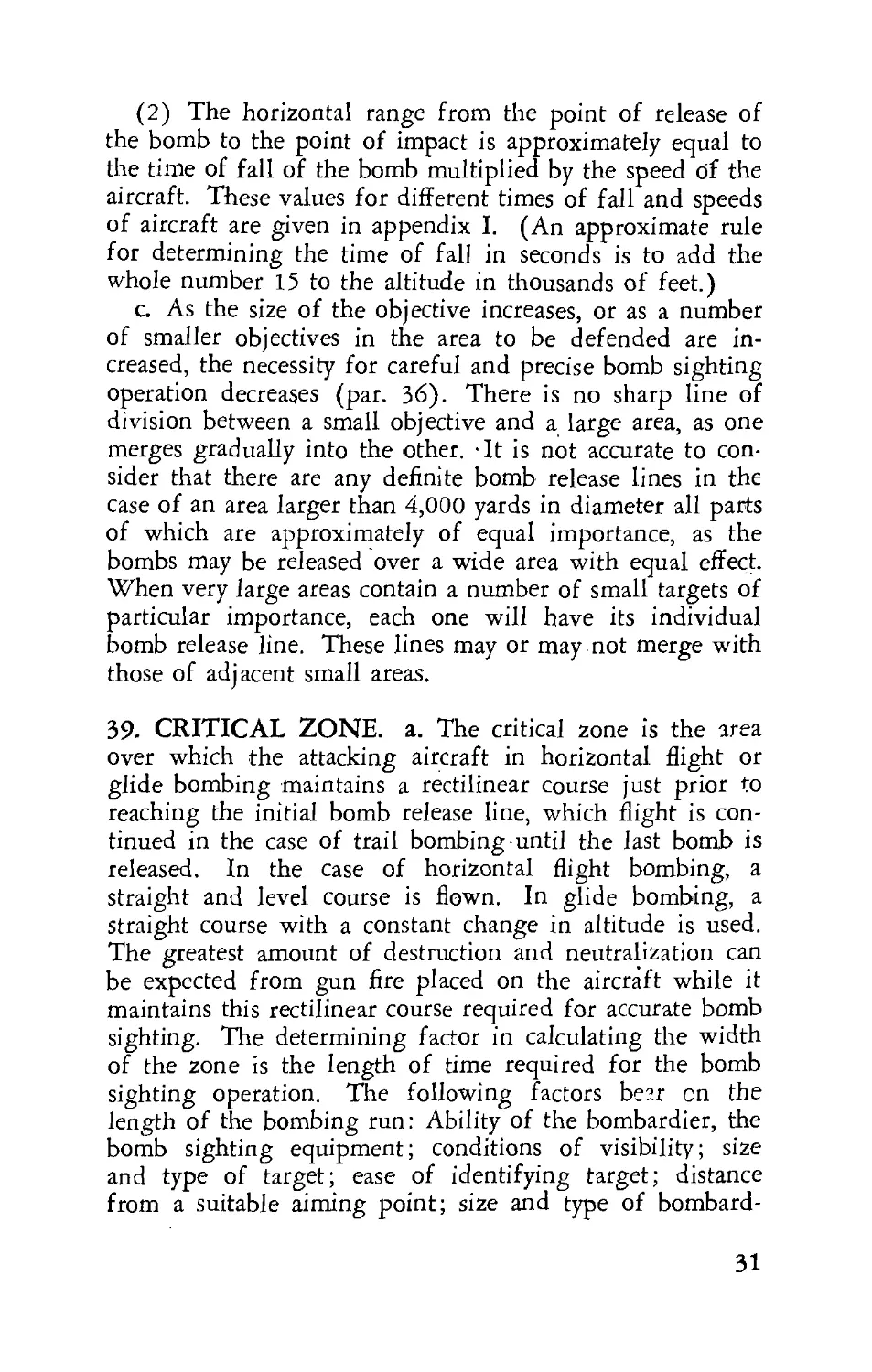
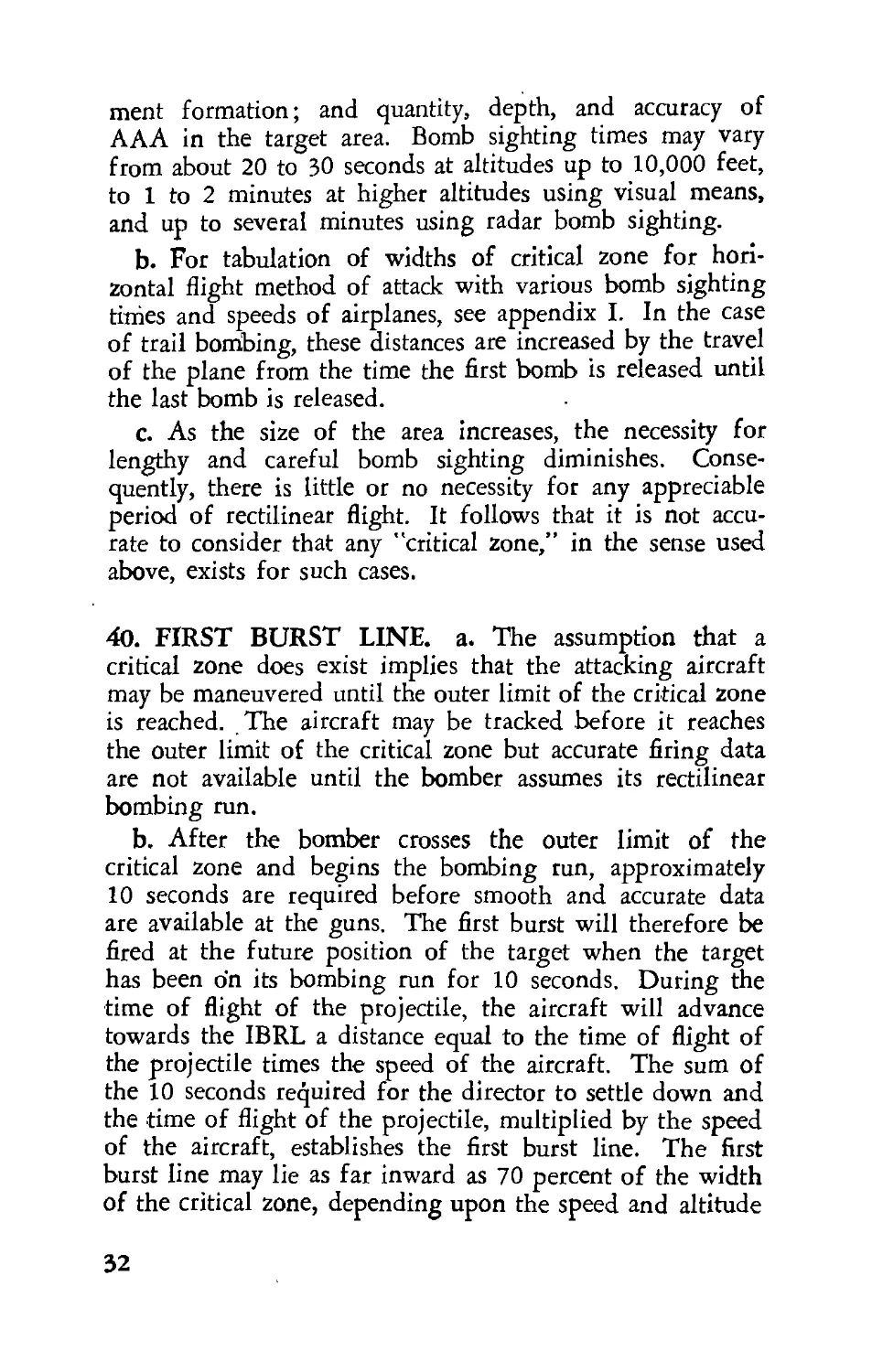
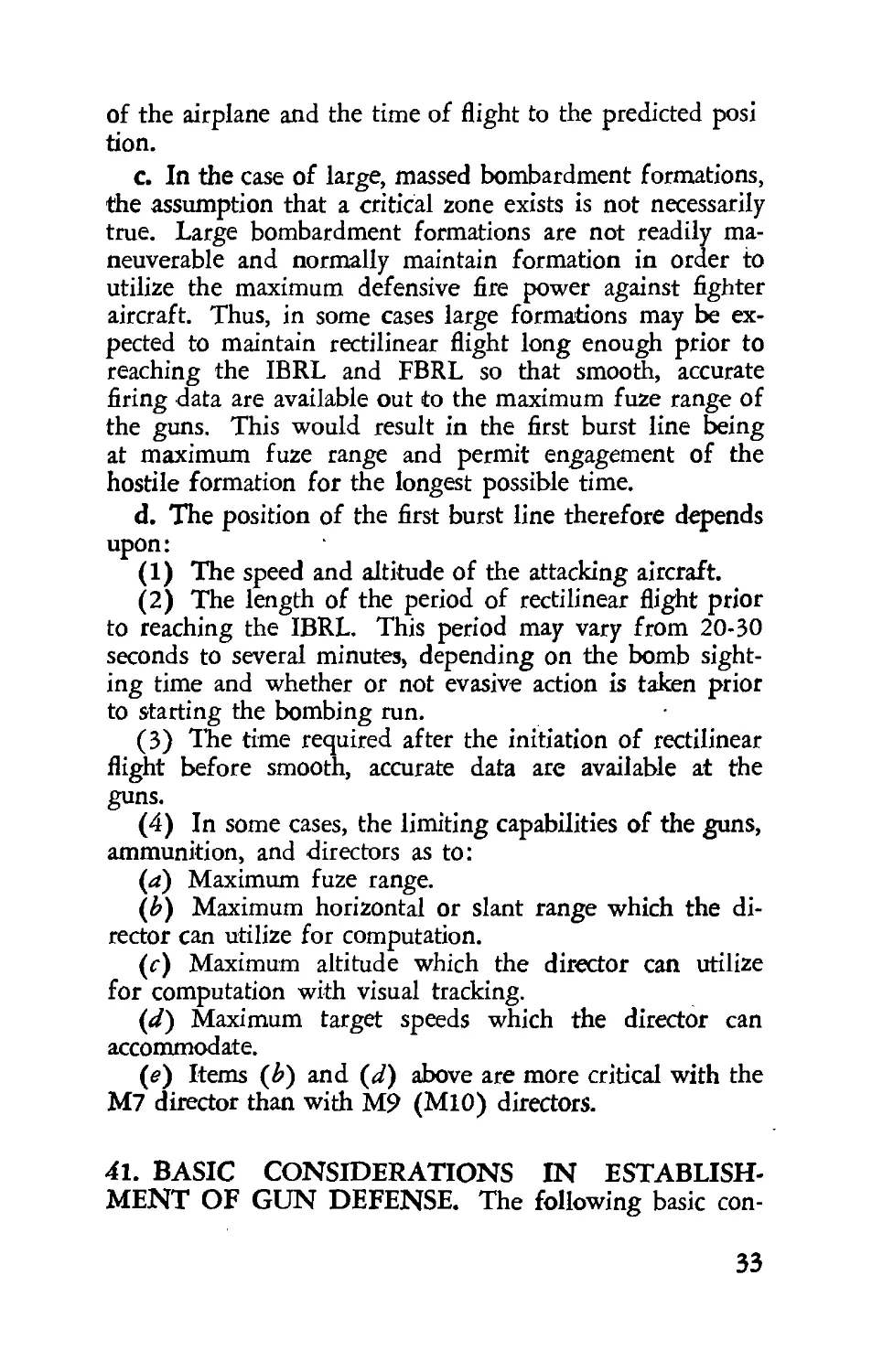
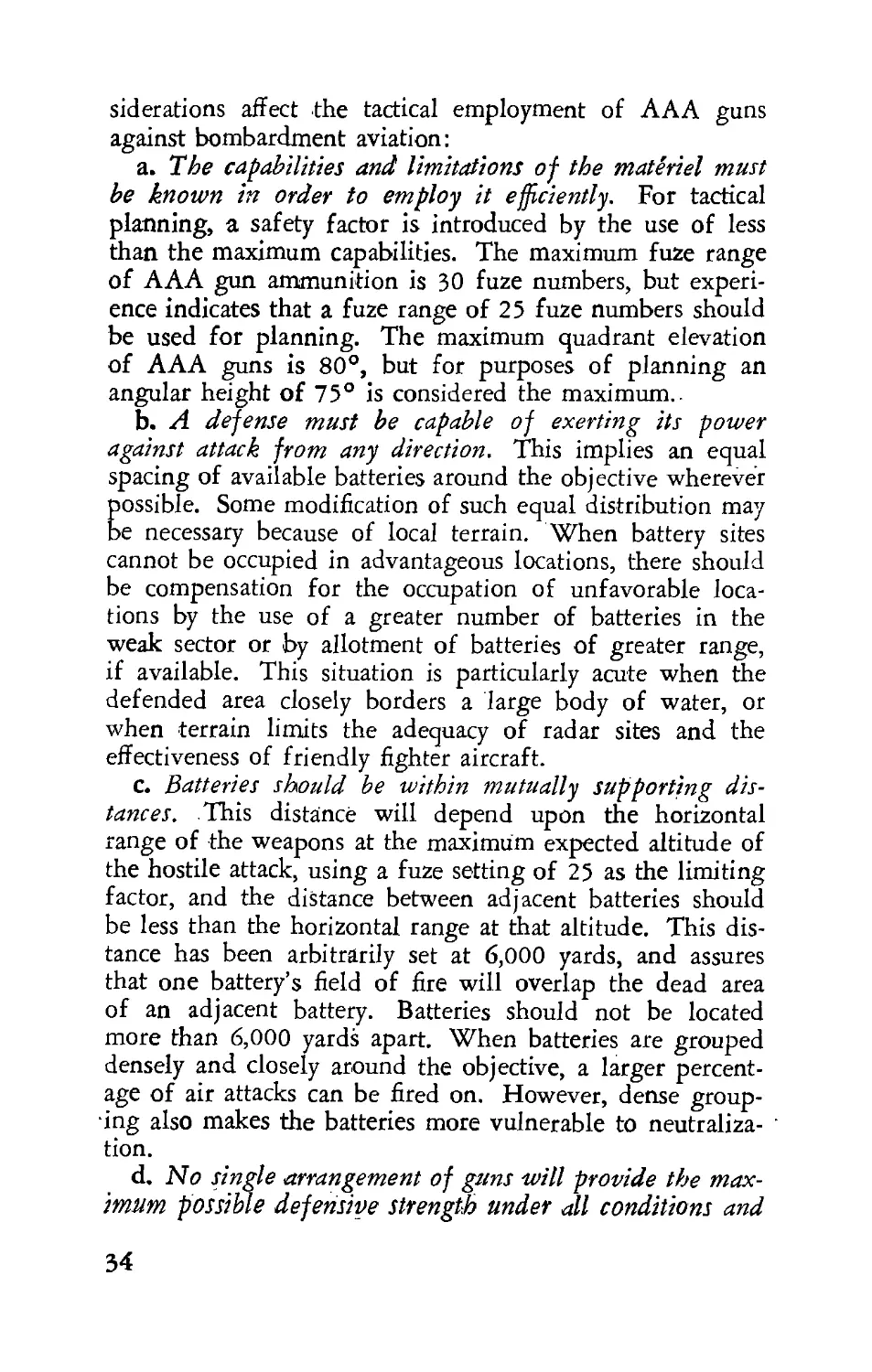
of trail bombing, these distances are increased by the travel
of the plane from the time the first bomb is released until
the last bomb is released.
c. As the size of the area increases, the necessity for
lengthy and careful bomb sighting diminishes. Conse-
quently, there is little or no necessity for any appreciable
period of rectilinear flight. It follows that it is not accu-
rate to consider that any "critical zone,” in the sense used
above, exists for such cases.
40. FIRST BURST LINE. a. The assumption that a
critical zone does exist implies that the attacking aircraft
may be maneuvered until the outer limit of the critical zone
is reached. The aircraft may be tracked before it reaches
the outer limit of the critical zone but accurate firing data
are not available until the bomber assumes its rectilinear
bombing run.
b.	After the bomber crosses the outer limit of the
critical zone and begins the bombing run, approximately
10 seconds are required before smooth and accurate data
are available at the guns. The first burst will therefore be
fired at the future position of the target when the target
has been bn its bombing run for 10 seconds. During the
time of flight of the projectile, the aircraft will advance
towards the IBRL a distance equal to the time of flight of
the projectile times the speed of the aircraft. The sum of
the 10 seconds required for the director to settle down and
the time of flight of the projectile, multiplied by the speed
of the aircraft, establishes the first burst line. The first
burst line may lie as far inward as 70 percent of the width
of the critical zone, depending upon the speed and altitude
32
of the airplane and the time of flight to the predicted posi
tion.
c.	In the case of large, massed bombardment formations,
the assumption that a critical zone exists is not necessarily
true. Large bombardment formations are not readily ma-
neuverable and normally maintain formation in order to
utilize the maximum defensive fire power against fighter
aircraft. Thus, in some cases large formations may be ex-
pected to maintain rectilinear flight long enough prior to
reaching the IBRL and FBRL so that smooth, accurate
firing data are available out to the maximum fuze range of
the guns. This would result in the first burst line being
at maximum fuze range and permit engagement of the
hostile formation for the longest possible time.
d.	The position of the first burst line therefore depends
upon:
(1)	The speed and altitude of the attacking aircraft.
(2)	The length of the period of rectilinear flight prior
to reaching the IBRL. This period may vary from 20-30
seconds to several minutes, depending on the bomb sight-
ing time and whether or not evasive action is taken prior
to starting the bombing run.
(3)	The time required after the initiation of rectilinear
flight before smooth, accurate data are available at the
guns.
(4)	In some cases, the limiting capabilities of the guns,
ammunition, and directors as to:
(a)	Maximum fuze range.
(b)	Maximum horizontal or slant range which the di-
rector can utilize for computation.
(c)	Maximum altitude which the director can utilize
for computation with visual tracking.
(<Z) Maximum target speeds which the director can
accommodate.
(e) Items (b) and (d) above are more critical with the
M7 director than with М2 (M10) directors.
41.	BASIC CONSIDERATIONS IN ESTABLISH-
MENT OF GUN DEFENSE. The following basic con-
33
siderations affect the tactical employment of AAA guns
against bombardment aviation:
a.	The capabilities and limitations of the materiel must
be known in order to employ it efficiently. For tactical
planning, a safety factor is introduced by the use of less
than the maximum capabilities. The maximum fuze range
of AAA gun ammunition is 30 fuze numbers, but experi-
ence indicates that a fuze range of 25 fuze numbers should
be used for planning. The maximum quadrant elevation
of AAA guns is 80°, but for purposes of planning an
angular height of 75° is considered the maximum..
b.	A defense must be capable of exerting its power
against attack from any direction. This implies an equal
spacing of available batteries around the objective wherever
Eossible. Some modification of such equal distribution may
e necessary because of local terrain. When battery sites
cannot be occupied in advantageous locations, there should
be compensation for the occupation of unfavorable loca-
tions by the use of a greater number of batteries in the
weak sector or by allotment of batteries of greater range,
if available. This situation is particularly acute when the
defended area closely borders a large body of water, or
when terrain limits the adequacy of radar sites and the
effectiveness of friendly fighter aircraft.
c.	Batteries should be within mutually supporting dis-
tances. This distance will depend upon the horizontal
range of the weapons at the maximum expected altitude of
the hostile attack, using a fuze setting of 25 as the limiting
factor, and the distance between adjacent batteries should
be less than the horizontal range at that altitude. This dis-
tance has been arbitrarily set at 6,000 yards, and assures
that one battery’s field of fire will overlap the dead area
of an adjacent battery. Batteries should not be located
more than 6,000 yards apart. When batteries are grouped
densely and closely around the objective, a larger percent-
age of air attacks can be fired on. However, dense group-
ing also makes the batteries more vulnerable to neutraliza-
tion.
d.	No single arrangement of guns will provide the max-
imum possible defensive strength under all conditions and
34
forms of enemy attack. In general, the defense must be
established upon an. estimate of the most likely forms,
speeds, direction, and altitudes of attack. This will depend
upon the tactics of the enemy, the nature, size, and impor-
tance of the defended objective, the local terrain, the
weather conditions, and similar factors.
(1	) In some localities, where the winds are generally
unvarying in direction, the normal attack approach will be
"down wind.”
(2	) The availability pf initial points for the bombing
run may indicate the likely directions of approach. An ini-
tial point will be a clearly defined point near the target,
which because of its relation to the target, make identifica-
tion of the target area certain. It may be a river, an inlet
or small harbor on the coast, a town, a railway or railway
intersection or a lake, at a distance of 2 to 5 minutes of
flying time from the objective. An initial point for radar
bombing also must be capable of returning a strong, dis-
tinctive signal. Initial points lying on a straight line from
the home base of the aircraft to the objective normally are
not selected.
(3	) Likely directions of approach may also be indicated
by terrain features which hamper radar detection in certain
sectors. The enemy may be expected to take advantage of
any such features to avoid radar detection.
42.	NUMBER OF BATTERIES IN GUN DEFENSE.
The number of batteries which should be provided for the
AAA defense of an area cannot be determined with mathe-
matical exactitude. The provision of any number, no mat-
ter how great, will not be a guarantee that the defense can
repel all attacks which might be brought against it. Gun
density is the number of guns which may be brought to
bear on a given target and is increased by siting batteries
so that their fields of fire overlap for mutual support. A
minimum density of from'8 to 12 is, desirable over the
inner half of the critical zone. The density should increase
a&the bomb release line is approached. Generally, the rela-
tive strength of a defense is in direct proportion to the
number of batteries allotted. Among the many factors
35
OS
Figure 12. Initial bomb release line (IBRL) and final bomb release line (FBRL) about an area 2>000 yards in
diameter for a target traveling 300 miles per hour at an altitude of 15,000 feet.
which must be considered in deciding upon the number to
be allotted are the following:
a.	Value of the objective to the defenders and the ad-
vantages which would accrue to the enemy by its destruc-
tion. This will affect the extent of the enemy effort both
in numbers and in risk taken. A defense suitable for one
objective may be entirely inadequate for another of the
same size. The importance of a given objective may change
with the passage of time so that a later strengthening of
that defense may be necessary or a weakening permissible.
b.	Relative strength of the opposing air forces.
c.	Location of friendly fighter airdromes and the effec-
tiveness of fighter action.
d.	Location of actual or probable hostile air bases.
e.	Presence or absence of other friendly AAA defense
areas, balloon barrages, and area smoke screens.
f.	Size, shape, and nature of the objective to be de-
fended.
g.	Nature of the terrain about the objective, particularly
the proximity of large water areas or of terrain features
which hamper radar detection.
h.	Relative importance of providing some protection to
other areas and total amount of AAA which may be avail-
able or obtainable.
43.	CONSIDERATIONS IN LOCATION OF BAT-
TERIES ABOUT AN OBJECTIVE, a. The following
variable factors must be considered in determining the lo-
cation of gun batteries about an objective:
(1)	The expected altitude and speed of hostile bombing
attacks.
(2)	The expected length of hostile bombing runs.
(3)	The evasion action, if any, taken by hostile bom-
bardment aircraft prior to starting the bombing run.
(4)	The action taken by hostile aircraft when subjected
to the first burst. The aircraft may disregard the AAA fire
and continue on the bombing run, take avoiding action and
try a new run, or give up his mission and return to his
base.
37
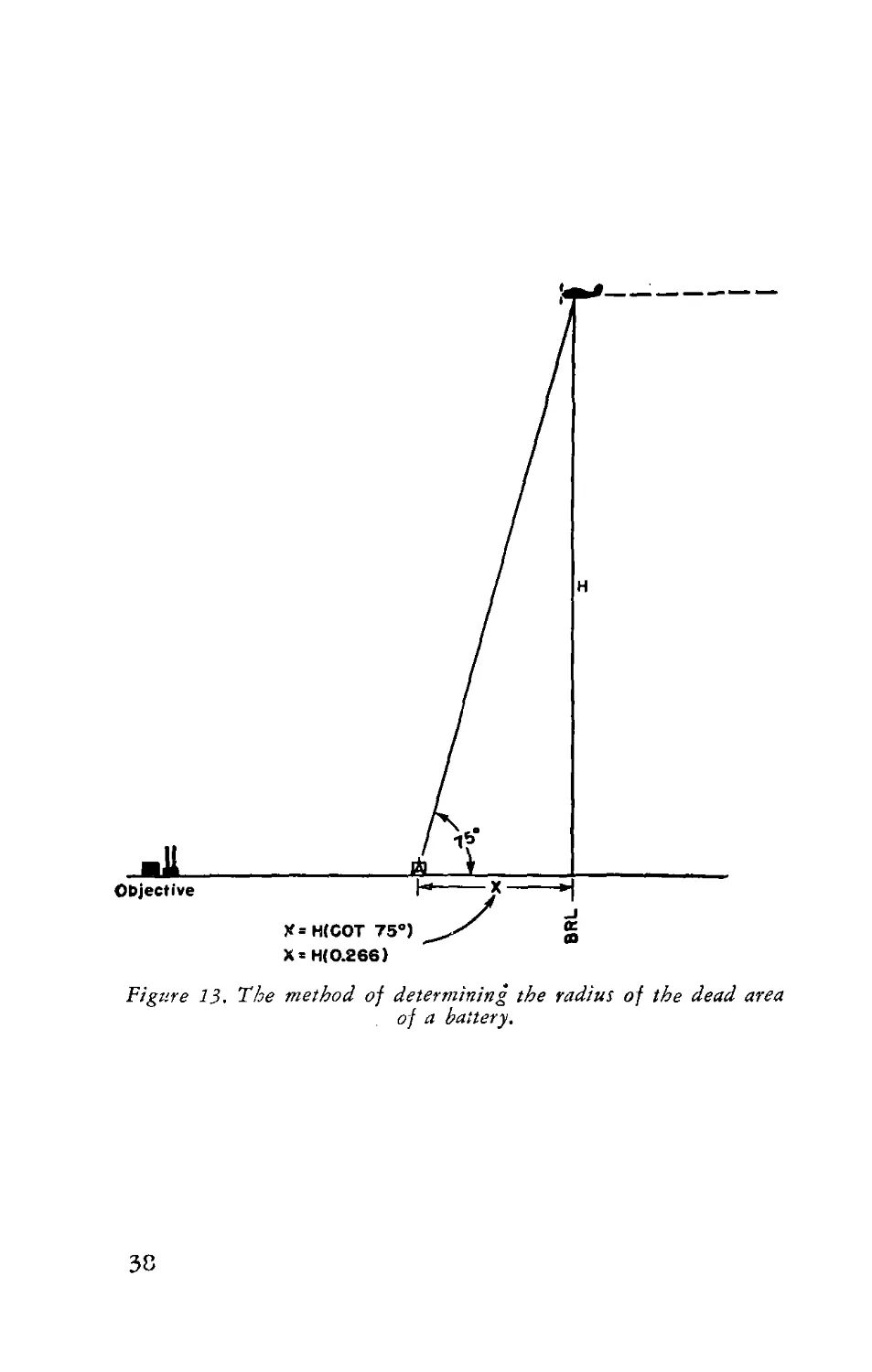
Figure 13. The method of determining the radius of the dead area
of a battery.
38
(5)	Whether all of the bombs are dropped at the IBRL
or the bombing is continued until the FBRL is reached.
b. Consideration must be given by the fire unit com-
mander to the possibility of successive attacks within a
given sector. The commitment of the fire of the defense
on some feint or subsidiary attack while the main effort fails
to receive its proportionate share of the fire must be pre-
vented. Fire must be distributed so the maximum number
and the most important targets receive a proportionate
share of the fire. In order to accomplish such an end, some
measure of fire direction over the priority of batteries in
engaging targets must be exercised. Such direction may be
exercised by indoctrination and standing operating pro-
cedure or from the AAOR.
44.	LOCATION OF GUN BATTERIES ABOUT AN
OBJECTIVE, a. General. In determining the positions
of batteries about an objective, it is necessary to assume cer-
tain conditions of hostile attack. It is also necessary to
decide whether gunfire should be placed on the target until
it reaches the FBRL or only until it reaches the IBRL. In
this example, the following assumptions are made:
(1)	Each battery will be assigned a normal and a. con-
tingent sector. Only the possibilities of fire in the normal
sector of a battery will be considered.
(2)	The batteries will consist of four 90-mm guns fir-
ing HE shell M71, with 30 fuze number mechanical time
fuze.
(3)	For planning purposes, effective fire is assumed to
be limited by a 25 fuze number range, and an angular
height of 75°.
(4)	The enemy attack will be made at a speed of 300
miles per hour and at an altitude of 15,000 feet.
(5)	The attacking aircraft will maneuver until 30 sec-
onds before the first bomb is released and will take avoid-
ing action immediately after the last bomb is released.
(6)	The attacking aircraft will drop their bombs be-
tween the IBRL and FBRL.
(7)	A battery must be able to engage the hostile air-
39
Figure 14. A graphic representation of the field of fire of a 90-mm
gun below an altitude of 15,000 feet using the M9 director.
Figure 15. A graphic representation of the cross section of field of
fire of a 90-mm gun below an altitude of 15,000 feet.
The dead areas shown are those using the M9 director.
40
craft up to the FBRL on an incoming course passing di-
rectly over the battery.
b. Procedure. (1) Determination of IBRL and FBRL.
The distance of the IBRL from the edge of the objective is
determined by the altitude and speed of the hostile air-
craft. The altitude of the aircraft determines the time it
takes the bomb to drop from the aircraft to the ground. In
this example, the altitude of the aircraft is assumed to be
15,000 feet and the time of fall is 30.5 seconds. The dis-
tance of the IBRL from the edge of the objective is de-
termined by the speed of the aircraft in yards per second
times the fall of the bomb in seconds. This is 150 yards
per second times 30.5 seconds or 4,575 yards. (This value
can be obtained from appendix I.) The distance of the
FBRL from the IBRL is equal to the diameter of the objec-
tive, or 2,000 yards. Figure 12 shows the location of the
IBRL and FBRL for the above conditions.
(2)	It is necessary at this point to refer to the limits of
fire, as originally shown in figures 6 and 7. These two
figures show the limits of fire up to the maximum altitude.
As the altitude of the aircraft in this example is 15,000
feet, it is necessary to consider the limits of fire at that
altitude. Figure 14 shows the outer limits of fire, and fig-
ure 15 shows both the inner and outer limits of fire for
this altitude.
(3)	Since it is desired to engage the hostile target until
it reaches the FBRL, the gun battery’s position must be
such that its dead area is tangent to the FBRL. The radius
of the dead area for the battery, for any expected altitude
of attack, is easily calculated. As previously stated, a maxi-
mum angular height of 75° is used for planning purposes.
With this, and the expected altitude of attack, a right tri-
angle relationship is set up to determine the distance inward
from the FBRL to place the battery in order that the target
may be engaged up to the last point at which it can accom-
plish its mission. Figure 13 shows that by using the co-
tangent of 75°, a formula may be derived for the radius of
the battery dead area or, in other words, the distance
inward from the FBRL that the battery should be sited.
This formula is X = 0.268 X By applying the ex-
41
Figure 16. Location of gun battery in protection of a small objective. (The vertical projection indicates the
limiting ranges using the M.7 director.)
10,000 yd*
ample in a above to this formula, the distance is found to
be 1340 yards. The gun ring, or 75° line, is thus 1340
yards inward from the FBRL. Note that the radius of the
dead area is a function of altitude. The location of the
battery from the edge of the objective is determined mathe-
matically as follows: The distance between the IBRL and
FBRL is equal to the width of the objective or 2,000 yards.
Therefore, the distance from the edge of the objective to
the FBRL is 4,575 yards minus 2,000 yards, or 2,575 yards.
The radius of the dead area at 15,000 feet is 1,340 yards.
Hence 2,575 yards minus 1,340 yards equals 1,235 yards,
the distance from the edge of the objective to the gun
battery. (See fig. 17.)
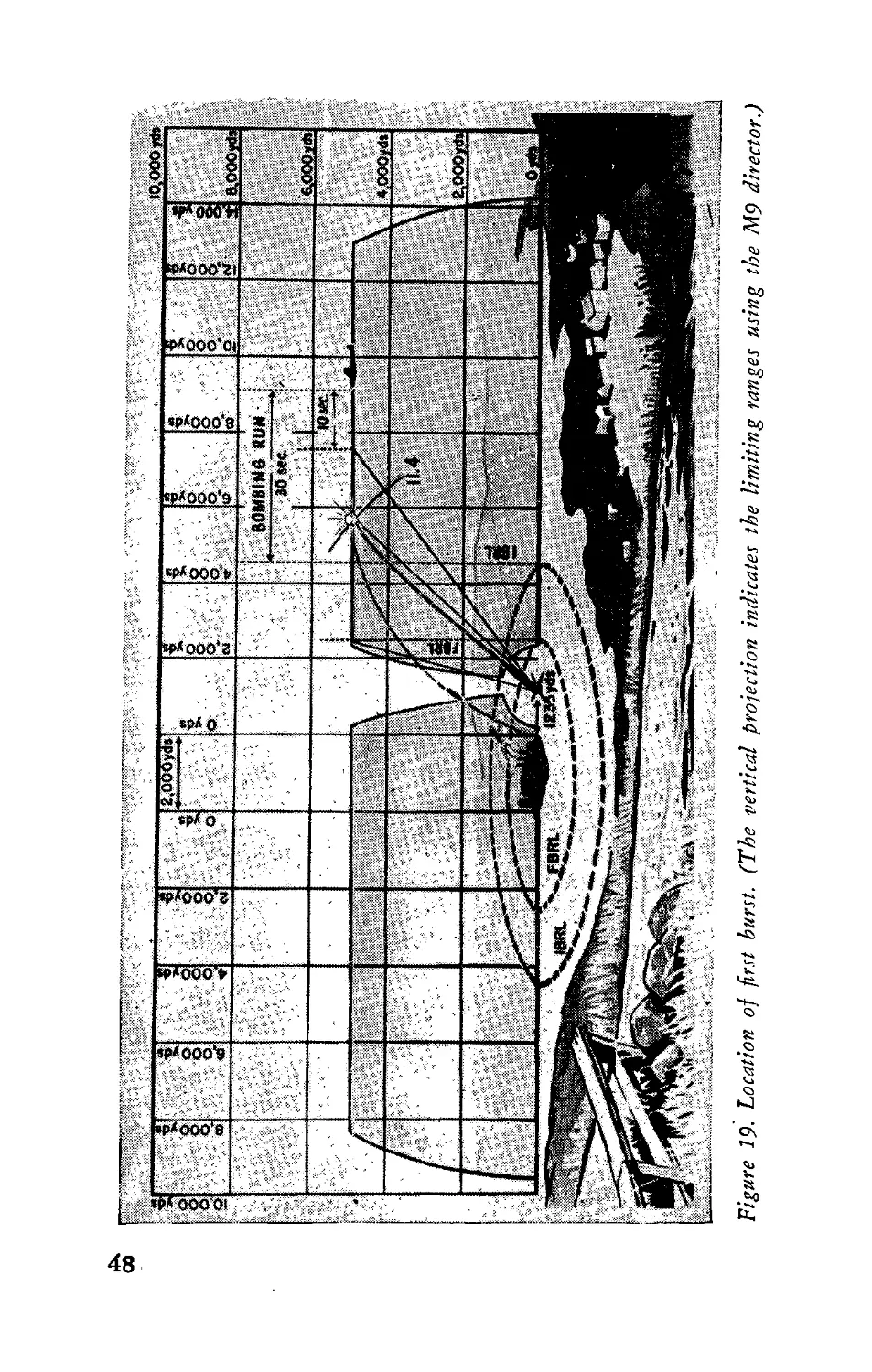
(4)	The location of the first burst from the initial
bomb release line is determined (fig. 19) in the following
manner: The bombing run of the target has been assumed
as 30 seconds. Therefore, the bomber will cease evasive
action and begin his bombing run at a point 30 seconds
times 150 yards per second or 4,500 yards from the IBRL.
After the target has entered on the bombing run, 10 sec-
onds are required before the rates in the director settle
down and the data are flowing to the guns. The first burst,
therefore, is fired at the future position of the target when
the target has been on its bombing run for 10 seconds. By
successive approximations, the time of flight to this future
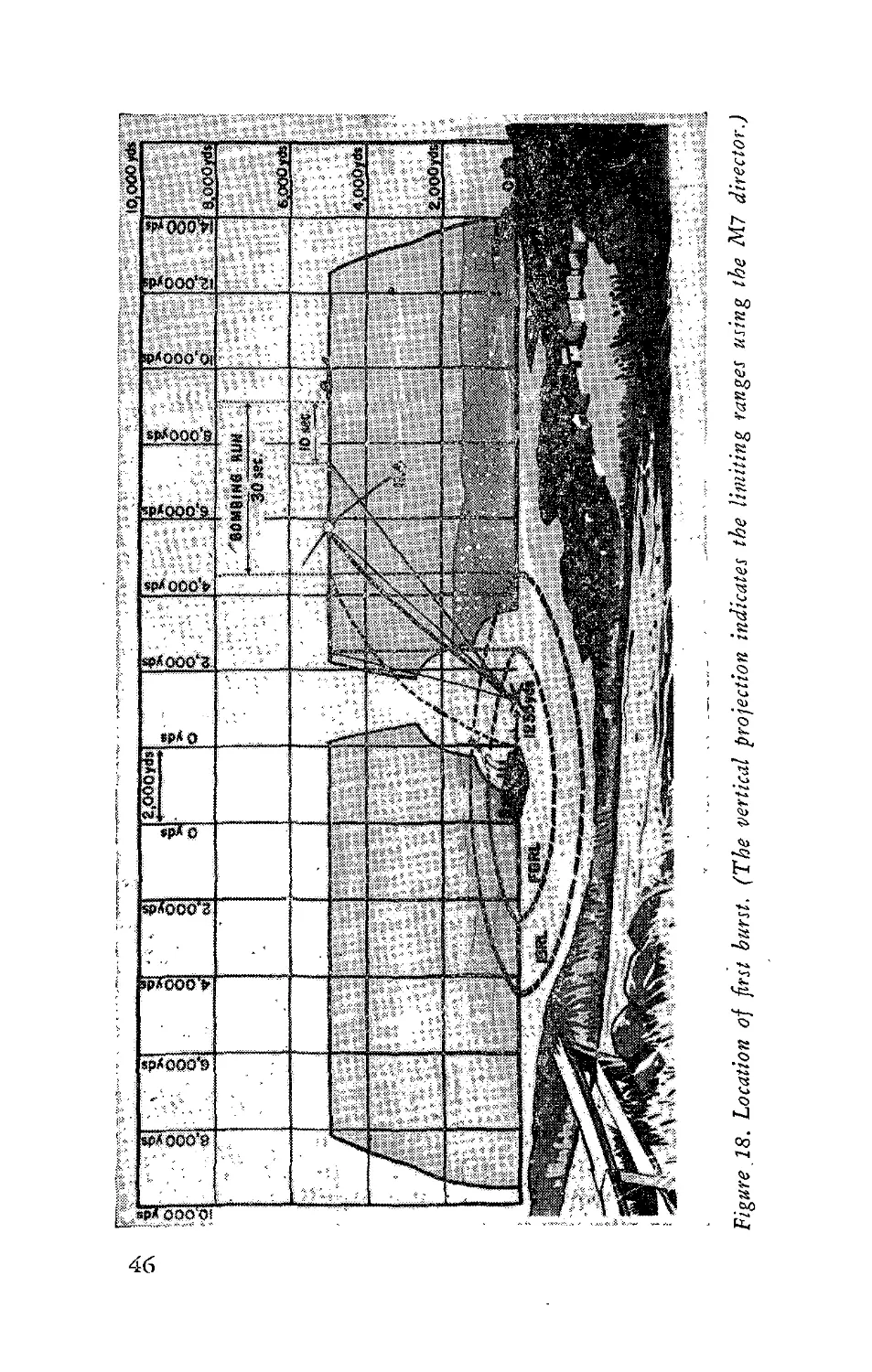
position is determined to be 11.4 seconds. The aircraft has
now been on its bombing run for 11.4 plus 10 or 21.4
seconds. If the aircraft continues on its bombing run to
the IBRL, it will be under fire for 8.6 seconds. If the air-
craft should further continue on to the FBRL, it would be
under fire for about 13 additional seconds.
c.	Figures 16 and 18 illustrate the same problem using
the M7 director.
d.	It should be noted that in the above problem:
(1)	The period of rectilinear flight of the bomber prior
to reaching the IBRL would have to be increased to about
82 seconds in order to fire an effective first burst at the
limiting 25 fuze number range point used for planning
purposes.
(2)	An effective first burst could not be fired at 30 fuze
43
т
8.
Ч>* 000'01
i0,000ytfs
2,000yds’
бХЮОуй
4,003ych
i
§ '
а В.ОООЯ1»
•iw:
Figure 17. Location of gun battery in protection of a small objective. (The vertical projection Indicates the
limiting ranges using the M9 director.)
Н* 15,000 Н &g = 30CMFh
о*
8.
number range unless the bomber maintained rectilinear
flight for about 96 seconds prior to reaching the IBRL.
Fire at this range could not be undertaken with the M7
director.
e.	The above example is for illustrative purposes only.
It is not intended' as a standard guide for such a defense.
Each defense must be designed to fit the particular situa-
tion.
45. RAPID DETERMINATION OF GUN POSI-
TIONS. a. The study above is for a small objective. As
the area of the objective increases a study similar to the
one above must be made, considering the possible enemy
tactics which may be employed against the objective and
the types and number of guns available for the defense.
b.	Another important point to bear in mind is that, in
the problem above, the bombing altitude was assumed as
15,000 feet. It is possible that the first attack on an objec-
tive will be made at this low altitude. If these attacks are
subjected to considerable losses due to accurate gunfire, the
altitude of the attack will be increased. This increase in
the altitude of bombing increases the distances of the bomb
release lines from the objective and necessitates a relocation
of the batteries. The following form can be used for
rapidly calculating the distance that the batteries should be
located from the edge of the objective when preparing a
defense of a small objective.
Distance from IBRL to edge of objec-
tive ............................... .....:------
Minus distance between IBRL and
FBRL (this is equal to the diameter
of the objective) ................ ............
Distance between FBRL and edge of
objective .......................... ............
Minus radius of dead area __________
Distance from edge of objective to
battery. _______________________________
45
Figure 18. Location of first burst, (The vertical projection indicates the limiting ranges using the M7 director.)
«И 000
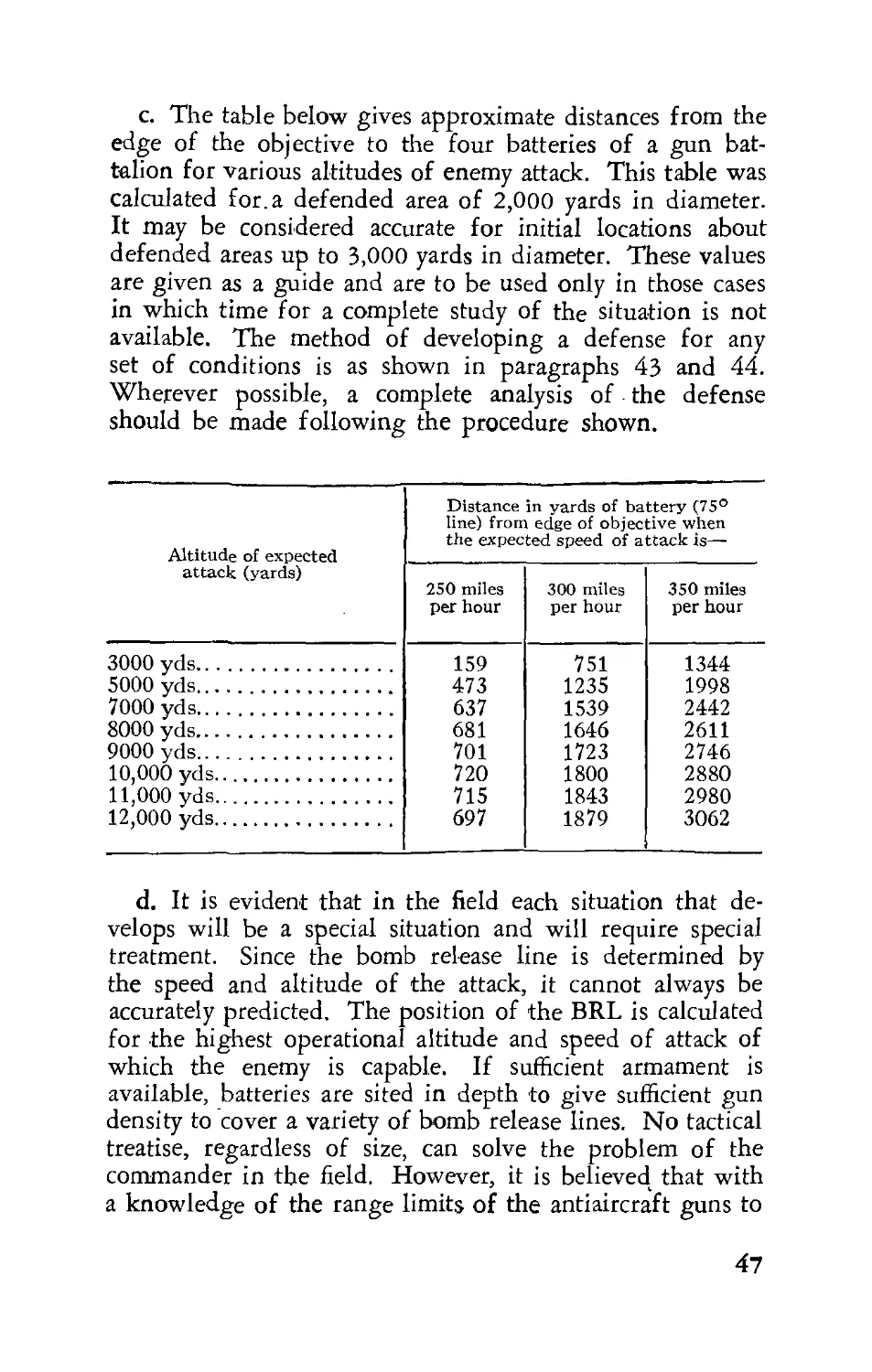
c.	The table below gives approximate distances from the
edge of the objective to the four batteries of a gun bat-
talion for various altitudes of enemy attack. This table was
calculated for. a defended area of 2,000 yards in diameter.
It may be considered accurate for initial locations about
defended areas up to 3,000 yards in diameter. These values
are given as a guide and are to be used only in those cases
in which time for a complete study of the situation is not
available. The method of developing a defense for any
set of conditions is as shown in paragraphs 43 and 44.
Wherever possible, a complete analysis of the defense
should be made following the procedure shown.
Altitude of expected attack (yards)	Distance in yards of battery (75° line) from edge of objective when the expected speed of attack is—
	250 miles per hour	300 miles per hour	350 miles per hour
3000 yds		159	751	1344
5000 yds		473	1235	1998
7000 yds		637	1539	2442
8000 yds		681	1646	2611
9000 yds		701	1723	2746
10,000 yds		720	1800	2880
11,000 yds		715	1843	2980
12,000 yds		697	1879	3062
d.	It is evident that in the field each situation that de-
velops will be a special situation and will require special
treatment. Since the bomb release line is determined by
the speed and altitude of the attack, it cannot always be
accurately predicted. The position of the BRL is calculated
for the highest operational altitude and speed of attack of
which the enemy is capable. If sufficient armament is
available, batteries are sited in depth to give sufficient gun
density to cover a variety of bomb release lines. No tactical
treatise, regardless of size, can solve the problem of the
commander in the field. However, it is believed that with
a knowledge of the range limits of the antiaircraft guns to
47
Figure 19- Location of first burst. (The vertical projection indicates the limiting ranges using the Af9 director.)
be used, the characteristics of enemy aircraft and their
tactical use, and the considerations outlined in paragraph 41
(basic consideration in establishment of a gun defense),
the commander in the field can place what armament may
be available to him in the positions that will best perform
his mission. The fundamental principle is that it is always
better to provide a strong defense for a few areas than to
disperse available armament for the defense of many
points, to the consequent weakness of all.	'
e.	Any map analysis of a defense gives only the relative
location of the batteries to the objective. The map study
must be followed by a reconnaissance of the ground to
determine the exact location of the batteries on the ground.
46.	EFFECT OF INCREASE IN SIZE OF DEFENDED
AREA. As the size of a defended area increases, more bat-
teries will be required about the area to prevent batteries
from being separated by more than mutually supporting
distances. The coverage of the gun batteries over the cen-
ter of the objective will decrease and it may be necessary
to place some batteries within the area itself, to prevent
a complete break in the coverage.
47.	NORMAL AND CONTINGENT SECTORS, a.
Terrain and expected enemy tactics control the establish-
ment of normal and contingent sectors. For a highly de-
veloped static defense, a single coordinated system of
development is essential. The same principles apply,
whether the defense is large or small, whether it contains
many or few units. Coordination is required to the extent
that well, established normal and contingent sectors are
allotted to each fire unit.
b.	In all cases it is normal to overlap adjacent assigned
sectors.
c.	The contingent sector of any battery includes the
normal sectors of all the other batteries within range.
d.	In all cases, due care is exercised that there is no pos-
sibility of confusion because of a sharp cleavage between
sectors of adjacent units. Confusion will be reduced by
establishing an overlap of sectors.
49
48.	GUN DENSITY. The strength of the defense at any
point is proportional to the number of batteries whose fire
can be concentrated at that point. The simplest measure
of this strength is the "gun-density” at the point in ques-
tion. In an area covered by the fire of only one battery the
gun-density is 4. Two battery coverage produces a gun-
density of 8, etc. Transparent templates for each battery
are made representing the assumed field of fire. By shift-
ing these "gun circles” around on the map or overlay of
the area to be defended, the most desirable locations of
batteries, are obtained quickly. Gun densities are read di-
rectly and weak spots in the defense are apparent immedi-
ately. Planning of defenses in rapidly moving situations
is expedited by previous preparation of gun circles for all
map scales likely to be used.
49.	ANALYSIS OF DEFENSES, a. The gun density
method of analyzing the strength of the AAA gun defense
is simple, practical, and effective. A more accurate method
is the use of the flak analyzer which is described in TM
4-260.
b.	A detailed analysis should be made in every situation,
to determine the AAA gun positions which will afford the
greatest defensive strength. Such an analysis may disclose
prevailing winds at bombing altitudes over the defended
area which will materially alter the effectiveness and cover-
age of the AAA defense. The speed of the attacking air-
craft will be increased or decreased accordingly if the
attack be up-wind or down-wind. It follows as a matter of
course that if the speed of the enemy aircraft is affected,
the distance of the IBRL, the critical zone, and the outer
limits of the critical zone from the objective will change.
It will then be indicated that an off-center AAA defense
of the objective extending into the wind direction is neces-
sary rather than a uniform defense. If possible, a detailed
analysis should be made before positions are occupied. If
not, the analysis is made as soon thereafter as time permits,
and positions are shifted accordingly.
c.	Studies of the capabilities of enemy bombardment
methods and materiel may indicate that elongated objectives
50
are most vulnerable to bombing from certain directions. In
such cases, greater gun density should be provided in such
directions.
d.	Figures 20 and 21 illustrate the practical solution of
a typical defense in the field. The legend under the figures
is self-explanatory.
50.	ADJUSTMENT OF DEFENSE. The “ideal” AAA
gun defense of an objective is one which would provide
completely effective protection against all types of enemy
bombing tactics from any direction of approach. However,
because of the limitations of the materiel and the amount
of materiel available, this will never be accomplished. Al-
though the initial analysis of the defense has been com-
pleted and the most effective defense has been organized,
it must be realized that a change in certain conditions will
alter or reduce the effectiveness of the defense. Therefore,
a new analysis of the defense must be made and the
defense modified if necessary to counteract such new con-
ditions. The more important factors which must be borne
in mind are:
a.	Enemy tactics. There are many influencing circum-
stances which will dictate the tactics to be used by the
enemy. The enemy air capabilities in a particular theater
will change frequently; therefore, the most accurate in-
formation must be obtained and kept up to date concerning
the number and location of his bases in respect to the area
to be protected, whether he has local air superiority, types
of aircraft he employs in the general area, and bombing
tactics employed to include altitude of attack, length of
bomb run, evasive action, speed and direction of attack.
For example, if new high speed aircraft are introduced into
the theater, the defense will have to be adjusted accord-
ingly; or, when seasonal changes of prevailing winds at
bombing altitudes occur, or, when a new direction of ap-
proach is indicated, the defense will likewise require ad-
justment.
b.	Enemy intelligence. It is reasonable to conclude that
enemy intelligence has developed some method of analysis,
comparable to our own flak analysis (TM 4—260). With
51
this in mind it is to be expected that enemy intelligence in
time will gather sufficient information to compute the effec-
tiveness of the defense and determine the direction of
approach of subsequent attacks into the target area over
the less effective portion of the defense. To preclude
enemy intelligence from making such analysis and to con-
fuse or mislead him in his estimation of the strength of the
defense, frequent changes in disposition of the AAA guns
should be made. Alternate positions which would main-
tain the maximum effectiveness possible, should be pre-
pared, and occupied as the situation dictates.
51.	EMPLOYMENT OF RADARS FOR SURVEIL-
LANCE. a. General. Under direction of the antiaircraft
operations room (AAOR) certain radars in the AAA de-
fense are placed on surveillance duty in accordance with
prepared schedules. The number of radars actually used
depends on the radar coverage of the area. A sufficient
number must be employed to insure that the AAOR has
complete coverage of the defended area and its approaches.
During periods of no action it is normal to divide this sur-
veillance duty equitably among the radars in the defense.
Normal surveillance duty period is from 2 to 3 hours. See
FM 44-6 and 44-8 for employment of searchlight radars
for surveillance.
(1) When it can be foreseen that a battery radar (in a
defense of more than one gun battalion) is to be out of
service for an appreciable period of time, the radar of one
of the battalion headquarters batteries may be ordered to
operate directly under control of the battery concerned, or
it may be directed to furnish emergency fire control data
to the battery. The battalion headquarters battery radar
may be moved to the battery position to facilitate battery
operation. When a battalion headquarters battery radar
operates directly under battery control, it loses its distinc-
tive classification as a surveillance radar. In such situations
the AAOR may find it necessary to employ a battery radar
to search and report in order to supplement the other bat-
talion headquarters battery radars.
(2) The battalion keeps the batteries informed as to
52
changes in the status of radars in order that adequate1 ad-
vance preparations may be made by the batteries concerned.
b.	Location. (1) Battalion headquarters battery radar.
Since this radar is used primarily for surveillance it should
be sited to avoid clutter and provide maximum coverage.
It is not essential that it be located centrally with respect
to the battalion.
(2)	Gun battery radar. These radars are located pri-
marily to perform their missions with the gun batteries.
(See FM 44-21.)
c.	Communications. The battalion headquarters battery
radar is connected by direct telephone line to the AAOR
in the same manner as the gun battery radars. No radio
set is provided specifically for the inclusion of the battalion
headquarters battery radar in the AAOR net. (See FM
44-8.)
d.	Priorities. (1) Battalion headquarters battery radar.
When on surveillance duty at time of the alert, the bat-
talion headquarters battery radar continues on this status.
When "off the air” at time of the alert, the battalion head-
quarters battery radar goes "on the air” immediately,
reports to the AAOR, and begins to search in accordance
with established SOP.
(2) Gun battery radar. (a~) When "off the air” at time
of the alert, the gun battery radar goes "on the air” and
operates according to battery SOP.
(b)	When on surveillance duty at time of the alert,
the gun battery radar continues on that status until released
to the battery by the AAOR.
(c)	The primary function of the gun battery radar is
to furnish position data to the gun battery. Therefore, the
AAOR releases the gun battery radars to the batteries as
soon as the surveillance duty has been taken over by the
battalion headquarters battery radar.
(d)	Gun batteries must be prepared to conduct visual
or emergency fire control while their radars are on surveil-
lance duty since the AAOR normally will not release all
radars to the gun batteries until the battalion headquarters
battery radar has taken over the surveillance duty. In large
coordinated defenses, or in smaller defenses when war-
53
SCALE - YARDS
Figure 20. Typical defense of multiple objectives showing IBRL
and 75° line around the area with the first stage of
planning of gun positions.
-a©
54
ranted by adequate AWS, immediate release of gun battery
radars from surveillance duty may be expected. The status
of radars in all defenses is a matter for command decision.
Section II. Static Employment
52.	GENERAL, a. The term "static employment” is used
to denote AAA defense of those installations which are of
a permanent or semipermanent nature. AAA can be em-
ployed statically for defense of installations located in the
combat zone as well as in the communications zone and
zone of interior. Since installations requiring AAA defense
in the communication zone and zone of interior normally
are of a permanent or semipermanent nature, AAA in
those zones is employed statically.
b. A static defense may include AAA protection of the
lines of communication and supply, military and naval
establishments, manufacturing centers, and other establish-
ments of major importance.
53.	NATURE OF DEFENSE, a. Static employment in
defense of an objective involves the carefully coordinated
employment of guns, searchlights, automatic weapons, bar-
rage balloons, and area smoke screens. All of these weap-
ons may be used together or in part as indicated by the
situation and the available materiel.	|
b. Both AAA and friendly aviation will usually be em-
ployed in the defense of important objectives. It must be
recognized, however, that not even these combined efforts
can guarantee the protection of any defended area. The
most practical approach indicates that the defense must be
employed with the view of destroying such a large per-
centage of the attacking aircraft that it would be disastrous
for the enemy to continue the attacks.
54.	DEFENSE OF LARGE AREAS. In planning the
general defense of a large area it must be recognized that
the attacking aircraft are not subject to the restrictions
which exist in the attack of small separate objectives. A
bomb dropped anywhere within the large area, will do
55
Figure 21. Typical defense of multiple objectives showing the final
disposition of the guns. Note the one additional bat-
tery and the balanced distribution indicated by the gun
circles.
56
some damage; therefore the period of straight, level flight
for careful bomb sighting is unnecessary. Attacking air-
craft are free to take evasive action during their run up to
the point of bomb release. Also, the orthodox bombing
run directed against specific objectives within the area may
develop anywhere, without reference to a previously estab-
lished IBRL or critical zone on the edge of the large area.
The aircraft may, however, be expected to fly rectilinear
courses until they encounter antiaircraft fire. The problem
of defense against such targets then resolves itself into
careful preparation of fire to secure maximum effectiveness
in the first few salvos, and careful arrangement of arma-
ment to secure the maximum possible gun density through-
out the area.
55.	DISPOSITIONS. The problem resolves itself into
providing, over and around the entire area, as great a gun
density as materiel and the importance of the area justifies.
The following factors are a guide in planning the defense:
a.	Gun batteries are located first to provide uniform cov-
erage over the entire defended area. A gun-density of
no less than 16 is desired. This figure may be much higher
for important areas.
b.	Coverage of approximately the same “gun-density”
is extended from the edge of the area to the IBRL.
c.	Some batteries must be able to fire upon the attack-
ing aircraft during their last 30 seconds of flight before
reaching the IBRL of the defended area.
d.	The defense is strengthened along probable routes of
approach by disposing batteries so that attacking aircraft
are subjected to increasingly greater and more accurate fire
as they approach the IBRL.
56.	DEFENSE OF MULTIPLE OBJECTIVES. When
a number of objectives are located in the same general area,
the enemy will normally attempt to bomb the individual
objectives rather than the entire area. In defending a
“multiple objective” area, two situations must be consid-
ered.
a.	Defense of each objective separately. If the indi-
57
75" ANGULAR
Figure 22. Location of AAA guns in protection of a large area.
58
vidual objectives within the area are more than 15,000
yards apart, it is best to establish a separate gun defense
for each objective warranting defense.
b.	Use of a single coordinated defense. If the indi-
vidual objectives are within 15,000 yards of each other,
it is best to establish a coordinated gun defense of all the
objectives.
57.	SEPARATE DEFENSE OF MULTIPLE OBJEC-
TIVES. When multiple objectives are to be defended
singly, each objective is treated as if it were a separate
small objective. AAA gun batteries are placed inside the
FBRL of the objective, at a distance equal to the radius
of the dead area for the assumed bombing altitude.
58.	COORDINATED DEFENSE OF MULTIPLE OB-
JECTIVES. When a single coordinated gun defense is
employed, the following procedure normally is followed:
a.	Draw lines connecting the outer objectives. This is
the "area boundary line.” (See fig. 20.)
b.	Draw the IBRL’s and 75° lines for the objectives
lying on or near the area boundary line. Consolidate and
continue these lines to form a continuous IBRL and 75°
line for the entire general area. The 75° line is measured
inward from the IBRL in the defense of large objectives.
(See fig. 20.)
c.	Place gun batteries on the 75° line within mutually
supporting distance.
d.	Determine the strength of the defense in its various
sectors as described in paragraph 49, or by another suitable
method.
e.	Relocate the batteries so as to give the proper pattern
of strength.
f.	If the area pattern is so large that batteries on the
75° line cannot fire over all of the area inclosed by the
area boundary line, a few batteries must be added within
the area to provide coverage of the center of the area.
This is necessary to deny unmolested flight by enemy air-
craft over this area.
59
59.	STRENGTHENING THE DEFENSE. If, after
placing the batteries on the 75° line to obtain the desired
defense, there are additional batteries, the defense should
be augmented by:
a.	Adding more batteries along the most probable routes
of enemy approach.
b.	A slight strengthening of batteries within the area
boundary line.
c.	An additional ring of batteries about 3000 to 5000
yards outside the 75° line.
60.	AIRDROME DEFENSE. A major factor in the suc-
cess of all operations is air superiority. In obtaining air
superiority, the security of our own aircraft is of equal
importance with the destruction of enemy aircraft. The
protection of our own aircraft on the ground and the pro-
tection of airdrome installations is one of the important
missions of AAA. In addition to the general principles
discussed in section I of this chapter, the following addi-
tional factors should be considered in preparing the AAA
gun defense of an airdrome.
a.	The airdrome commander indicates the order of pri-
ority of AAA defense for installations and units of the
airdrome.
b.	The airdrome commander should be requested to
furnish an aircraft so that an AAA officer may make an
air reconnaissance of the field and positions selected.
c.	A study of outstanding terrain features surrounding
the airdrome and of routes selected in simulated attacks by
pilots unfamiliar with the terrain will give an indication
of the most probable routes of enemy approach.
d.	After the most probable routes of approach have
been determined, the defense is built up to make certain
that each route has adequate coverage, and that the entire
area has an all around defense. Adjacent AAA defenses
are also considered in determining the most probable routes
of approach.
e.	The plan for the AAA protection of the airdrome
must be coordinated with the airdrome commander.
. f. Defenses must be sited in depth so that attacks on
60
the perimeter of the airdrome will not eliminate the AAA
defenses. Weapons must be sited to bring maximum fire
on all air targets, whether attacking simultaneously or in
successive waves, before hostile acts are committed.
g.	It is particularly important that plans for AAA fire,
movements of friendly aircraft in the vicinity of the air-
drome, and recognition and identification of aircraft be
prepared and executed so that AAA units do not fire on
friendly aircraft. In this connection, it is imperative that
all pilots be prohibited from performing, in the immediate
vicinity of the airdrome, any maneuver, which might be
interpreted as a hostile act.
h.	The ground defense of the airdrome should be con-
sidered when siting AAA gun units in the defense of
advanced landing strips (FM 1-26).
61.	EMPLOYMENT WITH AREA SMOKE
SCREEN. Area smoke screens are often employed in
static situations. AAA gun operations probably will not
be affected by the screen as they normally will be sited
outside the screened area, and because present position data
are obtained by radar rather than visual tracking. Fire
units not blanketed by smoke engage attacking aircraft by
normal methods of fire control. Fire units blanketed by
smoke are governed in conduct of fire by SOP and in fire
direction by the AAOR.
62.	EMPLOYMENT AGAINST JET- OR ROCKET-
PROPELLED FLYING BOMBS, a. Flying bombs have
made their appearance as weapons. The outstanding char-
acteristics of such present devices are:
(1)	High speed.
(2)	Constant altitude and direction.
(3)	Small vulnerable area.
(4)	Lack of maneuverability.
b.	Guns are sited in depth in belts across the known or
likely paths of approach, so that fire can be maintained for
as long a time as possible. Due consideration must be
given to establishing these belts in areas where the bombs
61
may be dropped with least damage, if not exploded in
the air.
c.	Low angular height radar coverage and adequate
AWS and AAAIS are particularly important in the de-
fense against present flying bombs, since such devices fly
at relatively low altitudes (2000 to 5000 feet).
Section III. Mobile Employment
63.	GENERAL, a. The term "mobile employment” is
applied to AAA operations with ground combat forces,
such as the army, corps, and division, in mobile situations.
The allotment of AAA guns to ground forces will depend
upon the ground and air situations, the mission, and the
availability of AAA gun units (FM 44-1).
b.	The principles governing mobile employment of
AAA guns are basically the same as those described in the
preceding two sections. Any one of the type defenses may
be used. In mobile operations, however, orthodox disposi-
tions are more apt to be affected by conditions of terrain,
weather, observation, and road nets, availability of materiel,
and the variables that arise from direct contact with enemy
ground forces.
c.	The discussion in this section is limited to the em-
ployment of AAA guns in the primary role against aircraft.
It must be understood, however, that in any of the situa-
tions noted the force commander may commit a portion or
all of his AAA means to a ground role rather than to de-
fense against air attack. The AAA commander must be
prepared to undertake and accomplish the missions thus
arising. Chapter 7 covers the use of guns in secondary
roles. •’
64.	DEFENSE PROBLEM, a. Objectives require pro-
tection from enemy bombardment (both high and low
altitude) and dive-bombing attacks, and from air observa-
tion.
b.	The determination of which elements of a force need
AAA protection and the priority of defense for these vari-
ous elements is the responsibility of the force commander.
62
This decision having been made, the AAA officer then
makes recommendations for the disposition of the AAA
units available. The AAA officer provides complete pro-
tection for the elements in the order of priority stated and
as far as the materiel will go. If the shortage of materiel
is such as to prevent protection of certain elements, then
the force commander should be notified of this fact.
c.	The AAA gun defense may include the protection of
troop concentrations or bivouacs, artillery areas, troops on
the march, troops engaged in offensive, defensive, or retro-
grade movements, supply and administrative establish-
ments, sensitive points on routes of communication, and
other vital elements. Whether this protection is provided
on a large area or specific small objective basis depends
upon the size of the area to be defended and the relative
importance of the objectives within it. If the area is small,
or the objectives within it are reasonably close together,
the AAA mission may be accomplished by giving over-all
coverage to the entire area.
65.	CONCENTRATIONS—BIVOUACS, a. General.
(1)	Troop movements into and from a concentration or
bivouac area must be unimpeded and unobserved, and the
troops and installations within the area must also be pro-
tected from air attack and observation. This requires that
some AAA units be among the first to arrive in the con-
centration or bivouac area, and among the last to leave.
It also requires that particular attention be paid to camou-
flage discipline and other passive defense measures.
(2)	AAA guns provide protection primarily against
bombardment and reconnaissance aviation, while automatic
weapons are employed to combat dive bombing, minimum
altitude, and low level horizontal attacks.
(3)	For protection against hostile observation, emphasis
is placed on passive defense measures. Since secrecy is a
prime consideration, care must be taken not to reveal the
location and importance of a concentration or bivouac area
by AAA dispositions or premature fire.
b. Priorities for defense. (1) Priorities for defense in
a concentration area will include critical points along the
63
routes to and from the concentration area, detraining and
entraining areas, landing areas, and installations and troops.
The basic AAA defense should be furnished by the highest
echelon possible. For instance, army AAA should form
the basis for the AAA gun, defense of an army concentra-
tion area in order that the defense will not be unduly dis-
turbed when corps AAA units commence moving out with
the corps to which they are attached.
(2)	Normally, automatic weapons will be the only
AAA defense provided for a bivouac area.
66.	TROOP MOVEMENTS, a. General. (1) The
problem of defending a column or columns is principally
one of defending critical localities along the route of
march. The advance of the column must be unimpeded,
and troops and materiel must arrive at their destination in
sufficient strength and condition to accomplish the mis-
sion. Security from hostile air observation is also an im-
portant requirement.
(1)	AAA units responsible for route protection must be
in position ready to defend the critical points before the
main body of the column arrives. This requires such AAA
units to march well forward in the column. The mobility
of AAA guns is, in most situations, equal to that of the
protected unit of the field force. When time and space
factors, road net, and road priorities permit, fire units ad-
vance by bounds to their positions along the route of march
preceding the main body. The force commander should
give the AAA road priority when this is necessary for the
accomplishment of its mission.
(3)	Protection of critical points should normally be
furnished by the highest echelon involved in the move-
ment. For example, in the advance of an army, army AAA
should defend critical points along the main routes. This
gives continuous defense to the advance, and allows AAA
gun units attached to corps to move forward with them.
(4)	Since advances are generally made in more than
one column, and on a wide front, decentralization of con-
trol is advisable. Army AAA units should normally be
attached to corps for the advance. This insures the AAA
64
units a place in the march tables of the corps with which
they are moving. When they reach the objective they are
to defend, they may again revert to control of the higher
echelon.
b. Priorities for defense. Critical points may include
bridges, defiles, initial points, entrucking and detrucking
areas, bivouac and assembly areas. However, choice of the
critical points which AAA guns will defend must be care-
fully considered. A bridge or crossroad is not necessarily
a critical point unless its destruction will actually impede
the advance of the column, and an alternate route is not
readily available. Straight open stretches of road may be
just as favorable for enemy air attack as actual defiles.
67.	OFFENSIVE, a. General. (1) During preparation
for, and throughout the period of attack, the combat forces
are particularly subject to hostile air observation and attack.
The enemy will use all the means at his disposal^ including
his air units, against those elements of our forces which
constitute the greatest menace to his security. Therefore,
the available AAA guns are disposed so as to provide the
maximum protection to those elements which are most vul-
nerable and whose disorganization might jeopardize the
successful accomplishment of the assigned missions.
(2) In an attack to force the crossing of a river line,
AAA defense is centered around the crossing fronts and
particularly the sites of bridges. Continuous protection for
the bridges is maintained as long as required.
b. Employment. (1) In general, the corps AAA guns
protect forces engaged in the main effort of the corps, the
reserves, and the artillery which follows in close support
of the attack, from enemy air attack and observation.
(2) The defense established is an area defense coor-
dinated to the extent necessary by the AAA commander. In
attack, the fact that the corps combat elements are concen-
trated well forward permits the location of the AAA gun
batteries well forward. Advanced positions not only afford
better protection for troops concentrating for the attack,
but also avoid the necessity for an early displacement for-
ward. In all forward positions AAA guns should be de-
65
filaded from enemy artillery fire and from observation from
the enemy front and flanks. Depending on the number of
AAA guns available, their role in attack situations may
include protection of any or all of the following (not ar-
ranged in order of priority) :
(a)	Assault units, especially those making the main
effort.
(b)	Reserves and their routes forward, including their
probable zone of action.
(c)	Artillery areas.
(d)	Command posts.
(e)	Supply establishments and train bivouacs.
(3) In forward areas, AAA gun positions should be
selected with a view to their possible use for antimech-
anized missions and field artillery reinforcement.
c. Coordination. The initial coordination of corps and
army AAA gun units will be provided for in the army
attack orders. Forward displacement of corps AAA gun
units should be made by bounds. Special consideration is
given to the relative importance of protecting combat ele-
ments and trains in the forward area, especially at bottle-
necks in the road net, as against that of continuing the pro-
tection of the elements that would be left unprotected by
the forward movement. The army AAA is displaced for-
ward when the importance of renewing the continuity of
AAA defense, interrupted by the forward movement of
corps AAA units, is greater than that of protecting the
installations and elements initially protected. Army AAA
units are used to protect army installations. When the
corps requires additional AAA, army AAA units are at-
tached to the corps until they are no longer needed or
until more urgent demand arises elsewhere.
68. DEFENSIVE, a. General. (1) When a force is on
the defensive, effective AAA defense becomes of increas-
ing importance, as the defensive attitude usually presup-
poses a local inferiority in' strength not only of the ground
forces but also of the air forces. A hostile attack usually
will be supported by powerful concentrations of combat
aviation which our own forces may be unable to combat
66
effectively by offensive action. Under these conditions, the
AAA units must be prepared to furnish a larger part of
defense against hostile air activity, except that afforded by
other units with their organic weapons. To perform this
mission, the AAA is disposed to provide the maximum
protection to those elements which ’ are most likely to be
subjected to air observation and attack and whose disor-
ganization might jeopardize the successful accomplishmenl
of our mission.
(2) The location of the units of the AAA defense is
affected by the fact that, in defense, normally there are
fewer installations and also a smaller concentration of
troops in forward areas than in the case of offensive action.
Therefore, a more complete coordination of AAA defense
throughout the action is possible.
b. Position defense. Position defense is characterized
by organization of a single position on which the resistance
is based. The AAA gun units are disposed to furnish a
defense of those forces and elements essential to main-
tenance of the position. The defense must be continuous
throughout all stages of a hostile attack and must be
arranged so as to facilitate protecting our forces in case of
a withdrawal from the position.
c. Employment. (1) The AAA guns are disposed ini-
tially to protect the organization and occupation of the
battle positions from hostile observation and bombard-
ment. It is necessary to deny the enemy any reconnaissance
of the battle positions, since such information would enable
the enemy to attack before our positions were established.
(2) After the positions are organized the guns are dis-
placed to provide protection for the following elements
(not arranged in order of priority) ;
(a) Troops occupying forward defensive localities of
the main battle position.
(Z>) Artillery areas.
(c)	Reserves and their routes forward, including their
probable zone of action.
(d)	Important supply establishments.
(e)	Command posts.
(3)	As in an offensive situation, mechanized attack may
67
be a serious menace and as such must be considered in
planning the AAA defense. Preparations should include
the reconnaissance of positions for antimechanized firing
in case it becomes necessary to employ the AAA guns as
part of the local antimechanized defense. The possible
mission of field artillery reinforcement must also be con-
sidered in siting guns and in planning the defense.
(4)	Forward gun batteries normally are not emplaced
forward of the line of the corps medium artillery. They
are mutually supporting and coordinated with the AAA
guns of adjoining corps.
69.	DEFENSE OF RIVER LINE. In the defense of a
river line, the principal mission of the AAA guns is to
protect the field artillery and the reserves. Preparation
must be made for forward displacement to cover possible
crossings in attack or counterattack.
70.	PURSUIT. The AAA commander must be prepared
to provide AAA defense for the direct pressure as in the
attack, and to displace his AAA gun units forward as may
be necessary. As coordination is difficult during the pur-
suit, it is often necessary to attach AAA battalions to the
various elements continuing the attack. The force making
the encircling maneuver also needs AAA protection.
71.	RETROGRADE MOVEMENTS, a. Employment
protecting withdrawal. (1) When not pressed by the
enemy, a withdrawal is protected by AAA as in a march.
When withdrawing under pressure of hostile ground
forces, AAA is employed to insure the protection of the
columns against air observation and attacks by combat
aviation. The enemy aviation will attack not only columns
and formations, but also critical localities on routes to the
rear. Preceding such attacks, the enemy will endeavor first
to determine evidences of withdrawal, and to observe the
formations, columns, and roads, in an effort to determine
the direction of movements, position of covering forces,
routes of retirement, and sensitive points on such routes.
For this reason it is of particular importance that the AAA
68
remain in positions from which it may deny to the enemy
observation of front-line units up to the very last practical
moment.
(2)	The progress of leading elements must not be ob-
structed, as this would jeopardize the movements of the
main forces following. Protection of critical points is
therefore of the utmost importance. The following (not
arranged in order of priority) are normally given AAA
gun protection:
(a) Critical localities along the route or routes of
march.
(Z>) Assembly areas (where units are formed for the
march).
(3)	Withdrawal is usually made under cover of dark-
ness ; however, the tactical situation may demand a daylight
operation. AAA gun protection becomes even more im-
portant under the latter condition.
(4)	In a withdrawal, enemy mechanized forces are a
serious menace and the AAA defense must be planned
with this in mind. Care must be taken that guns are not
left without protection in positions exposed to mechanized
attack. Alternate positions for antimechanized fire are re-
connoitered so that the AAA guns may engage ground tar-
gets if the mechanized threat requires it.
b. Employment protecting delaying action. In delay-
ing actions the AAA is employed primarily to protect the
artillery and critical points from hostile air attack and
observation. Since decisive engagements are avoided in
delaying action, withdrawals from one defended position
to another must be made. During the withdrawals, AAA
is employed in the manner described in a above.
c. Control. (1) Coordinated control in the case of
AAA gun units is usually practical in a withdrawal and
should be maintained. If AAA guns are to be used with
a covering force, they are attached thereto. Units so de-
tached revert to the control of the force commander as
soon as practical.
(2) Liaison between AAA units and supported units is
of paramount importance, and must be continuous, posi-
tive, and accurate.
69
72. AMPHIBIOUS OPERATIONS, a. General. (1)
Each phase of an amphibious operation requires adequate
AAA protection. AAA gun units normally are attached
to the landing force.
(2) See FM 31-5 and 44-1 for more detailed informa-
tion on amphibious operations.
b. Missions. (1) Primary missions of AAA gun units
attached to the landing force may include:
(a) Protection of the regimental combat teams, boat
operations in the beach area, and the assault forces as they
proceed inland against low level and high altitude bomb-
ing attack and reconnaissance aircraft.
(Z>) Protection of beach installations, airfields, and port
facilities against low level and high altitude bombing at-
tack and reconnaissance aircraft.
(2)	Secondary missions may include—
(a)	Assisting in the antimechanized defense of the
beach.
(b)	Acting as field artillery.
(c)	Assisting the Navy in protecting shore operations
against seaborne attack by light naval forces.
c.	Preparation. Preparation for amphibious operations
is all-important. Preplanning and preselection of radar
sites are particularly important for AAA gun units, as
there normally will not be time immediately after landing
to make the usual clutter and coverage diagrams to deter-
mine the adequacy of the selected sites. Communication
preparation also is necessary to prevent failure of fire
direction and fire control communications during the early
critical phases of the operation.
d.	Command. Command of AAA gun battalions nor-
mally is not decentralized during amphibious operations.
Battalions may be attached to regimental combat teams
initially. As soon as practicable, such battalions revert to
the control of higher AAA echelons, in order that an
integrated gun defense of the beach area may be provided
as early as possible. The time or circumstance of such
detachment and consolidation must be clearly given in the
plan.
e.	Landing phase. (1) AAA guns are not landed in
70
the first assault wave, AAA protection being provided ini-
tially by AAA automatic weapons and barrage balloons.
AAA guns should, however, be ashore and ready for action
by nightfall of D-day, since they can finish the only effec-
tive AAA defense against enemy air attack by night.
(2)	Consideration should be given to landing the bat-
talion headquarters battery radar with the forward echelons
of gun batteries to facilitate early establishment of ade-
quate radar surveillance.
(3)	It is essential that gun units are landed with equip-
ment, necessary ammunition, and personnel in the same
landing craft. Only essential equipment and personnel are
taken ashore initially.
f.	Shore operations. (1) Initial establishment and in-
tegration of the AAA gun defense proceeds as for normal
operations.
(2)	Gun units intended for beach defense should not
be extended inland with assault elements or otherwise dis-
sipated by assault unit commanders, except upon approval
of the landing force commander. As soon as practicable,
or whenever prescribed by higher authority, gun units
intended for continued beach defense will be released from
the assault division and attached to higher AAA command
echelons landed to take over the AAA defense of the
beach. This release must be coordinated carefully with the
landing of additional gun units to accompany the assault
forces inland.
(3)	Gun units accompanying the assault forces inland
are employed in their normal roles.
(4)	Gun units landed during the consolidation phase
are used in normal land roles in the AAA defense of the
beachhead with particular emphasis on airfields, ports,
major supply points ashore, and concentrations of rein-
forcements.
g.	Air-AAA coordination. Air-AAA coordination is
particularly critical during the initial landings and estab-
lishment of the beachhead. Initially, AAOR operations
are conducted from the air control center afloat. Normal
AAOR and AAAIS functions must be established on the
beach as early as possible. (See FM 44-1 and 44—8 for
further information.)
71
CHAPTER 7
EMPLOYMENT AGAINST GROUND AND
NAVAL TARGETS
Section I.	General
73.	GENERAL, a. The characteristics and capabilities of
AAA guns make them effective weapons against mechan-
ized, terrestrial, and water-borne targets.
b.	Unless the engagement of such targets is assigned as
a first priority mission by the force commander, AAA guns
are sited for their normal primary mission of defense
against air attack. However, when sites equally suitable
for both primary and secondary missions can be found,
they are selected; otherwise alternate positions are recon-
noitered and, if time permits, prepared.
c.	When ground or naval targets are to be the first pri-
ority mission, the appropriate division or higher com-
mander gives definite orders to this effect. Employment of
AAA guns will then be in accordance with the established
doctrine of the arms ordinarily .used to accomplish such
missions. AAA cannot be expected to perform more than
one primary mission at a time.
d.	See paragraph 21.
74.	LIMITATIONS OF AAA GUNS. a. AAA guns
have certain tactical and technical limitations which must
be given the consideration when AAA guns are to be em-
ployed against ground targets.
(1)	The mobility of AAA guns is dependent upon and
limited by the capabilities of their prime movers (par. 10).
(2)	90-mm A A guns cannot be emplaced and ready to
fire in the same time required for other weapons of similar
caliber. While the 90-mm gun on mount М2 may fire
direct fire from the wheels, more accurate fire results when
the gun is emplaced.
(3)	AAA guns are high-velocity weapons. Their flat
trajectory and fire control generally deny the use of defi-
lade, except hull defilade.
72
(4)	Their high silhouette, lack of protective armor, and
general vulnerability dictate their use from dug-in, con-
cealed positions in most cases.
(5)	Normal methods of AA technique, fire control and
fire .direction cannot be used against ground targets.
b. The above limitations are less important when con-
sidering the employment of AAA guns against naval tar-
gets, as such targets are normally engaged as a secondary
mission from previously occupied AA positions, or in
static defenses when sufficient time is available for thor-
ough preparation of the defense.
75.	SUPPLY, MEDICAL SERVICE, AND EVACUA-
TION. When AAA gun units are employed in a ground
role, and are employed as a unit, supply, medical service,
and evacuation will be accomplished in the normal manner
(ch. 10). In instances where AAA gun battalions are
broken down and separate missions assigned to batteries,
supply, medical service, and evacuation functions will be
performed by the unit to which attached unless otherwise
Erovided. Ammunition expenditure in a ground role will
e much greater than in the normal AA role. When pos-
sible, normal ammunition loads for AA use are kept
intact. Organic gun battalion vehicles transport ammuni-
tion for the ground role, provided the plan can be foreseen
sufficiently in advance to permit such action. When this
is not the case, the appropriate higher commander must
allot sufficient trucks from other sources.
Section II.	Engagement of Mechanized Targets
76. MECHANIZED TARGETS, a. All types of mech-
anized vehicles, from the heavy tank to the unarmored
truck, are suitable targets for AAA guns.
b. Vulnerability of tanks. The most vulnerable points
are the vision slits, ports, sides, belly, tracks, and track
suspension mechanisms. Flanking fire is preferable to
frontal because more of these vulnerable points are brought
under fire.
c. Recognition of targets. The personnel of AAA bat-
73
4К
Figure 23. Wrong—all guns are firing at aircraft.
Figure 24- Right—one gun is firing at tank, others are firing at aircraft.
teries must be trained to distinguish between hostile and
friendly armored vehicles. FM 30-40 will serve as a guide
for this training. FM 21-7 lists Film Strips and Training
Films on recognition of armored vehicles.
77. FIRE CONTROL DOCTRINE, a. The fire unit is
the single gun. Control of fire is decentralized to the fire
unit commander.
b.	In general, as many targets as possible, within range,
are engaged by the fire unit. The fire of more than one
gun on one target is ordered only when no other suitable
target presents itself for the other guns.
с.	Tbe crews of moving tanks are relatively deaf and
blind except in a narrow sector to their front. These hand-
icaps are exploited by the use of ambush wherever possible.
For example, three tanks which appear to be traveling a
course that will take them to the flank of a gun position
are permitted to come almost abreast of the position and
the last tank in column engaged first, then the second in
column, and last, the leading tank. The essential feature
of this action is that the tanks are not threatening the fire
unit position.
d.	When tanks are threatening to overrun a gun posi-
tion, the tank which is most menacing (usually the closest
to the gun) is fired upon until hit, then the next nearest
(or most menacing) is fired upon.
e.	Accuracy of fire. To stop a tank, it must be hit with
a force sufficient to penetrate the armor, demolish a vital
part of the mechanism, or incapacitate the crew. It is
essential that initial fire be accurate. To obtain greater
initial accuracy, AAA guns must withhold fire until mech-
anized targets are within 1,000 yards range.
f.	Speed of opening fire. Mechanized attacks may come
quickly and with little warning, and must be engaged
speedily.
Section III. Employment as Antitank Artillery
78. GENERAL, a. The appropriate division or higher
commander must decide in each case when AAA gun units
76
will be diverted from their AA role and employed as anti-
tank artillery. To permit necessary supply and control,
units no smaller than a battery are so employed. Whenever
possible, AAA gun battalions should be employed as units
under the battalion commander.
b.	The commander of the unit to which the AAA gun
units are attached gives the general missions and desig-
nates what units the AAA guns will reinforce or support.
c.	AAA guns are suitable against all normal antitank or
tank destroyer targets.
d.	Concealment of positions, surprise, and accuracy of
initial fire are primary considerations. Concealed routes
to positions should be utilized. If possible, positions
should be dug-in and occupied under cover of darkness.
e.	A ground reconnaissance is the responsibility of
AAA battalion and battery commanders prior to entry into
combat. It must be carefully planned, coordinated with
other antitank or tank destroyer units in the area, and con-
tinued with emphasis on—
(1)	The selection of initial and alternate positions
which will permit the accomplishment of the assigned
mission and will take full advantage of cover and conceal-
ment.
(2)	The selection of routes to the positions.
(3)	Location of targets or areas in which targets are
likely to appear, such as avenues of approach for tanks.
(4)	Locations of elements of supported or reinforced
units and of nearby friendly troops and installations.
(5)	The location of CP’s, communication routes, and
initial and subsequent ammunition supply points.
79.	EMPLOYMENT, a. General. AAA gun units are
employed to deepen the antitank defense established by
organic division weapons and tank destroyer units.
b.	Limitations. The relative immobility of AAA guns
and the time required for emplacement, digging-in, and
camouflage limit the use of AAA guns as tank destroyers.
AAA guns are not capable of rapid movement from posi-
tions in readiness to firing positions and to successive posi-
tions in readiness. Thus AAA guns can be most effectively
77
used in an antitank role when sufficient time is available
for thorough preparation and organization of firing posi-
tions and routes thereto.
c.	Advantages. The high armor-piercing ability and
rate of fire of AAA guns make them particularly effective
against heavily armored vehicles. Whenever possible, AAA
guffs should be sited to control avenues of approach into
which such vehicles can be canalized by other weapons in
the antitank defense, including tank destroyer units.
d.	Reconnaissance. Full advantage should be taken of
the information obtained by the reconnaissance elements
of tank destroyer and other units.
80.	MISSIONS, a. Missions which may be encountered
by AAA gun units employed as antitank artillery in the
attack include:
(1)	Aiding in the protection of a flank open to hostile
armored attack.
(2)	Defense of rear area installations.
(3)	Support of the main effort against hostile armored
counterattack.
b. Missions which may be encountered by AAA gun
units employed as antitank artillery in the defense include:
(1)	Strengthening existing antitank defenses.
(2)	Aiding in the protection of a flank open to hostile
armored attack.
(3)	Protecting rear area installations.
(4)	Retention in mobile reserve to support a counter-
attack. '  '3n£ '
81. SELECTION AND OCCUPATION OF POSI-
TIONS. a. Disposition. In general, guns must be dis-
posed in such a manner that they are mutually supporting.
Not only should their fields of fire overlap but each gun
should be able to assist" adjacent positions in the event of
a direct attack upon that posilipn.
b.	Selection of position. (1) In general, good antitank
positions are found behind and well below the crests of
hills where guns are concealed from enemy tanks or artil-
lery and can suddenly engage tanks coming over the crest
78.
of the hill as well as those which may come around the
hill. A field of fire of at least 1,000 yards should be
available.
(2)	In level terrain, guns are emplaced in depressions
in the ground or dug-in to reduce the silhouette of the
piece. On such terrain a field of fire several hundred yards
greater than the maximum ranges at which fire will be
opened is desirable so that targets can'be tracked for a few
seconds before fire is begun.
(3)	Flanking fire is preferable to frontal fire.
(4)	The inability of AAA guns to shOot and run to
new positions indicates that concealment is of high priority
in the selection of positions. Concealed routes to the posi-
tion will materially reduce the chances of enemy observa-
tion of the occupation of positions, and nearby concealment
and cover is sought for prime movers and other necessary
vehicles.
c.	Occupation of position. Positions must be occupied
with the greatest possible speed and concealment. To pre-
vent hostile observation, - movement into positions under
cover of darkness is made wherever possible. Prime movers
must be returned to nearby concealed positions immediately
after towing in the guns.
d.	Organization of position. Where natural conceal-
ment permits, smalb parties may begin organization of the
position prior to the time that the guns are actually em-
placed. In any event, immediately upon occupation, the
position must be field fortified as rapidly as time and ma-
terial permit. Concealment is improved by the use of cam-
ouflage where necessary. Disposition of the elements pro-
viding local security is made. As time permits, the position
can be improved by the erection of harriers and by em-
placement of antitank mines if available.
e.	Position sketch. A rough sketch of the position and
the field of fire covering probable avenues of attack is
made. Ranges to prominent or critical points are obtained
by the most accurate means available and recorded on the
sketch. Critical ranges are memorized by the gun com-
mander and the gun pointers.
f.	Alternate positions. Although it is not expected that
79
AAA guns will move during the actual fire fight, alternate
positions are selected and prepared for movement thereto
when time permits. When there is reason to believe that
the location of a position has been revealed to the enemy,
movement to an alternate position is made as soon as prac-
ticable.
g.	Mobility. (1) AAA guns possess a limited tactical
mobility. The time required to go from traveling to firing
position is about 15 minutes.
(2)	Because of the length of. time required to move
AAA guns, they are not used in the first line of the anti-
tank defense, but rather are disposed in depth to cover
possible break-throughs in the front line. Normally, no
attempt is made to move AAA guns just prior to or during
an engagement.
h.	Local security. Full advantage is taken of the pro-
tection afforded by obstacles, both natural and artificial,
and by the location of friendly troops. Local defense of
the gun position is provided by the caliber .50 machine
guns and small arms. It is important that positions be
prepared to detect and defend themselves against attack
by small dismounted parties.
i.	Warning system. In addition to guards for local se-
curity of the position, each unit must arrange to obtain an
early warning of the approach of hostile mechanized ve-
hicles. In a stabilized situation, a tie-in with the general
warning system may be sufficient. Under other circum-
stances, the battery or platoon posts lookouts in command-
ing positions to observe the probable routes of enemy ap-
proach. The gun battalion AAAIS radio net may be used
as an antitank warning net.
82.	REFERENCES. Portions of FM 7-35, 18-5, 18-20,
and 18-21 are applicable to the employment of AAA guns
as antitank artillery.
Section IV. Assault of Fortifications
83.	GENERAL, a. The accuracy and flexibility of AAA
guns make them effective weapons in assault upon and
destruction of permanent or organized fortifications or
80
strong points. Present-day technique for the assault of per-
manent fortified positions requires the employment of a
selected, mixed force which may include AAA guns. A
careful reconnaissance of the works to be attacked and a
period of preparation during which the troops rehearse
their parts in the contemplated attack are required. The
actual assault is preceded by a bombardment during which
the fortifications are shelled by long range artillery and
bombed by aircraft. During this phase, the flat trajectory,
high muzzle velocity antitank and AAA weapons are
moved into positions from which fire can be placed directly
on the ports and embrasures of the fortification. After the
long range artillery ceases its fire, the AAA and antitank
guns continue their fire until the assault parties can actually
cover the structure with flame throwers and smoke. Hav-
ing closed with the emplacement, special parties destroy
it with demolition charges and grenades-.
b. In addition, AAA guns may be called upon to reduce
smaller pill boxes or to fire upon armored turrets.
84.	TECHNIQUE. In the assault of permanent fortifi-
cations, the mission of the AAA guns is to require the
defenders to keep ports closed and to deny their use for
returning fire. 90-mm guns firing HE shell can effectively
accomplish this mission. Where actual destruction is re-
quired, direct fire with AP shot or APC projectiles will be
required.
85.	TACTICS. Since fire is by direct laying, the prime
tactical consideration is a clear view of the target at a range
sufficiently short to permit observation and adjustment of
fire on small openings in the fortifications. On the other
hand, in order to hit these targets, guns often must be
emplaced within the field of fire of the defending weapons.
Concealment, movement into position under cover of dark-
ness, and adequate provisions for protection of the gun
crews are necessary. In general, the same rules can be
applied here as were discussed in paragraph 81. (See FM
31-50 for detailed information on assault of fortifications.)
81
Section V. Employment as Field Artillery
86.	GENERAL, a. The appropriate division or higher
commander must decide in each case when AAA gun units
will be diverted from their AA role and employed as field
artillery. To permit the necessary supply and control, units
no smaller than a battery are so employed. Whenever pos-
sible, AAA gun battalions should be employed as units
under the battalion commander.
b.	The commander of the unit to which the AAA gun
units are attached gives the general missions: direct sup-
port, general support, and/or reinforcing.
c.	AAA guns are suitable against all light and medium
field artillery targets, except those defiladed due to the flat
trajectory of the AAA guns.
d.	Concealment of positions, surprise, and accuracy of
initial fire are primary considerations. Concealed routes to
positions should be utilized. If possible, positions should
be dug-in and occupied under cover of darkness.
87.	EMPLOYMENT, a. General. AAA gun units nor-
mally are employed as corps artillery. The field artillery
assigns the fire missions. The AAA gun unit conducts the
fire.
b. Coordination. Close liaison, coordination, and com-
munication with the field artillery is required. Certain
duties relative to coordination are performed by the field
artillery and others by the AAA gun units:
(1)	The exact fire missions and the general position
areas for the AAA gun units are determined in conference
by the field artillery unit commander and the AAA gun
unit commander.
(2)	The field artillery executes the target area and con-
nection surveys.
.(3) The AAA executes the position area survey.
. (4) The AAA gun battalion establishes a fire direction
center. The field artillery designates targets and prescribes
the number of rounds and time of firing. Under certain
conditions, it may be necessary for AAA gun batteries to
82
be controlled directly by the field artillery fire direction
center.
(5)	The AAA establishes liaison with the field artillery.
The field artillery establishes liaison with the supported
unit.
(6)	The reconnaissance, selection, and occupation of
positions within the general position areas designated are
the responsibility of the AAA.
c.	Missions. AAA guns are capable of all types of field
artillery missions. Their long range and high rate of fire
make them particularly useful in long range neutralization,
destruction, harassing, or interdiction fire. The range of
time fire, using standard time fuzes, is limited by the maxi-
mum fuze range (30 sec.).
88.	RECONNAISSANCE AND SELECTION OF PO-
SITIONS. a. A ground reconnaissance is the responsibility
of AAA battalion and battery commanders. It must be
carefully planned, coordinated with the field artillery, and
continued with emphasis on—
(1)	The selection of initial and alternate positions
which will permit the accomplishment of the assigned mis-
sion and will take full advantage of cover and concealment.
(2)	The selection of routes to the positions.
(3)	Location of targets or areas in which targets are
likely to appear.
(4)	Locations of elements of the field artillery and of
other nearby friendly troops and installations.
(5)	The location of CP’s, FDC’s, communication routes,
and initial and subsequent ammunition supply points.
b.	Reconnaissance by the AAA battalion commander
follows the general principles outlined in chapter 8. The
location of batteries, however, is not the same since the
AAA battalion area in the field artillery role is approxi-
mately 500 to 1,000 yards in diameter. 360° field of fire is
not essential. The AAA fire direction center is located at
the AAA gun battalion command post.
c.	The battery reconnaissance, selection, and occupation
of positions generally follow the same pattern as is pre-
scribed for an AAA position. The guns, in the case of a
83
field artillery role, however, are placed in line and stag-
gered as natural protection, defilade, and camouflage dic-
tate. The battery front is limited to distances such that
voice control can be exercised by the battery executive.
Machine guns are located on the flanks and rear of the
position for local protection. Vehicles are dispersed to
the rear or flanks of the position. Range section equip-
ment, except communication equipment, firing tables,
charts, slide rules, etc., normally is not taken with the bat-
tery on this type of mission, but is left in an assembly area
well to the rear. In some instances, the battery radar may
be employed for the location of round targets. Such rou-
tine operations as providing personnel shelter, field forti-
fications, and camouflage are subordinated to immediate
delivery of fire. The various steps in the organization of
the position are taken during lulls in the firing. Close-in
defense of the position is provided.
89.	REFERENCES. For further information on the use
of AAA as field artillery see FM 44—1, 44—10, and 44-21.
For a detailed study of the field artillery problem, see FM
6-20, 6-40, 6-100, and 6-101 and the pertinent film strips
and training films.
Section VI. Employment as Seacoast Artillery
90.	MISSION. The secondary mission of AAA guns dis-
posed on or near water areas in which enemy units may
operate is fire for the destruction of hostile naval craft.
91.	TARGETS. Naval craft which may be effectively en-
gaged by AAA guns include motor torpedo boats, landing
craft, destroyers, transports, submarines, and various types
of auxiliary naval craft. Highest priority is given to fire
against motor torpedo boats.
92.	EMPLOYMENT, a. At ranges under 3000 yards,
90-mm guns can be fired by direct fire methods using the
antimechanized sights. However, director controlled fire
should be used whenever possible.
84
b.	AAA guns employed against naval craft are em-
placed at as low heights of site as is practicable. In this
manner, maximum advantage will be taken of the flat tra-
jectory at the shorter ranges.
c.	The characteristics of the 120-mm gun make it pos-
sible to engage targets at greater ranges, and also make
it more effective against larger naval vessels (par. 91)
than the 90-mm, gun.
d.	See FM 4-5 for a complete discussion of the tactical
employment of seacoast artillery.
93.	CONTROL. If AAA guns to be employed in the
antinaval role are located in harbor defenses where seacoast
artillery guns are used for the same mission, their employ
ment should be coordinated under a single commander.
94.	AMMUNITION. HE ammunition with point det-
onating impact type fuzes (set to delay) are normally used
for antinaval fire, except that against motor torpedo boats
the fuzes should be set to superquick. Time fire and air
burst ricochet fire have only limited application in anti-
naval fire. (See FM 44-10 and 44-21.)
85
CHAPTER 8
RECONNAISSANCE, SELECTION, AND
OCCUPATION OF AA POSITIONS
Section I.	General
95.	TYPES OF UNITS. This chapter covers the recon-
naissance selection, and occupation of AA positions by
mobile AAA gun units. In general, the procedure in mak-
ing reconnaissance and in selecting and occupying posi-
tions by semimobile AAA gun units is similar to that of
corresponding mobile units. With appropriate modifica-
tions, the instructions contained herein apply to either unit.
For reconnaissance, selection, and occupation of positions
for ground fire, see chapter 7, FM 6-101, FM 7-35, and
18-5.
96.	DUTIES OF COMMANDERS. AAA commanders,
whenever possible, precede their commands to the position
to be occupied. The senior AAA commander keeps in
close touch with the force commander and his staff, and
keeps informed regarding the tactical situation and plan
of action. He makes whatever reconnaissance is necessary
to enable him to prepare the plan for the AAA defense.
97.	PLANNING DEFENSE. AAA establishes an area
defense whenever practicable. The general distribution of
AAA elements must be made as a result of a thorough map
and ground reconnaissance. In static employment, when
time is available, it is probable that the entire defense will
be planned by the senior AAA commander and his staff.
98.	GROUND RECONNAISSANCE, a. The purpose
of ground reconnaissance is to verify the suitability of
routes both into and out of positions selected as a result
of the map reconnaissance, to determine alternate routes
and positions in conformity with the tentative plans, and
in some cases to determine the suitability of one or more
positions before preparing a plan of defense. The exact
86
location of gun batteries must be selected by an actual re-
connaissance of the ground. In a rapidly moving situation
in the combat zone, there may be little or no time available
for an actual ground reconnaissance by battalions or groups.
b.	Map reconnaissance must be depended upon to such
higher degree as opportunity for ground reconnaissance is
lessened. Each commander must anticipate possible for-
ward displacement. Subordinate commanders must carry
on continuous progressive reconnaissance and study of
terrain.
c.	Reconnaissance of all commanders must include the
consideration of future likely developments, such as loca-
tion of new bridges, critical points on possible routes, and
possible location of important installations.
99.	INSTRUCTIONS TO UNITS DURING RECON-
NAISSANCE. When a commander goes forward on re-
connaissance, he instructs the officer left in command (nor-
mally the executive) on the following points:
a.	The tactical situation.
b.	Probable route of reconnaissance party.
c.	Troop movements desired, if any.
d.	Time and place further orders will be issued.
100.	TIME AVAILABLE FOR RECONNAISSANCE.
Although the time available for reconnaissance varies with
different situations, AAA guns must be able to go into
position promptly, and their employment must not be
delayed by undue reconnaissance. Reconnaissance must be
as thorough as time permits, but must be completed in time
to permit the batteries to march to their positions without
halting. Whenever possible, commanders must allow suffi-
cient time to subordinates so that their reconnaissance can
be completed during daylight hours.
Section II.	Reconnaissance by Higher Echelons
101.	BRIGADE AND GROUP. Reconnaissance made by
an AAA brigade or group commander is general in nature
and consists chiefly of a map reconnaissance based pri-
87
marily on the character, location, and plans of action of
the forces or elements to be protected. (See FM 44-1.)
Section III.	Battalion Reconnaissance
102.	PURPOSE, a. The purpose of the battalion com-
mander’s reconnaissance is to enable him to verify the suit-
ability of positions chosen from the map for the batteries
of his battalion. He will verify the suitability of the fol-
lowing, selected tentatively by map reconnaissance:
(1)	Positions of battalion command post and observa-
tion posts.
(2)	Site for battalion headquarters battery radar.
(3)	Site for battalion AAOR if one is to be established.
(4)	Position of service elements of headquarters battery.
(5)	Some, or all, of the routes to positions.
(6)	Each gun battery position selected, if time is avail-
able.
b. In any case, the battalion commander visits each po-
sition at the earliest opportunity. In making his recon-
naissance, the battalion commander satisfies himself that
the general locations are the best obtainable under the cir-
cumstances.
103.	ANTICIPATION OF FUTURE MOVEMENTS.
When the situation indicates the probable character of dis-
placement to be made, the battalion commander makes, or
causes to be made, such reconnaissances as are necessary
to permit the prompt issue of orders when movements to
new positions are required.
104.	METHODS. Battalion commanders employ such of
their staff and such personnel from the organizations of
their units as they may desire for assistance in their recon-
naissance. Personnel accompanying the battalion com-
mander on his reconnaissance are called the battalion com-
mander’s party. Reconnaissance is made by one of the
methods given below. In each case the reconnaissance is
preceded by a map study to select tentative positions.
a.	The battalion commander, assisted by his staff, makes
the entire reconnaissance.
88
b.	Each battery, platoon, or unit commander reconnoi-
ters a particular area for his own positions. This method
is employed when the time is very short.
c.	The battalion commander, accompanied by the battery
commanders, visits all sites.
105.	PROCEDURE WHEN TIME IS AVAILABLE.
The following procedure of the battalion commander in
making a reconnaissance when considerable time is avail-
able is outlined as one method. It must be varied as the
situation demands. He does the following things:
a.	Makes a map reconnaissance to select locations for
all elements.
b.	Makes decision as to when movement of troops is
to begin. This decision is based on orders from higher
commander, mission, time, and availability of routes.
c.	Makes decision as to how the ground reconnaissance
is to be made and determines the party to accompany him.
d.	Gives or sends orders to the battalion executive and
to battery commanders covering—
(1)	Enemy and friendly situations.
(2)	Troop movements desired, if any.
(3)	Time when, and place where further orders will
be issued.
e.	Makes reconnaissance.
f.	Returns to point where officers have been directed to
assemble and issues his order for occupation of the posi-
tions.
106.	BATTALION COMMAND POST. The battalion
command post is located to insure rapid and reliable com-
munication with the batteries of the battalion, and with
the group.
107.	REAR ECHELON, a. When indicated by the ne-
cessity of the situation, a rear echelon is established.
b. Bivouacs of supply section. When required by the
situation, the supply section of the headquarters battery
is bivouacked in the vicinity of the railhead supplying the
89
unit or with that porton of the headquarters battery located
in the rear echelon.
108.	BIVOUAC OF AMMUNITION SECTION. The
battalion ammunition section is bivouacked under cover
from air observation, out of hostile light artillery range,
conveniently located for the supply of ammunition, and
on the best available road net leading to the batteries and
ammunition supply points.
109.	OBSERVATION POSTS. The observation posts
are located so that they can function continuously as intel-
ligence posts.
Section IV. Gun Battery Reconnaissance and Occupa-
tion of Positions
110.	BATTERY COMMANDER’S RECONNAIS-
SANCE. a. Purpose. The purpose of the battery com-
mander’s reconnaissance is to determine—
(1)	Route, if it has not been prescribed, to the new
position.
(2)	Position of each gun.
(3)	Positions of fire control instruments and radar.
(4)	Positions of machine guns and air guards.
(5)	Location of battery command post, bivouac area,
maintenance section, and trucks.
(6)	Procedure in occupying the position.
(7)' Alternate positions.
(8) Dummy positions.
b. Methods. (1) Time and character, (a) When the
battery is not in position and ample time is available, the
battalion commander may direct the battery commander to
accompany him on his reconnaissance. When the battalion
commander has designated the position of the battery, the
battery commander determines the details of the occupation
and makes arrangements for having the battery guided to
the position.
(b) When reconnaissance has been made by the bat-
talion commander and the route and position selected by
90
him, the battery commander precedes the battery to deter
mine the details of occupation. ,
(c) When the battalion commander orders the occupa-
tion of a position selected from the map without a recon-
naissance of the ground, the battery commander must de-
termine the exact location of the position as well as the
details of its occupation. He selects a position as close as
possible to the point designated by the battalion com-
mander. Positions which take advantage of natural con-
cealment are preferable to those which require artificial
camouflage. When a suitable position within several hun-
dred yards is not available, the battery commander must
consider the mission of the battalion and the locations
designated for other batteries and select a position which
will best conform to the battalion commander’s plan, re-
porting this change to the battalion commander without
delay.
(2) Battery commanded s party. The battery command-
er’s party is normally small, particularly if the battery re-
mains in position during the reconnaissance. Under some
conditions it consists only of an agent or messenger and a
chauffeur. Under other conditions the range officer, com-
munication sergeant, and other battery personnel accom-
pany the battery commander.
c. Procedure. (1) The battery commander proceeds to
the locality designated by the battalion commander for the
battery position, noting the condition and capacity of the
bridges, and selecting alternative routes when necessary.
He causes route markers to be posted or sends messengers
to guide the battery as may be necessary. In selecting
positions he is guided by the doctrines given in paragraph
113.
(2)	Before leaving on a reconnaissance, the battery
commander informs the executive of the orders of the
battalion commander directing the reconnaissance or the
change of position. If he is to return before the battery
changes position, the battery commander informs the exec-
utive of the probable time of his return. If the battery is
to withdraw from position while he is on a reconnaissance,
the battery commander instructs the executive as to the
91
time of withdrawal from position and the route, and gives
such special instructions concerning the conduct of the
march as may be applicable.
(3)	The battery commander’s order is issued in frag-
mentary form.
111.	CLEARANCES. The battery commander assures
himself of the necessary road and position clearances.
Road nets may be so crowded that the traffic control of
higher headquarters assigns priorities on the road. Like-
wise, areas of operation may become so congested that the
higher headquarters of the area of operation may require
that authority for occupation of particular suites be obtained.
112.	BATTERY COMMAND POST. Battery command
posts are seldom selected by the battalion commander but
are selected by the battery commanders, who report the
positions to battalion headquarters. The command post is
located near the firing battery at a point which facilitates
command, and the establishment, operation, and mainte-
nance of battery signal communication. Normal battery
signal communication is discussed in chapter 5.
113.	CONSIDERATIONS AFFECTING SELECTION
OF GUN POSITION, a. General. Selection of posi-
tions for gun batteries involves first a choice of the locality
within which the individual battery is to be located. This
is determined by map study as a part of the general plan
for the defense of the objective. The exact position for
the battery is selected after a careful ground reconnaissance
of the designated locality has been made. Seldom, if ever,
will an ideal position be available in the field. On the
contrary, the choice of position will, in most cases, be a
compromise of the considerations listed below. The ideal
gun battery position provides—
(1)	Conditions of terrain which meet the technical re-
quirements of radar units. This consideration is of pri-
mary importance. The effectiveness of radar demands that
it be sited in the best possible operating locality.
(2)	A clear field of fire for the guns through 360°,
92
and down to the minimum elevation at which the guns
are capable of firing against both air and ground targets.
(3)	A clear field of view for the instruments of the
range section, including the radar unit.
(4)	Ground which is fairly level and firm.
(5)	Concealment for all elements of the battery, and
ease of camouflage.
(6)	Terrain which facilitates local defense of the bat-
tery against mechanized attack.
(7)	A good road net to front, flanks, and rear.
(8)	Opportunity for establishment of communications.
(9)	Alternate positions nearby.
b.	Fields of fire and observation. All around field of
fire and unobstructed field of view are primary considera-
tions in locating the gun battery. To sacrifice these re-
quirements materially may seriously interfere with the ac-
complishment of the assigned mission. Any decision to
sacrifice a part of the field of fire and unobstructed view
is made only after a careful consideration of all of the
factors involved.
c.	Slope and nature of ground. The emplacement of
AAA guns is difficult on steep slopes. The ground selected
should be fairly level and firm. Consideration must be
given to drainage.
d.	Security against attacks by ground forces. AAA
guns are so emplaced that they will require a minimum
of special protection against attacks by ground forces.
Where it can be done without interfering with the normal
air defense, guns will be sited so that they may be employed
against ground attack when such attack presents a direct
threat to the battery. In case of raids or similar forms of
attack, the batteries must be provided with a means for
their own local protection. (For employment of AAA
guns in a ground role, see ch. 7.)
e.	Secondary roles. When the secondary roles of field
artillery, antitank artillery, or seacoast artillery are likely to
become important, the choice of position will be influenced
by that consideration.
f.	Roads. It is highly desirable to place guns in the
vicinity of good roads with routes available to the front,
93
flanks, and rear. This is especially important in areas where
it may be necessary to make a sudden change of position.
g.	Communication. See chapter 5.
h.	Alternate positions. Alternate positions should al-
ways be selected and prepared, as completely as time per-
mits.
114. OCCUPATION OF POSITION, a. General. As
the battery approaches position, at some previously desig-
nated time and point, the executive, range officer, assistant
executive and the first sergeant, and such other personnel
as are required, report to the battery commander,, who
issues orders for the occupation of the position.
b. Guns. (1) The executive indicates to each gun
commander the position of his gun and such details as
to the route as may be necessary.
(2) Each gun commander conducts his gun to its posi-
tion and directs its preparation for action.
(3) Guns are located to take advantage of dispersion
and available cover and concealment. Visible indications
of symmetry in the battery, set-up must be avoided.
c.	Ammunition. The ammunition for immediate use
should be dumped in the immediate vicinity of each gun.
Ammunition should be segregated by lot numbers in order
to assure more uniform muzzle velocities. When possible
all ammunition for each battery should be of the same lot
number. The amount of ammunition varies in accordance
with the requirements of the situation and must be indi-
cated in the SOP of higher headquarters. The executive
directs the movement of ammunition vehicles to the gun
positions or unloading point when the route is clear.
d.	Fire control instruments. The range officer conducts
the range section to its unloading point, and directs the
unloading and setting up of instruments and equipment
by the several details. He directs the preparation for action
as described in appropriate Field Manuals.
e.	Machine guns. The organic AA machine guns as-
signed to each gun battery are employed to provide close-in
defense of the battery against low flying combat aircraft.
It is generally preferable to site the machine guns indi-
94
vidually in a square about the gun position to include the
range section. Machine guns are sited about 100 yards
from the perimeter of the position. Whenever possible,
they are located on elevations high enough to clear the
installations from the field of fire. Terrain may indicate
that machine guns be sited in pairs, or all four together,
in commanding positions that provide an all around un-
obstructed view and field of fire. These weapons will
protect the initial stages of the occupation from their po-
sitions in the vehicles. They are emplaced one at a time.
The machine guns cal. .50 М2, HB on mount M32, are
normally sited for the protection of the maintenance sec-
tion, motor park, and other installations. The M63 ma-
chine gun mount allows the conversion of the cal. .50
М2, HB for use on the ground. If the terrain or the tacti-
cal situation dictates, these weapons are added to the de-
fense of the gun position area. All machine guns may be
used for protection against hostile ground forces and are
sited with this in view. The assistant executive directs the
occupation of position by the machine gun detail.
f.	Bivouac area, maintenance section, and motor park.
The bivouac area, maintenance section, and motor park are
located in protected places, convenient to the road net, and
at such distance from the battery position that their dis-
covery will not reveal the gun location. The first sergeant
is in immediate charge of the maintenance section, truck
park, and bivouac.
95
SECURITY AND PROTECTION
Section I.	Concealment
115.	GENERAL. The term "concealment” is used to in-
dicate the means taken, by utilizing natural concealment
or erecting camouflage, to prevent hostile discovery of in-
stallations or personnel. Concealment in the case of AAA
is sought from hostile observation from high points within
the enemy lines (terrestrial), or from hostile air observa-
tion, photography, and attack. In addition, positions are
made inconspicuous from possible ground approaches.
(FM 5-20.)
116.	FACTORS, a. In general, effective concealment de-
pends on the following factors in the priority indicated:
(1)	Proper choice of position.
(2)	Camouflage discipline.
(3)	Proper erection of camouflage materials.
(4)	Suitability of camouflage materials.
b. Deception may be accomplished either by conceal-
ment of the installation or by making it appear a natural
part of its surroundings.
117.	CONCEALMENT FROM OBSERVATION. Con-
cealment from hostile observation may be accomplished
by—
a.	Camouflage and camouflage discipline.
b.	Flash defilade.
c.	Night movements.
d.	Use of dummy and alternate positions. (See FM
44-1.)
118.	DETAILS OF CAMOUFLAGE. For details of ma-
terials and erection of camouflage, see FM 5-20 and 5—20F.
119.	SUPERVISION, a. The maintenance of deception
and concealment is continuous and requires constant su-
96
pervision and instruction to the ultimate development of
sound indoctrination.
b. The use of actual observation from the air is the most
accurate method of judging the effectiveness of conceal-
ment.
120.	DISCIPLINE. Next to the proper choice of posi-
tion, camouflage discipline is the most important factor in
the effective value of camouflage. Camouflage discipline
involves confining movements to designated routes, closing
nets when not firing, repairing or changing covering ma-
terial when necessary, keeping men under concealment
when enemy aircraft are overhead, not allowing smoke to
appear near the position, keeping ammunition covered, not
allowing trucks or other vehicles to stop in daylight or
the road near the position, and not permitting transporta-
tion to turn around near the position. Confining move-
ments of personnel to designated routes, thereby prevent-
ing the forming of new paths which are easily spotted on
air photographs, is the requirement most difficult to en-
force. Under the fatigue and strain of active conditions,
effective camouflage discipline can be maintained only with
the most thoroughly trained personnel. The plan for en-
forcement of camouflage discipline must include the roping
or wiring in of open paths or trails and camouflaging them
where necessary, and the requiring of all personnel to
remain under concealment so far as practicable.
Section II.	Cover
121.	GENERAL. Cover is the means employed for the
physical protection of personnel and materiel. Protection
for AAA positions is required against fragments and the
blast effect of bombs and shells. Dependence for protec-
tion must be placed on dispersion and concealment, fox
holes, and parapets. Well constructed emplacements form
dependable protection against any projectile except a direct
hit within the emplacement. Fox holes or trenches are dug
for protection of personnel at or near the other elements of
the battery position. No individual fox holes or trenches
97
are provided for gun crews at the emplacements. For the
weapon’s themselves, protection is provided by dispersion
and concealment. Excavation and parapets will provide
additional lateral protection from blast and fragmentation.
122.	DETAILS OF DESIGN AND CONSTRUCTION.
For details of design and construction of fortifications, see
FM 5-15 and FS 4-202.
123.	COMMAND POSTS. Because of the wide disper-
sion of AAA units, group and battalion command posts
can generally be located under natural cover and conceal-
ment. The gun battery command post, however, is more
restricted as to location and may require artificial cover.
For all command posts, location may be restricted by com-
munication requirements.
124.	AMMUNITION. Pits, properly dispersed, are dug
for ammunition storage. Provision is made for the drain-
age of ammunition pits.
125.	DISPERSION. Dispersion is an effective means of
minimizing the effects of bombardment attack or artillery
shelling. The massing of vehicles and personnel is
avoided. On the march, a column having no more than
10 or 12 vehicles per mile affords an unprofitable target for
bombardment (see FM 25-10). In bivouac or in occupy-
ing a position, the maximum use is made of dispersion
consistent with the accomplishment of the mission and
consideration of other defense measures.
Section III.	Local Security
126.	GENERAL. Security, as applied to AAA, is the all
around protection of a command by the adoption of effec-
tive measures to prevent surprise and interference by the
enemy and to minimize the effect of an attack from the
land or from the air. The necessity for security is basic
in every action in war from the time of the first possible
encounter to the final battle and must be uppermost in the
98
minds of the commanders of all echelons. Every com-
mander is responsible at all times for the security of his
command.
127.	PHASES, a. When beyond striking distance of
hostile main forces. AAA units not in the vicinity of
hostile main forces are not subject to an attack by infantry
supported by other arms. Such units are, however, subject
to air attacks, to attacks by motorized or mechanized forces,
and to attacks by airborne troops.
b. When within striking distance of hostile main
forces. When AAA units are located in forward areas or
in the vicinity of the hostile main forces, they may be sub-
ject, in addition to the attacks mentioned above, to attacks
by infantry supported by field artillery and other arms.
128.	MEANS OF ATTAINING SECURITY, a. In-
formation. In either phase, timely, accurate, complete, and
continuous information as to the location, strength, com-
position, and capabilities of the enemy is the most effective
means of attaining security against surprise.
b.	Liaison. In all situations close liaison with adjacent
supported units is maintained.
c.	Organization of ground. Security against attack and
infiltration by foot troops, cavalry, or mechanized units,
and the protection of the command from gun fire or air
attack is increased by such organization of the ground as
the situation permits. This organization includes the con-
struction or improvement of obstacles, planting of antitank
mines, clearing of fields of fire, preparation of defensive
positions to include the siting of AAA weapons for ground
fire, and the construction of splinter-, bomb-, and gas-proof
shelters. (See FM 7-10.)
d.	Other means. Other means of security, when not in
concealed positions, include dispersion of troops, and ma-
teriel when halted and rapidity of movement and extended
intervals between vehicles when on the road. The final
active means of security is the readiness for employment, in
position or on the march, of all available AAA weapons.
99
129.	ACTIVE LOCAL DEFENSE AGAINST AIR AT-
TACK. An AAA gun battery, in accomplishing its pri-
mary mission, provides incidental protection for its own
elements against air attack.
a.	Gun batteries. The guns and fire control instruments
of gun batteries must be emplaced in positions exposed to
air attack in order to obtain a satisfactory field of fire.
Moreover, while such elements may be concealed initially,
their positions are disclosed when the guns open fire.
Heavy bombardment aircraft may be accompanied by low-
flying light bombardment aircraft directed against the
AAA gun batteries. The defense against such attacks is
furnished by machine guns assigned to the batteries for
this purpose.
b.	Small-arms fire. When not actively engaged in man-
ning AA equipment, and when firing has not been pro-
hibited, all individuals fire their small arms at hostile low-
flying aircraft upon command of responsible noncommis-
sioned officers.
130.	PASSIVE LOCAL DEFENSE AGAINST AIR
ATTACK. As far as is consistent with the accomplish-
ment of the AAA mission, the troops employ passive
means of defense against air attack and observation in addi-
tion to appropriate active means.
b. On receiving a warning of an approaching air attack,
troops in position and not actively engaged in manning
AAA equipment, or in bivouacs or billets, seek the nearest
concealment or cover and remain motionless.
c. Troops must be prepared to accept casualties rather
than to permit air attacks to be effective. Troops engaged
in manning AAA guns must remain at their posts and con-
tinue to perform their duties, relying on such cover as has
been provided for their protection. When the situation is
such as to indicate the necessity for continued movement
and a command is subjected to frequent air attacks, maxi-
mum advantage is taken of dispersion and available con-
cealment and cover without unduly delaying the movement.
131. DEFENSE AGAINST CHEMICAL ATTACK.
Details of defense against chemical attack are given in FM
21-40.
100
CHAPTER 10
SUPPLY AND EVACUATION
Section I. Supply
132.	GENERAL. This section covers the supply of AAA
gun units. Officers detailed to perform supply functions
should refer to FM 100-10 and 101-10 for definitions and
basic supply procedure.
133.	SUPPLY AGENCIES, a. Gun battalions have the
personnel and transportation required to draw and deliver
all classes of supplies. The brigade and group do not
carry any supplies for the battalions but do coordinate the
supply activities of subordinate units with higher supply
agencies. The supply section of the brigade and group
headquarters batteries draw and deliver supplies for the
brigade and group headquarters batteries only.
b.	Requisitions for all supplies which are procured by
requisitions originate in the batteries. The battalion supply
officer consolidates these requisitions and forwards them
through the appropriate supply channels. A copy of the
consolidated requisition is submitted to the group or other
higher echelon supply officer for information and follow-
up purposes.
c.	When requisitioned supplies become available, the
requisitioning unit is notified. The battalion supply sec-
tions then draw and distribute the supplies.
134.	CLASS I SUPPLIES (RATION). The forward
flow of rations is normally automatic, based on dailv bat-
talion, group or brigade consolidated reports of actual
strength. A daily train carrying the needed supplies from
depots in the communications zone is sent forward for
division, corps and army troops. Upon arrival at the rail-
head, the rations are picked up by the battalion supply
sections.
101
135.	CLASS II SUPPLIES (SUPPLIES AND EQUIP-
MENT PRESCRIBED BY TABLES OF EQUIP-
MENT). These supplies are requisitioned, drawn, and
distributed as described in paragraph 132.
136.	CLASS III SUPPLIES (GASOLINE AND OIL).
The army quartermaster establishes gasoline and oil supply
points at all railheads and depots or at convenient loca-
tions, such as civilian gasoline filling stations, on the main
supply routes. Each vehicle sent to an army supply point
replenishes its supply at a convenient gasoline supply point
at or en route to the army supply point. Vehicles remain-
ing in the forward areas are resupplied by exchanging
empty containers for full ones brought forward from gaso-
line and oil supply points by unit transportation.
137.	CLASS IV SUPPLIES (ARTICLES OF MISCEL-
LANEOUS NATURE). Supplies such as construction
material are normally requested through special requisi-
tions. The receipt and delivery of such supplies are the
same as for class II supplies.
138.	CLASS V SUPPLIES (AMMUNITION), a. Bat-
talions draw ammunition against credits established by
higher headquarters as a result of periodic expenditure re-
ports submitted by the battalion munitions officer based on
reports from the batteries. The expenditure report is trans-
mitted to the group or other higher echelon munitions
officer who forwards it to the proper requisitioning or pro-
curing authority. The unit reports are made by telephone,
if possible, and later confirmed by written reports. Extra
ammunition normally is ordered forward by higher author-
ity whenever an increased supply appears necessary.
b. The battalion ammunition section is employed to
draw and distribute ammunition from the supply point to
gun battery positions. However, when ammunition ex-
penditure is rapid or the distance to the supply point
great the battalion ammunition section vehicles may be used
to bring ammunition to intermediate supply points, from
which the battery vehicles supply the batteries.
102
139.	VARIATIONS TO SUPPLY CAUSED BY TAC-
TICAL EMPLOYMENT, a. When the AAA unit is
operating as part of a division, corps, or army, the fore-
going methods of supply are normally applicable.
b.	When the AAA unit is operating in a fixed or harbor
defense or in the immediate vicinity of either, quarter-
master supplies are obtained from the local quartermaster.
Medical, ordnance, or other supplies are likewise obtained
through corresponding local supply officers to the extent
available or obtainable; otherwise, by special requisition
or call on higher supply echelons.
c.	When operating in the communications zone or zone
of the interior and at a considerable distance from an army
post, camp, or station, the battalion, group, brigade and
other unit may receive its supplies direct from a depot.
Section II. Evacuation
140.	MEDICAL PERSONNEL ATTACHED TO AAA.
There is no medical detachment with the headquarters and
headquarters battery of groups or brigades. However, each
battalion has a medical detachment. For command pur-
poses, administration, and supply, the battalion medical
detachment is an integral part of the battalion.
141.	ORGANIZATION DURING COMBAT, a. For
combat the battalion medical detachment is broken down
into a battalion aid station detail and battery aid details
for attachment to each battery. The battalion aid station
detail supervises the medical service of the battalion. It is
organized to provide an administrative supply and evacua-
tion service for the battery aid details, for establishment
and maintenance of battalion aid stations and dispensaries,
for care and treatment of troops located in the vicinity of
battalion headquarters, and for direction and supervision
of the dental service of the battalion.
b. A battery aid man is attached to each battery to pro-
vide emergency medical aid.
103
142.	FUNCTIONING DURING COMBAT, a. In gen-
eral the tactics employed by combatant units determine the
medical service plans to be employed by attached medical
units. Medical detachments in the field have as their ob-
jective the rendering of support and assistance to combat
troops.
b.	Iti the field, the battalion aid station is established at
or near the AAA battalion headquarters. From this posi-
tion, the surgeon maintains contact with battalion head-
quarters and with each battery aid detail, supervising, rein-
forcing, and to a limited degree, supplying these latter
units with medical supplies and materials.
c.	Aid stations must not be established near ammunition
supply points nor in proximity to the designated parking
places for artillery vehicles. They may be established near
roadways, but never at important points such as road inter-
sections and crossroads. A road in the immediate vicinity
of an aid station is desirable to insure evacuation by ambu-
lance.
d.	During periods of activity the battery aid men live
with the batteries to which attached, and return to their
sections only at such times as the battalion is brought to-
gether for rest or training. When a battery remains in one
position for a considerable period of time, battery aid men
obtain a small stock of medical supplies with which to
establish local aid posts near the battery positions. Battery
aid men care for the casualties occurring in the battery and
take post in the vicinity of the guns when the battery is
firing or receiving hostile fire. Casualties are given medical
aid, promptly removed to a place of safety, and prepared
for evacuation. Evacuation from the battalion is as directed
by higher headquarters. In stabilized or partially stabilized
situations, the battery aid men are required to report at
least once daily to the battalion aid station for the purpose
of giving information and receiving instructions.
104
APPENDIX I
TABULAR DATA ON BRL’S AND CRITICAL ZONES
Altitude (yards)	Bomb sight time	Speed 100 yards per second			125 yards per second			150 yards per second			175 yards per second			200 yards per second
		IBRL1 from objec- tive	Criti- cal zone	Dis- tance of outer limit of critical zone from objec- tive	IBRL from objec- tive	Critical zone	Dis- tance of outer limit of critical zone from objec- tive	IBRL from objec- tive	Critical zone	Dis- tance of outer limit of critical zone from objec- tive	IBRL from objec- tive	Critical zone	Dis- tance of outer limit of critical zone from objec- tive	IBRL from objec- tive	Critical zone	Dis- tance of outer limit of critical zone from objec- tive
1,000		20	1,360	2,000	3,360	1,700	2,500	4,200	2,040	3,000	5,040	2,380	3,500	5,880	2,720	4,000	6,720
2,000		20	1,930	2,000	3,930	2,413	2,500	4,913	2,895	3,000	5,895	3,378	3,500	6,878	3,860	4,000	7,860
3,000		20	2,370	2,000	4,370	2,963	2,500	5,463	3,555	3,000	6,555	4,148	3,500	7,648	4,740	4,000	8,740
4,000		20	2,730	2,000	4,730	3,413	2,500	5,913	4,095	3,000	7,095	4,778	3,500	8,278	5,460	4,000	9,460
5,000		30	3,050	3,000	6,050	3,813	3,750	7,563	4,575	4,500	9,075	5,338	5,250	10,588	6,100	6,030	12,100
6,000		30	3,340	3,000	6,340	*4,175	3,750	7,925	5,010	4,500	9,510	5,855	5,250	11,105	6,680	6,000	12,680
7,000		40	3,610	4,000	7,610	4,513	5,000	9,513	5,415	6,000	11,415	6,318	7,000	13,318	7,220	8,000	15,220
8,000		50	3,860	5,000	8,860	4,825	’ 6,250	11,075	5,790	7,500	13,290	6,755	8,750	15,505	7,720	10,000	17,720
9,000		70	4,090	7,000	11,090	5,113	8,750	13,863	6,135	10,500	16,635	7,158	12,250	19,408	8,180	14,000	22,180
10,000		90	4,320	9,000	13,320	5,400	11,250	16,650	6,480	13,500	19,980	7,560	17,750	25,310	8,640	18,000	26,640
11,000		90	4,530	9,000	13,530	5,663	11,250	16,913	6,795	13,500	20,295	7,928	17,750	25,678	9,060	18,000	27,060
12,000		90	4,730	9,000	13,730	5,913	11,250	17,163	7,095	13,500	20,595	8,278	17,750	26,028	9,460	18,000	27,460
1 The time of fall of the bomb can be obtained by dividing by 100 the figures in the column IBRL from objective at a speed of 100 yards per second.
Note.—An approximate conversion of miles per hour to yards per second is made by dividing miles per hour by 2. For example, 400 miles per hour
equals 200 yards per second.
APPENDIX II
ESTIMATES, PLANS, AND ORDERS
Section I.	Estimates and Plans
1.	FORM USED BY AAA COMMANDER. For a form
for an AAA commander’s estimate of the situation and
plan see FM 44-1 and 101-5.
Section II.	Field Orders
2.	GENERAL. For general information on orders and
annexes, as well as for the technique of preparation of a
field order, see FM 101-5. Strategic estimates and plans for
the use of AAA are prepared in coordination with the
proper air force commander before field orders are issued
(FM 44-1). Ordinarily, AAA commanders issue either
oral or dictated orders which may later be confirmed by
written orders. In the paragraphs below are given check
lists which may be used as reminders in the preparation
of AAA field orders for units assigned or attached to the
field forces. It is not to be inferred that all items listed
must be included nor that other items are unnecessary.
However, those items which are included are expressed in
the proper sequence. A trained commander or staff officer
prepares an order to fit the situation, not a form.
3.	STANDING OPERATING PROCEDURE. In every
unit, standing operating procedure is prescribed by the
commander whenever possible. This procedure covers
those features of operations which lend themselves to a
definite or standardized procedure without loss of effective-
ness. The adoption of such procedures saves time in the
preparation and issuance of orders, minimizes the chances
of confusion and errors when under the stress of combat,
and greatly simplifies and expedites the execution of opera-
tions in the field. (See FM 44-1.)
4.	INSTRUCTIONS FOR AAA IN ARMY (OR
CORPS) FIELD ORDER. Instructions for the AAA in
106
an army (or corps) field order are normally given in para-
graph 3, under the heading "Antiaircraft artillery units.”
These instructions include the missions of the army (or
corps) AAA, directing particular attention, if necessary,
to those bodies of troops, installations, or critical points
considered of vital importance. Instructions are also in-
cluded governing all attachments of AAA to the several
corps (or divisions in case of a corps order) ; directing,
the protection of such army troops or establishments as
may be located in the several corps areas; and insuring
coordination between the army and corps AAA, among the
AAA of the several corps, and with AAA of adjoining
forces.
Note. The instructions for AAA operating with air forces fol-
low in substance those given in this paragraph.
5.	BRIGADE CHECK LIST. See FM 44-1.
6.	GROUP CHECK LIST. See FM 44-1.
7.	GUN BATTALION CHECK LIST.
"1. Information—
"a. Enemy situation—information of hostile aerial activity
to include types of airplanes, character and method
of attack, locations of airdromes, landing fields, and
probable routes of approach.
"b. Plan of action of supported unit, including zones of
action, sectors, or bivouac areas, and missions of
subordinate units; locations of troops and establish-
ments requiring protection; plans of friendly avia-
tion as they affect the employment of the organic
fire units; location of adjacent AAA and air force
units, if known; group plan of action and mission
of adjacent AAA battalions.
"2. Decision of the battalion commander—to provide pro-
tection for certain units, areas, or establishments.
"3. Position, route, mission, normal and contingent sec-
tors, detachment of units or reversion to battalion
control of detached units.
"x. Instructions applicable to more than one battery—
time when ready to go into action; withholding
107
action; instructions as to control; camouflage; in-
structions to accomplish coordination with air-
craft, with balloon barrages, and with adjacent
AAA units; secrecy; restriction of movement;
priority of targets, priority on roads.
"4. Location of service elements if it can be prescribed at
the time and instructions relative to rations; location
of and instructions for ammunition train when ap-
plicable; location of aid station, or instructions
covering evacuation.
"5. Plan of signal communication.
Special instructions relating to the AAAIS.
Axes of signal communication for the battalion, when
applicable.
Command posts of the battalion and each battery,
when applicable.”
8.	BATTERY CHECK LIST.
"la. Enemy situation—special information regarding en-
emy aerial tactics.
"b. Battalion commander’s plan, plan of action of sup-
ported unit, including zones of action, sectors, or
bivouac areas, and missions of supported units;
location of troops and establishments requiring pro-
tection ; plans of friendly aviation as they affect em-
ployment of the battery; location of balloon bar-
rages; location of adjacent and/or other AAA units.
“2. Decision of the battery commander based on his mis-
sion.
"3. Position for the battery, and instructions for its in-
ternal protection.
Instructions on special employment of particular ma-
teriel ; for example, radars.
Routes to positions.
"x. Special instructions as to fire control—sectors of
fire; method of occupying position; secrecy; cam-
ouflage; cover; restriction of movement; local
defense; when to be ready to go into action; pri-
ority of targets; withholding action; priority on
roads; alternate position.
108
"4. Ammunition and other supplies; aid station, or instruc-
tions covering evacuation.
Location of trucks not required at positions.
Location of maintenance section.
“5. Plan of signal communication, including at least one
alternate.
Location of spotting stations.
Special instructions relating to the AAAIS.
Command post or posts (platoon).”
9.	MARCH ORDERS. All march orders follow the pre-
scribed form of the five-paragraph field order. If the con-
voy is large or if the march is to require several days, the
march order may be accompanied by a march table. (See
FM 101-5.) In a small unit such as a battalion, especially
when part of a larger command, the battalion commander’s
order may be quite brief and may be issued orally. Check
list for march orders is as follows:
”1. Enemy and own situation.
"2. Order of march.
Time of departure.
Initial point.
Exact route to be followed (use map or overlays).
Statement as to maximum allowable speed.
Destination of unit or daily run.
"3. Instructions for various organizations of the convoy.
Instructions applicable to all organizations are in-
cluded in the last subparagraph lettered 'x’.
”4. Administrative details, such as supply and messing.
”5. Information and instructions as to means and main-
tenance of communication between units of the con-
voy.
Time of closing old command post and of opening the
new one, and positions en route.”
10.	WARNING ORDERS. A warning order precedes
the march order. It is issued as soon as information of a
move is received. The proper use of warning orders will
allow subordinates time to prepare for a contemplated
move and will avoid keeping them alerted over an ex-
tended period.
109
INDEX
AAOR and AAAIS .......................
Airdrome defense .....................
Ammunition ...........................
Dumping .........................
Amphibious operations.................
Antiaircraft fire:
Doctrines ...........................
In primary role .................
In secondary role ...............
Rate ............................
Types ...........................
Antimechanized:
Mission .............................
Tactics .........................
Targets .........................
Assault of fortifications:
General .............................
Tactics .........................
Battalion:
Check list ....................
Commander .....................
Command post ..................
Organization ..................
Reconnaissance ................
Battery:
Check list ....................
Commander .....................
Commander’s reconnaissance ....
Command post ..................
Organization ..................
Bomb release line ..................
Brigade check list .................
Paragraph	Page
23	16
60	60
16, 75	13, 73
114	94
72	70
24	18
17	14
18	14
28	20
27	20
18	14
78-82	76-80
76	73
83	80
85	81
Арр. II
4
102, 106
3
102
Арр. II
2
110
112
2
38, 44, 45
Арр. II
107
2
88, 89
1
88
108
1
90
72
1
29, 39, 45
107
Camouflage ...................................... 117	96
Discipline ................................. 120	97
Means ...................................... 118	' 96
Supervision ................................ 119	97
Characteristics of antiaircraft fire...	9	4
Characteristics of materiel ................... 10-15	4-13
Check list:
Battalion ................................. Арр.	II	107
Battery ................................... Арр.	II	108
Brigade ................................... Арр.	II	107
Group ...................................   Арр.	II	107
Clearances ...................................... Ill	90
110
Paragraph
Command post:
Battalion ................................ 102,	106
Battery ................................. 112
Commander:
Battalion ................................  4
Battery ................................... 2
Group ..................................... 5
Communication:
Discipline ............................... 30
General .................................. 29
Radio ................................ 31,	32
Wire ................................. 33,	34
Concealment .................................. 115
From observation ........................ 117
Concentration—bivouac, defense of ...	65
Considerations affecting selection of
gun position.................................. 113
Cover ........................................ 121
Critical zone ................................. 39
Defense:
Adjustment of ....................................... 50
Analysis of ................................ 49
Density .................................... 48
Establishing .............................. 41
Local .................................... 126
Planning.................................... 97
Defense against—
Mechanized targets....................76-77,	78-82
Naval targets .......................... 90-94
Defense of—
Airdrome ............................................ 60
Force in pursuit .......................... 70
Force on defensive ........................ 68
Ground forces ............................. 63
Large area ................................ 54
Multiple objectives ....................... 56
River line................................. 69
Small objective ........................... 44
Withdrawal ................................ 71
Defensive ...................................... 68
Determination of gun positions ................. 44
Dispersion .................................... 125
Doctrines:
AA defense of ground forces ....	63, 64
AA fire control ........................... 24
Page
88, 89
92
2
1
2
21
21
21
23, 25
96
96
63
92
97
31
51
50
50
33
98
86
73-76,
76-80
84, 85
60
68
66
62
55
57
68
39
68
66
39
98
62
18
Establishing defense ..................
Evacuation.............................
41	33
75, 140-142 73, 103-104
111
Paragraph Page
Field artillery, employment as.........	86-89	82, 83
Field orders .......................... Арр. П	107
Fire, conduct of ................................. 22	16
Fire control ..................................... 22	16
Fire control system .............................. 13	11
Fire direction ........................ 22, 23	16
Fire unit ......................................... 1	1
First burst line ................................. 40	32
Fortifications, assault of .................... 83-85	89, 81
Group:
Check list ....................... Арр. 11	107
Commander .................................... 5	2
Organization ................................. 5	2
Reconnaissance ............................. 101	87
Gun density....................................... 48	50
Gun position:
Camouflage ...................................... 118	96
Occupation ................................. 114	94
Selection .................................. 113	92
Limiting range.................................... 11	5
Local security................................... 126	98
Machine guns .......................... 15, 114	13, 94
March orders .......................... Арр. II	109
Mechanized targets ................................ 76	73
Missions ......................................... 17	14
Mobile employment ................................. 63	62
Mobility .......................................... 10	4
Naval targets ..................................... 90	84
Normal and contingent sectors ..................... 47	49
Objective, size ................................... 36	27
Occupation of positions ......................... 114	94
Offensive ......................................... 67	65
Orders:
Field ................................... Арр.	II	107
March ................................... Арр.	II	109
Warning.................................. Арр.	II	109
Organization:
Battalion.......................................... 3	1
Battery....................................... 2	1
" Group........................................ 5	2
Orientation and synchronization, time
required.......................................... 10	4
Position, occupation ............................ 114	94
Primary role ..................................... 17	14
Pursuit .......................................... 70	68
112
Paragraph Page
Radars:
Characteristics................................. 12	9
Consideration of in selecting gun
positions................................. 113	92
Employment for	surveillance.....	51	52
Radio communication ................. 31, 32	21
Ranges .......................................... 9	4
Rapid determination	of	gun	positions .	45	45
Rate of fire.................................... 28	20
Reconnaissance:
Methods................................... 104	88
Procedure................................. 105	89
Purpose of................................. 98	86
Time for.................................. 100	87
Reconnaissance by—
Battalion commander ...................... 102	88
Battery commander......................... 110	90
Brigade commander ........................ 101	87
Group commander .......................... 101	87
Retrograde movement............................. 71	68
Robot jet- or rocket-propelled flying
bombs, employment against....................... 62	61
Role:
Primary ......................................   17	14
Secondary.................................. 18	14
Size of objective ............;................. 36	27
Smoke screens .................................. 61	61
Staff officers..................................  7	3
Standing operating procedure......... Арр. II	106
Static employment............................... 52	55
Supply................................ 75,	132-139 73, 101-103
Tactical employment, basis ..................... 37	28
Target priorities .............................. 25	'-9
Telephone communication ............. 33, 34	23-25
Time required for—
Emplacement of	materiel ................. 10	4
Orientation and synchronization ..	10	4
Troop movements................................. 66	64
Types of fire .................................. 27	20
Volume of fire ................................. 14	11
Warning orders ...................... Арр. II 109
Wire communication .................. 33, 34	23-25
☆Ui Si GOVERNMENT PRINTING OFFICE; 194S-84960!
113