/



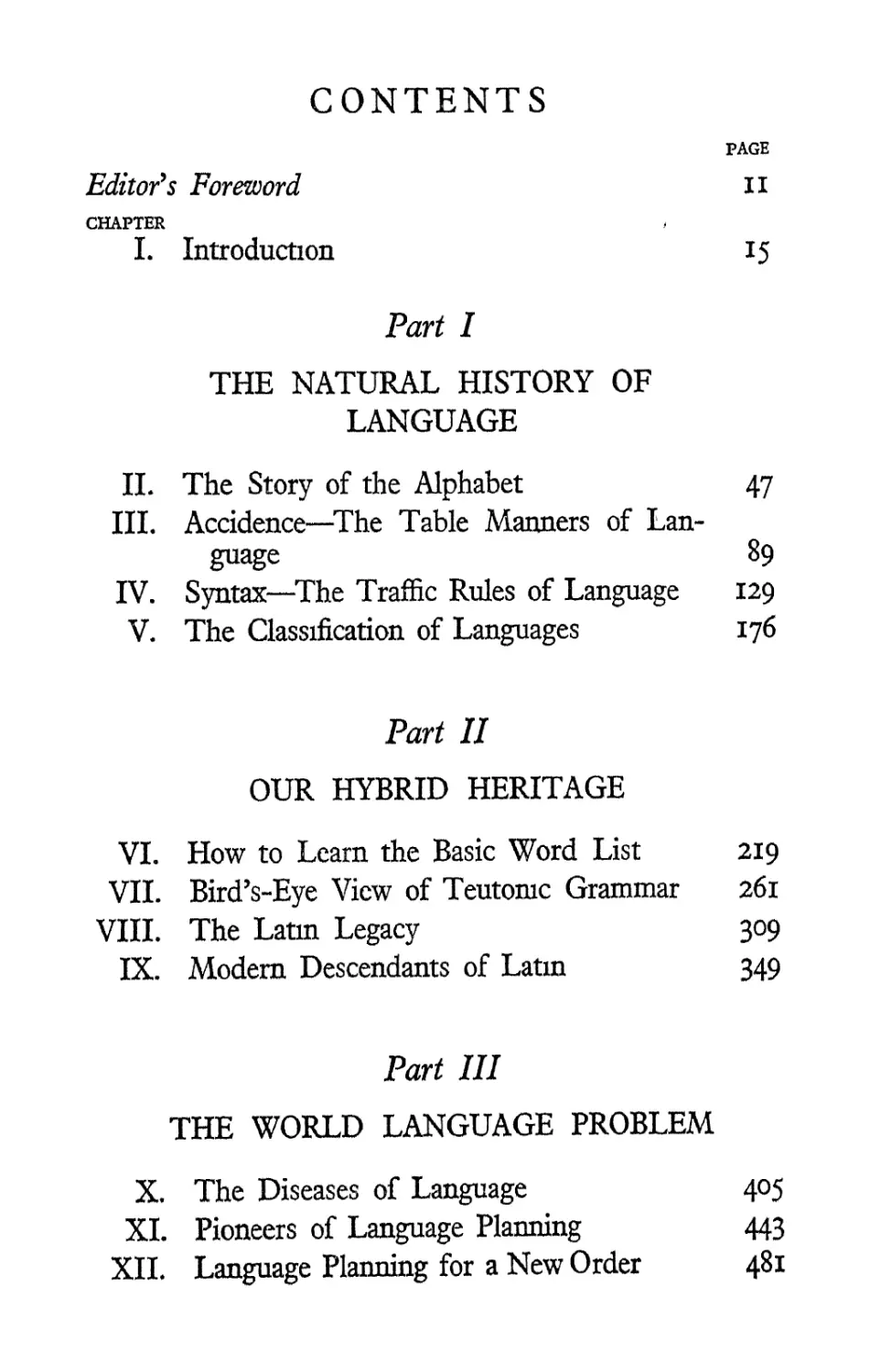
















































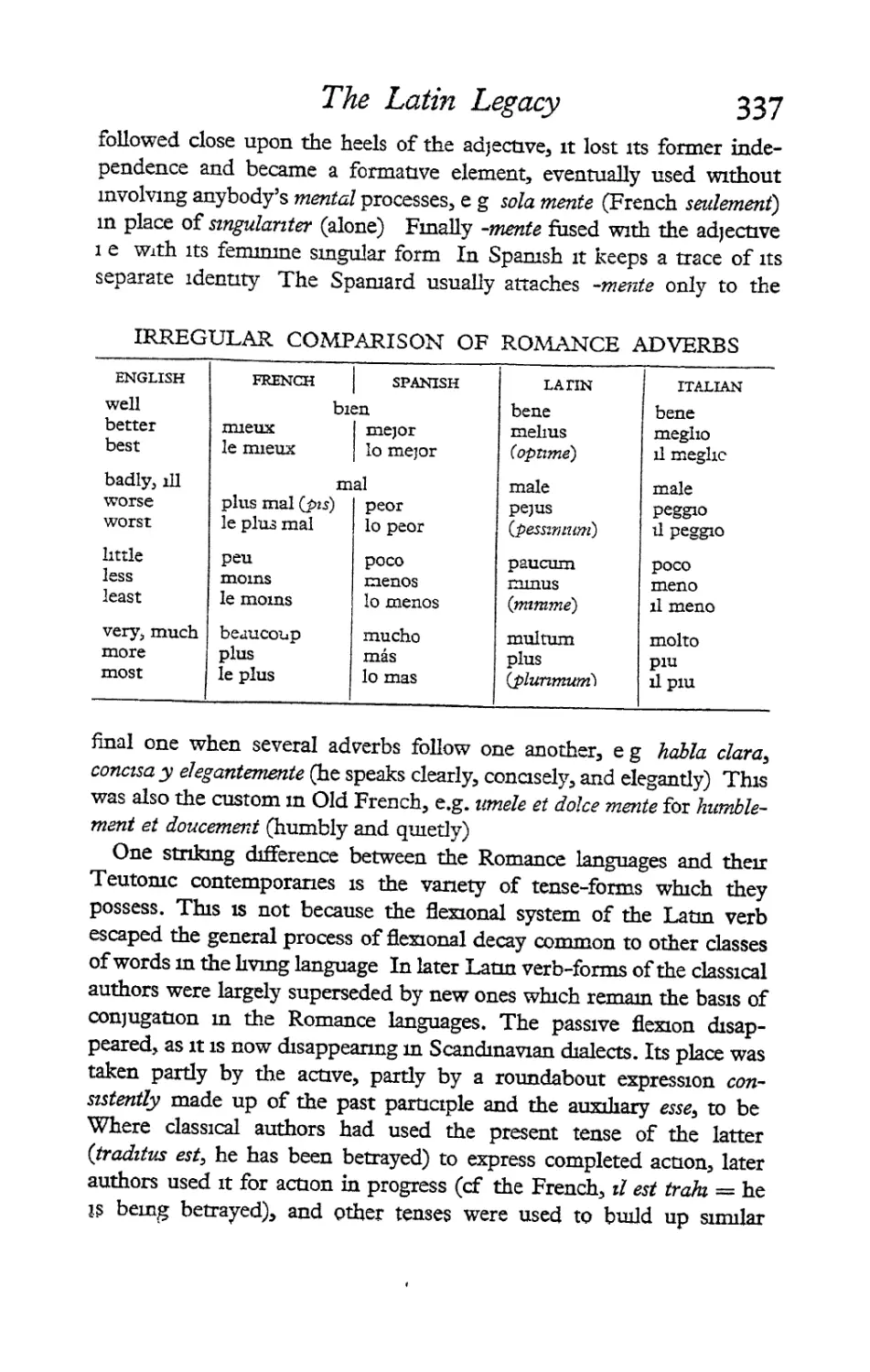
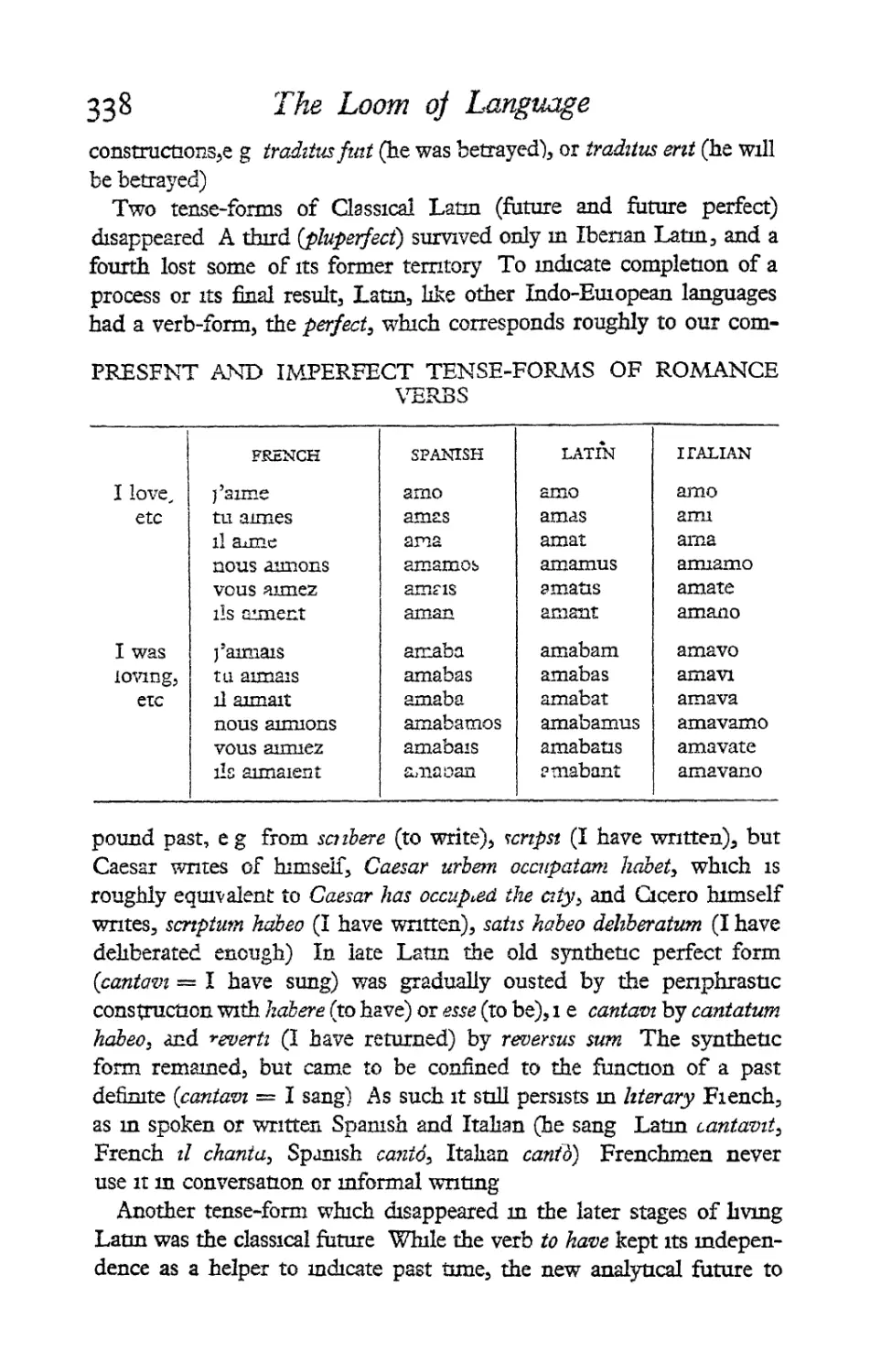
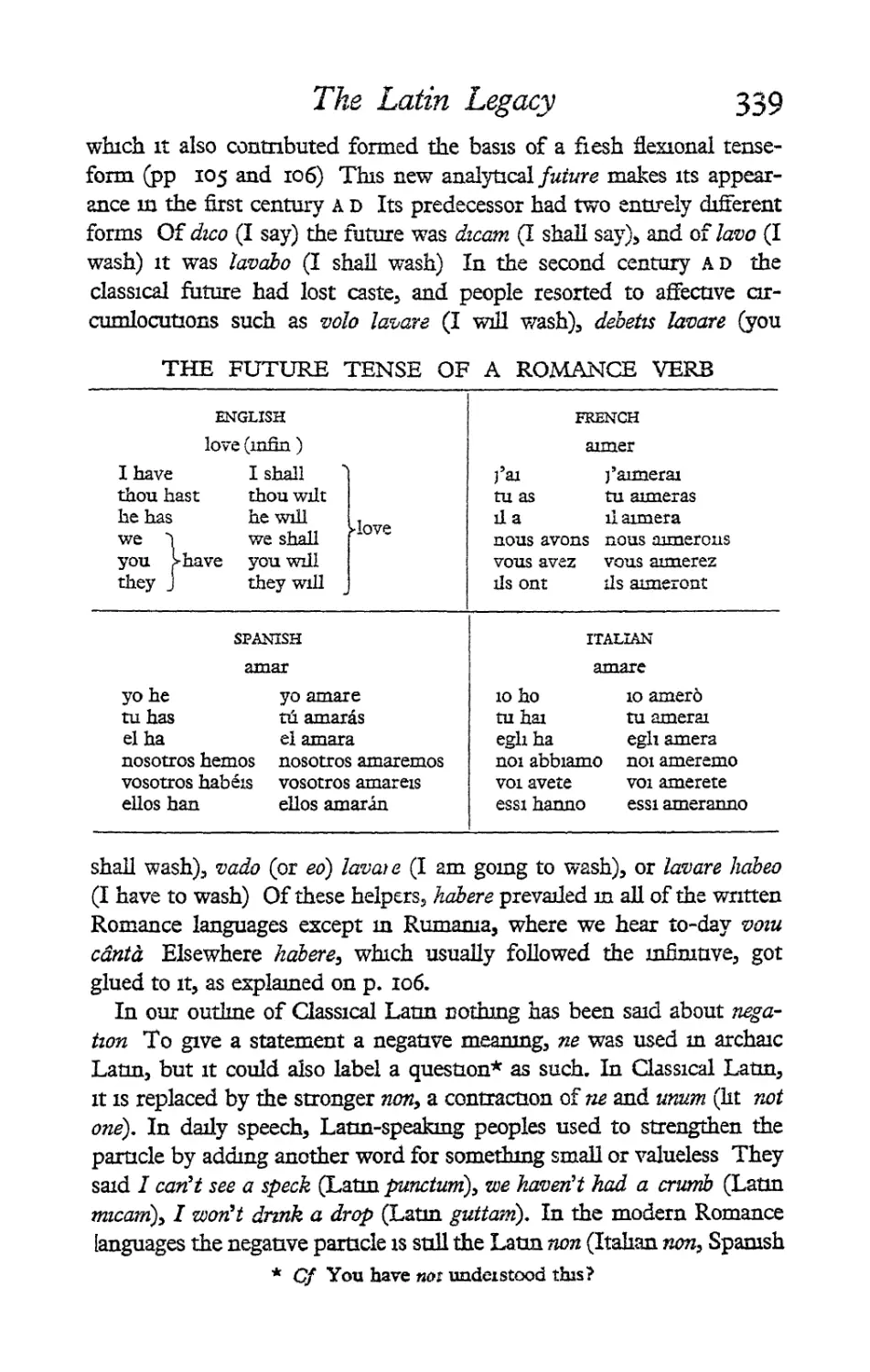













































Похожие


Текст
Primers for the Age of Plenty No. 3
T-HE LOOM OF
LANGUAGE
PRI-MERS FOR THE AGE OF PLENTY
died by LANCELOT HOGBEN
, Mathematics for the MilIion
by Lancelo Hogben
2. Science for the Citizen
by Lancetot Hogben
3- The Loom of Language
by Frederick Bodner
4. I-I/story of the Fiomeland
by Henry Hamilton
; (forthcoming)
THE LO0/gi OF
LANGUAGE
A Guide to Foreign Languages
for the Home Student
FREDERICK BODMER
echted aoE arranged by
LANCELOT HOGBEN
London
GEORGE ALLEN & UNWIN LTD
FIRST PUBLISHED IFT JABTUARY I944
SECOITD I MPR]SqIOBI FLBRUAR¥ 1944
TIII IMPRESSION APRIL 194 5
i BE PAPER ATD BIIBTG OF THIS
BOOK CONFOttYi TO IIE AUOEHORIZED
WOKIN'«
Up to the very present day» the irons» the steels, chrect and rule and
change lïfe as no Alêxanders, no Caesars, no Jengas Khans or Mussokms
have ever done You can see the thmgs that anse out of 1ton from thê
first 1ton spear-head and the first axe to the steel raff, the battleslmp and
the motor You can see t.hem temptmg and obhgmg and compelhng men
to change thelr ways of lffe and ther relataons to one another There
were no parncular ron-mmded peoples It was a marrer of quate secondary
importance to everyone but the gangs and mdvlduals concerned, what
collectwn of people first got hold of the new flamg But the new bastory
xs hot smaply an account of the general matenal hfe of mankand .
Its subtler and more maportant business s the study of the develop-
ment of soclally bmdmg deas through the mechum of speech and wntmg.
t-Iow dld language» speech and wrmng anse? .. Thê old-type tustonans
bave done nothmg to show how the ïmposmon of a language or a blen-
dmg of languages gaves a new twlst and often a new power to the com-
mumty's mental processes. A language s an xmplement qutte as much
as an maplement of stone or steel, ltS use mvolves socml consequences»
It does thmgs to you just as a metal or a machine does tbangs to you It
makes new precislon and also new errors possible
H G WELLS, In Search of Hot Water
The evolutlon of language has bcen almost as unconscmus as that
o an embryo FIe (man) grasps, necessanly wthout reflectmn, thas
fascanatang but gnarled product of evolutmn, nethêr he nor bas relatives
and teachers condenng at al1 whêther the têchmque of commumcatmn
he s learnïng s modérn Fie ls m the posmon of a person who bas
just chscovered he can ride a bcycle and rushcs off to buy the first he can
find rrespectave of whethêr It s new or of the latest design It s a
bcycle and gets ktm along somehow» that s enough I-te takes t, wlth
all ts defects Thë language hë learns s the unconsïdered end-product
of an evolutton from the sound-commumcauons of ape-hke ancêstors
The mmemonal words change less quckly than the enutes they
represent, uutfl to-day we find words often extremely rmsleadmg
tants n complex thmkang A coIossal quantty of phalosopbazmg upon
every sde of hfe s entrely vmated because persons use words quate
unsuted to descnbe the tlungs they are dascussmg» as f men must
always sculpture wth a hatchet because that was (perhaps) the first
nstrumënt usêd for the purpose
]'. G. CROTI-IER» Ouline of the Umverse
CONTENTS
Editor's Foreword
CHAPTER
I. Introductmn
Part I
THE NATURAL HISTORY OF
LANGUAGE
PAGE
Ii
15
II. The Story of the Alphabet 47
III. Accidence--The Table Manners of Lan-
guage 89
IV. Syatax--The Traffic Rules of Language 9
V. The Classification of Languages 176
Part H
OUR HYBRID HERITAGE
VI. How to Leam the Basic Word List
VII. Bird's-Eye Vicw of Teutomc Grammar
VIII. Thë Laun Legacy
IX. Modem Descendants of Latin
219
261
309
349
Part III
THE WORLD LANGUAGE PROBLEM
X. The Diseases of Language
XI. Pioneers of Language Planning
XII. Language Planning for a New Order
405
443
48I
8 The Loom oJ La,guage
Par IV
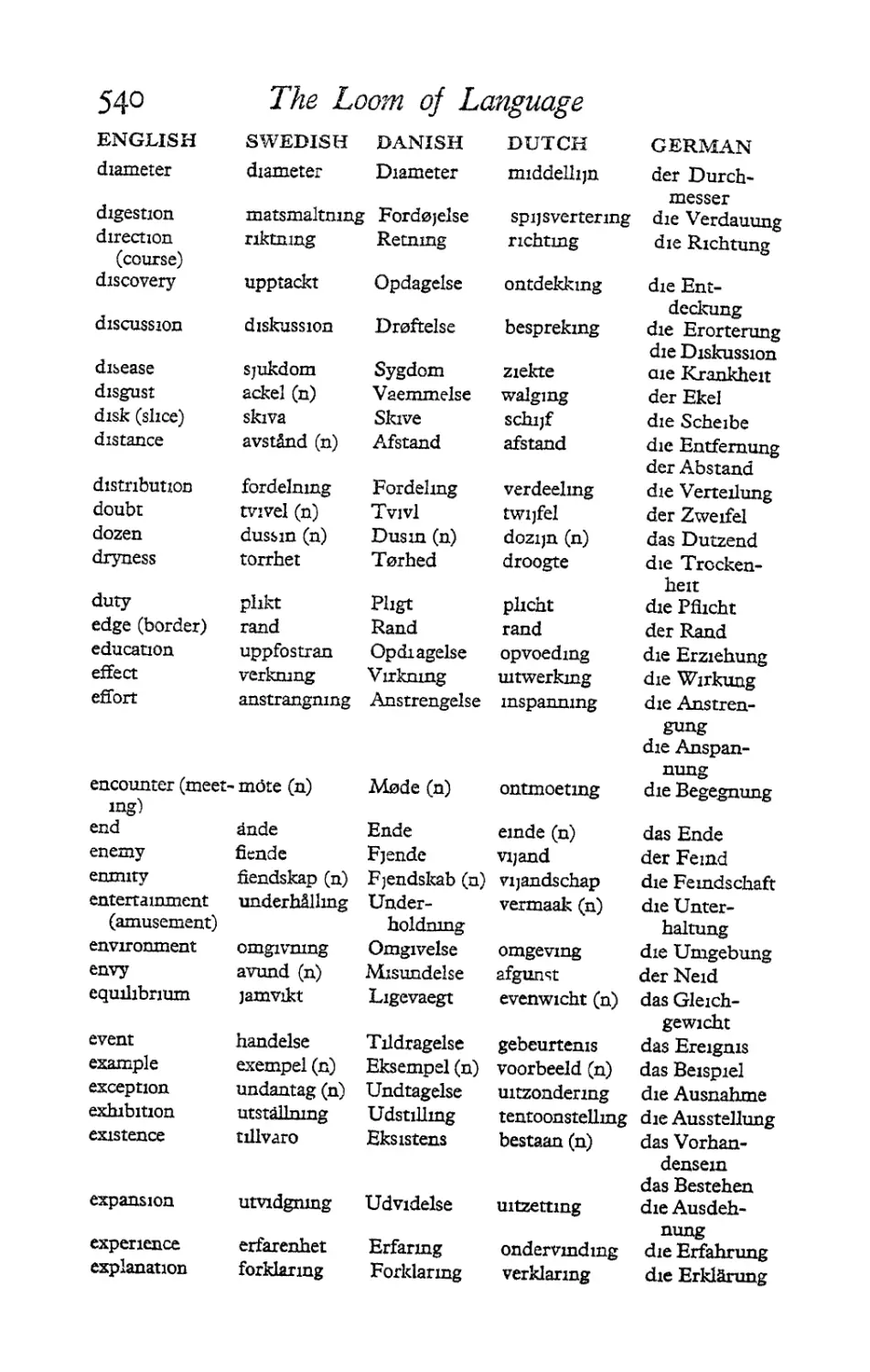
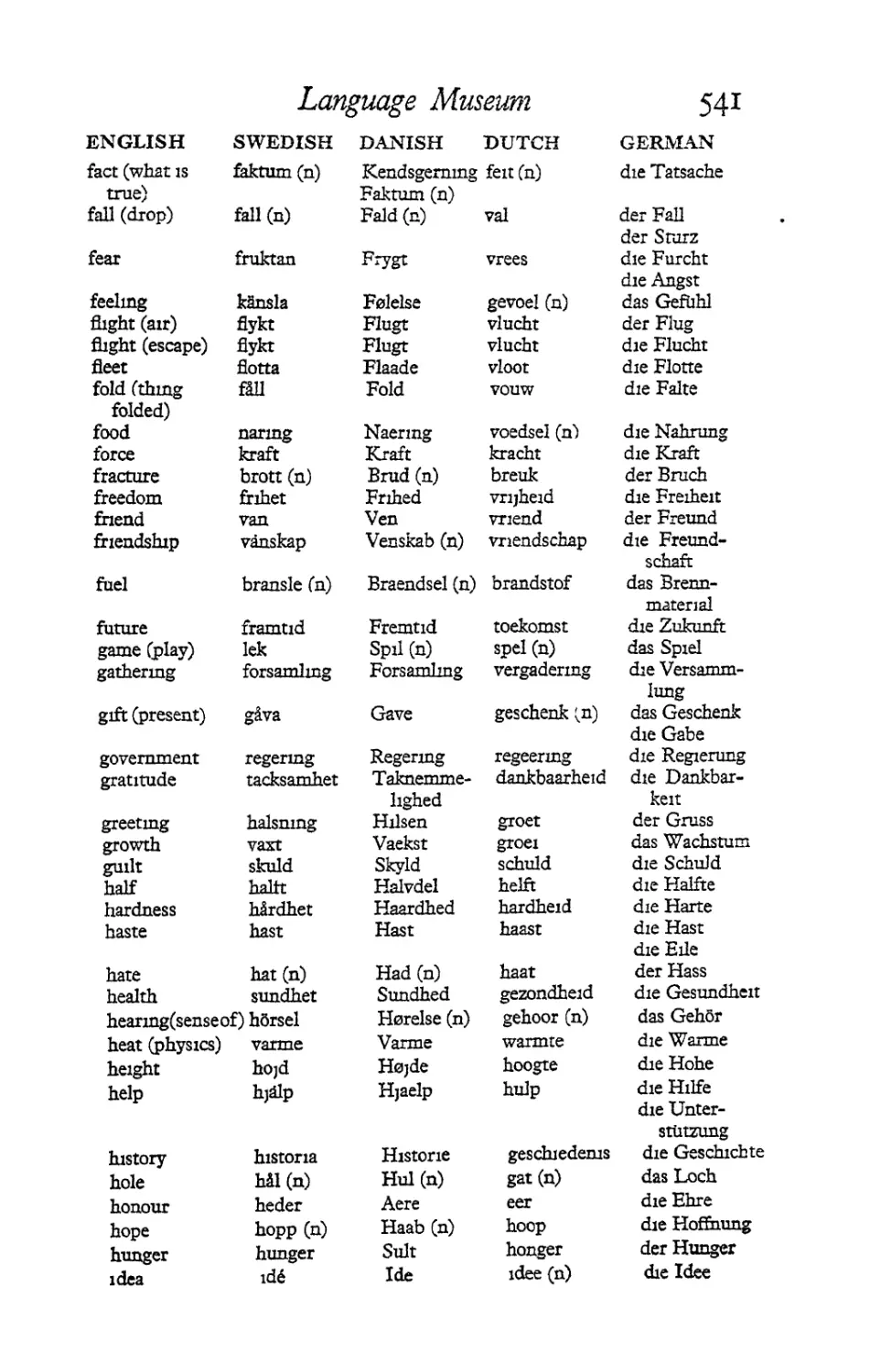
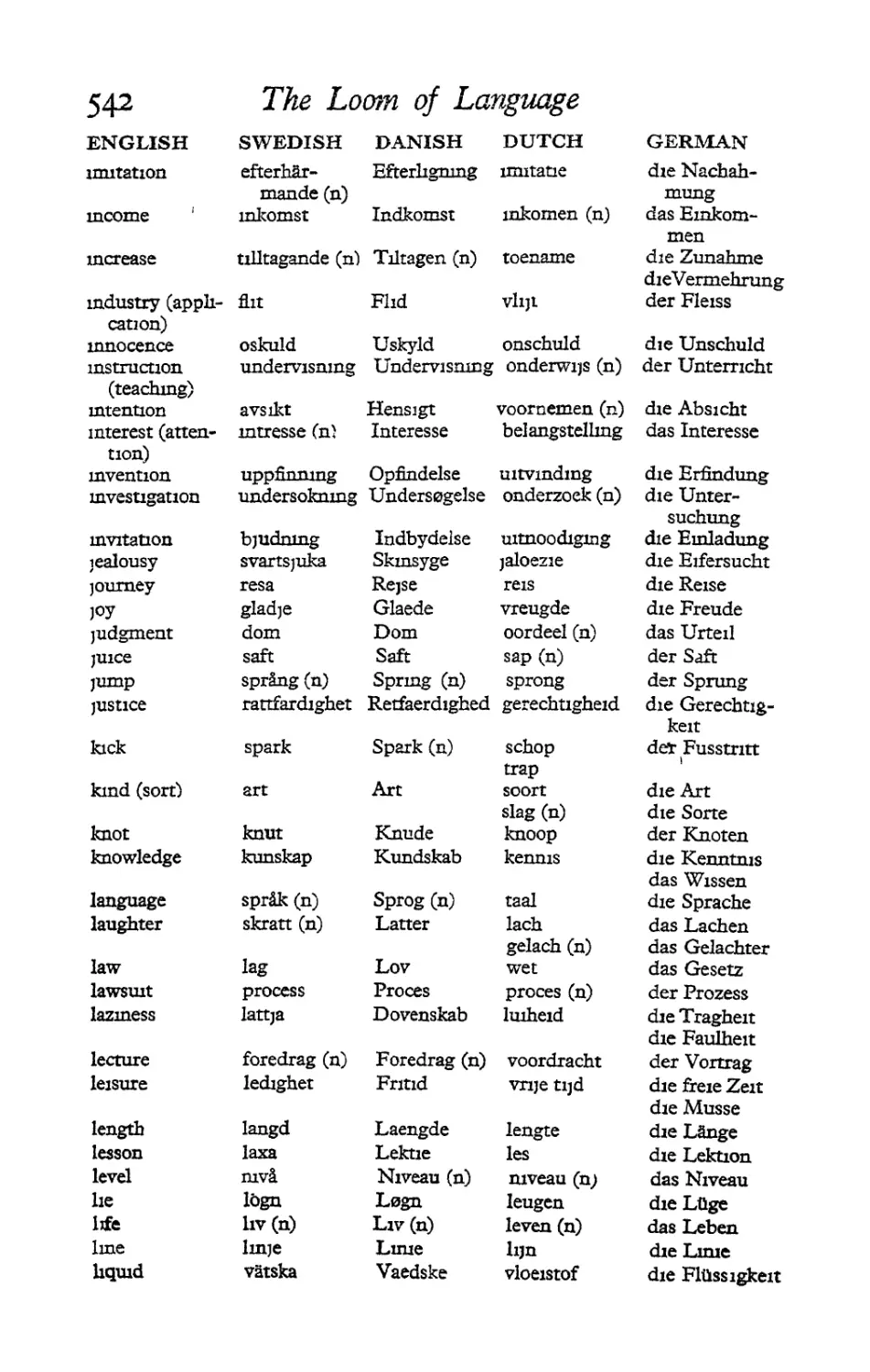
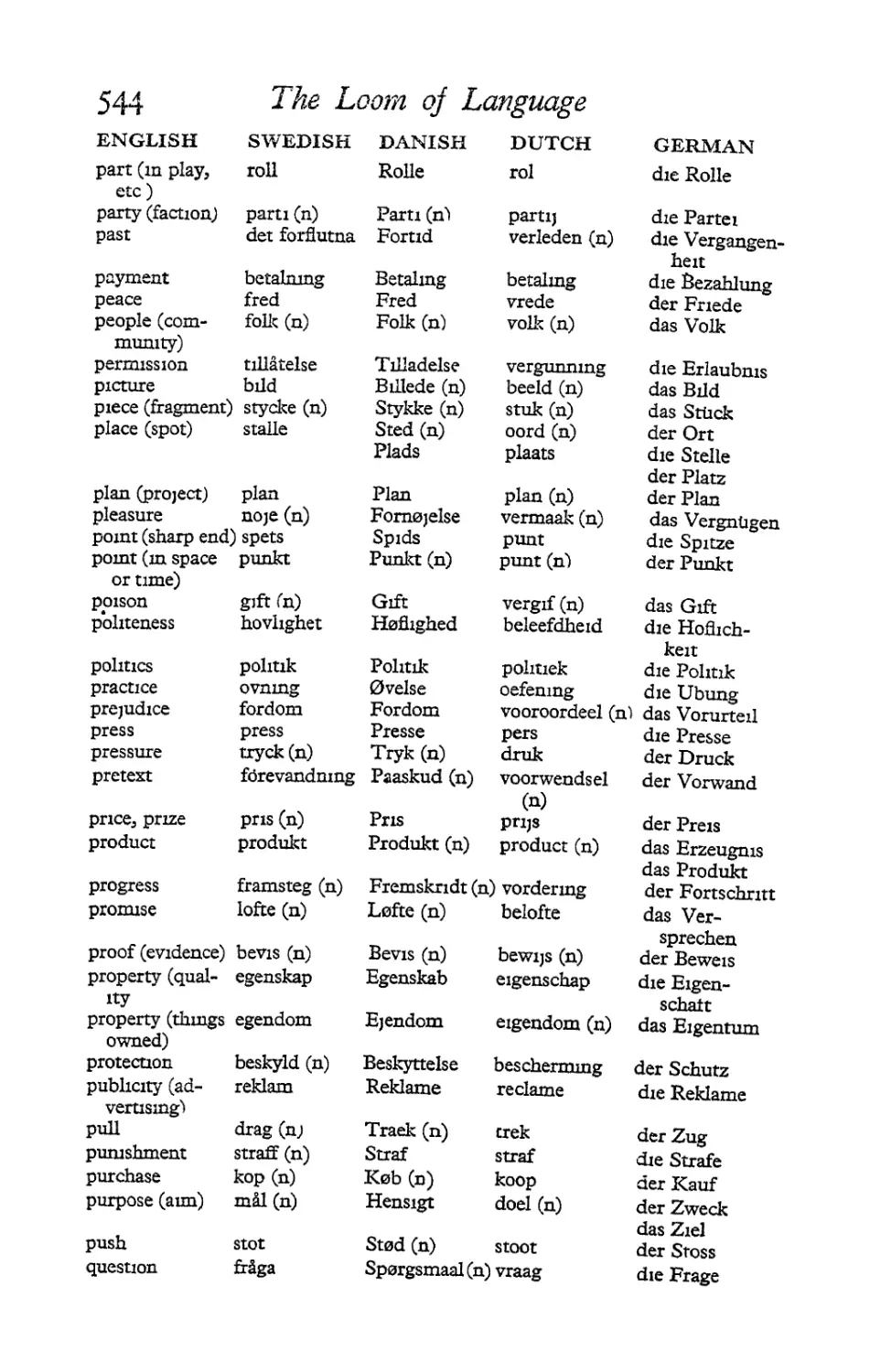
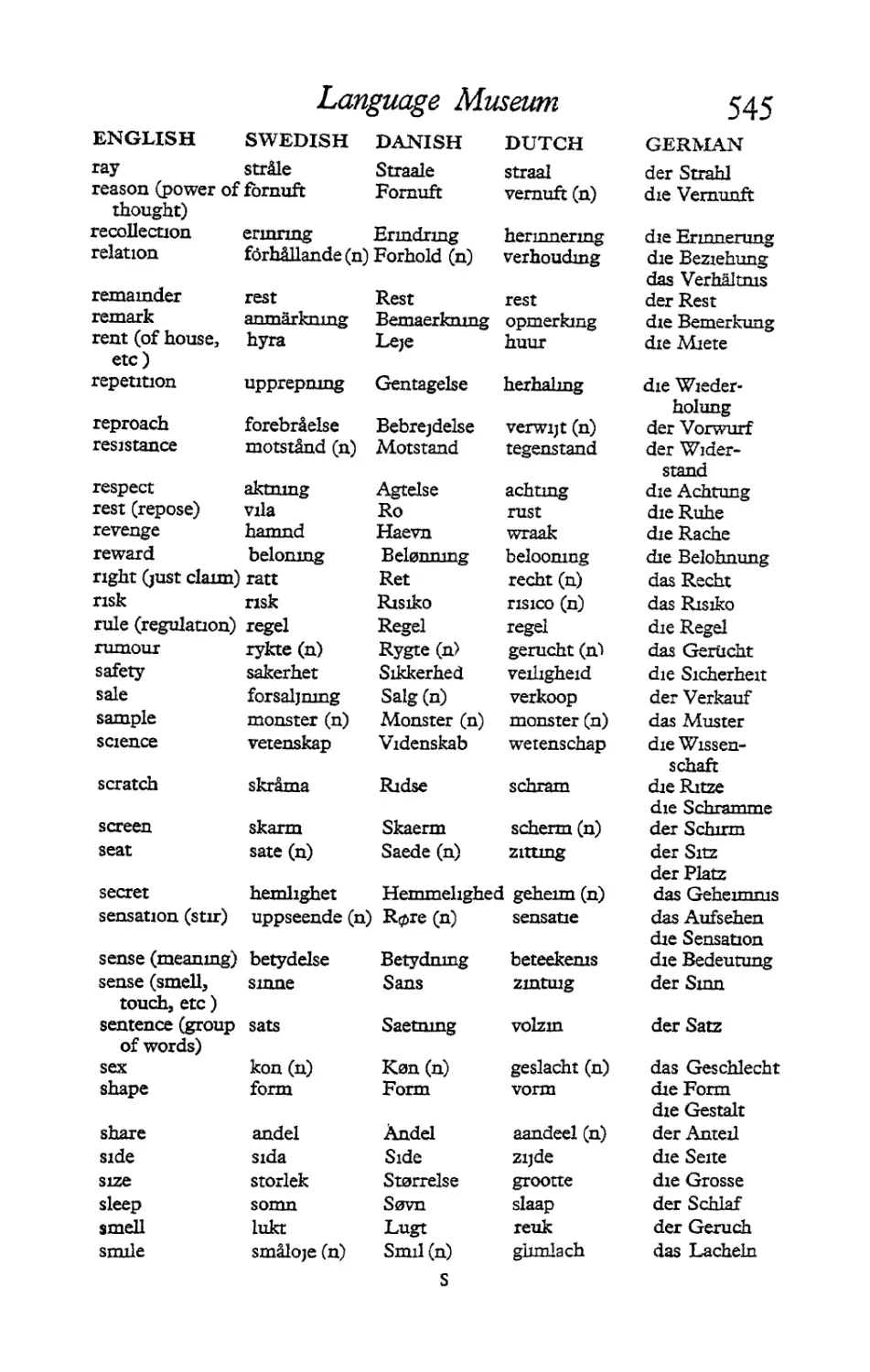
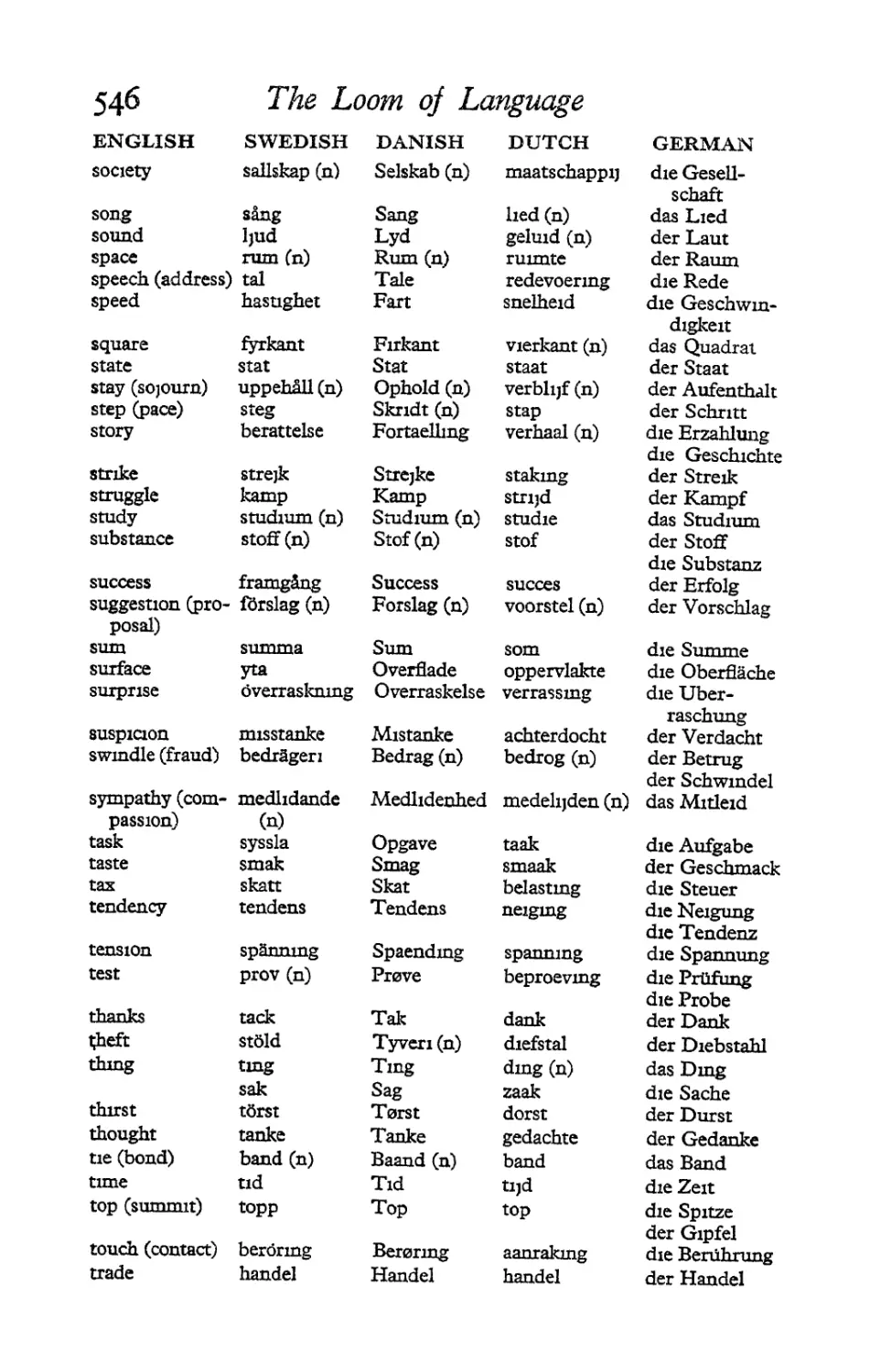
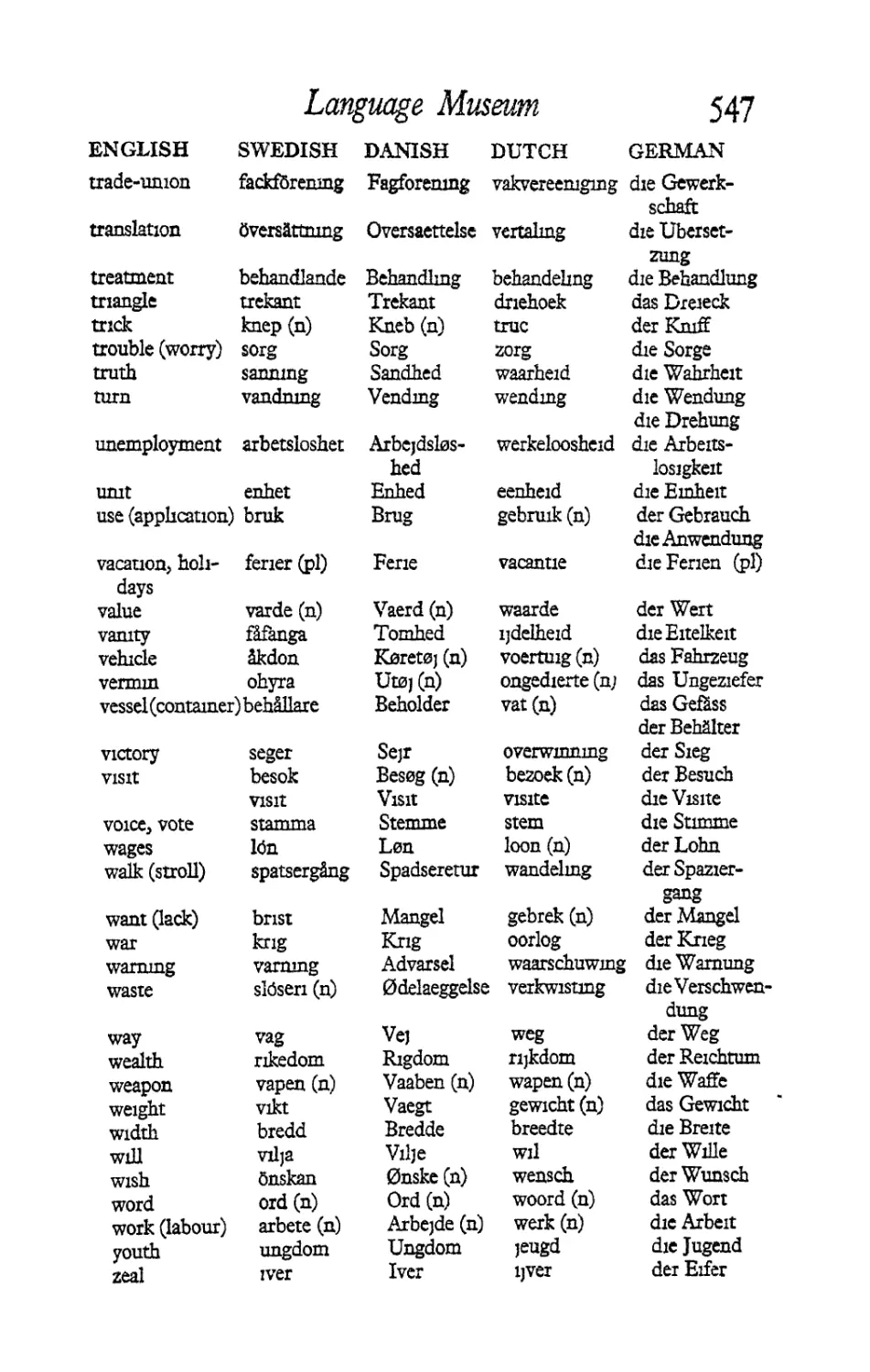
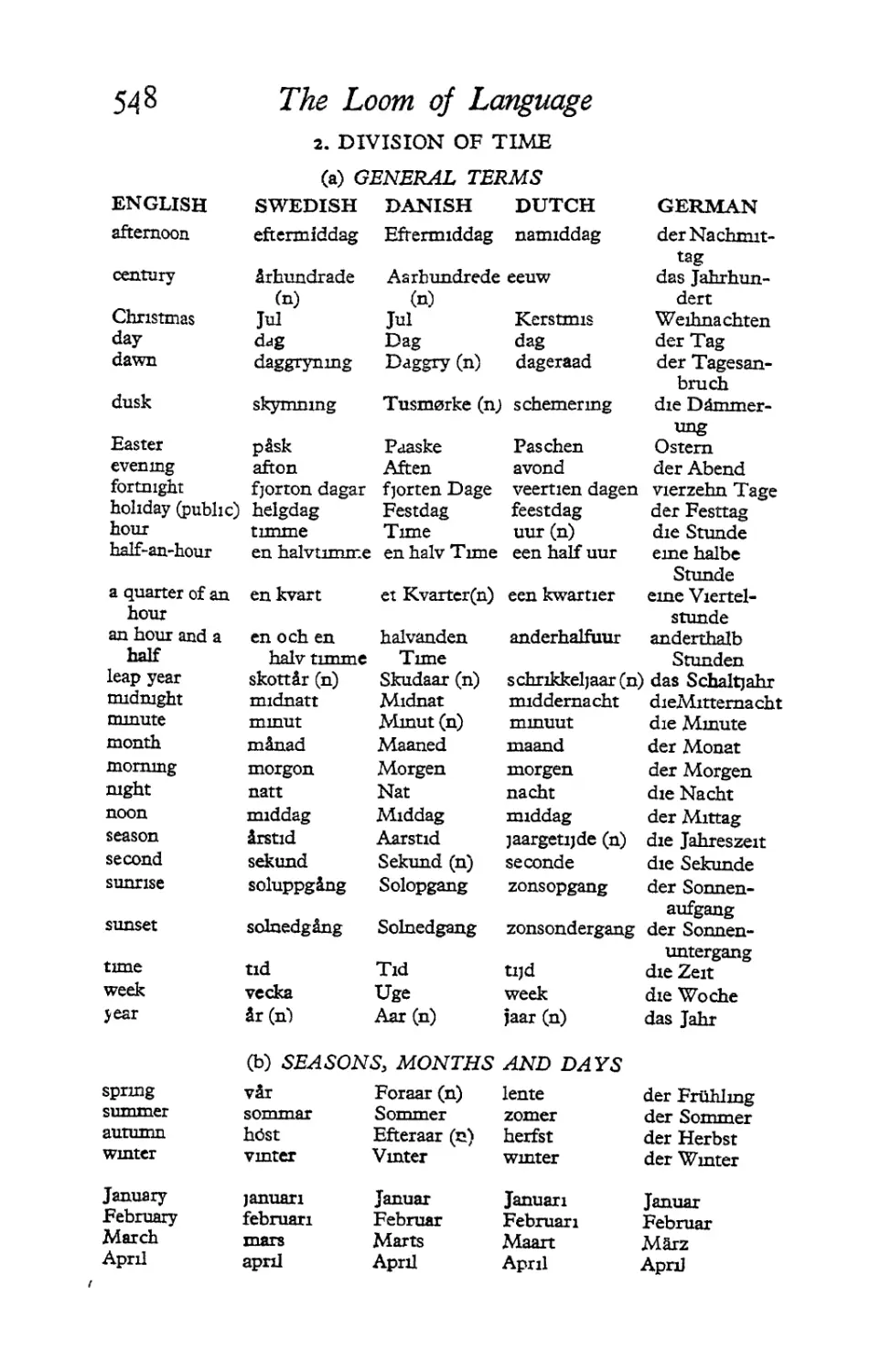
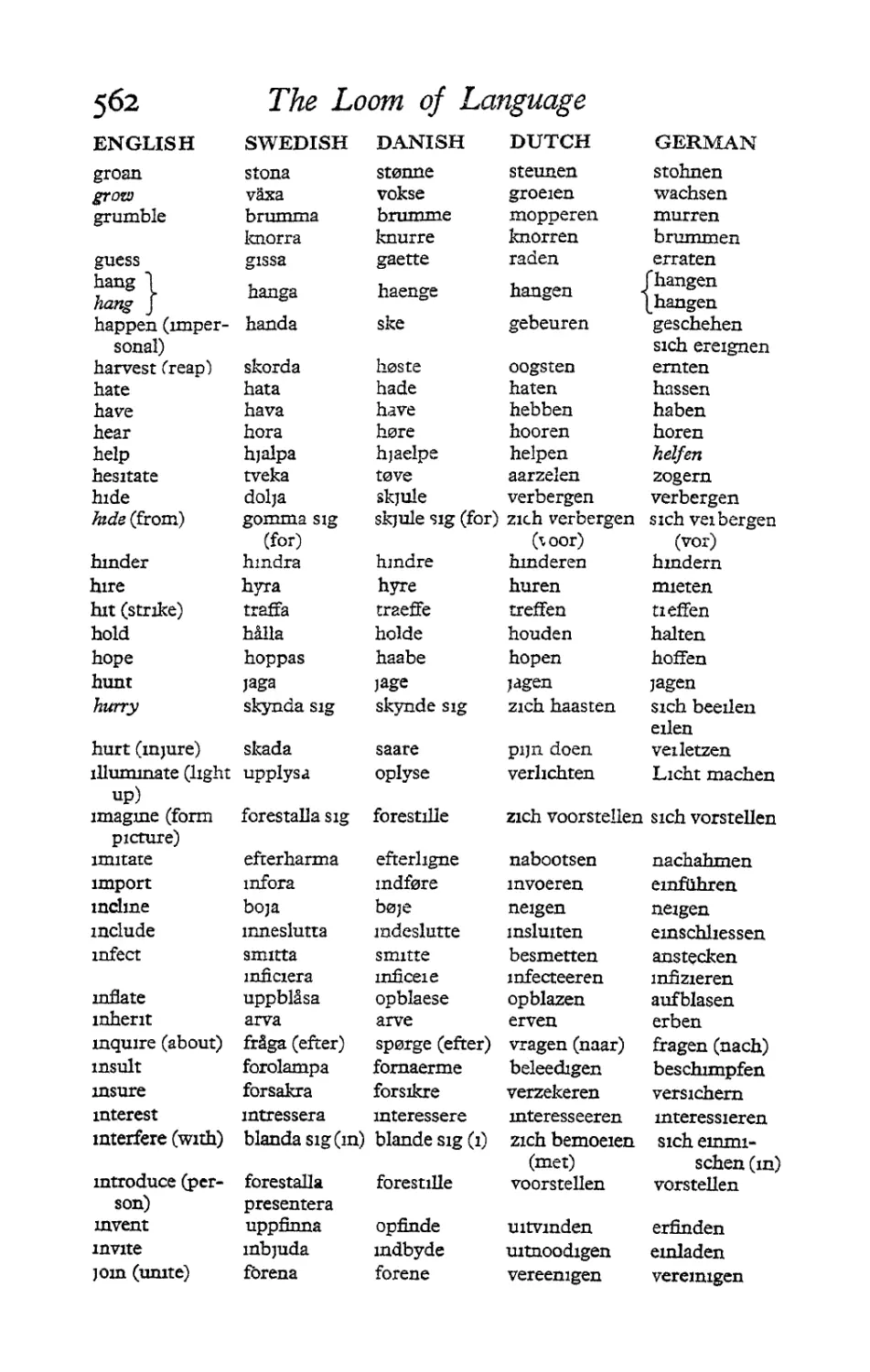
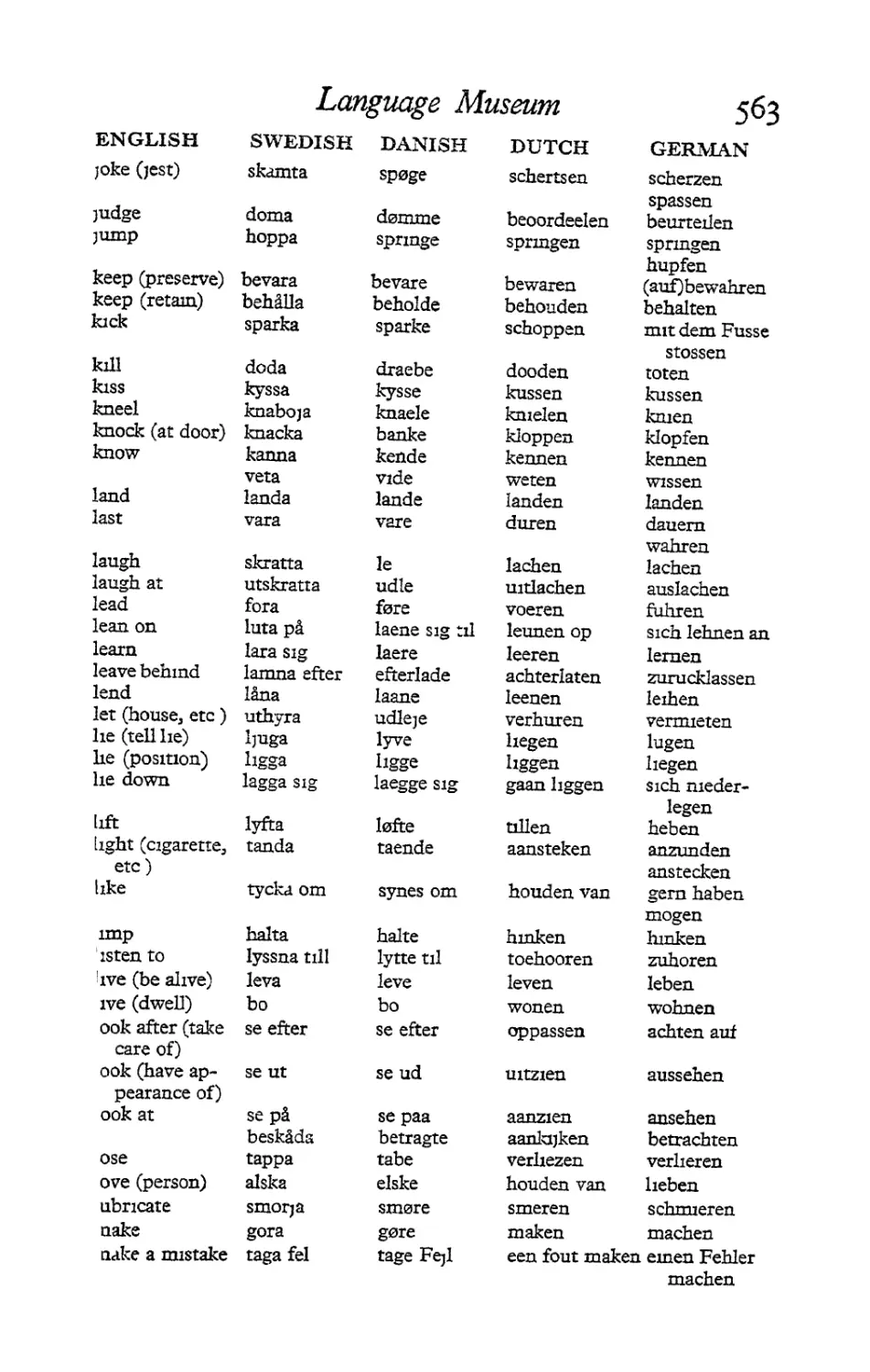
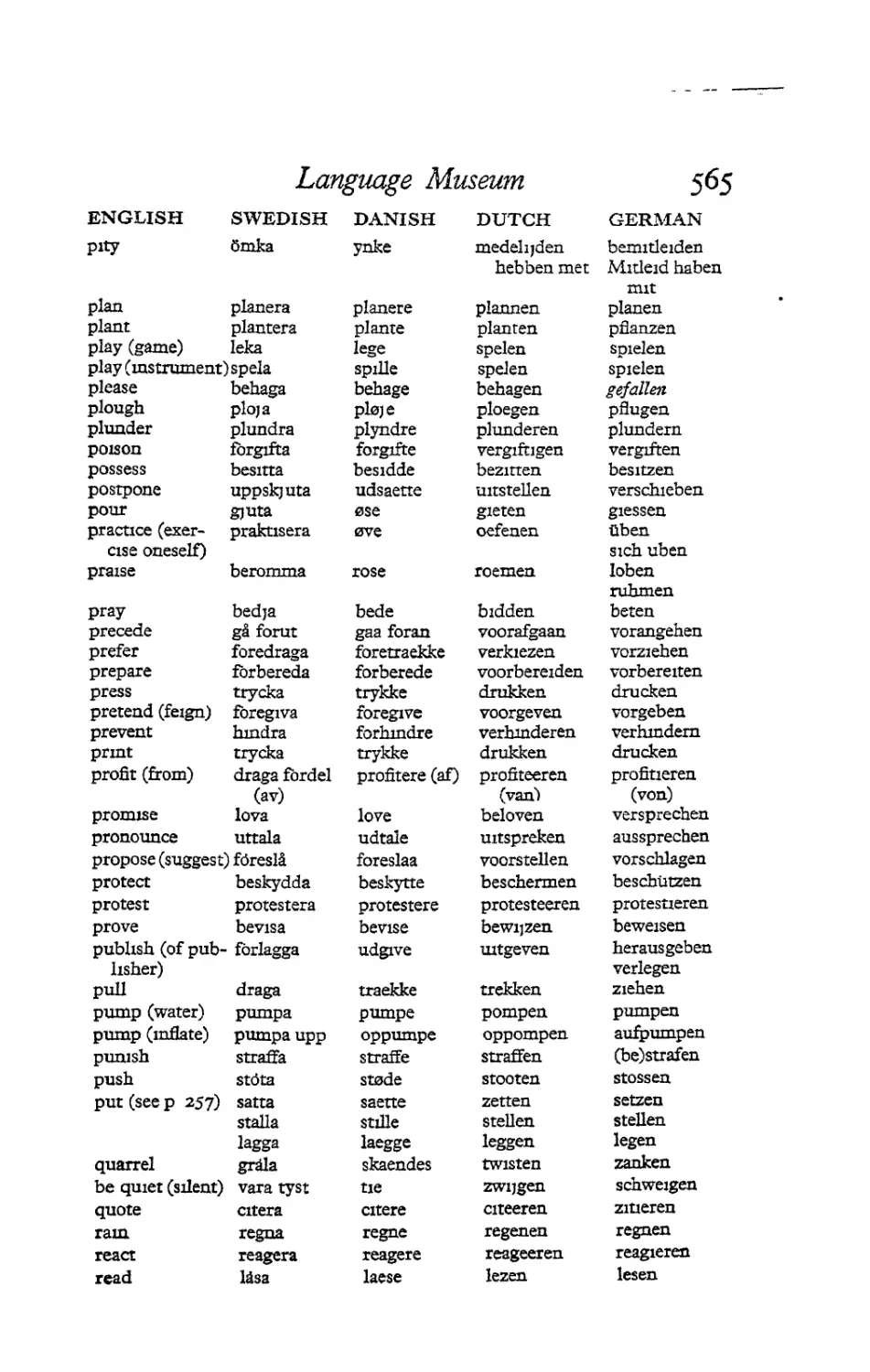
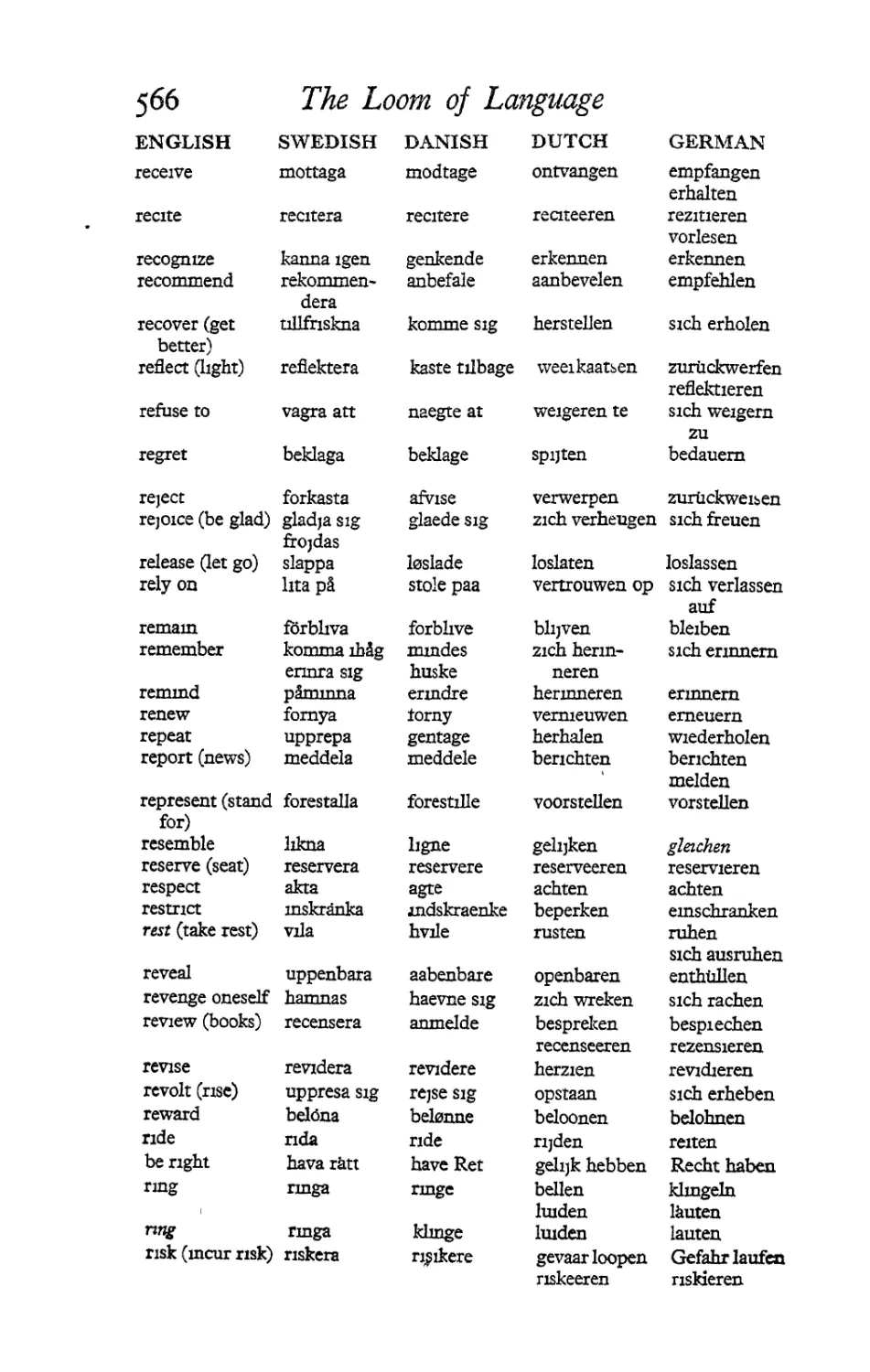
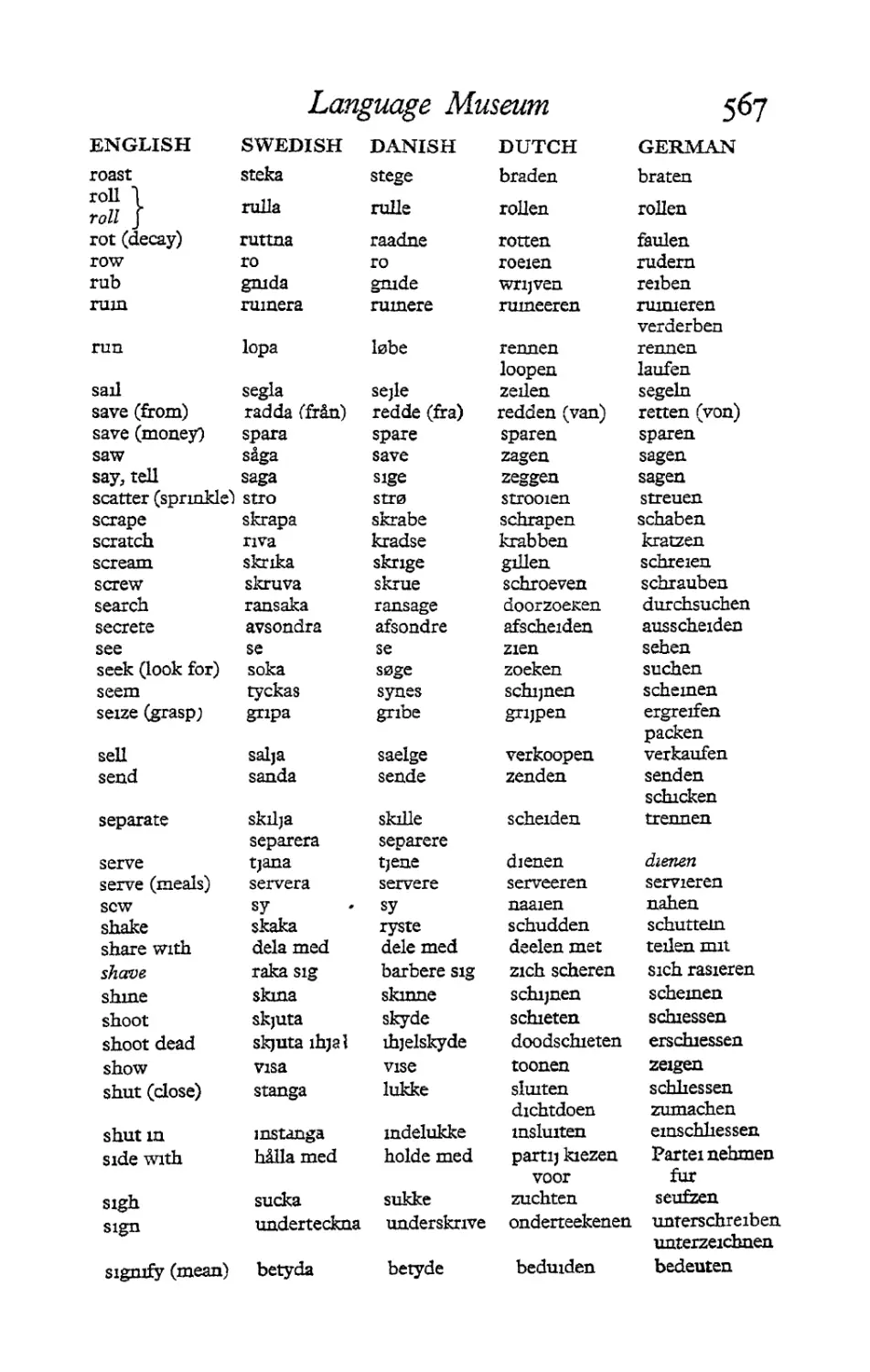
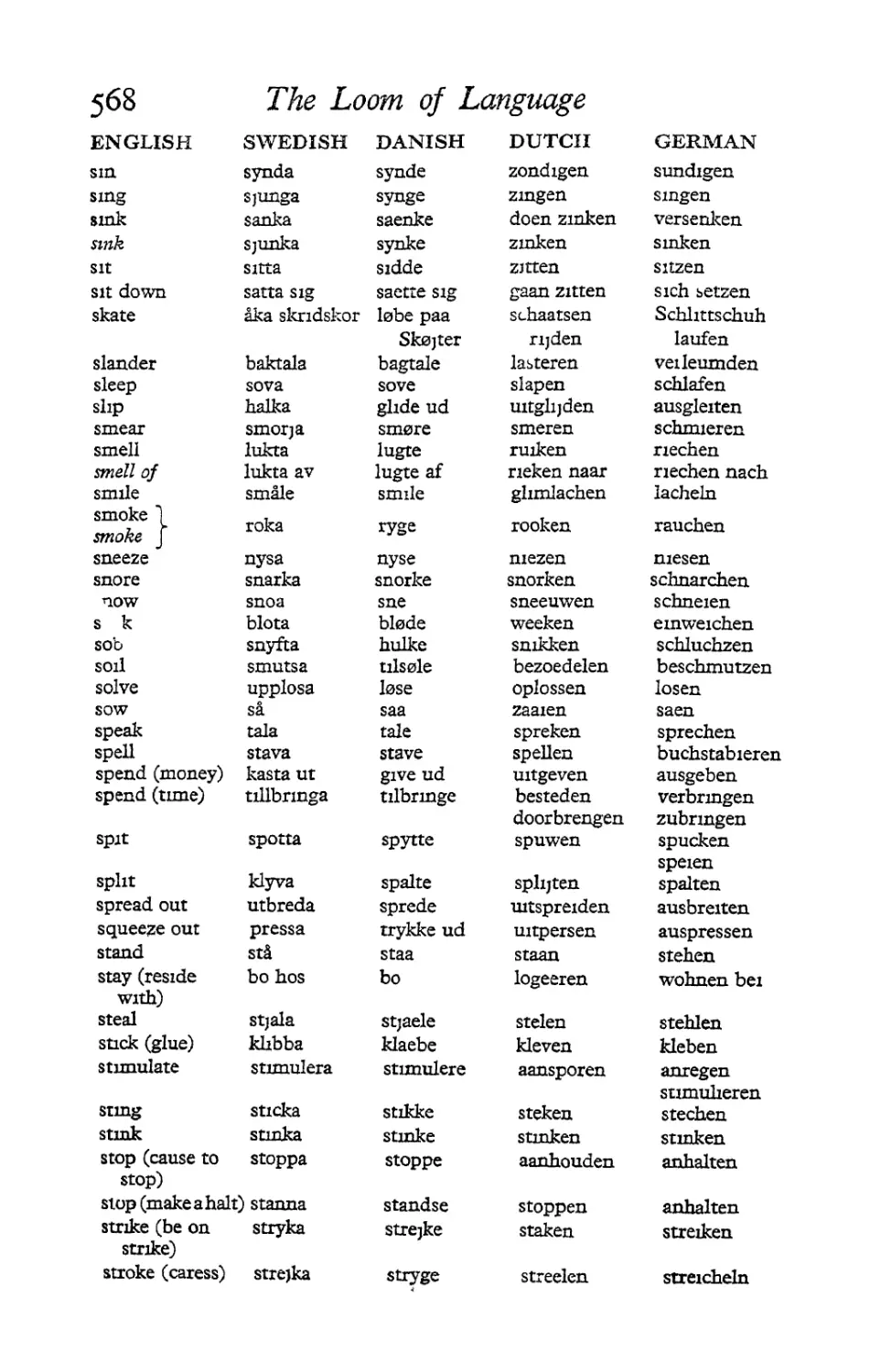
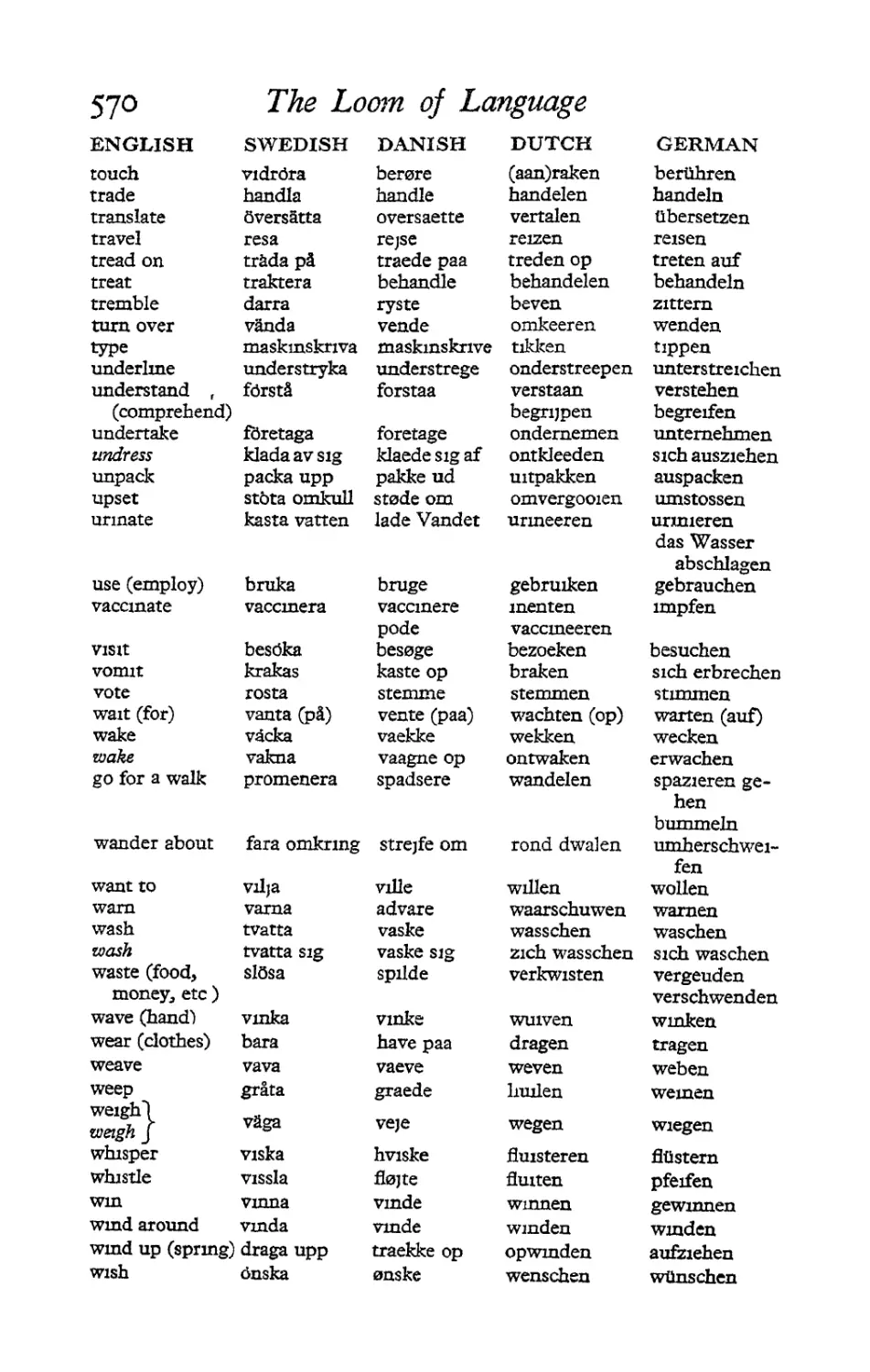
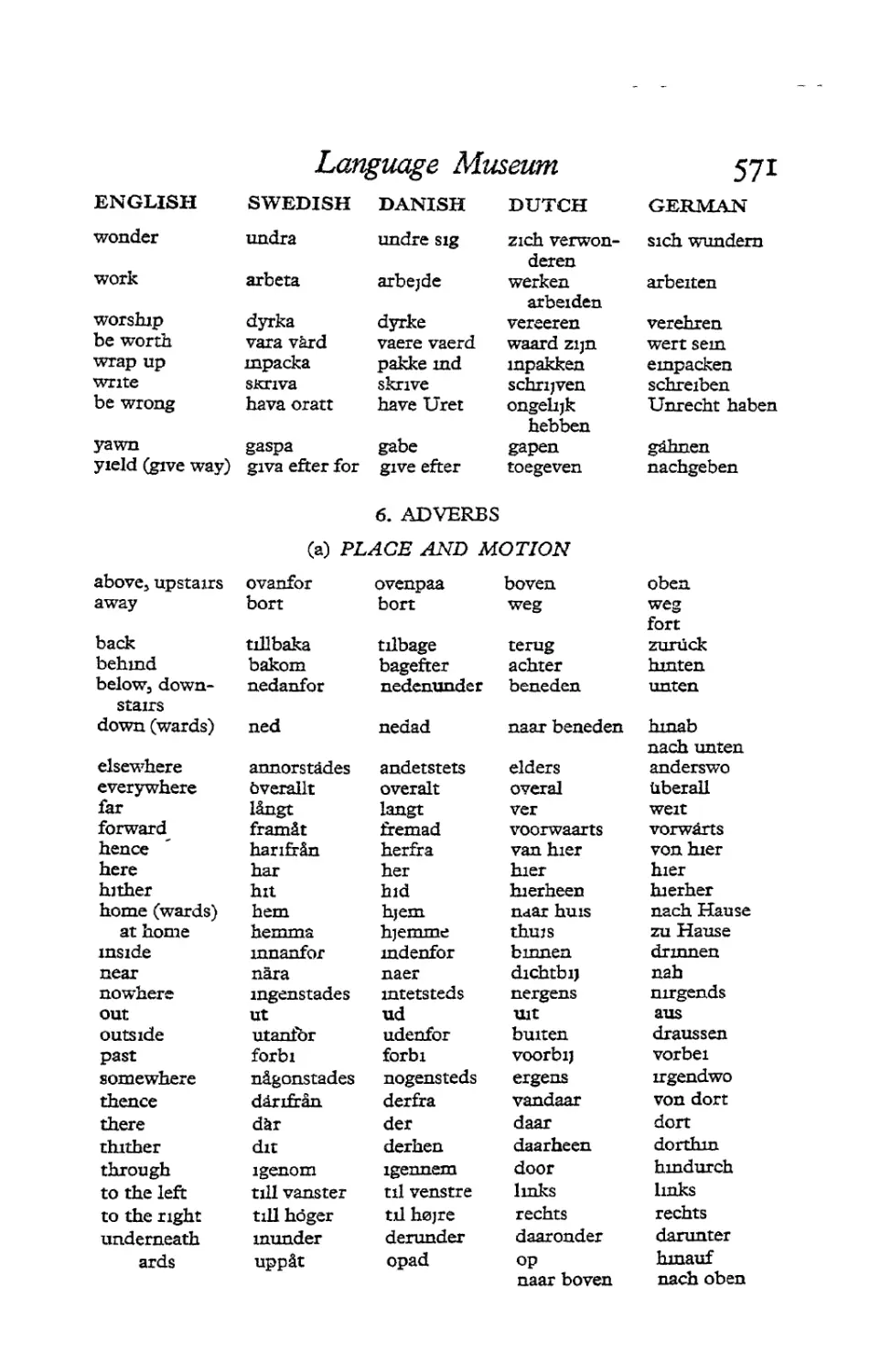
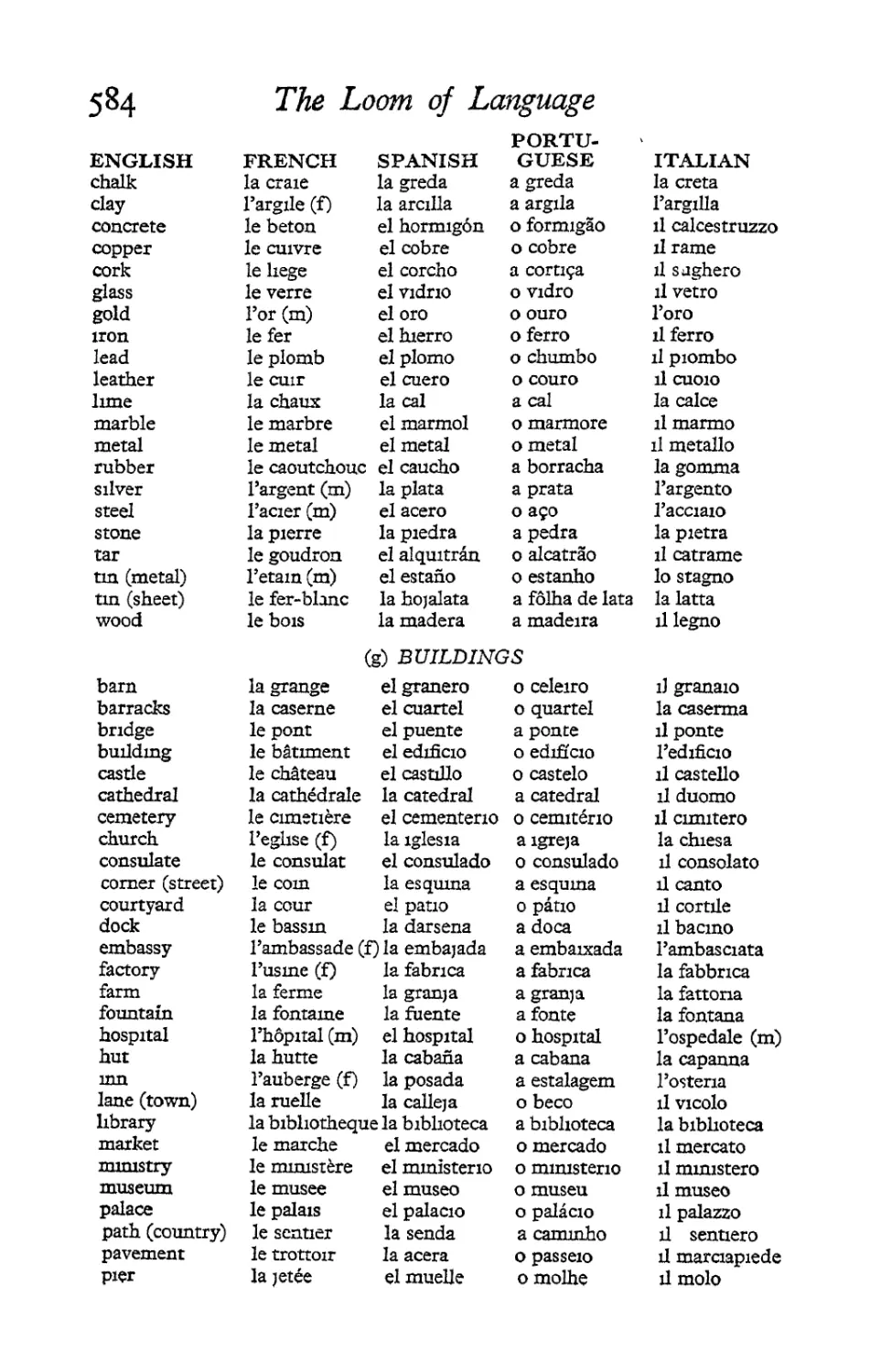
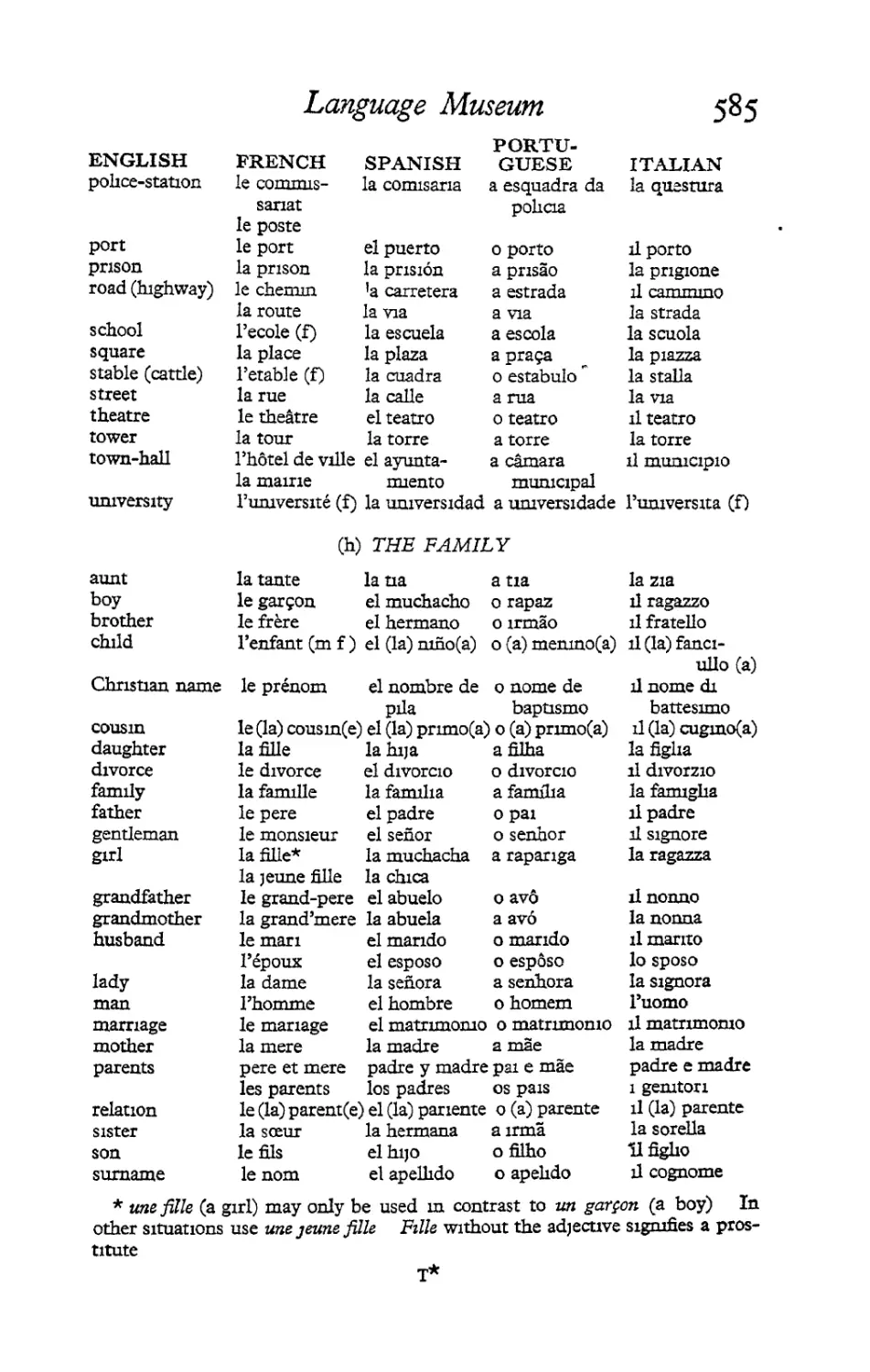
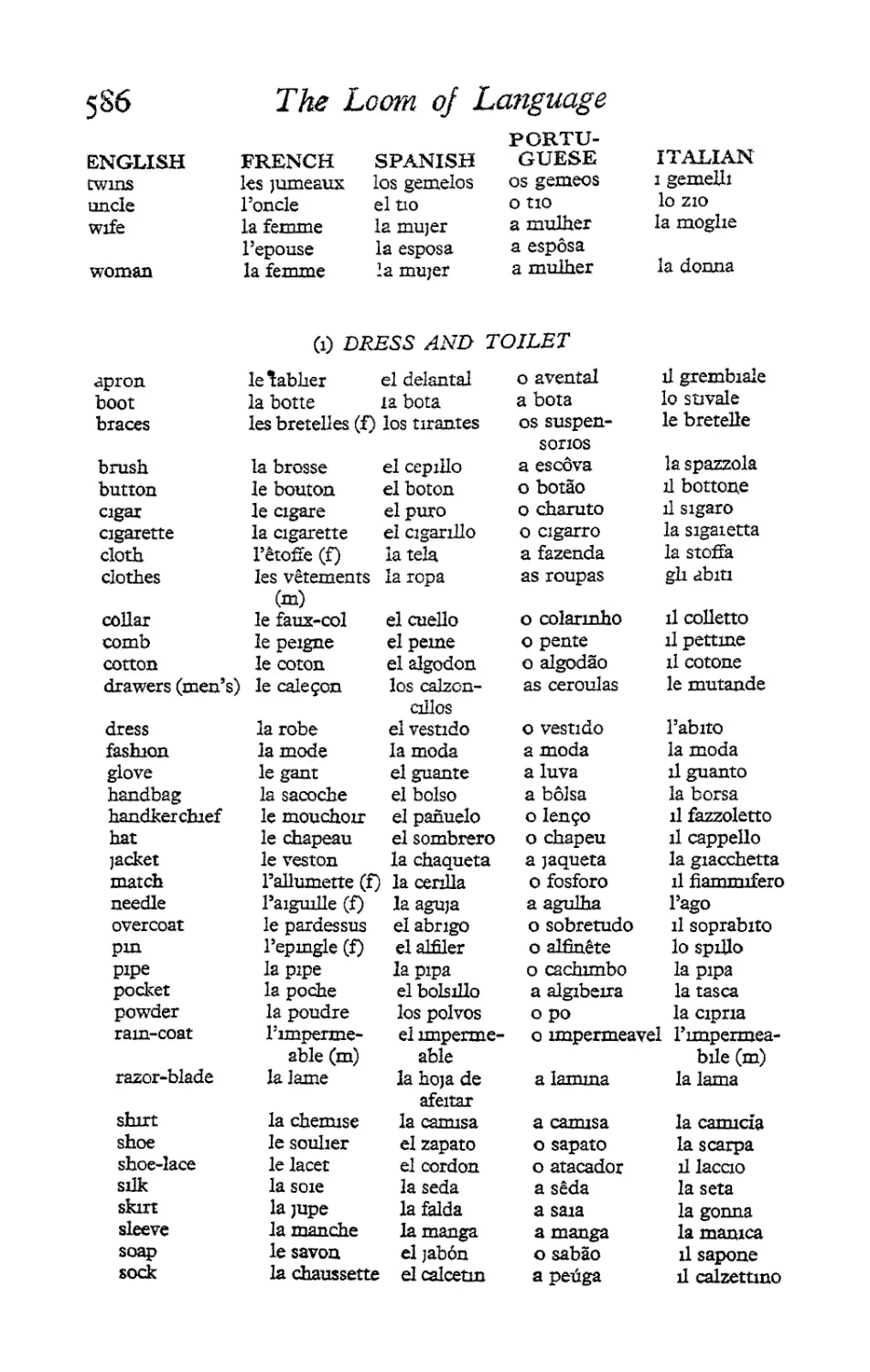
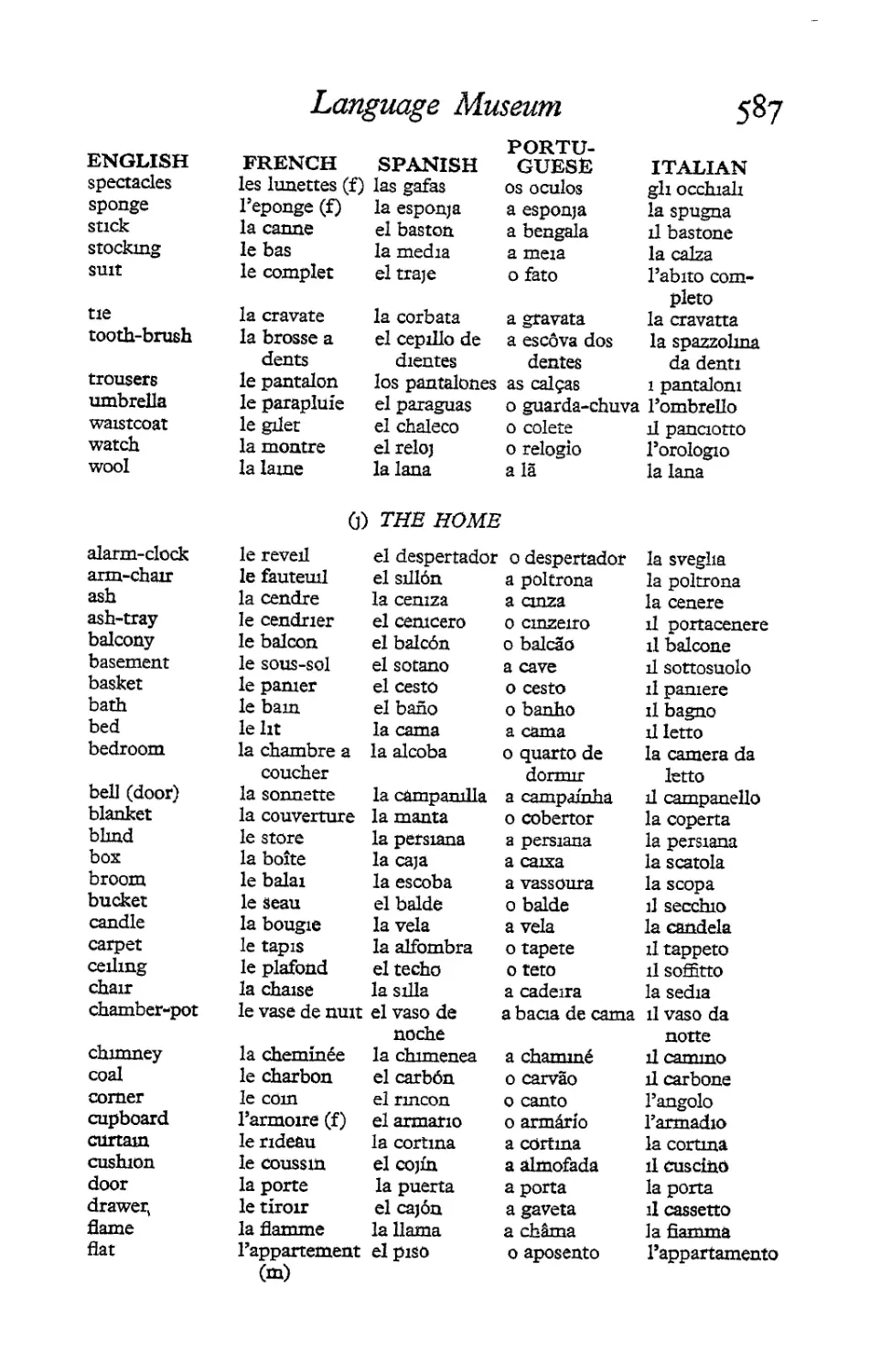
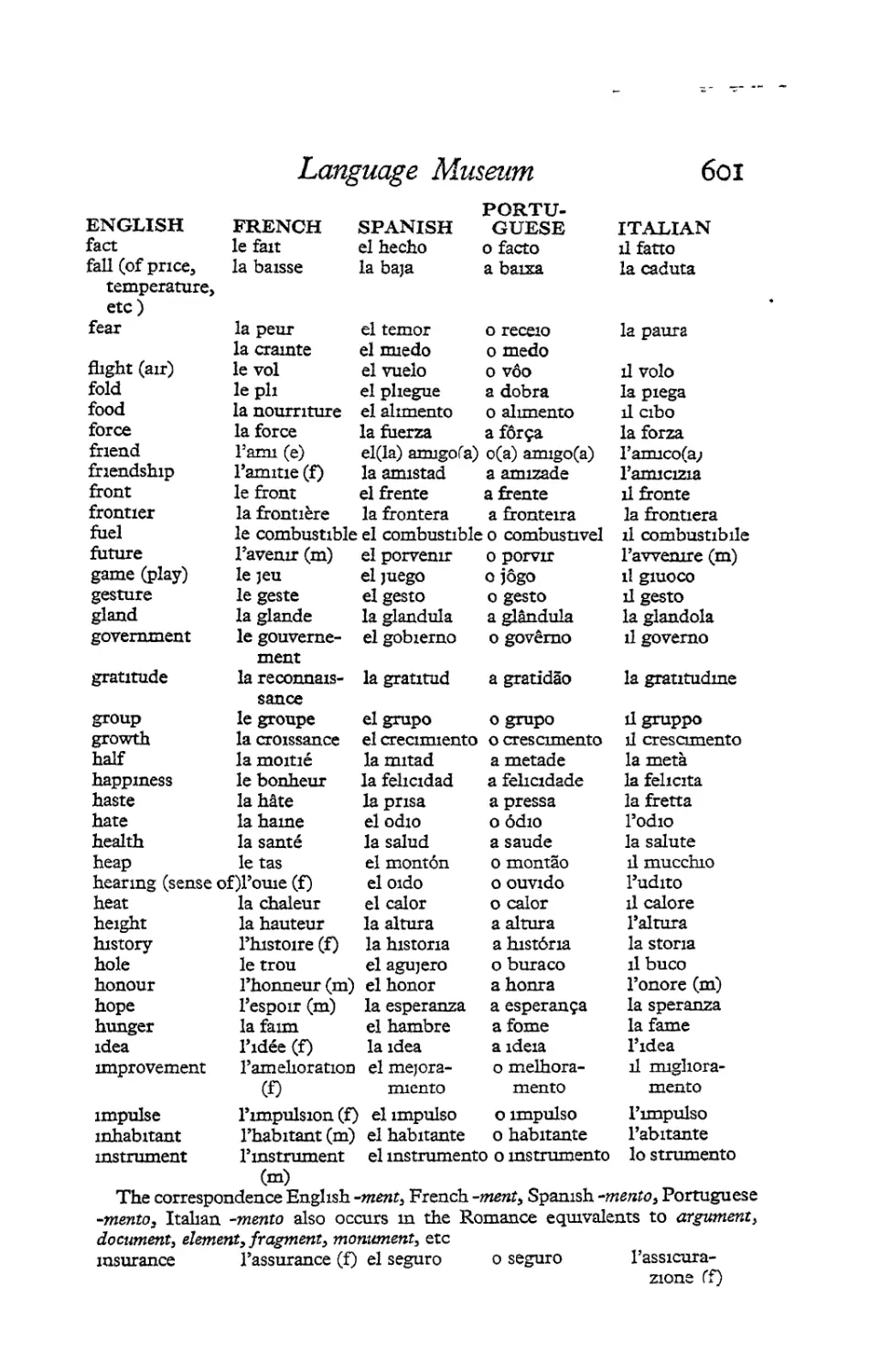
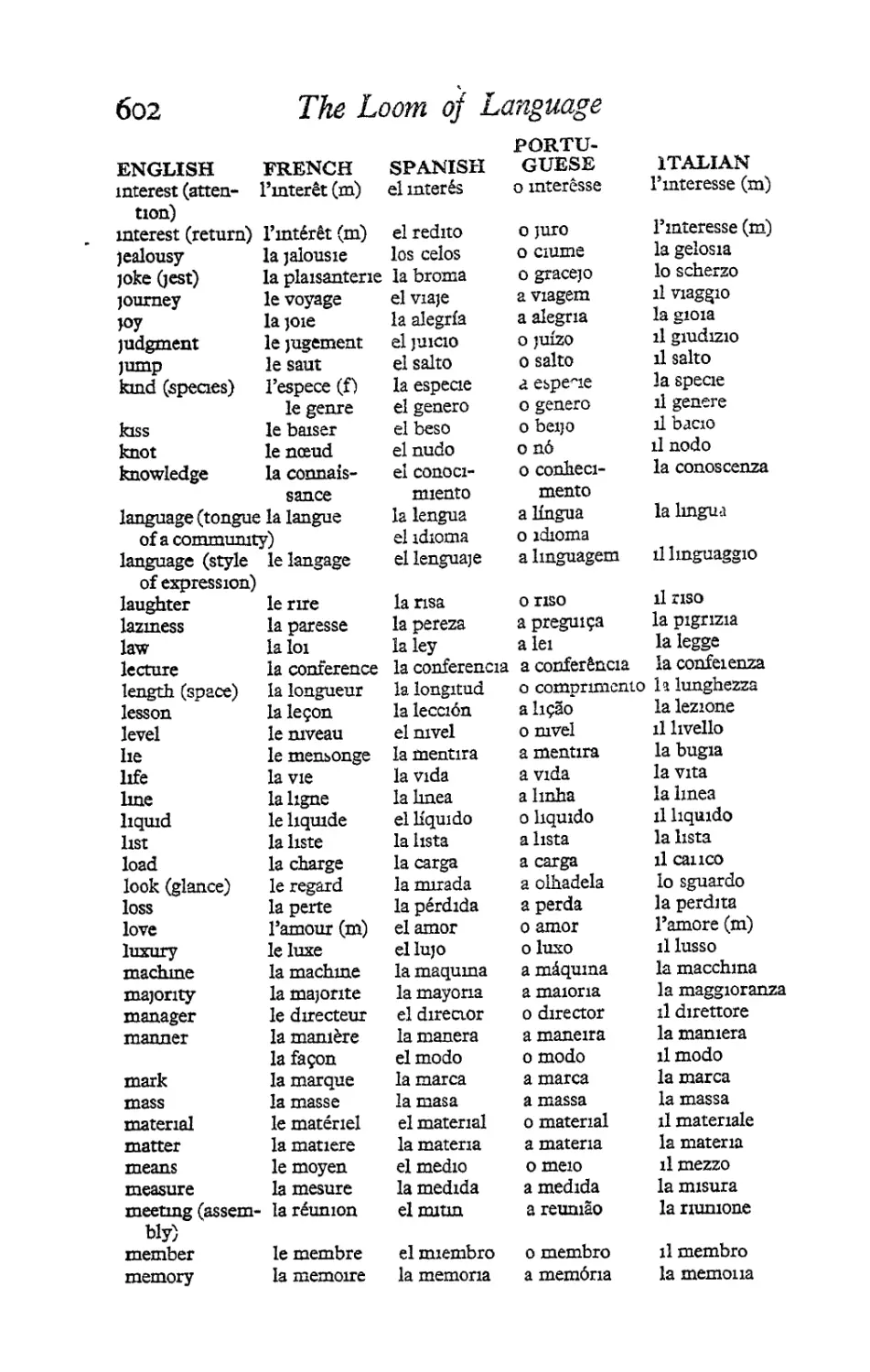
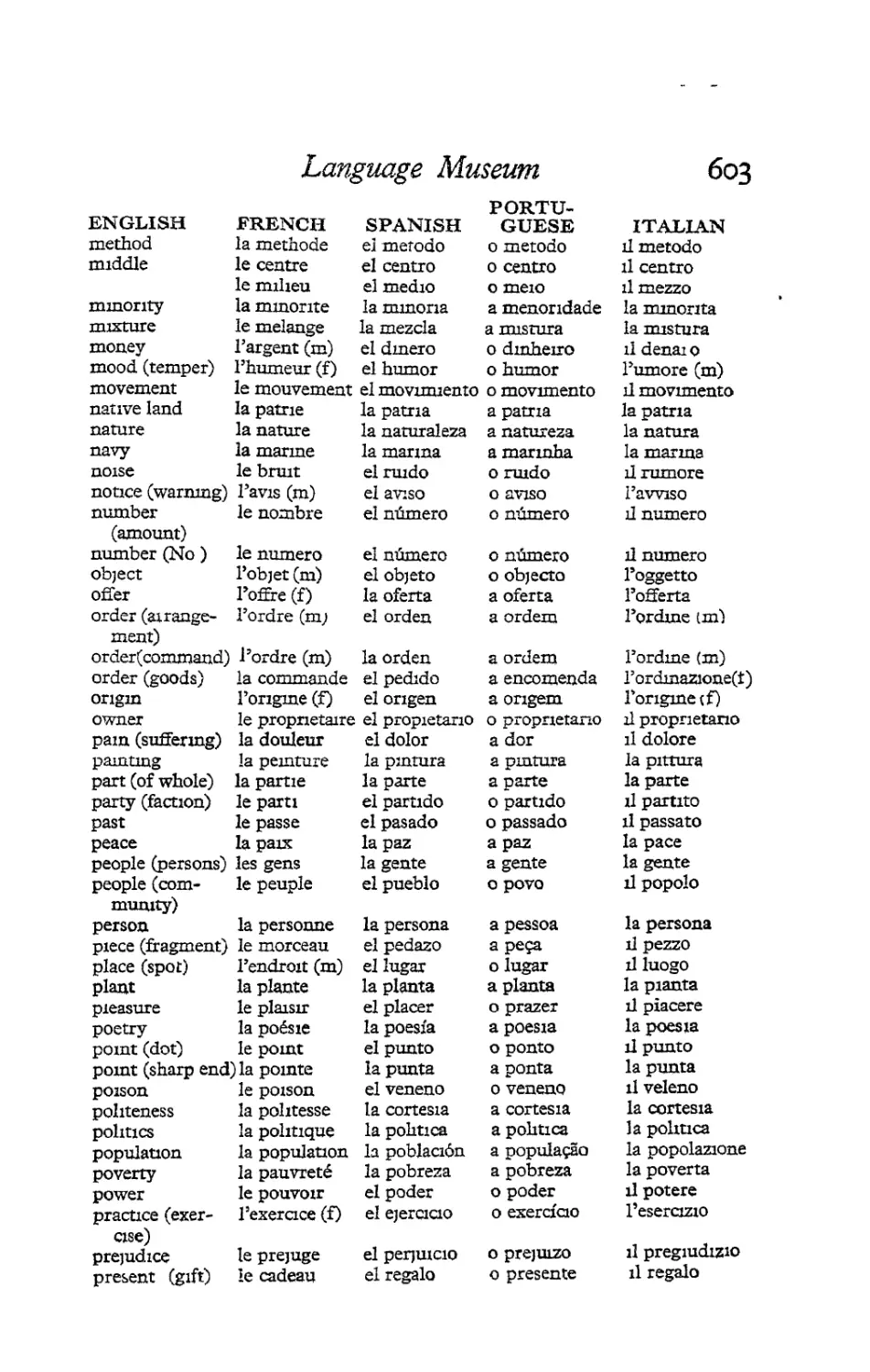
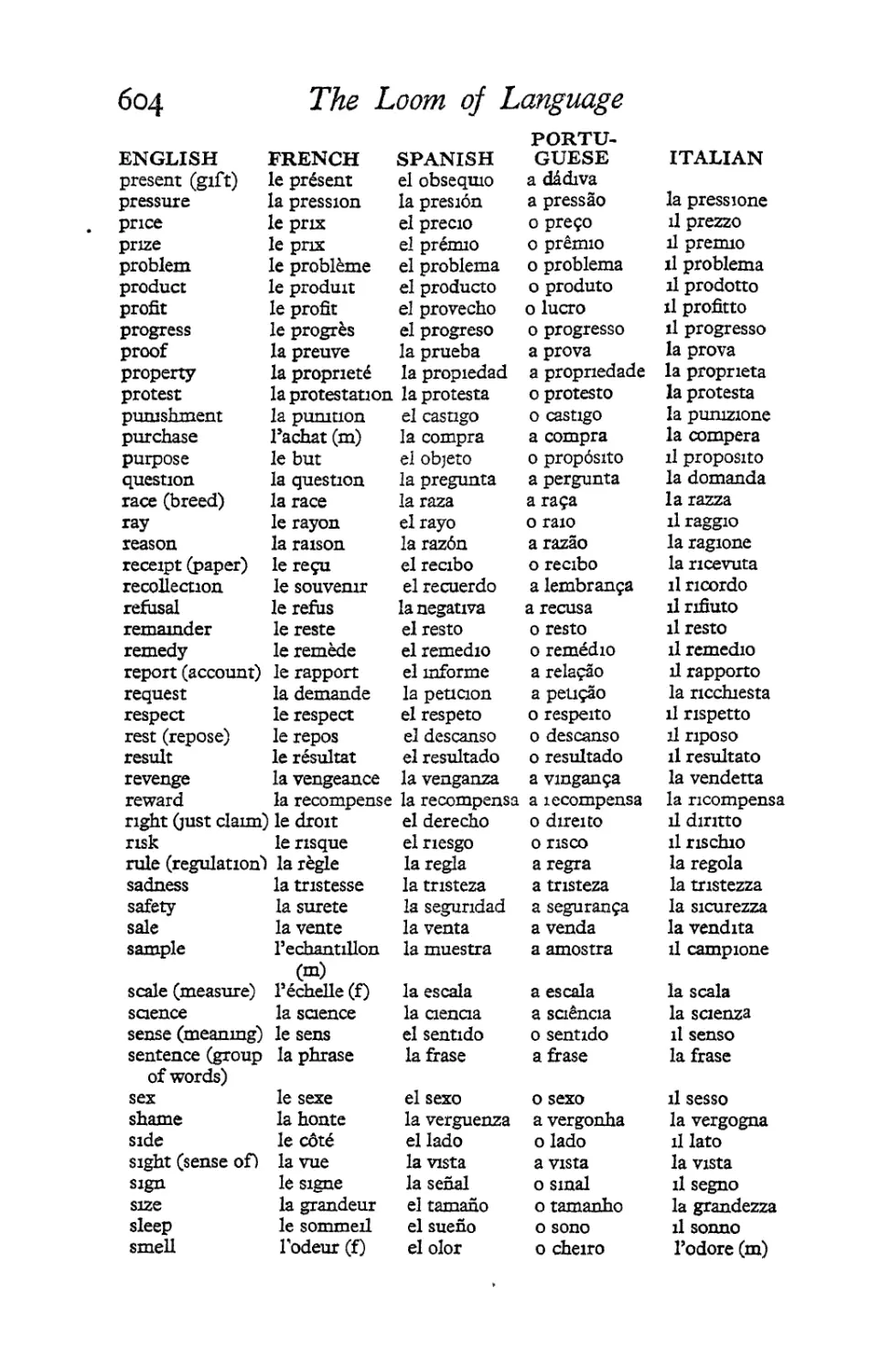
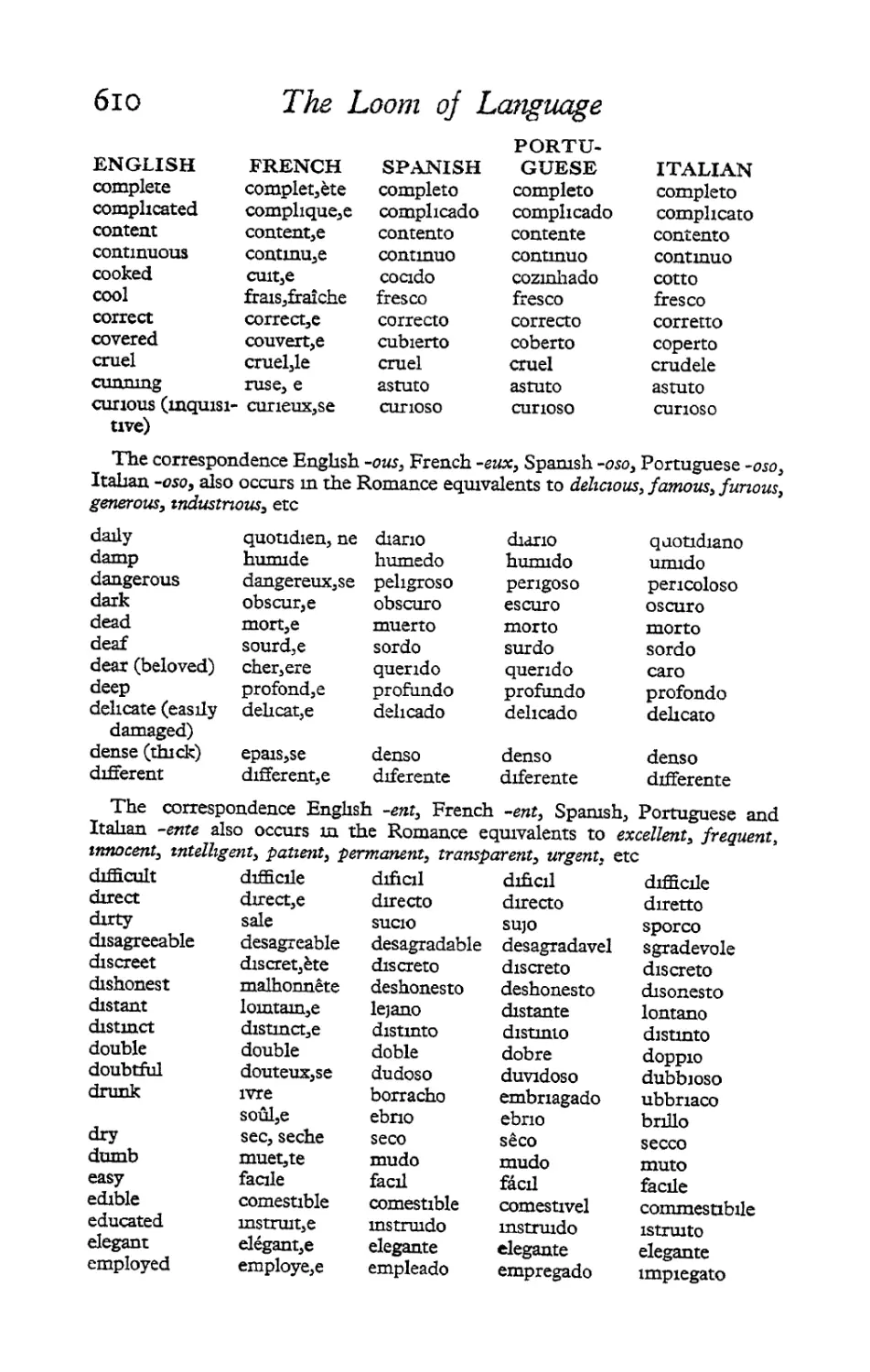
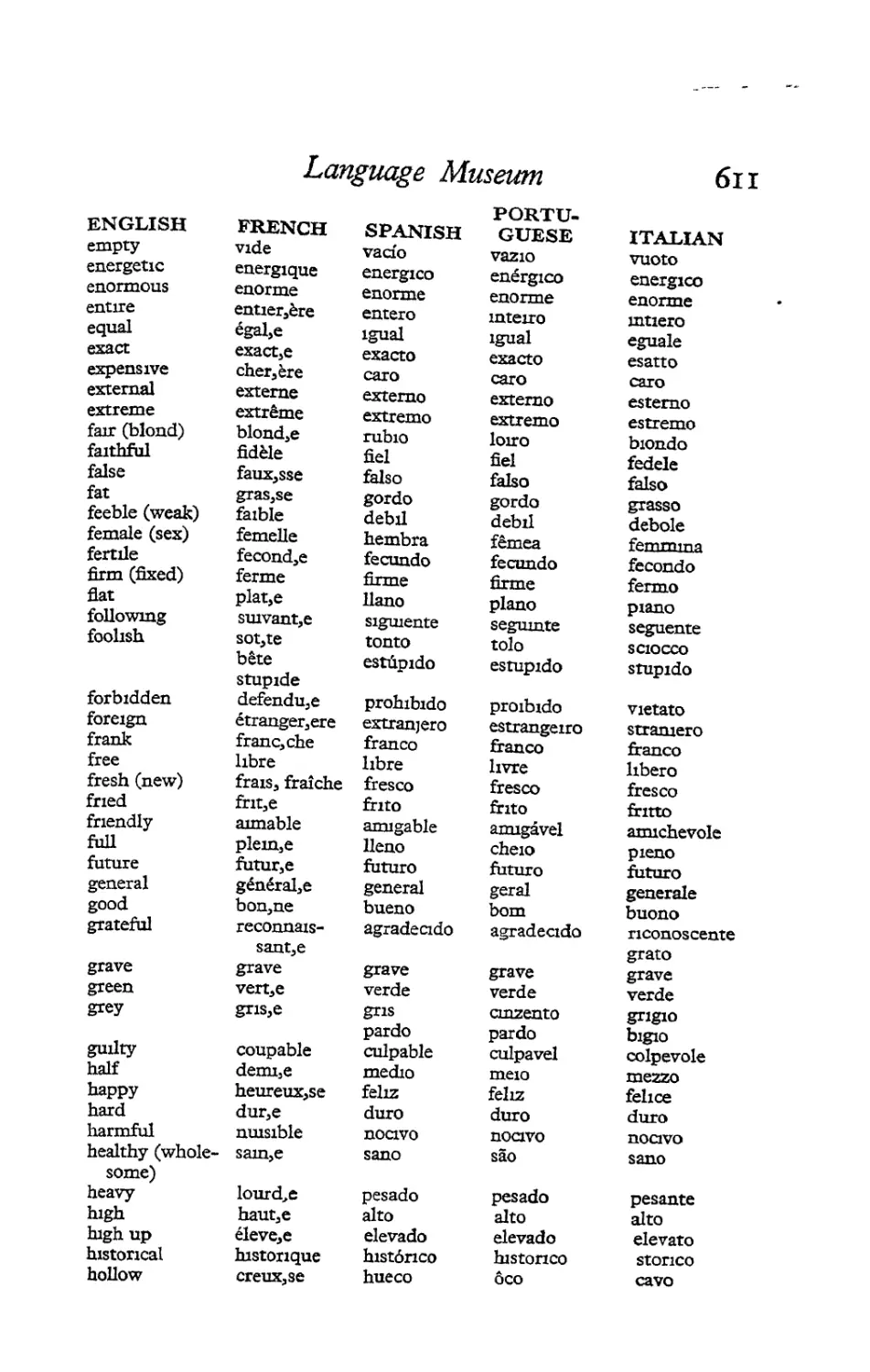
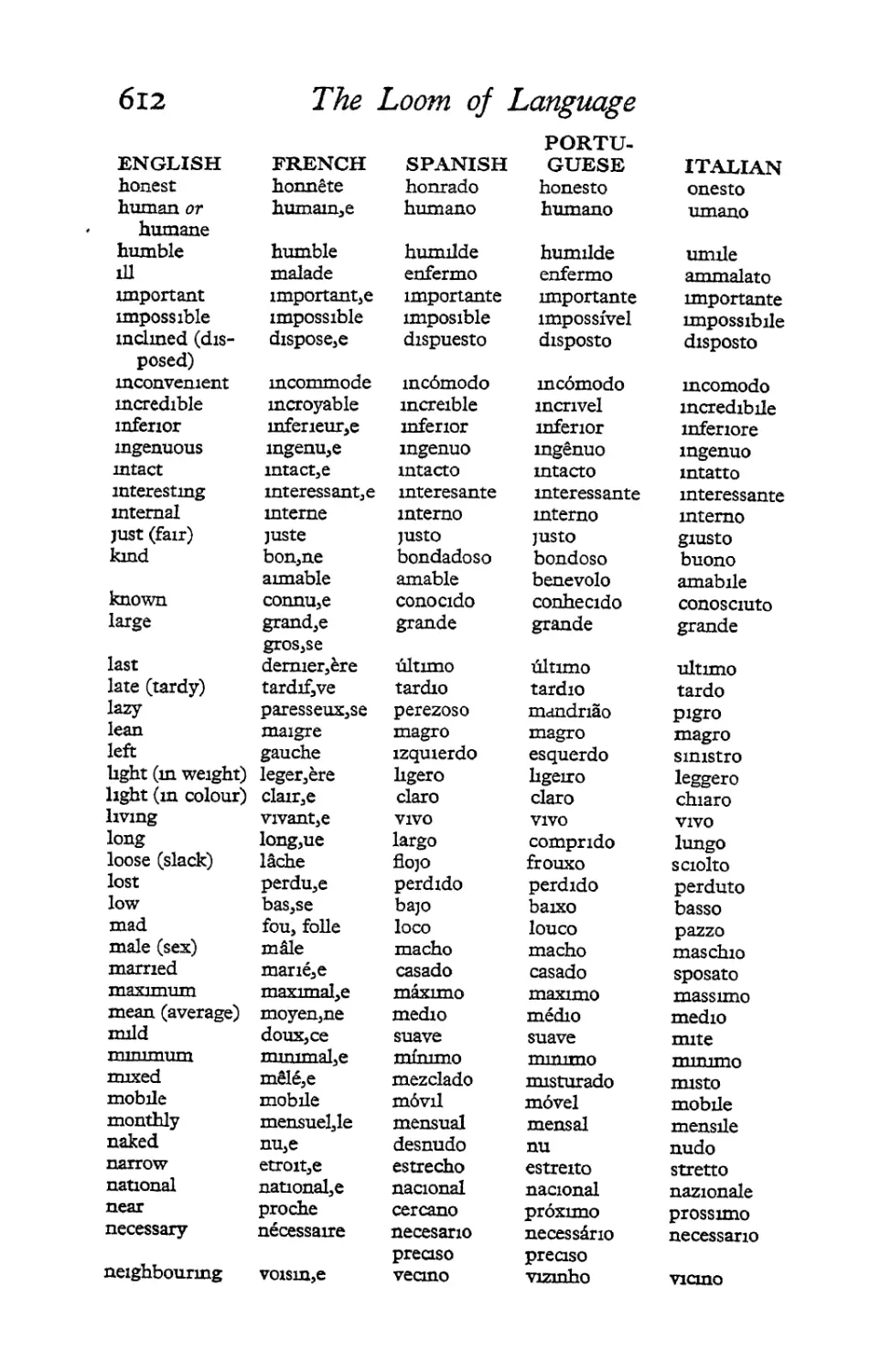
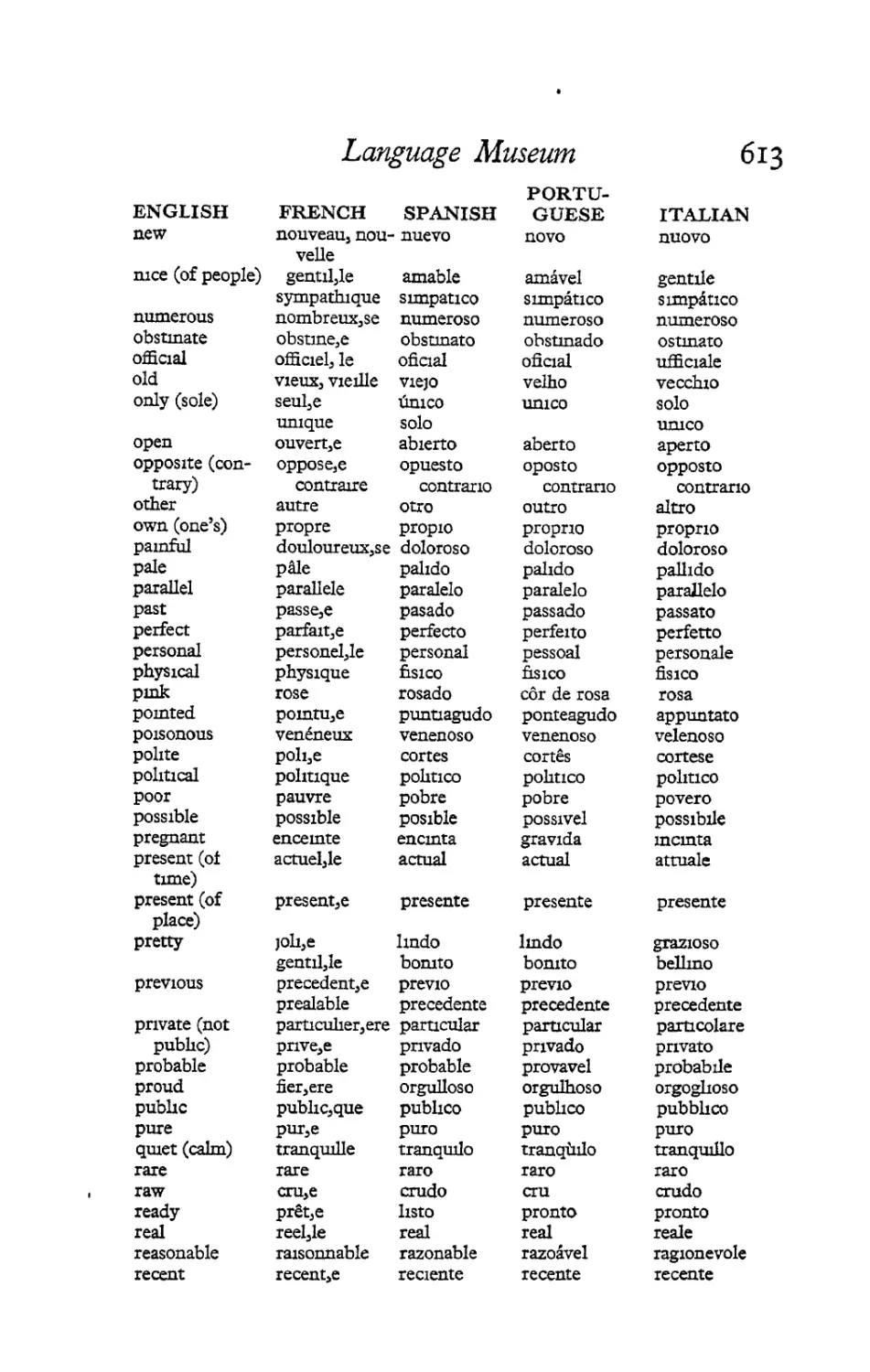
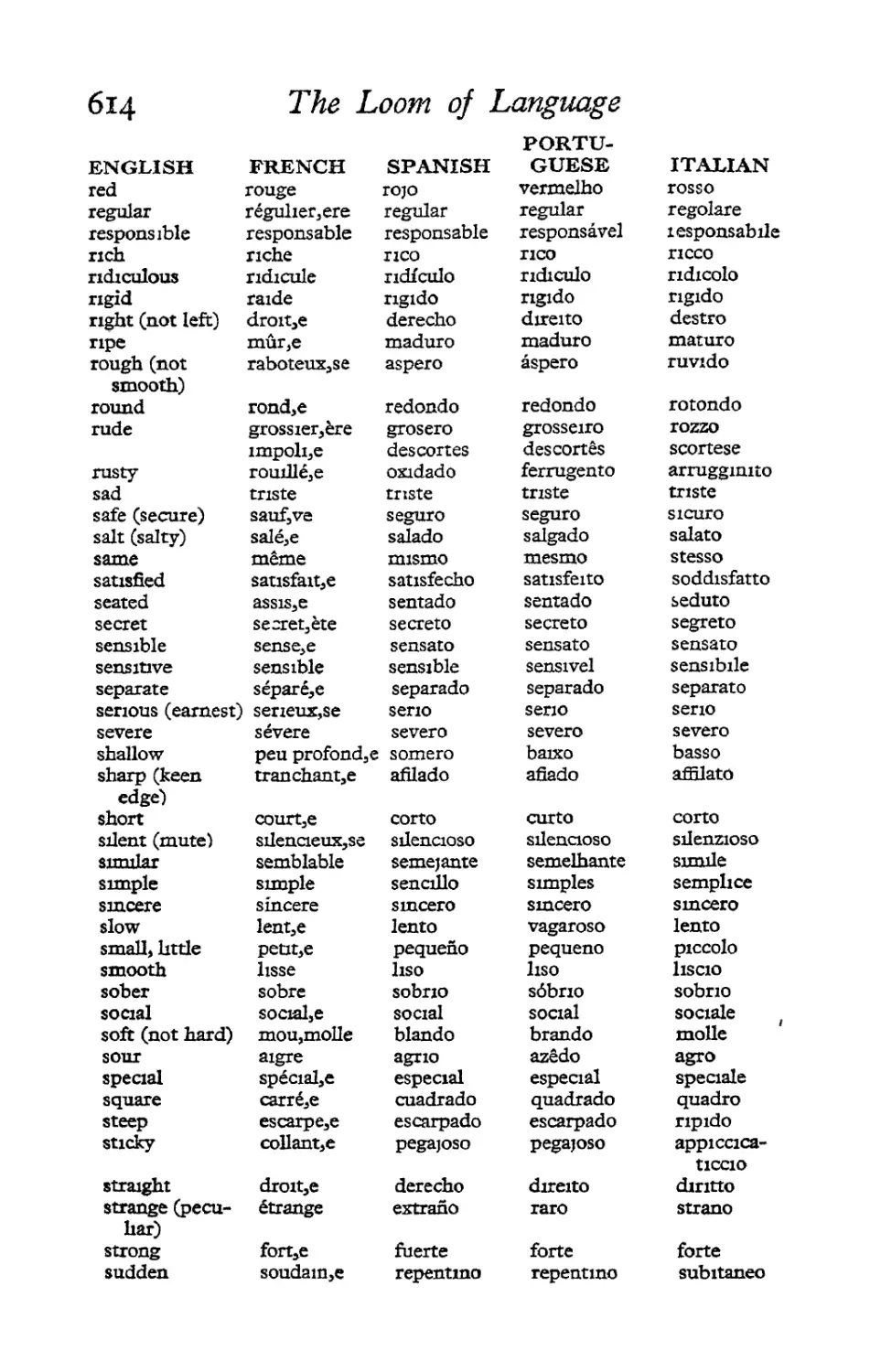
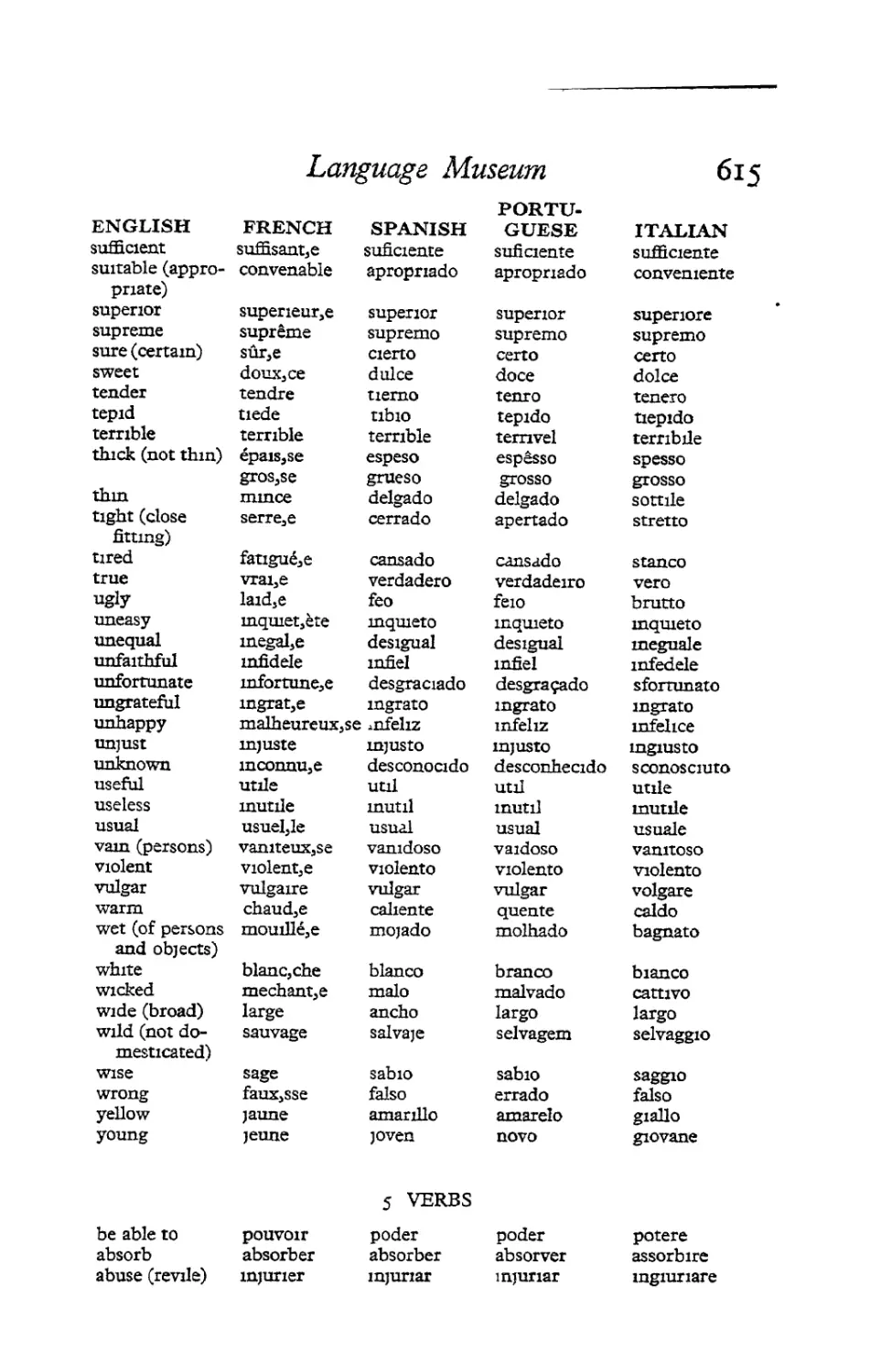
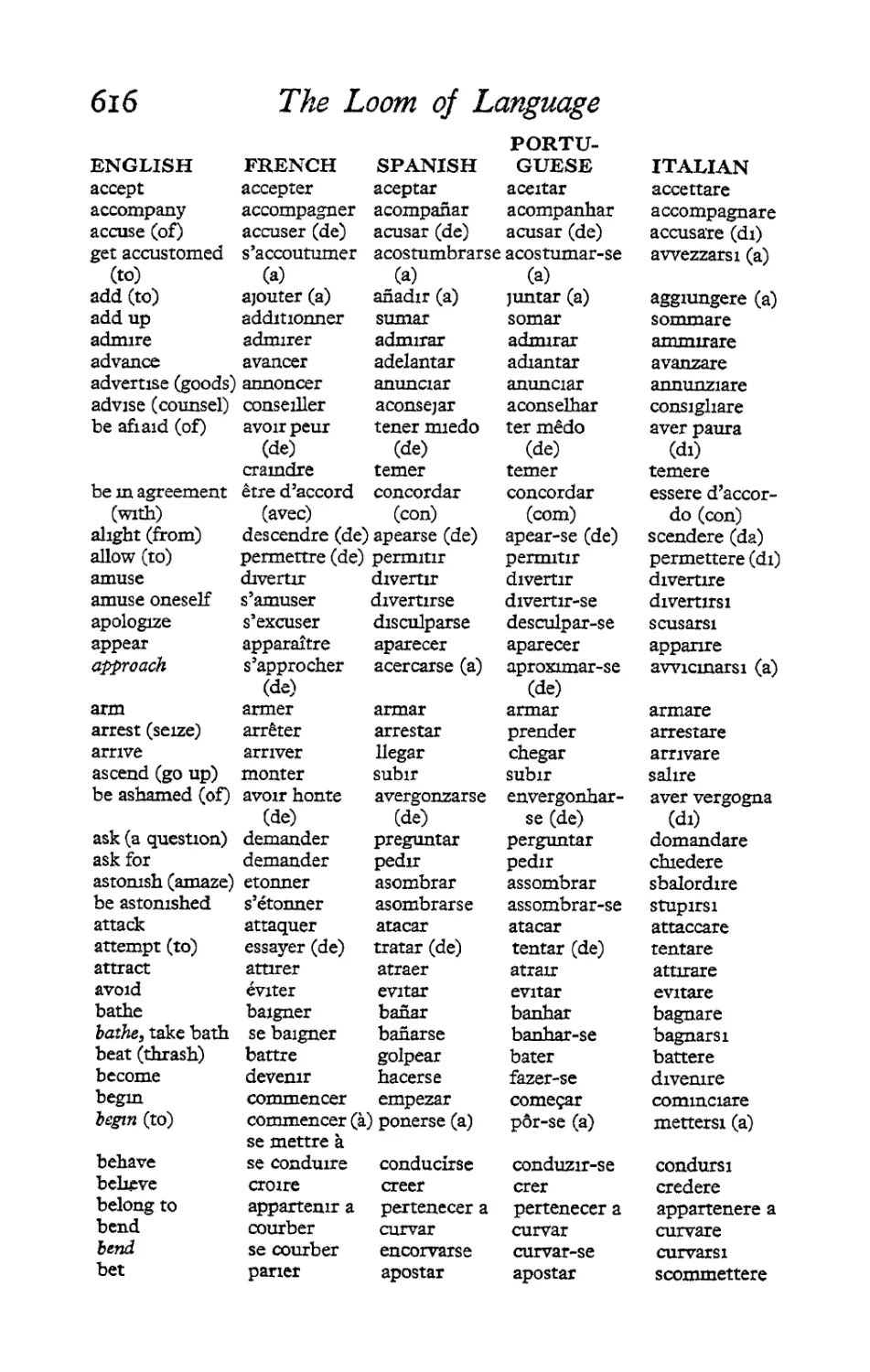
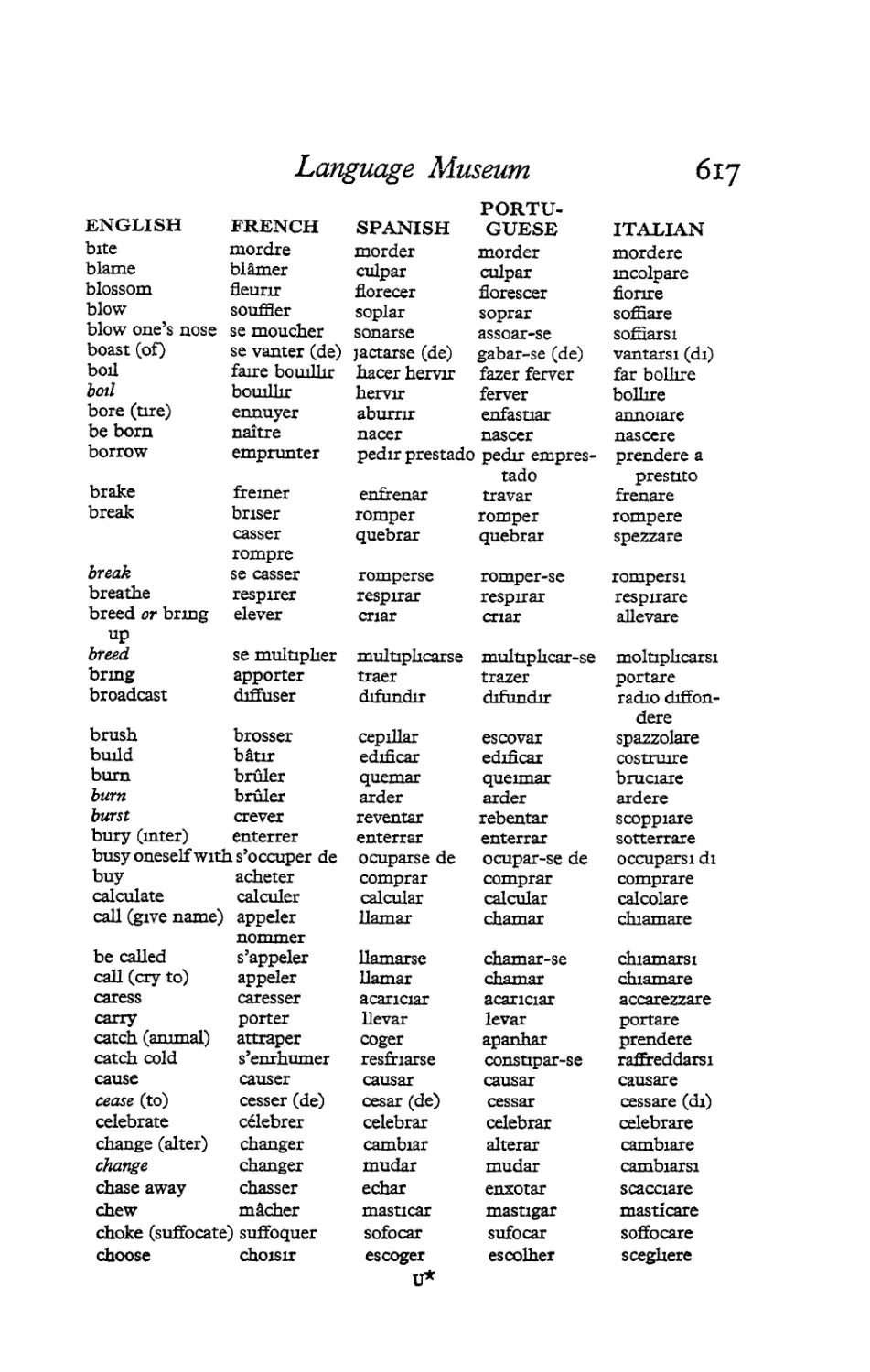
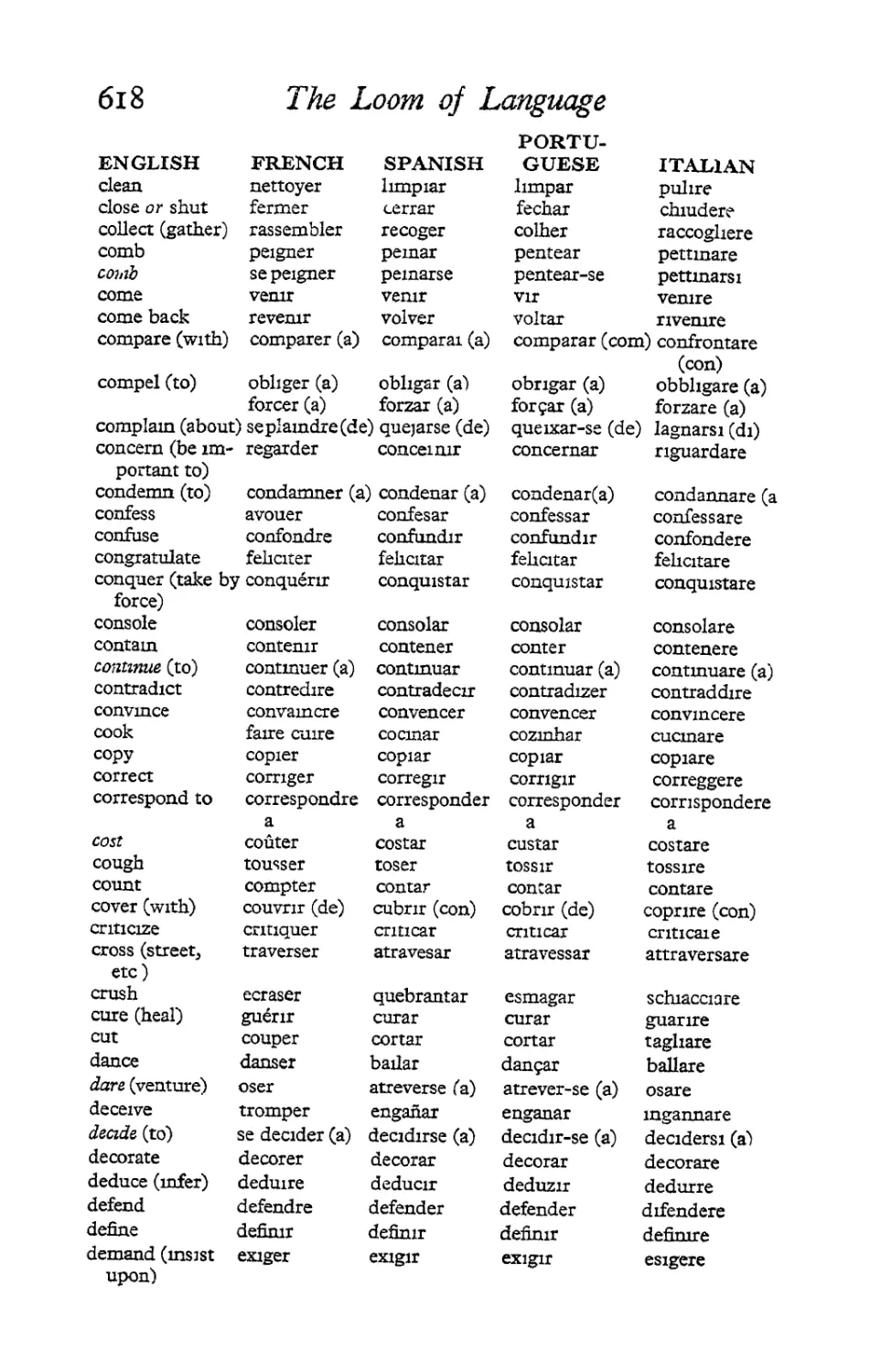
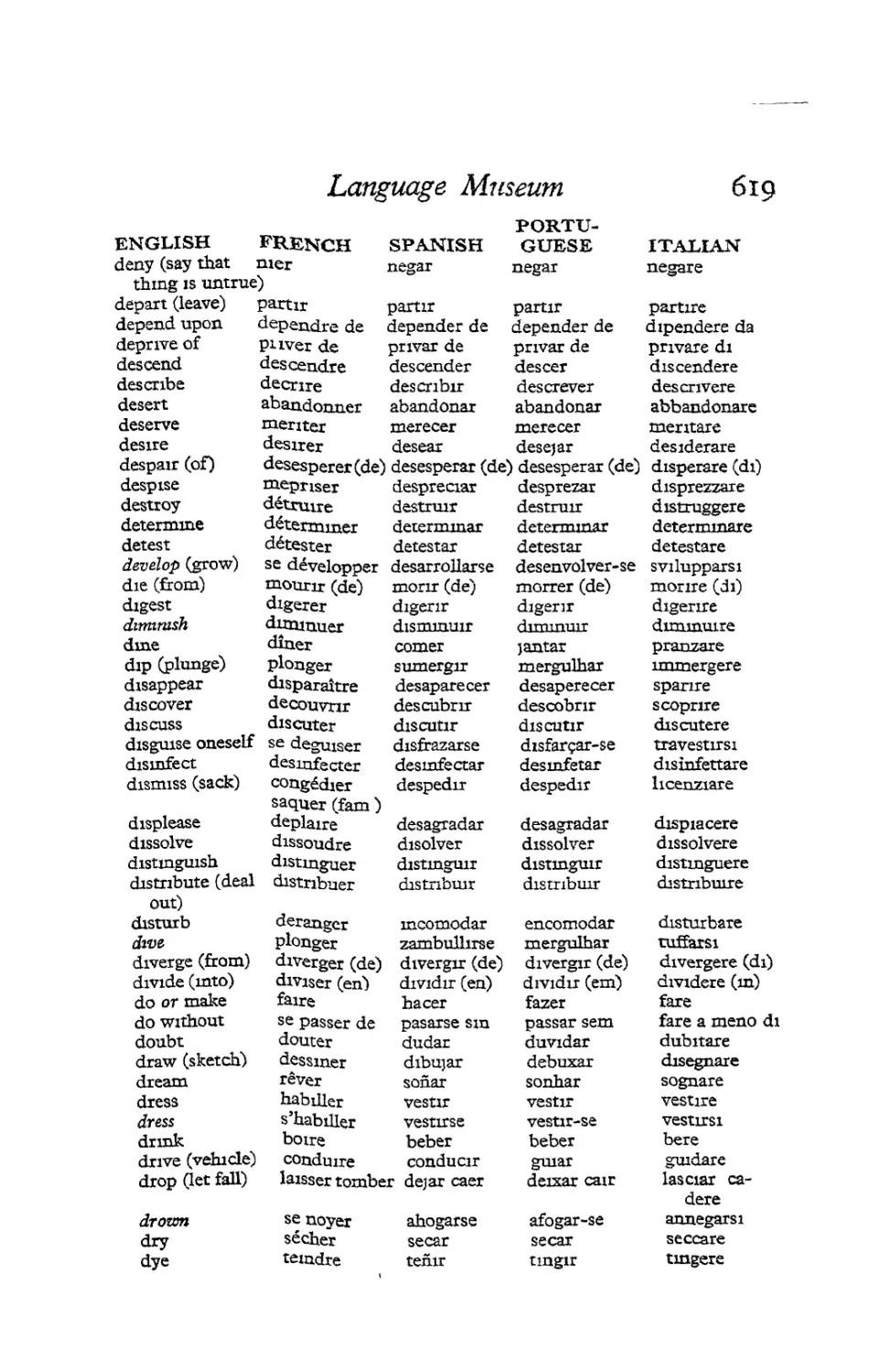
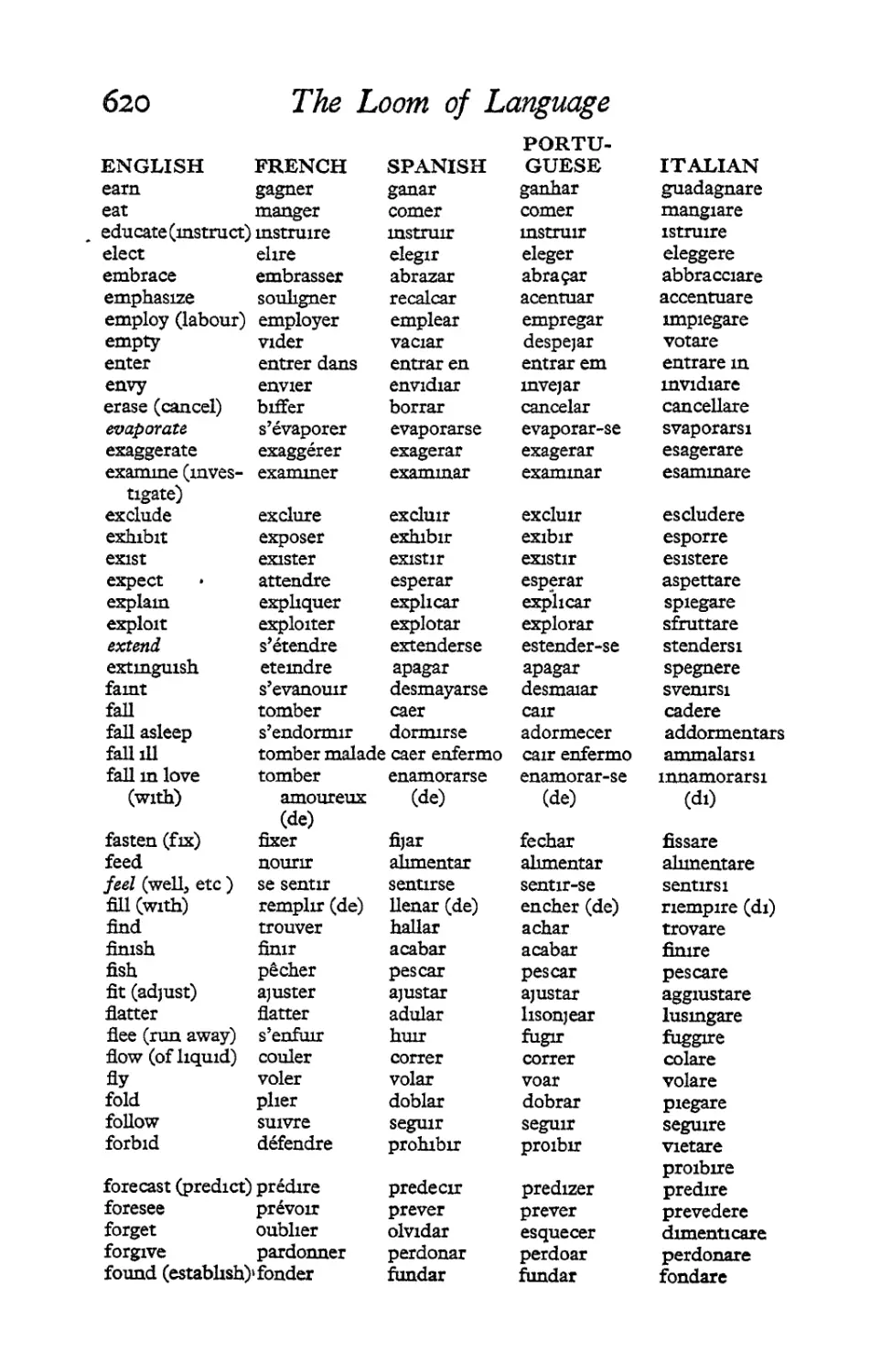
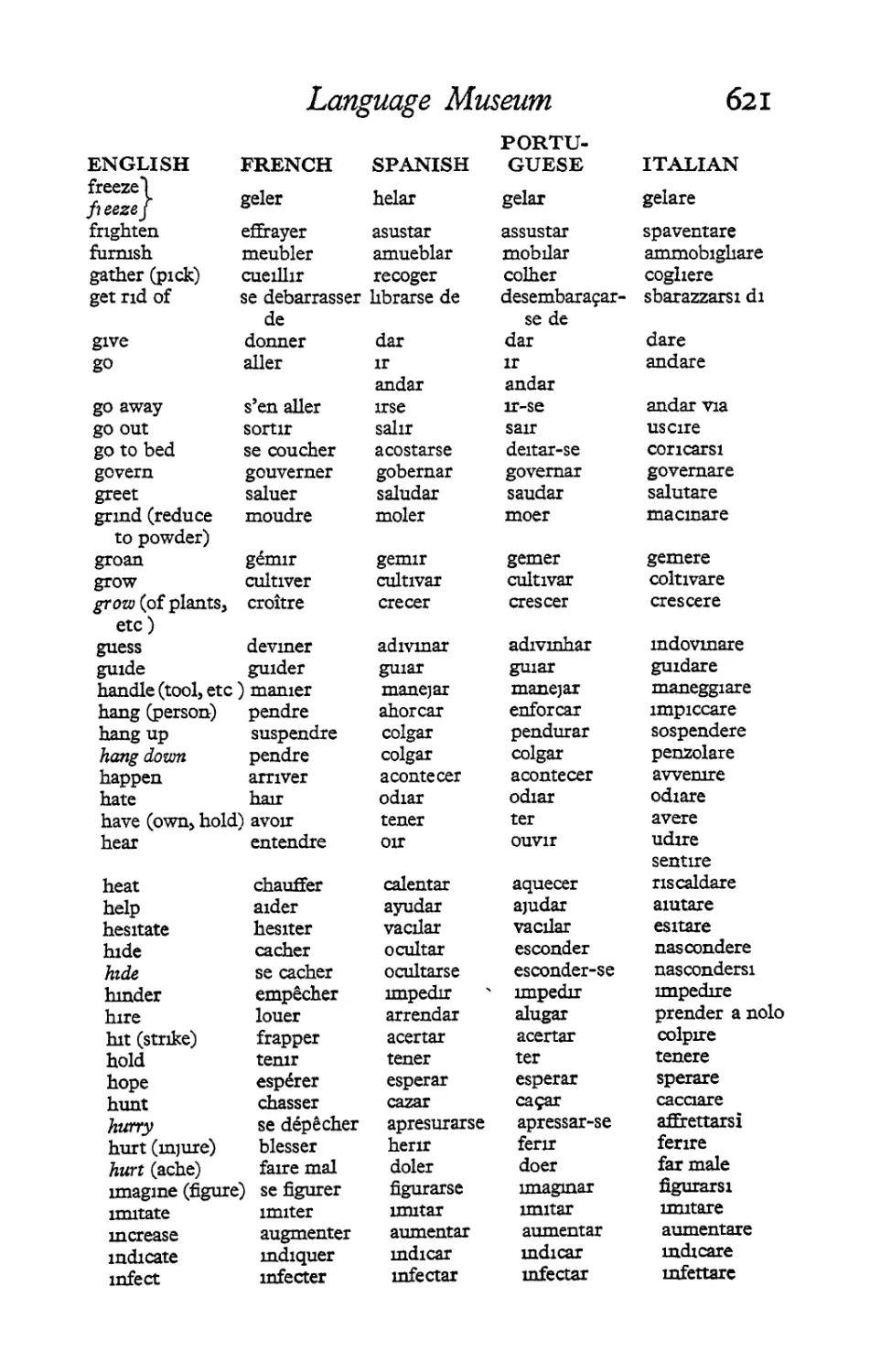
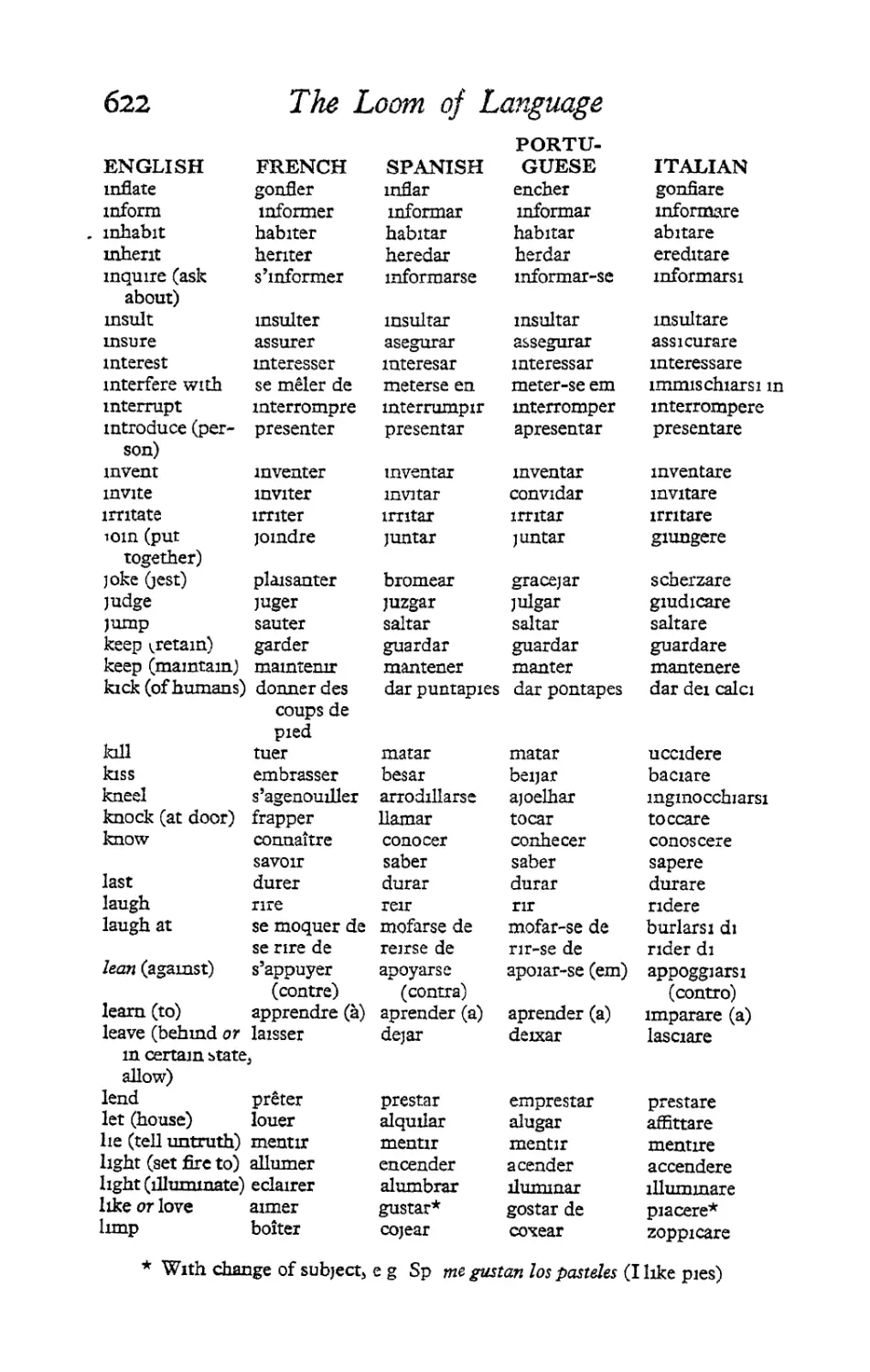
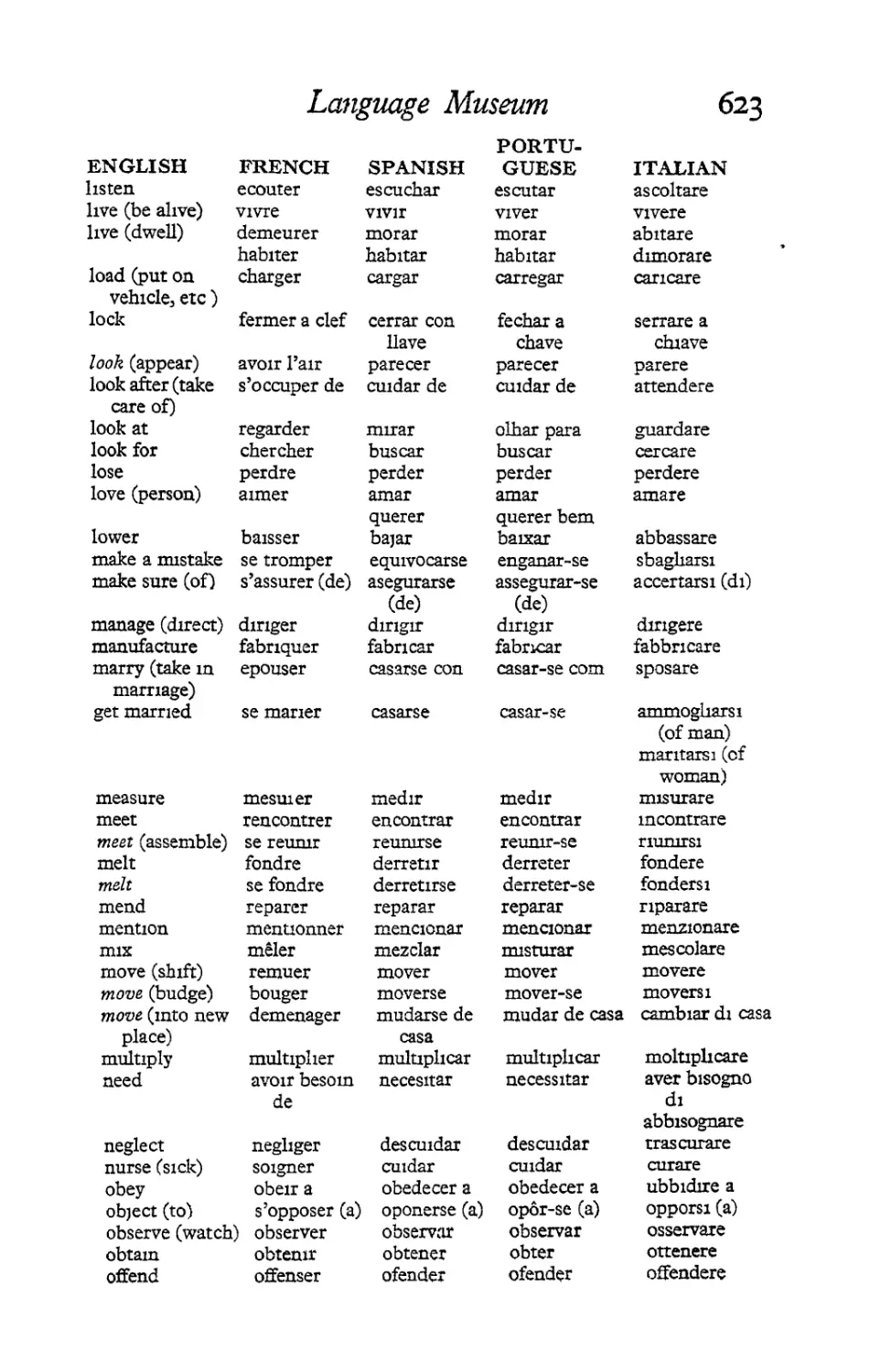
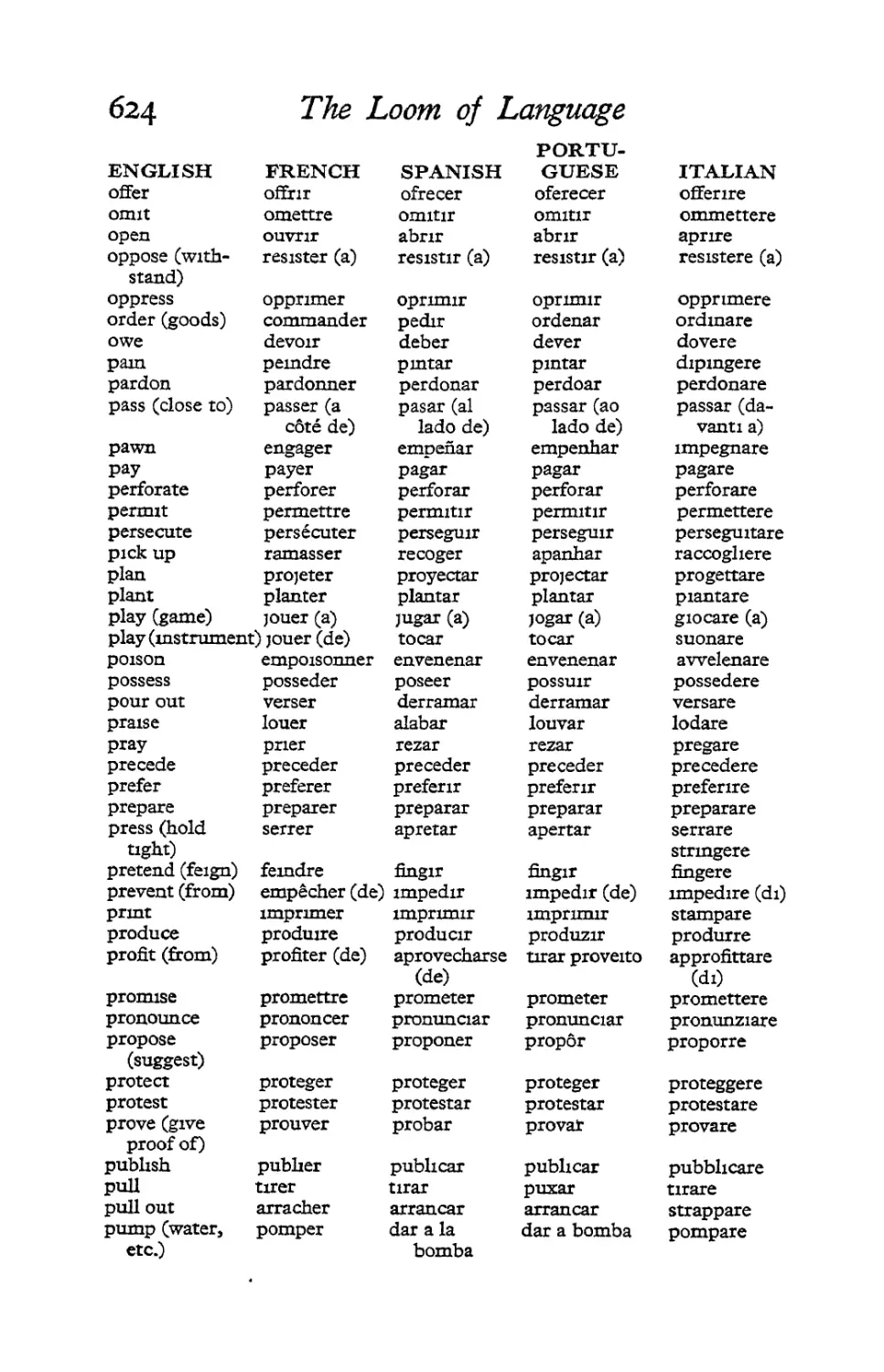
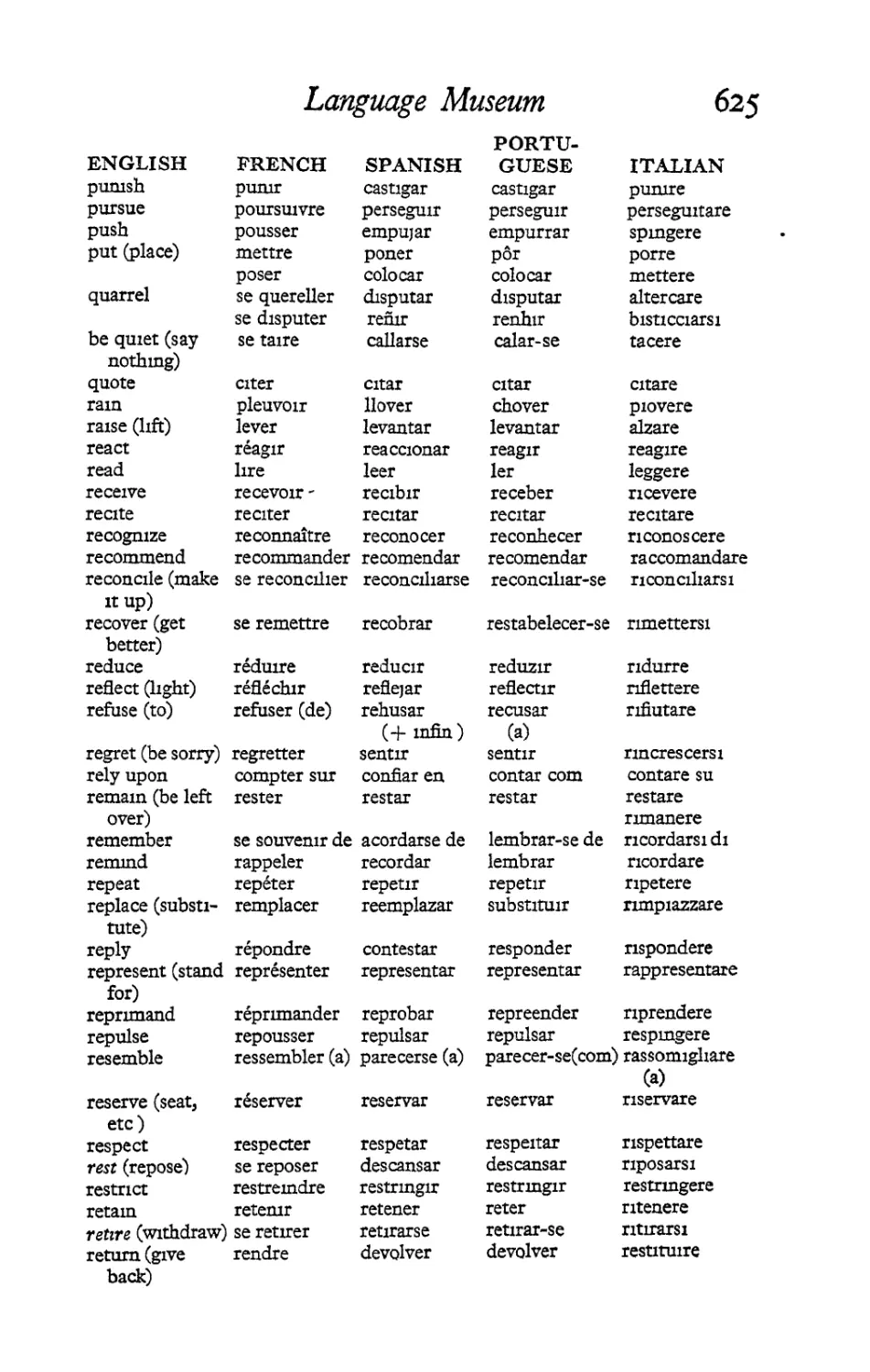
LANGUAGE MUSEUM
APPENI) IX
I. Basic Vocabularîes for the Teutonic Lan-
guages
II. Basic Vocabularies for tte Romance Lan-
guages
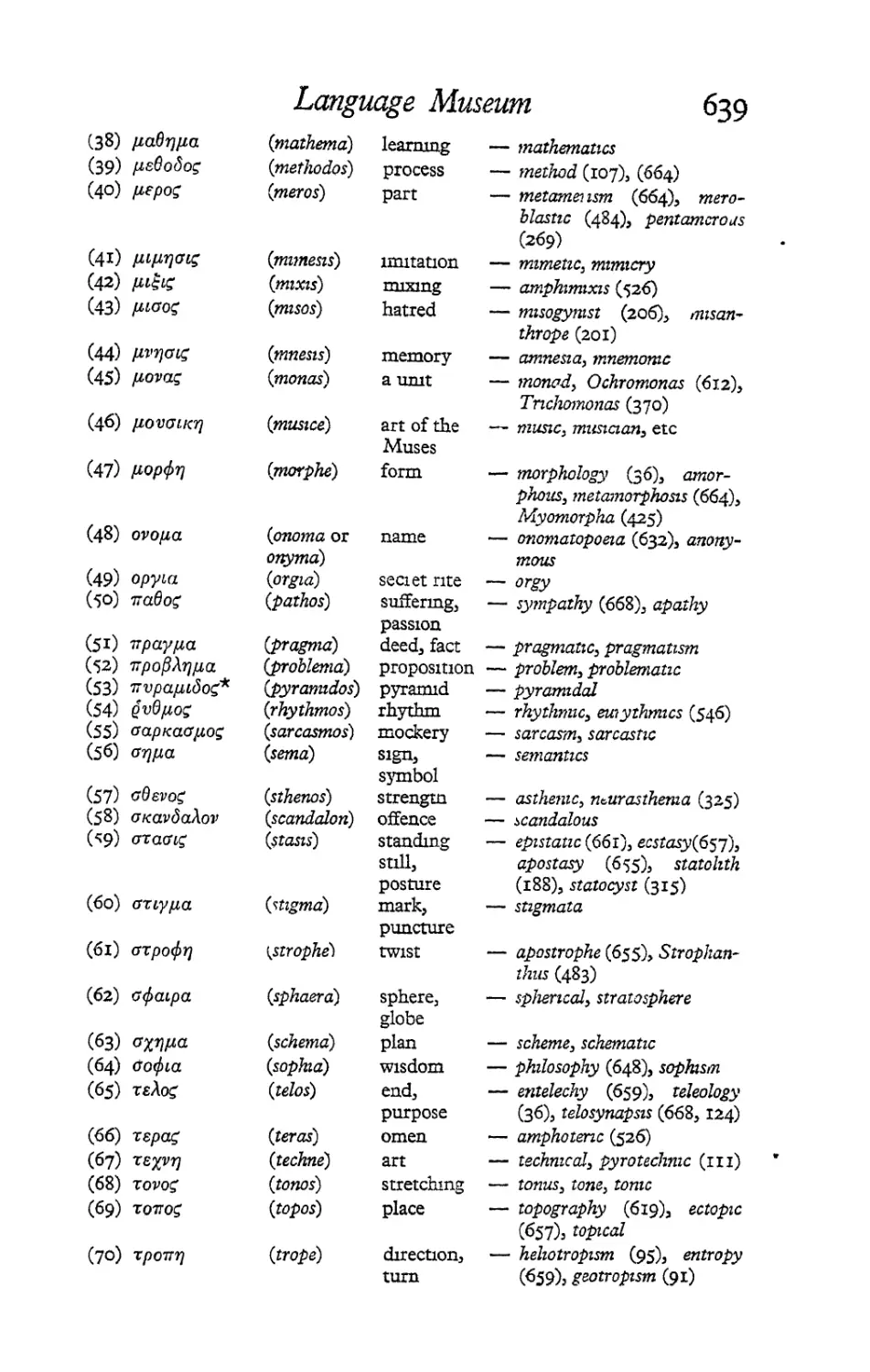
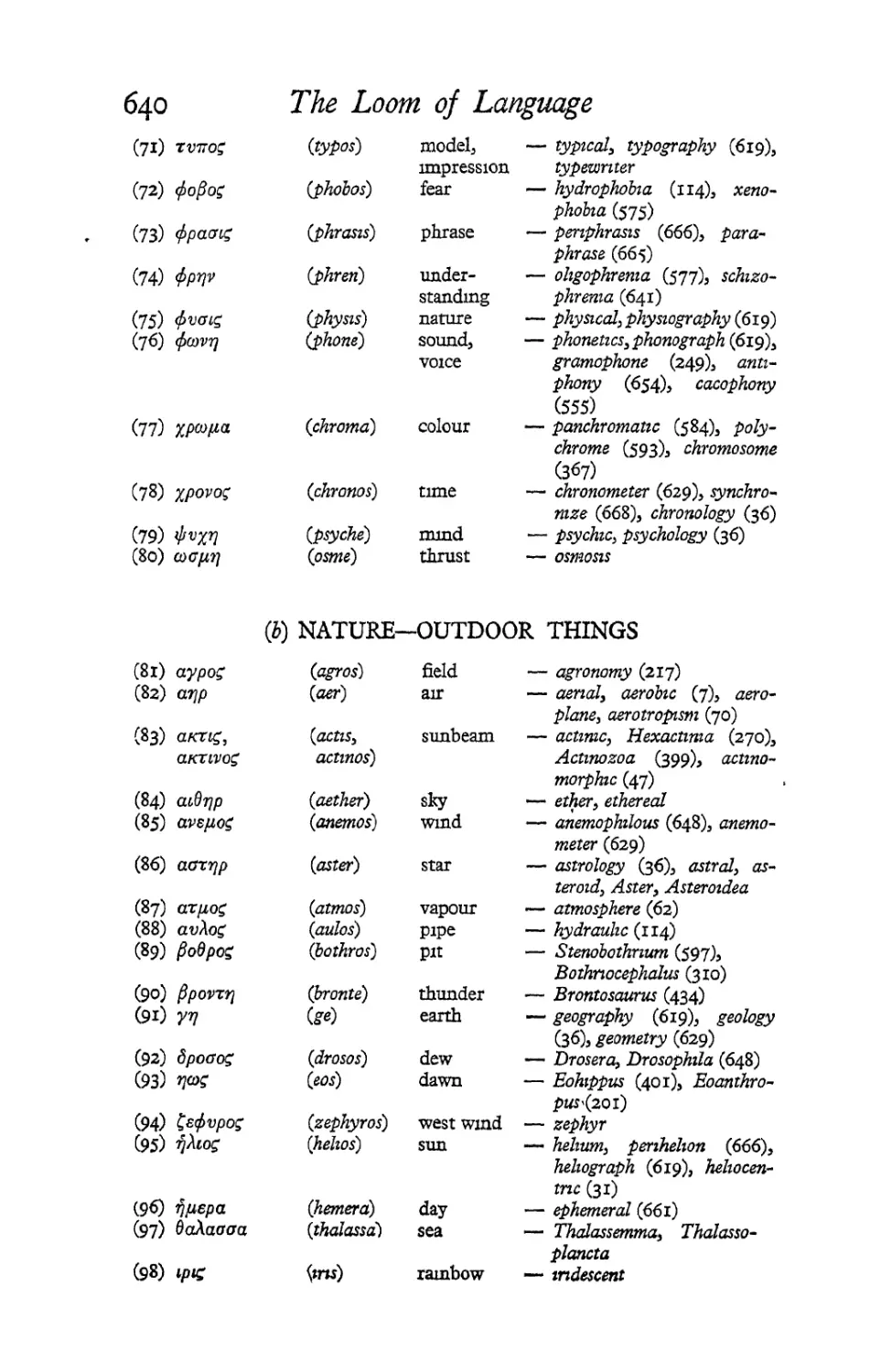
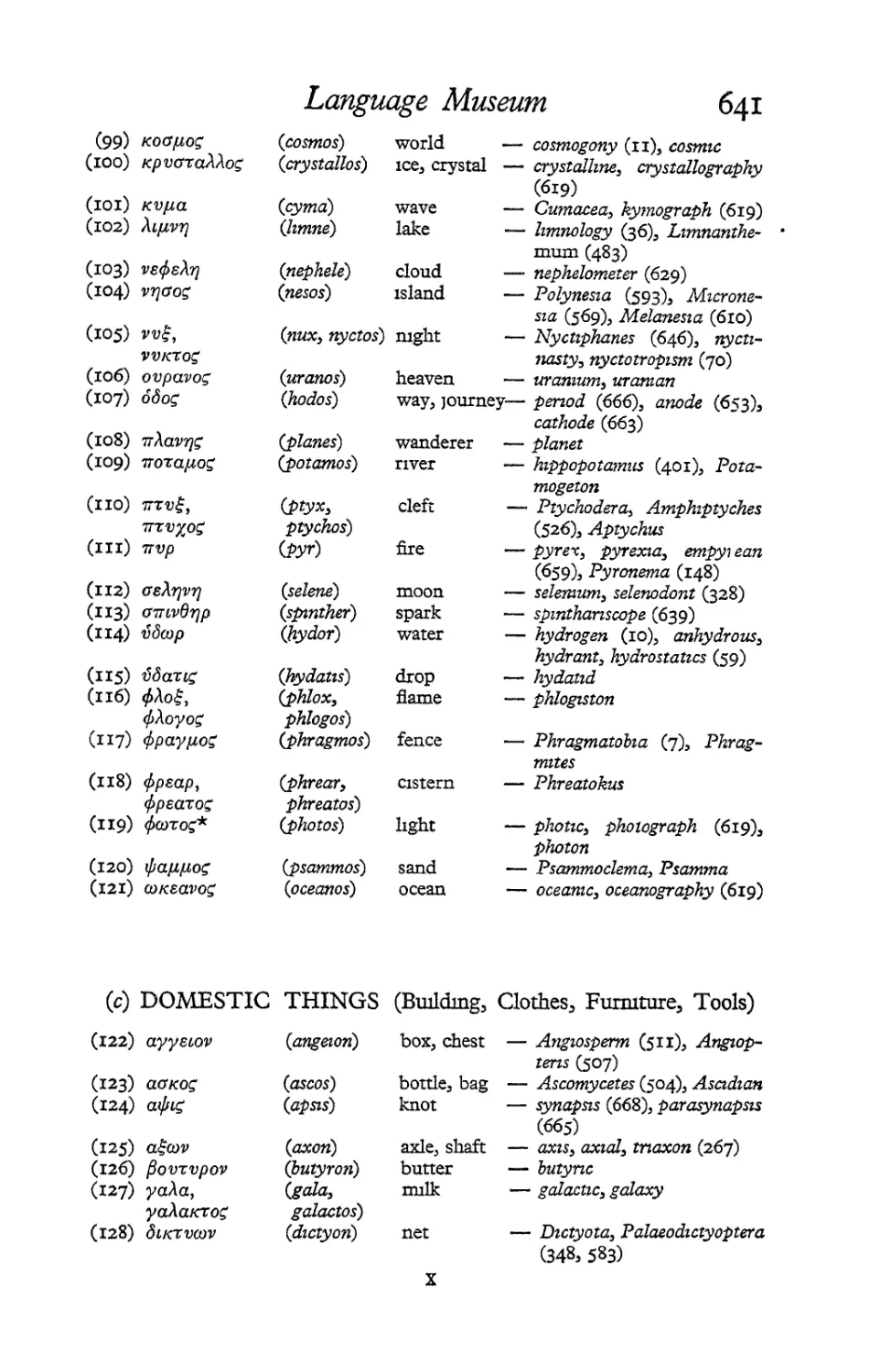
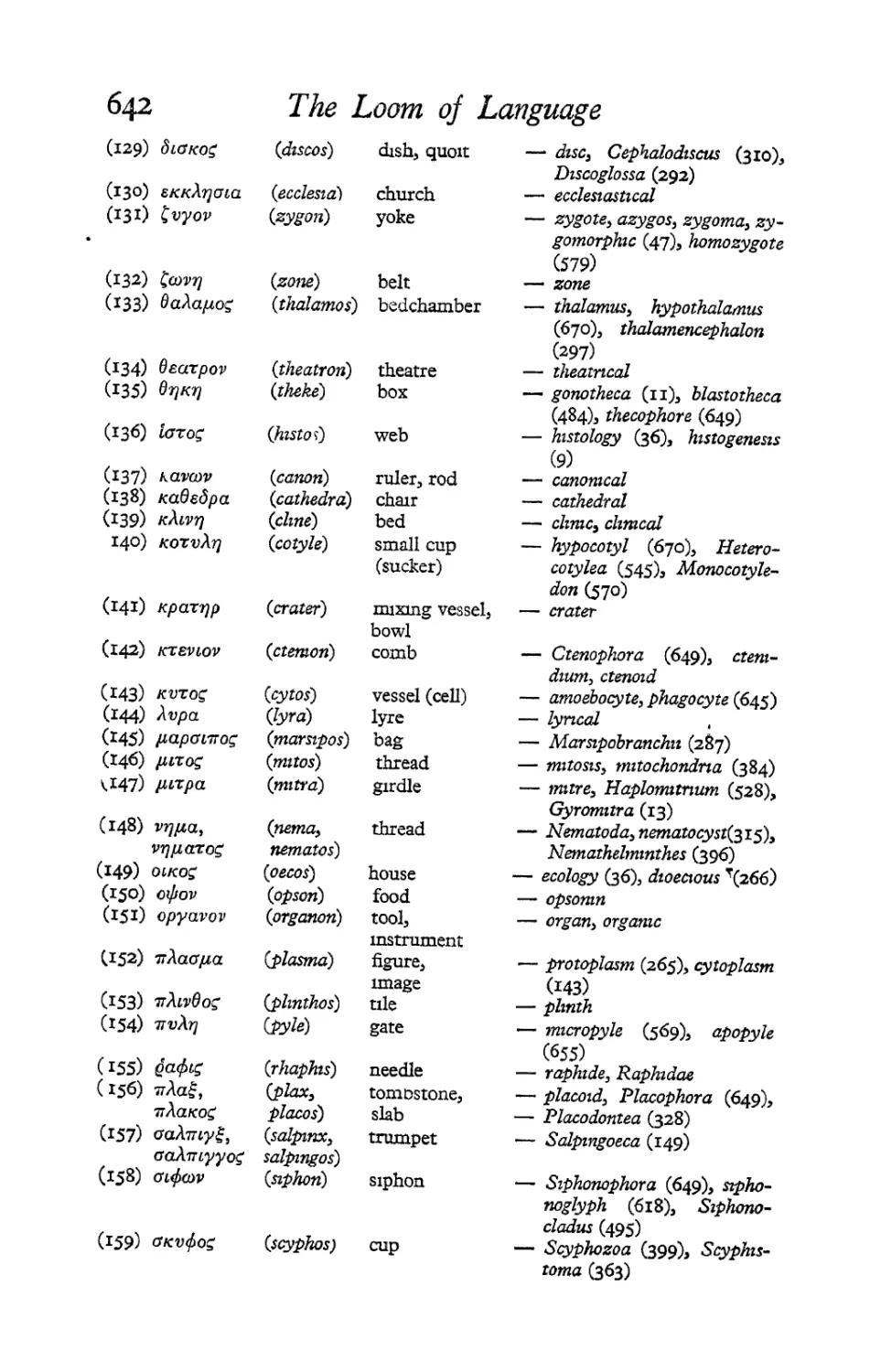
III. Greek Roots in Cornrnon Use for Technical
Words of International Currency
PAGE
577
636
Index
660
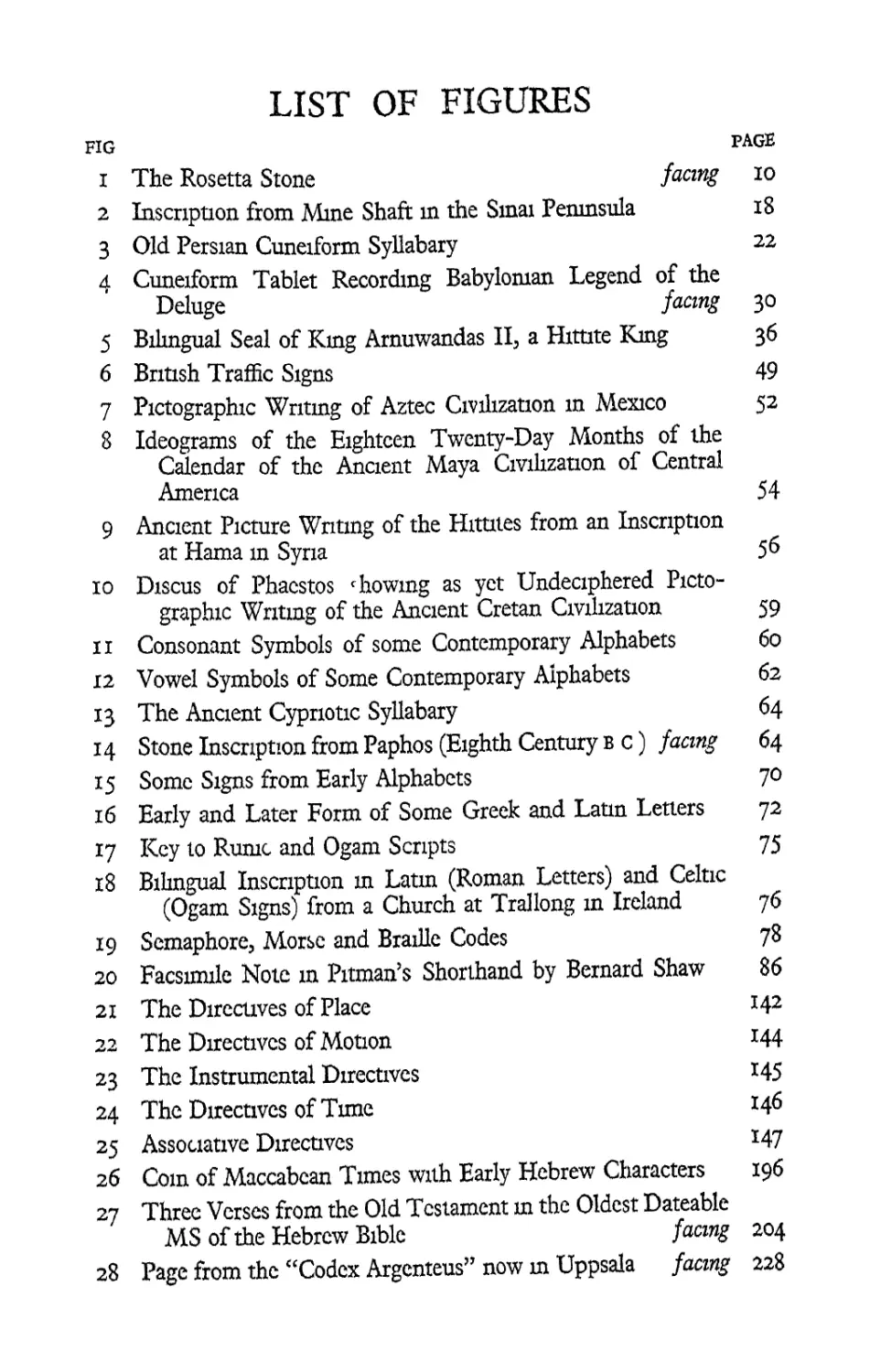
LIST OF FIGURES
FIG PAG
I The Rosetta Stone facng IO
2 Inscnpuon from Mme Shaft m the Sna Penmsula 18
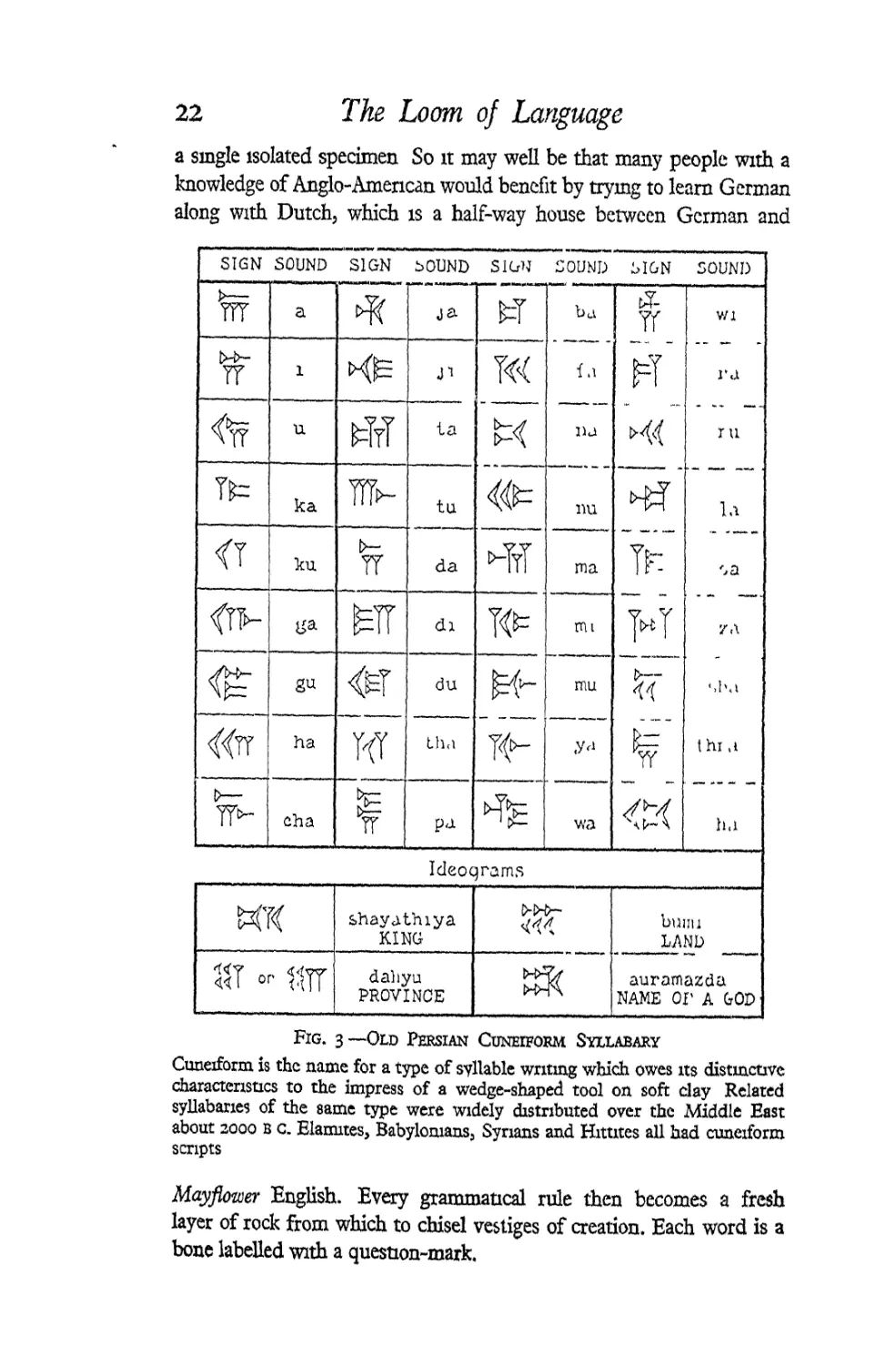
30ld Persmn Cunefform Syllabary 22
4 Cunelform Tabler Recordmg Babyloman Legend of the
Deluge faczng 30
5 Bhngual Seal of Kmg Amuwandas II» a Httate Kmg 36
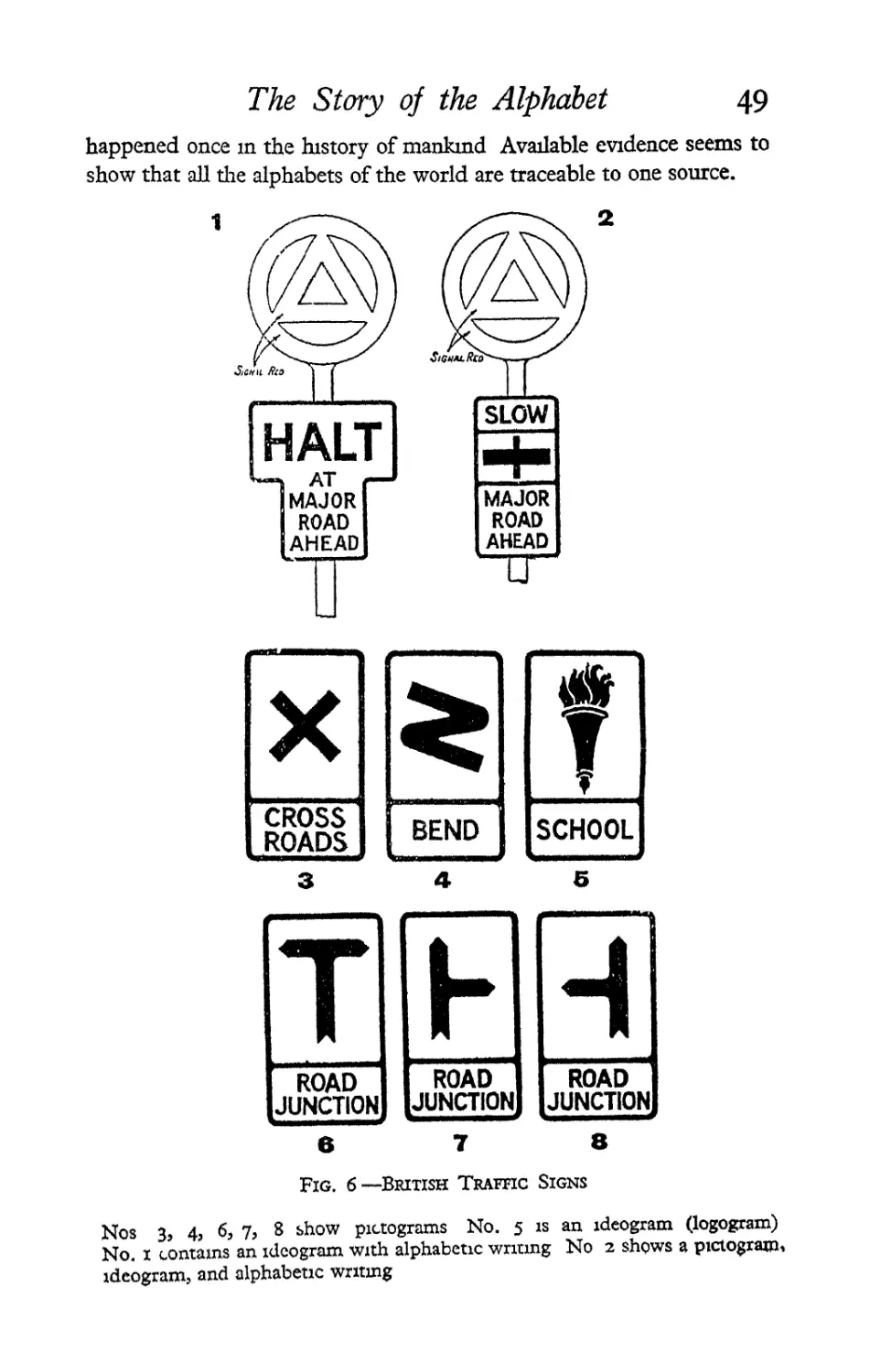
6 Brmsh Traflïc Sgns 49
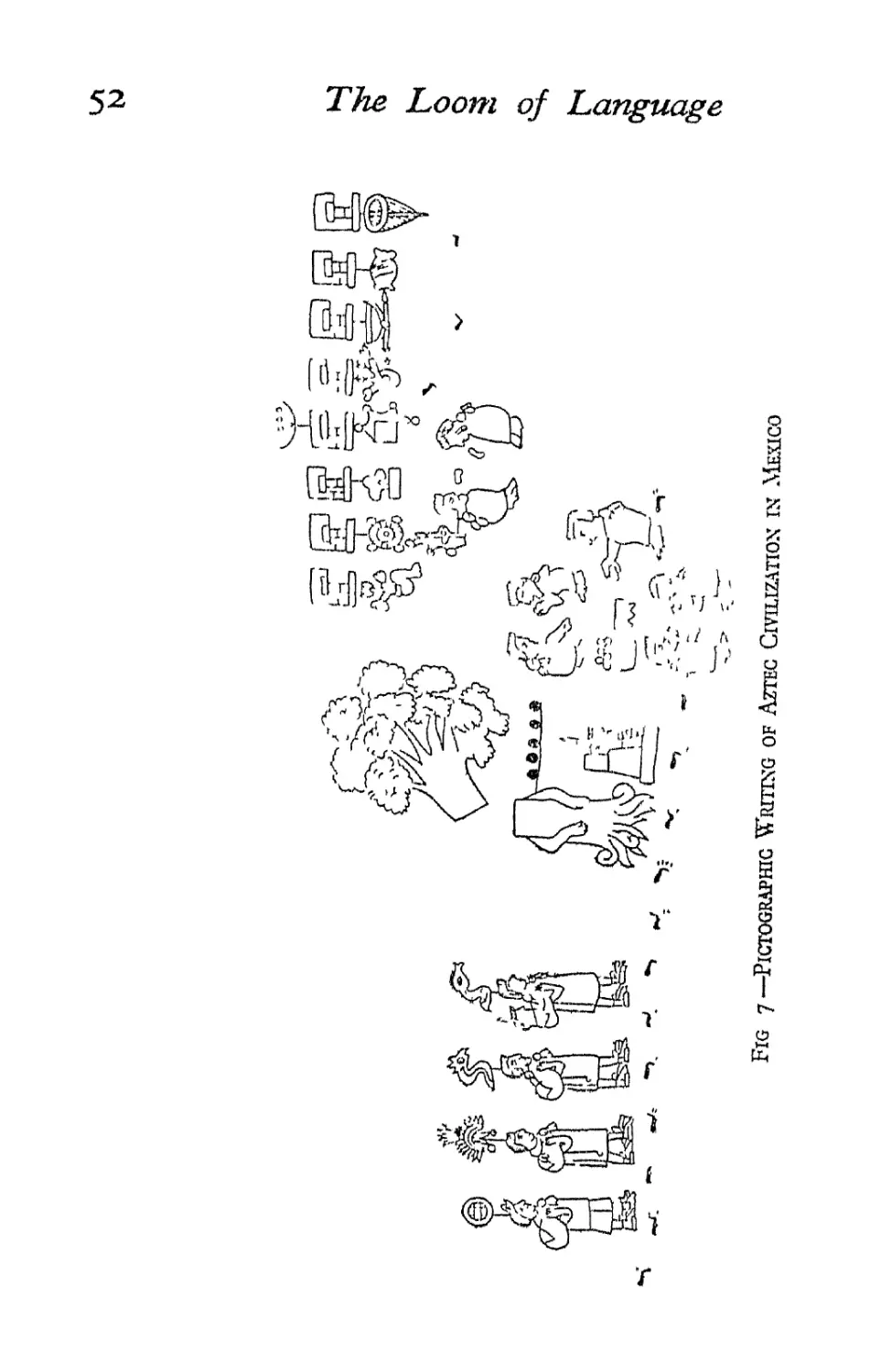
7 Pctographc Wnung of Aztec Cvhzauon m Memco 52
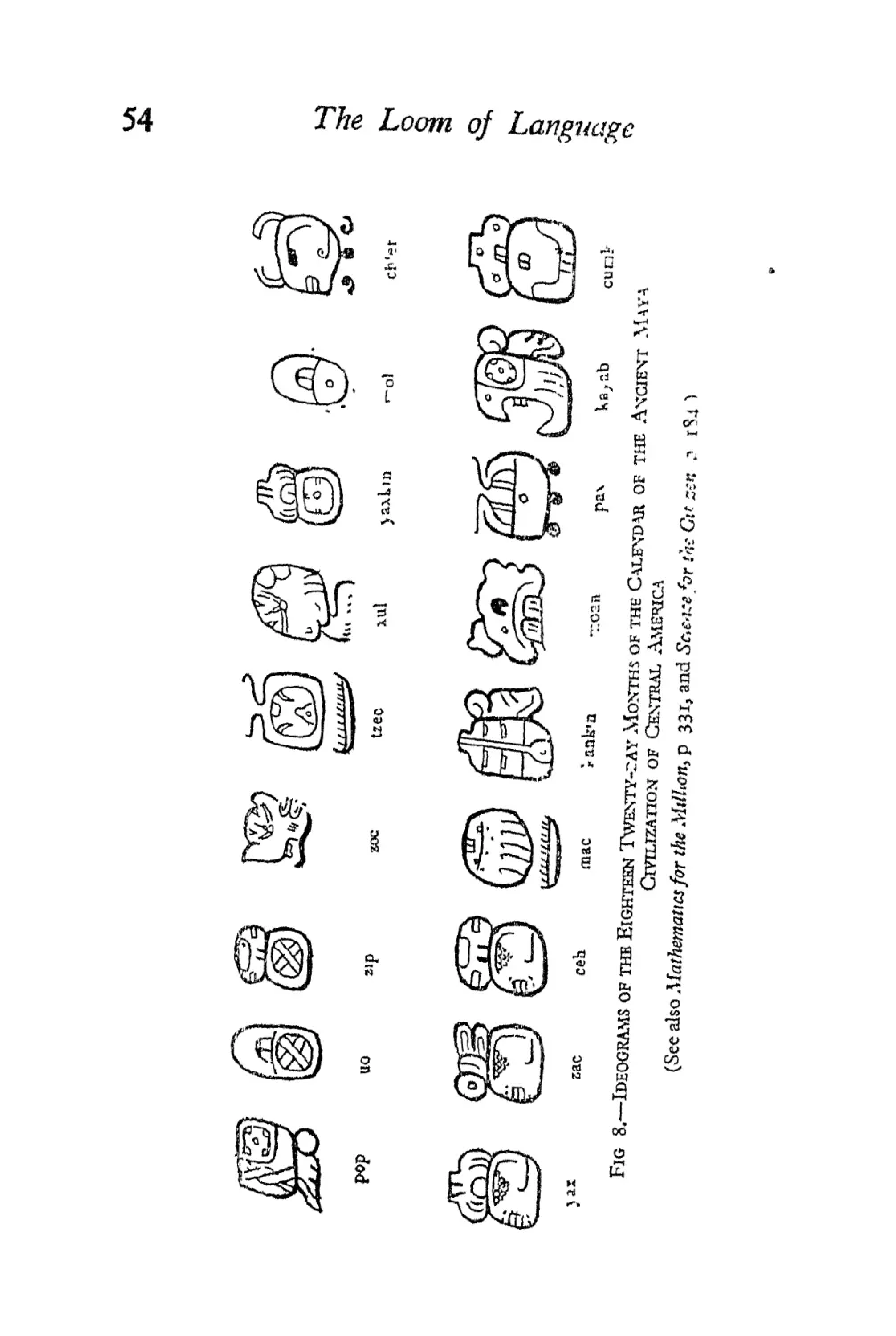
8 Ideograms of the Eghteen Twenty-Day Months of the
Calendar of the Anclent Maya Cmhzauon of Central
Amenca 54
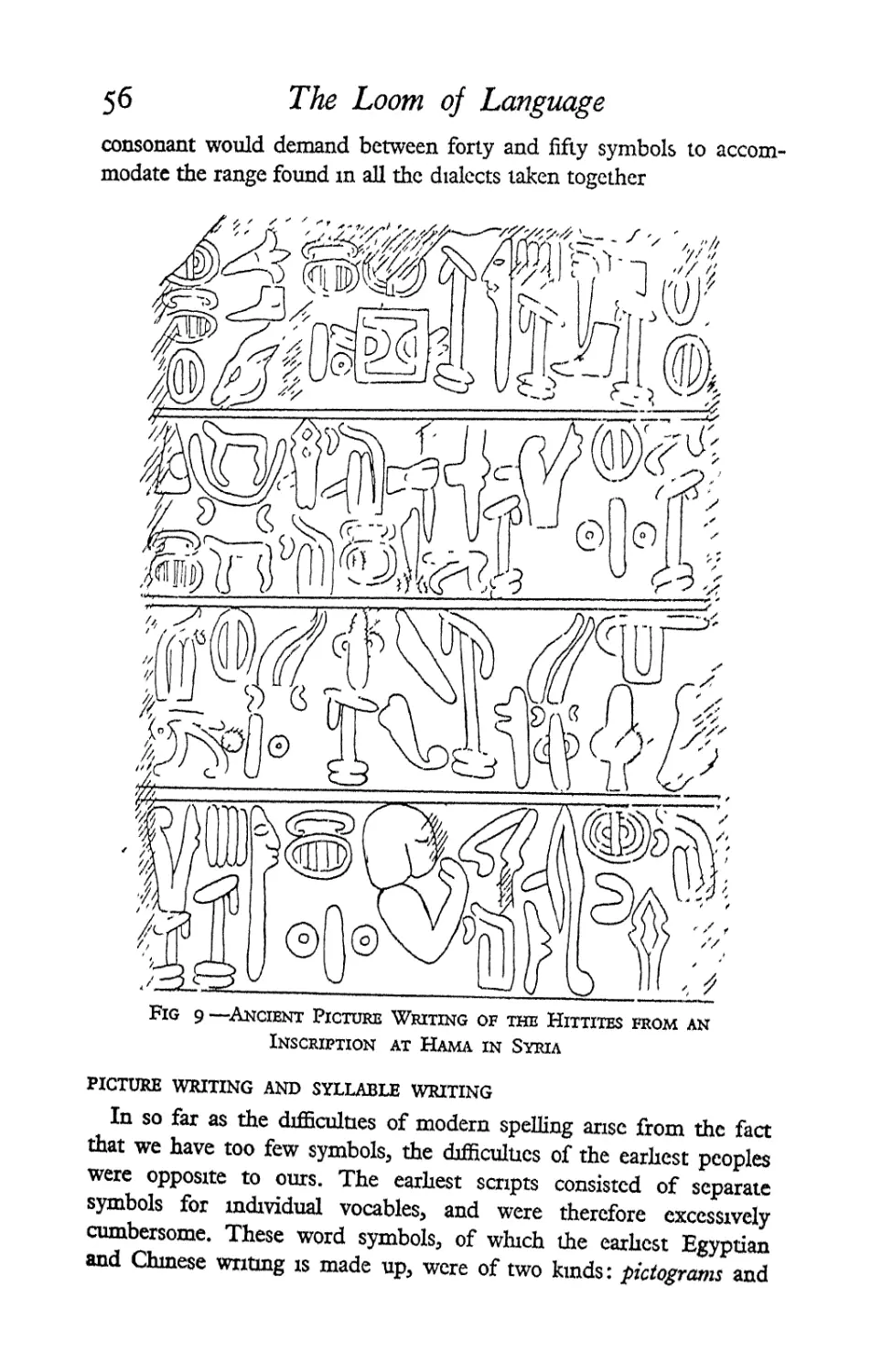
9 Ancrant Pmture Wrmng of the Httutês from an Inscnptmn
at Hama m Syna 56
o Dscus of Phacstos «howmg as yet Undecphered Pcto-
graphtc Wntmg of the Ancrent Cretan Cmhzauor 59
Consonant Symbols of some Contemporary Alphabets 60
OE Vowel Symbols of Some Contemporary Aiphabets
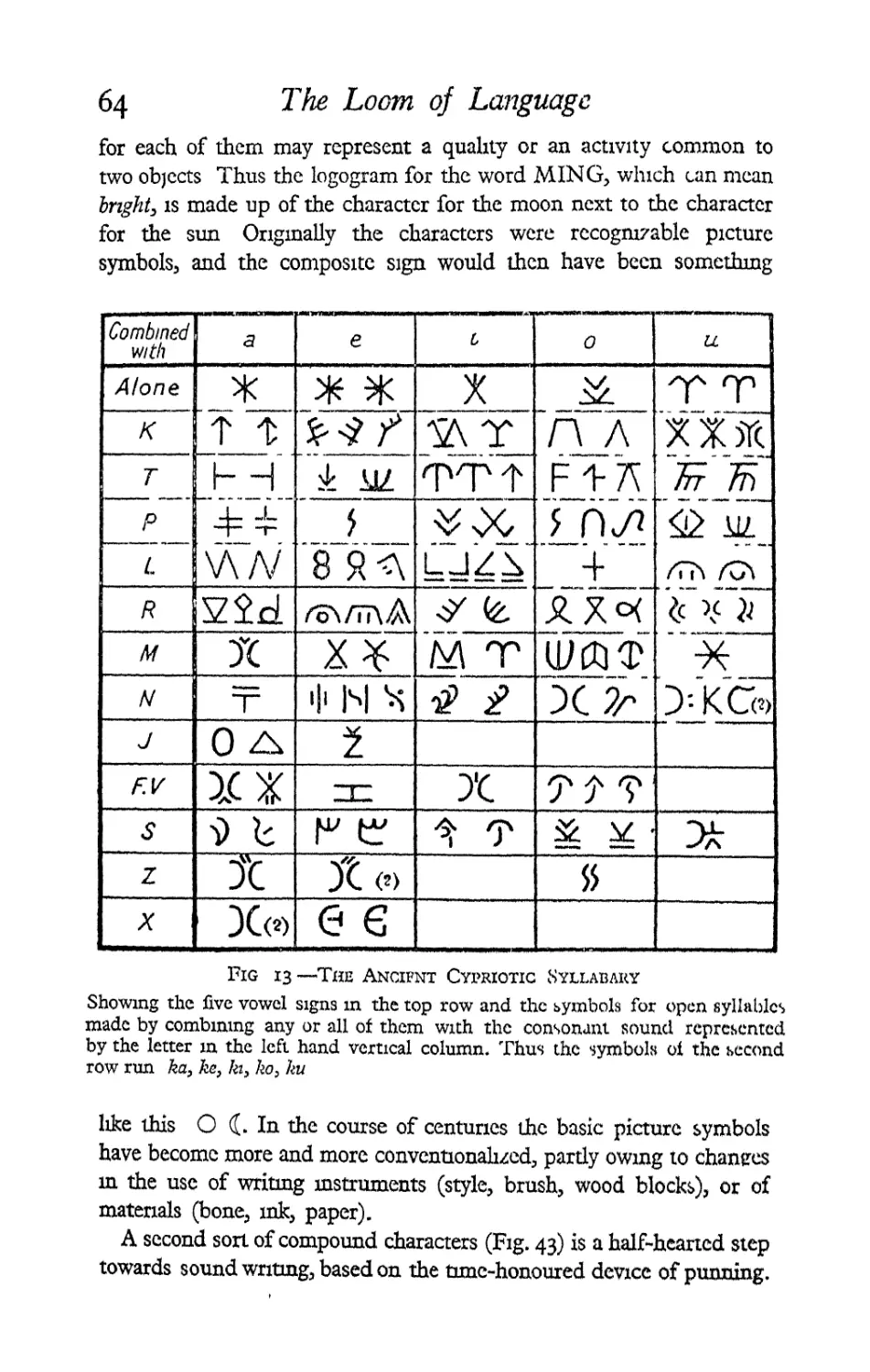
3 Thê Ancrent Cypnouc Syllabary 64
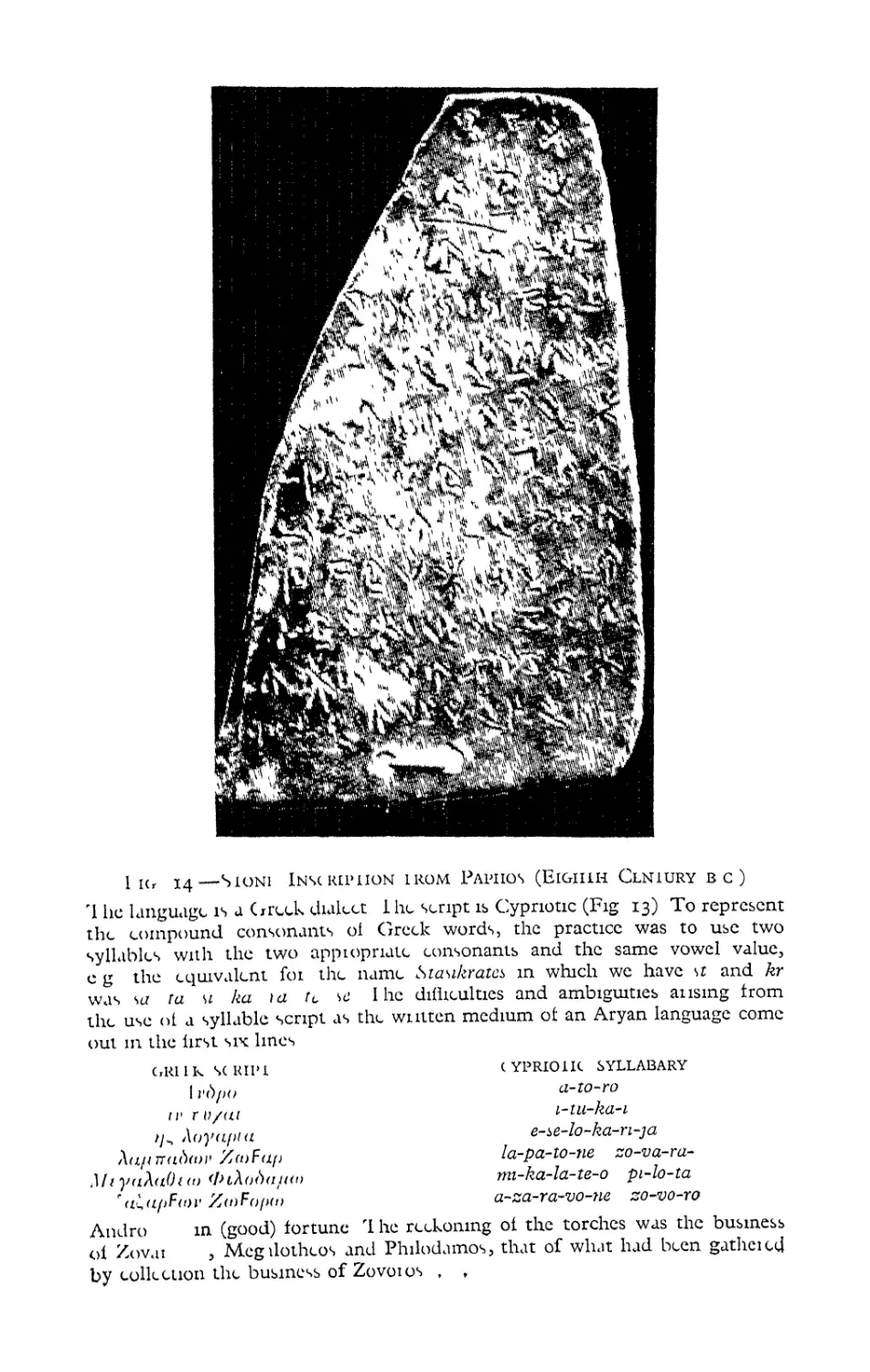
4 Stone Inscrpuon from Paphos (Exghth Century c ) facmg 64
5 Some Sgrs from Early Alphabets 7 o
6 Early and Later Form of Some Greek and Latin Letters 7
7 Key to Rumc and Ogam Scrtpts 75
8 Bhngual Inscnpuon m Laun (Romart Létters) and Celuc
(Ogam Sgns) ïrom a Church at Trallong m Ireland 76
9 Semaphore, Morse and Braille Codes 78
o Facsmaïle Note m Ptman's Shorthand by Bernard Shaw 86
2 The Drecuves of PlacWx4:
z2 The Drecuves of Mouon 44
z3 The Instrumental Dtrecuves 45
a4 The Drectwes of Tune 46
25 Assocmuve Dtrecttves 47
26 Coin of Maccabêan Tmes wzth Early Hëbrew Characters
7 Threc Verses from the Oid Testament tu the Oldest Dateable
MS of thê Hebrew Bblc
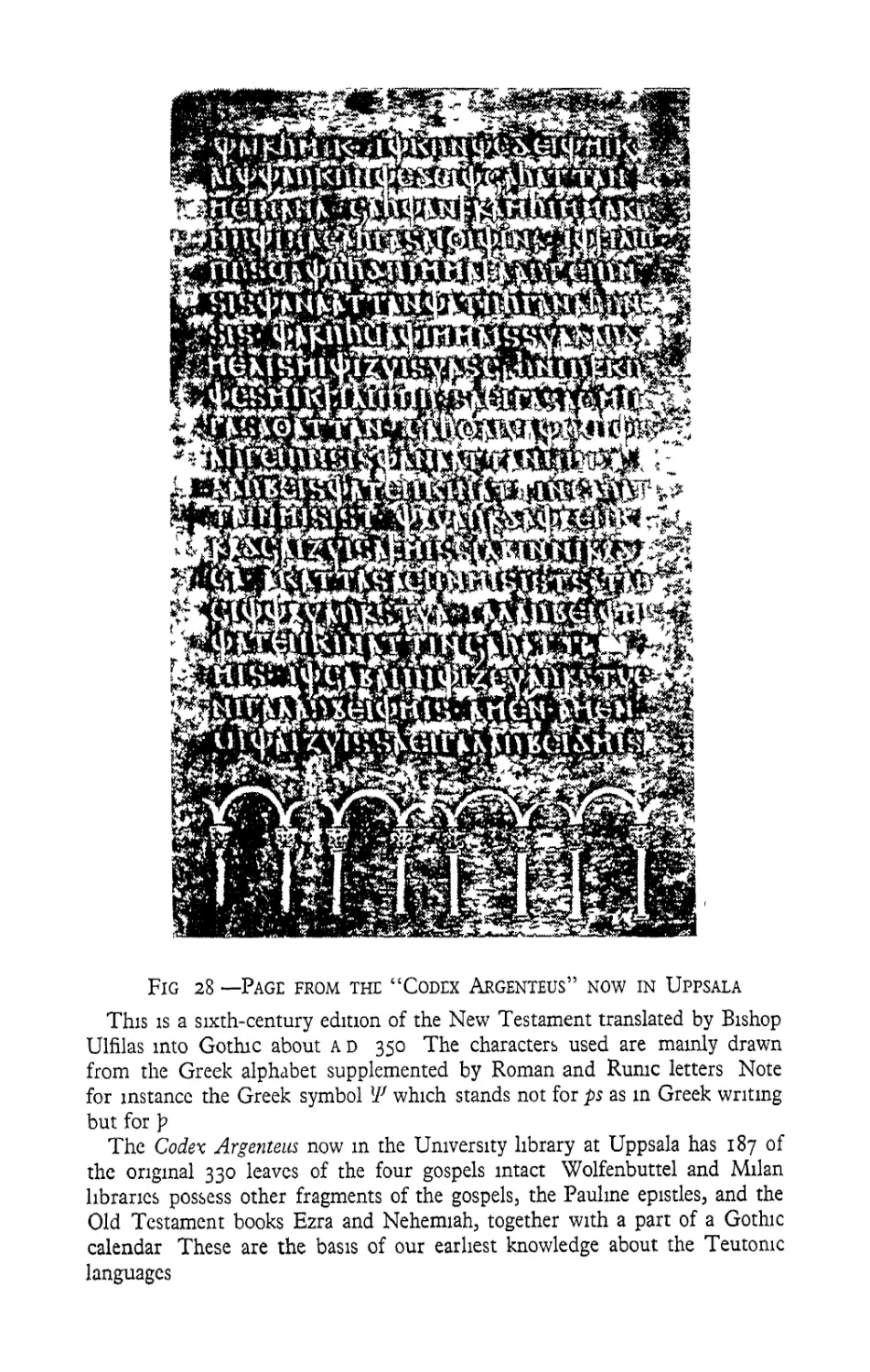
8 Page from the "Codex Argënteus" now m Uppsala
facng 2o4
faczng
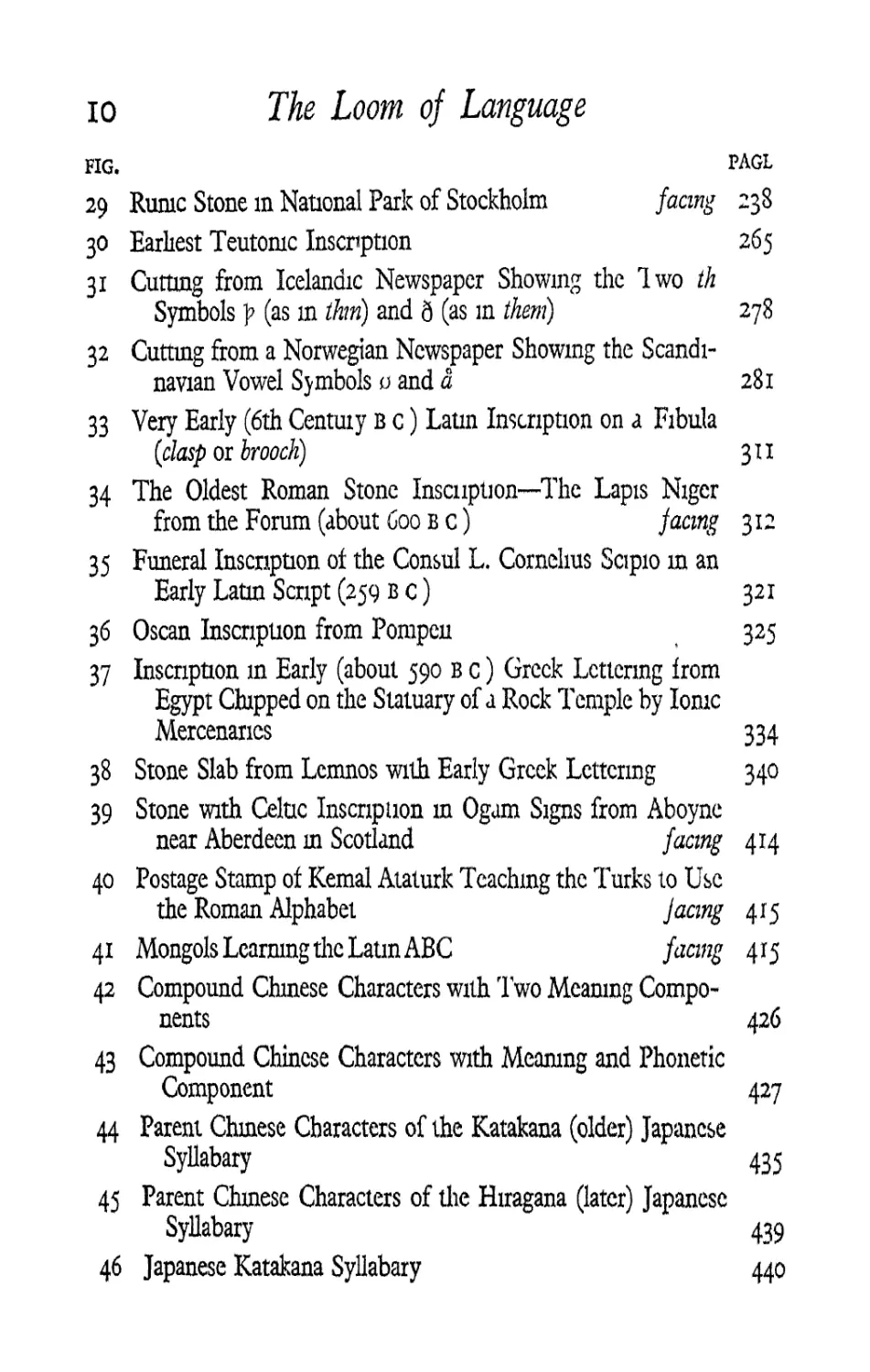
iO
The Loom of Language
FIG.
PAGL
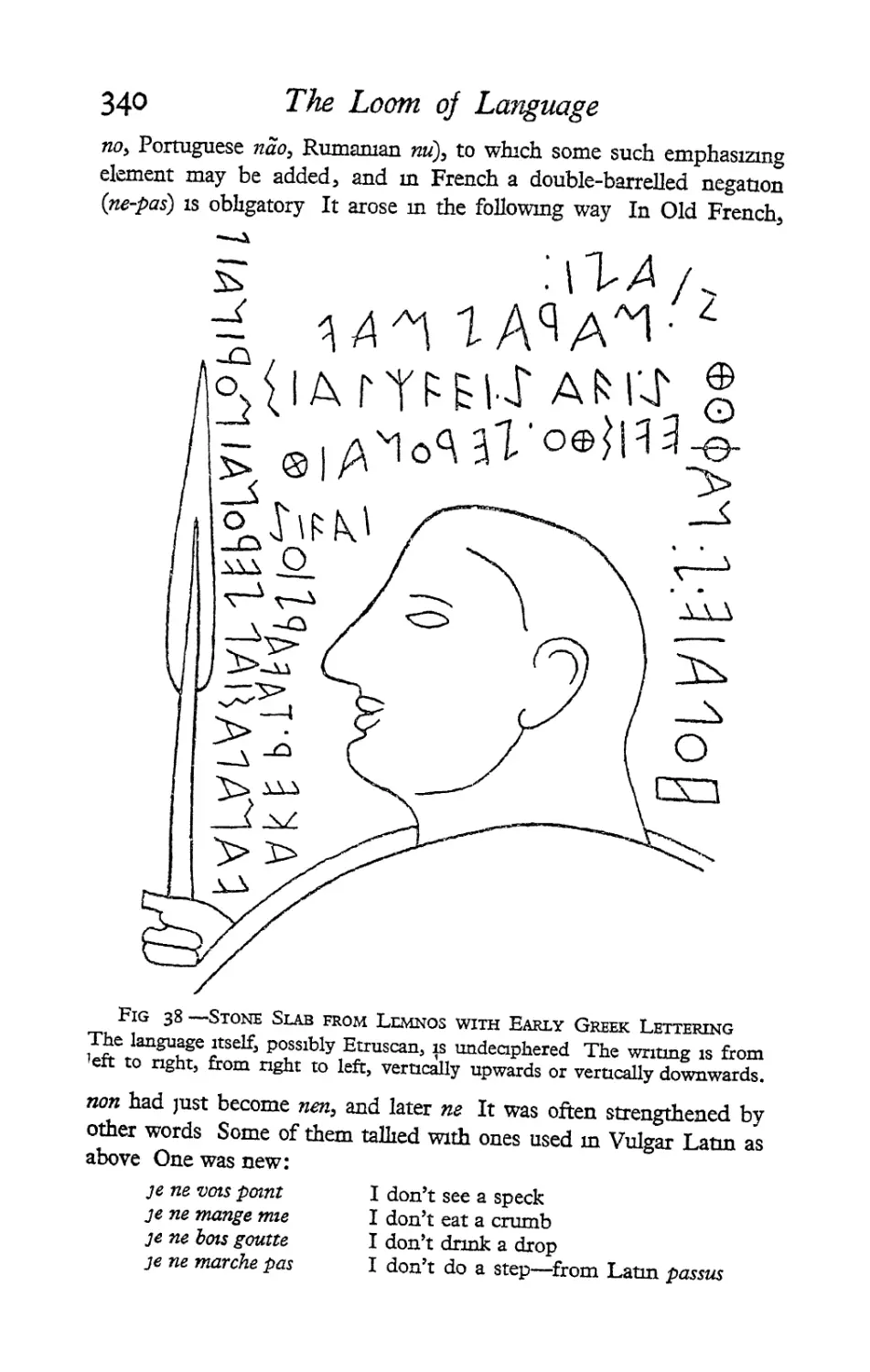
38 Stone Slab from Lemnos wth Early Grcck Lcttcnng
39 Stone wlth Celtac Inscription m Ogam Sgns from Aboyne
near Aberdeen m Scotland facmg 44
4o Postage Stamp of Kemal Ataturk Teâchmg the Turks to Use
the Roman Alphabet jacmg 4r5
41 Mongols Lcarmng the Latin ABC facmg 415
42 Compound Chmese Characters wth Two Meamng Compo-
nents 4OE6
43 Compound Chînese Characters wrh Meamng and Phoneric
Component 427
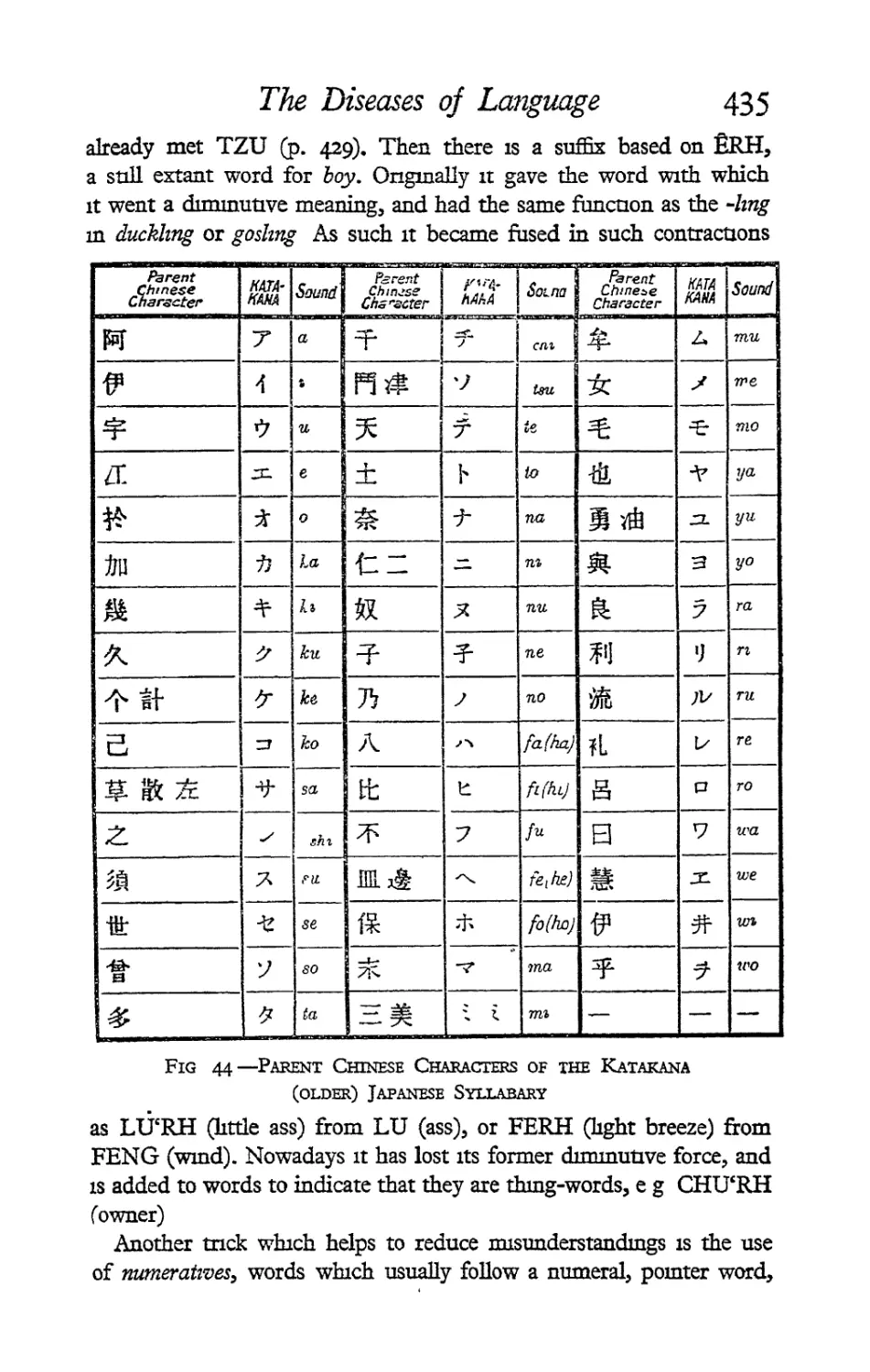
44 Paent Chmese Characters of the Katakana (older) Japanese
Syllabary 435
45 Parent Chmese Characters of the I-hragana (later) apanese
Syllabary 439
46 japanese Katakana Syllabary 440
334
340
29 Rumc Stone m Nauonal Park of Stockholm facmg
30 Earhest Teutomc Inscvpton
3 Cuttmg from icelandlc Newspapcr Showmg the "iwo th
Symbols p (as in thm) and 6 (as m them) 278
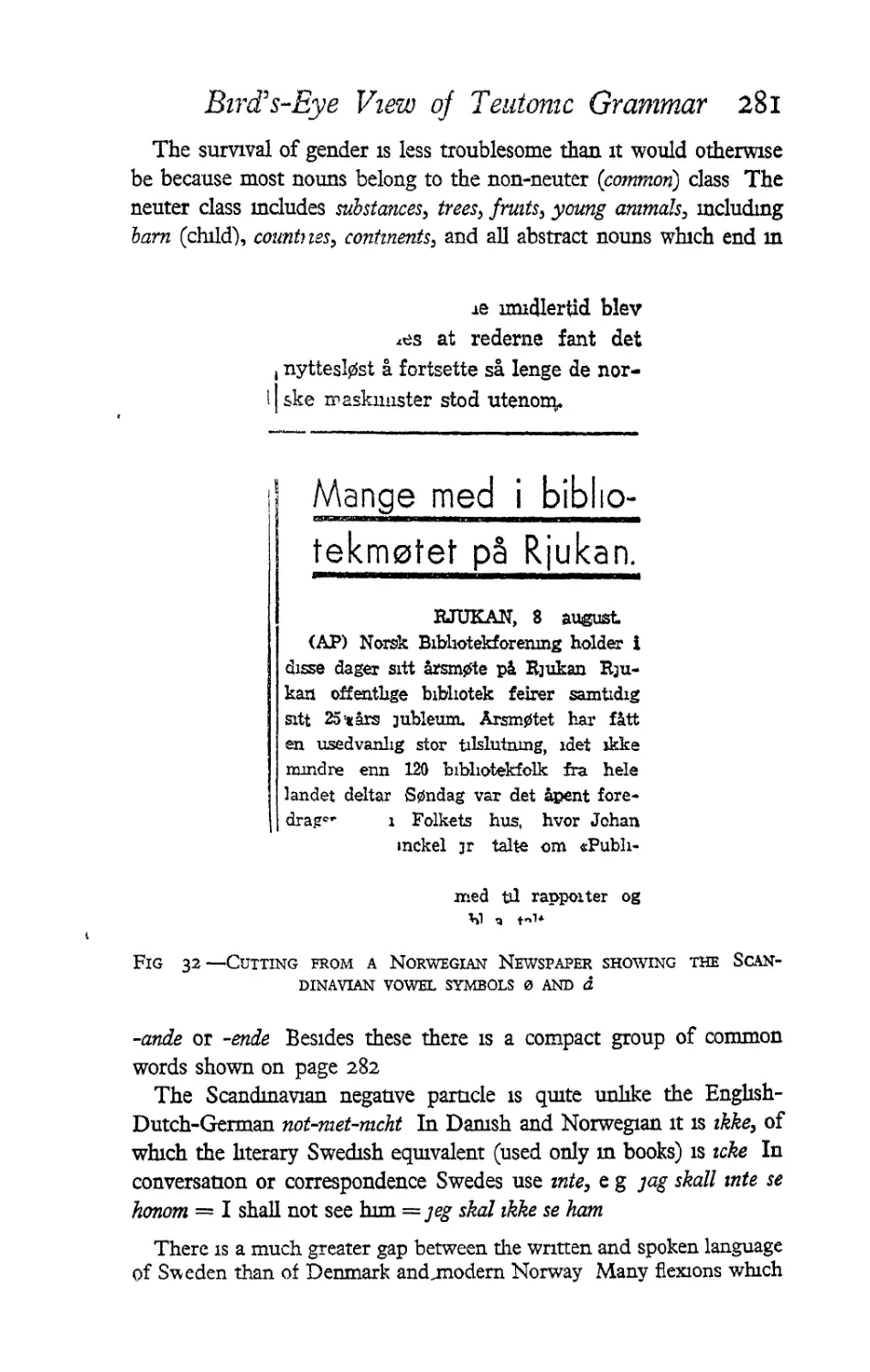
32 Cuttmg from a Norwegian Newspaper Showng the Scandl-
navlan Vowel S)mbols o and cï 28I
33 Very Early (6th Centmy B C ) Latin Imcnptwn on a Flbula
(clasp or brooch) 3 t
34 The Oldest Roman Stone inscupuon--The Laps Niger
from the Forum (about 600 I c ) jacmg 3I.
35 Fanerai inscription ol the Consul L. Cornellus Scpo in an
Early Latin Script (259 I3 c ) 32I
36 Oscan Inscnpuon from Pompen 325
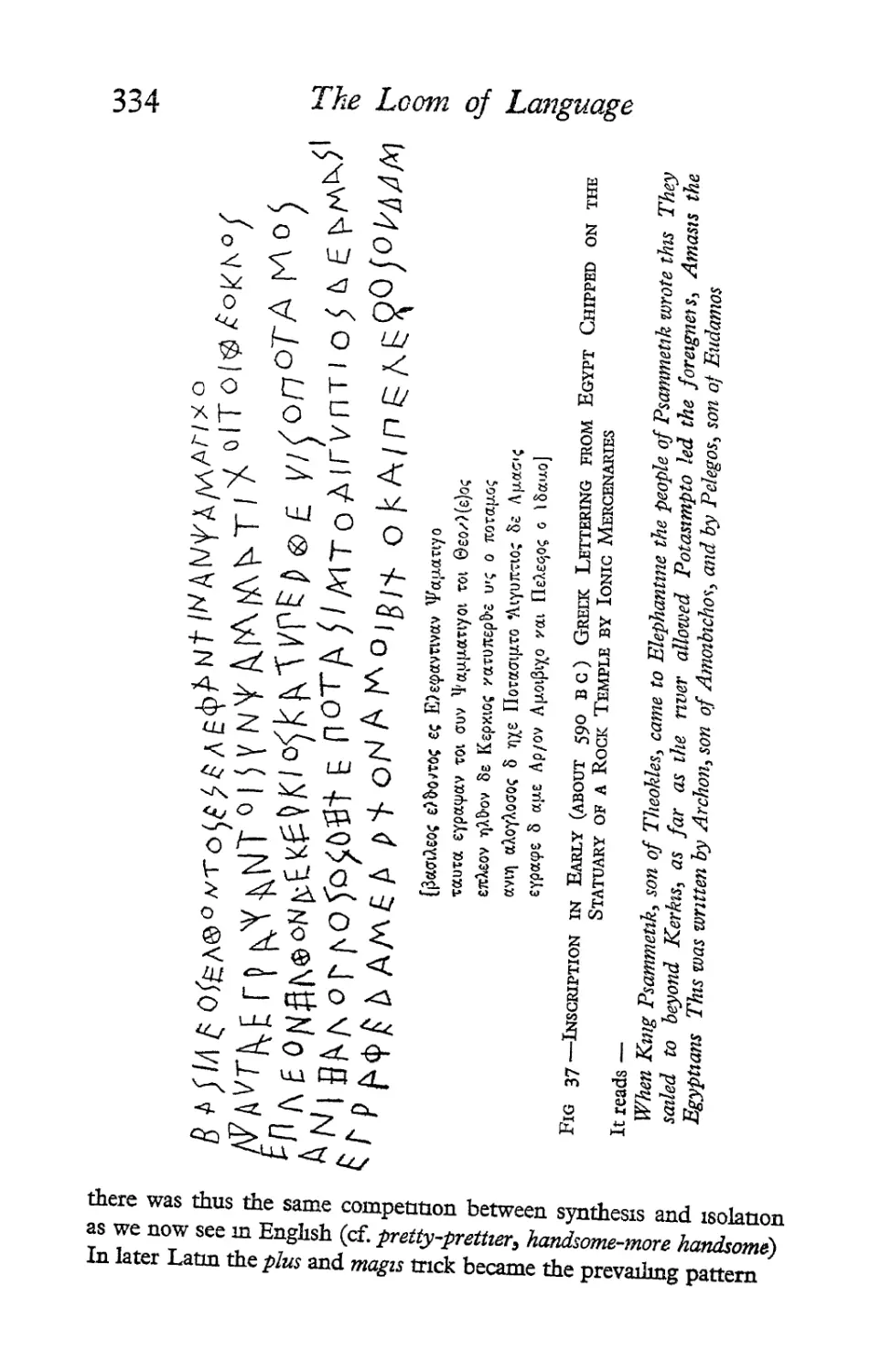
37 Inscnpuoa m Early (about 59o c) Greck Lcttermg trom
Egypt Chpped on the Statuary of a Rock Temple by Iomc
Mercenanes
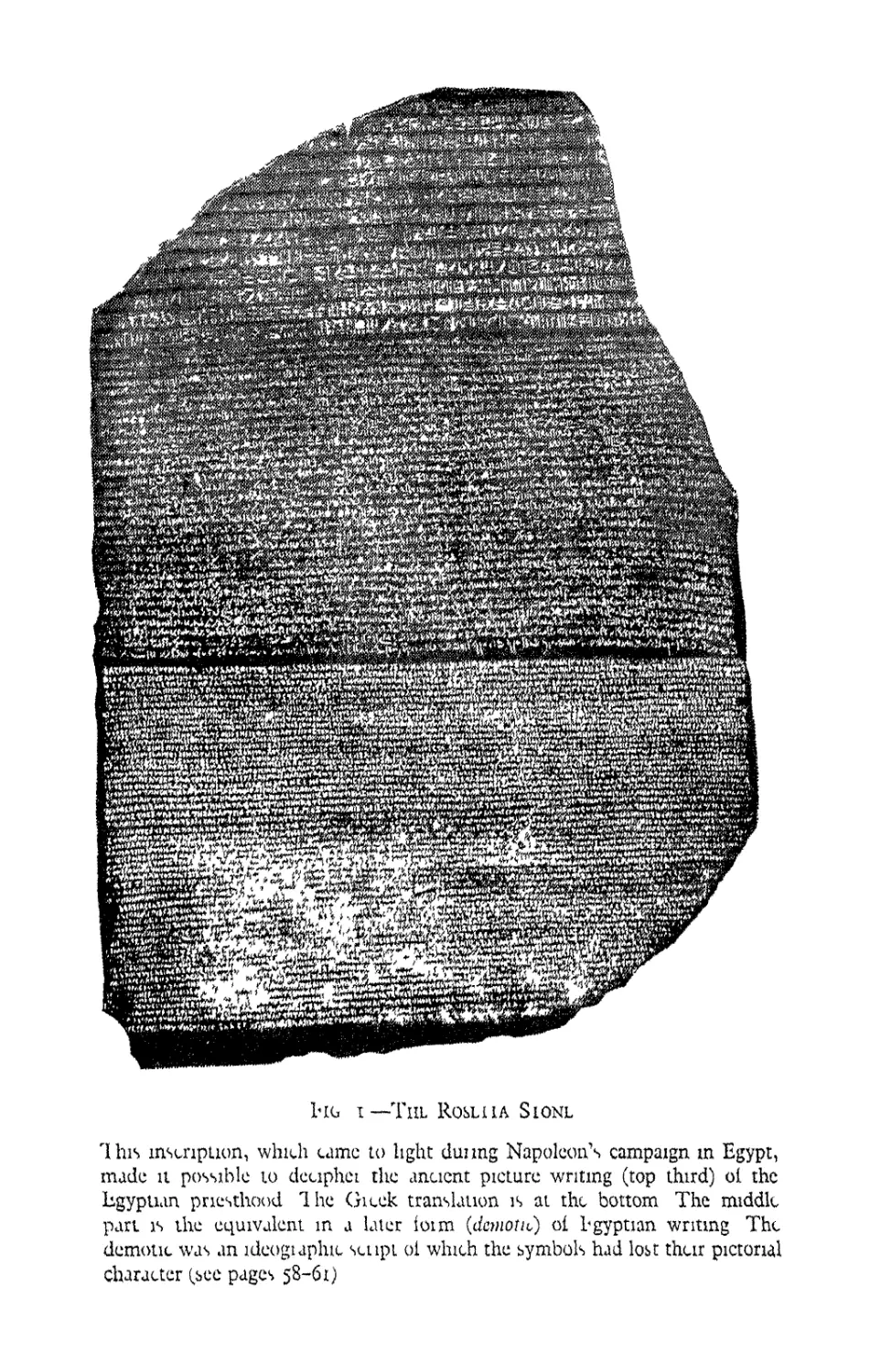
"I hls lnscnptmn, whcl came to hght dumg Napoleon's campmgn m Egypt,
made t possible to dccphet tlm ancrent pcture wntmg (top thlrd) oi the
Egypuan pnestlod he ()çek translauon s at tlac bottom The mddlc
part s the cquvalcnt n a latcr totm (demot) of Igyptmn wrmng Thc
dcmouc was an dcogtaphtc sçtpt oi whtch thc symbols had lost thctr pctonal
ctaracter (sec pages 58-6)
EDITOR'S FOREWORD
DURIIG the past fifteen years mstrucraoI1 in school and college has
undergolle a drasuc reorïematton in Germany and Italy Its expressed
alm ls to consohdate and to promote the sentamems and mstttuttons of'
the totahtarlan state Durmg the ssme perlod no country vath an
ostenslbly dêmocrarac iorm of government had an educauonal system
deslgncd mth êqual smglcness of" purpose to promote the democrarac
way of" hfe. In En#and school educatlon is the 1,1s bulwark of caste
pnvllege. In Bntam, as in Scanchnavla, umverslty educauon xs a
patchwork ruade up partly of rehcs from the cathohc authorîmrian
trachuon of medleval Europe» partly of vocauonal speclahucs reluc-
tandy addcd to meet the demands of modern techmcs
The basxc dcfect of Bntsh educatlon beyond the elëmemary school
ievel--at wtuch t bas an mtelhglble and necessary funcuon as an
msurance pohcy agamst national llhtêracy--lS that selectïon and
prcsentatlon of materlals for teachmg of sub]ccts most relevant to the
construcrave tasks of modern soclety lS largcly in the hands of experts
whose mare preoccupatton is to produce other experts hke r.hemselves
We learn out mathëmatcs wlth scant reference to xts sc,enrafic apph-
cations Wc leam namral science wlthout regard to the xmpac of
sclênufic dlscovcry on the SOClery in wluch we hve We struggle w,th
one or more modern languages in complete mchfference to the part
whtch language dlfferenccs play in prov,dmg fuel for international
Imsunderstanchlag and wlthout the shghtcst concern for OEe problem of
cornmumcàtlon on a plaretary scale m an age of potenual plenty.
Lîke that of its predccessor, Sczence for the Cztzzen, the project of
The Loom of Language lS based on the convlcraon r.hat the orientation of
srudlcs in out schools» umversiues» and Adult Educauon Movement
does no provlde a sufficlcnt eqmpment for the construcaïre tasks ofthe
sociëty m whïch we hve» that radical changes in the scope and methods
of educauon arc a necessary conchûon of contmued social progress,
that such educatïonal reforms w, ll hot corne about unless there is a
vlgorous popular demand for them» and that mere precept or contro-
versal crmcxsm ls hot hkely to smnulate popular demand for reform
unless the plain man can exaïmne substantml examples of instruction
vltahzed by a new mfïlsion of social relevance Le other prîmers for
the Age of Plenty, The Loom of Langua.e does hot set out to add to
number of popular books wrrteïï to stlmulate superficual mterest
12 The Loom oj Language
among curlo hurlters, to promote urmecessary veneraïon for pro'essors,
to provde materlal for hght conversation at cocktail parties» or o
nutlgate the mcovemence of msomrua Fxrst and £oremost i s a
self-educator for the home student, a book whlch members of" the
Adult Educatlon Movement can use as a basls for sustamed study» and a
book from wlch teachers alert to the need for a new onelltatlon to meet
the needs of the ordmary cmzen m a progressive democratlc soçety
can get helpful suggestions wlth a chrect beanng on thexr dmty tank
An attempt of ttus kmd needs no apology on accouru of ts novelty
or break wth tradmonal methods of school teadung Less than a
century ago, fixe mtroductaon of modern languages mto schools where
language teachmg had been crcumscnbed by translation i'rom classical
authors of alltlquity, was greeted as a welcome mnovaLlon it seëmed at
iast as if the teachmg of languages had been brought to hfe Af'ter two
gellerataons of expermaent, educaliomsts are hot conwnced that the
rêsults of school-teacballg jusoEy the rame devoted to thëm in lnghsh-
speaking countnes It would hot be an exaggeratlon to say that the
prevmlmg attitude among Amencan educataomsts is one of alarm at
the poverty of return for êftort put mto fixe task Subsdzzed bv the
Carnege Corporatton, the Amencai1 Councll of Education bas under-
taken a survey of methods and rësults in order to revîew OEe çurrent
stuataon in Amercan schools The pubhshed report s an honest
admission of chsmal faflure
Years ago, when Dr. Bodmer was my colleague on thê staff of the
Umversity of C@e Town, we chscussed the twm proect of oecence for
the Ctzen and The Loom of Language m a preltlmnary way. Shortly
belote the war we drew up a detalled plan based on oint discussion,
chiefly m Enghsh country pubs dunng the course of a motor top from
Aberdeell to London vza the Yorkslur moors and Suffolk, back agam
by way of the Lake chsmct Thêr¢, as I expêcted, my job as echtor
fimshed, at least tlll I read the page proofs In rêahty collabôratton
bas beén closer, and the author bas urged me to explam the éxtëm
of It Durmg the wmmg of the book Dr Bodmer hved m a smaïl
croft wlch I used to rent on Deeside So I saw hîm durmg the
week-ends colltmuously. I read thë first drafts of each chapter, and
was able to suggest how to get round chificulties of orchnary peoplë
who are hke myself poor lmgmsts I shall always be grateful for what
was a highly educative experience and one which kept me mtellectually
ahve during a penod of somewhat curtaled oppommtms for my own
research
Edztor's Foreword
As tme passed the task became more and more a co-operauve effort
m wbach I acted as a seve, or, f you hke t, as a bt of htmus paper.
Dr Bodmer subrmtted to suggesuons for the benefit of readers who
find languages as forrmdable as I do wth more reachness than those
of us who have a normal mochcum of egottsm and a less developed
social conscience When the nsmg cost of paper forced us to curtafl the
scope to some extent, I took a hand m the lob of condensmg and
rewntmg some secttons Consequently I have had the greatest chtfi-
culty m preventïng Dr Bodmer from refusmg to pubhsh the book
wthout my mme as a co-author on the cover I havc got bain to see
that hmttauons wbach xnnchcate my echtonal quahficauons for recog-
mzmg thê chtlîcuiues of or&nary people would make me a laughmg
stock m the capacty of lomt author So we have cornprormsed on the
understandïng that I make clear the extent of my contnbuuon ïn a
forword
Therê s one thmg to add. The ments of the two predecessors of The
Loom of Language m thcr Iater echuors are due m no small measure to
the co-operatmn of scores of readers who have sent m suggesuons for
further danficataon or have drawn attenttor to author's shps or to
prmter's errors In a book of ttus sze, produced under excepttonaIly
chfficult conchuons, blermshes are mewtable m a first echtion Echtor,
aur.hor and pubhshers hope that readers wRl show apprecaatton of
what has been acheved by contnbutang construcuve cntacasm for
use m later mpressons or èduons
Because ths book s a successor to Mahematzcs for the Mzlhon and
Science for the Czzzen, ts mouf s social and ts bas s practical. It
doês hot ouch on the aesthetzc aspects of langage What aësthêuc
ments somc péople find, and--wc may hope--wl continue to fmd,
n thër home languages bave httlë to do wth chfficulues wtnch beset
the begmner learnmg a new one, or wth techmcal problems of de-
vîsmg ways and means of commumcauon on a planêtary scale m an
age of potenual plnty.
LANCELOT HOGBEN
October z94r
CHAPTER I
INTRODUCTION
WI-IAr language we habtually speak depends upon a geograplncal
accident It bas nothmg to do mth the composmon of the human
sperm or of the human egg A chïld grows up to speak or to wnte the
languagê used at home or at school If born m a bflmgual country tt
may grow up to use two lauguages wlthout any formal mstmcuon in
either Many Welsh, Breton, Belglan, and South Afncan cktldren do
so There ls nothmg to suggest that thë chromosomes of the Welsh,
Belgians, Bretons, and South Afncans bave an extra share of genes
which bestow the glft of tongues. Expenence also shows that adult
enugrants to a new country evenmally acqulre the knack of com-
mumcaung moffensIvely wïth the natlves So scarcely any one cau
bave any ratlonal basls for the behef that he or she ls congêmtally
incapable of becommg a lmguist, if a language-phobm exists, t must
be a by-product of formal educatîon or othcr agences of socïal envïron-
ment.
By the saine token It ls hot dficult to understand why Scandmavxans
or the Dutch enloy the reputauon of bemg good hngtusts In small
speech commumtïes the market for talhes or for specaahst textbooks
ïs small, and It xs hot econormcally pracucable to produce them Thus
thê Norweglan boy or girl who hopes to enter a profession grows up
wïth thc knowledge that proficlcncy in Enghsh» German or French is
an ëssenual educauonal tool In any part of Scandanavxa a wslt to the
cmema ls a language lesson Translatton of the Enghsh, German
or French dialogue flashes on the screen as thc narrattve proceeds.
To ail the cul,al bamers wluch lmgtusuc tsolauon imposes on a
small spcech commumty we bave to add exagenctes of extemal trade
and a stronger Impulse to travel. In short, membërs of the smaller
Europêan spêech communiuês expenence a far greater nêed to study
foreign ianguagês and enloy greater opportumues for domg so
Speclal carcumstances combzne to encourage a chstaste for hngmsttc
studies among those who speak the Anglo-Amencan language One is
that the water fronfiers of Bntam, and sull more those of flac Umted
States, lsolate most Bntish and Amencan cmzens from datly experiênce
6 The Loom oJ Language
of Imgmsuc contacts. Another s that formal educauon fals to supply
a compellmg reason for a pursmt whch bas httle connexaon wth the
needs of everyday hfe. Reasons commonly gven for learmng foregn
languages are mamfestly msmcere, or, to put t more chantably, are
out of date For instance, t s obvmusly easy to exaggerate the uuhty
of lmgmsuc accomphshments for foregn travel Only relauvely pros-
perous people can continue to travel after mamage, and tout,st fach-
ttes for young peoplë of modest means rarely, ff ever, take them mto
smauons where nobody understands Anglo-Amencan There s cven
less smcenty m the plea for hngmsuc proficency as a këy to the trcasure-
house of the world's hterature Amencan and Bnush pubhshers scour
the Continent for translauon nghts of new authors So the doors of
the treasure-house are wde open Indeed, any mtelhgent adolescent
wth access to a modem lendmg hbrary can catch out the tcacher who
enthuses about the pleasures of readmg Thomas Mann or Anatole
France m the original People who do so are content to get ther know-
ledge of Scandmawan drama, the Russmu novel or the icelandc Sagas
from Amencan or Bnush translauons
In spzte of al1 obstacles, anyone who has been brought up to speak
the Anglo-Amencan language enioys a pecuharly favourëd posmon
it s a hybnd It has a basc stratum of words denved from the same
stock as German, Dutch, and the Scanchnavn languages it bas
assrmlated thousands of Laun orgm It has also mcorporated an
gnpressvë battery of Greek roots. A random sample of one word from
each of the first thousand pages of the Conczse Oxford Dctwnary gves
the followmg figures" words of Romance (Laun, French, itahan,
Spamsh) ongin 53 6 %, Teutomc (Old Enghsh, Scandmawau, Dutch,
German) 3 ï/o, Greek o.8 ï/o Wth a httle kïaowledgc of thë
evoluuon of Enghsh tself, of the parallel evoluuon of the Teutonic
languages and of the modern descendants of Laun, as set forth m the
second part of tins book, the Amencan or the Bnton bas therefore a
key to ten hvmg European languages No one outsde the Anglo-
Amencan speech commumty enloys tins pnvlege, and no onê who
knows how to take full advantage of t need despmr of getting a good
workmg knowledge of the languages whch our nearest ïaeighbours
speak
Though each of us s enttfled to a personal chstaste» as each of us xs
enutled to a personal preference, for smdy of ths sort, the usefulness
of learnmg languages is hot merely a personal affar. Lmguimc dfffer-
entes are a perpetual source of international masunderstandmg a well-
Introductzon 17
mgh lnexhaustlble supply of inflammable materlal whlch warmongers
can use for thetr own ewl ends $ome knowledge about the languages
people speak Is thereïore Olae prerequlslte of kêepmg the world's peace
Keepmg the world's peace fs everybody's proper business, but keepmg
the world's peace ls IlOt thê only reason why study oflanguages concems
all of us as cïttzens. Lmgmsrïc chffèrellCeS lead to a vast leakage of
mtellëctual energy which nught be enhstêd to make the potenttal
plemy of modern science avaflable to al] manlmd
Human bemgs are umque in two ways Mail ls a tool-bearmg ammal
and a talkattve ammal In the pursmt oï thelr tool-bearmg actlvïtles,
men and women bave learned to co-operate on a planetary scale; but
such co-operatlon ls perpetuaLly thwarted by local kmltatlons of" thelr
speech habits What ls characterlstlc of" the mtellectual achlevêmelltS of"
mazlkmd in the age of hydro-elecmclty, magnesmm-alurmmum alloys,
broadcastmg, awatmla, syntheuc plastlcs» and chemoerapy ls a com-
mon possession o all ilatlolls wlaxch encourage sclenlafic research, but
natxolls bave no common ldlom through Much workers by bram or
hand can commtmcate results of" research or coLtaborate in applymg
thëm to human wel£are Modem techrology s a supernatlonal culture
wlxIch rmnisters to the common ileeds of humalx beîngs» whlle language
lmxps behmd the human elldeavour to satsfy neêds wlch ail human
bemgs sharë.
To canallze the mterest of" mtelhgent men and women mto the
constructive task of dewslng or of adoptmg an auxihary medlum to
supplement exstmg nauonal languagcs ls therefore one of the forêmost
needs of our ume Thïs concerns us all, and it calls for a hvely
knowledge of the hmltauons mposed on laxaguages by the laws of
their giowth It wll therefoe be one of the tasks of The Loom of Lan-
guage to trace the lustory of the languages m wbach the techmcal
resources of out age bave been recorded, it wtll hot be a record of
dehberate and mtelhgent prevlsmn It s partly a story of confusxon
resultmg from a commuous record of lovênhness and of obstmate
complacency towards the rmstakes of out grand-parents. It ls also a
story of ancestor-worshp, and of makeshs to conserve the meputudes
of a supposedly heroic past It affects us more lntmately than the
fate of the Dmosaurs. It unearths remams hot less dramatm than the
jaw-bonê of the ape-man oI Java. !t points thë way down data paths of
prehstory from whlch wê return with imagmatmn fired by a wsta of
future possbilmës.
Ths does hot mean that The Loom of Language is first and forëmost
18
The Loom of Language
a plea for language-plannmg. There are other good enough reasons
why ts readers may need or wsh to srudy exstmg languagcs Travelhrïg
fachues are becommg cheaper and dafly less mconvcment or t.tmc-
consmnmg if the states of Europe are ever umted undcr common
democrauc govemment, wth ts own ar serwce, many o us who had
never expected to travel far afield may hope to sec more of the world
FIG Z--INSLRIPTION FROM MIN SIIAFT IN THI: SINAI PFININSOEA
Tracmgs on a mine shaft in the Slnsl l)cmnsula ronde by a workman who
sxgns hunelf as Number 4 and gves hs naine as SAttMI/
before we che Inevatably we shall become more ïnterested in the speech
habits 'of out nelghbours Though a knowledge of foregn languages
ïs hot mchspensable to an Ameïacan or an Enghshman who wlshes to
travel, it adds to the fun of if and promotes a more fnëndly under-
standing wxth people one may meet
The hterary arguments for language study are mamfestly bogus when
based on the clanus of timon or drama for wtuch chëap translauom
are reachly accesstble None the lss, somc types of ltterature are acces-
stble oaly to peoplë who know languages other than thetr owa. A large
Introduction 9
volume of sctenttfic publications whtch record new &scovenes m
physcs, mechcïne, chermstry, agriculture, and engmeermg appear m
many OEerent languages. Ther content do hot become accessible m
books tïll several years bave elapsed. Professonal sctenufic workers
are therefore hanchcapped f they bave no lowledge of such languages
as German, French, or Spamsh What s more unportant from th, e
standpomt of the wder pubhc whch T]e Loom of Language may reach
s tins. OEallengmg stattsttcs of social welfare from foregn countnes
may never find their way mto the columns of out newspapers So the
only way of gemng a thorough first-hand knowledge of foregn affars
s to read year-books and penochcals pubhshed m other countnes.
For these and other reasons many people who bave httle or no
knowledge of foreign languages would hke to bave more, and many
would study them, f they were hot dïscouraged by the very poor
results whtch years of smdy at school or m college prduce One thmg
The Loom of Language auns at domg s to show that there s no real
reason for bemg chscouraged Though the dcultes of learmng
languages are real, they are also easy to exaggerate. Generally, the adult
has more to show after a three months' course at a Commercial Instaure
than an adolescent after three years' study of a foreign language m a
Bntsh secondary or Amercan lgh school Oe reason for ths s that
the adult pupîl s clear about why he or she is takmg the course Another
s that the teacher s usually clear about why he or she s guvmg ït
Thts xs hot the whole story. To sms of onusston we bave to add all
the posture obstacles whch early formal educatton places tu the way
of those who have no strong personal mdmauon for hngutsuc stuches
The greatest xmpechment, common to most branches of school and
umversty educatïon, ts the dead hand of Plato We bave hot yet got
away from educauon desgned for the sons of gentlemen. Educauonal
Platomsm sacrtfices realizable proficenEy by encouragmg the pursmt
of unattmnable perfecuon The child or the unmgrant leams a language
by blundermg his or her way mto greater self-oenfidence Adults
acccpt the m_tstakes of chïldren wth tolerant good-humour, and the
gemal flow of soctal mtercourse x hot mterrupted by a barrage of
pedanttc protests. The common sense of orchnary parents or customs
officals rëcogmzes that commonplace communicauon unhampered by
the stmg of grammatacal gutlt must precede real progress m the arts of
verbal precsïon Most of us could learn languages more easfly tf we
cotfld learn to forgnve out own hngmsuc trespasses
Vdhëre perfecuonist pedantry bas mserted the stmg of grammatical
The Loom of Language
gudt a sênse ot socml lnfenorlty rubs salt xno the woand Accordmg
to thê standards of educated adults, very few adolescents can speak
and wnte tle home language wlth fluency and grammaucal precislori
before eghteen years of age To be able to speak more than two new
languages wlthout any trace of forelgn accent or lchom ïs a hfe-work.
So hngtnsnc pohsh Is a pm qulslte of prosperous people whosc ormal
educaton bas been supplemented by the attenuons of foregn
govemêsses and by frequent reps abroad it s the culturaI tradë-
mark of a lestre class Indeed no type of knowledge bas moe osten-
tanon value
No one who wants to speak a foregn language hkë a nauve can
rely upon tins book or on any other Its alto s to hghten the burden
of leammg for the home student who s less ambmous Onë of the
useful results of" recent at'tempts to dewse languages for world citzen-
slip bas been to show how educanonal pracuce, chctated by
social theones which gratffy the tch for lesure-class ostentanon,
exaggerates thë dficulraes ansmg flore the mmnsc charactensncs
of language The mtrmsac dculraës depenâ on thé large amount of
effort expended belote tangable rêsults of self-expression or compre-
hension bnng thelr own reward Self-assurance depends on reducmg thas
penod of unreqmted effort to a minimum Pmneers of mternauonal
commumcanon such as C K Ogden, the mventor of Bastc Enghsh
bave ruade a specal study of tins, because the success ot ther work
depends on the case wth whïclï a language for world-wide use eau be
learned Whether ther own proposais pospc, or fatl, they have rcvo-
luuomzed the problêm of learning existmg languagcs
Tncks dscovêred in the task of devïsmg a stmple, dtrectï and casly
acqmred language for world-cmzenstup have not yct found thêr way
mto most gramrnar-books, and the reader who starts to icarn a foreïgn
language can get al1 dïe fun of tackhng a new problèm by applying
them To understand the essental pêcuhanties or sImîlarittes of
ianguages most closely related to one another doês not demand a
specal study of each. If you compare the following eqmvalents of
a rêquest whtch occurs tu the Lod's Prayer» you can sec ths for
yourself
Gb uns heure unser taghch Brot
Geef ons heden ons dageh?ksch brood
Gv os i Dag vort daghge Brod
Giv oss dag vïrt daglga brod
Gel oss dag vort daglcgt brau6
(German)
(Dutch)
(Damsla)
(Swedsh)
(Icelandc)
Introduction
Now compare these wlth the followmg translations of the same
petmon m Latin and ts daughtei languages"
Da nobls hoche panera nostrum quotchanum (Latan)
Donne-nous aulourd'hm notre païn quotidien (French)
Danos hoy nuestro pan cotlchano (Spamsh)
Daccl ogg111 nostro pane couchano (Itahan)
O pâo nosso de cada &a dal-nos hole (Portuguese)
By the urne you have read through the first rive, you wzll probably
have reakzed wlthout recourse to a chcuonary that they correspond to
the Englîsh sentence Gzve us thzs day out daily bread. That the next
rive mean the saine mght also be obvlous to a Frenchmano though
it may not be obvlous to us if we do not already know Flench, or a
language hke French If we are told that all ten sentences mean the
same thing, it ls hot dcult to seë that German, Dutch, Swechsh,
Damsh, and Icelandlc share wth Enghsh common features whlch
Enghsh does hot share th the other rive languages, and that French,
Itahan, Spamsh, and Portuguese share wlth Latin common features
whlch they do hot share wlttl the Grmamc group
It ls a common behef that leammg two languages calls for twce as
much effort as ]eammg one. Thts may be roughly t.rue, if the two
laxaguages are hot more ahke than French and German, and if the
begmner's mm ls to speak ether hke a native If they belong to the
same famfly, ald zf the begînner bas a more modcst end m vlew, t
s hot truc Many people wfll find that the effort spent on bullchng
up a small» wotkmanhke vocabulary and gettmg a grasp of essential
grammaucal peculianues of four closely relatêd languages ls hot much
greater than the effort spent on getung an eqmvalent knowledge of
one alone. The reason for ths s obwous ue we approach learmug
languages as a problem of apphed bmlogy The êase with wklch we
remember ttungs depends on bemg able to assoclate one tlung wth
another In many branches of knowledge, a httle learmng s a dffi,ult
thmg
As an solated act it s dcult, because extremely techous» to memor-
ze the pecuhanues of each mchvldual bone of a rabbxt. When we
reahze that bones are the alphabet of the wrltten record of evolutlon m
the sedmaemary rocks» the study of theïr pecuhanties s lu11 of mterest
Blologlsts wath ëxpenence of elementary teachmg know that it xs far
more satisfymg--and therefore more easy--to leam the essenttal
pecuhantles of the bones of representatve types from all the various
classes of vertêbrates than to memonze m great detml the skeleton of
OEz The Loom of Language
a smgle solated specimen So may well bê that many people wth a
knowledge of Anglo-Amencan would benefit by trymg to leam German
along mth Dutch» which s a hàlf-way home between German and
ideoqrams
Cegorm is the ame for a te of svllable wtltmg woE owes tts stmve
raenscs to the imçress of a wedge-sped tool on soif day Relted
syabarle of e
about ooo
scrtpts
Mayfloer English. Every gammancal tule thea becomes a ftesh
layer of ock from which to chîsël vestiges of creation. Each word is a
bon hbelled wth a questïon-mark.
Introduction 3
Tins suggesuon may hot appeal to everyone or suî every type of
home studen Suif» most people who fmd t dcult to leam a foregn
language can reheve themselves of some of ther dffficulues, f they
start wtth a htfle knowledge of how languages have evolved Part of the
task whch The Loom of Language bas undertaken s to brmg the dead
boncs to hfe wth tins elxar Somc people may say that the dcultaes
are too great» because we start wth so httle raw matenal for com-
panson They wKl say that t s posstble to gtve the general reader an
mtelhgïble account of orgamc evoluuon» only because any mtelhgent
person who first meets a text-book defimuon of such words as fish,
amphzbzan, reptzle, bzrd» mammal» can already gtve several examples of
each class Indêêd» most of us can subchwde some of them» as when
we speak of dogs and cats as carmvors, rince and rabbts as rodents,
or sheep and cattle as rummants. Most of" us could also guve some
outstândmg anatorrucal pecuharmes wlch serve to chstmgmsh speces
phced m a parucular group, as when we define rummants as beasts
wluch chew the cud and chwde the hoof
Admttedly, there s no such common basxs of umversal knowledge
about language specles and ther anatormcal pecuhantes Most Bntons
and most Amencans speak or read only onê language At best» very few
well-educated people can read more than three Those we usually leam
are hot recogmzably of a kmd, and there are no Pubhc Language
Museums wth attractive and mstrucuve exhbts Ail the saine, t s
hot mpossble for an mtelhgent person who has had no trammg m
foregn languages to get some msght mto the way m wtnch languages
evolve There are no straght lines m bologcal evoluuon, and there are
no straght hnes m the evoluuon of languages We can recognize sRMar
processes m the growth of al1 languages Vre can seë charactensucs
whch predommate m hnguages so far apaoE as Chmese» I-Iunganan,
and Greek competmg for mastêry m the grow of Anglo-Amerîcau
from the Enghsh of Alfred the Great
When we begm to take the problem of language planmug for
world peace senously, we shall bave pubhc lauguage musëums m out
centres of culture, and they wKl be essential instruments of cvïc
ëducataon. In the meanume we have to be content wth s'omethmg less
comprehensve. ]For the reader of tlus book, Part IV s a language
museum m mïmature The home student who loters m ts corndors
wfll be able to get a prospect of ttïe famfly hkeness of lauguages most
closely alhed to out own, and wfll fmd oppormmues of applymg mies
wtnch hghten thê tedmm of learmng hsts, as the extnbts m a good
24 The Loom of Lazguage
museum of natural hlstory hghten the tcdlum of leammg name for
the bones of the skeleon
WHAT LEARNING A LANGUAGE INVOLVtS
If supplemcnted by techmcal terres whlch arc thc samc, or almost
the same, ln nearly aH modern languagcs, a basic vocabulary of scvcntccn
hundred nanve words ls abundam for oichnary conversanon and mtelh-
gent dascïslon of serlous sublects in any European language Accord.mg
to a recent arude m Nature, a new encyclopaeda of medlclne pubhshed
recenfly m the Sowet Umon, comams 8o,ooo techmcal terms, and
safe to say that durmg hls professoml trammg a medlcal student has
to master a new vocabulary of at least ten thousand new words. Indëëd,
the mtemauonal vocabuiary of modem science as a whole s mmënse
tu companson wath the number of words and mies which we bave to
master before we can express ourselves m a foregn hngmage wth free
use of techmcal terres m world-wde use. Tins fact does hot prevent
the pubhcauon of a datly growmg volume of good popular books which
explam for the beneft of any eader wtl average mtelhgence basc
prmclples and mteresung facts dealt wlth in natural sciences Wth the
help of the exlubts m out own language museum (Part IV) there s no
reason why mteresnng facts about the way m wtuch languages grow,
the way m wtuch people use them, thc daseascs from whch thcy surfer,
and the way m whch oller soual habits and human relaraonshps shape
them, should hot be accessible to us There ïs no reason why we should
hot use knowledge of tl.s sort to hghten 11ê drudgery of assm'alatmg
&sconnected înformataon by sheer effort of memory and tedmus
repeunon.
, Helpful tncks wtuch êmerge from a comparative study of language as
a bass for promoung a common language of world-cmzenshtp
turn up m the followmg chapters, and wfll bê set forth collectavely at
a later stage. In fle meamimë, any one appalled by thè amo unt of
drudgery whtch leaming a language supposedly entatls can get some
encouragement from two sources One s that no expenditure on tmuon
can supply the sumulus you can get from spontaneous mtercourse wth
a correspondent, ff the latter s mterested m what you have to say and
has somethmg mteresting to contnbute to a chscussion The other s
that unavoidable memory work s much iess than most of us suppose;
and it nêed hot be dull, if we forufy out efforts by sccntafic cunosity
about the relative defects and ments of the language we are studyîng»
about its relauon to other languages which people speak and about the
introduction z5
social agencles whach have affected lts growth or about clrcumstances
wluch have moulded ts character m the course of history.
In short» we can staffen self-confidence by recognmg at the
outset that the ducultes of learmng a languagê» though real, are far
less than most of us usually suppose. One great obstacle to language-
leammg s that usual methods of mstrucuon take no account of the fact
that learmng any language mvolves at least three kmds of stull as
dnTerent as anthmettc, algebra and geometry. One s learnmg to read
easfly One s leammg to express onesdf ïn speech or m wntmg The
thrd ls bemg able to follow the course of ordmary conversatwn hmong
people who use a language habltua/ly. Thas chstmcuon helps to resolve
some of the greatest dcultaes wbach confront begmners. Whether xt s
best to concentrate on one to the exclusion of others m the miraal stages
of leammg depends partly on the temperament of the begmuer, partly
on how the forelgn one resêmbles the home language, and parfly on
the social cnrcumstances whach control opportumtaes for study or use
We can best sec what these crcumstances are» ff we first get clear
about the separate problems whïch anse m readmg» m self-expressmn,
and m oral recogmtmn» about the several uses to whch we can put
out knowledge of a language, and about the vanous opportumties for
gettmg pracuce m usmg t
NIost educated people find that oral recogmtaon of ordmary conversa-
taon s the last stage m mastermg a language, and does hOt come unless
they havê spent at least a few weeks or months m a country where t s
habltually spoken It then comes qulckly to anyone who can read and
wrlte lt. The reason why at demands a skdl qtute derent from the
skl of learnmg to read quackly or to wrlte and to speak correctly, ls
that no one pronounces dïstanctly the separate words of a sentence
as one wntes t, and as a begmuer or a chtld speaks at. In speakang,
people fuse one word wïth another, and blur syllables whach form an
essenraal part of the vzsual pcmre of the mchvdual word What we
recogmze ls hot a succession of separate umts, but a compostte pattem
of wluch the character s parfly determmed by emphasls and rhythm
Tins dffficulry does hot anse m readmg or wrttmg a foretgn language.
When we are learmng to read or to wnte a language, we concentrate on
the mchvidual words as separate vasual symbols, and when we are
leammg to speak, we concentrate out attenuon on the sound values
and stresses of each syllable So it xs possible to detct thê meanmg or
to pronounce flawlessly the mchvadual words of I ara kïnd of fond ofyou
baby without recognizmg it when xt împinges on the car as ymkynna-
26 The Loom of Language
fonevubaybee. Of course, the extent of the dlfficultaes whxch the begttmer
bas to face depends partly on personal make-up, and parfly on that of
the language Some people with hlSmOmC glffs pck up word-pattelnS
qulcldy, and may therefore benêfit more than others from gramophone
records, wluch are an mvaluable help for gertmg good pronuncmtlon
Some languages are more staccato than others Inchwdual words as
spoken are more clear-cut Peoplë who speak t.hem habitually do hot
slough off syllables Stress s evenly chstrlbuted In s sense, German
lS more staccato than Enghsh, and Enghsh far more so than French
From knowledge of the wntten Language, it s a small step for the
student of German to ïollow a conversauon or a broadcast From a
good readmg knowledge of French to an undërstanchlg ot what a
French taxt-dnver says when he as quarrellmg wïth the pohceman is
a much longer road
Formal mstrucuon s at best a very labonous way of surmountmg
these dafficulttes. The element of cunosity wtuch plays such a large
part in mouldlng everyday speech s sttfled by the cêrtamty that the
teacher s hot saymg anythmg partlcularly nterestmg, or, f nter-
estmg, auythmg whlch he or she could hot explam wth less trouble in
a language we already tmderstand The saine remark also apphês to
formal mstructaon in wntmg, to exercîses m tanslataon, or to convcr-
sauonal mstructaon. The teacher then plays the role of cztc in a
stuauon whlch proffers no vital problem for soiuuon Though this is
hOt true of wreless whïch glves us opportumues for gettmg a new
slant on foretgn affatrs, the ume we can devote to a forega broadcast s
generally short. Radio does hot mapose on us the sheer necessîty of
proficiency» as do the disadvantages of fallmg to reserve a sêat m a
ratlway carnage, or the need to replace a broken collar smd Worst of
ail, It wfll hot repeat Itself for the benefit of the hstênr.
Since the need for oral recogmuon does hot anse ha an acute form
unless we are hvmg ïn a foreign country, these dxfficultaes are hot as
chscouragmg as they sêem If occasion arses, any one who can read ând
wrIte or speak can qmcldy learn to understand a language when he or
she hears xt spoken zmessantly. So thé best advïce for most of us xs to
concentrate on reading, writing, and speaking, with what help we can
get from hstening-m, ull we go abroad. Opportumues for conversation
wath chtldrelï are often reassurmg, when we first do so In large Enghsh
and Amencan canes there are colomes of foreIgners, many of them«
tradêspeopIe, who do hot mmd ff we add to our purchases a bit of talk,
however defecttve m..grammar and pronuncaauon.
Introduction 7
From a practacal point of vlew, It ls more important to be clear about
the OEerence between what ls mvolved m leammg to read, and what s
mvolved m leaming to speak or to wnte a ianguage. When engaged m
ordmary conversataon or letter-wntmg the vocabtflary of most people,
even haghly educated people» ls very small m comparison wth the
vocabulary of a newspaper or of a novel. In bas professonal capacaty
the lournahst hnnself, or the novehst herself, uses many more worcls
than suffice for the needs of everyday kfe, and the vocabùary of onë
author &fiers very much from that of another. If only for these
reasons, the vocabulary whach suffices for fluent self-expression ls much
smaller than the vocabulary needed for mdïscrmamate readmg There
are many other reasons why tbas s so. One xs the fact that ordinary
speech nngs the changes on a large assortment of common synonyms
and common expresslons whach are for practïcal purposes interchange-
able Such eqtuvocataons are mnumerable. In everyday hfe, few of us
pay much attentaon to the dfferent shades of meanmg m such expres-
sons as he wouM hke to, he wants to, he prëfe s to, he deszres fo, he
wshes to, he would rather
Another Important dlstmctaon ls colmected wlth the use of tdtom,
1 e expressmns of wluch the meanmg cannot be mferred £rom the
usual slgncance of the mdlvadual words and a knowledge of the
grammatical rules for arrangmg t.hem. How do you do? xs an obvious
example of xchomatac speech; but everyday speech xs saturated with
ldaoms whxch are hot obwous as such. In Enghsh, the fact that a car is
m the room can also be expressed by saymg there zs a car m the room.
We could hot mfer thas from the customary meanmg of the word there
and the other words m the sentence, as glven m a pocket chcuonary.
From the standpomt of a person learnmg a forelgn language, there s
à bag dffterence between the two forms of statement We can translate
the fïrst word for word mto Dutch, German» Swechsh» or Datush. The
expression there zs must be trans]ated by ,daomatac combmattons wch
do hot hterally, e. m the usual sense of the separate words» mean the
saine m any two of r.hem in French we bave to translate there s by
zl y a, wtuch hterally means zr there bas In fle same context, the German
would wrate es zt» htelally tf zs The Swede would say det finns, e. t
,s round. We could hot use r.he German es zst, as we could tall use
thê Damsh der er» xf we had to translate there are no snakes m
Iceland. The Enghsh dlom there zs would make way for es gzbt or
hterally t gves.
To re.ad a lauguage wth ease wë tlaerefore need to have a retatvely
big battexy of s3naonyms and îdioms wth wbach we can daspense in
8 The Loom o Language
speakmg or wrltmg To somê extent, srmlar remarks apply to gram-
matca! convenuons. In modem Enghsh it ls never obhgatory to use
what ls called the gemtîve case-form of the words father or day, as
m my father's kat» or hzs day's wages. When speakmg or wrltmg Enghsh
we are at hberty to say» the hot of my father or hzs wagês for the day So
we do hot need to knqw the grammatical rule whxch tells us how to
forrn the smgular gemuve father's, or the plural gernuve fathers'. A
forelgner (i e. one who does hot speak the Anglo-kmencan language)
does hot need to know that it xs out custorn to apply the rule only
to narnes of angnate objects, astronomxcal or calencklcal terrns and
measures.
To ths extent, it looks as if self-expression xs rnuch casier to rnaster
than a good readmg knowledge of a language. In other ways It s more
dcult On the debxt side of out account we have to reckon wth two
other features of the art of learmug. One s that out knowledge of the
words we use m expressmg ourselves s hot prornpted by the sxtuauon»
as out recogmtton of words on a prmtêd page is helped by the context
Though the number of words and expresslons we need ls fewer, we
need to know them so thoroughly» that we can recall thern without
promptmg Another crcumstance makes eadmg more easy than wntmg
or speakmg Most languages cary a load of glammaucal convenuons
wlch have no more value than the coccyx (vesugml tazl) of the human
skeleton The rule that we add -s to the stern of the Enghsh veb, ff
precedêd by he, she, or zt» as when we say he needs, s a convenuon o
usage. We rnake no chstmcuon between the form of the verb when we
say I need you need, we need» they need. Though we should correct a
chxld (or a foregner), we should luow what he oz she rneant by saymg.
the train leave at . 5 So It contnbutes nothmg to out fachty m gemng
at the rneaning of a sentence, lrorn this point of view, proficent oral
self-expression rnakes less dernads than writmg. Many grammatïcal
conventions such as the apostrophe m fathers' bave no phonetc value.
That s to say, wê do hot recognize t.hem as sounds. This is specially
true of French
What The, Loom of Language bas to say about phonetzcs, ..e. principles
of pronunciauon, and the practical hmts xt gves» w be of lïtfle use
to anyone who hopes to speak a foregn language mtelhglbly unless
supplemented by other sources of rnstrucuon We can surrnount the
particular dafticulûes of oral expression pamlessly with the use of
gramophone (p 6o) records, if we bave the rnoney to buy them.
Whether speaking or wntmg ls easer when the gramophone s avail-
Introduction
able, depends ctuefly on the mchvïdual. People who are good Immlcs wll
make more progress m spea'llg wlth the saine expenchmre of effort
Indlvaduals of the Vlsual or motor types, 1 e those who learn best by
eye or touch, wlll get on better at wntang For many of us the cholce ls
hmïted by whether we can find a wïlhng correspondent or an accessible
acqualntance through business cormexaons, or through some such
orgamzaraon as the educauonal department of the International Laches'
Garment Workers m New York No teacher can supply the stlmtdus
that cornes from commumcatlon wluch ls spontaneously grarafymg,
because novel, to both parties
We may sum up the essentlal chfferences between the skdl required
for wlde readmg and the skdl reqmred for proficlent self-expresslon in
thls way To express ourselves correctly we need to have a ready
knowledge of a relatwely srnall number of words--flfteen hïmdred or
two thousand at most--and a preczse knowledge of the essentïal gram-
matacal conventaons of stralghtforward statement To read wldely
wlthout a chcraonary, we need a noddmg acquazntance wlth a relatlvely
large vocabulary (fifteen thousand words may be glven as a rough
estimate), and a general famahanty wath a wzde range of grammatical
conventions, wluch we can recogmze at slght, ff meanmgful We can
waste an immense amount of rame, if we are not clear at the outset
about what thas chstmctlon Imphes, or if we proceed on the assump-
tion that learnmg how to read ïs the saine job as learning to express
ourselves.
TtlE BASlC VOCABULARY
When we arc reachng a flmller or a hlstoncal novel, wc contmually
meet unfamfllar words for articles of dotlung and inaccessible tems
of a menu hst We also meet £orbddmg technlcal terres for architectural
features, nautacal expressIons, hayseed dlalects, and mthtary slang The
t"act that we should hesltate to attempt a preclse defimtion of them doës
not bother us We do hot keep a chctionary at the bedslde, and rarely ask
a frlend the meanmg of a word whlch we bave hOt met belote If we do
mee t a word for the first lame, we orteil notice it several ttmes durmg
the course of the ensumg week Sooner or later the context in which we
meet t wall reveal lts meanmg. In thas way, the vocabulary of ouï:
home language contmually grows wthout dehberate effort In the saine
way we can acqmre a good readmg knowledge of a foreign language
when wë bave mastered a few essenfials It ls discouraging and wasteful
to torture the mêamng of evêry word of a forexgn novel page by page,
3 0
Thë Loom oJ Language
and so destxoy the enloyment wbach the narrauve supphes To get to
ttus stage wath the minimum of effort involves reahzmg clearly what
the bare minimum of essential knowledge
Analogous remarks apply to self-expessaon When we reahze what
ls the essential mmamum for onë or the othe, we can declde on what
we have to memortze dehberately, and what we can leave to look after
itself For self-expression or for readmg, the essentaals are of two
kmds, a minimum vocabulary of mchwdual words, and a mimmum of
grammatical rules, a e. raies about how words change and how to
arrange them an a sentence. Tall recently, language text-books paîd
httle attention to the problem ofhow to budd up thas mimmum vocabu-
lary. More moderg, ones have faced it and tackled t by basïng selection
on words whach are used most frequently.
There ae sevëral oblectaons to the method of extractmg from fixe
contents ofa chctionary the thousand or so words whlch occur most often
in printed matter One s that many of the commonest words are
synonyms So whtle at as true that we can express ourselves clearly wïth
a httle drcxtmlocution tf we know about fifteen hundred words of any
language (1 e. about rive months' work at the rate of only ten new words
a day), we mght bave to leam the fifteen thousand most common words
before wê had at out dlsposal aH the fffteen hundred words we acmally
need. At best, word-frequency s a good aecape for the first step towards
rea&ng, as opposed to wnting or to speaklng Even so, It ls hot a very
satasfactory one, because the relative frequency of words vataes so much
an accordance th the kmd of materîal we mtend to read Words such
as hares and hawthorn, byre and bzlberry, plougtz and pzgsty, are the
verbal smffing of Nobel Prze novels They rarely mtrude mto business
correspondence, or even mto the news columns
The stattstacal method used in compthng word-hsts gîven m the
most modem text-books for teachîng foregn languages evades the
essence of out problem If we want to get a speakmg or wrltmg eqtup-
ment vatth the mmmaurn of effort, fuss and bother, wë need to know
how to pick the assortment of words whch suffice to convey the mean-
mg of any plain statement Any one who bas purchasêd one of thê
mexpensïve little books* on Basic Englsh wRl ftnd that C K. Ogden
has solved tlms problem for us. The essential hst of only 85o words goes
on a single sheet. Mr. Ogden dad hot choose these words by first askmg
the irrdevant question: wtnch words occur most often m Nobel Pnze
novels or in Presdential orattons ? The questaon he set himself was:
* Espeeudly Basz¢ Engluk A General Introduction and Brzgheïe
t'I6 4--CUNLIIOIgI TtBILI RICORDIN6 IIABYIONIAN I I(,INI 01 IIIL I)LIUçal
introduction
what other zoords do we need n order to define somethmg when we do
hOt alrëady know he rzght word for zt?
For example, we can define a plough as the machine we make use of
to get the ground ready for the seed. For ordmary clrcumstances tNs
wtll make suftïcxenfly clear what we are taikmg or wntmg about If
hot, we can elaborate our defimtïon by usmg other general words
hke machine, or verbs hke make and get, wltch serve for all sorts of
defirattons In Baslc Enghsh there are only soEteen of these verbs to
learn If we use only words m the 85o-word hst, t may take us a httle
longer than otherwse to explam what we mean; but the result s sull
correct, smaple and lucld Enghsh. Indeed, the fact that we have to
examine the prectse meanmg of words wbach do hOt occur m the hst
compels us to be more prectse than we rmght otherwse be.
It s possible to go so far wxth so few words m good Enghsh because
a large number of words wtuch belong to the verb class are hot essenual
We do hOt need burn, finzsh, err, because we can make a tire of, make
an end of, make a rmstake about We do hot need tofly m an aeroplane,
drive m a cab» cycle on a bcycle, travel m a train, rzde on a horse, or
walk I t ts enough to say that we go on foot, on a horse, or m a vehïcle
For stratghfforward, mtelhglble and correct statement in other Euro-
pean languages, we have to add between 30o and 600 words of the
verb class to out hst of essenttal words. Ths thrffty use of verbs s a
peculmr charactensttc of Enghsh and of the Celtïc group among
Eut opean languages Where a Swede mes a chfferent verb, when a
cMd goes n a train, and when a ttam goes, or when an avator goes
up, and when hê goes across the road, one Enghsh word sulfices. If
we also make allowance tbr the usefulness of havmg smgle ordmary
mmes for cormron objects hot mcluded m the Basxc Word-Ltst,
a vocabulary of less than tvo thousand words s sutfictent for fluent
self-expression m any European tongue Thts ls less than a tenth of
the vocabulary whïch wê meet when readmg novels mchsmmmately
So reachng is a very labonous way of gettmg the thorough knowledge
of the ëlattvely few words we need when speakïng or wntmg.
One of the reasons why Baste s so tlarffty m ïts use of verbs ts that
we can do much m English by combmang some verbs wth another
class of words called direcveç. We do so when we subsutute go zn for
enter, go up for ascend, go on for contznue, go by for pass, go through for
traverse, go off for Ieave, and go away for depart. In modern European
languages, these words recur constanfly There is a relattvely small
number of t.hem Unltke nouns (name-words), such as tratn or auto-
3 'he Loom of Language
mobde, wlch are someumes the same and often smdar m chfferent
languages, they are dcult to guess The saine remarks apply to hnk-
words such as and, but, when, because, or, and to a large class of words
called adverbs, such as often, agam» perhaps» soon» here, f orward These
three groups of words together make up the class wtuch grammanans
call partcles Smce they are essemaal words for clear statement, and are
hot the sort of words of wlch we can guess the meanmg, t s mterest-
mg to know how many of them there are, and how frequently they
occ1.1,t'.
Companson of two passages prmted below aLlustratcs a type of
expenment whach the reader can repeat wlth other matenals, if or when
able to recogmze words put m ths class The first (a) fs from the
Dream of ,lohn Ball, by Wflham Motos. The second (b) s from
Elementary Mathematzcal Astronomy by Barlow and Brya_u So the
sources represent wdely OEerent types of expression and charac-
tensttcs of our language In descnbmg the arnval of one of Wychfle's
poor preachers» Morns tnes to foilow the essenually Teutomc ldaom
of the people for whom Wychffe translated the Btble The text-book
spectmen uses many words wtuch are enurely forexgn to the Enghsh of
Wyclzffe's Bble, or to the later version dechcated to ames I They
corne, chrecfly or mchrectly, from Latin or Greek sources, ctuetly from
the former. In each passage, words whach carmot be traced back to the
blendmg of Teutoalc dlalects m Enghsh belote tle Norman Conquest»
are in ltahcs.
(a) BUT WHEN John Ball FIRST mounted thë steps OF the croçs,
a lad AT some one's bxddmg b.ad rtm OFF TO stop the nngers,
AND SO PRESENTLY the ronce OF the beils fell dead,
leavmg ON men's mmds that sense OF blankness OR EVEN
&sappozntment wch is ALWAYS caused BY the sudden
stoppmg OF a sound one has got used TO AND round pleasant
BUT a great expecraton b.ad fallen BY NOW ON ail that
thxong, AND NO word was spoken EVEN IN a whasper
AND all hearts AND eyes were fixed UPON the dark figure
standing strmght UP NOW BY the tall wlute shaft OF the
cross» lzas hmads stretched OUT BEFOI_E lama, one palm laid
UPObI the other AlXVD FOR me AS (I) ruade ready TO
hearken» (i) felt a joy IN my sou1 that I had NEVER YET ielt
(b) AS the resulr OF observauons exending OVER a large number
OF lunar months, xt xs round that the moon does NOT descrbe
EXACTLY the sarne elhpse OVER AND OVER AGAIN,
AND that THEREFORE the laws çtaed are ONLY approx.
Introduction 33
mate EVEN IN a smgle month OEe departure FROM smple
elhptc motzon xs QUITE apprecable» OWIIqG GHIEFL Y TO
the dzsturbance called the Varzatzon The dzsturbance known
AS the Evectwn causes the eccenrczty TO change APPRE-
CIABLY FROM month TO month FURTHER, the motions
descrzbed cause the l oughly elhptcal orbzt TO change lts postwn.
The complete mvestrgatwn OF these changes belongs TO the
domam OF gravztatwnal astronomy I t wlll be necêssary HERE
TO enumerate the chier perturbatwns Olq account OF the
zmportant part they play IlXI determmmg the czrcurnstances 0t 7
echpse$
In these selectxons words belongmg to the class called partwles are
m capxtal letters, if you count the vanous classes of words, you can
tabulate your results as follows:
Dream of Mathematzcal
rohn Ball Astronomy
Words of Lat.m or Greek orlgm x I per cent 30 per cent
Partacles ..... BI per cent z7 per cent
Though the sources of the figures are so dffferent m content» and
though they use such a dlfferent stock m trade of words, they contaïn
almost exactly the sarne nurnber of partwles, x e. z9 z z per cent, or
nearly a thtrd of the total. A snmlar estlmate would hot be far out for
languages spoken by our nearest European nexghbours Smce more than
a quarter of the words we mect on the pnnted page are partacles, ït xs
mteresnng to ask how many essental, and how many common, parucles
we necd or meet For two reasons xt xs mlposslble to cte absolute figures.
One xs that people who speak some languages make dastlnctaons whtch
others do hot recogmze Thus a Swede or a Frenchman bas to use
dfferent words for the Enghsh before accordmg as t sxgnlfies at an
earher tzme than, or in front of Apart from ts, somë common parncles
are synonymous n a parracular context, as whn we substltute as or
smce for the more exphct lmk-word because. Wxth due allowance to
these conmderatlons, we may put the number of essental partlcles at
less than one laundred, and the total number wlmch we commonly meet
ïn speech or readmg at less than two hunclred
Tlaxs leads us to a very simple recxpe for gëtting ahead quicldy wîth
the task of butlchng up a word-hst whicla wR1 suffice for self-expression
It also shows us how to rëducê by more than 25 per cent the tedïtma of
contmual reference to a chcraonary when we first begm to read. Out
first concern, and t xs usually the last thmg grammar books help us to
do, should be what a foreagner bas to do when he starts to leam Basic
Enghsh. We should begm out study of a modern Eurpean language
B
34 The Loom oj Laguage
by comrmttmg to memory the essenal parzde, and a very small class
of exceedmgly common words» such as I» hzm» who, called ;pronouns
(pages 96-o) At the same ume we shofld farmhanze ourselves
wth the less essenual paucles so tha we recogrze them when we
meet them That s to say» we should begm by lëarning the
EQUIVALENTS for the exghty or so most ESS£N2EEIAL oncs» and, smce It ïs
always casler to recogmze a foregn word wc have prevxously met than
to recaI1 lt, the ENGr.ISI EQtrIVALrN ïor about a hundrcd and fifty other
most COMWON forelgn synonyms of tins clas. I-Iow we should choosê
out baslc partlclcs and pronouns, how t ,s best to set about memorlzmg
them, and what we should then do, w111 turn up later
ESSEN'I IAL GRA3MMAR
Frst we bave to declde what to do about grammar, and ths means
that we must be clcar about what s meant by the grammar of a language
Havmg a hst of words of wtuch we know the usual meanïng does hot
get us very far unless we bave knowlëdge of another hnd We cannot
rely on the best chcr.tonary to help us out of ail out dïfficulttes
To begm wth, most chcuonarxes 1cave out many words whtch we can
construct accordmg to more or less geneal ru/es from those mcluded
m them. A Spamard who wants to lëarn Enghh wfll hot find the
words fattzer's, fathers, or father', in ther place, the dacraonary would
g, ve the smgle word father. An ordmay chcraonary does hot tcll you
another thmg wh, ch you need to know It does hot tel1 you how to
arrange words, or the cïrcumstances m whïch you choose between
certain words wh, ch are closely related, if a German tried to learn
Enghsh wth a dïcraonary, he mght compose the followmg sentence.
probably wzll the gzrl to the shop corne f t knows that ts swëethearl, there
be wzll. A German does not arrange words m a sentence as we do, and
hxs choxce of words eqmvalent to he, she, and zt does hot depend upon
anatomy, as m out own hnguage. So we should have some dtdîculty
tu recograzmg this assemon as hs own way of str, mg: the gzrl wzll
probably corne to the shop zf she knows that her sweetheart wzll be thcrc
There are three hnds of rules wbach we need to gtude us when
]earnîng a language, whether to rêad, fo wnte, to speak, or to hsten
mtelhgently We need rules for formîng word denvaraves,* rules for the
* Here and elsewhere denvatzve means any word deved from some dc-
nonary tem accordmg to ules gven n gmmmar books So deIxned, xt use in
hts book xs the edor's suggestmn, to whtch the author assets wti some
msgvmg, because phïlologtsts employ xt m a more retrcted sen8e ïhe
usraficatmn for the meanmg xt bas xn The Loom as the absence of any other
exphcxt word for ali t sgmfies.
Introduction 35
arrangement of words, and rules about wluch of several related words
we bave to use m a parttcular sxtuatîon Closelyalhed European languages
OEer very much wxth respect to the relatave maportance of such mies,
the dtfficttltaes wktch they put m the way of a beguer, and how far
they are cssentaal to a readmg, wrtmg, or speakmg knowledge Bble
Enghsh has very sample and very ngtd rules about arrangmg words,
and these mies, whtch are nearly the saine as those of Scandmavian
languages, are totally OEerent from the less smple but ngad rules of
German or Dutch Word order does hot courir for so much m the
study of Latin and Greek authors Latin and Greek wrtmg abounds
wth dervataves comparable to loves or loved, from love, or father's
from father m Enghsh. The coïmeraon between words of a statement
depends less on arrangement than on the xdïomatac (p. o) use of
dertvataves Thus t xs mapossxble to read these languages wxthout an
xmmense number of rules about derxvatave words
If we aun at leammg a language wth as httle effort as possxble, rules
of one kmd or another may be more or less Important from another
point of wew In Enghsh we use the denvatïve speaks after he, she, or zt,
mstead of speak after I, you, we, or they. Smce we pronounce the final
-s, at xs maportant for a foregner, who wshes to conform to out customs,
to kuow how to use ths rule m speakmg as well as an wntmg When
we use he, she, or zt, we do hot add an -s to spoke So the -s xs hOt really
essenraal to the meanmg of a statement, and a foregner would sttll be
able to understand a wrtten sentence f he chd hot know the rule.
French has more comphcated rules about these endmgs Ther useful-
ness depends on whether we are talkmg, wrtmg or readmg If a
Frenchman wants to wnte I speak, you speak, we speak, they speak, he
mes chfferent endxng, for each The French eqmvalents of what s called
the "present tense" (p. o3) of peak, are
Je parle I spe«uk Nous parlons we speak
Tu parle you speak Vous parlez you speak
Il parle he speaks. Ils parlen fley speak.
None of these endmgs adds ang to the meanmg of a statement.
They are lust there as vestages from the urne when Romans chd hot use
words such as/, we, they, m front of a vërb, but mchcated them by the
endmg. As such they are hot relevant to a reachng knowledge of Freneh.
Four of the sx, tahcazed because they are vesuges m another sense,
are hot audzbly chstinct They bave no real extstence tu the spoken
laguagë Thus some mles about detavattve words are mportant only
36 The Loom o.î Language
for wnung» some for wntmg and speakmg» others for readmg as well
That many mies about correct wntmg deal wlth vestiges wlnch bave
ceased to have any funcnon in the hvmg language does hot mean that
wmmg demands a knowledge of more grammar than readmg. I t
signifies that t calls for more knowledge of a partcular îype Comph-
cated mies for t.he use of many French denvatves are hot essemal for
self-expression because we can dispense wth them as we chspense wlth
file Enghsh denvatlve day's For readmg we need a nod&ng acquaintance
with many rules whïch we are hot compelled to use when writmg
or speaiung
The dflcultles of leammg the essëntlal minimum of rules which are
helpful from any point of vlew bave been mullaphed a thousandfold
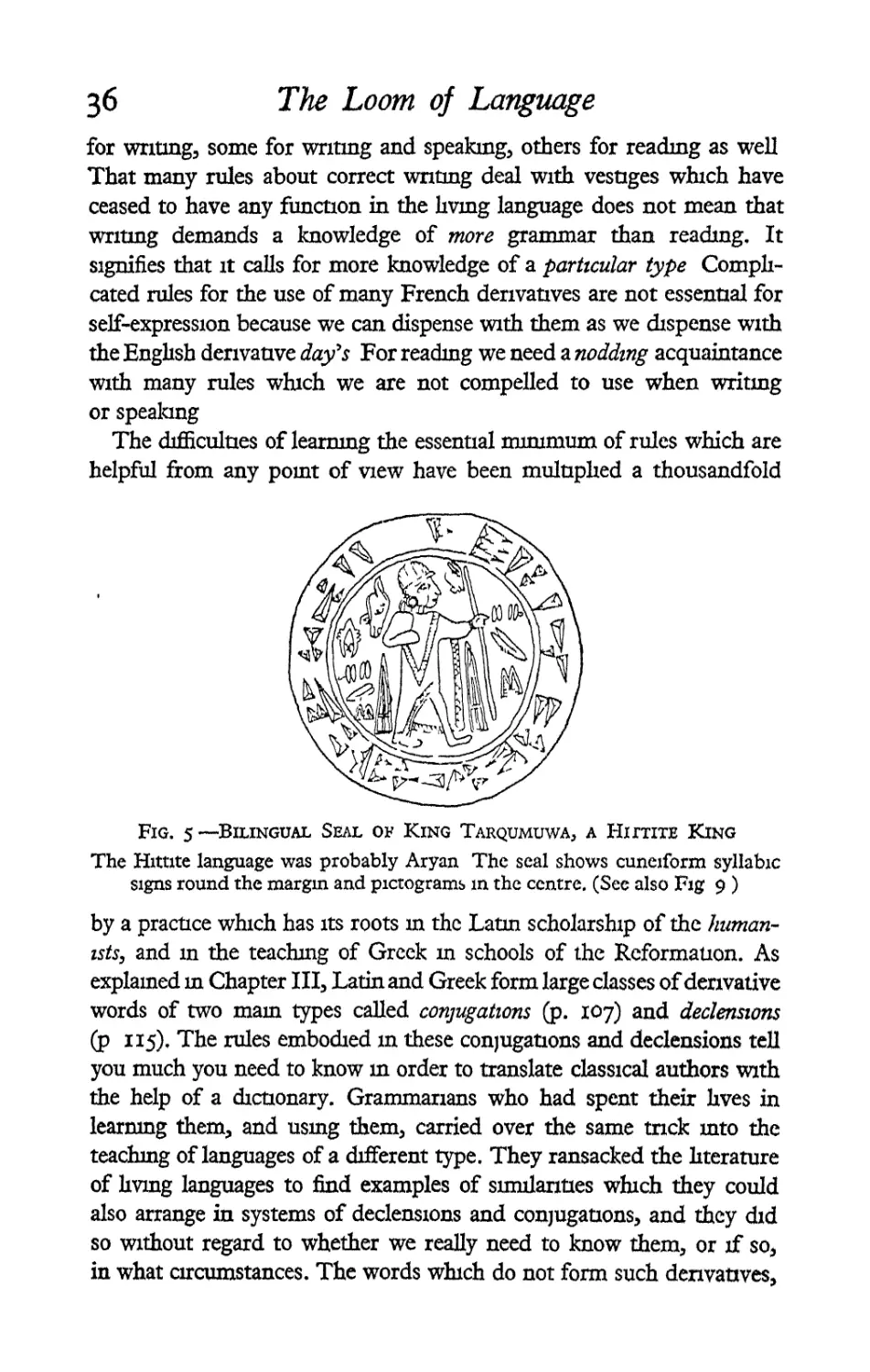
FIG. 5--BILINGUAL
Thc Hlttxte language was probably 2kryan The seal shows cuneform syllabc
slgns round thc margm and pxctograms in the centre. (Sec also Fag 9 )
by a practlce whlch bas ts roots m the Latin schohrshlp of the human-
zsts, and in the teachmg of Greek in schools of the Reformauon. As
explamed in Chapter III, Latin and Greek form large classes ofdenvatîve
words of two mare types called conjugatzons (p. o7) and dedenszom
(p 115). The rules embodled m these conjugattons and declemîons tell
you much you need to know m order to translate classxcal authors
the help of a dlcuonary. Grammanans who had spent their hves in
learnmg them, and usmg them, carried over the saine ttack mto the
teackmg of languages of a OEerelït type. They ransacked the hteraturë
of hvmg languages to find xamples of slmflanttes whlch they could
also arrange in systems of declensions and conjugatmns, and thëy
so wxthout regard to whêther we really need to know them, or ff" so,
in what cïrcumstances. The words whïch do hot forïn such denvauves,
Introductzon 37
that is to say, the partMes wch play such a large part m modem
speech, were pushed mto tlae backgrotmd except m so far as they affected
the endmgs (see p e6e) of words placed aext to em Any specîal
class of denvattves charactensttc of a parucular language was neglected
(seê p. 7e) The effect of ttas was to burden the memory wth an
tmmênsê store of tmaecessary luggage wthout fia-mshmg rules which
make the task of learamg easer *
When sensible people began to see the absur&ty of ttas system,
preserved m many grammar-books, there was a swing of the pendulum
from tBe perfemomst to the nu&st (or cr) metlaod of teachmg a
language by conversauon and pctures, wïot any rttles. Tire alleged
justrficaûon for tins s that clnldren first leam to speak wthout any
rules, and acqmre grammar rules govemmg the home language, fiat
ail, when they are word-perfect Tlns argument ts based on several
masconcepuons. A cd's experience s shght Its vocabulary s pro-
pomonately small Its ichom s necessartly more stereotyped, and ts
need for grammar ts hmtted by ts abthty to commumcate comphcated
statements about a large vanety of things and their relauons to one
another. Apart from tins, the clnld s m conunuous contact wth per-
sons who can use the home language accordang to approved standards,
and bas no other means of commumcatmg mtelhgbly with them. So
netther the condauons of, nor the motives for, leaming are thosê of an
older person makmg zntermtttent efforts to acqmre a language whach
s netther heard nor used dunng the greater part of the day
Stnce The Loom of Language s not a chddren's book, there xs no
need to dwell on the luoecrous excesses of educauonal theonsts who
For the benefit of the reader who already knows some French, the follow-
mg quotauon from Dmanet (French Grammar Made Clear) emphastzes lack of
common sensc n text-book sull used m the schools
"Are the four conugauon equally trnportant? Most grammars very
unwscly lcad thc tudent to magme that x a o. In rcahty there are
(accordmg to I-iatzfeld and Darmcster's wcil-known Dwtlo,ary) only
verbs u-OIR» some 8o m-RE, 3oo tu-IR» and all the other verbs (about
4»ooo) end tu -ER Whcnevcr the Frerch rayent or adopt a new verb» they
conlugate it hke miner (m a few cases hke tirer) and for thas reason the two
coniugattons m-ER or -IR are called 'hvmg,' whale the ïess nnportant eon-
lugauon m-OIR and -RE are tcrmëd 'de.ad ' The conlugauon m -ER s the
easest of the four» and bas only two rrcgular vcrbs m daly use"
To tlus wë may add that there are only four coInmon verbs wtnch behave
ltke recevoir» the type spectmen of the so-called rfird conlugauon of thë ":egular"
verbs m the school-books. The -re verbs of the fourth conlugauon of «regula"
verbs mclude four dastmct types and a mascellanêous collecuon of other..
38
The Loom oJ Language
advocated the drect method* and fooled some teachers mto takang it
up. The most apparent reason for lts vogue s that it exempts the teacher
from havmg any mtelhgent understandmg of the language whmh he or
she s teaching. Common expenence shows that adult ïmmïgrants left to
plck up the language of thexr adopted country by ear alone rarely leam
to speak or to wnte correcdy; and adults who wlsh to leam the lan-
guage of another country rarely have the le,sure to waste on tame-
consummg mstructaon of the type gven m urban schools where mslpid
plcmres of rural scenes molhf'y the techum of repeutave conversatmn
Because the kmd of grammar you most need depends parfly on how
you mtend to use a language, t s unpossîble to glve a general recèpe
for wrîtmg a compact and useful grammar-book The learner who
wxshes to get as far as possxble wth as httle mconvenîence generally has
to pck and choose from books whach comam more than ênough To do
thas mtelhgenfly ls easler ff we start wth a general da of how lan-
guages differ. The relatave unportance of ru/es of grammar depends,
among other thmgs, on whether the language one s leammg more or
less closely resembles one's own or another already mastered, mïd ff
m what way.
If we aun at iearmng to wnte a modern language, the forma1 grammar
of conlugataons and deciensxons explamed m Chaptêrs iii and IV
usually bo down to a comparafively small number of rules, far
fewer than those gaven m most prmaers On the othër hand, few except
the more advancëd text-books have much to say about other equally
important rules. One class of such rules already mentaoned depends on
the fact that each language or group of dosely related languages has lts
own charaeteristic types of derivattve words. Thus reader and buzlder,
chddhood and w,dowhood, reshape, rebuîld, restate and fellowsh,p, kmg-
sh,p, fllustrate four ways of buîIdmg new words m Enghsh and ïn
other Teutomc languages. Such mles may be as useful as the rules
for formmg such denvatves as father's
If two languages are closely related as are Swëchsh and Enghsh, or
Spanish and itahan, t is also helpful to know rules wbach tell us how
* The sfllmess of the dtrect method when tred out on adults was pomted
out by Hem-y Swcet m z899
"The fundamental objection» rhen» to the natural mcthod s that t put,,
the adult mto the posmon of an infant, whch he s no longer capable of
tmltzmg, and, at the same tmae, does hot allow haro to make use of bas own
pecaal advantages These advantagés are, as wê bave seen, the power of
analysis and generahzatmn--m short, the power of usmg grammar and a
dletlonary."
Introduction 39
the spelling or pronuncalaon of a word tu one of them dlffers from the
spellmg or prommcatton of a correspond_mg word m another. For
example, the SH m the Enghsh shp becomes SK m the Swedsh skepp»
wbach means the same thmg Smllarly the Swedish for to stzne s art
skzna. The vowel symbol J U n Swechsh generally becomes I m
correspondmg Enghsh words Thus art sunga» wlth the endmg -a
common to al1 Swechsh verbs, preceded by art (to) means to stng.
In English, ail verbs wkîch change as smg to sang and sung are old
Teutomc words So we expect to find r.hem m Swechsh, whïch s also
a Teutomc language, and can guess correcfly that the Swechsh eqtuvalent
of to smk would be art sjunka.
It s essenual to know one thmg about the use of words belote we
can begm to make a basc word-hst Correspondence between the use
of words m chfferent languages s never perfect It s moe or less
complete accordmg to the grammatacal class to whtch words are
assgned Thus numerals and name-words or nouns such as father, brd,
or shp» offer httle dlctflty when we consult a chctmnary The greatest
trouble anses wth partacles especally &rectzves, e. such words as m,
on» to, at There îs never absolute correspondence between such words
tu any two languages» even when they are very closely related s are
S wedlsh and Damsh. The Enghsh word n usually corresponds to the
Swechsh , and the Enghsh on to Swechsh pd» but the Brmsh expres-
smn, m the street, is translated by pal gatan. A Swede nught get mto
chflâcuiues f he gave bls Enghsh hostess a word-for-word translauon of
en kvznnct Jag traffade (a lady i met) pd gatan.
The &cttottary usually gives several synonyms for each foregn
eqmvalent of any darêcuve» and leaves us to find out for ourselves when
to use one or the other. To tell us how to do so s ont of the most
important tasks of practtcal grammar. Thus t s qtute useless to have
a hst of basc parudes urdess we know flac &stznctzve use of each. If we
are clear about thïs, we can rêcogmze them whên we are using a par=
ticle of out own language ïn an zdzomatzc sense If we do hot know the
correct chomattc equtvalent m another language, we cau paraphrase
the expresston m whch xt occurs wtthout usmg tt (see p. x39 )
When makang out word-hst for another language, we have also to
be wary about one of thê defects of Enghsh overcome by the small
number of verbs m Ogden's Bastc. Ichomattc Enghsh, as usuaLly .
spoken and wrttten, has a large number of very common verbs wbach
we should hot mdud m fixe Enghsh column of our word-hsts. Tf.y,
wtach s one of them, meam tu dufferênt contexts the saine as (a)
4 °
The Loom oJ Language
attempt, (b) endeavour, (c) test, (d) yudge Another very common Enghsh
verb, ask, can mean (a) questzon, (b) request, (c) mwte So an Enghsh-
Swedlsh or Enghsh-French dlctlonary wlll hot glve one eqtuvalent for
try or one for ask If you look up these words you may find for the firsr
four and for the second three forelgu substatutes whlch are hot true
synonyms. The moral of thls xs" do hOt mclude such words as ask or
try m the English cohmm of an essenttal word-hst In place of them
put each of the more exphclt words glven above
A forelgn languagê may bave a fixed word-order hke out own, or a
fixed word-order whlch fs qtute dlfferënt If the order of words s
very dlfferent from what we are accustomed to, rules of word-ordar
are among the most important rules of ïts grammar; and st ls ïmposslble
to get confidence an ieadmg, m speakmg, or m wrltmg till we bave got
used to them. In the lmraal stages of learnmg an un£amflmr pattern of
thas sort makes the task of readmg much more dxfflcult thân t would
otherwIse be. That Is why German and Dutch, though closely related
to Enghsh, offer greater dcultaes to an Erghshman or an Amëncan
than French. A rock whlch helps to fix rules of thts kind ts to make a
habit of twlstmg an Enghsh sentence mto fixe Germaine word-order
wxthout translatmg it The results are often funny, and that makës it
easler to ieam them In German word-order, the last few words would
be- and that makês zt eas, er them to learn
In the chaptërs wbach follow we shall first look at the way languâges
differ from and resemble one another. Thas wtll help us to get dearer
about thé best way to begm learmxxg any pamcular otm. We shall then
bê in a position to udgë whether it ls best to coztcentrate on speakhag,
writmg, or readmg m the early stages, and to declde what course to
pursue m wntmg or speakîng m order to fix the mmamum vocabulary
and grammatïcal rules we bave to use In so domg we shall also recog-
mze defects whîch we ought hot to perpetuate» and merlts which we
should moerporate, m a language of world-cmzenship
HOW TO READ THIS BOOK
Among other thmgs» The Loom of LanguaKe amas ai glvmg the
reader who wlshes to learn the languages spoken by out nearcst Euro-
pean nexghbours» a workmg knowlëdge of the Indispensable êlemcnts
of grammar, wlth a baslc vocabulary for self-expression. Much of the
materlal relevant to the subject-matter of the two chapters (VII and ÏX)
primanly devoted to ttus s m tabular form The tables 1Llustratc aspects
of the natural hîstory of language dscussed elsewhere. To get the best
Introduction 41
out of it as a self-educator, the wsest plan ls to rcad it through qmcldy
Af-ter gettmg a btrd's-eye vaew, the reader can then settle down to
detatled smdy with pen, paper, and a book-marker for reference
backwards or forwards to tables prmted m some other context, as
mchcated by thë cross-refêrences throughout the succeedmg chapters.
Pen (or pencxl) and paper are essentaal helps We are most apt to forget
what we take m by ear, least hkely to forgêt what we learn by touch
No one who bas learned to swam or cycle forgets the rock of domg so
The languages which we shall study m greatest detafl to tllustrate the
way in wtuch languages gaow belong to the Teutonw and Romance
groups, placed m the great Indo-European famdy The latter also con-
tares the Slavomc group to wtnch Russmn belongs, the Celtc, m wtuch
Welsh and Erse are placed, and the Indo-Iraman group, wtnch mdudes
Perszan and numerous languages of Incha The Teutomc group Is made
up of Gêrman, Dutch, and the Scanchnavlan chalects The Romance
languages, such as French, Pormguese, Spamsh, and Itahan, are ail
descendants of Latin Enghsh ls essentrally a Teutomc language whtch
has asstmdated an enormous number of wotds of Latin ongm So
Teutomc or Romance languages have most m common wth Enghsh
Fortunately for us they mclude aH the languages spoken by the nearest
nelghbours of Enghsh-speakmg peoples on the continents of Europe
and Amenca.
The reader, who has hOt yet reahzed how languages» hke dïfferent
specles of ammals or plants, dnTer from and resemble one another» wtll
find it helpful to browse among the extnblts set out as tables throughout
The Loom. Above all, the home student wl find it helpful to lolter m
the corndors of the home museum whtch makes up the fourth part of
the book On xts shelves there xs ample materlalfor gemng clear mslght
mto the charactensucs whach French, Spamsh, and Itahan share wth
theïr Latin parent, as also of features cornmon to the Teutomc family.
One shelf of extnblts shows Greek words whxch are the bncks of an
mtemauonal vocabulary of techmcal terres m the age of hydroelectncty
and synthettc plasracs The &version wtnch the rëader of the Loom
can gêt from notacmg OEerences and detectmg essential word sure-
larmes in adjacent columns in the hght of laws of language growth
set forth elsewhere (Chapters V and VI) wRl help to fix xtems of an
essenual vocabulary wxth a rmmmum of techum and effort
One of the dlfficultms wbach besets the home studênt who starts to
learn a new language ls the large number of gramrnaucal terres usêd m
most text-books. The oblect of the four chapters that follow ls to show
4 The Loom of Larguage
how hnguages grow» and the reader who does hot know many gram-
matical terms wfll &scover the use of Important ones The readër
who already knows the sort of grammar taught m schools and colleges
may make the chscovery that grammar ls not lntrmlcally dull» and
may learn somer_hmg about the pnnclples whch must motivate a
rational judgment about language-planmng for a world at peace
The popular myth that t ls more OElcul foi dn aduIt than for
a chfld to learn hnguages has been chsproved by cxpcnmental reerch
carned out by modem educatlomsts Much of the effort put lnto
early educaton ls defeated by the hrmtatons of thë chfld's expc-
ence and mterests The ease wlth whch we remember thmgs depend
largely on the ease wth whch we can hnk them up to thmgs we know
akeady Smce the adult's ezpenënce of hfe and the adult»s vocabulary
are necessanly more vanëd than those o" the chfld, the mental eqmp-
ment of the adult provldes a £ar broader bass of assocmtmn for fiesh
facts. Thus an mtelhgem grown-up peson approaches the study o a
new language wth knowledge of social customs and of hstory» with a
world plcture of change and growth amed by gëneraî rêadmg or study»
and wlth a stock of foregn word$» foregn ldioms or denvauves of
borrowed roots gleaned £rom daly readîng abou international aflars
(cf. canard, dénarche, Qua d'Orsay, Wlhdmstrasse, bltzkrzeg), adver-
ttsements of proprïetary products (glaxo, aspmn, cutex, mnoxa, oval-
tme), or technical innovations (cyanamide, carb,de, hydrogenatwn,
radw-therapy, calories, vztamms, sdemum). Chîldren learn thëlr own
language and a forelgi1 one pari passu. The adult can capitakm the
knowledge of lxls or her own language as a bass for lêarmng a new one
related to ït Above all, an adult can vlsuahze a dïstant goal more
easlly than a ctltld.
One of file dttïlculues wxth whlch a cld bas to contend s fle
haphazard way m whlch we plck up tlxê home language Chldren
acquare a vocabulary wlth httle dehberate elucldatlon from parents or
from brothers and slsters, and fley do so in a restncted enwronment
Whlch exempts them from dangers of mlsunderstandmg m a larger,
less mttmate one Before school age our language dlet ls nobody's
business So the power of deftmtlon and substltUttOn, so essentaal to
rapld progress m a forexgn language, cornes late in hfe, if at ail Indeed
most of us never reahze the mherent xrrattonahtxes and obscumms o
narural language untll we begin to grapple wlth a forelgn one The
discovery may then corne as a shock, chscouragmg further effort
Many dcultaes whxch beset the begmner are due to the fact that
introduction 43
few of us are alert to tricks of expression peculîar to out oon language.
In fact we need to know something about the language we habîtually
speak before we can learn another one wîth the minimum of effort.
The obiect of Chapter ïV of The Loom is to gîve first aid to the home
smdent who is hot as yet language-conscious in this seîase. The reader
who întends to use it as a prelîminary to the study of a new language
will find helpful hints ha it to repay what bas been an exploit of endur-
ance for the publisher and type-set-ter. The reader who is on the look-
out for a bright book for the bedside will do well to gîve it the go-by
or drink an old-fashîoîaed one before getting down to it.
PART I
THE NATURAL HISTORY
OF LANGUAGE
CHAPTER II
THE STORY OF THE ALPHABET
LANGUAGE maphes more than learnmg to sgnal hke a firefly or to talk
hke a parrot it means more than the umque combmauon whlch we
call human speech, it also mcludes how man can commumcate across
continents and down the ages through the tmpersonal and permanent
record whlch we call zvntzng One dffference between speech and
wnlang ls important to anyone who ls trymg to iearn a forelgn language,
especmlly f t ls closely related to a language akeady famlhar
The spoken language of a speêch commumty s contmually changmg
Wlaere umformlty exasts, local chalects crop up In less than a thousand
years what was a local dlalect may become the oflïcml speech of a
nauon wluch cannot commumcate wlth ts nelghbours mthout the
help of mterpreter or translator Wntmg does not respond qmcldy
to thts process It may hot respond at all The wntten word Is more
conservatlve than speech, it perpetuates smïlantaës whach are no
longer rccognlzable when people speak, and where two languages bave
spht apart in comparatlvely recent traits, it is often easy to guess the
meamng of wntten words in one of thcm, if we know tlê meanmg of
correspondmg words m the other. Indeed we can go far beyond guêss-
work, if we know somcthmg about the bastory of sound corrcspondence
(Chapter V, p 185) To make the best of out knowledge we should also
know sometNng about the cvoiuuon of wntmg itself
The reader wfll meet illustrations of this agam and agam m subse-
quent chaptcs (cspecmily Chapter VI), and wfll be able to make good
use of rulcs gven Lu them whfle wandenng about the corndors of thë
rmmature language museum of Part IV. One example musl sutce
for the present. The German word for water s Wasser, wluch looks
hke ts Eghsh eqmvalent on paper As uttered, xt does hot The Ger-
man lettcr W stands now for out sound v, as the German V m Vater
(father) stands for out f sound. The reason for flus s that the pro-
nuncatïon of the sound represented by W m older German chalects
(mcludmg Old Enghsh) has changed smce what s now called German
becamë a wntten language Belote German bec.ame a wntten languàge
anothêr change of pronuncauon was takmg place tu the regon of
southêrn and nuddle Germany Spclhng mcorporated thas change of
48
The Loom of Language
the t-sound to a hass represented by sç» as also vanous othcr changes
(p 231) wluch took place about the saine tlme
Thus the home student of hvmg languages can reduce the dlfficulties
of learmng by getting to know
(a) how slrmlamtaes of spelhng wluch do hot correspond to slmlarties
of pronunclatlon may conserve identzty of words m related
languages that have drfted far apart»
(b) how to recogmze borrowed words by spelhng conventmns chnrac-
terlstac of the language from wbach they came»
(¢) how chfferent ways of" spelhng equavalert words» once dentJcal,
reflect changes of pronunclatmn which mvolve nearly all word
at a certain stage in the divergence oi two languages wlth a
common ancestry.
Broaàly speakmg, we may dstmgmsh between two chfferent kmds
of wrlung One mcludcs p»cture wrltmg and logographic wntmg Thë
others sound or phonerac wntmg We can dlvdc the latter mto syilable
wntmg and alphabet wntmg Pcrure writang and logographic wnting
have no chrect conneraon wth sounds we make That s to say, people
can commumcate by pxcture wrung or logograptuc wntang wthout
bemg able to understand one another when they talk This is hot true
of Old Persan cunezform (Fïg B), of the wntang of ancïent Cyprus
(Flgs r3 and 4), or of modern apanese Kana (Fgs. 44 and 45). Such
wntmg s ruade up of symbols whîch stand for the sounds we makê
when we separate words mto syllables. They do not stand for separate
oblects or drecuons, as do the symbols of pcture or logographic
wnung Inchvldually, they have no sigmficance when isolatëd from the
context in wbach they occur The same s true of alphabet writlng,
whlch ts a sxmphfied form of sytlable wrîting The, chssecuon of the
words has gone much further, and the number of elem-nrary symbols
s less So t s easer to master
Tbas fact about the alphabet is of great social mïportance In com-
mumues whach now use alphabets, abïhty to learn to wrîte and to read
what is wntten s generally accepted as the hnnt of normal mtelhgence.
Vve regard people who cannot be taught to do so as mentally defectave.
Thas s another way of saymg that the alphabet bas ruade the record of
human knowledge accesstble to mankind as a whole. The use of pîcture
or logographac scrîpts, hke éarly syllable wrmng, bas always bëen thë
prerogatîve of a privaleged caste of pnests or scholars The inventmn of
the alphabet ruade t possible to democratïze reading, as the mvëntmn
of the number o made tt possible to democrauze thè art of calculatmn
Unluke* the invention of zero, thîs hberatmg ïnnovatmn has only
« 21¢arhematcs for rhe Mllon» pp 65, 286» 33:Z,
The Story oj the Alphabet 49
happened once m the bastory of mankmd Avadable evxdence seêms to
show that all flae alphabets of the world are traceable to one source.
AT
/ ROAD /
3
_oel!L IILIt .IllL I
ROAD
JUNCTION
4
JUNCTION
7
ROAD
JUNCTION
FIG. 6---BRITISI-I Tc SGïqS
Nos 3 4» 6, 7, 8 show pzctograms No. 5 xs an deogrsm 0ogoam)
No. z contmns an deogr wth alphabeuc wrmng No OE shows a poEogr,
deogram, and alphabeuc wntmg
5o The Loom q[ La¢guage
They came lnto use about three thousand years ago» but the mherent
posslblhues of an invention whch we now recognIze as one of the out-
standing cultural acbaêvements of mankmd mcubated sloïly durmg
the course of successive rmIlema Thc frst p«oplcs who used alpha-
beuc wntmg dad so for short mscnpuons m whlch ndvidual Ierters
maght be wntten upsde down or reversëd sldeways, wlth httle con-
sderauon for the reader (Flg 38) Even when a secular hteramre
spread through the Greek and Roman world, the wrlttcn language
remamed a hghly artfical product remote from da1Iy speech. Greek
wnfing was never adapted to rapzd readmg, because Greek scribes
never consutently separated words. The pracucê of domg so dld hot
become umversal among Roman wnters. It bccame a gëneraI custom
about the tenth century of oto own era Whcn pnnung began, crafts-
men took pndc n the ready recogmuon of thë wntten word, and
punctuauon marks, whch m&wdual wnters had used sporadtcally
wthout agreement, came mto ther own Typographers first adopted
an agreêd system of puncmatmn, attnbuted to Aldus Manuuus m the
sxteenfla cemury In the ancrent world flac reader had fo be hs own
palaeogralher To apprccmte thë gap between modeln and ancxent
readîng, compare the sentences prmted bêlow.
To do usuce to the story of the alphabet we must start by cxammîng
the meamng of a few techmcal terms. Word xs xtself a techmcal terre
It s hot easy to define what we mean by a sparate word ïn ail clr-
¢umstances So let us magme what a uaveller wouid do f hê came to
hve wth an flhterate tnbe m the mtenor of Bomeo By pomdng at
thmgs arotmd he rmght soon leam whch sounds stand for pzturable
objects. By companng sumlar r.hmgs he rmght also learn fo recogmzë
sounds slgnifymg quahues such as red, rough» or round By watchmg
people together he could also dëtect sounàs whxch are sgaals of
acuon hke lamesl Here! Corne/ Hurry! .ll ths would hot makë a
complete mventory of the elements of a contmuous convêrsauon
If the language contamed words correspondmg to and» durmg mean-
whzle» for, or accordzng, he would take a long whfle to decde how
to use them» because they never stand by themselves t«or the same
reason it would also be dfftïcult to decde whether to regard them as
leparate words.
The Story of the Alphabet 51
The dffIîculty of arnvmg at a defimtlon of what we call separate
words is also comphcated by the ïact that languages are hot statlc
Elemems of speech once recogmzed as &stmct entataes become ïused,
as when we condense I am to l'm, or do hot to don't So long as you
wnte I am m the form l'm, you slgmfy that t s to be regarded as
two separate words glued together When you wnte t m the form Im,
as Bernard Shaw wntes it, you sigmfy that we do hot break t up
when we say t Thus we can chstmgmsh between words of three kands
Some are the smallest elements of speech of whtch ordanary people can
recognize the meamng Some, separated by careful study, are products
of grammatacal comparson of situataons in whlch they recur People of
a pre-hterate commumty would hot recognme them as separate
elements of speech We recogmze others as separate, merely because
of the usual conventkms of wntang The rmssmnary or trader who
first commets the speech of a non-hterate people to scrxpt bas to use
his own ludgment about what are separate words, and bas ludgment
s necessatlly mfluenced by bas own laaguage
For the present, we had better content ourselves wth the statement
that words are what are ited m dcttonartes. Accordmg to the conven-
fions of most Enghsh dïctlonarles, godfather, [ather, and god are dafferent
words, and apples xs a denvatave footnote, p 34) of the word appIe We
shall sec later why chcuonanes do m fact hst some noses as words, and
omt other equally common oses, a e derzvatves m the sënse defined
on p 34 Smce chctaoaarles are out usual source of accessible ecessary
mformatton, when we set out to leam a language we shall put up wlth
rhcr vagaucs for thc tmae bemg
When baghbrows want a word for al1 pronounceable constttuents of
a prmted page, each wth a dasranct meanmg or usage of ts own,
they may speak of thcm as vocableç Vocables mclude words hsted m
dacïtonanes, and dervattves which are hot We do hOt necessanly
pronouncè two vocables m a chfferent way Thus several vocables
correspond to thc spellmg and prontmctataon of bay, as in dogs that
bay at the moon, a wreath of bay leaves, or the Bay of Biscay Such
vocables whxch have thc same sotmd, but do hot mean the same
thmg, arc callèd homophones Wê do hot speak of flem as homophones
ïl dcrived from the saine word which once had a more resmcted mcan-
mg. Thus boy, meaning mmamre male of the human spêces, and boy,
meaning iuvenîle maie employec, are hot homophones m the strict
sensc of the terre, as are sun and son
To dtscuss scnpts intelhgbly we need to have somc labels for parts
5 2
The, Loom of Language
The Story of the Alphabet
53
of words. When we separate a word with a succession of vowels into
the brcks whch corne apart most eastly as umts of pronuncaataon, we
ca]l each brick a syllable A syllable usually contams a vowel Thus
manager ls a tri-syllabm word ruade up of the syllables ma-, -ha-, -ger,
or, f you prefer t otherwise man-, -ag-, and -er. Syllables need have
no recogmzable meamng when they stand by themselves It s an
accudent that the syllables man and age m the word manage bave a
mearang when they stand by themselvês It has nothmg to do with the
past bastory of the word, of whach the first syllable s connected wxth
the Latin manus for hand, hence manual If we break up manlmess mto
man-, -h-, and -nêss, the fact that man has a meamng s not an accident.
It ls the fomadaton-brck of the word, which was origmally butlt up as
follows
man + ly = manly
manly ÷ ness = manhness
Such sy]lables whach have a meanmg relevant to the meamng of
the whole word are called roots, though root-words are hot necêssarly
stngle syllables. The part-ty, common to many Enghsh vocables,
cornes from the Old Enghsh word (hc) for hke. Ongmally t stuck to
names as compounds slgnffymg quahttes, 1 e manly s man-hke Later
the process extendêd to many other words (e g normal--normally) long
after -ly had lost Identaty as a separate element of speech We do hot
caLl syllables of tins sort roots We call them prefixes or suffixes accorchng
as they occur hke un- m unmanly, at the begmmng, or hkê-ly, at the
end Suffixes or preflxes may be ruade up of more than one syllable
ether because they came from words of more than one syllable (ê g
ant-), or becausë the proccss of addmg an affix (prefix or suffix) has
happcnêd more than once Thus manhness bas a bl-syllablc suffix
The sttffix -ly m unmanly remands us that the hne between an
affix and a foot ls hot a clëar-cut one Atfixes are the product of growth.
in thas process of growth three thmgs occur We cal1 one of them
agglutmatwn, « or glumg of natave words together A second s analo-
gcal extëmon The tlurd wbach s self-explanatory, xs borrowmg
words hke pre or ant from another language
The saine natavê word may combine wlth several others to form a
class of compound words lïke churchyard or brckyard, m wluch the
two roots conmbute to the whole meanmg. At a later stage, the on-
* Agglutinatlon has also a more restnctêd meamng (p 93) whach ls hot
mportant m thas eontext
The Loorn oj Lang««ge
The Story of the Alphabet 55
gmal meanmg of one foot may begm to 1ose ts sharp outhne People
may then attach xt to other roots wthout recallmg ts precse meanmg
when t stands alonc Ttus proccss, wtuch s the begmnmg of ana-
Iogzcal extenszo,z, goes on aftcr the original mearang of an affix has
ceased to be chmly recogmzable The affn_x may tack tself on to roots
merely bccause people cxpect by analogy that words of a partacular
sort must end or bcgm m a parttctflar way The large class of Enghsh
words such as durable and com»wndable, or frzghtful and soulful, are
m an early stage of the process The sttffix -able bas hot yet lost xts
mdwduahty as a scparate vocable, though t has a less clear-cut mean-
mg than xt had, whcn the habit of glumg t on to other words began
The suïfix -ful s sull recogmzable as a contracuon of full» whach
preservcs ts hteral value m handful
Such words as frzendshzp or horsemanshzp fllustrate a further stage
of the process l"hey belong to a large class of Teutomc words such
as the German W'zsemchaft, Swe«hsh vetenskp, or Damsh vzdenskab,
whch havc glued on them a suffix formed from a common Teutomc
foot word meartmg çhape Thus the Swechsh vetenskap, Damsh
Vzdcnskb, or German Wzssenschaft, for wbach we now use the Laran
sczencë» s rcaLty wzt-shape In such words a suffoE signffymg shape or
fi)rm m a more or less metaphoncal sense of the word bas tacked
xtself on to roots to confer a more abstract meanmg The -head m
godhead and mazdenhead has no more connexton wth the anatomlcal
terre than the -shzp m lordshzp bas to do wtth ocean transport Luke
the -hood m wzdowhood, t s eqtuvalent to the German -hezt, Swechsh
-het and Damsh -hed m a large class of abstract words for whxch the
Englash eqmvalerts often have the Latin suffoE -zty In the oldest
know Tcutomc language, Gotbac, hazduz (manner) was sttll a separate
word.
The ulramate bncks of a vocable are represented by the vowel
symbols (m Enghsh script a, e, z, o, u) and the consonants whch
correspond to the remammg letters of out Roman alphabet In com-
panson wtth other Europcan languages, spoke Enghsh s astomshmgly
nch ïn smple consonants In fact we have twenty-three simple con-
sonants m the spoken ianguage for wbzch only stxteen symbols are
avadable Three ot them (Q, C, X) arc supemumerary and one (J)
stancls for a compouxtd souud Enghsh dtalects have at least twelve
simple vowels. For these we bave rive symbols supplementêd by w
after (as m saw), or y belote any one of them (as m yet) A complete
Anglo-Amencan alphabet woE a symbol for each sïmple vowel and
56 The Loom oj La»guage
consonant wouïd demand between forty and fifty symbols to accom-
modate the range round m all the dalects taken together
The Story of the Alphabet 57
logograms, tk plctogram ls a more or less sunpled plcatre of an
object which can be so represented A logogram may be @) a plctonal
symbol substatuted for somethmg whch we cannot easlly represent
by a plcmre, (u) any slgn used to mchcate an attnbute of a group
(red, age, movement, nmse, wet), or a dtrectaon for actaon» such as Haltt
Major Road Aheadt, or Go Stowt
Brush traffic signs (Fig. 6) for motonsts Rlustrate ail such symbols
A thlck line for the mare road wth a thmner one crossmg t is a
pctogram for a cross-road The conventonahzed plcture of the torch
of learnmg ls a pctonal logogram whch stands for schoot The tnangle
and crcle whxch stands for Sopt bas no obwous assocauon wlth any
other pcturable object. Lke the number 4, t xs a pure logogram.
We sull use some logograms m prmted books Besdes numbers, we
have sgns such as &, £, and $. The sxgns c, , and ç m books
on astronomy stand for Mars, Venus, and Mercury In books on
biology they stand for maie, female, and hermaphro&te The plural
forms are cc (males), etc Srmlarly the Chmese use the sgn for
tree, and wnte for forest Such sgns as , , ç mean the saine
to astronomers and bolognsts ai1 over the world, whether they do
or do hot speak the saine language.
The êxpressmn pzcture-wrtmg, in contrachstmctmn to logographzc
wntîng, is a httle msleadmg. Ang whch we can properly cal1
wnting, m contradistmction to cave-paînung, sculpture, or other ways
of recordmg events wsbly, must be ruade up of somethmg more
than convenuonal drawmgs of pxcturable oblects When we speak of
pcturë-wntmg as the most pnrmnve levêl of script (Fgs 5 and 7-o),
we mean a more or less exphct record or mstrucuon set forth m
symbols, most of whch are êther pctograms or logograms of the
School Ahead type If xt s hot possible to represent elements of speech
by simple pictures, t may be possblê to suggest them represented
by the picture of an oblect whch we assocate wth them Thus we
hopefully assocmte OEg 6) the torch of learmng wxth a butldmg
used for scholastic purposes The Chmesê sg for
orxgmally a hne drawn over the top of a plant Tlus suggests that
somethmg got in the way of it$ grow--obstrucuon, hOt proess,
hOt gettmg bxgger, just hot.
When we speak of logograptnc wntmg, we mean wntmg m wluch
symbols for pcturable obiects, general charactenstcs, or drecnons
for aeaon bave lost theïr exphct pctonal meanmg We can no longer
guess what they do mean unless we havë somê key. Ths does hOt
5 8 Tke Loom oj Language
mean that ail logograms start by bemg pxctures of" defmite objects.
2kt least one class of logograms or dêogamç, as some pëople call
them) ls as old as the art ot wntmg it seems clear that the cluef
pracucal advatages of the art of wntmg ata primmvê level of human
culture are twofold One ls to put on record necessary mformatmn
wtuch we should othelse forger. The other s to covey dectaons
o mformataon to a chstance when the carrier rmght forger them or
betray them The £ome s almost certamly the olde of" the tw
The pnestly caste, as the custodan of a caleadar based on centures
of preclse observauon, appear on the scene at the dawn of Egyptaan
cvzhzauon Men began to keep accurate records of the sêasons as
soon as there was settled agriculture, ,and it as unely that the need
for wrtten messages arosë before man began to estabhsh settled grain-
gmwmg commumtms. As man pogressed fmm a primîtve huntang or
food-gathemg stage to hcrdmanshap and skalled agnculmxe, the need
for countmg hîs flocks and keeping track of sêasonal pursmts foced
lu to prime has memory by cutting notches on sticks or maki,g kuots
n cords
gre may thus take t for granted that one class of logograms, the
umber symbols, are as old as, and possbly much oldêr, tlaa xy othex
elements of tlïe most aaciet forms of wrmg The most ancaêt
aumber symbols are pctonal m thë sease that the fa'st four Roman
numerals (i, ii, III, IIII) are lust otclaes o the tally stack. Compansoa
of the relacs of the temple civtzatïoïs of Ceïttral/kmerca Meso
tamia, and Egyçt, idacates tlaat tlae imtulse to record soc evexats
was mixed up wïth the prmaary fncrao of the ptaests as calexadar-
makers at a rame when the perso of tlae prest-kmg was the focus
of ax elaborate astroomacal magne and calendar rmal. "I bus pïcatre-
wntmg was aecessarly the secret lofe of a pnestly caste ad, as sacla,
a lealously guaded secret Smce pcture-wntmg s too cumbersome
to covey more tlaan the mëmory ca easxly retam, ts furtlaer elabora-
tao to serve the eeds of commumcatlo at a dastarce may laavë bee
due to the dvamages of secrecy. Wlaether thas s or s xaot true, the
fact that wntîg was orgmally a closely guardêd secret laad amlportmat
coxasequeces for ts subsequent evolutaon
The ancrera caleadar pnesthoods laad a vested mteïëst i keepmg
kowledge trom tlae commo people. Tlae mapulse to presërve sêcrecy
lPOssbly encouraged the gradal degradato of coxtventaoal pcmes
mto logograms, wtfich, lake the elemets of moder Clamese wratig»
ha'ce lost thetr power to suggest wlaat they stand for. Ia C.itiesë scrîpts
The Story oj the Alphabet 59
we bave examples of logogaphxc wnung sull largely the monopoly of
a scholar caste Scnpts of thas class share one maportat charactensuc
wath pcture-wntmg The mchvadual symbols bave no necessary con-
nexwn wzth the sounds assoczated wzth them Thas s hot dafficult to
understand ff you recall one class of logograms whach sull smwwe on
FIG. O--DICUS OF PItAIL%TO$ StIOWING AS YEr UNI)EClPttERED PICTOGRAPHIC
\VRIIING OP TIIE ANCIENT CRErAN CIVILIZTION
the pnnted page. The Enghslmaan associates wth the deogram 4 the
noise whch we wntë as four wth out mperfect alphabet, or f». m
modem phonëuc script (p 83). The Frenchman wntes t quatre,
stanchng for the sotmd katr The Enghshman and the Frenchman both
recogmze ïts meanmg, though thëy assocaate t wxth OEerem sounds,
and a Frênchman could learn to mterpret the Eghsh traffic sgns from
a Fï'ench book wîtlaout knowmg a word of Enghsh In the saine way,
The Loom o/ Languagc
.
m
B
I3
F
G
C
M
N
P
V
i(}. Il--CONSONANT SYMBOL$ O 0ME CONTMPORARY .A,L,I'IIAIttII%
Pzonunciatlon changes in thc course of centuries So it ls somewhat arbltrary
fo glvc flxed values to Grcck symbols whlch bave rctamcd i ouglily the samc
shape for two thousand rive hundrcd years If: sccnlq clear that ¢ oIlginally
stood for an asplrated p rendcred as PH m Latin transcrptlon Thc symbol for
iv (vr) replaces 9 in the first syllable of the reduflhcazed pat tense iorm of verbs
The Story of the Alphabet
people from chfferent parts of China can read the saine books wthout
bemg able to utter any mumally mtelhglble words
Evënmaily the pnesfly scnpts of Egypt mcorporated a th=d dass
of slgns as phonogramç The leamed people began to make puns
That ls to say, they somerames used thelr plcmre symbols to bmld
up words of syllables wluch had the sound assoclated wth them
Wlth a code of such plctograms we can combine for bee vnth
for leaf to suggest the word behefby putung a flame round t.hem thus.
Thts ls just what the Egyptïans sometzmes dad The consutuents of
thas compound symbol bave now no conneraon wth the meanmg of
the word We can know the meanmg of the word only f we know
what t sounds hke when spoken
A trïck of thls sort may be a stage m the development of one kmd of
phoncuc script callcd syllabte wrztzng The charactensuc of sytlable
wrmng s that each symbol, hke the letters of out alphabet, stands for
a sound wbach bas no necessary meanmg by itsêlf. Syllable wnung m
thxs sense chd hot evolvê chrectly out of Egyptaan plcture scnpts
Whether thê fiÆst step towards phoneuc combmataons of tbas kmd was
part of the priestly game of preservmg script as a secret code, whether
the hghbrow pastame of makmg puns and puzzles encouraged t, we do
hot know Exther because they lacked a sufficent social motave for
smplifying thelr script, or because the mmnsc da/fictdttes were too
grëat» the Egyptlan pnests never took the decasve step to a consistent
system of phonetc wntmg.
There is no reason to suppose that peoples who have taken tins
step have donc so because they are parttcularly mtelhgent or enter-
pnsmg Many useful mnovauons are the reward of ignorance. When
flhterate people, ignorant of ts language, corne mto contact wth a
community eqmpped wth script, they may point at the sgns and hsten
to thë sounds the more ctùtured foregner makes when he utters
whtch begmwxtJa the latter (cf voe = I loose and Aclvna = I bave loosedwth
çpaoe . I declar and
wards f whch tes xts piace m many Latin words of coon an cest,
e g. çepoe - » fero (i carry) and
value t had xn late Ro tmes» m tecxcal terres from Greek roots and
modern Greek» t went mto the Slavomc pbet By then e sod corre-
sponng to had fted towards out v, ts value m modem Greek. The
symbol F occurs oy m early Greek, probably
OEough evdently m to the Hebrew au
6 The Loom o] Language
them m bas own language In thls way they leam the slgns as symbols
of sounds wtthout any separate meamng Imagine what might have
happened f the Enghsh had used pubhc nouces m plctme wntmg
dunng the wars of Eward III Let us also suppose that the French
had been wholly flhterate at the rame. When a Frenchman pomted
to the pxctogram 4, the mformatave Enghshman woald utter the
sound cock, correspondmg to the Fench coq When he pomted at
the Iogogram ,, he would get the response lord, suf[ic,cntly near
to the French vocable loz«rde, whach means hcazy Wthout knowmg
precasely what s,gnificanee an Enghshman attaehed to the symbols,
he might proceed to mak up the combmatmn ¢.m standing
I,-k _ _ _
)Il
0o
0
0
[['0 [0
UU f'
ttu'ooe
1"216 I2--'VowEL SYMBOL$ OI, SOME CONTEMPORARY ALPttAïIT$
for coquelourde (meamng a Pasque-flower) in the behef that he was
learning the new Enghsh trick of wntmg thmgs dow.
Neèdless to say, ths xs a parable We must hot take it too hterally.
We know next to nothmg about what the hvmg languages of dead
cavflazataons were hke, but one thmg as certain Tmnsmon from a
cumbersomê script of logogram% or from a muddle of pctograms,
logograms, and phonographic puns, to the relatave simphcaty of syllable
writing, demands an effort whach no pnvfleged class of scholar-prîësts
has êver been able to make It has happened when ilhteratê people
wath no trachuonal preluchces about the correct way of domg thmgs
have come mto contact wxth an already lîterate culture. Whethêr
they eau succeed in doing so depënds on a lock and key relation between
the strucuaxe of the livïng languages mvolved m the contact bëtween
a lîterate and non-hterate culture. Thêy can succèed f, and only
The Story of the Alphabet
63
it is easy to break up most words they use mto bncks wth roughly
the saine sounds as evhole words in the language eqmpped wlth the
parent logograptuc script
Our most prëmse mformauon about this lock and key relauonslnp
s based on adaptauon of Chmese script by r.he Japanese In order
to understand It the first ttnng to be clear about ls the range of possible
combmauons of elementary sounds In round numbers, a language
such as ours reqmres twenty chstmct consonants and twenty vowels
mcludmg chphthongs Tins means that if out language were ruade up
enurëly of monosyllablc words of the same open type as me, or exclu-
svely of the saine open lype as at, we could have a vocabulary of
ao × OEo, or four hundred words, wltkout usmg any compound con-
sonants such as st, tf, or kw. To a large extent Chmese vernaculars
(p. 4e3) constst of open syllablcs hke my and so The Chmese have to
do everythmg wlth about four huuded and twenty baslc words
The small sze of ts vocabulary s hot a necessary consequence of
the fact that Chmese s monosyllabc If a language conslsted exclu-
svely of monosyllabm words bélongmg to the closed type such as
bed, more common
or eght thousand words, wthout usmg double consonants A language
such as Enghsh can therefore be immensely nch m monosyllables
wtthout bëlng exclusively ruade up of t.hem. Chmese ls able to express
so much wïth about four hundred and twenty monosyllables, partly
because t makes combmauons hke the under-graduate slang go&box
for church, parùy because t s extremely nch m homophones hke our
words flea-flee or nght-wrte, and partly because t s able to chs-
ungmsh some homophoncs by nuances of tone such as we make when
we say "yes" as a symbol of dehberate assent, mterrogauon, suspense
or excitement, romcal agreement or boredom The number of homo-
phones m the Chmese ianguage is enormous, and ths ts mevtable
because of the small nurnber of av'aflable vocables A çAnnese &c-
uonary hsts no less than nmëry-eght OEerent meanmgs for the
souud group, rcpresented by CHI Of these nmety eght, no less than
forty eght bave the saine nsmg tone correspondmg roughly to out
questionmg "yc-es ?".
The Clfinese way of representmg a grove or forest by combmmg
the pu'e symbols for ¢ree fllustrats one devtce by whtch a com-
parauvely nch equipment of wntten words ts bmlt up by pamng
a relauvely small battery--t e 4 m all--of elcmentary logograms
called ra&calç (see Fg 4) Mere luxtaposïuon of the pcuïre symbol
64 The Loom o.f Language
for each of them may represent a quahty or an acuwty c.ommon to
two oblects Thus the logogram ïor the word MING, whch tan mean
bnght, s ruade up of the character ïor dae moon next to the character
for thê sun Ongmally the characters wére recogrn7able pctuxe
symbols, and the composte slg would then bave been somethmg
I'IG 13 --TIE ANCIINT CYIRIOTIC YLLABARY
Showng the rive vowel sgns n the top row nd thc ynabols for open ylibIe
mdc by combmn any or nll oi them wth thc cononat sound rcprcscntcd
by the lettcr m thê lcft hnd vertical column. Thus thc syrnbo],s o thë ccond
row ru ka, ke, kz, ko, ku
ltke this 0 (. In thê course of cëntunes thc basic picture symbols
bave becomê more and more convemïonahzed, pardy owlng to changes
m the use of writmg instruments (style, brush, wood blocks), or of
matenals (bon% lnk» paper).
A second sort of compotmd characters (Fig. 43) is a half-hëarted stêp
towards sound wntmg, based on the tïme-honotïred devlce of pg.
Iii, I4--'%1ON1 IN ,çl,[l»llON I. ROM PAI, IIOh (EI6ItiH CLNIURY B C )
'1 ho languag a (rk daIçt I h srxpt s Cprmuc (Fg 5) To represcnt
thç çmpmnd cononant ot Greck word, thc pracucc was to use two
ll,tblç wth thc two apptopnac consonants and thc saine vowel value»
c g thc cqmvalcnt fo th nam 5taskrate m wch wc havc st and kr
wa « tu t ka t a t e I ho dlftcultms and ambgmtms asng rom
tire use ()t a syllable scrxpt as thç wtten medmm o an Aryan language corne
out n thc hrst Imc
( YPRIOII(. SYLLABARY
Ct- tO-rO
-u-ka-t
e-e-lo-ka-r-ja
la-pa-to-ne zo-va-ra-
mz-ka-la-te-o pt-lo-ta
a-a-ra-vo-ne zo-vo-ro
The Story oj the Alphabet
65
Oe member of the pair suggests the meanmg of the character m a
geeral way. The other stands for a homophone» that xs to say a word
wch bas (or onginally had) the saine sound as the word represented
by the paoE taken together A ficutaous example, based on two Enghsh
words whach have f_ahar hornophones» lllustrates thïs trick. Suppose
we represent the words sun and buoy respectavely by the pxcture
symbols O and ,, as bologists use the character c for male
What the Chmese do by tins method would then be eqmvalent to
usng the combmauon 3 0 for our word son (whch bas the saine
sound as sun) or c for boy. It ls hot certain how ttns practace
arose. One possbhty s that it developed m response to the way in
whîch a word wldens lts meanmg by the process calleà metaphorcal
extensron. What ttns means s fllustrated by out word boy, whch
ongmally meant.a sexually lmmature maie of the human specles» and
may also mean a son or a uvemle employee
AIl thls bas led to the accumulauon of an immense number of
complex slgns There are between four and scven thousand reiauvely
common ones Anyone who wants to be an accomphshed scholar of
CAfinese must learn them Among the four thousand used most com-
monly» about three-quarters consst of a homophone ,element and a
classifier analogous to the symbol for male in the hypothctïcal mode1
cted above. Owing to changes of pronuncmtïon in the course of cen-
tartes» the homophone part, wbach was once a sort ofphonogram» or sound
symbol, may bave lost its slgnffcance as such It no longer then gives
a due to thê spoken word To-day Chmese script s ahnos purely logo-
grapbac. People who have the urne to toaster t assocmte the characters
with the vocables they themselves utter These vocables are now very
OEerent m OEerent parts of China» and have changed beyond recog-
muon smce the script came mto use many centunes back. So educated
Chmese who cannot converse ïn the same tongue can read the saine
nouces m shops» or the same wntmgs of morahsts and poets who hved
more than a thousand yems ago
The remarkable thmg about Cnesë script s hOt so much that t
s cumbersome accordïng to our standards» as that t xs possible to
reproduce the content of the hvmg language m thts way Ths s so
because OEe living language is hot hke that of any European people,
except the Bnrash (OP zz). The C_Jamese word xs invariable, hke out
"verb" must It does not form a cluster of derivattves hke lusts, lusted,
lustmg, lusty. What we ¢ali the grammar of an Indo-European language
s largely about thE form and choxce of such denvatives, and it would
66
'hé Loom oj La,,guage
be utterly unpossble to lcarn a logoaplac script wth enough
characters to accommodate all of r.hem A large proportmn of the
aff:txes of such denvattves are uscless, e g the -ç m lusts (see p 96).
So presumably they would have no place m a logographc script A
large proportion of out affres do the saine lob, as Rlustrated by
patermty, fatherhood, reproductzon, guardanshp. The saine character
would there£ore serve for a sxnglc clustc t-Ience a logogaphc script
m whch Frenchmen or Germans could commumcate wth thexr
fellow cluzens would be a code based on convcnraons qmte dafferent
from the gammar of the spoken language
The Japanese, who got thczr script from China» speak a language
whach s totally OEerent from Chmêse chalccts They usë symbols
(Fgs 44 and 45) for syllablës, t e. fo the sounds of affxes whch go to
xaake up ther words, and hot merely for obects» drecraons, quahues,
and other categores of meanmg repcsented by separate vocables
The sounds con espondmg to thesë symbols are more complêx than
those represented by o own letters, wxth four of whch (a» e, m, t)
we tan rnake up elevcn moosyllables (a, arn, at» are, êat, mate, mëat,
me, mat, met, rame» tea» team) So syllable wrtmg calls for a largër battéry
of symbols than an alphabet, reformed or otherwse Noe the less, t
s much easier to leam a syllable script than a logograpktc script ïnwluch
the words bave mchwdual sgns. The surpnsmg thmg about Japanese
scrxpt s the small number of" characters whach make up xts syllabary.
We have exammêd the essexxraal charactenstxcs of the Cnese key
Let us now examine the Japanese lock, that s to say, the word-pattem
mo whacla symbols correspordmg to Chmese foot words had to fit.
We can do ths best, ff wê compare Japanese wth Eglîsh. if al1
Enghsh words wêre ruade up hke father» we could equtp t wxth a
syllable script from thé logographac or pcture scrlpts of" any language
wxth a sufficiently rich colleclaon of open monosyllables hke fa: (far)
and o (he). This would take at most about four hundred signs. The
saine would be truc ff all Enghsh words wëre bullt to the saine design
as adage (ad + age) tu whch two open syllables wth a final consonant
combine. The problem s mmaensely more comphcated ff a language
contams a hagh proporuon of words hke handsome or mandrtll If
there are twenty consonants and twenty vowels ail pronounceable
elosed monosyllables then exceed eght thousand. Ts means that
the word-pattem of the language whch borrows ts script decxdês
whether the language tself can assumlate a syllabary whch s hot
too cumbersome for use
The Story oj the Alphabet 67
Japanese, hke Fînmsh ad Hunganan, bas lts place m a class called
agglutmatmg languages We shall leam more about er dlaraeterisues
mlater chapters. Here t s enough to say that agglutmatng languages
are languages of whach foot words ca attach to themselves a elatavely
small range of affed syllables (pp I96-2oo). The sïgnîficaace of the
aies îs easy to recogmze, and the aitLxes themselves are relatlvely
few and regular. Thus words denved from the saine roots grow by
addmon of a hmted aumber of fixed syllables hke the -mg wch we
add to love, have, go, bmd and think, in lovng, hareng, gomg, bmdng, and
thmkmg. They do hot adrmt of the great vanety among corresponchng
denvattves of another class such as loved, had, gone, bound, thought
Thxs, of course, means that the word-pattem of an agglutinatanglanguage
ts necessartly more smaple than that of such languages as out own.
The sound partem of Iapanese words s much simpler and more
regular than that of Enghsh for another and more slgmficant reasoa.
Afftxes of Japanese words are ail simple vowels or open monosyllables
consistmg hke pêa of a smaple consonant followed by a simple vowel.
The only exceptaon to thlS rule is that some syllables, hke some
Ghmese words, end m n. Thus the famahar place mmes
or vu-i-YA-m are typical of the language as a whole. We can spht
up all Iapanese words m ths way, and the number of possible syllables
xs ltmated by the narrow range of clear-cut consonants and vowels--
fifteen of the former and rive of the latter Thxs accounts for the
possxble exastence of seventy-five syllables, to whtch we must add rive
vowels standing alone, hke the last syllable in OEo-I-O, and the terminal
n, makïtg â complte bartery of etghty-one (Fig 46)
Thus the Japanese are able to represent all thetr words by com-
bnmg the sgns for a small number of Chlnese (see Fgs 44 and 45)
vocables Though thet wrng is based on syllabls, the Japanese use
a script whïch need hot contam many more sxgns than the letters of an
alphabet reformed to represent all English smple consonants and
vowêls by mchvadual symbols * At first, the Japanese used ther Kana
"In Amharc (an Etlaxopan language) whach s prmted syllabxcally there
are 33 consonantal sounds, each of whtch may combine wth any of the seven
vowels I-Ience to pnnt a page of an Amharc book, 7 x 33, or z3r dffferent
types are reqmred nstead of thê 4o types whïch would uffice on an alphabet
method In Japanese rahas deuIty fs less forrmdable tlaan m many other
languagês, owmg to thê stmphcaty of the phonettc system whtch possesses
only 5 vowel soands and x5 consonantal sounds There are therefore only
75 poss,ble syllabtc combmaraons of a consonant followed by a vowel. Sêveral
of these potental cornbmataons do hot occur m the language, and hence tt
posstble wtth somewhat less than 5o chstmct syllabtc sïgm to wrtte down any
}'apanesë word "--Taylor The Alphabet, vol , p 35
68
The Loom oJ: Language
or syllable slgns exclusvely, and sull do so, for telegrams or m school-
books for the young Otherwse (p. 438) they bave gone back to the old
school trachuon In books prmted to-day they generally use Chmese
characters for foot words, wth Kana slgns fo the affixes
We do hot certamly know whether the people who first ruade up
Japanese syllable wrmng were scholars Llke the Oriental traders who
revoluuonlzed our number system by usmg a dot for the modern zero
slgia to sly the empty column of the countmg-frame, they may well
bave been pracucal men who earned a hvehhood in the c.ounung-
house, or as ptlots on sbaps Scholars naturally favour the wew that
they were men of learnmg dlrectly sked in the use of Chanese Un-
doubtedly such men exasted in Japan, when xt adapted Chanese symbols
to ts own use somewhere about 75o,but ff It was a scholar who first
ht on the trick, tt s qtute possible that he leamed t from the mstakes
of bas pupls From what we do know we may be certain of ttus Those
who mtroduced Japanese kana were men who had no sacrosanct
nauonal traduon of wntmg m tls way, and therefore brought to thcr
task the unsoptusucated attitude of the Island Greeks who absorbed
the practcal advantages of Egypuan or Sermuc learmng wthout
assmlatmg ail the supersuuons of ther teachers. In the ancrent world
and m medeval rames, mankmd had hot got used to rapd change
Great mnovauons were possible only when crcumstances Conspared to
»force people to face new problems wthout the hanchcap of old habits.
The Japanese had to také ttus step bëcause their language was poly-
syllabc and comparauvely rch m derivatve words. Thêy were able to
take t because the afRxes of their derîvative words were few» and
because the sound values of mdividual llables correspond to those of
Cnese words.
Wlaen the Chmese s up agamst a st-uçtîon comparable to that of
the Iapatese at the urne when thëy first g't the= syllabc scrîpts, he
treats tus own characters m the same way. For foreign names the
Chinese ase théîr characters purely as sound syllables, as we rmght
wrte 3 4 o to suggest the sound three for tea. Thïs emphaszes how
favourabie combmauons of unusual cireumstances influence the poss-
bxlity of rapxd advance or retardauon in the cultural evoluuon of
chfferent commumttes. It s one of the many reasons why we should
be suspidous when people atmbute one or the other to national and
facial genîus or defect. The sanplicty of the Chmese language ruade
ît easy for the C&inese to develop a more consistent md workable
system of pieture-wrîtmg than any other nauon at an early stage
The Story oJ the Alphabet 69
m tts lustory Smce then t has been a culmral mtllstone round thetr
necks
If the Russlans, th¢ Germans» or any other Aryau-speakmg people
had corne lnto contact wth Chmese script wtnlc r.hey were sull bar-
banans» they could hot have used the Chmese symbols to make up a
sausïactory battery of" affLxes for two reasons One reason for thls is
that r.he total number of aff-Lxes m derlvatîve words of an Indo-European
language is far greater than tbe numbcr of Japanese affxes A second ls
that Chmese has no sounds correspondmg to the large class of" closed
monosyllables wlnch occur as affixes, such as the-.ness m manhness.
A thd ls that words of the Aryan languagcs are nch m consonant
clusters $o a ]Europeau people would have reaped httle advantage by
usmg Chmese characters as symbols o" sound mstead of as symbols
of" menmg That transluon rom logograplnc script to sound-wrmng
depends on the lock as well as on the key ls easy to test. Make a table
oï ]ïnghsh monosyllabc words o" the open type and use it to bufld
up Enghsh» French, or German polysyllables wlth the ld of a chcuonary.
You vll then chscover thts The posslblhty of actncvmg a more simple
mcthod of wrltmg for such lauguages as ]Enghsh» French» or German
mvolved another umque combmauon of crcumstancës
THE COMING OF THE ALPHABET
In the ancrent Mediterranean world, syllable scrpts were m use
among Sennuc peoples» Cypnots» and Persans They got the brcks, as
the Japanese got thelr syllabanes from the Chmese» from ther nelgh-
bours of Mesopotamm and Egypt, where forms of picture-wrmng first
appeared 1XIone of these syllabanes has su'wved. All have made way
for the alphabet.
The chssecuon of a word mto syllables--especially the words of an
agglutmatmg language--ls hot a very dcult aclnevement. Thc spht-
ung of the syllble lnto consonauts and vowels was a much more
dgficult step to takc. The fact that all true alphabets have an unms-
takable fmnfly 1oEeness f we trace them back far enough forces us to
beheve that mankLud has once only taken tins step (Fg 5) We know
roughly when this happenêd, who were esponslble, and m what cr-
cumstances it took place. Through mscnpuons m the mmes of the
Sma penmsula (Fg ) about 5oo B.C, and m other places between
thls date and about ooo B c» archaeologsts can trace thc transforma-
uon of a battery of about twenry Egypuau pictograms mto th e symbois
7 o
7"he Loom of Language
of the early Sereine alphabet Ttus early Sereine alphabet was hot an
ABC It was a BCD It was ruade up of consonants only.
Oile pecuhanty of the Semmc languages glves us a clue to the umque
ctrcumstances which ruade possible tins immense simplification
Semltlc root-words nearly always have the form which such proper
names as Moses, Rachel, Dawd, Moloch, Balak or Laban recall. They
v
A,« A
:,B B
Y
o o 0 0
×? + T T
5
FG. 5--SOM SIGNS I'OM EARLY ALIHAItIrS
(Adapted from Fth's Th« Tongues of 2tien )
axe ruade up of three consonants separated by two îaterveaing vowëls,
and the thxee consonams m a pardcular ordër are charactenstc of a
pamcular foot Thas meam that ff cor&të (ko:dait) were a Hebrew
word, ail possible combinatîons whch we can make by putting dif-
ferent vowels betweea k and d or d and t would bave somethîng to do
with the expIosvc deaïoted by the usual spellmg. Thîs unique regu-
The Story o.f the Alphabet 71
larity of word-patcern led th old Rabbimca! scholars to speak of the
consonants as the body and the vowel as the soul of the word In so far
as we can recognize boches wlthollt theologcal assistance the metaphor
fs approprlate. Consonams are ïn fact the most tangible Fart of the
wrttten word. A companson of the next two lines m whtch the saine
sentence xs written, first wathout consonants, and then vnthout vowêls,
is instructave from tlus point of vew
ee a e u o e eay o ea.
Then nm the page pstde dowo and read ffus:
If you carry out experiments of ths kmd you wdl dscove to thmgs.
One xs that xt s easy to read a passage without vowels m Enghsh f
therc ts somethmg to show wherc the vowels should be, as m the
above The other s that t s much lcss easy to do so f therc s notbang
to show wher« the owds ought to corne Thus tt would be dfffioalt to
mterpret: ths r mch mr s t rd
Owmg to the bmld-up of Semitîc root-words, wë bave no need of
dors to gtve us this informatton Once we know the consonants» we
holà the key to ther meanmg Any syllabary based on twenty-odd open
monosyllables wtth a derent consonant would therefore meet all the
needs of a script capable of representmg the typcal root-words of a
Sematac language The Sematic tradmg peoples of the Mechterranean
took twenty-two syllable sgns from Egyptma pnestly wrtmg» as
Japanese took over the Chmese monosyllabtc logograms They used
them to represent the sotmds for whch they stood» mstead of to repre-
sent what the sounds stood for m the parent languagè Because thêy
chd hot need to bother about the vowels, they used twenty-one of thë
Egypttan symbols to represent the consonant sounds of the foot»
wthout paymg attentaon to the vowel ongïnally attached
Thus the alphabet began as an alphabet of consonants (Fig. 5)
Such an alphabet, or B-C-D, was only workable m the hands of the
Setmttc peoples If we had no Enghsh vowel symbols, thê successton
of consonants represented by mlch could stand for mlch (m mzlch cow)»
or for the Bble naine Moloch Srmlarly vt could stand for vest or
and pts could stand for pztes or Patsy. Thas was the ddemma of the
Aryan-speakmg colonizers and traders of Island Gteece who came
mto contact wlth the syllablc wntmg of Cyprus (Fgs 3 and 4) and
7 The Loom oj Language
the consonant wrmng of the Phoenicmns They used a language wtuch
was extremely nch m consonant combmauons The Greek word for
man ls aOpcozros, from which we get phzlanthropy and anthropoloqy
If you wrlte the consonants only ïn phonetlc script (p 83), thls s
n0rps There ls nothmg in the word-pattern of the Greek language to
exclude ail the posmble arrangements whch, we can make by filhng
" lr (C F G
L /,A ,,IL AL
? 9f P
F« I6---EA,zY A LATER FORlVl OF SOMME GRIEK AND LATIN LITTRS
Thc reader should compare thcse wîth the wrltng n Figs. 5-B8
up each of the blanks mdicated below wîth each of a dozen mmpie or
compound vowêl sounds.
.n.O.r p s
The number of pronounceable arrangements of twelve dfferent vowei
sounds in combinatxon wlth ths range of consonants is about 3,ooo, ooo.
It woulâ be surpnsing xf sorne of them were hot truc vocables. So it s
easy to see that the saine succession of consonants mïght stand for
several dîffêrent Greek words, it is equally easy to see why the syllable
script of Cyprus (Figs. 3 and 4) was an unsatisfactory way of dealîng
with the saine dculty.
To adapt the Phoemcmn alphabet to theîr own use, the Greeks had
to introduce vowels, which were probably monosyllables, like out own
words a or i, taken from syllabanes of other peopiës, such as the Cypn-
The Story oJ the Alphabet 73
ores, wth whom they came in contact Thls step was momentous The
prmlitave Semitic alphabets Wtllch had no vowels were good enough
for simple inscriptions or for Holy Wnt tobe read agam and agam
They could hot corwey the grammatical recettes whach result from
mtemal vowel change of the sort fllustrated by smg-sang-sung Smce
Sermtac languages abound m tncks of ths sort, the ancxent Semxtïc
scnpts wee hot well adapted to produce the nch secular hterature
whach germanated in the Greek wold
The Greek alphabet (Fxgs. I and I2) had seven vowel symbols,
namely OE « z/ v w o The itahan peoples who got thelr alphabet
from the Greeks also spoke chalects poor m vowels, and they chscarded
two of the Greek sagns» x e. and oe Dvergeace of the form of the
symbols whlch make up the classlcal Greek and Latin alphabets
came about owmg to a varety of crcumstances The first people to use
alphabetic writmg dad hot wrxte at lengtla asld were hot fussy about
whether they wxote ïrom nght to left or from top to bottom Qmte
ephemeral reasons would influence the choce, as fo example the
advantage of msoEbmg a short eptaph vertacally on a pole or hon-
zontaïly on a fiat stone Thus the onentataon of letters tmderwent local
change through the whams of scribes or stone-masons, so tJaat the saine
symbols were twxsted about vertacally or latemlly, as fllustrated in
Fxg 16, wch shows the davergence of the Greêk raid Latin symbols
for D, L, G, P, R Wïe the art of wrïtmg and readmg was st the
pnvllege of the few, the need for speedy recogmtaon was hot compellmg,
and the urge for standardlzataon was weak.
In one or ooEer of the eaflest specmaem (Fgs. 7 and 38) of Islaxd
Greek wntmg of the slxth or sêventh cenmnes B c, we caa fmd any one
of the old Phoemcmn consonant symbols tmchanged The absence of
prmtmg t-.e to standardaze the use of 1errer symbols, the effect of the
wntmg matenals on the ease wlth wtltch they could be wntten, fixe
hlmtataon of prllmtave wrtmg to short messages, records» or mscnp-
taons, the small sxze o£ the readmg pubhc, and the fact tJaat prolmnca-
taon changes m thê course of several genemtîons and vanes among
people stall able to converse wtth dafficulty m ther own daalects, were
other crcumstances whxch contrxbuted to the dxvergence of the alpha-
bets. So there xs now no recogmzable resemblauce between the classcal
Hebrew and Greek alphabets (Fxgs x and z) which came from the
saine Sermuc source. Though Arabc xs a Senmtic language wth a
script wntten hke Hebrew from rxght to left, the symbols of the Arabxc
consonants bave no obvmus resemblance to those of Hebrew. in the
74
TI« Loom o.[
rive dercnt Arable scnpts, only thc s,¢mbols for L, M. and S arc now
recognlzable denvauves of thctr Phoemcmn ancestor,..
Throughout the East, an enormous valety of alphabettc scpts do
service for peop]es wth langmages wtnch, hl.c Pc'an or many of those
spoken in Incha, belong to the great Indo-European famfly, and ltke
Burmesé or Txbetan belong to the saine £amfly as Chmese. They are
also in use among peoplcs wth othc lunguag, s» e g Machu» Koean»
Turkash, or Javanese These bclong to nonc oç thc thce great languagc
famthes wluch hav been the chct custodzans of knowledge and
hterature Most scholars now behcve tht al1 thcse alphabetxc scnpts
were offshoots of those uscd by Scn uc ped!ars who set forth across
the great rrade l outes bn6gmg flc guil b«.nvecn oeastern and Western
culture m ancrant urnes. To a \'(cstcrn cye, famhar wth the simple
knes and curvcs of flc primcd Izge în contradtuntmn to ordmary
wrmng» OEey tve a supertcJal J escmbhtcc duc to the complcx curva-
tu.re of the symbols tt s no hkely that any of bec ,:uszve scnpts wll
overcomc thc dzcct appeal of ti.e smplcr sgm, whch pmtmg and
typewrmng havc now standaïdîcd m ail hghly mdustï:ahz¢:d counmes
Towmds the end of" the Mddle Agcs, whcn thc (:hnc..c mvcnlmn of
pnntmg came nto Em opc, scvc al ft;m of thc I.am alphabet wcrc m
use n chîtcrcnt countïms "ltc more rccdmc,u talan symbols, bcng
bettër adaptcd to movable type, êventua]ly »upcr,eded the more
cursive vanants such as the German Bh, d« Lc.its (l'g ) of the
monkash mtssals. Patfly perhaps because thu Lutheran Bïble was
prmted m ths script, ,t pexsïsted m Gemanv, whe, e t has been
fostered by nataonahsm. Belote the Na«,s took ove, oae newspaper had
begun to follow thc pracuce of scênutc e:'t bt., cuama, and modcrn
novels m ,tcp wxfl Western cwh«atiou 'lhe bown shnts bzought
back flc black lëtters
Ctrcumstances whch havc mflacnccd the chotcc and daracter of
scnpts m use may be mate, îal on the orîe hand, and soaai on the other.
Among the matënal c£rcumstances arc thê nature of the surface (stone,
bone, clay, voy, wax, parchment, paper), and the nature of the instru-
ment (chsel, style, brush, pen, wood block, or lead type), used for the
process of transcrîpuon. Among sooal ctrcumtanccs of ftrst-ratc
importance we have to reckon w,th the range of sounds wtnch a speech
community'tmbtmally uses at lhe urne when it gets its script, and the
range of sounds repÆesentëd by thë parent alphabet. Intelligent p1n-
nmg based on the ease with which ,t is possible to adapt an alien soEpt
to the speech of an ilhterate people played httle, ff uy, paxt in sdcction
Tïoe Story oj the Alphabet
75
before Kemal Ataturk mtroduced the Roman alphabet m Turkey
(Fg 4 o) Mssm,ary enterpnse bas been the smglê most sgmficant
socml agency whch bas mfluenced chance Thas cxrcumstmce has left a
permanent xmpress on the smdy o speech habits
Conquests, pohucal, rehgaous, or both, bave maposed scnpts on
languages ill-adapted for thym. Ths s true of ]3urmese and Smmesê
whch bave Sanskrit and Pah scrïpts It s even more oeue of/kmbïc
script, whch Islam has forced upon cormnumtes wth languages of a
phoneuc structure qulte d'erent rom that of the Sermuc famïly, e g
Berber» Persmn, Bahch, Smdh» Malay, Turlrïsh, Swah, etc The
._
71i l/l il/#Y -i ,, , , , , , ,
IG. 17--I TO RIC OG ScP
Compare woE c d Og mscmptons of
The Rumc symbols he above the Roman eqmvents» the Ogam bclow them
sear pems which trag gave to OEe spread of ]dng ong e
MeoEteean aons of dasscal anaqm extcnded to NoroEem
Europe oEout havmg a permanem uence upon it. Belote
adopted Roman Chnsuamty, and wïoE t thc Roman alphabet, some
Teutomc peoples were akcady hterate in vanous pas of Noern
Eoeope, and espey in Scdmaan coes, ere are pmons
m symbols hke ose wch prc-oEnsuan mvaders from the Couchent
also brought to Bntam. Ths Runzc spt (Fïgs 7 md 9) bas no
strmghffoard sari fo any ooEer Supposedly t s a degenerate
fo of Greek or Rom wng oerned across Europe by gato
rmanic (Goths) d probably
76 The Loom o.[ Language
from trade contacts It probably reached Scandmavla durmg the tturd
century D The letters fllustrate the influence of the matenals used
They are the sort of marks whlch are easy to chap on wood We
can recognlze them as such m some of the Rumc clog almanacs staI1 in
exastence The first survlvmg speclmen (Fg 3 o) of Rumc cornes from
Gallehus in Schleswg It s an mscnptmn on a horn, and s worth
quotmg to tllustrate the modest begmmngs of wntmg for sectdar use
ek hlewagastzr holtmgar horna tawzdo ---- I LLIIGASr THE HOLTING MADE
(ts) o.
There are inscriptions of another type (Flgs 17, I8, and 39)on stone
monuments m Scotland, Wales and Ireland The script ls pre-Chnstian
FIG I8--BILING[IAL INSCRII'rION iN LATIN (ROMAN LErrms) AND CELTIC
(OGAM SIGNS) I'IOM A CI][URClA AT "fRALLON@ IN IRELAND
The Celttc rads from rxght to left
but probably hOt older than fixe begmmng of the Roman occupation of
Bmam. ThIs Ogam wntmg, as It ls called, has an alphabet of twenty
letters Each letter ls a fixed number of from one to rive strokes, wath a
defimte orentataon to a base line w1"ach was usuaLly the edge of thé
stone. Flve letters (h, d, t, k, q) are represented by one to rive vertical
strokes above the hne, rive (b, 1, v, s, n) by onê to rive vêrtacal strokes
below the line, rive (a, o» u, e, i) by verucal strokes across the hne, and
rive (m» g, ng» z, r) by one to rive strokes across the hne slopmg upward
from left to nght One surrmse is that the number of strokes has some-
thmg to do wth dae order of the 1effets in the Roman alphabet, as thë
people who ruade ths script recelved them. What lëd Celuc peoples to
devise ttus system we do hot know. It is clear that the Ogam sïgns are
hot degenerate representattves of Greek or Roman symbols» as are the
Rumc letters. Ogam script Is a sort of code subslatute for the Latin
alphabet analogous to the Morse code used in telégraphy. Llke the
latter, t was probably adopted because it was most suïtable for the
instruments and for the materials available.
The meanîng of such inscriptions long remamed a mystery like
thât of others m dead languages stfll undecaphered Among the latter
The Story oj the Alphabet
77
Etruscan and Cretan (Fig i o) are a sealed book to tins day The story
of the Rosêtta Stone chscloses the clues wluch have ruade t possïble for
scholars to decapher (Figs. r, 5, and xS) lost languages. It s told m the
following quotataon from Grtttith's helpful book, The Story of Letters
and Numbers :
"There were strange storles and ficuons about the learnmg of the
Egypraans, so that for a long urne men had a strong deslre to get back
a clear knowledge of the wntmgs. They had nottung to go on, there
were no word-books or other helps Then taï x799, by the best of good
chances» a man m the Frënch Army, workmg undêr Napoleon, saw an
old stone m a wall at Rosetta on one of the branches of the river Nfle,
wxth tlaxee sorts of wrmng on xt One was the old Egyptaan plcture-
wrxtmg, whach was the saine as the wrmng on the walls of bmldmgs»
the secorïd was another of wtuch merï had no knowledge, but the thard
was m Greek» clear arïd smaple The readmg of tlîas was no trouble to
merï of letters From the Greek xt was seen that the storïe gave an
accourir of a kang named I'OEOLMaIOS, and of the good tbangs whach he
had done as a mark of tus respect for the relxgmrï of Eg3rpt The last
hrïe of the Greek says tbat 'a copy of the wrmng s tobe made orï hard
storïe an the old wrxtmg of the men of rellgmn, and m the wntmg of
the country, and m Greek ' Tlaê year tls was done was x96 B.c. Soit
was certmrï that the two strange wrmngs were m Egyptaan, but an
daffererït sorts of letters, and that the Greek gave the sense of the
Egyptaan
"Irï the Greek, the naine PTOLEMAIOS cornes elght or rune rames»
somettmes by tself, and somerames wth the words r.OWD O» 'T,q m
adchuorï Part of the top of the stone, where the pxcture-wrmng cornes,
s broken off, but fourteen lines are there, and m these are rive groups
of letters or plctures wxth a line round them, bavmg two long parallel
sdes arïd curved erïds wxth a short upnght hne at orïe erïd Ttus seems
to bave been the Egypttasa way of 'urïderhmxag' maportant words Three
of the groups are shorter than the other two, but the longer ones are
started wxth the saine» or almost the saine, letters or pxctures So t
seems probable that the outlmed words are ,oEor.EMos and 9ror.MOS
LOWD OF t,T.a.H. Ptal was one of the baghr bemgs of the rehgmn of
Egïpt.
"Orï other stones to the memory of the great dead, groups of letters
are tobe seen wxth the line round them, whach makes us more certain
that such outlmed words are the names of Kangs and Queens One
suctx naine orï an old stone was Kso,ax, the rïame of a Queerï who
was lxwïag m ]Egypt two hundred years belote tlae Cleopatra of Shake-
speare's Antony and Cleopatra .
"Thas much arïd a llttle more was the dscovery of Dr Thomas
Young an Enghsh marï oI science» who made, xn addmon, some attempt
at reachrïg the second form of the Egypraan wrmng on the storïe The
reachng of the pxcturë-wrmng m full was thé work of J F Champohon
78 The Loom o/ Lng,.age
a Frenchmar He was ble to do ths as he had a good "knowledgè of
the Coprc language The Copts were» and stfll are» Egypun Chnst.tans»
and m the old days t1cr lnguage was Egyptmn In urne small clmnges
came about» as s narural "iher wrîrang was m Geek» wth seven
specml letters for sounds whch me nt m Greek In Coptîc churches
to tins dy the beok o£ rehgon nrë m Coptm» though only a small
number» even of the reoders» bave knowIedge of lhe lmguge It wen
out of conmor use rive hundred yeas back Wth the help of ths
language» Champolhon was ame to nmke out the other sgns aîter the
name oL'% and much moe» o the Copts had word-books gvmg
Egyptlan words in tl-c Copc wrtmg"
The precedmg account docs hOt expose all the relevant clrcumstances
Senaphor0
Morse lghts. «rllten dot a dar
es,needle movemt)
BRAILLE
i »
(By klnd permet'mn of Mi. I j Pltman)
whach led to thas dlscoverv The readet wt]1 find further detaxls in
Saence for the Cttzzoï (p o8o) On lus cxpedmon to Egypt» Napoleon
took wth haro a staff of savants, mcluding somë of the greatest men of
scaënce of that time A chscovery whmh may seem remote from useful
knowledge, af we overlook the deplorable social consequences of
arroganfly dsmîssing the cultural debt of any favourêd race or nataon
to the test of mankmd, was the direct outcome of encouragmg research
wxth a pracucal end m vaew. We may hope for greater progress m out
knowledge of the evoluuon of languages whën here are fewer scholars
who chensh ther trade-mark of geflemanly uselessness, and more
real humamsts wbo, hke Sweeh ]espersen, Ogden, or Saplr, modesfly
accept theîr responsbtlity as cmzens, co-operating in the task of
matung languagê an instrument for peaceful collaboration between
nations. A cmhzatton which produces poison gas and flaermite has no
need for humamsts who are merely grammaraas What we now reed
ïs the grammarian who as truly a hummalSt.
RATIONAL SPILLING
The fct that ail slphabets ¢ome from one source has an important
The Story o/ the Alphabet
79
bearmg on the mpeffecnon of al1 existmg systems of spelhng. Although
there are pêrhaps about a dozen sïmple consonants and hall a dozen
vowels approxtmately eqmvalent in most vaneues of human speech, the
range of speech soands ts aely the saine in closely related languages.
Thus the Scots trflled r, the U m gud, and the throaty CH m 'ht's a
braw bncht munehcht mcht the mcht" are absent m other Anglo-
Amencan &alects. When a pre-hterate commumty wsth a language
of sts own adopts the alphabeuc symbols of an ahen culture st wlll
often happen that there wtll be no symbols for some of sts sounds,
or no sounds for some of the symbols avaîlable. Enghsh spëllmg ùlus-
trates what then happens.
(s) Scribes may rayent new letters. Thus 01d Enghsh, hke modem
Icelanchc (Fg 3), had the two symbols p (thorn) nnd (etha) for
the two sounds respecvely represented by TH sri thm and then Out
letter I ls hot in the Latin alphabet, whïch îs the bass of Western
European scnpts it has acqmred OEerent values in OEerent languages
in Teutomc languages (e g m Norwegmn and m German) st ss eqm-
valent to our Y m Yule (Scmîdanavan .lui). In French st ts the pecuha
consonant represented by S or SI m pleamre, treasure, measure, or
ras, on, znason, dzwson In Enghh t stands for a compotmd con-
sonant ruade by saymg d soffly before the French J. The mmal w
(cf. wazt) m Teutomc words was represented by uu (oo-oo-azt) Eventu-
ally the two us fused to form a smgle letter. In Welsh spellmg w stands
for a vowel sound It s now a mgnpost pomtmg to the Old Enghsh
ongm o a word.
(n) Scribes may gnve arbtrary combznatzons of" old symbols a specal
value. Thïs ls tme of the two TH sotmds, the SH or TI sound in
short or natzon, and the NG m sînger (as contrasted wth hunger). Asde
from these arbtrary combmauons for smple consonants, we use ch for
a combmauon of t followed by sh.
These combmatmns and ther vaganes are vaiuable ssgnposts for the
home student Nether of the sotmds represented by th emsts m Latin
or French, the sort one () exasts only m Teutomc languagës and the
hard o,e (1) only m Teutomc languages and m Greek, among languages
wknch ctnefly supply the root of out vocabulary The StI sond so spelt
s Tèutomc. The SH sound spelt as TI (ë g natzon) s always of French-
Laun orgin
For thss rcason many words carry the hall-mark of thelr ongm
There s another way m wluch the ïrregu.latmes of Enghsh speihng
hêlp us to rêcognize the source o a word Pronuncaauon may change m
The Loom oJ Language
the course of a hundred years, whale wlmng lags behmd for centunes
Thts explams the behawour of out capnclous GH, whach s usually
sflent and somettmes hke an It survlves from a pënod when the
pronuncmuon of hght was more 1,ke the Scots hcht, m wluch there ls
a raspmg sound epresented by X m phoneuc symbols In such words
the earher Enghsh conventaonal GH stands for a sound wbach was
once common m the Teutomc languages, and ls snll common m Ger-
man When we rneet GH» we know that the word m whïch it occurs
ls a word* of Teutomc orgm» and It s a sale ber that the eqmvalent
German word wfll correspond closely to the Scots form. Thus the
German for hght ls Lzcht, for brought brachte, for eght acht» for mght
2Vacht» for nght Recht and for rmght Macht. Englsh s hot the only
language whmh bas changed m ths way Atone urne the German W,
now pronouncêd hke an Enghsh V, stood for a softer sound, more hkê
ours So phonetc spelhng would make it more chflïcult to rccogmze
the rneamng of Wnd» IgZasser, und lY£ettër (wmd, water, and weaher)
A thrd way m wbach spelluïg gets out of step wth speech s con-
!ected wth how grammar evolves Lke other languages m the saine
great Indo-Europear or Aryan famfly, Exghsh was once nch m endmgs
hke the's in father's Separate words bave now taken over the funcnon
of such endmgs, as whea we say of my father, msteaà of my father's
Havmg cêased to have any use» the endmgs bave decayed, ad becaue
wrltmg changes more slowly than speêch» they bave left behmd in the
wntten language, rehcs whch bave no existence ïn the spoken. Thïs
process of sirnphficaton, dealt with m Chapter iii, bas gone much
ftuther m Enghsh than in ber aister languages On ths account wntten
Enghsh s parncularly rîch in vowd endmgs wlmch are hot auchble
Thas way m whch pronuncïaton changes in the course of rime ïs
responsxble for spellmg anomahes m most European languages. Two
Enghsh examples fllustrate it forcbly. On paper there ïs a vêry simple
rule which tells us llow to form the plural (1 e. the derlvatve we use
when we speak of more than one object or person) of the overwhelmmg
majomy of modërn Englîsh nouns We adâ -s. There is also a simple
papêr rule wtuch usually tells us how to form the past ïorm of most
Enghsh verbs We add -ed» or -d (ff the dcnonary form ends m -e), as
when we make the change from part to parted, or love to ioved, ltowa-
days we rarely pronouncWthe final -ED unless t follows d or t.
cornparatlvely recently ît was always auchble as a separate syllable
$omenmes we snll pzonounce t as such m poenc drama. If we are
* Notable excepnons are haughty (French haut) and ddgh.
!
The Story of the Alphabet
8I
church adchcts, we may also do so m rehglous nmal Ail of us do
so when we speak of a beloved husband or a leamed wffe. In Chaucer's
Enghsh the plural -s was preceded by a vowel, and the combmanon -es
was auably chstmct as a separate syllable When fusion of the final -s of
the plural, and -ed of the past wlth the precechng consonant of the noun
or verb-stem took place, necessary changes occurred We pronounce
cats as kats and cads as kadz. We pronounce sobbed as sobd, and helped
as helpt. Thus the grammaucal mies of Enghsh would be a httle more
comphcated, ff we spelt ail words as we pronounce t.hem. We should
have a large new dass of plurals m -z, and many more past forms of the
verb endmg, kke slept, m -t
Thê reason why these changes had to occur s that certun combma-
uons of consonants are dffficuk to make, when we speak wïthout effort
When we do speak wlthout effort, we mvanably replace them by
others accordmg to smaple rules Such rules can shed some hght on the
stage of evolutïon a language had reached when toaster prmters, heads
of pubhshmg bouses, or scholars settled xts spellmg convenuons One
simple rule of thas kmd s that many consonants whxch combine easfly
wth s or t do hot combine easdy wth z or d, and race versa We can
arrange them as follows"
Wth S }
or T P f k th (p) ch (tf) sh () "vozceless"
WXthorDZ) b v g th (6) j (d3) s (3) "'voced"
Tins mie ls easy to test Compare, for instance, the way you pronounce
wrzthed (5d) and thrwed (vd)» wth the way you pronounce (wzthout
effort) pthed (0t) and laughed (ft) In the saine way, compare the pro-
nuncaauon of the final consonants m crabs and traps crabbed and
trapped, or notice the dafference between the final -s m hves and woEe's
Vowels RIustrate sources of trregularlty m the spellmg conventions
of European languages more forobly than do the consonants, because
Itahc-Latm whtch bequeathed xts alphabet to the Wêst of Europe had
a very narrow range of vowel sounds for wbach rive symboïs suffice.
Thxs as onë reason why Itahan spellmg s so much more regular than
that of other European languages» except the newest Norwegxan re-
formed rettskrwmng. Another reason xs that itahan pronunciauon and
grammar have changëd httle smce Dante's rime. In Enghsh dlalects we
have generally about twelve sïmple and about ten compound vowels
(chphthongs) for whach the rive Roman vowel sxgns are supplemented by
82
The Loom oJ Lazguage
a Teutomc W and a Greek Y The slmauon ls much the saine wth
most othe EJxopean langaages, except Spamsh whch stands close to
Itahan Sever'al devlces me m nse Lo deal wld shortage of vowel
symbols.
(1) Introduction of new vowel symbols Thus modern Norwegnan
(Fig. 32) has two, the o of Damsh and the of Swechsh. The Russlan
alphabet, based on the Greek, bas rune mstoed of seven vowel symbols,
of whlch four correspond preclsely to the Greek models
(li) Introduction of accents, such as the dots placed above o or a m
Swechsh and German, or those uscd to dlstingmsh the two Frënch
sounds d, è
@u) Use of combinatlons such as aa to dlstmgmsh the long a of
father from the short a of fat in bazaar ls specmIly charactensfic of
Dutch spellmg. On tins account Dutch words look rather long. The
saine plan (see table of vowels on p. 84)would meet all the needs
of a reformed Enghsh spellmg As things stand we have olfly three
combmatlons wtuch we use conslstenfly--aw (m daw), ee (m meet),
and o or oy (m soûl, loy) The last ls a signpost of Norman-French
orlgm
(iv) The more charactens,acally Enghsh trick of usmg a sflent e after
a succeedmg consonant to dlstangmsh the precedmg vowel, as in mari-
ruade, Sain-saine, pm-pzne, wm-w,ne A stlcnt h may also lengthen the
precedlng vowel m Gexman, as m out words ah, eht, oh!
(v) The use of a double consonant to indicate that the foregoing
vowel s short. German and the newest Norwëgnan spelling (1938)
rely on tls conslstemly.
From rhymes m poems, we have good reason to beheve that Enghsh
spellmg was regular at the rime of the Norman Conquest. The present
chaos, especlally wïth reference to the vowels, ls partly due to the prac-
ttce of Norman scïabes when a large number of French words mvaded
English durmg thë thîrteemh and fourteenth centuriës. Tins comcaded
more or less wxth a profound change in the pronunicafion of English
vowels, and the decay of endmgs in other words, thë spelhng conven-
tions we now use became currem comagê at a tme when the solmd
values of Enghsh words were in a stâtë of flux The Norman scribes
were responslble for several tmportant changes affectang the consonams
as well as the vowêls They mtroduced J for a new sound whtch came
wth the Conquest. The Old Enghsh C became K. Thé symbols ] and
6 for two sotmds which do not occur in French chsappeared in favour
of TH and Y. Af'ter a rime the Y (as m the solectsm ye olde tea shoppe)
The Story of the Alphabet
83
acqmred a new use, and TH served for both sounds At a later date tle
breach between spellmg and speech wdened flu ough the mterference
of classxcal schola;s m the hght oI cunent and oftcn rmstaken wews
about word ongm Thus debt though denved chrectly flore the French
word dette, sucked in a sllent b to mchcate the commÇn ongm of both
from thê Latin debztum For what regu!antles do extst we owe far more
to the prmters than to thê scholars Prmung checked mchvldual prac-
uces to wtnch scrïbes--hke stenographers---were prone, when the art of
wntmg was mll Oike stenography) a learned profession
ENGLISH CONSONANTS IN PHONET1C SCRIPT
b as m blb
2 d ,, ,, dld
3 f » ,, fed
4 g ,, ,, get
5. h ,, ,, tut
6 k », ,, kit
7. 1 ,, ,, ht
8 m » , men
9 n ,, ,, mb
i0 p » » plt
I i r ,, ,, red
12 S » »
Evcn when two languages wluch share the saine alphabet enloy the
benefit of a comparauvely regular system of spellmg as do Norweglan,
German, and Spamsh, many of fixe symbols bave dufferent values when
wë pass from onê to another So spellmg s never a rehable guide to
pronunclauon of a forelgn language. For thls reason lmgmsts bave
dcvlsed a reformed alphabet for use as a key to hëlp us to pronounce
words of any language wlth at lëast suflîclent accuracy to make lntel-
hglble commumcauon possible wlthout recourse to personal instruc-
tion in tbas mternauonal alphabet, slxtcen of the consonant symbols
(see abovc) bave thelr characte zstzc Enghsh values common to Europcan
usage in so far as a speclfic sound uqually corresponds to one alone
Wlth thcse good Europcan symbo!s are others wbach do hot occur
m the Laun alphabet One of them» 1» stands for the sound it rcpre-
sents (out mmal Y) in Scanchnawan languages and ïn German. Three
of the supplementary onc are taken from t.he Greek, Insh, and Ice-
lanchc scnpts (Fag. x) The remamder are mveûdots.
84
The Loom o Language
In out table of Enghsh vowels in phoneuc script, some of the mch-
wdual symbols whach stand for sunple vowel sounds m other European
languages occur oaly tu compounds (chphthongs) Other symbols such
as those whach stand for the French nasal vowels do hot occur at ail.
The maonty of flac consonant sounds of European languages are
apprommately ahke. For that reason mauy of the consonant signs of
different scnpts exhblted on p 6o correspond wth one another,
and wtth th¢ eqmvalent symbols of the mtematïonal script dewsed for
ENGLISH VOWELS IN PHONETIC SCRIPT
SIMPLE DIPI-ITHOIqGS
a = a as in bat at -= el as xn Emstem
a aa » » bazaar au = ow » » how
e ê » » bed e = m » . bait
1 = 1 » » bld e = air » » patr
1 = ee ,n ,, meet xz = let » » pler
o = o » » hot ol = ox » » boll
o = au » » aught ou = oa » » mo
u = oo » » foot ju ew » » he
U = OU » » boot
z = er » ,» worker
o. = ox » ,, worker
fiom. So e symbols for the consorts are less t to
h=oee, and a few hors' prace w soe for proficien m usmg
em. W1OE OEe help of OEe tables you oe=slate OEe foowmg
sentence d creaffer lte out ooEers-
frm 6z texblz zv vauolz n nsonnts ju yd b elbl ta b:m a
ro d3Ant abaut 6a tri f n.znz fa 0o me3z ff wx wont pl
sal(])u in or au preznt speh
snlnop âmIladS uosoxd xno o uonlos &dd u a
m=oJ o alq aq PlnOqs noK suosuo» pug sImoA jo s»lq mo
Because the saine symbols may have dafferent values ha chfferent
languages--Z stands for 0 in S pamsh, and for ts tu German--the larger
chctionaries use phoneuc alphabets Lu whtch a symbol represents one
sound and one oniy. For each word hted the phonêfic spellmg is prmted
The Story of the Alphabet
85
scle by sde wxth the ordinary one Once you have mastered the key
to ths phoneuc spellmg you know how to pronounce a foretgn word,
however fantasuc lts spellmg may be If your chctionary uses the
Internatzonal Phonettc Alphabet you may final at the begmnmg a hst
mcorporatîng the two on pp. 83 and 84 respectîvely. Wlth the help
of tins key you are able to pronounce the followmg French words even
tf you do hot know any French.
bte (b¢ t) commerce (kmers)
bord (b r) fédéré (federe)
chame (j'¢'n) plaine (pl n)
clocher (kb le) prix (prl)
toute (tut)
EYE AND GESTUKE LANGUAGE IN THE WORLD TO-DAY
A Nrd's-eye wew of wual language» m conrrachsuncuon m rha
of rhe ear, would be chsrored tf mok m nohmg bu the evolutïon
of sgns used m ancen srone mscnpuons» manuscnps or modem
books, and newspaçers. Vlsual commumcauon may be of rwo kmds»
rransen or perssenr. The firs mcludes gesrure whch rcmîorces dafly
speech» and rhe several tyçes of gestral hnguge respecùvely used for
commumoEfion between doE d dumb people, or m mhtary d
naval slgnalhng. Signlhng may be of two types Luke deaf and dumb
gesture language, It may depend on human movements whtch recall
symbols used m alphabeuc wntmg Slgmlhng by flag-chsplays based
on codes lS hke logograptnc writmg The stgns used by bookaes or hotel
porters are a logograptnc gesture-scnpt.
Codes used tu telegraphy overlap the temtoncs of au&Ne communi-
cauon, wsual commumcauon wtuch ts translent, and vïual commum-
cauon for permanent record Lke the Ogam script, t depends on the
alphabet, and, smce each alphabet symbol ts ruade up of long or short
strokes hke prolonged or sharp taps, the same system serres equally
well for reçogmuon by eye, ear» or tacule sensation. A two-strokë
system of this kmd as a mechamcal necesstty chctated by the design of
the ftrst telegraphs to take advantage of the fact that a magnetîc needle
tums nght or left tu accordauce wlth the dzrecuon of an elecmc current.
Thë inventors of the telegraphîc codes hved m a less leisurely age than
the Ogam stone-masns, and took full advantage of the posslbhty of
varying the order m whtch it s possible to arrange a limitëd number of
strokes of two dfferent types (Flg 9). Lke Ogam script a telegraptnc
code s smable for purely tacule recogmuon by the blmd who wêre
86
'he Loom oj Language
cut off from access to the wntten record when parchment, papyrus,
or paper took the place of stone, wox or clay tablets as wnung
matenal in pracoEice, the Eradle scupt, based on chfferent arrange-
ments of rmsed dots, s more sansfactory» because t takes up less
space.
Withm the narrower lmms of the permanent ecord dïfferem types
of scnpts may serve &ffcrent en& Apart firom cryptographic scrîpts
C 0
FIG 2o---I,'C'IIIE Nor ÏN
Show has told us that much of hs wrrng has bccn doe la train% and
that pracuoelly ail of t s wmten m shorthaad or subscquet tramcrpuon
by a secrey pst. Thc 8peea of hs shorthand reproduced here rends:
"Ths e way I wrue I codd of course subsutute (here follows an abbrevmuon)
wth an apparent gain m bevty, bru as a matteroffact it tkes longer to oentract
Wntmg shorthand wth the mmmn of contraction s hkc cuttmg relegmms.
ess one m constant pracUce t t:es longer to devise the contractions than
to wrte m hlI, and I nw aevcr
logogroEs."
dewsed for secret invenuom and recïpes, pohucal messages or rnmry
dïspatches, we can broadly disïmguish two types In books, periodicals,
and correspondence, thë convenience ofthe reader is the mare dîdera-
mm, and ready vsual recogmtion ls ail-important. What îs most impor-
tant about a script for hablmal and personal use is whether it ls adapted
to rapatd transcription. For ths reason an increastag propomon of
transcription m commerce, law-courts, and cortference is taken down
:n scnpts which are not based on the alphabet, and havë been designed
for speedy wntmg For such purposes ready recognition by anyone
except the writer as of' secondary usefulness
Roman writers of the age of Cicero were alîve to the îuconvenience
The Story o) the Alphabet, 87
of alphabetac wrtmg î'rom thas point of vaew, and used varous abbre-
vxatons for partcles and other common elements of speech 3_ con-
sstent system of shorthand s an Eghsh invention. The first attempt
was ruade by Tmaothy Brght» wh dechoeted hs b(ok called Charac-
terze» the art of short» swJt azd sccet wntzng to Ehzabeth m x588
Tunothy Bnght's system, wlnch was very dffficult to memorze» paved
the way for others» notably 74h's Art of Stenography (z6oz). In x837,
when Sr isaac Ptman perfected what s sll the most successful short-
hand script "for the duson of knowledge among the maddle classes
of socaety»" about vo huncked dererat sorts of short_hand had been
put forward Shorthand as we kow t to-clay s the produc of many
expermaents m whïch some of e most enhghtened Imgusts of the
seventeeth and eaghteenth centunes took a hand If s the fivat of dose
study of the ments or dements of dïfferent systems o wrtmg and
typography m general use.
Modern shorthand, hke Japanese scrîpt, s a synthess, lin so far as
the basxc stramm s alphabetac» advantages of speed are due to the
combmataon of three prmcaples, two of them suggeted by charac-
tensncs of Semtac scnpts Oe xs that the letter symbols are smaple
strokes, easfly oméd. We recogmze thêm by dzrectwn as opposëd to
shape, tk second s that the vowels are detached 'rom the consonants» so
that we can leave them out when domg so would lead to no doubt
abaut the dentty of a word. The thrd s that arbatrary cambmataons of
consonants or vowels gave place to a complete battery of szngle sgns m
a consstenfly phonetac system. Ths phoneta¢ alphabet s only part o
the set-up. There are syllable szgns for affaxes whach comtantly recur»
and logograms for common words or phrases
No tracts about the Real Preence, treauses en marginal utty
and table-mï'nmg, af exposmons of thc Hegehn chalec and the
Aryan wrtues are accessible m Morse Code or Shorthand echtons.
St» srudents of Ianguage-planmng for the/kge of Plenty have some-
thmg to leam 'zom the work of those who have contbuted ta such
mventaons and from the efforts of those who bave worked to make
the wntten record avaflable to the deaf and blmd Of the two fore-
most poneers of larguage-planmng m the sevemeenth century» one»
Georgë Dalgamo, was the inventor of a deaf-and-dumb alphabet,
the other, Bshop Tflkans» put forward an early systêm of phonetc
shorthand One result of early controverses over shorthand ystems
was hvely mterest m the defects of spellmg, and hence m the sound-
composmon of words /k evolutaonary atntude toanguage was hot
88 The Loom oj Language
possible untd students of language began to study how the sound of a
word changes m the course of a few generattons
To orgamze prospenty on a world-wlde scale» we need to supplement
the languages of local speech-commumues wïth an mternauonal
medaum of chscourse Whether such a world-wde language wl
eventuaïly chsplace ail others» we cannot say. What s certain s that
such a change wfll hot happen ttll many centunes have elapsed In the
meantmae» the most we can ama atts to make every cxtazen of the Age of
Plenty bthngual, that xs to say, equally fluent m a home language, and
m the common language of world cmzenshtp, or of some umt larger
than the soverelgn states of the present day. Hardly less mportant ls
another need. Few but experts reahze the Babel of scnpts m the modern
world Many of them are tll-sulted for thelr purpose» labonous to
leam and space-consummg. Non-explomve coLlaboraraon between
]East and West reqmres mtemauonal adopuon of the Roman alphabet,
supplemented where necessary by adchuonal symbols. Lenm satd thts
to coin.rade Agamaly-Ogly, presdent of the Central pan-Sovet Com-
rmtteê of Nauonal Alphabets Romanïzaffon, there lies the great revolu-
tzon of the East.
Regulanzauon of script on a world-wlde scale s ahke prerequïste
to hqmdauon of llhteracy m the Orient and worth-whJ.le spellmg
reform m the West Spellmg reform xs long overdue; but t s nota
purely nauonal affar, nor merely fle task of devasmg consxstent rules
based on a priorz pnnctples. It must necessarily be a comprormse
between confhctîng clmms--recogmton of language aflïnîues m the
form of thë written word» presërvatton of structural uniformitiês, such
as out plural -s, wch transgress phoneuc propnetiës, the chsadvantage
of an unweldy battery of stgns and the undesxrabhty of settmg up
an arbîtrary norm wthout due regard to dtalect dafferences *
FURTHER READtNG
GRIPPITII
LLOI"D
JENSN
KARLRN
TAYLOR
THOM2SON
The Stm y of Letters and Numberç
Our Spoken Language
Geschzchte der Schrzft
Sound and Symbol m Chmese.
Engltsh Phonencs
The Alphabet.
The AB C of our Alphabet
* The International lnstztute of $ntellectual Co-opraton bas published a
report (934), prefaed by Jespersen, on the promoraon of the use of the
Roman alphabet among çeoples wth unsmtable scrpts or no script at ail
CHAPTER iii
ACCIDENCE--THE TABLE MANNERS
OF LANGUAGE
M buflt hotels for celesual vis,tors before they devoted much m-
genmty to ther own housing problems The temple observatones of
the calendar pnests» and the palaces of ther supposedly sky-bom
rulers» are among the earhest and are certamly the most endunng
monuments of architecture In the dawn of cvzauon, when agri-
culture had become an estabhshed pracuce» the mpulse to leave a
record m bufldmg and m decorauon went hand m hand wth the need
for a store-bouse of mghfly observations on the stars and a record of
the flocks and crops. So wntmg of somê sort s the sgnal that cwhza-
taon has begtm The begmmug of writmg s also the begmmng of out
first-hand knowledge of language
Ou fragmentary information about the speech-habts of rïlnkand
extends over about 4,ooo of the 8,ooo or more years smce mè speech
began We know nothmg about human speech between the urne when
the upright ape first used sounds to co-operate m work or defence,
and the umewhen people began to wnte. It xs therefore unwse to
draw conclusmns about the bm.h of language from thë very short penod
whïch furmshes us wth facts We can be certain of one thmg If we
had necessary mformataon for tracmg the evoluuon of human speech m
relation to human needs and man's changmg social enwronment, we
should hot approach the task of classifyîng sounds as the orthodox
grammanan does The recognitmn of words as umts of speech bas
grown hand m hand wth the elaborauon of script In the prehterate
mâllenma of the human story, socxal needs wluch prompted men to take
statements to peces would anse ordy m couexton wth dculties
of young chfldren, and thmugh contacts wth rmgrant or warrmg
trïbes We can be qmte sure that primitive man used gestures hberally
to convey tus meanmg So a classtficaton of the elements of lmguage
appropnate to a primiuve level of human commumcatlon mïght
plauskbly take shape m a fourfold dwson as follows *
« Grammanans have oscillated bêtween two vews Accordîng to one» prtm-
tve spêech was ruade up of chscrete monosyllables hke Ctunese. Under the
influence of jespersen and has chscaples, the pendtllurn bas now swung to the
The Loom of Language
(a) Subannves, or mchwdual words used for distinct oblects or events
wluch can be mchcated by pomung at thmgs, 1 e such as out
words dog or thunde»and at a later tage, for quahues of a
group» such as red oi nozsy
(b) Voanves, or short stgnals used to call forth some response, such as
out word where?» top» run» corne» pull t, and namts or mdI-
vtduals
(c) Demonstrattves, or gcsture subsututes wlch chrect the attention
of the lxstener to a parncular point in the stuatmn, e g that» here,
behïnd, :n front.
(d) Incorporatzveç, or rectauve combmalaons of sound used m rtual
mcantauons wxthout any recogmuon of separate element
correspondng to what we should call wordç.
From a bologacal point of vew, t is reasonable to guess that the last
antedate anyflamg we can properly call speech» that they take us back
to the monkey-chorus of sundown when thë mosqutoes are about,
that they perssted long afiêr the rccogmuon of separate words emerged
out of acuve co-operaton m huntmg, fishmg, or buildmg, and that
they were later refmed mto sequences of meamngful words by a process
as adventmous as the mseruon of the vocables mto such a nursëry
rhymë sequence as 'Hckory, dckoy» dock! The mouse tan up the
dock .... " Perhaps we can recogmze the first separatë vocables in
warnmg signais of the pack leader If so, the second class» or vocatmes,
are the oldest sound elëments of co-opêration m mutuaily benëficml
acuvmes. What seems almost certain xs thïs. Unul ï'nting forced
people to examine moe closely the sgnfficance of the ounds they used,
the recognitma of words was confined to sounds whîch thëy could
assocïate with gesture
opposlte extreme) and prumtwe spcech
wathout dlscrete words. Thas sng-song vew hke nonsense wntten at one
tme about so-called ,ncorporarve languages (e g. those of thë Mexacans or
Greenlad Esqmmaux), and now chsproved by the work of Saper, s essentally
a concocton of the smdy. it is the product of academe preoccupauon wth the
works of poets or other forms of sacred composmon. Practeal bmlogsts or
psychologsts bave fo gwe consideratïon: (a) fo how chdren, travellers» or
zm.mgrants learn a language wlthout recourse to mterpreters and grammar-
books» (b) to how hurnan speech dders from the chatter of mon.keys or the
mmaeuc exploits of parrots. In contradastmcuon to such anmaal noses, human
speech s above all an mstrtmaent of co-operauon in producuve toork or mutual
defeace, and as such s partly made up of dtscretc sgnals for m&wdua/aczmns
and mampulaton of separaze objccts. To thxs extent (sec p. 5z) the recogrutïon
of mme sounds as words s presumably as oid as the first tiret instruments
Conversely, other formal elcments wheh e also call words arc products of
grammaucal eompanson. They do not emergê from the speech matrxx belote
the wrltt¢n record compels closer analyses . (Evrroz)
A ccidence-- The Table Manners oj Language 9I
Here wë are on speculauve ground It will hot be possable to get any
further hght on the early evoluuon of speech ull anthropologsts bave
ruade more progress an researches for w/mch Professor Malmowska bas
ruade an eloquent plea *
The point of vtew of the ptulologlst who deals only wlth remnant
of dead languages must dtffer from that of the eflmographer who, de-
prlved of the osmfied, xed data of nscrpuons, bas to rely on the hvmg
reahty of spoken language zn fluxu The former bas to reconstruct the
general stuauon, 1 e the culture of a past people, from the extant state-
ments, fle latter c.an study chrectly the conchuons and sxtuanons charac-
tersuc of a culture and lnterpret the statements through thêm Now I
clmm that the ethaaographer's perspecuve ls the one relevant and real
for the formauon of fundamental hngmsue conceptions and for the
study of the hfe of languages . . For language m lts onglns bas been
merely the free, spoken sure total of utterances such as we find now m a
savage tongue
Srudy o peech m backward commumtaes from thls point of wew
as st111 mats mfancy. Many years must elapse beïore t Influences the
tradition of language-teachmg m our schools and umversme$. Mean-
whfle, the infant scïence of languagë cames a load of unnecessary
antellecmal luggage from ats parental preoccupatlon wlth saered texts
or ancient wîsdom. Grammar, as the classification of speech and wntmg
habits, chd hOt begm because human bemgs were cxtrmus about their
social eqtupment What ongmaHy prompted the study of Senmac
(p. 42I), Hmdu (p. 4oS)--and to a large extent that of European--
grammar was the reqturements of ntual. Though the impact of bao-
loglcal chscovery bas now forced European scholars to look at language
from an evolutonary point of vaew» acadelmC trachtton bas never out-
grown the hmltataons lmposed on It by the clrcumstances of" lts ongm
,Modern Eopean grammar began about the urne when the Pro-
restant P, eformataon was m progress. Scholars were busy producing an
open Bible for the common people, or translataons of texts by the
pohttcal apologasts of the Greek clty state. Those who chd so were
prîmarlly mterested m findmg tricks of expression correspondmg to
Grëek and Latin models m modern European languages. Usually they
had no lrmowledge of non-European languages, and, af they also knew
languages now placed m the Sermdc group, gamed thear knowledge by
applymg the classcal yardstack. It goes wathout saymg that they chd
hot ¢lassffy ways of using words as they woald bave done if they had
been interested m fmding out how Enghsh has changed smce the lame
* Vïde The M.affng of Meamng, by C K. Ogdën and I A. Rchards
The Loom of Language
of Alfred the Great. Smce thon a language, whlch once had many of
the most characterlstlc features of Latin or Greek» bas changed past
recogmuon. It now shares some of the most remarkable pecuharmes of
Chanese.
What schools used to teach as Engllsh grammar was really an mtro-
ducnon to the lchosyncrasles of Laun It was hot concerned wlth the
outstandmg charactensncs of the Enghsh language; and most educa-
Uonlsts m Amenca or England now condemn tune wasted m the mental
confusmn resultmg from trymg to fit the tncks of out own terse lchom
mto ths foregn mould W1thout doubt iearmng grammar Is hot of
much help to a person who wants to wrlte modern Enghsh. None the
less, the so-called Erghsh grammar of tharty years ago had ts use.
Other European languages whch belong to the saine great Iado-
Eropean family as Bible Enghsh and Latin and Greëk, have hot
travelled so far on the road whch Erghsh has traversed So knowledge
of old-fashloned grammar dxd make t a httle easer to learn some
pecuhannes of French, Gêrman» or other languages whach are sttll
used Anyone who starts to larn one oft.hem wthout some knowledge of
grammaucal terres meêts a large class of unnecessary ditficukies. The
proper remêdy for ths is hot to go back to grammar of the old-fashîoned
type, but to get a more general grasp of how Enghsh rësembles and
dffers from othcr languages» what vcsugcs of spccch-habxts charactcr-
suc of its nearest nëlghboms persïst in t» and what advantages or
chsadvantages result from the way in whch it bas dve»gcd from them.
To do thîs we shall need to equip ourselves wlth some techmcal terres.
They are almost indispensable ff we want to leam foreign ianguages
HOW WORDS GROW
lqone of us needs to be told that we cannot wrte a foreign language,
or even translate from one with accuraey, by usmg a dcuonary or
learmng xts contents by heart. From a practical point of vxew, we can
define grammar as the rules we need to know before we can use a dic-
tïonary wth profit. So we shall take the dictîonary as out foundauon
stone in thïs chapter and the next. We bave already seen that dic-
tionanes of languages do hot contam ail vocables we commonly use.
They incïudë certain classes of derîvatiwe « words and excludê others,
« It i often mpossble to sày what xs roo and what s affïx» but many
Enghsh words can be derived by addmg affEes hke -s, -ed or -mg to the dc-
tonary form, In what foi]ows the Echtor suggcsts that wc hould speak of them
as dcrxvatve of thc latter As cxplamcd m thc footnotc on p. 34, thls xs hot
precïsely the way tu whch hngmsts use the word
Accidence--The Table Manners of Language 93
Thus an ordmary Enghsh dctionary which contains behave and beha-
wour, does hot hst behaved, behaves, or behavmg The part of grammar
called acczdence conslsts of rules for detectmg how to form such derlva-
rives and how they affect the meamng of a dcuonary word whlch
shares ttle same root Out first task must therefore be to recall (p. 53)
how smgle words can grow ,
Fïrst ofall, they can do so by fusmg wIth one another or wlth meamng-
ful affaxes
(a) Because the meamng of file compound word (e g bnckyard) so
formed s sufficiently suggested by the ordmary meamng of ts
separate parts in a gtven context Tlus s a rock specially charac-
tensttc of Teutorac languages, Greek and Cnese
(b) Because two natave words constantly occur in the saine context
and get glued together through shpshod pronunciataon, as m
the shortened forms dont, wont, cam, shant for do hOt, wdl hot,
can hot, hall hot, as also don (= do on) and doff (= do off)
(c) Because an afftx (p 53) borrowed from another language Is
attached to them» as the Laran ante- (belote) Is used m antenatal
chmc, or the Greck antz- (agamst) in antz-fascst, ant-commrern,
and amt-an ythtng-else-which-we-do-no t-hke
It is useful to chsungmsh fusion due to speech-hablts, I e. (b) from
fusion assocaated wlth meanmg, 1.e. (a) and (c). The word agglutznatzon
refers to the former i.e. to fusmn ansmg from context and pronuncmtwn
wzthout regard to meamng Once fusion bas begun another process begms
to woik. The meanmg hke the form af a word part becomes blurred
People get careless about the meamng of an afftx. Wë expect a word
to end (or to begm) In the saine way, when we bave ruade a habit of
usmg slmflar words wlth thê saine afflX m a smallar context. This leads
to a habxt of tackang on the same afflX to new words without regard to
ts original meanmg Havmg ruade a word mastodon, we add t_he -s of
mastodons because we are used to treatmg ammals in thls way
What grammanans call analogzcat extenswn mcludes tlus process of
extendmg the use of an afflX by analogy wlth pre-eXlStmg words bmlt
up in the saine way Cluldren and mmagrants (see p. 168), as well as
nattve adults, take a hand in the way languages change for better or for
worse. For instance, an Amencan or Bntlsh chald who s accustomed to
saymg I caught» when he meallS that he has made lus catch, may also
say the eggs haught for the eggs hatchêd; or, bemg more accustomed to
addmg -ed» may say I catched for I caught. Tins process xs namensely
mportant (see p 2o3) in buïldmg up new words or in challgmg old
ones. We should therefore recogmze lts hrmtatlons at the outset.
94 The Loom oJ Language
Analoglcal extenslon may explam what ls responslble for the ongm of
the majonty of word-derlvatlves of a pamcular type. It carmot explain
how the habit of bmlchng them up t,egEn
People who make dlctlonarles do hot leave out all denvataves formed
accord.mg to simple rules. The reason why some denvatives of the
word bake» such as bake..house» baker or bateery are m Enghsh chctïon-
ariês, whïle bakes, bakmg» or baked are hOt, has nothmg to do wth
whether the raies for addmg -houle, -er» or -cry are more easy to apply
than the mies for addmg -,-mg, or -(e)d We tan tack the enchng -e,
now common to an enormous class of Damsh, German, and Enghsh
vocables, on the dcuonary words wnte, fish, zng, or teach; but we can
add thê suffax ed only to thê second (cf. wrote» fished, sang» or taught)
Smce the way m whch the meamng of a word s aftcctcd by both
afftxes s obwous, the fact dïat -er derivauves are m out dctlonanes,
and that we do hot find flac -ed denvatves m them» shows t.hat pëople
who compile dctmnanes do hot dêcde to 1cave out a vocable because
the meanmg of the foot or chcuonary form and that of ts afftx are
equally clear The real reason bas to do wth the orîgmal iob the gram-
marians had to undertake. Broadly speakmg, t ls fls. Vocables are put
m grammar books mstead of m dlcUOnanes because they correspond to
the dass of denvauves most common m Laun or Greek.
Grammanans cal1 such denvatves, or thexr aftîxês, flcxwm Flexion s
of two hnds» mternal (foot inflexion) and ëxtenM (affxauon). The
change from bmd to bound» or foot to feet flluslzates one type of iïxtemal
flexion» e foot vowël change. Èxtemal flexlon, or true flexmn» whch
s more common, s smply change of meaning by afftxes, hke the -ed
m baked We do hot speak of flîxes as flexions when they are recog-
mzable as borrowed elements or rehcs of separate native words, as m
the enormous class of English denvatves wth the common afflx -ly m
happdy or probably, correspondmg to -lich m German, -hk m Dutch,
-ltk m Swechsh, -lzg m Damsh or Norwegaan. Whêthër denvaravês
formed by addmg atfixes are callecl flexions depends largcly on whether
they correspond to derivatives formed from a foot wlth the same
memig m Latin or Greek
Accoxdmg to the way m wbach denvauves modify ts meamng» or are
dtctated by tlae context of, a mot, grammamns rëfer to dîfferent classes
most charactenstm of the sacrëd indo-European Languagcs, i.e. Laun,
Greek, and Smaskrit, as flextons of number, tense, po'son, companson,
voice, case, mood, and g¢nder. We can classxfy foot words of Latin,
Greek, and Sansknt accordmg to wtuch of two or more classes of
Accdence--The Table Manners oJ Language 95
these derlvatlves they form OEhus nouns and pronouns bave number
and case flexion; e;erbs bave tense» persoi1, volce, and mood flextons.
Words whch do hot bave such delavatives are called partzcles. The
chstmctlon between these classes would be meanmgless, if we trled
to apply It to Ctlmese For reasons whlch we shall now see, it is almost
meanmgless when we try to clas$1fy Enghsh words m the skme way.
The number of flexaonal denvatves m the older languages of the
Indo-European famfly ls enormous. In Enghsh comparable denvatlves
are relatlvely few, and are chlefly confined to flexons of number, tlme,
person, and companson. Formataon of file dervattve bouses (external) or
i, ce (interna.l) from house or louse fllustrates flexion of number. The
derïvattves bound (mternal) and looed (extemal) from b2nd and loe
lllustrate tense flexion Person flexlolx turns up only m the adchtton of
-s to a verb e g the chaïlge as from bmd to bznds. Comparlson as the
denvatlon of happer and happzest, or zvzser and wzsest, from happy and
wse Enghsh bas a few rehcs oi case (e g he» hzm, hzs), and a r.race of
mood (p. 119) flexion Flemon of gellder bas chsappeared altogether»
and volce flexion never exlsted m out own Ianguage
Knowmg the names for the flexaons does hot hêlp us to speak or to
wnte correct Enghsh, because few survive, and we learn these few m
chfldhood. What It does help us to do is to learn languages m wtltch the
flextonal system of the old Indo-European languages bas dëcayed far
less than in Enghsh or m ts Eastem counterpart, modern Persan. The
study of how they bave arisen, and of circumstances whlch bave contn-
buted to thelr decay, also helps us to see characteristms to mcorporate in
a wofld mechum wb.xch ls easy to leam wlthout bemg hable to ims-
understanding.
FLEXION OF PERSON
It ls best to start wth flexaons of pêrson and tense, because we bave
more mformatïou about the way m whïch such flexaons bave ansen or
can anse than we have about the ongln of number, case, gender, and
comparson PêlSOn flexion s probably the older of thc two. Smce
somethmg of the saine sort Is croppmg up agam (p. 99), t xs easy to
guess how It began. Unhke tense, volce, number, and comparlson,
flexion of person ls absolutcly usetess m many modern European lan-
guages. AI1 that remams of it in out owr language ls the final s ofa verb
whlch foLlows certain words such as he, she, zt» or the names of single
thmgs» hvmg bemgs» g:oups or qualîtles, e g. m such more or less
mtelhgable statemems as he bakês» she types, or love conquers all. The
96 The Loom oJ Language
denvattve forms bakes» types or conquers» are chctated by context m
accordance wth the convenuons of out language The final -s adds
ilotbang necessary to the meamng of a statement.
Thls flexaon ls out only survvmg rehc of a much more comphcated
system In the Enghsh of Affred the Great» and Stlll extant m most
European languages To understand its importance m connexton wth
correct usage m many other languages» we have to chsungmsh a class
of words caLled personal pronoum Smce the numbër of" them ls sma11»
tins is hot chfficult. Excludmg the possesswe forms mme» ours» etc» the
personal pronouns are:---/or me» we or s» you» he or hzm, she or he »
#» and they or hem I or me and we or us are modestly called pronouns
of the Jzrst person, you ls the Enghsh pronoun of" the second person»
and he or hzm» she or ber» zt» they or them are pzonouns of the thzd
person The pronouns of the fit person stand for, or mclude the
person makmg a statement The pronoun of" the second person tands
for the person or persons whom we addes% and the pronouns of
the thrd pet, on stand for the persons or thmgs about whom or abou
which we make a statemem or ask a question
To make room for all the fleraons oï person m foregm languages» we
hav to go a stage fuÆther m classfymg pronouns If the statemellt s
about one person or thmg» the pronoun whtch stands for ït s smgular;
if it ls about more than one peson or thmg the ponoun i sad tobe
plural. Thus I and me are pronouns of thc first pcrson smgular; we and
u pronouns of first përson plural. He and hzm, she and ber, togêther
wlth t, are pronouns of the thïrd person smgular, and they or them are
pronouns of the thlrd person plural. In modcrn Englîsh or, as we ought
to say and as we shall say in future when we want to chstmgmsh ït from
Bible Enghsh» in Anglo-Amencan, there is oniy onê pronoun of the
second person smgular or plural In the Bble Enghsh ofMayfloïver days
therc were two. Thou and thee were the pronouns of the second person
singular» and ye was for converse wlth more than one person. Thou
s de rigueur m churches as the pronoun of address for a threefold
deIty Orthodox members of thc Sooety of Friends use thee when
speakïng to onê another. When ordmary people stïll used thou» there
was another flexaon of person. They satd thou speakest in contra-
distîncuon to ygu spëak or he speaks.
Classxficauon of the personal ronoïms in thïs way would be quïte
pomtless if ëverybody used Anglo-Amencan We can appreclate its
usoEulucss ff wc compare Anglo-Amcrîcan and French cqmvalcms
on p. 35. Thc sn'nplc Enghsh rulc for the surwvxng -# flexion îs thîs.
Acddence--The Table Manners o/ Language 97
We use It only when a word such as speak, love, type, wnte, bake, or
conter follows he, she, or it, or the naine of any oengle person, quahty,
group» or thmg wlch can be replaced by zt The example on p 35
shows OEat there are rive cherent personal forms of the French verb,
or class to whch such words as love belong. In more old-fashmned
languages the verb foot bas ail sx OEerent denvatlves correspond_mg
to the singular and plural forms of all the personal pronouns or to the
names they can replace Thus r.he correspondmg forms of the eqmvalent
Itahan verb are
(lo) do I glve (no) chamo we glve
(tu) dal thou gxvest (voï) date you gave
(egh) dà he glves (esse) danno they glve
The Damsh equivalent for ail fllese denvauve forms of the Itahan
roo da- present m out words donatwn or datzve ls gzv«r Tbas s just the
saine whether the Danash (or Norweglan) eqmvalent of I, we, thou,
you, hè, she, zt, or they stands m front of, or as m a questaon, mmedaately
after lt. Smce Danes, who produce good beer and good bacon, have no
përsonal flexlons, and smce Bên;amm Frankhn could dlscuss electnclty
with only one, t s hot obwous that tlae rive of Voltaxre's French are
really necessary tools. If we do hot wlsh to encourage the accumulauon
of uamecessary hnguisuc luggage, t s therefore mstrucuve to knw how
people collected them. The first step s to go back to fle common
ancestor of French and Itahan The table on p 98 furmshes a duc
One thmg the table exhbts ls tbas It was hot customary to use the
përsonal pronoun equvalent to I, he, we, etc, m the older languagês of
the Indo-European farmly. The echng attachëd to the verb really had
a use. If had to do thêob now done by puttmg the pronoun m front of if.
So the endmg m modern descendams of such languages s merely the
relic of what once chd the lob of the pronoun Thas lêads us to ask how
the ending came to do so A clue to a saasfactory answer s aiso m the
table, whach exposes a stnkmg famaJy resembhnce amog the endmgs
of the older verbs of the Indo-European famfly Of the rive older
representauves, four bave the suffx MI for the form o£ the verb
whch corresponds to the flrst person sfi3gular.* Ths at once rermnds
you of the Enghsh pronoun nze, whch replaces the first persou I when
t cornes after the verb m a plain statement Out table (p 99) o
* The êxcepuon ls .tm wth the terminal -O. The Latin I ts ego, shortened
m Itaha to w, Spamsh
98
Tïe Loom o La..,guage
A ccidence-- The Table Manner« oj Language 99
con espondmg pronotms of sêveral langua.ges placed in the Indo-
European group, encourages as to behêve that dae correspondence
between the Enghsh ponoun ME and the endmg MI ls hot a mere
accident
The meanmg of thïs comcldence would bë more dffficult to under-
FAMILY RESEMBLANCE OF ARYAN PRONOUNS
ME
ACC
Dat
GAELIC
MI
Acc TU
Dat
Acc SlNN
Dat
YA
MENYA
M_NE
TI
TEBYA
TEBE
MI
NAS
NAM
ITALIAN «
IO
1 ME
TU
} TE
1 NOI
LA£IN
EGO
MHI
ru
TL
TIP, I
NOS
NOBIS
EARLY
GIU:I:K '
EGO
ML
MOI
TU
TE
TOI
NO
NON
ICELANDIC
LG or JEG
MIG
MJER
rHIG
THJLR
VJER
t OSS
stand if it were not due to a process whlch we cou see at work tu Anglo=
Amencan ai thê present day. When we speak qmcldy, we do not say
I ara, you are, he s. Wë say l'm, you're, he's, and Bernard Shaw spells
r.hem as the smgle words Im, youre, hes. Thê fact that the agglutmâtmg,
or glmng on of the pronoun, takes place m ths order neëd hot bother
us, bec.ame the habxt of mvanably puttang the pronotm belote the verb
ls a new one. In Bible Enghsh we commonly meet wlth construcïaom
such as thus spake he. Even m modem speech we say ezyou. In certmn
ctrcumstances this inversion generally occurs in othër Teutomc lan-
guages as in Bxble Enghsh. It was once a traffic rule ofthe Aryan famfly;
* The Itahan forms are the stressed ones (p 363) The later Greek forms of
tu, te rot were su, se, so, Thë Greek NO, NON are dual forms (p lO9) The
correspondmg plural iorms m Donc Greek were bernes, heme, hermn The first
xs comparable to the Russmn Mr and to the first person plarM ternunal of the
Greeko Laun, or Sansknt verb
IOO The Loom oJ Language
and It ls sull customary in one group of Aryan languages. This group,
called the Celnc famfly, ïurmshes suggesuve ewdence for the behef
that the personal flexlons whlch do the work of the absent pronoun m
Laun or Greek were orlgmally separate pronouns placed after ride
verb
The Geluc languages, whmh m¢lude Welsh, Gaeh% Insh, and
Breton bave several pecuharmes (p. 46) whch chstlngulsh t.hem from
all other mêmbêrs of the Indo-European group In Geluc languages,
words whïch are eqmvalent fo a Latin "verb" may or may hot have
personal flemons In Old hsh, as, whch corresponds to out s (spelt m
the same way m Erse, e modetn Irlsl 0 bas two form% onê used wth
the pronoun phzced a.tter t, and a contracted form corrêsponchng to out
i'm (= 'ts me who) m wluch wê can recogmzë the aggluùnated part as
we sull recogmze the hot m dont, shant, wont, or cant The two forms are
in the table bdow
I IOE HUANIAN
etl
_..
BIBI L INGLIMt
I az/
thon art
h «
We must not conclude that the Celuc vcrb ls more pnmmve than the
Sanskrit Str George G1mrson has shown that modern Inchc dialects
bave slo.ughed off person flemons and subsequently replaced thym by
new pronoun suifixes Smce pronouns are the most conservauvë words
ofthe Indo-Europêan fund of vocables, the rësuh may bê very much like
the precedmg inflected form. The Enghsh ara and as do hOt corne
&rectly from the speech of the early Bntons. Out Enghsh IS ls one
form of a common Aryan foot, IS, ES, or AS, wluch also turns up m
Greek and in Latin, as m Sansknt and Lithuanïan. in Welsh t ls hot
mflectêd whën spek OES There must have been sevëral prirmuve
Aryan 'root-words corresponchng to what grammarians call "parts of
the vërb to be » (in Enghsh, am, û, are, was, were, be, bdng, been). The
English or Erse am or tm s an agglutmauve contraction from the ES
foot, hke the German smd (Latin sunt) The BE-BA-BO-BU foot of
being and been tums up agam in Rusman, Welsh, or Gaelic, and m the
Gennan and Dutch ich tnn or k hen (I am). The AR-ER foot which
Accidence--The Table Maz2ers o.f Language oI
0
o2 The Loom oJ Lazguage
turns up m are, ls the smgle umnflected form er of the Damsh ol
Norweglan "present tense" glven above We meet t agam m the Laun
mperfect (p Io5) What ls most çharacterlsuc of tbe Teutomc group s
flac WAS-WAR foot correspondmg to out Enghsh was and were
The modem forms of the verb to bê m languages most closely alhed
to Enghsh are m the table below Thosc of languages nearest to French
are on p r83 If we go back to Old Enghsh, to Old Norse, and
to thë earhest known Teutomc language, whch s the Gothlc of the
Bible trauslated by Blshop Ulfils somewhere about .i). 35 o, the
sharp contrast between the forms used m contemporary Teutonic and
Romance languages s blurr¢d. The next table shows this'
FOSSIL FORMS OF THE PRESENT TENSE OF TO BU,
I ara
thou af t
he s
we
you are
they arc'
LATE,,
est
GOT;IIC
sup
,lrd
cm
OLD FNGLISH
ara or bom(beo)
af)» bt
Sllt
or
arort
Aggluunauon of pronoum o other words s a vcry chaactctsac
fcamre of the Celtïc langamges In al1 of them pronouns also form
contractcd dcnvauves by fuston wth &rectzvës (propositions), .c. such
words as wth, zn, to» from. Welsh bas two forms of the first personal
pronoun» mi and fb recogmzable m corzespondïng pcrsonal flexîons of
the preposiuons, ë.g.
a (to or into) - m - ,m (to me)
at (fo or towards) t- fi ataf (fo me)
Thc tenscs of the old Aryan be vcrb in ts Wclsh form (BOD) have two
correspondmg types o flexion în the first person sngular. Wc recogmze
thcm wxthout diffieulty m the cndmgs of'
bure --- Iwas byddaf ---- i sha]lbe
Any doubt about the meanmg of tlus coîncadence disappears whcn we
compare them with the corresponchng forms ofthe second person plural
The Welsh foryou is chw and thë Welsh for ghey is hwyng. The aggluti-
native character of the personal flexion is therefore unn:nstakabl m:
danoch, under you
danynr, under them
buoch» you wcre
buont, thcy wcre
byddwch, you wïll be
byddant, thêy wxll bë
Accidence--The Table Manners oJ Language IO3
Though the Welsh use thelr verb to be of the wrkten Ianguage with-
out a separate pronoun, they usuall3 msert a pronoun afer It m speech.
The necessmes of dallymtercoure compensate for the supposluuous
ments of a flemonal system when lts agglutmauve ongïn ls no longer
recogmzable to anybody except the grammanan. The need is greater
wheu a language Is ïmposed on a conquered people, or adopted by lts
conquerors. The absent pronoun of wntten Latin hs come back m
daughter chalect, French
TENS ON
Tense flexaon, jllustrated by the denvatave forms loved or gave, may
be external or mtemal. We call the Enghsh chctionary form (e.g. love
or grve) the present in contrachstmctaon to the denvauve past form. The
words past and present suggest that tense flexaon dates an occurrence.
Thls would be a true description of what the French future tense
(p. to5) enchngs do. It ls hot an accuraLe description of what the
cholce of our Enghsh present tense form dees m she plays the pzano
If we want to date the occurrence as present, we do not use the so-called
present tense form We resort to the roundabout expression: he zs
playing the tnano. In reahty the tense forms of a verb have no smgle
clear-cut functîon To a greater or less extent in dlfferent European
languages two distinct funcuons blend One ïs the tme chstmcnon
between pas% present, and future. The other» more promment m
Enghsh, especially m Russlan and in Celtac languages, ls what gram-
manans cal1 aspect Aspect mcludes the distinction between what Is
habltual or ls gomg on (mperfect) and what ls over and done wïth
(perfect) Thas ls the esséntml chfference mvolved m the choice of
tense forms in the followmg
(a) rhe ea th move round the çun (unperfect)
(b) he moved the paz'n to qzteen four (perfect)
The last two examples nught suggest that the dïstmcuon betweên the
meanmg of the smaple present and past tense forms of Enghsh is
stmightforward. Thls ls not true We împly future actaon when we use
the present tense form m. I sadfor Nanmcket af noon We lmply know-
ledgë of the past when we use the present in he often goes to Paris. The
parttde often and the expression ai noon date the actîon or tel1 us
whether it is a habltual occurrence In fact we rely, and those who
speak other European languages rely more and more, on roundabout
expressmns to do what tense flexaon supposedly does.
o4 The Loom o Language
Such roundabout expresstons are of two kmds. We may stmply, as m
the last examples, msert some quahfymg expression or partlcle wbach
denotes tïme (e g formerly, now, mon), or aspect (e g once, habtuall.y)
Altematïvely we may use the construction known as a compound tense
by combmmg a helper wth the dlctlonary form of the verb (e.g)[ shall
ng) or wth one of two dervauves called the present and past partzciples
The present parucaple of Enghsh verbs Is the -mg denvatlve, as in I ara
szngzng. The paçt parraople ls the corrêspondmg form m I have sung.
We can use both to quahfy a noun, e g a smgmg btrd or an oft-sung
song Ail Enghsh verbs (except some helpers) bave an -zng derlvatave
Verbs whlch take the -ed or -t sufhx have one form wbah we can use
to quahfy a noun (e g a loved one), as the simple past tensê form (e g.
she loved hm) or wth helpërs (e g she had loved htm or she is loved) in
Anglo-mencan usage the Chmese trick of relying on parucles often
overïndes the dtstmctton othervnse inherent m the use of the helper
verb, as m. (a) I ara lêavzng to-rnorrow, (b) I ara constantly leaving my
bat behznd
There s therefore not.hmg surpnsmg about the fact that so few of us
notice t when we have no tense fleraon to le.an on. A student of social
statastacs ftnds hunsêlf (or herself) at no dsadvantagc because the verb
m the followmg sentënces lacks presexat and past dstmctton'
Oars cost x dollars a bushel to.day
Oas cost y dollars a bushel last fmi
Indeed, few people who peak the Anglo-Amencan language realîze
how often they use such verbs every day of ther hves. Below s a list of
common verbs whch have only three forms: the dtctionary verb, its
-mg derivalave and thê -s denvatav of thê thxrd person sigular prêsent'
ber cost hurt qut shed spht
burst eut let rd shut pred
cast ht put çct sht thrust
The foregner who wlshes to leam thë languagê of Fran¢is Bacon and
Benarmn Fraaklin bas nothing more to lêam about t.hem» and the
tïme of young chïldren s hOt wasted wth efforts to memorize such
anomahes as:
gtvc gave gvën smg sang sung
hvc hvcd livcd brmg brought brought
Fortunately most English vcrbs arc weak. That îs to say thcy have
ïngle past derivattve wtth thë sufftx -ed (or -t) addcd to thc dictîonary
Accidence--The Table Mamzers of Language
form, as m placed or dreamt. Thas corresponds to the German tetrninal
-te (schnarchte = snored) or -ete (re&te = spoke).
In Gotlaac, the oldest known Teutomc language, we meet such forms
as sokzda (I sought), and sokMedum (we sought) Some phflologsts
beheve that ths ls an agglutmaraon of the saine foot as German tun»
and Enghsh do wlth the verb foot It ls as if we saïd in Enghsh I seek&d
(= 1 &d seek), or m German zch suchetat In some hayseed chstncts a
smalar combmaraon (e g. he &d say =: he saM) s qulte customary
Th example below shows the old Enghsh past of the verb andswenan
(to answer) and how t ma3, bave corne about by contracuon wlth dyd¢
(châ) if ths vew Is correct
f I andswcrïan ÷ dyde = andswerede
Sng. II andswerma ÷ dydest = andsweredest
III andswenan ÷ dyde = andswerede
Plual (ail persons) andswenzn ÷ dydon = andsweredon
The Enghsh verb of Harold »t the Barde of Hastmgs had personal
flemons of the past as of the present forms Ail such personal flexaons
correspondmg to a pamcular class of urne or aspect denvaaves make
up what is called a smgle tense. In Slavomc, Celfic, and Teutomc
languages» as m Enghsh, there are two smaple tenses, correspondmg
more or less to out present and past. Some of the ancaent Indo-European
languagës and the modêm descendants of Latin bave a much more
elaborate system of derwatives sgamg dtfferences of tmae or aspect.
Th followmg ble shows that Latin verbs have sx forrns of tense
flemon, each wth ts own soE flexaons of person and number» makmg
up s tenses» respectavely caïled (1) pesem, (n) past unperfect, (m)
»ast perfect, (v) pluperfect, (v)futu e, and (w)future perfec¢ French,
I &TIN
() amo
(u) amabm
(iv) amaveram
(V) amabo
(v:O amavero
)'aimais
allTlal
'm amaé
'avais aimé
'amaerm
'aa amaé
ANGLO-AMERICAN
love
ara lovmg
used to love
chd love
was lovmg
loved
(bave) loved
had loved
shall love
shall bave ioved
106 The Loom of Lnguage
Spamsh, and itahan have wo pas tcnss and one fue, mMang çour
m al] One of the Freach pasr enscs bas died ou m converssuon
Tlxe cxsmplcs cted show that OEe French çue ls not much hke the
tm çorm The lamr ceased m be used in the la,er days of c Roman
Empe It lde way for l&om alogous to out way of explcssmg
e acon when we say. "I bave to go o to to-morrow » Ts is
ust what t Au,arme docs Wng about e comg of e g-
dom of God, he declarcs, pctam aut non petant vemre het (wheNer
they ask or do hot ask, t w corne) Thc combmao of the ve
venzre (fo corne) w flae tonton yan bave verb (tze m )
means what c French or e Rahan futée conveys m a slgh@ more
compact tbma. Fusmn took place m the modem descendants of
You ste tNs ff you compare the flexmns of OEe prcsent tense of OEe
Fench verb "to have" w tLe future torms The present tense of OEe
verb bave m Frcnch s as foows
PLR8ON $INGIJIa PLURAL
z (I') a Ihave (nous) avons wc ]
2 (tu) as youhavc (vous) avez you havc
3. (ff) a he bas (ris) ont thcy
We can gët four out of the six personal forma of tlae French future
tense by mmply adding the appropnate forma of the presnt have to
the "mfimtve" form amer (to love) as follows.
auner t- a --- armerai miner + (av)ons aimerons
amaer + as =-armeras amaer + (av)ez -- ramerez
amaer -t- a =. attnera amer + ont ---- amaeront
This example, representauve of the ongtn of the future tense and
conclttaonal mood forma of the verb in other modern Romance chàlects
(P, 339), shows that tensê flêxaon, hke fléxaon or person, tan ortgmate
from a process of contracUon lflçe what we seë at work zn such words
as you're and don'r it s hkely tlmt the Latin plupetïecoE and future
perfect enchngs correspond to personal derzvauves of the are foot of
out verb fo be. because all ther endmgs arc tdênucal wxth correspondmg
personal forma of tênscs of xt Laun eqmvalcnt tacked on to the same
stem» e amczv in the example clted To miyone who xs Enghsh-speaking
thïs fs hot su.rprzsng, bccausc we use out verb fo be m cxpreqmons
which sxgmfy past mad future ttmc, c g I was commg or I ara gomg
Indeéd it ïa hOt tmprobabiê tlxtt flê lt root turns up m thc past ïmpërtect
(e.g. amabam) and the simple future (e g. amabo)
Tensë flexions wth the saine common meamng may have begun by
agglutinauon of the foot to &fferent elements wl'ach decay fo a greater
Accidence--The 1"able Manners of Langzge o7
or less extent because of the dflîculnes of pronotmcmg them dsmctly
m a ew context Thas would explam why languages rmh in such
denvattves generally bave several -pes of tense formattor The irregu-
larmes of the Enghsh strong verb, whch bas few smvmg flexaons,
sufficienfly tllustrate the dïfficulaes to whmh such irregulanttes gve
nse when a foregner tries to leam a language The forms ofthe Enghsh
verb (mcludmg the -ing denvarave) are typïcaily four in number (e.g.
say, says» saymg, sazd), or at most fie, m strong verbs whmh bave
mternal flexton (e g gwe, gwe, gtwmg, gawe and gwen) The Latin verb
foot has over a hundred flextonal denvattves
In Enghsh there are many vërb famdtès such as love-sheve-proe,
dnnk-smg-swtm, thmk-catch-teadz, of whch the first mcludes moe than
nmety-five per cent Grammarmn put Latin verbs m one or other of fore
drfferent famlhes called conjugawns, of whtch thê thïrd s a îmscellany
of rregulanttes There are also many excepttonal ones that do hot
follow the rules of any conugaton. So t s hot surprismg that the
flexaonal system of Latin began to wflt when Roman solchers med to
converse wlth nattves of Gaul, or that t wthered after Germamc tnbes
invaded italy, France, and the ibenan Penmsula. Personal endmgs were
blurred, and roundabout ways of expressmg the saine thmg replaced
tense denvattves.
Ou last table shows dïat we can express the meanmg of sx Latin
tenses by combmmg out helpers be, bave, shaI1, wlth thë -ed (loved)
or -en (gzven) form (past partzcTple), wth the combmatlon to and the
dtctlonary verb, or wlth the -zng form Smce there can be no dlfference
of opinion about whether an anatytzcal language, wtlich expresses rame,
aspect, and personal relations m thas way xs more easy to leam than a
synthêtc (1 e. flexaonal) language, it is important to ask whether Europe
lost anytlung m the process of smaplcatlon.
Clearly there is no tragedy m the removal of an overgrowth of mts-
prommclatlon that led to flexton of person Slmxlar remarks apply wlth
equal force to the loss of tense flexaon Thê fine dlstmctlons of rime or
aspect which old-fashioned grammarlans detect m the tense flexïons of a
language such as Latin or Greek hav very htrle relation to the way m
whîch a sclentïfic worker reoerds tlae correspondence of evelltS when he
s concemed with the order in which they occur; and few tense distrac-
tions of meanmg are clear-cut. It Is sheer nonsense to pretend that pre-
wsion of modem scxentlfic ldeas about process and reahty guideà the
evolutton of the seven hundred or more disgulses of a smgle Sanskrit
verb foot Tenses took shape in the !erterless begummgs of language
o8 The Loom of Language
among clocldess people mto whosë nomachc expenence the sun-dals
and clepsydras of the ancrent Medterranean pnesthoods had hot yet
mtruded.
Agam and again htstory bas pronounced ts ludgment upon the ments
of such flexions m culture contacts through trade, conquest, or the
nugrauons of peoplês Intemauonal mtercourse compels those who
speak an inflected language to mtroduce the words whach make the
fleraons useless If the flexaons perslst as mummes m the mausoleum of
a natton's hterature a large part of ts mteLlectual energy s devoted to
the pursmt of grammatical studes whach are merely obstrucuve» wbale
thè gap between popular speech and that of ghly educated pèople
prevents the spread of techmcal knowledge essenual to mtelhgent
cmzenslup
In nearly (see p. 419) all languages of the Indo-Eropean famïly
personal flexaon xs confined to the class of words called verbs, and tense
flemon s exclusvely charactenstlc of them We can sull recogmze as
verbs some Enghsh words whach bave no tense flexaon by the personal
êndmg» -s, as in cutç» or -zng» as n hurttng, but some helpers (maN» can»
shall) bave nexther -s nor -mg foms Thë outhnes of the verb as a class
of tnglish wozds bave now becorne famt in wrtten Swedtsh, the verb
bas one enàmg common to r.he first, second, and tbard person smgular
and anot.he endlng common to the first» second, and t.bard person plual
This process of levelhng s sull gong on m Swedsh Only the smgular
endmg ls customanly used m speech or corcspondence Thcre is no
trace of personal flexion m Damsh and Norwegmn.
NUMBER
Owtng to accdental unfforrmucs whïch have accompanied thë
levellmg down of the personal flexion, grammar books somettrnes rêfer
to the nurnber itexton of the verb. Vîhat s more propêrly called number
flexion ts charactenstic of thë class of words caHed nouns. In most
modern European languages, number flexaon, îllustrated by the chs-
tinctaon between ghost and ghosts» or man and men, simply tells us
whether we are talkmg of one or more than one creature, thïng, qualîty,
or group. The terres smgular and plural stand for the tv¢o forms. Thë
smgular form s the dtctionary word: Some of the older Indo-Europeaa
languagës, ë.g. Sansknt and early Greek» had dual forms, as xf wê were
to write catwo for two cats, m contradisuncUon to one car or sevëral cats.
in the Enghsh spoken at the ae of J£red thë Great, the personal
pronoun sull had dual, as well as singuhr and plural forms. The dual
form persxsts in Icelandic, whîch is a survivmg fossîl language, as the
du-btll platypus of Tasmania s a survvïng fossïl animal. At orne tîme
Accidence--The Table Manners of Language fo9
ail the Indo-European languages had dual forms of the pronouns. The
ensumg table shows the Icelandlc and Old Enghsh altematlves. At an
early date the hard Germamc g of Enghsh softened to y, as in many
Swechsh words. The pronunclauon ofgzt and ge became yzt andye. The
latter was StlLl the plural pronoun of address m Mayflower Enghsh.
Dual
Plural
Dual
Plural
Dual
Plural
Dual
Plural
Dual
Plural
Dual
Plural
ICELANDIC
vcr
oldur
oss
okkar
'gor
pjer
ykkur
y6ur
yldar
ySal
ANGLO-AMERICAN
we (two)
we (ail)
us (both)
us (ai1)
oul's
ORES
you (two)
you (all)
you (both)
you (ail)
yours
yours
OLD ENGLIStt
Wlt
we
UrlClt
us
ule
gt
ge
lnclt
eow
lncer
eower
Dual forms of the pronoun are wadely chstnbuted among earher
representauves of dlffcrem language fmfl_es and among hvmg dlalects
of a few backward commumues So it ls hOt surpnsmg that distinctive
dual personal flexîons of the verb occur also, e.g. in Sanskrit, early
Greek, Gothlc Though we meet them both in the old Aryan languages,
dual forms of the noun and of the adjecuve whtch goes wlth t are less
wldely spread than those of the pronoun. Dual forms of one sort or the
other now survxve only m techmcally backward or lsolated commum-
ues. They chsappeared m Greëk in the fourth century B.C., and no
dlstmcuve dual forms are round m the earhest Laun. They have per-
mstcd m Lthuaman chalects of the western Aryan group, m thc Amhanc
of Abyssmaa wthm the Semluc ïamdy, and in two remote chalects of
the Fmo-Ugnan (.p. I97) clan.
Separate dual and plural forms or the pronoun may go back to a
urne when many human bemgs hved xn scattered and xsolated house-
holds ruade up of two adults and of ther progeny. At ttus pnrmnve lêvel
of culture the stock m trade of words ls small, and a relanvely consder-
able proporuon would refer to ttungs wtuch go xn profs, e g horns, eyeç»
ears, hands, feet, arms, legs, breasts. If so the chstmcuon may have m-
fected other parts of speech by analogxcal extensmn The rate o the
two pronoun classes throws hght on the fact that the famfly hkeness
II0 The Loom oJ Language
o£ Aryan pronouns and verb flemons o£ the smgu]ar s far less apparent
m corresponchng plural £orms. In the everyday speech o£ Iceland and
of the Faeroes the dual now replaces the plutal ïorm o£ the personal
pronoun» and one Bavarmn chalect has enk (equlvalent to our O]d Enghsh
me) £or the usual German accustlve plural ez«ch corresponchng to the
mumate nonunauve plutal hr (p zz6). OElus means tlat wha s now
called the plural form oï a personal pronoun or personal flexmn of an
Aryan verb may really be what was once a dual £orm (cf Lar_m plural
nos (we)» Greek dual noz» and pluml hemezç )
The number flemon -s of houe s hOt usclcss, as s the pesonal -s
of bakes» nor pretennous lrke t.ke luxuriant Laun tense dsunctons.
Ttns does hot mean that t s an essenual o even tmîversal feature of
language Some Enghsh name-words, such as sheep and grouse, and a
much larger class of modem Swechsh words (mcïudmg all nouns of the
baker-fiçher class and neuter monosyllbles) are hke thezr Chmese or
Japanese eqmvalents Tbat s to say, they bave no scparate plural form.
The absence of a chsunctive plural form s hot a senous mconveraence.
If a fisherman has occasmn to emphasze the fact that he has caught
one trout, the mseruon of rhe number nself, or of flac "mdefimte article"
before the mme of the fish, solves the problem m sporting crcles,
where the number flexion s habtually shot off gaine. Nmnber flexion
does hot gxvê nse to great dtflcultïes Ibr anyone who does hot already
know how to write Eughsh. Nearly al] Engltsh nouns form thezr plural
by addmg-s or replacmg:y an, d o by -ïcç and -oes. As m other Gërmanic
languages, there s a class with the plural flexion in -en (e g. oxen), and
a class wth plutals formed by înternal vowel change (touse, mouse,
goose, man) The grand total of these exceptions is less than a dozen.
They do hot tax thë memory. So we should hot gara much by getting
md of number flexion.
COMPARISONm AND ADOERB D]RtVATION
The saine s true of another vêry regnalar and useful, though by no
meam mchspensable, fleraon called companson. Thïs is oenfined to, and
m Enghsh is the only. dlstmguishmg mark of, some members of the
class of words called adjectes. The Enghsh eqmvalent of a Laun or
German adjecuve had already lost other flexions before thê Tudor
rimes. We make the two derîvauves» respectîvely called the comparatiwe
and superlative form of the adjecuvc as listed in thc dictionary by
adding -er (comparative), and -eçt (superlatze), as la knder and kindest.
There are but few irregtnties, e.g. good--better--best, bad--orse--
oorst» man or muh--more--most. With these three oummudîng
Acddence--The Table Manners o.f Language I X I
exceptions, use of such dervauves has ceased to be obhgatory in
Anglo-Amerlcan: it ls qmte possible that thêy wdl eventually make
way for the roundabout expresslons fl]ustrated by mcn e firm, or the
most firm. We do hot use a comparative or superlatïve form of long
adjectlves wktch stand for qualmes such as wspztabtê. Smce gram-
marlans also use the word adjectzve for numbexs, pomter-words (sach
as thzs, that» eazh), and other vocables whtch do hOt fore1 flex:onal
denvatives of tkts class, no clear-cut defalition of an adjecave s apph-
cable to a rattona[ classfficataon of the Anglo-Amerlcan vocabulary.
The monosyllables more and most m the roundabout expessïons
that are squeezmg out flexion of comparlson m Anglo-Ameman are
eqmvalent to words wbach bave almost cômpletely superseded it fil
the modem descendant, of Latin. They are examples of a group of
partlclês called adverbs» mcludmg also such words as new, oon, very,
almost» quzte, rather, rzell, seldom, and already We use words of thls
class to hmat, emphaslze, or otherwlse quahfy thë me2almg of a typlcal
adjectlve such as happy. We can also use such words to quahfy the
meanmg of a verb» as in to lzve well» fo speak dl, to eat enough, or almo, t
to a,ozd. The dass of Ellghsh words whlch form fleraonal dëIlvatives in
-er and -est generally form others by addmg Iy, as m happdy» firmly,
steeply. We use such derïvattves m the saine way as adverblal parucles
Thus we speak of an mchvidual on whom we tan depead as a really
rehable person
These aàverblal denvanves are troublesome to a foreigner for two
reasons One ls that the sufflx -ly ls occaslonally (as orlgmally) attached
to words whlch bave the characterisracs of nouns, e g. in manly, godly,
or spnghtly (origmally pte-hke or fazry-hke). Unhke happdy or
firmly, such denvatlves ca be used in front of a noun, as in Shaw's
manly women and womanly men Another dffficulty for fle forelgner ls
that the adverblal flexion ïs dïsappearmg Such expressmns as to szer
long, or to run fast» ae good Bible Eglh, and Ehzabethan gram-
marl&ils who gave thexr benech¢ tion to a goodly henmge dId hot pu[ a
fence of baxbed wlre arounà thc adverblal sax. If we accept the
expression to run fast we ought hot to rexst corne quzck» or to oblect to
the undergraduate headhne» Magdalen man makes good ( c. the Duke
of Windsor bas been promoted by thë death of hls father). No reason-
able man wams to surfer l«ngthdy Enghsh has never bêen consistent
abou thls nasom. ït xs ai best a convention of context» and thc com-
plete decay of the adverbal denvatxve would be a change for thc
better Amencans are more sensible about it tlan the Brttslx.
: The Loom of Language
Atone tme the adiectave (mcludmg the "artlcles" a and the) was a
hghly inflecteà word. It had flexons dctated by thë notre wlth whch
t kept company The only trace of this agreement or concord m Enghsh
s the distmctor between ths and these or that and those We say that
ths "agrees" wlth goose because goose s smgular, and these "agrees"
wth men because the latér word s a plural notre. I the timê of Alfred
the Great» ail Enghsh words classed as adlectaves had numbêr flexaon
chctated by the notre m ths way They also had flexons of case and
gender Gedêr-concord s the diagnostic characterstc whïch labels the
adlective and pronotm whe a clear-cut dstmcuo betwee adecuves
d other words s recoble Grammanas glve the naine gender to
three dfferet characteristcs of word behawo. In Enghsh» two of
them are relauvely trivial» and offer no diîficulty to anyoe who waats
to leam the language. The thîrd bas chsappeaxed completely.
The first s comected wth the fact that maie and fëmale ammals or
occupataom may have differeat names derived from the saine stem, as
fllustrated by hon-honess tger-tgress aetor-actress» or poet-poetesç
Although the Enghsh word dstress bas the saine endmg as adulteress,
grammanans do hot call t a femrane noun. So far as Enghsh s con-
cemêd» the dlstmcton mphed by calhng poeg or bon scv and
honess or actres I nouns» s hOt spechcally grammatical it îs
purely anatomcal.
Correspoïdmg to t we bave a second dstmcton comeced with the
use of the thrd person smgular pronotm. When we use thê latter to
replace an Enghsh noun, we bave to take sex into account. We say he
mstead of heur or nephew, and she mstead of hezress or nî«ce When we
speak of anïmals we are not so parucular Even if we low the sex, as
when we talk of bdls or cows» we are hot bound to choose bëtween the
masctne he and the femizme she More often we use the neuter forrn
t whîch always replaces a plant a part of the body, a dead oblect, a
col/ectaon, or an abstracuon. To speak Anglo-Axnencan correcrïy» ail
we need to lcaow about «gender" m this sense s:
(a) That the mascuhne and femmme pronouns are used ïn accordancè
wth sex doEerences wher referrmg fo human bexngs.
(b) That the so-caiied neïïter form can replace any or.laersirxgular
So defïne gender is sull a biological distinctxon, and as such offers
no dculty to anyone who wants to learn out laaguage. What grain-
A ccidence-- The Table Manners oJ Language I I3
marrons mean by gellder extends far beyond the simple rules which
suffice as a grade to correct Anglo-American usage We get a clue to
lts vagaries In poetry and in local chalects, when she stands for the
moon or for a shzp Thïs custom takes us back to a feattlre of Enghsh as
spoken or wntten belote the Norman Conquest, when there was no
umversal rule about the proper use of the pronoun Any general rules
wtïtch could be glven to a forelgner who wIshed to leam the Enghsh of
&lfred the Great would bave had more to do with the endmgs of
names than wlth the sex or natural class to whlch an object belongs. If
Enghsh had preserved thts comphcatlon, we rmght call dzst ess femmine
because t bas the saine endmg as actress, and ractor masculine because
ït bas the saine endmg as actor. We should then bave to say" "s
chstress was so great that he could hOt speak of her»" or "the manage-
ment bas mspected the tractor and bas declded to buy hzm"
These fictmous illustrations do hot fully convey the fhmsy con-
nexaon between blologlcal reahtles and the classification of words as
masse, femmme, or ileuter when such terms are apphed to Latin
and Greek or German and French nouns Most noires bave no endmg
to recalI anyr.hing whch ïs recogmzably male, lke actor, or female» hke
actress Names of common ammals of elther sex may belong to th
so-called masculine and femmme categories m most European lan-
guages Whether it bas ovarles or restes, the French frog (la grenomlle)
ls femmine In French or m Spamsh, there are no neuter nouns, and the
forelgner bas to choose betweën two forms of the pronotm respecttvely
called mascuhne and femmme. Damsh and Swechsh bave two classes of
noires, respectlvely caed common and muter. The Scallchnawan chtld
hke the Scandlnawan or German sheep is neuter A quotatlon from
Mark Twam (A Tramp Abroad) lllustrates how much unnecessary and
useless Iuggage thls adds to the memory. "I translate ths," he says,
"from a conversatlon m onê of the Gelman Sunday-school books ."
Crrechen: Whêre s the turmp ?
Wdhelm: She bas gone to thê kltchen.
Grachen: Where ls the accomphshed and beautfful mmden?.
Wdhelm" I bas gone to the Opera
Greater feats of memory imposed on the begmner by the gender-
collcord of the adjectz,e comphcate the effort of learnmg Aryan lan-
guages other than Enghsh or modern Persian. Smce we have no sur-
vmng vestige of thïs, we bave to fall back on a fictmous illustration or
rely on examples, from another language. Frst» supposê that we had
The Loom o Language
six forms colïespondmg to the two thzs and these three smgular» thor
(to go wath words of the actor class), thes (to go wth words of the
acO ess clss), thtt (to go wlth words hkê pst), and three correspondmg
plurals thor, thesse and thtts Thts gtves you a plcture of two out of
three sers of dlsgxases m the wmdrobe of the Old Enghsh adjecnve
The lorelgner who tned to speak Old Enghsh correctly had to choose
the nght gendcr as well as the nght number form of a noun, and many
so-callêd mascuhne, femmane, or nemer nouns had no label hke tle
-or of «ctor, the -esç of actres, or the -tt of/nt to guide the choice.
Below v, an xllustrauon of the four forms of the French adectïve.
COE I{EhPONDING C0PONDIIq{
PRONOUN PR01qOIFN
le gapd hoe fl le grand mur I
rhe gr«at man he the b,g watl t
la graxde lcmmc elle la grande table elle
the great womn he the bg able
Becausë sex s all that ls left of gender in Enghsh we must hOt fall
mto the u ap of assummg that the chaonc system of labellmg notms,
pronouns, and adlecttves as mascuhne, femunne, common, or neuter
iorms m othcr iangmages arose because of ammxsuc preoccupatton wth
sex at a more prmmvc level of culture. Ths s hot hkely A more
plausible vew wll cmerge when we have lcarned someflmg more
about fle langtages of backward pcopls such as thc Austrahan abon-
grues» Trobnaud Islandërs, or Banru. Memnwhfle, let us bc clear about
onë thmg Althougt many nouns classfied by grammanans as mascuhnê
aad fegunîne may shaie the same suffxes (or prefixes) as newe mes
(e.g actor-actr«çs) for mmes and fëmales, thê older sex paxs of the
Aryan languages, such as fattzsv'-mother, bull-cow, horse-mare, boar-
ow, ram-ewe in Enghsh, carry no sex label. Even whên they stand for
adult human bémgs, the so-called masculme and £emmine torms of
the pronoun do hot mvarmbly replace nouns o£ the class whch thmr
naine suggests Thus the Gërman word IFeb (woman) xs nêutët» i é. the
pronoun whch takes ts place s the neuter es, hot the femmïne s,e (shë).
Smcë names for obëcts carry no gender label such as the -ess m
actres m most Aryan languages, gender flêmon i s hot necessarily a
chamcterisrac of the noun as such. it is thë trade-mark of the adjecttve.
When there is no gënder flexaon» as m Enghsh, ¢ompa,son is the only
basis for a clëar-cut chstmcfion betwêên ad]ecrave and noun. Sînce we
¢m indicate which ad]ective refêrs to a particular nottu by ts position
immedîately belote oenglish)or af'ter (French).the latt, it goeï
A cddence-- The Table Manners of Langage I I5
wthout sayiug that gender concord, hke number concord, adds to the
labour of leaming a lauguage wîthout contnbutmg anyrtnng to the
clanty of a statement. If every adecuve has three gender forms (mas-
culme, femmme» and neuter)corresponoeng to each of t.kree numbers
(smgular, plural» and dual)» we bave to choose between nme OEerent
ways of spellmg or pronouncmg it wheneer we use t; and zf there are
no certain mies to help us to decide to what gender-class nouns belong,
correct judgment demands memonzmg many excepnons.
The pathology of adecuves does hot end here. When nouns have
case flexion, wluch we shall corne to next, adjecaves may have corre-
spondmg case forms If there are elght cases» as m Sansknt, wtnch is
foramately a dead language, case concord imphes that an adjecuve-root
may have as many as seventy-two denvauves. The entre battery s
called the declenswn of the ad!ecave In rhe old Teummc languages,
mcludmg modem Icelanchc, one and the same adjecuve has two
declensions, e. altemauve forms for the saine number, gender, and case;
and it îs necessary to leam when to use one or the other (sec p 269)
The word decleron stands for all the fleraons of the adlectve, noun,
or pronoun, as the word conjgaon stands for all the fichons of a verb.
The declensmn of an adecave, noun, or pronoun mdudes ttns thrd
class of flexaons whîch must now be oescussed. Enghsh pronouns bave
two or three case-forms hsted below
srBcr o (oIarlW cAs)
I, we, you, he, she, xt, they, who, wl-nch.
PO$$BSIVB FORM («ENITIVE OR POSSESSIOE CASE)
my, out» your, hxs, her,
mme, ours» yours, hers, ts» thens, whose
orcr »OR (Oq CS.).
me» us, you, hïm, her, t, them, whom, whch.
Of these three case-forms one, the gemuve, somezmes fulfils a use
dènoted by îts alternative name, the possêssve. The Enghsh gemuves
of the personal pronouns other than he and t have two forms, one used
m front of the possessed (my, your, etc ), the other (mme, yogrs, etc.)
by tself Grammanans usually cal1 the first thê possesszve adectwe in
Enghsh as m modem Scandmaman languages the gemuve -s fleyaon
is al1 that remams of four case-forms (ngul=r andIlural) for each noun,
as for each pronoun and adIective ïn 01d Enghsh, Old Norse, or m
116
The Loom oj Language
modern icelan&c» wluch does hot &fier from Old Norse more than Bible
Enghsh dlffers flore Ghaucer's Tkns gêmuve flemon of the noun has
almost completely dlsappearëd m spokcn Dutch and m many German
chalects. When we st use t m Enghsh, we add It only to names of
hvmg thmgs» to some calendrïcal terres (e g day's)» and to some astro-
normcal (e g sun's) It ls never obhgatory, becausc we tan always
replace it by puttmg of m front of the noun Thê French» Itahan, and
Spamsh noun has completely iost case-flexmn» and the fact that French-
men, itahans, and Spaniards can do wlthout t rases the saine kmd of
quesraon wbach dsappealance of other flexmns prompts us to ask» is it
an advantage to be able to say my father's m preference to the more
roundabout of ïn.), f a#zer )
In the number flexmn -s of the noun thêre s a common elcmem of
meamng, wz more than one Tins s claractestc of all plural derva-
raves, whatever the foot represents Though the Enghsh gerutve often
mdïcates posséssmn» as m faher' pants, it s strêtchmg the meaning of
the word to say that the saine s obwously truc of uncle's death» man's
duty» father's bmkruptcy» or the day's work In the older Teutonîc
languages» the genïtï»e was also prescnbed for use after certain chrec-
tves, of Whlch thce are fourteen m icelandc. A few Khomatac sur-
wvals of tlus exist m modem Scandmavmn languages» e g m Nor-
wegmn» nl fols (onfooO» nl sengs (to bed), ul tops (fo the top) German has
many aclverbzal gemtavës» e g rechtç (to thc rlght)» hnkç (to the left)»
nachts (at nîght) The use of the genïuvc flexaon then depcnds on thc
context of the word to wlch t sùcks There was no common thread of
clear-cut meanmg which govërned its use when xt was sull obhgatoy m
Teutomc chalects. It s a trick of languagc dictated by custom» for
reàsons burmd m a long-forgotten past.
Thë samë verdict apphes wth cqual justice to the distmcraon betwéen
file nominative and ob]e¢tzve (or obh(tue) casc-forms of' the pronoun. Wc
are none the worse bêcause zt andyou each bave one form corr¢sponding
to such pairs as he-hm, they-them. The grammar book rules for the use
of thëse two pronoun cases in Enghsh, or Dutch or Scandinawan
languages axe: (a) we hàvë to use the nominative (I, we» te etc.) when
thë ponoun s t.hWsublëct of the verb, (b) we bave to use the obhque
case when the pronoun xs hot thë sublëct of a verb. The subject îs thë
word whîch answers thë quEstmn we makë whën we put who or rabat in
front of the verb. Thus thzs sentence îs thWsubject of thu sentence u short,
because t answers the question what u short? This and nothing more is
the grammarian's subject. The subect of the grammanan in hot neces-
Accidence--The Table Manners o] Language I I7
sanly the agent, as it ls in the sentence, I wrote ths It becomes the
grammarlan's object when we recast the saine sentence in the passzve
form, ths was wrztten by me It ls hot even true to say that the subject is
necessanly the agent when the verb ls actzve (p. 12o) as m I wrote thzs
The grarnmataan's subject ls hot fixe agent in the sentence I saw a flash.
Plato would bave sald so, because Plato behêved that the eye emats the
hght We, who use cameras, know better Seemg ls a restait of what the
flash does to my reuna. It ls hot what I do to (or wlth) the flash.
So far as they affect out choice of the case-forms I or me, the only
features common to such statements are (a) if the answer to the
question constructed by pumng who m front of fixe verb (e g. who
zorotê» or who saw») lS a personal pronoun, xt must have the nommatzve
form I, (thou), he, she, zt, we, you, or thêy, (b) tf the answer to the ques-
taon formed by puttmg whom or what after the verb (I wrote or saw)
(what ;) lS a personal pronoun, it must bave the obecuve form me,(thee),
hzm, her, zt, us, you, or them It gets you no further to have a word
subject for (a) and another word ob]ect for (b), as if subject and object
really had a status lndependent of what the verb means To say that the
subject ls the nommauve case-form means as much and as httle as the
converse. Nelther Is really a defimtlon of what we mean by the subject,
or what the cholce of the nommauve mvolves
Only the customs of out language lead us to prefer I to me for A or
B in such a statement as A saw hzm or he saw B We bave no doubt
about lts meanmg when a chtld or a forelgner offends fixe convenuons
by usmg I, as we already use st and you for A or for B Tfll the great
Danish lmgutst Jespcrsen drew our attenuon to the customs of Anglo-
Arnencan speech, old-ïastuoned pedagogues oblected to that's me or zt's
hzm» because grammarlans satd that the pronoun after ara or fs also
stands for the sublect ltself. They overlooked the fact that the author-
zed version of the Bible contams the quesuon "whom say ye that I
am" 1 e "I ara whom, say you
In the urne of Alfred the Great, Enghsh pronouns had four case-
forms, as Icelanchc and German pronouns sull bave. Correspondmg to
out single oblect or obhque case-rotin of the pronoun were two, an
accusatzve and a datzve Icelanchc nouns sull bave four case-forms,
as have the adjccuvcs, and there is a &stznct dauve endmg of plural
German nouns placed in the neuter and masaxhne gender classes. In
Old Engllsh, m German, or m Icelanchc the choice of the accusauve or
dadve case-rotin depends partly on whzch preposîtwn accompames the
noun or pronoun When no preposition acoempanies a noun or pro-
. :t 8 T/oe Loom ai LagÆage,
om2 other th the sblect ot" the verb»
qestîos costrcted by puttig the subject
(a) whom or hat, (b) o hom or to what The dzrec abject wch
swers (a) must bave e accusauve oese-endmg The ,rect abject
wch swes (b) must bave the uve oese-endmg
A tenc¢ whch hs a dxcct and an mret abject s the b,shop
gave the baboon a bun The bun answers OEe quesuon the bshop gave
what? Sa tt s the dcct abject The baboo swers OEe queso the
Mshop gave to whom? Iï s exetore the moEre abject The emample
cted mes exacfly the saine xi we change the order of the two object
d put o m iront ai the baboon It thea reads the b, shop gave a bun
to the babo When o nouns ox pronouns follow OEe Enghsh verb,
we can atwys 1cave out the ecuve to by reoeuzse to s trck, t e by
placmg e word witch othese follows to front oç the rect oblect
Wat we tan acheve by an economoel dewce o word-order apphoeble
xn alt caroemstces, languages wth OEe danve flemon express by usmg
OEe approprmte endmg ot the noun, pronoun, adjeve or article.
Two sentences m Enghsh, Gel, d Icedm gv below
trate tbs sot of prono paoEolo:
(a) Fate gave hm to ber m ber hour of need
1)as Gcchck gab ,hn zhr t der Srunde hrcr Not
Orlogm gu henn: hann stund hear thurltar (Icelanc).
(b) Fare gave ber to hm în h hour of need
Das Geschck gab e ,hm m deç Stunde semer Not (German).
Orlogn giu honum hana h stund hs thuxt (IcetanoE¢).
If all nos had OEe se dauve eng aached to
e smar forms, OEis wod hot be an obvmus sadvge. The
trouble wilh case-flexion m Aryan languages, as
s s. Even when ey convey a common element of meamg (e.g.
plurahty) OEey are hot uJfo in lanag wlch bave oese-fleon,
thé es denog number and se fuse beyond reoefion» and
final result depends on the noun xtseK. Belote we OEn use OEe ice&c
five equvalent of to th boon or go the bishop, we bave to ow
woE of four OEerent dafive smr d o erent five ploeal
se-engs to choose Thus teacg or lcng e ge volv
ssg e nouns m ert lom w bt e
slar and plur oese-endmgs appropriate to
Latin d Russmn bave a OEOE case oEpeoEvely
d igtaI, woE y ca it OEe meag we OEprs by
pug OEth, as e five may express çug
no; but Rons used e abfive d Russs
Accidence---The Table Manners o. Lazguage 9
case forms m ail sorts of derent sltuauons There zs some reason to
beheve that the dzrectve used to corne aftr, mstead of before, the noun,
as the verb once came belote the pronoun m the begmnmgs of Indo-
European speech--and stfll does tu the Celuc languages It ls therefore
temptmg to toy v¢tth the possxbhty that case endmgs began by gkung
chrecuves to a noun or pronoun Several lac , about modern European
languages lend colour to ths posstbhry
It ls a common-place to say that drecuve easzly attach themselves
to pronouns as m Cëlttc chalects (p. zooE), or to the defimte arucle as lU
German or lrench. In German we meet the contracuons m = m dem
(to the)» zum = zu dem (to the), ara = dem (at the), în French
du = de le» des -=- de les (of the) and au = à le» aux = à les (to the).
Almost any Itahan preposmon (p. 36) forms analogous conrracted
combmauons wlth the arucle, as any Welsh or Gaehc preposluon
forms contracted combmauons wlth the personal pronouns The
drecuve glues on to the begmmng of the word wath whch t combines
m such pau-s» but It un'ris up at the end m the small sull-bom Enghsh
decIensxon represented by skyward, earhward» Godward One member
of the Aryan farmly actually shows somethmg hke a new case system
by purtmg the chrectves at fle end of the wozd The old Inchc case-
endmgs of the Hmdustan noun (p 42) have completely chsappeared.
New mdependent parades kke the case suffes of the Fmno-Ugnan
languages (p 97) now replace thêm.
Here we are on specuIatve ound. What ls certain s that» once
started m one way or another» the habit of tackmg on case-endmgs
coxmnues by the process of an« ogcal extensmn. The Enghsh gemuve
endmg ïn kangaroo's got thee after Captam Cook chscovered Austraha
If the -s ever was part of a separate word, t had los any trace of its
ïdentty as such more than a thousand yeas before whtte men had any
word for the marsupial
MOOD AND VOICE
.We bave now dealt wth all the flexion» charactensuc o£ vords
classufied as nouns» pronours» or adecttves, and wtth the two most
chamctenstc flemons of the vezb. The sx tense-forms of Latin already
shown, wth the thee correspondmg persons m the smgular and plura1
accouat for only zrty-soE of the I oi forms of the ordmary verb.
]3esdes tnne» person» and number, Latin verbs bave two other hnds of
fleraon. They are called MOOI and voxoe. There are three moods m
Latin. To thë ordmary» or n&catwe mood of a plaïn statemento as
OEo The Loom o Language
akeady menuoned on p io5, we first bave to add fou tenses, addmg
twenty-/our other forms whch make up a "subjunctzve" mood Thls ls
reserved for speclal sltuatmns. The only vesuge of such puïely con-
ventonal flexaors m Anglo-Amencan ls the use of were mstead of wa
after ,f, m such expressmns as zf I were» oz the use of be, In bë st so, for
convenuonal sltuators of r the obscure uuht7
Flexaons of person, ten' » and mood do rtot exhaust all the forms of a
Latin verb listed m dc onanes under what s called the zEnztzve
(wth the endmg -are, -me, or-ze). We shall corne to the use of the
mfimttve latcr (p 263) Thcre s no dstznctve mhtuttvc form of the
Enghsh verb hat gammanans cal1 thc mf'msuvc of modcm Euro-
pean languages xs thc dctonary tortu wc use whca we translatë the
Enghsh verb after to (a book to ead) or aftcr helper verbs othë than
bave or be (I shatl read) Latan had serein1 verb dënvataves more or
less cqtuvalem to out prcscnt and past partczples (sec p. 277 ) Another
form of the Latin vezb s thc zrnperatve, m expressmns cqtuvalent to
corne here, o gzve me that its Enghsh cqmvaleït s the saine as thê
¢hcuonary form.
Voîce flexion duphcates the flëxaons already menttoned. It has ds-
appeared m thé modcm descendants of Latin, and s abseat m German
and Ënghsh. It exsts m the Scandmavan languagcs, as fllusttated by
the followmg Damsh êxpressmns wth thcr roundabout Enghsh
eqtuvalents:
Act,ve vx kaller (we call)
Passzve: vx ltlles (we are all«d)
vï kallede (we called)
v "kallede (we were cailed)
The Scandmavian passive bas corne nto extstënce durmg thc last
thousand years and we know xts hstory. Its ongm dcpends uporx the
use of what are known as reflexzve pronotms to sgmfy that sub]ect and
oblect are the samc m su :x cxprcssmns as you are kzlhng yourself. Ïn
Anglo-Amencm we do xo, us the reflexave pmnoun when the meaaîng
of thë vrb and tts contëx, mchcatc thàt thc actaoa îs self-mthcted. Wê
can' say I bave jut washed wrhout addmg myetf Such expressions
oftea bave a passive meaning, tllustrated by the fact that i shot mysëlf
maphes that I am shot. The passive mflexaon of modem Scandinavian
lmguages origiated ïn this way durmg Vflr.uag urnes, or eveïa belote»
from the agglutmaûon of thê reflexave pronoun (sik or sg) wth thê
active fomi of thê verb. 01d Norse finna k (German 'ïnden sich";
Enghsh "find themselves") became finnask, whach corresponds to the
modem Swëchsh finna or Damshfindes (are round). The Scandinavians
Accidence--The Table Manners of Language
thêrefore got theîr passive flexion mdependenfly by the method wlnch
Bopp (p 188) beheved to be the olagm of the Greek and Latin
passzve.
The Scandmavmn model ls lnstructave for another reason It ls already
falhng mto dïstlse Perhaps thas ls because t ls hot easy to recogmze
when speaklng qulcldy Whatever reason we do glve for lt, the smaple
truth is that passive flemon s a devlce of doubtful advantage m the
wntten as well as m the spoken language The passîve flemon, wbach ls
qmte regular m modern Scandmawan languages, ls hOt an essenual tool
of luctd expressmn We can always translate the passive form of a Latin
or of a Scandmavmn verb in two ways We can buïld up the sentence
in the more chrect or actzve way» or we can use the type of roundabout
expression gven above. Thus we car elther say I called hzm or he was
called by me The first ls the way of the Frenchman or Spamard I t is
what an Enghshman prefers if legal educatlon has hot encouraged the
habit of such preposterous ahen cIrcumlocutlons as zt vall be seen from an
exammaton of Table X Table X shows would be more snappy, and would
not devltaltze the essentlally socml relation between author and reader
by an affectation of tmpersonalty
DECAY OF FLEXlONS
Out account of thc decay of the flexions in Enghsh may lead a reader
who bas not yet attempted to learn another European language to take
a chsoeuragmg vmw of the prospect. Let us therefore be clear about
rwo thmgs before we go further. One is that though Anglo-Amencan
bas shed more of the charactenstlc flexlons of the older Indo-European
languages rïlan thelr contemporary descendants, ail of the latter have
travelled along the saine road. The other ls that many of the floEons
wtnch sll survive an them bave no use m the wntten» and even less in
the spoken, language.
In two ways French bas gone further than Enghsh. It has more com-
pletely thrown oveiboald noun-case and adecuve-comparzson m favour
of roundabout or, as we shall henceforth say, analytzcal or uolatzng ex-
pressions eqmvalent to out opuonal "of," and "more.. than" or "the
most." Tlxough French bas an elaborate tense systcm on paper, some of
lts verb flexlons never mx-ude lnto conversauon» and we tan short-
crcmt or.hem by analyucal construcdons such as our "I ara gomg
fo . . ." The Damsh, Norweglan, and the conwersationat Swedtsh verb
bas lost personal flcxton altogether; and the umc flcxton of Gcrman,
hke that of fle Scandinavian languages, is closely parallel to out own.
Thc personal flcxïon of French s sxxty per cent a convcntmn of wntmg»
122
The Loom o[ Lagï«age
wlth no exastence m the spoken language We rmght almost say the
saine about the gender and case fleslons of the German adlectïve»
because hcy do not .,uck oto m qmck conversauon The more fact that
proof readers ovcilook wrong flexonal endlng,, far more ofen than
incorrect spellmg ol the xoot ltsclf shows how httlc they contnbute to
understandmg of ïhe wntten word.
In Teutomc languages such as Dutch, Notwcgmn, or German,
and m Romance langages such as Spamsh r French, nmny ttexl,»ns
for whch Enghsh bas no equivalent contnbutë nothmg to the mcanîng
of a statement, and flerefore ltfle to the ease wlth whlch we can learn
to read qmckly o wnte wxthout bemg qmte mntelhglble. So we c.an
make rapid progress m domg cïflxer of these, ff we concêntrate out
attenuon first on the mies of grammar whch tell us somethmg about
the meanmg of a statemênt. Ths s the part of grammar called syntax.
We are gomg to lok at it m the ncxt chapter.
Syntax ls rhe most tmportant part of gn:arrunar. The mles of syntax
are the only gencral rulcs of a monosyIlabc language sch as Clncse
Smce Chmcsë monosyllables have no ntcrnal llexon, e g change from
man to men or morne to mce, ail Chmcse foot words are parucles.
Because rules of syntax ae also tlê most esuentml :ulcs or" Englsh,
it is helpful to rccogm/c how Enghsh, morc palmularly Anglo-
Amencan, has corne to cscmble Chmese through dccay of thc
flemonaI systcm. Three tcatures of ths change cmphau,c thclr smi-
lanties The tiret s that Enghsh is very rich in monosytlablc.. Thë
second is thê great ïmportauce of certain types of mono,;yllables.
The thrd s that wë tan no longer draw a clear-cut hne betwecn the
parts of speech. In othcr words, the vocabulary of Enghsh is also
becomîng a vocabulary of partJcles.
To say that English s ch m monosyllablës in tins context docs hot
mean that an Enghshman necessanly uses a lugher proportion of mono-
syllables than a Frcnchman or a German. h means that in speakmg or
in wntmg Enghsh, we can rely on monosyllablcs more than wc can when
we wnte or speak Frcnch or Gërman. The following passage illustrates
how the translators of the authorized version of the Enghsh Bble drew
on thelr native stock of monosyllables. It is thê first ten verses of thc
fourth Gospel, and the only words made up of more than onë syllable
are in italics"
« Jagger (]Y.ngl, s] . « Future) boldly ue the two Chmese catcgofës in
the torr.hïght taement: ¢'Enghsh wordï may be clasîfied mto what
kïown as full or npty words »
A ccidence-- The Table Manners of Language I23
In the begmmng was the Word, and the Word was wxth God, and
the Word was God. The saine was in the begmmng wxth God All rîmags
were ruade by hm, and wïthou lum was hot any thmg ruade that was
made In hm was hfe, and the hfe was the hght of men And the hght
shmeth m darkness and the dakness coenprehended xt hot There was a
man senï from God whose name was John The same came for a wztness
to bear wtness of the Lght that al1 men through hml rmght beheve He
was hot that Llght but was sent to ber ev2tness o that Llght That was
the true Light wb2ch lzghteth every man that cometh mto the worId He
was m the world, and the world was ruade by him, and the world knew
him hot.
A wold-count of the correspondmg passage m some other European
languages (Bnush and Forelgn Bible Soclety echuons) glvës these
figures.
Lb2qGUAGE
I2¢GLISH
IOEINDIC
LATIN
NO OB WORDS
I39
138
I35
NO OF
MONOSYLLABLES
2[O0
78
26
PEECENTAGI
90
73
74
64 5
28
A companson between the figures for French and ts hlghly syn-
thetlc parent Latin, or between Bible Enghsh and German or Icelanchc,
wlnch are nearer to the Enghsh of the Venerable Bede, shows that ths
feature of Enghsh ls not an accident of bn-th. It s a product of evolu-
tion due to the chsappearance of æes. Decay of these affixes bas gone
wth the mtroductaon of roundabout expressions mvolvmg the use of
partlcles such as of, to, more than, most, or of a special class of verbs
some of whach (e.g. wdl» shall» can, may) bave more or less completely
lost any meanmg unless assoclated wxth another verb. These helper
verbs have few if any of the trade-marks of thelr class. None of r.hem
has the one surwving Enghsh flexaon -s of the thïrd person smgular,
and theIr ahemauve forms (would, should» could» rmght) would be da-
culr to recogmze as such unless we know thelr hlstory. Three of them
(shall, can» may) noyer had the -zng derivauve charactensuc of other
English verbs; and one helper, not lncluded among the examples ctted,
bas no smgle dlstincrave feature of lts class. The helper must bas no
flemon of person or tense, and we cannot say mustmg. Called a verb by
courtesy m recognition of its versatile past, tt is now a parucle.
In other Indo-European languages, mcludmg the modêrn Scanda-
124 The Loom of Language
navlai1 chalects wtnch bave lost personal flexion» the unïnflected verb
stem tums up as a separate word only m the tmperatwe Both the
present terse and the mfilntave ai'ter helper verbs in rotmdabout
expresslozs eqmvalent to Latin tenses bave ther characterlstlc afflxes
One mvarmnt Englsh word does selwce for the present tense form
(except in the tlurd person smgular), the lmperatave and the lnfimtlve
of other Indo-European verbs. Many verb-roots are dentical with
those of nouns; and Enghsh Iouns of flus type are ofteza demlcal with
the verb form whtch sêrves for the presellt tênse, infnnttve and lmpera-
ttve of other Ettropean languages. In very many situations in wluch
Enghsh verbs occur, there ls therefore no dxsunctlon between the foire
of what we call the verb and the form of what we call a xtoun. The
followmg comparlson beteetl Enghsh and Norweglan fllustrates
thls:
a moro . .. en bl
i motor .... eg biler
I shall motor .... lêg skal btle
A pedant may oblect to rhe choce of so new a word Bible Enghsh
provdes many examples of the saine thïng, for instance fear, sin» 2oe,
praise, dehght, tromse, hoçe, need, water, and thc day's work supphes
many others whch have bêen in use as long as hammer, nad, screw, use»
dust, tire. When an êlcctnclan says he zs gomg to ea)th a terminal, a
bacterîologist says that hë wtll culure a mxcro-orgamsm, or a dnver
says that he wtll park his taxi, each of them s exploitmg one of the
most characteristtc ioeosyncrasies of Shakespearê's English. He s doing
somettnng wtuch would be qtute natural to a Clnaman but vëry
shockmg to thê Vënerable Bede.
We can press the comparison between Englîsh and C..2unëse a stage
further. By dropping gender-concord, Englîsh forfelted the dîstin=
gtushmg characterisuc of the adject:e about the rime of Chaucer. The
only trade-mark left is that certain words eqmvalcnt to Laûn, Greck,
or German ad}ecuves sull bave (a) comt)arat:we and superIa¢)çe denva-
tïves; (b) charactenstic ëndmgs such as -cai or -al m b:bhcal, com-
mercial» logcat, or -le m aesthëtzc» èlectnc, magnetc. These adectival
words are differeat from words (e g. Bzblë, commerce, logc, aesthëtlcs,
dectn'czty, magnetsm) eqmvalem to correspondmg German or Greek
noum. A distincaon of this sort was brealdng down belote the Pilgrim
Fathers embarkëd on the Mayflower. Bible English contains examples
of adjëctaves ïdentical both wtth the dcxionary forms of nomas such as
Accidence--The Table Manners o Language 125
gold, sdver, ,ron, copper, Ieather, and wath the dictionary form of verbs
such as clean, dry, warm, ee, open, loose
Smce Mayflower urnes the number of ad]ecrave-nouns, or, as Jesper-
sert calls them m recogniuon of the fact that they are no longer chstm-
gmshable, substantzves, bas mcreased yearly Some pedants who have
forgotten thetr Bble lessons m Sunday school ob]ect to mght starvat,on,
,ce man, sex appeal, petrol pump, or road traffic s,gnal, wxthout reahzmg
that they foltow such mapressave leadershp as the Kmght Templar,
Gladstone bag, Pnnce Consort, and out Lady mother. These ob]ectaons
usually corne from the gentry who call a man a Red ff he wants ,ncome
tax rehef for work, ng-class parents. What s specally charactenstac of
Atlglo-Amencaa s the large and growmg group of words whach can be
verbs, nouns, or adjecuves m the sense that we use them to translate
words bdongzng to each of these three classes ,n languages wh,ch have
preserved the trade-marks of the parts of speech Even m this class, some
have the sanctaon of long usage.
For instance, we speak of water hhes or water power, and we use the
mumcxpal tvater supply to water the garden, when there ls a shortage
of water If we bave too httle water, out local representatave can put a
queçtïon at question rame, and does hot questzon out grammar when we
test has professions of goodwtll by makang the water shortage a teçt
case Even headmtstresses who do hot thaz that sex ls a genteel word
can put love to the test by lookmg for a love match m books they love
Such words as water, questzon, test, and love m thas sequence bave a
smgle flexton -s whtch can be tacked on the saine chcraonary form as a
functïonless personal atTax, or as a signal of thë plural number They
may also take the afflxes-zng and-ed Other words of tbas class» such as
cut(a cutwxth the kmfe, a cut finger), or hurr, bave no -ed denvatave From
Chmese, whtch bas no flexions at all, xt xs a small step to a language in
wch the same root can take on the only three suï-vlvmg flexaons of
the Anglo-Amencan verb, or the smgle survwmg flexaon of the Enghsh
noun, and can do service as the flexloniess Enghsh adjectave
LEARNING A MODERN LANGUAGE
Lke the story of Franke and Johnme, out revïew of the decay of the
flexaonal system has a moral I; s ae]ther the pla of the text-books
which begm wtlx the dedemxon of the nourt on page I, nor the advice
of phonetaciam who advocate learmng by ear. Though we mataot use a
chcttonary wath profit urfless we know sometkmg about accldence, we
can hghten the tedium of gettmg a reachng knowledge of a lmxguage, or
ofwmmg t mtellîgably, afwe concentrate first on leammg: (a) flextonal
denvatxves least easy to recogmzë, when we look up the standard form
The Loom q[ Laï,guage
Accîdence--The Table Manners oj Language 27
glven m a chcuona13,, (b) fleraonal denvatxves wlnch stA1 affect the
meanmg of a statemem.
To the fiîst class belong the personal pronouns It should be out
filst task to memonze t.hem» because we have to use them constantly»
and because they often bave case-fomu wtnch are hot recogmzably hke
the dicuonary word. Fommately they are hot numerous. The accom-
panymg tables gave thelr eqmvalents m the Teutomc languages Thezr
Romance eqmvalems are on pp 33T, 332, 363, 369, 372 In subsequent
chapters the Loom wfll set out the mmunum of grammar necessary for
the reader who warJts to get a readmg or wntmg knowledge of t.hem.
rEUTONIC POSSESSIVES*
LNGLISII
my
(thy)
oLlr
your
,nzn (etc)
Dru (etc)
vdr (etc) [ vor (etc)
(etc) De cs
hans
hennes hendes
dês dens
deras deres
Those ltahclzed bave neuter
s;ngular and plural fon-ns
va a or oort-vore The form
glven s the common
gular Dzn and Br behave
hke mzn and var respectlvely
DUTCH
onze
U
haar
SLke other adlec-
rives take -e m
plural
GERMAN
mem (etc)
dem (etc)
unser (etc)
Ihr (etc)
sera (etc)
hr (etc)
sera (etc)
thr (etc)
These bave case
as we11 as gender
andnumberforms
(P 295) and are
dechned hke
e g lllSe»
unser The form
gven s the masc
nomm smg
* Swedzsh and Damsh havc no specaal mme, ours, etc, forms German bas
a trxple set of possesszve p,onouns Two of them ±ollow che declenszon of the
weak adlectzve and are used ,'ffter the deflmte artzcle (e g der memzge or de
memè), the thzrd behaves hke the strong adlectzve and appears when nor pre-
ceded by der, d,e, das (e g memer, meme, meme)
When you have memonzed the pronomas zn ther appropnate mtua-
rïons, concentrate on the followmg. Fztst, leam the pIural forms of the
noun, bccause the chfference between one dollar and several dollars zs
ottën mportant. Then leazn to recogmse and to recall the helpez verbs,
such as the equzvalents of shall, wzll, hae, and u, etc, how to use them,
and wzth what forms of othêr verbs (parucaples or mfimave) they keep
128 The Loom oJ Language
company, tlefore bothermg about the teme-t'orms gwen m other books
you may read, you should me suxe that those wch other books gve
you* are necessary in ordmary speech or correspondence. The only
useful fleraons whlch ha,ce hot comê up îor discussion are those of
companson. These have dlsappeared m thë Romance languages (French,
Itahan, and Spamsh). In ail the Teutomc languagcs they are hke oui'
own, and wtll thereforê offer httle dafliculty. &bore ai1, stick to the
followmg rules
(t) Get a brd's-eye vzew ol dac grammatical peculxanUes of a language
belote trymg to memoIlze anythmg
(l) Do not waste rame trymg to memorlze the case-endmgs or fixe
nouns, or any ot t.he flexons ot tIe adlectve (othcr than coz.
panson), tll you lave ruade, a start m rcadzg 'fhey contnbute
lttle ff mxytNng to rixe meamng ot a statement m mo,;t European
languages whch you are hkely o want to lcarn I t s doubffui
whether tltey ever had a clear-cu uem the sp&en ianguagc, and
any use thcy once ta,xd m flac wrtten ianguagc xs now tultxlled by
othcr rules, wluclx we shall lcarn in the next chat[cz,
FURTttt,R READING
« Tlaey somctmes dtvttlge ti's m a toomote, tf hot tï d:e text
CHAPTER IV
SYNTAX--THE TRAFFIC
OF LANGUAGE
RULES
WI-IAT grammanans who have smched Latin, Greek, or Sansknt call
the parts of speech (1.e verbs, notms, adlecttves, etc.) depends on the
way in whach we form denvauves from dlcuonary words of such
languages, if fs helpful to know about how grmmarans use tlaese
terres, ffwe wam to leam anotlaer Indo-European language, because
smdent of Russlan, German, Italaan, French, or even Swechsh has to
deal with flextons whach have wholly or largely chsappeared In modem
Enghsh. Ths does not mean that puttmg words m pigeon-holes as
nouns, pronouns, adjectves, verbs, and partzcles has aay necessary con-
nexïon mth what words mean» or wr.h the way m wNch we have to
arrange em to make a meanmgful statement Ira fact, classffymg words
in tlm way helps us httle in the smdy of languages wNch bave psued
a chffêrent line of evolution.
There s, of course, a rough-and-ready correspondence between some
of these terres and certain catêgones of meanmg. It ïs true, for instance,
that names of persom and physical oblects are noum, that physmal
qualztzes used as epthets, x e. when assocaated wath names of oblects or
persons, are generally adlecuvês, and that most verbs mchcate acuon
or reacuon, e processes or statcs When we have sald ths, we are leff
wttx several ctrcumstances wlch blur the outlmes of a functïonal defi-
muon of the parts of speech m ail languages of the Indo-Europea group.
One that Bacon calls man's mveterate habit of dwellmg upon abstrac-
uons, has created a large class of names whach bave the saine flextons as
ixotms» md stand for qualmes or processes cognate wtth the meamng of
adlecuve or verb forms Headlme chom breaks through all thë fimc-
uonal fences whïch schoolbooks put up round the parts of speech
Thus YESTERDAY'S MARRIAGE OF HEIRS TO LOUNGE LIZARD means
exactly the same as the more prosalc statement that an heress marrzed
a lounge lzard yesterday,and SlmIEN DEATH OF VICE SQUAD CHIEF lS lUSt
=other way of announcmg the sad news tat a vzce squad chier dzed
suddenly
Such examples show that there s no category of meanmg exclusvely
commort to the Enghsh verb, to the Etxghsh notre, or to tlae Enghsh
The Loom oj Laguage
adlecdve when fro mally dtsmagtushable. Tbas s also truë of ail lan-
guages mcluded m the lndo-European group. Smaïlar remarks apply
xth cqual force to the pronoun. When we recogmze as such a word
whach lacks the charactersuc termmals of an ad]êcuçe» a noun» or a verb
m a fleraonal language hke Lama, wc depend bu gèly on flac context For
instance» the Enghsh pamcles a or the are stgnals thar the next word s
not a verb or a pronoun, and the presence of a prouotm usually labels
the next word of a plain statement as a verb A pronoun uua]ly stands
for some name-word prevaously mcnraoned, but ha certain contexts
person pronouns may stand for anythmg whch bas gone bêfore, and
zt bas no spectfic reference to anythmg at all» when used m what grarn-
marrons call mperonal constructions such as i seems. Netthêr the
pronoun nor the verb, wluch we rëcognize as such by thë flexional -s m
the same contcxt as the thd person t, herc fits lnto any udy dëf'mïuon
based on the function of words n a sent ence» e what thëy mean Few
ok us now postdate a force hot of ourselvcs which makes for rammëss,
when we say t rares.
To somê extent we select one of sevëral word-forzns wth the same
general mcanmg m accordânce with the process of analogcal exïénsîon
whch p]ays such a lrge part (p. o4) m the growth of speëch. In
htcrate commumucs grammafiaus aho lakc a hand m shapmg flë
conventmns .of language by prescnbing ceruun pattems of expressioa
bascd on pics.talents estabhshed by authors of reput% or on paradtgms
from the practice of dead langùages whïch have more ostentatmn-value
tha vemacular uttêrance. The most tme-honoured model of th type
s called the subj cct-predicate relation (see p. t 7).
Tfll r, ëcëntly grammar books used to say that every sentence bas to
have at least two component% a verb and ts subject, wkich must etther
cortaia a noun or be a pronoun Accordmgly» xt as incorrect to wnte
razny day» wtat Thë only mtelhgble defimuon wlch usually tetls us
what grammaas would call the subject of a Latin or Greek sentence
ts that t answers thWquestïom forrned by puttïng who or wha an front
of the vetb, and thxs does hot gct us tar when wë replace the prëcëding
expression by thë "sentence » . r¢t hot a ramy day? Who or what rares»
m this context, is less a marrer of grammar than of theological opinion.
Buddhasts and Chrisltans alhests and agnostïcs, would hot agree
about the conêct answer, and a Scots schoolmistress of arty persuasmn
would find t OEtcult to convmce a OEmaman that the meanmg of the
easumg remmks would be more exphcït if we put it is m front of the
first, and thwe/s m front of the second:
Syntax-- The Traffic Rulcs oj Language I3I
Frst Enghsh gentleman (lookmg at the semng sun) Not so dusty,
what?
Second Enghsh gemIeman No need to rave about xt ltle a darrmed
poet, old man
Though It xs qmte tme that the absence of a percelved situation
makes it necessary to be more exphcat m wntmg than m speech, there
are rio sufficlent reasons for behevmg that adchuon of verbs would
lmprov the proverbial, one man, one vote, more speed, less hate, or
much cry, httle wool Most of us use telegrams only on occasloris when
It Is specially nnportant to be rather thrffty vath words. When wê
bave to pay for the use of words, we get down to essentlals Even
those who can afford to drue habltually m costumes desxgned to mblt
excessive cerebrauon do riot spend an extra cent foc a verb m dmner
seve-thrty black tze If a semerice Is a word sequence with a "verb"
and a "subject," any ssue of a dady paper shows that a complete state-
merit, request, dlrecuori, or quesuon, sufficleritly exphcat for rapxd
readmg, need hot be a seritence The followmg examples from the
headlmes are m the hneage of the Charust plea more pzgs, less pasons
CONTROL TI-tRAT TO EXPORT COTTON TRADE. BUSINESS AS USUAL IN SPIXE
OF WAR CITY {OIR OF SIENS L IN O NOW. IE APPROV
FOR U S CONG MOTION VIOLENT DE FOR VIOE PGE IN VE-
DICTORY SELON ITES IN CONGO THO MO SENSE NO W
OFR OM NI N#»OLEON MO PROSPETY LESS PETTING PL
LOC POEPIT" SHOP WlNDO SK S PROST
PERIAN WOOLS SFER TO IL POOL OM IO O-
T OF FIRTH OF FOR çH ID IEN!ST ATTAOE ON PENITENTIY FOR
PSY BOY PLAIN WOS TO I-PTIE PSON *
we bave to late a lge, such as Ce, moE no formM
&son beeen words we chss no, verbs, plonos,
s book, The Study of Laage, Hs Oeel aws aènuon to
absence of any pretence at a suble-pre&oete form m adversemen
are also composed moE due regard for eoenocal use of wor, e g oR
A GE HOUSE WI GEN L MOD ROVS STY PLUG
SET S A scant coent on OEc dead hnd of sxel
follows s cplc
"ny mstoes of s d oen be fod OEey sccm to be absent m
OEc hcra remams of OEc dassxoeI lagcs, or at least excessvely rare
I do not rccM1 a sm#c instance cxpg hst of nes . . or super-
scrlpUom or hea plg dates. .. Pcrps OEc tenon xs
that OE¢ mnve ets (of wch the modern lanages bave largely
nd themselves) were too strongly crged wxoE the 'on' meg
of OEe subject relauon t erefore they oed hot well appear ouxde
The Loom oj Language
adjectlves, and pamcles, we bave fo forger everythng we may have
leamed about the models of European grammar In Enghsh we can
keep close to the pattem of Chmese wlthout usmg any verbs at all. The
following spectmens of Chmese poëtry (adaptêd from Waley's dëhght-
fui translations) show that the eflèct s hot unpleasmg, and the mcanmg
doês hot surfer, when we retam the tclegraphc or headhne lchom of tlIe
original-
(a)
Wedchng party on both river banks
Comlng of hour No boat
Heart lust Hope loss.
No vxew of demre
(b)
Marrmge by parent choce
Afar m Earth corner.
Long journey to strange land,
To Kmg of Wu Sun.
Tent for housë, walls of felt.
Raw flesh for food,
For drmk mflk o the mare
A1ways home hunger,
Envy of yellow stork
In flght for old home
Some of the dïfficultms of grammar are due to the survïval of a
pretennous behef that accepted habits of expression among Euro-
pean nattons are connected wïth umversal pnncples of reasonmg» and
that xt s fixe business of grammatîcal definmons to dsclose them. A
complete system of logée whach camêd on ts back the chsputes of thë
medieval schoolrnen startëd off wlth a grammattcaI misconcepnon about
thê simplêst form of statement. The schoolmen beheved that the
mmplest form of assertaon s one which contains thê vêrb to be» and that
the verb to be m thts context has some necessary connexîon with real
êxtstênce. They therefore had to have a substance called falsïty m a
suppomtitmus RëaLm of Ideas to accommodate the Cistence implied m
the statement" such ews are falsg.
So the type specimen of argument reduced to xts simplest terres» as
given in the old text-books of logic, was: Ail mn are mortal. Socrats is
a man. Therefore Soo'ates is mortal. In sîmalar sïtuatiom the tramlatorï
of the Authorized Version of the Old Testament eomcîentiously put
such words as is or are m xtahes. The Hebrew language has no equî-
Syntax-- The Traffic Rules o Language 3 3
valent for them when used m ths way. In Sernmc, as m many other
languages, e g. Malay» the connexton of a naine wth ts attnbute s
mchcated by posmon, as when we say" fine paragraph, thu. Headlme
chom also shuns the verb be as col)ula hnkmg topc and attnbute or as
mark of tdenuty, e g. FIVE CRUISERS IN ACTION, PRESmENT IN BALTI-
MORE TO-NIGHT» NEW TENNIS CHAMPION LEFT-HANDED» OHIO PRO-
FESSOR NOBEL PRIZEMAN.
In a sunple statement whch calls attentton to some charactertstc of
a thlng or person» the functon of the verb to be, when so used» has
nothzng to do wtth real exastence» and It has nothmg to do wlth the
usual role ofa verb m a sentence. We recogmze t by purely formal
Crlterta masmuch as It takes chfferent forms m accordance wlth the
pronoun that precedes lt» and wlth the tzme to whch the statement
refers Its real functon» whïch ts merely to mchcate urne» could be
equally well expressed, as m Chmese» by the use of a parucle such as
once or formerly (past, nozo or stzll (present, heceforth or eventually
(future)
From what has been saxd tt s now clear that there ts no umversal
syntax, x.e mies of grammar whtch deal wxth how to choose words and
arrange them to make a statement wth a defimte meanmg, m al1
languages. In tins chapter we shall confine ourselves mamly to a more
modest theme. Our atm wl be to get a brd's-eye wew of essenual
rules wtnch help us to leam tbose languages spoken by out nearest
European neghbours, .e languages belongmg to the Romance and
Teutomc chwsmns of the Indo-European fmmly. To speak, to wnte, or
to read a language, we need to know many denvauve words hot com-
monly hsted m chcuonanes We have now seen what they are, and
wtnch ones are most maportant m se far as they contnbute to the mean-
mg of a statement or quesuon, an instruction or a request When we
can recogmze them» and can use those whach are essenual, withut
offence to a natïve, we st need to know m what ctrcumstances a word
m one language ts eluwalent to a word m another, how the meanmg of
a sequence of words s affected by the way m wtnch we arrange them,
and what denvauves to use m a pamculax context Of these thxee» the
hst ts the least tmportant, ff we merely wtsh to read fluently or to make
ourselves mtelhgble The second xs the most tmportant both for read-
mg or for self-expresston The thtrd ts specally xmportant only tf we
ana at wnting correcrly
Humamtanan senument compels the wnter to issue a wammg at
ths stage WAT FOLLOWS IS NOT aFSm RFmINa The reader who
34 The Loom oJ Language
ls gnvmg the Loom the once-over for the first tlme should
NEXT OEWO SECîION$ Wlthout tmdue attentaon to the examples. There-
after we shall resume out narrative pamlessly.
£HE ANARCHY OF WOPJ)S
Many of the dlffic, llaes of leammg a forclgn ianguage anse through
fatlure to recogmze to what extent and m what cn:cumstances words of
one language are smctly equzvalent to woxds m another If we start wlth
a dear grasp of what word-correspondence mvolvcs, we can greafly
rcduce the techous memory-work involvêd m fimng a minimum
vocabulary for constant and rehable use
Whether any word In one languagë corresponds more or lcss often
to a pamcular word m anothcr depends largely on the class to which t
bclongs. Numcrals are tlc most rellable, and namcs or physical qualmes
also behave wcll. tf such words have homophoncs, we bave no dzItculty
m recogmzmg the fàct» and a httlc common-scnsc prevcnts us from
assummg thar we are entded to transplaa[ a memphonc, al usage m
foregn sofl. Sa t s unnecsary m point out ha we canno correctly
translate such expressons as ayellow çtreak, or a sugar daddy, by lookmg
up the correspon¢hng namc words or epnhets m a small Ecuonary
People who ae not languagë-¢onsclous arc hable to mshaps of this
sort, though fcw of us are lkcly to cormmt the double crnne of thc
Enghsh lady who sad to the Paris cabman: Cochon, le Irrïntemps est
cassd.*
ïh most eapricxons wods m a languagc è ou own are pamcles,
êspecally those classfied dirrcOv«s (c.g. to oith, for) and hc knk-
words or cooEunctwns (ê g. and, b,,eause, though). TJae dtIcultles wbach
aise wlaen mmg paruclcs ac of thee kmds One s that in any lan-
gqage paticles ae spëcally hable to chomauc use. A second is that
thc meaning of a single pamclè m any one languagc may embace
the moïe estrîcted meamng of two o moe particles in a second. The
third s that wlae two parttcles wlth the saine meanmg are assgned to
OEeeat sxtuatons, we need to know wlaethe a foegn eqmvalênt
given in the dctaonary is appmpriate to the context, belote we
translate thëm.
Any partiale bas a daractenstt meaning m the sense that we can use
it in a latge class of situations to sigR]r the saine kmd of relataomhtp.
Thus the characteristtc meamng of the English word fo involves dtrëc-
Ço;hon kDtg) fi}r cocher (coaclunan). 'I'le wod prmte, mpç means sprttï/g
@mtax-- The 7l'rajc Rules of Language 3 5
Uon of mordent. We may so use a pde m suoas where t
does not ha iù« chamenmc mg. In such simanons we may not
be able fo detect y oeon d of mg. e &oemve
moe of o does nt help to see why we put If m OEe OEpresmon
t rejette fo. It do hot ter us why we must mse It m allo me o
do ths, or why we ot it m let do thrs Sm pcles of loeg
dose to o o bave idîomafic uses of s soin, dimonanes usuy
Nve e choioe of a large nr of forei eqmvNems for one md
e se parade We OEn say OEat a pacle of one iandage corre-
sponds to a stngle pcle m oer lange oNy when we are
spg of ts charact«zstzc mg, or me m some pamar
context.
Eples Nven below moeate pxffs mto wNch we ça when
usmg pamd The t fooe Nve e Genre, Sweeesh, d Enghsh
expressmns eqmvalent to four French pas contang e se
pamcle, à The Nst fooe Nve French, Genre, d Swe&sh eqmvalents
for fo Enghsh exprimons of wNch be tn The French
à of ese expressxons reqes four OEerent German, d ree
OEerem Enghsh or Swe&sh pamcles. The Enghsh n of e oNer
set reqes four exent French or Gean, and ee OEerent
Sweoesh pamcles.
FRENCH
à pied
à Berhn
d la c6te
à mes frals
dans la rue
en luver
le soir
de bonne heure
GERMAN
zu Fuss
nach Berhn
n der Kuste
auf meme Kosten
auf der Strasse
m Wmter
am Abend
zu rechter Zelt
SWEDISFI
ull fors
ull Berhn
wd kusten
pt mm raknmg
p gatan
om vmtern
p kvallcn
t god ud
ENGLISH
on foot
to ]3erhn
at the coast
at my expense
n the street
zn wmter
zn the evenmg
n good tune
Just as the largest party in Parhament need not be a party wth a
clear rnalonty, the characterstc meaning of a pamcle need hot be the
meanmg common to the malortty of situations m whtch we have to use
t it may happen that we can recogmze a more than one large class of
mtuauons m wluch a pamcle has a &stmcuve mgnificanoe For instance,
the drecuve wth tums up commonly m two senses It has an instru-
mental use for wluch we can subsutute the roundabout expression by
136
belote
tlll
PLAG
above ( oer)
among
aound
bend ( = ,trier)
below (= uader)
besde ( by)
betwcem
in
m frat of (= b«tore)
on (- supportcd by)
oppote
ou«de
DIIEC ION
Mong
around
Irom
mto
out of
over (
pat ( = beyod)
throngh
to
toward
under ( below)
ASSOCIA TIO}Ï.
accordmg
pst ( m oppolnon to)
aoout (= concemmg)
êxcept
ço r (= on
or (= in place or)
ntead
of
ccoum of (= beuse o)
wiout
= m orner
wth (- by
The Loom oj Language
TEUTONIC PREPOSITIONS
effet
fore 1 for
under
edan lden
tlll tl
bhmd
over
blandt
lngs
omk mE,
tt,tn
ut
Over
f6rbx
genom
til
emot
under
ud
lobx
genncm
mod
ënhgt
emo
utom
rots
mod
om
undtagen
for
or
trods
x Stedet
af
pi grund av paa Grtmd af
med
utan uden
tlll
for art
af
or at
om
voor
gedurende
smds
rot
boven
om
achter
onder
bl
tusschcn
voor
op
te,cn()w:r
bmten
volgens
tegen
OVr vaia
bchMve
voot
VOOt
nmtregentaande
m plaats
var
wegens
zonder
voor
omt¢
met
in
la
.Im
nach
wahrend
seit
bls
tlber
unter,
zwschen
urn
hanter
unter
bez» neben
zwschen
vor
sur
gcgentiber
itussêrhalb
ttber
llngs
herurn;
aus
tbet
an.. vorbei
durch
unter
gemtss nach
gegen
be » von
au,,genommen
far
trot
anstatt
wêgen
otm¢
von; durch
ftr
Syntax--The Traffic Rules oJ Language
goc osmos
137
ENGLISH
"IME
after
at
belote
durmg (= m)
m (= hence)
slnce
Ull
'LACE
above (= over)
among
around
behmd (= after)
below (= under)
beslde (= by)
between .
x front of (= belote)
,n (= supported by)
oppomte
ousde
)IRECTION
across
along
around
from
lnto
out of
over (= abovë)
past (= beyond)
through
to
towards
under (= below)
SSOCIATION
bout (= concermng)
accordmg to
xst (= m opposmon to)
except
or (= on behalf of)
for (= m place of)
m sptte of
mstead of
of
count of (= because of)
to (mdarect oblect)
(== in the company of)
w,thout
S TR UMEN TA LI T Y
by
,r (= as a means of)
m order to+mfimuve)
tth (= by means of)
FRENCA-I
apres
a
avaat
pendant
dans
depms
lusqu'a
au-dessus de
parrm
autour de
dernere
sous » au-
dessous de
pres de» a
côté de
dans, en
devant
sur
en face de
hors de
à travers
le long de
autour de
dans, en
hors de» de
par dessus
au dela de
travers » par
à
vers
SOUS
de, sur
selon» d'apres
contre
excepte
pour
pour
malgré
au lieu de
à cause de
par» de
pour
pour
avec
SPANISH PORTUGUtkSE
despues de depms de
a
antes de
durante
deaquIa daqma
desde
hasta are
encmaa de por ctma de
entre
alrededor de
detras de
debalo de
cerca de, al
lado de
entre
en
delante de
sobre, en,
encama de
en frente de
ruera de
cm redor de
atras de
debamo de
perto de» ao
lado de
cm
cm fiente de
sôbre, cm
cm frente de
fora de
a traves de
a lo largo de ! no longo de
alrededor de ] cm redor de
de
en ] cm
ruera de, de fora de, de
pot encmaa de I pot clma de
mas alli de Imms adtante de
a traves de, pot
I
a
hacaa I para
debalo de Ipor debaixo de
I
de»sobre / de»s6bre
segun /de acôrdo coin
contra
excepto
pot
pot
a pesar de
en lugar de 1 cm lugar de
de
a causa de por causa de
a
con com
sm sera
pot
para
para
con [ coin
dopo
[ prmaa dl
fia
da
fino a
sopra dx
fra, tra
attorao a
daetro
sotto
presso ch,
accanto a
fra, tra
m
davanu a
su» sopra
d faccaa a
fuon dl
attraverso
lungo
attorno a
da
m
fuon dt, da
al dx sopra d
al ch la d.
attraverso,
per
verso
sotto
d» sopra
secondo
contro
eccetto
per
. per
a dlspetto dt
mvece dt
dl
a causa d
con
Sellza
da
per
per
con
The Loom of Language
means of wher we open a can of peas wth a tn-opcner It bas also an
assodatzve use for whlch wc can substltutc zn the company of, when we
go wzth a frlend to thc thcatrc Thc hn_k-wod as îs anothcr pat tacle
which we use m two ways, both common and cach wlth a characterlstlc
mcaning. We may use It whcn the word wh/e would be more SUltaNe,
and we often use it when because would be moe cxphcm It is therefore
hot a necessary word to put m out b,sic lst Its absence gawzs rase
to no dafficulty ff we culttvate thc habit of cxammzng the meanïng
of the words we use, and thc range of cholce wluch out own language
permets.
Few, but vcry few, Enghsl pamclcs ac abovc susp:caoa from tins
point of vew. Even and s hot mnocuous. It ls hOt always a conjuncraon
(hnk-word). In the pccttlarly Enghsh class of construcuons m whach t
connects two vet bs, ït ts an nstrumental drectlve eqmvalent to m order
fo or simply to. Thus tty and do so s equvalent fo try to do w. Smï.
lady go and sec may oitcn sgnff7 go t,z «rrder to ste. "J'o be alert to the
pëcuharmes of ou own language m thr» way s escntial if we mtend
to learn arother one wth a rmmmum ot'eti» and tcdum We tan thcn
recognîze when a parade h:,,,. ts (laaractcrstac mcamng If so, xt xs
rarely dafficult to choose the ght forcgn êqmvalcnt from flac synotayms
hsted m a good dacionary whtch gves êxamples of ther use. Those of
us who cannot attord a good dcuonary may get a clue by lookang up
the cqmvalcxas for anothcr synonymous, o ncaïly synonymous partcle.
We may thon find that ordy one equivalênt s common to both sers.
We sometmcs gct another due by thc wise precauuon of lookmg up
thë Enghsh words for cad ot tlc ftrcgn cqmvalents h,;tcd. Deahng
wth tlae dathculty n tlaas way s laborious, and t s never a reaI cconomy
to buy a smali dctaonaty.
If we are clear about the daaractèrsttc meaning of out pamcles, we
can avod makmg mistakes in many sî uations, but we have sull to dëcide
what to do when we find ourselvcs usmg a partîclë ldiomaûcally. The
answêr we gvë to thas qucsnon, perhaps more than to any other which
commonly anscs n conneyaon with the learning of a language, decides
how mucla rame we waste belote we get to the stage of expressîng our-
sêlves clearly wthout upsettmg anyone. Text-books attêmpt to solvë
out dafficulty by prmting lists of idmmatic cxpressions such as by train,
in whicla partioïlar particles occur. Cursory study of such Iîsts is useful
becausé it helps us to recogmze unfanûhar êxpre=zions if we meet
them again when readmg a book in a foreign languagë; but the effort of
memo.ng thcm for use in speech or wrîting ïs colossal. Uniess wc
Syntax--The Traffic Rules of Language 39
are content to wmt unttl we bave got used to tlaem by meeting them
often m books, we bave to seek for aother solution of out ditticulty.
The most ëffortless solution emerges flore Mr. C. K. Ogdën's work
on the smapllfiCatloa of Enghsh for international use. The basc rttle is:
always try to be as exphct as possible; Ttus meam that when you are
gomg to use a pamcle, you must ftrst declde whetlaer you are usmg it
wtla lts charactenstzc meanmg If the amwer ls yes, your word-hst can
supply lts correct eqmvalent. If the answer s no, tlae thmg to do is to
recast the statement wzthout the use of the ichom m whîch it occttrs.
You can best sec wttat tins means wltla tlae help of an lustrattoa. Let
us suppose that we want to say in French or m German. i take no
pleasure in skatmg. The word n has oae charactemtic meanmg, and
only onë. I Enghsh, we say that A is zn 13, ff B surrounds, eacloses, or
comaïns A. Smce skatmg does hot surrotmd, enclose, or contain
pleasure, we bave got to ask ourselvës whetlaer we can say tlae saine
thmg m other words
We can get nd of the offettdmg dlrecuve by putting ttm m the form:
skatmg does not please me Tins ls hot qmte sausfactory, because the
Enghsh use of the -ing denvatave of thë verb ls pecuhar; and it s
maportant to understand its peculantîes, ff we want to become pro-
ficaet m a foregn language. We use the -ing denvative of the Enghsh
vërb m three ways for wtuch other Europëan languages requtre at least
two and usually ri=ce derent words. One wNch corresponds mth thê
so-called present partzczple m other Europeaa languages is ts use as an
epthet m such expressmn as an emng cluld A second s ts use as a
naine for a process m the first of the thrëe followmg eqmvalent expres-
S1OnS *
Errïng s human: forgtvmg ïs chvme
To err xs human, to forgve chvme
Error s human forguveness dtvme.
When so used, gr _rnmr books call it a verbal noun. Ifit takes an object
t s called a ge und, as m the dzfficules of learmng Duteh, or the dangers
of eatzng doughnuts « To ths use as a name-word wë bave to add the
duratve construction wîth the verb "tobe," as in I ara zoallung, you
The Old Enghsh presênt partlcxple ended m -ende, e g alndende The -mg
(-ung or -tng) terminal ongmally belonged to nouns, as m schoohng Later xt
tacked tself on to verbs» as m begmmng. So the saine verb mlght have ma abstract
noun denvatxve and an adlectval one or true pamcaple, e g. abzdung and abzdende
Evenmally the former absorbed the latter. That xs why the modera -zng form
does the work of a partxpte and a verb notre (gerund).
The Loom of Language
were sttmg, he wztI be stan&ng, etc In other European languages at is
lmpossble to find a smgle word whlch corresponds to any-mg denva-
rave an such chverse expresslons as a forgtvmg father, forgzvmg out
trespasses I ara forgzvmg you So the -mg terminal Is a danger-signal
We therefore recast out sentence in the form" I do hOt enjoy mysdf when i
skate. To hanctle tins correctlywehavëto remember thatthe word do (.p. I58)
in such a context s also an Enghsh tchom. We omit It in translauon
These examples J.11ustrate one outstandmg class of dculues wtuch
constanfly anse m learnmg a forclgn language Many of the obstacles
we meet ex, st because we are hot suffiaently alert to ttze pecuhantzes of
out own languageo and fal fo sezze the opportumty of explonng chfferent
ways of sayzng the same thzng The àtrecuves hsted m the tables on
pp I36-I37 ae the oncs wtuch are really essenual. We do not need
eqtuvalents for roundabout chrecuvê constnïcuons such as the one m
the phrase m case of dfficultes We do not nêed t, tf we bave the
essenual hrdç-word OE Anyone who knows thê eqtuvalent of OE, can
paraphrase it m scveral ways, e g tf we bave dfflïcultaes, if there are
duculues.
Out next dflfictdty when deahng wlth parucles ls that the common
thread of meanmg charactenstc of a parucle m one language may
émbrace that of two parucles each wth a more restncted use m another
language For instance, we use the Enghsh word before to mchcate
pnorîty, whcther a sertes conssts of dates such as 54 .c., ^ D o66»
and .i). 83z, or oblects such as the members of a class of boys stand-
mg in single file We can thus &ssect what we mean by belote mto
subsidiary categones of meanmg such as before lace), i.e in front of
and beforé (tme)» e. earher than or antecedent to. Thas dist/ncuon
xmphed by the context in Enghsh» s essential m French, becausé a
Frenchman uses dfferent words to slgntfy beforê m such phrases as
before the door and before the dawn. When we are drawîng up a basîc
hst of parûcles wê bave thërefore to look beyond the characterïsuc
meanmg of the Enghsh word.
One of the ments of out own language ls that we leave much to the con-
text. Whêther thê ]Enghsh conjunction when refers to an event wI"ach bas
happèned once for ail» fo an ëvent which happens répeatëdly» or to sonae-
thïng which is sri11 gomg on» is rnïnatërial ff the set-up makes r.he
tmeuon clear We do no customaxly use whuroer unless we wsh to
emphasme thë repëution of a process and we are no forced to use white
unless we wxsh to emphaslze smultanexty. Thas 15 not truc of German or
of l'qorwcglan. Ïl he îs talkmg about something that ls over sud donc wïr.h
a German ues ais where we should use wh. A Norwegîan uscs da.
Syntax--The Traffic Rules o/ Language
u¢omc cojtczos
141
ENGLISH
after
and
as (mamaer)
as . as
because
belote
but
elther , or
how
m order flaat
nether . nor
Or
smce (temporal)
so that (result)
than
that
ahhough
t
when
where
whether
whale (temporal)
SWEDISH DANISH
errer art errer at
och og
som
lfla soin hgesaa som
darf6r art
antmgen
eHer
hur
om
for arc
varken
eller
sedan
s,l art
ait
fastan
tflls
nr
dar
medan
ford
fr
men
enten
e11er
hvordan
hws
for at
hverken
eller
eller
slden
saa af
skont
mdtfl
naar
hvor
o111
I medens
DUTCH
nadat
als
zoo als
omdat
voor
maar
of of
hoe
mchen
opdat
noch noch
of
sedert
zoodat
dan
dat
ofschoon,
hoewel
rot
wanneer, als
waar
of
terwlj1
GERMAN
nachdem
und
so Wle
weH
bevor, ehe
aber, sondera
entweder..
oder
wie
wenn
datait
weder . noch
oder
seltdem
so d«ss
als
dass
obschon,
obglelch
bs
wenn, als
wo
ob
wahrend
ROMANCE CONJUNCTIONS
ENGLISH
after
and
as (manner)
as as
because
belote
but
ether or
how
tf
m order that
nelther nor
smce (temporal)
so that (result)
than
that
although
tlll
when
where
whether
FRENCH
après que
et
coinme
auss que
parce que
avant que
mais
SPANISH PORTUGUESB
después que depms que
y(e) e
conlo
tan
. como I tanto como
porque
antes que
pero, mas, porëm» mas
slno
OU OU 0 0 OU OU
comment como
pour que, } a fin de que a tire de que
afin que
m ni hem hem
ou I o(u) ou
depms que des
de sorte que
quoique
bien que
jusqu'a ce que
quand
où
de modo que
que
que
aunque
ITALIAN
dopo che
e(ed)
corne
cosi corne
perchè
prmaa che
ma
hasta que
cuando
donde
wlule (temporal) pendant que i maentras que
o o
corne
se
perchè,
aflînehè
nè ne
o
dacchè
dl modo che
dl, che
che
amda que benchè
at6 que finchè
quando
onde I dove
ao tempo que I meatre che
1
......
The Loom of Language
When a German refers to somcthmg whch occms rcpcatedy hc has fo
use wenn The Norwegmn uses nr. Where t woutd be cqually correct
for us to use the word when or the wo d whzle thc Gcrman eqmvalcnt s
wahrend and the Norwegan s unner
An example taken from the hsstory of thë Enghsh language s lnstruc-
lave m tins connexaon In Anglo-Pmencan the pamcle h¢te means
eithêr at thu place or tott, zs place» and the paruclë there means ether
at that place, or to that place It s equally correct to say he çtood here,
or he came hem, and t s equally correct to say he hved there, or he goeç
therê In Mayflowêï Enghsh, the partKles h«re and thete mchcated
position alon% i c. ho'e mcamat bu place» and he» e meant at that place
When we use them to indîcate drecuon, Le. motmn owards a place,
ouz gn:ëat-great-grandfathers would thêzêfore bave usea hzther and
thith¢r. An equivalem dstmcon exists m Swedish or German Thë
Swede says du ir bar (you ar here) or du var dar (you wer there) and
kom ht (corne here, Le. corne hther), or gd dt (go lhêre» .e. go th,ther).
Such dïstincraons are veçy xmportant m connexion wxth the use of
correct foreign eqmvalems for Enghsh dïrecttvës. Fo that zeason tt is
helpful to dassi£y the latter accordg as they do or can sigrafy relations
of tïme, place, motion, association, and instrumentalîly (Figs. 2z-25).
Syntax--The Traffic Rulês oJ Language x43
We havè sull to dear up one ddticulty before out troubles wath the
parucles are over It wtll be easler to tmderstand what It as, ff we first
compare the sentences below.
(a) He read after dmuer (c) he read after he dmed
(b) He re, ad durmg danner (d) he rend whle he dmed
In the lu--st pair, the word after has the saine meanmg whether used
as a darecttve before a noun or as a hnk-word connecung the statement
he rend vnth fixe statement he &ned. Though It would be just as truc to
say that durmg bas the saine meamng as whzle m the second pair» ït
would hot be tu keepmg wïth the customs of Enghsh to mterchange
them Each has lts appropnate context m Enghsh, though the German
can use the saine word tu bot.h sltuauons So m dass3g one as a
&recttve and the other as a conjunctwn, the dastmcuon refers oaly to the
sztuattons m whxch t lS approprîate to use them Enghsh as relatvdy
thnfty an lts use of parucles, becatase t has relatzvely few whch are
resmcted m thas way For instance» we c.an use ail the mterrogatzve
pardcles (how, when, where, and why) as lmk-words. We can also use all
the drecuves eather as preposztzons m front of a noun, or as adverbtal
particles standïng alone. Some Enghsh adverbzal particles (such as soon,
back, forward, here, very) never stand m front of a noun, but no Enghsh
words are pure preposztwns» i.e. cannot stand alone wthout a noun. in
some languages the chstmcuon between the two classes as much sharper
In German we canaot use the saine partiale to translate gong below
(adverb) and gomg below the surface (prepostwn). We have to be equally
careful about foregn equlvalents of words whach can be chrecuves or
con]unctions. In Swechsh, we have to use var for where when we ask
WHERE do you hve, and dar for where when we say he &ed WHERE
he was born
When context demands one of two or more equivalents, a good
dactaonary therefore prmts such abbrevaatons as. conj, prep, adv »
nterr. In making a basc word-hst xt s a good plan to hst the saine
Enghsh word m each of these classes to whicla at may belong, m case it
may reqture OEerent foregn equivalents It s also useful to pay
attexttïÇxx to the fact that some of out commoxx Enghsh adverbxal
pamcles are BAD ones m the seine that some of out common conltmc-
tions, e g as are bad ones. For instance, we use the Englasla word
quite to sgtaify somewhat (e g luite pleasant), or completely (quzte fu!l),
atd rather to sgmfy somewhat (rather en3oyable), or preferably (he
would rather) An eçsentzal word-lst for self-expression would mcludê
][44 The Loom o] Language
somewha, compleely, or peferably it would not gve eqmvalents for
que or ragher
The most troublësome wods for ou basc vocabulary of hnk-wods
ae gha» whch» whal, who, whom, whose The English ha can occur m
four sxtuatons One contêxt s common to ha, who, and whwh Onë s
IG, 22.
peculîar to ttzat, and one ls pecuhar to who or whtch. They are as
follows:
(a) Reiatzve use of that» who» whom, whoe, which, as Imk-words after
a no,un or prepos,raon followmg a noun» e g."
This xs the baboon that the bxshop gave a bun
Thxs xs the baboon to whom (or whach) the bishop gave the bun.
In such sentences, thar can replace éxther which or who» and its denvative
whom» but ff thëy corné after preposiuons» the latter go to thë end of the
clause. The use of thar wxth of rarely replaces whose. So we bave to enter
la out basic hst of lmk-words "thar (tel.)" and "whose" as
items.
Syntax--Ttze Traffic Rules oJ Language 145
(b) Conjunctzve use of rhat as a hnk-word for wch there xs no substt-
tute In such sentences as
I do flot beheve that the creatton took only six days
We have therefore to enter as a separate item in out basxc hst of lmk-
words, "that (conj )"
(c) We cannot replace the Enghsh words who, whom, whch, and what
by tha when they do hOt refer to a person or tinng m the mare clause,
but mtroduce a clause expressmg a note of interrogation, e g
I do not know whom you expect
We must therefore enter who-whzch m our basc hst separately for
Fm 23
znterrogatve sxtuauons when that or whose cannot take the place of
whzch, who, or whom
(d) We also use out words whzch and that as pomter-words or demon-
stranves Whether we put m or leave out the word book xs mn'natertal to
out choxce of the polnter-word thaz in the sentence I bave read that book
In some other languages we bave to use one word when the naine ls
present, and a dffferent one when it as left out Tins makes at necessary
to draw a dxstmctaon between a demonstrauve adjecuve and a demon-
srraUve pronoun comparable to out own chsunctïon between the posses-
sxve adectlve (e g my) and the possessive pronoun (e g mme) So m
makmg up a basxc hst of necessary pomter-words, we shall sometames
need to mchcate winch pomter-word stands in front of a noun (adj)» and
wtnch stands by tself (pron)
Anyone who is famar wlth the Anglo-Amencan language alone
mîght yaeld to the temptation of putung personal pronouns among the
46 The Loom o. Language
class of words wtnch have a tngh correspondent, value Tbas ls hot so.
Tanslauon f Enghsh pesol pmos is comphcaed by o
cues One s thë fact at corrcoe doce of pçnç»uns of the rd
person m most Euopean lanage depen&, on h¢ gender clas% as
opposed to fle sex (p ,3), of the rimons ey veplace. The offset s thal
many, mdug most Europcan, languagcs h»ve spccml forma of the
seoend person for mt¢male or for pohte, e fmal addrcss There are
theen Spamsh subsntutes Ior you
In hnguages suçh as French, Enghsh, or Gennan, ere were ongm-
FG 24
ally two îorms of the pronoun of the second person One, oerrcspondmg
fo thou of Mayflower Enghsh, for use when addresslng one person; the
other, corresponding to ye, was for use when addrcssmg more than one
Thon, thee, ye, and you bave now fused in the smgle Anglo-Amencan
word YOU in most Europcan languages, mdud/ng Fmnïsh which is
hot an Aryan language, the thou-rm perslsts for use among mcmbcrs
ofthe family and inumate acquaintances. What was origmally the plural
form, clted in out tables as you, bas perssted in some European lan-
guages» ë g. larench and Fmmsh, both as the plural fonn and as the
sîngular form when the pêrson addressed is not an intîmate friend or
member of the famfly circle "Ihls fomml use oF the plural you is
comparable to the royal «we."
In some European languagës the eqtuvalênt of you bas ruade way
for a pronoun which recalls the oblique chom of waltërs (will the
gentleman take soup?). For pohte address a pronoïm of the thtrd person,
som¢times :plurai, as m Gërman, or both smgular and plural, as in
Spanish bas taken over the ftmcton of thc pronotm of the second
Syntax--The Traffic Rules oj Language i47
person To use tables on pages I26» 127o 331, 332, 363, 369, 372 cor-
rectly it ïs important to remember thlS. The equlvalents for thou and
you respectavely correspond to (a) smgular and mttmate address,
(b) forma or plural address accordmg to outrent usage
We use one dass of Enghsh pronouns in two simataons for whach
some languages requile different words The Enghsh pronouns himsdf,
48 The Loom oj Language
Reflexlve pronouns of Romance languages and of Teutomc languages
other than Enghsh are not the saine as the emphatlc ones Thus a
Frenchman says
le le dç mm-mëme -- i say t myself
I¢ me lave - I wash (mysel)
In Teutorac and m Romance languages» the 'eflexlve forms of the
first and second person are the saine as the oblect (accusatxve m German)
form; and the e
lar or ptural whch betrays famlly hkcn«s The Romance
s« or sz, Scandmawan szg, German
Many people who reahze the vagaes of prepositxons and havë no
need to bê told about the use of pronoun for pohte and mtïmate
address do hot fully rcahze the anarchy of the verb The verb (er ;oak,
dzg, post) s the most hghly condensed and the most hghly abstract
element of chscourse Bëcauc xt can condense o much meamng» ït
may be impossible to find a forelgn eqmvalent wlth cxactly the saine
terntory Because xt s so hghly abstracr at s hablc fo sêmanuc ërosîon
by metaphorcal extensmn To construct a hst of words for self-êxpres-
sxon m another language t s maportant to realze how fcw of our
Enghsh verbs m common use have a smglê clear-cut meanmg
We have met two examplcs (p 39), but ask and ty are hot excep-
ttonal Someumes a common thrëad of meamng s easy to recogmze, as
when we speak of beating (doEeanng)the Germans and beatng (chas-
ttsmg) a dog. It ls less obvmus why wê should use the saine word whën
wë adroit visltors and adroit the possïbty of a pnnter's error m ts
paragraph When we make full allowance for metaphoncal extension of
meamng and for the pecuharly Anglo-Amencan tïack (sec belew) of
usmg the saine verb mtransittvely and causauvely according to contëxt,
we have hot chsposcd of out dflîculties Ii we Ieave a traïn we cease to
remazn m t; but when we lëae a bag in a train the result of out negli-
geïïce xs that the bag continz«es fo remam in tt. Few ordmary pzïmers
accêssbie to the home studênt emphaslze how much effort we can
waste by trymg to leam forexgn eqmvaients for the wrong verbs To get
by wth the least effort, we must bave a iively famiIiariry wïth synonyms
at out disposal That xs the ëxplanatton for the choice of verbs hsted m
the basic vocabulanes at the end of The Loom p. 52 et seq ). Many
common Ënghsh verbs are rtot there; but the reader wtll be able to
discover the most exphat synonym for every one of them; and may wéll
fmd that it is helpful to hunt them down.
Syntax--The Traffic Rules oJ Language 49
One Enghsh verb ls trïcky for a speaal reason. Where we use know
we bave the cholce of two OEerent verbs m any other Teutomc, or m a
Romance, language In French they are savotr and connaïtre, m German
wzssen and kennen The chsuncuon bas scarcely any semanuc value
Correct use depends on a syntacucal custom. Broadly speakmg the rule
ls as follows We bave to use connattre or kennen (Span conocer, Swed.
karma) when the obect s a thmg, person, or pronoun eqmvalent We
bave to use savozr or wzssen (Span saber, Swed veta) when the object
ts a phrase, dame, or pronoun eqtuvalent Thus the Frenchman says je
le sas (I know tt), f le s a statement prevmusly marie or some general
proposmon If he says je le connazs the object le ls a person, book, or
other concrete obect
A second dculty m conneraon wth chotce of appropnate eqtuva-
lents for an Enghsh verb s due to the rock mentoned aboie Some
Enghsh verbs such as deszgn nearly always precede, and a few such
as sleep or corne never take, an object (p. I7). It s mamatenal whether
the object s present, ff the Enghsh verb can take one The saine verb
of other Aryan languages cannot be used m situations where it de-
mands, and m smauons where xt cannot have, an ob]ect There are
sull traces of thts dïstmcuon between the oblectless or intransitive
(neuter) Enghsh verb (e g. he) and the transztwe (acttve) verb (e g lay)
whtch must bave an oblect Dstmcnons such as between he and lay
(= make to he) are genemlly êstabhshed by the context, whtch tells us
whêther cabbages grow (wtthout out help) or whether we arrange for
them to do so, as when we say that we groev cabbages Smularly we say
that somethmg zncreases or that we mcreasê st (2 e make it mcrease) A
Frenchman or a German cannot do so. The latter has to use drfferent
words, where we use the saine verb translttvely and mtranstavely as
below
The management wll mcrease tus wages next month
Dle Leltung wlrd nachsten Monat semen Lohn erhohen
The length of the day wxll mcrease next month
Dle Lange des Tages wlrd rmchsten Monat zunehmen
In lookmg up a foregn eqmvalent for an Enghsh verb m a chcuonary,
tt ts therefore essenual to pay careful attenuon to the abbrewauom
(trans. or a ) and (intrans or ; n ) wluch may stand after one or other
of the words gaven In Anglo-Amencau usage almost aây verb whch
used to b¢ tntansmve has acqtured a more or less metaphoncal tramt-
5o Thë Loom of Language
tige» often «ausatve, me,mmg, as m wdly run me m¢o foin» Ttus decay
of e &buncuon beecn e two claascs of vebs gocs w, th two othcr
peoehmu of glo-Amcïc sytax, both ,tt,lls t)î mnslauon In a
passme conmucton thc objecr o t,. active cquwan bccomcs dc
subject, ë g he tr«ck Jcr (acuvc foma) - hc zvas szmk t lnm Oy
ansmve verbs of oer ryan languagcs um pamcpate n passive
exprcssions of flac latter pe, and only the &r«ct ob]cct (p 8) of the
acuve eqmvalem tan become the sublect when t s changcd to the
passwe construcnon Ttms wc makc sud hangcb
(a) he gave me tht tette hz &tter
(b) she rold me tht rht wa
In contemporaw glo-er usage t s msmgly commo to
use Nteuve paswe oensmon, m wN«h e zndtect oblc
p. 8) of e ac6ve verb beoemcs the subicct, c
(a) i was g.vt thz Ierer by hzm (b) i wa, rold thé, by ber
In tS fo we ot oesNte OEem mto oer Eopean laguages.
The morN is: use amve expoessmns whercver possbIe. The roEd of
The Loom wdl tmd rdauvcly tew pa:,svc exptc.sons m the pteccdiug
cpters
If t wcre pessble to parapluasc the mcmg or a verb, t wodd
hot be &lficdt to sdestep the ptfdls ot choosmg tte nght oe. Unfof
ttely xt s hot. Maay European pceples» mdccd most, depcad far
more on OEe use of a large battery of verbs th we oselves do In fact
eïe e oNy two sale res or verb economy for the begmner who
a hst of verbs cssem for sclf-exptesston m a Teutomc
Romce guage. We cd aot burdea o word st with verbs eq-
vNent to a coatctaon mvolvmg adjecuve and ethcr matw (ans.)
or get (m.). The cqmvalem adjectve wi the vcrb hsted in Part IV
as eqvNeat to ther ma or beco sexes the puose Thus to tire
mes eer to mdee wea W or to b«come @eO weay Smnlaly fo dimmish
means to make smalter or fo ha'orne (get) smalh. he«t s to make hot
or to bccome hotd so for.
One ger-si atuched to a verb-root = OEe suffix -ing mentîoned
ràer m s chaptoe. The most omatie cNss of verbs e e helpers»
oeme wê coaoNy use them wh other verb
(înfitîve or rtdple). The Engsh on are be, hall» tt, let, aan,
, ç y (after wNch we never use to), have d re (aRer
MOE we m use to), ad go, us6 oht (aft woE we Nwa
Syïztax-- The Traffic Rules of Language I5I
use to in front of the verb) No general rule helps us to recogmze
chomattc uses of a helper verb tu a foregn languag% ff we know oy
xts chaactetzstzc meanmg, but we can avoxd some piffalls, if we are
clear about the vagaues of helper verbs m out own language.
It would be easy to w:te a volume about OEe pathology (and theology)
of the vetb to be (Some of xts vaganes m current Enghsh corne up for oes-
cussmn m Chapter IX, p 384 ) its use as a col)ula lmkmg a thmg or
person to ts attnbute or class s ma A.ryan constructmn absent tu maïly
ooEer languages, cf the italxcs for the absent copula m tlae original of
the Lord zs my Shepheld In a large class of Enghsh expressmns we use
the verb to be where the eqmvalent m maother closely related language
would be the word correspondmg to bave The fact tlaat a verb wluch
also means to have or possess may overlap the terntory of out verb to be
s hot strange or unreasonable To say that somethmg zs red means tlaat
it has or possesses the charactenstac or atmbute wtuch we descrîbe by tlt
adjecave Thus the hteral eqmvalent of to be ngh m French, German,
and in the Scandmawara languages ls to bave rght. Smaxlarly, the hteral
eclmvalent of o be zvrong s o have wrong The lzteral eqmvalent of to be
warm, hot, or cold, ether xn Ft ench or m Spamsh, s to hçve warm, hot, or
coM Be well, or ll, xs anotlaer peculmrly Enghsh chom, eqmvalent to the
German gesund seïn, or krank sera (be healhy or szck). The hteral French fs
eclmvalent to carry o,esel¢ well or zll (se porter bzen, or se porter mal), m
Swechsh, md val or zlIa (may well or zll), in Norwegaan ha dot godt or
vae e syk (haro z well, o: be sck) Ttle Enghsh be sorry s eqmvalent to the
Scaladmavaan do oneself bad (g$re s¢g ond m Damsh)
Though they look alxke on paper, the most characteïsuc mcanmg
of tlae helper verbs of two descendams of the same Teutomc foot
s rarely tlae same Tlae meamng of most of tlaem bas changed durmg
hstonc mnes The only safeguard agamst the ptfalls mto wklch
tts leads us ls to recogmze wlmch are out most rehable laelpers, and to
be qmtë clear about the vanous uses of the ooEer EnglIsh ones. The
two rehable ones are tan and must. Each laas a well-defilled temtory,
wluch overlaps that of otlaers
OE le verb ma can mean two thmgs Thus he may do thls can mean
extlaer (a) ho ,s allowed fo do thzs, or (b) zs 1)osszble hat ho vll do th,s.
We use o Englxsla f haro, hke xts eqmvalents m other Indo-Eurolear
languages» to sgmfy possesston, and as a heI1)er to mdicate past tme or
completed actaors (I have done tlms)» but xt can also do ttle same lob as
musr m Ï bave to do h,s, and replaces tlae compulsive fusamon of must m
some expressmls wluch mvolve past tmae (I had to do ths) It s hot safe
to translate bave (when it means mus) by ts dacraonaxy eqmvalexat m
arothêr laguage The combmataoa bave had, has had, etc., can also
slgmfy arranged or allozoed (le) wlaere tlxe Germax uses denvataves of
lassen, as m ho bas had a house ômlt.
The Loom oJ Language
When used m the first person ai'ter I or we» the verb shatl ls eqmvalent
to a parucle mdtcatmg the lndefiate tuture Otherwse it retams lts old
Teutomc mëamng akan to must or bave to (e g thou çhal hOt commzr
aduhery) in the firsr person the related form should xs used after the
statement of a condmon, as m I çhould be glad zf he came In exprëssmns
mvolvmg the second or thlrd person, wzll and would are gënerally eqm-
valent to shall or should mvolwng the first Othcrwtse they revert to thelr
original Teutomc meamng fllustrated by the adlecuve wzlhng Thas
chsranctmn s hot as clear-cut or umvcrsal, as arm-chmr grammanans
TEUTONIC HELPER VËRBS t,ROM SAME ROOTS
could
hall
should
wll
would
must
let
may
mght
bWLDIgtI
lag kan
lag kunde
lag skall
lag skullê
wlI
ville
lag 1,tcr
I)ANItI
)eg kan
leg kunde
leg vl
eg wide
leg lad¢r
leg maa
]eg maattc
DUrClI
k kan
k kon
k zal
k zoudc
k moet
k laat
k mag
k naoctt
GI RMAN
mb kann
mh konnte
xch soll
mh sollte
ch muss
ch iase
xch mag
ch m6chte
Sînce can and must are the most rehable helpers, xt s best to use ther
equivalcnts whenever exther shares the temtory of another such as
shall, bave, may. The use of can and muçt xs not foolptoof, unless the
begamêr xs alert to one ptfall of translauon from Enghsh mto any
Romance or any other Teutomc language. Lïke ougtzt, can and must
form pecuiiar combmattons wth bave (could have, must have, ought to
have) for whîch the hteral ëqtavalent m other languages xs bave could,
have must, have ought. The easmst to deal wîth is can. it s correct to use
the corresponding German (kon, nen) or Frcnch (pouvoi/) verb in the
present or simple past where the English êquïvalent îs ëither can-could
or îs able to---,oas able to, etc.» but I could have does not mean thë saine
as i bave been able to. It s eqmvalent to Ï should havë been able fo. To
would lead us to supposë Fcw Englsh-spcakmg t,eople rêcogmzé
any difference bêtwcên (a) I should do ths, f he asked roc. (b) I would
do thls, OE he asked m,
Syntax---The Traffic Rules oJ Language 53
use can vath safety, the best rule of thumb s to remember that the
forelgn equïvalent for can-could always corresponds to our zs (or was)
abl fo, but does hot correspond to out can-cozdd belote bave
WORD-ORDER
Root words, the order in wbach we anange r_hem, tone and gesture
are the mchspensable tools of dally speech Next fo correct cholce of
words, thetr order is therefore the most umportant part of grammar
Companson of the statement that men eat fish vnth fih eat men suflï-
clenfly RIustrates the importance of word-order as a vehMe of meanmg
m out own language Axm-chatr grammanans sometmes v¢me as if a
ngld pattem of word order s a comparatavely lae and soplnsticated
dewce It is easy to support thJs vtew vnth spunous ewdence Much of
the hterature wbJch fxmshes case matenal for out knowledge of the
earher stages of the bJstory of a hnguage fs poetry or rhetonc, and
such belongs to a penod when the gap between the wnttên and the
spoken word was much der than It now s We all know the obscun-
t_ms mto whmh poets pIunge us by transgressmg customary convenraons
of' word order m conforrmty to the chctates of mette, alhteratîon, rhyme»
or cadence Thete fs no reason to beheve that they were evër less prone
fo wolate the speech pattem of everyday hfe, and u fs dcult fo see
how human bemgs could co-operate un dady work, tf they took advan-
rage of the hcence whach poets clmm In short, we may reasonably
suppose that the mportance of word-order in modem languages s as
old as speech ttself The suggesnon ruade on p 34 apphes espectally fo
the next few pages devoted to thls toplc It wfll be wlse to skzm t hghtly
on first readmg, and to retum to It la,er for relevant information as
occasion arlses
Rules of word-order are hke traflîc regulauons Thê only thmg
rauonal about r.hem ls the rauonal necesmy for umform behavlour as a
safeguard agamst congestion To chscuss word-order mtelhgubly we
need some fixed points wath reference to wbach we can speak of consu-
ment words or phrases as before or after. Verb and subject (p 117) ve
us such fixëd points wbach are generally asy to recogmze in any state-
ment other than newspaper headlmes Two others (p. 118) are respëc-
uvely called the dzrect ob.tect and the m&rect object These terms do hot
descnbe any defimte relauon of a thmg or person to the process tmphed
m the meanmg of a verb We recogmze them by converung a statement
into a quesuon, or vïce versa
154 The Loom of La,guag:
The g'acanmzmns »ub3ect r the po.on o
quenon formcd by puttng who or what m front oi the çcrb ,t an ordina
statcmcnt In tn wa w¢' Zct the subic¢t o[ c.tçlï cI.,usc .. t fi)llowmg
Peot)les ot ai! tr',des :d c,d}lnçS K)rfltwth cc<z« w¢>rk n'd tlc above
documcst flac ,avv ot thç land
Second Clau.e It"f:at t the i,w 7"t: cio,
The dre, o«z , the anwer to th queson
whh o ha m tkont t,f hc vcrb and rhe subject l,ehrd it We gct the
ndzrect obtet by purrtng to whom, «r fo wtt, n the ame potxn To
get the two oble¢r ot thç t:«tc:n,:nt i may ha.t« tohl yot hç roke once too
ofen, we therdore a,,k
«et«»n nay I ha'oe told ths le,Le». ou (In, tirc«t
The gener rdc for an ordmary Anglo-Anxenoen statemeat s
the suble prec«des OEe verb. The saine le also apphes to French,
Spash, or Italmn in he Celnc lanages,
verb, and n Teutomc lages t cornes before the verb of a smple
statcment oy when no oïhcr word prccedes ether of them. Ia Ger-
m, Damsh» Swcdish, ox Dut«h, OEe ubjcct of a senteace which
begins wî an cpre:mn sn6 as tzo ycarç ago com Jediately
aft a smple verb, or iedmrdy after the helper of a cmpound
verb Thus e Teutonic word-order ïs llusated by the ibllowmg"
Two
laIherless. '---
Thm mversmn s very counon m lhble Enghsh, e.g, th ame he fo
the shp. It suives m a few contempoa Englmh dioms such
cornes the posman, th«e goes the trn, seldom do such inv«stot or in
o language, e Weia ce the dawn aad !he meble pop goes
the weasel. The glo-erican student of a Teutomc lguage wi
d t helpf to reaa e pmus idmm of te lhlgrlm
In Engsh and in Soen&naan lanages
or iae, ces aft' (a) the mare vb; (b) e bject. The mies
for plag Ne oble of a seatece in German or DutoE and
Rosace lanages are differt. Separate les apply to e position
of verb ad oblect n simple Dutch or Gean staements and
complex sentences ruade up of o or more sratemems coeed
Syntax--The Traffic Rules oJ Language I55
wlth lmk-words We shall corne to complex sentences later on (p
In simple statements, the Enghsh-Scanchnawan rule holds good when
there ls only one verb. When the verb ls compound» the oblect cornes
afte the helper, and the pammple or mfinmve form of the verb cornes
affer the object at the end of the sentence. Thus German-Dutch word-
order s lustrated by the Enghsh and German eqmvalents
Thekeeperhaslthekangal:oocarldy.
Der Warter hat dem Kanguruh Kaudaszucket gegcben
Thas chfference between German-Dutch and Scandmavmn-Enghsh
word-order fs very ,mportant to anyone who wants to learn Dutch or
Gërman To read Dutch or to read German vnth eas% yeu have to
culfivate the laablt of lookmg for the mare verb at the end of a long
sentence To speak elther of these languages correctly you bave to cultt-
vate the rock of recastmg any stmple sentence m the form lllustrated
above, ff if contams a helper verb Tlae ddficuly may be comphcated by
the prese=ce of two helper verbs The second helper verb (mfinmve)
then oes to the end of the smtement m'tmeddately dfter the partwaple
form of the mare verb Such sentences usually mvolve should bave, couM
have, etc, and we cannor translate them hterally (see pp I52 and 298)
The Scandmavian-Enghsh rule of word-order apphes to the relative
position of the oblect or oNects, the helper verb and the pamoEple or
mfimtve form of the main verb, m a French, Itahan, or Spamsh state-
ment, when the object ts a noun If the mchrect oblect ls a notre, the
eqmvalent of to precedes t The indirect noun oblect follows the dtrect
oblect, as when preceded by te m Enghsh (p. I I8) if elther or both
objects are pzonouns, they follow the verb m a posmve command or re-
qaest, x e. after the mp¢ratwe form of the verb. In a statement they
corne between the verb and its sublect. If the verb s compound they
corne before the helper or rst verb. To wnte or to speak French,
Itahan, or Spamsh, we bave to get used to the followmg changes'
(a) The keeper it gave to the kangaroo.
(b) The keeç¢t hml gave
sugar-candy
When there are two ob]ects, the Scandmavma-Eghsh rule s that
the mdtrect oblect cornes belote thê direct ob]ect unless the latte
preceded by to or its (optmnal) eqmvalent (tll in Swechsh aà tl m
I56
7"he Loom of Language
Damsh) No such sttalghfforward rule apphes to al1 statements an
German and Dutch. Usuaily the drect oblect cornes first Ths s the
general rule m Dutch when both ob]ëcts are nouns, but ff both are
pronouns, the shorter cornes first, as m fle Enghsh sentence- I told haro
everythmg Gmman custom s less smple It can be sun-tmed up ha
thrce mies.
(a) If ont objccr s a pronoua and the othcr a noun, the pronoun
object cornes fn st
(b) Il both aze nouna, the indirect oblect pccedes thc dre«t
(c) if both are pronouns, the direct oblect cornes flrst
The reiauve posmon of two pronoun oblects xs hot the saine m ail
tle Romance languages In Itahan and Spamsh, thc mdte¢t preedeç
the dz, ect oblect. Ïhe French fuie s that flac flrst perron or the second
pcrson preccdes thc th, rd pcrson. Il both ot,lccts are pronouns of the
hrd person, tire dzrect ob]ect comcç fist l'he nece%ar change s
ln&cated by the followlng models
(a) She has sent me tf
(b) She has sent you if
(c) She bas bent lama
t',lle me l'a envoyî
She me t bas sen.
Elle vous l'a envoy,
She you xt has sent
Elle le ha a envoyd
She it hlm has sent
In addmon to the verb, lts sublect and one or both objects, a simple
statemént may also contan one or more qualffymg cxprcsuons. These
are of two hnds, adjectival if they rcfer to a noun, and adverbaI if they
limlt or extënd the meamng of some other word. Adlectaves and adec-
rival expressions can be used ïn two ways Oné xs thë pre&cat,ve use
after the vërb "to bê," as in the baboon was carefree. The other is thê
attnbut, ve use, as in the perplexed and cehbate b,shop. In some ianguages,
e.g. German or Russîan, adiectïves have dffferent predicattve and attn-
buuve forms The posîuon of the predxcafive adlecraval expression
calls for no special comment. We recogmzê whether an attributive
adjecfivë or adlecuval expression refers to one or othër of scveral notïns
by keepmg it next to thë notre wbïch t quahfiës. « The position of old
and silk îs su/ficient to leave no doubt about whether an/kmencan or
Syntax-- The Traffic Rules oJ Language I57
a Scotsman is chscussmg the oM underzoear of the lk merchant or the
sdk underwear of the oM merchant
If everybody does thê saine, It does hot marrer whether drlvers keëp
to the left as m Bntam, or to the rlght as m the Umted Stores. By the
saine token, it does hot marrer whether the adjectlve usually cornes
after the noun, as m Celtlc and Romance, or m front of lt, as in Teu-
tomc and Slavomc» languages. The student of a Romance language wlll
fmd it helpful to recall a few fixed expresslons in wtnch the normal
Enghsh order ls reversed, e g. lords temporal, mahce aforethought, fee
smple, lze dzrect, retort courteous, cook general, body pohtzc, kmght
errant This rule does hOt apply to two classes of adjectlves Romance
possesszes and Romance numerals precede the noun Thus a Spamard
says nuestra casa (out house) or tres muchachos (three boys).
As in Enghsh, pomter-words, e g words equlvalent to thzs and that
includmg the "arracles" the and a (an), corne in front both of the attn-
buttve adjectlve and of e noun m Romance as well as m Teutomc
languages In tbas connexaon, we should be on the look out for two
classes of Enghsh ldloms as pltfalls of tl anslatlon (a) such, almost» only,
and even precede the artacle, e g such a woman, almost a father, only a
colond's daugMer, (b) any adjectlve quahfied by the partlcle so precedes
the artacle, e g so long a journey The Enghsh fuie for placmg a long
adjectlval expresslon ls hOt the same as' that of other Teutomc languages
Long Enghsh adjectaval expresslons offen follow the correspondmg
noun We do hot observe the Swedash or German word-order m
a questzon so sudden and unexpected
We use several Enghsh words to quahfy a noun, an adlectlve, a verb,
or a partlcle Four of the most common are almosr, even» only, and enough
Thê form of these words does hot tell us whether they do or do hot refer
to a noun, 1 e whether eqmvalent or hot eqmvalent to an adjectave of
another language We can mchcate wtuch word they quahfy by posmon
In Enghsh it is common to place such partlcles lrnmediately n from of
the word wch they quahfy Unfortunately, flus useful device ls hot
unlversally observed The Enghsh word enough, though placed in front
of a noun whlch quahfies (e g enough boher), cornes after a verb,
adjectave, or partlcle (e g sleepng enough, a hard enough zzme, workmg long
enough)
What maters about rules of word-order ls (a) whether we apply
them conslstenfly when they do affect the meanmg of a statement,
(b) whether we allow freedom when they do hot do so Some languages
bave strmghfforward rtlles about the order of adverblal partlcles or
quahfymg expressons accordmg as they sigmfy t,me, place, manner, or
5 8 The Lom of La,guagc
extent, lor instance, when two adverbî parades occ m a 2 eutoc
langage» thc onc wtuch mdlcae zme çomcs fist. A dcfcc of Enghsh
stax s that alflaough fle acceplcd ozder for any parucular pair of
adverbs conIolnt to zgd custom» therc s no smaplc ttlc whch apphes
to any stuazon omctmc «,n adveb o£ tme pccdcs» and sornettes
t fofiows aaothcr advcrb as m
(a) he ottcn wcpt bxtterly,
(b) ho wctr N«rth to-day
inversion of sublecï nd verb xs one way of changmg a plain state-
ment mto a question m a Teutomc d Romanoe Lguagcs. The
saine s e of Bxble-Enghsh It s ue of glo-efioe oy when
e vb s a help, as m can y fe reading the test of tins chapt?
Ocsc Aglo-efi has ira o pe rodaut meod of
mtcrrogauon. We no lozgcr say. sav«st thou? Thc modcm form of
the question is- do you ay? We use l hls rodatout tozm wlh ail
verbs cept helper verbs other an let. We tan Nso employ xt N
bave in a few years no one wll object to did t ought; or drd tte me?
When translag a quesuon from modern Enghsh nto Ger,
Swedsh» or French, we bave therefote to reoest t m lhble Enghsh.*
Inversion of verb and sublect in Tcutomc and Rommcc lages»
and e rounbout Anglo-Amcrcan expression wl do or &d, turn a
statemet mto the generat iorm whch phes accepce or re]ccuon of
the sttxtnx as a whole We nnot concenate aenoa on OEe deafi
of le aon moeted by fle verb xtseli wxflout either elabog
the quesuoa or usig talcs In ttats geeral fom the answcr to e
quesuo wxll be ycs» no» o some non-commttal ct»=ment Ia Enghsh it
xs mtert wheer wo ask t in OEe posxuve form (dd th¢ . ?) or
negauve (dzdn't he.. 2). In some lanages ths distmcon ls xmport.
e Enghsh yes bas to be ,talated by dxfferent 'rench or Scmavmn
word when e negave xs subsutted for the posture foa of OEe
question The Englxsh Yes, after a posture questîon, is eqmveat to the
Savmn Ja» and fle French Out. ter a negave queauo, e
Enghsh Yes ïs equvalent to fle Sx Jo» d e Frctch S The
German Ja aad Doch tally wîth he Scandxnavian Ja d Jo.
2e preoeng rerks apply o e OEerenoe bee e form of
a queion md e fo of a statement so far as e des of e
quuoa s to eficlt cotmation of flc statemcnt as a whole It may
so be died to ehcît new infoatioa Iï may then begm an
intogatzve partMe» în Enghsh, wh» why» where» h The inte-
gadve pacle precedes oer words in e order appropnate to a
* e o form of interrogation ocç consetlve in e Auored
V» I r. vl, and 3.
Syntax--The Traffic Rules oj Language 59
questxon desgned to check the whole stuatren Apart from the use
of mterrogauve pronouns or parucles, ant inversion of subject and
verb, or a combmatton of both, there are varmus other ways of pumug
a question if we want to ascertam the ldentxty of the sublect we have
merely to submmte the Enghsh mterrogauve pronotms who, what,
whzch, and equïvalent words m a Romance or Teutomc language wth-
out any change of word order The quesuon then takes the form. who
can face readmg the rest of thzs chapter? To ascertam the adennty of the
object demands more than the subsmuton of an interrogative pronoun
The laner cornes at the begmnmg of the question and the subject
follows the veïb, as m what tan you face readmg
In Enghsh we tan make a statement lnIo a questaon by puttmg m front
of It the clause zs ,t true that? Thas ls rougbly eqmvalent to a common
form of French mterrogatton mtroduced by est-ce que (zs ,t that) French
pernts a pecuhar form of mterrogataon whîch lays emphasts on the
subject wlthout callmg for specfic mterrogatmn The followmg hteral
translauon fllustrates t
Is my father here ?
Mon père, es..,l zcz?
My father, s he here ?
In conversauon we often do wthout dewces on wtnch we com-
monly reIy when we put a quemon m wrmng A fallmg and nsmg
tone suflïce to convey interrogation wthout change of word-order
appropnate to plain statement. Empl/ass on oe or another word m&-
cates doubt about the denuty of sublect, object, or acuwty denoted by
the verb We can do the saine m wmmg by use ofltahcs, but we have no
type convenuon to sgmfy chage of tone m prmt In everyday speech,
though less tu wrïtmg, we c'an convert a statement mto a quemon by
udcmns or pohte afterrhought. The formula added s an chom pecuhar
to each language. In Eughsh we adcl such expressmns as eh, don't you2,
or ,s,'t ,t? The German eqtuvalenr s mcht wahr? (hot truê?). The
Swechsh ïs ,nte sant (hot true?) or eller hur (or how), the French s
n'est-ce pas (zs thzs hot?) and the Spamsh s verdad (true) The Englzsh
atfirmaave answer I &d, etc, s a pffall for the unwary. In other
Europe.an languages st s more usual to add a pronotm oblect, I e zt
Thus tu Swechsh I &d s ]ag gyordê det (I &d ït I &d so)
One very mportant class of rulês about word-order regulate nega-
tïon. Rules of negatïon, hke rules of interrogation and the rule for the
posiuon of the subject m ordmary statements» dmw attentmn to a
fimdamental OEerence between the syntax of Bble English and the
yntax of Anglo-Amencan Sublect to a quahficauon, menttoned later
6o The Loom of Language
(p i62) the Iule for Bible Enghsh ls the saine as for Scandmavmn
languages If e verb ts smgle and bas no prono obect, the negafive
parades hot, n« (or e Scandmavîan eqmvalents) corne e-
ate[y after t If e verb s compod» ey corne eately after
e helper For compod verbs wth helpers oe flan let» e e s
e same m modem Enghsh, and the saine mle apphe to e helpe
be and bave when cy stmd alonc Oewsc we now use OEe pecu-
harly Anglo-Amencan consucnon wfla do or dd Thus a modem
anslauon of e Bble wod hot say I came hot to call the rzghteo»
but stmz to rçlentace h would s.ty I dtd hot ome to call .
When inversion of subject and verb ocrs, as m e negave fo
of quesuon, e Ensh neganve partcle cornes eately after e
sublect» hke at of Sdmavm &alects. The negauve pamcle of a
Scandmawan statement always cornes after e obe when e la,er
s a personal prono Ths agam s c wod-order of Mayflow«
Enghsh Compare for instance the foHowmg
(a) He came unto hts own and hts own receved hmz hot
(= chd hot recexve hm)
(b) "I ho w»rld was ruade by hlm and the woid knew
( : chd not know hm)
Thas rule does hot apply to a noun obect, e g ye rëceve not our wttness
in a negattve question, the Scandtnawan hkê the Enghsh negattve
parttcle cornes after the sublect and before the noun oblect Its posttion
wtth refèrence to thë sublect m Anglo-Amencaa ts hot obligatory. We
sometimes say do you hot? and we someumes say don't you? The fuie of
word-order m Bble Enghsh and m Scandmavian languages îs the
saine. (a) for a negauve command or request» (b) for a negauve state-
ment The Bxble Englsh or Scandinavmn form s: lead us hot mto
tempaon Thè roundabout Anglo-Amencan êqïnvalent is" do no I¢ad
us mo emptaîon We use ths roundabout form of thc negauve request
or command only wth hot. if the negative pamcle is never we suck fo
Mayflower chorn.
Thc pofitîon of the ncgauve parade m a Dutch or a Gcrman cn-
tence s not the saine as m Bble English or m Scandmavmn languages
When xt quahfies t!ïe statement as a wholê, if cornes Cter the objeet
wlaether the Latter a pronoun or a noun. In a quesuon t cornes
at the end of a sentence unless the verb s compound. ïhen xt cornes
mmêchately before the partacple or mfimuve, in the Romance languages
the negative parade stands belote thë verb if thé latter is snnplë, nd
Syntax-- The Traffic Rules of Language 6
before the helper verb if ït ls compotmd When one or both oblects are
pronouns, and therefore stand m front of the sxmple verb or m front
of the helper, the negatave pamcle prêcedes them French (pp 339 and
34) makes use of two pamcles smaultaneously. The ne whach corre-
sponds to the Itahan non and the Spamsh no, occuples the posmon
stated The second (paç, point, l amazs, guère)cornes mmaechately after
the smgle verb, or after the helper
In some languages the questton form, lzke negatlon m Indo-European
ones, ls expessed by means of a partacle Latin had an mterrogatave
partacle, -ne eqmvalent to our eh The Anglo-Amerlcan do or dzd rmght
almost be called nterrogatave parucles» when used n questaons From tins
point of vlew the rules of language traffic m Fmland are specmlly mter-
estmg» because the Fmmsh way of expressxng quesuon and demal ls the
rrnrror unage of the common practace m the Indo-]European fan-nly Fmns
express lnterrogataon by pumng the mterrogarave partacle ko, as we
express negataon by puttang the negarave partacle hot, after the pronoun
To express negatton, they attach e to the pronoun suffix wtuch they put
m front of the verb, mstead of after it That xs to say, the negattve state-
ment mvolves an mversmn analogous to fle inversion m the quemon
form of French or German
ole-mme-ko = are we» emme-ole ---- we are no
oie-mme = we are emme-ko-ole = are we not?
So fat we have consdered simple statements, commands, or ques-
taons wtuch we carmot spht up wlthout mtroducmg a new vet b Lmk-
words may connect one or more statements to form compound or
complex sentences Such lmk-words are of two classes. One class»
represented by only three essentzal elements of a baslc vocabulary for
Enghsh use, are the so-called coordznate conlunctaons. In contrachs-
tmctton to these three essenttal hnk-words (and, or, and but)there are
others called subordmate conluncuons. The most essentaal Enghsh
subordmate conluncttons are
after how so (as) as when
as (m such a xf so that where
way that) m order that though whether
because than ull why
belote smce
In adchuon to the pamcles gtven above, we also use the pronouns who,
whom, what, and that as subordmate hnk-words, e.g. (a) ths ls the
house that Jack butlt» (b) I know who he ls ,
'2'he Loom oWLanguage
Ii e]atton to word ord«r, thc dlstmctlm bclwccl co,tdmate and
aubor&ume clauses s hot mIattant o the studcnt (f a Romance
language In Rom«nce languages, as m Enghsh the order of words in
cach p,ut oi a complex smw'n«e , tllc saine. 'rwo mnor e,ceptlons
are
(a) m Romce, s a "l'cmoc Iangmage% thc »et,,ta'm
cornes at the bcgtnwng of a clause even uhet r ., hot tire
sublect, a,. n thc read« s for whom he wrotc thz mz'd . .;
(b) Engllsh, like «ahcr Tcutomc languagcs, pcnnts subjccc-verb
mversxon pstcad of the u',u.,l 'quctiçaaic f, whcn a con-
dtmn ls hypottïcu«.l, as m: ,,,. he lo cm« [ h«
A sumlar mversïon xs possible tn Scandnmwan languages, and is
common in German. It îs renumscent of the Chmese diom of expressing
condtio by a quesuon. In compiex semence» Smdtnavian xs hot
precîsely thé saine as English word-rder. In any Scandmavian sub-
ordurière clause lhe negauve pamçle ant any partiale mdtoetmg rime
sands in front of the verb. Scandinavian word-ordcr m a coaplex
sentence fs llubltated by:
Thls 1 thc hotlbc tha Jack taot wfll t "'no)" ! bllttd
Ttoe dïfferencc bctweea woxd-ordcr of' a suborthnatc clause and of
a simple atcnce ts mach grcatcr
danavaa languages.
Syntax-- The Traffic Rutes of Language I63
The rules for a smlple statemem apply to file principal clause
of a complex semence, 1.e. (a) the presënt or past tense-form of
a simple or helper verb cornes tmmediately affer the German or
Dutch sublect, when the latter ls the first word m the semene; (b)
when another word precedes the sublect the simple tense-form of the
Dutch or German verb precedes ltS sublect; (c) the mfimnve or para-
cxple whach goes wlth the helper verb always goes to the end of the
semence, (d) if there are two helpers (e.g. I should bave ¢ome),
the second helper (mfimuve form)follows the mfimrave (p z87)
The rules for placmg the German or Dutch verb al a subordmate
clause are"
(a) when the verb ls strnple, if 1 the last word,
(b) the he!per also cornes at the end lmïnechately after the paruclple
or mfimtave wtuch goes wth ït
The followmg models fllustrate both rules
Enghsh word-order
Affer I had heard xt yesterday,
I forgot xt agam.
When I bave seen xt, I shall
remember it
Gernan-Dutch word-order
Affer I It yesterday heard had
ïorgot I xt agam
When I it seen have, shall I t
remember
It is just as well to bear m mmd the fact that conjunctlons, especaally
subordmate conjuncuons, are late arnvals m the lustory of a language
Many hvmg people get on wxthout t_hem Though they glve emphasls
to the loglcal lay-out of a sequence of statemems, they cannot do much
to clanfy what the content does hot ltself chsclose In short, we can
save ourselves endless trouble wlth a forelgn language ff we culuvate
the habït of usmg smaple sentences (see p 173 ) m out own We can
short-clrcmt the embarrassmem of changmg r.he pattem of word order,
ff that ls necessary» and we can steer clear of the troublesome choce of
correct case-form for the hnk pronoun of a relauve clause Habtual
use of the latter adds to the drculues of leammg a new language
and leads to a congested style of wntmg m the one we customanly
USe.
It goes mthout saying that the use of a different pattern for dlfferent
clames of a complex sentence adds to the dtffictîes of learnmg a
language wlthout malrang the meanîng more dear. That xt is also a
cttsadvantage for those who are brought up to speak German, is'clear
ff we compare the followmg examples whlch show how an Enghsh-
164 The Loom oj Language
man and a German may deal wlth the problem of separatmg the
constïments of a lengfly statemem
fa) Sïnce thls 1 an Enghsh sentence, It ls hot dffficult to sec what
changes ,ire ncccssay if wc want to break it up
Ths ls an Enghsh sentence Wc may want to break xt up
Changes are then nèeesary. They are hot dffficult to
(b) Da dies em enghscher Satz xst, sr es mcht schwer zu seherï, welche
Anderungen notwendg smd, wenn wtr hn zerlegen wollen
Des st cm ¢ngllschcz Satz Wxr wollcn xhn zcrlcgcn. Anderungen
sïnd dann notwendg Welche xst mcht schwer zu sehen.
CAeady we have to put much more effort mto rccastirïg an involved
German sentence as a sequence of smple ores than we spend when
we do the saine wlth an Erghsh one. Ths is mportant bëcause out
tiret împulse m statig a closely kmt awament s always to keep the
threds togëther with conlunctmns. In a first draft we are thërefore
prone to eomtruct cumbêome sentences which are hot necessarily
obiectionable i peech. Effecuve wrmng demands a chfferent tech-
Syntax--The Traffic Rules oJ Language 165
roque. Wxthout the vltahty they get from tone and gesture, long and
mvolved sentences call for excessive attention, and are less smtable for
rapid readmg than a successxon of short ones. So we rlghfly regard the
use of the short sentence as a crlterlon of gooà style in French or
Enghsh wmmg The rules of word-order make It easy for an Enghsh
or French wnter to make the necessary changes m a first draft of
an mtrïcate piece of reasonmg The rules of German word-order
make t dcult to do so Hence It fs not surprlsmg that the style of
German techmcal books and loumals s notonously ponderous and
obscure, it s unhkely that Hegel would have taken m three generauons
of Germans and one generatlon of Russmns if he had been tramed to
wnte in the terse Enghsh of T H Huxley or Wflham James
The followmg ctauon from a book of a German scholar, Carl
Brockelmann (Grundnss der verglezchenden Grammatzk der Semtschen
Sprachen) ls a type speclmen of Teutomc telescopy The key to the
Enghsh translation Is that the verb are belote K. Voller goes wlth the
last two words:
Dxese von Th Iqoldeke, Geschzchte des Qôrans, Gortmgen 186o,
erstmals dargelegten Crrundanschauungen uber che Sprache des Qôrans
smd von K Vollers» Volkssprache und Schnftsprache zm atten Araben,
Strassburg 19o6, durch che falsche Voraussetmmg, dass che Varlanten
der spatern Q6ranleser, statt Elgentumhchkelten verschledener Dxalekte
vmlmehr nur solche der ursprtmghchen Qôransprache wledergaben,
ubertneben und entstellt
These by Th Noldeke, Hzstory of the Koran, Gottangen, 186o, for
rhe flrst rame put forward baslc vlews on the lallguage of the Kora are
m K Voller's Spoken and Wntten Language zn Ancrera Arabza» Stras-
bourg, I9o6, by the wrong assumptaon, that the variant readmgs of the
later Koran scholars, mstead of (bemg) pecuharmes of chfferent chalects,
rather only those of the original Koran language reflected» exaggerated»
and chstorted.
The vagarles of German word-order are not a sufficient reason for
the vast gu between thë language whtch Germans fise in the home
and the argon whlch Geman scholars wme. Accepted standards of
such scholarly composmon are also the product of a socml trachtîon
hostile to the democratlc way of hfe. Intellectual arrogance necessarfly
fosters long-wmded exposmon when it takes the form to wh/ch W. roi1
Humboldt confesses m rJae statemen. "±br my own part, it rëpels me
to unravel an Idea for the benefit of someboty else whën I have clcared
it up" If one has to comult a German work of scholarshp or techno-
The Loom oj Language
logy, itts reassurmg to bear tls in mmd When the Enghsh-speakmg
reader meets a sentence hke the precedmg speclmen, it ls some comfort
to know that Germav rcad,z,s «Iso bave to unravd us n'amng for thetr
own benefit.
The fact that people often use a nauve word-order when trymg to
speak a foregn language somettmes gves nse to cornac effects m
drama or ficuon It also suggests a uscful dewce for lhe home tudent
When leamîng a language, we have to acqulre several types of skfll,
mcludmg the use of th nght word and use of the nght arrangement.
It s rarely good pohcy to leam two skflls at the saine rame So the
student of a new language m«y find t helpful to pracuse the more
important tficks of syntax m a forelgn languagc by separate exemses
m syntacttcal translatmns For instance ff you are starung Swcdsh, the
syntacucal translauon of &dn't you corne here yestcnday» s came you hot
yeçterday hzther? if you are leammg Geman, . syntactcal translauon
of ïl I don't corne won, don't watt, ts f I hot soon corne watt hot Models
which make use of alhterauon or conve7 now'l mformaton are easer
to remember than collecmns of words wh( h have no emouve content.
For instance, one of the tïmks of Swe&sh synax tan be memonzed by
the syntacucal translatmn et the prophels oj thê ()Id Testament dd not
often wash 'as the pophct o[" thc Old T«stamot wahed themsd'oes hot
of tan
WORD FORM AND O')NEEXT
In Chaptcr III wc lcancd th«t nany itcxonal cndmg, hkc thc -ç
m he eatç, conmbute noflmg to thc mcaning of a statemcm. Coatcxt,
and context alone, dactales wlnch we choose Thus we use eut m
preference to eut if thê sublect he, she, #., o any noun. In languagcs
which are rich m flexaonal dmvauvs, a large part of yntax, mcluding
concord and the troublesome uses of thê sublunctivê mood of the verb
m subordanatc clauses, s ruade up of rules of flus sort.
At one urne rulës of concord (pp. - 5) occupied many pages
of Enghsh grammar, because famlhanty wtth the flêxons of Latin and
Greek was the grëater part of a geflmaxa's educatmn. Thë wrecage
ofthë Enghsh pêrsoml pronoïms helps us to get a &fferent perspective
The a¢oempanying table gives the Old English and modem Icelandae
equivalents to emphasiz the progressive characte of &nglo-Amenca.
It also howï out debt to Old Norsé» from wluch we derived thy» thon,
theirs. îI'he obiective forms (mê, thee, him, etc.) often clled the acua.
tve» are really survivh of datïvë. The table does not show where hë
Sytax---The Trafic Rules oj Language I67
r68 The Loorn oJ Lagzagc
and zt came £rom The he probably came from the Old Engllsh
demonstrauvë seo (hat) Its wa a Iater Innovarlon q'he 6II edation of
the Enghsh Bible ues hz or thzng and males Thas pronoun ls a good
example of analogcal extensmn The fist per'on to ue t was an
Itahan m x598 Enghhmen adopcd dunng ïhe sevemeenth century
Though personal pronouns have retamed more of the old flexlons
than any olher class of Enghsh words» and therefore account for a large
propornon of common ermrs of Englh speech catalogued m the
grammar books used flary years ago» »ve now use only seventeen to
do the work of thnty-five d.unct fonns m Old Enghsh In one way,
the use uf the pronouns ï» sull changm Throughou the ]Englsh-
spea -kmg world, peuple çomrnonly use they in peech to vod mvdaous
sex dscnmmauon, or the roundabou expressmn he or she. Sxrmlarly,
thern s common m speech ior hm or ber» and thezr for hs or ber. Prob-
ably the wnrtën language wdl soon assmdate the pracucê, and gram-
manans wffi then say that they» them» and thezr are common gender
»ingutar, as well as plural forms of the thrd përson.
EVe tan ah eady foreseë changes whxch must corne, even f raùonal
nrguments ior language-plannmg produce no effect Headmasters and
headmstresses no longer bother «o much about whethe: we should say
the com»nttee meets and the commrtee dagree, whether we need be more
crcumspect than Shakespeare about whcn we use who or whom, whether
xt xs low-bred to «ay theçe sort and theçe ktnd» whether xt îs usefui to pre-
serve a roche for the archaxc dual-plural dsuncuon by mssrang on the
comparauvé better in preference to the superlauve beçt oî the two» or
whether t xs xrnproper to use me n preferenee to the "possessive adjec-
uve" when we say" do you oblecr fo my kirsng you»
The convcmions of syntax changc continually by the process of
analogcal extension We use word forms bccause we are accustomcd
to use thcm m a sîmïlar simauon Thus out first mpulse :s to use weré
or was in the sentcnce, a large group of chrtdren waç watmg af th
chnîc. Whatevcr old-fashmncd grarnmarans may say about the corzcct
use of was and were whcn the sublect is thc "collccuve" rtoun group,
most of us yicld to the force of habxt and use eoere for the smple reason
that ït s usual for were to foltow chfldren. Smce we get uscd to saying
know rather thma tenows aller you, most of us say none of you know,
unless we have urne for a grarmnaucal post-mortcm on the aggluu-
native contractîon hot one - none. So we may be quite certain that
everyonë wll soon look on none of:you knows as pêdantîc archaism.
Habitï formed in ttus way givc us some msight into the meanïngless
Syntax--The Traffic Rules oj Language 169
assoctaraon of zt wlth razns, and sumlar expresslons, e g zt zs usual
Pêople who speak a languagê wtuch bas eqmvalents of ç, ae, zoas,
were for the copula connectmg attrzbute and topzc (t e thmg or person)
get used to the transmon from thê exphcat statêmênt he zoater zs hot
to the mol e economïcal form, tt zs hot when the comext makes it
clear that zt stands for a real thmg The saine remarks apply to thê
convennonal quesnon-pattems, zs the water hot» and zs zt hot» It ls a
short step to apply the saine formula metaphorlcally when the precxse
toplc ls less clearly specafied. In spire of the fact that a umt of tmae fs
not a heatable object, we also say thê day s hot. When we make the
more economlcal subslatuuon zt zs hot» in accordance Wlth our habit
of dcahng wth a statement wlth an exphctt and relevant topc, the
field of reference of the pronoun embraoes the whole set-up What
now compensates for loss of tts original funcuon as a snappy substltute
for a tangtble thmg ts out habtt of mterrogauon The customary
mverston demands a subject after the verb m the formula s t hot»
Thus habtt and metaphor conspzre to encourage intrusion of the pro-
noun t mto stmatlons where It merely does the job of an mterrogauve
pamcle such as eh?
Somerhmg mmlogous goes on wtth words whlch bave the formal
pecuharmes of nouns and verbs, and we can watch It happemng in out
own languagê Hammer xs the name-word for a stauc object By assmlt-
laung -mg it becomes tdentrfied wlrh the process of usmg tt, and
attracts all the affixes of a weak verb The converse occurs A process
such as to smg ls assocmted wtr_h a person or thmg by assmulatmg the
affax -er of çmger Imerplay of habtt and metaphor works havoc wtth
ay attempt to estabhsh a clear-cut relauon between word-form and
word-fimcuon, and we cau see both at work tn tàe most pnrmtlve
levels of speech Malmowskï sums up the results of hts own stucltes on
speech m backaxd communlues as follows
"The fundamental outlmes of grammar are due to the most prmamve
uses of language. . Through later processes of lmgmstac use and of
thmkmg, there took place an mchscrmamate and wholesale shff, ang of
roots and meanmgs from one grammaracal category to another For
accordmg to out vlew of prxrmuve semantlcs» each slgmfic.znt foot
orlgmally must have had lts place, and one place only, tu xts proper
verbal category Thus, the roots meamng man, ammal, tree, stone, water,
are essentaally nominal roots The meanmgs sleep, eat» go, corne, .tall, axe
verbal But as language and thought develop» the constant actton o£
metaphor, of generahzatton, analogy and abstracraon, and of sxmalar
kngmsrac uses bmld up lmks between the categorles and obhterate the
7o The Loom oj Languagc
buundary hnc, hu allowng words
whole icld oi Language In analyc lguagcs, hke Chmcse and tmghsh,
ths utnquttous nature of roo s s most consptoeous, but t c,tn be fod
evcn m very prmauve lguages "lhe mtgraton of roots mto îm-
ptopcr places has gven to OEe magma reahty of hyposuzed meamng
a spectal soh&ty of tts ow For, smce eIy expencnce warrts the
substanval exr, tcace of anmg fod wthm the tegory of Crude
Substmce, and subsequent hngutsuc shffts mtroduce there such oots as
goutg, rcst, motzon, etc,
or Mcas hve m a real world ot thetr own Such harmless adlectves as
good or buJ, expessmg e savage's half-mmnal sa,.fictton or ds.,ats-
tactmn m a stuauon, subsequcntly mtrude mto the etclosme reserved
for the clumsy, ough-hewt blocks ot ptuatuvc substance, e subhmated
mto Goodness d Badnes, and create whole rheologtcal world% and
sytems of Thought d Rehgton
at Mahnowsk catls "çhtflmg of rooç and m«amngç from one
gran»tical catNory to anoth«" has multphed words appropnate to
smatmns wNch bave nomg m common and s respooEstble for mnety
per cent of e dtcues of iearnmg a langage. One usuauon
ths xs the multtphcï of word forms conneed wfla fle sublectblect
stmoeton The lamp ilunates (shmes on) OEe table m the same
sense as the lamp fllummams (or shmes on) me If ,;o, I sec the lamp
We do hot say tha the table sceç the lamp, aM there ts . good enough
reason for ths dsunctmn "l'he lamp çhes not suhte he table
s t sumNates my rea, but fins dIteence does hot lusufy the use of
o pronoms I and me. In both statements the prmo s e goal, d
the lp s e agent as I ïs e agent m i moved the lwnp Posbly
there was once a real stmction of ths kmd, f what we should now
call vcrbs were only words for acnon To-day t sigmtcs »thmg
apart from OEe context. To know wNch xs
goal of acuon we need to ow
hear the subect ts the goal of the proces d e oble is what mitmtes
t If he verb s st»,ke, the reverse s true The gtammaucal oblect
hot necessanly the logcal or biologcal oblect It may be he actor or
the vîcum of a performance, OEe sUmNus or a result of a process.
Syntax--The Traffic Rules o.[ Language 171
expressions, wlth burin of dead metaphors, and wlth rules of word-
order to prevem ambigmty or loss of mterest. Syntax, as wrlters on
"semanttcs" so often forget, ls concemed wlth far more than the
problem of meanmg The use of language lS a social acravlty whlch
mvolves a hearer or readei as well as a speaker or wrlter So the art of
wrltmg lmphes the power to grlp the attentaon, and sustam the mterest,
of the readër Prohxïty, pomposlty, and evaslon of direct statement are
charactersttcs of Wrlting most lmrmcal to sustamed mterest, and any
one who ls wlllmg to take the trouble can learn to avold bad witmg m
tls sense Brllhant wrltmg may be a glft, but the power to wnte smlple,
lucld, and compellmg Enghsh hes wlthm the power of any mtelhgent
person who bas grown up to speak it
One important thaxlg to know about the art of wnting xs that effecuve
and lucld wrïung lS hm d work A fast draft ls never perfect, and a good
wnter ls essenually a good self-e&tor. Inchscrmamate exerclses m
précis are far less helpful than the dehberate apphcauon of rules based
on the recognitlon of standard forms of prohmty to wtnch even the
best authors are prone If we apply a few fixed rules we can generally
reduce a prose paragraph taken at random from any Enghsh classlc
by flurty or forty per cent wlthout deparung a hmr's breadth from
the meanmg. The important ones are' (a) condensauon of pamcaplal
expressions; (b) ehmmatlon of împersonal formuiae; (c) translation of
the roundabout passive mto chrect or acuve form, (d) cuttmg out
clrcumlocudons for whlch a smgle parucle sufIices; (e) relecuon of the»
unless absolutely necessary.
OJae useful recape for concise wntmg ls to glve every partzczple the once-
over i.u a first clraft The sun havzng ansen, then mvïtes the shorter sub-
suture, af ter sunrse If we are on the look-out for the passxve form of
statement as maother mctement to boredom, we shall strke out the
expression zt wdI be seen from the foregomg figures, and substatute the
snappter» more arrestmg acttve eqmvalent, the foregomg figures show you
The last example suggests another general recipe mdacated m the hst
paragraph. The remoteness of the college clolster bas cumber¢d the
Enghsh language wlth a htter of mpersonal constructaons whzch defeat
the essentaally social character of commumcatton m wntmg by creatang
the mapressxon that a statement ls for the benefit of the author and the
Delty alone Thus the mtruslve tt of the sublect-prechcate fetïsh ls
another danger-sgnal m a first draft If wouId thus seem tha, or t would
rhus appear that, for seemmgly or apparently, wch do the saine job when
really necessary,' are representatave exhtbtts for the prosecutton. They
should go to thê saine hmbo as zt zs sazd rhat (some people say), t s true
that (admttedly), the completely redundant z s thç rhat, and the armlo-
1:72
3'he Loom oJ Language
gous crcumlocutaon of whch a type specmen fs thë untruc statcmcnt,
'tîs love that makeç the world go round
Therê are other comrnon llterary habits of long-wmdedness One ls
the use of conluncttonal and preposlllmal phrase, whcn a smgle hnk-
word or &recttve would sutïllce The 7'vneç Lt«ay Supplement ard
Bmsh Cvl SetvKe Reports specml,zc n the question aç to whether,
when wherher by tself sufIïces n the saine context Durzng the tïme har
generally means the sanie as whle At at earher date s an unneces-
sarxly roundabout way oi saylng pr«vzouçly Wrh referënce to xs over-
worked m stuatlons where about or oncernzng» would do as well, and
both the latter» though no shorter han as to» are more exphct The
reader who bas rtow graspcd the amportance ot usmg particlcs exphcxtly
wI1 be oJa thc l»ok-out for these Another trck whch makes wrxtmg
congestcd ndscrmnate use of the detmte arttclc rhe m sttuattons
whcre t hot reaily nccesary For instance, wc tan ,trlkc out four
messentml arucles of the sentence if the war goes on, the scal sêrvlcës
wxll be eut, the mcome tax wll nse, and the prce, » commodmes wll
soar
Anyone who wshcs to culnvate an agrecablc and compctcnt style
can pracuse how to recogmze sgnposts of prohxty by rewrmng
passages from standard authors or e&torial amclês m nëwspapers
without recoursê to redundant pamcles, passxvê expressmns, prepo-
smonal and conluncuval phrases, or to unnecessary aucles. Another
type of exercse whch helps to devclop the habit ot wlf-e&to çhzp as to
rewnte m smplë sêntences passagcs from books by authors able to
mampulate long and complëx ones wth more or less effect. Sentênces
wth more than one subordinate clause are nearly always dfficult to
follow, and complex semencès m gênerai are best kept to round oit" a
fusïlladê of sïmple statemënts, when the habit of wntmg m smplë
sentences bas been we11 formed If wë bave to use complex sentences,
the subordmate clause should generally corne first One of thè tasks of
sêlf-ëditmg s to sec that xt does so The worst type of mvolved sen-
tence xs the one wxth a clause starUng wtth that, zotw, or whz,h,
telescoped mto anothër begnmng m the same way. That, who» and
which {lkè pamciplès, passwe vêrbs, thë and zt) are thêrefore danger-
signals in a £rst draft. One smple rock whïch hêlps m cutting up long
and complex sêntënces s the use of certain advërbml particles or
exprëssmns to mamtam contîmuity of meamng. Meanwhile, first, ¢hen,
after hat, or afterardç, in spte of this, in thzs way, thus, for that reason,
consequently» so, therëfore, are thërefore usefizl tems of a word-hst
We cm roEforce the habit of sêlf-ëdîtorstup by pracusmg the use of
such words m dissection of sentënces made up to i!lustrate each of thc
Symax--The Traffic Rules oj Language 173
subordmate conltmctlons of page I61 The followmg example lllus-
trates ths type of exerclse:
(a:) COMPLEX SENTENOES
Although you cannot learn a languagc wlthout hard work, you
may well exaggcrate how much effort xs necessary Avoldable
dïscouragemcnt arlses because many peoplc mcmorlze words and
rules whlch we do not really need when we speak or wrlte There ls
another thng whzch adds to the burdên of learnmg Many peoplc
do not get as much bcncfit from reachng as they would f they first
got a blrd's-eyc vlew of grammar in order to recogmze rules
whzch are hot cssental for self-cxpresmon» when they meet them in
a fresh settmg if we set about out task as the reader of The Loom
of Language wlll do, we shall find tha thc effort rcqmred xs smaller
than we thmk One of out readers, who wanted to learn Swechsh,
b_ad fmled to make much progress, before she read The Loom of
Language in proof Smce she followed lts plan of smdy, she bas
gone ahead qmckly She started reachng Swechsh newspapers and
wrltmg to a boy frlend m Sweden after she had got a blrd's-eye
vlew of the grammar and was thoroughly farmhar wlth about a
hundred essentmt partacles, pronouns» and pomter-words Her
vocabulary grew wlthout effort, and ber grasp of grammar became
firmer, whztg she went on with ber dafly readlng and contmued her
correspondence. She now mtends to persevere zll she fs pro-
ficlent
(b) sz swrcs"
You cannot learn a language wlthout hard work Sull, you can
exaggerate the necessary effort Many people memorze words and
rules wlthout askmg thls question Do we really need them for
speech and wntmg? Another thmg adds to the burden of learnmg
Many people read wlthout first gettmg a blrd's-eye vew of
grammar They meet rules not essentaal for self-expression They
bave xxot met them before So they do hot recogmze them as such
Readers of Th, Loom of Language wfll set about the task in a
dfferent way They wfll then fmd the effort less than out first
estmïate of it One of its readers wanted to learn Sechsh She had
prevously fafled to make much progress Then she read The Loom of
Language in typescnpt She followed lts plan of study After ha she
went ahead qmcldy She firs got a blrd's-eye wew of the grammar
She also got thorougb.ly f-,maxhar wth about a hua6red essentaal
parttcles, pronours, and pomter-words Nem» she started reachng
Swechsh newspapers and wntmg to a boy frlend m Sweden She
wênt on reachrg dmly and contmued to correspond MeanwhzIe her
vocabulary grew wlthout effort. She also got a firmer grasp of
grammar Though hot ya proficlent, she mtends to persevele
74 The Loom o Languagê
SPEECH AND WRI IING
A dithculty whch bcscts many pcople whcn thcy try to express
thcmselves eflccuvcly m wrmng would be less fordable, f carly
educauon dd more to encourage thc habit of carcful and thoughff
speech Wt the domcsnc crcle we can rely on thc chmxty or mtel-
hgencc of OEe hstcner to mterpret a hall fimshed sentcnce or to shmpen
e ouflme of a loose detimuon Smce we can usually do so w m-
pumty, many of us ncver cuvatc precse Imbts of self-expression n
cveryday hfc "I o wnte, especmlly for cadcts wth whom wc arc hot
pcrsonally :cquamtcd, s anothcr mattcr We cannot exploit a common
backgound of domcsuc assocmtons Xv?e coenot take advanmge of
associations pomptcd by surrounng obcs or oenent events For
al[ we can convcy by tone or gcsturc, convcnuons of punctuation and
of typography (c g tah«s) are the only mcans at our dsposal If con-
versauoa s habtually tnvml and confincd to a narrow soml rcle,
learmng to wnte xs ]camng a nc language.
Maybe, librarcs of sound films or phonogaph ecords wil cvcn-
tuaily supcrscde the bookshclf as the collecuve memory of mamd
Meanum% he art spccch, evcn pubhc spccch, cannot be qmtc the
sanac as thc rot oi wrtmg q'hctc must bc a rcgton wbc'rc flc wntlen
and tlac spokcn wod do not ovcrl.tp, tut wc Cn makc , and hould
makc t» as small as Jlccd l)C çhcthc t s xclatvcly lare, as m Gcr-
many, or sma]l, a n Noay, cilect thc extcnt to wch mtellectuats
e a OEste apaa from OEe aspirations and needs of ear feHow uzens.
Homely wnung closely C to OEoughtful specch is a sxgnpost of the
democrafic way of hfe. For wrung cannot çl to be et]ccuve, if wbrant
wth sympay for thc Iïculucs of e reader.
Where the democrauc way of he prevafls» pubhc demand for popular
science and social statsucs dscourages litëra afleatons. Drama and
ficïon deal more and more wth the livês of ora people and reflect
the speech habits. Smcc rhctoal prose based on classical models is
hot adapted to e aeeds of a public habtat fo rapid reang m
buses and us, the vasfly ncreased output of pfinted marrer snce the
inoeoduaon of the lnope mach9e has also helped to bfing the
wrx=en doser to fixe spokcn word. In out own gcneraton broadcasung
has rmorced the end. Pubhcaon of radio talks popular,zes a style
to dy spceoE, and» as one of o loe&ng phonefians h saïd:
There are signs that the ty anny oï prmt under whch we bave
lîved since the days of the Renaissance may glve way to a more
CHAPTER V
THE CLASSIFICATION OF LANGUAGES
BEFOltE there were comparauve hngmsts, practtcal men akeady knew
that some European languages resemble one another nouceably. Tiae
Eghsh smlor whose stup brought htm for the first urne to Amsterdam,
to Hamburg, and to Copenlïagen was bound to nouce that raany Dutch,
Germaz, and Damsh words are the same, or almot the same, as ttxer
cqmvalcnts m tus own ton/Ne. Whcrc ho would havê smd thzrst, ome,
good, the Dutchman used the words dorst, komen, goed, the Gêrman
Durst, kommen, gu¢; and the Dane, Trsl, kom, god The Frenchanan
callmg on Lsbon, on Bacelona, and on Genoa dscovered to hs
delight that atmer (to love)» nuit (mght), dx (ton) dffer very httle
from the correspoachng Portuguese words amar, nozt6 h'z; Spamsh
amar, hoche, dez; or Itahan amare, hotte, dwcz In fact» the dgference s
so small that use of the French words alone wouId ofiên produce OEe
deured resuh. Bëcause of such reemblancês, people spoke of related
languages. By the stxteenth century, three unlts wluch we now call thê
Teutomq the Romance or Latin, and the Slavonzc groupe were wdely
rëcogmzed. If you know one language m any of these thrëe groups,
you wall bave httle datticuky tu learmng a second one. So t s ënunendy
a pracUcal division.
Whcn thë modem hnguist sull calls Enghsh, Dutch, German,
Dauish, Noegan, Swêchsh relaed languages, he means more than
ths. Wc now use thc terre in an cvoluuonary scnse i.anguagës are
related, if the many features of vocabulary, structure, and phoneucs
wluch thcy share are due to gradual dtffcrcndation of what was once
a smgle tongue Sometimes we bave to mfcr what he coramon paren
was hke, but we have flrst-hand knowlédge ofthe ongin ofonë language-
group. The deêper we delve into the past, the more French» Spamsh,
Itlian, etc converge Fmally they become one m Laun» or to be
more accuratè» in Vulgar Latin as spoken by the common people m thê
various parts of the Western Roman Epre.
Lîke the doctrine of organic evolution, thîs atutude to the study of
languages is a comparatively recent innovation. It was wholly alien to
Europe.an thought before thê Freaïch Révoiuuon For more than two
The Classification oj Languages 177
thousand years beïore that rime, grammatical scholarsklp had exasted
as a learned profession Durmg the whole of ths perlod scholars had
acceptcd the fact that lanuages exlst wlthout probmg mto the orlgms
of thclr &versaty In Greece the growth of a more advelltUrous sprat
was checked by the prevalhng socml ouflook of a slave Clvlhzatlon
When Chrlstlanlty became the predommant creed of thê Western
world, Hebrêw cosmogony srxfled evolutlonary speculatlon in every
field of mqmry
Investigations of Greek phflosophers and grammalaans suffered at ail
rames from one fundamelltal weakness They were strlctly confined to
the home-made ldmm Thls was the lnevïtable consequence of a cul-
rural concelt wbach dlvlded the wofld into Greeks and Barbarlans
The saine social forces whlch held back the progress of mechamcs and
of medcme in the slave Clvlhzatlons of the Mechterranean world held
up the study of grammar To bother about the taal of mfermr people
was hot the proper concern of an Atheman or of a Roman genfleman
Even Herodotus, who had toured Egypt and had wntten on its quamt
customs, nowhere mdacates that he had acqulred much knowledge of
the language.
The Alexandnan conquest brought about httle change of mmd
when Greek traders and trave]2ers were roammg far beyond the Mech-
terranean basm» estabhsbmg mumate contact wth Bactnans, Iramans,
and even wth Incha Both Greek and Roman cmhzataon had unnvalled
opportumtaes for gettmg acquaanted wth changmg phases m the choms
of peoples who spoke and wrote wdely chverse tongues They had
unnvalled, and long smce lost, oppormmtaes to get some hght on the
mystenes of ancrent scupts such as tueroglyphcs and cunefform They
nëver exploted thetr oppormmraes. The Egyptaan haeroglyphc wntmg
was a sealed book tlll the second decade of the nmeteenth centag7.
The dëcochng of cuncfform mscnptaons s a work of the last hundred
yeas
Chnstamty performêd one genume servace to the study of language,
as t performed a genume semce to mechcme by promotmg hosptals.
It threw the opprobrïous term Barbarzan overboard, and thus paved the
way for thé study of all tongues on ther own ments Before t had
corne to terres wth the rulmg class, Chnstaamty was truly the fatth of
the weary and heavy laden, of the proletanan and the slave wthout
property wtthout father]and. In Chrïst there was "nether Scythaan,
barbanan» bond nor free» but a new creatmn" Accordmgly the early
church ignored social raxk and cultural frormers. All xchoms of the
178 The Loom coe La';:gzt«g,
globe enjoycd equl nghts, and the gt of tongt, cs wa,, m htgh esteem
among c maclcs of thc apotoltc age
Christ svatxon wa an ,t of lmth ] o undcr,tand ll,c new
rehgmn the hcahcn must needs hear the gosel an e own vcrna-
am So proelyfizmg went hand m hand wi mslatmg Ai an rly
dat Chnsmn scholars trslated e Gopels nto Synac, Copnc, and
Aent. The Bble s e bemg of Slavomc hteraturc, and the
translauon of the New Testament by thc West Gotc Blhop, Ulfila,
ts e oldest Gec doccnt extt. Even to-day e Chmsuan
mpulse to translatc remmns unabaed Out ble Socmues bave omcd
out ponecr work m e study of roen and Polynes daleas.
The hstorical balance-shcet of Chnsuan tcg and Ianage
study also carnes a weghty tem on OEe dcbt sde. Th«' sto of the
Tower of Babel was sacrosmncoE, and wrh lt, as a coroa, tlc behef
at Hebrew was c original nage of mamd So OEe emcrgence
d sprad of Chrsu was not llowed by any de.er under.
standing of e namrA hsto of lguage, Throughout rhe ddle
Ages e pa trod by hc Cltnuan scholar was one alrcady beaten by
hs pngan foreunner. Thcre was no sgihcant procss m the com-
paratwe study of lanuag, bu mercantile veturc and mssmna
tcne durmg the age oi the çht Nawgatmns madc a wealth of
iresh maten accessible through the new medmm of OEe prînted page»
and encouraged Europe scholam to break away from exclusive
preocoepauon w dd lang, For e first urne, they bêgan to
reco,ze t some iges are more ke than othem
Joseph Jus Scahger (546o9), variously recozed as the
pix of k'urope, tl, e hghl o) the world, the bottomleas pt of vledge,
saw as muoE» and a lmle more, when he wrote hs oeoese on e
lmages of Europe. lIe aranged ûem a m eleven m classes,
whtch N agam mto Jour major and seven mmor ones The four major
classc he based on tlcr words for god, mto &s-, theos-, gott-, d
bog- Nngmges, or, as we should say, mto Latin (Romanoe) lanagcs,
Groek, Germaine, and Slavonic. The remmg sevcn classes are mde
up or Epotic or Nbanian, Ttar, tiungan, Fmmc, Irish (ttt part
of it whtch to-v s spok m the mountarnouç regwm « Scotland, i.e.
Gaehç), Old British, as spoke in Wales and BrutC5 and finaay
Cmmbr or Basque.
Durg e seventoen centu many miscëames of foreî lan-
g» e e herbals and bestimoe of lhc tme, came off the prmting
prms of European oetes The most bous of a was Ne
Thê Glassification o.f Languagës
I79
outcome of a proect of Lelbmz, the mathematiclan, who was asslsted
by Catherme Ii of Russla The matertal was handed over to the Ger-
man traveller, Pallas, for classification. The results of hls labour
peared m 1787 under file tlfle, Lmguarum Totzus Orbes Vocabulana
Comparatzva (Comparative Vocabulanes of ail the Languages of the
World). The number of words on the hst clrculated was 285, and the
number of languages covered was 2o% of whach 149 were Aslattc and
51 European. In a later edlraon, ths number was conslderably
mcreased by the addatton of Afncan and of Amer-Indian chalects from
the New World. Pallas's compilation was of httle use. He had put
together hastfly on the basts of superficlal study of bas matenals. Its
ment was that it stmaulated others to undertake somethmg more
amblraous and more rehable One of them was the Spamard, Hemas,
another fle Gëlanan, Adelung Leïbmz's suggestîons mîtuenced both of
them.
Lorenzo Hervas (1735-18o9) had hved for many years among the
Amërlcan Indaans, and pubhshed file enormous number of forty
grammars, based upon lits comact wth thelr lallguages. Between 18oo
and 18o 5 he also pubhshed a collected woik wlth the rade: Catdlogo de
tas lenguas de las naaones conoddas y numeracwn, dzwswn y dases de
estas segun la dwerszdad de sus d, omas y chalectos (Catalogue of the
languages of ail the known nattons wlth the enumeraraon, chvlslon, and
classes of these nattons accordmg to flelr languages and chalects) Tins
lmgmstac musettm contamed three hundred exhlblts It would bave
been more useful if file author's arrangement of the speclmens had hot
been based on the delusmn that flere ls a necessary connection between
race and langaage. A second encyclopaedIc attempt to brmg all lan-
guages together, as duly labelled exbts, Was that of the German
grammarian and popular pkflosopher, Adekmg It bears the ttfle,
Mthndates, or General Saence of Languages, wzth the Lord's Prayer
nearly 5oo Languages and Dzalects, pubhshed m four volumes between
i8o6 and I817. When the fourth volume appeared, Adelung's coin-
, pflatïon had become entrely obsolete. In the meammae, Bopp had
pubhshed bas revolutionary treattse on the con]ugafional system of
Samknt, Grêek, Latin, Persxan, and German
Previously, there had been hrde cunosty about the way m whlch
language grows in the mtroductton to "Mathxdates" Adeltmg makes
a suggestion, put forward earlier by Home Tooke, wlthout any aoEempt
to check or explore lts imphcatons This remarkablê Enghshman was
one of the fit Europans fo concelve a plausxblê hypothes to account
The Loom oJ Lauguagc
for the ongm o flexaon In a book called D,ve swm of Purley, pubhshed
xn x786» Tooke amacpates the central theme of the task wbach Bopp
carried out wath greater knowledge and success durmg the first half of
the mneteenth century Thus he wntes.
"All those common tcmmatmns, m any lm,guagc, t whch ai1 Nouns
or Vcrbs m that languagc cqually partakc (undcr the noraon ot dcclcnsmn
or conlugatmn) arc t hcmsclvcs scparatc words wnh d,stïnct mcanmgs .
these tcrmmatmns arc cxphcablc, and ought to bc cxpl.uncd"
The wotk of Bopp and othcr ptoncers ot comparauvc grammar
recevcd a powcrful mpctus trom thc smdy of Sansknt Though
Sassera, an italmn of the soEtecnth ccntury, had cfllcd Sansknt a
pleaçant, ïJluszcal language, and had umtcd Do ((;od) wJth 1)ce,a, It had
remamed a sealed book iol almost two hundred years Now and then
some mïsslonary, hke Robert'us Nobihbu% or iiemrich Roth» a German
who was anmous to be able to chspute wlth Brahmamc pnc,,ts, ruade
bamsêlf acquaiated wlth t but ths dld hot touch the world at large
After Sassera, the first European to point out the staggemg sxmalanues
between Sanskrit and the Europeaa languages was lhe Gcrman mas-
smnary, Benjamin Schuhze For years hê had prëached thê Gospel to
the Indian heathen, and had helped n the trans!almn ol the Bble mto
TamA On August 9, x715, he sent to Professor t:ranken an mteresung
letter m wluch he ëmphaszed the sarmlanty between the numeraIs o
Sansknt, Gèrman, and Latin
When English mercantale mperiahsm was tîrmly grounded m India,
cavl servants began fo estabhsh contact wnh the preserït and past
of the country An Asxarac Socaety got startcd at Cakuua m ï784
Four yêars later» a rnuch-quoted ltter of Wilham Jones, Chef-Jusuce
at Fort Wfiham m Bêngtt, was ruade pubhc In it the author demon-
strated the genealogxcal connexaon betweén Sanskrit» Greek, and Latin»
betweên Sansknt and German» and between Sanskrit, Cëitïc, and
Pêrsan:
"Thc Sanskï't ],mguagc, whatcvcr bë ts amquïty, x', of a wondc-
fui ,structure, more pcrtcct flm the Grcck, more copiou than fle
Latin, and more exquisitely reImcd thîm cther; yct bearmg t) both of
thcm a stronger aiIty, both m the roots ot vcrbs and m thc forms
of graar than coald bave bccn produccd b7 accdcnt; so strong
mdced, tiret no ptulologcr cod possxbly cmme «11 the rince wiout
behevmg em to havc sprung om some common ource whct, per-
ps no Iongcr ets 'lhee s a samïlar rcason» fimugh hot qmte so
forcble, for supposmg t}mt bo thc Gouc and Celtic, ough blcndcd
w a derent idmm, d ë saine ongm wi he
The Glasscatian o.f Languages 18I
Thls happened wlthm a few years of the pubhcatlon of Hutton's
Theory of the Earth, a book whlch challenged the Mosalc account of
the creatlon Cuscochans of fle Pentateuch were alarmed by the
prospect that Sanskrlt would brmg down the Tower of Eabel. To
antlclpate the dauger, they pïlloned Sanskrlt as a prlesfly fraud, a kmd
of pldgm-dasslc concocted by Brahmms from Greek and Latin ele-
ments Wlïham ones, hlmself a scholar of ummpeachable plety, had
to make the secular confession
"I can only declare my behef that the lallguage of Noah ls lrretrlevably
lost After dlhgent search i cannot find a smgle word used m commolz
by the Arablan, Indxan» and Tartar farmlïes, before the adm.txture of
these dlalects occasloned by the Mahommedan conquests "
Together wlth tea and coffee, Napoleon's blockade of England wlth-
held from the Conunent Sansknt grammars and dlctlonanes wtnch
Enghsh scholars were now busy turnmg out Fommately the Bzblw-
thèque Nationale in Paris possessed Sansknt texts Parts had m custody
Harmlton, an Enghshman who enhvened hls mvoluntary soloum m
the French capital by gvmg pnvate lessons m Sansknt One of tas
puplls was a brllhant young German, Frtednch Schlegel In 18o8,
Schlegel pubhshed a httle book, Uber dze Sprache und Weshet der
Inder (On the Language and Philosophy of the Inchans) Ths put
Sanskrlt on the Conunental map Much that is m Schlegêl's book
makes us smlle to-day, perhaps most of ail the author's chcun that
Sansknt ls the mother of all languages None the less, it was a turmng-
point m the scenufic study of language In a smgle sentence wtuch
boldly prospects the field of future research, Schlegel exposes the new
xmpems whlch came from contemporary progress of namrahsuc
studles
"Comparative grammar wlll glve us entarely new mformauon on the
genealogy of language, m ëxactly the same way m whlch comparative
anatomy las thrown hght upon the natural hstory"
The study of Latin m the Maddle Ages had preserved a secure bass
for thls evoluttonary approach to the smdy of other languages, because
the Latin parentage of modem French, Spamsh, Portuguese, Itahan,
and Rumanian xs an tustortcally venfiable fact Unfommately, hlstory
bas hot been so obhgmg as to prêserve the parent of the Teutomc and
the Slavomc groups. To be sure, thé present differences between
Dutch, German, and the Scandmawan languages danmish as we go
back in time Sri 1 l, OEerences remam when we have retraced 0ur steps
2'he Loom of Language
to the oldest records avatlable At that point we have to repIace the
hzsto cal by the compa atzvc mehod» and to tt y t(» obtaln by mference
what hlstory has fmled to rescue We aie m much the saine po«mon as
the btologst, who tan trace the record of vctebate cvoluuon from
bony rcmams m the rocks nll he reaches the point whën vertebrates
had hot acqmrcd a hard skeleton. Bèyond ths, anythmg wc tan know
or plaumbly surin,se about heïr Olagm must be based upon a com-
panson between the cha, acterstm feotures of he vcrtebrCe body and
thc charactcnstm /caturcs of bo&ly orgamzauon among thc vanous
classcs of mvcrtcbrate,
TIIE BASIS Ol, EVOLUIIONARY CLASSIFIçATION
Bmlogsts who dassfl'y anmmls trom an evolutmnal T point of ",new
make the assmaxpt,on that chaxactensttcs common to all--or to nearly
aLl--mcmbers of a group are also chazactenstc o£ theu «mmon
ancestor Smflar rêasonmg ,s ïmphc, t in the comparauvc mëthod of
smdymg ianguages; md those who study lhe evolutmn of langmages
enjoy an advamage which thê evolutionary bmlog, st does ot t, hare. No
iazge-scale changes m the diversxty of animal hfe on out planet havê
occurred dunng the pënod of the wntten record, but dstmct languàges
have tome mto bemg dunng comparauveIy receïxt urnes Wc can check
the value of clucs whmh suggest common parentagc of reIated lan-
guages by an almost çontmuous hstoncaI record oi what has happened
to Latia.
Word-s,mzlarity s one of the three most important ot these clues It
stands to reason that two ¢losely related languages must have a large
numbêr of recogmzably sxmilar words. Companson ot the membcrs of
thë Romance group shows that thls ts so Such resembiance does hot
sgmfy ,dennty, whxch may be dte to borrowmg Ï.'.wdence or kmshp
ts strongest ïl words which are Cke are words whl«h re hot lïkely fo
bave passed from one language to thê othër, or to have bcen assmlated
by both from a thxrd Such conçematwe words include përsonal pro-
nouns; ve bs exprcssmg baszc acttvites or states, such as corne and go,
gve and take, eat and drînk» lire and &e; adlcctavcs denoting clcmcntary
quahnes such as young and old, bg ad small, hgïh and dee#; or ïaames
whtch stand for umvcrsaily distributed objccts, sudx as earth, dog,
stone, ïvater,tire, for parts of rhc body 8uch as head, ear, eye, nose, mouth,
or for blood relatiomhp such as father» mother sister, brother.
If thc aumber of words which two languagcs sharc is smalI, and
confincd to a spccî aspect of cultural hfë, tt is almost certain that ont
The Classzjïcatzon of Languages
lS mdebted te the other. Tkts apphes te word-smallanues whmh the
Celuc and Teutomc gtoups de net share w_th other Aryan langtmges
The common wotds of tlms class are ail nouns, seine of whach are
TENSES OF TH.E VERB BE IN ROM_A.NCE LAGUAGES
(PRONOUN8 ONLY USED FOR EMPIIASI IN BRACKETS
ENbLIH
IIam
, [ thou art
J he is
[ you are
[thcy are
I I was (used te
o t be)
thou wert
. he was
[ we were
| you werê
I.they were
o [ I was
thou wet
, he was
' l we werc
you wcre
thcy wc e
l shali bc
thou wdt bc
ho w111 bc
/wc ha11 bc
[you w11 bc
dey wfll bc
(fo) se.
IRENC_a-I
ttl C$
,I est
IlOU$ 50IIln-les
vous C.teo
xls sont
.l ' etazs
nous etzouç
zls dzazent
le fus
d fut
nous tûmes
vous fûtc,
I,» furent
le 5f&. al
I sera
ilOllS Se.ori
vous serez
I[S ',CI 011
SPANISH
(yo) soy
(tu) eres
(cl> es
(nosotros) somos
(vmotros) sos
(elles) son
era
cras
eîa
crg/'llos
erals
crai1
fui
fruste
fuc
mmos
fmatczs
fueron
ser¢
oran
SER
LATIN
(ego) sure
(tu) es
(le) est
(nos) sumus
(vo) esus
Olh) sant
eram
erat
eratls
erant
fmsn
fmt
fmmus
fmsus
fucrunt
ero
ESSE
ITALIAN
(io) sono
(tu) sel
(egh) e
(nol) siamo
(voO sete
(essO sono
ero
era
eravamo
eravate
erano
tost
lu
fummo
foste
furono
saral
sara
saremo
sarete
sarailno
ESSERE
names for mctals, tools and vebacles. Tbas does net mdlcatc that thcre
s a particulazly close evoluuonary relauonshap betweên Cêluc and
Teutomc m the sense definêd above Olher features show that a
w, de gulf separatês them. Archaeologxcal ewdënce suggest» that the
Teutons took over words wth the arts they assmïlated from Celuc
commumlaes at a highoE cultural level.
184
1"he Loom of Laguage
Through such culture-contacts words have wandczcd ïrom ont
langtlage to anothcr of a totally dlfiercnt ollgm The modem word
bzcycle pedals over lmgmsuc fronuers as thê machine uscd to pedal over
nauonal bouadanes bcIore passports werc obhgatot¥ The word-
matenal of al1, or ncarly ail, languages
the more exclusive mcmbers of the Tcutomc gtoup thc number of
mtruders ïs many urnes larger than thc nunïbcr ot woids whch thc
hngmst thmks ho eau racc baçk to tkc hypohcuc.d common zdmm
called pnmmve l'eut orne bcn dcahng wifl wtrds tbr numbeis, or
wcghts and mcaurcs, wc bave always fo rcckon wth thc posslbdlty of
cultural, and thcrcible wold, dtiu'.lm If wc.tbulaly ls thc only clue
avmlablc» we bave to give duc constderatton tt geogtaphlcal stuatlon.
Iftwo languages wtm.h shale a con:adorable poi uo oI conseIvauve root-
words are hot geoaphcay conuguous,
=e related
Word-santy s a good duc. A ccond s agreement w respect
to grammatical beha', ami Icnch, Spamsh and liah.m, whch wc may
use as out convoi g oup» have a best of conmon grammaucal features
such as
() A future ten.,c (sec pp o6 and 339) wluch 1,, a ç(nfi»tnatmn oI
the nItmtve ad hc auxhaty to ta«e (t' azmcl-a, amcr-a
ital amer-o, amat-al ; SIlill. anza-c» umar-a )
(n) The dctmte artMe (FI. nlasC, le, tem ha, SlaIl ci i)I hi I t.tI. zl oz
la), and pronouns ()t the urd perron (Ir zl or dl«, Span d or
ella» Irai. Eh or ¢II«) all denved tt«mE the i.atm demmstratve
dle» Ii
(ui) A twotold gendci system m whch thç ma,.ulme un generally
takes the place O[ the l.atnï ncuter (1;r te '«,m the wme,
Span el wno; ital l vuïo, Latin
Grammaucal pecuhanuc% hke wods» may be nme or less conserva-
Uve. in the wdcst seine ot the tc, gramm mcludes the study of
om d sentence construcuon, or synt, m contradstmctmn to
de, whch d w e mooeoeuon of mvduN words by
flemon or root-vowel ch«es. Thc symax of a lanNage s much Ies
oemeaUve ts accdence. When we meet w rcscmblanccs of
e tter type» t woNd be f-fetched to atmbute cm to cnce or
to g. e ewdence avaflable tds to show flt, whle wor
d &oms use frcely, pecuhanues of aczden«c do hot Now and
a e may boow a pcOE or a sutf, togcer with a ford
wor md subquey m one or e oer o to om words,
The Classification o.[ Languages 85
as German chd wath -et (Liebela, "flirtauon"), wtuch is the French -e
(as m la vleme,"vtllamy"), but we know of no language whxch bas mcor-
porated a whole set ofahen endmgs hke those of the Lama verb (p o7)
Absence of grarnmaucal resemblance does hot mvanably mean that
two or more languages are unrelated Once a parent language has spht
mto several new specles, the dlfferent fragments may more more or less
swzffiy along stmflar or dlfferent paths. For example» French bas chs-
carded more of the luxuriant system of Lama verb flexaons than lts
Itahan rester. Enghsh has expenenced catastrophc denudauon of ts
T eutomc flemons Consequently Its grammar ls now more hke that of
Chmese than ltke that of Sansknt Grammaucal companson may
therefore nnslead us, and when the evadence of word-stmflarity does hot
point to the saine conclusion as the evxdence from grammaucal pecuhan-
ues, the latter is of htde value
A t.htrd due wtuch reinforces the testtmony of recogmzable word-
snmlanues anses from consstent dzfferences between words of corre-
spondîng meanmg We can easfly spot such a conmstent dafference
by comparmg the Enghsh words to, tonguê and tre wlth thelr German
eqtuvalents zu, Zunge and Zmn The resemblance between members
of the saine pmr ls hot smkmg u e we confine our attenuon to one pmr
at a tune, but when we look at the very large number of such parts
in wluch the mual Gerrnan Z (pronounced tç) takes the place of out
Enghsh T, we chscover an mamense stock of new word-snnflarmes
The fact that changes affecung most words wth a parucular sound havê
taken place m one or both of two languages smce they began to chverge
conceals many word smaflanues from lmmechate recogmuon Tins
mference s hot mere speculauon it ls chrectly supported by what
bas happened m the recorded tustory of the Romance group, as fllus-
trated m the followmg examples showïng a vowel and a consonant stuft
charactensUc of Freach, Spamsh and Itahan.
LA EIN I'RNCH SPANISH ITALIAN
ovum, (êgg) uf huevo uovo
novum» (new) neïct nuevo nuovo
mont, (he des) mëurt muere muore
facmm, (fact) fat heho fatto
lac(-t,s), (mflk) lazt leche latte
octo, (eght) hu oco otto
tf we observe correspondence of ths type when we invesugate two
other ianguages, such as Fmtûsh and Magyar (Hungarian), wë have to
186
The Loom of Laguage
concludc that each pmr of words has bccn dcrlved from a '»mEle and
eariter one. If we nonce several types o sound-re.olacemem, each sup-
ported by a large lmmbe oE exple, we cau egard relatonhp as
ceam. Ths conclusion s oi eat pacucal value «« «myone who
leag a Ianguage. Sod-oeansformaons bet»een related lan,ageq
such as Enghsh and rm, or Frencl aud Splsh, aie hot mete
stonoel ios, e e sod-changes in e oerher hstow of the
indo-European group. ï Iow to x ecoze them shouId mke ris place m
thc tecque of leang a foregn Ianguage, bêcause owledge of them
s an ad to memory» and ofien hell»s . to spa he fimlllar eimv/ent
ot an untmr word Use of uch nfles, set forth more speclficaHy m
Chapter VI of Th Loin, shod be pait oZ e laboratow naming of
e home student who is leag a new langmage. The reader who
toe advanmge o e etblts m e langage musemn of Pa 1V tan
exchange the monotony of lcarmng hsts o uelatcd items tor
fun oI recogmzmg when h rMes appiy, of notcmg excepuon;, and
of dscovermg why they are exceptmns
One of the words în e precedmg hsts iUusat is ibrcby. At
first sght there s no resemblance beeen the Spsh word hecho and
the Laa-Enghsh word [cet or ts French eqmvCen¤ fart yone who
has been mmated mto the sound-sfis of the Romance lanag
tccogmzcs two ladc-m,tk of Spanst Oac s thc Cil whch coe-
sponds to IT m word,, of Old French ongm, or CT m modern French
and Enghsh words of 1.atln descem. The other s flc mitm sflent H
whkh oftca replaces f» as fltusted by the Spamsh (hava) and
(fava) words for bean. if fim or Bnfih smdt t" Gean
ows that c mmal Gean D replaces out 7'tt, therc s o nccd to
consult a cuonary ior thc mcanmg of Dmg and
If wc appIy out ee testomm of baic vobula,
Irty of graai stmce» d regty of sod-corr¢pondence
to Enghsh, Dutch» Crn and OEe SnavJan lages, aH the
fiadmgs suggest of ongm. Naturally» t s hot posxblç to
OEe fiaH extent of word-comm wit e h of s book; but
thc rcadcr wll find abmid:mt relevant materml m thc word hrs of
P IV. Hcre wc must content oselvcs wxoE thc illustration alrcady
gven' o p. 2, where a requcst oented m the Lord's Prayer
priatcd rive Tcutoc and m rive Rommce fromages. The readcr
may so refer to the tabics of personal pronouns prînted on pages
The u ppms of th, Teutc lag îms to
The Classification oj Languages
same conclusion» as the reader may see by comparmg the forms of the
velbs tobe and to bave &splayêd m tabular form on pp ro and
below Tee of the most charactensuc grammaucal feamres of the
Teutomc group are the followmg
(1) Throughout the Teutomc languages, there ls the sam type
(see table on p r9o) of compaxlson (Enghsh hm, thmwr,
thznneçt, German dunn, &nner, dunnst, Swedsh tunn, tunnare,
runnast)
(n) Ail members of the goup form the past tense and past partacple
of the verb m two ways (a) by mochfymg the root-vowel
(Enghsh szng, sang, çung » German smgen» ang» gêsungen »
Damsh synge, sang, sunget), (b) by adchng d or t to the stem
(Englsh punsh, pumshed, German strafen, strafte, getraft,
I).msh st affe, straffede, straffet)
(m) The typcal gemnve smgular case-mark xs -s, as r Enghsh
day'ç, Swe&sh dags, Damsh Dags, German Tages
If we follow out out thard due, we find a very strflug sertes of
sound-shs charactenstac of each language We have had one example
of consonant eqmvalence m the Teutomc group Below s a smgle
example of vowel eqmvalence.
ENGLISH SV¢EDISi I GERMA2q
bone ben Bem
goat get Gess
oak ek Eche
tone sten Stem
whole hel hefl
70 HA VE IN TEUTONIC LANGUAGES
GERMAN «
ch habe
du hast
er hat
wtr haben
hr habt
ste haben
zch hatte
du hattest
er hatte
tozr hatten
hr hattet
ste hatten
ch habe gehabt
zch werde haben
* For pohte address German
tbard person mgttlar (p
88 The Loom oj Language
THE IIqDO-EUROPEAN FAMILY
Slmflarmes are comparatlvely easy to trace m closêly lelated languages
such as Swechsh and German or French and itahan We can stall
detect some, when we compare mdlwdual members of these groups
wth those of others Centtmes back some peoplê felt, though dmfly,
that the Teutomc group was hot an lsolated unit In I597, Bonavenmra
Vulcamus observed that twenty-two words are the saine m German
and Perslan. Twenty yëars later, another scholar stressed the stmHan-
tes between Lthuaman and Latin Both were nght, though both drew
the wrong conclusions from thelr findmgs, the former that German had
an admlxture of Persan, the latter that the Lithuamans were of Roman
stock.
Two hundred years late, m 817, Rasmus Knsuan Rask, a bn]ham
yotmg Dane who had been mvësugatmg the ongm of Old Norse m
Iceland, first drêw attennon to sound-correpondence between Greek
and Latin on the one hand, and the Teutomc languages on the other
Text-books usually refer to th.ts chscovery as Gnmm's Law--after the
German scholar who took up Rask's ldea One item of thas most celc-
brated of all sound-shffts s the change flore the I,atm p to thé
Teutomc f:
I ATIN i NGLIMI WI DIhII GERMAN
plenus /ull full voll*
plscl /'tsh /lsk b'asch
ped-s fOOt for /;us';
pater father fadcr Vater
* The German V stands for the f sound m far.
A httle later the Gcrman scholar Franz Bopp (79-867) showed
that Sansknt, Persmn, Greek, Laan, and Tcutomc m t emrher stages,
bave mmflar verb-ttexaons ttîs studes ied haro to the conclusion that
Aryan verb- and case-flexion have corne about by the glmng on of what
were once mdependent vocables such as pronouns and preposmons
It was a bnlhant idem. Bopp's only weakness was that he tned to
estabhsh its vahchty vhen sutficent êvidence was hot available.
tably, hke other pioneers, he ruade errors. I-Ils disciples grossly neglected
the important part which analogy (pp 93 and :204) tas played m the
accrenon of affixes to roots. Subsequenfly a stron reactaon set n. Even
now, many hngmsts approach Bopp's agglufinatlon theory squeamashly,
as ff t dealt with thê human pudenda Thls ammdë is nonA the iess
foohsh when t affects scaentLfiC cauuon for ts )usttficauon, bccause
The Classification o Languages 89
much vahd tustorlc ewdence to suppolt Bopp's tea«hmg (see especally
pp zoo, 12o, 339) ls avaflable from the relatlvely recent htstory of
Indo-European languages
The present tense of "to bear," "to carry»" in the followmg table,
where the Teutomc group ls represented by Old I-hgh German, fllus-
trate obvmus aflïmtles of conlugatlon in the Aryan famfly"
GREEK OLD HIGH OLD
ENGLISH SANSKRIT (DORIC) LATIN GERMAN SLAVONIC
I bear bharaml phero fero bxru bera
(thou bearest) bharasx pherels fers blrls beresl
he bears bharatl pherel fert brut beretu
we bear bharamas pheromes fermlus berames beremu
you bear bharata pherete ferus beret berete
they bear bharanu pherontl ferunt berant beratu
The smgular of the present optatwe of the verb to be, corre-
spondlng to the use of be m rf zt be, m thrce dead languagês of the
group xs
SANSKP.IT OLD LAR IN GO l'HIC
syam slem mjau
syas sxes sms
syat set slal
From a mass of phoneuc, morphologlcal and word-smnlarmes, we
thus recogmze the unlty of the well-defined famfly called Aryan by
Anglo-Amencan, indo-European by French, and Indo-Germamc by
German wnters. The last of the three ls a mlsnomer Indeed the
fanuly does hot kcep wlthm the hrmts lndlcated by the terre Indo-
European It ts spread out over an enormous belt that stretches
aknost wthout mterrupuon from Central Asm to the fnnges of
westernmost Europe On fixe European side the terminus ls Celuc,
and on the Asmuc, Tokhanan. a tongue once spoken by the lnhabltants
of Eastern Turkestar, and recenfly (19o6) unearthed m documents
wntten over a thousand years ago
The undemable smlttanues between these languages suggest that
thêy are all representauves of a smgle earher one whtch must bave been
spoken by some commumty, at some place and at some urne in the
pretustonc past. The ldaom of the far-flung Imperzum Romanum began
* The lmual f sound in many Latin words corresponds to b m Teutomc
languages, cf Latin fraïer» Enghsh brorh,,r
The Loom o.[ Language
as a ru.sac &alect of the province of Latmm; but aobody can tell
where the speakers of proto-Aryan hved, whether m Southcm Russa,
or on the Iraman plateau, or somewhere clse If, as some phfiologasts
beheve, Old In&c, and the Persan of the Araeçta bave the most archac
features of Aryan languages known to us» xt s hot necessatly true that
the habitat of the early &tyan-speakmg pcople was nearer to Ama thma
to Europe The example of lcelan&c shows that a language may stray
far away from home and sttll prccrve char ctënsncs long ago dascarded
TIzU rON[C (:OMPARISON
ANGI O-AMX'RIOEII 5WLI)IMI DANISII DU 1 CH GI RMAN
(a) Regular typ
RICII
RICHLR than
(b) Irregul.r forms.
MORE
MO5I
LSY
nk
mkarc an
kast
tg
ngcrc nd
ragent
god(t)*
b'Jtt c I bedm
bast bt.dst
mycken(t) [ n,cgcn(t)
ii'lc i',.1 lle! ¢
hten(t) I
lflla (pl.) hlle
mmdre
rJjk
]kct dan
,cch
r{*tcht, t al «,
goed
bctcr
vecl
wcmg
mnxder
gut
bcs,,er
best
vxt.1
wcmg
wemger (mmder)
wcng.sr (miadet)
« The-r cndng s that or thc ncutcr form
by thosc that stayed bchid. Only one thmg sccms certain When thc
recorded hïstory of Aryan begms w, th the Vcdm hymns the dispersal
of the Aryaa-speakmg tnbes had alrëady takn place.
Yrom thë wntmgs of somë German authors we mght gain the base-
less mapression that we are almost as weil-mformed about the ianguage
and cultmal lire of the proto-Aryans as we are about Egypnn cxvili-
zanon. Onë Gërman iinguist has pushed audacty so far as to compile a
dictionary of hypothetical prirmûve Aryan, and another has surpassêd
hïm by tellhag us a story m ,t. Othêrs bave asserted that the proto-
Aryans were akeady 61lîng thë sotl wth the ox and thë yoke. The p:oof
The Classcanon oj Languages
IgI
adduced ts that the word for the yoke s common to aH Alyan languagês
(01d lndmn yugam» Greek zygon, Lama ugum» Gothacyuk) Hence the
thmg, as well as the name» must have been part of pnmmve Aryan
culture Arguments of tNs kmd are hot convmcmg The fact that the
THE TEUTONIC VERB
A SrRoNa T'¢ê
--
ANGLO-AMECAN
(a) to gvê
gven (part)
gve(s) (smg)
(plut)
gave (smg)
(plut)
(b) to corne
corne (pat)
corne(s) (smg)
(plut)
came (smg)
(pur)
DkNISH
at gave
gîvet
gav
.,
ai komme
kommet
DUTCH
te gevcn
gegeven
geef(t)
geeven
gaf
gaven
te komen
gekomen
kom(t)
komen
kwamen
GERMAN
Za gêben
gegeben
gebe (gbt)
geben
gab
gaben
zu kommen
gekommen
komme(t)
konunen
kam
kamen
B Wma T
A.NGI O-AMERIC_dkN
(a) to work
worked (part)
work(s) (smg)
(piur)
worked (smg)
(plut)
@) 0 he
heard (part)
hear(s) (smg)
heard smg )
(plur)
SWEDISH
art arbcta
arbetat
arbetar
arbeta
) arbetEde
art h6ra
hort
hot
Nota
arde
at arbede
arbejdet
) arbelder
arbeldede
at horc
hert
) lrer
h te
DUTCH
e abeden
gearbed
arbede(t)
arbeden
arbedde
arbedden
te hoolen
gehoord
hoor(t) '
hooren
hoorde
hoorden
GERMAN
zu arbmten
gearbettet
arbezte(t)
arbeten
arbetete
arbêteten
zu horen
gehort
bore(t)
hOren
hotte
horten
word yoke occurs m all Aryan languages s exphcable wthout burdemng
thê pnmtuve Aryan chctïonary. There s no reason whatsover why an
Aryan-speakmg tnbe hould not bave borrowed the yoke from a
non-Aryan-spg commumty, and then passed t on to others.
".l'he Loom oj Langucge
Though wc know httle about carly culture-contact% common scnsc
tells us that what has happened n hstollcal urnes must also have
happcned before
It has also been sald that the pnmmve Ai yan-speakmg robes could
courir at least as far as one hundred Thls does not necessanly follow
from the fact that names for 2 or for 3 o. for Io» etc » are ahke You
cannot exchange goods wlout bemg able to courir It as therefore
qmte possible* that Aryan-speakang trlbes borowed the art of counung
from an outsde source» or that t dlttused from one brandi of" fixe £amfly
to ts neghbours Indecd» numerals are he rnost lndefaugable wan-
derers among words» as mdcfatgable as atphab«ts In the language of" the
Gypsies» an Inckc trlbe» the names for 7» 8» and 9 are modern Greek»
wherëas those for 5 algd o aie In&c. In the Fmno-Ugrian group» the
word for zoo s borrowed from iraman, and Hebrew çd, esh (6) and
scheba (7) are supposed to be denved from Aryan» wtule the Iîebrew
naine for 8 s assttrned fo bê Egypuan But there s no need to go so tar
back The Enghsh dozen and mdhon bave been taken ovei m compara-
uvely recent urnes from the Romance languages
German phdologsts have hot been content to draw êncouragïng
¢onclusmns from words wlalch are ahke and haro the saine meandg in
ail the Aryan languages They bave also speeuiated about the sgnafi-
cance of words wbach do hot exast Of tself, the £act har the Aryan
famfly bas no common terre l'or the ugcr does hot indcate that the
proto-Aryans nhabited a regon where there wcre no tagers. Once the
hypothetacal Urvolh stazted fo move» tnbes whïch went mto colder
rëgions would no longer need to preservê the word for t. If we are
enufled to deduce that thc F, ast did hOt use sait becausc the Western
Aryar word for the mmcral docs not occur an thc Indo-Iraman tongues,
the absence of a common Aryan word fox malk must force us to con-
clude that proto-Aryan babtes used to feed on somcthmg else.
LANGUAGE FAMILLES OP THE WORLD
In a modern classificauon of t_he anmaal kmgdom taxonomasts umte
many small groups, such as fishes btrds and mammals, or crustacèa,
msects and araclmada (spiders and scorpmn) m larger ones such as
vertebmtes and ïhropods Bëyond that point we can only spectflate
* Phdologsts somctrm¢s )usoEy emphasis on sîmzlarty or numbcr-word
on the ground hat they also sha c gcncral phonczc fcaturcs charac¢crsric of a
languagc as a wholc. Ths s also ruc of wozds whxch havc undoubtedly bccn
borrowed and s easfly explamcd by the phonenc habïts of a peopl¢
The Classificatzon oJ Languages 193
wlth httle plauslbhty about thelr evolutlonary past. Besldes about ten
great groups, such as vertebrates and arthropods, embracmg the
majonty of ammal specles, there are many small olles made up of few
specles, lsolated from one another and from the members of any of the
larger chwslons So it lS wlth languages. Thus Japanese, Korean,
Manchu, Mongohan, each stand outslde any recogmzed famlhes as
lsolated umts
We bave seen that most of the mhabltants of Europe speak languages
wlth common features These common features jus the recogmtlon
of a smgle great Indo-European famzly Besxdes rixe Romance or Latin
and the Teutomc languages mentaoned in the precedmg pages, the
Indo-European famfly mcludes several other well-defilled groups, such
as thê Celttc (Scots Gaehc» Erse, Welsh, Breton) in the West, and
the Slavomc (Russlan, Pohsh, Czech and Slovak, Bulgarmn and Serbo-
Croatlan) m the ]East of Europe, together wlth the Indo-Iraman lan-
guages spoken by the mhabltants of Persla and a large part of Incha
Llthuaman (wxth lts Slster chalect, Latvlan), Greek, &Ibaman, and
Armeman are lsolated members of the saine famfly
The Indo-Europan or Aryan group does hot mclude ail extstmg
European languages Fmnish, Magyar, Esthoman and Lapplsh bave
common features wch bave led hngulsts to place them in a separate
group called the Fmno-Ugnan famfly So far as we can judge at present»
Turktsh, whch resembles several Central Aslatxc languages (Tartar..
Uzbeg, Kaxglz), belongs to nelther of the two famxhes mentoned,
and Basque, stlll spoken on the French and Spamsh sldes of the
Pyrenees, bas no clear affimtleS mth any other language in the world
Long before modern language research estabhshed the umty of the
Aryan falmly» [ewsh scholars recogmzed the slmflarlraes of Arabc
I-Iebrew and Aramam whmh are representatlves of a SemltlC famfly The
Selmtlc famy also mcludes the fossll languages of the Phoemclans and
Assyro-Babylomans The languages of C.hma, Tlbet, Burma and Slam
constltute a fourth great language famfly Llke the Semmc» the Indo-
Chznese famlly bas an mdlgenous hterature In Central and Southern
Afrlca other languages such as Luganda, Swahlh, Kaftr, Zulu, bave been
assocmted in a Bantu unit whlch does not mclude those of the Bushmen
and I-Iottentots In Northern Afnca Somah, Galh and Berber show
smdarmes Whlch have forced lmgmsts to recogmze a Hanztzc famfly
To lus group ancient Egyptla also belongs A Drazdmn farmly m-
cludes Southeri1 Inchan languages, which bave no reiauon to the Aryan
vernaculars of Incha. Yet another major famfly wxth clear-cut features
G
Ttze Loom oj La,tguage
,s flac Malayo-Poly',zesan, wNch mcludes Malay and the tongues of
most of the slands m ihe Indan and Pacafic Oceans.
8omethmg le a hunclred language-groups, mcludmg the Papuan,
Austrahan and Amêrmdaan (e g Mexaç.an and Greenlanchc)vemacu-
lars, Japanese, Basque, Manchu, Georgarî, and Korean, stïll remam to
bc connected m larger mms TNs bas hot been possible so thr, mther
because they have hot yet been properly stu&ed, or because theîr past
phases are hot on record Below ,s a lst of famthes wi:uch are well-
defined.
I. INDr3-EUROPLAN
(b) Cduc
(t:',e, Gacltc, W}sh, Brct)
(Fench, Spamsh, (;aIa[a» Pottugucae, ital,.m, Rmnaman)
(àoal tan, and Slovc,e)
(e)
(Llhuoma» I ettbh)
] ) (;teck (1:) Atbaman
(h) Armemat () I5 r,a (t) Mo& n lndc
ii l INNO-U(;RIAN
(d) Cherem,'sa» 2ttod,',ma
«) Ma&va, (tlwg« «)
(a) Arab,c (b) kthmpan
(c) tÏebrëw (d) Matr«w
(a) Gushte (So,nalï, Galla)
(b) Baber langu,iges
V INDO-'CIIINLgI :
(a) Chmese (b) '1'zbcta,,
The C]assificatb oJ Languages 195
VIII DRAVIDIAN
(a) Tamzl (b) Telugu (c) Canarese
IX BTU
Kafir» Swahz[z, Bechuana, Sesuto» Here o» Congo, Duala» etc
GTIOE CCSTI OF GUAGE-FILS
Beoeuse auoel smes beeen OEerent lages msh
one of OEe ee most pot mcaons of evoluuon relaon-
sp, t lS useful to recoe oe gener zmmauc feaes
wch y be more less choeaensuc of a nge From s point
of ew we class nage-es wch may comdde OE ge
evoluuonary , ff e cgcnce of gr s suppoed by ooEer
clues such as e o cady Esoessed If oer clues are hot avable,
OEe fa OEat ages arc classffied m s way does not necessay
point to coon orgm» because lges wch e related may have
lost outstg aauoel s[larmes, d lages wch belong
to erent faes may bave evolved sar auoel mts ong
OEerent paoEs Fom s point f wew, we c de lages mto
OEe foowmg tes zsolatzng, fléxonal, root-zncted d clscatory
The first md OEe last are e most cl-t, and e seoend, whch
embraces a geat oeversx of tones, depends on gmmaucal de.ces
woE bave no coon on Even when we soeetch e ts of
ee to e uost, we e le woE mmy lag m whoE solated
flemonal md classfficatory feaes may be blended wout decsve
predoce of any one of em, md e ge of a smgle com-
m may traverse e boundanes of such oups m a comparauvely
sho penod of ts hstory. Thus OEe Enghsh of red OEe Great was a
cy flemonal lage, md glo-Amen s predoanfly
solag Basque» whch s a hw to tse, e em &ales,
d OEe speech of e Esq m Greemd, fit mto no dearly
deed fy based on edenoe of coon mces, md we cot
ss em m y of e ree grauc groups menuoned above,
The word of an solatzng ge s lterable t Neiger
floEo aceuons nor mtemal chmges revl what pa= e word
phys m e semence, as do e chges from he to bouses, m to
n's» gzve to gave» hve to hved OEe words wch we shodd ca
verbs are ed e mt 23), and e words we oe nos e
ed e grouse. Verna of OEe nese faly, usy OEted as
eeme exples of OEe xsohg pe, have oer coon fes
w are hot necessy oeed e fa t e word s an
196
The Loom of Language
unchangcable umt, and the fact that they are dfficult to leam has
nothang to do wtth tt We bave already touched on the real dfflïcultms,
1 c lts script, amblgumcs of thc many homophoncs (p 5 s) and phonctlc
subtletles of the tone values, and shall study thcm at greater length
in Chapter X Itere It ls Important to emphasl:,e that representauves
of other language groups, especïally languages whlch have been sublect
to hybnchzauon resultmg from culture contacts through trade, con-
qucst or mlgrauon, have êvolved far towards the same goal To the
extënt that they havc donc so, they are casier to learn than dosely
related neghbours
t, iG 26---OOIN Ol MA(«,AIilAN l'i/vilS WIIII t{ARiY llltlltlW (;IIARA(,III(S
1-r-w-<,h-l-l-m lt-q-d-w-h-h (IDiv .le t«aAm)
Malay îs ont oI thc Polynesan i,tnguagc-group oftcn dcscnbcd as
agglunatmg languagcs In lus plmer ot Malay Wmstcdt says "Nouns
havc no mflexmn tor gcnde, numbcr or case . tlmre xs no arucle
the compatauvc s tormcd by usmg lebeh (more) betore e adlccuvc
The supcrhmve fs formcd by puumg thc word sa-kah (most) after fle
adlecuvc . 'iherc s no nttexmn l(» mark mood, tcnsc or even
voxce." To ths t may be addcd that thc ad]ccnvc s mvarmnt and thc
pronoun bas no casc-krm Malay fs thcrchc an sç)latmg Ianguagc
wlth none of thc pcculur dtsabtltilcs of (;hmcsc, e tone values and
nmncI {)us homophoncs
AGGLUTINAfION AND AMAI GAMAfION
Thc flexwnal type includes languagcs whlch mmnly lndcate modlfi-
catïon of meaning and grammatical relations by Cixes attached to the
saine word-root. Accordmg fo the degree of fusmn bëtween cote and
accretaon» we can dlsunguïsh two sorts oI ëxternal flexmn» agglutmation
and amalgamation.
The zoords of aggluunatmg languages such as Ftrmtsh, Magyar
(ttungarian) and Turkash are not exclusîvely independent and mobile
partîcles likê those of Chinesë Affixês loosely oîncd to the unchangmg
foot m such a way that thê boundary between thë cote and its accrè-
The Class#catwn o Languages 197
ùoa ls tmmastakable modlfy the meanmg of the former In some
agglutmaung languages, we can recogtaze many or most of these afftxes
as contracted remams of longer words wtnch sull enjoy an mdepen-
dent extstence Ia others» the oees do hot correspond to elements
whmh extst apart What Is most charactenstlc of such languages lS
that each affm, hke an mdependent word» has a &stmctzve meanmg
So derlvauves (see footnote p 34) of an aggluunaung language when
classlfied accordmg to case» mood, etc, have clear-cut uses, and r.he
method of formmg them ls also clear-cut Ner.her tlae use nor the form
ofdenvalaves descrlbed by the saine naine admats the perplexmg lrregu-
lantles of a typlcally amalgamatzng language such as Lama, Greek» or
Sanskm
The terre ltself nnphes that agglutmatmg languages form ther
denvauves by the process of fusion chscussed m Chapter III and else-
where Thls ls hot certamly mie of ail so-called aggluunatmg languages,
but ït s appropmte to those of the Fmuo-Ugrlan famfly A Hunganan
example wfll make thts clear In the Indo-European languages, the
case-endmgs are not recogmzable as vesuges of mdivldual words, but
in Magyar we can stfll see how a dlrecuve ls glued to the noun. From
hajo, shtp, and hajo-k, shlps, we get
SINGULAR
ha.lo-ban (= ha.o + benn), in the slup.
hao-bol (= hajo + betol), out of the slup
hao-ba (= hajo + bele), mto the shap
ha.]o-hoz (= ha.]o + hozza), towards the
stnp
hajo-nak (= halo + nek), for the shlp
PLLrRAL
hajo-k-ban, m the slups
hajo-k-bol, out of the shlps
ha3o-k-ba, mto the shaps
hao-k-hoz, towards r_he shaps
ha.lo-k-nak, for the shaps
The ongm of the es is hot equally clear m Fmmsh» but the
example cated fllustrates a feature common to Fmmsh and Magyar
Case-marks of the smgular do hOt der from those of the plural in
languages of the Fm.uo-Ugnan falmly Sgns whtch express plurahty
remam the saine throughout the dedemon In contrachstmcuon to
that of Greek or Latin, where numbet- and case-marks are mdas-
solubly fused, the bmld-up of the flexlonal forms of the Fmmsh or
Magyar noun s transparent. The fact that Fmmsh has fffteen "cases"
does hot make tt dcult to learn» because the case-endmgs m both
numbers are the saine for al1 noum or pronouns and for adlecuves» «
wtnch mlmm the endmgs of the nouus assocmted with t.hem Smce an
* In other Fmao-Ugrma lmaguages the adecttve takes no case-affix
198 T]e Loom oJ Lag»ge
Invariable case-mark corresponds to the use of a alrly well-defined
partlcle m our own languge, the effort spent m lëarnmg the case-
endmgs of a Finsh noun or pronoun ls hot geater than the effort
mvolved m leammg thê same number of independent words
Analogous remarks apply to the Fmaish verb, wluch bas two tense-
forms, present and past, ltkc ours The saine personal atfixes occur
throughout, and lhe change m the final root vowel lndlcatmg completed
actïon ls the samc for all verbs Here ls a spectmen
mene-mme--we go m«m-mme--we went
mene-tte--you go rnem-tte--you went
mene-vat--they go mem-vat--rhey went
Where we shotfld use a separate possësslve pronoun m trort of a
noun, pêople who speak a I, mno-Ugrmn language use an 'affoE attached
to the end of a notre as the personal atfix xs atta«hed to the verb. Thls
personal affm follows the case-mark Thus from talo (bouse) we get.
tato-ça-mme---în my house taioï-a-n¢nc---ïn ny houses
mlo-s,a-nne..-m your bouse taioz-ssa-nne--m your bouses
tato-çça-ma--m ther bouse tatoz-ssa-nsa--m rhej: bouses
The first of the three personal aftxes s the same for the 17mmsh noun
and Fmmsh vêrb. In Samoycdc, a language related to Firmtsh and
Magyar» thê saine pronoun suthxes appear thioughout the conlugatton
of thë verb and the correspondmg possessive denvattves of the xïoun.
So the fonnal dastmctton betwëcn noun and verb xs tcnuous, as een
by comparmg:
lamba-u--my stu mada-u I eut (my cutrang)
lamba.r---thy ska mada-r thou cuttêst (tlxy cutung)
lamba-da--hïs slu mada-da, he cuts (hïs cuttmg)
Thè structure of denvative words ïn languages of thë Firmo-Ugnan
farmly xs hot always as schëmauc as the examplcs glven mght suggest.
In some languages of the famày the vowel of the suiKx harmomzes with
that of the root-word. The result s that onë and dae saine suffEE may
have two or ëvett thrëe dîfferent vowels, according to the company it
keeps, ë.g. la Fmîsh elïima-ssiï meam n the 1oEe, but tale.ssa meam in
the house The modîfyhag sutfixes, particularly in Fnmish, sometime
adhere more mtlmately to the roof, as ïn the Indo-Europëan ianguages.
Noae the less, two essentiai features are common to all the Fmno-
Ugrian group. One s great regulaty of the pr«vailing pattern of dêrxva-
rives. The other comparative [reeztam from arbitrary affres whlch
The Classification o. Languages 99
conmbute nothmg to the meanmg of a statement. Thus grammatxcal
gender (p. II3) ls completely absent
Where we draw the hne between a language wch ls pedommantly
agglutmatmg or lsolaung depends on where we draw the line between
a word and an affx. If wê do hot know the hstory of a language» t s
hot easy to do so We do hot recogmze words such as except or but as
separate entitles because they are names of thmgs at whtch we can
point or because they stand for actions we can mmlc We dlstmgLllsh
them from afflxes such as mu- or ant-» because we can mare them about
n the sentence. Now tins test is strmghtforward beeause of the charac-
tenstîcs of Enghsh word-order For example, we put preposmons oa
the one hand» and pomter-words or adjecuves on the other» in front of
a notre A pomter-word wth two or more adjecuves, adverbs and
conjuncuons can separate a pleposmon flore a noun When the adjec-
uve cornes after the noun, as t usually does m French, the chstmcuon
s hOt so sharp» and t ls less sharp m some Indlc vemaculars The
Hmdustam (p 412) adlectve precedes and the chrecuve follows the
noun. If these postpostzons--we cannot nghfly cal1 them prepostzons
--never strayed finer afield, there would be nothmg to chstmgmsh
them from case-aifixes hke those of Fmmsh.
Even the status of a pronoun as an mdepenclent element of hving
speech s dncult to assess by any other cnterion The reader who
knows some French wïll reahze that the pronotms je» me» tu» te» d, etc,
never stand by themselves When a Frenchman answers a question wlth
a smgle word, he replaces thea by mm, to, lin, etc We rec%mze them
as words by ther mobhty m the sentence That je or l do hot always
stand lmmechately m front of the verb fs due to three accidents of the
French language, e. the fact that the pronotm oblect and the negauve
partcle ne precede the verb» and the use of mversmn for quesuon
format.ton By the saine token (p z98) we ought to cal1 the personal
sufflxes of the Fmmsh veb» pronouns
Thus the chstmcuon between an affix and a parucle ls clear-cut only
when the conventions of word-order permit the mdependent moblhty
of the latter. We are enufled to speak of a language as xsolatmg when,
as ui Chmese vernaculars, great moblhry of tmchangeable elements s
charactensuc of t. When we speak of a language as agglutmatmg, we
usually mean that a clear-cut dxstmcuon between parucle and aflïx s
mapossxble because any of the formal elemems descnbed by euher of
thesê names occurs m a sma11 range of combmations wth recogmzably
separate words, e g those we caLl nouns» adlecuves, or verbs Some
grammanans apply the epthet agglutmatzve to any languagê wlth a
200
The Loom oJ Language
baghly rcgular systcm of affixes, mcludïng thc Bantu chalccts chscussed
below The vetcran phflologlst ]'acob Gnmm first emphaslzcd the
ments of Magyar and commcndcd t a a model to people mtercstêd n
language planmng The existence of such rcgulanty m natural lan-
guagcs has lcft a strong lmprcss on projcct tol a contructcd world
auxahary
At an early stage m thc proceçs of agglutmataon many words wlll share
lrmlar afltxcs» becau,c the huer bave hot yet sufferêd much mochfica-
txon by fusion wlth dffcrcnt roots Hence more regulanty of affaxes bas
somctames becn used as a cntenon of the agglutanaung type, but
regulanty may ako rcsult from an entlrcly dlffercnt process Airer
amalgamauon has gone far, hfclcss afftxes tack themselves on to new
words by the pro¢.ess of analogcal extension, or old ones may be
regularïzcd for thc saine rcason In ths way a languagc wth an amal-
gamatmg paçt, e g Itahan, may approach thc rcgulanty of a languagc m
whch fcw words bave yet reached thc stage of truc external flcmon So
the fact that Turhsh or ]'apancsc havc rcgular aflïxes docs hot mean
that they bave êvolvcd m the samë way as IIunganan or Fmmsh Only
the last two, togcthcr wxth Estonzan, wth the Ianguagc ot thc Lapps,
and wth dalects of a consdcrablê regon of northcrn Sbcna consttute
a truly related group wnhm the hetcrogeneous assemblage once called
the :/urantan famfiy
In a languagc of thc amalgamatzng type, c.g Sansknt, Greek, or
Latin, modflcauons of the scnsc of the word and thc pla« t takes
xn thc sentence dêpend on affres mtmatcly fused with thc radical
(foot) clement Smt.c fuqon bctwecn core and afltx s mumatc, thc
bufid-up of words ïs by no means transparent Even thc grammarmn
tan rarcly dsscct thcm. We tan always rccogmze whch accrctlons are
charactcnsac of numbcr or case ua thc vanous forms of thc Magyàr
noun (p 97), becausc all the plural case-forms, as ,f hajo (..,hlp),
contam the suflix -k mmcdmtely after lhc roof, but comparison of
smgular and plural casc-forms of an Indo-]zuropcan noun docs hot
nêcessanly tel/ you whch part of thc suffix attachcd to the foot is
châractcnstc of a partacu!ar caze or of a partïcular number Thcrc s no
part of the suffx commoa to all plural in contrast to ail sngular case-
forms. Ia a language such as Latin or Sansknt therc ïs no part of the
suffix comrnon o the gerdtive, smgular or plural, m contradsuncuon
to thc dïffcrcnt number-forms of all orhcr case-forms
You cat sec rs wthour dïfhculty, ff you compare the following
case-forms of a Latin word wth out Hunganan example.
The Classcation of Languages 2Ol
nav2s, a shlp naves, shxps
navs, of a shlp navum, of the shtps
navz, to a stzlp nawbus, to the shlps
Enghsh eqmvalents for chfferent case-forms of the Latin for a shz¢) or
shps, as prmted above, are those gven in text-books, and the truth ls
that text-books conceal ttle worst from the begmner Correct cholce of
case-enchngs m a typlcal amalgamatmg language does hot always depend
on whether the Enghsh eqmvalent would bave a pamcle such as of or to
m front of it The Latin case-endmg ls much more versaNe than m the
correspond.mg Magyar one The datve navz turns up in many sxtuatlons
where we cannot translate xt by to a shp, and there lS no simple rule
wttlch tells us what enchng to tack on a Latin noun m one of several
datve stuatlons Compare, for Instance, the followmg Wlth the pre-
cedmg examples
porta, a gare portae» gares
portae, of a gare portarum» of the gares
portae, to a gare portzs, to the gates
Compalason of the case-forms of these two nouns emphaszes the
rregulamy of denvattves m an amalgamatmg language Though Enghsh
ls no longer an amalgarnatmg language and s now remarkably regular
m companson wlth lts nearest neghbours, there is no smgle way m
whtch the plu.rai of al/Enghsh nouns ls formed, and there ls no smgle
way m wbach the past of ail Enghsh verbs lS formed We can arrange
Enghsh nouns m famlhes llke man-mouse or pan-house, accorchng to the
way m whch we denve thetr plural forms, and verbs m farmhes such as
smg-drmk, thmk-bnng, lzve-t)ake, accordmg to the way in whch we
denve the past tense In a typlcal amalgamatmg language we bave to
reckon wlth many noun famflaes (declenslons) and many verb fanuhes
(conlugattons) Each declenson bas ts own type of case- as well as
plural-formatton. Each conluganon bas ts own way of bmldmg person
rime, mood, and ronce denvatves
The two most charactensttc features wlmch dïstmgmsh languages of
the amalgamatmg from languages of tlae agglutmatmg type may there-
fore be summed up in thts way Amalgamatmg languages bave many
denvattves arbtrarfly chosen by custom in situations connected by no
common thread of meamng, and many &fferent ways of formmg the
denvatlve approprlate to a smgle context m accordance wlth meanmg
or convennonal usage The table manners of an agglutanatmg language
are unassummg You use a spoon because a spoon ls the tool appro-
G*
202
The Loom o.f Language
pnate for soup, and therê ls no ddtïculty about t ecogmzmg what a
spoon ls, because all the spoons are produced accedmg to a standard
pattcrn Thè table mamcr of a analgamatmg loiguagc arc largcly
mouldcd by a code of gcntlcmanly usclcssness You bave a 1agc assort-
ment of tools belote you. Whcthcr you use a iotk wth or wthout a
kmfc or a spoon dcpcnds on corvcntmns ot ecal class wahout regard
to the texture ol thc tbod
"1 o al1 the mumsc dthctducs of lemnmg a language such as I,atm,
old-fashoned grammanans and schoolmasc have added the dis-
tractmg pretence that such talic manne s havc a auonal bass Thas s
false Thc grammar of an agglutmatmg langua,e such as l,mmsh (or
Espcranto) s mamly conc.rncd wth mcanmg 'lhe gtarnma of an
amalgamaung language sucl as I.am s mamly concerncd w social
ntual 1t you hopc to toaster a 1,mguagc such as Latin, the question you
have to ask s hot what any ont of half-a-dozc dttccnt lxcs whch
grmmaris doecnbc as trade-marks ot fle d»latve case sgmfy Thcy
have no umqu« ncanmg Each casc-hx of a i.,ttn noun is he rade-
mark ot a shelf of dversely assortcd dïoms "1 he business of e learner
who succccds m emegmg txom the tog of tal,c rauonahty m tcxt-books
of chsscul grammar s to tmd out m wl»,t sltatïns I.aun or Grc
authors use thee hxes '1 ho use of I am çasc-ioms ab a social habtt»
e eatmg asparagus wth tbc lmgcs. "I ho onty rcastm for maag an
exccpmn ot aspaagus s that lc t,cotlc th moncy do
Like thc boundary twcen off and water m a test-tube, thc dttccnce
b«wecn amalgamaon and agglutmatton s no dear-cu, h would be
ict fo gve go easo to dcsclbmg the persoal suthxcs of the
Celtic veb (or thc verb ot some In&an vexaç ulms) as malgmmtmg m
conttadstcuon fo agglulmatmg lkxons of s kmd pass hrough
the stage ot agglutîon o Igamauon "i hey thon propagate thcm-
selves by alogy, as whcn wc ,,uck the -s on the ç. k m he ça las
car hcre. ('oïvcn!,ns of sctpt n,y grcatly ¢xaggeraë <n hdc egul-
ries or irrcgulmt,es of the spoken langage. The htera ngge of
Gcany presecs a iuxur,mce of ttemons wh,ch a'e hot clzly audible
m the daily mtcicomsc ot many (;cxmms "/'lac ,amc ls more truc oI
Frcndx I;rench script ¢onçi a wealth of conlr.tcu(ms whïch would
make a fathN1 lrCscoEption of Frcnd spccch rccatl th¢ charactczîsucs
oi sc Amerm diak'cts (p 2x5), Wrattc English s no ohg
th glo-Amenoen as we sFe it, beuse ït frowm on y
tave conacao of e pono or ncgauve paruc (e.g. who'v,
'0 vb
The Classification o] Languages 2o3
A large proportion of the languaes of the world got script from ahen
mxssionares bent on spreadmg the use of sacred texts The rmssionary
who eqtups a language wth ts alphabet uses lus own judgment to
dec, de whlch elements of speech are» or are hot» tobe treated as separate
words, and tus judgment s necessanly pre]uchced by the grammaucal
framework of bas own educaron If he ls a classcal scholar, he wll
approach the task wlth a keen eye for snmlarmes between Latin or
Greek and the language wluc he ls learnmg
ORIGIN OF FLEXION$
The value of the chstmctlon between an zsolatng type, whtch shuns
afflxatlon, an agglut,natmg type wbach favours a vanety of hlghly
regular afflxes, and an amalgamatmg type whlch conserves a welter of
rregular ones, hes less m the fact that it draws attention to essentlal
dlfferences between dlfferent languages, than that it emphastzes the
coexistence of processes whmh play a part in the evolutlon of one and
the saine language Though one of these processes may prevatl ata
glven moment, thê others are never absent A language such as modem
Enghsh or modern French extnblts characrenstacs wtnch are separated
by thousands of years It as hke a bus m wktch the water-chvmer slts
next to the tramed geologlst, and the falth-healer next to the physlcaan.
The vowel-chtme of ssng, sang, sung, re-echoes from vaults of rime
before the chantmg of the Vedlc hymns, whfle a conslderable class of
Enghsh verbs such as cast, hurt, put, have shed nearly every trace of the
charactenstacs whmh dstmgulsh the Aryan verb as such. In ths and
m other ways the grammat of the Anglo-Amencan language ls far more
hke that of CAnnese than that of Latin or Sanskm
lXTobody hesltates to call C2nnesê solat, ng and Latin amalgamating,
but nelther label attached to French would do justice to lt. In the
course of the last thousand years or so, French bas moved away from
its flexional ongm and has gradually shlfted towards isolataon wlthout
fully sheddmg lts accrefions. French has hOt gone nearly so far as
Enghsh along tins path, and Itahan has lagged behmd French, but
Itahan ls much easter to leam, because what has happened to the few
survvmg flextons of Enghsh bas happened to the far more elaborate
flexîonal system of Itahan. There has been extensive levellmg of the
enchngs by analoglcal extension whch contmually swells thê over-
whelrmng ma]onty of Enghsh plurals endmg m -s or Enghsh past tensê
forms endmg m -ed. To thls extent modem Itahan has assumed a
a egulanty remlmscent of Fmmsh, whfle t has also collected a large
The Loom of Language
battery of new agglutmaravc contractions for the dcfinie arucle (.p 36I)
accompamcd by a prcposltlon
Lkc other formauvc proccsscs, levclhng or regularlzatlon by analogy
waxes in pcrlods of llhtcracy and culture contact, wamng undcr the
&scphne of script The part t has playcd an thc evoluuon o out
remammg flexlons wdl corne up tbr furthcr chscusslon m Chapter VI
What apphcs fo flcons, or to dcrlvauve affLXCS such as thc -er m baker,
apphes equaI1y to pronun«auon, to word ordcr and to syntax n gencraI
Habit, local or pcrsonal hmtauons ot vot.abulary and human lazmess
conunually consplrc to mposc thc pattcrn of the more famflxar word or
phrase on hose we use lcss ohen "1'o the cxtcnt that grammanans bave
set themsclves agaïnst thc popula drfft towards (pp I68 and 267)
regulanty, hcr influence bas bcen rctrogradc Analogacal extension ls
the process by whch nàurai languagcs are always stnwng to assume
the ordcrhness of a constructcd auxflary
To get rd of the disordcr mhcrcnt m natural languages was thc
carchnal motif of lartgnaagc planmng r thc lattc hall oi thc nnetcenth
century ïhe ssuc was hot cnurcly novcl Thc gramman,ms of anuqtuty
had dscussed xt and wcre of two mmds (.)ne party, thc unomahts, took
thc cortscrvatve vcw Thc ohcr, rhc «nulog«sts, swam wth the stream,
and evcrt prattïscd rcvson of tcxts to prune away grammatical rregu-
laxtes Thc conttovcr,sy wcnt on tbr scveral ccntuncs Among others»
Juhus Cacsar took a hand m t. As a general ho faw)urcd regmacntation
So he naturally tok the sde of thc analogists.
The fact that isolatioa xs the predommattt teature of somc languagës
(e g. Chînese chalects or Maly), regularity of aflixes the outstanchng
charactensucs of others (e.g. Fmno-Ugnan dialects» [apanese, "ï'urkxsh)
and chaottc irregularty of suifixes the prevaJlmg grammaucal pattem of
a thid group (e g Sansknt, (}rëek, I.atn or Old Enghsh) has promptëd
speculatons wbach take us mt o thc twahght of human speech, without
muclï hope of rcachxng certainty. Somê hngtusts believe that prïmiuve
spêech was a smg-sotg matrix from whch words êmerged with thê
frayeà ëdges of a Sanskrït noun or verb. Aecordmg to thas viëw there
bas bëen a steady progress from amalgamation» through agglutinative
regularky to îsoiauon. Others favour the opposite view. They beheve
that the speech of out prïmitive ancestors once consisted of separatë
root.wods whîch wëre probably moaosyllabxc» ltkë thosë of Cktmese
dialects. If so» words which carried less emphass than others ë
attached as modîfiêrs to more mëaningf-ul oaes. Fixaally» these acerëtïons
got mtiatély fused, and forfêked their former uadêpendeïace.
ï;'IG 2 7 --THREE VERSES FROM THL OLD TESTAMENT IN THF.
OLDESOE Iî)ATEABLE .S OF TH]î; I-'IEBREW BIBLE» THE
PROPHP.rEN-CODEX FROM CAIRO
The Classification of Languages
Smce we can sec four processes, lsolataon, agglutinative contracmon,
levellmg by analogy and fleraonal fusion, competmg sunultaneously m
Enghsh or Itahan, these extremes do hot exhaust aH the concelvable
posslblhues of evoluuon. If we hear less about a ttnrd, and more hkely
one, the reason is that most lmgmsts stfll allow far too httle tzme for the
evoluuon of speech It has taken us long to outgrow Arcfiblshop
Ussher's chronology whach fixed the date of the creauon as October 4,
4oo4 B c, at nme o'clock m the mormng Akhough out knowledge of
grammar does hot extend much further back than three thousand «
years, human bemgs hke ourselves have erasted for at least twenty urnes
as long. We now know that the age of man, as a talkmg ammal, may be
as much as ioo,ooo years, perhaps more, and anythmg we can learn
about Sansknt, old Chmese--or even the ancrent I-htttte language---can
never be more than the last charred pages of a burnt-out book-shelf
Long ago, one phtlologlst saw the tmphcattons of tins in l'ns book
Sprachwzssenschaft Von der Gabelentz (I89I) bas suggested the poss-
bhty that tsolauon, agglutmauom and flexaon may succeed one another
m a cychcal or spiral sequence
"Language moves along the diagonal of two forces The tendency
towards economy of effort wtnch leads to a slurrmg of the sounds, and
the tendency towards dearness wtnch prevents phoneuc attrmon from
causmg the complete destrucraon of language The affixes become
fused and fmally they chsappear wlthout leavmg any trace behmd, but
ther funcraons remmn, and strxve once more after expression In the
lsolatmg languages they fmd it m word-order or formal elements, wi"nch
agaïn succumb m the course of rame to aggluunaraon» fusion and echpse
Meanwl"nle, language ls already preparmg a new subsratute for what s
decaymg m the form of penphrasuc expresslons wtnch may be of a
syntactacal kand or consst of compound words But the process ls
always the same The hne of evolutton bends back towards solaraon,
hot qmte back to t_he prevlous path» but to a nearly parallel one It
thus cornes to rêsemble a spzral . If we could retrace out steps for
a moment to the presumprave foot-stage of language» should we be
enrafled to say that t s rdae fi.rst, and hOt perhaps the fourth» or seventh»
or twenraeth m ts l"nstory--tt the spiral, to use out sm'nle once more,
chd hot already at tht rame bave so and so many turns betnnd ? What
do we know about the age of mankand 7,'
ROOI' INFLEXION
Whfle the chstmcuon between aggluunauon and amalgamauon or
cxternal flexmn ls flmd» mochficauon of meanmg by root-mflexon» such
as m swm-swam-swwn s sharply defined Tlus example shows that t
emsts m the Indo-European group, though xt is iess typxcal than adch-
OEo6 The Loom of Language
tion of sufftxes. Its oldest Aryan mamfestauon, caIled Ablaut by Ger-
maa grammanans is most charactensuc of the verb Wê have met wlth
examples m the strong class wluch mcludes wmz, corne, find, szt Ablaut
ls common m Sansknt (matum, to measurë--mita, measured), and m
Greek (¢repo, I turn--lelropha, I havë mrned), but much lcss so m
Latin To-day it is most strongly entrenched m the Teutonlc group
Sëveral types of foot vowel change are pamculally charactensnc of
Teutomc, especally German, verbs One s fle cmstence of paars of
whïch one member xs mtransmve (carmot have an oblect), the othër
transiuve m a cauattvc sense We stdl havë a tew such pairs m Enghsh,
e.g fall-fdl, he-Iay, st-sèt Thus we fall down (mtrans ), but we fdl a
tree (1 e came t to fll) We ha dwn, but we lay (cause to le) a book
on the table We çzt down, but we wt (cause to st) a flag on a pole.
Umlaut s e techmcal word tbr a type of foot mtlenmn pecuhar to
e Teutomc group It as specmlly charactcnsuc of the noun, d s
ustrated by Ne Enghsh plurals man-men, foot-feet Such pai
ally had a plural sutfix contamng thc or I (P 84) sound, whch
modtïcd the vowels a, o, u m the stem tself. Thus we get Oid Ihgh
Geman gast-gestz (mod Gcm Gat-Gast«). "lhc process began flrst
m hnghsh, and was ahcady conplcc m docuncnts (i thc egtth cen-
tury AI[red's Fneh',h had for@t, »m-m. (pronomce the y hke the u
of French or he u ot Gcrman) In the language ot Shakçspeare they
appear as fi«-fit, and re, ms-mets Old Enghsh had other pairs whch
have smce appeared. Thus fle plural of boc, out book (Gemm
Bh) waa, bec (Gcr Buche d, and that of hnutu, o nut (Germ
N) was hnyte (Ge Nusse). Ts trick nevcr bee îashmnable m
Ensh. Dmg e doee Enghsh penod xt succumbed almost m-
pletely to e custom of mag the plural by addmg -es Owg to s
dnft towds e mvariant foot, the il-k of a processive langage,
Ensh bas escaped OEe thte o[ German and Swcdsh. "ierc are a few
Swsh, bat ao Ge nouns of e man-m ss; but my
Swesh» d far more Germ, nouns whch retain a plural ending
also bave a modfied stem vowd. The German d Swedsh equivNcn
of the man-men class are shown below:
The Glassification oJ Languages 2.o7
The saine process bas affected other types of wod derivation in
Teutomc languages, especaally German For instance we dlstmgmsh
between the ad]ectaval and noun forms foul and filth, or between the
verb and adjectaval forms fi/l and fuIl (German fullen and oll) Slmi-
larly we have noun-verb paus such as" gold-gzld» food-feed (Futter-
tuttern), tale-tdl (Zahl-zahlen), brood-breed (Brut-bruten) Other
related pairs chstîngmshed by stem vowel change are fox-2xen and
dder-older.
In OErman the sg of the root-vowels went on in lstorlc tmes,
several hundred yers after that of Enghsh. It chd aot reach com-
plenon belote about A :D II5o Once the pattern became fashlonable
xt affected words whlch never had the z sound in the succeedmg
syllable. No dnft towards umficatlon had set in belote the prmtmg-
press mummed the grammar of German Thus vowet-change now
crops up ïn the comparative and supedauve of nearly allmonosyllabïc
adecuves (e.g hoch-hoher), dlstmgulshes the ordmary past of many
verbs from the subjuncttve (e g. ich nahm-zch nahme), the agent from
iris aCUVlty (e g backen-Bâcker), the dunmUtlVe from the baslc word
(Haus-Hauschen), the noun-abstract from lts adjective (gut-Gute), the
ve, rb from the adjecuve (e g. glatt-glatten, smooth-to smooth).
In many German chalects such rautaton appears where standard
German does wthout Thus we meet Hzind, Arm, Tag, for Hunde, Arme,
Tage, and Yldchsh opposes tog-teg to the Tag-Tageof common German
Apart from the chsrupuon caused by an î or j sound ni the succeedmg
syllable, and the Ablaut mherlted from prumtlve Indo-European,
modem German preserves several other vowel mutauons Occaslonally
the varïous types corne together in the conugatlonal forms of a smgle
verb Thus we bave zch sterbe (I che)--er stzrbt (he ches)--strb (che
er starb (he ched)--er îst gestorben Oa¢ bas dled)--zoenn er sturbe (if he
ched) The backwardness of German root vowel behawour ls partlcu-
larly lmpresslve tf we compare it wlth both Old Enghsh and Modem
Enghsh.
GERMAN OLD ENGLISH
xch belle lc helpe
du lulfst thu balpst
er hilft he lulpth
wlr helfen we
fl.xr helft ge I helpath
sxe helfen hïe
ANGLO-AMERICAN
help(s)
in view of the prevallmg ldeology of the Tlurd Relch» there ls an
The Loom of Language
element of comedy in thls pccuhanty whlch purs German apart from
its rester languages Internal vowel change, wluch ls subsldmry to
external flexion in the group as a whole, I,, thc trade-mark of the
Semluc famlly The Semitc oot-word conssts oI thrëe, lest often of
two or four, consonants Thu,,, the consonant al group sh-m-r mgmfies
the gênerai notion of "guardlng," and g-n-b the general nolaon of
"steahng" Into thls fixed framework fit vowels, whlch change accord-
mg to the mëamng and grammancal functmns of the word From the
root sh-m-r we gct »humer, he has guardcd, #omc, guardmg, çhamur,
bcmg guarded From thc foot g-n-b wc havc ganab» ho has stolon, gonëb,
steahng,ganub, bemg stolon 'i'houF, h Scmtc Ianguagcs form denv:ïnves
by addmon of prefixes and suffixes, such addmons bave a much smaller
range than thos of the older lndo-Europèan languages It ls therefore
rmslëâdmg to lump Semiuc together wlth flac Indo-European languagês
as flemonal types. Semluc ]anguages consutute a sharply markd type
characten,ed by root-uzflëxwn, n contra&sltnctmn to amalgamatzon,
whîch zs characterisnc of fine old Aryan languages such as Sansknt,
Làun, or Russmn
Thc student of Gcrman will find ,t useful to tabulatc somc esscnuaLly
Semmc fêaturcs oi thc languagc I,,xcludmg mmor irrcgmlantms and
such comparatives as hoch-h,,he (hgh-hghcr), we tan d,stlngmsh he
followmg categones
(r) in thë conlugataon o the second and tlurd person smgular of
thc prescrit tcnsc and somctmcs m the mpcrativc ol many
strong vcrbsï c.g.'
sprechën (talk) ' it.h spra.he er çprïchr. £'pr, ch t
geben (give) : tch gebe er gibr Gzb!
nehmen (take) " ick nehme er mmmt Nmtm!
lesen (read) ch iese er het Lïes t
(2) In the ormatïor of the past subuncuve ot strong verbs, e g
er gabe, er nahme, er liz¢e, whcn flac vowcl of the ordma;y past
is long as m er gab, er nahm, er las
(3) in many ¢.ouplets of mtransmve vebs and transmve ones
(p. :t49) wxth a causative sgmficant, e, e.g mnken-tranken
(drmk-gve fo dmk), wu.g«n-wageu (wegh), augen-augen
(suck-suctde)
(4) P1ural derïvatîvës of neuter and masculine nouns wth the stcm
vowëls a, o, u, au, e.g Kalb-Kalber (calf-calvcs), Bu«h-Bucher
(book-books), Stock-Stbckë (stick-stxcks), tlaus-Htzuser (house-
houses).
(5) Ade¢nval dervatives for materials» e.g. Holz-hb'lern (wood-
wooden), Erde-irden (earth-earthetO.
The Classificatzon o Languages
209
(6) Adjecuval dervauves wxth the sufftxes -g,-cht, -tsch» or-hch
e g Macht-machtg (power-powerful), Haus-haushch (house-
domesuc), Stadt-sradtzsch (town-urban)
(7) Dtmmutaves, e g AIann-Manncheno lrau-Fraulezn
(8) Abstract femmme notms m -e, e g gut-de Gute (good-goodness),
hoch-de Hohe (bagh-the helght)
(9) Collecuve neuter rouns, Berg-Gebrge (mountam-mountmn
range), Wurm-Gewurm (worm-vermm)
(o) Fermmne nouns whtch take -m, e g Hund-Hundm (dog-bltch)
CLASSIFIGAToRY LANGIAGES
The Bantu languages of Afnca llustrate features common to the
speech of backward and relauvely stauc cultures throughout the world
One of these gves us a cluc to thc possible orgm of gcnder n thc
Indo-European group The Bantu famlly mcludes nely all the nauvc
tongucs spoken from the Equator to thc Cape Province In tins hugc
triangle, the only excepuons are the chalects of the Bushmen, of the
Hottemots, and of the Pygrmes of Central Afnca About a hundred and
fffty Bantu chalects form a remalkably homogemeous umt Most of them
are hot separated by greater dlfferences than those whïch chstmgtush
Spamsh from Itahan
One member bas been known to us smce the seventeenth century
In 624, a catectasm appeared m Congolese A generattort later the
Itahan, Brusclotto, pubhshed a Congolese grammar These two docu-
ments show that the language bas changed httle durmg the last three
hundred years, and therefore refute the behef that unwntten languages
necessanly change more raptdly than codrfied ones One Bantu language
already had a script before the amval of the Chnsuan mtssomry and
the whtte trader It s called Swah, and was ongmally the chalect of
Zanzibar To-day tt s the hngua franca of the East Coast of Afnca For
several centmaes before the Great Nawgauons, Arabs had been tradmg
wlth Zanzibar, and the nauve commumty adopted the unsmtable
alphabet of the Moslem merchants o
The Kafir-Sotho group of Banm languages (South-East Afnca) bave
a pecuhanty hot shared by other members of the saine famfly.» In
adchuon to consonants common to the speech of other peoples, there
are charactensuc chcks proàuced by mspîrauon of atr They resemble
the smackmg sotmd of a tuss It s probable that they are «borrowed"
elements from the chck-languages of the Bushraen and Hottentots
The extstence of the Banm famïly as sttch bas been recogmzed for a
çentm 7. Ths s partly because every name-word belongs to one of a
The Loom of Langu«ge
hlmtcd numbcr of prefix-labelled classes analogous to our small word-
clusters labelled by such sul5xes as -er, -h,p, -h,,od, -&rot, and -ter or
-ther m flth«, mothc, brother» it, daughtcr So al() in (;rc'k, many
ml havc names endng m -a, e g alpeç (tox), zpah (mole),
dorx (roe-dcer), tzystrzx (porcupme), pthex (apeh The analogous Ger-
man teral-cts also holds ogeer a hmtcd group of ammals, e g.
Dachs adgc), Fuhs (tox), Lachs (salmon), ()ch (ox) Sevcral German
names tor ammaN have anothcr suthx, -, c g Adlcr (eagle),
(hamster), Kat« (tom-cat), Spcb«r (hawk) Imdmgs such as ese are
solated expls of what s a umvetsal charaoEenmc of the Banm
lanages The nes of any hng, any pcrson, or any acxmn s labecd
by a paar cf= whch assgm t to one of about twcnty clases of
wods iabelled in the same
The other outstandng pcculmny o the il.relu fimdy as tha e
no-pref colours the enue stctrc of the sentence. Whatever
moves woEm the orbt of ,t noun s stamped accordmgly q'hus a
quahtymg adlemve or cven a numeral cartïcs the prctix of the pre-
oedmg noun wch t qualiïes, c g mu-ntu mu-lotu (man handsmne
:. haMsome man), but ba-ntu bu-lotit (men hand(me handçe men)
The pronouu of the thrd poison h.ts a tortu whch more r less recalls
e pretoE of the noun represented by t. In the semenoe u-lede - he
(the man) iç asleep, u- retlects lhe mu- or mu-ntu (man), and m lu-tede
= he (the baby) ç asleep, lu- echoes the classifier ht-oI lu-çabzla (ba).
In Swahti and my other Bantu languages» the personal pronoun is
poefixed to the verb evext when the sentence has a noun-subje«»
e.g. ba-kaza ba-enda (the gwls they go) "I'la bmdmg togettler of
e vanous pa of the sentence produces a I«t,d of athteranve smg-
song, c.g
ha laou ha t»ahtm, ba-nru
the Irons th«v btt thë mot
Thc type of concord wluch occurs m a hghly inflected Aryan lan-
guage producës an amalogous but rhymîng siag-song, e.g. hx Gcrman.
die hubschen amerik¢ïmschen Studentinncn machten Sensatwn (the pretty
Amerîcan co-eds ruade a hit)
Thë Bantu preftxe of most classes havc chmnct smgular and plural
forms. A smgul pretoE mu- (Subiya), coçrcsponding to a plural prcfix
ha-» sigNfies hu agents Thus mu-ssu mcans boy d ba-sisu means
boys Anoer smlar prefoE kt- (SwI) correspondg to e plural
pre M-, îs lgely used for manuthoEuréd ng% e g. k-îko, cer,
d .fu, c,ers. The preflx ma- (Soo) is caerisc of a
The Classficatzon oJ Languages
collecuvty, of a bg number, a hqmd, and also of ttngs wlch occur
m profs, e g rna-naka (horns of an ammal) The prefix ka- (Ganda)
correspondmg to a plural prefix tu-, denotes small stze, e g ka-ntu
(small man), u-ntu (small men) Wth the preux ho- (Duala), abstract
nouns are formed, derved from adlectîves, verbs and names for thmgs,
e g bo-nyak (growth, from nyaka, grow) The prefLx ku- (Ganda)
serves for the formauon of verb-nouns or mmnves, e g ku-lagra (to
command, or commanchng)
Smce there ls no precse parallel to tins type of concord m out own
language, we must fall back on an amficlal model to fllustrate what t
mvolves Let us ftrst suppose that every Enghsh noun had one of
tnventy preflxes analogous to e suffm -er common to the occupauonal
fisher-wnter-buzlder class We may also suppose that the words dog and
sheep respecuvely carried the prefixes be- and m'- If Enghsh also had
the saine concord system as a Bantu chalect, the sentence hungry dogs
sometzmes attack young sheep would then be be-hungry be-dogs sometzmes
be-they-attack m'-young m'-sheep.
The ongm of the Bantu cIassïfiers s hot above chspute It s
possible, though hot concluslvely proved, that they wele once mde-
pendent words nth a concrete meanmg, standing for groups of alhed
objects, such as human bemgs, trees, hqmds, thmgs long or short, Ng
or small, weak or strong When assocated wth other words they
ongmaJly marked them as members of one class Accordmg to th vïew,
be-dog and m'-sheep of the parable used above would be what remams
of beast-dog and meat-sheep Subsequenfly the outhnes of once-chstmct
classes became blurred through cont_mmatmn and fusmn, and the
classtfier sank to the level of a purely grammatical devce. If so, the
original plan has surwved only m the first two classes. Wth few excep-
uons these szgfy human bemgs
Only in a relauvely stauc socety at a prnmuve level of culture wth
httle chvslon of labour could classficatory parucles retam a clear-cut
funcuon Magrauon and clvdauon bzmg human bemgs mto new
sztuauons wtnch call for new vocables. These do hot necessardy fall
mto any pre-exastmg roche of a c]assfficato3r system. In fact, languages
of the classtficatory type are confined to commumues wluch used
nether script nor the plough before contact wth wtnte men. OEhe
surmïse that Bantu classffiers were once concrete words suggests
analogy wlth the numeratwes whlch the Chmese and Japanese almost
mvarably msert between figures and thmgs counted, as when we speak
of three head of cattle. Thus the Chmese say two ptece man (= tevo men),
three ta,l fish (= three fish), four handle kmfe (= four kmves), rive orna-
212 The Loom o.[ Language
ment offwzals (= rive oJ)zals) Thc analogy should not bê pushed too
far, because Bantu classlfiers no longer possess a clear-cut meanmg, nor
do they surwve as mdepcndent words
Pmucles or aff'Lxes used as clas1fiers aie not confincd to Lhe Banm
languages Capell* wmes as follows about one of the Papuan chalects
"In the languages oI Southern Bougamvllc nouns are dlvlded pto
upwards of twënty classes, and the adlecttves and numeraIs vary
agreement wlth the class to wbach the noun bëlongs One gets somethmg
of the same effect as m the Bantu languages, except that m the Papuan
languages t s the end of the wod, hot the begnmng, that changes."
In Kanwtman, a language of the Trobnand Islands, demonstratïves
as well as adlectaves and numerals are coupled wth charactensrac
pamcles whïch are common to all members of a pamcular class of
noun, and each noun belongs to such a class Proie%or Malmowskl,
who has gven an xllummatmg accotmt of t, descnbes ts essentaal
pcuhartues in the following passage
"Let us transpose tïus pecuhaxïty of Ktnwmmn lnt tmghsh, followmg
thë narave prototype very closely, and lmane OEat no adlecttve» no
nmeral, no demonstrauve, may be used wtthout a parttcle denong
OEe nature oi the objec referred to AI1 names of hum bmngs would
take the prehx 'human ' [nstead ot saymg 'ont soldmr' we would bave
to say 'hx-one soldmr waIks m the street.' Intead oi 'how many
passengcrs were n OEe accdcnt?', qmw humar-ny passcngrs wctc
m OEc accdent?' Answcr» 'human-scventecn.' Or agam, m ï cply m
'Are e Smths hn-mce pcoplc?' wc should say, 'No, thcy arc
human-duI1 ' Agam, nouns dcnotmg persons bclongmg to e tcmale
sex would be nbcrcd» pomtcd at, d quahficd wloE c md oi the
pre 'femalé', woodcn objccts wth thc paruclc 'woodcn', or
ngs wfl the pamclc 'Icafy»' followmg m all tlus OEc prcccdcnt of
Kriw Thus, pomung at a table, wc would say» 'ek ai woodcn-
tins', dcscrbmg a ldsoepc, 'leaty-brown lcavcs on thc woodcn-Iargc
trecs', spcakng of a book, 'lcafy-hundrcd pages m tt'; 'oEc womcn of
Spmn arc femalc-beautfful'; 'human-fls boy ls very naughty» but
female-oEs girl s good' "
Thus the habxt of labelhng all name-words wïth oné of a hrmted
number of affixes s hot conlïncd to the Bantu famaly. It is widely
dasmbutcd among unrelatcd languages spoken by strie and backward
commumttes throughout the world. The numbcr of such classes may
* Oceama, x937
f GIas,]catory Partldes =n Kmwïna (Bulletin of the School of Oriental
Stuches, vol. t, x97-2o).
The Classzfication o] Languages 213
be as many as twenty, as In Bantu dlalects, or it may be as few as four,
as in one of the chalects of the Austrahan abolagmes. The classlficatory
mark ls not necessarlly a preflx. In the Papuan language Clted by
Capell» it ls a suflïx llke the gender-termmal of an Aryan adjectlve
Thus the dlstmctaon between the classlficatory and the flextonal type
ls not so sharp as It first seems tobe The trade-mark of the Indo-
European adjecuve as a separate enraty ls that it carrles the suflîx
determmed by one of the three gender-classes to whlch a noun ls
asslgned We kuow that what are called adjectlves in Aryan languages
were once mdlstmgmshable from nouns, and the example of Fmmsh
(p 197) shows us how easlly the endmg of the noun gets attached to
an accompanymg eplrhet in each of the ttlree Aryan gender-classes
we meet wlth a greater or less proporuon of noires wlth charactelaStlC
affixes lmuted to one of them» and the notlon of sex whlch an
Amerlcan or an Enghshman assoclates wlth gender bas a very fllmsy
relaraon to the classification of Indo-European nouns in thelr respectave
gender-classes.
Though we bave no first-hand kïlowledge about the orlgm of gendêr»
we know enough to ChSlmSS the kkehhood that it had any essentlal
connexton wlth sex The most plausible vlew ls that the chstmctaon of
gender m the Indo-European family s ail that ls left of a system of
suites essentlally hke the Bantu prefixes If so, the former luxunance
of such a system has been corroded in turn by nomachc habits and
clvzed hvmg as prmuuve Aryan-speakmg tnbes successvely came
mto contact wlth new oblects wktch dld hot fit mto the framework of a
classlficatton smted to the hmlted expenence of settled hfe at a low
level of techmcal eqmpment
PHOIETIC PATTERN OF LANGUAGE FAMILIES
Just as we recogmze grammaucal processes such as isolauon, aggluu-
nauon» amalgamation» root-mflexaon, we can also recogmze sound-
patterns winch predommate in one or other group Such phonerac
patterns furmsh us wlth an addltlonal clue to lmgulsuc a/Kmraes,
albeit a clue wluch too few plulologlsts bave followed up Our last sec-
tlon ïllustrates one phonetlc type wbach lS dlstnbuted over a large part of
the world In a multitude of unrelated languages, mcludmg Japanese,
Malayo-PolynesIan, and Banru dlalects, agglutinative regulanty coextsts
wath a sound-pattern qulte unJe that of out own language or of any
languages related to It espersen (Grewth and Structure of the Enghsh
Language) dlustratcs th¢¢ontrast by the followmg passage from file
The Loom of Languaoe
language of Hawau, of which fixe tamflaar place-names (e g Honolulu)
recall the same charactenstacs as the Japancse Yokoham«, t:tqtyama,
etc I kona hzkz a;a aku zlala va hookl)a fa maz la ou, me ke aloha
pumehana loa.
The syllable m this sample conslsts of a vowel or of a vowel preceded
by a szrnple consonant That ls to say (p. 63) the syllable xs hke a
typlcal Chmese word Aryan languages .tre rch in onsonant clusters
In languages as tar apart as Norwegun, Welsh, and Grcek, we may
meet at the begmning of many wordb any of the consonants b, d, f, g,
k, p, followed by l or r, t followed by r, s by l, t, or tf For tins rcason
alone such words as sprznkle, çprgttly, cxpreszon, blal)hww, electrzcal,
or thë German Zwctschge (prune), arc qmte foregn to thc ptrcrn of
sounds to whïch many peoples of the world are attuncd They also
tllustrate alaother charactensuc of the Aryart famfly Aryan words are
comparauvely ïach m closed (p 63) syllablcs; and, ff moosyllabm, are
commonly of the closed type llustrated by God and man, or car and
dog. We have many t.mghsh monosyllablcs whtch flltlstrate both thesê
trade-marks of Aryan word-structure, e g broc&, strapç, 1»ozvl«d»
plump, prazm'd, wwlts, bhm, tznk, float, pn,,"t d, .,mg, ed
FJ.txh « points out that certain combmatmns of mttal cmsonants»
ïllustrated by word-coums m dxcuonanc% are ch,ractensuc ot partacu-
1af groups wathm lhe Aryan faimly Wc shall find that sonc du,,,ters,
e.g. the Greek PS-, Latin -CI'-, and Teutomc SN- or SK- are sign-
posts of word ongm Somc clusters or elemcnts of a dustet may convey
a common thread of mëarting m groups of words whlch emst an closely
rêlated languages in Enghsh there are about a hundred and twemy
verbs m which a final l suggests repetmve action, as m wobbl«, wangle
nddle, coddle, bungle, handle, ncstle, çnaffie, ttpple» prmkle
Among modera Aryan languages itahan bas moved furthest from
the Aryan partem, owmg to ehrmnatton o some Latin mechal con-
sonCt combmaraons, e g.-CI'- to -1"1"- (p. 242)» and through thê
decay oi the final comommt of the Latin terminals. 1Ielxce almost al1
Itahan words end m a vowel Coxaversëly Enghsh xs very rlctx în words
which end with a consonant cluster owïng to the decay of the vowel of
a terminal syllable, e.g the short e mil fmrly audable in the plural t!exïon
of bouses or prmces, and m the past sufftx of a !earned woman. So xt may
be no accident that a wealth of compound consonants and closed
syllables go wlth a famaly whose othèr chagnoslïc characterîsuc (at
least that of all its earhest rêpresëntatlvês Sansknt, Oid Persxan» Grêek,
' Speech (Bea' Labrary).
The Classification oJ Languag es 215
Latin) of whlch we bave knowledge, s amalgamation» 1 e great rregu-
lanty of aîataon
At one me compaxatlve hnsts chstmgmshed an mcorpoatng or
holophrastzc t3rpe to accommodate the Amennchan languages, whach
lllustrate another pecuhanty of somxd-pattem Ix ls extremely dcult
to recogmze where one word begms and another ends in the/anguage
of fixe Greenland Eskmao. The same xs true of a great vanety of mda-
genous, totaily mxrelated, vernaculars of the Amerlcan comment How
far people dastmgmsh one word from the next» especlally m rapld
speech» vanes from one daalcct to another wlthm a small group In a
large famfly such as the Aryan, we fmd examples of ktghly holophrastlc
languages such as Fench or baghly staccato languages such as German
The pecuhar solmd patteln of the Aryan group whlch ls now cus-
tochan of the bulk of modem sclenufic knowledge has one result
lelevant (p 5o8) t the design of a satsfactory international auxlhary
People who do hot speak an &ryan laomlage commonly chstort words
of Aryan ongm when they assmate thêm Extxaneous vowels break
up consonant cluseîs, o supplement closed syllables» and famflïar
more or less related sounds replace forexgn ones Thus the Roman
tlanscription of football and calczum after passmg through "dae phonetlc
sIeve of apanese Is fotobou and karushumu in whlch r deputlzes for
the ahei1 l Sm«e Japanese does hot tolerate a terminal consonant
other than n, asslmflated words tack on a vowel e g zn (mk), uz,hu
(kmfe) In fact, Japanese eqmvalents for techmcal terres of Greek
orlgm are remlmscent of Greek transcnptaon m the Cypnouc sylla-
bary (Flg 4) Mencken has drawn attention to slmdar chstortaons by
Itahan mxmgrams 111 the Umted States, e g atto (haï), orso (horse),
sczoppa (shop), bosso (boss)
FURTHER READING
BLOOMFIELD Language
FINCK Dze Haupttypen des Sprachbaus
FIRTI Spcech
The Tongues of Men
G»F Language and Languagês
ML]I LLT Le Langues dans l'Europe nouvelle
M. 1 t. and COmN Le Langueç du Ionde
qMIR Langueg
IUCIOER ntroductzon to thc Natural Itstory oj Langztage
IrNLY Ltfe and Growth of Langage
PART I I
OUR HYBRID HERITAGE
A COOK'S TOUR ROUND THE TEUTONIC
AND ROMANCE GROUPS
CHAPTER Vl
HOW TO LEARN THE BASIC WORD LIST
SOM people complam of poor memory, and atmbute to It the d-
culues of leammg a foregn language If also fond of homculture or of
narural hastory, they do hot complam about the dculty of memor-
zmg a copmus vocabulazy of techmcal terres So a poor memory is
rarely â correct explanauon of what holds them back One of the
essenual obstacles Is that the mterest of the begmner is focused exclu-
sely on a remote goal. It is hot also darected, hke that of the naturahst,
to thê matelal tself To leam wlth least effort we have to become
language-comînous. If The Loom of Language bas succeeded m ts task
so far the reader who has hot smched languages before, and the reader
who has studled them wthout thmkmg much about ther famaly tratts,
wfll now be more language-conscaous. The four chapters Whlch follow
are for those who are They contam a more detafled treatment of some
of the languages referred to m prexaous chaptèrs for the benefit of the
home student who may want to start leammg to re, ad or to wme mtel-
llgbly in one or other oft.hem. Any one who mtênds to gve the method
of ths book a falr tnal must pay careful attenuon to cross references,
mcludmg references to relevant tables in Part I Some practacal sug-
gestions wbach tmmensely hghten the techum of traversmg the flrst
fêw mllestones when learmng a new language have corne from the
work of schohrs who have contnbuted to the mtemauonal language
movement (see Chapter XI) They have hot yet ruade their way mm
current text-books, and the reader who wlshes to use The Loom of
Language as an aid to the smdy of a forelgn language should recall
them at flas stage
The most mportant ls to concentrate on lêarnmg a re]auvely small
class of words before trying to leam any others Thîs class mcludes
the partdes, pronouns, pointer zords» and helper verbs There aie
sevexal reasons for domg tls One ls that a battery of about one
htmdred and fifty o" such words for ready uçe, supplemented by a
nodchng acquamtance mth about a hundred othêrs, mcludes a very
bagh proportion of the words we constanfly use or constanfly meet on
the prmted page A second s that what verbs, adecuves, and notms we
commonly me.et, éspectally the nouns» depends on mdxvidual çarcum-
220
The Loom oj" Language
stanccs and fastes A thrd s that t s cacher to gucss thc mcamng of
nouns, adlccuves, and ver bs when we mcct thcm Ths s partly bccausc
an mcrcasmg popouon of new words of thxs kmd are mtcrnauonal,
and aiso because the parucles are the most unstable elements tu a
language We do hot borrow preposmons or conluncuons, but wc
constantly borrow nouns, verbs, or adlecuves, and such borrowed words
play an mportant part m modcrn hfe The word for a telephone or for
a museum s rccogmzabI2 thc samc n Enghsh, Swedsh, Serbo-Croat,
or t-Iunganan, but the Dane who leatns the word rabbzt m hs first
lèsson trom thc Enghsh primer ¢.ommonly used n Damsh schools may
hve ten years m Nottmgham or correspond regularly wth a frmnd m
New York wxthout gcumg mvolvcd m a chscusson about rodents of
any kmd
If you learn only ten new words of thc group whch mcludes par-
nclcs, pronouns, and pomtcr-words ëvcry day tor a fortmght, you wzll
have at your dsposal at Icast twcnty-fivc per cent o the total number
of words you use whcn you wrte a let[er When you havc donc thxs, t
lS xrnportant to bave a bmall vocabulary of essentml nouns, adlecuvés,
and verbs ready for use BeIore you start trymg to wntc or to rcad m
a focgn language, t xs best to get a bd'ç-ye wew of xts grammattcal
pecuhanucs The brd's-eye wcw s easy to get m an hour's reachng,
and xs not ddhcult to mcmon/c unlcss the ianguage, hkc Russmn, has
a large number of ar¢.hmc and usclcss gtammaucal devces Even
much of the ettort commonly put mto lcarmng thc rulcs of grammar
can be captahzed for usc m othcr ways» tt you do hot start rcadmg or
wïmrïg ull you bave a boad general outlook. It wll help you to
remember the essenûals, ff you sec thcm m an evoiuuonary context
Smcc it s relauvcl .ea.sy to recall mformalmn whcn promptcd by thc
wmten word, a student who first gets a bzrd's-eye vmw of the grammar
of a new language wtll be C1e to recogmzë essenual rules when hc
meets them m newspapers, letters, or books. In this way, readmg wï11
help to fix lhem from the start. Contrarwsc, thc begmner who starts
rëading wxthout thê bxd's-eye wew may become colour-blmd o convèn-
twns whch a e ëssentzat for correct sclf-exprèssmn iacflty m gucsswork
may then becomc a lundrance to learnmg how to write or speak
correctly
To say that the brd's-eyc vcw given m the next îcw chapters wll
help thc begmer to start wrïung to a correspondent who wïll correct
gross errors, or to bëgm readmg without becon:ung colour-blind to
rules of grammar, doës hot mean that they provxde an insurance pohcy
How o Learn he Basic Word Lis
22I
agamst all possible mastakes, ff the rules given are consclenuously
apphed Only a sertes of volumes each nearly as long as tbas one and
each devoted to each of the languages deak wth, could claire to do so
Thexr mm ls to explam what the begmner needs to know m order to
avod senous rmsunderstanchngs m straghfforward self-e:pressmn (seê
Chapter IV) or the reachng of unpretentaous prose, and therefore to
help the home student to start usmg a language wth as httle delay as s
possxble or adwsable Beyond tlus point, progress m a forexgn, hke
progress m the home, language depends on tnal and error
It s mol e easy to form habits than to break t_hem, and t s more
duîficult to lêarn by eye alone than by eye and ear together So it ls a
bad tlung to start memonzmg forelgn words from the prlnted page
wlthout first leaimng how to pronounce them recogmzably The spell-
mg conventïons (see Chapter II) of chfferent languages are very OEer-
rent» and it s unportant to learn sufficent about them to avold gross
rmstakes Beyond tbas, further progress ls unposslble wthout personal
mstructaon, travel, or gramophone records (such as the Lmguaphone or
Columbm sertes) for those who can afford t_hem, and careful attentaon
to forelgn broadcasts ff such opportumnes are hot accessible
Pecuhar psychoIogical dffficulnes beset mchvduals of Enghsh-
speakang countnes when they approach the study of a foregn language
Some anse from socml trachtion. Others are due to geographcal
stuaton Enghsh-speakmg people speak a language wtnch has become
world-wide through conquest, colomzauon, and econormc penetratmn
Partly for thls reason and partly because thear water fronuers cut them
off from dady contact wth other speech commumues they lack the
mcentwes wbach encourage a Dane or a Dutchman to acqmre lmgtustac
proficiency Though these extrmsc unpedlmênts are undoubtedly
powerful» there s another side to the pct-ttre Those who bave been
brought up to speak the Anglo-Amencan language have one great
lmgtusuc advantage Ther word-eqtupment mal<es it equally easy for
them to také up the study of any Teutomc or any Romance language
wth a background of famar assocauons, because modem Enghsh
ls a hybnd language Indecd, more than one amfical auxdlary language,
notably Stemer's Paszhngua put forward m I885, takes as lts bass the
Enghsh stock m trade of words for thxs reason It lS the object of tbas
chapter to help the reader to become more language-conscious by
recogmzmg what xt xmphes
Examples taken from the Lord's Prayer and prmted on p 2I show
the close farmly hkeness of the common root-words in the Teummc
222
7'he Loom of Language
group, mcludmg Enghsh For thas reason sentences and expresmons
mede up of such words tan be used to lllusuatc giammalcal affimues
and erences wch an Amerïcan or a Bnton wlth no prewous know-
ledge of ofle members of OEe oup can iccogmzc iout hc.
The resemblance bctween member of fixe group ls so close OEan my
hnlsts spe of OEem as the Teutomc dmlects « Enghsh stands apt
from oer membcrs ot the Teutomc group in two ways. lts ar
bas undergone much greatcr lmphficauon, and t has assxated an
enoous proporuon of words from other iguage groups, more
espeay e Laun In fact, xf wc set out to &scover
indo-Europe fly by mexely counnng the Teutomc and
root-words (sec p 16) n a large dcttona, we could make a good
for putg it In the Romance group.
Ts conclusion would be wrong "I hough it s tuc at more than
hall e words m a good dxcuonary aze of Latin ongm, xt xs Mso =ue
at early all OEe root-wods wch we ue mot ohcn--e class re-
ferred to on pp I27-IoE8are Teutonc However freely we prle
o prose wth forexgn words, we oennot speak or wrtte Enghsh wx-
out usmg mauve (x e Tcutomc)elements Nauve are (a) ail pronoms,
(b) all demonstrauve and possessive adccuvcs, (c) the atucles, (a)
auxthanes, (e) the trong verbe,, (f) ncarly all preposmons and conunc-
noms, ,) most of the adverb of tme and place, (h) e numerals,
except dozen, mlhon, blhon, and mffhud Native also are e tew
fierons wch Enghsh bas retIed. Thus l he majonty of words on a
primed page, even tf xt s about têchnwal mattcrs whch rely on a large
vooebdà of Lann derïvalïves, are Tcutoac; and though it is posmble
to wnte good Enghsh prose n which ail, or nearly a, OEe vocabulary
xs based on Teutomc roots» t would be flcult to wnte ,t representa-
Uve spemen of sustaned and mtelhgble Enghsh conlmmng a bare
malomy of Lamn-French words.
* The wod dalec m used rï two emses In everyday hic we associate
woE loI vanaUoms of p oanc,toa and mmor local dile entes or vobary
thxn a smglé pohtM un!t Sme the member of a soEgle poltxcal
fiy able to understand oue another xn sp,te of su¢h local varmtions,
deenoes also mffy eefferences wch do mot make ,t absolutely imposmble
for pcoplc tt sd onë ooEcr In ts sente exs ove uo
boundrxc The «Dori" or obcrt Burn dffrs irom Bble Enghsh or from
Aglo-ricn booE woE rêspc6 to proncxaton and to spelhng conven-
tions» a mu as orwegmn ers irom Swedh or Danxsh yone
re oegan oen read Swedxsh or Damsh» and Norwcgs n derstand
Swcdes or Dames whcm thëy spe OEer own language. We o.speak of them
as dxfferent Ianes beoeuse they are &ale=s of oeflerent sov« stat
aible to aw a rd-d-fast hne been lge d diale
How o Learn he Basze Tord Lis
223
The baslc stratmu, e. the most common words, of out Enghsh
vocabulary s derlved from a mLxture of chalects more closely alhed to
Dutch than to other exstmg members of the group, especally to the
speech of the Fnsan Islands These chalects were the common speech
of Germamc tnbes called Angles, Saxons, and Jures, who came to
Bntam between 400 and 70o Æ.». The Norse mvaders» who left thetr
footprmts on our syntax, contnbuted few speczfically Scandmavlan
words to Southern Enghsh, though there are many Norse words m
chalects spoken m Scofland Norse was the language of the Orkneys ull
the end of the fourteenth, and perslsted m the outermost Shetlands
(Foula) tfll the end of the eghteenoE century Many words m Scots
vernaculars recall current Scandmavaan eqtuvalents» e g bra (fine,
good), bazrn (chfld), and flzt (more household effects). Scandmaxnan
suffixes occur m many place-names» such as -by (small town), cf
OEmsby or IVhztby, and the latter surwves m the compound by-Iaw of
everyday speëch m South Bntam
When the Norman mvaders came m o66 the Ianguage of England
and of the South of Scofland was aknost purely Teutomc. It had
asstmated very few Latin words save those whlch wer by then
common to Teutomc chalects on the Continent. Except m Wales,
Cornwall, and the Scomsh lmghlands, the Celuc or pre-Roman Bntam
survxved only m place-names. /kfter the Norman Conquest, more
partcularly after the beg_numg of the fourteenth centmT, the lan-
oxage of England and of the Scomsh lowlands underwent a drasuc
change It absorbed a large number of words of Latin olgm, first
through the influence o£ the Norman herarchy, and later through the
influence of scholars and wnters. It shed a vast load of useless gram-
maucal luggage, bIorman scribes revsed ltS spellmg and whfle tlns
was happemng nnportant changes of pronunctauon were gomg on.
Tïns iaunauon of Enghsh chd hot begm mmechately after the
Conquest. ]For the greater part of two centunes» there were two lan-
guages m England. The ovedords spoke Norman French, as the wtnte
settlers of Kenya speak modem Enghsh. The Enghsh serfs stfll spoke
the language m w/mch Beowulf and the Bable of Alfred the Great were
wntten By the begmmng of the fourteenth century a social process was
gathermg momenmm There were self-governmg towns wlth a burgher
class of nauve Enghsh stock. There was a flounshmg wool t.rade wxth
Fhnders. There were schools where the sons of prosperous burghers
learnt oerench grammar. In the England of Dck Whttnngton, Enghsb
agam became a wntten lanmage» but a wntten language wktch had to
224
The Loom oJ Language
accommodate tself to a wodd of farmhar thngs for wbach the Saxon
poets had no names Investment m tradmg emerpnse fotered a new
sort of class collaboratmn depcted m Chaucer's Canterbuy Tales, and
a new type of httgauon wth an Enghsh-speakmg chëntele In 362
Edward III ordered the use of Ènghsh m the courts, though the
wrztten law of the 1and was French ull the eghteenth century
In contadstmcton to Old iznghh, the purely Teutomc language of
Alfred the Great, the Enghsh of ths penod, that of Chaucer and of
Wydzff, called Mzddle I'nghh S¢.holars refer hterary remams to the
Mddle perlod f wmten between about .a.D 5 ° and 5oo The process
of assrmlattng words of Latin ongm receved a new stimulus from the
nse of classcal scholarshp at the end of the maddle» and has been
nmsed through the modem, permd by the growth of scenufic know-
ledge One result xs that Enghsh m ts present form has an enormous
range of couples, one member Teutomc hke forgzvc, the other Latin
or French lc pardon. Usually flac Tcutomc ont s more numate,
the Laun forma1, bëcause Teutomc words arc the languagc of the
countrysdc, Laun or Frcnch words the prerogattvc of lawycrs» prest%
and scholars Thus Wamba the lester m Ivanhoe points out that the
ungulates (çheep, 2g, calf» ox) bave natxvc names whfle t s still thc
business of the Enghsh peoplc to look aftcr them. When they rcach the
table of thc Norman ovcrlord hcy have bccome mutton, pork» veal»
beef, for wluch the corresponding i, rcnch words are mouton» porc» veau,
boeuf
Relauvely few peoplc lcarn hsts of new words wth ease» uxzlcss they
can connect thëm wth famahar fàcts» and an adult who has already
collected a varegated vocabulary xs m a strong posxtmn to take advan-
tage of ths hybnd chaacter of modern lmghsh. To bccomë Ianguage-
conscmus m thxs way we neëd to know somethmg about thê regulariucs
of sound-changc whxch havë bcen mentmncd m he last chCter (p
and we nced a few hmts wluch help us to detect when an Anglo-
Amërican word xs Tcutomc or Iatm. Ths can be donc by followmg
up dues suggestêd m Chaptes iI and V. The spelhng of a word xs
offert a soEcent sgnpost of xts ongm» espêcaily if we know a htfle
about flac sound-changcs whch havc occurred m thc tnstory of thë
Teutomc and Latin ïanltcs.
How thc sound-hzfts memxoned m Chapter V hêlp fo bmld up word
assocaataons is fllustratcd by thê German word Tezl (part) or ïts dcrxva-
rive vrb talen (,eparate dzvzde, dzstnbute, share). Old Teutomc words
whtch begm wth the d somïd begm wlth the t sound in moderrt Ger-
How to Learn the Baszc Word List
man (19. 232 ). If we apply thls rule Ted becomes dal» wluch means the
same as the Swedash-Danïsh del, wIth the correspondmg denvatave
verbs dela (Swechsh) or dele (I)amsh) In its new form xt recalls out
words dell and deal. The Oxford Dïcuonary tells us that the latter
cornes from Old Enghsh doel, whlch also meant a part» and to deal
cards stfll means to &vzde the pack mto parts» to share or dzstrzbute
them The word dell (or dale) bas no connexion wth tlaxs foot. It bas
the saine meanmg as the Swechsh-Damsh dal, German Tal» and Dutch
dal, for valley
If you follow tins plan, you can mtroduce an element of adventure
mto memonzmg a vocabulary, and mcadentally leam more about the
correct use of Enghsh words It may be helpfal to look up some of the
unusual words m the Canterbury Tales, 'or the Faene Queene For
instance, the smaller Oxford Dlcuonary tells us that the Chaucerlan
eke means also, and compares It wlth the contemporary Dutch (ook)
and German (auch) eqtuvalents The Swechsh for also ls och or ocksd
You can also compare the Maddle Enghsh eke wlth the Swechsh och alld
Damsh og for out Imk-word and, wluch we can sometlmes replace
by also
An example whach Rlustrate how to make assocauons for memor-
azmg words of Romance origan ls hospztable. The Oxford Dlcraonary
tells us that thls cornes from thê Latin verb hospztare (to entertazn) The
related word hospzte meant ethêr guest or host, and It bas survlved as
the latter Another related Latin word ls hospztale, a place for guests,
later for travellers Thls was the original meanmg of hostxtal» and
surwves as such m Kmghts Hospztallers. In Old French it appears
shortened to hostel, whlch extsts m Enghsh In modern French s before
t or p has often chsappeared. That xt was once there, ts mchcated by a
ctrcumflex accent (^) over the precedmg vowel, as m hôtel The French
words hôte, hôtesse, hôtel, Mpztal, resolve themselves mto ther Enghsh
eqtuvalents when wê apply thts rule Hostelry, hospzce, and hospztahty
obvlously share the saine lmeage. A host of other Smlllarmes corne to
itfe if we are famar wIth another sound-change When an accented é
precêdes t, p, or c at the begmnmg of a modern French word it often
takês the place of the Latin s m Englsh words of Romance ongm Thus
état (state), tranger (stranger, forezgner), étoffe (stuff), éponge (sponge),
épouse (spouse, wzfe), pzaer (grocer--man who sells spzces), and école
(school) corne to lffe ff we know this
Evett when there ls no preclse Eghsh eqtuvalent contammg the
saine foot as a word in one of the Romance languages, we can usually
226
"lTze Loom ojf Langaage
hghten the effort of memorlzmg the latter by flshmg up a relatcd word
whtch docs contaïn it In the table on p 249 there are twenty-nvo
Enghsh words of whtch sx, ol one-fomth of e total, recall the
Romance equtvalent Enghsh words of related meamng at once suggest
thë Romance foot m most of the others Thus oui Ïeutomc hunger
pairs off wxth famîne and fa»uhed whch suggest the Frcnch word
faim. The French wold fil ior out i eutomc thead turns up m
filament $itmlarly we assocmte fumes wth smoke, fugmve wth flee,
fohage with leaves, fatory productïon vlth makmg thngs, fihal pmty
wifl son and daughter (more parucularly the latter), or f« tous metals
wtth tron That 1caves us wth a fcw I tahan and Frenh words whch
are self-explanatory to a naturahst, ¢.hemts, or anaomst Thus formzc
acd ls an rntant ermtted by ant% attoEon s a lcgumtnous hay
subsutute, and Vca faba s the botamcal naine tor the cornmon bean.
$OUND-StIIFI'$ IN OEItE 'IUfONIC I AN6UA6L$
Bcforc studymg furtllcr xamplcs of thc way m wiuch thc hybfid
chaactcr of Enghsh word-cqupmcm hclps nyonc who s bcgmnmg
to lcarn a Tcutoc or Romance langugc» wc nccd o know more abou
sound-changc such thoc mcnuoncd in llc prcccdmg pagmphs.
Thc nclcc of an cnormous volume of relevant rcscrch m tcx-books
for bcgcrs shows how hltlc educamn s cghtencd by Bacon's
oesel: "we do fil to exalt e powers of the human mmd, when we
shod seek out ils propcr hclps "*
Let us surt wllh e Teutomc group We bave no &rcct owledge
of the snglc ancestor of a Teutomc languagcs, but out earliest records
1end us to er flat t undmwent a drague change somc rime bcforc
c beginnmg of the Chrsuan era. Tlus chge, whch nvolved several
consonants may bave corne about bcouse robes speatng Indo-
European language came ïnto contac h peoplc who spokc non-
yan langges such as the peculiar speech stfll extant among OEe
Basques. Fvc of ese consont changes appear below, d we oen
rcoegzc thcm n thc fIrcncc bctwccn c ,nghsh form of
Indo-Eopcan word and its La or Grcck cquivalcnt. Thus thc tîrst
and second are rccogmzablc m companon of c Grcck or I,atïn pat
* Eish Prmms ot Germaa--pcrhaps bcusc phflolo ha bccn cult-
vatcd m Gezny--çctcr to such sound changes, bu do xtor dxsclosc cqually
rclcva xxfformatioa of thc way m wch Enghsh poauaçmtmzt bas ch.mgcd
siacc xt patcd eompy wh what s now Gczman Oflc=wsc is tz uc to
tlat thc topxc s stfll taboo m elemenm tcachmg.
How to Learn the Basic Word List
wth out word father; the first and last by comparmg the Greek foot
pod- or Latin ped- wath out foot; the thïrd by comparmg the Latin
genus and genu wth out kzn and knee, and the last two by comparmg
the Greek foot kard- or Lama cord- wxth heart.
(1) p bec.ame f
(n) t bec.ame rh (1)
(m) g bec'ame k
Ov) k became the throaty Scots ch m loch, and subsequently the
smaple asprate h
(v) d became t
The reader who knows no Latin and ls hot hkely to acqlme more
knowledge of Latin than can be got from the next chapter but one»
should hot find It Impossible to detect the same foot in some Enghsh
words of Teutomc and of Latin or Greek ongm Thus we recogluze
the same foot as foot m pedzczrre, and the same ioot as heatt m cardzac,
the same foot al trznzty as in three, the same foot m tire as m pyrex
glass, and the saine foot in fiat as m plateau or platitude (a fiat saymg)
Thls plmutlve or fist sotmd-sh m the Nstory of the Teutomc-
speakmg peoples eqmpped Enghsh wth sounds for w[uch the Latin
alphabet had no precise equlvalents For l easons sufficaenfly explamed
m our survey of the alphabet, tins fact has lts practtcal apphcatlon
Wlth the exception of a few words denved from Greek, Enghsh words
e ntammg th are Teutomc So also are words whlch begm wath go or y
or contam gh These consonant, or combmatlons of consonant, symbols
are therefore slgnals whch tel1 us whether we are hkely to find a
recogmzably equlvalent or related word m a Teutonlc language The
followmg s a hst of rive sIgnposts of Teutomc word ongm.
Words contmmng sh, e g sheet, shzeld, shzp.
Words contamlng th, e g thaw, then, thzn
Words contauung gh, e g laughter, through, rough
Words wxth lmttal w, e g ware, zasp, zvash
Words wxth xmtaal sk, e g skm, skr, sky
These rive sgnposts help us to tecog,zuze a very large number of words
of Teutomc orlgm as such, and many more can be ldent.tfied by the
presence of charactenstlcally Teutomc prefixes, of whlch the be- (in
belong or behead) Is the most rehable, and sufftxes of wbach the adlec-
tival -some (in lonesome), the dmunutlve -hng and the abstract endmgs
-dom, -hood or -head, -shzp, -kmd, and -craft are most chagnosttc
228
The Loom oj Language
When we arc able to dctect words of Tcutomc or,gin in thls way, we
tan hghren the task of memon,,mg our word-hst wlth a httle mforma-
tmn about the slmultaneous changes of pronuncmuon whch have
occurred smce the common parent of the Teutomc famaly spht nto
three mare groups--an eastcrn reprësented by Gotbac, a northern or
Scanchnavlan represented by Old Norse, and a western represented by
Oid Enghsh and Old Ihgh German. In what foïlows we must hOt
confuse sounds wlth ther ymbols The latter may be arbtrary conven-
rions pccuhar to parucular languages, or a hang-over from a penod
when the pronunclatmn was chflcrent Thus the German tF" s merely
another way of wrmng thc sound represented by our V; and thë sound
wë usuaLty represcnt by F and somcumes by GH (e g laugh) xs ether
F (as in Fzsctz) or V (as m Vater for fattter) Thë letter .1 usêd m Enghsh
for the pecuharly Enghsh sound an yam or Gentzte stands m all othër
Teutomc languages for a chffcrent sound rcpresentcd by out Y m yeaçt
Out own d5 sound ïn ]ara bas no equlvalent an Gërman, Damsh,
Dutch or Swedxsh h s confined to Enghsh m the Teutomc clan.
These dflerent convëntmns of" closely alhcd languagcs may be due to
the whxrns of scribes who origmal!y sponsorcd the systëm of spelliag
m use to-day, or, hkë the Gcrman IY, to changes of pronuncaauon smce
ther tune. If wê want to detcct word-equivalcnce on thc printed page»
what xs more mportant to know xs how pronunuation of relatcd dalects
had alréady chverged belote wntmg bcgan, or how ït xs reflected m
subsequent spëllmg eforms. For instance, the correspondënce betwêen
the Swëdsh words vind» vdder» and vatten on thc one hand and thê
German words Wind, Wëtter, and Wasser or ther Ënglish equivalents
ïoind, weather, and watt on the other, s parfly concealed by the fact
that Scandinavmn spelhng mcorporates the V-shlft which English bas
rëslsted.
Enghsh has prescrved two old Tcutomc consonant sounds whxch
have searcel7 left a trace in its sxstër Têutonîc daaiects other than
Icelandic. One of thèse is the P sound of' thtn, the other is the 6 sound
of then. Modern icëlandc îs more conservative than Englîsh in so far
as p s never soïtened to ) (p. 8x) at thé begmnmg of a word. That îs
illustrated by'
FIG 28--PAGE FROM THE "CoDEx ARGENTEUS" NOW IN UPPSALA
Thls ls a slxth-century edltlon of the New Testament translated by Blshop
Ulfilas lnto Gotlc about A D 350 The characters used are malnly drawn
from the Greek alphabet supplemented by Roman and Rumc lettêrs Note
for instance the Greek symbol /J whlch stands not for ps as in Greek wrltmg
but for p
The Codex Argenteus now m the Umversty hbrary at Uppsala has I87 of
the original 33o leaves of the four gospels intact Wolfenbuttel and Milan
hbranês possêss other fragments of the gospels, the Pauhne epstles, and the
Old Testament books Ezra and Nehemlah, together wth a part of a Gothlc
calendar These are the basls of out earhest knowledge about the Teutomc
languages
How to Learn the Basic Word List
In other Teutomc languages, ] has changed chrectly to t, or wa ô to d.
This s lllustrated by many common words, such as out demte
arucle the» wth ts plural equvalent de m Swechsh, Damsh and Dutch,
and dze m German; the Enghsh that with ts neuter eqmvalent det m
Swechsh and Damsh» or dat m Dutch, the Enghsh they and thars,
wth modern Scandmawan eqmvalents, de and deras (Swedash), dercs
(Damsh)» or the Enghsh thou wth its eqmvalent S wechsh, Damsh, and
German du.
German eqmvalents of Enghsh words wth the mmal consonants ]
or 6, .e. ether sound represented by th m Enghsh spellmg, start
wth d
Dank, thanks Dmg, thmg
das, that denken, thank
dann, then drez, three
da, thete Durst, tharst
dck, thck Dzstel, thstle
Deb, thlef Dorn, thon
dunn, thm Dorf, thorp (-- village)
In two ways Enghsh has changed as some of the Scandmavlan
chalects have done One lS that a sound whch was SK m Old Enghsh
(then spelt sc) bas now become SH, as m German, where the spellmg
conventmn is SCH, e.g shade---Schatten, shame--Scham, (to) shed
---schezden A parttal change of tins kmd has occurred m S wechsh, In
wbach the symbol SK, except when It precedes the back vowels a,
d, or o, ls pronounced f, e skepp has the saine imual sound as ts
eqtuvalent shp The followmg words fllusuate the Enghsh shïft from
sk to sh. In the Swedlsh eqmvalents on the left, the symbols have thelr
original (hard) value Those of the nght are paper survals, the mttal
sound bemg the saine as In Enghsh:
SWEDISH ENGLISH SV¢EDISH ENGLISH
skaka shake skepp sbap
skal shell skada sleath
skall shall sa shunmer
skam shame skma shme
skarp sharp skluta shoot
sko shoe skold sbaeld
skrlm shrek
skur shower
In the evolutaon of modern Enghsh there has also been a weakenmg
of the guttural g hke the weakenmg of the guttural k fllustrated by the
words now spelt wlth the arbltrary combmataon sh Thas bas had an
rr ?
inc Loom qt
mpottant gtammat.càl con;Çquencc whlch wlll app«'ar at a later stage
(p 64) Thc hmd S as m ç.oat s gcnerally the smnd wNch conesponds
to the symbol m Gcman, I)utcb» and l)anlstt In Swedsh tt s usy
softened to out y sound unless lollowed by a bad. vowel (a n father,
aw m law, oo n booh) Swcdsh spdhng docs hot rettect tNs softemng,
but m i)amsh and Norwcgmn the soitened g s tcplaced by Gj, J or I.
and m new Noegan y s subsututed for the soit g armer (Sweoesh
or Getman o rotghly cquvalet o or z m ktt,') "lhus m Gcrman
eye s Azge, n Swcdh t s oq« anti m Nmwegan «ve So also way s
We¢ m Geman, vq¢ m Swcd.h, z,7 m I)amsh, vez m No.wegan In
many lmlsh words of I cut(mc ott!n lhc g [t,,s sottctçd Ip ths way,
and Y or W arc now llS «ldVCSt¢}II{ q I11 llx wrttcu langage The Y
may stamp a dphtmng as n «ve or e,.«v, or t maV b. uttmvalent to
the soit Sçandmav,an } or (}[ as m v,'l}..ru ((iermam 2«tb, Swe&sh
VI) A W m placu o! : tutns tp m tt¢ pa=,e,m,c word for brd
(Swed fi;el, Getnan V«..fd) wt.( h we now spcI1 as .t.'d, a.. also m
bozo (Sed. l, dq'c, Germ,m Bo:cn)
In a large class of Imahsh woid,., th, tll itun .:;h i:. completdy
sflent The comlȕnatmn mvqn;illy stood ibr a breathg sound repre-
sented by h m (;crman, ,.ut stlll pronon« cd .s sïv t m St ot,, 'I hus
the Scots words ibr ïd,,h/ ,,tltl h@t are ç los" , the (k'tman Nacht
and Lfi'ht 'l'hs smnd, wtuch tis &sap!.cared n !{iv:lstt clsewhere,
is aosl absent n Scandmav;in. 'l'his thc Sc.udnavan wiwd {or nlght
lS hall, and 0us tbr kght (Swedsh) or lys (t)amsh and NorwcDan)
So iar as the consonants ae concerned» the changes tlom w to v and
from p fo ¢, or from , lo d, are Ite sound-shfls whçh are most impor-
tant fo anyone who aires at lelumng Nmweg.tn Swedish. They are
fllustrated by-
How to Learn the Baszc Word List
In an Enghsh-Swechsh chcuonary there are many other words
begnn!g wïth th or sh wth Swechsh eqmvalents, recogmzable as such
when these changes are made Of course, the famfly hkeness ls obwous
m a host of words wthout sounds wluch have undergone a sbaft of
ths type Even if the Enghsh eqmvalent gven m the chcuonary does
hot conespond to a Swechsh word, it ls often easy to thmk of a related
one wlch does so Thus the Swechsh word skara (cut) remmds us of
shear» and veta (know) ls denved from the same Teutomc foot as wz
(German wssen), stfll used as a verb m Bble Enghsh and m the ex-
presmon to wzt
Smulanues between Enghsh words of Teutomc ongm and the
correspondmg one m another Teutomc language are most chflïcult to
recogmze at sght when the latter s German, From the phoneuc pomt
of mew, German bas wandered farthest afield from the old Teutomc
homestead. So fixe sumlanues of German and Enghsh words are less
easy to recognîze than the famfly hkeness of Enghsh and Swechsh ones
In the evoluuon of German, a compact group of changes called the
second sound-shoEt took place m mddle and south Germany, and these
are reflected m German spellmg. The most charactensuc are the
followmg-
(a At the begmnmg o£ a word (or m the rmddle after a consonant)
was followed by a lss» 1 e became ts (as m cats Thls ts sound
ls represented by Z m German script
(b) Inslde the word aïter a vowel the t slfted further and became
a hss» now spelt SS
( The mmal i0 was followed by f» and the result :s represented by
PF-
(d After a vowèl the shïft went further» f replaced p--m script FF-
Another sound-change wluch took place eady m the I-Igh German
232
The Loom oJ Language
dlalects was the shfft trom k to ch (as m Scots loch) after vowels Ths
change s illustrated by (e) bêlow Besidcs 1ho precedmg, other sound-
changes, some ot thcm mucla later, now dlsunguish thgh from Low
German dmlêcts (mcludmg Old Enghh) The most Important are
(f) The early shdt ot the mmal d to t
(g) The mtml s betozc l, m, n, p, t, usually becomes çh as n çhzp (spelt
SCH except bc/orc P and "I)
(h) Bctween two wwcls z, ottcn b¢cne,, b
FNGLISII GI RMAN t NGI IStI (,t RMAN
(a) tap Yaptcn (e) book Buch
ten :,chn break brcchen
tdc (urne) Zmt makc machen
to zu x akë (tool) Rcchcn
tongue Zunge rock nechen
rwo zwm tokt.n Zeîchen
weak wech
wcçk Woche
(b) better besscr
car esscn (f) dance tanzen
fo»t Fuss daughtcr Tochter
kcttle Kcsscl day Tag
let lassen dr,am 'i'raum
water Wasser drmk nnken
Npe hotterx (h) gve gcben
pcppc I'!cile have haben
pipe Pfcffc tire leben
ape Affe hver I.cbcr
gapë gaffen love hcbcn
slecp schlatcn seve Sxeb
Some of thc words chosen m thcsc examples illustratc more than one
sound-shfft. For instance, we have to make two changes to gc our
sweat from S&weiss Whcn wc apply (b), Schwetss changes to Schwdt,
and tbAs changes to Swezt when we apply (g). It is thên recogmzably
the same as its English equivalcnt.
The geographical boundaries betwecn rcgmns where thc oldër or
Low and the newer or High German forms predominate are hot the
How to Learn the Basic lord List z33
saine for al1 the shafts menuoned above The process of change reaches
lts peak m South German, mcludmg German Swass (Hagh 3Aemamc
chalects As we go north and north-west, the typlcal Hgh German
sounds £ade out and chsappear an the plains. The Low German o£ north
and north-east Germany, hke Dutch and F1emash whach are really Low
German chalects wth ther own spellmg rules, remams true to the
earher Germaine sound-pattern 3. kne across Germany chwdes a
regaon where Low German forms pîedommate from one where the
I-Igh German prevafl It nms from the Belgaan fronter south of
Aachen to Dusseldorf, thence to Cassel, stnkmg the Elbe above Magde-
bmg, passes north of Luther's Wttenberg, and touches the Pohsh
fiontaer north-east of FroEort-on-the-Oder North of the hne we
hear dat Water, South of t, das lVasser
in what has gone before we bave seen that Enghsh consonauts are
conservatave The consonants of Enghsh bave departed from the Old
Teutomc patteln less than those of any Teutomc Ianguage except
Icelanchc The reverse ls true of the vowels In the rmddle peraod
durmg the century m whch Chaucer wrote, the Enghsh vowels sktfted
whle the spellmg remamed xed Tlas expIams why we so often
succeed m xdentmg an Enghsh word wth a German one when we see
the two an prmt, but fax1 to do so when they stnke our ear. German
vowels also shed between the Maddle I-Iagh German and the Modern
Hgh German peraod, and the evolutaon of two Enghsh and German
vowels runs parallel. In both languages a pnmuve long I (pronounced
êe as m bee became the chphthong y m fly. The German spells t as EI
(Maddle I-Iagh German mîn, Modem I-Iagh German mem), whïle Enghsh
retams the older spellmg (Old Enghsh rmn, Modern Enghsh mmeS. The
pnmatve long u (hke oo m food) went though a sxmtlar process, but
thxs tmae the chphthong (ow as m how ls mchcated as such m both
languages The German spells xt as kU (Madoee I-Igh German bus,
Modern I-Iagh German Haus) In Enghsh t s OU or OW (Old Enghsh
mus, brun, Modem Enghsh mouse, brown In ail, there were seven
charactenstc vowel-changes m Madclle Enghsh, mcludmg the two
menttoned Not all of them extended to Scotland, where bouse s stx11
ponounced hke ts Scandmavaan eqmvalent bus and a cow s a ku
Owmg to the chaos of Enghsh vowel symbols, these sound-shafts
axe hot o£ very great assistance to the begmner Lke Spamsh» modem
German spelkng s very regular compared wth out own The followmg
paragraph summarazes ts essêntaal conventions At a first readmg t wïll
be wse to s lt, as also to skap the succeedmg ones (pp
234 The Loom o.[ Language
whlch deal wth pronuncauon and spellmg of Dutch and Scandmawan
oealects
The few excepuons to thc rule that onc sound bas the same German
symbol are
(a) the f- sound s rcpresentcd both by F and V, e g fullcn (fill) and
vol! (Iull);
(b) flaê - sound offile s reptesented by EI, e g mem (my) or AI, e g
MAI (May);
(c) the oz- sound of boy xs reprcsented by EU or AU, e g teuer (dear),
Hauser (bouses) »
(d) the ee- sound m bee s represented by IE or IH, e g Liche (love),
Ihr (your),
(e) the use of a sflcnt H or a double vowel symbol to gvc A, E, O the
long values of Ah, Eh, Ohé, e g Jahr (ycar)--Aal (eel), mehr
(more)--Meer (sca), bohren (borc)--Boot (boat).
A stmple fuie dectdes whether the vowels A, E, I, O are long or short
whcn rhê long value s not mdacated as undcr (d) and (e) above. Before
two or mozc consonants they bave thc ho t values oI our words pat-pet-
pzt-po, e g kalt (cold), sechs (sx), st 0s), offen (open) Otherwse wth
one excepuon A, E, O, bave the ah!, eh , oh! values of Ja (yes), dem (the),
wo (where) The excëptaon s flat a tmal -E (or the -E m -EN) slurrëd
hke thc -ER m workcr
The Gcrman U has two values, the short one belote a double con-
sonant xs hke u m pull, ê g. Luft (mr), the long one hkê oo n pool, e g.
gut (good). Thxee Gcrman vowel symbols (A, O, ) wth long and çhort
values n accordancc wth the saine rulc bave spccml marks » and thcy do
not exactly correspond to any of our own sound The short , c g. m
Lange (lcngïh) s hkë r.hê short e n pen. The long A e g. m sdgcn (saw) lS
somewhat ncarer to the long e m fste Thc 0 and are pronouncëd wxth
rounded Ipr, long 0, e g ïn schon (beauuIul) rathcr hke u xn fur, short 0,
e g. konnte (could), ratiner hke or m work. The long , e g. ubcr (over) xs
hke the u m Scots gmd. To get the short , e.g fuoE (rive), make the
in pro wth ï oundcd hps
The prommcmuon of Gcrman consonants is strmghtforward. Thc only
sflent symbol s tt aftcz a vowël. The Enghsh contractcd syllable epe-
sented by the imual KN of knozo (.- Scots ken), kmfe, kmt» etc.» does not
mst in othër Teutom¢ dïaleets. Thé Getman KN-, e g. m Knabe (boy)
s pronounced as m darkness The symbols F, H, K, M, N, P, T, X bave
ther charactensuc 12nglish values. In radin or stage pronun¢iauo the
voced consonants b» d, g, shflt towards thexr voceless equivalents p» t,
k when at the end of a word, e g the G of des Tages (the day's) s as m
goat, but of der Tag as m coaL The stage German lZ xs trilled lke the
Scots'. Thc mmn daTcrenccs bctwecn German and Enghsh consonant
convenuons arc.
(i) OE after a back vowel (A, O, U, e.g in Nacht (mght) xs hard as
How to Learn the Basic Word List 235
m Scots loch» but ls nearer the sound of h in hew after the
front vowels A, E, I» O, t3» e g. m mcht (hOt)
(u) S alone at the begmmng of a word, e g See (lake) or syllable,
e g lesen (read) as the z sound of s in buys Before P or T at the
begxmamg of a word, S (= SCH elsewhere) is lflçe sh an çhzp A
double SS or a smgle S at the end of a word fs t21e true s sound
of bhss» e g Fuss (foot), das (the)
(lu) Z always stands for the ts In cats» e g Zunge (tongue). Thas s a
conventaon pecuhar to Gelman.
0v) As an Dutch, W = v an vtnce, e g Wasser (water) and eather F or
V = f an find» e g Feder (feather) or Vater (father)
(v) As an ail Teutomc dmlects (other tlzan Enghsh), 3 = Y as an
year, e g m da (yes).
(ri) NG as hke ng in bmg, e g. Fmger as ponounced by analogy to
çznger, hot to ts Enghsh eqmvalent
(vu) CHS =ks, eg an Ochs, ox, and QU=kv» eg m Quarz or
Quelle (sprmg).
In German, as m all Teutomc languages other than Enghsh, the
personal pronoun of pohte address (Se) an ts several gmses (Ihnen, etc )
bêgms wïth a capital letter In German as Lu i)amsh and !orwegan
correspondence, the saine apphes to Du, etc The custom of usmg a
capxtal for the nommattve of the st pêrson sngular s pecuharly Anglo-
Amencan In German as m Damsh orthogmphy nouns are labelled by
an mmal capital letter, e g der Schnee (the snow) Ths habit, wluch
slows down the speed of typmg, chd not become fasluonable tfll the
rmddle of the SlXteenth century Luther's Bble follows no consxstent
plan, e g the openmg verses of the Old Testament are
Ira anfang schuff Gott Hunmel und Erden Und de Erde war wust
und ieer, tmd es war fmster auf dër Teffe» Und der Gest Gottes
schwebet auf dem Wasser Und Gott sprach, ]Es werdê hecht, Und
es ward hecht Und Gott sahe» dass das hecht gut war, Da schelded
Gott das Lxecht von Fmsterms, und nennet das hecht, Tag, und dae
fimsterms, lacht Da ward aus abend und morgen der Erste rage
Sunple German words and compound nouns are stressed on the fixst
syllable, e g K¢chn (cook), drbeten (work), Berfass (beer rat) Forexgn
words usually carry the stress on the last syllable» e g. Orgamsatwn»
Resultdt (lesult), Fabrik (factory) Words beglmmagwxth the prefixes be-,
ge-» er-» emp-, ent-» ver-» zer-» mzss- accent the baslc element» e g. bë-
glézten (accornpany), erliuben (allow), vergéssen (forger).
The second sound-sh does hot exist in thê everyday speech of
ordmary folk m North Germany It goes without saymg that people
who speak Dutch and North German or Platt chalects, can understand
one allother. Anyone who can read German should be able to"rëad
Dutch. To do so tt is only ncessary to ecall the sound-chaïges 'catëd
:z36 The Loom oj Language
above and to know the pecuhar spelhng conventions of wntten Dutch
These are as follows
Wth the exception o£ Z» S» and G» Dutch consonant symbols have
values 11ke the German oncs Z sounds as m zebra» e g zoon (son By
ltelf S stands for a sharp sbllant» hke s m szn or hs I he combmauon
S, e g m rnezsje (grl)» hke sh m shzp E,mep before R» the com-
binaison SCFI s pronounced k ch of Scotch loch or German ach
Othewse t s hke s Thus SCHR st» e g schrzjven (wnte) Duch G
stands for a weaker vanety o± ch m l(ch. In words o1 Latin or lrench
ongm T belote I]E s ponounced hke s e g nane (nation)
in syllables endmg m a consonant, ê g alten (fallU, mes (kmte» sok
(sock), thc sngle vowel symbols A, E, and O are hkc ther ]Enghsh
ëqmvalents m whar, pen, po Il A, E, and O end a syllable, as m vader
(ather), zeven (seven), boven (above), thcy bave thexr vowcl values m
rather, fête, nor The terminal -EN îs plonounced hkc thc final a m
banana Thus the final-n n the-en oi the verb plural and mfinmve
(p 263) xs a paper surwval The snglc I, eg wmdcn (find) s pro-
nounced as m out pr In syllables cndmg m a consonant, ê g kus (kss)
U resembies the u o rus Otherwse U (or UU) ls iïke the I«rench u or
the German u
The double vowel symbo!s AA» e g m maan (moon)» OO, e g. m oom
(uncle)» ËE, c g wee (two) are respectvely equal to ah t, oh t, eh The
combmauons IE (eqmvalent to Y m words of foelgn otlglrl), e g in nze
(not), EI, e g m eznde (end), AU, e g m nauw (narrow) have the saine
values as m German There is a group of combmauons peçular to
Dutch
(0 Ii, ¢.g mln (my) nea= to m file;
(0 ]EU, e g deur (door) hkc thë Frcnch eu or Enghsh u. o, e, z n
fur, worm, per, tir,
(ni) OE, e g goed (good) ncar to oo m fool;
(w) OU, e.g. oud (old) near to thc o m old,
(v) UI, e g huu (house) iathc hkc oz m fozl
The triple and quadruplc groups are pronounccd as follow:
AAI, e.g fraa (fine) hke y in fly,
OOI, e g hoo (hay) hke oy m boy;
OEI, e.g. moehjk (dttficult) roughly oo-y (as m boo and
EEUW, e g. léeuw (bon) roughly ay-oo (as m rray and oo),
IEUW, ê.g. ¢uw, roughly î0 m ts Enghsh eqmvalent
Each of the Scandinavîan diaiects has words pecuhar to itseE as
Scots Dorîc contams words whîch do hot occur in the daily speech of
Kent or Kansas. The proportion of recogrfizably common or actually
How to Learn the Basc itTord List 237
ldentlcal words m Swechsh, Norweglan, and Damsh ls enormous Any-
one who can speak or read one of them can be mtelhglble to some one
who speaks etther of the other two, and can read ail three mth httle
datficulty. The dculty can be greafly reduced by a few kints about
the speïhng convemaons charactenstac of each, and the sound-shfft
pectthar to Damsh
Norweglan bas two vowel symbols hot in our alphabet it shares d
with Swedash (aa m Damsh) and wth Damsh (o m Swechsh) The
Swechsh a xs wntten as e m Norwegaan except belote r, when it xs ce» as
always m Damsh The Swechsh ju ls always y in Damsh and Norwegaan
words The matïM hv of Damsh and Norwegnan eqmvalents for Enghsh
words wtnch begm wlth wh xs replaced by v alone m Swechsh The double
Damsh or Norwegaan lek, wtuch shortens the precedmg vowel» ls wrltten
as ck m Swechsh The Swechsh and Norwegaan nn and ll are replaced by
nd and ld m Damsh In Damsh and m Norwegaan a soif Swechsh g, pro-
nounced lke out y» ls represented by gJ The terminal vowel a of Swechsh
words becomes e in Damsh and Norweglan The most strtkang derence
of pronunclatton reflected in spelhng ls the shtft fiom a final volceless
p, t» k in Swechsh or Norweglan to the volced eqmvalents b» d, g in
Damsh, as tllustrated by
ENGLISH SWEDISH DANISH
sbap skepp Skab
foot fot Fod
speech sprâk Sprog
Fhe denraty of some words ls obscured by the spcllmg'of preposluons
used as prefixes, e g Swechsh upp for Damsh op When due allow-
ance ls ruade for all these dnTerences of spellmg or of pronunclaraon, xt ls
sale to say that mnety-five per cent of the words of a servlceable vocabu-
lary are elther ldentlcal in any of the three Scandmavlan dïalects men-
raoned, or can be appropnately mochfied m accordance wlth the rules
above
Scandmavaan symbols usually have the same values as those of
German m the precedmg table. The notable Swechsh exceptaons are as
follows
(a) before from vowels (E, I, Y, A, 0), G softens to y as m yew,
e g get (goat), K becomes ch as in German zch, e g kara
(dear), SK becomes sh as m shl) (skepp),
(b) After L or R the final G ls hke y m bury, e g berg (mountam),
(c) SJ, e g ç3u (seven), SKJ or STJ, e g. stjarna (star)
(d) Belote R, e g. flzckor (gtrls) and n many monosyllables, e g stol
(ch,ur), O ls Ixke oo in good.
(e) A s generally lke oa in oar
:z38 The Loom of Language
The Damsh AA replaces the Swedlsh ï, and 3 replace the
German-Swechsh A and O Other chfferences are
(a) General tendcncy of volcelcss (P, T, K) to assume the sound values
of the correqponchng volced consonants (b, d, g) Ttus zkke la
plonounced lfle zgger m mgger,
(b) Tern'anal G» final V after L, and xmual H before V (where hv
eplaces wh of the ]Enghsh eqmvalent» e g hvad - what) are
sl[ent,
(c) D la sllent after L, N, R, e g holde (hoId), finde (find) and hke 6
when it tollows a vowel
$OUND-CHANGES IN TIII LATIN IAMILY
/V[ost Enghsh words of Latin ongm are of two kinds Fzrst corne
words denved from the French of Normandy and Plcady. These were
brought m by the Norman conquerors When this Norman and P,car-
dmn French had ceased to be a spoken language m England, the nflux
of French words did hot stop A second and even iarger wave broke
over England Ths was parfly due to the nfluence of Paris as a hterary
centre m medëval tunes Thus bon owed Frcnch words of the period
between Chaucer and Caxton do hot come from the same regmn
as the earher Norman words and they ae more chstmcuvely French
m the modern sense of the term Smce Caxton's urne the mtroducnon
of Latin or Neo-Ladn (French) roots has never ceased. There are
now about two thousand prnary Laun oots m Enghsh» êxcluchng
several limes as many dënvatives and the enormous vanety of tëclmcal
terres hot listëd in an ozdinary chcdonary. Owmg to the fact that words
of Latin origin bave corne mto ]Englîsh dîrectly from classical sources
and mdirectly through French, out ]Englîsh vocabuhry has a very large
number of doublera, fllustrated by the list prînted o the next page.
French itself bas suffered a sïmflar fate. Legioss of Classîcal Latin
wods bave marched into the lrench languagë siuce thë sxteesth
ceat-m. The Roman grammarïan Varo would bave been unable to
denoEy Old French filz, larron;and consezl wth Latin fihu% latro, and
conszhum respecuvely, but would have had no dffficulty m detecung the
Latin orîgin of the more modëm words of the followmg lîst (p. z4 o)
Thee as elsewhere below the printed form of a Latin noun or adjecuve
is usually the ablative ingular *
* The cas system had decayed in the datly speecb (p. 3$) of the laie Empxre
and the abladve o datïve fs offert thc hterary case form nearest fo th colloquial
F a9
Tlus remarkablc Rune stonc now stands m the natonaI park n Stockholm
It was placed over the gra e of a young man named Vamod by hs father Varm
The rune begns To zhe memory of Varod stands zhs stone But Varm the
faher engraved for hs dead so Then follow many verses of a long elegy
How to Learn the Basic Word List
ENGLISH WORDS DE- ENGLISH WORDS
RIVED THROUGH DIRECTLY DERIVED LATIN
FRENCH FROM LATIN
concelt concept conceptu
constramt constncUon constmctaone
couch collocate collocare
count compute computare
coy qmet qmeto
damty chgmty dlgmtate
defeat defect defecto
dungeon dominion domlmo
esteem estlmate aesumare
fasl-non facuon tacuone
feat fact facto
fraïl fragile fragh
loyal legal legah
mayor major majore
penance pemtence poemtenua
poor pauper paupen
pnvy pnvate pnvato
royal regal regah
rule regulate regulare
Slr semor semore
straït strict stncto
sure secure securo
trait tract tractu
treason trachuon trachuone
The spellmg of many French loan-words ls xdenucal wmh that of the
correspondmg words m modem French» e g figure, front, fruzt, gara»
grace» grain, table, torrent, torture» or does hot deviate su£ficently to
make denttfication imposable» e g chan (chame), chanty (chanté)»
colour (couleur). Furthermore» words which look ahke or sm-alar m
Frénch and Enghsh bave usually an area of common meanmg On the
other hand, there are many which betmy the begmer. The reason for
this ls that the meanmg of words often changes m the course of cen-
tunes through metaphoncal usage, through speoahzatmn or tluough
generahzatlon Even smce the tune of James I» such words as crafty
(ongmally skzlled) and cunmng (knozng» wse)» have done so» and many
words such as homely (plain m Amenca, domestzcated m England) do
hot mean the same thmg on both sldes of the Atlanuc So it s hot
surpnsmg that French sptrituel means wztty or that figure rêfers to thê
face alone.
If wê were to ask for mutton (mouton) and mustard (moutarde),
ornons (oïgnons) and vinegar (vmagre) m a French mn, we should hOt
240
The Loom o Language
be understood unless we mchcated our wshes m wnung Sometunes
out own pronuncmtmn of a French loan-word (e g damage) nearer to
the original than that of Frenchman to-day Modcrn Frcnch bas
dmcarded many words whch surwve m Enghsh, e g able» becon, chattel,
mschef» race» nozs6 romance» pledge» plenty» random» remembcr» zvel.
Enghsh m thus a museum m whch rehcs of Old and Maddle French
are exhbted, but Enghsh words of Latin ongm denved from bor-
rowed French words are far lcss numerous than Enghsh words comed
dmectly from Lann roots, and these are the wmds whmh hghten out
l ATIN
oeusa
calculo
calce
cal:la
captavo
facnone
fabnca
frag111
hosprmle
parabola
pletate
praëdlcatore
quesuone
rigldo
redempnone
FRFNCtI
task m learnmg a Romance language such as Spamsh. To takë full
advamage of our Latin legacy we therefore need to know a hrtlë about
how the pronunclatton of Laurt changëd when it spht up into thé
daughter chalects wkich are now spoken, and how thê sound-changes
are reflected m the spelhng of each
There are síveral slgnposts by whmh Egiish words of Latin or
Yrench ongm can be recograzed. We bave already corne across one of
them (C for the k sound) in Chapter Ii. Another xmportant one as the
combmatîon -TI- for the sound rcpresentêd by sh ha words of Teutomc
parentage. The following is a hst of some of the most rehable dues'
(I) Thê comblnatmns CT, TI (pronounced sh) and SG, e.g. actwn
and saale,
(b) N«wer
cause (ause)
calcul
calque (traczng)
carte (car, t)
capnf . (¢aptzo«)
factma (factwn)
abmquc (facrory)
tragfle ([ agïle)
h6ptal (kopztal)
parabole (parabte)
ptdt6 (pety)
pr6&catem (preacher )
quenon (question)
rigide (rgd)
rédemprmn (redemptzon)
How o Learn the Basic Word Lisg 4
() Words contmnmg the sound :5 (P 83) represented by the French
J of jeu (gaine) or G of rouge (red), e g wszon or treasure
(3) Words begmmng wath J and G pronounced as J an jam, e g
gentle, gzant, j acket:
(4) Nemly all words contmmng
(5) AI1 words in wtuch OU stands for long u, e g group, soup» tour
(6) Words begmnmg wlth CH followed by a (where ch = tsh), e g
challe,zge» change, charm
(7) Words wlth final GUE, mmal QU, and final QUE, e g fatzgue,
quarter, brusque
(8) Ail words m wbach final S and T are mute, e g debrzs, bouquet
(9) Nearly all words enchng m -ANT, -ENT, e g agent, merchant,
student
(IO) Most polysyIlabxc words wxth end stress, e g buffoon, campatgn,
dhtè
At onê tmae the habxt of attachmg Latin at5xes to nauve words or
words contammg a Greek or Teutomc foot was frowned on So other
sxgnposts are several Latin parucles, or numerals used as affixes (contra-,
pre-, a- or ad-, ante-, per-, multz-, um-, dz-, trz-) Some of these are
easfly confused wth Greek ones (a-, antz-, perz-) whïch do hOt mean
the saine The abstract noun-endmg -zon m constzpatzon s also Latin,
as s the termmatmn -zt m deposzt. The followmg xs a hst of the more
common atfixes of Lama or French ongm and the charactensuc
meamng of the prefixes
ab- (away) ectra- (beyond) re- (agam)
ad- (m) m- (m) retro- (backward)
ambz- (both) m-, ne-, non- (hot) serez- (hall)
ame- (belote) zmer- (between) sine- (wthout)
bene- (well) mtra- (wxthm) sub- (under)
bz- (twxce) pen- (almost) subter- (under)
czrcum- (around) per- (through) super- (above)
contra- (agamst) post- (after) trans- (across)
con- (wxth) pre- (belote) trz- (three)
de- (from) preter- (beyond) ultra- (beyond)
ex-, e- (out of) pro- (for, forth) vîce- (m place of)
() stwxs
-able -a nc e -es que - z t e -ment
-aczou6 -ary -esç, -zty -mony
-acy -ery or-ory -erre -zve -rude
-age -cm, ant -son -zse
Lke French, all Romance languages have a stock of old words of a
more çarmhar type denved dtrëctly from Vulgar Latin, and a newer,
24 The Loom o/ Language
larger stratum of Classcal Latin words mtroduced by scholars, clergy,
lawyers or techmcaans Words ot the second class are easy to rêcogmze
Thë roots bave the saine shape as those of out own loan-words wluch
belong to the saine class. The others, that ls to say the older ones, are
less easy to recogmï% and therefore more difficuh to memonze. The
home student can get some fun out of the otherwxse dreary task of
memonzmg a basc word-hst by notmg the sound-stts wtuch dis-
guise or even dstort beyond rccogmuon the original Laun form.
illustxauvc cxamplcs of hïs trick wfll be thc basas of flae ncxt fcw pages
which deal wifla phonctac changes durïng thc pcnod whcn Latan was
breakmg up mto what we now call Frcnch, Spamsh, Portugucsc, and
imhan.
Whcn Latin bcgan to bcak up mto thcsc daiccts OEc Il had bccomc
sflcnt Iniually the symbol bas dïsappcarcd m ail but four halmn words.
it s soïmdlcss m Frcnch and m Spamsh words, though t survvcs
m the spellmg. Apparcntly thc pcoplc of thc Ronron t'mprc also becamë
slack about thc use of compound consonams such as et, pt, çt Thc first
of these bas dasappeated m ail thc daughtcr dmlccts, cxçept m Laun
words remtro&«ccd by scholms Ïn Ilahan wods ober than thosc of the
last-named type CT-- TT, în Spamsh C'1'-. CI1 (as m mutin), in
Pomagucse and Old tàcnch CT IT In Modcrn Frcnch thc symbol
remams -IT, but thc :/' xs usually sflcnt. Thê combmatmn pt bccomcs t
(or tt) m old words of all the Romance dïalccts, though .qcholars have
somcumes put back an unpronouncèd p or b n script, as n thc modcm
Frcnch sept for the Old Frcnch set (seven) or as în out debt dcnved
ftom the French dette.
LATIN
DICTO
FACTO
LACTB
LECTO
NOCTE
OCTO
TECTO
ITALIAN
detro
fatto
latte
letto
notre
otto
serte
tetto
SPAN[SH
dcho
hccho
lcchc
lccho
nochc
ôcho
mme
techo
PORI'U-
(,ULSE
recto
le,te
Imto
nolrc
OltO
setc
t, RFNClI
iatt
Exoep in French thêre was decay of the miual combinaùons p/, d,
ff. in Italian l fades out m the y- sound represented by L In Spanish
How to Learn the Basm Word Lzst 243
the llz sound of mzlhon, represented by LL, may replace any one of
the three compounds clted. In Porruguese the three consonant combl-
nattons make way fo the sh sound represented by CH.
LATIN
PLENO
PLD-ERE
CLAVE
ITALIAN
pleno
plovere
chlave
fiarmna
SPANSH
11eno
1loyer
1lave
1lama
PORTU-
GUESE
chelo
choyer
chave
chama
FRENCH
plein
pleuvoir
clef
flamme
ENGLISH
full
to rain
key
flame
In two of lts daughter dmlects the medzàl and final l of a Laun word
often takes the soft value of lb m mdhon The symbol for dus s GL m
Itahan and LH in Portuguese In Spamsh t gave way to the ch m Scots
loch Tl"us s represented by J In many French words, mcluchng ail
those in the hst below, a Latin L has become the y sound myes
Tbas pronuncmtmn» wluch s Pansmn n orgm» appears from the seven-
teenth century on and does hot mtrude m the wntten language
LATIN
AURICLULA
CONSILIO
FILIA
FOLIA
OCULO
PALEA
TRIPALIO
ITALIAN
oreccblo
consgho
figha
fogha
occo
pagha
travagho
SPANISH
oreja
consejo
Iua
hoa
o]o
paa
trabao
PORTUGUESE
orelha
conselho
filha
fôlha
ôlho
palha
trabalho
FRENCH
orelle
conseil
fille
femIle
oeil
pmlle
travm!
ENGLISH
counsel
daugater
leaf
eye
straw
work
Between vowels b and p of Laun words were also tmstable Of the
two the former softened to the v sound even belote Vulgar Laun
broke up In French It mmntams ,tself as v or has ïaded out, m itahan
and Portuguese words t vacfllates bêtween b and v» and m Spamsh
,t appears umformly as b, but the Spamsh Academy Grammar adrmts
that "m the gneater part of Spam the pronuncmtaon of b and v s the
same although t ought hot tobe" Latin p between vowels surwves
ïn Itahan alone in French t has become v, and m Spamsh and
Portuguese sort b
Another change affected all Latin dmlects except Porguguese A short
stressed e and o respecnvely made way for the compound vowels ae
244
The Loom of Language
LATIN
CAPILLO
CAPRA
LEPORE
OPERARIO
SAPERE
SAPORE
BIBERE
CABALLO
FEBRE
HABERE
PROBARE
ITALIAN
capello
capra
lepe
opermo
sapere
sapore
bevere
cavallo
febbre
av¢re
provac
SPANI$tI
cabello
hebie
obrero
caballo
hebrc
haber
probar
PORTVGUESI
cabêlo
cabra
! lcbre
obrelro
saber
sabot
beber
cavalo
fcbre
baver
povar
chèvre
hvre
ouvrlr
,'lvolr
saveur
boire
cheval
fioevrc
8.Vlt
prouve
ENGLISH
hazr
goa
hare
worker
o know
façte
fo drmk
horçe
foyer
to have
to p ove
and ue In Frcnch thc latter bccamc a sound hkc o in German. It ïs
written -EU in the ensmng examples
LATIN ITALIAN SPANISII PORIUGU/zSL FRrNCH LNGLI¢;It
Pi=DE
PETRA
TENET
DECEM
MOllIT
POI'LT
NOV0
FOCO
PROBA
pledc
petra
dlccl
muo i e
pub
nuovo
fuoco
pruova
pledta
tient
dmz
inucrc
pucdc
nucvo
iuego
pueba
pcdta
rem
dcz
morte
podc
novo
logo
prova
pied
pcrrc
tient
dx
llleurt
peut
neuf
feu
preuve
foot
he holds
f, cn
he des
ho tan
/tre
proof
in general Laun had fewer compound vowels than xts descendants
The most promment one, au» bas become a simple vowel in all out
four Romance languages. Its descendant ïs spelt 0 m Itahan and
Spanish, OU or oI in Pormguese, and 0 or AU m Frcnch.
LATIN ITALIAN SPANIhI-I PORTUGUESE IRENCH ] ENGLI$11
AO oto ouro or gold
OeUSA cosa cousa chose I thng
aoem povero 1 pobre pauvre çoor
Another common tendency at work durmg the penod of dLfferenua-
tion of the Romance dtalëcts xs reflectëd m pelling. Spamsh, Portu-
How to Learn the Basic Word List 245
guese, and French eqmvalents of classlcal Latin words begmnmg wlth
ST, SC, SP, SQ, SL, appropnate a vowel, e g Latin spzrztu, Spamsh
espiztu, Portuguese espirzto» French esprit, or Latin scnbere (to wnte),
Spanlsh escnbzr» Pormguese escrever» French ecnre. Tbas e- turns up m
Latin inscriptions of the second cemury A », and was once part of the
spoken language of r.he Empire It dropped out m Itahan, e g spzrzto or
scnvere In Enghsh words denved ïl om French or Latin tbas lmtlal e
Is absent There are a few exception% e g estate, esquzre, espouse,
especzally The followmg hst dJustrates the contrast and also shows a
French pecuharlty explamed m the next paraglaph
ENGLISH
scald
scarlet
school
scrpture
slave
sluzce
space
spade
spzce
[%ZENCH
échauffer
écarlate
école
écrlture
écume
esclave
écluse
espace
épée
Espagne
épice
SPANISH
escaldar
escarlata
escuela
escrltura
espuma
esclavo
esclusa
espacm
espada
Espaûa
especla
ENGLISI-I
sponge
SpOZSe
smmp
standard
staê
stanch
stomach
strange
stztdy
s zff
FRENç_2-I
épine
eponge
époux
étampe
étandard
etat
étancher
estomac
étrange
étudier
étoffe
SPANISH
esplna
esponja
esposo
estampa
estandarte
estado
estancar
estomage
estrafio
estudlar
estofa
We bave now looked at what was happenmg to Latin chalects smaul-
taneouslym chfferent partsofthe chsmtegrated empire durmg the four or
so centunes after the fall of Rome We shall now look at more local
changes From thls wewpomt French stands most apart from ltS Slster
languages We bave already met (p. 225) one pecuhanty of French.
ITALIAN
bestla
chmstro !
costare
resta
sola
ostnca
SPANISH PORTUGUESE
bastardo
[ besta
claustro
costa
costar custar
fiesta festa
sla flha
ostra
MIDDLE
FRENCH
bastard
beste
clolstre
coste
couster
feste
xsle
olstre
MODLRN
FKENCH
BTARD
CLOfRE
coffrER
ItUiT
ENGLISH
basmrd
beast
clozçrer
coa$
feast
oyster
246
The Loom o.[ Language
The compound consonant »t bas made way for t. The precedmg vowel
then carrles a clrcumflex accent, as in the examples below The change
began in the eleventh century» but a mute S belote T perssted an
wntten French ull the reforms of 174 0
Another speclfically Old French sound-change has also cropped up
in precechng tables The modern F1ench C ls a hard (k) $ound only
belote a, o, and u Otherwlse It stands for Where C preceded a in
Laun words it softened to thë sh sound m »hzp, spelt Cil m French
orthography (cf. chamois, champagne) as m thc following.
6aballo
camlblfl
capra
caplte
caro
causa
IOEALIAN
cavallo
capra
capo
t.NGLISII
horse
shzrt
goa
head
thzng
In many Enghsh wods denved from French ths mitïai Cil conceals
correspondence wlth the Spamsh or Itahan eqmvalent It does so, for
instance, m those below
LA i IN
calefacere
cambre
campîone
cancellario
cantare
captulo
capUare
tartrate
carta
casto
calentar
cambre
campe6n
canciller
cantar
capftulo
cazal
catad
carta
casto
t, RFNCII
chauficr
change
champmn
daancelicr
chanter
chapitre
chasser
charité
charte
}'NGLIMI
dafe
change
champion
«hanel[o
eha»r
chapter
chaçe
harïty
h«rr
chaste
Another charactensucally French sound-shïft recalls what happencd
ïn Maddle English and s sull gomg on in Scandmavian dmlêcts. Be-
tweên two vowels g softened to y or z or chsappêared, Iffence we get
Enghsh old-new couplets such as royat-regaI, loyal-legl, frait-fragde.
(The Englîsh pronunciation of royal and loyal is a survîval of the O1d
French stage.) Examples are in the following table,
* In a metaphoncal sense The anatonncal head ,s lcï tte,
How fo Learn the Baszc lVord Lzst
247
LATIN
augasto
casugme
mtegro
fug-me
lege
hgare
negare
mgro
pacare
pagano
plaga
ruga
agosto
casugare
torero
fuggre
legge
Iegare
negare
nero
pagaie
pmga
(trada)
entelo
hmr
ley
pagano
llaga
(calle)
casUgar
mt¢mro
fuzr
hgar
negar
negro
pagar
pagao
praga
FILENCH
AOSr
ENTIER
fUIR
LOI
LIER
NIER
NOIR
PAYER
PAIEN
PLAIE
RUE
ENGLISH
August
to chastzse
entzre
o fl8e
Iaw
Vo deny
black
to pay
heathen
wound
(plague)
street
Another Flench consonant-shfft scarcely conceals the Latin eqm-
va]ent A v wtnch through phoneuc loss bas become final hardens to
f» or ls mute, as shown m the next lnstalment for our vocabulary of
Romance words One reason for mentlonmg tas lS that t brmgs to hfe
a grammaucal rregulanty. The femmme form (p 357) of adjecnves
whach bave the masculine smgular endmg -f takes -ve m place of t
LATIN
bove
breve
novo (-a)
novem
clave
nervo
OVO
vïvo
ITALIAN
bove
nuovo
1-1OVe
chaave
nervo
UOVO
SPANISH
buey
breve
Iluevo
nu CVe
llave
I1C'VIO
huevo
vvo (-a)
PORTUGUESE
bo
nOVO
l'lOVe
chave
nervo
6vo
FRENCH
BOEUI
BReF (-eve)
wz (-ve)
NEUF
CLEF
NERF
UF
v» (-w)
ENGLISH
OX
bnef
nerwe
egg
ahve
Two vowel-shns are pecuhar to French (a) m an open syLlable the
Latin stressed a became an e sound, spelt to-day E, ], t]» AI, or -ER,
(b) m the saine poslaon the Latin stressed e changed to the dïphthong
Oi. The combmaaon now stands for a sotmd hke ma m Scots we twa
French grammanans chsapproved of thas pronuncïauon ull the Revo-
luuon put lts seal on z Examples of these changes are overleaf
What s most charactemsuc of modern French words s loss of body
through succesmve ehmmauon of terminal vowels» mechal consonant%
and final coasonants The consequence s that French bas a very iarge pro-
poruon of monosyllables Indeed, almost every bsyllabxc Laun word
whach has left a d.trect descendant m moàem French s now represented
by a smgle syllable» as fllustmted by the followmg couplets m whmh a
4 8 The Loom o.[ Laguage
mechal consonant has chsappeazed lege-Lor (law), ride-Foi (fath),
vdet-voI:r (sees), cre&t CRO:T (beheves), or patrê-Plm (father), matre-
Migv. (mother), fratxe-m,dm (brother), sorore-SOEtrR (szster) In other
French words, as m the last four, an unaccented final E exasts only on
paper The last remark would be equally t.rue about the maonty of finaI
consonants» e g. the sflent T m vozt or croz One result of thts ls a great
gap (see p. 35) between the flexaonal system of the wntten and of the
spoken language No othêr Romance lagage furmshes comparable
examples of drasuc shortenmg, e g EAU (pronounced o) from aqua
(water), m" (pronounced o) from alto (big:a), M from me&o (half),
.OflT (pronounced a-oo or oo) from augusto (August), goN (pronounced
LATIN
claro
ala
prato
sale
par.re
(b) sera
velo
tela
ITALIAN
cantare
chlaro
prato
sale
sera
SPANISH IPORTUGUESL
c!aro
ala
i prado
sa1
padre I pal
I eda "
velo I véu
tela
FRENCH
CHANTER
CLAIR
AILE
P
SEL
SOIE
MOI
VOILE
TOILE
ENGLISH
rang
clear
wmg (msle)
meadow
salt
father
me
vefl
cIoth
fO) from rotundo (round), sffl (pronounced syr) from securo (sale), tt6TE
ronounced oat) from hospte (host) Thus the Latan ancestry of most
French words, other than those whach bave been mtroduced by scholars
m comparatavely receat rames, ls far less apparent than that of thexr
Itahan or Spamsh eqmvalents
As a spoken language Spanish has moved furthe away from Latin
than Itahan bas, but hot so far as French Partly for thts reason, but
also became the spellmg of Spamsh words s hagbly regular, there s
less to say about thê sound-changes m relataon to the appeaxancc of
the prmted word For recogmzmg the smulanty of Enghsh words of
Lama ongm to thetr Spamsh eqmvalents, the tmportant ones are few.
Some bave turned up m the precedmg paragraphs The most mslead-
mg one lS sttll to corne Thas s the chsappearance of the mttal f» re-
placed m script by what s now stlent H, cf haczen&z, wtnch cornes from
the Latin word facîenda Some hngmsts atmbute ths to the influence
of the Moorïsh occupatton, and others to that ofthe pre-Aryan popula-
taon now represented by the Basques, who have no f sound The first of
these suggesaons xs tmltkely, because H at the begmnmg of a word
crops up at a compamtxvely late stage tu old documents The S panïsh
Jews who emagrated to Salomka about a x5 oe sull preserve the
How to Learn the Basic tVord List 249
Latin J, e g fierro for hzerro (ron) and favlar for hablar (to speak) So
also do the Portuguese The change began m the nelghbourhood of
Burgos on the Spamsh border of the Pyrenees, and m Gascony on the
French mde That ls to say, it prevalled where Spamsh and French
commumues were 111 closest contact wath the f-Igss Basques Below are
a few charactensuc examples of the change from f to/-/, i.e. the dzs-
appearance off
LATIN
faba
fabulan
facere
falcone
faine
farma
fendere
foeno
fervore
ferro
fico
fillo
fiha
filo
foha
furca
forma
forrmca
fuglre
ftmao
ficato
ITALIAN
fava
(parlare)
rare
falcone
faine
farma
fendere
fieno
fervore
ferro
fico
figho
figlm
filo
fogha
forca
forma
formca
fuggxre
famo
feto
fegato
SP MNTISH
HAVA
HABLAR
I-LACER
HALCON
HAMBRE
I-IARIA
I-mNDILR
HENO
I-EERVOR
HIERRO
HIGO
I-IIJO
rlIIA
I-IO
HOJA
HORCA
HOKMA
HORMIGA
HUIR
HUMO
PORTUGUESE
fava
falar
fazer
falcâo
fome
fannha
rentier
feno
fervor
ferro
figo
lho
filha
fio
fôlha
fôrca
forma
formaga
fuir
fumo
furo
flgado
FRENCH
feve
@arter)
faire
faucon
fama
farine
rendre
fore
ferveur
fer
figue
ls
fille
feuille
fourche
forme
fourma
fumee
furet
foe
ENGLISH
ban
to speak
w make
falcon
hunger
flour
to spht
hay
ron
son
daughter
thread
pztchfork
form
w flee
smoke
ferret
hver
The chsappearance of lmtml f chd hOt take place m ail old Spamsh
words It remamed intact when followed by r or ue, as ls shown m the
followmg
LATIN
fronte
ITALIAN
fronte
SPANISH i PORTUGUESE
frente
fngldo freddo
fncto flatto
foco fuoco
fortl forte
forna forza
fuego
fuerte
fuerza
fnto
fogo
forte
fôrça
FRENCH
front
frold
feu
fort
force
ENGLISH
forchcad»
front
cold
fned
f'e
strong
force
5 o The Loom of Language
Many Spamsh words have corne to look OEerent from equlvalent
ones m other Romance languages because of the mterpoiauon of an
adàmona2 consonant
LATIN
f8me
homme
legumme
sanguine
semmare
ITALIAN
faine
uomo
legume
sarigue
sen'llnar
SPANîISH
hambre
hombre
leomambre
ss.ngre
sembrar
PORTUGUESE
fome
homem
legume
sarigue
semear
FRENCH
homme
légume
sang
semer
ENGLISH
hunger
man
vegetable
blood
to
The table belote the last but one shows that Portuguese does hOt share
tNs f-less word4orm As prevmus ones have shown, Portuguese dtffers
from Spamsh m two other ways It pamctpated m the b-v shfft wtnch
Spamsh remsted, and t reslsted the replacement of e and o by the
compounds te and ue Portuguese shares wath'French the tendency to
slough off medlal consonants It shares wlth Spamsh ehmmauon of a
mechal d, as lllustrated by the first rive, and, wath no other Romance
language the disappearance of l, as dlustrated by the last four exanlples
m the next table. The reader mB find ôther dlfferences between Portu-
guese and Spamsh m Chapter VIII, p 345
LATIN
cadêre
credere
fidel
audare
laudare
caelo
colore
salure
vo]are
ITALIAN
cadere
credere
fedele
udre
lodare
colore
selute
volaze
SPANISH
caer
creer
oir
loar
clelo
color
salud
volar
PORTUGUESE
CAIR
CRER
FIRL
OUVIR
LOIFFAR
CôR
FRENCH
choir*
croLre
fidele
omrT
louer
ael
couleur
salut
voler
ENGLISH
to fall
o beheve
fathful
to hear
o praue
sy
colour
healrh
to fly
TI-IE GREEK CONTRIBUTION
Thê revok against papal authonty m the slxteenth century went
hand m hand wath bxbhcal scholarshtp and a renewal of mterest m
Greek phflosophy. Greek word% dasgmsed by Laun spellmg, came mto
Enghsh usage. At the beglnn,ng of the nmeteenth century a steady
* archac, the usual verb eqmvalent of to iall as tomber ,
archaac, the usual verb eqmvalent of to hear ls entendre The unperarave
of ouîr sm'nves m out law courts as oyez, oyez (hear, oh heart).
How o Learn the Basic IVord List 251
tnclde became a torrent On the who!e, mechcal science had ïavoured
Latin more than Greek ï oots from whlch to bm.ld new techmcaI erms
The mtroductaon of modem chelmcal nomenclatxlre m the closmg
years of the elghteenth century set a new fasoI1 Modern scholarshlp,
whether hterary or namrallstlc, prefers Greek to Latin; and plopnetary
products bave fallen mto ]me 2kt no other tlme m out hlstory bave
there been so many words of Greek otagm on the hps of the Engltsh-
speakmg peoples
To-day Laml as a quarry for word-bmldmg materlal bas lost tts
former Importance in the ermmology of modern scaence» especally m
aeronautzcs, bw-chermstry, chemotherapy, genetzcs, lts place ls mcreasmgly
taken by Greek. But the mvemor of a new process or instrument does
hot scatl the pages of Plato or Arlstotle for a smtable naine He goes to
the lextcon and creates somethmg wch was never heard before Soit
happens that the language of Euzapldes fs sendmg out new shoots m
the name of a dental cream, a mouth-wash or a patent medacme A
large number of these arttficlally created sclentafic and techmcal terres
are becommg common property When they are of an mawieldy leagth,
everyday speech tends to subject r.hem to a process of chpping smallar
to what resulted m altos, shortened m the course of centtmes from the
saine Greek foot wh/ch ylelds eleemosynary What used to take several
cenmtaes ls now reached m a few decades, ff hot m a few years Wtth
the saine saappmess wlth wMch popular parlance bas shortened pepper
(Greek peperz) to pep» It bas changed photograph to photo, automobde to
auto, telephone to phone, and stenographer to stenog
Most words of Greek ortgm are easy to recogxttze in script by certain
pecuhar consonant combmmaolls mtroducect by Lama sctabes Of these
ph pronounced hke f, m phonoaph, and ch pronounced hke k m a
Ghrstzan chmus, are mfalhble So aIso xs the rh m rheumatzsm and
dzarrhoea An lmtlal ps prollotmced ltke s aloIle, as m psychology or
pseudonym, ls neakly always mchcatlve of Greek olagm, as ls the vowel
combmatoi1 oe or a y pronounced as m lyre The combmatton th for p
represented m Greek by 0 ls common to Greek and Teutomc root-
words Scholars of the Reformation pelaod used Latin spellmg con-
ventlons such as C for K m Greek roots Tb_lS practlce s dymg out
Though we suLl wrlte cycle and cyst, the Greek K ls now used at the
begmning of some techmcal words comed from Greek sources, as
illustrated by kznetzG kerosene, or kleptomamac. German and French,
hke Enghsh, adhere to the earher Laun transhteratton PI-I where
Scandmavians, Spamards, and Itahans bave adopted the later F
5 The Loom o:[ Language
Romance languages other than French tender TI-I by T» RH by R
and Y by I, as m the Spamsh words fotografia, teatro, dzarrea» sîntoma
Many words of Greek ongm can be recogmzed at slght by thexr
preftxes» ofwch the followmg are speclally Important. Ofthe examples
glven» the ftrst of each patr is hterary» the second a product of the new
te¢hmcal humamsm.
amph- boh or around as m amphztheatre, amphbwus
a- or an- hot as m amnesty» amorphous
ana- back» agazn, as m anachromsm» anabolum
ant- agans as m anzthess» antseptc
apo- away as in apostasy, apogamy
auto- by tself as m autocrat, auto-erotc
da- through as m dagonal, da-magnetzc
dys- bad as m dysgem¢, dyspepsa
e¢-, ex- from, out of as m exodus, ecdys.
endo- emthzn as m endogenous, endometrtum
ep- upon as m epgram, epdascope
eu- good as m eulogy» eugêmc.
herm- half as m hemzsphere, hermcycle
hetero- dfferent as m heterodox» heerodyne
homo- saine as m homophone, homosexual
hyper- above as m hyperbole, hypertrophy
hypo- below as m hypothess, hypophosphate
so- equal as m zsosceles zsomer
kata- down as m catastrophe, catalyses
ruera- after as m metaphyscs, metabohsm.
neo- new as m neologzsm, neon
palaeo- old as m palaeography, palaeohthc
pan- all as m panthesm» panchromatc
para- beoede as m paradox» parameter
per- around as m perphraszs, perscope
poly- many as m polyhezsm, polydactyly
pro- before as m prologue, prognoszs
proto- first as m protocol, protoplasm
pseudo- false as m pseudonym, pseudopodum
syn-, sym- together as m synchronous» symbtoss.
To these we should add the numeral prefixes mono- () as rnonogamy,
d (z), tri- (3), tetra- (4) penta (5), hexa- (6), m trzpod» tetrahedron»
pentagon» hexagon; hepta- (7) as m heptameter, octo- (8), as m octopus
and octagon, deka- (fo)» as m decalogue» kffo- (tooo) m kffometer or
/nlogram. One ofthe foregoîng prexes» ex- or ec- ls hke ts Latin equtva-
lent and xs hot chagnoslac. So also s pro- The only outstandmg Greek
sutfixes are -c or -zcs m &alectc and mathematzcs» wlth the denvalave
-tcal and -um, e g m theum. The last exhlbxt m the language museum
How to Learn he Basc It7ord List
(Part IV) of The Loorn s a hst of Greek words used to bmld mter-
natonal techmcal terres.
Both m xts ancïent and modern form, Greek stands apart from other
languages of the/kryan famfly Two thousand rive hundred years ago»
closely related chalects were spoken throughout the Balkan penmsula,
the Aegean Islands, mcludmg Cyprus and Crete, m the western part of
Asa Mmor» and m many settlements of the Black Sea That people who
spoke these chalects could understand one another was the only ne
between all the constantly warrmg and rarely umted commumtes called
collecttvely Ancrent Greece By the fourth century c, a common
standard for wntten commumcauon based on mamland Amc was
accepted. Tins kmne, wbach was otficaally adopted by file Macedonlan
kmgs, supplanted al1 ts local compettors (Iomc, Donc, Aeohc, Arca-
daan, Cormttnan, etc) except Spartan, whach snll survlves locally m
modem Greece as Tsacoman The kome spread over the Near and
Mddle East After the dawsmn of the Macedoman Emptre, t chsmte-
grated mto regaonal forms such as the Macedoman Greek of the mam-
land and the Alexandnan Greek into whach the Jews of Egypt trans-
lated thetr Old Testament (Septuagmta) Even tu the thd cenmry ,
the Western Church rehed mamly on Greek Durmg the fourth, t
began to che out m Gaul, Spam, Italy, and North AMe.a, and Augustme
could hot read Plato m the original When Constantmople fell to the
Turks m the fifteenth century Greek survlveà as a hvmg language
only m vernacttlars restncted to the southernmost portaon of the
Balkan penmsula and xts wclmty
There was ht-tle vemacular wntmg before Greece won ts mdepen-
dence from the Turks m x827 Thereafter classcal models had a strong
influence on the form adopted As a Wrltten language, modern Greek
s therefore a product, and a haghly arttficaal product, of the last cenmry.
The gap between the wrïtten and the spoken language s greater than m
any other European language Whfle Itahan spellmg has become more
phonetac wth the match of me, Greek spellmg has relmqmshed the
clatms of convemence to chensh an bastonc memory of departed glory.
A modem movement to bring the hterary language nearer to the
spoken has met wth no success In x gx x, students of the Umversty of
Athens demonstrated m pubhc against the proposa1 to translate the
Bble nto folk-Greek. Excludmg the vocative, classcal Greek had four
case-forms correspondmg to those of Old Norse, Old Enghsh, and Old
German Modem Greek, as prescnbed m the text-books used m the
schools, retams three case-forms of the adlecttve, notre, and article, and
OE54 The Loom oJ Language
the three gender-classes stfll exîst It bas dropped two tense-forms
(perfect and future) wtnch are replaced by analytacal constructtons
Otherwse It has hot moved far from the elaborate flemonal system of
ancestral Greek.
PRONUNCIAOEION Ol = SPANISH ITALIAN AND FRENCH
From vanous clues such as the smdy of puns and of mette m Latin
hteramre, or of fearures common to rwo or more of its modern dcscen-
dants, It seems qtnte de.af that the Latin of the Roman Empare had a
very regular system of spellmg Wlth few excepnons a partteular
symbol always stood for a pamcular sound, or a group of very closely
related sounds Tins ïs almost true of Itahan or of Spamsh to-day.
French spellmg xs scarcely more regular than that of Enghsh. The
home-student who wîshes to leam a Romance language wïll need to be
famar wth lts sound pattems and conventaons. Other readers should
slnp the rest of the chapter There are notes on the pronuncaatlon of
Portuguese m OEapter VIII (p 345)
We bave seen that Itahan ts nch m double consonants such as tf, ll,
nn, zz, etc, and t s necessary to hnger on them m pronouncmg a word
m whach one of t.hem occurs One mconmstency, common to Itahan,
Spamsh, and French spel/mg, mvolves the pronuncaatton of the symbols
C and G In Latin they always had their hard values m car and goat. In
lts modem descendants they Stlll bave t.hem when they precede the
vowels a, o, and u Thus we meet the saine hard C m costa (Itahan and
Spamsh), côte OErench) as m Its eqmvalent coast So also we meet the
same hard G m governo (Itahan), gobzerno (Spamsh), gouvernement
(French), for government Before e and the Itallan C is the CH sound
m chzld, and the Itahan G s the soif G ofgem Before e and z the Spanash
C bas the saine value as the Spamsh Z before a, o and u,* i e. the TI-I
m thzn, and the Spanish G has the value wtnch Spamsh J has before
ail vowels, 1 e the guttural sound of Ch m Scots loch Belote e and
z the French C is the C m cmder and the French G ls the saine as the
French J (l 9 9.4), whach is out S m treasure
When the hard c and g sounds precede e and z m the Itahan word the
symbols whîch stand for t.hem are CH as m chzant and GH as in
ghîacao (1ce). The correspondmg Spamsh and French symbols are QU
as m Ff bouquet and GU as in Ff guide The symbols CI and GI before
« The 0 value for the Spamsh Z and C before e and z s Castallan In
Spamsh-spealrang Amenca both C and Z bave the value of the French C m
How fo Learn the Basic ord List
255
a, o, u m an Itahan word have the saine values as C or G before e or z,
correspondmg to out CH m dzocolate (aoccolaa), and out m journal
(gzornale) Itahan SC belote E or I s pronounced hke SH m shzp,
elsewhere kke SC m scope SCH has OEe same value as SCH m school
Smxtlarly the French GE belote a, o, u as m nous mangeons (we eat)
stands for the soif French J or G alone belote e and, A subscnpt
mark called the ce&lla shows that a lrench or Pormguese C before
a, o, u, as m leçon (lesson) has the value of C m cmder
These mconsstenctes and convennons draw attentton to the chaef
OEerences between the sotuad values of xdenucal symbols m the
Romance group. Thus the Itahan CH of chzant, has the k value m
character, the Spamsh CH in mucho ts value m the equlvalent much,
and the French CH s the sh sound m chamozs or champagne The
symbol J does nt occur m modem Itahan. The Spamsh ]" s the
CH m Scots loch, and the French J s the SI sound m vszon The
Itahan Z usually corresponds to ts, the Spamsh-Amencan to C m
cztrus, and the French Z to out own ïn maze There s no z sou_ad
m Spanlsh In Itahan and m French an S between two vowels as m
easy stands for z, otherwse for the pu e s sound m szlly The Spamsh
s always pure, e a lnss as m case, never a buzz as m rqse The
French and Spamsh QU s the k sound m Iacquer The itahan QU
s the kw sotmd m hquzd
The LLI sound of bzlhards bas cropped up earher m fins chapter,
m Itahan wth the symbol GL, m Pormguese wth LH, m Spamsh
wth LL Ongmally, and to-day m some chalects, the LL of a French
word had the saine value, whach bas otherwase faded to the y sound
m yes In some French words the LL sttll stands for an ordmary
l sound, e g vzlle (town) or vzllage. The N m some Lama words bas
undergone a soffenmg an ogous to the LLI sound For thts N sound
as m onzon, the Itahan and French symbol lS GN as m Mzgnon The
Spamsh symbol s o as ïn caïzo'n (robe) The mark s called the
tzlde
,nother feamre of the sound-pattem of Romance languages men-
rïoned m passmg s the total absence of an h sound Though the symbol
remamso there s no asprate m a French word wtnch begms wth H,
e g herbe (grass)» nor m a Spamsh one, e g hombre (man) The H of
French and Spamsh s a dead lerter and ï bas chsappeared altogethez m
correspondmg Itahan words, e g erba or uomo The fottr Itahan words
wlch chng to t are ho (I bave), ha (thou hast), ha (he has), hanno
(they have) The unual H of thes words chstmguhes t.hem from thetr
e56 The Loom of Language
homophones o (or), az (to the), a (to), anno (year). Conversely, the
symbol R wtch s often a dead letter m Anglo-Amencan words
always auchbie m words of Romance languages The Spamsh and
Itahan R ls an R rolled on the tp of the tongue The more fastnonable
Panslan variant of the French R ls less forcble and somewhat throaty
Itahan and Spamsh bave stock to the very thrffty battery of Latin
vowels The smaple vwel symbols A, E, I, O, U, are roughly eqmralent
to ah, eh» or e m yes» ee oh» oo m too Romance vowels are pure vowels
Unle long Enghsh vowels they have no tendency towards chph-
thonaon. To get the correct value it ls necessary to keep hps and
tongue fixed durmg amculaton If you do, you wl pronounce the
Itahan O of dove (where) correctly hke the AW of
wzll sonnd hke the O of alone and be wrong When m Itahan or
Spamsh two vowels corne together, and one of t_hem s or u, the
other vowel (a» e» o) takes the stress, and or u are qmckly passed
over The vowel eqmpment of Portugues¢ (see p 345)and of French
bas tm,elled far from the Latin homestead.
No smgle French vowel exactly corresponds to any Enghsh one.
we can attempt to do s to gve approxtmate eqmvalents whïch a French-
man could recogmze as such.
Belote a double consonant a ls usuaily as m man, e g patte (paw)
Belote a smgle consonant It ls often long as m far The cxrcumflex
() wrtten above a vowel lengthens xt» and ïs a stgn that at one rame
the vowel was followed by S + consonant, e g château (casfle)
Wlthout an accent E may be short and open ltke the E of let» e.g. sel
(salt)» or s famtly aucltble hke the first E m veneer, e g leçon. A
final E wthout an accent, e g barbe (beard), xs always sflent m datly
speech, kke the e m otïr word made. É ts pronounced hke the E m
net, butes longer, e.g pécer (to sm). Final-ER and -EZ m verb forms
have the sound value ofÉ» e g. chasser (to chase),payez (pay ) E souncts
ltke the az m affar, e.g mère (mother) E bas roughiy the saine
open sound of ea m treacherous» but ls longer» e g pêcher (to fish)
O s generally short as m long, e g lot (lot) O sounds ltke O m opal,
e g ôter (remove) The sound represented by U bas no eqtuvalent n
Enghsh If you speak Scots, pronounce t hke the U of gud, ff you
know German, hke the lY of uber. Otherwlse, pour your hps as ff
you wêre to pronounce the U of pool» but wthout uttermg any
sound. Then, wïth the hps m the saine posmon as before, tric to
pronounce the E offlea» and you may obtam the sound of French U
m lune (moon)» or pumr (punîsh).
AI may ether be pronounced ltke E, as m vra (true), or hke É» as m
e chanterai (I shall smg) AU and EAU sound hke OU m ought»
e g cause, beau (beauttful) EU resembles the pronuncmtton of EA
How to Learn tlze Baszc Word Lzst e57
m heard, e g :Europe OU ls hke the OO of Ioot, e g doux (sweet)
O I sounds hke wa, e g soir
Unless the followmg word begms wth a vowei, final consonants»
ctuefly T, D, S, X» Z» and less often C, F, L» are usuglly sflent, e g
sonnet, md (nest)» vers, yeux (eyes)» nez (nose)» trop (too much)»
estomac (stomacb_), clef (key), fuszl (rxfle) Amerlcans and Enghsh axe
fanuhar wlth many borrowed French words m whch the final
consonants are hot pronounced, e g ballet» gourmand» chamozs,
pince-nez These sxlent finals, whch preserve contmtuty wth the
past of the language» become vocal under certmn conchuons When
a word endmg m a mute consonant precedes one wth an unttal
vowel» lrench safeg-uarcks smoothness of speech by brmgmg the
dead Ietter back to hfe It becomes the begmnmg of the followmg
word Thus on en a pour son argent (lt Is worth the money) s pro-
nounced on en a pour son argent For tins so-called hazson there ls no
hard-and-fast rule Common peopie use t more spamngly than
those who affect culture It ls customary between arucle and noun
e g les enfants (the chfidren), pointer word or possessive adjecttve
and noun, e g nos amzs (out £nends), numerat and noun, e g
rozs auos (three motor cars), pronoun and verb» e g ls arrzvent
(they arrive) The lrench bave other means of avoldmg a clash of
two vowels One s hqmdaron of the first vowel, e g l'ozseau for
le ozseau (the bzrd), the other ls separatmn o£ the two vowels by a
Latm-demved , e g a-t-zl (Latin habet-lle bas he) Unlke
lrench, Spamsh ls hot averse to vowel colhsmn, cf la obscundad
and l' obscurzé (darkness)
French xs a tughly nasal language At an early stage of xts evoluuon
the nasal consonants M and N became sflent» or almost so, unpartmg
nasal twang to the precedmg vowel When Enghsh-speakmg people
first try to pronounce a nasal vowel hke the one m the French wod
son (sound) they usually say song To make sure that you actually
nasahze the O mstead of producmg an ordmary O followed by a nasal
consonant, take the advce of an Enghsh phoneucnan and make the
followmg expenment:
"Pmch the nose txghtly so that no ar can escape, and then say the
sound If the nasalïzed vowel s bemg sad, then t can be prolonged
mdefimtely» but f ng ls bemg pronounced, then the sound wfll corne
to an abrupt enchng"
Modern lrench has four dzfferent nasal vowels whch m script ae
represented by a great vanety of vowel-consonant combmauons
() Nasahzed A (a), wmtten AN, EN» AM, EM e g dans
mensonge (he), ambzton» membre
I
The Loom of Language
(2) Nasahzed E (e), wrlren 1N» EN» AIN, EIN, IM, AIM, e g fin,
romain» plezn (fid), szmple, faim (hunger)»
chien (dog)
(3) Nasahzed O (o), wnttcn ON» OM, e g bon (good)» corronpu
(corrupt)
(4) Nasahzcd U (ce), wrirmn UN, UM, e g brun (brown), humble
IN- has a nasal sound when prefixed m a word begmmng wlth a
consonant, as m rajuste 'nen prexed m a word bcgmmng
wmh a vowel or a mute H, as m mutzle, inhumain, It xs pro-
nounced lake the IN- m Enghsh nefficem
Double N does hot cause nasahzanon of the precedmg vowel, e g
banmr (bamsh)
Thê Frênch H ïs an empty symbol It s always sounoeess, but ts
presence a r_hbe begmnmg of some ords affects pronuncaanon of ts
predecessor From r_tus point of mew wc can put French noires wth
an mnal H m two classes In words of the Ȕue-H class t s a dummy,
e ts succee 'dmg vowel brmgs to lffe an otherwse mute final consonant
of the precedmg word, or suppresses the vowel of the deftmte article In
a second class of words the tmnal H, though slent on ts own account,
protecs the foHovmag vowel from a ne-up wlth the precedmg conso-
nant, or the suppressen of the final vowel of the defimte arucle. The
second dass conssts of Teummc words, largeIy those whlch the
Franks ieft behmd r_hem, or of Greek words mr.roduced by scholars
DUMMY H BUIFER H
l'herbe (grass) la hache (the axe)
l'heure (the hcmr) la hme (the hedge)
l'hwonddle (me swallow) la ha,ne (hate)
l'huzle (off) la harpe (the harp)
huître (the oyster) la Hong,'ze (Hungary)
l'habzmde (custom) le hbou (the owl)
t'homme (the man) le hm eng (the herrmg)
l'lémmge le hasard (chance)
!'hzsroren le hé os (the hero)
l'honneur le homard (the lobster)
l'hver (wmter) le havre (the harbour)
l'hôtel (the hotel)
The buffet H of héros prevents confusxon between les héros and les
zéros, when other ewdence is lackmg
Srarss --The way m wh,ch the common people of the Roman Empre
stressed thelr words has ieft a deep mark on the modern Romance
languages Unhke the Gleeks, the Romans never srressed r.he last syllable
of a polysyllaNc word Words of two syllables had the stress on the fitst,
e g 1Mro (pure). Words of more than two had it on the last but one ff
How to Learn tke Basic Word List
the vowel was long, e g col6res Or.herwse it was on the last but two» as
m dsmo (ass) On the whole Spamards and Itahans stdl place emphasls
where It used to be m Vulgar Laun urnes, as m the Spamsh eqmvalents,
colores» asno Many Itahan and even more Spamsh words now have
stress on r_he final syllab!e because what came afer t bas chsappeared»
e g Spamsh cuddd, itahan cztta (Latin cvzuzte) In ±tahan, end stress
ls mchcated by a grave () accent, the only one m Ifs script, as m temertà
(tementy) T/ne grave accent also serres to chstmgmsh a few mono-
syllables from words wtch look ahke and sound alake, e g è (is), e (and),
or dd (he gaves), da (from, at) Spamsh bas more words wlth end stress,
and a tnckaer system of stress merks Res of Spamsh stress are as
follows
(x) Words endmg m a vowe!, e g salubre, or m N, e g zmagen, or S,
e g marres, and szressed on the las bu one syllable, do wlthout
r_he accent
(2) Words endmg m a consonant other than N or S. and stressed on
flae last syllable, do wlthout me sccent, e g esçerar, propnedad
(3) Words wluch do hot corne under OEese tvo ru!es requête the
acute (). e g fuz, unagznacwn
(4) The acute accent also sexes to chs r_mgmsh betweenwords of hke
spellmg but dfffeïent meamng, e g ms (more)» mas (but).
el (the)e! (he)
Wth regard to stress French stands qmte apart from ber ststers
When, as usual, the unstressed part of an original Lama word bas chsap-
peared, we should expect to nd the stress on the final syllable, cf Latm
amco, French amz In fact, a rule of ths sort gaves an exaggerated
pression Predommance of the final syltable lS shght, and a trtflmg
mcrease m mess goes wzth rse of tone For purpose of emplzams or
contrast, stress may fall on a sy!lab!e other than the las
Smce C and G are sources of trouble to the stuaent of any Romance
language, the followmg table rrmy prove useful
C Arro G Bzrom E Am I
LATIN
LETTER
C
centum
--- I00
G
genero--
brother-
:
c°ld I
ITALIAN
LETTER
C
cen!o
G
SOUNI
genero[ gem
.PANISH
$OUND
thm
LETTER I SOUND
cento o_nder t cent
,
G :
genro imeamre[ gendre
amder
measurc
The Loom oJ Language
FURTHER READING
BAUGH History of rhe English Language.
IESI'EgSEII Growth and Structure of the English Language.
MXlqClCElq The American Language.
lviYElS The Foundations of English.
ADGE The WorM of Words.
SKEAT 2 Concise Erymological Dictionary of the English
Language.
The Ling'uaphone and Columbia Records.
CHAPTER Vil
OUR TEUTONIC RELATIVE S --A BIRD'S-
EYE VIEW OF TEUTONIC GRAMMAR
TI-m oblect of thts chapter s to gtve a blrd's-eye vaew of the grammar
of four Teutomc languages, more especaally German, for the benefit of
the home student who may wlsh to learn one of t_hem by usmg the
methods outlmed m the precedmg chapter The rêader who does not
mtend to do so wl find a more dêtafled treatment of prmcples already
stated m Cpter V. The reader who does must pay attertton to each
cmss-reference for relevant matenal pnnted m another context
Some strmg pectthantles of Enghsh are () great reductlon of ts
fleraonal system owmg to loss of useless grammatical dewces such as
gêndêr-, number-, or case-concord of adectlves, (b) grêat regulanty of
remammg flextom, e g the plural-s Both reductIon and levellmg have
taken place m al1 Teutomc languages, but m no other bave these pro-
cesses gone so far German s the most consematwe of those with whlch
we shall deal It bas hot gone far beyond the level of Enghsh in the
ame of Alfred the Great Consequently t fs the most dcult to learn.
A bnef account of the evolutlon of Enghsh grammar wfll help to brmg
the dead bones of German grammar to hfe, and hghten the task of
leammg for the begmner
If Alfred the Great had estabhshed schools to make the Old Enghsh
Bible, hke the Reformaton Bible, accessible to the common people,
Enghsh-speakmg boys and girls wottld bave had much more grammar
to leam about than Amencan or Bnnsh boys and gtrls now need to
know Llke Icelanchc and German, Old Enghsh was stlll a htghly
mflected language. The reader ofthe Loom bas already met two examples
of thïs erence between the Enghsh of Alfred's rime and the Enghsh
of to-day Old Enghsh had more case-forms of the personal pronoun
(p. i15) and more personal forms (p 97) of the verb
In modern Enghsh the personal pronouns and the relattve pronotms
(who) bave three casê-forms, at least in the smgular the nomnatwe
(verb subject), the possessive or gemtve» and the olyectwe» whtch may
be the "direct" or "mdarect" obect of a verb and ls always used after a
dïrecuve Old Enghsh had four case-forms m the smgular and plural,
The Loom of Language
together wtth correspondmg ones of dae dual number, wluch has chs-
appeared an ail modêm Teutomc languages except Icelanchc The
original four case-forms mcluded a nommarave and gemlave used as we
stïH use them, an accusâttve or dtrect oblect form also used after certain
preposmom, e g puyh (through--German durch), and a datzve or
mdxrect object form used afzer the majonty of preposltmns. The rate of
these two object or preposz.zon case-forms bas been OEerent m d'erent
Teutomc languages. Companson of the tables plmted on pp I67 and
Ia6 shows that the Old Enghsh dartre eventually chsplaced the accusa-
rive. The 01d Norse accusattve supplanted the dartre, whlch bas
dtsappeared m Swedash, Danïsh, and Norwegaan These languages bave
thereforê three case-forms ltke Enghsh. The same ls true of Dutch
(13. 26), though a trace of a separate dartre perssts xn the thd person
plural German and Icehnchc bave stuck to the old four case-forms
If you want to leam German t s necessary to memonze the rules
gaven m small prmt below
Germans sra11 use the accusatave case-form of the pronoun (or adjec-
rave) as the &rect object and always after some preposmons durch
(trough), ohne (wthout)» gegen (agamst)» um (around)» fur (for) When
the verb expresses moraon, the accusatîve case-rotin also cornes afer the
preposltaons n.. auf, (on), uber (ever), nter (under)» zzzschen (between)»
an (at)» hner (behmd), :or (m front f)0 neben (besIde) The datave or
ndzrect objec form follows (a) these prepostaons if the verb mchcates
test, (b) aus (out of)» ausser (except)» be7 (at, near)» gegenuber (opposte),
mt (wzth)» nach (af-ter» to» sezt (smce)» von (of» from)» zu (to) Prepostons
followed by the gemtve are ansatt (mstead of)» &essezts (on tins sde of),
rrotz (m spte of), wahre,d (durîng) wegen (because of)
What happened to the verb after the Barde of Iffastmgs can be seen
from the table on the facmg page
Tkts table exhibais several fearures whach Old Enghsh shares wth
German (or Dutch) but hot wlth modem Enghsh or wath modem
Scandmawan chalects if we leave out of account the mual thou-form no
longer used tu Anglo-Amencan conversatmn or prose, the only sur-
vavmg personal fleraon of ltS verb s the thd person smgular -s of the
present tense The personal flemon of the 01d Enghsh plural(-athm the
present and -on m the past) had already chsappeared m Mayflozoer
ttmes, but m two wa)s the Enghsh of the Pxlgnm Fathers was more like
Alfred's Enghsh. The 01d Enghsh flemon of the th=d person smgular,
as m the Bble forms doetk» satth, lovetk, hateth, findeth, hungereth and
thwsteth, etc, was stîll current m South Brtam, and the Old Teutomc
thou-form wath Its flexaoxa -st was snll used, as m German The -th
Bzrd's-&ve Vzew oj Teutonzc Gramzr 63
terminal of the third person smguIar present dasappeared early m North
Bntaîn. The -s endmg had already replaced it m the fourteenth
century. During the eighteenth cenmxy, the Northumbnan form came
everywhere mto its own
Another dafference between rhe Old and the modem Enghsh verb s
that the former had a specnal mfinmve form The înfinîuve, which is the
chcuonary form of the verb, does hot always correspond to t.be chc-
nonary form of the modern Enghsh verb The latter (except that of the
ANGLO-
AMERICAN
I } do
you
he does
you do
they
I
you
h
you
they
chd
I have done
I had done
(to) do
BIBLE
ENGLISH
I do
thou does
he doeth
you do
they
I chd
thou chdst
we dad
you
they
I have done
I had donc
(to) ao
OLD ENGLISH
c do
thu dest
he deth
ge doth
he
c dyde
thu dydesr
he dyde
we}
ge dydon
c haebbe gedon
c haefde gedon
......
don
GERMAN
ch tue
*du tust
wlî tun
*ikr tut
ch rat
du tat(e)st
er rat
wr taten
ihr tarer
sic taten
mh habe getan
mb harte getan
(zu) mn
verb to be) ls also the present tense-form of ail persons other than the
thlrd smgular, and ls used as an maperauve. The Oxford or Webster
dacfionary verb corresponds to the typical Teutomc infimuve (a) affer
the preposmon to (e g try to do tins), (b) after certain helper verbs
(/9 rso), (e g I shall do so myself, ff I cannot make htm do lt). In such
situanons other Teutomc languages reqtttre a form wlth ts own charac-
tenst, c terminal In Old Enghsh tins mfinmve endmg was-zan,-an
(Or In), correspondmg to the Dutch or German -en or -
* in German the du and hr forms are used only between inttmates and
relatives The Sze form replaces both m other carcumstances (see p z46) The
pronoun s,e and the possessive ,hr (w,th ther case-forms) are always wntten
or pnnted w, th a calntat if they stand for the second person, and so are du, zhr,
and dezn, euer when aed m le,ets
264 The Loom oJ Language
To us, perhaps, the oddest thmg about the Old Enghsh verb xs ts
past parncîple Lïke that of modern Dutch or German, t camed the
preux ge- Ongmally xt had notkmg to do wth past tmaë It was attached
to the begmmng of a large class of verb-roots m all ther denvataves,
and survaves as such ïn some current German verbs Thus the Old
Enghsh for to zn s gewmnan, eqmvalent to the German gu gewmnen
If, as as probable, xt was once a prepomion, t had ceased to mean
anythmg much more defimte than the be- m behold, bdong, beheve
The past parncaple pattern of these ge- verbs mfected others, and
became ts charactenstx¢ label, as be- has become an adlectaval aff m
bedecked, beloved, bewged, beflagged. Before Chaucer's tmae the soften-
mg process (p. 23o) wtnch changed the pronoun ge to ye had trans-
formed gedon to y-done The vestagaal y-prefix lmgered on m a few
archate expressxons used m poetry for several centunes after Chaucer
For instance, we read m Mtlton, "By heaveny-dept ( e called) Euphro-
In the Prologue of Chaucer's Camerbury Tales the y-mflected parracple
occurs frequently, as an
It as fui fau: to been ycleped "madame,"
And goon to vges al before,
And bave a mante1 roal!che ybore
In the openmg hnes, "the yonge sonne bath m the Rare ( e n the sgn
of Arxes) hs halve course yronne "' The story tells "o sondry folk, by
aventure yfalIe an felaweshpe" The Kmght "was late ycome from hs
vmge" Of the Pnoress we learn that
At mete wel ymught was she wth alle
She leet no morsel from lin" hppes falle
The Monk "hadde of gold ywroght a ful curous pyn " Of the Sbapman
we are told that "fui1 many a draughte of wyn had he ydrawe " The
Plowman had "ylad of dong ï'ul many a fother (cart-load) "The Steward's
haïr "was by bas erys lu1 roundyshrn," and the Hostwas "boold of bas
speeche, and wys» and wel ytaugh"
Such forms are fatrly common m Spenser's Faene Q_.ueene, e g
A gent_le kmght was pmckmg on the plaine
Ycladd m nmghte armes and sflver slelde
Grammaucal sm!rmes between German and 01d Enghsh are more
striking when we allow for phonetc changes (p. 231) whlch bave
occurred m the ktstory of" the former (1 e p to d or t d to t) When we
Bzrd's-Eye View of Teutonic Grammar 65
make these substltutmns» we see that there s only one essentaal dff-
ference between the flexion of the German and the O1d Enghsh verb
In German the plural endmg -en, correspondmg to the -on of the Old
Enghsh past» ls also the correspondmg plural* endmg of the present
FIG 30--AkP, LIEST TEUTONIC INSCRIPTION
(See p 76 for translauon and Flg 17 for code of Rumc slgns )
tense. Otherwse the behawour of the German verb ls essenually hke
that of the Enghsh verb m the urne of Alfred the Great
If we go back a httle further to the earhest Teutomc document, 1 e
the Gothlc Bble of Bshop Ulfilas OEg OES), we meet a more formidable
array of verb-flexaons The example prmtcd below shows that the
Gothc verb had separate endmgs for all three persons of the plural as
for the smgular It also had dual forms of the first and second person
The separate plonoun, not always used m the wntten language, ls m
brackets
ANGLO-»AVIRICAN
I ake
you take
t takes
wë (to) take
you (two) take
wo}
you take
they
GOTHIC
Ok) mma
(thu) mmes
Ota) nmuth
(wt) mmos
(lut) nïmats
(wes) mmam
Ous) nmuth
Ola) mmand
GER/vIAN
1ch nehme
du nmamst
es ntmrnt
wtr nelmaen
hr nehmt
me nehmen
DUTCH
k neem
z } neemt
het
julhe nemen
Thus a levellmg process has gone on throughout the tnstory of the
verb m ail the Teutomc languages In Dutch and m German it has
stopped short at the stage whach Enghsh had reached at the Battle of
Hasungs In Norwegaan, m Damsh, and m non-hteraw Swechsh, t has
led to the chsappearance of all personal flemons The survïval of the
third person smgular -s of the Enghsh present tense s offset by the
fact that Enghsh--tmhke the Scandmavlan languages--has lost the
flemon of ts mfimtïve As far as the verb ls concemed, the grammar of
the Teutomc languages offers few datficulues for anyone who knows
Enghsh You bave to remember sound-changes (see p 23I) whxch
* Excludmg the famhar form of the second person.
The Loom oj Language
chctate the past tense-form, ad OEe two foIlowmg rules about personai
enchngs"
(a) In Germa and Dutch, e Blle Enghsh -th of eometh ls hardened
to -t, and the plural forms of both tenses bave the mfimnve
endmg-en tacked on to OEe stem,
(b) In modern Scachnawan laguages the endmg of the lnvaxlant
present tense is -c or -ar, the past tense ls lrtvarlaxtt as m
Enghsh, and OEe mfmmve ends in -e (Damsh and Norweglan), or
-a (Swedash)
For a Amencan or anyone born m the Bnush Isles, thë daflicultaes
of a Teutomc lauguage begm moE the noun ad the adjeoeve, especmlly
OLD ENGLISH AND GEMAN NOUNS
DAY (masc)
() 0LD ENGLISH
[Nom
çGen
[Nom
JAcc
, ]Gen
LDat
w'EF'P" (heur) I
TONOLr (fem) BLAR (masc)
)daeg 1) waeterl I) tunge
daege I waeteîe tungan
daeges waeteres
clag waetea tungena
da gum waeterum mn gum
bera
) beran
} beran
berena
berum
(Nom
çJAcc l) Tag
t pat I Tag(e)
LGen I Tages
JAcc Tage
Dat Tagen
Wassers
:ç'assetn
Bar
Baren
the latter The modem Enghsh noun has four forms m wrtmg Of
these, only two are m common use, riz the ordmary smgtdar form
(e g rnolher), the ordmary plural (e g mothers) nearly atways denved
f"mm the smgular by addmg-s Nowadays we rarely use rhe optzonal
gemtïves (e g. mother's and mothes') when the noun stanàs for an
mammate oblect such as chamba or pot The Old Enghsh noun had
Bzrd's-Eye Vzew of Teutonic Grammar :z67
four case-forms m the smgular and fou m the p!uzal» mahng elght
altogether, anq the rules for usmg them were the saine as the rules for
the correspondmg pronouns (.p. 26_) The notms chosen as museum
extnblts fllustrate sourd-changes descnbed m the precedmg chapter.
The change from daeg to day xs an example of the softemug of the Old
Enghsh g, and tunge-Zunge, waeter-Wasser fllusrate the shfft from
T to Z (nnlaal) or S S (mechal)
Out table of O1d Enghsh no,uns wïth thelr modern German equlva-
lents chscloses two d_6fiCLflUes wth whch out Norman conquerors
would have had to deal as best they could, zf they b ad condescended to
learn the language of the people To use a noun correctly they would
have had to choose che appropnate case-endmg, and there was no
smaple rule to grade robe cholce There were several classes (declensmns)
of notm-behavaour. If the leamer had foIlowed the tracuce of modern
school-books, he (or she) would bave to know whach declenslon a noun
belonged to before he could dectde what endmg, smgular or plural, the
darect object, the mchrect obect, the possesswe, or the ferre appro-
phare to the precedmg preposmon ough to take.
Durmg the two centunes aller the Conqaest these dicultaës solved
themselves. The chstmcuon between nominative, accusauve and dauve
forms was hot essenual» because It etther depends on a quite arbltrary
custom of usmg one or other case-form after a parucular preposmon,
or does somethang whtch can be expressed just as well by word-order
(pp r8 and r55 ) I had dasappeared before the begmmng ofthe four-
teenth cenmry The chstmcaon between the smgu!ar and the plural,
and the possessive use of the gemuve case-forms do bave a funcuon,
and a pluml flexïon together wfla a gemuve bave pers!sted For reasons
we do not kuow the Enghsh people marie the best of a bad job by the
ctnvalrous devce of adoptmg the typcal masculine nominative and
accusauve plural endmg -as (out -es or -s) to slgn plurahty Smaflarly
the typcal masculine or neuter gemuve smgular -es (ottr's or ') spread
to nouns wtnch ongmally dad not have thas gemuve endmg
Perhaps, as Bradley suggests, the growmg populanty of the -s
terminal was the surval of the fittest. It gamed grotmd because t
was easxest to chstmgmsh The result was an mamense smaplïficauon
The words waeter» tunge» and bera were once representauve of large
classes of nouns, and there were others wtth plural endmgs m -a,
and -e To-day there are scarcely a dozen Enghsh notms m dafly use
outside the class of those whch tack on -s in the plural Such levellmg
also occurred m Swedsh, Damsh and Dutch» but standardatton of
The Loom oJ Language
the plural endmg chd hot go so far as m Enghsh. So the chlefdrffiæty
wth Teutomc» other than German or Icelanchc» nouns ls the cholce of
the nght plural endmg. No such leveilmg of case-forms has taken place
m Icelanchc; and m German it bas hot gone so far as m the modem
Scandmavan languages or m Dutch Al1 German nouns have a dartre
plural endmg m -en or -n correspondmg to the common dauve plural
endmg -Wh of OId Enghsh notms In hterary German the dalave
smgular endmg -e» common to Old Enghsh notms» ls stïll m use»
though It Is almost de.ad m speech German femmme nouns are mvanant
throughout the smgular Some German nouns sttll behave much hke
out OId Enghsh bera. These always tack on -n m the smgular except
when used as the subject of the verb
The student who wshes to learn German, or ls learmng lt, should
nottce more carefully how the German noun as sttll used resembles the
Enghsh noun of the Venerable Bede
(a ust as all Old Enghsh nouns took the enchng -um m the datave
plural» all German nouns bave the datave plural enchng -ElXT or
-lxT
(b [ust as some Old Enghsh masculine nouns such as bera (p 266)
added -n for all cases m the smgular other r.ha the nommattve»
one class of German masculine nouns add -EIxT or -1 when
used m the smgular except as subject of the verb Tl'as class
mcludes nouns wth the nommat,ve endmg -E and a few others»
notably BAR (bear» OCHS (ox)» TOR (fool)» DIAMANT
(dzamond), HERR (genleman)» PRINZ (prince), KAMERAD
(comrade), SOLDAT (sol&er), MENSCH (man)
(¢) Other German, hke other Old Enghsh, masculine, and German
neuter, nouns, hke Old Enghsh neuters, take the charactensnc
Teutomc gemuve smgular endmg -ES or-S.
(d) ust as Old Enghsh femmme nouns take the normnanve and
accusanve endmg -an m the plural, most Germma femmane
nouns take the endmg -EN m all cases of the plural
In out last table the gendeî of each noun ls prmted after lt. Out
smaple rules for decldmg whether to use ?ze, she or zt would hOt bave
helped out Norman conquerors to declde that a day s mascuhne
For reasons already mchcated (p I i4)» the gender-class of an Old
Enghsh noun means much more than how to use pronouns m a reason-
able way» when we substttute he» she or t for a notre Unltke the modern
Enghsh adjecave and pomter-word, both ofwtuch (wth two excepttons,
th:s-these and that-those) are mvanant, the adjecuve or pomter-word of
Enghsh belote the Conquest had smgttlar and plural case-enchngs, hot
necessanly the same ones, for masculine, femmme or neuter nouns
Bird's-Eye Vzew o Teutonic Grammar 69
Nether the fact that an adjective had these endmgs, ail of them qmte
unnecessary f we always put it next to the noun it quahfies, nor the
fact that there ls no rhyme nor reason m dasslfymg a day as masculine»
a chdd as neuter, and a crzme as fera,rune, were the only grounds for
complamt. In the old or less progresswe Teutomc languages, the
adjectxve masbehaves m a way whach even Greeks and Romans pro-
bxted. After another quahfymg word such as a demonstrauve (the,
thu» that) or a possessive (my, hzs, your, etc ) it does hot take the end.mg
appropnate to the saine case, the saine gender» and the saine number
when no such determmatzve accompames t The next museum exhbt
ls put m to show you the sort of adlecnve the Normans round when
they landed near Bnghton AII the denvauves m ths table bave been
levelled down m modem Enghsh, and now correspond to the smgle
word bhnd
THE OLD TEUTONIC ADJECTIVE
(i) STRONG POR/
SIIG SIIG SING PLURAL
(u) w oma
SIIG $IlqG SING PLURAL
..... bhnd
^ccus blmchae [
,
D&T blmdum
Gm bhndcs
} blinde
[ blmdum
bhndre
bhndum
blmdra
(b) G
OMIN bhnd«
,,
AccrJs bhnden
DAT
GEN
blmdes
bhadem
bhndes
bhnden
i bhnde
The table emphasmes how German lags behmd. Lake the Old
Enghsh, the modem German adlecttve has two declenslons, a strong one
for use wzthout an accompanymg determmanve word» and a weak one
for use when a determmanve precedes it The strong adjecnve-forms
bave case and number endmgs hke those of the more typxcal masculine,
neuter, and femmme noun-classes The weak adecnve forms are less
profuse German has only two In Dutch and in modern Scandmavmn
270 The Loom af Language
languages (excludmg Icelanchc), the obstruction between masculme and
fernmme» together wlth ali case OEerences, has been dropped The
weak plural bas merged wth a smgle strong form for use wth smgular
or plural nouns (see p. 279).
To wrlte German correctty we bave to choose the rght case-rotin oZ
the adjective The rule usually glven m grammar bo(ks ls that the
adjecttve bas to have the saine case» number, and gender as the noun
wxth wbach It goes Smce the strong adjecuve bas more chstmct case-
forms than the Gerrnan noun, we canno always recogmze the case of the
noun by lts form What we mean by the case of the noun ls the case of
the pronoun whach can take its place The pronoun has retamed the four
case-forrns of the adjectlve
During the three centunes after the Norman Conquest grammatacal
stmphficauon of Enghsh went on apace. By A 9 x4oo Enghsh had out-
stnpped Dutch» and we mlght now call Anglo-Amencan an solatmg» as
opposed fo aflex, o:al language rJhat itexaons now perslst are shared by
some or ai1 of the survlvlng Teutomc chalects So It is true to say that
Anglo-Amencan grammar ls essenually a Teutomc lanmaage We have
already met three features common to all Teutomc dmlects» mcluchng
Enghsh (p r87) Of these the behawour of the veïb s the most mapor-
tant. The Teutomc verb bas only two tense forrns» of whlch the so-
called present often expresses future urne (e g I go o London to-morrow)
There are two ways of makmg the smple past Some verbs (strong
class) undergo mternaI vowel change Others (wek class) add a suffix
wth the d or t sound to the foot The exastence of a compact class of
verbs wtnch tmdergo comparable stem vowel changes» and the weak
suffix wlth the d or t sound, are two trade-marks of the Teutomc group
In connexaon v0ath verb trretaes wtnch confuse a begmner three
facts are helpful One s that all strong verbs are old, and ail newer ones
belong to the weak class, whach bas now mcorporated many verbs
whlch were once strong Tins has gone fin'thest m Enghsh So it s
usually sale to ber that if an Enghsh verb ts strong, lts etymologacal
eqmvalent m another Teutonîc language wfll also be strong It ls often
sale to make another assumpuon If two verbs undergo the saine vowel
change m Englh, eqmvalent verbs m another Teutomc language
undergo a correspondmg change Thus the Ger-man verbs finden and
&nden, eqmvalent to out words find and bmd, bave smnlar past tense
forms fand and band wlth correspondmg past pamcaples gefunden and
gêbunden So also the Damsh verbs finde and brode form thetr past tense
forms (fandt and band) and past parnclples (.fundet and bundet) m the
Brd's-Eye Vzew o/ Tezmmc Grammar 27
saine way The OEeence beeen OEe weak an T pes (epre-
sented by splled and ¢2elt m Enghsh) s more appent h r ïn the
spoken langage (see p ), a D chges to T affez fle vozceless con-
sonants F, K, P, S, and a T changes to D affer the vo,ced consonants
V, G, B, Z, M In Enghsh -)D Is usuaHy, and m German -)TE ls
always OEe teral added to e stem of a weak verb m lts past tense
The past pample of oemve verbs goes w the present or
SiX TEUTONIC STRONG çRBS
(INF!NITI--PAST TENSE SINGDOE--PT PTICIPLE)
ENGLISH
CONI.E
ca/ne
corne
FIND
found
found
FLY
fiew
flown
RIDE
rode
rldden
SEE
saw
seen
SING
sang
sung
D»_NISH
komme
kom
kommet
fmae
faad
ftmdet
flyve
flo]et
ride
red
redet
se
saa
set
synge
sang
sunget
DUTCH
komen
gekomen
vlnden
rond
gevonden
vhegen
vloog
gevlogen
njden
reed
gereden
zlen
zag
gemen
zmgen
zong
gezongen
kommen
karn
gekommen
finden
fandt
geflmden
flaegen
flog
geflogen
reIten
rltl
gerItten
sehen
sah
gesehen
smgen
sang
gesungen
past of Teutomc forms of the verb have m combmattons eqivalent to
bave gzven or had gzven The table on p 87 shows the conjuganon of
have m the Teutomc chalects The use of other helper verbs (see
p. I52) dasplays a strong famïly hkeness In fact, the same root-verbs
are used m Damsh, Swechsh» and Dutch where the Enghsh verbs shall
or wzll, should or would, are used alone or m front of bave or had or any
other verb to express futttre tmae or conchtïon
We have met wth one common charactensnc of the Teutomc lan-
guages m Chapter V where there ls a table of the companson of th¢
The Loom of Language
adjecnve All the Teutomc languages form three classes of denvauves
other than those usually called flexwns Some of t.hem are mportant
For instance, t s Iess useful for the foregner to know that a gander lS a
male goose or that the plu.rai of louse s hce, than to learn the trick of
manufactunng numberless new words such as fisher or wrzter by tackang
ENGLISH-TEUTONIC AFFIXES
ENGLISH
(a) Noun
-DOM
-ER
-rOOD
-ING
-NES$
-SHIP
(b) Adlecuve
-ISH
-LES$
-LY
-SOME
-y
UN-
(c) Adverb
(d) Verb
FOR-
I=ORE
MIS-
EXAMPLE
kmgdom
Wrlter
fatherhood
warnmg
darhng
kmdness
fnendsbap
washflfl
heIhsh
Lffeless
lonely
loathsome
dusty
unkmd
homewards
Iukewase
behold
forbd
ïoresee
mastake
S*WEDISH
-DOM
-ARE
-HET
-ING
-LIN,
-FULL
-ISK
-LOS
-LIG
-SAM
-IG
O-
-VIS
DANISH
-DOM
-ER
-HED
-ING
-LIIqG
-FULD
-ISK
-LIG
-SOM
,.,,
-ViS
BE- BE-
-I:RA ERE
FOR- FOR-
FORE- FORE-
MISS- MIS-
DUTCH
-DOM
-ER
-HEID
-ING
-LING
-VOL
-ISCH
-LOOS
-LIJK
-ZA&M
-IG
ON-
-REN
VER-
VOOR-
MIS-
GERMAN
-TUM
-ER
-HEIT
-UNG
-LING
-VOLL
-ISCH
-LOS
-LICH
-SAM
-ICH» -IG
UN-
BE-
-IEREN
VER-
VOR-
MISS-
-er on to a verb The older Teutomc verbs reachly combine with pre-
posmons, e g undergo, or overcome (Swechsh overkomma), and with
other prefixes whach bave no separate erastence Teutomc languages
have many adjecuves or adverbs formed from nouns by addmg -ly
(Enghsh),-hg (Swêchsh-Damsh), -lyk (I)utch), and -hch (German),
correspondmg to Old Enghsh -hc. In modern Enghsh thts terminal s
charactensuc of adverblal denvauves (see p III) but we sull chnff to
a few adectives such as godly, manly, brotherly, kmdly,. At least one of
Bird's-Eye View o] Teutonic Grammar 273
the affines m the accompanymg table, though very much ahve, is hot
nanve It bas no preclse Enghsh equavalent, recogmzable as such From
about the twe cent-ury onwards German courtly poetry assulated
many French verbs The m£mmve enchng-ser became Germamzed as
-zeren, and ttus terminal subsequently attached ltself to nauve roots, as
m halbze en (halve) The stress on the sul -ser- mstead of on the foot
labels xt as an moeuder It mms up later as -er- m Scandmavma, and m
Dutch t s -eer- It s very prolïc In fact, at can tack ltself on to almost
any current mternauonal foot, as of sclentîc terres, ê g tdefonera
(Swed), telefonere (Dan), telefoneeren (Dutch), tdefonzeren (oEzman)
German, but hot Dutch, verbs of ths class have past parucaples wlth-
out the ge- prex, e g mh habe telegrafiert (I have telegraphed)
It as possable to avold some elrors of sef-expresslon lfour bard's-eye
vlew takes in some of the outstandmg dfferences betweea Enghsh and
other Teutomc languages One of these, the chsappearance of gram-
matical gender, and wlth it of adjecuval concord, bas been mentloned
more than once Several syntactxcal pecuhantles of modern Enghsh
are also plffalls for the begmner One common to Mayflower Enghsh
and to Enghsh m ts present stage, ls the denuty of word-order m
dlfferent clauses of a complex sentence (pp I6X to x65) The moral of
tins ls to suck to smple sentences when possible, and to recogmze the
conluncuons hsted on p I6Z as danger-signais when at as hot con-
vement to do so The way to deal wth some other outstandmg syn-
tactlcal pecuhanues of Anglo-Amencan when wntmg or speakmg
German, Dutch, Swechsh, or Damsh has been suggested m Chapter IV
Express yourself m t/se zdzom of thê Pzlgrzm Fathers Three raportant
rudes to recall are (a) mverswn of the verb and ts subject unless the
latter s the first word m a simple statement (p 54), (b) use of the
smple interrogative, e g what say you (p 58), (c) use of the dwect
negauve, e g I know hot how (p x6o)
In the same chapter we have met wth four other charactensucs of
Anglo-Amencan usage, and the smdent of any other Teutomc language
should recall them at tlus stage They are (a) the economy of Enghsh
partacles, (b) the pecuhar uses of the Enghsh -mg denvatme as verb-
noun or wth a helper (p 39) to sgmfy present ume and conunued
action, (¢) the chsappearance of the chstmcuon (p x49) between trarm-
tzve and mtrarmtzwe verbs, (d) the transference of the zndwect object to
the subect m passive construcuons (p x5o)
It s maportant to note the wde range of the two eplthets all and
only We can use the former before a piural or before a smgular noun»
274 T.lw Loom oj Language
e g all the water Swechsh, Damsh, Dutch and Getman prescnbe
separate words (see table on p 283) for atl before a plural noun and
all the, t e ttze whote The Enghsh word only can qual a verb, adjecuve,
or noun As an adverb, i e qualifier of a verb or adlecuve, lts usual
TEUTONIC POINTER-WORDS AND LINK PRONOUNS*
ENGLIYI SVï'EDI,H
(a) Demontranves (set, pp z44-5
TIT
denna (c s )
det-ta (n s )
dessa (,pl)
vflken
valket
ka
den
det
de
demae (c s )
dette (n s )
dmse (pi
hvflken
hvflket
hvflke
deze (c s )
da (n s )
doEe (pi)
dat
che
welke
welk
welke
&eser (m s
daeses (n s )
dese (f s & m n f pl )
lenes
welchez
welche
welche
(b) Lank Pronouns (s¢ pp x44-$)
DAT
WHOM» TIAT» WfCH
(as obje:t)
WIOM» WIKIOEI
(after ali other
preposanons
WHAT
$OM
T. V (r)
"nLL V'J:LK.« (N)
TIL HVILIT
TIL IU.I E
(r)v (c)
(s)wa.r.zT (n)
VAD /-[VAD
Dm(C S &c n zfl
»,r (n g )
(lersons)
WAARAN(thzngs)
V MI WIE
(lerons)
wvAN(thzngs)
WAAR + prep
(rhmgs)
WAr
D,SS
.......
(m)
(n)
(fs & m n fpl )
m (m)
Db.S (n)
m (f S & m n fpl
DtM (m n )
»s (f)
DENnV (c pl )
r.Rmq(f s& m n fpl )
as for WHOM
above after pre-
pomttons on page
.63, otherwe as
for TO WHOM
WAS
meamng lS the saine as merely As an adjecuve ts usual meanmg ls
solztary or smgle Swechsh, Damsh, Dutch, and German prescnbe
separate words (see pp z83 and 34) for only as adverb meamng
merely and as adecuve meaning smgle
*c common» n neuter, m masculine, f femmme, gender s slngular,
pl plural For convennons respectmg capzrals, see p 37
# Nommauve case-forms only gaven here (see p 93)
$ In common speech bnessed der, de, das, replace &eser, etc,'e g der Iznn
wth stress on ?viann me«ns rhe ma,», but wth stress on der t means rhz ç man
Bird's-Eye View oj Teutonic Grammar 27.5
Teutomc verbs mclude several confusmg clusters of near synonyms
At one tmae ail Teutomc chalects had a verb fara or faran, meanmg fo
go or to travel It survaves m set Enghsh expiesslons such as farewdl
or "to go far andfare worse" The wordford cornes from OEe saine foot
Othervnse go and lts Dutch eqmvalent gaan have taken over lts func-
tions The Scandmawan eqmvalent of go ls more fastldlous We can
use the Swechsh gd when a human bemg goes on foot or when a train or
other vehlcle goes, but when we speak of gomg m a train or other
vehlcle the nght verb ls fara Analogous remarks apply to Danlsh, and
to the use of the German verbs gehen and fahren, but German usage
now less exactmg
¬her cluster corresponds to place, set or lay, for all of whch we
can usually substltute put The cholce of the nght word for put ls per-
plerang m other Teutomc languages, especlally m German It theîe-
fore calls for explanatlon We have three Englmh words for bodlly
onentanon, all Teutomc stand, szt, l,e A bot*Je stands on the table if
upnght or hes ff fallen, and we set, e make szt, a ftag on a pole German
preserves these chstmctaons metlculousiy m the correspondmg causanve
verb forms stdlen (Swed statla), setzen (Swed satta), legen (Swed
lagga) correspondmg to stehen, tzen, hegez (Sed std, stta, Izgga)
for stand, szt, le They are hot interchangeable though each eqmvalent
to tut. The mtransmve forms m ail Teutomc languages are strong,
the causatlve we
German Is more exactmg than ts slster lanaages m anofler way
We can combine put wth a vanet-y of darectves German demands
separate denvauve verbs, e g aafsetzen (emen Hut) = to put on (a hat),
anzzehen (emen Rock) = to put on (a coat), umbznden (eme Schurze)
= to put on (an apron) it Is impoli to remember that the Enghsh
verb make bas a wder range than lts chctmnary eqmvalent m other
Teutomc languages Makang m the sense of compellzng s spectfically
Enghsh For the correct word see cempel or fo ce
To complete out brd's-eye vlew, we have now to ask how the eveml
members of the Teutomc group OEer from and resemble one another.
For ths purpose we may draw a hne across the map of Europe corre-
spondmg roughly wlth the fift3-fifth paraBel of lalamde. North of lt, the
Teutomc group ts represented by icelanchc, Norwegian, Swechsh and
Damsh, south by Dutch (mcludmg Flemlsh), and Hagh German
hne now sphts the Teutomc gIoup mto two natural dans wth hlghly
charactensuc grammatical features
The Loom oj Language
TEUTONIC INTERROGATIVES*
ENGLISH I
how
how much »
how many
when
whence »
wtnther
where
hy
who»
whmh»
what
whom »
to whom
whose
what kmd
of »
vad slags
DANISH
hvordan
hvor meget
hvor mange
naar
hvorfra
hçorhen
hvor
hvorfor
HVILKEN,
HViLKET,
HVILKE
HVEM
TIL ItVEM
HVIS
hvflken slags
DUTCH
hoe
hoeveel
wanneer
vanwaaï
waarhecn
waaz
WELKd
WELK
W.ELKE
WAT
WIEN
VAN WIE
wat voor een
G
Wl¢
wevael
wmvaele
wann
woher
wohm
wo
wrum
WER
]}WELCHER
(-Es,
WESSEN
was fur em
SCANDINAVIAN CI2kN
The Scandmawan clan conslsts of four officaal languages of wluch
Icelan&c OEers httle from Old Norse of the sagas Icelanders read the
latter as we read Shakespeare, ff we do so The others» Swechsh, Danïsh
and Norwegnan, dxffer from one another scarcely more than do some
dialects withm the Bnush Isles The first as spoken throughout Sweden
by over sxx mon people, and by a substanual Swechsh mmorïty m
Fmland Damsh s the offictal language of Denmark, wath a populauon
of three and three-quarter mdhons The Norwegnan dlalects are the
vemaculars of about two and three-quarter millions The officaal
language of Norway lS less haghly standardazed than that of Denmark
TRI I9O5, when Norway seceded from Sweden» it was stdI Damsh
Tbas offictal Dano-Norwegian of the rulmg chque was then the mechum
of mstrucuon m all hlgher eàucauon as well as of admlmstrauve
procedure, and was far removed from the speech of the masses Smce
secession, the govemment has mtroduced successave changes to make
the spellmg more phoneuc and the accepted grammaucal standards
* Saine convenuons as on p 37 x
Bird's-Eye View of Teutonic Grammar :77
nearer to those o£ common mtercourse. To accommodate local senu-
ment of commumttes separated by great dastances m a vast and thmly-
populated temtory, the newest oflàclal spellmg and grammar-books
admlt many alternative forms, and as yet no Enghsh-Norwegaan
chctaonanes mcorporate the changes whach came mto force m I938.
The net restflt of all these changes xs that wntten Norwegaan ls now as
dose to Swechsh as to Damsh
The grammar of Swechsh, Damsh, and Norwegaan ls very much
smapler than that of German The word-order (see Chapter IV) ls
essentaally hke that of the authortzed Enghsh Bible except that the
negattve pamcle or an adverb of tlme precede the verb m a subordmate
clause Illustratmns of tins are the Swechsh and Damsh eqmvalents of
the sentence he sazd that he could not corne
Han sade art ban rote (or lcke) kunde komma (Swed)
Han sagde at ban drake kunde komme (Dan)
Personal flemon of the verb bas chsappeared The present tense
endmg for ail persons smgular and (except m hterary Swe&sh) ail
persons plural, ls the same, -r added to the mfimtve form. the only
exception to thas rule s that the present tense of some Swechsh verbs
ends m -er mstead of-af The mfimnve endmg ls -a (Swechsh) or -e
(Damsh and Norwegmn) The past tense of weak verbs ends in -de or
-te (cf loved and slept) in accordance wth the precedmg consonant
(p 8 I) when the end vowel of the stem xs ormtted Compound tense
forms are analogous to out own Thus we have (Swechsh)jag kallar (i
call), jag kallade (I called), jag bar kallat (I have called), lag hade
kallat (I had called),jag skall kalla (I shall call),.ag skulle kalla (I should
call) In the Damsh eqmvalent e replaces a throughout (e g j eg kalder)
Any good chcttonary gnves a hst of the past tenses and past parncples
of strong verbs
The aczve past parraclple used wlth hava or bave always ends m t as
above The passzve adjectïval form s nearly always the saine m Nor-
weglan, oïten m Damsh, but never m Swedsh The Swedlsh adlectlval
form ends m -d (smg) or -de (plut) when the verb xs weak, or -en (smg),
-ena (plut) when xt s strong, as m gzven or gzvna m conrxachstmctaon to
gwt (gven) after hava The many Darush verbs wtuch form a contracted
past analogous to dreamr (m contrachstmctmn to dreamed), e g betale-
betalt (pay-pmd), bave no specmI adjectval form, and uncontracted verbs
bave kept the d form m the plural only, e g straffet (ptmashed) xn the
smgular, straffede n the plural
lok
A
245 e
FIG 31 ---CUTTING YROM ICELANDIC Nk-VSPAPER SHOWING TI-I TWO th SY/VIBOLS
(As nv then .z¢u 6 (As :: ttem)
One outstandmg od&ty of the Scandmanan clan ls the flexaonal
passive akeady menuoned on p I20 .A_ny part of the verb can take a
passave mnmg tf we add -s to the end o£1t or frit ends m -r, subsutute
s for the latter» e g m Swechsh
ara kalla to ca!l
lag kalla I cal1
1ag kallade I ca!1ed
]ag har kalIat I bave cal!ed
J ag slall kalla I sha!l cal!
jag shulle kalla I should ca
art kallas to be called
.lag kallas i ara called
.7ag kallades i was called
lag har kallats i bave been called
jag skall kallas I shall be called
lag skulle kallas I should be called
The talc :s the saine for all three dlalects, and xt is the easlest way of
handlmg a pass:ve construcuon In the spoken language It :s more usual
to subsurute a roundabout construcuon m whach bhva (Swed), bhve
(Dan), bh (Norweg) takes the place of out be, and vara or vaere (be)
replaces to have T/ms pasmve aumhary was ongmalîy eqmvalent to the
German ble, bev (remam) Its present tense IS bhr or bhve, lts past tense
blev (Norweg ble), past parucxple bhvzt, blevet, or bhtt The verb bhva
takes the adecnve paruple (p 277), hot the form used wlth hava m an
Bzrd's-Eye Voev of Teutonic Grammar 2,79
acnve construc-aon, when (as always m Swechsh) the o are daffeîent,
eg
7ag bhr straffad I am be!ng pumshed 7eg bi, ver s affet
w bhr (bhva) straffade we are bemg pumshed v, bhver straffede
Sïmlarly we have
jag skall bhva straj¢ad
j ag bar bhwt sraffad
jag hade bhvzr st7 affad
I shall be pumshed
I bave been purashed
I had been pumshed
jeg skal bhve straffet
jeg er blevet sraffer
jeg var blevet staffet
The only flemons of r_he noun are the gemuve -s (see below) and the
plu.rai endmg, typlcal!y -e m Damsh, NorweNan, and many Swechsh
nouns (-af and -or m some Swechsh) A few nouns form a plural
analogous to t_hat of out ox-oxen. Two words of thts dass are common
to ail thïee chalects ear-ears ora-oron (Swd), re-Oen (Dan,
Norweg ), and eye-eyes, oga-ogon (Swed), Oje-jne (Dan), oye-o.yne
(Norweg) A large class kke out sheep, mth no plural flemon, mcludes
ail monosyllabc nouns of neuter gender A few words (p o6) hke out
mouse-mzce, man-men (Swed man-man, Dan Mand-Maend, Norweg
Mann-Menn) form the plu.rai by infernal vowe!-change alone As m
German, many monosyilables mth the stem vowels o, a, have modfied
plurNs, e g book-books ---- bok-bocker (Swed), Bog-Boger (Dan)
The so-called mdefimte amcle (a or an) has two forms m offial
Swechsh and Damsh Norwegan, hke some Swedlsh chalects, now has
three. One, erg (Swechsh) or et (Dan and Norweg ) stands beforê nouns
classed as neuter The other, en, stands belote nouns classed as non-
neuter (common gender) m Swedxsh and Damsh, or masculine m
Norwegmn, wtnch bas a femmme e as well Thus we have en god
fader (a good father), and et(t) godt ba n (a good chïld) The adlecuve
has three forms
(a) foot + the suffix -a (Sw.) or -e (Dan and Nonveg ) when
assocaed wxth any plural noun or any smgular noun preceded by a
demonstrauve or possessxve, e g
Sx, VEDISH DANISH
good women goda kwnnor gode Kvmder
my young chfld nutt unga barri mz unge Barn
thzs good book denna goda bok derme gode Bog
(b) foot alone, when assocated wth a szvgular non-neute nom
whch s hot pîeceded by a demoîstrauve or possessxve, e g
a good dog en god hund en god Hund
The Loom of Language
(c) root + suffax % when assoclated wxth a smgular neuter noun not
precedêd by a demonstrauve or possessive» e g
a young cha.ld ett ungt bal n et ungt Barri
The oddest festure of the Scandmavan clan s the behavlour of the
defimtê arucle If a szngular notre ls hOt preceded by an adlecuvê, the
defimte aracle bas the saine form as the mdefimte but as fused to the
end of the noun tself, e g
en bok -- abook = en Bog boken = tlae book -- Bogen
et barri = a clafld = et Barn barnet -- the ctuld = Barnet
If the noun s plural the sutSx -ha (Swed) or -ne (Dan. and Norweg )
fs tacked on to it when the last consonaxtt s r If the plural does hot end
m -r, e defimte amcle sutS.x s -en (Swed) or -ene (Dan and Norweg ),
eg
gator = streets = Gader gatorna -- the streets -- Gaderne
barn = cb.tldrei1 = Born barnen = dae chlldren = Bornene
If an adlectlve precedes a iloun the defimte arucle ls expressed by
the demomtrauve den (coin), det (nut), de (plut) wluch otherwlse
means that I Swechsh t s Stlll accompamed by the terminal arttcle,
eg
de goda hundarna = the good dogs = de gode Hunder
The fusionof the terminal defimte arucle wath the oun s so complete
that xt cornes between the latter and the gemuve % e g
a dog's en hunds en Hunds
e dog's hundens Hundens
the dogs' hundarnas Hundernes
a cI'ald's ett barris et Barns
tlae chld's barnets Barnets
the chlldren's barnênç Bornenes
Companso of the Scandmavaa(p. 19o) .s hke that of the Enghsh
adlecttve. Comparanves and superlauves bave no separate nuter form
A pffall for the begmner arlses from the fact that out much and many
bave the saine comparauve and superlanve forms Thus we bave
mycketmera-mest
mânga-fiera-fles
much-more--most
many-more-most
meget-mere-meste
mange-flere-fleste
Scandmavian adverbs are formed from adjectlves by addmg the neuter
suffax-t (also by addmg -vzs or-en) The -t lS not added to Damsh and
Norwegaan adecttve whach end m -hg
Bzrd's-Eye Vzew oj Te,ton2c Grammar 281
The surval of gender s less troublesome than t would otherwlse
be because most nouns belong to the non-neuter (common class The
neuter class mcludes substances, trees» fruits» young amma!s, mcludmg
barn (chlld), counhzes, conmengs, and all abstract nouns wtnch end m
e mudlertid blev
,es at rederne fant det
, nyttes!¢st fortsette s. lenge àe nor-
I] ske rpasknnster stod utenon%
...... ..... ï__ _ï _ ....... .: _, ,
tlllelk..mllltet - p; llR__illUken"
meà td raplmzter og
FIG 32---CUTTING FROM A NORWEGIAN" NEWSPAPER SHOWING THE SCAN-
DINAVIAN VOVSL SYMBOL$ 0 AND S
-ande or -ende Besldes these there ls a compact group of common
words shown on page 282
The Scandmawan negauve pamcle ,s qmtc unhke thc Enghsh-
Dutch-German no,-met-rachi In Damsh and Norwegian it ls zkk% of
wtnch the hterary Swedlsh eqmvalent (used only m books) s zcke In
conversanon or correspondcnce Swedes use znte, c g jag skall nte se
honom ----- I shall hot sec hn ---]eg skal kke se ham
There s a much greater gap between thc wntten and spoken language
of Seden than of Denmark andxnodern Norway Many ftexaons whtch
T, Loom Language
emst in hterature bave o emstence m spoken Swedash or m correspon-
dence In hterary Swe&sh the plural of the present tense ls idenucal
with the mfisve, and OEe past of strong ve;5s has plural forms hlch
ena m o, some bemg very irrealar, e g for gd (go) we bave the two past
forms gzckoEmgo and analogous ones for t'd (may) The plural flemon of
the »erb is neçer used m speech X ho ri_ha1 -de of the past tense-form ls
often sflent The mfmmve and thc cerrespon fimg present tense-form of
ENGLISH
ammal
egg
lffe
people
sheep
blood
bone
eye
hmr
leg
waler
I SWEDISH DANISH
[dlur Dyr
agg Aeg
LIV
FOLK
SVIN
fâr Faar
orfl
oa
bar
hlarta
vatten
BLOD
BEN
Oze
Haar
Hlerte
BEN
Vand
ENGLISH
floor
hotel
bouse
roof
table
wmdow
country
language
letter
hght
weather
word
ye
SWED!SH
golv
hoze!l
tak
fonster
sprk
lus
nan2
vadcr
r
DANISH
Gulv
Hotel
HUS
I Tag
BORD
Vlndue
LAND
i Sprog
BREV
Lys
1Navn
Velr
0RD
many verbs s contracted as m Norwegmn, e g be (bedja), request, bh
(bhva), become» dra (draga), carry ge (gzva)» Nve, ha (hava), bave, fa
(mga) take Snmiarly skatI cont:acts o ska, Eder to Er (you or your),
broder (brother) fo bror
The terminal amcle and the flemonal passwe are both Inghly charac-
tensuc of the Scandma clan. Another of ïts pecuhanues s a booby-
trap for re begmner» because Enghsh, hke Dutch or German, has no
eqmvalent for xt Scandmavmn chalects bave specal forms of the
possesmve adlecnve of the thd person (analogous to the Latin suus)
correspondmg m the reflexive pronoun sg They are sm (smg common),
sztt or st (heur. smg ), sma or oene (plur) m accordance wth the gender
and number of the thmg possessed We must always (and only) use
them when they refer back to the sublect of flac verb, e g .
Jag bar hans bok (I kave bas book)
Han har sm bok (t-le has bas book)
dag besokte hemzes bror (I vsted ber broer)
Hn atokar çrt barn (She low' her chald)
Jeg har hans Bog
Han bar sm Bog.
Jeg besgt:e hendes Broder
Hun elsker st Barn
Bzrd's-Eye V2ew oj Teutonic Grammar
TEUTONIC INDEFINiTE PO!NTER-WORDS
283
OTIEE
SOMONE
OMETPIIG
gUCH
TO0 MUCH
SWEDISH I DANISH
n (c
ett (n) e: (n)
alla alle
sa mycken(-0 soin aa megen (-0 soin
bda (baggê) begge (baade)
var hver
nog nok
ALLT AIT
f aa
mânga mange
mycken (-t) megen
mgen (c)
mte (n)
INGEN
enda
fiera
ngon
nagot
n.gra
NAGON
ene
andcn
ndrc
flere
nogen
noge
nogle
"OGEN
NGOT I NOaT
sadan (-,-a) saadan (-4 -e)
en (cs)
det (ri )
de (pi)
ç6r mycken (-0 I £or mcgen (-,-)
al
zoo»ce1 als
bezde
elk (), eder (-e
genceg
LEDEREZN
wemge
veele
veel
geen
m(m &n)
eme (f)
aile
so »el v. e
THE SOUI'HERN CLAN
The flemonal pasmve of the Scïndmavmn verb and the terminal
defmite artlcle of the Scandmavian noun are features whch the Enghsh
and thê southcm rcprcsentauves of the Tcutomc group havc ncvcr had
at any stage m thctr common hstory Thc southcm clan» whach in-
cludcs Dutch and Gcrman, also bas posmvc grammaucal charact«-
sucs whch ts mcmbcrs do not sharc wth ltS northcm rchtlVCS
Thrce of thcm rccaJl charactcnsucs of Old English"
(0 The flcxaonal cndmg of thc thard pcrson smgular of the prcscm
tcnsc of a Dutch or Gcrman vcrb s t In accordancc wth thc
* Ail belote a smgular noun s equlvalent to rhe whole (Swed hela, Dan hele,
Dutch geheel, German ganz)
a r Not as adverb, sec p 34r
Invanant tmIess rnascuhne, rtegter and fem,n,ze nommauve case-forma are
m parenthems
284 The Loom of Language
phoneuc evoluuon of tloEe modern Teutomc languages» tls
corresponds to the final -th m Mayflower Enghsh (e g sath,
toveth)
(n) The mfimtave ends m -en, as the Old E'nghah mfinmve ends m
-an (e g Dutch-German finden, Old Enghsh, findan)
(m) The past parucxple of most verbs cartes the preux ge-, wtuch
softened to y- an Maddle Enghsh, and had almost completely
chsappeared by the b%m_nnmg of the seventeenth century
When the Roman occupation of Bntam came to an end, thê domam
of Low and t-hgh German, m contrachstmctaon to Norse, was roughly
what It xs to-day, and a process of differentatton had begun ïn the
Lowlands and throughout the area wbach s now North Germany
there have been no drastac phonenc changes other than those whïch
are also mcorporated m the modem Scandmavaan chalects (e g w to v,
P to 6 or t and 6 to af) To the South, a second sound-shzft (p z3 x) oc-
¢urred belote the urne of bAfred the Great The German chalects had
begun to spht apart m two chvasmns when west Germamc robes first
mvaded Bntam
Tins davïslon mto Low or north and Htgh or south and nuddle
German cuts across the officaal separauon of the wntten languages
Dutch (mcludmg Belgaan Dutch or Flemash) ls Low German wth xts
own spellmg convenuons What fs ordmartly called the German
language embodaes the Hagh German (second) sound-sh and an
elaborate battery of useless flexaons wluch Dutch has chscarded. It ls
the wntten language of Germany as a whole, of Ausma and of parts of
Switzerland. Throughout the saine area t fs also the pattern of edu-
cated and of pubhc speech The country chalects of northern Germany
are Low German Tins PIattdeutsch, wtnch ls nearer to Dutch than
to the datly speech of south or nnddle Germany, has lts own hterature,
hke the Scots Donc
The flemonal grammar of Dutch s very stmple The ctnef dlfficuky
s that there are two forms of the defimte arucle, de and het The latter
s used only belote ,mgula nouns classed as neuter, e g de stoel--de
stoelen (the chatr---the c), het boek--de boeken (the book--the
books) There s only one mdefimte amcle, een Adlecuves have two
forms, e g deze man zs rzjk and deze rçke man for thzs man =s rzch and
thu nch man respecuvely Reducuon of the troublesome apparatus
of adlecuval concord has gone as far as m the Enghsh of Chaucer,
and the mconvenîence of gender crops up only m the cholce of the
defimte aracle As m Maddle Enghsh, the sutx -e xs added to the
Bzrd's-Eye Vzew of Teuonic Grammar 85
ordmary foot form of the adjecuve belote a plural noun or a smgular
noun preceded by an arucle, demonstrauve or possessive.
What ls true of many of the chalects of Germany and Swtzerland ls
true of Dutch The gemuve case-form of the noun s absent m speech It
bas made way for the roundabout usage wth van equavalent to the
German von (of), e g. de vrouw van mzjn vrzend (m chalecucal and
colloqual German &e Frau von meznem Freund--the wrfe of my frend
or my fnend's wfe) Thus case-dasuncuon surwves m Dutch even
less than m Enghsh The only noun-flexaon stl zmportant s the
plural endmg Tins bas been much less regularlzecl than m Enghsh
Alone among the Teutomc lanuages, Dutch shares wth Enghsh a
class of nouns wth the plural terminal-s Tins mcludes those that end
m -el, -en, and -er, e g tafel-tafels (table-tables), kammer-kammers
(room-rooms) The majorty of Dutch nouns take -en hke ox«n, e g
huzs-huzzen (bouse-bouses)
Wlth due regard to the sound-sh, the Dutch verb s essenually the
saine as the German There s one maportant OEerence. In Dutch,
zal (out shall) s the auxahary verb used to express future urne In Cape
Dutch or Afrkaans (one of the two oificaaI languages of the Umon of
South Afrca) the smïple past (e g I heard), hablmally replaced m
some German dïalects by the roundabout construcuon wth bave (e g
I have heard), bas almost completely chsappeared m favour of the
latter Ths alternauve construcuon s a useful trick m German con-
versauon, because the past tense and past paruclple of Teutomc verbs
(cf gave, gzven), are often unltke So the use of the mformal construc-
uon chspenses wlth need for memonzmg the past tense forms The
present tense of the Afrdaans verb s mvanant and ldenucal wth the
mfimuve, wluch bas ro terminal
Tle first person smgular of the present tense ls the roof (1 e the mfim-
tzve after removal of the suffux -en) The .nd and 3rd person smgular s
formed from the first by addmg -t, and all persons of the plural are the
saine as the mfinarave The past tense of weak verbs s formed by addmg
-re or -de m the smgu!ax, or-ten and -den m the plural, to the foot
Whether we use the d (as m loved) or r form (as m slept) ls determaned
(see p 8) m accordance wth pronunclataon of a dental after a voxced
or voceless consonant Tlus wê bave
zk leer (I learn) zk leerde (I learned)
k lach (I laugh), zk lachte (I laughed)
The past partaclple s forrned by putrang ge- m front of the foot and
adchng -d or - The compound tenses are formed as m Enghsh» e g.
zk heb geleerd (I have learned) k zal Ieeren (I shall learn)
286
The Loom of Languagé
Passive expression follows the Germma pattern (p. 298) wlth fixe auxlary
word-wordl:-worden (present), wærd-werden (past)
Owing to the ease with which it ls possible to recoalze the eqm-
valence of Dutch words and Enghsh words of Teutomc stock, as also
to the relaave smaphcty of ts flemonal system whtch, wth Damsh,
stands near to Enghsh, Dutch wotùd be a very easy language for anyone
already at home wlth Anglo-.nerican ff t shared the features of word-
order common to Englîsh, Scandmavlan chalects, and French As we
shall now see, the chaef &tticulues anse m connexaon wath the con-
strucuon of the sentence.
GVlAlq WORI
The most important dlfference between Enghsh d e o Ger-
mc ag OEe d« of o It ts so great at h OEe work
of oeslag a passage hom a Gem or Dutch book remams to be
done when e mg of OEe m&eedud words s clr, espey ff
tt conveys new ouon or deNs absa tssues Were t
oese, e meg of y ptece of sple Dutch prose wod be
oeanspent to m Engh-spg reader who had spent ho or so
OEg e Table of Pcles, etc, elsewhere m The Loom of Lan-
gage To me rapd pros m rg Dutch or Gemaan, t s
erefore essenuN to absorb OEe word-pa=em of e pted page One
suggeson wNch may help e reader to apply e es ven m e
preceg paph appâts on p 66
How OEe meg of OEe splest ave may be obsed by OEe
OEm of OEe rgement of words, ess OEe reader xs aed to
t by OEe pess effort of preous exeicse m syntactzcal tralatzon»
be seen om OEe foog vord-for-word slauon of a passage from
one of Hoff's Tales
"Have you now roesonable become, my de lord Cot," sneered
OEe Npsy "I OEought to me mdeed t tseN OEe money d wod
For I ve you mdeed Nways as a prudent d mtelhgent m o "
"Indeed OEou sMt xt ve, but der one con&uon"
«d t sods ?"
"Tt OEou now nor never m OEe yog Cot e seoeet of s
b beay Thou st t soeely not pcrps rdy doac
"Aye» OEcrc mt I mdced a rcN dcc be," rcphed RoHct laugg
"oEer d I om me mysc OEe tonc out-oet No» no, about tt
you yoseR be For ff I t told d, so woMd hc s way
to OEe dy mooEcr cey cvcn out me alrcady fod vc »
To te Gc cocy tt ts neccssaw to ow armc systcm
Bzrd's-Eye View oj Teuonzc Grammar OE87
of concord between the notre, pronoun, and adlectîve (p 293), as well as
to know how to arrange Geîman words m the nght way To read
German fluently, the former s untmportant and the lavcer s all-
maportant So the word-pattem of German s the common denomx-
nator, and should be the first concern of the begmner wko does hot
share the convcuon that al] learnmg must and should be pamfxtl At
ths stage the reader should therefore read once more the remarks
on pp I53-66 To emphasze the maportance of German (or Dutch)
word-order, we shall now brmg the essenual rtrles together.
(a) Prlnclpm clauses» co-ordmae clauses, and sanple seatences
(1) ïnverslon of verb and sublect when another sentence
element or a suborchnate clause precedes the latter (p I54)
Off kommt mem Mann nzch: nach Hause
Often my husband does n.ot corne home
Wez es Sonntag zst» koche zch nzcht
Because It ls Stmday, I ara hot cookang.
(n) Past pamclple or mfmmve go to the end of the sentence or
clause
Dze Katze ha dze Mztch mht gêtnnken
The car hasn't dru the mflk
Der Hund wzll mzr folgen
The dog wants to follow me.
(m) The sunple negatve foIlows the obect (ckrect or mchrec0
when t negates the statement as a whole, but precedes a
word or phrase whch t negates othe-nse
Mezn Vater hat mzr gestem don Scheck nzcht gegeben
My faoEer &d hot gzve me OEe cheque yesteroEy
Mezn Vater hat mzr nzchr geste d Scheck gegeben
My faoEer dd hot gxve me îe choque yesterday
(b) Subordmate clauses
(v) The fimte verb goes to the end, m-maechatety after the paru-
clple or mfimrave when t s a helper
Sze kam naclz Hause, zzezl sze kezn Geld mehr hate
She came home because she had no more money
Mezn Bruder sagte mzr, dass er nach Berhn gehen wolle (wil)
My brother told me that he wanted to go to Berhn
In al1 other Teutomc languages, except Dutch, and m al1 Romance
288 The Loom of La,guage
languages, words connected by meanmg are placed m close pioxlrmty.
German, and hot only wrltten German, chslocates r_hem Thus the
arncle may be separated from lts noun by a strmg of quahfiers, and the
length of the strmg ls determmed by the whlms of the wnter, e g der
gestern Abend auf dem Alexanderplatz von eznem Lastauto uberfahrene
Backermester Muller st heure morgen seznen Verletzungen ertegen = the
yesterday evenmg on the Alexandraplatz by a lorry run over master-
baker Muller bas ths mommg to lais mlunes succumbed The aumhary
pushes the verb to the end of the statement, as m ch werde dzch
heure Abend aufsuchen (I shall you ths evenmg vlslt). When you get to
the end of a sentence you may always fish up an unsuspecteà negatlon,
e g. er befnedzgte unsere Wumche nzcht = he satïsfied our wlshes not
The depenàent clause xs rounded up by the verb, e g er behauptet, dass
er zhn zn Chcago getroffen habe = he says that he hlm in Chlcago met
had, and when the subordmate xs placed belote the mare clause It calls
for mversxon of the verb in the latter (da er arbeztslo st, kann er dze
Mete ncht bezahlen = smce he unemployed xs, can he the relat hot
pay) Even the preposltlon may leave lts customary place before the
noun and match behmd lt, e g der Dame gegenuber (opposlte the lady)--
as was possxble m Latin, e g pax vobîscum (peace be wlth you).
Other prekmmary essentaals for a readmg knowledge of German are
already contamed m the tables of pronouns, parucles, demonstrauves,
and helper verbs, together wlth what bas been satd about the common
features of all the Teutomc languages or of the Germanlc clan Anyone
who wshês to wnte German correcfly must also toaster the concord of
noun and adlecttve The behavxour of nouns, of adjecuves, and of
pronouns m rêlauon to one another confronts those of us who are
mtêrested in the soctal use of language and ts future wth an alzêstmg
problem.
It xs easy to tmderstand why Icelanders can snll read the Sagas. The
Norse commumty in Iceland has been lsolateà from foreIgn invasion
and inumate trade contacts wlth the outslde world, wlale the speech-
habits of Bntam and some parts of Europe bave been eroded by con-
quest and commerce The oenservatlve character of German xs hot
such a simple story The Hanseatlc ports once held leadershlp in
maritime traàe. Therê were famous culture centres such as Nuremberg,
Augsburg and Mainz There was the flounshmg mmmg mdustry of
South Germany and Saxony Thêre were the great international
bankmg-houses of the Fugger and Welser Stdl, Germany was hot yet
a natton kke fourteenth-century England or steenth-century France.
Brd's-Eye View qf Teutonic Grammar 289
It had no metropohs comparable to London, Paris, Rome, or Madnd.
The Berlm of to-day does hot enloy a supremacy which these capitals
had earned three htmdred years ago Tfll the present generatton German
was hot the language of a smgle pohucal unit m the sense that Icelanch¢
bas been for a thousand years When Napoleon's campugns brought
about the downfall of the Holy Roman Emplre, German was the
common hterary mechum of a loose confederanon of sovereagn states
with no common standard of speech. Modern Germany as a pohucal
umty begms after thê battle of Sedan The umon of ail the Htgh Ger-
man-speakmg peoples outslde Swtzerland chd hot corne about ttll
Hlfler absorbed Austna m the Thtrd Reach
In the fourteenth century, that ts to say about the urne when Enghsh
became the offical language of the Enghsh ]uchcaary, the secretanat of
the chancellenes of the Holy Roman Emptre gave up the use of Latin
They started to wme m German The royal chancellery of Prague set
the fashton, and the court of the Elector of Saxony fell mto step Ths
admmtstranve German, a language with archmc features hke that of
out own law courts, was the only common standard when the task of
tmmlatmg the Bble brought Luther face to face wth a medley of
local chalects. "I speak»" he tells us, "accordmg to the usage of the
Saxon chancellery whch ls followed by all the princes and kmgs of
Germany Ail the tmpenal crues, all the courts of princes, wnte accord-
mg to the usage of the Saxon chancellery whch is that of my own
prmoe."
Luther's Bble ruade t/ms archmc German the pnnted and wntten
language of the Protestant states, north and south At first, the Cathohc
counmes ressted In tlme they also adopted the saine standard Its
spread receved much help from the prmters who had a matenal
mterest m usmg spellmg and grammancal forms free from all too
obvaous provmcaahsms By the rmddle of the eghteenth century
Germany akeady had a standardïzed hterary and wntten language
Durmg the nmeteenth century what had begun as a paper language
also came tobe a spoken language SUI1, hngtusuc umficauon has never
gone so far m Germany as m France Most German ctnldren are
numed on local chalects They do hot get ther miuauon to the spoken
and wntten norm ull they reach school, and those who remam m the
country habtually speak a local vemacular In the larger towns most
people speak a language wtnch stands somewhere between &alect and
what s taught m school, but the pronunciauon even of educated people,
who dehberately pursue the prescnbed model» usually betrays the
K
290 The Loom oJ Language
part of the country from wtuch they corne There are also conslderable
regonal dlfferences of vocabulary, as fllustrated by a conversation
between a Berlmer and a Wlener
"A Berlmer m X/xerma goes mto a shop and asks for a Rezsemuze
(travellmg cap) The asslstanz corrects lum 'You want a Rezsekappe,"
and shows hma several The Berlmer remarks 'Dze bumên hebe zch mcht'
(I don't hke OEose Wlth several colours) The assistant turns thls sentence
mto lls own German 'Dze fabgen gefallen Ihnên mcht' The Vlennese,
vou see» loves (hebt) only people, he does not love tklngs Lastly, the
Berlmer says 'P¢Tze teuer zst dzese ;3/lurze; (How much ls thls cap ?), and
agaln ls guflty, ail llmOCently, of a most crude Berhmsm Teuer, mdeed,
apphes to prlces above the normal, fo undu]y hagh pnccs The Vxennese
merely says 'lgZas koset das' The Berhner looks round for file Kasse
(cash-desk) and fmds the slgn Kassa He leaves the shop saymg» smce
it ls stfll eerly m the day 'Guten Morgen,' greatly to the surprise of the
Vlennese, who uses t_hs form of wods on arrlval only, and hot on leawng
The Vxelmese m turn rephes wlth the words Ich habe dze Ehret Guten
Tag t' and thls rime OEe Berlmer xs surprtsed, smce he uses the expression
Gwen Tagt only on a.val, and hot when leavmg"
(E TOmlelat A Hzstory of the German Language)
TIiE GERMAN NOUN
The usual pracuce of text-books Is to exhlbt tables of eroe
declenmo of G¢ nos such as OEose ven on p 197 T way
of pg OEe oenmues of OEe Ge no s use ff we wt
t6 comp=e xt moE eqmvMent m one of e older d more My
eed reproetanv of OEe Teutomc fy, bE t m hot a good
way of sg OEe perdues wch we ne to reb,
beoee OEe no of to-y Is spler OE OEe Teutomc no
m OEe e of red OEe Great. For tce, a sve gve
pl eng h &sappemd MtogeoEer In OEe spoken lage OEe
danve sm e-eng surves oy m set exprsIons such as
Iz He ome) or He (at home). EssuM es we ne to
remcmbe about what engs we bave to add to OEe noauve
sm 0 e OEon) fo are OEe foog
A In e S6OE
(x) Fene nos do not chge
(n) Mae nos whmh, hke der Içna3e (boy), ve -E m OEe
nonve te -EN m 1 ooEer cases & few oers (e g
NH» , SOAT» PNZ» OCH% RV) SO OEke
a) The ooEer mascme nos d alI neuter nos add -ES
er-S (xer -EL, -ER, -EN, -CN) m OEe gemttve
Bird' s-Eye View o/ Teutonic Grammar 29I
(Iv) Proper names and technlcal terres denved from forelgn
x'oots such as TELEFON Or RADIUM add -S in the gemtave
and do hot otherwase change
B The DATIVE PLtYRAL of ALL nollns ends in
C In Au. OTHER CASES of the PLURAL
(I) Add -]EN to all polysyllabic femmanes (except 7tffuer and
Tochrer) and to ail the masculmes mennoned under A(n)
(10 Masculmes and neuters in -ER, -EL, -EN, -CHEN (dlmmu-
raves), do hOt change, but many of the mascuhnes and all
femmmes and neut¢rs (d, mmuuves) have root-vowel
change (Umlaut) as stated under D
(m) Many monosyllabac masculmes, fernîmnes» and neuters
take-E Some of the masculmes and ail the femmmes
bave Um/aut, e g der Sohn (son)---dze Sohne (sons)
(iv) The most common monosyllabm neuters (e g Blld» Blatt»
Buch, EI, Feld, Glas, Haus, Kmd, K!eid, Land, LIcht,
Loch etc ), and a few mascu/mes of one syllable have
-ER (datlve -ERN) A!I nouns of thm group have Umlaut
(v) A small number of masculmes and neuters show maxed
declenmon» e-(E)S m the gemtlve smgulax and
the plu.fa1 None of them bas Umlaut Examples are
AUGE (eye), BAI/ER (farmer), BETT (bed), DOKTOR (PRO-
ESSOR, DIREKTOR, IKTOR, etc ), NACl-mAR (neghbour),
OHR (ear), STAAT (sEte), STRAHL (ray)
D The foot vowels a, o, u, and the chphthong au may change to
a, o, u» au in the plural
The gemnve form of the German noun follows the thmg possessed
as m der Hut memes Vaters (my father's bat) In thts example the
masculine smgular noun cames xts gëmnve terminal Smce no plural
and no feminme smgular nouns bave a speclal gemnve endmg, the
begmner wfll ask how to express the same relation when file noun
neïther masculine smgular nor neuter smgular The answer ls that It
usually cornes after a pomter-word or adjective whtch does carry the
case trade-mark Thus my szster's hat ls der Hut mener Schwester The
roundabout method of expression lS common m speech, and lS eamer
to hand.le, e g der Hut von menem Vater (the, bat of my father), or der
Hut von mener Schwester
To apply the rules glven m the precedmg and an succeedmg para-
graphs we need to be able to recogmze the gender class to whzch a
German noun belongs Each noun an the museum exbxts of Part IV s
go labelled by the defimte arucle (nominative smg ) der (m), dze (f.),
:/as (n) The followmg rules are helpfial"
292 The Loom o:f Language
0) MASCOEII are
(a) Names of adult males (excludmg dlrmnumves), seasons»
months, days and compass points lxotable exceptions
De Nach (nlght), d2e Woche (week), das ffahr (year)
(b) Nouns whch end in -EN (excludmg mfimttves so used)
(n) FEMININE are
(a) Names of adult femmes (excludmg dlrmnutaves) Notable
exception das Wezb (wLfe or woman)
(b) Nouns wl-ach end m -EI, -HEIT, -KEIT, -SCHAFT»
-IN, and-UNG and forexgn words wluch end in -IE,
-IK, -ION, -TAT
(a) Dumnutaves wNch end m -LEIN or -CHEN
(b) Metals
(c) Ail other parts of speech used as nouns, together wxth the
followmg common words
BAI) (bath) BIER (beer) AOG (eye)
BETT (bed) BROT (bread) BEIlq (leg)
BILD (picture) FE'rr (fat) BLUT (blood)
BIJC (book) FLEI$CFI (meat) HAAR (hmr)
FENSXam (wmdow) GEMUSE (greens) I-IERZ (hear t)
SSEN (cuson) OL (OLI) OHR (ear)
scI-mOSS (lock, castle)
ZlMMER (room)
BILLET (ticket) BECKEIW (basm)
BOOT (boat) GLAS
DAç_X'I (roof) KLEID (dress)
DECK PAPIER
DoCK TCH (clo)
scm (stop)
Germa verb-roots used as nouns wxthout change are generally mas-
culme, e g. fallen--der FalI, laufen---der Lauf (rua---course), sttzen--der
Sttn (Slt--seat), schre, en---der Schre (cry) If the verb-root changes,
Bzrd's-Eye View o:[ Teutonic Grammar 293
e g by vowel mutataon, the noun ls usually fermmne, e g geben--&e
Gabe (gtve---gn), helfên--d,e Hdfe (help), schreben--de Schrft
(wnte---scnpt)
CONCORD O1 THE GERMAN ADJECTIVE
Thc most dtfficalt tng about German for thc bcgmner ls the
elaborate fleraon of the adjecuve Its behavaour depends on (,) whether
it ls prechcauve,,.e separated from,ts noun by thc verb be, (n) whether it
stands before a noun wthout any pomter-word or possessive adjecuve
tu front of It» (m) whether t stands between a noun and a pomter-word
or possessive adjecuvc.
These remarks apply to ordmary adecuves. Numemls (other than
em*) do hot change. Demonstrauves (table on p. 274)» the arucles and
possessves (table on p. r27) always behave m thc same way m accord-
ance wlth the number of the noun» lts gender class and ts case The
demonstrauves (deser» jeder» ]ener» solcher» mancher» welcher) behave
hke the defimte amcle (der, de» das, etc ) In the smgular the possessves
(mem, etc ) behave hke the mdefimtc arucle (em), as also does kem (no).
In the plural they take the same endmgs as demonstrauves
MASC'
SING
lonlln DER
CC DEN
Gen
Dat
NEUTER
i $ING
FEMIN
DAS
,
DES
DEM
SING
PLURAL
DIE
DER
DEN
MASC
NEUTER
EIN
EINEN
EINES
EINEM
FEMIN
EINE
EINER
In the precedmg table the nommauve case-form s the one whach goes
wth a noun, if sublect of the verb The gemuve s the one whach goes
wth a noun used m a possessive sense The accusauve case-form goes
wxth a noun whach s the chrect oblect, and the dauve wth a noun wtuch
s the mchrect oblect If a preposmon cornes belote the determmauve
(demonstratave, possessive or arucle) we have to choose between the
accusattve and dauve case-forms m accordance wth the reclpe on
p. 262 Thus the accusauve case-form goes wlth ohne (wthout), fur (for),
and durch (through) The dauve goes wlth mzt (wth)» von (of or from),
* Zwet and drez have gemttve forms, zwezer, dreero stfll n use
The Loom oJ Language
and zn maless the verb denotes motton Wlth the neuter» femnune and
masculine nouns das Haus (bouse)» dze Frau (woman)» der Hut (hat)» we
there£ore wrtte
ohm das Haus mz: dem Haus
ohm mezn Haus mzt memem i--f aus
PLURAL
ohne dze Hauser mzt den Hausern
ohne meme Hauser zn memen Hausern
fftr dze Frau von der Frau
far meme Frau von mener Frau
durch den Hur m dem Hut
durch mezmn Hut ,n memem l-lut
far dze Frauen von den Frauen
fur unsere Frav2n von umeren Frauen
durch de I-lute zn den Huten
durch meme Hîte von meznen Huten
The rules for cholce of endîngs approprate to ordmary adjecuves ïall
under four headmgs
(1) If prechcatxve, an adjectlve bas the çàcronary form wzthout addztzon
of any enchng It behaves as Enghsh adjectaves behave We do hOt
bave to bother about r.he number, gender or case of the noun We use
the same word dumm to say
Das ,st: dumm -- thls xs stupld
Er 2sr dumm = he xs smpld
Sze st dumm --- she xs stupxd
W:r sznd dumm = we are stupd
(u) If the adjecr2ve cornes after a demonstratzve or the defimte artzcle it
behaves hke nouns of the weak class represented by der Knabe (p 29o)
We then bave to choose between the two endmgs -E and -EN m accor-
dance watn the number, gender, and case of the noun The endmg-E s
the ïorm wbach always goes wath a smgular subect It ls also the accusa-
rive case-form for smgular nouns of the femmme and neuter classes
Otherwlse we have to use the endmg -EN The followmg table shows the
relation of the defimte article to an accompanymg (weak) adectlve.
])at
deI"
den
blmoEN
NEUTEP,
SlNGULAR
d$
bLmdEN
dem
FEMININE
SIN'GOEAR
PLURAL
den
blmdEN
Bird's-Eye View o/ Teutonic Grammar 95
Thus we have to use the weak forms of the ad:lecuve m
von der guten Frau ----- from the good woman
rmt &esem neuen Geld = wlth tins new money
ohne &e alten Hure = wzthout the old hats
(m) When no demonstrauve, article or possessive stands n front of
the adjecuve, It takes the strong endmgs of the vanous case-forms of the
demenstrauve Once we know the case-forms of der» das» &e, we know
the strong endmgs of the adjecnve The table below shows the essenual
smulanty between the strong endangs of the adlecuve and the endmgs of
the absent (in brackets) demonstratave
Norlll
Accu$
Gen
Dat
MASCULINE
SI2q'GULAR
(dEN)
rot.EN
(dES)
rotES
(dEM)
rooEM
SINGULAR
(daS)
rotES
rote
(dER)
rotER
PLURAL
(dEN)
rooEN
Accordmgly we use the strong forms analogous to the correspondmg
absent demonstratlve m
ohne rotes Blut mt rotera Bhtt
wlthout red blood wlth red blood
fur gute Frauen von guten Frauen
for good women of good women
(zv) The behaxaour ,of an ordmary adlecrave when t stands alone
belote the noun and when zt follows a demonstrauve or the defimte
artacle rmght be summed up by saymg that zt does hot carry the strSng
endmg ff preceded by another word whach has t Tins statement mcludes
what happens »vhen zt cornes affer flae other class of determmaraves, 1 e
after em, kem, and the possesslves me2n, sera, etc The nom.mauve smgular
masculine, as well as both the nommauve aad accusauve smgttlar neuter
forms of these words lack the strong endmgs of the other case-forms,
and the ad]ecuve whach folIows the mdefimte arucle oz possessive takes
the strong endmgs of the mascuhne smgular nommanve and of both
The Loom of Language
nommauve and accusauve smgular neuter Otherwse an adecuve whtch
follows em, kem, mem, etc, bas the weak endmgs The followlng table
lllustrates tlïe parmershp
1NOll3/n
/CCLIS
Gen
Dat
MASCOEINE
SINGUZAR
memen
rotEN
IYEUTER
SINGULAR
me!n
rotES
melnes
rotEN
FEM_ININE
SINGULAR
memê
rote
mêmer
rotEN
melnem
rot_EN
PLURAL
meme
rotEN
memen
rotEN
Accordmgly we have to say
ohne das grosse Haus
ohne ezn grosses Haus
ohne che gute Frau
ohne eme gute Frau
Analogous to the OEerence between the nommauve and accusauve
case-forms of der, etc, and em ls the dtfference between the possessive
pronouns memer, memes, meme, etc (re_me), and the possessive adlecUve
mn (my) There are (see p I27) rive ways of saymg zt s mme nxGerman,
ff the word t refers to a masculine noun such as Hu es s memer, es zst
der memge, es ut der meme, er st mem, er gehort mzr Some nouns denved
from adecuves and parucïples retaln the wvo forms approprmte to the
defnnte and mdefimte arucles, e g
der AngeselIte (employee) ezn Angestellter
der Beamte (officual) em Beamter
der Fremde (stranger) em Fremder
der Gelehrre (scholar) ezn GeIehrter
der Rezsende (traveller) em Rezsender
Unhke the Enghsh adverb of manner wth xts suffax-ly and the French
one wth the st6fix-ment, most German adverbs belong to our fast class
(p III). They are ldenttcal wîth the unmttêcted adjecuve as used a!one
aftêr the vêrb, e g
se ha ezne enrzuckende Snrnme she has a charmlng volce
se smgr entzuckend she smgs in a charmng way
Thts pratseworthy feature of German gccxdence--or lack of accdence--
ts one, and perhaps the only one, whlch we nnght wsh to lncorporate xn
a world auxthary Some German adverbs wtnch are not eqmvalent to the
BircFs-Eye Vzew o] Teuonzc Grammar 297
unmflected adjcctave are suïvlvals of the gemuve case form» e g rechts
(to the nght), hnks (to the left), flugs (qmckly), stets (alçvays) The
genmve case-form of the noun s also used to express ndefimte mme, e g.
emes Tages (one day), morgens (m the mornmg) The latter must hot be
confused wlth morgen (to-morrow) The accusauve form ls used m
adverbml expresslons mvolvmg defimte tune, e g.
er las den ganzen Tas zm Bett he lay the whole day m bed
er geht jeden Tas zn den Park he goes to the park every day
THE GERMAN VERB
Wth one outstandmg exception, and wlth due allowances for the
second sound-shfft, the I-Iagh German verb ls b_ke the Dutch. The past
wlth haben can replace the Enghsh srmple past or the Enghsh past wth
bave The past wlth hatte (er hatte gehort--he had heard) ls hke the
Enghsh construcnon In parts of Germany, the smaple past has chsap-
peared m dady speech A Bavanan housewtfe says zch habe Kartoffeln
geschalt Context or the msemon of a pamcle of rime shows whether
thas means (a) I was peehng potatoes» (b) I have lust peeled potatoes
The followmg tabIe summanzes the formanon of the smaple present
and smapIe past by suffuxes added to the stem of a weak verb (1 e what
remams after l emovmg the affix -en from the mfrmnve) or by helper
verbs A good chctaonary always gaves hsts of strong verbs and therr
parts The reader wdl fmd some maportant xregulanues of personal
flemon m the chscusston ofmtemal vowel change on p o8 m Chapter V.
st Smg
3rd Smg
Plural
PRESENT
-E
-(E)T
PAST TENSE
l habe
"-(E)TE Or bat + past
t
partacaple
-(E)TEN haben j
werde
!
wrd -i- mfimtve
werden
The one excepnon menuoned m the precedmg paragraph fs the way
m whtch future ttme and conchaon are expressed In Dutch, as m
Scandmawan dlalects» the correspondmg eqmvalents zal and zoude
replace shalI and should At one tmane the shall (SOLL) verb of I-Iagh
German chalects was also a helper to mchcate future rime. Durmg the
fourteenth century It chsappeared as a trme marker m the Court German
of the chancellenes» and reverted to ts original compulmve meanmg
m thou shalt hot commzt adultery in dafly speech fut-me ttme ïs usually
z98 The Loom of Laîzguage
expressed by the smaple present wïth or wathout an exphct partlcle
(e g soon)» or adverblai expressmn (e g. next week) as m all Teutome
languages In hterary German the place of shaIl s takexa by WERDEN,
the common Germamc helper an p«sslve expresslons, e g
cz werde kommen = I shall corne
er wrct hommen = he vall corne
wzr» Ste» ste werden kommen ---- we shall corne» you» they wtlt corne
Smaïlarly» when should or would are used after a conchtaou (e g tf hê
came I should see hzm> m contradastmcon to s,tuataons m wch they
sagnffy compulszon (Sou should know), they are translated by the past,
ourde If followed by bave» the latter ,s translated by sera (be), e g
er wurcle gehen ---- he wozdd go
er wurde gegange sera = he would have gone
Thas helper verb werden (worden. m Dutch) s eqmvalent to the Old
Enghsh weorpan whach meaxts to become Its parttcaple has persxsted as
an at în fo,a, ard, mward» etc It s used (hke lts Dutch eqravalent) m
passive expresslons where we should use bê, and the German verb to be
then replaces out verb fo bave» e g
er wTxd geaort -- he zs heard
er xnarde gehort -- he was head
er 1st gehort worden = he bas been heard
er war gehot worden = he hacl been heard
Unfornmately It xs hot true to say that we czn always use the parts of
werden to translate those of the verb be» when It precedes a past parta-
caple m what looks hke a passave constructton Someumes the German
constructîon s more hke out own, x e san (be) replaces werden To
know whether a German would use one or the other, the best thmg to
do xs to apply the followmg tests where xt ls possible to msert already
m an Enghsh sentence of th type, the correct German eqtuvalent xs
sera» e g
Ungtuckhcherwezse war der I7zsch (berezts) gefangen
Unluchly r.he fish was (already) caught
In ail other ctrcumstances use werden. It can always be used ff the
subect of the eqtuvalent actave statememt s exphcdy menuoned. '
The Gemama equavaients for some Enghsh verbs whach take a chrect
obect do hot behave hke typlcal transztzve verbs whch can be followed
by the accmsattve case-rotin of a noan or pronoum The eqtuvalent of the
Enghsh dazect object bas the datave case-form whch usually stands for
Bird's-Eye View o Teutonic Grammar 299
out mdarect object It canno become fle subject of the verb werden m a
passxve constructton Such verbs mc!ude seven common ones antworten
(answer), begegnen (meet), danken (thank), dzenen (serve), folgen (follow)»
gehorcken (obey), helfen (help) We bave to use these verbs n the active
form, exther by makmg the chrect oblect of the ]Enghsh passtve construc-
taon the German subect when the former s exphcfly merttaoned, or by
mtroducmg the mapersona! subect man, as m man dankte m,r fur mane
Demte (I was thanked for my service--one thanked me for my ser-
wce) Reflextve substmtes are hot uncommon, e g plozzhch offnete szch
de Tut (suddenly the door was opened) Theïe lS an alternatave clumsy
mapersonal constx-uctxon mvolvmg the passive constructaon wth the
mdefimte sub]ect es, e g es wurde mîr gedankz Because of all these dtffi-
culttes, and because Germans themselves avod passive constructaons m
everyday speech, the begmner should ctavate tne habit of actzve state-
ment
Though It Is true that the German verb haben s always equîvalent to
our bave when t s used to sgmfy past urne, the converse ls hot true.
Wlth many verbs a German uses the parts of san (p Ior). Verbs wlnch
go wlth haben are all transiave, e g zch habe gegeben (I bave gven),
reflemve, e g. sze bat szch geschamt (she felt ashanled), and the helpers
sollen, konnen, wollen, lassen, e g er bat nzcht kommen wollen (he chd hot
want to corne) The German uses san and Its parts when our bave Is
followed by an Enghsh verb of motion, such as korrgnen (corne), gehen
(go), rasen (travel), stagen (chmb), e g ,ch bru gegangen (I ha'ce gone)
The verbs blaben, we den and san ltseK also go wth san, as fllustrated
on p 298.
The present tense-forms of rive Enghsh and German helpers are
denved from the past of old strong verbs They have acqutred new
weak past tense forms They have smgtflar and plural forms in both,
but no speclfic personal fleraons ofthe t!rd person smgttlar present
can may shall wfll must
Smg kann mag soll wzll muss
Plut konnen mogen sollen wotlen mûssen
couId mlght should would
Smg konnre mochre solle wollte roussie
Plut konnten mochten sollten wotlten mussten
Though denved from common Teutomc roots the correspondmg
Enghsh and German words do not convey the same meaning. For
reasons stated on p I5, ths ls hot surpnsmg. Below ls a table to
show the correct use of these German helpers, mcludmg also darf-
300 The Loom oj Language
dufen-durfte, a stxth form from a root wbach does hot correspond to
that of any English auxary:
MUSSEN
necesszty (must, bave to)
eh muss nun packen
I bave to pack now
er mussze Amerka verlassen
he had to Ieave Amenca
es muss mteressant gewesen sera
It must bave been very m-
terestmg
lvlOGnN--(contd )
zch mochte Sze gern besuchen
I should lake to look you up
zch mochte heber hzer blezben
I would rather stay here
W0LLEN
(1) mtentzon (vall)
zch wzll und werde zhn zwmgen
I wH1 and shall force han
KONNEN
(1) capabhty (can, be able)
konnen Se tanzen»
can you dance ?
wr konnten mcht kommen
we were unable to corne
(u) posm'bhty (may)
er kann schon am .Mztwoch
he may arnve (already) on
Wednesday
(m) &omatc, e g
er kann Spamsch
he knows Spamsh
ch kann mchs dafur
I can't help t
MOGEN
(x) posszbzhty (may)
Se mogen recht haben
you may be iaght
(n) preference (hke
ch mag heute mch ausgehen
I don't hke to go out to-day
mogen Se
do you hke hma
(u) vohnon (wants to, wsh to)
er wzll &ch sprechen
he wants to talk to you
(m) zdzornazc
zch wollte eben gehen als
i was lust leavmg when
se wtl uns gesehen haben
she pretends havmg seen us
er wzlI nach Holland
he wants to go o Itolland
SOLLEN
() obhgatwn (shaI1, be to, ought
to)
du sollst mcht stehlen
thou shalt hot steal
sag hm, er soli gehen
tell htm to go
Sze sollten zhm ken Geld lezhen
you should not lend hma any
money
Sze hatten fruher kommen sollen
you should bave corne earher
(n) dwmatzc
er soli zhr Gehebter sera
he s smd to be her loyer
Bird's-Eye Fzew of Teutonic Grammar 3o
SOLLm--(contd )
as soll ch tun»
what shall I do ?
DURFEN---(contd )
e bat mcht kommen durfen
,he was hot allowed to corne
sollte er wellezcht krank seznP
can he be fil
DURFEN
() permuson (may, be allowed to)
darf (kann) :ch nun gehenZ
may I go now
darf zch Sze um em Strechholz
bztten
may I ask for a match ?
(n) posszbzhty (may)
das durfte nzcht schwer sera
that shouldn't be dacult
The begimaer who ls not forewarned may be confused about one
use of lassen» whach Is eqmvalent to let m the sense bave a thmg done
After thïs an mfmmve lS used where we should put a parucaple Thas
construcuon ls common, e g
Er lasst sch em Haus bauen = he zs havzng a house budt
Er hat sch em Haus bauen lassen -- he bas had a bouse buzi:
Er wlrd sxch en Haus bauen lassen = he zmll bave a house budt
Er bat nuch warten lassen ----- he ha kept me wamng
Broadly speakmg we can always translate the chcuonary form whach
also does serwce for the present tense or the maperauve m Enghsh by
the German mfimnve when It s accompamed by a helper or preceded
by to. The latter ls eqmvalent to zu, wtnch does hot precede the verb ff
tt s accompamed by a helper We omat the preposmon after two verbs
(see, hear) other than helpers hsted on p 52, and someumes after a
thud (help) Germans leave out zu after horen, sehen, and helfen, and
also do so after a few others Of these lernen (leam) and lehren (teach)
are most common.
I saw hun do it
I heard hma say that
Help me (to) find It
She taught me fo dance
I ara learmng to wrlte Gelman
zch sah zhn es tun
ch ho te zhn sagen, dass
Hflf mr doch es finden
sze lehrte mch tanzen
zch Ie ne deusch schrezben
The helper verbs (konnen, mogen, durf en, wollen, sollen, mussen, lassen)
together wth the last named (sehen, horen, helfen) bave a second
common pecuhanty In thetr past compound tenses the mmuve form
replaces the past parucaple wth the ge- prefix, whenever they are
accompamed by the mfimuve of another verb, e.g "
er bar nzch gewollt
er hat mchr horen wollen
he dacha't want to
he chcha't want to hsten.
3o2
The Loom oJ Language
The verb zoerden bas two past parucaples, (a) worden when ,t xs used as
a helper an passive expresslons, (b)gewoden when used as an
ordmary verb meanmg to become"
(a) er zst: gesehen worden
(b) de Mzlch st saue. geworden
he has been seen
OEe mllk has become sour
When the Enghsh to sgnes m order to the German uses um
e g er ,st auf dem Bahnhof» um seine F au abzuholen (he xs at flac stauon
fo meet hts wzfe) The same combmauon um. zu must be used when
an adlecuve belote the mfiruve ls quahfied by zu (too) or
genug (enough), e g
er war zu schwach um azoEzustehen
er ha Gdd genug gin sch zurgckzuzzehen
he was too weak to get up
he bas money enough to
reure.
G $TA
The rules gaven on p. 287 do hOt exhaust the eccentncmes of German
word-order. The behavaour of verb prefixes remforces our Impression of
chslocauon Both m Enghsh and m French the prefix of a verb, e.g. be-
(m behold» etc ) or re- (m reconnattre = recogmze) s mseparably marned
to the foot German bas some ten of such mseparable verb prefixes; but
tt also bas others whlch detach themselves from the root and mm up m
. another part of the sentence Of the former, httle needs to be smd.
Some of them e recognably lïke Enghsh verb prefixes» others are hot
None of r.hem except mzss- bas a clear-cut meanmg Tins class fs ruade
up of b-» ent, emp-, er-, ge-, mzss-, ver, wzder-, zer- The only useful
fact to know about them s that thexr past parucaples lack the ge- prefix,
e g er hat stch betrunken Oae got drunk), er bat meme Karte noch mcht
erhalten Oae has hot yet receaved my card), er bat mtch verraten Oae has
betrayed me)
The separable Gemaan verbs carry preposmon suffixes hke those of
our words undergo, uphold, overcome, ugthstand In one group the
preposmon as always detached, and cornes behmd the present or simple
past te.me of the verb of a smaple sentence» or of a prmopal clame, but
stocks to the verb foot m a subordmate clause Ttus lS fllustrated by
companson of the smaple and complex sentences m the pairs:
(a) Dze Dame geht heure aus
The lady s gomg out to-day
lhe Dame, &e gerade ausgeht» s krank
The lady who ust went out s atl
Bzrd's-Eye Vzew o Teutome Grammar 303
(b Der dunge schreb den Bnef ab
The boy Is copymg the letter
Der dunge, der den Bref abgeschrzeben bat, zs sehr begabt
The boy who has copaed the letter as very talented
The ge- prefix of the pzst partîcple £ a separate veb lS
mserted between the foot and the preposmon-prefix, e g angebrannt
Çournt), bagepflchtet (agreed), zugdassen (admxtted) Affer the verb
werden expressmg future ame the prefix sucks to the foot of the mfim-
tve, e g.
ch werde hm nzcht nachlaufen
I shall hot rtm after hun.
When the prepostion zu accompames the infimuve t cornes between
the prefix and thê root, e g
Der K'nabe bat dze Aboecht es abzuschreben
The boy refends to copy x
Sze bat mch zurï¢ckzukommen
She asked me to corne back
In the spoken language verbs which always conform to these rules
are recognzzable by the stress on the prefix, t e. any one of the follow-
mg. an-, auf-, aus-, be,-, an- (-- m), nach-, var-, --u-. Unfornmately,
another set of verbal prefixes belong to verbs wîth separable or msepa-
rable forms whch do hot mean the saine thmg, or are mseparable
when attached to one foot and seprable when attached to another
Thus durchesen, a sepamble verb (wlth stress on the ftrst sytlable)
means to travel throztgh wzthout stoppmg, but durchreuen as an m-
separable vrb (wth the stress on the second syllable)» means to travd
all over. Ofsuch parts, another example is the separable unterstehen (seek
shelter) and lts mseparable co-twm unterstehen (date) In umerschden
(chstmgtush) the prefix ls mseparable. In untergehen (smk) It Is separable.
These capnclous prefixes are durch-» hmter-, uber» um-» unter-, voll-,
uneder-. The mseparable verbs are usually transmve and form compound
tenses wxth haben» the separable ones mtransmve, formmg compound
tenses wth sera (be).
One great stumbhng-block of German syntax to the Enghsh-speakmg
begmner ls the profusmn of parades arbltrarfly allocated to parucular
stuatmns. The smgle Enghsh worc! before can bê a conunoeon ïn a
temporal sense, a preposlnonal chrectve m a spatml or temporal sense»
304 The Loom of Language
anoE can replace the adverb prevwusly Where one word suffices, German
demands three:
Preposmon belote the dawn (temporal) vor Tagesanbuch
belote bas eyes (spattal) vor seznen Augen
Conjunctaon belote he saw t ehe er es sah or bevor er es sah
Adverb you smd so belote Sze haben es berets gesagt
Smularly out word af ter can be ether a preposmon or a conuncnon,
eg
after has baxh nach semer Geburt
after he was born nachdem er geboren war
On the crecht sde of the German account, German bas one word,
wahrend, for whch we bave a separate preposmon (dunng) and con-
luncuon (ohle), e g.
durmg dmner
whale he was eanng
wahrend des Essens
wahrend er ass
For each of the Enghsh chrecttves tnszde, outszde, up, and over, there s a
separate German preposmon (m, aus, auf, uber) and two adverbs the
use of whtch demands an explanataon
The small number of essenttal pamcles m a baste vocabulary for
Anglo-Amencan use s partly due to the fact that we bave largely
dascarded chstmcaom already tmphctt m the accompanymg verb For
instance we no longer make the chstmctton between test and motwn (or
sttuaton and &rection) exphctt m archatc couplets as here-hzther or
thera-thther. The German dlcttonm3r ts supercharged wth redundant
parncles or redtmdant grmmattcal tncks wbach mchcate whether the
verb maplies motaon, or tf so in what (tmher-thther) darecuon Corre-
spondmg to each of the German preposinom mentloned last (m, aus,
au.f, uber) there are here-there couplets herem-hmem, heraus-hmaus,
herauf-hmauf, hmder-hznuber analogous to herab-hmab (down) for
whch there fs no precasely eqmvalent German preposmon * If the
verb is konen (wtuch already mchcates motaon towards a fixed point),
we use the here-form, ber- If the verb s gehen (whtch mdacates monon
away from a fixed point) we have to use the there-form hm-, e.g
Kommen Se herab = Corne down Gehen Se hmab ----- Get dow
* The adverbtal form placed after the accusauve notre does the work of the
preposmon, as m
er grog rien Hugel hmab he went dorn r.he hall
er kommt dze Strasse herab he s commg down the streêt
Bzrd's-Eye Vzew of Teutonic Grammar 305
Wlth stegen or klettern Çooth of whach mean chmb) the use of the
forms depends on whether the speakel ls at the top or at the bottom of
the tree If at the bottom he (or she) says Klettern Ste hmauf, ff at the
top, Klettern Ste herauf Both mean chmb up, and the chstincnon reveals
nothmg whch s hot ruade expbclt by the context
One way m whch the German language mchcates locauoa and
mouton bas no para]lel m other modern Teummc languages nor m
French and Spamsb It s a rehc from a very remote past. We bave
seen (19. OE62) that a set of mue preposmons (an, up, to or at, auf,
hmter, behmd, m, neben, near to, uber over or across, unter below or
under, vor before, zwzschen between) someumes precede a datave and
someumes an accusauve case-rotin If the verb maphes test the pre-
scnbed case-rotin lS the dauve, ff t maphes motzon, the accusanve, e g
er stand unter dem Fenster he stood below the wmdow
er frai unrer das Fenster he stepped below e wmdow.
The chstmcuon s hot always so easy to detect, as m
seine Hosen hangen an der Wand lus trousers are hangmg on the wall
er" hangt das Bztd an &e IV'and he ls hangmg the pcture on the waI1
S ull more subfle s the OEerence between.
Ste mnzte vor zhm she danced m front of
Ste tanze vor hn she danced nght up to htm
Even when the German slgns tus naine, the case-rotin bas to obey the
movement of the penholder, as m er schretbt seznen Narnen auf d.as
Dokument (he xs wrmng hls naine on the document).
Germans offen supplement a more or less vague preposmon wth a
more exphcat adverb vhach foIlows the noun Such charactensucally
German prohm ,s Klustrated by.
er szeht zum Fens:er hmaus he s lookang through the wmdow.
er gehr um den See herum he xs walkmg round the lake
Thus a smaple chrecraon may be supersarurated wlth parucles wluch are
at least fifty per cent redundant, e g vom Dorfe aus gehen Se auf rien
Wald tu, und von dort aus uber dze Brucke h2nuber, nach dem klemen See
hm (You go up towards the forest and thence across the bridge towards
the hrtle lake ) The separab!e combmauon nach hm wthm the sen-
tence and the correspondmg nach her, both meanmg towards, must be
memorzed The preposmon nach s eqmvalent to after m a purely
temporal sense, 11ustrated prewously, as s the nseparable adverb
nachher (afterwards) When nach precedes a place-naine tt sxgmfies to
36 The Loom oj Language
e g nach Behn ---- to Berkn Thus nach Haus geen means go horn m
contradstanoeon to g Hause ezn (be at home.
The problem of choosmg the nght word also anses n German--as
in most European languages other than Anglo-Amencan--whenever
we use a verb wtuch may bave a transuve or mtransiuve meanmg
Since most Anglo-Amencan verbs can bave both, the choce s one
from wuch an English-speakmg begmner cannot escape If the ordinary
meanmg of the verb s transmve, we can use ts German eqmvalent
reflexvely Tins rock s useful when there s no exphclt oblect, e g
er kuhlr dze Luft ab
&e Luft kuhlt sch ab
he s cool.mg the mr
the atr s coolmg (tself).
Ths constmcaon s common to German and other Teutomc chalects,
as also to French or Spamsh More usually we bave a cholce between
two forms of the verb xtself They may be chstmgmshed by mtemal
vowel-changes as on p 208, or by means of the afiïx be-. Tins prefix,
whch has lost any specafic meanmg m Enghsh, converts an mtranslnve
German verb mto lts transmve eqmvalent, 1 e the obhgatory form
when there s a duect ob3ect, e g
INTRANSITIVE TRANSITIVE
antworzen (answer) beantworten
drohen (theaten) bedrohen
her schen (rule) beherrschen
rrauern (moum) betrauern
urtalen Oudge) beurte Ien
The German vocabulary s burdened by an enormous number of
couplets dastmgmshed by one or another mseparable prefix. Besdes the
be- whach ves the mtransmve German verb an ob]ect m lffe, one
prefix, mzss-, hke ts Enghsh eqmvalent (cf understand--masunderstand)
has a clearly defmed meanmg fflustrated by achten--mzssachten (respect
--despse), glucken--rmssglucken (succeed--fafl), tauen--mzsstrauen
(trust--mastrust) Other common prefixes bave no smgle meanmg Both
ent- and er- may sgnffy mcpent acuon hke the Latïn afftx-esc- m
evanescent, Thus we bave flarnrnen--entflammen (blaze--burst mto flames)
or erroren (mm red), erkalten (grow cold) In some verb couplets of tins
sort er- sgnes getzng a result Thus we have
arbezen (work)
betreln Çoeg)
kampfen (fight)
haschen (match)
erarbezren (obvam through work)
erbetteln (obtam by beggmg)
erkampfen (obtam by fightmg)
erhaschen (obtam by snatchmg)
Bird's-Eye Vzew of Teutonic Grammar 307
The prefix ver- attached to many verbs whch can stand on thezr own
legs may bave a perfectave meanmg» e g.
brennen (bure) verbrennen (burn up)
arbezten (work) verarbezten (work up)
schzessen (shoot) verschzessen (shoot away)
trnken ( drmk) vertrznken (drmk away)
In another group of such pairs, the saine prefix mchcates that the acuon
went awry» e g
bzegen (bend) verbzegen
legen (put) verlegen
sprechen (speak) szch versprechen
horen (hear) szch verhoren
schreben (wrte) szch verschrezben
(spofl by benchng)
(masplace)
(cornant a shp of r.he togue)
(hear vhat bas hot been sad)
(comrmt a shp of the pen)
The older Teutomc languages had subjunctave verb forms, past and
present. In Enghsh the only traces of tins are (a) the use of were m
con&uonal clauzes when the condmon s rejected ( e hypothettcal or
tmtrue), as m OE I were rzcher» I could buy t, (b) m dafl]dent statements
such as lest zt be lost. As we maght expect, the German subjuncuve
has been more reslstant. The verb sein bas present (ch or er ez, wr or
se seen) and past (zch or er ware, wr or se waren) substructure forms
So bas werden m the 3rd smg er werde of the present, and throughout
the past, wurde-wurden If we exclude the mtzmate forms (v, ath du and
hr) the only dastmct present subiunctve form of most other verbs s
the 3rd person singular It ends m -e mstead of-t, e g mache for macht
(make) or finde for findet. The weak verb bas no specaal past sublunc-
tve form. That of strong verbs ls formêd from the ordmary past by
vowel change and the adchtton of-e» e g gab--gabe (gare)» flog---floge
(flew) The subjunctave of the present of strong verbs of the nehmen-
geben class ls formed wthout the modficatmn of the stem vowel
(p 9.o8) Its use m conchaonal clauses, as m Enghsh» Is Rlustrated by:
tVenn ,ch etwas nehr Geld hatte, wurde zch zufi ,edener sera
If I had a httle more money I should be happxer.
lVenn ch ewas mehr Geld gehabt hatte, ware zch zufrzedener gewesen
If I had had a httle bt more money I should bave beezt happer
The German subjtmctxve xs also used m reported speech, e g.
in semer Rezchstagsrede erktarte Hztler» er werde bzs zwn lezten Bluts-
ropfen kampfen, dzeser Krzeg entschede uber das Sch,cksal Deuschlands
auf tausend dahre hznaus, etc
The subjtmcttve s also used m mchrect questions, e g «ch fragte zhn, ob
308
The Loom of Language
er mtt der Arbet femg se ( I asked ban ff he had fimshed the job). h
occurs m certain xchomauc expresslons, e g the set formula for a
quahfied statement in whlch we imght use very nearly
lch rare fast ums Leben gekommen
Common lchoms are
da waren wr at
es kose» was es woIle
es se denn» dass er gelogen habe
I very nearly lost my hfe
here we are!
cost what t may
unless he hed about
The grammar of German s dcult, and the ama of the last few
pages bas hOt bee to pretend that xt s othermse If we want to file the
ttmumerable ru]es and excepuons to the rules m cupboards where we
can fmd them, the best we can do s to label them as representatlve
exktbIts of speech defonmes or evoluonary rehcs. Many of r.hem are
hot essenttal to anyone who amas at a readmg lmowledge of the lan-
guage, or to anyone who washes to talk German or to hsten to German
broadcasts For the latter there ls some consolauon It s much easIer
to leam to read, to wnte, or even to speak most languages correctly
than to mterpret them by ear alone. Thas ls hot true of German Ger-
mans pronotmce mchvadual words clearly, and the mvolved sentences
of literary German rarely overflow mto dafly speech No European
language is more easy to recogmze when spoken, ff the hstener bas a
servtceable vocabulary of common words There s therefore a sharp
contrast between the ments and defects of German and Chmese.
German combines inflation of word-forms and grammatical conven-
uons wxth great phonetlc clamy Chmese umtes a mammum of word-
economy wth extreme phonenc subtlety and obscunty.
FURTHER READIixlG
BRADLEY The Makng of Enghsh
nUFF a_ FREImD The Baszs and Essennals of German
GRUNDY Bmsh up your German
rOm¢ELAr A Hzstory of the German Language
WlLSOl The Studem's Guzde o Modern Langages
(A Compm:auve Study of Enghsh, French,
Germano and Spamsh).
The pnmers in smaphfied Swechsh, Damsh» Norwegan, German,
and Dutch pubhshed by Hugo's Language Insutute, Teach Yourself
German, Teach Yourself Duch, Teach Yo,¢rself Norweg, an, m the Teach
Yourself Books (Enghsh Umversty Press)
CHAPTER VIII
THE LATIN LEGACY
Fotm Romance languages, French, Portuguese, Spamsh, and Itahan,
are the theme of the next chapter Readers of The Loom of Language
wfll now know that all of r.hem are descendants of a smgle tongue,
Latin Two thousand rive hundred years ag% Latin was the vernacular
of a modest caty-state on the Tber m Central Italy From there, mah-
tary conquest tmposed lt, first on Lauum and then upon the rest of
Italy. Other related Itahc dlalects, together wth Etruscan, wlth the
Celttc of Lombardy, and wth the Greek current m the south of the
Penmsula and m Scfly, were swamped by the language of Rome xtself
The subsequent career of Latin was very OEerent from that of Greek
Outsxde Greece ltself, the Greek language had always been Imnted to
coastal belts, because the Greeks were pnmanly traders, whose home
was the sea The Romans weIe conmtenfly tmpenahsts Ther con-
quests carned Latin over the North of Afnca, mto the Ibenan Penm-
sula, across Gaul from South to North, to the Rhme and East to the
Danube In ail these parts of the Empire, mchgenous languages were
chsplaced Only the vemamlars of Bntam and Germany escaped tins
rate Bntam was an sland too remote, chmaucally too unattracnve,
and matenally too poor to encourage setflement Germany successfully
ressted further encroachment by defeatmg the Roman in the swamps
of the Teutoburger Wald
In Gaul, Romamzauon was so rapd and so thorough that ltS nauve
Celuc chsappeared completely a few centunes after the Galhc War.
The reason for tins s largely a mat-ter of speculauon, but one thmg xs
certain, Roman overlords chd hot mlpose thetr language upon their
sublects by force Sprachpohtzk, as once pracused by modem European
states, was no part of thetr pmgamme Smce Latin was the language of
admunstrauon, knowledge of Latin meant pmmouon and social ds-
tmcuon So we may presume that the Gaul who wanted to get on
would leam it Common people acqutred the racy slang of Roman
solchers, petty oflïcaals, traders, setflers, and slaves, whfle sons of chefs
were nm'mred m the more refmed ichom of êducauonal estabhshment
wInch flounshed in Marseflles, Autun, Bordeaux, and Lyom.
When parts of Gaul came under Franlrash dommatton m the fifth
3 o The Loom oj Language
century »., the foregn mvaders soon exchanged thetr Teutomc
&alect for the language of sublects numerically stronger and culturally
more advanced Change of language accompamed a change of heart
The Franks embraced the uan faîth, and the oftîcnal language of
the Chnsuan fath was the language of Rome The tmpact of Franklsh
upon Gago-Roman dad hot affect its struce, though It contnbuted
many words to ts present vocabulary Several hundreds surve i
modem French, e g auberge (German Herberge, mn), gerbe (German
Garbe, sheaf), haze (German Hag, hedge), harr (German hassen, hate),
]ardm (German Ga ten, garden), rzche (German rezch, nch) In adchuon
the Franks tmportect a few suffes, e g, -ard as m ezllard (old man)
The ianguage wtch dxsed throughout the povmoes of the
Empre was hot the classlcal Latin of Tom Brown's schooldays It was
the Latin spoken by the common people Ever smce Latin had become
a hterary language (m the thd century c ) there had been a sharp
cleavage between popular Latin and the Latin of the eruchte In tracmg
the evoluuonary tmtory of Romance languages from Latin, we must
therefore be clear at the outset about what we mean by Latin tself
When we chscuss French, Spamsh, or Itaha, we axe dealmg wth
languages whch Frenchmen, Spanaards, or Itahans speak Latin s a terre
used m two senses. It may sgmfy a hterary product to cater for the
tastes of a social éhte It may also mean the hvmg laguage tmposed on
a large part of the cved world by Roman arms belote the begmmg
of the Chnsuan era.
Ia the fLrst sense, Latin s the Latin of classcal authors selected for
study in schools or colleges It was always, as t s now, a dead language
because t was nver the language of dady mtercourse. It belons to an
epoch whe script was hot eqmpped wth the helps whaeh ptmctuation
supphes Books were nt wntten for rapd readmg by a large readmg
public. For both these reason a mde gap sepaxated the wntte from
the spoke laguage of any aace people Ira acent ttmes what
remams a gap was a precptous chasm
Whe we speak of Latin as the commonparent of modera Romauce
taaguages, we mea the hvmg laguage wbach was the commo mechum
of mtereose m Roman Gattl, Roman Spam, ad Italy durmg the
Empzre Fo rive cexttunes two languages, each called Latin, emsted
mde by sde m the Roman Empre. Whfle the language of the ear kept
ou Ne more, the lauguage of the eye remaiued stau¢ over a penod as
long as that whch separates the Anlo-Amenca of Faraday or Men-
ckenfrom the Enghsh of Chaucer aad Langland Naturally, there
The Latin Legacy 3I
are gradauons of arttficaahty wathm the sermo urbanus, or culmred
manner, as weli as gradanons of flextbfllty mthm the sermo rustcus, the
sermo vulgans, the sermo pedestrts, the sermo usuahs, as lts opposate was
vanously called The Macaulays of classxcal prose were less exotic
than the Gertrude Stems of classlcal verse, and the Blglow Papers of
the Golden Age were more colloqmal than the comporauons of a
Roman Burke or a Roman Carlyle
Unhappaly our mazezmls for plecmg together a satsfactory ptcture of
Laun as a living language are meagre A few techmcal treauses, such as
the Mechamcs of Vztrmaus, mtroduce us to words and 1chorus ahento the
wntmgs of poets and rhetoncaans, as do msetapoEons ruade by people
wth no hterary pretenslons, the protests of grammanan% then as now
guarchans of scarcaty values, expressions wbach crop up m the comeches
of Plaums (264-194 B c )0 occaslonal lapses ruade by hlghbrow authors,
and feamres common to two or more Romance languages ahve to-day
From all the sources we can be certain that the Vulgar Latin wJmch
asserts ltsetf m lterature when the acceptance of OEnsuamty promoted
a new zeadmg pubhc az the begmmag of the fourth centuly ,.D, was
the Latin whmh clttzens of the Empre had used m everyday lffe
belote the begmmng of the Chmtlan era. By the largeness of lts appeal,
Chnstmmty helped to heal the breach between the hvmg and the
wntten language. By domg so, It gave Latin a new lease of lffe The
Latin scnpmres, or VMgate, arranged by Jerome at the end of the
fourth centazry A D » ruade xt possible for Latin to surwve the barbarm
lnvasmns m an age when the Chnsuan pnesthood had become a
htera cmft-umon
As xt spread over North Afnca, Spam, and Gau1.. t.hs hvmg Lama
mevatably acqmred local ,pecuhaxmes due to the speech hbt of
3 The Loom oJ Language
people$ on whom t was maposed» and to other circumstances For
instance» soldaers» traders» and farmers who serded m the vanous
provinces came from an Italy where chalect dafferences abounded.
Though the Lngua Romana thus developed a Galhc, a Spamsh, and a
North African flavour, the language of Gaul and S pam was sull essen-
tlally the saine when the Empire collapsed, and It must have had
features wktch do hOt appear in the wntmg of authors who were
throwmg off the trachuonal code Where contemporary texts fad us we
have the evadence of ts own offsprmg If a phoneuc trick or a word ls
common to al1 the Romance languages from Rumama to Portugal and
from Scaly to Gaul, we are enttfled to assume that It already exasted m
speech once current throughout the Empire Thus many words wtuch
must bave exlsted bave left no trace m script, e g ausare (date),
captare (chase), commtare (commence), coratcum (courage), mzs-
culare (roux), mvzcare (SHOW) By mference we can also reconstruct the
Vulgar Latin parent of the pan-Romance word for to touch (Itahan
toccare, Spamsh tocar, French toucher)
Whèn the curtam ls from the anarchy, devastatmns, and msenes of
the Dark Ages, local OEerences sepaxated languages no longer mutu-
ally mtelhgble m the neaghbourmg speech commumtes of Spam and
Portugal» Provence and northern France, Italy, and Rumama As a
language in tins sense, ddstmct from wntten Latin, French was mcu-
batmg durmg the centunes followmg the chsmtegranon of the Western
Roman Empire. The first connected French text s the famous Oaths of
Strasbourg» pubhcly swom m 84 z by Lotus and Charles, two grandsons
of Charlemagne To be understood by the vassals oftns brother, Louas
took the oath m Romance, e. French, xbale hs brother pledged brin-
self m German To the saine cenrury belongs a poem on the Martyrdom
of St. Eulalia. The Imgmsuc umficauon of France took place durmg
the fourteenth and fifteenth cennmes when the hterary clazms of local
chalects such as Picard, Norman, Burgunchan, succumbed to those of
the dlalect of the 1le-de-France, e Paris and ts surroundmgs The
oldest avatlable spectmens of Itahan---a few lines mserted m a Latin
charter--go back to the second hall of the tenth century Modern
Italian» as the accepted norm for Italy as a whole, s based on the
chalect of Florence» wtnch owes ts prestige to the works of Dante,
Petrarch, and Boccaccao and their sponsors, the toaster prmters The
oldest traces of Spamsh occur m charters and m the Glosses (explana-
tory notes of scribe or reader) of Sdos, datmg from the eleventh cenmry
The ftrst hterary monument s the Gd, composed about 4 o.
lIG 34--THE OLDEST ROMAN STONE INSCRIPTION--THE LAPIS IGER FROIM
T FORU (about 600 c)
Thc wring s from rght o lef[
The Lathz Legacy
The Romance languages preserve maumerable common traits Ther
grammaucal feamres are remarkably unfform, and they use recog-
mzably sunflar words for current thmgs and processes So It ls rela-
uvely easy for anyone who akeady knows one of t_hem to learn another,
or for an adult to leam more than one ofthem at the saine ame French
has travelled farthest away from Latin What essenttally &stmgamhes
French from Itahan and Spamsh s the obhteraton of fleraons m
speech From etther it as separated by rachcal phoneuc changes whach
often make It mapossble to xdent a French word as a Latin one
wlthout knowledge of tts hastory. As a wrttten hnguage, Spamsh has
most fatthfully preserved the Latin flexons, but It lS wdely separated
from French and Itahan by phonetc pecuhantes as well as by a
large infusion of new words through contact wath Arabc-speakmg
peoples durmg elght centunes of Meonsh occupaaon On the whole,
Itahan has changeâ least It was relatvely close to Latin when Dante
wrote the Dwma Comme&a, and subsequent changes of spellmg, pro-
ntmcxatmn, structure and vocabulary are neghgable m companson wth
what happened to Enghsh between the ttme of Geoffrey Chaucer and
that of Smart Chase
Latin &d hot che with the emergence of the neo-Latm or Romance
languages It co-exasted wath them throughout the Mddle Ages as the
mechum of leammg and of the Church Its hold on Europe as an mter-
hngua weakened only when Protestant-mercantthsm fostered the
lmgmsttc autonomy ofnauon-states Pedantc attempts ofthe humamsts
of the fifteenth and s=teenth centunes to substmte the prohx pom-
poslty of Cacero for the homely &om of the monastenes hastened
demÆse By rev-tvmg Lama, the humamsts helped to kl It The last
Enghsh outstandmg pNlosoptncal work pubhshed tu Latin was Bacon's
Novum Oganum, the last Enghsh sctentlfiC work of maportance
Newton's Pnnczpza As a vehcle of scholarstnp it sulved longest m
the German Umversmes, then as ever pecuharly msulated from popular
need and sentiment. In the German States between 68 and 69o,
more books were prmted m Laun than m German, and Lama was sttll
the mechum of teactung m the Gerrnan Umversmes In r68î, Chnstan
Thomastus showed mcrechble bravado by lecturmg m German at
Lepzag on the wse conduct of lffe Tins deed was branded by bas
colleagues as an "unexampled ho=or»" and led to bas expulsion from
Lepzag. Latin bas hOt wholly resgned ïts damas as a mechum of tuter-
national commumcatton It ls stdl t..he language m whach the Pope
mvokes chvme chsapproval of brth control or socaalîsm
34 The Loom oWLanguage
CLASSICAL LATIN
Two concluslons are now well estabhshed by what we are able fo
glean about the hvmg Ianguage of the Roman Empre from mscnpuons
and from wrïtmgs ofauthors wth no pretensxons to hterary er rhetoncal
s111 One ts that t was hot so hghly mflected as the Lama of the classzcs
The other îs that the word-order was more regular. To emphastze the
contrast for the benefit of the reader who bas hOt stuched Latin at
school» out brd's-eye wew of the Romance Group wfll begm with a
short account of Classoed Latin. The next few pages are for cursory
readïng, and the home-student who amas ai becommg more language-
consctous may take the opportumty of recallmg Enghsh words denved
from the Latin mots used m the ezamples cated Thus the second
example m the emtmag paragraph (gladus pugnanO suggests glachator,
gladwlus (why), mpugn, and pugnactty.
Llke the Enghsh notre (i 9 115 et seq ) belote the Barde of Hastmgs,
the notre of Classtcal Latin had several smgular and plural case-
forms Old Enghsh (p 266) had four: normnaEve (subject), accusatve
(direct obect), gemtwe (possessxve), and dartre (md_trect obect). In
adchuon to four case-forms wlt.h correspondmg names» the smgular
notre of dsstcal Latin someumes had an ablatzve case-form
chstmct om the dauve» and occaslonally a vocazve chstmct from
nommauve
In reahty, what s called the ablauve plural ts always denucal wath
the datlvê plural, and the smg-alar ablauve of many nouns s hot chs-
unct from r_he smgular datlve So a grammanan does hOt necessarfly
sgnîfy a spectfic form of the noun when he speaks of the ablauve case
The ablauve case refers to the form of the noun used by classmal
authors ïn a vanety of stuauons: e g. (a) wth the partlctple m expres-
smns such as the sun hang ansen» they set out for home» (b) where we
should put m front of an Enghsh noun the mstrumental chrecuve nth
(glacks pugnant--they fight th swords), from as the ongm of more-
ment (opptdo fugit---he fled from town), at stgmf3rmg tme (mecha
nocte--at rmdmght), or than (doctlor Paulo est--he ïs cleverer than
Paul)
If Latin were the hvmg Ianguage of a coruntry m close culture-
contact wth the Enghsh-speahng world, t mght be helpfuI to empha-
sze ts regulanues and to gve serwceable rules for recogmzmg the
proper case-atfix for a Latin noun. Smce xt s hot a hvmg language, the
chier reason for dïs¢ussmg the vaganes of the Latin case-system s that
t helps us to understand some ofthe chfferences between notm-endmgs
The Latin Legacy 3 r 5
of modem Romance languages. Another reason for domg so Is that it
clartfies the task of language-planning for world peace For three
hundred years smce the days of Lelbmz and Blshop Wflkms, the more-
ment for promotmg an înter-language whtch ls easy to leam has been
obstructed by the trachttonal delusmn that Latin ls pectflmrly lucad and
"logcal "
In so far as the adjecttve logtcal means anythmg when apphed to
language as a whole» it suggests that there s a rehable lmk between the
form and the functzon of words. If this were really true» It would mean
that Latin is an easy language to leam, and there rmght be a case for
remstatmg it as a mechum of intemataonal commumcataon Though no
one could senously claire that Latin s as easy to learn as Itahan clas-
scal scholars rarely chsclose the maplicatmns of the fact that t s hot
The truth s that Itahan s stmpler to leam, and therefore better stuted
to internataonal use» because it s the product of a process whach was
gomg on m the hvmg language of italy and the Empre» whtle further
progress towards greater flerabîhty and great regulanty was arrested in
Roman hterature.
In text-books of Latin for use m schools the Latin case-forms are set
forth as if the genitave, dattve, and ablattve derlvattves have a defmate
meamug, luke the Fmmsh case-forms» e g
homme = wh or by a m«
In reahty no Laun case-rotin has a clear-cut meanmg of ths sort The
rive or--if we mclude a defunct locatwe (see below)--sx possible dstmct
case-forms, for whch few notms have more than four dastmct afftxes m
each number, could hot concetvably do al1 the work of out Enghsh
drecuves. In fact, prepostions were constanfly used m Classlcal Latin
Just as Enghshmen once had to choose parucular case-forms (19. 266)
of adjecttve or pronoun after parucular preposluons, Latin authors had
to choose an appropnate case-aîfix for a notre when a preposmon came
before it. Thus the use of case was largely a matter of gra_mmattcal
context, as in modern German or 01d Enghsh
Even when no preposmon accompames a noun, t s tmposstble to
gave dear-cut and econonucal mies for the choce of the case-forms
w/nch Latm authors used We mîght be tempted to r.hmk that the
gemttve case-afftx, wlfich corresponds roughly to the's or the apos-
trophe of out derîvatîves father's or fathers', bas a stratghfforward
The Loom o Language
meanmg Thus some grammar books called the Enghsh gemuve the
possesszve, but we have seen (p 116) how httle connexion It need have
to any property relauonshlp It ls even more dlfficult to define the
Laun gemuve m ail ctrcumstances. Grammanans bec.ame aware of
thts long ago, and spht it mto a possesszve genztzve (canes puellae, the dog
of the gïrl)» a partitive gentve (pars corpons, a part of the body)» a
quahtatzve gentzve (homo magnae ngenuztatzs» a man of great frankness)»
an objective gemtve (laudator temporu aetz, a booster of bygone urnes)»
etc. It xs doubtful whether such distractions help the WCtlm of classlcal
tmtlon In Latin» as m the more l-nghly-mflected hvmg ndo-European
languages such as German and Russlan, the gemuve ls so eluslve
that Hermann Paul, a famous German kngulst, defmed It as the case
"that expresses any relauon between two nouns."
The funcuonal obscunties of the cases of Classlcal Latin, m contra-
obstruction to the well-defined meanmg of the case-a/fixes m an agglu-
tmaung language such as Fmmsh, would make It a dlfficult language,
even ff" the case-affines were fixed as they are fixed m Fmmsh The
truth ls that the connexion between form and context s as flnnsy as the
conneraon between form and funcuon The lrregulanty of Classlcal
Latin burdens the memory wlth an immense vanety of forms asslgned
to the saine case ust as Enghsh nouns belong to OEerent famlhes based
on ther plural denvatlves such as man-men, ox-oxen, house-houses, Laun
nouns form case-denvatlveS m many ways So ff you know the gemuve
affix of a partlcular Latin noun, you cannot atrach It to another wlhout
courtmg chsaster Accordmg to ther enchngs» Laun nouns have been
squeezed mto rive fames or dêclenons, each of w hach bas lts sub-
chVlSlOnS The table opposlte guves a specunen of the nommauve and
accusauve smgular and plural case-forms of each.
Unkke the Fmmsh or Hungarlan noun, that of Laun bas no specnfic
trade-mark to show ff" it ls smgular or plural In the first declenszon for
Instance, a word-form such as rosae s gemuve and dauve smgular, as
well as nommauve plural In the second declenslon domzno ls dauve and
ablauv¢ smgular» and domzn s gernrave smgular and nominative plural
The accusattve, smgular and plural, of neuter noun s always denracal
wth the nommauve» whîle th¢ dartre plural of every Laun noun talhes
Wlth the ablauve Case-endmgs do not always change from one class to
another. The word domnus, wluch ls of the second declensxon, bas the
same endmg m the nommauve and accusauve smgular as frucrus, wluch
Is of the fourth, and a word endmg m -er may belong to the second (ager,
acre) as welI as to the thlrd (pater, father), whlle one in -es may be of
the thd (lames, hunger) and of the figth (dzes, dav) Even wltlun on e
and the saine class the gemuve plural may show dafferent enchngs, e g
The Latin Legacy
NOM
ACC
SIhIG
rosct
(rose)
ro$zm
PLITR
$TNG
dommus
(master)
dommum
dorazrlo$
III
$ING
(leader)
PLUR
NOM
ACC
IV
SING
fructus }
(frmt)
fructvm
PLUR
fructus
$1NG
dzes
dzem
PLUR
canum (of the dogs), dennum (of the teeth) Words of the same class wxth
xdentac endmgs may surfer other mochficataons» as shown m the
followmg hst
NOMINATIVE
SING
lex (law)
judex Oudge)
conlux (husband)
nox (mght)
pes (foot)
GENITIVE
SING
legs
conjugzs
nocifs
pe&s
NOMINATIVE
SING
mdes (solcher)
pulvu (dust)
empus (r.une)
opus (work)
sermo (speech)
GENITrVE
$1NG
mhtzs
pulverzs
retapons
There are stdl clasmcal scholars who speak of Latin as an "orderly"
or "logcal" language Professor E P Motos xs much nearer to the
truth when he wntes (Pnnaples and Methods zn Latin Syntax).
"The mapresslon of system comes, no doubt» from the way m whlch
we learn the facts of mflemon For the purposes of teachmg, the grain-
mars very properly emphaslze as much as possible such measure of
system as Latin Inflexion perImts, producmg aç the begmnmg of one's
acquam 'tance with Latin the impression of a sertes of graded forms and
meanmgs covermg most accurately and completely the whole range of
expression But xt ls obvaous that thas ls a false tmpresmon, and so far as
we retam It we are bmldmg up a wrong foundatlon Nelther the forms
nor the meanmgs are systemauc A glance ai the facts of Lama
morphology as tb.ey are preserved in any fual Latin grammar» or in
318 The Loo:n of Language
Brumaan's Gundnss, or m Lmdsay's Lam Language, where large
masses of acts wch de dassoeon are brought togeoEer, shes
Eong edence t rre d absence o£ system e hOt
merely ocoesmn» but are e fundamtl cactemscs of La
form-buflng "
en La bee a hter langage m OEe d cen c, ts
oese-system was oedy eg away. The old msttal, ff ît ever
had a use, had merged OE OEe ablane, when OEe la,er was coalescmg
OEe dauve The locatzve, wch med to moecate where someg
was, or where t mok place, had doeed m a mere shadow. It sed
oy m place-nes, e g Romae mm (I m Rome), d a few fos-
sed eressons sueh as do (at home), (m e co) The
vooenve» whch was a d of no-perauve, e g et tu Brute (d
you, O Bm), as when we use e eresson say» pop, OEered from
OEe noauve oy m no of OEe second dedensmn (Bmt or
Dos, Brute or Donne). It was oen ored by ss auors.
One geat OEerence bee pop La d e La of OEe
terau d rheton OEe OEent m wch preposînons were used.
e e foer ruade ple use of em, dscal auoEors oed so
&seuon 0 e e o oesenon). In nmmag passage of
Essa on Semanz OEe French st, Bré, bas sho at e
tenden m me preposmons where hter sle &ated OEat ey
hod be le out, was hot coed m pleb or msc speech
Suetous te us OEat OEe Emperor Ausms hmseV pmsed OEe
pop stom m OEe mtert of gter , d defice of
hter pedmm who considered t more "gacel" d w-bred to
eespense preposmons at the k of bg obse (e preposmons
quae detae affût d obstnts, et grat auget) OEe
long r, e preposîno conson was bod to bg about e
ebmmanon of e oee-m=ks, beoeme ere was no point m preg
spe sls for ferrions dy moEoeted, d moeoEted muoE more
ehfly, by e preposmon alone. hter La, deoey of OEe OEse-
system was st for cenmes dg wch t wt on peded
m e hg ge, d tely led to = enely new e of
The use of the Lama noun, lïke the use of the Enghsh pronotm,
mvolves a choce of endmgs classfied according to case and nuanber
The use of the adjecttve mvolved the sa_me choce, comphcated» as m
Old Enghsh or German, by gender. So every Lama noun» kke every
German or Old Enghsh noun» can be asslgned to one of three genders,
The Latin Legacy
mascuhne, fenunme» neuter» accordmg to the behawour of an adjecuve
coupled wth lt, or of the pronoun whch replaces It Tins pecuhar
gender-chsuncuen whch the Indo-Euzopean (pp z I3 and I4) shares
wth the Senuuc famdy was hot based on sex-oEerenuauon. Except
where gender chsungmshed acrual sex, whch was u-zelevant to the
gender-class of most amm, Laun gender referred to nothmg m the
leal wmld It was merely a motte1 of table manners Nobody, not even
a poet, would have been able to say why the wa11 (mucus) should be
masculine, the door (porta) femmme, and the roof (tectum) neuter The
smgular nommaave or &cuonary form of many nouns cornes no trade-
mark of the gender-dass to whch they belong Prus (pear-tree) was
femmme, hortus (garden) was mascuhne, and corpus (body) was
neuter
What labels a Latin, hke an 01d Enghsh, noun as mascu]me, femmme,
or neuter ls the form of the noun-substltute (pronotm) er of the
adlêcuve @ncIudmg demonsnauves) whch went wth Exciuchng
parucaples nearly aH adecnves of classlcal Laun con be assgned to two
types One tTp has three ses of case-denvanves, e g the non.mauve
forms bonus, bona, bonum (good) The femmmes had endmgs hke
those of nouns such as porta (door) placed m the ftrst declensmn» the
mascuhne and neuter rcspecuveiy hke don,mus (toaster) and bellum
(war) m the second declenmon To say that a Laun noun ls masculmeo
neuter or femrne therefore means that a Laun wnter wotùd use the
mascuhne, neuter, or femmme forms of such adlecnves wth t The
fleraonal modzficanons of the second ype are modelled on OEe nouns
of the tlurd declensmn Most adlecnves of ths t3pe bave a common
gender form used xwth erher masculine or femmme nouns, and a
separate neuter, e g tnstu-ste (sad) Some of t.hem, mcludmg present
paruclples, e g amans 0ovmg), have the saine form for all three genders,
e g prudens (prudent), velox (qmck) Th¢ nommauve and accusauve,
smgular and plural» of the two clnef adjecuval types are below
NOM $11qG
ACC SING
NOM PLUR
ACC PLIYR
(a) bonus (good)
bonus
bonum
bore
bonos
FEM NEUT
bona ) bonum
bonam
bonae ) bona
bonas
(b) mss (sad)
MASC. FEM NEUT
tnsus )
tnstem triste
restes trlStla
32o
The Loom oJ Language
It s ustmlly true to say that (a) most Latin notms of the porta (door)
type are femmme, (b) a large malonty of Latin nouns whach end in
-us are masculine, and (c) ail Latin nouns that end m -um are neuter
So t s partly true to say that the noun Itself carrles the trade-mark of
its gender One consequence of the fact that a large proportion of
Latin notms are Iabelled m tins way, and that a large class of adjecttves
bave corrêspondmg affixes appropnate to the saine gender, ls that the
Latin adjeclave very often carnes the saine sufflX as the noun coupled
wxth lt, e g alt murz Cmgh walls), portae noae (new doors), magnum
zmloenum (great empre) Thus Latin sentences sometlmes recall the
monotonous smg-song of the Bantu chalects (p. 21o). The corre-
spondence of the Latin sufflxes ls less complete than that of thê Bantu
prefixes, because all Latin adjectlves do hot bave the saine gendêr-
forms, and a11 Latin nouns assgned fo the saine declenslon do hot
belong to the same gender
Ail these trade-marks of the adlectave have chsappeared m Enghsh,
and companson (black, blacker, blackest) fs now ts most charactenstac
feature. In Classlcal Latin the comparative and superlative delavatves
of the adlecttves were also formed synthelacally, e. by addmg appro-
pnate sutfixes to the ordmary or posztzve foot Orgmally there must
have been a great vanety of these accretlons, but m wntten Latin
comparative umformlty had been estabhshed m favour of-zm (m or f)
or -z (heur) coespondmg to out -er, and -uszmus (-a, -um) corre-
spondmg to out -est» e g : fortzs (strong)--fortzor (stronger)---fortzsszmus
(strongest) A few of the most comlnon Lama adecuves escaped this
regulanzauon They had comparative and superlauve forms denved
from stems other than that of the posmve, e g bonus (good)--mehor
(better)--optzmus (best)
The most backward class of words In modern Enghsh xs ruade up of
the personal pronouns In Classcal Latin (p 31o) the personal pronoun
was a relauvely rare mtruder There was httle need for the nom_mauve
forms I, he, zve, etc, because person was suflïcxently mchcated by the
terminal of the rerb Thus vendo oeuld only mean "I seil," and ven&mus
could only mean "we sell" In modem French, Enghsh, or German we
can no longer omat the personal pronoun, except when we gve a
command (hurryZ) or fmd it convement to be abrupt (couldn't say) In
speech we usually olmt personal pronouns of Itahan and Spamsh,
whose verb-endmgs stfll mchcate person and number clearly, e g. parlo
a vo, .ngnore (I am speakmg to you, Sir) When Latin authors used ego
(I), tu (thou), etc, they chd so for the sole purpose of emphass or con-
The Latin Legacy 321
trast as m Wolsey's dasastrousîy-ordered ego et meus ex (I and my Kmg)
There was no specal Latin pronoun of the thd person Its place was
taken m Classlcal Latin by OEe demonstratlve u, ea, d Ttus was later
replaced by lle, lla, llud (that one)
The fundamental OEerence between the Latin and the Enghsè
Ç O Ë-t,,-OI I,, , F S I CI llpl O .... I l --
IDbE coço I,-CESO R
ONC OO fil ui R V/vx E.( O S EAITIONT P,
DVONOR O Oçq-VAA(>FVI,E VIR O"
l,V£ IO/'A SC IP ONE-FlçlO5
S OP C EN.ç OR #.1D I[,IS- H I( FV ET-A
\\]\,x,\C E P IT C oP-5C A AI, ER lA O.VE VRB E
T[/xF TpT[5_ Ai I I IT O
FxG 35 FIJNERAL INSCRIPTION OF OEHE CONSOE L COP, NI;LXLIS SCiplo
m Alq EAI,-Z LAI Sciii, z (259 c )
verb-system has been pomted out m Chapter III (p o 7 et seq.). Llke
the Old Enghsh verb, the Latin verb had four kmds or classes of
flextons, of whtch thtee rmght be descnbed as functtonal and one,
mood, depended en context The first c!ass, based on the personal
sutfixes, chspensed wlth need for the pronotm-sublect, as m Gothc
These flextons had already dlsappeared m the plural of the Old Enghsh
verb, and m the smgular they were hot more useful than our -s of the
thrd person smgular. Drfferences between correspondmg personal
forms, classffied m dffferent tenses, slgned dtfferences of ttme or
aspect In contrachstmctaon to any of the Teutomc languages, mcludmg
Gottuc, classîcal Lama has sx tenses, pesent, zmperfect, perfect, ,lu-
perfect, fzturg, and future perfect The conventtonal meanmg attached
to these trne-forms or aspect-folms m text-books has been explamed m
Chapter IIi (pp o3-zo8) wNch deals wth the pretenslons of verb-
chronology m antqmty
In reahty the termmology of the Latin verb ls rmsleadmg The
tmperfect form, for instance, Is usually satd to express an act or process
as gomg on m the past (monstrabat, he was showmg) It was also used
to denote habmal actton (scrzbebat, he used to wnte). The perfect
, form stood for two thmgs It mchcated completton of an occurrence as
322
The Loom of Lazge
we11 as the huto:c past So Latin scrpsz may be rendered m two ways:
I hae vntten, and I ïvroe. The pluperfect signed an acnon prtor to
some past point speca%d or unphed m the statement, as m Enghsh he
had already dvunle hzs bee zz, ken we arnved. The future perfect mchcated
somethmg antenor to some future action» as m he mil bave drunk hzs
beer when we arrtve. The followlng table gaves the first person forms of
the tenses of the actzve volce m two moods
I SZNG
Present
Futuze
ImFelfect
Perfect
P1uperfect
Funaxe Perfect
IOETIV
CO
canmbo
cantav1
cantaveram
cazîtavero
cantem
cantaverun
cantavlssem
Some» but hOt aH of the Latin tenses, each made up of sx dastmct
personal forms, were duphcated for passive use, hke the two tenses of
the Scandmawan verb (p. z_o) There were onIy three tenses to express
meanmg m a passive sense, i e. to replace the acttve subject by
oblect As the Scandmavmn passive s recogmzed by the suJT -s, the
Lama pasmve m recogmzed by the suffx -r, e g tzmeo (I fear)--tmeor
(I ana feared) Classcal Latin bas no synthenc eqmvalent of the passive
perfec% pluperfect, or future perfect As m Enghsh, the passive fonn of
the perfect was a roundabout expressmn, e. turns deleta est (the tower
has been destroyed). Thus the passive vome of the Latin verb at the
stage when we first meet t was a crack m the maposmg flexaonal arma-
ture of the Lama verb-sysmm.
Of mood httle need be sad Grammanans àtstmgumh three Latin
moods, the mchcanve mood or verb-form commonly used when makmg
an ostensxbly plain sratement, the mapemtave mood or verb-form used
m command or chrecnons, and the subjuncnve mood wbach ls
vanously used m non-commatal statements and aï subordmate parts of
a sentence It ts suflâctent to say that thete ts no clear-cut dafference
between the meanmg of the mcbcanve and the subjtmcuve mood. In
modem Romance languages the chstmctîon m of httle pracncal mapor-
tance for con versanon or mformal wrkmg
In Latin as m Enghsh there were many mansons tu the verbal home,
The Latin Legacy
and we tan classffy Latin verbs m famlhes as we can chsslfy Enghsh
verbs m weak, kke love or shove, and strong types such as the szng and
drnk class» bznd and final, bnng or thmk classes, accordmg to the way
they form past tense-forms or partïcaples (love-Iovêd, stng-sang-sung,
dnnk-drank-drunk, tnnd-bound, find-found, thmk-thought, bnng-brought)
School-books mange Laun verbs in four mare familles, the amare,
nwnêre, legêre, and audre types, accordmg to the practce of Pris¢aan, a
grammanan who hved m the smth century A D.
A conslderable class of Latin verbs are excluded from the four so-
called regular conugatïons of the school-books as rregular verbs. These
mclude some WhlCh bave tenses formed from 6t_fferent roots, such as
fero--I carry» I brmg---uh, I catrIed» I brought This suggests that the
unfformaty of the regular verb-type xs greater than ît is The forma1
smalanty of so many Latin verbs placed m the saine conugauon s hot
greater than that of the present tense-forms (catch and bnng) correspond-
mg to caugh and brough Analogy s as bad a gtude to Laun conjugauon
as to Laun declensmn» parucularly as regards the perfect Of deleo (I
destroy) the perfect Is delev4 but of moneo (I warn) wtuch appears in the
saine c!ass, xt ls monta » of au&o (I hear) It xs auchvz» but of aperzo (I open)
xs aperuz The thzrd conjugauon mcludes as many dafferent beasts as
Zoo» cf. the followmg hst of perfect-formmaons.--
PRESENT PERFECT PRESENT PERFECT
colhgo (I gather) collegï ago (I d% drlve) egz
carpo (I plck) carpsz frango (I break) fregz
porto (I put) posu rumpo (I break) upz
mzrto (I send) mzs, curro (I run) cucurn
ludo (I p!ay) lusz tango (I touch)
An account of the essentaal pecuhanues of Latin would be mcom-
plete if we left out one of the greatest of al1 chiIiculues whlch confront
the translator. Orthodox lmgmsts sometimes tell a story whach runs as
follows. Relauons berween Laun words were clearly mchcated by
flexional marks, and there was therefore no need for fixed word-order
Thus the statement the fariner leads the goût could be ruade m sx dlf-
ferent ways, for instance, capram aoo zcola duct--agr2cola caprazn duat--
duat capram agncola, etc Whtch one you chose was largely a quesuon
of emphasls it &d not vatally affect r_he meanmg Such freedom was
possible because subject (agncola) and ob]ect (capram) were labelled as
such by their affixes Once the unstressed endmgs were rtuned through
phoneuc decay, Laun developed auxhaues and a fixed word-order.
Thus fsa the domlme Nobody who bas wasted a paînful youth in
bringing together what Lama authors had torn asunder» or m separaung
24 The Loom oj Langage
what shoud nevcr have been togêther, deny that OEe word-order
of ht«ary Laun was azmgly "£ree" In reah, s so-caHed free
word-order was OEe greatest împeaent to qmck grasp of texts,
never composed, as are modem books, fo rapd reang by wolg
people The =admonal narrauve, as told above» ots to menuon
e cstmce at OEe La oï seleed school texts emsted on
w or papyrus It was hot e lage wch Roms used when
ey ed m one moer. The ossword poEes of cero d hs
contempores, e e Enghsh of Gede Stem or es Joyce, had
he to do wl e choeaer of the lge ey spoke It was e
exclmve speah of hter cotenes zed by oedence, mesmer-
zed by me=e, md ensved by Greek models Chssoel La belongs
m a penod more m a ousmd yes belote OEe pg-press
demoaed roeg md proted systeuc convenons of pc-
mauon, d oer dewces wch have healed e breach between the
hoe eye d OEe h ear. We do hot ow e exact nature of
e word-order whch cero used when bawg out to hs slave, but
ere c be htfle doubt OEat t was as ed as at of cofloqmal Imhan
The homely La of e Vulgate, ough hot accurate record of
spoken La, probably stmds neer to t e mngs of any
classc au.or. Here s a passage from e parable of e prodgal son"
E abzzt, et adhaeszt unz
d he went d lomed one
vzum regzzzs zllus Et mzsr d!um
of the ctens of OEat coy d ke sent
zn vzlln «am ut pmcere po-cos Er cupebar
to ms f to feed the plgs d he longed
zmpl«e vtrem suum de szluzs quas
to 1 s belly m the husks wch
porm nducabam Et nemo zlh dabat
OEe plgs are d nobody gave ytng
In se aut revers, dxzr quantz
er havmg cerne to mself he smd How many
mercure zn d parns ruez abundant pambus,
sets m e house of my faoEer have bread enough
ego aur hzc faine pereo.
we I am dg here om hunger
LATIN AS A LIVING LANGUAGE
By the urne the Western Roman Empire collapsed, case-distraction
The Latin Legacy
of the noun had almost chsappeared Scholars used to chscuss whether
fixed word-order and the use of preposmons led to the elimmauon of
the case-marks, or whether s!urrmg and decay of case-mazks whach
were hot stressed brought m preposmons and ed word-order Un-
AA ri hfï IV! TI]..]H F::I(] IIA f::1.3
I f::;l ] VI T Bi f::t ,t] -1 ]Ft]fl TH] fl
fil \II-]" (] V T 2: f:l.] )!'q I':H I I Pt I.]-]
H] a 1 V,I',I fl ?.IV8 Iiq T:H Ail fl
N R !4HflflV:VI41HflT] IH
Fs. 36.--Oscar INSCRIPTION FROM POMPEII
(Reachng from rIght to left )
doubtedly the first ls nearer the truth than the second. Thus A D.
Sheffield explams m Grammar and Thmkmg.
"Phonetac change. . was the proxamate cause of the 'decay' of m-
flexaons; but no mere physlcal cause can be wewed as actmg upon
speech regardless of men's expresslve mtenuon m speakng Before the
analytîcal means of showïng sentence-relataons had dêveloped, any
tendency to slur reIatmg endmgs would be constantly checkêd by the
speaker's need of makang hn-nself understood The change, therefore,
more hkely proceeded as foHows FoEed word-order began to appear
wthm the mflected languages smaply as a result of growmg orderlmess
of thought Relatmg parncles were at the saine rame added to mflected
words wherever the mflexaonal meanmg was vague After word-order
l'md acqutred functtonal value» and the more preclse relaung-words were
current, relatmg endmgs lost theIr gnportznce» and would become
assamdated, slurred, and dropped, from the natural tendency of speakers
to trouble themselves over no more speech-matenal than as needed to
convey thelr thought"
The first case-casualty was the gemtive Caesar hunself had wntten
pauct de nostns (a few of ours), wbach m modern Itah ls pochz de
nostri Without doubt tins was thê way m whlch common people of
Vergll's lame talked. Towards the end of the Empire the use of the
ablatlve wlth de had unlversally &splaced the old gemtlve wlthout
a preposmon, and wê corne across such modem forms as de pomu,
eqmvalent to the modern French des pommes (some apples), or fihus de
The Loom o] Lavguage
rege, eqmvalent to the French lefils du rm (kmg's son) By the begmmng
of the thd ceatu.¢, the noun gêmuvê survvêd only m set expresslons
such as lunae &es, wkuch is the French lun&, out Monday or lunar day
The dartre, or case of gvmg, though more reslstant had a rival at an
early date The accusauve had long bêen used wth the preposlton ad
(to) Thus Haums wntes ad carnuficem dgbo (I shall gnve to thê execu-
uoer), where Cacero ould bave wntten carmfic dabo f he had been
dascussmg so famdaar a Roman figure, and a temple regalaton of
57 B c, e durmg the Golden Era of Lanmty, contams sz pecuma ad zd
templum data ent (ff money should be gnven to this temple) Evenmally
a separate datme (as opposed to ablattve) fleraonai form of the noun
chsappeared wth the gemtve» except tu Dacm (Rumama), where traces
oft surwve to-day So popular Latin may be smd to have taken the saine
road as Teutonm !anguages such as Enghsh and Dutch, whch have of
and to, or van and aan, for de and ad (French de and à) of Vulgar Latin
In tac later days of the Roman Emptre, phoneuc decay of the ter-
mmals led fo further changes A final -m bach was the accusauve
trade-maïk of femmme and mascuhne nouns, had chsappeared at an
earher date The unsressed vowels -u and - of the at5xes gave place
to -o and -e So the chstmctmn between accusarave and ablatave case-
forms faded out Thus canera (accus), cam (dat), and cane (ablat) of
cams (nomm) merged m the smgle obhçue (p Iz6) case-form carie (dog)
Smce the first century the ablauve had been confused vath the
accusauve of p!ural nouns In an mscnpuon from Pompeu, cure dzscentes
(wath the pupds) s used for the c!asslcal cure &scentbus
Before the fall of the Emple the rive declenslons of our Latin gram-
mar-books had &a-mdled to three The fifth noun-famfly had ]omed
the first (Lama faczes, figuîe, Vulgar Latin facto, French face), and
the fourth had omed the second (Lama fructus, frmt, Vulgar Laun
fructu, Itahan frutw), as brother wbach had lomed the oxen class
(pl brethren) m Mayflover urnes bas now lomed the saine class as mother
(pl mothers) When the Latin chalects began o chvêrge after the lai1
of Romê, Laun declensmn was probably reduced to the forms as
shown m the table on the opposte page
In the spoken Laan of Itaiy a final ç, hxe a final t had ceased to be
heard long belote Ccero's ume, and no efforts of the grammanan could
rmg t back Hence OEe bracketed -s of lunas and caballos m out table
Partly undêr the influence ofthe school, the West preserved t. In spoken
French t became sflent beforê OEe end of the/[uddle Ages In Spamsh
it surnves ull ths day and s now r.he charactenstlc mark of the plural.
The Latin Legacy
327
Further sunphficatîons followed The chstmction between nominative
and obhque case has ¢hsappezed m al1 modem Romance !anguages
On Itahan temtory the obhque form of the plural chsappearêd On/y
the nommauve survaved (Lama mun (nom. pl )--Itahan murg. In
France, m Spam, and m Potxugal the nommauve plural chsappeared,
III
NOM[ I OBL
lz¢na
(moon)
caballu(s) I cabatlu
(horse)
cam(s) ] canè
(dog)
NOM
cabalh
OBL
luna(s')
(moons)
] caballo(s)
(horses)
I
cane(s)
(dogs)
and the obhque (ongïnally accusatwe) form wth a final s took s place
(Lann acc pl muros--rench murs) Case dastmcuon &ea last m Gatù
In the oldest Yrench and Provençal texts some nouns sui1 preserve
the chstmcuon between a sublect and an object case as the followmg
table shows"
Vulgar
Latm
Old
French
Modern
French
SINGULAR
NOM.
rur$
OBL
mur
NOM
mur
PLURAL
OBL
The case-marks of the adlecuve shared the saine rate as those of the
noun Meanwhale separate nemer forms dïsappeared There were two
reasons why the noun-form came nearer to uhat of te ad:lecuve. One
ls the disappearance of two fsmahes of noun-behawour owmg to the
absorpuon of the fourth and fifih declenslons (p 317) so that r.he
charactensuc affixes corresponded to those of one or other remammg
famdles of nouns The other was regulanzauon of the gênder-classes
38 The Loom of Lang,cge
For instance» names of trees assigned to the second declenson of
Classlcal Latin were femrune» though they had the nominative smgular
affix -us oî masculine adjeoeves Snmlarly the fist declenslon, mamly
ruade of fêmmme nouns such as regzza (quee) mcluded masculine
woràs such as nauta (sazlor) and p»eta (poet) Tree-names wbach were
femmme hke populus (poplar) of whach the French ls peqher have
become mascuhne m modem Romance !anguages
The chsappearance of a chstmct neuter form of the adjectve or, what
cornes to the saine thmg, a neuter class of nouns, haà already begun m
classlcal nmes Authors near to the people wotfld wnte darsus (back)
for dorsum, or caelus for caelum. In so far as all Latin nouns wtnch bave
the nommatîve smmflar aftux -um were neuter, thetr character was
obhterated by the phonetc decay of the flal consonant» -m, hke the
decay of" the dlstmctve mascudme or femmme accusanve case-mark
In late Latin the dnft frein neuter to masculine became a headlong
retreat. Itence most Latin neuter nouns wtnch survtve m modern
Romance languages are now placed m the masculine gender-class; and
anyone who has leamed a hvde Lama can usually apply tus knowledge
of Latin genders wtth success, 1 e masculine and femmme nouns retam
the saine gender, and neuters become masculine Thus nnurn (wme),
mpenum (emptre) and regnum (a kmgdom) become (le) nn, (un) emp2re,
and (le) règne m French. The ëxceptmns to tlns rule are few, and some
of them are exphcable. In so far as the nominative or accusatave plural
endmg of Latin neuter nouns was -a, It was the same as the nominative
smgular of the more typlcai femmme noun-dass represented by porta
If the meaning of a Latin neuter was such that the plural could be used
m a collective sense, or for a pmr (cf news or scssors), t cottld be used
in a smgular context Thus the Lann neuter plurâl, foha (fohage)
beoemes the sîn-mlar femmme la feuz!le for a leaJ tu modem French.
The reader has already had a hmt about how knowledge of the forms
of the noun m Vulgar Latin throws hght on the OEerent types of plural
formatmn m the modem Romance languages The greater ltmuance
of the Latin adjecnve also helps us to understand the drfferent types of
aàjecuve conoerd wtnch have survvêd Latin adjectves for the most
part belong to the three-gender type bonus, -a, -um, or to the two-
gender class tnstzs-tnste (sad), ut, hs-utzle (useful) or faczhs-faczle (easy)
The chsappeamnce of the neuter means that surwvors of the three-
gender elass now have only masculine and femmme forms--Spamsh
bueno-buena (smg), buetws-buenas (pl), Itahan buono-buona, buom-
buone; French bo-botme, bons-bonnes The survlvors of the two-gender
The Latin Legacy
329
330
The Loom oJ Language
The Latzn Legacy 331
class m French, Spamsh, and Itahan have only one form From thts
class of adlecclve gender-concoïd has dsappeared, as for ail Enghsh
adlecuves.
UnloEe Greek Classical Latin chd hot possess wha grammarlans ca
the "defimte amcle" Wherever we find thls defimte arncle in modem
European languages, t can be traced back to a demonstrauve which
lost its pomtmg power m the course of urne Tnus out Enghsh the s a
weakened form of tlat, and the unaccemed der in German de Och,
ROMANCE PERSONAL PRONOUNS
(FIRT AND SECOND PERSON$--UNTRESSED* IORM)
(THOU)
(T)
US
YOU
(nolTt)
(ob])
I vous
PORTUGUESE
eu
SPANISPI
yo
n6s
v6s
vos
TE
[ nosotros
IIos
vosotros
os
ITALIAN
10
ml
nol
VO1
Vl
LATIN
ego
me (nec)
rmh, (dat )
te (acc )
ub (dat )
nos (ac)
nobis (dat )
vos
vos (acc )
vobls (dat.)
(the ox) began as thc der we have m dér Mann (that man) The defimte
arucle of modem languages, mcludmg Enghsh, French, and Germano
rarely hves up to lts naine On the contrary, It often has a genera_hmng,
.e. mdefimte functton, e g the car u a domestzc ammal. So ff we say
that Latin had hot yet evolved an article, we really mean that the
Latin demomtrauve had hot yet corne down m the world, Laterary
* Unstressed forms = sub]cet, direct oh]cet, and mdarect ob]eet forms Ex-
cept whcn the saine as thc stressed (p 363), thêy are never used af er a preposx-
tion The Spanlsh nosotros, vosoros are out of step wath OEetr eqmvalents in
Latin, Itahan, or French. They date from the late 2vhddle Ages and are com-
bmauons of nos, vos wxth otros (others) Both bave femmme forms--,-nosotras,
vosotras The French also combine nous or vous wlth autres (or.hem) when they
use elther m a sense excluchng mdtvaduals of a second group» e g nous autras
Françatses (we French womên) Itahans bave the saine trick (nos altre, etc )
Spamsh the combmatton has replaced the pronoun ltself, x e vosorros --- you
33 The Loom oj Language
Latin was embarrassmgly nch m demonstraaves There were s--ea-zd»
for referrmg to somethmg prevlously menuoned; hc- haec- hoc, for
thu near me, ste- zsta- utud» for that near you» or that of yours» and zlle-
zlla- Hud» for that yonder The first survlves m out abbrewauon» 1 e. for
el est (that s)
Though the hterau may have stnven to make a real chstmcaon
ROMANCE PRONOUNS O1 :? THE THIRD PERSON
(Us'v,ssv Fovs)
HIM
(to) m
SHE
(to) m
{ (masc)
rs-,i" (fera)
(to) T
Reflextve
(htmself, herself,
ltself, themselves)
FRENCH
fl
PORTUGVESE
O
ela
]he
êIes
elas
os (or les)
as (or las)
lhes
1LI
elle
la
lu1
ris
elles
les
leur
SE
SPANISH
é1
le (or lo)
le
ella
ello¢
ellas
los
las
les
la
ITALIAN
egh, esso
lo
gh
ella, essa
essl, loto
esse, loto
h
le
loro
bi
between the four demonstrauves, It is more than doubtful whether the
fine shades of meanmg whtch grammanans assgn to them played any
part in hvmg speech. At least this ts certain When Latin spread beyond
Italy and was maposed upon conquered peoples, a chstmcaon ceased to
exast. Two of them (zs and hw) completely &sappeared. Through use
and abuse thê meanmg of the other pmr (tlle and zste) had changed
consderably PeUple used t_hem wlth less discrimination m the closmg
years of the Empzre They had iost thetr full power as pomter-words
Except m Ibenan Latin ste chsappeared The saine penod also gave
blrth to the indefimte anacle (a or an m Enghsh) of whtch the pnmary
faner, on ,s to întroduce somethmg hot yet menuoned. [For t/ms pur-
The Latin Legacy 333
pose Classcal Latin had the word quzdarn and m popular speech
or mforma wnung, the numeral unus, una, unum (e g unus servus,
a slave, a certain slave) was used for t. Only the latter s used m the
Vulgate, where t s burdenefl wth as much or as httle meanmg as the
mdefimte article of modern French or Enghsh.
The rate of the pomter-words ,s maxed up wth the tmtory of the
personal pronoun. The terminal of a Latin verb sufiïcaently mcheated
the pronoun subect, and the nommauve pronouns ego, tu, nos» os,
were used to gve emphasls In Vulgar as m Classlcal Latin there
was no specc emphauc nommauve fonn of the pronoun m the thaxd
person analogous to ego, tu, etc When t was necessary to mchcate
what the personal flexaon of the verb could hot mchcate, e which of
several mchviduals was t.he subect, a demonstrat_tve, eventually Ile,
lla, ztlud ( e. that one) took the place of he, she, or t The demonstra-
uve was therefore a pronoun as we11 as a defimte arucle at the rime
when chvergence of the Romance chalects occurred The resuit of
thlS spht personahty s that Romance chalects now contam a group
of words whlch are smn]ar m form, but have OEerent meanmgs
Thus the word eqmvalent to the m one may be the word equlvalent
to ber m another, or to them m a thlrd This cunous nexus of elements,
whlch are identcal m form bït chffer m functîon ls Rlustrated m the
accompanymg hïghly schemauc chagrams (pp. 329 and 33o).
Lnke Scandmavaan languages, Laun had two possessive forms of the
pronoun of the r_hard person. One ched chfldless Onlythe reflerave mus»
sua, suum left descendants m the modern Romance daalects Llke the
Swedmh sn, sztt, sna, any of ts denvauve forms could mean hzs, ber,
or tts The gender was fixed by the noun t quahfied, and hot by the
noun whach xt replaced, e. the femmme case-denvauve would be used
wth mater or regma, a mascuhne wth pater or dommus, and a neuter
wth bellum or :mperturn
Another dafference between Classca! and Vulgar Ladn is nnportant
tu conneraon wath the adlecttve of modem Romance languages In
Classical Latin companson was flexaonal. There was only one excep-
uon The comparauve of adecuves endmg m -uus (e g arduus, arduous)
was hot formed m the regular way by addmg the suffm -wr To avod
the ugly clash of three vowels (u-z-o-r) the hterau used the penphrasuc
constructaon magu arduus (more arduous) wlth the correspondmg
superlauve maxzme arduus (most arduous). Popular speech had em-
ployed tins handy penphrass elsewhere Thus Plautus used magts aptus
(more smtable), or plus mser (more nnserable). In the hvmg language
334
Te Loom of Languagé
there was thus the same competmon between synthess and solauon
as we now see m Enghsh (cf. pretty-pretter, handsome-more handsome)
In later Latin the plus and magzs trick became the prevmlmg pattern
The Latin Legacy
Rumanla, Spam, and Pormgal adopted magu (Rtttnaman ma,, Spamsh
mds, Portuguese mau), wtnle Italy and Gaul embraced plus (ItaHan pù,
French plus) Latin adlectives comparable to Enghsh good, better, best,
wth comparative and superlative forms denved from other room,
reslsted ths change, and are now lslands of trregulanty ïn an ocean of
ord¢r, They appear in the table of lrregu]ar companson (p 37) In
aH Romance languages the ordmary supezlatave ls formed by pumng
the defimte arucle m front of the comparative form e g Spamsh mds
nco (richer), el mds rco (the rlchest) Spamsh and Itahan have adjecuval
forms of the same pattern as the Laun superlative wth the terminal
-,sszmus, but they are hot eqmvalent to superlatves tu the grammancal
sense of the terre The terminal -iszmo (-a) of Spamsh or-sszmo (-a)
of Itahan slgmfies excee&ngly as in e exclamanon bravo brav,sszmor
or m the mode of address used în letters carzsszma (dearest) These
synthetc superlafives re-mtroduced by the leamed should be used
sparmgly Spamsh muy or Italian mo!to both meanmg wery, replace
t.hem adequately m most sltuauens» ê g Spamsh es muy nco (he Is very
rlch) for es rzqusmo
The Spamsh and Itahan arucle belote the superlatve drops out
when the latter follows m_mechate!y after a noun French retmns the
arracle, e g
Enghsh the nchest man.
Spamsh el hombre mfis nco
Itahan l'uomo pù rcco
French l'homme le plus riche
The comparative pamcle correspondmg to Enghsh than is que m
French and Spamsh e g French plus tzmzde qu'un lapin (stner than a
rabbt) Itahan uses & (Latin de), e g è pzù povero d me (he s poorer
than I) In Spamsh and French de also occurs, but confined to sxtuauons
m wbch than s followed by a numeral, e g Spamsh mos de cuatro
d¢as (iess than four days), Freach plus de trozs szècIes (more than three
centurles)
REGOEAR COMPARISON
hot
hot-ter
hottest
as hot as
chaud
plus chaud
(que)
le plus chaud
(de)
auss chaud
que
SPANISH
cahdo
mfis cahdo
(que)
el mas chdo
tan cAhdo
como
cahdus
cahchor
(quam)
cah&sstmus
tare cahdus
quam
caldo
pu caldo (&)
fl pro caldo
cos caldo corne
336 The Loom o/ Language
In Teutomc languages the adverb may be the saine as the neuter
singular (Scandmavmn) or the prechcauve form of the adlectlve (Ger-
man) Enghsh alone îs encumbered with a specaal form (I 9. r r) Classl-
cal Lama had several types of adverbs denved from adlecttves In
modem Romance languages, nearly all the lrregtflar ones have chsap-
peared Notable excepuons are bene and mde In French these have
become ben-mal, m Itahan bene-male, and m Spamsh bzen-mal The
prewous luxxmance of adverbs formed from adlecave-roots has gnven
place to a standarchzed pattem hke the Enghsh -ly denvauve French
adverbs are formed by addmg -ment to the adecuve, e g fatale-facile-
ment The procedure ls the same throughout the Western Romance
languages In Itahan the correspondmg forms are facde-faczlmente, and
m Spanlsh fdctl-fdczlmente
IRREGULAR COMPARISON OF RONCE ADJECTIVES*
ENGLISH
good
better
best
bad
worse
worst
big
blgger
bggest
small
smaller
smallest
FRENCH
bon (-ne)
meilleur (-e)
le meneur
mauvais (-e)
plus mauvais
(pwe)
le plus mauvais
(le pzre)
grand (-e)
plus grand
le plus grand
peut (-e)
plus petit
(moindre)
le plus peut
(le moindre)
bueno (-a)
melor
(mas bue, w)
el melor
malo
peor
(mds maIo)
el peor
grande
mas grande
(mayor)
el mas grande
pequeâo (-a)
mas pequeno
(menor)
el mas pequeao
LATIN
bonm (-a,-um)
mehor
optlmus
malus
pelor
pesslmus
magnus
major
maxllrll$
parvus
m/hot
mmlm2
ITALIAN
buono (-)
mlghore
(pù buow)
fl mghore
camvo (-a)
peggaore
@zù catnvo)
1I peggmre
grande
plu grande
(maggzore)
tl pù grande
mccolo (-a)
pro ptccolo
(mmore)
11 pu pccolo
The germ of thts new strucne appears m Chssmal Latin When the
Roman wanted to mchcate that somethmg was done m a certain way,
he sometîmes used the ablattve (mente) of mens (mmd), and quahfied tt
by means of an appropnate adecttve, e.g obstmata mente (wth an
obstmate re_md), or bona mente (m good fmth) Smce mente always
* In xtahcs alternanves whtch bave a more restncted use m ¢ommon speeeh,
In French oly bon bas no regular comparattvÇ
The Latin Legacy 337
followed close upon the heels of the ad}ecuve, it Iost lts former inde-
pendence and became a formauve element, eventualIy used wthout
mvolvmg anybody's mental processes, e g sola mente OErench sadement)
in place of szngularzter (alone) Fmally -mente fused wth the ad]ecuve
1 e wth lts femmme smgular form In Spamsh It keeps a trace of
separate ldenuty The Spamard usually attaches -mente only to the
IRREGULAR COMPARISON OF ROMANCE ADVERBS
ENGLISH
well
better
best
badly, 11
worse
worst
httle
less
least
very, much
more
most
ee ] SPANISH
bien
rmeux I melor
le mmux Io melor
mal
plus mal
le plus mal
peu
moins
le motos
beaucoup
plus
le plus
peor
Io peor
poco
lo mcnos
mucho
mas
lo mas
LATIN
bene
mehus
(oprme)
maie
peus
(pess:mm)
paucurn
mlnus
muhum
pius
(l)lunmum
ITALIAN
bene
megho
fl meglc
maie
peggo
fl peggo
poco
meno
d meno
moho
pro
fl pu
final one when several adverbs follow one anooEer, e g habla clara,
concsa y elegantemente Oae speaks clearly, concaselsb and elegantly) Ths
was also the custom m Old French, e.g. umele et dofce mente for humble-
ment et doucement (humbly and qmetly)
One smkmg dtfference between the Romance languages and thelr
Teutomc contemporanes ls the vanety of tcnse-fonns whlch they
possess. Tins ts not because the flexlonal system of the Latin verb
escaped the gencral process of flexlonal decay common to other classes
of words m the hvmg language In later Latin verb-forms of the classlcal
authors were largely superseded by new ones wtnch remam the basxs of
conlugatlon m the Romance languages. The passive flexton chsap-
peared, as xt ls now dlsappearmg m Scandmavmn chalects. Its place was
taken partly by the actave, paxfly by a roundabout expressmn con-
oestently ruade up of the past pamctple and the auxthary esse» to be
Where clasmcal authors had used the present tense of the latter
(traddus est, he bas been betrayed) fo express completed action, later
authors used It for acuon in progress (cf the French, tl est tra]u = he
bemg betrayed), and other tense"s were uscd to bufld up slmflar
338
The Loom oj Langue
constructaons,e g tra&tusfiat (he was betrayed), or ira&tus ert (he wfll
be betrayed)
Two tense-forms of Classca! Lama (future and future perfect)
chsappeared A th=d fpluperfect) survîved only m ibenan Latin, and a
four lost some of lts former temtory To mchcate compleuon of a
process or ts final restdt, Lama, hke other Indo-Emopean languages
had a verb-form, the perfect, wtuch corresponds roughly to out coin-
PRESFNT A.NrD IMPERUECT TENSE-FO1LMS OF ROMANCE
VERBS
I love
I was
lOvng»
FRENCH
nOUS !IEIOIIS
VOUS tl.mcz
ris ent
DOUS glmlo125
vOUS allXlleZ
ris armaient
SPANISH
amo
amamos
arcmba
amabas
amaba
amabamos
amabas
T'N
amas
amat
amarrlus
amas
amant
amabam
amabas
amabat
amabamus
amabaus
,-rnabant
I rALIAN
amo
arrll
ama
amaamo
amal¢
amano
amav
amam
amava
amavamo
amavate
amavano
potmd past, e g from scTzbere (to write), çcrzps¢ (i have wntten), but
Caesar wmes of hmseif, Caesar urbem occupatam habet, whch ls
roughly equlvalent fo Caesar bas occup,ea the czty, and Cacero lumself
wntes, scnptum habeo (i have wntten), satzs habeo dehberatum (I bave
dehberated ênough) In 1are Lann the old syntheuc perfect form
(cantavz = I have sung) was gradually ousted by the penphrasuc
construmon wxth haberë (to have) or esse (to be), a e cantavz by cantatum
habeo, and ,,evertz (I bave returned) by reversus sum The syntheuc
form remamed, but came fo be contîned to the functmn of a past
defimte (canavz = I sang) As such t stïll persîsts m hterary Fench,
as m spoken or wntten Spamsh and Itahan (he sang Latin cantavzt,
French zl chanta, Spamsh can6, Itahan can[) Frenchmen never
use H m conversanon or mformal wnung
Another tense-form whch chsappeared m the later stages of hvmg
Lama was the classcal future Whale the verb to bave kept ts mdepen-
dence as a helper to mchcate pat tmae, the new analyucal future to
Ttze Latin Legacy 339
wch It also contnbuted formed the basxs of a fiesh fletonaI tense-
form (pp o 5 and fo6) Tins new analylacalfuture makes xts appear-
ance nu the first century A D Its predecessor had two enurely dafferent
forms Of dzco (I say) the future was dzcam (I sha11 say), and of lavo (I
wash) xt was lavabo (I shail wash) In the second century A D the
classcal future had lost caste, and people resorted to affecuve car-
cumloealtons such as volo lavare (I wKl wash), debets lavare (you
TUE FUTURE TENSE OF A ROMANCE VEP
EN'GLISH
love (rotin)
I bave I sball
thou hast thou wdt
he bas he
we "t we shall !ove
you .[çhaw you
they they
tu as tu armeras
il a 11 aimera
nous avons nous minerons
vous avez vous armerez
ds ont ris atmeîont
yo he yo amare
tu bas r amars
el ha e l amara
nosotros hemos nosotros amaremos
vosotros habéts vosotros amarets
ellos han ellos amarm
shali wash)» vado (or eo) lava, e (I am gomg to wash), or lavare habeo
(I have to wash) Of these helpers» habere prevaded m all of the wnrten
Romance languages except in Rumama» where we hear to-day vozu
cântà Elsewhere habere, whlch usually followed the mfutlve, got
glued to st» as explamed on p. io6.
In out out.line of Classcal Lama norinng has been sald about nega-
tzon To gave a statement a negauve meanmg, ne was used m archac
Lama, but t could also label a quesuon* as such. In Classlcal Latin,
t Is replaced by the stronger non, a contractaon of ne and unum (ht hot
one). In datly speech» Latm-speakmg peoples used to strengthen the
parucle by addmg another word for somethmg small or valueless They
sad I can't see a speck (Latin punctum), we haven't had a crumb (Lama
mzcam)» I won't dnnk a drop (Latin guttam). In the modern Romance
[anguages the negatîve partacle 18 sali the Latin non (Itah,xu non, Spamsh
* Cf You have no undezstood t/ms?
34o The Loom oj Lauage
no, Portuguese nào, Rumama nu), to wlch some such emphas_zmg
elemet may be added, and m French a double-barrelled negatm
(n-pes) s obhgatory It arose m e followmg way In Old French,
: -1,. 1
®l,"loq '>'-e
% o k/ . .
la'IG 38---SToNE SLAB FRO19I Lramos WTI-I IARY GRE.K LETTERING
The language tself, possbly Etruscan, ,xs undeclphered The wntmg s from
eft to nght, from nght to lefr, verraeally upwards or vertacally downwards.
non had ust become nen, and later ne It was often strengthened by
other words Some of them tallled wth ones used m Vulgar Latin as
above One was new:
je ne vos pmnt
je ne mange me
je ne bots goutte
3e ne marche pas
I don't see a speck
I don't eat a crumb
I don't dnnk a drop
I don't do a stepfrom Lama passus
The Latin Legacy
The negauve value of ne m the combmauons m thls hst mfected ts
bedfellows, wlch lost ther original meanmg and are now used only
as negattve parncles. Two of them mze and goutte» eventually chsap-
peared Two others, pas and poînt, have survived By the s-teenth
century t was the raie to use one of them m any negattve statement.
To-day the most common form lS ne-pas, and ne-point only for
emphass. If ne s accompamed by another negauve such as personne
(nobody)» rien (not.hmg)» or .amazs (never)» the latter replace pas or
pmnt, e g l ne me vzste jamau Oae never looks me up) In popular
French the process has gone further. Whle m Old French the pas was
more often omtted than hot» you now hear French people drop the
êmasculated ne and say j'azme pas ça (I don't hke t)» or zI dort pas Oae
doesn't sleep) The French partacle ne also keeps company wth ue and
guère m a sense whlch does hot maply negauon When ue replaces pas, t
sgmfies only» e g. je n'az que deux sous (I have onIy a penny) When
guère takes xts place» tt means scarcely, e g je ne la connau guère (I hardly
know her) Correspond, mg to the French ne . ue for only we have the
I tahan non.., che.
Ifwe recaI1 the wade range ofonly m Enghsh (p 74) thas construcuon
should hot puzzle us As an adverb only, or tts eqtuvalent merely, mvolves
a quahfied negauve It maphes no more (and no less) than» no better than
or hot. . wth th exceptzon Thus a Frenchman says zl n'a qu'un oeil
(he bas no more than one eye, he has only one eye) or je ne bos qu'aux
repas (I don't drmk except at meals, I only drmk at meals) Ths
adverbxal use of only m Romance as m Teutomc (p. 74) languages
qmte chstmct from that of the adjecuval oly meanmg sole, sohtary,
smgle, alone» or umque For only as adjecuve we bave seul(e) or less
common» umque m French» solo or umco ïn Itahan (Spamsh solo or
nzco)
School-book kuow!edge of Latin does hOt always help us to hnk up
a Romance word wth ts Latin forerunner As a hvmg language, Laun
had a large stock of words wbch classcal authors never used. Where
they would wnte equus £or horse» zer fo loumey» os for moutho zgms
for tire, eomedere for eat, a cauzen of the Empre wottld say caballus
(French cheval, Spamsh caballo, Itahan cavallo), vratzaon OErench
voyage, Spamsh vaje, Itahan vaggzo), buca (French bouche Spamsh
boca, Itahan bocca); focus (French feu, Spamsh fuego, Itahan fuoco),
manducare, ht to chew (French manger, Itahan mangare) In the
school-books the Latin woxd for house s domus, whach was the naine
for the house of the well-to-do. Besade xt Latin had casa, wbach
34 The Loom oJ Language
slgned the sort of bouse mth wtnch most Romans had tobe content.
Casa surves m Spamsh and Itahan, French has maison denved from
,zanso (manslon) May words cuzïent m Romance languages go back
to dïmmuuve forms which abounded m Vulgar Latin, e g aurzcu!a
(htfle ear) for the classlcal aus (French oreille» itahan crrêccho, Spamsh
orga), gemcu[um (httle knee) for the classlcal genu (French genou»
Itahan gmocchzo)
Though ther common parentage has eqmpped the Romance chalects
wth an mamense stock of recogmzably samlar words, some of the more
common ones are totally OEerent For the act of speakmg, classlcal
Laun had two words, lou and fabularz The first was hgh-flown, the
second informa1 Loqu bas chsappeared, whtle the latxer surmves as
hablar (see p z49) m Spamsh. Italy and France on the other hand
borrowed a word from church language, parabulare (French parler,
Itahan parlare) it cornes from the Latin word parabula (Greek para-
bole) By metaphor the gospel parablês, 1 e Chnst's word, came to
mean word m general Its semantc journey chd hOt stop there In
Spamsh form (palabra) It degenerated from the speech of prophets to
the speech of natves m the colomes, hence palaver. A samlar cleavage
s fllustrated by the word for shou!der. In Spamsh at ls hombro, corre-
spondmg wath the Latin word humerus The French s épaule,
and» hke the Itahan spalia» goes back to the Latin eqmvalent (spatula)
for the shoulder-blade Classcal Laun had two words for
beautfuî Oae was pulcher» whch was ceremomal The other, formosus
from forma, nght be rendered by shapely The former chsappeared
everywhere The latter surwved m Spaïn (hermoso) and Rumama
(frumos) The common people of Rome saxd bellus (pretty)» mstead of
pglcher or formosus Ths word hves on m French (beau masc, belle
fera ), m Itahan ancl Spanîsh (bello-bella)
THE IBERIAN D IALECTS
Roman rule extended over more than six hundred years in the
Ibenan penmsula Centunes belote lts end the speech of the conqueror
had superseded that of the vanqmsheck The last ïeference to it ïs m
the Annals of Tactus Accordmg to haro a Tarragoman peasant under
torture «cned out m the language of hs forefathers" By that ame
Spam was completely Romamzed. Seneca» Qumuhan, and Marual were
al2 Spamards.
A splmter of an earlîer type of speech survlves as Basque, whch
people sttll speak on French and Spamsh sofl at the western end of the
The Latin Legacy 343
Pyrenees Befre the planes of I-Iafler and Mussoh rzmed dea on
them, Basque was the toe of about hall a mflhon people. Spamsh
Laun has survîved ail mvasaous of hastonc tmes Àt the beg-m_mng
of the fifth century Germaruc hordes, mcludmg flae Vandats who
gave ther naine to (v)Andalusa, overran the Penmsula Then the
West Goths ruled for ovê two centunes, vath To!edo as thetr capital
After t.hem came the Arabs and Moors from Afnca. The Musku who
subdued the whole country vth the excepuon of the Astunan moun-
tares, chd hot mterfere wth the rehgion or langage f the people, and
mtermanage was common under a bemgn regmae. The Spamsh
nauonal hero, Rodrgo Dlez de Bvar, otherwse called the Czd, fought
both for mfidcls and Chnstans Cneity and tutolerance came wth the
recor, Iuzsta stared by Cathohc prmces m the unsubdued No'h
The Cathohc conquest of lost ertory slowly spread fan-wse
towads the South, endmg m 49oE, when Ferdanand and Isabella
appropnated Granada for the sacrament of mqtuszonal tire Durmg
the Moonsh occupauon the speech of the Penmsula was sull a mlxue
of cltalects descended frona Vuigax Laun in the East, and more closely
aktu to the Provençal of Sour_h France, there was Catalan, m the North,
Leonese, Aragonese, and Asturzan, tu the centre Castzhan, n the West,
mcludmg Portugal, Galcan From Portugal, akeady a sema-mdèpen-
dent province m the eleventh century and foremost as a mm-mme power
under Henry the Nawgator, what was ongînally a Gahctan chalect was
caraed to Madeaxa and the Azores, later o Braml In the neghbour-
hood of 50 ma]hon people now speak Portuese This fimre mdudes
about 4 o màhon mhabtants of Brazfl, wtnch became a soverelgn
state,n 1822
In Spam xtself the emergence of a common staudard was eariy At
the suggesuon of Alfonso X, the Cotes of 53 ruade the usage of
Toledo the pattem of correct Spamsh Ie Madnd and Burgos,
Toledo was m Casttle Castîhan, at iirst the vemacular of a handful
of folk m the Cantabnan mountams on r.he Basque border, thus became
what s now the official language of about muety malhon people,
mcludmg 9. 3 milhon Spamards, 6 mflhon Memcans, r B mil.bon Argen-
umans, 30 malhon cafizens of other Sour.h or Central Amercan staes,
3 mllhons in the Anulles, and one nulhon zu the Plpme Islands
Amencan Spamsh has some Andalusan feaoEes, partly because
engrants to the New World came mamly from the South, and partly
because Cadïz was the commercaal centre of the colomes
The vocabuhry of a terntory so repeatedly mvaded mewtably has a
344
The Loom o] Language
large admture of non-Lama words. Germamc robes left fewer traces
than m French, and these few connected v0ath war and feudal msutu-
uons Many hundreds of Arabc words bear testtmony to what Spam
owes to a caataon vastly supenor to îts Cathohc successor. The
sample prmted below shows how Arabc mfected all levels of the
Spamsh vocabulary The ubNmtous ai- of algebra s the Arabc artzcle
glued on to ts noun
ARABIC SPANISH
poor» paltry rmsm mezqmno
water-ma11 as-sâmyat acêfia
mayor al-qâch alcalde
constable al-wazîr alguacil
suburb ar-rabad mrabal
drain al-ballâ'at albafM
cstem al-ubb al:ube
cofrin at-tâbût atafld
young corn al-qasîl alcacel
essamme yâsamîn lazmm
alcohol al-quhl alcohol
lute al-'ûd ladd
None the less, the Spamsh vocabulary ls essenually a bamc stratum
of Vulgar wïth a superstrucn=e of OESSlCal Latin. The same ïs t.rue of
Portuguese, wtnch has fewer Basque and more French loan-words.
Otherwase the verbal stock-m-trade of the two iberian dlalects ls
mmflar. Needless to say, a few very common thmgs have dafferent
Spanlsh and Pormguese, as some common thlngs have OEerent Scots,
Amerîcan» and Enghsh names» e g..
SPANISH PORTUGUESE
chxld rmïo cruança, memno (a)
dog perro co
kneê rodalla oelho
wmdow ventana lanela
street calle rua
bat sombrero chapéu
kne cuchttlo faca
It s hot a hard task for anyone who has mastered one of the two
officïal Ibenan languages, and has learned the tncks of ïdentffymg
cognate though apparenfly dasstmalar words, to read a newspaper
prmted m the other one A sttmlar statement would hot hold good for
The Latin Legacy
345
conversation The phoneuc chfferences between Spamsh and Portu-
guese are sharp The outstandmg ones are summarlzed below
(1) Llke French, Portuguese has nasahzed vowels, and even (unhke
French) nasahzed chphthongs Nasahzatmn bas corne about when a
vowel preceded m or n These tvo consonants may be sflertt, or may have
dasappeaxed m wrltmg The tzl (') over the nasal vowel is then the tomb-
stone of one or other as the French « weeps over a departed s, e g
Spamsh fana (wool), Porruguese là, Spamsh son (are), Pormguese
sâo; Spamsh cnszzano (chnstmn), Portuguese crstào» Spamsh pan
(bread), Portuguese pâo, Sparush buen (good), Portuguese bore, Spamsh
fin (end), Pormguese tire
(n) Between vowels Pormguese suppresses the Latin l, e g Latin
caelum (sky), Spamsh celo, Portuguese eeu, Latin salute (health),
Spamsh salud, Pormguese sarde, Latin volare (fly), Spamsh volar, Porm-
guese voar The loss of ! extends to the defirate arncle and the corre-
spondmg unstresseà pronouns of the rJxtrd person, 1 e o and a, os, and as,
for wtmt were once lo and la, los and las Thus o porto = the port
Through agglutmaton of the artacle wth the preposmon de or ad» we
get do and da, dos and das, or ao and d, aws and ds» wbach recall the French
forms du, des» or au, aux
(m) The tmtaal Vu!gar Latin d, 37, pl, wtch often becomes Il m
Spamsh, change o the ch (as m champagne) of Pormguese» e g Spamsh
llave (key), Ileno (fixll), lIama (flame), Portuguese chave, chew, chama
(Frech clef» plein, flamme) On tlats accotmt the eqmvalece of one
small group of words s npossble to detect woEout a knowledge of
sound-sN£ts
(iv) The maraal Vulgar Latin f wkuch often degenerates to a sflent h in
Sparash remams m Portuguese, e g Pormguese filho (son), Sparash hzo
(v) Whfle Pormguese stressed vowels o and e are conserv'atave, they
are replaced m Spamsh by the chplathongs ue and e, e g Pormguese
perna (leg), nove (lame), porta (door) Spamsh çzerna, nue've, puera
(v) Pormguese orthography shares w!th French the accents ", , , »
The acute accent labels as such an open and sressed vowel, the clrcum-
flex a closed and stressed one, e g î0d, powàer (Spamsh polvo), pôr, put
(Spamsh point)
Grammaucal OEerences between the two chalects are tnflmg Por-
tuguese chscarded haver (Spamsh habêr) as a helper verb at an early
date As such t perssts only m set expressmns Its modern eqmvalent
s ter (Spamsh genet) Hence tenho amado (I bave loved), tenho chegado
(I bave arnved), for the Spamsh he amado and he llegado Both
languages favour chmmutaves The Spamsh favounte s -ito, the Portu-
guese -mho In one way Portuguese sull lingers behmd modem Spamsh,
French, or Itahan The agglutmauon of the mfimttve wtth habere to
form the future and the conchuonal s mcomplete In an a.ffîrmagve
346 The Loom oJ Langzge
statement the personal pronoun may shp between the mfimuve and th'e
auxary, e g dzr-me-as (ht tel1 me you have- you wïli telI me),
dar-vos-eros (ht gave you we have- we sha11 gve yeu)
ENCH
The first Romance language to have a considerable hterature was a
chalect of the Mz&, e Southof France Tins Provençal had a flounsh-
îng cult of romanuc poetry greatly mfluenced by Moonsh culture. Its
modem representauves are hayseed chalects of the same regon. CAosely
related to it ls the vernacular of the Spamsh province of Cataloma,
mc!udmg lts capital, Barcelona
What ls now French began as the chalect of the Pansmn bourgeosxe.
Owmg to the pohucal, cultura!, and economtc predommance of the
capital, t spread throughout the monarchy, submerged local chalects and
encroached upon Breton, whch s a Celue» and Flemsh, wluch ls a
Teutomc language It ls now the dmly speech of hall Belum, and of
substanual mîuonues m Swtzerland and Canada In I926 a compact
body of 4 o mxlhon European people habltually usëd French» 37 nulhons
in France kself» excludmg the bthngual Bretons, Alsatans, and Cor-
sxcan% 3 mhon Betgans and nearly a mtlhon Svtss Outslde Europe
about three and a hall mflhons m the lrench (or former French)
dependences and a million and a half Cana&ans use xt dafly. Canachan
French has archac and chalect pecxthanues due to long lmgmsuc
isolation and the influence of early ermgrants from Normandy
French has twxce enjoyed immense presuge abroad» fit durmg the
twelfx.h and thtrteenth cenmries when the wctonous Crusaders camed
it to jerusalem, Anuoch, Cyprus, Constanunople Egypt, and Tunî% and
agam m the sevênteeth and eghteenth llve years belote the Revolu-
uon the Royal Academy of Berlm set the followmg questions as theme
for a pnze competïuon what has made the French language umversal,
why does It ment ths prerogauve» and can we presume that It wtll
keep lt? The wmuer was a French wt and chauvmst, named tvarol
Rvarol's answer to the first and second was that French owed xts
presnge to ts mtnnsc ments, that s to say, to the order and construc-
uon of the sentence ("What ls hot clear ls hOt French. What ls hOt
clear s sull Enghsh, Itahan, Greek, or Laun ")
Tins ls nonsense, as s the plea of some mterlmgtusts, mcludmg the
Iate Havelock Elhs, for revxval of French as a world aumhary. Its
vogue as a mechum of chplomacy was partly due to the fact that t
was already a tnghly standardïzed language, but far more to a suc-
The Latin Legacy
347
cessmn of extrmszc ctrcumstances From the Treaty of Westphaha
(1648) ull the col!apse of Napoleon, France was usually In a position
to dactate the terres of ber treates on the continent Belote the penod of
enhghtenment whlch preceded the Revelutxon the Court of Versaflles
was the culmral cltadel of Absolunsm The Encyclopaedasts were the
commercaal travellers of Enghsh ratonahsm and the ïevolutlonary
wars emblazoned the fame of French cukure m a new stratum of
European socaety The Empre remforced Its prestige, but provoked
a nauonahsuc reactlon throughout Europe. After the defeat of Bona-
parte ts influence receded in Scandmavan countnes, among the
Russmn anstocracy LU Russm, wherc oflîcul foregn correspondence
was conducted in French ull abou 84 o, and m Erpt under the
unpact of Bnush lmpenahsm Though t st bas ostentauon-value
as a female embelhshment m well-to-do clrcles, unfamfllanty wth
French no longer stamps a person as an gnoramus among educated
people Nether Lloyd George nor Wson could converse Wlth file
Tger m s own tongue. Tha they could &scuss the spots wlthout
resource to an mterpreter was because Clemenceau had hved in the
Umted States
ITAL/AN A!qD RUBiANIAN
The three Latin &alects chscussed m the Iast few pages bave trans-
gressed the boundanes of sovercgn states Itahan and Rttmaman are
essenually nauonal, and other Latin descendants, e g Romansch m
Svntzeïland are local splmters, on al1 fours with Welsh or Scots Gaeïtc
Phoneucally Itahan has kept doser to Latin than Spamsh or French,
and ira vocabulary has assmlllated fewez loan-words The oldest avatl-
able spectmens of Itahan (A 96o and 964) occur în Laun do cuments
as formulae repeated by wmesses In connemon wlth the spectficataon of
boundarles. Wntten records are sparse u11 the tha'teenth century. By
then haly agam had a hterature of ts own. The dominant dalect was
that of Florence, whlch owed ts prestîge less to the poems of Dartre,
Petrazch, and Boccaccm than to a flourïshmg textile mdustry and
wealthy bankmg bouses It bas changed remarkably httle smce Dante's
urne In 1926 there were 41 mAhon Itahans m the Peninsula, m Sxoey,
and In Sardmm Less than a quai'ter of a mflhon account for Itahan
mmonues eIther m Swltzerland or in Corsca
Rumama corresponds roughly to the Roman province Dacaa under
the Emperor Tralan. From one point of wew Its officml Ianguage s the
Enghsh or Persmn (p 41o) of the Latin family Strange-lookmg words
34.8 Ttze Loom of Language
of Vulgar Latin origin mingle with Bulgarian, Albanian, Hungarian,
Greek, and Turkîsh intruders. The Slavonic loan-words predomînate.
Apart from its hybrid character, comparison with English or Persian
breaks down. Rumanîan grammar bas xxot undergone great simplifica-
tion. One odd feature mentioneà on p. 280 is remîniscent of the Scandi-
navian clan. lin the eastern Empire, Vulgar Latin favoured the post-
posited artîcle, e.g. homo ille, rather than the more western ille homo.
For that reason, the article is xxow agglutinated to the end of many
Rumanian nouns in such centractîons as omul = homo ille .(the man),
lupul = lupu i!le (the wolf), câinele-----cane illê (the dog). Earliest
Rumanian documents do hot go back more than four hundred years
and are ecclesiastical. To-day 5 million people speak the langage.
FURTHER READING
BOURCIIZ Eléments de Linguistique Romane.
RANDGEIT An Intoduction to Vulgar Latin.
CHAPTER IX
MODERN DESCENDANTS
OF LATIN
A BIRD'S-EYE VIEW OF FRENCH, SPANISH,
PORTUGUESE, AND ITALIAN GRAM_MAR
ON the whole, OEerences between modem descendants of Latin are
less than d.tfferences between the two mare branches of the Teutomc
famfly The Teutonlc chalects had dnffed apart belote OEerenuauon
of the Romance languages began The Romance languages bave many
common fearures whlch they share wath Vttlgar Latin, and others
whach are products of parallel evoluuon Because t s the most regular
representatlve of the group, Itahan offers the least daflïculty to a be-
grener, especlally to anyone who mtends merely to gêt a rêadmg
knowledge of t Out blrd's-eye vlew wlli therêfore deal mamly wth
Spanish and French. We shall chscuss them together The reade
cm assemble mformauon appropnate to mchvadual needs from chf-
ferent secuons of thm chapter, from tables prmted elsewhere, or
from relevant remarks m other chapters Wth the ald of a &Ctlonary
thê rëader, who is leammg Porruguese or mtends to do so, wfll be able
to supplement previous tables of essenual worcts (Chapters V and
VIII or elsewhere) hstmg only French, Spamsh, and Iahan ltems.
The standpomt of the Loom ofLanguage s pracucal Out deflmtlon of
grammar is knowledge essenual for mtelhgable correspondence m a
language or for ablty to read t, other than mformataon contamed in a
good &cuonary So we shall hot waste space over what ls common to the
xchom of out own language and to that of those dealt wlth in thls chap-
ter What the home srudent cannot fmd in a chcuonary are mcks of
expression or charactensucs of word-eqtuvalence pecuhar to them
There are fllustrauons of outstalldmg features of word-order m fixe
Romance languages in Chapter IV, p I5 et seq, and hmts about
pronunctatlon of French, Itahan, and Spamsh in Chapter VI, p 254 et
seq Al1 there s need to say about companson ofthe ad]ectlve Is m Chap-
ter VIII (pp. 333-337) Odler garnmaucal pecuhanues of Spamsh,
Portuguese, French, or Itahatl essentlal for reachng or wrltmg know-
ledge are mcluded tu three topcs (a) concord of noun and adlecuve,
35o Thê Loom o] Language
mcludmg ploeal formatmn; (b) vaganes of the defimte arncle and of the
pmnoun; () verb flexion
Of OEc Romance chalects dealt wlth» Enghsh-speakang people find
Spamsh easler than French Imhan ls more easy than elthez Tins ls so
for severa2 reasons (1) the sound of Spamsh (or Itahan) arc much more
hke those we ourselves use» (n) the speilmg convenraons of Spamsh and
Imlmn are much more consistent than rhose of French» (m) the Lann
orlgm of the older--and OEerefore many of the more famfllarFrench
wods ls hard to recognïze, and they arc therefore da!ficult to zdentt
wth Enghsh words of Laun orgm (p 238)» (v) the entare apparatus of
noun-adecnve flexaon îs zmmensely more regular m Spamsh and m
Itahan than m French Thus the rules or plural formataon of nouns
admït less exceptions, and» what s moze împortant» ît ls eamer to
detect the gender-class of a noun from ls enchng Apart from the gxeater
regxtlanty of thezr flexons» there are other eatoEes whmh brmg Spamsh
or Itahan mto line wth Anglo-Amencan usage One s a pecuhar durazve
construcraon, eqmvalen to out own n expressons such as I was voazt.g
NODN ANrD ADECTIVE
The only flexion of the notre now left m Romance languages marks
dïstmction between smgular and plural In eomparison wxh that of
Teutom¢ languages other than Enghsh, plural formation of any Ro-
mance language s remarkably regular On paper the typcal plural
endmg of Spamsh, Portuguese, and French nouns and adjectwes s -s, as m
Englsh Thts is parrly due to the mastery (p 327) of the oblique, m
compelanon wth the subject, case-form Otherwxse the masculine
smgular form of French nouns mtght also end m -s, as do a few sur-
vvors, e g fils (son) and some proper names such as Charles.
Lucklly for anyone who mtends to leam the language, the regulanty
of Ilalan noun-adlectivê concord approaches that of Esperanto
Whether sinmflar or plural, natîve Itahan nouns end m a wowd The
sublect case (see p 3x7) of the Latin noun ls the one whmh bas sur-
vxved m both numbers Thus most Itahan smgular nouns end m
-a, if femmme, or -o (cf muro on p 327) tf masculine, accordmg as
they corne from Latin ones of the first and second declensmns Alost of
the remamder are smwlvors of the thd, and end in -e In the v.mu.,
-a changes to -e (Lama -ae) and -o or -ê changes to - These rules
admlt eery few exceptions The only notable ones are"
(a) Three common nouns have rregular plurals- uomo-uomm (man-
men), moghe-mogh (wge-wves), bue-buoz (ox-en)
(b) Masctme nouns of whach the smgnalar endmg xs an unstressed
Modern Descendants o] Latin
351
-a take - in the plural, e g poeta-poetz (poet-s)» tema-tem
(theme-s), dramma-dramm (drama-s)
(c) Some descendzzlts of Lavm neuters bave smb-mIar mascu]me and
piural femmme forms, e g l'uovo-le uova (the egg-s) We also
bave to use the plu.fa! terminal -a for bracczo» labbro» gznocchzo
(arm, lp, knee) as for zl dzto-le dta (the finger-s) when we refer
to a pair. These bave alternate masculine pluml forms wzth the
endmg -1, as bave fruto (fruit), legno (wood), dto (finger),
osso (bone)
(d) Molosyllables, and all nouns whch end m a stressed vowel axe
mvmxant llke ou_r sheep, e g la czttà-le czta (oEe cry--the caries)
(e) In conformty mth the consistent spellmg es of itahan (p 354)
a hard G belote the smgxltar termmals -O or -A becomes GH
belote the plur -I or -E, e g lago-lagh (take-s), luogo-Iuogh
(place-s) Lkewse the hard C of the femmme smgular becomes
CH, ê g arzcc-azche (frend-s) Mascuàme nouns may retam
the hard so ,tmd» e g fuoco-fuoch (fi.re-s),fico-fich (fig-s) stornaco-
somactn Many mascu!mes wth final -CO !lave the soif sound
of C befoîe I in the plural, e g amzco-am, c, (frlend-s), nedco-
medzc, porco-porcz (pg-s).
The regular types are ï11ustrated by
COY On ano fl, or
(crowa) (year) (flower)
(crowns) (years) (flowers)
Plural formauon in Spamsh or Portuguese as as egular as m Enghsh
ALI plural Spamsh nouns end with -S. There Is one noteworrhy irregu-
larlty. Smgular nouns whch end in a consonant» m y» or an a«cented
corona ao hombr e flot
(crown) (year) (man) (flower)
coronas aïws hombres flores
(crowns) (years) (men) (flowers)
The saine rule apphes to Portuguese nouns e g hvro-lzvros (book-
books)» pena-penas (pen-pems) Portuguese nouns whmh end m ..âo
change It usually to ôes m the plural» e g naçâo-naç5es (nataon-s) Noans
endmg m -al» -el» -oi, -ul, form the plurad m -azs» -ezs» -ozs» -uzs» e g
lapel-Palezs (paper-papers) Nouns endmg m -m change it to -ns» e g
homem-homem (man-men)
There ls tbas OEerence bem'een French on the one hand and Spamsh
or Portuguese on the other The French plural -S, hke so many other
vowel take-es, e g.
The Loom o Language
flemonaI smwvals of the wntten language, ls often nonng more than a
convenuon of the pnnted or wntten page Unless the next word begïms
wath a vowel--or a mute H (p 258)--the plural -S ls a dead let-ter
When it does precede a word begummg wth a vowel, t sounds hke z.
Otherwse flemonal dastmcuon between smgular and plural m spoken
French s usually guaranteed only by the presence of the defimte arucle
le (masc smg ), la (fera sing ), or les (plur), and the French use therr
defnnte grade far more than we use out own In fact, t bas become a
sort of nuaber-prefix.
A small group of French nouns has hot yet been brought mto 1me wlth
the prevaztmg pattern The smgular endmgs -azl or -al change to -aux m
the plural, e g emad-emauz, hôptal-hôpztaux Apart from these, there are
a few vesuges of auchble number-(hstmcuon The Fîench word for the
eye, l'oez/, has the trregular plural les yeux The ox, le buf and the egg,
l'oeuf» 1ose ther finai -f m the spoken plural--les bceufs (pronounced bo),
les fs (pronounced o) You wi hot be spe "akmg the French of the
text-book ff you forger these trregularmes and pronounce the plural of
ufs and bozufs hke the smgular, or say les oezls for les yeux, but you
be understood You are merely domg what mdhons of modest French-
men themseives do Ail that needs to be added xs that nouns wth the
smgular endmgs -au, -eau, -eu and -ou take -x mstead of-s m the plural
(e g cheveux, haîr eaux, waters, genoux, knees) Tins agmn s a paper
chstmcuon The x Is sLtent belote a consonant, and pronounced as ff it
were z when the next word begms wlth a vowel
To replace a French, Portuguese» Spamsh» or Itahan noun by the
nght pronoun» and to choose the nght form of the adjecuve or the
arucle to accompany t, we need to know the gender class to wlnch
it belongs Any noun of a modern Romance language falls mto one
of two gender classes» masculine and femlnme. Somemnes ts mean-
mg helps us to ldentffy the gender dass of a Romance noun Three
rules appIy to the group as a whole (a) male human bemgs and male
domesuc ammals are mascuhne» female human bemgs and femsde
domesuc mmls femmmê; (b names of days» months» and compass
beanngs are masculine; (c) most metals and trees are mascuhne» most
frtuts femmme The reader can turn to the ex[nbts of Part IV to test
these rules and to note excepuons.
Usually» we have to rely as best we can on the erdmg, as already
fllustrated by reference to Itahan nouns Two dues bave tumed up m
what bas gone belote.
(a) Descendants of Laun mascuhnes ana neuters wth the nommatave
smgular êndmgs -US and -UM are nearly always masculine in
Spams,h» Portuguese» Itahan, the correspondmg terminal is -O
Moder Descendants oj Latin
353
More often than not, French descendants of thas class end m a
consonant
(b) Descendants of Lann femmmes wlth me nommanve smgular
endmg -A are also femamne and retam the saine terminal m
Spamsh and Portuguese, as m Itahan. In French t usually
makes way for a mute -E Porruguese nouns endmg m -;âo
(Latin -tzone) are femmme
These two clues teLl us how to deal wth the enormous dass of
Itahan, Spamsh, and Portuguese nouns whach bave the smgalar ter-
mmals -0 (toast) or -A (.fera) Among Latin nouns wtnch chd hot havc
the charactenstc masculine, neuter or femmme endmgs -US, -UM, -A
m OEe nommauvc smgular some had termmals whach stamp the gender
class of t.hem descendants throughout the group In the followmg hst
the Lama eqmvalent ls the ablatave case form.
LATIN
ITALIAN SP&NISH [ FR.ENOE
CULINE
-ALE
-ENTE
accidente
FEMININE
-IONE
hbertare
canale
-ENT
accidente
-A
hbertà
hbertad
grantud
-ION
-ENT
acctdent
-E
hberte
-TUDE
gratitude
Lama abstxact nouns woE tahe ablanve smgular termanal -ore were
masculine Ther descendants snck to then: ongmal gender m Spamsh
and Itahan» but have become effemmate m French
LATIN ITALIAN SPANISH FRENCA-I ENGLISH
clamore 1 clamore el clamor la clameur clamour
colore fl colore el color la coin!eut color
dolore I dolore el dolor la douleur para
pudore fl pudorê el pudor la pudeur modesty
sapore 1 sapore el sabot la save ur taste (savour
vapore fl vapore el vapor la vapeur steam, vapour
M
354
The Loom of Language
Ru!es of t1-.s sort are net absolutdy rehable Even if a noun ls mascu-
line or femm!ne m Latin, lts descendant m a daughter &alect does hot
mvanab!y fall mm the saine gender-class Consequently knowledge of
one Romance language as not an mfalhble g-mde to gender m another
Tins as fl!ustrated by the followmg hst.
LATIN
flore ( oe)» In
lepore (ha e), In
In-rote (lumt), m
pulvere (dust), m
sanguine (blood), In
aestate (summer), f
dente (tooh). In
fronte (fo ehead,, f
arte (er), f
FRENCH
fleur, f
lierre» m
hm_tte» f
poudre, f
sang, m
été, m
dent» f
front, m
SPANISH
flot, f
hebre, f
limite» m
polv% m
sangre, f
estî% m
chente, m
f_rente» f
arte, m or f
IT/kLI/2g
flore» In
lepre, f
1mute» m
polvere, f
sangue, m
estate» f
dente, m
fronte, f.
arte, f
A smgle common excepnon to the mie that Itahan and Spamsh
-0 nouns are mascuIme s the word for hand, wtnch m femmme
Thus the whtte hand ls la mano blanca (Span), la mano bzanca (Itahan).
Itahan nouns of the mmorzty class, 1 e hose wh,ch do hot have the
smgular termmals -o or -a end m-E and are ether masculine or
femmme. There Is an-E class in Spamsh and Portuguese, and an
even larger group of Spamsh and Pormguese nouns wtnch end in a
comonant Spamsh nouns wtnch bave the smgular endmgs -D or -Z
are usually femmme
Spamards make a pecuhar chsnncnon between aromate and manmaate
oblects When the chrect oblect Is a person or Its pronoun eqmvalent (de-
monstrattve, mterroganve, relanve, and mdefimte), xt must be preceded by
the preposlnon a, e g veo a Don duan (I see Don Juan), no he v,sto a nade
(I have seen nobody), but veo la plaza (I see the square) The preposlnon
'a may also be used when the obiect lS a fancuhar ahuris1, e g llama al
perro, he calls the dog We on-ut t after ener (have) and querer (want),
but hot when ener means hold or quere means love, e g tengo a mz anuga
(I ana holding my fnend)
LATIN
OVO
vmo
anno
aqua
porta
bucca
ITALIAN
uovo
VlI10
anno
acqua
porta
bocca
SPANISPI
huevo
VLI10
mîo
agua
puerta
boca
PORTUGUESE
6vo
vmho
8/io
agua
porta
bôca
FRENCH
uf
vin
eau
porte
bouche
ENGLISFI
egg
year
water
door
mouth
Modern Descendants of Lathz 355
Relanvely few French nouns bave an exphctt gender label hke the
-O or -A endmgs of Spamsh, Portuguese, and Imhan The original
Latin vowel terminals whch help to mark the gender of the Spamsh,
Porruguese, or Itahan noun havê chsappeared or have changed past
recogmnon The precedmg examples (p 354) dlustrate thîs
The followmg rules are useful to the smdent of French, and the
begmer who s hot famhar wth Latin or wth another Romance
language should leam them French nouns are
(a) MACOEINE ff' r.hey end m --
0) -AGE -AIRE,-EGE,-OIRE,-E.AU
(u) -É (exdu&ng those endmg m -TÉ and -TIÉ)
(va) Consonants other than those mennoned below.
Examples l'herztage, mhenmnce
le vesmzre, cloak-room
le college, co!1ege
le laboratmre, laboratory
le va;sseau, vesse!, stup
le congé, Ieave
(b) M_m xf they end m
(0 -TÉ and -TIÉ
(u) -ÉE
(va) -E preceded by one or more consonts (e g -aie, -ole»
-uie; -be,
Examples la rature, v l'amvde, val
l'ztzd, iendsp la vzae, mt
In al1 Romance languages the behawour ofthe adlecttve talhes dosely
wth that of the noun, and m all of them there are two classes What s
always the larger class s ruade up of adjecnves wth four forms, e
separate masculïne and femmme forms both smgular and plual The
smaller dass s genderless Adect,ves of thas type have only two forms,
smgular and plural. The smgular forms of Spamsh, Pormguese, and
Itahan adlecnves of the larger dass bave OEe ermmals -O (masc) or
-A (fera) The genderless itahan adecnve bas the smgular terminal
as bave many genderless Spamsh and Portuguese adecnves Smguiar
forms of other genderless Spamsh and Portuguese adlecnves end m a
consonant. The plural forms of all Itahan, Spamsh, and Portuguese
adlecttves fo]low the saine rule: the plural f orm of thé ad7eztve s hke the
plural f orm of a noun wzth the saine szngular en&ng
The followmg examples therefore filustrate all essentlal rules for use
of the Itahma adjecnve,
356 The Loom oj Language
un hb o gza!lo (a yellow book) un Duce loquace, (a talkatave leader)
hbr gmlh (yellow books) Dues loquac (talkatave leaders)
una nazzone rzcca (a rlch nanon) una macchzna fo te (a strong machine)
nazzom rzcche (nch nanons) macchzae fortz (strong machines)
The Spamsh equtvalets for black, poor, and common sufficenfly
tllustrate the use of appropnate forrns of the Spamsh or Portuguese
adectave
Smg Masc negro ) pobre comAn
Smg Femzn negra
Plut Masc negros ) pobres comunes
Plur Femzn negras
There s one noteworthy excepuon to the rules fllustrated by these
examples Adlecttves mgnffymg natzonahty take the femmme termmals
-a or-as» even ff the mascuhne smgular ends m a consonant, e g mglés-
znglesa, espagol-espaîzola
Representatlve exhïbts of Portuguese noun-adlecuve concord are:
o nawo novo the new s/top a pessoa sznzpdtzca the congemal
person
os navzos novos the new shaps as pessoas szmpdtzcas the congemal
persons
o(a) aluno(a) zntehgente the mtelhgent pupzl
os(as) alunos(as) mehgentes the mtelhgent pupds
Genderiess Portuguese adectaves endmg m -I bave contracted forms m
the plural, e g neutraI, fat»l, azul (blue)neutraes, facezs, azms.
The genderless class of French adjectlves s relauvely small About
the rime of Agmcourt the old genderless adjecuve got drawn mto the
orbt of the two-gender class It assnmlated the femanme endmg -E, so
that fort (strong), ongmally a common gender form, bas now separate
mascxthne (fort) and femmme (forte) smgular and correspondmg
plural forms (forts-fortes) Genderless are b ave, large, juste, rzche, vzde
(empty), trzste (sad), faczle (easy), dzfficzle, rouge (red), tzède (lukewarm),
ternble, humble, capable, an others wch end m -ble The plural
sut of all thêse s -S (rouges, facïles, etc ) Tins rule apphes to the
separate masculine or femmme plural forms of most French adjecnves
whach do hot belong to the genderless dass
If we want to wrzte down the femmme eqmvalent of the masculine
smgular of most French adjecuves, ail we bave to do xs to add -E.
What happens tu speech s another story The final consonant (p. z57)
of most French words xs salent When the masculine smgular form of
Modern Descendams oJ Latin
357
th¢ paper adjectlve ends in such a sllem consonant (-T,-S,-ER,
adchtlon of the -E makes the latter artculate Thus the pronuncaauon
of vert (masc) and verte (fera), meanmg green, ls roughly vazr-vazrt
Sometmles the final -T or-S is double in the wntten form of the
le_rumine eqmvalent, e g net-nette (clean, distinct), sot-sotte (stupld),
gros-grosse (big), gras-grasse (fat) SLx adecuves endmg in -et do hot
double the final consonant (complet-complète, concret-concrète, ducret-
dscrète, mquzet-znquzète, uneasy, replet-replète, stout, secret-secrète)
Those endmg in -er change to -ère, wlth change of vowel colour, e
prermer-premzère, réguher-réguhère Vowel change also occurs f the
masculine smgular terminal lS -N Thts sdent consonant symbol labels
the precedmg vowel as a nasal (p 257) The vowel of the femmme
form ls hOt nasal A sllent -N becomes an exphct -NE or -NNE, e g
bon-bonne (good), plem-plezne (lu11) Doubhng of the last consonant
before the final -E of the wntten form of the femmme atso occurs
the mascuhne smgutar ends in the amculate termmals -EL or -UL,
e g crueI-crudIe or nul-nulle (no) In the spoken languagê these adjecuves
belong to the gendefless class.
.A_ few lrregulanues among gender fox-ms of the Fench adjecttve recaH
fermnme forms of couplets whlch stand for persons (e g masseur-masseuse)
Thus -eux becomes-EUSE» e g glor2euxloneuse, fameux-fameuse
Sumlarly we have a berger-bergere (shepherd-shepherdess)class repre-
sented by premzer-premzère As -eux becomes -euse» -aux, and-oux become
-AUSSE and -OUSE, e g faux-fausse (false), jaloux-jalouse 0ealous) As
wlth the couplet veuf-veuve (wldower-wdow), -f changes to -VE» e g
heurt-neuve (new), bref-brève Four apparent excepuons to ru.les gtven
depend on the fact that there are alternatave masculine smgular forms
One whch ends in a vowel precedes a word bennng wth a consonant
The other precedes a word be_rm_ng with a vowel or h These masculine
couplets are nouveau-ouvel (new)» beau-bel (beautaful), vzeux-vze, l (old),
mou-moi (soif), as m un vzel homme (an old man), un vzeux mur (an old
wall) or un beau garçon (a fine boy), un bel arbre (a beauta_fi tree) The
femmme derlvattves correspond to the second or older number of the
couplet in conformxty wth OEe rules stated» e nouvelle, belle, vzedle,
molle, e g une welle femme, or une belle dame
Tlae few lrregular masculine plural forms of the adjecrave xecall those
of nouns wxth the saine smgular termmals If the smgular ends in -s or
-x there s no change Thus zl esr heureux = he zs happy, and ,ls sont
heureux -- they are happy If the masculine smgular ends In -EAU or
-AL, the masculine plu_rai termmals are respecravely-EAUX or -AUX,
as in beau-beaux» nouveau-nouveaux, or cardinal-cardinaux The corre-
spondmg ïemmme forms are reguaar, e g nouvelles or cardmaies The
masculine plual of tout (all) s tous The correspondmg femmme forms
are regular (tove-outes) When tous stands by ztself wthout a notre the
final s ls always artlculate
358
The Loom of Langue
The posluon of the epithet adlectlve m Romance languages ls hOt as
ngdly fixed as m Enghsh As a rule (whch ailows for many excepuons)
the adjecuve cornes after the noun T/ms xs uearly always so ff the
adlective denotes colour, nauonahty, phymcal property, or ff t s longer
than the noun The two ubxqmtous Spamsh adlecuves bueno and malo
usually precede, and the masculine smgxtlar forms are then shortened
to buen and mal, e g un buen rnno (a good wme), un mal esmtor (a bad
wnter). French adecuves usually placed belote the notre are:
beau-belle (beautfful), joh-johe (pretty), wlazn-wlaine (ugly), bon-bonne
(good), mauvazs-mauvase (bad), meehant-méchante (wlcked). mezlleur-
meilleure (better),grand-grande (great, tall), gros-grosse (big), petzt-petzte
(small), jeune (young), wuveau-nouvelle (new), weux-velle (old), long-
longue (long), court-cmrte (short)
Both m Spamsh and French almost any adlecuve may be put belote the
noun for the purpose of emphams, e g une formzdabte exploswn, though
the saine effect xs acl-aeved by leavmg t at ts customary place and stress-
mg it Ths shuntmg of the adlecnve s much less charactensnc of every-
day language than of the hterary medium wtch pays attenraon to such
mcenes as rhythm, euphony, and len2ï of words Sometmaes a OEerence
of posmon goes wlth a very defimte dLfference of meanmg Where there
ls such a dastmcuon the adecuve follomg the noun bas a hteral, the
adlecnve precedmg t, a figurauve meanmg When gran appears before
the Spamsh noun t sgnes quahty» e g un gran hombre» a great man,
when placed errer, sze, un hombre grande, a tall man The saine ls true
of French In French un brave homme s a decent chap, un homme brave
xs a brave man» un hvre trzse xs a sad sort of book, un trse hvre Is a poor
sort of book
THE ARTICLE IN THE ROMANCE LANGUAGES
All forms of the Romance defimte amcle (as also of the Romance
pronoun of the thzrd person) corne from the Lama demonstrauve ILLE,
etc (p 329) The form of the deftmtë amcle depends on the number
and gender of the noun, but the choce of the nght form ïs comphcated
by the mtml sound of the notre tself, and by agglutmatlon wlth pre-
posmons When tt ts hot accompamed by a preposmon, the range of
choce s as follows
,
.....
Masc Smg
, Fera Smg
Masc Plut
Fera P!ur
FRENCH
LE } L
LA
LES
PORTUGUESE
0
A
OS
SPAN!SH
(or )
LOS
LAS
ITALIAN
(orno) } n'
(Or GLI-GL')
LE 01 L
Modern Descendants o] Latin
359
Our table shows a bewlldenng vanety of akemauves So far as
Spamsh* ls concemed, the onIy chdce whlch calls for exp!anatmn fs
the occasmna! use oï el belote smgular femmme nouns. La precedes all
feminme smgular nouns except those wklch begm wlth a stressed A
(or HA), e g el agua--las aguas (he water-s) Thts a!s apphes to the
mdefimte amcle For the sake of euphony the masculine form un re-
places the femlnme una, e g un ana (a tune), un hacha (an axe) If a
Spamsh femmme noun begms mth an unstressed a (la ambcdn), we
have to use the ordmary ïemmme form If a French smgzdar noun of
etker gender or flan Itahan smgular masculine noun begms mth a vowel
(or h In French) we have to use the trancated l', as m thê table below
Excepuons to the rule that I' precedes wods begmmng Wlth H are
words (p 258) of Teutomc and of Greek ongm (e g héros) Chmce
of the hahan arucle is comphcated by (a) the emstence of a specaal
smgular form (!o for mascxflme nouns whïch begm wlth Z or wth S
followed by another consonant (SB, SP, ST) cf d padre (the father),
lo mo (the uncle), (b) the masculine gh whlch replaces z belote plural,
nouns begnnmg wth (a) vowels, (b) wlth Z or wth S followed by a
consonant The next table fllustrates these rules
ENGLISH
(a) a fiêtd
the field
the fields
(b) a door
the door
tt, doors
(c) a fnend
the fnend
the fnends
FRENCH
un champ
le champ
les champs
une porte
la porte
les portes
l'ara/
les ans
PORTUGUESE
um campo
o campo
os campos
uma porta
a çorta
as port,as
o amlgo
os atmgos
SPANISH
un csnlpo
el campo
los campos
una puerta
la puerta
las puertas
un armgo
el armgo
los anugos
ITALIAN
un campo
I carnpo
1 campl
una porta
la porta
le porte
l.iIl flIIllCO
l'anco
gh an:rira
Unfortunately, out troubles wlth the vaganes of the Romance amde
do not end here Both the deflmte artacles and the demonstranves of
Romance languages are addtcted to romanuc attachments to preposl-
* The table OlmtS one form of the Spamsh arucle Spamsh preserves a
separate neuter arucle» lo It bas the sole ftmctlon of ratsmg a smgutar adlec-
rive, parncaple, etc, tothe stams of a notre, e g lo Amencano, what s Amencan,
lo urd, what xs useful, lo dcho, what bas been smd
360 The Loom oj Language
tmns The preposmon of Vulgar Latin was unstressed, hke the demon-
strattve (defimte arucle) wtnch often went th t Se the two got fused
Such agglutmatton chd not go very far m Spamsh R s confiaed to the
smgular mascuhnê amcle and the two preposmons de and a, de ÷ el
became del (of the), and a ÷ el became al (to the, by the), e g el mal
humor del maestro = the bad mood of the teacher (but de los maestros),
el bote alfaro = the boat at the hghthouse (but a los faros) In wntten
Spamsh these two are r.he only contracuons of the kaad In French,
agglutmatmn Is confined to the saine preposltmns, but extends to the
p!ural form, as shown m e followmg table
Smg
Plut
Smg
Plut
OLD FRENOE
dels (de + es)
al (c ÷ le)
als (à ÷ ies)
MODERN FREN CH
du
de«
In anclent French the mascuhne smgular m-ad plural arttcle also agglu-
tmated wxth the preposmon en (Latm 2n) to el and es The former ched
out Trie latter survlves m the t_tdes of Umverslty degrees such as docteur
ès lettres, doctor of hterature, doctem es sczences, doctor of sclence
From tins point of wew, French fs a half-way bouse between Spamsh
and Pormguese Portuguese Is a half-way house between French and
hahan The agglutmauon of Portuguese preposmons to the arucle,
whtch hs lost the mmal Laun L, are as follows
PREPOSITION
(Lama eqmvalent
m talics)
a (---- ad)
de
em (--m)
po (= per)
pelo
DEFIlqITï &RTICLE
pela
OS
aos
dos
nos
pelos
S
nas
pelas
The Pomguese preposmons de and em also aggluunate to the
pomter-words of whtch the masculine smgular forms are êste, êse,
açuele Thls gives nse to dêsfê, dêsse, daquele, or neste, nesse, na4uele,
Modern Descendants oj Latin 36I
and correspondmg femmme smgular» masculine plural» or femmme
plural forms Imhan has a luxuriant over-growr of such fusmns
between preposmon and artacle.
IL
dei
dz/
al
coi
!
COl
LO
dello
da!lo
allo
nelao
collo
sullo
per lo
(pello)
GLI
degh
agh
negh
cogh
sugh
per gh
L
ddla
dalJa
alta
nella
col_la
sulla
per la
(pella)
LE
elle
dalle
aile
nelle
co!le
sulle
per le
(pelle)
deli'
dall'
ail'
new
coll'
sull'
per 1'
(pell')
In modern Romance languages, and m none more than m French,
the defimte amcle ls now an almost mseparable bedfellow of the noun
Consequently it bas lost any personahty t once had We bave to use st
m many slmanons where no Anglo-Amencan amcle occurs Thus t
appears before colleoeve or abstract nouns, e g l'homme or la nature,
names of substances, e g le fer (tron), names of counmes, e g le Canada,
names of colours, e g le bleu (blue) and the genenc plural, e g j'ame
les pommes (I hke apples) It was hot always so In em.ly French, as m
otherRomance lanmaages,t was hOt the custom to put thedefimte arnde
before an abstract noun, e g covotzse est racine de toz mais for la con-
votse est la racine de tous les maux (envy s the foot of ail evals) Thas
accounts for lts absence m some set expresslons (see also p 390) such as
in French, avoir raison Çoe nght), avmr tort (be wrong), prendre garde
(take care), prendre congé (take leave), demander pardon (ask ïorglveness),
m Spanlsh, or rmsa (hem" mass), hacer fiesta (take a hohday), dar fin
(fimsh); m Itahan, far onore (do honour), corner percolo (rtm a nsk),
prender rnoghe (take a wlfe) Where we use the mdeflmte arncle a or an
before names of professlons and trades» lts equlvalent ls absent m
Romance languages, as m German Thus the French say d est méclecm
= he ls a doctor, and the Spamards say es mé&co
One of the pltfalls of French ls correct use of what grammar-books
call the partzt2ve article. Wherever Enghsh-speakmg people can use
some or any to slgmfy some mdefimte quanuty of a whole, as m I had
some beer, the French must put before the object the preposluon de
together wlth the defimte arucle (i e du» de la, des) Thus the French
M*
The Loom oj Languê
say buvez du tazt (drmk malk), j'az acheté de la farine (I bave bought
flour), est-ce que vous avez des pozres? (bave you pears?), mad even
abstracfly, 1 me témozgne de l'amztzé (he shows me fnendshp) Thas
arttcle partztzf s a trade-mark of modern French The habit goes back
to late Latin It occurs m the Vulgate and talhes wth the xchom of
the Mayflower Bble, e g catdh edunt de mzcs = the dogs eat of the
crumbs (Matt. 5, ZT) The partmve arucle may even be prefaced by
a preposmon, as m je le mange avec du vnazgre (I eat r wth vmegar)
The French de s used alone, e wthout the defimte arucle:
(a) after beaucoup (much, many), peu (Itttle, few), paç (no), plus (more),
trop (too much, too many), e g je n'a pas de monnaze (I have no
money), j'az trop de temp (I bave too much rame),
(b) f the noun s preceded by an adecrave, e g j'a vu de belles masons
(I have seen some race bouses).
The second of the two rules s generally gnored m colloqtual Freach.
The parnttve article occurs also m Itahan, e g damm del vuzo It s
Nor compulsory Spamsh and Portuguese usually do wthout t, but
bave a pecuhar plural eqtuvalent for some, hot comparable to that of
otheï European languages The mdefimte artacIe bas a plural form, e g.
SP,LNISH PORTUGUESE
a book un hbro um hvro
some books unos hbros uns hvros
a letter una cara urna carra
some letters unas cartas umas cartas
THE RORIANCE PERSONAL PRONOUN
Our tables of personal pronouns (pp 33, 332, and 363) and posses-
sves (p 369) do hot gave eqmvalents for IT or ITS The reason s that
Romance nouns are etther masculine or femmtne. What s gtven as the
French, Spanlsh, or Itahan eqtuvalent for SHE s the subjêct pronoun
whach takes the place of a female human bemg, a female domesnc
ammal and any group» mammate object, or abstracuon placed m
the femmme gender dass Analogous remarks apply to any other
ponoun of the thard person Equtvalents of he, hzm, bu stand for
pronouns whtch replace a masculine noun, equtvalents for she her hers
for pronouns whtch replace a femmme noun, and what s hsted as the
equtvalênt of he o hun, she or he would correspond to out zt, when the
latter refers to anyrhmg sexless
The pronoun of Romance, as of othcr European languages» has been
more reststant to flextonal decay than the notre, and chotce of the
Modern Descendants o] Latzn 363
correct form m one of the most troublesome thmgs for a begmner. Thts
m so for several reasons"
ROOE PERSON PRONOUNS--STSSD* FoRMs
FRENCH
PORTUGUESE
SPANISH
ITALIAN
MOI
MIM
Mi
TOI
Tf
HIM
LUI
ËLE
LLrl
(.sso)
HER
LEI
US
NOUS
NOS
NOSOTR0S
NOI
FRENç
PORTUGUESE
SPANISH"
ITAI2&N
YOU
vous
v6s
VOSOTROS
VOl
Tt. (m) rm. (f)
LORO
(sx) (s)
REFLEX.IVE
, .
SOI
SI
SI
s
* Stressed forms always used when preceded by a preposmon
f There xs a stressed neuter Spamsh pronoun ELLO (--r). see foomore
P 359 For femmme forms of NOSOTRO$, VOSOTROS see p 33z
(X) Pronotms of rhe tturd person bave separate direct oblecz (accusanve)
and mdarect ob;lect (datzve) forms»
(n) Pronouns of all three persons have sêparare umressed (conjmactlve)
forms as subject or ob:lect of an accompmaymg verb and stressed (chsBmc-
rave) forms for use af-ter a prepostraon and m certain other sltuaraons»
(m) The rudes of concord for the possessive of rixe r.trd person bave
nothmg fo do wlth the gender of the possessor,
(Iv) Pronouns may agglutmate wlth other words,
(v) Pronouns of th¢ second person bave dafferent poIzte and famthar
forms
The personal flextons of the Portuguese, Spamsh, and Itahan verb
are snll intact If s customary to use Pormguese» Spamsh, or Itahau
verbs wlthout an accompmaymg sublect pronoun, though the latter
haudy for emphasm or greater clanty, e g "
ENGLISH FRENEE PORTUGUESI SP &NISH ITALIAN
he s good d es bon e bore s bueno e buono
364 The Loom oJ Language
We cannot omt the French subject pronoun Indeed, xt bas no
sêparate existence apart from the verb In answer to a questxon, the
Spamard» Portuguese, or Itahan w use yo, eu, to Except m the legal
je sousszgné, the Frenchman does hot use je m answer to a question, he
mes the stressed mm where we usually say me, e g
Qu l'a fat? Mm. Who chd xt ? Me (-- I chd)
Thls fuie apphes to French pronouns of al1 persons m so far as there
are chstmcuve stressed forms (mm, toz, tuz, eux) In the saine stuauon the
ltahan uses the stressed form ïor the thrd person (luz, laro) The French-
man uses the sr:ressed forms whenever the pronoun (a) s detached from
ts verb, (b) stands alone Frenchmen never use them next to the verb,
eg
(a) Lin, mon a.n He, my fnend
(b) Mot, te n'en sazs r, en I (mysel know notbang about it
(c) Je fera comme toz I'il do as you (do)
There are emphauc French forms of myself, hzmself» etc mo-
méme» lm-mëme, etc The Spamsh eqmvalent of même s msmo(s)-
mzsma(s) The unstressed sublect form precedes xt» unïess t emphasmes
a noun» e g
Io hago yo msmo I do t myself
raz mu]er msma my wife herself
In ail the Romance languages deak wlth m ths chapter the stressed
forms are the ones we have to use after a preposmon, and they take up
the same place m the sentence as the correspondmg noun, e g
Enghsh I came wzthou her.
French Je sms venu sans elle
Portuguese Tenho vïndo sera ella
Spamsh He vemdo sm ella
Imhan Sono venuto senza ella
The unstressed chrect or indirect obect form ls overshadowed by
the verb, wluch It mmaechately precedes or follows We always have to
use It when there s no precedmg preposmon m a statement or ques-
non It always cornes before the French verb, and nearly always does so
m Spamsh and Itahan statements, e g de t'azme beaucoup Erench), Te
amo mucho (Span), Tz amo molto (Ital) = I love you a lot Portuguêse
ls out of step wxth lts sster chalects. In simple afflrmauve Portuguese
sentences the oblect usually follows the verb and a hyphen connects
themo e g.
Ce procura-me = he xs lookmg for me
dd-me o hvro = he glves me the book
Modern Descendams o/ Latin 365
In egatve statemets of ail the four pnncapal Romance languages, the
oblect pronoun (whether chrect or mchrect) precedes the verb, e g
Enghsh I doa't see
French Je ne le vos pas
Portuguese No o ve:lo
Spamsh No lo veo
Itahan Non 1o vedo
The rules on p 156 for placmg the oblect in a stacement do hot tel1
us where to put It m a command (or request) on r_he one hand, and a
questwn on the other. The Romance object pronoun always cornes
after the zmperatzve verb, ff the maperatve s affltauve, but belote
the verb if a protnbmon, e g French embrasse-la (kass ber t), ne l'emb asse
pas (doa't kîss ber t) The chrect oblect s always the accusatlve un-
stressed form; but m French, mm and toz replace me and te as the
zndzrect oblect, e g donnez-mo de l'eau (Nve me some water)
In French and Portuguese, the hyphen mchcates the mnmate relation
of the unstressed form to the verb maperauve, as In the followmg
examples, whch Hlustrate ag#ur_matton or two pronoun obîects (me-o
= mo) m Portuguese
dë-me u,n hvro = gtve me a book.
dê-mo o senhor = gve tt tor me (Szr)
It s customary to wnte the Spamsh and Itahan maperatve» mfinluve
and parucples wthout a gap between It and the obect, e g.
ENGLISH EPANISH ITALIAN
shoeo me muéstrame mostrazm
Z wam o speak to hm qmero hablarle vogho parlargh
Fusion of verb to xs pronoun object goes further m Itahan" (a) the
mfm_mve (e g parlarê) drops the final E as m the last example, (b) th
mmuve drops -RE tf t ends m -RRE (e g condurre) as m condurlo -- to
àtrect hun, (c) there ts doubhng of the tmtml consonant of the pronoun tf
the unperattve ends m a vowel wth an accent» e g damm = gve me»
&llo = say tt Wth con (wth) the stressed Itahan pronouns me» te» se
fuse to form meco (wtth me), eco (wth thee)z seco (wth hun or wxth ber)
The three Spamsh stressed pronouns m, tf» s, get glued to con to form
conmtgo, comzgo» ¢onszgo Agglutmatton goes ftrrther m Portuguese Wth
coin we bave comzgo, contzgo» comgo, connosco, convosco (wth me, wath
thee, etc ) Smallarly the unstressed Portuguese me, re, lhe, glue on to
the direct object of the thd pexson to form mo-ma-mos-ma, to, etc, and
lho, etc, e g
Da-os = he gves t.hem to you (thee).
366
The Loom oj Language
The Portuguese da.rect obect forms of the thlrd person bave alterna-
lave forms Io-ta-los-las for use af ter -R» -S» or -Z If the precedmg pro-
noun ls nos or vos, the laer drop the S
Dd-no-lo -- he gves it to us
Da-vo-lo = he gves it to you
Thus the same rules for the posmon of two pronoun objects do hot
apply to French on the one hand and Spamsh or itahan on the other"
(a) The Spamsh and Itahan drect object pronouu follows the indirect,
e g. no te fo daré = I shall not gtve t to you = non t lo dar3
Thas rule apphes to statement, quesuon, or command (request),
e g LU Spamsh corregidmelo, correct it for me
(b) If the French mchrect obeee s a pronoun of the ffrst or second
person the saine rule holds for a simple statement, e g le ne re
le donnera pas = I shaIl hot glve you It
(c) If the French mdtrect pronoun object s of thc thlrd person, t
follows the chrect oblect, e g Te le lu dzraz = I shall tel1 ham t
(d) The French chrect object prccedes the mchrect one m a positive
command, and the mchrect obect bas the stressed form, e g
comgez-le-mo = correct it for me
(e) If both Spamsh pronoma objects are of the t.hd person SE takes
the place of the mdarect object whach retams lts usual place, e g
se lo d, ré = I shall tell hun t
(f) Negatve commands of al four languages bave the saine word
order as statements
Out hst of unstressed French pronouns should lnclude two pecuhar
forms whlch are troublesome These are en and y In oelloqmal French
the former refers to persons and thmgs(or proposmons), whereas the
latter s generally used for thmgs (and proposmons) only. Both are
descendants of Laun adverbs of place, en from mde (thence), y from
th (there) Both en aud y may preserve tins old locauve meanmg, en
for zn, to, from, etc, and y for here, there, thtther, e g en provznce (m the
country),jy serai (I shall be there) In Vulgar Latin znde and bz often
replaced the pronoun of the thd person, e g st potu mde manducare,
te, ht. you can eat (from) t, adjzce zln ovum, Le add an egg there
(= to lt). The French offen use the pronoun en where we say sorne or
an.y, e g en avez-vous (have you any?), or where we say of t, about t,
frorn zt, e g j'en ai assez (I bave enough ofit), nous en parlerons (we shall
talk about t), ri en pourrazt mourir (he mtght che of it). Also note En
,)odà une surpnsd = what a surpnse l
As pronouns eqmvalent to IT, en and y keep company wlth a specïal
class of verbs The French eqmvalents for some Enghsh verbs whlch
do hot precede a preposiuon always go wath de (of or from), e g se
Modern Descendants of Latzn 367
servzr de = to use If the marumate obect IT then accompames the
Enghsh verb, we translate It by en whïch always follows another pro-
noun oblect, e g je m'en sers = I use zt Another expression of ths class
Is avozr besoin de. e g l'en a besoin -- I need ît In the saine way y xs the
eqmvalent for zt or to st when the preposuon à follows the French verb
Smce penser à meam to thmk (about). j'y pensais means I was thznkmg
about t
The Italaz descendant of nde s ne, as m quanto ne oIete», how much
do you want (of t)'a, me ne ncordo» 7£ remember t :For both ftmctaons of
the French y, Itahan has c (Latin ecce-hc), v (Latin b) These are
interchangeable, e g oz penser3 (I shall see to t), w e sato (he bas been
there) Nether ,nde nor ,b, bas left descendants m Spamsh or Portu-
guese For French j'y pemera2 the Spamard says pensare en ello
We bave sui1 to chscuss the reflemve and possesmve forms of Romance
personal pronouns Out own words myself, yoursdf, etc, have to do two
lobs We can use them for emphass, and we can use them reflexvely.
Whenever we use them reflexvely (e g wash yourself) m the first or
second persons, the eqmvalent word of a modem Romance chalect xs
the correspondmg unstressed drect oblect form For the thd person
there s a smgle reflexve pronotm for smgula or plural use It ls a
current Anglo-Amenca habxt to ont the reflextve pronotm when the
context shows that we are usmg a verb reflemvely Tins s never per-
nmsslble tu Spamsh, Portuguese, French, or Itahan The Idenuty of the
reflemve and chrect obect pronoun xs fllustrated by the fixst two of the
followmg The last xllustrates the use ofthe common smgular and plural
reflerave of the tbard person
FRENCH
I wash .e me lave
we wash nous nous lavons
they wash zls se lavent
SPAliSH
me !avo
05 arlzo$
se la'an
Romance languages have many pseudo-reflexve verbs, such as the
French verbs se mettre à (Itahan mettersz) to begm» se promener, to go
for a walk (Spamsh pasearse), s'en aller to go away (Spamsh .se). se
souvemr, remember (Spamsh acordarse), or the mapersonal .d s'agzt de
(.t s a quesuon of)
elle se mt à pieuter
she began to cry
allez-vous-en
go away (beat t)
no me acuerdo de eso
I don't remember that
eIla se pasea en el parque
she walks in the park
368
The Loom of Language
The reflexave pronoun may gnve the veb a new meamng In French
ye doue qu'il venne means I doubt whether he wfll corne, and .e m'en
dour:e means I tb_mk so
The Latin reflemve se of the thtrd person 1 COlilIllOn to Portuguese,
Spamsh, and French The unstressed Itahan reflemve ls oe, stressed sè
The Pormguese reflextve fol!ows file verb hke an ordmary Portuguese
pronotm object, e g Ievanto-me (I get up) The Spamsh se does two jobs
When the dLrect and mdzrect oblect are both of the thlrd person, a
Spamard uses se for the mdxrect object (le, les), or for the unstressed
datve form, e g se lo dgo (I tell It to htm -- I say so to htm)
Pos«eçsve pronouns and adjecnves (p I I S) of modern Latin chalects
are descendants of the old Latin forms meus (my), tuus (thy), suus (b_ts,
ber, lts, thelr) or of zlIorum (of those)» and noster, woster (our, your)
French and Itahan derîve the possessive of the thtrd person plurai from
the Lann gemnve zIlorum OErench leur, Itahan lin o), Spamsh and
Portuguese from the reflemve suus Ltke Enghsh, Spamsh and French
bave two sers of possessïves (ci" my-mzne), contracted (possesszve adjec-
ttves)» wtnch accompany a noun, and fuller ones (possesszve pronouns)
wtnch stand alone For an Enghsh-speakmg smdent of the Romance
languges the ctnef dculty about possessves ts mastery of the gender-
fol-ms Out smgle surwvmg trace of possessive concord mvolved m the
choce between hzs-zts-her refers solely to the possessor Nexther the
grammaucal gender nor the sex of the possessor shows up m the form
of the Romance possesmve adjeoeve or pronoun in French
son père ---- hs or her father
sa mere --- tus or her mother
ses parents -- Iris or ber parents
Thus the gender form of the Romance pronotm depends on the
thmg or person possessed The masculine smgular French forms mon,
ton, son, replace ma, ta, sa belote a fennnme noun begmnmg wth a
vowel (or h), e g mon amze (my garl-fnend) and mon am, (my boy-
fnend) Un5ke the unstressed mvanant dartre leur, the possessive leur
has a plural (leurs), e g leur mmson--leurs mmsons = thexr bouse(s)
The Spamsh su does the job of hs, ber, ,ts, thar, or your m any context
unless ambgxnty maght anse, and cotmtless ambgumes c.an anse from
fins type of concord If the Spamard washes to make xt clear that su
casa stands for h,s home, he says su casa de él, m contrachstmcnon to su
casa de ella (ber house) or su casa de ellos (ther bouse). Smldarly the
Frencbmau may say son père à luz (lais father) or son père à elle
Modern Descendants oj Latin
369
(her father) The combmauons à moz, à luz, etc, c.an replace le men
la senne, etc, as m c'est à moz (lt ls mme), c'est à
Both m Itahan and Pormese the possessive adjecuve bas rahe same
form as the possessive pronoun When used attnbuuvely, the possessive
takes the defimte amcle, e g Itahan zI mzo bracco (my arm), Portuguese
o meu braço The defimte amcle ,s ormtted affer essere or ser, meanmg beIong
to, e g Itahan la casa e mm (the house ls mme), Portuguese a casa e mmha
The Spamsh possessive adjectve has tvo forms, a shorter whach pre-
faces the notre wthout the amcle, e g ms casa, and a more emphatlc
one whach Is put after the noun wlth the amcle, e g la casa mia The
latter also acts as pronoun, and m tins capacIty takes the arucle as in
French, ella olvzdd el suyo, e saco (she forgot het s, 1 e bag)
ROMANCE POSSESSIVES
I-IIS» HER» ITS
ou
YOUR
Ti-IEIR
(b) Pronouns
HIS» t-IES» ITS
OURS
mo(m ) ma(f )
mes@l )
ton, etc.
notre, nos (pi)
votre, vos (pl )
leur(s)
la mzenne,
les mz8nnes
te tzen, etc
le sz» etc
le or la nôtre
les ndtres
2e vôtre, etc
le, la, les
/r(s)
PORTUGUESE
as above
preceded
by r_be
demte
artacle
SP.4JqïSH
m(s)
u(s)
su(s)
nuestro» etc
vuesro, etc
m[o, etc
u.yo, etc
suyo» etc
(as above)
suyo(s)
IT&L
rmo» etc
îuo, etc
etc
nosrro, etc
»ostro, etc
loto
as above
preceded
by the
defimte
amcle
POLITE ADDRESS
Onc of thc booby-traps of thc Romance languages ls chotce of pro-
nouns (and posscsslvcs)appropnate to murnate or formal addrcss
Roman cluzens addressed one anor.her as tu The thou-form of rcnch
370 The Loom o] Language
Spamsh, Portuguese, and Itahan ls now the one used to address
husband or wffe, chfldren, close relauons, and mumate fnends There
ls a French verb tutoyer (German duzen) whch means to spêak famz-
harly, that ls, to address a person as tu in preference to the more forrnal
vous (French vouzoyer, Gennan sezen)
In the days of the Roman Empre, nos (wc) often replaced the em-
phauc ego (I) This led to the subsutuuon of vos for tu The custom
began m the upper ranks of Roman soclety Eventually vos percolated
through the uers of the socaal herarchy ull It reachcd those who had
only their chains to lose So vous s now the pohte Fr¢nch for you The
verb whtch goes wth t has the piural endmg, whfle the adlecttve or
past parucaple takes the gender and number of the person addressed
Thus the Frenchman says Madame, vous Ces trop bonne (how kmd of
you, Madam), but Monszeur, vous êtes trop bon In spire of the Revolu-
non of 1789, the Frênch often use Monszeur, Madame and Mademmsdle
wlth the thlrd pêrson, e g Madame est trop bonne
Spamards and Itahans bave pushed deference further by substt-
tutmg a less direct form for the original vos (Span) or o (ital) The
Itahan mes le (or more formally ella)= she, with the thd pezson
smgular» e g le è amencano (you are &merlcan ) Let îs the pronolmal
representatlve for some femmme noun such as wosszgnorza (Your Lord-
shlp) The plural of lez ls loto In Itahan conversation we can often
omat Ie and loro Instead we can use the thd person wlthout pronoun,
e g ha mangato (bave you eaten)
When a Spamard addresses a smgle mdlvldual who ls hot an mnmate
or a chtld, he uses usted (wratten V or Vd for short) mstead of tu. The
correspoixdmg pronoun for use when addressmg more than one person
lS ustedes (Vs or Vds ). Usted ls a contractaon of uestra merced CYour
Grace) Consequently the verb appears in the thd person» as m Itahan,
e g. cdmo se llama usted? (what Is your name?), c6mo se llaman ustede#
(what are your names »). In very short statëments or questlons we can
omlt usted, e g. que dzce (what do you say?)
Portugnese ls more extravagant than elther Spamsh or Itahan The
usual eqmvalent for out you when it stands for a male s o senhor, and
for a female a senhora, or (m Brazll) a senhonta. So the Portuguese for
the smaple Enghsh bave you got mk> s rem o senhor (or a senhora) tnta;
Out catalogue of pohte behavlou_r would be mcomplete withont the
Balkan eqmvalent The Rumaman for thê polite you lS the pelaphrastlc
dow#2ia vaastra (Latin dormna wostra, Your Lordshap) The pohte forms
of our mvanant YO U m Italîan and Spamsh are m the table below.
Modern Descendants oJ Latin
Sublect
(Yo)
Indirect
Ob)ect
(zo Yo)
Direct
Ob}ect
(-o)
Smgular
Masc Bem
USTED
LE» LO L&
Plural
_=
Masc
USTEDES
LES
Smgular
Masc Fera
Plural
LES»LOS LAS
Masc Fcm
LEI
LORO
LI
IMPERSONAL ROMANOE PRONOUNS
Fve Enghsh words (p I44)make up a battery of what we shall here
cal1 mzpersonal pronoun-adlectves They are thzs, that, whch, what,
who(m). All except the last (who or vhom) can stand as pomter-words
alone (demonstrat,ve pronouns) or before a notre (demonstrat, w adlec-
t,ves) In quesuons the last three can also stand alone (interrogative
pronouns) or m front of a notre (mt¢t rogatwe ad3ect,ves) All of them
except thzs can mtroduce a subordmate clause They are then called
rdatwe (or hnk) pronouns To tins battery of rive essenual words
corresponds a much larger group m any Romance chalect Chmce of
the nght eqmvalent for any one of them s comphcated by severaI
cïrcumstances, m parncu!ar
(a) Romance equîvalents of any one of them may bave dïstmct forms
as ad]ecuves or as pronouns comparable to the separate adecuve
and pronoun forms of out possesstves (e g my-mme),
(b) The Romance eqmvalent for any one of r.hem may depend on
whether t o¢curs m a quesuon, whether tt lmks two statements,
or whether t s a pomter-word
To help the home student thxough th maze, ther¢ are separate
tables (.pp 373-375) m whch the saine rive Enghsh unpersonal pronouns
turn up Captals or small letters respecnvely show whether the Romance
equtvalent s. (a) the pronoun form whlch stands alone (e g read that,» or
what?), (b) the ad]ectve form belote a noun (read th,s book, or whwh
book2) Italïazed captals mgnffy that the word gtven can be etther.
37 The Loom of Laguage
Some are unchangeable, hke what Others hke hzs or that take endmgs
m agreement wth the nouns they quahfy or replace If so, the final vowel
ls ltahczed to show that t lS the masculine smgular endmg We then
have to choose from one of all four possible regular forms The tables
show whch oaes are lrregular, and gve appropriate forms m full
Correspondmg to two smgular demonstrauves thzs and that of Anglo-
Amencan, some Brmsh chalects have thzs, that, and yon The three
grades of proxamaty m ths sertes correspond roughly to the Latin sets
of whach the masculine smgular forms were hzc, ute, zlle Two of t.hem
went mto pa_rmershap (cf tt, zs. here) wth ecce (behold), whach sur-
raves m the French cet (Latin ecce zste) and celle (ecce zlla)
Spamsh and Portuguese preserve the threefold Latin Scots dlstmc-
taon- este, esta, estos, estas--ths (the nearer one), ese, esa, esc, esas
= that (the further), aquel, aquella, aquellos, aqztellas = yon (remote
from both speaker and hstener) All three sers can stand alone or wth a
noun hke out own corresponchng pomter-words When they stand alone
(as pronouns) they carry an accent, e g esta golondzna y aquella (tlus
swallow and yonder one) A three, kke the arucle Io (p 357) have
neuter forms» esto, eso, aquello, for comparable usage The correspondmg
threefold set of Potxuguese demonstratves are ëste (-a, -es, -as), êsse
(-a,-es,-as), aquele (-a,-es,-as) Spamards hke the Germans, reverse
the order for the former . the latter = éste (the nearer) . . aquél
(the further) The Itahan order quello . questo ls the saine as ours
The chstmcuon between the adjecuve and pronoun eqmvalents of
thu-these and that-those m French mvolves much more than an accent
on paper Where we use them as adlecttves the French put ce or cet
(masc smg ), cette (fera smg ) or ces (plur) m flont of thë noun, and cz
(here) or là (there) behmd lt, as m
ce pet«t paquet-c tls httle parcel ce petzt paquet-là that httle parcel
cette boutalle-cz thas bottle cette boutelle-là that borde
ces pores-c these pears ceç pozres-là those pears
In colloqmal French the là combmauon has pracucally superseded
the ct folTn» and serres m ether stuauon.
To trans!ate the adjecuve thu-these (m contrachstmcuon to that-those)
we can use the smapler from ce, etc, vthout -ch e g ce journal (thas
newspaper), cet ouvrier (tins workman), cette jeune fille (tins young
woman), ces instruments
Where we would say here or there zs (was or were), look there goes or
lo and behold, French people use the mvanant pomters vozct or vatlà
Htoncally they are aggluunauons between the smgular maperative of
Modern Descendants oJ Latin 373
or (to sec) mad the locauve partlcles c (= zcz) and là So çoz (Old
French v ) once meant see he, and vozlà (Old French rot la) see
te BooE oc m modem French, but conversanonN Iage tends
towds usmg vodà moEout &scag beeen hoee d the. The
foHowmg exples show how ese geste subsnmtes are used voc
mon chdque ere s my check t), ta vozlà (he or th«e she s t), le vozIà
part (off he goes o wtt), olà deux ara que 0t s now o years OEat)
The It= eqmvent is ecco (La ecm), as m eccolo (here he zs t),
ecco un fiammzfe 0 @ere s a match t)
RONCE POINTER WORDS LAT! PRONOUNS
(see p 37)
(a) Demonstratlves
i
FRENCH I SPANISH ITALIAN
c.rs-ci (f)
s cettec(t)
ces c
cm-n (ca)
CFE-LA (f)
OEat ce(t) la
cee
ces la
wNch quel (-le, -s,-les)
(b) L proaosncver omzced
T
o, OE
(as ect)
o, (t)
(as
OM
(er a preposmon)'
(er a preposmon)
WI-IOSE» OF WIllCll
ESTE (.A, -OS,
-AS)
ESlZ(-A-O S,
-AS)
cual (-es)
QUESTO
-E)
QUELLO (-A, ..i
quello (-a, -z, -e)
QUE
cm que
LEQUEL OUI.EN
LESQUELS
DONT DE QUIEN (-ES)
qra (peso) [ (co,-,-os,
DQ, etc, I -)
P 376
!
,
CHE
ci6 CHE
I IL or LA QUALE
I or LE QUALI
IL °r LA I CUI
I or LE j
374
The Loom of Language
The followmg French examples fllustrate the use of the elght pro-
nouns correspondmg to tkzs-these or that-those (sec table p 373), when
they refer to (a) le chapeau (the hat), (b) les chapeaux (the hats), (c) la
nmx (the nut), (d) les nazx (the nuts)
(a) je p ç«ere celzz-cz
I prefer tins one
(b) Ceux-c sont trop cher,
These are too de
(c) Casse celle-c
Break thas one
(d) :Elle a acheté celles-c
She bas bought these
je prefère cëlm-là
I prefer that one
Ceux-la sont trop chers
Those are too dear
Casse celle-là
Break that one
Elle a acheté celles-là
She bas bought those
There are two other French pronotms, cect and cela (commonly
abbrevaated to la) correspondmg respecuvely to thzs and that, e g ne
&tes pas ça = don't say that. We can never use r.hem for persons Ce (c')
often stands for zt, e g c'est vraz = It lS truc, c'est trzste--It ls sad
After the mvanant ce, the adlecnve can keep the masculine smgular
form, e g c'est bon may mean etther d est bon or elle est bonne accordmg
as d refers to le vin or elle to la bzère. Tins ts useful to know, when we
are în doubt about the gender of a notre The French for the former...
the latter s celu,-là . celu-cz
Thu s a pomter-word pure and smaple That can also be a lmk-word,
and as such appears twtce m the table of lmk pronouns It does so
because we use t m two ways.
(a) THAT so prmted occurs af-ter such verbs as know, doubt, deny, hope,
wtsh, fear, dread We can usually omlt lt, but we can never replace
it by who or whch Its Romance eqmvalent as gtven m the table
cannot be left out, e g
Enghsh I know thar he zs lyzng
French e sas qu'tl ment
Portuguese se que mmte
Spamsh sé que mlente
Itahan so che mente
(b) that so prtnted may refer to some word m the precedmg clause and
ls then replaceable We can put who» whom, or whzch m place of
t (e g the house that dack budt = rhe house whzch dack budt)
To translate that m all ctrcumstances we therefore need to know
eqmvalents for who, whzch, whom, and whose when such words lmk two
clauses. Choice s comphcated (a) by casê-forms hke zvhorn or whose for
use with or wtthout an accompanymg preposmon, (b) by the dtstmc-
Modern Descendants of Latin
RONCE INTERROGATIVES
(see p 37)
(ç) Adverblal
how?
how muc.J? how many
when»
where
why ?
comment
combxen
quand
ou
pourquo
(bi Pronotms and Adjecuves
wch? quel (etc)
who whom?
what?
(subject or obect)
what?
(after a prcposmon)
LqtmL (etc)
QUOI
SPANISH
como
cuto (-a, etc )
cu,ado
d6nde
pot que
CUÂL
quL (-'
quE» que cosA
ITALIA
qunto a» etc )
qundo
dove
perche
CHE, CI-IE COSA
uon between persons (who) and anlmals or thmgs (whzch or what),
(c) by the emstence of interchangeable forms analogous to out own
that-whzch couplet For self-expression we need only know one correct
subsutute, preferably the most common For glustrauons of the use of
the table on p 373 we shall confine ourselves to Spamsh and French.
As subject or object of a subordmate clause the common Spanish
eqmvalent for who, whom or whzch ls the mvarîant QUE, e g.
el medzco que me ha curado = the doctor who has cured me
los hbros que hemos lecho = the books (whach) we bave read
In all carcttmstances que ls the correct Spamsh eqmvalent for the hnk-
pronoun whzch or that, but it caîmot replace whom when a preposmon
accompames the former of the two The correct subsutute for whom ls
then QUIEN or lts plural quzenes, e g los politzcos de çuenes hablamos
= the pohucaans of whom we are talhng A specaal Spamsh relattve
pronoun CUYO (-a,-os,-as) eqmvalent to whose or of wh:ch can refer
ahke to persons or t/xmgs, e g
el tren cuya partda = the tram whose departure ....
las zslas cuyas recas = the ,slands» of whach thê rocks ....
376 The Looe o:f Language
French offers a bewïldermg cholce of posslblhaes for words oï thls
chss, some approprlate to persons only, some to persons and thlngs
The followmg rules apply to persons or thmgs ahke
(a) QUI ca Mways replace ho or hzch as sublect of a clause» e g
l'homme qu l'a d* ---- the man who smd lt, le train qu est arrvd
= rahe trmn wtnch came m
(b) QUE can always replace who(m) or whzch as object» e g le mdeczn
que j'a consMre --- the doctor whom I consulted, les bscuzts que
j'az manges = the blscmts I ate
(c) DONT can always replace whose or of whzch, e ,
la femme dom le man est przsonmer = the woman whose husband
lS a prlsoner
(d) LEQUEL (laquelle, lesqvels, lesquelles) can always replace zohom or
whzch preceded by a preposmon (or, what cornes to the sarne
thmg, thar followed by a preposmon at the end of the suborda-
nate clause) Lequel, etc, bas agglutmatave contracuons wlth à
and de, e auoEuel» auxoEuels, auxquelles (but à laoEuelle), duquel»
desoEuels, desquelles (but de lwuelle)
la femme pour lcatuelte zl a donné sa wze
the woman for whom he gave lus hfe
The words who, whom, whose, whzch, as also what, can turn up m
questions as mterrogauve pronouns Both whzch and what can also
accompany a noun m a question The chece of the correct French
substltute depends on whether they do or do hot The French inter-
rogative adlecuve is QUEL (quelle, quels, quelles), e g quelle route dozs-je
suzvre (whlch road must I follow) Quel, etc, bas also an exclamatory
use (e g quel doermaget = what a pty I) When a quesaon mvolves the
verb to be followed by a noun, what or whzch are really prechcaave
(p 156) adlecuves So we can say
auelle est votre oImzîon what Is your opn-non ?
quels soin lers amzs wluch are theLr fnends ?
The French pronoun substitute for whc]a) ls LEQUEL (etc)
Lake QUI, wtnch can stand for who or whom, lequel, etc, can follow
a preposmon The French for what» falls out of step As sublect or
object tt lS QUE After a preposmon the correct eqmvalent s the
stressed form QUOI * The use of these pronouns s fllustrated by.
* Both French qut (who ) and ue (what ) bave alternauve forms We
may ask OEuz est-ce quz» for quz», or eu'est-ce que for OEue» Spoken French
favottrs the longer of the two forms, e g quz es-ce quz veut venzr avec
moz» = quz veu avec avec mo2» (who wants to corne wth me?), qu'est-ce
que vous desrez, monszeur» = que deszrez-vous, monsieur» (what do you
watt?).
Modern Descendants of Latin
377
Lequel de ces erEEants est votre fils Wch of" t.hese chîldren Is your boy?
DuqeI pa,qes-m Of wl-ach are you talkmg
Qu I'a dzt» Who sald so
De qm parle-t-d Of whom
Que dt-zP What does ho say?
De quo. parIe-t-zP SVhat as ho taLhng aboat
The Spmsh for who, whom s qz zdn, for what, qué In conversanon
we usuay replace qué by qué ,osa h,ch s dl 1 es)
qut, canta» who
é ha dzcho » what OEd he say ?
dl de l
Cudl tes e place of qué (what) belote
fows, e g dt es zmprest6z (what xs yo presslon)
RONCE INDEFNXTE POINTER-WOS*
ENGLISH
ALL
BOTI-I
CERTAIN
EACII, EVE:RY (adl)
EACH ONE EVERY
ONE
ENOUGH
EWERYTI-F/G
LITTLE» FEW
NOBODY
NOTI'IING
OTHER
ONE
o (so)
soin (A
SUCH
TOO MVCa
WI-IOE"VER
tout (-e), tous, toutes
autant de . que
tous (t'oues) les deux
certain (-e)
chaque*
chacun (-e)
assez de
tout
peu de
beaucoup de
aucun (-e)
personne
autre (-s)
On
seul (-e)
même (-s)
plusieurs
quelques
(see p 36z)
quelqu'ua (-e
quelque chose
tel (-le), tels, telles
trop de
qmconque
SPA_NISH
todo (-a,-os,-as)
tanto (-a, etc )
. como
ambos (-as)
caerto (-a)
cada*
cada tmo (-a)
bastante (-s)
todo
poco (-a)
mu,no (-a)
nmguno (-a)
nade
nada
otro (-a)
se» uno
umeo (-a)
msmo
vanos (-as)
algtmos (-as)
unos (-as)
(see p 36)
a!gmen
algo
alguna cosa
tal (-es)
demasmdo (-a)
cualqmera
ITALIAN
tutto (-a, -,-e)
taato (-a, etc )
corne
ambedue
certo (-a)
ogn «
cuno (-a)
ognuno (a)
asetmo (-a)
abbastanza*
poco (-.a), pocha
poche
moko (-a)
nessuno (-a)
nesstmo C-a)
mente
nulla
akro (-a)
s
solo (-a)
umco (-a)
stesso (-a)
medesmao (-a)
parecchb
parecclue
alcum (-e)
(see p. 6)
qualcamo (a)
qualchecosa
mie (-)
troppo (-a)
chatmque
* Invarmble
378
The Loom of Language
Out hst of personal and tmpersonal pronouns m the tables glven
makes no allowace for sltuatmns m wluch the agent !s mdefimte or
genenc (e g. you never can tell» one wouldn't thmk that . . , they say
that . ) In mecheval Lama, and perhaps m the popular Latin of
Caesar's ttme, the eqmvalent of out mdefimte pronotms one (they or
you), was homo (man), e g homo debzt conderare (one must conslder)
Smce homo was tmstressed m thls context» t shrtmk In French t
became on» m contrachstmctaon to homme (man) To avold a haatus on
becomes l'on after et (and), s (ff), ou (or), and où (where) Parallel
evoluuon bas produced the mdefmate German, Dutch, or Scandmavaan
man, whach ls denved from Mann» etc The French equlvalent on bas a
far greater range than the Enghsh one We must always use xt as subject
of the actave verb when there s no defmate agent of the eqmvalent
Enghsh passive constructaon The followmg examples fllustrate xts
vanegated use:
on pourrazt dre
on dt
O f 8Fme !
on demande une bonne
on Son8
s l'on part:azt
on pardonne tcm que l'on mme
one maght say
they say = It ls sald
closmg rime--rame, please !
wanteà a malaservant
somebody ls rmgmg
what about leavmg ?
we forgave as long as we love.
There as no eqtuvalent chom m Spamsh or Itahan The mdeftmte
pronoun of Spamsh or Itahan s the reflemve Thus the Spamard says
se &ce (or slmply dcen) for s sad (= they say), se cree (or creen) = xt
zs beheved (they beheve) Smularly the Itahan says s crede (one beheves),
si sa (one knows)
TI- ROMANOE
During the break-up of Vulgar Latin and subsequent evoluuon of ts
descendants, smapldicauon of the verb chd hot go nearly so far as that
of the noun Even to-day the iense-system of the Romance languages xs
more elabomte than that of the Teutomc languages has ever been
Accordmg to the character of thetr tense or personal endmgs, the verbs
of Romance languages are arranged m classes called conjugatzons
(P 107)
We can group regular French verbs m three conjugauons (p 37)
The ftrst, hke out weak class, mcludes the majority of verbs in the
language, and nearly al1 new ones It comms of those (about 4,000) hke
chanter (smg), of which the mfinmve ends m -ER The second faïrly
REG FR.ENCH VERB TYPES
Present
Imperfect
Defimte
Futttre
Coi2-
dmonal
chant-e
chant-es
chant-e
cham-ons
ehant-ez
chanz-ent
chant-ms
chant-ms
chant-rot
cnant-lon$
chant-lez
chant-ment
chant-m
chant-as
chant-âme
chant-tes
chant-erent
chant-erre
chant-eras
chant-era
chant-erons
chant-erez
chant-eront
chant-eras
chant-erres
chant-errer
chant-errons
chant-enez
chant-erment
chant-e
Present chant-es
Sub- chant=e
)uncuve chant-lons
chant-lez
chant-ent
*chant-e
Imperauve -chant-ez
Present
ParuoEple chant-ant
PartoEple chant-
vend-s
vend-s
vend
vend-ons
vend-ez
vend-ent
vend-ms
vend-a,s
vend-rot
vend-lons
vend-lez
vend-ment
vend-s
vend-s
vend-lines
vend-îtes
vend-lrent
vend-rai
vend-ras
vend-fa
vend-tons
vend-fez
vend-ront
vend-rms
»end-rms
vend-ïmt
vend-rions
vend-nez
vend-rment
vend-e
vend-es
vend-e
vend-lons
vend-Iez
vend-ent
vend=s
vend-ez
vend=ant
vend-u
fin-t
fin-ssons
n-lssez
fm-ssent
fin=s
n-t
fm=hnes
fin-kes
fin-rent
fm-rons
fro-irez
fm-tront
fm-rms
fm-rmt
fro-ruons
fro-ruez
fm-rment
fl-lsse
fm-tsses
fm-lsse
fin-zssîons
fm-ssez
fm-ssent
fin-tssez
fin-ssant
PARTI
par=s
par-s
par-t
part-ons
part-ez
poE-ent
part-ms
part-ms
part-rot
poE-zons
par-lez
part-ment
çart-s
(see fin- )
(see fin- ,'
part-e
part=es
pa
part-ons
poE-ez
part-ent
par-s
part-ez
part-mat
part
* Smgular of famflaar form
" Plural of famahar form, and smgular and plural of pohte form
38o The Loom ql Lwg«ge
large class (about 35 o) embraces verbs hke fim (fimsh o w hch the
mmuve ends m -IR The thd îs ruade up of about 5o verbs hke
endre (sell» of whch the mfinmve ends m -RE A small group of
about twenty verbs whch end m -IR are also worh consldermg as
a separate farmly It ls ruade up of words hke partir (go away)» and
dorer (sleep» wbach are m constant use These verbs lack the t.rade-
mark of the tirer conlugatmn Verbs of the tirer class have a suff
added to the stem throughout the plural of the present» through-
out the mperfect tense and the subluncave Tls sufiîx» -ISS» cornes
from the Latin accreuon -ISG or -ESC whch ongmally mchcated the
begmnmg of a process Thus the Latin verb for to burst mto flower Is
florescere The saine sllt, wtnch sunves in evanescem, putrescent,
ncandescent» adolescent lost ts meanmg through too frequent use m
Vulgar Latin
Wth the models shown m the table on p 379 to grade hnn (or ber)
and the parts hsted m any good dlcunary, the home studen of French
can add to the stem of most (foomote p. 39) zrregular verbs the endmg
approprmte to the context The ovelwhelmmg malonty of verbs are
regular» and fall mto one of the conNgatlons hsted To wnte French
passably» It I$ therefore essenuaI to learn a model of each conlugauon as
glven m the table on p 379 and to memorlze the pelsonal termmals of
each tense To hghten the task the home student may find it helpful to
make tables of (a) personal termmals common to all tenses, (b) personal
termmals common to the saine tense of ail conlugaaons Fortunatdy, we
can get by m rem 1oEe wth much less (see p. 391) For readmg purposes
what is most essenual ls to be able to recogmze the tense form
Wlthm the three conugatons a few devatlons from the rule occur
-er verbs whlch bave a sflent E or an É in the second last syllable, change
E or É to E belote the endmgs -e, -es, and -ont, e g mener (lead), je mene
(I lead), posseder (possess),je possede (I possess) Most verbs enchng tn -let
or -ter, double L or T mstead of havmg È, e g appeler (call), l'appelle (I
call), leter (throw), je lette (I throw) Verbs m -ayer, -oyer, -uyer, substt-
tute I for Y belote a sflent E or a consonant, e g essayer (attempt),
l'essme (I attempt) If C belote A or O has the value of a sblant, a
«edzlla (5) s added, e g percer (perce), nous perçons (we perce). (7 m the
saine smaton takes a stlent E unto tself, e g manger (eat), nous mangeons
(we eat) If the thd person smgular of the verb m a quêmon has a final
vowel and precedes a pronoun begmmng wlth a vowel, a T s mserted to
avoid a ktatus, e g azme+d, parle+on, vendra-t-ele
We may also mange Spamsh, Portuesê, or Itahan, hke French
verbs, in three mare conuganons, of whtch there are models set out m
Modem Descendants o/ Latin
381
tables on pp 381 and 382 The large.st Spamsh goup» corre-
spondmg to the chanter con)uganon m French, ls represented by cantar
wlth the mfimuve endmg -AR Vender, hke the French (thd) vendre
con]ugatlon, ls representatlve of a second class mth the mfimuve endmg
-ER A thd, rêpresented by partzr, bas the mfimnve endmg -IR
REGULAR SPANISH AND PORTUGUESE VERB TYPES
f cant-o
cant-as
cant-a
cant-amos
cant-ais
ç.qt-an
cant-abas
cant-aba
cant=bamos
canr-,bats
cant-aban
¢ant-ar
caat-ar
cant-aremos
cant-arels
cant-arla
canz-arlas
cant-arla
cant-ariamos
cant-arfms
cant-axian
cant-e
cant-es
cant-e
cant-emos
cflnt-
tant-en
cant-a
l cant-ad
cant-ando
cant-ado
vend-o
vend-es
vcnd-e
vend-cmos
vend- ets
vcnd-em
vend-La
vend-las
vend-fa
vend-lames
vend-lals
vend-lan
vend-i
vend-lstc
vend<6
vend-maos
vend-lstets
vend-toron
vend-er e
vend-eras
vend-era
vend-eremos
» end-er ets
vend-cran
vend-eria
vcnd-emas
vend-ena
vend-enamos
part-o
part-es
part-e
part-xmos
part-ls
paxt-cn
paf-ms
paf-la
p-xos
pm-l
pm-os
p-stcxs
pm=xon
p-a
pm-emos
pa-a
poE-as
p-a
cant-o
cant-as
catxt-oEo
cant-als
anl:-ava
cant-avas
vant-ava
eaut-avamos
cant-avels
tant-avare
cant-arel
c_nt-aremo$
can-arets
cant-o_r2o
cant-arla
tant-a/laS
cant-axxa
cant-oEainos
vend-o
vend-e
vend-e
vend-emos
vend-ets
vend-eîn
ç end-m
vend-las
vend-m
vcnd-zamos
vend-feas
vend-am
vend-t
vend-este
vend-eu
voEd-emos
vend-estes
vend-eram
vend-erex
vend-ers
vend-e_nl
vend-exemos
vcnd-eas
vend-er;o
vend-ena
vend-enas
vend-ena
vcnd-edamos
vend-erias
vend-erlan
vend-a
vend-as
vend-a
vend-amos
vena-s
vend-an
vend-e
vcnd-ed
vend-lendo
vend-zdo
part-wims
part-trima
part=a
part-as
part-a
part-amos
part-ms
part-an
part-e
pan-td
part-lendo
pari:-do
c9311-e
caIlt-es
cant-¢
ca/I-emo$
cant-ezs
tant-cm
cs/lt-a
cant-m
cant-ando
cam-ado
vcnd-enes
vend-errata
vend-a
vend-as
vend-a
vend-amos
vend-ats
vend-ara
vend-e
vcnd-ez
vend-endo
vend-xdo
part-o
part-es
part-e
part-zmo$
part-zs
poE-em
part-ms
p't-m
part iamos
part-le, fs
part-mm
paxt-te
part-zu
part-unos
part-stes
part-uam
part-u-s
part-u-
part-lremos
part-re
part-oEo
part-lr
part-ri'ms
paft-una
pa-u--lamos
part-ïrlcs
pa.rt-a
pst't-as
part-a
part-amos
part-ms
part-azn
part-e
part-mdo
part-ldo
The student of Spamsh, even more than the student of French» bas
to concentrate on file correct use of the verb The termmals of the
* Imperauve smgular (famahar form) For maperauve of pohte address
see p. 399-
" Imperanve plaral (famàtar form)
$ Present paruclple (gerund)
§ Past parucple
382
The Loom q/Language
rr« VE T.S
cant-o
cailt-I
cant-a
c£tnt-larno
cant-atc
cant-ailO
cant-ava
cant-av1
Imperfect cat-aa
cant-avaino
cant-avate
-avo
Pmt
Dtc -o
I-ono
uc -crà
t-erete
t-ero
t-erel
t-eres
Con- t-erebbe
uol t-ereo
t-ereste
t-erebbero
g-1
Prient t-
t-late
-0
t-a
t-ate
mt-do
t-ato
imperative
Parucaple
Past
Panacaple
vend-o
vend-
vend-e
vend-amo
vend-ete
vend-ono
vend-eva
vend-ev
vend-eva
vend-evamo
vend-evate
vend-evano
vend-e
vend-esra
vend-e
vend-emmo
vend-este
vend-erono
vend-er6
vend-erre
vend-era
vend-eremo
vend-erete
vend-eranno
vend-erre
vend-eresu
vend-erebbe
vend-eremmo
vend-ereste
vend-erebbero
vend-a
vend-a
vend-a
vend-mzno
vend-rote
vend-ano
vend-
vend-ete
vend-endo
vend-uto
FINIR
fm-,sco
fm-sc
fin-sce
n-amo
fin-ite
fm-scono
fm-,va
fm-va
fi.n-va
fm-vate
n-lvano
fin-sta
n-mamo
ftn-te
n-rono
n-rb
fro-ira
fm-remo
fm-rete
n-ranno
fin-re
fi_n-resn
n-rebbe
fin-remmo
fm-reste
fin-ïrebbero
n-xsca
fm-sca
fin-sca
n-amo
n-me
fm-xscano
fl/1-1$Cl
fin-xte
fin-eado
n-to
PARTIRE
part-o
part-
part-e
part-mmo
part-he
part-ono
part-lva
part-v
part-va
part-vaino
part-vate
part-vano
part-sU
çartq
part-ste
part-xrono
part-ar6
çart-raa
part-trh
part-Jiemo
part-lrete
part-ranno
part-lrel
part-resU
part-rebbe
part-remmo
part-reste
part-rebbero
part-a
part-a
part-a
part-latê
part-ano
part-i
part-te
part-endo
part-to
Modern Descendants o/ Latin
383
Spamsh verb are much doser (p I83) to those of lts Latin parent than
are those of the French or Itahan verb; but change of stress has led to
changes of the stem vowel, and irregulantîes so produced have been
levelled less than m French. So the stem of a verb, whose French
equivalent usually bas the same vowel throughout, may ring the
changes on O, UN, and U as m: duermo (I sleep), dorrmos (we sleep),
TO HAV m ROMAC FwY
Pt
Defimte
Future
Con-
chtzonal
Present
Sub-
ltmctve
Imperat,ve
Present
Past
Pample
Itx
nou avons
vous avez
ils ont
j'ava
11 avmt
nous ao
vous aez
ils avmoEt
e
e
d eut
no ee
ils eoEt
fl aura
no on8
vo
aont
fl
vous aez
ils aurt
j'aie
tu ales
fi rot
no ayons
vous ayoE
ls azt
ayez
AVOIR
PORTUGUE
hez
has
ha» emos
have or hezs
h2o
havre
haviamos
havlms
houve
houvestc
houvc
houvemos
houvcstes
houvexam
hava
havenas
havena
havemamos
havenels
havên.m
haa
hatas
hala
hammos
ha) ms
ha, ara
hR
bavez
havendo
SPANISH
he
bas
ha
hcmos
habes
ban
habm
habfas
habIa
nabiamos
habits
habIan
hubc
hublste
hubo
hubzmos
hubstes
hube.ron
habre
habrs
habra
habremos
habre.s
habran
habrh
habnas
habna
habnamos
habrlms
habrIan
hava
hay
haya
hayamos
hayms
hayan
hé
habed
habzendo
habeo
habes
habct
kabemus
habeus
habent
habebam
habebas
habebat
habebamus
habebaus
habcbant
haboE
bbmsra
habmt
habmmus
habmsus
habuerunt
p
habeam
habeas
habeat
habeamus
habeaus
habeam
habe
habete
habens
ho
bat
ha
abbmmo
avet
hanno
avril
avrebbe
avrestc
avrebbero
abbm
abbm or abb
abbm
abbmmo
abbtate
abbtano
abbl
abbmte
avcndo
durmzendo (sleepmg) The modem French eqmvalents are .e dors» nous
dormons» dormant
Other nternal wregulanues of the wntten language are purely ortho-
graptuc, e they are penalues of the regulanty of Spamsh spelimg Thus
a final -C stanchng for the hard K sound m the stem of a Spamsh verb
becomes Q U, ff the verb endmg begms wlth E or I Ths change» whtch
384 The Loom oJ Language
conceals the retaraon of derent parts of a verb when e mect them on
the wntten page. adds to the d!fculw of usmg a chcuonarv It ls ruade
to preserve OEe rule that the Spamsh C belote I and E» hke the Spamsh
Z. stands for the TH sound m thm Thus both zoque (1 touched) and toco
(I touch) belong to the mSmuve toca.', as hsted m the chctmnary The Q U
remmds us that the hard K sound of the stem goes through M1 lts derlva-
raves The most nportanu of these spellmg changes'are OEe followmg
(I) The lerters C and G when to be pronounced hard befote/ and I.
are wnen QU and GU respecmrely, e g pagar (pay). çago (I
pay). çagd (I pmd)
(e) To mchcate that G before A. O. U. stands for the CH m Scots
loch. o r s wntten mstead, e g coger (gather). co.îo (I gar_her)
(3) Verbs endmg m -cet or -czr» preceded by a consonant change C to Z
before A and O. e g ecncer (vanqmsh). venzo (I vanqmsh)
It s not possible to guve the prectse Anglo-Amercan eqmvalent of
the vanous tense-forms hsted m these tables wthout recourse to
roundabout expressmns, and there are altemauve compound tense-
forms corresponding to some of thein Belote chscussmg use of sn-nple
tenses, we should therefore fammze ourselves vnth the Roinance
ichoin appropnate to vanous stuauons m whtch we ourselves use the
helper verbs be and bave Tins s a long story
AUXLIARY VRB$
Some Aryan languages bave no possessive verb o haee Russan bas
not It s possible to sdetrack the possessive sense of to haç by the use
of the verb to e mth a possessive or wth a preposmon Thus a French-
man can say c'est a mo (Latin mh est) -= thls s mme (I possess tins)
That the Laun verb habere s eqmvalent to out hae s true m the sense
that both denote possession (e g habet d, as llas -- he bas two farin-
bouses) Latin authors occasmnally used a past pamcple v0ath habere,
as when Ccero says cogntm habeo (I bave recogmzed). In late Laun
hSere was becommg a helper to express terfected acuon as in Teutoinc
languages To say that the Latin verb eçxe corresponds mth out verb
to be s also true m so far as both can
(a) denote existence as m the Cartesan catchphxase cogzto ergo sure
(I thmk, therefore I ara),
(b) act as a «opula (lmk) between person or thmg mad a characterstac
of one or the other, as m leo ferox est -- the bon s tierce,
(c) mchcate location, as m Gaesar n Gallta est = Caesar s m Gaul,
(d) tate dass membershp, as m argenture metallum est -- slver s a
metal,
(¢) go with the past partac;ple m a lassve costructaon such as ab
amnbus amatus est -- he was loved by everyone»
(f) state pure dzntty, as Augustus mlerator est Augustus s the
emperor
Modern DescevMants oj: Latin
385
The rate of habere s a comparauvely s,mple story !ts modem repre-
sentauves m Itahan (AVERE) and m French (AVOIR) stl bave a pos-
sessive sgncance The French and Itahans also use parts of avere or
avow as we use bave or had m compound past tense-forms of al1 verbs
other than" (a) those whch are reflemve (or pseudo-reflemve), (b) most
mtransmve verbs (mcludmg espeçatly those whch sgmfy mouon)
Ths is m keepmg (pp. 7) wth the use of the German haben and
Swechsh hava. We can use the Spamsh HA.BER to budd up compound
past tenses of ail verbs, but t never denotes possessmn The Spamsh
eqmvalent for bave m a possessive sense s TENER (Latin tenere = to
hold). TENER someumes mvades the temtory of the Spamsh
HABER as a helper The Portuguese eqmvalent TER has completely
taken over the funcuon of habere, both m ts original possessive sense
and as a helper to sgm perfected acaon The followmg examples
fllustrate the use ofmodem descendants of habe e and tenere as helpers
TF, NER (SPsH), TER
Imper
taugo
rendus
tenta
tentas
tertres
tuvlste
ivlmo$
< ten
tened
rem
temo8
tm
tfnhamos
tmhexs
tmham
tire
teve
uvemos
tcndc
teneo
tenemus
toEet
tenent
tenebam
teneba
tenebas
tenebamu
tenebans
tenebant
tenul
tcnu,«t
tenmt
tene
tenete
tendré
tendrs
teudr
tendxemos
tendxes
enca
tendrfas
tend_rfa
tendrfamos
tendian
P 339
p
teueat
tcnmu8
tenendo
tcmtum
Enghsh he has money he bas pazd he had pazd
French fl a de l'argent ïl a payé fl avat payé
Portuguese rem dmhero rem pagado tmha pagado
Spamsh uene dmero ha pagado habia pagado
Itahan ha denaro ha pagato aveva pagato
Important set expressions in wch habere survlves m Portuguese as
well as in French and Spamsh are:
N
386
The Loom ]: Lazggage
FF, ENOE PORTUGUESE SPAIqlSH
There s or are H y a h, hay (ha n u y)
There was or were zl y avmt haxaa habm
There wzll be zl y aJra haverh habr
There tins (or bave) been zl y a eu tem hando ha habdo
Besdes denotmg possession and nchcatmg ttme, out own verb have
expresses necessty» as n eoe bave o eat before we tan phlosophzze So
a/so, the French for bave fo s avozr à» the Spamsh haber de, or (more
emphaaoelly) tener qze, followed by the mfimttve, e g
I bave to go out -- ]'az sortir = he de (or tengo que) sahr
What ,s called the comp]ete conjugatmn of esse, hke that of our own
verb fo be, mcludes denvanves of several OEerent roots In Vulgar
Latin sta e (to stand) sharêd some of the terntory of esse. Though the
French g e and the hahan ese e are mam/y offsprmg of esse, some of
ther parts corne from store The imhan esse e» hke ,ts Latin parent»
keeps company wth the past parucaple m passive construcuons, e g
zlfanczuIlo lu Iavato (the chdd was washed). In French also ,t s poss,ble
to wnte d es azmé de tout le monde (he ,s loved by everybody); but
such passive expressmns rarely tutu up m dafly speech. It s more usual
to rely upon.
(a) a reflexave consr.ructaon, e g la propnete se vendra saine& (the
pzopety wxll be sold on Saturday)
(b) an anpersona/expression ïnvolvmg the use of on, e g on rapporte
de Mos«ou qua (one reports fzom Moscow that = it s reported
from Moscow at)
The French-Itahan verb to be bas an auxzhary use comparable to that
of ltS Teutomc eqtuvalent That ,s to say, t takes the place of to have
m compound past tenses u¢ the veïb ,s eflex»e or f zt ,s mt.ransmve
(especally zf t expresses mouon)
Enghsh, ï washed zztoza soap we arrved too laie
French" e me sus lavé sans savon nous sommes arnvés trop tard
Italzan. Ma sono lavato senza sapone smmo arnvatx troppo tarch
The Latin and It_ah_a verb s/are surwves m Spamsh and Portuguese
as ESTAR The latter s eqtuvalent to out veb to bem three sîtuatmns,
one of whach calls for moxe dëtafled treatment. Spamsh examples
suffice to fl.lustrate the other two, wz.
(a) when our be sgmfies location, ownershap, professmn» e g
Budapes: esta en HungHa
Modern Descendants of Latin 387
(b) when out be connect a noun wth an acoEdental or temporary
attrbute» but never when be precedes a voun complement, e g
la seFwra estd enferma = rdae lady s ïLt.
Itahans often use stare as the eqmvalent of out verb o be» e g
corne sa.» = how are you?
sto bez -- I ara wel!
A thd use of êstar or of ts Itahan eqmvalent sgare» mvolves a unique
and agreeably famflar construcuon, pecuhar to Spamsh, Pormgxese,
and Itahan on the one hand and to AngIo-Amencan on the other It s a
helper equivalent to be m expressmns whach maply duratzono e g"
Enghsh." he is wmnng we were workmg
Portuguese: ] est espexando estvamos trabathando.
Spamsh" esbamos trabajando
Irahan" sta aspcttando stavamo lavorando.
It is hOt correct to couple the French verb être with a present parta-
ciple such as mangeant or gravadlant. To emphasize contmuity or dura-
tzon, lrench people c.an use the zdaomauc expression être en train de (to
be m the process of), as in je sus en train de manger (I ana busy eating),
or if the past s involved, the imperfect tense form, e.g. elle p!eura,
quand je suu arrzvé (shc was crymg when I arrived). Customanly there
s no distincnon between transztory (elle dame maintenant = she s
dancing now) and habimal (elle danse bien = she dances well) action m
French. Only the contëxt te!Is us when elle parle au canari means she
s talkmg to the canary or she talks to the canary
What s sometmaes called the present parla¢aple of a Spamsh or Portu-
guese verb (e g. trabajando) s hot hstomcally eqmvalent to the present
parttoEple of a oerench verb Latin had two verb forms correspondmg to
the smgle Enghsh one endmg m -zng One, the gerund, corresponds to the
use of the -zng form as the naine of a process (we learn by teachmg), the
other, the present part,cple, was a verbal ad]ecuve (she ched smzhng)
Only the latter left a descendant m lrench, always wth the SUffLX -ant
(chantant, vendant, fimssant). Tb_ts French-ant denvatxve ts equtvalent to
the Enghsh -mg demvatavê m three of sxx vays m wtuch the later s
used:
(a) as an ordmary adlecrave, e g de l'eau courante (runnmg water);
(b) as a verbal ad]ecttve, e. an adjecttve wtth an obect followmg t,
e g cet arbre domman le paysage (tins tree dommatmg the
scenery),
(c) m adverbml phrases, e g I',dee m'est venue en parlant (the dea
came to me whfle talkmg)
388
The Loom oJ Language
xm svsa-vogxutms, vgs sgn
Imperfect
Past
Defimte
Futtlre
Prescnt
Su-
]unc1ve
Present
Parueaple
Past
Parncaple
SPANISH
soy
eres
somos
SOIS
son
era
ems
ersmos
CErtlS
crtrl
fmste
futmos
fmstes
fueron
seremos
sCrelS
serin
seria
soErls
serla
seriamos
serfJs
sea
scas
sca
sc8inos
seAzs
sé
sed
szendo
mdo
PORTUGUESE
SOU
es
somos
SOlS
so
' era
eras
ela
crarnos
eram
fro
foste
fomos
fostes
forain
seras
serh
seremos
sereLs
sero
serla
SerlaS
serla
ser/amos
sereas
seja
seras
se]a
sejamos
sejms
seam
sê
soede
sendo
mdo
SPANISH
estoy
cstas
esUi
estos
estats
estn
estaba
estabas
estaba
esthbamos
estabms
estaban
estuve
estuvlste
estuvo
estuvlmos
estuvlstels
estuvleron
estaré
estaras
estar
estaremos
estaréxs
estar
cstarla
estanas
estarla
estariamos
estar/ms
estes
este
estemos
esteIs
esten
est
estad
cstando
estado
PORTUGUESE
estou
estts
est
cstamos
estals
est2o
estava
estavas
estava
esrvamos
estves
estavam
estlvc
estlveste
csteve
esUvemos
estlvestes
estlverarn
cstarex
estarfis
estanl
estaremos
estarels
estaro
estana
estarlas
estana
estarIamos
estaffes
estanalal
estea
estelas
este]a
estejamos
estejazs
esteam
est
cstal
esmndo
csCado
Modern Descendans of Latin 389
Here the correspondence ends It s hot correct to use the French "prescrit
part¢aple" to translate the Enghsh -mg form when accompamed by the
aumhary be» and we cannot use xt to translate or -mg denvauve when
the latter s an ordmary notre (spelhng s &cult) or a verbal noun wth
an oblect (spelhng Enghsh words zs dzflîcuIt) For the last two French
usage corresponds to the alternauve Enghsh mmuve constructmn e g.
o spell (Enghsh words) s à.îcult épeler (des mots anglau) esï dzl
The Latin gerund and the Latin present parucaple had a OEerent ïate
m Spam and Portugal. The present parucple» whch ended m -ans-ens»
or -ens (nomm) ceased to be a part of the Spamsh verb system Spamsh
words whch now end m -ante or -zene are» wth few exceptmns» smaple ad-
ectves or nouns» e g depen&ênte (dependent)» esu&ante (student) The
form of the Laun gerund survves m the verbal suff -ando (for the
regular verb of the first class), and -endo (for ali other regular and most
rregular verbs) The form o the veçb wh¢h ends thus s never a pure
adecttve or verbal noun (sec p 39) It Ieans upon another verb and
remams mvanan We can always translate t by the Enghsh -zng gorm»
though flac converse s by no mcans truc
Accompamed by estar» as well as by r (go), and çemr (corne) it ex-
presses prcscnt» past, or fuvarc contmtuty (compare Enghsh
talkmg) It may also qualffy a vcrb» c g oa sonrendo (hc listcncd smzlmg),
as also flac subcct or ob]cct o¢ flac vcrb» eo al muchacho jugando en la
plaza (I sec flac boy playmg in thc square) Though ncvcr an ordmary
adcctîvc, Spamards do use xt as a verbal ad)ccuvc wth an ob]cct, c g
he recbdo la carta anunczando su partda (I bave receved thê 1errer
annotmcmg bas deparmre)
Bestdes the regular verb estar there s another Spanîsh-Portuguese
eqmvalent of to be It s SER, a muxed verb» mamly descended from the
Lama esse, lïke the French être, but pardy denved from sedere (to
The smaple copula between two nouns s always a tense form of ser, as
s the copula whtch connects a noun to an attnbute whlch s more or
less permanent or charactensttc, e g ïn Spanish
m hermano êra pmtor = my brother was a pamter
la seaora es hermosa = the lady s beaunfal
Occasmnally ser mms up m passxve constructions» e g el doctor
es respetado de todos (the doctor s respeoeed by ail), and the paru-
ople then takes the gender and number termmals (-o» -a» -os» -as)
appropnate to the subject. Both partîoEples are mvartant m other
compound Spamsh-Portuguese tense-forms, e (a) I-IABER or TER
wth the past partacaple (to sgmfy perfected acuon), (b) ESTAR wath
the present pamcaple (to sg'mfy duratton or contmumg actton).
Spamards» hke the French, avod usmg passtve constructaons So the
¢hoce of the nght terminal rarely crops up at least m conversatton
390 The Loom oj Language
When Itahans or Frenchmen use ESSERE or ÊTRE to express
perfected acuon 0 e. v, ath the past partioEple of a reflextve vêrb or
a verb of motion) the pamcaple takes a gender-number terminal
appropnate to the subject» e.g.:
l'homme est veu
the man came
la femme est venue
the woman came
les hommes se sont suzc2dés
the men commatted smclde
les femmes se sont suzcddeç
the women commatted suicide
When coupled varia AVERE the Itahan past paruciple (masc. smg
form) s mvanant The same is true of the French past partldple when
conjugated wth AVOIR
Grammar books often gave the'rules. (a) it xs mvarlant when the obect
fo!lows the verb, (b) it takes the terminal appropnate to the number and
gender of the object f the latter precedes the verb» e g j'ag reçu une carte
(I bave recelved a card) and la carte que j'az reçue (the card whmh I bave
recelved)
in many common expressxons out verb to be Is hot eqmvalent to
TRE or ESSERE m French or Itahan, nor as t equtvalent to the
Spanîsh-Pormguese pmr SER and ESTAR The French for to be nght,
wrong, afrad, hot, cold, hungry, tlnrsty, sleepy, ls avozr rason, avozr
tort, avoir peur, avmr chaud, avmr frmdo avmr fatm, avozr sooE, avozr
sommed In the Spamsh eqtuvaleuts tener takês the place of the
French avozr and Enghsh be tener raz6n, no tener raz6n, tener medo,
tener caler, tener frio, tener hambre, tener sed» tener sueîw When they
comment on the wear.her, Spamsh and French people use verbs
eqmvalent to the Launfacere (French fazre, Spamsh hacer) Wtltch meant
to do or to make Tins usage s traceable to Vulgar Latin, e g.
t s coM fl faat froid hace frto
tf ts fresh II fait frais hace fresco
t fs hot 11 fait chaud hace calot
t ts wmdy il fait du vent hace vento
t s fine (weather) £[ fait beau (temps) hace buen raempo
,t z dayhghr tl fret our hace luz
Anglo-Ametacan, hke the Teutonîc languages, bas only two simple
tenses, prescrit (e g. I have) and past (e g. f had). Orhermse we mchcate
tmm or aspect by parncles, adverbml expressmns, or comlxmnd tenses
Modern Descendants oj Latin 39 r
ruade up of a pamoEple and a helpêt verb Modem Romance lnguages
have at least four simple tenses, the present, the future, and two whlch
refer to the past, the împerfæet and perfect (or po.st &fin#e) It s possible,
most of ail m French, to hghten the heavy burden of Iearnmg such
fleraonal wealth, by resorting to mms whach may hot be specîally
recommended by gramrnar books, but are în harmony wath common
usage. For everyday French conversauon or correspondence t s usually
sutficaent to know the present tense form, the nnperfect, infinmve.
present and past pamcaple of an ordmary ve.b, the present and lm-
perfect of être and avoir» together wth the present of the irregular
helpers aller (to go)* and venir (to corne) Of ail tenses the present
stauds first in nnportance. Apart from expressmg what ts naine n-
phes, it serves m stuataons analogous to the durzo opens to-morrow, and
may legatumtely and effecuvely be used m narrauve, e g j'arnve à
deux heures du matin, et quaest-ce que je découvre Elle est morte, raide
morte (I arrive at two ha the mommg, and what do I chscover? She
dead, stone dead). For the more tmmechate future conversauonal French
habtually uses aller ÷ înfimfive (Spanish if a ÷ infiruve), wtnch re-
duces flexion to a bare mmmugl and talhes wth Enghsh be gomg to
-t- infiN_five, e g French je vau tél@honer? Spamsh voy a telephonar To
indicate the nnmediate past, as in I bave just swallowed a tooth ( e
bave .iust q- past paracple) French and Spamsh bave thetr own ex-
pressions The French one s vemr de ÷ mfimuve, the Spamsh acabar
de -[- nfin{tive» e g he has ]ust gone out = d vent de sort»r ----- acaba
de sahr
In everyclay speech French people always use a compound tense
form to express what Is more remote, e g. I met
l'a rencontr hter. This construction ls ruade up of the past pamcple
and the p, resent tense of avoir (or être, ffthe verb s reflexve or snfies
motaon) Thas rounchbout way of saymg I came, I saw, I loved Iooms
as large in French conversation as does the preseat, and the Enghsh
smdent of French be wise to use xt hberally The beginner must also
acquamt bamself wîth the so-called mperfect Tls tense maphes
customary, repeuuve, or contmuous past acuon in contrast to a com-
pleted process. Thus it is always nght to use the zmperfect when we
tan subsumte used to ÷ mfimuve for the simple past of an Enghsh
* The conlugataon of ALLER hke that of être, s bmlt up from severa] verbs
Two of t.hem, one of wtnch ts derwed from Laun raclera, the other from
ambu/ar» form the present tense e g d va (he goes), nous allons (we go) The
thtrd, wtch s the Latin zr» occurs m the future and the condauonal, e g
( shaU go)
39 The Loom oj Language
statement» or when we could alter the Enghsh sentence to was or zoere
+ the-ng form of the verb, e g.:
(a) Quandl'avms vngt ans je futures quarante ngarettes par jour
At twenty years of age I smoked (=used to smoke) forty cigarettes a
day
(b) Elle fmsat la cuisine quand1« sus arrvé.
She was cookmg whe ][ arrxved
The second of the two statements could also be gnven the form Elle
étazt en train de faz e la cugsne, etc TIns ls useful to know because by
resortmg to être en trazn de Çoe m the act of, be busy wth) you can get
round the unperfect form of the verb
mother tense form, the past definzte or pretente, bas completely dis-
appeared from conversauonal French» and ls now the hall-mark of the
htêrary language It means that the event In questxon took place once
for al1 at a certain tme, and as such corresponds to the sunple past of
spoken and wntten Enghsh, and to the compound past of spoken French
(e g zl se rapprocha for l s'es rapproché -- he came nearer).
In hterature xt s the tense of sustamed narratïon, hence also called
the past hutorw The first mpressîon ofthe begmner who reads a French
narrauve s that altematmg use of perfect and maperfect s qtute capn-
caous In reahty ths s hot so When two acuons or processes are gomg
on at one and the saine urne, the perfect expresses the pzvotal one
For what ls descriptive, expIanatory» or mcdental to the mare theme,
the unperfect replaces t passage from Le Crime de Sylvestre
Bonnard by matole France fllustrates ths rule, wlch apphes to all
the Romance languages.
d'approcha (past bastorxc) du foyer mon fauteuzl et ma table volante
(I pulled my easy-chaxr and httle table up to the firesxde), et le prs (past
hstorc) au feu la place qu'Hamzlcar dêzgnm 0mperfect) me lazsser (and
oceupxed so much of my place by the re as Hamflcar condescended to
allow me) Hamdcar, à la rête des chenets» sgr un cousszn de plume, état
(unperfec) couche en rond» le nez entre seç pattes (Hamflcar was ]]nng m
front of the anchrons, curled up on a feather-cusbaon, wth tus nose
betweem hs paws) Un souffle égal soulevat (m'perfect) sa fourrure épasse
et Iegère (bas tback, fine fur rose and fell wth hs regular beath). ,4 mon
approche, 1 coula (past hstorc) doucement ses prunelles d'agate entre ses
pauJnères m-closes qu'il referma (.past hstorc) presque ausstôt en songeant
"Ce n'est rien, c'est mon maître" (At my approach tus agate eyes glanced
at me from between hs half-opened hds, whch he closed almost at
once» thmkmg to hunself "It s nothmg» t s only my toaster" )
The ehmmation of the past definzte from everyday speech is con£med
to French In Spamsh, Pormguese, and to a lesser degree, m Itahan
Modærn Descendants of Latzn
393
convcrsaUon t s sttli gomg strong, and thc studcnt of Spamsh who
bas prcvaously leamed some Fzench wfll thcrcfore fee! tempted to say
he comprado un sombrero (Frcnch j'a acheté un chapeau) wherc thc
Spamard would use the pretentc (compré un sombrero)
THE INFINITIVE VERB
We have seen (p 263) that the Anglo-Amencau eqtuvalent of the
verb form called the znfinttzve of T eutomc languages s denucal wth
the fist person present, and xs recogmzed as such wheneve t mame-
chately follows a) the partacle to, or (b) any one ofthe helper verbs shall,
vdl, may» must, can, let, rnake (mextmng compel), (c) the verbs see» hear,
heIp, and (somewhat archacaI1y), d.are The mfimuve of a modern
Romance language, hke that of a typcal Teutomc Ianguage, bas xts owa
charactensuc terminal and bas the saine relauon to out owa usage That
as to say, xt s the verb form wtnoE occt=s after a preposmon, or after
one of the followmg auxanes, wtch do hot take a preposiuon
SPANISH FRENCH
querer (want to) oulor
deber (shall, must) devoir
poder (can, be able to) pouvozr
osar (date) oser
sa.ber (lmow) savoir
hacer (make, cause) faire
dqar (let» allow) laisser
The mfimuve wathout a precedmg prcposmon can also occur af-ter other
Freaach and Spamsh verbs A second group wbach do hot take a preposmon
mcludes verbs of seemg a.ad hearmg, French voir (see), entendre (hear),
sentzr (feel), Spamsh ver» mr, sentzr. Of the remamder the more maportat
are. French azmer mzeux (prefer), compter (count on), dés:rer (des=e), en-
voyer (send),espérer(hope),falhr (to be on the point of), paraître (appear),
Spamsh parecer (appear), desear (des=e, want), remet (fear), esperar (hope)
One of the helper verbs gaven m the two coIurnns prînted above calls
for comment The Spamsh-French couplet DEBER-DEVOIR, ltke
the Pormguese DEVER and Itahaa DOVERE hterally meaa to owe;
but they c.an be used as helpers m a compulsive sense by a process of
metaphoncal extemlon parallel to the formauon of out word ought,
ongma!ly a past tense form of owe The French present, je dors, may
mean I owe or I must, the past j'az da, I had to, the future je devra,, I
shall have to, and the concttuonal je devrazs, I ought to To use eatber
devoir and pouvoir or thcar eqmvalents m other Romance languages
correctly» we have to be on the look-out for a pxffall menuoned m
394
The Loom oJ L«nguage
OEapter IV (p. I5). Tbas ls the pectth af Anglo-Amerlcan construcuon
I should hava (Freach j'aurazs dû), I could have (French j'aurazs pu)
The Freach often resort to a pecuhar construcaon for must It m-
volves the anpersonal verb falloz (fo be necessary that), e g.
d faut sorît ]
d faut que le sore
je ds sortz
I must go oui
When out own eqtuva!ent of a Romance mfmitave cornes after a
preposlnon» the latter ls always to Several preposluons may stand
lmmedlately belote the mfimtîve of a Romance language The two chlef
ones are desceîadants of the Latin de (from or of) and ad (to) Both an
French and m Spamsh they survive as de and à or a respecuvely The
first bas become more common» as m the followmg sentence, whlch also
àlustrates the rule that the pronotm object precedes the mmuvê je
suzs bzen heureux de te »ozr (I ara very happy to see you) Correct cholce
of the appropriate preposlùen depends arbltrardy on the precedmg main
verb, noun» or adjecuve» and we fmd xt wth r.hem m a good chcuonary
Where we c.an replace to by en order to, Romance eqmvalents are pour
(French), para (Span), per (Ital), e g I am commg $ repalr t--je
vzens pour le réparer = vengo para repararlo = vengo per rzpararlo
Itahaii has a chstmcuve preposmoi da derved from the fusmn of two
Laun ones (de ÷ ad) Iii OEereiit contexts t can mean from, at or for
When the mnmve bas a passzve meam2ag we can usually translate to
by DA» e g "--
Egh ha un cavallo da vendere
he bas a horse to sell (= to be sold)
Questa e una regola da zmparare a memora
thas xs a rule to leaxn by heart (= to be leared by heart)
In al/Romance, as m TeutoJc, laîxguages OEe nfin,tave form of the
verb (see OEapter IV» p x39) s the one wtuch replaces out -zng form
when the latter Is a verb-notm, e g vozr, c'est crozre (seemg lS behevmg)
The Pormguese mfimtlve has pecuhar aggluuaatlve possessive forms
eqmvalent, e g to your seemg ÇVERes), out dozng (FAZERmos), thezr
asln, ng (PREGU'NTARem), wlth the endmgs -es (your)» -mas (ou.r),
-em (thelr) The followmg example 1Ltustrates thas constracuon:
passez sera me verem = I passed wlthout ther seemg me.
MOOD
Up tall now nearly all out illustrauons of Romance verb behavtour
Modern Descendants o Latin
395
bave appeared în what grammanans cal] the in&cative mood Two other
moods, the subunctve and the condmonaI, reqmre speclal treatment
The latter xs srOl very ahve, both an spoken and written French, Spanish,
or Itahan. The fomer leads a precanous and uncertam existence m the
spoken» that ls, the hçnng language, yet is usually gven so much space
m mrroducaons to French (or German) that the begmner is scared out
of tns wlts A few facts may help hma to regain tns confidence The
first Is that the sub/unctîve, except when it replaces the maperafive as
it does m Spamsh or Itahan (p 399), îs pracncally devoid of semantac
slgmficance, mad for thas reason alone no masunderstandmg wfll anse
ff the begmner should ignore lts extstence. French grammars, for
instance, are m the hab_t of tellmg us that the inchcatve states a fact
whereas the subluncttve er.presses what is merely surmsed, feared,
demanded, etc, and then fllustrate this assertaon by e g je doute lu'zl
vzenne (mchcatve vient)= I doubt that he corne Now tins is
palpable nonsense The doubt ls hot sîgnalled by the subttmctave form
v/enne It is expressed byje doute, and the sub]unctàve of the dependent
clause is as much a pleonasm as ls the plural flemon of the verb m ,/s
se grattent (they are scratchmg themselves) There is another source of
comfort. Of the two sub]unctaves m French» the present and the past,
the latter has dïsappeared from the spoken language; the former sur-
wves, but ls very resmcted in its movements If you should say, for
instance, je ne crots pas qu'zl est malade for.., sert malade, as prescrïbed
by grammar you are merely fo!towmg what lS common usage You
should also hot feel tmduly mmmdated when you wlsh to express your-
self in wntten French, because It Is possible to travel a long chstance
wthout ca!lmg in the sublunctlve, prowded you take the followmg
advlce: Smce the subluncuve ts a charactensuc of dependent or
subordmate clauses, say what you have to say In smaple stratghfforward
statements, and use alternatives for expressmns whlch are usually
followed by this troublesome mood. The Spamsh subuncuve has a
wader range than the French one, in speech as well as in prînt, be-
sldes there are four OEerent forms for the two m French (a present,
two past, and a future subluncuve). The reader who wishes to acquamt
htmself with all the ways, by-ways and blind alteys of tins mood wfll
bave to go outsxde The Loom for information. Here It must suttîce to
say that in ail Romance laaguages grammar prescnbes the subluncuve
(a) after expressîons denotmg doubt, assumpnon, fear, order, deslre,
e g French douter, crmndre, ordonner, ddsrer, Spamsh duclar, temer,
rnandar, desear, Itahan dubztare, ternere mandate» desiderare, (b) af-ter
396 The Loom of Language
the eqmvalents of Enghsh t s necessary that (French d faut que,
Spanish es menester que, Itahan hsogna che), (c) after certain conjunctlons
of whch the most maportant are.
FRENC PANISH
pour que para que
afin que a fin de que
ITALIAN ENGLISH
perchè m order that
affmchè
quoique aunque sebbene although
bien que bien que benchè
sans que sm que senza che wlthout
pourvu que con tal que purchè provlded that
à motos que a menos qu a meno che unless
au cas que en caso que in caso che in case that
Ail you have to do to get the con&tzonal of a regular French verb lS
to add the personaI endmgs of the zmperfect to the mfimuve To under-
stand tts form and one of lts functlons we must go back to Vulgar Latin
Perhaps the reader of The Loom bas already heard once too often about
how Roman clazens of the later Empre could express future tnne by
couplmg the infinltave varia the present tense of habere» e g credo quod
vemre habet (I beheve that he wlll corne); but there ls a good enough
reason for mentlonmg it agmn For I beheved he would corne, Romans
would use past tense-forms of habere wlth the mfimuve, e credebam
quod vemre habebat, or credebam quod vemre habuzt ust as the future
tense of Romance languages (other than Rumaman) lS based on
agglutmauon of the verb mfimtave wath the present of habere, the
conchlaonal results from glumg the verb mfimuve to mperfect (Spamsh,
Portuguese» French) or past hstortc (itahan) tense-forms of the saine
helper verb This tells us the original ftmctaon of the conchuonal mood,
x e that we bave to use xt when we speak about a past event whtch had
hot yet happened at the truie mvolved m the precedmg statement Its
original past-future function survxves in ail construcuons analogous to
those OEted bove The followmg examples show the ordmary future
and the past-future 0 e conchuonal)
Enghsh. he says h wdl corne . he sad he would come
French. fl cht quhl viendra 11 chsmt qu'il vendralt
Spamsh. dlce que vendra decIa que vendrm.
Itahan" &ce che verrà chceva che verrebbe
Thê conchuonal has taken on another ftmctton, and denves its name
from t. We bave to use it in the main clause of French conchtlonal
statements when fulfilment s unreahzable, or at least remote, e g
Modern Descendants of Latin 397
(a) OE he came i should go; (b) OE he had corne I should have gone Here» as
in future-past expressIons, fllustrated above, the French conchuonal xs
eqmvalent to out constructton mvolvmg should or would wath the
mfimuve of the mare verb For out simple past tense-form of an
ordmary verb of the OE-clause» as m (a), or of the helper as m (b), the
French eqmvalent xs the ordmary mapeffect (or pluperfect) The
followmg examples tllustrate French conchuonal smtements.
( a) French " S ' avas de l'argent je l' achèteras
Enghsh: If I had money I should buy it
(b) French S'I avazt eu de l'argen elle l'aurazt acheté.
Enghsh If he had had money she would bave bougtlt t
Spamsh usage is more tncky. Where we use the woutd-should con-
structaon, It lS always sale to use the condztzonal m the main clause» and
Spamards wlll not mtsunderstand a foreagner who mes the ordmary
(mchcauve) present or past tu the OE-clause. They themselves resort to
ttae subjtmcttve form» as we use were for was, s are:
Spanash. le darian el prernzo st fuesê mas aphcado
Enghsh: they would gave haro the prze ff he werê more mdusmous.
Spamsh" S tuwera &nero Io compraria
Enghsh: If I had money I should buy it
Spamsh: S hubzera temdo dmero Io habrla comprado
Enghsh. If I had had money I should bave bought t.
The main thmg for the begmner to know about the Romance subtmc-
uve xs how to leave t alone r.t11 he (or she) bas mastered al1 the grammar
essenual to clear statement The conchtaonal turns up m many sxtuattons
wbach more or less lmply conchuon» e g suggestaons and m general
where we use shou!d-would wth the mfimuve m a smaple statement For
instance, t xs a useful form for pobte request In headlme x&om the
French conchuonal may mchcate uncertamty or even rumour, as tllus-
trated by the last of the ensumg examples
de ne le feras pas a,rm I shouldn't do xt hke that.
Voudnez-vous bzen m'ader un peu Would you kmdly help me a bzt ?
Quej'ameras te vort How I should love to see you
Darlan renconrerat Htler Wtll Darlan meet t-Lltler?
It xs important for anyone who s takmg up French to know several
common expresslons wktch mvolve the conchlaonal form of certain
helpers, e g vouloir (to want) and devoir (to owe) m the sense would hke
to» and ought to» e g
je voudrais bzen te wster I should much lake to vlsit you.
,l ne devrazt point le faire. He shouldn't do
398
The Loom of Language
The Latin verb had specîal forms--the so-called «mperatwe mood--
to express an order or request Such specal mperauve forms of the
verb are rare m modern European languages. What ls called the French
anperauve has two forms, one denucal wth the first person smgular
of the present m&catve, the other wth the second person plural, e.g
attrape-attrapez (catch!). Both occur m everyday speech The first ls
used m famthar mtercourse when addressmg one person, the second
m the saine sltuauon when spe -akmg to more than one. The latter ls also
the unperauve of pohte adckess, smgular and plural, e g prenez garde,
madame (take care!) If the verb s reflerave, the reflexave pronoun be-
baves hke any other objecuve pronoun (p. 366), i e t cornes after the
verb m an afin'mauve command» e g ouvriers de tous les pays, umssez-
vous (workers of the world, tante l), and b¢fore the verb m a probmon,
e g. ne vous en allez pas (don't go away!) Another way of mg a
request or recommendauon s by employmg the mmuve. Thïs ls also
the Itahan and German method, e g. don't lean out of the wmdow
= French ne pas se pencher en dehors, Itahan non sporgem, German
mcht hznauslehnen The atmtharles avozr, être, savozr, and voulozr bave
maperatave forms correspondmg to the subltmctave (aze-ayez, sms-oyez,
sache-sachez, veudle-veudlez).
Interrogauve expressmns may take the place of an imperatxve. For
venez.t (cornet), we may say voulez-vous vemr? (wfll you come), ne
voulez-ous pas vemr? (won't you come), vous v,endrez, n'est-ce-pas?
(you wl corne, won't you ?), etc.
In Spamsh, as m French, the ïorm of a command or a pohte request
depends upon personal relatmns between speaker and hstener. When
speahng to a chtld, an intlmate relation, or a fnend, the Spamard mes
an mlperauve form whtch xs xdemacal wth the thd person smgular of
the present mchcattve, e g tomalo (take if t). If he addresses more than
one he mes a form constructed by subsututmg d for the final r of the
mfimuve» ¢ g. corred, mos (run» boys!) Thas maperatxve ls hot very
tmportant, because the begttmer w seldom have a chance to use it
The form whlch we habitually employ s the thtrd person sîngular of
the present subjtmctxve ïollowed by usted, when addressmg one person,
or the thlrd plural followed by ustedes when talklng to more than one,
e.g. dupense usted or dzspensen tedes (excuse me).
To make requests or mvltauons (e g. let us befnends again) the French
use the first person plural of the ordmary present tênse wïthout the
pronoun, as tn the Marsedlaue" allons, enfants de la patrie (let us go
forth, chfldren of the fatherland). The.Spamsh eqmvalent is the sub-
Modern Descendants oJ Latin 2399
:tmctive fi_rst person plural, e g demos un paseo (let us take a walk) If
the request mvo!ves someone to whom It lS hot &rectly addressêd, the
thzrd person ofthe sublunoeve s used m bo languages, e g m French,
qu'zl attende (let lxm watt I), m Spamsh Me no entre nadze (let nobody
corne mi).
NEGATION AND INTERROGATION
The predommant negaave paracle of Latin was non, wtnch survives
as such m Itahan The Spamsh eqmvalent s no, Pormguese nâo The
Spamsh no always precedes the verb and con be separated fmm It oaly
by a pronoun obect or reflemve In its original form the Latin non (hke
our Enghsh no) surwves m French as an answer to a questmn or as an
mter]ecaon In Spamsh, double negatmn s common The paracle no
accompames the verb even when t, he sentence conms other words
wtnch bave an exphcfly neganve meanmg, e g mnguno (no), nadze
(nobody), nada (nothing), jan,As or nunca (never) Thus a Spamard says
no ,mporta nada (t doesn't sgmf-y nothmg = t doesn't marrer) Smn-
larly, Itahans use non wth the verb of a sentence whch contams nessuno,
mente, nulla Such construcuons are analogous to the obhgatory double-
barrelled negaton of French (ne . pas» ne.. jamais, ne . ren,
etc ) explaîned m Chopper VHI (p 34 o) Double negatons (e g I don't
want no more nonsense) were hot tabu m Ma3flower Enghsh The
following are fllustrauve
Enghsh: I do hOt see anybody
French 3e ne vins personne.
S pamsh no veo a nadze
I t ah an non vedo nessuno
Enghsh: whdt does he say?...
Nothmg.
French que dzt-l»-rzen
Spamsh qué dzce»-nada
Itahan che dzce-nzente
The French words whch go wth the verb preceded by ne are aucun
(no, none), nul (none), personne (nobody).. ren (nothmg), plus (no more),
amazs (never), e g zl n'avazt rien à &re (he had nothmg to say)» aucun des
délégués n'est present (none of the de!egates s present) When they stand
alone m answer to a questmn, aucun, rzen, amazs, personne are negattve,
e g who s here Personnet» what chà he say? Rent In reply to a questmn
demandmg a strmght yes or no, Romans repeated the verb of the questaon.
To feastzne (dad you do xt?), the reply was szc fecz (so chd I), or non feoE
(I chd hot) In Spamsh, s denved from s¢ s the affirmattve paracle (yes).
French bas two, sz and oto (Old French o1, from Latin hoe zlle) Sz, or
st.ronger» si, sz, deraes a negat,ve statement or suggestaon, e g tu ne
m'azmes plus? S,, s ! (You don't love me any more ? Yes, yes, I do)
Nether Teutomc nor Romance langaages bave a single ¢lear-cut and
4oo The Loom oj Language
obhgatory method of mterrogauon Each offers several ways oir puttmg
a question A Latin questton to whmh the answer was yea, yea or nay»
nay, was marked as such by one of several pamcles (ne, hum, nonne)
eqmvalent to eh? Note of these has surwved. In spoken French or
Spamsh a quesuon can be chstmgtushed from an assertmn by a devace
whch ls both prmunve and well-mgh umversal» 1 e. by change of tone
wthout change of word-order, e g French tu ne vtens pas» (you are
hot commg?) As m Teutomc languages, verb-subject mversmn also
labels a quesnon, e g French l'as-tu v. (have you seen htm?), Spamsh
tzene êl tren un sleeper» Oaas the train got a sleeper) Such mversmn
rot mranably mterrogalave. The Spamsh verb often cornes belote ts
subject m constructaons analogous to came the dawn, e g dijo la madre
a su hzja (said the mother to ber daughter)
French mterrogatton bas several pecuharmes hot shared by Spamsh
(a) If the subject ls a personal pronoun» It s jomed to the verb by a
hyphen» e g n'en destrez-vous pas (don't you watt any?) If the thxrd
person of the verb ends m a vowel, a t ls mserted between verb and
pronouno e g chante-t-eIIe (does she smg) (b) If the subject ts a tout,
t remams at the begmmng of the sentence, whale the mterrogarave
charaeter of the sentence s mchcated by the adchtton of a pleonastc
pronoun» e g French ta s,ur» est-elle manC» (Is your sster marned
an arrangement hOt unknown to Spamsh French bas yet a thd way of
expressmg a questaon It s by the use of est-ce que 0s t that)» an inversion
of c'est que T]e method began to emerge m the sJxteenth century» and
s st.dl gammg ground at the expense of smaple inversion» e g est-ce que
nous sommes 1oto de Londres? (Are we far from London?) The begmner
should use tbas interrogative form freely because» apart from ts popu-
lanty, t bas the advantage of makmg inversion unnecessary
The reader who xs learnmg French may one day meet the common
people of France m the flesh So at ls useful to know beforehand that
popular speech s amazmgiy rch m comphcated mterrogalave turns» e g
où c'est-l qu'zl est for où est-l (where xs he), qu'est que c'est que vous
voulez? for que voulez-vous : Fommately, thls goes hand m hand wxth a
têndency oï popular French to avoxd or to strmghten out the xrregular
verb and regularze xt on the patten of the first conugalaon In dus and
many other ways, common people French speak what thelr descendants
may wnte
ROMANOE AFFIXE$
No accotmt of the grammar of a language ls complete mthout
reference to afflxes other than those of the sort usually called fie]dons
People who speak Romance languages resort httle to notre couplets
such as oager power or compounds such as rubberneck or gumboots. The
French chou-fleur (cauhflower) s a representatvê of a small class
Modern Descendants o Laffn 4o
whîch s hot gainmg much ground The saine s less true of verb-notm
couplets represented by the French compotmds porte-monnae (purse),
gagne-para (hvehhood) or the Spamsh mondadzentes (toothpck) and
rascacelos (sky-scraper) Where Ang!o-Amencan purs two words
together wthout any mtervenmg hnk, Romance languages generally
reque a preposmon. To mchcate the purpose for whch somethmg lS
meant French uses the partacle à, Spamsh para, and Imhan da. Thus a
tea-cup s une tasse à thé m French, har-od s acete para d pelo m
Spamsh, and a typewnter s una macchma da scrtvere In Itahan The
msertaon of preposmons whach we tan ormt (e g trade cycle = cycle
of trade) makes hêadlmes bulge Thus the French for oorkers' fashon
plates is planches de gravures de modes pour ouvrières Llke notre couphng
preftxmaon s hot fashonable Frenchmen or Spamards do hot hghtty
make up adjectaves hke pre-dgested. Thus the vocabulary of French lS
haghly conservatlve The saine ls true of Spamsh, Pormguese, or Italîan
f we use Anglo-Amencan as a yardstck, but French lS far less flextble
than tts sster languages, because t has no machinery for denvmg
words of a class relauvely common an the latter
Many languages bave speclal sufflxes to mchcate damensmns of,
chsapproval of, or estêem for the thmg or person of the word to whach
they stck Almost any German noun wtach srands for a thmg or
ammal becomes dmlmutlve (and hence endearmg or contemptuous)
by adchtlon of-ehen, or less commonly -le, n, e g Haus-Hauschen, Mann-
Mannchen The prevalence of thïs rock explams why dmamutîves are
hot hsted m German chcttonanes In Enghsh such couplets as duck-
duckhng, goose-goslmg, or nver-rzvulet, book-booktet, are taxe» as are
French ones, e g mason-mazsonette, jardzn-yardmet; and we bave to
leam them mchvxdualay More hke German than Enghsh or French,
Spamsh and Itahan abotmd wth words of whch the suffixes sgnueT
sze, appreczatwn, tenderness, contempt, ac¢ordmg to context; and we are
free to make up new ones
Masculine forms of" some Spanish &mmutve termfnals are -to,
-tzco,-cto, -llo We recogmze the femmme eqtuvalent of the last one
in guemlla from guerra (war) Itahan dmamuuve suffixes are the -mo of
bambzno» the -etto of hbretto, also -êllo, -celIo, and -cno Thus we get
flonczta (htde flower) from the Spamsh flot, and fioretto (of flo et) from
the Itahan flore From the Spamsh names Carlos and duan we get
Carhtos, uamto (Charhe and Johnnie) Such termmals can attach
themselves to adectives or adverbs Iffence the Spanlsh couplets ahora-
ahonta (now--nght now), ad, ds-adwszto (good-bye--bye-bye), or Ian
4o2
The Loom of Language
povero-poverino (poor--poor dear), poco-pochino Oîrde-wee). There is
scarcely any limit to usage of this sort.
In Spanish, Portuguese, and Ira!Jan alîke, the chier augmemative
suffix cornes from the Latin-one. Hence in Spanish hombre-hombr6n
(man--big man), in ïtalian îbro-litrone Çoook-tome). The Latin depre-
ciatory sutEx-aceus (or -uceus) becomes -acho (or -ucho) in Spanish,
-accîo in Italian. Thus we bave the Spanish couplet vino-vinacho (wîne.-
poor wine), or the Italîan tempo-tempaccio (weather--bad weather).
These affixês are fuir gaine for the beginner. Alfred-accio is gooâ Italian
for naughty Alfred. One prefix deserves specîal mention. It is thê
Italian s-, a shortened form of the Latin dis-, e.g. sbandare (disband),
sbarbato (beardless), sbarcarê (dis.embark), sfare (undo), smînuire
FURTHER READING
cmEs Durt= The Basis and EsseniaIs of French.
The Basis and F.ssenrials of Italian.
The Basis and Essentials of Spanîsh.
D. B.EZ B'ash Up Your Spanish.
rtTco Brusk Up Your tTrench.
TSSISrr Brush Up Your ItahTan.
Also French, Italîan, Portuguese, Spanish in I-tugo's Simplified
System, and Teach Yourself Spanish Teach' Yourself French, Tëach
Yourself Italian in the Teach Yourself Books (Englisla Urtiversity Press).
PART
CHAPTER X
THE DISEASES OF LANGUAGE
IN the remammg chapters of the Loom we are gomg to look at language
as a man-marie instrument whach men and women may sharpen and
redemgn for human ends Before we can take an mtelhgent mterest in
the technique of language-plamamg for a soctety whach bas removed
the causes of war, tt s helpful to recogmze the defects md ments
mherem in languages whlch people now use or bave used in the past.
The mm of tlus chapter s to gave relevant informatao about some
languages whlch bave been mentloned m passmg elsewhere, and about
others whach bave been left out m the cold
In ther relation to the progress of hum= kaowledge we may chvade
languages mto two groups. In one we may put those whlch bave a
wmten record of human achaevement exterldmg back over hmadreds,
ff hot thousands, of years To the other belong those wath no nch or
ttme-honoured secalar ltterature whch could be descnbed as mdî-
genous The first mcludes representataves of the Hammc, Semmc and
Aryan famahes, Chmese ad Japanese The latter xs ruade up of thê
Bamu languages, the Amermcha chalects, and members of the Malayo-
Polyneman group Though may of r.hem are by now eqmpped wath
scnpts through the efforts of Buddst» Moslem» and Chnstlan mas-
Slonanes, such hterature as they possess s largely sacred and denvatlve
Tfll qmte recently the saine remark could bave been ruade wth more
or less justace about Fltmo-Ugrma, Tttrlash Mongohan, Caucasmn,
and Basque After the Revolutloa of 1917 the educanonal pohcy of the
Soviet Umon ruade script a vebacle for secular knowledge among
Mongols, Mordwmaas, Turco-Tartars, Caucamans, and other non-
Aryan speech commumtes
Thë 2,oo0 malllon people oa this globe speak approximately 1,5oo
OEerent languages. Only about thm3r of t.hem are each spokea by
more than IO malhons The daîly speech of nearly hall of the world's
populanon belongs to the Indo-European famfly, wlrhm whch ts
Anglo-Amencan representatve takes first rank Anglo-Amertcaa s
now the mother-language of over oo mhom, hot to mention those
who habtually use it as a means of cukural collaborataon or rely on it
for world commumcatlon tf we add to the figure for Anglo-Amen-
406 The Loom of Language
can _o malhon people who speak cognate laguages (German, Dutch
and Flemsh, Scandmavaan), we gêt the enormous total of about 39.0
ma]hons for the Teutonic group Next corne the Aryan tongues of
Lucha, spoken by some 23o mdhons» and the Romance languages,
spoken by a total of oo n-l_hons Then follows the Slavomc-speakmg
people, of whom there are some r go mllbons
The precedmg gure for German does not mclude Ydchsh. Yxdchsh
was ongmally a west German chalect taken to Poland and Baltc countes
by [ewsh refugees from persecuuons of the 1are MddIe Ages Its
phonetlc pattem preserves many chactenstcs of Nhddle I-hgh German
Its vocabulary s sull predommantly German v¢th a consdêrable adm-
ture of Hebrew words, of Pohsh words, mud of words o languages spoken
m countnes to wtch eImgrants bave taken t Ydchsh can boast of a rtch
mternauonal hteravure, prmted m Hebrew characters
Wth the excepuon of the splmter-speech commtmïues whch use
Basque, Turlsh, and Caucasmn chalects, all European languages belong
to two great familles, the Aryan or Indo-European, and the Fmno-
Ugrian (p 97) European representauves of the latter are confined to
Hungary» Esthoma Fmland, and Lapland Major contnbuuons to
modem science are due to the efforts ot" men and women who speak
languages belongmg to the Romance and Teutomc anguages, mcludmg
Anglo-Amencan, wtnch s the hybnd offsprmg of both. These have
been dealt wlth m Part II The most ancaent hterature of the Indo-
European famfly belongs to the Indo-Iraman group, wtnch mcludes
Sansknt and O!d Persmn Of languages spoken m modern Europe, the
Baltzc group wbach mcludes Letush and Lthuaman stands nearest to
prmnuve Aryan, and the Slavonc, headed by Russmn, stands nearest
to the Baltac group Classcal Greek wth ts parocbaal descendant,
modem Greek, occupès an solated postmn as a language clearly
related to other Indo-European languages wthout being more clearly
related to any pamcular group than to another. At the extreme Western
geographacal hmats of the present chstnbuuon of the famfly, we fmd
remams of the once wdespread Celuc group wth pecuhar structural
characteristtcs whch separate t from ail others Albaman and Armenïan
are also Indo-European languages, but because both have asslmîlated
many loan-words from Senuuc, Caucasian, or Turkash neghbours,
lmguists dad hot genera]Iy recognîze thetr relauon to other members of
the famlly ttll the latter half of the nmeteenth century
THE INDIC GROUP
Wdely separated branches of the Indo-Europem famïly have a long
The Diseases of Language 407
hterary past, and we are therefore m a posluon to recogmze smflaz
processes mdependently at work m the evoluton of dflïerent groups
The early hterature of the Eastern, hke that of the Western members of
the Indo-European famfly, mtroduces us to a complemty of gram-
rnatcal usage m sharp contrast to that of lts modern evolutonary
forms. In the Western branch, smaphficanon sm_rted first and went
fiarthest m Enghsh In the Eastem branch, smaphfication of Perslan
began earlier and bas gone almost as far
The most ancrent stage of Inchc Is known as Ve&c or Vedzc Sanskrt,
the language of the Vedas, a collecaon of hymns, htames, prayers,
mcantauons, m short, the Bible of the Brahrnznac cult The oldest part
ls the Rzg Veda, based on oral trachuon transuntted for several cenmnes
belote the mtroducuon of wmmg Posslbly it is as old as Iooo B c---
several hundred years before the art of wntmg reached Incha By that
tune the Old Inchc of the otlgmal Vedmstic mcantatlons had ruade way
for a language wtuch became the standard among the prestly caste as
well as the mechum of hîgh-class secular lterature Perhaps to preserve
ts ptmty from contarnmauon wth lowbrow chom, prestly grain-
man.ms drew up a code of correct usage. Sansknt means arranged,
ordered, or correct.
In fins state of arresed devetopment it co=tmued to exs sde by sde
wth hwng dïalects» as Latin, the occupattonai mechum of the church
and umversnes, coexsted for centunes wth lts new evluuonary forms,
the Romance lanages In the drama of the classxcal perod of Inchan
heramre, petrîed Sansknt ls used, together wath a newer 2akrt,
separated from t by a socaal barrer. Men of elevated tank, such as
kmgs and press, speak Sanskrt The lowly, mcludmg women, speak
Praknt Some of the Praknt or Maddle Inchc dmlects became hterary
languages, that s, stagnant» whfle popular speech moved further One
form f Praknt» Pfih» was carrled by massonares to Ceylon, where t
became the sacred language of the ]3uddst cuit
The ctnef representauves of Inchc m lts present-day form are Bengah
(53 mdhons), Western Hzn& (7=), Bzhar (34), Eastern Hnd' (3),
Maath (), Panjab (r6), Guarat (rr), Raja.sthan (3) The
language of the Gypsles, who hafl from the north-west of Incha and
mvaded Western Ettrope fi_rst m the fifteenth century, xs also of Inchc
ongm Closely re!ated to Old Inchc ls Old Iranzan Its earhest stage ls
represented by two forms, Zend or Avestan, that ls, the sacred language
of the Zoroasman fath, and Old Perszan, of whch the best-known
specïmen ls a rock-msctapuon of Danus I (522-486 c.) at Betnstun.
The next evolutonary phase of Perslan ls called Pehlev (1 e Parthzan)
4o8 The Loom oj Language
Modem Perszan begms wth the tenth century It has changed but
httiê durmg the last thousand yeas
More than two thousand years ago the Vechc texts had already
burdêneà the l]rakmamc pnesthood wth competmg versmns They
had to harmomze them, to explam archac forms and to clmfy dun
meanmgs The Vechc hymns were mvmlable For centunes pnests
had chanted them vath puncuhous attentton to the ume-honoured
fashaon They beheved, and had an mterest m makmg others beheve,
that correct observance deoded whether the gods would daspatch
bhss or otherwe So tr_mng m prestcraft, as to-day, mcluded
careful schoolmg of the ear for sound, for rhyflma, and for speech-
melody For tls reason ntual reqmrements eventually gave nsê
to one of the major cultural contnbuuons of Handu cavtmnon
The Handu pnests were pmneers of the ru&ments of a science of
phoneucs Subsequendy tNs preoccupauon of the pnest-grammanan
wth the sacred texts extended to sectflar hterature It culmmated
m the Sansknt grammar of Pamm (ca 300 c ) Pamm took a step
that went far beyond the mval exploits of Amc Greece, and had a
deosve influence upon the course of mneteenth-century mvesugauon
when t became known to European scholars He, and presumably hs
forerunners, were the first to take words to peces, and to chstmgmsh
roots from ther es Hence grammar s called ayakarana m Sans-
knt, that ts, "separauon," "analysts "
Owmg to thas precocaous preoccupaton wxth grammar we bave a
very clear pcture of what Sansknt was hke Wtth ts etght cases and
dual number, the flexaonal apparams of the Sansknt noun was even
more elaborate than that of Latin or Greek, and the Sansknt adlecuve
wth ts three gender forms reflects the luxunance of ts patiner As we
retrace our stêps to the earhest source of out mformataon about the
begmnmgs of Aryan speech wê therefore approach a stage whch
recalls the state of affatrs m Fmmsh mth xts feen sets of smgular and
plural postposmons defmmg the relation of a noun to other words m
the saine context It may we11 be that we should arnve at such a goal f
we could go back further; but the fact ts that the use of Sansknt case-
forms was hOt clear-cut and the case-es were hOt, kke those of
Fmmsh, the saine for every noun Ths ts shown by the followmg
examples of Sansknt gemuve case-forms
NOATIV SIlqGULAR GElq'ITIVE SING
(god) deodsya
(tire) agnes
The Diseases o/ Language
409
Many pages of thas book could be filled if we set out ail the flextons
of a smgle Sansknt or a smgle Greek verb wath respect to tzrne, person,
vozce, and mood The followmg example fllustrates ordy the personal
flextons of one tense (present) and of both voces (active and passive)
The mood ts mdzcatzve, e the form used m srmple statements.
Smg 2
3
{.
Dual 2
3
{"
Plut 3
ACTIVE
SANSKRIT
dadhvs
dhatthas
dhattas
dadhmis
dhatrha
dadhau
GREEK
chdSml
chd6s
didSsi(n)
chdoton
chdoton
didomen
d/dote
chd6fisl(n)
PASSIVE
SANSKRIT
dadhé
dhatsé
dhatte
cdhvahe
dadhthe
dadhate
ddhmahe
dhaddhve
dadhate
GREEK
chdomm
d/dosal
chdota,
didosthon
chdosthon
chd6metha
dfdosthe
dfdontm
The Anglo-Amencan eqmvalents would be I, you, we, or they gzve
and he gwes (acuve), and I ara, you, we, they are, he zs gzven (passive),
makmg altogether three forms of the verb gzve and three of to be, or
six m ail to represent the meanmg of elghteen Sansknt words For
elght derent forms of a modem Enghsh verb we can make above
thlrty-six correspondmg forms of the Sansknt or Greek verb The
complete Sanskrît verb flatte, that ls the verb wlthout tts m_fimttves,
parucaples, and verbal adjecuves plus ther flextons, has 743 chffêrent
forms, as agamst the 268 of Greek From a complete Greek verb we
get the enormous number of 5o7 forms» from a Latin one r43, and
fronà a Gothlc verb 94 The Enghsh verb usually has four, or at most
rive forms (e g gzve, gzves, gave, gîvmg, gzven) If we add seven forms of
to be, four of to bave, mgether wtth shall or wdl and should or would,
4o The Loom o Langze
for constructmn of compound tenses» we can express wth OEo words
everythmg for wluch Sansknt burdens he memory wlth nearly forty
urnes as many OEerent vocables
MODER LANGUA3ES OF THE EAST
Dunng the past two thousand years thele has been a umversal drfft
among Aryan languages towards reducuon and regulanzauon of fleraon
Tins tendency towards economy of effort ls as stnhng on the Eastern
front as on the Western, and m no language more than in modern
Perslan and Hmdustanî After the Islannc conquest, Perslan soEered
a heavy mfiltrauon of Arablc words Consequently lts present vocabu-
lary ls as Senunc as it is mchgenous Even Senutc grammaucal forms
crept m, but these OEect only Arable words There can be httle doubt
that the decay of Perslan flexaons was accelerated by the Moslem
conquest In fact, Perslan and Anglo-Amencan prowde an nnpresslve
example of parallel evoluuon from snnflar begmnmgs. Both have
abandoned the &stmcuon of grammaucal gender. If the sex of an
aromate bemg Is tobe exphct, Persian prefixes equvalents to our words
man or wzan for human bemgs, and maie or female for non-human
bemgs
Lke Anglo-Amencan, Perslan has chscarded the case-system In
both languages words whch correspond to French or German, Latin
or Greek adjecuves are mvanant, as m Chmese The companson of the
Persian adecuve xs qmte regul= To form the comparauve we bave
to add -tar, to form the superlauve, -tann, e g bo»org Çog), bozorgtar
Çmgger), bozorgtarm (the biggest) Perslan bas no chstmct adverblal
form. The battery of Perslan personal pronouns ls cven smallcr than
ours, becausc the smgle u (hterary) or an (colloq) stands for he, she, z
alike The Persmn verb has a present and two smple past tense-forms
(past and imperfect), wr_h fifll personal endmgs whlch ordmanly do
the work of the pronoun subject, as m Spamsh and Itahan Therc ts
one conlugauon, and thc personal endmgs are wth one excepuon the
sïne for ail threc tenscs Apart from the thd pêrson smgular they
are hke the correspondmg parts of the verb to bé (budan). The present
t¢nse of buan is
, thou art td» you are
as, he, she, or It s and, they are
The pxesent and mperfect tense-forms bave the prefix raz- attached to
The Diseases o.[ Langzge 4I
the present stem and past stem respectîvely Thus the present tense of
the verb khandan (to buy)
mzkharam mzkharim
mklmrt mkhand
mkharad rmkharand
The correspondmg past ternes are: khartdam, khartd, etc (I bought,
you bought, etc.), and rmkhandam, mtkhardz, etc (I was buymg, you
were buymg, etc ). For perfected action, future tmae» and OEe passive
volce, constructxons mvolvmg helper verbs do service: budan for the
first, khastan (to wsh) for the second, and shodan (to become) for the
third.
Though rhe modelm Inchc languages of Aryan origm bave not
covered the saine distance as Perslan, they bave travelled m the saine
drecïon. Sir George Gxaersoi1, who was m charge of the Lzngu, stc
Survey of Inaa, writes of the Hmch &alects.
Some of these chalects are as mmlytacal as Eigltsh, ooEers are as syn-
thetm as Germa Some bave the srnplest grammar» wath every word-
relattomktp mdïcated, hot by declenslon or colxjugalorl, but by the use
of help-worcls, while others bave grammars more comphcated tha that
of Latin, wlth verbs that change thetr forms flot olxly m agreemem wr_h
the subject, but evelx wth the object
&ccordmg to the prevalence of lsolatmg atld flexionat feattlres, we
can divxde modem lmdo-Aryan vemacttlars (I7 standard lmaguages wth
345 chalects, spokeix by some 23o mflhons) mto two classes, one covermg
the centre of the North Indtm plain, called Mtdland» the other, called
the Outer» surrotmdmg It m three-quarters of a ctrcle The former ls
represented by Western Hnd, Panjab, Rajastham, and Gujaratz, the
latter by vernaculars such as Lahnda, Stndh, Maratht, Bhar, Bengah.
Grmrson says.
"The lmaguages of the Outer stb-branch bave gotxe a stage furttxer m
Imgmstlc êvolutlorl They were otlce» m thelr Satlsknt form, syathettc;
then they passed tlxrotxgh art maalyttcal stage--some are passmg ottt of
that stage only now, and are, ltke Smdlxt mad Iasdamm, so to speak
caught m OEe act--alld bave agam become s3mthettc by the mcorporattolx
of the aux!mry words, sêd m the analytxcal stage, wth the mare words
to whtch they are attactled .... The grammar of each of the Ilmer laix-
guages tan be wrxtten oi1 a gew leaves» wktle» m order to acquaxe atx
acquamtance wth orte of the Otxter languages» page after page of more
or lëss comphcated declenstom and COiljugataons must be mastered."
Bengalz ls spoken m the delta of the Ganges, mad north and east to
412 The Loom oJ Language
It» by a populatton eqmvalent to that of France. The gap between the
wntten and the spoken word forces the forelgner to learn two chfferent
languages Ttxls complete separauon of the spoken from the wntten
mechum xs the work of the Pundlts of Calcuta who recently borrowed
an enormous number of Sanskm words moE a spe!hng fashlonable two
thousand years ago The Bengah verb has eght synthetlc tenses There
are but three weegular, but only shghtly lrregular» verbs (gwe» come, go)
Bengah developed a synoEetc though as yet very rudnnentary declen-
smn of the noun, e g ghar (house), gemuve gharer, agent case ghare It
bas gender-dîstmcuon, but Bengah gender as a paragon of orderly
behavmur in companson wlth that of Sansknt Ail male ammals are
mascu]me, ai1 female femlnme All mammate thlngs are neuter Only
masculine and femmlne nouns take the plural endmg
Hndustam ls a chalect of Western Hmch It s the dafly speech of a
population shghfly larger than that of England» but x Is better known
as a lmgua frama, current over ail Incha Accordmg to the Lmgmmc
Su ¢, t developed as such in the bazaar atached to the Delh Court
From there, oiclals of the Mogul Empire carned tt everywhere One
form of Hmdustam ls Urdu. Its scnpt s Perslan, and t has a strong
admmture of Perslan and Arablc words Owmg to expansion over a
mde rea and hence contact mth peoples of diverse speech commumtles
Hmdustam grammar bas shed many lrregulantles and superflmues
Wlth few exceptaons the verb follows one and the saine pattem. The
present and past forms of a smgle helper (hona, to be) combine mth
two partlcaples to do most of the dally work of a tense system Llke
the Romance languages Hmdustam bas scrapped the neuter gender,
and the case system bas completely dlsappeared Parucles « placed affer
the noun (.postpostwm) do thc ob of otlr preposmons, e g :
mard ke of man mardon ke of men
mard ko to man mardon ko to men
THE BALTIC AND SLAVONIC GROUPS
Among modem Indo-European languages, those of the Baltlc and
Slavonîc groups bave almost enurely escaped thls tendency towards
easmg the flemonal burden They sull preserve a weker of fleraonal
forms The Baluc group surwves m a reglon north-east of Germany. It
* In spire of tlns regularlty of the Hmdustam word, some Indmn and Euro-
pean compflers of Hmdustam grammar-books stfll stick to the Sanskrlt or Latin
pattern and arrange nouns wlth thelr post-posmons in seven cases East and
West meet m the scholarly trachtmn oZ makang dtffîcult what ls easy.
The Diseases o.[ Language 43
has two hvmg representauves. Lthuanian îs the dmly speech of some
two and a hall m,lhon people» Lettsh that of about one and a hall
mllhon m the nelghbounng community, Latma Of the two survïng
members of the Bahac group» L1thuanîan ls the more archmc. The
accompanymg table whch gaves the smgular forms of the Lathuaman
word for son mde by sde wth the oldest Teutomc (Gothac) eqm-
valent% shows that Llthuaman actually outstnps the latter, as It also
outstnps Lama» m the vanety of lts case-derivauves
LITI-I'UA.NIAN GOTHIC
Nom Smg. sunus sunus
Acc » s1.1u sunLI
Gen ,» saus sus
Dal ,, sm sau
Loc » sue
Voc ) SU SU
East and south of the Baluc and Teutomc reons we now find the
huge group of Slavomc languages, spoken by some r 90 mdhon people.
Phflologasts classffy them as foliows.
A. EAST SLAVONIC"
I Great Russlan (Ioo mllhOnS)
z Llttlc Rusman (3o malhons)
3. Whxte Russmn (x2 ons)
B vrEST SLKVONIC
I Slovak and Czech (r2 mJJhons)
2 Pohsh (z3 milhons)
c SOUTH SLAVONIC:
x Bulganan (5 mhons)
2 Serbo-Croauan and Slovene (xz mflhons)
At the begnnng of out era the Slavs sttll mhabxted the regon
between the Vstula, the Carpathian Mountams, and the Dmeper.
Durmg the fifth and smx_h centu_nes, they swarmed over huge tracts of
Central and Western Europe At one tmae they were m possessmn of
parts of Austria, Saxony, and the North German plains to the Elbe
During the Middle Ages, Slavomc surrendered all this terntory to
Germany; but Polabzan, a Slavomc chalect, perssted m the 1ower
regaons of the Elbe up to the eghteenth century, and even to-day
Germany harbours a minute Slavomc language-sland, thê Sorb)an of
Upper Saxony Whfle Slavomc bas had to retreat from the West, it
4r4 The Loorn o.[ Languagê
s stfll g_mmg ground on the Asan¢ conunen as the ve/aide of a new
ctvflamnon Russmn s now pushmg as far BIorth as the Wktte Sea
and as far East as the shores of the Pactfic Ocean
The earhest recorded form of Slavomc s Old Bulganan, mto wtach
two Greek rmsstonanes, Kyrdlos and Methodos, both from Salomka,
translated the Gospels m the rmddle of the nînth century. Ts Btble
language, also called Church Slavomc, became the otficaal language of
the Greek Orthodox Church It sull ls Smce the art of wntmg was
then the exclusive pnvtlege of the pnest-scrlbe class, Church Slavomc
also became the secular mechum of hterature The Russmns chd hot
begm to emancapate themseIves from the hterary tyranny ofthe Church,
and to create a wrïtten latguage of ther own, ull the end of the elgh-
teenth century. Its basls was the speech current m the region of
Moscow As a hangover from ther church-ndden past, catazens of the
U S S R. sttll sttck to "Kyrflhza," a modlfied form of the Greek alpha-
bet (Flg I) ortce current in Byzantmm The Poles and the Slovaks--
but hot the Serbs or Bulganans---are free from thas cultural hanchcap
When thetr forefathers embraced the Roman form of Chnstiamty, an
mtemanonally current alphabet was part of the bargam
Ltke the Sematac famfly, the Slavontc group shows comparattvely
httle mtemal 6tfferenttataon. Slavomc languages form a clearly recog-
mzable umt, mcludmg nataonal languages whach daffer no more than
Swechsh and Damsh or Spamsh and Itahan. It s easler for a Pole to
tmderstand a Russan than for a German to understand a Swede, or for
a Parman to tmderstand a Spamard or an Itahan. For a long ttme
SlaÇomc-speakmg peoples remmned cut off flore Mechterranean influ-
ence. What reached r.hem was confined to a thm and muddy tnckle
that percolated through the Greek Orthodox Church The compara-
uvely late appearance of loan-words m the Slavomc lexicon fmthfy
reflects fins retardauon of culture-contact wlth more progressxve
commumues Smcê the Sovaet Umon embarked upon rapd mdus-
trialization there has been a great change. Ass_ïrnltaon of mternauonal
techmcal terms bas become a fashion To thas extent lmgtusttc solatîon
s breahng down. Meanwhtle m Russm, as elsewhere» Slavonic lan-
guages consutute a fossfl group from the grammaucal standpomt. They
preserve archmc u-aats matched only by those of the Balttc group.
Notre-flexion, always a rehable index of Imgtustic progress, ts hot the
least of these. Slavomc lauguages carry on a case system as comphcated
as that of Laun and Greek, Bulgarian alone has freed tself from ths
mcubus
FIG 39--STONE ITH CELTIC INSCRIPTION IN OGAOE SIGNS
lRObI ./BOYIq'E IqEAR _A_BERDEEI,<[ IN SCOTLAND
[Reproduced front c smmp kmd[y lent
by Stanley Gtbbon6, Ltd
FIG 40--POSTAGE STAMP OF KEMAL ArATURk TEACHING (P 436)
THE TURKS TO USE THE ROMAN ALPHABET
Some people say that we cannot change people's language habits
by Act of Parhament Ths pcture shows that it can be done
Rproduced from a stamp lmdly lent
by Stanley Gtbbotç, Ltd
FIG 4I--MoNGOLS LEARNING THE LATIN ABC
The Diseases o.[ Language 415
It would be congenial to axmounce that the Loom of Lanuage can
sîmplu the task of leamîng a langxage spoken by more tha a twen-
tteth of the world's mhabtants, and used as the vernacular of a umon
of states whlch bas undertaken the first large-scale expenment m
economic pIannmg Unfommately we are hot able to do so. It ls a
commonplace that Russian coliectvasm ongmatecl m a country whtch
was m a backv¢ard phase of techmcal and pohucal evoluuon It ls
also, and conspicuously, truc that It orîgmated m a country whxch
was m a backward phase of Imgmstc evoluton. Because other Aryan
languages such as Damsh» Dutch, or Persaan bave chscarded so much
of the grammatcai luggage whach ther ancestors had to carry, t Is
possible to sîmpkfy the task of transmxmng a workmg knowledge of
them by summanzmg fine relatvely few essentaaI ruIes wth whtch the
begmner must supplemen a basc vocabulary. There xs no royal road
to fluency m a language whach shares the grammaucal intncacaes of
Sansknt, Lxthuaman, or Russlan. It ls therefore mposslble to gîve the
reader who wshes to leam Russlan any good advice except to take the
precauuon of bemg born and brought up m Russm Some reader may
doubt whether thîs s a fatr statement of the case. Let us look at the
evldence.
() Lke that of Llthuaman, the Russlan noun ls burdened wlth
locanve and mstrumental case-forms whlch some other Aryan
languages had already chscarded a thousand years B C.
(2) Russlan shares wlth German and Icelanchc the three genders,
masculine, femlnme, neuter Lïke German, Icelanchc, and
Lthuaman, xt possesses two adjecuval declenslons, one for use
when the adlecuve ls attrlbuuve, the other when It ls prech--
cauve (dom nov, "r.he house s new"--novzy dom» "the new
hoùse") Tbe n'regulanues of adjectaval behawour make those
of Laun racle mto mslgmficance
(3) The numbers 2» 3, 4 with fully developecl case and gender ftexlons
form a declenslonzl ctass of thexz own From 5 to 30 numbers
are dechned lnke certain femmme nouns From 50 to 80 both parts
of the number are dechned From 5 upwards the thmgs counted
must be put mto the gemuve plural The numbers -o carry
a subslchary set of forms ca!1ed collecuves for use where we
would say, e g, we were rive of us, or she bas szx sons
(4) The essenual Russlan vocabulary, hke that of German, ls mûated
by a wasteful luxunance of verb-forms Thus there are couplets
chsungushed by lresence or absence of an mx wtnch denotes
repeuuon, or by one of several prefixes whtch mgTnf3r com-
pleuon For instance, dydat and dyehvar sl o do once and
to do rpeatedly» ya ptsa[ means I was wrmng, and ya nainsdl
46 The Loom oj Langzg¢
mean 2" have wrtten If you say evrzte to hm (at once) you have
to use the perfectave form napzshz yemu. If you say wrzte better (va
future), you use lts mperfecrave co-twm, pzsh lushye
Bntain bas relmqmshed the mcubus of gender wathout chscardmg
the blshops' bench, and Amencans who have no use for case-concord
sull condone lynchmg So xt goes wthout saymg that shortcommgs of
the Russlan language reflect no chscrecht on the Soviet system, sttll
less on the cïtazens of the U S S R themselves What they do sagnffy as
the exastence of a powerful soc obstacle to cultural relanons between
the Soviet Umon and other countnes The archmc character of the
Russaan language as a forandable mapedlment to those who may wsh
to get first-hand knowledge of Russlan affatrs through foreagn travel
Because such daificultaes beset a forelgner, t as chsappomtmg to record
lack of revolutaonary fervour m the attitude of Sowet leaders to the
damas of language-plannmg Whfle the Kremlln curbed the power
of the Greek Orthodox Church, at ruade no attempt to brmg atself mto
hne wlth Europe, Amenca, Afnca, Austraha, and New Zealand by
hquadatmg the cultural hanchcap of the Kyrdhc alphabet. That there as
no msurmountable obstacle to such a break wth the past as shown by
the example of Turkey, wtuch has replaced Arablc by Latin script.
The task of reform was slmphfied by the pre-exlstence of alhteaacy m
Russaa, as m Turkey
Russla bas always been, and srail remams, a Tower of Babel. Wlthm
the boundarxes of the Soviet Umon we find representataves of the Indo-
European, the Fmno-Ugrmn, the Turco-Tartar, the Mongohan» and the
Caucaslan famahes of speech----all m al1 some hundred languages and
chalects, most of whch are mutuaily unmtelhgble. The sltuaraon s
deplorable enough if we confine ourselves to the three Russxan languages
Crreat Russzan, spoken m the north-east» wth Moscow as the centre,
Lzttle Russzan, or Ukraïman» and IVhzte Russzan, current m the north-
west along the confines of the Balrac group These languages are separated
by such small dtfferences that they are mutually mtelhgble Formerly
the wntten language common to al1 of r.hem was Great RUSSlan But
to-day the W]mte Russans as well as the Llttle Russlans bave wrltten
languages of ther own.
THE CELTIC TWlLIGHT
The unequal decay of fleraon m the Indo-European famfly does not
dtrectly reflect the progress of OEsnl=auon We can see ths by con-
trastmg Russmn or Ltthtmman wth the Celttc languages. Celuc speech
as now confined to the western frmge of Europe It was once possable to
The Diseases oj Language
hear t over a temtory as vast as the Holy Roman Empzre At the tune
of Alexander the Great, Celtc-speakmg robes mhablted Bntam, most
of France and Spam, North Italy, South Germany, and the valley of
the Danube down to the Black Sea Hordes from Gaul crossed to Asla
Mmor, and estabhshed themselves m the chsmct sttll ¢alled Galatza
Wthm a short tmae, Celtm chalects were chsplaced everywhere except m
Gaul By the maddle of the first century, Gaul ltself surrendered. The
Gauls were Romamzed, and Latin wlped out Celtc lîve hundred
years later, the Celnc-speakmg remaant had reached vamshmg
point
Documentary remams of ts former exastence are place names, a
handful of meagre mscnpnons from France and Lombardy, and
mchwdual words whch he embedded m French and other languages
Durmg the four hundred years of Roman rule, the Celuc chalects of
Bntam escaped the rate of ther Continental km They were sttll intact
when Emperor Constantme wthdrew tus legtons After tins bnef
resplte, they succumbed to successive waves of Teutomc mvaders
Wherever the German bordes settled, Celtlc had to make way for the
language of the conqueror It bas perssted only m Wales» m West
Scofland, and m Ireland
As t now extsts, the Celuc group can be chvaded mto two branches,
the Godehc (Gaehc) and Brythomc (Bntlsh) The former includes
Insh or Erse, satd to be spoken by some 400,ooo people, Scots-Gaehc
of the "poor whtes" m the Western I-Itghlands, and Manx, an almost
extmct chalect of the Isle of Man The oldest Insh documents are
the so-called Ogam rumc mscnpuons (p 76), wlnch may go as far
back as the fifth century A D To the Bryomc chalects belong IFelsh
and Breton, each spoken by a ma]bon people, and Cormsh, wch
chsappeared at the death of Dolly Pentreath m the year I777
Welsh ls stfll a hvmg language A hagh proportton (about 3o per cent) of
people who hve m Wales are bflmgual Breton ls hot a splmter of the
ancaent language of Gaul It ls an lsland Celuc brought over to Latmlzed
Bnttany by Welsh and Cormsh refugees m the fifth and smth
cent-urle$
Remarkable strucmral smnlanttes umte the Gaehc and Brytonic
chalects Clear-cut dafferences chstmgmsh them Of the latter, one s
speclally charactensuc Where Old Insh mscrlpuons exhiber an matlal
qu, represented by a hard c m Erse (qu- m Scots Gaehc), Welsh bas p.
For this reason the two branches are sometmaes called Q and P Celttc.
A few examples are gaven below
The Loom of Language
WLSH EPI
pa (wbat?) ca
pen (heaa) ceann
pedwar (four) cathazr
par (couple) cormd
Apart from Basque, the Celuc group remamed a playmg-field for
fantasuc speculauons longer than any other European language Even
when most of the European languages were brought together, wath
Sansknt and Iraman» in happy famfly reumon, Celuc stayed out m the
cold « The large number of roots common to Celuc and other Aryan
languages now leaves htfle doubz about the aflùnues of Celuc, especlally
to Latin and to other Itahc tongues Were it otherwse, there wouId be
hrde to betray the Celuc group as a subchwsmn of the Aryan famfly
The Celuc languages lack any trace of many flemons wbach are
common to other members of the Aryan famaly In so far as the Celuc
verb exlbts flemon wth respect to person» the present endmgs bave
hOt passed beyond the stage at whch we can recogmze them as pro-
nouns fused to the verb-root The saine xs true of some fronuer chalects
m in&a, here the Old Inchc personal endmgs of the verb bave
dlsappeared completely and analogous enchngs have emerged by fusion
of the fixed verb stem mth erastmg ponouns Fron thas point of vaew,
the grammar of Celuc is more ltke that of Fmno-Ugnan languages
than that of Sanskrlt» Armeman, or Swechsh
Two feamres, whach have been fllustrated already, emphasze tts
essenually agglutinative character of Celuc grammar:
(a) among Celuc Ianguages we fmd a parallel use of a contracted or
agglutmauve form of the verb used wzthout an mdependent
pronoun (19 oo), and an unchangeable verb-root used together
wth a pronotm placed after t,
(b) in all Celuc languages preposmons fuse wuh personaI pronotms
so that chrecttves have personal termanals analogous to those of
verbs.
The parallehsm between the conjugatton of the preposmon and the
verb s common to the P and Q epresentauves of the group» and the
charactensucs of each throw hght on the ongnn of the other For m-
stance, we have no dculty m recogmzmg the ongm of the personal
flexaons of the Gaehc preposmon le (wath) when we compare them wath
* A Scotsman» Anclrew Murray, wrote tu r8or two remarkable volumes
called a Hutory of European Languages emphaszmg znter aha the relauon
between Gaehc and Sansknt
The Dîseases oJ Language 419
the correspondmg usage of the lnvarmnt verb tha when arranged m
paral!el columus:
» m, I ara
tha thu, thou art
tha sznn» we are
tha stbh, you are
tha zad, they are.
Ieam, Wltà me (= le +
leat, wtà thee (= le + thu).
Iemn, wx us (= le + snn)
le2bh, Wltà you (= le + sbh).
leotha, wlth them (= le +
We can mvert thls process of mterpretataon by usîng the persorml
conugaraon of the preposmon as a clue to OEe personal flexaon of Welsh
verbs in the two followmg examples, wch tilustrate two types of coxa-
jugation correspond.mg to the two OEerent forms (fi and rm) of the
Welsh pronomls of the first pet'son
O)
danaf, (=dan+ff) tmder me wyf, I ara (=wys+fi).
danat, (=dan+t,') tmder thee. zoyt, thou art
danoch, (=dan+chw') under you ych, you are
danynt, (=dan+hwynt) tmder them ynt, they are (=wys+lrwynt).
tm, (=t + m3 to me
t, (= i+ t] to thee
wch, (=t + chn') to you
iddym, (=i + hwym) to r.hem.
bure, I was (= bu + mO
buost, thou wert (= bu +
buoch, you were (= bu + ch)
buont, they were (= bu + hwym)
The Celuc languages bave many subsumtes for the very hetero-
geneous system of roots whtch we call the verb to be The Insh as or
s, the Welsh oes (cf. out own ara or s, German tst, Sansknt asm], the
G-aelîc bu, Welsh bod (cf. out be, German lxn, Persan budan, Old
Saxon bmm, Sanskm bhavamO, are common Aryan roots. To these we
must add other pecuharly Celttc roots» such as the Gaehc tha and
Welsh mae. The several forms of the verb to be are very nnportant ïn
Celtc usage Ltke Baszc Enghsh, Celuc zs remarkably thnfty In zts use
of verbs Where we should say I feel, the Celt would say there zs a
feehng zn me I-Iere îs an Insh example of this characrensttc Celtic
lchom, creud adhbhar na mmchewghe szn ort In out language ths
reads: why &d you rue so earlyZ Lzterally zt means what cause of this
early nsmg by you? A Scots hghlander can use expressions contamng
the eqmvalent to zs to do the work of almost any other verb In his
dlom:
It mil surpnse you to hear tins = There zs a surprise for your ears.
The Celtic languages have several merits whtch tmght commend
themselves to the deswaer of an international auhary. One great VLrtUe
4o The Loom o Languagê
they share ls that they are hot tnghly mflected There ls httle trace left of
gender or number concord of the adjecuve and noun. Case-chsuncuon
of the latter ls vesttgïal So such flextons as erast are hot chfficult to
leam A second vnxue is a thrifty use of verbs These consplcuous
ments are mslgncant when we place on the debIt slde a charactensuc
vhich isolates Celnc dialects from all other membêrs of the Aryan
group, and places them among the most chfticult of ail the Aryan
Ianguages for a forelgner to learn
The fleraonal derivatives of other Aryan languages depend on
end2ngs. So they easlly accommodate themseIves to the convemence of
alphabeucal order in a standard dlcuonary The specual dlfficulty of
the Celtic languages ls that the mîual consonant of a word may change
tu dtfferent contexts For instance, the Welsh word for "kmsman »
may bê car» gar, char, or nghar, e g car agos "a near kmsman," ez gar
"tus kmsman," ez char 'her kinsman,"fy nghar "my kmsman" In short,
the begînmng and end of a word may change to meet the chctates of
Celuc grannnat. Sothe use of the chcuonary ïs an exploxt whtch the
foregner undertakes wlth _mmlnent sense of danger, and httl¢ confî-
flence of success A quotauon from a book by a Breton nauonahst wl]l
scarcely gve the reader an unduly harsh statement of the dlfficulty
"As for readmg, to look up a word m the chcuonary» t s enough to
know the few consonants wtnch are interchangeable--K, P, T wlth
C'H, F, Z, or with G, B, D, G, D, B, wlth K, P, T, or wlth C'H, V,
Z; M wth Vo and GW wth W »
THE SEM.ITIC LANGUAGES
me hunded years ago» the Moslem worId was the seat o the most
progressive culture then emsung Clnna could point to a mch secular
trachuon of hterature coeval wth the sacred texts of Aryan In&a. Th
Aryan languages chd hot as yet enjoy the unchsputed prestige of Anglo-
Amencan, French, and German m out own age If we go back to more
remote anuqmty, Aryan, Sennuc, and Chmese yield place to the
lanuages of Egypt* and Mesopotanna, where the permanent record of
human smvmg began
« Ancaent Egypttan was one of the t-Ianntlc languages They demve then:
naine from FIam» the blbhcal brother of Shem ]3esldes Anczen tgyptzan, they
mdude Cuhtc (of whtch Somah and C_ralla are the chier representatuves)»
together wth the B¢rb¢r chalects of lgorth-West Afrlca Though the Sentc
sud ttannuc group chverge wdely, thetr klmhtp ls genemlly recogmzed They
share more root-worcls than can be explamed by borrowmg, and they bave
ome common teal pecuhamues
The Dseases oJ Language
4 21
Nearly three thousand years ago, hen Aryan-speakmg robes were
letterless savages, Semuc tradmg peoples tut on the devace emboched
m out own alphabet lulIy a thousand years belote the true relataon-
shap between the pnncipal European languages and Indo-Iraman was
recogmzed, jewsh scholars, who apphed the methods of ther Muslma
teachers, had already percelved the umty of the Senmnc daalects then
known The Rabbl's mterest m language problems was half-super-
stmous, half-pracncal, hke that of the Brahmamc priest or the student
of the Koran I-las mm was to perpetuate the correct form, spellmg, and
pronuncaauon of the Sacred Texts; but there was a OEerence between
the Brahrn!n__ and thë ew. Because he often hved m centres of Mushm
Ieammg such as Damascus, Sevllle, and Cordova, and also because he
had mas/ered more than one tongue, the Rabbl could eastly transgress
the confines of hs own language Inescapably he was unpressed by
sumlantxes between Arammc, Hebrew, and Arabc, and compelled to
assume ther kanshtp Though he used the chscovery to bolster bas
behef that Hebrew was the parent of Arabc, and mctdentally of all
other languages, he planted the seed of comparative grammar.
The lmgtusuc preoccupataons of the mecheval Jews, and of thetr
teachers the Arabs, were contmued by European scholars of the six-
teenth century Protestant scholarstnp mtenmfied mterest in Hebrew,
wIch took xts place wth the Latin of the Vulgate and New Testament
Greek, and Ethoplan jomed the scholarly repertory of known Setmuc
dlalects Babyloman-Assynan (Accachan) was hot decaphered and
ldenn.fied ult the mneteenth century. The famaly as a whole denves
lts naine from Shem, the son of Noah m the I-Iebrew myth It ls now
commonly chvlded m the followmg way: East Semztzc, Babyloman-
Assynan (Accachan), lVest Semmc, (x) Arammc, () The Canaamte
chalects -Iebrew, Phoemcaan, Moabtic); South Semztc, (r) Amblc,
(-) Ettnoplan
The Semauc languages form a utut far more closely kmt than the
Aryan famfly, and have changed comparanvely httle durmg thetr
recorded lmstory. As a hterary language, modern ArabiE stands closer
to the Arabc of the Koran than does lrench to the Latin of Gaul m the
ttme of Mohammed Tins suggests one of the reasons why the Semîuc
tongues have repeatedly superseded one another. Three Semattc lan-
guages have successfully competed for fa-st place, and have become
current far beyond thetr original homes. They are. Babyloman-Assynan,
Arammc, and Arabxc The oldest represenmttve of whch we possess
documents, and the first to assume international maportance, was
4z T Loom oJ Lnguage
Acca&an Accachan w e speech of people who abîted e ps
of bm ore ey mvadefl OEe feue ds of e Eupates md
T There ey e mto conoE OE e Se, md adopt
a supenor e, togeer a system of sybc g, o as
cunf A we of eo msons d hbrares of recor
ved on ders d bncks of bt day have preseed e
Babylom-sm lage. The oldest assessable doent goes
ba to e e of e goEt conqueror, Soegon I ( 240o).
For oenes Acca&m was a me& of coeral d &pIomauc
coespondence oughout the Ne and doee East We d e-
dence of mde en m le,ets wch Palesan pces adessed
to enops m e een cen c. They were eed at
Td-d-a, in Et By e e of exder e Great, Accaoean
had csed to emst as a hg lage The me& at took ts
plaoe was Aramac. The es were a uag people. er
reqsg dese e, ey e to ocoepy OEe so-ed Sy
sadoee to e No-West of Mesopoa ThaoEs to s s=atec
position, ey were OEen able to oed the coerce OEat went
flong e lmd routes beeen e Me&te=ean md e ddle East
From about e egh cen c onwards» ey beg to filter mto
e Babylom md Assynm emp=es WE em went etr langage
md spt, and m e mc eesphced hOt oy Acca&an, but so
Hebrew md Phoemm It even peneated abc-speang reons,
md bee one of OEe ooEal lages of e Pers Emp=e
Even er OEe advent of CtsoE, mc was pot
cd me& The fous Neston Stone, scovered m t6z5 m
Sm-n-, shows t ssonoees red OEe Neston heresy m
later mc (Syrmc) gospel tels as f as It was erected m
A . 78, and repos m pel e d Symac mscnpuons e
successes d ure of e Neston sson at sves to-y
of s once a froe s e speech of ee sl oe-
es n ascus
q hot Hebrew, was e moer-tone of Palese dug
e penod moE wch e gospel narrauve defls. en OEe Ev-
gehsts quote e words of st, OEe lage fs mc, hot Hebrew
By at e e lo ate &ale m whxch OEe rher pts of OEe
Old ToEent were =en was eady a dead langage The dece
of Hebrew set m wx e deson of Jemsalem d e OEpu
w begm m OEe s cenm c It was soon supersed by
c, w bee e hterary as we as e spoken me& of
The Dzseases oj Language 423
the ews after the Maccabean penod. Hebew surved only as a
language of scholarshlp and ntual, hke Laun m mechevai Chnstendom.
It never qmte ceased tobe wntten or spoken. Its umntêrrupted, though
slender, conuntuty wath the past bas encouraged Zmmsts to mcrease
the dîtficulttes of erastence for Jews by tï3ung to revve t as a hvmg
tongue.
Another Canaamte chaiect, Ihoemcian, Is closely related to Hebrew
Ata very early penod the Phoemcmns had succeeded m monopohzang
the Mediterranean trade, mamly at the expense of Crete and Egypt
Phoemcmn settlements were tobe round m Rhodes, S1oEy, Marseflles,
and counfless places a!ong the North Afncan coast In the fourth
century c Phoemcaan shîps were tradmg wth South Bntam, and had
even skaïed the shores of West Afnca As the result of ths mgorous
commercial expansîon, the Phoemcaan language, and wxth t the Phoenî-
dan alphabet whch bec.ame the moer ofmost ofthe world's alphabets,
was chstributed throughout the Mechterranean basm Oïtly m Carthage,
the nchest Phoemcian colony» chd It become firmly estabhshed as a
mechum of speech. Several centunes agter t had ceded place to Arammc
m the more anent Phoemcïan communïues of Tyre and Sidon» It
mamtamed tself in the Afrxcan colony OEhere t persxsted tfll the
fourth or fifth century , D Accerdmg to St. Augustine, who came
from North Afiaca» Cmrthagmlan Phoenicaan, sometnnes called Pumc,
dTered httle from Hebrew Phoemcan s preserved m many but
msgncant mscnpuons fom the home-country and from ts colomes,
and m ten lines wtnch the Roman playwnght, Plautus, mserted m bas
Poenulus
Dunng the four cenmnes aker Mohammed, the spectacular spread
of Islam pushed aside nearly all other Sermuc languages m favour of
Arabc The Komn had to be read and chanted m the language of the
prophet hamself Unkke Ckmsuamty, oeAushms never proselyrzed for
ther fath by translauon The vanous Arabc chalects now spoken
from Morocco to the/ddle East OEer gready, but a oemmon lîteary
language stl holds together wdely separated speech commumues
The Mushm conquests ed Arabc over Mesopotanna, Syrla,
Egypt» the north of A£nca, and even parts of Europe Its mapact left
Perslan Wlth a vocabulary chluted by addition of Semadc, aknost equal
m number to mchgenous words Even European languages retam many
to tesuf to commercaal, mdustnal, and scaenufic actnevements of
Mushm cavïhzauon Fnar examples are. tanff, trafftc, magazine,
adrmral, mushm, alcohol» Aldebaran, w, dtr, zero, cpher, algebra; sugar
The Lom of Langnage
Between the begmmng of the mnth and the end of the fifteenth
centm3r . D, Europe asslmflated the technique of Mushm clvzauon,
as Japan asstmflated the technique of Western clvlhzauon durmg the
latter hatf of the nmeteenth century Scholars of Norrern Europe had
to acqture a knowledge of Arablc as we11 as of Laun at a urne when
Moonsh Spam was the flower of European culture, a thnwng centre of
world trade, and the sole custochan of ail the mechamcs, medïcme,
astronomy, and mathemaucs in the anclent world Whtle Arablc scholars
of the ctuef centres of Mushm culture, such as Damascus, Calro,
Cordova, and Palermo refused to devlate from the classlcal Aablc of
pre-Islamluc poetry and the Koran, the speech of the common people
evolved further and spht mto the several vemaculars of Syrïa, Tnpoh,
Iraq, Algena, Tums, Egypt, and Morocco Thetr common charac-
tensucs are a reducuon of vowels, the decay of the flextonal system,
and heavy admmmre of non-Arablc words To-day Arablc ls spoken
by about forty mflhon people
About the fourth century A ), Ettnopa responded to the efforts of
Copuc nnssmnanes, and embraced the Chnsfian falth Thereafter
Abyssmlan Sennuc, known as Ge'ez or Ethzopzc, became a mechum of
hterary acuwty It ched out as a spoken language m the fourteenth
century, but hke Sansknt, Latïu, and classlcaI Arablc, contmued to
funcuon as a mechum of rehguous pracuce» and as such Is sull the
hturglcal language of the Abysslman Church Its hvmg descendants
are Amhanc, Tzgnna of Northem Abysslma and Tzé of Itahan
Entrea MaItese, whch ls of Arablc ongm, ls the Ianguage of a Chnsuan
commumty. It ls transcnbed m the Latin alphabet
The readêr of The Loorn of Language wfll now be famfltar vath two
outstandmg pecuhanttes of fixe Sermuc group One is called trzhter-
ahsrn (p 7 o) The other ls the prevalence of mêrnal eowel change
When reheved of affixes and interna1 vowels the malonty of foot words
have a cote of three consonants, grlthm tins fixed framework great vanety
ls possible by rmgmg the changes on OEerent vowel combmauons.
Wlth only rive sunple vowels t Is possible to make twenty-five tfferent
vocables of the pattem b-g-n, m the Enghsh trïhteral groupmg,
begzn-began-begun It s scarcely an exaggerauon to say that a Semtuc
language exhausts most of the concetvable posslbfltues of mternal
vowel change consistent with an mflemble triple-consonant frame
A &stinct arrangement of three paructflar consonants bas lts charac-
tensuc element of meanmg Thus m Arablc, qatala means "he kled,"
qutda means "he was ked," qat, l means "murderer," and ¢,tl means
The Diseases oJ Language 425
"enemy" The range of root-mflemon m the Semmc famfly vastIy
exceeds what we find m any Aryan language Wlthm the Axyan group
interna1 vowel change always plays second fiddle to externai flexmn
Even m German, where it looms lazge, the variety of" denvatves chstin-
gulshed by affixes ls much greater than the vanety of denvauves
chstmgtushed by mochficauon of a stem vowel Among the Senuc
chalects modficauon of the vowel pattem ls orderly and all-pervadmg
The Senuc noun bas possessive affines hke those of Finno-Ugrian
languages (p 98). In other ways the grammar of Semtîc chalects
recaIls features more characterlstîc of the Aryan tnbe The verb bas
two tense-forms, zmperfect and perfect, denotmg aspect (p o3) The
noun bas subject and object forms, smgular and plural The older
Semmc chalects had dual forms The Arablc dual chsappeared m the
seventh century A D Pronouns of the second and thd person, kke
adjecuves, bave endmgs appropnate to two noun-classes, respecuvely
cai!ed masculine and fernlnme» wlth as m,.ch and as httle jusuce
as the so-called masculine and femmme nouns of French or Spamsh.
Gender-chstlncuon bas aIso mfected the verb Thus the thrd person
of the Arabxc verb bas the suffixes a (masculine) and at (femmme).
The absence of exphcxt vowel symbols m the old Sezmuc script actds
to the difficulues wtnch ths load of grammaucal ballast unposes on
anyone who wshes to learn Arabtc or YIebrew.
CHINESE
Two characterlslcs make a lanmaage more easy to learn than It
would otherwse be One ls grammaucal regulanty The other ls word-
economy Nearly all the languages prewously chscussed m ths chapter
are over-charged wth 'regtnues or wth dewces wtuch unnec-
sardy muluply the number of word forms essenual for acceptable
commumcauon The dculty oflearnmg Chmese and related lan=nmges
s of a derent sort
Chmese vemaculars make up one of three branches of the great
Indo-Chmese famlty The other two are represented by the Tbeto-
Burmese group and the Taz languages, mcludmg Szamese and An-
namese. The several members of the famfly are geographcally con-
tguous and bave two outstandmg szlannes One is that they are
tone languages Orherwîse denncal words uttered m dlfferent tones
may have geat chversty of meanmg In fact, tone dzfferences do the
same job as the vowel dIfferences m such a sertes as pat, pet, lg, pog,
put Ther second peculmnty s hOt equally chamctensuc of the
O*
426 The Loom of Language
Tlbeto-Burmese group wtllch bas agglurmatave features Wlth thas
quallficaraon, it ls broaclly true to say that ail the foot words--1 e ail
words excludmg compounds ruade by juxtaposltlon of vocables wlth
an mdependent existence hke that of ale and bouse an alehouse--are
monosyllabzc For what we tan convey by mtemal or e.xtemal flexion
Ckmese languages rely wholly on posmon, on atmahary parncles and
on compounds
For the common ancestry of al1 the members of the famlly one clue
ls lackmg In theoe present form they have no clear-cut communlty of
vocabulary, and we have no means of bemg certain about whether
FIG. 4 2, --COMPOUtN"D CtZ[.NF.SE CHAR&CTERE WITI-I Two MNING COMPONTS
(Adapted from F=oE's The Tongues of Men)
OEey ever had a recosably coon sto of word mazenal The
hteme of a goes back sever OEommd yes» but t does not
ve us e oauon we need. ese g s a logoaphc spt
57) It te us ve he about sods co=espong to OEe
oeen symbols when g first e mto use en OEe Cese
of to-y rd oE a psage om one of OEe dassloel auors, ey
pronooe e words as ey wod prononce e wor of a news-
paper or m adveement.
Some 4oo on people of a» MmoEa, d pt of Mongoha
now sp e ves whch go by e ne of Cese. They
mdude. (a) e Mann &e, of wch e Noth Ghnese of
am 25 o on people s e most pot, (b) e Kzangff &e,
(c) OEe Cenal-Gotal oup (Shghm, Nmo, How), ( OEe
The Diseases of Language 427
South Chzzese chalects (Foochow, Amoy-Swatow, Cantonese-Hakka)
The dlalects norda of the Yang-tse-klang are remarkably homogeneous
ff we take mto conslderatxon thetr geograptllcal range; but it s mis-
leadmg to speak of the vernaculars of at China as chalëcts of a smglc
langaaage The Southemer ho knows only bas own vemacular cannot
converse wxth the Northerner. China has no common mechum of
speech m the sense that Bntam, France, or Geralany bave one, but as
.. "erc 2
FIG. 43--CovxPOU>m CI-IINEs CX-IARACTtmS WlTH .MEANII,,TG
OC Coo
(Adapted om Fh's The Toges of
now m OEe process of evolmg a coon lage bed on OEe
noem e, more OEpey Pege «
ere are ve few excepnons to OEe e at alI oee wor
e monosyablc Such as ey oee, some e repeve or onoma-
topoelc, e.g KO-KO (broth«) or - (lht«), d ooEe
wodd probably prove to be oempo, we were able to delve back
mto OEe past o ge bas moved f OEe sine eoEon.
OEe corne of a OEod y ere been wholNe dmudanon
of N vowels d asson of teN sybI The rdt bas
boen a ge moEse of o sto--=ade of monosyHablc wor.
Though tt fs far fr fo say tt Ml o= wds are of ths cl
zt zs meam rd fo m t a lg sp of t In f t, you ve
e m front of y es y m th, s. If y fo do the se, y'
wdl fi t that the s y choose are the w y me, at le,
« e ples ven m wt foows rr¢nt Pgese
428 The Loom o. Language
the words that most of us use, mos! of the tme The ones we bave most
on our laps are just these small words By the tzme you get as far as the
next full stop you wzll bave met more than szx score of them wzth no break,
and zt would be quzte a sort job to go on a long tzme zn the same stram as
the old rhyme Jack and
Ths Is hot the only way m whch Anglo-&mencan approaches
C21mese. The reader of The Loom of Language no longer needs to be
told that Enghsh bas dlscarded most of the flexaons wlth whlch It was
eqtupped a thousand years ago or how much we now rely on the use
of unchangeable words Truc the process chd hot complete ltself, but
there are now few ways m whch we bave to mod word-forms Out
stock of essenual words mc-ludes a small and stenle class wth interna1
changes such as thosê of szng-sang or foot-feet Othervse the terminal
-s of the plural noun, the endmgs -s, -ed and -zng of the verb togethe_
wlth the opuonal a/fixes -er and -est whch we tack on to adecuves
ctrcumscnbe thê flextons whlch usage demands. It xs a short step to
C2maese vemaculars of whch all words are mvanant Wth very few
excepuons the Chmese word xs an unalterable block of marcha1 It
tolerates neather flexaons, nol dervatives affixes such as the -er m
baker In general, lts form tells us nothmg to suggest that It denotes
an act, a state, a quahty» a thmg, or a person
One and the same word may thus shp from one grammatical niche
to another, and what we ca the parts of speech bave httle to ào wlth
how Chmese words behave The word SH&NG may mean the above
one, 1 e. ruler, and then corresponds to an Aryan noun In SHANG
PIEN (above sde) It does the ob of an Aryan adecuve In SHANG
MA (to above a horse, e to mount one) t s a verb-eqmvalent. In
MA SHANG (horse above, e on the horse) t does serwce as post-
posted &rective correspondmg to one of out preposmons I-Iere agam
we are on famar ground We down a man, take the down train and
walk dozon the road We bouse out goods, sell a house and do as httle
house work as possible Tbas s hot to say that all Chmese names for
thmgs may also denote aoeons The word NU (woman) xs never
equavalent to an Aryan velb, though J]N (man) may mean performîng
the act of a man» a one-sded way of expressmg the act of coxtus. Anglo-
Amencan provdes a parallel We man a boat but we do hot woman a
cookery class. We buy salt and salt our soup, bottle wme and dnnk
from the bottle, but we do hot as yet mustard out bacon or cupboard
out pants.
Whether a parucular Chmese sound sgnafies thmg, attnbute, direc-
The Diseases oJ Language 429
tlon, or action depends m part on comext, m part on word-order» as
lllusxated above by MA SHANG and SHAzNG MA In everyday
speech there ls an mclplent tendency to mark such dlsunctlon by
afflxauon as we chstmgmsh the nou oenger from the verb oeng or by
prommclauon, as we dlsmlgmsh between the noun présent and the
verb presént (1 e make a present) For example, OEe toneless TZU
(pronomlced dze), a hterary word for cklld» attaches itself to other
words» formmg couplets whlch staad for thmgs» e g PEN-TZU
(exercse book) So TZU ls now the slgnpost of a concrete object m
the spoken lallguage, a_s -ly (orlgmally meanmg hke) s now a slgapost
of an Enghsh quahfier (adeoeve or adverb) I the folmJa tone (p 433)
PEI meam the back» and m the flrst tone it meam to carry on one's
back Dlfference of tone also chstmgmshes CH'ANG (long) from
CH&NG (to get long, I e. to grow) A stxong aspiration after the
mtal CH furthe &stmgmshes the first from the second number of
the couplet
There is no trace of gender in Chmese vemaculas Thus a smgle
pronotm of the thd person does service (T'A m P¢kmgese) for male
or femme, thmg or person ahke. By recourse to separate partlcles
such as out words few, many, several, plurahty becomes exphclt for
emphasls or when confusmn imght anse To express totahty Chmese
resorts to the age-old and wldespread trick of duphcatlon Thus
JÊN-]ÊN means ail men and T'IEN-T'IEN means everyday One
plural parucle MÊN (class) attaches itself to names for persons, e g
HSIEN SHÊNG MÊN (teactwrs) or to personsï pronouns Thus
we have
WO I, me WO-M',N wê, us
NI thca«, thee I'qI-M]ÊN you
TA he, she, zt, hzm, her T'A-MÊN they, them
Llke the noun, the Chmese pronoun bas no case forms. Belote the
indirect oblect the partlcle II whîch me2als gve does the work of
to in Enghsh or of the datwe terminal in German Thus WO CHIE
KEI LAO-JE LA means I tend gzve gentleman fimshed, e I have lent
zt to the gentleman In htezary Chmese juxtaposmon does the work of
the gemuve terminal, e g MIN LI (people power) means the power
of the people» as money power means power of money md mother love
means love of a mother Colloqmal C2unese mserts a parncle TI
between MIN (pêople) and LI (power), as we can prepost of va the
precedmg The posrposted parucle TI may also attach tself to a
430
The Loom oJ Laguage
pronoun So WO-TI means mme, of mê If Karlgren xs mght TI began
ts career as a pointer word, but it no longer exlsts as an mdependent
word It as now comparable to a flexaonaI aifix such as the -s m people's
Needdess to say, C2nnese has no specaal mazks for person, tense,
mood, or ronce As m colloqmal Itahan and Spamsh, at Is the usual
thmg to leave out the personal pronoun when the stuanon supphes
It In pohte or subnussxve speech a deprecaauve expressmn takes the
place of the ego (WO an Pekmgese), and a laudatory one ("hononfic")
does service for you Smce there s no flexmn the saine syllable LAI
may mean go» went, gomg etc In the absence of another word to
stress that a process or state xs over and done wth, or that the ssue
as closed, the perfecuve pa_mcle LA tan follow the verb LA as a
tonêless and contracted fonn of LIAO meanmg complete or jmshed
Future truie can be ruade exphcat: (a) w an adverbIal pamcle
eqtuvalent to soon, henceforth, later on, etc, (b) by the helper YAO
whïch bas an mdependent existence eqmvalen to wzsh or want, the
original meanmg of out own helper wll Thus we may say, T'A LAI
he cornes, he s commg; T'A LAI LA he has corne, he ccne, T'A
LAI he wll corne The parucle P& (stop) s the snal oï a peremptory
command, e g CH'13 PA (clear out), but at s more pohte to use YAO
exactly as we use wzll and the French use vouIozr In rail you tell me or
veuillez me due.
It goes wthout saymg that a language wth complete absence of
flexaon and a large number of ambxguous words must bave rules of
word-order no less ragad than those of Enghsh What as surpnsmg Is
that so many of the syntacucal conveauons of Chmese agree wth our
own In a strmghfforward statement, the order an both languages
subect---verb--blect Tins ls lustrated by the follovang.
I do hot fear haro WO PU P'A T'A.
He does hOt fear me T'A PU P'A WO.
These sentences show that positmn alêne stamps IFO as what we
call the subject of the first and the object of the second The obect s
placed for emphasas at the head of the sentence only where masunder-
standing xs anpossble. In such a statement zs the followmg, the
subject s stall mamechately m front of the verb.
thzs language I not beheve
CHE-KO HUA WO PU HSIN
( e I don't beheve that)
The Diseases o Language
43 r
The posmon of the adecuve eqmvalent s the saine in Chinese as
m Anglo-Amencan The attnbuuve adecuve cornes ftrst as m HAO
JÊN (a good man) The predtcauve adjécuve cornes afte the noun but
wathout a copula eqmvalent to be Thus J'ÊN HAO means the man u
good
At other points Anglo-Amencan and CAnnese mies of syntax chverge
to greater or less degee Conchuonai statements and interrogation are
two of t.hem Chmese uses OE spanngly. It gets along by mere luxta-
posmon as m convesauonaInghsh
T'A-MEN --TI SHUO WO CHIU MING-PAI
hey slowly speak I then undersmnd
0 e f t.hey spoke slowly I sUoud understand)
There is no mversion of word order in a quesuon of the yes-no
type A Chmese question may be a plain statement wlth an interro-
gative partlcle eqmvalent to eh.» ai the end of lt, e g. T'A LAI MO
he cornes eh, e u he comzng Instead of addmg MO (eh) to T'A LAI
(he s cormng) It Is possible to add a negaton rermmscent of the nursery
lmgle she loves me, she Ioves me hOt. Thus T'& LAI PU LAI (he orne
not corne) means the saine as T'A LAI MO One feature of Ckmese
bas no parallel in European Ianguages What corresponds to a tran-
smve verb must always tmll an oblect behînd It. In effect the C.Jamese
say he does hot want to ead books or he does hot want to wrzte characters
where we should smaply say he does hot want to read or he does not
ant to conte Omission of an oblect confers a passive meanmg, e g.
CHE-KO jÊN TA-SSU LA (ths man kdl fimshed) mcans thzs man
bas been kdled
Everyflzmg smd so fa underhnes the hkeness of the C.&inese to out
own way of saymg somethmg, and fllere would be nothmg left to wrîte
about, ff the sound-pattem of Chmese were comparable to an Enghsh
purged of polysyllables. Wxth no rules of grammar but a few common-
senze d.trectlons about the arrangement of words, wxth no muluplîcîty
of words chsgmsed for OEerent gramrrmucal categones, as we chsguise
bzble in bbhcal or as German duphcates xts transmve and intransitive
verbs, a Chmese dlalect would be the easlest language to leam In fact,
t is not.
Thc range of clementa sounds» c stmple vowels and oensonants»
m no ianguagc cxcccds about forty So tt stands to rcason that thc
numbct of pronounccablc syIlablcs cannot be cqual to the numbcr of
43 Toee Loom oJ Language
stars in Chmese, the possible maximum s reduced by two character-
1sucs of the spoken language One ls that the Chmese syllable never
tolerated mmal consonant clusters other than TS, DS, and CH» e no
CAxmese words bave the saine form as out spree, clay, plea The second
s that the monosyllable ends ether m a vowel or m one of a small
range of consonans Even m anclent urnes the terminal consonants
were hot more than s m number (p, t, k, m, n» ng), and m the northem
chalect to-day» only the last two (n, ng) occur That Is to say, nearly al1
words are monosyllables of the open type kke ou.r words by, me, so
Wthm the framework of these lmtauons, the number of pronounce-
able syllables wtnch can be marie up xs very small compared wth th
sze of our vocabulary Indeed, it ls a uny fracuon of what the vocabu-
lary of a monosyllablc language would be if it admîtted closed syllables»
hke stamps or clubs, wth double or treble consonants at each end
The reader wfll hot be slow to draw one mference At an early date
Chmese was encumbered wth a large number oï homophones, 1 e.
words wth the saine sound and OEerent meamngs When ftmher
reducuon of ffual sounds took place, the number muluphed At one
umc the lauguage of North China chstmshed bctwc KA (song),
KAP (frog), KAT (cut), and KAK (each) Now the four dlïTerent
words bave merged in the smgle open monosyllable KO Tins loss of
word-substance, together wlth lxmtauons set upon the character of the
syllable, means that less than rive hundred monosyllables are now
avaflable for ail the thmgs and xdeas the Chmese may vash to express
by smgle or compound words Professor Karlgren descnbes what thls
entads as follows.
"A small ch-aonary, mcludmg only the very commonest words of the
language, gves about 4,oo snnple words, whach gaves an average of ten
dafferent words for each syllable But xt s hot to be expected that the
words should be even]y chstnbuted among the syllables0 the number of
homophones m a sertes s therefore sometames smaller, sometnnes larger
Of the common 4,zoo words there are only two that are pronounced .un,
but 69 that bave the pronunclaUon , 59 shz, 29 k» and so forth"
Homophones exïst m modem European lanalages though we often
overlook thelr presence because of spellmg dnTerences (to-too-two), of
gender, as in the German words der Kefer (the jaw) and dze Kzefer (the
tir), or of both, as m the French words le porc (the pork) and la porc
(the porc). They are parttcularly frequent m Enghsh. Even if we kmlt
ourselves to those homophones wtuch are ruade up of an nntlal con-
sonant and a vowel, hke a typical Chmese word, we find such famlhar
The Diseases oj Language
433
examples as bay (colour), bay (tree), bay (sea), bay (,bark)*, sea, see,
See or so, sew, sow, or the followang parts-
be, bee doe, dough roe, row
boy, buoy hze, hzgh toe, tow
bow, bough nay, negh we, wee
dze, dye no, know way, wezgh
Tins enumerauon does not nclude words whlch are also homophones
because of the sflent Enghsh (as opposed to Amencan and Scots) r, e g.
maw, more, saw, soar In spire of thelr great number» Enghsh homo-
phones cause no embarrassment m speech because the mtended mean-
mg ls mchcatecl by the sentence m whach they occur, and by
the sltuauon in whach speaker and hearer find themselves For thas
reason, no naval decorator has pamted the boys when asked to parut the
buoys No dlfflculty arlses m real hfe because f/ag signifies a pece of
btmtmg, as well as a harmless Engllsh water-flower, or because spirzt
stands for an mtoxlcant and part of a mechum's stock-m-trade.
Though homophones are more abundat m Enghsh ttlan m any
other European larguages, Enghsh homophones are few compared
wath the total number of woràs m common use Indeecl, we may wei1
ask how It Is possible to communicate wlth only htfle over four hundred
monosyllables, most of whlch stand for scores of uarelated thlngs The
answer s that Chmese possesses several pecuhar safeguards agamst
confiason of sound and meanmg To begm wth, most of C_2nnese
homophones are hot true homophones of the Englîsh by-buy type
On thas page LI (pear), LI (phrra), and LI (chestnnt) look exactly the
same In speech they are hot Dlfference of tone keeps t.hem apart.
Tone OEerences whch go wath a OEerence of meanmg emst m other
languages, as when we pronounce yes or yeah m a matter of fact»
mterrogauve, tronacal, or surprlsed manner, but such OEerences are
casual The tone dxfferences of Chmese are hot casual intrusions Its
proper tone ls an essenual part of the word The number of tones
vanes m OEerent Chmese languages Cantonese xs said to bave nme
Pekmgese bas now only four It ls maposslble to convey the dxfferences
on paper, but we can get a hmt from the language of music The ftrst
the tugh level tone ; the second the high zasmg ;
the thzrd the low nsmg ._; the fourth the tngh fallmg .
* (1) From French baz, (n) from Old Frellch baze, Latin bacca (berry)» (m) from
French bae» Latin baza, (iv) from Old French bayer, Modern French aboyer.
434 The Loom o.[ Language'
In the Iirst tone FU means husband, m the second fortune, in the thd
government office, and In the fourth nch
Nobody knows how thas eIaborate system arose ]t would be naîve
to beheve that the Chmese ever became aware of the dangerous tutu
theïr language was takmg, and dehberately started to OEeremiate
homophones by tone It as more kkely that some tones represent the
pronuncaauon of old monosyllables, whtle other tones are survxvals of
words whach were once chsyllablc and as such had an mtonauon
OEerent from that of monosyllabc words Though the existence of
chsunct tones greatly reduces the number of genume homophones»
many words spoken m one tone cover a bewfldermg varïety of OEerent
notions For instance, I m the Krst tone means one» dress, rely on, cure»
m the second barbanan, soap, doubt, more, m the thrd chaz, ant»
tazl, and m the fourth sense» wzng, ezty» translate» dtscuss Evdently
therefore Chmese must possess other devces beside tone to make
effecuve speech possible The most maportant as the uxtaposmon of
synonyms or near-synonyms An example wfll make thas cIear Our
words expzre and de would both be hable to masunderstandmg ff hsted
as such m a vocabulary Dze may mean (a) cease fo hve, (b) a metalhc
mould or stamp, (c) a small toy of cu[ tcal shape txre may meau.
(a) breathe ouwards» (b) cease to ltve We can make the first meanmg of
dze exphcat an out word hst, f we wnte dzeexpre The second
meanîng of expzre cornes to ltfe m the saine way» when we wnte expzre-
dze. Tins is what the Chmese do when they combine Iç'Al (see or
mvestgate) wath CHIEN (see or buzld)to make K'AN-CHIEBI wtnch
means see aione We maght clanfy the second meanmg of &e as gven
above by wnung dze-mould or dze-stamp m whach the second element
xs a genenc tcrm Tins s hat the Chmese do when they make up
IU-CH'IN from FU whch m one tone means father, oppose, splzt, or
belly and CH'IN (a kmsman). The trick of sorting out homophones by
mahng such couplets pervades Chmese speech and asserts tself when
the labourer speaks Pdgzn, e g look-see for see
If we tank alehouse and housemad as chsyllabc words, colloqmal
Cbmese as nch m chsyllables It s a monosyllable language m the sense
that t contams scarcely any trace of syllables whch bave no mde-
pendent mobhty, e g the syllables -dom in wsdom or -es m bouses In
nearly ail such compounds as those zllustrated above» one part hke the
syllable man va postman may carry a weaker stress» but hke man sull
has a verbal hfe of ats own Dmly speech accommodates a few syllables
whîch bave as httle autonomy as the -shzp m fnendship We bave
The Diseases oj Language 435
alteady met TZU (p. 429). Then there
a snll extant word for boy. Ongmalty z gave the word wth which
it went a dtmmunve meaning, and had the saine funcnon as the
m duckhng or goshng As such zt became fused in such contracaons
Z. mu
. me
436 The Loom of Langzzge
or mterrogauve as head follows the numeral m three head of cattle
Dffferent classes of words have OEerent classffiers of thas sort We
bave alréady met one KO (pzece) wluch keeps company wath JÊN
(man) as m SAN-KO J]ÊN (three pzece men, x e three men) KO xs the
numerauve of the largest class Others are K'OU (mouth) for thmgs
wth a round openmg such as a pot or a well, PA (handlê) for kmves
spoons and the ltke, FENG (seal) for Ietters and parcels, IçUA (hangmg)
for a necklacê, beard» and other suspended objects. Classfficatory
parucles of ths sort are wldely current m the speech of prehterate
commumues the world over» and are tughly charactensuc of such
(I 9 3If) Seemmgly the numerauve of Chmese is hot a new dewce for
dealmg wth the homophones but a very anclent charactensuc of
human commumcauon kept ahve by a new need
If we chsregard tone chfferences the number of distinct root words
m spoken Chmese as httle more than 400, or shghtly over 1,2oo if we
make allowance for them These have to do the work of a much larger
number of thmgs, acuons, and concepts The wntten language (p 57)
s hot embarrassed by the plethora of homophones. Each symbol has
a parucular meanmg, and several symbols may therefore stand for the
saine sound Thus ten symbols of Chmese script stand for the vanous
meanmgs of LI m the second tone Unhappl/y thls advantage bas xts
own penalty To become proficent m readmg and wntmg the Chmese
pupfl has to Iearn a mmmaum of about 3,ooo to 4,000 characters Tbas
entatls several years of exactmg work wtuch imght othervse lay the
foundauons of more useful knowledge So much thankless tofl tempts
us to wonder why the Chmese do hOt chscard ther archalc script m
favour of out own more handy and more thrffty alphabet Turkey bas
already gven the world an mspn'mg object lesson Under the benevolent
despotism of Ataturk it has exchanged the mvolved and unstutable
Arablc for Lama letters The result s that Turlsh boys and garls now
toaster the elements of readmg and wntmg m sx months mstead of
two or three yeam
Admattedly Turkey's problem xs a smapler one. Turtush s an
agglutmauve language, adapted as such to regular convnuons of
spelling; but the Romamzauon of Chmese script would lead to hopeless
confusion, ff st followed the customary pracuce of transcription m
maps and Western newspapers. A sauffactory alphabeuc orthography
has to brmg the tones to hfe, and there are several feaw_ble ways of
domg so We maght dastmgtush the four Pehngese tones by chacrtuc
marks as in the French sertes, e» é, è, ë. in accordance wxth the system
The Diseases of Language 437
of Sr Thomas Wade we can put a number m the top right-hand
corner, as m many pnmers for European smdents A new and much
better ttansclaptlon s the Natzonal Language Romamsaton (Gwoyeu
Romatzyh) deslgned by a Chmese scholar for Chmese use In the
Gîvoyeu Romatzyh the syllable bas a basm core wch corresponds to
lts prommoEauon in the first tone, and cames a terminal element to
dlstmgmsh the sedond, thd» and fourth tones rêspecuvely Where
Wade gaves TA , TA z, TA a, T EE the Gwoyeu Romatzyh purs DA,
DAR, DAA, DAH Compounds are treated as smgle umts hke pIay-
bouse and housewoEe Absence of humera1 superscrpts or chacnuc
marks hghtens the lob of the stenogapher and keeps down the stze of
the keyboard Below s a sentence (I add ye another horzzontal stroke)
m Wade's system and m the Natzonal Romamsazon
WOO TZAY JIASHANQ YIGEH HERNGL
W0 a TSAI CHIA-SHANG I-K s HÊNG-ÊRHO
I agam add-upon one-pzece hor2zomal + dlm-
ilUraVe
The Natwnal Language Romamsatwn bas ruade a prolmsmg start.
Dctmnanes» perlochcals, and mxtbooks bave been prmted m t, and
associations extst to adv¢rttse xts far-reachmg beaefits Iix the absence of
other obstacles, ltS adopaon m xts present or an amended form would
brmg the art of readmg wïthm the each of every Chmêse boy and
girl lVorelgners could learn Chmese wthout havmg to toaster the
mtrïcacles of a wholly ahen script Ekmmatlon of flhteracy would go
hand m hand mth chmmshmg prestige of scholars who bave now a
vested mterest in the survlval of worthless trachnons
The pesellt form of wmmg shuts the doo to the mteraaonally
current termmology of modern scaelxce and technology Sometlmes the
Chmese assmulate foelgn words m pdat by usmg the dewce mentmlmd
m OEapter II (p 6s) To a large extent they zely on Ersatz products
for new techmcal terres whlch they paraphrase m thelr own words.
Thus a wtamm ls zohat protects the peopIe's lzfe and amhnG less mfor-
mattvely, ls foretgn red. Electrczty ls the hghtmng azr and gaz xs mr of
coal In short, China ls assmlllatmg twentleth-cezlmry scaelme through
the meoeum of a seventeenth-century techmque of chscourse.
A socaal obstacle to reform remams whale the Roman alphabet con-
tmues to be a symbol of forelga exploltaoi1 and Western arrogance;
but the advantages of pholxenc wrltmg do IlOt ixecessarfly emtafl the
use of out own letters A phonetc script based on 239 ese characte.
bas been tmder discussion smce I9I:3 in I9I 8 It woxx a place on the
438
The Loom of Language
school syllabus Mass_onazïes alert to the advantages of the Ghu-Yzn..
Tzu-Mu, as it is called, bave used xt m adult educauon They clatm
that Chmese men and women who had never been able to read or
write their own names mastered the use of It after 3-6 weeks of tmuon
One common objection to reform of Chinese wrttmg lS the plea that
xt would cut off China from ber hterary past The truth is that contact
wth the classics through the medîum of script has been the prerogatve
of a very small dass for whom a classcal education bas been the
toaster key to a successful career m the sermce of the government
The Chmese masses who toi1 for a handful of rice cannot lose what
they bave never possessed
Another objection s less easy to refute As yet, China has no
common spoken language whch everybody everywhere understands
The onty language common to North and South is the wntten language,
m wtach literate peoplê of Pekmg or Canton, Foochow and Shanghat
can read the saine nouces at the raflway stauons or thë same advertise-
ments by the roadside The fact that they can do so depends upon the
fact that the wrîttên language is hot based darectly on the chverse
sounds they utter when they read them aloud Happfly the northem
speech is gnmmg grotmd» and a common Chmese s takmg shape, as
a common Enghsh took shape In the fourteenth cenmry» and as the
dialect of Paris became the language of France.
The chsabfltues ansmg from the existence of the homophones
extends beyond the boundanes of the Indo-Chmese group. Through-
out its history [apan bas continually borrowed Chmese words. At one
rime tins ctneflyaffected &scussion of rhguous, artistc, and philosophic
toptcs Oflate years the range ofthe Chmese loan-words bas broadened,
becanse the Japanese someumes bmld up techmcal terms from Chmese
as we bufld them from Greek roots Thus electrzcty is DEN-KI
(light spirit) The [apanese vocabulary s now supercharged with
monosyllabc sounds wtnch mean many OEerent things When the
Kana or syllabic wrîtmg (p. 67) was new, Japauese writers wottld use
it exclusively without recourue to Chmese characters as such Gradually
the habit of mtroducmg the tdeogram gained grotmd owîng to he
influence of Chmese models The restflt ts that modem Japauese îs a
mixture of two syllabc scripts and a formidable battery of Chtnese
charactes The syllable stgns represent the sound-vaiues of the afftxes
and parades, the îdeograms are used for the cote of an mflected word.
Thus the Japanese pupfl bas to learn the two syllabazies (Hragana
and Katakana) together vnth about ,5oo Chînese characters Educated
The Diseases o/ Lanuage
439
Japanese aoetely reahze ther handzcap, but the ambgmues which
would anse from an enormous number of unpored homophones are
an almost msurmountable obstacle to the plea for exclusive use of one
TO
wo
44o Tlze Loom oJ Language
or other of the syllabanes Consequently there ls a movement to
mtroduce the Roman alphabet. It is somewhat mole econormcal
than the syllabanes, and it would have two more substantaal advan-
rages One ls the possbthty of chstmgtustnng betweên homophones as
we do when we wrzte, wnght» nght» and zte The other s that xt is
mlpossble to represent the compound consonants of Latin or Greek
roots m mternataonal techmcal terres wath Kana sgns
Westermzatlon has brought about a new reflux of foregn word%
M N S Z P B T D K G Y R H
Fa 46- Jm, m,rsE Katakana SYu.mmY
Some of the correspondmg sounds are hot exacdy as mchcated m the table» 1 e
TI = ch% TU = tsg and HU =/bu Note tha the vo,ced and voceless pazrs
s-z» l-b» z-cl» le-g are chsungmshed only by chacnrac marks an the op nght-hand
corner.
mamly from Enghsh sources, and Japanese bas freely assm-nlated
mtemauonal techmcal terms m preference to compounds of Chmese
monosyllables In domg so xt chstorts them m conformlty wth lts own
phoneuc pattem (Flg x4 and p E5) What ls forezgn red an China ,s
amnn, and spnt of coaI ,s gasu Typcal of such chstornons are pe]z
(page), basu (bus), pondo (pound), dorèsu (dress), gurando (sports
ground), kunmu (cream)» taz2urazm (typewnter)
Ttll recent tlmes European scholars chd hot doubt that the mono-
syllablc unffonmty of Chmese reflected human speech at tts lowest
level There ls now some ewdence for the wew that Chmesê may hot
aIways bave been an ,solatmg language of monosyl!ables Modem
scholars beheve that Chmese once had dasyllablc words wtuch became
shortened through phoneuc decay and fusmn, as the Old Enghsh
lufg bas been reduced to love, and the Latin bestza (beast) to French
bête Accordmg to the researches of Professor Karlgren, the personal
The Dseases oJ Language
441
pronoun had stdl chsnnct forms m the nommalave and accusative m the
latter part o£ the Chou Dynasty (1122 B C-/t.D 249)
Unfortunately the xdeograpc narttre of C_2unese script prevents us
from gettmg any mformataon about the phonenc pattem of the lan-
guage through ts ancient hterature. Knowledge of the structure and
prontmcaataon of anclent Chmese is largely based on the sister-language
Tbetan, wlth hteIary documents datmg from the seventh cêntury A D.
These documents were transcnbed m an alphabetac script of Hmdu
ongm From what they dlsc!ose» and from evadence based on rhymes,
corroborated by companson of vanous modem Chmese chalects,
scholars now conclude that the language of China bas a chsyllablc»
mflected past. If ther reasonmg is correct, Clamese and Enghsh may
be sald to bave travelled a_long the saine road at dzfferent epochs of
human htstory or pre-lmstory
Tins prompts us to ask whether the future evoluuon of Anglo-
Amencan may le.ad to greater slmilanttes between the two languages,
and tf so, wath what consequences We bave seen that Chinese bas one
gross defect. It bas an __m_m__ense number of homophones, and xt xs hot
sympathetlc to the manufacture of new vocables by the use of afflxes,
or to maportatlon of technîcal terres of ahen origm Fommately» there
ls no hkehhood that Enghsh would reproduce these defects, tf xt came
snll closer to Chmese by clroppmg lts last vestages of useless flextons
Enghsh bas two safeguards agamst mlpovenshment of meanmg by
depletlon of Its vocable resources One ls tlaat tt xs constanfly commg
new techmcai terms by combmatlon of borrowed afflxes wth nanve or
ahen roots The other xs that lts mherent phonetlc pecultantles permit
an mmense vataety of monosyllables. So îts stock of separate pro-
nounceable elements would smll be relattvely enormous, even if ail of
them were monosyllables
CONTACT VERNA
In valaous parts of the world mtercoursë between Europeans and
mdlgenous peoples bas glven blrth to contact vernaculars The best
known are Beach-la-Mar of the western Pacc» Pdgzn Englzsh of the
C_&mese ports, Gambm, Sierra Leone, Iaberm, etc, and the French
patois of Nlauntlus, Madagascar, and the West Coast of Afnca The
formative process bas been the saine for each of r.hem. Partly from
contempt, partly from an tll-founded behef that he lS makmg thmgs
easler for the native, the wNte man addresses the latter m the trun-
cated ldiom of mothersor loyers Some people drop mto such
442
The Loom of Language
tnck of expressmn when talkmg to a foreguer who s nt at home
m thelr own language Thus a Frenchman wfll say to an Amencan
tounst mo, beaucoup azmer les améncams, e j'ame ben lés amdncams
On the= sde, natïves of subject commumtes react to the wtute man
by re-echomg the phraseology m wbach they receve thetr orders
Everywhere the new speech-product conslsts of more or less deformed
European words smmg together wath a mmrnum of grammar
In Pdgm Enghsh» grammatical reductlon does hot amount to much,
because Enghsh has met Chmese half-way French, whach chngs to
more rerrmants of its flexional past, offers more to bite on Thus the
noun of French, as t s spoken by descendants of/kfncan slaves in
Maurmus, has lost ts gender. If the adlecttve has OEerênt masculine
and femmme forms, the Creole ehmmates one, e g éne bon ntadanre
(= une bonne madame) The demonstrattve ça stands for ce, cet, ces, as
well as for ceci, cela, celui, celle, ceux, celles Mo (= mo) means I beîore
a verb, and rny belote a noun Lz (= lu3 means he or hm Slmphfica-
tion of the verba! apparams s pushed to the uttermost. The Creole
verb s the form most often used, e. the past partïctple or the mpera-
tare, e g vznz (= vemr), manzd (= manger). To mchcate rime or aspect,
the Creole rêhes on helpers. Thus a (or pour) points to the future, e g
h va vzm (he wzlI corne) The helper whch sgmfies the sïmple past ls
té or tz (= Ce0, e g mo é manzé (I are) in the saine way finWor finz
ex'presses completed aclaon, ê g mo finé causé (I bave spoken, and
won't say more) The form té or t, whach combines wlth the mvanant
verb stem lS all that s left of the conjugation (or mage) of être There ls
no copula For le suu malade, the Mauntlan Creole says mo malade
(I sIck). Smce té or tz bas no other functîon, there is no hteral equivalent
for the Carteslan claptrap I thmk, therefore I ara.
Orthodox Imgtusts bave patd scant attention to these vemaculars
Consequently there s llttle avaflable information about them. To thê
student of language-plannmg for world-co-operatîon, they bave salu-
tary lessom Above all» they open a new approach to the question, what
are mmmaai grammatical requirements of commumcation at a parti-
cular cultural level &part from S têmer, the mventor of Pasilzngua
(1885), none of the pmneers of language-planmng seems to have
consdered them worthy of sympathetac study.
CHAPTER XI
PIONEERS OF LANGUAGE PLANNING
Olm last chapter was about the chseases of naturaI languages. Tins one
s about the pathology of amficaal languages To many people the last
two words, hke mterlanguage or oorld-auxhary, are terres synonymous
wlth Esperanto In reahty Esperanto is only one among several hundred
languages w!uch bave been constructed durmg the past three hundred.
ye2xs; and many people who are m favour of a wofld-aumhary would
prefer to choosc one of the langxmges which a large proporuon of the
world's hterate populauo alrêady use The ments of such wews wlll
corne up for chscusslon t a later stage.
Larlguage-plannmg started durmg the Latter hall of the seventeenth
cenmry. The pmneers were Scomsla and Erlghsh scholars Several
clrcumstances combmed to awaken mterest m the problem of mter-
nauonal commumcauon at rh,s tlme. One was the declme of Latin as
a mechum of scholarstnp For more than a thousand years Latin
made learned Europeans a smgle fratermty After the Reformauon, the
me of nauonahsm encouraged the use of vernamflars. In Italy, which
had the ftrst modem scaenttfic academy, Gahleo set a new fastnon by
pubhshing some of Ms dtscovertes m bas native tongue. The s¢aemlfic
acade!mes of England and France followed lxls example From Its
begtunmg m 1662, the Royal Socaety adopted Enghsh. Accordmg to
Sprat, the flrst tnstolaau of the Soclety, tts statures demanded from lts
members a close, naked, natural rvay of speang . . . efemng the
language of the amsans, countr>vnen, and merchants 3efore that of ts
and scholars About tlm'ty years later the Para Acadérme des Sciences
followed the example of lts Enghsh coumerpart by subsmutmg Frcach
for Laun
Thc echpsc of Latin meant that there was no smgle vetucle of cul-
rural mtercourse between the leamed acadelmêS of Europe Another
contemporaneous ctrcumstance helped to make Europeau scholars
language-consclous. Smce the stxteênth-century Swiss naturahst,
Conrad Gessner, had collected samples of fixe Lord's Prayer m twenty-
two rfferent tongues, an ever-mcreasmg vanety of mformauon about
strange languages and stranger scrlpts accompamed rmscellames of
new herbs, new beasts, and new drugs wlth cargoes coming back from
444 The Loom of Language
voyages of chscove3' Navigatxon and nnsslonary fervour fostered new
knowledge of near and imddle Eastem lanmaages, mcludmg Coptlc,
Ethoplc, and Perslan It made samples of Amermchan, of Drawchan,
of Malay, and of North Inchc vemaculars avadable to European
scholars In becommg Bble-conscaous, Europe became Babel-conscaous
One lmgmsuc &scovery of the seventeenth century s of speçaal
tmportance, because t suggested a possible remedy for the confusmn
of tongues. The labours of Jestut msslonarles sed new knowledge
about Ctunese script. To seventeenth-century Europe CAmaese, a
soEpt whch substtuted words for sotmds, was a wholly novel way of
wntmg. Sttll more novel was one consequence of domg so To the
reader of the Loom it is now a commonplace that two people from
dlfferent parts of China can re, ad the same texts wlthout bemg able to
converse wlth one another To seventeenth-centuryEurope it was a nme
days' wonder, and the knowledge of it synchromzed wth a spectacular
innovation. Symbohc algebra was takmg new shapes The mventaon of
loganthms and the calculus of Lelbmz, himself in the forefront of the
lmgmstc movement, gave mankmd an international vocabulary of
computauon and mouon
Wlthout doubt, the novelty of mathematxcal symbohsm and the
novêlty of Chmese logographlc wntmg mfluenced the first proposais
for a system of mtemauonal communlcauon through script Lelbmz
corresponded wlth Jesuït imssionanes to find out as much as possible
about Chmese; and Descartes» the French phllosopher-mathemauclan,
outhned a scheme for a constructed language in I6Z9 Thanks to our
Hmdu numerals, anyone--and by anyone Descartes meant anyone
except the common people of tus ume--can master the art of nammg
ail possible numbers whtch can exlst m any language m less than a
days' work. If so, the mgenutty of phdosophers should be up to the
job of finchng equally umversal symbols for thzngs and notzons set out in
a systemadc way. These would be the bncks of a language more loglcal,
more econonncal» more precase» and more easy to learn than any lan-
guage whlch bas grown out of the makeshïfts of dafly mtercourse At
least» that ls what Descartes beheved He chd hOt put tus convxctlon to
the test by trymg to construct a umversal catalogue ofthmgs and nouons.
Forty years later the dream matenahzed. In 1668 Blshop Wflkms
pubhshed the Essay towards a Real Character and a Ph2losophcaI
Language
Wàkms was hot first m the field George Dalgarno, of Abedeen,
also author of a language for the deaf and dumb, and mventor of a new
Pzoneers of Language Planning
445
type of shorthand appltcable to all languages, had undertaken the same
task a few years before Wllkms In I66I Dalgamo pubhshed the Ars
Sgnorum, or Unz,;ersal Characer and PhlosophzcaI Language Dalgarno
clatmed rhat peoplewho spoke any language could use s for mtelhgble
conversanon or wrIting after two weeks Essentaaliy, ths Art of Symbol
was a lextcon based on a locaI clasmficatlon of "horions" Al! know-
ledge, or what Dalgarno and hls contemporanes thought was know-
ledge, was chstnbuted among seventeen mare pigeon holes, each
inchcated by a consonant, e g K = polîncal matters, N = natural
objects Dalgarno davlded each of the seventeen mare classes mto sub-
classes labê!led by a Latin or Greek vowd symbol, e g Ke = juchclal
affalrs, K = crîmmal offences, Ku = war. Further sphttmg of the
sub-classes mto groups îndîcated by consonants and vowels successlvely
led to a pronounceable polysyllablë sigmfymg a parncular thmg,
xnchvadual, process, or relatton
Thus the four mammals called éléphant, cheval, cTne and mulet in
French, Elefant» Pferd, Esel, and MauIesel in German, or elephant,
horse, donk,, and mule m Enghsh, are respectavely NTka, Nkq, NTke,
and Nlko in Dalgarno's language The ambition of lts engîneer was to
design somethmg that would be speakable as well as wnteable, and the
grammatical tools he forged for weavmg the items of his catalanguage
mto connected statements mcluded genuinely progressive character-
Istacs The verb is absorbed in the noun, as in headlme ichom (p I3I).
Case goes mto the dustbm The sangle suIfix -z shows the plural
number of all names To show how it works, Dalgarno concludes the
book wlth a translanon of the first chapter of Genesis, rive Psalms,
and two of Aesop's Fables Herê is a specamen Data semu Sava samesa
Nain t?n Nom = In the begmnmg God created the heaven and the
Two feamres of tins pioneer enterpnse are of specaal mterest to-day.
One ls Dalgarno's recogmuon that all grown languages, încludmg
Latin, are mational, lrreomalar, and uneconomlcal The other xs exphctt
m the introduction to lits Dtdascalocophus or the Deaf and Dumb Man's
Tutor (168o), whlch contams e!oquent testîmony to the author's
Bacoman faith m the mventaveness of man
".About twenty years ago I pubhshed . a SynopsIs of a Phflosophlcal
Grammax and Lextcon, thereby showmg a way to remedy the daIficulttes
and absurdlnes wtnch ail languages are clogged wth ever smce the
Confusmn, or rather smce the Fat1, by outang off ail redundancy, recn-
fymg all anomaly, takmg away ail ambaguty and eqmvocanon, contract-
mg the prmutves (pr=nary words) to a few number, and even those not
446 The Loom of Language
to be of a mere arbltrary, but a rauonal msUtuUon, enlargtng the bounds
of dertvatton and composluon, for the cause both of copra and emphass
In a word» deslgnmg nor only to reme&e the confusion of language, by
glvmg a much more eae mechum of commumcauon than any yet known»
but also to cure even Plosophy ltself of the chsease of Soptusms and
Logomaches, as also fo provade ber wath more weldy and manageable
instruments of operauon, for definmg» chvadmg» demonstranng, etc"
The Councfl of r.he Royal Socaety shared tbïs fath In ï664 the
Royal Soaety appomted a comrmttee for lmprovang the Enghsh
language. A minute of December 7th runs
"It bemg suggested that there were several persons of the Socety
whose gemus was very proper and mchned to maprove the Enghsh
tongue, and pamcu/arly for phltosophacal purposes, It was voted that
there be a comrmttee for tmprovang the Enghsh language, and that they
meet at $r Peter Wyche's lodgmgs m Gray's Inn"
What the suggesttom of the commtttee were we do hOt know Ap-
parently» no report was handed m, but we know from a let'ter addressed
by the Royal Chancellery to Dalgamo that hts language was recom-
mended to the Kmg for support by several Cambndge and Oxford
dons, who stressed xts value
"for facLlttatmg the mat-ter of Commumcataort and Intercourse between
people of drfferent Languages, and consequenfly a proper and effecnml
Means of advancmg all the parts of Re.al and Useful knowledge, Clvh-
zmg barbarous Nalaons, Propagatmg the Gospel, and mcreasmg Traflque
and Commerce "
In conclusmn the letter observes that tf the project of the Aberdoman
was properly supported mankmd would later on look back upon tas
age with admiranon and, fired by lts example, endeavour
"to proceed n a further repamng the Decayes of Nature, untfl Art
have done xts last, or, whtch ts most probable, Nature cease to be, or be
Renewed."
The letter s an mapresstve example of' the Bacoman fath m the un-
limated power of man over nature Nearly three hundred years ago It
began to dawn upon a few human mmds that language, mstead of
bemg left to the hazards of a slow evoluuon, could be mtelhgently
mterfered wth and darected towards a destrable goal
Dalgarno's Ars Sgnorum sumulated Bshop Wlkins to undertake
something simllar, but on a vasfly more ambmous scale The Royal
Pioneers o.f Language Planning 447
Society pubhshed tJae outcome of bas efforts Wllkms was one of
founders, an exdent Parhamentanan, husband of Cl omwell's sIster,
Robma, a man of great versatlhty and soclal xdeahsm He was the first
man to populanze Gahleo's deas m England, and chd som a sctentfic
fantasy, pubhshed m I642. In t he descnbed a ourney to the moon by
rocker UndoubedIy he was a genïus It would be pleasant to add that
he acknow!edged bas mdebtedness to an obscure Scos schoolmaster
He dd hot
Bshop Wflhns stars fmm the fact that we already possess such
symbols as +, --, ×, , c, ©, m the language of mathematlcs and
astronomy. Though pronounced m OEerent ways m OEerent coma-
mes, these symbols are the same on paper, and everywhere sgmfy the
same thmg to the educated From this he draws the Cartesan con-
clusmn:
"If to every thmg and notaon there were assgned a ckstmct Mark»
together wxth some promsmn fo express Grammatical Derlvatlons and
Inflexlons» tins mlgh suflïce as to one great erd of a Real Character,
nameiy, the expressmn of out Conceptions by Marks whach should
slgmfy thmgs, and hot words"
Wllkms realmes that ff the number of marks Is to be kept msxde
manageable bruits some classification of thîngs and notions s mchs-
pensable I-Ie therefore compiles, as Dalgamo chd» a systematc cata-
logue as the foundataon of his language. The whole body of contem-
porary knowledge is fosslhzed in a hlerarchy of forty &fferent classes,
such as plants, ammals, spmtuaI acuons, physical actions, motions,
possessions, matters naval, matters ecclesIastlcal, ee Each of the forty
pgeon-holes has ts subchvismns wîth the exception of e ffffh class,
whtch encloses HIM The Bshop aptly remarks that the captahzed
(and much h3-mned t) Hlm is hot ckvlslble mto any subordmate
species
The world-Iexacon of W -llkms xs a pot-pourn of Anstotelean fictton,
theoioglcal superstition, namrahsnc fancy and much factual marrer
The anthropomorphïc ouflook of the author and the low level of con-
temporary knowledge embocheà in the catal%ae s fllustrated by hs
treatment of Substance Inammate He dlvldes it înto vegetatwe and
senstzve The vegetatzve sphts mto zmperfect such as rmnerals, and
perfect, such as plants The mperfect vegetave chstrîbutes what we
should now call the matelaals of inorganîc chemlstry between stone and
metal Stones take fixe labels vulgar, mddle-pnzed, and precwus Wflkms
dlvides the last mto less transparent and more tramparent
448 The Loom oj Language
I-tavmg completed hs herarchy of knowledge Ws now gets to
gnps wïth symbols for wsual or au&tory recogntnon He begms wth
the Real Gharacter, or wntten languagê, wbach everybody wRl be able
to understand wthout leammg how to speak the Phflosophacal language
tself The real character s tobe 1Lke Chmese Each word sagnes a
notion, hOt a sound. Wflhns s confident that about %ooo symbols wfll
cover aH reqmrements The form of tins new deograpPac wnnng and
ts relauon to the catalogue s best dlustrated by the commentar wtnch
W kms appends to the word father m hs attempted translatmn of the
Lord's Prayer mto Real Character
" __] Tf:us next character bemg of a blgger proportaono must
therefore represent some Integral Notaon The gemus of lt, wz - ls
appomted to sgmfiê Oeconormcal Relation And whereas the tmnsverse
Line at the end towaîas the left hand bath an affix makang the acute
angle wlth the upper sde of the Line, therefore doth t refer to the first
&fference of that Genus, whach accord.mg to the Tables, s relataon of
Consang-mmty And there beuag an affzx makmg a Rzght Angle at the
other end of the saine hne, therefore doth t slgnafie the second speces
under ths Dffference, by whach the nonon of Parent s deflned .... If It
were tobe rendered Father m the stnctest senseo it would be necessary
that the Transcendental Note of male should be joyned to lt, bemg a
httle hook on the top over the maddle of the Character a_ter ths manner '
And because the word Parent ls hOt here used accordmg to the stnctest
sense but Metaphorically, therefore maght thé Transcendental Note of
Metaphor be put over the head of it af-ter thas manner ----._A ."
So far the B1shop's catalogue and lts wutten form To use words :n
ranonal chsurse a grammar s necessary The mm.mum reqmrements
of commumcanon must be fixed It would be an exaggeranon to say
that Wflkms marie any outstandmg contnbuuon to grammatical
analyses. He was snll far too much under the spe11 of Greek, Latin, and
Hebrew. Indeed, he held that flexaon s "founded upon the phllosophy
of speeeh and sueh natural grounds, as do necessardy belong to Lan-
guage" None the less, he recognazed that classcal languages were hOt
the last word, and Latin came in for a rentable trommelfeuer of crm-
OEsm. He OEncazed ts abundance of OEerent flexaons for one and the
saine funcuon, the ambgumes and obscuntes of ts prefixes, the
intrusion of grammatical gender mto sex relatmns, ts welter of excep-
nom to al1 rules of conluganon and declensmn, the dtfficultaes of
concord, and so forth.
Wflkms keeps bas own grammaucal apparams vathin the hmats set
Pzoneers of Language Planning
449
by forty slgns, conslsnng of clrcles and dors for partlcles, and hooks,
loops, etc, for termmals For e urne, tins was thrffry Where the
chcuonary form of an Enghsh verb such as fear has only three denva-
uve forms (fears, feared, fearmg), a smgle Greek verb may appear m
over two hundred, and a Latin one m over one hundred costumes The
forty grammaucal categones of al1 sorts m the Phflosophcal Language
are a sucent mchctment of the rregulanues, anomahes, and super-
flUlUeS of the two classlcal languages
Though less mterested m mere talk, Wllkms had the ambuon to
raake lins language auchble To do thïs he apes Dalgarno's plan, m bas
own way Each of iris forty classes or genera has a simple sound-com-
bmauon consstmg of an open syllable of the [apanese sort The fifth
malor class (Goal) ls labelled by the "foot" Da, the thn-teenth (shrub)
by Gz, the t2m-ty-nmth (naval) by So, and the last (eccleszastzcal) by Sy
Subchvsons follow the saine plan To form t_bose of the rst order we
bave to add a consonant to the foot Thus we get words such as Bab,
Bad, Bag, etc If you want to tmderstand what s httmg your eardrum,
you must therefore be au fazt with the whole classficatory set-up You
may then bave no &fficulty m daagosmg De as "elemetary," Det as
"meteor»" artd Deta as "halo"
To attack the Blshop's project m the hght of out mcomparably
greater scaeattfic and lmgmst¢ kowledge would be equally fatuous
and uncbavalrous The great defect of xt s hot that it maposes on the
memory the almost superhuman burden of the Chmese characters
That would be bad enough Its greater weakness s at the base, the
catalogue of human kaaowledge A Dalgarno or a Wflkans can constract
such a catalogue only m the hght of mformanon avalab!e to hs owa
contemporanes Thereafter any adchtaon to knowledge, a smgle chs-
covery» a fresh mterpretanon, calls for a complete overhaul of the
catalogue. The reference symbols of "each thmg and notioa" spectfied
after the item added to t would call for rewson Had Wflkms's plan
corne mto use among scenttfic mea science would bave been fossRtzed
at the level t had reached m 65 o, as Chmese culture was petred m
a logographac script several thousand years belote Wflkms wrote.
Wxth ail bas awareness of what s "maproper and preternatural" m
Latin, Wxlkms fafled to apply to ts grammatical categores the test of
funcuoaal relevance So he never grasped the smaplest grarnmalacal
essentmls of effectxve commtmacaton -las continental contemporary
Lebmz, famous for mtroducmg the modern symbohsm of the mfim-
tesmaal calcu]us, chd so. Lelbmz knew somethmg of Dalgarman as well
45o The Loom oj Language
as Wflhns,an, and rejected both oî r_hem for hot bemg "phtlosopbacal"
eough Slnce the age of mneteen he had clreamed of a language wh,ch
was tobe "an algebra of thought" m the servace of sclence and philo-
sophy He had httte concern for lts value as a me&um of international
communication I-hs own efforts to collect all exastmg nouons, analyse
them» reduce them to smapie elements, and arrange them m a logacal
and coherent system ls of no mterest to people who hve m the twentleth
century If was another wfld-goose chase What ls more sgncant to
out urne are the conclusmns he reached When he took up the task of
provldmg hs choeonary or concepmal catalogue with a grammar, he
broke new ground
Unfortunately he never put hts views mto book form They remamed
unnoAced by all tus successols wldl the exception of Peano» a twentieth-
century maemancal logl«an who also mvented Interlmgua What purs
Lmbmz far m advance of s urne ls that he recogmzed the scaenttfic
bablS of mtelhgent language-plannmg What the mventors of Volapuk
and the Esperannsts never grasped, Lmbmz saw wlth Lelbmman
lucldty The factual foundatlonS of language-plannmg must be rooted
m comparative analysls of natural Ianguages, hvmg and dead From the
data such analysls supphes we can learn why some languages are more
easy to toaster t.han others The versatile lmgtusuc eqmpment of Lelbmz
supported hlm weLl m the task He could learn lessons from the hngua
franca, a 1argon spoken by sallors and street urchms of the Medlter-
rallean ports, and he had an expermlental gumea-plg to hand The
gumea-plg was Latin
As Lelbmz Nmself says, the most &fficult task for the student of a
forelma ianguage xs to memonze gender» declensïon, and conlugatlOn
So gender-dastmctlon goes overboard because "lt does hot belong to
ratlonal grammar " Besldes gettmg lad of gender, Lelbmz advocates
other reforms Conluganon can be simphfied Personal flexion ls a
redundant devce, because person xs închcated by the accompanymg
subect In all thls Leabmz says nothlng to starde the readers o£
Loom, though he ls way m flont of Esperanto He shoots ahead of
many of out own contempomnes--Peano apart--when he chscusses the
number-fleraon of the noun What he mtended to substltute we do not
know, most probably eqmvalents to some, several, all, etc Unhke the
Esperanust adeclave, whlch conunues to execute the archac anucs of
concord, that of Leabmz, hke that of Enghsh, surrenders a battery of
meanmgless termïnals whch accompany a Bantu tribal chant to the
correspondmg noun
Pioneers oj Language Planning
451
What remams for dascusszon s case-, mood-, and tlme-flexaon Very
properly Lebmz casts doubt on the razson d'être of the first two wlth
the followmg argument. As thmgs are, case- and mood- flextons are
useless repetlnOnS of partlcles Elther case- and mood-flexlons can do
wlthout preposltîons and conuactlons, or preposmons and conunc-
tions can do wthout case and mood terminal Besdes, s maposslble
for flexaon to express the immense vane of relatlons whlch we can
mchcate by means of partlcles Affei some wavermg between a hlghly
synthetlc mechum and an analycal one, Leibmz cornes out in favour
of the latter When all ths samtar3" demohuon s over, the only thmg
left wth the verb xs me-flexion Lelbmz consders thls essentml, but
wshes to extend x to adlecuves (as m Iapanese), to adverbs, and to
nouns Thus the adectlve ndculurus would qual an obect whach
wzll be lachculous, the noun amavztzo would sgmfy the fact of havmg
loved, and amaturttw the dtsturbmg certamty of gomg to love Letbmz's
next and most revolutonary step Is to reduce the number of" parts of
speech Clearly, the adverbs can be merged wxth adjectlves because
they bave the saine relation to the veto as adjectlves have to a noun,
x e they quah lts meanmg
For reasons suctenfly famhar to readers of The Loom (.p I25),
distraction between ad]ectave and substanuve Is also "of no great im-
portance m a rauonal language" The only logxcal dafference between
the two is that the latter lmphes the idea of substance or exastence
Every substanuve s equlvalent to an adecuve accompamed by the
word Ens (Bemg) or Res (Thmg) Thus Idem est Homo quod Ens hu-
manum (Man xs the same thmg as I-Iuman Bemg) Smnlarly (as m
Celuc lchom) every verb can be reduced to the smgle verb substanuve
to be and an adccuve. Petrus scnb#, id es est scrzem (Peter wntes,
1 e xs wrltmg). So the trreduclble elements of dlscourse boll down to
the smgle noun Ens or Res, the single verb est (Is), together wlth a
congenes of adectlval quahfiers and partlcles whlch bmd the other
parts of a statement together by exposmg relauons between t.hem A
complête vocabulary lS exhausted by a lexacon of roots and a hst of
affixes each wlth tts own and sharply defmed meanmg
Ail thts tes wlth the ri'rats of research in comparauve grammar
two hlmdred years later. Lebniz was far ahead of hts rime m other
ways He was ahve to what Malmowsh calls "the shdmg of" roots and
meanmgs from one grammaucal category to another" (p. I7o)» and
anudpates Ogden's Baslc (19 473) by embarkîng on an analysls of the
partcles to ascertam thear meanmg and the requlme mm.mum number.
The Loom of Language
He regarded ths as a task of the utmost tmportance, and carned it out
v¢th parncular care Notably modem m ths context ls a skrewd guess
Lelbnlz suggests that meraphoncaI extension bas expanded the field of
reference of preposmons, a11 o£ whch orgmally had a spatial slgn-
cance Thus we gve r.hem a chronologncal value, whên we say between
the nmeteenth and twenteth cenmnes, zn the future, before I789,
etc
The piolects of Dalgarno and Wzllrans had ths m common wth
others put forward durmg the eghteenth and the first hall of the mne-
teenth century They started from a preconceved logcal system wlth-
out reference to hvmg speech As late as I858 a conumttee report of the
French Soczété Internatwnale de Lmgmstzque denounced the design of
an mtemauonal auxary budt of bncks taken from natural languages
The reason gaven was that atl natural languages, classcal and modem,
dead and hvmg, are embedded m cultural levels wbach modern man
had left behmd hma A language "cIear, smple, easy, rauonal, logacal,
ptosopktcal, nch, harmomous and elastac enough to cater for all the
needs oï utuze progress" must also be a language ruade out of whole
cloth
The vogue of a przort languages concelved m these terres s easy to
understand Language-plannmg was cradled by the needs of a scholar-
caste eut off from the common asplratmns of ordmary people, wthout
the gtudance of a systematîc scaence of comparatxve kngtusucs Ineva-
tably the mevement mmated by Dalgarno and Wxlkms shared the rate
of proposais for number reform put forward by Alexandnan mathe-
maucaans from Archunedes to Dlophantus Proposais for an interna-
tional language vnth any prospect of success must emerge £rom the
expenence of ordmary men and women, hke the Hmdu number-
system whch revolutomzed mathematacs after the echpse of Alexan-
dnan culture
Snll it ls not fiur to say that the efforts of Dalgamo, Wflkms, or
Lebmz were frmtless It may we11 be true that mternattonal reform of
sclenufic nomenclature mtated by the Systema Naturae of Lmnaeus
was catalysed by controversy wtnch hs more ambmous predecessor
provoked The movement wktch came to a focus m the Systema Naturae
encouraged rewslon of chemcal termmology vnth results wlmch ats
author could hot bave foreseen It created an mternanonal vocabulary
of Latin and Greek (p 250 ) roots In a sense, though unwmngly,
revlson of chemïcal termmology realized Wflkms's dream of a rea/
ckaracter Modern chemstry has a vocabulary of ldeographic and
Izoneêrs o/ Language Planning
453
pictographIc symbols for about a quarter of a mzlhon pure substances
now known
The efforts of the catahngmsts were net snllborn They contmued to
snmulate other speculauons for fi.y a century Diderot and D'Alem-
bert, joint echtors of the French Encyclopéde, allotted an arucle to the
saine theme The author was no less a personage than Paguet, Trea-
suret of France Its de was Nouvelle Langue (765) Though merely a
sketch, it anucpated and outchstanced proposais of more than a hun-
dred years later Lke s forerunnêrs m England, Fmguet recogmzed
the wasteful and lrranonal features common to Western European
languages, and had enough instoncal knowledge to nonce the anaIyncal
drft n the lstory of hs mother tonique The outcome was a tughly
regulanzed skeleton of grammar for a Unlversal a posterzor Iangaage,
I e one wtch shares features common to, and clraws on, the resources
of exasung lanages In contrast to Fmguet's mother tongue, the New
Language had no arucle and no gender-concord The adleoeve was to
be mvanant, as m Enghsh, or, as the desg'ner says, a sort of adverb
Case-chstmcuon, whch has chsappeared m nouns of French and other
Romance languages, ruade way for free use of preposmons
In a.I1 tlus Faiguet had a far bercer understandmg of what ls and what
s hot relevant than the mventor of Esperanto wth ts dead ballast of a
separate oblect case (p 463) and lts adeoevaI pIural Perhaps because
hs own language gave Imm hrde gmdance, Fmguet made no very
rachcal suggesnons for smphfymg the verb system I was to consst of
a szngle regular conjugauon wthout personal flemons Tlms cleansmg of
Augean stables was offset by the termmals -a for the present, -u for
the future, -é for the imperfect, - for the perfect, and -o for the
pluperfect In adchtton there were three chfferent mfimuve forms
(present, past, future), and a subuncnve whch was mchcated by an
-r added to the mchcamve Sull, it was net a bad attempt for ts mme
Perhaps Fmguet would bave used the axe more energencally zf he had
been mspred by the needs of humamty at large Lke ls predecessors
he was chefly at pares to provde "the Ieamed academes of Europe"
wlth a new means of commumcauon
Faguet chd hot compzle a vocabulary, and none ofhs contemporarïes
took up the task Alermess to the waste and mconvemence of language
confusion was stll confmed to the scholarly few It chd not become
acute and wdespread ttll steam-power revolunomzed oeansport, and the
ocean cable anmhzlated chstance Language-plannmg receved a new
mpulse m a contractmg planer Where the smgle mm had been to tarer
454
The Loom oj Language
for the needs of international scholarshap, the needs of mternauonal trade
and mtemauonally olgamzed labour became tenfold more clamolous
Humamtanan sentmaent remforced more matenal conslderataons
The mventor of Volapuk, and many of lts adent advocates, regarded
hngmsnc OEerences as fuel for warmongers and hoped that an mter-
lmgua would help to seal the bonds of brotherhood between nauons
In fiffy odd ephemeral aumhanes whch cropped up dunng the second
hall of the nmeteenth century, several common features emerge Wth
few excepuons each was a one-man show, and few of the showmen were
sufficaently eqtupped for the task lth one excepuon they were
continental Europeans bemused by the chosyncrases ofhaghly mflected
lang'aages such as Germa,a, Russan, or one of the offshoots of Latin.
Each of them created a language m tus own maage They chd hot look
beyond the boundanes of Europe If the mventor was a lrenchman the
producït must needs bave a subjunctave; and when the Panslan votanes
of Volaptfl oblected to Schleyer's a, o, and u, thetr Teutomc brothers
marms took up the defence v¢th a zeal befittmg the custody of the
Holy Grafl of the Norchc Soul
The nmeteenth-centm-ploneers of language-plannmg chd hOt
apprecate the fact that Chma's four hundred m,lhons conmve to hve
and che wthout the consolauon of case, tense, and mood chstlnCtlOn,
mdeed wathout any denvanve apparat'us at ail ç'hy they lgnored
Chmese and new hybnd vernaculars such as Beach-la-Mar, Creole
F ench, and Chzook etc » s easy to understand rhat sttll amazes us
s that they could no profit by the extreme flexaonal smaphclty of
Enghsh, th ts lumanant hterature, outstandmg contnbunons to
science, and world-wade mapenal satus They had httle or no know-
ledge of the past, and were therefore unable to denve any beneflt
from research mto the evolunon of speech Almost alone, Gnmm saw
what lessons hlsory has to teach A few years belote tus death, Gnmm
recamed hs trachnonal Ioyalty to the flexaonal vaganes of the older
European Ianguages, and lad clown the essennal prereqtustes of
mtelhgent language-plnn_ng. The creanon of a world-auhary s hot
a task for peremptory decîsons:
here zç onTy one oay out fo study zhe path whzch the human mznd has
followed ,n îhe development of languages But ,n the evoIutzon of all czvzhzed
languag¢s ortuztous mterference frorn ousde and unwarranted arbztrarness
have ploEved such a large part that he utmost such a study can achzeve zs
to show up he danger-racles whzch bave tobe avoeded
Wse words!
Pioneers o.f Language Planning
455
VOIAPUK
The first constructed language whîch human bemgs actual!y spoke,
read, wrote, and prmted was Vclapuk (r88o) Its mventor was Johann
Martre Schleyer, a German cathohc pnest, zealous ahke m the cause of
world-trade and umversal brotheIhood I-Ience bas motto Menade bal
pukz bal (For one humamty one language) Accordmg te bas chscples,
he knew an amamng number of tongues. If so, he benefited httle
from hls learning !t was evadently a hanchcap It prevented bain
from understandmg the diIficultles of Volapuk for less gnfted hngmsrs
The new medaum spread very rapldly, first m German), then m
France, where it found an able apostle in Auguste Kerckhoffs, pro-
fessor of Modern Languages at the Paris Igh School for Commercial
Smches There was a French Assoclataon for the propagation of Vola-
puk, there were courses m 1t--and chplomas Maybe wth an eye on the
atmual mmover, a famous departmental store, Les Grands Maga.ns du
Printemps, also espoused the cause Succèss m France èncouraged
others, especïally m the Umted States By r889, the year of ts apogee,
Volapuk had about OEoo,ooo actherents, two dozen pubhcattons, sup-
ported by 30o socïeties and clubs Enthuslastc amateurs were hot the
only people who embracèd the new fiuth Academacally waned Imgmsts
also fled wath lt.
Volapuk petered out much faster than i spread When Its pamsans
had flocked together m Paris for the thtrd Congress m 889, the com-
mattee had decnded to conduct the procee ,dmgs excluslvely m the new
language Ttus hght-hearted decsmn, wbach exposed the mherent
dzfficulnes of learnmg t or usmg it, was ts death-kneA A year iater
the movement was m fuli chsmtegratîo What precîpltated coliapse
was a famfly quarrel Father Schleyer had constructed the ammar of
bas propnetary product wth the redundant embelhshments of bas own
lmghly mflected language Professor Kerckhoffs, supported by most of
the active Volapukasts, spoke up for the plain man and catled for
reductïon of the fnlls In the dispute whach ensued, Schleyer took the
hne that Volapuk was his pnvate property. As such, no one could
amend t wlthout bas consent
It s tmpossble to explam the amazmg though short-hved success of
Volapuk m terms of ts intrmsc ments There was a monstrous nâveté
m the design oft A short analysls of ts sounds, grammar, and vocabu-
iary suIfices to expose ts retreat m the natural line of lmguistc pro-
gress Part of the comedy ls that Schleyer had the nerve to clam that
456 The Loom oJ Language
he had taken spoken Enghsh as bas model, with due regard to any
ments of German» French, Spamsh» and Itahan The vowel battery of
Schleyer's phoneue appararus was made up of a» e» z, o, u, together
wlth the German a» o» u» of wtuch the last ls notonously daJficult for
Enghsh-speakmg people to pronounce In conforrmty wth tus German
bras» the consonants mcluded the guttural ch sound Out of ctnvalrous
conslderauon for chflden» elderly people, and OEna's four hundred
mflhon, Sckleyer chscarded the r solmd 111favour of l (absent lnJapanese)
and other subsututes Thls happened belote anyone drew Schleyer's
attenuon to the fact that the Chmese have an r By then he had
changed out Enghsh red or German rot to led Smflarly rose becomes
lol
In fixe grammar of Volapuk the noun, hke the noun of German and
unhke that of Anglo-Amencan or of any Romance language, trafled
behmd it case-marks wth or wathout the unïform plural -S In thls
way father becomes
SINGULAR PLURAL
Nomm fat fats
Acc fat, fatzs
Gen f ata f atas
Dat fate fates
There was no grammattcal gender Where sex rmsed ts ugly head
the sunple noun form represented the male, whach could asslrmlate the
lady-hke prefi_x 3z-, as m blod-lzblod Çorother-slster) and dog-.zdog (dog-
bltch) The adlectave was recogmzable as such by the sttfx -zk, e g
gudzk (good), supplemented by -el when used as a noun, e g gu&kel
(the good man), jzgu&kel !the good woman) Gara on the roundabouts
by levellmg the personal pronoun (ob = I, ol -- thou, obs = we,
= you, etc ) was lost on the swmgs, because each person had four
cases (e g oh, obz, oba, obe) From the possessive adleoeve denved from
the pronoun by adchng the suffax -zk, e g obzk (my), you got the pos-
sessive pronoun by an adchuonal -et, e g obzkel (mme) Con]ugauon
was a bad ]oke In what he had to learn about the vaganes of the Vola-
puk verb, the Chmese pad a heavy pnce for the hqtudataon of r.
Whether there was or was hot an mdependent subject, the personal
pronoun stock to the verb stem So fat lofom hterally meant the father
love he There were sx tenses, as m Latin, each of t.hem wth ts own
charactensttc vowel prefixed to the stem, presumably m m'ntaraon of
the Grêek augment
Pzoneers of Language Planning
457
Iofob I love zlofob I had loved
alofob I loved olofob I sha11 love
elofob I bave loved, ulofob I sha11 bave loved
Strange to say, the prefix a- of the maperfect and the o- of the future
also appeared on adverbs formed from del (day), adela (yesterday),
adelo (to-day) There were charactenslac suffaxes for a subluncttve and
a potenlaal mood, and each wth all six tense forms, e g elofomla (that
he has loved) By prefixmg p- you could change the active to the
passive, and mterpolate an z mamechately after the tense-mark to slgnffy
hablmal actton So It was possible to make one word to say of a woman
that she had been Ioved all the tzme The Schleyer maperanve, hke the
Schleyer dety, was threefold, wth a genfle nll-you-pIeasê form m -os,
a normal one m -od, and a categoncal of the won'-you-shut-up sort m
-oz The mark ofmterrogatton was a hyphenated h, prefixed or suffzxed,
and the negattve partîcle was no placed belote the verb, e g no-h
elofons-loEZ (wï11 you hot have loved?). If admtttedly more regular than
elther, Volapuk had almost as many grammattcal mapedmaenta as
Sansknt or Llthuaman
The Volapukasts nghtly claïmed that the root-materml of thezr
language was taken from Enghsh, German, Lama, and ts modem
descendants Unlucky, the roots suffered drasuc casugauon from
Father Sctfleyer's hands before they became unrecogmzable m the
Volapuk lexacon The memory of the begmner had nothmg to bte on
All roots had to conform wth a set of arbxtrary conchuons To take on
several prefixes and su/fixes, they had to be monosyllabc» and even so
the enormous length to whach such a word could grow forced Schleyer
to xtahcze the foot tself He had to alter al1 words wtnch ended m a
sibilant (c, s, z» etc ) to accommodate the plural s; and every foot had
to begm and end wth a consonant, lrom thas German sausage-machme»
knowledge emerged as nol» dzffzculty as fikul» and comphment as plzm, the
German word Feld as fel, Lzcht as ht» and lVunde as vun The naine of
the language tself zllustrates the dlflîcultaes of detecuon Even geo-
graptncal names dld hot escape pumshment. Italy» England, and
Portugal became Tal» Nehj, and Bodugan :Europe changes to Yulop,
and the other four continents to Melop, Szlop, Fzkop, and Talop Who
would guess that Vol m Volapuk cornes from evorld» and puk from
speech?
The method of word-denvauon was as fancufial, as fllogcal, and as
sKly as the maltreatment of roots In the manner of the catalanguages,
there was a huge sertes of pgeon-holes each labelled wath some affax.
458
The Loom of Language
For instance, the sutfix -el denotes mhabztents of a country or person-
agents So Parzsel arlslan) w ore the same costume as mztd (butcher)
The stttRx -af denoted some an_mals, e g suplaf (spider), tzaf (v_ger),but
len (bon) and jeval (horse) were left out m the cold The names of
btrds had the label -zt, e g gaht (mghnngale), tre names of chseases -zp,
e g vatzp (hydropsy), and the names of elements -zn, e g vatm (hydro-
gen). Thê piefix lu- produced somet_hmg amblguously nasty Thus
lwoat (more htera[ly drty water) stood for urzne Luben (a nasty bee)
was a Volapuk wasp Schleyer's techmque of bmldmg compounds of
Teutomc length turned the stomachs of tas most devoted French
chscples As a sample, the followmg s the openmg of Schleyer's
transtattcm of the Lord's Prayer
"0 Fat obas, kel bmol m suis, pa.saludomoz nem ola
Komomod monargan ola lenomoz xaI ohk, as m su1, su talC"
We cm understand the success of Volapuk only ff we assume that t
satlsfied a deep, though st_ uncntlcal, longmg equally acute m humain-
tartan and commercaal czrcles So st was a catastrophe that a German
pansh pnest provlded thas longmg wlth ephemeral sattsfactlon at such
a low techmcal level lor a long rzme to corne the naïvetés of Volapuk
and lts well-deserved collapse chscrechted the artcal language move-
ment Cunously enough t round many chsclples m academtc crcles,
mcludmg language departments o unlversItles, always the last refuge
of lost causes The Amerzcan Phzlosophzcal Soczety, founded by Ben-
jamin Frankhn, though sympathettc to proposais for a wofld-auxthary,
was hot taken m It appomted a commttee m 1887 to assess the ments
of Schleyer's mterlanguage. In a very enhghtened report the commattee
formulated prmcples of wl"ach some should be embodled in any fuuxe
constructed world-auxthary It rejected Volapuk because its gram-
matlcal structure uams back on the analyucal drlft of alt the more
modem European languages, and because its vocabulary s hot suflï-
cendy mtemattonal
The commttee suggested the issue of an mvltataon to ail leamed
socletaes of the world with a view to startmg an international cornmttee
for promotmg a umversal aumhary based on an Aryan vocabulary con-
sonant wth the "needs of commerce, correspondence, cozlversaton,
and science" Abou two thousand learned boches accepted thIs mvxta-
taon of Frankhn's Soclety to a Congress to be held m London or Paris.
The Phzlologcal Soczety of London declmed the invitation wlth thanks,
for reasom equally fatuous One was that there was no common Aryan
ñioneers of Language Planning 459
vocabulary. The other was that Volapuk was used alI over rhe world It
was therefore too late in the day to offer a substtute
After the thd Congress of 1889, votanes of Volapuk washed ther
hands of the whole business, or ratted Many of those who ratted
followed the nsmg star of Esperanto Some regamed confidence and
contmued fo tmker wth Schleyer's system Befor the final collapse
St de Max had proferred Bopal (1887), and Bauer Spehn (1888)
Thereafter came Fleweger's Dzl (1893), Doz'înoy's Balta (I893)» W.
von &rmm's Ve!tparl (1896), and Bollack's Langue BIez«e (1899) There
were several other amendments to Volapuk vnth the saine bas!c defects
The stock-m-trade of al1 was a baery of monosyllabc roots, cut to
measure from natural languages, and that past human recogmtaon, or
cast in an even less famhar motùd from an arbttrary mtxtae of voweIs
and consonants The foot was a sohtary monohrh surrounded by con-
centnc stone-crcles of superfluous, if exqmsltely regular flexlons
There was declens!on and conjugauon of the trachnonal type, and a
lumzriant overgrowth of derlvatlve aifixes The essenual problem of
word-economy was hot in the p,.cuzre Indeed, the mventor of La
Langue Bleue (so-called because the celestlal azure bas no frontters)
boasted that I44,I39 dlfferent words were theorencally possible wlthm
the framework of hs phonencs
Belote Volapuk, far better amficml lanmmges had appearêd on the
market wïthout attractmg enthusmstlc followers One was Plrro's
Unversal-Sprach6 a purely a postenor system of a very advanced type
The noun, kke the adjectïve, ls mvanant Preposmons take over any
funoEon wbach case-chsunctlon may retam m natural languages The
outward and wslble slgn of number ls left to the amde or other deter-
mmants The personal pronoun wxth a nommatïve and an accusattve
form bas no sex-oEerentîauon m the thd person /k verb wthout
person or number flemons bas a slmpIe past wth the suffix -ed, a future
vath-raz, and compound tenses bualt wlth the aumhary haben. Unle
so many before and after ktm, Pïrro dld hot shrk the task of deslgnmg
a vocabulary I-tas lextcon conmsted of 7,ooo words, largly Latin» hence
mternauonal, but partly Teutomc The number of affixes for denva-
ttves was small, but smce he took them over from namral languages
they were hot pamcularly precse The ments ofthe follomag specmxen
of the Umversal-Sprache speak for themseIves.
Men semor, I sende evos un gramauk e un varb-bbel de un nuov
glot nomed umversal glot In futur I scrptrm evos semper ïn chd glot,
I pregate evos respond¢n ad me m chi self glo.
46o
The Loom of Language
Though t chscouraged some, Volapuk also stunulated others to set
out along new paths More than one chsflïUSloned Volapukst recovered
to undertake the task whach Schleyer had executed wth maladroit
resuks One ex-Volapuk enthumast, tthus Lott, mvented Mundohngue
(89o) It was a neo-Latm langaage A moderately well-educated
person can qtute easfly read t, as the followmg specmaen shows.
Amabll armco,
Con grand satasfacnon rm ha lect teï 1errer de le mundohngue Le
posslbhi de un umversal hngue pro le clwhsat nattons ne esse dubltabfl,
nam no ha to elements pro un tal brigue in nostr lmgues, scïences, etc
Another Ianguage w/nch owed lts exastence to Volapuk renegades
was Idwm Neutral (r9o3) It was deslgned by members of the Akadem
Internaswnal de hngu unwersal Thls body came mto bemg at the Second
Volapuk Congress. When it developed heretac doctrmes the great
DatuvaI (mventor) unsuccessfuIJy excommumcated the rebels The
clama of Ichom Neutral m lts own tune was that It had a vocabulary
based on the prmcple of greatest international currency The reader
who compares Schleyer's verslon of the openmg words of the Lord's
Prayer (19 458) wlth the folIowmg can see how completely It had grown
apart from Volapuk
l'qostr patr kel es m sehl Içe votr nom es sanktafiked» ke votr regma
veto, ke votr volu es fasaed, kuale an me1» raie et su ter
ESPERA/qTO
The collapse of Volapuk left the field clear for Espemno Esperano
was the chfld of Dr. Ludw Lazarus Zamenhof,
(59-97) 1-1e pul forward lus firsl propossls when Fsther Schleye's
mvennon was si thê heh of s popuhnty Zsmenhof
esrly youth Belostock, here Russmns, Poles, Germans, and ews
hated and fll-treated one another Remforced by a humamtanan out-
look, tins &stasteful expenence sumulated the young poneer to recon-
che racml antagomsms by gettmg people to adopt a heurta1 mechum of
common understandmg Incubauon was long and pamful He was sulJ
at grammar-school when msprauon dawned So t was natural to seek
a soluuon m revval of one or other of the two clasmcal languages
Slowly Zamenhof learned to recogmze the chaouc superflmty of forms
m, natural speech It was English wlnch opened young Zamenhof's
eyes
I leamt French and German as a chald, and could hot then make
comparïsons or draw conclusmns, but when, m the fi£xh class at the
Pzoneers of Language Planning 461
academy, I began to study Enghsh, I was struck by r.he stmphclty of lts
grammar, the more so owmg to the sudden change from that of Latin
and Greek I came to see that nchness of grammaracal forms ls only a
bastorlcal chance occurrence, and ls hot necessary for a language Under
the influence of thas ldea I began to Iook through my language and to
cast out unnecessary forms» and I percelved that the gïammar melted
away m my hands, rail it became so small as to occupy» wlthout any harm
to the language ltself, hot more than a few pages
The design of a stmphfied grammar chd not detam han long, but he
was held up when he began to construct a vocabulary Then it dawned
on hJan that we can make an unhmlted number of new words by means
of denvatlve aifixes added to a smgle foot The manufacture of smtable
afftxes led hzm back to Wflkms's theme, analyses of nouonal relauons
I-Ils fzrst ldea was to make up bas own stock-m-trade of roots I-Ie soon
reakzed the dlIficulty of leammg the arbtrary root-forms of Volapuk
and began to see that hvmg languages work wth a tugh propomon of
common or mternatlonaI words A prehmmaH Romano-Teutomc
lemcon was born of thas recogmuon In lts final form the prolect
appeared m 1887 tmder the pseudonym Lmguo Internacza de la
Doktoro Esperanto (International Language by Dr Hopeful)
UnlJke Schleyer, Zamenhof sustamed a sensible humtty towards bas
own creatmn He chd hot look upon it as final He mvlted Cntlcasm t-Ias
intention was to collect, &scuss, and pubhsh the objections rmsed, then
to amend ts shortcommgs m the hght of the fmdmgs The pubhc
lgnored Zamenhof's request for sympathetm and enhghtened Cntlcasm
Esperanto remamed unchanged ull 1894, when lts author htmself
mltlated a drastlc reform It found lts flrst adherents m CzarlSt Russa
where the authontles suppressed its organ, La Esperantuto, because t
pubhshed an amcle by Tolstol From Russm xt spread to the Scanch-
navaan counmes, to Central Europe, thence to France, where xt had
strong support m umversxty ctrcles In 19o5 the Govemment of the
French Repubhc ruade Zamenhof an Oificer of the Légzon d'Honneur
In 19o 9 H M Kmg Alfonso conferred upon haro rhe honour of Com-
mander in the Order of Isabella the Cathohc After a bnef echpse
durmg the Great War of x94-98, the wave of pacîst senttment
whtch subsequently swept over the world gave it new momenmm
We shotùd accept figures about ts spread and populanty, when
gaven by Esperanusts themselves, wth the cauuon we should adopt
towaxds data about the wtahty of Erse or Gaehc when those who supply
them are Celuc enthusmsts Accordmg to a report pubhshed by the
General Secretanat of the League of Nauons (but based upon data
462
The Loom o Language
provlded by Esperanusts), Esperanto could boast of about 4,000
pubhcauons, conslstmg of original works, translauons, text-books,
propaganda 1teins, etc ïn Albama it became a compulsory sub]ect m
secondary and lngher educauon In China the Umversty of Pekmg
offered courses. Madnd, Lsbon, and several German towns placed It
on the cumculum of Pltce Schools In Great Bntam It was popular
m Labo Colleges, an got some encouragement flore such pubhcsts
as Lord Bryce, H G Wells, Lord Robert Cecfl, and Arthur Henderson
In the U S S R, the People's Commassanat fol Pubhc Educauon
appointed a Commssïon to examine lts clanns tu January 19x9, and
to report on the adwsabthty of teachmg an mternauonal language
tu Sowet schools The Commasson decded for Esperanto, though
Zmowev favoured Ido Flve German towns ruade Esperanto a com-
pulsory subject m pnmary schools under the Wemaar Repubhc, and
the Nauonal Esperanto Insutute for the trammg of teachers at Lelpzlg
receved oflîclaI recogmuon from the M.tmstry of the interor Durmg
the wmter I9I-22 there were 1,592 courses m Germany for about
40,00o adults, half of them workmg-class people On Iune 8, I935, the
Nauonal-Socmhst Mtmster of Educauon, Bemhard Rust, decreed that
to teach Esperanto m the Thzrd Relch was henceforth Klegal. The
reason he gave was that the use of a tfizzal languages such as Esperanto
weakens the essentmt value of national peculmrtzes
EsperalltO just falled to gara support whlch imght bave ruade bastory
In splte of wlre-pullmg and hlgh-grade publlclty management, lts
promoters were ilOt able to pelsuade the League of Nations to corne
out tmeqmvocally in favour of lts use as the mternataonal language.
Whether thls was a calamlty the reader may ludge from what follows
Let us flrst look at ltS phonetlc bmld-tp
Though Esperanto uses all the letters of the Roman alphabet except
ttlree (Q, x, v), lts aspect ls uIffamlar on the prmted page Thts is due
to lts rive accented consonants, d , ,/7, oî, , a novelty open to more
thai1 one crltclsm, more partlcularly that such symbols mlpede recog-
mtlon of mtematlonai roots and slow down the speed of Wlatmg Ttle
correspoildmg sounds are equally open to lmfavourable comment The
H Olke h m horn) and thê 117i (ilke ch m Scots loch) are dlfficult sotmds
for people brought up to speak Romance languages. Other Somlds
whlch cause embarrassmetlt to many natmnals are represeated by such
combmatlons as SG (----sis), KG (----kts), asad NKG, e g funkao
(fuilctlon) In coltradlstmcttol to the praclace of Volapuk» wlch had
end-stress appropriate to the maporrance of ïts suffaxes, the accent of
Pzonez, rs of Language Planning
463
an Esperanto wrd falls mvanably on the last sy!lable but one, e.g.
wrb6vo Coull)
Wlth many other armficml aumhanes, Esperanto shares the duhously
useftfl ammaucal rock of labellmg each of the "parts of speech" wth
lts own trade-mark The noun smgular must end m -o, the adjecttve
m -a, the der_ved adverb m -e, the mfinttve m -z The officml defence
ls tbas. A reaàer can recogmze at once whch words express the mare
theme of an Esperanto sentence and wlmch merely express quahficatmns
The ubqmtous vocahc endmgs of Esperanto, hke those of Itahan,
make the spoken language sonorous and prevent accumulauon of
consonantal clusters whmh are dztficult to pronounce, e g m Enghsh
economsts expec spread of slumps throughout cvzlzzed world
Zamenhof leamed nothmg from the obhtemuon of subject-oblect
chstmctton m the Enghsh and Romance noun Esperanto bas an oblect
case-form en,mg m -n both for nouns and pronouns, e g nz lernas
Esperanton (we are learnmg Esperanto) Esperanusts clama that people
who speak or wnte Esperanto enloy greater frêedom of word-order,
and can therefore repîoduce that of the mother tongue wthout makmg
a statement tmmtelhgble m wntmg. If the goat eags the cabbage, we
can also say that the cabbage eats thegoag, because OEe n ofthe Esperanto
cabbage shows that xt s harmless The Esperanto oblect case-form xs
also an accusatve of dtrecuon in the Latin style Instead of the pre-
posmon al (to) you may use the accusatlve and say, e g mz zras Lon-
donon (nom Londono)= I am gomg to London Apparenfly the
Esperanto for out verb go does hot sutficnently express !ocomotmn
To make the pluxal of an Esperanm noun we add - to the smgmlar,
e g kato (cat)--ktoj (cats), accus kaon--teao.n There s no gram-
maucal gender, but for some reason fficult to fathom Zamenhof
could hot break away from the mmtuuon of adjeoeval concord I-Is
adlecuve bas to tratl behmd t the case and number termmals of the
noun, e g nomm. bela rozo or obI belan rozon (beaunfi.fl rose)---belaj
rozoj or belajn rozojn (beauuf-ttl roses) Wthout regard for femmst
senument, names of females corne from names for males by mter-
polauon of-m before the trade-mark -o of the noun, e g patro (father),
patrmo (mother), frao (brother), framo (sster) Wthout dehberate
deference to femmme sentunent Zamenhof reverses the process to
manufacxure the novel product frlo (unmarned young man) by
analogy wth fraïhno (German Fraulem = Mass)
The Esperanto verb bas, kke that of most of the more recent
amficaal languages, a smgle regular conlugauon, wthout flexton of
464 The Loom o Language
number or persoll, e g m skrzbas (I wrlte), h skrzbas (ge wntes), n
skrbas (we wnte) It stocks to affixatton for tense and mood, and there
ls no shortage of them We gave to Ieam the -2 for the mflmtave, -as
for the present m&catve, -s for the past mchcative, -os for the
fumxe, -u for the sublmactve and mperattve, and -us for the con-
chttonal TIaere s only one auxahary, estz (to be) By chasmg it
through the OEerent tellses and moods (estas, estzs, estos, etc ) and
then corabmmg It wth the ttîree acttve partlclples (amanta lovmg,
ammta laang loved, amonta gomg to love), you can mallufacture
18 OEerent compomad constructons, and then double ttle llumber
by substlmtmg passive pamclples for the acttve ones (amata loved,
amzta havmg been love& amota gomg to be loved)
Zamelahof's vocabulary collssts of a col!ectaon of arbltranly chosen
roots, wtllch grow by adchtoll of about 50 derlvatlve prefixes, suIFaxes,
and mfixes The most glarmg defect of the Esperantlst stock of words
ts that It ls llot collsisteItly mternatlollal To be sure, Zamenhof dtd
choose some roots wNch are pan-European In tins category we fmd
atom, aksom, tabak, tuaIet He also chose roots whcla are pamally
international, 1 e commoll to a large number of European languages
Ill tins class we meet, e g ankr (anchor), emall (eamel) Tlese mter-
llatlollal and seml-mtematxonal words laad to comply vnth Zamenlaof's
somad and spellmg conventions They also gad to talçe on Esperanto
termmals As ofteg as hot they are therefore unrec%mazable, or at best
datticult to recogatze, e g kafo (coffee), enko (wctory), kon (kow),
kur (run) What s worse, they are often masleadmg Thus sesono does
llot mean season, as we mglat suppose It memas one-sxth So also foslo
stands for a spade, llot for a fossl Not even the starchy food called
sago escaped muttlatoll Its lagltf llame was clanged to saguo pre-
sumably because sago (Latin sagtta) was badly needed to desgaate
the Esperanto arrew
Zamenlaof reected an enormous number of mternatlollally current
words He chsmassed hundreds endmg In -atwn, -ztzon, and -swn, or
dlstorted them, e g naczo for natzon, nacza for natwnal A large class of
words m the Esperanto dleollary are llot mterllattollal m any sellse
To coax the susceptblhtleS of Germans, or Russlans who do Ilot or
chd hot thell welcome adchtlon of mternattollal terres denved from
Latin or Greek roots, Zamenhof mcluded words wlalch add to the
dtfficulttes of a Frellchman or a Spamard wlthout apprecaably hghtenmg
the burden for a Dutctlman or a Bulgarian Thls compromise was
responsable for roots such as bedaur (German bedauern = regret), flug
Pioneers of Language Planning
465
(German Flug = flght), knab (German Knabe-- boy), kugl (German
Kugel = sphere)
Strxag fllustrauons of Zamenhof's fear of nauonal suscepublhty,
and bas des,re to keep an even balance, are the Esperanto words for
dog, year, hazr, and school For dog, one naturally expeexs kano (cane
in Itahan, co m Portuguese, chzen m French) correspondmg to our
adjectave canine In deference to German and Scandmavlan senument,
it lS hundo For year the Swechsh eqmvalent s d, Germa Jahr,
French an, Itahan anno» Spamsh ao, Portuguese ano There s clearly
no agreement between the Romance and the Teutomc word-form,
but the foot ann- ls common to annual (Enghsh)» annuel (French),
Annalen (German) Zamenhof selected the German form, 3af The
word for hazr zllustrates the saine absurchty In Swechsh It ls hdr,
German Haar, Itahan capello, Sparush cabel!o, Portuguese cabelo»
French cheveu Agam we bave an mternattonaI foot m out techmcal
words capzllary or capzllarzty, correspondmg o the German Kapzllar---
(Içapllargefass» Kapzllaztat) Zamenhof chose the purely Teutomc
form bar One of the most mternauonal words m dazly speech Is school
(Lama schola, Itahan scuola, lrench école, German Schule, Swechsh
skola). Zamenhof chose lerneyo
From such roots as raw matenals of tus chctlonary, the Esperanust
btulds new words by simple luaposmon, as m vaporgzpo (steamboat),
fer'vojo (rallway)» or by addmg prefixes and suffes. Some of the affixes
corne from other languages lth a natïve halo of vagueness Others are
wbAms of Dr Zamenhof hunseJ£ Thus the prefix bo- slgnes relation
through marnage, as m bopatro (father-m-law), the suffix -et is dmamu-
rave, as m venteto, breeze (from vento» wmd), and -eg s augmentatlve,
as m ventego (gale) Even among the votanes the prefix mal- has never
been popular. The ummuated European would naturally assume that
if means zll or bad as m many international words In Eperanto mal-
denotes the opposzte of, hence such strange bed-fellows as malbona Çoad),
malamzko (enemy), malfermz (to open). The denvatve affres of Espe-
ranto have a charactersuc absent from other constructed languages
They can lead ther own hves f proteed by an endmg to sgnffy a
part of speech deemed sutable for pbxlosophc abstracttons Tins trick
s encouragmg to phalosophers who mdulge m the zn-ness of a one-shzp
whzch fills the us-don wtth antz-ty
Esperanto clamas to be an aumhary whch satasfies human needs on
an international scale, yet s easer to learn than any natural language
One should flamk that such a clazm mvolves exastence of a vocabulary
466 The Loom of Language
free from redundanes and local odchues The sad truth s that nether
Zamenhof nêr bas chscp!es have ever made an mtelhgent attempt at
rauonahzaton of word matenal Unless one s a gourmet, a horu-
ctùtunst, or a brd-watcher, It s d.ffficult to see why a 36-page
Enghsh-Esperanto dacuonary shou]d be encumbered by enmes such
as amchoke = artûoko, aruchoke (Jerusalem)= hehamo, mghtshade
(deadly) = bdadono, mghtshade (woody)= dolamaro In the saine
opus nursmg of the sck (Esperanto flegz, from German pflegen) s
dfferennated from nursmg of chfldren (Esperanto vart,, from German
warten) when an Esperanto eqmvalent of to look after would have
covered both The Key to Esperanto pushes specaahzatmn further
by hstmg kzso = kass, and §maco = nosy klss If I shake a botxle
Esperamo calls t skuz, but/f I shake my fnend's hand It is manprerm
When a chamois leaps mto the Esperanto world it mms mto a £amo,
but the stuff wlth wbach I get file dlrt off my wmdow ls hOt a compound
of chamozs and lêather, as you mlght thmk, xt ls amo
Esperanto fostered several rival proects, and thelr appeaance gave
nse to anmety, The year I9o was the foundatlon of the Delegatzon of
the Adoptzon of ct?z Internatzonal Auxzhary Language Thls body, whlch
had the support of leaders in the academlc world, mcludmg the chemlst
Ostwald, the phllologast Jespersen, the logcaan Couturat, approached
a large number of scaentlfiC bodles and mdïvldual men of science wlth
the suggestion that some competent mstlmuon, preferably the Inter-
natzonal Assoaatzon of Acaclemzes, should take over the task of pronotm-
cmg udgment on rival clatmants The Assocmtlon refused to do so»
and file Delegatwn ltself eventually appomted a commtttee mth thïs
ob]ect in 19o 7 Imually discussion focussed on two schemes, Esperanto
tself and Idzom Neutral (p 460) The delegates then receaved a thlrd
proposal under the pseudonym Ido The author of ths bolt from
the blue was Lotus de Beaufroat, 11 then a leadmg French Espe-
rantlSt The Commit-cee decaded in favour of Esperanto wlth the
proviso that reforms were necessary on the lines suggested by Ido The
Esperantlsts officlally refused to collaborate wlth the delegatton m rhe
work of reform, and the delegatlon then adopted the reformed prduct
wbach took the pseudonym of xts auoEor In some ways Ido s bercer,
but tt bas the saine defectlve fotmdatlons as Esperanto It bas dropped
ad]ectlval concord but retams the accusatlve form of the noun as an op-
tional devce The accented consonants ofEsperanto have chsappeared
The vocabulary of Ido contaIns a much tngher proportion of Latin
roots» and s well-mgh free of Slavonic lngredlents The roots them-
Pioneers oJ Language Planning 467
selves are less chstorted The system of denvauve a/fixes bas been
pruned of some glarmg absurchues, but mflated by a fresh battery
based on quasl-local preoccupauons In place of the sx prefixes and
twenty-two su!fixes of Esperanto, Ido has stxteen prcfixes and forty
suffmes
There have been other bxtter feuds berween orthodox Esperanusts
and refornnst groups After !do came Esperantzdo by René de Saussu e
The three followmg eqmvalent sentences tllustrate the famdy hkeness
of Esperanto, Ido, and Esperanudo.
ESPERANTO
Por homo veie clvikzlta, filosofo au junsto» la kono de la latma hngvo
estas dezrebla, sed mternacla lmguo estas unla pot moderna mter-
komurukado de lando al aha
IDO
Por homo vere ciwltzlta, filozofo od yunsto, la konoco da Latma esas
dezlrmda, ma hnguo mternacmna esas uttla pot !a komumcado moderna
de un lando al air.fa
ESPERACrIDO
Pot homo vere crm» filozofo or yunst% la kono de la latma hnguo
estas dezrebla, sed mternacua hnguo estas uula pot moderna mter-
komumcado dey un lando al aha
INTERLINGUA
No rival successly arrested the spread of Esperanto, though
several of lts compeutors were mameasurably supenor Every new
prolect ruade for more intemauonahty of the baslc word matenal
Commg from OEerent dîrecuons poneers of language-plannmg were
convergmg to a smgle focus Some searched the hvmg European repre-
sentanves of the Aryan famaly for terres common to the greatest number
of them, and mevltably arnved at a vocabulary essennally Lann m
character Or.hem took the outcome for granted, and went strmght to
the neo-Latm languages for bncks and straw A ttnrd group extracted
from Classlcal Latin what remams ahve, ne ts vocabulary, and chs-
carded what s dead, i e its grammar The most mteresung, and
now the most enhghtened, attempt to modermze Lann is Latmo sine
Flexzone (h#erhngua), devased by the Itahan mathemancmn, Gmseppe
Peano In 9o8 Peano became Dtrector of the Academîa pro IrzterhNza,
formerly the Akademz de Lmgu Umversal, and af a snll earher stage
m ts career, the Kadem beunetk Volapka, founded by the second
468 The Loom oJ Language
and t_hrd Volapuk Congress The Academza was a meetmg-ground for
people mterested m apphed kngmsucs Any enthusaast could jom and
contnbute to ats organ m any amficaal language wlch has fellow-
travellers could easaly understand The aun was to chscoçer what as
most international among the exastmg welter of European languages
Smce 19o3 Peano had been pubhshmg has research m a smaphfied
folm of Latin He chd hot know that Leabmz (p 45I) had proposed
somethlng sunflar» 11 one of bs pupfls came across the German pl.lo-
sopher's observauons on rataonal grammar and a umversal language
On January 3, I9o8» Peano &d somethmg qmte unprofessorml He
read a paper to the Academza delle Sczenze dz Tormo It began an con-
ventaonal Latin and ended m Peanese Catng Leabmz, he emphaslzed
the superflmtaes of Latin grammar As he chscussed and ustîed each
mnovataon he advocated, he mcorporated at m the lchom o£ hs chs-
course forthwath. Grammr-book Latin underwent a metamorphosls on
the spot What emerged from the chrysahs was a language whxch any
well-educated European can re.ad at fst sght
lnterhngua mms at a vocabulary of Latin elements whach enloy
wdest currency m the hvmg European languages of to-day It there-
fore mcludes all words wth whch we ourselves are already famar,
together wth lattmzed Greek stems wbach bave contrbuted to mter-
national termmology Of ltseKt_hls does hot dlstmgulsh Interlmgua from
some other aumllarles Fave out of" six wods an the Esperanto chctlonary
bave roots taken from Latm dlrectly or mdlrecdy The Latin blas of
Ido, Occidental» or Romanal lS even st.ronger What dlstmgulshes
Interlmgua from Esperanto and ltS relatives as the garb wlalch the
mteratlollal foot wod weas I. Zameahof's scheme the bozrowed
word had to conform wath the author's adeas about spellmg, prollun-
clatlon, and flexlonal appenchces After chppmg and addmg, the end-
product often defies l ecogmtlon on an mtemaraonal scale Peano
followed a dlfferent plan He chd hot muate hls packangs The Latin
word bas the stem-form, that as, roughly the form ïn whach we meet at
in modem languages
What Peano regards as the stem of a noun, adleCtlVe, or pronoun lS
the ablarave (p 3 I5) ïorm, e g. argento, campo, arte, carne, monte» parte»
ptebe» prmoEpe, celebre, audace, novo Every one of these words occurs ïn
Itahan, Spamsh, and Portuguese We ourselves are famlhar mth r.hem
m argentzne, camp, artzst» carmvorous, mountazn, part, pIebezan,
pr«ncnpaI, cdebnty, audactous, novêlty In thts way Latin words preserve
ther final vowels The stem-form of the Peano verb ls the Latin lin-
Pioneers of Language Planning
469
peranve, or the mmttve wthout-re So we get ama (amare), habe
(habere), scrzbe (scrzbere), au& (audz e), z (zre) Interhngua bas no mobile
denvauve afïes to juggle wath If ls whotly analyucaI, hkê Chmese or,
we mlght almost add, Anglo-Amencan What prefixes and sufflxes
remam stack firmly to the Latin or Greek loan-word wth a11 ther
chversty of meamng, contrachcuons and obscunnes m Enghsh, French,
or Spamsh usage
The grammar of Interhngua wdl hot delay us Iong Its supreme
vrtue ls lts modesty In Peano's own words, the mmzmum grammar zs no
grammar at all No ploneer of language-plannmg has been more lcono-
clastc towards the rrelevancles of number, gender, tense, and mood
It ls Chmese va Latin roots, but bec,ame the roots are Latin (or
Greek) there ls no surfeur of amblguous homophones What Latin
labels by several OEerent gemtve case-marks, Interlmgua bmds
together wlth the "empty" word de, eqmvalent to out word of Thus
Lama vox popuh, vox dez, becomes voce de populo, »oce de Deo Number
m&cauon s optzonal, an muovauon w!nch no future planner can
gnore. What s now famar to the reader of the Loom, Peano first
grasped He saw that number and tense mtrude m sltuauons where
they are Lrrelevant, and we become slaves of ther erastence Whether
we hke t or hot, we bave to use two rreIevant Ang!o-Amencan flemons
when we say" there were thee hes m yesterday's broadcast The plural s
fs redundant because the number hree cornes belote the noun The
past were s rrelevant because what happêned yesterday ls over and
done wth I,terhngua reserves the optzonal and mternauonal plura]
affix -s (Laun marres, Greek meteres, French mb es, Spamsh madres,
Dutch moeders) for situauons m wluch there ls no qualufier equavalent
to many, several, etc, or nothmg m the context to spec plurahty,
e g the father bas sons = patte habe fihos, but three sons = tres fiho It
ls almost an msult to Peano's gemus to add tha rnterhngua bas no
gender apparams or that the adjecuve is mvarant If sex is relevant to
the SltUauon, we add mas for the male, and femma for the female, e g
cane femzna -- a bztch There lS no arucle, defimte or mdefnnte The
chsunctmn me, he---hzm, etc, which alrnost al1 Peano's predecessors
preserved, ches an overdue dèath Me stands for I and me, dlo for he
and hzm
iî)emohtlon of the verb-edlfice lS equally thorough Therê are no
flexmns of person or number Thus me habe = I bave, te habe = you
bave, nos habe -- we bave There xs also no obhgatory tense-chstmctlon
TNs Is in line wth the analyucal dnft of modern European languages
47o The Loom o Language
(cf especally Afnkaans, p 285) whch rely on helpers or pamcles to
express urne or aspect The -ed hke the -s tu two rabbzts escaped yester-
day ls rêdundat We bave no need for elther of t_hem when we say'
¢wo sheep hurt themselves yesterday The Interlmust says herz me es n
London (yesterday I BE n London), hoAe llos es n Pars (to-day they
BE m Paris), cras te e n ezo York (to-morrow you BE m New York)
Peano's amtude to tense ls on atl fours wth hls amtude to number
Where exphct pamcles, or context do hot already specffy past tune,
the helper e before the verb does so Simtlarly (flore re) mchcates the
ture as m the French consrrucaon je vas me coucher (I ara gomg to
bed) Thus the Interimgtnst says me bbe ----- I ara gomg to drmk, or
me e bbe = I drank
Though one of the most attramve prolects yet desgned, Peano's
Interhngua bas several weak points Some of them spnng from the fact
that ts author had hs eyes glued on the European mzse-en-scène, and
more parucuiarly, on the cultural tnerarchy So he never asked htmse!f
whether [nterhngua was free from sounds hkely to cause dzflîculues to
lingmsuc commumues outsde Europe There s another grave but
easfly remechablê omission A completely fleraonless language such as
Ingerhngua calls for nNd rules of word-order Pemao bothered httle
about the necessary traffic reguiauons The captaI weakness of Inter-
hngua s that ts vocabu!ary ts too large Its author Ignored the mterests
of the peoples of Afnca and Asa, as he also gnored the plain man m
Europe Had he had more sympathy ,mth thetr needs he would bave
worked out a mznzmum vocabulary suflîcaent for everyday purposes
He did hot The 95 echaon ofPeano's Vocabulano Gommune contams
4,ooo words wtnch have currency tu leadmg European languages
Here s a sample of Interhngua
Telewsorîe. aut transmssone de magmes ad chstantm» es ultmao
apphcauone de undas electnco In che 8 februano 9.8, magmes de très
hormne m Long Acre apud London es transrmsso ad Hartsdale apud
New York, et es recepto super uno piano, de 5 per 8 centmetro, ub
assstentes vde faces m London ad more, apen ore» etc
NOVIAL
Bacon bas sald that OEe truc and lawfizl goal of science s to endow
human lffe wth new powers and mventïons Throughout tns long and
chsungmshed career» the great Damsh lmgut Jespersen bas had the
courage and ongmahty to emphasze that phflologT bas the saine
"true and lawf goal" as any other science As a young man he espoused
Pzoneers oJ Language Planning
va mm Volapuk and Esperanto Later he helped
he put forward a prolect of hs own mahng, bu hke many other
Esperanto renegades chd hot succeed m sheddmg the larval skm of hs
tnghly mflected past He called t Novzal
Novaal s the latest arnval It s hot the last word in tanguage-plan-
nmg Nararally, t s better than Esperanto o Ido Because t had the
advantage of commg later, t could scarcety be otherwse Besicles,
Jespersen s the greatest hvmg authonry on Enghsh grammar. It would
be surpnsmg ff a construcuve Imgmst faîled to recogmze the cardinal
vrmes of a langage so dear to hma What Jespersen calls the best
t3pe of mtemauonal language xs one whzch ,n every point offers the
greatest f acd#y to the greatest number. When he speaks of the greatest
number he refers only to Europeam and those mhabztants of the other
continents who are ezther of European exîractzon or whose culture s based
on European czwhzatzon. Ths sutficaently explams why Novzal retams
so many lummes common to Western European languages
For instance, the Noval adlecave bas a conceptual ,zeuer form,
end.mg tu -um From what s otherwase the mvanant »er we get verum,
wtnch means tue thmg In defiance of decent t.hnft, Nowal bas two
ways of expressmg possessxvê relauons, an enaIyucal one by means of
the parucle de, and a synthettc by means of the endmg-n Thus Men
pa¢ron kontore s Nowal for. my (mme) father's olice Jespersen's treat-
ment of the verb conforms to the anaiyucal techmque of Angio-Amen-
can Tbs at least s an enormous advance upon Esperanto, Russan,
Lthuaman, and other ddflicult languages, but s hot pamcttlarly
mpressve ff we apply the yaxdstck of Pekmgese or Peanese Future
and conchtaonal are expressed by the aumhanes sal and vzd, peffect
and pluperfect by the auxtanes ha and had Nowal departs from
Enghsh usage m one pamcular The chcuonary form does the work
of out past pamcaple m compound past tenses, e g me protekge, I
protect, me ha potekte, I bave protected Tins recaBs the class of
Enghsh verbs to wtnch cug, pug, or hur¢ belong What sunphficatîon
results fromthts s nulkfied by the superfluous existence of two ways of
expressmg past urne, a syntheuc one whch ends m the Teutomc weak
-d, e g me protekted (i protected), and an analyacaI one mvolvmg an
eqmvalent non-emphatc Chaucenan helper &d, e g me &d protekte
There are no flexmns of mood; but the student of Nowal bas to learn
how to shunt tense forms appropnate to indirect speech
Ltke Espêranto, Nowal bas a bulky apparams of denvauve atfixes
for commg new words They recall forms which exast m contemporary
47z The Loom oJ Language
European languages, but espersen xs at pares to gve each a clear-cut
meamng There are many wlztmscahues m the choce of them A
specml sut denotes acuon, another mchcates the result of an acuon,
and a thd xs for use when the product of the actzon zs speczally meant, as
&stznct from the way zn whzch zt zs done (Got t») In the hst of prefixes
we meet an old acquamtance, the Esperanto bo- Ths mchcates relauon
by marnage, e g bopatro (father-m-law), bomatra (mother-m-law),
bofiha (daughter-m-law). How long the mother-m-law wfll commue to
be a menace to monogamy, or how long monogamy wfll continue to be
the prevazlmg mores of cved commumues we cannot say Mean-
whfle t as just as easy to make a oke about the analyucal Enghsh or
Chmese eqtuvalent of )'espersen's bomatra
In bmlchng up iris vocabulary Jespersen auned at choosmg the most
mtemauonal words Smce there are many thmgs and nouons for whch
there are no fully fledgecl internauonal 0 e European) terres Jespersen
embraces the eclecucsm of hs predecessors The result s a mongrel
pup The foliowmg story fllustrates xts hybnd character
Da G Bernard Shaw
Un amo de me keI had smcha spesxahm okulah krurga, exammad m
un vespre men wdpovo e mformad me ke lum esed totn-n non-nteressant
a 1% pro ke lum esed "normal " Me naturtm kredad ke tutu mgmfikad
ke lum esed snnfl a omm altren, ma lo refusad n mterpetauone kom
paradoxal, e hastosma exphcad a me ke me esed opnkahm exepnonal e
tre fortunos persone, pro ke "normah" wdo donad h povo tu vda koses
akurattm e ke nor dek pro sent del popule posesed to povo, konter ke h
restantt nmann pro sent esed non-normal Me mstannm deskovrad It
exphkauone de men non-sukseso kom roman-aurore Men mental okule
kom men korporal okule esed "normal", lum wdad koses altrmaan kam
h okules de altm bornes, e vdad les plu bomm
(Traduktet kun perrmsmne de aurore )
THE ANGLO-AMERICAN REACTION
Wlth one excepuon, G J Henderson, who pubhshed two proposais,
Lzngua m 1888 and Latmesce a few years later, none of file promoters of
constructed languages durmg the nineteenth centttry were Amerlcan or
Bnush Wlth few excepuons, no continental hnguïsts of the nîneteenth
century, and none of the leaders of the world-auxlhary movement,
recogmzed the fact that one extstmg language, that of file largest
Clvlhzed speech commumty, ls free from several defects common to all
outstandlng projects for an artlficaal mechum, before the pubhcauon of
Peano's Interhngua.
Poneers o Language PIanning 473
Tls ls hot altogether suprismg t3ecause Enghsh sçellmg teems
wlth legu]anues, and stfii more because of the vast esooEoes of
hybnd vooeba, leg Enghsh s hot an easy msk for anyoe who
s to get a wde remg knoledge So acadec sts ed m
seema psts ovelooked e astomsg se w wch a
bezef get a good wog owledge of e
mterlage as a vecle o çetenuous self-expresz. C K Oge
and s coeae, I A chds, oee lagely esponsble for OEe og
recouon oï e men whch wo hgh rebute om Gmm Ogden
d char chose glo-enc usage as OEe oese maten of ghe
Meamng of Meamng, a hdbook of mode logée Wha beg as
acaoEec exauon of how we define gs, led one of e auo
mto a more spacmus dom eo we had OEought of Eghsh as
e lage OE OEe lge oecuo Ogden's wok bas taht s to
ecoe ï exoeeme word ecomy
To esoIve s padox e oede ee to ow e pmblem wch
Ogden d chds soess m er book Latent m OEe OEeme of OEe
Tte Meanmg o/Meamng s OEe foHowmg quesuon: what s OEe absolute
mmzmum number of words we need to retam. we oee to gve mteble
de.non of ooEer words m Webster's or OEe ord Don
The swer s. about 8oe. or beeen o d ee mon' work for
yone g to memome tweIve new words a day Ts groet potennal
word-economy of glo-enc s due to OEe wzthng away of
wd-fo.s dzctated by context wtt.out regard to meanmg We have had
many exples of s process, espeaHy m Chapte III. IV. d
VII O naal mterlage bas shed reddt conteal
oeons beeen pcles d beeen oemve d mammve
verbs We can now do oEout a bae of about 4o spec verb-
fos wch e ost senmal to or se-eressmn m French
or Ge Ts s hot oesputed by noe who at OEc absence of
nes for eveday objets m Ogden's 85 ° Basc Word Lst. d t s
hot necess to rend roede of OEe Lo OEat glo-enoen bas
ooEer supreme ment wch pmnee of lage-plg, ooEer OE
OEe eat st He Sweet» were slow to ree
Aoedec Bnush . oE few notable excepuons such as
Braoeey, have always been apologenc about e flemon "pove" of
Enghsh. d sposed to fonoee y svmg flemons OEey cod fish
up. fa, OEere e only ee sug obhgaty flemom wch we
need to add to o tems for a seceabie vocab of new words
(a) -s (for OEe rd pemon sm of e prient tense, or for e
474 The Loom oJ Language
plural form of the noun, (b) -d or -ed for the past tense or pamcaple of
verbs, (c) -mg, whch can be tacked on to almost any word whach
sgnes an aoeon or process The geitve -s ïs ottonal, as are the -er
and -est of essental comparatives or saperlatves The seven fonns of
the verb be, four or rive forms of a îew--not more than a dozen--
common strong ç e bs, and ha!f a dozen lrregular nun plurals, round
up the essentals of Anglo-Amercan grammar other than rules of
word-order.
Thus the essenttal gramrrtr of 2knglo-Amencan s much smpler
than that of the only two armficaal languages wlnch bave htherto
attracted a constdeïable popular followmg The language tself s the
most cosmopohtan medlum of cîvlhzed mtercourse, and t can boast of
a copous hterature produced at low cost It s the exclusive Western
vebacle of commercml transactîons m the Far East, and the common
tongue of business enterpnse on the Amercan continent It ts also a
hngua franca for the pubhcatton of a large bulk of scaenttfic research
camed on m Scandmama, Japan, China, and m countrïes other than
France, Germany, or Italy For ali these and for other reasons, the
movement to promote Anglo-Amencan as a world-alzxthary has
echpsed the enthusmsms wth wbach former generataons espoused
proposais for constructed languages
Whatever rate has ïn store for Ogden's system of Basc Enghsh,
everyone who s mterested m the mterlanguage pt oblem must acknow-
ledge a debt to ts author for clanfymg the problem of woÆd-economy
and speclfymg the prînclples for makmg the chctlonary of a sattsfactory
world-aurahary What s hot beyond chspute s whether bas partlcular
solutton of the problem s the best one To avod the inflation of a basc
vocabulary wth separate verbs, Ogden takes advantage of the enormous
number of chstmctave elements whïch can be replaced by one of about
sncteen common Engllsh verbs in combmatïonwtïl other essentaalwords
Thus we can make the followmg combmatons wxth go followed by a
darèoEve-
go around (crcumscrzbe, enctrcle, surround), go across (traverse), go
away (depart); go after (follow, pursue), go agazn (retum), go agaznst
(atmck); go belote (precede), go by (pas)» go clown (descend) go for
(fetch), go m (enter), go on (conranue), go out (leave), go rhrogh (pere-
trate), go fo (vmt), go up (ascend), go îvth (fit, suït, accompany)
We can also manufacture many verb eqmvalents by combmmg some
common Enghsh verbs wlth nouns or adecttves, m accordance wth
the precedent ofBble Enghsh" makë clean, matee wet, make whole» make
Pioners of Language Plannzng 475
zveIl» nake a tire of, make a fuss about» make trouble Rehance on such
combmanons îs the method of verb-economy pecuhar to Baszc F_,nghsh.
The Baslc Word Last contams only the verbs corne» go» get» gve, keep,
let» make» put» seem»
posslble to say any,.kmg m effecuve Enghsh whach does hot offend
accepted conventmns of grammar wthout mtroducmg any verbs hot
mcluded m tins hst.
We could make any language more easy to leam by loppmg off'
Its useless flemons and regu!aneang rbose whch are useful, and tf
we depnved French of ts preposterous encumrance of personal
flexaons (fifty per cent unpronounce and the sull more preposterous
burdeîa of gender or number concord, Frenchmen rmght sulI decapher
the product» as we can decapher pldgm Englsh It ls doubfful whether
tins would he!p a foreîgner m read French books, and the eat prac-
ucaI advantage of a hwug, m contra&stmcaon to a constructed, lan-
guage s the amemty of cheap bocks already avable Besicles, no
Frenchman wotùd agtee to learn a muulated form of bas own language
as an aumhary for peaceful commumcauen.
Tins ls hot the restflt at wlnch Ogden auns SpeIlmg reform or
sunphficaton of Ano-Amencan gïrmmar, beyond the ehmmatmn of
optonal sunnvals for whch accepted lsolaung construcuons already
exast» would lead to somethmg OEerent from the Anglo-Amencan m
whach mllbons of cheaply produceà books corne out yearly So Ogden
accepts al1 the few obhgatory flemons and n'regulanties mherent m
correct usage and relects only those (e g the optmnal gemnve) wtnch
we need hot use He has proved Ms c!anns for Basc as a means of self-
expression by translatmg techmcal works and narratves for educatonal
use mto a terse lchom wlnch s hot unpleasmg to most of us The prose
style ofl B S.Haldane s often almost pure Basc Basc s hot essomally
a OEerent sort of Enghsh from Anglo-Amencan as we usually under-
stand the term It wou!d be beer to descnbe it as a system by whïch a
begmner can lêarn to express h, oEelf ciearly and co=ectly accordmg to
accepted standards wth no more effort than leammg a constructed
language entatls
The recently pubhshed New Testament m Basc s a sufficent
refutauon of the cnttctsm that Basc s a pdgm Enghsh The word hst
of the Basc New Testament contams some specaal Bbie words wtnch
make the total up to a round ,ooo The followmg s a fa.tf sample for
companson vnth the Kmg James (Authonzed) Bble (Marlî x.
and Acts
476
KING ]'AM.ES BIBLE
Then Jesus beholchng hlm loved
hn, and sald unto hlm, One thng
thou lackest go thy way, sell
whatsoever thou hast, and glve to
the poor, and thou shalt bave
treasure m heaven and corne, take
up the cross, and follow me And
he was sad at that saymg, and went
away grîeved for he had great
possessions And Jesus looked
round about, and salth unto bas
chsclples, How hardly shall they
that bave riches cnter mto the
lngdom of Godl And the ds-
cples were astomshed at bas words
But Jesus answereda agam, and
salth un,to em, Cb_ddren, how
hard s It for them that trust m
riches to enter mto the kmgdom
of God
The Loom of Laguage
BASIC NEW TESTAMENT
And esus, lookang on hm, and
lovmg lum, sald, There s one
tlng needed go, get money for
your goods, and ve it fo the poor,
and you wfll bave wealth m
heaven and corne wth me But
lus face became sad at the saymg,
and he went away sorrowng for
he was one who had much pro-
perty And esus, lookmg round
about, smd fo bas chsclples, How
bard t Is for those who have
wealth fo corne nto the lngdom
of Godl And the chscp!es were
full of wonder al hs words But
esus smd fo them agam, Cluldren,
how hard t s for those who put
fmth m weaith fo corne nto the
-klngdom of God I
And the mulntude of them that
beheved were of one heart and one
soul nelther smd any of t.hem that
ought of the thmgs whlch he
possessed was bas own, but they
had ail thmgs common . Nether
was there any among t_hem that
lacked for as many as were pos-
sessors of lands or houses sold
them, and brought the pnces of
the tbangs that were sold, and lad
them down at the aposfles' feet
and chsmbuuon was made unto
every man accordmg as he had
need
And ail those who were of the
fmth were one m heart and sou]
and hot one of r_hem smd that any
of the thmgs wbnch he had was hts
property only, but dey had ai1
r_hmgs m common And no one
among them was m need, for
everyone who had land or houses,
exchangmg them for money, took
the pnce of t.hem, and put xt at the
feet of the Apostles for dïstnbutmn
to everyone as he had need
Some cnucs of Basc wùi say that tt ts tamted wlth the phdosoptucal
preoccupattons of Wdkms, Lebmz, and Bentham--the armchar vew
that the mana business of language s to "transnt deas " To be sure,
tmnsmissmn of tdeas s an unnecessanly charitable descnpnon of the
everyday speech of people who have to eat, dress, buy cugarettes, pay
rent, mate, or excrete Adrmttedly a large part of the dally mtercourse of
mtellectuals themselves deals wtth mtuauons in wtuch t s not con-
vement to defme a beefsteak as a cut from the back end of a male cow
Pkrneers o.[ Language Planmng
477
kept on the tire long enough wlth the nght thmgs--and so forth
Advocates of Basic may reasonably reply that thas concem for our
common humamty ls spunous, that early trmmg by the method of
defimtaon would do much to rase the general mtellectual level of
mankmd, and that the mana thmg for the begmner ls to get self-confi-
dence as soon as possible, at the nsk of a httle Iong-wmdedness
The focus of mtelhgent cntlclsm lS the form of verb-economy whlch
Ogden has chosen t-Ils crlncs point out that those who have used
Baslc dlom as a substltute for the more usual type of Anglo-Amencan
m exampIes such as those clted above already know Enghsh and have
no doubt about the meamng of such combmations as get for or go wzth
Is the correct lchomanc construction for the verb of another language
equally obvlous, ff we do hot already know Enghsh Is It certain that a
forelgner w111 deduce from lts hteral meanmg the chomatlc verb m the
sentence Martha had ber hands full of the zoork of the house Tins dlffi-
culty cornes out m three ways of translatmg mto Basc l&om each of
the hghly mdefimte native verbs (a) try, (b) ask
(a) attempt - make an attempt at
test : put to the test
judge = be the judge of
(b) question -- put a quesuon about
request -- make a request
invite -- gve an lnVtalon
Though t ls quite correct Enghsh to put a qvestzon and make a
request, It s daflcult to see why a Chmese should prefer these ïorms
to makmg a questwn or putmg a request Indeed the Chmaman would
be at home in hls native lchom ff he took advantage of the fact that
attempt, test, ]udge, request, questzon, can ail be used as verbs or nouns,
and that we request the presence of a person when we mwte hlm By
exploxting thls most remarkab!e feature of Enghsh word-economy It
would be easy to devise a word-hst no longer than that of the officlal
Baslc 85o wlthout recourse to thls bewildermg multiphcty of dloms
We could also mclude a few words such as purchase, wNch can be verb
(to purchase), noun (the purchase of), or adlectlve (,purchase prce), mth-
out such penphrases as gzvê money for when we bave to refer to an
actlvxty of dafly occurrence Tins way of solvmg the problem of verb-
economy bas another advantage The Basxc construction ls long-
wmded The Chmese trick lS snappy
It goes wlthout saymg that any attempt to smaph Anglo-Amencaa
withîn the framework of generally accepted conventxons bas a ready
478
The Loom o.f Laggzmge
welcome where there lS contmuous contact between Brîtîsh admms-
trators and Oriental or Afncan populauons wath a mulumde of local
vernaculars Owmg to the influence of Amencan t-rade and medlcme,
and to that of Amencan Umversmes and phalanrhropic tbundauons m
the Far East, the influence of thelr common language extends far
beyond the bounds of the Bnush Empr or the Umted States As a
hngua franca m China and Japan, It has no formïdable European
compeutor Esperanto or any form of rehablhtated Aryan would have
no prospect of outsmpping Auglo-Amencan unless It first estabhshed
itself by general agreement as the oficlal medlum of a Umted Europe
In more than one respect Esperanto ls mfenor, and tu none supenor,
to Enghsh Wth lts wealth of flexlons It hmps far behmd several
European languages, and it would be a bold boast to say that ts vocabu-
lary ls more mtemauonal than that of Enghsh
There s already a large educauonal pubhshmg chentele for pro-
posais wlalch atm at promotmg the use of Anglo-Amencan as the
hngua franca of technology and trade m backward and subject com-
mumues Baslc ls hot the only proposa1 of thas sort From Toronto
cornes West's method Tbas s based on word-counts, and presumably
therefore amas to cater for the needs of those whose mamechate
goal s rapd progress m readmg facïhty Mass E1ame Swensen of the
Language Research Insumte at New York Umverslty has devased
another system, H E Palmer of the Instztute for Research zn Enghsh
Teachmg m Tokyo a thard (Iret) In Amerzcan Speech (I934), Dr. Jane
Ranln Atken has put forward Lttle Enghsh, wath an essenual vocabu-
lary of 8oo words, 1 e 5 ° less than Baslc Others exast and w111 corne
THE PROSPECTS FOR LANGUAGE-PLANNING
The first desideratum of an mterlanguage ls flac ease with wàtch
people can learn it If we apply thas test to rival claîmants» two conclu-
smns emerge from out narrauve One may well doubt whether any
constructed language wth the support of a mass movement s superior
to Anglo-Amencan» especaally ff we consder the needs of the Far East
or of the awakemug mons of Afica At the same urne, xt would be
easy to dewse an aruficaal language vasfly supenor to Anglo-Amencan
by takmg advantage of neglected lessons from comparauve
gtusucs and of the short-commgs of our predecessors in the saine
endeavour. If bastorical ctrcumstances favour the adoption of a hvmg
one as a world language» Anglo-Amencan has no dangerous rival, and
pracucal reasons wbach make people prefer Anglo-Amencau to any
Pzoeers of Language Planning 479
amficaal mterlaage, however sely coaceved, w mentably cheoE
y Nd to supersêde OEe g!o-en &on Sped
Enghsh, wheer Basc or !ret, Swensen or ennot m menuon
more to come scely aspe to be oer oe a passpo m e
more ple temtory of e grt Enh-spg co, and a
sffe-condu« to ts nch easw of tec htae
To ese conclusmns t s reasonaele to add oer. No cN
mterloege movement sponsored by volt effort hope to
swp OEe cls of glo-enc m e East. Thus o hopes for
a neual consucted loeage std or f m e prospes for a
Eope mted by a demoauc consumuon bed on mteNgent pre-
wson of suc problems wach demoauc c-operauon mmt
suot The choce before us may be seed for many decades to
coe by toni cctcoe o»er Nch e bave no conol If
Nstonoel coemsoEces do aow to oest o vote, t be supremely
pet to recoe Ne phcauos of a decsmn m favo of
glo-en or of a new st m lage-plg.
æ advocates of cooeed Ianages have been pecoely bd to
Ne mtrmsc men of glo-en, ose who champion cls
as a wofld-aary have been eqy deff to ts extnrzzc &sabues
Though glo-en s hot a nauonal lage, t s hot a pohu-
cy neuoeal lage. If a ctono ace of e Enghsh-spg
peop!e aempts to me t e oN,al mem of a ted Eope,
e w me e Bnnsh nauon a He rvolk It w peemate e
mscords wch anse when one speech-co enloys a pneged
posmon m OEe N d sooeA Me of a lger oup There s oNy
one bass of equ on wch halons c co-operate m a poeceM
world order mout OEe mons wch anse om sac erences.
A new Eop order» or a new world order m wNch no naaon eNoys
favoed eat m be one m wch eve aen s b, as
WeNh or SouoE cMoEen oee brought up to be bN e
coon lmge of Eope or worId cmzp mt be e b-
nght of eveon beoee Ne bght of no one
sto has hot yet Nven ver&ct If may hOt be too 1are to fore-
sta oesaste of a mNa&ot demsmn For @at reason OEe last chapter
of The Loom of LanguNe dl mA paples wch mt &ate a
whogy sausafaow solunon of Ne wofldqmage problem aever
deasmn bd fate or mteNgent presaence poses on Ne Ne
of Ne most mdely oesmbuted d OEe oNy tg aN on s
planer, s much s de The effos of e poneers of lage-
480
The Loom of Language
plannîng and the work of men like Ogden wîll hOt have been for nothîng.
Ogden's prindple of word-economy, must influence the design of any
satisfactory artificiaI language of the future. Some features of the later
interlanguages» such as Jespersen's and Peano's, wfll inevîtably influence
the teachîng of Anglo-Amer/coe» if it is destincd to be the auxiliary
language of the whole world.
COUTURAT
JESPERSEN
LOCKHAIT
OGDEN
PANKHURST
FURTHER READING
Histoire de la langue universelle.
21 Short History of the International Language
#love'ment.
An International La,guage.
Word Eeonomy.
Basic English versus the Artificial Languages.
Delphos or the Future of Language.
CHAPTER XII
LANGUAGE PLANNING
A NEW ORDER*
FOR
As far as we çan see mto the future, there wfll always be a muktphcity
of reguonal languages for everyday use. Those who advocate th¢ intro-
duction of an mternattonal mechum do hOt dispute thxs. What they do
assert s raie need for a second language as a common mechum for
pêople who speak mutually unmteRiglble tongues. They envisage a
wodd, or at least federauom of what were once sovereign States,
where people of dtfferent speech commtmtues would be bllmgual.
Everyone would sull grow up to speak one or other of extstîng nauonal
languages, but everyone would also acqmre a smgle aumhary for
supra-nauoml communîcauon. This prospect s hot incompatible with
the mental capacaues of ordinary human heur; nor does at involve a
total break wtth extstmg pracuce Btlmgualîsm exsts already m
Wales, Belgium, South A£nca and many other parts Throughout the
Enghsh-speakmg world all secondary-school chfldren smdy at least one
foregn language, that ïs, French, Spartish, or German; and m some
counmes pupfls who leave school wîth a smattermg of a forelgn language
are m the majonty.
In Bntam they are hOt. Most of the chfldren enter th labour market
wth a knowledge of no laaguage other than thetr own Consequeafly
mflhons of adult workers are exduded from dïrect commumcatton
wxh thetr comanental comrades. Postponement of the schooMeaving
age wfll provade an oppormmty for brmgmg the curnculum for ele-
mentary mstrucuon m Bntam mto line wth that of many other ¢oun-
mes. Thus the adopuon of an international auxtary imphe no more
than regulanzauon of exlstmg educauonal pracuce, .e. umversal
instruction m a second language and agreement to use one and the
saine second language everywhere. Creauon of conchuom for umfornnty
of educatïonal pracuce by mternauonal agreement, as a prelude to
umversal bl-linguahsm, as defmed above, fs hot a language problem.
It zs a pohtzcal problem
* The vaews expressed m thts chapter are the outcome of joint chscusston
between the author and the echtor The latter bas attempted to gave them
shape m a proecr, Interglossa, whmhhas been pubhshed by Pengum Books Ltd.
Q
48 The Loorn o.[ l_.anguage
Many welI-mformed people sttll doubt whether the socaal need for
a smgle umversal second ianguage wlll prove strong enough to over-
ride human lazaness At first slght the phght of modem language
teachmg m Great Bntam and elsewhere lends some support to pessl-
masm Hltherto out schools have produced poor resldts After years of
travaal the Brltlsh pubhc school product may have mastered enough
French to get m Paris what Paris ls only too wlllmg to sell wlthout
French Tins need hot make us hopeless Any society npe for adopt-
mg an Interlanguage wdl be faced with a new set of problems.
Puplls who now take French or German as school sublects rarely have
a clear-cut dea of the purpose for whtch they a.e learmng r.hem» and
more rarely stlll, the chance of usmg what knowledge they acquïre
The future ls hkely to provlde mcentlves and oppormmtles hltherto
unknown Fantastac delays, nusunderstandmgs and waste due to the
absence of a smgle common language for mternanonal co-operatlon
wll lmpress even those who are hot knowlngly affected by It at present
A htmcLred years ago, Europe wxmessed perhaps less than a dozen
mtematlonal congresses m the course of a whole decade Delegates
were mvanably drawn from the upper class So commumcatlon was
easy enough Dehberatlon were m French When international con-
gresses became more aumerous, they assumed a more gaudy lmgtustac
character Consequently proceduxe had often to be conducted m two
or more "otficlal" languages One could choose delegates who were able
to compete with the polyglot attendant of an mtemattonal sleepmg-car,
but the delegate wlth the best lmgmstlc eqtupment would rarely be
one wlth the best lmderstandmg of relevant Issues Tins obstacle to
international commumcatmn becomes more formadable as tune goes
on People of new strata and more chverse speech habits chscover
commumty of mterest, and no smgle language enloys the prestage of
French durmg thê eghteenth cenmry
In short, the prospects for language planning depetd on the extent
to whlch the lmpulse to mternatlonal co-operauon keeps m step wlth
the new potentaal of prospenty for ail Socïahst plamlmg, that ls
plamamg for the common needs of peoples belongmg to OEerent
nattons or cultural umts, wlll brmg about incessant contact between
medlcal oflâcérs of health, town-plnnlng experts, electcal engmeers,
socaal stattsttclans, trade-umon representanves Increased lelsure
combmed wth lmproved travellmg facthtaes waJ_l gave to a large
floating section of the populatton oppormmtaes fo estabhsh new socaal
contacts through the mechum of an Interlanguage, and Its adoptaon
Language Planmng .[or a New Order
483
would find a ready ally m the mcho. Even those who stay at home
perpetually, would be tempted to avall themselves of oppormuitms to
iearn more of large-scale socaal enterpnse in nexghbourmg communiues
of thc supm-nauonal State
The choIce for those of us who chensh th hope lies between
constructed language and an already estabhshed mechum, ether m
exastmg shape or in some slmpled form, such as Basîc Enghsh. The
second iuvolves nothmg more than ageement between educatlonal
authorïtîes expressmg the wfll of the people On account of ts gram-
matxcal slmphcaty, Its hybnd vocabulary, its vast htemture, and, above
ail, xts mde chstnbutmn over r.he planet, the clmms of Anglo-Amertcan
would tmdoubtedly exdude those of any other curent Language wktch
eould conceavably have a large body of promoters m the near ture;
but pohucal objections to such a choce are formidable. It s most
tmltkely that a socxahst Continent would decde for Anglo-Amencan
as lts mterlanguage ff Bntam remamed hostile to the new order
The chances m,ght lmprovê ff a Bntam free of îts mlperial mcubus
entered mto close co-operauon wth ts neaghbours next door to butld
up a world without class, war and want. Even so there îs much to
say for the adoptmn of a heurta/mechum cleansed from the all too
exadent defects of exastmg ma=al languages.
Some hnguists meet the plea for a constmcted aumhary wth the
assertaon that language s a product of growth. It is less easy to detect
the relevance than to recogame the truth of ths assertaon. Admtttedly
t Is beyond human îngenmty to construct a hve sky-lark, but the
aeroplane bas advanrages which no flymg ammal possesses. Apple trees
and gooseberry bushes are also products of ;growth» and no reasonable
man or woman advances thls trlte reflection as suIficîent reason for
preventmg genetacasts from producmg new varietaes of fruit by com-
bming mhentêd ments of OEerent strams or alhed specîes. The work
acoemphshed by ploneers of the scaence of synthelac lingmsacs shows
that It ls also possible to produce new language varîetaes combmmg the
mherent ments of derent forms of natural speech. In the hght ofthetr
achtevements and shortcommgs we can now prescrlbe the essetmal
features of a constructed language whîch would be free from the con=
sptcuous defects of any naturel, or of any prëviously constructed,
lmaguage.
Proîessmnai hngmsts, who do hot dispute the possbfllty of cotruc-
tmg a langtmge to meet the reqmrements of mtervanonaI commtmica=
tton, sometlmes rmse another obectaoxx They say that the advemure
484
The Loom of Language
would be short-hved, ff ever attempted, that no auxflaary could remam
intact for long Even ff confmed to the temtory of Europe tself, t
would spht mto chalects Each speech commumty would locally nrlpose
ts own phoneuc habits and ts own system of stress, and the Tower of
Babel would corne crashmg down on the bmlders Only a perpetual
succession of international congresses could thus prevent a new chsaster.
Such s the gloomy vlew wtnch Professor Wyld of Oxford takes There
are three suftîcaent reasons why t need hOt mun'adate us
To begm wlth there s nothmg mherently absurd in a suggestton for
setung up a permanent mterhngtusuc commasson to check the process
of chsmtegrauon For three centunes the forty zmmortals of the
Académie Françmse bave tned, hot wthout success» to keep hterary
French m a stralght-3acket, and BIorway bas changed ts spellmg and
grammar by three Acts of Parhament m less than forty years Ifnauonal
governments can control the growth of nauonal languages» an mter-
nauonal authonty could also mamtam, an accepted standard for ts
own mechum of commumcauon. Though mternauonal comnuttees to
supervlse scenufic termmology, e g. the Internatzonal Commzsszo.n on
Zoologzcal Nomenclature, are already in exastence, out umversmes chng
to the convlcuon that mtelhgent language planning on a world wlde
scale s out of the quesuon
By the nature of ther trammg academac hngmsts are unduly pre-
occuped wlth rimes when few people could travel beyond a day's
lourney on horseback or by cart, when readmg and wrltmg, hke steno-
graphy to-day, were crafts confmed to a few, when there were no
mechamcal means for chstrlbutmg news or mformauon It s true that
languages have broken up'tlme and agam m the past, because of chs-
perslon over a wlde area, geographlcal isolaraon, absence of a wntten
standard and other chsmtegratmg agencaes Those who entertam the
hope of mtemauonal commumcauon by an atmfllary envasage a future
m whlch these agencaes wfll no longer operate Indeed, we bave expen-
ence to sustam a more hopeful vaew than s customary m academlc quar-
ters Durmg the cenmnes wtnch have followed the mtroducuon of
prmtmg, the gradual dïssoiuuon of flhteracy, and revoluuonary changes
m out means of commumcauon, Enghsh bas estabhshed tself as the
language of North Amenca and of Australasla It s hot true to say that
the three main continental varleues of the common Anglo-Amerlcan
language are drlfung further apart. It s probably more true to say
that umversal schoolmg, the film, and the racho are bnngmg t_hem
doser together In any case, expenence shows that geographacal sola-
Language Planning .for a New Order 485
uon durmg several centunes bas hot mad.e the speech of New England
unmtelhgable to people in Old England, or race versa. Expenence should
therefore encourage, mther than chscourage, us m pressing for an
mtemataonal auxary.
The pnmary desiderata of an international aumhary are two Fwst,
it must be an eficaent instrument of communicauon, embracmg both
the smaple needs of everyday Iffe and the more exacung ones of techm-
cal chscusslon Secondly» It must be easy to learn, whatever the home
language of the begmner may be. To be an efficaent instrument of
commumcauon t must be frec from ambigtutles and uncermmtacs
arsmg from grammatacal usage or verbal defimuon The vocabulary
must be free from duphcauon and unnecessary over-lappmg It must
shtm all that zs of purely regaonal maportance The design of t can
turn for guldance to two dverse sources» the pxonee-work of Ogden,
and recogmuon of defects wch vocabularms of hatherto con-
structed languages share wth namral speech. We can best see what
charactensttcs make t easy to learn a constructed language ff we first
ask what features of natural languages create dcultaes for the be-
grener. Drlficulues may anse from a vanety of causes" structurel
Lrregulanues, grammatical compleraUes of small or no funcUonal value,
an ahundance of separate words hot essenual for communicauon, un-
famthanty wth word-forms, datficttlty of pronuncaauon or audatory
recogmuon of certain sounds or sound-groups, and finally convenuons
of script
Progress of comparauve hngtsucs and cnuctsm provoked by suc-
cessve projects for a constructed atmhary bave consderably danfied
these dtculues dunng the past fifty years Consequenfly there ls a
wde field of general agreement concernmg the essenual features of
sausfactory design Though several mterlanguages sull clama a handgul
of enthuslasuc supporters, It ls probably truc to say that most people
who now advocate an amficaal language approach thê prospect with a
ready ear for new proposais. The plethora of prolects touched on m
the precedmg chapter should hot make us despaîr of tmanumty On
the contrary, fazlure bnngs us nearer to accord As Jespersen remarks
m the begmnmg of hls book on hts own oenstructed aumhary (Normal)"
Ail recent attempts show an unrmstakable famdy hkeness» and may
be termed chalects of one and the saine type of mtemauonal language
Tins shows that :lust as blcycles and typewnters are now nearly all of the
saine type» winch was not the case wath the earher makes» we are now m
flac marrer of mterlanguage approachmg the tune when one standard
486
The Looîn oJ Language
type can be fixed authontauvely m such a way that the general structure
wlll remam stable, though new words wfll, of course, be constanfly
added when need reqmres
Thts famdy hkeness w become mcreasmgly apparent m what
follows. We shatl now examine prmcaples of design wlth due regard to
the measure of agreement to whach Jespersen draws attenuon and to
later îssues wktch have emerged, more especlally from discussion of
the ments and defects of simple Enghsh. One of" the consplcuous
defects of Anglo-Amencan m lts present form ts the dafficulty men-
uoned at the end of the last paragraph but one Its script, partlcularly
the spellmg of tts mherttêd stock of monosyllables, bas become well-
mgh tdeographtc, and thls ls the most strlkmg dlfference between any
form of authenuc Enghsh and any modem constructed language Ail
advocates of a constructed mtemauonal auxihary agree that It must
have consistent» simple» strmghfforward spelhng rules, based on the
use of the Roman alphabet. Smce erasung languages such as Itahan,
Spamsh, and Norwegaan fin'rush models of orderly behavmur, there
has never been any practlcal dtfficulty about prescnbmg a system of
phonetm spellmg. A representauve mtemauonal commtttee of experts
entrusted wth the task of laymg the foundatïons of a constructed
wofld-aumhary would waste few days m reachmg agreement about
spellmg conventions.
Spellmg ralses only one outstanchng issue for dïscussIon Comïstent
spellmg may mean elther or both of two proposais- (a) that every
sound has one symbol and one only, (b) that every symbol stands for a
single sotmd. To mslst too ngorously on the first has a dlsadvantage
touched on m Chapter II Dtfferent languages have drfferent conven-
tions of alphabeuc script, and the imposmon of a rule hmitmg one
sound to one symbol alone wottld therefore mutïlate otherwlse farmhar
roots beyond easy recogmuon. For example, we should hOt recogmze
the foot chrom- m panchromatw or polychrome as eastly if we spelt t
wath an imual k, and the retentaon of two symbols for some sounds,
e g CH or K for k, would hot apprecmbly add to the dculues of
lea=mg.
ESSENTIAL GRAMMAR
It tS also safc to sa that gmmar no longer provldcs much fucl for
controvery among mtcrhngmsts. We havc movcd far sm thc das of
Volapuk» and thc mare outhncs of an mtcrnauonal gramma arc now
clcar enough Thc rcader of The Loom of Language uo longer nceds to
Language Planning jor a New Order
487
be told that the muluphcaton of word forms by flexaons ,s foremost
among obstacles to learnmg a language In Chaptels III, V, X,
we have seen that the dculuês are of two sorts:
0) Some flexaons (e g gender, number accord between noun and
adjecuve) have no semanttc value at ail and ther exastence fs
an arbltrary imposluon on the memory,
0a) Even when meanmgftfl, flemons wbach do the same type of work
may show wdely OEerent forms
Thus language-planners meet on common grotmd m recogmzmg
that a sausfactory aumhary must have. (a) no useless flexaons, (b) regu-
larîty of what flemons It retams About what consututes regulanty
advoctes of a constructed language do not OEer. To say that fleraon
must be regular means that ff we retaîn a plural, we must form the
plural of ail notms m the saine way; ff we retam a past tense every
verb must take the mme past tense afftx. In short" a smgle pattern
of con/ugatwn--a stngle pattern of declennon. To the extent that thas
measure of agreement exsts, any constructed language offers fewer
grammaucal obstacles to a begmner than do such Ianguages as French»
Russmn, or German.
Unanîmity wîth reference to what flexaons are useful bas corne about
slowly; and ls hOt yet complete. At the ttme when VoIapuk and Espe-
ranto took shape, and long aftero planners were enthuslasuc amateurs
blmded by pecuhanues of European languaes they knew best Nme-
teenth-cenmry lmguists ruade the saine assumpuons as nmeteenth-
century biologasts. They took for granted that what exsts necessanly
has a use Awareness of the umversal dnft from flexaonal !uxunance
towards analyucal snnphcity in the hastory of Aryan hnguages was not
yet part of thelr mtellectual eqtupment. None of them recoguized
the many slmflanues between Enghsh» w/nch has travelled furthest
on the road» and Chnese, whtch conslsts wholly of unchangeable m-
dependently mobile foot words Professmnal phtlologsts, who could
have enhghtened r.hem, were hot mterested m constructive lmgtusucs.
In ths settmg ït was a bold step to sacrifice gender or mood» and the
accepted grammaucal goal seemed to be a language of the aggluu-
nanve type tllustrated (Chapter V) by Turhsh, Hunganan, or
Japanese.
Intellecmal tmpeckments to a more conoclastac atutude were con-
sldemble, and we need hot be surpnsed by the tenactty wth whch
earher pmneers dung to grammatical devaces chscarded by thelr
488
The Loom oJ Language
successors. The history of case tllustrates their d.ttficulues. Since the
Reformauon, generauons of schoolboys bave been dnlled to submat to
mstrucuon whtch assumes a umversal subject-order chstmcuon fatth-
fully reflectmg somethmg m the real world Smce the grammaucal sub-
ject ls often the actor or agent wtuch tmuates the process spectfied by
the verb, and the grammaucal obect ls often the VlCUm or goal, a juch-
clous cholce of fllustrauons (e g. the teacher pumshes the boy), presented
at an nnpresslonable age makes it easy to nnplant the suggesuon that
thts ls always so If the teacher acts m accordance wath the last example,
tins bestows the reassurmg conwcuon that there ls a snnple rule
for choce of the nommauve or accusauve case-rotin of a Latin or
Greek noun The pup m whom,the teacher bas firmly nnplanted
tins suggesuon wfll overlook the fact that the grammaucal subect
s not the agent wtnch tomates the seezng process m I see htm, and
ls not hkely to worry about the fact that the am_maucal oblect ls
what really does so. in such stuattons the pupfl sull apphes the rule
correctly, because the nommauve-accusauve forms of the Laun noun
tally wlth our own use of I--me and he--htm In tins waywe corne to accept
local hkeness of speech habits as a umversal necessty of chscourse.
Interlmgmsts started, hke fixe comparauve platlologasts, wth the
hanchcap of a load of mlsconcepttons mherent m trachuonal methods
of teachmg Greek or Laun It bas taken us long to recogmze that
case can be as useless as gender, and we are only bennmg to see that
'no flemonal devce s an' essental vehicle of lucid expression. Whtle
everyone concedes that a roundabout turn lS preferable to passive
flexion» most mterlmgmsts sttll clmg to the flexlonal plural and the
flextonal past Thus It lS common ground that a world-auxflaary must
be at least as tsolatmg as Enghsh Indeed, there xs a close famaly hke-
ness between Nowal and Enghsh» each wth a hybrà vocabulary of
Romance and Teutonlc roots
In short, wha bas happened to the flextonal systems of the Aryan
famfly during the past 9.5oo years of lts known hastory bas happened to
the accepted pattern of an artlficaal mter-language durmg the past
half-century There bas been a drtt towards soIatwn Jespersen
recognmes the parallel He bans the noun accusauve terminal of
Esperanto or Ido, as Zamenhof vetoed the dative of Volapuk» on the
grotmd that it ls out of step wtth lmguistxc evolmaon, and cites OEe fact
that Itahan, Spamsh, French, Portuguese, Enghsh, Dutch, and Scanch-
navxan languages bave scrapped it By the saine token we may be
scepucal about the possessive case terminal which turns up tu Nomal.
Language Planning Jor a New Order 489
Absent m modern Romance langaages, t s already vesu m Ensb,
md s more so m Dutch and m my Gem &es Nber d
tense e OEe oy flemons whch no 'm lmage bas completely
sded.
Ue gender or OEe oble-oese oetego3 , flemon of nr has a
de-oet meg S t s hot m moespensable de,ce We
ways use a separate word to forest doubt about whether OEe topc
s one sheep or more m one shoep deed t s waste to rock on
p1 mk when OEe smtement a whole, or OEe presenoe of a qer
such as l, ny, s«al, rive, e t d at e word sds for
more OE one of a d. To some eent, Thsh recozes such
econo behao The Thsh noun ops OEe pl (-far
or -le) when accomped by a humera, e g = home,
= bouses, dort = fo boxes The se age ocs m
but remis m a ve ment stage, e g dre
S remarks apply to te We exprès pl once d oem-
pleted acuon once» d booE ehdy, when we say" o de«
throh t tht yesty We eress pl ce d completed
aon oe when we say two rab esp yestoey e flemon -s
does no wch OEe ner two hot oedy done The flemon
-ed ds oy wt OEe pde yest«y d more eh=y We
me OEe sm fo of OEe no m a oeeve or genenc sense
out e shghtest ger of sdeg, for ce, when we
say m French le pn es bon rché (rt u cap) nte s oen
sent to sed e &son een sm d p1,
pt or present. en s hot, we f back on appropnate
ner, pomter-word, or pde of e
One senous objecuon to flemon a oeo deoe s at f-
h breeds contempt. By too oen mmg a flemon fo m a conte
woE m t redoit we beoeme ds about mg Ts
process of semnc eroson h hot gone f enough to e e pl
flemon a smve nmsc but d o ou of te
on ve been bled m my g, mduF Engh
@ o3).
Thus ere s no forble ent for reg y flemo
s m a comed lge, des]ed OE due regard to OEe needs
of e ese, Japese» d ooEer non- speech coues o
woE o o flemo system s d cosmg y oese, a
pI fo of OEe no d a past fo of OEe vb oee e oy o
ely to d y lge dy of suppoe o mtersts oer
490 The Loom of Lazguage
than fanatlcal adherents of Esperato A constructed aumhary now
desaed m the hght of defects and ments of prewous proposals
would therefore be almast» ff hOt qmte» as free of flemons as Chmese
or Peano's Interhngua Tins leaves us r.h the fe!lowmg questaon
Would It be also free from other types of word-moduficatmn An
mternatmnal lang-uage would hot be paoecable if 1 hsted as many
words as r.he Conczse Oxford Dwtwnary or lg7ebster Out hmted
leammg capacmes demand somethmg more econormcal. So there
lS another need for wbach the planner has to cater. Apart from
bemg economacal» the vocabulary must a11ow for expansmn made
necessary by the incessant emergence of new amcles» mventmns, and
ldeas
Marty poneers of Ianguage planning have med to kfll two brds wlth
one stone by composmg a resmed set of bastc or foot words from
wtnch other words can be denved by a nch battery of prexes and
stttfixes. They do what we do when we denve booksh from book, or
systernatzze from system Tfll now the prevathng amtude towards such
denvatave afin.es bas been on al1 fours wth the amtude of Schleyer,
Zamenhof, and Iespersen towards flexaons They have been less cntcal
of ther functtonal mportance than of thezr erratc behawour. For
instance, the Espêranto suffix -EC for the abstract dea s an mctement
to people the world vath new fictaoxxs comparable to the defimtaon of
love as the zdeahty of the relatvty of the reahty of an mfinztesmal
po twn of the absolute totalzty of the Infimte Bng
Irregulanues, formal and functaonal, of Enghsh denvauve affi.xes are
typcal of other Axyan languages The prefix re- may, and often does,
connote repetataon when atmched to a new word, but It xs qmte hfeless
m receve, regard, respect The negatve prefixes un-, m-, m-, rr-
attach themselves to a foot wthout regard to phonetïc or phflologcal
euquette, as m unabIe--zmpossble, mert--unconscwus, msensztve---
rresponsble. The Teutonm sutfixes -dom, -shp and-head or -hood
turn up m abstract nouns of the saine general class (wzsdom--frzendshzp»
lordshp--fatherhood). If we tack on-er to some vërb roots we get a
member of the agent class represented by fisher, wrzter, reader, teacher»
manufacturer We may also get a means of transport (steamer) or a com-
partment m one (smoker, sleeper) To ail these ïrregulantïes we have to
add those mherent m borrowed Laun roots wlch contam such uncer-
taîn prefixes as e- or ex-, and zn-, the iast of whch may sgmfy exther
enclosure (nsert) or negaton (mnocuous) Clearly a language wth a
regular system of denvatave afftxes for such clear-cut categortes as
Language Planning Jor a New Order
491
repetztton, occupatwn, negatwn, etc, would be free fmm one obstacle
whtch confronts anyone who sers out to leam one of rhe exismag Aryan
languages
Thls advantage does hot meet the obecuon" are such denvat:ve
af-fixes really necessary» To do lusuce to xt we must chstîngmsh between
ddïerent classes of denvauve aies One c!ass may be called semantw
or meanmg The affi eather modtlàes the meamng of the foot to
wtnch t Is attached or does the work of a compound formation Clear-
cut quahfymg ates such as those whlch express repetmon, negauon,
precedence; etc, mereIy usurp the funcuon of necessary mobzle items
already on the word hst Thus to re-state Is to state agan, post-natal
means after blrth, to mîs-}udge, means to ludge wrongly, and the man
m bake-man could do as much work as the accreuon -er m baker.
Compounds such as textzle workers, steel workers, wood worleers» etc »
are admittedly longer than words of the fisher, wnter baker cs» but
postman, rmlkman, wenw, dustman, dazryman show that compounds
made from independent words need hot be more long-wmded than
denvatives By usmg denvatlve affixes of the Esperanto or NOvlal type
we add a new burden to leammg wlthout much gara of space or any
addmonal clamy.
Affixes of the other class mereIy label the grammatical behawour of
a word Thus the -dom in vmdom oî the -ment m arrangement respec-
tvely endow an attnbute whzch would otherwse behave as an adectwe,
or a process whch would othervase behave as a verb, wth the gram-
matical prerogatves of a thzng For instance, we can speak of wsdom
m contradlstmcraon to zozse» as zt, and we can put the article a or the»
whch never stand lrnmedlately in front of arrange» belote arrangement
Tlms shummg dasgmses the fact that wtsdom remams wthm the adjec-
rival world and means nothmg more than wzse behavzour. Some mter-
languages carry this much further, havmg a specml aflàx for each of the
parts of speech.
At first sight there seems to be httle m favour of thls devlce. A
plausible excuse ls that there lS a rough and ready, if far from perfect,
correspondence between parts of speech m an Aryan language and
the three pigeon-holes mto whmh we squeeze the physlcal world.
Although we meet many excepuons to any ftmoeonal defimtaon of the
parts of speech, It ls apprommately true to say that a noun-label usually
points to what ls thmg or person, an adjectlve-hbel to what s a pro-
perty, a verb label m what lS action m a statement. Such affixes there-
fore glve the begamer a due to the lay-out of a semeac¢ whîch oentmm
The Loom oj Language
unfamar words They are slgn-posts of sentence landscape To that
extent they hghten the task of spottmg the meanmg.
One reply to thas ls that lso!atmg languages or near-lsolatmg lan-
guages wtach bave no (or few) labels to mark what are the parts of
speech m a flexaonal language can use other dewces for gmdmg us
through the sentence landscape Four examples from our own language
tllustrate t.hem (a) the arttcles label an obect wth or wlthout accom-
panymg atmbutês; (b) the pronoun usually labels the succeedmg word
as a verb m the absence of any fleraonal marks on the latter, (c) the
copula zs, are, eoas, were separates the thmg or person from what the
statement prechcates, (d) without recourse to the adverb terminal -ly,
the msemon of and m fast and sznkng shzp makes t clear that fast does
hot quah smlhng All these examples xmply the emstence of defimte
word-order Rules of word-order, vnth whatever safeguards such
partcles as of, the, and other hterally empty words provlde, constatute
all the grammar of a language, ff ts vocabulary conssts exclusvely of
unchangeable mdependently mobile elements
Smce mterlmgtusts now lean far towards the solatmg pattem we
rmght expect satsfactory mies of worà-order to be a threadbare
theme Thls ls far from true. In the K. to, and Primer of, Interhngua,
for instance, the sublect xs dealt wxth and chsmassed m a few sentences,
the first of whch contnves to state the truth upsxde down
The order of words m Interlmgua presents no great dafficuhles»
grammar and mflecraon havmg been reduced to a mmamum It ls so
nearly smaflar to the Enghsh order of words that one may safely foLlow
that usage wthout fear of bemg rmsunderstood or bemg too greatly
incorrec
In fact, no author of a pro]ect for a constructed aumhary has pad
much attenuon to ths problem, and those who advocate smaple methods
of teachmg Anglo-Amencan wlth a vxew to lts use as an international
language are smgularly sflent about the pltfalls mto whtch the vaganes
of Enghsh word-order can lute the begmner. These vaganes fllustrate
some of the tssues mvolved m deslgnmg satasfactory mies
Whfle tt ts true flat Anglo-Amencan usage favours the method of
groupmg together what ïs thought of together» there ls no umformty
about placmg the qualffymg expressmn mamechately belote or ïmme-
chately after what t quahfies Thus we place the quahfier enough
m front of the word t quahfies m enough fat sheep and behmd m fat
enough sheep Neather s conststent wath more common procedure»
the ftrst because enough xs hot mmedzately m front of the sheep t
Language Planmng for a New Order
493
quahfies, the second because It follows and quahfies the word fat.
Urdess we bave somê flexaonal mark such as the much-abused Enghsh
-ly to label the adverb as quahfier of the succeedmg adlectlve, a rigld
rule concernmg the posmon of two quahfiers s the only way of showmg
f one quahfies the other or both may quah a thd Enghsh has rgad
rules of word-order, but the rules are hot smaple For every combma-
uon of a parttmahr adverb of place with a pamcular adverb of ttme
usage s fixed, but no stralght-forward reguuon of precedence m
favour of one or the other covers al1 cases
A constructive conclusion whch emerges from the precedmg chs-
cussmn s the need for a comparative study of word-order both as a
safegxlard of meanmg and as an md to ready recogmtlon At present we
have htde matenal evldence to guide a decsion about (a) the advan-
tages of pre- and post- posmon of lrectlves or qualLfiers, (b) the most
sausfactory way of chstmgxushmg whlch word ls qualed by each of a
sequence of quahfiers» (c) how best to express mterrogauon, m speech
and m script; (d) what latitude of word-order for purpose of emphasls
ls consistent wlth clartty and ease of recogmuon, (e) what empty words
are necessary sgn-posts of sentence landscape. These are themes to
clanfy before the ammar of an mterlanguage prtmed of flextonal
Irrelevance and redundancy assumes a rm outlme.
In thls and other ways, a more sympathetlc ammde toward the need
for a constructed aumhary would open fields of enqmry whlch have
been neglected by hngmsts m the past. Because they aoeept langmages
as products of growth our scholars bave for too long sacnficed the
study of funoeonal effi¢aency to the task of recordmg what ls îrrealar,
lrrataonal, and uneconomacal m speech A more hvely mterest m lan-
guage planning would chrect thetr efforts towards new tasks. One whach
ls of spectal maportance bas been formulated by Edward Saper m
Internatwnal Gommumcaton.
It ls ghly desrable that along wlth the practacal Iabour of gettmg
vnder recogmtlon of the mternattonal language ldea, there go hand m
hand comparatave researches whlch azm to lay bare me locaI strucn=es
that are madequate!y symbohzed m our present-day languages, m order
that we may see more clearly than we bave yet been able to see how much
of psychologlc.al msIght and loglcal ngour have been and c.an be expressed
m lmgmsmc form One of the most ambmous and maportant tasks that
can be undertaken Is the attempt to work out the relatmn between Iognc
and usage m a number of national and constructed languages, m order
that the evennml problem of adequately symbohzmg thought may be
seen as the problem It stlll s.
(EDWAV,.D SAPIR, m Imerranonal C'mmumcatzon )
494
The Loom oj La,age
AN ICrIOIARY
Among the many poneers who have put forward proposais f'or a
constmcted mterlanguage» few have tmdertaken the task of gvmg to a
skeleton of grammaî the flesh and bones of a fil-fledged vocabu!ary.
Its executon brmgs us face to face wth the two malor dzflîcultes of
memonzîng a vocabulary» e. tmfamhanty wth the auchtory or vsual
shape of words, and superflmty of separate forms Ehmmaton of
unnecessary tems came to the ore m the classficatory proects of
Dalgarno and of Wtllam; and t has once more become a hve ssue
owmg to the populanty of Ogden's method for teachmg and usmg a
stmphfied yet acceptable form of Anglo-Amencan ttetween the pubh-
cation of the Rëal Character of Wflkms anc the Meamng of Meanmg by
Ogden and thchards» no author of a constructed language has corne to
grps with the problem of word wastage. Those who bave hot shirked
the labo of construng a lexacon bave mvanably concentrated on
the more mmechate and mescapable problem of word-form Thus
Peano's Interhngua accepts the entzre btflk of Enghsh words denved
from Latin.
To reduce the nmemomc burden of languageqeammg to a mm___rnum»
t s essentml to work wtth fmmhar matenals» e wth roots taken from
extstmg langaages. Most of the languages htherto consmacted pay
hp-servce to ths prmcple» so stated; but there s less unammty about
the best way of choosmg famthar matenal, e. a stock of roots wth
wade mternatmnal currency. Indeed, there bas been much confusmn
between two ssues--proportonal representataon of OEerent speech-
commumtaes m the total stock-m-trade of roots» and vndest possible
ntematonal curtency of each mchwdual root
Up to date no one bas consstendy followed ether plan. Out-and-out
apphcaton of an eclectc solunon, on an mtemanonal scale, would
suflîce to demonstrate tts mherent absurchty. A vocabulary drawn from
Teutomc, Romance, Slavomc, Chmese, Japarîese, Arabc, Inchan
vernaculars, Mongohan, Polynesan, and Banm chalects, wth due
regard to the sze of each contnbutory speech commumty would be
largely foregn to the eye and ear of mchvduals belongmg to any malor
one, and t would contam scarcely a trace of roots famar to mchvduals
usmg chalects of a small one. The actd test of basmg choce on a cotmt
of heads bas never been camed out The pmneers of language plan-
ning bave been Europeans pnmartly concemed wth the needs of
travel, commerce, and techmcs Thetr ouflook has been limted by
Language Planning .for a New Order 495
reqmrements and ckfficulnes of natons vnflxm r.he pale of Western
cvxhzatmn So their rs contera bas been to accommodate the dauns
of countres w here offienal speech ls a language of the Teutomc and
Romance groups W1thm ths framework compromase leads to a
hybrid vocabula very much hke that of Enghsh Tbas shows up m
comparlson of a random sample of Enghsh words and thelr eqmvalents
m Jespetsen's Noenal:
There is a further oblecuon to the edecùc prmcple A few, yet by no
means îsoIated, exampIes suffice to fllustrate what le xs A Frênchman
or an Italîan w lmk up the root alt- var.h altztude OErench) and altura
ÇImhan), suggestmg helght The German wdt recail hls own ait (old)
and go wrong. The Imhan or Spanîard wl at once recogmze the root
cahd- m the Itahan woïd caldo and Spamsh cahente, borh meanmg hot
A C-erman ls more hkely to assocaate It wth ka!t (cold). Even if he is a
student of Latin or f w!th such words as Kalone or Kalonmeter,
a lanmaage based on a mmatre of Romance and Teutomc matenals
supply no due to the correct meanmg. Clearly, there ls only one way
of get-ang over the dzfficultes ansmg from unfamlhar matenal and of
making a vocabuIm-y with roots whch teadfly suggest r.hear meanmg
to men and women of cb.fferent natmnahtes Our first concem should
be to choose mots present m words which people of OEerent nattons
llse.
Is ths pieu pmcoEble? s possble to answe ts qesuon wthout
gomg to the trouble of g stusuci word-counts in dfferent
langges. The impact of scaentfi¢ chseovery on humïn socety
affected out speech» s it hs affeoEed otheç socxl habits Though few
speeoE eommumues in Europe» notbly Ieoeand d to lesser extem
ermy and Holland» have shot ther es eo the gowmg stock
ïuterntonlly cuent terres fo ma¢luery» Loems»
elctrîl pphes ud muoE¢tued produits»
mode techmcs s eqully e word mal of the U.S.A. d of the
U S S R» mode u and oï Imly It s dy mwdmg thë
496
The Loom of Larzguage
East and must do so more and more, if China and Incha emerge from
thelr present tmsenes as free and modermzed socle'es
The world-wlde and expandmg lexacon of modem techmcs fol!ows
the chctates of mtemauonal scenufic pracrace It grows by combmatmn
of roots drawn almost exduslvely from two languages--Greek and
Latin To the extent that the leracon of many projects, e g Esperanto
Ido, Occndeatal, Normal, s largely or, hke Romanal and Peano's
Interlmgua, almost exclusvely based on matenal of recogmzably Latin
ongm, ali recent mterlanguages chsplay the famfly hkeness to wtnch
espersen refers m the passage quoted above In fact they do mclude a
conszderable propomon of words based on roots whmh mchwdually
enjoy a tngh measure of mtematmna! currency
The international vocabulary of tectamcs contams a large pïoporuon
of Latin roots, but Greek has furmshed for a long urne the bass of the
majorty of new scentzfic words For mstauce, the new termmology
wtnch Faraday and tns successors deslgned for the descnptton of
electro-chenmcal phenomena zs exclusvely denved from Greek roots,
as m electroIyte, electrode, cathode, anode, catwn, anzon, and Wh Yet the
Greek conmbuuon to the vocabulary of languages htherto constructed
has been small Indeed the Concase Oxford Dcuonary bas a fax tugher
propomon (p I6) of Greek roots than any Ntherto constructed
language if mterhnguts uuhze r.hem at ail, they confine themselves
to those assmztlated by Latin In short, none ofthe pmneers of language-
planmng has pad due regard to the ptofound revoluuon m sclenlîc
nomenclature wtnch took place m the closmg years of the eghteenth
and the begnnmg of the mneteenth century Nor chd they see the
rnphcatons of a fact wl'uch chsturbed the Enghsh pMologst Bradley
The language of mvenuon now becomes the lchom of the street colner
before the lapse of a generauon Bradley gave expresszon to tns alarm
at thas process of mtemauonahzauon m words wtnch the parusans of
passed prolects rmght well bave heeded
At present out Enghsh chctonames are burdened wth an enormous
and dmly lncréasmg mass of sclentfic terms that are hOt Engbsh at ail
except m the form of thetr termmauons and m the pronuncauons m-
ferred from thetr spelhng The adopuon of an mternattonal language for
sence would brmg about the chsappearance of these monstrosmes of
un-Enghsh Enghsh .
Partly because of the tempo of mvenuon, partly because of more
wdespread schoolmg, par@ because of the expandmg volume of
books and amcles populanzmg new scenufic dîscovenes ths mfil-
Language Planning :for a New Order 497
tratton of what Bradley was pleased to cal1 abstruse words bas mcreased
enormously of recent years Nmeteerth-cenmry mterlmgulsts wlth a
conventaonal hterary tra____nng and outlook could scarcely foresee a rune
when schoolboys would chatter about heterodyne outfits, penscoïtnc
sghts, or stratosphere flymg as hght-hearteday as they had chscussed
kates, marbles» or tuck Wherever there are petrol pumps and women's
journals wth articles on modem standards of nutntaon, anyone wth a
good school educaton--Amelacan or Russan, French or Germaa--
wfll recall and understand words compounded wth thermo-, kne-,
hydro-, phon-, phot-, geo-, or clzromo- The table on p 498 fllustrates
neglect of ths Greek btuldmg matelaal m favour of the Latin one The
fi.rst column hsts some 40 Greek brlcks whch frequenfly appear m
international words, the second and thlrd exhiber Esperanto and Novaal
words whlch bave baslcally the saine meanmg as the Greek element in
the first column. WIth the exception of a few marked by an astersk, all
of t_hem are of Romance ongm The exceptions (other than rmkn
= small) are nether Latin nor Greek.
Thus no exastmg proect can claire to prowde for maxtmum ease of
recogmtton or memonzatlon of vocabuïary, but if no extstmg project
xs wholly sattsfactory, xt s hot dcult to point to the bass of a better
soluuon What remams to be done Is hot an msurmountable task The
chscovery of a common international denonnnator does hOt call for the
elaborate and techous word-counts whch bave occuped the efforts--
and wasted the tmae---of some enthusasts We tan start wth the fact
that a growlng vocabulary of international terres ls a by-product of the
mpact of scaenufic mventton on modern socaety. Hence out flrst need
s a classfied synopss of techmcaI words whlch bave fiItered mto the
everyday speech of OEerent language commumtles These we can
resolve mto thelr consument parts We can then form a pcture of
wknch roots enjoy wde international carculauon The overwhelmmg
majorlty wlll be Greek or Latin For constructmg an economïcal, yet
adequate vocabulary there wl be no lac& of smtable bufldmg materal
What consttutes an adequate vocabulary m thïs sense entêrs înto
the problem of word-economy For the present t suces to say that an
international vocabulary need cater onIy for communication wlthm the
confines of out common international culture Commerce and travel
bave eqmpped us wth such words as sugar, bazaar, samovar, suttanas,
ford, café, skis, and there s no reason why an mtemauonal language
should hOt take from each nation or speech commumty those words
wch descnbe thelr own speclfiC amemttes and mstttutions,
498
The Loom of Language
GREEK ELEMENT
hetero dafferent heterosexual
homo same homosexual
lso equal lsosceles
m_tcro small nucroscope
mono alone, slng!e monoplane
neo new neohthac
palaeo old palaeology
pari al1 panchromauc
poly many polygamous
pseudo falsc pseudonym
therm best thermometer
derma skm dermauus
hypno sleep hypnosls
chron tune chronomcter
chrom colour chromosome
tele &stance televlslon
erg work allerglc
demo people democracy
bru hfe blology
physï nature physlology
krau governrnent autocracy
kosmo world cosmopohtan
heho sun hehotroplc
morph form morpholo
astr star astronomy
phon sound phoneucs
geo earth geology
hydr water hydrodynamacs
anthrop man authropologDr
gyne woman gynaecology
akoust hearmg acousucs
graph wnung telegraph
skop seemg telescope
kane movmg kmetac
ball throwmg balhsucs
phob feanng xenophobm
phd lovmg phtlately
gaine marrymg polygamy
phag eatmg phagocyte
muemo remembenng mncmomc
ESPERANTO
chfera
saine*
egala
malgranda
so!a
nova
malnova
tuta
mu!ta
malvera
hauto*
dormo
tempo
koloro
malproksuna
laboro
popolo
vivo
naturo
rego
mondo
suno*
formo
stelo
sono
tero
akvo
viro
Vlrlno
auch
sknb
vch
movl
jeta
tlm/
edzlgo*
mang
memon
NOVIAL
chferencl
egah
sol,
novl
olda*
totl
mult
fals
varlrll
pele
dorno
tempo
kolore
chstanu
labore
popuIe
vivo
nature
regzro
monde
sune ,
forme
stele
suone
tere
badra
çlro
fema
auch
sk.npte
wde
mova
lansa
manteso
manm
memora
An analysxs of the geographîcal chstnbuuon of roots denved from
scientific and techmcal terms, such as teteaph, megaphone, mwro-
Language Planning .for a New Order
499
meter, rmcroscope, cyclostyIe, thermopIastcs, wfll certamly reveal wide
rnternauonal currency of some Latin and Greek roots of the saine
meaning Ths prompts the quesuon: whach should we prefer? If one
en)oys rnuch wder chstrlbuuon OEan the other, we should generay
declde m lts favour; but ff the OEerence ls hot great we mlght take
nto comsderatlon other cntera of ment. For instance, the exastence of
a Lama and a Greek foot wlth the saine meanmg would enable us to
avosd hornophones Thus the Latin sy/lable sol îs common to solar,
sohtary, sohtude, and solstzce Whfle there is no equally commoa Greek
root to suggest the rneamng of a/one, there ss the suggesuve helto of
helwgraph, hehum, pemhehon, helzotropism, and other technical words
for the sun We can therefore keep sol for alone and take helzo for the
sun Many Lama words whtch are international, at least m OEe European
and Amerlcan sense, bave wadely divergent rneanîngs m dlfferent
courtines By subsmtmg Greek for Lama we could avold possible
tmstmderstandmg For instance, OEe Freach word conscience s oftea
eqmvalent to out word comczwa, ness, and the German pralses somebody
for bemg conustent by applymg the eplthet konsequent. Another
crïteron whch zmght well mflueace out declslOn wlll corne up for
chscussIon later on We can also take mto accouat the relatzve ease th
eohch t s posszbte for peopIe of dfferent tongues to pronounce a Lama
foot or Its Greek equivalent
The raw matenals of out lexacon wlll be" (a) a dual battery of cos-
mopohtan Latîn and Greek roos, (b) a hst of the necessary stems
wbach rnake up au adequate vocabulary for ordmary commumcauon.
We then bave ail the dar frorn whlch a representattve body could
prescnbe the detafls of a satlsfactory mteïlanguage. If free from gram-
rnatlcal irrelevancaes, people of rnoderate mtelhgence and a secoadary
school educauon should be able to read st wth httle prevaous mstruc-
non and leam to wme and speak st m far less tmae than any ethnic lan-
guage reqmres. Admattedly, the intervocabulary outlmed above would
be almost excluslvely Western m ongm. But we need hot fear that out
Eastem neghbours wlll reject st for that reason. The word-mvason of
me&cine and engmeermg need hot be a corollary of pohtlcal oppres-
ssoa and econornc exploitanon. Besicles, Euzope can say to China: I
take your syntax, and you take rny word.
WORD-ECONOMY
Thc ncx qucsuon wlnch arlscs ss. z or/ arc cssentlsl? Tlns îs
what C K Ogdcn and A4«s L W. Lockhart call thc problcm of ord-
The Loom of Language
economy The expression ioorct-economy may suggest tw% ff hot three,
qmte OEerem nouons to a person who meets it for the ftrst urne One
ls abhty to frame OEerem statements, questaons, or requests wth the
least number of OEerent vocables .mother s abty to frame the saine
utterace m the most compact form, e wth the least number of
vocables, OEerent or othermse Economy of the first sort mphes a
mmmaum vocabulary of essential words Economy of the second calls
for a large vocabulary of available words Smce it s hot chtcult to
muluply words, the ftmdamental problem of word economy from out
wewpomt s how to cut down those wtch are hot essenual for self-
expressm. There remams a thd and more prmmve way m wNch
economy may be achaeved We can save breath or space by contractmg
the volume of a word or word sequence, as m U S S R for Union of
8ocalst Soviet Republcs, or Gestapo for Geheme Staatspolzze (Secret
State Pohce).
At first sght st may seem a hopeless task to construct a vocabulary
that would cover ail the essentaal needs of mtercommumcaton, yet
contam hot more tha, say, a thousad basic words A modem news-
paper assumes acquamtace wth perhaps 2%00% ad m the Enghsh
secuon of a very humble Engltsh-French pocket &ctonary some
Io,ooo are hsted It requtres no lengthy scrutmy to chscover that a
large pomon of the matenal ls hot essenual A rataonally constructed
word hst would &scard many synonyms or near-synonyms, of wlch
.A_nglo-Amencma s chock-full, e g little--small, bg--large, begn--
commence It need hot tolerate such ftmcuonal overlappmg, as band--
nbbon--smp it would also steee clear of over-specahzataon by malung
one word do what m namral laguages ls oftem donc by three or more.
Thus the outer cover of the huma body s called la peau m French,
that of the omon la pelure, ad that of the sausage la cotte. Though less
famdtous tha the French, we ourselves overburden the chcttonary
wth the correspoMmg sertes skm--rnd--jacket--peeI When we
chstmgmsh between ttread--twzne--cord--smng--rope--tozo we are
merely heapmg naine upon naine for what s ulumately a OEerence m
slze.
Smce out mterlanguage pursues smctly uuhtanan ends and seeks
perfecuon m prectsmn» t can do wlthout some of the verbal gewgaws
and faldeçals of poeuc ard "cultured » spech There s no need to
mcorporate a large number of words fo express subt.leues of amtude.
We could safely replace the extsung plethora of vocables denotmg
approval or chsapproval by a bare handfial of names. But re]ecuon
Language Planning .[or a New Order
of such wotùd hOt keep us wthm the r,ooo word llrmt We bave
to look elsewhere for help, and here we can apply wth profit, if we
apply t wïth temperance, the basc prmcple of Dalgarno's Art of
Symbols and Wflkms' Real Character. Al1 European languages bave
words wtnch embrace r.he meanmg of a group Thus the generaI terre
clothes (wth the bedfellows vesture, garment, apparel, dress) mcludes
rwo man classes" under clothes mcludmg vest, shzrt, kmckers, pettcoat,
and outer clothes mcladmg frock, slnrt, trou.sers, coat In the saine way
buzldzng covers school, theatre, prtson, vzlta, hospztal, museum, and drmk
or beverage mcludes non-alcohohc and alcohohc» to the tarter of whch
we assxgn zane, czder, beer, whzsky, gin
A careful comparattve investigation would probably reveal that
modem Enghsh is far better eqmpped wth words of the food» dmnk,
contazner, znstrtment clss than French or Spamsh for instance It s
alrnost self-ewdent that classKymg words of rhs sort must play an
maportant part m the bmld-up of an economcal vocabulary, because
they enable us to refer to a _mamum number of OEereat thmgs,
operatons, and propertaes wth a minimum of separate names In a
gaven context or stuatton drmk wlI1 usually depulaze well enough for
the more specttîc z0zne. It s also self-evident that there are ilms to the
use of rnaster-key words, ff we mm at exdudmg vagaaeness and amb-
guaty It s not enough to have a general word ammal chstmgtushable
as ld or domestc In real hfe we need words for car, cow, dog, horse,
pzg So one ïmportant problem w!mch confronts us s tl: wtuch
ammals» drznks, garments, etc, bave clmm to a place on a hst of essentaal
words» The answer xs not qmte smple. We wou!d not hestate t
provide a speclal ruche for wznz, cow, shoe, but can we gnore cder, bulI,
or brassière» Let us see how we c.an extncate ourselves from the &fil-
culty of havmg no such words One way is to choose a more general
terre and leave the test to the stuanon Another s to extract a defim-
tlon or use a subsnmnon by iugglmg wlth matenal already to hand
Thus we can define czder as a drznk made from appl«s, a bull as the maie
of the cow, and a brasszère as support for the breasts
At bottom word economy depends on iu&cous seIectaon of genera/
terres and descriptive perlphrase for speczfic uses Wlth reference to
what consntutes uchcous selecnon we have to remember two thmgs
Defimraon s often cumbersome, and the apntude for pchng out
features whch make for dentzficanon m a gven stuanon s the product
of trmmng In short, the dKficulty of fishmg out an appropriate defim-
taon may be much greater than the effort of memonzmg an extra word.
5o The Loom oj Language
Therefore it ls a doubtf advantage to cut out smgle names for thmgs
or processes to whch we constanfly refer On the other hand, we can
dearly chspense wth separate mmes for an immense number of things
and processes to wbach we do hot contmually refer, and the process of
defimtton» when context calls for doser defimton, need hot bê as
wordy as the lchom of Enghsh or other Aryan languages often pre-
scribes Even wathm the framework of acceptable .Amglo-Amencan we
can subsumte apple-dnnk for ctder and breast-support for brasszère
wthout commtttmg an offence agamst usage Makmg compounds of
ths sort ls hot the saine as exact defimuon, but defmiuon need never
be more fastchous than context l eqmres From a pttrely pedantc
point of vew hme water maght stand for the water we sprmlde on
the soi1 for the benefit of lïme trees, but t s precase enough m any real
context m whach xt mlght occur
In general the combmauon of a genenc mme th another word as
m hme water suttices to specffy a partacular object or process in a way
wktch ts easy to recall because suffîctenfly suggestive. Here Enghsh
usage provades some instructive models Ordmartly a bouse s a pnvate
resdence, the sort of bulldmg to whach we refer most often, but tt fs
also tlae genenc basls of alehouse, playhouse, greenhouse, poorhouse, bake-
house Whale it may be as datficult to construct a defimuoa of a theatre
as to leam a separate word for It, xt s net easter to leam a new word
thalx to recall a compouad as exphctt as playhouse, m wtach both
elemeats are 1teins of an essemml vocabulary Another model for the
use of such genërc words lS the setaes handwear, footwear, neckwear,
headwear Clearly, we could reduce the saze of out essenual vocabulary
by adoptmg the prmclple of usmg such generc terres as -hoe, -wear,
-man, -land, for other classes such as vessels, fabrtcs, filaments. Wlth
each generic terre we could then leam sufficaertfly suggesttve couplets
such as postman, hghland, or handwear for use when context calls for
adchtloml mformauort Econorncal compoudmg of tins sort mvolves
two prmcaples Farst, the components must be eiemeats of the baslc
mmamum of essentlal words Second, the juxtaposmon of parts must
ufficaeatly mchcate the meanmg. We eannot let metaphor bave a free
hand to presctabe such combmauoas as monkey nut, nber neck, or
,oaffie bottom
How much hcence we allow to metaphor m other darectïom fs a
marrer of partlcular mterest m relataon to the ments and defects of
Basic Enghsh There xs no hard-and-fast hne between metaphoncal
usage as m elasttc demand and genenc mmes such as elasttc for rubber,
Language Planning :/or a New Order
503
and we cannot elmnnate the use of suggesuve memphors whtch may
point the way to unsuspected stmflannes BIone the less, we have to set
some lmat, and one s not hard to see Out essenual hst should contmn
separate names for physcal and personal or socml attnbutes wth as
httle obvlous conllemon as the drought in dry goods and dry humour.
If we prescnbe the saine word sharp for a too, for a twlnge, for a
retaper, and for a tellmg reply, we maght as well replace ail mmes of
quahtles by two vocables respectlvely slgmfyïng general approval and
dasapproval In thls field of word cholce the apparent econolmcs of
Baslc Enghsh, as of Chmese, may ratse out hopes tmdu!y
The chctaonary of out îdeal mter!anguage would naturaLly hst
mternataonally current words such as czga erre, coffee, tram, bus, hoteI,
tax, post, znternatwnal, tobacco, soya, valuta Flxauon in prmt would
bave two advantages It rmght cscourage local OEerences of prommca-
tion whmh lead to confusion between the French word coco, vanously
used as a terre of endearment, for coconut or for cocame, and the
Enghsh word cocoa It mtght also promote international acceptance of
a smgle word for such wofld-wlde commochtles as petrol (Engl), gas
(Amer), essence (French), Benzm (Germ and Swed )
One mlporrmx contnbutaon of Ogden's ]3aslc to Elle problem of
word economy in a constructed language ïs hls treatment of the verb.
The Basic eqmvalent of a verb lS a general term (operator) and some
quahf3g word or expression By combmmg the general notion of
space change in go mth another word or group of words we dispense
wlth all the vanous names now resmed to pamcular types of trans-
port, e g walk --- go on foot, nde = go on a horse, or go on a btcycle,
etc By the saine method we avold the use of OEerent mmes for par-
ticular manners of moving, e g run = go very fast, wander = go from
place to place wzthout azm We can also do wtthout all causatzve-
zntransmve couplets whtch slgmfy producmg or acqzanng a conchtlon»
by combmmg equlvalents of make or get wtth one of the basic adectives,
e g mcrease = make or get bzgger, clartfy = make or get clear, accderate
= make or get faster. By combmmg I6 ftmdamemal verb substltutes
(corne, get, gzve, go, keep, let, make, pur, seem, take, be, do, bave, say, see,
send) wlth ooEer essential 1teins of tlae word hst Basxc Enghsh thus
provades an adequate Ersatz for 4,o00 verbs m common use.
Belote Ogden devlsed the baslc method ofteaching Enghsh, plolleers
of language-plannmg had pmd scant attention to the mmanum vocabtt-
lary reqmred for effective communication. Consequently, the EngLtsh
pattem bas stmaulated as well as ctrcumscnbed subsequent chscusston.
504
The Loom of Language
Though t s desxable to keep down the necessary m_mmum number
of verbs by the saine dewce, a constructed language could hOt advan-
tageously mcorporate eqmva!ents of Ogden's sxteen operators and use
them m the saine way. The word-economy of Basc s a word-economy
that bas to conform wth a standard acceptable to educated Enghsh-
speahng people OEervnse we should be at a loss to lusufy the mclu-
smn of corne m a sxteen-verb catalogue already eqmpped mrh go.
Wth due regard to the econones wtnch are possible tf we combine
go, make, get, or eqmvalent "operators" wth other basc elements, t
dxtficult to recogmze some Basc combmatmns such as go on, make
get on as subspecnes of smglè classes In fact, they are &oms of standard
Anglo-Amencan usage The begmner has to leam them as ff they were
separate tems m a hst of verbs
Tins rmses the possbhty of mcludmg in out word hst operators
wtnch have a wde range hke man and get or gz7;e and take, but do hot
comcde wth current Anglo-Amencan usage Some verb couplets are
redundant because they express derent general relauons to the saine
state or process Thus to gzwe 1oEe s to bear, to take 1oEe s to kzll, to get
loEe s to be born. So also to gve nstructwn s to teach and to take (or get)
instruction s to learn To gzve credzt s to le, u1 and to get credzt lS to
borrow It s easy to see how we mght make smaïlar economaes, ff we
had an everyday eqmvalent for the bologncal stzmulus--respome con-
trast analogous to the acqmsmve gve---get The word gzve suflîcienfly
covers the operatton of stmluIatmg» but Basc offers nothmg whlch
expresses to make the response appropnate to mlphcat m the somewhat
archaxc heed. The ad&tion of an operator wlth ths functlonal value
would exphcatly chspense vath the need for one member of such pazrs
as questwn--answer, mformatwn--mterest, command--obedence, defeat
---surrender, zontzng--readmg, buy--sell Thus to answer xs to make the
response appropnate to a tuestwn and to obey ls to heed a command
Other possibthtes of word economy in a constnlcted aumhary are
lllustrated by the large nmnber of grmmatlcally mflated abstractlons
m our language Smce we do hot need separate lmk-word forms for
the dïrecttvês after and before, we do hot need a separate hnk-word
whle correspondmg to the daxecve durmg Smce wz can speak of the
above remarks for the remarks prmted or wntten hzghe on the page, we
should also be able to speak of the prevzous letter as the belote letter
wthout mtsgvmg Smce some people chscuss the Beyond, we mlght
lust as well call the sequel the after and the past the before In fact, every
dlrectave as the focus of a cluster of OEerent word-forms wath the saine
Language Planning .for a New Order 505
basic functîon In a language wth ngad word order and empty words
as slgn-posts of the sentence lay-out, we could generahze without loss
of clanty a process wbach bas already gone far m Anglo-Amencan and
much farthêr m Chmese
Broadly speahng, for every one of our dlreclaves we can fmd an
adverbml quahfier» an adjecuve, a notre» and often even a conjuncnon,
wath the saine ftmdament.al meanmg Each of these may ltself be one
of a cluster of synonyms It ls merely thezr dafferent grammatical
behavaour whach prevents us from recognazmg that semantcaIly they
are comrades m amas Why cannot a smgle word do all the work
of after, sznce, aftovzards, subsequent(Iy), succeed(zng), sequel, aftermath»
or of before, prevzous(ly)» preced(mg), past, hzstory ? We could then make
about forty temporal, spatial, motor, mstrumental and assoctattve
chrectaves do the job of about two hundred words and three or four
ttmes as many synonyms or near synonyms sufficaenfly chstmgtushable
by context and sxmation alone Partly for tins reason, and partly be-
cause thts class of words covers al1 the temtory of auxthanes wktch
express me and aspect (pp IO3-4) , xt rmght be an advantage to extend
the range correspondmg to the Basac Enghsh battery of dtrecnves by
makmg more refined distractions. Such dlsnnctions may occur In one
langxlage, but be absent Id another For instance, a specaal word sym-
bohzang physxcal contact as non-exastent m Anglo-Amencan, but exasts
m German and wouId deser'e mclusmn m an lmproved set of chrectaves
For generataons we have had chatrs of comparative phzlolog3,, but
mvestagauons chctated by an mstrumenml out.look are as rare to-day as
m Grlmm's tîme If it were not so we should now be able to spect
what relations and concepts tentatavely or fully expressed m thas or
that emstmg mechum can lustt thetr dama to a place on the essenual
word hst of a properly constructed language
Basxc Enghsh gaves us another clue to word-economy As forma1
chstmctton between noun and verb, when both stand for processes or
states, ls an tmnecessary comphcataon, forma.l chstinctîon between notre
and adjectve ls superfluous when both symboh a property If we tan
go out m the darle or the cold, we have no need of such dtstmctlons as
warm--amth» hot--heat, dry--dryness If we can &scuss the good,
the beautful» and the true, goodness» beauty, and truth are too much of a
good t.hmg At the saine orne» we need a consistent rule about fusion of
such word-forms We cannot endorse such mconsxstencaes as ex, st m
Anglo-Amencan it may or may hOt be tmportant to chstmgmsh be-
tween good actions and good people when we speak of the good» but u ¢ we
506 The Loom oj Language
do so wé should be enntled to use the unctean for uncleanhness as well
as for the unclean m&wduals The nmse of ail exastmg speech as that
useful devaces remam half-explolted Grammanans say that analogacal
extension bas hot gone far enough. Enghsh bas now a smaple and
haghly regularïzëd flêxaonal system, but m lts lmgusuc expression of
concepts and relataons It ls as chaotac as any other languagê, mcludmg
Esperanto. Ths s what foreigners mean when they say- Enghsh lS
sunple at the start, but, etc
Whde we can design a language to acbaeve a bagh level of word-
economy m Ogden's sensë, and therefore to hghten the load whach the
begmner has to carry, there s no reason for restnctmg thë vocabulary
of an Interlanguage constructed vath thls end m vlew to the bare
mammum of words essenttal for lucd commnmcataon, and we have no
need to excludê the posslbhty of rmgmg the changes on synonyms
whch safeguard style agamst monotony. We mxght well add to our
mterchcraonary an appen&x contammg a reserve vocabulary of compact
altemauves. Even so, a maximum vocabulary of roots excIu&ng alI
stnctly techmcal terres and local names for local thmgs or local nstgtutons,
nêed scarcely exceed a total of three thousand
It would be easy to formulate the outstandmg desiderata of an ldeal
language on the nïve assumpuon that phoneuc consderataons are of
pror maportance, and t would hOt be daîficult to gave them pracucal
expression. To begm varia, we bave to take stock of the fact that the
consonant clusters (p. :4) so charactersuc of the Aryan famaly are
almost or completely absent m other languages, e.g m Chmese, Japan-
ese, Bantu, and m Polynesan dîalects So clusters of two or three
consonants such as a bhnds, and, more serous, quadruple combma-
uons as m mustn't, are foreagn to the ear and tongue of most peoples
outsde Europe, Amerlca, and Incha. Then agam, few people bave a
range of eather smaple consonants or smaple vowels as great as our own
A five-fold bartery of vowels with values roughly hke those of the
Itahan and Spamsh a, e, , o, u, suIfices for many speech communmes.
Several of out own consonants are phoneuc rances, and many vanetaes
of human speech rëect the voceless seres m favour of the voiced, or
race versa A battery of consonants wath very wde currency would hot
mdude more than nme tems---1, m, n» r» together vath a chotce between
the sertes p, t,f, k, s, and the sertes b, d, v, g, z Even thas would be a
h beral allowance. The Japanese have no L
Language Planning for a New Order 507
A umversal alphabet of rive vowels and of elght or nme consonants
would allow for between 1,5oo and 2»ooo pronounceable roots ruade
up of open syllables kke the syllables of Japanese, Bantu, and Poly-
nesxan words Supplemented wth forty-five monosyLlables and a
hnnted number of msyllables, thas would supply enough vanety for a
maxtmum vocabulary of sufficient sze. The word matenal of a lang-
uage constructed m accordance with thts prmcaple would be umver-
sally, or well-mgh untversally» pronounceable and recogmmble wathout
specaal tram.._n.g of ear or tongue It would offer none of the dicuItles
wlth whlch the French nasal vowels, the Enghsh th and I sounds, or
the German and Scots ch oenfront the begmner Agamst these ad-
mttted ments we bave to weigh the fact that a language so desîgned
from whole cloth would perpemate one of the geatest of all obstades
to leammg a new language The begmner would bave to wrestIe wth
the total unfamzharzty of ts word materuzl. Each tem of the vocabulary
wottld be a fresh load wlth no muemomc associauons to gave it buoyancy
Grammar and memorlzation of the word-hst are the two main
daiti¢ultaes of learnmg a new language, and the only way of reducmg
the second to neghgable dimensions is to make each word the foc'us of
a cluster of farmar associations ltke the root tel common to telegraph,
telescope, telepathy. We bave seen that soEenùfic chscovery s solvmg
tins problem for mankind by chstnbutmg an mternataonal vocabulary
of roots dënved from Laun and Greek Anythmg we can do to stmph
the phonette structure of a satlsfactory Interlanguage has to get done
wlnn that framework The framework xtself s exactmg because Aryan
languages m general are nch in vanety of srnple consonants d of
consonanta! combmataons--Greek more than most Thus the greatest
concessmn we tan make to the phonetac deaI s to wegh the damas of
equîvalent Latin and Greek roots, wath due regard to ease of pro-
nuncaauon and recogmuon, when both enoy international currency
Whale tt wuld be foohsh to deny the dffficulues of achaevmg a
umversal standard of pronuncuauon for an Interlauguage based on
Latin-Greek word matenal, and therefore on sounds and combmauons
of sounds ahen to the speech habits of Afnca and the Far East, it ls
possible to exaggerate thts chsabthty. People who indulge tu the wtdess
luxury of laughmg at thê foretgner who says sleep mstead of shp con-
done equally smllmg dafferences between the vowel values of London
and I.aucashtre» Aberdeen (Scotland) and Aberdeen (South Dakota).
/klthough obhteration of the chstmcuon between the p, t, k,f, and thê
b, d g, sertes makes homophones of such couplets as pup--pub, wnte--
5o8
The Loom of Language
rut, pluck--plug, proof--prove, the fact that very many Amercans
chscard the volceless m favour of the voxced consonants does hot
prevent Bnush auchences from flockmg to gangster sotmd-films.
Most of us are aot tramed phoneuctans, and most peopIe wthout
some phoneuc trammg are msensitave to comparatîvely crude chstmc-
nom, ff mterested m what the speaker s saymg Fastachous folk who
foresee fearful nsunderstandmgs because people of chfferent nataoas
wfll mevltably gave shghtly, or even sometmaes crudeIy, OEerent values
to the saine sound symbols may well reflect oa the followmg remarks
of an Enghsh phoneucaan
A recertt experment proved that the sounds s, f, th are often lnchsun-
gtushable to hsteners when broadcast m Isolataon by wreless trans-
rmssaon Neverreless» desplte ths fact, hsteîers understand perfecfly
what ls sad It folIows» then, that up to a certain point, it ls qmte un-
necessary to hear each and every sound that the speaker utters We krow
that thas as so from our expenence m hstemng to speakers m la.tge halls»
or theatres If we are at some chstance from the speaker, we rmss many
of hs sounds, but proxuded we get a certain xumber, or a certain per-
centage of the whole» then we understad what he ls saymg The point
to remember ls that there s» or there would appear to be» m language an
acousrac mammum necessary for mtelhgbty, and provadecl OEe hstener
gets thas, t s all that he requtres The test as superfluous OEhe speaker
may urter it» but as far as OEe hstener ls concerned» it ls qtute mamaterlal
to hmx whether he hears It or hot The more famthar we are wth a
language» the smaller s the fractaon of ts sounds, etc » that we requare to
catch m order to understand what s sad Much of r_he acousuc matter
that as graphacally represented m OEe wrtten language ls unnecessary for
mtellbflaty» whfle, on the contrary» mtelhgabzllty requtres that certain
acousuc features of the language must be present m speech whach bave
no representauon whatever m the wrtten language Educated speech
&fiers f.rom tmeducated speech mamly an provxdmg a greater acousuc
(LLorD J,v Hstomca! Introducuon to French Phonetcs )
Although the Greek range of consonants» and mo, e especally tt
consonantal combmauons, offers dzflàculues for most non-Aryan-
speahng peoples and for some people who speak Aryan languages, the
vowel range of a Lattu-Greek vocabulary s hot a senous drawback
We need only rive smple vowels and thezr denvauve chphthongs As
Jespersen nghfly remaxks" 'St as one of the beauues of an mtemauonal
language that t needs only rive vowels, and therefore can allow a
certain amount of hberty m pronouncmg these sounds wathout nus-
tmdexstaudmg ansmg." Whether chfferent cauzens of a socaahst world-
Language Planning Jor a New Order
509
order pronounce a as m the Enghsh word father, as m the French la,
OErman Vater, or Damsh far, s unmatenal to easy commumcauon
In fact, the drfferences are not greater than between glass as people
respecuvely pronounce t m Dundee and Dorchester, or between grl m
Mayfaar and Old Kent Road, and far less than between tomato as people
severally pronounce t m Boston and Bmmngham
We nmy take t for granted that the dafculty whach the Greek sound
presents to people o many nations, the preference of OErmans for
voceIess and of Danes for voced consonants, the partiality of the Scot
and the Spamard for a mlled r, and the reluctance of an Enghshman to
pronounce r at al/, wfll hOt prevent people of OEerent speech com-
mumues from usmg as an effacent and sausfactory me&um of com-
mumcauon an Inteflanguage hable to get colour from local sound
Indeed, we need not despatr of the possbihty of reachmg a standard
m the course of tune More and more the infant chscuplmë of phoneucs,
whach bas lately receved a new unpulse from the needs of radio trans-
nnsson and long-&stance telephone conversauon, wl influence the
pracuce of school ïnstrucuon. In an mternauonal commumty wth a
single officml mechum of mtercommumcation the racho and the talkte
wrll dmly tune the ear to a smgle speech pattem We bave no reason to
fear that chscourse through a constructed Iuterlanguage wdl mvolve
greater dculues than Enghsh conversauon between a Freneh Cana-
chan and a South Afncan Boer, a Maorî and a New Zealander of Scots
parentage, a Hmdu Congress member and a Bantu trade umon leader
from Johannesburg, or Wmston Spencer Churchfli and Franklm Delano
Roosevelt
INTERLANGUAGE LEARlqIlqG WITHOUT
We may now sure up the outstandmg features of a constructed
language desgned wth due regard to crmcsms provoked by a suc-
cession of earher prolects and to the efforts ofthose who ama at adaptmg
Enghsh to mternauonal use.
() It would be essenually an soIatng language The begmner
would hot have to plod through a maze of useless and arregular flemons
common to Aryaxt languages such as French or Sparush, German or
Russan Wth the possible exception of a pIural termmal, t would
bave no flexional mochficauons of word-form Apart from a few smaple
rules for the use of operators hke out words make and get, formauon of
compounds hke tooth brush, and mseruon of empty words hkc of to
show up the lay-out of the sentence, lts rules of grnmmar would be
PART IV
LANGUAGE MUSEUM
USE Of ROMANC] AND TUTONIC WORD LISTS
The number of ttems tu the emumg word hsts exceeds the mnzmum
requtrements of the b%aner m search of battery adequate for self-
expression They corttaia assortents of commen noum to meet
trldtvtdtgal rêqmremeats, such as thosê of the travêller or of the
motorist, together wath many usefifl Enghsh words whtch share
recogmzablë roots wth thetr foreaga eqtuvaleats The tems tu the
Enghsh column of the Romance and Teutonzc word hsts do hot tally
throughout One reason for dascrepancaes xs the adabflaty of learnïng
Teutonîc words together wth Enghsh ords of Teutomc ongm and
Romance words together wth Enghsh words of Latin ongm
The verb hsts do hot fotlow th plan consistenfly. The reason for
tlns is that the meanmg of an Enghsh verb of Latin ongm s usually
more sharply de£med than that ofts Teutonïc twïn For mmy common
Enghsh verbs less usuaI but more explct (see p 39) synonyms appear
tu the cohnnn at the extreme left. Enghsh verb forms prmted m
tahcs correspond to Romance or Teutomc verbs of the zntranstwe
or reflexzve type In the Teutomc word hst German verbs prmted m
talcs take the dave case For a reason explamed on p 3x, the verb
hsts contam few teras whch sgn acqumng or confemng a quahty
hsted as an adjectwê For instance, we do hot need a u'ansmve or m-
transmve equlvalent for oîden To nden means to make mde (trans)
or to become wcle (mtram.). We cm use French or Spanlsh, OErman
or Swechsh equivalents of m&e and become wth an adecuve m the
same way
The reader who tums to these hsts for case matenal flhstraung
famfly ltkeness or laws of sound sku should remêmber that the words
hsted are nearly always the ones m common use By choosîng hïghbrow,
pedantic, and somewhat archaic synonyms or near synonyms, t would
be easy to construct lists gvmg a much more impressïve pcture of
geneuc rehuonshp
The Loom of Language
I TEUTONIC WORD LIST
x NOUNS
(a) CLIMA TE AND SCENER Y
ENGLISH SWEDISH DANISH DUTCH
ar luft Luft lucht
bank (river) strand Bred oever
bay vk Bugt baa
beach strand Strand strand (n5
bush buske Busk strmk
cloud moln (n) Sky wolk
coast kust Kyst kust
country (not land (n) Land (n) platteland (n)
current strom Strom stroom
darkness morker (n) Morke (n) dulsterms
dew dagg Dug dauw
dust damm (n) Stov (n) stof (n)
earth lord Iord aarde
east Oster Ost oosten (n)
field falt Mark veld (n)
foam skum (n) Skum (n) s chuma (n)
fog dmama Taage mst
forest skog Skov bosch
frost frost Frost vorst
grass gras (n) * Graes (n) gras (n)
hafl hagel (n) Hagl hagêl
hay ho (n) Ho (n) hom (n)
heath hed Hede hmde
tgh tde flod Flod vloed
h.ùl kulle Bakke heuvel
ce s Is ls (n)
sland o 0 edand (n)
lake s:lo Se meer (n)
hght llus (n) Lys (n) hcht (n)
hghtmng blx Lyn (n) bhksem
low tde ebb Ebbe eb
meadow ng Eng wede
moon ratine Maane maan
mountam berg (n) Bjerg (n) berg
mud mudder (n) Dynd (n) shjk (n)
nature natur Natur natuur
north norr Nord noorden (n)
penmsula halv6 Halve
plain slat Slette
pond damm Data
rata regn (n) Regn
rambow regnb ge Regnbue
rayer flod Flod
GERM_&N
&e Luft
das Ufer
dxe Bucht
der Strand
das Gebùs ch
dru Wolke
de Kuste
das Land
dru Stromtmg
de Dunkelhelt
der Tau
der Staub
dru Erde
der Osten
das Feld
der S chaum
der Nebel
der Wald
der Frost
das Gras
der Hagel
das Heu
dxe Hede
dru Flut
der Higel
das Ezs
dru Insel
der See
das Lcht
der Bhtz
&e Ebbe
dïe Wmse
der Mond
der Berg
der S chlamm
de Namr
der Norden
* Damsh oe s represented throughout by ag
s cherefland(n) &e Halbmsel
vlakte dru Ebene
wlver der Teeh
regcn der Regen
regenboog der Regen-
bogen
nver der :Fluss
ENGLISH
rock
sand
sea
shadow, shade
s
show
outh
sprmg (water)
star
sorm
sun
thaw
thunder
valley
VleW
water
fresh water
sait water
waterfai1
wave
weather
west
wmd
world
arm
back
beard
belly
bladder
blood
body
bone
bram
breath
cheek
chest
chm
cold
cough
ear
dbow
eye
eyebrow
eyehd
face
Language Museum 517
SWEDISH DANISH DUTCH GERMAN
k!ippa Khppe rots der Felsen
sand Sand (n) zand (n) der Sand
hav (n) Hav (n) zee de See
das Meer
skugga Skygge schaduw der S chatten
hmmei Hmamel lucht der Hmamel
sno Sne sneeuw der Schnee
soder Syd zmden (n) der Sùden
kalla KAde bron dle Quelle
st/ana Sqerne ster der Stern
storm Storm storm der Sturm
back Baek beek der Bach
sol Soi zon dru Sonne
tovder (n) Tavejr (n) dom das Tauwetter
ska Torden donder der Donner
dal Dal dal çn) das Tal
utsukt Udsgt uîtmcht (n) dle Ausscht
vatten (n) Vand (n) water (n das Wasser
sotvatten (n) Ferskvand (n) zoet water (n) das Sussasser
saltvatten (n) Saltvand (n) zout water (n) das Salzwasser
vatterffa11 (n) Vandfald (n) waterval
bolla Bolge golf
vader (n) Vejr (n) weer (n)
vaster Vest westen
vmd Vmd wmd
vârld Verden wereld
(b) HUMAN BOD Y
Ryg rug
Skaeg (n) baard
Bug buk
Blaere bIaas
Blod (n) bloed (n)
Legeme (n) hchaam (n)
Knokkel been (n)
-ljerIle
Aande
Laeg
Kmd
Bryst (n)
Hage
Forkle!se
Hoste
Ore (n)
A/bue
Oe (n)
ogonbryn (n) jenbryn (n) wenkbrauw
ogonlock (n) Ojenlaag (n) ooghd (n)
ansfl<-te (n) Ansgt (n) gemcht (n)
der Wasserfai1
dle Welle
das Wetter
der Westen
der Wmd
de Welt
der Arm
der Rb cken
der Bart
der Bauch
dru Blase
das Blut
der Korper
der Knochetî
hersenen (pl) das Geham
adem der Atem
kmt de Wade
wang d,.e Wange
borst de Brust
km das Kann
verkouclhed de Erkaltung
hoest der Husten
oor (n) das Ohr
elleboog der Ellbogen
oog (n) das Auge
de Augen-
braue
das Augenhd
das OEslcht
The Loom of Language
ENGLIeH SWEDISH
lever feber
linger finger (n)
flesh kott (n)
foot for
forehead panna
gums taaàkott (n)
ha=r h$.r (n)
hand hand
head huvud (n)
headache huvudva.rk
heart hjarta (n)
heel bal
hlp hof
intestines melvor (pi)
DANISH DUTCI-I GERMAN
Feber koorts das Fleber
Flnger vmger der Fmger
Kod (n) vleesch (n) das Flelsch
Fod voet der Fuss
Pande voorhoofd (n) dru Snrn
Tanàkod (n) t.andvieesch (n) das Zahaflelsch
Haar (n) haar (n)
Haand hand
Hoved (n) hoofd (n)
Hovedpme hoofdplln
Hjerte (n hart (n)
Hael
Hoffe heup
Involde (pl) mgewanden
(9!)
jaw kafr Kaebe kaak
ldney nlure Nyre mer
knee kna (n) Knae (n) kme
leg ben (n) Ben (n) been (n)
hp lapp Laebe hp
hver lever Lever lever
lung Iunga Lunge long
moustache musmscn Overskaeg (n) snor
mouch man Mand mond
mus c!c muskeI Muskel spmr
nafl nagel Negl nage1
neck hais Hais nek
nerve nerv Nerve zenuw
nose nïsa Naese neus
para smïlta Smerte pIn
nb rcvben (n) Rbben (n) nb
shoulder lvalara Skulder schouder
skn skmn (n) Skznd (n) hmd
sole fotsula Fodsaal voetzool
spme ryggrad Rygrad ruggegraat
stomach mage Mave maag
tcar tr Taare traan
thgh ltr (n) Laar (n) d
r.hroat (mternal) strupe Strube keel
thumb rumine Tommelfinger duu-n
toe t Taa teen
tongue mnga Tuage tong
tooth rand Tand rand
tooflmche tandvrk Tandpme kacsp1n
wound s£r (n) Saar (n) wond
das Haar
d,e Hand
der Kopf
dru Kopf-
schmerzen
(pi)
das Herz
de Ferse
dle Hue
dru Emge-
wede (pi)
der Kmfer
dru Nere
das Kme
das Bem
dze Lppe
dru Leber
dxe Lunge
der Scurr-
bt
der Md
der Muskel
der Nage1
der Hais
der Nerv
de Nase
der Serz
dru Rtpp
dru S chulter
de Hau
dru Fusso¢
das Rackat
der Magen
oee Trie
der Sel
der
dru Kee
der Daen
dle Zehe
dîe Zge
der Z
de Z-
s ern
1 )
dru Wde
ENGLISH
Language Museum
SWEDISH
handled
DA_NISH DUTCH
Haandled (a) pols
(c) ANIMALS
ammal dlur (n) Dyr (n) dler (a ,
ant myra Myre mler
badger gravlmg Graevmg das
bat fldermt Flagermus vleermms
beak nibb Naeb (n) savd
bear blôrn Blorn beer
bee b (n) B b
beefie skaIbagge Bflle tor
brd fgel Fugl voge!
blackbrd koltrast Solort mereI
bull tur Tyr mer
butterfly fianl Sommerfugl vlmcer
calf kalv Kalv kalf (n)
carp karp Karpe karper
car katt Kat kat
caterpKlar larv Kaalorm rups
claw klo Klo Idauw
cock tupp Hane haan
cod torsk Worsk kabelauw
cow ko I<o koe
crab l¢mbba Y, xabbe krab
crayfish krafta I¢xebs kreeft
crow krâka Krage kraa
cuckoo gok Gog koekoek
dog hund Hund bond
donkey sna Aesel (n) ezel
duck anka And eend
eaglc 0rn Drn arend
eel l Aal aa!
feather fiadcr Fter veer
fin fena Franc vin
fish fisk Flsk wsch
flea loppa Loppe vloo
fly fluga Fluc vheg
fox rav Raev vos
£rog gmda Fro kvorsch
fur pals Pels pels
gril gïI Gaelle leuw
gnat mygga Myg mug
goat get Ged gelt
goose gs Gaas gan
grasshopper grashoppa Graeshoppe sprmkhaan
hare hare Haze haas
hen h6na Hone kap
hen
59
GERMAN
das Hand-
gelenk
das Ter
de Amezse
der Dachs
&e Fledermaus
der S chnabeI
der Bât
de Bene
der Kïffer
der Vogel
de Amsel
der Suer
der Bulle
der S chmette-
lmg
das Kalb
der Karpfen
de Katze
de Raupe
&e Klaue
der Hahn
der Kbeljau
de Kuh
de Krabbe
der Krebs
dle Krahe
der Kucku ck
der Hund
der Esei
dle Ente
der Adder
der
de Feder
dle Flosse
der FIsch
der Floh .
dxe Fhege
der Fuchs
der Frosch
der Pelz
dle Kmme
de Mcke
de Zege
&e Gans
der
Grashtpfer
der Hase
Eas Huhn
de Henne
520 The Loom oj Language
ENGLISH SWEDISH DANISH DUTCH
heron hâger Helre reger
herrlng sdl Sfld harmg
hoof boy Hov hoef
horn horn (n) Horn (n) hoorn
horse hâst Hest paard (n)
larnb lamm (n) Lam (n) larn (n)
hon lelon (n) Love leeuw
lobster hummcr H:ummer krceft
louse lus Lus luis
ma ckerel makrfll Makrel makreel
mole mullvad /vfuldvarp mol
monkey apa Abe aap
moth nattfj d MI (n) mot
mouse rAtta Mus mms
owl uggla Ugle ull
ox oxe Okse os
oyster ostron (n) Osters oester
parrot papegoIa Papegole papegaaz
partndge rapphona Agerhone patnjs
paw tass Pote poot
pg svm (n) Svn (n) varken (n)
pigeon dura Due duff
pke gdda C-edde snoek
place flundra Rodspaettê schol
rabblt kanm Kanm komjn (n)
rat rtta Rotte rat
salmon lax Laks zalm
se.aie flall (ni Skad (n) schub
seaguH ms Maage meeuw
seal sal Sael zeehond
shark ha1 I-ia; haa
sheep fr (n) Faar (n) schaap (n)
snad stage1 Snegl slak
snake orm Slange slang
sole s6tunga Tunge tong
sparrow sparv Spurv musch
plder spmdel Edderkop spn
,tarlmg stare Staer spreeuw
,tork stork Stork oo mvaar
,wallow svala Svale zwaluw
ad svans Hale staart
oad padda Tudse paà
rout forell Forel forel
urkey kalkon Kalkun kalkoen
asp getng I-]:reps wesp
'easel vcssla Vaesel wezel
vhale valfisk .Hval walvtsch
vmg vmge Vmge vleugel
volf varg Ulv wolf
vorm mask Orm worm
GERM.AN
der Rether
der Hermg
der Huf
das Horn
das Pferd
das Lamm
der L6we
der Hummer
de Laus
de Makrele
der'Maulwurf
der Affe
dru Motte
de Maus
&e Eule
der Ochs
dru Auster
der Papage
das Rebhuhn
dru Pfote
das S ehwem
dru Taube
der Hecht
de S cholle
das Kanmchen
dru Ratte
der Lachs
dru S chuppe
dru Mowe
der Seehund
der t-Ia
das Schaf
dru S chnecke
dru S chlange
dru Seezunge
der Sperhng
dm Spmne
der Star
der Storch
dru S chwalbe
der S chwanz
dru Krtte
dru Forelle
der Truthatm
dru Wespe
das Wesel
der Walfisch
der Flt!gel
der Wolf
der Wurm
ENGLISH
apple
apple-tree
aprlcot
ash
bark
beech
berry
blrch
blackberry
braach
cherry
chesmut
fruît
gooseberry
grapes
hazelaut
kernel
larch
leaf
Iemon
Imae-tree
oak
orange
peaeh
pme
pme-apple
plum
poplar
raspberry
foot
strawberry
tree
tree-tnmk
vll2e
walnut
wKlow
asparagus
bazley
Language Museum
SWEDISH DANISH DUTCH
(d) .FRUIT AND TPOEES
apple (n) Aeble (n) appel
appIetrad (n) Aebleoeae (n) appelboom
apnkos Abnkos abrukoos
schors
beuk
bes
berk
braam
tak
kers
kastane
albes
olm
rien
vrucht
krmsbes
hazelnoot
larks
blad (n)
Clloen
1mde
ek
smaasappel
perzrk
peer
p]nboom
pruma
popuher
framboos
wortel
aardbe
boom
stam
wgnstok
walnoot
wdg
ask
bark
bok
bïr (n)
biork
b)6mbr (n)
gren
korsbaz
kastane
vmbar (n)
fikon (n)
krmb/ïr (n)
vmdruva
hasselnot
kama
larlad (n)
blad (n)
cxrxon
lmd
apelsm
persm
paron (n)
Ask
Bark
Bg
Baer (n)
Brk
Brombaer (n)
Gren
KJ.rsebaer (n)
Kastame
thbs (n)
Ekn
F:gen
Gran
Frugt
Stddclsbaer
Vmdrue
ttasselaod
Kaeme
Laerk
Blad (n)
Coeon
Lmd
Appelsm
Fersken
Paere
plommon (n) Blomme
poppel Poppel
ballon (n) Hmdbaer (n)
rot Rod
ordgubbe Jordbaer (n)
trad (n) Trae (n)
statu Stamme
vmstock Vtttok
vahaot Valnd
pll pfl
(e) CEREALS AND VEGBTABLBS
spar s Aparges asperge
kora (n) Byg gerst
R*
der Apfel
der Apfelbaum
che Apnkose
che Esehe
che Rmde
dle Buche
dle Beere
che BJ.rke
dru Brombeere
der Ast
dle Kche
de Kastame
de Iohanms-
beere
che Ulme
de Fege
de Tanne
dle Frucht
dle Stachel-
beere
de Traube
che HaseInuss
der Kem
che Lïxche
das Blatt
che Z1trone
dru Lmdc
che Ezche
che Orange
che Apfelsme
der Pfirsch
dru BJzne
dru Kaefer
dle Ananas
che Pflaume
de Pappel
dle Hmabeere
de Wurzel
che Erdbeere
der Baum
der Stature
der Wemstock
che Walauss
dru Wed¢
der Spargel
che Gerste
522
The Loom oj: Language
ENGLISH SWEDISH
bean bona
brussels sprouts brysselk/d
cabbage kl
CS/TOt mOrOt
caukflower blomkl
cucumber =mzrka
garhc vltlok
horse-radtsh peppaxrot
lentd hns
lettuce sallad
mmt mynta
mushroom svamp
oats havre
omon lok
parsley persll;a
pea arta
potato potatm
radlsh radlsa
nce ns (n)
rye râg
spmach spenat
stalk st;alk
tre-top rova
wheat veto (n)
DANISH DUTCH
Bnne boon
Rosenkaal Brusselsch
sprmte
Kaal kool
Gulerod peen
BlomkaaI bloemkool
Agurk kornkommer
Hvldlog (n) knoflook (n)
Pebcrrod menkswore]
Lmse lmze
Salat sla
Myntc krmzemunt
Svamp paddestoel
Havre haver
Log (n>
Persflle petersehe
Aert erwt
Kartoffel aardappel
Radse radl;s
Rs nlst
Rug rogge
Spmat spmame
Stflk stengel
steel
Roe knol
Hvede tarwe
GERM.AN
de Bol-me
der Rosenkohl
der Kohl
dle Karotte
der Blumen-
kohl
de Gurke
der Kmoblauch
der Mee ret-
uch
de Lmse
der Kopfsalat
de Minze
der Pflz
der Haler
de Zw_ebeI
dle Petersfle
de Erbse
de Kartoffel
das Radms chen
der Res
der Roggen
der Spmat
der Stengel
der Snel
dle Rube
der Wezen
(f) &IATERIALS
metal
rubber
alloy legermg Legermg
brass massmg Messmg (n)
brick mursten .Mursten
cernent cernent (n) Cernent
chalk knta Krldt (n)
clay lera Ler (n)
coal kol (n) Kul (n)
con crete betong Beron
copper koppar Kobber (n)
glass glas (n) Glas
gold guld (n) G uld (n)
Iron -n (n) Jern (n)
lead bly (n) Bly (n)
leather lâder (n) Laeder (n)
hme kalk Kalk
mable marmot Marmot (n)
mercury kvlcksflver (n) Kvksolv (n)
memll Met (n)
gumm (n) Gumm
ailool (n) de Legerung
geelkoper (n) das Messmg
baksteen der Zlegelstem
cernent (n) der Zement
kn;t (n) de Krede
kle der Lehm
der Ton
kool de Kohle
beton der Beton
koper (n) das Kupfer
glas (n) das Glas
goud (n) das Gold
lzer (n) das E,sen
lood (n) das
leer (n) das Leder
kalk der Kalk
mariner (n) der Marrnor
kwkzflver (n) das Que ck-
sflber
metaal (ff) das Metall
rubber (n) der Gumm
Langue Museum
ENGLISH SWEDISH DANISH DUTCH
sflver sflver (n) Solv (n) zfiver (n)
steeI stl (n) Staai (n) staal (n)
stone sten Sten steen
tar tara Taere teer (n)
tre tenn (n) Tre (n) tre (a)
wood tra (n) Trae (n) hout (n)
(g) BUILDINGS
bam lada Lade
barracks kasem Kaserne
bridge bro Bro
bufldmg byggnad Byg'amg
casfle slott (n) Slot (n)
cathedral katedral Katedxal
cemetery kyrkogird Karkegaard
church kyrka ICnrke
OEema bog'raf Bograf
consulate konsulat (n) Konstflat (n)
factory fabrzk Fabrtk
farm bondgrd Bondegaard
fountam brunn Brond
hosptal sjukhus (n) Hosptal (n)
but hydda Hytte
mn vrdshus (n) Kro
lane (towa) grïmd Straede (n)
legatma legatma Legauo
hbrary bbhotek (n) Bbhotek
market marknad Tory (n)
monument mmnesv rd Monument
path (country) stg
pavemeat (sde- trottoar Fortov (n)
walk
poh ce-statmn pohsstauon
Polmsmuon
schuur
kazeme
brug
gebouw
slot (n)
kasteei (n)
kathedraal
kerkhof (n)
kerk
bmsoeop
consulaat (n)
fabnek
boerden
fontem
mekenhms (n)
but
herberg
steeg
legate
bbhotheek
markt
gedenkteeken
pad (n)
trottoir
port hamn Havn
prison fïagelse (n) Faengsel
pubhc conve- toflet Toflet (n)
road (hghway) landsvg Landcve
school skola Skolc
square torg (n) Plads
soeeet gara Gade
suburb forstad Forstad
theatre teater Teater (n)
tower tom (n) Taarn (n)
town stad By
pohueburoEu
haven
gevangems
toflet (n)
landweg
school
plein (n)
straat
voorstad
schouwburg
stad
523
GERMAN
das Sflber
der Stahl
der Stem
der Teer
das Zma
das Holz
de S cheune
de Kaseme
de Brdcke
das Gebude
das Schioss
der Dom
der Fnedhof
de Kar che
das K.mo
das Konsulat
che Fabnk
der Bauernhof
der Brunnen
haus
de Hhtte
das Wn-tshaus
de Gasse
dxe Gesandt-
schaft
dte B,bhothek
der Mark't
das DenkmaI
der Pfacl
der Burgerstelg
das Trottoir
che Pohzel-
wache
der Hafen
das G-efgals
der Abort
&e Landstrasse
de Schu/e
der Platz
de Strasse
de Vorstadt
das Theate
der Turm
de Stad
524
ENGLISH
town-hall
umverslty
vallage
brth
boy
brocher
brohers and
sisters
ch:ld barn (n)
Chnstmn naine fornamn (n)
COllSII:I
The Loom of Language
SWEDISH DANISH DUTCH
rdhus (n) Raadhus (n) stadhms (n)
umversltet (n) Unlversxtet (n) umversltelt
by Landsby dorp
(h) THE FAMIL Y
fodelse Fdsel geboorte
gosse Dreng jongen
broder Broder broeder
syskon (pl) Soskende (pl) broers en
zoEsEer$
Barn (n) kmd
Fornavn (n 1 voornaam
kusm (m & f ) Faerter (maie) neef (mMe)
daughter dotter
death dod
dlvorce skflsmâssa
tamfiy famxl}
father fader
getleman herre
girl flcka
grandfather farfar
(patern
morfar
(matera)
grandmother
husband
Kusme (le- mcht (female)
male)
Darter dochter
Dod dood
Skdsmsse echtschedmg
Famille famille
Fader vader
Herre heer
Pige messie (n)
Bedstefadet grootvadcr
mormor (mat) Bedstemoder grootmoeder
farmor (pat)
man Mand man
lady data Dame dame
man man Mand man
marnage aktenskap (n) Aegteskab (n) huwehk
mother moder Moder moeder
parents foraldrar Foraeldre ouders
relanve slaktmg Slaegtmng bloedverwant
S lster syster S o ster zuster
SOn. SOil S On zoon
surname tfilnamn (n) Eftemavn achternaam
(n)
twm tvfllmg Twlhng tweelmg
wffe hustru Hustru vouw
woman
boot
braces
kvnna Kvmde vrouw
(0 DPOESS AND TOILET
bïlte (n) Baelte (n) cemmur
knga Stevle la,s
hànglen (pl) Seler (pl) bretels (pi)
GERMAN
das Rathaus
dle Umvcrs-
das Dorf
de Geburt
der Junge
der Bruder
dru Geschwls-
ter (pl)
das Kmd
der Vorname
der Vetter
(mMe)
dle Kusme
(female)
dle Tochter
der Tod
dxe S chmdung
de Famille
der Vater
der Herr
das Midchen
der Gross-
vater
dru Gross-
mutter
der .vian
der Gatte
de Dame
der Miann
de Ehe
dru Mutter
de Eltern
der Verwandte
dru S chwester
der Soku
der Famflmn-
naine
der Zwfllmg
de Frau
dru Gattm
dae Frau
der Gttrtel
der Snefel
dle Hosen-
trïger (pi)
Language Museum
ENGLISH SWEDISH DANISH DUTCH
brush borste Berste borstel
button knapp Y, map knoop
cap m6ssa Kaskct pet
cgar cîgarr C!gar slgaar
cgarette clgarrett Clgaret s 1garer
clothes klader Klaeder tdeeren
coat acka ]'akke as
coIlar krage Fhp boord
comb kam Kam kam
cotton bomu/I BomuId (n) katoen (n)
cotton wool bomull Var (n) watten
dress kladmng Kjole jurk
fashmn mod (n) Mode mode
glove handske Handske handschoen
handkerchlef nsduk Lommetor- zakdoek
k/aede (n)
hat hatt Hat hoed
kruckers damkalsonger Dameben- dtrectore
klaeder
mat ch tandstlcka Taendstk lucifer
needle nl Naal naald
overcoat ôverrock Frakke ove3as
pettcoat
pm
ppe
pocket
safety-pm
shart
shoe
shoe-lace
skart
sleeve
shpper
soap
sock
spectacles
spongc
stck
stockmg
thread
tooth-brush
tooth-paste
trousers
kalsonger
(pl)
tmderlqol
knappnl
plpa
ficka
skefhetsn1
slqorta
sko
skoband (n)
slke (n
kqol
arm
toffel
tvl
strumpa
glas6gonen
(pi)
svamp
kapp
strumpa
trd
halsduk
tandborste
tandpasta
byxor (pl)
Underbukser onderbroek
)
Underlole onderurk
Knappenaal speld
Pbe plp
Lomme zak
S!kkerheds- veflaghetds-
naal speld
Slqorte overhemd (n)
Sko schoen
Skobaand (n) schoenveter
S/ke zlde
Nederdel rok
Aerme (n) mouw
Toffel pantoffel
Saebe zeep
Sok sok
Briller (pi) brfl (sg)
Svamp spons
Stok stok
Strompe kous
Traad garen (n)
Shps das
Tandborste tandenborstel
Tandpasta tandpasta
Bukser (pl) broek
525
GERM.AN
&e Brste
der Knopf
dle Mutze
dle Zlgarre
&e Zgarette
&e K/eder
der Rock
der Kragen
der Kamm
dle Baumwolle
e Watte
das KIed
de Mode
der Handschuh
das Taschen-
tuch
der Hut
dru Schlupf-
hose
das Strech-
holz
de Nadel
der trber -
zmher
dru Unterhose
der Unterrock
dru Steckmdel
dru Pfeffe
dru "las che
dru Scher-
hetsmdel
das Hemd
der Schuh
das S chuhband
de Sede
der Rock
der Armel
der Parttoffel
de Seffe
dle Socke
dru Brille (sg)
der S chwamm
der Stock
der Strumpf
der Faden
der Schhps
dru Zahnburste
dru Zahnpasta
dru Hosen (pl)
der Regen-
$charm
das Unterheand
de Weste
dru Uhr
dru olle
alarm dock
arm-chaoe
ash
ash-tray
balcony
basket
bath
bed
bedreem
bell (door)
blanket
blmd (follet)
box (chest)
broom
bucket
candle
carpet
ceflmg
cellar
chair
chamber-pot
chmmey
corner
cpboard
eurtam
cuslnon
door
drawer
tire
flame
fiat
floor
flower
fummre
garden
ground-floor
hearth
O) Tæ HO,IE
vackarklocka Vaekkeur (n) wekke
lanstol Laerestol leunstoel
aska Aske asch
askkopp Askebaeger (n) aschbakje (n)
baikong
korg
bad (n)
sang
$0V£ul (n)
rmgkloca
filt
rullgardm
ksm
ambar (n)
llus (
mata
tak (n)
kallare
stol
natrkarl (n)
skorsten
horn (n)
skp (n)
gardm
kudde
dor
lda
eld
flamma
vumg
golv (n)
blomma
mobler (çl)
r.rdgrd
nedersta
vmmg
eldstad
Balkon balkon (n)
Kurv mand
Bad (n) bad (n)
Seng bed (n)
Sovekammer slaapkamer
(n)
Klokke bel
Taeppe (n) deken
der Wecker
oet Lehnstuhl
die Asche
der Aschen-
becher
der Balkon
der Korb
das Bad
das Bett
das S chlafzma-
mer
dru Imgel
dru Decke
Rullegardm(n) rolgordtjn (n) deRollgardme
Klste
Kost
Spand
Lys (n)
Taeppe (n)
Loft (n
Kaelder
Stol
bIatpotte
Skorsren
Hlome (n)
Skab (n)
Gardm (n)
Pude
Dot
Skuffe
Ild
Flamme
Leflghed
Gulv (n)
Bloms
Mobler (pl)
Have
Stueetage
lst dru Kaste
bezem der Besen
emmer der Elmer
kaars dte Kerze
tapxlt (n) der Teppch
plafond (n) dê Dcckc
kelder der Keller
stoel der Stuîfl
kamerpot der Nachttopf
schoorsteen der S chom-
stem
hoek de Ecke
kast der Schrank
gordien (n) der Vorhang
dru Gardme
kussen (n) das Kassen
deur dru Tr
lade dru Schublade
vuur (n das Feuer
vlam che Flamme
etage-wonmg dru Wotmmag
vloer der Fussboden
bloem che Blume
Arnested (n) haard
meubelea (pl) dru Mobel (pl)
tmn der Garten
gehjkvloers (n) das Erdge-
schoss
der Hezd
Language Museum
527
ENGLISH SWEDISH DANISH DUTCH
house bas (n) Hus (n) huis
ron (flaO stryk-jâm (n) Strygeem (n) stn]kzer (n)
key nyckel Ngle sleutel
htchen kok (n) Kkken (n) keuken
!amp lampa Lampe lamp
lavatory W C (pron Totlet (n) W C, (pron
vay-say) vay-say)
lock ls (n) Laas slot (n)
mattress madrass Madras mat.ras
GERM_AN
àas Haus
das Bug¢l-
der Schlussel
che Kuche
dle Lampe
das Klos¢tt
dae Toilette
das Schloss
dae Matraze
methylated splrlt denaturerade Sprlt brand-spmms der Brenn-
spn splntus
mlrror spegel Spell (n) spegel der Spmgel
oven ugn Ovn oven der Ofen
pantry
skaffen (n) Splsekammer provslekamer dle Spese-
pru!lemand
pezroleum
schfidenj (n)
oorkussen (n)
(n)
paper-basket papperskorg Paplrkurv
paraffia fotogen (n) Petroleum
pctre tavla Bdlede (n)
pHlow huvudkudde Pude
ppe (water etc , rot (n) Ror (n) pl]p
roof tak (n) Tg (n) dak (n)
room rum (n) Vaerelse (n) kamer
s¢ales vg Vaegt weegschaal
sheet lakan (n) Lagen (n) laken (n)
shovel skyffel
smoke rok
stalrs trappa
steam nga
storey vïamg
table bord (n)
tap kran
towel handduk
Skovl schop
Rog rook
Trappe trap
Damp stoom
Etage verdepmg
Bord (n) tafet
Hane kraan
Haandldaede handdoek
,¢llr muur
Vaeg wand
Vmdue (n) raam (n)
Gaad bmneuplaats
wall (structure) mur
wall (mner) vagg
wmdow fonster (n)
yard grd
kammer
der Papêrkorb
das Petroleum
das Bfld
das Kopf-
hssen
che Rohre
das Dach
das Zmamer
che Wage
das Bemach
das Bettlaken
de S chaufel
der Rauch
de Treppe
der Dampf
der Stock
der Tsch
der Hahn
das Handmch
dle Mauer
de Wand
das Fenster
der Hof
bacon
beef
beer
bevemge
brandy
bread
brcalffast
butter
(k) FOOD AND DRINK
flk
oxkOtt (n)
m (n)
konjak
brod (n)
frukost
sm6r (n)
Bacon rookspek (n) der Speek
Oksekod (n) rundvleesch (n) das Rmd-
fleseh
O1 (n) ber (n) das Bmr
Dnk dramk das Getrank
Cognac cognac der Kognak
Brod (n) brood (n) das Rrot
Morgenmad ontb:lt (n) das Frùhstuck
Smor (n) boter dru Buoeer
The Loom of Language
ENGLISH
ce
cheese
chcken
cder
ream
SWEDISH D2kNISH DUTCH
kaka Kage koek
ost Ost kaas
kyc/dmg Kyllmg kp
ïppelvm (n) Aeblewn (n) appelwlln
ka£fe (n) Kaffe koffie
gradde Flode room
whpped cream vaspadgradde Flodeskum (n)slagroom
egg gg (n3 Aeg (n) el (n)
bofled egg kokoE agg kogt Aeg gekookt el
frled egg stekt agg Spejlaeg splegelel
evenmg meal aftonm! A.ftensmad avondeten fa)
fat fett (n) Fedt (n)
flour mol (n) Mel (n)
haro sklnka Skanke
honey honmg Honnmg
ce-cream glace Is
jam sylt (n) Syltetoj (n)
meat kott (n) Kod (n)
midday-meal mlddag Mlddag
mflk mlôlk Maelk
mustard senap Sennop
mutton frkot-t (n)
off olja
pepper peppar
pork flàsk (n)
roll bulle
salad sallad
salt salt (n
sandwich smbrgs
ver (n)
meel
ham
honmg
is (n)
GERMAN
der Kuchen
der Kase
das Huhn
der Apfelwem
der Kaffee
der Rahm
dru S chlag-
sahne
das Es
gekochtes E
Spegelel
das Abend-
essen
das Fett
das Mehl
der S chmken
der ttomg
das Es
lam dze Konfimre
vleesch (n) das Flesch
mlddagmaal (n) das Mttagessen
melk de Mflch
mosterd der Senf
der Mosmch
Faarekd schapenvleesch das Hammel-
(n) (n flcsch
Ohe ohe das O1
Peber (n) peper der Pfeffer
Svmeked (n) varkensvleesch das Schwemeo
(n) flesch
Rundstykke kadetle (n) das Brotchen
(n) dru Semmel
Salat salade der Salat
Salt (n) zout (n) das Salz
Smorrebrod boerham das belegte
(n) Brotchen
Sauce saus de Sosse
Polse worst dru Wurst
Suppe soep dru Suppe
Sukker (n), stoker der Zucker
Te thee der Tee
sauce ss
sausage korv
soup soppa
sugar socker (n)
tea te (n)
veal kalvkott (n)
vegetables gronsaker (pl) Gronsager
(ri)
vmegar àttlka Eddrke
wme vin (n) Vin (n)
Kalveked (n) kalfsvleesch (n) das Kalb-
flesch
groente das Gemuse
azjn der Essg
wljn der Wem
basln
bottle
., (1) EATING AND COOKING UTENSILS
sk/tl Kumme kom (n) das Becken
flaska Flaske flesch d,e Flasche
ENGLISH
coEee-pot
corkscrew
cup
dzsh
fork
frymg-pan
glass
ketfle
kmfe
bd
mpkm
plate
saueepan
SSucr
spoon
table=cloth
teapot
tm-opener
axe
board
cartrdge
chuel
file
gmlet
gun
hammer
hoe
hook (fishmg)
Iadder
hne (fishmg)
nad
pmcers
plane
plough
rod (fishmg)
SClSSO$
$ CTeW
S crew-drn-er
Language Museum 529
SWEDISH DANISH DUTCH GERMAN
kaffekanna Kaffekande koflîepot dle Kaffee
kanne
korkskruv Proptraek- kurkentrekker der Kork-
kopp Kop
fat (n) Fad (n)
gaffel C_mffeI
stekpanna Stegepande
glas (n) Gias (n)
kruka Kande
klttel Kedel
kmv Kmv
lock (n) Laag
serrer Servet
tallr: Tallerken
k«strull KasserolIe
tefat (n) Underkop
sked Ske
bordduk Borddug
kople (n)
sehotel
york
braadpan
glas (n)
kan
ketel
mes
deksel
serrer (n)
bord (n)
stoofpan
schotelt}e (n)
Iepel
tafellaken (n)
tekanna Tepotte theepot
burkoppnare Daaseopluk- bhkopener
ker
zleher
dle Tasse
de Schùssel
dc Gabel
dru Brarpfanne
das Glas
der K.mg
der Kessel
das Messer
der Deckel
dle Serviette
der Teller
der Kochtopf
dle Unrertasse
der L6ffel
das Tlschtuch
dle Teekanne
der Btchsen-
off.ner
yxa
brde (n)
patron
me)sel
borr
gev/r (n)
hammare
hacka
metlok
stege
metrev
spuk
mit (n)
mutter
tg
hyvel
plog
metspo (n)
stg
8ax
sk:ruv
sk-mvmejsel
he
(m) TOOLS
Okse bzl!
Braet (n) plank
Patron patroon
Mesêl betel
Fil vll
Bor (n) boor
Gevaer çn) geweer (n)
Hammer hamer
Hakke schoffI
Medekxog wschhaak
Stage Iadder
Medesnore (n) vschhln
Soin (n) spl/ker
Net (n) net
Momk moer
Tang mjptang
Hovl schaaf
Plov ploég
Medestang hengel
Sav . zaag
Saks schaar
Skrue sckroef
clic Axt
das Brett
dru Patrone
der Melssel
dle Fefle
der Bohrer
das Gewehr
der Hammer
de Hacke
der Angel-
haken
de Leter
de Angelleme
der NageI
das Netz
dru Mutter
de Zange
der Hobel
der Pflug
dle Angelrute
die Sage
dru Schere
de Schraube
Skruetraekker schrocvedramer der Schrau-
benmeher
Le zes dlc Sense
530
ENGLISH
spade
spanner
sprmg
strmg
tools
wlre
actor
author
baker
bank
bookseller
boo1hop
butcher
ce
chemlst (phar-
maclst)
chemlst's shop
clergyman
clerk
confectmnery
cook (female)
customer
dalry
dentlst
doctor
The Loom of Language
SWEDISH DANISH DUTCH GERMAN
spade Spade spade der Spaten
skruvnyckel SMuenegle schroefsleutel der Schrauben-
scblussel
fder Fêder veer de Feder
snore (n) Snor tow (ni de Schnur
verktyg (n) Vaerktol (n) werkmlg (n) das Werkzeug
trd Tïaad draad der Draht
(n) VOCA TIONS AND SHOPS
sktdespelme Skuespfller
skrfftstaAare Forfatter
bsare Bzger
ban/< Bank
bokaandlare Boghandler
bo-ldida Boghznde'
slaktare Slager
cale (n Kafe
apotekare Apoteker
apotek (n) Apotek
prst Praest
kontorst Kontomst
tooneelspeler der S chau-
speler
s chnlver der S chrfft-
steller
bakker der Backer
bank de Bank
boekhande!aar der Buch-
handler
boekwmkel de Buch-
handlung
slager der Flelscher
der Metzger
café (n) das Café
das Kaffeehaus
apotheker der Apotheker
apotheek de Apotheke
geestelke der Pfarrer
der Gelsthche
lderk der Angestellte
kondltorl (n) Kondlton (n) banketbakkerlj dle Kondtorm
kokerska Kokkeptge
kund Kunde
mjolkbod Melen (ni
tandlakare Tandlaege
lakare Laege
engmeer mgenlor Ingemor
gardener tradgrdsmas- Garmer
tare
hatrdressér hnsor Friser
1eweller juvelerare Juveler
louma!mt joumahst Joumahst
?udge domare Dominer
laundry tvtmnratmmg Vasken (n)
lawycr advokat Sagforer
keukenmexd de Kochm
ldant der Kunde
melkmnchtmg das Mflchge-
schkft
tandarts der Zahnarzt
dokter der A.rzt
der Doktor
mgemeur der Ingemeur
tumman der Gartner
kapper der Fnsor
der Haar-
schneder
luweher der Juweher
loumahst der Journahst
rechter der Rchter
asscher dle Waschan-
stah
advocaat der Rechtsan-
w<
ENGLISH
mechamc
merchant
mlmer
Language Museum
SWEDISI-I DANSH DUTCH
montor Mekamker mecammen
kopman Ibmand koopman
modast Modehandler- modiste
mde
muscmn mustker Musker muzt
notary notarle Notar llotarlS
nurse (hospltal) slul¢skoterska Sygeplelerske verpleegster
officer officer Officer officmr
offic.,al mbetsman Embedsmand ambtenaar
pamter mlare Maler schùder
peasant bonde Bonde boer
photographer fomgraf Fotograf fotograaf
pohceman pohskonstapel PohubetTent pohueagent
postman brevbarare Postbud postbode
pubhsher forlaggare Forlaegger mtgever
servant tl anare Tener &enstbode
shoemaker skomakare Skomager schoenmaker
shop buttk ' But wmkel
s nger smgare Sanger zanger
smlth smed Smed smld
soldîe soldat Soldat soldaat
stazmner's shop pappershandel Paprhandel kantoorboek-
handel
surgeon lrurg Kmzrg charurg
rat!or skraddare Skraedder zdeermaker
tea cher lar are Laerer onderwlj zer
traveHer resande Rejsende rmmger
typîst (female) maskmskn- Maskmsi- rpste
verska verske
watchmaker armakare Urmager horIogemaker
workman arbete Arbelder werkman
(o) COUNTRIES AND PEOPLES
Amenca Amernka Amertka Amerfla
an Amertcan en ameran enAmertkaner een Amenan
Argentine Argentma Argentma Argentmaë
an Argentine en Argentmare enArgentmer een ArgentIln
Asa Asen Asen Ame
Ausma 6sterrake Ostrg Oostennlk
Belgmm Bdgen Belgen BeIgte
a Be]gmn en belger en Belgler een Belg
Brazu Btasthen Brasthen Brazthe
a Brazflian en Blasthaare en Brasllîmer een Bramhaan
53
GERMAN
der Mecham-
ker
der Kaufmann
de Mo&sm
che Putz-
macherm
der Musker
der Notar
de Kranken-
schwester
der Offimer
der Beamte
der Maler
der Bauer
der Photograph
der Schuz-
der Polzast
der Bneftrager
der Verleger
der Deastbote
der Scauh-
maoEer
der Laden
der Sanger
der Schmaed
der SoIdat
dru Schreb-
warenhandlung
der Chmg
der Schneder
der Lehrer
der Rmsende
che Stenotypstm
der Uhrmacher
der Arbeter
/kfrlka
Ameraka
em Amertkaner
Argentmen
em Argentmmr
Asen
O$errelch
Belgen
em Belger
Bmsthen
em Brasflan
532
ENGLISH
China
a Chmese
Denmark
a Dane
EngIand
an Enghshman
Europe
a European
France
a Fren chman
Germany
a German
Great Bntam
Greece
a Greek
Holland
a Dutchman
Hmagary
Iadm
Irdand
an Irshman
an Itahan
Italy
lap=
a Japanese
Norway
a Norweglan
Poland
a Pole
Portugal
a Portuguese
Russla
a l.USSlan
Scotland
a Scotsman
Spam
a Spamard
Sweden
a Swede
Swltzerland
a Swss
Turkey,
Umted States
The Loom oJ Language
SWEDISH DANISH DUTCH GERMAN
Kma Kma China China
en kmes en Kmeser een Chmees em Chmese
Danmark Danmark Denemarken Dnemark
en dansk en Dansker een Deen en Dane
England England Engeland England
en eagêlsma en Englaender eenEngelsch- em Englander
man
Europa Europa Europa Europa
en europé en Europaeer een Europeaan cm Europer
Franknke Frankng Franknk Frankrech
en fransman en Fransk- een Fransch- em Franzose
mand man
Tyskland Tyskland Dmtschland Deutschland
en tysk en Tysker een Dmtscher em Deutscher
Storbntanmen Storbntanmen Groot- Grossbntan-
Bnttamë men
Greldand Graekenland Gnekenland Gnechenland
en grek en Graeker een Grmk cm Gneche
Hoiland Holland Holland Holland
en holludare en Hollaender een Hollander em Hollauder
een Nederlander
Ungern Ungarn Hongane Ungarn
Indmn Indmn Btsch Indue Indmn
Irland Irland Ierland 111and
en lrlandare en Iflaender een Ier cm Ire
en ltalmnare en Imlzener een Itahaan cm Itahener
Italmn Italien Itahè Italien
Japan Japan J'apan Japan
en lapanes en Japaner een Japanees em Japaner
Norge Norge Noorwegen Norwegen
en norrman en Nordmand een Noor em Nonveger
Pole.n Polen Polen Polen
ch polak » Ch Polak ccn Pool cm Pole
Portugal Portugal Pormg Porrugal
en portugm en Portugmer een Portugees em Portugmse
Ryssland Ruslaztd Rusland Russland
en ryss en Russer een Rus em Russe
Skotfland Skotland Schotland Schottland
en skotte en Skottê een Schot en Schotte
Spamen Spamen Spane Spamen
en spanlor en Spamer een Span]aard em Spamer
Svenge Svemg Zweden S chweden
en svensk en Svensker een Zwêed em S chwede
Schwez Svelts Zwltserland che S chwmz
en schwezare en Svetser een Zwtser en S chwelzer
Turkmt Tyrkmt Turka]e dru Turkel
Forenta Sta- de forenede de Vereemgde dru Veremg-
tema Stater Staten ten Staaten
Language Musam
ENGLISH SWEDISH DAISH DUTCH
(p' R.EADING AND WRITING
address adress Adresse adres (n) dle Adresse
die Ans chrfft
blottmg-paper laskpapper (n) Traekpapr (n) vloeipapler (n) das Losch-
papier
book bok Bog boek (n) das Buch
eopy (ofbook, exemplar (n) Eksemplar (n) exemplaar (n) das Exemplar
copy (of letter, kopm Kopl copra
etc )
date datum (n) Datum dann
dl ctonary ordbok Ordbog woordenboek
edltmn upplaga Oplag (n) mtgave
enveiope kuvert (n) Konvolut enveloppe
fouatam-pen
îndm-rubber
let'ter
le.er-box
map
newspaper
novel
page
paper
parcel
pen
peacfl
penochcal
postage
post¢ard
post-offi ce
shorthand
sgnature
stamp
type-wrtter
bath
bill
533
GERMAN
&e Kopm
Fyidepen walpenhouder
das Damm
das Worter-
buch
che Auflage
das Kuvert
der Bnefum-
sch/ag
de Ful!feder
Vskeheder (n) vhkgom
Blaek (-) mk--t
Brev (n) bnef
Brevkasse bnevenbus
Landdort (n) landkaar
Avis krant
Roman roman
Sade bladmjde
Papr (a) papier (n)
Pakke pak3e
Pea pen
Blyant potlood (n)
Tldsskrff-t (n) tjdschrfft
Porto (n) porto (n)
Brevko (n) bnefka2zt
Posthus (n postkantoor
Stenoafi snels chrffï (n)
Underskrff-t
Fnmaerke (n) postzegel
Sknvemaskme schnlf-
machme
der Rafler-
gamml
dru Tmte
der Bnef
der Brie "fkaten
&e Karte
dru Zeumg
der Roman
de SeÆte
das Papier
das Paket
dxe Feder
der Bleus:fit
&e Zett-
scbxfft
ds Porto
de Postgebhr
che Postlrte
das Postamt
&e Kurzschafft
handteekenmg dru Unter-
schrfft
dru Bnefmarke
de Schreb-
maschme
(q) HOTEL AND RESTAURANT
bad (n) Bad (n) bad (n)
rkmng R¢gnmg rekenmg
das Bad
dle.Rechnttng
534
ENGLISH
chambermald
change
cloak-room
dlnmg-room
hotel
The Loom of Language
SWEDISH DANISH DUTCH
stademka Stuep,ge kamermelse
smâpengar(pl ) Smapenge (pl) klemgeld (n)
garderob Toflet garderobe
matsal Spsesl eetzaal
hotel (n) Hotel (n) hotel (n)
hlss Fevaror hff
manager
MenU
drektor Bestyrer directeur
matsedel Spseseddel menu (n)
ofice kontor (n)
porter portier
zecelpt kwtro (n)
restaurant restaurant
tlp drckspengar
walter kypare
arrxval ankomst
bookmg-office bfljettkontor
o
cloak-room garderob
coach vagn
comparr.ment kupe
I(ontor (n) kantoor (n)
Poruer poruer
Kvttermg k-wltantle
Restaurant restaurant (n)
Drdepenge fool
(pi)
OE jener ke!lner
(r) TRAIN
Ankomst aankomst
Bllletkontor loket (n)
(n)
Garderobe bgag¢-depot
(n)
aggon wagon
Kupe coupé
GERMAN
das Zmmer-
madchen
das KlemgeId
de Garderobe
der Spesesaal
das Hotel
der Lift
der Fahrstuhl
der Drektor
de Spese-
"lrte
das Btlro
der Poruer
de Qmttung
das Restaurant
das Trmkgeld
der Kellner
commumcatton n6dbroms Nodbremse noodrem
cord
connemon forbmdelse Forbmdelse aanslumng der Anschluss
customs tull Told douane das Zollamt
departure awesa Afgang vertrek (n) de Abfahrt
engme lokomouv (n) Lokomotv (n) locomotef de Lokomo-
tve
entrance ingng Indgang ngng der Emgang
exlt utgmg Udgang mtgang der Ausgang
fronter grans Graense grens de Grenze
guazd konduktor Konduktor conducteur der S chafïner
mqmry office upplysnmgs- Oplysmngs- mformatle- de Auskunffs-
kontor (n) kontor (n) bureau (n) ste]le
luggage bagage (n) Bagage bagage das Gepack
luggage-va, bagagevaga Bagagevogn bagagewagen der Gepàck-
wagen
passeger passagerare Passager passager der Passagxer
passport pass (n) Pas (n) paspoort (n) der Pass
phfform perrong Perron pe.rron (n) der Bahnsteg
porter bïrare Drager krmer der G-eptck-
trger
ratlway ] mvâg Jembane spoorweg de E1senbehn
de Ankumft
der Fahrkar-
tenschalter
de Gep/lckab-
gabe
der Wagen
dasKupee
das Abtefl
de Notbremse
ENGLISH
sat
sleepmg-car
smoker
statzon
station-toaster
stop
suit-case
tetable
am
fast train
siow ram
VlS
Languag : Museum 5 3 5
SWEDISH DANISH DUTCH GERM2kN
plats Plads plaats der Platz
sowagn Sovevogn slaapwagon der Schlat-
wagen
rokare Rygere reokcoupe das Raucherab-
el
statzon Station stauoa (n t der Bahnhof
stat,onsm- Stauonsfor- stat,.omchef der Banhof-
spektor stander vorsteher
halt Holdeplads hahe &e Haltestet/e
zappsack Haandknnert vahes (n) 'der Handkoffer
bfllett Blet le (n) &e Fahrkarte
retur retur retour retour
tldtabell Koreptan spoorboekje (n der Fahrplan
tâg n) Tog (n) trem der Zug
snalhg Ihog sneltre:n der Eflzug
Eksprestog eî D-zug
persontfig Petsontog boame,tre!n der Person:n-
zug
koffert KoEe:t koffer der Koffer
sa Vsum (n) vsum (n) das Vsum
vantsal Venresal wachtkamer der Waroeaal
anchor
boat
bow
bridge
cabm
captam
compass
dock
dod
flag
gangway
hold
keel
hfe-belt
1fie-boat
hghthouse
mast
oa
propeller
pmer
tope
(s) SHIP
ankare 'çnj .ker (n) anker (n) der Anker
bït Baad boot das Boot
bog Boy boeg der Bug
brygga Bro brug de Brude
k.aluta Kahyt kalmt che Kabme
kapten Kaptaln "lpltem der Kapxtaa
kompass Kompas (n) kompas (n) der Kompass
besatmmg Maadskab (n) bemaam.ng che Mamaschaft
dack (n) Daek (n) dek (n) das Deck
docka Dok dok (n) das Dock
flagg Flag (n) vlag dru Flagge
landgng Landgang Ioopplank de Laufplanke
lastrtma (n) Lastnam (n) scheepsruma (n) der Laderaum
kol t(l keI der Kal
raddnmgs- Rednmgs- reddmgsgmdel der Remmgs-
balte (n) baelte (n) gut el
raddnmgsbt Rechamgsbaad reddmgsboot das Rettungs-
boot
fyrtorn (n) Fyrtaazn (n) vuurtoren der Leucht-
mast Mast toast der Mast
a Aare roemem dss Ruder
skruv Skxue schroef de Schtaube
mmndent Hovmeter hofmeester der Zahl-
melster
rep (n) Reb (n) touw (n) das Tau
536 The Loom of Laguage
ENGLISH SWEDISH DANISH DUTCH
rudder roder (n) Rot (n) roer (n)
sad segel (ni Sej1 (n) zell (n)
saflor soman Semand zeeman
seaslckness s6sIuka Sosygc zeezmkte
shlp skepp (n) Skzb (n) schlp (n)
stera akter Agterende achtersteven
mg bogserbt Bugserbaad sleepboot
wharf kal Ka; kaa
GERMN
das Ruder
das Segel
der Seemarm
dle Seekrank-
helt
das Schff
der Hmter-
stevei1
der Schlepper
der Ka
(t) MOTOR AND BICYCLE
axle axel Aksel as
bermg lager (n) Lele (n) drager
bend çroad) kurva Svmg (n) hoek
bcycle cykel Cylde fiers
bonnet motorhuv Motorhjoelm motorkap
brake broms Bremse rem
bulb lampa Paere lamp
bumper kofngare Kofanger schokbreker
car b1 Bfl auto
carburettor forgasare
cham kedla
clutch kopplmg
cross-road korsvg
dst.nbutor fordeiare
drwng-hcenoe korkor (n)
fine
gear
head-lamp
hood
hooter
horse-power
gmton
lack
level-crossmg
iorry
motor-cyde
mudguard
number-phte
de Achse
das Lager
dru Kurve
das Fahrrad
dru Haube
dru Bremse
dru Btrne
der Smssfanger
das Auto
der Wagen
der Ve gasêr
dru Kette
dru Kupplung
dru Strassen-
kreummg
der Vertefler
der Fuhrer-
schen
de Geldstrafe
der Gang
der Schem-
werfer
das Verdeck
de Hupe
de Pferde-
starke
de Zùndung
de Ver-
scherung
der Heber
der Bahntber-
gang
das Lastauto
das Motorrad
der Kotflogel
das Nummern-
schfld
Language Museum
537
ENGLISH SWEDISH
pedai pedal
petrol bensm
pson pstong
plug tïndstff'r (n)
pres.ure tryck (n)
pump pump
radmtor kylare
saddle sadel
spark gmsta
speed fart
speed-hmt hasnghets-
g-tïns
starter salvtartare
startmg-handle startvv
steermg-wheel ratt
tank tank
tube luftslang
tyre ring
valve ventzl
wheel h}ul (n)
DANISH DUTCH GERMAN
Pedal pedaaI (n) das Pe3al
Benmn benzine das Benmn
Stempel (n) patron der Kotben
Taendror (n) bougze dJe Kerze
Tryk (n) druk der DruoE
Pumpe pomp d.,e Pumpe
K«ler ra&ator der KIer
Sadel zde! (n der SarmI
Gmst vortk der Funke
Fart nelheïd de Geschwm-
dgke:t
Hastgheds- sneedsgrens de H6chtge-
graense schwmdg-
ket
Selvstarter starter der Anlasser
Ste_rtsvmg (n) shugr dru Hand-
kurbel
Rt (n) stuurd (n) das Stêuerrad
Tank re, e mr (n) der BeMlter
Slange bmnenband der Scb_tauch
Daek (n) band der Reten
Ventfl vennel ds Ventfl
H:ml (n) wel (n) das Rad
accident (mis- olyckshan-
hap) delse
accident (chance handelse
event)
accourir {eport> berattelse
action handhng
advantage fordel
advertsement armons
Ulykkestù-
faelde (n)
Tflfaelde (n)
Beretnmg
Handhng
Fordel
Annonce
advme rd (n) Raad (n)
age (length of lder Aider
lffe)
alluson hansmg Hentydmng
amount belopp (n Beib (n)
anger vrede Vrede
ngle
answer
apology
approval
army
vmkel
svar (n)
urskt
bfU (n)
armé
art
konst
ongevaI (n) der Unfall
toevd (n) der Zu£alI
bencht (n) der Bencht
hrmddmg dru Handlung
voordeel (n) der Vortefl
annonce de Annonce
advertentie das Inserat
raad der Rat
lecfuld das Airer
Vmkel
Svar (n)
Undskyld-
nmg
Bffald (n)
Haer
Kunst
zmspelmg dru Anspdung
bedrag (n) der Betrag
toorn der .îkrger
der Zom
hoek der Wmkel
antwoord (n) de Antwort
verontschuldg- de Entsehul&-
ng gung
bl:lval der Beffali
leger (n) dru Axmec
das Heer
kunst dae Kunst
538 The Loom of Language
ENGLISH SWEDISH DANISH DUTCH GERMAN
attack anfall (n) Angreb (n) aanval der Anfall
der Angnff
Forsg (n) pogmg der Versuch
Tfltraeknmgs- aantrekkmgs- &e Anzeh-
kraft kracht ungskraff
Gennemsmt gemddelde (n) der Durch-
(n) schrutt
Kugle kogel dru Kugel
attempt
attracUon
average
ball (rotmd
thmg)
battle
beauty
begmmng
frsok
dragnmgs-
kraft
gcnomsmtt
boll
slag (n)
sk6nhet
begynnelse
behavour uppf6rande
behef tro
brth fodelse
blmdness blmdhet
blot ftick
blow dag (n)
bottom botten
boundary, lmat gPans
bow (arc) bîge
breed, race ras
cause (grounds) orsak
caution (care) omsorg
Slag (n) veldslag dle Schlacht
Skenhed schoonheld dxe SchOnhet
Begyndelse begm (n) der Beglrm
aanvang der Axtfang
Opforsel gedrag (n) das Benehmen
das Betragen
Tro geloof (n) der Glaube
Fodsel geboorte dle Geburt
Blmdhed blmàhed de Blmdhelt
Plet vlek der Fleck
Slag (n) dag der Sehlag
Grund bodem der Grund
der Boden
Gaense grens dle Grenze
Bue boog der Bogen
Race ras (n) dru Rasse
Aarsag oorzaak dle Ursache
Forsgtghed voor2chughed de Vorsxcht
dru Sorgfalt
cent_re mtt Madte mdden (n) &e Matte
change (altera- forandrmg Forandrmg verandermg dru Veran-
tion) dertmg
chapter kaptel (n) Kapltel (n) hoofdstuk (n) das Kaptêl
choce val (n) Valg (n) keus de Wahl
clrde clrkel Clrkel mrkel der Krms
ctr¢umference omkrets Omfang (n) omtrek der Umfang
oelleeeon samhng Samlmg verzamelmg de Sammlung
oelour frg Barre kleur dru Farbe
Kulor
oembustlon f0rbrnnmg
commaud (order) befallnmg
commttee kommtt
companson jim£6relse
compenuon konkrens
(busness
Forbraendmg verbr.ndmg
Befalmg bevel (n)
Komt comtd (n)
Sammenhgnmg vergehkmg
Konkurrence concurrenue
dru Verbren-
nung
der Befeh_l
das Komtee
der Ausschuss
der Verglemh
dle Konlmr-
l'ellz
der Wettbe-
werb
Language Museum
539
DANISH
Betmgelse
Tgztand
confidence
(trust)
connexion
f6rtroende (n) Thd
forbmdelse Forbmdelse
consequence ffol]d Folgc gevolg
consolation rrost Trost troost
contempt fomkt (n) Foragt vemchtmg
contents mnehàll (n) Indhold (n) mhoud
contanuatlon foîtsattnmg Fortsaettelse voortzettmg
country (nauon) 1and (n) I.and (n)
courage mod (n) Mod (n)
cowardIce feghet Felghed
crmae orott (n) Forbrydclse
cnumsm knt Kxmk
cross kors (n) Kors (n)
crowcl mmagd Maengde
cry (coi1) top (n) tLaab (n)
cube tammg Temmg
custom sedvana Saedvane
cul: (mclson) smtt (n) Smt (n)
damagc skada Skade
danger fara Fare
death dod Dod
debt skuld Gaeld
decay fbrfali (n Forfald (n)
decsmn beslut Beslummg
defeat nederlag n)
ddence forsvar (ni
degree (scale) grad Grad
depth dup (n) Dybde
description beskmvmg Besknvelse
DUTCH GERMAN
voorwardc de Bedmgung
toestand der Zustand
de Lage
vertrouwen (n) das Vertraucn
verbmdng dle Vcrbm=
dmï
d,e Folge
der Trost
de Verachttmg
der Imhalt
dte Fortset-
zung
land (n) das Land
moed der Mur
lafhed d,e Feaghet
msdaad das Ver-
brechen
lu:ltek de Kxltll
krms (n das Kreuz
menthe &e Menge
roep der Ruf
kubus der Wel
gewoonte che Stte
de Gewohn=
het
snede der Schmtt
schade der Schaden
gevaar (n , de Gefahr
dood der Tod
schuld dle Schuld
verval (n) der VeffalI
beslmt (n) der Beschluss
Nederlag (n) nederlaag dle Nlederlage
Forsvar (n) verdechgmg dle Verted-
gtmg
gr&ad der Grad
depte dru Tefe
beschnlvmg de Besche-
bung
des,re onskan Onske (n) wensch der Wunsch
despmr f0rrvvla Fortvvlelse wazhoop dxe Verzweff-
lung
de Zestbrung
de Vermch-
ttmg
detafl (n) de Em.zelhelt
das Detafl
ontwgr&elmg de Eatwtck-
hmg
destructmn f'6rdelse
Oddaeggelse vermehng
dctad detall
Enkelthed
devclopment utveeklmg Udvdmg
540
The Loom of Language
ENGLISH SWEDISH DANÆSH DUTCH
dlameter dtameter Dlameter mlddeltjn
dgestîon matsmaltmng Fordojelse
dlrecton nktmng Remmg
(course)
dîscovery upptackt Opdagelse
dsoesson dskllsslon Dreffelse
dxsease slukdom Sygdom
dlsgust ackel (n) Vaemmelse
dsk (shce) sklva Skave
&stance avstmd (n) Afstand
spIsverterng
mchtmg
ontdekkmg
besprekmg
zekte
walgmg
schjf
afstand
dlstnbuton fordelnmg Fordehng verdeehng
doubt tv:vet (n) Tvlvl twqfel
dozen dussm (n) Dusm (n) domln (n)
dr3mess torrhet Trhed droogte
duty phkt Phgt
edge (border) rand Rand
educauon uppfostran Opdaagelse
effect verkng V1rkntng
effort anstrangmng Ansrrengelse
phcht
rand
opvoedlng
mtwerkmg
mspannmg
encounter (meet- m6te (n)
G ERMAN
der Durch-
messer
dru Verdauung
de Rchtung
de ]Ent-
deckung
dle Erorterung
de Dskusmon
me Krankhet
der Ekel
de Schebe
de Enffernung
der Abstand
de Vertefiung
der Zweffel
das Dutzend
de Troken-
het
de Pflcht
der Rand
de Erzehung
de Wrkung
de Anstren-
gung
&e Anspan-
nung
Mode (n) ontmoetmg de Begeg-nung
end inde Ende emde (n) das Ende
enemy fiende Fende vland der Femd
enmlty fiendskap (n) Fendslb (n) vqandschap die Femdschaft
entertamment underhllmg Under- vermaak (n) de Unter-
(amusement) holdnmg haltung
enwronment omguvmng Omgwelse omgevmg de Umgebung
envy avund (n) Msundelse afgunt der Ned
equflbrmm lamvkt Lgevaegt evenwcht (n) das Glech-
gewcht
event handelse Tldragelse gebeurtems das Eregms
example exempel (n) Eksempel (n) voorbeeld (n) das Bespel
exceptmn undantag (n) Undtagelse mtzondermg de Ausnahme
extnbmon utstllnmg
erastence tfllvaro
expansmn utmdgnmg
expenence erfarenhet
explanauon forklm:lng
Udstfllmg tentoonstellmg de Ausstellung
Eksstens bestaan (n) das Vorhan-
densem
das Bestehen
Udvdelse mtzettmg de Ausdeh-
nung
Erfarmg ondervmdmg de Erfahrung
Forklanng verklarng de Erklârung
Language Museum
ENGLISH SWEDISH
fact (wht s fakmm (n)
true)
fall (drop) fart (n)
feelmg kksla
flaght (mr) flykt
fl.aght (escape) flykt
fleet flotta
fold (thmg f
folded)
food narmg
force kraft
fracture brott (n)
freedom fnhet
ead van
fnends/:up vãnskap
fuel bransle (n)
future framud
gaine (play) lek
gathermg forsamlmg
gff-t (preseat) gâva
goverament regermg
gratitude tacksamhet
greetmg halsmng
growth vaxt
guflt skuld
half haltt
hardness Mrdhet
baste st
DA.NIStt DUTCH
Kendsgernmg fe
Fakmm
Fald (n) val
Frygt vrees
Foldse gevoe!
F/ugt vlucht
Flugt vlucht
:F/aade vloot
Fold vouw
Naenng voedseI (n
Kraft kracht
Brud (n) breuk
Frthed vnjhed
Ven vrend
Venskab (n) vnendschap
Braendsel (n) brandstof
Fremud toekomst
Spfl (n) spel (n)
Forsamlmg vergadermg
Gave geschenk (n)
Regermg regeermg
Taknemme- daakbaarhmd
hghed
Hflsen groet
Vaekst groe
Skyld schuld
Halvdel heL
Haardhed hardhed
Hast haast
Had (n) haat
Stmdhed gezond.hed
Hrelse (n) gehoor
Varme warmte
Hojde hooge
Hlael p hu]p
Hstorm geschaedems
Hul (n) gat (n)
Aere eer
Haab (n) hoop
Sult honger
Ide ldee (n)
hate bat (n)
health sundhet
hearmg(senseof) hSrsel
heat (physcs) varme
heght ho]d
hdp hNp
hastory hstorm
hole M1 (n)
honour heder
hope hopp (n)
htmger htmger
dea :dé
54
GERMAN
&e Tatsache
der Fa11
der Srarz
che Furcht
de Angst
das OEfahl
der Flug
dle Flucht
die Flote
dle Falte
dle Nahrtmg
che
der Bruch
dae Frezhet
der Fretmd
dru Fretmd-
schaf-r
das Brenn-
matenal
&e Zuku
das SpM
che Versamm-
hmg
das Geschenk
dru Gabe
de Regaerung
che Dankbar-
ket
der Gruss
das Wachsmm
de SchuJd
de Halfte
de Harte
&e Hast
dae Efle
der Hass
&e Gesundhet
das GehSr
&e Warme
che Hohe
de HlIfe
de Unter-
stù'ung
che Geschachte
das Loch
dru Ehre
che Hoffnung
der Hunger
che Idee
542
The Locn of Lcmguage
ENGLISH
îmltaton
mcome
SWEDISH DANISH DUTCH
efterhâr- Efterhgaxmg lmtaue
mande (n)
mkomst Inàkomst mkomen (n)
tflltagande (n) Tfltagen (n) toename
mdustry (apph- fl Fhd vht
innocence osku!d Uskyld onschuld
GERNL&N
de Nachah-
mung
das Emkom-
men
dxe Zunahme
dmVermehrung
der Flexss
dru Unschuld
Instruction undervxsmng Undervisnmg onderwljs (n) der Unterrlcht
(teachmg)
intention avslkt Hensgt voornemen (n) de Abscht
mtercst (atten- mtresse (n , Imeresse belangstdlmg das Interesse
uon)
mvenuon uppfinnmg Opndelse ultvlndmg dru Erfindung
mvesuatmn undersoknmg Undersogelse onderzoek (n) dle Unter-
suchung
mvltanon b)udmng Indbydelse ulmoochgmg dru Emladung
ealousy svarts)uka Skmsygc aloezm dru Efersucht
ourney resa Re]se res de Relsc
oy glad)e Glaede vreugde dle Freude
udgrnent dom Dom oordeel (n) das Urtell
mce saft Saî sap (n) der Saf
ump sprïug (n) Sprmg (n) sprong der Sprung
usuce raoEarchghet Retfaerdtghed gerechugheld dru Gerechtlg-
kelt
ktck spark Spark (n) schop der Fusstrtt
trap
tund (sort) art Art soort dze Art
slag (n) dru Sorte
knot knut Knude knoop der Knoten
knowledge kunskap Kundskab kenms dru Kenntms
das Wlssen
language spr&k (n) Sprog (n) taal dru Sprache
laughter skratt (n) Latter lach das Lachen
gelach (n) das Gelachter
law lag Lov we das Gesetz
lawsmt process Proces proces (n) der Prozess
lazmess latta Dovenskab lmhed dru Traghezt
dru Faulhett
lecture foredrag (n) Foredrag (n) voordracht der Vortrag
le, sure lechghet Frtd vnle tqd de free Zet
dru Musse
length langd Laengde lengte dle Lge
lesson laxa Lektm les de Lekon
level mv Nveau (n) nïveau (n) das NvoEu
ho Ibgn Logn leugcn dae Liage
lffe hv (n) Lv (n) levcn (n) das Lcbcn
line lm)e Lu-ne llln dle Lmm
hqmd viitska Vaedske vloelstof de FltIssgket
Language Museum
ENGLISH SWEDISH DANISH DUTCII
hst hsta Lste hjst
load last Laes (n) last
look blmk Blak (n) bhk
loss forlust Tab (n) verbes (n)
love karlek Kaerhghed hefde
luck (chance) lycka Held (n) geluk (n)
kaus
luxury lyx Luksus luxe
man (human manmska Menaeske (n) mensch
bemg)
manager ledare Leder leader
mark, mgn tecken (n) Tega (n) teeken (n)
mass massa Masse massa
measure mitt (n) Maal (a) maat
member medlem Medlem (a) hd
memory mmne (n) Hukommelse geheugen (n)
mastake msstag Fejl four
maxture blaudnmg Blandmg mengsel (n)
money pengar (pl) Penge (pl) geld (n)
mood (retaper) lymae (a) Stemamg stemmmg
Lune
movement rorelse Bevaegelse bewegmg
naine nam (n) Navn (n) naam
necessty nodvtndghet Ndvendghed noodzakehk-
hed
news nyhet Nyhed tqdmg
121euws (/2,)
aose (sotmd) 1jud (n) Stoj gelmd
noise (dru) buller (n) Larm geraas
number (No) nummer (n) Nummer (n) nummer (n)
number (nu- tal (n) Tal (n) getal (n)
meral)
number atal (n) AntaI (n) aantal (n)
(amouat)
observatmn akttagelse Iagttagelse opmerkmg
occasion OEalle (n) Lehghed gelegenhed
occupation (pro- yrke (n) Stîllmg beroep (n)
fessmn)
openmg 6ppmng Aabnmg openmg
opmaon menmg Memng meenmg
order (arrange- odmng Ordmng orde
orgm urspruag (n)
owner agate
Oprmdelse oorzprong
Eer egeaam:
para smarta
part (of whole) del
Smerte pln
De1 deel
543
GEIM:AN
das Verzetcs
dru Lste
dru Last
der Bhck
der Verlust
de Lebe
das Ghck
de C2mnee
der Luxus
der Measch
der Leter
das Zechen
&e Masse
das Mass
das Matgh:d
das Gedachmas
der Fehler
de Mschung
das Geid
de Stmamung
de Lauae
dle Bewegung
der Naine
de Notwen-
&gkelt
dru Nachrcht
dru Nemgket
das Geràusch
der Larm
dru Nummer
che Zahl
d:e A.azaht
dle Beobach-
tung
die Gelegen-
het
der Beruf
de 'ffnung
che/vlemung
dru Anscht
dru Orchaung
der Ursprtmg
der Egenm-
mer
der Schmerz
der Tefl
544
The Loom oj Laguage
ENGLISFI SWEDISH DANISH DUTCH
part (in play, roll Rolle rol
etc )
party (faction) paru (n) PartÆ (n part11
past det forflutna Fornd verleden (n)
payment betalmug Betaimg betalmg
peace fred Fred vrede
people (coin- folk (n) Folk (n) volk (n)
mtmlty)
permtssmn tùlâtelse Ttlladelse vergunmng
pIcture btld Btllede (n) beeld (n)
pece (fragment) styd<e (n) Srykke (n) stuk (n)
place (spot) stalle Sted (n) oord (n)
Phads plaats
plan (prolect) plan Plan
pleasure noje (n) Fornolelse
point (sharp end) spets Splds
point (m space ptmkt Punl (n)
or rime)
pinson gfft (n) Gfft
Pohteness hovhghet Hoflghed
polmcs pohuk Pohttk
practice ovnmg Ovelse
prejudxce fordom Fordom
press press Presse
pressure tryck (n) Tryk (n)
pretext f0revandnmg Paaskud (n)
pince, pmze pr,s (n) Pris
product produkt Produkt (n)
progress framsteg (n)
promise lofe (n)
proof (evldence) bevls (n)
property (quai- egenskap
property (thmgs egendom
owned)
protecuon beskyld (n)
pubhclty (ad- reklam
vertlsmg
pull drag (n)
pumshment straff (n)
purchase kop (n)
purpose (atm) mïd (n)
push stot
question frga
GER.MAN
dru Rolle
dze Parte
de Vergangen-
het
dle Bezahlung
der Fnede
das Volk
plan (n)
vermaak (n)
punt
punt (n)
de Erlaubms
das Btld
das Stùck
der Ort
dle Stelle
der Plaoe
der Plan
das Vergnùgen
de Splr.ze
der Punkt
vergff (n) das Gfft
beleefdhed dle Hoflch-
ket
pohtek de Pohtk
oefenmg dru Ubung
vooroordeel (n das Vorurtml
pers de Presse
druk der Druck
voorwendsel der Vorwand
prs
product (n)
Fremskndt (n) vordermg
Lefte (n) belofte
Bevs (n) bewjs (n)
Egenskab elgenschap
Eendom etgendom (n)
Beskyttelse beschermmg
Reklame reclame
Traek (n) l:rek
Straf straf
Keb (n) koop
Hensgt doel (n)
Stod (n) stoot
Spergsmanl (n) vraag
der Pres
das Erzeugms
das Produk-t
der Fortschntt
das Ver-
sprechên
der Bewms
de Egen-
schatt
das Elgentum
der Schutz
d,e Reldame
der Zug
de Strafe
der IKauf
der Zweck
das Zlel
der Sross
de Frage
Language Museum
NGLISH SWEDISH DANISH
ray strie Straalê
reason (power of Fornuît Fornuft
thought)
recollecraon ermrmg Ermdrmg
relatton f6rhllande (n) Forhold (n)
remamder test Re.st
remark anmàrknmg Bemaerknmg
rent (of house, hym Lee
etc )
repeuluon upprepmng Gentagelse
reproach forebreIse Bebredelse
resstance motstïud (n) Motstand
respect akmg Agtelse
test (repose) vfla Ro
revenge hamnd Haevn
reward belonmg Belotmmg
rIght Oust dazm) mtt Ret
nsk nsk Rastko
rule (regulauon) regel Regel
rumour ryktc (n) Rygte (n>
safery sakerhet Sderhed
sale forsaljnmg Salg (n)
sample monster (n) Monster (n)
science vetenskap Vdenskab
scratch skrna Rdse
DUTCH
straal
vernuft (n)
hermnermg
verhoudmg
test
opmerkng
huur
herhalmg
verwt (n)
tegenstand
achtmg
rust
beloomng
recht (n)
rl$1CO
regel
geruct (n
vethghe:d
verkoop
monster (n)
wetenschap
schram
sereen skarm Skaerm
seat sate (n) Saede (n)
secret hemhghet Hemmehghed
sensation (sttr) uppseende (n) Rre (n)
sense (meanmg) betydelse Betydnmg
sense (smell, smne Sans
touch, etc )
sentence (group sats Saemmg
of words)
sex kon (n) Kon (n)
shape form Form
scherm (n)
ztttmg
gee (n)
sensatle
beteekems
zmtmg
volzm
geslacht (n)
vorl
share andel
sde sda
srze storlek
sleep somn
smell lukt
srmle sm/loe (n)
Andel
Sde
Storrclse
Sevn
Lugt
Sma (n)
$
amdeel
mlde
grootte
slaap
glu'a!ach
545
GERMAN
der Stmhl
de Vemu-t
dle Ertrmerung
dle Bemehmag
das Verhltrus
der Rest
de Bemerktmg
de Mete
dte Wleder-
holung
der Vorwurf
dër Wder-
stand
d,e Achtung
de Ruhe
che Rache
che Belohnung
das Reckt
das P, aso
de Regel
das Gemcht
de Scherhext
der Verkauf
das Muster
dIe Wssen-
sch
che Ratze
de Schmmme
der Schn'm
der Stz
der Platz
das Gehemams
das Aufsehen
dle Sensation
de Bedeutung
der Sure
mer
das Geschlecht
che Form
dte Gestalt
der Antefl
dIe Selte
de Grosse
der SchIaf
der Geruch
das Lacheha
546
The Loom oj Language
ENGLISH SWEDISH DANISH DUTCH GERMAN
socety sallskap (n) Selskab (n) maatschapp dru Gese11-
schaft
song sng Sang hed (n) das Lmd
sotmd lud Lyd gelmd (n) der Laut
space rum (n) Rum (n) rumate der Raum
speech (address) tal Tale redevoermg dru Rede
speed hasughet Fart snelheld dru Geschwm-
dlgket
square fyrkant Frkant vmrkant (n) das Quadrat
state stat Stat staat der Staat
stay (soourn) uppehïll (n) Ophold (n) verbhjf (n) der Aufenthalt
step (pace) steg Skndt (n) stap der Sehntt
story berattelse Fortaellmg verhaal (n) dle Erzahlung
dru Geschachte
strtke strejk Strejke stakmg der Strek
struggle kamp Kamp strd der Kampf
study studmm (n) Smdmm (n) studm das Studum
substance stoff (n) Stof (n) stof der Stoff
dru Substanz
success framgg Success succes der Erfolg
suggesuon (pro- f6rslag (n) Forslag (n) voorstel (n) der Vorschlag
posa1)
sure summa Sure soin de Summe
surface yta Overflade oppervlakte dru Oberfliche
surprise 6verrasknmg Overraskelse verrassmg de Uber-
raschtmg
suspcaon mtsstanke Mastanke achterdocht der Verdacht
swndle (fraud) bedr/ïgem Bedrag (n) bedrog (n) der Betrug
der Schwmdel
sympathy (coin- medhdande
passion) (n)
task syssla
taste smak
tax skatt
tendency tendens
tenston spïnnmg
test prov (n)
thanks tack
gheft stSld
thmg tmg
sak
thst t6rst
thought tanke
tre (bond) band (n)
tune ud
top (summlt) topp
touch (contmct) ber6rmg
r.rade handel
Medldenhed medehlden (n) das Mtled
Opgave taak dle Aufgabe
Smag smaak der Geschmack
Skat belastmg de Steuer
Tendens negmg dru Negtmg
dle Tendenz
Spaendmg spannmg dru Spannung
Prove beproevmg dru Prlifung
dru Probe
Tak dank der Dank
Tyven (n) defstal der Dlebstahl
Tmg dmg (n) das Dmg
Sag zaak dle Sache
Torst dorst der Durst
Tanke gedachte der Gedanke
Baand (n) band das Band
Td tid dru Zet
Top top dru SpoEe
der Gpfel
Berormg aan.rakmg dru Benihrug
t-Iandel handel der Handel
ENGLISH SWEDISH
trade-mmn faremng
Language Museum 547
DNISH DUTCH GERMAN
Fagforenmg vakwereemgmg de Gewerk-
sc.h
translatmn 6vemt'mmg
treatment behandlande
triangle trekam
trck knep (n)
trouble (worry) sorg
trur.h sannmg
m.rn valldmng
unemploymeat arbetsloshet
umt enhet
use (apphcnon) bruk
vacauoa, hoh- fener (pl)
days
value varde (n)
vamty fïfan
vektde don
vermm ohyra
vessel (contamer) bêhlre
Overaettelse vertdmg de Uberset-
zung
Behandhng bchandehng de Behandlung
Trekant dzehoek das Dreeck
Kneb (n) truc der Knfff
Sorg zorg che Sorge
Szudhed wazrhed dte Wahrhet
Vendmg wendmg de Wendung
&e Drehung
Arbedslas- wetkelooshed dru Arbetts-
hed losgket
Enhed eenhed de Emhett
Brug gebnuk (n) der Gebrauch
de Anweudung
Fene vacanue de Fenen (pl)
Vaerd (n)
Tomhed
Url
Behold¢r
wmrde
delhed
voertmg (n)
ongederte (n
var (n)
waat 0a) bnst
war kng
warmng vammg
waste slsen (n)
Mangel gebrek (n)
Kng oorlog
Advarsel waarschuwmg
Odelaeggelse verkwstmg
way vag Ve] weg
wealth nkedom lhgdom nlkdom
weapon vapen (n) Vaaben (n) wapen (n)
weght vtkt Vaegt gewxcht (n)
wïdth bredd Bredde breedte
wgl villa Vle wfl
wsh 5mkan Onske (n) wensch
word ord (n) Ord (n) woord (n)
work (labour) arbete (n) Arbede (n) werk (n)
youth ungdom Ungdom eugd
zeal ver Iver tFer
der Wert
de EteIket
das Fahrzeug
das Ungezaefer
dër Behïlter
der $eg
der Besuch
che Vste
rite Summe
der Lohn
der Spamer-
der Mangd
der Knêg
che Wamung
de Verschwm-
dung
der Weg
der Rechmm
de Waffe
das Gewcht
&e Brete
der Wtlie
der Wtmsch
das Wort
d¢ Arbet
de Jugend
der Effet
548
The Loom of Language
DIVISION OF TIME
(a) GENERAL TERMS
ENGLISH SWEDISH DANISH DUTCH GERM_&N
aftemoon efterm|ddag Efrermddag namMdag der Nachmt-
tag
eent-ary rhundrade Asrhundrede eeuw ds Jahrhun-
(n) (n) dert
Chnstmas Jul Jul Kerstmm Wehnachten
day dag Dag dag der Tag
dawn daggrynmg Daggry (n) dageraad der Tagesan-
bruch
dusk skynmg Tusmrke (n) schemermg de Dîmmer-
Easter psk Paaske Paschen Ostem
evenmg afton Affen avond der Abend
fortmght
forton dagar fjorten Dage veernen dagen verzehn Tage
hohday (pubhc) helgdag Festdag feestdag der Festtag
half-m-hour
tmame Tmae uur (n)
en halvtmme en halv Tlme een hall uur
a quarter of an en kraft et Kvarter(n) een kwarter
hour
an hour and a en och en halvanden
half halv tmam¢ Tmae
leap year skottr (n) Stmdaar (n)
nndmght mdnatt Mdnat
minute mmut Manut (n)
month mmad Maaned
mommg morgon Morgen
mght natt Nat
noon mddag Mddag
sson îrstd Aarstzd
second sekund Sekund (n)
sunse soluppg/mg Solopgang
sunset soledgmg Solnedgang
tmae ud Td
week v¢cka Uge
ear r (n) Aaz (n)
de Stuade
eme halbe
Stunde
eme Vertel-
stunde
anderhalfuur anderthalb
Srunden
sc.b.rakelaar (n) das Schalt3ahr
nnddernacht deMxtternacht
mmuut de Minute
maand der Monat
morgen der Morgen
nacht dru Nacht
mddag der Mttag
]aargetde (n) dru ahreszet
seconde dru Selomde
zonsopgang der Sonnen-
aufgang
zonsondergang der Sonnen-
untergang
ud dru Zet
week de Woche
jaar (n) das Jahr
sprmg
(b) SEASONS, MONTHS AND DA YS
v,hr Format (n) lente der Frahlmg
somm af Sommer zomer der Sommer
h6st Efteraar () herfst der Herbst
vmter Vmter wmter der Wmter
janury mnuan Ianuar Januan Januar
February februarÆ Februar Febx'uara Februar
Match mar Marts Maart Mrz
Aprfl aprtl Aprfl Apral AprxJ
Language Museum 549
ENGLISH SWEDISH DANISH DUTCH GE1LçLA2q
May maj Maj Me Maz
J'uly jul Juh juh Juh
August august Aug-ast Augustus August
S¢ptember september Septembe September September
October oktober Oktober October Oktober
November november Novemb¢r Novemb¢r November
Deeember december December December Dezember
Monday mmdag Mandag Mamadag Montag
Tuesday tzsdag Tzrsdag Dmsdag Dmnstag
Wednesday onsdag Onsdag Woensclag Mttwoch
Thursday torsdag Torsdag Donderdag Donnerstag
Frday fredag Fred ag Vrj dag Fre tag
Saturday 16rdag Lordag Zaterdag Samstag
Sonnabend
Sunday sondag Sndag Zondag Sonntag
one
two
four
rive
mght
eleven
elve
rteen
fotoen
teen
sl=¢en
seventeen
elte
nmete
twen
en-one
en-o
fo
nme
fyra
rem
11lo
1o
elva
tolv
tretton
fjorlon
femton
sex'on
sutton
aderton
ltOt
tjugo
t3ugoen
tugotv
trettlO
fyrtm
femUo
SoElO
slumo
ttm
nlttlo
en, et (n)
o
tre
tire
rem
sek$
otte
121
ri
el/eve
tolv
trctt¢n
fjorten
femten
sejsten
syt¢n
a¢n
en og tyve
to og tyze
tredve
f'yrre
halvtreds
halvfjers
halvfems
dertig dremsg
veertig wclzag
vtftlg fOzffmg
zesug sechsmg
zeventg smbmg
taoEtg achtzzg
negentg neunmg
550
ENGLISH
hundred
thousand
mflhon
first
second
thlrd
fourd
seventh
egh
hall
one-thlrd
one-fourth
one-fifh
onc
tWlCê
three tunes
The Loora oj Language
SWEDISH DANISH DUTCH G]R_M.AN
hundïa hundrede honderd hundert
tusen tusmde dulzend tausend
en mfihon en mxlhon een mflhoen eme Mflhon
den forsta den ferste de eerste der erste
andra auden tweede zwelte
tredle trede derde dmtte
fl de f)erde werde verte
feinte femte vfde fnfte
s latte sl ette zesde se chs te
sl tmde syvende zevende s se bente
âttonde ottende achtste achte
en halv en halv een hall en Halb
en trediedel en Tred/edel een derde cm Drlttel
en flardedel en Flerdedel een werde em Vertel
en femtedel en Femtedel een vlfde cm Ftmftel
en g¢tng een Gang eenmaal emmal
tv gnger to Gange tweemaal zwemaal
tre gtnger tl e Gange drlemaal dremal
4. ADIECTIVES
able (capable) dughg dygtlg bekwaam fahtg
absent fr/mvarande fravaerende afwezzg abwesend
acczdental tfilfallîg tflfaeldg toevalhg zufalhg
agreeab!e behagltg behagehg aangenaam angnehm
alxve levande levende levend lebend
ambguous tvetydg wetydg dubbelzmmg doppelsmmg
amusmg rohg morsom vcrmakehlk amusant
unterhaltend
angry vred vred toormg bose
boos atffgebracht
arttficml konstlad kunstg kunstmatzg ktmsflch
attenuve uppmarksam opmaerksom aandachtzg aufnerksam
avarcmus grog gerrg geng gezg
awake vaken vaagen wakker wach
bad dhg daarhg slecht schlccht
beautffuI skon smuk more schon
bcnt bb]d bect gebogen gebogcn
bxtter bztter btter bztter bztter
black svart sort zwart schwarz
blmd olmd blmd blmd blmd
blue bl blaa blauw blau
blunt (not sharp)slo slev stomp smmpf
brave tapper tapper dapper tapfer
" modzg modg moedzg mutzg
brght (fiflI of l]us lys helder bel1
hght
broad (wde) bzed bred breed brczt
brown brun brun brum braun
careful (cautmus) fors£kug forsgtg voorzzchug vorszchug
ENGLISH
charmmg
cheap
clean
Language Museum
SWEDISH DANISH DUTCH
frqusande fortryllende bekoorh]k
bflhg ' bg goedkoop
ren ren schoon
clear (not klar Idar ldaar
clouded)
cold kall kold koud
comfortable bek-vm bekvem comfortabei
contmual stttndlg bes/andg gestadg
contlnuou8
oavbruten uafbrudt onafgebroken
contrary motsatt modsat tegengesteld
cool kyhg lhg koel
cruel grym grusom wreed
dady dagIg dag dageljksch
dangerous farig farhg gevarhk
dark mork mrk donker
dead dbd dzd dood
deaf dSv dv doof
deaf and dumb dovstum dgvsmm doofstom
dear (beloved) kir kaer hef
dear (expenslve) dyr dyr duur
deep dup dyb dlep
dtfferent (dfffer- ohk forskelIg verschzlIend
mg)
dzfficult sv vanskelg moelh]k
du-ty smutsg snavset vufl
d,sagreeablé obehaghg ubehagehg onaangenaam
dstmct (clear) tydhg tydehg dmdeh)k
dometlc husllg hushg hmsehjk
double dubbel dobbelt dubbel
drunk drucken dnfl<ken drord<en
dry tort tr droog
dumb stum smm srom
dusty dammtg stavet stoffig
early tdg tdhg voeg
eastern osthg sthg oostersch
easy latt hem gemakkehjk
edble atbar spsellg eetbaar
empty tom tom leeg
equal luka hge gehlk
extreme yrterst yderst mterste
fmthfifl trogen l:ro trouw
false falsk falsk va!sch
famous berbmd bermt beroemd
fast (firm) fast fast vas
fast (speedy) snabb hurug spoechg
fat (of memt) fer fed ver
The Loom of Language
ENGLISH SWEDISH DANISH DUTCH
favourable sam gunstg gunsng
female
fertde
fiat
foregn
fragile
free
frendly
full
furous
future
generous
genume
GERMN
good god
great, large stor
green gron
grey gr
guzlty skwldg
happy ly¢kLg
hard hrd
harmfut skadhg
healthy sund
heavy rang
hlgh hbg
hoHow lhg
honest arhg
hot het
hungry
fil
nporant
god goed gut
stor groot gross
gron groen grîm
graa grzls grau
skyld g schuldg schuldlg
lykdehg gelukkg gltckhcb
haard hard hart
skadehg schadehjk sehdhch
sund gezond gesund
tung zwaar schwer
ho hoog hoeh
bu1 bol hohl
aerhg eerlgk ehrhch
hed heet hetss
mlnskhg menneskehg menschehjk menschlch
hungrJg sulten hongerlg htmgmg
sOE syg zlek krank
vtktzg vzgtlg belangrzk wzchug
Imposszble omolg umuhg onmogehk unm6ghch
mdustrtous fltzg ffittzg vltzg flesslg
mner rare mdre bmnenst mner
mmocent osk3rldg uskyldg onschuldg unschuldg
nqusttve nyfiken nysgerrg meuwsgerg neugnerlg
msane vansmmg smdssyg krankzmmg gezstesgestort
mtelhgent lrdok klog knp klug
intelligent mtelhgent mtelhgent mtelhgent
mterestmg mtressant mteressant mteressaut mteressant
rttfàrdg rerfaerdg rechuraardg gerecht
godhlLrtad godhjertet goedzg glltg
freundhch
last sst sdst laatst letzt
late sen sert laat spat
lazy lat doyen Ira trîge
faul
ean mager mager mager mager
left vlnster venstre lmker Imk
Language Museum
ENGLISH SWEDISH DANISH DUTCH GER.M_&N
hght (m welght) latt let hcht IeIcht
hqmd flytande flydende vloelbaar fluss:g
long lâng lang lang iang
loose (slack) los los los 1ose
loud hogludd ho lmd laut
low lg lav laag medrig
iukewarm llum lunken Iauw lau-arm
maie manlg manoeg mz_nehJk mannhch
marrled gfft guf gehuwd verhezratet
mean (average) medel-
gennemsmthg gemlddeld
ntr.ler
durchschmtt-
hch
medzzmsch
m_Uaransch
beweghch
beschmden
feucht
gegensmtg
scal
nahch
nOtt
nomendg
ny meuw heu
naest naast nct
norg noordehk
lydg gehoorza gehors
optagen bezef beseoEt
gel oud
eneste eemg etg
aaben open offen
saedvg gewoon geoch
opmndehg oorsproeh}k urspghch
yde bmtenst aser
egen egen egen
smeehg pqk seoe
bleg bl blech
forbgen verleden vergen
taodg gedddg geddg
persoxg pemooxjk persoch
spds pg spm
gg gg gg
hfltg beleefd hoflmh
fattxg a
popaer popar popar
mag mogehk moghch
prsk praasoE prsch
svger ger schwger
naeaerede tegenwoordag gegenwag
me&cal medacmsk
mflxtary nulamrIsk
mobile rorhg
modest blygsn
molst , tulIg
mutuai omsesdg
naked naken
narrow smai
natural nararhg
necessary nodvandg
new ny
next nast
northern nordhg
obedzent lydlg
occuped (of upptagen
seat, etc )
old gammai
oniy enda
open oppen
ordmary vanhg
(current)
original (first) u.rsprunghg
outer yttre
own (one's) egen
pamfal sm/çx£ul
pale blek
past forgmgen
panent tâhg
personai personhg
pomted spetsg
potsonous gg
pohte hovhg
poor famg
popular popuir
poçsable mojbg
practacal praktlsk
pregnant havande
present narvarande
554
1NGLISH SWEDISH
pretty vackcr
pnncpl huvudsakhg
probable sannohk
proud stolt
pubhc offenflg
qumt (calm) lugn
rare sHsynt
raw (hOt cooked)
ready fardg
real verMg
reasonable tomufug
(ranonal)
red rod
regular regdbunden
responslble ansvang
nch rnk
rldlculous lojhg
nght (correct) rtktg
nght (hand) hoger
ngd styv
rlpe mogen
rough (not skrov],g
smooth)
round rund
rude ohovhg
rusty rostzg
sad bedrovad
sausfied nojd
scmnttfic vetenskaphg
secret hemhg
sensmvc kanshg
separate sllld
serlous Rllva_rsm]
shal/ow grand
slm stop
short kort
shut stangt
shy skygg
slrnllr lrartad
smaple enkel
sleepy sommg
slma smart
slow lângsam
small, htde hten
smooth slàt
The Loom of Language
DANISH DUTCH GERMN
ken aarchg hubsch
hovedsagehg hoofdzakehlk wlchtgst
hauptsachhchst
sandsynhg waarschjnhlk wahrschemhch
stolt trotsch stolz
offcnflg opênbaar offenthch
rohg rusng ruhg
slaelden zeldzaam selten
raa rauw roh
faerdg Idaar bercer
ferug
wrkehg werkeh!k wnkhch
fornufug verstandag vemnfng
rd food rot
regelmaesslg regehnat.g regelmasszg
ansvarhg verantwoor- verantworflch
deh]k
mg rk relch
latterhg belachehk lacherhch
rgtg lmsr mchtg
hore rechter recht
snv stllf steff
moden rlp reff
ru ruw rauh
rund rond rund
uflg onbeleefd unhoflch
rusten roestg rostg
bedrovet treung ttaung
betrubt
tfl£reds tevreden zufrleden
vldenskabehg wetenschappe- wlssenscbaft-
hjk hch
henamehg gehem gehema
folsom gevoehg empfindhch
saerskfit afzonderh:lk getrennt
alvorhg ernsng ernst
lav on&ep unuef
semht
skaxp scherp scharf
kort kort kn.trz
lukket dcht geschlossen
slw verlegen scheu
hgnende soortgehlk ahnhch
enkeIt eenvoudlg emfach
sovmg « slapeng schlang
slank slank schlank
langsom langzaam langsam
lflle klem Idem
glat gIad glatt
Language Museum
ENGLISH SWEDISH DANISH DUTCH
sober nykter aedru nuchter
sort muk bld zacht
sohd (not hqmd) fast fast vast
soir sur sur
souoEem syoeg syoeg dehk
specN sd saereg blzonder
sque tag tet ert
steep brut stell stefl
8t1 bbg Maebng eveng
saght re hge recht
strge @ecu- egendoMg ejeaoehg mgea&g
har) vreemd
song srk serk serk
smpld d d dom
sudd plotshg plug plotselmg
scmnt tg tflsaehg voIdoende
smtable (appro- psmde passade gesc
phare
se (certam ser s zer
sweet sot sed zoet
tuve prats snom spr
re r t t
tad teehg db
OE (hOt m) tooE k
(dense) tat taet &chi
OEn d d
rs mrmg tersg dorsug
ught (dose- oeng taet uw
fiumg)
tred trott tet mo
topmost ovemt evemt bovetc
toug seg seg
trpem genomslg geelg doorzug
te s sd w
oensclous medvelos dsfles bcsteloos
pIoyed arbetslos be]s werkels
gent brdde lndengende mgd
usc nug nIg nug
vain fg foffaengehg ]del
vd ng ldg gclg
vduabIe vde vaerdfl kostb
visible sg hg mchtb
g gemen gen or
w v w
w sv svag
western vesterhg vsflg westk
wet vt vd nat
wtc wt hwd
whe bd bel geel
wùd vd vîld
555
GERMAN
ntchtern
we,.ch
lest
sauer
sadhch
besonder
verechg
stefl
klebng
gerade
elgentumhch
sonderbar
stark
dumm
plotzhch
genugend
passend
geegnet
scher
sfiss
gespracg
zahm
daakbar
&cht
dun
dursug
eng
mude
oberst
durchschug
wahr
hasshch
bewusstlos
arbetslos
drmgencl
nur.zhch
etcl
mlug
wertvoll
schtbar
warm
swach
westhch
ganz
wlld
556
ENGLISH SWEDISH
wrortg (mcorrect Orlkrag
yearly ,rlg
yeLlow gui
youag ung
be able to kurma
absorb insuga
accett mott,ga
accompany fol:la
accuse anklga
a upon verka p
add to tllfoga
add up addera
The Loom of Language
DANISH DUTCH
urigtlg verkeerd
aarhg marljksch
gui geel
ung jong
5. VEPO3S
kumae ktmnen
mdsuge absorbeeren
modtage aamaemen
ledsage begeleden
anklage aanklagen
wrke paa werken op
tfifle bllvoegen
addere optellen
admire beundra beundre bewonderen
advemse amaoasera averrere adverteeren
ad» se rilda raade raden
be afrmd of vara rtdd for vaere bange for bang
VOOr
be in agreement hla mcd stemme over- overeen-
wr.h
take ama at skta p
ahght from st,ça ur
allow tfitta
amuse (oneself) roa (sg)
annoy pliga
answer (reply) svara
apologze urskta sg
affinage
arrest (take m
custody)
arlî/ve
be ashamed of
orckaa
arrestera
eens med seemmen met
sgte paa mflr2en op
stage ud ultstoppen
tfllade veroorloven
more (sxg) (zmh) ver-
maken
plage ergeren
svare antwoorden
tmdskylde slg zlch veront-
schu/dlgen
ordne regelen
arrestere arresteeren
ankomma ankomme
skïmmas for skamme sg
over
ask (put a fzâga sporge
question)
ask (beg) bed;a bede
aankomen
mch schamen
over
vragen
vragen
verzoeken
omg»an met
verzekeren
verbazen
amavallen
beproeven
aantrekken
GERMAN
unrtchtg
falsch
lahrhch
gelb
jung
absorbleren
annehmen
beglelten
anklagen
wrken auf
hmzufOgen
addleren
zussnln2en-
zahlen
bewundern
annoncleren
raten
slch farchten
vor
aberemst.m-
men mit
zlelen auf
ausstelgen
erlauben
(slch) unter-
halten
argern
antorZen
slch entschul-
digen
regeha
fesmehmen
ankommen
smh schamen
(sert)
ffagen
bltten
er«uchen
umgehen mxt
verschem
txberraschea
agreffen
veruchea
anzlehea
Laruage Museum
ENGLISH SWEDISH
avmd undwka
bathe» take a bada
bath
beat {glve blows) sl
become bhva
begm boDa
behave uppf6ra sig
beheve fro
belong to tMaora
bend boa
bend down (stoop) bb]a sIg
bet sl vad
blte bta
blame (reproach) taoea
blow blsa
blow one's nose snvta slg
DANISH DUTCH
undgaa vermden
bade baden
slaa slaaa
bhvc worden
be.¢nde begmnen
opfre slg zlch gedragen
ro gelooven
tflhre behooren
boje bmgen
boje sg zich bukken
vaedde wedden
bade ojten
dadle laken
blaese blazen
pudse sm mjn neus
aese snmten
boast skr3.oEa pra/e pochen
bofi }
bml koka koge koken
bore (dr111) borra bore boren
bore (tire) uttrïka kede vervelen
be born vara fodd vaere dt geboren zin
borrow Iâna (av) laane (af) leenen (van)
bother oneseP bry sg oto bryde sg om mch bekom-
about meren om
break }
break bryta braekke breken
breathe andas aande aàemen
breed (rear) avla avle fokken
uppfoda opdsage opvoeden
avla yngle voortbrengen
bree.d
bnng ham brmge breugen
broadcast utsanda udsende mtzenden
brush borsta barste borstelen
bmld bygga bygge bouwoE
bure " branna braende branden
burn
burçt bnsta brste barsten
bury (mter begrava begrave begraven
be busy wtth sysseIsatta sg beskaeftge mcb bezg
med sg med houden met
buy kopa kobe koopen
calculate berakna beregne berekenen
cal1 (naine) kalla kalde noemen
call (shout for) ropa raabe roepen
bê called heta heddc heeten
557
GERMAN
vermeden
baden
scF.lagen
werden
begmnen
sch betragen
sch benehmen
g/aen
geh0ren
begen
sch bucken
bessea
tadeln
blasen
slch de Nase
putzêa
sch schneuzen
sch ruhmen
kochen
bohren
langweùen
geboreaa
werden
borgen (von)
sch knammern
zerbrechen
atmen
zuchten
aufmehen
smh vermeh-
brmgen
bursten
bauea
brermen
plarn
begraben
s,ch beschafr-
lgen mat
kaufen
berechnen
hessen
558
The Loom oJ Language
ENGLISH SWEDISH DANISH DUTCH
carry bara baere dragen
catch (capture) fânga fange vangen
cease (stop) upphora ophre ophouden
celebrate rira fe3re vleren
change (alter) t6randra forandre veranderen
chuge (money) vla veksle wtsselen
change forândras forandre sg veranderen
chew tugga tygge kauwen
chokê kava kzaeie worgen
hoke kvavas kvaeles stfl¢&en
choose, eiect valla vaelge kaezen
clean gora ren gore ren schoonmaken
clunb klttra Idatre kJmmen
collect samla samie verzmelen
comb kamma kemme kammen
corne komma komme komen
compare jmfora smnmenhgne vergehken
compel tvmga tvnge dwmgen
compote konkurera konkmrrere mededmgen
complam (about) klaga (over) Mage (over) ldagen (over)
concern Omper- ang mgaa beoeeffen
soin1)
condemu doma domine veroordeelen
confess erkanna bekende bekennen
confuse forv-ra forvarrê verwarren
congratutate gratulera gratulere gelukwenschen
fehctteeren
eonnect forbmda forbmde verbnden
conquer (terri- erovra erobre veroveren
tory)
consent samzcka sznrykke toestemmen
mwdhgen
console (coin- tr6sta troste troosten
fort)
contam mnehlIa ndeholàe
continue fortsatta fortsaettc
contradact motsga modsxgc
contnbute b,draga bdrage
control kontrolera kontrolere
converge 16pa samman lobe sammen
convmce 6vertyga overtyde
cook koka koge
copy koptera koptere
correct rtta tette
bevatten
voortzetten
tcgenspreken
bldragen
controleeren
sarnenloopen
overmgen
koken
copeeren
verbeteren
GERMAN
tragen
tangen
aufhSren
feern
andern
wechseln
slch verandern
kauen
wurgen
erstcken
wahlen
remgen
putzen
klettern
sammeln
kmmen
kommen
verglechen
zwmgen
konkurm en
Idagen (uber)
bereffen
angehen
verurteflen
gestehen
ve£wiFren
grcttulzeren
begluckwun-
schen
verbmden
erobern
zustunmen
elnwtlhgen
trosten
enthaltcn
fortsemen
fortîahren mtt
zdersprechen
betragen
kontrolheren
zusammen-
Iaufen
konvergeren
bcrzeugcn
kochen
koperen
verbessern
kormgeren
Language Museum
ENGLISH SWEDISH DANISH
correspond o mosara svare
cost kost koste
cough host hoste
courir (final rakna taeLle
number)
cover tcka daekke
creep krypa krybe
CrltlC1S e i,Lr il sera lroE1El$ ere
crush krossa knase
cure bora helorede
cut skara skaere
cycle cylda kle
damage skada beskad
dance dansa danse
date vga vove
dazzle blanda blaende
deceve bedraga bedrage
decde besIuta beslutt
decorate pryda smykke
deduce (tarer) sluta slutte
DUTCH
beantwoorden
aan
kosten
hoesten
teIlen
bedekken
krmpen
crliseeren
veIetteren
genezen
smden
fiersen
beschadgen
dansen
durven
verblmden
bedrlegen
beshssen
toolen
zflelden
verslaan
verdedagen
mdagen
verlangen
ont_kennen
vertrekken
aflaangen van
beschrl]ven
verdmnen
ontwerpen
wanhopen
verachten
vermelen
ophouden
ontwkkelen
zmh onwflkel-
strven
verecren
verdwl]nen
teleurstellen
onts!aan
ontdekken
desm£ecteeren
defeat besegra beseve
defend forsvara forsvare
defy uffordra udfordre
demaad fordra fordre
deny (say that forneka
thmg ls untrue)
benaegte
depart avresa aïre]se
depend upon bero ph afhaenge af
descrbe beskrtva besknve
deserve fort]ana fortjene
design (plan) planlagga planlaegge
despmr fort-vvla fort-lvle
despse f6rakta foragte
destroy forstora odelaegge
detam (delay) uppehla opholde
devclop utveclda udvddc
devdop utveckla stg udvflde sg
de d6 do
dg grava grave
dlgest smalta fordole
dsappear forswnna forsvnde
dsappomt swka sbaffe
dscharge (ds- avskeda afskedge
mlss)
dmcover upptacka opdage
dsmfect desmficera desmficere
559
GEN
entsprechen
kosten
husten
zahlen
bedecken
krmchen
k.rmmren
zerdcken
beflen
schneden
radeha
beschâdgen
wagen
blenden
bet-gen
beschhessen
schmcken
schhessen
folgern
bestegen
schIagen
vertechgen
herausfordern
fordern
verlangen
leugnen
abremen
abhangen von
beschrebcn
verdzenen
enrwerfen
verzeffeln
verachten
zerstoren
entwxckeha
smh ent-
wckeln
sterben
graben
verdauen
verschwmden
enttàuschen
enfiassen
entdecken
desmfimeren
560
The Loom of Language
ENGLISH
dssolve
&smgmsh
between
dstnbutc
dzsturb
dve
dvde
dvorce (get
dvorced from)
do
doubt (of)
draw (sketch) rira
dream dromma
dress oneself klada sg
drmk dncka
dnve (vehcle) kora
drown d
dry torka
dye frga
earn f6rqana
SWEDISH DANISH DUTCH GERMAN
eat (of ananals) ara
car (of man) ata
educate (train) uppfotra
embrace omfamna
emphasze betona
upplosa oplase oplossen auflosen
ltslIlamellan skeine mellem onderschelden uaterschmden
tusschen zwlschen
f6rdela fordele verdeelcn vertellen
oroa forstyre storen storen
dyka dykke dmken tauchen
dela dele deelen teùen
sk.tlla sg skflle fra scheden slch schetden
lassen
gora gore docn tun
tvvla (p) tvlvle (paa) tw)felen (aan) zweLfeIn (an)
bezweffeln
tegne teekenen zechnen
dromme droomen traumen
Maede sg mch aank.leeden sch antdeden
kore
drupe
torre
farve
fortjene
aede
splse
opdrage
omfave
empty tomma
encourage uppmuntra
endeavour bemda szg
become engaged f6rlova
to med
enjoy njuta
env3, mlsunna
escape undvka
estmaate uppskatta
evaporate avdunsm
exaggerate bverdnva
examine (m- undersoka
vesugate)
excite uppegga
exclude utestga
excuse ursakta
exhiber utstalla
erast emstera
expect vnta
drmken trmken
mlden fahren
verdrmken ertrmken
drogen trocknen
verven farben
verdenen verdmnen
vreten fressen
eten essen
opvoeden erzmhen
omarmen umarmen
laegge Vaegt nadruk leggen betonen
paa op Nachdruck
legen auf
tomme ledgen leeren
opmuntre aanmoedlgen ermutlgen
bestraebe slg streven sch bemfihen
sch bestreben
forlove sg mch verloven sch verloben
med met
nyde gemeten genlessen
msunde benqden benexden
undvge ontvluchten entkommen
entwemhen
vurdere schatten scht.zen
fordampe ,erdampen verdunsten
overdnve overdrtwen tlbertretben
undersoge onderzoeken untersuchen
p trre opwnden aufregen
udelukke mtslmten ausschhessen
undstryld¢ verontschul- entschuldtgen
&gen
udstflle tentoonstellen ausstellen
eksstere bêstaan bestehen
exlstleen
forvente verwchten erwarten
ENGLIStt
explam
exploit
express oneself
extmgutsh
famt (swoon)
fall
fall m love wnh
fasten (riz)
feed (ammals)
feed (people)
fed
fetch
fight
fil1
fmd
finlsh (conclude)
fimsh (complete)
fish
fit (make to fit)
flatter
flee (run away
from
flow
fly
fold
follow ,
forbid
forecast (predlc0
foresee
forger
forglve
freeze
fnghten
gather (pick)
gather (corne
together)
get up (nse)
gwe
go Con foot)
go (in vehlcle)
govem
greet
grmd (crush)
Language Museum
SWEDISH
fork!ara
u'nyta
uttrycka sg
utslacka
svlmma
falla
foralska sag
rasta
fodra
nara
karma s_,g
hamta
kampa
fylla
maa
s!uta
fuiIanda
fiska
passa
smlckra
fly
flyta
flyga
ffla
f61la
forbluàa
forutsaga
forutse
glomma
forlta
frysa
frysa
skramma
p!ocka
forsamla sg
DANISH
forldare
udbytte
udr.rykke sg
udsiulakè
besvtme
falde
forelske
gore fast
fodre
(er) naere
fole
hente
kaempe
fylde
nde
slurte
fuldende
fiske
tflpasse
smgre
flygte
flyde
flyve
folde
folge
forbyde
forudslge
forudse
glemme
tflglve
fryse
fryse
forskraekke
plu!r&e
forsamtes
DUTCH
mtteggen
mtbmten
mch mtdruk-
ken
mtdooven
flauw valIen
vallen
verhefd wor-
den op
vastmaken
voeden
voeden
zlch voelen
ha/en
vechen
vullen
vmden
beslmten
voltoolen
vsschen
aanpassen
vleen
vluchten
vhegen
vouwen
volgen
verbeden
voorspelten
voorzl¢n
vergeten
vergeven
bevnezen
vrlezen
verschrd¢.ken
plukken
samenkomen
opstaan
geve
gaan
nlden
regeeren
groeten
malen
sttga upp
gva
gâ
fara
regera
hlsa
mala
staa op
gve
gaa
kre
regere
hllse
male
56
GgRM_AN
erklaren
ausbeuten
ch ausdru-
cken
ausloschen
m Ohnmacht
fallen
fatlen
sch verheben
113.
befesugen
futtem
(er) nahren
sch fuhlen
holen
kampfen
fullen
fmden
schhessen
vollenden
femgmachen
fischen
anpassen
schmchdn
flaehen
f]leSSel2
flaegen
falten
folgen
verbmten
voraussagen
voraussehen
vergessen
verzeîhen
zum Gefneren
brmgen
gefneren
erschrecken
pflucken
sch versam-
meln
aufstehen
geben
gehen
fahren
regaeren
grtssen
mahlen
562 The Loom of Language
ENGLISH SWEDISH DAISH
groan stona stonne
gro vxa vokse
grumble brumma bnmame
icaorra knurre
guess gssa gaette
hang hanga haenge
hang
happen (maper- handa ske
sonal)
harvest (reap) skorda b_este
hate hata hade
have hava have
hear hora hore
help ha!pa hlaelpe
hestate tveka tove
hde dola sklule
htde (from) gorama sg skjule sg (for)
(for)
broder hmdra hmdre
hre hyra hyre
htt (strke) traffa rraeffe
hold h!la holde
hope hoppas haabe
htmt jaga jage
hurry skyada sg skyade sg
hurt (tnure) skada saare
11urmnate (lght upplysa oplyse
up)
magme (form forestalla sxg forestfile
pcture)
mtate efferharma efterhgne
mport mfora mdfore
mchne boa be
mclude mneslutta mdeslutte
Infect smloEa smltte
mficera m.ficme
mflate uppbhsa opblaese
mhent arva arve
mqmre (about) frga (errer) sporge (errer)
nsult forolampa fornaerme
msure forsakxa forsre
mterest ntressera anteressere
mterfere (wtth) blanda sg On) blande sg (1)
tntroduce (per- forestalla forestllle
son) presentera
rayent uppfinna opfmde
nvate mbuda mdbyde
jom (umte) f'orena forene
DUTCH GERAN
steunen stohnen
gromen wachsen
mopperen murren
knorren brummen
raden erraten
fhangen
hmagen /.hangen
gebeuren geschehen
sch eregnen
oogsten ernten
haten hassen
hebben haben
hooren horen
helpen helfen
aarzelen zogern
verbergen verbergen
mch verbergen sch vetbergen
Coor) (vor)
hmderen hmdern
huren mteten
treffen t effen
houden halten
hopen hoffen
agen agen
mch haasten smh beetlen
eflen
pn doen vefletzen
verhchten Lcht machen
mch voorste!len smh vorstellen
nabootsen nachahmen
mvoeren elnfilhren
negen negen
nslulten emschhessen
besmetten anstecken
mfecteeren mfizteren
opblazen aufblasen
erven erben
vragen (naar) fragen (nach)
beleechgen beschtmpfen
verzekeren versmhern
mteresseeren mteressmren
mch bemoeen smh emm-
(met) schen (m)
voorsteilen vorstellen
uttvnden erfmden
mmoodgen emladen
vereemgen verelmgen
Language Museum
ENGLISH SWEDISH
loke 0est) skamta
udge doma
uxnp hoppa
keep (preerve) bevara
keep (retam) behlla
hck sparka
kll doda
russ kyssa
kneel knaboja
lmock (al: door) knacka
know karma
veta
1and landa
last vara
laugh skratta
laugh at utskratta
lead fora
lean on luta p
learn lara sg
leave behmd lamna errer
lend lïna
let (home, etc ) uthyra
he (tell he) luga
he (posmon) hgga
he down lagga sg
lift lyfta
tght (cgarette, tanda
etc )
hke tycka oto
mp halta
:sten fo lyssna tdl
Ixve (be ahve) leva
ve (dwe11) bo
ook af-ter (take se efter
care of)
ook (have ap- se ut
pearance of)
ook at se p
beslda
ose tappa
ove (person) alska
ubncate smora
nake gora
aake a rmstake taga fel
DANISH
spage
demme
sprmge
bevare
behoIde
sparke
draebe
x'ySS
knaele
banke
kende
wde
lande
rare
le
udle
rare
Iaene sg
laere
efterlade
Iaane
udtee
lyre
hgge
laegge sg
Igfte
taende
563
DUTCH GER/IAN
schertsea scherzen
spassen
beoordeeIen beurteflen
sprmgen sprmgen
hupfen
bewaren (am¢)bewahren
behouden behalten
schoppen mt dem Fusse
stos8en
dooden toten
kassen knassen
kmelen kmen
ktoppen kIopfen
kennen kennen
weten wlssen
Ianden lmaden
duren dauern
wahren
lachen lachen
mdachen auslachen
voeren fuhren
letmen op sch leknen an
Ieeren leraen
achterlaten zurucldassen
leenen lethen
verhuxen vermleten
hegen lugen
hggen hegen
gaan hggen sch meder-
legen
ttlIen heben
aansteken anzunden
anstecken
gern haben
mogen
!unken
mahoren
leben
woknen
achten au
aussehen
ansehen
betrachten
verheren
heben
schmaeren
machen
een four maken emen Fehler
machen
synes om houden van
halte hmken
lytte tfl toehooren
leve leven
bo wonen
se errer oppassen
se ad moemn
se paa aanz,en
betragte aankken
tabe vehezen
elske houden van
smre smeren
gore maken
rage Fel
564 The Loom of Language
ENGLISH SWEDISH D2NISH DUTCH
mariage (drecr) skota tede besturen
manufacture fabrlcera fabmkere fabrlceerea
match maxschera marchere mm cheeren
marry (get gff-ta sg med glfte slg med huwen
marned) trouwen met
mate para parre sg paren
measure ç mata maale meten
meet (encourt- mota mzde ontmoetên
ter) rraffa traeffe
melt "l. smalta smelte smelten
melt
mend repa era reparere repareeren
mtlk mlolka malke melken
mm blanda blande mengen
mourn beldaga beldage betreuren
more (shlft) rora rykke verschmvea
raove (change flytta flytte verhmzen
resdence)
mov (budge) rora sg rote sg mch bewegen
multtply muluphcera mulrphcere vermem-
dJgen
need behova behove noodg hebben
neglêct forsumma forsomme veronachtza-
merl
nurse (slck) skora pIe]e verplegen
obey lyda adlyde gehoorzamen
offend forolampa fomaerme beleedlgen
offer erbuda tllbyde aanbleden
omlt (leave out) urelamna udelade weglaten
open oppna aabne opendoen
oppose (wth- motst modsaette slg weerstaan
stand)
oppress
order (goods)
organise
owe
pack
palnr
pay
peel
perform (carry
out)
persecute
persuade
pmk up
forra3rcka undertrykke ondêrdrukken
bestalla bestflle bestellen
orgamsera orgamsere orgamseeren
vara skyldg skylde schuldg
packa pakke palen
mla male schflderen
betala betale betalen
skala skraelle schfllen
uff6ra udfore mtvoeren
forfolja forfolge vervolgen
overtala overtale overreden
plocka upp rage op oprapen
GERMAN
leten
fabnzmren
marschmren
heraten
smh verhem-
ten
paaren
messen
begegnen
treffen
schmelzen
reparleren
melken
mschen
beklagen
rucken
verscheben
urnmehen
slch bewegen
multphzeren
brauchen
notg haben
vernach/assl-
gen
pflegen
gehorchen
beleMgen
anbeten
auslassen
offaen
aufmachen
sch undersetzen
materdrucken
bestellen
organlsleren
schulden
packen
malen
bezahlen
schalen
ausNhren
verfolgen
Iiberredeu
auflesen
ENGLISH
pty
Language Museum
SWEDISH DANISH DUTCH
ômka ynke medehlden
hebben met
plan pianera planere plannen
p!ant plantera plante planten
play (gaine) leka lege spelen
play ( ms tnmaent ) spela sp dle spelen
please behaga behage behagen
plough ploj a pij e ploegen
plmader plundra plyndre plunderen
pomon forgffta forgffte vergfftgen
possess besltta besldde bemrten
posrpone uppskj uta udsaette mtsteliea
pour g3uta se gleten
practxce (exer- prakusera ve oefeaen
clse oneself)
prmse beromma rose roemen
pray bedla
precede g forut
prefer foredraga
prepare forbereda
press trycka
pretead (fegn) foregwa
prevent hmdra
prmt trycka
profit (from) draga fordel
(av)
promme lova
pronounce uttala
propose (suggest) f6reslâ
protect beskydda
protest protestera
prove bevsa
pubhsh (of pub- forlagga
hsher)
pull draga
pump (water) pumpa
pump (mflate) pampa upp
pumsh straffa
push st6m
put(secp 257) satta
stalla
lagga
quarrel gràla
be qmet (sdeat) vara tyst
quote citera
rare regna
reaet reagera
rcad lasa
bede bdden
gaa foran voorafgaau
foretraekke verkaezen
forberede voorbereden
trykke dnfl¢ken
foregve voorgeven
forhmdre verhmderen
trykke drukken
profitere (af) profiteerea
(van
love beloven
udtale mtspreken
foreslaa voorstellen
beskBrtte beschermen
protestere protesteeren
bevse bewllzen
udgve mtgeven
traekke trekken
pumpe pompen
oppumpe oppompen
straffe straffen
stade stooten
saette zetten
siffle stellen
laegge ieggen
skaendes twsten
t,e zw,]gen
ctere cteerea
regae regemen
reagere reageercn
hese lezen
565
GERMAN
bemtleden
Mtled haben
mt
planen
pflanzen
splelen
spmlen
gefallen
pflugen
pkmdern
vergfften
bestzen
verscheben
gmssen
fiben
sch uben
lobea
beten
vorangehen
vormehcn
vorbere,ten
drucken
vorgeben
verhmdem
drucken
profiueren
(von)
versprechen
aussprechen
vorschlagen
beschùtzen
protesneren
bewesen
herausgeben
vedegen
zmhen
pumpen
aufpumpen
(be)strafen
stossen
setcn
stellen
legen
zanken
sehwegen
Zltleren
regnen
reagleren
lesen
566 The Loom of Language
ENGLISH SWEDISH DA.NISH DUTCH
recëve mottaga modtage ontvangen
recte rectea recere recteeren
recogmze karma gea genkende erkemaen
recommend rekommen- anbefate aanbevelen
dera
recover (get ullfnsla komme sig herstellen
better)
reflect (lght) reflêktera kastê tflbage wemkaatsen
refuse to vagra art naegte at wegeren te
regret beklaga beklage splten
reect forkasta afvse
rejo:ce (be glad) gLadla sg glaeàe sg
frojdas
release flet go) slappa loslade
rely on hta p/1 sto!e paa
remam f'6rbhva forbhve bhjven
remember komma hg mandes zch henn-
errera slg hmke neren
remmd pamna ermdre hermneren
renew fomya torny vemeuwen
repeat upprepa gentage herhalen
report (news) meddela meddele benchten
represent (stand forestalla forestRle voorstdlen
for)
resemble lflma hgne gehjken
reserve (seat) reservera reser¢ere reserveeren
respect akta agte achten
restnct mskrnka andskraenke beperken
test (take test) wla hvzle rusten
reveal uppenbara aabenbare
revenge oneself hamnas haevne stg
revlew (books) recensera anmelde
rewse revdera revldere
revolt (nse) uppresa sg rejse
reward bel6na belenne
ride nda ride
be nght hava rtt bave Pet
rang rmga mmge
nng rmga Nmge
rsk (mcur nsk) nskem nstkere
GERMAN
empfangen
erhten
rezmeren
vorlesen
erkennen
empfehlen
sch erholen
zurùckwerfen
reflekoEieren
sch wegern
zu
bedauem
verwerpen zurckwelen
zlch verheugen sch freuen
loslaten loslassen
vertrouwen op sich verlassen
auf
bleiben
slch erlnnern
ermnern
erneuern
wederholen
benchten
melden
vorstellen
openbaren
mch wreken
bespreken
recenseeren
herzmn
opstaan
beloonen
njden
gehjk hebben
bellen
lmden
lmden
gevaar loopen
nskeeren
glezchen
reservleren
achten
emschranken
ruhen
smh amruhen
enthtlen
sch rachcn
bespechcn
rezensleren
revachereu
slch erheben
bdohnen
reltcn
Recht haben
ldmgeln
làuten
lautcn
Gefahr lauîen
nsldere
Language Museum
ENGLIStt SWEDISH DANISH
toast steka stege
roll }
roll ndla tulle
rot (decay) rutma raadne
row o fo
tub gmda grade
rum rmnera rmere
run lopa lobe
sml scgla sejle
save (from) radda (frïn) redde (fra)
save (money) spara spare
saw sga save
say, tell saga slge
scatter (sprmkle stro stro
scrape skrapa skrabe
scratch rva kradse
scream skruka sknge
screw skruva skrue
search ransaka ransage
secrete avsondra afsondre
seek (look for) soka soge
seem ryckas synes
seize (grasp) gnpa grlbe
sell salla saelge
sead sanda sende
separate
sei've
serve (meals)
scw
shake
share wtth
shme
shoot
shoot dead
show
shut (close)
shut m
sde wth
DUTCH
braden
rollen
rooEen
roelen
wnjven
rumeeren
rennea
loopen
zeflen
redden (van)
sparen
zagen
zeggen
sLroolen
schrapen
krabben
gen
schroeven
doorzoeen
afschelden
zlen
zoeken
schjnen
gîllpen
verkoopen
zenden
schelden
dleaen
$erveeren
naalen
schudden
deelen met
mch scheren
schnen
scheten
doodscheten
tOOneA2
sImten
dlchtcloen
nslmten
partlj lezen
voor
zuchten
onderteekenen
skflja skslle
separera separere
tjana tene
serrera servere
sy , sy
skaka ryste
dela med dele med
raka stg barbere sg
skma skmne
skluta skyde
skuta ha t thelskyde
visa vise
stanga lukke
mst,mga ndelukke
hlla med holde med
sucka sukke
tmderteckaa uadersknve
sgnffy (mean) betyda betyde bedmden
567
GERMA_N
braten
rollen
faulen
rudern
reben
rumeren
veçderben
rennen
lau£en
segeln
reuen
sparen
sagen
sagen
streue
schaben
k.raen
schmen
schrauben
durchsuchen
ausscheden
sehen
suchen
schemen
ergreffen
packen
verkaufen
enden
schmken
oeennen
dîenen
servleren
nahen
schutem
efie.n mit
81ch rasleen
schemen
sehaessen
erschaessen
schhessen
zumachen
emschhessen
Partex nehmen
se
unterschrmben
untezechnen
bedeuten
568 The Loom of Language
ENGLISH SWEDISH DANISH
sln synda synde
szng s;u.ga synge
smk sanka saenke
smk sunka synke
st sloEa sddc
Slt down satta slg sacrée slg
skate ïka skrdskor lbe paa
Sllter
baktala bagtale
$ove
ghde ud
$i'12o'e
lugte
lugte af
smtle
ryge
nyse
snorke
slloa sie
blota bl«de
snyfta hulke
smutsa tllsole
upplosa lose
sï saa
tala tale
stava stave
gve ud
tflbrmge
spotta spytte
ldyva spahe
utbreda sprede
pressa trykkc ud
sti staa
bo hos bo
stjala stjaele
khbba ldaebe
stnulera stmaulere
stflr&e
stmke
stoppe
slander
sleep soya
shp halka
smear smoua
smelI lukta
smell of lukta av
smfle smîle
smoke
smoke roka
sneeze nysa
more snarka
qOW
s k
sob
sofl
solve
sow
speak
speLl
spend (moey) kasta ut
spend (rime) tùlbrmga
spat
spht
spread out
squeeze out
stand
stay (resde
wth)
steal
suck (glue)
stmaulate
stmg stzcka
stmk sr.m
stop (cause to stoppa
stop)
stop (makeahah) stanna
struke (be on sr_ryka
smke)
stroke (caress) strelka
DUTCII
zondtgen
zmgen
doen zmken
zmken
zJoEeI1
gaan zltten
s«haatsen
rqden
lateren
slapen
tutghjden
smeren
rmken
rleken naar
ghmlachen
rooken
nl«zen
snorken
$neeuwen
weeken
sn&en
bezoedelen
oplossen
zaalen
spreken
spellen
mtgeven
besteden
doorbrengen
spuwen
sphjten
mtspreden
mtpersen
staala
1ogeêren
stelên
kleven
aansporen
steken
stmken
aanhouden
standse
stre]ke
stoppen
staken
stryge
streelen
GERMAN
sundlgen
smgen
versenken
smken
sltzen
sch setzen
Schllttschuh
laufen
vetleumden
sclflafen
ausglelten
sctnmeren
rechen
rechen nach
lacheln
rauchll
rllesen
schnarchen
schnemn
emwemhen
schluchzen
beschrnutzen
losen
saen
sprechen
buchstabmren
ausgeben
verbrmgen
zubrmgen
spucken
spetem
spahen
ausbreten
auspressen
stehen
wolmen bex
stehlen
kleben
maregen
stlmuheren
stechen
stmken
anhalten
anhalten
stretken
strewheln
Language Museum
tastt of
teach
tear
tell (narrate)
test
thank
thmk (beheve)
thmk (ponder)
threaten
throw
thunder
uc/de
tle Comd)
tolerate (endure)
569
ENGLISH SWEDISH DANISH DUTCH GERMAN
struggle streta kaempe vechtea rmgen
study studera studere studeeren smderen
subrract avdraga fradrage aftrekkcn abzmhen
subtrahera subtrahere subtrahaeren
succeed (be suc- lyckas lykkes gelukken gehngen
cessful m ghckea
domg)
suck suga suge zmgen saugen
surfer (from hda (av) hde (af) hjden (aan) leden
suit (be fittmg) passa passe passen passen
support (back tmderstodja understgtte ondersteunen unterstoeen
up)
support (prop 8tiStta stette steunen stzen
up)
suppose (assume) antaga antage ammemen annehmen
surpmsê (takê overraska overraske verrasseu lîberraschen
by surpmse)
surpass 5vertrâffa overgaa overtreffen ûbertreffen
surrotmd omgtva omglve omrmgen umgeben
sweaï (take oath) svàra svaerge zweren schw6ren
swear (curse) svara bande vloeken fluchen
swea: svettas svedc zweeten s chwlt:zen
sweep sopa fele vegen fegea
kehren
swdl svul]na svulme opzweHen anschwellen
swma smma swmme zwemmen schwunmen
swing svgmga svmge schommelen schwmgen
sympathze sympausera sympausere medevoelen mItflih]en
take taga rage nemen nehmen
take away (re- taga bort tage bort wegnemen wegnehmen
more)
talk (chat) prata snakke ptaten plaudern
babbelen schwatzen
tas te smaka s mage proevem ko sten
schmecken
smaka p smage af smaken naar schmecken
nach
l/ira undervIse onderwlzen lehren
r,va sonder rive ltu scheuren zerrelssen
ber/Itta fortaelle verte!len erzahlen
prova prive beproeven prtffen
tacka takke danken danken
tanka taenke denken glauben
tanka efer taenke efer nadenken nachdenken
hota true bedretgen bedrohen
kasta kaste goomn weffen
ska tordne donderen donnera
kdttla kLlde kctelen koEeln
bmda brode bmden bmden
ta taale dulden dulden
leden
570 The Loom of Language
ENGLISH SWEDISH DAISH DUTCH
touch vdr6ra berore (aan)raken
trade handla handle handelen
translate ôvers[itta oversaette vertalen
travel res a rejse remen
tread on trda p traede paa treden op
treat traktera behandle behandelen
tremble darra ryste beven
mm over vda vende omkeeren
type mskmskrlva maskmskrxve tken
underlme understryka understrege onderstreepen
understand f6rsti forstaa verstaan
(comprehend) begnjpen
undertake f6retaga foretage ondernemen
undress klada av slg k.laede slg af ontldeeden
unpack packa upp pakke ud mtpakken
upset stbta omkn stode oto omvergooen
urmate kasta vatten lade Vandet urmeeren
use (employ) bruka bruge gebruuken
vaecmate vaecmera vaccunere menten
pode vaccmeeren
ws t besOka besoge bezoeken
vomir krakas kaste op braken
vote rosta stemme stemmen
walt (for) vanta (pt) vente (paa) wachten (op)
wake wtcka vaekke wekken
wake vakna vaagne op ontwaken
go for a walk promenera spadsere wandelen
wander about fara omknng strejfe om rond dwa]en
want to villa vdle wLLlen
wam varna advare waarschuwen
wash tvatta vaske wass chen
wash tvatta slg vaske sg mch wasschen
waste (food» slSsa spflde verkwxsten
money, etc )
wave (hand) vmka vnke wmven
wear (clothes) bara have paa dragen
weave vava vaeve weven
weep grâta graede hmlen
wgh I
wetgh J viga ve]e wegen
whasper vska hvske flmsteren
whstle vssla flalte flmten
wm vmna vmde wm.uen
wmd around vmda vmde wmden
wmd up (sprmg) draga upp traekke op opwmden
wmh 6nska onskc wcnschen
GERMAN
berhren
handeln
fibersetzen
relsen
treten auf
behandeln
zlttern
wenden
tlppen
unterstrelchen
verstehen
begreffen
untemehmen
smh ausmehen
auspacken
umstoss¢n
uralcrcn
das Wasser
abschlagen
gebrauchen
mpfen
besuchen
smh erbrechen
tlmmen
warten (auf)
wecken
erwachen
spazeren ge-
hen
bummeha
umherschwel-
fen
wollen
warnen
waschen
smh waschen
vergeuden
verschwenden
wmken
tragen
webea
wemen
wegen
flOstern
pfeffen
gewmnen
wmden
aufmehen
wlmschen
Language Museum
571
ENGLISH SWEDISH DANISH DUTCH GER.M.A_N
undre stg zich verwon- smh wundern
deren
arbede werken arbelten
arbetàen
dyrke vereeren verehren
vaere vaerd waard mjn wert sera
pakke md mpakken empacken
sknvc schnven schreben
bave Liret ongehjk Unrecht haben
hebben
gabe gapen gàhnen
gve errer toegeven nachgeben
wonder tmdra
work arbeta
worshap dyrka
be worth vara vd
wrap up mpacka
vlt¢ 8Krlva
be wrong hava oratt
yawn gaspa
yleld (gave way) gva errer for
6. ADVERBS
(a) PLACE AND MO TION
above, upstars ovanfor ovcnpaa boven obea
away bort bort weg weg
fort
back ttllbaka tflbage terug zumick
behmd bakom bagefter achter hmtea
below» down- nedanfor nedentmder beneden tmtcn
stalrs
down (wards) ned nedad naar beneden hmab
nach unten
elsewhere annorstàdes andetstets elders anderswo
everywhere bverallt overalt overal lberall
far lmgt langt ver wet
forward framt fremad voorwaarts vorw&rts
hence " harlfrAn herfra van hler von haer
here bar ber haer hier
hther ht hd haerheen Inerher
home (wards) hem hlem naar huis nach Hause
at home hemma hemme thus zu Hause
xnslde mnanfor mdenfor bmncn drmnen
near nâra naeî dlchtb 1) nah
nowhere mgenstades mtetsteds nergens mrgends
out ut ud tut aus
ours lde utantbr udenfor bulten draussen
past forb forbl voorbz vorbel
somewhere n/ïgonstadcs nogensteds ergens trgendwo
thcncc doetfrïn dcrfra vandaar von dort
there dr der daar dort
thither dlt derhen daarhccn dorthïn
through lgenom gennem door hmdarch
to the left tl[[ vanster td venstre lmks lmks
to the rlght tdl h6ger ttl hejre rechts rechts
underneath mlmder dertmder daaronder darunter
ards uppt opad op banauf
naar boven nach oben
572
ENGLISH
The Loom of Language
SWEDISH DANISH DUTCH
GERMAN
(b) TIME
afterwards
agam
ago
already
effer/ft derefter naderhand
lgen lgen weder
for sedan for slden geleden
redan allerede reeds
always alltd
as SOOla as s: slaa_rl: SOl
at first f6rst
at last antlgen
at once geaast
at present narvarade
constantI} bes tand g
altd alu/d
saa snart soin zoodra als
forsr vooreerst
endehg emdelqk
straks terstond
opeens
nu for Tden tegenwoordzg
bestandlg voortdurend
early ndgt tdhgt vroeg
ever ngonsm nogensmde oolt
formerly fordom forhen vroeger
from tme to tid eften fra Tzd tl nu en dan
tune amarre anden
in future framdeles t Fremtden toekomstlg
m flac cvemng afton oto Aftenen 's avonds
m thc mormng pi morgoncn oto Motgêncn's morgcns
m tune z td Tdc op tzjd
last mght 1 g kvaI1 sdste Nat gsteravond
last week forra veckan sdte Uge verleden week
late sent sent laat
meanwhtle uader tlden mtlertd mtusschea
monthly mmathgen
ne»er alclrzg
next wcck nasta vecka
not yet
nowadays
often
onc
r¢cently
repeatedly
seldom
maancdhg maaaddoks
aïdrtg nooit
nacstc Ugc aanstaalade
week
endnu flr_kc laog met
nu tfl dags tegcnwoordg
offe dzlls
en Gg eens
nyhg onigs
hcrddzk
tmu zcke
nu
nu f6r tden
ofta
nyhgen
gng pa gîng gentagne
Gange
stllan slaelden
zelden
nachher
weder
vor
schon
bcrets
srets
so bald als
zucrst
cndhch
sofort
oglelch
zut Zet
bestndg
fortwahrend
frùh
zemg
e
frùher
von Zet zu
Zet
k-unfxg
abends
ana Abend
morgens
ara Morgen
rechtzemg
betzeten
gestem abend
letzte Woche
spat
mzwaschen
tmterdessen
monathch
nchste Woche
noch mcht
nun
heutzutge
oft
emst
emmal
neuhcb
kïrzhch
wmderholt
selten
Language Museum
573
ENGLISH SWEDISH DANISH DUTCH GER2,AN
sometmaes lbland untertlden
soon
stdl, yet
the day belote
yesterday
the day af'ter
to-morrow
then (at that
tlme
thereafter
thls afternoon
thls evenlng
thxs mommg
to-day
snt' snsr
nnu endnu
fOrg lforgaars
soms manchmal
zuweflen
spoedzg bald
nog noch
eerglsteren vorgestern
15vermorgon :overmorgen overmorgen lbermorgen
d da toen dann
dtirp derpaa daarop
eftermlddag 1 Eftermlddag vanmxddag
afton aften vanavond
morse imorges
ldag dag
morgon ïmoren
1 morgon af-ton : Morgen
Aften
darauf
heure nach-
mattag
heure abend
vanochtend heure morgen
heden heure
v,mdaag
morgen morgen
morgen avond morgen abend
to-orltow
to-morow
evenmg
o-morrow morgon Morgon morgen morgen fh
mommg b tt-c uoe:tg ochtend
to-mght t natt mat vannacht heure nacht
weekly engmg t ugendg wekehlks wochenthch
veckan
yearly rhgen aarhg : aarh:l ks l ahrh ch
yesterday gr ga gsteren gestem
what s the vad af hvad er hoe laat s we spât st es
tme klockan Klokken » het ? wevel Uhr st
es »
xt s fiveo'clock klockan af femKlokkenerfem hets wfuur es tstfunfUhr
xt ts hlf past
rive halv sex halv seks
t s a quarter fo ldockan af en Klokken er et het xs kwart
rive kraft, fera kvarter 1 voor w en
fern
it lS a quarter
past rive
tt ts twenty
re_mutes to
fivg
it ts twenty
minutes pst
rive
ldo -ckan ar Klokken er het s hal.f zes es tst halb
klocka af en Klokken er et het xs lc'art
kvart Over kvarter over over voven
rem fera
klockan ir Klokken er het s twmtg
tlugo mmu- tyve minuter mmuten voor
ter x fera fera wjven
klockan r K.lolr&en er het ,s twntg
qugo mmu- tyve mmu- mmuten over
ter over fera ter over fera wven
sechs Uhr
es tst em Ver-
tel vor ftmf
Uhr (or drex
Vxertel auf
es xst em Ver-
tel nach fuaf
Wr for
em Vertel
auf sechs)
es tst zwanmg
Mmuten vor
es st zwa22zlg
Mmuten
nach
Uhr
574 The Loom of Language
ENGLISH SWEDISH DANISH D UTCH GERMAN
(c MANNER, QUANTITY, AFFIRMATION .AND NEGATION
about om!çrmg omtrct ongcvccr
a httle en smula bdt cen beetje
almost nastan naesten b
also» too
apparenfiy
ocksï ogsaa ook
synbarhgen ulsyneladende schjnb«ar
as a marrer or fakuskt 1 Vlrkehghe- ferehlk
fact den
as much si mycket llgesaa meget zooveel
ai least âtmmstone det mmdste ten mmste
at most p d¢t hogsta det hojeste hoogstens
badly dfligt daaxhgt slecht
besdes dessutom desuden bovendlen
by chance tîllfalhgtvs tAfaeldgvls toevalhg
by heart utanull udenad van buten
by no means mgalunda mgenlunde geenszms
by rîte way l forbgende apropos a propos
for Resten
chefly
completely
ungefahr
em werlg
cm bsschen
fast
bemah
auch
schembar
anschemend
m Wrkhchket
so viel
wemgstens
mmdesrens
h6chstens
schlecht
tIberdes
zudem
zuflhg
auswendg
kemeswegs
befitiu£ig
sagt
huvuds:'ddgen hovedsagehg voornaamehjk hauptsachhch
fullstadg fu2staendg volkomen vollkommen
dehberately avmkth forsaefllgt opzettelok
drectly
easùy
enough
everl
exacfly
¢xcIusvely
ext_raordmarfly
extremely
fortunately
gradually
graus
mdeed
dtrekt drekte dJ.rect
latt le gemakkehk
aog nok genoeg
aven selv zeif
precs akkurat precles
umslutande udelukkende mtslutend
utomordenthg overordenthg bmtengewoon ungewohnhch
yrterst yde st mterst hochst
less and less
vollstanchg
abschthch
bewusst
doeekt
lecht
genug
seltst
genau
ausschhesshch
Language Museum
ENGLISH SWEDISH DANISH
loud hogt ïm:jt
more and more mer och mer mer og mer
no nej nej
hot mie z, ke
hot at all lnte ails slet flr&e
hot even rote ens lkke engang
obwously ptaghgen jensynhg
DUTCH
hard
meer en me¢r
neen
met
m't geheel nlet
Met eens
bhlkbaar
of course naturhgtvts naturhgvs natuurhjk
only bara kun slechts
on the contrary tvartom tvaertunod mtegendeel
partly delvls delws deels
perhaps kanske
preferably hellre
probably sannohkt
qmckly raskt
fort
qmetIy lugnt
reaily verkhgen
slowly lngsamt
so, thus s
so much the s mycket
better bttre
so fo speak sl at saga
specmlly sarskflt
suddenly pl6tshgt
together ttllsammans
too, too much for
uadoubmdly utan tvvel
unfortunately olyckhgen
msschen
hever
warschnlIk
gauw
spoedlg
rusg
werkehk
zoo
des te beter
usually vanllgtvas
very mycket
voE namhgen
voluntardy fnvflhgt
well bra
wtlhngly gama
yes ja
jo
Good mormng [
Good evemng
575
GERMAN
la=t
mmer mehr
nell
durchaus mcht
mcht emmal
offenslchthch
augenschein-
natrhch
m Gegentefl
teflwese
tefls
vellecht
leber
wahrschemhch
schneLl
rasch
ru.hg
wrkhch
$o
um so besse
maaske
hellere
sandsynhgws
humgt
rohg
vrkellg
langsomt
saa
saa meget des
bedre
saa at sge oto zoo te so zu sagen
zeggen
saerskdt blzonder besonders
pludsehgt plotselmg plomhch
ttlsammen samen zusammen
tegehlk
for te zu
uden Tvvl ongetwlfeld ohne Zweffel
ulykkehgvs ongelukluger- zum UnNuck
wls ungluckhcher-
elSe
saedvanLgvas gewoonhlk gewohch
meget zeer sekr
nemhg namehlk namhch
te weten das hetsst
frIvflhg vnjwflhg frewHg
godt goed gut
geme mme gem
a }a a
o
7 SOCIAL USAGE
God morgon God Morgen Goeden mot- Guten Mor-
gen ! gen
God afton ! God Aften Goeden avond 1 Guten Abend r
576
The Loom oJ Language
ENGLISH SWEDISH D.NISH DUTCH GERIN
Good night ! God natt ! God Mat Goeden nacht ! Gute Nacht !
Good day ! God dag ! God Dag ! Goeden dag ! Guten Tag !
Good-bye [ Adi6 [ Farvel! Tot ziens ! Leben Sie
wohl!
Good health ! S -1-kâl! Skaal | Proost ! Prosit !
Thank youl (ac- Ja, TackI a, Takl AtstubHeft ! Bkte!
eepting offer) Graag I Bitte sch6n!
No, thank you ! Nei, Tack I Nej» Tak ! Dank U I Danke !
(refas/ng offer) Nee, dank U! Danke sch6n[
Thanks I (for Tack I Tak I Dank U 1 Danke !
favour done)
I beg yoLtr
pardon|
Please, show
me...
Don't mention Ingen orsak! Aa jeg bedezi Niettedanken! Bitte!
it [ B/rte sch6n !
Excuse mê I Urstikta I Undskyld mig [ Pardon ! Entschuldigen
Sie[
F6rEit ! Omforladelse I Pardon ! Verzeihung !
How are you?
Very weH, thank Tack, ut-
you mrk
Corne îa! Stig in!
Var s, god Vaer saa god Wijs mij... Bitte, zeigen
och visa at vise alstublieft ! Sic mit... !
mig.., l mig... I
Hur stLr det Hvordan bar Hoe gaat het? Wie geht's
tîll? De det? (Ihnen) ?
Tak, ud- Goed, dank U Gut, danke
maerket
Kom tnd ! Binnen I Herein !
II. ROMANCE WORD LIST
z. NOUNS
(a) CLIMA TE AND SCENER Y
ENGLISH IRENCH
ar l'mr (m)
bank (of nver la rive
bay la bine
beach la plage
cape le cap
cave la caverne
chmate le clunat
cloud le nuage
coast la c6te
PORTU-
SPANISH GUE8E
el aire o af
la orflla a margem
la baha a bma
la playa a pram
el cabo o cabo
la cueva a caverna
el clmaa o china
la nube a nuvem
Ia costa a costa
el campo o campo
la comente a corrente
la obsctmdaà a escuno
el des,erto o deserto
el rodo o orvalho
el polvo o po
la tlerra a terra
el este o leste
el campo o campo
la espuma a espuma
el bosque a floresta
la helada a geada
la tnerba a erva
el grano o ano
el heno o feno
la cohna a cohna
country(nottown) la campagne
current le courant
darkness l'obseunte
desert le desert
dew Ia rosee
dust la pousslere
earth la terre
east l'est (m)
field le champ
foam l'ecume (f)
forest la forêt
frost la gelee
grass l'herbe (f)
hall la grêle
hay le fore
hfll la colhne
ITALIAN
l'axla
la nva
la bain
la spiaggm
11 capo
la caverna
1 ciuna
la nube
ia costa
la campagna
la corrente
l'oscunta (f)
11 deserto
la ruglada
la polvere
la terra
l'est (m)
fl campo
la schmma
ù bosco
xl gelo
l'erba
la grandme
i fieno
la collma
horizon l'horizon (m)
,ce la glace
lsland l'fie (f)
lake le lac
hght la ]umère
hghtnmg l'edazr (m)
meadow le pre
toast le brouillard
moon la lune
f-ull moon la pleme lune
mountam la montagne
mouth (river) l'embouchure
«)
mud (river, etc.) la vase
north le nord
penmsula la penmsule
plain la plaine
pond l'etang (m)
rare la plme
rambow
el honzonte
el tnelo
la sla
el lago
la luz
eI relampago
el prado
la mena
la luna
la ltma l.lena
la montaûa
la desemboca-
dura
el barro
el notre
la penmsula
el tlano
el estanque
la 11uwa
l'a:c-en-cel (m) el arco ms
o honzonte l'onzzonte (m)
o gêlo 1 ghacclo
a flha l'sola
o lago I lago
a luz la luce
o relâmpago fl baleno
o prado i prato
a neblma la nebbm
a lua la Iuna
a lua chela I plendumo
a montanha la montagna
a foz l'unboccarura
o lôdo fl fango
o notre 1 nord
a penmsula la pemsola
a plam¢ïe fl pmno
a lagôa lo stagno
a chuva la pogga
o ar¢o ms l'arcobaleao
ENGLISt-I
river (large)
rock
sand
sea
shadow
show
ouh
sprmg (water)
staI
$orm
stratts
stream
thtmder
t3de
hagh tldê
low rade
town
valley
vlew
village
vïneyard
water
wateffaI1
wave
weather
wes
The Loom of Langaage
FRENCH SPANISlt
le fleuve et no
le rocher la roca
le sable la arena
la mer el mat
l'ombre (f) la sombra
le ciel el clelo
la nmge la meve
le sud eI sar
la source la fuente
l'etofle (f) la estrella
la tempête la tormenta
le détrot el estrecho
le rmsseau el arroyo
le sole11 el sol
le tonnerre el trueno
la mat ee la marea
la maree hautz a plzamar
la mal ce basse la balamar
la vllle la cmdad
la vaLlee el va/de
la v-ne la vsta
le vRtage la aldea
le vlgnobIe la varia
l'eau (f) el agua (f)
la cascade la cascada
la vague la ola
le temps el tlempo
l'ouest (m) e1 oeste
PORTU-
GUESE
0 110
a rocha
a arela
o mat
a sornb, a
0 cell
a neve
o su/
a nascente
a estrêla
a tempestade
o estrelto
o rlacho
o sol
o trovâo
a mare
a preamar
a batxamar
a cidade
o vale
a vlsta
a alde3a
a vin.ha
a agua
a cascata
a onda
o tempo
o oeste
ITALIAN
fiume
lo scoglio
la sabba
mare
l'ombra
clelo
la neve
sud
la sorgente
la stella
temporale
lo stretto
ruscello
sole
tuono
ia marea
l'aha maiea
la bassa marea
la cltta
la valle
wsta
vllagglo
la wgr.a
l'acqua
la cascata
l'onàa
tempo
l'ovest (m)
artery
back
beard
belly
bladder
blood
body
bone
Drain
breast
ealf
check
chest
cold
oemplexaon
(b) HUMAN B OD Y
la cheville el toblllo o tornozelo
le bras eJ brazo o braço
l'artere (f) la arterla a atterre
le dos la espalda o dorso
la barbe la barba a barba
le ventre el vzentre 0 ventre
la vessie la vej3ga a bexga
!e sang la sangre o sangae
le corps el cuerpo o corpo
l'os (m) e1 hueso o ôsso
la cervelle el cerebro o cérebro
le sera el seno o smo
le mollet la pantorrHIa a barnga
la joue la meflla a face
la poitrine el pecho o pmto
Ie menton la bazba a barba
le rhume ei resfnado a consnpaçâo
le teint la tez a tez
la cav3gha
il braccm
le braccla (pi)
l'arterla
Il dorso
la barba
fl ventre
la vesclca
1 sangue
11 corpo
l'OSSO
le ossa (pl)
fl cervello
11 seno
11 polpaccm
la guancm
fl petto
fl mento
11 raffreddore
la carnagione
ENGLISH
coug
chsese
ear
elbow
eye
cyebrow
eyehd
face
fever
finger
fist
flesh
£oot
forehead
halr (of head)
hand
head
health
heart
heel
hlp
lchaey
knee
leg
hver
lung
moustache
mouth
muscle
neck
nerve
nose
pakn
pulse
nb
shoulder
skeleton
skm
skull
sole
spme
stomach
Language Msem
PORTU-
FRENCH SPANISH GUESE
la toux la tos a rosse
la maladie la enfermedad a eîgernmdacle
l'oreille (f) la ore}a a orelha
Ie coude el codo o cotovëo
l'oeil (m) eI oo o 5Lho
les yeux (pl)
le sourcq la cela a sobrancelha
la paupière e1 prpado a palpebra
le wsage la c.ara a cara
la fièvre la fiebre a febre
le doigt el dedo o dedo
le poing el pmïo o punho
la chair la carne a carne
le pied el pie o pe
le front la frente a resta
la gencive la en¢m a genglva
les cheveux el cabeHo o cabelo
la mare la mauo a mâo
la tête ia cabeza a cabeça
la saute la salud a salade
le cur el corazon o calcanhar
le talon el taIon o talo
la hmche la cadera o quadrfl
la mâchoire la qm}ada a quexada
le rem el rnï6n o tan
le genou la rodflla o oelho
la lambe
la levre
la perna a pema
el labm o labm
le foie el hgado o flgado
le poumon el pulmon o pnmïo
la moustache eI bigote o bgode
la bouche la boca a bôca
le muscle el mus¢ulo o muscuio
l'ongle (m) la mïa a unha
le cou el cuello o pescoço
le nerf el nervlo o nervo
le nez la nanz o narre
la paume la palma a palma
le pouls el pulso o pulso
la côte la costflla a costella
l'epaule (f) el hombro o hombro
le squelette el esqueleto o esqueleto
la peau la pro1 a pele
le crme el craueo o crâmo
la plante la planta a planta
l'pme dorsale la espma a espmha
(f) dorsal dorsal
l'estomac (m) el est6mago o est6mago
579
ITALIAN
la rosse
îa malatua
l'orecchm
fl gomo
l'occhao
gh occra (pl)
fi sopracagho
la paIpebra
la faccm
la febbre
fl dto
le dta (pi)
:tl pugno
la carne
fl pede
la fronte
la genglva
1 cape[h
la mano
la tenta
la salute
fl cuore
fl ta].lone
la mascella
fl rené
fi gmocchm
le ganocchaa(pl)
la gamba
fl labbro
le labbra çpl)
tl recto
fl polmone
x batfi
Ia bocca
fl muscolo
l'ungha
fl collo
fl nervo
fl naso
la palma
fl polso
la costola
la spath
lo scheletro
la pelle
fl cramo
la planta
la spma dorsale
lo stomaco
580
The Loom o.[ Language
PORTU-
ENGLISH 'RENCH SPANISI-I GUESE
tear la larme la ligïmaa a lagrmaa
temple la tempe la sen a fonte
thlgh la cuisse el muslo a coxa
throat (mternaI) la gorge la garganta a garganta
thumb le pouce el pulgar o polegar
toe le doigt du pied el dedo de1 pie o dedo do pe
tongue la langue la iengua a îmgua
tooth la dent el dlente o dente
veto la veine la vena a vela
wound la blessure la henda a ferlda
wnst le poignet la mtuïeca o pulso
ITALIAN
la lagzmaa
la tempm
la coscla
la gola
11 polhce
11 chto del pede
la hngua
11 dente
la vena
la fenta
11 polso
(c) ANIMALS
ammal l'anmaal (m) el ammal o anmaal
mat la fourm la hormga a formga
beak le bec el plco o bco
bear l'ours (m el oso o urso
bee l'abedle (f) la abeja a abelha
bzrd l'oseau (m) ei pjaro o passaro
blackbird le merle el mirlo o melro
bull le taureau el toro o touro
butterfly le papillon la manposa a borboleta
calf le veau el ternero a wtela
car le chat el gato o gato
caterpJ.llar la chemlIe la oruga a lagarta
claw (cat, etc ) la griffe la garra a garra
cock Ie coq e1 gallo o galo
cockroach le cafard la cucaracha la barata
cod Ia morue el bacalao o bacalhau
cow la vache la vaca a vaca
crayfish l'écrevlsse (f) el cangrelo o caranguelo
crow le corbeau el cuervo o corvo
dog le chien e1 perro o OEo
donkey l'îne (m) el burzo o burro
duck le canard el pato o pato
eagle l'agle (m) el agulla (f) a agtua
eel l'anguzlle (f) la anguzla a engum
elephant l'elephant (m) el elefante o elefante
feather la plume la pluma a pena
fin la nageoire la Eleta a barbatana
fish le poisson el pez o peoEe
flea la puce la pulga a pulga
fly la mouche la mosca a môsea
fox le renard el zorro a raposa
frog la grenou111e la fana a r
g111 la branckue la branqtua o barranco
goat la chèvre la cabra a cabra
goose l'me (f) el ganso o ganso
grasshopper la sauterelIe el saltamontes o gafaahoto
hare le hee la hebze a lebre
l'ammale (m)
la formca
11 becco
l'orso
l'ape (f)
l'uccello
1 merlo
11 toro
la farfalla
11 ntello
11 gatto
11 bruco
l'artgho
1 gallo
lo scarafagglo
11 merluzzo
la vacca
11 gambero
11 corvo
11 cane
11 cuco
l'amtra
l'aqulla
l'anguflla
l'elefaate (m)
la penna
la pmna
I pesce
la pulce
la mosca
la volpe
11 raaoccbao
la branchaa
la capra
Foca
la cavalerta
la lepre
ENGLISH
hen
herriu
hoof
horn
horde
insect
lamb
lark
hon
lobste (spmy
louse
mackerel
monkey
mosqmto
mouse
mule
mussel
nghunga]e
ocopus
owl
ox
oyster
parrot
partndge
pigeon
pke
rabblt
rat
sa]mon
scale
seal
shark
sheep
slug
snafl
snake
sole
sparrow
spider
sqmrrel
swallow
tan
tger
toad
trout
tunny
wasp
Language Museum
581
PORTU-
FRENCH SPANISH GUESE ITALIAN
la poule la gallma a galhma la gallma
le hareng el arenque o arenque l'armga
le sabot la pezufia o casco lo zoccolo
la corne el cuerno o corno fl corno
le cheval el cabMlo o cavalo 11 cavalIo
l'insecte (m) el msecto o xnsecto l'msetto
l'agneau (m) el cordero o cordelro l'agnello
l'alouette (f) la alondra a cotovm l'allodola
Ie lion el leon o leâo fl leone
la iangouste la langosta a lagosta l'aragosta
le pou el pojo o piolho zl pldocchm
le maquereau el escombro a cavala lo sgombro
le smge el mono o macaco la samnna
le mousuque el mosqmto o mosqmto la zanzara
la souris el raton o rato fl sorcao
le mulet el mulo a mtùa fl mule
la moule La almea o mexalho la gongola
le rossignol el rmsefior o roumnoi l'usIgnuolo
la pieuvre ei palpo o pol»o fl polpo
le habou e1 buho o mocho 11 gufo
le buf el buey o bol fl bue
l'hultre (f) la ostra a ostra l'ostrlca
le perroquet el loto o papagazo fl pappagallo
la perdrm la perdlz a perdzz la permce
le cochon el cerdo o porco fi porco
le pgeon el plchon o pombo fl pzcclone
le brochet el sollo o 1clo fl luccm
le lapin eI coneo o coelho fl comgho
le rat la rata o rato fl topo
le saumon el salmon o salmo fl salmone
l'ecallle (f) la escama a escama la squama
la mouette la gavmta a galvota fl gabblano
le phoque la foca a foca la foca
le requin el tburon o tubarào fl pescecane
le mouton la ovela a ovelha la pecora
la peau la pel a pele la pelle
la lmaace la babosa a lesma la lumaca
le hmaçon el caracol o caracol la cbaoccmla
le serpent la serptente a serpente fl serpente
la couleuvre la culebra a cobra la blscia
la sole e1 lenguado o lmguado la soghola
le moineau el gorn6n o pardal fl passero
l'aragnee la aratïa a axanha 11 ragno
l'écureml (m) la archlla o esqmlo lo scomtmlo
l'hrondelle (f) la golondrma a andonnha la rondme
la queue la cola a cauda la coda
le tgre el tigre o tigre la ugre
le crapaud el sapo o sapo fl rospo
la trmte la trucha a truta la trota
le thon el atun o atum 1 tonno
la guêpe la awspa a vespa la vespa
The Loom qf Language
PORTU-
,NGLISH !RENCI-I SP2kNISH GUESE ITALIAN
whale la baleine la balleaa a balem la baleaa
wmg l'aile (f) el a!a (f) a asa l'Ma
wolf le !oup el lobo o Iobo A lupo
worm le ver el gusano o bcho fi verrue
almond
apple
apple-tree
apncot
ash
bark
becch
berry
blrch
branch
cherry
cherry-tree
chestnu
chesmut-tree
cypress
date
elm
fig
fig-tree
tir
frmt
grapes
hazehaut
laurel
leaf
lemon
hme-tree
melon
mulberry-tree
oak
ohve
ohve-tree
orange
orange-tree
peacà
pear
pear-tree
pme
pme-apple
plum
popIar
raspberry
roof
strawberry
(d) FRUIT AND TREES
l'mande (f)
la pomme
le pommier
i'abrlcox (m)
le frêne
l'écorce ( le hëtre
la baie
le bouleau
la bran e
la cerise
le cersmr
la chfitm-m
le marron
le châmgnmr el casmïo
la grosedle la grosella
le c3rès el captes
!a dtte el daoE
Forme (m) eI olmo
la fimae el hgo
le figuîer la hlguera
le sapin el abeto
le frmt la fruta
le raxsm la u»a
la noisette la avelIana
le laurier el laurel
la feuille la ho/a
le mtron el ln-n6n
le u11eu1 el trio
le melon el me16n
le mûmer la morera
le chêne el roble
l'ohve (f) la aceituna
l'ohvxer (m) cl ohvo
l'orange (f) la narana
l'orangter (m) eI naranjo
la pêche
la poire
le polrer
le pro
l'ananas (m)
la prime
le peupher
Ia framboise
la racine
la fraise
la almendra a amêndoa la mandotla
la manzaa a ma ç la mela
el maxlZmaO a macmra [ melo
el albancoque o damasco l'Mbmocca
el fresno o frexxo i1 frassmo
la cortcza a casca 1 col teccla
el haya (f) a fma 1 faggm
la bax a a baga la bacca
el abedul o wdomro la betulla
in rama o ramo fl ramo
la cereza a cerela la Cfilegm
et cerezo a cerejmra i1 mhego
la castafia a castaaha la castagna
o castantaelrO fi castagno
a oselha d nbês
o mpreste fl clprcsso
a tâmara fl datzero
o olmo l'olmo
o figo d fico
a figuera 1 fico
o abeto l'acte (m)
a fruta la frutta
a uva l'uva
a avcl la noccmola
o lourexro l'alloro
a fôlha la fogha
o hmâo fl hmone
a uha fi ngho
o melâo fl melone
a amorera fl gelso
o oervalho la quercla
a azeltona l'ohva
a ohvera l'ohvo
a Iaxmala l'arancm
a laranlera l'aranco
eI melocot6n o pêssego la pesca
la pera a pera la pera
el peral a perera fi pero
el pmo o pmhezro fl pmo
la pfia o anamis l'ananasso
la cIruela a amea la susma
el alamo o alamo fi ploppo
la frambuesa a fralnhoesa fl lampone
la rmz a ra«z la rachce
la fresa o morango la fragola
Langage luseum
583
PORTU-
ENGLISH FRENCH SP&NISH GUESE ïTALIAN
tree l'arbre (ml el rbol a xvore l'Mbero
tree-runk le tronc el tronco o tronco tt tronco
vme la vigne la parra a videlra la vite
wahaut la nooE la huez a noz la noce
wa!nut-tree le neyer ei loga! a noguea fl noce
wfllow le saule ci sance o salguero d salco
(e) GEREALS .IA"D VEGETABLES
artlchoke l'aruchaat (m) la alcachofa
asparagus l'asperge (ff} el esparrago
barley forge (f) la cebada
bean (broad) la fve el haba
bean (kadaey) le haricot la udaa
cabbage le chonx la col
earrot la carotte !a zanahorm
eaukflower le chou-fleur la colfflor
celery Ie ceier: ci ap:o
c/uves la ciboulette la cebollana
cucumber le concombre el pep:no
egg-plant l'aubergine (f) la berc%eaa
garhc l'mi (m) el
herb l'herbe (f) la bae.ba
horse-radsh le raifort el rabano
p,.cazîte
lentil la IentAIe !a tentea a lentflha
letmce la laitue la lechuga a al.face
maze le maîs e., mmz o mflno
mmt la menthe la menta a hortelà
mushroom le champignon la seta o cogumelo
oats l'avmne (f) la ax ena a avem
omon l'owaon (m) Ia cebolla a cebola
parsley le persil el perejd a scisa
pea le pins el =masante a ervtma
potato la pomme de la patata a batata
telre
pumpkan le pomron la calabaza a abobora
rachsh le rachs el rabanc o rabano
rlce le rlz el arroz o arroz
rye le seigle el centeno o centem
sage la sauge Ia salvm a salva
seed la game la semz!c a semente
spmach les épinards la espln«ca o esplnafre
(m)
tomato la tomate el tomate o tomate
turmp le navet el nabo o nabo
wheat le froment el tngo o tngo
(f) MATER!ALS
el Iat6n o latào
el Iadnlto o ujolo
le laiton
la brique
brass
brick
a alcachofa fl caîcofo
o aspargo !'asparago
a cevada l'orzo
a fava la fava
o fêào Il faguolo
a couve H cavolo
a cenoura la carota
a oeuve flot fi oevo!fiore
o apo fi sedano
o oebohnho la mpollma
o pepmo cemolo
a bennge2a !a me!anzana
o allao l'agho
a kem, a l'erba
o rabo de cavMo la barbaforte
la Iennccbaa
la latruga
il granturco
la menta
fi flmgo
l'avena
la mpolla
fl prezzemolo
fi psello
la patata
fl ravanelto
11 nso
la segale
la salw.a
fi seine
gh spmacc
fl pomodoro
la rapa
fl frumento
l'ottone (m)
fl matrone
584
ENGLISH
chalk
clay
conctete
copper
cork
glass
gold
lron
lead
leather
lmae
marne
metal
rubber
sllver
steel
stolle
tre (metal)
tre (sheet)
wood
barn
barracks
bmdge
butldmg
castle
cathedral
cemetery
church
consulate
corner (street)
courtyard
dock
embassy
factory
farm
fountain
hospltal
but
lane (town)
hbrary
maxket
mlmstry
museum
pce
path (country)
pavement
plcr
The Loom of Language
FRENCH SPANISH
la craze la greda
l'argile (f) la arcllla
le beton el hormlg6n
le cmvre el cobre
le hege el corcho
le verre el vldno
l'or (m) el oto
le fer el baerro
le plomb el plomo
le cmr el cuero
la chaux la cal
le marbre el marmol
le metal el metal
le caoutchouc el caucho
l'argent (m) la plata
l'aczer (m) el acero
In pmrre la pledra
le goudron el aIqmtrLu
l'etam (m) el estmâo
le fer-blanc la hoalata
le bras la madera
PORTU- ,
GUESE ITALIAN
a greda la creta
a argfia l'argllla
o formgo fi caicestruzzo
o cobre d rame
a cortlça fl s aghero
o vdro 11 vetro
o ouro l'oro
o ferro fi ferro
o chumbo fl pmmbo
0 couro 11 CllOIO
a cal la calce
o marmore 1 marmo
o metal fl metallo
a borracha la gomma
a prata l'argento
o aço l'accmm
a pedra la petra
o alcatro fl catrame
o estanho Io stagno
a fôlha de lata la latta
a madmra fi legno
(g) B UILDINGS
la ange el granero o celmro
la caserne el cuartel o quarteI
le pont el puente a ponte
le bâtmaent el edffico o edrffco
le château el eastfllo o castelo
la cathédrale la catedral a catedral
le cmaeuère el cementêno o cemténo
l'eghse (f) la xglesa a xgrela
le consulat el consulado o constdado
!e coin la esquma a esquma
la cour e! pauo o p.uo
le bassin la darsena a doca
l'ambassade (f) la embaada a embaLxada
l'usine (f) la fabrca a fabnca
la ferme la grana a gran)a
la fontaine la fuente a fonte
l'hôpital (m) el hosptal o hospltal
la hutte la cabafia a cabana
l'auberge (f) la posada a estalagem
la rueiIê la callea o beco
la bbhothequeia bbhoteca a bbhoteca
le marche el mercado o mercado
le mamstère el mmîsterm o mlmsterm
le musee el museo o museu
le palms el palaco o palpera
le senuer la senda a cammho
le trottoir la acera o passera
la etée el rouelle o molhe
i] graamo
la easerma
fi ponte
l'edfficm
11 castello
fi duomo
fl cumtero
la chesa
H consolato
fl canto
fl cortfle
fl bacmo
l'ambascmta
la fabbmca
la fattona
la fontana
l'ospedale (m)
la eapanna
l'ostena
11 vcolo
la blbhoteca
fl mercato
11 mmlstero
xl museo
1 palazzo
fl sentlero
fl marcaapmde
fl molo
Language Museum
ENGLISH I'RENCH
pohce-stauon I¢ comm_s-
sarlat
le poste
port le port
prison la prison
road (tnghway) le chemin
la route
sehool l'ecole (f)
square la place
stable (cattle) l'etable (f)
street la rue
theatre le theâtre
tower la tour
town-halI
585
PORTU-
SPANISH GUESE ITALIAN
la comtsana a esquadra da la qusrura
pohcm
el puerto o porto fl porto
la prm6n a pnso la pngtone
Va carretera a estrada fl cammmo
la vaa a wa la strada
la escuela a escola la scuola
la plaza a praça la pmzza
la eudra o estabuio" la stalla
la talle a rua la vin
eI teatro o teatro i teatro
la torre a torre la torre
l'hôtel de ville eI ayunta- a c&mara fl mumclpm
la marne rmento mumcpal
aunt
boy
brother
chald
l'umversxté (f) la umversdad a umversdade l'umversxta (f)
(h) THE FAMIL Y
la tante la
le garçon el muchacho o rapaz fl ragazzo
le frre el hermano o rmo fl fratello
l'enfant (m f ) el (la) auïo(a) o (a) menmo(a) fl (la) fanc-
Chnsuan naine le prénom
cousin
daughter
divorce
famfly
father
gentleman
grl
grandfather
grandmother
husband
el nombre de o home de
pfla baptsmo
le (la) cousin(e) el (la) prmao(a) o (a) prmao(a)
la fille la haja a ri/ha
le divorce el dtvorcîo o dlvorcm
la famille la famalla a fam£1aa
le pere el padre o pal
Ie monsieur el sefior o senhor
ia fille* la muchacha a rapazga
la léune fille la cbaca
le grand-pere el abuelo o avô
la grand'mere la abuela a av6
le mare el mamdo o mando
l'époux el esposo o espôso
la dame la sefiora a senhora
l'homme el hombre o homem
uUo (a)
fl home ck
battesmao
fi (la) cugmo(a)
la figha
fl dvormo
la farmgha
al padre
d sgnore
la ragazza
fl noano
la nonna
11 manto
Io sposo
la slgnora
Fuomo
marnage
mother
parents
relauon
slster
le marmge el matrunomo o matrmaomo fl matrmaomo
la mere la madre a rne la madre
pere et mere padre y madre pro e me padre e madre
les parents los padres os pas gemton
le (la) parent(e) el (la) pareme o (a) parente fl (la) parente
la sur la hermana a rm la sorella
le ls el hllo o filho ti figho
le nom el apelhdo o apehdo fl cognome
* un fille (a gxrl)may only be used m contrast to un garçon (a boy)
other sltuanons use une jeune fille Fdle wthout the adjecrave sgmfies a pros-
utute
T*
The Loom of Language
PORTU-
ENGLISH FtLENCH SPANISH GUESE ITALIAN
twms les jumeaux los gemeIos os gemeos i gemeth
tmcle l'oncle el to o to lo zIo
wffe la femme la mulet a mu2her la moghe
l'epouse la esposa a espôsa
woman la femme !a muer a mulher la doLna
apron
boot
braces
brush
button
cgm:
cgarette
cloth
clothes
collar
comb
(1) DPOESS AND TOILET
le'tabher el delantat o avental tl grembmle
la botte la bota a bota Io stvale
1es bretelles (f) los tirantes os suspen- le bretelle
sorlos
la brosse el cepltJo a esc6va la spazzola
le bouton el boton o boto 1 bottoe
le clgare el puro o charuto fl slgaro
la cgarette el cgarfllo o cgarro la slgatetta
l'êtoge (f) la teLa a fazenda la stoffa
les vêtements la ropa as roupas gh abm
le faux-col el cuello o cotarmho 11 colletto
le peagne el peine o pente i1 pettme
le coton el atgodon o algodao 1I cotone
los calzon- as ceroulas le mutande
cIos
dress la robe el vemdo o vestdo l'abato
fastuon la mode la moda a moda la moda
glove le gant el guante a luva fl guanto
handbag la sacoche el botso a bôlsa la borsa
handkerchaef le mouchon: el patîuelo o lenço 1 fazzoletto
hat le chapeau el sombrero o chapeu ai cappello
jacket le veston la chaqueta a laquera la glacchetta
match l'allumette (f) la cerRla o fosforo al fiammffero
a agu/ha l'ago
o sobretudo al soprabto
o alfinête lo spfl/o
o cachmabo la papa
a algbera la tasca
o po la capna
drawers (men's) le caleçon
needle l'agudle (f) la agum
overcoat le pardessus e1 abrlgo
pro l'epmgle (f) el aII51er
pipe la ppe la papa
pocket la poche el boIsfllo
powder la poudre 1os polvos
ram-coat l'maperme- el maperme-
able (m) able
razor-blade la lame la ho]a de
shLrt la chemase la camasa
shoe le souher el zapato
shoe-Iace le lacet el cordon
stlk la soe la seda
skart la upe la falda
sleeve la manche la maga
soap le savon el ab6n
sock la chasette el catcetîn
o unpermeaveI l'Lmpermea-
brie (m)
a Iamma la lama
a camaasa la camacîa
o sapato la scarpa
o atacador fl lacco
a sëda la sera
a saa la gonna
a manga la mamca
o sabâo ù sapone
a pega tl calzetuno
ENGLISH
spectacles
sponge
stick
stockmg
suit
tle
tooth-bruh
trousers
umbrella
wastcoat
watch
wool
Language Museum
587
PORTU-
FRENCH SPANISH GUESE
les lunettes (f) las gafas os oculos
l'eponge (f) la esponja a esponla
la came el bastoa a bengala
le bas la me&a a mem
le complet el trale o fato
la cravate la corbata a gravata
la brosse a el cepdlo de a escôva dos
dents dlentes dentes
le pantalon Ios paatalones as calças
le parapluie el paraguas
le galet el chaleco
la montre el relol
la lame la lana
ITALIAN
gh occtual
la spugna
fi bastone
la calza
l'abto com-
pleto
la cravatta
la spazzolma
da denu
1 pantalonî
o guarda-chuva l'ombrello
o colete d pancaotto
o reloglo l'orologao
a i la lana
alarm-dock
arm-chmr
ash
ash-tray
balcony
basement
basket
bath
bed
bedroom
bell (door)
blanket
bhad
box
broom
bueket
candle
carpet
ceflmg
chmr
chamber-pot
chmmey
coal
corner
cupboard
custnon
door
drawer,
flanae
fiat
O) THE HOME
le revefl eI despertador o despertador la svegha
le fauteml el sfll6n a poltrona
la cendre la cemza a cmza
le eendxser el cênïcero o cmzmro
le balcon el balc6n o balco
le sous-soi el sotano a cave
le pamer el cesto o cesto
le bain el bafio o banho
le ht la cama a cama
la polr_rona
Ia cenere
H portacenere
fl balcone
fl sottosuolo
sl pamere
fl bagno
fl letto
la chambre a la alcoba o quarto de
coucher dorm
la sonnette la campamlla a campaiaha
la couverture la manta o cobertor
le store la persmua a perstana
la boîte la caa a cmxa
le balai la escoba a vassoura
le seau el baldé o balde
la bougie la vela a vela
le tapis la alfombra
le plafond el techo
la chasse la sflla
le vase de nmt el vaso de
noche notte
la cheminée la chamenea a chammé il eammo
le charbon el earb6n o carvo d carbone
le coin el rmcon o canto l'angolo
l'armoire (f) el armarlo o armîrio l'armadlo
le rideau la cortlna a cOrtma la cortma
le coussin el cojia a almofada fl emcino
la porte la puerta a porta la porta
le tiroir el ca:16n a gavera fl eassetto
la flamme la llama a châma la fiamma
l'appartement el plso o aposeato l'appartamento
(m)
la camera da
Ietto
fl campaaello
la coperta
la perssana
la scatola
la scopa
fl secc/mo
la cadela
o tapete fl tappeto
o teto 11 soffitto
a cadeara la sedm
a bacta de cama fl vaso da
588
ENGLISH FRENCH
floor le plancher
flower la fleur
furmture les meubIes
garden le jardin
ground-floor le rez-de-
chaussée
hook le crochet
bouse la maison
ron (fiat) le fer à
repasser
key la clef
katchen la cmsme
ladder l'echeIle (f)
Iamp la Iampe
lock la serrure
mattress le mateIas
The Loom oj Language
PORTU-
SPANISH GUESE
el suelo o soalho
la flor a flot
1os muebIes os m6vels
el lardm o jardun
la planta bala o res-do-cho
el
la
la
la
la
la
la
la
el
methylated sprat l'alcooI el
denamré(m)
maror le marolr el
pantry l'office (f) la
paraffm Ie petrole el
plcture le tableau eI
plow l'oreler (m) la
pipe (water, etc ) le tuyau el
poker le usonmer el
record (gramo- le chsque el
ITALIAN
pavamento
flore
mobfll
11 glardmo
11 planterreno
gancho o gancho l'uncmo
casa a casa la casa
plancha o ferro de fl ferro da
engomar stlrare
1lave a chave la chïave
cocma a cozmha la cucma
escalera a escada la scala
lampara o canchero la lampada
cerradura a fechadura la serratura
colch6n o colcho 11 materasso
alcohol o alcool l'alcool
metthco desnaturado denaturato
espejo o espelho lo specchao
despensa a despensa la dlspensa
petroleo o petr61eo 11 petroho
cuadro o quadro fl quadro
almohada a almofada 11 guanclale
mbo o cano 11 condotto
anzador o atiçador l'attazzatolo
dsco o dsco 11 dsco
phone)
roof le toit el techado o telhado
room la chambre eI cuarto o quarto
la pèoe la habltac16n a camara
sheet le drap la sabana o lençol
shovd la pelle la pala a p
sde-board le buffet el aparador o aparador
sttmg-room le salon la sala a sala
smoke Ia fumee eI humo o fumo
stmrs l'escaher (m) la escalera a escada
storey l'etage (m) el plso o andar
store le poêle la est-ufa a estufa
swztch (elect:rlc) le commuta- el conmutador o comutador
teur
table la table la mesa a mesa la tavola
tap le robinet el gro a tornetra fl rubmetto
toflet (W C ) le cabinet el retrete o retrete fl gabmetto
towel la serviette la toalla a toalha l'ascmgamano
vacuum cleaner l'asprrateur el asprador o asplrador l'aspratore (m)
(m)
watl 0aouse) le mur êi muro o muro fl muro
walI (room) la paroi la pared a parede la parete
wmdow la fenêtre la ventana a anda la fmestra
bacon le lard el tocmo o toucmho fl lardo
11 tetto
la camera
la stanza
fi lenzuolo
la pala
la credenza
11 salotto
fi fumo
la scala
11 piano
la stufa
l'mterruttore
ENGLISH
beef
beer
beverage
bscmt
bread
breakfast
brandy
butter
cake
cheese
chlcken
chop
coffee
cream
dessert
dmner
egg
fned eggs
soft-boded eggs
fat
flour
ham
honey
lunch
meal
meat
mflk
mustard
mutton
o11
omelet
pepper
pork
toast
roll
salad
salt
sauce
sausage
soda-water
soup
stew
Language Museum
(k) FOOD AND DRINK
PORTU-
FRENCtt SPANISH GUESE
le buf la carne de a carne de vaca
vaca
la bière Ia cerveza a cerveja
la bo, sson la bebxda a bebxda
le bscmt el bxzcocho o blscoto
le para el pan o pào
le pent el desayu.no o pequeno
de]euner almôço
le cognac el cofiac a aguardente
le beurre la manteqmlla a mantelga
le gâteau el pastel o bolo
le fromage eI queso o queajo
le poulet el porto o frango
la côtelette la chuleta a costeleta
le cale el cale o cale
la creme la crema a nata
le dessert el postre a sobremesa
le dîner la comlda o j antar
l'oeuf (m) el huevo o Avo
des ufs sur huevos fntos ovos assados
le plat
des ufs a la huevos pasa-
oeque
la grazsse la
la farine la
le jambon el amon
le miel la mel
la confiture la jalea
le dejeuner el almuerzo
le repas la comada
la viande la carne
le lait la leche
la moutarde la mostaza
le mouton la carne de
camero
l'huile (f) el acete
l'omelette (f) la torla
le poivre la pumenta
Ie porc la carne de
cerdo
Ie rôt el asado
le petit para el panectllo
la salade la ensalada
le sel la sal
la sauce la salsa
ia saucisse la salchacha
l'eau de Seltz el agua de
Seltz
la soupe la sopa
le ragoflt el gmsado
ovos quentes
dos pot agua
grasa gordura
harma a farmha
o prezunto
o mel
a compota
o almôço
a refelço
a carne
o lelte
a mostarda
a carne de
caFIlelro
o azelte
a omeleta
a pmaenta
a carne de
porco
o assado
0 pâozulho
a salada
o sa/
o môlho
a salchacha
a soda
a sopa
o gmsado
589
ITA_LIA2
d manzo
la brra
la bevanda
I b,scotto
fl pane
la prmaa
colamone
xl cognac
11 burro
la tora
1I formaggao
,1 pollo
la costoletta
1 caffe
la panna
le frutta
d pranzo
l'uovo
uova al patto
uova sode
1 grasso
la fanna
11 prosclutto
11 maele
la marmeHata
la colamone
d pasto
la carne
11 latte
la mostarda
la carne ch
montone
l'oho
la fntxata
11 pepe
d mmale
l'arrosto
11 panmo
l'msalata
fl sale
la salsa
la salsmcaa
l'acqua
mmeraIe
ia mmestra
lo smfato
590
ENGLISH
sugar
supper
vend
vegetable
vmegar
wme
basm
botfle
coæee-pot
colarîder
cork-screw
cup
dlsh
fork
frymg-pan
gla$s
jug
kettIe
kmfe
hd
napkm
plate
saucer
saucepan
spon
tablecloth
teapot
The Loom of Language
PORTU-
FRENCH SPANISH GUESE
le sucre eI azucar o açficar
le souper ta cena a cela
le the eI te o cha
le veau la ternera a carne de
wteia
la legume la legumbre o legume
le vmmgre el vlnagre o vmagre
le vin el vmo o vmho
ITALIAN
lo zucchero
la cena
il tè
la carne de
vte!lo
il legum¢
l'aceto
fl vmo
(1) BATING AND COOKING UT,NSILS
le bol el taz6n a tejela la car.mella
la boutee la boteLla a garrafa la bomglm
la cafetière la cafetera a cafetelra la caffettiera
La passoire el colador o passador 1 passmo
le ttre- el sacacorchos o saca-rôlhas 11 cavatappl
bouchon
la tasse la taza a chvena
le plat el plato o prato
la fourchette el tenedor o garfo
la pole la sarten a frlgsdelra
le verre el vaso o copo
la cruche la jarra o jarro
la bomllozre la caldera a chalera
le couteau eI cuchdlo a faca
le couvercle la tapa a tampa
la serviette la servslleta o guardanapo
l'assiette (ff) el plato o prato
la soucoupe el plar.lo o pzres
la casserole la cacerola a caçarola
la cuiller la cuchara a colher
la nappe el mantel a toalha
la thetere la tetera o bule
fro) TOOLS
axe /a hac el heha (f)
board La plaache la tabla
chtsel le ctscau el cmcd
cord la corde la cuerda
file la lune la luna
gmalet la vrzl/e la barrena
gun le fusl la esoepeta
hammer le marteau el martùlo
hoê la hoe la azada
hook (fb.mg) le hameçon eI anzuelo
1me (fishmg) la ligne el cordel
nazl le clou el c!avo
net le filet la red
nut l'ecrou (m) la ruerca
la tazza
d platto
la forchetta
la padella
fl bzcchaere
la brocea
il calderotto
fl coltello
fl copercho
ii tovagholo
fl pmrto
fl pmttmo
la casseruola
sl cuccbaam
la tovaglm
la refera
o machado
a tabua
o cmzel
a corda
a lmaa
a vernm:m
a espmgazda
o martel0
a enxada
o anzol
ofio
o prego
a rede
a porto
lasCla
la tavol
lo scalpe]lo
la corda
la lma
zl succhaello
il fucde
sl martcllo
la zappa
la lenza
fl chaodo
la rete
la madrevte
ENGLISH
plncers
plane
phers
plough
rod (fishng)
saw
12155or$
screw-dnver
scyt_he
spade
spanner
tool
W1Ee
Language Museum
PORTU-
FRENCH SPNISH GIYESIg
les tenadles tf) las tenazas as tenazes
le rabot el cepfllo a plema
les pinces (f) los allcates o ahcate
la charruë cl arado o arado
la canne la cafia a cana
la scie la slerra a serra
les ciseaux (m) las tieras as tesouras
la ws eI tomdlo o parafuso
Ie tournevis el destorm- a chave de
llador parafusos
la faux la guadafia a fmce
la bche la pala a p
la clef la llave a chave
l'outil (m) la herramienta a ferramenta
le 1 de fer el alambre o arome
(n) VOCATIONS AND SHOPS
actor l'acteur el actor
actress l'actrice la actr LZ
author l'auteur el aurez
baker le boulanger e! panadero
baker's shop la boulangerie la panadena
bank ia banque el banco
boardlng-house la penmon la casa de
huepedes
la pension
bookseller le hbmlre el hbrero
bookshop la hbrame la hbrena
591
ITALIAN
le tenaghe
la pmlla
le pmztte
l'arar.ro
la cazma
la sega
le forbtc
la vte
£I cacoEavte
!a falce
la pala
la chmve
l"amese (m)
fl filo dz
£erro
o actor l'attore
a actrzz l'attrlce
o autor l'aurore
o padmro fl fommo
a padarm la panerterm
o banco la banca
penso la pensmne
o hvrelro 11ïbram
a hvraria la hbrerm
business man
cook (female) la cuismaere
dau'y la crèmene
denrast le denraste
doctor le docteur
le medecin
employee l'employé
engmeer l'îng&neur
fisherman le peheut
gardener le lardmler
hmrdresser le coiffeur
la cofleuse
eweller le bijoutier
]ournahst
le commerçant ci comercaante o comercaate fl commerm-
allie
butcher le boucher el carmcero o carmceiro fl macellmo
butcher's shop la boucherm la carmcerfa o talho la macellena
chemst (chem- le chamaste el qu/mlco o qmmieo fl chxmco
istry)
chemast (phar- le pharmacien el farmace- o farmacëu- il farmaclsta
tlCO tloe
la cocmera a cozmhmra la cuoca
la lechena a lmtana la lattena
el dentsta o dentsta fl dentîsta
el doctor o doutor fi dottore
el médico o medco fl mechco
el èmpleado o empregado l'unplegato
el îngemero o engenhelro l'ingegnere
el pescador o pescador 11 pescatorê
el lardlnero o lardme=o fl glardirnere
el peluquero o cabelexrmto 11 parrucchxere
la peluquera a cabeieretra la paxrucctnera
el loyero o loalhetro fl gtolêlhere
el (la) permd- o (a) omahsta fl (la) gtor-
lsta nahsta
le (la))our-
nahse
592
The Loorn of Language
ENGLISH FRENCH SP.&NISH
]udge le uge el luez
laundry la blanchis- ei lavadero
serte
- lawyer l'avocat el abogado
mechamc le mecamclen el mecamco
mHlmer la modiste la modista
muslclan Ie musicien el mslco
notary le notaire el notano
PORTU-
GUESE
o
a lavandana
o advogado
o mecgmco
a modtsta
o muslco
o notaflo
nurse (hospltal) l'mfirmlere
officml le fonction-
la enfermera a enfermelra
ei funclonano o funclonano
servant
!
shoemaker
shop
singer
optlclan 1'opncmn el 6pdco o ocuhsta
pamter le peintre el pmtor o pmtor
peasant le paysan el labrador o lavrador
photographer le photographe el fot6grafo o fot6grafo
pohceman l'agent el pohcla o pohma
post.man le facteur el cartero o cartelro
pnest (parsh) le cure eI cura o cura
pubhsher l'editeur el e&tor o e&tor
soEenust l'homme de eI hombre de o sclenusta
science clencla
le (la) do- el (Ia) cri-
mesuque ado(a)
le cordonmer e1 zapatero
le magasin la nenda
le chanteur el cantor
la chanteuse la cantora
stanoner's shop la papeterie la papelena
student l'émdaant el estudlante o estudante
surgeon le chmarglen el clrulano o clrurgo
tallor le taRleur el sastre o alfmate
teacher l'msntuteur el maestro o mestre
(m) la maestra a mestra
l'mmmmce (f)
typlst la (le) dac- Ia (el) meca-
rylographe nografa (o)
watchmaker l'horloger eI reloero
workman l'ouvrier el obrero
ITALIAN
fl glu&ce
la lavandena
l'avvocato
1 meccamco
la modlsta
fl muacsta
d notalo
lhnfermaera
l'uflïclale
lOttlCO
il plttore
d contadmo
11 fotografo
la guardm
Il portalettere
fl prete
l'edltore
lo scenzmm
o (a) cnado(a) fl (la) domes-
nco(a)
o sapatero il calzolmo
a loa 11 negomo
o cantor il (la) cantante
a cantora
a papelana
la cartolena
lo studente
11 cbarurgo
11 sarto
d maestro
la maestra
a (o) dacul6- la 01) damlo-
grafa Co) grafa (o)
o reloloero l'orologlmo
o obrero l'opermo
Afi:ica
Amenca
an Amencan
Argentine
an Argentine
Asa
Ausma
Belgmm
Btam!
(o) COUNTRIES AND POPLES
l'Afnque (f) el Af_nca (f) a Afnca l'Afnca
l'Aménque (f) la Amenca a Amenca l'Amenca
un Américain un amencano um amencano un Amencano
l'Argentine (f) la Argentma a Argentma
un A.rgentm un argentmo um argeatmo
l'Asm (f) eI Asla (f) a sa
l'Autnche (f) el Ausma (f) a Austna
la Belgique la Belgma a Bé/gca
un Belge un belga um belga
le Brésfl el Brasfl o Brasl
l'Argentma
un Argentmo
l'Asla
l'Austna
11 Belglo
un Belga
il Brasflç
ENGLISH
a Brazlhan
Clna
a Chmese
a Dane
Language Museum
FRENCH
un Bresfllen
la Chine
un Chinois
un Danois
Denmark le Danemark
Egypt l'Egypte (f) el Eglpto
empre l'empre (m) el mpeno
England l'Ang!eterre (f) la Inglaterra
an Enghshman un Anglais un ngles
Europe l'Europe (f) la Europa
a European un Europeen un europeo
Fmland la FmIande la Fmlandm
a Fmn un Fmnols ma firflandes
a forelgaer un etranger un extranero
Fraace la France la Fraecia
a Frenchman un Fraaçals tre fraaces
a Germa un Al!emand un aleman
Germany l'Allemagne (f) la Alemama
Great Brltam la Graade- la Gran
Bretagne Bretatîa
Greece la Grece la Grecm
a Greek tre Grec tre griego
Holland la Hollande la Holanda
a Dutchman ma Hollandals ma holandes
a Hungarlan un Hongrois un hngaro
Hungary la Hongrle la Hungna
Ireland l'Irlande (f) la Irlanda
an Irlshman un Irlandais un lrlandes
Italy l'Itahe (f) la Itaha
an Itahan un Imhen un ltahano
apan le Iapon el [ap6n
a Japanese le aponals un japonés
kmgdom le royaume el remo
Norway la Norvege la Noruega
a Norweglan un Norveglen un noruego
Poland la Pologne la Poloma
a Pole le Polonms un polaco
Portugal le Portugal el Portugal
a Portuguese le Portugais un portugues
repubhc la repubhque la repubhca
Russla la Russm la Rusm
a lusslan un Russe un ruso
Scotland l'Ecosse (f) la Escocla
a Scotsman un tcossals un escoces
Span l'Espagne (f) Espafia
a Spamard un Espagnol un espafiol
Sweden la Suède la Succin
a Swede un Suédms un sueco
a Swss un Smsse un smzo
Swxtzerland la Smsse la Smza
PORTU-
SPA,NISH GUESE
un brasflefio mn brasfleiro
la China a China
un chmo um chmês
un dma- um dma-
marques marquës
la Dmamarca a Dmamarca
Egpto
o mperlo
a Inglaterra
um mglês
a Europa
um europeo
a FmI£ndm
um finJandês
o estrangelro
a França
um francës
um alemo
a A!emanha
Gr-Bretanha
a Grecm
um grego
a Holanda
um hoIandës
um hungaro
a Hungrm
a Irlanda
um irlandës
a Itaha
um ltallano
O Japo
um Iaponês
o remo
a Noruega
um norueguês
a Pol6ma
um polaco
Pormgal
um pormguês
a repfibhca
a Russa
a Esc6cla
um escocês
a Espanha
um espanhol
a Suécm
SUeCO
ttm smço
a Smça
593
ITALIAN
un Braszliano
la Cma
un Cmese
un Danese
la Dammarca
l'Egltto
l'rmpero
l'Iaghflterra
un Laglese
l'Europa
un Europeo
la Fmlandm
un Fmladese
ma foresnere
la Fraacm
un Francese
11 Tedesco
la OErmama
la Gran-
Bretagna
la Grecla
Il Greco
l'Olaada
tre Olaadese
un Ungherêse
l'Ungherm
l'Irlanda
un Irlandese
l'Itaha
un Itahano
il Gmppone
un Gxapponese
il regno
la Norvegla
un Norvegese
la Poloma
un Polacco
fl Portogallo
un Portoghese
la repubbhca
la Russm
un Russo
la Scozm
uno Scozzese
la Spagaa
uao Spagnuolo
la Svema
uao Svedese
tmo Swzzero
la Svazzera
594
ENGLISH
a Tuk
Turkey
USA
The Loom oj Language
PORTU-
FRENCH SPANISH GUESE ITALIAN
un Turc un turco um mrco un Turco
la Turqule la Turquin a Turqula la Turchla
les États-Unis los Estados os Estados gh Stat Umtl
Unidos Umdos
(p) POEADING AND W'RITING
address
addressee
blottmg-paper
book
date
dlctlonary
envelope
fouatmn-pen
letter
1errer-box
mati
map
12eWS
newspaper
novel
page
paper
parcel
pen
pencfl
perlochcal
postage
post-tard
post-office
'ead3ng
l'adresse (f) las sefias o enderëço l'mdnazzo
le destinataire el destmatarlo o destmatfirlo il destmatano
le papier el papel o mataborrâo la carta sugante
buvard secante
le hvre el hbro o hvro si hbro
la date la fecha a data la data
le &ctlonnare el dlcclonarm o &cxonrm 11 dmonarïo
l'enveloppe (f) el sobre
le stylo la pluma
(graphe) esulografica
l'encre (f) la tlnta
la lettre la carta
la boîte aux el buzon
lettres
le courrier el correo
la carte el mapa
les nouveLtes(f)las nouclas
le ournal el perlodlco
le roman la noveta
la page la pgma
le papier el pape1
le paquet el paquete
la plume la pluma
le crayon el lapez
la rewae la revsta
le port el franqueo
la carte la taz3eta
postale postal
le bureau de la oficma de
poste correos
la lecture la lectura
o envelope la busta
a canera detmta la penna stllo-
permanente grafica
a tmta l'mchiostro
a carta la lettera
a caxxa do la buca da
correlo lettere
o correxo il corrlere
o mapa la carta
as nottctas le notlze
o jornal 11 giornale
a novela il romanzo
a pagma la pagma
o papel la carta
o pacote il pacco
a peaa la penna
o lapis la mauta
a revasta la rvlsta
o porte l'affrancatura
o bxlhete postal la cartohna
postale
o correm l'ufficlo postale
a lelmra la lettura
rubber (eraser) la gomme la goma o apagador la gomma
sender l'expédlteur el rermtente o remetente 11 mtttente
(m)
signature la slgnamre la firma a assmatura la firma
stamp le cambre- e! sello o sëlo 11 francobollo
poste
typewrlter !a machine la mquma de a mquma de la macchma da
a écrire escrlblr eserever scrlvere
bath-room
(q) HOTEL AND RESTAURANT
salle de el cuarto de o quarto de
brun bmîo banho
la sala da bagno
Language Museum
ENGLISH FRENCH SPANISH
bill l'addmon la cuenta
(restaurant)
la note (hotel)
chambermald la femme de In crlada
mell
office
restaurant
stoeff
walter
chambre
change la monnme el camblo
chef le chef el jefe
cloak-room le vesraatre el vestuarao
dmng-room la salle a e1 comedor
manger
hotel l'h6tel (m) el hotel
hft l'ascenseur (m) el ascensor
manager le dtrecteur el d!re¢xor
le gerant el gerente
la carte la hsta
le bureau las oficmas
le estaurant el restaurant
le persomîel el personaI
le pourboire la propma
le garçon el camarero
595
PORTU-
GUESE ITALIAN
a conta i cono
a crlada Ia camerlera
o tr6co gh splccaoh
o chefe 11 capocuoco
o guarda-roupa in guardaroba
a sala de lantar la saJa da
pral3o
o hotel l'albergo
o ascen8or l'ascensore
o dlreoeor 1i chrettore
o gerene 11 gerente
a lsta la hsta
o escrt6ro l'uffico
o restaurante fi rzstorante
o pessoat fi personale
a gorgera la mancla
o cnado fi camemere
(r) TRAIN
arnvaI l'arrwee (f) la llegada a chegada l'arrvo
bookmg.oîce le gmchet la taqmLla a bfihetelra lo sportello
cloak-room la conmgne Ia sala de a sala de fl depos:to
eqmpaes bagagem
coach la voiture el coche a carruagem In vettura
le wagon el vag6n o vagâo 1 vagone
compartment le comparu- el departa- o compare- lo scomparu-
ment mento mento memo
connecuon la correspon- el empalme a hgaçho la comcdenza
danee
customs la douane la aduana
delay le retard el retraso
deparmxe le départ la parttda
dmmg-car le wagon- el coche
restaurant comedor
engme
entrance
exlt
guard
mqmry office
lavatory
luggage
luggage-,van
passenger
a alfândega la doana
o atrzo fi rtardo
a partda la partenza
o vago-res- fi vagone
taurmate rlstorante
la locomotva
la locomorave la lo¢omotora a locomoUva
la machine
l'entree (f) la eatrada
la some la sahda
le conducteur el guarda
le bureau de la oficma de
retselgae- lrfforglaclola
ment
le cabinet el etrete a retrete
les baggages el eqmpale a bagagem
(m)
le fourgon el furg6n o furgào
le voyageur el paaero o passagero
a entrada l'car.rata
a smda l'uscata
o condutor fl capo'reno
o escnt6ro de l'ufficto m-
m.formaçoes formazmn
la rltlrflta
fl bagagho
fi bagagham
fl passegaere
596
ENGLISH
passport
platform
porter
rarlway
sent
sleepmg-car
smoking
station
stauon-master
stop
suit-case
tmket
return ueket
The Loom o] Language
FRENCH
le passeport
le quax
le porteur
le chemin de
fer
la place
le wagon-ht
rumeurs
la gare
le chef de gare
l'arrêt (m)
la vahse
le billet
le billet d'aller
et retour
PORTU-
SPANISH GUESE
el pasaporte o passaporte
eI andén a plataforma
el mozo o portelro
el ferrocarnl o oernmho de
ferro
el asmnto o lugar
e1 coche cama o vago lelto
fumadores fumadores
la estac16n a estaçâo
el jefe de o chefe da
estaclon estaçâo
la parada a paragem
la maleta a mala de mào
el bdlete o bHhete
el blllete de o bflhete de
1da y vuelta 1da e volta
ucket=collector le contr61eu.r el revlsor o revlsor
tmae-table l'indicateur el horano o horno
(m)
train le train el tren o comb6o
fast train le rapide el rapdo o rapldo
l'express (m) el expreso o expresso
slow train le train el mlxto o maxto
ommbus
tnmk la malle el bal o ba
wmtmg-room la salle la sala de a sala de
d'attente espera espera
ITALIAN
11 passaporto
la pmttaforma
11 facchmo
la ferrovla
11 posto
la vert-ara letto
fumaton
la stamone
,1 capo-
stazlone
la fermata
la valgla
11 bghetto
xl bghetto
d'andata e
rltomo
11 controllore
l'orano
11 treno
11 treno rapldo
11 treno
ommbus
11 baule
la sala
d'aspetto
anchor
boa (small)
boHer
bows
bridge
cabre
cptam
compass
crew
deck
flag
funnel
hold
hull
keel
hghthouse
toast
oar
propeller
l%ncre
le bateau
la chaudière
l'avant (m)
la passerelle
la cabine
le capitaine
la boussole
l'eqmpage (m)
le pont
le pawllon
la chemmée
la cale
la coque
la qmlle
le phare
le mt
la rame
la hehce
(s) SHIP
el ancla (f)
la barca
la caldera
la proa
el puente
el
el
la
la
la
el
la
la
el
la
el
el
el
la
camarote
capltm
bruula
tnpulacmn
cublerta
pabellon
chamenea
cala
ca$co
qmlla
faro
masul
hehce
a âncora
6 barco
a caldera
a prôa
a ponte
o c8_rllarote
o capto
a bssola
a eqmpagem
a coberta
a bandelra
a chamme
o porto
0 oeSCO
a qmlha
o farol
o mastro
o remo
a héhce
l'ancora
la barca
la caldala
la prua
d ponte ch
comando
la cabma
11 capltano
la bussola
l'eqmpaggao
il ponte
la banchera
11 fummolo
la suva
lo scafo
la chlgha
11 faro
l'albero
fl remo
l'ehce (f)
ENGLISH
purser
rudder
sad
seam
sea-sckness
stern
Language Museum
PORTU-
FRENCH SPANISH GUESE
le commassare el contador o cormssano
le gouvernail el umon o leme
la voile la vela a vela
le marre el marmo o marm.hero
le mal de mer el mareo o enjôo
le bateau el barco o navao
l'arrlere (m) la popa a pôpa
le remorqueur eI remolcador o rebocador
597
aeroplane
axle
bearmg
bend (road]
blcycle
brake
bulb
bumper
cham
damage
engme
fme
geflrs
head-lamp
hood
hooter
horse-power
gmUon
lack
level-crossmg
lever
lorry
motor-car
motor-cycle
mudguard
one way
petrol
pump
puncture
(t) MOTOR AND BICYCLE
l'avaon (m) el ava6a o avâo
l'essieu (m) el ele o etxo
le coussinet el colmete a chumacetra
le ratage la curva a curva
la bcyclette la blctcleta a blclcleta
le frein el freno o travo
l'ampoule (f) la ampolIeta a lâmpada
le pare-chocs el tope o para-
choques
la chaîne la cadena a cadela
l'embrayage el embrague
(m)
le dommage el dafio
le moteur el motor
l'amende (f) la malta
l'engrenage el engranale
(m)
le phare el faro a lantema
la capote la capota a capota
le claxon Ia bocma a buzma
le cheval el cabalIo de a força de
vapeur fuerza cavalo
l'allumage (m) el encenchdo a Igmçào
le erre el cric o macaco
l'aeroplano
l'asse (f)
d cuscmetto
la svoha
la blcacletta
11 freno
l'ampolla
fl parauxtl
la catena
a embramgem la fnmone
o chno fl danno
0 motor 11 motore
a multa la contrawen-
mone
a engrenagem l'mgzauaggm
fl faro
la cappotta
la tromba
fl cavallo
vapore
l'accensmne (f)
fl cncco
le passage a el paso a nlvel a passagem de fl passaggo a
mveau n/vel hvello
le lewer la palanca a alavanca la leva
le camion el camaon o camào l'autocarro
l'auto(mobde) el auto(moral) o auto(movel) l'auto(mobile)
la moto-
eyclette
l'aùe (f)
sens umque
l'essence (f)
la pompe
la crevalson
la motocxcleta a motocadeta la motocldetta
ci guardabarro o guarda-Iama fl parafaugo
dlrecc16n chreco obn- senso umco
umca gat6na
la gasolma a gasolma ia benmna
la bomba a bomba la pompa
el pmchazo o furo a bucatu.ra
598
ENGLISH
spark
sparkang-plug
sprmg
starter
steermg-wheel
train
tube
The Loom of Language
FRENCH SPANISH
l'etmcelle (f) la chmpa
la bougre la bulm
le ressort eI mue!le
!e démarreur el arranque
le volant êl volante
ie tramway el tranvla
la chambre a la cnara de a cara
le boyau
tyre le pneu el neumatlco o pneumatlco la gomma
valve la soupape la vAvula a valvula la valvola
wheel la roue la rueda a roda la ruota
PORTU-
GUESE IOEALIAN
a fmsca la scmtdla
a vela la candela
a mola la moIla
o arranque l'awmmcnto
o volante tl volante
O carro elecmco 11 tf,royal
la camera
d'ana
(u) GIN!RAL
accdent (chance l'accdent (m) el acaso o acaso fl caso
evertt)
acc:dent (mshaç)l'accideat (m) la des.acre o adente la dlsgr,a
accot (b) le compïe la oee=a a coma 1 conto
aon l'aeemn ( la acc6n a acço l'amone
e oerrespondence Enghsh-tzon, French -tzon, Splsh -czon, Poese
-ço» I -zzo also ocs m OEe Romce equwNents to ambzn»
socatzon, atzon, coMztz, dzrectzb zmztauon, natzon, relanon, etc,
advantage l'avantage (m) la veata/a
adverusemeat l'annonce(f) el anunczo
advlce (counsel) le conseil el conselo
l'âge (m) la edad
a vantagem 11 vantaggo
o antmco l'annunmo
o conselho 1 consgho
a dade l'età ff)
age (length of
lffe)
amusement l'amusement la diversion o dlvertmaeato I1dlverumento
(m)
anger la colre la c61era o en£ado la collera
angle l'angle (m) el angulo o ângulo l'angolo
answer la reponse la respuesta a resposta la nsposta
apology l'excuse (f) la dssculpa a sausfaço la scusa
apparams l'appareù (m) el aparato o aparelho l'apparecchm
appeute l'appeut (mi el apeuto o apeute l'appeuto
army l'armee (f) el ejercto o exercto l'eserc:to
art l'art (m) el arte (m) a arte l'arte (f)
assistance l'mde (f) la ayuda a ajuda 1' amto
attack l'attaque (f) el ataque o ataque l'attacco
authonty l'automté la autondad a automdade l'autonta (f)
The correspondence Enghsh-ty, French -te, Spamsh -dad, Portuguese
-dade, Itahan -ta, also occurs In the Romance eqmvalents to dzjjTculty, hberty»
quahty, socety, rrartudhty , etc
average la moyenne el térmmo o têrmo médo la media
medm
bag le sac el saco o saco 1 sacco
ball la boule la bola a bola la palla
battle la bataille îa batalla a batalha la battaglia
beauty la beauté la belleza a beleza la belle2za
ENGLIStt
begmnmg
Language Museum
PORTU-
FRENCH SFziNISH GUESE
le commence- el prmctplo o prmpm
la naxssce el acl¢[o 0 p.asceno
la tache el boçr o boro
le coup e! golpe o
le fond el fondo o fdo
599
lo sgorbm
xl colpo
fi fondo
bnth
biot
blow
bottom
burn la brûaîe
business (trade) !es OEalres (f) los negocios
care le soin e! caldado
case (instance) le cas el caso
cause (grounds) la cause la oeasa
change (altera. te changement el ca.m,o
tion)
chem, stry la chnnae la qmmma
choIce le chom la elecc!6n
clrcle le cercle el c, rcuio
cleanlmess la proprete Ia hmpieza
colour la couleur el color
commattee le comate es corroie
company la compagme !a compazîa
compeuuon
(commercial)
la qumadu, a a qae_mdara la oruc, atura
os negomos I1 aîïarl
o caIdado la cura
o caso 11 oeso
a causa la csasa
a madança fl cambia-
mento
a qmmlca la chm-aca
a escolha la scelta
o carcu!o fi crco!o
a lampeza la puhzla
a côr fl colore
o ce.rote 'I com:to
a companbaa la compagma
la conccrrence la compezencîa a concorrênCla la concoîrenza
competUon le concours el concu.8o o concm'so il concorso
(sport, etc )
compromme
conchlsaon (end) la n
conduct la cendulte
confidence la confiance
(trust)
conquest la conquëtc
contact le contact
contempt le mepms
contents le contenu
couatry (nation) le pays
le compromis cl compromîso o comprom,sso ù compromesso
el fro o m la fine
la conducta a conduta la condotta
la confian a confiança la fiduma
courage le courage
cowardtce la 1oEchete
crack (fissure) la fente
crmae te crmae
cnsls la crise
ermcsm la crmque
cross la crom
crowd la fouie
cruelry la eruaute
cry le cr
cube le cube
curve la courbe
custom (habit) la coutume
cut la coupure
damage le dommage
dance la danse
la conqulsta a ¢onqulZa
el contacl:o 0 contacto
el despremo o desprêzo
el contemdo o conteudo
el pas o pins
el vaIor a coragem
la cobardaa a cobardm
la hendedma a fenda
ci crtmen o crma¢
"la crises a Cl lSe
la crut a cruz
la muchoe a muludîo
dumbre
la crueldad a crueldade
eI gnto o gnto
el cubo o cubo
la car» a a warva
la costnzmbîe o costume
el cotte o cotte
eI dafio o dano
el baffe o baffe
la conqmsta
il contato
lo sprezzo
fl contenuto
Il paese
fi coraggio
!a codardm
la fessura
fi dehtto
la cns
la crltica
la croce
la folla
la crudetta
Il gndo
tl cubo
la curva
1 cosm_me
fl tagho
11 danno
fl ballo
600
The Loom o/ Language
PORTU-
ENGLISH FRENCH SPANISH GUESE ITALIAN
danger le danger el pelgo o perlgo ù pencolo
death la mort la muerte a morte la morte
debt la dette la deuda a chvlda 11 deblto
defeat la defatte la derrota a derrota la chsfarta
de/ect le defaut el defecto o defeto fl dffetto
defence la défense la defensa a defesa la dffesa
degree le degré el grado o au 11 grado
depth la profondeur la profundldad a profundldade la profondtà
tl dasegno
il desldeno
11 dettagho
lo svfluppo
design (sketch) le dessin el &seho
desrre le deslr el deseo
detafl le detafl el detalle
development le developpe- el desarrollo
&saster le désastre el desastre
dlscovery la decouverte el descubn-
o desenho
o desejo
o detalhe
ô desenvolvl-
mento
o desastre
o descobn-
mlento mento
dlsgust le dégoût la repugnanma o desgôsto lo schffo
dstance la distance la dlstancla a dlstâncla la dlstanza
doubt le doute la dada a dflwda d dubblo
dream le rêve el suefio o sonho 1 sogno
drop (water, etc ) la goutte la gota a gota la goccla
durauon la duree la duram6n a duraço la durata
duty le devint el deber o dever 11 dovere
edge (border) le bord el borde a borda 1'orlo
effort l'effort (m) êl esfuerzo o esfôrço 1o sforzo
d dlsastro
la scoperta
eleemcity
employment l'emploi (m)
eneounter la rencontre
(meeting)
end (extremlty) le bout
enemy o lmmxgo il nemlco
enterpnse a emprêsa l'mpresa
entrance l'entrée (f) la entrada a entrada l'entrata
enwromnent le milieu el amblente o amblente l'ambmnte (m)
envy l'enve (f) la envldla a mvela l'mvldm
equahty l'égalité (f) la lgualdad a lgualdade l'eguaghanza
error l'erreur (f) el error o êrro l'errore (m)
event l'evénement el aconteca- o aconteca- l'awennnento
(m) rmento mento
exammatmn l'examen (m) el examen o exame l'esame (m)
example l'exemple (m) el ejemplo o exemplo l'esempm
exchange l'échange (m) el camblo a troca il cambo
exhtbmon l'exposltmn (f) la exposlc16n a exposlçâo l'espostzmne
exastence l'exastence (f) la emstencIa a exastêcm l'eslstenza
l'electncte (f) la electrlcldad a elecmcdade l'eletmctà
el empleo o emprêgo l'lmpego
el encuentro o encontro l'lnContro
el extremo
l'ennem (m) el enemgo
l'entreprise (f) la empresa
a extrermdade l'estrematà
The correspondence Enghsh -ente» French -ence, Spamsh -enaa, Portuguese
-énaa» Itahan-enza also oceurs m the Romance eqmvalents to expenenc«,
mpudence, m&fference, patene» etc
expense les frais (m) los gastos os gastos le spese
explanauon l'exphcanon la exphcac16n a exphcaço la spleganoae
Language Museum
6Ol
ENGLIStt
fact
fall (of prxce»
tcmpcraturc»
etc )
fcar
fold
food
force
fnend
frmndshxp
front
frontcr
fuel
future
gaine (play)
gesture
gland
government
grautude
group
growth
half
happlness
baste
hate
health
PORTU-
RENCH SPANISH GUESE ITA_LIAN
le fret eI hecho o facto fl fao
la baisse la ba]a a banm la caduta
la peur el temor o rcceo
la crainte el nuedo o medo
le vol el vuelo o vôo
le ph el phegue a dobra
la nournture el alunento o ahmento
la force la fuerza a ïôrça
l'mm (e) el(la) amgo(a) o(a) azmgo(a)
l'amltle (f) la amastad a amzade
le front el frente a frente
la frontière la frontera a frontexra
le combustible el combustible o combustvel
l'avemr (m) el porvemr o porvr
le jeu el luego o 6go
el gesto o gesto
la glanduia a glândula
el gobierno o govêrno
le
la
le
la la grautad a gratîdo
heap Ie tas
hearmg (sense of)l'ome (f)
heat
helght
hastory
hole
honour
hope
hunger
xdea
lmprovement
lmpulse
mhabxtant
instrument
geste
glande
gouverne-
ment
recoflls-
le rope el gpo o grupo
la croissance el creclmlento o cresclmento
la moté la mltad a metade
le bonheur la fehctdad a fehcdade
la hâte la pnsa a pressa
la haine el odlo o 6dio
la santé la salud a saude
el mont6n o monto
el mdo o ouwdo
la chaleur el calot o caIor
la hauteur la altura a altura
l'tnstolre (f) la hstorm a tnst6ma
le trou el agu]ero o buraco
l'honneur (m) el honor a honra
l'espmr (m) la esperanza a esperança
la fama el hambre a fome
lhdée (f) la ldea a xdem
l'amehoratmn el meora- o melhora-
(f) mlento mento
l'Impulsion (f) el lmpuiso o mapulso
l'habxtant (m) el habitante o habitante
l'instrument el mstrumento o mstrumento
(m)
la paura
fl volo
la pmga
11 clbo
la forza
l'amaco(a)
l'amc,zm
fl fronte
la frontmra
d combusubHe
1'awemre (m)
H guoco
H gesto
la glandola
11 governo
la grautudme
tl gruçpo
tl cresctmento
la metà
la fehcta
la fretta
l'odlo
la salute
fl mucco
l'udlto
11 calore
l'almra
la storla
11 buco
l'onore (m)
la speranza
la faine
l'ldea
I mghora-
mento
lhmpulso
l'abltate
Io stxumento
The correspondence Enghsh-ment, French-ment, Spamsh-merto» Portuguese
-menro» itahan -mento also occurs m the Romance eqmvalents to argument»
document, element, fragment, monument, etc
msurance l'assurance (f) el seguro o seguro 1'assmura-
zlone
602
The Loom o L«nguage
ENGLISH FRENCH
mterest (atten- l'roter&
tmn)
mterest (return) l'mtérêt (m)
jealousy la jalousie
joke (lest) la plalsanterm
journey le voyage
oy la
judgment le ugement
jump le saut
kmd (pecaes) l'espece
le genre
kss le baiser
knot le nud
knowledge la connais-
language (tongue la langue
of a commumty)
language (style
of expressmn)
laughter
lazmess
law
lecture
length (space)
lesson
level
he
1fie
1me
hqtud
hst
load
look (glance)
loss
love
luxury
machine
majonty
manager
manner
mark
materml
marrer
meall$
le langage
le rire
la paresse
1a
la conîerence
Ia longueur
la leçon
le mveau
le mensonge
la ve
la hgne
le hqtude
la hste
la charge
le regard
la perte
l'amour (m)
le luxe
la machine
la majorlte
le drecteur
la manière
la façon
la marque
!a masse
le matériel
la matlere
le moyen
meaure la mesure
meeting (assem- la réunion
bly)
member le membre
memory la memoxre
PORTU-
SPANISH GUESE ITALIAN
el mterês o mterêsse l'mteresse (m)
el redlto o uro
los celos o cmme
la broma o gracejo
el vlae a wagem
la alegrfa a alegrla
el mcm o u/zo
el salto o salto
la espece a espeîe
él genero o genero
el beso o be]o
el nudo o n6
el conoc- o conhec-
mlento mento
la lengua a l£ngua
el tdoma o choma
ei lenguaje a lmguagem
[a rlsa o i-lSO
la pereza a pregmça
la ley a let
la coafereacm a co=ferercla
la longîtud o comprmacnto
la lecc6n a h çîo
el mvel o mveI
la mentira a menura
la wda a vida
la lmea a hnha
el liqmdo o hqmdo
la hsta a hsta
la carga a carga
la mazada a olhadela
la pérdlda a perda
el amor o amor
el luo o luxo
la maquma a mquma
la mayona a maorm
el dlrector o drector
la manera a manelra
el modo o modo
la marca a marca
la masa a massa
el materml o materml
la matena a materm
el medm o meo
la me&da a medda
el matin a reumâo
el mxembro o membro
la memorla a mem6rla
11 rso
la pgrza
la legge
Ia conîeenza
1 lunghezza
la lezmne
il hvello
la bugla
la wta
la hnea
fl hqmdo
la hsta
11 caco
io sguardo
la perdta
l'amore (m)
11 lusso
la macchma
la maggoranza
fl drettore
la marnera
11 modo
la marca
la massa
il materlale
la materm
11 mezzo
la msura
la rmmone
fl membro
la memoua
Lan, guage Museum
ENGLISH FRENCH
method la methode
mlddle le centre
le milieu
mmomty la mmomte
mzxmre le me!ange
money l'argent (m)
mood (retaper) l'humeur (f)
movement le mouvement
natlve land la patrie
nature la nature
navy la marine
noise le brmt
nonce (warnmg) l'avis (m)
number le nombre
(amont)
number (No) le numero
ob)ect l'oh)et (m)
offer l'offre (f)
order (arange- l'ordre (m)
ment)
order(commaad) l'ordre (m)
order (goods) la commande
ongm l'origine (f)
owner le propnetare
para (suffermg) la dou/eur
pamtmg !a peinture
part (of whole) la parne
party (factmn) le partl
past le passe
peace la paix
people (persons) les gens
people (com- le peuple
mumty)
person la personne
plece (fragment) le morceau
place (spot) l'endroit (m)
plant la plante
pmasure le plmsr
poetry la poésm
point (dot) Ie point
point (sharp end)la pointe
poison le pomon
pohteness la pohtesse
polmcs la polmque
poplauon la populauon
poverty la pauvreté
power le pouvoir
pracuce (exer- l'exercuce (f)
preludce le preluge
present (gft) le cademu
SPANISH
el metodo
el centro
el medm
la mmona
la mêzcla
el dmezo
el humor
e1 movumento
la patrîa
la namraleza
la manna
el rtudo
eI aw.so
eI nmero
eI nmero
el ob)eto
la oferta
el orden
la orden
el pedado
el ongen
el propetarzo
e1 dolor
la pmmra
la parte
el parudo
el pasado
la paz
lâ genre
el pueblo
la persona
el pedazo
el lugax
la planta
el placer
la poesia
el punto
la punta
el veneno
la cortema
la pohnca
la poblacî6n
la pobreza
el poder
el e)ercacto
el perlmcm
el relo
POR.TU-
GUESE
meodo
celltro
melo
menondade
n3.lsru.ra
dmhcro
humor
movnnento
patrm
natu.reza
marmha
rmdo
îvtso
ndmero
nmero
oblecto
oferta
ordem
ordem
encomenda
orlgem
propretaro
dot
pmmra
parte
parudo
passado
paz
gente
povo
pessoa
peça
lugar
planta
praze
poesla
ponto
ponta
veleïl0
cortesia
pohuca
populaçâo
pobreza
poder
exerdoEo
preluîzo
prescrite
603
ITALIAN
d metodo
H centro
d mezzo
la mmonta
la nnstura
i denm o
l'umore Cm)
fl movunento
la patrla
la narura
la marma
fl rumore
l'aVVlSO
H numero
fl numero
l'oggetto
l'offerta
l'ordme tm
l'ordme (m)
l'ordmamone(t)
t'omgme f)
zl propnetano
1 dolore
la pm=a
la parte
11 partto
d passato
Ia pace
la genre
tl popo!o
la persona
ml pezzo
il luogo
la panta
ml piacere
la poem
d punto
la punta
xl veleno
la cortesm
la pohtaca
la popotamone
la poverta
d potere
l'eserczao
11 pregudmm
fl regalo
604
The Loom of Language
ENGLISH FRENCH SPANISH
present (glft) le présent ei obseqmo
pressure la pression la presl6n
prlce le proE el preclo
prme le prix e! prémao
problem le problème el problema
product le produtt el producto
profit Ie profit el provecho
progress le progrès el progreso
proof la preuve la prueba
property la proprleté la propledad
protest la protestauon la protesta
pumshment la pumraon el casngo
purchase l'achat (m) la compta
purpose le but e1 obeto
question la questmn la pregunta
race (breed) la race la raza
ray le rayon el rayo
reason la raison la raz6n
recept (paper) le reçu el recbo
recollecaon le souvemr el recuerdo
reftmal le refus la negatlva
remamder le reste el resto
PORTU-
GUESE
a dchva
a presso
o preço
o prêmlo
o problema
o produto
o lucro
o progresso
a prova
a propnedade
o protesto
o castgo
a compra
o prop6sxto
a pergunta
a raça
o ralo
a razâo
o reclbo
a lembrança
a recusa
o resto
o remédto
a relaço
a peuvïo
o respelto
o descanso
o restdtado
a vmgança
a lecompensa
o dlrelto
o rlSoe
a regra
a trlsteza
a segurança
a venda
a s/llostra
remedy le remède el
report (account) le rapport el
request la demande la
respect le respect el
test (repose) le repos
resuh le résaltat el
revenge la vengeance la
reward in recompense la
rlght Oust da=n) le droit el
ruk le risque el
rule (regulaton) la règle la
sadness la tristesse la
safety la surete la
sale la vente la
sample l'echanullon la
seale (measure) l'échelle (f) la
scaence la scaence la
sense (meanmg) le sens el
sentence (group la phrase la
of words)
sex le sexe el
shame la honte la
side le c6té el
slght (sense of la vue la
slg le signe la
mze la andeur eI
sleep le sommed el
smell l'odeur (f) el
remedlo
reforme
peucon
respeto
descanso
restfltado
venganza
recompensa
derecho
rlesgo
:regla
trlsteza
segundad
venta
muestra
eseala
clencla
sentldo
frase
sexo
verguenza
lado
vlsta
sefial
tmîo
suefio
olor
a escala
a sçaêncla
o sentido
a frase
0 sexo
a vergonha
o/ado
a vlsta
o smal
o tamanho
0 sono
o chero
ITALIAN
la pressmne
11 prezzo
fl premao
1 problema
I prodotto
il profitto
1 progresso
la prova
la proprmta
la protesta
la pumzlone
la eompera
11 proposlto
la domanda
la mzza
11 ragglo
la raglone
la ncewata
1 ncordo
11 rrfiuto
1 resto
11 remedlo
fl rapporto
la ncchaesta
11 rlspetto
il nposo
d resu/tato
la vendetta
la rcompensa
d dmtto
11 nschxo
la regola
la mstezza
la slcurezza
la vendta
fl camplone
la scala
la scmnza
11 senso
la frase
11 sesso
la vergogna
fl lato
la vsta
Il segno
la grandezza
11 sormo
l'odore (m)
Language Museum
ENGLISI-I FRENCH SPA.NISH
smale le sourit la sonsa
song la duamon la canc6n
sound Ic son el somdo
space l'espace (m) el espacm
speech (power of) la parole el habla (f)
speech (dis- le discours el dlsettrso
course)
speed la wtesse la velomdad
sport le sport el deporte
square (geo- le carre el cuadrado
metncal
state (govera- l'etat (m) el estado
ment)
step le pas el paso
strnke la grève la huelga
struggle la lutte la lucha
study l'cmde (f) el estudo
success le succès el émto
suggesnon la suggcstmn la sugestz6n
sure la somme la suma
summary le resume el resumen
summ!t le sommet la cumbre
surface la surface la superficae
surprise la surprise la sorpresa
suspzcon le soupçon la sospecha
swmdlc (fmud) 1'cscroqucrle la estafa
system le systcmc el s lstema
task la ttche la tarea
taste le goût el gusto
tax l'mapôt (m) el mapuesto
test l'epreuve (f) la prueba
thanks les remercm- las graclas
ments (m)
theft le vol ci robo
thmg la chose In cosa
thrst la soif la sed
tonê le ton e1 tono
touch (seine of) le toucher el tacto
toy le louer el luguete
trade le commerce el comermo
translatton la traduction la traduccmn
transport le transport el transporte
treatment le traîtement el tratamtento
treaty le traite eI tratado
trlaI (law) le procès el proceso
truth la verlté la verdad
use (employ- l'emplot (m) el uso
ment)
value la valeur el valor
PORTU-
GUESE
soFrlso
ca ço
som
espaço
fala
dscurso
velodade
desporte
quadrado
estado
passo
greve
Iuta
estudo
êxtto
sugestâo
soma
su.mario
ctlzlie
superficie
surpresa
suspeta
burla
slstema
tarefa
g6sto
lmposto
prova
as graças
furto
col$a
sêde
tom
toque
brmquedo
comcrclo
traduço
transporte
tratamento
o tratado
o processo
a verdade
0 llSO
o valor
605
ITALIAN
I sorrso
la canzone
fl suono
lo spamo
la parola
d dlscorso
la vcloctà
lo sport
zl quadrato
lo stato
d passo
Io scaopero
la lotta
lo studio
11 successo
d suggert-
mento
la somma
d sommano
la ctma
Ia superficae
la sorpresa
fl sospetto
Io scroccone
d szstema
fl compxto
tl gusto
la tassa
la prova
le grazm
fl furto
la cosa
la sete
fl tono
d tatto
fl uocattolo
fl commercto
la tradu.zxone
d trasporto
fl tttamento
Il trattato
fl processo
la vemta
l'uso
fl valore
606
The Loorn of Laguage
ENGLISH FRENCH
vessel le vmsseau
(receptacle)
vory la vctore
vome la vooE
wages le salaire
walk (stroll) la promenade
waa (lack) le meaque
war la guerre
weahh la richesse
weapon l'arme (f)
weght le poids
wldth la Largeur
wfll la volonte
word le mot
work çactneve- l'oeuvre (f)
ment)
PORTU-
SPANISH GUESE
la vasïla o vaso
la wctorm a vlt6rla
la voz a voz
el salarm o salano
el paseo o passelo
la falta a falta
la guerra a guerra
la nqueza a nqueza
el arma (f) a arma
el peso o pêso
la anchura a largura
la voluntad a vontade
la palabra a palavra
la obra a obîa
work (exeruon) le travml el
world le monde el
youth çearly lffe) la jeunesse la
zeal te zele el
ITALIAN
fl vaso
la vlttOrlt
la voce
11 salaro
la passeggmta
la mancanza
la erra
la rlcchezza
l'arma
11 peso
la larghezza
la volontì
la parola
l'opera
trabalo o trabalho fi lavoro
mundo o mundo fl mondo
luventud a )uventude la gmventu
celo o zëlo lo zelo
mmqmty
century
Chrisas
day
daybreak
dmk
Easter
evenmg
fortmght
hour
hall an hour
a quarter of an
hour
an hour and a
hall
leap-year
2 DIVISION OF TIME
(a) GENERAL TERMS
l'aprs-mld
l'anuqmté (f)
le sècle
Noel (m)
le jour
le point du
lotir
la tombée de
la nuit
Pâques (m.pl)
le soir
qmnze jours
la qum.zame
l'heure (f)
une
heure
un quart
d'heure
une heure et
demae
l'annee
sexttle
la tarde a tarde
11 pomenggm
la anufftiedad a anugmdade l'anuchta (f)
el sglo o seculo 11 secolo
Navldad (f) Natal (m) fl Natale
el cha o da d gorno
el amauecer a madrugada lo spumar
gorno
el anochecer o anoltecer fl far della
hotte
Pascua Pascoa la Pasqua
la tarde a tarde la sera
qumce chas quinze dlas qulndlc gloria
la qumcena a qulazena la qmnchcina
la hora a hora l'ora
media hora mem hora una mezz' ora
tre cuarto de
hora
hora y
media
el mîo bx-
81esto
Madoee Ages le moyen âge la edad media a ldade média
midmght le mmmt medmnoche mem noute
minute la minute el mmuto o mmuto
um quarto de un quarto
hora d'ora
uma hora e un' ora e
mela mezzo
o ano blssexto l'mmo b-
sesnle
11 mecho evo
la mezzanotte
fl manu:o
ENGLISH
moath
mormng
nlght
noon
season
sêcond
New Yea
SUDT1Se
sunset
week
year
sprlng
summer
wtnter
Lazguage Museum
PORTU-
FRENCH SPANISH GUESE
le mois el mes o mîs
le matin la mafiana a manh
la nuit la hoche a noute
le mtdl medIocha o melo dla
la saison la estac16n a es:aço
la seconde el segundo o sexudo
le nouvel an el mSo nuevo o ano novo
le lever du la sahda de1 o nascer do
soleil sol sol
ie coucàer du la puesta de1 o pst do sot
soleA sol
le temps el uempo o tempo
la semaine la semana a semana
huit ours ocho chas mto chas
1 an (m) el afio o ano
(b) SEASONS, MONTHS= AND DA YS
le printemps la prImavera a pnmavera
l'ete (m) el verano o verâo
l'automne (m) el otofio o outono
l'tnver (m) el mvlemo o mvemo
607
ITALIAN
fi mese
la mattma
la notre
mezzodi
la stagmne
11 secondo
11 capo d'enno
fi levar del
sole
fl tramonto
fl tempo
la semmana
otto gorna
l'ano
la pnmavera
l'estate (f)
l'autuno
l'lnverno
J an aary ) anvler enero I aneiro Gennalo
February fevrter febrero fevereïo Febbra,o
Match mars marzo março Marzo
Aprzt avril abnl abrfl Aprfle
May mal mayo malo Magglo
Jmae uln umo unho G,ugno
July ufilet luho ulho Lugllo
August août agosto agôsto Agosto
September septembre septlembre setembro Scttembre
O ctober octob re octubre outubro Ooeobre
Novembe novembre no» mmhre novembo Novembre
December decembre dlclembre dezembro Dlcembre
Monday
Tuesday
Wednesday
Thursday
Fnday
Saturday
Sunday
on
two
tkree
roux
rive
six
sevell
lund el 1unes segunda-fera Lunedi
mardi el marres terça-fmra Martectl
mercred el rmercoles quarta-fezra Mercoleda
I eudl el 3ueves qumta-feam Govedi
vendred el vmmes sexta-felra Venerch
samedi sabado el sabado Sabato
dnnanche domngo el donnngo Domemca
deux dos dos, du
trois tres três
quatre oeatro quarto
mnq ¢mco cmco
sept stete sete
due
tre
quararo
croque
sel
serte
6o8
The Loom of Language
PORTU-
ENGLISH 'IENCI-I SPANISH GUESE ITALI2kN
eght huit ocho oto otto
ame neuf nueve nove nove
ten d dmz dez dzcc
eleven onze once onze und Ic 1
twelve douze doce doze dodc
thrtecn treoEe trece treze tredicl
fourteen quatorze oetorce eatorze quattordlc
fifteen quinze qumce quinze qumdc
sixtcen seize diez y sms dezasses sedlcl
seventeen doE-sept dez y slete dezassete dmlassette
cghteen dtx-hult dlez y ocho dez&to dicotto
mneteen dtx-neuf dlez y nueve dezanove dlcmrmove
twenty vingt vemte vmte vent î
twenty-one vm et un vemte y uno vmte e um venruno
twenty-two vingt-deux vemte y dos wnte e drus venudue
thlrty trente oeemta trmta trenta
forty quarante cuarenta quarenta quaranta
fifty croquante cmoeenta cmquenta cmquanta
stxty soixante sesenta sessenta sessanta
sevenry somante-doE setenta setenta settanta
eghty quatre-vingts ochenta ottenta ottanta
mnety quatre- noventa noventa novanta
vingt-dru
hundxed cent cento, cen cem cento
thousand mille mil mil mille
malhon un mflhon un md16n um mdho un mahone
first premier prmero prunero
second second segtmdo segundo
deuraeme
thrd troxsleme tercero terceîo
fourth quatreme cuarto quarto
fth cmqmeme qumto qumto
sJa szxieme soEo sexto
seventh septxeme septmao setzmo
eghth huaueme octavo otavo
hall un den un medao um meo
one-thrd un tzers un tezco um têrço
one-fouth un quart un cuarto um quarto
one-fffth tre cmquîeme un quinto um qumto
primo
secondo
terzo
quarto
qumto
sesto
seoEl.to
otTavo
un mezzo
un terzo
ma quarto
un qumto
once une l'ms ma vez uma vez una volta
twce deux foîs dos veces duas vezes due volte
three mes trols fos tres veces três vezes tre volte
able (capable)
absent
capable
absent»e
acxde
4 ADJECTIVES
ausente ausente
acdo acdo
capace
assente
acdo
Language Museum
609
PORTU-
ENGLISH FRENCH SPA/qlSH GUESE ITALIAN
The correspondeace Enghsh-zd, French-de, Spamsh, Portuguese, Imhan
-do» also occozs m the Romance eqmvalents to fiqud» rapd sohd» mzd» etc
admirable admarable ad.mrable admirvel ammtrabfle
aenal aerien,ne aereo aéreo aereo
agreeable agreable agradable agradveI gradevole
alone seu.l,e solo s6 solo
ambiguous ambigu, e ambguo ambiguo ambtguo
amusmg amusant,e dlvertdo dvemdo eevertente
ancrent acen» ne anttgao aHgo attco
angry fche, e enfadado eafadado adlrato
armual amauel, le anual anual amauale
The correspondence Enghsh-» French-el» Spamsh-al» Portuguese-a/,
Itahan-a/e» also occurs m the Romance eqmva/eats to artzfiaal, graduaI»
matenal, natural» umversaI, sual, sexual» etc
astomshed étomaé, e atomto surpreendîdo sorpreso
avarl clous avare avaro avaro avaro
bad mauvas,e maio mau catuvo
beautfful beau, belle beLlo belo bello
hetmoso formoso
bent (curved) courbe, e curvo curvo curvo
bltter (m taste) amer, ere amargo amargo amaro
black nor,e negro prêto nero
blmd aveugle clego cego cîeco
blue bleu, e azu2 azul azzurro
bkmt (hOt sharp) emousse, e embotado desafiado smussato
boimg bouflIat,e tariente fervente bollente
bnght (shmmg) bnllan%e brillante brfihante brillante
browa brma, e moreno moreno matrone
busy occupé, e ocupado ocupado occupato
cauuous prudcnt, e cauto cauto cauto
cheap bon-marche barato barato a buon meroeto
poco caro
cheerful ga,e alegre alegre allegro
chemacal chimique qmrmco qmmlco chamaco
ctrcular crculaLre crcular crcu/ar ctrcolare
The correspondence Enghsh -ular» French -ulawe, Spash, Porruguese
-ular» Italma -olare also occurs m the Romaace eqmvalents to molecular» muscular»
perpendzcular, popular» secular, etc
clean propre lmplo hmpo puhto
clcar dar»e claro claro cluaro
closed ferme»e cerrado fechado chauso
cold froxd, e fn'o frio freddo
comfortable confortabIe c6modo c6modo comodo
comm comique c6mco c6mco comtco
The correspondence Enghsh -m, French -zque» Spamsh, Portuguese» Itahaa
-mo also occurs m OEe Romance eqmvents to domestzc eItm, electmc, egetc,
stfic, etc
oeerc coercal»e comerc comerc oeerce
oeon co,e com oem oeme
U
6IO
The Loom oj Lcïnguage
PORTU-
ENGLISI-I FRENCH SPA.NISH GUESE ITALIAN
complete complet, ère completo completo completo
comphcated comphque, e oemphcado comphcado comphcato
content content, e contento contente contento
conunuoua contmu, e contmuo conunuo contmuo
cooked cuat»e cocado cozmhado cotto
cool frats,fraiche fresco fresco fresco
correct correct, c correcto correcto corretto
covered couvert, e cublerto coberto coperto
cruel cruel, le cruel cruel crudele
cunnmg ruse» e astuto asruto astuto
¢uraou (requise- curieux, se curloso curoso cunoso
uvc)
The correspondence Enghsh-ous, French-eux, Spamsh-oso, Portuguese-oso,
Itahm -oso» also occurs m the Romance eqmvalents to dehcwus, famous, furzous,
g¢r«rol, rtdustrTous» etc
dafly quotdlen, ne daarlo chro qaottchano
damp humtde humedo hurmdo urmdo
dangerous dangereux, se pehgroso perlgoso perlcoloso
dark obscur»e obscuro escuro oscuro
de.ad mort»e muerto morto morto
deag sourd, e sordo surdo sordo
de (beloved) cher»ere querldo quemdo caro
deep profond, e profundo proftmdo profondo
dehcate (easdy dehcat, e dehcado dehcado dehcato
damaged)
dense (thack) cpals»se denso denso denso
dï'ercnt dfferent»e dfferente dfferente dzfferente
The correspondence Enghsh -en% French -ent, Spamsh, Portuguese and
Itahan-nre also occurs m the Romance eqmvalents to excellent, frequent,
innocent, zntelhgent, patient» permanent transparent» urgent etc
dlflicuIt dtflïctle dtficll dcH dflîcde
dtrect du:cct»e drecto dlrecto dtretto
du'ty sale suco su]o sporco
chsagreeable desagreable desagradable desagradavel sgradevole
chscreet dscre%te dscreto dscreto dscreto
chshonest malhonnëte deshonesto deshonesto chsonesto
chstat lomtam»e le]a.no chstante lontano
chstmct chstmct, e dstmto dlstmto dstlnto
double double doble dobre dopplo
doubtzl douteuxse dudoso duvdoso dubbmso
drunk lyre borracho embnagado ubbnaco
so&l»e ebno ebno brùlo
dry sec, seche seco sêco secco
dumb muet, te mudo mudo muto
easy facde facfl fftctl facile
echble comesuble comesuble comesuvel commesubfle
educated msr_rmt»e mstrmdo msrado struto
elegant e.légant, e elegante elegante elegante
employed employe, e empleado empregado tmpxegato
Language Museum
611
PORTU-
ENGLIStt FINCH SPA-NISH GUESE ITA.LIAN
empty vde vaso vo oto
energetc energquc energco enérgoe energoe
cnoous enormc enoc enoe enoe
eXe entleraère eeo lateo tlero
equ d,e x ele
OE exa,e exaoEo eoEo esatt o
ensve cher, ère o o o
ee eeme OEcmo eemo temo
eeme erme eo mo esoeemo
f (blond) blond# bxo loo bondo
fal fidèle fiel fiel fele
fse fa»sse fdso fo
fat
fceble (we) faible debd debd debole
femme (sex) femce hembra fëm fe
fede fecond, e fedo fedo fecondo
m (ed) ferme e e feo
fiat plat»e Ho plo po
foog smvt,e sente sete seente
foohsh sot»te tonto tolo s cto
bête espdo esmpdo smptdo
stupide
forbzdden defendu»e prohzbdo probdo vzetato
forel dtrger, ere e)cro esoegezro soeero
fr frc, che frco oe co
free lbre hbre he hbero
fresh (new) frais, fre fresco fresoe fresco
frmd fnt, e fnto to
frzendly able gable gvel chevole
plem, e eno cheo p
mre mr, e mro o o
general génér,e gener ger genere
good bon, ne bueno bore buono
ate recos- agradedo agradecxdo nconoscente
st»e ato
grave ave grac ave avc
ccn vc,c verde verde vcrde
cy
pdo pdo bzo
fl coupable pable pavel oelpevole
f de,e meeeo meto me
ppy hee,se fel fel fehoe
hd dur, e duro duro do
nmsxble nooEvo nooEvo noovo
heflthy (whole- s,e so sâo so
hea lomd, c pcsado pesado peste
hgh ut, c Mto to to
gh up dleve, e elevado devado elevato
stonoet stonque hst6nco stonco stormo
hoow cre,se hueco 5co OEvo
The Loom o.[ Lcmguage
PORTU-
ENGLISH FRINCH SPANISH GUESE ITALIAN
honest honnête honrado honesto onesto
human or hn,e ho ho o
hble hble hdde hflde
made eermo eeo ato
pot mpot»e portte poante pote
possble mpossxble posble mpossivel possble
med (ds- dspose,e dzspuesto dsposto dsposto
posed)
mconvement mcoode mc6modo mc6modo mcomodo
moeedble moEoyable moEexble mxvel medbde
ermr ere»e ermr ermr ermre
mgenuous mgenu»e mgenuo mgênuo mgenuo
intact mtact, e mtao mtao mtatto
mterestmg mteresst,e mteresante mteresste mteressante
mtemal interne mtemo mterno mtemo
jt (fmr) uste usto usto gxto
d bon, ne bondadoso bondoso buono
aable able bevolo able
o cou,e conocdo coecdo conoscmto
lge d,e grade de grade
os»se
last dernier, ère to tmo to
1are (tardy) taroE, ve to tardm tardo
1 pesse»se perezoso mdno pgro
le ge mao mao magro
le gauche zqmerdo esquerdo smxstro
hght (m weght) leger, ère hgero hgeo leggero
hght (m coloui) clar,e c1o daro chmro
hvmg vvt»e vxvo wvo wvo
long long, ue largo compmdo lgo
loose (sla) loEe floo froo scmlto
lost perdu,e perddo perddo perduto
low bas,se bao bao basso
mari fou, foe loco louco pzo
me (sex) me macho macho maschm
med mar6,e oesado oesado sposato
m m,e mo mo asslmo
me (average) moyen»ne medo m6oeo medm
d do»ce suave suave te
mmm mmm»e o o o
ed mêlé»e mezdado sado sto
mobile mobile m6vl m6el mobde
mony meuel»le memu mem mensfle
ned nu, e desnudo nu nudo
ow eote esoeeo esoeeto seo
nao naon,e nacmn nacmn nmne
n prooEe oero pr6xo prosso
necs néoessae neoesm neoessrm neoessm
preo preoEso
nelghboug voxsm,e veto o
race of people}
Ill/lerous
obstanate
officlal
only (sole)
open
opposite (con-
oer
ow Cones)
pamful
pale
parailel
past
perfect
personal
physcal
pmk
pomted
polsonous
pohte
pohtcal
poor
posslble
pregnan
presen (o
urne)
present (of
place)
pretty
prevlous
Language Museum
F1LENCH SPA/WISH
nouveau nou- nuevo
velle
gentil, le amable
sympathaque sunpatlco
nombreux, se numeroso
obsune, e obsunato
officml, le oficlal
vieux» wele vlejo
seul, e mco
umque solo
ouvert, e ablerto
oppose, e opuesto
conoeslre contrarlO
autre otro
propre prop,o
douloureux, se doloroso
ple pahdo
paralIele paralelo
passe, e pasado
parfmt, e perfecto
personel, le personal
physique flslco
rose rosado
pomtu, e punuagudo
venéneux venenoso
poh»e cortes
pohuque pohuco
pauvre pobre
possible posble
enceinte encmta
actuel, le acmal
present»e presente
PORTU-
GUESE
IIOVO
amivel
sLmpUco
nUllleroso
obstmado
oficml
ve/ho
unlco
aberto
oposto
conLrano
ouro
proprio
doloroso
pa1do
paralelo
passado
perfmto
pessoal
szco
côr de rosa
ponteagudo
verlenoso
cortês
pohtzco
pobre
possvel
gravda
actual
oh, e hndo
gentil, le bomto
precedent»e prewo
prealable precedente
pnvate (not paructther»ere parracular
pubhc) pnve»e pnvado
probable probable probable
proud fier, ere orgulloso
pubhc pubhc, que pubhco
pure pur»e puro
qmet (cakn) tranqule tranqmlo
rare rare raro
raw cru, e crudo
ready prêt»e hsto
real reelle real
reasonabIe rmsonnable razonable
recent recent»e reclente
prcsen[e
lmdo
bomto
prcvm
precedente
parucul
pnvado
provavel
orgu]hoso
pubhco
puro
tranqùdo
raro
cru
pronto
real
razovel
recente
613
ITALIAN
nuovo
gentfie
smapUco
nu.illeroo
ostmao
ufficmle
vecckno
solo
aperto
opposto
OEontrarlO
alr.ro
propno
doloroso
palhdo
parallelo
passato
perfetto
persoaale
fislco
rosa
appuntato
velenoso
cortese
pohuco
povero
possbfle
mcmta
attuale
presente
gramoso
bellmo
prevo
precedente
parucolare
pnvao
probabde
orgoghoso
pubbhco
pu.fo
tranquallo
alîo
crudo
pzonto
reale
ragonevole
The Loom o2f Languagë
PORTU-
ENGLISH FRENCH SPANISH GUES]
red rouge ro)o vermelho
regular réguher, ere regular regular
respons lble responsable responsable respons.vel
rlch :riche rlCO rlco
ndlculous ridicule noEculo rKhculo
rgid raide rlgldo rgldo
nght (hot lefr) drot,e derecho dreto
ripe mûr,e maduro maduro
rough (hOt raboteux»se spero fispero
round rond,e redondo redondo
rude grosser,re grosero grossero
mpoh»e desoertes descortês
rusty roudlé, e oxdado ferrugento
sad triste tf ste triste
sale (secure) saufve seguro seguro
salt (salty) salé, e salado salgado
sam¢ même msmo mesmo
saufied sausfat»e satsecho sausfmto
seated asss»e sentado senado
secret seetȏte secreto secreto
sensible sense»e scnsao sensato
sensitive sensible sensible sensvel
sepaxate sépé»e scparado separado
senos (earnest) serveur, se sero seno
severe sévere severo severo
shallow peu profondȢ somero balxo
sharp (keen tranchan»e afilado afiado
edge)
short court»e corto curto
szlent (mute) slecucux, s¢ sîlenczoso sflencoso
smml semblable semejante semelhante
snnple smaple senclo sunples
smcere sncere smcero sm¢¢ro
slow lent»e lento vagaroso
small» httle peut, e pequefio pequeno
smooth hsse hso hso
sober sobre sobrzo s6brzo
sooEs] soctal, e socml soczal
sort (hot hrd) mou,mo//e blando brmdo
sottr azgre agzo azêdo
speoEal spécml, e especml especml
square carré, e cuadrado quad_rado
steep escarpe, e esoerpado escarpado
stzcky collant»e pega]oso pegajoso
drozt»e derecho dzrezto
étrng¢ extrafio raro
fort»e luette forte
soudam»e repentmo repentmo
strght
strange (peeu-
hr
soeong
sudden
ITALIAN
rosso
regoloee
1 esponsabfle
rzcco
rzdcolo
rzgzdo
dcstro
maturo
ruvdo
rotondo
I'OZZO
scortese
arruggmto
SZCUTO
sahto
stesso
sodchsfatto
seduto
segreto
SeIISO
sensbHe
separato
serlo
severo
basso
affdato
colo
sflenmoso
semphce
smcero
lento
plccolo
hsczo
sobrzo
sociale
molle
agTo
specmle
quadro
mpdo
appzccca-
tlCClO
chrztto
sr..rano
forte
subzteo
Languag Museum
615
PORTU-
ENGLISH FRENCH SPANISH GUESE ITALIA2q
snfficet suflâsaat»e suficete suficaente sufficze=te
smtable (appro- convenable aproprmdo apropnado convemente
prxate)
superlor superIeur»e superlor superior superlore
supreme suprême supremo supremo supremo
sure (certain) sûr»e clerto certo certo
sweet doux, ce dulce doce dolce
teader tendre terno tenro tenero
tepld tedê nb10 tepldo uep,do
terrible ternble ternble terrzvel terrb fie
ttck (hOt thm) épas»se espeso espêsso spesso
gos»se greso gTOSSO gOSSO
thm mince delgado delgado sottlle
tght (close serre, e cerrado apertado stretto
fittmg)
tred fatgaé»e camado cansado stanco
true vral, e verdadero verdadelro vero
ugly lmd, e feo fezo brutto
uneasy mqmet, ète mqmeto mqmeto mqmeto
unequal megal, e deslgual deslgual meguale
unfal lafidele mfiel mfiel m£edele
unfortunate mforttme, e desgracado desgraçado sforrunato
tmgratefuI mgrat, e mgrato mgrato mgrato
unhappy malheureux, se mfehz mfeIz mfehce
tmj us t m) ust e m us t o mi usto mgms to
unknown mcomau, e desconocado descotdaecdo sconoscmto
useful utile ural uti utie
useless mutile mutd mutfl murale
usual usuel»le usual usual usuale
vain (persons) vamteux»se vamdoso vadoso vammso
volent vzolent»e vzolento vzolento vaolento
vu.lgar vulgaire vulgar vulgar volgare
warm chaud»e cahente quente caldo
wet (of persons moutllé,e mojado molhado bagnato
and objects)
whte blanc»che blanco braneo bzanco
wzcked mechant» e malo malvado cattlvo
wde (broad) large ancho Iargo largo
wfld (not do- sauvage salvaje selvagem selvaggo
mestcated)
wase sage sabre sabo saggao
wrong faux, sse falso errado falso
yellow jaune amarillo amareto gzallo
young j eune ] oven novo govane
be able to pouvolr
absorb absorber
abuse (rewle) mjurzer
5 VERBS
poder
absorber
potier
absorver
t3tere
assorblre
lnglurlare
The Loom of Language
PORTU-
]NGLISH FIENCH SPANISH GUESE
accept accepter aceptar acetar
accompany accompa=ner acompafiar acompanhar
accuse (of) accuser (de) acusar (de) acusar (de)
get accustorned s'accoutumer acosturnbrarse acostumar-se
(to) (a) (a) (a)
add (to) ajouter (a) aîïadlr (a) juntar (a)
add up addmonner sumar somar
admare admirer admlar admrar
advance avancer adelantar achantar
advertse (goods) annoncer anuncar anuncmr
advlse (counsel) conseiller aconsejar aconselhar
be afiald (of) avoir peur tener medo ter mëdo
(de) (de) (de)
craindre temer temer
be m agreement être d'accord concordat concordat
(mth) (avec) (con) (coin)
ahght (from) descendre (de) apearse (de) apear-se (de)
allow (to) permettre (de) permmr permmr
anause daverur dvertr dvemr
amuse oneself s'amuser dvertrse dvertr-se
apologLze s'excuser dlseulparse desculpar-se
appear apparaître aparecer aparecer
approach s'approcher acercaxse (a) aproxmaar-se
(de) (de)
arm armer armar armar
arrest (store) arrêter arrestar prender
arnve arriver llegar chegar
ascend (go up) monter subtr sublr
be ashamed (of) avoir honte avergonzarse envêrgonhar-
(de) (de) se (de)
ask (a questmn) demander preguntar perguntar
ask for demander pedr pedr
astomsh (amaze) etonner asombrar assombrar
be astomshed s'étonner asombrarse assombrar-se
attack attaquer atacar atacar
artempt (to) essayer (de) tratar (de) tentar (de)
attract amrer atraêr atrar
avod éviter ewtar ewtar
barbe baigner bmïar banhar
bar, he, take bath se baigner bmïarse bunbr-se
beat (thrash) battre golpear bater
become devemr hacerse fazer-se
begm commencer empezar começar
begtn (to) commencer (à) ponerse (a) p6r-se (a)
se mettre à
behave se condmre conducirse conduzr-se
belteve crmre creer crer
belong to appartemr a pertenecer a pertenecer a
bend courber curvar curvar
bnd se courber encorvase eurvar-se
ber paner apostat apostax
ITALIAN
accettare
accompagnare
accusae
avvezzars (a)
aggmngere (a)
sommare
ammrare
avec
conslghare
zver paura
temêre
essere d'accor-
do (con)
scendere (da)
permettere (d)
&vertre
dvertrs
scus/s1
appanre
awcmars (a)
armare
arrestare
arrIvare
sa/tre
aver vergogna
domandare
chaedere
sbalordre
stuprs
attaccare
tentare
attarare
evltare
bagnare
bagnars
battere
dvemre
commmare
mettersl (a)
condurs
credere
appartenere a
curvarê
scommettere
ENGLISH
blte
blame
blossom
blow
blow one's nose
boast (of)
boll
bod
bore (tire)
be born
borrow
brake
break
break
breathe
breed or brmg
up
breed
brmg
broadcast
Language Museum
brush brosser
bmld bâttr
burn brûler
burn brfiIer
burst crever
bury (roter) enterrer
busy oneselfwioE s'occuper de
buy
calculate
call (gve naine)
be called
catl (cry to)
earess
OEtch (ammal)
catch cold
cease (to)
celebrate
change (alter)
change
chase away
chew
choke (suffocate)
ehoose
PORTU-
FRENCH SPANISH GUESE
mordre morder morder
blâmer culpar culpar
fleunx florecer florescer
souer soplar soprar
se moucher sonarse assoar-se
se vamer (de) jactarse (de) gabar-se (de)
faire boualhr hacer herv fazer ferrer
bomll hervar ferver
ennuyer aburrr enfasraar
nattre nacer nascer
emprunter pedtr prestado peàtr empres-
tado
freiner eafrenar travar
briser romper romper
casser quebrar quebroe
rompre
se casser romperse romper-se
respirer resprar resprar
elever crlar crlar
se mulrapher muluphcarse muluphcar-se
apporter traer trazer
daffuser da_6dar dafichr
cepdlar eseovar
edficar edcar
quemar que
ardcr ardcr
reventar rebentar
enterrar enterrar
ocuparse de ocupar-se de
acheter comprar comprar
calculer calctùar calculaz
appeler llamar chama
nom.ler
s'appeler Ilamarse chamar-se
appeler llamar chamar
caresser acanclar acanclar
porter llevar levar
attraper coger apanhar
s'enrhumer resfrarse consupar-se
calser cal.lsal7 cala
cesser (de) cesar (de) cessar
célebrer celebrar celebrar
changer camblar alterar
changer mudar mudar
chasser ech enxotar
mcher masucar masugar
suffoquer sofocar sufocar
chostr escoger eseolher
ITA_LIAN
mordere
mcolpare
fiore
soffiare
sotiarsl
vatars (dl)
far boe
boe
ole
prendeçe
preso
rompere
spear¢
rompers
respire
eve
moluphoers
poe
raoeo
dere
spole
cosse
bcle
dere
soeppoee
soee
ocoEps dt
comptée
core
e
aceoee
poe
prdere
redda
oesse
oelebre
be
bxs
soecclare
mfie
soffoe
soeghere
618
The Loom oj Language
EN GLISH FRENCH SPANISH
clean nettoyer lmplar
close or shut fermer cerrar
collect (gather) rassembler recoger
comb pmgner pemar
comb se pmgner pemarse
corne venlr venlr
corne back revemr volver
compg.re (wth) comparer (a) comparal (a)
compel (to) obhger (a) obhgar
forcer (a) forzaz (a)
complam (about) seplamdre(de) quelarse (de)
concern (be lm- regarder concelmr
portant to)
condemn (to) condamner (a) condenar (a)
confess avouer com¢esar
confuse confondre coafunchr
congratulate fehmter fehctar
conquer (take by conquérr conqmstar
force)
console consoler consolar
contam contenir contener
conunue (to) continuer (a) contmuar
contradlct contre&re contradeclr
convmce convaincre convencer
cook faire cdzre cocmar
copy copier copmr
correct cornger correglr
correspond to correspondre corresponder
cost cofiter costar
cough tousser toser
count compter contar
cover (wth) couvrir (de) cubnr (con)
oeltlClZe oeltlquer crltlcar
cross (str«et, traverser atravesar
etc )
crush ecraser quebrantar
cure (heal) guénr curar
cut couper cortar
dmace danser batlar
date (venture) oser atreverse (a)
deceve tromper engmSax
deczde (to) se decder (a) decdlrse (a)
decorate decorer decorar
deduce (tarer) dedmre dedumr
defend defendre defender
defiae defimr defmr
demand (msst exager exiger
upon)
PORTU-
GUESE ITAI,IAN
hmpar puhre
fechar chmdere
colher raccogllere
pentear pettmare
pentear-se pettmarsl
Vlr venlre
voltar rlvemre
comparar (coin) confrontare
(con)
obngar (a) obbhgare (a)
forçat (a) forzare (a)
quexar-se (de) lagnarsl
concernar nguardare
condenar(a) condannare (a
confessar confessare
conflmdr confondere
fehctar fehcltare
conqu star conqmstg.re
consolar consolare
conter contenere
contmuar (9.) contmuare (a)
contradtzer contraddre
convencer conwncere
cozmhar cucmare
copmr copare
corngr correggere
corresponder cornspondere
a a
eustar costare
rosser tossre
con:af contare
cobnr (de) copnre (con)
cntlcar cr,tcme
atravessar attraversare
esmagar schaaccmre
curar guarlre
cortar taghare
dançar ballare
atrever-se (a) osare
enganar mgannare
decdr-se (a) decders (aJ
decorar decorare
dedumr dedurre
defender dffendêre
defimr defimre
exiger esgere
Language Museum
depart (leave) partzr partir partzr
depend upon dependre de depender de depender de
deprzve of pi tvez de prxvaz de prlvar de
descend descendre descender descer
descmbe decrre descnbr descrever
desert abaudozmer abandonax abandonar
deserve merte merecer merecer
des,re desrer deseax desel af
despmr (of) dcsesperer(de) desespera (de) desesperar (de)
desptse mepr,ser desprecIar desprezar
destoy dét.rulrc destzmr destrur
determme alCerminer determmar detezTnmar
detest détester detestar detesmr
deveIop (grow) se développer desarrollarse desenvolver-se
dle (ïrom) mourir (de) morr (de) morrer (de)
dgest dgerer dgerlr dlgerar
drramsh dttmtuer dismmmr dammmr
drue OEer corner jantar
dap (plmage) plonger sumerglr mergulhar
dzsappear dasparattre desaparecer desaperecer
dlscover deeouvanr descubrr descobmr
dscuss dscuter dscutr ds curer
dlsguxse oneself se de.mer dxsfrazarse dlsfarçar-se
dzsmfect desmfecter desmfectar desmfetar
dlsmlss (sack) congéder despedr despedlr
saquer (fana)
dlsplease deplatre desagradar desagradar
dssolve dssoudre dsolver dxssolver
dxstmgmsh dstmguer dstmgmr dstmgmr
chstnbute (deal chstnbuer chstxbmr dlsmbmr
out)
dasturb derangcr mcomodar encomodar
dve plonger zambulhrse mergulhar
diverge (fmm) dverger (de) dverg (de) dvergr (de)
dvtde (mto) dvaser (en) chvdr (en) dvdtr (em)
do or make fmre hacer fazer
do wthout se passer de pasarse sm passer sera
doubt douter duda= duwdar
draw (sketch) dessiner dbuar debuxar
deam rêver sofiar sonhar
dxcss habler vestr vestr
dress s'habiller vesttrse vestar-se
dzmk botte beber beber
dmve (vehacle) condmre conducr gmar
drop (let fall) laisser tomber delar caer dcaxar catr
drown se noyer ahogars afogar-se
dry sécher secar secar
dye teindre tefi_r t mgzr
ENGLISH
ealrl
educare(mstruct)
elec
embrace
emphasze
employ (labour)
empty
enter
envy
erase (tance1)
evaporat
exaggemte
examAzte (mves-
tgate)
exclude
emst
expect
ex'plain
exploit
ex,end
extmgmsh
famt
fall
fa11 asleep
fa11111
fa11 m love
Cwth)
fasten(flx)
feed
fiel (well» etc )
fill (wth)
fmd
fmsh
fish
fit (adust)
flatter
flee (rua away)
flow (of hqmd)
y
fold
follow
forbd
forecast (predtct) préchre
foresee prévotr
forger oubher
forglve pardonner
round (estabhsh)ffonder
The Loom of Language
PORTU-
PRENCH SPANIStt GUESE ITALIAN
gagner ganar gan.har guadagnare
manger comer comer manglare
mstrmre mstmu: mstrmr tstrmre
ellre eleglr eleger eleggere
embrasser abrazar abraçar abbraccmre
souhgner recalcar aeenmar accentuare
employer emplear empregar mapegare
vtder vacmr despear votare
entrer dans entrar en entrar em entrare m
envmr envdlar mvejar mvtdmre
brffer borrar cancelar cancellare
s'évaporer evaporarse evaporar-se svaporarsl
exaggérer exagerar exagerar esagerare
examiner exa_ar exammar esammare
ex dure ex clutr exclulr es dudere
exposer exbabr embr esporre
exaster emstr emstr eslstere
attendre êsperar esp.erar aspettare
exphquer exphcar exphcar splegare
exploiter explotar explorar sfruttare
s'étendre extenderse esteader-se stenders
etemdre apagar apagar spegnere
s'evanomr desmayarse desmamr svemrsl
tomber caer car cadere
s'endormir dormarse adormecer addormentars
tomber malade caer enîermo calr enfermo ammalars
tomber enamorarse enamorar-se mnamorarsl
amoureux (de) (de) (dl)
(de)
fixer filar fechar fissare
nour= ahrnentar ahmentar ahmentare
se sentLr senttrse sentir-se sentzrst
remphr (de) llenar (de) encher (de) rtempre (dl)
trouver hallar achat trovare
fimr acabar acabar fimre
pê cher pes car pes car pes care
a) uster a:l ustar a ustar agglustare
flatter adular hsonear lusmgare
s'e hmr fugar fuggre
couler correr correr colare
voler volar voar volare
pher doblar dobrar pegare
suv-re segmr segmr segulre
défendre prohtbtr protbr vletare
probre
predecr predtzer predre
prever prever prevedere
olvldar esquecer drnenucare
perdonar perdoar perdonare
ftmdar ftmdar fondare
Language Museum
621
ENGLISH FRENCH SPANISH
freeze'
fi eeze J geler helar
frtghten effrayer asustar
furmsh meubler amueblar
gather (plck) cueflhr recoger
get rld of se debarrasser hbrarse de
de
glve donner
go aller
go away s'en aller
go out sortir
go to bed se coucher
govern gouverner
greet saluer
grmd (reduce moudre
to powder)
groan gémir
grow culuver
grow (of plants» crokre
etc )
guess deviner
guide gmder
handle (tool, etc ) marner
hang (persorr) pendre
bang up suspendre
hang down pendre
happen arriver
haie hmr
bave (own» hold) avoir
hear entendre
PORTU-
GUESE ITA.LIAN
gelar gelare
assustar spaventare
mobflar ammobghare
colher coghere
desembaraçar- sbarazzarsi dl
heat chauffer
help aider
hesttate heslter
hlde cacher
hz& se cacher
hmder empêcher
hxre louer
kit (smke) frapper
hold tenir
hope espérer
hunt chasser
hurry se dépêcher
hurt (mure) blesser
hurt (ache) faire mal
maagme (figure) se figurer
lmltate imiter
mcrease augmenter
mchcate indiquer
Infect infecter
se de
dar dar date
lr lr andare
andar andar
xrse r-se andar va
salir salr usclre
acostarse deltar-se COrlCîtrSl
gobernar governa govemare
saludar saudar salutare
moler moer macmare
gem:tr gemer gemcre
cultvar cultxvar colttvare
crecer crescer crescere
adlvmar
ahorcar
colgar
colgar
a conte
odar
tener
et
ad
vac
ot
ot=se
pe
rend
acert
tener
esper
apresurse
herxr
doler
firoese
aeat
mdi
advmhar lndovmare
gmar guldare
manear maneggmre
enforcar mplccare
pendurar sospendere
colgar penzolare
aoentecer avvemre
odar odmre
er avere
omnr udlre
seîltlre
aquecer rIscaldare
aludar amtare
vaetlar esltare
esconder nascondere
esconder-se nasconders
mapechr mapedare
alugar prender a nolo
acertar colptre
esperar sperare
caçar ca¢ctare
apressar-se aff.rettarsî
fertr retire
doer far male
maagmar figurarsl
tmlar maltRre
aumentar aumentare
mdcar mdtcare
mfectar mfettare
622
The Loom o/ Languagê
PORTU-
ENGLISH FRENCH SPANISH GUESE ITALIAN
tnflat¢ gonfler mflar encher gonfiare
laform mfomaer mformar mformar mformare
. mhablt habiter habltar habitat abltare
mhent henter heredar herdar eredatare
nqulre (ask s'reformer mformarse lrfformar-se mformarsl
about)
msult insulter msultar msultar msultare
msure assurer asegaîrar assegurar assl curare
lnterest mteresser mteresar xnteressar mteressare
mterfere with se mêler de meterse en meter-se em lmmlschtarsl in
mterrupt interrompre mternampr lnterromper mterrompere
mtroduce (per- presenter presentar apresentar presentare
sola)
lnVent lnvezlter mvent Inveltar lnveitre
Invlte inviter lnv] tar conrldflr lnvltare
lX-rltat irriter irlta.r lrrlta- lrrltare
loin (put joindre ]untar untar gmngere
together)
oke Oes) plaisanter bromear gracear scherzare
]udge luger juzgar ulgar gmdxcare
ump sauter saltar saltar saltare
keep çretam) garder guardar gusrdar guardare
keep (mamtam) mamxemr mantener mantêr mantenere
klck (ofhumans) donner des dar puntapxes dar pontapes dar dex calcl
coups de
pied
If, fil tuer matar matar u ccldere
kiss embrasser besar belar baclare
krîeel s'agenouiller arrochllarse ajoelhar mgmocchmrsl
knock (ai door) frapper llamar tocar toccare
know coiluaître cono cet conhe cet conos ceïe
savoir saber saber sapere
last dure durar durar durare
laugh rre rer rit mdere
laugh at se moquer de mofarse de mofar-se de burlarsl d
se rire de rerse de tir-se de rider dz
lean (agamst) s'appuyer apoyarse apolar-se (em) appoggmrsl
(contre) (contra) (contro)
learn (to) apprendre (à) aprender (a) aprender (a) lmparare (a)
leave (behmd or lmsser delar demar Iascmre
111 certain tate»
allow)
lend prêter prestar emprestar prestare
let (house) louer alqutlar alugar aflîttare
he (te11 untruth) mentr mentir mentr mennre
hght (set tire to) allumer encender acender accendere
hght (fllummate) eclairer alumbrar flmmnar lltmamare
hke or love aimer gustar* gostar de pmcere*
Imap boîter coear coxear zoppxcare
* Wth change of sublect, e g Sp me gustan los pastdes (I hke pies)
Language Museum
PORTU-
ENGLISH FRENCH SPANISH GUESE
llsten ecouter escuchar escutar
hve (be ahve) wvre wvlr virer
hve (dwell) demeurer morar morar
habiter hab ltar hab tar
load (put on charger cargar carregar
vehlcle, etc )
lock fermer a clef cerrar con feehar a
1lave chave
look (appear) avoir l'air parecer parecer
look af-ter (take s'occuper de cmdar de culdar de
oere of)
look at regarder mrar olhar para
look for chercher buscar buscar
1ose perdre perder perder
love (person) aimer amar amar
querer querer bem
Iower bmss er bajar bamar
make a mastake se tromper eqmvocarse enganar-se
make sure (of s'assurer (de) asegurarse assegurar-se
(de) (de)
mariage (direct) drger dmgir dlrlgir
manufacture fabriquer fabn car fabrxcar
marry (take m epouser easarse con easar-se coin
marrmge)
get marrled se marner casarse casar-se
measure mesmer
meet renconoeer
meer (assemble) se reumr
melt fondre
mel se fondre
mend reparer
menuon menuonner
mx mêler
more (shfft) remuer
more (budge) bouger
more (mto new demenager
place)
muluply mulupher
need avoir besoin
de
medlr medr
encontrar encontrar
reumrse reumr-se
derretr derreter
derreurse derreter-se
reparar reparar
mencmnar menconar
mezclar mastuxar
mover mover
moverse mover-se
mudarse de mudar de casa
muluphcar muluphcar
necesltar necessltar
neglect neghger descmda descmdar
nurse (sck) soigner cmdar cmdar
obey obelr a obedecer a obedecer a
obect (to) s'opposer (a) oponerse (a) opôr-se (a)
observe (watch) observer observ observar
obtam obtenïr obtener obter
offend offenser ofender ofender
ITALIAN
ascohare
vlvere
abttare
d_morare
carlcre
serra.re a
chmve
parere
attendere
guardare
cercare
perdere
amare
abbassare
sbaglmrm
accertarsl (d)
dmgere
fabbrcare
sposare
aI]3_l]2ogLlLrS 1
(of man)
mamtarsa (of
woman)
lncontrare
rlllrllrSl
fondere
fonders
rlparare
roenzlorare
mescolare
movere
1Tlovers 1
cambar d casa
moluphcare
aver bsogao
d
abbsognare
l:ras curai'e
ctJxare
ubbdare a
opporsx (a)
osseare
offendere
ENGLISH
offer
omlt
open
oppose
stand)
opprcss
order (oods)
owe
pam
pardon
pss (close to)
paw
pay
perforate
permit
persecute
plck up
plan
plan
play (gaine)
The Loom o/ Language
PORTU-
FRENCH SPANISH GUESE ITALI&
offrir ofrecer oferecer offerlre
omettre omltlr omztlr ommettere
ouvrir abmr abmr aprre
reslster (a) reslsur (a) reslstlr (a) resistere
opprmaer
commander
devoir
peindre
pardonner
passer (a
côté de)
engager
payer
perforer
permettre
persécuter
ramasser
pzojctcr
planter
jouer (a)
play (mstrtmaent) louer (de)
poison empoisonner
possess posseder
pour out verser
pralse Iouer
pray prier
precede preceder
prefer preferer
prepare preprer
press (hold serrer
tght)
pretend (felgn) feindre
prevent (from) empêcher (de)
prmt xmprmaer
produce prodmre
profit (from) profiter (de)
promme promettre
pronounce prononcer
propose proposer
(suggest)
protect proteger
protest protester
prove (glve prouver
proof of)
pubhsh pubher
pull txrer
pull out arracher
pump (water, pomper
oprumr oprmmr
pechr ordenar
deber dever
pmtar plntar
perdonar perdoar
pasar (al passar (ao
1ado de) 1ado de)
empezïar empeahar
pagar pagar
perforar perforar
permtlr permltr
persegur persegmr
recoger apanhar
proyectar projectar
plantar plantar
ugar (a) ogar (a)
tocar tocar
enven enar env¢nena r
poseer possulr
derramar derramar
alabar louvar
rezar rezar
preceder preceder
prefemr preferlr
preparar preparar
apretar apertar
fingr fmgr
mpedr mpedr (de)
nnprunr lmprunLr
produclr produmr
aprovecharse urar proveto
(de)
prometer prometer
pronunclar pronunclar
proponer propÔr
oppmmere
ordlnare
dovere
dlpîngere
perdonare
passar (da-
vaxltl a)
lmpegnare
pagare
perforare
permettere
persegmtare
raccoghere
progettare
pmntare
gmcare (a)
suonare
avvelenare
possedere
versare
lodare
pregare
precedere
prefenre
preparare
serrare
strmgcre
fmgere
nnpedlre (dl)
stampare
produrre
approfittare
(di)
promettere
pronunmare
proporre
proteger proteger proteggere
protestar protestar protestare
probar provar provare
pubhcar pubhcar pubbhcare
trar puxar trare
arrancar arrancar strappare
dar a la dar a bomba pompare
bomba
Language Museum
ENGLISH FRENCH
pumsh pumr
pursue poursmvre
push pousser
put (place) mettre
poser
quarrel se quereller
se disputer
be quiet (say se taire
nothmg)
quote citer
rare plcuvotr
ralse (lift) lever
react réagar
read hre
receve recevoir -
reclte reclter
recogmze re connaître
recornmend recommander
reconcfie (make se reconcflter
ltup)
recover (get se remettre
better)
reduce rédmre
reflect (hght) réfléchar
refuse (to) refuser (de)
regret (be sorry) regretter
rely upon compter sur
remaln (be leff rester
over)
remember se souvemr de
remmd rappeler
repeat repéter
replace (subsu- rempIacer
tute)
reply répondre
represent (stand représenter
for)
reprmaand réprmaander
repulse repousser
resemble ressembler (a)
PORTU-
OePANIStt GUESE ITALIAN
casugar casugar pumre
persegmr persegmr persegmtare
empujar empurrar spmgere
poner pst porte
colocar colocar mettere
chsputar dlsputa altercare
refiar renhtr bsucctars
callarse calar-se tacerê
cltar
llover
levantar
reacclonar
lcer
rectbr
rccltar
reconocer
recomendar
reconcdmrse
recobrar
reclucr
reflejar
rehusar
(+ rotin)
sentir
confiar en
restar
acordarse de
recordar
repeur
reemplazar
contestar
representar
reprobar
repulsar
parecerse (a)
rcserve (sea% réserver reservar
etc )
respect respecter respetar
test (repose) se reposer descansar
restrtct restreindre restrmgar
retam reteint retener
retire (wathdraw) se reurer reurarse
return (gave rendre devoIver
baek)
cltar cltare
choyer povere
levantar ahare
reagr reagre
ler leggere
receber ncevere
recitar rectare
reconhecer rlconoscere
re comendar fa ccomandare
recoriclhar-se rlconclllarSi
restabelecer-se rmnetters
reduzrr ndurre
reflectr rfflettere
recusar rffiutare
sentir rmcrescerst
contar coin contare SU
restar restare
rïmanere
lembrar-se de ncordars d
lembrar ncordare
repetr npetere
subsutmr rmapazzare
responder rupondere
representar rappresentae
repreender nprendere
repulsar respmgere
parecer-se(com) rassomglmre
reservar rlservare
respeltar nspettare
descansar nposars
restrmglr restrmgere
reter ntenere
retlrar-se rltlrarsl
devolver resutmr¢
626
The Loom of Language
ENGLISH FRENCH
return (go baek) retourner
revlse
'VlVe (restore
to lffe)
revoIe
reward
ring (bel1)
rse
rlsk
roll
rollJ
row
tub
save (from
danger)
save up
say
scatter
scrape
scratch
see
seem
seize (grasp)
sell
send
send baek
separate (from)
serve (meNs o7
persons)
shake (agltate)
share (hand
part over)
shave
revlscr
ressusciter
PORTU-
SPANISH GUESE ITA.LIAN
volver voltar rltornare
revis er revêr nvedere
resucttar ressusctmr nsuscitare
Iourner glrar
récompenser recompensar
sonner tocar
se levez levantarse
risquer arnesgar
rotùer roder
ramer remet
frotter frotar
ruiner artumar
courir correr
sauver salvar
glrar
recompensar
tocsr
levantar-se
arrlscar
rolar
remar
esfregar
arrulnar
correr
salvar
girafe
rlcompensare
suonare
alzarsl
arrlschlare
rotolare
remflre
fregare
rovlnare
correre
salvare
epargner ahorrar poupar nsparmmre
dire declr dzer dire
eparplller esparclr espalhar spargere
gratter ras car raspar ras chaare
egrat,gner arafiar arranhar graflîare
VOlt ver ver vedere
sembler parecer parecer parere
paraître
salslr agarrar agarrar OEerrare
vendre vender vender vendere
envoyer envier envlar mandate
renvoyer devolver devolver rlnvmre
separer (de) separar (de) separar (de) separare (dz)
servir servir serrer servlre
coudre coser
secouer sacudlr
partager comparur
afeltar
coser
choealhar
reparur
afiar
fazer a barbe
fazer a barbe
bnlhar
lunr
atIrar a
fuzztar
gntar
mostrar
encerrar
tomar a parte
de
sUSplrar
aiguiser
raser
fmre la barbe
se raser afeltarse
se faire la barbe
stune briller briller
lmre lucr
shoot et tirer sus urar a
shoot (execute) fuseler fusllar
shout erler grltar
show. montrer mostrar
shut m ezzfermer encerrar
sde wth prendre le ponerse de
paru de parte de
s,gh soupirer susplrar
cuclre
scuotere
spartlre
affï.lare
far la barbe
farsz la barbe
brfllare
nsplendere
tzraxe a
fucflare
gndare
mostrare
rmch,udere
prender le
paru d
sosplrar
ENGLISH
slgn
sgnffy
slng
smkm
st Coe sttmg)
st down
slcep
smell
smell (of)
snule
smoke (tobacco)
smoke
snore
ShOW
sob
soll
solve (problem,
etc )
sow
speak
spell
spend (money)
spend (tune)
spot
spht
stand (be on
one's feet)
stand on
stay (resde tem-
poranly)
steal
sumulate
stmg
stop (oeusc to
stop)
stop
strke (go on
smke)
struggle (wxth)
study
succeed (be suc-
cessful)
suck
surfer (from)
suffice
smt (be fittmg)
support (prop
up, back up)
suppose
Language Museum
FRENCH
signer
sgmfier
chanter
s'ellfOllcer
être assis
s'asseoir
dornnr
ghsser
sentir
setlr
sourlr
fumer
fumer
roafler
neiger
sangloter
souffler
résoudre
semer
parler
épeler
depenser
passer
cracher
rendre
être debout
se tenir sur
SPANISH
firmar
sxgmficax
hundrse
estar sentado
sentarse
dormir
resbalar
oler
oler (a)
sonrelr
fumar
humear
nevar
sollozar
manchar
resoIver
sembrar
hablar
deletrear
gastar
pasar
escuplr
hender
estar de pe
cstar sobre
PORTU-
GUESE
flssmar
sgmficar
cantar
afimdar-se
estar sentado
flssentar-se
dorm
escorregar
chmrar
chelrar (a)
sortir
detar fumo
ressonar
nevar
soluçar
manchar
resolver
rester
..
voler
sumuler
piquer
arrêter
s'arrêter
se mettre en
grève
lutter (avec)
etudmr
réussir
sucer
souffrir (de)
suffit
aller bxen
soutenir
supposer
quedarse
robar
estunular
pcar
parar
paroese
declarse en
huelga
luchar (con)
estudar
tener
émto
chupar
sufmr (de)
bastar
sentar ben
sostener
suponer
semear
falar
soletrar
gastar
passar
cuspr
fonder
estar de pe
estar colo-
cado s6bre
ficar
roubar
estunular
plcar
parar
parar
declar-se em
greve
lutar (coin)
estudar
ter êmto
chupar
sofrer (de)
bastax
assetar bem
suportar
supôr
627
semmare
parlaxe
compltare
spendere
passare
spumre
fendere
stare n pIed
stare su
rubare
sumolare
pungere
fermare
fermaxs
far sclopero
lottare (con)
studmre
rlus C ire
succhmre
soffnre (d)
bastare
star bene
sostenere
supporre
628
The Loom o] Language
ENGLISH FRENCH SPANISH
surprise (take by surprendre sorprender
surprise)
surround (wth) entourer (de) rodear (de)
suspect soupçonner sospechar
swallow avaler tragar
swear (curse) luter mrar
swear (take oath) pr&er serment tomar lura-
mento
sweat suer sudar
transpirer transprar
sweep (floor) balayer barrer
swma nager nadar
sympathlse sympathiser slmpatlzar
(wlth) (avec) (con)
take prendre tomar
take away enlever qmtar
taste goûter probar
teach ensegmer ensefiar
tear (rend) dechtrer rasgar
tell (say) dxre dectr
teI1 (relate) raconter contar
test mettre a probar
l'epremre
thank remercier agradecer
thmk (about) penser (a) pensar (de)
flareaten (wth) menacer (de) amenazar
(con)
throw eter echar
lancer lanzar
thunder tonner tronar
tre (bmd to- her har
together)
tolerate tolerer tolerar
toueh toucher tocar
translate tradmre traducr
transport transporter transportar
travel voyager walar
treat trmter tratar ,
tremble trembler temblar
mm (twst) tordre torcer
type taper (a la escnbr a
machine) maquma
uncover decouvnr descubnr
mîderlme souher subrayar
understand(com- comprendre comprender
prehend)
undress se deshabJlter demudarse
un£asten detacher desatar
upset renverser trastornar
ttrmate uriner ormar
psser mear
PORTU-
GUESE
surpreender
rodear Ccom)
suspeltar
enguln"
blasfemar
tomar jura-
mento
suar
transplrar
varrer
nadar
smapanzar
(coin)
tomar
retlrar
provar
ensmar
rasgar
&zer
contar
provar
agradecer
pensar (de)
arneaçar
(coin)
detar
lançar
trovejar
hgar
tolerar
to ¢2.r
traduzlr
transportar
vmlar
tratar
tremer
torcer
dactAografar
descobnr
sublmhar
compreender
despzr-se
desatar
ITALIAN
sorprendere
crcondare (dl
sospettare
mghaottlre
bestemmlare
gmrare
sudare
trasprare
spazzare
nuotare
smpauzzare
(con)
prendere
rlttrae
gustare
msegnare
lacerare
dre
raccontare
provare
rmgramare
pensare (a)
mmaccmre
gettare
lancmre
tuonare
legare
toilerare
toccare
tradurre
trasportare
vmgglare
trattare
tremare
torcere
sc£1ver a
macchma
scopnre
sottohneare
comprendere
svestlrsl
staccare
fores cla.re
orlnafe
plscmre
Language Museum
629
PORTU-
EN GLISH FRENCH SPANISH GUESE ITA_LIAN
use (employ) employer emplear empregar adoperare
se servir de servrse de servJx-se de servrsl dl
wsit vster wstar vstar vstare
votant vomir vomltar vomitar vonntare
rendre
vote voter votar votar roture
wmt for attendre esperar esperar aspertaxe
waken éveiller despertar acordar sveghare
wake up s'evetller despertarse acordar sveghars
walk marcher aadar andar oemmmare
walk (go for a se promener pasearse passeur-se far un gtro
walk)
wander about errer errar errar errate
vaguer vagar vaguear vagare
want (rush) voulmr querer querer volere
desrer desear desejar destderare
wam averur avsar ansar awerure
wash laver lavar lavar Iavare
wash se laver lavarse lavar-se lavars
watch (keep au surveiller wgflar wguar sorveghare
eye on)
wave (hat, etc) agiter agtar agxtax agltare
wear (clothes) porter llevar usar portare
weep pleurer llorar chorar pmngere
w«gh\
wgh J peser pesar pesar pesare
whasper chuchoter euchxchear cochchar sussurrare
wtusfle srffter sflbar assobtar rischare
wn gagter ganar ganhar guadagnare
wmd (cod) enrouler earollar enrolar arrotolare
wnd up (watch) remonter dur cuerda dur corda cancare
be wont to avmr coutume soler soer solere
de
work travatller trabalar trabalhar lavorare
worshp adorer adorar adorar adorare
be worth valmr valer valet valere
wrap up envelopper envolver embrulhar aw¢olgere
wnte ecnre escnblr escrever scnvere
yawn batller bostezar bocelar sbachghare
yMd (to) ceder (a) ceder (a) ceder (a) cedere (a)
above» upstars
abroad
anywhere
wherever
around
(a) PLACL z AND MOTION
en haut arnba cm cuna
a l'etranger en cl extran- no estrangetro
lero
n'nnporte où donde qmera onde quer
atttour alrededor a roda
d sopra
all'estero
dovuaque
mtorno
630
The Loom oj Language
ENGLISH FRENCH
backwards en arrlerc
belote (m font) devant
behmd derrière
below, down- en bas
StalrS
beyond au-dela
downwards en bas
elsewhere adleurs
autre part
everywhere partout
far 1oto
forwards en avant
hence d'Ici
here Ici
here and there ça et la
hther Ici
par ici
home (home- a la malson
wads)
ai home a la maison
ms,de en dedans
near pres
nowhere nulle part
on the left a gauche
on the right a droite
on top dessus
PORTU-
SPANISH GUESE
atras para tras
delaate dlante
detras atras
abao em balxo
mas alla alem
hacla aba)o abalxo
en otra parte noutra parte
en todas em tôda a
partes parte
le)os longe
adelante adlante
de aqm daqm
aqm aquî
aca y alhi ca e la
aqm aqm
qui
a casa a casa
en casa em casa
dentro dentro
cerca perto
en nmgtma cm nemhuna
parte parte
a la izqmerda a esquerda
a la derecha a dlrelta
enclma cm ctma
acola
defronte
fora
cm algum
lugar
dah
acola
la
para ah
para la
atraves
debahxo
para cmaa
over there (yon) la-bas alh, alla
oppomte (facmg) vls-a-vls enfrente
outslde dehors ruera
somewhere quelque part en alguna
parte
thence de la desde al1/
there la
y alh
alla
thther la aih
y alla
though, a cross a travers a traves
underneath dessous debalo
upwards en haut hacaa arnba
ITALI&N
mdmtro
davantl
dletro
gu
abbasso
oltre
n glu
altrove
dappertutto
lontano
avantl
da qua
qua
qua e la
qui
qua
a casa
in casa
dentro
vIE1no
in nessun
luogo
a Slnlsra
a desoea
sopra
colla, lagglu
dlrlmpêtto
fuor
in qualche
luogo
d la
la
1t
la
attraverso
dlsotto
lnsù
(b) TIME
after, af-ter après despues depols dopo
wards ensuite luego em segtuda in seguato
agam de nouveau de nuevo de novo d nuovo
encore otra vez outra vez ancora
already deja ya la gla
Language Museum
631
ENGLISH
always
as sooll as
possible
a first
FRENCH
toujours
le plus tôt
possible
d'abord al prmclplo
au commence-
ment
at last engin
at once tout de suite
a l'restant
at present a present
maintenant
at the latest au plus tard
at the saine tmae en mme
temps
at tlmes quelquefois
parfols
before avant
PORTU-
SPANISH GUESE ITALIAN
slempre sempre sempre
cuanto mates quaato antes quanto prmaa
lo mas pronto o mats pronto fl pro presto
posslbale
ao prmcuplo dappnma
por fin em fim nalmente
al fin pot m alla fine
en segmda la subto
al mstaate no lastmate mammatmente
al presente presentemente adesso
ahora agora ora
a mas taràar o mas tardar al plu tard1
en mlsmo ao mesmo allo stesso
tlempo tempo tempo
a veces as vezes qualche voka
talvolta
antes mates prmaa
chanamente ogre gorno
cedo dl buon' ora
sempre sempre
)amals ma
nalmente fmalmeate
aatlgamente altre volte
dafly tous les jours dmnamente
journellement
early tôt temprao
de bozme heure
ever (at atltmaes) toujours slempre
ever (at any tune) jamais ;amas
finally finalement finalmeate
formerly autrefois antes
jachs antguamente
from ttme to de temps en
-rime temps
de temps a
fmmthat rime on des lors
henceforth desormals
hltherto jusquhcl
m future a l'avemr
m the evemng le soir
m the mornmg le matin
in rime a temps
last mght haer soir
last week la semaine
dermere
late tard
lately
meanwhfle
monthly
never
de cuando en de quando em d quando m
cuando quando quando
de vez en vez
desde entonces desde ento sm d'allora
en adelante de hole em d'ora mnanm
dlalte
hasta ahora até agora laora
en lo vemdero para o futuro per l'awemrê
pot la raide de tarde d sera
pot la mafiaaa de manl d mattma
a tlempo a tempo m tempo
moche a noire passada en sera
la semana a semmaa la semmaaa
pasada passada passata
tarde tarde tard
dermerement ultmaamente ultunamênte reccntemente
en attendant entretanto entretanto frattanto
par mos mensualmente measalmente al mese
mensuellement
lainais nunca» lames nunea; lamats mm
ne jamals no . nunca no . . . nunea non . . mal
The Loom o/ Language
ENGLISH FRENCH SPANISH
no longer ne plus ya no
nO . Illas
next week la semaine la semana
prochaine pr6xuna
not yet pas encore todavm no
now maintenant ahora
nowadays
now md then
often
per day
prevlously
recendy
repeatedly
seldom
soon (shordy)
soon aer
Stdl yet
then (after that)
then (at that
the other day
thls evemng
ths mornmg
to-day
to-morrow
to-morlîow
evenmg
to-morrow
mornmg
three weeks
ago
weekly
yearly
yesterday
the day belote
yesterday
the day after
to-morfow
PORTU-
GUESE ITALIAN
a no non plu
nào mals
a semana pro- la settmaana
xlma
alnda no
agora
de nos jours hoy cha hoje em da
parfois de vez en de vez em
cuando quando
souvent a menudo mmtas vezes
par our al cha pot dla
auparavant antenor- antes
mente
reeemment re clentemente recentemente
plusleurs fos repeuda- repeudamente
mente
ventua
11011 ancora
oa
adesso
ogggaorno
d quando n
quando
spesso
al gmrno
1Elnanzl
a plusmurs
reprises
rarelilerlt
depuis lors
bientôt
peu de temps
apres
encore
toujours
ensuite
alors
re centementc
a p,u volte
raramente ràramente raramente
desde entonces desde ento d'allora
luego cedo fra poco
pronto logo
poco despues pouco depots poco dopo
aun amda anche
todavl a todawa tuttora
luego logo pol
entonces ento allora
l'autre our el otro dia
ce solr esta tarde
ce matin esta mafiana
aujourd'hm hoy
demain mazîaaa
demain soir mazïana pot
la farde
demain matin mafiana pot
la matïana
trois hace tres
semaines semanas
o outro da
esta tarde
esta maà
hoje
amanh de
tarde
amanhà de
manhâ
ha tres se-
1anas
chaque se- semanalmente semaaalmente
mame
hebdomadaire- hebdoma-
ment danamente
amauellement anualmente anuahente
baer ayer ontem
avant-haer attteayer ante-ontem
l'ahro g,orno
stasera
stamattma
oggl
domam
domanl sera
domattma
tre settlmane
fa
settmamaal-
mente
annualmente
lerl
avantlerl
apres-demam pasado depots de
mafiana amanh
posdomanl
Language Museum
ENGLISH FRENCH SPANISH
to-day a week d'auiourd'hm de boy en
en huit ocho drus
What ls the quelle heure que hora es?
tmae » est-J2
at as one o'dock fl est une heure es la una
it as rive o'clock il est cinq son las ¢nnco
heures
half-past rive cinq heures et las canco y
633
PORTU-
GUESE ITALIAN
de hoje a olto oggl a otto
chas
que horas so che ora è
e uma è la una
so cmco sono le croque
cmco e mem le croque e
demi media mezzo
quarter to rive cinq heures las cmco cmco menos le croque meno
motos un menos eu- um quarto un quarto
quart arto
quarter past rive cinq heures las cmco y cmco e um le croque e un
un quart quarto quarto quarto
twenty to rive cinq heures las cmco me- cmco menos venu mmuu
motos vm nos vernie vmte aile croque
twenty past rive cinq heures las etnco y ctnco e wnte le croque e
wngt vemte ventl "
(C) MANNER. QUANTITY, AFFIRMATION AND NEGATION
about environ cerca cêr ca cr ca
à peu près verso
above all surtout sobre todo sobretudo soprarutto
a ctually en fret en reahdad na reahdade mfatt
en reallté
a lttle un peu un poco um pouco un poco
alrnost prêsque casa quasa quas
aloud a haute voix en alta voz em voz a!ta ad alta voce
also, too aussl tambaen tambem anche
as (hke) comme como como corne
as t were pour alas dire por declrlo as1 pot assma dzer per cosi dire
as much autant tanto tanto tanto
at least au motos a lo menos pelo menos akneno
at most tout au plus pot lo mas ao mas mtt' al pau
badly mal mal mal male
besdes (more- d'ailleurs ademas de maxs moltre
over) en outre
by al1 means a toute force sm falta a todo o custo ad ogre modo
by no means en aucune de nmgun de nenhum m nessun
manlere modo modo modo
by chance par hasard por suette por acaso a caso
by heart par cur de memorm de cor a memorm
by the way en passant de paso a prop6sto a volo
a propos a prop6sato a proposltO
eertamly certainement cxertamente certamente certamente
chaefly prmcapale- prmcapal- prmcupalmente prmcupal-
ment mente mente
completely complètement completa- completa- completa-
mente mente mente
dtrectly drectement darectamente dlrectamente drettamente
634
The Loom o/ Language
ENGLISH
enough
even
evldently
exacfly Oust so) }ustement }ustamente ustamente
extremely extrêmement extremamente extremamente
m general
in ValEt
less and less
PORTU-
FRENCH SPA_NISH GUESE ITA.LIAN
assez bastante bastante abbastanz
mëme aun amda perfino
wdemment evldentemente evldentemente evldentemente
gmsto
estremamente
prlma
in primo
luogo
per esemplo
per fort-ana
appena
m fretta
first (m the first d'abord pruneramente pnmelro
place) en premler en pruner em prunelro
heu lugar lugar
for instance par example pot eemplo pot exemplo
fortunately heureusement pot fortuna fehzmente
hardly (scarcely) a peine apenas apenas
hastdy a la hte precapltada- prempltada-
mente mente
mdeed vraunent verdadera- verdadera-
mente
de veras
generalmente
en vano
menos y
menos
poco
poco a po co
of course
dawero
probably
qmckly
rather (prefer-
ably)
slowly
only
naturellement naturalmente naruralmente
sans doute sm duda sera dfiwda
seulement solamente s6mente
ne que no m,s nâo , mms
que que
on purpose exprès de proposlto de prop6slto apposta
parfly en partie en parte em parte m parte
perhap,s peut-&re tal vez talvez forse
pot venrura
de plus en plus rns y mas mais e mms dl plù n ptù
plus ou moins mas o menos mms ou menos pu o meno
probablement probablementeprovàvehnente probabdmente
vte de prisa depressa presto
plut6t mas brun mms pluttosto
lentement lentamente lentarnente lentamente
tout douce- despacm devagar pmn piano
ment
httle
httle by httle
more and more
more or less
mostly pourla ptupart en su mayor pela mmor per lo
parte parte
much beauoeup mucho mmto moho
bien
fort
no non no no no
hot ne pas no nào non
not at all pas du tout de mngn de nen_hum mente affatto
modo modo
not even pas m:me nl atm nem mesmo nëanche
neppure
naturahnente
sl oeps ce
soltanto
non che
mente
en v6rlté de-» êras
en general geralmente generalrnente
en vain cm vâo mvano
de moins en menos e raenos dl meno In
motos meno
peu pouco poco
peu a peu pouco a pouco poco a poco
Language Museum
EN GLISH FRENCH SPANISH
so (so much) tant tanto
tellement
so (thus) ams as
somewhat quelque peu algo
suddcnly soudainement de repcnte
tout a coup de sopet6n
togethcr ensemble luntamente
too, too much trop demaslado
unfortunately malheureuse- desgraclada-
ment
very très
vlz c'est a dlre
well ben
wllhngly volontmrs
yes OUl
good mornmg )
good day bonlour
good evemng bonsoir
good mght bonsoir
bonne nmt
good-bye adzeu
au reVOll7
good spccd bon voyage
your health à votre santé
many thanks merci bzen
thanks merci*
don't mention it xI n'y a pas
de quo
ce n'est rxcn
I beg your )e vous de-
pardon mande par-
don
excuse me excusez-mox
I ana sorry le suzs désold
pleasc s'il vous plaît
wzth pleasure avec plaisir
good bon
how are you comment e/-
lez-vous
so so comme
comme ça
come In entrez
mente
muy
a saber
bien
voluntarla-
mente
de bucna gana
$1
PORTU-
GUESE
tanto
assnn
subltamente
de repente
:luntamentc
demms
desgraçada-
mente
multo
a saber
bem
voluntàna-
mente
635
ITALIAN
tanto
cos
aIquato
unprowîsa-
mente
d'un tratto
mslemc
troppo
per sfortuna
molto
cloe
bene
volenuerl
de boa vontade
SLn 81
7 SOCIAL USAGE
buenos d/as bore da buon gaorno
buenas tardes boa tarde buona sera
buenas no ches boa noire buona notre
adl6s adeus addlo
hasta luego até a v,sta arrvedercl
buena suette boa vlagem buon vlaglO
a su salud a sua saflde salure
muchas gracms mtuto obngado tante grazle
graclas obngado grazxe
no hay de que nïo ha de quê non e'c ch che
prego
de nada
perdone usted perdoe-me
le domando
8cusa
dlspénseme des culpe permesso
I0 slento lamento multO ml rmcresce
pot fayot se faz fayot per plaeere
con mucho coin mmto con pacere
gusto gôsto
bueno bore buono
c6mo est como esui corne sta
usted
que tal que tal est
as asl assun» assma cosi cos]
adelante entre avantl
* When acceptmg an offer say s'ri vous plaît» or avec plaisir, or volonuers,
when refusng say merc or merc bzen
&PPENDIX
THE GREEK LEGACY
WuT foltows arc Greek worcls wth roots which surwve m words of
out own Ianguage and m scienufic terres wkch are lntemauonal. The
latter mclude especmlly mechcal words and names of classes or genera
of ammals and plants, many of whch wdl be famar to the reader
who has an mtêrest m natural hutory Greek abounded m compounds
and words th ,denvauve affxês Loan words often come trectly
from a combmauon of elements inchcated separately by the reference
number of êach tem The most unportant Greek aff whch does hot
occur as a separate word s a- (wthout) OEnenc and dass mmes
hsted below bave an mtnal capital let-ter, as do proper names
Use of a Greek chctonary m order to fmd the ongm of a techmcal
terre mvolves knowledge of the convenuons of romamzed spellmg»
and the order of the sgns of the Greek alphabet, a, ç, ,» S, «, , ç,
O, , , ),/, v, , o, zr, p, «(r), , v, ç, X, % co The Greek asprate s
the transposed apostrophe ' wntten before an matal letter Thus
'e = ha, "p = rb. Dcttonanes do hot separate words wth asprated
f, tom words wth unasprated mmal vowel The transcnpuon of the
peculmr Greek consonants s as follows = ps, X = ch, = z,
q = ph, = x If , cornes before a guttural (),, :, X) t s eqtuvalent
to n. Thus ),), = ng. The Laun transcription of « s C, but some
modem words rentier t as K. The eqtuvalents ofthe smaple vowels are
« = e, r/= ê or a, OE = a, = ,, o or o = o and = y. The conven-
uons for the double vowels are ou = u, « = ,, = ae, and o = oe or
e. The final a of many Greek substantïves becomes y m Enghsh.
When the stem of other case-forms of a noun or adlectave s
longer than, or derent from, the nommatlve the followmg mie
holds good The nommauve form occuzs m a final syllable, elsëwhete
the stem. Thus from (233) OEcrr; (aspu--nommauve) and a«zr8oç
(aspdos--gemuve) we get the zoologcal name Hemaspu and Astn-
docotyIe From the nommauve Op e (thnx,) and gemuve rpXor (trwhos)
we get the genera Ophwthnx and Tnchzna Where confusion mlght
anse» the nommauve and genmve forms of a noun appear below. An
astensk () marks the gemuve» ff gïven alone.
Th¢ number of verbs listed :s small, because the root whach tums
Language Museum
637
uep m techmcal words ls more transparent m the correspondmg abstract
notre. Greek preposmons have wdely OEerent values dependmg on
the case-forms wluch go vth t.hem. The ones glven are ose whach
they usually have m techmcal terres.
Many Greek words transcnbed m accordance wth the foregoîag
convenuons have corne mto use wth httle or no change These mclude:
(a) Myttncal persons such as Medusa, Hydra, Gorgon, Tztan, Andro-
meda, Morpheus, Nemens, and nectar (the dxmk of the gods)
, The myths have fiarmshed many technîcal terres for zoologtcal
or botamcal genera, constellanons, etc
(b) Me&cal terres of wch the followmg are samples
(c) A few non-techmcal words such as the followiag"
atvtTlza emgma (nddle) ea 2dea
axlu 7 a«me (top, pmacle) rpmTptov (mterwn)
aafleaoç asbestos (unquenchable) v6o¢kudos (glory)
flaatç bass dptÇoev horizon
at#oe daemon 7rarat¢îa panacea
&afloAoç &abolos (slanderer) 7rpaç praxîs
doT#a , dogma actylza stzgma (brandmg)
6pa#a & ama ' av'catç synmx (arrangement)
O elua thema (theme) ¢ev hyphen
etxoev zkon (Image) 9arvaata phantas, a
etzçaatç emphass zapax'rlp character
TZoe echo zaoç chaos
(2) aToeTrl (agoge)
(3) acrta (aeza)
(4) ataOrlatç (aestheszs)
(5) apZrl (arche)
(6) avo¢ (auws)
(a) GENERAL NOUNS
contest -- protagomst
trammg -- pedagogue (220), galacw-
gogue (I27)
cause -- aeuology (36)
perceptaon -- anaesthesa, azsthetw
begmmng 1- archc» archetype
ongra archenteron (30 ),
archegomum (II),
Archaeopuryx (348)
self --autoIyns (37), autarchy
(20), autonomy (217)
638
(7)
(8)
(9)
(zo)
(r:) 7or]
(r3) yvpo¢
(I4) ,vogatç
(15) o,a
(I6) 6polzoç
The Loom o/ Language
(ge'nos)
(goma)
(gyroO
(gnoszs)
(doxa)
(dromos)
(24) epoeç
(OE5) Oava'roç
(26) Oavlza
(27) Oepateta
(28) Oea,¢
(29) Oezopm
(30)
(3x)
(32)
(33)
(34)
(35)
(37) avoE
(eros)
(thanatos)
(thauma)
(therapa)
(heona)
lffe -- tnology (36), symtnos2s (668)
toss hyperbole (669), anabohsm
(653), catabohsm (663)
origm --oogenests (387), ectogeneszs
(658), elngeneus (661)
kmd»race» -- antzgen (654), mtrogen
offsprmg (r93), genealogy (36), pho-
togemc (:!:I9)
generanon, -- gonad» opzsthogoneate (580)
womb
angle --polygon (593), tngono-
metry (OE67, 629)
ring» clrcle --- gyrate» Gyrocotyle (240)
kowledge --- agnosuc, &agnostm (656)
opmaon --- orthodoxy (58z), hetero-
doxy (545)
race, --- anadromous (653), katadro
rumamg mous (663)
power -- dynamm» dynamo
gfft "-- Dorothea (252)
lainent --- elegy, elegac
-- eleemosynary
-- epmemology (36)
---erg, synergic (668), energy
(659)
love --- e otG autoerotm (6)
death euthanana (546)
marvel -- thaumasre, thaumaturgy
(23)
attendance, --- rherapy» herapeuuc
arrangement,--- anuthess (654)» parentheszs
order (665) (659)
(lyses)
reflectaon,
contempla-
tlOll
narratave»
research
stmg
cube
cylmder
crcle
revel»
comedy
dJ.scolse»
reasonmg,
word
release
-- rheory, theoretzcal
--- h2sory» story
-- loganthm (264), eulogy
(546), analogy (653), apo-
Iogy (655), prologue (667),
dza/ogue (656)
--haemolyss (282), analys, s
(653), catalysts (663)
(,38)
(39)
(4o)
Language Museum
(mathema) learnmg
(methodos) process
(meros) part
(4I) /u/zr/«ç (mzmeszs) lmatauon
(42) m&ç (mzx,s) maxmg
(43) ,uo'oç (mzsos) hatred
(44)
(45)
(46)
(47)
(mmss) memory
(monas) a umt
(musce) art of the
Muses
(morphe) form
(ooma 017
onyma)
(orgza)
(pathos)
naIile
(62)
(63) aZllua
(64) ao¢a
(65)
(66) epaç
(67)
(68)
(69)
(sphaera) sphere,
globe
(schema) plan
(sophza) wlsdom
(telos) end,
purpose
(tas) omen
(techne) art
(tonos) srxetchmg
(topos) place
(trope) chrecuon,
(70)
639
-- mathematcs
-- mehod (lO7), (664)
--memmeum (664), mero-
blasnc (484), pentameroas
(269)
-- mzmetzG mzmcry
-- amphzmxzs (526)
-- msogyms (2o6), msan-
hrope (2Ol)
-- monad» Ochromonas (612),
Tnchomonas (37o)
--morphology (36), amor-
phous, metamorphoszs (664),
Myomorpha (4-2,5)
-- onomatopoeza (63OE), anony-
-- orgy
-- sympathy (668), apahy
-- pragmatG pragmattsm
proposmon -- problem, problematzc
--- pyramzdcd
-- rhythnuc» eu yrhmcs (546)
--- sarcoEm» sarcasfz¢
--- semamzcs
-- asthemc, nurazthema (3z5)
-- candalous
-- eputatzc (66I), ecstasy(657),
apostasy (655), statohth
(188), statoeyst (315)
-- stzgmata
-- apostrophe (655), Strophan-
thus (483)
--- sphercal, stratosphere
-- scheme, schematzc
phdosophy (648), sophasm
entelechy (659), rdeology
(36), telosynapszs (668, r24)
-- amphoterzc (526)
echmcd, pyroechnzc (III)
--opography (619) ectopc
(657), opcal
hehoropz (95), entropy
(659), geotropz (9)
640
(7I)
(73)
(77)
(78) Zpovoç
(79) çvzr/
(80) e,ul
The Loom of Language
(typos) model,
lmpressloI1
(phobos) fear
(phrases) phrase
(.phren) under-
standing
(physzs) nat-u_re
(phone) sotmd,
VOlCe
(chroma) colour
(chronos) tnne
(psyche) mmd
(osme) thrust
--rypcal» typography (6r9) ,
ypewrtter
-- hydrophobm (I 14), xeno-
phobm (575)
.-- perphraszs (666), para-
phrase (665)
--ohgophrema (577), schzzo-
phrema (64I)
-- physwal» physwgraphy (619)
-- phonetzcs» phonograph (6r9) ,
gramophone (z49), antz-
phony (654), cacophony
(555)
--panchromatw (584),
chrome (593), chromosome
(367)
-- chronometer (629), synchro-
mze (668), chronology (36)
-- psychzc» psychology (36)
(b) NATURE--OUTDOOR THINGS
(agros) field -- agronomy (217)
(aer) art --aenaI, aerob,c (7), aero-
plane, a¢rotropzsm (70)
(actzs, sunbeam ----actmzc» Hexactmm (270),
acnnos) Actznozoa (399), actmo-
morphzc (47)
(aether) sky -- eth, er, ethereal
(anernos) wmd -- anemophdous (648), anemo-
meter (629)
(aster) star --asrrology (36), astral, as-
terozd» Aster, Astero,dea
(atmos) vapour -- atmosphere (62)
(aulos) pipe -- hydrauhc (114)
(borhros) plt -- Stenobothrzum (597),
Borhnocephalus (3 o)
(bronte) thunder -- Bromosaurus (434)
(ge) earth -- geography (6x9), geology
(36), geometry (629)
(drosos) dew -- Drosera, Drosophda (648)
(eos) dawn --Eoh,ppus (4oi), Eoanthro-
(zephyros) west wmd -- zephyr
(hehos) sun --hehum, per, hehon (666),
hehograph (619), hehocen-
roc (3I)
(hemera) day -- ¢phemeral (660
(thalassa) sea -- Thalassemma, Thalasso-
planera
,r,s) rambow --
Language Museum
(99) oc#oç (cosmos)
(zoo) :pvr'raAAoç (crystaEos)
(IOZ) :vlua (cyma) wave
(fo2) qzvr 2 (hmne) lake
(1:o3) re¢eAr/ (nephele) cloud
(fo4) rr2croç (nesos) sland
(mS) v8, (nux, nycws) mght
vv'roç
(Io6) ovpaoç (uranos)
(o7) 6oç (hodos)
(xo8) rrAav W (planes)
(lO9) 7rozalzoç (potamos) river
(zS) aa'tç (ydaus)
(ri6) çAo e, (phlox,
¢Aoyoç phlogos)
(I7) ¢paIzoç (phragmos)
(II8) Cpeap, (phrear,
Cpea'ro;" phreatos)
(12o) ¢alu#oç (psammos)
(I21) oeîavoç (oceanos)
641
world cosmogony (zz), cosmw
ce, crystal ---- crystalhne, crystallography
(69)
Cumacea, kymograph (6r9)
hmnology (36), Lzmnanthe-
mure (483)
-- nephelometer (6OE9)
--Polynesa (593), Mzcrone-
sza (569)» Melanesza (6fo)
---Nyctzphanes (646), nyctz-
sty, nyctotropzsm (70)
heaven uramum, uraman
way, ]ourney penod (666), anode (653)»
cathode (663)
waderer --- planer
hzppopotamus (401)» Pota-
mogeton
cleff -- Ptychodera, Amph2ptyches
(526), Aptychus
tire --- pyrex, pyrexa» empy ean
(659), Pyronema (r48)
moon selemum» selenodont (328)
spark -- spmthanscope (639)
water hydrogen (fo), anhydrous»
hydram, hydrostatzcs (59)
drop -- hydatd
flame -- phlogston
fence Phragmatobza (7), Phrag-
mzte$
clstern -- Phreatokus
hght --photzc» pholograph (619)»
photon
sand -- Psammoclema, Psamma
ocean oceamc, oceanography (619)
(c) DOMESTIC THINGS (Bulldmg, Clothes, Fu.rmture, Tools)
(z22) actov (angeon)
(z23) arcoç (ascos)
(I24) aCtç (apss)
box, chest -- Angzosperm (51I), Angtop-
tens (507)
bottle, bag -- Ascomycetes (5o4) , Asa&an
knot -- synapss (668), parasynapsu
(665)
axle, shaft -- ams, amal, tnaxon (267)
butter -- butyrw
rmlk -- galactzc» galaxy
net
-- Dctyota, Palaeodzcyoptera
(348, 583)
642
(zo)
(I3I)
The Loom oJ Language
(&scos) dash, quot
(ecclesza) church
(zygon) yoke
(132) Çoe/ (zoI,e) belt
(133) OaAa#oç (thalamos) bedchamber
(134) Oeczvpov (theatron) theatre
(135) 0 r/ter/ (theke) box
(r36) laçoç (hzstoO web
(137) havcov (canon) ruler, rod
(I38) raOedpa (cathedra) chalr
(I39) rAr/ (chnê) bed
I4o) rorvA 9 (cotyle) smali cup
(sucker)
@rater) rruxmg vessel,
bowl
(cternon) comb
(z48) vrltza , (nema,
vrllza'oç nematos)
(i49) o«o' (oecos)
(rSO) ¢ou (opson)
(I5i) opTavov (organon)
053) rAtOog (phnthos)
(r54) rva @yle)
(r55) da¢ç (rhaphzs)
7rAaxoç placos)
(z57) raAm:e, (sa//nnx,
aaAmTToç sallnngos)
(r58) «tCoev (hon)
thread
hou$c
food
tool»
Instrument
figure,
tmage
raie
gare
nccdle
tomDstonc»
slab
trtunpct
siphon
(159) crxv¢oç (scyphos) cup
--- dzsc» Cephalo&scus (3fo),
Dzscoglossa (292)
--- ecclestastzcal
-- zygote» azygos» zygoma» zy-
gomorphc (47), homozygote
(579)
-- thatamus, hypothalamus
(670), thalamencephalon
(297)
theatncal
--gonotheca (ii), blastotheca
(484), thecophore (649)
-- hsology (36), hstogeness
(9)
--- canomcal
-- cathedral
-- chnw chmcaI
----hypocotyl (670), Hetero-
cotylea (545)» Monocotyle-
don (570)
--- craer
--Ctenophora (649), ctem-
dzum, ctenozd
amoebocyte, phagocyte (645)
-- lyrwal
--- Marspobranchn (e7)
maoss, maochondra (384)
-- mtre» Haplommum (5e8),
Gyromtra (13)
--- 2Vmatoda» nematocyst(3 z S),
Nemahelmmthes (396)
-- ecology (36), doecous ç(9.66)
op$o
organ» orgamc
protoplasm (-65), toplasm
(I43)
phnth
rmcropyle (569), apopyle
(65s)
raphde, Raphdae
placod, Placophora (649),
Placodontea (3OE8)
Sallnngoeca (I49)
-- Szphonophora (649), srpho-
noglyph (618), Szphorïo-
cladus (495)
-- Scyphozoa (399)» Seyphs.
oma (363)
(6o)
(T64) rvpyoe,
Language Museum
(solen) pipe
(stege) roof, tent
(strie)
(stephanos)
syrmgos)
(stylos)
643
--sole'wd solenocytë (I43),
Solenogaser (290)
--&egocephah (3IO), Stego-
saurus (434), Stegosroma
(363)
plar -- stelar, monostdy (57o), po-
lystely (593)
wreath -- Stephanoceros (3o9), Ste-
phanops (338), Stephano-
trochus (172)
shepherd's --- synnge, synnx
pxpe
ptllar
(sphen) wedge
(schoIe) school
(mphos) grave
(apes) carpet
(trapeza) table
(trophe) food
(trochos) wheel
(trypanon) glmlet
(tyros) cheese
(chaton) ttmlc
(chlamys cloak
(chorde) cord
(chymos) lmce
-- endostyl (66o), heterosryly
(»4»)
-- sphenmd, Sphenodon (328),
zygasphene (131), Sphenop-
rs (507)
-- scholnc, scholar
m epztaph (66x)
tapesry
--- trapezozd
--arophy, auoophw (6),
trophoblast (484)
trockophore (649), Troch-
hetmmthes (396)
Tryçanosoma (367)
m Tyroglyph (6x8)
--- chzwn, Chaton
--- Chlamydomonas (45), mo-
nochlamydeous (57o)
--- Ctwrdam, noochord (327),
Henncorda
parenchymamus (665, 659),
mesenchyme (568, 659)
(d) MATERIALS arm SUBSTANOES
(anthrax) coal
(argyros) stlver
(bals) sait
(electron) amber
(erwn) wool
(thwn) sulphur
(ceramos) day
(cmnaban) vermïhon
(colla) glue
(hhos) stone
(magnes) lodestone
(margantes) pearl
-- anthracze
-- Argyrodes ,
-- halogen (IO), hMometer
(629), halophyte (5z8)
-- elecmcty
--- 2nocaulon (494), Erwphyes
(65o), Enobotrya (486)
-- thzosulphate, thwurea (335
-- ceramzc$
--- collozd, collencyte (659,z43),
coIlenchyma (659, 78)
-- monohth (57o), eohth (93),
hthograph (6z9)
.-- Margare
644 The Loom of Language
(I9 r) ttzî'ra,bo (merallon) mne
(I92) tuo2vfioç (molybdos) lead
(r93) v'rpov (mtron) sah-petre
(z94) epa ea) rooE
(95) vpzçç ynreD t
(96) «xeap (stear) tow, fat
(97) ZPv«o; (chrysos) gold
(98) ¢ç¢oç sephos) pebble
-- metal, metalhc
molybdenum
-- mtrzc, mtrogen (o)
-- perrology (36)
-- pyrms
-- stearate, stearzc, stearzn
--- Chrysopa, Chrysosmonas
(45), Ctzrysochlons (6r4)
-- Psephurus (334)
(ê) HUMAN SOCIETY--LAW AND FAMILY, OCCUPATIONS
(r99) aeA¢o; (adelphos)
(oo) avpoç* (an& o
(2oi) avOpTroç (anthropos)
(202) apxoev (archon)
(o7) ryzo¢ (demos)
(2o8) eatzoç (desmos)
(209) 5tatcovoç (&aconos)
(2Io) Svvao'cTç (dynastes)
(2II)
(212)
(2X9) oucovotzoç
(nymçhe)
(oekonomos) steward
brothei --Phz!adelphza (648), mona-
delphous (57o), polyadel-
phous (593)
male -- polyandry (593), andro-
gynous (2o6), androeczum
(149)
human -- phzlanthropy (648), anthro-
bemg pocenmc (3I), Pthecan-
thropus (43r), lycanthropy .
(422)
ru/er --pamarch (222), heptarchy
(271), monarch (570), oh-
garch (577)
herdsman --- bucohc
bxrth -- genetcs, eugemcs (546)
fariner -- georgc, George
woman -- gynaecology (36), epzgynous
(66r), pengynous (666),
polygyny (593), gynandro-
morph (zoo, 47)
people --democracy (65), demo-
gra;hy (69), endemc (659),
epzdernc (66I)
fetter -- Polydesmus (593), desmds,
desmognathous (OE 93)
servant -- deacon, archdeacon (202)
ruler -- dynasty
thlef -- kleptomama (321)
ludge --crmG crtsm, hypercrz-
tcal (669)
people -- lay, lazty
nmgacmn -- mag
mother -- mamarchy (202)
smlor -- nautzcaI, aeronauucs (82)
law, custom- astronomy (86), autonomy
(6), antmoman (654)
bride -- nymphomama (32r)
-- economcal, economcs (149,
2r7)
Language Museum
(pcndos) chald
(zz7) rrpo@rlz W (prophetes) mterpreter
(228) ze«xco,, (tecton) baflder
(z29) xvpavvoç (tyrannos) dlctator
(230) (nroxprcTç (hypocrztes) actor
(23:1:) çvAr/ (phyle) tnbe, clan
645
--pederasty (24), pedmtncs
(551), orthopaedzc (582)
-- parhenogeness (9)
--- patrarchy (202)
--- plumcracy (625)
--- poZzcy, cosmopohs %9)
.-- pohtzcs
presbyopza (338), presby-
-- prophet
m archzzect (eo2)
tyant, tyranmcal
--- hypocrite
--- phy[um, phylenc» phylogeny
(f) AKMY Arm NAVY
(238) t¢opvv7 (coryne)
(239) roer (cope)
(240) eçoç (xzphos)
(24I) axa¢rl (scaphe)
(24) aZoç (stzchos)
(243) roAe#oç (polemos)
round
shaeld
dema-god»
warrlor
breast-plate
sheld
sheath
helmet
club
oar
sword
boat
row line» verse
commaader
barde array,
order
(244) a-cpazTyoç (strategos)
(245) "atç (taxes)
--Aspzdocoyle (I4o), Hem2.
aspzs, Pterasps (348),
Anaspdacea
-- herozc» hero
--- thoraczc, metaehorax (664)
--- tkyr(nd» çarahy md (665)
--- Coleochaete (378), Goleop-
era (348)
--- Corymorpha (47), Coryden-
drzum (488), Gorylophzdae
---Syncoryne (668), Podo-
coryne (346)
-- Copepoda (346)
--- Xphosura (334), Xphms
---scaphognathzte (93), Sca-
phopoda (346)
--- Polyszchum (593), Stzcho-
pus (346), Snchaser (86)
--- polemzc
-- szrazegy, nrazegic
photomms (119)» rheotaxs
(635)» ph>lloaxzs (5r7)
(g) LITERATURE aND RELIGION
(246) a,),eAo¢ (angelos) messenger
(247) aavAov (asylon) sanctuary
(248) flflÀoç (lnblos) book
(249) 7palzlUa (gramma) let-ter
(25o) ÆtoAov (,dolon) mage
--- angeI» evangehcat
asylum
--hbhophde (648), bzbho-
graphy (619)
--epzgram (66z), telegram
(6o x), phonogram (76)
-- ,dol, tdohze
846
(251 )
(252) Oeo
The Loom of Language
(epzscoços) blshop
(theos) god
(62) Zptr'tog (chmstos)
(263) CaA/xoç (psalmos)
--- epzscopal
-- theosophy (64), polythezsm
(593), pamhesm (584),
theocracy (625)
-- hzeratzc, hzerarchy
--- zdolatry (250), Mamolatry
-- mythwaI, mythology (36)
-- mystery» mystzc
daace, chorus--- chorzc, chorus, terpszcho-
re
attomted -- Christ, chmstan
psalm, song --
(h) NUMBERS 2CD TIME
(Numbers glven as they occur in demvatlves )
(264) aptOl_zoç (arzthmos) number -- arzthmeuc
(265) rperoç (protos) first -- Protozoa (399), Protzsta,
Protococcus (5ox)» protan-
drous (zoo)» protogynous
(.06)
(266) &ç (&s) twme -- Dzbranchzata (z87)
(,67) vpta (trza) 3 -- trdogy (36), Trarthrus (284),
trzmerous (40)
(268) "erpa (tetra) 4 -- tetramerous (40)
(269) 7terre (pente) 5 -- pentadactyl (294)
(270) goe (hex) 6 --hexagon (12), Hexapoda
(346)
(271) Tr'ra (hepta) 7 -- heptameter (629)
(72) O&'Z'0 (OCtO) 8 -- Octobothrzum (89), octopus
(346)
,273) 6et¢a (deca) zo --decalogue (36), Decapoda
(346)
(274) 6coea (dodeca) 2 --- dodecahedron
(275) ét¢azov (hecaton) zoo -- hectogram, hectameter (629)
(276) Zttot (chzho2) I, OOO --kzlogram, kdometer (629),
Cdopoda (346)
(277) fl6o#aç (hebdomas) week --- hebdomadal
(278) [:rTrepa (hespera) evemng -- Hesperorms (427)
(279) oepa (hora) hour --- horoscope (639)
O) ANATOMICAL A.m) MEDICAL TERMS
(280) aôriv (aden) #an.du.le --- adeno;d, adenuma
(28I) aitza (haema) blood -- haemal, haemoglobtn,
haemo¢yamn (6o7)
(282) oA,o (algos) para -- analgesc
(287) [3payzta
(z88) flpazm
Language Museum
(aorte) aorta --
(arthron) ont ---
(artma) artery
(blepharon) eyehd
(branchza) gflls
(brachon) armpt
(bronchos) throat
(gasrer) belly
(9I) yarxpotcltZrl (gastrocneme) calf of leg
(z9z) ?Aoeacra (glossa) tongue
(95) depla
(z96) &aza
(297) ey,e¢aAoç
(98)
(a99) elflpvov
647
(30o)
(3oi)
(314) pavto
(35)
(316)
(gnathos) jaw
(dacylos) finger
(derma) skm
(dzaeta) regamen
(encephalos) bram
(ectome) cuttmg out, --
castratlon
(embryon) embryo --
(emetos) votant
(enteron) gut
(hepar,
hepatos)
(thele)
(,schzon)
(carcmos)
(canthos)
(cardm)
(carpos)
(cephaIe)
(condyIos)
(coe)
(creas)
hvr
(¢ramon)
(tethos)
aort2c
Arthropoda (346), Xenar-
thra (575)
arsenal
-- Monoblephars (57o), Poly-
blhars (593), Blephan-
poda (346)
-- branchzal, Branchzopoda
(346), Branchzura (334)
--- brachzal
-- bronchb bronchzns
-- gastrzc» epgastrzc (66I),
Gasteromycetes (504)
--- gasrocnemzus
-- hypoglossal (670), epzglottzs
(66I), glossopharygeaI
(376), Ophwglossum (4z9)
-- gnathte, prognathous (667),
Gnthobdella (392)
-- hexadactyl (270), polydac-
tyly (593), Pterodactyl
(348), Syndatyly (668)
elnderms (66), mesoderm
(568), dermauus
--- &et, dzetencs
--mesêncephalon (568), en-
cep hah tzs, anencep haly
thyreode¢tomy (235), hypo-
physectomy (75» 67o)
embryomG potyembryony
(593)
--- enterts» coelenterate (56o)»
mesentery (568)
helmuc
teat --- thehn
thagh -- zschml
crab -- ¢aranom«
corner of ee--- eïtncanthal
hrt -- cardzac
wnst carpal
hom kann» Rhmocos 55)
head achahc» CephMopoda
46)
uce ndyle, Coylarhra (84)
rl» pup corea (of eye)
flesh eaune» «eatzm, pan-
s amal» Cramam, choro-
amum (384)
bladder, bag-- cysntzs, nematocyst (I48)
yolk -- Iearhm, alearhal
648
(37) Àapvy e,
Aapvyyo
(38) Aemç,
(323)
(3:5) evpov
(325)
The Loom o] Language
gul/et --- laryngêal
scale
(larynx»
Iaryngos)
lepzdos
(myxa)
(narce)
(nausza)
(neuron)
(nephros)
(noton)
(328) oSovç, (odou,, tooth
o6ovzoç odomos)
(329) otro¢ayo (oesophagos) oesophagus
(330) opztç (orchs) testcle
(33I) or'ceov (osteon) bone
(332)
(333) ovv,
ovv7oç
(334) ovpa
(335) ovpov
(337)
(338)
(343) vAsvpa
(344) 7rrevtza
(ostracon) shell
(onyx,
onychos)
(ura)
--LeIndopea (348), Lepz-
doste (33), Osteolepzs
(330, Lepzdonotus (327),
Lepdodendron (488)
(lophos) comb, crest --lophodont (328), Lophopu
(346), Lophogaster (29o)
(mys, myos) mouse, muscle- myomere (4o), myotome
(manza) freazy ---mamac, hypomama (670)
(643)
phlegm -- Myxomycetes (504),
Myxococcus (5oi),
Myxospondza (5IOE)
numbness -- narcoszs, narcouc
seasmkness --- nauseatmg
nerve» tendon --- neural, neuroszs
kachaey -- nephndzum, mesonephros
(568), nephrztzs
back -- no tochord (r77), no topodum
(346), Norostraca (332,)
--Odomophme (649), theco-
dont (35), Odontocet (4Io)
oesophageal
-- cryporchd (626)
--- osteology (36)» Pertosteal
(666)
"-- Ostracoda, Conchostraca
(4), Entomostraca (398)
nafl, claw "---Onychophora (649), Ony-
chomonas (45)
tatl -- urostyle (165), Ophura
(429), Anura
-- urzc, urea, hppunc (4or)
"-" ophthaImzc, ophthalmoscope
(639), exophthalmos (657)
"-- Actznophrys (83)» Ophryo-
cystzs (315), Ophrytrocha
(I72)
appearance, --- auopsy (6), Bryopss (487),
eyesght Sauropsda (434), Ichthyop.
.nda (4o2)
cheek "-- pareztal
sole "-" Pelmatzoa (399)
&gestmn -- pepsm, eupeptw (546)
wool --" Pdochrota (386), Pdocarpus
(492), Pdobolus (8)
sade, rb -- pleural, pleurocentrum (3I),
pleurz
lungs, -- pneumoma, pneumatw,
breath pneumatophore (649)» pneu-
mococcus (50 z')
(ophthatmos) eye
(ophrys) eyebrow
(opszs)
(pelma)
@.ss)
(pleura)
(345)
(346)
(347)
(348)
(349) rrçepv7tov
Language Museum 649
(proctos) anus --- p octodeum, aproctou» Ec-
(pous, foot
podos)
(pterna) heel
(pteron) wmg
(p/erugwn) fin
(350) rrxtaov (pulon) feather
(35I) rv?r 1 (pyge) buttocks
(352) 7rvperoç @retos) lever
(353) zrvoç (pyos) dascharge
(354) Oaztç (rhaahu) backbone
(355) tç, (rhzs, nose
Otvoç rhznos)
(356) dvT/tov (rhynchzon) snout
(357) «ap$, (sarx, sarcos) flesh
(358) aTraa/zoç (spasmos) spasm
(359) aTr,taT7,va (splanchna) bowels
(360) aTrr/v (splen) spleen
(36I) aTrovwloç (spondylos) vertebra
(362) azepvov (sternon) breast
(363) aro#a (stona) mouth
(364) a'ozaZOç (stomachos) opemng of
stomach
(365) avtzTrrwl.za (sympmma) symptom
(366) aCvTltoç (sphygmos) puise
(367) aoe#a (soma) body
(368) "rpayeta (tracheza) wmdppe
(369) "rpav#a (trauma) wound
(370) Op, (thnx, hazr
ptZoç tnchos)
(37) @teta (hygua) health
(372) Jlrlv (hymen) membrane
toprocta (658)
Amphzpoda (526), PIatypus
(588), isopoda (553), Che-
nopo&um (453), Lycopo-
dmm
L, topterna ( Aro; --
smooth)
-- Aptera. Hymenopura (372).
Neuroptera (325)
-- archzpterygmm (5)» cunop-
terygzcd (83)
-- coleopule (36), Tnchop-
t, lum (37o)
-- pygostyle (65)
-- amzpyreuc (654).
-- pus. Iryogenzc (o)
--rachus» rachztomous» and
Rachaom (643)
--rhzn:tzs. Rkmocero« (3o9).
Anurrhmum (654)
--- Rhynchoa. 2hyndwcepha-
h (3IO). _:ynchobddhda
@9)
--- persarc (6)» sa coma
--- spasmo&c
--- splanchmc» splanchnopleure
(343)
splenetzc
--- &plospondylous (54o
sternal
--- stomata, Gnattwstomata
(293), Bdellosoma (392)
stomach
.-- symptomatzc
-- sphygnund, spnygmomano-
meter (566,
-- somatzc» centrosome (3),
Pyrosoma (r r), Sphaero-
soma (6)
-- tracheat, tracheate, trachoede
-- trauma, traumanasty
Polymchum (593), Trî-
china, Ophwthnx (429),
Tnchomastzx (628)
-- hygene» hygzemc
---ymenoptera (348),
menomyoetes (504), Hy-
menop hy l laceae (5r7)
650
(373) 9aaa
(374)
(375) çap/.ta,ov
(376)
(377)
(378)
The Loom of Language
(phalanx) :lomt of toe
or finger
@hall.os) peins
(pharmakon) drug
(pharynx»
pharyngos)
phlebos)
(chazte)
(chalaza)
(che[e)
(ctnlos)
(chzr)
(chole)
(chondros)
(chonon)
(chros»
chrows)
(oo)
(ous, otos)
veto
-- phalanges, phalangeal
-- phalhc
--- pharmacst, pharmacology
(36)
-- glossopharyngeal (292),
Pharyngobranchu (287)
-- phlebms
mbercle,
punple
talon
hvs
-- Polychaeta (593), Chaetog-
natha (9.93), Chaetocladmm
(495)
--- chalaza, chalazogam,c (617)
-- chela, &date, chehcera(3og)
-- Chlognatha (293), Chzlo-
don (3z8)
hand -- Chzroprera, chzropo&st(346)
bile --glycocholate (536), melan-
choha
cartIage --- Chrondrzal, Chondrostez
(33:), Chondrwhthyes (4oz)
skan, Ieather -- chorzon, cho omc» chorozd
skm -- Chrotella
egg
-- oogeneszs (9), oogomum (rI)»
oocpore (5r2)
-- perzotzc (666), otohth (88),
otocyst (3r5)
() ANIMALS
(ara&ne)
(arctos)
(astacos)
(bawachos)
(bombyx)
(glaux)
(elephas)
(hehms,
helmntkos)
(echmos)
(ento,na)
(zoon)
(ther)
6chthys)
(cametos)
(campe)
candos)
spider
bear
lobster
grog
leech
sdkworm
owl
elephant
wol'l
hedgehog
beast
horse
camel
caterpàlar
crab
shnmp
(4o)
(408)
(4o)
(4-o)
(42)
(413)
(46)
(4?)
(48)
(49)
(420)
(42)
(42)
(427)
(429)
(43o)
(431 )
(4)
(44)
(436)
(4:37)
(438)
(439)
(440)
(44)
(44=)
(443)
(444)
(445)
(446)
(447)
(448)
(449)
(4»o)
(45)
(452)
(453)
(454)
(455)
Language Museum
t¢aaoep (castor) beaver
tcaOapo¢ (canrharos) beetle
tceptcomOrl xOç (cercopzthecos)monkey
xrlToç (ceros) whale
«oyzo¢ (conchos) shellfish
xoxxvoe (coccyx) cuckoo
t¢opa (corax) crow
tcozAtaç (cochhas) snafl
t¢opç (corps) bug
t¢poxo«Aoç (crocodalos) crocodile
xvxvoç (cycnos) swan
«vo, (cyon, cunos) dog
«vvoç
Aayoe¢ (Iagos) hare
AatzTrovpoç (lampuros) glowwom
Aecov (Zeon) lion
AvKoç (lycos) wolf
luAaaa (mehssa) bec
# vptzrl e, (myrmex, aat
bevp#rlxo myrmekos)
# vç (mys) mouse
vxept¢ (nyktens) bat
opv, (ornzs, brd
opmOoç ormthos)
oapsov (ostreon) oyster
o¢tç (ophzs) shake
wep (perdx) partrtdge
"trtOrlKOç (pzthecos) ape
voAvTrovç (polypos) octopus
aaa#ar6pa (salamandra) salamander
aavpa (saura) hzard
asAazoç (selachos) shark
alma (sepza) curtlefish
aKtovpoç (scuros) sqmrrel
atcoluflpoç (scombros) mackerel
at¢opmoç (scorpzos) Scorplon
aTro?yta (sponga) sponge
o-rpovOoç (struthos) ostnch
"c a vpo¢ ( tauros) bull
eprl&oV ( teredon) tmaberworm
T,pt (tgrzs) rager
payoç (tragos) goat
aTp (hystrzx) porcuplne
Caaavo; (phaanos) pheasant
¢pvrl (phryne) toad
¢oexava (phocana) porpolse
¢cox @hoce) seal
ZeACovr 1 (chetone) tortolse
Zv (chèn) goose
t'r' axr 1 (pstmce) parrot
b v2Ga (psylla) flea
bvxr 1 (psyche) butterfly
65 r
652
(456)
(457)
(458)
(459)
(460)
(46x)
(463)
(464)
(466)
(467)
(4683
(469)
(47o)
(47x)
(472)
(473)
(474)
(475)
(476)
(477)
(478)
(479)
(480)
,'482)
arOoç,
avOe#ov
(485)
(486)
(487)
(488)
(489)
(490)
(49x)
(492) ,xapTroç
(493) rapvo,
(494) avao
The Loom oj Language
(l) PLANTS 3 TIR PARTS
(agrostzs)
(ampelos)
(anernone)
(asparagos)
(helleboros)
(erezce)
(thymos)
(ms)
(cardamon)
(cedos)
(cmara)
(carabe)
(croco)
(cul)arssos)
(mzntha)
(morea)
(narczssos)
(orchs)
(platanos)
(rhaphams)
(sme'3
(sycon)
(hyacmthos)
(hysso1os)
(acantha)
(anthos or
amhemon)
(blaste)
(botane)
(bryone)
(dendron)
(hehx)
(zyme)
(calamos)
(campos)
(caryon)
(caulos)
vme
anemone
asparagnas
hellebore
heather
thyme
11"18
watercress
cedar
aruchoke
cabbage
safon
cypress
mulberry
daffo&l
orcktd
pepper
pea
plane tree
radash
mustard
fig
hyacmth
hyssop
spme Acanthocephah (3 fo), hexa-
camh (ZTO)
flower Hehanthus (95)» Anthozoa
(399), peramh (666)
bud --- blastoderm (295), meroblas-
tzc (4o), hypoblast (67o),
blastcoele (560), holoblasu¢
(578), eInblast
herb --- botamcal
bunch -- Botryllus, Botry&um
moss m Bryophyta (5x8), Bryopm
(338), Dznobryon (539)
tree» branch m dendnte Dendrocoehum
tendrfl, .-- hehcod» hehcopter (348)
spiral
yeast --- enzyme» zymotc» zymase
reed --- Calamozchhyes (4oz)
frmt -- carpal, pencarp (666), syn-
carpous (668)
Caryophyllacea
Caryopns (338)
-- cauhne
stalk
[495)
(496) tIcov
(497) tortC/
(498) pvo
(499) xcoveor
(500) ccoroç
(5OI) KO«KO"
(502)
(5o3) ttvo
(504) #vxr/ç»
(5o5) vo
(506) rezaov
(507)
(58)
(512) G'r/'OpOç
(5r3)
(5x4)
(5r5)
(516)
(5r7)
Language Musem
,.r, lados) bough
(don)
(mnon)
(connon)
(conos)
(cocco9
(corymbos)
(brion)
(mycas)
(xylon)
(petalon)
(rhzza)
(rhodon)
(sperma)
(staphya)
(strychnos)
(hyle)
(phykos)
@hyllon)
(phytan)
653
-- GIadophora (649), phyllo-
clade (5]:7)» Tncla&da
(.67), Gladothnx (37)
shoot ---- clone
nettle --- cnzdoaI, cmdobtast (484)
hly ---- Cnnmdea
herrdock -- comme
cone -- comfe% Comdzospoes (5rZ)
berry, gra--Pleurococcus (343), Dzplo-
coccus (540)
eluster of -- corymb, Corymbocnnus
flowers
fiax -- hnen» hneîc
mushroom --- Oomycetes (387), mycemzoa
(399)
wood -- xylem» xylonre, xylophone
(76)
petal --- polypealous (593), sym-
petalous (668)
fera -- Pte, zdophyta (5z8), Ptens
stxck --- rhabdzt% Rhabdocoehda
(560)
foot rhzome» mycorhzza (504),
Rhzzopus and Rmzopoda
(346)
rose --- rododendron (488), Rho-
dttes
seed --- Spermaphya (5z8), sper-
matozoa (399), polyspermy
(593), Batrachospernum
(39Ia)
seed --- sporocyst (3:5), Sporozoa
(399), ascospme (z23), zy-
gOSffO (I 3 I)
btmch of smphylococcus (o)
grapes
mghtshade --- strychmne
tmaber -- Hyla
seaweed -- Phycomycezes (504), Rhodo.
phyceae (SrO), Chlorophy-
ceae (64)
leag -- mesophyll (568), phyllode
plant -- holophyzzc (578), phyto!ogy
(m) ADJECTIVES*
(agathos) good -- Agatha
(hagws) holy -- hagzoIatry (2549
* Normnauve smgular masculine forms
654
(522)
(5z3) azpo¢
The Loom oj Language
(aglaos) bnght
(acousms) audible
(acros) gh
(524) aAAo (allos) other
(525) a#flAvç (amblys) blunt
(ampho) both
(527) aOrlpo (amheros) flowermg
(528) drrlooç (haploos) smple
(529) aptawoç (azstos) best
(530) aprtoç (artzos) perfect
(53I) avarpoç (austeros) austere
(532) flaOv¢ (bathys) deep
(533) flapvç (barys) heavy
(534) flpaïv¢ (b, achys) short
(535) ?t?avrtt¢oç (ggantkos) gagantlc
(536) 7àv vç (glycys) sweêt
(537) ?v#voff (gymnos) naked
(538)
(539)
(540)
(542)
(543)
(544) e«Zaoç
(545)
(546) er
(547) evpvç
(ddos) manffest
(&nos) wonderfuI
(&ploos) double
(dohchos) long
(deutheros) free
(enantzos) opposte
(eschatos) remote
(heteros) dafferent
(eu--adv) well
(eurys) broad
(548) evOvç (euthys) strmght
(549) çvç (hedys) sweet
(550) Opt*o (thermos) hot
(551:) ta'cpt«oç (zatrTcos) medcal
-- Aglaophema
-- t'ZCOVSZC
--Akrogyne (2o6), acropetal
(5o6), acomegaly (567),
acrodont (328)
---allotropzc (70), allogamy
(67), aIIopathy (5o)»allergy
(23)
---Amblypoda (346), Ambly-
stoma (363)
--- Amphzbza (7), Amphmeura
(325), Amphzcoelous (560)
--- anthen&um, anther
--- haplozd» l-Iaplospon&a
(52), Haplo&scus (129)
aTzstocracy (65)
-- A todactyl (294)
austerzty
bathymetw (629), Bathy-
crmus, B athynectes
barometer (629), zsobar(553)
brachydactyly (294),brachy-
cephahc (3o)
Gzgantosauus (434), gmnt
-- glycogen (IO), glycolyss(37),
lucose
gymnasncs, Gymnoblastea
(484), Gymnosperm (51I)
--- Uzodda (334)
Dmosaur (434), Dmorms
(427), Dznopss (338), Dmo-
phyceae (5I 6)
--dçlococcus (5o), &plo-
blastzc (484)
---dohchocephahc (31o), Do-
hchoglossus (292)
-- Eleuthena» Eleuthe oblastea
(484)
--- enantzomorph (47)
--- eschatIogy (36)
---heterogenêous (IO), heteo-
dyne (I7), heterozygote(131)
eulogy (36), euphony (76)
Euryale, Euryptenda (348),
Eurylepta (563), Eurynotva
(327)
Euthyneura (325)
hedomsm
-- thermal, themometer (629),
zsotherm (553)
--- pae&atrzcs (220)
Laguage Mus«m
(55) &oç (dos) proper,
pnvate
(553) w'o;' (sos) equal
(554) rzvoç (schnos) lean
(555) t¢atcoç (cacos) bad
(556) xaOoAtcoç (cahohcos)
(557) ¢arvo (caznos)
(558) «ooç (calos)
(559) t¢Etrv,oç (campylos)
(559a) xoç (cenos)
(56o t¢otoç (coelos)
(56:) xovo¢ (coenos
(56:2) t¢o/.,oç (compsos)
(562.a) tcpvoff (cryos)
(563) herrroç (leptos)
(564) #««poç (macros)
(565) tz«aa,¢oç (malacos)
(566) IoEvo¢ (manos)
(567) /eTag' (megas)
(568) #eaoç (mesos)
(569) #por (mzcros)
(570) #o,oç (monos)
(57) lVptoç (myrzos)
(572.) ktoopo (motos)
(573) vetpoç (necros)
(574) veoç (neos)
(575) 8eroç (xenos)
(576) çpoç (xeros)
(577) oo (ohgoO
(578) hoç (holos)
(579) 6#oç (homos)
655
-- &osyncrasy (668), dzot
---zsosceles isomsm (4o),
Isoptera (348)
-- Iscnochtwn (r75)
---cacodyl» cacophony
G«ops (338)
general -- cahohc
new -- cazrwzoze (399), Ohgocene
(577), Eocene (93)
beautiful ---- calhsthen2cs (57)
curved campylotropous (70)
empty --- enotaph, Kenoczs
hollow ---- acoelous, coeIon,, Goelen-
terata (30 I)
common --- coenocyt (43), OEoeno-
nymphz (ErS), Coenurns
elegant OEompsognathus (293)
frozen, cold --- cryohydr, c (r4)
thm --- Leptosrrca (33z, Lepto-
cephalus (3o), Leptothrx
(370)
long macroscoFtc (639), tacro-
cysns (35), macronucteus
soft -- Malacost aca (332),
cocotylea (r4o)
scanty manometer (6z9)
big -- megahthc (I88)» megaphone
(76), megaspore (Sri),
Megaheum (400)
rmddle -- Msozoz¢ (399)
small mcroscope (639), mcro-
meter (6z9)
alorte --- monosyllable (z59), monohth
(r88), Monocystzs (35)
mnumerable Myrtapoda (346), Mynads
foohh --- moron
dead --- necrotzc» necromancy, necro-
phha
new neohthzc (88), neoogmn
(36)
forelg ---xenophoba (TZ), Xenopus
(346)
dry xerophdous (648), xophyte
few -- Ohgocarpous» Ohgochaet
whole .--holoblastc (484), Holoe.
phah (3to), holozozc (399)
Slrmlar homoIogy (36), Homoptera
(348)
656
(580) omcrO
(58r) ov¢
(583)
(584) r;av (heur)
(585) 7ra/v;
(orthos) stralght
(palazos) old, aged
(pari) ail
@achys) thick
(586) z,ayoç (pIagos) crooked
(587) z,avo; (plastos) modelled
(588) r,a:v¢
(589)
(590)
(59X)
(592)
(593) 7ro,vç
(594)
(595) o'azpoç
(596)
(platys) ' fiat
lestos) most
Oleos) full
(plesws) near
(poealos) vanous
(polys) much
(pycnos) compact
(sapros) pumd
(sderos) hard
(597) trzevoç (stmos) aarrow
(598) crçepeoç (stereos) sohd, stfff
(599) crzpoyVvio (strongylos) round
ç6oo) crzpsrxoç (streptos) twlsted
(6ox) zTAî
(t5o2)
(60:3) zvCAoç
(604) ypoç
(605) Cavepoç
(Me--Mv) afar
(trachys) rough
(typhlos) bh"nd
(hygros) wet
(phaneroç) vuble
(526), Oxyurus (334)
--orthogenesu (9), orthodoxy
(5), ortkotropous (7o),
Orthoptera (348)
palaeozow (399), palaeo-
graphy (69), pataeohtht«
-- pangeness (9), panmzma(4z)
---pa«hydcrmtous (95),
chymeter (629)
-- Plagzostom (363)
-- plastgane» plastw, ¢hloro-
plast (6r4), kucoçlast (6o9)
-- amphpIatyan (5e6), Platy-
hdmmthes (396)
-- Plswcene (559a)
-- pleopod (346)
Pleswsatma (434), Plsan-
thus (483)
-- poe¢dorherme
--polygon (x2), polygamy
(6z7)
-- pycm¢» Pycnogomda
-- saprophyte (518), Sapro-
legma
--- sclerte, scierons, megasclere
(567), Scleranthus (483),
Sderoderma (295)
--Stenodzctya (]:28), steno-
graphy (619)
sereoscotnc (639), sureo-
" somsm (553, 40)
-- Strongylus Strongylocen-
trotus (3 r)
--sr¢ptoco«us (5o), strep-
sptera (.348)
--tdescope (639), telegram
(249), tdepathy (5o)
-- Trachymedusae, Trachy-
soma (367), Trachyperus
(348)
-- typhlosole, Typhlop
-- hygroscopc (639), hygro-
met« (629)
-- Phanerogam (6x7), Phane-
rocephala (3 m)
Language Museum
() COLOURS
(606) epvOpoç (erythros)
(607) xvavoç (cyanos)
(608) toet6r/ç (oedes)
(609) tevt¢o¢ (leucos)
(610) tze,ao; (gen.) (melanos)
(6r r) aOoç (xandws)
(6) oeZpo;' (ochros)
(6r3) ço¢ @haeos)
657
(6r4) Z,toepo;' (chloros)
red -- erythrocyte Ct43), erythema,
erythrophore (649)
azure --- cyanons, Cyanophycêae
v_olet --- odzne, wdoform
whte --leucocyte (x43), Leucoso-
lenza
black -- melamc, melanophore (649),
Melampyrum (r x )
yellow -- xanthza, xanthoderma(95),
xandwphyll f3rT)
sallow» pale ochre» ochreous
dusky, gray --- Phaeophyceae (5x6), Phaeo-
sporales
green chlonne, chlorophyll (5r7),
Chlorophyceae (56)
(o) wsf
ç6:tS) Ça,Aw (baIlo) throw --- balhmcs
(616) ÇaTr;oe (bapto) dap '-- baptzsm, baptzze, Baptzst
(6r7) ya#eoe (gameo) marry game¢» monogamy (570)
(68) y,v¢w (glypho) tunnel -- Tyroglyphe (r74), sphono-
glyph (r58)
(69) ypaçco (grapho) wnte ---phonograph (76)» phow-
graph (9)
(6.o) 8atw (daeo) &smbute -- geodesy (9:t)
(6zr) ca,vTroe (calypw) cover -- Calyptobtasea (484)
(6z2) meco (cmeo) more -- kmes, cmema, lnnetc
(623) «Atvco (chno) bend khnostat (59% synchne(668)»
annchne (654)
(6z4) xot#aw (coemao) sleep --- cemetery
(625) t¢pa7;eco (crateo) govern ---plutocratw (223)» derno-
cratc (207), echnocracy
(67)
(626) tcpvTrzo (crypto) hade --cyptogram (249), crypto-
zone (399), Cryptocephala
(627) ,a#rwo (lampo) shme -- lamp
(628) tzactg:ow (mamgoo) whp -- Mastgophora (649)» Mas-
tzgamoeba, Polymasngnae
(593)
(6z9) tzezpeco (metreo) measure metnc, meter
(630) rZw (necho) swma --Notonecta (327), Necturus
(334), nectocalyx
(630 6p#aw (hormao) rouse -- hormone
af Ail forms gven are first person smgular» present mdacatave, unless other-
wse stated
Ttze Loom q[ Language
(63) ztot (.poeeo) create,
compose
(633) rooe (poleo) sell
(634) 7rpm @no) saw
(635) çeo (rheo) flow
(636) ç77vlz (rhegnymO burst
(637) demço (rhInzo) fin
(638) «rlco* (sepso) putrefy
(639) o'«o (scopeo) look
(640) «poeoe (strobeo) spm
(64z) «/Çoe (schzo) spht
(64z) ¢epavvltt (cerannymO mm
(643) ze#m (temno) cut
(644) roevoe (oxeuo) to shoot
arrows
(645) ¢a?etVF (phagem) devour
(646) ¢atvm (ptw,no)
(647) ¢oeoe (phobeo)
(648) Ct;em (phdeo)
show
frlghten
love
carry
grow
decelve
(649) ¢opez (phoreo)
(650) Cvo (phyo)
(65I) ¢evc3oe (pseudo)
-- poetry, poem, pharmaco-
poeza (375)
-- monopoly (7o)
-- pnsm, przsmatzc
rheostar (59), rheotropzsm
(70)
--- haemorrhage (8)
--- Rh;pzdoglossa (9), Rhzpz-
dzum
sepszs» anuseptzc (654)
gyroscope (3), telescope
(6or), perscope (666),
laryngoscope (3 r 7)
stroboscope (639)
schzocarpous (49z), Schzzo-
mycetes (504)
--- &osyncrasy
---Temnocephah (3TO), ana-
tomy (653)° atom
--- l;oxzc»
--phagocyte (143), entomo-
phagous (398), Myrmeco-
phaga (424)
-- phenotype (71), phenomenon
-- phoba» hydrophobm
-- phdology (36)» phdanderer,
entomophdous (398), phdo-
progemtzve (667, IO)
--chromatophore (77), xan-
thophore (61:1)
--symphyss (668), hypo-
physzs (670)
-- pseudopo&um (346)
CP) PARTICLES
(652) a/J¢ (amph3 alound
(653) ara (ana) (a) up
(b) agam
(654) avr (antO opposed to
(655) arro (apo) away from
(656) &a (dru) among,
through
(657) ¢, e (ec or ex) out of
(658) eio:o (ectos) outsldc
oppos to entos
-- lnslde
(659) (en) m
(660) 6ov (endort) wlthm
* Future
--- amph,theatre (I34)
-- (a) anabohsm (8)
(b) anabapust (66)
amseptzc (638)
--- apocarpous (49z)
&apedesu (346)
-- ecstasy (59)
.-- ectoplasm
-- edemE (207)
-- endosperm (5:r), endogenous
(IO)
Infmltlve
(66I)
(663)
(66)
(665) apa
(666)
(667) 'po
(668) avv
(669) 5e,o
(670) 5vo
Language Museum
(epï) on
(eso) within
(cata) down, by
(meta) after
(para) besîde
(peri) around
(pro)
(syn)
(hyper)
(hypo)
659
before
together»
with
-- epblast (484)
-- esoteric
-- catastrophe (6r), caabolism
-- Memheria (4oo)
-- parabiosis (7)
--perianth (483), perimeter
(629)
-- prologue (36)
-- syndrome ( i 6)
above, over -- hyperaesthesia (4)
and beyond
under -- hypogastric (290)
INDEX
ablau» 2o
Academm pro Interhngua, 467-8
Accachan, 4z-z
accents, 2.59
accents, crmamflex, 225, 245-6,
accents» Portugues% 345
acc, dence» 93, r84
accusauve» I£7, z6z, 3£4,
addrcss, formml and mtunate» z46,
z63 n, 369-7£
addrcss, pohte, m Romance, 369-7£
address, pronouns of, German,
263 n
Adelung, r79
adjecttve» z£o-zr, i24» 268-7o, see
also companson
adjecttve» attnbutve» z56
adjecttve, Dutch, 284-5
adjecttve, German» 269, 293--6
adjecttve, Latin, 3r8 ff, 327
adjecttve» Old Teutomc» 69
adlecttve, prechcauve» r56
adlecrave» Romance, postuon,
355-8
adlecuve» Scandmavla» 279--80
adverb, 32, r z I
advcrb, Germ» 296--7
adverb, Romance, 336
adverb» Scandmawan, 9.80
adverblal expresslons» posmon» 257 -8
adverblal parncles, r43
advernsements, language of,
a£firmanve parncles, Romance, 399
affres» 53-5, 67, 93, 196 ff » 272
affixes, borroed, i84-5
afftxes» m Esperant% 464--6
afftxes, m mterlanguage» 49o-r
afftxes0 m Novaal, 472
affines» m Volapuk, 457-8
affixes» Romance, 4oo-z
affines» Teutomc, zz7
Afncan Ianguages, r93
ASakaam, 285
agglutmatmg !angalages, 67, £96 ff
agglutmauon, 53, 93
agglutmanoa, ta Celuc Ianguages, 4r8
Albaman, i93, r 94, 406
alphabet, 47 ff, 43
alphabet, ongms, 69-70
amalgamatmg languages, I97, 200 ff
Amermdlan languages, I94, 2£5
Amhanc, 4z4
analogacal extension, 53-5, 93, 68,
r88, 203-4
aalogîsts, 2o4
analyracaI langaages, £07
Aglo-Amerlcan, 95» 4o5
Anglo-Amencan, advantages, r 6, 22 I
Anglo-Amencan, as auxflaary lan-
guage, 470-80, 483
Anglo-Amencan, future of, 44
Anglo-Amencan, Latin and Teutomc
elemeats, 2zz
Annamese, 425
anomahsts, 9.04
Arabm, r93 , 94, 42 ff
Arablc script, 73-4, 75
Arabm words m Europe, 4z3-4
Arabc words m Spamsh, 344
A.rammc, I93, 4a-
Armeman, I93, r94, 4o6
arnde, r5% 72» I84, see also delta,te
arttde, mdemte arucle
arnde, agglutmataon wtth preposl-
raons, £ I9, 36o-I
amcle, Dutch, 9.84
arnde, German, 293
arnde» parnnve, 36-
amde, Portuguese, 345
amde, Romance, 3.9-3o, 358-62
amde, Rumaman, 348
amcle, Scaadmavmn, -79, 28o
Aryan langnaages, r89, 2r4, 406
aspect, Io 3
assocaanve &rectves, I47
Assyro-Babyloman, r93 , 4-z-
Atatuxk, Kemal, 75, 436
atmbunve adlect,ves, I56
Austrahan languages, r94
aumhary language, 443 ff
aumhary language, need of, I7
aumhary verbs, see helper verbs
Avestan, 407
Aztêc scnpt, 5
Bacon, F, 33, 470
Balnc languages, I94, 406, 412-13
Index
Butu languages, z93, z95, 200, 209-
2II, 320
Bc F_,nhsh» 3o-» 4» 474 ff» o3-4
Basque, 93, 94» 95, 342-3
Beach la-Mat,
Benh 407, 4xx-2
Berber lages, 93» x94» o n
Bible triaUon% 78
Bopal» 49
Bopp» F » 79-8o» x88
borrowmg, 5x
Brae oede» 78, 86
Breton, 93, 94» 346» 47
Bnght Tothy, 87
Brom% 47
Bg» 93, 94, 43» 44
Bg, Old, 4x4
Burmese» x93, 94
Bus lage x93
C, m Romance languages. 59
Canaamte chalects, 4z ff
Canachan French, 346
Cape Dutch, see Afnkaans
capital letters, m German, 9_35
cse» xzS-r9» 26I, 267, 488
case-forms, m Lama, 3r4-xS, 32z
cases, m O1d French, 327
cases» m Romance, 327
cases, Latin» decay of» 325 ff
Casuhaa, 343
Catalan, r94 , 343, 346
causauve verb% x5o, 206
Celnc language% x93, x94, 406,
416 ff
Celtlc languages, person m, Ioo
charactensrac meanmg of paru cles,
Chaucer, zz4, 264
chermcal termmology, 459.-3
Clunese, x93, r94, z95, 4-5-4z
Chmese, and Enghsh, compared, xz2,
I24-5, x32» 4z8» 44
Chmese characters, 426» 427, 435,
436
Chmese, romamzauon of, 436-7
Chmese wntmg, 57, 63 ff, 444
Chnsuamty, and language, :t77-8
Chnsuamty» and Laun, 3 r [
Church Slavomc, 44
Cxd, 3 [2, 343
carcumflex accent, 225, 245-6, 256
classfficaraon, bains of, :t82 ff.
66I
dassficataon of languages, 4 r, 76 ff
ctasstficatory Ianguage% x95, 2o9-x3
classtfiers, 65
classrfiers, Chmese, 436
chcks, 209
clog almanacs, 76
comparautve method, rSz
companson, I[o-[i
companson, m Teutomc languages,
r87
companson» =regular, Romance, 336,
337
companson» Latin» 39_0
companson, Scandmavan, I9o, 280
companson» Teutomc, x go
complex sentences, z69. f,
compound tenses» fo4
compound word% 53-5» 93
compound words, Romance, 400-[
coIcold, Il2
concord, ru/es of I66
conchuonal clauses, German, 307
condmonal, Romance, 395 ff
congresses, mternauonal, 482
conjugauons, 36, 20I
coajugaaon% French» 37 n » 378-9
conjugauons, Itahan, 38--
conjugauons» Latin, fo7
conugatton% Porruguese, 38o-I
conjugaraons, Romance 378
conjugatons» Spanash» 38o-r
conjunctlons, 34, z6x ff
con]unctlons, coordmate, 161-2
conjuncraons, Romance and Teutom%
conunctaons, subordmae 16r ff
consonant cluster% zxa, 506
consonant symbol% phonetc 83
consonants, 56, 6% 70 ff
comonants, Enghsh, z26 ff.
contact vernaculars, 44r-2
conoeacted words, 50o
coordmaze con}unctons» [6[-2
copula, [5 r, 69
Cormsh, 4[7
correspondence between words, 134
Creole paols, 44z
Cretan wnr.mg, 59, 77
culture-contacts» 83-4
cunêfform» 2z» 36» 48»
cursive scnprs, 74
Cushate, r94, 42o n
Cypnot wntmg» 48, (4, 79.
Czech» 193, 194, 413
The Loom o/ Language
Dalgarno, G, 87» 444 ff » 494
Damsh» 276 ff »see cdo Scandlnavlan
Damsh spellmg» 237-8
dauve, z7-zS, 262, 3 4, 326
dauve, Ge:man, 29o
declenmons, 36, z5» xzS, zoz, 267, 326
declenslons» Latin, 3x6-7, 319
demte arucle, r84, see also arucle
defimte arucle, Fzench» 352»
defimte mucle» Romance, 284,
36
demonstraraves, 90» x45, x57,
demonstraraves» Latin, 329--32
demonstratave% Romance, 37x
demonstrauves, Teutomc,
Descartes» R, 444
chalect, z2z
dacuonary, use of, 34, 92
dxfficultles, m natural Ianguages, 485
459
dmamumves» 4or
dtrect method, 37-8
chrect ob}ect» I8, x53- 4
chrectrves, 3I, 39, r9, 234, see atso
preposmons
darecraves» assocmuve, I47
d.trecuves, classlficaraon of, I43
dJxecuves, m mterlanguage, 504-5
chrectrves, mstrumental, 245
darecraves, of motion, x44
darecuves, of place,
dlrecraves, of mme, x46
doublets, Latm-French, m Enghsh,
dual, m8-9, z6z, 425
duratîve construction, x39-4o, 35o,
387
Dutch, 294, 23, 283 ff
Dutch, Cape, see Afrrkaans
Dutch grammar, 284--6
Dutch spellmg, 236
edatorshp, self-» I7-3
educauon, aumhary language and» 48I
Egypuan» anoEent, 93» 42o n
Egypuan wnrmg, 6I
Eneycloped% 453
Enghsh» x94, se Anglo-Amencan
Enghsh» pecuhanues of, z6x
Enghsh speaker% why bad Imgmst%
x5-x6
Erse, x93, x94, 4x7
Esperanudo» 467
Esperanto, 443, 453, 460-7
Esqmmaux» language of, 195, 215
Esthoman, 193, r94 zoo
Ethmpan» 94, 4z r, 424
Etruscan, 34o
Etruscan- script, 77
evolut,on of languages» 23
Fmguet, 453
fames of languages, x9z ff
famflaes of languages, charactenstcs»
95 ff
Filian, :94
Fmmsh» i6I» :93» I94» :97-$» 4o8
Fmno-Ugnan languages, :93» :94, I97
F1emlsh» z$4, 346
flemonal langage% :95, r96-2o5
f!exaons, agglutinative character of»
88
flexaon% decay of,
flexaons» m mter]anguage» 487 ff
flexaons, ongms of, zo3 ff
flexaons, Sansknt, 4o8--9
form and funcuon, reiauon of,
Frank% 31o
French, r94, v.o;, 2o3» e38 ff » 3o9 ff,
346-7» 349 ff, see also Romance
French, Canachan» 346
French» early»
French, German elements m» 3o
French elements m Enghsh, .38
French, Latin book-words m
modem» 238» 24o
French pronuncaauon» 254--9, 357
French vowels, 256
future, Io6, 84
future» French and Sparush, 39
future, German, 297-8
future, Latin and Romance 338-9
future perfect, 3z2, 338
future» Rumaman, 339
m Romance languages, 259
sounds, .29-3o
Gaehc, Scots, x93, x94o 417
GahoEan, 343
Gaul, Latin m, 3o9-0
C.-e'ez, 4z4
gender, 2-5, 46, 84» 209,
268
gender» G-erman, 29I-3
gender, Latin, 38-o, 327-8
gender, Romance» 3z8, 352"-6
gender» Scandmavmn» z8 I
gender, Sermtac, 4z5
genenc words, 5o2
gentttve, IfS» 26, 267, 34, 325
gemmve, Durch, 85
geindre, Germ,
gemuve, Latin, 5-6
gemttve» oblecmve» 36
gemttv% parnnv% 316
gemnve» qutatve» 3 6
gemnve» Teutomc, 87
Geor, 94
rm, I94» 2oz, zo6-9, 23off,
263 ff » 283 ff
rm, oepta m, 235
OErm dtes, z84, z89o
OErm, Low d gh, 232-4, 84
G¢rm, reasom for conservave
OEaer, 288
Ger speng» 234-5
Germ, sress m,
gerd, I39, 387-9
Gessner, Coad, 3
geste, 85
dehc, 4x7
Goc, oz, xo5
OEc verb, 265
a, compauve, 92
gr» essence, ]4
grar, of ahary lage» 486 ff
ophone records, OE8
Greek, 9]» 94, 25, zS, ]o9, 4o6,
4o9, 636 ff
Greek, contnbutmn to nghsh, 25o ff
Greek letters, 72» 334» 340
Greek, modern, 53-4, 4o6
Groek roots, and teccs, 496,
656 ff
Greeanoec, t94, z5
Gnerson, Str G,
Gn, 3,2oo, 454
G's law, 88
gro of words, 93
Guarau, 4o7, 4 II
Gwoyeu Romatzyh, 437
Gsy lage, 4o7
h, Fench, z58
Harmtuc languages, r93, x94, 420 n
Hawmmn, x4
headlme language, ,9, 3
Hebrew, I93, 94, 42 ff
lndex 663
Hebrew character% early, 96
helper verb% xo4, xz3» r5o-r
heiper verbs, and word order, x55
helper verbs, German» 299-302
helper verbs, Romance, 384 ff, 393-4
heiper verbs, Teutom%
Hervas, L » 79
Hmch» Eastern» 407
Hmd4 restern 407,
Hmdustam, I99» 4z
I-Iaragana syLlabary, 438» 439
hlstory of language study» r76
t-Ltttate wntmg, 36, 56 ,
holophrastac languages, 2z5
homophones, 5I, 63, 65
homophones, Chmese, 43z-3
Hottentot language,
Htmgaman, see Magyar
Ibenan chalects, 34
Icelandac, r9o , z6z» 76, z78
deograms, 54» 58
d.tom, 27
Ichom Neutral, 460
lchomarac use of partacles, r39
Ido, 466-7
nnperauve» rEEo»
nnperauve, Romance, 393-4
nnperfect» Io3, 3zr» 338, 39-z
nnpersonaI construcraons, I3o
nnpersonal pronouns, Romance, 37xff
mapersoaal verbs, r69» I7 r
mcorporatmg language% zr5
Inchc chalects» modern, r94
Indac languages, 4o6-z
Indac, Old, z go
mdenlte arUcle, 33-3, 36I
mchcauve, r 9
mdarect objec% xxS, i53-4
indirect oblecr, posmon of, r 54-6
indirect quest.tons, German» 3o7
Indo-Chmese language% x93» x94, 4-5
Indo-European languages» I89, r93,
194
Inflo-Iraman languages,
mmrrve, Izo, 63
mfimuve, agglutmauve, Portuguese,
394
mfimuve, Dutch and German, OE84
mfimuye» of request, 398
mfimuve, Romance, 393-4
martal mutataons, CeIuc, 4o
mstrumental, r x8
664
The Loom oj Language
mstrumental case, 3I$
mstmmeatal daxectaves, !45
mterdactaonary, 494 ff
mterlanguage, esseatlal features, 509-
5Io
Iaterlmgua, 450, 467-70
mtemaraonal language, 88
mterphoaeucs, 506-9
mterrogataon, x58 , I6I, I69
mterrogaraon, Rommace, 399-400
mterrogarave parudes, x58» I6I
mterrogaraves» 45
mterrogatves» Romance» 37I ff, 375
mterrogatves, Teutom¢, 276
mtranslnve, r49
306
inversion» I58
Iraman, Old, 407
Insh, sec Erse
lrregular verbs, French» 380
lrregular verbs, Latin, 323
lsolatmg languages, x95--6
Itahan, x94, zoe, 9.03, 2x4, 242 ff,
3o9ff» 347, 349ff, see a!so
Romance
Itahan artd Latin, compared, 3 5
Itahan, eazly, 3xz
Itahc daalects, 309
James, Lloyd, 508
Japanese, 293, I94, ,.oo, zz5
Japanese wntmg, 63, 66 ff, 435,
438-9
Iespersen, O, 7» 2r3-24, 466,
47o-2, 485-6, 488, 509
Jones, Srr W, ISo--I
Joyce, J, 324
Kafir-Sotho Ianguages, 209
Kana, 48, 67-8, 438
Katakaa syllabary, 435, 438, 440
Karghaz, 93, z94
K&rlwlDla.12»
kome, e53
Koran, 423
Korean, x93, I94
Kyn.llc alphabet» 44» 46
Language study, uses of, x6 ff
Langue Bleue, 459
Lappsh, I93, I94, zoo
Latin, zoo--r, 309 ff
Latin» and Interlmgua, 468-9
Latin and Itahan, compared, 325
Latra, as mterlanguage, 313
Laun, classcal, 314 fl
Latin, &use as language of culture
443
Latin, m Gaul, 3o9-o
Latin mscnpuon, early, 3 r
Latin languages, sound changes,
238ff
Latin lettels, 72
Latin, "logcahty" of, 315-I8
Latin, popular, 3ro-xr
Latin, pronuncmtlon» 254
Latin roots m Enghsh, 238» 3r4
Latin» vulgar, Romance words from
34x-
Latmesce, 472
Latîmzatmn of Enghsh» 2OE3-4
Latmo sine flexone» see Interlmgua
Latvaan» r93 » 406» 4x3
League of Nauons, 462
learnmg a lmaguage, and flexmns,
r5 ff
learnmg a language» three shlls re-
qmred, OE5
learnmg a language, what t mvolve:,
4 ff
Lebrnz, r79 , 444, 449 ff, 468
Lenm, V I, 88
Lemsh, see Latvaan
hmson, 257
hnk-words, 32, see atso comuncuons
Lmnaeus, 452
hteary and non-htezary languages»
425
Lxthuanîan, x88, r93 , x94, 406, 4r3
locauve, 3x5, 3x8
Lockhart, Mss L W, 499
logograrns, 57 ff
logographc wntmg» 48, 57
Luther, M, OE89
Magyar, x93, t94, 9% oo
Malay, x 94, t96
Malayo-Polyneman languages, x94
Malmowsh, B, r69, "r7o, 2xz, 45x
Maltese, x94, 424
Manchu, r 93, 94
Manuuus, Aldus, 50
Manx, 4x7
Index
Maorl» I94
Marath» 407, 411
Maya wntmg, 54
meanmg, changes of, 239
metaphor, 502-3
metaphoncal extension, 65
masslonanes and script systems, 203
Moabmc, 42I
Mongohan, 193
monosyllabc languages, 46 ff, 441
monosyllables, 63, 122
mood, 1 I9-2I
mood, Latin, 3zz
mood, Romance, 394-9
Morse code, 76, 78
mouon, chrectîves of, I44
mouon, expressmn of, m German.
.62, 304
Mtmdolmgue, 460
Museums, language, 23
Muslums m Spam, 343
nasals, French, 257-8
negauon» 159-6I
negatlon, double, 399
neganon, Latin and Romance, 339-
34I
neganon, Romance, 399-4oo
neganon, Scandmawan» 28I
Nestonan stone» 422
neuter, Latin, dzsappearance of, 328
Nobdtbus, Robertus de, I8o
nominative, II5, II7, 26I» 314
Norwegan, :76 ff, sec also ScancLt-
Norwegtan spelhng, 237
Novaal, 47o-z, 495
noun, Dutch, 285
noun, Fmmsh, I98
noun, German, 266-8, 290-3
noun» Latin, 314 ff
nbuno Old Enghsh, 266-8
noun, Romance, 350-8
noun, Scandmavlan,
nmaber, 96» Io8-m, 489
number, m Romance, 35o-z
number, Latin, 3I 6
number of languages, 405
number symbols, 58-9
numerals,
numerals, Russlan» 4I 5
numeranves, 2I I
numeranves, Chmese, 435-6
665 "
oblect» 217, I49, 17o
object, indirect» i28, I53-6
obleccve, I25-I6, z6z
oblemve, gemnve» 326
Ocmdent, 468
Og script, 75» 4x7
Ogdea, C K, zo, 3o, 39» 473ff,
494» 499
operators» 5o3
orN reconon of lage, ty
m,
ons of lage»
Os wng» 325
Pah, 407
Pallas, x79
Parera, 408
Pan]ab, 407, 4II
Papuan, 194, 212,
pamaple, Io4, Io, 139,
pamaple, past, OE64
pamcple, past, Dutch and German,
84
parncuple, present, Romance, 387-9
partades, 32-3, I34 ff
parncles, mterroganve, I58,
parunve arnde, 361-2
parrarave gemrave, 316
parts of speech» 129
Pasllmgua, 221, 442
passive» 117, 120-1» I50 , 171
pass,ve, French, 386
passive, German, 298
msslve, Latm 322
passive, Latin and Romance, 337-8
passive, Scandmaxnan, I2o, 278
ast demte» 292-3, 392
past» marne&are, m French and
Spamsh» 39
patois, French, 44I-z
Peano» G., 45% 467-7o
Pehlem 407
peîffect» Io3
perfect axtd mperfect» 32I--2, 338
perfect, symhenc» chsuse of» 338
Persmn, I88 19o, 294, 406, 407, 408,
4o-I
Perslan, Old, 407
person, 95 ff
person, m Celnc languages» Ioo
personal pronouns, sec pronQuns, per-
sonal
666
The Loom o) Language
Phoemcaan» r93, 4zr» 4z3
Phoemcaan letters» 72
phonetac patterns» 2 3-x 5
phoneuc sbols» 83» 84
phonec g, 48
phonec% 28
phonogs» 6x» 65
pogrs» 36, 57
pe g, 48, 52, 56 ff
Pad Enghsh,
Px, S Isc, 87
place, eoeves of,
Pladeutsch, 84
plupeffe, 3oE, 338
pls, Romce» 35o-
pomter-wor» $88 demonstrauves
pomter-word% mdete, Rotor.ce,
377
pomtez-word% mdete» Teutom%
z83
Pob» 4x3
Pohsh, 93» 94» 4x3
Pormese» 94» ff, 309 , 343»
349 ff, +e also Romce
Poese, speg d pronuncm-
uon, 345
possessive, x z5, sec also gemnve
possesmve guve, 3 6
possessive pronouns, Romce» 36-
369
possessves, reemve, Scaman,
possessves, Teutom% I27
preoEnve adjeves» x56
prees, 53, sec o es
prees» dssoeto,
pree% Greek,
pree% vb, , 3o7
preposldons,
preposxuons, ez uve, 394
preposatons, aggluuon
preposmons, Celc, smn th pro-
nos, 48-x9
preposmom, OE, d case-rotin%
=6z
preposmons, La,
preposmons, Romoe, x37
preposmo» Teutomc» x36
puve spee
pro» OE 305
prono objeoEs» posmon, Romce,
pronouns» 34, sec also personal pro-
iouns
pronouns, as lmk-words, 6x
pronoun% empnatlc, I47
pronouns» French» r99
pronoun% fused, Romance, 365-6
pronouns» ampersonal, Romance, 37 x ff
pronouns, mdefimte, Romance» 378
pronouns, petsonal» 96-9, Io9, I46-7,
i66-8
pronouns, personal, changes m use»
pronoun% personal» Icelandlc, I67
pronouns» personal, Latin» 320-I
pzonouns, personal» Old Enghsh, x67
pronouns» personal» Persmn, 4fo
plonouns» pezsonal» Romance, 33r,
33z-3» 36z-8
pronouns» persona/» Teutomc 126 o
pronoun% reflemve» r47-8 » 333, 37 r
pronouns» relarave, r44 » 37
pronoun% stzessed, 363-4
pronunclaraon changes» and spelhng,
8o-r
pzonuncmtaon» French, OE54-9» 357
pzonuncaaraon» Itahan, z54-5
pîonunclaraon, Latin, z54
pronuncmtlon, Portuguese, 345
pronuncmraon, Spamsh, 9.54- 5
pïoto-Aryan, x9o-z
Provençal, 343, 346
Puc, 4z3
punctuaraon, 50
quesraons 58-9» sec also mter»o-
gataves
questaon% mdarect» an German» 307
questaons» negarave» I6o
Rask, R K, x88
readmg, skUl needed for, 27
reflerave»
reflemve construction, German, 3o6
reflexa%e pronouns, I47-8, 333
reflemve pronouns, Romance, 37x
related languages, correspondences»
38-9
related ianguages, learnmg»
relative pronouns, 44
relanve pronouns» Romance» 37x
reported speech, German, 3o7
request, mfimtve of, 398
Index
ILtchards, I A » 473 ff
lg-Veda» 407
lvarol, 346
Romanal, 468
Romance langage% 93, 94, 309 ff,
349 ff
Romce lanages» coon features,
Romce lanages, La and, xSt
Romce speers, number, 406
roamon, des=abty of vers,
88
Romansch, 347
root-ected langage% 95,
foot% 53, 69-7o
foot% Gçeek, d tecoe,
roots, mternanon» 494 ff
roots, Sec 7, 4-5
Rose stone» 77-8
Roy SoyeZ, 3, 7
res m lage-learg,
R, 94, 347-8
Rc script» 75, 265
Russ» 193, 194, 4o6, 415-16
Russ, Great, 413, 416
Rusm, Lttle, 43, 46
Russ, te, 413, 46
Samoyede, I98
Sans-l,t, I8o-I, 406, 4o7-1o
Saptr, E » 493
Sassetra, I8o
Scahger, ]" I, I78
Scandmavlan languages, I94, 276 ff
Schlegel, F, I8r
Schleyer, J M, 455 ff
sclentfic termanology, 251
Scots» 213
Scots Gaehc, see Gaehc
script forms, crcumstances m_fluen-
cmg, 74
script forms, rmss,onanes and» 9.03
self-express,on, skfl/needed for, 17
semaphore code, 78
Sermtc languages» 7o-I» I93, I
41o-5
sentence, complex» I62 ff» 172
separable verbs» 3oz-3
Septuagmt» 153
Serbo-Croanan» I93» I94» 413
sermo urbantzs and sermo rust:cus» 31
sex and gender» 114
short senteaces» advantages, I64-5
667
shorthaad» 86» 87
Smmese» 93» I94, 425
slgnallmg, 85
slgnposrs of Latin origan, 24o-I
slgnposts of Teutomc ongm, 227
Smd2,
Slavomc languages, 193, 194, 413-I6
Slavomc speakers, number, 406
Slovak, 193, 194» 413
Slovene, 194 , 413
Somah, 193, 194, 420 n
Sorbmn, 413
sound changes» 47-8
sound changes, m Latin languages,
238 ff, 241ff
sound changes» Lar.m, 326
solmd-replacernent» 185-6 , 187» 188
sound-shffts» 224 ff » 23I, 235, 284
sotmds and symbols, 228
Spanh» 194» 242 ff» 309 ff, 343-6»
349 ff »see also Romance
Spamsh, &zablc elemen m, 3r3,
344
Spamsh pronu.caatlon, 254-5
Spantsh speilmg, 383- 4
speech commumues» small» 15
Spehn, 459
spelhng changes» Enghsh» 82-3
spellmg, comparative, 47-8
spelkng, Damsh, 237-8
spellmg, Dutch, 236
spellmg, German» 234-5
spelhng of aumhary language, 486
spellmg» raraonal, 78 ff
spelImg reform» 88
spellmg, Scandmanan, 137-8
spellmg, Spamsh» 383-4
Stîssbourg, Oaths of»
stress» in Geman, 235
stress, m Romance languages, 259
stressed pronouns, French» 363-4
strong verbs, lO7
subect» 116--17
subect-object chstmcraon, words and,
17o, 488
subect-predoete relauon, I3o
subluncuve, 12o
subtunctlve» German, 3o7-8
sublunctlve» Romance, 394-5
subordmate cIause, 162
suborclmate contmctons, 161 ff
substanraves» 90» 125
Suetomus, 318
sufftxes, 53, see also affaxes
668
The Loom o) Langgage
Sumenans»
superlauv¢» IIO
$wahlh» I93» 1o9
Sw¢chsh» 1o6» 76 ff » se also
Sweh» htera» 28I--2
Sweh speg» z37-8
syHable wng» 48» 6I
syables» 53» 69» 214
sos» eoessy» 500
St» I22» I29 ff» I84
sl» d good wHg» II
st» Gel» 3oz ff
soEeuc 1ges» IO7
Tahman» I94
Tamll» I95
Tarte» I93» I94
Tascoman, 53
techmcal tels, 24» 496 ff
telegapc codes 85
TaluS, 195
tee, o3, xo5-8, 32, 489
tenses, compod,
tenses» Ronce, 337» 390-3
Teutomc lage, poeem» 8, 186-
187
Teutomc lages, I94,
Teutomc lages d nghsh,
eroes, 173
Teutomc spers, nmber, 406
Tbet, 93, I94, I
Tbeto-Bese goup, 5
T» 4
345
de,
e, oEves ot, 46
To» 89
tone» mt«rove» 159
tones» 63» 5» 433-4
Tooke» Home» 79-8o
oec s 49» 7
uinve» I49
trmve d mtrsmve, m rn,
306
tncks of age-learmg, o, 24
tesm, 70, 4
Tco-T lages» 194
Thsh, 93, I94, oo» 489
Tsh script, 416» 436
Ukragnan, 416
Ullas, Io2, I78, 265
Umlaut» lo6
Umversal-Sprache, 459
Urdu, 412
Vandals, 343
Vechc, 407, 408
Vechc hymns, 19o
Veltpar 459
verb, 31, ti9-2I» 148ff, sec also
lrregular verbs
verb, causauve, 15o, 206
verb, Celnc, 418-I9
verb, Dutch, 285
verb economy, 474-5, 477
verb, sh, I98
verb flemons, Dutch and German,
283-4
verb flextons» Enghsh, 261-5
verb flexaons, Gottnc, 265
verb flexaons, Scandmavlan» 177
verb» French» 378-8o
verb» German, 297 ff
verb, Gottnc, 265
verb, Greek and Sansturxt» 409
verb, nnpersonal, I69, 171
verb, m Basm Enghsh, 503- 4
verb, m Interlmgua, 469-70
verb, Itahan, 382 .
verb» Latm, 32I ff
verb» Perman, 4fo
verb, Portuguese, 38o- 4
verb pretixes» OErman, 302
verb, Romance, 378 ff
verb» Russlan, 415-r6
verb, separable, 3o2-3
verb» Spamsh, 38o-4
vêrb, strong and weak, xo4, xo7, 17o
verb, Teutomc, I87, I91, 2o6-9,z7o ff
verb, vagueness of meanmg, x48
verb noun, I9 ,
vernaculazs, nse of, 443
vestiges, grammaucal» 35-6
vocabulary, baslco 19 ff
vocabulary, bamc, number of words
needed, 14, 3o
vocabulary, conversauonal and wnt-
ten, 27
vocabulary, for atuxfllary language,
494 ff
vocauve case, 314, 318
vocattves, 9 °
Index
669
volte, II9-2I
voced and vocêless consonants»
27I, 506-8
Volap» 454, 455 .40
vowel change, German, o7
vowel chge, Sermc, 44-5
vowel sbols, phonenc» g4
vowels, 56, 62, 7o ff,
vowels, Enghsh, 233 ff
vowels, French, 256
vowels, m mterlana, 5o8
vowels, Rommce, 56
Vulgate, 3II, Bi4, 362
Wade, Sr T, 437
war, and mterlanguage, 5Ii
weak verbs, io4
Welsh, IO-3, I93, I94, 417
Wfls, BIshop, 87, 444 ff, 494
word-economy, 499-506
word-hsts, how to learn, 219 ff
word-hsts, mahng, 33 ff
word-order, 40, I53 ff, 273, 492 ff
word-order, Anglo-Amencan, 49>3
word-order, Chmese, 43o-I
word-order, conlmmons and, I62-6
word-order, Gemm-I)utch, 634,
86ff
word-order, Latin» 3z3-4
word.order, Scaadmavm» 6» z77
word-smlantT, 82-4
wntmg md speech» x74-5
Wrltg, good, I7O ff
wntmg, hnds of, 48
wnttng, sepmtaon of words m, 50
Yddsh, 406
Zamenhof, L L, 460 ff
Zend, 407
Zoologlcal Nomenclature, Interna.
ttonal Comaussm on, 484
Zdu, I93, I95
The Gift of Tongues
by MARGAIT SCHLAUCH
Demy 8o zs 6d net
An mtroducnon for the layman to the who!e broad sublect ofhnusucs,
the scmnce of language Cunously enough, only one smatl, speclahzed,
and far fromwell-developed branch of tNs sublect bas of late been recelv-
mg much popular treatment--namely, "semanhcs," or the scïence of
meamng k ls now round that forelgn ianguages are more easfly leamed
by students who bave had some elementary msu-ucnon m language m
general
Professor Schlauch has, however, aunêd her book hot only at the
prospective st-adent of French or Chmese, but also at the general
reader who uses language only to speak it or to do cross-word puzzles,
and who would enloy answers to such quemons as What s grammar,
and Why How &d the Enghsh language evolve Why can'[ most
foreîgners pronounce Enghsh colrectly How are alphabets made
What language famlhes are there» Do languages evolve accordmg to
natural laws» Why have certain ords corne to have t_hetr present
meamng, often the opposlte of ther ongmaI onê? The author has,
moreover, glven fresh, modern vtahty to the sublect by mcIudmg
chapters on the Ianguage of modem poetry and the socml and pohtcal
aspects of language An appendzx supplements the fllustrauons gnven
m the text and supphes entertammg exercses for remembenng better
what has been learned
Language" Its Nature, Development
and Origan
by OTTO JESPERSEN
&xth Imtrresson Demy 8o 6 net
"A dehghtf and fascmatmg book Professor Jespersen's Enghsh s
the Enghsh of a gentleman--only rather better Not many nauve dons
could mm out four hundred pages of Enghsh as humorous, lucd, and
as correct as these "--Daly Herald
"No pares bave been spared and nothmg seems to bave been ontted.
The work wfll be an eye-opener to the student A book for every school
hbrary "--The Schoolmaster
"Chef among Professor Jespersen's many quahues we would place
hot hs eruchuon, vast as t s, but the hvely maagmmon mth wlch he
plays upon the most unpromsmg of sublects and extracts from t
maramum of human mterest "--The S2ectator
The Philosophy of Grammar
by OTTO IESPERSEN
Fourth Impresswn Demy 8vo 2s 6d net
"Ths ls certamly one of the welghnest conmbuuons to lmsuc smdy
that bave appeared for many a da; and no language smdent wfll be able
to chspense wlth It "--Aberdeen Press
"Indïspensable to alI senous students of language and mvaluable to
every teacher of grammar "---Educatzon
"In lts ongmahty, lts erucktlon, and 1fs breadth, thm s qmte the best
book on grammar we have seen."--Bzrmmgham Gazette
"As a study by an expert it wfll take an mportant place in the lm-
gulsnc field "--Yorkshzre Post
How to Teach a Foreign Language
by OTTO JESPERSEN
Seventh Impression Crown 8vo 4s 6d net
"We recommend thm very lucd, readable and pracncal book to all
language teachers and leamers "--Schoolmaster
"We are glad to possess thm translauon of Professor Jespersen's
excellent book It gves a lucad exposmon of the reform method
The book should be purchased and most carefully smched by every
modern langnage teacher "--SchooI World
Novial Lexike
INTERNATIONAL DICTIONAR¥
by OTTO JESPERSEN
La Cr 8vo 3s 6d net
"... NovaI surpasses the other mtemataonal languages m ail respects "
--C. C UI-ILEAOE (Presdent of the first Internatzonal Congress of
Lngustcs)
"Novaal ls really good . ."--GEoRGE BElmAm SI-IAW
"A large and very interestmg dlctaonary of Professor Iespersen's
language, Nowal It confirms the wew expressed m our revew of the
author's earher work, namely, that Novlal m an advance on ail other
languages of the 'nataonahstlc' school "--Internatwnal Language
LONDON: GEORGE ALLEN & UNWIN LTD