/







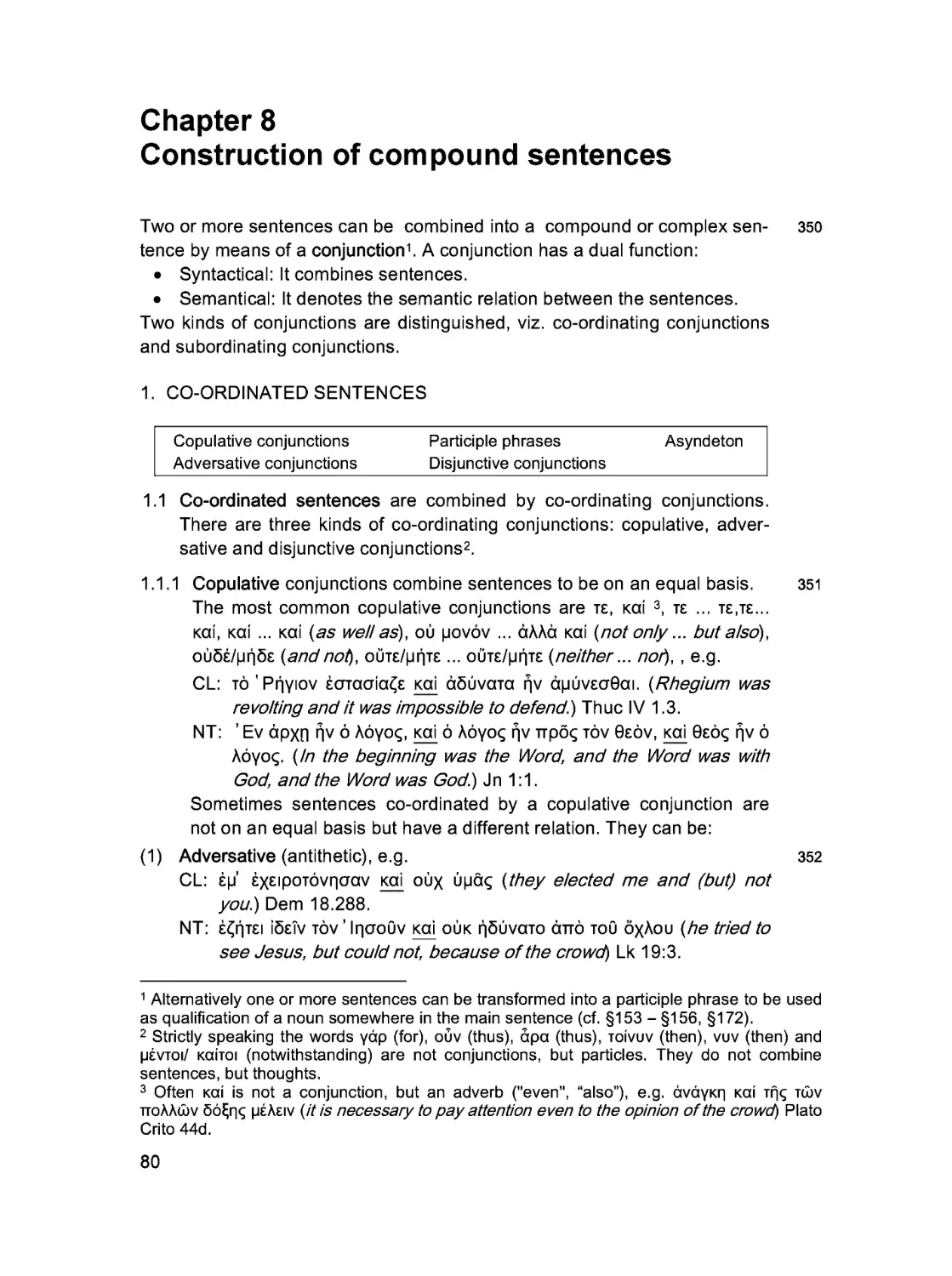
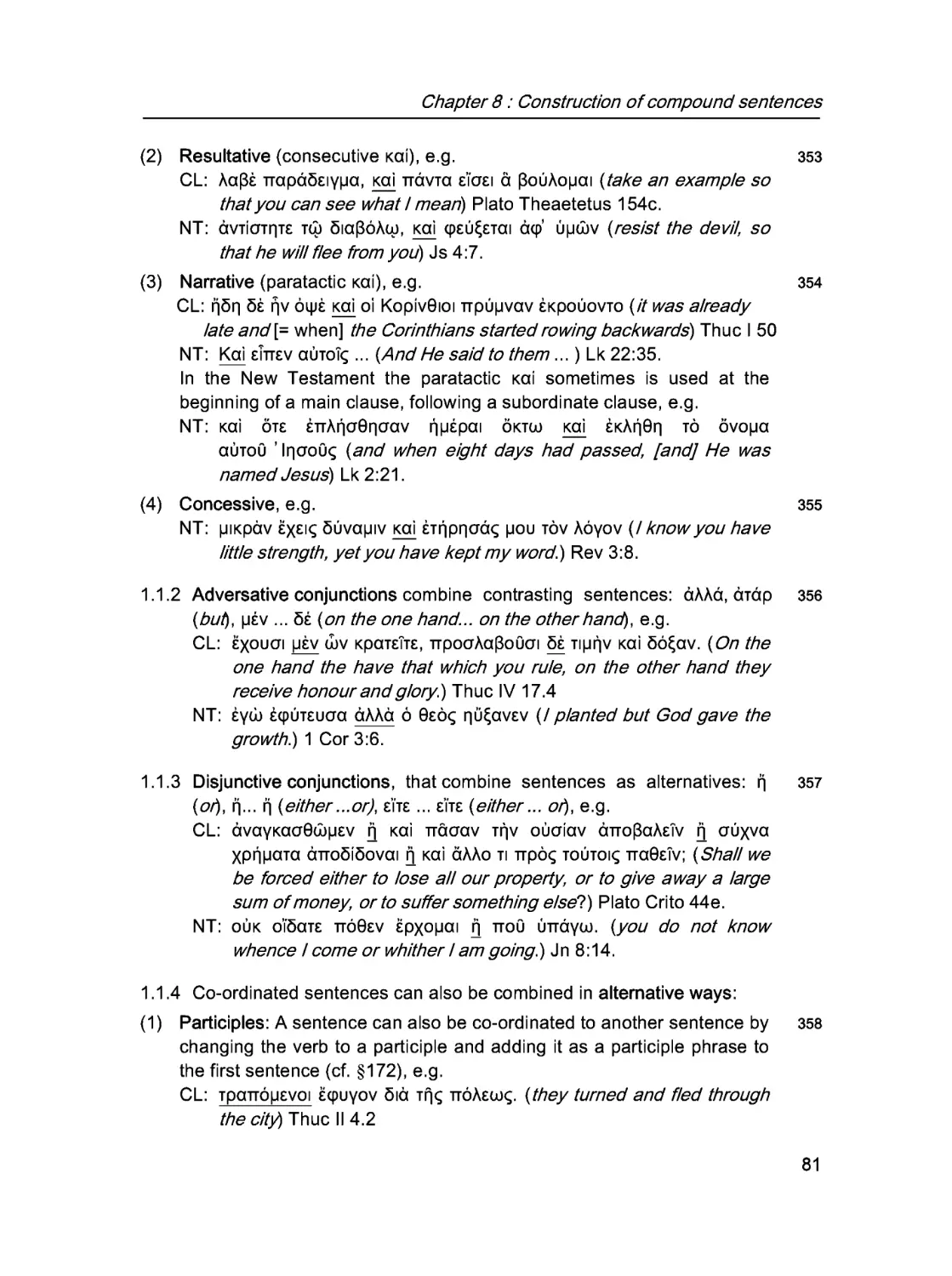
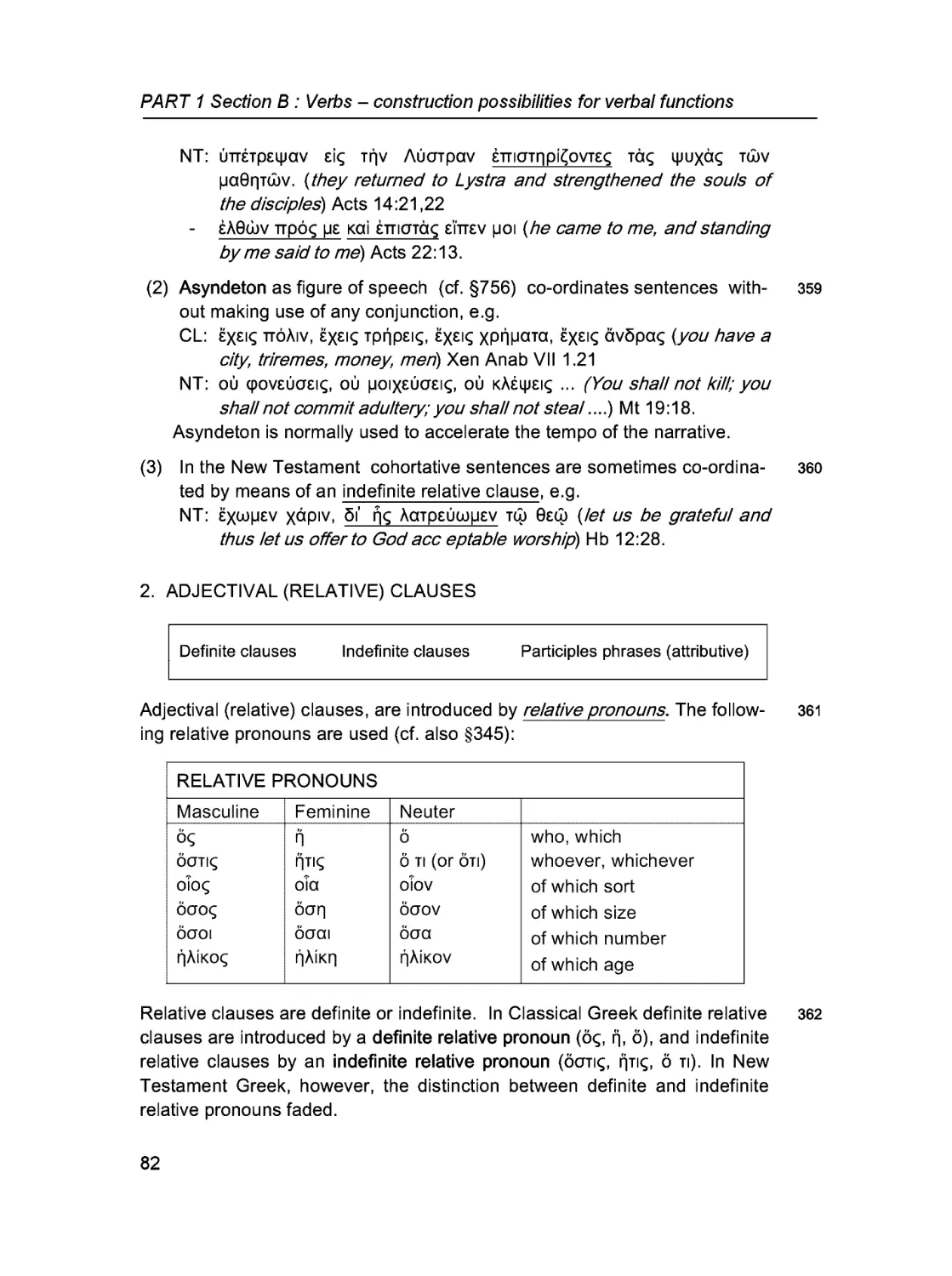
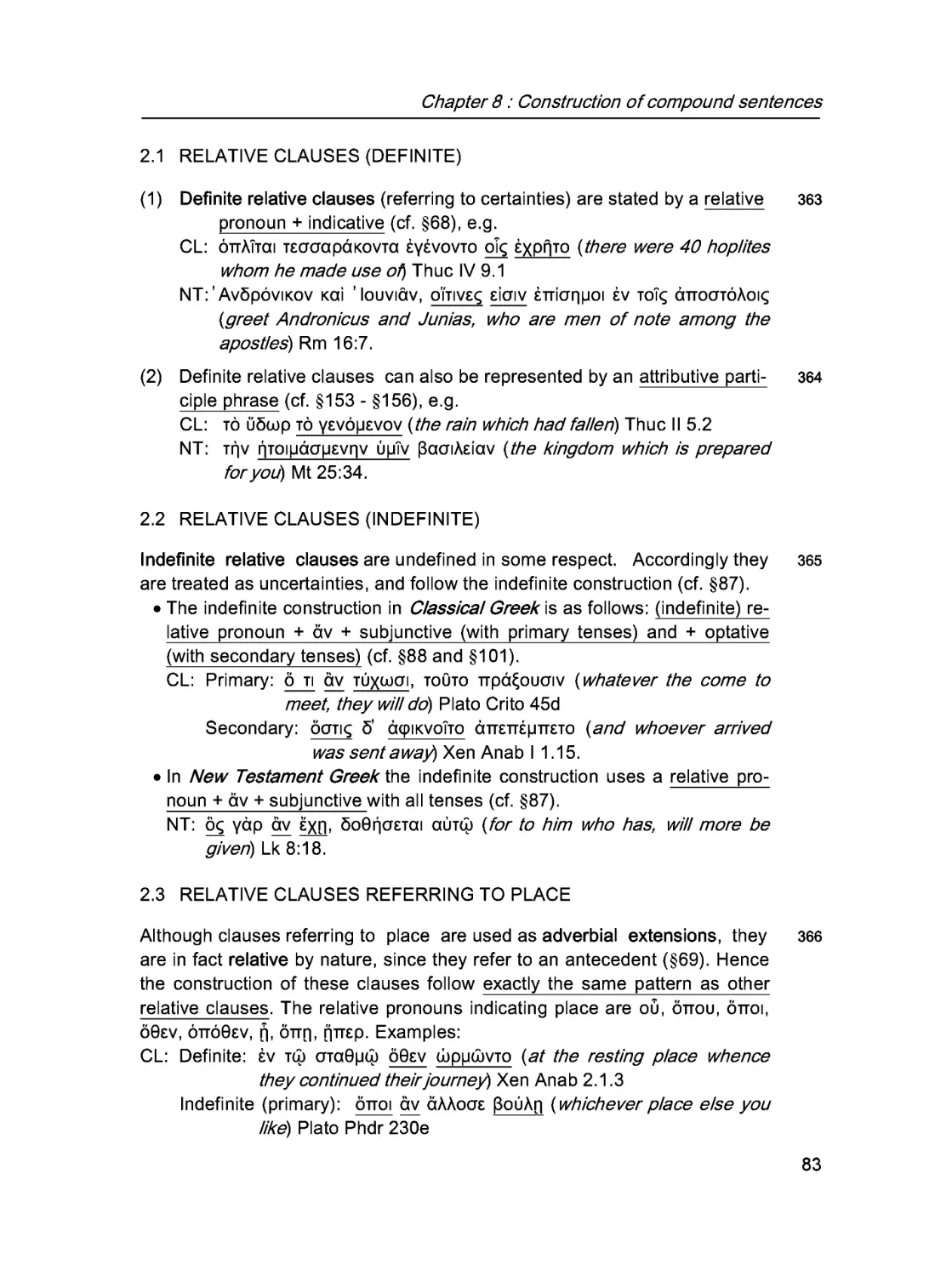
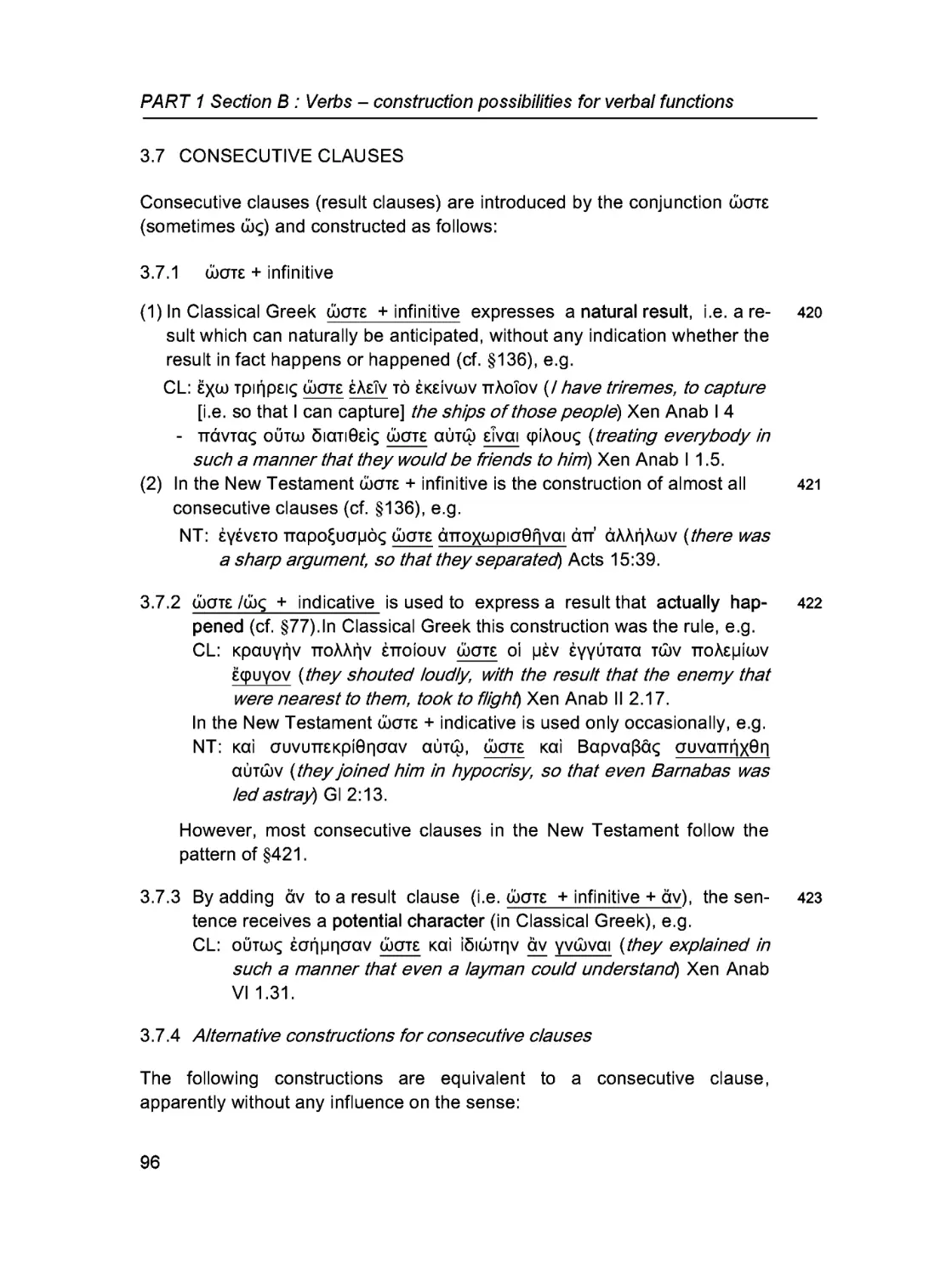
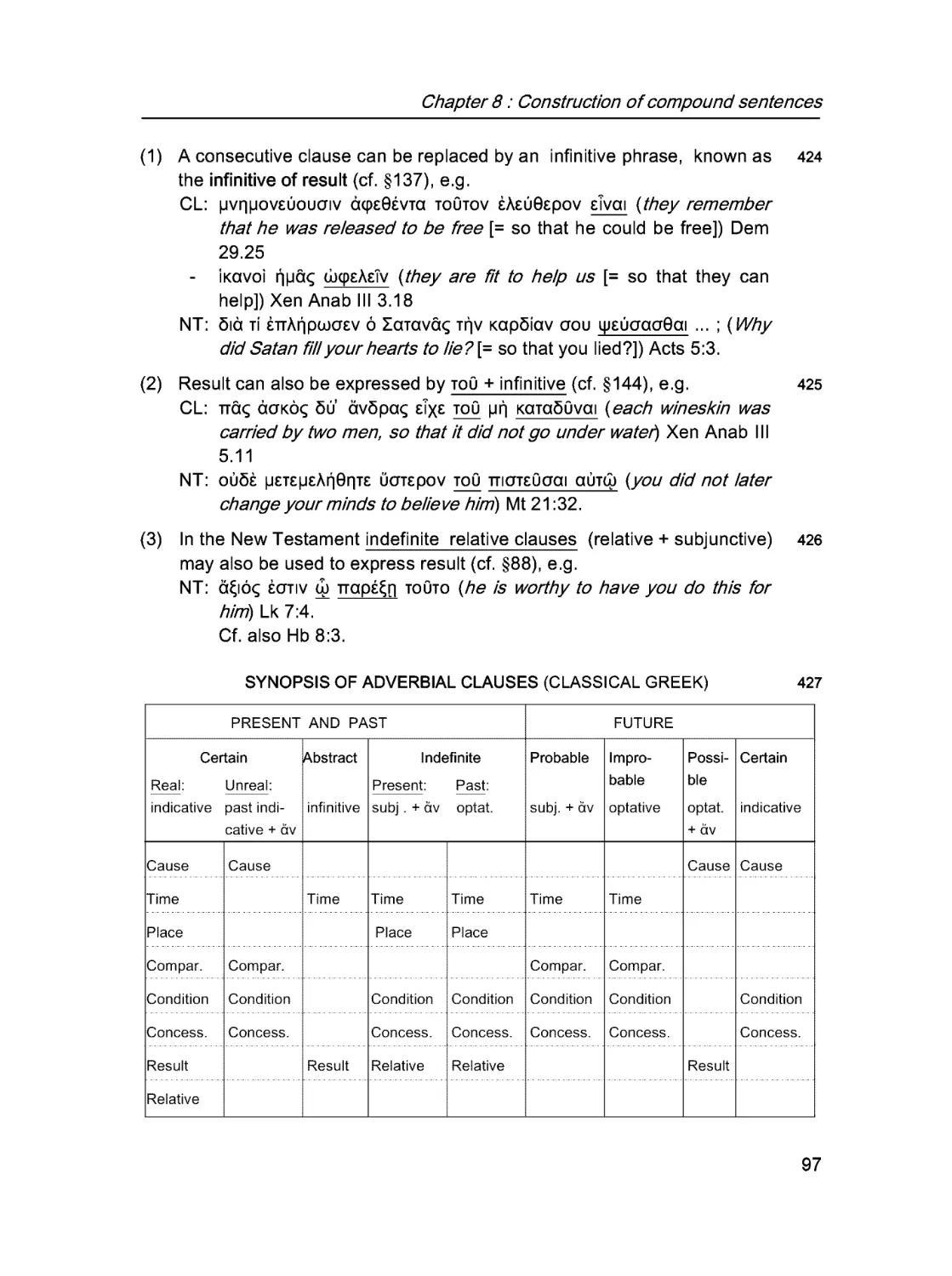
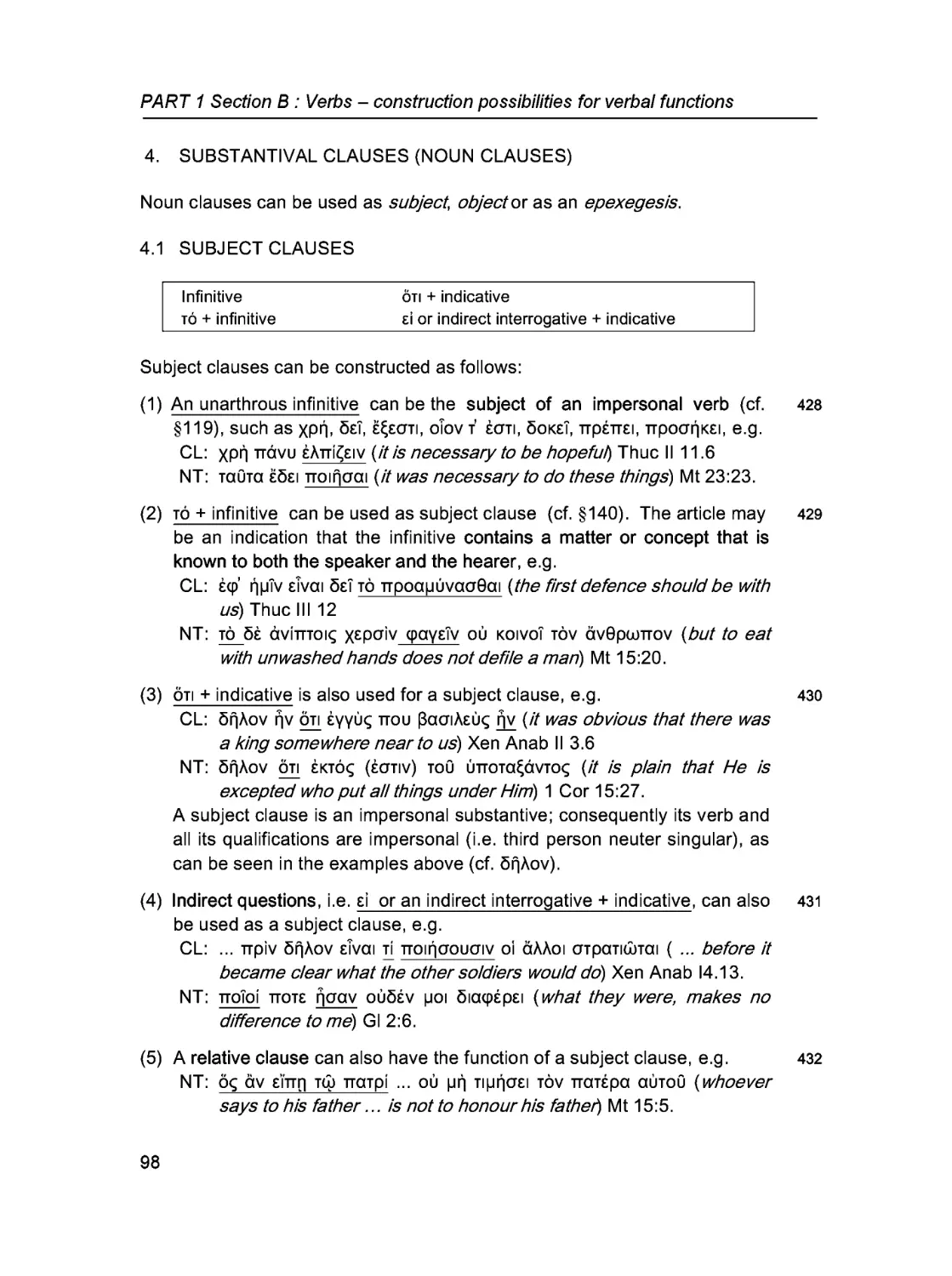
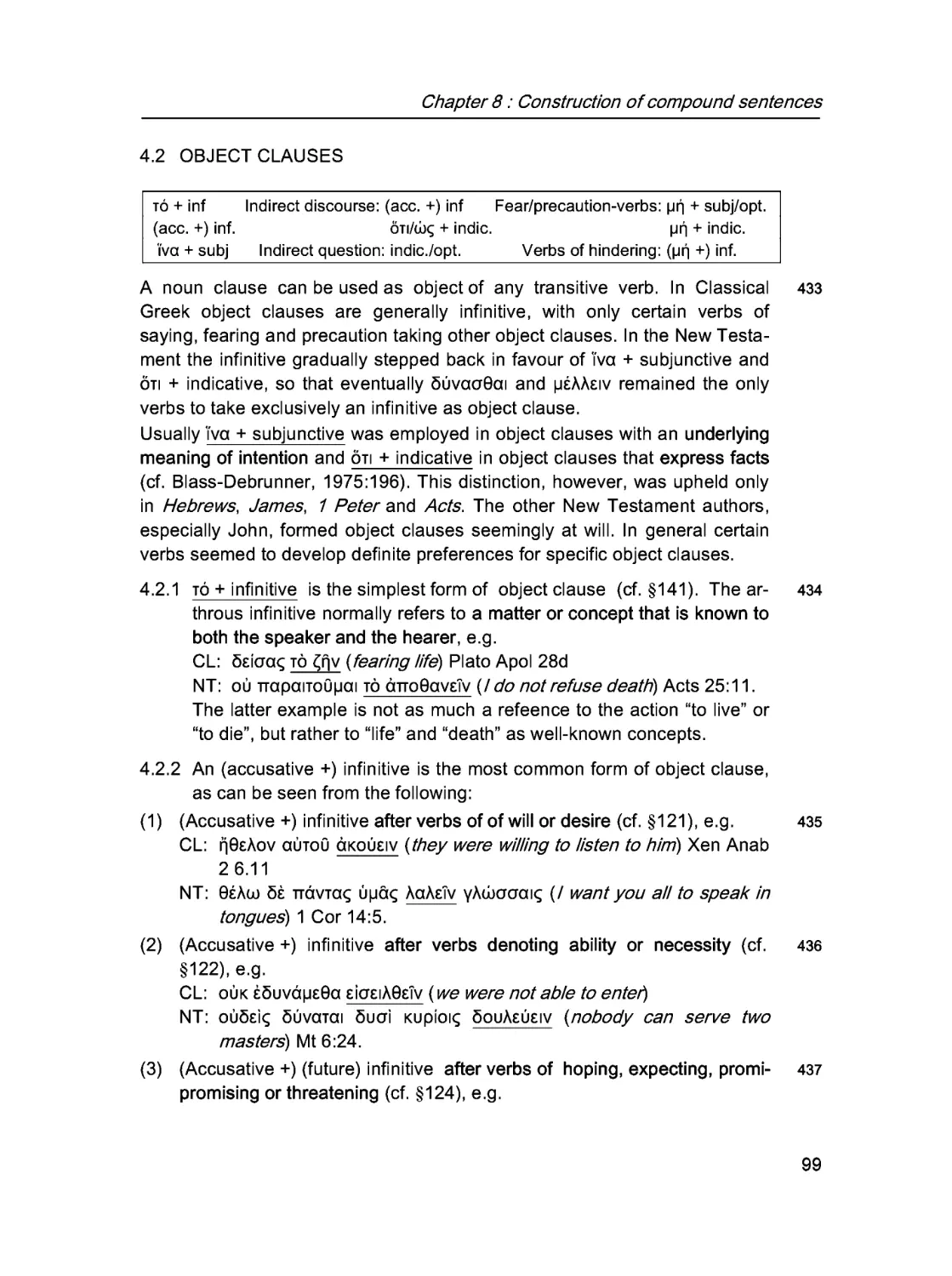







Автор: Jordaan G.J.C.
Теги: linguistics world languages greek language
ISBN: 978-3-643-90353-2
Год: 2013



Текст
                    Gert J.C. Jordaan
Ancient Greek Inside Out

Gert J.C. Jordaan
Ancient Greek Inside Out
The semantics of grammatical constructions.
Guide for exegetes and students
in Classical and New Testament Greek
Lit
This book is printed on acid-free paper.
Bibliographic information published by the Deutsche Nationalbibliothek
The Deutsche Nationalbibliothek lists this publication in the Deutsche
Nationalbibliografie; detailed bibliographic data are available in the Internet at
http://dnb.d-nb.de.
ISBN 978-3-643-90353-2
A catalogue record for this book is available from the British Library
©Lit verlag GmbH & co. kg wien,
Zweigniederlassung Zurich 2013
Klosbachstr. 107
CH-8032 Zurich
Tel.+41 (0)44-251 75 05
Fax+41 (0)44-251 75 06
E-Mail: zuerich@lit-verlag.ch
http://www.lit-verlag.ch
Lit verlag Dr. w. Hopf
Berlin 2013
Fresno str. 2
D-48159 Munster
Tel.+49 (0)2 51-6203 20
Fax+49 (0)2 51-23 19 72
E-Mail: lit@lit-verlag.de
http://www.lit-verlag.de
Distribution:
In Germany: LIT Verlag Fresnostr. 2, D-48159 Munster
Tel. +49 (0)251-6203222, Fax +49 (0)251-9226099, E-mail: vertrieb@lit-verlag.de
In Austria: Medienlogistik Pichler-OBZ, e-mail: mlo@medien-logistik.at
In Switzerland: В + M Buch- und Medienvertrieb, e-mail: order@buch-medien.ch
In the UK: Global Book Marketing, e-mail: mo@centralbooks.com
In North America: International Specialized Book Services, e-mail: orders@isbs.com
e-books are available at www.litwebshop.de
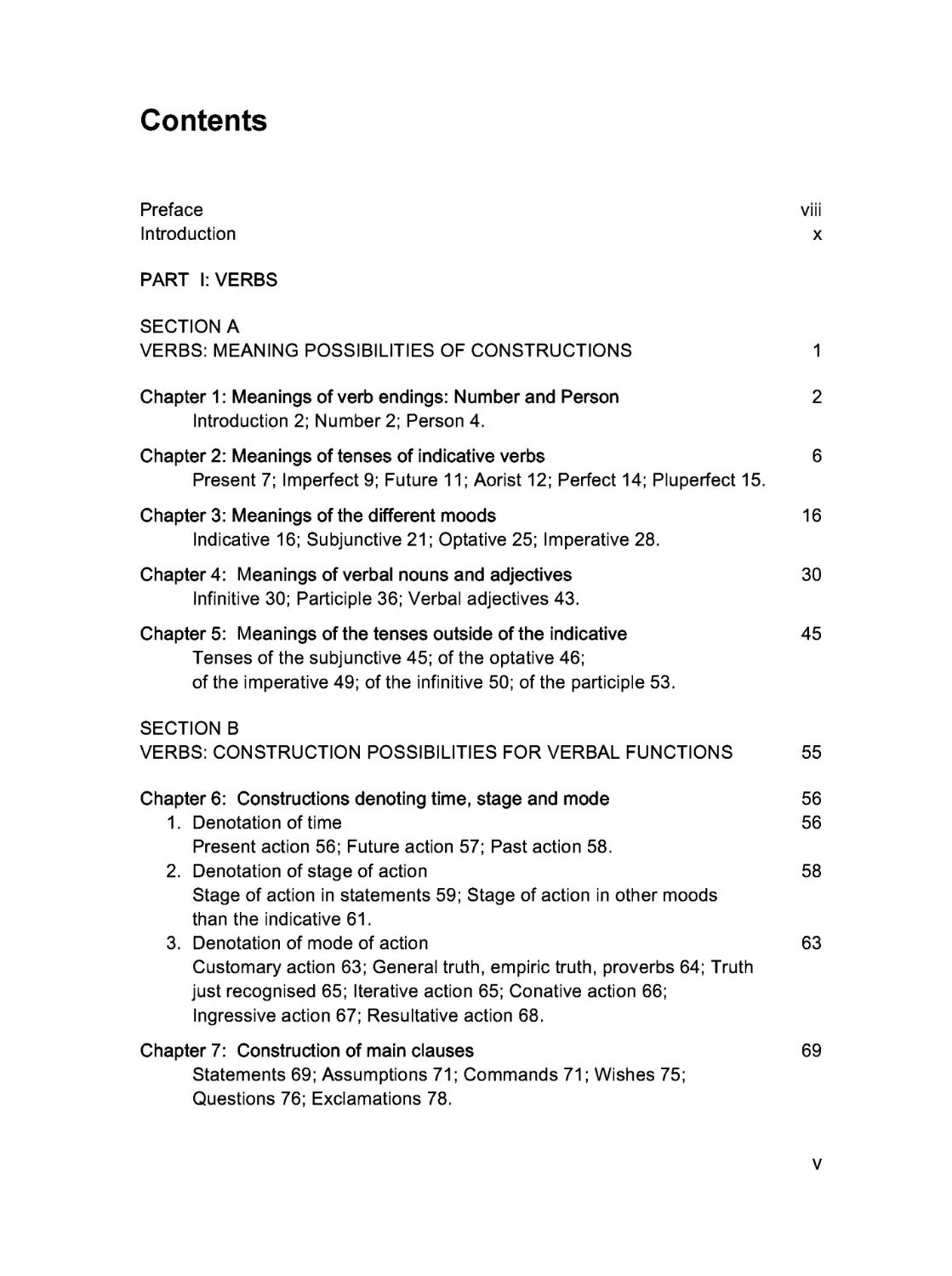
Contents
Preface	viii
Introduction	x
PART I: VERBS
SECTION A
VERBS: MEANING POSSIBILITIES OF CONSTRUCTIONS	1
Chapter 1:	Meanings of verb endings: Number and Person	2
Introduction 2; Number 2; Person 4.
Chapter 2:	Meanings of tenses of indicative verbs	6
Present 7; Imperfect 9; Future 11; Aorist 12; Perfect 14; Pluperfect 15.
Chapter 3:	Meanings of the different moods	16
Indicative 16; Subjunctive 21; Optative 25; Imperative 28.
Chapter 4:	Meanings of verbal nouns and adjectives	30
Infinitive 30; Participle 36; Verbal adjectives 43.
Chapter 5:	Meanings of the tenses outside of the indicative	45
Tenses of the subjunctive 45; of the optative 46;
of the imperative 49; of the infinitive 50; of the participle 53.
SECTION В
VERBS: CONSTRUCTION POSSIBILITIES FOR VERBAL FUNCTIONS 55
Chapter 6:	Constructions denoting time, stage and mode	56
1.	Denotation of time	56
Present action 56; Future action 57; Past action 58.
2.	Denotation of stage of action	58
Stage of action in statements 59; Stage of action in other moods
than the indicative 61.
3.	Denotation of mode of action	63
Customary action 63; General truth, empiric truth, proverbs 64; Truth
just recognised 65; Iterative action 65; Conative action 66;
Ingressive action 67; Resultative action 68.
Chapter 7:	Construction of main clauses	69
Statements 69; Assumptions 71; Commands 71; Wishes 75;
Questions 76; Exclamations 78.
v
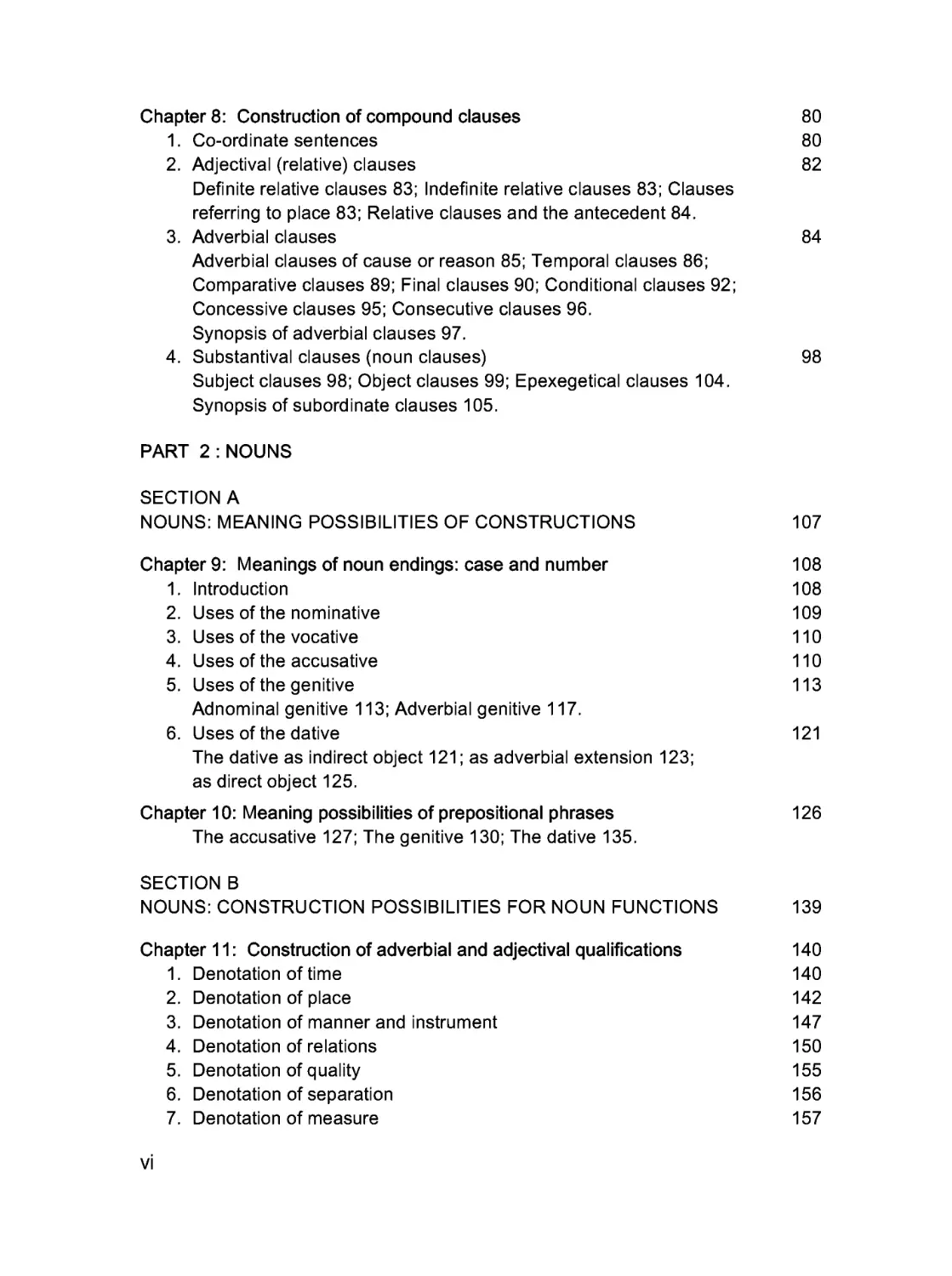
Chapter8:	Construction of compound clauses	80
1.	Co-ordinate sentences	80
2.	Adjectival (relative) clauses	82
Definite relative clauses 83; Indefinite relative clauses 83; Clauses
referring to place 83; Relative clauses and the antecedent 84.
3.	Adverbial clauses	84
Adverbial clauses of cause or reason 85; Temporal clauses 86;
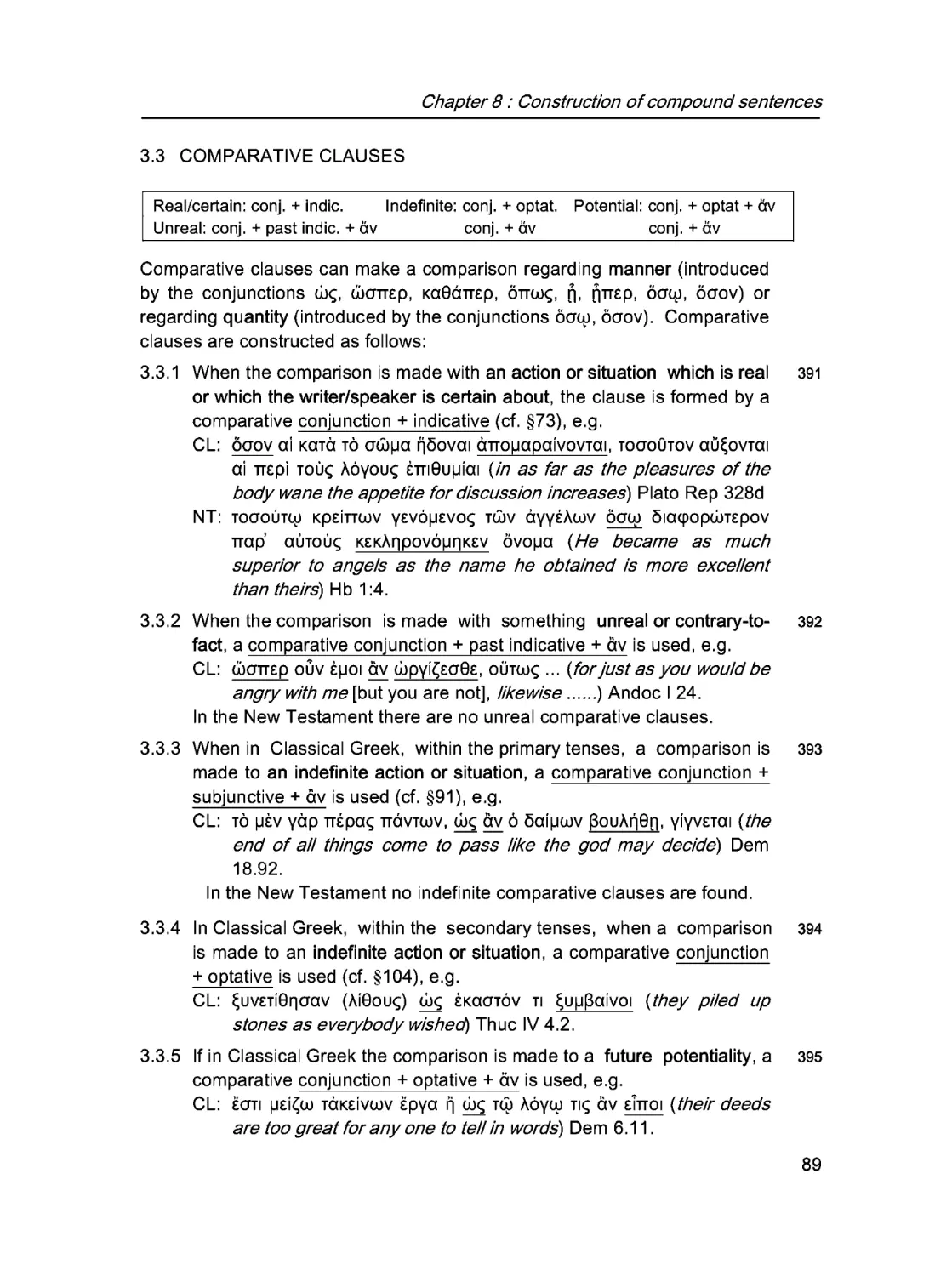
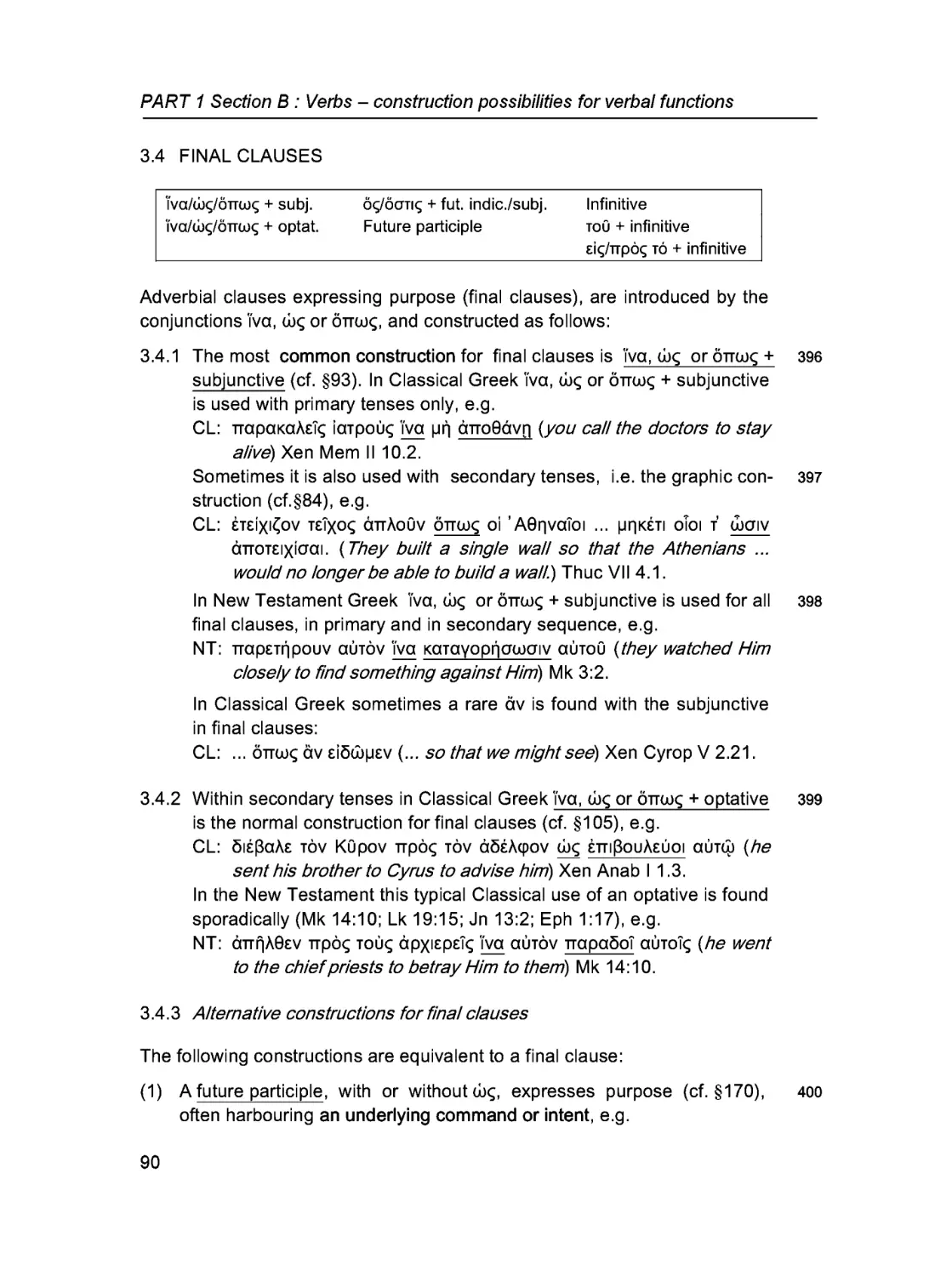
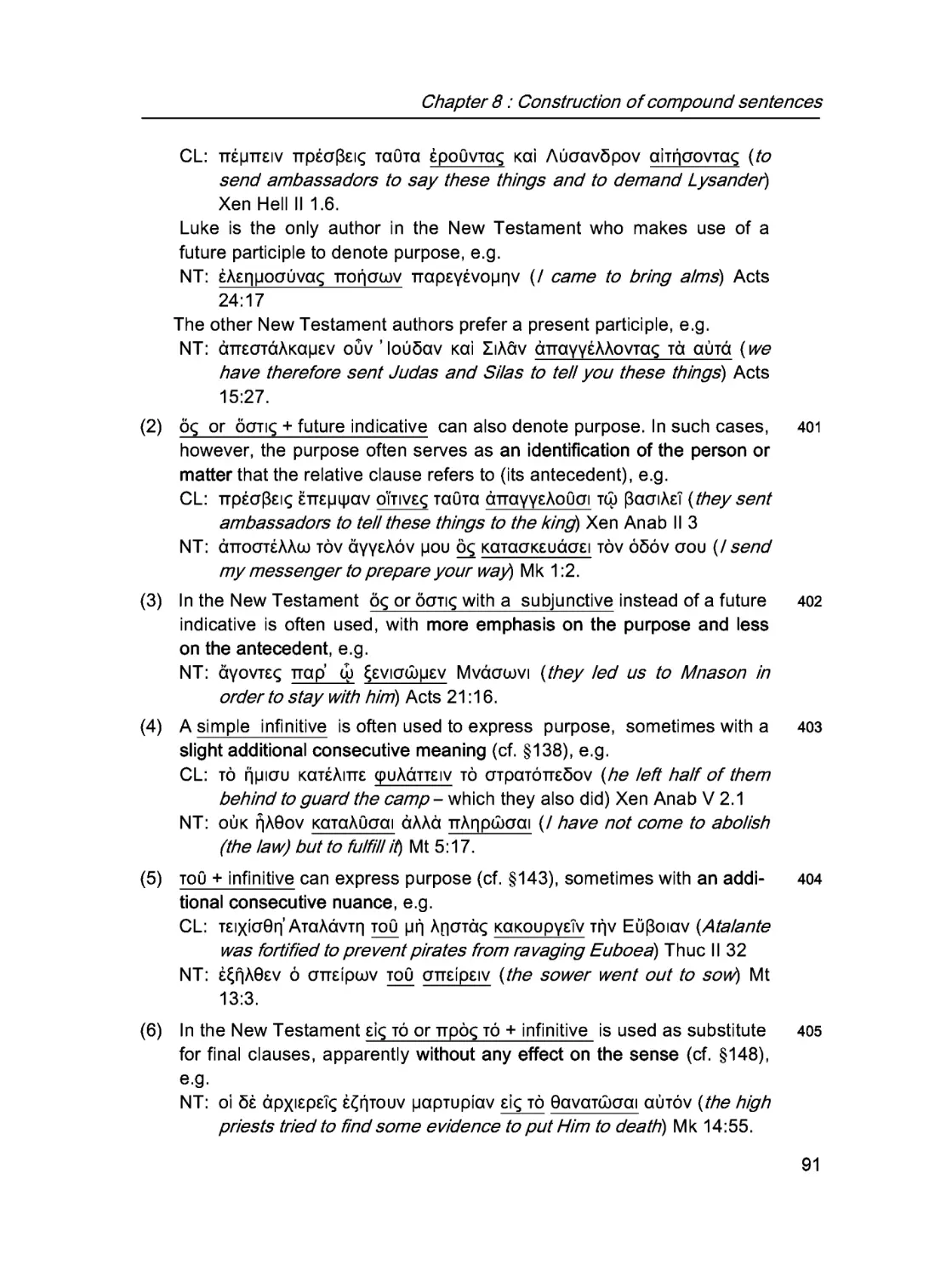
Comparative clauses 89; Final clauses 90; Conditional clauses 92;
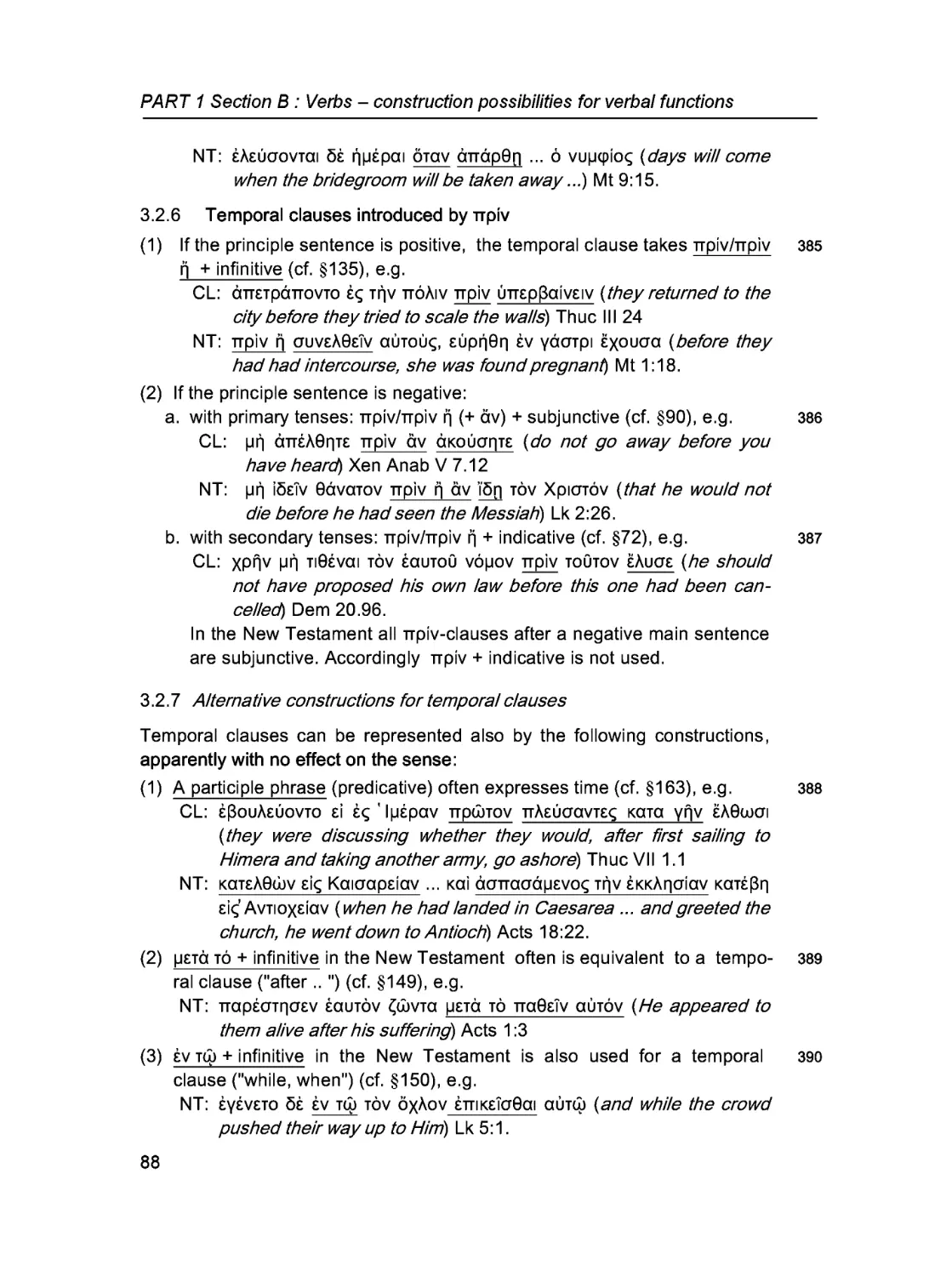
Concessive clauses 95; Consecutive clauses 96.
Synopsis of adverbial clauses 97.
4.	Substantival clauses (noun clauses)	98
Subject clauses 98; Object clauses 99; Epexegetical clauses 104.
Synopsis of subordinate clauses 105.
PART 2:NOUNS
SECTION A
NOUNS: MEANING POSSIBILITIES OF CONSTRUCTIONS	107
Chapter 9:	Meanings of noun endings: case and number	108
1.	Introduction	108
2.	Uses of the	nominative	109
3.	Uses of the	vocative	110
4.	Uses of the	accusative	110
5.	Uses of the	genitive	113
Adnominal genitive 113; Adverbial genitive 117.
6.	Uses of the dative	121
The dative as indirect object 121; as adverbial extension 123;
as direct object 125.
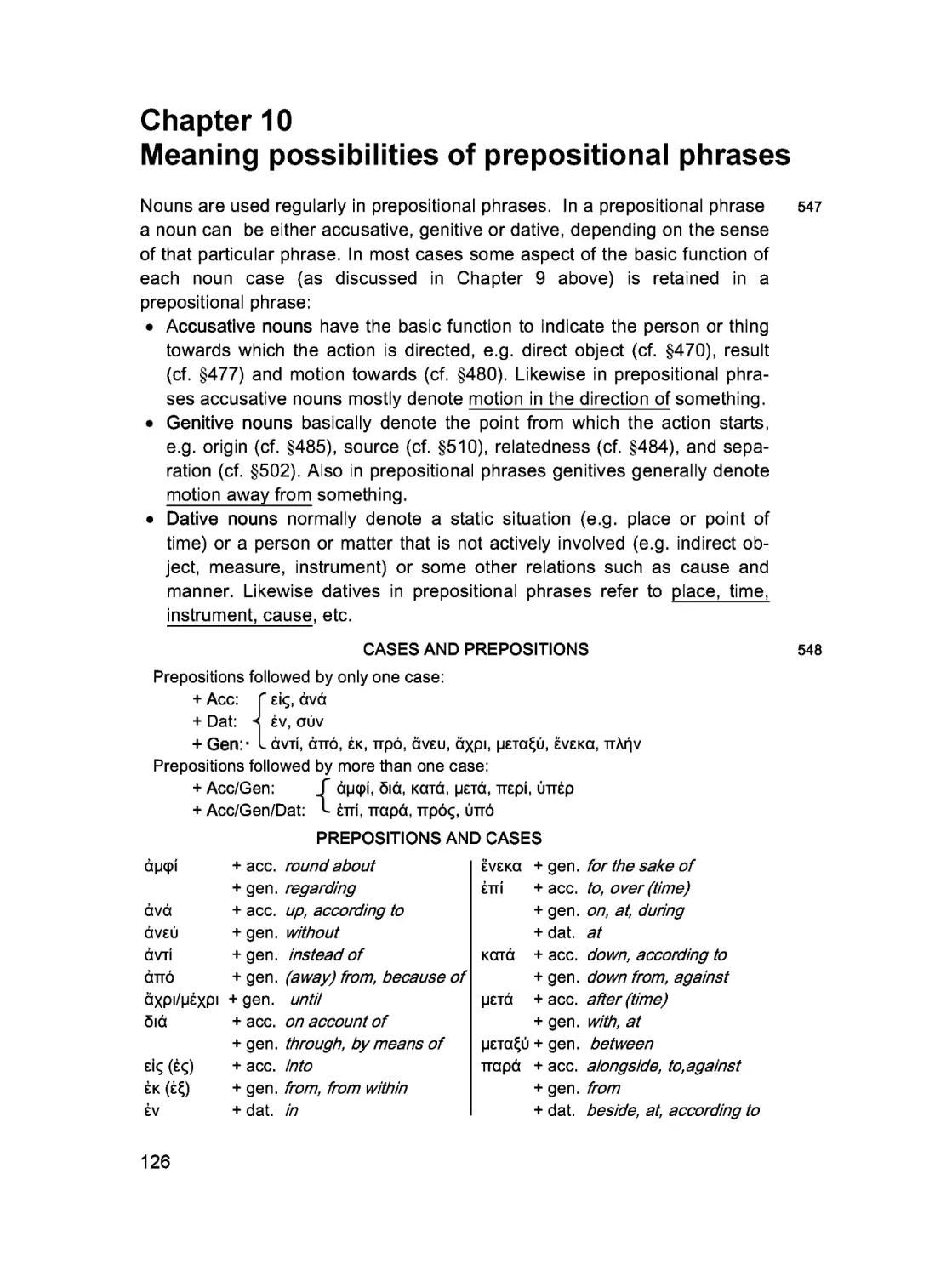
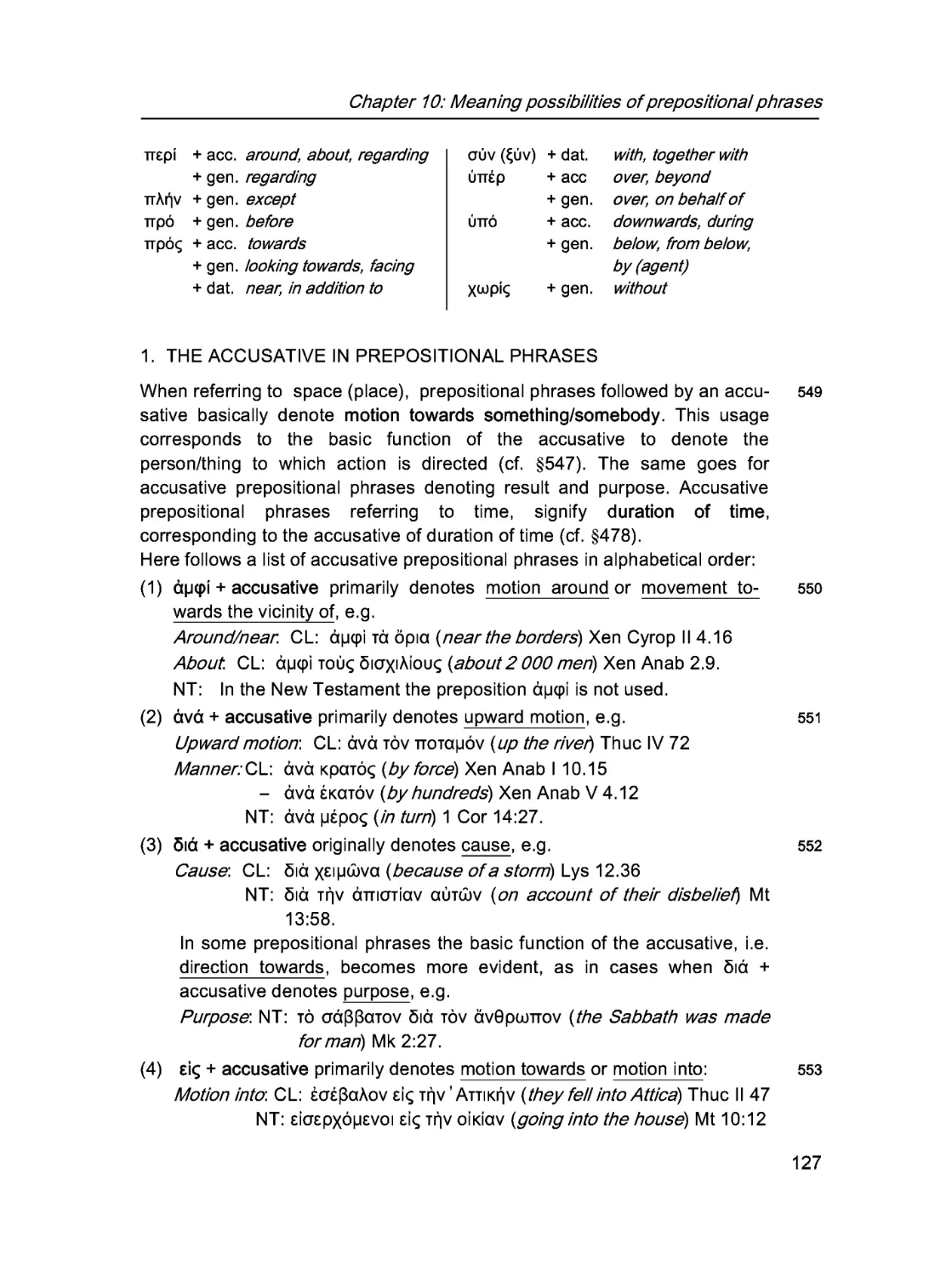
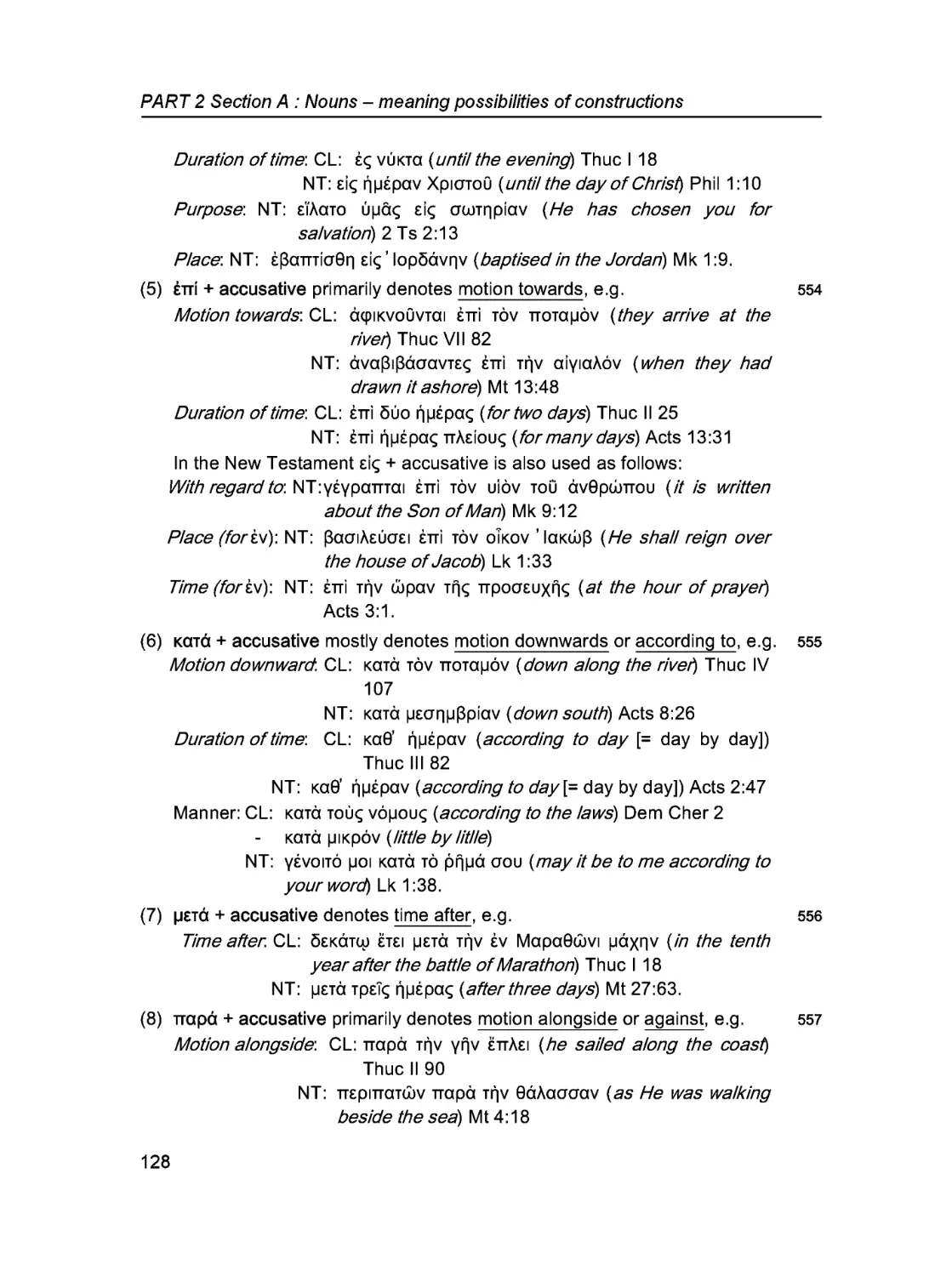
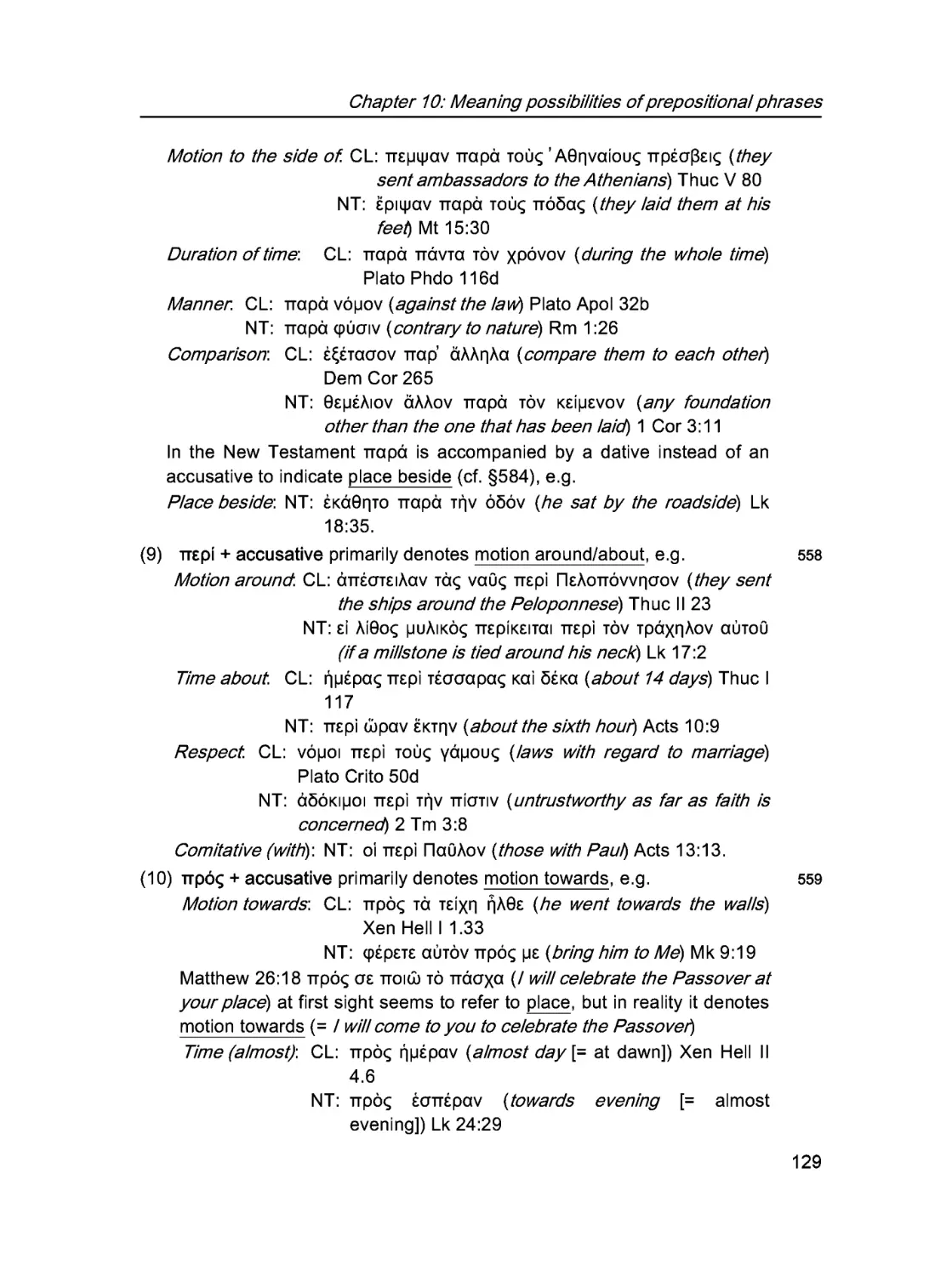
Chapter 10:	Meaning possibilities of prepositional phrases	126
The accusative 127; The genitive 130; The dative 135.
SECTION В
NOUNS: CONSTRUCTION POSSIBILITIES FOR NOUN FUNCTIONS 139
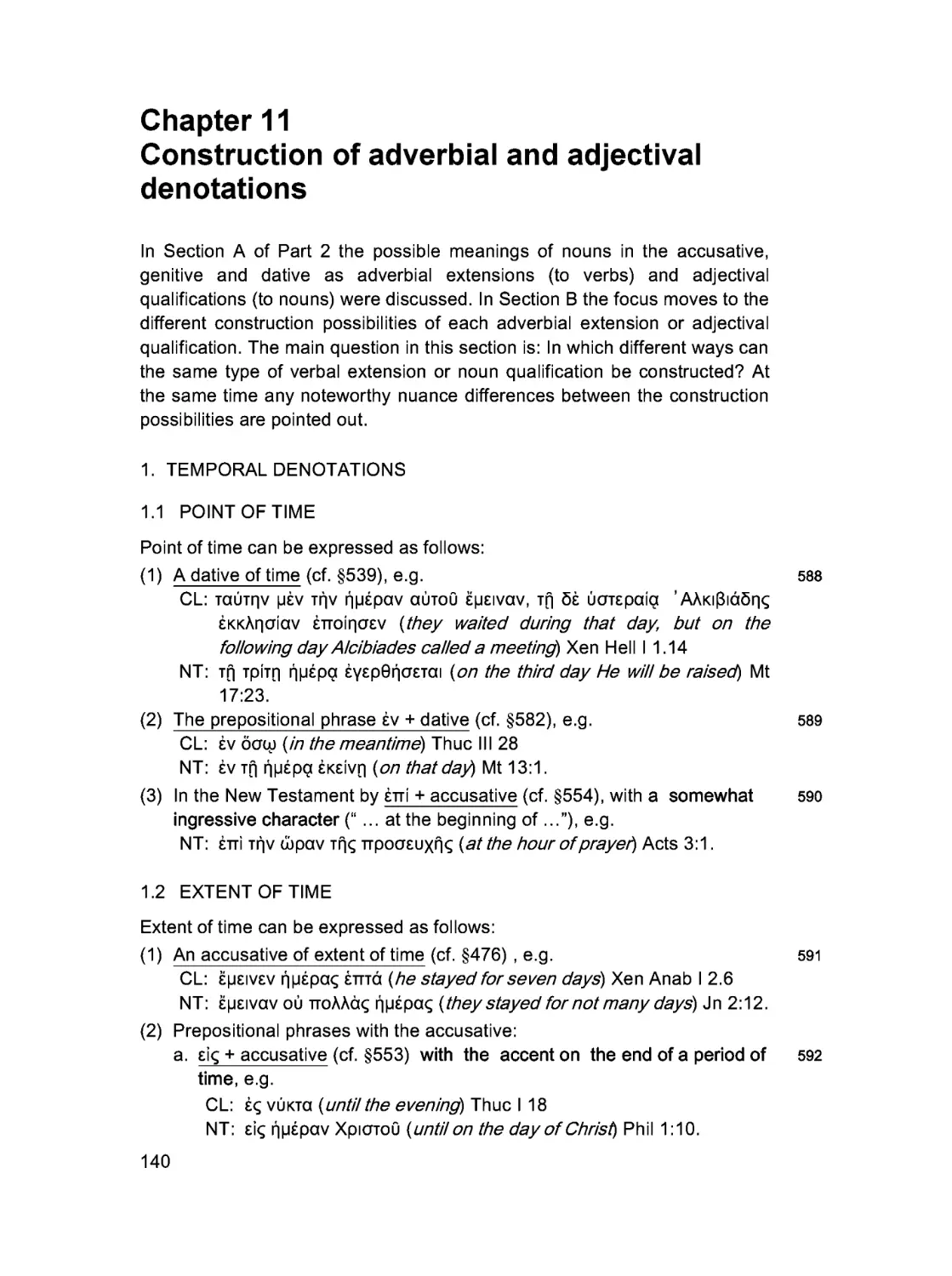
Chapter 11:	Construction of adverbial and adjectival qualifications	140
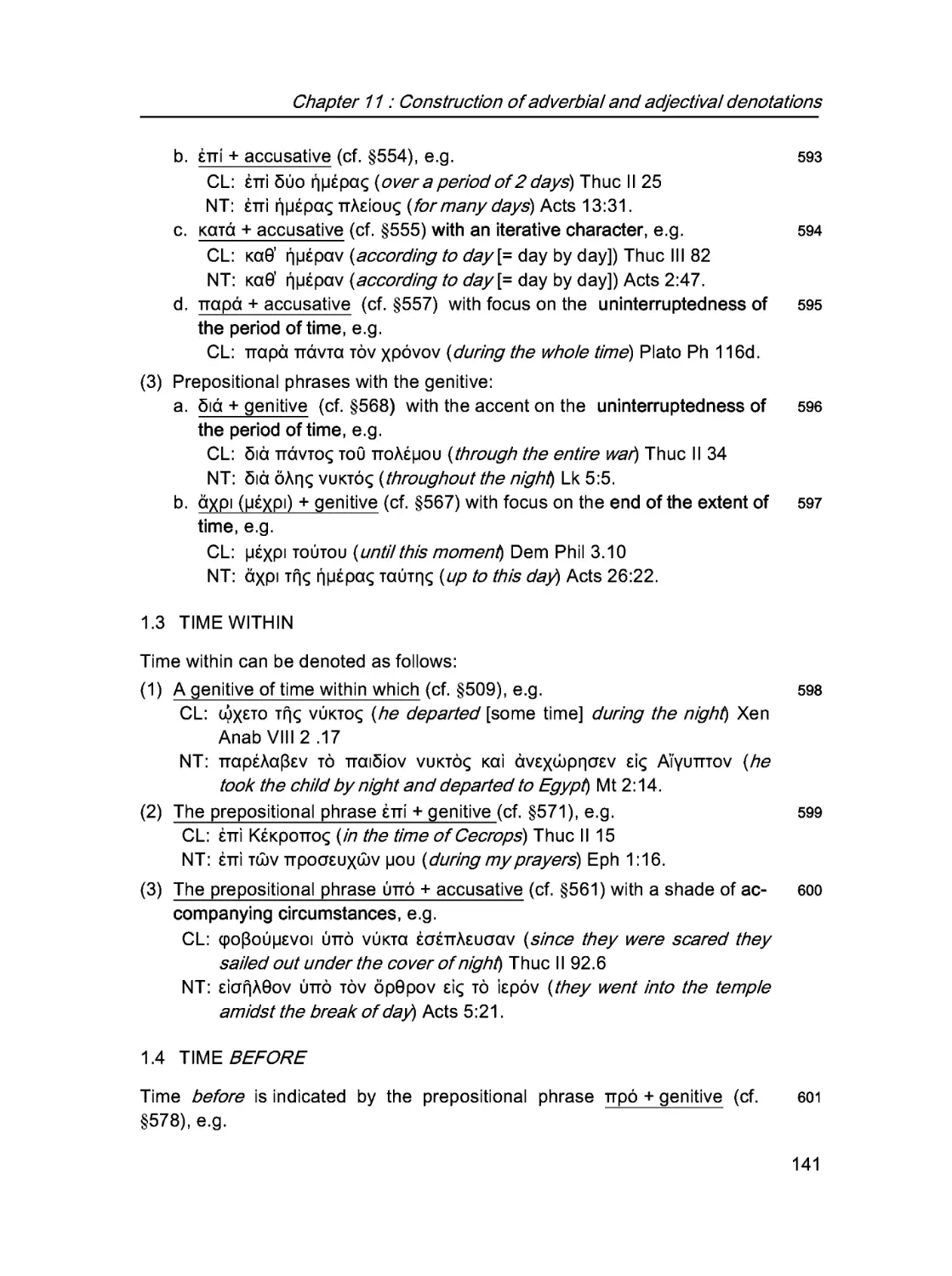
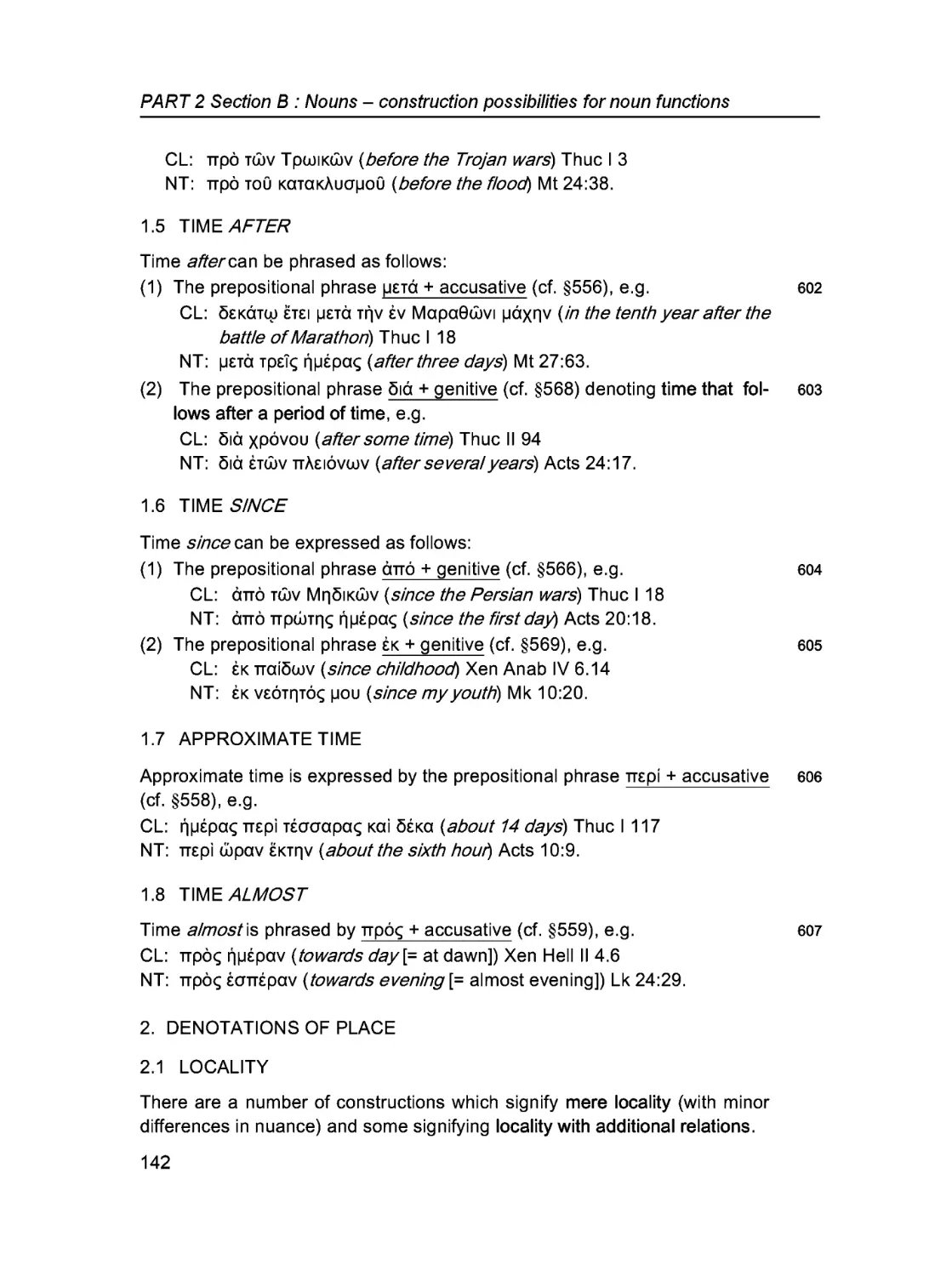
1.	Denotation	of time	140
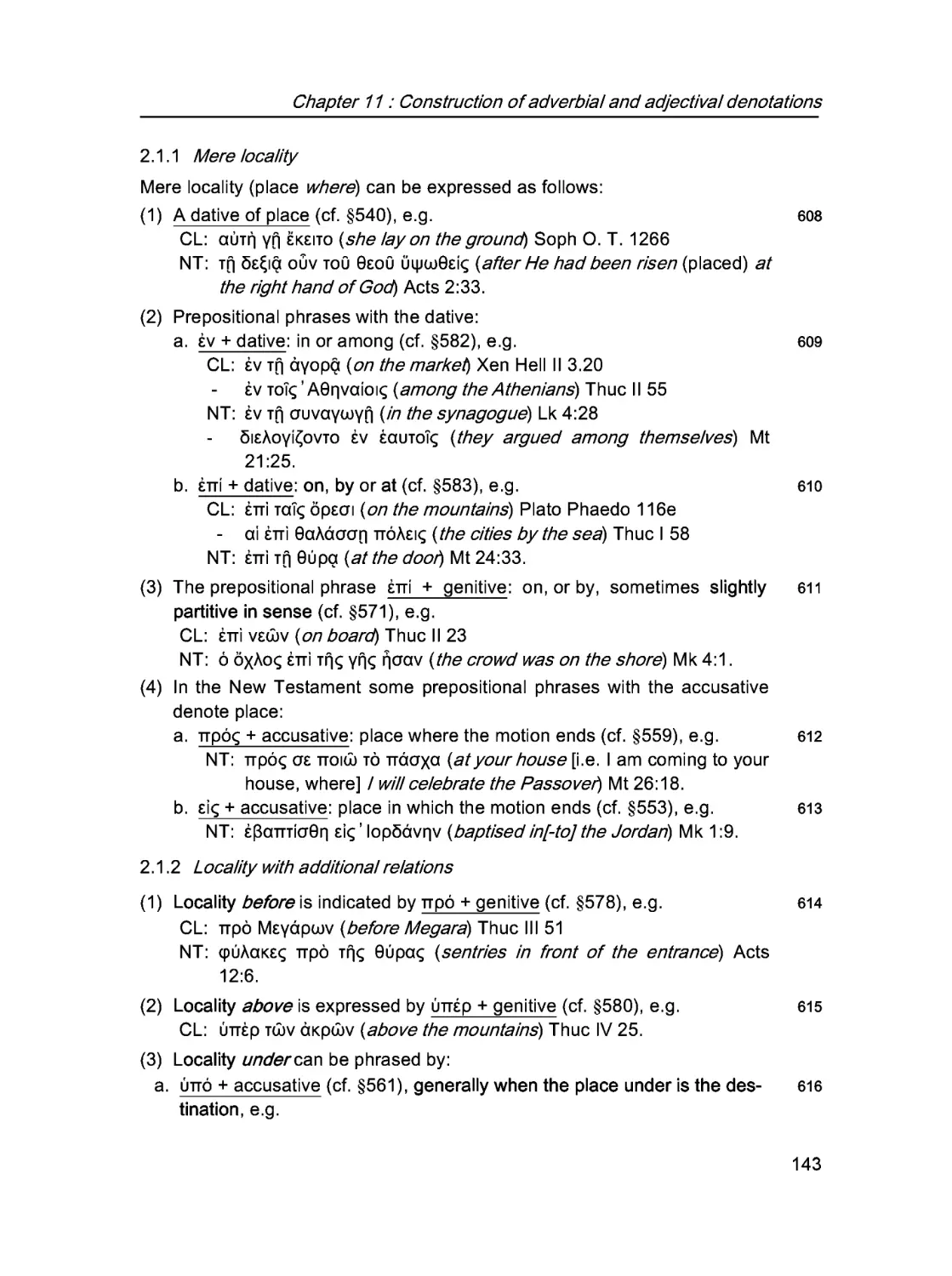
2.	Denotation	of place	142
3.	Denotation	of manner and instrument	147
4.	Denotation	of relations	150
5.	Denotation	of quality	155
6.	Denotation	of separation	156
7.	Denotation	of measure	157
vi
SUPPLEMENTS ON STYLE	159
Supplement 1: The uses of the negatives OY and MH	160
Supplement 2: Figures of speech	165
Supplement 3: The individual style of authors in the New Testament	176
The authors of: Mark 176; Matthew 178; Luke 179; John 182; Paul 186;
Hebrews 189; James 190; 1 Peter 192; 2 Peter 193; Jude 194.
Literature	195
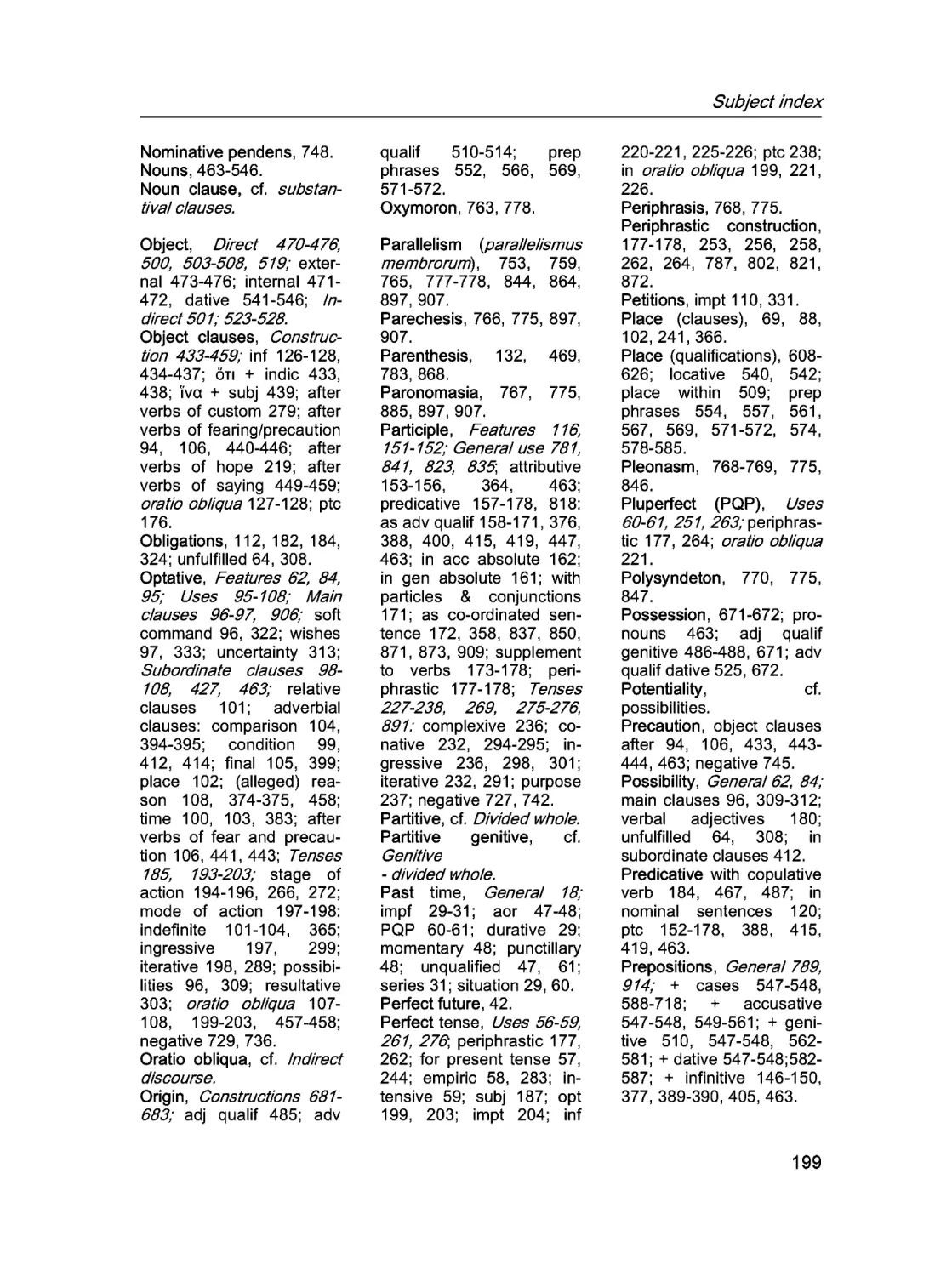
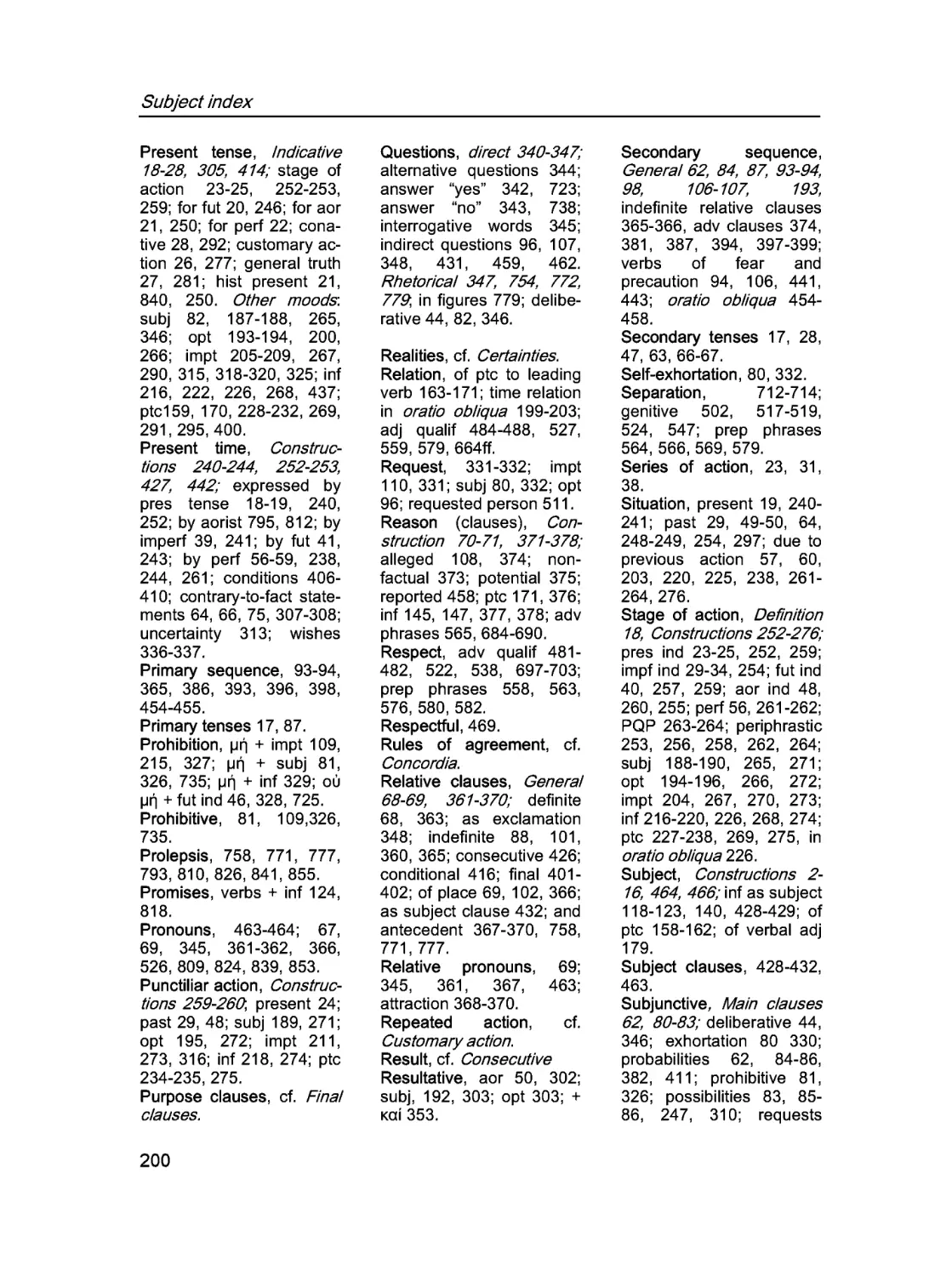
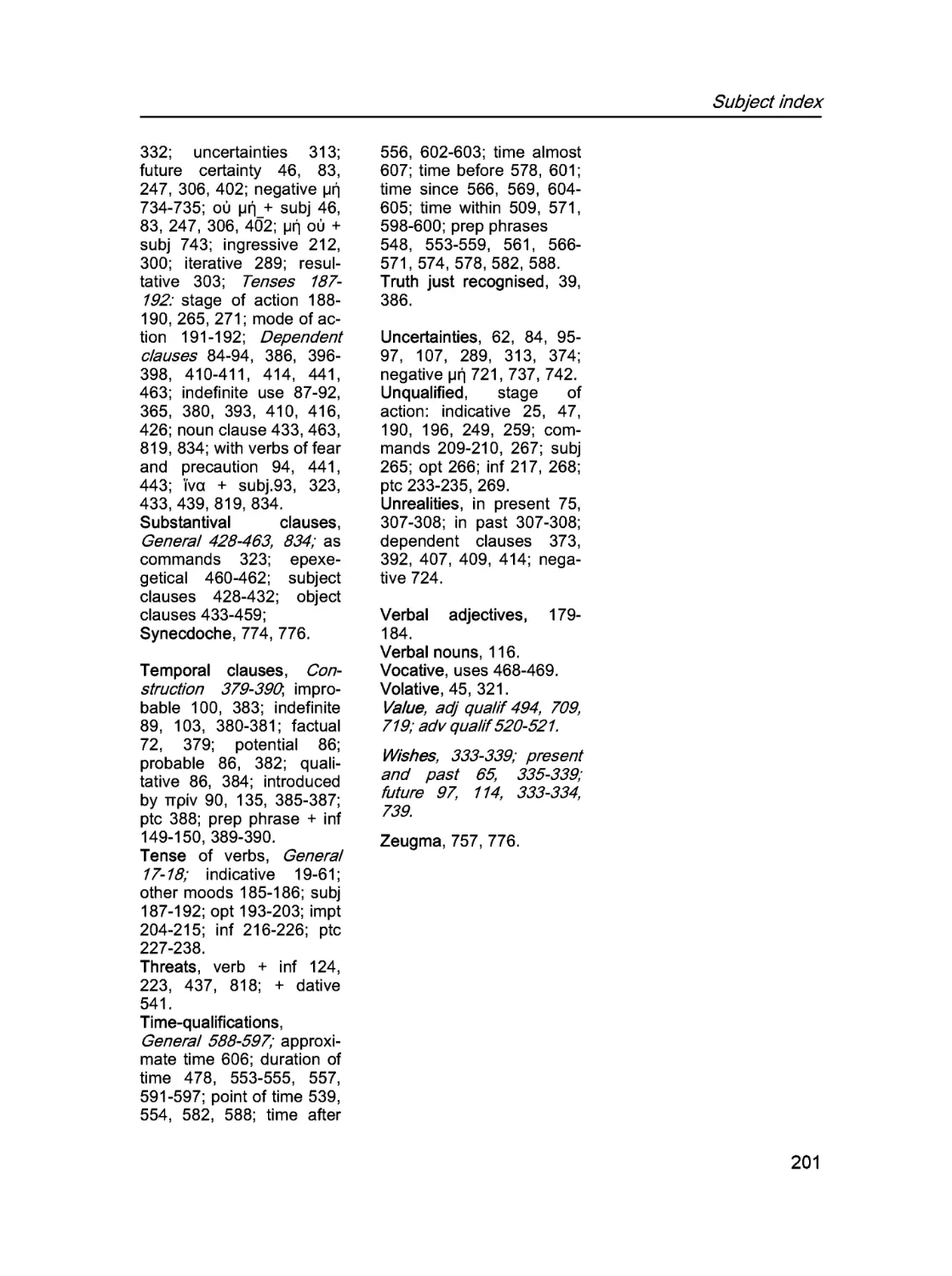
Subject Index	196
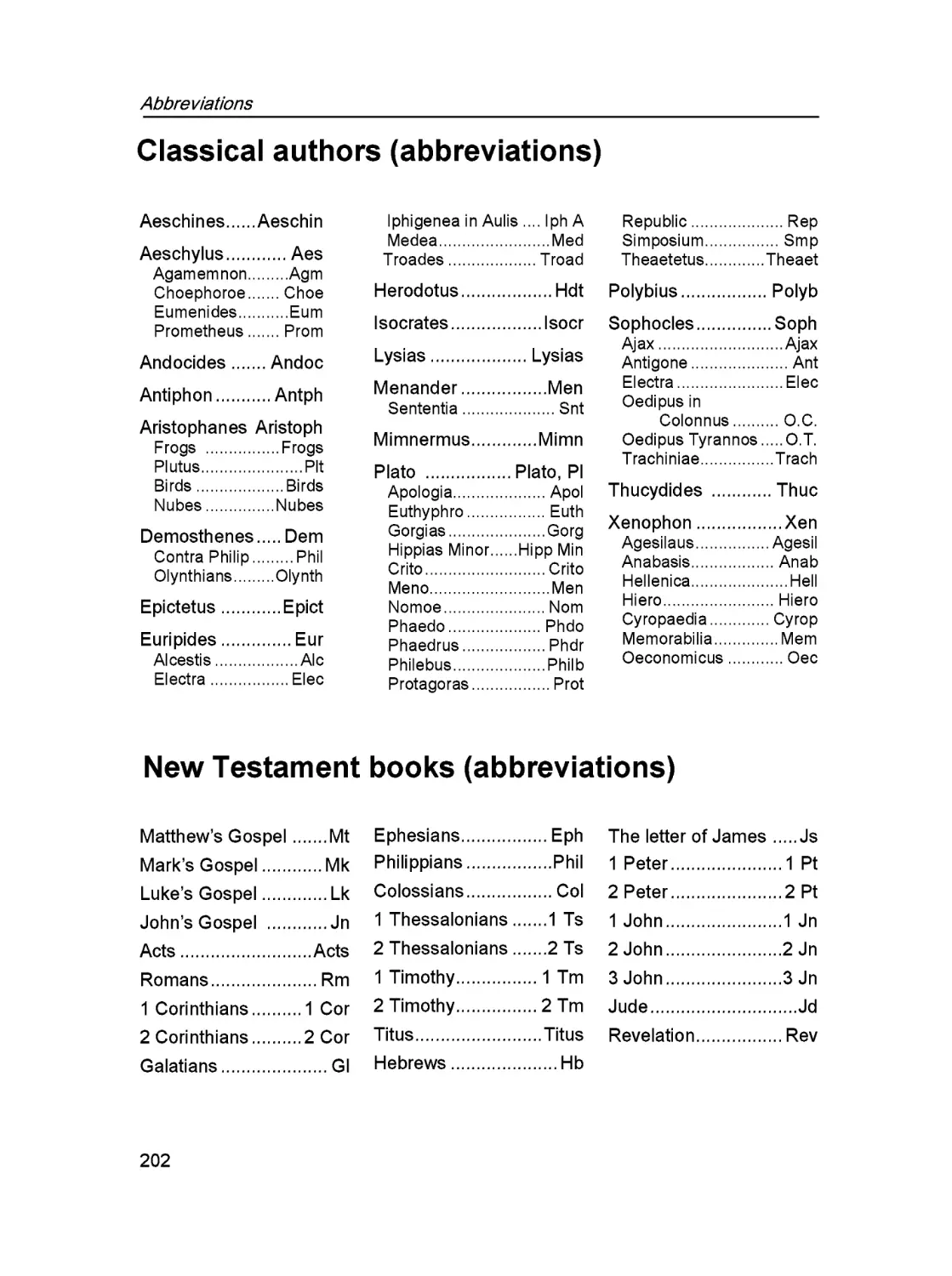
Abbreviation list of Classical Greek authors	202
Abbreviation list of New Testament books	202
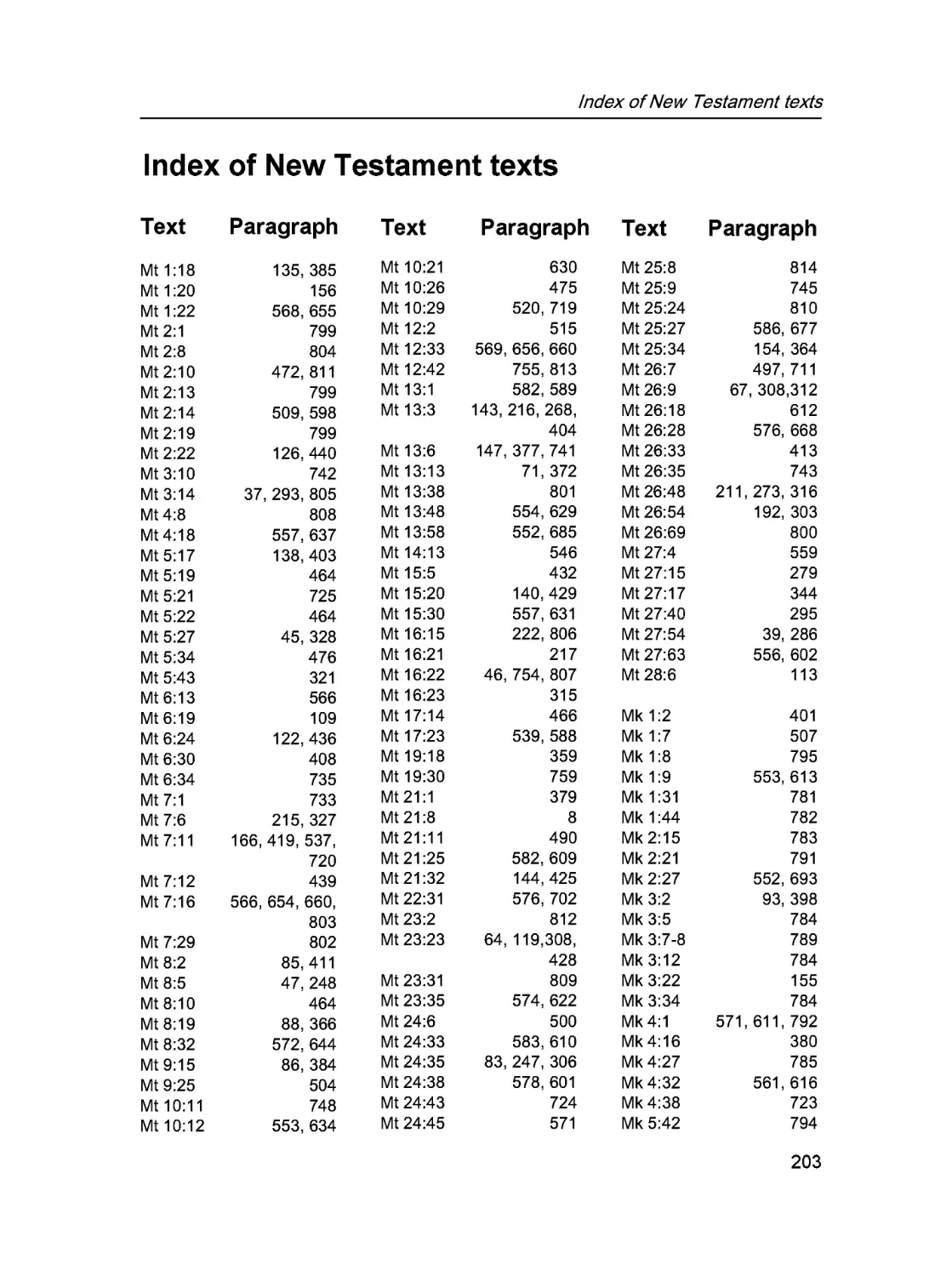
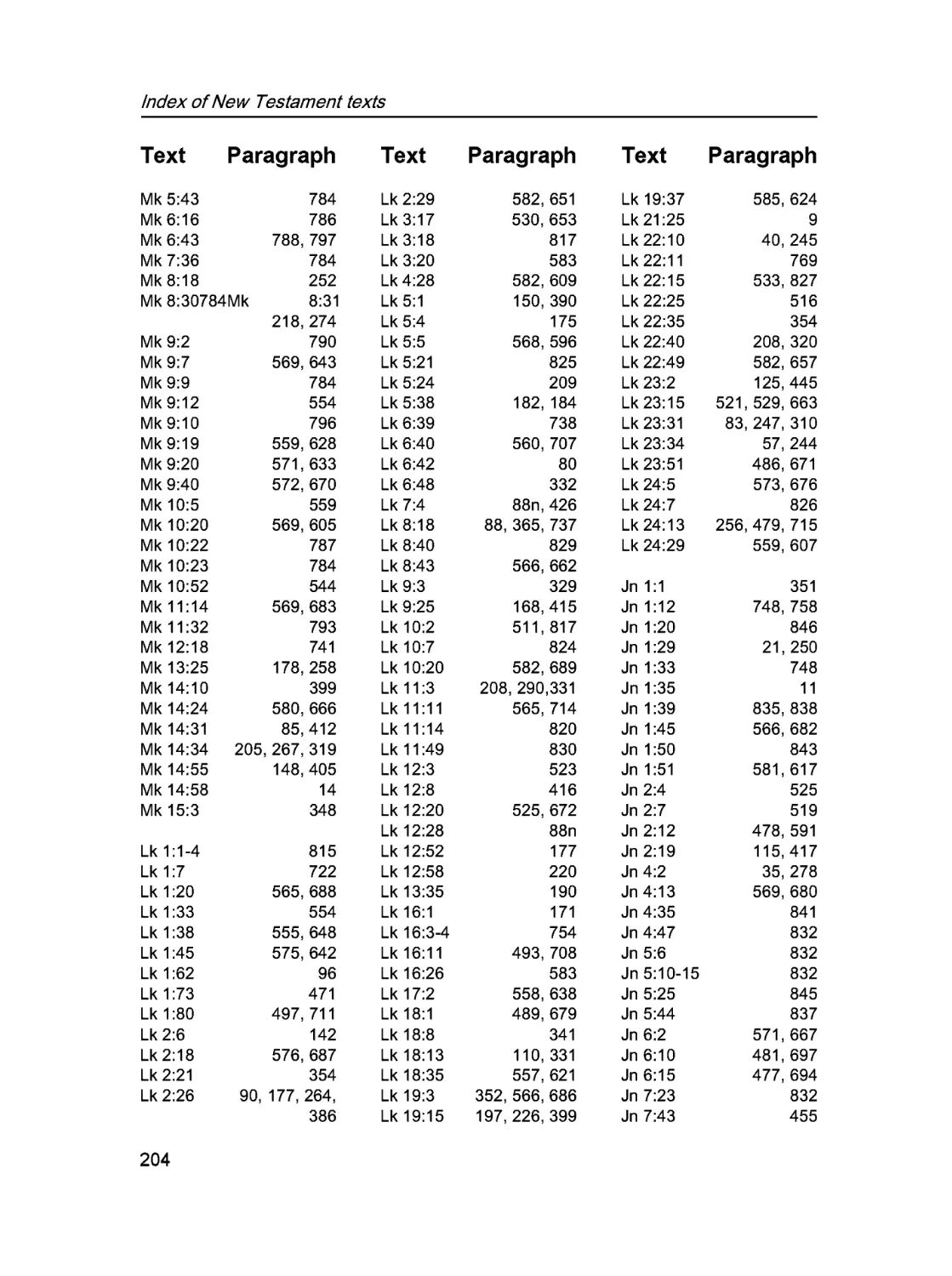
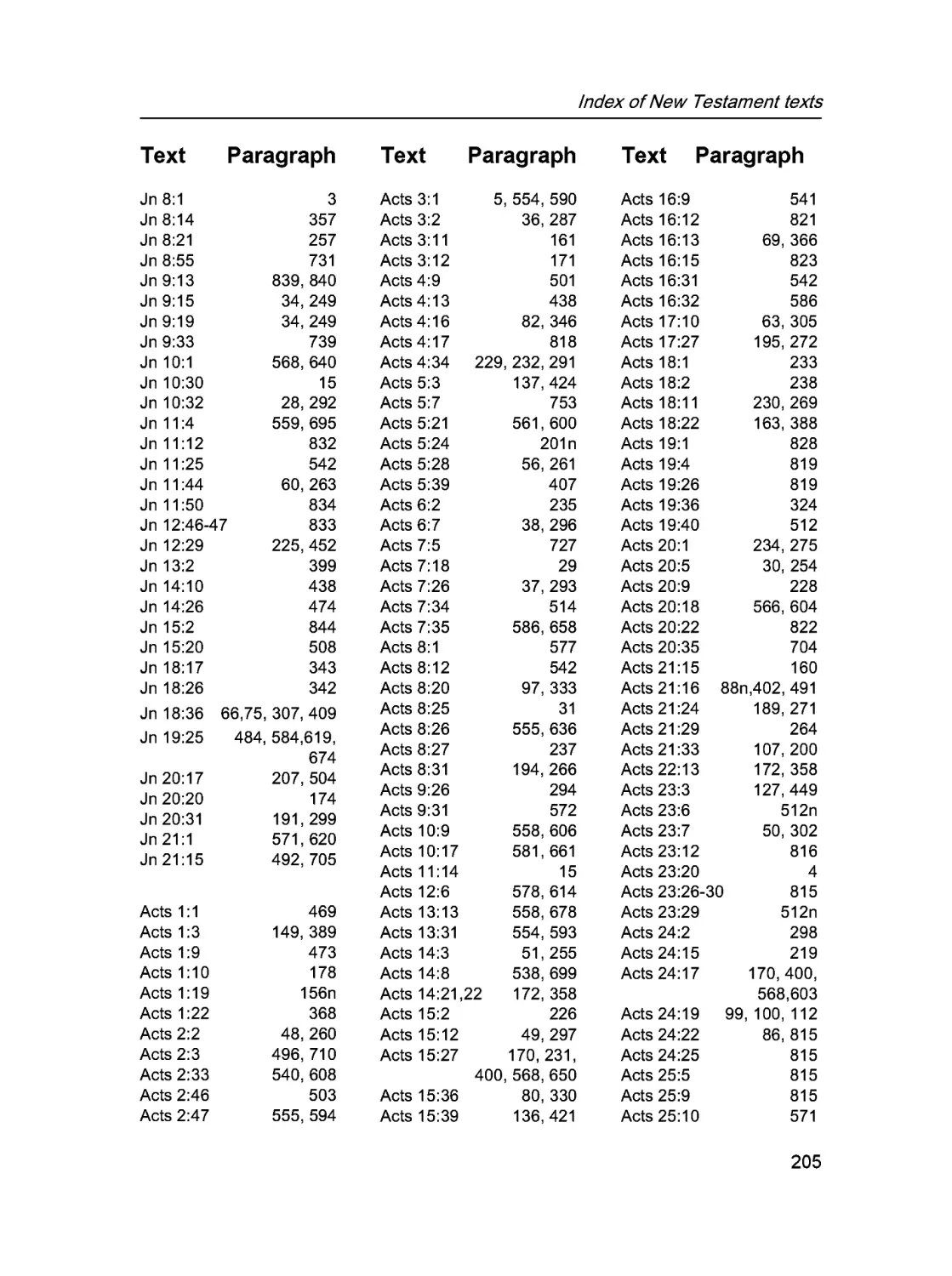
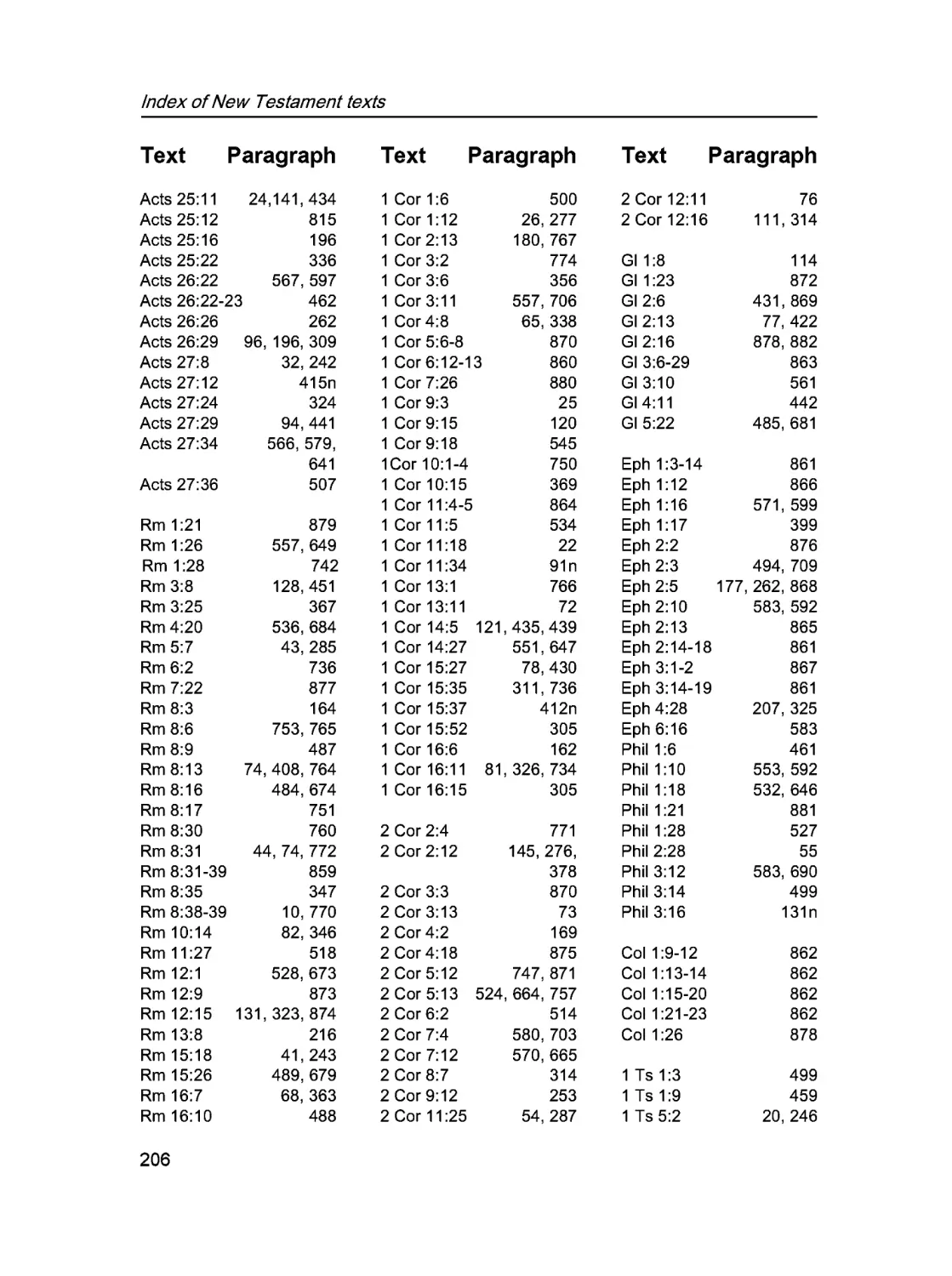
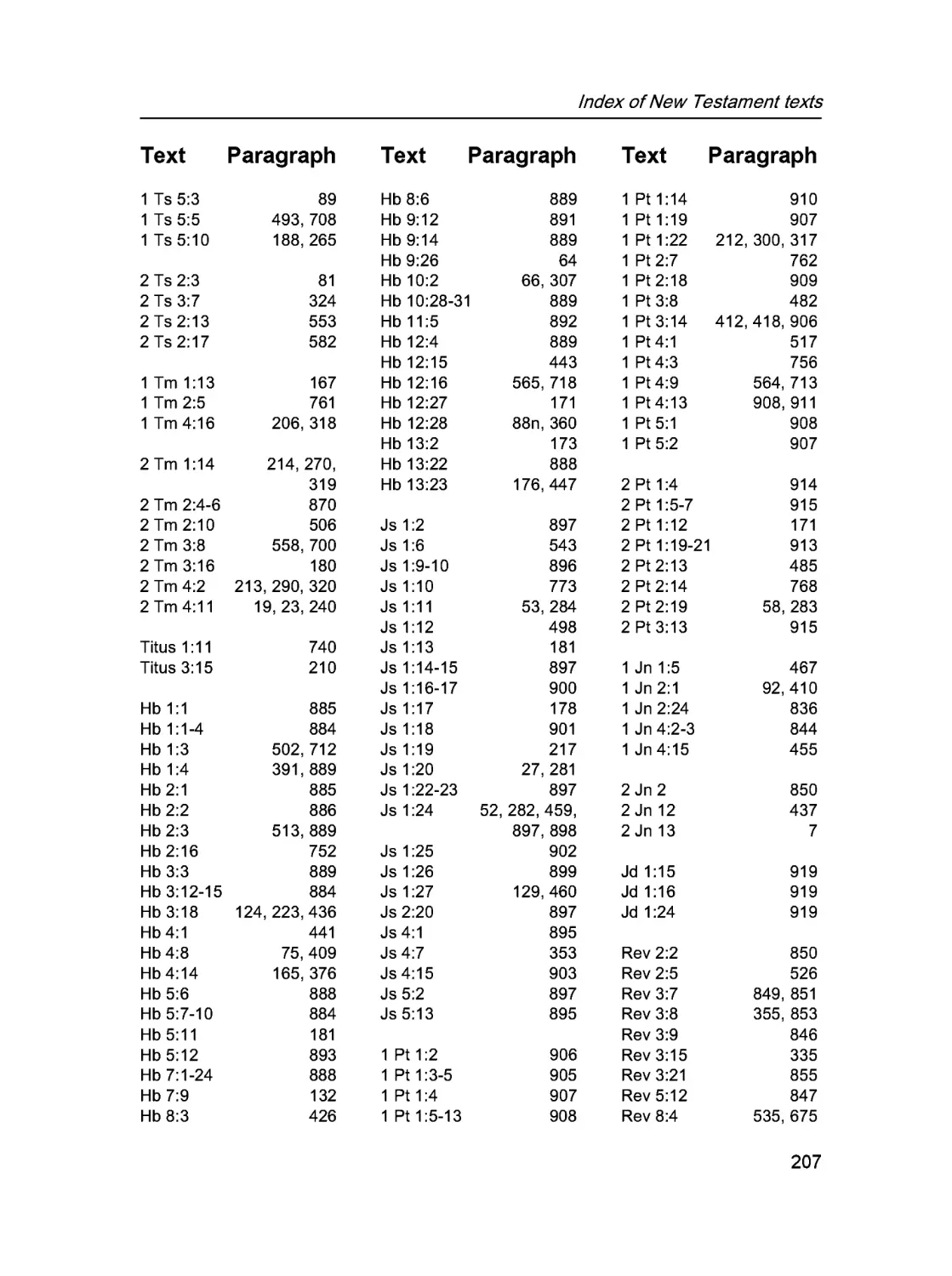
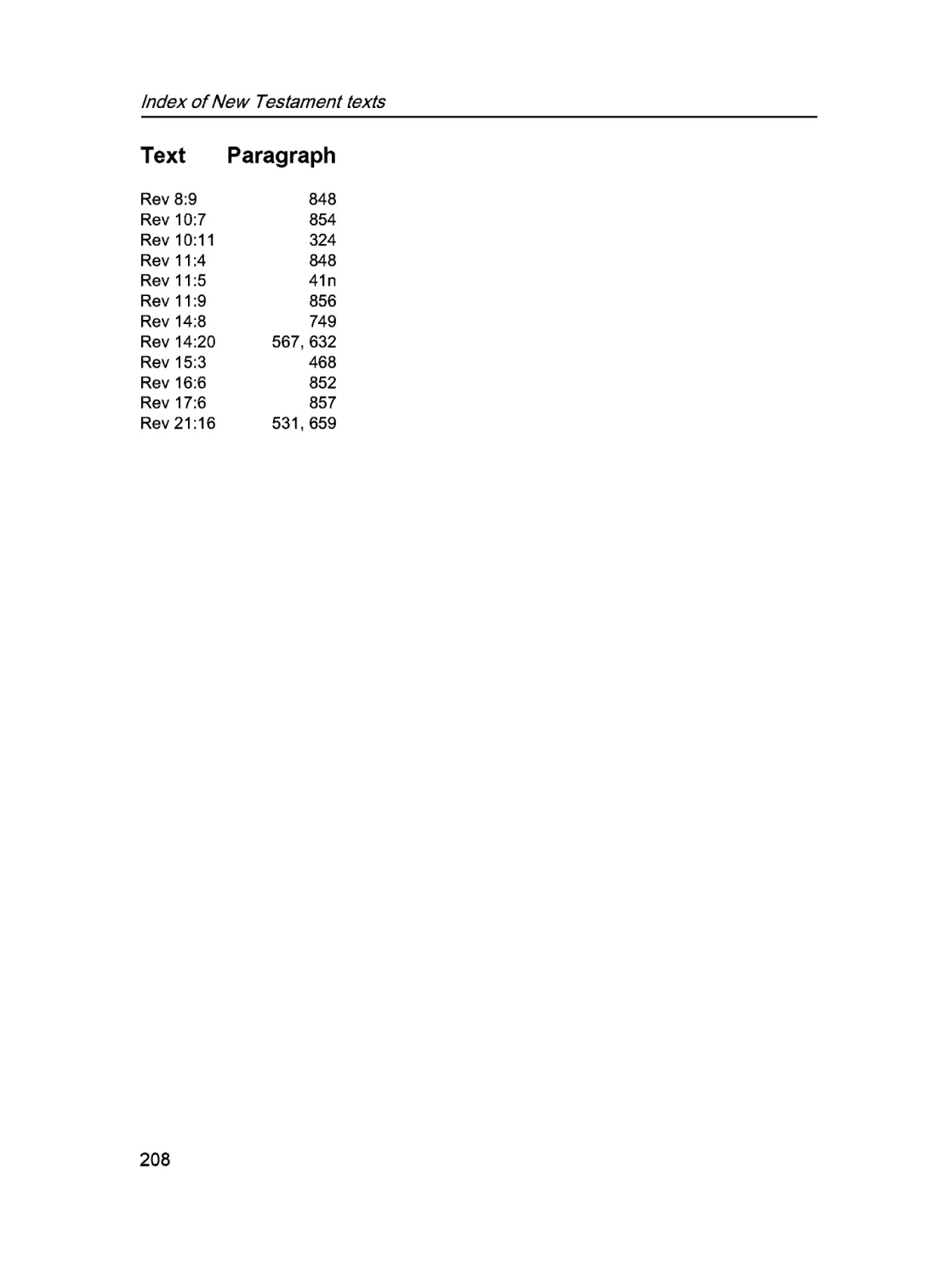
Index of New Testament texts	203
vii
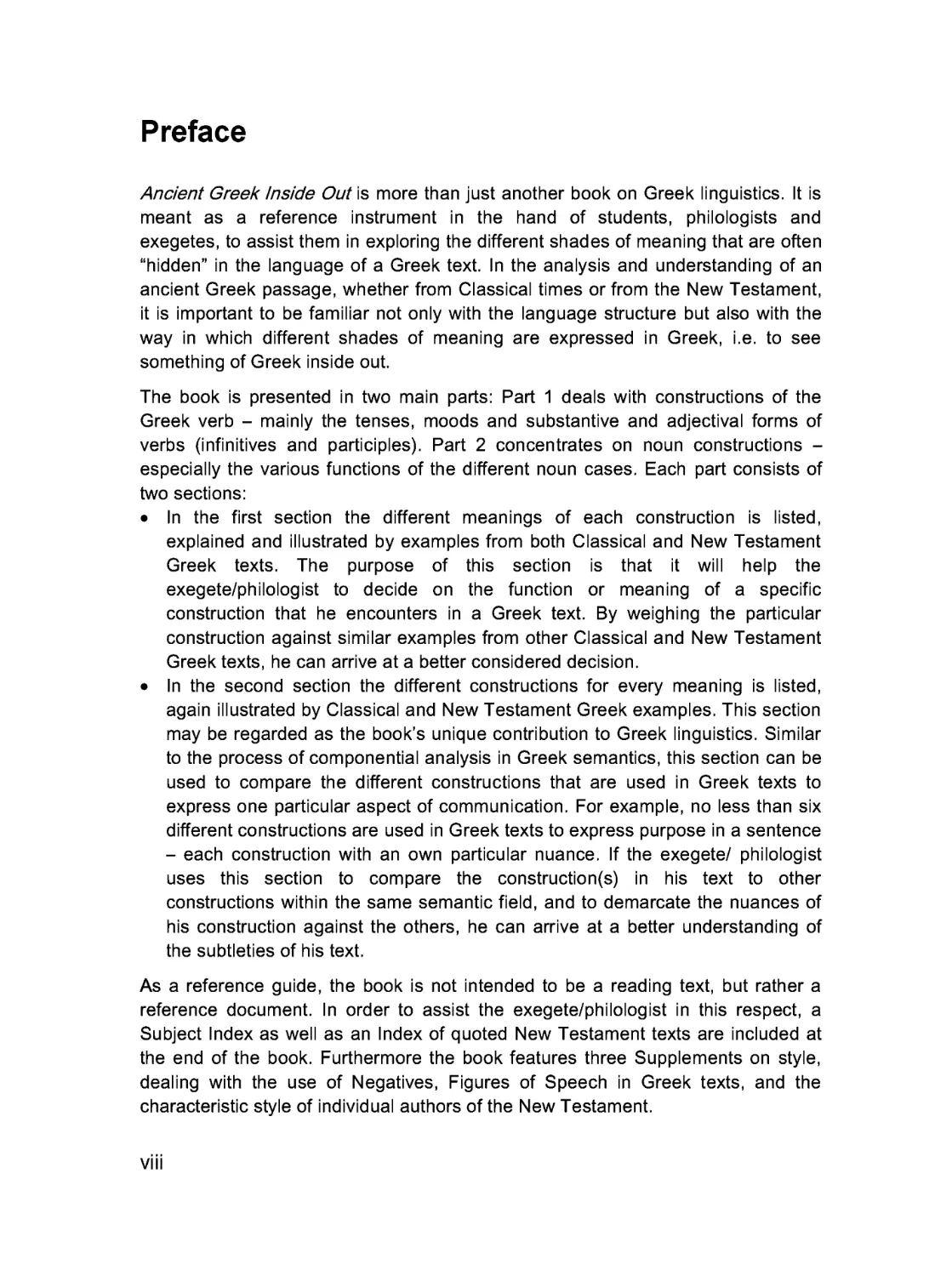
Preface
Ancient Greek inside Out is more than just another book on Greek linguistics. It is
meant as a reference instrument in the hand of students, philologists and
exegetes, to assist them in exploring the different shades of meaning that are often
“hidden” in the language of a Greek text. In the analysis and understanding of an
ancient Greek passage, whether from Classical times or from the New Testament,
it is important to be familiar not only with the language structure but also with the
way in which different shades of meaning are expressed in Greek, i.e. to see
something of Greek inside out.
The book is presented in two main parts: Part 1 deals with constructions of the
Greek verb - mainly the tenses, moods and substantive and adjectival forms of
verbs (infinitives and participles). Part 2 concentrates on noun constructions -
especially the various functions of the different noun cases. Each part consists of
two sections:
•	In the first section the different meanings of each construction is listed,
explained and illustrated by examples from both Classical and New Testament
Greek texts. The purpose of this section is that it will help the
exegete/philologist to decide on the function or meaning of a specific
construction that he encounters in a Greek text. By weighing the particular
construction against similar examples from other Classical and New Testament
Greek texts, he can arrive at a better considered decision.
•	In the second section the different constructions for every meaning is listed,
again illustrated by Classical and New Testament Greek examples. This section
may be regarded as the book’s unique contribution to Greek linguistics. Similar
to the process of componential analysis in Greek semantics, this section can be
used to compare the different constructions that are used in Greek texts to
express one particular aspect of communication. For example, no less than six
different constructions are used in Greek texts to express purpose in a sentence
- each construction with an own particular nuance. If the exegete/ philologist
uses this section to compare the construction(s) in his text to other
constructions within the same semantic field, and to demarcate the nuances of
his construction against the others, he can arrive at a better understanding of
the subtleties of his text.
As a reference guide, the book is not intended to be a reading text, but rather a
reference document. In order to assist the exegete/philologist in this respect, a
Subject Index as well as an Index of quoted New Testament texts are included at
the end of the book. Furthermore the book features three Supplements on style,
dealing with the use of Negatives, Figures of Speech in Greek texts, and the
characteristic style of individual authors of the New Testament.
viii
Since most Greek students of our time are mainly interested in the Greek New
Testament, they concentrate on Koine Greek, paying very little attention to the
Greek of Classical times. However, in this book Classical Greek is taken as the
point of departure. This is done for the simple reason that I have often found that
the soul of the Greek language - its logical consistency in structure - is exhibited in
Classical Greek far better than in any other period in the history of the language.
Therefore it is better, from a didactical point of view, to take Classical Greek as
departure point. Once the language system is clear, later deviations from the
system - so frequent in the New Testament! - can be understood and explained
more easily. Throughout this book it is indicated where and how New Testament
Greek agrees with Classical Greek or deviates from it.
This book originated from a series of notes which I compiled over many years for
postgraduate students in Greek. Later on it was expanded and reorganized to its
present form. In the process numerous passages were collected to serve as
illustrations. Many of these passages were identified over the years by
postgraduate students in the Faculty of Theology at North West University. For the
more rare examples I am indebted to various scholars whose publications are
listed at the end of this book.
The author
Potchefstroom
South Africa
ix
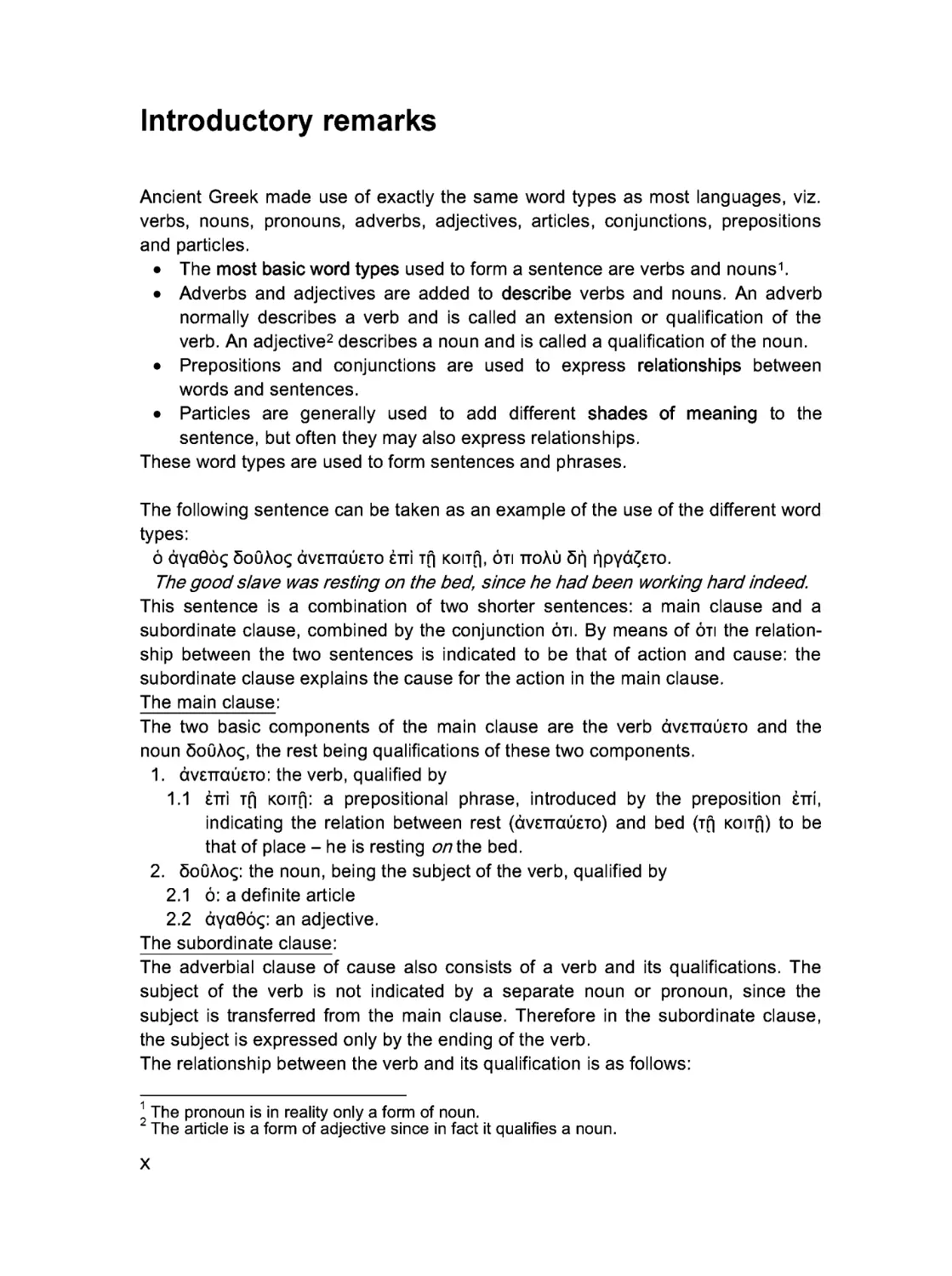
Introductory remarks
Ancient Greek made use of exactly the same word types as most languages, viz.
verbs, nouns, pronouns, adverbs, adjectives, articles, conjunctions, prepositions
and particles.
•	The most basic word types used to form a sentence are verbs and nouns1.
•	Adverbs and adjectives are added to describe verbs and nouns. An adverb
normally describes a verb and is called an extension or qualification of the
verb. An adjective2 describes a noun and is called a qualification of the noun.
•	Prepositions and conjunctions are used to express relationships between
words and sentences.
•	Particles are generally used to add different shades of meaning to the
sentence, but often they may also express relationships.
These word types are used to form sentences and phrases.
The following sentence can be taken as an example of the use of the different word
types:
6 ayaQo^ боОЛо^ ауЕттаието £iri Tfj KOiTfj, oti noAu 5q ррусфто.
The good slave was resting on the bed, since he had been working hard indeed.
This sentence is a combination of two shorter sentences: a main clause and a
subordinate clause, combined by the conjunction oti. By means of on the relation-
ship between the two sentences is indicated to be that of action and cause: the
subordinate clause explains the cause for the action in the main clause.
The main clause:
The two basic components of the main clause are the verb ovettoueto and the
noun 5oOAo<;, the rest being qualifications of these two components.
1.	dv£TTau£To: the verb, qualified by
1.1 £ni Tfj Koufj: a prepositional phrase, introduced by the preposition etti,
indicating the relation between rest (ауЕттаието) and bed (Tfj KOiTfj) to be
that of place - he is resting on the bed.
2.	5oOAo<;: the noun, being the subject of the verb, qualified by
2.1	6: a definite article
2.2	ауабб^: an adjective.
The subordinate clause:
The adverbial clause of cause also consists of a verb and its qualifications. The
subject of the verb is not indicated by a separate noun or pronoun, since the
subject is transferred from the main clause. Therefore in the subordinate clause,
the subject is expressed only by the ending of the verb.
The relationship between the verb and its qualification is as follows:
2 The pronoun is in reality only a form of noun.
2 The article is a form of adjective since in fact it qualifies a noun.
X
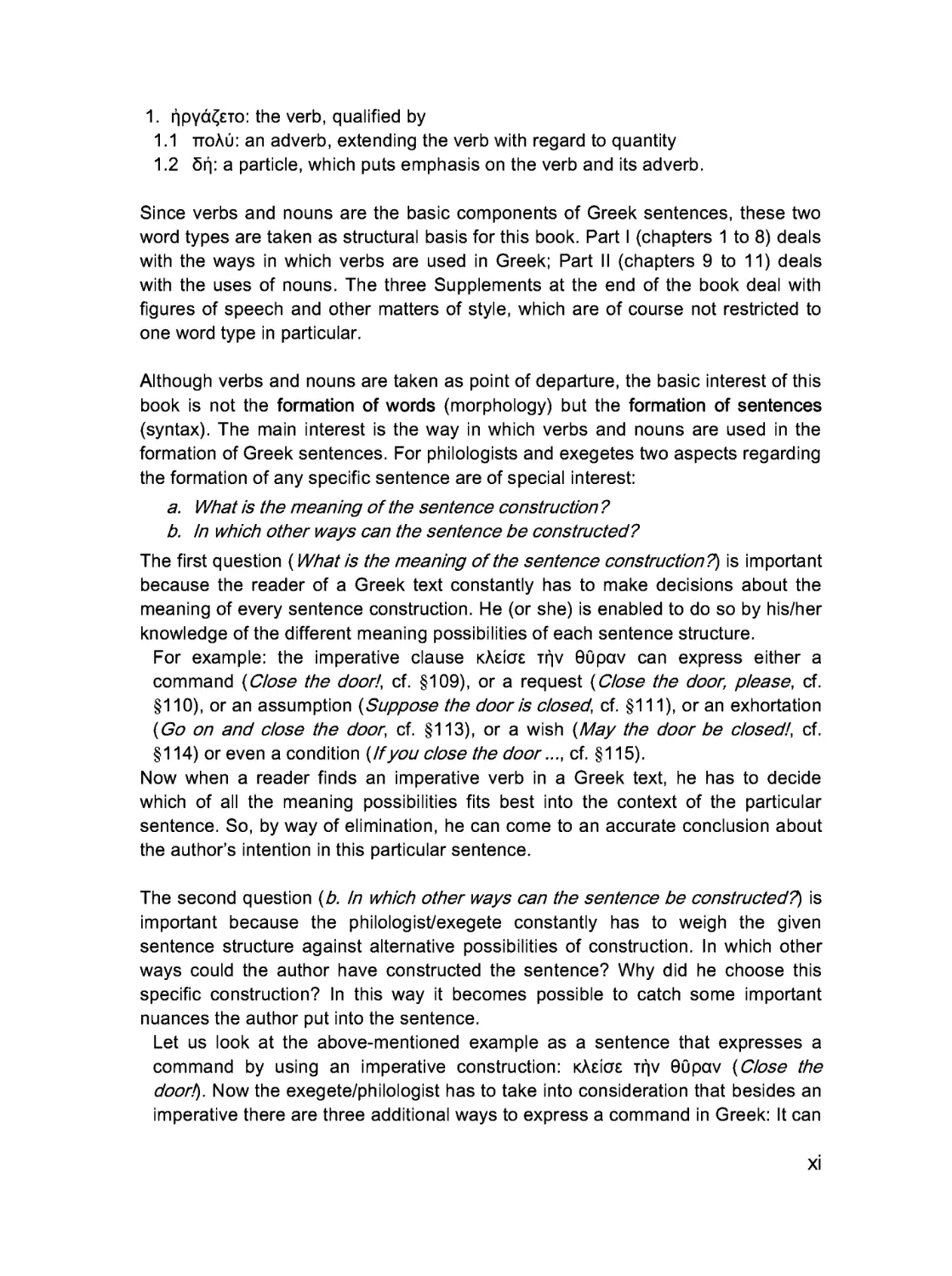
1.	прусфто: the verb, qualified by
1.1	ттоЛи: an adverb, extending the verb with regard to quantity
1.2	5f|: a particle, which puts emphasis on the verb and its adverb.
Since verbs and nouns are the basic components of Greek sentences, these two
word types are taken as structural basis for this book. Part I (chapters 1 to 8) deals
with the ways in which verbs are used in Greek; Part II (chapters 9 to 11) deals
with the uses of nouns. The three Supplements at the end of the book deal with
figures of speech and other matters of style, which are of course not restricted to
one word type in particular.
Although verbs and nouns are taken as point of departure, the basic interest of this
book is not the formation of words (morphology) but the formation of sentences
(syntax). The main interest is the way in which verbs and nouns are used in the
formation of Greek sentences. For philologists and exegetes two aspects regarding
the formation of any specific sentence are of special interest:
a.	What is the meaning of the sentence construction ?
b.	in which other ways can the sentence be constructed?
The first question (What is the meaning of the sentence construction?) is important
because the reader of a Greek text constantly has to make decisions about the
meaning of every sentence construction. He (or she) is enabled to do so by his/her
knowledge of the different meaning possibilities of each sentence structure.
For example: the imperative clause KAeioe tqv QOpav can express either a
command (Close the door!, cf. §109), or a request (Close the door, please, cf.
§110), or an assumption (Suppose the doom's dosed, cf. §111), or an exhortation
(Go on and dose the door, cf. §113), or a wish (May the door be dosed!, cf.
§114) or even a condition (Ifyou dose the door..., cf. §115).
Now when a reader finds an imperative verb in a Greek text, he has to decide
which of all the meaning possibilities fits best into the context of the particular
sentence. So, by way of elimination, he can come to an accurate conclusion about
the author’s intention in this particular sentence.
The second question (b. In which other ways can the sentence be constructed?) is
important because the philologist/exegete constantly has to weigh the given
sentence structure against alternative possibilities of construction. In which other
ways could the author have constructed the sentence? Why did he choose this
specific construction? In this way it becomes possible to catch some important
nuances the author put into the sentence.
Let us look at the above-mentioned example as a sentence that expresses a
command by using an imperative construction: KAeioe tqv QOpav (Close the
door!). Now the exegete/philologist has to take into consideration that besides an
imperative there are three additional ways to express a command in Greek: It can
xi
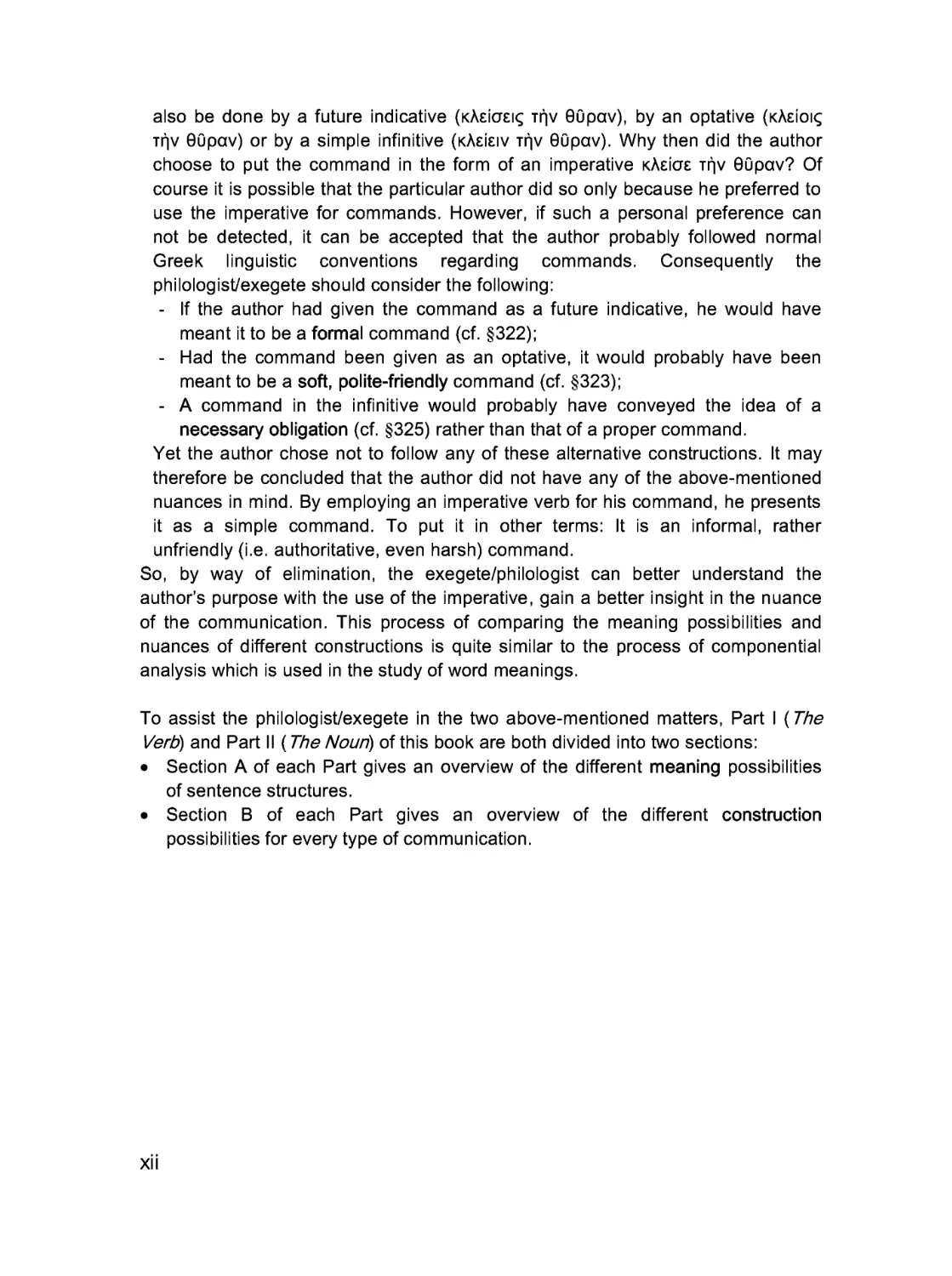
also be done by a future indicative (kAeictei^ tqv QOpav), by an optative (kAeIois
Tf]v QOpav) or by a simple infinitive (kAeieiv tqv QOpav). Why then did the author
choose to put the command in the form of an imperative kAeioe tqv QOpav? Of
course it is possible that the particular author did so only because he preferred to
use the imperative for commands. However, if such a personal preference can
not be detected, it can be accepted that the author probably followed normal
Greek linguistic conventions regarding commands. Consequently the
philologist/exegete should consider the following:
-	If the author had given the command as a future indicative, he would have
meant it to be a formal command (cf. §322);
-	Had the command been given as an optative, it would probably have been
meant to be a soft, polite-friendly command (cf. §323);
-	A command in the infinitive would probably have conveyed the idea of a
necessary obligation (cf. §325) rather than that of a proper command.
Yet the author chose not to follow any of these alternative constructions. It may
therefore be concluded that the author did not have any of the above-mentioned
nuances in mind. By employing an imperative verb for his command, he presents
it as a simple command. To put it in other terms: It is an informal, rather
unfriendly (i.e. authoritative, even harsh) command.
So, by way of elimination, the exegete/philologist can better understand the
author’s purpose with the use of the imperative, gain a better insight in the nuance
of the communication. This process of comparing the meaning possibilities and
nuances of different constructions is quite similar to the process of componential
analysis which is used in the study of word meanings.
To assist the philologist/exegete in the two above-mentioned matters, Part I (The
Verb) and Part II (The Noun) of this book are both divided into two sections:
•	Section A of each Part gives an overview of the different meaning possibilities
of sentence structures.
•	Section В of each Part gives an overview of the different construction
possibilities for every type of communication.
xii
PARTI: Verbs
Section A of Part I
Verbs:
Meaning possibilities of constructions
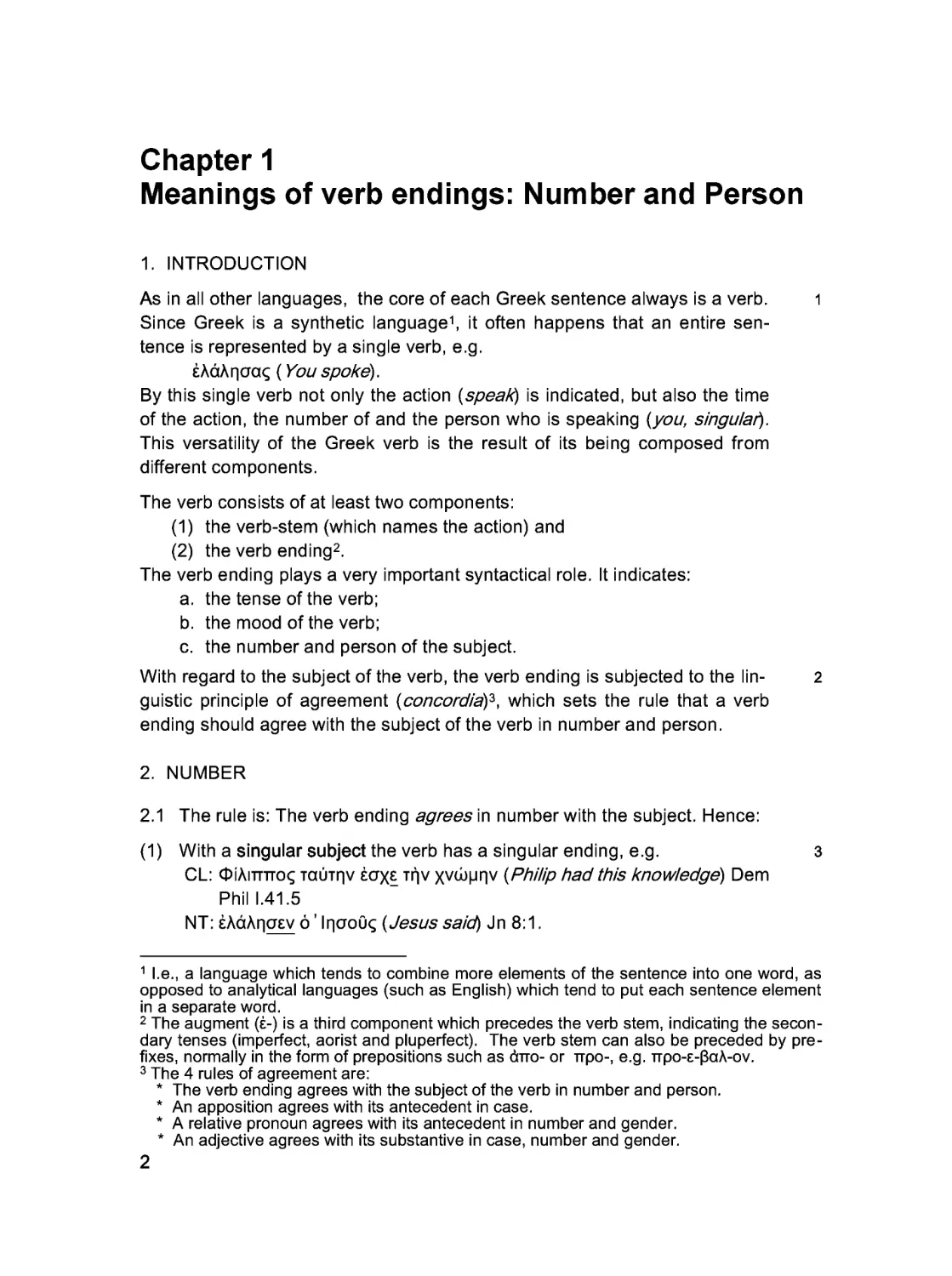
Chapter 1
Meanings of verb endings: Number and Person
1.	INTRODUCTION
As in all other languages, the core of each Greek sentence always is a verb. 1
Since Greek is a synthetic language1, it often happens that an entire sen-
tence is represented by a single verb, e.g.
sAaAqaa^ (You spoke).
By this single verb not only the action (speak) is indicated, but also the time
of the action, the number of and the person who is speaking (you, singulai).
This versatility of the Greek verb is the result of its being composed from
different components.
The verb consists of at least two components:
(1)	the verb-stem (which names the action) and
(2)	the verb ending2.
The verb ending plays a very important syntactical role. It indicates:
a.	the tense of the verb;
b.	the mood of the verb;
c.	the number and person of the subject.
With regard to the subject of the verb, the verb ending is subjected to the lin- 2
guistic principle of agreement (concordia)3, which sets the rule that a verb
ending should agree with the subject of the verb in number and person.
2.	NUMBER
2.1	The rule is: The verb ending agrees in number with the subject. Hence:
(1)	With a singular subject the verb has a singular ending, e.g.	з
CL: Ф1А|тттто<; тайтру естхе тпv xvcbpnv (Philip had this knowledge) Dem
Phil 1.41.5
NT: EAdAriOEv 6 ’ 1г]ао0<; (Jesus said) Jn 8:1.
1 l.e., a language which tends to combine more elements of the sentence into one word, as
opposed to analytical languages (such as English) which tend to put each sentence element
in a separate word.
2 The augment (Ё-) is a third component which precedes the verb stem, indicating the secon-
dary tenses (imperfect, aorist and pluperfect). The verb stem can also be preceded by pre-
fixes, normally in the form of prepositions such as duo- or про-, e.g. ттро-Е-РаА-ov.
3 The 4 rules of agreement are:
* The verb ending agrees with the subject of the verb in number and person.
* An apposition agrees with its antecedent in case.
* A relative pronoun agrees with its antecedent in number and gender.
* An adjective agrees with its substantive in case, number and gender.
2
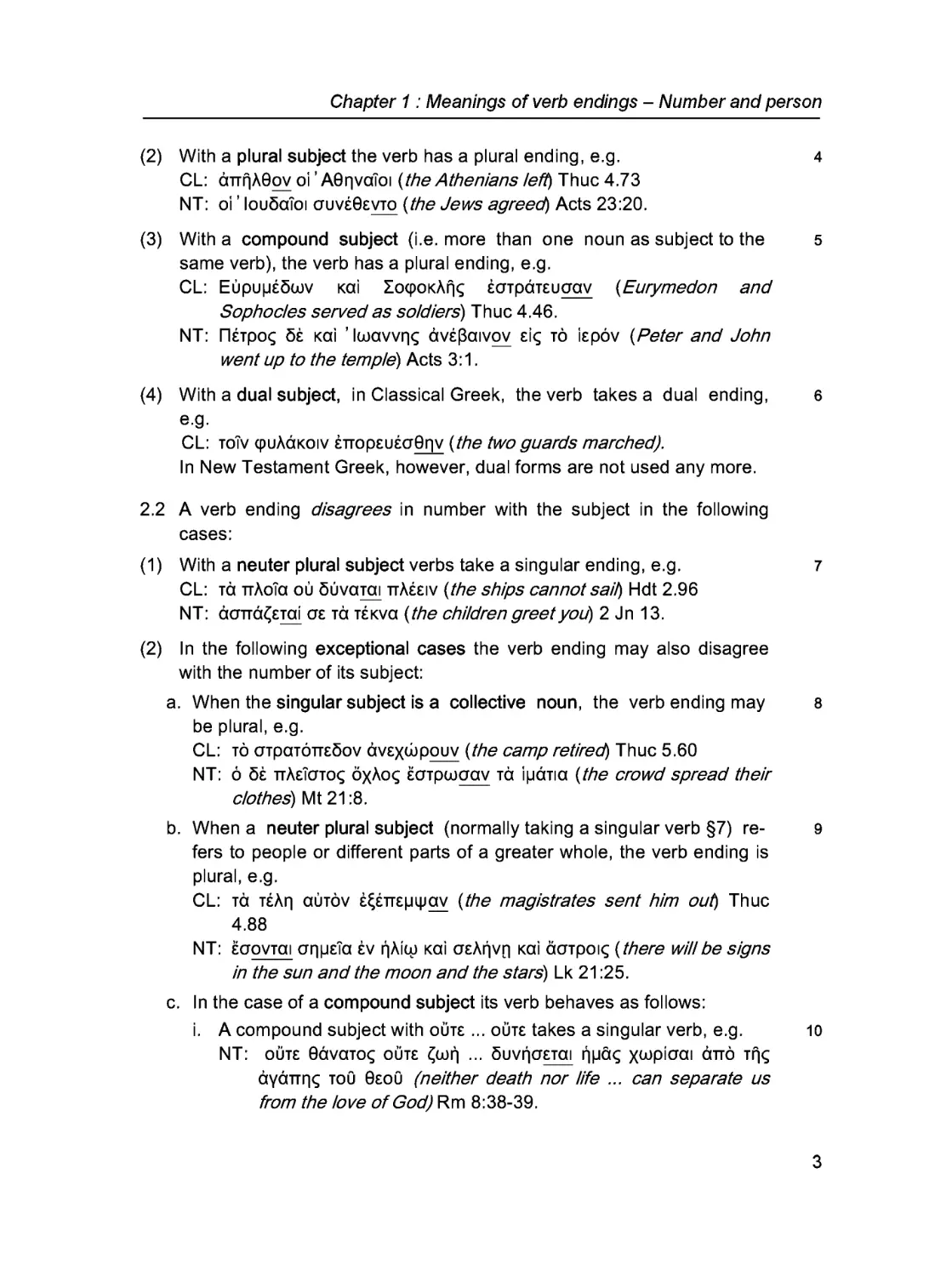
Chapter 1: Meanings of verb endings - Number and person
(2)	With a plural subject the verb has a plural ending, e.g.	4
CL: аттг]Л0оу oi ’ ASqvaToi (the Athenians left) Thue 4.73
NT: oi ’ louSaToi auveSeyro (the Jews agreed) Acts 23:20.
(3)	With a compound subject (i.e. more than one noun as subject to the 5
same verb), the verb has a plural ending, e.g.
CL: Еирирёбсоу Kai ZocpoKAfj^ есттратеистау (Eurymedon and
Sophocles served as soldiers) Thue 4.46.
NT: Петров 5e Kai ’Iwawr)^ dv£₽aivoy ei^ to iepov (Peter and John
went up to the temple) Acts 3:1.
(4)	With a dual subject, in Classical Greek, the verb takes a dual ending, 6
e.g.
CL: toTv cpuAdKOiv £ттор£и£а0г|У (the two guards marched).
In New Testament Greek, however, dual forms are not used any more.
2.2	A verb ending disagrees in number with the subject in the following
cases:
(1)	With a neuter plural subject verbs take a singular ending, e.g.	7
CL: та ттЛоТа ou Suvarai ttAeeiv (the ships cannot sail) Hdt 2.96
NT: аатта<£та1 cte та tekvo (the children greetyod) 2 Jn 13.
(2)	In the following exceptional cases the verb ending may also disagree
with the number of its subject:
a.	When the singular subject is a collective noun, the verb ending may 8
be plural, e.g.
CL: то атратоттЕбоу avExcopouv (the camp retired) Thue 5.60
NT: 6 б£ hAeioto^ 6\Koq ёсттрсистау та ipana (the crowd spread their
clothes) Mt 21:8.
b.	When a neuter plural subject (normally taking a singular verb §7) re- 9
fers to people or different parts of a greater whole, the verb ending is
plural, e.g.
CL: та теЛг] айтбу ё^ёттЕрфау (the magistrates sent him out) Thue
4.88
NT: eoovtoi arjpETa £v qAicp Kai asAfivr] Kai аатрок; (there will be signs
in the sun and the moon and the stars) Lk 21:25.
c.	In the case of a compound subject its verb behaves as follows:
I.	A compound subject with oute ... oute takes a singular verb, e.g. ю
NT: oute бауато^ oute  6uvf|a£Tai qpa^ хшР1ста| emo ТПС
ауаттг)^ тоО QeoO (neither death nor life ... can separate us
from the love of God) Rm 8:38-39.
3
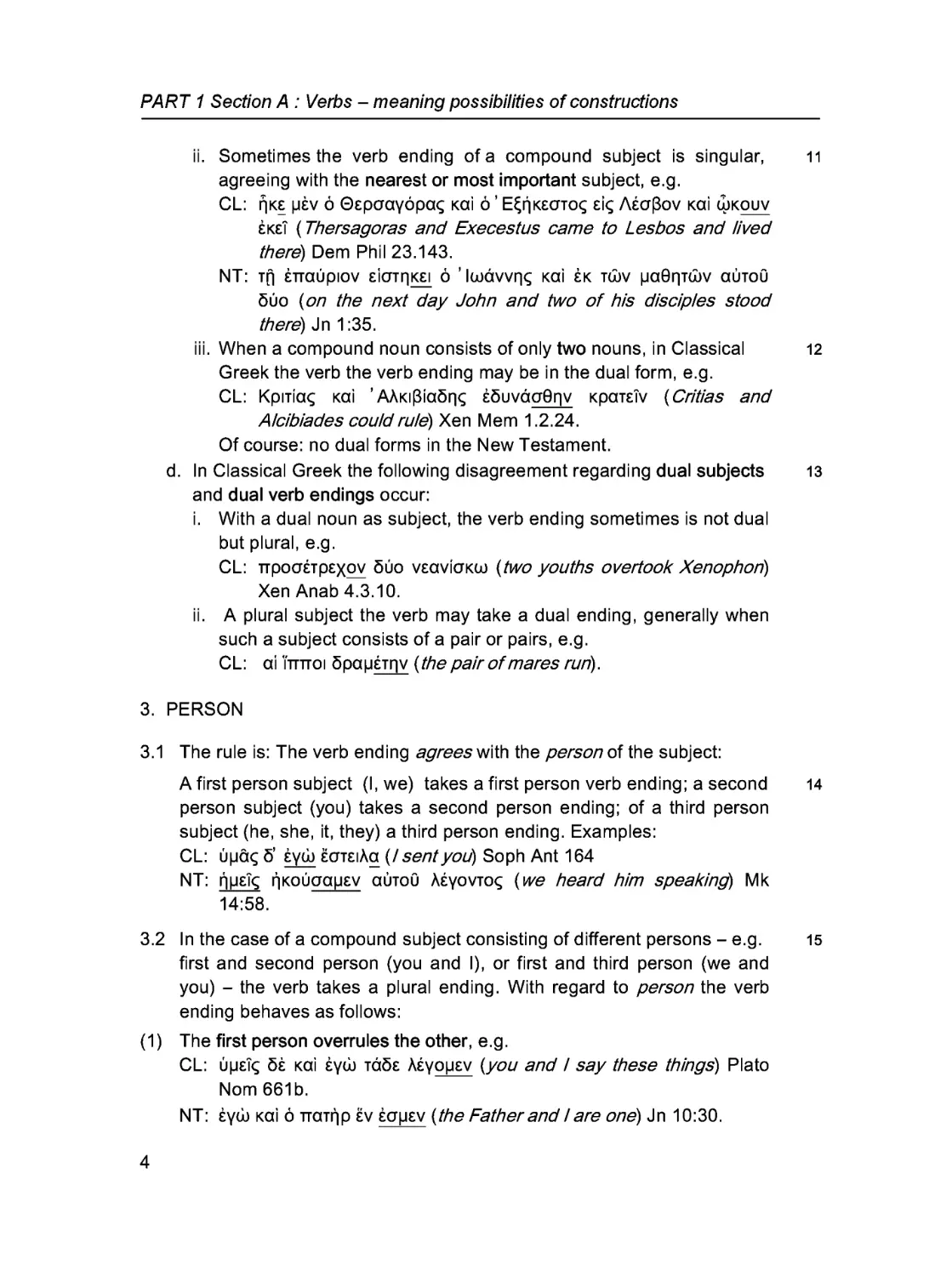
PART 1 Section A : Verbs - meaning possibilities of constructions
ii.	Sometimes the verb ending of a compound subject is singular, 11
agreeing with the nearest or most important subject, e.g.
CL: рке pev 6 Oepaayopa^ Kai 6 ’ Е^пкестто^ ei<; Aeajkiv Kai cokouv
ekeT (Thersagoras and Execestus came to Lesbos and lived
there) Dem Phil 23.143.
NT: Tfj ETTaupiov £1атг]К£1 6 ’Icodwr]^ Kai £K twv раОртсоу аитоО
5uo {on the next day John and two of his disciples stood
there) Jn 1:35.
ill.	When a compound noun consists of only two nouns, in Classical 12
Greek the verb the verb ending may be in the dual form, e.g.
CL: Kpuia^ Kai ’AAKi₽ia5p^ £5uvda9pv кратеТу {Critias and
Aicibiades could rule) Xen Mem 1.2.24.
Of course: no dual forms in the New Testament.
d.	In Classical Greek the following disagreement regarding dual subjects 13
and dual verb endings occur:
I.	With a dual noun as subject, the verb ending sometimes is not dual
but plural, e.g.
CL: ттроаетрехоу био veavioKW {two youths overtook Xenophon)
Xen Anab 4.3.10.
II.	A plural subject the verb may take a dual ending, generally when
such a subject consists of a pair or pairs, e.g.
CL: ai Tttttoi брарётру {the pair of mares run).
3.	PERSON
3.1	The rule is: The verb ending agrees with the person of the subject:
A first person subject (I, we) takes a first person verb ending; a second 14
person subject (you) takes a second person ending; of a third person
subject (he, she, it, they) a third person ending. Examples:
CL: ира^ б Еуш £ат£|Ла (/sentyod) Soph Ant 164
NT: pp£i<; пкойаар£У аитоО AEyovra^ {we heard him speaking) Mk
14:58.
3.2	In the case of a compound subject consisting of different persons - e.g. 15
first and second person (you and I), or first and third person (we and
you) - the verb takes a plural ending. With regard to person the verb
ending behaves as follows:
(1)	The first person overrules the other, e.g.
CL: up£i^ б£ Kai £yd) таб£ Asyopsv {you and i say these things) Plato
Norn 661b.
NT: £yd) Kai 6 ттатрр £v £ap£v {the Father and i are one) Jn 10:30.
4
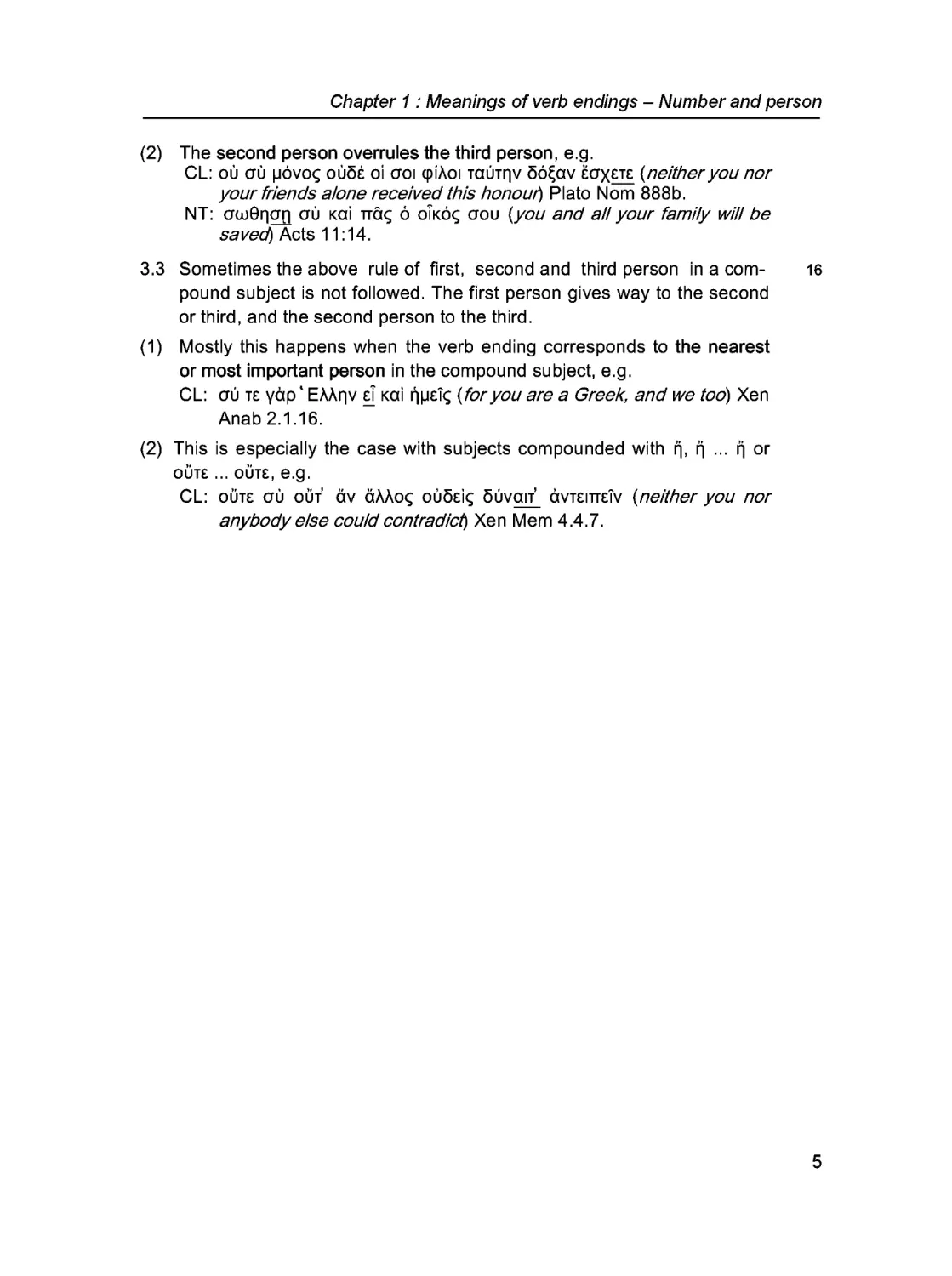
Chapter 1: Meanings of verb endings - Number and person
(2)	The second person overrules the third person, e.g.
CL: ou ou povo^ оибе oi ooi <piAoi TaiiTqv 56^av eoxete {neitheryou nor
your friends alone received this honour Plato Nom 888b.
NT: ocuSgog ай ка! тта^ 6 оТко<; oou {you and all your family will be
saved) Acts 11:14.
3.3	Sometimes the above rule of first, second and third person in a com- 16
pound subject is not followed. The first person gives way to the second
or third, and the second person to the third.
(1)	Mostly this happens when the verb ending corresponds to the nearest
or most important person in the compound subject, e.g.
CL: ай те yap' EAAgv ei Kai gpEi^ {foryou are a Greek, and we too) Xen
Anab 2.1.16.
(2)	This is especially the case with subjects compounded with g, q ... q or
oute ... ойте, e.g.
CL: oute ou out’ av аЛЛо<; ou5fi^ SuvaiT1 ovteitteTv {neither you nor
anybody else could contradict) Xen Mem 4.4.7.
5
Chapter 2
Meanings offenses: Indicative Verbs
Verb endings have more in store than only indicating the number and person
of the subject. They also indicate the form, tense and moodcfi the verb. This
chapter deals with the tenses of verbs6 in particular.
In Greek six tenses are used, all indicated by the verb ending:	17
(1)	Present
(2)	Imperfect
(3)	Future
(4)	Aorist
(5)	Perfect
(6)	Pluperfect.
These six tenses are divided into two main groups, viz. primary tenses (the
present, future and perfect) and secondary tenses (the imperfect, aorist and
pluperfect)7.
These six tenses may refer to the time of the action, the stage of action or 18
the mode of action8:
•	Time is used with reference to the past, present and future time.
•	Stage of action involves the stage of the action’s completion - whether it is
continuous (linear, durative), momentary (punctiliar) or resulting
(consecutive).
•	Mode of action refers to the manner in which a certain action is executed.
The different possible modes of action are discussed with each verb tense
below.
In most languages a verb’s tense mainly refers to its time and stage of
action9. In Greek, however, it can refer to time, stage of action a/7<ymode of
action (cf. Smyth, 1971:412). Take note: The tense of a Greek verb does not
always denote time, stage and mode of action. In some instances it is
evident from the context that the tense of the verb refers to the time of the
action only, or only to the stage of the action or to the mode of the action. In
6 The form of the verb (active, middle and passive) is not discussed in this book book. The
mood of the verb, however, is of such importance for Greek syntax that its use is discussed
in a separate chapter (Chapter 3).
7 N.B.: the tenses with the augment (Ё-) are secondary; those without it are primary.
8 Also called aspect, or Aktionsart (after the German Aktionsart, Dutch and Afrikaans:
handeisaard).
9 In Latin, for example, the 6 tenses are used almost exclusively to indicate relative time.
Also English, e.g. / go; i have gone; i shall go, I shall have gone; I went; I had gone. The
only instances of relative time in Greek sentences are in indirect speech and with a
subjunctive or optative in primary or secondary sequence (cf. §199 to §203).
6
Chapter 2 : Meanings offenses - Indicative verbs
each case the reader has to infer from the context the referential nature of
the tense. Moreover the tenses are used differently in the different moods of
the verbfcf. Chapter 3):
□	The tenses of the indicative can refer to time, stage of action as well as
mode of action.
□	The tenses of all other moods do not refer to time but to stage and/or
mode of action only.
This Chapter deals with the uses of the tenses in the indicative only. The
tenses in the other moods are discussed in Chapter 5.
The meaning possibilities of the tenses in indicative verbs are the following:
1.	PRESENT
Time	Stage	Mode
Present action	Durative action	Customary action
Future (certain)	Momentary action	General truth
Historic and perfect present	Resultative action	Conative action
1.1	Indication of time
The present indicative is the normal way to denote a situation or action that 19
takes place in the present time (for nuances cf. §240ff and §252ff), e.g.
CL: Asyco ттрб^ outov табе (/say this to him) Lys 14
NT: Лоика^ scrriv povo^ рет ’ epoO (only Luke is with me) 2 Tm 4:11.
However, the present tense is sometimes used in a temporal context other
than the present.
(1)	A present tense for the future (for its nuance cf. §246), e.g.	20
CL: ei аитг] f] ттбАк; Аг]ф0г]а£та1, exei Kai ttoctov tqv ZeikeAiov (if this city
falls, he owns the entire Sicily Thue 6.91
NT: прера кирюи w<; кАетттг)^ £v vukt! outco^ epxETai (the day of the
Lord will come like a thief comes at night} 1 Ts 5:2.
In Classical Greek the present instead of the future tense is used often
with soothsaying or oracles about the future, called oracular present, e.g.
CL: XP°vcp aypeuei flpidpou ttoAiv (in time he will capture Priam's
city) Aesch Agam 126.
(2)	A present tense for the past - historical present (for its nuance cf. §250),	21
e.g.
CL: 6 бе ОерютокАг]^ (psuyEi ei^ Kepxupav. (Themistocies tied to
Corcyra.) Thue 1.136
NT: Tfj EJTaupiov (BAeuei tov ’IrjaoOv epxopevov ттрб^ outov (on the
following day he saw Jesus coming towards him) Jn 1:29.
7
PART 1 Section A : Verbs - meaning possibilities of constructions
(3)	Present for perfect: The present tense is used simply as a substitute for 22
a perfect tense, without any specific nuance. This is especially the case
with the group of verbs that in themselves convey a perfect action, such
as пксо {/have come/am here). Therefore:
CL: oi5a оттг] oi'xovTai {/know where they are going [= have gone]) Xen
Anab 1.4.8
NT: акоисо oxiapaia ev upTv UTTdpxeiv (/ have heard/am aware of
schisms amongst you) 1 Cor 11:18.
1.2	Indication of stage of action
Often a present tense qualifies the verb with regard to stage of action. Stage
of action cannot be seen in the verb’s form, but should be inferred from the
context.
(1)	A present tense can denote a linear (durative) action or situation, e.g. 23
CL: ou5ev аЛЛо 5|5аак£тси {he is being taught nothing else) Plato Men
87c
NT: Лоика^ eotiv povo^ p£T ’ spoO {only Luke is with me) 2 Tm 4:11.
(2)	The present tense can also denote punctiliar (momentary) action, e.g. 24
CL: upsT^ рЕтараЛЛЕТЕ {you turn around) Thue II 16.2
NT: Kaioapa ЕтпкаЛоирси {/appealto Caesai) Acts 25:11.
(3)	Often the present tense does not denote any specific stage of action. In 25
such cases the verb is unqualified with regard to its stage of action, e.g.
CL: Asyco ттрб^ outov таб£ (/ say this to him) Lys 14
NT: spf] arroAoyia eotiv аитг] {this is my defense) 1 Cor 9:3.
1.3	Indication of mode of action
Sometimes it is clear from the context that the present indicative indicates a
certain mode of action, such as the following:
(1)	Present of customary action: an action that somebody is used to do, e.g. 26
CL: outo<; pev ибсор ttIvei, syw 5e oivov {this man usually drinks water,
whereas i drink wine) Dem 19.46
NT: Ёкаато^ upwv Asysi, ’Eyw psv sipi ПаиАои, ’Eyw 5e ’AttoAAw, ...
(each one of you says: i am of Paul, or: i am ...")1 Cor1:12.
(2)	Present of the general truth: an action that is true for all time (for its diffe- 27
rent nuances cf. §280 - §285), e.g.
CL: aysi 5e ттрб^ (pax; tqv dAf|0£iav xpovo<j. (Time brings the truth to
light.) Men Sent 11
NT: dpyf] yap av5pd<; SiKaioauvqv QeoO ouk spyd^ETai. {Man's anger
does not achieve righteousness before God.) Js 1:20.
8
Chapter 2 : Meanings offenses - Indicative verbs
(3)	Conative present: an action that is attempted or intended, e.g.	28
CL: tqv 5d^av TauTqv TT£i6ouaiv ирбк; аттоЗаАеТу (they tried to
persuade you to reject this honour) Isocr 6.12.
NT: 5ia ttoiov outouv epyov epe АЮд^ете; (For which one of these works
do you want to stone me?) Jn 10:32.
2.	IMPERFECT
Time and stage of action
Situation/process/series in past
For present (description of places)
For aorist or pluperfect (hkov, etc.)
Mode of action
Customary action	Inchoative
Iterative	Truth just recognised
Conative
2.1	indication of time and stage of action
Being a secondary tense the imperfect usually indicates past action.
Whereas the aorist denotes punctiliar (momentary) action in the past (cf.
§48), the imperfect denotes linear (durative) action in the past (for nuances
cf. §254ff). Examples of an imperfect tense denoting linear action:
(1)	A situation in the past, e.g.	29
CL: oi 5e ’ASqvaToi aQupco^ eixov (the Athenians were disheartened)
Xen Hell I 5.8
NT: ouk qSei tov ’ Icoancp (he did not know Joseph) Acts 7:18.
(2)	An action continuing or being in progress for some time in the past, e.g. 30
CL: аттоттАеиаа^ ei^ AdpipaKOv та^ vaO^ ЕттЕакЕйафу (having sailed to
Lampsacus, he repaired his ships) Xen Hell II 2.2
NT: outoi бе ттроа£Л0дут£<; spsvov f]pd<; ev TpcoaSi (they went ahead
and waited for us in Troas) Acts 20:5.
(3)	A series of actions in the past, e.g.	31
CL: 5i£cp9£ipov’ AOnvaicov ttevte Kai eikooi (they killed [over a period of
time] twenty-five Athenians - a serial killing!) Thue 3.28
NT: ттоЛЛас; те ксора^ twv ZapapiTinv ейг|уу£А1^оуто (they preached the
gospei in many villages of Samaria) Acts 8:25.
(4)	An imperfect is often used in lieu of one of the other tenses:
a.	Imperfect for the present (for its nuance cf. §241), e.g.	32
CL: acpiKOVTO етп tov ттотарду copies tqv twv MaKpcbvcov x<bpav
Kai тг]v twv ZKU0r]vu)v (they came to the river which is the border
between the country of the Macrones and that of the Scyths) Xen
Anab 4.8.1
NT: qA0opev eh; tottov Tiva KaAoupevov KaAou^ Aipevac;, <b eyyu^
ttoAi^ qv Aaaaia (we came to a place called Safe Harbours,
which is near to the town ofLasea) Acts 27:8.
9
PART 1 Section A : Verbs - meaning possibilities of constructions
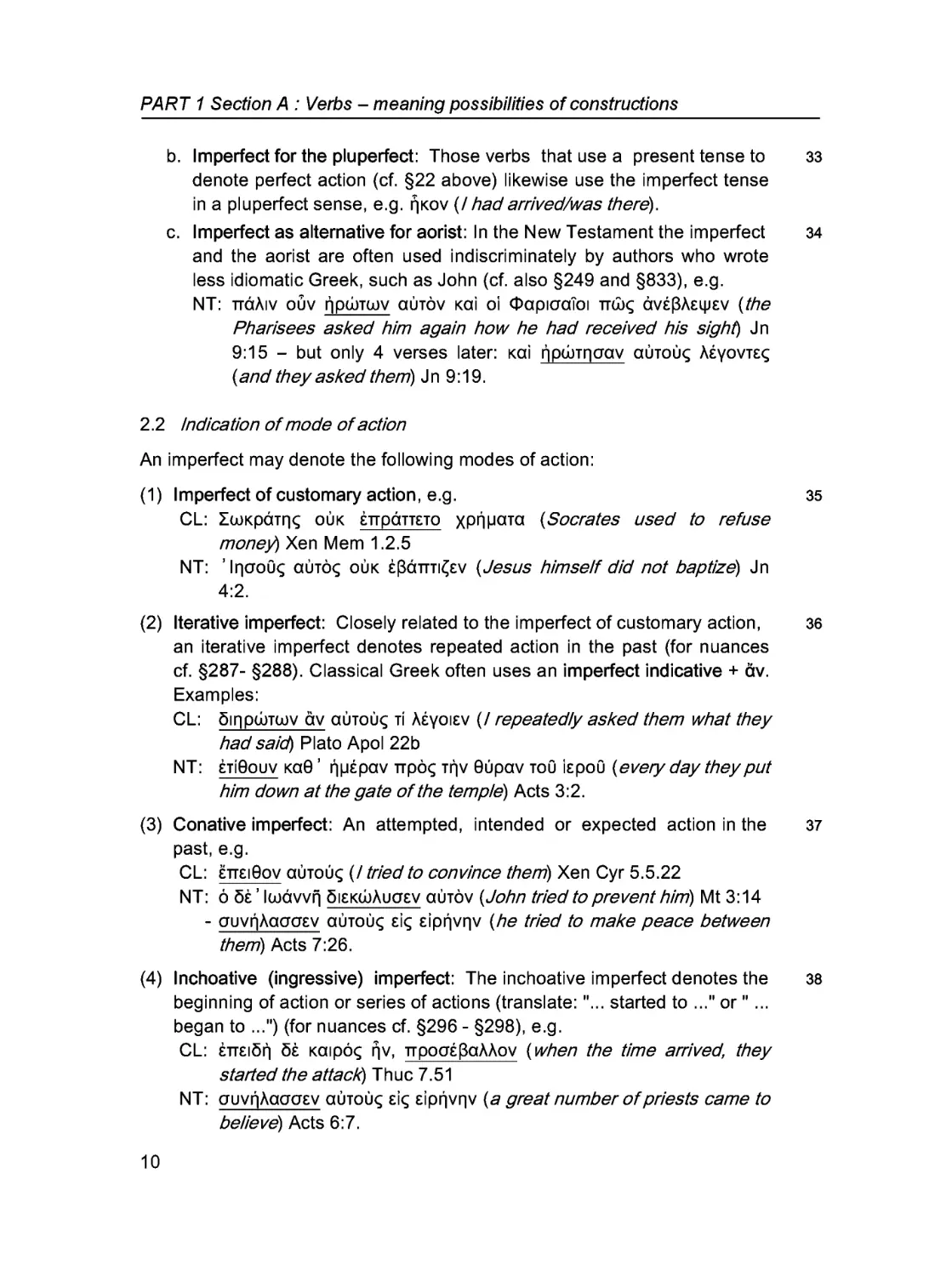
b.	Imperfect for the pluperfect: Those verbs that use a present tense to 33
denote perfect action (cf. §22 above) likewise use the imperfect tense
in a pluperfect sense, e.g. hkov (/hadarrived/was there).
c.	Imperfect as alternative for aorist: In the New Testament the imperfect 34
and the aorist are often used indiscriminately by authors who wrote
less idiomatic Greek, such as John (cf. also §249 and §833), e.g.
NT: ttctAiv ouv дрсотсоу outov Kai oi cpapioaToi ttw<; dvepAeipev {the
Pharisees asked him again how he had received his sight} Jn
9:15 - but only 4 verses later: Kai npdnriaav аитои^ Леуоуте^
(and they asked them) J n 9:19.
2.2	Indication of mode of action
An imperfect may denote the following modes of action:
(1)	Imperfect of customary action, e.g.	35
CL: Есократг)^ оик £ттратт£то хРПРата {Socrates used to refuse
mone^) Xen Mem 1.2.5
NT: ’ IriooO^ аито<; оик £₽аттт1^£У {Jesus himself did not baptize) Jn
4:2.
(2)	Iterative imperfect: Closely related to the imperfect of customary action, 36
an iterative imperfect denotes repeated action in the past (for nuances
cf. §287- §288). Classical Greek often uses an imperfect indicative + av.
Examples:
CL: SiripcbTcov av аитои^ ti AsyoiEv (/ repeatedly asked them what they
had said) Plato Apol 22b
NT: etIQouv каб ’ npspav ттро^ tqv Qupav toO ispoO {every day they put
him down at the gate of the temple) Acts 3:2.
(3)	Conative imperfect: An attempted, intended or expected action in the 37
past, e.g.
CL: etteiQov аитои^ (/tried to convince them) Xen Cyr 5.5.22
NT: 6 5e ’ Icodwri SiekcoAuoev outov {John tried to prevent him) Mt 3:14
- auvf|Aaaa£v аитои^ si<; £ipf|vr|v {he tried to make peace between
them) Acts 7:26.
(4)	Inchoative (ingressive) imperfect: The inchoative imperfect denotes the 38
beginning of action or series of actions (translate:"... started to ..." or"...
began to ...") (for nuances cf. §296 - §298), e.g.
CL: £TT£i5f] б£ Kaipo^ rjv, тт росте ftaAAov {when the time arrived, they
started the attack) Thue 7.51
NT: auvf|Aaaa£v аитои^ ci<; si p f] vq v {a great number of priests came to
believe) Acts 6:7.
10
Chapter 2 : Meanings offenses - Indicative verbs
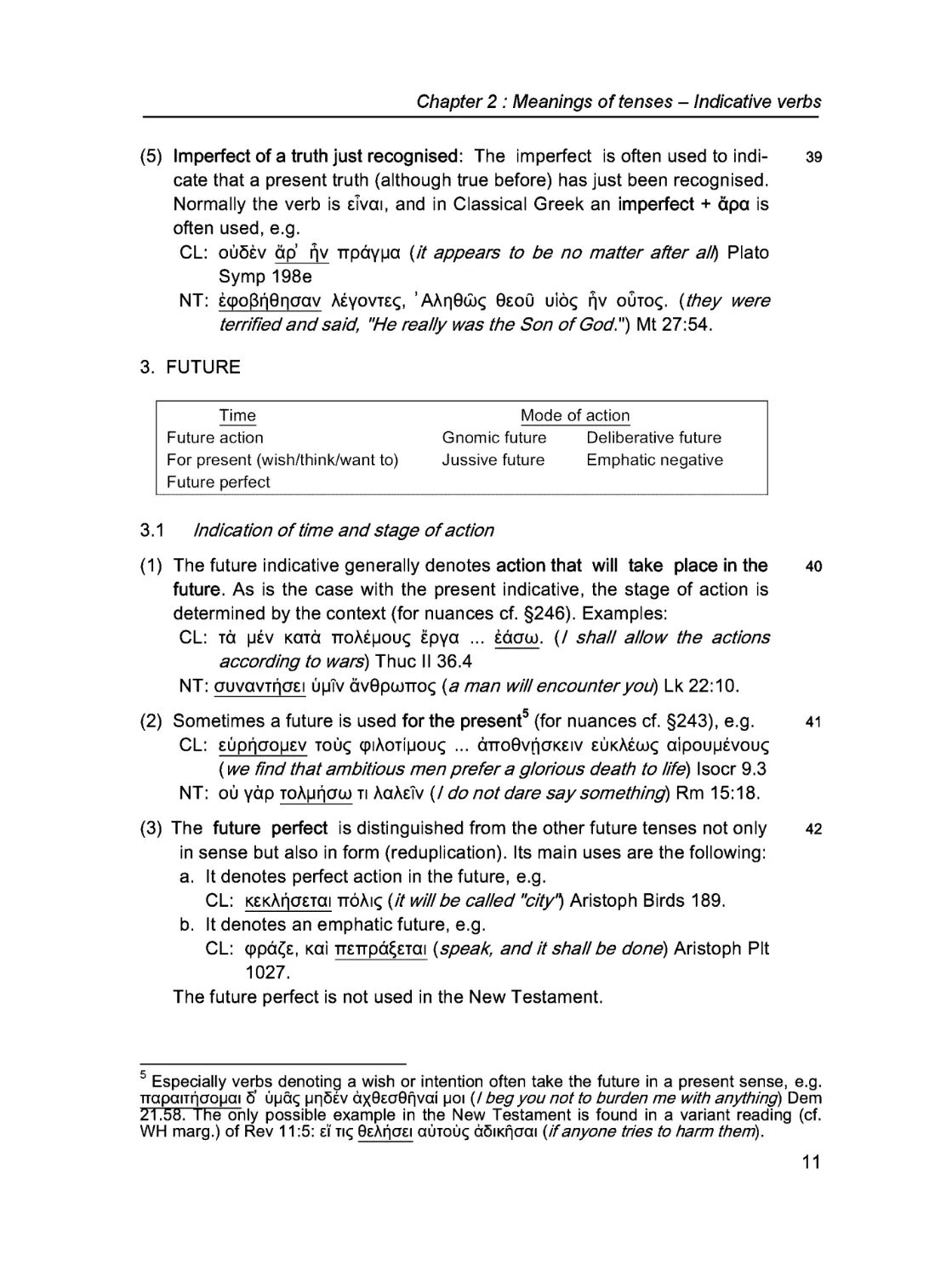
(5)	Imperfect of a truth just recognised: The imperfect is often used to indi- 39
cate that a present truth (although true before) has just been recognised.
Normally the verb is eivai, and in Classical Greek an imperfect + apa is
often used, e.g.
CL: oudev ap’ qv ттраура (it appears to be no matter after all) Plato
Symp 198e
NT: EtpoPgOgaav AfyovTEg, ’AAgQwg QeoO uidg gv оитод. (they were
terrified and said, "He really was the Son of God.") Mt 27:54.
3.	FUTURE
Time Future action	Mode of action
	Gnomic future	Deliberative future
For present (wish/think/want to) Future perfect	Jussive future	Emphatic negative
3.1	Indication of time and stage of action
(1)	The future indicative generally denotes action that will take place in the 40
future. As is the case with the present indicative, the stage of action is
determined by the context (for nuances cf. §246). Examples:
CL: та pfv ката ттоЛ£роид еруа ... £аасо. (/ shall allow the actions
according to wars) Thue II 36.4
NT: auvavTqaEi upTv avQpcoTTog (a man will encounter you) Lk 22:10.
(2)	Sometimes a future is used for the present5 (for nuances cf. §243), e.g. 41
CL: £upqao|j£v тоид tpiAoTipoug ... aTTO0vgaK£iv £икЛ£сод aipoup£voug
(we find that ambitious men prefer a glorious death to life) Isocr 9.3
NT: ou yap тоЛрдасо ti AoAeiv (/ do not dare say something) Rm 15:18.
(3)	The future perfect is distinguished from the other future tenses not only 42
in sense but also in form (reduplication). Its main uses are the following:
a.	It denotes perfect action in the future, e.g.
CL: к£кЛда£та1 noAig (it will be called "city') Aristoph Birds 189.
b.	It denotes an emphatic future, e.g.
CL: <ppa^£, Kai тт£ттра%£тд| (speak, and it shall be done) Aristoph Pit
1027.
The future perfect is not used in the New Testament.
5 Especially verbs denoting a wish or intention often take the future in a present sense, e.g.
Traparrqaopai 5’ up ад pqdev dxSeaSqvai poi (/ beg you not to burden me with anything) Dem
21.58. I he only possible example in the New Testament is found in a variant reading (cf.
WH marg.) of Rev 11:5: e’i Tig 9£Aqo£i аитоид ddiKqoai (if anyone tries to harm them).
11
PART 1 Section A : Verbs - meaning possibilities of constructions
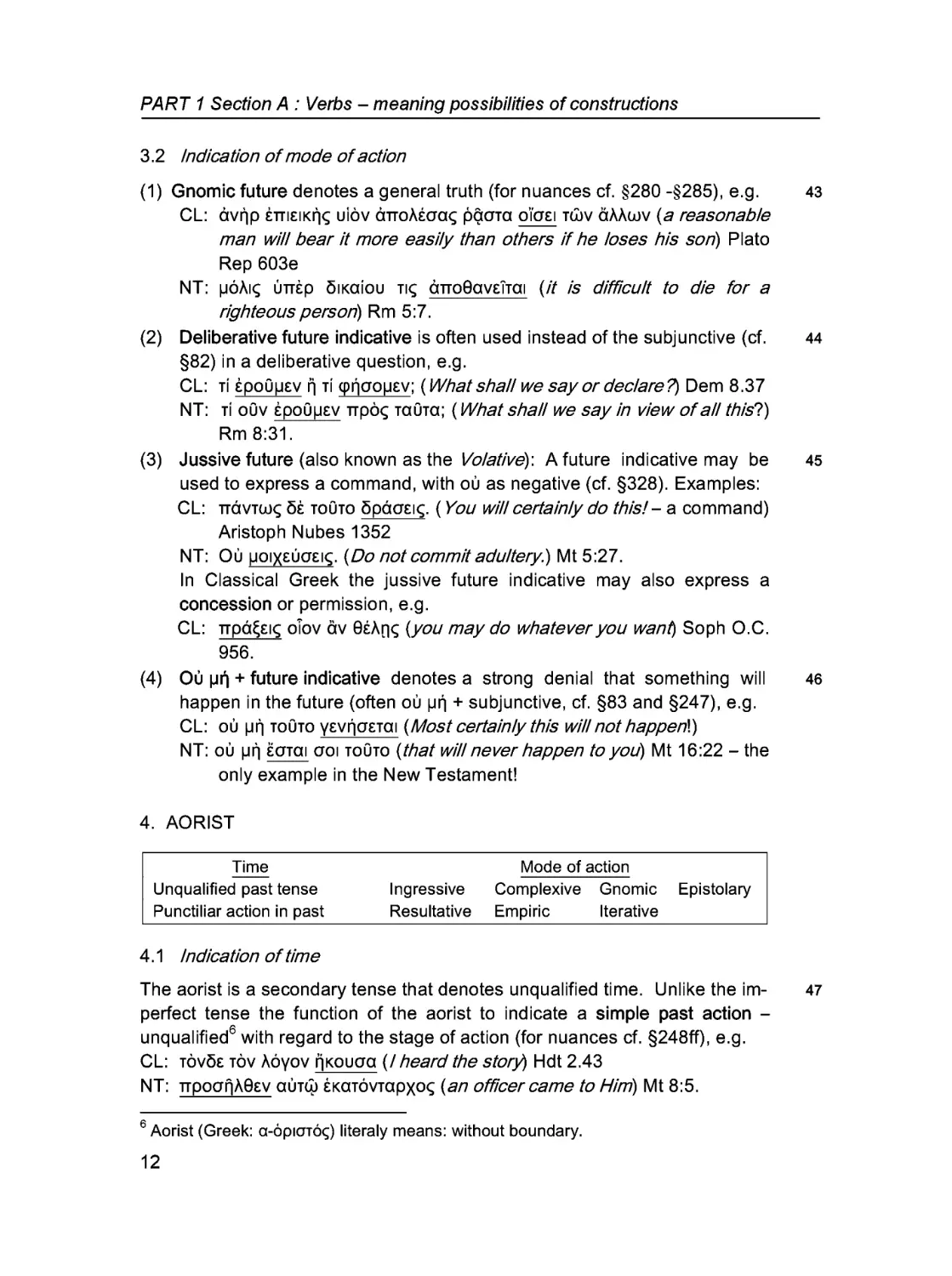
3.2	Indication of mode of action
(1)	Gnomic future denotes a general truth (for nuances cf. §280 -§285), e.g. 43
CL: dvqp ettieikik uidv аттоЛеста^ раата oioei twv aAAwv (a reasonable
man will bear it more easily than others if he loses his son) Plato
Rep 603e
NT: pdAi^ иттер SikoIou ti<j атто9ау£Ттси (it is difficult to die for a
righteous person) Rm 5:7.
(2)	Deliberative future indicative is often used instead of the subjunctive (cf. 44
§82) in a deliberative question, e.g.
CL: ti EpoOpsv q Ti (pgaopEv; (What shall we say or deciare?) Dem 8.37
NT: ti oOv EpoOpsv ттро^ таОта; (What shall we say in view of all this?)
Rm 8:31.
(3)	Jussive future (also known as the Voiativdy. A future indicative may be 45
used to express a command, with ou as negative (cf. §328). Examples:
CL: ttovtco^ 5Ё тоОто брааек;. (You will certainly do this!- a command)
Aristoph Nubes 1352
NT: Ou poixsucrsi^. (Do not commit adultery.) Mt 5:27.
In Classical Greek the jussive future indicative may also express a
concession or permission, e.g.
CL: прачек; oiov av 0£Л[К (you may do whatever you want) Soph O.C.
956.
(4)	Ou pf| + future indicative denotes a strong denial that something will 46
happen in the future (often ou pq + subjunctive, cf. §83 and §247), e.g.
CL: ou pf] тоОто yEvnoETai (Most certainly this will not happen\)
NT: ou pf] £ O’Tai aoi тоОто (that will never happen to you) Mt 16:22 - the
only example in the New Testament!
4.	AORIST
Time	Mode of action
Unqualified past tense	Ingressive	Complexive Gnomic Epistolary
Punctiliar action in past	Resultative Empiric	Iterative
4.1	Indication of time
The aorist is a secondary tense that denotes unqualified time. Unlike the im- 47
perfect tense the function of the aorist to indicate a simple past action -
unqualified6 with regard to the stage of action (for nuances cf. §248ff), e.g.
CL: tov5e tov Adyov дкоиаа (/heard the story) Hdt 2.43
NT: ттроадЛбЕУ аитф Ёкатоутархо^ (an officer came to Him) Mt 8:5.
6 Aorist (Greek: а-орютод) literaly means: without boundary.
12
Chapter 2 : Meanings offenses - Indicative verbs
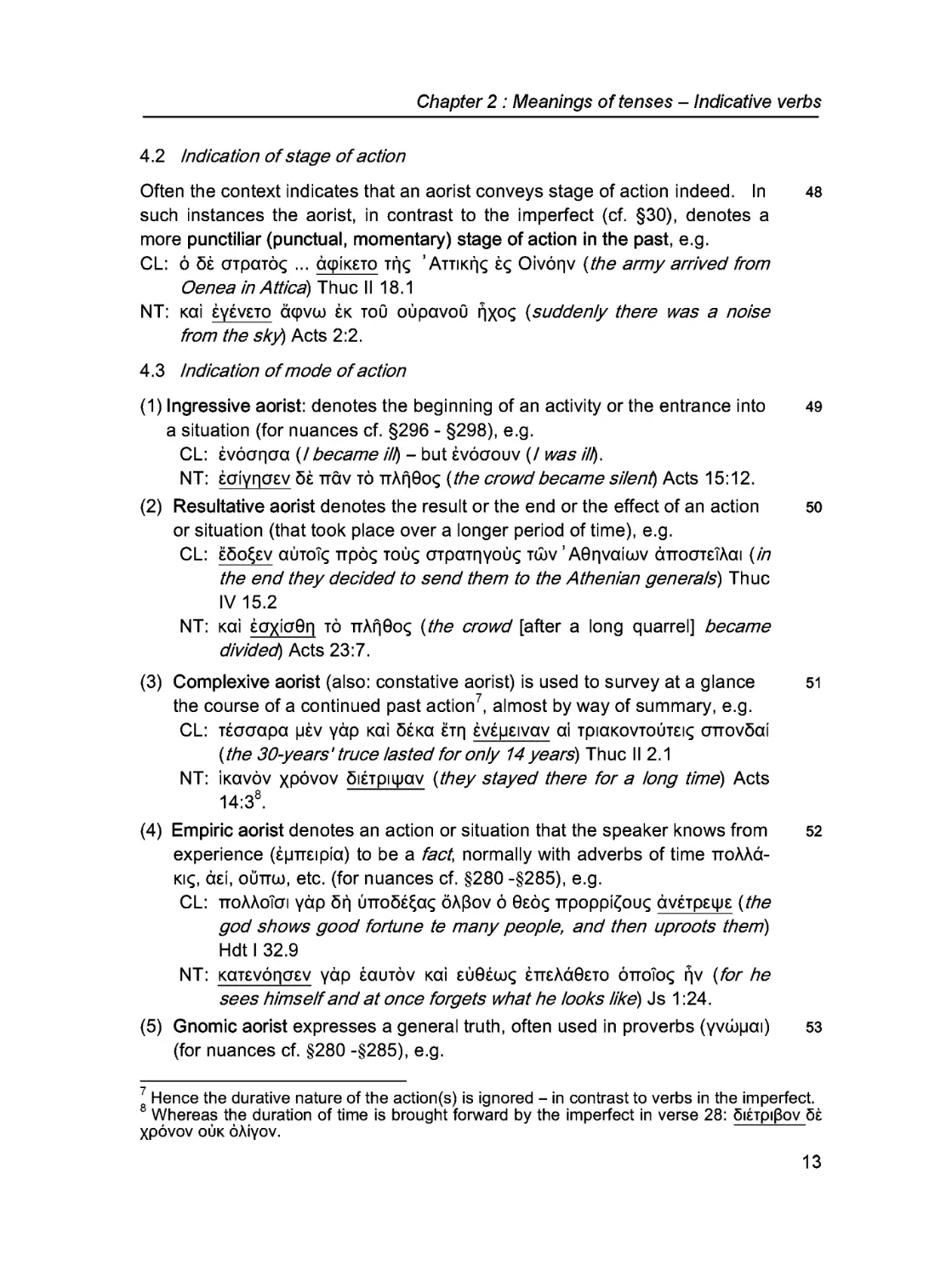
4.2	Indication of stage of action
Often the context indicates that an aorist conveys stage of action indeed. In 48
such instances the aorist, in contrast to the imperfect (cf. §30), denotes a
more punctiliar (punctual, momentary) stage of action in the past, e.g.
CL: 6 5e атратон ... dtp I keto тгк ’ Attikik £<; Oivoiqv {the army arrived from
Oenea in Attica) Thue II 18.1
NT: Kai eyeveto acpvco ek toO oupavoO nx°€ {suddenly there was a noise
from the sk^) Acts 2:2.
4.3	Indication of mode of action
(1)	Ingressive aorist: denotes the beginning of an activity or the entrance into 49
a situation (for nuances cf. §296 - §298), e.g.
CL: Evdonoa {/became ill) - but evoctouv (/ was ill).
NT: £aiyr|a£v 5e ttov to ттЛг|0о^ {the crowd became silent) Acts 15:12.
(2)	Resultative aorist denotes the result or the end or the effect of an action 50
or situation (that took place over a longer period of time), e.g.
CL: eSo^ev аитоТ^ ттрб^ тои^ атратпуои^ twv ’ AQqvaiwv аттоат£ТЛа1 {in
the end they decided to send them to the Athenian generals) Thue
IV 15.2
NT: Kai EaxicrSn то ттЛг|0о<; {the crowd [after a long quarrel] became
divided) Acts 23:7.
(3)	Complexive aorist (also: constative aorist) is used to survey at a glance 51
the course of a continued past action7, almost by way of summary, e.g.
CL: тЕстаара p£v yap Kai б£ка етг] £v£p£ivav ai tpiokovtoutei^ аттоуба!
{the 30-years' truce lasted for only 14 years) Thue II 2.1
NT: iKavov xpovov SiETpiipav {they stayed there for a long time) Acts
14:38.
(4)	Empiric aorist denotes an action or situation that the speaker knows from 52
experience (Epirsipia) to be a fact, normally with adverbs of time ттоЛЛа-
ki<j, dEi, outtco, etc. (for nuances cf. §280 -§285), e.g.
CL: ттоЛЛоТсл yap 5f] йттоб£^а<; 6A₽ov 6 0£б^ ттрорр1£ои<; dvETpEipE {the
god shows good fortune te many people, and then uproots them)
Hdt I 32.9
NT: катЕУбдаЕУ yap eoutov Kai euOeco^ еттеЛоОето ottoio^ qv {for he
sees himself and at once forgets what he looks like) Js 1:24.
(5)	Gnomic aorist expresses a general truth, often used in proverbs (yvcbpai) 53
(for nuances cf. §280 -§285), e.g.
7 Hence the durative nature of the action(s) is ignored - in contrast to verbs in the imperfect.
° Whereas the duration of time is brought forward by the imperfect in verse 28: SitrpiPov 5e
Xpovov оик dAiyov.
13
PART 1 Section A : Verbs - meaning possibilities of constructions
CL: каЛЛо<; p£v yap q XP°VO? avgAoJOEv q vdao^ £papav£ {for beauty is
either wasted by time or withered by disease) Isocr 1.6
NT: av£T£iA£v yap 6 qAio^ ... Kai £%qpav£v tov xopiov {the sun rises ...
and scorches the plant} Js 1:11.
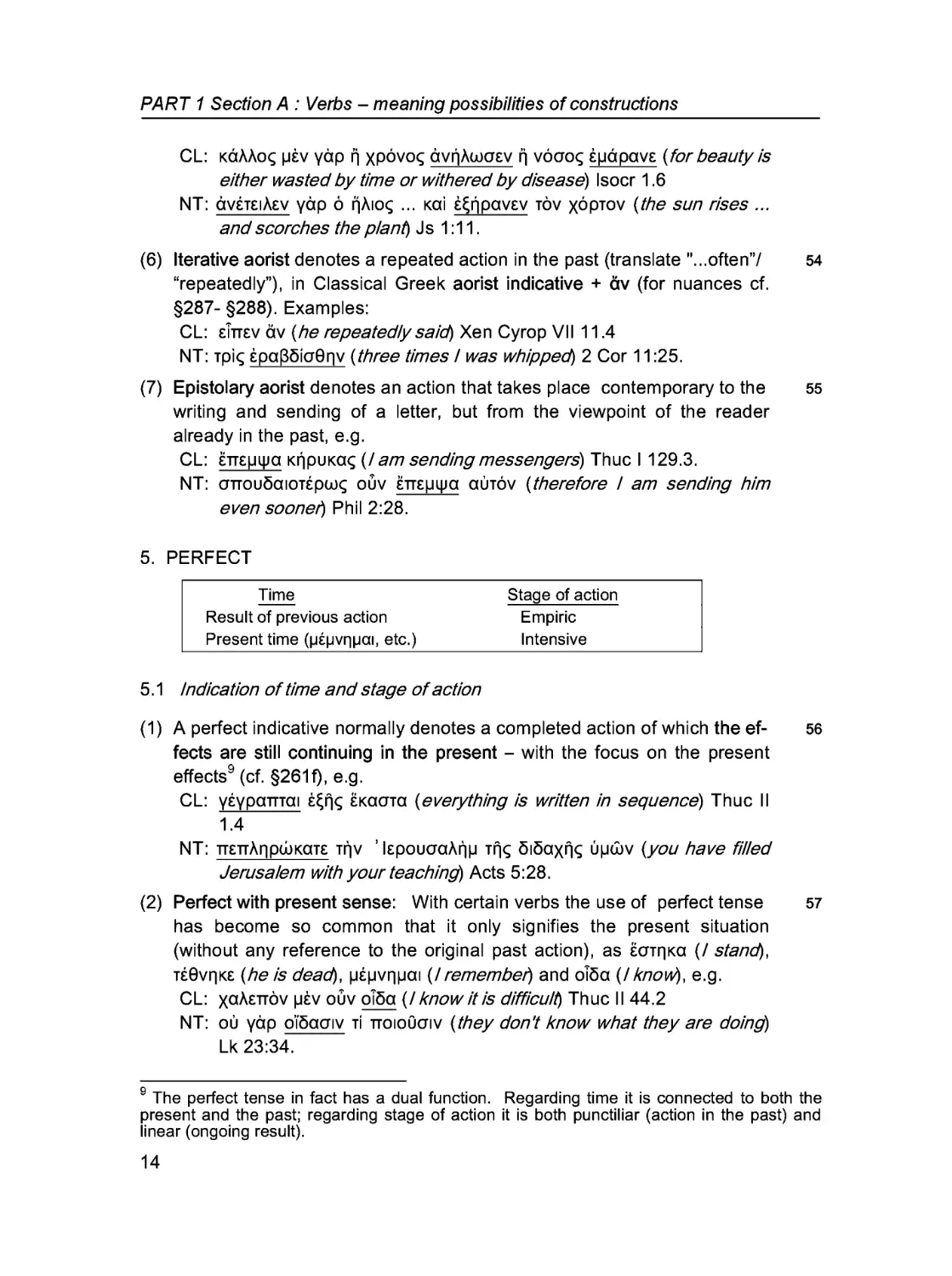
(6)	Iterative aorist denotes a repeated action in the past (translate "...often”/	54
“repeatedly”), in Classical Greek aorist indicative + av (for nuances cf.
§287- §288). Examples:
CL: eittev av {he repeatedly said) Xen Cyrop VII 11.4
NT: тр!<; EpapSiaSqv {three times i was whipped) 2 Cor 11:25.
(7)	Epistolary aorist denotes an action that takes place contemporary to the 55
writing and sending of a letter, but from the viewpoint of the reader
already in the past, e.g.
CL: ЕттЕрфа кррика^ {i am sending messengers) Thue I 129.3.
NT: апоибаютЕрш^ ouv ёттЕрфа outov {therefore i am sending him
even sooner) Phil 2:28.
5.	PERFECT
Time	Stage of action
Result of previous action	Empiric
Present time (pEpvnpai, etc.)	Intensive
5.1	Indication of time and stage of action
(1)	A perfect indicative normally denotes a completed action of which the ef- 56
fects are still continuing in the present - with the focus on the present
effects9 (cf. §261 f), e.g.
CL: у£ураттта! екаата (everything is written in sequence) Thue II
1.4
NT: тт£ттЛг|рсЬкат£ tqv ’ lepouoaArip Tfj£ 6i6axn<J up ouv (you have fitted
Jerusaiem with your teaching) Acts 5:28.
(2)	Perfect with present sense: With certain verbs the use of perfect tense 57
has become so common that it only signifies the present situation
(without any reference to the original past action), as готика (/ stand),
T£0vr]K£ (he is dead), pepvripai (/remember) and оТба (/knout), e.g.
CL: x°^£TTov |J£v ouv оТба (I know it is difficult) Thue II 44.2
NT: ou yap oT5aaiv ii ttoioOoiv (they don't know what they are doing)
Lk 23:34.
9 The perfect tense in fact has a dual function. Regarding time it is connected to both the
present and the past; regarding stage of action it is both punctiliar (action in the past) and
linear (ongoing result).
14
Chapter 2 : Meanings offenses - Indicative verbs
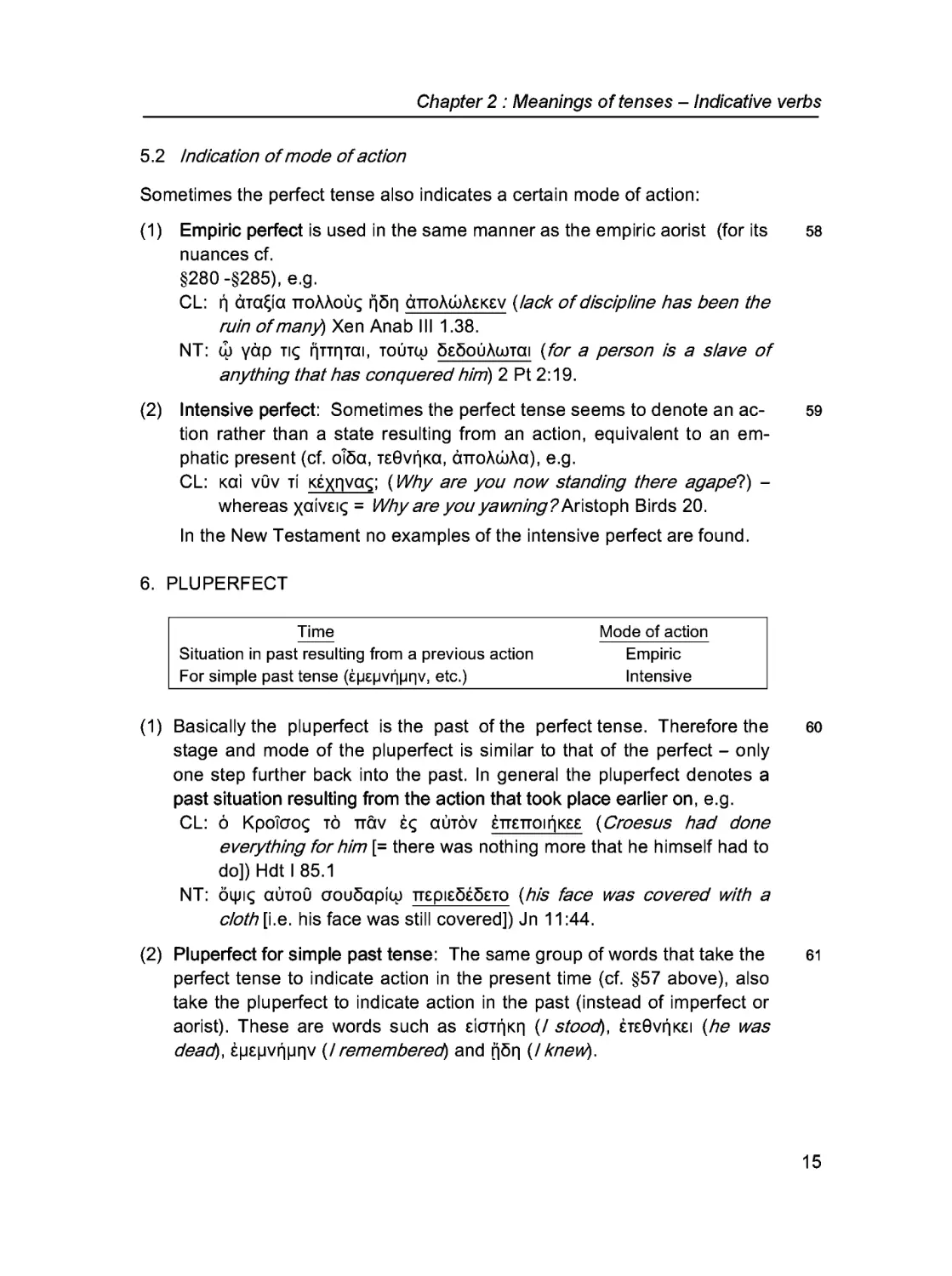
5.2	Indication of mode of action
Sometimes the perfect tense also indicates a certain mode of action:
(1)	Empiric perfect is used in the same manner as the empiric aorist (for its 58
nuances cf.
§280-§285), e.g.
CL: f] dra^ia ттоЛЛои^ f|5r| аттоЛсоЛЕКЕУ {lack of discipline has been the
ruin of man)?) Xen Anab III 1.38.
NT: (b yap ti<; пттг]та1, тоитср SeSouAcotcii {for a person is a slave of
anything that has conquered him) 2 Pt 2:19.
(2)	Intensive perfect: Sometimes the perfect tense seems to denote an ac- 59
tion rather than a state resulting from an action, equivalent to an em-
phatic present (cf. oi5a, T£0vf]Ka, аттоЛсоЛа), e.g.
CL: Kai vOv ti K£xnva<;; (Why are you now standing there agape?) -
whereas xaiv£i? = l4^yareyo4/yaH77//7C7?Aristoph Birds 20.
In the New Testament no examples of the intensive perfect are found.
6.	PLUPERFECT
Time
Situation in past resulting from a previous action
For simple past tense (EpEpvhpqv, etc.)
Mode of action
Empiric
Intensive
(1)	Basically the pluperfect is the past of the perfect tense. Therefore the 60
stage and mode of the pluperfect is similar to that of the perfect - only
one step further back into the past. In general the pluperfect denotes a
past situation resulting from the action that took place earlier on, e.g.
CL: 6 КроТао^ to ttov £<; outov £TT£TTOif|K££ {Croesus had done
everything for him [= there was nothing more that he himself had to
do]) Hdt I 85.1
NT: dipi^ аитоО oouSapico ttepieSeSeto {his face was covered with a
doth [i.e. his face was still covered]) Jn 11:44.
(2)	Pluperfect for simple past tense: The same group of words that take the 61
perfect tense to indicate action in the present time (cf. §57 above), also
take the pluperfect to indicate action in the past (instead of imperfect or
aorist). These are words such as е!сгтг|кг| (/ stood), eteSvokei {he was
dead), £p£pvf]pr]v (/remembered) and пбг] {! knew?).
15
Chapter 3
Meanings of the different moods
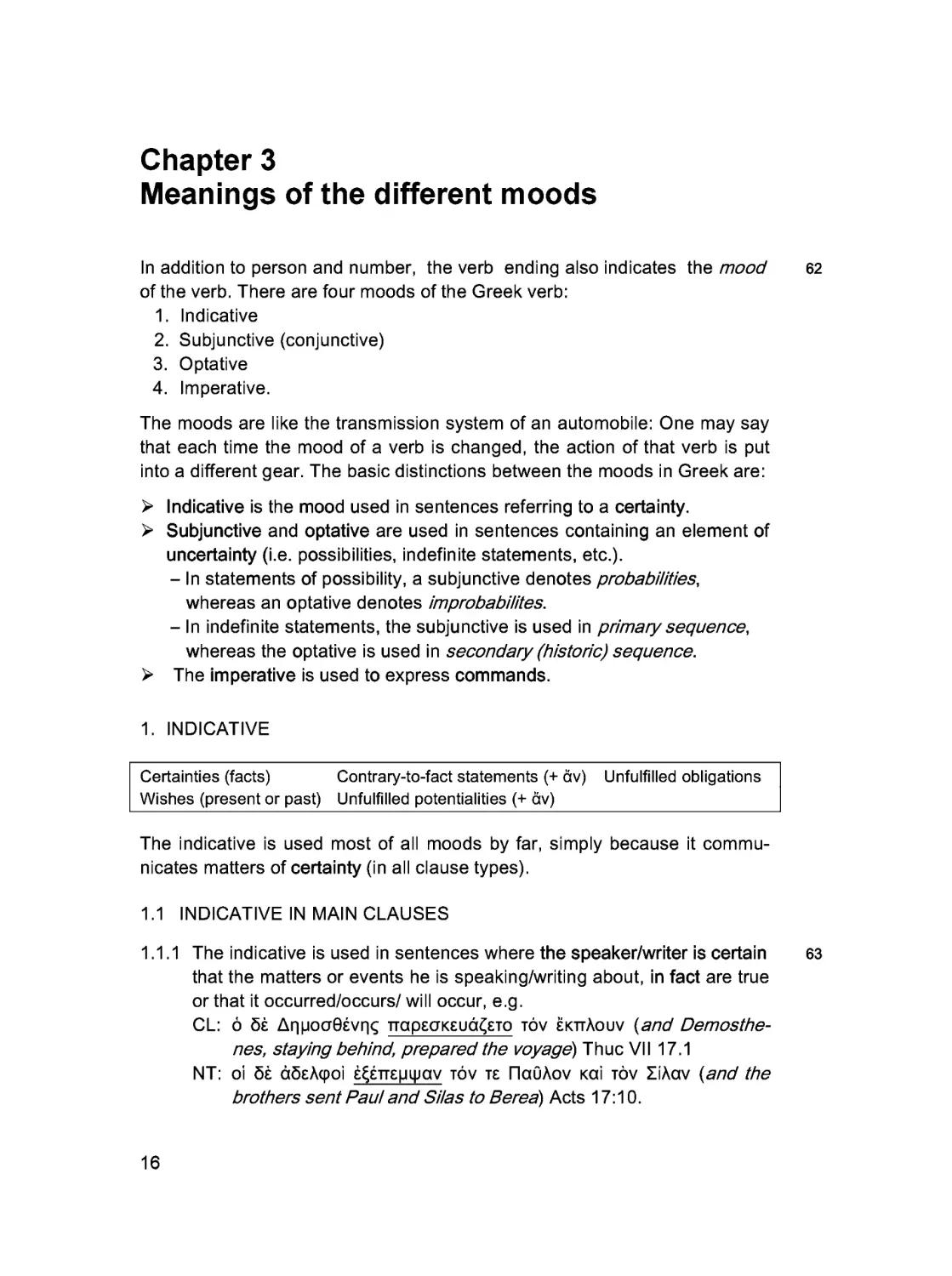
In addition to person and number, the verb ending also indicates the mood 62
of the verb. There are four moods of the Greek verb:
1.	Indicative
2.	Subjunctive (conjunctive)
3.	Optative
4.	Imperative.
The moods are like the transmission system of an automobile: One may say
that each time the mood of a verb is changed, the action of that verb is put
into a different gear. The basic distinctions between the moods in Greek are:
>	Indicative is the mood used in sentences referring to a certainty.
>	Subjunctive and optative are used in sentences containing an element of
uncertainty (i.e. possibilities, indefinite statements, etc.).
-	In statements of possibility, a subjunctive denotes probabilities,
whereas an optative denotes improbabiiites.
-	In indefinite statements, the subjunctive is used in primary sequence,
whereas the optative is used in secondary (historic) sequence.
> The imperative is used to express commands.
1.	INDICATIVE
Certainties (facts) Contrary-to-fact statements (+ av) Unfulfilled obligations
Wishes (present or past) Unfulfilled potentialities (+ av)
The indicative is used most of all moods by far, simply because it commu-
nicates matters of certainty (in all clause types).
1.1	INDICATIVE IN MAIN CLAUSES
1.1.1 The indicative is used in sentences where the speaker/writer is certain 63
that the matters or events he is speaking/writing about, in fact are true
or that it occurred/occurs/ will occur, e.g.
CL: 6 5e AripooQevri^ ттарЕОКЕисфто tov ekttAouv (and Demosthe-
nes, staying behind, prepared the voyage) Thue VII 17.1
NT: oi 5e aSeAcpoi EfeTTEpipav tov те flaOAov Kai tov ZiAav (and the
brothers sent Paul and Silas to Berea) Acts 17:10.
16
Meanings of the different moods
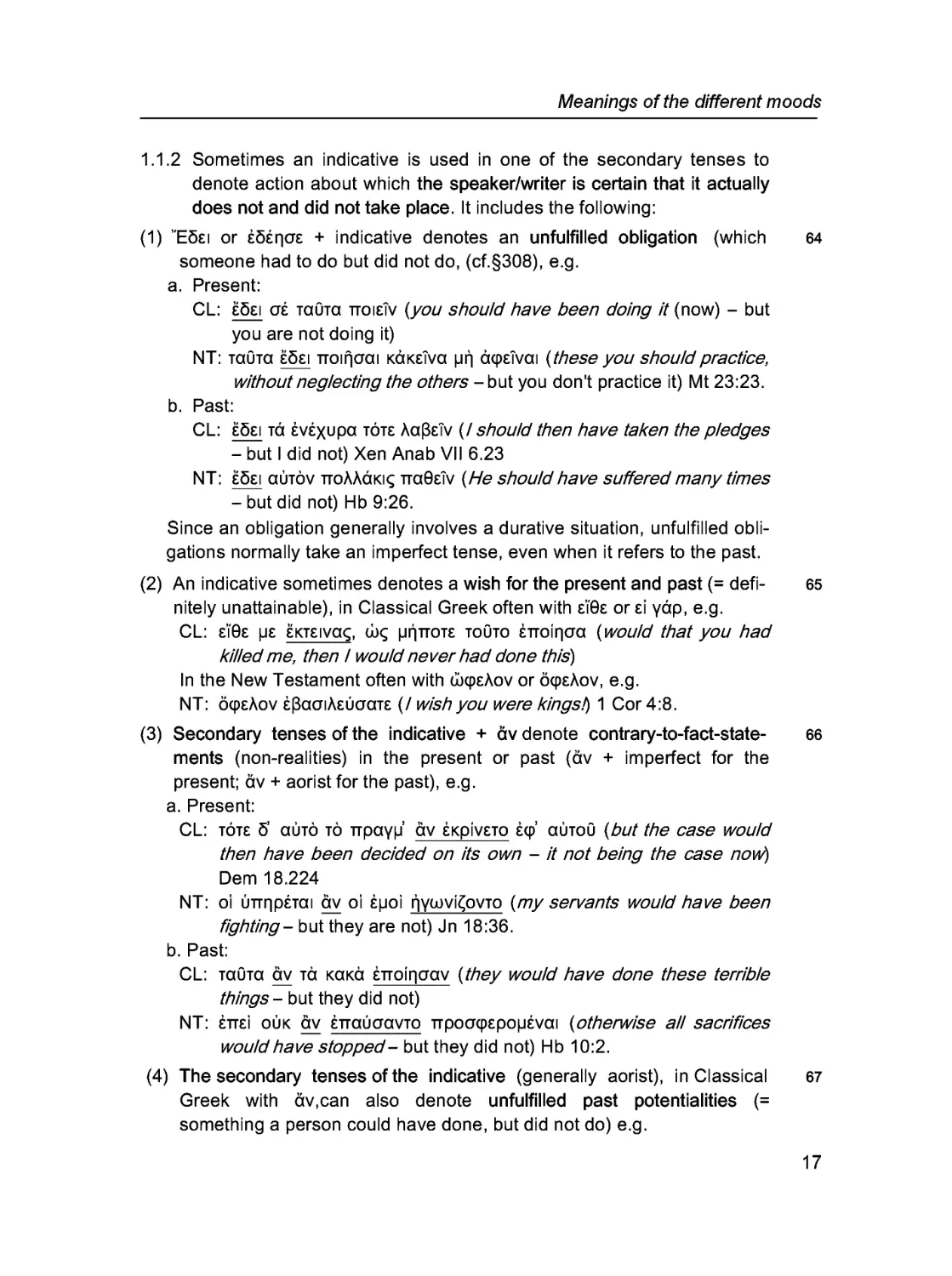
1.1.2 Sometimes an indicative is used in one of the secondary tenses to
denote action about which the speaker/writer is certain that it actually
does not and did not take place. It includes the following:
(1)	”E5£i or £б£Г]а£ + indicative denotes an unfulfilled obligation (which 64
someone had to do but did not do, (cf.§308), e.g.
a.	Present:
CL: e5ei Ст£ таОта ttoieTv (you should have been doing it (now) - but
you are not doing it)
NT: таОта e5ei TTOifjoai kokeivo pf] acpEivai (these you should practice,
without neglecting the others - but you don't practice it) Mt 23:23.
b.	Past:
CL: e5ei та EVExupa tote Aa^Eiv (/ should then have taken the pledges
- but I did not) Xen Anab VII 6.23
NT: e5ei auTdv ттоЛЛакк; ttoOeTv (He should have suffered many times
-butdid not) Hb 9:26.
Since an obligation generally involves a durative situation, unfulfilled obli-
gations normally take an imperfect tense, even when it refers to the past.
(2)	An indicative sometimes denotes a wish for the present and past (= defi- 65
nitely unattainable), in Classical Greek often with eTQe or £i yap, e.g.
CL: eTQe p£ EKTEiva^, w<; рпттотЕ тоОто ETTOirjaa (would that you had
killed me, then i would never had done this)
In the New Testament often with cixpEAov or dq>£Aov, e.g.
NT: dq>£Aov £ЗаслЛ£йаат£ (/ wish you were kings!) 1 Cor 4:8.
(3)	Secondary tenses of the indicative + av denote contrary-to-fact-state- 66
ments (non-realities) in the present or past (av + imperfect for the
present; av + aorist for the past), e.g.
a.	Present:
CL: tote 5’ айтб то ттраур’ av EKpivETO £<p’ айтоО (but the case would
then have been decided on its own - it not being the case now)
Dem 18.224
NT: oi йттг]р£та1 av oi £|_ioi nycovifovTO (my servants would have been
fighting- but they are not) Jn 18:36.
b.	Past:
CL: таОта av та кака £тто1г]аау (they would have done these terrible
things - but they did not)
NT: £TT£i ойк av Еттайсгауто npoa<p£pop£vai (otherwise all sacrifices
would have stopped- but they did not) Hb 10:2.
(4)	The secondary tenses of the indicative (generally aorist), in Classical 67
Greek with av,can also denote unfulfilled past potentialities (=
something a person could have done, but did not do) e.g.
17
PART 1 Section A : Verbs - meaning possibilities of constructions
CL: ev таитг) Tfj qAiKiq Леуоуте^ ттрб^ upa^ ev fj ay раЛюта £тпат£йаат£
{speaking to you at that age when you could particularly have
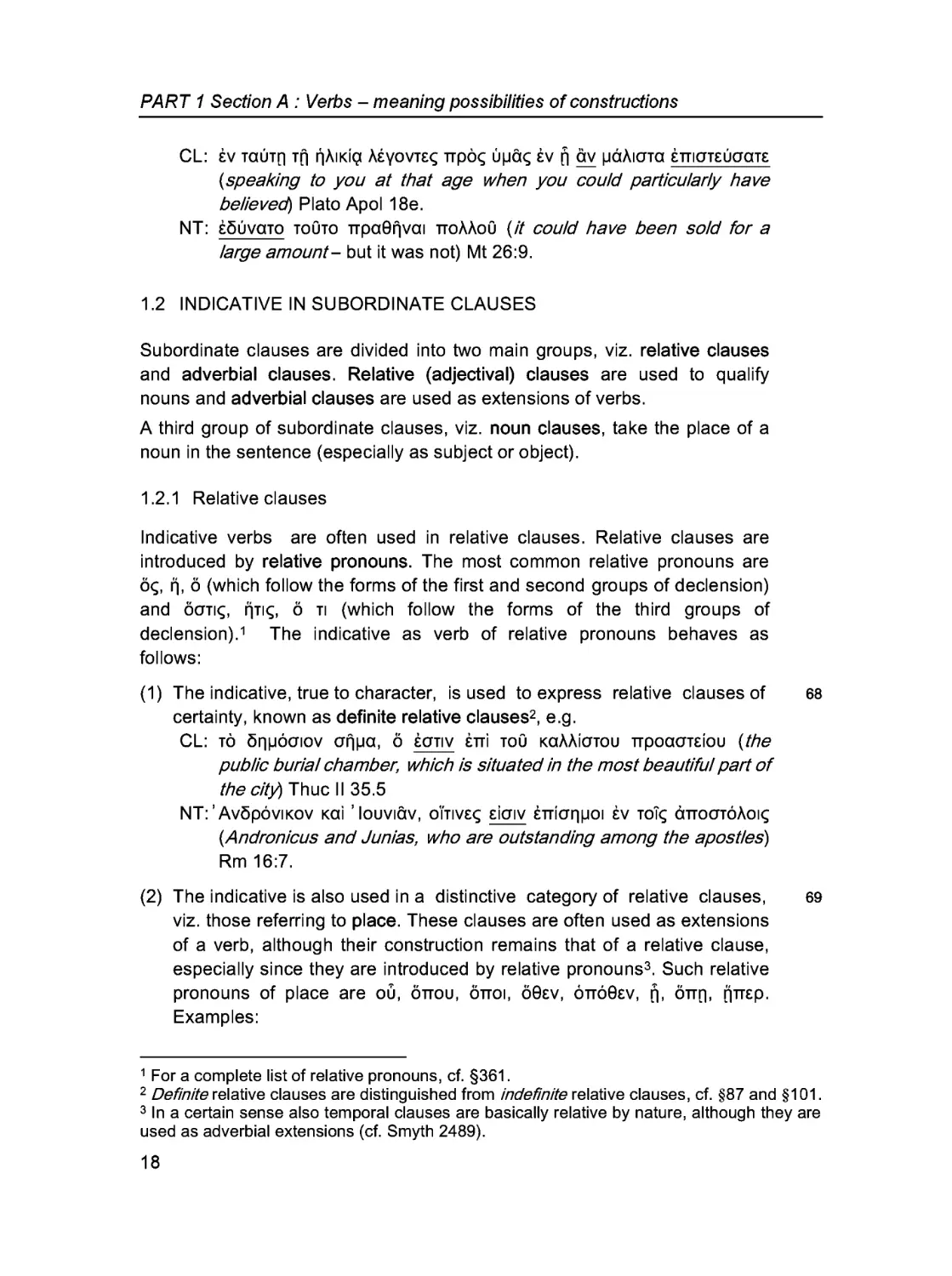
believed) Plato Apol 18e.
NT: Ебйуато тоОто npaQrjvai ттоЛЛоО {it could have been sold for a
large amount- but it was not) Mt 26:9.
1.2	INDICATIVE IN SUBORDINATE CLAUSES
Subordinate clauses are divided into two main groups, viz. relative clauses
and adverbial clauses. Relative (adjectival) clauses are used to qualify
nouns and adverbial clauses are used as extensions of verbs.
A third group of subordinate clauses, viz. noun clauses, take the place of a
noun in the sentence (especially as subject or object).
1.2.1 Relative clauses
Indicative verbs are often used in relative clauses. Relative clauses are
introduced by relative pronouns. The most common relative pronouns are
bq, q, 6 (which follow the forms of the first and second groups of declension)
and octti^, пт1£, 6 ti (which follow the forms of the third groups of
declension).1 The indicative as verb of relative pronouns behaves as
follows:
(1)	The indicative, true to character, is used to express relative clauses of 68
certainty, known as definite relative clauses2, e.g.
CL: to Sripboiov afjpa, 6 eotiv етп toO каЛМатои ттроаатЕюи {the
public burial chamber, which is situated in the most beautiful part of
the city!) Thue II 35.5
NT: ’ AvSpdviKOv Kai ’louviav, oitive^ Eiaiv ETTiaripoi ev toi<; аттоатбЛок;
{Andronicus and Junias, who are outstanding among the apostles)
Rm 16:7.
(2)	The indicative is also used in a distinctive category of relative clauses, 69
viz. those referring to place. These clauses are often used as extensions
of a verb, although their construction remains that of a relative clause,
especially since they are introduced by relative pronouns3. Such relative
pronouns of place are ou, бттои, ottoi, 60ev, ottoQev, rj, бттг], пттбр.
Examples:
1 For a complete list of relative pronouns, cf. §361.
2 Definite relative clauses are distinguished from indefinite relative clauses, cf. §87 and §101.
3 In a certain sense also temporal clauses are basically relative by nature, although they are
used as adverbial extensions (cf. Smyth 2489).
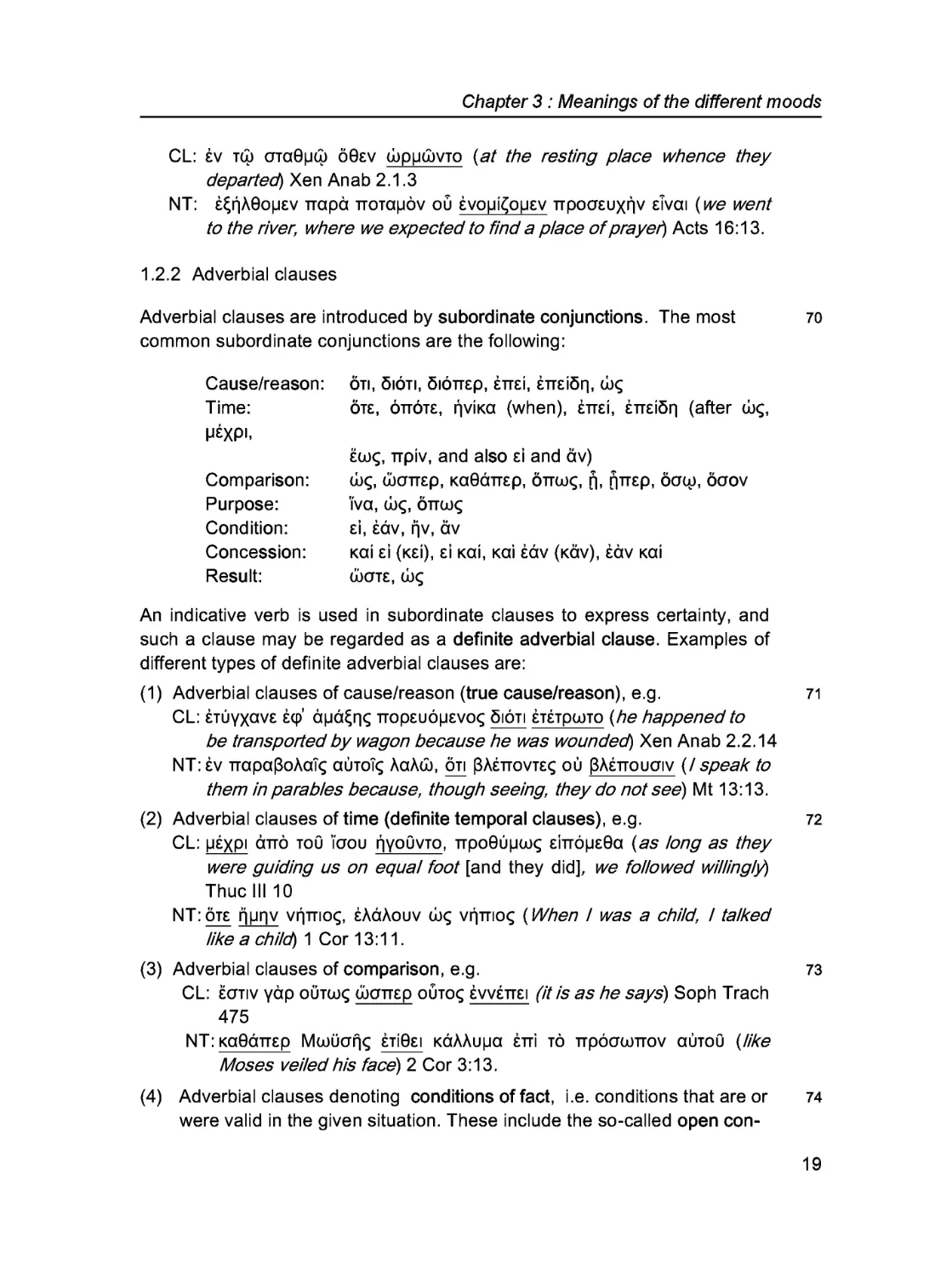
18
Chapter 3 : Meanings of the different moods
CL: ev та) сттабро) 60£v шрршуто (at the resting place whence they
departed) Xen Anab 2.1.3
NT: £^r]A0O|j£v пара ттотарбу ou £vopi^op£v TTpooEuxnv fiTvai (we went
to the river, where we expected to find a place of prayed Acts 16:13.
1.2.2 Adverbial clauses
Adverbial clauses are introduced by subordinate conjunctions. The most 70
common subordinate conjunctions are the following:
Cause/reason: oti, 5ioti, Siottep, £tt£i, £тт£1бг|, w<;
Time:	ote, ottote, qviKa (when), £TT£i, £тт£!5г| (after
MEXPI.
£co£, TTpiv, and also si and av)
Comparison:	соаттЕр, ка0атт£р, бттсо^, rj, оттер, баш, oaov
Purpose:	'iva, бттсо^
Condition:	si, £av, qv, av
Concession:	ка! si (K£i), si Kai, Kai £av (kov), £av ка!
Result:	coots, cb<;
An indicative verb is used in subordinate clauses to express certainty, and
such a clause may be regarded as a definite adverbial clause. Examples of
different types of definite adverbial clauses are:
(1)	Adverbial clauses of cause/reason (true cause/reason), e.g.	71
CL: STuyxave £<p’ apa^q^ TTopsudpsvo^ 5ioti ststpcoto (he happened to
be transported by wagon because he was wounded) Xen Anab 2.2.14
NT: sv ттара[ЗоЛаТ<; аитоТ^ Ла Aw, oti PAettovte^ ou PAsttouoiv (/ speak to
them in parables because, though seeing, they do not see) Mt 13:13.
(2)	Adverbial clauses of time (definite temporal clauses), e.g.	72
CL: psxpi аттб тоО Таои дуоиуто, ттро0ирсо^ £1ттбр£0а (as long as they
were guiding us on equal foot [and they did], we followed willingly
Thue III 10
NT: ote qpqv vf|TTio^, sAaAouv cb<; vrjTTio^ (When i was a child, i talked
like a child) 1 Cor 13:11.
(3)	Adverbial clauses of comparison, e.g.	73
CL: £OTiv уар оитсо^ соаттЕр оито^ evvettei (it is as he says) Soph Trach
475
NT: каОаттЕр Mcouofj^ £Ti0£i каЛЛира £тт! то ттрбасоттоу аитоО (like
Moses veiled his face) 2 Cor 3:13.
(4)	Adverbial clauses denoting conditions of fact, i.e. conditions that are or 74
were valid in the given situation. These include the so-called open con-
19
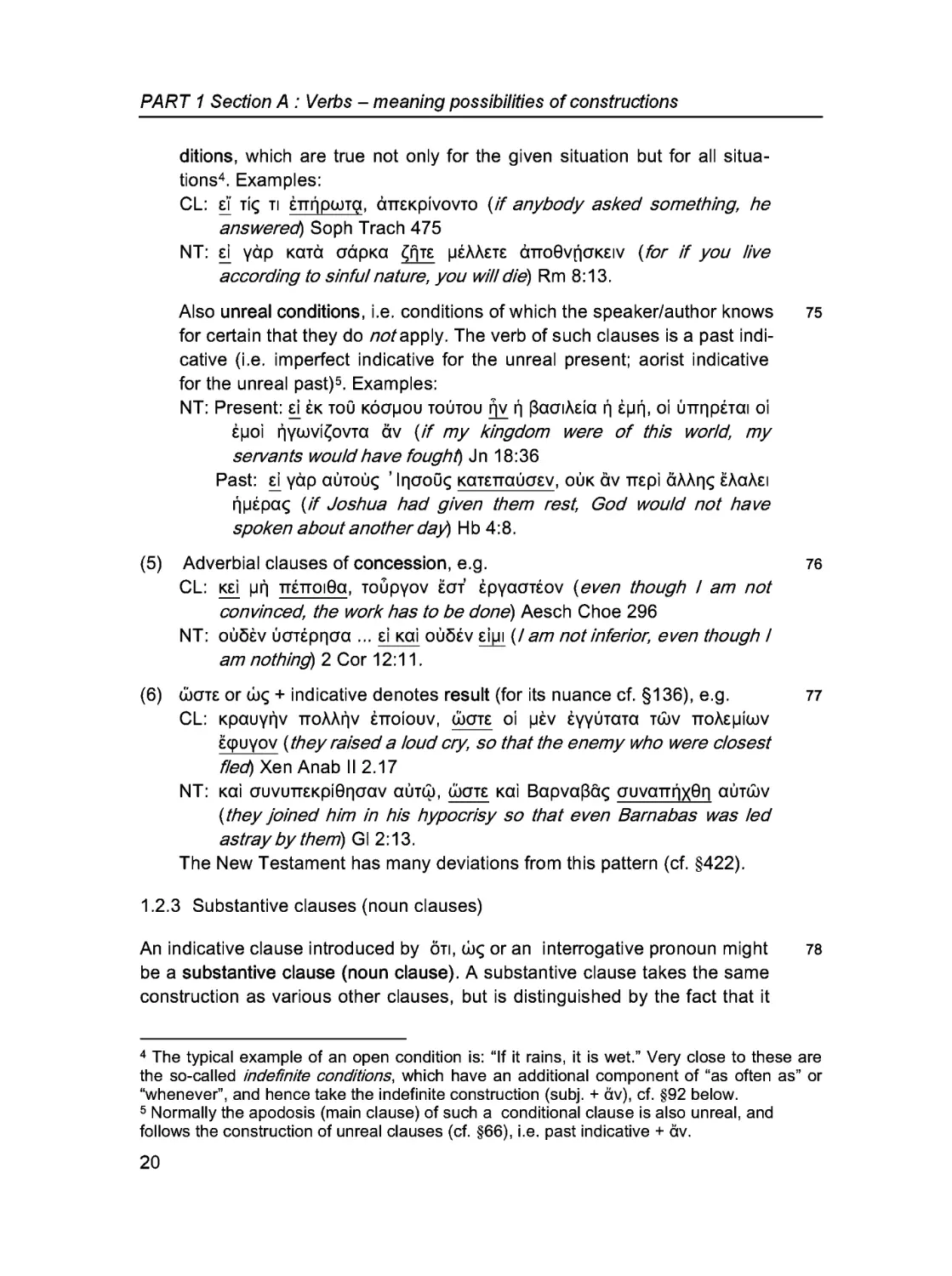
PART 1 Section A : Verbs - meaning possibilities of constructions
ditions, which are true not only for the given situation but for all situa-
tions4. Examples:
CL: eT ti<; ti Еттдрсотд, атт£кр|уоуто (if anybody asked something, he
answered) Soph Trach 475
NT: si yap ката аарка ^qte реЛЛете атто0УГ]ак£1У (for if you live
according to sinful nature, you will die) Rm 8:13.
Also unreal conditions, i.e. conditions of which the speaker/author knows 75
for certain that they do not apply. The verb of such clauses is a past indi-
cative (i.e. imperfect indicative for the unreal present; aorist indicative
for the unreal past)5. Examples:
NT: Present: si ek toO кдарои тоитои fjv f] paoiAsia f] spf], oi иттдрёта! oi
epoi qywvi^ovTa av (if my kingdom were of this world, my
servants would have fought) Jn 18:36
Past: ei yap аитои^ ’ Igaou^ катЕттаиаЕУ, ойк av rrepi аЛЛд<; eAaAei
дрёра^ (if Joshua had given them rest, God would not have
spoken about another da^) Hb 4:8.
(5)	Adverbial clauses of concession, e.g.	76
CL: K£i pg TT£TTOi6a, Toupyov ёат ёруаатёоу (even though i am not
convinced, the work has to be done) Aesch Choe 296
NT: ou5£v йатёрдаа ... si ка! ойбёу sipi (/am not inferior, even though i
am nothing) 2 Cor 12:11.
(6)	cbcTTE or <!)<; + indicative denotes result (for its nuance cf. §136), e.g. 77
CL: краиуду ттоЛЛду ejtoiouv, сорте oi p£v ёууйтата tcov TToAspicov
ёсриуоу (they raised a loud cry, so that the enemy who were closest
/7eo) XenAnab 112.17
NT: Kai auvuTT£Kpi0r|aav айтф, сорте Kai Bapva₽a^ аиуаттдхбп айтсду
(they joined him in his hypocrisy so that even Barnabas was led
astray by them) GI 2:13.
The New Testament has many deviations from this pattern (cf. §422).
1.2.3 Substantive clauses (noun clauses)
An indicative clause introduced by oti, cb<; or an interrogative pronoun might 78
be a substantive clause (noun clause). A substantive clause takes the same
construction as various other clauses, but is distinguished by the fact that it
4 The typical example of an open condition is: “If it rains, it is wet.” Very close to these are
the so-called indefinite conditions, which have an additional component of “as often as” or
“whenever”, and hence take the indefinite construction (subj. + av), cf. §92 below.
5 Normally the apodosis (main clause) of such a conditional clause is also unreal, and
follows the construction of unreal clauses (cf. §66), i.e. past indicative + av.
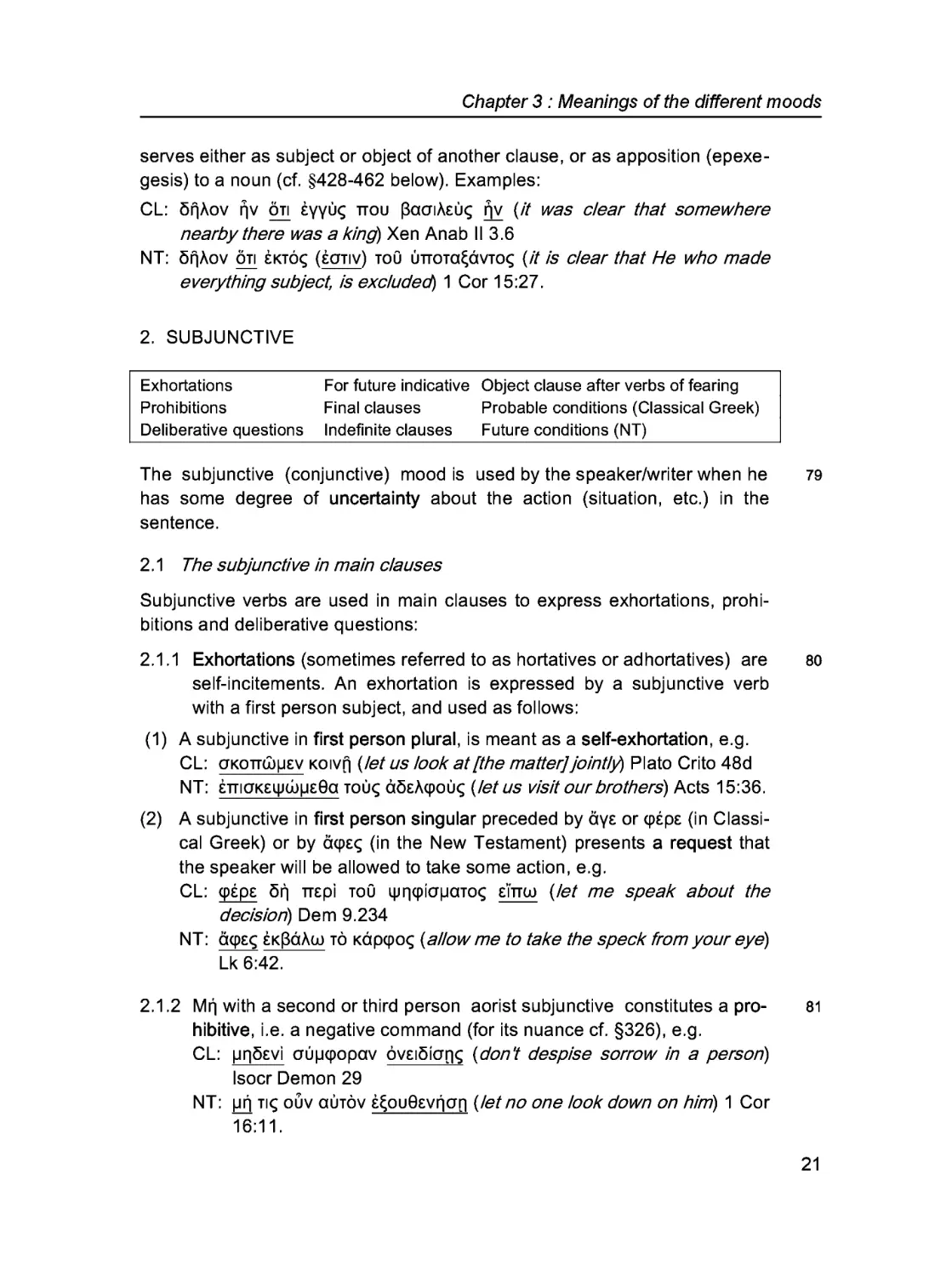
20
Chapter 3 : Meanings of the different moods
serves either as subject or object of another clause, or as apposition (epexe-
gesis) to a noun (cf. §428-462 below). Examples:
CL: SfjAov qv on £yyu^ пои paoiAeu^ fjy (it was dear that somewhere
nearby there was a king) Xen Anab II 3.6
NT: SfjAov oti ekto^ (eotiv) toO иттота^ауто^ (it is dear that He who made
everything subject, is excluded) 1 Cor 15:27.
2.	SUBJUNCTIVE
Exhortations	For future indicative Object clause after verbs of fearing
Prohibitions	Final clauses Probable conditions (Classical Greek)
Deliberative questions Indefinite clauses Future conditions (NT)
The subjunctive (conjunctive) mood is used by the speaker/writer when he 79
has some degree of uncertainty about the action (situation, etc.) in the
sentence.
2.1 The subjunctive in main clauses
Subjunctive verbs are used in main clauses to express exhortations, prohi-
bitions and deliberative questions:
2.1.1 Exhortations (sometimes referred to as hortatives or adhortatives) are 80
self-incitements. An exhortation is expressed by a subjunctive verb
with a first person subject, and used as follows:
(1)	A subjunctive in first person plural, is meant as a self-exhortation, e.g.
CL: акоттсорЕУ ко ivfj (let us look at [the matter] jointly Plato Crito 48d
NT: £TTiOK£i|j(jbp£9a тои<; абЕЛфои^ (let us visit our brothers) Acts 15:36.
(2)	A subjunctive in first person singular preceded by ays or ф£р£ (in Classi-
cal Greek) or by аф£<; (in the New Testament) presents a request that
the speaker will be allowed to take some action, e.g.
CL: ф£р£ 5q TTEpi тоО фГ)ф1арато^ eittco (let me speak about the
decision) Dem 9.234
NT: аф££ ЕкРаЛсо то карфо^ (allow те to take the speck from your eye)
Lk 6:42.
2.1.2 Mr] with a second or third person aorist subjunctive constitutes a pro- 81
hibitive, i.e. a negative command (for its nuance cf. §326), e.g.
CL: pr]5£vi аирфорау 6v£i6iar|<; (don't despise sorrow in a person)
Isocr Demon 29
NT: pg ti<£ ouv айтду £fou6£vf|ar| (let no one look down on him) 1 Cor
16:11.
21
PART 1 Section A : Verbs - meaning possibilities of constructions
Prohibitive subjunctives in the third person often express a prohibition
to the second person not to allow somebody else to do something, e.g.
NT: pf| ti<£ upa<; £%аттатг|аг| (do not let anyone deceive you) 2 Ts 2:3.
2.1.3 A present or aorist subjunctive in a question, normally with a first per- 82
son subject, is used to express doubt about what should be done, i.e.
a deliberative question, e.g.
CL: £Тттсор£У q aiycopEv; (Shall we speak or keep silence?) Eur Ion
758
NT: ti TTQifiacopEv toi<; dvQpcbTTOi^ toutoi^; (What shall we do with
these men?) Acts 4:16.
Sometimes deliberative questions have a third person subject, e.g.
NT: ttco£ ouv £тт1каЛ£асоутси si<; dv оик ETTioTEuoav; (How can they
call upon Him without believincft) Rm 10:14 (ff.).
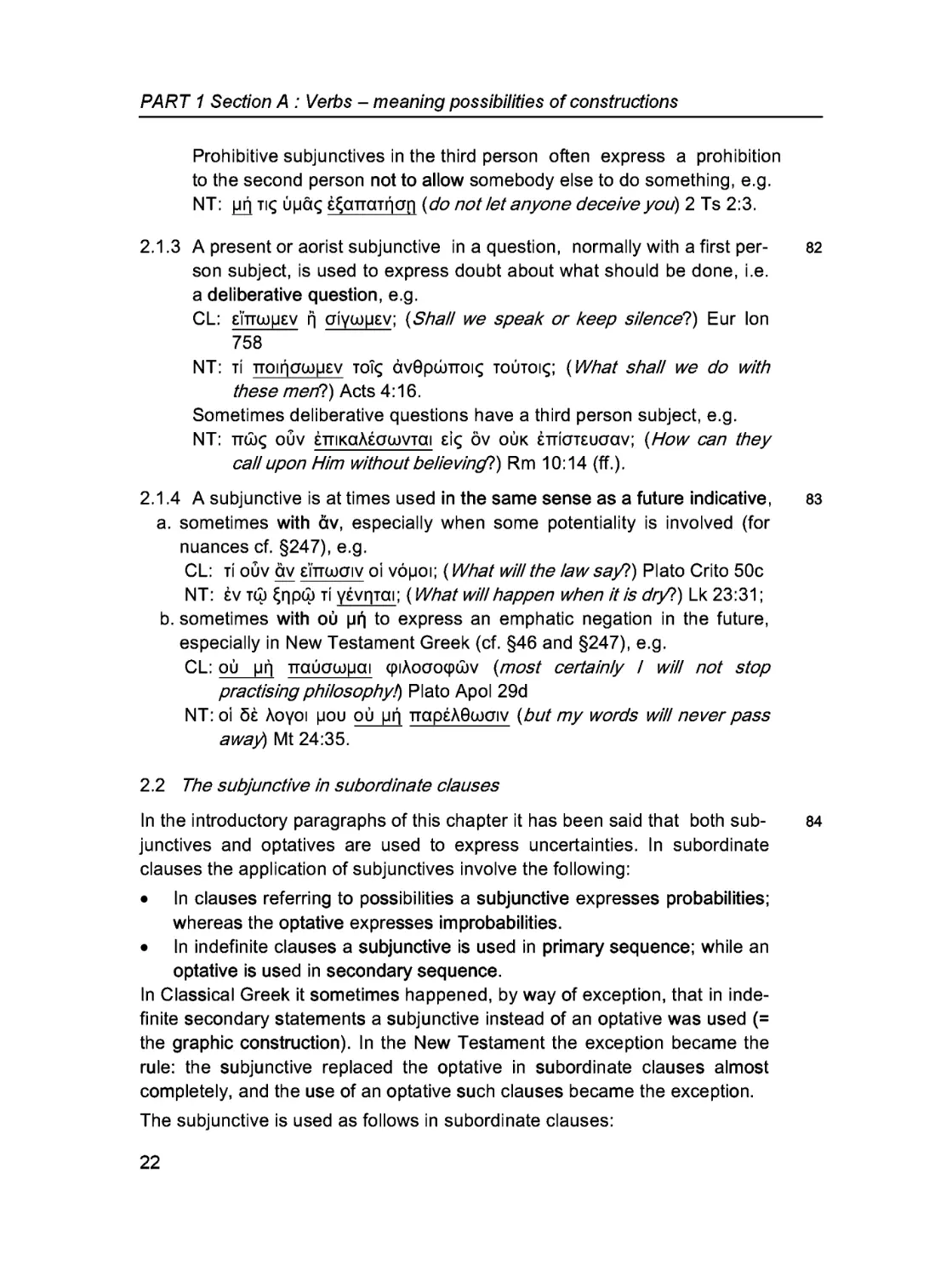
2.1.4 A subjunctive is at times used in the same sense as a future indicative, 83
a. sometimes with av, especially when some potentiality is involved (for
nuances cf. §247), e.g.
CL: ti ouv av eTttcooiv oi vopoi; (What will the law say?) Plato Crito 50c
NT: ev та) ^qpu) ti y£vr|Tai; (What will happen when it is dr/?) Lk 23:31;
b. sometimes with ou pq to express an emphatic negation in the future,
especially in New Testament Greek (cf. §46 and §247), e.g.
CL: ou pf] TTauocopai <piAoao<pwv (most certainly i will not stop
practising philosophy!) Plato Apol 29d
NT: oi 5e Aoyoi pou ou pg ттарЕЛОсослу (but my words will never pass
awa/ Mt 24:35.
2.2 The subjunctive in subordinate clauses
In the introductory paragraphs of this chapter it has been said that both sub- 84
junctives and optatives are used to express uncertainties. In subordinate
clauses the application of subjunctives involve the following:
•	In clauses referring to possibilities a subjunctive expresses probabilities;
whereas the optative expresses improbabilities.
•	In indefinite clauses a subjunctive is used in primary sequence; while an
optative is used in secondary sequence.
In Classical Greek it sometimes happened, by way of exception, that in inde-
finite secondary statements a subjunctive instead of an optative was used (=
the graphic construction). In the New Testament the exception became the
rule: the subjunctive replaced the optative in subordinate clauses almost
completely, and the use of an optative such clauses became the exception.
The subjunctive is used as follows in subordinate clauses:
22
Chapter 3 : Meanings of the different moods
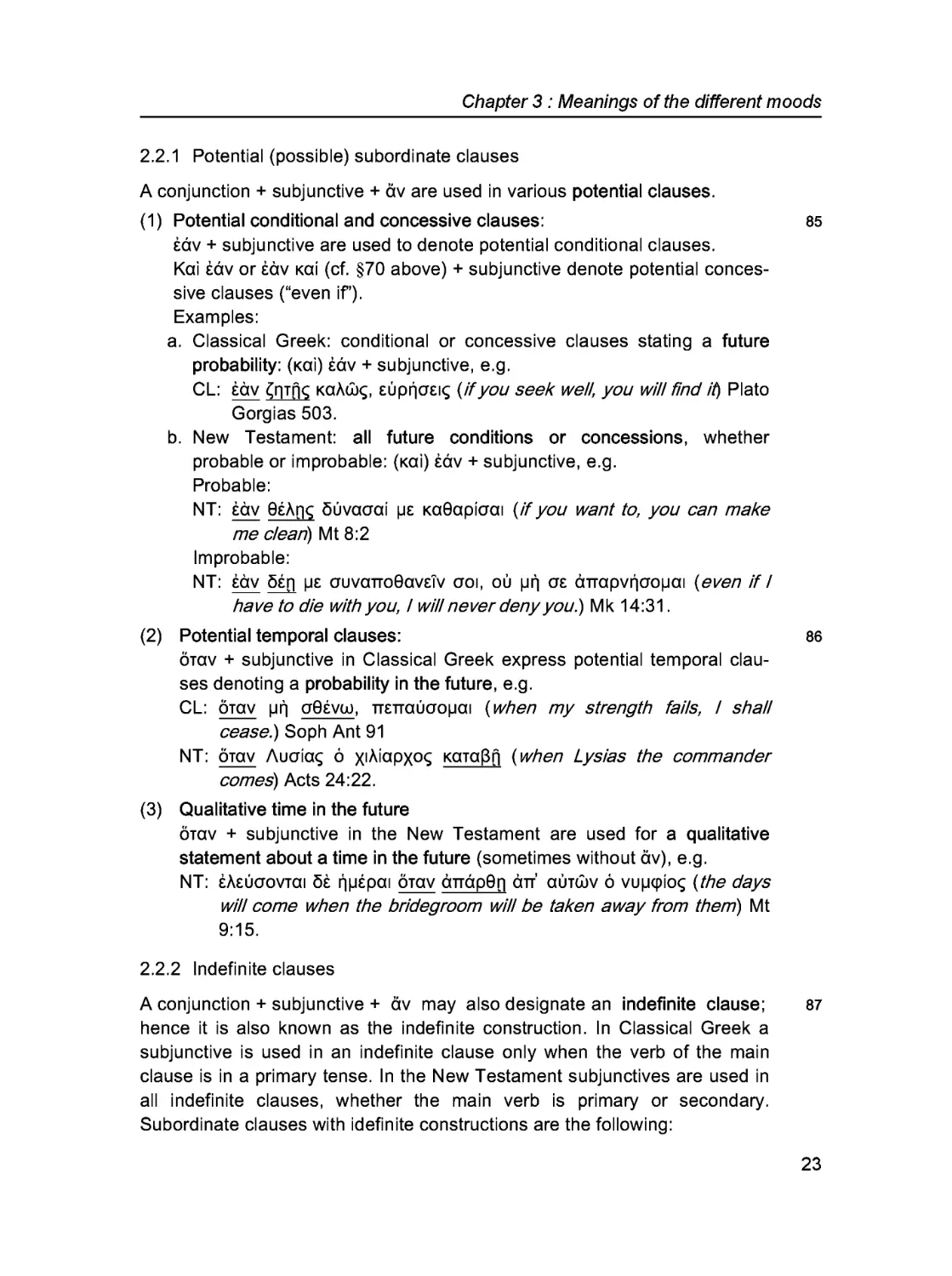
2.2.1 Potential (possible) subordinate clauses
A conjunction + subjunctive + av are used in various potential clauses.
(1)	Potential conditional and concessive clauses:	85
eav + subjunctive are used to denote potential conditional clauses.
Kai eav or eav Kai (cf. §70 above) + subjunctive denote potential conces-
sive clauses (“even if’).
Examples:
a.	Classical Greek: conditional or concessive clauses stating a future
probability: (Kai) eav + subjunctive, e.g.
CL: eav каЛш^, eupqaei^ {if you seek well, you will find if) Plato
Gorgias 503.
b.	New Testament: all future conditions or concessions, whether
probable or improbable: (Kai) eav + subjunctive, e.g.
Probable:
NT: £dv QeAq<; Suvaoai pe KaOapiaai {if you want to, you can make
me clean) Mt 8:2
Improbable:
NT: sav 5ег] ps auvaTToOaveTv aoi, ou pf] as dTTapvf]aopai {even if i
have to die with you, i will never deny you.) Mk 14:31.
(2)	Potential temporal clauses:	86
бтау + subjunctive in Classical Greek express potential temporal clau-
ses denoting a probability in the future, e.g.
CL: бтау pf] oQevco, ттЕттаиаора! {when my strength fails, i shall
cease.) Soph Ant 91
NT: бтау Auaia<; 6 x^iapx0? ката ft fl {when Lysias the commander
comes) Acts 24:22.
(3)	Qualitative time in the future
бтау + subjunctive in the New Testament are used for a qualitative
statement about a time in the future (sometimes without av), e.g.
NT: EAsuaovTai 5e npspai бтау аттарбг] атт’ outwv 6 vupcpio^ {the days
will come when the bridegroom will be taken away from them) Mt
9:15.
2.2.2 Indefinite clauses
A conjunction + subjunctive + av may also designate an indefinite clause; 87
hence it is also known as the indefinite construction. In Classical Greek a
subjunctive is used in an indefinite clause only when the verb of the main
clause is in a primary tense. In the New Testament subjunctives are used in
all indefinite clauses, whether the main verb is primary or secondary.
Subordinate clauses with idefinite constructions are the following:
23
PART 1 Section A : Verbs - meaning possibilities of constructions
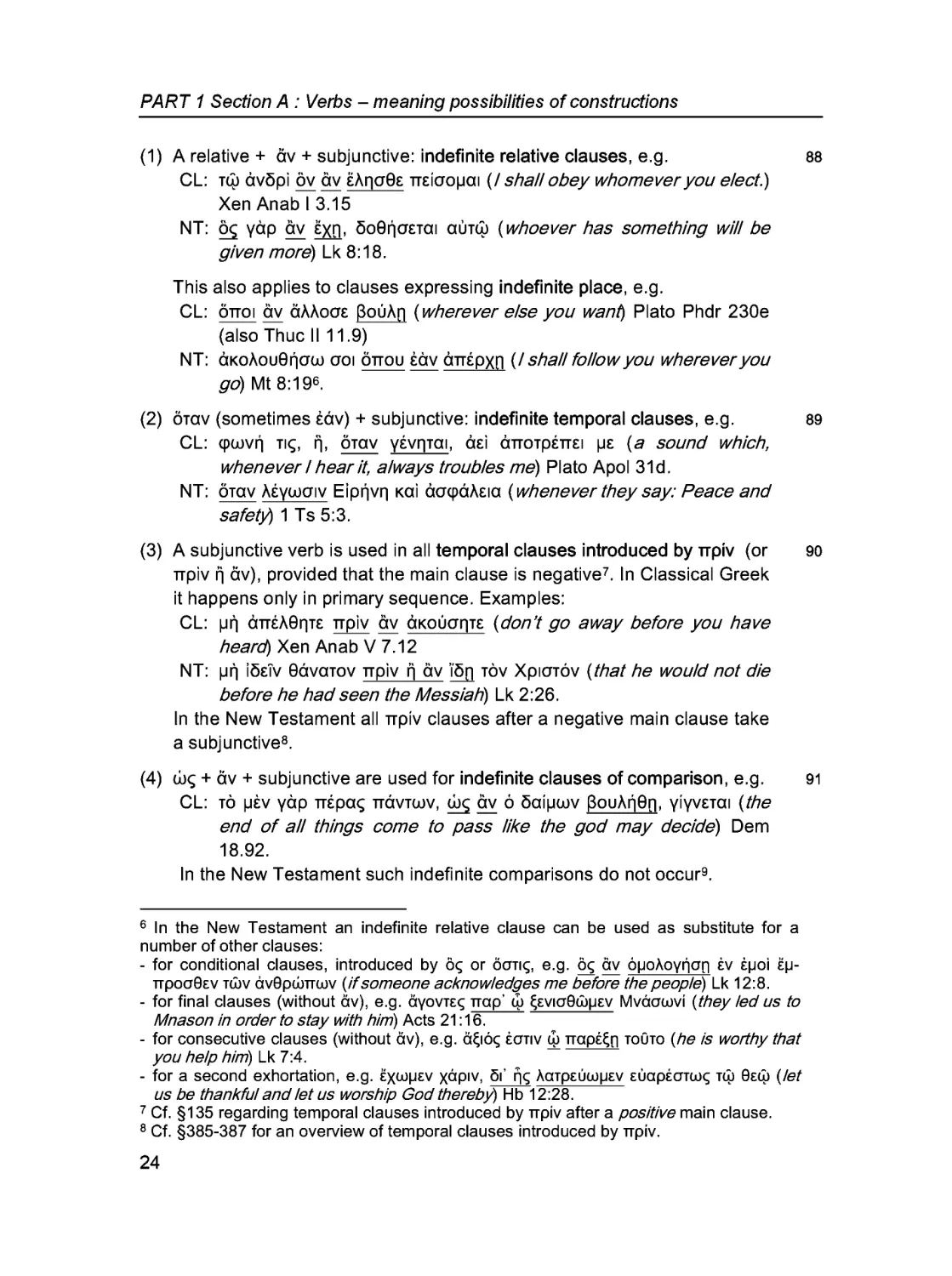
(1)	A relative + dv + subjunctive: indefinite relative clauses, e.g.	88
CL: то) av5pi dv av sAqaSs TT£iao|jai (/ shall obey whomever you elect.)
Xen Anab I 3.15
NT: o$ yap dv ЕХП, 5o0qo£Tai аита) (whoever has something will be
given more) Lk 8:18.
This also applies to clauses expressing indefinite place, e.g.
CL: ottoi dv aAAooE ftouAq (wherever else you want} Plato Phdr 230e
(also Thue I111.9)
NT: акоАоибдасо сто i бттои £av аттЁрхп (I shall follow you wherever you
go) Mt 8:196.	"
(2)	бтау (sometimes £av) + subjunctive: indefinite temporal clauses, e.g. 89
CL: epeovq ti£, q, бтау уЁудта!, asi аттотр£тт£1 p£ (a sound which,
whenever I hear it, always troubles me) Plato Apol 31d.
NT: бтау Asycoaiv Eipqvq Kai dacpaAsia (whenever they say: Peace and
safety} 1 Ts 5:3.
(3)	A subjunctive verb is used in all temporal clauses introduced by upiv (or 90
irpiv q dv), provided that the main clause is negative6 7. In Classical Greek
it happens only in primary sequence. Examples:
CL: pg атт£А0дт£ npiv dv акоиадтЕ (don’t go away before you have
heard) Xen Anab V 7.12
NT: pg i6£iv QdvaTOv npiv q dv idq tov XpiaTdv (that he would not die
before he had seen the Messiah) Lk 2:26.
In the New Testament all TTpiv clauses after a negative main clause take
a subjunctive8.
(4)	ux; + dv + subjunctive are used for indefinite clauses of comparison, e.g. 91
CL: to p£v ydp тт£ра<; ttovtcov, dv 6 6aipcov ftouAqQq, yiyv£Tai (the
end of all things come to pass like the god may decide) Dem
18.92.
In the New Testament such indefinite comparisons do not occur9.
6 In the New Testament an indefinite relative clause can be used as substitute for a
number of other clauses:
- for conditional clauses, introduced by 6$ or ooti^, e.g. oq dv opoAoygon ev Epoi Ёр-
ttpooOev twv dv0pd)TT(jov (if someone acknowledges me before the people) Lk 12:8.
- for final clauses (without dv), e.g. ayovTEq ттар’ ф ^EViaOwpEV Mvdawvi (they led us to
Mnason in order to stay with him) Acts 21:16.
- for consecutive clauses (without dv), e.g. d^ioq eotiv ф ттарЁ^п тоОто (he is worthy that
you help him) Lk 7:4.
- for a second exhortation, e.g. Ёхоорev xdpiv, 5i’ qq АатрЕиоорЕУ EuapECTOoq тф 0£ф (let
us be thankful and let us worship God thereby) Hb 12:28.
7 Cf. §135 regarding temporal clauses introduced by npiv after a positive main clause.
8 Cf. §385-387 for an overview of temporal clauses introduced by TTpiv.
24
Chapter 3 : Meanings of the different moods
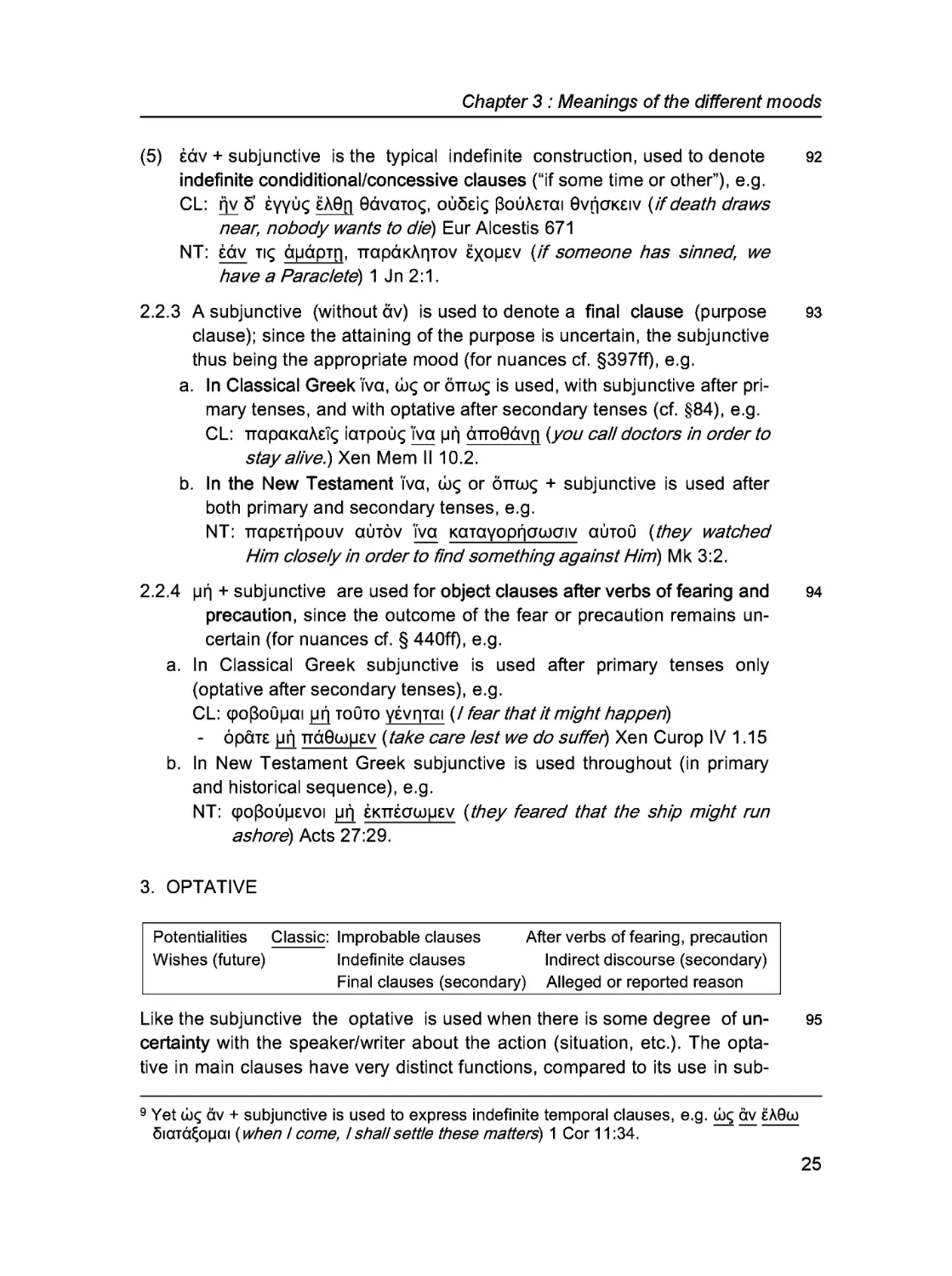
(5)	eav + subjunctive is the typical indefinite construction, used to denote 92
indefinite condiditional/concessive clauses (“if some time or other”), e.g.
CL: gv 5’ Eyyug еЛбг] Savarag, ouSsig PouAetoi 0vf]OK£iv (if death draws
near, nobody wants to die) Eur Alcestis 671
NT: eav Tig арартг], ттаракЛг]тоу exopev (if someone has sinned, we
have a Paraclete) 1 Jn 2:1.
2.2.3 A subjunctive (without av) is used to denote a final clause (purpose 93
clause); since the attaining of the purpose is uncertain, the subjunctive
thus being the appropriate mood (for nuances cf. §397ff), e.g.
a.	In Classical Greek Tva, dog or бттсод is used, with subjunctive after pri-
mary tenses, and with optative after secondary tenses (cf. §84), e.g.
CL: ттаракаЛгТд iarpoug Tva pf] аттобауг] (you call doctors in order to
stay alive.) Xen Mem II 10.2.
b.	In the New Testament Tva, dog or бттсод + subjunctive is used after
both primary and secondary tenses, e.g.
NT: ттарЕтпроиу outov Tva катауорпасоа|у аитоО (they watched
Him closely in order to find something against Him) Mk 3:2.
2.2.4 pf] + subjunctive are used for object clauses after verbs of fearing and 94
precaution, since the outcome of the fear or precaution remains un-
certain (for nuances cf. § 440ff), e.g.
a.	In Classical Greek subjunctive is used after primary tenses only
(optative after secondary tenses), e.g.
CL: <po₽oOpai pf] toOto y£vr]Tai (/ fear that it might happen)
- брате pf] TTdOcopsv (take care lest we do suffei) Xen Curop IV 1.15
b.	In New Testament Greek subjunctive is used throughout (in primary
and historical sequence), e.g.
NT: (po[3oup£voi pf] ektteocopev (they feared that the ship might run
ashore) Acts 27:29.
3. OPTATIVE
Potentialities Classic: Improbable clauses After verbs of fearing, precaution
Wishes (future)	Indefinite clauses	Indirect discourse (secondary)
Final clauses (secondary) Alleged or reported reason
Like the subjunctive the optative is used when there is some degree of un- 95
certainty with the speaker/writer about the action (situation, etc.). The opta-
tive in main clauses have very distinct functions, compared to its use in sub-
9 Yet cog av + subjunctive is used to express indefinite temporal clauses, e.g. cog av ёЛЭсо
diaia^opai (when i come, i shall settle these matters) 1 Cor 11:34.
25
PART 1 Section A : Verbs - meaning possibilities of constructions
ordinate clauses. In New Testament Greek optatives in subordinate clauses
are very rare, since the optative was steadily being phased out, and was
restricted almost exclusively to main sentences.
3.1	The optative in main clauses
The optative is used in main clauses to express uncertainties, particularly to
denote potential or desired future action.
3.1.1 An optative (often + av) is used to express potential main clauses, e.g. 96
CL: ottovte^ av dpoAoyfiaEiav {Everybody would agree [the speaker
is actually uncertain whether everybody agrees]) Isocr 11.5
NT: £u%aipr|v av тф 0£ф (/ would pray to God) Acts 26:29.
Sometimes the speaker does have certainty, but uses the potential
optative to soften a statement (euphemistically) or to make a polite re-
quest, e.g.
CL: ETEpbv ti toOt’ av Eir] (This would be another matter- i.e. "This is
entirely beside the point!") Dem 20.116
NT: eveveuov 5e тф ттатр! аитоО то ti av QeAoi KaAsTaQai аитоО {they
asked his father what he would like him to be called) Lk 1:62.
Although this last example is an indirect question, it contains a polite
request.
3.1.2 An optative, often accompanied by eTQe or si yap, is used as main verb 97
to express a wish referring to the future, since a wish belongs to the
sphere of potentiality and uncertainty. Examples:
CL: si yap yevoito {would that it might happen) Xen Cyrop VII 1.38
NT: to apyOpibv aou Eir] si<; airwAEiav {may you and your money be
destroyed) Acts 8:20.
3.2	The optative in subordinate clauses
In §84 above the uses of the subjunctive and the optative in subordinate 98
clauses were distinguished as follows:
•	Possiblities are either probable or improbable. Probabilities are expres-
sed by a subjunctive, improbabilities by an optative.
•	Indefinite clauses are used in primary or in secondary sentences. When
primary, a subjunctive is used; when secondary, an optative.
In Classical Greek, by way of exception, indefinite secondary statements
were sometimes made with a subjunctive instead of an optative (called the
graphic construction). In the New Testament this exception became the rule,
so that the subjunctive replaced the optative in subordinate clauses almost
entirely. The use of optatives in such clauses therefore became very rare.
26
Chapter 3 : Meanings of the different moods
3.2.1 Subordinate clauses stating improbabilities (future)
(1)	ei + optative (without av) is the construction for improbable conditional 99
clauses (al-though possible). The apodosis of such a clause is a poten-
tial optative ( + av, cf. §96), e.g.
CL: ei ouv ti<; f]pa<; ёроио, ti av аитф dTTOKpivaip£0a; {If someone
should ask you, what would you answer him?) Plato Prot 311b.
NT: катруореТу eT ti exoiev ттро<; epe {if they should have any accusation
against me) Acts 24:19.
(2)	A conjunction of time + optative (without av) denotesan improbable 100
temporal clause referring to the future, e.g.
CL: T£0vair]v ote poi pf]K£Ti таОта psAoi {May I die when I shall no
longer care for these delights) Mimn 1.2.
NT: The New Testament example in §99 above may also indicate
improbable time: катг]уор£Ту ti ti exoiev ттро<; £p£ {if [and when]
they should have any accusation) Acts 24:19.
3.2.2 Indefinite clauses (historical sequence)
A conjunction + optative (without av) in Classical Greek is the construction
for all indefinite subordinate clauses in historical sequence:
(1)	Indefinite relative clauses, e.g.	101
CL: батк; 5’ dtpiкvqTtq тт£тт£ртт£то {and whoever arrived was sent awa^
Xen Anab I 1.15
(2)	Indefinite clauses of place (which are in fact relative clauses (cf. §69), e.g. 102
CL: та<; ттроа₽оЛа^ q ттроатт1ттто1£У атт£0оОуто {they resisted the
attacks wherever they occurred) Thue II 4.1
(3)	Indefinite temporal clauses, e.g.	юз
CL: £0f|p£U£v ottote yupvaoai PouAoito Ёаитоу {he wounded himself
whenever he wanted to practise himself) Xen Anab I 2.7
(4)	Indefinite adverbial clauses of comparison, e.g.	104
CL: ^uv£Ti0r]aav (Ai0ou<;) ax; Exacrrov ti ^upPaivoi {they piled up stones
as everybody wished) Thue IV 4.2.
3.2.3 Final clauses (historical sequence)	105
"Iva, ax; or бттах; + optative (without av) in Classical Greek constructs final
clauses (purpose clauses) in the past. By following the indefinite construc-
tion for historic sequence, it says that the attaining of the purpose still was
uncertain at that time in the past. For its nuances cf. §396ff. An example:
CL: 5i£₽aA£ tov KOpov ттрб<; tov аб£Л<роу ox; ettiPouAeuoi аита) {he sent
Cyrus to his brother so that he may give him advice) Xen Anab I 1.3.
27
PART 1 Section A : Verbs - meaning possibilities of constructions
3.2.4 Object clauses after verbs of fearing and precaution (historical se- 106
quence)
Mq + optative may express an object clause after verbs of fearing and pre-
caution after secondary tenses in Classical Greek (for nuances cf. §440-
444), e.g.
CL: eSeioav oi ’ EAAqve^ pg TTpoadyoisv (the Greeks feared they might
attack) Xen Anab I 10.9.
3.2.5 Indirect discourse in the past
(1)	Indirect statements and questions (historic sequence)	107
An optative introduced by oti, ыд is how indirect statements of the past
(i.e. in historic sequence) are reported in Classical Greek. This con-
struction is used to indicate that it is uncertain whether words spoken in
the past can still be quoted precisely, e.g.
CL: qK£v аууеАо^ Aeycov oti AeAoittco<; Eiq Zuevvectk; (a messenger
arrived saying that Suennesis was deserted) Xen Anab I 2.21
This also goes for indirect questions after secondary tenses. An
optative, introduced by an indirect interrogative is used, e.g.
CL: tov Qeov еттпрсЬтсоу £i TTapaSoiEv KopivQioi^ tqv ttoAiv (they asked
the god if he would give the city to the Corinthians) Thue I 25.
NT: In the New Testament this use of this optative is very rare, e.g.
Acts 21:33: £TTUv0av£TO ti<; Eir] (he enquired who he was).
(2)	Alleged or reported reason	108
A clause introduced by oti, 5ioti, ыд or any other conjunction of cause
or reason may take an optative verb. Such a clause contains a type of
indirect speech, since by making use of an optative the speaker is
saying that the reason that he gives is nothing more than an alleged
reason, e.g.
CL: oi ’ A0qvaToi tov П£р1кА£а ekoki^ov oti ouk EirEtjayoi (the Athenians
reviled Pericles on the ground that he [as they said] did not lead
them out) Thue II 21.
4.	IMPERATIVE
Commands and prohibitions
Requests and petitions
Assumptions
NT also: Exhortations to the second person
Wishes referring to the future
For conditional clauses
Imperative verbs are used exclusively in main clauses. An imperative can be
used to denote the following:
28
Chapter 3 : Meanings of the different moods
4.1	Imperative verbs express direct commands or prohibitions (+ pf|) in both 109
Classical and New Testament Greek, e.g.
CL: yupvafe oeauTbv (Practise yourself!) Isocr21
- pf] peya Asy£ (Do not boas!) (or: Stop boasting, or: Do not start
boasting.) Plato Phdo 95b.
NT: pf] Qqaaupi^ETE (Do not gather riches!) Mt 6:19.
4.2	An imperative may also express a request or a petition in both Classical 110
and New Testament Greek (for negative: + pf|). In the New Testament it
is mostly used in prayers. Examples:
CL: pf] p£ аттобауЕ (Please don't kill me!)
NT: 6 0eo<;, 1Лао9г|т1 poi тф арартсоЛф (Oh God, have pity on me, a
sinnef.) Lk 18:13.
4.3	An imperative verb in Classical Greek sometimes expresses an as- 111
sumption that is made by the speaker/author, e.g.
CL: outco<; exetco Ф$ аи Лёу£1 (let us assume it to be as you say} Plato
Smp 201c
NT: £OT(jq 5e (let us assume that it is so [or: be that as it may]) 2 Cor.
12:16.
4.4	An imperative verb may also state a necessity or obligation, in both 112
Classical and New Testament Greek, e.g.
NT: auToi outoi £1ттатсоаау (these men themselves should state) Acts
24:19.
4.5	In the New Testament the uses of the imperative were expanded as
follows:
(1)	б£0т£ + imperative is used to convey exhortations to the second person 113
(like a hortative), e.g.
NT: б£0т£ Тб£Т£ tov tottov бттои £K£ito (come here and see the place
where He was lying) Mt 28:6.
(2)	An imperative is used instead of an optative to make a wish for the fu- 114
ture, e.g.
NT: avd0£pa ёатсо (May he be condemned.) Gl 1:8.
(3)	An imperative statement in certain cases may act as an equivalent to a 115
conditional clause, e.g.
NT: Лиаат£ tov vadv toOtov Kai £v Tpiaiv npepai^ £у£рш аитоу (if you
tear do wn this temple I will build it again in three days) J n 2:19.
29
Chapter 4
Meanings of verbal nouns and adjectives
In Greek nouns are often formed from verbs. Such nouns are known as 116
verba! nouns. Basically there are two forms of verbal nouns, viz. verbal
nouns proper and verbal adjectives.
>	The form of verbal nouns proper is an infinitive.
>	There are two forms of verbal adjectives, viz. a participle and a verbal
adjective proper.
1. THE INFINITIVE
Without an article:
As subject of a verb As object of a verb As epexegesis With an article:	As verb of main clauses’. Infinitive in commands Infinitive absolute Exclamation	As verb of subordinate clauses: Temporal clause (rrpiv) Consecutive clause Infinitive of purpose/result
As subject of a verb As object of a verb As an adjective	As adverbial extension’. Final Consecutive Causal	in prepositional phrases’. Reason Final/consecutive Temporal
The infinitive is a proper noun formed from a verb. As such it exhibits both 117
nominal and verbal characteristics.
The infinitive has the following verbal characteristics:
(1)	it takes the three forms of the verb: active, middle and passive voice19;
(2)	it takes some tenses of the verb: present, future, aorist, perfect20;
(3)	it can take a subject and an object21;
(4)	it can be qualified by adverbs and adverbial extensions22.
The infinitive has the following characteristics of a noun:
(1)	it can take an article23;
(2)	it can be declined in all the cases of the noun24;
19 e.g. keAeueiv, KsAsuoaoai, KEAEuSrjvai.
20 e.g. keAeueiv, keAeuoeiv, KEAsuaaai, kekeAeukevoi.
21 The subject of the infinitive is accusative and the object in the case required by that parti-
cular verb, e.g. upag okoueiv toO adAmyyog.
22 e.g. KaAcog Asysiv.
23 e.g. to Asysiv. The infinitive is a neuter singular noun.
24 e.g. to ttioteueiv, той ttioteueiv, tw ttioteueiv. N.B.: The form of the infinitive remains un-
changed in all cases.
30
Meanings of verba! nouns and adjectives
(3)	it can be used in the syntactical function of a noun: subject, object, etc.;
(4)	it can be qualified by a (predicative) adjective25.
In the discussion below a distinction is made between uses of the infinitive
with the article (the articular infinitive) and the infinitive without the article (the
anarthrous infinitive).
1.1 INFINITIVES WITHOUT AN ARTICLE
1.1.1 The infinitive as subject of the clause
Anarthrous infinitives are used as subject of impersonal verbs and of nomi- 118
nal sentences, as follows:
(1) Impersonal verbs are used to describe events which do not have a per- 119
son as subject* 8 (such as ХРП, 5eT, e^ectti, oiov t ectti, 5okeT, ттретте!,
ттростг|К£|). The place of the subject is taken by an anarthrous infinitive,
e.g.
CL: ХРП ttovu eAtti^eiv (it is necessary to keep good hope) Thue II 11.6
NT: таОта e5ei TTOifjoai (to do these things, was necessary) Mt 23:23.
(2) A nominal sentence arises from a copulative verb (especially ecttiv) that 120
is omitted9. The result is a sentence that basically consists of only a sub-
ject and its predicative qualification. If the subject of such a sentence is
an infinitive, its predicative always is - in concordance with the case,
number and gender of the infinitive - nominative neuter singular, e.g.
CL: 51каюу tqv dv5paya0iav ттрот19£а9си (it (is) just to put virtue above
all) Thue II 42.2
NT: каЛбу poi paAAov аттобауЕТу (it (is) better for me to die) 1 Cor 9:15.
So also with a^iov, dvayKaTov, duveerdv, aduverrov, aiaxpov, etc.
1.1.2 The infinitive as object of the sentence
Theoretically an infinitive can be used as object of any transitive verb. In
practice, however, it is normally used with the following verbs:
(1)	Infinitive after verbs of will or desire, e.g.	121
CL: rjOsAov аитоО dKOUEiv (they were willing to listen to him) Xen Anab
2 6.11
NT: 0eAw б£ ттаута^ ира<; ЛаЛЕТу уАшааак; (/ would like everyone of
you to speak in tongues - note the accusative upon; as subject of
AaAsiv) 1 Cor 14:5.
25 e.g. koAov to okoueiv.
8 Translated at best as: “it... “, e.g. “it rains” in English - there is no person or other
subject who is executing the action.
9 A very common linguisic phenomenon in Greek, known as ellipse (eAAeiipiq). Cf. §761.
31
(2)	Infinitive after verbs denoting ability or necessity, e.g.	122
CL: ouk e5uvd|j£0a Eia£iA9£Tv (we were not able to entei)
NT:ou5si<; buvarai 5uai Kupioi^ SouAeueiv {nobody can serve two masters) Mt 6:24.
In sentences such as (1) and (2) above, where the subject of the verb is 123
subject also of the infinitive, the infinitive is called a prolative infinitive
(from the Latin pro/atum = “carried forward”).
(3)	Infinitive after verbs signifying hope, threat or promise. Normally a future 124
infinitive is used, since the hope, etc., points towards something that will
happen in the future, e.g.
CL: eAtti^wv та т£(хп aipnCT£|V {hoping to take the city walls) Thue VII 46
- dnsiAsi актр1ц|£|у {he threatened to exterminate) Hdt 6.37
NT: copooEv pf] £ia£A£ua£a9ai £i<; Tfjv кататтаислу аитоО {He swore that
they would never enter his rest.) Hb 3:18.
(4)	Infinitive (wiith pf] in Classical Greek) after verbs of hindering, such as 125
Eipyw and £рттоб(л), e.g.
CL: dTT£KwAuov tou<; ’ EAAqva^ pf] eAQeiv {they prevented the Greeks
from coming) Xen Anab 6 4.24
NT: kcoAuovto <popou<; Kaioapi 5i5dvai {that he prevents them from
paying taxes to the emperoi) Lk 23:2.
(5)	Infinitive after verbs of fearing, e.g.	126
CL: ой форойp£0а £АааасЬа£а6а1 {we are not afraid of being struck)
Thue VI 105
NT: £фоРпОг] ekeT otteAPeTv {he was afraid to go there) Mt 2:22.
(6)	Infinitive as object clause in an indirect command, e.g.	127
CL: k£A£uco (А£усо, урафсо, TTapaivco) O£ таОта ttoieiv (/charge you to do
this)
NT: keAeuei^ p£ тйттт£а6а1 {you command that I be struck) Acts 23:3.
(7)	Infinitive as object clause in an indirect statement after certain verbs of 128
saying (especially <pqpi) and most verbs of thinking and believing, e.g.
CL: £yw <pnpi таОта p£v фАиар(а<; sivai (/ say that these things are
nonsense) Xen Anab 1 3.17
NT: фаа(у tiv£<; f]pa<; Asysiv {some people claim that we say ...) Rm
3:8.
1.1.3 The infinitive as apposition to a noun
Used as a noun, the infinitive can be appositional to any other noun, e.g. 129
CL: toOto £K£A£uct£v, tw f]y£povi £TT£a6ai {he commanded this: that they
follow the guide - apposition to toOto)
NT: 0pr]aK£ia кабара аитг] eotiv, £TTiaK£TTT£a9ai орфауой^ {pure religion
is this: to look after orphans) Js 1:27.
32
1.1.4 The infinitive as independent verb of a clause
Somewhat strange to the nominal character of the infinitive is its use as	130
independent verb. In such sentences the infinitive probably is the object
of an elliptic verb; or else it is employed to refer to an action as an
abstract idea. In this way an infinitive can be used as verb of a main
clause or a subordinate clause.
1.1.4.1 In main clauses
The rare phenomenon of an infinitive acting as verb of a main clause
probably originated from an object clause of which the verb became
elliptic. Examples:
(1)	The infinitive as a command probably came from an object clause in an 131
indirect command, of which the leading verb (“I command you to ... “)
came to be omitted (for its nuance cf. §323), e.g.
CL: ou 5e, KAeapiSa, ... та<; ттиАск; dvoi£a<; ettekQeiv (but you,
Ciearidas, open the gates and attack!) Thue V 9
NT: xaipsiv р£та xaipovTcov, KAaisiv рета kAoiovtcov (rejoice with those
who rejoice, mourn with those who mourn) Rm 12:15.10
(2)	The infinitive absolute, like all independent (absolute) statements, has a 132
parenthetical character. Especially the phrases eiTTeTv, шд eiTTEiv and шд
£тто<; eiiTETv (i.e. “as it were”; “to tell the truth”) are frequent, e.g.
CL: dAr]0£<; y£, dx; etto<; eItteTv, ou5ev EiprjKaaiv (they did not, as it
were, speak any truth) Plato Apol 17.
NT: Kai w<; etto<; eItteTv, 5i’ ’AfJpaap ка! AeuI б£б£катсота1 (Levi, as it
were, paid the tenth through Abraham ) Hb 7:9 - the only example
in the New Testament.
(3)	Infinitive in exclamations (for its nuance cf. §349), e.g.	133
CL: to 5’ £p£ Kopcbvr] TTEiSopsvov 65o0 ttepieAQeTv crraSia ttAeTv f| x^ia
(Oh, that i am walking a route of more than a thousand stages
obeying a crow!) Aristoph Birds.
In the New Testament no example of an exclamatory infinitive is found.
1.1.4.2 In subordinate clauses
Certain subordinate clauses normally take an infinitive as verb. These 134
are subordinate clauses that signify an action which - from the point of
view in the main clause - was nothing more than an abstract concept.
Hence an infinitive, being the abstract form of the verb, is employed.
10 The only other example of an infinitive denoting command in the New Testament is Philip-
pians 3:16: nAf]v cig о EcpSdaapev, тф аитф otoixeiv (only live up to what we have attained).
33
(1)	npiv (npiv п) + i nfinitive is used for temporal clauses after a positive 135
main clause11,e.g.
CL: aneipdnovTO £<; tqv ttoAiv npiv un£pPaiv£iv {they returmed to the
city before trying to climb over) Thue III 24
NT: npiv ij ctuveA6e?v аитои<;, £upf|0r| ev yacrrpi Exouaa {before they
came together, she was found to be with child) Mt 1:18.
(2)	aiOTE + infinitive in adverbial clauses denoting natural conseqence11 (for 136
its specific nuance cf. §420), e.g.
CL: Exco TpiqpEi^ состте eAeiv to ekeivcov nAoTov (/ possess (enough)
triremes to take their fleet) Xen Anab I 4.
In the New Testament the verb of all consecutive clauses normally is in-
finitive12, even when denoting actual result (for its nuance cf. §421), e.g.
NT: £y£V£TO napo^uopo^ coots dnoxcopia9nvai cm’ aAAfjAcov {they had
such a disagreement that they parted company) Acts 15:39.
(3)	Infinitive of result is an alternative for a consecutive clause. An infinitive 137
is simply added to the main clause - without any conjunction, e.g.
CL: pvripovsuouoiv dcpsQsvTa toOtov sAsuQspov sivai {they remember
that he was released to be free [= so that he was free]) Dem 29.25
- iKavoi f]pa^ cbcpsAsTv {they are able to help us [= so that they can
help us]) Xen Anab III 3.18
NT: 5ia ti STTAripcoasv 6 Zarava^ tqv KapSiav aou ipsuoaqQai; {Why
has Satan so filled your heart that you have tied?) Acts 5:3.
(4)	Infinitive of purpose: Following the same pattern as the infinitive of re- 138
suit, infinitives are used to denote purpose (for nuances cf. §403), e.g.
CL: to npiou kotsAitte cpuAdnsiv то отратоттебоу {he left behind half of
them to guard the camp) Xen Anab V 2.1
NT: ouk fjAQov катаАОаси dAAd ттАпрсдаси (/ have not come to abolish
(the law) but to fulfill it) Mt 5:17.
1.2 THE INFINITIVE WITH AN ARTICLE
As pointed out above, the infinitive is basically a noun formed from a verb. 139
As such it always is a neuter singular noun. So it takes an article that is a
neuter singular article (то, toO, tw). The article enables the infinitive to be
declined in any of the cases and be used in any of the functions of a noun.
11 Cf. §90 for temporal clauses introduced by npiv after a negative main clause.
11 Consecutive clauses denoting actual result are expressed in Classical Greek by an
indicative, cf. §77.
12 In the New Testament only a few examples occur of a typical Classical indicative in
consecutive clauses (cf. §77). N.B.: often wote is employed as a mere concluding
particle (i.e. as synonym for ouv), in which case the verb follows the normal pattern
of main clauses.
34
1.2.1 то + infinitive as subject of a clause
Although the subject infinitive normally is unarthrous (cf. §118), it can also be 140
used with a nominative article (for its nuance cf. §429), e.g.
CL: £<p’ npTv eivai 5eT to ттроарйуааЗси {the initial defence must be on us)
Thue III 12
NT: to 5e aviTTTOi<; x£PCTiv фаусТу ой koivoT tov avQpwrrov {but eating with
unwashed hands does not make a person unclean) Mt 15:20.
1.2.2 to + infinitive as object of a clause
As object of a verb the articular infinitive can be accusative or whichever 141
case is normally required by the particular verb (for its nuance cf. §434), e.g.
CL: beioa^ то <rjv {fearing death) Plato Apol 28d
NT: ou TTapaiToOpai то атто6ау£|у (/ do not refuse to die) Acts 25:11.
1.2.3 той + infinitive adjectival to a noun
Normally a noun that qualifies another noun, is genitive. Likewise an infinitive 142
with a genitive article (toO) can be used adjectival to a noun, e.g.
CL: toO ttieiv £TTi0upia {the desire to drink} Thue V 84
NT: £TTAf]O0r]aav ai qpepai toO tekeiv айтду {the time came for the baby to
be born) Lk 2:6.
1.2.4 Article + infinitive as extension of a verb
Nouns in the accusative, genitive or dative can be used as extensionsofa
verb (cf. Chapter 11). This is also the case with the infinitive (то, той, tw), e.g.
(1)	Genitive: denoting purpose, e.g.	143
CL: £T£ixicr0r| 'АтаЛаутп той pf] Лпата^ какоируЕТу тру Euppiav {Atai-
anta was fortified to prevent pirates from ravaging Euboea) Thue II
32
NT: £^f|A0£v 6 OTTEipcov той otteIpeiv {the sower went out to sow/} Mt
13:3.
(2)	Genitive: denoting result, e.g.	144
CL: тта^ аакб<; 5u av5pa<; еТхе той pf] катабОуси {each wineskin was
carried by two men, so that it did not sink} Xen Anab III 5.11
NT: ойб£ p£T£peAf]0r]T£ uerrspov той ttioteOo’cii айтф {but you did not
repent later on so that you believed him) Mt 21:32.
(3)	Dative: denoting cause, e.g.	145
CL: к£кратг]к£ Ф1Л|тттто<;... тф ттрбт£ро<; ттрб<; ток; ттраурасл у1уу£а0си
{Philip won by being at the contact point first} Dem 8.11
NT: ойк Ёахпка ovectiv тф TTVEupcrri рои, тф pf] EupsTv p£ TItov {/had
no peace of mind, because i did not find Titus) 2 Cor 2:12.
35
1.2.5 Article + infinitive in prepositional phrases, e.g.	146
CL: aveu toO aaxppov£Tv (withoutsense) Xen Mem IV 3.1
£v та) (ppovsiv yap рдб£У п5юто^ pio<; (for life is sweetest in being
conscious of nothing) Soph Ajax 553.
In New Testament Greek infinitives in a prepositional phrase are frequently
used as substitute for adverbial clauses:
(1)	5ia to + infinitive for a causal clause, e.g.	147
NT: 5ia to pf] exeiv pi<av E^qpdvQr] (they withered since they had no
root) Mt 13:6.
(2)	si$ to and ттро^ то + infinitive for a final or consecutive clause, e.g. 148
NT: oi 5e apxi£p£T<; £^f]TOuv paprupiav £i<; to QavaTcdaai qutov (the high
priests were looking for evidence so that they could put Him to
death) Mk 14:55.
(3)	р£та то + infinitive for a temporal clause (“after... “), e.g.	149
NT: ттар£спт]а£у eoutov (wvtq р£та то ttoSeTv qutov (He appeared
alive after his suffering) Acts 1:3,-
(4)	ev тф + infinitive for a temporal clause (“while, when ... “), e.g.	150
NT: £y£V£TO б£ £v та) tov dxAov ettikeToSqi qutu) (while the people were
crowding around Him) Lk 5:1.
2.	THE PARTICIPLE
As relative clause Adverbial, denoting time/cause/
Genitive absolute	concession/circumstances/
Accusative absolute	manner/condition/purpose
As supplement to a verb
In periphrastic tenses
The participle is a type of verbal adjective, in part a verb, in part an adjective. 151
The participle has the following verbal characteristics:
(1)	it takes the three forms of the verb: active, middle and passive voice13;
(2)	it takes some tenses of the verb: present, future, aorist, perfect14;
(3)	it can take a direct or indirect object15;
(4)	it can be qualified by adverbs and adverbial extensions16.
The participle has the following characteristics of an adjective:
(1)	a participle can be declined in all the cases of the noun17;
13 Eg keAeuwv, KEAsuadpsvog, keAeuSei'c;
14 e.g. keAeuwv, keAeuowv, KsAsuoag, KEKEAEUKtog
15 Eg suAoynaag upag
16 e.g. каАсод Asytov
17 e.g. TTiOTEUopsvog, -opsvr], -opsvov
36
(2)	a participle can (formally) be used as a qualification to a substantive;
(3)	a participle has to obey the rules of agreement, i.e. always agreeing in
case, number and gender with its antecedent18.
The grammatical and semantic function of participles can be distinguished 152
as follows:
□	The grammatical function of a participle is that of an adjective, agreeing
with its antecedent (the noun it qualifies) in case, number and gender.
Even more important than its grammatical function is its semantic
function.
□	The semantic function of a participle is that in some way or other it
qualifies either a noun or a verb.
-	A participle in attributive position (i.e. between the article and noun)
has an adjectival function (i.e. qualifies its noun), and semantically it
is equivalent to a relative clause.
-	A participle in predicative position (i.e. outside the article and noun)
normally has an adverbial function (i.e. qualifies a verb), and
semantically it is equivalent to an adverbial clause.
2.1	ATTRIBUTIVE PARTICIPLES: QUALIFICATION TO THE NOUN
Attributive participles, like any other adjective, can either be placed in middle- 153
position (i.e.directly between the article and noun), or in post-position (i.e.
after the noun with the article being repeated).
(1)	In middle-position, e.g.	154
CL: то КотйЛаюу 6vopa^6p£vov 6po<; {the mountain called Cotyiaeori)
Aesch 3.86
NT: tqv f]TOipdap£vr|v upTv ₽aaiA£iav {the kingdom which is prepared
for yod) Mt 25:34.
(2)	In post-position, e.g.	155
CL: то йбсор то yEvopEvov {the rain which fell) Thue II 5.2
NT: oi урарратЕк; oi атто ' IspoaoAupcov катараут£<; {the scribes who
came down from Jerusalem) Mk 3:22.
(3)	With only an article, the substantive being elliptic19, e.g.	156
CL: 6 тру yvcbpgv тайтду eittcov {the (man) who speaks this opinion)
Thue VIII 68
18
e.g. та$ yuvaiKC^ та$ ttioteuopevc^
19 Sometimes the articular participle is indeed used as a substantive, so that it acts as a
noun, cf. to 6e6i6$ (the feat) Thue I 36.1, and ndoi тоТд koto i ко Осп v (to all the Inhabitants)
Acts 1:19.
37
NT: то £v аитг| y£vvr|6£v {the (child) who is conceived in he/) Mt 1:20.
2.2	PREDICATIVE PARTICIPLES: EXTENSION TO THE VERB
Although a predicative participle is normally regarded as the equivalent of an 157
adverbial clause, it can actually take one of three semantic functions:
(1)	It can function as an adverbial extension of the verb, or
(2)	It can function as a co-ordinated clause, or
(3)	It can function as a supplement to the verb (i.e. supplementary parti-
ciple).
2.2.1 A participle as adverbial extension to a verb
A participle which serves as adverbial extension to the verb, is semantically 158
equivalent to an adverbial clause. The reader has to “reconstruct” that
adverbial clause by making the following derivations from the participle: the
time of the action; the subject of the action; the relation of the clause to the
leading verb.
2.2.1.1 The time of the action
The tense of the participle is an indication of the relative time between the 159
action of the participle and the action of the leading verb:
-	a present participle indicates action simultaneous to the leading verb;
-	a future participle indicates action subsequent to the leading verb;
-	an aorist participle indicates action preceding that of the leading verb.
2.2.1.2 The subject of the action
(1)	The grammatical antecedent of the participle may be taken as subject 160
of the adverbial clause, e.g.
CL: iTTTTEd^ £^£TT£pi|j£v £сггт1тттоута<; £<; тои<; dypou<; KOKOupyeiv {he sent
horsemen to cause havoc as they rampaged the fields) Thue 11 22
NT: £TTiaK£uaadp£voi dv£₽aivop£v si<;' IspoabAupa {After we had made
arrangements, we went up to Jerusalem) Acts 21:15.
(2)	The genitive absolute construction: When the antecedent of the partici- 161
pie is not grammatically involved elsewhere in the sentence, it has to be
mentioned in the participle phrase itself, in which case the noun and the
participle are both genitive. Examples:
CL: таОта ёттрахбг] Kovcovo^ атратг]уоОуто<; {these things happened
while Conon was genera!) Isocr 9.56
38
NT: кратоОуто^ б£ аитоО tov Петроу ка! tov ’ Icodwriv ouvedpapev тта^
6 Лаос; ттрд^ аитои^ (while he held on to Peter and John, all the
people came running to them) Acts 3:11.
(3)	The accusative absolute construction: If the participle of such an abso-
lute construction comes from an impersonal verb, or has an infinitive as
subject, it is accusative instead of genitive. It is common with the
participles 5eov, e^ov and ттроапкоу, e.g.
CL: ti 5q, f]pa<; £fov dTroAsaai, оик етп toOto qA0O|j£v; (Why did we not,
although it was possible that we perish, challenge him?) Xen Anab
II 5.22
In the New Testament only one use of the accusative absolute re-
mained, viz. the participle tuxov (it being so by chance [= perhaps]) e.g.
NT: ттро^ upd^ 5Ё tuxov ттарарЕУШ (if it happens by chance [=
perhaps] i shall stay with you) 1 Cor 16:6.
2.2.1.3 Relation to the leading verb
The relation between the action in the predicative participle and the action in
the leading verb has to be derived from the context of that particular sen-
tence. The most common relations are:
(1)	Relation of time, e.g.
CL: £₽ouA£uovto £i £<; ’ lp£pav ттрштоу ттА£йааут£<; ката yhv sAQcoai
(They deliberated whether they would disembark, after first sailing
to Himera.) Thue VII 1.1
NT: кат£А6шу £i<; Kaiaap£iav avaftd*; ка! ааттааар£уо<; tqv £KKAr]aiav
кат£₽п £i^ ’ AvTioxciav (after he had landed in Caesarea and had
gone and greeted the church, he went down to Antioch) Acts
18:22. Note the three subsequent participle phrases.
(2)	Relation of manner, e.g.
CL: та^ ттйАа^ ekAeicte атирак1и) акоутюи аут! ftaAavou xPH^dpsvoc;
(he shut the gates by using the handle of a spear instead of the
locking pin.) Thue II 4.3
NT: d 0£d^ tov ёаитоО uidv тт£[лра<; кат£кр|у£у tqv apapTiav £v тд парк!
(God, by sending his own Son, condemned sin in sinful man.) Rm
8:3.
(3)	Relation of cause, e.g.
CL: йттототтпааут£<; ка! 6£iaavT£<; кприка £$£тт£|лрау (since they were
suspicious and afraid, they sent a herald) Thue II 4.3
NT: £xovt£<; ouv apxi£p£a pEyav кратшрЕУ тгк opoAoyia^ (since we
have a high priest, let us hold on to the faith we profess) Hb 4:14.
(4)	Relation of concession, e.g.
162
163
164
165
166
39
CL: oAiya 6uvd[j£voi ттроорау ттоААа ETTixeipoOpev TTparreiv (although
we can see little ahead, we try to do much) Хе n Су го p 111 2.15
NT: £l ouv ир£Т^ TTQvripoi ovt£<; оТбате бората ayaSa 6i6dvai ... (if you,
then, though you are evil, know how to give good gifts ... ) Mt 7:11.
(5)	Relation of accompanying circumstances, e.g.	167
CL: Excov атрат1ау dcpiKveiTai (he arrived having an army [= with an
army]) Thue IV 30
KOpo^ dv£₽r| £Tii та opq оиб£уб<; kcoAuovto^ (Cyrus entered the
mountains without anyone preventing him) Xen Anab I 2.22
NT: dyvoujv £тто1Г|аа (/ acted in ignorance) 1 Tm 1:13. This participle
phrase can also denote cause: “out of ignorance “.
(6)	Relation of condition, e.g.	168
CL: аттоЛоОра! pg тоОто paOcbv (/ shall die if / do not come to know
this.)20
NT: ti yap axpeAeTTai avQpwTTO^ K£p6f]aa^ tov кбароу оЛоу Ёаитоу б£
аттоЛ£аа<;; (What good is it for a man if he gains the whole world
and yet loses his very seif?) Lk 9:25
(7)	Relation of result, e.g.	169
NT: атт£1ттар£0а та криттта тис aiaxuvr]^, pf] тт£р1ттатоиут£<; ev
TTavoupyia (we have renounced secret and shameful ways so that
we do not use deception) 2 Cor 4:2.
(8)	Relation of purpose	170
In Classical Greek participles denoting purpose are always in the future
tense (for its specific nuance cf. §400), e.g.
CL: тт£ртт£|у ttpectPei^ таОта ЕроОута^ ка! Лиаауброу а1тг]аоута<; (to
send ambassadors with the purpose to say these things and to
claim Lysandet) Xen Hell II 1.6.
In the New Testament a present participle is used, e.g.
NT: аттЕсттаЛкарЕУ ouv ’louSav Kai ZiAav аттауу£ЛЛоута<; та аита (we
sent Judas and Silas to confirm the same matters) Acts 15:27.
Luke, however, often retains the Classical use of a future participle21, e.g.
NT: £Л£Г]роайуа<; TTOifiacov ттар£у£уорг]у (/ came to present offerings)
Acts 24:17.
Particles and conjunctions with participle phrases	1Z1
With exception of future participles (which denote a relation of purpose)
predicative participles in all other tenses theoretically may denote any type of
relation to the leading verb, so that the reader has to derive the relation from
20 Regarding the use of the negatives pf] and ou with participle phrases, cf. §727 and §742.
21 In the New Testament the only example of a future participle outside of Luke and Acts is
Mt 27:49: Acpeg i'Scopev ei epxetqi HAiag acbacov айтбу.
40
the context. Sometimes, however, the author indeed added a particle or
conjunction to indicate which relation he had in mind. Mainly the following
particles and conjunctions are used for this purpose:
а.	ка1тт£р signifying concession, e.g.
- 5ю реЛЛпасо dei upa$ uiTopipvriaKEiv каптер £156та^ (so I will always
remind you of these things, even though you know them) 2 Pt 1:12.
b.	cite and oia signifying (alleged) reason, e.g.
- outo$ 5i£pAf|0r| аитф cb<; 5|аакортп£соу та иттархоута аитоО (he was
accused because he was (allegedly) wasting his possessions) Lk
16:1.
c.	signifying cause, e.g.
- бг|ЛоТ Tfjv twv oaAeuopevcov ретабеслу cb^ тт£тто!Г|р£Усоу (they clearly
indicate the removing of what can be shaken since they are created)
Hb 12:27.
d.	cb<; and оЬсггтЕр signifying comparison, e.g.
- 5r|AoT Tfjv twv aaAfuopEvcov petoSectiv cb^ TTETTOiripEvcov (Why do you
stare at us as if by our own power we have done this?) Acts 3:12.
2.2.2 A participle as a co-ordinated clause to the leading verb
Often a predicative participle phrase is the equivalent of an independent co- 172
ordinated clause. Formally such a participle phrase looks exactly like those
having an adverbial meaning. The context, however, is decisive. Examples:
CL: AiQcu Kbipov Aaftbjv (Take (a rock) and strike with it!) Aristoph Birds 56
-	траттбрЕУО! Etpuyov 5ia TrjC ttoAew^ (they turned around and fled
through the city) Thue II 4.2
NT: uTTETpEipav fi<; tqv Aucrrpav £TTicrrr|pifovT£<; та<; ipuxa^ тсЬу рабдтсЬу
(they returned to Lystra and strengthened the disciples’ souls) Acts
14:21,22
-	eAQojv ттро<; p£ Kai ettiotck; eittev poi (He came to me and stood by my
side and said) Acts 22:13.
2.2.3 A participle as supplement to the leading vert?2
(1)	Participles with verbs of incomplete action	173
Certain Greek words do not convey a complete action in themselves,
but need a verbal supplement to do so, e.g. Tuyxavco (happen to be),
AavQavco (escape notice being) and cpSavco (be first). Such words
employ a participle for the necessary verbal supplement, e.g.
CL: etuxov ка6г|р£уо<; £Ута06а (/ happened to be sitting there) Plato
Euthy 272e 22
22 Known as “complementary participles” or “ supplementary participles”.
41
NT: eAaQov tive^ ^£viaavT£^ ayysAou^ (some people have
unknowingly entertained angeis) Hb 13:2.
(2)	Participles with verbs of emotion	174
A predicative participle sometimes serves as supplement with verbs of
emotion and pleasure, such as aioxuvopai (be ashamed),
(be angry!) and qSopai (enjoy!)23, e.g.
CL: ou yap aioxuvopai pavQdvcov (for i am not ashamed to learn)
Plato Hipp Min 372c
NT: Exapqaav oi paSqTai i66vT£<; tov кирюу (the disciples were
pleased to see the Lord) Jn 20:20.
(3)	Participles with verbs of continuing or ceasing	175
With verbs signifying to begin (apxopai), to continue (SioteAeiv), to
cease (Trau£O0ai), to allow (Trepiopav) and to endure (dv£$£O0ai) the
participle denotes the action that is begun (allowed, endured, etc.), e.g.
CL: outtot £irauopqv upa<; oiKTipcov (/ have never ceased pitying
you) Xen Anab III 1.19
NT: Ёттаиоато AaAujv (He finished speaking) Lk 5:4.
(4)	Participles as object clauses with verbs of knowing and perceiving 176
After verbs of knowing and perceiving24 a supplementary participle
takes the function of an object clause, e.g.
CL: qoOovTO £v5ov бута<; тои<; Qnftaiom; (they perceived that the
Thebans were inside) Thue II 3.1
NT: yivd)OK£T£ tov a5£Acpdv qpujv Tip60£ov ottoAeAupevov (/ want you
to know that our brother Timothy has been released) H b 13:23.
(5)	Participles in periphrastic constructions	177
A perfect participle and some form of £ipi are soften used as “circum-
scription" (TT£picppa^op£vov) for the Perfect, Pluperfect and Future perfect
tenses25, e.g. AeAukco^ dpi in lieu ofАЁАика (I have loosened). Such peri-
phrastic forms became popular in Koine Greek to replace the more diffi-
cult Perfect, Pluperfect and Future perfect forms, e.g.
Perf: xap|Ti £<Jte OEOcoapEvoi (by faith you are saved) Eph 2:5
Plup: qv аито) K£XpqpaTiap£vov (it had been revealed to him) Lk 2:26
Fut perf: eoovtoi SiapEpEpiapEvoi (they will be divided) Lk 12:52.
23 When this group of verbs is supplemented by an object infinitive, it leads to a slight
change of nuance: aioxuvopai Asyoov (/ am ashamed to say - yet I do say it), whereas
aioxuvopai Asysiv (I am too ashamed to say- and hence I keep silent).
24 Verbs of perceiving can also take an accusative and infinitive as object clause, with an
important change of nunace: акоиоо той отратдуоО Aeyovto^ (I hear the general speaking),
whereas акоиоо tov отратдуду Asysiv (I hear that the general is speaking).
25 Already in Classical times the Future perfect tense (e.g. kekeAeuoopoi) became obsolete
and was replaced by a periphrastic form.
42
In Koine Greek periphrastic constructions were expanded also to other 178
tenses of the verb:
Pres: ttgv бшррра teAeiov ovcoQev eotiv катаЗаТуру {every good and
perfect gift is coming from above) Js 1:17
Fut: oi doTEps^ eoovtoi ek toO oupavou тт1тттоуте<; {the stars will be
falling from heaven) Mk 13:25
Imperf: qtevI^ovte^ paav si<; tov oupavov {they were gazing up into the
skyi) Acts 1:10.
Mostly periphrastic constructions were used as mere alternative froms,
but sometimes they caused a nuance difference (cf. §253, §256, §258).
3.	VERBAL ADJECTIVES
Verbal adjectives are adjectives derived from verbs with the suffixes -то<; -тр 179
-tov or -teo^ -Tsa -teov. Similar to participles, verbal adjectives have an
adjectival character as well as a verbal character.
According to its adjectival character a verbal adjective is a qualification to a
noun (its antecedent).
According to its verbal character:
-	it is normally the equivalent of a passive verb,
-	of which the verbal adjective’s antecent serves as grammatical subject
-	and the agent (acting person) is a dative noun.
The two forms of verbal adjectives have the following meaning possibilities:
3.1	Verbal adjectives with -то<; -тр -tov
Verbal adjectives with -то<; -тр -tov have two meaning possibilities, viz.	180
(1)	It is the aquivalent of a perfect passive participle, e.g.
CL: ток; oikoi £рАсотб<; {envied by those at home) Xen Anab I 7.4
NT: ev 5|5актоТ<; Adyoi^ {in learned words) 1 Cor 2:13
NT: ттааа урасрр Seottveuoto^ {the entire Scripture is God-breathed) 2
Tm 3:16.
(2)	It indicates a possibility, e.g.	181
CL: 6 ттотарб^ ou pg5ico<; бю^ото»; pv {the river was not easily
crossable [=not easy to cross]) Thue II 5.2
NT: 6 yap 0£б<; атт£|раатб<; eotiv {for God is untemptabie [= can not be
tempted]) Js 1:13.
- 6 Abyo<; 6ua£pppv£UTO<; {the word is hardly explicable [= can hardly
be explained]) Hb 5:11.
3.2	Verbal adjectives with -teo<; -т£а -teov
Verbal adjectives with -т£0<; -т£а -teov signify an obligation, e.g. криттт£о<; 182
43
eotiv (= he must be hidden). The following has to be noted:
•	The action denoted by the verbal adjective is passive.
•	The noun that is qualified by a verbal adjective (its antecedent), is the
person directly involved in the obligation.
•	The person for whom the obligation is due (= the agent), is put in the
dative.
Examples:
CL: ттотарб^ ti^ qpTv 6ia₽aT£0^ (a river must be crossed by us [= we must
cross a river]) Xen Anab II 4.6
The only example of a verbal adjective with -teo<; in the New Testament
follows the impersonal construction (cf. §184 below), viz.
NT: oivov veov si<; аокои^ koivou^ РЛг|Т£Оу (eotiv) {new wine must be
poured into new wineskins) Lk 5:38.
3.3	Verbal adjectives in personal and impersonal constructions
A verbal adjective (whether -то<; -тр -tov or -teo<; -teo -teov) may be used in
a personal or in an impersonal construction.
(1)	Personal construction	183
The normal construction for verbal adjectives, as indicated in §180-§182
above, is that of an adjective qualifying a noun. This is known as the
personal construction.
(2)	Impersonal construction	184
In the impersonal construction the verbal adjective is a predicative quali-
fication of an impersonal subject (translate “it”) with the verb eotiv.
Having the impersonal subject as antecedent, the verbal adjective’s form
is by necessity nominative neuter (-tov, -teov). The impersonal subject,
however, is omitted, so that the verbal adjective is nominative neuter in
correspondence to an elliptic antecedent. The agent (active person)
remains dative, and the person directly involved in the possibility or
obligation, is put in the accusative, like a direct object.
As paradigm for this construction can be taken таОта ppiv ttoipteov
eotiv (we must do these things = 5eT рра^ таОта ttoirjcrai). Examples:
CL: Tipv ttoAiv сЬф£Лрт£ОУ (eotiv) {it is necessary to assist the city) Xen
Mem III 1.28
Picotov ppiv eotiv {it is possible for us to live) Plato Crito VIII 47e.
NT: oivov v£ov si<; аокоО^ koivoO^ рЛрт£ОУ (eotiv) {new wine must be
poured into new wineskins) Lk 5:38.1
1 In the last example pApTsov does not qualify the accusative noun oivov, but it is nomina-
tive, being the predicative to the impersonal eotiv. Oivov veov is accusative - as direct
object of the action expressed in PApTsov.
44
Chapter 5
Meanings of tenses outside the indicative
The six tenses (cf. §17) are used only with indicative verbs. In the other 185
moods of the verb and in verbal nouns only four tenses of the verb are used,
viz. (1) Present
(2)	Future
(3)	Aorist
(4)	Perfect.
It has been indicated in Chapter 2§18 that the tenses of these other moods
(subjunctive, optative, imperative) do not denote time, but indicate the stage
of action and/or the mode of action. The same goes for the tenses of the
infinitive and of the participle.
In some instances the tenses of these moods and verbal forms indeed have 186
a temporal purport, viz. they refer to relative time. Relative time is especially
expressed by the future tenses of the optative, infinitive and participle1,
where they denote subsequent action.
1.	TENSES OF SUBJUNCTIVE VERBS
The tenses of subjunctive verbs do not denote the time of the action, but 187
only the stage of action and the mode of action. With subjunctive verbs
mainly two tenses are used, viz. (1) the present and (2) the aorist. No future
subjunctive is found, and the perfect subjunctive2 is so rare that it may be
ignored.
1.1	STAGE OF ACTION
In general the tenses of the subjunctive denote stage of action.
(1)	A present subjunctive normally indicates linear (durative) action, e.g. 188
CL: та outcov apa £кттор|^сор£ба {let us [continue to]provide in our own
matters) Thue I 82
NT: Tva e’i'te урдуорсорЕУ e’i'te KaQsuScopsv apa auv аитф ^gacopev {so
that whether we are awake or asleep, we may live with Him) 1 Ts
5:10.
(2)	An aorist subjunctive may express momentary (punctiliar) action, e.g. 189
CL: ттаракаАеТ^ iarpou^ бттсо^ pq аттобауд {you call doctors not to die)
Xen Mem II 10.2
NT: Tva ^upgacovrai {to have their heads shaved) Acts 21:24.
1 There are no future subjunctive or future imperative forms in Greek, these moods denoting
future action by themselves.
2 e.g. AsAuKtog, AsAuKqg, AsAuKq, AeAukwpev, АЕАикдтЕ, AeAukwoiv.
45
PART 1 Section A : Verbs - meaning possibilities of constructions
(3)	An aorist subjunctive sometimes indicates "unqualified" action (often 190
complexive), e.g.
CL: тторюсорЕба ouv ттрштоу Tfjv баттауру {let us then first of all
provide the money) Thue I 83 (without reference to stage of action)
NT: ou pf] i'5r]T£ p£ {you will certainly not see me) Lk 13:35.
1.2	MODE OF ACTION
In some instances the tenses of the subjunctive refer to mode of action in-
deed. In principle the tenses can indicate any mode of action (cf. Chapter 2).
The following are used:
(1)	Ingressive aorist subjunctive	191
CL: a^£i^ f]pa<; бттсод EiScopEv {you will lead us so that we come to
knovtf} Xen Curop V 2.21
NT: таОта 5e уЕураттта! Tva тпат£иаг]т£ {but these are written that you
may come to believe) Jn 20:31.
(2)	Resultative aorist subjunctive	192
CL: фиЛаттои бттсод pf] si<; touvovtiov eAQriC careful lest you arrive
at the opposite.) Xen Mem III 6.16
NT: ttw<; ouv ттЛпрсобсослу ai урафа!; {how then would the Scriptures
be fulfilled?) Mt 26:54.
2.	THE TENSES IN THE OPTATIVE
Similar to the subjunctive, the tenses of the optative are used to denote 193
stage of action and mode of action. However, when an optative is used to
express indirect discourse after secondary tenses, the tense of such an
optative not only refers to stage of action but also to relative time. The two
most important tenses of the optative is the present and the aorist3.
2.1	STAGE OF ACTION
Similar to the subjunctive, the most important function of the tenses in the
optative is to indicate the stage of action.
(1)	A present optative expresses lineary or durative action, e.g.	194
CL: фйЛака^ аиртт£ртт£1 бттсод фиЛатто1£У айтбу {he sent guards with
him to protect him) Xen Curop I 4.7
NT: пах; yap av 5uvaipr]v ... ; {How can I be able to..?) Acts 8:31.
(2)	An aorist optative can expresse punctiliar (momentary) action, e.g.	195
CL: si yap yevoito {May it happen!) Xen Curop VI 1.38
3 The future optative (e.g. Auaoipi) and the perfect optative (e.g. AeAukoipi) are very rare.
46
Chapter 5: Meanings offenses outside the indicative
NT: ci apaye ipr|Aa<pr|cr£iav outov Kai EupoiEv (if they сои/d reach out to
Him and find Him) Acts 17:27.
(3)	An aorist optative can express "unqualified" action (sometimes regarded 196
to be complexive), e.g.
CL: (pair] 5’ av f] QavoOaa у ’ ei (pcovqv Aa₽oi {death would speak out if
it were provided with a voice) Soph Electra 548.
NT: upiv q 6 катруоройрЕУО^ ката ттроасоттоу exoi tou<j катрудрои^
{before the accused has faced his accusers) Acts 25:16.
- £u^aipr|v av тф Sew (/ would pray to God) Acts 26:29.
2.2	MODE OF ACTION
In some instances the tenses of the optative indicate mode of action. In prin-
cipal the optative tenses can denote any mode of action, but in practice they
refer to the following:
(1)	Ingressive aorist optative, e.g.	197
CL: el TToA£|jf|aai|j£v, ou5ev av qpa^ ttoQeTv nyoOpai {If we should enter
upon a war, I think that we should suffer nothing) Dem V 16
NT: Tva yvoT ti 5|£ттраурат£йаауто {in order to find out what they had
gained) Lk 19:15.
(2)	Iterative aorist optative, e.g.	198
CL: ETipa 5’ ei ti koAov ttpottoiev {he payed honour to them (every time)
they did something good) Xen Agesil 7.3
In the New Testament the aorist optative is not used as an iterative.
2.3	RELATIVE TIME IN THE INDIRECT DISCOURSE
In Classical Greek the optative is used for verbs in indirect discourse in histo- 199
ric sequence (cf. Chapter 3 §107)4. In indirect discourse the tense of the op-
tative is an indication of temporal relation to the leading verb (the verb of
saying).
In the process of changing from direct to indirect discourse (historic se-
quence), only the mood of the verb of the direct speech is changed (indi-
cative becomes optative), but the tense remains unchanged. So present
indicative becomes present optative; future indicative becomes future opta-
tive; aorist indicative becomes aorist optative, etc.5
4 The verb of independent sentences in indirect discourse (historic sequence) is optative;
the verb of subordinate clauses in indirect discourse is often, for the sake of clarity, written in
the same mood as that of the direct discourse, i.e. graphic construction.
5 When clarity demands that an imperfect tense should be preserved in indirect discourse,
the graphic construction is used. When it is changed to optative, the imperfect optative be-
comes present optative and pluperfect optative becomes perfect optative.
47
PART 1 Section A : Verbs - meaning possibilities of constructions
Consequently the tenses of the optative in indirect discourse indicate relative
time, i.e. they indicate whether the person that is quoted was speaking of
something happening while he was speaking or of something which had
happened earlier on, e.g.
(1)	Present optative for coincident action, e.g.	200
CL: dvripdna ti PouAoivto (direct: ti ₽ouA£CT0£;) (he asked what they
wanted) Xen Anab II 3
In the New Testament optative in the indirect discourse is rare (cf.
§107). The few examples that do exist, are present optative6, e.g.
NT: £TTUv0av£TO ti<; Eiq (he asked who he was) Acts 21:33.
(2)	Future optative for subsequent action, e.g.	201
CL: 0 ti TTOif|aoi ou5e toutok; e’i'tte (he did not tell them what he would
do) Xen Anab II 2
- eAeyev oti ETOipo^ E’l'q (direct: fipi) nyEToSai аитоТ^ £i<; то ДеЛто, £v0a
ттоААа кауаОа AriipoivTO (direct: Аг|ф£стг|£) (he said that he was
prepared to lead them to the Delta, where they would receive many
fine things.) Xen Anab VII 1.33.
In the New Testament future optative is not used in indirect discourse.
(3)	Aorist optative for preceding action, e.g.	202
CL: SAs^av oti tte|jl|J£I£ (direct: £TT£pip£v) стера»; 6 ’ Iv5wv 3acnA£u^ (they
said that the Indian king had sent them) Xen Curop II 4.7.
The aorist optative is not used in indirect discourse in the New
Testament.
(4)	Perfect optative for coincident situation resulting from earlier action, e.g. 203
CL: qyy£A0r| oti ri£icrav5po<; T£0vair| (it was announced that Peisander
was dead) Xen Hell IV 3
The perfect optative is not used in indirect discourse in the New
Testament.
3.	THE TENSES IN THE IMPERATIVE
An imperative involves action that should take place in the future. So the ten- 204
ses of the imperative do not denote time, but only stage or mode of action.
The tenses that are used with imperative verbs are mainly the present and
the aorist.7 The present and aorist usually denote normal stage or mode of
action. In the New Testament, however, present and aorist imperatives are
often used without any difference in stage or mode of action.
6 Most New Testament instances of optative in indirect discourse are accompanied by av,
the optative rather denoting a potentiality in indirect discourse, e.g. SiqTTopouv nepi outwv ti
av ye vo Ito то Oto (they wondered what would come of this) Acts 5:24.
7 The perfect is restricted to those verbs that has a present meaning in the perfect tense.
48
Chapter 5: Meanings offenses outside the indicative
3.1	PRESENT IMPERATIVE
(1)	Present imperative - a command to do an action continuously, e.g. 205
CL: tou<; yov£T<; Tipa {honour your parents) Isocr 11.16
NT: psivaTE (Ьбе Kai урпуор£Тт£ {stay here and keep watch) Mk 14:34.
(2)	Present imperative - a command to continue an existing action, e.g. 206
CL: ттаута таЛдбд Л£у£ {go on, tell the whole truth) Lysias 1.18
NT: £тт£Х£ сгаита) Kai тг| 5|5аакаЛ1д, £тт!р£У£ аитоТ^ {watch your life and
doctrine closely, persevere in them) 1 Tm 4:16.
(3)	pri + present imperative - a command to stop an existing action, e.g. 207
CL: pg SopuftEiTE {stop making a noise) Plato Apol 21a.
NT: pri рои атттои (stop touching те/trying to touch me) Jn 20:17
- 6 kAetttwv prjKETi kAetttetoj {he who has been stealing must steal
no longer) Eph 4:28.
(4)	Present imperative - a command to a repeated action (iterative) e.g. 208
CL: ёттеоОе дттд av ti<; nyrjiai {obey whoever leads you) Thue 1111
NT: ttpooeuxectOe pf] eicteASeTv ei<^ TTEipaapov {pray that you will not fall
into temptation) Lk 22:40
- tov apiov gpwv tov ettiouctiov 5i5ou gpTv {give us this day our daily
bread) Lk 11:3.®
(5)	Present imperative in the New Testament - a simple command:	209
In the New Testament a present imperative is often used to give a
simple command without specific durative or iterative denotation (i.e.
unqualified, like the aorist), e.g.
NT: TTopEuou si^ tov oikov ctou {go to your home) Lk 5:24.
3.2	AORIST IMPERATIVE
(1)	Aorist imperative - a simple command (unqualified), e.g.	210
CL: gpTv tou<; ittttou^ 5ote {give the horses to us) Xen Curop IV 5.47
NT: ааттааа1 тои^ cpiAoOvTa^ gpa^ ev ttiotei {greet those who love us in
faith) Titus 3:15.
(2)	Aorist imperative - a command to do a single action (punctiliar), e.g. 211
CL: Kd6i^£ vuv p£ {Nowput me down!) Soph Oed Col 21
NT: 6v av (piAgaco аитд^ £Otiv, кратдаат£ outov (The one I kiss is the
man; arrest Hird) Mt 26:48.
(3)	Aorist imperative - a command to start doing an action (ingressive), e.g. 212
CL: ка! poi avayvcoQi to ipricpicrpa {Read the motion to me) Lysias 13.35
NT: та<; ipuxac; upcov gyviKOT££ £к кабара^ кар5(а<; aAAgAou^ ауаттд-
аат£ {now that you have purified yourselves, love one another from
a pure heart) 1 Pt 1:22.
s In this case the imperative of course expresses a prayer (cf. §110), but the use of the
tenses remains the same.
49
PART 1 Section A : Verbs - meaning possibilities of constructions
In the New Testament the uses of the aorist imperative have been
expanded to overlap with the present imperative and the subjunctive:
(4)	Aorist imperative for present imperative (New Testament) - a command 213
to a repeated action (iterative, cf. §208 above), e.g.
NT: Kiipufov tov Abyov, етт1сгтг|6| euKaipco^ dKaipco^, sAsyfov, etti-
Tipnaov, ттаракаА£аоу {preach the Word; be prepared in season
and out of season; correct, rebuke and encourage) 2 Tm 4:2.
(5)	Aorist imperative for present imperative (New Testament) - a command 214
to do an action continuously (cf. §205 above). The aorist might be com-
plexive. Example:
NT: Tf]v ттара0Г|кг]У (puAafov {guardyour deposit) 2 Tm 1:14.
(6)	pf] + aorist imperative instead of subjunctive - a prohibitive.	215
In Classical Greek pf] + aorist imperative is not used, because a nega-
tive command (i.e. not to begin with an action) is in fact a prohibitive,
which is expressed by pf] + subjunctive (cf. §81). In the New Testament,
however, pf] + aorist imperative is often used in the same sense as pf] +
subjunctive, i.e. to express a prohibitive, e.g.
NT: pf] 5u)T£ to ayiov ток; kuctiv {do not give to the dogs what is sacred)
Mt 7:6.
4.	THE TENSES OF THE INFINITIVE
4.1	IN DIRECT DISCOURSE
In direct discourse, i.e. in normal sentences outside of the oratio obiiqua, the
tenses of infinitives generally denote stage of action. Only the future tense of
infinitives refer to relative time.
(1)	Present infinitive denotes linear action	216
CL: prjSEpiav oi UTTOipiav ката таОта ylyveaQai {so that there might be
no suspicion on him about these things) Thue II 13.1
NT: prjSEvi prjSEv ocpfiAETE £i pf] to aAArjAou^ ауаттау {let no debt
remain outstanding, except the continuing debt to love one
another) Rm 13:8
- £^f|A0£v 6 OTTEipcov toO QTTEipEiv {a sower went out to soW} Mt 13:3.
(2)	Aorist infinitive denotes simple (unqualified) action	217
CL: пр^ато y£V£a0ai {it started to happen)* Thue I 103
-	5eT tou<; Оттёр аитоО AfyovTa^ piafjaai {those who speak on his
behalf should be despised) Dem 9.53
9 But when a lineary course of action is highlighted: hPX£T0 yiyvEO0ai {it started to happen)
Thue III 18.
50
Chapter 5: Meanings offenses outside the indicative
NT: тахи<; ei<; to aKOPaai, ₽pa5u<; ei<; to AaAfjaai {quick to listen, slow to
speak) Js 1:19.
-	5eT auTdv ттоЛЛа ttoSeTv {He must suffer many things) Mt 16:21.
(3)	Aorist infinitive denotes punctiliar action	218
CL: npiv EcrftaAsiv £<; tqv ’ Attikhv {before they entered Attica) Thue 1113
NT: 5eT auTdv dTTOKTavQfjvai Kai Tfj тр(тг| npepa £y£p6r]vai {He must be
killed and on the third day be risen) M к 8:31.
(4)	Future infinitive denotes subsequent action	219
The future infinitive is often used in an object clause after a verb of
hope or expectation, e.g.
CL: htti^ov екатеро! TTpooAf|i|j£a9ai {they both hoped to take [the
place]) Thue II 7.1
NT: еЛтлба £xwv avacrraaiv peAAeiv EOEaSai (/ have the hope that there
will be a resurrection) Acts 24:15.
In the New Testament future infinitives are only in Лс/sand Hebrews.
(5)	Perfect infinitive denotes a situation resulting from a previous action, e.g. 220
CL: ou5e 3ouA£U£O0ai eti сора, аЛЛа PEftouAEOaQai {it is time no longer
to be making up one's mind, but to have made it up\) Plato Crito 46a
NT: 5d<; £pyaoiav аттг]ЛЛах6а1 атт’ аитоО {try hard to be reconciled with
him) Lk 12:58.
4.2	IN INDIRECT DISCOURSE
As with the optative in indirect discourse, the tenses of the infinitive in Indi- 221
rect discourse denote time relative to that of the verb of saying.
Consequently when direct discourse is expressed by means of an
(accusative and) infinitive, the tense of the infinitive behaves as follows:
-	If the verb in direct discourse has been present or imperfect indicative, in
indirect discourse it becomes a present infinitive;
-	if the verb has been a future indicative, it becomes a future infinitive;
-	if it has been an aorist indicative, it becomes an aorist infinitive;
-	if it has been perfect or pluperfect indicative, it becomes aperfect infinitive.
Accordingly, the tenses of infinitives in oratio obiiqua are as follows:
(1)	Present infinitive denotes action coincident to the verb of saying, e.g. 222
CL: ou5£i^ £<paoK£v yiyvcboKEiv aurav {nobody said that he knew him)
Lysias 23.3
NT: Tiva p£ Л£у£Т£ Eivai; (Who do you say i am?) Mt 16:15
An example of an imperfect indicative becoming a present infinitive in
indirect discourse, is:
CL: Ктг]сла<; iaaQai аито^ то траОра (pqaiv {Ctesias asserts that he
himself cured the wound) Xen Anab I 8.26.
51
PART 1 Section A : Verbs - meaning possibilities of constructions
(2)	Future infinitive denotes action subsequent to the verb of saying, e.g. 223
CL: £<pr| gfeiv tou^ AaK£5aipoviou^ (he said that he would lead the
Lacedaemonians) Thue IV 28.
This is especially the case after verbs of promising and threatening, e.g.
CL: utt£OX£to таОта TT0if|O£iv (he promised to do these things) Lysias
12.14
NT: wpoaev 6 0£d<; pf] £ia£A£ua£a6ai ei^ tqv кататтаислу аитоО (God
swore that they would never enter his rest) H b 3:18.
(3)	Aorist infinitive denotes action preceding the verb of saying, e.g.	224
CL: evTaOQa Aeyetoi ’ AttoAAwv ekSeTpqi Mapauav (there Apollo is said
to have flayed Marsyas) Xen Anab I 2.8
(4)	Perfect infinitive denotes an action resulting in a situation that is coinci- 225
dent to the verb of saying, e.g.
CL: Etpaoav TsSvavai tov av5pa (they said that the man was dead)
Antiph 5.29
- vopiaavTE^ ttoAAco ttAeiou^ £O£Ar]Au9f]vai (they thought that many
more had entered, i.e. were there) Thue II 3.1
NT: eAeyev PpovTfjv yEyovEvai (they said that it had thundered - so that
there was general astonishment!) Jn 12:29.
(5)	Infinitive in indirect commands	226
The tenses of infinitives in indirect commands do not indicate relative
time,10 but they echo the stage of action or mode of action of the original
imperative.
a.	Present infinitive - a command to do a continued action, etc. (cf. §205
- §208 above):
CL: toutoi^ SAsyov ttAeTv (they told them to sail) Dem 19.150
NT: ETa^av avapaivEiv flaOAov (they appointed Paul to go) Acts 15:2
b.	Aorist infinitive - a command to do a single action, etc. (cf. §210 - §
212):
CL: dvEiTTEv 6 Kfjpu^ Ti6£a6ai ттар’ аитои^ та бттАа (the messenger
said that they should lay down their weapons) Thue 11 2.4
NT: eittev <p(jovr]6r|vai аитф тои<; боиАои^ (he said that the slaves had
to be called to him) Lk 19:15.
c.	Perfect infinitive - a command to an action with a continued result:
CL: eittov Tfjv 9upav kekAeToGoi (they said that the door had to be
kept dosed) Xen Hell V 4.7
10 The action referred to in a command of course always follows the verb of saying. Hence,
in contrast to indirect statements, the temporal relation of an indirect command does not
need to be expressed by the tense of the infinitive.
52
Chapter 5: Meanings offenses outside the indicative
5.	THE TENSES OF THE PARTICIPLE
The tenses of participles behave in a way similar to the infinitive, since they 227
do not denote time, but relative time, stage of action or mode of action.
5.1	PRESENT PARTICIPLES
5.1.1 Present participles denoting relative time'. Coincident action	228
CL: spyafopsvai pev npiaicov, epyaaapevai eSeittvouv (the women
took their lunch while they continued their work, but they took their
supper after they had stopped work.) Xen Mem II 7.12 (cf. §233)
NT: каб£<6р£уо<; б£ ti^ vsavia^ ett! Tfj£ 0upi5o^ KaT£V£x0£i<; атто тоО
uttvou £TT£O£v (and a young man, while sitting in the window, was
overwhelmed by sleep and fell) Acts 20:9.
5.1.2 Present participles denoting stage of action'. Linear action
(1)	Linear action antecedent to the leading verb, e.g.	229
CL: oi KopivQioi TrpdaQsv ттробирОсо^ ттраааоут£<; avsTaav Tfj£ cpiAo-
v£iKia<; (the Corinthians, who formerly had been acting zealously,
now slackened in vehemence) Thue V 32
NT: tt<joAoOvt£<; eepepov та^ upa^ twv тпттрасгкорЕУСоу (they sold them
and brought the money from the sales) Acts 4:34. The action is
linear since because of its iterative setting: “every time ... “.
(2)	Linear action coincident with the leading verb, e.g.	230
CL: oi б£ ПЛата1П^, eti SiaftouAsuopEvcov outouv, кприка £$£TT£pqjav
(and while they were taking counsel, the Plataeans sent a
messenger) Thue II 5.5
NT: £Kd0ia£v б£ sviauTOv Kai pqva^ Ц SiSdaKcov tov Abyov (he stayed
for a year and a half, teaching them the word of God) Acts 18:11.
(3)	Linear action subsequent to the leading verb,11 e.g.	231
CL: £TT£pqjav ттр£а₽£1^ ayysAAovia^ (they despatched messengers to
announce) Thue VII 25
NT: атт£СгтаАкар£У аттауу£ААоута<; (we have sent them to confirm) Acts
15:27.
5.1.3 Present participles denoting mode of action
The present participle can also denote attempted (conative) or repeated 232
(iterative), cf.the example already used in §229 above:
NT: tt<joAoOvt£<; apepov та^ upd^ twv тпттраакорЕУсоу (they sold them
and brought the money from the sales) Acts 4:34.
11 Underlying to this use of the present participle is an element of purpose, which is normally
indicated by a future participle (cf. §400).
53
PART 1 Section A : Verbs - meaning possibilities of constructions
5.2	AORIST PARTICIPLES
5.2.1 Aorist participles denoting relative time. Antecedent action, e.g.	233
CL: Epya^dpsvai psv qpioTcov, EpyaaapEvai 5e eSeittvouv {the women
took their lunch while they continued their work, but they took their
supper after they had stopped work.) Xen Mem II 7.12 (cf. §228)
NT: xwpia0£i£ ek twv 'AQqvwv rjAQev si^ KdpivQov {after he left Athens
he went to Corinth) Acts 18:1.
5.2.2 Aorist participles denoting unuaiified or punctiiiar stage of action'.
(1)	Action antecedent to the leading verb, e.g.	234
CL: тои^ £Asu0£pou£ аттокт£|удут£<; dvExcbpnoav {after they had killed
the free men, they wentThue V 83.
NT: tou<; райграс ааттааарЕУО^ £^fjA0£v {after greeting the disciples,
he set out) Acts 20:1.
(2)	Action coincident to the leading verb, e.g.	235
CL: та<^ ттиЛа^ екЛпсте атирак1ср акоутюи хРПстСф£УО<; {he shut the
gates by using the handle of a throwing speai) Thue II 4.
NT: ouk apEcrrdv eotiv qpg^ катаЛЕкраута^ tov Abyov toO 0eoO
Siokoveiv тратт£^а<; {it would not be right for us to neglect the word
of God and wait on tables) Acts 6:2.
5.2.3 Aorist participles denoting mode of action
An aorist participle can denote action that is beginning (ingressive) or it can 236
be used complexively, i.e. summarise durative action, e.g.
CL: ката5£1ааут£<; Kai vopioavTE^ ttAeiou^ £O£Ar|Au0£vgi ттрд^ ^upPaaiv
EXwpnaav {since they became afraid (ingressive) and thought (com-
plexive) that more had entered, they made an agreement} Thue II 3.
5.3	FUTURE PARTICIPLE
The future participle expresses action subsequent to the leading verb. Nor- 237
mally it denotes purpose (often with cb<;), e.g.
CL: ou ouvf]A0O|j£v w<; pgoiAsT ттоАерпооуте^ {we did not come to
make war against the king) Xen Anab II 3.21
NT: aAr|Au0£i ттроакиупасоу {he had gone to worship) Acts 8:27.
5.4	PERFECT PARTICIPLE
The perfect participle expresses a present or past situation resulting from a 238
previous action, e.g.
CL: paov £Aa0ov eoeAOovte^, фиАакг)^ ou ттрока0£атг|ки1а^ {they
entered unobserved, since no guard had been set out) Thue II 2.3
NT: Eupwv Tiva ’ louSaTov £Аг|Аи86та otto TrjC ’ 1таА(а<; {he met a Jew who
had recently come from itaty) Acts 18:2.
54
Section В of Part I
Verbs:
Construction possibilities for verbal
functions
Chapter 6
Constructions to express time, stage and mode
of action
Section A focussed on the meaning possibilities of each verbal construction,
asking the question: Which possible meanings can be attached to each
verbal form? In Section В the focus is shifted to the possible constructions
that can be used for every type of communication in Greek. This time the
question is: In which different ways can the same type of communication be
constructed? At the same time any noteworthy nuance differences between
the construction possibilities are pointed out.
In Chapter 2 and Chapter 5 it was indicated that each of the tenses can de- 239
note time, stage of action and mode of action. This chapter takes a closer
look at the ways in which time, stage of action and mode of action can be in-
dicated in Greek29. It amounts to a fresh look being taken at the construc-
tions which have already been discussed in the previous chapters. This time
similar constructions are grouped together and compared, as follows:
	Time: Which different constructions in Greek can denote action in the pre-
sent/past/future?
	Stage of action: Which different constructions can denote continuous/
punctual/perfect action?
	Mode of action: Which different constructions can denote iterative/cona-
tive/ingressive/customary action, etc.?
1.	DENOTATION OF TIME
Present:	1.	Present ind.	2.	Imperfect ind.	3. Future ind.	4. Perfect ind.
Future:	1.	Future ind.	2.	Present ind.	3. Periphrastic cstr.	4. Subjunctive
Past:	1.	Aorist ind.	2.	Imperfect ind.	3. Historic present	4. Pluperfect ind.
1.1	ACTION IN THE PRESENT
(1)	The normal way to express an action or situation taking place in the 240
present time is by means of a present indicative (cf. §19), e.g.
CL: Asyoj ттрб^ outov табе (i say these things to him) Lys 14
NT: Лоика^ eotiv povo^ рет epoO (only Luke is with me) 2 Tm 4:11.
(2)	A present situation can also be expressed by an imperfect indicative in de- 241
scriptions of places or scenery: A presently existing place or scenery is
described, but as viewed by the speaker/writer in the past (cf. §32), e.g.
29 Construction possibilities regarding number and person are not discussed in this Section.
For information about number and person Chapter 1 has to be consulted.
56
Chapter 6: Constructions to express time, stage and mode of action
CL: acpiKOVTO ettI tov ттотароу oq wpi^£ tqv twv MaKpwvwv x<bpav Kai
tqv twv ZKuQqvwv {they came to the river that boders the country
of the Macrones and that of the Scyths.) Xen Anab 4.8.1
NT: r]A0op£v ei^ tottov Tiva KaAoupevov KaAou^ Aipeva^, w £yyu^ ttoAi^
fjv Aaaaia (we came to a place called Safe Harbours, which is
near to the town ofLasea) Acts 27:8.
(3)	Sometimes present action is expressed by a future indicative, especially 243
if the speaker/writer refers to a present intent, normally with verbs of
wishing, thinking and want to (cf. §41), e.g.
CL: ттара1тг|аора1 5’ ира^ pqSev dx6£a0fjvai poi (and i beg you not to
burden me with anything.) Dem 21.58.
NT: ou yap ToApqaw ti AaAeiv (/ do not venture to say something) Rm
15:18.
(4)	In the verb group £атг]ка (/stand), T£0vr|K£ (he is dead), pepvrjpai (ire- 244
member) and oi5a (i know/), present action is expressed by the perfect
indicative (cf. §57), e.g.
CL: xgAettov P£v °uv oi5a (/know that it is difficult) Thue 11 44.2
NT: ou yap oi'Saaiv ti ttoioOctiv {they do not know what they are doing)
Lk 23:34.
1.2	ACTION IN THE FUTURE
(1)	Future action is normally expressed by a future indicative (cf. §40), e.g. 245
CL: та ката ттоАерои^ ёруа £dow (/ shall describe the actions
according to wars) Thue II 36.4
NT: auvavTf|a£i upTv av0pwTTO<; {a man will meet you) Lk 22:10.
(2)	Sometimes future action is expressed by a present indicative, generally 246
to strengthen certainty about a future event, as if already a reality (cf.
§20), e.g.
CL: si аитг] f] ttoAi^ Аг]ф0г]а£та1, exei Kai naaav tqv ZeikeAiov (if this city
should be taken, he owns all of Siciifi Thue 6.91
NT: прера Kupiou w<; кАетттг]^ £v vukt! outw^ spxETai (the day of the
Lord will come like a thief in the night) 1 Ts 5:2.
(3)	Sometimes a subjunctive is used instead of a future indicative (cf. §83),	247
a.	Sometimes with av, especially when denoting a potentiality, e.g.
CL: ti ouv av eittwoiv oi vopoi; {what would the law say?) Plato Crito
50c
NT: £v tw ^npw ti y£vr]Tai; {what will happen with the dry wood?) Lk
23:31.
b.	Sometimes with ou pri for an emphatic future negative, especially in
the New Testament (cf. §46 and §83), e.g.
57
PART 1 Section В : Verbs - construction possibilities for verbal functions
CL: ou pf] ттайасирси <piAoao<pwv {most certainly I wii not stop
practising philosophy Plato Apol 29d
NT: oi 5e Aoyoi рои ou pg ттарЕАбсислу ( but my words will never pass
away Mt 24:35
1.3	ACTION IN THE PAST
(1)	A past action/situation is expressed by an aorist indicative when the wri- 248
ter/speaker does not qualify it regarding stage of action2 (cf. §47), e.g.
CL: tovSe tov Aoyov дкоиаа {/heard this narrative) Hdt 2.43
NT: ттроаг]Аб£У айтф екатоутархо^ {an officer came to Him) Mt 8:5.
(2)	In the New Testament an imperfect indicative is often used to express 249
an unqualified action or situation in the past (i.e. a mere alternative for
an aorist), especially by John (cf. §34), e.g.
NT: ttoAiv ouv дрситшу outov Kai oi ФарюаТо! ттах; dv£[3A£i|j£v {the
Pharisees also asked him how he had received his sight} Jn 9:15,
but only 4 verses later: Kai прситдаду айтой^ Aeyovte^ {and they
asked them) J n 9:19.
(3)	Past action can also be expressed by a present indicative, to make the 250
narration more vivid, as if the speaker is seeing it happen (known as the
historic present, cf. §21), e.g.
CL: 6 5e ©ЕрютокАгк <p£uy£i £i<; КЕркирау {Themistocies fled to
Corcyra) Thue 1.136
NT: Tfj Еттайрюу PAettei Tdv’lriaoOv £pxdp£vov ттрд^ айтду {the next
day he saw Jesus coming towards him) J n 1:29.
(4)	In the same verb group referred to in §244 above, the pluperfect indica- 251
tive is used to denote action in the past (cf. also §61). These are the
verbs £1атг|кг| (/ stood), £T£0vf]K£i {he was dead), £p£pvf|pr|v (/
remembered) and дбг] {! knew/}.
2. DENOTATION OF STAGE OF ACTION
Statements (indicative):	Possibilities & commands:
Continuous: present Punctual: present & future	Continuous: present
imperf	aorist	aorist
periphr. cstr.	perf & pluperfect	perfect
aorist	periphr. cstr.	Punctual: aorist
2 However, if the author/speaker wants to qualify (limit) the past action with regard to the
stage of the action, the imperfect indicative and the pluperfect indicative is used in addition
to the aorist indicative (cf.§254 -§261 below).
58
Chapter 6: Constructions to express time, stage and mode of action
The action conveyed by a verb can either be limited regarding its stage of
action or it can be left unqualified - by employing the different verbal tenses.
2.1	STAGE OF ACTION IN STATEMENTS
2.1.1 Continuous (iineary) action
(1)	Present:
a.	A present indicative can denote a continuous action in the present 252
time. Since the present tense in itself has no formal indication whether it
refers to continuous action or whether the action is unlimited, the reader
has to infer it from the context. Examples:
CL: ou5ev аЛЛо 5i5doK£Tai {he is being taught nothing else) Plato Men
87c
NT: шта exovte^ ouk okouete (having ears, you do not hea/} Mk 8:18.
b.	When the continuous nature of the present action is accentuated, it may 253
be expressed by the so-called periphrastic present (although rare, cf.
§178), e.g.
CL: nyeT 5ia(p9£ipop£vou<; Tiva^ Eivai; {Do you think that some people
are being kiiiecR) Plato Rep 492a
NT: q SiaKOvia ou pbvov eotIv ттроаауаттЛг|poOaa аЛЛа Kai
TTEpiaaEuaouaa {this service is not only supplying but is also
overflowing) 2 Cor 9:12.
(2)	Past:
a.	A past linear action or situation is normally expressed by means of an 254
imperfect indicative (cf. §29ff), e.g.
CL: oi 5e ’ AQqvaToi d9upcu<; eixov {the Athenians were disheartened)
Xen Hell I 5.8
NT: outoi 5e ttpocteAQovte^ epevov qpa^ £v TpcoaSi {these men went on
ahead and waited for us at Troas) Acts 20:5.
b.	A past continuous action can also be expressed by means of a com-	255
plexive aorist, often used as a summary of the preceding action (cf.
§51), e.g.
CL: т£стаара p£v yap Kai б£ка ётг] £v£p£ivav ai tpiokovtoutei^ crrrovSai
(the 30-years' truce lasted for only 40 years Th uc 11 2.1
NT: Ikovov xpovov SiETpiipav {they spent considerable time there) Acts
14:33.
c.	A past continuous action or situation can be expressed by means of a 256
3 Whereas the imperfect in SiETpiPov 5e xpovov ouk dAiyov (verse 28) expresses duration of
time.
59
PART 1 Section В : Verbs - construction possibilities for verbal functions
periphrastic imperfect, often to emphasize the durativity of the action
(cf. §178), e.g.
NT: 5uo goav ттор£идр£УО1 {two of them were travelling) Lk 24:13.
(3)	Future:
a.	Future continuous action/situation is normally expressed by means of a 257
a future tense. As in the case of the present indicative, the reader has
to infer from the context whether a future tense is intended to denote
continuous action or not. Examples:
CL: та ката ттоЛЕрои^ ёруа Edoco (/ will describe the acts ofwai) Thue
II 36.4
NT: ^i~|Tf|O’£T£ poi {you will seek me.) Jn 8:21.
b.	When the continuous nature of the action is emphasized, in the New 258
Testament a periphrastic construction is sometimes used (although
rather seldom, cf. §178), e.g.
NT: oi doTEps^ eoovtoi £k toO oupavou тт1тттоуте<; {the stars will be
falling from heaven) Mk 13:25.
2.1.2 Momentary (punctiiiar) action
(1)	Present and future:
In Greek there is no way to express explicit momentary action in the pre- 259
sent or future. The present and the future tenses are both used unquali-
fied, while the reader has to infer the stage of action from the context.
(2)	Past:
Past punctiiiar (momentary) action is expressed by means of an aorist 260
indicative (cf. §48), e.g.
CL: 6 б£ атратон dtpiketo тгк ’ Attikik £<; Oivdr]v {the army arrived from
Attica at Oenoa.) Thue II 18.1
NT: Kai £у£У£то acpvco ek toO oupavoO nx°? {suddenly a sound like a
violent wind came from heaven) Acts 2:2.
2.1.3 Situation resulting from previous (perfect) action
(1)	A present situation resulting from a previous action is expressed by:
a.	a perfect indicative (cf. §56), e.g.	261
CL: у£ураттта1 £^1% Ёкаата {everything is written in ordei) Thue II 1.4
NT: ттЕттЛдрсокатЕ tqv’ |£роиааЛпр TrjC 5i5axn<; upcov {you have filled
Jerusalem with your teaching) Acts 5:28.
b.	a periphrastic construction (cf. §177-178), e.g.	262
60
Chapter 6: Constructions to express time, stage and mode of action
CL: Active: ЛеЛикш^ sipi or Листам exco {/have loosened}
Passive: y£ypapp£vov eotiv {it is written)
NT: Active: ou yap eotiv ev ycovia ттЕттраурЕУОУ {it was not done in a
cornet) Acts 26:26.
Passive: xapm ^CTT£ OEPcoopEvoi {by grace you have been saved)
Eph 2:5.
(2)	A past situation resulting from a previous action is expressed by:
a.	a pluperfect indicative (cf. §60), e.g.	263
CL: 6 KpoToo^ to ttov £TT£TTOif|K££ {Croisos had completed everything
for him) Hdt I 85.1
NT: f] dipi^ аитоО oouSapiw тт£р|£б£б£то {a doth had been wrapped
around his face) Jn 11:44.
b.	a periphrastic construction (cf. §177-178), e.g.	264
CL: ттарпууЕЛрЕУОУ fjv {he was under command)
NT: Active: fjoav ттроесоракбте^ {they had (previously) seen) Acts
21:29
Passive: fjv аитф к£ХРПратюр£УОУ {it had been revealed to him)
Lk2:26.
2.2	STAGE OF ACTION IN THE OTHER MOODS AND VERBAL NOUNS
2.2.1 Unqualified regarding stage of action
Unqualified action in subjunctive, optative and imperative verbs, and in infini-
tives and participles, is denoted by an aorist tense (cf. §190; §196; §210;
§217; §234f).
2.2.2 Continuous (iineary) action
2.2.2.1 Linear action in all of these moods and verbal nouns is expressed by
a present tense, e.g.
(1)	Present subjunctive (cf. §188):	265
CL: та outwv apa £кттор|^сЬр£ба {let us [continue to] provide in our
needs) Thue I 82
NT:i'va eite yppyopcdpEv site кабЕибсорЕУ ара ouv аитф ^qacopEv {so
that, whether we are awake or asleep, we may live with Him) 1 Ts
5:10.
(2)	Present optative (cf. §194):	266
CL: фйЛака^ аиртт£ртт£1 бттсод cpuAdnoiEv айтбу {he sent guards along
to guard him) Xen Cyrop I 4.7
61
PART 1 Section В : Verbs - construction possibilities for verbal functions
NT: tt(L<; yap av 5uvaipr]v ... ; {Howcan /be able ... ?) Acts 8:31.
(3)	Present imperative (cf. §205ff):	267
CL: tou<; yov£i<; Tipa {honour your parents) Isocr 11.16
NT: |j£ivaT£ (Ьб£ Kai урпуор£Тт£ {stay here and keep watch) Mk 14:34.
(4)	Present infinitive (cf. §216):	268
CL: pr]5£piav oi UTTOipiav ката таОта ylyveaQai {so that no suspicion
against him about these matters should exist} Thue 11 13
NT: E^fjASfiv 6 aTTfipcov toO otteIpeiv {the sower went out to sow/} Mt 13:3.
(5)	Present participle (cf. §229ff):	269
CL: oi 5e ПЛата1Г|^, eti 5iapouA£uop£V(jov outwv, кприка £^£TT£pi|jav
(while they were still taking counsel, the Piataeans sent a
messengei) Thue II 5
NT: £Ka0ia£v б£ £viauTdv Kai pfjvaq £^ didaoKcov tov Adyov {he stayed for
a year and a half, teaching them the word of God) Acts 18:11.
2.2.2.2 In the New Testament a complexive aorist imperative is sometimes 270
used for a command to do a continued action (cf. §214), e.g.
NT: Tfjv ттара0Г|кг]У cpuAafov {Guard your deposit) 2 Tm 1:14
2.2.3 Momentary (punctiiiar) action
Punctiliar action in these moods is denoted by an aorist tense, e.g.
(1)	Aorist subjunctive (cf. §189):	271
CL: ттаракаЛ£1<; ютрои<; бттсо^ pf] аттобауг] {you call doctors so that you
should not die) Xen Mem II 10.2
NT: i'va ^upnacovTai {so that they can have their heads shaved) Acts
21:24.
(2)	Aorist optative (cf. §195):	272
CL: £i yap ysvoiTQ {May it happen!) Xen Cyrop VI 1.38
NT: si apays ipr]Aa<pr]cr£iav outov Kai supoisv {if they could reach Him
and find Him) Acts 17:27.
(3)	Aorist imperative (cf. §211):	273
CL: Kd0i^£ vuv p£ {Nowput me down!) Soph О. C. 21.
NT: dv dv <piAr]cr(jo аитб^ ecttiv, кратг]аат£ outov {The one I kiss is the
man; arrest hint.) Mt 26:48.
(4)	Aorist infinitive (cf. §218):	274
CL: npiv EcrftaAsTv £<; tqv ’Attikhv {before they entered Attica) Thue II
13.1
NT: б£? outov аттоктау9г]уа1 Kai тг] трггг] npepa £y£p0r]vai {He must be
killed and be raised on the third day) M k 8:31.
62
Chapter 6: Constructions to express time, stage and mode of action
(5)	Aorist participle (cf. §234 and §235):	275
CL: тои^ еЛеиберои^ аттокт£|удут£<; av£xcbpr|aav (having killed the free
men, they went away!} Thue V 83.
NT: тои^ работа^ ааттааар£уо<; £^qA6£v (having greeted the disciples,
he departed) Acts 20:1.
2.2.4 Situation due to prior action
Sometimes a participle or infinitive denotes a situation that results from a pre- 276
vious action, in which case a perfect participle or perfect infinitive is used, e.g.
CL: STrayysAiav TT£pi tcov ysysvripsvcov (a promise about the events that
had occurred) Thue II 5.1
NT: 6upa^ poi dv£U)yp£vr|<; (a door standing open to me) 2 Cor 2:12.
3.	DENOTATION OF MODE OF ACTION
Customary present indie. Ingressive: imperf. & aor. indie. Iterative, imperf. & aor. indie.
imperf. indie.	dpxopai + inf./ptc.	aor. subj. & optat.
£1ш0а + inf.	aor. subj & optat.	pres, imperat. & ptc.
Genera! truth: present indie.	aor. imperat.	Conative:	pres. & imperf. indie.
Empiric truth: aor. & perf. indie.	aor. participle	neipd^co	+ inf./ptc.
Proverb (gnome): aor. & fut. indie.	Resuitative: aor. indie.	present ptc.
Truth just recognised, imperf. indie.		aor. subj. & optat.
3.1	CUSTOMARY ACTION
3.1.1 Customary action can be denoted by the tense of the verb:
(1)	Present indicative for customary action in the present (cf. §26), e.g. 277
CL: outo^ psv ибсор ttIvsi, eycu б£ oTvov (this man drinks water, whereas
i drink wine) Dem 19.46
NT: £каато^ upebv Aeysi,’ Eyw psv dpi ПаиАои,’ Eyw б£ AttoAAu) ... (each
one of you says: i am of Paul, or: i am ofApoiio...") 1 Cor 1:12.
(2)	Imperfect indicative for customary action in the past (cf. §35), e.g.	278
CL: Есократг]^ оик £ттратт£то хРПРата (Socrates used to refuse money!)
Xen Mem 1.2.5
NT: ’ IqaoO^ аитд^ оик sftdTrnfov (Jesus himseif did not baptise) Jn 4:2.
(3)	Customary action can also be described by means of a verb denoting 279
"accustomed to", such as £бсо, followed by an object infinitive, e.g.
NT: £id)6£i 6 f|y£pd)v ottoAusiv £va тф oxAu) 6£crpiov (it was the gover-
nor's custom to release a prisoner chosen by the crowd) Mt 27:15.
63
PART 1 Section В : Verbs - construction possibilities for verbal functions
3.2	GENERAL TRUTHS, EMPIRIC TRUTHS, PROVERBS
The difference between a general truth, an empiric truth and a proverb 280
(gnome) often is very slight. Each of them contains a statement which is true
for all time and places. The differences are the following:
>	If the speaker/writer bases the statement on his own experience, it is an
empiric truth;
>	if he beases it on common experience of the society or community, it
should be regarded as a general truth;
>	if such a general truth has received a proverbial character, it is a gnome
(Greek: yvwpq).
3.2.1 General truths are expressed by a present indicative (cf. §27), e.g. 281
CL: aysi бе ттро^ <pooc T|iv aAq0£iav xpovo^ (time brings the truth to light)
Men Sent 11
NT: dpyq yap av5pd<; 5iKaioauvqv 0eoO ouk Epya^ETai (man's anger does
not achieve righteousness before God.) Js 1:20.
3.2.2 Empiric truths are expressed by either an aorist or perfect indicative:
(1)	Empiric truths are expressed by an aorist indicative (cf. §52), probably 282
because it is based on a past experience of the speaker/writer, (often
with the adverbs of time ттоЛЛак^, dei, q5q, оиттсо, etc.), e.g.
CL: ttoAAoTcti yap 5q uttoSe^ck; 6A₽ov 6 0£d^ ттрорр1£ои<; av£Tp£i|j£ (the
god shows good fortune to many people, and then uproots them)
Hdt I 32.9
NT: катЕУбдаЕУ yap eoutov Kai eu0eoj^ еттеЛоЗето оттою^ qv (he sees
himself and immediately forgets what he looks like) Js 1:24.
(2)	Empiric truths are also expressed by means of a perfect indicative (cf. 283
§58), probably because a present truth is based on a previous
experience, e.g.
CL: q ата^а ттоЛЛои^ q5q аттоЛшЛЕКЕУ (poor discipline has been the ruin
of man}!) Xen Anab III 1.38.
NT: (b yap ti<; дттдта!, тоитсо бЕбойЛшта! (for a person is a slave of
anything that has conquered him) 2 Pt 2:19.
3.2.3 Proverbs (gnomes) can be expressed in two ways:
(1)	by an aorist indicative (cf. §53), often when the proverb is quoted as 284
basis of an argument, e.g.
CL: каЛЛо<; p£v yap q xpovo^ avgAojOEv q vdao^ spapavs (for beauty is
either wasted by time or withered by disease) Isocr 1.6
64
Chapter 6: Constructions to express time, stage and mode of action
NT: oveteiAev yap 6 qAio^ Kai E^gpavEv tov xoprov {the sun rises and
scorches the plant) Js 1:11.
(2)	by a future indicative (cf. §43) often when the proverb is said in anticipa- 285
tion of a situation, e.g.
CL: avqp ettieikh^ uidv аттоАёстск; pgcrra qictei twv aAAwv {a reasonable
man will bear it more easily than others if he loses his son) Plato
Rep 603e
NT: pdAi^ итт£р SiKaiou ti<; diroOgvErrai (it is difficult for someone to die
for a righteous person) Rm 5:7.
3.3	TRUTH JUST RECOGNISED
When the speaker/writer has just recognised a present truth (although it was 286
true before) it is expressed as an imperfect indicative (cf. §39). Normally the
verb is sTvai, and in Classical Greek an imperfect + ара is often used, e.g.
CL: oud£v ар’ qv ттраура {it appears to be no matter after all) Plato
Symp 198e
NT: £<po3q0qaav A£yovT£^, ’АЛг]0оо<; QeoO uid^ qv outo^ {they were
terrified and said, "He really was the Son of God!") Mt 27:54.
3.4	ITERATIVE ACTION
An iterative is a repeated action, sometimes accompanied by the adverb
ттоААак^. It can be expressed in different ways:
(1)	Iterative action in the past by means of an imperfect indicative, in Clas- 287
sical Greek often with av (cf. §36), e.g.
CL: SiqpwTwv av аитои^ ti Aeyoiev (/ repeatedly asked them what they
had said) Plato Apol 22b
NT: etIQouv каб’ qp£pav ттро^ Tqv 0upav toO ispoO {every day they put
him down at the gate of the temple) Acts 3:2.
(2)	Past iterative action can also be expressed by an aorist indicative. The 288
aorist iterative differs from the imperfect iterative in as far as it often has
an additional ingressive sense (“he started to say repeatedly ...”) or an
additional complexive sense (e.g. 2 Cor 11:25 below). Once again in
Classical Greek it is often accompanied by av (cf. §54), e.g.
CL: eittev av {he repeatedly said) Xen Cyrop VII 11.4
NT: Tpi^ £pa35ia6qv {three times i was whipped) 2 Cor 11:25.
(3)	In Classical Greek iterative action in statements of uncertainty may be 289
expressed by means of an aorist subjunctive or optative (cf. §198), e.g.
CL: £Tipa 5’ ei ti koAov ттраттр|£у {he payed honour to them (every
time) they did something good) Xen Agesil 7.3
In the New Testament subjunctive and optative iteratives are not used.
65
PART 1 Section В : Verbs - construction possibilities for verbal functions
(4)	A command to execute an iterative action is expressed by means of a 290
present imperative (cf. §208), e.g.
CL: £тт£оО£ бттг] av ti<; rjyrjiai (follow the instructions of whoever leads
yod) Thue II 11
NT: tov apiov f]pwv tov ettiouctiov 5i5ou f]pTv (give us our daily bread)
Lk 11:3.
In the New Testament, however, there are many examples of aorist
imperatives that are used for a command to execute an iterative action
(cf. §213), e.g.
NT: Kiipufov tov Adyov, етт1сгтг|6| EUKaipw^ OKaipw^, EAsyfov, etti-
Tipnaov, ттаракаАЕОоу (preach the Word; be prepared in season
and out of season; correct, rebuke, encourage) 2 Tm 4:2.
(5)	Iterative action can be expressed by a present participle, e.g.	291
NT: tt(joAoOvte<; sepspov та<; Tipa^ twv тпттраакорЕущу (they sold their
houses and brought the money from the sales) Acts 4:34.
3.5	CONATIVE ACTION
3.5.1 Conative action, i.e. action attempted or intended, can be expressed
by means of the tense of the verb:
(1)	Present indicative for conative action in the present (cf. §28), e.g.	292
CL: Tf|v do^av таитру TTEiOouaiv upa^ diropaAEiv (they try to convince
you to shed this honour.) Isocr 6.12.
NT: 5ia ttoTov outwv spyov sps AiOq^ete; (for which one of these do you
want to stone me?) Jn 10:32.
(2)	Imperfect indicative for conative action in the past (cf. §37), e.g.	293
CL: £TT£i6ov аитои^ (/triedto convince them) Xen Cyr 5.5.22
NT: auvriAaaa£v аитои^ £i<; £ipf|vr|v (He tried to make peace between
them) Acts 7:26.
- 6 5e ' Iwdvvq^ 5i£K(i)Au£v outov (John tried to prevent Him [from
being baptised]) Mt 3:14.
3.5.2 Conative action can also be described by means of a verb that de- 294
notes "attempt" (e.g. TT£ipd^w) or "intend" (e.g. ₽ouAopai), followed by
an object infinitive. In Classical Greek TT£ipaopai may also be followed
by a participle, with slight or no difference in sense. Examples:
CL: тт£|рааор£9а eAeyxovte^ (We shall attempt to prove) Antph 2.
NT: £TT£ipa^£v KoAAaa9ai ток; рабртаТ^ (he tried to join the disciples)
Acts 9:26.
3.5.3 Sometimes a present participle denotes conative action (cf. §232), e.g. 295
NT: 6 катаАишу tov vdov Kai £v Tpioiv npepoi^ oiKoSopwv (you who
would destroy the temple and build it in three days) Mt 27:40.
66
Chapter 6: Constructions to express time, stage and mode of action
3.6	INGRESSIVE ACTION
Ingressive action is the beginning of a continuous action, of a series of
actions or of a situation. It can be expressed in more than one way:
3.6.1 Ingressive action in the past can be expressed by:
(1)	An imperfect indicative, also known as the inchoative imperfect (cf. 296
§38), e.g.
CL: £TT£i5f] 5e Kaipb^ rjv, ттросгёраААоу (when the time arrived, they
started the attack) Thue 7.51
NT: ттоАи^ те 6xAo<; twv iepewv йттркоиоу тг) тпсгт£ i (a great number of
priests came to believe) Acts 6:7.
(2)	An aorist indicative, with slight emphasis on the transition of one situa- 297
tion to another (cf. §49), e.g.
CL: £vdor|aa (/became ill) - but evdoouv (/ was ill).
NT: EaiynoEv б£ ttov to nAfjQo^ (the crowd became silent) Acts 15:12.
3.6.2 Ingressive action can also be described by verbs of "beginning" (e.g.	298
gpxopai),followed by an infinitive. In Classical Greek apxopai can also
be followed by a participle, sometimes denoting manner. Examples:
CL: qpfoiTO o£ 5i5doK£iv тг]v атратг]у1ау (he started to teach you how
to be a genera!) Xen Mem III 1.5
- apfopai атто Tfj^ iaipiKfj^ Asycov (/ shall begin talking about the
medical profession) Plato Symp 186b.
NT: qpfoiTO катг|уор£Ту 6 TeqtuAAo^ (Tertuiius started to accuse him)
Acts 24:2.
3.6.3 When a subjunctive or optative verb denotes ingressive action, an 299
aorist subjunctive or optative is employed (cf. §191 and §197), e.g.
CL: £i TToA£priaaip£v, ou5£v av f]pa<; ttoQeTv nyoOpai (if we should
enter upon a war, i think that we should suffer nothing) Dem V 16
NT: таОта б£ уёураттта! Tva тпат£иаг|т£ (but these are written that you
may come to believe) Jn 20:31.
3.6.4 A command to begin an action (ingressive), is expressed by means of 300
an aorist imperative (cf. §212), e.g.
CL: koi poi dvdyvwOi to ipricpiapa (Read the motion to me) Lysias
13.35
NT: та<; ipuxa? upwv пуу|кот£<; £к кабара^ карб!а<; aAArjAou^
ауаттг|аат£ (Now that you have purified yourselves, love one
another form pure hearts) 1 Pt 1:22.
67
PART 1 Section В : Verbs - construction possibilities for verbal functions
3.6.5 Sometimes an aorist participle can denote ingressive action (cf. §236),	301
e.g.
CL: ката5£1ааут£<; ттро^ ^up₽aaiv £xwpr]aav (Because they got
scared, they came to an agreement) Thue II 3.
3.7 RESULTATIVE ACTION
Resultative action is the opposite of ingressive action, since it refers to the
end/result of an action that continued for some time. Resultative action is
denoted by the aorist tense.
3.7.1 Resultative action in the past is denoted by an aorist indicative (cf. 302
§50), e.g.
CL: eSq^ev аитоТ^ ттро^ тои^ атратпуои^ twv ’AQrivaiwv аттоатЕТЛа!
([after long consideration] he decided to send them to the
Athenian generals) Thue IV 15.2
NT: Kai EoxicrOri то ттЛрОо^ ([after a long argument] the crowd
became divided) Acts 23:7.
3.7.2 When a subjunctive or optative verb denotes resultative action, an 303
aorist subjunctive or optative is employed (cf. §192), e.g.
CL: фиЛаттои бттах; pf] £i<; touvovtiov eAQq^ (Be careful that you do
not arrive at the opposite) Xen Mem III 6.16.
NT: ttw^ ouv ттЛпрсобшслу ai ypenpai; (How then would the
Scriptures be fulfilled?) Mt 26:54.
68
Chapter 7
Construction of main clauses
There are six types of main clauses: statements, assumptions, commands, 304
wishes, questions, exclamations. Each of these clauses has different
possibilities of construction.
1.	STATEMENTS
Certainties Irrealities	Possibilities Uncertainties
1.1	STATEMENTS OF CERTAINTY
By a “certainty” is meant a statement presented by the writer/speaker as
something (an event or situation) he is certain to be factually true.
(1)	Realities in the present, the past and the future are expressed by means 305
of an indicative (cf. §62), e.g.
CL: Present: Asyoj ттрб^ outov табе (/say these things to him.) Lys 14
Past: ЕсгёраЛоу £<; трv ’ Atti kqv (they entered into Attica) Th uc IV 2.1
Future: ЁреТ £тт! ток; аттоОауоОсл (he will speak about the dead)
Plato Men 234
NT: Present: ттаракаАш upon; (/urge you.) 1 Cor 16:15
Past: oi 5e d5£A<poi E^ETTEpipav tov те flaOAov Kai tov ZiAav (the
brothers sent Paul and Silas) Acts 17:10
Future: oi vEKpoi EyEpOriaovTai (the dead will be raised) 1 Cor 15:52.
(2)	Certainties regarding the future can be emphasized by making use of a 306
subjunctive (often with the negative ou prj) instead of a future indicative
(cf. §83 and §743), e.g.
CL: ou pg TTauocopai <piAoao<pwv (Most certainly i will not stop practising
philosophy!) Plato Apol 29d
NT: oi б£ Aoyoi pou ou prj TTapsAOwaiv (but my words will never pass
awa^ Mt 24:35.
1.2	IRREALITIES
1.2.1 Unreal (contrary-to-fact) statements
Unreal (contrary-to-fact) statements are expressed as follows: imperfect Indi- 307
cative + av for a present irreality; aorist indicative + av for past irrealities (cf.
§66), e.g.
69
PART 1 Section В : Verbs - construction possibilities for verbal functions
CL: Present: £ттор£иор£ба av ett! paaiAeia (we would march to the king -
but we do not, since here we still are.) Xen Anab II 1.4
Past: оик av £тто!г|а£у ’ Ayaaia^ таОта (Agasias would not have done
these things - but he did.) Xen Anab VII 7.11.
NT: Present: oi йттг]р£та1 av oi epoi nycovifovTO (my servants would fight -
but they do not.) Jn 18:36
Past: ETTEi оик av Еттаиаауто npoa<p£pop£vai (otherwise all sacrifices
would have stopped - but they did not) Hb 10:2.
1.2.2 Unfulfilled obligations and unfulfilled possibilities
Also belonging to the domain of unreal statements are unfulfilled obligations 308
and unfulfilled possibililties. Such statements are constructed in the same
way as other unreal statements, i.e. imperfect indicative for the present and
aorist indicative for the past, but without av (cf. §64), e.g.
CL: Present: e5ei as таОта ttoieTv (you should have been doing it (now) -
but you are not!)
Past: e5ei та Evsxupa tote AajkTv (/ should then have taken the pledges
- but I did not) Xen Anab VII 6.23
NT: Present: таОта e5ei TTOifjaai как£?уа pf] dq>£Tvai (these you should
practice, without neglecting the others - but you don't practice
it!) Mt 23:23
Past: Ебйуато тоОто TTpaQfjvai ттоЛЛоО (it could have been sold for a
large amount- but it was not) Mt 26:9.
1.3	POSSIBILITIES
(1)	Possibilities in simple sentences are usually optative + av (cf. §96), e.g. 309
CL: diravT£<; av 6poAoyria£iav (everybody would possibly agree -
spoken while the speaker was not sure whether everybody agreed)
Isocr 11.5
NT: £u^aipr|v av тф 0e6j (I could pray to God) Acts 26:29.
(2)	Although rare, it does happen that possibilities in simple sentences are зю
expressed by means of a subjunctive + av (cf. §83), e.g.
CL: ti ouv av eittojoiv oi vopoi; (What would the law safe) Plato Crito
50c
NT: £v та) ^прф ti y£vr]Tai; (What wifi happen when it is dr/t) Lk 23:31.
(3)	In New Testament Greek the future indicative often is employed to ex- 311
press a possibility, e.g.
NT: аЛЛа Ёр£? ti<j, Пах; £y£ipovTai oi v£Kpoi; (But someone may ask:
How are the dead raised?) 1 Cor 15:35.
70
Chapter 7: Construction of main clauses
(4)	The above-mentioned constructions are used for future possibilities. 312
Statements about actions that were possible in the past, are made by
means of a past indicative (generally aorist), in Classical Greek with dv
(cf. §66 and §67), e.g.
CL: ev таитг] Tfj rjAiKig Aeyovre^ ттро^ ира^ ev п av раЛюта ЕттютЕйаатЕ
(speaking to you on that age when you could particularly believe)
Plato Apol 18e
NT: Ебйуато тоОто TTpaQfjvai ттоЛЛоО (it could have been sold for a
large amount) Mt 26:9.
1.4	UNCERTAINTIES
Simple statements expressing uncertainties, naturally employ the moods de- 313
noting uncertainty, i.e. subjunctive and optative. In the New Testament no
examples of uncertain statements as such are found. In Classical Greek they
are rare:
(1)	Present: Optative + av, e.g.
CL: аттауте^ av dpoAoyrioEiav (Everybody would agree !?) Xen Cyrop
VII 1.38
(2)	Future: pf| ouk + subjunctive, e.g.
CL: pf| ouk n SiSoktov аретг) (Virtue is perhaps not a thing to be taught)
Plato Meno 94e.
2.	ASSUMPTIONS
In Classical Greek a simple sentence sometimes is presented as an assump- 314
tion ("Let us assume that"). Being quite rare, and moreover mainly in
argumentative material, such assumptions are normally expressed by means
of an imperative (cf. §111), which have to be distinguished from normal
commands on the basis of the logical context. Examples:
CL: outoj^ £xet(jo wq ou Acy£i (assume it to be as you say) Plato Symp 201c
NT: ecttoj б£ (let us assume that it is so [or: be that as it may]) 2 Cor. 12:16.
3.	COMMANDS
Positive commands Negative commands Exhortations Requests/petitions
3.1	Positive commands
(1)	For a simple command or instruction an imperative is used (cf. §109),	315
normally aorist imperative (§210), but in the New Testament often
present imperative (§209), e.g.
71
PART 1 Section В : Verbs - construction possibilities for verbal functions
CL: yupvafe aeauTdv (Train yourself!) Isocr Demon 21
NT: иттау£ oniaa) pou, Zaiava (Get behind me, Satan\) Mt 16:23.
a.	Commands to a single action (punctiliar) are expressed by an aorist im- 316
perative (cf. §211), e.g.
CL: Kd6i^£ vuv p£ (Nowput me down!) Soph Oed Col 21
NT: аитб^ eotiv, кратраате outov (He is the man; arrest Him\) Mt
26:48.
b.	In commands to commence an action (ingressive) an aorist imperative 317
is used (cf. §212), e.g.
CL: ка! poi dvdyvojQi то ipgcpiopa (Now read the motion to me!) Lysias
13.35
NT: та<; фихск; upwv gyviKOTE^ ek кабара^ карб!а<; dAAf]Aou<;
ауаттпаатЕ (now that you have purified yourselves, love one
another from a pure heart) 1 Pt 1:22.
c.	In commands to continue an existing action a present imperative is 318
used (cf. §206), e.g.
CL: ттаута TdAg0g Asys (Go on, tell the whole truth!) Lysias 1.18
NT: £tt£X£ ааито) Kai тд 5|5аакаА1д, £тт!р£У£ аитоТ^ (Watch your life and
doctrine closely, persevere in them!) 1 Tm 4:16.
d.	Commands to continuous action are expressed by a present impera- 319
tive (cf. §205), e.g.
CL: tou<; yov£i<; т!ра (Honour your parents!) Isocr 11.16
NT: peIvote (Ьб£ Kai урдуорЕггЕ (stay here and keep watch) Mk 14:34.
In the New Testament commands to do a continuous action are also
given by means of an aorist imperative (cf. §214), e.g.
NT: tqv ттара0Г|кду cpuAafov (Guardyour deposit!) 2 Tm 1:14.
e.	For commands to a repeated action (iterative) a present imperative is 320
used (cf. §208),e.g.
CL: £tteo’0£ бттд av ti<; gyfjTai (Obey whoever leads you!) Thue 1111
NT: ttpooeuxectOe pf] £ia£A0£?v fi<; TTEipaapov (Pray that you will not fall
into temptation!) Lk 22:40.
In the New Testament an aorist imperative is often used (cf. §214), e.g.
NT: Kigpufov tov Adyov, £тт1атд01 EUKaipw^ ака1рш<;, EAsyfov,
ETTiTipgaov, ттаракаАЕаоу (preach the Word, correct, rebuke and
encourage!) 2 Tm 4:2.
(2)	For instructions of more formal nature a future indicative is used (i.e. the 321
volative),especially in legal language (cf. §45), e.g.
CL: ттаута)^ 5e тоОто 5pda£i<; (You shall definitely do it. - a command)
Aristoph Nubes 1352
NT: ауаттдсгЕк; tov ттАдаюу oou (love your neighbour) Mt 5:43.
72
Chapter 7: Construction of main clauses
(3)	To express a soft command (almost apologizing!) an optative (often +	322
av) may be used in Classical Greek (cf. §96), e.g.
CL: Леуок; av tqv aArjSEiav (You should tell us the truth) - instead of
"Tell us the truth!").
(4)	A normal command or instruction is expressed occasionally by an infin I- 323
tive. In Classical Greek it occurs mainly in poetry; in the New Testament
only in Romans 12:15 and Philippians 3:16 (cf. §131). Examples:
CL: ou 5e, KAsapiSa, та<; ттиАа^ avol^a^ ettekQeiv (But do you,
Clearidas, open the gates and sally forth!) Thue V 9
NT: xalpEiv р£та xaipovTwv, kAoIeiv р£та kAoiovtcov (Rejoice with those
who rejoice; mourn with those who mourn!) Rm 12:15.
As explained in §131, this construction for a command probably origi-
nated from an object clause in an indirect command, of which the
leading verb (“I command you to“) is omitted. This is confirmed by the
fact that also object clauses expressed by Tva + subjunctive (cf. §439)
are sometimes used to put a command, e.g.
NT: Tva Kai £v таитг] тг) xap|T| TT£piaa£ur|T£ (See that you also excel in
this grace of giving!) 2 Cor 8:7.
(5)	Commands are also expressed by means of ХРП or 5eT + infinitive, e.g. 324
CL: ХРП ttovu eAtt^eiv (!4fe should be very courageous!) Thue II 11.6
NT: 5eT cte ttoAiv ттро<рг|т£0аа1 (You must prophesy again!) Rev 10:11.
Often ХРП or 5fT + infinitive adds a certain nuance to the command:
a.	to express an advisory instruction, e.g.
NT: 5eov EOTiv йра^ ... prjSEv ttpottete^ updo'OEiv (you ought... not to
do anything rash) Acts 19:36.
b.	to express a moral obligation, e.g.
NT: 5eT pipsTaQai f]pa<; (you ought to follow our example) 2 Ts 3:7.
c.	to express a command to do something that is unavoidably
necessary, e.g.
NT: Kaioapi cte 5eT TTapacrrfjvai (you must stand trial before Caesar)
Acts 27:24.
3.2	Negative commands
(1)	A command to stop doing an action is expressed by means of pg + pre- 325
sent imperative (cf. §109 and §207), e.g.
CL: pf| psya Asys (Don'tboastsd. [i.e.: Stop boasting!]) Plato Phdo 95b
NT: 6 kAetttwv рДкеп kAetttetoj (he who has been stealing should steal
no longer) Eph 4:28.
(2)	A prohibitive, i.e. a command not to commence an action is expressed 326
by prj + subjunctive (cf. §81), e.g.
73
PART 1 Section В : Verbs - construction possibilities for verbal functions
CL: pr|5£vi oupcpopav dv£i5iar]<; {Do not despise the sorrow of another!)
Isocr 29.
NT: |jrq ti<; ouv outov EfouSEviiar] {no one should think little of him) 1
Cor16:11.
N.B.: In the New Testament prohibitives are often expressed by pf| + im- 327
perative (even prj + aorist imperative, which is not standard Classical
Greek, cf. §215), e.g.
NT: pij Suite to ayiov ток; kuctiv {Do not give dogs what is sacred!) Mt
7:6.
(3)	Fora prohibitive of more formal nature, especially in legal language, ou 328
(ou prj) + future indicative is used (cf. §46), e.g.
CL: ou pf| SiaTpii|j£i^ {You may not Unger!) Aristoph Frogs 462.
NT: ou poixEuoEKj {Do not commit adultery!) Mt 5:27.
(4)	A normal prohibition may also, although not very often, be expressed by 329
prj + infinitive (cf.§131 and §324). In Classical Greek it occurs mainly in
poetry in the New Testament only in Luke 9:3. Examples:
CL: pf| tteAc^eiv {Do not go doser!) Aesch Prometh 712.
NT: pf|T£ Suo xiTurva^ exeiv {and do not take an extra tunic) Lk 9:3.
3.3	Exhortations
An exhortation (cohortative/adhorative/hortative) is a “self-command” - to the 330
first person (normally first person plural). Exhortations are expressed by
means of a subjunctive (neg. prj) (cf. §80), e.g.
CL: сгкотт(л)р£у koivq {let us look at [the matter] joint/)!) Plato Crito 48d
NT: £TTiOK£i|jd)p£9a тои<; аб£Л<рой<; {let us visit our brothers) Acts 15:36.
3.4	Requests and petitions
Requests form part of a separate category of polite commands. A very ur-
gent request is a petition. Also prayers are expressed in the form of petitions.
(1)	A request, petition or prayer is expressed by means of the imperative (cf. 331
§110), e.g.
CL: prj p£ аттобаУЁ {Please don't kill me!)
NT: 6 0£d<j, iAda9r|Ti poi та) арартсиЛа) {Oh God, have pity on me, a
sinner)) Lk 18:13
- tov артоу f|pa)v tov £ttiouctiov 5I5ou rqpTv {Give us today our daily
bread) Lk 11:3.
(2)	A request to be allowed to do a certain activity (i.e. “Allow me to ... “) is	332
expressed by a subjunctive first person singular. To distinguish it from a
normal self-exhortation (cf. §330), it is preceded in Classical Greek by
74
Chapter 7: Construction of main clauses
aye or cpepe and in the New Testament by acpe^, e.g.
CL: (peps 5q TTEpi toO iprupiapaio^ eittco (Allow me speak about the
decision) Dem 9.
NT: аф£<; Ек^аЛа) то карфо<; (Allow те to remove the speck) Lk 6:48.
4.	WISHES
Wishes for the future Wishes for the present Wishes for the past
There is a distinction between wishes regarding the future (possible wishes)
and wishes regarding the present and past (unfulfilled wishes).
4.1	Wishes for the future
(1)	Wishes in the future are normally expressed by eTQe or e! yap + ) optative ззз
(cf. §97), e.g.
CL: (Ь ттаТ, ysvoio ттатро^ £итих£от£ро<; (my boy, may you meet better
fortune than your father) Soph Ajax 550
NT: to dpyupiov oou £i'q £i<; атт(ЬЛ£1ау (may you and your money be
destroyed) Acts 8:20.
(2)	In Classical Greek soft wishes for the future1 are expressed by means 334
of pouAoipqv av + infinitive, e.g.
CL: pouAoipqv av toOto outoj yEvsaOai (may it be so) (or: / would like it
to be so) Plato Apol 19a.
No examples of these soft wishes are found in the New Testament.
4.2	Wishes for the present
(1)	Wishes for the present are expressed by imperfect indicative + eT6e or e! 335
yap in Classical Greek, and + шфеЛоу or бф£Лоу in the New Testament
(cf. §65), e.g.
CL: £iQ£ £ixe^ ₽£Лтюи<; фр£уа<; (wouldyou had better brains - but you
do not) Eur Electra 1061
NT: бф£Лоу ipuxpb^ q<; q (eoto^ (would that you were hot or cold - but
you are not) Rev 3:15.
(2)	Soft wishes for the present are made by £3ouA6pqv (av) + infinitive, e.g. 336
CL: £ЗоиЛ6рг|У av Zipwva Tqv aurqv yvdjpqv exeiv (/ would have liked (i
wish) Simon to hold the same opinion as me.) Lysias III 21
1 Soft wishes for the future are wishes which are expressed not as a desire but as some-
thing that the speaker would like to be the case.
75
PART 1 Section В : Verbs - construction possibilities for verbal functions
NT: £ЗоиЛорг|у ка! айтб^ toO dv0pd)TTOu акоОаси (/ would like to hear
this man myself) Acts 25:22.
(3)	In Classical Greek wishes for the present can also be expressed by 337
(eiQe or ei yap +)акр£Лоу + infinitive, e.g.
CL: а)ф£Л£ K0po<; <r[v (Oh, that Cyrus were stilla/ive\) Xen Anab II 1.4.
4.3	Wishes for the past
(1)	Wishes for the past are expressed by an aorist indicative + ei'Qe or £i yap 338
in Classical Greek, and + акрЕЛоу or бфЕЛоу in New Testament Greek,
(cf. §65), e.g.
CL: eT6e стоi tote аиу£у£уорг|у (/ wish that / were with you at that time)
Xen Mem I 2.46
NT: бф£Лоу £Заст|Л£йаат£ (/ wish you were kings!) 1 Cor 4:8.
(2)	In Classical Greek wishes for the past can also be (£i6£ or e! yap +)	339
шф£Лоу + infinitive, e.g.
CL: рг]ттот шф£Лоу AitteTv tqv ZxOpov (/ wish i had never left Scyrus\)
Soph Phil 969.
5.	QUESTIONS
Questions expecting either “yes” or “no”
Questions expecting only “yes” or only “no”
Questions introduced by interrogatives
Alternative questions
Deliberative questions
Rhetorical questions
5.1	Questions expecting either “yes”or “no"as answer
(1)	Any statement in Greek can be changed into a question, simply by 340
adding a question mark (;) at the end, e.g.
C Statement: oi KpTrai той^ ттроббта^ Kpivouai. (The judges hear
the traitors.)
Question: oi KpTrai той^ ттроббта^ Kpivouai; {Do the judges
hear the traitors?)
Questions formed in this manner can be answered by either “yes” or “no”.
(2)	Such questions can also be introduced by an interrogative particle q or 341
ара, e.g.
CL: ара £0£Af]O£i£v av qpiTv 5iaA£x6fjvai; {Would he be willing to enter
into a discussion with us? Plato Gorgias 447b
NT: ара £upf]O£i tqv ttiotiv етп Tfj^ yfj^; (Will He find faith on earth?) Lk
18:8.
76
Chapter 7: Construction of main clauses
5.2	Questions expecting “yes ’’ as answer
Questions expecting the answer “yes” are introduced by ou, ap’ ou or 342
oukoOv, e.g.
CL: oukoOv eu aoi бокоОсл PouAeOectQoi; (Does it not look to you that they
are planning well?) Xen Cyrop VII 1.8
NT: ouk eyd) ae ei5ov ev тф кг]ттср рет аитоО; (Did i not see you with Him in
thegarderi?) Jn 18:26.
5.3	Questions expecting “no”as answer
Questions expecting the answer “no” are introduced by pg, ара pg or pwv, 343
e.g. _
CL: ара pg aioxuvQwpev; (Should we, then, be ashamed?) Xen Oec 4.4.
NT: pg Kai aO ек twv paQgrwv ei; (Surely you are not one of his disciples?)
Jn 18:17.
5.4	Alternative questions
Alternative questions are expressed by ттбтероу ... q, e.g.	344
CL: ттотероу бебракеу q ou; (Didhe do itornoR) Dem 23.79.
In the New Testament ттотероу is mostly substituted by tkj, e.g.
NT: Tiva беЛете аттоЛОаш, Bapa₽3av q ’ IqaoOv; (Which one do you want me
to release: Barabbas or Jesus?) Mt 27:17
5.5	Questions introduced by interrogatives
When more than merely “yes” or “no” is expected by way of an answer, the 345
question is introduced by an interrogative pronoun, an interrogative adjective
or by an interrogative adverb. The following table contains a list of interroga-
tive pronouns, adjectives and adverbs that are used in Greek:
INTERROGATIVES2
Interrogative Direct Indirect	Related relative pronoun	Related demonstrative
pron.Tig	ooti^	who? what? adj. tk;	ootk;	which? ттотероу оттотЕрод	which of the two? ттоао^	оттоао^	how big? ttoooi	ottocoi	how many?	og, ooti^ who, which оттбтЕро^ whichever of the two ooo^	of which size oooi	of which number	outo^	this outo<;	this ETEpog the other one of the two тоаоито^ so big toooutoi so many
2 For convenience sake the relative pronoun and demonstrative which is related to each
interrogative is added.
77
PART 1 Section В : Verbs - construction possibilities for verbal functions
ттоюд nqAiKCK	OTTOIO$ ; оттг|А|ко$	what sort? how old?	OIO$ qAiKog	of which sort of which age	toioOto$ TqAiKO$	such so old
adv. ттои	OTTO и	where?	ou, OTTOU	where	EKEI EVOdSE	there (yonder) here
TTOI	OTTO I	where to?	OI, OTTOI	whither	ЕКЕ1СГЕ	thither
ttoOev	ottoGev	from where?	O0EV	whence	ekeiOev evOevSev	from there from here
ttote	ОТТОТЕ	when?	OTE	when	tote	then
TT(jO<£	6ttu)$	how?		how	OUT(U$	thus
5.6	Deliberative questions
Deliberative questions (usually first person) are expressed by present or 346
aorist subjunctives (§82):
CL: сТттсорЕУ q aiycopEv; (Shall we speak or keep silent?) Eur Ion 758.
NT: ti TTOifiacopEv ток; avOpamoi^ toutok;; (What shall we do with these
merf>) Acts 4:16.
Sometimes the deliberative question is in the third person, e.g.
NT: ttox; ouv ЕтпкаЛЕасоутси si<; dv ouk ETTiaTEuaav; (How can they call upon
Him without beiievinc/T) Rm 10:14 (ff.)
5.7	Rhetorical questions
Rhetorical questions are employed by the author/speaker only for the pur- 347
pose of effect,without expecting an answer3. Rhetorical questions are ex-
pressed by means of an indicative, e.g.
CL: ti oOv ai'Tiov Eivai UTToAapPdvw; £yd) upTv spa). (What, then, do you
regard as the cause? i shall tell you.) Plato Apol 40b.
NT: ti<; f]pa<; x°jpicrei атто Tfj<; ауаттг]^ тоО ХрютоО; (Who shall separate
us from the love of Christ?) Rm 8:35.
6.	EXCLAMATIONS
(1)	Exclamations are normally introduced by the relative pronoun ою<;, dao<; 348
or by the relative adverb dx;, and the form of the verb is determined by
the time, stage of action and mode of action of the statement, e.g.
CL: d) <piAoi, oTr|v тЕрттсоЛру Osoi riyayov £<; to5e бедра (Friends, which
joy did the gods bring into this house\)
-	боду £X£i<j tqv Suvapiv (How great a power do you possess?)
Aristoph Pit 1748
-	шд аатЕк; 6 ау0ралто<; (How low is mad.) Plato Phdo 116d.
3 Hence rhetorical questions are regarded as a figure of speech (cf. §772).
78
Chapter 7: Construction of main clauses
In the New Testament exclamations are expressed in the form of an
indirect question, e.g.
NT: Тбе поста аои катруороОспу {Look how many accusations they
bring againstyod.) Mk 15:3.
(2)	Exclamations can also be made withan infinitive (cf. §133), normally 349
with an underlying element of surprise or indignation, e.g.
CL: to 5’ epe Kopcbviq TTEiSopevov 65o0 TrspisAQsiv crraSia ttAeTv f] xi^ia
(Oh, that i am walking a route of more than a thousand stages
obeying a crow!) Aristoph Birds.
In the New Testament no examples of infinitive exclamations are found.
79
Chapter 8
Construction of compound sentences
Two or more sentences can be combined into a compound or complex sen- 350
tence by means of a conjunction1. A conjunction has a dual function:
•	Syntactical: It combines sentences.
•	Semantical: It denotes the semantic relation between the sentences.
Two kinds of conjunctions are distinguished, viz. co-ordinating conjunctions
and subordinating conjunctions.
1.	CO-ORDINATED SENTENCES
Copulative conjunctions	Participle phrases	Asyndeton
Adversative conjunctions	Disjunctive conjunctions
1.1 Co-ordinated sentences are combined by co-ordinating conjunctions.
There are three kinds of co-ordinating conjunctions: copulative, adver-
sative and disjunctive conjunctions2.
1.1.1 Copulative conjunctions combine sentences to be on an equal basis. 351
The most common copulative conjunctions are те, ка( 3, те ... те,те...
ко!, ка( ... ка( {as well as), ou povov ... аЛЛа ка( {not only... but also),
оибе/ррбе {andnot}, оите/ррте ... оите/ррте {neither... no/), , e.g.
CL: to 'Ppyiov еатасла£е ка! dSuvcrra pv apiiveaQai. {Rhegium was
revolting and it was impossible to defend.) Thue IV 1.3.
NT: ’ Ev apxp pv 6 Л6уо<;, ка! 6 Лбуо<; pv ттрб^ tov Qedv, ка! 0ed<; pv 6
A6yo<j. {In the beginning was the Word, and the Word was with
God, and the Word was God.) Jn 1:1.
Sometimes sentences co-ordinated by a copulative conjunction are
not on an equal basis but have a different relation. They can be:
(1)	Adversative (antithetic), e.g.	352
CL: ep’ exeipoTdvqoav ка! oux upa^ {they elected me and (but) not
you.) Dem 18.288.
NT: £<r]Tei i5eTv tov ’ IqaoOv ка! ouk pSuvaro аттб тоО бхЛои {he tried to
see Jesus, but could not, because of the crowd) Lk 19:3.
1 Alternatively one or more sentences can be transformed into a participle phrase to be used
as qualification of a noun somewhere in the main sentence (cf. §153 - §156, §172).
2 Strictly speaking the words yap (for), ouv (thus), apa (thus), toivuv (then), vuv (then) and
Pevtoi/ KaiToi (notwithstanding) are not conjunctions, but particles. They do not combine
sentences, but thoughts.
3 Often ка! is not a conjunction, but an adverb ("even", “also”), e.g. dvdyKp ка! трд twv
ttoAAwv Sotjpg peAeiv {it is necessary to pay attention even to the opinion of the crowd} Plato
Crito 44d.
80
Chapters: Construction of compound sentences
(2)	Resultative (consecutive кои), e.g.	353
CL: Aa₽£ ттараб£|ура, ка! ттаута £io£i а (SouAopai (take an example so
that you can see what / mean) Plato Theaetetus 154c.
NT: avricnT|T£ тф 5ia[3dAu), ка! ф£й^£та1 acp’ up ouv (resist the devil, so
that he will fiee from you) Js 4:7.
(3)	Narrative (paratactic ка(), e.g.	354
CL: q6q б£ qv 6qj£ ка! oi KopivQioi npupvav Ёкройоуто (it was already
iate and[= when] the Corinthians started rowing backwards) Thue I 50
NT: Kai eTttev айтоТ^ ... (And He said to them...) Lk 22:35.
In the New Testament the paratactic ка! sometimes is used at the
beginning of a main clause, following a subordinate clause, e.g.
NT: ка! бт£ £TrAqa0qaav qpspai бктсо ка! £KAq0q то ovopa
аитоО ’ IqaoO^ (and when eight days had passed, [and] He was
named Jesus) Lk 2:21.
(4)	Concessive, e.g.	355
NT: piKpav £X£i<J Suvapiv ка! £Tqpqcrac; рои tov Aoyov (I know you have
iittie strength, yet you have kept my word.) Rev 3:8.
1.1.2 Adversative conjunctions combine contrasting sentences: dAAd, атар 356
(but), psv ... 5e (on the one hand... on the other hand), e.g.
CL: sxouoi psv <bv крат£?т£, ттроаАаЗоОсл б£ Tipqv Kai 5d$av. (On the
one hand the have that which you rule, on the other hand they
receive honour andgiory.) Thue IV 17.4
NT: £yd) £фйт£иаа aAAa d 0£d^ qu^avsv (/planted but God gave the
growth.) 1 Cor 3:6.
1.1.3 Disjunctive conjunctions, that combine sentences as alternatives: q 357
(of), q... q (either...or), site ... site (either... of), e.g.
CL: dvayKaaOwpsv q Kai Tracrav Tqv ouaiav атто₽аА£Ту q auxva
XpqpaTa dfroSiSovai q Kai aAAo ti ттро^ toutoi^ ttoOsiv; (Shall we
be forced either to lose aii our property, or to give away a large
sum of money, or to suffer something else?) Plato Crito 44e.
NT: ойк оТбат£ tto0£v spxopai q ттоО йттауои. (you do not know
whence i come or whither i am going.) J n 8:14.
1.1.4 Co-ordinated sentences can also be combined in alternative ways:
(1)	Participles: A sentence can also be co-ordinated to another sentence by 358
changing the verb to a participle and adding it as a participle phrase to
the first sentence (cf. §172), e.g.
CL: траттдр£УО1 Ёфиуоу 5ia Tq^ ttoAsuxj. (they turned and tied through
the city!) Thue II 4.2
81
PART 1 Section В : Verbs - construction possibilities for verbal functions
NT: йттетрефау si<; tqv Aucrrpav £TTicrrr|pifovT£<; ra<; ipuxa? twv
paQqTwv. {they returned to Lystra and strengthened the sou/s of
the disciples) Acts 14:21,22
- eAQujv ттро<; |j£ ка! ettiotcu; eittev poi {he came to me, and standing
by me said to me) Acts 22:13.
(2)	Asyndeton as figure of speech (cf. §756) co-ordinates sentences with- 359
out making use of any conjunction, e.g.
CL: £X£i? ttoAiv, £X£i<J трпрек^, £X£i<J ХРОМ0™. £X£|? av5pa<; {you have a
city, triremes, money, men) Xen Anab VII 1.21
NT: ou (pov£ua£i<;, ou ijoixeuctek;, ou kAeijjek; ... (You shall not kill; you
shall not commit adultery; you shall not steal....) Mt19:18.
Asyndeton is normally used to accelerate the tempo of the narrative.
(3)	In the New Testament cohortative sentences are sometimes co-ordina- 360
ted by means of an indefinite relative clause, e.g.
NT: £xwp£v xapiv, 5i’ fj<; ЛатрЕйсорЕУ та) 0£O) {let us be grateful and
thus let us offer to God acc eptable worship) Hb 12:28.
2.	ADJECTIVAL (RELATIVE) CLAUSES
Definite clauses Indefinite clauses Participles phrases (attributive)
Adjectival (relative) clauses, are introduced by relative pronouns. The follow- 361
ing relative pronouns are used (cf. also §345):
RELATIVE PRONOUNS
Masculine	Feminine	Neuter
6<J	n	б	who, which
батк;	гуле;	6 TI (or oti)	whoever, whichever
oTo$	оТа	OIOV	of which sort
даос;	бап	oaov	of which size
дао i	ooai	боа	of which number
г]Лко<;	Г]Л|КГ|	qAiKov	of which age
Relative clauses are definite or indefinite. In Classical Greek definite relative 362
clauses are introduced by a definite relative pronoun {bq, q, 6), and indefinite
relative clauses by an indefinite relative pronoun (octti^, птк^, 6 ti). In New
Testament Greek, however, the distinction between definite and indefinite
relative pronouns faded.
82
Chapters: Construction of compound sentences
2.1	RELATIVE CLAUSES (DEFINITE)
(1)	Definite relative clauses (referring to certainties) are stated by a relative 363
pronoun + indicative (cf. §68), e.g.
CL: ottATtoi тестстаракоута eyevovTO oi<; expqto {there were 40 hoplites
whom he made use of} Thue IV 9.1
NT:’Av5pdviK0v Kai ’louviav, omv£<; siaiv ETTiaopoi ev ток; аттоатбЛок;
{greet Andronicus and Junias, who are men of note among the
apostles} Rm 16:7.
(2)	Definite relative clauses can also be represented by an attributive parti- 364
ciple phrase (cf. §153 - §156), e.g.
CL: то ибсор то yEvopevov {the rain which had fallen) Thue II 5.2
NT: tqv f]TOipdap£vr|v upTv paaiAeiav {the kingdom which is prepared
foryou) Mt 25:34.
2.2	RELATIVE CLAUSES (INDEFINITE)
Indefinite relative clauses are undefined in some respect. Accordingly they 365
are treated as uncertainties, and follow the indefinite construction (cf. §87).
•	The indefinite construction in Classical Greek is as follows: (indefinite) re-
lative pronoun + av + subjunctive (with primary tenses) and + optative
(with secondary tenses) (cf. §88 and §101).
CL: Primary: 6 ti av Tuxcuai, toOto TTpa^ouaiv {whatever the come to
meet, they will do} Plato Crito 45d
Secondary: батк; 5’ dtp i к уоТто аттеттерттето {and whoever arrived
was sent away!) Xen Anab I 1.15.
•	In New Testament Greek the indefinite construction uses a relative pro-
noun + av + subjunctive with all tenses (cf. §87).
NT: oq yap av exq, 6o0f]a£Tai аитф {for to him who has, will more be
given} Lk 8:18.
2.3	RELATIVE CLAUSES REFERRING TO PLACE
Although clauses referring to place are used as adverbial extensions, they 366
are in fact relative by nature, since they refer to an antecedent (§69). Hence
the construction of these clauses follow exactly the same pattern as other
relative clauses. The relative pronouns indicating place are ou, бттои, ottoi,
60ev, ottoOev, п, бтто, оттер. Examples:
CL: Definite: ev тф ата0рф 60£v Фррсоуто {at the resting place whence
they continued their journey!) Xen Anab 2.1.3
Indefinite (primary): ottoi av aAAoae ftouAQ {whicheverplace else you
like} Plato Phdr 230e
83
PART 1 Section В : Verbs - construction possibilities for verbal functions
Indefinite (secondary): та<; проа₽оЛа^ п ттроатт1ттто1£у otteSoOvto {they
fended off the attacks wherever they occurred) Thue II 4.1
NT: Definite: £^f|A0op£v пара потарбу ou Evopi^opEv npoaEuxqv £ivai (we
went out to the river, where we expected to find a place of
prayer) Acts 16:13
Indefinite: акоЛоибпасо aoi бттои say аттЕрхп (/ shall follow you
wherever you go) Mt 8:19.
2.4	RELATIVE CLAUSES AND THE ANTECEDENT
The relative pronoun agrees in number and gender to its antecedent in the 367
main clause, but the pronoun’s case is determined by its grammatical func-
tion in the relative clause itself. Examples:
CL: ПиВобшрои архоуто^, oy’AOqvaToi оик ovopa^ouaiv (the leader being
Pythodoros, whom the Athenians do not mention) Xen Hell III 1
NT: ev Хрюта) ov ттро£0£то 6 0£O<; (in Christ whom God presented) Rm 3:25.
However, the following digressions from this grammatical rule occur:
(1)	It often happens that the relative pronoun exchanges its own case with 368
that of its antecedent (normally an accusative for the genitive or dative).
This phenomenon is known as attraction of the relative. Examples:
CL: про twv kokwv (bv (instead of a) oi5a {in place of the evils which i
know!) Plato Apol 29b
NT: axpi TrjC ПР£ра? OS (instead of rj) av£Af|<p0r| (until the day when He
was taken up) Acts 1:22.
(2)	Sometimes the antecedent of a relative pronoun is not mentioned (ellip- 369
tic). In such a case the relative clause has to take over the function of
the elliptic antecedent, e.g.
CL: TEixicravTE^ а раЛюта e5ei (by fortifying [those places] that were
especially necessary!) Thue IV 5.2
NT: KpivaTE upfT^ о (pqpi (judge for yourselves what i say} 1 Cor 10:15.
(3)	Sometimes a combination of attraction and elliptical antecedent occurs: 370
CL: Enaivco cte £<p’ oi<; (instead of eni toutoi^ a) Aeyei^ (/ praise you on
account of what you say!) Xen Anab III 1.45.
3.	ADVERBIAL CLAUSES
Adverbial clauses are introduced by subordinating conjunctions. Below is a 371
list of conjunctions that are used frequently (cf. also §70):
Cause/reason:	oti, 5ioti, бюпер, enei, £П£1бг|, (b<;
Time:	ote, опоте, qviKa, епе!, £П£|5г|, (b<;, pexpi,
84
Chapters: Construction of compound sentences
	eux;, Tipiv (also ei and av)
Comparison:	uxjttep, кабаттер, отток;, rj,	баси, daov
Purpose (final):	iva, ox;, ottux;
Condition:	si, eav, qv, av
Concession:	ка! ei (kei), ei Kai, Kai eav (kov), eav Kai
Result (consecutive): шоте, w<;
Adverbial clauses take the following constructions4:
3.1	ADVERBIAL CLAUSES OF CAUSE OR REASON
conj. + ind. (factual)	conj. + opt. (alleged reason)	participle phrase
conj. + past ind. + av (unreal) conj. + opt. + av (potential reason) тф/бга то + inf.
Adverbial clauses of cause/reason are introduced by the conjunctions oti,
5ioti, бюттер, ettei, £тте15г|, w<;, and constructed as follows:
3.1.1 Factual clauses of cause/reason
A factual clause of cause/reason (i.e. a cause/reason that is stated as cer- 372
tainty) is constructed by means of a conjunction + indicative (cf. §70), e.g.
CL: кат’ oAiya^ vaO^ 5i£iAovto 5ioti ouk fjv ttAeIooi ttpoctctxeTv {they divided
the ships in small groups because it was impossible to attack with
more) Thue IV 11.3
NT: ev ттара₽оЛаТ^ аитоТ^ Ла Aw, oti ₽A£ttovt£<; ou PAettouoiv (/ speak to you
in parables because, though seeing, they do not see) Mt 13:13.
3.1.2 Non-fa dual clauses of cause/reason (Classical Greek)
When an unreal event or situation is presented as cause or reason, a causal 373
conjunction + a past indicative + av is used. In the New Testament no exam-
ples are found.
CL: £TT£i 5ia у upa^ аитои^ TTaAai av ottoAcuAeite {since you would long ago
have perished had it depended on yourselves) Dem 18.49.
3.1.3 Uncertain clauses of cause/reason (Classical Greek)
The verb of a causal clause becomes optative if the author wants to indicate
that there is some kind of uncertainty about the reason that he presents.
Such clauses are not found in the New Testament.
(1)	A causal conjunction + optative is used for an alleged or reported cause/ 374
reason (with secondary tenses) (cf. §108), e.g.
4 Adverbial clauses of manner are not used in Greek. Manner is expressed by means of
participles, prepositional phrases, dative or accusative nouns, or by adverbs of manner.
85
PART 1 Section В : Verbs - construction possibilities for verbal functions
CL: oi ’AQqvaToi tov FlepiKAea ekoki^ov oti отратпуо^ ouv ouk £TT£^ayoi
(the Athenians reviled Pericies on the ground that, though he was
general, he (according to them) did not lead them out} Thue II 21.
(2)	A causal conjunction + optative + av expresses a potential cause, e.g. 375
CL: ux; eyd) оибё av evo^ q5iov dKOuaaipi q aoO (since there is no one
to whom i would more gladly listen than to you) Plato Prot 335d.
3.1.4 Alternative constructions for causal clauses
Causal clauses can be expressed by the following alternative constructions,
apparently without any change in sense:
(1)	Participle phrases sometimes express cause or reason (cf. §165), e.g. 376
CL: йттототтдааут£<; ка! б£1ааут£^ кдрика £$£тт£|лрау (since they were
suspicious and afraid, they sent out a messengef) Thue II 4.3
NT: £xovt£<; ouv apxi£p£a p£yav кратииреу тг|£ opoAoyia^ (since then we
have a great high priest, iet us hold fast our confession) H b 4:14.
(2)	5ia to + infinitive is often used in the New Testament to indicate cause 377
(cf. §147), e.g.
NT: 5ia to pf] £X£iv pi^av £$npdv0q (since they had no root, they
withered away!) Mt 13:6.
(3)	тф + infinitive may be used to indicate cause or reason (§145), e.g. 378
CL: к£кратг]к£ (WAitttkx; тф ттротеро^ ттро^ ток; ттраурасл ylyveaQai
(Philip conquered because he arrived first in matters) Dem 8.11
NT: ойк Ёахпка avEcriv тф ттУЕйрат! рои, тф pf] £up£iv p£ Titov (/ was
deeply worried because i couid not find Titus) 2 Cor 2:12.
3.2	TEMPORAL CLAUSES
conj. + ind. (factual)
TTpiv + inf./subj./ind.
p£Td to/ev тф + infinitive
conj. + subj. + av лп (indefinte/probable/qualitative)
conj. + optat. (indefinite/improbable)
participle phrase (predicative)
Adverbial clauses expressing time are introduced by the conjunctions of time
ote, ottote, f]viKa (when), ettei, £тте|5г| (aftef), ux;, pexPL ^ux;, TTpiv (also £i
and av)5 and are constructed as follows:
3.2.1 Factual temporal clauses (i.e. with certainty about the time) are con- 379
structed by a temporal conjunction + indicative (cf. §70), e.g.
5 Temporal clauses introduced by ei, edv, qv should not be confused with probable condi-
tions and improbable conditions in the future.
86
Chapters: Construction of compound sentences
CL: oi бе ПЛатсигк, £тте15г| та £к Tfj<; х^Ра^ £а£кор1аауто, aiTEKTEivav
тои<; av5pa<; £u0u<; {and the P/ataeans, after they had brought the
things from the fields, immediately killed the men) Thue IV 5.7
NT: ote riyyiaav £i<; ’l£poaoA0pa, tote ’ IqaoO^ qttectteiAev 5uo
ра0г]та<; {when they drew near to Jerusalem, Jesus sent two
disciples) Mt 21:1.
3.2.2 Indefinite temporal clauses may be constructed as follows:
(1)	Indefinite in primary sequence: a temporal conjunction + av + subjunc- 380
tive. In Classical Greek av + subjunctive can represent an indefinite
temporal clause in primary sequence; in the New Testament an indefi-
nite temporal clause is av + subjunctive, regardless of its time sequence
(cf. §89). Examples:
CL: etteiSciv аттаут акоиаг|Т£, кр(уат£ {after you have heard every-
thing, you have to judge) Dem 4.14
NT: бтау акойасослу tov Adyov £й0й^ р£та хара^ Aap₽dvouaiv outov
(when they hear the word, they immediately receive it with joy) Mk
4:16.
(2)	Indefinite in secondary sequence (only Classical Greek): a temporal con- 381
junction + optative, without av (cf. §103), e.g.
CL: £0f|p£U£v OTTOTE yupvaaai ftouAoiTO Ёаитоу {he went hunting
whenever he wanted to practise himself) Xen Anab I 2.7.
3.2.3 In Classical Greek a future probability can be expressed in a temporal 382
clause with a subjunctive verb + av (cf. §86), e.g.
CL: бтау pq oOevco, ттЕттайаора! {when my strength fails, i shall
cease) Soph Ant 91
- pexpi 5 ’ av £yw дкео, al аттоуба! pevovtcov {the truce must be
held until i return) Xen Anab II 3.24.
3.2.4 In Classical Greek an improbability in the future can be expressed in a 383
temporal clause by a conjunction + optative (without av, cf. §100), e.g.
CL: TEOvaiqv ote poi priketi таОта psAoi (/ would die when i shall no
longer care for these delights - something that is not very pro-
bable!) Mimn 1.2.
Improbable temporal clauses are not used in the New Testament.
3.2.5 New Testament authors sometimes employ what can be called quali- 384
tative temporal clauses. These clauses refer to a time/period of certain
quality in the future, and are constructed by means of a temporal con-
junction + subjunctive, often without av (cf. §86), e.g.
87
PART 1 Section В : Verbs - construction possibilities for verbal functions
NT: eAeuaovTai qp£pai бтау аттарбд ... 6 vupcpio^ (days will come
when the bridegroom will be taken away...) Mt 9:15.
3.2.6 Temporal clauses introduced by npiv
(1)	If the principle sentence is positive, the temporal clause takes ттр|у/ттр|у 385
q + infinitive (cf. §135), e.g.
CL: аттетраттоуто £<; тг]v ttoAiv npiv uTT£p3aiv£iv (they returned to the
city before they tried to scale the walls) Thue III 24
NT: npiv q cruv£A0£Tv аитои^, £ирг]0г| £v yaarpi Ёхоиаа (before they
had had intercourse, she was found pregnant) Mt 1:18.
(2)	If the principle sentence is negative:
a.	with primary tenses: Trpiv/Trpiv q (+ av) + subjunctive (cf. §90), e.g. 386
CL: pq атт£А0Г|Т£ npiv av акоиадт£ (do not go away before you
have heard) Xen Anab V 7.12
NT: pf] i6£iv QavaTOv npiv q av i5q tov XpiaTdv (that he would not
die before he had seen the Messiah) Lk 2:26.
b.	with secondary tenses: Trpiv/Trpiv q + indicative (cf. §72), e.g.	387
CL: XPHV РП Ti0£vai tov ёаитоО vopov npiv toOtov £Aua£ (he should
not have proposed his own law before this one had been can-
celled) Dem 20.96.
In the New Testament all Trpiv-clauses after a negative main sentence
are subjunctive. Accordingly TTpiv + indicative is not used.
3.2.7 Alternative constructions for temporal clauses
Temporal clauses can be represented also by the following constructions,
apparently with no effect on the sense:
(1)	A participle phrase (predicative) often expresses time (cf. §163), e.g. 388
CL: ePouAeuovto £i £<; 'lp£pav ттрштоу ттА£йааут£<; ката yqv eAOcooi
(they were discussing whether they would, after first sailing to
Himera and taking another army, go ashore) Th uc VII 1.1
NT: кат£А0и)У £i<; Kaiaap£iav ... Kai ааттааар£уо<; тду £ккАда!ау кат£₽д
£i£ Avnoxeiav (when he had landed in Caesarea ... and greeted the
church, he went down to Antioch) Acts 18:22.
(2)	р£та то + infinitive in the New Testament often is equivalent to a tempo- 389
ral clause ("after..") (cf. §149), e.g.
NT: ттар£атда£У eoutov фута р£та то тта0£Ту айтбу (Не appeared to
them alive after his suffering) Acts 1:3
(3)	£v та) + infinitive in the New Testament is also used for a temporal 390
clause ("while, when") (cf. §150), e.g.
NT: £у£У£то б£ £v та) tov oxAov £TTiK£Ta6ai айти) (and while the crowd
pushed their way up to Him) Lk 5:1.
88
Chapters: Construction of compound sentences
3.3	COMPARATIVE CLAUSES
Real/certain: conj. + indie. Indefinite: conj. + optat. Potential: conj. + optat + av
Unreal: conj. + past indie. + av	conj. + av	conj. + av
Comparative clauses can make a comparison regarding manner (introduced
by the conjunctions w<;, соептер, кабаттер, бттсод, rj, рттер, босо, ooov) or
regarding quantity (introduced by the conjunctions босо, ooov). Comparative
clauses are constructed as follows:
3.3.1 When the comparison is made with an action or situation which is real 391
or which the writer/speaker is certain about, the clause is formed by a
comparative conjunction + indicative (cf. §73), e.g.
CL: oaov ai ката тб acopa qdovai aTTopapaivovTai, тоаоОтоу au^ovrai
ai TTEpi тои^ Лбуои^ £TTi6upiai {in as far as the pleasures of the
body wane the appetite for discussion increases) Plato Rep 328d
NT: ToaouTco Kpeincov yevopevo^ twv аууеЛсоу босо бюфорштероу
пар' аитои^ K£KAr|pov6pr|K£v ovopa {Не became as much
superior to angeis as the name he obtained is more excellent
than theirs) Hb 1:4.
3.3.2 When the comparison is made with something unreal or contrary-to- 392
fact, a comparative conjunction + past indicative + av is used, e.g.
CL: (Lotte p ouv epoi av соруфабЕ, оитсо^ ... {for just as you would be
angry with me [but you are not], likewise........) Andoc I 24.
In the New Testament there are no unreal comparative clauses.
3.3.3 When in Classical Greek, within the primary tenses, a comparison is 393
made to an indefinite action or situation, a comparative conjunction +
subjunctive + av is used (cf. §91), e.g.
CL: тб psv ydp ттЁра^ ттоутсоу, av 6 5aipcov |3ouAriQr|, yiyvETai {the
end of all things come to pass like the god may decide) Dem
18.92.
In the New Testament no indefinite comparative clauses are found.
3.3.4 In Classical Greek, within the secondary tenses, when a comparison 394
is made to an indefinite action or situation, a comparative conjunction
+ optative is used (cf. §104), e.g.
CL: ^uv£Ti6r]aav (Л(бои^) cb<; Ёкаатбу ti ^upPaivoi {they piled up
stones as everybody wished) Thue IV 4.2.
3.3.5 If in Classical Greek the comparison is made to a future potentiality, a 395
comparative conjunction + optative + av is used, e.g.
CL: ectti psi^co TaKfivcov Ёруа q тф Лбусо ti£ av eTttqi {their deeds
are too great for any one to tell in words) De m 6.11.
89
PART 1 Section В : Verbs - construction possibilities for verbal functions
3.4	FINAL CLAUSES
Tva/(jb$/6iT(jo$ + subj.
Tva/cbq/oTTOoq + optat.
6g/6anq + fut. indic./subj.
Future participle
Infinitive
той + infinitive
Ei<j/iTpd<j to + infinitive
Adverbial clauses expressing purpose (final clauses), are introduced by the
conjunctions Tva, dx; or бттсо^, and constructed as follows:
3.4.1 The most common construction for final clauses is Tva, dx; or бттах; + 396
subjunctive (cf. §93). In Classical Greek Tva, dx; or бттах; + subjunctive
is used with primary tenses only, e.g.
CL: ттаракаЛеТ^ iarpoix; Tva pq аттоЗауг] (you call the doctors to stay
alive) Xen Mem II 10.2.
Sometimes it is also used with secondary tenses, i.e. the graphic con- 397
struction (cf.§84), e.g.
CL: £T£ixi<ov теТхо^ аттЛоОу бттах; oi ’AOqvaToi ... pr|K£Ti oioi f cbaiv
aTTOTEixicrai. (They built a single wall so that the Athenians ...
would no longer be able to build a wall.) Thue VII 4.1.
In New Testament Greek Tva, ax; or бттах; + subjunctive is used for all 398
final clauses, in primary and in secondary sequence, e.g.
NT: ттаретпроиу аитбу Tva катауорпасоа|у аитоО (they watched Him
closely to find something against Him) Mk 3:2.
In Classical Greek sometimes a rare av is found with the subjunctive
in final clauses:
CL: ... бттах; av eidcopev (... so that we might see) Xen Cyrop V 2.21.
3.4.2 Within secondary tenses in Classical Greek Tva, ax; or бттах; + optative 399
is the normal construction for final clauses (cf. §105), e.g.
CL: 5i£₽aA£ t6v KOpov ттрб<; t6v абеЛсроу dx; ettiPouAeuoi аита) (he
sent his brother to Cyrus to advise him) Xen Anab I 1.3.
In the New Testament this typical Classical use of an optative is found
sporadically (Mk 14:10; Lk 19:15; Jn 13:2; Eph 1:17), e.g.
NT: аттг]Л0£у ттрб<; toix; apxiEpfix; Tva аитбу ттаработ аиток; (he went
to the chief priests to betray Him to them) Mk 14:10.
3.4.3 Alternative constructions for final clauses
The following constructions are equivalent to a final clause:
(1)	A future participle, with or without dx;, expresses purpose (cf. §170),	400
often harbouring an underlying command or intent, e.g.
90
Chapters: Construction of compound sentences
CL: tte|jtt£iv ttpectPei^ таОта ЕроОутск; ка! AuoavSpov а1тг]аоута<; {to
send ambassadors to say these things and to demand Lysander)
Xen Hell II 1.6.
Luke is the only author in the New Testament who makes use of a
future participle to denote purpose, e.g.
NT: £Л£Г|роайуа^ ттопосоу ттар£у£уорг]у (/ came to bring aims) Acts
24:17
The other New Testament authors prefer a present participle, e.g.
NT: аттЕатаЛкарЕУ ouv ’ louSav ка! ZiAav аттауу£ЛЛоута<; та айта (we
have therefore sent Judas and Silas to tell you these things) Acts
15:27.
(2)	d<; or батк; + future indicative can also denote purpose. In such cases, 401
however, the purpose often serves as an identification of the person or
matter that the relative clause refers to (its antecedent), e.g.
CL: ттр£а₽£1^ £тт£|лрау oitive^ таОта аттаууЕЛоОсл та) [ЗаспЛЕ? {they sent
ambassadors to tell these things to the king) Xen Anab II 3
NT: аттосггёЛЛа) tov ayysAdv рои bq катаак£иаа£1 tov 65ov aou (/ send
my messenger to prepare your wa^) Mk 1:2.
(3)	In the New Testament 6<; or батк; with a subjunctive instead of a future 402
indicative is often used, with more emphasis on the purpose and less
on the antecedent, e.g.
NT: ayovT£<; ттар’ a) feviacdpEv Mvaacovi {they led us to Mnason in
order to stay with him) Acts 21:16.
(4)	A simple infinitive is often used to express purpose, sometimes with a 403
slight additional consecutive meaning (cf. §138), e.g.
CL: to qpiou кат£Лт£ <риЛатт£1У то атратдтт£боу {he left half of them
behind to guard the camp-w'mc'n they also did) Xen Anab V 2.1
NT: ouk rjAQov катаЛиаа! аЛЛа ттЛпрсРаа! (/ have not come to abolish
(the law) but to fulfill it) Mt 5:17.
(5)	той + infinitive can express purpose (cf. §143), sometimes with an addi- 404
tional consecutive nuance, e.g.
CL: T£ixicr0r|’АтаЛаутг) тои pf] Лдата^ какоируЕТу tqv Eu[3oiav {Ataiante
was fortified to prevent pirates from ravaging Euboea) Thue 11 32
NT: £^f]A0£v 6 crrnJpajv тои OTT£ip£iv {the sower went out to sov^ Mt
13:3.
(6)	In the New Testament £i<; to or ттрб<; то + infinitive is used as substitute 405
for final clauses, apparently without any effect on the sense (cf. §148),
e.g.
NT: oi б£ apxi£p£T<; £^f]TOuv paprupiav £i<; to 8avaTa)aai айтбу {the high
priests tried to find some evidence to put Him to death) Mk 14:55.
91
PART 1 Section В : Verbs - construction possibilities for verbal functions
3.5	CONDITIONAL CLAUSES
si + indicative	ci + optative	Participle phrases
eav + subjunctive	Adv. clauses + av + subjunctive Imperative for cond. clause
Conditions can refer to the past, present or future. The construction of condi- 406
tions in the past and present is ci + indicative, whereas conditional senten-
ces in the future are normally either £dv + subjunctive or ci + optative.6
3.5.1 Conditional clauses in the present and past
(1)	Factual conditions
Factual conditions are expressed by ei + indicative, whether in the present or
in the past. A factual condition can be a real condition or an aiways-true
(“open”) condition or an unreal(contrary-to-fact) condition.
a.	A real condition refers to a real situation in the present/past within which 407
the condition is valid or was valid, without any reference as to the fulfill-
ment of the condition. The construction is si + indicative (cf. §74), e.g.
CL: ci nouxiav 6 Ф1Л|тттто<; ay£i, ouketi 5eT Aeyeiv {if Philip remains
silent, it is not necessary to speak} Dem 8.5
NT: ei 5e £K QeoO eotiv, ou 5uvf]O£a0£ катаЛОоси аитои^ {but if it is from
God, you will not be able to stop them) Acts 5:39.
b.	Always-true conditions (the so-called “open conditions”), i.e. conditions 408
applicable to all situations7, are denoted by Ei + indicative (cf. §74), e.g.
CL: £T toOt’ £xei каЛах;, £K£?vo aioxpco? {if this is excellent, that is
disgraceful) Aeschin 3.188
NT: ei tov хбртоу 6 0£O<; оитах; dp<pi£vvuaiv ... {if God so clothes the
grass...) Mt 6:30
- ei yap ката парка <пт£ РёЛЛете aTTO0vr]aK£iv {for if you live
according to sinful nature, you will die) Rm 8:13.
c.	Unreal conditions, i.e. conditions that in fact do not apply to the situa- 409
tion, are denoted by a past indicative: Ei + imperfect indicative for the
unreal present, and Ei + aorist indicative for the unreal past8 (cf. §75).
Examples:
Present: CL: ттоЛи av 0aupacrrdT£pov qv Ei Епршуто {it would have been
much more wonderful if they were honoured) Plato Rep 489b
6 It is important to distinguish between conditional clauses and temporal clauses introduced
by si and sav (qv). Temporal clauses introduced by si and Eav (qv) follow the normal
construction of indefinite temporal clauses as discussed in §380 - §381.
7 The typical example of an open condition in English is: “If it rains, it is wet.”
8 Usually the protasis (leading clause) of such a conditional clause also is unreal, following
the construction of unreal sentences (cf. §66), i.e. past indicative + av.
92
Chapters: Construction of compound sentences
NT: ei £к тоО кострои тоитои gv g ^aoiAeia g £pf], oi иттдрётси oi
epoi qywvi^ovra av {if my kingdom were of this world, my
servants would have fought} Jn 18:36
Past: CL: Kai i’aco^ av aTT£0avov £i pg g apxq катеЛибд {and perhaps i
would have died, if the ruling party had not been expelled) Plato
Apol 32d
NT: ei yap аитои^ ’Igaou^ катЕттаиаЕУ, ойк av ттер! аЛЛд^ eAaAei
qpepa^ {if Joshua had given them rest, God would not have
spoken about another da^) Hb 4:8.
(2)	Indefinite conditions
Indefinite conditions in the present are expressed by sav (si + av) + subjunc- 410
tive. These are conditions with an additional underlying component of inde-
finite time, i.e. “wheneverif or “if some time or othef. These sentences fol-
low the indefinite construction (subj. + av, cf. §87). Indefinite conditional clau-
ses are often close in meaning to always-true conditions (§408). The
following are examples of indefinite conditions:
CL: gv 5’ еууй^ ёЛОд Qdvara^, ou5ei^ ₽ойЛета1 SvqaKEiv {if death draws
near, nobody wants to die) Eur Ale 671
NT: sav ti<; арартд, ттаракЛдтоу exopev {if someone has sinned, we have a
Paraclete) 1 Jn 2:1.
3.5.2	Conditional clauses in the future
Conditional clauses with a leading clause {apodosis) referring to the future,
denote conditions of which the outcome is still uncertain. Hence they follow
the construction of uncertainties (cf. §62).
(1)	£dv/gv/av + subjunctive, is used as follows:	411
a.	In Classical Greek for conditions of which the outcome in the future is
highly probable, e.g.
CL: £dv £дтд<; каЛсо^, eupgoei^ {if you seek well, you will find it) Plato
Gorgias 503.
b.	In the New Testament: all future conditions take eav + subjunctive:
•	Probable conditions, e.g.
NT: £dv 9ёЛд<; Suvaoai p£ KaQapiaai {if you are willing, you can
make me dean) Mt 8:2.
•	Improbable conditions, e.g.
NT: sav 5ёд ps auvaTTO0av£Tv aoi, ой pg ст£ аттарудаорси (ei/e/7 if i
have to die with you, i will never deny you) Mk 14:31.
(2)	ei + optative (without av) is used as follows:	412
a.	In Classical Greek for improbable conditions (however possible) in the
future, of which the apodosis (leading clause) normally refers to a po-
93
PART 1 Section В : Verbs - construction possibilities for verbal functions
tentiality (cf. §96), e.g.
CL: ei ouv прск^ ёроио ..., ti av аитф аттокр|уа1р£0а; {if somebody
would ask you... what would you answer him?) Plato Prot 311b.
b.	In the New Testament ei + optative is very rare, and it is employed
mainly to express a hypothetical condition (as a conjectured possi-
bility), e.g.
NT: ei Kai TTaaxoiTE 5ia 5iKaioauvr|v, paKdpioi (eote) {even if you
would suffer for what is right, you are blessed) 1 Pt 3:14 (actually
a concession, cf. §418 below).9
The most common use of this construction in the NT is the phrase si
tuxoi (= "for example" or “perhaps”)10.
(3)	Ei + future indicative is employed to give more certainty to conditions for 413
the future, e.g.
CL: Ei <Ьб£ атратЕиабрЕба, ou 5uvr]adp£0a pax£O0ai {if we go to war in
such manner [as we are doing now] we will not be able to fight)
Xen Cyrop VI 1.13
NT: Ei ttovtec; акау5аЛ|а6г|аоута1 £v ooi, syw оиб£ттот£
акау5аЛ|а0Г]аора1. {if they all fall away from you [as you have said
just now], / will never fall away.) Mt 26:33.
SYNOPSIS OF CONDITIONAL CLAUSES IN CLASSICAL GREEK	414
	Protasis (ciause de- noting condition)	Apodosis (leading/ main clause)
Present	ei + indicative ei + imperf. indicative Edv + subjunctive	present indicative (or equivalent) imperfect indicative + av present indicative (or equivalent)	Factual/always-true Unreal Indefinite
Past	ei + past indicative ei + aorist indicative ei + optative	past indicative (or equivalent) aorist indicative + av past indicative (or equivalent)	Factual/aways-true Unreal Indefinite
Future	Edv + subjunctive ei + optative ei + future indicative	future indicative (or equivalent) optative + av future indicative	Probable Improbable Certainty in future
9 The optative in Acts 27:12 (eOevto PouAqv avaxOrjvai ekeTOev, ei ttoo<j SuvaivTO
KaTavirjoavTEg eiq Фомка irapaxEipdaai - they decided that we should sail on, in case we
could reach Phoenix and winter there) probably is the result of an indirect statement (cf.
§108).
° e.g. 1 Cor 15:37: kokkov si tuxoi oi'tou {a seed of wheat, for example).
94
Chapters: Construction of compound sentences
3.5.3 Alternative constructions for conditional clauses
The following constructions are equivalent to conditional clauses:
(1)	A participle phrase (in predicative position) can represent a conditional 415
clause (cf. §168), e.g.
CL: аттоЛоОрои pf] тоОто paQcbv (/shall die if i cannot learn this)^
NT: ti yap шсреЛеТтаi avOpcoTro^ K£p6f|aa<; tov Kbapov dAov eoutov б£
аттоА£аа<;; (For what does it profit a man if he gains the whole
world and loses himseif?) Lk 9:25.
(2)	In the New Testament the following constructions may express condition:
a.	An indefinite relative clause with d<; or батк; + subjunctive + av (cf. §88),	416
sometimes with an additional element of identification of the person, e.g.
NT: o$ 5’ av dpoAoyf|ar| ev cpoi ерттросгбеу twv avQpcoTrcov, Kai 6 uib<;
toO avQpwTTOu dpoAoyf|0£i (and he who acknowledges me before
the people, the Son of man will also acknowledge him) Lk 12:8.
b.	An imperative (cf. §115), e.g.	417
NT: Аиаате tov vadv toOtov Kai ev Tpiaiv f]p£pai^ £y£pu) outov (ifyou tear
down this temple i will build it again in three days) J n 2:19.
3.6	CONCESSIVE CLAUSES
(1)	Concessive clauses take exactly the same construction as conditional 418
clauses but only introduced by the conjunctions ка! Ei (kei), Ei ка!, Kai
£av (kov) or £av ка! (cf. §70), e.g.
CL: ка! £av pf] f]p£i? ттаракЕАЕисЬрЕба, (f] ttoAi^) iKavux; аттор£Аг]а£та1
(although we cannot summon ourselves, the city will be defended
sufficiently?) Plato Men 248d
Ei ка! ftouAoiTP какое; eTvou , pf] e^eiq айтф (even if he wanted to be
evil, he would not be possible for him) Lys 20.23.
NT: Ei ка! TTdaxoiT£ 6ia 6iKaioauvr|v, paKdpioi (£Ote) (even if you would
suffer for what is right, you are blessed) 1 Pt 3:14.
(2)	A concessive clause can be substitued by a participle phrase (used pre- 419
dicatively) (cf. §166), e.g.
CL: oAiya duvdp£voi ттроорау ттоААа £TTix£ipoOp£v Trpdmiv (even
though we can foresee little, we try to do much) Xen Cyrop III 2.15
NT: Ei ouv up£i<; ттоупро! ovte<; оТбат£ бората ауаба 6i6ovai ... (ifyou,
although you are evil, know how to give good gifts...) Mt 7:11.
11 In Classical Greek participle phrases with pf] always represent a (negative) conditional
clause, the negative of all other participle phrases being ou. In the New Testament,
however, the negative of aiiparticiple phrases is pf].
95
PART 1 Section В : Verbs - construction possibilities for verbal functions
3.7	CONSECUTIVE CLAUSES
Consecutive clauses (result clauses) are introduced by the conjunction сорте
(sometimes (bq) and constructed as follows:
3.7.1 сорте + infinitive
(1)	In Classical Greek coots + infinitive expresses a natural result, i.e. are- 420
suit which can naturally be anticipated, without any indication whether the
result in fact happens or happened (cf. §136), e.g.
CL: exco Tpif]peic coots eAeiv to sksivcov ttAoTov (/ have triremes, to capture
[i.e. so that I can capture] the ships of those people) Xen Anab I 4
- ttovtck; outgo SiaTiQei^ coots outgo sivqi cpiAou^ {treating everybody in
such a manner that they would be friends to him) Xen Anab 11.5.
(2)	In the New Testament coots + infinitive is the construction of almost all 421
consecutive clauses (cf. §136), e.g.
NT: sysvsTO ттаро^иоро^ coots dTTOxcopioQfivai атт’ aAAqAcov {there was
a sharp argument, so that they separated) Acts 15:39.
3.7.2 сорте /со<; + indicative is used to express a result that actually hap- 422
pened (cf. §77).In Classical Greek this construction was the rule, e.g.
CL: краиуру TToAAf]v ettoiouv сорте oi psv Еууитата tcov TToAspicov
scpuyov {they shouted loudly, with the result that the enemy that
were nearest to them, took to flight) Xen Anab 112.17.
In the New Testament coots + indicative is used only occasionally, e.g.
NT: Kai ouvuTTEKpi0r|oav outgo, сорте Kai Bapva₽a^ аиуаттпхбП
auTtbv {they joined him in hypocrisy, so that even Barnabas was
led astray?) Gl 2:13.
However, most consecutive clauses in the New Testament follow the
pattern of §421.
3.7.3 By adding av to a result clause (i.e. сорте + infinitive + av), the sen- 423
fence receives a potential character (in Classical Greek), e.g.
CL: outgo»; safipqaav сорте Kai i5icbTr|v av yvcbvai {they explained in
such a manner that even a layman could understand) Xen Anab
VI1.31.
3.7.4 Alternative constructions for consecutive clauses
The following constructions are equivalent to a consecutive clause,
apparently without any influence on the sense:
96
Chapters: Construction of compound sentences
(1)	A consecutive clause can be replaced by an infinitive phrase, known as 424
the infinitive of result (cf. §137), e.g.
CL: pvripoveuouaiv acpeSevia toOtov eAeuQepov £ivai {they remember
that he was released to be free [= so that he could be free]) Dem
29.25
- iKavoi f]pa<; axpsAsTv {they are fit to help us [= so that they can
help]) Xen Anab III 3.18
NT: 5ia ti еттЛпрсостеу 6 Zarava^ tqv KapSiav aou ipEiiaaaSai ... ; {Why
did Satan fill your hearts to He? [= so that you lied?]) Acts 5:3.
(2)	Result can also be expressed by toO + infinitive (cf. §144), e.g.	425
CL: тта<; астко^ 5u av5pa<; eixe toO pf] катабОуси {each wineskin was
carried by two men, so that it did not go under watei) Xen Anab III
5.11
NT: оибЁ р£Т£реЛг]0Г]Т£ uaTspov тоО тпатЕОаси аитср {you did not later
change your minds to believe him) Mt 21:32.
(3)	In the New Testament indefinite relative clauses (relative + subjunctive) 426
may also be used to express result (cf. §88), e.g.
NT: a^id^ eotiv ф ттарЕ^Г] toOto {he is worthy to have you do this for
him) Lk 7:4.
Cf. also Hb 8:3.
SYNOPSIS OF ADVERBIAL CLAUSES (CLASSICAL GREEK)	427
PRESENT AND PAST					FUTURE
Certain Real:	Unreal: indicative past indi- cative + av		Abstract infinitive	Indefinite Present:	Past: subj. + av optat.		Probable subj. + av	Impro- bable optative	Possi- ble optat. + av	Certain indicative
Cause	Cause						Cause	Cause
Time		Time	Time	Time	Time	Time
Place			Place	Place
Compar.	Compar.				Compar.	Compar.
Condition	Condition		Condition	Condition	Condition	Condition		Condition
Concess.	Concess.		Concess.	Concess.	Concess.	Concess.		Concess.
Result		Result	Relative	Relative			Result
Relative
97
PART 1 Section В : Verbs - construction possibilities for verbal functions
4.	SUBSTANTIVAL CLAUSES (NOUN CLAUSES)
Noun clauses can be used as subject, objector as an epexegesis.
4.1	SUBJECT CLAUSES
Infinitive	oti + indicative
to + infinitive	ci or indirect interrogative + indicative
Subject clauses can be constructed as follows:
(1)	An unarthrous infinitive can be the subject of an impersonal verb (cf. 428
§119), such as ХРП. 5eT, e^ecrri, oiov т есгп, бокеТ, ttpettei, ттростг]К£1, e.g.
CL: ХРП ttovu eAtti^eiv {it is necessary to be hopeful) Thue II 11.6
NT: таОта e5ei TTOifjaai {it was necessary to do these things) Mt 23:23.
(2)	to + infinitive can be used as subject clause (cf. §140). The article may 429
be an indication that the infinitive contains a matter or concept that is
known to both the speaker and the hearer, e.g.
CL: £<p’ qpTv eivai 5eT to TTpoapuvaaOai {the first defence should be with
us) Thue III 12
NT: то 5Ё aviTTTOi<; x^pcriv (paysiv ou koivoT tov avQpcoTTOv {but to eat
with unwashed hands does not defile a man) Mt 15:20.
(3)	oti + indicative is also used for a subject clause, e.g.	430
CL: 5fjAov rjv oti £yyu<; ttou paoiAeu^ fjy {it was obvious that there was
a king somewhere near to us) Xen Anab II 3.6
NT: 5fjAov oti £kto<; (ecttiv) toO иттота^ауто^ {it is plain that He is
excepted who put all things under Him) 1 Cor 15:27.
A subject clause is an impersonal substantive; consequently its verb and
all its qualifications are impersonal (i.e. third person neuter singular), as
can be seen in the examples above (cf. 5fjAov).
(4)	Indirect questions, i.e. si or an indirect interrogative + indicative, can also 431
be used as a subject clause, e.g.
CL: ... Trpiv 5fjAov eivai ti TTOif|aouaiv oi aAAoi crrpaTicoTai ( ... before it
became dear what the other soldiers would do) Xen Anab 14.13.
NT: ttoToI ttote qaav oudev poi diacpepei {what they were, makes no
difference to me) Gl 2:6.
(5)	A relative clause can also have the function of a subject clause, e.g. 432
NT: d<; av £Тттг| тф ттатр! ... ou pq Tipriaei tov ттатера аитоО {whoever
says to his father... is not to honour his Лэ/Ле/) M115:5.
98
Chapters: Construction of compound sentences
4.2	OBJECT CLAUSES
to + inf Indirect discourse: (acc. +) inf Fear/precaution-verbs: pf] + subj/opt.
(acc. +) inf.	6ti/uj<j + indie.	pf] + indie,
i'va + subj Indirect question: indie./opt. Verbs of hindering: (pf) +) inf.
A noun clause can be used as object of any transitive verb. In Classical 433
Greek object clauses are generally infinitive, with only certain verbs of
saying, fearing and precaution taking other object clauses. In the New Testa-
ment the infinitive gradually stepped back in favour of Tva + subjunctive and
oti + indicative, so that eventually SuvaoQai and peAAeiv remained the only
verbs to take exclusively an infinitive as object clause.
Usually Tva + subjunctive was employed in object clauses with an underlying
meaning of intention and oti + indicative in object clauses that express facts
(cf. Blass-Debrunner, 1975:196). This distinction, however, was upheld only
in Hebrews, James, 1 Peter and Acts. The other New Testament authors,
especially John, formed object clauses seemingly at will. In general certain
verbs seemed to develop definite preferences for specific object clauses.
4.2.1 to + infinitive is the simplest form of object clause (cf. §141). The ar- 434
throus infinitive normally refers to a matter or concept that is known to
both the speaker and the hearer, e.g.
CL: Seioac; to ^fjv (fearing life) Plato Apol 28d
NT: ou TTapaiToOpai to aTToSavsTv (/ do not refuse death) Acts 25:11.
The latter example is not as much a refeence to the action “to live” or
“to die”, but rather to “life” and “death” as well-known concepts.
4.2.2 An (accusative +) infinitive is the most common form of object clause,
as can be seen from the following:
(1)	(Accusative +) infinitive after verbs of of will or desire (cf. §121), e.g. 435
CL: rjSsAov аитоО dKOusiv (they were willing to listen to him) Xen Anab
2 6.11
NT: QeAco 5ё ттаутас; ира<; AaAsTv yAcbaaaic; (/ want you all to speak in
tongues) 1 Cor 14:5.
(2)	(Accusative +) infinitive after verbs denoting ability or necessity (cf. 436
§122), e.g.
CL: ouk eSuvdpeQa siasiAQsTv (we were not able to entei)
NT: ou5ei<; Suvarai 5uai Kupioic; SouAsusiv (nobody can serve two
masters) Mt 6:24.
(3)	(Accusative +) (future) infinitive after verbs of hoping, expecting, promi- 437
promising or threatening (cf. §124), e.g.
99
PART 1 Section В : Verbs - construction possibilities for verbal functions
CL: eAttI^wv та teixH aipng£|V (expecting to take the walls of the
Athenians) Thue VII 46
- aTTElAei актр1ц|£|у (he threatened to extinguish) Hdt 6.37
NT: ebpooEv pf] £ia£A£ua£a6ai eh; tqv кататтаиа|у аитоО (He took an
oath that they would not enter his rest) H b 3:18.
In the New Testament the future infinitive after these verbs is rare,
being replaced mostly by a present or aorist infinitive, e.g.
NT: eAttI^co yEVEcrOai ттрб<; upa<; {/hope to come to you) 2 Jn 12.
4.2.3 oti + indicative is used in the New Testament as equivalent for any ob- 438
ject clause without any difference in sense, e.g.
NT: ou ttictteuei^ oti syw ev тф ттатр! Kai 6 ттатдр £v £|_ioi eotiv; (Don't
you believe that i am in the Father, and that the Father is in me?)
Jn 14:10
катаАа₽др£УО1 oti avOpwrroi аураррато! Eiaiv (they realized that
they were unschooled men) Acts 4:13.
The object clause oti + indicative is especially used for indirect
statements (cf. §453 below).
4.2.4 Tva + subjunctive in the New Testament is an equivalent for anyob- 439
ject clause, without any difference in sense, e.g.
NT: ттаута боа av 6еАг|Т£ Tva ttoicooiv upTv oi avQpanroi (whatever
you wish that men would do to you) Mt 7:12
QeAoo б£ paAAov Tva ттро<рг|т£йг|т£ (/ want you even more to
prophesy 1 Cor 14:5.
4.2.5 The following verbs take particular object clauses:
(1)	After verbs of fearing three types of object clauses are used:
a.	An infinitive can be used as object clause (cf. §126), e.g.	440
CL: ой фо3ойр£0а £АаааФа£а9а1 (we are not afraid of being flogged)
Thue VI 105
NT: £(po3f|0r| £K£T otteASeTv (he was afraid of going there) Mt 2:22.
b.	pf] (negative: ou pg) + subjunctive/optative is normally used to express 441
fear with regard to the future (cf. §94 and §106):
-	in primary sequence with subjunctive (cf. §94), e.g.
CL: <po₽£Ттаi pf] та ёахата ттабг] (he fears that he might experience
the ultimate evil) Xen Cyrop III 1.22
NT: (po₽r]0d)p£v ouv рдттот£ бокг) ti<; £^ upcov uoT£pr]K£vai (let us
fear test any of you should be left behind) H b 4:1.
-	in secondary sequence with optative (cf. §106), e.g.
100
Chapters: Construction of compound sentences
CL: eSeiaav oi' EAAqve^ pg TTpoadyoisv (the Greeks were afraid that
they would attack) Xen Anab I 10.9.
In Classical Greek, by way of graphic construction, the subjunctive is
used occasionally in secondary sequence, e.g.
CL: йттототтдоск; pf] ттараА1ттг] ттродуорейе (suspecting that he would
leave him out, he declared) Thue II 13.1.
In the New Testament the graphic construction became the rule, e.g.
NT: (po₽oup£voi pf] £ктт£асор£У, quxovTO qpEpav yeveaQai (fearing that
we might run on the rocks, we prayed for day to come) Acts 27:29.
c.	pf] + indicative expresses fear with regard to the present and past, e.g. 442
CL: фо[3ойр£0а pf] драртркарЕУ (we fear we have made a mistake)
Thue III 53
NT: <po|3o0pai upa^ pf] ttux; fitcr] к£котт1ака £i<; upa^ (/ fear i have
laboured over you in vain) Gl 4:11.
(2)	After verbs of precaution two kinds of object clauses are used:
a.	pf] (negative: ou pf|) + subjunctive/optative (primary/secondary) similar 443
to verbs of fearing (cf. §94 and §106)e.g.
CL: 6рат£ pf] ттабсорЕУ (see that we do not suffer) Xen Cyrop IV 1.15
NT: ettictkottoOvte^ pf] ti<; pi(a тпкр1а<; avco фйоиаа EvoxAfj (see to it
that no root of bitterness spring up and cause trouble) H b 12:15.
b.	бттих; pf] + future indicative is also used in Classical Greek when an 444
element of certainty is added to the object clause, i.e. if the relevant
precaution is not taken, the disaster will certainly come. Example:
CL: бра ottux; pf] аоО аттоатпаоутси (be careful test they are torn away
fromyod) Hdt III 36.
(3)	After verbs of prevention (hindering) there are two possible constructions
for object clauses, apparently without any effect on the sense:
a.	infinitive (cf. §125), e.g.	445
CL: oi 0eu)v dpKOi f]pa<; kcoAuoucti ттоАЕрюи^ Eivai (our oaths to the
gods prevent us from making war) Xen Anab II
NT: ксоАйоута фброи<; Kaiaapi 5i56vai (forbidding us to give tribute to
Caesar) Lk 23:2.
b.	pf] + infinitive in Classical Greek, e.g.	446
CL: аттЕОхоуто pf] ётп тру ЁкатЕрсоу yfjv атратЕОаси (they refrained
from taking military action on each others territory Thue V 25.
(4)	After verbs of knowing or perceiving a participle phrase is normally used
(cf. §176), e.g.	447
CL: tov MfjSov TopEv ётп tov П£Аоттдууг]аоу eAPovto (we saw the
Persians going to the Peloponnese) Thue I 69.5
101
PART 1 Section В : Verbs - construction possibilities for verbal functions
рабоуто £v5ov ovtck; tou<; Qr|Paiou<; {they perceived that the
Thebans were inside) Thue II 3.1
NT: yivcbcTKETE tov dSsAcpov ppcov Tipd0£ov ottoAeAupevov {you should
know that our brother Timothy has been released) Hb 13:23.
N.B.: Verbs of knowing and perceiving can also take an object clause in 448
the accusative + infinitive, with an important difference in meaning, as is
evident from the following two sentences:
акоисо тоО атратпуоО АЁуоуто^ (= / hear the general speaking), but
акоисо tov атратпуоу Asysiv (= / hear that the general is speaking).
4.2.6 Object clauses after verbs of saying, thinking and believing - i.e. indi-
rect statements - are constructed as follows:
(1)	An infinitive is used for indirect commands12 (cf. §127), e.g.	449
CL: keAeuco (АЁусо, ypdcpco, napaivw) cte таОта ttoieTv (/command you
to do this)
NT: keAeuei^ ре титтт£а6а1 {you order me to be struck) Acts 23:3.
(2)	An (accusative +) infinitive is employed after certain verbs of saying 450
(especially <pqpi) and after most verbs of thinking and believing, e.g.
CL: cydo <pqpi таОта p£v cpAuapia^ Eivai (/ say that these things are
nonsense) Xen Anab 1 3.17.
•	In the New Testament the use of the accusative + infinitive in indirect 451
discourse changed radically. The verb <prjpi is used in the New Testa-
ment almost exclusively to introduce direct statements and therefore is
not followed by object clauses (acc + infinitive) any more, Romans 3:8
being an exception:
NT: epaoiv tive<; ppa^ Asysiv {some say that we are saying...) Rm 3:8.
•	Indirect statements after АЁусо, for which in Classical Greek the oti- 452
construction was employed (cf. (§453 below), are often found in the
New Testament as an accusative + infinitive construction, e.g.
NT: cAcycv PpovTqv y£yov£vai {the crowd said that it had thundered)
Jn 12:29.
(3)	Object clauses introduced by oti/co^ are employed for indirect statements 453
ments after most verbs of saying (e.g. АЁусо, срсоуЁсо, ЁттаууЁАора!, opo-
АоуЁсо). The tense and mood of the verb of indirect statements are as
follows:
a.	Primary tenses: Indirect discourse after oti/co^ retains the mood (nor- 454
12 When the verb АЁусо is followed by an infinitive, it constitutes an indirect command, e.g.
АЁусо d Ёусо боАсо ф|Аоктг]тг|У AaPeiv (/ tell you to take Philoctetes in a boat).
102
Chapters: Construction of compound sentences
mally indicative) and generally also the tense of the direct statement,
e.g.
CL: ou5ei<; av ToAriaeiev dvreiTTETv w<; tqv spTTEipiav paAAov twv aAAwv
£XQ|J£v {nobody would dare to dispute that we have more
experience than the others) Isocr VI 48.
In the case of graphic construction in Classical Greek the mood and
tense of the direct statement are retained in the tense too, e.g.
CL: EAsyov oti eAttI^ouqi {they said that they hoped) Isocr V 23.
In the New Testament the graphic construction became the rule, e.g. 455
NT: bq Edv dpoAoyqan oti ’ IqooO^ eotiv 6 uid^ toO QeoO {whoever
confesses that Jesus is the Son of God) 1 J n 4:15
and in secondary sequence: oux П урасрп eittev oti £k toO оттёрра-
то<; Aauid 6 Хрютб^ spxETai; {Has not the Scripture said that the
Christ is descended from David?} Jn 7:43
b.	Secondary tenses: In Classical Greek indirect discourse after oti/oj^ 456
take an optative, retaining the tense of the direct speech (cf. §107), e.g.
CL: £Asy£v oti f] d5d<; eoqitq ттрб^ ₽aaiA£iav рЕуаЛг] {he said that the
road to being king would take long) Xen Anab 14.11.
c.	However note the following:
(I)	Subordinate clauses within an indirect statement in secondary 457
tense normally retain their mood, even in Classical Greek, e.g.
CL: £Asy£v oti hkoiev f]y£|jdva<; £xovte<j, o'i аитои^, £av аттоуба!
ysvcovTai, afouaiv {he said that they had come with leaders
who, if a truce should be made, would lead them) Xen Anab II
3.6.
Examples of the verb of a subordinate clause becoming optative in
indirect discourse are rare and only in Classical Greek:
CL: eTtte oti av5pa ayoi dv Eipfoii 6£Oi {he said that he was bringing
a man who should be guarded) Xen Hel V 4.8.
(II)	Sometimes indirect speech in a subordinate clause is implied only. 458
In such cases no verb of saying is used nor does the sentence
become an object clause. The only indication of reported speech is
the fact that the verb of the clause is optative. So with reported
reason, reported condition, time or purpose (cf. §108), e.g.
CL: oi ’AOqvaToi tov nspiKAsa ekoki^ov oti атратг]уо<; cov ouk
ETTE^ayoi {the Athenians reviled Pericles on the ground that,
though he was general, he did not lead them out) Thue II 21.
(4)	Object clauses introduced by indirect interrogatives (cf. §345) express 459
indirect questions. Indirect questions are found even after verbs of
saying, knowing and perceiving. For the formation of an indirect question
103
PART 1 Section В : Verbs - construction possibilities for verbal functions
the direct interrogative pronoun or adverb of the original question is
replaced by the corresponding indirect interrogative. If no interrogative is
used, the indirect question is introduced by the interrogative particle ei
{if/whethet). The remaining construction of indirect questions is similar to
indirect statements introduced by oti/w^:
CL: Г|б£1 5e ou5ei<; ottoi crrpaTEuouaiv {nobody knows whence they are
marching) Thue V 54
-	qpcoTcdv auTou<; tIve<; eiev {they asked them who they were) Xen
Anab IV 5.10
NT: dnayyEAAouaiv ottoIciv ei'aoSov eaxopsv {they report how we were
received by you) 1 Ts 1:9
-	euQeolx; еттеАабето 6ттою<; gv {he immediately forgets what he was
like) Js 1:24.
4.3 EPEXEGETICAL SENTENCES
Epexegetical clauses ( appositional clauses) have an explanatory function,
since they explain a preceding noun (often the pronoun toOto). The following
constructions are used, without any nuance difference:
4.3.1 An (accusative +) infinitive can be used epexegetically (cf. §129), e.g. 460
CL: ира^ 5e toOto ETTaiSsuov, тои<; у£рсит£рои<; ттропрау {this i have
taught you, viz. to honour eider people) Xen Cyrop VIII 7.10
NT: 0pr|aK£ia каОара аитг] exjtiv, £тпак£ттт£а9си 6p(pavou<; {pure
religion is this: to take care of orphans ... ) Js 1:27.
4.3.2 oti + indicative can also be epexegetical to a noun, e.g.	461
CL: ойк ayvoco tou0’ , oti ттоААакк; йр£Т<; ой той^ airiouc; £v dpyfj
ttoiekjOe (/ am not unaware of the fact that you often do not
blame the cause) Dem Olynth 1.16
NT: tt£ttoi06j<; айто toOto, oti 6 £V£p^dp£vo<; £v upTv Spyov ayaOdv
етт1Т£Аг|СГ£| {and i am sure of this, that He who began a good work
in you will bring it to completion) Phil 1:6.
4.3.3 An indirect question, i.e. an indirect interrogative with the mood and 462
tense of the direct question (cf. §459), can also be used as an epexe-
gesis to an antecedent, e.g.
CL: tqv OKEipiv TTOiwpEOa site dxpEAiav site pAaftriv ttepexei {let us
make the enquiry, viz. whether it produces injury or benefit} Plato
Phdr237d.
NT: ойб£У £kto<; Asycov Ei тта0Г|тд<; 6 Xpicrr6<; (eotiv) ... {determining
nothing else but this: whether Christ could suffer... ) Acts 26:22-
23.
104
105
SYNOPSIS: CONSTRUCTION OF SUBORDINATE CLAUSES
	Adjectival clauses	Adverbial clauses	Noun clauses
Indicative	•	Real: relative pronoun + indie. •	Unreal: relative + hist, indie. + av	•	Real: conjunction. + indicative •	Unreal: conjunction + historic indie. + av	•	Subject/object clause "1 oti/ux; + indicative •	Indirect discourse r interrogative + indie. •	Epexegetical clause J rel. pronoun + indie.
Subjunctive	• Indefinite: rel. pron. + subj. + av	•	Indefinite: conjunction + subjunctive + av •	Probable: conjunction + subjunctive + dv •	Final: conjunction + subjunctive	Object or epexegetical clause: iva + subj. Object clause with verbs of fearing/pre- caution: pq + subj.
Optative	• Indefinite (hist, tenses): relat. pronoun + optat.	Conjunction + optat. (Classical): •	Indefinite (in hist, tenses) •	Improbable •	Reported subordinate clause •	Potential (+av)	Classical Greek: •	Indir.discourse in hist, tenses: OTi/cog + optat. •	Object clause with verbs of fearing/ precaution in hist, tenses: pq + optat.
Infinitive	None	•	Conjunction + infinitive (npiv only) •	Article + (acc +) infinitive	(article +) (accusative +) infinitive
Participle	Attributive oarticiole ohrase	Predicative participle phrase	• Object clause with verbs of knowing/ perceiving: (acc +) participle phrase
Chapters: Construction of compound sentences

PART 2: Nouns
Section A of Part 2
Nouns:
Meaning possibilities of constructions
Chapter 9
Meanings of noun endings: number and case
1.	INTRODUCTION
There are different kinds of nouns, viz. proper nouns, adjectives and
pronouns. Nouns take different forms (= declensions). The declension of
nouns can be seen in different endings (= suffixes) that are added to the
noun stem. The noun ending conveys information regarding the case,
number and gender of the noun.
1.1	NOUN TYPES	463
There are three types of nouns, viz. (proper) nouns, adjectives and
pronouns'.
Proper nouns:
-	normally are of specific gender (masculine, feminine or neuter);
-	accordingly take a masculine/feminine/neuter article;
-	can be used independently without being dependent on other nouns.
Adjectives:
-	can be used in any of the three genders and is declined accordingly;
-	are always dependent on a noun (unless substantivized with an article);
-	are either added predicatively or attributively to the noun it depends on;
-	always agree with the noun it depends on with regard to case, number
and gender.
Pronouns:
-	can be declined in any of the three genders (like adjectives);
-	can be used independently (as noun) or dependently (as adjective).
There are different kinds of pronouns, viz.
Personal pronouns: eyw, ou, outov -rjv -6 (/, you, him, her, it)
Demonstrative pronouns: обе, оито^, ekeivo^ (this, that)
Intensive pronouns: аитб^ (sell)
Reflexive pronouns: ераитду, oeoutov (ctoutov), eoutov (outov) (myself,
yourself, himself)
Reciprocal pronouns: аЛЛг]Лои<; (each other)
Possessive pronouns: ерд<;, ab<; (my, your)
Interrogative pronouns: ti<j; ti; (who? what?)
Relative pronouns: 6<j, батк; (who, which).
1.2	NUMBER
A noun can be singular, plural or in some Classical texts also dual (cf.
Chapter 1).
108
Chapter 9: Meanings of noun endings - number and case
1.3	PERSON
As in most languages, the three persons (first, second, third person) are indi- 464
cated in Greek by personal pronouns and their declined forms, as follows:
First person singular eyco (!) and plural npei? (we);
Second person singular ou (you) and plural upei^ (you);
Third person singular outov (he, she, it) and plural аитои^ (the^). Since the
person who is the subject of the verb is already indicated by means of the
verb ending (cf. §10), it is not repeated by means of a personal pronoun
(nominative), unless it needs to be emphasised. For example:
Леусо upTv (/tellyod) Mt 8:10
eyw бе Леусо upTv ([tradition prescribes such things] but i tell you...) Mt 5:22.
However, personal pronouns of the third person is not used in a nominative
form, since it would be confused with the intensive pronouns аито^ and аито!
(sell) (cf. §463 above). So when a subject of the third person needs
emphasis, a demonstrative pronoun is used, e.g.
NT: оито^ рёуа^ кЛг]0г|а£та1 ([others will be called least) but he will be called
great) Mt 5:19.
1.4	CASE
There are five cases, viz. nominative, vocative, accusative, genitive and da- 465
five. The noun’s case indicates the noun’s function within the sentence. A
genitive, for example, cannot be the syntactical subject of a verb, nor could a
vocative the object. Thus knowledge of the uses of each noun case is
important in determining the function of a noun in a sentence.
2.	USES OF THE NOMINATIVE
2.1	SUBJECT OF THE CLAUSE
The nominative is used to indicate the subject1 of any verb (with exception of 466
the infinitive), e.g.
CL: ттарЕОКЕиа^оуго 5e oi атратг|уо1 ттро^ то voutikov (the generals made
preparations for the fleet) Xen Hell II 1.12
NT: TTpoafjASev аитф ау9рсотто<; (a man came to Him) Mt 17:14.
2.2	PREDICATIVE
The nominative can be used as predicative of a copulative verb, e.g.	467
CL: ф|ЛокЛп<; 5’ fjv атратг|уд<; twv ’ AQqvaiwv (Philocles was the general of
the Athenians) Xen Hell II 1.31
NT: 6 0£d^ срок; £Otiv (Godis light) 1 Jn 1:5.
1 The nominative is regarded in linguistics as the primary or "lexical form" of a noun.
109
PART 2 Section A : Nouns - meaning possibilities of constructions
As is evident from the last example, the subject and the predicative can be
distinguished by observing that the subject has an article, whereas the
predicate is without an article.
2.3	AS FORM OF ADDRESS
The nominative is used sometimes instead of the vocative, e.g.	468
CL: 6 ттаТ^, акоЛои0£1 (Boy, follow me!) Aristoph Frogs 521
NT: 5iKOiai Kai aArjOivai ai 65oi aou, раслЛ£й<; twv eOvwv (Just and true are
your ways, King of the nations^) Rev 15:3.
3.	USES OF THE VOCATIVE
Vocative is the form of the noun that is used to address or call someone. It is 469
always parenthetical by nature, i.e. it is syntactically independent from the
rest of the sentence.
A vocative is often preceded by w, as an indication of respect. Examples:
CL: d) ZeO Kai Qeoi (oh Zeus and the gods...) Plato Prot 31 Od
NT: tov psv TTpwTOv Abyov £TTOif]aap£v, w OsocpiAE, ... (The first book i
wrote, oh Theophilus, ...) Acts 1:1.
4. USES OF THE ACCUSATIVE
Direct object: Internal	Adverbial extension: Result	Motion towards
External	Extent of time	Respect
	Distance	Adverbial accusative
Accusative nouns are used as extensions of the verb, either to indicate the
direct object of a transitive verb or an adverbial extension of the verb.
4.1 THE ACCUSATIVE AS DIRECT OBJECT OF THE VERB
The most basic function of the accusative is to name the direct object of the 470
verb. There are two kinds of direct objects, viz. internal objects, e.g.
6 dvfjp tutttei ттоААа^ ттАг|уа<; (the man hits many punches),
and external objects, e.g.
6 dvfjp tutttei тру ттЕтрау (the man hits the rock).
4.1.1 The accusative as internal object
An internal accusative indicates an object that is effectuated or caused by
the action, and which continues only for the duration of the action. There are
110
Chapter 9: Meanings of noun endings - number and case
two kinds of internal accusatives, viz. a cognitive accusative and a related
accusative.
(1)	An internal accusative which is related to the verb in meaning, is a cog- 471
native accusative, e.g.
CL: E^fjAQov aAAa^ 65ou<; (they walked other ways) Xen Hell I 2.17
NT: бркоу (jopoo£v (he swore an oath) Lk 1:73.
(2)	If an internal accusative is related to the verb not only in meaning but 472
also in stem (i.e. etimologically related), it is known as a related accusa-
tive, e.g.
CL: тта^ avfjp бауатоу eva аттобупакеТ (every man dies one death)
- £vdar|a£ таитг|У тру vdaov (he fell Hi to this disease) Isocr 19.24
NT: £xapr]aav xapav psyaAriv (they were extremely joyful} Mt 2:10.
4.1.2 The accusative as external object
The external object indicates the person or matter which is directly affected 473
by the verb.2 Hence it is called the direct object or the external object of the
verb, e.g.
CL: outoi катеТхоу тру ttoAiv (these men took the city) Xen Hell II 2.6
NT: vecpeAri йтт£Ла₽£У айтоу (a cloud took Him away!} Acts 1:9.
The following external objects are noteworthy:
(1)	After verbs denoting to do, to command and to ask both person and mat- 474
ter are regarded as direct objects and consequently are accusative (i.e.
a double accusative) e.g.
CL: той<; ттоМтск; кака ettoiei (he did the citizens evil things [= he did
evil things to the citizens])
- айтой<; таОта ekeAeuoev (he commanded them these things [= he
commanded these things to them])
NT: ekeivo^ upon; 5i5a^£i ттаута (He will teach everything to you) Jn
14:26.
(2)	The direct object of verbs denoting fear is accusative, e.g.	475
CL: (poPsiaQai той<; П£раа<; (to fear the Persians)
NT: pf] ouv <po|3r]6rjT£ айтой<; (do not therefore fear them) Mt 10:26.
(3)	The person or matter by which an oath is taken is regarded as direct 476
object, e.g.
CL: opvuvai той<; 9eou<; (to swear by the gods).
In the New Testament these objects were replaced by the prepositional
phrase £v + dative, e.g.
NT: pf] opdoai £v тф ойрауф (do not swear by the heaven) Mt 5:34.
2 The internal object is the effected object; the external object is the affected object.
111
PART 2 Section A : Nouns - meaning possibilities of constructions
4.2 THE ACCUSATIVE AS ADVERBIAL EXTENSION OF THE VERB
In addition to the accusative’s primary function as direct object, it can also be
used as an extension of the verb, as follows:
(1)	The accusative of result
Related to the internal accusative (cf. §471) or even the related accusa- 477
tive (cf. §472),the accusative of result indicates something that has not
only been effected by the action of the verb, but that also continues to
exist after the action has been completed, e.g.
CL: to T£ixo<; £T£ixi<£v (he built the wall)
NT: apjTd^Eiv outov Tva TTOiriawaiv распЛЁа (they took hold of Him to
make Him king) J n 6:15.
(2)	Accusative of extent of time (supplies the answer to "how long?"), e.g. 478
CL: Epeivev f]p£pa<; Ёттта (he stayed for seven days) Xen Anab I 2.6
NT: epeivav ou ттоЛЛск; f]p£pa<; (they stayed for not many days) Jn 2:12.
(3)	Accusative of distance (supplies the answer to "how far?"), e.g.	479
CL: атт£Х£1 П ПЛатаю twv OrjPcov атабюи<; Ёрбордкоута (Piataea was
a distance of 70 stades from Thebes) Thue II 5
NT: dTTExouoav атабюи<; £%пкрута аттб ' lepouaaArip (being 60 stades
from Jerusalem) Lk 24:13.
(4)	Accusative of motion towards is used in Classical Greek (mostly poetry) 480
as equivalent of a prepositional phrase with ei^, etti, ттрб^ + accusative,
e.g.
CL: TTEpipopev аитру ' ЕЛЛаба (we will convey her to Greece) Eur Troad
883.
The New Testament does not have any examples of such accusatives.
(5)	Accusative of respect (Latin: accusativus respectus) limits the verb Ina 481
certain respect, e.g.
CL: 6 avQpwTTO^ tov бактиЛоу dAysT (the man has a pain regarding his
finger[- in his finger]) Plato Rep 462d
NT: dvETTEcrav ouv oi av6p£^ tov apiOpov w<; TTEVTOKiaxiAioi (the men sat
down, in number about five thousand) Jn 6:10.
Some accusatives of respect became fixed phrases, e.g. to Aoittov (with
respect to the rest [= furthermore, finally]).
(6)	Adverbial accusative	482
On the pattern of the fixed accusative of respect some other accusative
nouns also came to be used in fixed adverbial phrases, known as
adverbial accusatives, e.g.
CL: teAq<; 5e eittev (finally he spoke)
NT: to 5e teAq<; ttovte^ dpbcppEVE^ (finally, have unity of spirit) 1 Pt 3:8.
112
Chapter 9: Meanings of noun endings - number and case
An adverbial accusative can qualify a verb in more than one respect:
a.	with regard to manner, e.g. троттоу tivo {in some wa\), SiKiqv {after the
fashion of), xapiv {for the sake of)-,
b.	with regard to degree, e.g. peyd {greatty), ттоЛи, ттоЛЛа {much), oudev
{not at all)’,
c.	with regard to motive, e.g. ti; {why?), toOto {for this reason)
d.	with regard to time, e.g. vOv {пои/), ттаЛси {of old), ттротероу {before),
TrpwTov {first).
5. USES OF THE GENITIVE
Genitive nouns can	483
>	either qualify another noun (in which case it is an adjectival quali-
fication);
>	or extend a verb (in which case it as an adverbial extension).
Hence a distinction should be made between adnominal genitives and
adverbial genitives.
5.1	THE ADNOMINAL GENITIVE
Gen. of relatedeness	Gen. of quality	Epexegetical genitive
Gen. of origin	Gen. of value/price	Subjective genitive
Genitive of possession	Gen. of measure	Objective genitive
Partitive genitive	Gen. of material	Genitive of separation
Gen. of comparison	Gen. of content
An adnominal genitive restricts the meaning of the substantive which it
qualifies, in one of the following respects:
5.1.1 Genitives denoting relation between persons/matters
(1)	Genitive of relatedness - is used primarily to denote a certain kind of re- 484
lation (biological, kinship, social, etc.) between persons, e.g.
CL: OouKu5i5r]<; 6 ’ОЛброи (Thucydides, son ofOioros) Thue IV 104
NT: Mapiap q toO КЛеолтй {Mary (the wife) ofCieopas) Jn 19:25.
- eapev tekvo OeoO (we are children of God) Rm 8:16.
The latter example may also be regarded as a genitive of source/origin.
(2)	Genitive of origin - is used to denote the origin of the qualified noun. It 485
should be distinguished from the genitive of source (§510), e.g.
CL: oi ZoA(jovo<; vopoi {the laws of Solon [= which originated by Solon])
Dem 20.103
кирата ттауто1соу dvspojv {waves from all kinds of winds ) Soph
Trach 396
113
PART 2 Section A : Nouns - meaning possibilities of constructions
NT: 6 картто^ тоО тту£йрато<; (the fruit □/'[from] the Spirit} Gl 5:22
pioQdv a5iKia<; (reward of [coming from their own]
unrighteousness) 2 Pt 2:13.
(3)	Genitive of possession, also known as the genitive of belonging, indi- 486
cates the relation of owner-possession, e.g.
CL: to twv ouppdxwv voutikov (the fleet of the allies) Xen Hell II 3.7
NT: ttoAew<; twv ’ louSaiwv (a city of the Jews) Lk 23:51.
Take note of the following:
a.	These genitives can also take predicative position, e.g.	487
CL: тоОто to tteSiov qv ттоте Xapaapiwv (this plain once was [the
property] of the Charasmeans)
NT: оито^ ouk eotiv аитоО (he does not belong to Him) Rm 8:9.
b.	Sometimes the qualified substantive is elliptical (unmentioned), e.g. 488
CL: оито^ ouk £Otiv аитоО (in [the house] ofAriphrori) Plato Prot 320a
NT: twv ’ АрюторойЛои (the [slaves] ofAristobouios) Rm 16:10.
5.1.2 Genitive of the divided whole
(1)	Genitive of the divided whole, also known as partitive genitive, indicates 489
the larger group or the whole of which the qualified noun is a part, e.g.
CL: pspo^ ti twv Pappdpwv (part of the non-Greeks) Thue I 1
NT: oi Лотси twv avOpwTTWv (the rest of the people) Lk 18:1.
tou<; tttwxoiX twv ayiwv (the poor of the believers) Rm 15:26.
(2)	The territory within which a city or town is situated, is also indicated by a 490
partitive genitive (also known as the chorographic genitive), e.g.
CL: X Oivoqv тг|<; ’AttikiX (to Oenoe of Attica [i.e. which is part of
Attica]) Thue II 18
NT: Na^apeQ тг[С ГаА|Аа1а<; (Nazareth, in Galilee) Mt 21:11.
(3)	Sometimes the substantive that is qualified by the genitive is elliptical, e.g. 491
CL: ZoAwv twv Ёттта aocpiaTwv £кАг]0Г] (Solon was called [one] of the
seven wise meh) Isocr 15.235
NT: auvfjAQov б£ twv pa6r|Twv атто Kaiaap£ia<; ([some] of the disciples
from Caesarea came together) Acts 21:16.
5.1.3 Genitive of comparison
The genitive of comparison is basically related to the genitive of the divided 492
whole, although this relation is not always evident, e.g.
CL: oi ттр£аЗйтато1 twv crrpaTf|ywv (the oldest of the generals) Xen Anab III
3.11
- p£i^wv ekeIvou (greater than that one).
NT: ауатта<; p£ ttAeov toutwv; (Doyou love me more than them?) Jn 21:15.
114
Chapter 9: Meanings of noun endings - number and case
5.1.4 Genitives denoting quaiity/quantity
(1)	Genitive of quality - indicates a particular (characteristic) quality of the 493
qualified noun, e.g.
CL: Tive<; таитг|<; тг[С yvcbpr|<; ecpuyov {some of this opinion [= who hold
this opinion] fled) Thue III 70
NT: uioi <pd)Td<; ectte {you are children of the light [= who have received
light as a new quality]) 1 Ts 5:5.
- : 6 papcova^ тг[С d5iKia<; {the Mammon of unrighteousness [= Mam-
mon, who is characterized by unrighteousness]) Lk 16:11.
(2)	Genitive of value/price - can refer to material as well as to non-material 494
value, e.g.
CL: ouoia б£ка таЛаутсоу {property often talents)
NT: qp£0a T£Kva dpyrfc (we were children of the wrath [= who were
worthy of God’s wrath]) Eph 2:3.
(3)	Genitive of measure (length, width, height, etc.), e.g.	495
CL: oktco стта51(л)У т£?хо^ {a wall of eight stades) Thue VIII 2
d5d<; Tpicov fipspcov {a road of three days [=three days' journey]).
(4)	Genitive of material - denotes the material of which the qualified noun is 496
made or of which it basically consists, e.g.
CL: £pko£ uAr|<; (a fence of wood)
Kpf|vr| f]5£O<; йбато<; {a fountain of sweet water) Xen Anab VI 4.4
NT: yAwacrai cbaEi ттиро<; {tongues as of fire [= like tongues consisting
of fire]) Acts 2:3.
(5)	Genitive of content - not only denotes the physical contents, but also the 497
logical “contents” of the qualified noun, e.g.
CL: кратрр oi'vou {a jug of wine)
ocopoi AIGcov {heaps of stones) Xen Hell IV 4.12
NT: аЛа₽аатроу pupou ftapuTipou {an alabaster flask of very
expensive ointment) Mt 26:7
npspa dvaSElfeux; {the day of his manifestation) Lk 1:80.
Sometimes the qualified noun is elliptical, which makes these genitives
difficult to identify, e.g.
CL: ev TTdvri d9upia<; {in every [form] of disheartedness) Thue VII 55
ETTi p£ya SuvapEux; {to a great [degree] of power) Thue I 118.
(6)	The epexegetical (appositive) genitive - an adnominal genitive which is 498
equivalent to an apposition to the qualified noun, e.g.
CL: lAiou ttoAk; {the city ofiiion) Fragm 642
115
PART 2 Section A : Nouns - meaning possibilities of constructions
CL: gpgQig q toO o’feaQai £i5£vai (the ignorance of thinking that you
know/) Plato Apol 29b.
NT: tov OTEtpavov TrjC (the crown of life [= life as crown]) Js 1:12.
5.1.5 Genitives denoting the parties in voived with an action
Subjective genitive Objective genitive Genitive of separation
Often the qualified noun is an action-word, i.e. it names an activity of some
kind. The parties involved with such an action (subject, object and indirect
object) can be indicated by genitive qualifications of such a noun.
(1)	A subjective genitive indicates the subject of the action in such a quali- 499
fied noun, e.g.
CL: tcov pgppdpcov (pd₽o^ (fear of the barbarians, i.e. the barbarians’
fear) Xen Anab I 2.17
q распЛеих; Еттюрк1д (the perjury of the king, i.e. the perjury done
by the king) Xen Anab III 2.4
NT: TrjC кЛг]СГ£ш<; toO OeoO (the calling ofGod(= God calls]) Phil 3:14
TrjC йттороугк тд<; eAttI5o<; (the steadfastness of hope, i.e. hope is
steadfast) 1 Ts 1:3.
(2)	An objective genitive indicates the direct object of the action in the quali- 500
fied noun,e.g.
CL: <p6(3o£ tcov EiAcoTcbv (fear of [= for] the Helots, i.e. the Helots are
feared) Thue III 54
q tcov коЛсоу ouvouaio (intercourse with the good) Plato Norn 838a
NT: то рортйрюу toO XpicrroO (the testimony of[= regarding] Christ, i.e.
Christ is confessed) 1 Cor 1:6
скос! ттоЛЕрсоу (rumours of wars) Mt 24:6.
N.B.: Sometimes the objective genitive does not represent the direct ob- 501
ject of the action, but the indirect object or even is the equivalent of a
prepositional phrase, e.g.
CL: to MEygpEcov ipricpiopg (the decision with regard to the Megareans)
Thue I 140.
NT: EUEpyEoio gvOpcoTTQu (a good deed to a man) Acts 4:9.
(3)	Genitive of separation is related to the objective genitive, since it re- 502
stricts the action in the qualified noun with regard to "movement away
from", e.g.
CL: Одудтои Лиспе; (release from death)
дттдсттдстк; tcov’A9r]vgicov (against the Athenians) Thue I 8.5
NT: KgQgpiopdv tcov gpgpTicov (purification of sins) Hb 1:3.
116
Chapter 9: Meanings of noun endings - number and case
5.2	THE ADVERBIAL GENITIVE
Genitive of divided whole Genitive of origin/source Genitive of separation
Genitive of time of place within Genitive of comparison Genitive of content
Genitive of value/price/quality
When a genitive noun qualifies a verb, it is used as adverbial genitive. In
most cases the functions of adverbial genitives are similar to those of adno-
minal genitives.
5.2.1 Adverbial genitives of a divided whole as direct objects
Sometimes it happens that a verb takes its direct object in the genitive. This
is the case when the direct object implies a divided whole, e.g.
(1)	Object of verbs of sharing such as ретехсо (partake), peiaSiScopi (share), 503
e.g.
CL: ретебсоке poi toO piaQoO (he shared the reward with me)
NT: p£T£Adp₽avov тро<рд<; (they shared their food) Acts 2:46.
(2)	Object of verbs of touching (since strictly spoken only part of the object 504
is touched),such as ccrrropai (touch), e.g.
CL: Пфато twv аубрсЬттшу (he touched the people) Thue II 48
NT: pf] рои атттои (Do not touch me!) Jn 20:17
Sometimes not the whole, but the part that is touched, is put in the
genitive, e.g.
CL: tov TTEOOvra ттобшу £Ла₽£ (as he fell, he seized him by his feet)
Fragm 463
NT: кратраа^ тг|С X£|PO£ айтр^ (He took her by the hand) Mt 9:25.
(3)	Object of verbs of beginning (the beginning being only part of the entire 505
action), e.g.
CL: той Лбуои fjPX£T0 &5e (he began the discussion as follows) Xen
Anab I 6.5.
(4)	Object of verbs of aiming such as crroxd^opai (aim), етпОиреш (strive), 506
ttoQeco (otes/re)and verbs of attaining such as Tuyxavw (reach, hit, meet),
dcpiKVEopai (arrive) and арартауш (miss) are in the same semantic field
as verbs of touching (§504 above) and therefore also take a genitive,
e.g.
CL: тг|С ар£тр<; CKpiKEoSai (to attain to virtue) Isocr I 5
NT: Tva асотрр1а<; tuxwctiv (that they may obtain salvation) 2 Tm 2:10.
(5)	Object after verbs of sensual perception (hear, smell, taste, eat, drink, 507
enjoy, etc.)3, e.g.
3 Verbs of hearing and smelling are followed by a genitive of source (cf. §510).
117
PART 2 Section A : Nouns - meaning possibilities of constructions
CL: ttiveiv oivou (to drink some wine) Fragm 11
NT: ттростеЛаЗоуго тро<рп<; (they took some food) Acts 27:36.
N.B.: These objects are related to the genitive of the divided whole,
since only some of the wine, food, etc., is taken. However, when the
entire object is taken, etc., the object is accusative, e.g.
CL: ttiveiv oivov (to drink the wine)
NT: 6 ’ Icodwr]^ ectSicov акр!5а<; (John ate locusts) Mk 1:7.
(6)	Object of verbs of remembering, such as pvr)pov£0co (remembet), etti- 508
AavQavw (for-get), since only a part is remembered, and likewise verbs
of caring, such as Kf|5opai/ psAw (care fot), EVTpsTTopai (attend to) and
катарЕЛсо (neglect), e.g.
CL: Етт£Ла0др£0а тг|<; оТкабЕ 65o0 (we have forgotten the way home)
Xen Anab III 2.25
NT: pvqpovEUETE той Adyou ou syw eittov upTv (remember the word that
i said to yoti) Jn 15:20.
5.2.2 Genitive of time or place within
Genitive of time or place within which an action takes place is strictly spoken 509
a partitive (cf. §489). Examples:
CL: ojxeto тг]£уикто£ (he departed [some time] during the night) Xen Anab
VIII 2 .17
i£ev Toixou toO ETEpou (he sat [on a part] of the other wall) Isocr 219
NT: ттар£Ла₽£У tov TTai5iov vukto<; Kai avExcbpnoEv si<; АТуитттоу (he took
the child by night and departed to Egypt) M12:14.
5.2.3 Genitive of origin/source
(1)	Proper genitive of source (cf. §485), e.g.	510
CL: таОта б£ aou tuxovte^ (obtaining these things from you) Xen Anab
VI 6.32
In the New Testament source is indicated with the preposition аттб +
genitive (cf. §566).
(2)	The person of whom something is requested or supplicated (in prayer), 511
in fact becomes a potential source, and hence is genitive, e.g.
CL: toOto upcov 6£opai (/ask this from yoti) Plato Apol 17c
NT: 5£f|0r|T£ ouv toO Kupiou toO QspoipoO (pray therefore to the Lord of
the harvest) Lk 10:2.
(3)	The ground of accusation after verbs of accusing is also genitive be- 512
cause it indicates the reason or “source” of the accusation. So after
ainaopai (accuse), бкпксо (persecute), ypacpopai (prosecute), Kpivopai
118
Chapter 9: Meanings of noun endings - number and case
(judge), коАа^со (punish), apuvopai (defend), eiaayco and ттроокаЛеора!
(bring to trial), e.g.
CL: ере 6 М£Лг|то^ dafifeiou; Ёурафато (Meietus prosecuted me for im-
piety) Plato Euth 5c.
NT: kiv5uv£uo|J£v £укаЛ£Та0а1 атаа£со<; (we are in danger of being
charged with rioting) Acts 19:404.
(4)	Genitive of cause with verbs of emotion, such as oiKTEipco (pity, <qAdco 513
Qaupd^co ayapai (curse) and psAsi (worty, e.g.
CL: £г|А(л) a£ toO voO, тд<; б£ 5£iAia<; атиуа) (I envy you your prudence,
i hate you for your cowardice) Soph Elec 1027
NT: ap£AqaavT£^ асотг|р1а<; (not worrying about salvation) Hb 2:3.
(5)	Genitive after verbs of hearing indicates the source of the sound, e.g. 514
CL: OKOuaavTS^ тг]<; ааАтпууо^ (hearing the trumpet) Xen Anab IV 2.8
NT: £ттг|коиаа aou (i heard you) 2 Cor 6:2.
The source of the sound is genitive, but the sound itself is accusative
(e.g. OKOuaavT£^ tov 0dpu₽ov = hearing the sound).5 In the New
Testament, however, also the sound itself is sometimes genitive, e.g.
NT: той ат£уауроО outouv дкоиаа (I heard your lamentation) Acts 7:34.
5.2.4 Genitive of comparison
(1)	The second leg of a comparison after verbs of differing is often geni- 515
tive6, especially Siacpspco e.g.
CL: apxcov aya0d^ ouSsv Siacpspsi ттатро^ dyaOoO (a good ruier differs
in no way of a good father) Xen Cyrop VIII 1.1
NT: TToaco ouv Siacpspsi avOpcoTio^ про Зато и; (Of how much more
value is a man than a sheep?) Mt 12:2.
(2)	The object of verbs of ruling (apxco, Kupioco, кратЁсо), subjecting (катю- 516
XEuco, nncopai), and other verbs with an authority content (to have
authority over, to be subjected to, to excell) is genitive because it con-
tains an element of comparison, e.g.
CL: qyerro тг]<; EfoSoO (he headed the expedition) Thue 1110
NT: oi ЗаслАсГ^ twv £0vu)v Kupieuouaiv аитбиу (the kings of the gentiles
exercise lordship over them) Lk 22:25.
4 This is the only example of a genitive of the ground of accusation in the New Testament.
Elsewhere the preposition TTEpi is employed (e.g. Acts 23:6,29). In Classical Greek verbs of
accusation introduced by the prefix ката- take a genitive of the accused person and an
accusative of the ground of accusation.
5 Likewise hearing a report spoken by someone, is equivalent to hearing a sound - hence
the report after verbs of hearing is put in the accusative (cf. §176).
6 As equivalent of q + nominative.
119
PART 2 Section A : Nouns - meaning possibilities of constructions
5.2.5 Genitive of separation
(1)	A genitive of separation (cf. also §502) indicates that from which separa- 517
tion occurs, with verbs such as Af]yco {cease), xwpi^w {separate), p£0-
ioiripi {withdraw?}, ттаисо {prevent}, nauopai {cease, withdraw/},
(save from), аттехсо {be away from), e.g.
CL: ekwAuov тг|С ттор£1а<; outov {they prevented him from passing) Xen
Ages II 2
NT: тт£ттаита1 арарт1а<; {he ceased from sin) 1 Pt 4:1.
In the New Testament the genitive of separation is mostly replaced by
атто + genitive (§553).
(2)	After verbs of depriving that of which one is deprived is either accusative 518
(direct object) or genitive, in which case it is a genitive of separation, e.g.
CL: аттоатереТ ps twv хРПРатсоу {he deprived me of my possessions)
Isocr 17.35
NT: otov acpeAcopai тг|С арарт1а<; outcov {when i take away their sins)
Rm 11:27.
5.2.6 A genitive of content (cf. also §497) qualifies verbs of "being full" and 519
"making full”such as TTAr|0eiv, ттАпросо, yepeiv and ttAouteTv. Likewise
after verbs of "being empty" and "lacking " (personal, i.e. I am
lacking.), e.g.
CL: ouk ерттАпаете tqv QaAanav Tpiqpcov; {Will you not fill the sea
with triremes?) Dem 8.74
NT: yEpiaoTE та<; u5pia<; йбато<; {Fill the casks with water!) Jn 2:7.
In the New Testament the genitive of content is often replaced by an
accusative (indicating a direct object, cf. §473 above).
5.2.7 Genitive of quaiity/price/vaiue
(1)	A genitive of price (cf. also §494) is used adverbially with verbs of buying 520
(such as TTpiapai, cbvEopai, ayopa^opai), selling (ttcoAeco, атто515ора|),
hiring (piaQoOpai) renting (piaSfco), e.g.
CL: EupiaTO toOtov tov oikov Tpicov таАатшу {he bought the house for
three talents)
NT: ouxi 5uo crrpouQia daaapiou ttcoAeTtoi; {Are not two sparrows sold
for a penny?) Mt 10:29.
(2)	Also value and quality can be denoted by an adverbial genitive after 521
verbs of evaluating Tipaw and Kpivco, often in a context of judicial action
where the penalty is stated as a genitive of value, e.g.
CL: Tipaiai poi 6 avqp Оауатои {the man proposes death as my
penalty} Plato Apol 36b
120
Chapter 9: Meanings of noun endings - number and case
NT: ou5ev a^iov бауатои eotiv TTEirpaypEvov аитф {He has done
nothing which deserves death) Lk 23:15.
5.2.8 Genitive of respect (Latin: genitivus respectus) is used in Classical 522
Greek as alternative for an accusatives respectus (cf. §481), e.g.
CL: ETTiOTripovE^ toO voutikoO (eioiv) {they are experienced with
regard to fleet matters).
6. USES OF THE DATIVE
Nouns in the dative are used in Greek as extensions of verbs (adverbial) and
not as qualifications of nouns (adjectival). Sometimes a dative refers to
someone/something indirectly involved with the verb (indirect object,
interested person); sometimes it is used as a pure adverbial extension of the
verb; with certain verbs it can even take the place of a direct object.
6.1	THE DATIVE AS INDIRECT OBJECT
6.1.1 A dative often denotes the indirect object of a verb, i.e. the person/ 523
matter that is indirectly involved in or affected by the action, e.g.
CL: ekeIvu) f] xwpa dcopov Ебобг] {to him the land was offered as a
gift)Xen Hell III 1.6
NT: eittev 5e ti<j айтф {and someone said to Him) Lk 12:3.
In the New Testament the indirect object is occasionally indicated by
ттро^ or eh; + accusative.
6.1.2 The dative of the interested person
Advantage	Possessor	Dative of relation
Disadvantage	Ethical dative	Dative of reference
The indirect object of a verb often has a direct interest in the action, as can
be seen in the example in §523 above: ekeivco q xwa Scopov Ебобг].
Sometimes this relation of interest is so evident that the dative noun should
rather be described in terms of the particular interest it has in the action. If it
is favoured by the action, it is as a dative of advantage; if injured, it is a
dative of disadvantage; if it has some other interest such as possession,
emotion, etc. (see below), it should be indicated as such.
(1)	Dative of advantage/disadvantage (Latin: datives commodi/incommodi), 524
e.g.
CL: 6 ф|Л|Сгт15г]<; ЁттраттЕ тф ф|Л1ттттср {Phiiistides acted on behalf of
Philip) Dem 9.59
121
PART 2 Section A : Nouns - meaning possibilities of constructions
NT: eTte yap £^£сттг|р£у, 0ец)еТте acocppovoOpsv, upTv {for if we are be-
side ourselves, it is for God; if we are in our right mind, it is for you)
2 Cor 5:13.
Also after verbs of separation the disadvantaged person is dative (that
from which the person is separated of course being genitive).
(2)	Dative of the possessor (with eTvoi, ylyv£CT0ai, uttopxeiv) is sometimes dif- 525
ficult to distinguish from the dative commodior incommodi. Examples:
CL: аЛЛок; psv ХРИИ0™ ёстп, ПМ1У & ^uppaxoi ayaOol {for others there
are riches, for us there are good allies [= others have riches, we
have good allies]) Thue I 86
ovopa aura) ’ AyaOcov {his name is Agathon) Plato Prot 315e
NT: a qraipaaa^, tIvi ecttoi; {the things you have prepared, whose will
they be?) Lk 12:20.
ti spoi Kai aoi; (What have you and i in common?) Jn 2:4.
(3)	Ethical dative (also known as the dative of feeling) is used with personal 526
pronouns (first and second person) which do not have a normal syn-
tactical function but add some feeling or emotion to the sentence, e.g.
CL: d) prjTEp, w<; каЛ6<; poi 6 ттатттто^ {Oh mother, how handsome
grandpa is!) Xen Cyrop I 3.2 (a feeling of surprise)
p£pvf|cr0£ poi pf] 0opu₽£iv {pray remember not to make a
disturbance) Plato Apol 27b (a feeling of courteousy)
CL: toioOto upTv ecttiv f] Tupavvi^ {such is tyranny, you know) Hdt V 92
(to ask the hearers’ attention, i.e. emphasis7.)
NT: ёрхора! aoi Kai Kivfjaco tqv Auxviav aou (/ shall come, you know,
and take away your lamp) Rev 2:5.
(4)	Dative of relation indicates the person to whose case the statement of 527
the verb is limited, e.g.
CL: <p£uy£iv аиток; астфаЛ£СТТ£роу ecttiv f] gpTv {forthem it is safer to flee
than for us) Xen Anab III 2.19
NT: qti^ £CTTiv аиток; £v5ei^i<; аттсоЛ£1а^, upcov б£ стсотг|р1а^ {which is to
them an omen of destruction, but to you of salvation) Phil 1:28.
(5)	Dative of reference denotes the person in whose opinion a statement 528
holds good, e.g.
CL: ттоЛЛок; oiKTpd^ ecttiv {pitiful to [= in the eyes of] many) Soph Trach
1071
NT: Oucriav ^cooav ayiav Euapscrrov тф 0£ф {a living sacrifice, holy and
acceptable to God) Rm 12:1.
7 This use of the dative gave rise to toi (pers. pron. 3rd sing.) as a particle that is used for
emphasis.
122
Chapter 9: Meanings of noun endings - number and case
Sometimes this dative is used in geographical descriptions, e.g.
CL: q Оракг) eotiv етп Se^ig si<; tov FIovtov eottAeqvti (Thrace is on the
right as you sail [= to someone sailing] into the Pontus) Xen Anab
VI 4.1.
6.2	THE DATIVE AS ADVERBIAL EXTENSION TO A VERB
(1)	Dative of the agent is used with passive verbs as alternative for the more 529
customary uno + genitive to express the agent (acting person), e.g.
CL: spoi Kai toutoi^ ттЕттрактси {it has been done by me and by these
men) Dem 19.205
NT: ou5ev a^iov QavaTOu eotiv TTETTpaypsvov айтф {nothing deserving
of death has been done by Him) Lk 23:15.
(2)	Dative of instrument, e.g.	530
CL: ^icpsi auTqv ottekteivev {he killed her with a sword) Xen Anab IV
6.26
NT: to 5e axupov катакаиоЕ! ттир! до^ЕРтсо {the chaff he will burn with
unquenchable fire) Lk 3:17.
In the New Testament instrument is mostly denoted by ev + dative (cf.
§582).
(3)	Dative of standard of judgement is closely related to the dative of instru- 531
ment, e.g.
CL: ХРП KpivsoQai та peAAovto spiTEipig те Kai (ppovf|0£i {future deci-
sions must be judged by experience and wisdom) Plato Rep 582a
NT: £p£Tpr|O£v tqv ttoAiv тф каАарср {he measured the city with his rod)
Rev 21:16.
(4)	Dative of manner (Latin: dativus modi), e.g.	532
CL: £Aap₽av£ 5wpa i5ig {he secretly received gifts) Xen Hell II 3.8
брорсо ттроа£тт1тттоу {they attacked running) Xen Hell II 4.6
NT: ттаут! троттср, site TTpocpdasi site aAr|9£ig, Хрютд^ катауу£АА£та1 {in
every way, whether in pretence or in truth, Christ is proclaimed)
Phil 1:18.
In the New Testament £v or ouv + dative is mostly used to indicate
manner (cf. §592 and §596).
(5)	Cognitive dative: A New Testament use of the dative of manner is the 533
cognitive dative which, in line with the Hebrew infinitive absolute, is em-
ployed for the sake of emphasis, e.g.
NT: ETTiQupig £тт£9йрпоа (/have earnestly desired) Lk 22:15.
123
PART 2 Section A : Nouns - meaning possibilities of constructions
(6)	Dative of the accompanying circumstance is often close to the dativus 534
modi, e.g.
CL: ттоААф борида) npoPaAbvTwv {they attacked amidst a large noise
(made by the bystanders) Thue II 4.2
NT: TTpoaeuxopevr] акатакаЛитттср тг| KEtpaAfj {who prays with her head
unveiled) 1 Cor 11:5.
(7)	Comitative dative (also known as assosiative dative) denotes accompani- 535
ment by a person or persons, e.g.
CL: e^eAouvei тф атрат£йрат1 ттаут! {he departed with all his arm}/} Xen
Anab I 7.24
NT: dv£₽r| 6 kottvo^ так; ттроаЕихаТ^ {the smoke rose with the prayers)
Rev 8:4.
In the New Testament a comitative is often indicated by ouv + dative (cf.
§596).
(8)	Dative of cause, e.g.	536
CL: u[3p£i Kai ouk oi'vu) тоОто ttoiwv {doing this out of insolence and not
because he was drunk} Dem 21.74
NT: ou 5i£крiQп тг) аттют1д {he did not waver because of distrust} Rm
4:20.	"
(9)	Dative of the measure of difference, e.g.	537
CL: ттоААф pei^wv eyeveio f] Porj {the cry became much louder) Xen
Anab IV 7.23
NT: ttoou) paAAov 6 ттатпр upwv Swctei ayaOa {how much more will
your Father give you good gifts) Mt 7:11.
(10)	Dative of respect (Latin: dativus respectus), e.g.	538
CL: dvqp fjAiKig eti v£O<; {a man still young in years) Thue V 43
NT: атт£р(трг|то1 кар51ак; Kai ток; Фслу {uncircumcised in heart and
ears) Acts 14:8.
(11)	Dative of point of time is common with expressions such as Tfj uoTspaig, 539
Tfj TTpoTspaig and £K£ivr| Tfj npspg, e.g.
CL: тайтг]У p£v tqv npepav аитоО Spsivav, тг) б£ uerrepaig’AAKiftiaSrK
EKKAqaiav £TTOir]a£v {they waited during that day, but on the
following day Aicibiades called a meeting) Xen Hell I 1.14
NT: тг) тр!тг| npspg £y£p0ria£Tai {on the third day He will be risen) Mt
17:23.
(12)	Dative of place (also known as locative dative), e.g.	540
CL: айтп yr) Skeito {she lay on the ground) Soph О. T. 1266
NT: Tfj 5£%ig ouv toO 0eoO uipcuOEh; {after He had been risen (placed)
at the right hand of God) Acts 2:33.
124
Chapter 9: Meanings of noun endings - number and case
6.3	THE DATIVE AS DIRECT OBJECT
As an extension of the abovementioned usages the dative is employed with
verbs indeed as a direct object. Examples are the following:
(1)	Direct object after verbs denoting benefit or help (cf. dative ofadvan- 541
tage), e.g.
CL: ₽or|0£Tv toToiv f]5iKQup£voi<; (to help the wronged) EurlphA79
NT: 5ia₽d^ fi<; MokeSoviov [3of]0r]aov gpTv (come over to Macedonia
and help us) Acts 16:9.
So also with verbs of pleasure, displease, be friendly, be angry,
threaten.
(2)	Direct object after verbs of submission (cf. dative of (dis-)advantage)
such as TTEI0-	542
opai (obey), иттакоисо/боиЛЕйсо (serve) and ttictteuco (beiieve/trust), e.g.
CL: ток; уброк; tteIOou (obey the laws) Isocr I 16
NT: ETTioTEuoav тф ф|Л1ттттср (they believed Philip) Acts 8:12.
Believing “in the Lord/God/Christ” is indicated by ei<^ or by etti (e.g. Jn
11:25; Acts 16:31).
(3)	Direct object after verbs of agreement, such as eikco (be like) and треттсо 543
(befit), e.g.
CL: eoiKEvai ток; тоюйток; (to be like such men) Plato Rep 349d
NT: 6 yap 6iaKpivop£vo<; eoikev kAu5covi ОаЛааагц; (for he that doubts
is like a wave of the sea) Js 1:6.
(4)	Direct object after verbs of association (cf. comitative dative), such as 544
koivcoveTv (associate) and okoAouOeTv (follow!), e.g.
CL: okoAouOeTv тф f]youp£vcp (to follow the leader) Plato Rep 474c
аЛЛдЛок; 5i£A£yp£0a (we debated with each other) Plato Apol 37a
NT: пкоЛоиОеТ айтф (he followed Him) Mk 10:52.
(5)	Direct object after verbs of using (cf. dative of instrument), especially 545
XPncrOai, e.g.
CL: тойток; xP^VTai борисрброк; (they employed these men as
bodyguards) Xen Hiero 5.3
NT: ei<; to pg катахрдсгаа9а1 ТП Efouaia рои (so that I do not make use
of my rights) 1 Cor 9:18.
(6)	Direct object after verbs of meeting (cf. comitative dative), such as атт- 546
аутасо (encounter), ттеЛа^со (approach) and eikco (surrender), e.g.
CL: ой ХРП 6npioi<; tteAc^eiv (one should not approach wild beasts) Xen
Cyrop I 4.7
NT: аттаутда£1 upTv абрсотто^ (a man will meet you) Mt 14:13.
125
Chapter 10
Meaning possibilities of prepositional phrases
Nouns are used regularly in prepositional phrases. In a prepositional phrase 547
a noun can be either accusative, genitive or dative, depending on the sense
of that particular phrase. In most cases some aspect of the basic function of
each noun case (as discussed in Chapter 9 above) is retained in a
prepositional phrase:
•	Accusative nouns have the basic function to indicate the person or thing
towards which the action is directed, e.g. direct object (cf. §470), result
(cf. §477) and motion towards (cf. §480). Likewise in prepositional phra-
ses accusative nouns mostly denote motion in the direction of something.
•	Genitive nouns basically denote the point from which the action starts,
e.g. origin (cf. §485), source (cf. §510), relatedness (cf. §484), and sepa-
ration (cf. §502). Also in prepositional phrases genitives generally denote
motion away from something.
•	Dative nouns normally denote a static situation (e.g. place or point of
time) or a person or matter that is not actively involved (e.g. indirect ob-
ject, measure, instrument) or some other relations such as cause and
manner. Likewise datives in prepositional phrases refer to place, time,
instrument, cause, etc.
CASES AND PREPOSITIONS	548
Prepositions followed by only one case:
+ Асе: Г £i$, ava
+ Dat: « ev, ouv
+ Gen? I avTi, ano, ek, про, aveu, axpi, peto^u, eveko, nAqv
Prepositions followed by more than one case:
+ Acc/Gen:	Г dpcpi, 6ia, ката, р£та, ттер!, итт£р
+ Acc/Gen/Dat: L cni, пара, ттро^, итто
PREPOSITIONS AND CASES
dpcpi	+ acc. roundabout
	+ gen. regarding
ava	+ acc. up, according to
av£u	+ gen. without
avTi	+ gen. instead of
ano	+ gen. (away) from, because of
axpi/pexpi 	+ gen. until
6ia	+ acc. on account of
	+ gen. through, by means of
ei<; (ё<;)	+ acc. into
£K (£$)	+ gen. from, from within
£V	+ dat. in
eveko + gen. for the sake of
етп + acc. to, over (time)
+ gen. on, at, during
+ dat. at
ката + acc. down, according to
+ gen. down from, against
р£та + acc. after (time)
+ gen. with, at
рЕта^и + gen. between
пара + acc. alongside, to,against
+ gen. from
+ dat. beside, at, according to
126
Chapter 10: Meaning possibilities of prepositional phrases
TTEpI	+ acc. around, about, regarding + gen. regarding	auv ($uv) UTTEp	+ dat. + acc	with, together with over, beyond
TTArjv	+ gen. except		+ gen.	over, on behalf of
TTpd	+ gen. before	UTTO	+ acc.	downwards, during
ттрб^	+ acc. towards + gen. looking towards, facing		+ gen.	below, from below, by (agent)
	+ dat. near, in addition to	xwpfc;	+ gen.	without
1.	THE ACCUSATIVE IN PREPOSITIONAL PHRASES
When referring to space (place), prepositional phrases followed by an accu- 549
sative basically denote motion towards something/somebody. This usage
corresponds to the basic function of the accusative to denote the
person/thing to which action is directed (cf. §547). The same goes for
accusative prepositional phrases denoting result and purpose. Accusative
prepositional phrases referring to time, signify duration of time,
corresponding to the accusative of duration of time (cf. §478).
Here follows a list of accusative prepositional phrases in alphabetical order:
(1)	aptpi + accusative primarily denotes motion around or movement to- 550
wards the vicinity of, e.g.
Around/near. CL: aptpi та dpia (near the borders) Xen Cyrop II 4.16
About. CL: aptpi tou^ 5iaxiAiou<; (about2 000 men) Xen Anab 2.9.
NT: In the New Testament the preposition aptpi is not used.
(2)	ava + accusative primarily denotes upward motion, e.g.	551
Upward motion'. CL: ava tov ттотароу (up the rive/) Thue IV 72
Manner: CU. ava краток (by force) Xen Anab I 10.15
- ava ekotov (by hundreds) Xen Anab V 4.12
NT: ava pepo^ (in turn) 1 Cor 14:27.
(3)	5ia + accusative originally denotes cause, e.g.	552
Cause'. CL: 5ia xsipwva (because of a storm) Lys 12.36
NT: 5ia tqv ccnraTiav outwv (on account of their disbelief) Mt
13:58.
In some prepositional phrases the basic function of the accusative, i.e.
direction towards, becomes more evident, as in cases when 5ia +
accusative denotes purpose, e.g.
Purpose'. NT: to ad3Затоv 5ia tov avQpcoTTOv (the Sabbath was made
for man) Mk 2:27.
(4)	tig + accusative primarily denotes motion towards or motion into:	553
Motion into. CL: еаеЗаЛоу ei^ Tf]v’ATTiKf|v (they fell into Attica) Thue II 47
NT: eioepxdpevoi ei^ tqv oiKiav (going into the house) Mt 10:12
127
PART 2 Section A : Nouns - meaning possibilities of constructions
Duration of time\ CL: £<; vukto {until the evening Thue I 18
NT: ei<; qpepav ХрютоО {until the day of Christ) Phil 1:10
Purpose-. NT: еТЛато upa^ ei^ awrripiav {He has chosen you for
salvation) 2 Ts 2:13
Place-. NT: £|Запт1о0Г| ei^ ’ lopSavqv {baptisedin the Jordan) Mk 1:9.
(5)	Ётп + accusative primarily denotes motion towards, e.g.	554
Motion towards-. CL: dcpiKvoOvTai £ni tov noTapov {they arrive at the
rivet) Thue VII 82
NT: dvaPipdoavTE^ £ni tqv aiyiaAdv {when they had
drawn it ashore) Mt 13:48
Duration of time-. CL: ётп био пр£ра<; {for two days) Thue II 25
NT: етп пр£ра<; ttAeiou^ {for many days) Acts 13:31
In the New Testament ei<^ + accusative is also used as follows:
With regard to\ NT:y£ypanrai £ni tov uidv tou avOpwnou {it is written
about the Son of Mari) Mk 9:12
Place (forev): NT: paaiAeuaei £iri tov oikov ’ 1акоо|3 {He shall reign over
the house of Jacob) Lk 1:33
Time (for£v): NT: £iri tqv wpav TrjC проаеихп? {at the hour of prayet)
Acts 3:1.
(6)	ката + accusative mostly denotes motion downwards or according to, e.g. 555
Motion downward. CL: ката tov потароу {down along the rivet) Thue IV
107
NT: ката peoripPpiav {down south) Acts 8:26
Duration of time-. CL: ка0’ qpepav {according to day [= day by day])
Thue III 82
NT: ка0’ qpepav {according to day[= day by day]) Acts 2:47
Manner: CL: ката тои^ vopou^ {according to the laws) Dem Cher 2
ката piKpov {little by iitiie)
NT: yevoiTd poi ката то pqpa oou {may it be to me according to
your word) Lk 1:38.
(7)	р£та + accusative denotes time after, e.g.	556
Time after. CL: бекатсо etei рета tqv ev MapaOwvi paxnv {in the tenth
year after the battle of Marathon) Thue I 18
NT: рета трек; f]p£pa<; {after three days) Mt 27:63.
(8)	пара + accusative primarily denotes motion alongside or against, e.g. 557
Motion alongside-. CL: пара tqv yfjv enAei {he sailed along the coast)
Thue II 90
NT: nepinaTwv пара tqv OdAaooav {as He was walking
beside the sea) Mt 4:18
128
Chapter 10: Meaning possibilities of prepositional phrases
Motion to the side of. CL: nspipav пара тои^ ’ AOqvaiou^ np£a₽£i^ (they
sent ambassadors to the Athenians) Thue V 80
NT: epiipav пара тои^ поба<; (they laid them at his
feet) Mt 15:30
Duration of time. CL: пара navia tov xpovov (during the whole time)
Plato Phdo 116d
Manner. CL: пара vopov (against the iavf) Plato Apol 32b
NT: пара <pucriv (contrary to nature) Rm 1:26
Comparison'. CL: е^етааоу пар’ аЛЛг|Ла (compare them to each othei)
Dem Cor 265
NT: OepeAiov aAAov пара tov Keipevov (any foundation
other than the one that has been laid) 1 Cor 3:11
In the New Testament пара is accompanied by a dative instead of an
accusative to indicate place beside (cf. §584), e.g.
Place beside'. NT: ека0Г|то пара tqv 65ov (he sat by the roadside) Lk
18:35.
(9)	n£pi + accusative primarily denotes motion around/about, e.g.	558
Motion around. CL: an£OT£iAav та<; vaO<; nfpi nsAondvvriaov (they sent
the ships around the Peloponnese) Thue II 23
NT: fi Ai0o<; puAiKO^ nspiKEnai nspi tov TpaxpAov аитоО
(if a millstone is tied around his neck) Lk 17:2
Time about. CL: npspa^ nspi тЁааара^ Kai б£ка (about 14 days) Thue I
117
NT: nspi wpav Ёктгр (about the sixth hour) Acts 10:9
Respect. CL: vopoi nspi tou<; yapou^ (laws with regard to marriage)
Plato Crito 50d
NT: adOKipoi nspi tqv niernv (untrustworthy as far as faith is
concerned) 2 Tm 3:8
Comitative (with)'. NT: oi nspi flauAov (those with Paul) Acts 13:13.
(10)	npog + accusative primarily denotes motion towards, e.g.	559
Motion towards'. CL: про<; та T£ixn г]Л0£ (he went towards the walls)
Xen Hell I 1.33
NT: ф£р£Т£ outov npd^ p£ (bring him to Me) Mk 9:19
Matthew 26:18 npb<; oe noiw то пааха (/ will celebrate the Passover at
your place) at first sight seems to refer to place, but in reality it denotes
motion towards (= / will come to you to celebrate the Passovef)
Time (almost)'. CL: npd^ qp£pav (almost day [= at dawn]) Xen Hell II
4.6
NT: npd^ £on£pav (towards evening [= almost
evening]) Lk 24:29
129
PART 2 Section A : Nouns - meaning possibilities of constructions
Purpose/resuit. CL: ттрб^ tqv ttepiteixictiv ттаресткеиафуго {they
prepared for the fortification) Thue II 77
NT: аитг] f] aaQeveia ouk eotiv ттрб^ Qavarov {this
illness does not lead to death) Jn 11:4
Relation’. CL: ti ттрб^ ере; (What is it to me?) Epict
NT: ti ттрб^ npa^; {What is it to us?) Mt 27:4
Cause: NT: ттрб^ tqv акАг)рокар51ау upcov {because of your hard
hearts) Mk 10:5.
(11)	иттЁр + accusative primarily denotes motion over or beyond, e.g.
Motion over. CL: иттЕр tov брисрактоу utteptiQepevoi {which they
placed over the railing) Polyb I 22.10
Beyond: CL: иттЕр' EAAqairovTov oiKoOai {beyond the Hellespont} Xen
Anab I 1.9
Comparison (more than)'. CL: иттЕр tqv ouaiav {above his means [=
more than he possesses]) Plato Rep 372
NT: ouk eotiv ра0г]тгк иттЕр tov 5|5аакаАоу {a student is not
more than his teachei) Lk 6:40.
(12)	uno + accusative primarily denotes motion towards a place under. In
the New Testament it also refers to simple place under. Examples:
Place under. CL: аттг|А0оу иттб та 5sv5pa {they left to a place beneath
the trees) Xen Anab IV 8.8
иттб paoiAsa {subjected to a kincj) Thue I 110
NT: иттб тг]v OKiav аитоО {underits shade) Mk 4:32
иттб катарау {under a curse) Gl 3:10
Time (amidstj. CL: cpoPoupsvoi ... иттб vukto EOETrAsuoav {since they
were scared they sailed out under the cover of night}
Thue II 92.6
NT: siafjASov иттб tov opQpov si<; to ispov {they went into
the temple under the break of day) Acts 5:21.
2.	THE GENITIVE IN PREPOSITIONAL PHRASES
When referring to space (place), prepositional phrases that take a genitive
normally denote motion away from somebody/something. This is in accor-
dance with the basic function of the genitive to denote the starting point of an
action (cf. §547, i.e. origin, source, separation). So prepositional phrases
with a genitive often refer to source and origin. When referring to time, these
prepositional phrases correspond to the partitive genitive, denoting the time
within which an action occurs, i.e. a part within the whole (cf. §489).
Here follows a list of genitive prepositional phrases in alphabetical order:
130
560
561
562
Chapter 10: Meaning possibilities of prepositional phrases
(1)	ctptpi + genitive denotes with respect to, e.g.	563
CL: SiCKpepeoQai apcpi хРПРатшу (to quarrel over money} Xen Anab IV
5.17
NT: In the New Testament the preposition dpcpi is not used.
(2)	aveu + genitive denotes without (separation), e.g.	564
CL: aveu тоО ттЛрОои^ {without the masses) Thue V 60
NT: aveu yoyyiapou {withoutgrumbling) 1 Pt 4:9.
(3)	avTi + genitive primarily refers to instead of, e.g.	565
instead of. CL: dvri ттоЛерои eipnvqv {peace instead of wa/} Thue IV 20
NT: avri ixOuo^ depiv {a snake instead of a fish) Lk 11:11
In the New Testament avri + genitive is also used as follows:
Reason'. NT: av0 wv оик етт1атеиаа<; {because you did not believe) Lk
1:20
Price'. NT: avri Ppwaew^ pia<; {for the price of a single meat) Hb
12:16.
(4)	ano + genitive mostly denotes motion from/away from (separation), e.g. 566
Separation, motion away from'.
CL: атто TrjC ХаЛк|5о<; ттЛеоута^ {sailing from Chaicis) Thue II 83.3
NT: ou5evd<; 0pi£ атто TrjC кесраЛг]^ {no hair from his head) Acts
27:34
pOoai f]pa<; атто тоО TTOvqpoO {deliver us from the evil one) Mt
6:13
Time (since)'. CL: атто twv MqSikwv {since the Persian wars) Thue I
18
NT: атто ттрштг)^ qpepa^ {from the first day!) ktis 20:18
Origin/source'. CL: атто ттоЛеш^ ёкаатг)^ {from each city) Thue I 18
emov dtp’ eauTdv {they spoke out of their own) Thue
V60
NT: ’IrjaoOv tov атто Na^apeT {Jesus, the man from
Nazareth) Jn 1:45
Cause'. CL: оик атто тихп? eyiyveTO {it did not happen from chance) Lys
12.10
NT: оик eSuvaTO атто тоО бхЛои {he could not because of the
crowd) Lk 19:3
Instrument. CL: атратеира auveAe^ev атто toutwv twv xPHPdTwv {he
gathered an army from this money!) Xen Anab I 1.9
NT: атто twv карттшу outwv eTTiyvwaeaOe аитои^ {by their
fruit you will recognise them)) Mt 7:16
In the New Testament атто + genitive is sometimes used instead of utto
+ genitive to indicate the agent with a passive verb, e.g.
131
PART 2 Section A : Nouns - meaning possibilities of constructions
Agent. NT: атт ouSevo^ QepaTTeuQfjvai (to be healed by no one) Lk
8:43.
(5)	axpi (pexpO + genitive denotes motion up to and time until, e.g.	567
P/ace.C\-\ psxpi Tfj<J ттоЛесо^ (up to the city) Thue VI 96
NT: axpi tcov xaAivwv tcov Tttttcov (up to the horses’ bridles) Rev
14:20
Time. CL: psxpi toutou (until this moment) Dem Phil 3.10
NT: axpi TrjC ПРЁра? таитг)^ (up to this day) Acts 26:22.
(6)	5ia + genitive primarily denotes motion through and time through, e.g. 568
Motion through'. CL: eepuyov 5ia тг|^ ттоЛесо^ (they fled through the city)
Thue II 4
NT: 5ia TrjC 6upa^ (through the doot) Jn 10:1
Time through'. CL: 5ia ttovto^ toO ттоЛерои (through the entire wai)
Thue II 34
NT: 5ia бЛг]<; vukto^ (right through the night} Lk 5:5
Time after. CL: 5ia xpovou (after some time) Thue II 94
NT: 5ia etcov ttAeiovcov (after several years) Acts 24:17
Manner. CL: 5ia тахои^ (quick/У) Thue 1118
NT: 5ia Лбуои (by word[- orally]) Acts 15:27
Instrument. CL: 5i’ Еттюрк1а<; (byperjury) Xen Anab II 5.21
NT: to pr]0£v итто Kupiou 5ia тоО ттрофптои (what the Lord
had said through the prophet} Mt 1.22.
(7)	EK (e^) + genitive primarily denotes motion from or out of (separation) 569
with reference to place or time, e.g.
Motion out of. CL: ek Tfj^ Zapou oppcbpsvoi (attacking out of Samos)
Xen Hell II 1.16
NT: <pcovf] ek TrjC УЕфЁЛгк (a voice from the cloud) Mk 9:7
Time since: CL: ek ttoiScov (since childhood) Xen Anab IV 6.14
NT: ek У£отг|тд^ pou (since my youth) Mk 10:20
In the New Testament ek + genitive is also used as follows:
Origin/source'. NT: ek ctoO pq5£i^ карттоу фауо! (may no one eat fruit
from you again) M k 11:14
Partitive'. NT: ttivcov ek toO ибато^ (who drinks of the watei) Jn 4:13
Instrument. NT: ek toO карттоО yivcboKETai (by his fruit he will be known)
Mt 12:33.
(8)	eveko (evekev) + genitive denotes for the sake of, e.g.	570
CL: ттро0ир1а^ eveko (for the sake of our courage) Thue I 75
NT: evekev toO d6iKr]0£VTO<; (on account of the one who did wrong) 2
Cor 7:12.
132
Chapter 10: Meaning possibilities of prepositional phrases
(9)	£tti + genitive retained its original meaning in temporal phrases, viz. time 571
within which. Otherwise it adopted functions of the accusative and dative.
Time within'. CL: Eiri Кекротто^ {in the time ofCecrops) Thue II 15
NT: ETTi twv TTpooeuxwv рои {during my prayers) Eph 1:16
Place where'. CL: Eiri vewv {on board) Thue II 23
NT: 6 бхЛо<; ETTi Tfj^ yfj^ fjoav {the crowd was on the
shore) Mk 4:1
Place near. CL: eni тоО ттотароО {near the rivet) Xen Anab IV 3.28
-	sni paprupwv {in front of witnesses) Xen Hell VI 5.41
NT: ETTi TrjC баЛаааг)^ {at/beside the sea) Jn 21:1
-	sni тоО Зпрато^ {before the court) Acts 25:10
Place whither. CL: avexwpqaav ett’ oiKoO {they returned home) Thue V
33
NT: ttectcov sni TrjC УП? {he fell onto the ground) Mk 9:20
With authority over. CL: oi sni twv ттрауратшу {those who are in
charge of matters) Dem Cor 247
NT: кат£атг)СТ£У sni Tfj^ oiKETEia^ {he put him in
charge of his household) Mt 24:45
Commodi. NT: a ettoiei Eiri twv aaOevoOvTwv {which He had done for
the sick) Jn 6:2.
(10)	ката + genitive originally denotes the place from where downward mo- 572
tion takes place (i.e. separation), e.g.
Down from'. CL: qAavTO ката Т1% ттЕтра^ (they jumped down from the
rock) Xen Anab IV 2.17
NT: ката тоО KpqpvoO ei<; tqv OdAaooav {down the cliff
into the sea) Mt 8:32
Against. CL: каб ’ еаитоО pqvuei {he testifies against himself) Thue IV
60
NT: 6 pf] wv pet’ EpoO кат’ epoO eotiv {whoever is not against
us is for us) Mk 9:40
Place all over. NT: каб ’ oArj^ тг]^ 'louSaia^ {throughout Judea) Acts
9:31.
(11)	рЕта + genitive is comitative in meaning, i.e. “with” or “among”, e.g. 573
CL: рета OrjPaiwv ркете {you have come with the Thebans) Thue 1171
NT: ti ^qteTte tov £wvto рета twv vekpwv; (Why do you look for the
Living among the dead?} Lk 24:5.
(12)	рЕта^и + genitive usually denotes position between (place or time), e.g. 574
CL: рета^и тг]С Hep^ou avaxwpf]O£w<; Kai TrjC архП? тоОбе тоО
ттоЛерои {between Xerxes' departure and the beginning of this
war) Thue 1118
133
PART 2 Section A : Nouns - meaning possibilities of constructions
NT: рета^и тоО vaoO Kai тоО Quaiacrrripiou {between the temple and
the aitai) Mt 23:35.
(13)	пара + genitive denotes motion from or from the side of, e.g.	575
CL: ayysAia пара twv EniTqSEiwv {a message from (the side of) his
friends) Thue V 64
NT: ток; AsAaAripsvoi^ пара Kupiou {the things spoken from the Lord,
i.e. which the Lord has made known) Lk 1:45.
(14)	nepi + genitive normally qualifies a sentence with regard/respect to, e.g. 576
Respect. CL: nepi twv toioutwv {with regard to such things) Plato Apol
19c
NT: nepi Tfj^ dvaoTdoew^ {regarding the resurrection) Mt
22:31
For the sake of. NT: to nepi noAAwv CKXuvvdpevov {poured out for
man))) Mt 26:28
Cause. NT: eQaupaaav nepi twv AaAqQevTwv {they were amazed at
what was said) Lk 2:18.
(15)	nAqv + genitive denotes something that is excluded, thus: "except",	577
e.g.
CL: nAqv tekvwv {except children) Eur Med 329
NT: nAqv twv dnoaTdAwv {except the apostles) Acts 8:1.
(16)	про + genitive denotes the position before (place or time), e.g.	578
Place before. CL: про Meyapwv {before Megara) Thue III 51
NT: фйАаке^ про TrjC 6upa^ {sentries in front of the
entrance) Acts 12:6
Time before'. CL: про twv TpwiKwv {before the Trojan wars) Thue I 3
NT: про тоО катакАиароО {before the flood) Mt 24:38
For the sake of. CL: QaveTv про Keivou {to die for him) Eur Ale 18
Rather than'. CL: 5iKaioauvr]v про a5iKia^ {justice before [= rather
than] injustice) PI Rep 366b.
(17)	npog + genitive basically denotes a position looking towards (“facing”), 579
e.g.
Place'. CL: npd<; riAaraiwv {looking towards Piataea [= facing
Plataea]) Thue III 21
Relation'. CL: o5iko<; oute npd^ Qewv oute npd^ avQpwnwv {unjust to
[the judgement of] neither gods nor men) Thue I 71
In the New Testament npd^ + genitive occurs only once, denoting
purpose: toOto про^ TrjC ПР£Т£ра^ awTqpia^ {this is for your survival)
Acts 27:34.
134
Chapter 10: Meaning possibilities of prepositional phrases
(18)	Опёр + genitive basically denotes a position above or for the sake of, 580
e.g.
Place above'. CL: иттёр tcov dKpwv {above the mountains) Thue IV 25
For the sake of. CL: иттёр TrjC ttoAew^ aTTO0vnoK£iv {to die for the city)
Isocr 5.77
NT: то ёкхиууореуоу иттёр ttoAAwv {poured out for
man)/) Mk 14:24
Respect. CL: иттёр тоО ттоАёрои yvwpr|v TOiauTrjv {such an opinion
regarding the war) Dem ОI 2.1
NT: каихпеп? иттёр upwv {pride in you) 2 Cor 7:4.
(19)	uno + genitive basically denotes motion from below, but then also the 581
agent with passive verbs, e.g.
From below. CL: Aa₽e ₽o0v u<p’ apa^n^ {he took out an ox from
underneath a wagon) Xen Anab VI 4.25
Under. CL: та итто УП€ {the things under the earth) PI Apol 18b
NT: In the New Testament place under is not denoted by итто
but by иттокатсо + genitive, e.g. siddv ае иттокатсо тг)^ аикг)^ (/
saw you sitting under the fig tree) Jn 1:51
Agent. CL: ucp’ upcov ётт£1а0Г]аау {they were convinced by you) Dem
OI 1.7
NT: аттеатаАрёуо! итто тоО KopvrjAiou {sent by Cornelius) Acts
10:17.
3. THE DATIVE IN PREPOSITIONAL PHRASES
Prepositional phrases with the dative referring to space (place), normally
denote a static situation (of no motion). When referring to time, it accordingly
denotes a point of time. Otherwise many functions which are characteristic
to the dative as such, are also found with dative prepositional phrases, e.g.
instrument, cause, manner and accompanying circumstances (comitative).
(1)	tv + dative is used primarily to denote place in, time when and manner, 582
e.g.
Place in\ CL: tv Tfj dyopa {on the market) Xen Hell II 3.20
tv toi<; ’ A0r]vaioi<; {among the Athenians) Thue II 55
NT: tv Tfj auvaycoYfi {in the synagogue) Lk 4:28
- SisAoyi^ovTO tv ёаитоТ^ {they discussed among them-
selves) Mt 21:25
Time when'. CL: tv daw {in the meantime) Thue III 28
NT: tv Tfj прёра ёке1уг| {on that da)/) Mt 13:1
135
PART 2 Section A : Nouns - meaning possibilities of constructions
Manner. CL: ev тф cpavepco {openty) Xen Anab III 1.2
NT: апоЛиек;... ev eiprivr) {dismiss... in peace) Lk 2:29
In the New Testament the following uses of ev + dative were added:
Instrument. NT: ттата^ореу ev paxaipn; {should we strike with our
swords?) Lk 22:49
Cause. NT: ev toutco x°<iP£T£ (/n this we rejoice) Lk 10:20.
Respect. NT: crrnp^ai ev navri epyco Kai Лбусо ауабф {to strenghthen
you in every good work and word) 2 Ts 2:17.
(2)	ёп! + dative basically denotes place where, e.g.	583
Place. CL: eiri так; opeai {on the mountains) Plato Phaedo 116e
- ai sni ОаЛастаг) поЛек; {the cities by the sea) Thue I 58
NT: eni Tfj Oiipa {at the dooi) Mt 24:33
Purpose. CL: eni SouAeia тг| претёра ркете {you have come to enslave
us) Thue II 71
NT: ктюОёуте^ ёп! еруок; ауабок; {created for good works)
Eph 2:10
Addition'. CL: ёп! тф слтср ибсор niveiv {to drink water with his food) Xen
Cyrop VI 2.27
NT: ёп! naaiv toutok; {in addition to all this) Lk 3:20; 16:26;
Eph 6:16
Condition'. CL: ёп! toutok; {on these terms)
Cause'. NT: ёф’ Ф Kai катеЛг|рф0Г]У {because i was grabbed) Phil 3:12.
(3)	пара + dative denotes place by the side of, e.g.	584
Beside/at. CL: пара ток; ’ASqvaioi^ (next to the Athenians) Dem Cor
18
NT: пара тф атаирф {next to the cross) Jn 19:25
(4)	npog + dative primarily denotes place "near", e.g.	585
Place near. CL: прб<; аитг] Tfj noAei {near the city itself) Thue II 79
NT: просто ката₽аае1 {near the slope) Lk 19:37.
(5)	auv (£uv) + dative basically denotes accompanying circumstance or 586
accompanying person (comitative), and also manner, e.g.
With'. CL: ёпа|5еието ouv тф абеЛфф {he was raised with his brothei)
Xen Anab I 9.2
NT: ёкор(аарг|У av auv то кер (/ would have received it back with
interest) Mt 25:27
Including. CL: 1ппёа<; ... 5iaKoaiou<; Kai xiAiou<; £uv тпото^бтак; (1 200
horsemen, including the mounted targeteers) Thue II 13
136
Chapter 10: Meaning possibilities of prepositional phrases
NT: sAdAqasv айтф tov Adyov ... auv Traaiv toT<; £v tq oiKia
аитоО (he preached the Word to him, everybody in his
house included) Acts 16:32
Manner/instrument. CL: auv тсф| (with speed [= quickly]) Soph Elec
872
NT: атт£атаАк£У auv x£|Pi ауусАои (he sent with the hand of
an angei) Acts 7:35.
(6)	uno + dative is used in Classical Greek only, denoting position under or 587
subjected to, e.g.
CL: san d£ ксорп utto to) opsi (there is a village below the mountain)
Thue IV 70
- oi 5 ’ utto AaKSdaipovioi^ siaiv (they are under [= subjected to] the
Spartans) I socr 4.16.
137

Section В of Part 2
Nouns:
Construction possibilities
for noun function
Chapter 11
Construction of adverbial and adjectival
denotations
In Section A of Part 2 the possible meanings of nouns in the accusative,
genitive and dative as adverbial extensions (to verbs) and adjectival
qualifications (to nouns) were discussed. In Section В the focus moves to the
different construction possibilities of each adverbial extension or adjectival
qualification. The main question in this section is: In which different ways can
the same type of verbal extension or noun qualification be constructed? At
the same time any noteworthy nuance differences between the construction
possibilities are pointed out.
1.	TEMPORAL DENOTATIONS
1.1 POINT OF TIME
Point of time can be expressed as follows:
(1)	A dative of time (cf. §539), e.g.	588
CL: таитг]у pev Tqv qpepav аитоО spsivav, Tfj 5Ё ucrrepaia ’ AAKi₽id5r|^
SKKAqaiav ёттощсгеу {they waited during that day, but on the
following day Aicibiades called a meeting) Xen Hell I 1.14
NT: Tfj тр!тг| npepa eyepSriaeTai {on the third day He will be raised) Mt
17:23.
(2)	The prepositional phrase sv + dative (cf. §582), e.g.	589
CL: ev daw {in the meantime) Thue III 28
NT: ev Tfj qpEpq £K£ivr| {on thatdatf) Mt 13:1.
(3)	In the New Testament by etti + accusative (cf. §554), with a somewhat 590
ingressive character (“... at the beginning of...”), e.g.
NT: ETTi tqv wpav TrjC ттроаеихп? {at the hour of prayed Acts 3:1.
1.2 EXTENT OF TIME
Extent of time can be expressed as follows:
(1)	An accusative of extent of time (cf. §476) , e.g.	591
CL: Epeivev пр£ра^ Ёттта {he stayed for seven days) Xen Anab I 2.6
NT: spsivav ou ттоЛЛа^ ррЁра^ {they stayed for not many days) Jn 2:12.
(2)	Prepositional phrases with the accusative:
a.	si<; + accusative (cf. §553) with the accent on the end of a period of 592
time, e.g.
CL: Ё£ vukto {until the evening) Thue I 18
NT: si<; прЁрау ХрютоО {until on the day of Christ) Phil 1:10.
140
Chapter 11: Construction of adverbial and adjectival denotations
b.	etti + accusative (cf. §554), e.g.	593
CL: ETTi 5uo qpEpa^ {over a period of 2 days) Thue II 25
NT: ettI прера^ ттЛеюи^ {for many days) Acts 13:31.
с.	ката + accusative (cf. §555) with an iterative character, e.g.	594
CL: каб’ ppepav {according to day[= day by day]) Thue III 82
NT: каб’ ppepav {according to day[= day by day]) Acts 2:47.
d.	пара + accusative (cf. §557) with focus on the uninterruptedness of 595
the period of time, e.g.
CL: пара ndvia tov xpovov {during the whole time) Plato Ph 116d.
(3)	Prepositional phrases with the genitive:
a.	5ia + genitive (cf. §568) with the accent on the uninterruptedness of 596
the period of time, e.g.
CL: 5ia navTO<; тоО поЛерои {through the entire wai) Thue II 34
NT: 5ia бЛг]<; vukto^ {throughout the night} Lk 5:5.
b.	axpi (psxpi) + genitive (cf. §567) with focus on the end of the extent of 597
time, e.g.
CL: pexpi toutou {until this moment} Dem Phil 3.10
NT: axpi TrjC ПР£ра? таитг)^ {up to this da}/} kdvs 26:22.
1.3 TIME WITHIN
Time within can be denoted as follows:
(1)	A genitive of time within which (cf. §509), e.g.	598
CL: ojxeto Tfj^ vukto^ {he departed [some time] during the night} Xen
Anab VIII 2 .17
NT: napeAafkv to naiSiov vukto^ Kai avExcbpqaEv £i<; АТуиптоу {he
took the child by night and departed to Egypt} M12:14.
(2)	The prepositional phrase sni + genitive (cf. §571), e.g.	599
CL: £ni К£кропо<; {in the time ofCecrops) Thue 1115
NT: £ni twv npoo£uxu)v pou {during my prayers) Eph 1:16.
(3)	The prepositional phrase uno + accusative (cf. §561) with a shade of ac- 600
companying circumstances, e.g.
CL: (po₽oup£voi uno vukto EOEnAEuoav {since they were scared they
sailed out under the cover of night} Thue II 92.6
NT: EiafjAOov uno tov opOpov £i<; to tepov {they went into the temple
amidst the break of da}/} Acts 5:21.
1.4 TIME BEFORE
Time before is indicated by the prepositional phrase про + genitive (cf. 601
§578), e.g.
141
PART 2 Section В : Nouns - construction possibilities for noun functions
CL: ттрб twv TpwiKwv {before the Trojan wars) Thue I 3
NT: ттро тоО катакЛистроО {before the flood) Mt 24:38.
1.5 TIME/IATE7?
Time a/tercan be phrased as follows:
(1)	The prepositional phrase рета + accusative (cf. §556), e.g.	602
CL: беката) etei рета tqv ev MapaOwvi paxnv {in the tenth year after the
battle of Marathon) Thue I 18
NT: рета трек; npepa^ {after three days) Mt 27:63.
(2)	The prepositional phrase 5ia + genitive (cf. §568) denoting time that fol- 603
lows after a period of time, e.g.
CL: 5ia xpovou {aftersome time) Thue II 94
NT: 5ia etwv ttAeiovwv {after several years) Acts 24:17.
1.6 TIME SINCE
Time since can be expressed as follows:
(1)	The prepositional phrase аттб + genitive (cf. §566), e.g.	604
CL: аттб twv Mt]5ikwv {since the Persian wars) Thue I 18
NT: аттб ттрсотг)^ прера^ {since the first datf} Nets, 20:18.
(2)	The prepositional phrase ek + genitive (cf. §569), e.g.	605
CL: ek TTai5wv {since childhood) Xen Anab IV 6.14
NT: ек У£бтг|т6^ pou {since my youth) Mk 10:20.
1.7 APPROXIMATE TIME
Approximate time is expressed by the prepositional phrase ттер! + accusative 606
(cf. §558), e.g.
CL: прера^ ттер! теааара^ ка! бека {about 14 days) Thue 1117
NT: TTEpi wpav ектру {about the sixth hour) Acts 10:9.
1.8 TIME ALMOST
Time a/most'vs phrased by ттрб<; + accusative (cf. §559), e.g.	607
CL: ттрб^ qpepav {towards day[= at dawn]) Xen Hell II 4.6
NT: ттрб^ еаттерау {towards evening [= almost evening]) Lk 24:29.
2.	DENOTATIONS OF PLACE
2.1	LOCALITY
There are a number of constructions which signify mere locality (with minor
differences in nuance) and some signifying locality with additional relations.
142
Chapter 11: Construction of adverbial and adjectival denotations
2.1.1 Mere locality
Mere locality (place where) can be expressed as follows:
(1)	A dative of place (cf. §540), e.g.	608
CL: аитг] yfj ekeito (she lay on the ground) Soph О. T. 1266
NT: Tfj Se^ia ouv toO QeoO uipcoOei^ (after He had been risen (placed) at
the right hand of God) Acts 2:33.
(2)	Prepositional phrases with the dative:
a.	ev + dative: in or among (cf. §582), e.g.	609
CL: ev Tfj dyopa (on the market) Xen Hell II 3.20
ev ток; ’ AOrjvaioK; (among the Athenians) Thue 11 55
NT: ev Tfj auvaycoyfj (in the synagogue) Lk 4:28
SisAoyi^ovra ev ёаиток; (they argued among themselves) Mt
21:25.
b.	etti + dative: on, by or at (cf. §583), e.g.	610
CL: ett! так; opeoi (on the mountains) Plato Phaedo 116e
- ai ETTi QaAaaar] ттоЛек; (the cities by the sea) Thue I 58
NT: ETTi Tfj 0upa (at the dooi) Mt 24:33.
(3)	The prepositional phrase ett! + genitive: on, or by, sometimes slightly 611
partitive in sense (cf. §571), e.g.
CL: ett! vecov (on board) Thue II 23
NT: 6 6xAo<; ett! Tfj^ yrjC ncrav (the crowd was on the shore) Mk 4:1.
(4)	In the New Testament some prepositional phrases with the accusative
denote place:
a.	ттро<; + accusative: place where the motion ends (cf. §559), e.g.	612
NT: ттро<; cte ttoico to ттааха (atyour house [i.e. I am coming to your
house, where] / will celebrate the Passovet) Mt 26:18.
b.	ei<; + accusative: place in which the motion ends (cf. §553), e.g.	613
NT: ЁЗатглабг] ек; ’ lopSdvqv (baptisedin[-to] the Jordan) Mk 1:9.
2.1.2 L ocaiity with additional relations
(1)	Locality before is indicated by ттро + genitive (cf. §578), e.g.	614
CL: ттро Meyapcov (before Megara) Thue III 51
NT: фйЛаке^ ттро Tfj^ 0йра<; (sentries in front of the entrance) Acts
12:6.
(2)	Locality above is expressed by иттёр + genitive (cf. §580), e.g.	615
CL: иттер tcov axpcov (above the mountains) Thue IV 25.
(3)	Locality undercan be phrased by:
a.	итто + accusative (cf. §561), generally when the place under is the des- 616
tination, e.g.
143
PART 2 Section В : Nouns - construction possibilities for noun functions
CL: anqAOov utto та 5ev5pa {they left to a position under the trees)
Xen Anab IV 8.8
- utto ЗаслЛеа {under a kincj) Thue I 110
NT: utto tqv OKiav аитоО та tteteivo toO oupavoO {the birds of heaven
gather under its shade) M к 4:32.
b.	utto + genitive (cf. §581), e.g.	617
CL: та utto yfj^ {the things under the earth) Plato Apol 18b
NT: In the New Testament utto + genitive is replaced by иттокатси +
genitive, e.g. eiSov ае иттокатси тгк аикг)^ (/saw you sitting under
the fig tree) Jn 1:51.
c.	utto + dative (cf. §587), e.g.	618
CL: ectti 5e кФрг) utto тф opei {there is a village below the mountain)
Thue IV 70
- oi 5’ utto AaK£5aipovioi<; eiaiv {they are subjected to the Spartans)
Isocr4.16.
(4)	Locality beside can be expressed by:
a.	пара + dative (cf. §584), e.g.	619
CL: пара ток; ’ A0r]vaioi<; {beside the Athenians) Dem Cor 18
NT: пара тф атаирф {beside the cross) Jn 19:25.
b.	ett! + genitive (cf. §571), normally when the place beside is a slightly re- 620
moved, e.g.
CL: eni тоО потароО {near the rivet) Xen Anab IV 3.28
NT: eni TrjC баЛаоогк {at/beside the sea) Jn 21:1.
с.	пара + accusative in the New Testament is a rare use of an accusative 621
phrase denoting locality, probably with an underlying meaning of
movement towards (cf. §631 below), e.g.
NT: Ёка0Г|то пара tqv 65ov {he sat at the roadside) Lk 18:35. The
underlying idea probably is that the blind man was placed by
others at the roadside (= movement towards).
(5)	Locality between (also time between) is indicated by р£та^и + genitive 622
(cf. §574), e.g.
CL: рета^и TrjC Hep^ou avaxcopf]a£cu<; Kai TrjC архП? to05e тоО поАёрои
{between Xerxes' departure and the beginning of this wat) Thue I
118
NT: рЕта^и тоО vaoO Kai toO 0uaiaarr|piou {between the temple and the
altar) Mt 23:35.
(6)	Locality looking towards or facing is phrased by npd<; + genitive (cf. 623
§579), e.g.
CL: прб<; ПАатакЬу {looking towards Piataea [= facing Plataea]) Thue
III 21.
144
Chapter 11: Construction of adverbial and adjectival denotations
(7)	Locality near \s expressed by npo<; + dative (cf. §585), e.g.	624
CL: npd^ auTfj Tfj ttoAei (near the city itself) Thue II 79
NT: npd^Tfj ката₽аст£1 (near the slope) Lk 19:37.
(8)	Locality in the vicinity of is expressed by dpepi + accusative (cf. §550),	625
e.g.
CL: aptpi та dpia (near the borders) Xen Cyrop II 4.16.
(9)	Locality beyond\s denoted by unsp + accusative (cf. §560), e.g.	626
CL: иттЕр ' EAAqanovTov oiKoOai (they live beyond the Hellespont) Xen
Anab I 1.9.
2.2	MOTION TOWARDS
There are a number of constructions denoting mere motion towards (with
minor nuance differences) and some denoting motion towards with additional
relations.
2.2.1 Mere motion towards
Mere motion towards can be expressed as follows:
(1)	The accusative of motion towards - Classical Greek (cf. §480), e.g. 627
CL: TTEpipopEv auTf]v ЕААаба (we shall send her to Greece) Eur Troad
883.
(2)	Prepositional phrases with the accusative denoting motion towards:
a.	npo<; + accusative (cf. §559), e.g.	628
CL: про^ та Tcixn fjAQe (he went towards the walls) Xen Hell I 1.33
NT: феретЕ outov про^ pe (bring him to me) Mk 9:19.
b.	etti + accusative (cf. §554), e.g.	629
CL: аф1куо0ута1 sni tov потароу (they arrive at the rive/) Thue VII 82
NT: ava3i₽daavT£^ ётп tqv aiyiaAbv (when they had drawn it ashore)
Mt 13:48.
Sometimes ётп + accusative indicates motion towards with hostile inten- 630
tions, e.g.
CL: ттараттАЕиааутЕ^ oi’ASqvaioi £ni aAAa xoopia (the Athenians sailed
out towards other regions [to make war]) Thue II 25.
NT: £TTavaaTf]aovTai T£Kva ётт! yovEi^ (children will rise against their
parents) Mt 10:21.
с.	пара + accusative (cf. §557), e.g.	631
CL: £TT£pipav пара тои^ ’A0r]vaiou<; np£a₽£i^ (they sent ambassadors
to the Athenians) Thue V 80
NT: Spiipav пара тои^поба^ (they laid them at his feet) Mt 15:30.
145
PART 2 Section В : Nouns - construction possibilities for noun functions
(3)	Prepositional phrases with the genitive denoting motion towards:
a.	axpi (piexpi) + genitive (cf. §567), e.g.	632
CL: pexpi Tfj? поЛесо? (up to the city) Thue VI 96
NT: axpi tcov xaAivcov tcov Tttttcov (up to the horses bridles) Rev 14:20.
b.	ett! + genitive (cf. §571), e.g.	633
CL: dvExcbpnaav ett’ oiKoO (they returned homewards) Thue V 33
NT: ttectcov erri Tfj? yfj? (he fell onto the ground) Mk 9:20.
2.2.2 Motion towards with additional relations
Additional relations are added to the basic idea of movement or motion
towards in the following way:
(1)	Motion into is expressed by si? + accusative (cf. §553), e.g.	634
CL: ectePoAov si? tqv ’ Attikhv (they fell into Attica) Thue II 47
NT: EioEpxbpEvoi si? tqv oixlav (they went into the house) Mt 10:12.
(2)	Motion upwards by ava + accusative (cf. §551), e.g.	635
CL: ava tov norapov (up the rivet) Thue IV 72.
(3)	Motion downwards by ката + accusative (cf. §555), e.g.	636
CL: ката tov norapov (down the rivet) Thue IV 107
NT: ката psorippPpiav (down to the south) Acts 8:26.
(4)	Motion alongside by пара + accusative (cf. §557), e.g.	637
CL: пара tqv yfjv snAsi (he sailed along the coast) Thue II 90
NT: nspinaTcov пара tqv OdAaaaav (walking beside the sea) Mt 4:18.
(5)	Motion around by nspi + accusative (cf. §558), e.g.	638
CL: ansoTEiAav та? vaO? nspi flsAondwriaov (they sent their ships
around the Peloponnese) Thue II 23
NT: si Л10О? puAiKO? nspiKEnai nspi tov TpaxpAov аитоО (if a millstone
is tied around his neck) Lk 17:2.
(6)	Motion overby unsp + accusative (cf. §560), e.g.	639
CL: unsp tov брисрактоу unEpTiSspEvoi (which they threw over the
railings) Polyb I 22.10.
(7)	Motion through is denoted by 5ia + genitive, sometimes slightly partitive 640
in sense, cf. §568), e.g.
CL: sepuyov 5ia Tfj? поЛесо? (they fied through the city) Thue II 4
NT: 5ia Tfj? 0upa? (through the doot) Jn 10:1.
2.3	MOTION FROM
2.3.1 Simply motion from
Mere motion from is indicated by prepositional phrases with a genitive:
146
Chapter 11: Construction of adverbial and adjectival denotations
(1)	and + genitive (cf. §566), e.g.	641
CL: атто TrjC ХаАк!5о<; ттЛеоута^ (sailing from Chaicis) Thue II 83.3
NT: oudsvo^ 0pi£ атто TrjC кЕфаЛг)^ (no one will lose a hair from his
head) Acts 27:34.
(2)	пара + genitive (cf. §575), e.g.	642
CL: ayysAia пара twv ennridEiajv (a message from (the side of) his
friends) Thue V 64
NT: ток; AsAaAripsvoK; пара Kupiou (the things spoken from the Lord)
Lk 1:45.
2.3.2 Motion from with an additional relations
Additional relations can be added to are motion from as follows:
(1)	Motion outof \s expressed by ek + genitive (cf. §569), e.g.	643
CL: ek Tfj^ Zapou oppcbpsvoi (attacking out of Samos) Xen Hell II 1.16
NT: (pcovf] ek Tfj^ vEtpsAr)^ (a voice out of the cloud) Mk 9:7.
(2)	Motion from downwards is denoted by ката + genitive (cf. §572), e.g. 644
CL: qAavTO ката Tfj^ пбтра^ (they jumped down from the rock) Xen
Anab IV 2.17
NT: ката тоО KpqpvoO si<; tqv QaAaaaav (down the cliff into the sea) Mt
8:32.
(3)	Motion from beiow\s expressed by uno + genitive (cf. §581), e.g.	645
CL: £Aa₽£ ₽o0v ucp’ dpa£r]<; (he took an ox from underneath a wagon)
Xen Anab VI 4.25.
3.	DENOTATION OF MANNER AND INSTRUMENT
Sometimes adverbial extensions of manner are closely related in meaning to
adverbial extensions of instrument or measure. Likewise denotations of
instrument and agent are often related. Hence these types of denotations
are all grouped together in this section.
3.1	MANNER
Mannercan generally be signified by:
(1)	A dative of manner (cf. §532), e.g.	646
CL: EAdp^avs бсора idia (he secretly received gifts) Xen Hell II 3.8
dpdpo) npoasninTOv (they attacked by storming) Xen Hell II 4.6
NT: navTi тропа), site npocpaasi site aAqQEia, Хрютб^ катаууЕААЕта! (in
every way, whether in pretence or in truth, Christ is proclaimed)
Phil 1:18.
147
PART 2 Section В : Nouns - construction possibilities for noun functions
(2)	The prepositional phrase ava + accusative (cf. §551), e.g.	647
CL: ava краток (by force) Xen Anab I 10.15
NT: ava pepo^ (in turn) 1 Cor 14:27.
(3)	The prepositional phrase ката + accusative (cf. §555), e.g.	648
CL: ката тои^ vopou^ (according to the laws) Dem Cher 2
ката piKpov (little by little)
NT: yevoiTd poi ката то pqpa aou (may it be to me according to your
word) Lk 1:38.
(4)	The prepositional phrase пара + accusative (cf. §556), e.g.	649
CL: пара vopov (against the law) Plato Apol 32b
NT: пара <pucriv (contrary to nature) Rm 1:26.
(5)	The prepositional phrase 5ia + genitive (cf. §568), e.g.	650
CL: 5ia тахои^ (by speed\= quickly]) Thue 1118
NT: 5ia Лоуои (by word[- orally]) Acts 15:27.
(6)	The prepositional phrase sv + dative (cf. §582), e.g.	651
CL: ev тф <pav£pw (openly) Xen Anab III 1.2
NT: апоЛиек;... ev £ipf]vr] (dismiss... in peace) Lk 2:29.
(7)	The prepositional phrase ouv + dative (cf. §586), e.g.	652
CL: ouv Td^ei (with speed [- quickly]) Soph Elec 872.
3.2	INSTRUMENT
Instrument can be indicated by:
(1)	A dative of instrument (cf. §530), e.g.	653
CL: ^icpei auTqv an£KT£ivev (he killed her with a sword) Xen Anab IV
6.26
NT: to 5e axupov катакаиа£1 пир! аа₽£атш (the chaff He will burn with
unquenchable fire) Lk 3:17.
(2)	The prepositional phrase dno + genitive (cf. §566), often adding to the 654
instrument an element of source, e.g.
CL: атратеира ctuvAe^ev апо toutwv twv xpnpaT0JV {he gathered an
army from this mone^i) Xen Anab I 1.9
NT: апо twv Kapnwv outwv eniyvwaeaOe аитои^ (by their fruit you will
know them) Mt 7:16.
(3)	The prepositional phrase 5ia + genitive (cf. §568), e.g.	655
CL: 5i’ £пюрк(а<; (byperjury?) Xen Anab II 5.21
NT: to pqQev uno Kupiou 5ia тоО проерптои (what the Lord had said
through the prophet) Mt 1:22.
(4)	The prepositional phrase ek + genitive (cf. §569), e.g.	656
NT: ek тоО карпоО yivwoKETai (by his fruit he will be known) Mt 12:33.
148
Chapter 11: Construction of adverbial and adjectival denotations
The prepositional phrase in the example above may also be regarded
as a reference to source.
(5)	The prepositional phrase sv + dative (cf. §582), e.g.	657
NT: TTcrrd^opEv ev paxaiprj; {should we strike with our swords?) Lk
22:49.
(6)	The prepositional phrase ouv + dative (cf. §586), e.g.	658
NT: бттеотбЛкеу ouv x£|Pi бууеЛои {he sent with the hand of an angei)
Acts 7:35.
3.3	MEASURE
(1)	The dative, in line with its instrumental usage, also denotes standard of 659
measurement or of judgement (cf. §537), e.g.
CL: ХРП KpiveoQai та реЛЛоута epTTeipia те Kai (ppovrjaei {the future
decisions must be judged by experience and wisdom) Plato Rep
582a
NT: еретрраеу tqv ttoAiv тф каЛарш ( He measured the city with his
rod) Rev 21:16.
(2)	A prepositional phrase (аттб or ek + genitive) in the New Testament may 660
also indicate measure, sometimes with an additional element of source
(cf. §654 and §656), e.g.
NT: аттб twv карттшу outwv етпууФаеаОе аитои^ {by their fruit you will
know them) Mt 7:16.
- ek тоО карттоО то 5ev5pov yivcboKETai {the tree is known by its fruit)
Mt 12:33.
3.4	AGENT
The agent of a passive verb may be indicated by:
(1)	The prepositional phrase иттб + genitive (cf. §581), e.g.	661
CL: ucp’ upwv ETriaQqaav {they are convinced by you) Dem OI 1.7
NT: аттеатаЛреуо! иттб тоО KopvrjAiou {sent by Cornelius) Acts 10:17.
(2)	The prepositional phrase аттб + genitive is occasionally used in the New 662
Testament (cf. §566), e.g.
NT: атт’ ouSevd^ QepaTTeuQfjvai {healed by nobod)/) Lk 8:43.
(3)	A dative denoting agent (cf. §529), e.g.	663
CL: epoi Kai toutok; ттеттракта! {it was done by them and me) Dem
19.205
NT: ou5ev a^iov Oavarau eotiv ттеттрауреуоу аитф {nothing worthy of
death was done by him) Lk 23:15.
149
PART 2 Section В : Nouns - construction possibilities for noun functions
4.	DENOTATION OF RELATIONS
Nouns in different cases and prepositional phrases can signify a variety of
relations, such as advantaged person {commodi), disadvantaged person
{incommodi), kinship, ownership, accompanying circumstances,
accompanying person, origin, cause, purpose, result and respect.
4.1	ADVANTAGED AND DISADVANTAGED PERSON
Advantaged (beneficiary) person or disadvantaged (injured) person can be
indicated in different alternative ways, apparently without difference in
meaning.
(1)	A dative can denote the advantaged person or disadvantaged person, 664
known as the dative commodi/incommodi(cf. §524), e.g.
CL: 6 ф|Лют15г|^ еттратте тф ф|Лггтттср {Phiiistides acted on behalf of
Philip) Dem 9.59
NT: eTte yap e^ecrrripev, Osar eTte aco<ppovoOp£v, upTv {for if we are
beside ourselves, it is for God; if we are in our right mind, it is for
you) 2 Cor 5:13.
(2)	The prepositional phrase eveko + genitive (cf. §570), e.g.	665
CL: ттро0ир(а<; eveko {for the sake of our courage) Thue I 75
NT: evekev toO d5iKr]0£VTO^ {for the sake of the one who did wrong) 2
Cor 7:12.
(3)	The prepositional phrase йттЁр + genitive (cf. §580), e.g.	666
CL: иттЕр Tfj^ ттоЛёсо^ dTTO0vnaK£iv {to die for the city Isocr 5.77
NT: to £Kxuvvdp£vov иттЁр ttoAAwv {poured out for many Mk 14:24.
(4)	The prepositional phrase etti + genitive (cf. §571), e.g.	667
NT: a ettoiei Ётп tcov octSevoOvtcov (which He had done for the sick) Jn
6:2.
(5)	The prepositional phrase Trspi + genitive (cf. §576), e.g.	668
NT: to TTEpi ttoAAcov EKXuvvdpsvov {poured out for many Mt 26:28.
(6)	The prepositional phrase ттро + genitive (cf. §578), e.g.	669
CL: QoveTv ттро keivou {to die for his sake) Eur Ale 18.
(7)	The prepositional phrase ката + genitive: "against" (cf. §572), e.g.	670
CL: ка0’ ЁаитоО pr]vu£i {he testifies against himself) Thue IV 60
NT: 6 pf] cov р£т’ ЁроО кат ЁроО eotiv (whoever is not against us is for
us) Mk 9:40.
150
Chapter 11: Construction of adverbial and adjectival denotations
4.2	POSSESSOR
The possessor of something can either be put in the genitive or in the dative:
(1)	A possessive genitive (cf. §486), e.g.	671
CL: to twv ouppaxwv voutikov ( the fleet of the allies) Xen Hell II 3.7
NT: ttoAew^ twv ’ louSaiwv (a city of the Jews) Lk 23:51.
(2)	A dative of the possessor (cf. §525) may be used as alternative to a genl- 672
tive of the possessor, but usually with a slight additional sense of advan-
tage (commodi), e.g.
CL: аЛЛок; pev ХРПР0™ Ёслт, ПИ7 & ^uppaxoi ayaQoi {others have
riches, we have good allies) Thue I 86
NT: a f]Toipaaa^, tivi ecrrai; {The things you have prepared, whose will
they be?) Lk 12:20.
4.3 POINT OF PERCEPTION
The person from whose viewpoint or perception something is described or 673
stated, can be expressed by a dative extension to the verb (cf. §528), e.g.
CL: ttoAAoT^ oiKTpd^ ecttiv {pitiful to man}?) Soph Trach 1071
NT: Oucriav £woav ayiav Euapecrrov tw Sew {a ... sacrifice, holy and
acceptable to God) Rm 12:1.
Such a dative is often used effectively in geographical descriptions, e.g.
CL: f] Оракг) ecttiv siri Sefjjct si<; tov FIovtov ectttAeovti (Thrace is at the right
hand to someone sailing towards the Pontus) Xen Anab VI 4.1.
4.4 RELATEDNESS
Kinship or relatedness is indicated by a genitive of relatedness (cf. §484), e.g. 674
CL: OouKu5i5r]<; 6 ’ OAdpou (Thucydides the son ofOiorus) Thue IV 104
NT: Mapiap f] toO KAewttct {Mary (the wife) ofCieopas) Jn 19:25.
Ecrpsv TEKva QeoO {we are children of God) Rm 8:16.
4.5 ACCOMPANYING CIRCUMSTANCES/PERSONS
Accompanying circumstances and accompanying persons can be indicated
in various ways, without any noteworthy variation of nuance:
(1) A comitative dative (cf. §534 and §535), sometimes with an additional 675
sense of instrument, e.g.
CL: e^eActuvei tw сттратейрап ttovti {he departed with all his arm}?} Xen
Anab I 7.24
NT: dv£₽r| 6 kottvo^ так; ттростЕихак; {the smoke went up together with
the prayers) Rev 8:4.
151
PART 2 Section В : Nouns - construction possibilities for noun functions
(2)	The prepositional phrase р£тб + genitive (cf. §573), e.g.	676
CL: рета Or)₽aiwv ркете (you have come with the Thebans) Thue 1171
NT: ti ^птеТте tov £wvto рета twv vekpwv; (Why do you look for the
Living among the dead?} Lk 24:5.
(3)	The prepositional phrase ouv + dative (cf. §586), e.g.	677
CL: £тта|5ейето auv тф абеЛфф (he was raised with his brothei) Xen
Anab I 9.2
NT: £Kopiaapr]v av auv tokw (/ would have received it back with
interest) Mt 25:27.
(4)	The prepositional phrase ттер! + accusative (cf. §558), naturally with an 678
additional sense of being around, e.g.
NT: oi TTEpi flaOAov (those people with Paul) Acts 13:13.
4.6	DIVIDED WHOLE (PARTITIVE)
To indicate the divided whole (i.e. the whole of which something forms a
part), the partitive genitive usually is employed. In the New Testament,
however, a prepositional phrase with ek is also used.
(1)	A partitive genitive (cf. §489), e.g.	679
CL: pepo<; ti twv 3ap[3dpwv (a part of the non-Greeks) Thue I 1
NT: oi Лото! twv avQpwfTwv (the rest of the people) Lk 18:1.
tou<; tttwxou^ twv ayiwv (the poor amongst the believers) Rm
15:26.
(2)	The prepositional phrase ek + genitive (cf. §569), adding an element of 680
source, e.g.
NT: ttivwv ek тоО ибато^ (drinking of [from] the water) Jn 4:13.
4.7	ORIGIN AND SOURCE
Origin and source can be denoted with the following constructions as mere
alternatives, apparently without any nuance difference:
(1)	A genitive of origin (cf. §485), e.g.	681
CL: oi ZoAwvo^ vopoi (the laws of Solon [= which originated with
Solon]) Dem 20.103
NT: 6 карттб^ тоО ттуеирато^ (the fruit of [= from] the Spirit) Gl 5:22.
(2)	The prepositional phrase аттб + genitive (cf. §566), e.g.	682
CL: аттб tt6Aew<; екаатг)^ (from each city) Thue I 18
NT: ’ IqaoOv tov аттб Назарет (Jesus, the man from Nazareth) Jn 1:45.
(3)	The prepositional phrase ek + genitive (cf. §569), e.g.	683
NT: ek aoO pqSEi^ карттбу cpayoi (may no one eat fruit from you again)
Mk 11:14.
152
Chapter 11: Construction of adverbial and adjectival denotations
4.8	CAUSE (REASON)
Adverbial extensions of cause or reason can be constructed as follows:
(1)	A dative of cause (cf. §536), e.g.	684
CL: u₽p£i кои ouk oi'vw toOto ttoiwv ( doing this out of insolence and
not because he was drunk} Dem 21.74
NT: ou 5i£Kpi0r| Tfj отлегла {he did not waver because of distrust} Rm
4:20.
(2)	The prepositional phrase 5ia + accusative (cf. §552), e.g.	685
CL: 5ia x£ipwva {because of a storm) Lys 12.36
NT: 5ia tqv aTTicrriav outwv {on account of disbelief) Mt 13:58.
(3)	The prepositional phrase атто + genitive (cf. §566), e.g.	686
CL: ouk атто тихи? syiyvETO {it did not happen from chance) Lys 12.10
NT: ouk eSuvoto атто тоО охЛои {he could not because of the crowd) Lk
19:3.
(4)	The prepositional phrase Trspi + genitive (cf. §576) refers to something 687
that is caused by observation, e.g.
NT: £0aupaoav TTspi twv AaAqOEVTCuv {they were amazed at what was
said) Lk 2:18.
(5)	The prepositional phrase ovtI + genitive (cf. §565) refers to something 688
that is caused by (a lack of) counter-activity, e.g.
NT: av0’ ujv ouk £тлат£иаа<; {because you did not believe) Lk 1:20.
(6)	The prepositional phrase ev + dative (cf. §582) puts cause with verbs of 689
emotion, e.g.
NT: ev ToiiTW x°<iP£T£ (/n this you rejoice) Lk 10:20.
(7)	The prepositional phrase etti + dative (cf. §583) adds an element of con- 690
dition to the cause, e.g.
NT: £<p’ ф Kai кат£Лг|рф0Г]У {because i was grabbed) Phil 3:12.
4.9	PURPOSE
The following constructions can equally denote purpose:
(1)	The prepositional phrase ттро<; + accusative (cf. §559), e.g.	691
CL: ттро^ tqv TTEpiTEixiaiv ттарЕОКЕиафуто {they prepared for the
fortification) Thue II 77.
(2)	The prepositional phrase etti + dative (cf. §583), e.g.	692
CL: ett! SouAsia Tfj прЕтЁра пкете {you came to enslave us) Thue 1171
NT: ktict0£vt£^ £tt! ёруок; ауабоТ^ {created for good works) Eph 2:10.
(3)	The prepositional phrase 5ia + accusative (cf. §552), e.g.	693
NT: то ааЗЗатоу 5ia tov avOpwTTOv {the Sabbath was made for man)
Mk2:27.
153
PART 2 Section В : Nouns - construction possibilities for noun functions
4.10	RESULT
Adverbial extensions denoting result, can either be accusative or ттрб^ + ac-
cusative.
(1)	An accusative of result (cf. §485), which is related to an internal object 694
(cf. §477), e.g.
CL: то теТхо^ £T£ixi<£v (he built the wall)
NT: Tva TTOiriawaiv ₽aaiA£a (to make Him to (be) king) Jn 6:15.
(2)	The prepositional phrase ттро<; + accusative (cf. §559), e.g.	695
NT: аитг] f] ao0£V£ia оик ecttiv ттрб^ Oavarav (this sickness does not
lead to death) Jn 11:4.
4.11	CONDITION
Adverbial extensions denoting condition is constructed in Classical Greek by 696
means of the prepositional phrase etti + dative (cf. §583), e.g.
CL: ETTi toutoi^ (on these terms).
4.12	RESPECT
Adverbial extensions signifying respect (“concerning”, “with regard to”) can
be formed in different ways, apparently with no or little difference in sense:
(1)	An accusative of respect (cf. §481), e.g.	697
CL: 6 avQpwTTO^ tov бактиЛоу аЛуеТ (the man has a pain with regard to
his finger [= in his finger]) Plato Rep 462d
NT: dvETTEoav ouv oi av6p£<; tov api0pdv w<; TT£VTaKiCTxiAioi (the men
sat down, with regard to number about five thousand) J n 6:10.
(2)	Genitive of respect (Latin: genitivus respectus) is used in Classical Greek 698
as alternative for an accusativus respectus (cf. §522 above), e.g.
CL: £TTiCTTf|pov£^ toO voutikoO (eictiv) (they are experienced with regard
to fleet matters).
(3)	A dative of respect (cf. §538), e.g.	699
CL: dvqp qAiKig eti veo<; (a man still young in years) Thue V 43
NT: атт£р(трг|то1 карб(ак; (uncircumcised in heart) Acts 14:8.
(4)	The prepositional phrase TTEpi + accusative (cf. §558), e.g.	700
CL: vopoi TTEpi tou^ yapou^ (laws regarding marriage) Plato Crito 50d
NT: dbbKipoi TTEpi tqv tticttiv (untrustworthy as far as faith is concerned)
2Tm 3:8.
(5)	The prepositional phrase apepi + genitive (cf. §563), e.g.	701
CL: 6ia<p£p£CT0ai apepi хРПРатшу (to quarrel about money} Xen Anab IV
5.17
NT: In the New Testament the preposition apepi is not used.
154
Chapter 11: Construction of adverbial and adjectival denotations
(6)	The prepositional phrase rrspi + genitive (cf. §576), e.g.	702
CL: TTEpi twv toioutwv {with regard to such things) Plato Apol 19c
NT: TTepi Tfj^ avaoTdoEw^ {regarding the resurrection) Mt 22:31.
(7)	The prepositional phrase unsp + genitive (cf. §580), e.g.	703
CL: иттер тоО ттоЛерои yvwpqv TOiainqv {such an opinion regarding the
wai) Dem OI 2.1
NT: каихрок; иттер upwv {pride in you) 2 Cor 7:4.
4.13	COMPARISON
A comparison can be made in one of the following manners:
(1)	The two (or more) matters that are compared (the so-called "legs of the 704
comparison") are put in the same case, and linked by the particle q, e.g.
CL: <piAw oe paAAov q 5dpou<; spoilt (/ love you more than my own
house) Eur Med 327.
NT: ракарюу eotiv paAAov 5i5dvai q Aap^dveiv {it is more blessed to
give than to receive) Acts 20:35.
(2)	A genitive of comparison: The second leg of the comparison becomes 705
genitive (cf. §492). In both Classical and New Testament Greek this is
the most common construction for comparisons. Examples:
CL: oi ттрЕаЗитато! twv атратрушу {the oldest of the generals) Xen
Anab III 3.11
psi^wv ekeivou {greater than that one).
NT: dyanq^ ps ttAeov toutwv; {Do you love me more than these?) Jn
21:15.
(3)	The prepositional phrase пара + accusative (cf. §557), e.g.	706
CL: Е^Етааоу пар’ аЛЛрЛа {compare them to each othef) Dem Cor 265
NT: OspsAiov аЛЛоу пара tov KEipsvov {any foundation other than the
one that has been laid) 1 Cor 3:11.
(4)	The prepositional phrase unsp + accusative: "more than " (cf. §560), e.g. 707
CL: unsp Tqv ouoiav {above his means [= more than his wealth]) Plato
Rep 372
NT: ouk eotiv рабртгк unsp tov 5|5аакаЛоу {a student is not more
than his teacher) Lk 6:40.
5.	DENOTATION OF QUALITY
Nouns in the different cases and prepositional phrases can be used to
qualify other nouns by signifying a certain quality. Sometimes it indicates a
quality such as value, content or material.
155
PART 2 Section В : Nouns - construction possibilities for noun functions
5.1	QUALITY
Quality is indicated by a genitive of quality (cf. §493), e.g.	708
CL: Tive<; таитг)^ TrjC Yvtbpn^ ecpuyov {some of this opinion [= who held this
opinion] fled) Thue III 70
NT: uioi <pwTb<; ectte {you are children of the light [= having light as quality])
1 Ts5:5.
- 6 papwva<; Tfj^ a5iKia^ {the Mammon of unrighteousness [= the
unrighteous Mammon]) Lk 16:11.
5.2	VALUE
Value is indicated by a genitive of value (cf. §494), e.g.	709
NT: qpeOa t£kvo opyfj^ {we were children of wrath [= who were worthy of
his wrath]) Eph 2:3.
5.3	MATERIAL
The material of which something is made, is denoted by a genitive of mate- 710
rial (cf. §496),e.g.
CL: £рко<; иЛг]<^ {a fence of wood)
Kpqvri f]5£O<; йбато^ {a fountain of sweet water) Xen Anab VI 4.4
NT: yAwacrai wa£i ттирб^ {tongues as of fire [= consisting of fire]) Acts 2:3.
5.4	CONTENTS
The contents of a container or matter is denoted by a genitive of contents (cf. 711
§497), e.g.
CL: кратрр oi'vou {a jug of wine)
NT: dAd[3acrrpov pupou ₽apuTipou {an alabaster flask of very expensive
ointment) Mt 26:7
Прёра dva6£i^£w<; {the day of his appearance [= the day in which He
will appear]) Lk 1:80.
6.	DENOTATION OF SEPARATION
6.1	Separation is normally denoted by a genitive of separation (cf. §502), e.g. 712
CL: аттбатаак; twv ’AOqvaiwv {rebellion against (away from) the Athe-
nians) Thue I 8.5
NT: KaOapiopov twv apapriwv {purification of sins) Hb 1:3.
6.2	Separation with an additional relation can be indicated as follows:
(1)	The prepositional phrase av£u + genitive: "without" (cf. §564), e.g.	713
CL: av£u тоО ттАрОои^ (without the masses) Thue V 60
NT: av£u yayyiapou {withoutgrumbling) 1 Pt 4:9.
156
Chapter 11: Construction of adverbial and adjectival denotations
(2)	The prepositional phrase avri + genitive: "instead of' (cf. §565), e.g. 714
CL: avri ттоЛерои £ipf]vr]v {peace instead of wai) Thue IV 20
NT: avri ixOuo^ dtp i v {a snake instead of a fish) Lk 11:11.
7.	DENOTATION OF MEASURE
Nouns in different cases and prepositional phrases can indicate measure-
ment such as distance, price, and the measure of difference.
7.1	DISTANCE
Distance can be indicated by:
(1)	An accusative of distance (cf. §479), e.g.	715
CL: ottexei П ПЛатаю tcov OqPcdv сттабюи»; £₽5орг]коута {Piataea was
a distance of 70 stades from Thebes) Thue II 5
NT: aTT£xouaav crra5iou<; £^Г|коута атто ' l£pouaaAf|p {being 60 stades
from Jerusalem) Lk 24:13.
(2)	A genitive of measure/quantity (cf. §495), e.g.	716
CL: октсо oraSicov T£?xo<; {a wall of eight stades) Thue VIII 2.
7.2	VALUE AND PRICE
(1)	Price can be indicated by:
a.	A genitive of price (cf. §494), e.g.	717
CL: ouoia б£ка TaAavTcov {aproperty of 10 talents).
b.	The prepositional phrase ovti + genitive (cf. §565), e.g.	718
NT: avri ₽pcod£co^ pia^ {for the price of one meat) Hb 12:16.
(2)	Sometimes a genitive of price or value is placed as an adverbial exten- 719
sion to a verb of buying selling or renting (cf. §520), e.g.
CL: £ттр(ато toOtov tov oikov Tpicov таЛатсоу {he bought the house for
three talents)
NT: ouxi 5uo crrpouOia aaaapiou ttcoAeTtoi; {Are not two sparrows sold
for a penny?) Mt 10:29.
7.3	MEASURE OF DIFFERENCE
Measure of difference is indicated as a dative of the measure of difference 720
(cf. §537), e.g.
CL: ттоЛЛф p£i^cov £y£V£TO f] ₽of] {the noise became much loudei) Xen Anab
IV 7.23
NT: ттбаср раЛЛоу 6 ттатрр upcov 5cba£i dyaOa {how much more will your
Father give you good gifts) Mt 7:11.
157

Supplements on Style
Supplement 1
The use of the negatives OY and MH
The application of the negatives ou and pf] more or less corresponds to the 721
distinction between certainties and uncertainties, that is so basic to Greek
syntax (cf. §62).
•	ou is used as negative to all statements of certainty, i.e. where the
speaker/writer communicates something of which he is certain that it
does or did or will not happen.
•	pf] is used as negative of statements of uncertainty.
Accordingly the general picture is that ou is used with indicative verbs, in as
far as they convey certainties, wheras pf] is used with the other moods, since
they are the moods for uncertainties (cf. §62). However, there are important
exceptions.
As far as the difference between Classical and New Testament usage is
concerned, it seems that New Testament usage more or less upholds the
Classical usage of ou and pf], although there are rather frequent deviations.
Especially with infinitives the Classical usage of ou and pf] is generally
abandoned (cf. §732 below).
1.	OY IN STATEMENTS OF CERTAINTY
1.1	THE USE OF OY WITH INDICATIVE VERBS
1.1.1 Ou in main clauses
(1)	Negative statements, e.g.	722
CL: ouSev £у£У£то {nothing happened).
NT: ouk qv аито~к; tekvov {they did not have a child) Lk 1:7.
(2)	Questions expecting the answer “yes”, e.g.	723
CL: ouk ottei; {Is he not absent?)
NT: ou peAei ctoi oti аттоЛЛир£0а; {Don’t you care if we drown?) Mk
4:38.
(3)	Statements of unreality, e.g.	724
CL: оиб' av f|0£Aov ev тостаитг] Литтг] Eivai (/myself would not be willing
to be in such pain)
NT: ouk av Eiaafv {He would not have allowed it) Mt 24:43.
(4)	Formal negative commands	725
Prohibitions of a more formal nature are expressed by ou + jussive
future indicative (cf. §329), e.g.
160
The use of the negatives OY and MH
CL: ou toutov (peioeoBe (You shall not spare this man!) Xen Hell 2.3
NT: ou cpoveuaei^ (You shall not kill) Mt 5:21.
1.1.2 Ou in subordinate clauses	726
Subordinate clauses with an indicative verb take the negative ou. This is the
case also in consecutive clauses that convey actual result (cf. §422), e.g.
CL: to teixo? tou^ TToAepiou^ ekwAuctov шоте oux П ttoAi^ £₽Лскр0Г| (The
fortification checked the enemy so that the city did not suffer any
damage).
1.2	THE USE OF OY WITH NON-INDICATIVE VERB FORMS
(1)	Participles that have the semantic function of a statement of certainty 727
take ou as its negative, e.g.
CL: oi ’A0r|vaToi ouk exovte^ auppaxou^, аттесриуоу (Because the
Athenians did not have allies, they fled.)
NT: ouk ovto<; айтф tekvou (when he had no child) Acts 7:5.
(2)	Sentences in indirect discourse which had ou + indicative in the oratio 728
recto retain the negative ou, even if the verb becomes optative or
infinitive:
Classical Greek:
a.	Optative in indirect statements introduced by oti/w^, e.g.	729
CL: eittov oti oi Перста! ouketi ev Tfj Aipevi eiev (They said that the
Persians were no longer in the harbour.)
b.	Infinitive in indirect statements in accusative + infinitive, e.g.	730
CL: dTTriyyeiAev ou5£va TTapeTvai (He announced that nobody was
present.)
New Testament:
a.	In the New Testament indirect statements are always indicative (cf. 731
§455), and the negative ou, e.g.
NT: kov еТттси oti ouk oi5a outov (if i said i did not know him) Jn 8:55.
b.	In contrast to Classical usage, infinitives in the New Testament always 732
take the negative pf|, even in indirect discourse (cf. §741 below).
2.	MH IN STATEMENTS OF UNCERTAINTY
2.1	MH WITH IMPERATIVES, SUBJUNCTIVES AND OPTATIVE VERBS
2.1.1 ptj in main clauses
(1)	pf| + imperative in all applications of imperative verbs, e.g.	733
CL: pr]5apd)^ aAAw^ ттоiei (Do not do otherwise)
NT: pf] KpivETE (Do not judge) Mt 7:1
161
Supplements on style
(2)	pf| + subjunctive in negative exhortations, e.g.	734
CL: pq таОта TroiqawpEv {Let us not do these things!)
NT: pf] ti£ ouv outov £^ou0£vf]ar] {Let no one despise him) 1 Cor16:11.
(3)	pf| + subjunctive in prohibitions, e.g.	735
CL: pf] <ро₽п {Do not fear)
NT: pf] p£pipvf]ar]T£ {Do not worry) Mt 6:34.
(4)	pf| + optative in negative wishes for the future, e.g.	736
CL: pf] toOto yevoiTO {May it not happen!)
NT: pf] y£voiTQ {May it not happen!) Rm 6:2.
2.1.2 prj in subordinate clauses
All subordinate clauses conveying an uncertainty take pf] as negative. This 737
includes indefinite clauses, final clauses, consecutive clauses denoting
natural result, and all conditional clauses, e.g.
CL: otov pf] ev тф атратоттебш fj^ (whenever you are not in the camp)
NT: bq av pf] ЁХП (whoever does not have) Lk 8:18.
2.2	MH WITH INDICATIVE VERBS
(1)	Questions expecting the answer “no” are introduced by pf] ouv or ара 738
pf] (whereas questions expecting the answer “yes” are introduced by
oukoOv or ар’ ou, cf. §723), e.g.
CL: ара pf] aiaxuvQwpev; {Should we be ashamed at all?) Xen Oec 4.4
NT: pf]Ti 50vaTai тисрЛб^ TucpAdv обухе iv; (Can a blind man lead a blind
mad?) Lk 6:39.
(2)	The verb of contrary-to-fact conditional clauses (past tense of the indi- 739
cative with avjtakes pf] as negative, e.g.
CL: ei pf] еттоЛюркеТто f] ttoAi^, аттЕкрК/ато av euQO^ d veavia^ {If the
city had not been blockaded, the youth would have spoken
immediately
NT: ei pf] fjv оито^ пара QeoO {if this man were not from God) Jn 9:33.
(3)	Generic sentences, i.e. sentences denoting sort/type, take pf] as nega- 740
tive, even though the verb is indicative, e.g.
CL: 5i5d^w oe a pf] oioSa (/ shall teach you the kind of things you do
not knoWy contra: 5i5d^w cte а оик oioSa = / shall teach you those
things you do not know.
NT: 5i5doKOVT£^ a pf] 5eT {teaching things they ought not to teach) Titus
1:11.
162
The use of the negatives OY and MH
2.3	MH WITH INFINITIVES AND PARTICIPLES
2.3.1 Infinitives	741
With the exception of (accusative +) infinitive in indirect discourse (cf. §730),
infinitives normally have pf] as negative:
(1)	Articular infinitives, e.g.
CL: иттер то pf] TTOifjoai (for the sake of not acting) Dem 18.204
NT: 5ia to pf] exeiv pi£av e^qpdvQr] (they withered because they had no
root) Mt 13:6.
(2)	Consecutive clauses that convey natural result (cf. §423 and also
§726), e.g.
CL: шоте рг]б£ та бората uttepexeiv (so that even the spears might not
protrude) Xen Anab 3.5.7.
(3)	In the New Testament, however, pf] is generally the negative for all infi-
nitives, e.g.
NT: Aeyouaiv dvdcrraoiv pf] eivai (They say that there is no
resurrection) Mk 12:18.
2.3.2 Participles	742
Participles that have the semantic function of a statement of uncertainty take
pf] as negative. All other participles take the negative ou. Examples of
participles with pfj:
(1)	Participles equivalent to an indefinite clause, e.g.
CL: oi vaiiTai аттебрароу pf] piaQov Ла₽оут£^ (The sailors rebelled
whenever they did not receive wages)
NT: ttov 5ev5pov pf] ttoioOv карттбу (each tree not bearing fruit) Mt
3:10.
(2)	Participles equivalent to a final clause, e.g.
CL: oi TTpea^ei^ аттрЛбоу таОта pf]K£Ti акоиаоуте^ (The ambassadors
went away so that they could no longer hear these things).
(3)	Participles with a generic sense, e.g.
CL: oi pr]5£v £i5dT£^ (people who know nothing) - whereas outoi oi
оиб£У eISote^ = these men who know nothing.
NT: та pf] кабркоута (things that ought not to be done) Rm 1:28.
3.	DOUBLE NEGATIVES
3.1	The double negative ou ptj
(1)	Emphatic future negative: A future tense with the double negative ou pf] 743
is used for a strong negative regarding the future (sometimes subjunc-
tive, cf. §81), e.g.
163
Supplements on style
CL: ou pf] тоОто y£vf]CT£Tai. (This will certainly not happen!)
NT: ou pf] ae aTTapvriaopai (/ will never deny you) Mt 26:35.
(2)	Emphatic negative commands: Formal negative commands (normally 744
ou + future indicative (cf. §328 and §725), are made emphatic by the
use of a double negative ou pf], e.g.
CL: ou pf] 5ютpiipei^ (You must not waste time!) Aristoph Frogs 462.
3.2	The double negative pf] ou	745
Object clauses after verbs of fearing and precaution are normally introduced
by pf] to express fear that something might happen (cf. §439-§444). To
express fear that something might not happen the double negative pf] ou is
used, e.g.
CL: 5e5ip£v pf] ou 3£₽aioi qte (we fear that you will not be steadfast) Thue III
57
NT: MfjTTOTE ou pf] аркёстг] fjpTv Kai upTv ([we fear] there may not be enough
for both us and you) Mt 25:9.
164
Supplement 2
Figures of speech
1. FIGURES IN THE NEW TESTAMENT AND CLASSICAL TEXTS
Various figures of speech are used in Classical texts as well as in the New 746
Testament.Figures of speech are employed by authors (intentionally or
unintentionally) to provide certain nuances and/or accents to their communi-
cation. The most important figures of speech in Greek texts are (in alpha-
betical order):
Anacoluthon
Anadiplosis
Anaphora
Anastrophe
Antistrophe
Antithesis
Aporia
Aposiopesis
Asyndeton
Brachylogy
Casus pendens
Chiasm
Climax
Ellipse
Hyperbaton
Hypophora
Oxymoron
Parallelisms
Parechesis
Paronomasia
Periphrasis
Pleonasm
Polysyndeton
Prolepsis
Rhetorical questions
Synecdoche
Zeugma
1.1 Alliteration (cf. §766)
1.2 Anacoluthon (dvoKoAouQov, inconsequence)
747
•	Definition: Anacoluthon happens when a sentence starts with one
construction but does not follow it consistently and ends with another
construction.
•	Sometimes anacoluthon is unintentional, almost a grammatical error,
which has no specific effect except for loss of clarity.
•	Effect: Normally anacoluthon is employed to bring about a feeling of
natural and vivid dialogue, sometimes for the sake of brevity, force or
concentration.
CL: тббе ye pf]v, w<; oTpai, rrepi аитоО ауаукаютатоу sivai (instead of ectti)
Aeyeiv {this, i think, is the most important aspect of this topic) Plato Philb
20d.
NT: ou ttoAiv ёаитои^ ouvicrrdvopev upTv, dAAa dcpoppqv 5I5ovt£<; instead of
5i5opev) upTv каихпрато^ (I'Ve are not commending ourselves to you
again, but are giving you reason to take pride) 2 Cor 5:12.
A fixed pattern of anacoluthon is the so-called nominative pendens, i.e. 748
when a noun is emphasised by placing it right at the beginning of the
sentence, often as a nominative, regardless of its syntactical function in the
sentence.
165
Supplements on style
CL: Пропуск; б£ ка! Msvcov, еттеггтер eiaiv up£T£poi euepyeTai ... тт£|лрат£
айтои<; SsOpo (Proxenos and Menon, since they are your benefactors...
send them hithef) Xen Anab 2
NT: q ttoAk; £i? qv av £ia£A6qT£ d? ainqv, £^£тааат£ ti? £v айтд (Whichever
city you enter, search for some worthy person in it) Mt 10:11.
Especially John’s Gospel is rich in nominative pendens (28x), e.g. Jn 1:12.
1.3 Anadiplosis (ауа&ттАсоак;, doubling)	749
•	Definition: Anadiplosis is the rhetorical repetition of one or more words.
•	Effect: The effect is accentuation or expression of strong emotion.
CL: Qqftai 5s, Qqftai ttoAi^ аатиу£ггсоу, p£0 ’ qpspav piav £k psaq^
Tfj£' ЕААабо^ avqpTraaiai (Thebes, о Thebes, neighbouring city, in the
course of one day has been annihilated from the midst of Greece!)
Aeschin 3.133
NT: £тт£О£У £тт£О£У Ba₽uAu)v f] psyaAq (Fallen, fallen is the great Babylon)
Rev 14:8.
1.4 Anaphora (avacpopa, carrying back)	750
•	Definition: Anaphora (also known as epanaphora or epanadiplosis)
happens when two or more successive clauses begin with the same word
or phrase.
•	Effect: The effect of anaphora is that the initial word or phrase draws
attention.
CL: ттоААой^ 5’ aSiKux; diroKT£ivavT££ атасрои^ rrroiqaav, ттоААой^ 5’
STTuipou^ ovto^ ат(рои^ катЁатааау (many they slew unjustly and left
unburied; many who were in honour were deprived of it) Lys 12.21
NT: ка! ттаут£<; 5ia тгк OaAaaaq^ 5iqA0ov, ка! ттаут£<; £i? tov Mcouaqv
£[3атгпсг0г|сгау .., ка! ттаут£<; ... (and they all passed through the sea,
and they all were baptized in Moses; and they all...) 1 Cor 10:1-4.
1.5 Anastrophe (avaaipocpq, return)	751
•	Definition: Anastrophe (also known as epanastrophe) takes place when a
clause begins with the same word that concluded the preceding clause.
•	Effect: Anastrophe causes accentuation of the repeated word.
CL: ой 5г|ттои Ктпакршута Suvaiai Sioukeiv 5i’ £jj£, £p£ 5’ ойк av sypaipaTO
(Surely it cannot be that he is prosecuting Ctesiphon on my account,
and... not have indicted me myself) Dem 18.13
NT: £i 5Ё T£Kva (sapsv), Kai KAqpovdpoi- KAqpovdpoi psv 0£oO ... (now if we
are children, then we are heirs - heirs of God...) Rm 8:17.
166
Figures of speech
1.6 Antistrophe (avTiOTpocpri, turning about}	752
•	Definition: Antistrophe is the mirror image of anaphora, i.e. when two or more successive clauses end with the same word. •	Effect: The effect of antistrophe is accentuation of the repeated word or phrase.
CL: ooti^ ... Tf]v qjqcpov cutsT, opKOv cutsT, vdpov cutsT, SripoKpocriav cutsT ... (whoever asks for the surrender of your vote, asks for the surrender of your oath, asks for the surrender of the taw, asks for the surrender of democracy Aeschin 3.198. NT: ou yap 5г]ттои ayysAcov sniAapftdvsTai, aAAa аттеррато^ ’A₽padp £TTiAap3dv£Tai (for surety it is not the ange/s He he/ps, but Abraham’s decendants He helps} H b 2:16. 1.7 Antithesis (avriSeoKj, opposition}	753
•	Definition: Antithesis occurs when opposite (or more-or-less opposite) words or thoughts are contrasted to each another. •	Effect: Antithesis is often combined with other figures of speech (especially parallelisms) to contrast two or more words or thoughts.
CL: 5ia toutcov eAtti^ete ek cpauAcov та ттраурата тг)^ ttoAeco^ ХРП2™ y£vf|cr£cr0ai; (Do you expect that the affairs of state will become prosperous instead of bad?} Dem 2.26 NT: to (ppdvqpa Tfj£ парков бауато^, то 5Ё (ppdvqpa тоО ттуеирато^ <оог| {the mind of the flesh is death, but the mind of the Spirit is life) Rm 8:6. 1.8 Aporia (aTTopia, doubt}	754
•	Definition: Aporia is feigned doubt spoken by the speaker merely for rhetorical purposes. It is closely related to a rhetorical question (cf. §772). •	Effect: The effect is that the "answer" that follows, is highlighted.
CL: аттори) тоО ттрсотоу pvr]cr0u) (/ am uncertain what / shall recall first} Dem 18.129. NT: eittev бё £v ёаити) 6 oiKOvdpoc;, Ti TTOificroo; ... eyvcov ti rroificruj (The manager said to himse/f: What shall i do now?... i know what TH do...) Lk 16:3-4. 1.9 Aposiopesis (аттослсЬттг|СГ1<;, becoming silent}	755
•	Definition: Aposiopesis happens when the speaker/author suddenly comes to an abrupt halt and leaves the sentence uncompleted. •	Effect: By aposiopesis the passionate feeling of the speaker is transferred to the hearer. The strong emotion often is a feeling of modesty.
167
Supplements on style
CL: ei тт£р yap к’ E0EAr|criv’OAupTTio<; аот£роттг]тг|^ e$ qSecov OTucpeA^ai -6
yap ттоАи срертато^ eotiv. (If the Olympian lightning-thrower would only
strike them from their seats - for he is stronger by fah.) Aeschin 581.
NT: oti qAQev ek twv ттератсоу Tfj£ yq^ aKoOaai tqv аоф(ау ZoAopwvo^ - Kai
i5ou ttAeiov ZoAopwvo^ (Ьбе (for she came from the ends of the earth to
listen to Solomon’s wisdom - and one greater than Solomon is here!}
Mt 12:42.
1.10	Asyndeton (oouvSetov, not bound together)	756
•	Definition: Asyndeton is the absence of conjunctions between a series of
words or phrases.
•	Effect: Sometimes asyndeton is employed to narrate events in a lively
manner or to accelerate the tempo of the narrative. Often it is used in
long topic lists only for the sake of brevity, but sometimes it is used to
bring about the sense of a vast number.
CL: aup₽aAdvT£^ та^ аатт(5а^ ecoOoOvto, EpaxovTO, ottekteivov,
aTT£0vr]crKOv (With their shields locked together they shoved, fought,
killed, died) Xen Hell. 4.3.19.
NT: TTETTOpEupEvoi^ ev aoEAyEiai^, Em0upiai£, О1УОфАиу1ак;, Ktbpoi^, ttotoi^,
Kai a0£piTOi^ EiScoAoAaTpiai^ (living in debauchery, lust, drunkenness,
orgies, carousing and detestable idolatry!) 1 Pt 4:3.
1.11	Assonance (cf. parechesis §766)
1.12	Brachylogy (PpaxuAoyia, brevity of diction)	757
•	Definition: Brachylogy is the failure to repeat a word or phrase that was
necessary for the grammatical completion of the sentence. It is closely
related to aposiopesis (§755), ellipse (§7§V) and zeugma (§77ty.
•	Effect: Normally brachylogy has no special effect, except for word
economy and an easy flow of the sentence.
CL: EyEipE Kai au Tqv5', Eycb 5e oe (Do you wake her, as i [wake] you)
Aesch Eum 140.
NT: eTte yap E^EcrrqpEv, Oeu) (for if we are out of our minds, [we are so] for
the sake of God) 2 Cor 5:13.
1.13 Casus pendens	758
•	Definition: Casus pendens is a form of prolepsis (cf. §771), in which a
relative clause is placed before its antecedent.
•	Effect: The effect is accentuation of the relative clause.
168
Figures of speech
CL: TT£pi a £KdT£poi аттоибафтЕ, таОта apsivov £кат£ро^ £X£i ([that] about
which both of us are zealous, those things are best for us both) Dem
Phil 2.4.
NT: daoi 5e EAaftov аитоу, eScokev аитоТ^ £^ouaiav (to aii who received Him,
to those He gave the right) Jn 1:12.
1.14	Chiasm (xiaapdc;)
•	Definition: Chiasm is a crosswise arrangement of contrasted pairs of
words or phrases. Related to this is the reversed parallelism, a thought
structure consisting of a crosswise arrangement of thoughts or
sentences.
•	Effect: By chiasm each of the four contrasted elements are highlighted.
CL: £v сгоира £xcov Kai ipuxnv piav (with one soui and one body!) Dem 19.227
a | b 1	b a|
NT: soovtoi ттршто! saxaTOi Kai £ахато1 ттра)Т01 (The first will be last,
a I b I| b la and the last first) Mt 19:30
1.15	Climax (кАТра^, iadder/steps)
759
760
•	Definition: A climax is an arrangement of a series of phrases in such a
way that the last element in every phrase becomes the first element in
the next phrase.
•	Effect: Such phrases are arranged in order of importance, with the last
phrase "climactically" being the most important (sometimes, as
anticlimax, the least important).
CL: ouk eTttov |jev таОта, ouk sypaipa 5Ё-
05’ sypaipa p£v, оик £ттр£аЗ£иаа 5Ё-
оиб£ £ттр£аЗ£иаа p£v, оик £TT£iaa б£ ©nPaiou^
(/ did not utter these words without proposing a motion;
nor did i propose a motion without propagating it;
nor did i propagate it without convincing the Thebans.) Dem 18.179.
NT: ou^ 5Ё Trpocbpiasv, toutou^ Kai £каЛ£О£У-
Kai ou^ £каЛ£О£У, тоитои^ Kai sSiKaicoasv-
ou^ 5Ё sSiKaicoasv, тоитои^ Kai sSd^aasv
(and those He predestined, He also called;
those He called, He also justified;
those He justified, He also glorified.) Rm 8:30.
169
Supplements on style
1.16	Disjunction (cf. hyperbaton §762)
1.17	Ellipse (ёЛЛеирк;, leaving out)	761
•	Definition: Ellipse is the suppression of an element which is
grammatically obvious, especially pronouns and copulative verbs in
nominal sentences. Ellipse is closely related to brachylogy.
•	Effect: Since the suppressed element in an ellipse normally is a less
important word, the result is mere word-economy without special effect.
CL: avdyKr] cpuAdneaQai (//[is] necessary[for you] to protect) Dem 9.6.
NT: £i£ yap Qed^ (for God [is] отеог: /br[there is] one God) 1 Tm 2:5.
1.18	Epanadiplosis (cf. anaphora §750)
1.19	Epanaphora (cf. anaphora §750)
1.20	Epanastrophe (cf. anastrophe §751)
1.21	Hyperbaton (иттерЗатоу, transposition)	762
•	Definition: Hyperbaton (also known as disjunction) is the separation of
words that naturally belong together.
•	Effect: By hyperbaton the first of the separated elements becomes accen-
tuated, especially when placed at the beginning of the sentence.
Sometimes also the second element is accentuated by holding it back
until the end of the sentence.
CL: ttoAu yap twv Tttttcov eipexov Panov (for they ran much faster than the
horses) Xen Anab 1.5.2
NT: upTv ouv q tipq ток; ttioteuoucti (now to you who believe, He is precious)
1 Pt 2:7.
1.22 Hypophora (иттофора, putting unde?)	763
•	Definition: In hypophora the speaker poses an objection (normally in the
form of a question) that he expects to be made by an opponent, and then
provides an answer to the objection.
•	Effect: By hypophora the argument is made more lively, being presented
in the form of a dialogue.
CL: Ti ouv, av tk; eTttoi, таОта Аеуек; upTv vOv; Tva yvujte ... (Why then,
someone would say, do you tell us this now? In order that you may
know...) Dem 1.14.
170
Figures of speech
NT: аЛЛа epeT ti<j, Псо<; eyeipovTai oi vEKpol; {Someone may ask: How are the
dead raised?} 1 Cor 15:35.
1.23 Isocolon (cf. parallelism §765)
1.24 Nominativus pendens (cf. §758)
1.25 Oxymoron (d^upopov, cleverly foolish)	764
•	Definition: Oxymoron is brought about by two opposites which are placed in juxtaposition (directly next to each other). •	Effect: By oxymoron the two opposites are accentuated.
CL: axapi^ x^P1? {merciless mere}/} Aes Prom 545. NT: ei 5e TTveupan ток; ттраф? тоО старкой ЭауатоОтЕ ^даеабе {but if by the Spirit you put to death the misdeeds of the body, you will live) Rm 8:13. 1.26 Parallelism (iadKcoAov, equal members)	765
•	Definition: Parallelism (or paraiieiismus membrorum) is also known as isocolon. It occurs where two successive clauses or phrases are arranged in the same syntactical pattern (or thought pattern). •	Effect: The effect of this pattern is that the paralllel thoughts are highlighted.
CL: cpOeipei бё qpa^ adiKia Kai u₽pi^ рета acocppoauvr]^, aco^ei бе 6iKaioauvr] Kai acocppoauvr] рета (ppovf|aeco<;. (injustice and pride with wisdom is our ruin; justice and wisdom with sense is our salvation) Plato Leg 906a. NT: to yap cppdvqpa тгк парков QavaTOcj, то бё (ppdvqpa тоО ттуеирато^ ^cof] Kai eipqvri. (for the mind of the flesh is death, but the mind of the Spirit is life and peace) Rm 8:6. 1.27 Parechesis (ттарпхпа|$> likeness of sound)	766
•	Definition: Parechesis is repetition of the same sound in successive words. It includes alliteration (repetition of the same consonant) and assonance (repetition of the same vowel). •	Effect: The effect of parechesis is that the words involved are highlighted.
CL: ауаро^, otekvo^, аттоЛк;, acpiAo^ {without wife, without child, without
city, without friend} EurlphA220.
NT: yeyova	OX^v f] Kup₽aAov dAaAa(ov (/ have become only a
resounding gong or a clanging cymbal} 1 Cor 13:1.
171
Supplements on style
1.28	Paronomasia (ттароуораспа, alongside diction)	767
•	Definition: Paronomasia is play upon words, by which words of equal
sound are placed near to each other, or the same word is juxtapositioned
in different functions.
•	Effect: In this way attention is drawn to the involved words.
CL: ttovo^ TTOvcp ttovov cpepei (toll upon toll brings only toll) Soph Ajax 879.
ou yap tov троттоу aAAa tov tottov р£тг]ААофу (he changed not his
disposition but his position) Aeschin 3.78
NT: AaAoOpev ev 5|5актоТ^ ттуеирато^, тту£ират1коТ<; тту£ират1ка
auyKpivovTE^ (we speak in words taught by the Spirit, expressing
spiritual truths in spiritual words) 1 Cor 2:13.
1.29	Periphrasis (TTepicppaai^, circumlocution)	768
•	Definition: Periphrasis occurs when a matter is not called by its name but
described by making use of other words.
•	Periphrasis is related to pleonasm (cf. §769).
•	Effect: Often periphrasis is merely an idiomatic expression, having little
more effect than impressiveness or solemnity.
CL: ’ОАирттю^ аатероттг|тп^ (Olympian lightning-thrower - instead of Zeus)
Aeschin 581
NT: катара^ tekvo (children of condemnation - instead of the condemned) 2
Pt 2:14.
1.30	Pleonasm (ттАЕОуаард^, excess)	769
•	Definition: Pleonasm is the admission of words which are not necessary,
often a tautology (i.e. the use of synonyms to describe the same matter,
e.g. “unnecessary redundant words”).
•	Effect: Pleonasm is often used for a more colourful description, for more
clarity or even for accentuation.
CL: vf|cro£ pEydOEi |jev ou pEydAr] (an island not large in size) Hdt 5.31
NT: о1коб£сгттотг|<; Tfj£ oiKia^ (the householder of the house) Lk 22:11.
1.31	Polysyndeton (ttoAuouvSetov, many-bound)	770
•	Definition: Being the opposite of asyndeton (§756), polysyndeton is the
repeated use of a conjunction.
•	Effect: Polysyndeton often emphasises the large number of equal
elements in a group, at the same time suggesting that each element in
the group is important on its own.
172
Figures of speech
CL: ETEpcov KOKinv ка! aiaxpwv Kai TraAai Kai vEtoaii Kai pi крои v Kai p£ydAoov
(other base and disgraceful and old and new and small and great acts)
Lysias 12.78
NT: TTETTEiapai yap oti oute Qavaio^ oute oute ayyEAoi oute apxai ...
oute uipoopa oute ₽d0o^ ... 6uvqcr£Tai qpa^ x^Piaai  (f°r / am
convinced that neither death nor life, neither angeis nor powers ...
neither height nor depth ... will be able to separate us ...) Rm 8:38,39.
1.32	Prolepsis (ттроАг|1|л^, taking before)	771
•	Definition: Prolepsis is a type of hyperbaton (cf. §762), in which one
element in the clause is placed "before" (even before the conjunction).
Prolepsis of a relative clause is called casus pendens (cf. §758).
•	Effect: The effect is special emphasis on that specific element.
CL: 0£[латокА£а оик okouek; av6pa ayaOdv уЕуоуота; (As far as
Themistocies is concerned - have you not heard that he has become
a good man?) Thue 3
NT: Tf| v ауаттду Tva yvu)T£ (so that you may know iove) 2 Cor 2:4.
1.33	Rhetorical questions	772
•	Definition: Rhetorical questions are questions to which no answer is
expected, asked only for the sake of effect and not for information.
•	Effect: Sometimes such questions are used to bring about a lively
dialogue effect, sometimes to express strong emotion, such as
amazement or disgust.
CL: ti ouv aifiov Eivai аттоАар₽ауоо; eyw upTv £pu). (What, then, do iregard
as the cause? i shall tell you.) Plato Apol 40b.
NT: ti ouv £poOp£v ттро^ таОта; (What, then, shall we say in response to
this?) Rm 8:31.
1.34 Synecdoche (cruvEKdoxn, understanding (one thing) from another part) 773
•	Definition: Synecdoche is the use of a part for the whole, or the whole for
a part.
•	Effect: Synecdoche leads to a vividness of expression. Many
sinechdoches, however, are merely idiomatic, without any special effect.
CL: то бори (piank- instead of ship)
NT: каихаегбео ... 6 ттАойаю^ £v тд TcerrEivcbcrEi аитоО (let the one who is
rich [representing those who are important] take pride in his lowliness)
Js 1:10.
173
Supplements on style
1.35 Zeugma «еОура, binding)	774
•	Definition: Zeugma is a type of brachylogy (cf. §757), in which the omitted
element, even though it does not occur anywhere else in the sentence, is
obvious from the context.
•	Effect: The effect is mere word-economy, and sometimes accentuation.
CL: Ёбоисл те rriova (jrjAa, oivov f e^auov (They eat fat sheep and [drink]
choice wine) Menander 318.
NT: yaAa upa^ ettoticto, ou Ppwpa (/ gave you milk to drink, not solid food
[to eat]) 1 Cor 3:2.
2. SUMMARY OF TYPES OF FIGURES OF SPEECH
2.1	Figures of speech which involve repetition:	775
(1)	Polysyndeton: repeated use of a conjunction.
(2)	Anadiplosis: immediate repetition of a word within a clause.
(3)	Paronomasia: a word is repeated, but in different syntactical functions;
or words that merely sound alike are juxtaposed.
(4)	Anastrophe: a clause begins with the same word that concluded the
preceding clause.
(5)	Climax: a series of (almost-)anastrophes, arranged in sequence of
importance.
(6)	Anaphora: two or more successive clauses begin with the same word/
phrase.
(7)	Antistrophe: two or more successive clauses end with the same word/
phrase.
(8)	Parechesis: sound repetition, especially alliteration and assonance.
(9)	Pleonasm: use of redundant words, often a tautology.
(10)	Periphrasis: a matter is not mentioned by name, but circumscribed.
2.2	Figures of speech involving omission:	776
(1)	Asyndeton: the omission of conjunctions.
(2)	Ellipse: omission of a word which is grammatically obvious (especially
ecttiv).
(3)	Brachylogy: omission of a word which is obvious from prior use in the
sentence.
(4)	Zeugma: omission of a word which is obvious from the context, without
its being used elsewhere in the sentence.
174
Figures of speech
(5)	Aposiopesis: a sentence that is not completed - the reader has to
supply the suppressed elements from the context.
(6)	Synecdoche: a part for the whole or the whole for a part.
2.3	Figures of speech involving order of words/phrases:	777
(1)	Hyperbaton: the separation of words naturally belonging together.
(2)	Prolepsis: a hyperbaton in which one element of the clause is placed in
an earlier position (even before the conjunction).
(3)	Casus pendens: prolepsis of a relative clause - before its antecedent.
(4)	Chiasm: a crosswise arrangement of contrasting pairs of words/
phrases.
(5)	Parallelism: two successive clauses or phrases arranged in the same
pattern.
2.4	Figures of speech involving contrast:	778
(1)	Antithesis: two opposite words/thoughts are contrasted.
(2)	Oxymoron: two opposites are juxtapositioned.
(3)	Likewise chiasms and parallelisms often contain a contrasting element.
2.5	Figures of speech involving questions:	779
(1)	Aporia: feigned doubt (often deliberative questions) for rhetorical
purposes.
(2)	Hypophora: a supposed objection is posed (often in the form of a
question) and immediatedly refuted.
(3)	Rhetorical questions: questions which are asked for the sake of effect
and not for information.
175
Supplement 3
Individual style of New Testament authors
The books of the New Testament were written in /fcwve-Greek. Yet each of 780
the authors had his own individual preferences for certain grammatical
constructions and stylistic patterns. The grammatical quality of the New
Testament writings differs from author to author. Some of them, like James
and the author of Hebrews, wrote a Greek with some fine Classical features.
Most of them, however, wrote an unmistakable Semitic Greek, flavoured with
constructions and syntactical patterns from Aramaic and Hebrew. The
Septuagint (LXX) had a major influence on the Greek of most New
Testament authors.
In the paragraphs below the style of each individual author is discussed.
Mark is taken as point of departure, since his Gospel probably served as a
source for the other Synoptic Gospels. The letters of Paul are discussed as a
group; likewise John’s Gospel, his letters and Revelation. 1 Peter and 2
Peter are discussed separately because of fairly large differences in style.
1.	THE STYLE OF MARK
1.1	Unique stylistic features
(1)	Excessive use of participles, e.g.	781
Mk 1:31: Kai ттростЕЛОшу gyEipsv aurgv кратдоск; TrjC X£|P°? (so He
went to her, took her hand and helped her up).
(2)	Redundant negative, e.g.	782
Mk 1:44: ’Opa pgSsvi pg5£v £ггтд<;. (See that you don’t tell nothing to
nobodfi.
(3)	Parenthesis is abundant, sometimes rather clumsy and ambiguous, e.g. 783
Mk 2:15: Kai yivETai катакеТаба! auTdv ev тд oixia аитоО, Kai TroAAoi
teAcovoi Kai apaprcoAoi auvavEKEivra тф ’IgaoO Kai toi<; рабдтаТ^
аитоО- gaav yap ттоААо! ка! дкоАоОбоиу аитф. (And while He was
having dinner in his house, many tax collectors and sinners dined
with Jesus and his disciples, for there were many, and followed
them).
(4)	Use of fixed “formula”-phrases, e.g. “ He gave them (strict) orders..." 784
in Mk 3:12;5:43; 7:36; 8:30; 9:9; and “He looked around and said ...” in
Mk3:5; 3:34 and 10:23.
176
Individual style of New Testament authors
1.2	General Semitic influence
(1)	Paratactical syntax, e.g.
Mk 4:27: ка! кабеибг] ка! eyeipriTai vukto Kai qp£pav, ка! 6 атторо^
(ЗЛаата Kai pr|Kuvr|Tai. (and he goes to bed and he gets up, night
and day, and the seed sprouts and grows).
(2)	Casus pendens occurs often, e.g.
Mk 6:16: dv £ycb атт£К£фаА|аа ’ Icodwriv, outo^ f]y£p0r|. (John, the man
i beheaded, has been raised from the dead).
(3)	Periphrastic tenses are employed without good reason, e.g.
Mk 10:22: qv yap £xcov ктпрата ттоААа (because he had great wealth).
(4)	Impersonal plural, e.g.
Mk 6:43: Kai fjpav кАаарата бсоб£ка Kocpivcov ттАпрсората (and they
[impersonal] picked up twelve baskets full of broken pieces).
(5)	Redundant use of prepositions, especially in Marked in Revelation, e.g.
Mk 3:7-8: Kai ттоАи ттАг|0о^ атто Trj£ TaAiAaia^ f]KoAou0r]cr£v Kai атто
тг|£ ’ loudaia^ Kai атто' IfipoaoAupcov Kai атто Trj£ ’ Idoupaia^ (and a
large crowd followed Him from Gaiiiea and from Judea and from
Jerusalem and from Idumea).
(6)	Tautology, more than other New Testament authors, e.g.
Mk 9:2: кат idiav povou^ (alone in loneliness).
1.3	Influence of Aramaic
(1)	Asyndeton of clauses (without conjunctions or particles) is probably the
most obvious influence of Aramaic on Mark’s style, e.g.
Mk 2:21: ... £K£ivr] Tfj прсра. oud£i^ £тт|[ЗАг|ра ракои^ dyvacpou etti-
раттт£1 Eiri ipaTiov TraAaiov ( ... on that day. No one sews a new
cloth on an old garment).
(2)	apxopai + infinitive to indicate ingressive action, e.g.
Mk 4:1: Kai ttoAiv пр^ато 5i5aaK£iv (and then He began to teach).
1.4	Influence of Hebrew
(1)	Prolepsis of the subject of the subordinate clause, e.g.
Mk 11:32: ottovte^ yap £?xov tov ’ Icodwriv ovtco^ oti ттрофгргк rjv. (f°r
everyone held that John really was a prophet).
(2)	Intensive forms, rising from the Hebrew infinitive absolute, e.g.
Mk 5:42: Kai £^£OTr]aav £катаа£1 p£yaAr|. (and they were completely
astonished).
(3)	Aorist instead of present, e.g.
Mk 1:8: eyco ££атгпсга upa^ ибат! ... (I baptise you with water... ).
785
786
787
788
789
790
791
792
793
794
795
177
Supplements on style
(4)	Mark seldomly uses an articular infinitive (to + inf.). This construction, 796
common to the LXX, is found only 13 times in Mark’s Gospel. Example:
Mk 9:10: ctu^ptoOvte^ ti ecttiv to ек vekpcov dvaCTTfjvai (they asked
what the rising from the dead meant.)
(5)	Partitive genitive in nominal phrases as subject or object, e.g.	797
Mk 6:43: Kai rjpav кАастрата бсобека Kocpivwv ттАррсората (and of
broken pieces they picked up twelve baskets full).
(6)	Mark prefers to connect clauses with ка!, 5 times more than with 5e (cf. 798
§785).
2.	THE STYLE OF MATTHEW
2.1	Unique stylistic features
Matthew likes to repeat words, expressions or syntactical patterns in the 799
same pericope, e.g.
Mt 2:1: тоО 5e ’ 1г]сто0 y£vvr]0£VTO<; (gen. absolute) ... i5ou ...
2:13: dvaxcopnoavTcov 5e outcov (gen. absolute) i5ou ...
2:19: тЕЛЕитрстауто^ 5e toO ' Нрсобои (gen. absolute) i5ou ...
In Matthew 13 the sentence aAApv ттараЗоАру ттар£0г|К£у аитоТ^ Asycov is
repeated in verses 24, 31 and 33. Likwise opoia £crriv f] paoiAsia twv
oupavwv in verses 31,44, 45 and 47 of the same chapter.
2.2	General Semitic influence
(1)	Paratactical syntax (as also Mark, cf. §785), e.g.	800
Mt 26:69: 6 б£ П£тро<; £ка0Г|то £^co £v Tfj auAfj- ка! ттрострЛОЕУ аитф
pia тта|5(сткг| (And Peter was sitting out in the courtyard; and a
servant girl came to him).
(2)	Casus pendens occurs often (as in Mark, cf. §786), e.g.	801
Mt 13:38: то 5e каАбу сттт£рра outoi sioiv oi uioi Tfj^ (3acriA£ia<^ (the
good seed - it is the sons of the kingdom).
(3)	Periphrastic tenses are often used (as in Mark, cf. §787), e.g.	802
Mt 7:29: fjv yap SiSaoKcov аитои^ (because He taught them).
(4)	Impersonal plural (as in Mark, cf. §788), e.g.	803
Mt 7:16: prjTi стиААЕуоиспу атто okovOwv сттасриАа^ (they [= people]
do not pick grapes from thornbushes).
(5)	The participle eA0wv is used as auxiliary verb for future action, e.g. 804
Mt 2:8: бттсо^ кауш £A06)v ттросткиуг|стсо аитф (so that I too may go
and worship Him).
178
Individual style of New Testament authors
(6)	Matthew is fond of figures of speech, especially chiasms (cf. §770), e.g.
Mt 3:14: £yd) xP£'av £X<jo итто ooO paTTTioOfjvai, Kai au epxn ттро^ pe;
a	b	ba
(I need to be baptised by you ... and you come to me?).
2.3	Influence of A ramaic
(1)	Asyndeton of clauses, without conjunctions (as in Mark, cf. §791), e.g.
Mt 16:15:	... eva twv ттросрптшу. Aeyei аитоТ^ ... ( ... one of the
prophets. He says to them:...)
(2)	apxopai + infinitive to denote ingressive action (as in Mark, cf. §792), e.g.
Mt 16:22: 6 Петров др^ато Етттрау аитф (Peter began to rebuke Him)
(3)	FlaAiv in the sense of “then” (Aram, tubh), e.g.
Mt 4:8: FlaAiv TrapaAap[3dv£i outov ... (Then he took Him ...)
(4)	Reflexive pronouns rising from the Aramaic ethical dative, e.g.
Mt 23:31: шоте рартиреТте Еаиток; (so you testify against yourselves).
2.4	Influence of Hebrew
(1)	Prolepsis of the subject of the subordinate clause (as Mark, cf. §793), e.g.
Mt 25:24: £yvcov O£ oti акАдро^ £? avQpcoTro^ (/ knew you that you are
a hard man).
(2)	Intensive forms rising from the Hebrew infinitive absolute (as in Mark, cf.
§794), e.g.
Mt 2:10: Exapgcrav xapav peyaAgv афдбра (they were immensely over-
joyed).
(3)	Aorist instead of present (as in Mark, cf. §795), e.g.
Mt 23:2: етп тд$ Mcouoecoi; ка0£бра^ £Kd0iaav oi ураррат£Т^ Kai oi Фа-
picraTo i (the scribes and the Pharisees sit in the seat of Moses).
(4)	Omission of the article where Greek does require it (from the Hebr.
status constructus), e.g.
Mt 12:42: [SacriAicrcra votou £y£p0ga£Tai (the queen of the South will rise).
(5)	ek + genitive to indicate a partitive object, e.g.
Mt 25:8: Ддт£ gpTv ek toO £Aaiou upwv (Give us some of your oil).
3.	THE STYLE OF LUKE
Luke’s style is described on the basis of his Gospe/and Acts.
3.1	Unique stylistic features
Luke’s education equipped him with a much better command of the Greek
language than Mark and Matthew. The influence of Aramaic on his language
was very small. Nonetheless Luke’s Greek is coloured by the language of
805
806
807
808
809
810
811
812
813
814
815
179
Supplements on style
the sources that he consulted (cf. Lk 1:1-4) and it reflects the Semitic world
in which the events described by him occurred. However, in the “we”-parts of
Acts (16:11 - 28:31), where Luke’s narrative is based on his own experience
and is less dependent on other sources, the Greek is closer to pure koine.
The words of the governors Felix (Acts 24:22, 25) and Festus (Acts 25:5, 9,
12) and the letter of the Roman officer to Felix (Acts 23:26-30) even display
traits of Classical Greek. In general Luke’s style has the following features of
“Classical” or “pure” Koine-Greek:
(1)	Luke employs the genitive absolute often and correctly, e.g.	816
Acts 23:12: 1~£уор£уд<; 5e f]p£pa<; TTOif]aavT£<; aucrrpocpnv oi ’ louSaToi
(The next morning the Jews formed a conspiracy.
(2)	Luke’s frequent use of pcv ouv and pev ... 5Ё is definitely not Semitic, e.g. 817
Lk 3:18: ПоЛЛа psv ouv Kai £T£pa ттаракаЛшу £иг]уу£Л1(£то tov Aabv
{and with many other words he exhorted the people and preached
the gospel to them)
Lk 10:2: 6 psv 0£piapd<; ttoAu^, oi 5e epydTai oAiyoi {the harvest is
plentiful, but the workers are fey.
(3)	Luke employs the Classical use of a future infinitive after verbs of hope, 818
threaten or promise (cf. §124), and a future participle as the equivalent
of a final clause, e.g.
Acts 4:17: £Л£Г|роайуа<; TTOifiacov ттареуеуорпу (/ came to bring alms).
(4)	In Acts object clauses are constructed by 'iva + subjunctive when they 819
have an underlying meaning of intention and by oti + indicative when
they express facts (cf. §433).
Acts 19:4: тф Ааф Aeycov £i<; tov epxopevov рет’ outov Tva TTiOTEuacoaiv
{telling the people that they should believe in the One who was to
come after him).
Acts 19:26: QecopeTte Kai okouete oti 6 ПаОАо<; ойто<; TT£iaa<; р£Т£атд-
oev Ikovov oxAov {you see and hear that this has persuaded and
turned away a considerable number of people).
3.2	General Semitic influence
(1)	Paratactical syntax corresponds to Semitic Greek (as in Mark, cf. §785),	820
but is less frequent in the “we”-parts of Acts, e.g.
Lk 11:14: Kai gv £к₽аААсоу Saipoviov, ка! айто gv какроу- eyeveto 5ё
toO Saipoviou e^eAQovto^ {And He was driving out a demon, and it
was mute; and when the demon left...).
(2)	Periphrastic tenses are frequently used (as in Mark, cf. §787), but with 821
better reason than in Mark and Matthew, e.g.
Acts 16:12: qp£v 5e £v тайтп Tfj ttoAei SiaTpiftovTEi; qpspa^ Tiva^ {and
we stayed in this city for several days).
180
Individual style of New Testament authors
(3)	The LXX-expression “behold1 is used in direct discourse (with speakers 822
from Semitic background), e.g.
Acts 20:22: Kai vOv i5ou SeSepevo^ eyw тф TTVEupan TTopEuopai
ei^ ’ IspouaaAqp {and now, behold, compelled by the Spirit, i am
going to Jerusalem).
(4)	The participle Atywv (after the Hebrew iemot) introducing direct dis- 823
course is common in Luke-Acts, e.g.
Acts 16:15: Ф<; 5e еЗатгпстОг] ттарекаЛеаеу Asyoucra, {and when she
was baptised, she invited us saying:...).
(5)	Demonstrative pronouns instead of personal pronouns - and vice versa 824
- is an indication of Semitic influence on Luke’s Greek, e.g.
Lk 10:7: ev айтг| (instead of таитг]) 5e Tfj oiKia pevete {Stay in that
house).
3.3	Influence of Aramaic
Aramaic influence on Luke-Acts is minimal. However, the use of apxopai + in- 825
finitive to denote ingressive action (a typical Aramaism, as in Mark, cf. §792),
does occur occasionally, e.g.
Lk 5:21: Kai продуто SiaAoyi^eaOai oi урарратеТ^ {the scribes began to
argue).
3.4	Influence of Hebrew
Hebrew had an influence on Luke’s Greek, probably via the LXX.
(1)	Prolepsis of the subject of the subordinate clause (as in Mark, cf. §793),	826
e.g.
Lk 24:7: Aeycov tov uidv тоО аубрсоттои oti 5eT TTapaSoOfjvai {saying
that the Son of man must be delivered).
(2)	Intensive forms, rising from the Hebrew infinitive absolute (as in Mark, cf. 827
§805), e.g.
Lk 22:15: ’ ETTiQupia £тт£бйрг|аа тоОто то ттааха <pay£iv {/have eagerly
desired to eat thispassover with you).
(3)	The use of eyeveto + infinitive in narratives is a Hebraism, e.g.	828
Acts 19:1: ’Eyeveto 5e £v тф tov ’AttoAAw eivqi £v KopivOco ... {and
while Apollos was in Corinth).
(4)	The articular infinitive occurs frequently in Luke-Acts. This phenomenon, 829
which is common to the LXX, is typical to the style of Luke (in contrast
to Mark, cf. §796), e.g.
Lk 8:40: £v б£ тф йттоатр£ф£|у tov ’IqooOv ... {And when Jesus
returned...).
181
Supplements on style
(5)	Partitive genitive in nominal phrases as subject or object (as in Mark, cf. 830
§797) are found in Luke-Acts, mainly in quotations from the LXX, e.g.
Lk 11:49: Kai £% qutcov qttoktevoOctiv {and they will kill [some of] them).
4.	THE STYLE OF JOHN
John’s style is described on the basis of his Gospel, his three letters and the
book of Revelation.
4.1	Unique stylistic features
John’s writings display the simplest syntax and smallest vocabulary of all 831
New Testament writings. Turner (1976:78) writes: “We conclude that John’s
language throughout is characteristic of Jewish Greek, syntactically very
simple, dignified but without the flexibility of the secular language, pointlessly
varied in syntax and vocabulary ...”.1 The following stylistic features of John
are noted:
(1)	John sometimes makes use of synonyms, seemingly for no other reason 832
than to avoid monotonous repetition, e.g.
-	“Heal”: iaarirai (Jn 4:47), SEpaiTEUEiv (5:10) and ttoieTv uyif] (5:11, 15;
7:23)
-	“Getwell”: uyif] yeveaQai (Jn 5:6) and acoSfiOETai (11:12).
-	So also: “ask”, “speak”, “do”, “feeding sheep”, “know”.
(2)	Likewise the tenses of the verb are alternated, especially the imperfect 833
and the aorist, seemingly only for the sake of variation, e.g.
- 7сатё’\ еЛг]Ли0а (Jn 12:46) and directly following in verse 47: qAQov.
(3)	Not only the tenses of the verb, but also the construction of noun 834
clauses (infinitive,oti + indicative, and Tva + subjunctive) are often
alternated, seemingly without any detectable changes in nuance (cf.
§433), e.g.
Jn 11:50: оиб£ ЛоуфабЕ oti aup<p£p£i upTv Tva ei<; аубрсотто^
атто9ауг| Оттёр тоО ЛаоО (You do not understand that it is expedient
for you that one man should die for the people).
In this respect John differs from authors like Luke, James, Peter and the
author of Hebrews.
4.2	General Semitic influence
(1)	Paratactical syntax (as in Mark, cf. §785) is preferred to participles by 835
John, e.g.
1 in. J.H. Moulton’s Grammar of New Testament Greek, Volume IV.
182
Individual style of New Testament authors
Jn 1:39: Aeyei аитоТ^, ’ Epx£O0£Kai dijj£a0£. (He says to them: Come
and look.)
(2)	Casus pendens (as in Mark, cf. §786) is abundant compared to other 836
authors, e.g.
1 Jn 2:24: up£i<; 6 пкоиаате ап ’ архп?, ev upTv peveico. (what you
have heard from the beginning, see that it remains in you).
(3)	A participle is often co-ordinated by a conjunction to a finite verb, e.g. 837
Jn 5:44: Sbtjav пара aAAqAcov Aap3dvovT£^, ка! tqv Sbtjav tqv пара
тоО povou QeoO ой <Г|Т£Тт£ (you accept praise from one another, yet
make no effort to obtain the praise that comes from the only God).
4.3	Influence of Aramaic
(1)	Asyndeton of clauses, without conjunctions or particles (as in Mark, cf. 838
§802), e.g.
Jn 1:39:	'Pa₽3i, noO p£V£i<;; Asysi айток; ... (Rabbi, where are you
staying? He said to them...)
(2)	Redundant pronouns used proleptically are frequent, e.g.	839
Jn 9:13: ayouoiv qutov про<; той^ Фарюаюи^ tov пот£ TucpAdv (they
brought him to the Pharisees - the man who had been blind).
(3)	Historic present is abundant, e.g.	840
Jn 9:13: ayouoiv аитбу npo<; той^ Фарюаюи^ (they brought him to
the Pharisees).
4.4	Influence of Hebrew
(1)	Prolepsis of the subject of a subordinate clause (as in Mark, cf. §793) oc- 841
curs often, e.g.
Jn 4:35: 0£аааа0£ та<; XWg<; oti Aeukoi £ioiv (Look at the fields, that
they are ripe).
(2)	John seldomly uses an articular infinitive (as in Mark, cf. §796), especi- 842
ally after prepositions.
(3)	The LXX-expression апЕкрЮг] Kai Eincv is abundant in John’s Gospel, e.g. 843
Jn 1:50: ап£крЮг] ’ IqooO^ Kai £m£v айтф (Jesus answered and said to
him).
4.5	Use of figures of speech
John has an affinity for those figures of speech that were also used in the
Hebrew society, especially the following:
183
Supplements on style
(1)	Parallelisms (§765), e.g.	844
Jn 15:2: ттау кАдра ev Epoi pq cpepov карттоу aipei аито,
ка! ттау	то карттоу cpepov KaQaipei аито.
(Every branch in Me which bears no fruit, He takes away,
and every branch that does bear fruit, He trims dean)
1 Jn 4:2-3: ттау ттуеОра о броЛоуеТtov’ IqcroOv ... ek тоО QeoO eotiv,
Kai ттау ттуеОра d pq ороЛоуеТ tov ’ IqaoOv ek тоО QeoO ouk eotiv-
(Every spirit that acknowledges Christ..., is from God,
but every spirit that does not acknowledge Christ, is not from God).
(2)	Chiasms (§759), e.g.	845
Jn 5:25: oi уекро! aKQuaouaiv тд^ cpcovq^ ... Kai oi акоиаауте^ ^qaouaiv
a b	ba
(the dead will hear the voice... and those who hear will live.)
(3)	Pleonasms (§769), e.g.	846
Jn 1:20: Kai cbpoAoygaev Kai оик друдаато, Kai cbpoAoygaev (And he
confessed and did not deny, but confessed)
Rev 3:9: twv AeyovTcov еаитои^ louSaiou^ eTvai, Kai ouk eiaiv aAAa
ipeuSovTai (who claim to be Jews though they are not, but are liars).
(4)	Polysyndeton (§770), e.g.	847
Rev 5:12: eacpaypevov Aaf&Tv тду Suvapiv ка! ttAoOtov ка! aocpiav Kai
iaxuv ка! Tipqv ка! 5d^av ка! euAoyiav (worthy to receive the power
and wealth and wisdom and strenght and honour and glory and
praise).
4.6	Stylistic features specific to Revelation
The book Revelation reveals John’s own command of Greek at best, since
he was in exile on Patmos when writing this book, and had to cope without
the aid of an amanuensis (secretary). Consequently the quality of the Greek
in Revelation is much poorer than in John’s Gospel and his letters.
Nonetheless the style is undoubtedly still that of John.
4.6.1 Solecisms
The vast number of solecisms (grammatical errors) in Revelation betrays 848
John’s non-Greek background. Especially the grammatical rules of agree-
ment (the concordia, cf. §2) are often disregarded, as seen in the following:
(1)	Qualifications do not agree with their nouns in gender, e.g.
Rev 11:4: outoI eioiv ai 5uo sAaTai (These are the two oiive trees).
(2)	Qualifications do not agree with their nouns in case, e.g.
Rev 8:9: to Tphov tujv ктюратсоу twv ev тд баАааад та exovto ipuxac;
(a third of the creatures that live in the sea).
184
Individual style of New Testament authors
4.6.2 Semitic influence
(1)	Paratactical syntax (as in John’s Gospel}, e.g.	849
Rev 3:7: 6 avoiycov Kai ouSei^ KAeiaei, Kai kAeicov Kai ouSei^ avoiy£i-
(who opens and [= but] no one can shut, and who shuts and [= but]
no one can open.)
(2)	Participles are co-ordinated to independent clauses (cf. also 2 Jn 2), e.g. 850
Rev 2:2: ou 6uvr] paoidoai какои^, £TT£ipaaa^ ... ка! £up£<; аитои^
qj£u6£i^. (You cannot tolerate wicked men, but you test them and
find them false.)
(3)	Chiasms occur quite frequently in Revelation (cf. §856), e.g.	851
Rev 3:7: 6 avoiycov Kai ouSei^ kAeIoei, Kai kAeicov Kai ou6£i^ dvoiyEi-
a	b	b	a
(who opens and no one can shut, who shuts and no one can open).
4.6.3 Influence of Aramaic
(1)	Asyndeton of clauses (as in John’s Gospel), e.g.	852
Rev 16:6: аТра аитоТ^ б£бсока^ ttieiv. a^ioi Eiaiv. (You have given them
blood to drink. They deserve it.)
(2)	Redundant pronouns are used not only proleptically (as in John’s Gos- 853
pel) but also as back-formation, e.g.
Rev 3:8: бёбсока £vd)TTidv oou Qupav f|V£U)yp£vr|v, qv ou6£i^ 6uvaiai
KA£iaai аитду, (/ have given you an open door that no one can shut
[it].)
(3)	Aorist for completed action in the future, e.g.	854
Rev 10:7: бтау реЛЛг) ааЛтт1у^£1У, Kai етеЛеоОг] то риатпрюу тоО QeoO
(when he is about to sound his trumpet, the mystery of God will be
accomplished).
4.6.4 Influence of Hebrew
(1)	Prolepsis of the subject of the subordinate clause is expanded by John 855
in Revelation to other elements in the subordinate clause, e.g.
Rev 3:21: 6 vikcov бсоасо айтф {he who conquers - i will give to him ...)
(2)	Partitive genitive as subject of the sentence (as in Mark §786), e.g. 856
Rev 11:9: Kai PAettouoiv ek tcov Ласоу ка! сриЛсоу ка! уЛсоаасоу ка!
еОусоу то тттсора айтсоу {and (men) from every people and tribe
and language and nation will gaze on their bodies).
(3)	Intensive forms, rising from the Hebrew infinitive absolute (as in Mark, 857
§784), e.g.
Rev 17:6: Ебайрааа i5cov auTfjv OaOpa p£ya {when i saw her, i was
greatly astonished).
185
Supplements on style
5.	THE STYLE OF PAUL
5.1	Unique stylistic features
Paul’s writings speak of eloquence with careful choice of words, presented
with a touch of sincerity and vitality. His style is spontaneous without any
sign of forcedness, especially in Romans, Galatians and the Corinthian
letters. The following stylistic features can be detected in his letters:
(1)	Sometimes he shows a poetic touch, e.g. the song of praise to God’s
love in Romans 8:31-39.
(2)	Sometimes his writings display traits of the Classical diatribe-style (dia-
logue with an imaginary opponent, converted into a monologue), e.g.
1 Cor 6:12-13: Opponent: Паута poi e^ecrriv. Paul: аЛЛ’ ou ттаута
oupcpepei. Opponent: ттаута poi e^ecrriv. Paul: аЛЛ’ оик ЕуФ
E^ouaiaaOqaopai utto tivo<j. Opponent: та ЗрФрата Tfj KOiAia ка! f]
KOiMa toT^ Ppwpaaiv, Paul: 6 5e Qeo^ ка! таОта катаруг]а£1.
(3)	Paul is known for long periods (sentences consisting of several carefully
balanced clauses), which is typical of Classical Greek, especially in his
Letter to the Ephesians, e.g. Eph 1:3-14; 2:14-18; 3:14-19.
Sometimes Paul’s style is almost “liturgical”,2 i.e. a combination of homily,
prayer and hymns. An example is Coiossians 1, in which a prayer (1:9-12), a
homily (1:13-14), a hymn (1:15-20) and again a homily (1:21-23) alternate.
The homiletic passages in Paul’s letters, e.g. Galatians 3:6 - 29, are often
structured as a paraciesis (imperative) which is based on the indicative.
5.2	Figures of speech
(1)	Parallelisms (cf. §765) are used frequently by Paul, e.g. 1 Cor 11:4-5:
тта^ avqp TTpoaeuxopevo^ q ттрофптейсоу ката к£фаЛп<; excov катаю-
Xuvei Tqv KEtpaAqv аитоО.
ттааа 5e yuvf] TTpoa£uxop£vq q TTpocpqTEuouaa акатакаЛйтттш Tfj
KEtpaAfj KOTaiaxuvEi Tqv к£фаЛг]У auTfj<j-
{Every man who prays or prophesies with his head covered, dishonours
his head, but every woman who prays or prophesies with her head
uncovered, dishonours her head).
(2)	Chiasms (cf. §759) are also used very often, e.g.
Eph 2:13: vuvi 5e ev Хрютф ’ IqooO йр£?^ oi ttote ovte<; ракрау
b	a
EyEvqOqTE £yyu<;	ev тф аТрат! тоО ХрютоО.
858
859
860
861
862
863
864
865
2 e.g. Lund, N.W. 1942. Chiasm in the New Testament. North Carolina, p. 224.
186
Individual style of New Testament authors
(but now in Christ Jesus you who once were far off have been brought
near in the blood of Christ}.
(3)	Paul often employs hyperbaton (cf. §762), e.g.	866
Eph 1:12:	eh; to eTvai f]pa<; eh; ejraivov 5о$Г|<; аитоО тои<;
ттрог|Лтт1кдта<; тф Хрютф (so that we who have first hoped in
Christ should live for the praise of his gioryi}.
(4)	Anacoluthon (cf. §747) is a general phenomenon in Paul’s letters, e.g. 867
Eph 3:1-2: Toutou x^P|V ПаОАо<; 6 5ёсгрю<; тоО ХрютоО иттер
upwv twv e0vu)v - eT ye дкоиаате тг]v oiKOvopiav (For this reason
4 Paul, the prisoner of Christ for the sake of you Gentiles - if you
have heard of my ministry!}.
(5)	Often Paul’s liking for anacoiutha sometimes caused him to arrive at a 868
vexacious parenthesis, e.g.
Eph 2:5: auve<cooTToir|aev тф Хрютф, -xapm ёате аеасрарёуо! - Kai
auvqyeipev (He made us alive with Christ - it is by grace you have
been saved - and raised us with Him ...).
So great is Paul’s liking for anacoiutha that it sometimes seems as if he 869
interrupts himself, e.g.
Gl 2:6: атто 5ё twv Sokouvtcov eTvai ti, -ottoToi ттоте gaav оибёу poi
бюсрёре! TTpdcrcoTTOv 6 0eo<; dvOpdnrou ou Aap₽avei - ёро! yap oi
5oKo0vTe<; оибёу ттросгауёбеуто
(As for those who seemed to be important - whatever they were
makes no difference to me; God does not judge by external
appearance - those men added nothing...)
(6)	Paul loves to use metaphors and imagery, e.g. yeast = bad influence 870
(1Cor 5:6-8), a letter of Christ = the church, ink - the Holy Spirit (2 Cor
3:3), soldier and farmer = the minister of the Word (2 Tm 2:4-6).
5.3	General Semitic influence
(1)	Often a participle is co-ordinated by a conjunction to a finitive verb (simi- 871
larto John, cf. §837), e.g.
2 Cor 5:12: ou ttoAiv ёаитоис; auviaTdvopev upTv aAAa acpoppf|v
5i5dvTe<; upTv каихпратос; (we are not commending ourselves to
you, but are giving you reason to take pride in us).
(2)	Periphrastic imperfect occurs often but, as in Luke (cf. §821), always 872
with good reason, e.g.
Gl 1:23: povov 5ё акоиоуте<; goav (only they heard [= they were
people who heard]).
187
Supplements on style
(3)	Typically Semitic, a participle is occasionally in lieu of an imperative main 873
verb, e.g.
Rm 12:9: аттоатиуоОут£<; то TTOvnpdv, коЛЛсореуо! тф ауабф, {hate
what is evil; ding to what is good).
(4)	Also the infinitive is used at times in place of an imperative main verb, 874
which is rather in correspondance with Classical usage. It is also found
in Luke-Acts, e.g.
Rm 12:15: xaipsiv р£та xaipovTcov, kAoIeiv р£та kAoiovtcov. {Rejoice
with those who rejoice; mourn with those who mourn).
(5)	Genitive absolute does occur, but less than with other authors (cf. §816),	875
probably under Semitic influence, e.g.
2 Cor 4:18: UTT£p[3oAf]v aicbviov ₽apo<; 5d£r]<; катерусфтси fjpTv, pf]
акоттоиутсоу gpcov та ЗЛеттореуа dAAa та pf] ЗЛеттореуа- {It
achieves for us a an eternal glory that far outweighs them all, since
we fix our eyes not on what is seen, but on what is not seen).
(6)	Semitic expressions such as “son of...” were probably taken over from 876
the LXX by Paul, e.g.
Eph 2:2: oi uioi тг|^ dTT£i0£ia<; {the children of disobedience [= disobe-
dient people]).
(7)	A definite Semitism that occurs in Paul’s writings is the transposition of a 877
demonstrative from its noun to a genitive qualification, e.g.
Rm 7:22: тоО асорато^ тоО Savcnou тоитои {the body of this death [=
this body of death]).
5.4	Influence of Aramaic
(1)	Sometimes the article is omitted or inserted arbitrarily, probably due to 878
the inability of Aramaic to distinguish between definite and indefinite arti-
cles, e.g.
Col 1:26: to pucrrf]piov то аттокекрирреуоу атто tcov aicbvcov Kai атто
tcov ysvEcov {the mystery that was hidden for the (?) ages and the (?)
generations).
Gl 2:16: ou SikoioOtoi аубрсотто^ £^ epycov vopou {man is not justified
by works of(the) law?).
(2)	Regularly a singular noun is used as a collective noun, possibly from Ara- 879
maic usage, e.g.
Rm 1:21: £сткот1а0г] f] aauv£TO<; outcov кар5!а {their foolish heart(s)
was (were) darkened).
(3)	The noun ау0рсотто$ is used for the impersonal pronoun ti^, e.g.	880
1 Cor 7:26: KaAdv ауЗрсоттср то оитсо^ eTvai {it is good for somebody to
stay so).
188
Individual style of New Testament authors
5.5	Influence of Hebrew
(1)	Numerous use of the articular infinitive is characteristic of Pauls’s style 881
(similar to that of Luke, cf. §829), e.g.
Phil 1:21: epoi yap to ffiv Хрютб^ Kai to аттобауеТу кербо^. (for to me
to live is Christ, and to die is gain.)
(2)	Following LXX usage Paul employed ei pri in the same sense as аЛЛа, 882
e.g.
Gl 2:16: ou 5|каю0та1 avQpwTTO^ e£ epycov vopou eav pf] 5ia ttict-
TEco^’lriaoO ХрютоО (man is not justified by works of the law but by
faith in Jesus Christ}.
If eav pf] was intended here in its normal meaning of “uniesd, this
passage would contradict Paul’s preaching of “not by works but only by
faith”, which is evident from the rest of his writings.
6.	THESTYLEOFTHE AUTHOR OF HEBREWS
6.1	Unique stylistic features
The book of Hebrews, with the letter of James, are regarded as the texts con- 883
taining the best Greek in the entire New Testament. The style of Hebrews
gives witness of competence in rhetoric and rhythm and of a linguistic
versatility surpassing the other New Testament writings by far. The author
had an expanded vocabulary and was clearly knowledgable of the
Hellenistic philosophical writings and the Jewish wisdom literature. The
following stylistic features are prominent in Hebrews’.
(1)	Hebrews contains a number of long periods (sentences consisting of se- 884
veral carefully balanced clauses) composed in almost Classical manner,
e.g. Hebrews 1:1-4, 3:12-15 and 5:7-10. This is similar to Paul’s style (cf.
§861).
(2)	The book is abundant with figures of speech such as:	885
-	Paronomasia (§767), e.g. Hb 1:1: ттоЛирерсо^ ка! ттоЛитрбттсо^ (at
many times and in various ways).
-	Alliteration (§766), e.g. Hb 2:1: 5eT ттер1ааотерсо<; ttpoctexeiv fjpa^
toT^ dKOuaSeTaiv, ррттоте ттарарисореу (I'Ve must pay more
careful attention, therefore, to what we have heard, so that
we do not drift away).
(3)	Other grammatical components are often placed between the article and 886
the noun or between the adjective and the noun. This is in concordance
with Classical Greek, e.g.
Hb 2:2: q 5i’ dyyeAcov AaArjOei^ Лбуо<; (the word spoken by angeis... ).
189
Supplements on style
(4)	Particles are used frequently in Hebrews', yap (91x), те (20x), pev(19x),	887
ouv (14x),5id (9x), apa (2x), TOiyapoOv (1x), 5г]ттои (1x) and toivuv (1x),
as in Classical Greek.
Hebrews was probably written as a homily (cf. Hb 13:22). It displays a well- 888
balanced interchange between indicative and imperative. Numerous passa-
ges are quoted from the LXX (e.g. Hb 5:6), followed by an explication (e.g.
Hb 7:1-24) and application (e.g. Hb 7:25 - 8:6) of the passage.
In the explication of Old Testament texts the author of Hebrews often applies 889
the rhetorical technique of a minore ad maius (from what is less to what is
more) which was also used in Jewish Rabbinic exegesis. In this regard the
repeated “so much superior ...” and “so much more ... “ in Hebrews (1:4;
2:3; 3:3; 8:6; 9:14; 10:28-31; 12:4) is striking.
6.2	General Semitic influence
In spite of the Classical traits of Hebrews, it also displays definite influence 890
from the Hebrew of the LXX, the following being the most important:
(1)	An aorist participle is sometimes used without referring to preceding 891
action, e.g.
Hb 9:12: eiafjAQev Ехратта^ ei<; та ayia aicoviav Aurpcoaiv £upap£vo<; (He
entered once for all into the Holy Place and secured eternal
redemption).
(2)	Articular infinitives in lieu of subordinate clauses, which is characteristic 892
of LXX Greek, is used freely in Hebrews (as in Luke and Paul’s letters),
e.g. Hb 11:5: ' Evwx цететеОг] тоО pf] ISeTv Оауатоу. (Enoch was taken
from this life not to experience death).
(3)	Qualitative genitives, a typical Semitic equivalent for adjectives, are 893
frequent in Hebrews, e.g.
Hb 5:12: та otoixeTo тг|С архП£ {the principles of the beginning [= first
principles]).
7.	THE STYLE OF JAMES
7.1 Unique stylistic features
Together with Hebrews, the Letter of James comes closest to Classical 894
Greek style of all the New Testament books. The effective variation of gram-
matical constructions is striking. Yet the Greek is unmistakably Jewish, more
than that of Hebrews. The following stylistic features can be pointed out:
(1)	James’s style has a lot in common with the Greek diatribe-style (cf. 895
§860), e.g.
190
Individual style of New Testament authors
Js 4:1: rioSev TroAepoi Kai ttoOev paxai ev upTv; ouk evteOOev, ek tu)v
f]6ovu)v upu)v tu)v aTpaTeuoijevcov ev ток; peAeaiv upu)v; (What
causes wars and what causes quarrels among you? Is it not your
passions that are at war in your members ?)
Js 5:13: какотта0еТ ti<£ ev upTv; ттропеихеоОсо- euOupeT ti<;; фаААетаг
(Is any one among you suffering? Let him pray, is any cheerful?
Let him sing praise.)
(2)	The letter of James also displays many characteristics of Jewish wisdom 896
literature,such as rhyme of thought and colourful imagery, e.g.
Js 1:9-10: KauxdoOco бе 6 абеАфб^ 6 TOTreivd^ ev тф uipei аитоО, 6 бе
ттАоиаю^ ev Tfj TaiTeivcbcrei аитоО, oti cb<; av0o<; хортои ттар-
eAeuaeTai. (Let the lowly brother boast in his exaltation, and the rich
in his humiliation, because like the flower of the grass he will pass
away.)
(3)	The letter is abundant in figures of speech such as:	897
-	Paronomasia (§767), e.g. Js 2:20: f] глотку xcopi^ twv epycov apyf|
eotiv (faith without deeds is useless)
-	Alliteration (§766), e.g. Js 1:2: fldaav xapdv пупаааОе, абеАфо!
рои, otov TTEipaapoi^ TT£piTT£ar|T£ ttoikiAoi^ (Consider it pure
joy, my brothers, whenever you face trials of many kinds)
-	Parechesis (§766), e.g. Js 1:24: Kai аттеАдАиРеу Kai euOeux;
£тт£Аа0£то (he goes away and immediately forgets).
- Parallelisms (§765), e.g. Js 5:2: 6 ttAoOkx; upu)v аеаг|тт£У
ка! та ipcma upu)v адтоЗрсота
yeyovev,
(Your riches are rotten and your garments are moth-eaten.)
- Chiasm (§759), e.g. Js 1:22-23:
yiveaOe бе TroifjTai Adyou Kai pf] povov акроата! ...
oti ei ti<£ акроатгк той Aoyou eotI Kai ой тто!Г|тп<;...
(Be doers of the word and not only hearers, for if anyone is a
hearer of the word and not a doer...)
- Climax (§760), e.g. Js 1:14-15:
TTEipa^ETai итто tq^ i6ia<; eiriOupia^ e^eAKopevo^ ...
еТта f] ETTiOupia auAAa₽oOaa tiktei apapTiav,
f] бе apapTia аттотеАеаОеТаа ottokuei OavaTOv.
(Each person is tempted when he is lured by his own desire; then
desire when it has conceived gives birth to sin; and sin when it is full-
grown brings forth death.)
191
Supplements on style
7.2	General Semitic influence
(1)	Paratactical syntax (as in Mark, cf. §785), e.g.	898
Js 1:24: Kccrevdriaev yap eoutov ка! атт£Лг|Ли0£у ка! еибесо^ еттеЛабето
бттою^ fjv. {for he observes himself and goes away and at once
forgets what he was like.)
(2)	Following the LXX, nouns qualified by a genitive pronoun, is without arti- 899
cle, e.g.
Js 1:26: pf] xaAivaycoycov yAcoaaav аитоО аЛЛа аттатсоу KapSiav аитоО
(who does not bridle his tongue but deceives his heart}.
7.3	Influence of Aramaic
The only obvious Aramaism in James’s letter is asyndeton of clauses, e.g. 900
Js 1:16-17: Mq ттЛауаабе, абеЛфо! рои ауаттг]то1. ттааа 5doi^ dyaQq Kai
ттау бшрпра teAeiov avcoQev ecttiv ката₽аТуоу {Do not be deceived,
my beloved brothers. Every good endowment and every perfect gift
is from above).
7.4	Influence of Hebrew
(1)	Omission of the article where Greek requires an article (rising from the 901
Hebrew status constructus), as in Matthew(§813), e.g.
Js 1:18: аттЕкОпстЕУ qpa^ Лбуср dAqQeia^ {He brought us forth by (the)
word of {Vne) truth).
(2)	Qualitative genitive as equivalent for adjectives (cf. Hebrews, §893), e.g. 902
Js 1:25: акроатр^ £тпЛг]ароуг]<; {a hearer of forgetfulness [= a forgetful
hearer]).
(3)	Articular infinitive is used quite often, e.g.	903
Js 4:15: avri toO A£y£iv upa^ {insteadyou aught to say... )
8.	THE STYLE OF 1 PETER
8.1	Unique stylistic features
1 Petens a Jewish-Christian letter with exhortations to its readers. It displays 904
rather fine Greek, supporting the theory that the author was probably aided
by a secretary. 7 Peter is less Semitic than Paul’s letters, but also less
Classical than Hebrews and James. It has the following “Classical” stylistic
features:
(1)	Like the Pauline letters and Hebrews, 1 Z’efercontains long periods (sen- 905
fences consisting of several carefully balanced clauses), e.g. 1 Pt 1:3-5.
192
Individual style of New Testament authors
(2)	In 1 Peterihe optative is used often and correctly, e.g.	906
1 Pt 1:2: XOP1? upTv Kai £ipf]vr] ттЛг]6иуб£1г| {May grace and peace be
multiplied to you)
1 Pt 3:14: aAA’ £i Kai ttooxoite 5ia SiKaioauvqv, paKapioi. {but even if
you do suffer for righteousness sake, you will be blessed.)
(3)	The letter abounds with figures of speech such as:	907
-	Paronomasia (§767), e.g. 1 Pt 1:19: co<; apvoO apcbpou
-	Parechesis (§766), e.g. 1 Pt 1:4: KArjpovopiav acpQapiov Kai apiaviov
Kai apapavTOv
-	Parallelisms (§765), e.g. 1 Pt 5:2:
pf] ауаукаатш^ аААа £коиа(со^,
рг]б£ aiaxpoKEpSux; аААа ттробирсо^,
{not by constraint but willingly, not for shameful gain but eagerly.)
(4)	Unlike John (cf. §832), Peter repeats key words without using	908
synonyms, e.g. атто-каАитт£1У in 1 Peter 1:5, 7, 12, 13; 4:13; 5:1).
8.2	General Semitic influence
(1)	Following the LXX, a participle is sometimes used as imperative main 909
verb (as in Paul’s letters, cf. §873), e.g.
1 Pt 2:18: Oi oiKETai йттотааа6р£УО1 ev uavTi <р6|3си ток; бЕОттдтак;,
{Servants, be submissive to your masters with all respect.)
(2)	Qualitative genitives are used as equivalent for adjectives, following 910
the LXX (cf. Hebrews, §893, and James, §902), e.g.
1 Pt 1:14: T£Kva йттакогк {children of disobedience [= disobedient
children]).
(3)	Intensive forms are used, rising from the Hebrew infinitive absolute (as 911
in Mark, §793, and Matthew, §811), e.g.
1 Pt 4:13: хаРПТ£ dyaAAiwpEvoi {rejoice withjofi.
9.	THE STYLE OF 2 PETER
The second letter of Peter has much materia I in common with the letter of	912
Jude and also other similarities to Jude’s letter. Nonetheless the style still re-
mains that of Peter. The following stylistic characteristics can be pointed out:
(1) Asin 1 Peter, 2 Z’efercontains long periods (sentences consisting of se- 913
veral carefully balanced clauses), e.g. 2 Pt 1:19-21.
(2)	2 Petens rather “Classical” in its use of attributive prepositional phrases, 914
e.g.
2 Pt 1:4: тг]С £v тф кбарсо £v ETTiOupia q>0opa<; (the corruption in this
world because of passion).
193
Supplements on style
(3)	Figures of speech are used, such as:	915
-	Alliteration (§766), e.g. 2 Pt 3:13: Kai yfjv Kaivqv ката то еттаууеЛра
аитоО TTpoaSoKwpev ev oT<; SiKaioauvr] kotoikeT. {according
to his promise we wait for ... a new earth in which
righteousness dwells).
-	Climax (§760), e.g. 2 Pt 1:5-7:
ЕтпхорпупаатЕ ev Tfj ttiotei upcov tqv apeTfjv,
ev 5e Tfj aperfj tqv yvcoaiv,
ev 5e Tfj yvcbaei tqv еукратеюу,
ev 5e Tfj еукратею tqv uTTopovf]v,
ev 5e Tfj uTTopovfj tqv euaepeiav,
ev 5e Tfj euaepeia tqv cpiAaSeAcpiav,
ev 5e Tfj (piAaSeAcpia tqv ауаттру.
{supplement your faith with virtue, and virtue with knowledge,
and knowledge with self-control, and self-control with steadfastness,
and steadfastness with godliness, and godliness with brotherly
affection, and brotherly affection with love.)
-	Chiasm (§759), e.g. 2 Pt 3:13:
kqivou^ 5e oupavou^ Kai yfjv Kaivf]v ( new heavens and a new earth)
a	b ba
(4)	2 Peter exhibits strong influence from the LXX, especially the Wisdom 916
literature. Of the letter’s 55 hapax iegomena (words found nowhere else
in the New Testament) 24 come from the Old Testament.
10.THE STYLE OF JUDE
To characterise the style of such a short letter as that of Jude (only 25	917
verses, all in all 460 words), is difficult. Yet it seems that also this brother of
Jesus (and of James) could write fairly good Greek, even with a Classical
touch here and there. Similarities to 2 Peter are clearly detectable (cf. §912
above). The following features of Jude’s letter have to be noted:
(1)	Even though the letter clearly shows knowledge of the LXX and made 918
good use of it,its style is rather non-Semitic.
(2)	In this short letter there are no fewer than A3 hapaxiegomena. Of these 919
three are found in the LXX, viz. sAsy^ai (1:15), yoyyucrrai (1:16) and
аттта1атои<; (1:24). The remaining 10 are found only in Classical texts.
(3)	In line with good Classical style, the author prefers to connect clauses 920
and phrases by means of particles rather than conjunctions. The
conjunction ка! is used 4 times, compared to 5e (8 times), psv ... 5e (3
times) and yap (once).
194
Literature
BLASS, F. DEBRUNNER, A. & FUNK, R.W. 1975. A Greek grammar of the New
Testament and other early Christian literature. A translation of the ninth-tenth
German edition incorporating supplementary notes of A. Debrunner. Chicago
& London: University of Chicago Press.
CADBURY, H.J. 1966. Four features of Lucan style. in. Keck L.E. & Martyn, J.L.
Studies in Luke-Acts. New York
CARAGOUNIS, C.C. 2004. The development of Greek and the New Testament -
morphology, syntax, phonology, and textual transmission. Tubingen: Mohr
Siebeck.
GOODWIN, W.W. 1978. A Greek Grammar. London: Macmillan.
GRANT, W.L. 1951. Hebrew, Aramaic and the Greek of the Gospels. Greece and
Rome, 20:115-122.
HEWETT, J.A. 2009. New Testament Greek: a beginning and intermediate
grammar. Massachusetts: Hendrickson.
HOLTON, D., MACKRIDGE, P„ PHILIPPAKI-WARBURTON, I. & SPYRO-
POULOS, V. 2012. Greek: a comprehensive grammar. London: Routledge.
KEVERN, P. & GOODER, L. 2004. Exploring New Testament Greek: a way in.
London: SCM Press.
LUND, N.W. 1942. Chiasmus in the New Testament. North Carolina: University
Press.
MANDILARAS, B.G. 1972. Studies in the Greek language: Some aspects of the
development of the Greek language op to the present day. Athens: Xeno-
poulos.
MOULE, C.F.D. 1952. The language of the New Testament. Cambridge:
University Press.
MOULTON, J.H., HOWARD, W.F. & TURNER, N. 1976. A Grammar of New
Testament Greek; 4 vols. Edinburgh: Clark.
PRATT, L.H. 2011. The essentials of Greek grammar: a reference for
intermediate readers of Attic Greek. Norman: University of Oklahoma Press.
SMYTH, H.W. 1971. Greek Grammar. Harvard: University Press.
THRALL, Margaret E. 1962. Greek particles in the New Testament. Leiden: Brill.
VOELZ, J.W. 1986. Fundamental Greek grammar. St Louis: Concordia.
WALLACE, D.B. 2000. The basics of New Testament syntax: an intermediate
Greek grammar. Grand Rapids: Zondervan.
ZUNTZ, G. 1994. Greek: a course in classical and post-classical Greek grammar
from original texts; 2 vols. Sheffield: Academic Press.
195
Subject Index
Index of subjects, followed by paragraph numbers
Abbreviations: accusative (acc); adjectival (adj); adverbial (adv); acc (accusative);
aor (aorist); conj (conjuncttion); fut (future); gen (genitive); hist (historic); impf
(imperfect); impt (imperative); ind (indicative); inf (infinitive); obj (object); opt
(optative); perf (perfect); pqp (pluperfect); prep (preposition); pres (present); prim
(primary); pron (pronoun); qualif (qualification); subj (subjunctive).
Accentuation, cf. emphasis.
Accusative, Uses 470-482,
as obj 470-476, 507, 514,
518-519, ; as adv qualif 477-
482; + inf 121,435-437, 448-
451, 460, 730, 741; + preps
547, 549-561, 590-595, 600,
602, 606-607, 612-616, 621-
631, 634-639, 647-649, 678,
685, 691-695, 697, 700, 706-
707.
Accusative absolute, 162.
Accusative & infinitive, 121,
435-437, 448-451, 460, 730,
741.
Address, form of, 468-469.
Adjectival clauses, cf.
relative clauses.
Adjectival pronouns, cf. rela-
tive pronouns.
Adjectival qualifications, 483.
Adverbial accusative, 482.
Agreement, rules of, cf.
concordia.
Alliteration, 766, 885, 897,
915.
Anacolouthon, 747, 867-869.
Anadiplosis, 749, 775.
Anaphora, 750, 752, 775.
Anastrophe, 751,775.
Antecedent, 367-370; 151-
152, 160-161, 179, 182, 184,
229, 233-234, 266, 401-402,
462, 758; elliptic 369-370.
Antistrophe, 752, 775.
Antithesis, 753, 778.
Aorist, indicative 47-55, 248;
momentary time 48, 248,
260, 288-290; for other ten-
ses 237, 795, 812, 833, 854;
commands 270, 315-320;
complexive 51, 255; empiric
52, 282; epistolary 55; in-
gressive 49; 299, 301; itera-
tive 54; gnomic 53, 284; re-
196
resultative 50,302-303; impt
204, 210-215, 273, 290, 300,
315-320, 327; oratio obliqua
199, 202, 221-226; un-
realities 66-67, 75, 307-308,
289, 299, 303, 340; opt 193-
198, 272, 289,299, 303; inf
217-218, 274, 409; ptc 159,
233-236, 275, 301, 891;
other tenses for 34, 61, 249.
Aporia, 754, 779.
Aposiopesis, 755, 757, 776.
Apposition, 78, 129, 461-
462, 498.
Assonance, 766, 775.
Assumption, impt 111, 304,
314.
Asyndeton, 359, 756, 770,
776, 791, 806, 838, 852,
900.
Brachylogy, 757, 761, 774,
776.
Casus pendens, 758, 771,
777, 786,801,836.
Cause, Adv clause 71, 171,
372-375; Adv qualif 145,
513, 536, 547, 684-690;
alleged 108, 374; potential
375; opt 374-375; ptc
denoting 165, 167, 376;
prep phrases 377, 378, 552,
685-690.
Certainties, 52-64, 71-77,
246, 289, 305-306, 363-
364, 372, 379, 413-414,
444, 721-732
Chiasm, 759, 777-778, 805,
845, 851,865, 897,915.
Climax, 760, 775, 897,915.
Cohortative, cf. exhortative.
Commands, General 304,
315-329; impt 62, 109, 205-
215, 270, 290, 315-320,
325, 327; fut ind 45, 321,
328; emphatic 328, 725,
744; formal 329, 725; polite
322; soft 322; indirect 127,
226, 449. object of 474;
subj. 81, 326; opt 322; inf
127, 131, 226, 300, 323-
324, 329; ptc, 400; iva +
subj 323. Cf. also impt po-
sitive & negative 315-329.
Comparison, General 391-
395; Adv clauses', factual
70, 73, 371, 391-392; inde-
finite 91, 104, 393-394;
unreal 392; potential 395;
ptc 171; Adjectival and adv
quaiifs: 104, gen 492, SIS-
516; prep phrases 557, 560,
704-707.
Complexive, aor 51, 190,
237, 255, 270, 288; impt
270; ptc 236.
Conative, 292-295; pres 28,
292; impf 37, 293; ptc 230,
295; with verb “try” 294.
Concession, -clauses 70,
76, 85, 92, 418-419; indefi-
nite 92; potential 85; with
koi' 355.
Concordia, 2, 848.
Conditional, -clauses: 70,
74, 371, 406-414; ind 407-
409; fut ind 413; always-
true 408; factual 74, 407,
413; hypothetical 412; in-
definite 410; improbable 99,
411-412; open 74; potential
85; probable 411; reported
458; unreal 75, 409, 739;
negative 737, 739; by impt
115, 417; by ptc 168, 415;
by rel clause 416; £ni + da-
tive 583, 690, 696; synopsis
414.
Conjunctions, 70, 350-357,
349; functions 350: adver-
Subject index
sative 352, 356; conces-
sion 355; consecutive 353;
copulative 351; disjunctive
357; paratactic 354;
subordinate 70, 371; + ptc
171. Cf. also asyndeton
and polysyndeton.
Consecutive, -clauses 371,
420-426;\rf 137, 403, 424,
741; real wore + ind 77,
422; natural wore + inf
136, 420-421; potential
423; negative 726, 737; by
a prep phrase 148, 404,
425; consecutive koi' 353;
by rel clause , 426.
Copulative conjunctions,
351.
Copulative verb, with
predicative 467; omission
120, 761.
Customary action, General
277-279; pres 26, 277;
impf 35-36, 278.
Dative, Uses 523-546, indi-
rect obj 523; agent 179,
182, 184, 529; interested
person 524-528; (dis-)
advantaged person 524;
possession 525; ethical
526; adv qualif 145, 529-
540, 547, 588-589, 608-
610, 618-619, 624, 646,
651-653, 657-659, 663-
664, 672-673, 675, 677,
684, 689-692, 696, 699,
720; direct object 541-546;
+ preps 548, 582-587.
Deliberatives, fut 44; subj
82, 346; questions 82, 346,
779.
Disjunction, conjunctions
357, figure of speech 762.
Distance, adv qualif 479,
715-716.
Divided whole, 489-491,
492; adj qualif 489-491,
679; £K + gen 680; obj of
verbs 503-508.
Dual forms, 6, 12-13.
Durative action 23; 188;
194; 209; 236; 252-258.
Ellipse, of antecedent 156,
184, 369-370, 388, 491,
497; of verb 130; figure of
speech 757, 761, 776.
Emphasis: 42, 59, 256,
258, 464, 533; emphatic
negation 83, 247, 744;
certainties in the future 42,
306, 743; in figures 748,
770, 771.
Empiric, 280; aor 52, 282;
perf 58, 283.
Epanadiplosis, 750.
Epanaphora, 750.
Epanastrophe, 751.
Epexegesis, 78, 460-462,
498.
Epistolary, aor 55.
Exclamations, inf 133, 249;
oToq dx; + ind 248.
Exhortation, impt 113; subj
80, 330, 734.
Exhortative, subj 80, 330,
734; impt 113.
Factual, statements 305;
clauses 372, 379, 407.
Fearing,verbs of: + inf 126;
obj clauses 94, 106, 440-
442; negative 745.
Final clauses, General
396-405; Primary time,
verb subj 93,	396;
Secondary time: subj 93,
105, 397; opt 105, 399; inf
138,403; тоО + inf 143,
404; rel clause 401; ei^ to
+ inf 148, 405; fut ptc 170,
400, 818.
Future tense, Indicative
40-46, 305, 401; stage of
action 257-259; future
conditions 85-86, 99-100;
certainties 444; delibera-
tive 44; formal commands
321; gnomic 43, 285; jus-
sive 45, 329; oracles 20;
possibilities 311; prohibi-
tion 328; volative 45,
wishes 97, 114, 333; 321;
ou pq + 46, 83, 328; per-
fect 42, 177n; replaced by
pres 20; in oratio obliqua
201, 219; replaced by. subj
83, 306; impt 186n, 204;
opt 186, 193n, 201; inf
124, 219, 223, 437; ptc
159, 170, 237, 400; peri-
phrastic 177-178; for
present tense 41,243.
Future time, expressed by
fut tense 40, 245, 305, by
pres ind 20, 246, by subj
83, 306; conditions 99-100,
406, 411-413; fear 94, 106,
441; (im-) probabilities 85,
99-100,	382-383;
potentialities 86, 96, 395;
uncertainties 313; wishes
for 97, 114, 333-334;
emphatic negation 46, 83,
247, 306.
General truth 27, 43, 53,
280-283.
Generic forms, pq + 740,
742.
Genitive, Uses 547, 483-
522; Adjectival 483-502.
comparison 492; divided
whole 489-491; origin 485;
partitive 489-491; pos-
session 486-488; quality
/quantity 493-498; relation
484; separation 502; sub-
jective 499; objective 500;
Adverbial 503-522: compa-
rison 515-516; content
519; origin/source 510-
514; purpose 143; respect
522; result 144; separation
517-518; time/place within
509; value 520-521; +
prepositions 548, 562-581;
596-599, 601, 603-605,
611, 614-617, 620, 622-
623, 632-633, 640-645,
650, 654-656, 660-663,
665-671, 674, 676, 679-
683, 686-688, 698, 701-
705, 708-714,716-719. Cf.
also Genitive absolute.
Genitive absolute, 161.
Gnomic, fut 43, 285; aor
53, 284.
197
Subject index
Graphic construction, 84,
98, 397, 441, 454, 454-
455, 199n.
Hindering, verbs of + inf
125,445-456.
Hope, verbs of + inf 124,
219, 818.
Hyperbaton, 762, 771,
777, 866.
Hypophora, 763, 779.
Imperative, General 62,
109-115, assumption 111,
314; command 109, 315-
320; + мп Ю9, 327, 733;
obligation 112; requests
and petitions 110, 331 -
332; In NT\ exhortative
114; wishes 114; condition
115, 417; Tenses 204-215;
pres 205-209, 267; aor
210-215, 270, 273, 290,
300.
Imperfect, Indicative 29-39,
241, 249, 254; periphrastic
256, 872; for pres 32, 241;
for aor 34, 249; for
pluperfect 33; customary
action 35, 278; iterative 36,
287; conative 37, 293;
ingressive (inchoative) 38,
296; truth just recognised
39, 286; unrealities 64, 66,
75, 307-308, 409; wishes
65, 335; in о ratio obliqua
221-222.
Improbabilities, 62, 84-85,
383; conditions 99, 411-
412, time 100.
Inchoative, impf 38, 296.
Indefinite, Construction 62,
84, 87, 98; rel clauses 88,
101, 360, 362, 365-366,
416, 426; comparison 91,
104, 393-394; condition
92, 410; place 88, 102;
time 89, 103, 380-381;
negative 737, 742; in Paul
878.
Indicative, Main clauses
62-67, 305-312; Depen-
dent clauses 68-78; tenses
19-61, 240-264, 277-302;
certainties 305-306;
possibilities 66-67, 311-
312; unrealities 307-308; in
commands (volative) 321;
in oratio obliqua, 199, 221-
222.
Indirect discourse, General
438, 448, 450-459; in
primary sequence 221-
225, 453-355; in historical
(secondary) sequencel 07
193, 199-203, 456; + inf
128, 221-225; + opt 107-
108, 199-203, 451, 456-
458; indirect commands
127, 226, 449; indirect
questions 107, 348, 431,
459, 462; relative time
199-203; negative 728-
732, 741.
Infinitive, Features 117;
Without article 118-138,
With article 139-150, 796,
829, 842, 881, 892, 903,
as subject 118-120, 140,
162, 428-429, 828; As obj
121-128, 141, 279, 294,
298, 334-337, 433-437,
440, 445-446, 448-452,
792, 807, 825; oratio obli-
qua 221-226, 449-452; ep-
exegetical 129, 460; Verb
of main clause 130-133,
323-324, 329, 349, 874;
Verb of dependent clause
134-138, fut inf 124, 818;
as adj qualif 142; as adv
qualif 143-150; final 138,
143, 148, 403-405; conse-
cutive 136-137, 148, 420-
425; cause 145, 377-378;
of reason 379; of time 135,
149-150, 389-390; tenses
185-186, 216-220, 268,
274, 276; negative 721,
728-732, 741.
Infinitive absolute 132,
533.
Ingressive, General 296-
301, 590; impf 38, 296; aor
49, 191, 297; impt 212,
300, 317; subj 191, 299;
opt 197, 299; ptc 236, 301;
with verb of “begin” 298,
792, 807, 825.
Instrument, adv qualifs
531, 545, 547, 653-658;
prep phrases 566, 568-
569, 582, 586.
Isocolon, 765.
Iterative, General 297-291,
594; impf 36, 287; aor 54,
198, 213, 288; subj 289;
opt 198, 289; impt 208-
209, 213, 290, 320; ptc
229, 232,291.
Linear action, present 23,
252-253; past 29-31, 254-
256; fut 257-258; subj 188,
265; opt 194, 266; impt
267; inf 216; ptc 229-231.
Main clauses: Construction
304-349, ind 63-67; subj
80-83; opt 95-97; impt 109-
115; inf 130-133; negative
ou 722-726; negative pq
733-736.
Manner, General 646-652;
adv qualif 482, 532-533,
547; prep phrases 551,
555, 557, 568, 582, 586;
ptc 164, 298.
Mode of action, Definition
18; Constructions 277-303;
pres ind 26-28; impf ind
35-39, 264; fut ind 43-36;
aor ind 49-55; perf 58-59;
pluperf 60; subj 191-192;
opt 197-198; impt 226; ptc
232, 236.
Movement, adv qualif 502;
prep phrases 550, 621,
634-640.
Negatives, General 721-
745; uses of ou 722-732;
uses of pq 733-742;
double negatives 743-745.
Neuter, subject and verb 7,
9, 120, 139, 184.
Nominal sentence, 118,
120, 761.
Nominative, uses 464,
466-468.
198
Subject index
Nominative pendens, 748.
Nouns, 463-546.
Noun clause, cf. substan-
tival clauses.
Object, Direct 470-476,
500, 503-508, 519; exter-
nal 473-476; internal 471-
472, dative 541-546; In-
direct 501; 523-528.
Object clauses, Construc-
tion 433-459; inf 126-128,
434-437; oti + indie 433,
438; iva + subj 439; after
verbs of custom 279; after
verbs of fearing/precaution
94, 106, 440-446; after
verbs of hope 219; after
verbs of saying 449-459;
oratio obliqua 127-128; ptc
176.
Obligations, 112, 182, 184,
324; unfulfilled 64, 308.
Optative, Features 62, 84,
95; Uses 95-108; Main
clauses 96-97, 906; soft
command 96, 322; wishes
97, 333; uncertainty 313;
Subordinate clauses 98-
ЮЗ, 427, 463; relative
clauses 101; adverbial
clauses: comparison 104,
394-395; condition 99,
412, 414; final 105, 399;
place 102; (alleged) rea-
son 108, 374-375, 458;
time 100, 103, 383; after
verbs of fear and precau-
tion 106, 441, 443; Tenses
185, 193-203; stage of
action 194-196, 266, 272;
mode of action 197-198:
indefinite 101-104, 365;
ingressive 197,	299;
iterative 198, 289; possibi-
lities 96, 309; resultative
303; oratio obliqua 107-
108, 199-203, 457-458;
negative 729, 736.
Oratio obliqua, cf. Indirect
discourse.
Origin, Constructions 681-
683; adj qualif 485; adv
qualif 510-514; prep
phrases 552, 566, 569,
571-572.
Oxymoron, 763, 778.
Parallelism (parallelismus
membrorum), 753, 759,
765, 777-778, 844, 864,
897, 907.
Parechesis, 766, 775, 897,
907.
Parenthesis, 132, 469,
783, 868.
Paronomasia, 767, 775,
885, 897, 907.
Participle, Features 116,
151-152; General use 781,
841, 823, 835\ attributive
153-156,	364,	463;
predicative 157-178, 818:
as adv qualif 158-171, 376,
388, 400, 415, 419, 447,
463; in acc absolute 162;
in gen absolute 161; with
particles & conjunctions
171; as co-ordinated sen-
tence 172, 358, 837, 850,
871, 873, 909; supplement
to verbs 173-178; peri-
phrastic 177-178; Tenses
227-238, 269, 275-276,
891: complexive 236; co-
native 232, 294-295; in-
gressive 236, 298, 301;
iterative 232, 291; purpose
237; negative 727, 742.
Partitive, cf. Divided whole.
Partitive genitive, cf.
Genitive
- divided whole.
Past time, General 18;
impf 29-31; aor 47-48;
POP 60-61; durative 29;
momentary 48; punctillary
48; unqualified 47, 61;
series 31; situation 29, 60.
Perfect future, 42.
Perfect tense, Uses 56-59,
261, 276, periphrastic 177,
262; for present tense 57,
244; empiric 58, 283; in-
tensive 59; subj 187; opt
199, 203; impt 204; inf
220-221,225-226; ptc 238;
in oratio obliqua 199, 221,
226.
Periphrasis, 768, 775.
Periphrastic construction,
177-178, 253, 256, 258,
262, 264, 787, 802, 821,
872.
Petitions, impt 110, 331.
Place (clauses), 69, 88,
102, 241,366.
Place (qualifications), 608-
626; locative 540, 542;
place within 509; prep
phrases 554, 557, 561,
567, 569, 571-572, 574,
578-585.
Pleonasm, 768-769, 775,
846.
Pluperfect (PQP), Uses
60-61, 251, 263; periphras-
tic 177, 264; oratio obliqua
221.
Polysyndeton, 770, 775,
847.
Possession, 671-672; pro-
nouns 463; adj qualif
genitive 486-488, 671; adv
qualif dative 525, 672.
Potentiality,	cf.
possibilities.
Precaution, object clauses
after 94, 106, 433, 443-
444, 463; negative 745.
Possibility, General 62, 84;
main clauses 96, 309-312;
verbal adjectives 180;
unfulfilled 64, 308; in
subordinate clauses 412.
Predicative with copulative
verb 184, 467, 487; in
nominal sentences 120;
ptc 152-178, 388, 415,
419, 463.
Prepositions, General 789,
914; + cases 547-548,
588-718;	+ accusative
547-548, 549-561; + geni-
tive 510, 547-548, 562-
581; + dative 547-548;582-
587; + infinitive 146-150,
377, 389-390, 405, 463.
199
Subject index
Present tense, Indicative
18-28, 305, 414; stage of
action 23-25, 252-253,
259; for fut 20, 246; for aor
21, 250; for perf 22; cona-
tive 28, 292; customary ac-
tion 26, 277; general truth
27, 281; hist present 21,
840, 250. Other moods'.
subj 82, 187-188, 265,
346; opt 193-194, 200,
266; impt 205-209, 267,
290, 315, 318-320, 325; inf
216, 222, 226, 268, 437;
ptc159, 170, 228-232, 269,
291,295,400.
Present time, Construc-
tions 240-244, 252-253,
427, 442; expressed by
pres tense 18-19, 240,
252; by aorist 795, 812; by
imperf 39, 241; by fut 41,
243; by perf 56-59, 238,
244, 261; conditions 406-
410; contrary-to-fact state-
ments 64, 66, 75, 307-308;
uncertainty 313; wishes
336-337.
Primary sequence, 93-94,
365, 386, 393, 396, 398,
454-455.
Primary tenses 17, 87.
Prohibition, pq + impt 109,
215, 327; pq + subj 81,
326, 735; pq + inf 329; ou
pq + fut ind 46, 328, 725.
Prohibitive, 81, 109,326,
735.
Prolepsis, 758, 771, 777,
793, 810, 826,841,855.
Promises, verbs + inf 124,
818.
Pronouns, 463-464; 67,
69, 345, 361-362, 366,
526, 809, 824, 839, 853.
Punctiliar action, Construc-
tions 259-260, present 24;
past 29, 48; subj 189, 271;
opt 195, 272; impt 211,
273, 316; inf 218, 274; ptc
234-235, 275.
Purpose clauses, cf. Final
clauses.
Questions, direct 340-347;
alternative questions 344;
answer “yes” 342, 723;
answer “no” 343, 738;
interrogative words 345;
indirect questions 96, 107,
348,	431,	459,	462.
Rhetorical 347, 754, 772,
779, in figures 779; delibe-
rative 44, 82, 346.
Realities, cf. Certainties.
Relation, of ptc to leading
verb 163-171; time relation
in oratio obliqua 199-203;
adj qualif 484-488, 527,
559, 579, 664ff.
Request, 331-332; impt
110, 331; subj 80, 332; opt
96; requested person 511.
Reason (clauses), Con-
struction 70-71, 371-378;
alleged 108, 374; non-
factual 373; potential 375;
reported 458; ptc 171, 376;
inf 145, 147, 377, 378; adv
phrases 565, 684-690.
Respect, adv qualif 481-
482, 522, 538, 697-703;
prep phrases 558, 563,
576, 580, 582.
Respectful, 469.
Rules of agreement, cf.
Concordia.
Relative clauses, General
68-69, 361-370; definite
68, 363; as exclamation
348; indefinite 88, 101,
360, 365; consecutive 426;
conditional 416; final 401-
402; of place 69, 102, 366;
as subject clause 432; and
antecedent 367-370, 758,
771, 777.
Relative pronouns, 69;
345,	361,	367,	463;
attraction 368-370.
Repeated action, cf.
Customary action.
Result, cf. Consecutive
Resultative, aor 50, 302;
subj, 192, 303; opt 303; +
koi' 353.
Secondary sequence,
General 62, 84, 87, 93-94,
98,	106-107,	193,
indefinite relative clauses
365-366, adv clauses 374,
381, 387, 394, 397-399;
verbs of fear and
precaution 94, 106, 441,
443; oratio obliqua 454-
458.
Secondary tenses 17, 28,
47, 63, 66-67.
Self-exhortation, 80, 332.
Separation, 712-714;
genitive 502, 517-519,
524, 547; prep phrases
564, 566, 569, 579.
Series of action, 23, 31,
38.
Situation, present 19, 240-
241; past 29, 49-50, 64,
248-249, 254, 297; due to
previous action 57, 60,
203, 220, 225, 238, 261-
264, 276.
Stage of action, Definition
18, Constructions 252-276;
pres ind 23-25, 252, 259;
impf ind 29-34, 254; fut ind
40, 257, 259; aor ind 48,
260, 255; perf 56, 261-262;
PQP 263-264; periphrastic
253, 256, 258, 262, 264;
subj 188-190, 265, 271;
opt 194-196, 266, 272;
impt 204, 267, 270, 273;
inf 216-220, 226, 268, 274;
ptc 227-238, 269, 275, in
oratio obliqua 226.
Subject, Constructions 2-
16, 464, 466; inf as subject
118-123, 140, 428-429; of
ptc 158-162; of verbal adj
179.
Subject clauses, 428-432,
463.
Subjunctive, Main clauses
62, 80-83; deliberative 44,
346; exhortation 80 330;
probabilities 62, 84-86,
382, 411; prohibitive 81,
326; possibilities 83, 85-
86, 247, 310; requests
200
Subject index
332; uncertainties 313;
future certainty 46, 83,
247, 306, 402; negative pq
734-735; ou pq_+ subj 46,
83, 247, 306, 402; pq ou +
subj 743; ingressive 212,
300; iterative 289; resul-
tative 303; Tenses 187-
192: stage of action 188-
190, 265, 271; mode of ac-
tion 191-192; Dependent
clauses 84-94, 386, 396-
398, 410-411, 414, 441,
463; indefinite use 87-92,
365, 380, 393, 410, 416,
426; noun clause 433, 463,
819, 834; with verbs of fear
and precaution 94, 441,
443; iva + subj.93, 323,
433,439,819, 834.
Substantival clauses,
General 428-463, 834; as
commands 323; epexe-
getical 460-462; subject
clauses 428-432; object
clauses 433-459;
Synecdoche, 774, 776.
Temporal clauses, Con-
struction 379-390, impro-
bable 100, 383; indefinite
89, 103, 380-381; factual
72, 379; potential 86;
probable 86, 382; quali-
tative 86, 384; introduced
by TTpiv 90, 135, 385-387;
ptc 388; prep phrase + inf
149-150, 389-390.
Tense of verbs, General
17-18; indicative 19-61;
other moods 185-186; subj
187-192; opt 193-203; impt
204-215; inf 216-226; ptc
227-238.
Threats, verb + inf 124,
223, 437, 818; + dative
541.
Time-qualifications,
General 588-597; approxi-
mate time 606; duration of
time 478, 553-555, 557,
591-597; point of time 539,
554, 582, 588; time after
556, 602-603; time almost
607; time before 578, 601;
time since 566, 569, 604-
605; time within 509, 571,
598-600; prep phrases
548, 553-559, 561, 566-
571, 574, 578, 582, 588.
Truth just recognised, 39,
386.
Uncertainties, 62, 84, 95-
97, 107, 289, 313, 374;
negative pq 721, 737, 742.
Unqualified, stage of
action: indicative 25, 47,
190, 196, 249, 259; com-
mands 209-210, 267; subj
265; opt 266; inf 217, 268;
ptc 233-235, 269.
Unrealities, in present 75,
307-308; in past 307-308;
dependent clauses 373,
392, 407, 409, 414; nega-
tive 724.
Verbal adjectives, 179-
184.
Verbal nouns, 116.
Vocative, uses 468-469.
Volative, 45, 321.
Value, adj qualif 494, 709,
719; adv qualif520-521.
Wishes, 333-339; present
and past 65, 335-339;
future 97, 114, 333-334,
739.
Zeugma, 757, 776.
201
Abbreviations
Classical authors (abbreviations)
Aeschines	 Aeschylus		Aeschin 	Aes	Iphigenea in Aulis .... Iph A		Republic	 Simposium	 Theaetetus			Rep .... Smp .Theaet
		Medea	 Troades			Med 	Troad
Agamemnon..		Agm
Choephoroe..		Choe	Herodotus			Hdt	Polybius		. Polyb
Eumenides.... Prometheus..		Eum 	Prom	Isocrates			Isocr	Sophocles		..Soph
Andocides		.. Andoc	Lysias			Lysias	Ajax	 Antigone			Ajax 	Ant
Antiphon		... Antph	Menander	 Sententia			Men 	Snt	Electra	 Oedipus in		Elec
Aristophanes Aristoph Frogs 	Frogs		Mimnermus			Mimn	Colonnus	 Oedipus Tyrannos Trachiniae		.... O.C. 	O.T. ...Trach
riuius			rll	Plato 		..Plato, PI
Birds			Birds	Apologia			Apol	Thucydides 		.. Thue
Nubes	 Demosthenes Contra Philip. Olynthians		....Nubes 	Dem 	Phil ....Olynth	Euthyphro	 Gorgias	 Hippias Minor... Crito	 Meno			Euth 	Gorg ...Hipp Min 	Crito 	Men	Xenophon	 Agesilaus	 Anabasis	 Hellenica		....Xen .. Agesil ... Anab 	Hell
Epictetus			Epict	Nomoe	 Phaedo			Norn 	Phdo	Hiero	 Cyropaedia		... Hiero .. Cyrop
Euripides			Eur	Phaedrus			Phdr	Memorabilia		....Mem
Alcestis			Ale	Philebus			Philb	Oeconomicus			Oec
Electra			Elec	Protagoras			Prot
New Testament books (abbreviations)
Matthew’s Gospel.....Mt
Mark’s Gospel........Mk
Luke’s Gospel........Lk
John’s Gospel .......Jn
Acts...............Acts
Romans..............Rm
1 Corinthians.....1 Cor
2 Corinthians.....2 Cor
Galatians............Gl
Ephesians..........Eph
Philippians.......Phil
Colossians.........Col
1 Thessalonians...1 Ts
2 Thessalonians...2 Ts
1 Timothy.........1 Tm
2 Timothy.........2 Tm
Titus............Titus
Hebrews.............Hb
The letter of James...Js
1 Peter................1	Pt
2 Peter................2	Pt
1 John.................1	Jn
2 John.................2	Jn
3 John.................3	Jn
Jude.................Jd
Revelation..........Rev
202
Index of New Testament texts
Index of New Testament texts
Text	Paragraph	Text	Paragraph	Text	Paragraph
Mt 1:18	135, 385	Mt 10:21	630	Mt 25:8	814
Mt 1:20	156	Mt 10:26	475	Mt 25:9	745
Mt 1:22	568, 655	Mt 10:29	520, 719	Mt 25:24	810
Mt 2:1	799	Mt 12:2	515	Mt 25:27	586, 677
Mt 2:8	804	Mt 12:33	569, 656, 660	Mt 25:34	154, 364
Mt 2:10	472, 811	Mt 12:42	755, 813	Mt 26:7	497, 711
Mt 2:13	799	Mt 13:1	582, 589	Mt 26:9	67, 308,312
Mt 2:14	509, 598	Mt 13:3	143, 216, 268,	Mt 26:18	612
Mt 2:19	799		404	Mt 26:28	576, 668
Mt 2:22	126,440	Mt 13:6	147, 377, 741	Mt 26:33	413
Mt 3:10	742	Mt 13:13	71, 372	Mt 26:35	743
Mt 3:14	37, 293, 805	Mt 13:38	801	Mt 26:48	211,273, 316
Mt 4:8	808	Mt 13:48	554,629	Mt 26:54	192, 303
Mt 4:18	557, 637	Mt 13:58	552, 685	Mt 26:69	800
Mt 5:17	138,403	Mt 14:13	546	Mt 27:4	559
Mt 5:19	464	Mt 15:5	432	Mt 27:15	279
Mt 5:21	725	Mt 15:20	140,429	Mt 27:17	344
Mt 5:22	464	Mt 15:30	557, 631	Mt 27:40	295
Mt 5:27	45, 328	Mt 16:15	222, 806	Mt 27:54	39, 286
Mt 5:34	476	Mt 16:21	217	Mt 27:63	556, 602
Mt 5:43	321	Mt 16:22	46, 754, 807	Mt 28:6	113
Mt 6:13	566	Mt 16:23	315
Mt 6:19	109	Mt 17:14	466	Mk 1:2	401
Mt 6:24	122,436	Mt 17:23	539, 588	Mk 1:7	507
Mt 6:30	408	Mt 19:18	359	Mk 1:8	795
Mt 6:34	735	Mt 19:30	759	Mk 1:9	553, 613
Mt 7:1	733	Mt 21:1	379	Mk 1:31	781
Mt 7:6	215, 327	Mt 21:8	8	Mk 1:44	782
Mt 7:11	166,419, 537,	Mt 21:11	490	Mk2:15	783
	720	Mt 21:25	582, 609	Mk2:21	791
Mt 7:12	439	Mt 21:32	144,425	Mk 2:27	552, 693
Mt 7:16	566, 654, 660,	Mt 22:31	576, 702	Mk 3:2	93, 398
	803	Mt 23:2	812	Mk 3:5	784
Mt 7:29	802	Mt 23:23	64, 119,308,	Mk 3:7-8	789
Mt 8:2	85,411		428	Mk3:12	784
Mt 8:5	47, 248	Mt 23:31	809	Mk 3:22	155
Mt 8:10	464	Mt 23:35	574,622	Mk 3:34	784
Mt 8:19	88, 366	Mt 24:6	500	Mk4:1	571,611, 792
Mt 8:32	572, 644	Mt 24:33	583, 610	Mk4:16	380
Mt 9:15	86, 384	Mt 24:35	83, 247, 306	Mk4:27	785
Mt 9:25	504	Mt 24:38	578, 601	Mk4:32	561,616
Mt 10:11	748	Mt 24:43	724	Mk4:38	723
Mt 10:12	553, 634	Mt 24:45	571	Mk 5:42	794
203
Index of New Testament texts
Text	Paragraph		Text	Paragraph	Text	Paragraph
Mk 5:43		784	Lk 2:29	582, 651	Lk 19:37	585, 624
Mk6:16		786	Lk3:17	530, 653	Lk 21:25	9
Mk6:43		788, 797	Lk3:18	817	Lk 22:10	40, 245
Mk7:36		784	Lk 3:20	583	Lk 22:11	769
Mk8:18		252	Lk4:28	582, 609	Lk 22:15	533, 827
Mk8:30784Mk		8:31	Lk5:1	150, 390	Lk 22:25	516
		218, 274	Lk 5:4	175	Lk 22:35	354
Mk 9:2		790	Lk 5:5	568, 596	Lk 22:40	208, 320
Mk9:7		569, 643	Lk 5:21	825	Lk 22:49	582, 657
Mk 9:9		784	Lk 5:24	209	Lk 23:2	125,445
Mk9:12		554	Lk 5:38	182, 184	Lk 23:15	521, 529, 663
Mk9:10		796	Lk 6:39	738	Lk 23:31	83, 247, 310
Mk9:19		559, 628	Lk 6:40	560, 707	Lk 23:34	57, 244
Mk 9:20		571,633	Lk 6:42	80	Lk 23:51	486, 671
Mk 9:40		572, 670	Lk 6:48	332	Lk 24:5	573, 676
Mk 10:5		559	Lk7:4	88n, 426	Lk 24:7	826
Mk 10:20		569, 605	Lk8:18	88, 365, 737	Lk 24:13	256,479, 715
Mk 10:22		787	Lk 8:40	829	Lk 24:29	559, 607
Mk 10:23		784	Lk 8:43	566, 662
Mk 10:52		544	Lk 9:3	329	Jn 1:1	351
Mk 11:14		569, 683	Lk 9:25	168,415	Jn 1:12	748, 758
Mk 11:32		793	Lk 10:2	511,817	Jn 1:20	846
Mk 12:18		741	Lk 10:7	824	Jn 1:29	21,250
Mk 13:25		178, 258	Lk 10:20	582, 689	Jn 1:33	748
Mk 14:10		399	Lk 11:3	208, 290,331	Jn 1:35	11
Mk 14:24		580, 666	Lk 11:11	565, 714	Jn 1:39	835, 838
Mk 14:31		85,412	Lk 11:14	820	Jn 1:45	566, 682
Mk 14:34	205, 267, 319		Lk 11:49	830	Jn 1:50	843
Mk 14:55		148,405	Lk 12:3	523	Jn 1:51	581,617
Mk 14:58		14	Lk 12:8	416	Jn 2:4	525
Mk 15:3		348	Lk 12:20	525, 672	Jn 2:7	519
			Lk 12:28	88n	Jn 2:12	478, 591
Lk 1:1-4		815	Lk 12:52	177	Jn 2:19	115,417
Lk 1:7		722	Lk 12:58	220	Jn 4:2	35, 278
Lk 1:20		565, 688	Lk 13:35	190	Jn4:13	569, 680
Lk 1:33		554	Lk 16:1	171	Jn 4:35	841
Lk 1:38		555, 648	Lk 16:3-4	754	Jn 4:47	832
Lk 1:45		575, 642	Lk 16:11	493, 708	Jn 5:6	832
Lk 1:62		96	Lk 16:26	583	Jn 5:10-15	832
Lk 1:73		471	Lk 17:2	558, 638	Jn 5:25	845
Lk 1:80		497, 711	Lk 18:1	489, 679	Jn 5:44	837
Lk2:6		142	Lk 18:8	341	Jn 6:2	571,667
Lk2:18		576, 687	Lk 18:13	110, 331	Jn 6:10	481,697
Lk2:21		354	Lk 18:35	557, 621	Jn 6:15	477, 694
Lk 2:26	90,	177, 264,	Lk 19:3	352, 566, 686	Jn 7:23	832
		386	Lk 19:15	197, 226, 399	Jn 7:43	455
204
Index of New Testament texts
Text	Paragraph	Text	Paragraph	Text Paragraph
Jn 8:1	3	Acts 3:1	5, 554, 590	Acts 16:9	541
Jn 8:14	357	Acts 3:2	36, 287	Acts 16:12	821
Jn 8:21	257	Acts 3:11	161	Acts 16:13	69, 366
Jn 8:55	731	Acts 3:12	171	Acts 16:15	823
Jn9:13	839, 840	Acts 4:9	501	Acts 16:31	542
Jn9:15	34, 249	Acts 4:13	438	Acts 16:32	586
Jn9:19	34, 249	Acts 4:16	82, 346	Acts 17:10	63, 305
Jn 9:33	739	Acts 4:17	818	Acts 17:27	195, 272
Jn 10:1	568, 640	Acts 4:34	229, 232, 291	Acts 18:1	233
Jn 10:30	15	Acts 5:3	137,424	Acts 18:2	238
Jn 10:32	28, 292	Acts 5:7	753	Acts 18:11	230, 269
Jn 11:4	559, 695	Acts 5:21	561,600	Acts 18:22	163, 388
Jn 11:12	832	Acts 5:24	201 n	Acts 19:1	828
Jn 11:25	542	Acts 5:28	56, 261	Acts 19:4	819
Jn 11:44	60, 263	Acts 5:39	407	Acts 19:26	819
Jn 11:50	834	Acts 6:2	235	Acts 19:36	324
Jn 12:46-47	833		Acts 6:7	38, 296	Acts 19:40	512
Jn 12:29	225, 452	Acts 7:5	727	Acts 20:1	234, 275
Jn 13:2	399	Acts 7:18	29	Acts 20:5	30, 254
Jn 14:10	438	Acts 7:26	37, 293	Acts 20:9	228
Jn 14:26	474	Acts 7:34	514	Acts 20:18	566, 604
Jn 15:2	844	Acts 7:35	586, 658	Acts 20:22	822
Jn 15:20	508	Acts 8:1	577	Acts 20:35	704
Jn 18:17	343	Acts 8:12	542	Acts 21:15	160
Jn 18:26	342	Acts 8:20	97, 333	Acts 21:16	88n,402, 491
Jn 18:36	66,75, 307, 409	Acts 8:25	31	Acts 21:24	189, 271
Jn 19:25	484, 584,619, 674 207, 504	Acts 8:26 Acts 8:27	555, 636 237	Acts 21:29 Acts 21:33	264 107, 200
Jn 20:17		Acts 8:31	194,266	Acts 22:13	172, 358
Jn 20:20 Jn 20:31	174	Acts 9:26	294	Acts 23:3	127,449
	191,299	Acts 9:31	572	Acts 23:6	512n
Jn21:1	571,620	Acts 10:9	558, 606	Acts 23:7	50, 302
Jn 21:15	492, 705	Acts 10:17 Acts 11:14 Acts 12:6	581,661 15 578, 614	Acts 23:12	816 Acts 23:20	4 Acts 23:26-30	815
Acts 1:1	469	Acts 13:13	558, 678	Acts 23:29	512n
Acts 1:3	149,389	Acts 13:31	554,593	Acts 24:2	298
Acts 1:9	473	Acts 14:3	51,255	Acts 24:15	219
Acts 1:10	178	Acts 14:8	538, 699	Acts 24:17	170,400,
Acts 1:19	156n	Acts 14:21,	22	172,358		568,603
Acts 1:22	368	Acts 15:2	226	Acts 24:19	99, 100, 112
Acts 2:2	48, 260	Acts 15:12	49, 297	Acts 24:22	86, 815
Acts 2:3	496, 710	Acts 15:27	170, 231,	Acts 24:25	815
Acts 2:33	540, 608		400, 568, 650	Acts 25:5	815
Acts 2:46	503	Acts 15:36	80, 330	Acts 25:9	815
Acts 2:47	555, 594	Acts 15:39	136,421	Acts 25:10	571
205
Index of New Testament texts
Text	Paragraph	Text Paragraph			Text Paragraph
Acts 25:11	24,141,434	1	Cor 1:6	500	2 Cor 12:11	76
Acts 25:12	815	1	Cor 1:12	26, 277	2 Cor 12:16	111, 314
Acts 25:16	196	1	Cor 2:13	180, 767
Acts 25:22	336	1	Cor 3:2	774	Gl 1:8	114
Acts 26:22	567, 597	1	Cor 3:6	356	Gl 1:23	872
Acts 26:22-23	462		1	Cor 3:11	557, 706	Gl 2:6	431,869
Acts 26:26	262	1	Cor 4:8	65, 338	Gl 2:13	77, 422
Acts 26:29	96, 196, 309	1	Cor 5:6-8	870	GI2:16	878, 882
Acts 27:8	32, 242	1	Cor 6:12-1	3	860	Gl 3:6-29	863
Acts 27:12	415n	1	Cor 7:26	880	Gl 3:10	561
Acts 27:24	324	1	Cor 9:3	25	Gl 4:11	442
Acts 27:29	94, 441	1	Cor 9:15	120	Gl 5:22	485, 681
Acts 27:34	566, 579,	1	Cor 9:18	545
	641	1	Cor 10:1-4	750	Eph 1:3-14	861
Acts 27:36	507	1	Cor 10:15	369	Eph 1:12	866
		1	Cor 11:4-5	864	Eph 1:16	571, 599
Rm 1:21	879	1	Cor 11:5	534	Eph 1:17	399
Rm 1:26	557, 649	1	Cor11:18	22	Eph 2:2	876
Rm 1:28	742	1	Cor 11:34	91n	Eph 2:3	494, 709
Rm 3:8	128,451	1	Cor 13:1	766	Eph 2:5	177, 262, 868
Rm 3:25	367	1	Cor 13:11	72	Eph 2:10	583, 592
Rm 4:20	536, 684	1	Cor 14:5	121,435,439	Eph 2:13	865
Rm 5:7	43, 285	1	Cor 14:27	551,647	Eph 2:14-18	861
Rm 6:2	736	1	Cor 15:27	78, 430	Eph 3:1-2	867
Rm 7:22	877	1	Cor 15:35	311, 736	Eph 3:14-19	861
Rm 8:3	164	1	Cor 15:37	412n	Eph 4:28	207, 325
Rm 8:6	753, 765	1	Cor 15:52	305	Eph 6:16	583
Rm 8:9	487	1	Cor 16:6	162	Phil 1:6	461
Rm 8:13	74, 408, 764	1	Cor 16:11	81, 326, 734	Phil 1:10	553, 592
Rm 8:16	484,674	1	Cor 16:15	305	Phil 1:18	532, 646
Rm 8:17	751				Phil 1:21	881
Rm 8:30	760	2	Cor 2:4	771	Phil 1:28	527
Rm 8:31	44, 74, 772	2	Cor 2:12	145, 276,	Phil 2:28	55
Rm 8:31-39	859			378	Phil 3:12	583, 690
Rm 8:35	347	2	Cor 3:3	870	Phil 3:14	499
Rm 8:38-39	10, 770	2	Cor 3:13	73	Phil 3:16	131n
Rm 10:14	82, 346	2	Cor 4:2	169
Rm 11:27	518	2	Cor 4:18	875	Col 1:9-12	862
Rm 12:1	528, 673	2	Cor 5:12	747, 871	Col 1:13-14	862
Rm 12:9	873	2	Cor 5:13	524, 664, 757	Col 1:15-20	862
Rm 12:15	131, 323, 874	2	Cor 6:2	514	Col 1:21-23	862
Rm 13:8	216	2	Cor 7:4	580, 703	Col 1:26	878
Rm 15:18	41,243	2	Cor 7:12	570, 665
Rm 15:26	489, 679	2	Cor 8:7	314	1 Ts 1:3	499
Rm 16:7	68, 363	2	Cor 9:12	253	1 Ts 1:9	459
Rm 16:10	488	2	Cor 11:25	54, 287	1 Ts 5:2	20, 246
206
Index of New Testament texts
Text	Paragraph	Text	Paragraph	Text	Paragraph
1 Ts 5:3	89	Hb 8:6	889	1 Pt 1:14	910
1 Ts 5:5	493, 708	Hb9:12	891	1 Pt 1:19	907
1 Ts5:10	188, 265	Hb9:14	889	1 Pt 1:22	212, 300, 317
		Hb 9:26	64	1 Pt 2:7	762
2 Ts 2:3	81	Hb 10:2	66, 307	1 Pt 2:18	909
2 Ts 3:7	324	Hb 10:28-3	1	889	1 Pt 3:8	482
2Ts2:13	553	Hb 11:5	892	1 Pt 3:14	412,418, 906
2Ts2:17	582	Hb 12:4	889	1 Pt 4:1	517
		Hb 12:15	443	1 Pt 4:3	756
1 Tm 1:13	167	Hb 12:16	565, 718	1 Pt 4:9	564, 713
1 Tm 2:5	761	Hb 12:27	171	1 Pt 4:13	908, 911
1 Tm4:16	206, 318	Hb 12:28	88n, 360	1 Pt 5:1	908
		Hb 13:2	173	1 Pt 5:2	907
2Tm 1:14	214, 270,	Hb 13:22	888
	319	Hb 13:23	176,447	2 Pt 1:4	914
2 Tm 2:4-6	870			2 Pt 1:5-7	915
2Tm2:10	506	Js 1:2	897	2 Pt 1:12	171
2 Tm 3:8	558, 700	Js 1:6	543	2 Pt 1:19-2	1	913
2Tm 3:16	180	Js 1:9-10	896	2 Pt 2:13	485
2 Tm 4:2	213, 290, 320	Js 1:10	773	2 Pt 2:14	768
2Tm4:11	19, 23, 240	Js 1:11	53, 284	2 Pt 2:19	58, 283
		Js 1:12	498	2 Pt 3:13	915
Titus 1:11	740	Js 1:13	181
Titus 3:15	210	Js 1:14-15	897	1 Jn 1:5	467
		Js 1:16-17	900	1 Jn2:1	92,410
Hb 1:1	885	Js 1:17	178	1 Jn 2:24	836
Hb 1:1-4	884	Js 1:18	901	1 Jn 4:2-3	844
Hb 1:3	502, 712	Js 1:19	217	1 Jn4:15	455
Hb 1:4	391,889	Js 1:20	27, 281
Hb2:1	885	Js 1:22-23	897	2 Jn 2	850
Hb 2:2	886	Js 1:24	52, 282, 459,	2 Jn 12	437
Hb 2:3	513, 889		897, 898	2 Jn 13	7
Hb2:16	752	Js 1:25	902
Hb 3:3	889	Js 1:26	899	Jd 1:15	919
Hb 3:12-15	884	Js 1:27	129,460	Jd 1:16	919
Hb3:18	124, 223,436	Js 2:20	897	Jd 1:24	919
Hb4:1	441	Js4:1	895
Hb 4:8	75, 409	Js 4:7	353	Rev 2:2	850
Hb4:14	165, 376	Js4:15	903	Rev 2:5	526
Hb 5:6	888	Js 5:2	897	Rev 3:7	849, 851
Hb 5:7-10	884	Js5:13	895	Rev 3:8	355, 853
Hb5:11	181			Rev 3:9	846
Hb5:12	893	1 Pt 1:2	906	Rev 3:15	335
Hb 7:1-24	888	1 Pt 1:3-5	905	Rev 3:21	855
Hb 7:9	132	1 Pt 1:4	907	Rev 5:12	847
Hb 8:3	426	1 Pt 1:5-13	908	Rev 8:4	535, 675
207
Index of New Testament texts
Text	Paragraph
Rev 8:9	848
Rev 10:7	854
Rev 10:11	324
Rev 11:4	848
Rev 11:5	41n
Rev 11:9	856
Rev 14:8	749
Rev 14:20	567, 632
Rev 15:3	468
Rev 16:6	852
Rev 17:6	857
Rev 21:16	531,659
208