/








































Текст
                    Problem Book
in High-School
Mathematics
Edited by AJ.PriJepko,D.Sc.
Mir FUblishers

n. T. Ru6ob
A. H. 3a6oeB
A. C. HBaHOB
fl. O. KaJIHHHHeHKO
H B. IIIojioxob
CBOPHHK 3AflAH no MATEMATHKE
jjjih nocTynaromnx b By3u
IIoa peaaKi^Hen npo<j>eccopa
A. H. IJPHJIEIIKO
MocKBa «Bbicmafl mKOjia* 1982

PROBLEM BOOK
IN HIGH-SCHOOL
MATHEMATICS
Edited by A. I. PRILEPKO, D.Sc.
Translated from the Russian
by I. A. ALEKSANOVA
MIR Publishers Moscow

First published 1985
Revised from the 1982 Russian edition
Ha amAuucKOM siaune
© HasaTejibCTBo «BbicmaH mKOJia», 1982
© English translation, Mir Publishers, 1985

The present problem book is meant for high-school students
who intend to enter technical colleges. It contains more than
two thousand problems and examples covering all divisions
of high-school mathematics.
The main aim of the book is to help students to revise their
school knowledge of mathematics and develop a technique
in solving a variety of problems.
The book consists of nine chapters divided into sections,
each of which deals with a certain theme. The problems on
a definite theme are arranged in the order of increasing
difficulty, which makes it possible for a student to gradually
acquire the necessary techniques and experience in problem
solving. Thus, the problems are classified as far as possible.
Most of the problems were given at the entrance examinations
in various colleges to the USSR in recent years. All the
problems are supplied with answers, and some of them with
solutions or instructions. The words "Solution" and "Hint"
are replaced by the signs A and o respectively. The list of
designations makes the use of the book more convenient.
All the contributors to the book have a long experience
as lecturers at preparatory courses of colleges, as teachers
at high schools specializing in physics and mathematics and
as examiners in mathematics.
The authors wish to express their gratitude to the
lecturers of the Chair of Higher Mathematics at the Moscow
Institute of Physics and Engineering for their help in
preparing the manuscript and their useful remarks.
The authors
5

Contents
Preface 5
List of Designations Accepted in the §
Book 8 §
£
Chapter 1. Rational Equations, Inequalities and
Functions in One Variable 11
1.1. Linear Equations and Inequalities in
One Variable. A Linear Function 11
1.2. Quadratic Equations and
Inequalities. A Quadratic Function 14
1.3. Inverse Proportionality 19
1.4. Equations and Inequalities of Higher
Degrees. A Rational Function 22
1.5. Linear Systems of Equations and
Inequalities 27
1.6. Systems of Equations and
Inequalities in Several Higher-Degree
Variables 30
Chapter 2. Transcendental Functions,
Equations and Inequalities 33
2.1. Irrational Equations and
Inequalities 33
2.2. Systems of Irrational Equations and
Inequalities 38
2.3. An Exponential and a Logarithmic
Function, Exponential and
Logarithmic Equations, Systems of
Equations, and Inequalities 39
2.4. Transformation of Trigonometric
Expressions 51
2.5. Trigonometric Functions 54
2.6. Inverse Trigonometric Functions 57
2.7. Trigonometric Equations and
Systems of Equations 61
2.8. Trigonometric Inequalities 70
Chapter 3. Problems on Deriving Equations and
Inequalities 72
3.1. Problems on Motion 72
3.2. Problems on Percentages, Mixtures,
Numbers and Work 78

u
a
8 -.2
3.3. Problems on Deriving Inequalities
and Systems of Inequalities.
Problems on the Extremum 83 223
Chapter 4. The Antiderivative and the Integral 86 225
4.1. The Antiderivative. The Newton-
Leibniz Formula
4.2. Calculating the Areas of Plane
Figures
Chapter 5. Progressions and Number Sequences
5.1. Progressions
5.2. Number Sequences
Chapter 6. Elements of Vector Algebra
6.1. Linear Operations on Vectors
6.2. The Scalar Product of Vectors
Chapter 7. Plane Geometry
7.1. Problems on Proving Propositions
7.2. Construction Problems
7.3. Problems on Calculation
Chapter 8. Solid Geometry 115 252
8.1. A Straight Line, a Plane. Polyhedra.
Solids of Revolution 115 252
8.2. Problems on Combinations of
Polyhedra and Solids of Revolution
8.3. Volumes of Solids of Revolution
Chapter 9. Miscellaneous Problems
9.1. Problems in Algebra
9.2. Limit of a Function. Continuity
9.3. The Derivative of a Function
9.4. Integral Calculus. Miscellaneous
Problems 134 275
86
89
92
92
98
101
101
103
107
107
109
110
225
227
230
230
233
236
236
237
241
241
245
247
120
127
128
128
131
132
257
264
265
265
270
273

List of Designations Accepted in the Book
N, the set of all natural numbers
Z0, the set of all nonnegative integers
Z, the set of all integers
Q, the set of all rational numbers
R, the set of all real numbers
la; 6], a closed interval from a to 6, a < b
(a; 6), an open interval from a to 6, a < 6
(a; 6], [a; 6), semi-open intervals from a to 6, a < 6
(a; oo), [a; oo), (— oo; 6], (—oo; 6), infinite intervals, rays
of a number line
(—oo; oo), an infinite interval, a number line
=>, sign of implication
<£=>, sign of equivalence
6, sign of membership relation
n 6 N, the number n belongs to the set of natural numbers
d, sign of inclusion
C a D, the set C is included into the set D, or C is a
subset of D
(J, sign of union
C (J D, union of the sets C and D
{a — e; a + e) — 8, the neighbourhood of the point a
{a; b; . . .}, a set consisting of the elements a, fc, ...
(a; 6), an ordered pair
(a; b; c), an ordered triple
rcl, an tt-factorial, the product of the first n natural numbers
(1! = 1)
lx]j the integral part of the number x
{#}, the fractional part of the number x
| a: |, the modulus (absolute value) of the number x
(xn), (an), an infinite number sequence
8

lim xn = a, the number a is the limit of the sequence (xn)
n-*oo
f (#), the value of the function / at the point x
D (/), the domain of definition of the function /
E (/), the range of the function /
A#, an increment of the variable x
A/ (x0)i A/, an increment of the function / at the point x&
lim / (x) — 6, the number b is a limit of the function / as
x~+a
x tends to a
f (x0), the derivative of the function / at the point x0
log, decimal logarithm
In, natural logarithm (logarithm to the base e)
max /, the greatest value of the function / on the interval
[at b]
[a; b]
min /, the least value of the function / on the interval
[a; b]
la; b]
\ f (x) dx, the general form of the antiderivatives of the
function / (x)
b
\ f (x) dx, the integral of the function / in the limits from
a
a to b
A £ O, the point A belongs to the figure O
^4 (J ®, the point A does not belong to the figure O
^i fl ^2^ the intersection of the figures 0X and ®2
£5, an empty set
®i ^ 02, the figures Oj and ®2 are congruent (equal)
01 co 02, the figures Ot and 02 are similar
ft (jf), similarly (oppositely) directed
II, parallel
-L, perpendicular
Z_, an angle, a dihedral angle, a trihedral angle
A> the magnitude (degree, measure) of the angle
(a, 6), the magnitude of the angle between straight lines
(#, a), the magnitude of the angle between a line and a plane
(a, P), the magnitude of the angle between planes
( 5), a straight line AB
[AB , a segment AB
9>

IAB), a ray AB
| AB |, the length of the segment AB
a, AB, a vector
0, AA, a zero vector
(a, b), the magnitude of the angle between two vectors
| a | = a, | AB \ = \ AB |, the length of a vector
(i, j, k) an orthogonal basis
a = (#, y, z), a vector with coordinates x, y, z
a-b, AB-CD, a scalar product of vectors

Chapter 1
RATIONAL EQUATIONS, INEQUALITIES
AND FUNCTIONS IN ONE VARIABLE
1.1. Linear Equations and Inequalities in One Variable.
A Linear Function
Solve the following equations:
1. (3x + 7) - (2x + 5) = 3.
O X . X ^ X X { X . X n
** 2 "•" 6 ' 12 r 20 ' 30 "•" 42
3. (a) 3x + 1 - (4r - 3) - (x — 4);
(b) 3x + l = (4x — 3) — (x — 5).
4. ax = a2. 5. (a — 2) x = a2 — 4.
6. (a2 — 9)s = a3 + 27.
Solve the following inequalities:
7. (a) Ix > 3; (b) —4* > 5; (c) 5x + 6 < 3x — 8;
(d) s/2 + 1 < z/|/"3 + 1/2.
8. (a) ax^ 1; (b) a^> 1.
Solve the following systems of inequalities:
f 3x>l, ( 2x<n,
f z>-l, f 3z + 2>0,
(c) l2z+l<5; (b)l * + /5<0.
10. Find all the values of x 6 N satisfying the inequality
5x — 7 < 2x + 8.
Solve the following equations:
11. (a) | x - 1 | = 3; (b) \x + 2 | = -1.
12. (a) | 3 - x | = a; (b) | x - a | = 2.
13. (a) | * - 3 | = x - 3; (b) | x — 3 | = 3 - *;
(c) \x - 3 | = x.
14. | 2x - 1 | = | x -j- 3 |.
15. |a-_ a I = \x _ 4 i
It

16. (a) | x - 4 | + I x + 4 | - 9; (b) | x - 4 | +
+ | x + 4 | = 8; (c) | x - 4 | - | x + 4 | - 8;
(d) | x + 4 | — | x - 4 | = 8.
17. |* — 3| + |* + 2|— |a — 4| = 3.
18. At what values of a does the equation | 2x + 3 | -j-
+ | 2x — 3 | = ax + 6 possess more than two roots?
Solve the following equations:
19. (a) | x | > a; (b) | x - 1 | > -1; (c) | x - 1 | > 1.
20. (a) | x |< a; (b) | x + 2 | < -2; (c) | * + 2 |< 2.
21. (a) | 2* + 1 I > x\ (b) | 2x + 3 |< Ax.
22. | 1 — 3x | - | x + 2 |< 2.
23. | x + 2 | + | x - 3 | > 5.
Solve the following inequalities:
r | x | ;>£, r | # | ^— x,
24- ( 2s-l>3. 25, ( |*+2|>1.
26. At what value of a is the function / (x) = (a — 2) x -\-
+ 3a — 4, x 6 (— °°; +°°) (a) even; (b) odd?
27. At what value of a is the function / (x) = (a +^3) x +
+ 5a, x 6 (—°°; °°) periodic?
28. Find the values of k for which the function / (x) =
= (k — 1) x + k2 — 3, x 6 (—°o; oo) (a) increases mo-
notonically; (b) decreases monotonically.
29. Determine the values of m for which the function y =
= (m2 — 4) x + | m |, x 6 (—°°; °°) has an inverse.
Find the inverse function.
30. Given the linear function / (x). Prove that the function
F (x) = / (/ (x)) is also linear.
Construct the graphs of the following functions:
31. (a) y = 2x, (b) jf=-ijj.
32. (a) y = x - 2; (b) y = 3 — a.
33. (a) y = 2x — 1; (b) » = 1 — 3a:-
34. (a) y= \x-l |; (b) y = - |* + 2 |.
35. (a) y = | 1 + 2x |; (b) y = — | — 4x + 2 |.
36. y = || x — 1 | — 2 |. 37. y = | x + 2 \ + \ x - 3 |.
12

38. y = I 2x + 1 | - | 2x - 2 |. 39. y = x + xl\ x \.
40. g = s+l;c-H+ '*-*' ■
Construct the graphs of the following functions:
41. -^ir=—1. 42. \y\+x=-l.
43. | * | + | » | = 2. 44. | y - 3 | = | x - 1 |.
Indicate the points on the plane xOy which satisfy the following
inequalities:
45. y~>x. 46.. y < —x.
47. y > | * |. 48. a: > | z/ |.
Indicate the points on the plane xOy which satisfy the following
equations:
49. y + | y \ - x - \ x \ = 0.
50. | * + y | + | x - y \ = 4.
51. | i/ | x = x. 52. | a; — y \ + y = 0.
53. Find the value of a for which the function y is continuous
at the point x = 0, if
f 2x+l for z<0,
y~ \ — x + a for x>0.
54. Find the critical points of the function (a) y = | 3a: + 1 |;
(b) y = |a; + l | +a; + l; (c) y = | x + 1 | +
+ |x-l|; (d) y = |*-3 |- |* + 3|.
Find the intervals of the monotonic increase and decrease
of the following functions:
55. (a) y = 3 - x; (b) y = jx + l.
56. (a) y = 2 + \ x - 4 |; (b) y = 3 - 1 x \.
57. (a) y = -(| x + 10 | + I * - 10 |); (b) y =
= |a;_4|-|a; + 5!; (c) p = | * + 4 | -
-|x + 3| + |a; + 2|-|a; + l| + |a:|.
Find the points of extremum of the following functions:
58. (a) y = | 2a; - 1 |; (b) y = 2 - | 3 - 4a; |.
59. (a) y = | 3a; + 2 | + | 2a; - 3 |; (b) y = \ x + 7 | -
— 2 |* — 2 |.
13

60. i/ = 2|x-l|-3|x + 2|+x.
61. y = | x — 2 | + | x — a \.
62. Find the values of a for which the function y possesses
a maximum at the point x = 2, if
{x + 1 for x < 2,
a for i= 2,
5 — a: for x>2.
63. Find the least and the greatest value of the function
y — | x — a | on the interval [1; 2] (a # 1; a =£ 2).
1.2. Quadratic Equations and Inequalities.
A Quadratic Function
Solve the following equations and inequalities:
1. (a) x2 - Ix + 12 = 0; (b) -x2 + Ax + 5 = 0;
(c) 6x2 - 5x + 1 = 0; (d) 3x2 + 10x + 3 = 0;
(e) x2 — 2a: — 5 = 0; (f) 2x2 + x — 8 = 0.
2. (a) x2 - 3x — 4 > 0; (b) x2 — 3x — 4 < 0;
(c) x2 + ix + 4 > 0; (d) 4x2 + Ax + 1 < 0;
(e) 2x2 - * + 5 > 0; (f) a;2 - x + 1 < 0.
3. Find solutions to the following systems:
f 2x*—5x4-2 = 0, f xa—2a;—3 = 0,
(fl) (a;-2<0; (b) U + 4>0;
f a:2-9>0, f a:2—6a;4-5>0,
<c) U-4<0; (d) U2-25<0;
J a:2 + 6a; + 9<0, J a;2 + a; + 8<0,
(e) 1 2a;-5>0; (f) 1 x2 + 6a: + 5 = 0;
f ^-2 1 + 1^-3 1=1,
(g) I 813a:-5
- 974 < 163a;2.
4. Suppose a;x and x2 are roots of the equation x2 + x —
-7 = 0. Find (a) x\ + x\; (b) x\ + x\; (c) x\ + x\
without solving the equation.
5. Given the equation ax2 + bx + c = 0. Prove that if
Xj, x2 and x3 are pairwise distinct real roots of this
equation, then a = b = c = 0.
14

6. At what values of a does the equation
(a2 - 3a + 2) x2 - (a2 - 5a + 4) x + a - a2 = 0
possess more than two roots?
7. The equation x2 + px + q = 0, where p £ 2, g 6 Z„
has rational roots. Prove that those roots are integers-
8. Prove that the equation x2 + (2m + 1) x + 2n + 1 =
= 0 does not possess any rational roots ifm£Z,n(ztL +
9. At what values of a does the equation 2x2 — (a3 +
+ 8a — 1) x + #2 — 4a = 0 possess roots of opposite
signs?
10. Find all the values of a for which the equation x2 —
— ax + 1 = 0 does not possess any real roots.
11. At what values of k does the equation x2 + 2 (k — 1) #+
+ k + 5 = 0 possess at least one positive root?
12. Find all the values of m for which both roots of the
equation 2x2 + mx + m2 — 5 = 0 (a) are less than 1;
(b) exceed —1.
13. Find all the values of k for which one root of the
equation x2 — (k + 1) x + k2 + k — 8 = 0 exceeds 2 and
the other root is smaller than 2.
14. Suppose x1 and x2 are roots of the equation x2 +
+ 2 (k — 3) x + 9 = 0 (x1=^= x2). At what values of k
do the inequalities —6 < xx < 1 and —6 < x2 < 1
hold true?
15. Find all the values of k for which one root of the
equation (k — 5) x2 — 2kx + k — 4 = 0 is smaller than 1
and the other root exceeds 2.
16. At what values of m is the inequality mx2 — 9mx +
+ 5m + 1 > 0 satisfied for any x £ 01?
17. Find all the values of m for which every solution of the
inequality 1 < x < 2 is a solution of the inequality
x2 — mx + 1 < 0.
Solve the following equations:
18. (a) x2 - | x | - 2 = 0; (b) z2 + 5 | x \ + 4 = 0.
19. (a) 2x2 - | 5x - 2 | = 0; (b) z2 - \ x - 1 | = 0.
20. (a) | x2 + x - 6 | == x2 + x — 6; (b) | 6x2 - 5x +
+ 1 | = 5x — 6x2 — 1; (c) | x2 + x | = x2 + x\
(d) | x2 - x + 5 | = x - z2 - 5.
21. (a) | x2 - 1 | = x + 3; (b) | x2 - 1 | = | x + 3 |.
15

22. (a) | 2x2 - 1 | = x2 - 2x - 3;
(b) | 2x2 - 1 | = | x2 - 2x - 3 |.
23. | x2 - 3 | x | 4- 2 | = x2 — 2x.
Solve the following inequalities:
24. (a) x2 — | x | - 12 < 0; (b) x2 + 2 | a; | — 15 > 0;
(c) x2 - 7 | * | + 10 < 0; (d) 8xa + | —x | + 1 > 0;
(d) 4x2 + 2 | a: | + 0.25 < 0.
25. (a) 3x2 — | 10* - 3 | > 0; (b) x2 < | x — 2 |.
26. (a) | x2 + as - 20 |< x2 + x — 20; (b) | x — 2x2 | >
> 2a:2 — x; (c) | x2 + 6a; + 8 |< —a;2 — 6x — 8.
27. (a) | x2 - 6 | > Ax + 1; (b) | a: - 3 | > | x2 — 3 |.
28. (a) | 2a;2 — x — 10 | > | x2 — 8x — 22 |;
(b) | x2 — 5 | x | + 4 | > | 2x2 — 3 | x | + 1 |.
29. Find the domain of definition of the function (a) y =
= VZZ^; (b) y = x—Vi — x2; (c) y = Yx2 — 4* + 3;
(d) y = vyF+4i; (e)jf=/i6=*+ifF+*; (f) y =
= ^x2 — | x | + l/j^9 —x*.
30. Prove that the function / (x) = ax2 + fcx + c, a # 0,
is not periodic.
31. At what values of a does the function / (x) = —a;2 +
+ (a — 1) a; + 2 increase monotonically on the interval
(1; 2)?
32. Find the inverse of the function / (x) = x2 — Qx + 1
(a) on the interval (—00; 3); (b) on the interval (5; 7).
Construct the graphs of the following functions:
33.
34.
35.
36.
37.
38.
(a)» =
(c)y =
(a)y =
(c)y =
(a) */ =
(c)» =
(a) » =
(c)!/ =
(a)» =
(c)y =
(a)y =
a;2; (b) j, = (;
2(x-2)2; (d)
-x2; (b) y =
-0.5 (x + l)2;
x2 + 5x + 6;
x2 + x + 1.
3x — x2 — 2;
x — x2 — 1.
x2 - 4 | x | + 2
2 — | x | — x2.
I x2 + x |; (b)
r - 2)2;
y = 2 (x -
-(x + l)2;
(d) j/ = 2
■ 2)2 - 1.
- 0.5 (x + l)2.
(b) y = 4x2 + 4x + 1;
(b) y = 2x
i; (b) y = ■.
y = —\x2 -
— x2 — 1;
r2 + 4 | x | + 3;
-2x |.
16

39. (a) y = | x2 - 3 \x | + 2 |; (b) y = -| x2 - |x | - 6|.
40. (a) i/ == | * | (x - 2); (b) y = (3 - x) | x +1|.
41. y = |x2-4 | - |x2-9 |.
42. Find the derivative of the function (a) y = x2 — 6x +
+ 15; (b) y = -x2 - x + /5; (c) y = 3x2 + x +
+ sin 1; (d) z/ = —4x2 — (tan 2) x + jt;
(e) p = ys2-slf3 + 2V2"; (f) j,= _^2+Jt^ +
+ arctan 4; (g) */ = (5x + l)2; (h) z/ = -(0.5x - 4)2;
(i) p = ax2 + I a I; (j) z/ = (a — 1) *2 — ax.
43. At the indicated point x0, find the value of the derivative
of the function (a) y = x2 — 5x + 6, x0 = 1;
(b) z/ = —x2 + 3x, x0 = —2; (c) zy = y x2 — x,
x0 = 1; (d) z/ = — yx2 + x, x0 = 0.
44. At the indicated point x0, determine the angle between
the abscissa axis and the tangent to the curve
(a) y = 2x2 + x, x0 = 2; (b) y = —x2 + 2x, x0 = 3;
(c) y =±. + x |/3, x0 = 0;
(d) i/ = 2x — x2, x0 = 1.5; (e) y = 3x + 4x2, x0 =
= -2.
45. At the indicated point M (x0; z/o)> s«t up an equation
of the tangent to the parabola (a) y = 3x2 — 6x + 1,
M (0; 1); (b) y = -x2/2 - 4x + 3, M (-1; 6.5);
(c) y = x2 + 4x + 8, Af (-2; 4).
46. At what value of a is the tangent to the parabola y —
= ax2 + x — 3 at the point M (1; a — 2) parallel to
the straight line y = 2x — 1?
47. Two points with abscissas Xj — fl, X2 = 3a, a =^= 0,
are given on the parabola 1/ = x2. A secant is drawn
through those points. At what point of the parabola
is the tangent to it parallel to the secant?
48. Derive an equation of the tangent to the parabola
y = —2x2 + 16x — 31, which is parallel to the
abscissa axis.
49. Derive an equation of the tangent to the parabola
y = 2x2 + 8x, which is perpendicular to the axis of
ordinates.
2-01521
17

50. Determine the values of k at which the tangent to the
parabola y = 4x — x2 at the point M (1; 3) (a) is
a tangent to the parabola y = x2 — 6x + k; (b) cuts
the parabola y = x2 — 6x + k at two points.
Find the critical points of the following functions:
51. (a) y = x2 - 6x + 1; (b) y = -x2 + Ax - 3;
(c) y =yx2 + 5x; (d) y = -±x2 + 2.5* - -|.
52. (a) y = x* - | x |; (b) y = -2x2 + | x + 3 |.
53. (a) y = | x2 - 6* + 5 |; (b) y = -\ix + x2 |;
(c) y = | *2 + 2x + 6 |.
54. (a) y = \ x2 - 4 | + | x + 3 |;
(b) y = | a:2 - 1 | + | x2 - 3 |.
55. (a) y = x \ 2 - x |; (b) y = (x - 5) | x - 1 |;
(c) y = -(x - 2) | x - 2 |.
56. Determine the intervals of the monotone decrease of
the function (a) y = x2 — Sx + 1; (b) y = — x% —
— 4a: + 8; (c) y = 0.5a:3 — | x |;
(d) y = | 0.5a:2 - | * ||.
57. Determine the intervals of the monotone increase of the
function (a) y =-<j-a£-f x—"^2; (b) y = —2a:2 +
+ 8a: - 3; (c) y = | x - 4 | - a:2; (d) j/ = || x -
- 4 | - a:2 |.
Determine the points of extremum of the following functions:
58. (a) y = x2; (b) y = -x2; (c) y = (x - l)2;
(d) y = -(2 + a;)2; (e) y = x2 + 2x + 100;
(f) y = -4x2 + x - 5.
59. (a) j/ = x | x |; (b) i/ = | 2x + 3 |2;
(c) y = (x - 2) | x + 1 |.
60. (a) y = x2 - 3 | x | + 2; (b) i/ = x2 + 3 | x | + 2;
(c) y = x2 - | x - 1 | + 3.
61. (a) y = |x2-6 |x | +8 |;
(b) j/ = | x2 - | x - 2 | - 14 |.
62. (a) y = | x2 - 1 | - | x2 - 4 |;
(b) y = | x2 - 4 | + I a:2 - 25 |.
18

Find the least and the greatest value of the functions in the
indicated intervals:
63.
64.
(a) y =
(b)«/ =
(o)y =
(d) y =
(a) y =
(h)y =
(c)y =
3x2 - x + 5
—4a;2 + 5x —
x2 — 2x + 5
—x2 + 6a; —
on the interval [1;
- 8 on the interval
on the interval [—1
1 on the interval [0
x2 + | x -\- 2 | on the interval [—
(x - 3) | 2 -
| x2 - 4 | a; ||
■ x | on the interval
on the interval [-
21;
[2;
;2]
;4]
3; -
[1;
-l;
31;
»
.
-11;
41;
31.
65. Suppose xx and x2 {xx =£= x2) are zeros of the function
/ (x) = ax2 + bx + c. Prove that there is a point
x0 6 fe; ^2)1 at which the derivative of the function
/ (x) is zero.
66. The function / (x) = ax2 + bx + c is specified on the
interval [x^ x2], and / (xj = f (x2) = A, x1 =£ x2.
Prove that there is a point x0 6 (#i; x2) at which the
derivative of the function / (x) is zero.
67. The function / (x) = ax2 + bx -j- c, a =£ 0, is specified
on the interval [x^, x2]. Prove that there is a point
x0 6 (*r, x2) such that / (x2) — f (xj = /' (;r0) (x2 — xj.
Determine the abscissa of the point x0.
1.3. Inverse Proportionality
Solve the following equations:
Ma)i-5;(b)^ = 0;(c)^T = a;
2- (a) -^t = t ; (b) T=r + ^=-^r;
Solve the following inequalities:
3. (a) ±>1; (b) ±<1; (c) T^->-l;
2* 19

4. (a)
(b)
5. (a)
x — 1
1
x + 3
>0;
C
1
2x— 3 "^ 2x + b '
x2 —5#4-4 ^n /ux x + 3 ^n
»-4 ^°; (b)3^+k+3<0-
6. (a) -r^7n-<l; (b) T^rr>l "~3
|* + 2| ^ * ^ ' |a:—2 | "| 2ar— 1
(d)x-2(l-l)<-2<-+1»
3a
Construct the graphs of the following functions:
7. (a) y = |; (b) »=-.-!;
(c> * = -2Tr: (d)» = T=F-
8-<a) ^ = -|7^3T5 (b)^=—T^W-
9. (a) i/ = 2+i; (b) y = l-|;
(c) y =
i; (d) y: 3-
a;—2
i —1
* + l
10. (a) |f = -J±J-; <b) jf=x+1 ,
"• <a> ^=t=W; <b>y== i^-ii-i
13- (a) J/ = 7tH-; (b) y = |i+3l-l
Af / \ 3 —1 . I *+l I 1
(b) y=-\
a:2 —9
z+3
a; —1
15. Find the derivative of the function (a) y = —;
(b)if= —-§■; (c) y= 2^!) ; (<0 ^=7^7;
20

(e) J^1--^-; (f) ^=-3+ l
16. At the indicated point, find the value of the deriva-
tive of the function (a) y = — <> x0=-l;
(b) y = Tir,*0=-2; (c)y = -?^-,
17. At the indicated point x0, determine the angle
between the x-axis and the tangent to the curVe (a) y =
= T=T» xo = 2; (b)» = "Si"» *o = 0; <c) y = TTT'
^o = 3; (d) v = i^+ai ' *<> = —2;
(e> » = T—nb"» x° = 2; W^-ferf+17T'
*„= — i.
18. At the indicated point P (x0; y0), derive an equation
of the tangent to the curve (a) y = , ^(3; —1);
(b) * = T=T» p(*i -1)'. W ^T^T' P (0; "I) ;
19. On the hyperbola y = |^j , find the point M at
which the tangent to that hyperbola (a) is parallel to
the straight line y = 2x + 1; (b) is perpendicular to
the straight line y = — — x — 3.
o
20. Show that the tangents drawn to the hyperbola y =
x—4 i
= jz^2 at *^e P°ints °f its intersection with the axes
of coordinates are parallel to each other.
21. Set up an equation of the tangent to the hyperbola
y = jtt^ , which passes through the origin of
coordinates.
21

22. Prove that the function y = —^~ is strictly mono-
tonic on any interval {xx\ x2), provided that ad =£ be,
c =£ 0, x = — die $ (x-i\ x2).
23. Find the greatest and the least value of the function
(a) y = (x — 2)1 (x + 1) on the interval [0; 2];
(b) y = (2x + l)/(x — 2) on the interval [—1; 1].
24. The function y = klx, k > 0 is specified on the interval
[xx\ x2]. Prove that there is a point x0 6 (x^, x2) such
that y (x2) — y (xt) = y' (x0) (x2 — xx). Find the
coordinates of the point x0.
1.4. Equations and Inequalities of Higher Degrees.
A Rational Function
1. Solve the equation (a) (x — 1) (x2 + ix + 3) = 0;
(b) (2x + 3) (x2 - x + 1) = 0; (c) x? + 27 = 0;
(d) 8xz - 1 = 0; (e) x3 - 1 + x2 - 1 = 0;
(f) z3 + 8 + x2 — 4 = 0; (g) z3 + 1 + x + 1 = 0.
(h) *3 — 8 + x — 2 = 0; (i) xs + x2 + x + 1 = 0;
(j) *3 - x2 + x — 1 = 0.
2. The equation x* + a#2 + for + c = 0, where a, b, c
are integers, has a rational root xx. Prove that xx is an
integer and that c is exactly divisible by x±.
3. Find the rational roots of the equation (a) xs + 2x2 —
— x _ 2 = 0; (b) x3 — x2 — 8x + 12 = 0;
(c) z3 - 9z2 + 27* - 27 = 0; (d) x* + x2 - 3 = 0.
(e) 6z3 + 7z2 - 1 = 0; (f) 2x* + x2 + 5x - 3 = 0.
4. Suppose #1, x2, x3 are roots of the equation ax3 +
+ bx2 + or + d = 0, a =^= 0. Prove that ^ + a:2 +
"I- #3 == —01CL) X\X2 ~j~ X2X% ~t~ X%X\ == CI a, X\X2X^ z=
= -d/a.
5. Given the equation x8 + px + q = 0. Find the sum of
the squares of its roots.
6. Solve the equation x3 + 3x — 3 = 0.
7. Solve the equation (a) (x — 1) (x + 3) (x2 — x — 6) =
= 0; (b) (x2 - 3* + 2) (x2 + 7x + 10) = 0;
(c) (x2 - x - 3) (x2 - 2x + 2) = 0; (d) (x2 - x +
+ 1) (x2 - 2x + 3) = 0; (e) x4 - 16 - 5x (x2 — 4) =
= 0; (f) x4 + H*2 + 10 + 7x (x2 + 1) = 0.
22

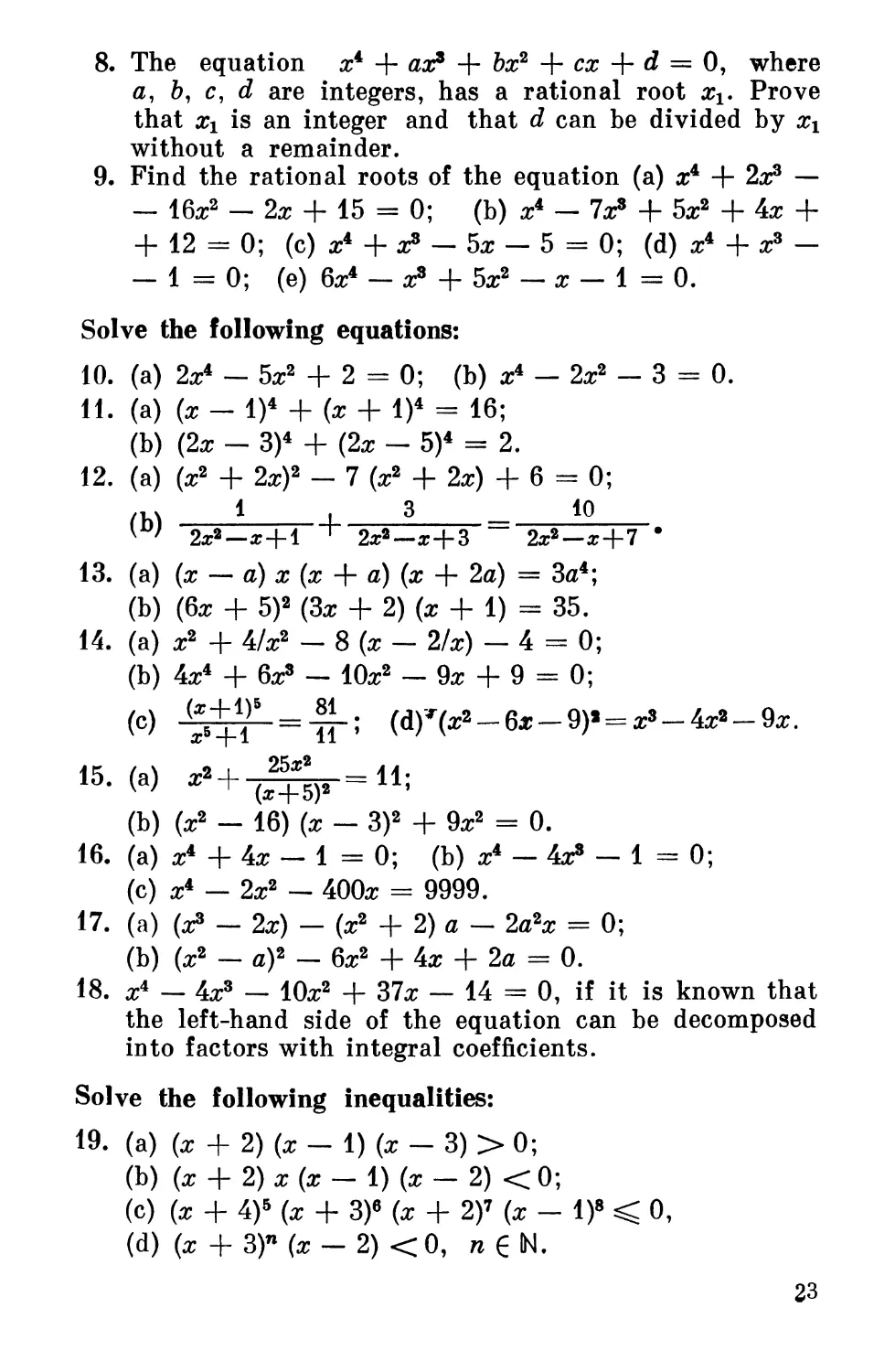
8. The equation x4 + ax8 + fcx2 + ex + d = 0, where
a, b, c, d are integers, has a rational root xx. Prove
that X\ is an integer and that d can be divided by xx
without a remainder.
9. Find the rational roots of the equation (a) x4 + 2x* —
- 16a;2 - 2x + 15 = 0; (b) x4 - 7a" + 5x2 + 4* +
+ 12 = 0; (c) x* + x3 - 5x - 5 = 0; (d) x4 + x3 -
-1=0; (e) 6a;4 - x* + 5x2 — x — 1 = 0.
Solve the following equations:
10. (a) 2x* - 5a;2 + 2 = 0; (b) x4 - 2a;2 - 3 = 0.
11. (a) (x - l)4 + (x + l)4 = 16;
(b) (2x - 3)4 + (2x - 5)4 = 2.
12. (a) (x2 + 2xf - 7 (x2 + 2x) + 6 = 0;
fM 1 , 3 _ 10
K ' 2**—x+1 "*" 2xa—x+3 2x«—*+7 *
13. (a) (x — a) x (x + a) (x + 2a) = 3a4;
(b) (6a; + 5)2 (3* + 2) (x + 1) = 35.
14. (a) a;2 + 4/x2 - 8 (x - 2/x) - 4 = 0;
(b) 4a;4 + 6a:8 - 10a:2 - 9x + 9 = 0;
(c) -S5t" = TT; (d)T(««-ftt-9)» = *»-4^-9x.
«• W ^2 + -(^jr=11;
(b) (x2 - 16) (x - 3)2 + 9x2 = 0.
16. (a) x4 + 4x — 1 = 0; (b) x4 — 4a* - 1 = 0;
(c) x4 - 2x2 - 400x = 9999.
17. (a) (x8 — 2x) - (x2 + 2) a — 2a2x = 0;
(b) (x2 — a)2 — 6x2 + 4x + 2a = 0.
18. x4 — 4X3 — 10x2 + 37x — 14 = 0, if it is known that
the left-hand side of the equation can be decomposed
into factors with integral coefficients.
Solve the following inequalities:
19. (a) (x + 2) (x - 1) (x - 3) > 0;
(b) (x + 2) x (x - 1) (x - 2) < 0;
(c) (x + 4)5 (x + 3)6 (x + 2)7 (x - l)8 < 0,
(d) (x + 3)n(x-2) <0, i»6N.
23

20. (a) x3 - 3x2 - lOx + 24 > 0; (b) x3 + 4x2 + 5x +
+ 2 < 0; (c) 2x3 - 3x2 + Ix - 3 > 0.
21. (a) x4 - 3X3 + x2 + 3* - 2 > 0; (b) x4 + 6a:3 +
+ 6x2 + 6a: + 5 < 0.
22. (a) 3x4 - 10x2 + 3 > 0;
(b) 3x2 (x - 4)2 < 32 - 5 (x - 2)2.
23. (a) (x2 - x)2 + 3 (x2 - x) + 2 > 0;
(b) x (x + 1) (* + 2) (x + 3) < 48.
24. (a) (x + l)4>2(l + x4);
(b) x4 - x3 - 10x2 + 2x + 4 < 0.
25. Prove that the polynomial P (x) = x8 — x5 + x2 —
— x + 1 is positive for any x 6 HI-
26. Assume P (x) = a0£m + eh.x7"'1 + . . . + am-xx + am
and <? (x) = &„*" + M""1 + • • • + bn.tx + bn, m 6
6 N, «fN, (? (x) # 0. Prove that the inequalities
P (x)IQ (x) > 0 and P (x) Q (x) > 0 are equivalent.
Solve the following inequalities:
27. (a) 4<T^r; (b) -!££<■ "
x ^ x —2 ' v ' x — 2 ^ x + 1 '
(c) x + l x ^ x_l ^_2 '
,v x3-2^ + 5x + 2 ^ a .
W x* + ?>x + 2 ^ '
(f) -STT+-^T + ^=r+lRT>0-
1 1
28- (a) X2 + X < 2x2 + 2x + 3 '
{h, 1 4 4 11.
lDJ x_i x_2 "T" * —3 x-4 ^ 30 '
M 4x —17 10* —13 8x —30 . 5* —4
W a:—4 + 2x — 3 ^ 2.r —7 + x —1
29. (a) x2 + 1^Tyr<A; (b) x2+_^_<5.
30 M (*+1)4 ^ 128 ■
(b)x3_^>4(x-^).
24

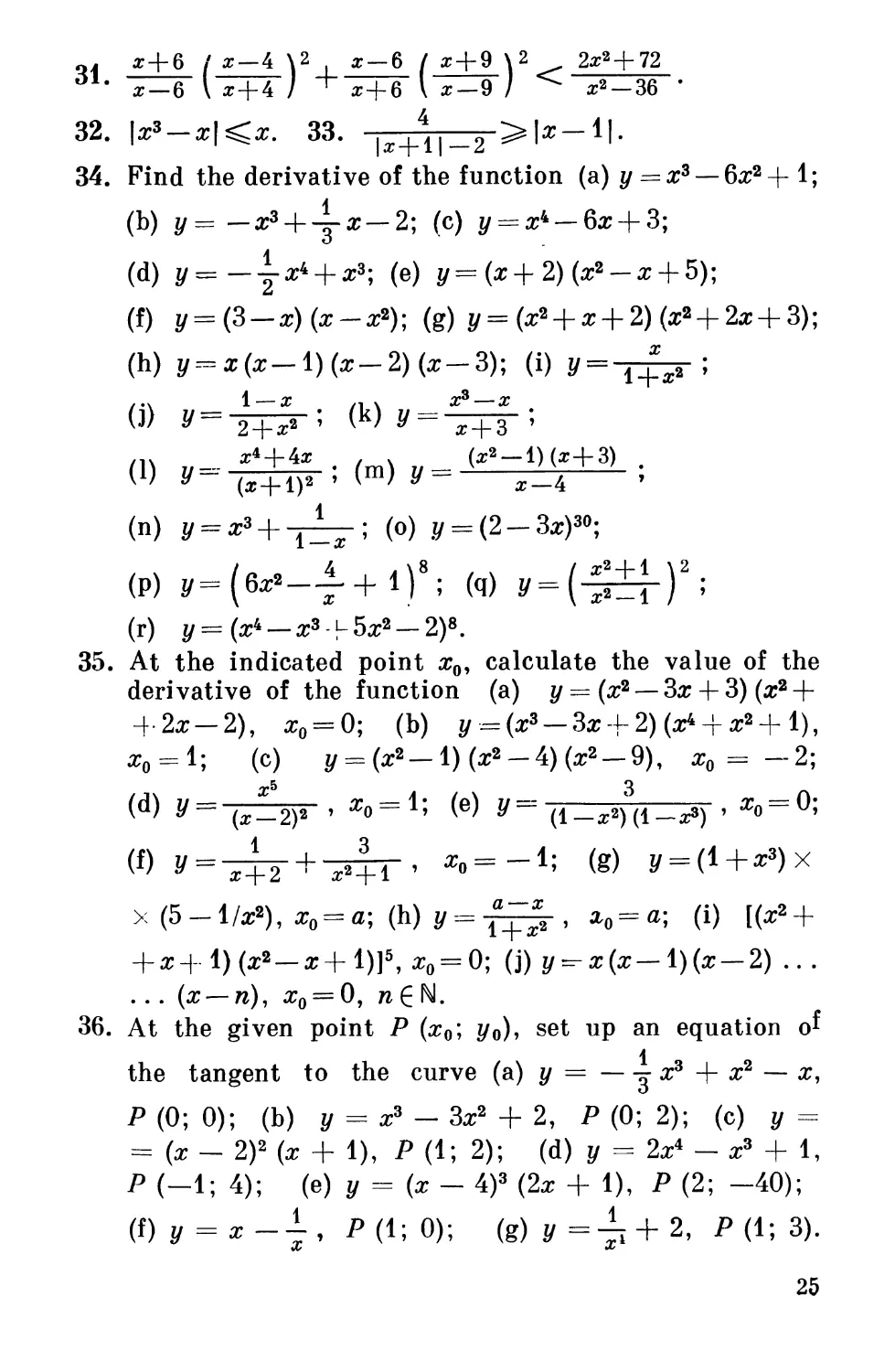
„. x+& I i—4 \2 x—6 / x+9 \2 2z2+72
dl* x—6 I *+4 / + x+6 I i-9 / ^ z2-36 *
32. |x3-x|<x. 33. ,^1-2 >lg-1l-
34. Find the derivative of the function (a) i/ = x3 —6x24- 1;
(b) y= -x* + ±.x-2; (c) i/ = x4-6x4-3;
(d) j/=-i*4 + *3; (e) y=(x+ 2)(x2-x + 5);
(f) i/ = (3-x)(x-x2); (g) i/ = (x2 + x + 2) (x24-2x+3);
(h) j, = x(x-l)(x-2)(x-3); (i) » = -rpp-;
0) j/=-2+i*-; W^T+r''
W y=liTi)r; (m) y= «-4 ;
(n) J/ = a;3 + _±_; (0) i, = (2_3a.)80.
(P) J/=(6^-±+l)8; (q) H^±f)2;
(r) i/=(x4 —x3-l5x2 —2)8.
35. At the indicated point x0, calculate the value of the
derivative of the function (a) z/ = (x2— 3x4-3)(x24-
4 2x — 2), x0 = 0; (b) y = (x3 — 3x-f 2) (a* + x24- 1),
*o = l; (c) y = (x2-l)(x2-4)(x2-9), x0=-2;
(d) y= (x—2)* ' a:o = 1; (e) y= (1_a.2)(1_;rs) . *o=°;
(f) ^tJt + '^TT' «b=-i; (g) j/ = (i+*3)x
x (5 - 1/x2), x0 = a; (h) */ = ■£=£, x0 = a; (i) [(x2 +
+ x+i)(x*-x+i)]t,x0 = 0; (j)j/-x(x-l)(x-2) ...
... (x — n), x0 = 0, ra£N.
36. At the given point P (x0; y0), set up an equation o^
the tangent to the curve (a) y = — -^ x3 4- x2 — x,
/> (0; 0); (b) y = x*- 3x2 + 2, P (0; 2); (c) y =
= (x - 2)2 (x 4- 1), P (1; 2); (d) y = 2x4 - x3 4- 1,
P (-1; 4); (e) y = (x - 4)3 (2x + 1), i> (2; -40);
(f)y = *_±f J>(1;0); (8)^=^ + 2, P (1; 3).
25

37. On the curve y = x* — 3x + 2, find the points at
which the tangent is parallel to the straight line y = 3x.
38. At which point is the tangent to the graph of the func-
1 3
tion f (x) =-o-r* — -^x2 — 9x + 8 parallel to the bisec-
tor of the first and the third quadrant?
39. At which points of the curve y = x* + x — 2 is the
tangent to it parallel to the line y = 4r + 5?
40. Find a point on the curve y — x2 (x — 2)2 at which the
tangent to it is parallel to the line y = 2Ax — 1.
41. Find a point on the curve y = 1/(1 + x2) at which the
tangent is parallel to the abscissa axis.
42. Show that any tangent to the curve y = xh + 8x + 1
makes an acute angle with the #-axis.
Find the critical points of the following functions:
43. (a) y = 2x3-^-x* + x—1^3;
(b) y = x*-Zy3x* + 3lS9x-33/lSi
(c) y=3x3-x2 + 5z + 0.7; (d) y = {z + 2)*(Sx—l);
(e) y=x* + 3\x\; (f) y=|*»|-9*.
44. (a) y = x^ + Sx2 — 64s+l; (b) y-3s* + 16s3 + 6z2 —
-72s-3; (c) y = z* + 6xz + 5; (d) y=-xi + 4\z\;
(e) y-^ + 81^1.
45. (a) y = ^—1«8_3(X+1). (b) i/ = 0.6z5-13s3 +
+ 108^-5; (c) y=(^„|.«4+3^)+5(4—!«») +
+ 4x-7; (d) y = Aj lx + a; (e) y = * + -jL.
46. Find the intervals of the monotone decrease of the
function (a) y = 2x3 + Sx2 — 12* +15; (b) y = ** + -|-*» —2;
(c) y = *--2W» + l; (d) „ =-5=|+|..
47. Find the intervals of the monotone increase of the
function (a) y = x3 — 5x2 + 3x—11; (b) y=— x3 +
+ 6«a —9x + 5; (c) i/ = 0.25a* + z2-6; (d) i/-- *+2 •
X2_l
. 1—X + X2
26

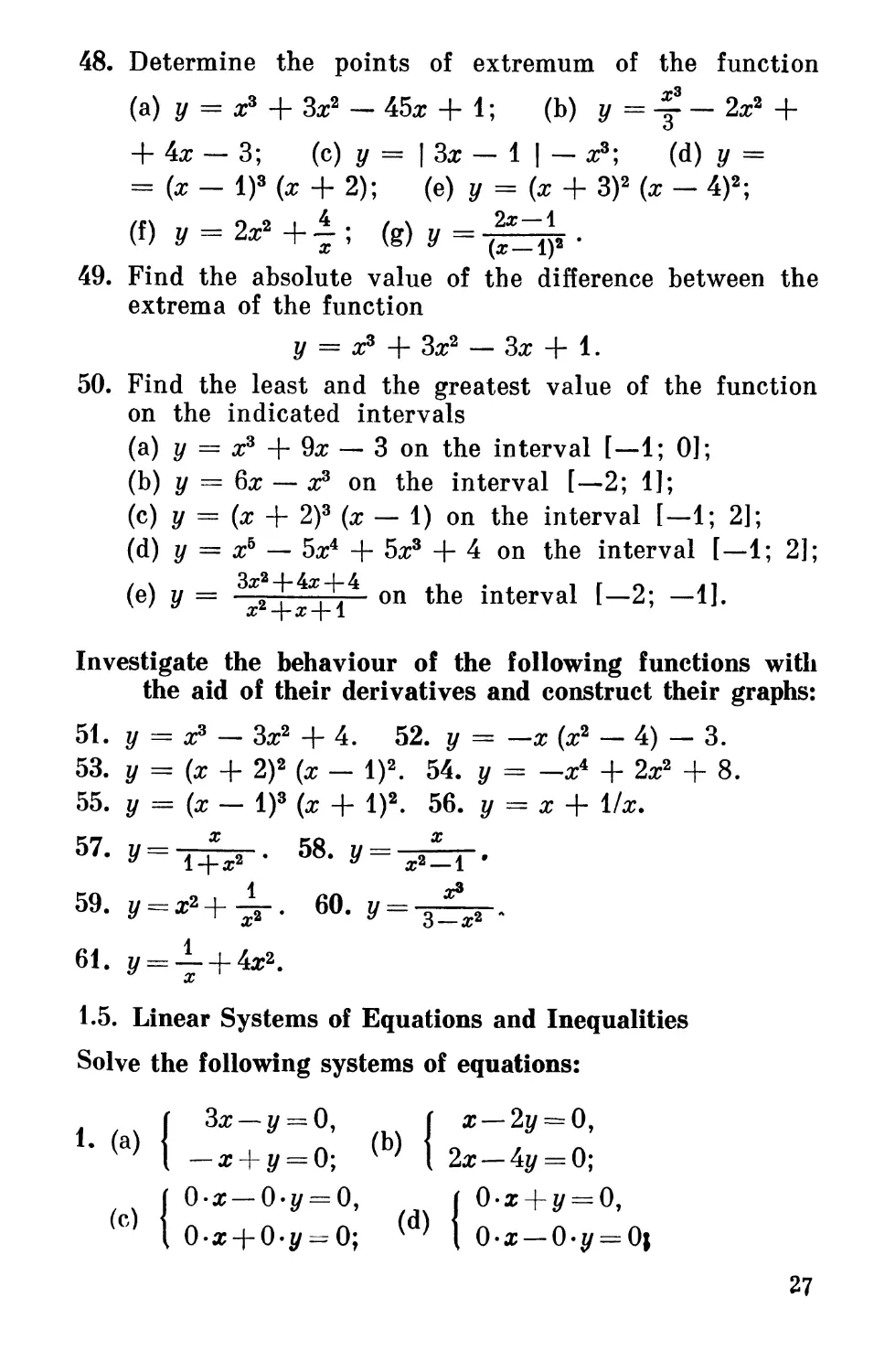
48. Determine the points of extremum of the function
(a) y = xs + 3x2 - 45a; + 1; (b) y = -y - 2x2 +
+ 4x - 3; (c) y = | 3* - 1 ! - x3; (d) y =
= (x - l)3 (x + 2); (e) y = (x + 3)2 (x - 4)2;
(f) */ = 2x*+A; (g)y=^.
49. Find the absolute value of the difference between the
extrema of the function
y = xs + 3x2 — 3x + 1.
50. Find the least and the greatest value of the function
on the indicated intervals
(a) y = x3 + 9x — 3 on the interval [—1; 0];
(b) y = 6x — x3 on the interval [—2; 1];
(c) y = (x + 2)3 (x — 1) on the interval [—1; 21;
(d) y = xb — 5x* + 5x3 + 4 on the interval [—1; 2];
(e) y = 3^22+^+4 on the interval [-2; -1].
Investigate the behaviour of the following functions with
the aid of their derivatives and construct their graphs:
51. y = x3 - 3x2 + 4. 52. y = -x (x2 - 4) - 3.
53. y = (x + 2)2 (x - l)2. 54. y = —a* + 2x2 + 8.
55. y = (x — l)3 (x + l)2. 56. y = x + l/x.
W. » = TF?"- 58- V = 1^T-
59. y = *+-L. 60. y *
3 —a;2 *
61. ^-L + 4*2.
1.5. Linear Systems of Equations and Inequalities
Solve the following systems of equations:
f 3x-y = 0, ( *-2» = 0,
U (a) { -x + , = 0; <b> { 2x-
(0
( 0-x + O-y^O; W \ 0-x-0-y = 0i
27

f 0-* + 0.y=-l,
(e) 1 o.
•x-\-0-y<=2.
I 3x + 2y = i, ( 4x-8y = 3,
2-(a) t -*H-5,r 6; (bM x-2y = 3/
3/4;
f 3a;+ 0=—1, f y — 4x = a,
{C) 1 9z + 3i/=-2; (d) I 8i-2»=l.
3. At what values of k are the following systems of
equations consistent:
(a) {
fcr + y = 2, | kx + 4y = 4,
x-y = 3; (b) 1 3x+ y=i;
f 2m.
f 3as+(*-l)» = *+l,
(C) I (k + l)x + y = 3?
4. Find all values of m for which the following systems
of equations have no solutions:
f 2x + (9m2 — 2)y = 3m,
(8) I x + y = l;
f m*x + (2 — m) y = m* + 4,
^ t mx+(2m-l)y = m5 — 2;
2ma; -j- 2/ — 6 w2 — 5m + 1,
+ 2my = 0.
5. Find c and d for which the system of equations
(c+l)2X-(C+i)y=-C9
(d — l)x + (5 —2d)y = c + 4
has the unique solution x = 1, y = i.
6. The ordered pair of numbers (1; 3) is one of the
solutions of the system of equations
{ax — by= 2a — b,
(c+1) x + cy =10 —a+ 3b.
Find the numerical values of a, b and c.
7. Find b £ m such that the systems of equations
j 3* + #-a, | a;—2#-a,
* ' 1 ax — y = 6; 1 ax + 3y = 6
have at least one solution for any fl^R.
28

8. Find all a and b for which the following systems of
equations are equivalent:
| ax + 2y = b+lt j 2x-\ y = a* + 2,
1 x + y = 3 an 1 x + 3y = 3.
9. At what values of k does the system of equations
f x+ky = 3,
{ kz + 4y = 6,
possess solutions simultaneously satisfying the
inequalities x > 1 and y > 0?
10. At what values of a do the solutions of the system of
equations
1 3x + 2y = 2a2 + 7a + 5
satisfy the inequality x ]/ y 4- 3 > 0?
Solve the following systems of equations:
4.75,
11. I
12-(a) U + 3|,|=6; <b>{^
2*+y—1 ' z + 2i/ —3
3 2
2z+y —1 x+2y —3
+ */)2 = 5,
-J/)2=l.
13. Find a: 6 N and y 6 N satisfying the equation 23a: +
+ 3\y = 1000.
14. On the plane xOy, indicate the points satisfying the
inequality (a) | x — y | < 1; (b) | x + y | > 2;
(c) |*|- \y \>U (d) |*|+ |y |<3;
(e) \x-l | + \y + i |>2; (f) |* + y I +
+ |z-0 |<2.
15. On the plane ocOy, indicate the points satisfying the
system of inequalities
3y <5,
y+2x<ii9
4y + x>9.
Find all integral values of x and y satisfying this system.
29
{

16. At what a £ R does the point (a; a2) lie in the interior
of the triangle formed at the intersection of the lines
y = x + 1, y = 3 — x, y = —2xi
Solve the following systems of equations:
17. f x+ y— z = 0, 18. / x = 3t — 2,
2x— y + 3z = 9, I y=—4:t+l1
— 3x + 4y + 2z=ll. j z = 4t — 5,
I Ax — 3y — 62 = 5.
19. "
20.
21.
{
{
2x + 3y + z — 1:
*-l
1 ~"
z+2
—2
* + 2#-
Given the
if+l
— 2
y-1 _
3
-2z + & =
system
l x +
=0,
z
T#
2-3
2
-0.
*
of equations
■■+1
# + *
. 5
= 79.
61,
2 z
(a) Find the value of the sum *"r */ + t ' (b) amon£ a^
natural solutions of the system, find the solution for
which x assumes the greatest value.
22. The inequalities / (-1) < 1, / (1) > —1, / (3) < -4
are known to be satisfied for a certain function / (x) =
= ax2 + bx + c, a =^= 0. Determine the sign of the
coefficient a.
23. Represent the set {{x\ y\ z) \ \ x \ + \ y \ + \ z | < 1}
graphically and name the figure you have obtained.
1.6. Systems of Equations and Inequalities
in Several Higher-Degree Variables
Solve the following systems of equations:
1. (a) f *2-;cy + 3^ + 2s-5y-4 = 0,
I s + 2y = 4;
(b) f 2sy—y2 + 5a?+20 = 0, (c) ( s2-4^=200,
I 3* + 2y-3 = 0; I x + 2y=l00;
30

(d) ( x* + V + 6x9-6x-18y-40 = 0,
(f) j x* + j/4=17, (g) I x* + 95 = 275,
1 x + i/ = 3; 1 x+i/ = 5;
(h) f x3-93 = 63,
{X3 —l/3 =
xi/ = 4.
3. (a) | x + 9 + x9=-11, (b) | x2y-xy2 = 30,
I x2 + yz + xy=l3; ( x+xi/-i/ = 13;
(c) f (x +0.2)2 +(y+ 0.3)2 = 1,
I * + 9 = 0.9;
(d) f x+9 + */9= 1/2,
+y)» = l .
r *4
{if:
(e) f aty + *y + 2«2y2+a;29« + X9» = 30,
1 2*9 + 9:9 + x+y + xy* = 11.
4. (a) f 2x2 + xy-45y2 = 0, (b) j x2-5*9 =16,
I 2x+V = 4; 1 2x9 + 92 = 3;
(c) i 2*2 + 92 + 3*9+12, (d) j ** + *y2 = i0,
1 (x+y)*-±y* = T, t ^-?3=-3.
5. (a) | 10x2 + 5i/2_2xy—38x—6y +41 = 0,
1 3x2 —2i/2 + 5xi/—17x—6y + 20 = 0;
I
(b) f y*(x*-3) + xy + l = 0,
9*(3** —6) + af9 + 2 = 0.
„+f_?)_|, <») r 4-++-S.
31

7. (a) | i/*-|**/l+2 = 0, (b) f |xy-2|=6-x2,
I 8-x2 = (x + 2j/)2; 1 2 + 3yz = 2xy.
8. Find all pairs of numbers x and y for which the
conditions x2 — 2xy + 12 = 0, x2 + V < 60 and x 6 Z
are simultaneously fulfilled.
9. Find natural solutions of the system
I
10.
x = y-\-2,
zi/<17,
I (0+l)/(* + 2)<l/2.
Find all values of a for which the set
{(*; 0) | *2 + */2 + 2* < 1}
(1 {(*; */) \x - y + a > 0}
contains only one point. Find that point.
11. Solve the equation (a) (x — l)2 + (y + 5)2 = 0;
(b) x2 + y2 - 2x + &y + 10 = 0;
(c) (x + y - a)2 + (y - l)2 + (x + 3)2 = 0.
Solve the following systems of equations:
12. (a) ( x + 2y — 2 = 5, (b) ( 2u + v + w=6,
3x— 4y + z = l, { 3u + 2v + w = 9%
x2 + y2 + z2 = Q;
13. f x + y + z = 2, 14.
xy + yz + zx= — 5,
x2 + */2 — 22 = 12.
15. f x2-*/2=14, 16.
z/2-xz = 28,
z2 — xy = —14.
17. f xi/ + a:2 = 8, 18.
yz + xy = 9,
xz + yz= —7.
19. f 4xz + y2 + 2z2= - 3, 20.
4z2 + a;2 + 2z2=l,
I 8yz + y2 + 2z2 = i.
3h3 + 2i;3 + ^ = 27.
j i/2 + i/ + 2 = —3,
I £2 + #+ 2= — 5.
i
xz + # + z =
x2 + xy + y2 = 3,
y2 + yz + z2 = 7,
z2 + zx + x2 = i9
5xy/(x + y) = i,
lyz/(y + z) = l,
Qxz = x+z.
y3 = 9x2-
z3 = 9y2-
l xz = 9z2 -
21 x + 27,
•27i/+ 27,
-27z + 27.
32

21. Find all triples of the integers (x; y; z) for which the
relation 5a;2 + y2 + 3z2 — 2yz = 30 is satisfied.
22. Hatch the set of points of the coordinate plane defined
by the system of inequalities
(a) | y 2z<0, (b) f z2 + j/<0,
I xz + y2 —5<0; I 2xz + y —1<0.
23. Represent on the plane the set of points (x; y) whose
coordinates satisfy the systems of inequalities
(a) j 2j/>x2, (b) f y + x*^0,
I j/< — 2x* + 3x; < y — 2z + 3>0,
(c) f *2 + y2>1)
Chapter 2
TRANSCENDENTAL FUNCTIONS, EQUATIONS
AND INEQUALITIES
2.1. Irrational Equations and Inequalities
Solve the following systems of equations:
1. V~z~fl = a.
2. V^+S = Va^x.
3. V4 + 2x-x* = x~2.
4. (a) ll + 2a: = /2ir^;
(b) 21 + l/2x^7 = x;
(c) 2]/J+5=a: + 2;
(d) 3s-/l8a: + l + l = 0.
5. (a) ^*TlO +1^^2 = 6;
(b) "K5-1/5T3 = 1;
(c) /15~^* +1^3^ = 6;
3-01521

(d) j/JQ±£L+y'i2=fL = /6;
(e) Yw+i-Yw=a;
(f) Yx2 + 5x + 3-Yxz + 5x-2 = l.
6. (a) Y2x + 3-Y7+l = i;
(b) Y2^+3 + YZTi = 5;
(c) y"2^~3 + /STi-4;
(d) Y~x~TZ+1^2x~+6 = 7;
(e) yr2Jt^4-V« + 5 = l;
(f) /5x+7-y"2lc + 3 = l/3i + 4;
(g) "|/a;2+x-|-4 + "I^a:2 + a:+l = 1^2x2 + 20:4-9;
(h) Y& — 9x + 24-"^6x2-59x + 149= |5-x|.
7. (a) x+12/x-64 = 0;
(b) *74 =g-8;
/x+2
(c) (x-3)2 + 3x-22-=/x2—3x+7;
(d) 2x2 + 3x-5lA2x2+3x+9 + 3 = 0;
(e) */** +15 —2 = /*$/** +15;
<h> ^^+Tf=T?-2;
(i) 4a:2 + 12a:/T+^= 27 (1 +x).
8. K7 —« + /«—3 = a.
9. Find the domain and the range of the function (a) y =
= VT^x + Yl + x\ (b) j^V —4r* + 4x + 3.
34

Solve the following equations:
10. 4/^2 + ^4^^ = 2.
11. Yx% + ax— 2a = x+l.
12. Y2x— 1 — x + a = 0.
13. Ya*—xYx2+a-i = a—x.
14. V x—Y%— a = a.
15. Yx + Y<*+ 2a-3
+ Kx + a + >A2 —2a + 2a2—a3 = ajA—*.
Solve the following inequalities:
16. (a:-l)l/x2-a:-2>0. 17. y^-£=!->-1.
18. "lAT^ + Jjl-X).
19. (l-a)Vr2xTl<l.
20. l/STl>V'3^i. 21. yiT2">yT^a.
22. (a) ]/24-10x>3-4x;
(b) x>Yi -z; (c) x>>A24-5x;
W /-g—t<t-t»
(e) /4-y'T^-y'2^>o.
23. (a) Vxz + x-12<x;
(b) l-]/l3 + 3x2<2a:;
(c) Y^Tx>^—2x; (d) 4-x<l/x2—2x.
24. yrF+!J>yrx=l + y'*^2.
25. (a) .fZi <4;
v /2s—3—1
(b) 2-/^+3 1 .
(c) yrxT2-/5x>4x-2;
(d) y'x~T~T+l<4a:2 fV"3x.
3*

26. /M+2.-* < i.
X
27. 2(^ + ]/a:2 + 4x + 3)<3(/^Tl + l/r^+3-2).
28. At what values%oi p£l> is the function f(x) = y^^
n 6 N, even?
29. Is there a constant number T, T=£0, such that the
equality f (x) = f (x + T) is satisfied for the function
/(«)=Vi=:l?
30. Find the derivative of the function (derive formulas
using the definition of the derivative) (a) y = Y x\
(b) y = 3j/"x; (c) i/ = ^z.
31. Find the derivative of the function
(a) » = /»-l/|/i^(b) i/ = a;2j/s;
(c) y=Vx{x*-Vx+\);
(d) » = (* + /*)(! +-/S)(l+/3i);
(e) V = (i + Vx)/(l + V2Z);
(f) y^Vl^; <g) y = (l-2»i/2)*;
(h) y = Vx + Vx.
32. At the indicated point M (x0; i/o)> calculate the value
of the derivative of the function (a) y = (x2 + £ + 2)3/2,
M (1; 8); (b) y = V(x + l)/(x-l), M (2; V"3);
(c) y = 1/(1 - *2)/(l + *2), M (0; 1).
33. At the indicated point P (x0; z/0), set up an equation
of the tangent to the curve
(a) y(x) =Y£ i>(4^2),
(b) y(x) =x-2Vx, P(U -1);
(c) y(x) = 3Vj?, P(-8; 12);
(d) y(x) =Va* + l, P(A; 9).
34. A tangent is drawn to the graph of the function y =
= (x + 1) Yx at ^e point where the slope is equal to 2;
the tangent does not pass through the origin. Find the
points at which that tangent cuts the coordinate axes.

35. Find the critical points of the function
(a) y = x-4Vx + V3; (b) y = Y\£=T\-
(c) y = /s2-6x+15; (d) y = ^F^6i;
(e) y=(x-i)VH; (f) y = (x+2)Vx~=l.
36. Find the intervals of the monotone increase of the
function
(a) y = "|Ax-4; (b) y = Vx*-x+i;
(c) y = Vr«« + 4«-3; (d) z/ = -^-;
(e) y = 36x — 3a;2 + 4 /r5.
37. Find the intervals of the monotone decrease of the
function
(a) y = V~5-2x; (b) y = 1^2*7^;
(c) y = V"2a*-*+l;
(d)J/=yPT?FW'I>0;
(e) y = ^--i-a./54--|-x-3^+l.
38. Prove that the inequality 2 "|^a; >» 3 — i/x is satisfied
for all x 6 (1; <»)•
39. On the indicated intervals, find the greatest and the
least value of the function
(a) /(z) = lA00-z2, *6[-6; 8];
(b) f(x) = z+2V*, *6[0; 4];
(c) /(*) = y{x*-2x)\ x6[0; 3].
40. Find the points of extremum, as well as the greatest
and the least value of the function / (x) = (x — t)2 X
X Yx2 — 2x + 3 on the interval [0; 3].
41. Investigate the behaviour of the function (a) y =
= #1/^2 — a;2; (b) y = j/"x2 — a: and construct its
graph using its derivative.
37

2.2. Systems of Irrational Equations and Inequalities
Solve the following systems of equations:
1. (a)
(b)
2. (a)
(b)
xy = 15.
s- f yV**T72~2ay-3 = 0,
\ xYx2 + y2 = 2ax.
5. At what values of a does the following system of
equations possess a unique solution:
1 y = ax+l?
6. At what values of a is the following system of equations
consistent:
{
V&+2xy + yz+V*z - 2w+j/2=4,
yx* + y2 = a?
7. Solve the following system of inequalities:
38
{

Find the graphical solutions ot the following inequalities
and systems of inequalities:
8. Vx—y-^Vx + y. 9. l + fi>y.
10. f y-2<V\-x\
I »>2|*|.
2.3. An Exponential and a Logarithmic Function,
Exponential and Logarithmic Equations,
Systems of Equations, and Inequalities
1. Which of the numbers (a) (|)°'6; (b) (1.4)°««;
(c) (0.8)™; (d) (1.5)"0-1; _(e) (0.4)-»_s; (f) (0.7)°-4;
(g) (4.8)-»-^_ (h) (0, (3))V2; (i) (^3)»«; (j) e°-";
(k) (n/2)V2.i; (1) (jt/7)- ^3-i exceed unity?
2. Which of the numbers x and y is greater in the inequality
(a) (0.8)* > (0.8)y; (b) (1.5)* < (1.5)";
(c) (7.1)* > (7.1)*; (d) (1/5)* < (1/5)", *, y 6 01?
3. Which of the two numbers is greater, 2300 or 3200?
4. Simplify the following expressions:
(a) 25l0g'3; (b) e">i"3; (c) In ab — In | b |;
(d) loga&2 + loga2&*; (e) 2los-';
m logs 25 .
W logs 5 '
(g) log35.1og49.1og62; (h) /log* 54;
(i) a/-J-ftV-^
5. Find (a) log30 8, if log30 3 = c, log30 5 = d;
(b) log9 40, if log 15 = c, log20 50 = d;
(c) log (0.175)4, if log 196 = c, log 56 = d.
6. Prove that if a = log12 18, b = log24 54, then
ab + 5 (a — b) = 1.
7. Without resorting to tables, calculate
log»24 log2192
log„« 2 logM 2 •
39

8. Prove that
logn (n + 1) > logn+1 (n + 2),
for any natural n > 1.
9. Prove (without resort to tables) that log4 9 >» log9 25.
Solve the following equations:
10. (a) 3*"5 = 7; (b) 313*-41 = 92*-*;
(c) 7*+2-i-.7*+1-14.7a-1 + 2.7* = 48;
*+5 JC+17
(d) 2**-3 = 4**-3x-l;\e) 32K_7 =0.25-128 x~3;
1--2
x In ye
(f) 4s =
In Y'e
2
(h) /r4+10gv5K=i-;
(i) 73ac + 9-5M = 5M + 9.7»*;
X+-L x+—
(j) 9*-2 2 =2 2-32,:-1;
(k) V/2*^4*(0.125)1/x = 43/2;
(1) 43/(0.125)*-* = 2Tr*TT;
(m) ((^27f "Kf)^+Kf-/3-7.
11. (a) 4*8+2-9.2*,+2 + 8 = 0;
(b) 9x'-1-36-3K8_3 + 3 = 0;
(c) (*/3)* + (1?/3),c-1o = 84;
(d) 4*+V"^2_5.2*-'+V^i::2 = 6.
12. (a) 4*+1'5 + 9x = 6x+i;
(b) 252*-JC,+1 + 92x-5C'+1 = 34-152*-*';
40

(c) 223c2 + 2*'+2k+2 = 25+4*;
(d) (V5 V*2 - 7)* + 6 (V"5 ^2 + 7)* = 7.
13. (a) 32jc,-2.3a,+*+6 + 32(K+6) = 0;
(b) x2.2T/"2*+I-1 + 2x = 2ir2S+I+1 + x2.2x-2.
14. (a)4,Og"(K-3>+,og*5 = 50;
(b) x10e*(i-X)2 = 9.
15. log3 (*2 + 4x + 12) = 2.
16. (a) logs a; + log9 x + log27 x = 5.5;
(b) log2 (3 - x) + log2 (1 - x) = 3;
(c) log (x - 3) + log (x + 6) = log 2 4- log 5;
(d) log (x - 4) + log (x + 3) = log (5x + 4);
(e) In (x3 + 1) - 0.5 In (x2 + 2x + 1) = In 3;
(f) log5 (x - 2) + 2 log5 (*3 - 2) + log5 (x - 2)-'=4;
(g) 2 log3 (* - 2) + logs (* - 4)2 = 0;
(h) log2 (x + 2)2 + log2 (x + 10)2 = 4 Iog2 3;
W log,-f=f-l = log,-g=f;
0) 21og2jgf + log2^j- = l;
(k) logs (5a;- 2) - 2 log3 V** + 1 = 1- log3 4;
(1) log(3s-2)-2 = -ilog(x + 2)-log50;
(m)log2(l + ^)+log2(l-^-)
= 210^(^-1).
17. (a) log2x&+loga*2 = l;
(b) log2 (x- 1) -logy^V' + S = logs (*-«)3
+log1/2(x-3); (c) log2(6x2+25x) = l+log2(ax+4a-2).
18. (a) logj xlog4xlog5x = logg xlog4x+log4xlog5x
+ log5 * log3 *; 0>) (logs ■§■) 1°&5 * - logs —T7=- = X
+ log2y"x,
41

19. (a) log(10x2)logx-=l;
(b) loggs-l =21og2yx + 3-log^x;
lo^T
(c) 21og9x + 91ogx3=10;
(d) logx(125x)log2\x=l;
(e) logKy5 + log* 5x = -J- + log|y5;
(f) log (log x) -flog (log a*- 2) = 0;
(g) log33C+7 (9 + 12x 4 4x2) = 4_ i0g2!c+3 (6x2 + 23x + 21);
(h) log2(4-x) + log(4-x)log(x4 4")
-21og2(x+4-)=°-
20. (a) (x2logx27)log9x = x + 4;
(b) ]ogs2-log4x + 7/6 = 0;
(c) log0.5x x2 — 14 log16x x3 + 40 log43cyx = 0;
(d) 4 log x yx 4- 2 log4K x2 = 3 log2;c x3;
2
(e) log3s(-|)+log?x = l;
(f) (log1/inT^10)log(x2-3x4 2)
= (log(*-3))loglAiriT510-2.
„. ,v l0gs(2q — X) . lOggS _ 1
AX' W log* 2 "+" logo2 - log^.^ '
log -- a
22. (a) y 1 + log0.04 x4-y3 4 log0.2 * = *;
(b)y2^i3^=-1gL;
(c) log, (x2 4 1) = y logy^ (*2 (1 + *2)) + 4;
(d) ylog2 x — 0.5 = log2yx.
42

23. (a) log(3--2*-Jt) = 2 + -|-logl6—f-log4;
(b) iog3(iog9*+4-+9JC)=2a;;
(c) log3(3^13^28 + 4)=log50.2.
24. (a) log 2 + log (4*"2 + 9) - 1 + log (2*-* + 1);
(b) log (6-5* + 25-20*) = x + log 5.
25. (a) logyj (4* - 6) - log5 (2* - 2)2 = 2;
(b) x (1 - log 5) = log (4* - 12);
(c) log2 (4* + 1) = x + log2 (2*+3 - 6);
(d) log, (9* + 9) = x - logj_ (28 -2.3*);
3
(«) log8(^r-l)=i-2;
(f)^(*(4-r-')-^((T)"-*)-
log x+5
26. (a) (s+l)log(*+1, = 100(x + l); (b) x 3 = 105+log*;
(c) 3log* = 54-xlog3; (d) log2(9-2«) = 10log(3-*>.
27. |s-l|log2*-log**-|x-l|3.
28. (3x,-7-2x+3-9-9lA3)log(7-ar) = 0.
29. 3.2log«(35C-2, + 2.3log*(33C"2) = 5.6log3c2(3x-2).
30. It is known that x = 9 is a root of the equation
logn (x^ + 15a2) - log„ (a - 2) = log„ -^.
Find the other roots of this equation.
31. |1 —log1/5a;|+2= |3 —log1/5x|.
32. log4(6 + V"J-|lAi-2|) = i- + log2|l/"x-i^-2||.
33. (a) 5*+12*= 13*; (b) 3x + 4* + 5* = 6a:;
(c) 2*=l-a:; (d) log2 (4-x) = z-3.
43

Solve the following systems of equations:
34. (a) J 5i*-n,-.= 1; (b) ( loga,x + logasy = i;
{2x+v-i + 2*-y+i = 3,
JL .3* l0s» 2+y loe»2_2 j_ 3X l0*8 2~^log3 2"2 = —
oE / , f 101+log(x+v) = 50,
35. (a) |
(b) {
log (* — y) + log (* + y) = 2— log5;
*»<>** 2 = i0gs(s + j,),
X2 + j/2 = 65.
f \og2(x + y)-log3(x-y) = l,
36. (a) J x2_j,2 = 2;
f (3j/2 + l)log8x = l,
vb) { a;2y2+io = 27.
(log4 x + log4 y = 1 + log4 9,
s + j/ = 20;
logx+logy = 2,
37. (a) {
f log x+logj
(b) 1 *-j/ = 15;
(
(d) {
log3*+log8y=::2 + log3 2,
(C) i log3 (x+y) = 2;
4-"log2a; = 4,
log2a; + 2-21' = 4;
„ f » + log*=l, ... | *1*» = 2,
(e) ( s" = 0.01; (f) 1 xy = 20;
f 2x.8-« = 2/2,
(g) |iog9i-+o.5 = 4-iog3%;
(log0(*y)-2)(log0^-)_1 = -l,
(h) j ^'^
44

40
(b) {
(
f
M ,, I 2(logBi + log3Cy) = 5,
38. (a) \ Q
{ xy = S;
\ogxy + logvx = 2.5,
x + y = a? + a.
39 , xVy + yVx = 2S,
logtx — logj_y = 1.5.
9
log2l/ = logt(«y—2),
log9x2 + log3(x— j/) = l.
f 2sc2+t'= 4<1,2+a)/2
41. < r_
f 40C/!'-3!'/x = 16,
' I Vr«-V"2» = V"12-y8.
f af + y = 4+V^T2,
4d' I logx-2 log 2 = log (l + 0.5i/).
log3 (log2*) + logj_ (log_i_ y)=i.
44. { 3 2
a;j/2 = 4.
— X/"9 = 9x/(2!/>
45.
3
x+3y _ 2x
x y
Solve the following inequalities:
46. (a) log (** — 2x — 2)< 0;
(b) log5 (x2 - 11* + 43) < 2;
(c) 2 - log2 (x2 + 3x) > 0;
(d) logl.5^=|<0;
(e) log,17±^<l; (f) log43f±2^0.5;
(h)^(fe!)>-4
2 *
45

47. (a) log!(2a;» + 5x+l)<6;
5
(b) log1(a;2 + 2a:)>0;
3
(c) logi(xa-4x + 6)<-2;
(d) logl^<l;
3 ~
(e) logo.25—-—>—?•
48. (a) log5(2x-4)<log5(a; + 3);
(b) log0.I(*» + s-2)>log0.1(* + 3);
(c) logVra;2-3a: + 4-log]^a:+l>0;
(d) log1/2(a;+lXlog2(2-a;);
<e> lQgi/2 %%t)9 <-log8(»+l).
49. (a) log(*-2) + log(27-*)<2;
(b) log(*-l) + log(*-2)<log(* + 2);
(c) log2 (2 - x) + log1/2 (x -1) > log vl 3;
(d) logl/5 (2x + 5) - logl/5 (16 - *») < 1;
(e) log2(l + i)-hlogi(l + f)>l;
(f) log,x — log7 (2a; — 5)<log7 2 — log7 (x — 3);
(g) logi/s (*-*) + logi/a(*+!) + logys (5 — *)< 1;
(h) log2a;2 + log2(a:-l)2>2.
50. (a) 2X>5; (b) (T) <-gj.;
(c) (l/2)1°f<«,-2K-3>>l;
(d) 3l0^<*,-^+2)>3.
(e)5log>^<l;
(f)(1)—<(1)16-;
(g) 3^>2a.

51. (a) log** + 31ogs-/(>0; (b) *~^J <1 ;
(c) logl/3a:>logx3—-2 J
(d) (log2 x)* - (logl -£) 2- 20 log2 x +148 < 0;
V 2 '
(e) (2 loglx-3 log3a:-8) (2 log23x-3 log3x-6)>3;
(f) (log*x + 3 log2a; +1) (log*x + 3 log2a;-3)< 5;
(g) (1.25)1-*0*"* < (0.64)2+log^s.
52. (a) 2^-21.(i-)2K+3 + 2>0;
(b) 0.1X+1<0.8 + 2.10*; (c) 2* + 2~*<3;
(d) 3*-3*-35.33*-a + 6>0; (e) ^i<:2x;
(f) 3ioeoc+2<3iog^+5_2;
(g) (^)loeKV2>3.2-10^->.
53. (a) log2(4*-5.2* + 2)>2;
(b) logl//5(6^-36*)>-2;
(c) l0g^(5*-l)log^J^->2;
(d) log(l + 2^)>(a;lof^8log4+log3.
54. (a) j/log2^J<l;
(b) /log, (9*-3) < log, (x—j);
(c) /9x + 3*-2>9-3*.
, , 3x+6
l08l loe2 -J7^2"
55- (a) logl/3(log4(x2-5))>0; (b) 0.3 » > 1.
56. (a) log4/3(/xT3-a;)>0;
(b) log1/i(yr5^-a:+l)>-3.
47

57. (a) a:l08.*-2>* . (b) ^log^-Slogx+l > 1Q00;
(c) l/a;l08^»>2.
58. (a) log0(a;-l) + log0a:>2;
(b)
5 — log0a;"1" 1 + log0 x
<1, 0<a<l;
(c) 3^a£±6>i;
logax + 2
(d) loga(l-8a-*)>2(l-z).
59. (a) logx_3(*-l)<2; (b) logx(x + 2)>2.
60. (a) logae^-te + eXl; (b) logrt(i«-i)<i;
(c) log3x+5(9*2 + 8*+2)>2; (d) log2x+4(*2 + l)<l;
(e) lofcT^E<-2.
61. (a) lofe»(3-2s)>l; (b) logKH 3k (* + 3)< 1.
62. log2 21-*'>().
3ix-2i
63. log n s(a;2-10x + 22)>0.
64. (a) I a; |3
-*-2 j /1 v I 1 X |**-18*+56 .
2<1; (b) loga-| >1.
(b) - kg****-1) >n:
(c) !^5>0; (d)
3a:2 —2a; —1
<o.
log3 (a; —1)
66. (a) 25-2*-10* + 5*>25;
(b)iog5x+iogx4>^t('~log8l);
l0g4iH^2
48

Solve the following systems of inequalities:
V(x-8)(2-x)
67. (a)
logo.s(-7-(logj5-l)j
2*-3_31>0;
/loglz-31og2z+2
>o,
68.
(b) { logs (y(log3 5-1))
x—Vx — 2>0.
/J,8 + l0go* , J .10g2K
V 81 / > U /
>0,
0<x<l.
69. Which of the functions given below are even and
which are odd?
(a) i, = 2-"; (b) */ = ^±^; (c) y = ^^-;
(d) ^ = ^+FfJ (e) 2/ = ^T;
(f) y=**+ii te) y=lnr=s;
(h) y = loga(* + /** + l).
70. Represent the function z/ = 3* as the sum of an even
and an odd function.
71. Given the function y = (l/2)sin*. Find the least
positive period of that function. Is the function odd?
72. Find the inverse of .the function y = (ex — e~x)l2.
Construct the graphs of the following equations:
73. y = 3-1*1. 74. y = log2 (1 - x).
75. y = | log2 (1 - x) |. 76. y = log2 (2 - xf.
77. */ =
Una; |
lnx
78. i/ = slog^.
l°gv 2
79. j/ = e'ln*». 80. */ = log2(;ra-2z).
81. y = log2
»U—1| •
83. | y | = log2 (— *).
4-01521
82. y = log2sin;r.
49

Find the derivatives of the following functions:
84. (a) y = 3x; (b) 0 = 10*; (c) y = l/2x; (d) ^e^e"*;
(e) i/ = 2e*~e-*; (f) i/ = 3* + 4*; (g) y = *.10*;
(h) y = xex; (i) y = x/ex; (j) y = V2=;
(k) y^e*8-**'; (1) |f = j5s.
85. (a) y = log3x; (b) y = log2x + log1/3a;; (c) y = log5]/x;
(d) y = log7a;6; (e) y = x+lnx;
(f) i/ = a: lna:; (g) y = \n2x; (h) i/ = ]/lna:;
,.* 1— In a; ,-x In a;
86. At the point x0, find the value of the derivative of the
function (a) y = 4X, a:0 = 2; (b) y = e"x, a:0 = In 3;
(c) z/ = In (x2 — 4a:), a:0 = 5; (d) y = x In2 x, x0 = e.
87. At the indicated point K (x0\ */o)> set up an equation
of the tangent to the curve (a) y = e*; K (0; 1);
(b) y = lnx, K{i;0).
Find the critical points of the following functions:
88. (a) y = 2* - * In 2 + 1; (b) y = e* (~x2 + 4* - 1);
(c) y = e'x (x2 + 5x + 7); (d) y = xe*-*2;
(e) y = e~2* + (6 — 2a) e~x + Gax + cot 3;
(f) y = (0.2)2* + (2a + 2)(|)* - (2« ln 5) x + ln ^
(g) y = el*l - 2* + 1.
89. (a) i/ = ln (4a: — a:2).; (b) y = In2 * — 6 ln x + 5;
(c) y = 4 ln 3 - 16 ln (a:2 + 3x) + 0.5 (a:2 + 3z)2.
90. Determine the intervals of the monotone increase of the
function
/ (x) = 0.3125 (l/2)3*2-8* + 5 (ln 2) (3x2 — 8x + 1).
91. Determine the intervals of the monotone decrease of
the function
/ (x) = x2 ln 27 — 6a: ln 27 + (3a:2 — 48* + 24) X
X ln (x2 — 6a: + 8).

92. Find the intervals of the increase and decrease of the
function (a) y = x — ex+ tan-y; (b) */ = ^ — ^J
(c) y = (2*-l)(2*-2).
93. Find the point of extremum of the function (a) y =
= (x*-2x)lnx—^x* + 4x + l; (b) y= (^ — x) In*—
-4 + x-l.
94. Find the values of a and ft for which the function / (x) =
= aln x + bx2 + x + 2 possesses extrema at the points
x1 = 1 and x2 = 2.
95. In the indicated intervals, find the greatest and the
least value of the function (a) y — e~x (x2 + x — 5),
*€[-4; 4]; (b) y = 2*+f* , *6[-l; 2J;
(c) i/ = 2-33* - 4-32* + 2-3*, a: € I—1; 11;
(d) y = | z2 + 2a: - 3 | + 1.5 In x, x^ [1/2; 4].
96. At what value of x does the expression 2X* — 1 +
+ 2/(2*2 + 2) assume the least value?
97. Solve the inequality /' (x) < g' (x), if
(a) / (x) = x + 3 In (x — 2), g (x) = z + 5 In (x - 1);
(b) / (x) = e2* - 3xf g («) = 5 (e* — * + 3).
98. Prove that the inequality (a) ex >> 1 + x;
(b) a: > In (1 + x) is valid for all x 6 (0; oo).
Investigate the behaviours of the following functions with
the aid of their derivatives and construct their graphs:
99. y = xe~x. 100. y = In (x2 + 1).
2.4. Transformation of Trigonometric Expressions
1. Prove the identity (a) sin6 a + cos6 a + 3 sin2 a X
X cos* a = 1; (b) sin;a-ta°'a = tan« a.
' v ' cos2 a — cot2 a
2. Knowing that sin a + cos a = a, find
(a) | sin a — cos a |; (b) cos4 a + cos4 a.
3. Given: tan a + cot a = p. Find: (a) tan2 a + cot2 a;
(b) tan3 a + cot3 a.
4* 51

4. Find: (a) sin ( ——a] , if tan a— —7-9 ~:Y<-a<- ^n'
(b) cos (70° + a), if sin (40° -|- a) = 6, 0° < a < 45°;
(c) sin (a + p — y), if sin a = 12/13, cos [5 = 8/17, sin y =
= 4/5; 0<a<ji/2, 0 < p < n/2, 0 < 7 < jt/2;
3
(d) sin 3a, cos 3a, tan 3a, if cot a = 4/3, ji<a< y Jt.
5. Given: a, P, 7 are the angles of a triangle. Prove the
equality sin a sin p — cos y = cos a cos p.
6. Prove the identity (a) (cos a + sin a)2 = 1 + sin2 a;
(b) l-sina = 2sin2 (-f--y) ;
1 — 2 sin2 a A
(C)
2cot(i+a)cos2(-J-a)
(f\\ 1 —2sin2P _ 1 — tan ft m
*d' l + sin2P ~ 1 + tanp '
z v . / Jt , \ 1 + sin 2a
(e) tan -y- + a) = —■—-— ;
v ' \ 4 ' / cos 2a f
/i?x cosa+sina 0 . 0
(f) ■—: = tan 2a + sec 2a;
v ' cos a—sin a ' '
7 x sin4 a+2 sin a cos a—cos4 a n^„ 0_
W unte-l = «os 2a;
(i) 3 —4 cos 2a + cos 4a = 8 sin4 a;
113
(j) cos4 a = — cos 4a + -j cos 2a + ^ ;
(k) sin4a-|-cos4a = y(l + cos2 2a);
(1) 4 (sin6 a + cos6 a) = 1 + 3 cos2 2a;
(m) 8 /sin8y+cos8-y) = 1 +6 cos2 a + cos4 a.
n a* ~it *u • / \ sina + sin3a
7. Simplify the expression (a) cosa+cos3(X ;
/,v cos 4a—cos 2a . v sin a—3 sin 2a+sin 3a
(d)
sin2a + sin4a ' v ' cos a — 3 cos 2a + cos 3a '
2 (sin 2a+2 cos2 a — 1) .
cos a—sin a—cos 3a+sin3a '
52

/ v 2jx , 4jx , 6jc
(e) cos — + cos — -f- cos — ;
(f) cos 0 4- cos -=- + cos — + . . . + cos -=-.
8. Prove the identity
/ v 2 sin 2a + sin 4a . n
<a> 2(cos«+cos3a) = tan2«cos«;
(b) cos4 a — sin4 a + sin 2a = ]/* 2 cos ( 2a — j ) ;
(c) cos2a + cos2(y + a)+cos2(-J —a) = |-;
(d) sin2 a + cos (y — a) cos (y + a) = -j ;
(e) log,/s [cos2 (a f p) + cos2 (a — p) — cos 2a cos 2p] = 0;
(f) — y ~Tl£r~ ~ cos ^a cot ^a = s*n ^a'
(f) 16 sin 10° sin 30° sin 50° sin 70° - 1;
11 1 1
(h) sin2 a cos4 a = -rrr -f -^ cos 2a—tf cos 4a—-^ cos 6a;
(i) sin 9a + 3 sin 7a -f 3 sin 5a + sin 3a = 8 sin 6a cos3 a»
(j) tan(a-P) + tan(P-v) + tan(Y-a) =
= tan (a — P) tan (P~ y) tan (y— a);
(k) l/^l + sina— V"l — sina = 2sin ~ ; ifa^jO;-^].
9. Given: sin a + cos a = 1.4, 0<a<-j. Find tan-y.
10. The positive acute angles a, p, y satisfy the relations
tan y^-o-cot y, cot -|- - y (3 tan y -fcot y) . Find
the sum a + p + y.
11. Calculate without using tables: (a) cos292°30/;
(b) cosecl0°-y"3secl0°; (c) _2«»40--cos20" -
sin 20°
sec 5° cos 40°
(d) -2V2sinlO^ (2sin35°-i^-^if-) ;
(e) cos2 73° + cos2 47° + cos 73° cos 47°;
53

(f) sin 6° — sin 42° — sin 66° + sin 78°;
(i) tan6 20° - 33 tan* 20° + 27 tan2 20° - 3;
(j) cot2 36° cot2 72°.
12. Excluding a from the relations, find the relationship
between x and y:
f s = 3cosa, (*-2=-2cosaf
(a) i , . (b) \ , 2 a
v ' I y = 4 sin a, v \y = 4 cos2 -y;
J "|/!; = tana, f x = Yl — sina,
\^ = seca; 1 ^^gin^L + cos-J.
2.5. Trigonometric Functions
1. Find the domain of definition of the functon (a)y =
= Ttan2s;(b)»=5cot-y; (c)y=™^-; (d)» =
sin a;
2. Find the range of the function (a) y = 2 sin-|-4-1;
(b) y = 5 cos xY 2 + 3; (c) # = 4 tan xcos a:;
(d) y = 9 cos 3x~ 12 cos3 3z; (e) y = cos4 -|- — sin4 -|-;
(f) i/= tan«(s--J-) ; (g) z/^sin]/*;
(h) # = cos (l__—) ; (i) y = cos(2sinx);
(j) z/ = sin (log2 x)\ (k) j/ = cos 2.r — sin 2x\
(1) z/= 12 sin x + 5 cos 3 +1.
3. Find the greatest and the least value of the function
(a) y = a cos x + b sin # + c; (b) y = 10 cos2 x —
— 6 sin x cos x + 2 sin2 #.
1 1
4. Find the range of the function y — 1—: de-
° v cos a; sin a;
fined on the set X = (0; Ji/2), zgX.
54

5. Find the least value of the function
y = 2 (1 + sin 3a: sin 2x) — y (cos Ax + cos 6a;).
6. Prove the function
y = sin 5x + sin 3a: + 5 sin a: cos 2a:, x 6 III
is odd.
7. Prove that the function
y = cos 4a: + sin3 -^- sin a: + 5#2, a: 6 01
is even.
8. Find the least positive period of the function
(a) y = sin 3a:; (b) y = tan 2a: + 2 sin 3a:; (c) y = cos -|-;
(d) y = cos2x; (e) y = sin (cos x); (f) y=^ cos (sin a;)
(g) y = cos-g-a: — siny x.
9. Prove that the function y = sin ]/^a: is not periodic.
10. At what values of n 6 Z does the function y =
= sin ra/sin — possess the number 4ji as its period?
11. With the only use of the definition of an increasing
function prove that the function y = sin x increases
on the interval (0; -jM .
Construct the graphs of the following functions:
12. (a) y = sm2x; (b) y= — sin-|-; (c) y = sin (x — y) ;
(d) y = sin | x |; (e) y = | sinx |; (f) y = |88^*1 ;
(g) y=a: + sina:; (h) y = xsinx; (i) y = cosec\x\;
(j) y = 28in *; (k) y = sin [arc sin (log,/2 x)\.
13. (a) y^cos (—-f-) ; (b) i/ = cos2a:;
(c) i/ = cos (z + -|-) ; (d) i/= | cosa: |; (e) y = seca:.
55

14. (a) y = tan 3a:; (b) y =-- — tan -|-;
(c) y-tan (-- -x} ; (d) i/ = tan |s |;
(e) y=|tanjr|; (f) y = tan xcot a:.
15. Construct the graph of the equation (a) | y \ — sin x\
(b) sin y = sin x.
16. Find the derivative of the function (a) # —sina: —
—coso:; (b) y = tana: f cot x; (c) y—sin2o:; (d) y =
1 1
— cos2 x; (e) # = -ytan3.r; (f) y=jCot*x; (g) # =
-sin 3x; (h) # = cos--^; (i) y = sin2 (2a:— 1); (j) y =
= cos3(z2 + z); (k) y= ,fn* .
17. At the indicated point x0, find the value of the deri
vative of the function (a) y = sin x, x0 = ft/6;
(b) y = cos (—2a:), x0 = ji/4; (c) y = tan x — x,
Xq = Jt/3.
18. At the indicated point A (x0; y0), set up an equation
of the tangent to the curve (a) i/ = 2sin-^-,
A (y jt; 2) ; (b) y = cos2x, A (-£ ; y) ;
(c) y — tan 2s, ^ (-g-; l) .
19. Find the greatest and the least value of the function
y = sin2 x — 20 cos x + 1.
20. Prove that the function
f (x) = cos2x + cos2 f-^ + o: J —cos a:cos (4r + #)
is a constant, i.e. that it does not depend on x. Find
the value of that constant.
56

2.6. Inverse Trigonometric Functions
Find the domains of definition of the following functions:
1. (a) y = arcsin (1 — x); (b) */ = arccos (2—|-1 ;
(c) y== arcsin (2x4 x2); (d) y = arccos . * 2 ;
(e) y = arcsin (cosz); (f) y = arccos (sin2a:).
2. (a) y~ arctan (1 — x2); (b) */ = arccot Yx\
(c) y = arctan (log2x); (d) y = arccot (ex + e"x).
3. Find the range of the function (a) y== arcsin ~Y x\
(b) y = arccos ( -^-) ; (c) */ = arctan -^ ;
(d) z/ = arccot (2a:— z2).
4. Prove the identity (a) sin (arcsin |a:|)==|a:|;
(b) cos (arcsin x) ="|/"1— a:2; (c) tan (arcsin #) =
= x/Yl — x2, a? 6(—1; 1).
5. Calculate (a) sin (2 arcsin -^ j ; (b) cos (2 arcsin -=-) ;
(c) tan (2 arcsin-^) ; (d) sin (3 arcsin y) ;
(e) sin I y- arcsin —^— 1 .
6. Prove the identity (a) cos | arccos x \=x;
(b) sin (arccos x) = ]/ 1 —xl\ (c) tan (arccos z) =
= y\=J2lx, *6[-l; 0)U(0; 1).
7. Calculate (a) cos (3 arccos-7-) J (*>) sin f y arccos -g) ;
(c) sin I-7-arccos -^-1 .
8. Prove the identity (a) tan | arctan x\ = | x |;
(b) cos (arctan x) = l/^l + **;
(c) sin (arctan #) = x/]/ 1 + #2.
57

9. Calculate (a) sin (2 arctan 3); (b) tan (2 arctan 3);
(c) sin (-^arctan 3) ; (d) cos (-*■ arctan 51 ;
(e) cos ( -7- arctan -=-).
10. Prove the identity (a) cot | arccot x \ =x;
(b) tan (arccot x) = lAr, x=£0;
(c) sin (arccot x) = l/]/~l + x2;
(d) cos (arccot x) = jc/V 1 -f x2.
11. Prove that (a) arcsin # = arccos|/rl — #2 and arccos z=
= arcsin V"l — x2 for O^s^l; (b)arcsin;r =
= arctan r and arccos x = arccot —. for
0 ^ x < 1; (c) arcsin x = arccot ~~x and arccos x =
= arctan — for 0 < z ^ 1: (d) arctan x =
X
= arccot — = arcsin —m — arccos —, and
x /i+*2 yl+P
l.i l
arccot x = arctan — — arcsin r = arccos —,
* Yl+x2 yl + s2
for *>0.
12. Express (a) arcsin -^-; (b) arccos -75-; (c) arctan -^ ;
3
(d) arccot-7-in terms of all inverse trigonometric
functions.
13. Prove that (a) arcsin (—x) = — arcsin x, x(z[—1; 1];
(b) arctan (—x) == —arctan x; (c) arccos (—x) = n —
— arccos #, x£[—1; 1]; (d) arccot {—x) = n — arccot x-
14. Express (a) arccos ( — -^-j ; (b) arctan ( — -^t-) ;
(c) arccot (—-or) in terms of all inverse
trigonometric functions.
15. Prove that if x6[0; 1] and y 6 [0; 1], then
(a) arcsin x + arcsin y~ arccos 0^1 — £2]Al — y2 — xy)-
(b) arccos x + arccos y = arccos (xy — Y^ —#21^1-—J/2);
58

(c) arcsin x— arcsin y — arcsin (;r]/"l—y2— 2/1^1—x2)\
(d) arccos x — arccos y = arcsin (i/"^l —£2 — zj^l — y2);
(e) arctan x + arctan y = arccot —jr— > £>0, j/>0;
(f) arctan x — arctan y = arctan ~y , a;> 0, y > 0;
(g) arccot x— arccot y = arctan -]^-—, #>0, y>0;
(h) arccot x + arccot 1/ = arccot -^77—> #>0, i/>0.
16. Perform the indicated operations:
(a) arcsin-r- +arcsin-j^; (b) arccos -9F-+- arccos -r ;
(c) arctan 4 + arctan 5; (d) arcsin -r- —arcsin -^ ;
(e) arccos tt-arccos -rf ; (f) arctan 4 —arctan 5;
(g) arccot 5—arccot 4.
17.. Prove that (a) arcsin x + arccos # = n/2, # £ [—1; 1];
(b) arctan x + arccot .r = ji/2.
18. Solve the equation (a) 4 arcsin # + arccos x = ji;
(b) 5 arctan # + 3 arccot x + 2k; (c) arctan # +
+ arctan 2x + arctan 3x = ji.
19. Find the integral values of A: at which the system of
equations
( ji2
I arccos x -f- (arcsin z/)2 = A: -7—,
( (arcsin y)2 arccos x = n*/16
possesses solutions and find those solutions.
20. Find the greatest and the least value of the function
/ (x) = (arcsin x)3 + (arccos xf.
21. Calculate (a) arcsin (sin -=-jtJ ;
(b) arccos (sin f — -^-J J ; (c) arcsin fcos-r^-nj.
Construct the graphs of the following functions:
22. (a) y ■= arcsin (x— 2); (b) y = arccos (-|-) ;
(c) y = arcsin x2\ (d) y= —arccos {—x2).
59

23. (a) y = arctan (x + 1); (b) y = arccot (3 — x)\
(c) y = arctan (x2 — 1); (d) y = arccot (4 — a:2).
24. (a) y = sin (arcsin x); (b) i/ = cos (arcsin x)\
(c) z/ = arcsin (sin x).
25. Using the formula for seeking the derivative of an
inverse function, prove that
(a) (arcsin a:)'= 1/^1-a:2, z£(-l; 1);
(b) (arccos x)' = — 1/y 1 -a:2, a:£(-l; 1);
(c) (arctan a;)' = 1/(1 + x2)\ (d) (arccot a:)' =
= -1/(1 + x2).
26. Find the derivative of the function
(a) y = arcsin (1 — x); (b) y — arccos (a: + 2);
(c) y = arcsin "4- + arccos 2a:; (d) i/ = a: arcsin x\
t v arccos x /£. arcsin x
(e) y =—-—; (f) y =
arccos x
(g) y = arctan a:2; (h) y = arccot 2*;
(i) ?/ = arcsin (sin a:); (j) y = arcsin y -r
27. At the indicated point x0, find the value of the derivative
of the function (a) y = 2 arcsin x, x0 = "|/"3/2;
(b) z/ = —3 arccos x, x0 = —^2/2; (c) z/ = arctan a:3,
ar0 = 1; (d) y = 2 arccot (a:2 — 3), x0 = —1.
28. At the indicated point 5 (a:0; 2/0)7 derive an equation
of the tangent to the curve
(a) y = arcsin 3a:, B l-r ; arcsin-^-j ;
(b) y = arctan -y, 5 (-2; —-j-) .
29. Find the critical points of the function (a) y = x +
+ arccos a: + 1; (b) y = x arctan x.
30. Find the greatest and the least value of the function
y = arctan ^-jr on ^ie interval [0; 1].
60

2.7. Trigonometric Equations and Systems of Equations
Solve the following equations:
1. (a) sin.r= — -j ; (b) sin (2z + -|-) = 1;
(c) 2 sin x cos x — 3 sin 2x = 0;
, 1V . x ji x . jx 1
(d) sin -o"Cos— — cos -y sin — ^j ;
(e) sin]/a:= —1.
2. (a) coss = 0; (b) cos (3a:— -J.) - — 1;
(c) sin4—- —cos4^- = y ;
, ,v Jt . JX . JX
(d) cos -g- cos x — sin — sin x — — ;
(e) cos #2=1.
3. 2 cos[-J-(sinz-13 + JJ')] = "^3.
4. Find all values of the parameter a for which the
equation cos x — (a — 1.5)/(2 — 0.5a) has a solution.
5. Find the critical points of the function (a) y =
= 3 sin x + 2 (x — 1); (b) y = cos 2x + ax — ]/ 3.
Solve the following equations:
6. (a) tan* = -i=-;(b) tan(|—=-) = -l;(c)fl^ =
Jl
tan-^ tanx
= 5; ^ <4.t t " =^
1+tan a; tan —
7. (a) cot*=l; (b) cot (2a:-f-J-) =2; (c) cot(-|--3) =
8. (a) cos (1.5n+x)=YZ sin (# + n) cos #;
(b) 2 sin a: cos a; + "[^3 — 2 cos a: — ]/3 sin a: = 0;
(c) sin 2x = (cos x — sin x)2\
61

(d) tan* Sx — 2 sin* Zx = 0;
(e) 2 tan # cos # + 1 = 2 cos x + tan #.
9« (a) sin x + cos2 x = 1/4; (b) 3 cos # = 2 sin2 x\
(c) 6 cos2 # + 13 sin x = 12;
(d) 3 cos2 x — 4 cos # — sin2 x — 2 = 0;
(e) cos*^ + sin2-J- = l;
(f) sin x 12cos*-l | sin2a;==sin23:.
v ' 2cos#—1
10. (a) tan2 x — 4 tan # + 3 = 0;
Vs
(b) 2 tan 3 — 2 cot £ = 3; (c) v 2 =4 tan #;
COS 3?
(d>^r=cot*+3-
11. (a) 2 cos a (cos #—1^8 tan x)= 5;
(<jt <jt \ jr
cos -r— sin -jr J (sec a: + tan x) = sin -j- cos x;
(c) log2 (3 sin x) — log2 cos x — log2 (1 — tan x) —
— log2 (1 + tan x) = 1.
12. (a) sin4 2x + cos4 2x = sin 2x cos 2#;
(b) sin4 x + cos4 # —• 2 sin 2# + -r-sin2 2x = 0;
(c) sin4 x + cos4 # + sin 2x + a = 0;
/&) 1 I ? 4 = 0-
v ' sin2 a: cos2 a: ' sin a: cos a:
(e) tan 5# + 2 sin 10# = 5 sin 5x,
13. (a) cos 2x — 3 sin x + 2 = 0;
(b) cos (10* + 12) + 4 "^2 sin (5* + 6) = 4;
(c) 6 sin2 x + 2 sin2 2* = 5; (d) a sin2 * + cos x —
14. Find the critical points of the function
(a) f(x)=e*—lA*2-123 + 9-4 sin2
x
(b) /(*) = sin2 3a; + 31/rj:2 — 4z + 4-hcosl;
(c) / (x) = 2x — 0.25 sin Ax + 0.5 sin 2x\

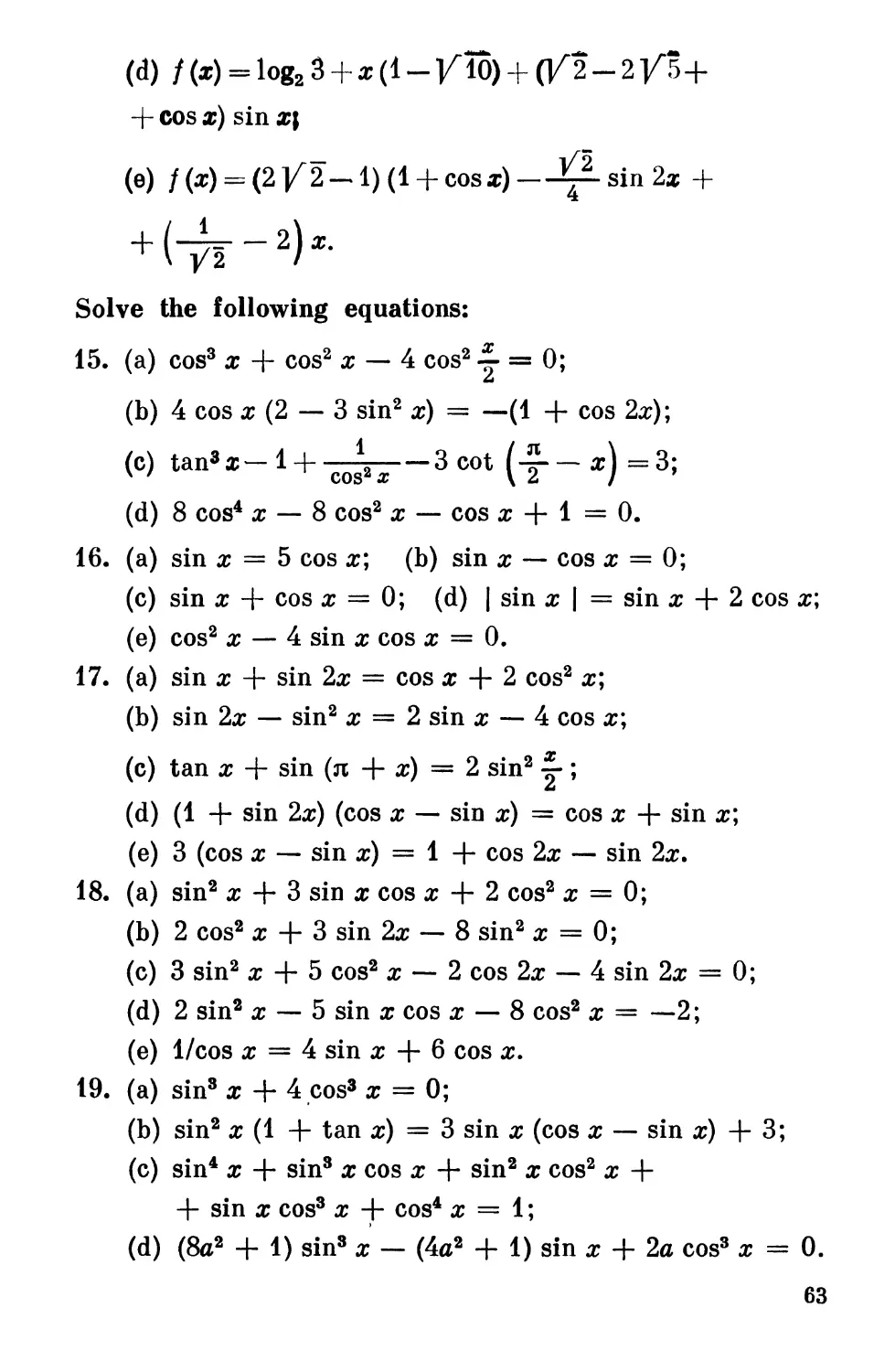
(d) / (x) = log2 3+ *(1-]A0)+ 0/2-2/5+
+ cos *) sin x\
(e) / (x) = (2 V2 -1) (1 + cos x) ^~- sin 2x +
Solve the following equations:
15. (a) cos3 x + cos2 x — 4 cos2 y = 0;
(b) 4 cos x (2 — 3 sin2 a;) = —(1 + cos 2a;);
(c) tanSx-l + ^-Scotj-?--*)^;
(d) 8 cos4 x — 8 cos2 a; — cos a; + 1 = 0.
16. (a) sin x = 5 cos x; (b) sin x — cos x = 0;
(c) sin a: + cos a; = 0; (d) | sin x | = sin a; + 2 cos a;;
(e) cos2 x — 4 sin x cos a; = 0.
17. (a) sin x + sin 2a; = cos x + 2 cos2 a;;
(b) sin 2a; — sin2 x = 2 sin x — 4 cos a;;
(c) tan a; + sin (n + x) = 2 sin21-;
(d) (1 + sin 2a;) (cos x — sin x) = cos x + sin a;;
(e) 3 (cos x — sin x) = 1 + cos 2a; — sin 2a;.
18. (a) sin2 x + 3 sin x cos a; + 2 cos2 a; = 0;
(b) 2 cos2 a; + 3 sin 2a; — 8 sin2 a; = 0;
(c) 3 sin2 x + 5 cos2 a; — 2 cos 2a; — 4 sin 2a; = 0;
(d) 2 sin2 x — 5 sin a; cos a; — 8 cos2 x = —2;
(e) 1/cos x = 4 sin a; + 6 cos a;.
19. (a) sin3 x + 4 cos3 x = 0;
(b) sin2 a; (1 + tan a;) = 3 sin a; (cos x —- sin a;) + 3;
(c) sin4 x + sin3 x cos a; + sin2 a; cos2 a; +
-f- sin x cos3 x + cos4 a; = 1;
(d) (8a2 + 1) sin3 x — (4a2 + 1) sin x + 2a cos3 x = 0.
63

20. Find the critical points of the function
(a) y — 3 cos 2x — 5 sin 2x + 4 cos 2;
(b) y = 8 sin 2* + 6 cos2 x + \lx + 1;
(c) # = cos3 x — 3 cos x + 3a:/8 — 3 sin 3;
(d) y = 8 (cos 2 — cos x) — sin a: — 1/sin a:;
(e) y = 9 cot x — cot3 a: + tan 2.
Solve the following equations:
21. (a) -^- cos a: + y sin a: = -y- ;
(b) 1/3 sin a: +cos a: = 1/2;
(c) sin 5a: = 1/3(1 + cos 5a:); (d) cosa: + sin x = 1;
(e) sin a: + cos a: cot y = —1/3;
(f) sin |a:| tan 5a: = cos a:; (g) cos a:— sin a: = a;
(h) (sin 2a:+1/3 cos 2a:)2— 5 = cos (-^- — 2a:) ;
(i) cos 6a: -f tan2 a: -h cos 6a: tan2 x = 1.
99 /a\ tan2s+tan;r _ ^
* ' 1 — tan2x tana: •
,, v tan 3x—tan2x 4
(b)
1 + tan 3x tan 2x '
(c) 2 tan 3a: — 3 tan 2a: = tan2 2a: tan 3a:;
(d) cot x + cot 15° + cot (x + 25°) =
= cot 15° cot x cot (x + 25°).
23. (a) sina:-f tany = 0; (b) 1 -j-cosx + tan -f- = 0;
(c) tan 2a: + cot x = 4 sin 2a:;
53
(d) 15coty+130sina; = -y-tany ;
(e) -7- cos a: + 6 sin x tan y = 4 tan a; (
(f) 2 sin2 (a: - -|-) = 2 sin2 a: —tan x.
64

24. Are the equations
a i oi«o a j /i i 1 — tan2 x , 2 tan x A
1 + cos2* + siii2* = 0 and l + __ + __r-^0
equivalent?
Solve the following equations:
25. (a) cos 3x = —2 cos x\ (b) cos 9a: — 2 cos Qx = 2;
(c) cos Ax = cos2 3a:.
26. (a) 3 sin -|- = sin z; (b) sin 6a: + 2 = 2 cos Ax;
(c) sin -2- # -f- 3 sin x = 3 sin -|- ;
(d)sin(£+4-*)=2sin(^ + ^).
27. 3 cos a: + 3 sin x + sin 3a: — cos 3x = 0.
3 x
28. (a) sin #+ sin -y a: = a sin-5- ;
(b) a2 sin2 3x = sin2 a:, a > 0.
29. a cos a: -(- 6 sin a: = c, a2 + ft2 # 0.
30. At what values of p does the equation Y p cos x —
— 2 sin x = Y 2 + ]A2 — p possess solutions?
31. Solve the equation (a) 2 cos x + 3 sin x = 2;
(b) sin x + cos x = a2; (c) sin 2x + 3 cos 2a: = a;
(d) 2 cos2 6a: — 9 sin2 6a: + 4 sin 6a: cos 6a: = a + 5.
32. Find the critical points of the function
/ (x) = sin 3x + — cos 3a:— a#.
Solve the following equations:
33. (a) sinar-f-- sin (x 4- —-) =0; (b) sin 4a— sin 2a: = 0;
(c) sin2 £ — cos2 a; = cos -|- ; (d) cos 2a:—cos 6a: = 0;
(e) cos (3a: — 4jx) = sin (jx — x),
(f) sin jto:2 — sin jx (x2 + 2a:).
34. (a) sin (x — ^r\ —sin (x + -~-j =cos yx + -j-) ;
(b) 1 + sin 2a: = (sin 3a: — cos 3a:)2;
5-01521 65

(c) cos 5x -f cos Ix = cos (.u -f 6a;);
(d) cos x — cos 3a; = 2 |^3 sin2 x\
(e) sin x + sin 3x + 4 cos3 a; = 0;
(f) cos x — cos 2x = sin 3a;;
(g) sin a; + 2 sin 2a; = —sin 3x\
(h\ sin3? + sin2a; __ .
W sin 3* ~ ~~ *
35. (a) 1^2 sin 10a; -f sin 2a; = cos 2a;;
(b) cot # sin 2a; — cos 2x= 1;
(c) tan 2a; cos 3a; + sin 3a: + ]/2 sin 5a; = 0;
(d)2sin(* + f)+2cos(^ + f) = 3sin(4 + -J) +
+ r3cos(-J+f).
36. (a) sin x + sin 2a; + sin 3a: + sin ix — 0;
(b) cos 9x — cos Ix + cos 3a: — cos x — 0;
(c) cos 5x — sin 5x = sin Ix — cos lx\
(d) sin Ix + cos2 2a; = sin2 2a: + sin x;
(e) cos 2a: — sin 3a; — cos 8a; = sin 10a; — cos 5a:;
(f) sin x + sin 2a: + sin 3a: = 1 + cos x + cos 2a:;
(g) 5 sin x + 6 sin 2a: + 5 sin 3a; + sin Ax — 0;
(h) cosec x — cosec 2a; = cosec 4a:;
(i) sin a + sin (x — a) + sin (2a: + a) —
= sin (x + a) + sin (2a: — a).
37. Find the critical points of the function
1111
/ (#) = — sin 2a; + -7- sin 4a; + -g- sin 6a: -f -^- sin 8.
Solve the following equations:
38. (a) tan 3a: — tan x = 0; (b) tan x + tan 2x — tan 3a:^0.
39. (a) cos 3a: cos 6a: = cos 4a: cos lx\
(b) sin 2a: sin 6a; = cos x cos 3a:;
(c) cos 3a; sin Ix = cos 2a: sin 8a:;
(d) sin 5a; cos 3a; = sin 6a: sin 2a:;
(e) sin (jxa;+-~| sin (nx—^-j ^T'
66

/,0. (a)
(b)
sin2 x + sin2 2a: = sin2 3a:;
cos2 x + cos2 2a: + cos2 3a;
24r _-= ?•
cosw 4a* --
(b)
(c)
44. (a)
(c)
(c) sin Ix + sin9a; = 2| cos2 (-2 x) —cos2 (5--j- 2a;) ] ;
9
sin2 2a: -f sin2 x = -jg-.
sin x -j- sin 2a; -f sin Ax = -y cot ~- ;
cos x + cos 2a: + cos 3a: = —0.5.
sin3 x cos 3a: + cos3 x sin 3a: + 0.375 — 0;
cos3 x cos 3a: + sin3 x sin 3a: = y*2/4.
sin x sin (4r a: j sin (-^- 4- a: 1 = -g- ;
8 cos a; cos (^ a:] cos (4r + a: j + 1 = 0;
tan a; tan fa; -j- -y) tan (a; + -y j =]^3.
sin 3a; = 4 sin a; cos 2a:; (b) sin 3a: cos x == 1.5 tan x\
41,
42.
43.
(d)
• (a)
(b)
(a)
(b)
. (a)
45.
46.
47.
(e)
(a)
(b)
(c)
(d)
(a)
(b)
(c)
(a)
(b)
(c)
(d)
tana;cot 3a: = 4; (d) 6 tan a;
sin x cos a: sin 3a;
tan 2o;i
tan 3x
cos 3a: sin2 x = 6 cot x.
2 sin 3a: sin x + (3 ]/2 — 1) cos 2a; — 3;
2 cos 4a: + 5 cos 2a: — 1=2 sin2 x;
2 + cos 4a: = 5 cos 2a; + 8 sin6 x\
tan2 x + cos 4a; = 0; (e) tan x + cot x — cos 4a;=3
sin4 x — 2 cos2 x + a2 = 0;
cos4 a: — sin2 a: cos2 x — 3 sin4 x =
— 2 cos 2a; — 2a cos 4a:;
cos6 x — sin6 x = -§- cos 2a;.
o
sin 2a; — 12 (sin x — cos a;) + 12 = 0;
1 1 , . / . 5ji \
f ; 5^r- = 4sin (* + —);
sin (*--g-J
1 + tan a; = 21/2 sin a;;
sin (# H -T-) =—— (1 — sin a; cos a;);
5*
67

(e) sin x -f sin2 x + cos3 x ^=0;
(f) sin-^ + cos-^ = l/2sin]/i.
48. (a) a sin x + tan a: + 1 = 1/cos x\
(b) sin2a: — 2^2fc(sina: — cosa:)-|-l -46 = 0;
(c) sin3a:-f cos3 a: -j- a sin Ix + -2-j =0.
49. Find the critical points of the function
/ (x) = 8x — 8 (sin a: — cos x) — cos 2a: + 1.
Solve the following equations:
50.
51.
52.
53.
54.
4 11
a) sin2 x -f 2 tan2 a: H j=r tan a:— sin a: + -jy = 0;
b) 8 cos a:-}-6 sin a: — cos 2a;— 7 = 0;
c) sin4 x + sin4 (-y + 4") + cos4 x = 0.5 sin2 2a:.
a) /cos -|—2 sin a:] sina;-f (l + sin -|—2 cos a:] X
xcosa:=0; (b) 3 sin 3a: = cos 4a:— sin 9a: — cos 10a:.
i /" i
a) tan a: + -5- cot x = 1/ —-5 1 — 1;
' 9 r cos2 x
55.
68
b) sin x + 1^3 cos a: = V 2 + cos 2a: -h]/^3 sin 2a:.
3
a) ]/2cos2a:-f 2:
|/l + 4cos2a: '
b) ]/ sin x = Y a cos x.
a) l^sina:^-Vr2cosa: = 0; (b) sin x + ycos x = 0;
c) 2cosa: = ]/^2 + 2 sin 2a:;
d) ]/cos2a: — cos2 3a: = sin 2a:;
e) sinx + y 3 cos a; = 1/ 0.5 +cos (-2- — a:) ;
»v 1—a sin a? /" l + 2asin a; _ ^
' 1 + asinx r 1— 2a sin x ~~
a) y \ + 4 sin a: cos a; = cos a:- sin a:;
b) j/^cos 2a:— sin 4a;— sin x— cos a:;

<•>/£
tana:
tan x
sin s + cos x;
(d) 4 sin 3s + 3 = V2 sin 3s + 2;
(e) 1^13 — 18 tan s = 6 tan x — 3;
(f) |A + 8 sin 2s cos2 2s = 2 sin (3s-f-J) .
1^3;
3 tanx
56. (a) 21^3 sin x = ,
2 y sin a; — 1
(b) V Y% cos s + sin x— 2 -f 1/ cot 3s + sin2 s t-
= sin
3x
Y2-
57. ]/"coss —l/2 + lAcoss+l/3 = a, a£R.
58. (a) log5 tan s = (log5 4) log4 (3 sin s);
(b) log9 sin 2s - log3 j/ —{
59. (a) 2cos2* = 3.2cos2*-4;
(b) cot2x = tan2* + 2tan2*+1;
(c) x3 sin 2x+2 =Y~x.
Solve the following systems of equations:
60. (a) f x —y = 6.5«f
1 3 cos2 s —12 cosy = —4;
(b)
(c)
61. (a)
(b)
z+z/^-g-tf,
sin a: «
sin 1/ "~ '
cos s +cos y = a,
s + y = ji/4.
sin 3s cos 2y = 2a— cos 3s sin 2y,
cos (x — y) = 0.5;
sins sin y
cos s cos y =
4 >
/3 .
69'

62. (a) f tana: — 2sinz/=^ — 2,
5 tan x + 2 sin z/ = — 4
(c) f tan x + tan z/:= 2,
1 cos x cos # = 0.5;
(d) j sin x cos y = 1/4,
1 3 tan x = tan z/.
(
(b) j isiny —6 j/^cosa; = 5 + 4 cos2*/,
1 cos 2a; = 0;
(c) r * «+3
\ ' i — cosz/ =—±—,
sin a: cos y = 5- ;
(d) f —- tanz/ = 2a + 2,
I tan z/ -+ (a2 + 2a) cos a; = 0.
63. f sin2(-2a:)-(3-l/2)tan5i/-(3|/2-l)/2,
1 (3 — 1/2) sin (-2*) + tan2 5y = (3j/r2-l)/2.
2.8. Trigonometric Inequalities
Solve the following inequalities:
1. (a) sin2a:>0; (b) sin-|-<0;
(c) sin (* + x)^T ;
(d) sin(2s-l)> ^-; (e) sins<—1.
2. (a) cos-|->0; (b) cos4a;<0; (c) cos (x — ^-) >^-;
(d) cos(^ + -^)<-J^-; (e) cos*>l.
3. (a) tan2a:>0; (b) tan^-<0;
(c) tan(* + 4j-)>l;
(d) tan(3a;-2)< -*|^3.
70

4. (a) cotx<0; (b) cot (* - -J-) >l;
(c) cot (2z+i)< -2.
5. (a) |sinz|>l/2; (b) |cosa:|<l/2; (c) |tan*|<l;
(d) \cotz\<VS.
Ill 1
6. (a) —<sino:<-2-; (b) —-2"<cosx<—- ;
(c) — 2<tana:<3; (d) -*4<cotz<1.5.
7. 2sin2a; + ]/*3sina: — 3>0.
8. cos 2a;+ 5 cos a;+ 3^0.
9. tan2a:+^2-/3)tana:-2]A3<0.
10. cot2a:-fcota:^0.
11. 2(^2 —l)sinz — 2cos2x + 2 — Y2<0.
12. cos jia:+sin (nx — -^-] >0.
13. cos3 x sin 3a; + cos 3a: sin3 x < -3-.
o
14. cos x cos 2a; cos 3a;^0.
15. sin4-^- + cos4-|->-2-.
16. sin6 x + cos6 x > -g- . 17. 8 sin6 x — cos6a: >0.
18. tan x tan 3a;< — 1. 19, 3 sin 2a:— 1 > sin x + cosx.
20. sin 2a; >Y% sin2 a: + (2 -|/2) cos2 a:, 0<*<2ji.
21. I sin xI > cos2 x. 22. ^5 — 2 sin £>6 sin a; — 1.
23. 1 — cos x < tan a: — sin a;.
24. 91+sin2Jtx _|_ 30.9cos2jtx ^ 117.
Find the domain of definition of the following functions:
25. y = VsmYz- 26. y = ]/"cosa:2.
27. y = dLrcsin-r£—. 28. */ = arccos (2 sin a:).
29. y = cotnx + arccos 2*.
71

30. Prove that the function y = sin2x increases monoto-
nically on the interval x£ I — ji; —^-j.
31. Prove that the function y = coszx decreases monoto-
nically on the interval #6(-^-; ~rn)'
32. Prove that if 0<xi<x2<^-, then J5E£L>-£2_.
z X3.ii x-± x j
Find the critical points of the following functions:
1 1
33. / (x) = 2 sin a cos a; + -5- cos 3# H , .
34. /(^)^(l-^)sin2^ + 4-sin(n + 4^)+x(55i|z3)
+ ]A2a-a2 + 3.
35. / (a;) = -«- sin a tan31/ + (sin a — 1) tan # -|—^/"" .
6 yS—a
Chapter 3
PROBLEMS ON DERIVING EQUATIONS
AND INEQUALITIES
3.1. Problems on Motion
1. The train left station A for station B. Having travelled
450 km, which constitutes 75 per cent of the distance
between A and B, the train was stopped by a snow-drift.
Half an hour later the track was cleared and the engine-
driver, having increased the speed by 15 km per hour,
arrived at station B on time. Find the initial speed of
the train.
2. A motor-boat went down the river for 14 km and then
up stream for 9 km, having covered the whole way in
five hours. Find the speed of the river flow if the speed
of the boat in still water is 5 km/h.
3. In accordance with the schedule, the train is to travel
the distance between A and 5, equal to 20 km, at a
constant speed. It travelled half a way with the specified
speed and stopped for three minutes; to arrive at point B
12

on time, it had to increase its speed by 10 km/h for
the rest of the way. Next time the train stopped
halfway for five minutes. At what speed must it travel the
remaining half of the distance to arrive at point B in
accordance with the schedule?
4. A cyclist left point A for point B and travelled at the
constant speed of 20 km/h. When he covered the dis-
tance of 8-r-km, he was overtaken by a car, which left
point A fifteen minutes later and travelled at a constant
speed too. When the cyclist travelled another 25 km,
he encountered the car returning from B, where it
stopped for half an hour. Find the distance between A
and B.
5. A boat goes down the river from point A to point 5,
which is at the distance of 10 km from A, and then
returns to A. If the actual speed of the boat is 3 km/h,
then it takes 2 h 30 min less for the boat to go from A
to B than from B to A. What should the actual speed
of the boat be for the distance from A to B to be covered
in two hours?
6. The distance between A and B is 30 km. A bus left A
and first travelled at a constant speed. Ten minutes
later a helicopter left A and flew along the highroad
to B. It overtook the bus in five minutes and continued
on its way to B. Without landing at B, the helicopter
turned back and again encountered the bus 20 minutes
after it left point A. Determine the speeds of the bus
and the helicopter.
7. A goods train left the town M for the town TV at 5 a.m.
An hour and a half later a passenger train left M, whose
speed was 5 km/h higher than that of the goods train.
At 9 : 30 p.m. of the same day the distance between the
trains was 21 km. Find the speed of the goods train.
8. If a steamer and a motor-launch go down stream, then
the steamer covers the distance from A to B 1.5 times
as fast as the motor-launch, the latter lagging behind
the steamer 8 km more each hour. Now if they go up
stream, then the steamer covers the distance from B
to A twice as fast as the motor-launch. Find the speeds
of the steamer and the motor-launch in still water.
9. Point C is at a distance of 12 km from point B down the
river. A fisher left point A, which is somewhat farther
73

up the river than point 5, for point C in a boat. He
arrived at C four hours later and covered the return
trip in six hours. Fixing a motor to the boat and thus
trebling its speed relative to the water, the fisher covered
the distance from A to B in 45 minutes. Determine the
speed of the river flow, considering it to be constant.
10. Two people left simultaneously two points: one left
point A for point B and the other left B for A, Each
of them walked at a constant speed and, having arrived
at the point of destination, went back at once. First
time they met 12 km from 5, and the second time, six
hours after the first meeting, 6 km from A. Find the
distance between A and B and the speeds of the two
people.
11. Two aeroplanes, leaving simultaneously points A and B
and flying towards each other, meet at the distance of
a km from the midpoint of the distance AB. If the first
aeroplane left b hours later than the second, they would
meet at the midpoint of AB. Now if the second
aeroplane left b hours later than the first, then they would
meet at a quarter of the way from B. Find the distance
AB and the speeds of the aeroplanes.
12. Two tourists left simultaneously point A for point B,
the first tourist covering each kilometre 5 minutes faster
than the second. After travelling a fifth of the way, the
first tourist returned to A, stopped there for ten minutes
and again started for B. The two tourists arrived at B
simultaneously. What is the distance between A and B
if the second tourist covered it in 2.5 hours?
13. Two cyclists left the same point simultaneously and
travelled in the same direction. The speed of the first
was 15 km/h and that of the second was 12 km/h. Half
an hour later, another cyclist left the same point and
travelled in the same direction. Some time later, he
overtook the second cyclist and another hour and a half
later he overtook the first cyclist. Find the speed of the
third cyclist.
14. The smaller arc AB of the circle is I cm in length. At
the time moment t = 0, the points P1 and P2 moving
along the circle are at the points A and B respectively.
If points Px and P2 move towards each other along the
smaller arc, they will meet in tx seconds, and if they
move along the larger arc, then they will meet in t2
74

seconds. Point P1 completes the circle in a time needed
for P2 to cover S cm. Find the length of the circle and
the speeds of the points Px and P2, considering the
motion of the points along the circle to be uniform.
15. Two bodies, moving along a circle in the same
direction, meet every 56 minutes. Had they moved at the
same speeds in the opposite directions, they would
meet every eight minutes. If, moving in the opposite
directions, the bodies are at the distance of 40 m from
each other along the arc at some moment of time, then
in 24 seconds, that distance will be 26 metres (the
bodies never meet during those 24 seconds). Find the
speeds of the bodies and the length of the circle.
16. The distance between points A and B located on a
straight highway is 15 km. A cyclist leaves A at a
constant speed of 8 km/h and a motor-cyclist leaves B and
travels in the same direction with a constant
acceleration of 2 km/h2. In what time interval after their start
will the distance between the cyclist and the
motorcyclist be 750 m if they start simultaneously? The
initial speed of the motor-cyclist is zero.
17. The students went boating down the river at the distance
of 20 km. Then they turned back and returned to the
moorings, having travelled for seven hours. On their return
trip, at the distance of 12 km from the moorings, they
encountered a raft, which passed the moorings at the
moment at which the students started boating.
Determine the speed of the boat down stream and the speed
of the river flow.
18. Two ships started simultaneously from the port, one to
the north and the other to the east. Two hours later, the
distance between them turned out to be 60 km. Find
the speed of each ship, knowing that the speed of one
of them was 6 km/h higher than the speed of the other.
19. Points A, B and C are at the distances of 60, 55 and
56 km from point M respectively. Three people left
those points for point M simultaneously: the first
person started from point A, the second from B and the
third fromJC. The first person covered the whole way
at a constant speed and arrived at M two hours before
the second and the third persons who arrived
simultaneously. The second person, having travelled 40 km at
the same speed as the first, stopped for an hour. The
75

rest of the way he travelled at a speed which is less than
the speed of the third person by the same amount as
the speed of the third is less than that of the first. The
third person covered the whole way at a constant speed.
Determine the speeds of the first and the third person.
20. The road passes through points A and B. Simultaneously
and in the same direction a motor-cyclist started from A
(in the direction of B) and a cyclist started from B. The
motor-cyclist overtook the cyclist at the distance of
a km from B. Had they both left simultaneously A
for 2?, then, at the moment the motor-cyclist arrived
at B, the cyclist would be b km behind. Determine the
distance between A and B, the speeds of the
motorcyclist and the cyclist being constant.
21. Two people started simultaneously from points A and B
towards each other. At the moment the person who
started from A covered two-thirds of the way, the other
person was two km from the middle of the way. Find
the distance between A and B, if it is known that when
the person who started from B covered 3/16 of the way,
the first person was three km from the middle of the
way. The speeds of the two people were constant.
22. Two people left point A simultaneously. Twenty
minutes later, the first person met a tourist travelling to 4,
while the second person met the tourist five minutes
later than the first. Ten minutes after the tourist met
the second person, he arrived at A. The speeds of the
two people and the tourist were constant. Find the ratio
of the speeds of the two people.
23. A motor-cyclist left point A for point B. Two hours
later, a car left A for B and arrived at B at the same
time as the motor-cyclist. Had the car and the
motorcycle started simultaneously from A and B travelling
towards each other, they would meet an hour and twenty
minutes after the start. How much time did it take
the motor-cyclist to travel from A to B?
24. The road passes through points A and B. A cyclist
started from A in the direction of B. At the same time,
two pedestrians started from B, travelling at the same
speed, the first of them in the direction of point A and
the other in the opposite direction. The cyclist covered
the distance AB in half an hour and, keeping ahead,
overtook the second pedestrian, 1.2 hours after he met
76

the first pedestrian. Determine the time the cyclist
spent travelling from the point of departure to the
point of the meeting with the first pedestrian, the speeds
of the cyclist and the pedestrians being constant.
25. The towns A and B are on the river bank. It takes
a tugboat 13 hours to travel from A to B and back again,
and a motor-launch, whose actual speed is twice that
of the tugboat, covers the same distance in six hours.
How many times is the actual speed of the tugboat
higher than the speed of the river flow?
26. A motor-boat left point A travelling up stream, and at
the same time a raft left point B travelling down
stream. They met a hours later and then travelled on
without stops. Having reached B, the boat turned at
once and, on her way back, overtook the raft at point A.
The actual speed of the boat is assumed to be constant.
How long did it take the raft and the boat to make
their trips?
27. Two pedestrians started simultaneously towards each
other and met each other 3 h 20 min later. How much
time will it take each of them to cover the whole
distance if the first arrived at the place of departure of the
second five hours later than the second arrived at the
point of departure of the first?
28. Two cyclists started simultaneously from points A
and B travelling towards each other; 1.6 hours later
the distance between them was 0.2 of the original
distance. How many hours does it take each of them to
cover the distance AB if the first needs three hours less
to travel that distance than the second?
29. Three skiers cover the distance running at uniform
speeds; m minutes after the start, it remains for the
third skier to run the part of the distance, which the
first skier can run in n min and the second skier, in
p min. How many minutes does it take each skier to run
the whole distance if the speed of the third skier is
equal to half the sum of the speeds of the first two?
30. Two cars left points A and B simultaneously, travelling
towards each other; 16 hours after their meeting, the
car travelling from A arrived at B, and 25 hours after
their meeting, the car travelling from B arrived at A.
How many hours did it take each car to cover the whole
trip?
77

31. A pedestrian and a cyclist left point A for point B at
the same time. Having reached point B, the cyclist
turned back and met the pedestrian an hour after the
start. After their meeting, the pedestrian continued his
trip to B and the cyclist turned back and also headed
for B. Having reached B, the cyclist turned back again
and met the pedestrian 40 minutes after their first
meeting. Determine what time it takes the pedestrian
to cover the distance between A and B.
32. Two cars left simultaneously points A and B and met
each other at noon sharp. If the first of them doubles its
speed and the second continues at the same speed, then
their meeting will occur 56 minutes earlier. Now if the
second car doubles its speed and the first continues at
the original speed, their meeting will occur 65 minutes
earlier. Determine the time of the meeting in the case
when both cars double their speed.
3.2. Problems on Percentage, Mixtures,
Numbers and Work
1. Three navvies dug a ditch of 216 m in four days
working simultaneously. During one shift, the third navvy
digs as many metres more than the second as the second
digs more than the first. During five days, the third
navvy digs as many metres as the first digs during seven
days. How many metres does the first navvy dig per
shift?
2. At first only two galleries of the coal mine were
operative, and some time later, the third gallery joined in.
As a result, the output of the mine became half as large
again. What, in per cent, is the capacity of the second
gallery as compared to that of the first, if it is known
that a four-months output of the first and the third
galleries was the same as the annual output of the
second gallery?
3. Three workers completed the job in 10 days, the third
worker having worked only the first three days. How
many days would it take every worker to do the job
if it is known that, working together, they did 37%
of the job for the first three days, and during five days
the first worker did the same amount that the second
worker did during four days?
78

4. Working together, two workers did the whole job in
five days. Had the first worker worked twice as fast and
the second worker half as fast, it would take them four
days to complete the job. How much time would it
take the first worker alone to do the job?
5. Two scrapers of different capacity can do the job in six
hours if they work together. If the first scraper alone
worked for four hours and then the second scraper alone
worked for six hours, they would do 80% of the whole
job. How many hours would it take each scraper to
complete the job if they worked separately?
6. Three workers have to make 80 identical workpieces.
They are known to make 20 pieces an hour if they work
together. First, one worker began working alone and
made 20 pieces having worked more than three hours.
The remaining part of the job was done by the second
and the third worker who worked together. It took eight
hours to complete the job. How many hours would it
take the first worker to do the job if he worked alone
from the very beginning and to the end?
7. It takes six days for three ordinary ploughs and two
tractor ploughs working together to plough the field.
Three tractor ploughs would do the same job five days
sooner than nine ordinary ploughs. How many times
does the output of a tractor plough exceed that of an
ordinary plough?
8. Each of the three workers needs some time to do a
certain job, and the third worker needing an hour less to
complete the job than the first worker. When they all work
together, they do the job in an hour. Now if the first
worker works for an hour alone, then it would take the
second worker four hours to complete the job. How soon
can each worker do the job?
9. Two excavators are operating. If the first excavator
worked alone, it would need eight hours more to
complete the job than if they both worked together. Now
if the second excavator worked alone, it would need
4.5 hours more to complete the job than they both
working together. What time would it take each
excavator to do the job if they worked separately?
10. For t minutes one machine-tool produces d workpieces
more than the other. If it were possible to reduce the
time needed by each machine-tool to manufacture a
79

workpiece by two minutes, then in t minutes the first
machine-tool would produce 2d workpieces more than
the second. How many pieces does each machine-tool
produce in t minutes?
11. Two pieces of the same fabric cost 91 roubles. When as
many metres from the first piece were sold as the second
piece contained originally and half as many metres
were sold from the second piece as the first piece
contained originally, the remainder of the first piece turned
out to contain 10 metres more than the remainder of
the second piece. How many metres did each piece
contain if a metre of the fabric costs 1 rouble and 40
kopecks?
12. A fashion house got black, green and blue fabric, one
piece each colour. The cost of the pieces was the same
although the piece of the green fabric contained nine
metres less than the piece of the black fabric and six
metres more than the piece of the blue fabric. It is also
known that the cost of 4.5 metres of the black fabric is
equal to the cost of 3 metres of the green fabric and
0.5 metre of the blue fabric taken together. How many
metres did each piece contain?
13. A tank of 2400 cu m capacity is being filled with fuel.
The delivery of the pump discharging the tank is
10 cu m/min higher than the delivery of the pump filling
the same tank. As a result, eight minutes less time is
needed to discharge the tank to fill it up. Determine the
delivery of the pump filling the tank.
14. A reservoir is filled with water through two valves.
The first valve was open for a third of the time needed
for the second valve to fill the reservoir. Then the second
valve alone was open for half the time needed for the
first valve to fill the reservoir. As a result, the reservoir
was filled to 5/6 of its capacity. Both valves together
can fill up the reservoir in 2.4 hours. What time will
it take each valve separately to fill up the
reservoir?
15. A tank of 425 cu m capacity has been filled with water
through two valves, the first valve having been opened
five hours longer than the second. Were the first valve
open as long as the second valve was actually open, and
were the second valve open as long as the first valve
was open, then the first valve would deliver half the
80

amount of water delivered by the second valve; if the
two valves were open simultaneously, the tank would
be filled up in 17 hours. How long was the second valve
open?
16. Two turners and an apprentice are entrusted with a
rush order. The first turner needs three hours more to
cope with the job than the second turner and the
apprentice would need working together. The second turner,
working alone, would need as much time as the first
turner and the apprentice working together. The second
turner, working alone, would spend eight hours less
than the double period of time the first turner would
spend working alone. How much time would the two
turners and the apprentice need to complete the task
if they worked all together?
17. Three workers of different skills did a certain job, the
first worker having worked six hours, the second four
hours and the third seven hours. Had the first worker
worked four hours, the second two hours and the third
five hours* they would do only two-thirds of the whole
job. How many hours would the workers need to
complete the job had they worked all together for the same
time period?
18. Four pipes are fixed to the reservoir. Through the first
three pipes the reservoir can be filled in 12 minutes;
through the second, the third and the fourth pipe it can
be filled in 15 minutes; and through the first and the
fourth pipe, in 20 minutes. How much time will it
take all the four pipes to fill up the reservoir?
19. One kind of iron ore contains 72% of iron and the other
contains 58%. A certain amount of the first kind of
ore is mixed with a certain amount of the second and
the resulting ore contains 62% of iron. If we take 15 kg
more ore of each kind than it was actually taken, we
shall obtain a kind containing p% of iron. How many
kilograms of the first and the second kind were taken
to form the first mixture?
20. A first vessel of six litres capacity was filled with four
litres of 70-per cent solution of sulphuric acid; a second
vessel of the same capacity was filled with three litres
of 90-per cent solution of sulphuric acid (per cent by
volume being meant). How many litres of solution
should be transferred from the second vessel to the first
6-01521
81

for a g-per cent solution of sulphuric acid to result in
the first vessel?
21. After two consecutive rises, the salary constituted
15/8 of the original value. What was the first rise, in
per cent, if the second rise was double the first (in per
cent)?
22. The deposit being at the bank from the beginning of
a year is known to increase by some per cent to the end
of the year (the percentage being different for various
banks). Some money, constituting three fifths of a
certain amount was deposited at the beginning of the year
at the first bank, and the rest of the money was deposited
at the second bank. Towards the end of the year the sum
of the deposits equalled 590 monetary units, towards the
end of the second year it equalled 701 monetary units.
When calculations were performed, it turned out that
if, originally, three-fifths of the initial amount of money
had been deposited at the second bank and the
remaining part had been deposited at the first bank, then
towards the end of the year the sum of the deposits at
those banks would have been equal to 610 monetary
units. What would the sum of the deposits have been
towards the end of the second year in that case?
23. A litre of glycerin was poured out of a vessel filled up
with pure glycerin to the brim and a litre of water was
poured in. After the solution was mixed up, a litre of the
mixture was poured out again and a litre of water was
added. The resulting solution was mixed up again and
again a litre of the mixture was poured out and a litre
of water was added. As a result of these operations,
there was seven times as much water in the vessel (by
volume) as the remaining glycerin. How many litres
of glycerin and water turned out to be in the vessel as
a result of the operations performed?
24. One-tenth of the salt solution contained in a retort
was poured out into a test-tube. Then a part of the water
contained in the test-tube was vapourized by heating
and, as a result, the percentage of the salt in the test-tube
increased k times. What was the original percentage
of the salt in the retort, if it is known that after the
content of the test-tube was poured into the retort, the
percentage of the salt in the retort increased by a per
cent?
82

25. There are three pieces of a copper-tin alloy. The masses
of the pieces are in the ratio of 3 : 4 : 5. The percentage
of copper in the second piece is a times as large, and in
the first piece a times as small, as in the third piece.
After the three alloys were smelted together, a new alloy
of copper and tin was obtained, in which the percentage
of copper changed by p per cent as compared to the
percentage of copper in the third piece. What was the
original percentage of copper in the alloys?
26. The difference between the digits in a two-digit number
is equal to 2, and the sum of the squares of the same
digits is 52. Find the number.
27. If we divide a given two-digit number by the product
of its digits, we obtain 3 as a quotient and 9 as a
remainder. Now if we subtract the product of the digits
constituting the number from the square of the sum of its
digits, we obtain the given number. Find it.
28. Find the three-digit number if it is known that the
sum of its digits is 17 and the sum of the squares of its
digits is 109. If we subtract 495 from this number, we
obtain a number consisting of the same digits written
in reverse order.
29. The sum of the cubes of the digits constituting a two-
digit number is 243 and the product of the sum of its
digits by the product of its digits is 162. Find the two-
digit number.
3.3. Problems on Deriving Inequalities and Systems
of Inequalities. Problems on the Extremum
1. In a four-digit number, the sum of the digits in the
hundred's place, ten's place and unit's place is 14, the
sum of the digits in the thousand's place and the unit's
place is 9, the digit in the hundred's place exceeds the
digit in the ten's place by 4. Among all numbers
satisfying the indicated conditions, find that for which the
sum of the product of the digit in the thousand's place
by the digit in the unit's place and the product of the
digit in the ten's place by the digit in the hundred's
place assumes the greatest value.
2. A boat sails down the river to the distance of 10 km
and then sails 6 km up the river. The velocity of the
river flow is 1 km/h. In what limits should the actual
6*
83

speed of the boat be for the whole trip to take from 3
to 4 hours?
3. We have bought several identical books and albums and
payed 10 roubles 56 kopecks for the books and 56 kopecks
for the albums. There were six more books than the
albums. How many books have we bought if the cost
of a book exceeds by more than a rouble that of an
album?
4. Two points began moving simultaneously from point A
along a straight line in the same direction: the first
point moved with a uniform acceleration, at the initial
velocity of 3 m/s and the acceleration 2 m/s2, the second
point moved uniformly. In what limits can the velocity
of the second point change so that the second point
should first leave behind the first point and then the
first point should overtake the second point at the
distance not greater than 10 m from ^4?
5. A student puts all his stamps into a new album. If
he puts 20 stamps on one page, the album will not be
enough, and if he puts 23 stamps on one page, then at
least one page remains empty. If we present the student
with one more album of the same kind whose every page
contains 21 stamps, he will have 500 stamps. How
many pages are there in the album?
6. A group of students decided to buy a tape-recorder at
the price of 170-195 roubles. At the last moment,
however, two of them refused to participate and, therefore,
the remaining students had to add one rouble each.
What was the price of the recorder?
7. Several people were to take part in an excursion. At
the last moment, however, two of them refused to go
and, therefore, each of the remaining tourists had to
pay 3 roubles more for the excursion than it was planned
before (all the participants had to pay the same sum
of money). How much had each tourist to pay originally
if the excursion costs more than 70 roubles, but not
more than 75 roubles?
8. A number of identical lorries were hired to transfer
goods from one place to another. Since the road was bad
because of some repairs, each lorry could take 0.5 ton
less than was planned and, therefore, four additional
lorries of the same kind were hired. The weight of the
goods transferred was larger than 55 tons but did not
84

exceed 64 tons. How many tons of goods did each lorry
transfer?
9. Points A and B are located on the same river so that
a raft sailing from A to B with the velocity of the river
flow covers the way from A to B in 24 hours. A motor-
launch covers the whole way from A to B and back again
in not less than 10 hours. If the speed of the motor-
launch in still water increased by 40%, then it would
take the motor-launch not more than seven hours to
cover the same way (from A to B and back again).
Find the time necessary for the motor-launch to sail
from B to A when its speed in still water is not
increased.
10. Thirty students took an examination and got the marks
2, 3, 4 and 5. The sum of the marks is equal to 93, the
threes being more than the fives and less than the fours.
Besides, the number of the fours was divisible by 10
and the number of the fives was even. How many marks
of every kind the 30 students got?
11. Limes and birches have been planted about the house,
their total number being 14. If we double the number of
the limes and increase by 18 the number of the birches,
then the birches will be greater in number. If we double
the number of the birches, without changing the number
of the limes, there will be more limes all the same. How
many limes and how many birches were planted?
12. Two cars go at constant speeds of 40 and 50 km/h along
two streets towards the crossing. The streets make the
angle of 60°. At the initial moment of time the cars
were at the distances of 5 and 4 km from the crossing
respectively. In what time will the distance between
them become the least?
13. Three pipes are attached to the reservoir. The first
pipe pours in 30 cu m of water per hour. The second pipe
pours in 3V cu m of water less than the first pipe (0 <
< V < 10), and the third pipe pours in 10V cu m an
hour more than the first pipe. First, the first and the
second pipes operated together and filled 0.3 of the
reservoir, and then all the three pipes operated together
and filled the rest 0.7 of the reservoir. At what value of V
will the filling of the reservoir be the quickest?
14. A pedestrian left point A for a walk, going with the
speed of v km/h. When the pedestrian was at the distance
85

of 6 km from A a cyclist followed him, starting from A
and cycling at a speed 9 km/h higher than that of the
pedestrian. When the cyclist overtook the pedestrian,
they turned back and returned to A together, at the
speed of 4 km/h. At what v will the time spent by the
pedestrian on his stroll be the least?
15. A vessel of 5 litres capacity contains 2 litres of p-per
cent (by volume) salt solution. How many litres of
a 20-per cent solution of the same salt must be poured
into the vessel for the percentage of the salt in the vessel
to become the greatest?
16. There are three alloys. The first contains 45% of tin
and 55% of lead, the second contains 10% of bismuth,
40% of tin and 50% of lead, and the third contains
30% of bismuth and 70% of lead. They must be used
to produce a new alloy containing 15% of bismuth.
What is the greatest and the least percentage of lead
that can be contained in this new alloy?
17. A body began moving rectilinearly at the time moment
t — 0 at the initial velocity of 3 m/s. One second later,
the velocity of the body became equal to 4 m/s. Find the
acceleration of the body at the end of the first second and
the length of the path traversed by the body for the
first four seconds, if the velocity of the body changes
by the law v (t) = (at2 + 2t + b).
Chapter 4
THE ANTIDERIVATIVE AND THE INTEGRAL
4.1. The Antiderivative. The Newton-Leibniz Formula
Find the antiderivatives of the following functions:
1. (a) y = 2; (b) y = -3* + 1; (c) y = 4 (2x - 1).
2. (a) y = —x2\ (b) y = x2 - 4* — V"3;
(c) y = 18 (3* + 2)2.
3. (a) y = x - 3x9; (b) y = \x + xb; (c) y = x2 - z4;
(d) y = (3x - 4)100; (e) y - (1 - 5*)*.
86

*• (a) »=ts-5 (b) v=-2ir-*'> (c) y=ix
(d) y
a.* » \»/ y~ ,* ~> V"/ if—— i (2a;_l)s '
1 i__
(!_*)» (! + *)■•
5. (a) » = —^; (b) J/=fiT-l; (c) y = K? + «;
4 V x
(d) y = iri-irx+V~x; (e) y = V7+2\
(f) */ = 1^5=4£.
6- (a) y = —; (b) y=—-gj-; (c) » = -izt»
7- (a) » = t5t—CT; <b) » = 7<iW;
(c) y= ».+L+4; (d) y=i£&-
(c) y= V,, •
10. (a) y = 2x; (b) y = 3r*; (c) z/ = 2e** + x;
(d) y = tr*\ (e) y =
ex_e-«
„-*. /„\ ,._ e*+«~*
(f) »=■
^ c*r» or»« ^K\ 7i — 7s Gin
11. (a) # = 2sinx; (b) # = 3 sin
(c) y = sin (# — jt/3);
(d) y = —5 sin (Mte + */8).
12. (a) */ = 4cos(-~ z); (b) y=— 2cos-|-;
(c) y = cos(-J- + -J); (d) y = 2cos(7*-l).
87

13. (a) y = sin2 x; (b) y = — 2 cos2 2x;
(c) y = 2 cos x cos 5a;; (d) y = 2 sin Ax sin 7a;;
(e) j/ = 2 sin 8a; cos 3a;; (f) y = 2 sin a: cos Ha:.
14« (a) J/ = T^r; (b) » = ^7-5
cos2 4#
sln 2
(c) y = tan2 #; (d) y = cot2 x.
15. Find the antiderivative of the function / (x) whose
graph passes through the point M0 (x0, yo), if
(a) / (x) = 3x2 -2,M (2; 4); (b) / (x) = 1 + cos x +
+ cos 2x\ M (0; 1); (c) / (x) = 3 cos x — 2 sin #,
M (n/2; 1); (d) / (x) = e*/2, M (0; 3).
16. Find the derivative of the function (a) F(z) =
= j arcsin2a;d;r; (b) F(x)= \ (sin* t + VW+A) dt.
l
17. Find the critical points of the function
X
(a) f(x)= ^[t(t + l)(t + 2)(t + 3)-2i]dt;
l
* _i_
(h)f(x) = \V&-T+\ (±-+±cos2t-t2)dt;
1
X
(c) f(x)=\ (sin2 * + sin2 2t + sin2 3*—1.5)d*;
2
x1
(d) / (z) = [ (sin2 2* - 2 cos* 2t + a) dt;
(e) / (x) -- \ (sin 3* - 3 sin t + 0.5)
dt.
o
18. Calculate the integral
-183
(a) [ j/*2 - -J- da; (b) { * (s2 -1)5 dz;
3 -1
Ve+i
2x dx
88

(d) I (arcsin (x + 1) + arccos (x + 1)) dx;
-2
3
(e) j ( arctan -^j-j- + arccot -pq-j- ) dx.
-l
19. Find the set of positive values of a satisfying the
a
equation I (3a;2 + 4x— 5) dx = a3— 2.
o
20. Find all the values of a for which the inequality
a
—jzr I l-^Yx+l y=-)dx<.4 is satisfied.
21. Find all the values of a belonging to the interval
a
[0, 2jt] and satisfying the equation I sin x dx = sin 2a.
2
22. Solve the equation
^ \ a / iog*+1 y*+i
4.2. Calculating the Areas of Plane Figures
Find the areas of the figures bounded by the following curves:
1. (a) y = x, x = 1, y = 0; (b) y = 2x, y = 43, x = 2;
(c) i/ = 23, i/ = Ax, y = 3;
(d) &c — 4y + 11 = 0, 4* + 3y - 27 = 0,
x + 7y — 13 = 0.
2. (a) # = x2, x = —4, y = 0; (b) i/ = x2, y = 9, x = 0;
(c) i/ = x2 + 1, x = —3, 3 = 6, y = 0;
(d) y = -3z2 - 2, * = 1, s = 2, y = -1;
(e) y = 4a: — 32, y = 0; (f) y = x2 — 5a: + 4, y = 0.
3. (a) y = 32 — 2a: + 3, x + y = 5;
(b) y = 3 — 5 — 332, i/ = 73 — 5;
(c) y = 32 — 63 + 5, 3 = 11 —- 1/;
(d) 1/ = 32, I */ I = 3;
(e) #2 = 1 — 3, y = &r — 1, 3 = 0.
89

4. Find the area of the figure bounded by the parabola
y = —x2 + Ix — 12, a tangent to that parabola,
passing through its vertex, and the coordinate axes.
5. Find the area of the figure bounded by the parabola
y = 0.5#2 — 2x + 2 and a tangent to that parabola
drawn at the points A (1; 1/2) and B (4; 2).
6. Find the area of the figure bounded by the straight line
y — —9x — 59 and the parabola y = 3x2 + ax + 1?
if the tangent to the parabola at the point x = —2
is known to make the angle arctan 6 with the z-axis.
7. Find the area of the figure bounded by the parabola
y = ax2 + 12# — 14 and the straight line y = 9x —
— 32, if the tangent drawn to the parabola at the point
x = 3 is known to make the angle jt — arctan 6 with the
x-axis.
8. The area of a curvilinear trapezoid bounded by the
curve y = 3x3 + 2z and the straight lines x = a and
y = 0 is equal to unity. Find a.
9. Find the values of c for which the area of the figure
bounded by the curve y = 8x2 — x5, the straight lines
x = 1 and x = c and the abscissa axis is equal to 16/3.
Find the areas of the figures bounded by the following curves:
10. (a) y = 5/x, y = 4, x = 7;
(b) y = l/(x — 1), y = 5 — 2x, (c) xy = 5,
x + y = 6; (d) x = | y - 2 |, y = 1/(1 - x).
11. (a) y = 8/x2, y = x, x = 4;
(b) y = 4Ar2, y = —kx, x = —2y;
(c) y = -1/z3, y = 27, 16*/ = -x.
12. Find the area of the figure bounded by the hyperbola
y = —4/x, a tangent to that curve drawn at the point
x = 2 and the straight line £ = 3.
13. Find the values of c for which the area of the figure
bounded by the curves y = 4Ar2, x = 1 and y — c
is equal to 2t.
Find the areas of the figures bounded by the following curves:
14. (a) y = yV-l, y=3-x, y = 0; (b) j/ = :r2, x = y*;
(c) »=/*, 1/-1A-3*, p = 0;
(d) y=-s3t y = "|Ar, y = 8.
90

15. (a) y = 4 — x2, y = x2 — 2x;
(b) y = —x2 + 6x — 2, y = x2 — 2x + 4;
(c) p = 2a:2 - x + 1, y = (x - I)2, x = 1.5, y = 0.
16. (a) y = x2, y = i/x, y = 0, a; = 2;
(b) 3 - y = 4/(x + 2), j/ = x2 - 1.5* + 1;
(c) y = -2x* + 5x + 3, y + 1 = 4/(x + 1);
(d) y = —16a:, z/ = —x3, y = 1;
(e) y = 8/x2, 2j/ = x2, y = —8x (x > —2);
(f) */ = —1/*, */ = x2, 8y = x2.
17. (a) y = 3 (x - l)/(x - 2),
x = 2(y + i)/(y - 1), x = 3, x = 5;
18. At what values of a is the area of the figure bounded
by the curves y = 1/x, y = l/(2x — 1), £ = 2 and
x = a equal to In —-?
1/5
Find the areas of the figures bounded by the following lines:
19. (a) y = 3X, x = log3 4, a; = log3 5, # = 0;
(b) 2/=(t)^ x = °> *=1> ^ = 0>
(c) i/ = 2*, x = 1, x = 5, i/ = x — 1;
(d) y = * + 1, i/ = 3-*, x = 2, x = 4.
20. (a) */ = e*, */ = e3, x = 0; (b) y = e~*, y = e~4,
x = 1; (c) y = e~x, y = x + 1, x = 5;
(d) y = | s - 1 |, x = 2, y = e*.
21. Find the area of the figure bounded by the curve y =
= 9~* + 85 and the curve y = k-3~x + m passing
through the points C (0; 34) and D (1; 14).
22. Find the area of the figure bounded by the curve y =
= 25* + 16 and the curve y = b-5x + 4, whose
tangent at the point x = 1 is at an angle of arctan (40 In 5)
to the x-axis.
23. Find the area of the figure bounded by the curve
y — 15 = e2* and the curve y = 7 \ e* dx passing
through the point A (0, 10).
91

Find the areas of the figures bounded by the following curves:
24. (a) y — sin x, y = 0, x = 0, x = 2jc;
(b) y = sin 3x, x = jt/12, a; = jt/6, y = 0;
(c) y = 2 cos £, £ = —jt/4, £ = jt/4, i/ = 0;
(d) i/ = cos 2#, x = —jt/6, a: = jt/8, y = 0.
25. (a) # = "^3/2, x = 1, i/ = cos #, £ = 0, i/ = 0;
(b) y = sin x, y — 0.5, i/ = 0, x — 0, a; = 3;
(c) y = sin x, y = 2 ]^"2/3, x = 0, x = arcsin (2^2/3);
(d) y = 2 — | 1 — x |, i/ = sin x, x = 0, z = 2.
26. (a) Find the value of k for which the area of the figure
bounded by the curves x = Jt/18, x = k, y = sin 6#
and the abscissa axis is equal to 1/6.
(b) At what value of d is the area of the figure bounded
by the curves y = cos 5x, y = 0, x = jt/30 and x = d
equal to 0.2?
Calculate the following integrals:
2 2
27. (a) jyT=**d*; (b) j yT=^d*.
2 1
28. \ lnsds. 29. I arcsin a; da:.
1 0
Chapter 5
PROGRESSIONS AND NUMBER SEQUENCES
5.1. Progressions
1. The first term of the arithmetic progression is unity
and the common difference is 4. Is the number 10091
a term of that progression?
2. How many two-digit natural numbers are there which
are multiples of 7?
3. Find the sum of all three-digit natural numbers, which,
being divided by 5, leave a remainder equal to 4.
4. Find the arithmetic progression if the sum of all its
terms, except for the first term, is equal to —36, the
92

sum of all its terms, except for the last term, is zero,
and the difference of the tenth and the sixth term is equal
to -16.
5. The sum of the first four terms of the arithmetic
progression is 56. The sum of the last four terms is 112. Find
the progression if its first term is equal to 11.
6. The sum of all terms of the arithmetic progression,
except for the first term, is 99, and except for the sixth
term, 89. Find the progression if the sum of the first
and the fifth term is equal to 10.
7. How many terms of the arithmetic progression should
be taken for their sum to equal 91, if its third term is 9
and the difference of the seventh and the second term
is 20?
8. All terms of the arithmetic progression are natural
numbers. The sum of its nine consecutive terms,
beginning with the first, is larger than 200 and smaller than
220. Find the progression if its second term is equal to 12.
9. The sum of the first three terms of the arithmetic
progression is 30 and the sum of the squares of the first
and the second term of the same progression is 116.
Find the first term of the progression if its fifth term is
known to be exactly divisible by 13.
10. Find the increasing arithmetic progression, the sum of
whose first three terms is 27 and the sum of their squares
is 275.
11. The product of the third and the sixth term of the
arithmetic progression is 406. The quotient of the division
of the ninth term by the fourth term of the progression
is equal to 2 and the remainder is —6. Find the first
term and the common difference of the progression.
12. The sum of three numbers is 0.6 (1) and the sum of the
reciprocals of those numbers, forming an arithmetic
progression, is 18. Determine the numbers.
13. The sum of the first seven consecutive terms of the
arithmetic progression is zero and the sum of their
squares is a2. Find the progression.
14. The product of the second and the twelfth term of the
arithmetic progression is equal to unity and the product
of the fourth and the tenth term of the same progression
is b. Find the seventh term of the progression.
15. The sum of the squares of the fifth and the eleventh
term of the arithmetic progression is 3 and the product
93

of the second and the fourteenth term of the same
progression is k. Find the product of the first and the
fifteenth term of the progression.
16. The sum of the squares of the fourth and the tenth term
of the arithmetic progression is b and the sum of the
squares of the fifth and the ninth term of the same
progression is equal to 1. Determine the product of the
second and the twelfth term of the progression.
17. In an arithmetic progression Sp = g, Sq = p (Sn
being the sum of the first n terms of the progression).
Find Sp+q.
18. The sum of the first n terms of the arithmetic
progression is equal to half the sum of the next n terms of the
same progression. Find the ratio of the sum of the first
3n terms of the progression to the sum of its first n
terms.
19. Four different integers form an arithmetic progression.
One of these numbers is equal to the sum of the squares
of the other three numbers. Find the numbers.
20. A number of poles lie on the road 10 m from one another.
Beginning with one end, a worker transferred all the
poles, one by one, to the other end, covering for the
purpose a total of 1.44 km. How many poles were
there on the road?
21. Given p arithmetic progressions, each of which consists
of n terms. Their first terms are equal, respectively,
to 1, 2, 3, . . ., p, and their differences are 1, 3, 5, ...
. . ., 2p — 1. Find the sum of the terms of all the
progressions.
22. The sixth term of the arithmetic progression is equal
to 3, and the common difference exceeds 1/2. At what
value of the difference of the progression is the product
of the first, the fourth and the fifth term the largest?
23. Determine the first term and the common ratio of the
geometric progression, the sum of whose first and third
terms is 40 and the sum of the second and fourth term
is 80.
24. Determine the sum of the first three terms of the
geometric progression, in which the difference between
the second and the first term is 6 and the difference
between the fourth and the third term is 54.
25. The sum of the first and the fourth term of the
geometric progression is 18 and the sum of the second and

the third term is 12. Find the difference between the
third and the second term of the progression.
26. The sum of the first and the third term of the geometric
progression is 20 and the sum of its first three terms
is 26. Find the progression.
27. In a geometric progression, the sum of the first 18 terms
exceeds the sum of the first 10 terms by A and the sum
of the first seven terms of the same progression, added
to the number B, is equal to the sum of the first fifteen
terms of the same progression. Find the common ratio
of the progression.
28. In a geometric progression, the sum of the first 109
terms exceeds the sum of the first 100 terms by 12.
Find the sum of the first nine terms of the progression
if the common ratio is equal to q.
29. A geometric progression consists of 1000 terms. The
sum of the terms occupying the odd places is St and the
sum of the terms occupying the even places is S2- Find
the common ratio.
30. The sum of the first ten terms of the geometric
progression is Sx and the sum of the next ten terms (11th
through 20th) is S2. Find the common ratio.
31. In the increasing geometric progression, the sum of the
first and the last term is 66, the product of the second
and the last but one term is 128, and the sum of all
the terms is 126. How many terms are there in the
progression?
32. Three skaters whose speeds, in a certain order, form
a geometric progression, start in a race-course. Some
time later, the second skater leaves the first skater
behind having run 400 metres more than the first skater.
The third skater covers the distance run by the first
skater by the time he was overtaken by the second
skater in a time interval exceeding by 2/3 min the
time of the first skater. Find the speed of the first
skater.
33. Suppose Sn is the sum of the first n terms of a geometric
progression. Prove that Sn (S3n — S2n) = (^271 — ^n)2-
34. Find the common ratio of an infinitely decreasing
geometric progression if its sum is thrice that of its first
three terms.
35. The sum of an infinitely decreasing geometric
progression is 3.5 and the sum of the squares of its terms is
95

147/16. Find the sum of the cubes of the terms of that
progression.
36. The sum of the second and the eighth term of an
infinitely decreasing geometric progression is 325/128 and
the sum of the second and the sixth term, reduced by
65/32, is equal to the fourth term of that progression.
Find the sum of the squares of the terms of the
progression.
37. The difference between the second and the sixth term
of an infinitely decreasing geometric progression is
8/(9]^3) and the difference between the fourth and
the eighth term is 8/(27 1^3). Find the ratio of the sum
of the squares of the terms to the sum of the cubes of
the terms of the same progression.
38. The sum of an infinitely decreasing geometric
progression is 243 and the sum of its first five terms is 275.
Find the progression.
39. The sum of the terms of an infinitely decreasing
geometric progression is equal to the greatest value of the
function / (x) = xs + 3# — 9 on the interval [—2; 3],
and the difference between the first and the second
term is /' (0). Find the common ratio of the progression.
40. A certain number is inserted between the number 3
and the unknown number so that the three numbers
form an arithmetic progression. If we diminish the
middle term by 6, we get a geometric progression.
Find the unknown number.
41. The sum of three positive numbers constituting an
arithmetic progression is 15. If we add 1, 4, 19 to those
numbers, respectively, we get a geometric progression.
Find the numbers.
42. Three positive numbers form an arithmetic progression.
The third number exceeds the first number by 14.
If we add the first number to the third and leave the
other two numbers unchanged, we obtain a geometric
progression. Find the numbers.
43. The first and the third term of an arithmetic
progression are equal, respectively, to the first and the third
term of a geometric progression, and the second term
of the arithmetic progression exceeds the second term
of the geometric progression by 0.25. Calculate the
sum of the first five terms of the arithmetic progression
if its first term is equal to 2.

44. Find a three-digit number whose consecutive numbers
form a geometric progression. If we subtract 792 from
this number, we get a number consisting of the same
digits written in the reverse order. Now if we increase
the second digit of the required number by 2, the digits
of the resulting number will form an arithmetic
progression.
45. Three numbers form a geometric progression. If we
diminish the third term by 64, then the resulting three
numbers will form an arithmetic progression. If we then
diminish the second term by 8, we get a geometric
progression. Determine the numbers.
46. Three numbers constitute a geometric progression. If
we add 8 to the second number, then these numbers will
form an arithmetic progression; if we then add 64 to
the third number, the resulting numbers will again
form a geometric progression. Find these three
numbers.
47. Three numbers form a geometric progression. If we double
the middle number, we get an arithmetic progression.
Determine the common ratio of the given
progression.
48. The sum of three numbers forming a geometric
progression is 124. If we add 1 to the first number and subtract
65 from the third and leave the second number
unchanged, the resulting numbers will form an arithmetic
progression. Find the indicated progressions.
49. Three numbers whose product is 125 are three
consecutive terms of a geometric progression and at the same
time the first, the third and the sixth term of an
arithmetic progression. Find the numbers.
50. Find the sum of the infinitely decreasing geometric
progression whose third term, the triple product of the
first term by the fourth and the second term form, in the
indicated order, an arithmetic progression with the
difference equal to 1/8.
51. If we add 5, 6, 9 and 15, respectively, to four numbers
constituting an arithmetic progression, we get a
geometric progression. Find the numbers.
52. If we add 4, 21, 29 and 1, respectively,' to four numbers
constituting a geometric progression, we get four
numbers forming an arithmetic progression. Find the
numbers.
7-01521
97

53. The sum of the first ten terms of the arithmetic
progression is 155 and the sum of the first two terms of the
geometric progression is 9. Determine the progressions
if the first term of the arithmetic progression is equal
to the common ratio of the geometric progression and
the first term of the geometric progression is equal
to the difference of the arithmetic progression.
5.2. Number Sequences
1. Using the definition of the limit of a number sequence,
prove that
(a) lim-i. = 0; (b) lim-^i=l;
(c) lim-^-0.
2. Prove that the sequence (xn), specified by the formula
xn= Vo—— is bounded.
n n2
3. Which of the following sequences (n £ N) are bounded:
I 11 ( l)n+i
(a) -3-, e", T' '"' 3^ ' " '; ^ ~~2' ~2'
— 2, ..., -2, ...; (c) 'L4, T, 4, -y , 4, |-, ..., 4,
-§-,...; (d) 1, _2, 3, -4, ..., n, -(n+1), ...;
(e) cosl°, cos2°, cos3°, ..., cosrc°, ...; (f) 0, 1, 0, 3,
0, 5, ...,0, 2n-l, ...; (g) 1, -2, 4, -8, ...'
...,(^iri2-i, .... (h) 2, ± A, ..., 2n
3 ' 5 ' '"' 2w —1 '
4. Is every bounded sequence convergent?
5. Give a definition of an unbounded sequence (without
using the prefix "un").
6. Using the theorem on the limit of the sum of two
convergent sequences, prove that
, x ,. / Ti+2 . 2—3rc2 \ 0,
(a) hm ——r-\ rnr) = — 2
2+j
1 \n ^ — 1
<b»^((T)"+^r) = »-
98

7. The sequence (xn + yn) is known to be convergent. Are
the sequences (xn) and (yn) convergent?
8. Using the theorem on the limit of the product of two
convergent sequences, prove that
(a\ lim (1 + 51.') (!-»+»') 5.
(b);imJl5+^)(^)=15-
9. The sequence (xn) is known to be convergent. Prove
that the sequence (— xn) is also convergent, and if
lim xn = a, then lim (—xn) = —a.
n-*-oo n->oo
10. Given: lim xn = a, lim yn = b. Prove that
n-+<x> n->oo
lim (xn — yn) = a — b.
n-*oo
11. It is known that the sequence an, n £ N, is convergent
and the sequence fcn, n 6 N, is divergent. What can
you say about the convergence of the sequences
(a) an + bn\ (b)
12. The sequences an and bn, n £ N, are divergent. Can
you assert that the sequences (a) an + bn and (b) anbn
are also divergent?
13. The sequences an and bn,n £ N, are such that lim anbn =
71-+OO
= 0. Does it follow that either lim an = 0 or lim fen =
n-»-oo n-»-oo
= 0?
14. Which of the following sequences are monotonic:
(f) f^1); (8) ((2 + (-l)B)»); (h) (4-5/3«);
(i) (2+l/4n)?
15. Prove that the sequence ( _To ) *s bounded and
me sequence i -
increasing.
16. Prove that the sequence (—W~~) *s hounded and
decreasing.
7» 99

17. The sequence (xn) converges to zero and the sequence
(yn) is arbitrary. Can we assert that the limit of the
sequence (xnyn) is zero?
Find the limits of the following sequences:
18. Mm f "+?<»-? ■
ac\ t 5ra3—4 OA ,. 5m8 — ra7 + l
19. lim^ire-. 20. hm 9_^7
2-3»8
(n + 3)*
21. lim-. „ ...
„^co 5n2-ra + l
22 lim 3"("-2>2 23 lim -3»+(-Dn ,
„/ i- re Sinn ok v 3n+1+4n+1
24. hm -5-pj-. 25. hm —^T^ .
n-+oo n \ L n-+oo ° \*
26. lim-7—pro r (»! = 1.2-3 ... {n-i)n, l! = l, ngN).
27. lim (»+f)'+(»+g)' .
28. lim
3" —1
29. lim
r-Too 3-+1 •
3^9
11 1
1 + -q-+-q-+ ••• +-q?t
11 1 •
^ 2 ^ 4 ^ ^ 2"
30. lim JL(l + 2 + 3+. ..+w).
n-*oo n
31. lim-4-(l2 + 22 + 32+...+«2).
n-o. "*
32. (a) lim (-^
1
(c) iShV-T
_ (2n-l)(2« + l) )•
33. lim-g^g-, 6^0.
3-4
1
1 |.
1
+
5-7
1
2-3
(2rc —1)(2» + 1)
1
)■■
3-5
+
n(n + i)
100

Chapter 6
ELEMENTS OF VECTOR ALGEBRA
6.1. Linear Operations on Vectors
1. What condition should be satisfied by the vectors a
and b for the following relations to hold true: (a) | a+b| =
= | a - b |; (b) | a + b | > | a - b |; (c) | a + b | <
< I a - b |?
2. The nonzero vectors a, b and c are related as b = 5a
and c = —2b. Determine (a) the angle between the
vectors a and c, (b) | a | / | c |.
3. For what values of x does the inequality | (x — 2) a | <
< | 3a | hold true if a # 0?
4. Assume a =/= 0. For what values of x do the conditions
| xsl | ^ | a | and (xa. + 3a) ff a simultaneously hold
true?
5. The vectors a and barenoncollinear. Find the values of
x and y for which the vector equality 2u — v = w
holds true, if u = xa + 2z/b, v = —2z/a + 3#b, w =
= 4a - 2b.
6. Given three nonzero vectors a, b and c, every two of
which are noncollinear. Find their sum if the vector
a + b is collinear with the vector c and the vector
b + c is collinear with the vector a.
7. Given three noncoplanar vectors a, b and c. Find the
numbers p and q for which the vectors pa + qb + c
and a + pb + qc are collinear.
8. The vectors a, b and c are collinear and | c | < | b | <
< | a |. Is the assertion (a + b + c) ff a true?
9. The points A, B and C are the vertices of a triangle,
AB = a, AC = b. Represent the vector AQ, where 0
is the point of intersection of the medians of the
triangle, in terms of the vectors a and b.
10. The points M and K are the midpoints of the sides
[BC] and [CD] of the parallelogram A BCD. Find the
vector AC if AM = a and AK = b.
11. What condition should be satisfied by the vectors a
and b for the vector a + b to bisect the angle between
the vectors a and b?
101

12. The points A, B and C are the vertices of a triangle,
AB = a, AC = b, [AD] is the bisector of the triangle.
Find the unit vector e, which is of the same direction
as the vector AD.
13. Given the points A (1; 3), B (2; 4) and C (5; 14).
Find: (a) | AB + AC |; (b) \ AB— ~AC \.
14. At what values of x and y are the vectors a = {x\ —2; 5)
and b = (1; y\ —4) collinear?
15. Find the coordinates of the vector p, collinear with
the vector q = (3; —4), if it is known that the vector p
makes an obtuse angle with the .r-axis and | p | = 10.
16. Given three vectors: a = (3; —1), b = (1; —2) and
c = (—1; 7). Represent the vector p = a + b + c
in terms of the vectors a and b.
17. At what values of x and y are the points with the
coordinates A(2; 0), B (0; 2), C (0; 7) and D (x; y) the
successive vertices of the isosceles trapezoid ABCD?
18. M1 and M2 are the midpoints of the segments ArBx
and A2B2. Find the vector MXM2 if it is known that
A, (0; 1; 2), A2 (1; 2; 1), B1 (-1; -1; 3) and
B2(U 0; 0).
19. Given four points: A (—2; —3; 8), 5(2; 1; 7),
C(l; 4; 5) and D (—7; —4; 7). Prove that the
vectors AB and CD are collinear.
20. The vectors AB = —3i + 4k and AC = 5i — 2j + 4k
are the sides of the triangle ABC. Find the length of
the median AM.
21. (a) Find the vector b = (x; y; z), collinear with the
vector a = (2/2; -1; 4) if | b | = 10.
(b) The vector x satisfies the following conditions: (1)
the vectors x and a = 6i — 8j — 7.5k are collinear;
(2) the vector x makes an acute angle with the z-axis;
(3) | x | = 50. Find the coordinates of the vector x.
(c) The vector b, collinear with the vector a = (3;
—4; —12), makes an obtuse angle with the #-axis.
Find its coordinates knowing that | b | = 26.
22. Find the coordinates of the point M which lies on
the .r-axis and is equidistant from the points A (1; 2; 3)
and B (-3; 3; 2).
102

23. A triangular pyramid is defined by the coordinates
of its vertices A (3; 0; 1), B (—1; 4; 1), C (5; 2; 3)
and D (0; —5; 4). Calculate the length of the vector
AO if 0 is the point of intersection of the medians
of the triangle BCD.
24. Are the vectors a = (3/7; 1/2; —3/4), b = (—3/2; 6;
4/3) and c = (9/8; —9/2; —1) coplanar?
25. Given three vectors: a = (3; —2; 1), b = (—1; 1; —2)
and c = (2; 1; —3). Represent the vector d = (11;
—6; 5) in terms of the vectors a, b, c.
26. In the triangular prism ABCA1B1C1 the diagonal CBX
is divided by the point M in the ratio | CM |/| MBY \ =
= 2/3. Represent the vector AM in terms of the vectors
AAX, AB and AC.
27. Given | AA, | = 12, j AB | = 3, | AD | = 4 in the
rectangular parallelepiped ABCDA1B1C1D1. Resolve
the unit vector e, which is of the same direction as ACX,
with respect to the rectangular basis i, j, k. The unit
vectors i, j, k are of the same directions as the vectors
AD, AB and AAX respectively.
28. Mx and M2 are the respective points of intersection
of the medians of the faces ADB and BDC of the
tetrahedron ABCD. Find the ratio | AC |/| MXM2 |.
29. Three forces are applied to a vertex of the cube, which
are 1, 2 and 3 in magnitude and are directed along the
diagonals of the faces of the cube meeting in that vertex.
Find the resultant of these three forces.
30. The vector OM is defined by the rectangular
coordinates of the points 0 (0; 0; 1) and M (a; p; 3). What
condition should be satisfied by the parameters a
and |3 for the terminus of the vector OM to belong to
the sphere x2 + y2 + (z — I)2 — 5?
6.2. The Scalar Product of Vectors
1. Determine the angle between the vectors 2a and — b,
if a = (-4; 2; 4) and b - (^2; -/2; 0).
2. At what value of z are the vectors a = (6; 0; 12) and
b = (—8; 13; z) perpendicular?
103

3. Find the cosine of the angle between the vectors a + b
and a — b, if | a | = 2, | b | = 1, (a, b) = 60°.
4. Find the cosine of the angle between the vectors p
P + 2q = b,
if it is known that in a rectangular system of coordinates
the vectors a and b have the form a = (1; 1) and b =
= (1; -1).
5. Prove that the vector p = b (ac) — c (ab) is
perpendicular to the vector a.
6. The vectors a, b and c are such that a + b + c = 0.
Calculate ab + be + ca knowing that | a | = 13, j b | =
= 14 and | c | = 15.
7. The triangle ABC is defined by the coordinates of its
vertices A (1; 1; 0), B (1; 1; 2), C (3; 3; 1). Find
the angle of the triangle at the vertex A,
8. The vertices of the triangle are at the points
A (3; -2; 1), B (3; 0; 2) and C (1; 2; 5). Find the
angle formed by the median BD and the base AC of the
triangle.
9. The triangle is defined by the coordinates of its vertices
A (1; 1; 2), B (3; 4; 2) and C (5; 6; 4). Find the
exterior angle of the triangle at the vertex B*
10. Two vertices of the triangle ABC are defined by the
coordinates A (1; 1; 3) and B (—1; 2; 5). The third
vertex, the point C, lies on the coordinate axis Oz.
Determine the relationship between the degree measure
of the angle a at the vertex A and the distance from the
point C to the plane Oxy.
11. Three points A (1; 0), B (0; 1) and C (5; 5) are defined
on the coordinate plane. Calculate the area of the
triangle ABC.
12. The vectors AB = (3; —2; 2) and BC = (—1; 0; 2)
are the adjacent sides of a parallelogram. Find the
angle between its diagonals AC and BD.
13. Prove that the points A (2; 4; —4), B (1; U —3),
C (—2; 0; 5) and D (—1; 3; 4) are the vertices of a
parallelogram and find the angle between its diagonals.
14. Prove that the points A (1; —1; 1), 5(1; 3; 1),
C (4; 3; 1) and D (4; —1; 1) are the vertices of a
and q satisfying the system of equations!
104

rectangle. Calculate the length of its diagonals and
the coordinates of their point of intersection.
15. Find the vector b, which is collinear with the vector
a = (2; 1; —1) and satisfies the condition ab = 3.
16. Find the vector c, knowing that it is perpendicular to
the vectors a = (2; 3; —1) and b = (1; —2; 3) and
satisfies the condition c (2i — j + k) = —6.
17. Calculate the coordinates of the vector c, which is
perpendicular to the vectors a = 2j — k and b =
= — i + 2j — 3k and makes an obtuse angle with
the i/-axis, if | c | = ]/"7.
18. Given the vectors a = (3; —1; 5) and b = (1; 2; —3).
Find the vector c, provided that it is perpendicular
to the z-axis and satisfies the conditions ca = 9 and
cb = -4.
19. The vectors a, b and c are of the same length and pair-
wise form equal angles. Find the coordinates of the
vector cifa = i + j,b = j+k.
20. Two points A and B are given in the rectangular
Cartesian system of coordinates Oxy on the curve y = 6/x
and are such that OA i = —2 and OB\ = 3, where i is
a unit vector of the .r-axis. Find the length of the vector
20A + 30B.
21. Find the vector a = (x\ y; z) making equal angles with
the vectors b = (y; —2z\ 3x) and c = (2z; 3x; —y),
if the vector a is perpendicular to the vector d =
= (1; —1; 2), | a | = 2 "|/"3 and the angle between
the vector a and the #-axis is obtuse.
22. At what values of x is the angle between the vectors
a = xi — 3j — k and b = 2x\ + x\ — k acute and
the angle between the vector b and the axis of ordi-
nates obtuse?
23. The points M, TV, P and Q are located in space so that
(MN)±(PQ), {MP)A_{NQ). Prove that (MQ)_L(NP).
24. Find the obtuse angle formed by the medians drawn
from the vertices of the acute angles of an isosceles
right-angled triangle.
25. Given the vectors AB =-- b and AC = c, coinciding
with the sides of the triangle ABC. Represent by the
components b and e the vector applied to the vertex B
of that triangle and coinciding with its altitude BM.
105

26. The triangle ABC is defined by the coordinates of the
vertices A (1; ~2; 2), B (1; 4; 0) and C (-4; 1; 1).
Find the vector BM, where the point M is the foot of
the altitude drawn from the vertex B.
27. The tetrahedron A BCD is defined by the coordinates
of its vertices D (1; 0; 0), A (3; —2; 1), B (3; 1; 5)
and C (4; 0; 3). Find the degree measure of the
dihedral angle formed by the lateral face ADC and the
plane of the base ABC.
28. Write the equation of the plane passing through three
given points Mx (1; —1; 2), M2 (0; 3; 0) and
M3(2;l;0).
29. Write the equation of the plane passing through the
points A (4; 0; 0) and B (0; 0; 4) parallel to the z/-axis.
30. At what value of k do the points A (1; 0; 3), B (—1;
3; 4), C (1; 2; 1) and D (k; 2; 5) lie in the same plane?
31. Given four points: A (1; —2; 2), B (1; 4; 0), C (—4;
1; 1), and D (—5; —5; 3). (a) Prove that these points
lie in the same plane; (b) calculate the angle between
the straight lines (AC) and (BD); (c) determine the
area of the quadrilateral ABCD.
32. Find the angle between the plane passing through the
points A (0; 0; 0), 5(1; 1; 1), C (3; 2; 1) and the
plane passing through the points A, B and D (3; 1; 2).
33. Given the equations of the planes 2x + 3y + 4z — 8 =
= 0 and 4:r + # + 3z — 6 = 0; p is a straight line
along which these planes intersect. Determine (a) the
cooordinates of the points of intersection of the line p
and the planes xOy and yOz; (b) the angle between the
line p and the plane xOz.
34. The edge of the cube ABCDAXBXCXD^ {AAX) \\ (BBJ \\
(CCJ || (DDJ, is 12 in length. The vertex B of the
cube coincides with the origin of the coordinates Oxyz,
and the points A, C and Bx lie on the Ox, Oy and Oz
axes respectively (in the positive direction). Points
E, Fx and G, taken on the edges [AAA] [SjCJ and [CD],
are such that | AE |/| EA, \ = 1/3, | BlFl |/| F1C1 | =
= 1/1, | CG |/| GD | = 1/1. (a) Determine the
coordinates of the points £\ Fx and G;
(b) set up an equation of the plane (EFXG)\
(c) find the distance between the point Br and the plane
(EF,G).
106

Chapter 7
PLANE GEOMETRY
7.1. Problems on Proving Propositions
1. M is the midpoint of the interval [AB]. Prove that
| CM | = | | | AC | - | BC | | if C e UB], and
| CM | = I ^ 1 + I BC | .f c ^ (^5) but c ^ U5]
2. Five straight lines meeting at a point 0 are drawn in
the plane a. Prove that the sum of the angles, which
are not adjacent to each other and have a common
vertex 0, is equal to jt.
3. In the convex quadrilateral A BCD, the length of the
diagonal AC is equal to that of the side AD. Prove that
\BC \<\BD \.
4. Prove that in a trapezoid, whose diagonals are the
bisectors of the angles at one of the bases, three sides
are equal in length.
5. Prove that the midpoints of the sides of a convex
quadrilateral are the vertices of a parallelogram.
6. Suppose a and b (a> b) are the lengths of the bases
of a trapezoid. Prove that the segment connecting the
midpoints of the diagonals of the trapezoid is
parallel to its bases and the length of the segment is (a—b)/2.
7. The bisectors of the interior angles are drawn in a
parallelogram. Prove that the points of intersection
of the bisectors are the vertices of a rectangle the length
of whose diagonal is equal to the difference between
the lengths of the neighbouring sides.
8. In the parallelogram ABCD, the point M is the
midpoint of the side CB, N is the midpoint of the side CD.
Prove that the straight lines (AM) and (AN) divide
the diagonal BD into three equal parts.
9. Prove that the bisector of the interior angle of a
triangle divides the opposite side into segments proportional
to the adjacent sides.
10. A straight line, parallel to the bases of the trapezoid,
is drawn through the point O of intersection of the
diagonals. Prove that the point O bisects the segment inter-
107

cepted on the straight line by the nonparallel sides
of the trapezoid.
11. Prove that the sum of the distances from any point
belonging to a regular triangle to its sides is equal to
the length of its altitude.
12. Suppose p is half the perimeter, S is the area of the
triangle, and r is the radius of the inscribed circle.
Prove that r = Sip,
13. Assume that a, b and c are the lengths of the sides of
a triangle, S is its area, and R is the radius of a
circumscribed circle. Prove that R = abc/(4S).
14. Prove that in a right triangle the sum of the lengths
of the legs is equal to the sum of the lengths of the
diameters of the inscribed and the circumscribed circle.
15. Through a point A, lying outside the ring, two straight
lines are drawn one of which touches the circle,
serving as the boundary of the ring, at a point 5, and the
other cuts that circle at points C and D, the point C
lying between A and D. Prove that \ AD \-\AC \ =
= \AB |2.
16. Prove that any point of a convex quadrilateral belongs
to at least one of the circles whose diameters are the
sides of the quadrilateral.
17. A quadrilateral MNPQ is inscribed into a circle, the
diagonals of the former being mutually perpendicular and
meeting at a point F. A straight line passing through
the point F and the midpoint of the side NP cuts the
side MQ at a point H. Prove that FH is the altitude
of the triangle MFQ.
18. The squares ABDE and BCKF are constructed on the
sides AB and BC of the triangle ABC outside of it.
Prove that | DF | = 2 | BP |, where [BP] is the
median of the triangle ABC.
19. Squares are constructed on the bases AB and CD of the
trapezoid ABCD, outside of it. Prove that the straight
line connecting the centres of the squares passes through
the point of intersection of the diagonals of the
trapezoid.
20. Suppose a and & are the lengths of the sides of a
parallelogram, and dx and do are the lengths of its diagonals.
Prove that d\ + A\ = 2 (a2 + b2).
108

7.2. Construction Problems
1. Through a point A lying in the interior of the angle,
draw a straight line so that the point A would be the
midpoint of the segment intercepted on the straight
line by the sides of the angle.
2. Construct a triangle if its two sides and the median,
all emanating from a common vertex, are given.
3. Points A and B belong to one of the half-planes into
which the plane is divided by the straight line p. Find
a point on the line p, the sum of whose distances from
the points A and B is the least.
4. Construct the bisector of the angle whose vertex lies
outside the sheet of paper.
5. A point D is given in the interior of the angle ABC with
an unattainable vertex B. Construct the straight line
(BD).
6. Construct the triangle proceeding from its medians.
7. Given two segments a and b in length. Construct the
segments whose lengths are (a)]/ab\ (b) |^a2 — ab + b2;
(c) Va* —2a& + 46*.
8. Construct a triangle knowing its perimeter and two
angles.
9. Inscribe into a given circle a triangle similar to a given
triangle.
10. Given a circle with centre at a point O and a point A
lying outside the ring bounded by that circle, (a)
Construct a tangent to the circle passing through the point
A; (b) through the point A draw a straight line cutting
the circle at points B and C so that | AC | = 2 | AB \
(the point B lies between A and C).
11. Construct three circles, having an external tangency,
with centres at the vertices of the given triangle.
12. Points A and B belong to one of the half-planes into
which the plane is divided by the straight line p. (a)
Construct a circle passing through the points A and B
and touching the line p; (b) find the point C 6 P such
that the angle ACB is the greatest.
13. Through the given point of the plane lying outside
the given angle draw a straight line intercepting a
triangle of the specified perimeter on the angle.
109

7.3. Problems on Calculation
1. In the triangle ABC, the side | AB | = c = 13 cm,
| BC | = a = 14 cm, | 4C | = 6 = 15 cm.
Determine: (a) the degree measure of the largest interior angle
of that triangle; (b) the area S; (c) the length hb of the
altitude BD; (d) the length r of the radius of the
inscribed circle; (e) the length R of the radius of the
circumscribed circle; (f) the length lh of the bisector BE of
the angle B (E 6 [AC]); (g) the length mb of the median
BF: (h) the distance between the centres of the inscribed
and the circumscribed circle; (i) the distance between
the point G of intersection of the medians and the
centre of the circumscribed circle.
2. Determine the area of the triangle if its base is a and
the angles at the base are equal to 30° and 45°.
3. Given the lengths 6 cm and 3 cm of two sides of a
triangle. Find the length of the third side if half the sum
of the lengths of the altitudes dropped to the given
sides is equal to the length of the third side.
4. In a right triangle the legs are related as 3:2 and the
altitude divides the hypotenuse into segments one of
which is two metres longer than the other. Find the
length of the hypotenuse.
5. In the triangle ABC, \ AB \ = \ BC |, the point 0
is the point of intersection of the altitudes. Find /_ ABC
if | OB | = | AC |.
6. A circle is inscribed into an isosceles triangle with the
vertex angle equal to 120° and a lateral side equal to a.
Find the radius of the circle.
7. The centre of the inscribed circle divides the altitude
of the isosceles triangle, dropped to the base, into
segments 5 cm and 3 cm in length, reckoning from the
vertex. Determine the lengths of the sides of the
triangle.
8. The inscribed circle touches the hypotenuse of the right
triangle at the point dividing the hypotenuse into
segments whose lengths are equal to two and three
units. Find the radius of the circle.
9. The legs of a right triangle are 15 dm and 20 dm in
length. Determine the distance from the centre of the
inscribed circle to the altitude dropped to the
hypotenuse.
110

10. Determine the angles of an isosceles triangle knowing
that the point of intersection of its altitudes belongs
to the inscribed circle.
11. A circle with radius equal to 4 cm is inscribed into
a triangle. One of the sides of the triangle is divided by
the point of tangency into segments 6 cm and 8 cm
in length. Find the lengths of the other sides of the
triangle.
12. The lateral side of an isosceles triangle is equal to
10 cm and the base to 12 cm. A circle is inscribed into
the triangle and tangents are drawn to it, which are
parallel to the altitude of the triangle and intercept
on it two small right triangles. Find the lengths of
the sides of these triangles.
13. From the centre of the circle inscribed into a triangle
with sides equal to 13, 14 and 15 another circle is drawn
whose radius is equal to 5. Find the lengths of the
chords intercepted by this circle on the sides of the
triangle.
14. Find the area of a right triangle if the radius of the
inscribed circle is r and the radius of the escribed
circle, touching the hypotenuse and the extensions of the
legs, is R.
15. In a right triangle, the legs are 75 dm and 100 dm in
length. The foot of the altitude drawn from the vertex
of the right angle divides the hypotenuse into two
segments on which semicircles are constructed on the
same side as the given triangle. Determine the lengths
of the segments on the legs intercepted between these
circles.
16. On the side AB of the triangle ABC a point M is taken
such that | AM |/| MB \ = 1/1. Calculate \ CM \ if
| AC | - 6, | BC | = 4, Z.ACB = 120°.
17. The median drawn to one of the lateral sides of an
isosceles triangle divides its perimeter into two parts
15 cm and 6 cm in length. Find the lengths of the sides
of the triangle.
18. In the triangle ABC, \ AB \ = 2 cm, [BD] is a median,
| BD | = 1 cm, Z. BDA = 30°. Find the area of the
triangle ABC.
19. Find the area of the triangle whose sides are the medians
of the triangle with the area equal to 5.
Ill

20. The legs of a right triangle are b and c in length. Find
the length of the bisector of the right angle.
21. In the triangle ABC, \ AB \ = 3 cm, | AC \ = 5 cm,
Z.BAC = 120°. Find the lengths of the bisector [BD]
and the segments [AD] and [CD].
22. Given in the triangle ABC: /__B : /__C = 1:3. The
bisector of the angle BAC divides the area of the
triangle in the ratio 2:1. Find the angles of the
triangle.
23. In the triangle ABC the angle A is twice the angle B
| AC | = 6, \ AB \ = c. Find \ BC \.
24. In the right triangle ABC the length of the altitude
dropped from the vertex of the right angle to the
hypotenuse is a and the length of the bisector of the same
angle is b. Find the area of the triangle ABC.
25. In the isosceles triangle ABC, \ AB \ = | BC |, the
median AD and the bisector CE are mutually
perpendicular. Calculate the angle ADB.
26. In the triangle ABC, \ AC \ = 13 cm, | AB \ + \ BC | =
= 22 cm, /_ ABC = 60°. Find the lengths of the sides
[AB] and [BC].
27. The sides of the parallelogram inscribed into a triangle
are 3 cm and 4 cm in length and the diagonal is 4 cm.
Find the lengths of the sides of the triangle if it is
known that the diagonals of the parallelogram are
respectively parallel to the lateral sides of the triangle
and the smaller side belongs to the base of the triangle.
28. The bisectors of the four angles are drawn in a
parallelogram with sides a and b in length and an acute angle
a. Find the area of the quadrilateral whose vertices
are the points of intersection of the bisectors.
29. Regular triangles are constructed on the sides of the
square, in its exterior, and the vertices of the triangles
are consecutively connected. Determine the ratio of the
perimeter of the resulting quadrilateral to the perimeter
of the given square.
30. Find the area of the isosceles trapezoid whose bases
are 10 cm and 26 cm in length and the diagonals are
perpendicular to the non-parallel sides.
31. One of the angles of the trapezoid is 30°, and the
extensions of the nonparallel sides (legs) meet at right angles.
Find the smaller leg of the trapezoid if its midline
is 10 cm and one of the bases is 8 cm.
112

32. Find the length of the altitude of the trapezoid if its
bases are a = 28 cm and b = 16 cm, and the
non-parallel sides are c = 25 cm and d = 17 cm.
33. Find the area of the trapezoid whose bases are a and b
in length, a > 6, and the acute angles between the
larger base and the non-parallel sides are a and p.
34. An isosceles trapezoid 20 sq cm in area is circumscribed
about a circle with radius 2 cm. Find the lengths of
the sides of the trapezoid.
35. An isosceles trapezoid ABCD is circumscribed about a
circle with radius r; E and K are the points of tangency
of that circle and the non-parallel sides of the trapezoid.
The angle between the base AB and the leg AD is 60°.
Find the area of the quadrilateral ABEK.
36. The centre of the circle inscribed into a right-angled
trapezoid is at the distances of 4 cm and 8 cm from
the end-points of its leg. Find the length of the midline
of the trapezoid.
37. The bases of the isosceles trapezoid are 21 cm and 9 cm
in length and the altitude is 8 cm. Determine the radius
of the circle circumscribed about the trapezoid.
38. The circle constructed on the base AD of the trapezoid
ABCD as a diameter passes through the midpoints of
the non-parallel sides AB and CD of the trapezoid
and touches the base BC. Find the angles of the
trapezoid.
39. The bases of the trapezoid are a and b in length. Find
the length of the segment, connecting the non-parallel
sides of the trapezoid, which is parallel to the bases
and bisects the area of the trapezoid.
40. In the trapezoid ABCD, [AD]\\[BC], \ AD \ = a,
| BC | = fc, and 0 is the point of intersection of the
diagonals. Find the ratio of the area of the trapezoid to
the area of the triangle AOD.
41. Two circles with an external tangency are inscribed
into an acute angle of 60°. The radius of the smaller
circle is r. Find the radius of the larger circle.
42. The radius of the sector is R and that of the circle
inscribed into the sector is r. Calculate the area of the
sector.
43. Given two nonintersecting circles with radii R and 2R.
Common, tangents are drawn to them which meet at a
point A of the segment connecting the centres of the
8-01521
113

circles. The distance between the centres of the circles
is equal to 2R j/^3. Find the area of the figure bounded
by the segments of the tangents, intercepted between
the points of tangency, and the larger areas of the
circles connecting the points of tangency.
44. The bisector [AE] of the angle A cuts the quadrilateral
ABCD into an isosceles triangle ABE (| AB | = | BE \)
and a rhombus AECD. The radius of the circle
circumscribed about the triangle ECD is 1.5 times as large as
the radius of the circle inscribed into the triangle ABE.
Find the ratio of the perimeters of the triangles ECD
and ABE.
45. Inscribed into a semi-circle of radius R are two circles
touching each other, the semi-circle and its diameter.
The radius of one of them is r in length. Find the radius
of the other circle.
46. The circle inscribed into the triangle ABC touches its
sides AC and BC at points M and N respectively and
cuts the bisector BD at points P and Q. Find the ratio
of the areas of the triangles PQM and PQN if /__A =
= ji/4 and /JB = n/3.
47. Two circles with radii "^2 cm and 1 cm meet at a point
A. The distance between their centres is 2 cm. The chord
[AC] of the larger circle cuts the smaller circle at a
point B and is bisected by that point. Find the length
of the chord [AC].
48. The diagonals of the convex quadrilateral make a
right angle, and the sum of their lengths is 6 cm. What
is the largest possible value of the area of the
quadrilateral?
49. At what value of the length of the altitude does the
right-angled trapezoid, with an acute angle of 45° and
the perimeter of 4 cm, have the largest area?
50. In the isosceles triangle ABC the angle at the base
AC is a, and the lateral side is a in length. The point D
is on the altitude BM and the sum of the squares of its
distances from the points A, B and C is the least as
compared to the other points of the segment BM. Find
the length of the segment MB.
51. Two sides of the parallelogram lie on the sides of
the given triangle, and one of its vertices belongs to the
third side. Under what conditions is the area of the
parallelogram the largest?
114

Chapter 8
SOLID GEOMETRY
8.1. A Straight Line, a Plane, Polyhedra.
Solids of Revolution
1. Two right triangles lie in the mutually perpendicular
planes and have a hypotenuse in common. Find the
distance between the vertices of the right angles of the
triangles if the legs of the triangles are 4 cm and 3 cm
in length.
2. Given a dihedral angle cp in magnitude. From a point
of its edge in one of its faces a segment is drawn
making an angle ty with that edge. What angle does the
segment make with the plane of the other face?
3. The legs AB and AC of a right triangle belong to the
faces a and p of an acute dihedral angle and make acute
angles cp and o|), respectively, with the edge of the
dihedral angle. Determine the magnitude of the dihedral
angle.
4. The vertices A and B of the rectangle A BCD are at a
distance 81 each from the plane y, and the midpoint M
of the side [CD] belongs to the plane 7. The diagonals AC
and BD of the rectangle meet at a point 0. Find the
distance from the centre of the circle circumscribed
about the triangle AOB to the plane 7 if Z-ADB = cp.
5. The vertices A and B of the regular triangle ABC are
at a distance h and the point C is at a distance equal
to m (h > m) from a certain plane p. At what distance
from the plane p is the centre of the circle inscribed into
the triangle ABC?
6. The diagonal of the rectangular parallelepiped is equal
to I and makes an angle equal to a with the plane
of the base. Find the area of the lateral surface of the
parallelepiped if the area of its base is S.
7. The angle between the diagonals of the base of the
rectangular parallelepiped is equal to a. The diagonal
of the parallelepiped makes an angle p with the plane
of the base. Find the altitude of the parallelepiped if
its volume is V.
8. The bases of the parallelepiped are squares with a side
b, and all the lateral faces are rhombi. One of the ver-
g*
115

tices of the upper base is equidistant from all the vertices
of the lower base. Find the volume of the parallelepiped.
9. Given the cube ABCDAXBXCXDX. M is the midpoint
of the edge AXBX and the point N is the centre of the
face ABBXAX. Calculate the angle between the lines
MD and CN.
10. Given the cube ABCDA1B1C1D1. Calculate the angle
between the planes (BCBJ and (BCXM), where M is
the midpoint of the edge AD.
11. The edge of the cube ABCDA1B1C1D1 isain length. Pis
the midpoint of the edge CCX, the point Q is the centre
of the face AAXBXB. The segment MN with its end-
points on the lines AD and A1B1 cuts the line PQ and
is perpendicular to it. Find the length of the segment.
12. The diagonal of the lateral face of a regular triangular
prism, equal to I makes an angle |5 with the plane of
the other lateral face. Find the volume of the prism.
13. An isosceles triangle with the vertex angle a and the
perimeter equal to p serves as the base of a right prism.
The angle between the diagonals of congruent (equal)
lateral faces of the prism, drawn from the same vertex,
is equal to p. Find the volume of the prism.
14. A plane is drawn through the side of the lower base
of a regular triangular prism and the opposite vertex
of the upper base at an angle a to the plane of the base.
The area of the section of the prism formed by the plane
is equal to S. Find the volume of the cut-off triangular
pyramid.
15. Given the regular triangular prism ABCA1B1C1, with
| BBX | = 2 | AC |. The points E and F are the centres
of the faces AA^B^B and CCXBXB. The point P is the
centre of the base ABC and the point Q is the midpoint
of the edge CCX. Calculate the angle between the lines
EF and PQ.
16. The sides of the base of the regular triangular prism
ABCA1B1C1 are a in length. The vertices M and N of
the regular tetrahedron MNPQ lie on the straight line
passing through the points Cx and B, and the vertices P
and Q lie on the line AXC. Find the volume of the prism.
17. The length of the side of the base of the regular
triangular prism ABCA1BiC1 is 3 and the altitude is 4 ]^3. The
vertex of the regular tetrahedron belongs to the segment
connecting the centres of the faces ABC and AXBXCX.
116

The plane of the base of the tetrahedron coincides with
that of the face ABC of the prism, and the plane of one
of its lateral faces passes through the diagonal ABX
of the lateral face of the prism. Find the length of the
edge of the tetrahedron.
18. The side of the base ABC of the regular triangular prism
ABCA1B1C1 is a. M and N are the midpoints of the edges
AC and A1B1 respectively. The projection of the
segment MN onto the line (BAt) is equal to a/2 ]^6.
Determine the altitude of the prism.
19. The length of each edge of the tetrahedron SABC is a.
Find the distance between (SA) and (BC).
20. Find the volume of the regular triangular pyramid
whose lateral edge makes an angle a with the plane
of the base and is at the distance k from the middle
of the opposite side of the base.
21. The angle between the altitude of the regular triangular
pyramid and the apothem of the pyramid is a and
the length of the lateral edge of the pyramid is Z. Find
the volume of the pyramid.
22. A perpendicular equal to b is dropped from the foot of
the altitude of a regular triangular pyramid to its lateral
face. Find the volume of the pyramid if the angle of
inclination of the lateral edge to the plane'of the base
is a.
23. Find the total surface of a regular triangular pyramid
from its given volume V and the angle a of inclination
of the lateral face to the plane of the base.
24. The base of a triangular pyramid whose all lateral
faces make the angle a with the plane of the base is a
regular triangle whose side is a in length. Find the
volume of the pyramid.
25 The bases of the truncated triangular pyramid
ABCA1B1LC1 are regular triangles whose sides are a and
b in length (a > 6). The lateral faces make the angle a
with the plane of the lower base. Find the volume of
the polyhedron ABxCrCB.
26. The base of the pyramid SABC is a regular triangle
whose side is a in length. The edge SA is perpendicular
to the plane of the base. The lateral face SBC is at
an angle cp to the plane of the base. Determine the
area of the lateral surface of the pyramid if one of its
lateral faces is taken to be its base.
117

27. Given the regular triangular pyramid SABC. A plane,
perpendicular to the lateral edge *S^4, is drawn through
the vertex C of the base of the pyramid. That plane
makes an angle whose cosine is equal to 2/3 with the plane
of the base. Find the cosine of the angle between the
lateral faces.
28. The line segment connecting the centre of the base of
a regular triangular pyramid with the midpoint of a
lateral edge is equal to the side of the base. Find the
angle between the adjacent lateral faces of the pyramid.
29. (a) In the trihedral angle SABC, Z_ASB = p, /_ASC =
= Y» Z_ BSC = a. The measure of the dihedral angle
at the edge AS is that of the angle A. Prove that cos a =
= cos P cos y + sin P sin y cos A (the cosine theorem
for a trihedral angle); (b) find the magnitude of the
dihedral angle between the lateral faces of a regular
triangular pyramid if the magnitude of the dihedral
angle between a lateral face and the base is equal
to cp.
30. The altitude of a regular triangular pyramid is h in
length, and the magnitude of the dihedral angle formed
by the lateral faces is 2cp. Find the volume of the
pyramid.
31. A plane cuts a triangular pyramid into two polyhedra.
Find the ratio of the volumes of the polyhedra if it is
known that the secant plane divides three edges
emanating from the same vertex of the pyramid in the ratios
1 : 2, 1 : 2 and 2:1, reckoning from the vertex.
32. The volume of a regular triangular pyramid is 1/6 of
the volume of the cube, the length of whose edge is
equal to that of the lateral edge of the pyramid. Find
the plane angle at the vertex of the pyramid.
33. The lateral edges of a regular quadrangular pyramid
are equal to a and make an angle a with the plane of
the base. Find the are* of the lateral surface and the
volume of the pyramid.
34. The side of the base of the regular quadrangular pyramid
SABCD is equal to 2 and the altitude is V*]L Find the
distance between the lateral edge SA and the diagonal
BD of the base.
35. Find the volume of a regular quadrangular pyramid,
the side of whose base is a and the dihedral angle
between the lateral faces is equal to a.
118

36. Find the volume of a regular quadrangular pyramid the
length of whose lateral edge is equal to I and the
dihedral angle formed by two opposite faces is equal to p.
37. In a regular quadrangular pyramid the side of the base
is a in length and the vertex plane angle is equal to the
angles of inclination of the lateral edges to the plane
of the base. Find the volume of the pyramid.
38. The base of the pyramid MABCD is a rhombus ABCD,
whose diagonal [AC] is a in length. The straight line
(DM) makes an angle a with the plane of the base of
the pyramid, and | DM | = k. Find the area of the
total surface of the cube whose volume is equal to that
of the given pyramid, if it is known that the angle
between the lines (DM) and(MZ?) is equal to y and /_MBC=
= Z_ ABM.
39. The base of the pyramid is a rhombus whose diagonals
are 6 m and 8 m in length. The altitude of the pyramid
passes through the point of intersection of the diagonals
of the rhombus and is 1 m in length. Find the area of
the lateral surface of the pyramid.
40. The base of the pyramid SABCD is a square. The edge
SA is perpendicular to the base. The area of the base
is m times as small as the lateral surface. Find the
angles of inclination of the faces SCD and SBC to the
plane of the base.
41. The base of the quadrangular pyramid SABCD with
vertex S is a rhombus and the altitude SO of the
pyramid passes through the point of intersection of the
diagonals of the rhombus. Calculate the dihedral angle
formed by the lateral face SAB and the base of the
pyramid if Z_ ASO = a and Z_ BSO = p.
42. The dihedral angle at the lateral edge of a regular
quadrangular pyramid is equal to a. Calculate the angle
between the lateral face of the pyramid and the plane
of the base.
43. In the regular quadrangular pyramid SABCD, the
angle between the lateral edge SA and the plane of the
base ABCD is equal to the angle between the edge SA
and the plane of the face SBC. Calculate that angle.
44. When the lateral surface of a cylinder is developed, it
becomes a rectangle whose diagonal is equal to a and
makes an angle a with the base. Find the volume of
the cylinder.
119

45. The plane passing through the centre of the lower base
of the cylinder at an angle a° to the plane of the base
cuts the upper base along the chord, b in length,
subtending the arc of p°. Find the volume of the cylinder.
46. The area of the total surface of the cone is S and the
angle at the vertex of the axial section is a. Find the
volume of the cone.
47. A regular triangle, whose side is a in length, is inscribed
into the base of a cone. The section formed by the plane,
passing through the vertex of the cone and a side
of the triangle, and the surface of the cone is a regular
triangle. Find the volume of the cone.
48. A plane drawn through the vertex of the cone cuts its
base along the chord whose length is equal to the
radius of the base. Determine the ratio of the volumes
of the resulting portions of the cone.
49. A section is drawn in a given cone through its vertex
and at an angle |3 to the plane of its base. The plane of
the section is at a distance a from the centre of the
base of the cone. Determine the total surface of the
cone if the greatest angle between the generating lines
of the cone is equal to a.
oO. Given the right triangular prism ABCA1B1C1 in which
I AC | = 6, | AA1 | = 8. A plane is drawn through the
vertex A cutting the edges BBX and CCX at points M
and N respectively. In what ratio does the plane divide
the volume of the prism if it is known that | BM \ =
= | MBX | and AN is the bisector of the angle CACJ
8.2. Problems on Combinations of Polyhedra
and Solids of Revolution
1. The volume of a regular triangular prism is equal to V.
A plane, cutting off a pyramid of volume W from the
prism, is drawn through the vertex of the base, parallel
to the opposite edge of that base, at an angle a to the
plane of the base. Find the altitude of the prism if
2. A cube, with an edge equal to a, is inscribed into a
regular quadrangular pyramid so that its four vertices
are on the lateral edges and the other four vertices
are on the base of the pyramid. The lateral faces of
120

the pyramid make an angle a with the plane of the
base. Determine the volume of the pyramid.
3. The base of the pyramid SABC is an isosceles triangle
ABC, | AB | = | AC | = a, Z. ABC = cp. The straight
line (AS) makes an angle a with the plane of the base
of the pyramid, the plane of the lateral face (BSC)
makes an angle |3 with the same plane, and /_ SAC =
= Z. SAB. Find the volume of the pyramid KSLC
if it is known that the points K and L belong to the
edges [AS] and IBS] respectively and the area of the
triangle KSL is in the ratio of 4 : 25 with the area of
the triangle ABS.
4. A cylinder is inscribed into a regular quadrangular
pyramid with the vertex plane angle a, the lower base
of the cylinder lying in the plane of the base of the
pyramid and the circumference of the upper base
touching the lateral faces of the pyramid. Find the volume
of the pyramid if it is known that the altitude of the
cylinder is half that of the pyramid and the radius of
the base is equal to r.
5. Determine the area of the lateral surface of the cone
inscribed into a regular triangular pyramid if the
lateral edge of the pyramid is I in length and the lateral face
of the pyramid makes an angle a with the plane of the
base.
6. Find the volume of the cone inscribed into a regular
triangular pyramid with a lateral edge I and the vertex
plane angle a.
7. A truncated cone is inscribed into a regular triangular
truncated pyramid with the base dihedral angle a.
Determine the lateral surface of the cone if the apothem
of the lateral face of the pyramid is equal to the sum
of the radii of the bases of the cone and the radius of the
smaller base of the cone is equal to r.
8. The base of the pyramid is a rhombus with a side a and
the acute angle a. A cone whose generatrix is at an
angle cp to the plane of the base, is inscribed into the
pyramid. Find the volume of the cone.
9. A right prism whose base is a rhombus is circumscribed
about'a sphere. The longer diagonal of the prism makes
an angle with the plane of the base which is equal to a.
Calculate the acute angle of the rhombus.
121

10. In the rectangular parallelepiped the lateral edge is c
in length and the sides of the rectangle serving as the
base are a and b in length. Through one of the vertices
of the upper base of the parallelepiped and the opposite
vertex of the lower base a plane is drawn parallel to the
diagonal of the rectangle serving as the base. Find the
radius of the sphere touching the indicated plane and
the plane of the lower base of the parallelepiped at the
point of intersection of its diagonals.
11. In a regular triangular pyramid, the vertex plane angle
is equal to a and the altitude of the pyramid is h in
length. Find the radius of the sphere circumscribed
about the pyramid.
12. The base of the triangular pyramid, whose altitude is
equal to h, is a right triangle with a leg equal to a and
the acute angle adjacent to that leg equal to a. The
vertex of the pyramid is mapped into the vertex of the
right angle of the triangle. Find the radius of the sphere
circumscribed about the pyramid.
13. Determine the volume of the ball circumscribed about
a regular triangular pyramid the side of whose base
is equal to a and the lateral edges make an angle a
with the plane of the base.
14. The base of the pyramid is a rectangle with the angle
a between the diagonals. The lateral edges are at an
angle cp to the plane of the base. Find the volume of
the pyramid if the radius of the circumscribed ball
is R. The centre of the ball is outside the pyramid.
15. Find the altitude of a regular quadrangular pyramid if
it is known that the volume of the ball circumscribed
about the pyramid is equal to V and the perpendicular
dropped from the centre of the ball to its lateral face
makes an angle a with the altitude of the pyramid.
The centre of the ball is inside the pyramid.
16. The radius of the ball circumscribed about a regular
quadrangular pyramid is in the ratio 3 : 4 with the
side of the base of the pyramid. Calculate the angle
between the lateral face and the plane of the base of
the pyramid.
17. The base of the pyramid SABCD is a rectangle A BCD
in which (AB) \\ (CD), (BC) || (AD), | AB \ = 3,
| BC |=4. All the lateral edges of the pyramid make
equal angles with the plane of the base. Calculate the
122

angle between the lines (BS) and (CS) if the radius of
the sphere circumscribed about the pyramid is equal
to 6.5.
18. The base of the pyramid is an isosceles triangle whose
lateral sides are equal to b and the angle between them
is equal to a. Two lateral faces of the pyramid passing
through equal (congruent) sides of the base are
perpendicular to the base and the third face is at an angle a
to the base. Find the radius of the ball inscribed into
the pyramid.
19. The altitude of a regular triangular pyramid is h in
length and the radius of the circle inscribed into the
base of the pyramid is equal to r. A secant plane is
drawn through the midpoints of two sides of the base
and the vertex of the pyramid. Find the radius of the
sphere touching the base of the pyramid at the point
of intersection of its medians and the secant plane.
20. Each edge of the tetrahedron is 1 in length. Find the
radius of the sphere touching all the planes of the faces
of the tetrahedron.
21. The base of the pyramid is a rhombus with a side a and
the acute angle a. Each base dihedral angle is equal
to cp. Find the volume of the ball inscribed into the
pyramid.
22. The side of the base of a regular quadrangular pyramid
is equal to a and the vertex plane angle is equal to a.
Find the area of the surface of the sphere inscribed into
the pyramid.
23. The angle between the planes of the base and of the
lateral face of a regular quadrangular pyramid is equal
to P and the area of the sphere inscribed into the
pyramid is equal to S. Find the area of the lateral surface
of the pyramid.
24. In a regular quadrangular pyramid each vertex plane
angle is equal to P and the radius of the ball touching
all the five planes of the faces of the pyramid is equal
to R. Find the volume of the pyramid.
25. A regular quadrangular truncated pyramid is
circumscribed about a ball, the sides of the base of the pyramid
being in the ratio m : n. Determine the ratio of the
volumes of the pyramid and the ball.
26. Find the length of the radius of the ball touching the
base and the lateral edges of a regular quadrangular
123

pyramid in which the side of the base is a in length
and the vertex plane angle is equal to 2|3.
27. A ball with radius R is inscribed into a cone. From the
centre of the ball the generatrix of the cone is seen at
an angle a. Find the volume of the cone.
28. The sphere touches the plane of the base of a right
circular cone at its centre. The plane making an angle y
with the altitude of the cone touches the sphere and
intercepts on the circumference of the base an arc with
an acute central angle a. Find the radius of the sphere
if the radius of the circumference of the base of the
cone is r.
29. Find the ratio of the volume of a right circular cone
to that of the ball inscribed into the cone if it is known
that the generatrix of the cone makes an angle a with
the plane of the base of the cone.
30. Find the angle between the generatrix and the base of
the truncated cone whose total surface is twice the
surface of the ball inscribed into it.
31. A truncated cone is circumscribed about a ball, the
area of the lower base of the cone being a times as
large as the area of its upper base. How many times
is the volume of the truncated cone greater than the
volume of the ball?
32. The ratio of the altitude of the cone to the radius of
the ball circumscribed about it is equal to q. Find the
ratio of the volumes of these solids.
33. A ball is inscribed into a regular quadrangular pyramid.
The apothem of the pyramid, equal to I makes an
angle a with the base of the pyramid. A cylinder is
inscribed into the ball. Determine the ratio of the
volume of the pyramid to that of the cylinder if the
altitude of the cylinder is equal to double the radius
of its base.
34. A regular triangular pyramid is inscribed into a ball
so that the plane of the base of the pyramid divides the
radius of the ball perpendicular to it in the ratio 3:7,
reckoning from the centre of the ball. Find the volume
of the cone inscribed into the pyramid. The radius of
the ball is equal to R.
35. A regular quadrangular pyramid is inscribed into a
sphere of radius R, the base of the pyramid bisecting
124

the radius perpendicular to it. Determine the area of
the surface of the sphere inscribed into the pyramid.
36. A right triangle ABC serves as the base of a right prism.
The radius of the circle circumscribed about it is equal
to r and the leg AC subtends an arc equal to 20°. Through
the diagonal of the lateral face passing through the
other leg BC a plane is drawn at right angles to that
face, forming an angle P° with the plane of the base.
Determine the area of the section.
37. The base of a right prism is a rhombus with the acute
angle a, the altitude of the prism being longer than
the longer diagonal of the base. At what angle to the
plane of the base must we draw a secant plane to obain
a square in the section?
38. An isosceles trapezoid with the acute angle a
circumscribed about a circle with radius r serves as the base
of a right prism. Through the lateral side of the lower
base and the opposite vertex of the acute angle of the
upper base a plane is drawn forming a dihedral angle
equal to p with the plane of the lower base. Determine
the area of the section of the prism formed by that
plane.
39. In the regular triangular pyramid SABC the side of
the base ABC is equal to a and the vertex plane angle
is equal to a. Find the area of the section drawn through
the vertex S parallel to the edge [AB] and forming an
angle y with the plane of the base ABC.
40. The apothem of a lateral face of a regular triangular
pyramid is k in length. The pyramid is cut by a plane
equidistant from all its vertices. Find the area of the
resulting section if the lateral edge of the pyramid
makes an angle p with the plane of its base.
41. A lateral edge of a regular quadrangular pyramid is I
in length and the angle between the plane of a lateral
face and the plane of the base is equal to p. The pyramid
is cut by a plane equidistant from all its vertices. Find
the area of the resulting section.
42. The side of the base of a regular quadrangular pyramid
is a in length and its lateral edge makes an angle a
with the plane of the base. The pyramid is cut by a
plane passing through a vertex of the base at right
angles to the lateral edge emanating from the opposite
vertex of the base. Find the area of the section.
125

43. A lateral face of a regular quadrangular pyramid is at
an angle a to the base. The radius of the sphere inscribed
into the pyramid is equal to r. Find the area of the
section of the pyramid passing through the centre of
the inscribed sphere parallel to the base of the pyramid.
44. In the regular quadrangular pyramid SABCD the
side of the base A BCD is a in length and the altitude is
2a ]/ 2 in length. A plane is drawn through the vertex
A parallel to the diagonal BD of the base of the
pyramid so that the angle between the line AB and that
plane is equal to jc/6. Find the area of the section.
45. The base of the regular quadrangular pyramid SABCD
is a square ABCD whose side is a in length. The planes
of the lateral faces make an angle a with the plane of
the base of the pyramid. Points E and F are taken on
the sides AD and BC such that | AE | = 2a/3 and
| CF | = a/3. The plane drawn through those points
makes an angle p with the plane of the base. Find the
area of the resulting section.
46. Among all regular triangular prisms with the volume
V find the prism with the least sum of the lengths of
all the edges. How long is the side of the base of that
prism?
47. A cylinder is inscribed into a cone with the altitude
H and the radius of the base R so that one of its bases
lies in the plane of the base of the cone and the
circumference of the other base belongs to the lateral
surface of the cone. What should the altitude of the
cylinder be for the volume to be the largest? Find
that greatest value of the volume.
48. Find the radius r of the base and the altitude h of the
right circular cone inscribed into a sphere with radius R
so that its volume is the greatest.
49. Find a cone of the least volume circumscribed about a
ball with radius R.
50. Find the altitude of the cone of the least volume
circumscribed about a half-ball with radius R (the centre
of the base of the cone is at the centre of the ball).
51. A regular quadrangular pyramid is inscribed into a
sphere with radius R so that all its vertices belong to
the sphere. What should the altitude of the pyramid
be for its volume to be the greatest? Find that greatest
value of the volume.
126

52. A regular hexagonal prism is inscribed into a cone
with the altitude H and the radius of the base R, so
that one of its bases lies in the plane of the base of the
cone and the vertices of the other base belong to the
lateral surface of the cone. What should the altitude
of the prism be for its volume to be the greatest? Find
that greatest value of the volume of the prism.
53. The angle between a lateral edge and the altitude of a
regular triangular pyramid is equal to cp. A cylinder
is inscribed into the pyramid whose radius and the
altitude are of the same length r. One of the bases of
the cylinder has one point in common with each lateral
face of the pyramid and the other base lies in the plane
of its base. At what value of cp is the volume of the
pyramid the smallest?
54. A regular triangular pyramid is inscribed into a right
circular cone, the apothem of the lateral face of the
pyramid being equal to k in length and the lateral face
itself making an angle a with the plane of the base.
Through one of the lateral edges of the pyramid a plane
is drawn cutting the conical surface. Find the area
of the section of the cone formed by that plane if it
is known that that area is of the greatest value possible.
8.3. Volumes of Solids of Revolution
1. A triangle rotates about the side which is a in length.
Determine the volume of the solid of revolution if the
adjacent angles are equal to a and p.
2. Two isosceles triangles ABC and ADC lie on the same
side of the common base AC equal to b. Find the volume
of the solid produced by the rotation of the figure
ABCDA about the base AC if /_ ACB = a, /__ ACD =
= p (a > P).
3. The smaller side of the parallelogram is a in length,
the acute angle of the parallelogram is equal to a and
the angle between the smaller diagonal and the larger
side is equal to p. Find the volume of the solid produced
by rotating a parallelogram about its larger side.
4. The figure bounded by the area of the parabolas y = x2
and y2 = x rotates about the abscissa axis. Calculate
the volume of the resulting solid.
127

5. Find the volume of the figure resulting from rotation
about the axis of ordinates of a curvilinear trapezoid
whose boundary is defined by the equations y2 = x,
y = 0, y = 1 and x = 0.
6. Find the volume of the figure resulting from rotation
about the axis of abscissas of a curvilinear trapezoid
whose boundary is defined by the equations (a) y =
= | | z _ 1 | _ 2 |f x = 0, x = 3, y = 0; (b) y =
= | x - 1 | - | x + 1 |, x = -2, x = 2, y = 0; (c)
y = x \ x — 2 \, x = 0, # = 3, z/ = 0; (d) */ =_^2 —
- 3 | s | + 2, s = -1, s = 2, y = 0; (e) » = /T^
# = —3, a: = 1, y — 0.
7. The square rotates about an axis lying in its plane
and passing through only one of its vertices. At what
position of the square relative to the axis is the volume
of the resulting solid of revolution the greatest?
Chapter 9
MISCELLANEOUS PROBLEMS
9.1. Problems in Algebra
1. Given two sets: Mx = {1, 2} and M2 = {a, 5}, a 6 R.
Find the sets A = Mx [} M2 and B = M^ []M2.
2. Prove that the product of three successive natural
numbers is a multiple of 6.
3. Prove that the number 1110987654312 cannot be a
square of an integer.
4. Suppose m and n are coprime natural numbers (n "> m).
Find the greatest common divisor, different from unity,
of the numbers 3n — m and 5n -f 2m if it is known to
exist.
5. There are young men and women in a group of gymnasts,
the men constituting more than 94%. What can be the
smallest number of gymnasts in the group?
6. Prove that log2 5 is not a rational number.
7. Suppose a, b and c are integers. Determine the sign of
a if it is known that the numbers (—6)an+aaan+862,*-1cn+5
and (—7)2n+1anb2n+1cn-*, »fN are of the same sign.
8. Calculate a4 + 64 + c4 knowing that a + b + c = 0
and a2 + b2 + c2 = 1.
128

9. Prove that
(a) 12 + 22+32+.,, +W2= n(n+iU2n+i) ^ ^^
/,v 1.2.3, , n o w-4-2 ^ M
(h) "2- + -2T + -2T+ ...+"2?r = 2 ^—, rcgN.
10. Find the sum
(a) 5n=l + 3 + 6+...+-^til, rcgN;
(b) Sn = l3 + 23 + 33 + . . . + n3, n £ N.
11. The product of two positive numbers is equal to unity.
Prove that the sum of those numbers is not smaller
than 2.
12. The product of n positive numbers is equal to unity.
Prove that the sum of those numbers is not smaller
than n.
13. Suppose xu x2, x3, ...,xn are positive numbers.
Prove that Xl+X*+X*n+'•• + Xn^1/'x1x2xs .. . xn.
14. Prove the inequality n\<. I n ^ )» rc£N, n^2.
15. Suppose xx, x2, xs, . . ., xn (n £ U) are numbers of
the same sign exceeding —1. Prove that (1 + xt) X
X (1 + X%) . . . (1 + Zn)> i+X1+Xt + . . . +Xn.
13 5 99 1
16. Prove the inequality: (a) —. — .— ... _<_;
/u\ 1 3 5 2n — 1 ^ 1 r M
(b) -s-#-7 a" ••• —o ^—r t » 6 Nj
v ' 2 4 6 2/i ^ /3» + l
n J_ £ _5_ 99 1
W 2 * 4 ' 6 *' ' 100 ^ 12 *
17. Prove that for any natural n > 1 the following
inequality holds true:
n+1 ^ /i + 2 ^ ' " ^ »+„ -^ 24 *
18. Prove that | sin na | ^ n | sin a | for any nfN.
19. Prove that (a) tan (-314°) > jg ; (b) ln^ <§J.
20. Suppose Dx and Z)2 are the domains of definition of the
functions fx (x) and /2 (x) respectively, (a) Find the
domain D of the function / (x) = /x (x) + /2 (#);
(b) Under what condition is the equality D = D1 [) D2
satisfied for the domain of the function / (x)?
9-01521 129

21. Find the value of / (2) if the equality 2/ (x) — 3/(lArH
= x2 is satisfied for any x =£ 0.
22. What curve is the graph of the function y = / (/ (/ (x)))
if / (x) = 1/(1 - x)?
23. Given the graph of the function y = / (x) (see p. 269,
Fig. 23). Construct the graph of the function (a) y =
= I / (*) I;
(b) y = \ (I / (*) I + / (*)); (c) y = i (| / (*) | -/(*));
(d)y=/(|*|), (e)j/ = /(-|x|).
24. The function / (a:) increases on the interval (a; 6). Can
we assert that the function cp (x) = f (x) increases on
the same interval?
25. The functions fx (x) and f2 (x) are decreasing on the
interval (a; b). Prove that the function cp (x) = fx (x) +
+ /2 (x) decreases on the interval (a; b).
26. The function / (x) is periodic with period T. Prove that
the number Tx = nT, where n is any integer, n =^= 0,
is also a period of that function.
27. The functions fx (x) and /2 (#) are defined on the entire
number axis and are not periodic. Can the function
cp (x) = fx (x) f2 (x) be periodic?
28. The function / (x) is defined on the interval (—a; a).
Prove that (a) the function (px (x) = f (x) + / (—x)
is even; (b) the function cp2 (x) = f (x) — / (—x) is odd.
29. Prove that every function / (x) defined on the symmetric
interval (—a; a) can be represented as the sum of an
even and an odd function.
30. Prove that an even function cannot be strictly mono-
tonic.
31. Find the function which is defined on the entire number
axis and is even and odd at the same time.
32. The functions fx (x) and /2 (x) are defined on the
symmetric interval (—a; a), (a) Prove that if fx (x) and /2 (x)
are even functions then the functions (px (x) = ft (x) ±
± /2 (x) and cp2 (x) = f± (x) f2 (x) are even;
(b) prove that if fx (x) and /2 (x) are odd functions then
the function (p3 (x) = fx (x) + /2 (x) is odd and
94 (x) = /i (x) U (x) is even;
(c) suppose /x \x) is an odd function and /2 (x) is an
even function. Prove that cp5 (x) = /x (#) /2 (#) is an
odd function.
130

33. Prove that the even function / (x) does not have an
inverse.
34. Prove that the periodic function / (x) does not have an
inverse.
9.2. Limit of a Function. Continuity
Find the following limits:
1. lim 0 f """—j-. 2. lim ~~
3. lim
K t / 3x 2a:2 + l \
- ,. 2 sin2 a; + sin a: —1
7. lim ^
x-*jt/6 2 sin2 a; — 3 sin a;-}-1
1 —cot3 x
x-jt/4 2 — cot, x — cot3 a: *
ft ,. x2— \/"x 4f. ,. x— }/3;r — 2
9. hm —==-*■—. 10. lim £—;
x-i Y~x — l
a a t /5—a;—2
11. lim r
x-2
LX1.JJ. , .
-l y2—x — 1
12- hm——^zrh > a^°> a>&-
AO T V« —1 J/ I- Yl + X—Vi—X
13. lim-3^ . 14. hm 8r—_=—r-
x-+\ y x—1 x-o yl + x--yl — x
15 ijm/r^ ^+^S r1 ?1^ r1-
-]/2log*a}8.
16, lim 2^L28--6 .
x-2 /2=^-21-*
17. lim f^-"/3) .
*-**/3 1-2 COS ar
9* 131

18. lim tan9?-3t»T, 19. lim *-*»»"'« .
*-**/3 cos(z+n/6) x_n/6 cos 3a:
20. lim il^l. 21. lim sin 8* cot 3x.
22. Hm (*,+y"1) *"* • 23. lim *+*~~Z •
x^.0 **+2x x^t sin(*-l)
o/. i»„ cos a; sin a; —tana; „_ ,. 1—cos5x
24, llm i^ih^ • 25* hm 3a* '
x_+0 x sin a; x^.0 6x
no i. 1 — COS 7 (jl—x) ^ O
2y j. sin (a+2s)—2 sin (a + a) + sin a
28. lim yi+tan^-yi+sii^
«*o **
30. Find the points of discontinuity of the function
f *«-l, if s#0,
(c) /(x) = l + 21/a; (d) /(*) = (sin»)/j; (e) /(*) =
==a;/cosx; (f) /(*) = [«].
31. Given the function / (*) = 5 V* —1 + 21^1 — x. Is this
function continuous at the point x = 1?
32. At what value of A is the following function continuous
at the point x = 2:
f *L=£.f if *^2,
9.3. The Derivative of a Function
1. Can we assert that the function cp (x) = fx (x) + /, (x)
does not have a derivative at the point x = x0 if (a)
the function /2 (x) possesses a derivative at the point
x0 and the function f2 (x) does not possess a derivative
at that point; (b) neither of the functions fx (x) and
/2 (x) has a derivative at the point x0?
2. Can we assert that the function cp (x) = /x (x) f2 (x)
does not have a derivative at the point x = x0 if (a)
132

the function /x (x) possesses a derivative at the point
x0 and the function /2 (x) does not possess a derivative
at the point x0; (b) neither of the functions jx (x) and
f2 (x) possesses a derivative at the point x0?
3. Prove that the derivative of an even difierentiable
function is an odd function.
4. Prove that the derivative of an odd difierentiable
function is an even function.
5. Prove that the derivative of a difierentiable periodic
function is a periodic function with the same period.
6. The difierentiable function / (x) is such that / (0) = 0.
Prove that
lim^=/'(0).
7. The difierentiable functions / (x) and g (x) are such
that / (0) = g (0) = 0, with g' (0) =£■ 0. Prove that
8. Can we assert that if the function / (x) possesses a
maximum at the point x0, then in a certain, sufficiently
small, neighbourhood of that point, to the left of the
point x0, the function / (x) increases and to the right
of that point it decreases?
9. Find all the values of a for which the function / (x)
does not possess critical points:
(a) /(*) = (fl2—3a + 2)(cos«-J—sin»-|-)
+ (a — l)x + sin 1;
(b)/(,)^(a2-6a + 8)jy++f2)
+ (oa —7o+12)(*-2V*2);
(c) /(af) = (4o-3)(* + ln5) + 2(a —7)cot-|-sina-|-.
10. Find the critical points of the function
2» n X . • X X
sin2-g-+sin-£-—3-,
whose coordinates satisfy the inequality x2 — 10 <
< —19.5*,
133

11. Find the critical points of the function
/ (x) = 4r3 — fix2 cos 2a + 3#sin 2a sin 6a + |/ln (2a — a2).
Does / (#) decrease or increase at the point x = 1/2?
12. Does / (x) decrease or increase at the point x = sin 8
if / (x) = — £3/3 + x2 sin 1.5a — x sin a sin 2a —
— 5 arcsin (a2 — 8a + 17)?
13. Find all the values of a for which the function
/w=(-feii:-1)a:5-3a:+ln5
decreases for all x 6 01.
14. Does the parameter b possess any values for which
the function /(*)=( 1 - /2i^-*a j ^ + 5x + y$ is
increasing at every point of its domain of definition?
15. Find the difference between the greatest and the least
value of the function y = cos x + y cos 2x — ^-cos 3x.
3
16. On the graph of the function y = —— x In x, where
x 6 [e"1-5; +oo), find the point M (x, y) such that the
segment of the tangent to the graph of the function at
that point, intercepted between the point M and the
i/-axis, is the shortest.
17. At what point M (x, y) of the graph of the function
y = e-|*l should a tangent be drawn for the area of the
triangle bounded by that tangent and the coordinate
axes be the greatest?
18. Prove that the curve y — x* + 3x~ + 2x does not
meet the straight line y = 2x — 1 and find the distance
between their nearest points.
19. At what value of a does the equation ax2 = In x possess
a single root?
9.4. Integral Calculus. Miscellaneous Problems
1. Given the continuous periodic function / (x), x £ R,.
Can we assert that the antiderivative of that function
is a periodic function?
134

2. The function / (x) is defined and continuous on the
interval [—a; a], with / (x) = —/ (—z) for any z (f
6 l—a; a], (a) Prove that every antiderivative F (z)
of the function / (z) is an even function;
a
(b) prove that I f(x)dz = 0,
1
(c) calculate the integral \ x* (arcsin x)1 dz.
-l
3. The even function / (x), f (x) # 0, is defined and
continuous on the interval l—a; a]. Which of its antideriva-
tives F (x) is an odd function?
4. Under what condition does the value of the integral
b
\ f (x) dx coincide with the value of the area of the
a
curvilinear trapezoid bounded by the curves y =■ f (x),
x = a, x — b, y = 0?
5. The functions y = 1 + cos x and y = 1 + cos (x — a),
where 0 <a <ji/2, are given on the interval [0; n].
At what value of a is the figure bounded by the curves
y = 1 + cos x, y = 1 + cos (x — a),x = 0, equivalent
to the figure bounded by the curves y = 1 + cos (x—a),
y=l, x = n?
6. At what values of the parameter a > 0 is the area of
the figure bounded by the curves x = a, y = 2X, y =
= 4* larger or equal to the area bounded by the curves
y = 2X, y = 0, x = 0, x = a?
7. Find the critical points of the function / (x) if
X
(a) f(z) = l+z+ J (ln2f + 21n*)d*.
l
X
(b) f(x) = x— Ins-f f (-J—2 —2cos4z)dz.
2
8. On the interval [5jt/4; 4ji/3] find the least value of
the function
X
F(x)= \ (3sin* + 4cos*)d*.
5Jt/4
135

9. On the interval [5n/3; 7n/4] find the greatest value
of the function
X
F (x)= \ (6 cos u — 2 sin u) du.
5Jt/3
10. For the function / (x) = 1 + 3* In 3 find the antide-
rivative F (x), which assumes the value 7 for x = 2.
At what values of x does the curve F (x) cut the abscissa
axis?
11. Prove the identity cos 2x = cos2 x — sin2 x by term-
wise differentiation of the identity sin 2#=2 sin x cos x.
12. At what positive values of a do the graphs of the
functions f(x) = a | x + 1 I and q> (x) = x + a2 \ x \ meet
at three distinct points?
13. The graph of the function y = 1 — 3#2 intersects at
two points a straight line passing at an angle cp to the
#-axis. Calculate the abscissa of the midpoint of the
segment connecting the orthogonal projections of the
points of intersection onto the #-axis.
14. Find all the values of cp for which the sum of the squares
of the roots of the equation x2 + (sin cp — 1) x —
— -^ cos2 cp = 0 is the greatest.
15. At what values of the parameter a belonging to the
interval [ji; lln/8] do the roots of the quadratic
equation x2 + 2 |^sin 2a x + cos 2a = 0 exist and are
distinct?
16. At what values of the parameter a belonging to the
interval [7n/6; 7n/4] does the quadratic trinomial
(cot a) x2 + 2 ]^tan a x -\- tan a assume only positive
values?
17. Find all the values of the parameter a for which
the quadratic function (sin a) x2 + (2 cos a) x +
+ (cos a + sin a)/2 is the square of a linear function.
18. Find the values of b for which the equation
2 logi/25(te + 28) = —log5 (12 — 4* — x2) has only
one solution.
19. At what values of a is any solution of the inequality
log3(*2--3*+7) ,
log3(3*+2) ^
also a solution of the inequality x2 + (5 —- 2a) x^ 10a?

20. Are the inequalities / (x) > g (x) and /' (x) > g' (x)
equivalent?
21. Solve the following systems of equations:
{
(a) f 2 arc tan # +1/ — ez = 3,
4 arc tan x — y — 2ez = 0,
arc tan x-\-y + ez = 3a+l;
(b) r 2s+lny2 — 2sinz = 0,
I 3x— 2 In i/2 + 4 sin z= 7,
[ x+lni/2 + sinz = 3a + 2.
22. Depict on the coordinate plane $Oy the set of points
whose coordinates satisfy the equation
z3 + (3y + 1) x2 + (Ay + y2) x + 5y2 - 5i/3
0.
23. Find the numbers A, 5 and C such that the function of
the form f (x) = Ax2 + Bx + C satisfies the conditions
i
/' (1) = 8, / (2) + f (2) = 33, j/ (x) dz = l.
o
24. Find the numbers K, L and M such that the function
of the form / (x) = xj\ + Mx satisfies the con-
o
ditions / (2) = 23, /' (0) - 4 and j (x - 1) f(x) dx = ~.
-l
25. Find the numbers P, (? and R such that the function of
the form / (x) = Pe2* + (?ex + Rx satisfies the condi-
ln4
tions / (0) = —1, /' (In 2) = 31, j[/ (x) - Rx] dx =
o
= 19.5.
26. Use graphical means to solve the system
* + y<2,
y>0,
for which the sum z = 2x + 3y assumes the greatest
value.
137

27. Find the least value of the function x2 + 2xy + 3y2 +
+ 2x — 3y — 5. At what values of x and y can this
least value be attained?
28. Construct the graph of the function
/(ar) = lim , x>0, n£N.
29. Find the sum of the roots of the equation cos Ax + 6 =
= 7 cos 2x on the interval [0; 314].
30. Find the sum St (x) = 1 + x2 + x* + . . . + x2n and
then the sum S2 (x) = 2x + 4r3 + . . . + 2n-x2"-1.
31. A point A (xx, yj with the abscissa xt = 1 and a point
# ix2i J/2) with the ordinate i/2 = 11 are given in the
rectangular Cartesian system of coordinates Oxy on the
portion of the curve y = x2 — 2x + 3 lying in the
first quadrant. Find the scalar product of the vectors
OA and 05.
32. In the rectangular Cartesian system of coordinates
Oxy a tangent is drawn to the curve y = 8/x2 at the
point A (x0, yo)i where x0 = 2, and the tangent cuts
the x-axis at a point B. Find the scalar product of the
vectors AB and OB.
33. At what values of c do the vectors p = (c log2 #;—6; 3)
and q = (log2 x\ 2; 2c log2 x) make an obtuse angle
for any x 6 (0; 00)?
34. Find all the values of a for which the vector a =
= (1; 3; sin 2a) makes an obtuse angle with the
z-axis if it is known that the vectors b— (tana;
— 1; 2l/sin-|p) and c /tana; tana; A
V V sin T /
are mutually orthogonal.
35. Tangents are drawn from the point A (1, 6) to the
circle x2 + y2 + 2x — 19 = 0. Derive the equations
of those tangents.

ANSWERS, HINTS, SOLUTIONS
Chapter 1
RATIONAL EQUATIONS, INEQUALITIES
AND FUNCTIONS IN ONE VARIABLE
1.1. Linear Equations and Inequalities in One Variable.
A Linear Function
1. {1}. 2. {-7}. 3. (a) {c | c e R); (b) 0. 4. {a} for a # 0; {c \ c £ R}
for a = 0. 5. {a + 2} for a ^ 2; {c \ c £ R} for a = 2.
6- f^ZT-M for fl£(-°°; -3) U (-3; 3) U (3; oo);
{c | c 6 R} for a = —3; 0 for a = 3. 7. (a) (3/7; oo); (b) (--oo; —5/4);
(c) (—oo; —7); (d) [3 + 2 Y~3; oo). 8. (a) [1/a; oo) for a 6 (—«>; 0),
(—oo; oo) for a = 0, (—oo; 1/a] for a 6 (0; oo); (b) (—oo; 1/a) for
a e (—oo; 0), 0 for a = 0, (1/a; oo) for a 6 (0, oo]; 9. (a) (1/3; oo);
(b) (-oo; «/2); (b) (-1; 2]; (d) 0. 10. {1; 2; 3; 4}. 11. (a) {-2; 4}.
A By the definition
r *-i, if*-i>o,
'* ' l-(a;-l), if x-l<0.
Therefore, the equation has two solutions: a; — 1 = 3, a;1 = 4 and
-(x — i) = 3, z2 = —2; (b) 0.
*2. (a) {3 — a; 3 + a} for a 6 [0; oo), 0 for a 6 (—«>; 0);
(b) {a — 2; a + 2} for a 6 (—oo; oo). 13. (a) [3; oo); (b) (~oo; 3];
(c) {1.5}. 14. < — —; 4 > . A The original equation is equivalent to
the equation | 2x — 1 |2 = | x + 3 |2 or (2x — l)2 — (x + 3)2 =
= (2x — 1 + x + 3) (2x — 1 — x — 3) = 0. Solving it, we find
the roots. 15. (—oo; oo) for a = 4; {a/2 + 2} for a # 4.
16. (a) {—4.5; 4.5}. A 1st method. We seek the solution of the
equation on three intervals: (1) — oo < x < —4, (2) —4 < x < 4,
(3) 4 ^ a: < oo. Qn the first interval the equation has the form
—(x — 4) + (—1) (x + 4) = 9, whence we find that 2x = —9,
x = —4.5 is a root of the equation. On the second interval the
equation has the form —(x — 4) +|(z + 4) = 9, whence we get 8 = 9
(a false equality) and, therefore, on the second interval the equation
has no roots. For the third interval we have (x — 4) + (x + 4) = 9 or
2x = 9; x = 4.5, the second root of the equation.
2nd method. The function / (x) = | x — 4 | + | x + 4 | is even.
Suppose x0 > 0 is a root of the equation. Then — x0 is also a root of the
equation. Solving now the equation —(x — 4) -f- (x + 4) = 9 on the
139

interval 0 < x < 4 and the equation (x — 4) + (x + 4) = 9 on the
interval 4 < x < oo, we find the root x = 4.5. Since the function
/ (x) is even, the second root of the equation is x = —4.5; (b) [—4; 4];
(c) (-oo; -4]; (d) [4; oo]. 17. {-6; 2}. 18. {0}. 19. (a) (-oo; oo) for
a 6 (—oo; 0), (—oo; —a) U (a; «>) for a £ [0; oo). A For a £ (—oo; 0)
the inequality holds for any real x since | x | > 0 (by the definition
of the absolute value of a number). For nonnegative values of a the
original inequality is equal to the collection of the inequalities
r —a:> a, if x<0;
L x > a, if x > 0;
if we unite the solutions of the collection obtained, we get a complete
solution of the inequality; (b) (—oo; oo); (c) (—oo; 0) U (2; oo).
20. (a) 0 for a 6 (—«>; 0]. (—a; a) for a 6 (0; oo). A For positive
values of a the original inequality is equivalent to the system of
inequalities
f —x<a,
I x<a,
or to the inequality —a < x < a; (b) 0; (c) (—4; 0).
21. (a) (-oo; oo); (b) [1.5; oo). 22. [—0.75; 2.5]. 23. (—oo; —2) U
U (3; oo). 24. (2; oo). 25. (-oo; -3) U (-1; 0]. 26. (a) {2}; (b) {4.3}-
27. {-3}. 28. (a) (1; oo); (b) (-oo; 1). 29. (-co; -2) (j (-2; 2) (j
U (2; oo); (l/(m2 — 4)) (x — | m |). 30. # Consider the function
F (x) = k {kx + b) + 6.
140

34.
35.
33.
39.
yA

40.
41.
42.
\J
yk
\
0\ 1 2 x
44.
43.
45.
142

47.
48,
49.
y*
m
50.
51.
y*
2\
^2\
V^C
52.
|-1
y*
10 1 x
143

53. A Since the given function is defined in the neighbourhood of the
point x = 0 and ^/ (0) = 1 at that point itself, it follows that for this
function to be continuous at that point, it is necessary that
lim (2x + 1) = lim (—x + a) = 1, i.e. a = 1. 54. (a) {—1/3}.
A The interior points of the domain of definition of the function at
which the derivative is equal to zero or does not exist are called critical
points of the function. The given function is differentiable at every
point of its domain of definition (since it is defined throughout the
number axis, all its points are interior), except for the point x = 1/3
and, therefore, x = 1/3 is a critical point and the equation y' = 0
has no solutions; (b) (—oo; —1]. A Let us represent the given function
in the form
-{
2s+2, if z>— 1,
0, if x< — 1.
On the interval (—1; oo) the derivative y' = 2, at the point x — —1
the derivative does not exist, and at all points of the interval (—oo; —1)
the derivative y' = 0. Therefore, all the points of the ray (—oo; —1]
are critical; (c) [—1; 1]; (d) (—oo; —3] U 13; oo). 55. (a) Decreases on
(—oo; oo); (b) increases on (—oo; + oo). 56. (a) Decreases on (—oo; 4),
increases on (4; oo); (b) increases on (—oo; 0); decreases on (0; oo).
57. (a) Increases on I—oo; —10], decreases on (10; oo); (b) decreases
on (—5; 4); (c) decreases on the intervals (—oo; —4), (—3; —2) and
(—1; 0); increases on the intervals (—4; —3), (—2; —1) and (0; oo).
58. (a) x = 1/2 is a point of minimum; (b) x = 3/4 is a point of
maximum. 59. (a) x = —2/3 is a point of minimum; (b) x = 2 is a point of
maximum. # Use the theorem on the sufficient condition for the
extremum of a function. 60. x = —2 is a point of maximum. 61. x = 2
is a point of minimum for a = 2. For other values of a the function
has no points of extremum. A Suppose a < 2 (for a > 2 the solution
is similar). Then all the points of the interval [a; 2] are critical but
the condition for an extremum is not fulfilled at any of them. In the
case a = 2 the function y = 2 | x — 2 | has a minimum at the point
x = 2 (at that point itself the function is nondifferentiable, but in the
neighbourhood of that point the function is differentiable; in the
left-hand neighbourhood the derivative is negative and in the right-
hand neighbourhood it is positive). 62. a £ [3; oo]. 63. ymin (1) =
= 1 — a, i/max (2) = 2 — a for a £ (—oo; 1); ymln (2) = a — 2;
#max (1) = « — 1 for a £ (2; oo); ymln (a) = 0, y^^ (2) = 2 — a,
a 6 (1; 1.5); ymin (a) = 0, r/max (1) = a - 1 for a 6 (1.5; 2);
2/min (1.5) = 0; W (1) = r/max (2) = 0.5 for a = 1.5.
1.2. Quadratic Equations and Inequalities.
A Quadratic Function
1. (a) {3, 4}; (b) {-1; 5}; (c) {1/3; 1/2}; (d) {-1/3; -3}; (e) {1 ± Vty\
-1 ± ^65 1
(f) {-
T- j. 2. (a)(-oo; -1) U (4; oo);
(b) 1-1; 4]; (c) (-oo; -2) U (-2; oo); (d) {-1 2}; (e) (-oo; oo);
144

(f) 0. 3. (a) {1/2}; (b) {-1; 3}; (c) (-oo; -3] U [3; 4);
(d) [-5; I] U {5}; (e) 0; (g) {2} U [2 |j| , 3] .
4. (a) 5. # Use the identity x\ + x\ = (x± + x2)2 — 2 {xxx2)\
(b) —22. • Use the identity x\ + x\ = {xx + *2)3 — 3 (x^) X
X (^ + x2); (c) 127. 6. {1}. 9. a 6 (0; 4). * Solve the inequality
(a2 — 4a)/2 < 0 ((a2 — 4a)/2 = xxx2, where xx and x2 are roots of the
equation). 10. a 6 (—2; 2). 11. k 6 (—00; —1]. A The quadratic
equation has real roots if D = [2 (A: — l)]2 — 4 (k + 5) > 0. The solution
of this inequality is (the union of the rays) (—00; —1] (J [4; 00). For
these values of k the roots can be both positive, of different signs and
both negative. Let us find the values of k for which both roots are
negative. By the Vieta theorem, we have a system of inequalities
x\ + x2 ~ ~2 (k — 1) < 0, xxx2 = k + 5 > 0; its solution is the
ray [4; 00]. Thus, for all k £ (—00; —1), at least one root of the equa-
tionispositive.l2.(a)[ - l/f; - 1+ *^ ^ |/J3-1 .
j/f°
i- • A Both roots xx and z2 of the function
7 J
/ (x) = ax2 + 6z + c, a ;> 0 are smaller than a certain number x0
if the following conditions are simultaneously fulfilled:
Z) = &2 —4ac>0, ( m2 — 2-4(m2 — 5)>0,
-b/2a= Xl + *2 <x0, or ^_m/4<l,
/(ar0)>0 l 2.12 + w-l + m2-5>0.
Solving the system of inequalities, we get the answer;
(b)
[_/^;^V|±l)u(l±l^; j/^.
13. (—2; 3). 14. (6; 6.75). A The function / (x) = ax2 + bx + c,
a > 0, has roots as and x2, confined between the numbers p and q,
if and only if the following conditions are fulfilled:
D=b2-tac>0, ( [2(/c-3)]2-4-9>0,
/(P)>0, f(q)>Q, or I (_6)2 + 2(/c-3)(-6) + 9>0,
J_ I l2 + 2(fc-3).l + 9>0,
P<^ 2a ^q l_6<-(*-3)<l.
Solving this system, we get the answer. 15. (5; 24). 16. [0; 4/61).
17. (2.5; 00). 18. (a) {—2; 2}. A The originate qua tion is equivalent
to the collection of the systems
( x2+a
U<0.
x2—x — 2 = 0, / x2+x — 2 = 0,
x>0;
The solutions of the equation of the first system are a:, = —1 and
x2 = 2. The value of xx does not satisfy the inequality of this system
10-01521 145

and, therefore, we have here only one solution x = 2. Similarly, we
find the solution x — —2 of the second system; (b) 0.
19. (a) {(-5 ± /"41)/4; 1/2; 2); (b) {(-1 ± /5)/2>.
20. (a) (-oo; -3)] U I2;_oo); (b) [1/3; 1/2]; (c)J-oo; -1] y [0; oo);
(d) 0. 21. (a)J(l ± /l7)/2}; (b) {(1 ± / 17)/2}. 22. (a) 0;
(b) {(1 ± / 13)/3}. 23. {-2/5; 2}. 24. (a) (—4; 4). ▲ The original
inequality is equivalent to the collection of the systems of inequalities
r x2 — x —12<0, f x*+x
U>0; \ z<0
x* + x — 12<0f
The solutions of the first system are x £ [0, 4), and of the second system,
x 6 (—4; 0). Uniting these solutions, we get the answer;
(b) (-oo; -3] Uf3; oo); (c) [-5; -2] UJ2; 5]; (d) (-oo; oo);
(e) 0. 25. (a) (-oo; -(5 + /34)/3) U (/34 - 5)/3, 1/3) U (3; oo);
(f) 1-2; 1]. 26. (a) (-oo; -5] U [4; oo); (b) (0; 1/2); (c) [-4; -2]
27. (a) (-oo; 1) [} 2 + j/ll; oo); (b) (-3, 0); U (1; 2).
28. (a) (-oo; -4) (J (—3; (9— /465)/6) (J (9 + /455)/6; oo);
(b) [-5/3; 5/3]. 29. (a) {0}; (b) [-1; 1]; (c) (-oo; 1] y [3; oo);
(d) (-oo; -4) U (0; oo); (e) [-4; -1] U [0; 4]; (f) (-3; -1] U {0} U
U [1; 3). 31. [5; oo). 32. (a) 3 — /8 + x; (b) 3 + VS + x.
146

34. (a); (b)
34. (c); (d)
35.
36.
10*
147

37, (a); (b)
37. (c)
y=x2+4/x/+3
38.
39. (a)
39. (b)
40.

41.
UP
42. (a) 2x — 6; (b) —2x — 1; (c) 6z + 1; (d) —8* — tan 2;
(e) x - YS; (f) -2xJ3 + n; (g) 10 (5* + 1); (h) 4 - */2; (i) 2<w;
(j) 2 (a — 1) x — a. 43. (a) —3; (b) 7; (c) 0; (d) 1. 44. (a) arctan 9;
(b) ji — arctan 4; (c) jt/3; (d) 3jt/4; (e) n — arctan 13. 45. (a) */ =
1 — 6a:; (b) y = — 3a: + 3.5; (c) */= 4. 46. 0.5. 47. (2a; 4a2).
A The ordinates of the points of the parabola with the abscissas
xx and x2 are yx — a2 and y2 = 9a2. The equation of the straight line
passing through two points Mx (xx, yt) and M2 (x2, y2) Is ~~— =
ofl ——■ a
^
— 2 _ -g-* or 2/ = ^^^ — 3a2. Thus, the straight line has the slope
k = 4a. Differentiating the function y = x2 and setting y' (x0) =
= 2x0 = k = 4a, we obtain x0 = 2a, #0 = (2a)2 = 4a2. 48. y = 1.
49. y = -8. 50. (a) 17; (b) (-oo; 17). 51. (a) {3}; (b) {2}; (c) {-5};
(d) {5}. 52. (a) {-1/2; 0; 1/2}; (b) {-3; 1/4}. 53. (a) {1; 3; 5};
(b) {-4; -2; 0}; (c) {-1}. 54. (a) {-3; -2; 1/2; 2}; (b) [-/3; -1] U
U {(0)} U [1; /31. 55. (a) {1; 2}; (b) (1; 3}; (c) {2}. 56. (a) (-oo; 1.5);
(b) (-2; oo); (c) (-oo; -1) and (0; 1); (d) (-oo; -2), (-1; 0) and
(1; 2). 57. (a) (-1.5; oo); (b) (-oo; 2); (c) (-co; -0.5);
(d) (—(1 + /l7)/2; —1/2) and (( /l7 — l)/2; oo). 58. (a) x = 0
is a point of minimum; (b) x = 0 is a point of maximum, (c) x = 1
is a point of minimum; (d) x = —2 is a point of maximum; (e) x = —1
is a point of minimum; (f) x = 1/8 is a point of maximum.
59. (a) The function has no points of extremum; (b) x = —1.5 is a
point of minimum; (c) x = — 1 is a point of maximum; x = 0.5 is a
point of minimum. A We have y = — (x — 2) (x + 1) for x <C —1,
and in this domain, y' = 1 — 2x, with y' > 0 for all x 6 (—oo; —1);
y = (x - 2) (x + 1), y' = 2x — 1 for x > —1, and y' < 0 for
149

x € (—1; 1/2). At the point x = — 1 the derivative of the function
does not exist (the point x = —1 is critical), but in its neighbourhood
the derivative of the function exists and changes sign from plus to
minus in the passage through that point. Consequently, x = —1 is
a point of maximum; y' (1/2) = 0 and y' > 0 for x £ l-^- ; oo ) and,
therefore, x = 1/2 is a point of minimum. 60. (a) x = —1.5 and
x = 1.5 are points of minimum; x = 0 is a point of maximum;
(b) x = 0 is a point of minimum; (c) x = —0.5 is a point of minimum.
61. (a) x = —4, x = —2, x = 2, x = 4 are points of minimum;
x = —3, x = 0, x = 3 are points of maximum; (b) a: = (— j/T35 — l)/2,
a: = 4 are points of minimum; x = —0.5 is a point of maximum.
62. (a) The function has no points of extremum; (b) x = 0 is a point
of maximum. 63. (a) ymin = y (1) = 7, i/max = y (2) = 15;
(b) */raax = i/ (2) = -14, r^m = i/ (3) = -29; (c) */max = y (-1) =
= 8, ymin = y (1) = 4; (dT ymm = 2/ (0) = -1, w = y (3) = 8.
64. (a) i/raax = y (-3) = 10, ymln = y (-1) = 2; (bTi/mln = y (1) =
= ~2, ymax = */ (4) = 2;T(c) ymln = y (0) = 0, r^ax = y (2) = 4.
65. # Prove that ^ < —6/(2a) < ar2. 66. # Consider the function
cp (z) = / (#) — A, for which ^ and x« are zeros and use the equality
<p (x) = /' (x) and the hint given in the answer to problem 65 of this
section. 67. (xx + ar2)/2.
1.3. Inverse Proportionality
1. (a) {1/5}; (b) 0; (c) {4/a - 2} for a £ (-oo; 0) (J (0; oo); 0 for
a = 0; (d) {1/a + 2; — 1/a + 2} for a 6 (0; oo); 0 for a 6 (—oo; 0].
2. (a) {-2}; (b) 0; (c) {-1; 3}; (d) {(a + 3)/2} for a 6 (-oo; -1) U
U(-l; 3) U (3; oo); 0 for a 6 {-1; 3}. 3. (a) (0; 1); (b) (-oo; 0) U
U [1; oo); (c) (-oo; 1) U (2; oo); (d) [-3.5; -3); (e) (1 + a; 1) for
a e (-oo; 0); 0 for a 6 {0}, (1; 1 + a) for a 6 (0; oo); (f) (-oo, -1) U
U I—1 — a; oo) for a £ (—oo; 0); (—oo; —1) U (—1; oo) for a £ {0},
(—oo; — 1 — a] U (—1; oo) for a 6 (0; oo). 4. (a) (-oo; —3) (J (1; oo);
(b) ( — -~ I -tt). 5. (a) [1; 4) U (4; oo). # Factorize numerator of the
fraction; (b) (-oo; -3) U ( -3, - -i) . 6. (a) (-oo; -4] (J [0; oo);
(b) (—oo; —4) (J (8/7; 2) U (2; oo). A Since the parts of the
inequality are positive, it follows that for x # 0.5, and x =£ 2 it is
I x 2 1 I 2x II
equivalent to the inequality- ~ < o • Squaring the
last inequality and transferring all the terms into the left-hand part,
we get, after the transformations (use the formula for the difference of
squares), the inequality (lx — 8) (x + 4) > 0, solving which, we
find the answer, -(c) (—oo; 11/4) U (7/2; oo).# Set | x — 2 |/| x — 3 | =
= y, y>0; (d) (-oo; 2), a £ (-co; 0) (J (2/3; oo); (2, oo) for
a £ (0; 2/3); 0 for a 6J2/3}.
150

7. (a); (b)
y-*-y ^
^F^s
?
0
I
^^^y _x
r - - ---.. -^
i ^—-— *
1 /^y=-i
7. (c); (d)
151

8. (a)
8. (b)
9- (a); (b)
yi
Y=2 / 2
r==»<C.
v=i \
Y=2+T I
^~——
0 S x

9. (c)
9. (d)
10. (a)

10. (b)
10. (c)
y*
y=2
154

10. (d)
11. (a)
11. (b)
y*
0
-2\

12. (a)
12. (b)
13. (a)

*. (b)
Oi
i i y\
-4-3|-2l 0
! <
II I I
14. (a)
14. (b)

15- (a)~T^; W-4; W-T7riw; (d) {
x2 ' v y x2 ' w 2(a: + l)2 ' vu; (1 —a:)2
(a: + 2)2 ' w (2a:-l)2 ' V5y (*+l)2 ' v ; (l-3a:)2
9
16. (a) -3; (b) 1/4; (c) -1; (d) -1. 17. (a) ji/4; (b) arctan -J- ;
1 5
(c) ji —arctan — ; (d) ji — arctan 4; (e) jx — arctan — ; (f) ji —
— arctan 6. 18. (a) x — Sy — 6 = 0; (b) y+x^0;
(c) 4y — 5a: + 6 = 0; (d) 36y + 29a: — 23 = 0.
19. (a) Mx (0; -1); M2 (-2; 3); (b) Mx (-1/2; ^-3); M2 (-3/2; 5).
• Use the condition of perpendicularity of the straight lines kxk2 =—1,
where kt and k2 are angular coefficients". 20. % Show that y' (0) =
= y' (4). 21. y + x = 0, x + 25i/ = 0. A The equation of the straight
line passing through the origin has the form y = kx. Suppose
M (ay, yQ) is a point of the hyperbola through which the tangent passes.
Then, kx0 = (x0 + 9)/(*0 + 5) and k = y' (x0) = —4/(*0 + 5)2.
Eliminating /c in these equations, we geta$ + 18a:0 + 45 = 0, whence
we find x0l = —15, x02 = —3 and, respectively, kx = —1/25 and
k2 = —1. 22. • Investigate the sign of the derivative on the interval
and show that y' (x0) =£ 0 foranya:0 £ (*iJ x2). 23« (a) 2/min (0) = —3,
W (2) = -1/3; (b) W (-1) = 1/3, y^Jl) = -3.
24. x0 = }/ xtx2 if Xx >» 0, and x0 = — V^a:^ if a:2 <. 0.
1.4. Equations and Inequalities of Higher Degrees.
A Rational Function
1. (a) {-3; -1; 1}; (b) {-3/2}; (c) {-3}; (d) {1/2}; (e) {1}; (f) {-2};
(g) {—1}; (h) {2}; (i) {—1}; (j) {1}. • (a) - (k). Factorize the left-hand
side of the equation. 2. A Suppose x± = p/q, where p £ Z, q 6 N» and
p3 p2 p
p and g are coprime numbers. Then ^ + 0^2 + 6— + c = 0, or
p (p2 + apg + bq2) = — eg3. The right-hand side of the last equality
is a multiple of q. The left-hand side is divisible by q if and only if
gsl, because p2 + apq + 6g2 is not divisible by q (two summands are
multiples of q and the third, p2, is not). Consequently, the last
equation has the form p (p2 + ap + b) = —c, and it follows that c is
a multiple of p — a^. 3. (a) {—2; — 1; 1J. ▲ The constant term of the
given equation is equal to —2 and, therefore, only the numbers ±1, ±2
can be rational roots. Substituting x = 1 into the equation, we get
l3 + 2-13 — 1 — 2 = 0, i.e. 1 is a root of the equation. Factorizing
now the left-hand side, we get x3 — l3 + 2a;2 — 2-12 — x + 1 =
= (x - 1) (x2 + x + 1) + 2 (x - 1) (x + 1)- (x - 1) =
= (x — 1) (a:8 + 3a: + 2) = 0. Solving the equation x2 + 3a: + 2 =
= 0, we find the other roots of the original equation, (b) {—3, 2}.
Remark. The given equation has two equal roots: x = 2. Such roots
are called miltiple roots. The root x = 2 is a root of multiplicity 2;
158

(c) {3}; (d) {1}; (e) {-1, -1/2, 1/3}. O Set x = -1/y, (f) {1/2}.
Multiply the equation by 4 and set 2a; = y. 4. # Use the identity
a (x — xx) (x — x2) (x — x3) s= ax3 + bx2 + ex + d. 5. —2p.
6. (K(/^+3)/2- X(/13 —3)/2). A Set x = 1/ - 1/y. Then
the equation assumes the form
l»--^-s(r--i-)+B(,-±.)-3 = 0, or ^--^-3=0.
Putting now y3 = t we arrive at an equation t2 — j^ — 1 = 0. This
equation has roots tx = (YJS + 3)/2, *2 = (3 — l/l3)/2, (^ = —1).
Whence we get yx = y^ and
«! =
■VTT-
1
-f
■=fi±^»
7pi_v/:
..,jyi±vn
/13-3
2
Use your skill to verify that x2 = y^ — 1/ >^2 == xi*
7. (a) {-3; -2; 1; 3}; (b) {-5; -2; 1; 2}; (c) {(1 ± /l~3)/2}; (d) 0;
(e) {—2; 1; 2; 4}. • Factorize the left-hand side of the equation;
(f) {—5; —2}. • Decompose the polynomial X* + Ha;2 + 10 into
two factors. 8. 0 See the solution of problem 2 of this section.
9. (a) {—5; —1; 1; 3}; (b) {2; 6}; (c) {—1}; (d) the equation does not
possess rational roots^ (e) {31/3^ 1/2}. • Set x = —1/y. __
10. (a) {-/2, - 1//2; 1//2, V2). # Seta;2 = y; (b) {-fa l/"3}.
11. (a) {—1, 1}; (b) {2}. A Setting 2a? — 3 = y + c (1) and 2a: — 5 =
= y — c (2), we get an equation (y + c)4 + (y — c)4 = 2. (3) The
constant c can be found from equation (1) and (2): c = 1. After the
transformations, equation (3) assumes the form i/4 + 6y2 = 0. The latter
has a unique root y = 0. Then we have 2a; — 3 = 1, x = 2.
Remark. By means of the substitution aa; + 6j = 1/ + c, aa; + 62 ==
*= y — c, where c = (61 — &2V2, the equations of the form
(ax + &i)4 + (ax + ^2)*= A; can be reduced to biquadratic equations.
12. (a) {-1 - Yl\ -1 - /2; -1 + /2; /?-- 1}. O Set
s2 + 2a: = y, (b) {-1/2; 1}. 13. (a) {(-a (1 -f /l3))/2;
(+a (/13 — l))/2 I a 6 R}^ • Set x2 + aa; = y;
(b) {(-5- ]/fl)/6, (/21^-5)/6). 14. (a) {-/2; 4- /18;
j/l, 4 + j/18}. A We set x — 2/a; = 1/ and then we have
(x )*= x2 +\ — 4 = y2, whence it follows that x2 + -4~ =
\ jf / ir a;z
= y2 + 4. The original equation now assumes the form y2 — 8y = 0.
The roots of this equation are yt = 0 and i/t = 8. Then, solving the
equations x — 2/a; = 0 and x — 2/a; = 8, which can be reduced to
quadratic equations, we get the answer; (b) {—3/2, —(1 + |/T)/4;
( yT— l)/4; 1}. • Divide the equation by x2 and put 2a; — 3/a; *= y\
(c) {1/2; 2}. • Cancel the fraction on the left-hand side of the equation
159

by x + 1; (d) {-1; 9; (5 - /61)/2); (5 + /61)/2}. • Divide the
equation_by x2 and put x — 9/x = ?/. 15. (a) {(1 — >^21)/2;
(1 + Y 21)12). A Subtracting 10a:2/(x + 5) from both parts of the
equation, we get, after the transformation, (x2/(x + 5))2 +
+ 10a:2/(a; + 5) — 11 = 0. Assuming x2l(x + 5) = y, we get
y2 + lOy — 11 = 0, whence we obtain yx = 1, y2 = —11. Thus we
have two equations x2l(x + 5) = 1 and x2l(x + 5) = —11, solving
which we get the_answer (the second equation does not have real roots);
(b) {—1 — yi\ ]/7 — 1}. # Reduce the equation to the form
■fit \ 2 -y>2 rf,u
(i=5-) -6^T~16=0^ andset -==*-="•
16. (a) {—(l+j/2 /2-l)//2;)(Vr2 /2-l-l)//2}. • Reduce
the equation to the form (x2 + l)a — 2(x — l)2 = 0,
(b) {-^2/(^2/2-1 + 1); 1/2/(1/2/2-1-1)}. # Set * = l/y;
(c) {—9; 11}. • Add 4a;2+400a;+1 to both parts of the equation.
17. (a) {-a, a- /a2 + 2, a+ /a2 + 2 | a£ R}. A Let us solve the
given equation for a. We have
-(ji + 2)+(3*«-2) *»-2 ...
a== 5 = _2^' (1)
or
-(a:2 + 2)-(3a:2-2) _
4*
(2)
Solving now equations (1) and (2) for x, we get the answer,
(b) {-1 - /3+T; -1+ ys + a} for a 6 1-3, -1),
{-1 — ys + a; |/3 + a — 1; — 1 — /l + a; ]/l + a — 1} for
a £ [—1; °°)» 0 for a 6 (—°°'> —3). A Let us solve the given equation
for a assuming x to be the parameter: a2 — 2( x2 — 1) a + a^ — 6a:2 +
+ 4a: = 0;
a = a:2 + 2a: — 2 (1) or a = x2 — 2a; (2).
Solving equations (1) and (2) for x, we obtain xx,% = —1 ± 1^3 + a,
#3,4 = —1 ± /l + a. The roots xx and a;a are real if a £ [—3; oo),
anda^anda^are real if aj [—1; oo). 18. {(1 — /29)/2; (5 — /l7)/2;
(1 + /29)/2; (5 + l/l7)/2}. A We represent the left-hand part of
the equation as (x2 + ax + c) (x2 + bx + d) = 0, or a:4 + (a + fe) a;3 +
+ (ab + c + d) x2 + (be + ad) x + cd == a* — 4a:8 — 10a;2 + 37a; —
— 14. We have a system
{
a + 6=-4,
ab + c+d= —10,
&c + ad= 37,
cd=-14.
Since a, b, c and d are integers, it follows from the last equation that
either c = —1, d = 14 or c = 2, d = —7. The system is completely
106

satisfied by the second pair of values of c and d\ for these values we get
a = —5 and b = 1 for the other coefficients. Solving now the equations
x2 — bx + 2 = 0 and x2 — x — 7 = 0, we find the roots of the
original equation. 19. (a) (—2, 1) U (3; oo). A For x £ (3; oo), all the
terms in the product are positive and, consequently, p (x) =
= (x + 2) (x — 1) (x — 3) > 0 for all x £ (3; oo); for x £ (1; 3) the
term x — 3 is negative (alone), and each of the terms (x — 1) and
(x + 2) is positive. Therefore, p (x) < 0 for x £ (1; 3), and for
x 6 (—2; 1) the polynomial p (x) has two negative terms ((x — 3) and
(x — 1)) and one positive term (x + 2). This means thatp (x) > 0
for x 6 (—2; 1); for x £ (—oo; —2) all the three terms are negative
and, therefore, p (x) < 0 on this interval. Uniting the intervals,
where p (x) > 0, we get the answer; (b) (—2, 0) (J (1; 2);
(c) [—4, —2] U {1}; (d) (-3; 2) for n = 2k — 1, k 6 N; (—oo; —3) U
U (-3; 2) for n = 2/c, & 6 N. 20. (a) (-3; 2) U (4; oo); (b) (— oo, —2] U
U {-1}; (c) (1/2; oo). 21. (a) (-oo; -1] U {1} U 12^oo); (b) (-5; -1).
22. (a) (-oo; - /3) U (-1//3; 1//3) U /3; oo);
(b) (2-4//3; 1) U(3; 2 + 47/3). • Set x - 2 =j.
23. Ja) (-oo; oo). # Set x2 - x = y; (b) (-(3 + V"33)/2;
(/33 - 3)/2). # Set x2 + 3* + 1 = y.
24. (a) (1 + /r- "K3 + 2 /3; 1 + /T+ 1^3 + 2 /3)~.
▲ The original inequality is equivalent to the inequality p (x) =
= x* — 4a;3 — 6s2 — 4a; + 1 < 0. We factorize the polynomial on
the left-hand side of the inequality, for which purpose we solve the
equation p (x) = 0. Since x == 0 does not satisfy the given equation,
it follows that it is equivalent to the equation x2 + 1/a;2 —
— 4 (x + 1/a;) — 6 = 0. Setting now x + 1/x = y, we obtain an
equation y2 — Ay — 8 = 0, whose roots are yx = 2 (1 + Y$) and
1/2=2 (1 — |^3). The polynomial p (x) can now be
represented as (x2 — 2 (1 + ylj a; + 1) (a;2 — 2 (1 — /3) a: + 1). Here
x2 — 2 (1 — |/TT) a; + 1 > 0 for any a; 6 R and, therefore, the original
inequality is equivalent to the inequality x2 — 2 (1 + y^3) a; + 1 >
> 0 whose solutions are given in the answer; (b) (—1 — |/TT,
(3— /l7)/2) U(/3-l, (3+ /l7)/2). • When you factorize
the left-hand part of the inequality, make use of the substitution
y = x — 2/a;. 25. ▲ We have
p (x) = (x - 1) x [a;4 (z2 + a; + 1) + 1] + 1 (1)
or
p (x) = (1 — x) + x2 (1 — Xs) + a*. (2)
It follows from (1) that p (x) > 0 for a; 6 (—«>; 0] U U; «>), and
from (2) that p (x) > 0 for a; 6 (0; 1). Thus, p (x) > 0 for any a; 6 R.
/> (a;)
26. ▲ The function / (x) = ^-j-4 is defined throughout the number
axis, except for the points xk, k 6 N» k ^ n, which are zeros of the
polynomial () (a;). Suppose a;0 is one of the solutions of the inequality
/ (x) > 0. Then P (a;0) and (? (x0) are numbers of the same sign and,
consequently <p (x0) = P (a;0) (? (x0) > 0, i.e. ar0 is also one of the
solutions of the inequality q> (x) = P (x) Q (x) > 0. (For x = x^ the
value of the function <p (a^) is equal to zero and the values of x^ do not
satisfy the inequality <p (x) > 0.) Thus, all solutions of the inequality
11-01521 161

/ (x) > 0 are also solutions of the inequality 9 (x) > 0 (because of the
arbitrariness of the choice of the number x0). We can prove by analogy
that if x0 is some solution1 of the inequality 9 (x) > 0, then this number
x0 is also a solution of the inequality / (x) > Q (P (x0) and Q (x0) are
numbers of the same sign). If P (x) and Q (x) assume values of different
signs for all x from the domain of the function / (x), then the inequalities
/ (x) > 0 and tp (x) > 0 have no solutions, i.e. these inequalities are
also equivalent. 27. (a) (—2; 0) U (2; 00). A The inequality
——^ = ' f o\ > 0 is equivalent to the inequality
X — Ci X X yX -—• Cif
(x + 2) (x — '2) x > 0$ solving it by .the method of intervals, we get
the answer; (b) (-1, 2); -(c) (-00; -1) (J (0, 1/2] (J (1; 2);
(d) (1; 5/3) U (2; 7/3) U (3; 00). # Reduce the left-hand part of the
inequality to the form x + l/(x — 1) + x + l/(x — 3); (e)J—2; —1) U
UJO; 1] UI2; 00); (f) (-7- -/37) U (-5; 0) U (5; /37) U (7; 00).
28. (a) (-1; 0). • Set x\+ x = y; (b) (-00; -2) (J (-1; 1) U (2; 3) U
U (4; 6) U (7; 00). A Let us transform the left-hand side of the
inequality
\T=1 1^4/+4 \T=5~~~1^2)
J!
x2 — 5ar+6 x2—5x+4 *L
Setting now x2 — 5a; + 5 = y, we get (after transformations) an
v2 _. 3Q» 1 209 rt , . , . . , , .
inequality —. ..; '— > 0, which is equivalent to the inequality
(v- i)(y+i)
(y + 1) (v — 1) (y — H) (y — 19) > 0; the solution of the last
inequality is (—00; —1) (J (1; 11) U (19; 00). Solving then the
collection of the inequalities
x2 — 5s + 5 < — 1, 1< x2 — 5* + 5 < 11
and x2 — 5x + 5 > 19,
we get the answer; (c) (-00; 1) (J (3/2; 5/2) (J (7/2; 4). 29. (a) (-1/2; 1);
(b) 1—2, 11. # See the solution of problem 15 of this section.
30. (a) (0; 1/3) (J (3; 00). • Reduce the left-hand part of the inequality
to the form {x + if* + 2)V(x + 1/x) and set x + 1/x = y;
(b) [-J1 + /5)/2; -1] U [(1 - Y$)/2; 0) U [(/5 - l)/2; 1] U
U [(/5 + l)/2; cx>). # Set x — 1/x = */. 31. (—00; -6) U
U ((6 - 6 /26)/5; —4) U (-4, 0) U (6; (6 + 6 /26)/5).
#. Represent. the right-hand part of the inequality in the form
(*— 6)/(x+ 6) + (x+ 6)/(x- 6). 32. [0; j/2].
33. [—1; —2 ylF; —3) U (1; 3]. 34. (a) 3a:2 — 12a:; (b) 1/3 — 3*2
(c) 4a? — 6; (d) 3a:2 — 2s3; (e) 3x2 + 2a: + 3, (f) 3a:2 — 8a: + 3;
(g) 4a? + 9a:2 + 14a: + 7; (h) (x - 1) {x - 2) (a: - 3) +
+ x\x — 2) (a: — .3) + x (x — 1) {x — 3) + a: (a: — 1) (x — 2);
(i) (1 - *2)/(l + a:2)2; (j) (x2 - 2x - 2)/(2 + z2)2;
(k) (2a? + 9a:2 - 3)/(* + 3>2; (1) (2a* + 4a? - 4a: + 4)/(* + l)3;
162

(m) (2s3 - 9s* - 24* + 7)1 (x - 4)2; (n) 3s2 + 1/(1 - s2);
(o) -90 (2 - 3s)29; (p) 32 (3* + l/*2) (6*2 ~ */* + *>7;
(q) -(8s (s2 + l))/(*2 - l)3; (r) 8 (4s3 - 3s2 + 10s) X
X (s4 - x3 + 5s2 - 2)'. 35. (a) 12; (b) 0; (c) 60; (d) 7; (e) 0; (f) 1/2J
(g) 15a2 + 2/a3-l; (h) -1/(1 + a2); (i) 6; (J) (-l)n n\.
36. (a) y = -s; (b) y - 2 = 0; (c) y = -3* + 5; (d) y = -lis - 7;
(e) y = 44s - 84; (f| y = 2s - 2; (g) y_= -4s + 7.
37. (- j/T; 2 + /2) and (/~2; 2 - /2). 38. (-2; 52/3) and
(5; —197/6). 39. (1; 0) and (-1; -4). 40. (3; 9). 41. (0; 1). 42. % Show
that the inequality 5s4 + 8 > 0 holds for any s £ R. 43. (a) {1/3; 1/2};
(b) {f/li}; (c) the function has no critical points; (d) {—2; — 4/9};
(e) {-1; 0}; (f) {/§}. 44. (a) {2}; (b) {-$; -2; 1}; (c) {0}; (d) {-1; 0; 1>!
(e) {0}. 45. (a) {-/3; /3}; (b) {-5; -2; 2; 3};
(c) {(3 - ]/5)/2; (3 + /5)/2}; (d) {-1; l}j_(e) {2}. 46. (a) (-2, 1),
(b) (—oo; -1/4); (c) (- ]/l2 ; 0) and (0, |/l2), <d) (- /2, —1) and
(-1, /2). 47L(a) (-oo; 1/3) and (3; oo); (b) (1; 3); (c) (0; oo);
(d) (—2 — /3 ; —1) and (—1; Yl — 2); (e) (-oo; -1) and (1; oo).
48. (a) x — —5 is a point of maximum, x = 3 fs a point of minimum;
(b) the function has no points of extremum; (c) x = 1/3 is a point of
minimum, s = 1 is a point of maximum; (d) x = -^5/4 is a point
of minimum; (e) s = —3 and s = 4 are points of minimum; x = 1/2 is
a point of maximum; (f) x = 1 is a point of minimum; (g) s = 0 is
a point of minimum. 49. 8 }/"2. 50. (a)__ymln = y (—1) = —13,
I/max = V (0) = -3, (b) ymln = y (- /2) = -4 /2, ymax =
= y (1) = 5; (c) yroln = y (1/4) = -8 ~| ; ymax = y (2) = 64;
(d) ftnin = y (—4) = ~7> ^max = 0 (1) = 5; (e) ymto = y (—2) =
= 8/3, ymax = y (-1) = 3.
51. On the intervals (— oo; 0)
and (2; oo] the function
increases, on the interval (0; 2)
it decreases; s = 0 is a point
of maximum, s = 2 is a
point of minimum.
U*
163

52. On the intervals
(-00; -2//3) and
(2/yTf; 00) the function
decreases, on the interval
(-2/yr3"; 2/1/3) it
increases; x = —2/l/3 is a
point of minimum; x = 2l 1^3
is a point of
maximum; y (—2//3T = —3 —
- 16/(31/3); y (2/yT) =
= -3 + 16/(3/3).
53. On the intervals
(-00; -2) and (-1/2; 1)
the function decreases, on
the
intervals I —2; —- —J
and (1; 00) it increases;
x = —2 and x = 1 are points
of minimum, x = —1/2 is
a point of maximum,
y (-2) = y (1) = 0,
y (-1/2) = 81/16.
54. On the intervals
(—00; —1) and (0; 1) the
function increases, on the
intervals (—1; 0) and (1; 00)
it decreases; x = — 1 and
x = 1 are points of
maximum, x = 0 is a point of
minimum; y (—1) = y (1) =
= 9, y (0) = 8.

55. On the intervals ( — 00;
—1) and [ — -=r ; 00) the
function increases, on the
interval (—1; —=") it
decreases; x=— 1 is a point
of maximum, x — —1/5 is a
point of minimum; y (—1) =
=0. y(-1/5) =-864/3125.
56. On the intervals
(—cx>; —1) and (1; 00) the
function increases, on the
intervals (—1; 0) and (0; 1)
it decreases; x = — 1 is a
point of maximum, x = 1 is
a point of minimum.

57. On the intervals
(—00; —1) and (1; 00) the
function decreases, on the
interval (—1; 1) it increases;
x — —1 is a point of
minimum, x = 1 is a point of
maximum.
58. The function decreases
on the intervals (—00; —1),
(-1; 1) and (1; 00).
4
-f
59. On the intervals
(—00; —1) and (0; 1) the
function decreases, on the
intervals (—1; 0) and (1; 00)
it increases; x — —1 and
x = 1 are points of
minimum.
166

60. On the intervals
(—00; —3) and (3; 00) the
function decreases, on the
intervals . (—3; — j/*3),
(- l/3; j/3) and ( ]/3; 3) ^
it increases; x. = —3 is a
point of -minimum, x = 3 is
a point of maximum;
y (-3) = 9, y (3) ^ -9.
61. On the intervals (—00; 0)
and (0; 1/2) the function
decreases, on the interval
(1/2; 00) it increases; x = 1/2
is a point of minimum;
y (1/2) = 3.
167

1.5. Linear Systems of Equations and Inequalities
I. (a) {(0; 0)}; (b) | {(c, c/2) | c £ R); (c) {(cx, c2) | cx £ R, c2 £ R};
(d) {(c; 0) | c 6 R}; (e) 0. 2. (a) {(1; -1)}; (b) {(3/4 + 2c, c) | c 6 R};
(c) 0; (d) {(c; 4c - 1/2) | c £ R} for a 6 {-1/2} and 0 for a ${-1/2}.
3. (a) (-«>; -1) U (-1; <x>); (b) k£V; (c) (-oo; -2) U (-2; oo).
4. (a) {-2/3}; (b) {1}; (c) {-1/2}. 5. {(0; 0)}. 6. {(0; 0; 9/4); (2; -1; 1)}.
A Substituting the solution (1; 3) into the system and taking into
account the necessary condition for indeterminacy of the system of
equations, we obtain a system of equations for a, 6 and c:
f a_36 = 2a —6, t a=—26,
< c+l + 3c = 10 — a+36, <=> < 4c = 9 + 56,
I a/(c + l)=-6/c I b(c-l) = 0.
This system has two solutions; (0; 0; 9/4) and (2; —1; 1). We can make
sure by verification that for these values of a, b and c the condition
—r—r = — = rs ~~ , o, is satisfied (in the second equation of
c + 1 <? 10 — a + 36 n
the system the coefficients are nonzero), i.e. the sufficient condition for
indeterminacy of1 the original system of equations is fulfilled.
7. (a) {3}; (b) {9/4}. 8. {(—2, —7)}. A The second system of equations
has a unique solution (ay, y0). Therefore, the systems are equivalent
if the first system of equations has a unique solution (x0; y0). Let us
find this solution. Since x0 + y0 = 3 and x0 + 3y0 = 3, we find that
x0 = 3 and y0 = 0 when we solve the system of these equations.
Substituting these values of the variables into the first equation of the
second system, we get a2 = 4. Consequently, ax = —2 and a2 = 2.
The substitution at = —2, x = 3, y = 0 into the first equation of the
first system yields —2-3 + 2.0 = 6 + 1,6 = —7. The value a = 2
will not do in this case since then the first system of equations will have
an infinite number of solutions. 9. (—2; 4). 10. (—1 — ]/1T; oo).
II. {(—1; 4)}. # Set 1/(2* + y — 1) = u and l!(x + 2y — 3) = v.
12. (a) {(3; 1); (-3/2; 5/2); (-9; -5); (9/2; -1/2)};
(b) {(-3; -2); (-2; -3); (3; 2); (2; 3)}. 13. {(30; 10)}. A Suppose we
are given an equation ax + by = c, where a, b and c are integers,
a and b being coprime, and we have to find all integral x and y
satisfying this equation. We assume that by some means (say, by means of
selection) we have found one integer solution: x = a, y = p.
Substituting these values into the equation, we get an identity aa + 60 =
= c. Subtracting this identity, term-by-term, from the given equation
and transforming the result, we obtain a (x — a) + 6 (y — P) = 0,
ax = an — b (y — 0), x = a — (6 (y — &))!a. For x to be an integer,
it is necessary and sufficient that the expression (6 (y — B))/a be
an integral number (a is an integer), i.e. y — P must be divisible by a.
Designating the integral quotient from the division of y — B by a as t,
f 6 $, we get y = P + at and then x = a — bt. Thus, all solutions
can be described by the formulas x = a — bt, y = P + at, t £ 7.
Let us write the solutions of the given problem in the form x = a — 31 f,
y = p + 23t, t £ Z, and find some special solution (a; P). We rewrite
the original equation in the form 23a: = 1000 — 31 y and solve it with
respect to x: x = 43 — y + (11 — 8y)/23. It follows from this notation
that (11 — Sy)f23 must be an integer, i.e. (11 — 8z/)/23 = w, w^,
168

14. (a)
14. (b)
14. (c)
14- (d)
14. re;
14. (f)
169

or Sy = li — 23w. Now we can find y\ 1/ = (11 — 24a + u)IS =
= 1 — Su + (u + 3)/8. Setting u — —3, we get a special solution
P = 1 — 3 (—3) = 10 and a = 43 — 10 — 3 = 30. Thus, the
solution of the given equation has.the form x = 30 — 31*, y = 10 +.23*,
* 6 1- Solving the system of inequalities 30 — 31* > 0 and 10 +
+ 23* > 0 in integers, we find that * = 0, i.e. x = 30, y ■= 10.
15. {(2;2); (3;2); (4;2)}
16. (-(1 + ]/l3)/2; -2). 17. {(1; 2; 3)}. 18. 0. 19. {(2; -3; 6)}.
20. {(-2* - 2; 3* + 1; 2* + 3) | * 6 R}. • Set —(x + 2)/2 =
= (y — l)/3 = (z — 3)/2 = *. 21. (a) 25. A Is* m<?*fcod. We multiply
the equations of the system by a and P (aP ^ 0) and sum them up:
(2a/3 + p) x + (4a/5 + p) 0 + (5a/6 + p) z = 61a + 79p.
We require that the following equalities should hold simultaneously:
2cc/3 + P = 0, 4a/5 + p = 2/5; 5a/6 + p = 1/2. Then we have
S = 2*//5 + z/2 = 61a + 79p. The values of a and P can be found
from the system of equations
( 2a/3+P=0,
{ 4a/5 + p = 2/5,
I 5a/6 + p = l/2.
This system is consistent and has a solution a = 3, p = —2; S =
= 61-3 - 79,2 = 25.
2nd method. Let us represent the original system of equations in the
form
r 2*/3+4*//5=61-5z/6,
\ x+y = 79-z
and solve it with respect to x, y, assuming z to be known. Multiplying
the second equation by —2/3 and adding it to the first equation, we
obtain
(T-T)-(«-¥Mi-T)"
2 25 z 2 oc z
l5y==T-—6; Ty==25-T-
170

Now we find S = 2r//5 + z/2 = 25 — z/2 + z/2 = 25;
(b) {(27; 10; 42)}. A Since, by the hypothesis, x, y and z are natural
numbers, it follows that x = 3k, y = 51 and z = 6m, where fc 6 N
^6 N, ^ € N- The system of equations can now be represented in the
form
r 4Z+5m = 61 — 2k,
I 5Z + 6m=79 —3fc.
Hence we find I = 29 — 3k and m = 2/c — 11. The greatest value of
<fc £ N satisfying the system of inequalities
fc>0,
29-3&>0,
2A: —11 >0
is k = 9. Now we can find the solution of the system: x = 3-9 = 27,
*/= (29 - 3-9) 5 = 10, z = 6(2-9 — 11) = 42. 22. a < 0.
• Exclude b and c from the system of inequalities. 23. A regular
octahedron
1.6. Systems of Equations and Inequalities
in Several Higher-Degree Variables
1. (a) {(-4/9; 20/9); (2; 1)}; (b) {(-1; 3); (71/21; -25/7)};
(c) {(51; 24.5)}. • Factorize the left-hand part of the first equation of
the system; (d) {(—19.6; 5.2); (—14; 8)}. • Represent the left-hand
part of the first equation of the system in the form (x + 3y)2 —
— 6 (x + 3y) — 40 and set x + 3y = t. 2. (a) {(2; 3); (3; 2)}. A Using
the converse of the Vieta theorem, we get a quadratic equation
j2 _ 5j _|_ e = o, whose roots are tx = 2 and t2 = 3. The given
system possesses a remarkable property: if it has one solution (tx\ £2)»
then the ordered pair of numbers (*«; *i) is also its solution. Thus,
the set of solutions of the original system is {(2; 3); (3; 2)};
(b) {(4; -1); (1, -4)}. • Set -y = z; (c) {(1; 3); (3; 1)}. • Use the
identity 2xy = (x + y)* - (x* + i/2); (e) {(-1/2; -1/3); (1/3; 1/2)}.
• Set l!x = u, —1/y = v; (e) {(—1; 2); (2; —1)}. A Using the Identity
171

(x + y)3 = a? + yz + 3xy (x + y), we find a#: l3 = 7 + 3rc#-1 =£
=$ xy = —2. Thus, the given system is equivalent to the system
( x+y = l,
\ xy=-2.
Solving now the auxiliary quadratic equation t2 — t — 2 = 0, we
find all solutions of the original system; (f) {(1; 2); (2; 1)}. • Use the
equality {x + y)*= x* + yA + 4 (x + y)2 z — 2z2 to find xy = z
(g) {(3; 2); (2^3); (h) {(-l;^-4); (4; 1)}._3. (a) {(-3; 4); (4; -3)}
(b) {(5 + /28; -5 + /28); (5 - y28; -5 - /28); (5; 2)
(-2, -5)}; (c) {(0.6; 0.3); (0.4;_0.5)}; (d) {(-1; 2); (-1/4; -1/4)}
(e) {(2; 1); (1; 2); ((5 + /21)/2; (5 - /21)/2); ((5 - /21/2
(5 + yr21)/2)}. # Set x + y_= u, xy = v, and then — u + v = z,
uv = *. 4. (a) {(-(25 + 5 /61)/9; (5+ |/61)/9; ((5 yTR - 25)/9:
(5 — l/"61)/9); (—6; —4/3); (3/2; 1/3)}. ▲ Setting x = #*, we reduce
the first equation of the system to the form y2 (2t2 + t — 45)= 0.
Solving this equation, we find tx = 9/2 and t2 = —5 (y = 0 does not
satisfy the system). Thus, the original system of equations is equivalent
to the collection of the systems
r 2*+9i/* = 4, r 2*+9i/a = 4,
I x = 9y/2, \ x=—5y,
solving which we getthe answer; (b) {(—1; 3); (1;—3); (16/l/TT, 1//TT);
(—16/l/ll, —1/ 1^11)}. # Multiply the first equation of the system
by 3 and the second equation by —16 and add the results. Then set
x = yt; (c) {(1; 2); (-1; -2); (/2; /2); (-/£ - /5)};
(d) if 3 2+^ 3 \
11^14 + 4 1/19 ' ^14+4/19/
(/"-' , , ' )i 0.-1)1.
VK4/19-14 V 4/19-14/ J
5. (a) {(2; 1)}. ▲ Multiplying the second equation of the system by 2
and then by —2 and adding it to the first equation, we get a system of
equations which is equivalent to the original system:
al6x2+ Sxy+ y2 — 72s — 18y+81 = 0, \
Ax2 — I2xy + 9y2- 4rc+ 6y+ 1=0 /
_ //(4*+ y)2-lS(Ax+ y) + 81=0f\ _//**+ y = $A
^ \\(2x-3y)2- 2(2x-Sy)+ 1=0 / ^ \\2x-Zy = i 1 '
It is easy to find the solution of this system (the system being linear):
{(2; l)};(b) {(0; 1//3); (0; -1//3); (1; 1); (-1; -1)}.
6. (a) {(2/7; —9/7); (1; 3)}. • Multiply the equations and set x_+ y ==t;
(b) {(2;J); (1; 3)}. 7. (a) {(2/2;- yT); (-2/2; /2)>;
(b) {(/6; /6/3); (- yT; - /F/3)}. 8. {3; 7/2); (-3; -7/2)}.
172

9. {(3; 1)}. 10. a = -1. The required point is (0, —1). 11. (a) {(1; -5)}.
(b) {(1; -3)}; (c) {(-3; 1)} for a g {-2}; 0 for a $ {-2}.
12. (a) {(2; 1; -1); (31/15; 17/15; -2/3)}; (b) {(1; 2; 2); (2; 1; 1)}.
' 3+1/17 m 3-1/17
3— l/l7
.3.«3;-2;1);(-2;3;l);(3±pi;i^Z, -l);(-2 -,
14. {(3; 1; —2); (—5; —3; 0)}. • In the first equation of the system
express y in terms of x and substitute it into the second equation.
15. {(3; 5; -1); (-3; -5; 1)}.
16. {(2; -l; 3); (-2; 1; -3); ( --X_ . _^ . __^.) .
(w; -w'w)}-17- {(-4; -3: 1>:^3;-1»-
18. < I -z- ; — ; — I >. # Reduce the equations of the system to the form
*+y ^5_ i. I j_ y+z ^7_ 1 i i .£±1 = 6=- + —.
rcy x y* yz y z1 xz x z
19. {(-1; 1; 0); (1; -1; 0)}. 20. {(3; 3; 3)}.
21. {(1; 5; 0); (1; -5; 0); (-1; 5; 0); (-1; -5; 0)}. % Set y - z = t.
22, (a)
22. (b)
173

23. (a)
23. (b)
23. (c)
174

Chapter 2
TRANSCENDENTAL FUNCTIONS, EQUATIONS
AND INEQUALITIES
2.1. Irrational Equations and Inequalities
1. {a2 — 1} for a £ [0; oo), 0 for a 6 (--oo; 0). 2. {(a — 3)/2} for
a e 1—3; oo), 0 for a 6 (-oo; —3). 3. {3}. 4. (a) {-3}. ▲ We set
]/^22 — x = y ^ 0 and then we have x = 22 — #2, and the original
equation is equivalent to the system
r ll + 2(22-i/2) = i,,
I y>0.
The solution of the system is y = 5. Now we can find x = 22 — 52 =
= —3; (b) {28}; (c) {4}; (d) {0; 4/3}. 5. (a) {6}. ▲ The permissible
values of the variable x in the given equation are x £ [2; oo).
Multiplying both parts of the equation by Yx + 10 — Yx — 2 =5^= 0
(with due account of the indicated restrictions), we get the system
f /]TM0-/^2 = 2,
Now we subtract the first equation from the second: ^ — 2 = 2;
hence we find: rc—2 = 22, re = 6. Remark. Since s + 10> x — 2 in the
domain of definition of this equation, we have j/;c+10> Yx — 2
and /?+10>0; (b) 0; (c) {-1}; (d) {12}; (e) {-i (i-n )';
1 (4~a)2} for fl^(°i *]• 0 for a^(-°°*' 0] U (1, 00); (f) {-6,
1.} » Multiply both parts of the equation by |/V + 5;c+3+
+ Yx2 + §x—2. 6. (a){—1; 3}. A is* method. The original equation
is equivalent to the equation
/srp3=i+/«+i. (i)
We square both parts of equation (1) and single out the radical:
*+l = 2/£+l. (2)
We solve equation (2) by the method explained in the solution of
problem 4 (a): we set Yx + 1 = ^ > ° an(* Pass t0 tne system
I y>0
175

and hence find the roots: xx — —1, x2 = 3. Since we have squared
equation (1), the roots of equation (2) must be checked. Verification
shows that they both satisfy the original equation.
2nd method. Let us multiply both parts of the equation by the
expression conjugate to the left-hand side of the equation Y%x + 3 +
+ Yx + 1 (in the domain of definition of the equation (x ^ —1) this
expression is nonzero). As a result we get a system of equations with
respect to Ylx + 3 > 0 and Yx + 1 > 0,
from which it is sufficient to find Yx + * (Y^x + 3 > Yx + V >
> 0) in the domain of definition. We have an equation 2 |^;c + 1 =
= x + 1, which we solve by the method described above;^(b) {3};
(c) {2}; (d) {5}; (e) {20}; (f) {-4/3}; (g) {-1; 0}. # Set*2 + « + 1 = y;
(h) {5}. 7. (a) {16}. » Set /* = y; (b) {9}; (c) {-3; 6}. » Set
/a;2 — 3* + 7 = y\ (d) {-9/2; 3}; (e) {1}. • Set Yx Yx2 + 15 =
= y; (f) {5/3}. » Set /(* + !)/(* - 1) = y; (g) {5a/3} for a ^ 0,
(—oo; 0) U (0; oo) for a = 0; (h) {1}. # Set yT^r + 3 = y;
(i) {3; 9 (9 — y'97)/8}. # Set /l + x = i/ and solve the equation
4z2 + 12a# — 27?/2 = 0 for *. 8. J5 ± a /8 — a2/2} for a 6
6 [2; 2/2], 0 for a 6 (—»; 2) U (2 /2; oo). A Suppose |/*7 — * =
= w, ]/ * — 3 = v. We have a system of equations
{u-\-v = a,
7 — x + x — 3-w2 + y2 = 4 (a>0, y>0);
solving this system by means of the substitution u = a — v, we
obtain
"i = (a+/8^72)/2, | W2==(fl_/8^a2)/2;
yi = (fl_/8-fl2)/2; \ y2==(a+/8-fl2)/2.
For the equation to have real roots, the following system of inequalities
must be satisfied:
j 8-a2>0,
I a— Y^Z7^>0.
The values a £ [2; 2 |/2] are the solution of the system. Now we can
find the answer: x — 3 = i?2, * = 3 +_v2 = 5 ± a |/8 — a2/2.
9. (a) D (y) = [—1; 2]; E (y) = [/3; /6]. • To find the set of
values of the function, solve the equation |/2 — x + Y^ ~Y x — V
and find D (y); (b) £ (*/) = [-1/2; 3/2]; £ (?) - [0; 2]. 10. {3}.
▲ Setting \ x — 2 = w > 0, |/4 — # = y > 0, we get a system
176

of equations
/ u+i> = 2,
\ u* + v* = 2.
Raising the first equation to the fourth degree and taking the second
equation into account, we obtain uv (2 (u + v)2 — uv) = 7, and
since u + v = 2, we have (uv)2 — 8 (uv) + 7 = 0, whence we get
(uu)x = 1; (uv)2 = 7. Furthermore, to find the solutions of the original
equation, we have to solve two systems of equations:
r u + v = 2, ( u + v = 2f
\ uv = l, \ uv = 7.
The first system has a solution u = v =* 1. Now wt obtain \/ x — 1 =■
= a = 1, a: = 3. The second system has mo real salutioms.
11. {(2a + l)/(a — 2)} for a 6 (-oo; 1/3] U (2; oo), 0 for a 6 (1/3; 2].
A The original equation is equivalent to the system
r x*+ax-2a = (x+i)\
\ *+i>o.
Solving the equation of the system and selecting the values of « for
which the inequality x + 1 > 0 is satisfied, we get the answer.
12. {a + 1 + /2a"; a + 1 — /2a} for « £ [0; 1/2], {a + 1 + /2a}
for a 6 (1/2; oo), 0 for a 6 (—oo; 0). 13. (—oo; 0) for a = 0; {0; 3a/4}
for a 6 (0, oo), 0 for a 6 (—oo; 0). 14. {a2 + a; a2 — a + 1} for
a 6 10; 1], {a2 + a} for a 6 (1; oo), 0 for a 6 (—oo; 0). 15. {0} for
a = 1, 0 for a =^ 1. 16. {—1} (J 12; oo). 17. (0.5; 2]. 18. [— j/T; 0) U
U (0; 2]. 19. [-0.5; oo) for a 6 [1; oo), [-0.5; -0.5 (1 - 1/(1 - a)2)
for a 6 (—oo; 1). 20. (1; 3]. 21. [—2; oo) for a 6 [—2; oo), 0 for
a £ (_-oo; —2). 22. (a) (—5/8; 2.4]. A Suppose ]/24 — 10* =- y > 0;
then re = 0.1 (24 — y%). The original inequality is equivalent to the
system
y>3-^(24-y2),
The solution of this system are the values of y satisfying the inequality
0 < y < 5.5. Solving now the inequality 0 < /24 — 10* < 5.5,
we get the answer; (b) ((/B - l)/2; 1]; (c) (3; 4.8]; (d) (1; 2/^].
% Set 1/*=- t; (e) ((/l3~-5)/2, 1]. 23. (a) [3; 12); (b) [-2; oo);
(c) ((5 - /l3)/6; oo); (d) (8/3; oo). 24. [ 2; | YW ) .
25. (a) [3/2; 2) U (2; 26). # Multiply the numerator and the
denominator of the fraction by /2x — 3 + 1; (b) (—2; 1) U (1; <»)• •
Multiply both parts of the inequality by 2 + /* + 3; (c) [0; 1/2). A Only
x > 0 can be solutions of the given inequality. Multiplying both parts
12-01521 177

of tht inequality by Vm + 2 +aYbx > 0 and transferring all its
terms to the right-hand side, we get the inequality
0>^4^2)KT+ Y7+2+ YTx). (1)
The term (1 + Y* + 2 + Y$*)*» positive and, therefore, inequality
(1) is satisfied if 4* — 2 < 0, i.e. * < 1/2. It remains to solve the
system of inequalities
\«<l/2;
(d) (1/2; oo). 26. 1—4; 0) U (4; 6). ▲ The given inequality can only
be satisfied by those values of x for which 24 + 2x — x2 > 0 and
• ^fc 0. Hence we obtain two intervals: 1—4; 0) and (0; 61. It is evident
that x 6 1—4; 0) are solutions of the inequality since at these values of
u the left-hand part of the inequality is negative and the right-hand
part is positive. For the second interval we have y 24 + 2x — x2 < *
or (after squaring both parts of the inequality) x2 — x —{12 > 0, whence
we get x 6 (—°°; —3) U (4; oo).- Consequently, (—oo; —3) f|
nI (0; 6)1 - 0, (4; oo) n (0; 61 =- (4; 61. 27. 1-1; -3/41. A Setting
Vm + 1 + Yx + 3 =» y, we reduce the original inequality to the
form y1 --3y + 2 < 0. Solving it, we find l<y<2 or 1<
< Y* + 1 + Y* + 3 < 2t which is equivalent to the system
( Ym+i+Ym+S>l,
\ W4-l+/«+3<2,
Let us solve the first inequality of the system. Squaring it and
transforming, we get an inequality 2]/#* + 4* + 3 > —3 — 2*, whose
right-hand side is negative for x > — 1 and the left-hand side is
nonnegative. Therefore, alls £ I—1| oo) are solutions of this inequality.
After squaring and collecting terms, the second inequality assumes the
form y x2 + 4s + 3 < — x. It can have solutions only for — 1 < * <
< 0. Squaring the inequality, we get 4* + 3 < 0, or * < —3/4. Taking
the first inequality into account, we get the answer. 28.2&, & 6 Z. 29. No,
there is not. 30. (a) 1/(2]^). ▲ /'(#) = lim V«+A«~ V±=z
A«-*Q A#
= lim («+*«)-« = lim i .= 1 =
a«-*o a* (/*+Ax+ Y*) A***° V*+a#+ Y* Y*+ Y*
1 r-
=—j=r (the function f(x)=*Yx is continuous at the point*,
*>0 and, therefore, lim (Y*+&*+ Y*) = 2Y*)\ (*>) UV#*
• Use the identity >/^~~^fc == (a^-b)l(V72+Vdb+\/V)\ (c) l/4y^.
• Use the identity f/"a->/6 = (a^-6)/((V a+K&)(/«+ /&))•
31. (a) (1/2 /i)(l + l/*); (b) 5* /i/2; (c) 3.5a:* V^~l + l/(2 Y*h
178

(d) (1+ /2+ /3+2 /S+2 /£+2/te+3a /6)/2 /#; (t) (1~
-/2)/(2/i(l+/S)*);(f)~x//i^P; (g) -4(1-2) Y*)*lYx\
(h) (1/(2/i+/i)) (1 + 1/(2 /i)). 32. (a)9; (b) - V^/3; (c) 0.
33. s - 4y + 4 = 0; (b) y + 1 - 0; (c) y + x - 4 = 0.
(d) y — Sx + 3 = 0. 34. (0; 4/27) and (—2/27; 0). 35. (a) {4};
(b) {1}; (c) {3}; (d) the function has no critical points; (e) {1/3}; (f) the
function has no critical points. 36. (a) (4; oo); (b) (1/2; oo);
(c) (fT - 2; oo); (d) (0;9) U (9; oo); (e) (0, 9). 37.(a) (-oo; 2.5);
(b) (1; 2); (c) (-oo; 1/4); (e) (0; oo) (e) (0; 1). 38. ▲ Let us considerthe
function / (x) = 2 j/"* + llx — 3. Its derivative /' (x) = U Y* —
— llx2 exists on the given interval and is positive everywhere; / (1) = 0.
Consequently, / (x) > 0 on that interval and this means that 2 ]/•">
> llx — 3. Remark. The proof can be carried out by elementary
techniques, representing / (x) as /(*) = ( Y* — 1)2(2 j/lr + 1)/*.
39. (a) max /(*) = / (0) « 10, min /{*)=/ (8) =- 6;
[-6;8] [-618]
(b) max /(*)=■/ (4) =» 8, mln /(*)=/ (0) = 0; (c) max / (*) =»
[0;4] [Qj4] [Q;3]
= / (3) - {/"?, min /(*)=■/ (0) = / (2) = 0. 40. The point * = 1
[0;i]
is point of minimum of the function, which does not have points of
maximum; max / (*)=»/ (3) = 41^6", min / (x) *- / (1) =» 0.
[0)3] [0{3]
41. (a) The point x =» — 1 is
point of minimum, * =- 1 U
point of maximum;
(b) the point x = 8/27 is a point
of maximum, x = 0 is a point of
minimum.
179

2.2. Systems of Irrational Equations
and Inequalities
1. (a) {(16; 30)}. • Set l//s-7=u, l/|/y+6=i;; (b) {(41; 40)}.
2. (a) {(e; c-l)|c£R, except for c = l/2}; (b) {-1/2; -2/5); (5;
4)}. 3. {("^(3/l09+9)/2; 1^(3 j/l09-9)/2); (-5; -3)}. » Reduce
the first equation of the system to the form x2 — y2+ yx2—y2 =
= 12 for x—y>0 and x2 — y2 — /a:2—y2 = 12 for *—y<0. 4. {(0|
fli/flM1^)} for a€ (-oo; yl), {(0; a+ /S2+3);(0;--a-- /i2^*);
(0; ya2 —3 —a)} for a
2 1/2]. 7. {!}.
€1/3; oo). 5. {—1/4} U [0; oo). 6. [2;
8.
9.
10.
180

2.3. An Exponential and a Logarithmic Functions,
Exponential and Logarithmic Equations,
Systems of Equations and Inequalities
1. The numbers given in (b), (c), (e), (i), (j), (k), (1) exceed unity.
2. (a) y>x; (b) y>x\ (c) x>y, (d) x>y. 3. 2*°° < 3200. A 2*>° =
= (23)ioo = 8ioot 3200 = (32)100 ^ 9100. consequently, 9100 > 8100.
4. (a) 9; (b) In 3^c) In | a |; (d) 4 logg | b |; (e) 3; (f) 2; (g) 1; (h) 2;
(i) 0. A a^losab = (aVi3i^) l/Vlo8rab = &Viofir6a> ftnd> hencef
6VI^"_6 Vi3i^-= 0 5#(ft) 3(1 _c__d); (b)(5__d)/(2(c-2d+cd+l))\
(c) 5c —- 6d — 4. ▲ Let us represent the decimal fraction 0.175 as an
ordinary fraction; 0.175 = 175/1000 = 7/40 = 7/(22.10). Thus,
log 0.175 = log 7 — 2 log 2 — 1. The problem reduced to finding
log 2 and log 7. We have log 196 = log 22-72 = 2 log 2 + 2 log 7 =
= c (1), log 56 = log 23-7 = 3 log 2 + log 7 = d (2). Solving the
system of equations (1) and (2) with respect to log 2 and log 7, we get
log 2 = (2d — c)/4, log 7 = (3c — 2d)/4; therefore, log (0.175)4 =
= 4 (log 7 — 2 log 2 — 1) = 5c — U — 4. 6. A We have
io„ 4ft lQgs*8 l+2 1oga3
l0g" 18 = Toi2l2'= 2+log23 and
lwr v.- iog*5*- l + 31oga3
l0ga4 54-To^24T^ 3+loga3 '
and, therefore, putting loga3=£, we obtain
r , K/ tx 1+2* 1 + 3* lc/ 1 + 2* 1+3* \
fl&+5(a-6) = ^^+5(^—^)
_6s*+5s+l + 5(-*«+l)_ *2+5s+6 ,
(s+2)(*+3) ">+2)(*+3) *
7. A Setting log8 12 = a and taking into account that l/log96 2 =
= log2 2M2 = a + 3, logf 24 = 1 + a, log2 196 = a + 4 and
1/logvj 2 = a, we have, for the given expression, (a + 1) (a + 3) —
— a (a + 4) = 3. 8. A Evidently, (n + i)ln = 1 + iln >
> (rc + 2)/(/i + 1) = 1 + l/(/i + 1). Using the properties of a
logarithmic function, we have (for n > 1)
log*-^i— >lQg*+i-^r- >lo&n+i »"L > or los*(»+*)—
—lognn>logn+i(«+2)—logn+i(» + l). whence we immediately get
logn (n + 1) > logn+1 (n + 2), (logn n = logn+i (re + 1) = 1).
9. ▲ Since 27 > 25, we have log8 27 > log, 25. But log8 27 =
= log,s 3s == log,i 32 = log4 9; consequently, log4 9 > log9 25.
10. (a) {5 +log, 7}; (b) {8/7}; (c) {0}; (d) {2j ±j/172}; (e) {10};
(*) {1}; (g) {1/ 1^3}; (h) {5}; (i) {0}; (j) {log4., (9//8)}; (k) {-0.2; 3};
181

(1) {3}; (m) {10}; 11. (a) {—1; 1}. ▲ Setting 2*,+2 = t, we reduce the
original equation to the form t2 — 9* + 8 = 0. Solving this quadratic
equation, we get tx = 1, t2 = 8. Thus, the original equation is
equivalent to the collection of the equations 2*,+2 = tx = 1, 2xl+2 = t2 = 8.
The first equation has no solutions (x2 + 2 =£ 0 for any a; 6 R), the
second exponential equation 2*'+2 = 23 can be reduced to the quadratic
equation x2 + 2 = 3, whose solutions are xx = 1 and x2 =■ —1;
(W f- /2; -1; 1; /2}. • Set S*1-1^!; (c) {20}; (d) {|-}. • Set
2*+V"*2_2==f. 12. (a) {log3/,2; 2 1og3/22}. • Divide the equation
by 4* and put (3/2)* = *; (b) (1- /3; 0; 2; 1+ /3}. • Divide the
equation by 92*-*2+1 and put (5/3)2*-*2+1==*; (c) {1-/3; 1 +
+ /§}; (d) {logy^ysflj 6; 0}. 13. (a) {-2; 3}. A Set 3x2 = u,
3x+«_i; The original equation assumes the form wa — 2uv-\~v2 = 0
or (u — y)*=0; hence it follows that 3*2 = 3*+c. Solving the
exponential equation, we get the answer; (b) {2; 4}. • Setting 2J 2*+1 =
= y, 2* = s, we obtain **y/2+i = 2y+*«i/4 or (*V4—l)(2y—1) = 0.
Hence we have sa/4—1 = 0=^*1=—2 (extraneous root), xa = 2 or
2V2*+l+l = 2«f /2^fT=a;—l=»a?3 = 0 (extraneous root), *4 = 4.
14. (a) {11}. A Let us transform the left-hand side of the equation:
4i0g64<*-3) + l0g25 =_4lOl43(x-3)(2lOg25xi_5t (4lOg4(«-3)^8_25 /a.__3\1/3.
Now we have 25(*-3)1/« = 50, *-3=2», *=11; (b) {4}. 15.
{—3;—1}. 16. (a) {27}; (b) {—1}. A We reduce the equation to
the form
log2(3~z)(l~x) = logt2>, (1)
or, after the transformations, to x2 — 4a; — 5 = 0. The last equation
has the roots x =* — 1 and x = 5. Since equation (1) is not equivalent
to the original equation, it is necessary to verify the roots obtained.
Verification shows that the root x = 5 of the quadratic equation does
not satisfy the^original equation; (c) {4}; (d) {8}; (e) {2}; (f) {3};
(g) {3; 3 + |^2}. • Take into consideration that log, (x — 4)° —
= 2 log, | x - 4 |; (h) {-11; -6 - /?; -6 + /7; -1}; (i) {3};
0) {-17}; (k) {1}; (1) {2}; (m) {yT; /6}. • Use the identity
log1 a = log2 (1/a).
17. (a){^2i5^ir4;2lTi^i}for .6(0f 1//2) U (1//? 1) U (1;
oo), 0 for the other o 6 R; (b) {(3a + 3)/(7 — a)} for a 6 (3; 7), 0 for
a g (3; 7); (c) {(2a - l)/6} for a 6 (-oo; -12) U (1/2; oo); 0 for
a 6 [—12; 1/2]. A The original equation is equivalent to the system
r 6z*+25:r = 2aa;+8a—4,
\ 6**+25x>0,
182

Solving the equation of the system, we find that xt =» —4 (extraneous
root since the inequality of the system is not satisfied), *• ■■
= (2a — l)/6. Then, solving the inequality 6 ((2a — l)/6)» +
+ 25 ((2a — l)/6) > 0, we find the permissible values of the
parameter. 18. (a) {1; 60}. A For x = 1 both parts of the equation vanish;
consequently, z = 1 is a root of the equation. Let us now seek the rooti
of the equation assuming that z =£ 1 (both parts of the equation turn
into zero only for x = 1). For that purpose, we multiply the equation
by l/(logsarlog4a:log5a:):
1 = l/log5 z + l/logs * + l/log4 * = log* 3 + log* 4 + log* 5.
Solving now the equation log*3«4«5 = 1, we find the other root
z = 60; (b) {1; VS/S}. • Reduce the equation to the form
-j log*r —log,*-log8*—3 log8*=0 (1)
and verify that x = 1 is a root of that equation; then reduce equation
(1) to the form log* 3 — 6 log* 2 — 2 = 0 and find other roots.
19. (a) {1/10; /10); (b) {1/2; 4}; (c) {3; 3«}; (d) {1/625; 5}; (e) {\TS; 5}.
• Set log* /5 = t; (f) {10}; (g) {-1/4}. • Set log,*+7 (2x + 3) - t;
(h) {0; 7/4; (3 + /24)/2). • Set log (4 - z) = u, log (z + 1/2) -*
and factor the polynomial u* + uv — 2v%.
20.(a){2}; #log*27.1og94?=Iog*27/log*9 = log9 27=3/2;(b){l/f^4; 8}.
• Set log2z=*; (c) {1//2; 1; 4}. A Using the formula \ogNM =
= , N , we transform the left-hand side of the equation:
logt«» 14 loga«» . 4Q logi Vi
, z log, 164?^ logt 4*
_ 2logtz 42 log,* . 20 log,*
log,* — 1 logtz+b'~t~ log,*+2
Assuming now that log- z = f, we reduce the equation to the form
t (2t* — 3t — 2) = 0, whose roots are t± = 0, tt = —1/2 and t9 = 2.
Then, solving the equations log. z = tn (n = 1, 2, 3) and verifying
these roots by means of direct substitution into the original equation,
we^get the answer; (d)T{l/8; 1; 4}; (e)7{l/9f 1;'3}; (f)w{5}.
21. (a) {a - l; a + 1} for a £ (1; Y% (J (/2[ 2) U (2; oo), {3y for
a = 2; (b) {a*} for a 6 (0, 1//2) U (1//5; 1) U (1; oo). 22. (a) {25}.
• Put] 3 + log0.f * = *; fb) {1/9}; (c) {V(i+ /5)/2}. • Put
log* (z* + 1) = t; (d) {2}. • Put /log,'* = t. 23. (a) {3}: (b) {1/3};
(c) {3; 10}. 24. (a) {2; 4}; (b) {lo-, (3/5); log, (2/5)}.'25. (a) {2}; (b) {2};
(c) {0}; (d) {-1, 2};»:{2};7(fH-log1 3}.^26. (a);]{-9/10; 99};
(b) {l/10*j 10*}; (c) {1000}; (d) {0}. 27. {1/10; 2; 1000}. 28. {0.2;^6}.
183

29. {2}. « Put 2IOg*2(3*-2) = a, s^g^Sx-2) = y and solye the
equation 3u2 — 5uv + 2y2 = 0 with respect to u (or u). 30. 15 for
a 6 {3}. 31. [1/5; oo). 32. {1/16} (J [4; oo). A If we seti/T—
— | Yx — 2 I = y, then we can reduce the original equation to the
form log2 Yy + 6 = log2 Y2 \ y \ or 2i/2 — y — 6 = 0, whose
roots are j/i = 2 and y2 = —3/2. Taking this into account, we have:
(1) Yz - | yT- 2 | = ft = 2 ==» /I- 2 = | /J _ 2 | =->
=*> * > 4; (2) /F— | |/jT— 2 I = j/2 = —3/2 ^2 /* = 1/2 =^>
■=* x »= 1/1(5. Uniting the solutions obtained, we find the answer.
33. (a) {2}. A We establish by means of selection that x = 2 is a
root of the equation. Let us prove that the original equation has no
other roots. We reduce the equation to the form (5/13)* + (12/13)* =
=— 1 and assume that it has a solution: x < 2. We consider two
exponential functions: y* — (5/13)* and y2 = (12/13)*. They are
decreasing, and, therefore, for the values x < 2 we have (5/13)* > (5/13)2 and
(12/13)* > (12/13)2. Adding these inequalities together, we get
(5/13)* + (12/13)* > (5/13)2+ (12/13)2 = 1, and this means that
the given equation does not have roots smaller than 2. We can prove
by analogy that the equation does not have roots exceeding 2; (b) {3};
(c) {0}. # To prove the uniqueness of the solution, investigate the
behaviour of the functions y = 2* and y = 1 — x on the intervals
(-oo; 0) and (0; oo); (d) {3}. 34. (a) {(2; 3/2); (b) {(| a |"/»; | a |'2/*),
for a * 0, | « | + 1; (c) {(1/2; 1/2)}. 35. (a) {(9/2, 1/2)}; (b) {8; 1}.
36. (a) {(3/2; 1/2)}. # Take logarithms of the second equation of the
system to the base 2; (b) {({/T; —1); (>/T; 1)}. 37. (a) {(18; 2); (2; 18)};
(b) {(20; 5)}; (e) {(3; 6); (6; 3)}; (d) {(4; -1/2)}. • Set log2 x = u,
4-y = v; (d) {(0.1; 2); (100; —1)}. • Take' logarithms of the second
equation of the system to tht base 10; (f) {(2; 10); (10; 2)}; (g) {(2; 1/6)};
(h) {(9a/2; a/2); (a/2; 9a/2)} for a 6 (0; 1) U (1; oo). 38. (a) {(2; 4); (4; 2)}.
• In the first equation of the system set logs y =» s; (b) {a2; a); (a; a2)}
for a 6 (0; 1) U (1; oo), {((a + l)2; -(a + 1)); (-(a + 1); (a + l)2)}
for a 6 (-co; -2) U (-2; -1), 0 for a 6 {-2; 1} U [-1; 0].
39. {(3; 9); (9; 3)}. 40. {(3; 2)}. 41. {(-2; -2); (2; 2)}. 42. {(12; 4)}.
43. {(5; 1/2)}. 44. {(64; 1/4)}. 45. {(—2; 4)}. • When solving the system,
take into account that y 6 M- 46. (a) [—1; 1 — /§) U (1 + yT; 3].
A The original inequality is equivalent to the system of inequalities
f x% — 2x—2>0,
\ ;r*-2:r-2<l.
The solution of the first inequality is x £ [—oo; 1 — j/3) (J
U (1 + V3; oo), and of the second, x 6 [—1; 31. The intersection of
these sets of solutions is the set of values x 6 [—1; 1 — l/*3) U
U (1 + /5i 31; (bH2; 9); (c) [-4; -3) U (0; 1]; (d) (4; 6);
(e) (-oo; -2) U (-1/2; oo); (f) [-2; -2/3); (g) [0; 2 - /2) U
U (2 + /2; 6]; (h) (3/4; 4/3). 47.5 (a) (-oo; -2.5) U (0; oo);

(b) (_1 -Y2; -2) U (0; /2 -1); (c) (-oo; 2 - /2) U
U (2 + /2; oo); (d) (-oo; -2) U (5/8; oo); (c) [-7; - /35) U
(J [5; 1^35). 48. (a) (2; 7). A Since one and the same number,
exceeding unity, serves as the base of the logaritb is of the left-hand and
right-hand sides of the inequality, the original inequality is equivalent
to the system
r 2x—4>0,
I ar+3>2:r — 4,
solving which, we get the answer; (b) (— |/"5; —2) U (1; |/5). • The
original inequality is equivalent to the system
r ara+x-2>0,
I x2+x — 2<z+3;
(1) (-1; 1) U(3: oo); (d) [(1 — /5)/2; (1 + /5)/2l. * Reduce the
ceft-hand side of the inequality to the form log2 (x + l)"1;
(e) (-1; 1 + 2 j/T). 49. (a) (2; 7) U (22; 27). ▲ The original
inequality is equivalent to the system
r *-2>0,
1 27-* >0,
I log(*-2) (27-ar)<2.
whic i ;x\ turn, is equivalent to the system of ineq' alities
f2<*<27,
l0<(ar-2)(27-ar)<100,
solving which, we get the answer; (b) (2; 4); (c) (1; 11/10); (d) [—1; 4);
(e) (-4; -1 - |/3] U (0; j/3 - 1]; (f) (3; 5]; (g) ]2; 5);
(h) (-oo; -1) U (2; oo). 50. (log, 5; oo); (b) (-1; 7); (c) (1 - /5; -1) U
U (3; 1 + /5); (d) (-oo; 0) U (3; oo); (e) (2; oo); (f) (-oo; -8) U
U (4; oo); (g) [0; oo) for a £ (-oo; 0), ((a log3 2)2; oo) for a £ [0; oo).
51. (a) (0; 10-4] (J [10, oo). A Setting log x — t, we get an inequality
t2 + 3t — 4 > 0, which is equivalent to the collection of inequalities
p<—4 ("logx< —4,
LOl, °r Lloga:>l,
solving which, we get the answer; (b) (0; 1/2) (J [ j/T; oo). # Set
loga x=*t\ (c) (0; 1) U (/3; 9); (d) (1/16; 1/8) U (8; 16). • Set
log? x = t; (e) (0; 1/ /27] U [1/3: 1/243] U [27; oo). # Set
2 logl * - 3 log8 * - 7 = t; (I) (1/16: 1/4) U (1/2; 2); (g) (0; 1/2) U
U (32; oo). 52. (a)r>gllj?; oo 1. # Set 2**+* = t > 0;
L&j 2 J
(b) (—1; oo). # Set 10* = t> 0; (c) (log, (3 — /5)/2;
185

log2 (3 + Yl)t2)\ (d) (~ooj 1 - log, f/5J. • Set 3*-»« - * > 0;
(e) (-00; 0) U (log2 3; 00); (f) (0.01; 00). • Set 3Io**+2 - / > 0;
(g) (-«,; -1) U(-0.1j_0). • Set 2Io«<-*> = * > 0.
53. (a) (log, (5 + /33) - 1; 00); (b) (-00, 0] U Uog6 5; 1);
(c) (log6 (/2 + 1); log6 3). • Set log ^(5* - 1) = t; (d) (-00; 0) (J
U (0; 00). 54. (a) [2; +00); (b) [28/3; 00); (c) [log3 (83/19); 00).
55. (a) (-3; ~ 1^6) U (/6? 3); (b) (-1/2; 2). 56. (a) {-3; 1);
(b) (-4; (1 + /l7)/2). 57. (a) (0; 2) U (4; 00); (b) (1000; 00);
(c) (0; 1/4] U [4; 00). 58. (a) ((1 + /l + 4a2)/2; 00) for a 6 (1; 00);
(1; (1 + )/"l + 4a2)/2) for a £ (0; 1). A It is necessary to consider the
cases a > 1 and 0 < a < 1. If a > 1, then the original inequality is
equivalent to the system
I *(*-!)>a».
The roots of the quadratic trinomial x2 —• x — a2 are x± =
= (1 — V 1 + 4a2)/2 and x2 = (1 + l/l+4a2)/2, and the solutions
of the second inequality of the system are x £ (—00; xx) Jd (a:,; «>).
But xx < 0 and, therefore, the solution of the system is tfie interval
Or*; 00) (x2 >• 1 for a > 1). We can, by analogy, consider the case
when 0 < a < 1. We have a system
l x«—it—a»<0.
The solutions of the second inequality of the system are x £ (xt\ x2).
With the first inequality of the system taken into account, we get
x 6 (1; *a); (b) (0; a») U (a3; a2) U (1/*; 00); (c) (1/a; a4) for a 6 (1; 00).
(a*; 1/a) for a 6 (0; 1); (d) [logfl (4 + /16 + a2); 3 loga 2) for a 6
6 (0; 1), loga (4 + /16 + a2); 00) for a £ (1; 00). 59. (a) (3; 4) U
U (5; 00). ▲ The original inequality is equivalent to the collection
of the systems
r x—3>1, r 0<s—3<1,
I 0<:r-l<(:r-3)*; \ ar-l>(s-3)*>0.
The right-hand system has solutions x 6 (5; 00), and the second system,
x£ (3; 4);funiting these solutions, we get the answer; (b) (1; 2)
60. (a) (0; 1/2) U (1; 2) U (3; 6); (b) (-3; -2) U (-1; 0) U (1; 3);'
(c) (-4/3; -23/22); (d) (-2; -3/2) (J [—1; 3]; (e) (1/5; 1/2).
61. (a) (-3; -1); (b) (0; (/l3 - 3)12) [} (1; 00). 62. |-1; 1/2) U
186

U [1; 2) U (2; 7/2). 63. (3; 5 - YS) [} (7; oo). 64. (a) (1; 2);
(b) (0; 3) U (4; 6) U (6; 12) U (14; oo). 65. (a) (0; 4); (b) [2, 4);
(c) (1/2, 4); (d) (1; 2). 66. (a) (0; 2). • Reduce the inequality to the
form (2* - 1) (25 - 5*) > 0; (b) (1/yT; 1) U (3; oo). • Reduce the
inequality to the form ((log, x — 1) (2 log5 x + l))/(log3 x > 0; (c) (—1; oo).
67. {8}. • Prove that log0.8 (y (log25-l)) <0; (b) {4}. 68. (0; 1/a*)
for a g (1; oo), (0; a8) for a £ (0; 1). 69. The functions given in (a),
(b), (f) are even, those given in (c), (d), (e), (g), (h) are od*.
70. 3*==(3*+3-*)/2+(3*-3-*)/2. ▲ Suppose fi(x) = h(-x) and
/»'*)=-/•(--*). Then & = h(x)+f2(x) (1), and 3r* = h(-x)+
+ /«(-*)=/iW-/!W(2). Solving the system of equations (1)
and (2) for ft (x) and /2 (*), we get /i==3x+3"3C and f% (s) = 3*^3~*.
71. r = 2n; no, it is not. 72. y = ln(*+ /l + x*).
73.
74.
75.
187

76.
77.
1
-1
78
2\
m\ <
80.
Vh
188

81
VI
1
^\
' I
■
r
i\
I I
\1
I
X
82.
y*
U£
-1
ji 2n
5n/2
x
83,
189

84. (a) 3* In 3; (b) I0*inl0; (c) -^-ln y; (d) e*-e~*; (e) 2e*+e-*;
(f) 3* In 3+4* In 4; (g) 10* (1 + * In 10); (h) e*(l + *); (i)e-*(l-*);
(j)/2«ln/2; (k) e*$-5x*(3a:*-10*); (b) *e«/(l + s)*. 85. (a)
l/(* In 3); (b) (llx) (1/ln 2 - 1/ln 3); (c) 1/(2* In 5); (d) 5/(* In 7);
(e)l + l/*; (f)ln*+l; (g) (2 In x)/x; (h) 1/(2*/ST); (i)
- 2/(x (1 + In s)a); (J) (1 + *a - 2** In x)l(x (1 + s2)a. 86. (a)
32 In 2; (b) —1/3; (c) 1.2; (d) 3. 87. (a) y = x + 1; (b) y -
- * - 1. 88. (a) {0}; (b) {-1; 3}; (c) {-2; -1}; (d) {-1/2; 1};
(e) {—In a) for a 6 (0; oo), for a £ (—oo; 0] the function has no critical
points. A Differentiating the derivative and equating it to zero, we
get an equation e-2* — (a — 3) e*"* — 3a = 0, whence we have
e~* = —3 and e~x =* a. The first equation has no real solutions, and
the second has x = — In a if a > 0. For a< 0, the second equation has
no real roots either; (f) {log0.2 (—a)} for a £ (—<»; 0); for a £ [0; oo)
the function has no critical points; (g) {0; In 2}. 89, (a) {2}; (b) {e3};)
(c) {-4; 1). 90. (2/3; 4/3) and (2; oo). 91. (3 — /l + l/(3e); 2) and
(4; 3 + V 1 + l/(3e)). 92. (a) Increases on (—oo; 0); decreases on
(0; oo); (b) increases on (e; oo), decreases on (0; 1) and (1; e); (c)
increases on (log2 (3/2); oo), decreases on (—oo; log2 (3/2)). 93. (a) x — 1
is a point of maximum; x = e is a point of minimum; (b) the function
has no points of extremum. 94. {—2/3; —1/6). ▲ /' (x) = — + 2b* +
-f. it f (l) _ /' (2) -« 0; consequently, we have a system
/ a+2t=-l,
\ a/2+4*~-l.
Solving it for a and 6, we find that a =» —2/3, b =» —1/6. Thus, we
have/' (x) = — 2/(3x) — x/S + 1, and make sure by verification that
at the points x = 1 and x = 2 the derivative changes sign.
95. (a) max y = y(—4) = 7e4, min y = y(—2)= — 3ef;
[-4; 4] [-4; 4]
(b) max y = y(2) = 17/(4ln2), min y = y (0) = 2/(ln2)f
[-U 2] [-U2]
(c) max y=y(l) = 24, min y = y(0)=*0;
[-Hi] [-U11
(d) max y = y(4) = 21+31n2, min y = y(l)=0.
[1/2; 4] * *v [1/2; 4]
96. 0. 97. (a) (3.5; oo); (b) (—In 2; In 2). 98. (a) A Let us consider the
function / (x) = e* — x — 1. We have /'(*) = e* — 1 > 0 for
x 6 (0; oo), / (0) = 0, consequently, / (x) > 0 for all x belonging to the
indicated interval, (b) • Investigate the sign of the derivative of
the function F (*) = * — In (1 + x) on the given interval.
190

Sd.
100.
2.4. Transformation of Trigonometric Expressions
2. (a) Y2-a*; (b) 1 — (a*-l)*/2. • sin* a+cos4 a = (sin* a+
+cos*a)*— 2 (sin a cos a)* = 1—2 ((a*—i)J2)K_ 3. (a) p*—2;
(b) p»-3p. 4. (a) (4 /3+3)/l0; (b) (/3(l~6*)-6)/2. A Setting
40°+a=p, we get cos(70o+a)==cos(30°+P) = (/3/2) cos P-
— (1/2) sin p. Since 0°<a<45°, we have cosP>0 and, therefore,
cosP= /l—6*. The final result is cos(30°+P)= /3(1 —&*)/2—6/2;
(c) 1073/1105. • sin(a+p —Y) = sin(a+p)cosv—cos(a+P)sinv =
«=8in a cos P cos y+cos a sin p cos v—eos a cos P sin v+sin a sin 8 sin v;
(d) -117/125; 44/125; -117/44. # sin 3a=3 sin a cos2 a -sin* a =
= 3»sina—4sin*a, cos3a ==3cos*a—3sin*acosa=4cos*a—3cosa
* «q~ sin 3a 3 sin a cos* a-*iln* a 3 tan a—tan* a „
tan da a __ „_;= ___« _—.«_,_« =—:———s . 5. # Ust
cos 3a cos* a -- 3Jflin* a «os a
the equality a+P = n—Y. 7. (a) tan 2a;
1 — 3 tan* a
(b) —tana; (c) tan2a;
(d) coseca; (e) -^1/2. ▲
2n ,
cos-=-+cos
4ji
6ji
+ COS-T5- =
2iin-
2sin-
191

X I COS -y- + COS -j hCOS-y 1 =
^sin — sin -y-J + fsin -^ sin — 1+ smn-sm-y
_ _ _ . _
2sm-y
-sinT 1
= —-«-; (f) 1. • Reduce the expression to the form
2sinf
. 13
sin
13 . / n \
-jT-Jl—Sin ( —T7-)
V — . 8. (g) A We have 16 sin 10° sin 30° sin 50° X
2slDl4
X sin 60° = 16 cos 80° cos 60° cos 40° cos 20° = 8 cos 80° cos 60° cos 40° X
x'Tff*' -«-.«•-.«• 2a,°y -.—™
w 2 sin 80° cos 80° 0 i sin 160° sin (180°-160°) A TT
X sl5^ ~Z*2" sin20° - slnloF -1; W * Use
the formulas 2 cos2 a = 1 + cos 2a, 2 sin8 a = 1 — cos 2a; (k) $ 1 ±
± sin a = (sin (a/2) ± cos (a/2))*. 9. 1/3. A sina+cosa =
2 tan (a/2) . 1—tan2 (a/2) 4 . „ *o/* t/ #o\
= l + tan2(a/2)+l + tan2(a/2) as=1^ Hence we *et 2A *** <«/*>-
— 2tan(a/2)+0.4=0, tan(a/2) = l/3 and tan(a/2) = l/2. The value
tan (a/2) = 1/2 does not fulfill the condition 0<a/2<jx/8(tan(jx/8)=
= Vr2 — 1 < 1/2). 10. n. Alt follows from the hypothesis that
0<a+p+v<3n/2, o<-£±^<-~, tan -| tan -I < 1 (a, p, v
being positive acute angles) and, therefore, we can make the
following transformations:
1 4 a , 2
p+v tanY+tanj 3tanT+cotT
Un_~~< t p. v ~\; i , a 2
1— tan-~ tan-£ 1 —-^-cot
2 2 3 2 0+ a , + a
3 tan -cr +cot-7T-
= cotT,
i.e. tan T —cot -7r = ^» whence it follows that
P+V
2
sin(l±l) sin^-cos-J-cos (J^)«-co.^±tl=0,
192

which is only possible for <? ~1T (** **s °iear ^om thi
hypothesis that Q< a ^ ^ <~T~* i,e* a + P + Y = «) •
11. (a) (1^2— /2)/2. • cos 292°30' = sin 22°30' = /(l -cos 45°)/2J
2 (~cos 10°—Y~sin 10°)
(b) 4. A cosecl0°-/3secl0° = — l ' —
sin 10° cos 10°
4 sin (30°-10°) , , . ,/5 . 2 cos 40°—cos 20°
=—^w—=4; (c) Vs- * —ars5 =
_cos40°—2 sin 30° sin 10°__sin50° — sin,;i0o_2cos30°sin20° ~m
~ sin 20° ~~ sin 20° ~ sin 20° = V6>
(d) 4. 4 -2 /2 (2 sin 35° sin^lO0 — sin 5° —2 cos 5° cos 40°) =
= —2 /2 (cos 25°- sin 5° -cos 35° — 2 cos 45°) =-2 /2(2sin30°X
X sin 5° — sin 5°— yT>) =4; (e) 3/4. ▲ cos8 73°+cos* 47° +
+cos73°cos47o = 0.5(l+cosl46o + l + (cos94o+cos26o)+cosl20°)=
= 0.5 (3/2+2 cos 60° cos 34° — cos (180° — 146°)) = 1/2-3/2 =- 3/4;
(f) -1/2. ▲ (sin 6° —sin 66°)+(sin 78° - sin 42°) ~ 2 eos 60° sin 18° —
-2 sin 30° cos 36° = sin 18°-sin 54°= -2«os 36°sin 18° cqs lgo==
cos 18°
2 cos 36° sin 36° sin 72° 1 , x . , ^ ... .
= 2 cos 18° =~lU^lV==-2; (g) "l7^ (h) 1;
(i) 0. • tan2 20° = (1 — cos 40°)/(l + cos 40°); (j) 1/5.
4 (cot2 36° cot2 72°-l) + l = l+ ,ffig7£«S' = i " (COt 36° X
i 2.2 *in 36°
X cot 72°)2 ^f ==r = 1 - cot2 36° cot* 72° V "/0 =1-
' cos 36° cos 72° sin 144°
— 4cot236°.cotV72°. We have an Equality [cot2 36° cot2 72° =
= 1 — 4 cot2 36° cot2 72° or 5 cot2 36° cot2 72° = 1, whence we get the
answer. 12. (a) z2/9 + i/2/16 = l; (b) j/ = 4—z2; (c) y — * = 1;
(d) z2 + i/2 = 2.
2.5. Trigonometric Functions
1. (a) D(y)= U (-JI/4+JW/2; ji/4+Jin/2); (b) £(*/) = U (3jw;
3ji(»+1)); (c) Z)fo)= U (ji»-ji/2; jirc + ji/2); (d) D(y) =
= U (nn; Ji(n + i)). 2. (a) £(y) = [-l; 3]; (b) E(y) = [-2; 8];
(c) £ (y) = (-4; 4); (d) EJy) = [-3;] 3]; (e) E (y) = I-l; 1];
(f) E (y) = [0, oo); (g) E (y) = [-1; 1]; (h) E (y) = [cos 1; 1]
(i) E (y) = [cos 2; 1]; (j) £ (y) = [-1; 1]; (k) E (y) = I - 1^2; /2];
(1) £ (y) = [-12; 14].
3. (a) maixy=\/raz+b2+c\ min y = c— Ya2+b2. A We transform
13-01521 193

the given function as
x(-
Ya*+b*
cos#+
follows:
b
c+acosx+&sin>= Ya*+b*X
r =r sin~jr) + c = }fa2+b2sin(x+<p)+c.
ya*+b* " I
It is evident that the function y assumes the least value if sin (q> + *) =
= —1, and the greatest value if sin (x + <p) = 1; (b) max y = 11,
mi i y = 1. • y = 5 (1 + cos 2x) — 3 sin 2x + (1 — cos 2x) =
x6R _
= 4 cos 2a: — 3 sin 2x + 6. 4. {2 l/"2; oo). 5. min y = 1. # Reduce
jc6R
the function to the form y = (sin 3z + sin 2a:)2 + 1. 6. • Prove
that the product of an even and an odd function (sin x cos 2x) is an
odd function, and then prove that the sum of three odd functions is
an odd function. 7. • Prove that the product of two odd functions
(sin8 (xl2) sin x) is an even function; then prove that the sum of three
even functions is an even function. 8. (a) 2n/3. ▲ Suppose that the
constant number T =j* 0 is a period of the given function. Then,
(3T\ 3T
3x + — J sin -y = 0 for any
ifR. This is evidently possible if sin (3772) = 0, i.e. 3772 = nn,
n 6 Z. And since we have to find the least positive number T, this
number can be found from the equation 3772 = n (n = 1); (b) 2jx.
• Represent the function in the form y = (sin x + sin 2s +
+ sin 5z)/cos 2x\ (c) 4jc; (d) n. • cos2 x = 1/2 + (cos 2z)/2; (e) 2jx;
(f) n; fe) 70n. 9. • Show that the conditions of the definition of a
periodic function are not fulfilled for this function. 10. {—-2, —1; 1, 2}.
for any xlt xt 6
11
• Prove that cos ?L+ll sin ^-g-5* > 0
12. (a)
x% > xp
12. (b)
c3n
_..., 1 . -L _.
-2n 3k
2
...A —
-Jl
y\
1
0
i
-
^^*^JC
3it
2
i t
2n^
^*r
194

12. (c)
12. (at
12. (f)
■*1
-2*
-*i
2%*x
12. (a)
13*
195

12. (h)
n
n
-^
12. tf;
196

12. (k)
13. (b)
. 1
—Jt
i ,
\ — K
\2J
1 K
r 4
o A
4\
n I
\ls
f . s^
71 X
13. (c)
13. (d)
197

13. (e)
yk
m
n
rf
14. (a)
14. (b)
198

14. (c)
14. (d)
14, (f)
yl
371
' 2
3;t
2
199

15. (a)
o
1
~2n X^^-Ji 0
r^Sn 2iS^^3
15, (b)
16. (a) cos x + sin x; (b) —(4 cos 2s/sin2 2x)\ (c) sin 2x\ (d) —sin 2x;
(e) tan2 s (tan2 x + 1)|_ (f) -cot3 x (cot2 x + 1); (g) 3 cos 3z;
(h) (-1//I) sin (;r//2); (i) 2 sin (4* - 2); (j) [-3 cosM*2 + x) X
X sin (*■ + «)] (2a: + 1); (k) 1/(1 + cos *). 17. (a) /3/2; (b) -2;
(c) 3. 18. (a) y - 2 = 0; (b) */ - 1/2 = ji/4 - *; (c) */ - 1 =
= 4 (x - Jt/8). 19. max y = 21; min y = —19. 20. 3/4. A Since
/' (x) = 0 for any x £ R, it follows that / (a:) = const, and the value
of the constant can be found by substituting any value of x, say,
x = 0.
2.6. Inverse Trigonometric Functions
1. ja) D (y) = [0, 2]; (b) D (y) = [2; 6];
/2 - 11; (d)JDGfl
(c) D (y) = [-1 - /2;
„, (-co; oo); (e) Z> (?) = (-oo; oo); (f) D (y) =
(—oo; oo). • To find the domain of definition of the function
y = arc sin / (x) (y = arccos / (*)), solve the inequality | / (x) | < 1.
2. (a) D (y) = (-oo; oo); (b) D (y) = [0, oo); (c) D (y) = (0, oo);
(d) D (y) = (-oo; co). 3. (a) E (y) - [0, ji/2]; (b) JB (?) = («/2; *];
(c) E (y) = '0. n/2); (d) £ (y) =» [jt/4; n). 4. (a) A Setting | x | = *,
where x 6 I- I: 1] and t £ [0; U, we get, by the definition,
sin (arcsin t) = t = | a: |; (b) A Suppose arcsin x = a, with
a 6 f-Jt/2; n/2]. (1)
Thus, we have to find the value cos a if sina = x. From the prin-
cipal idrntity 8in8a+cos2a = l or cos,a = l—x* we have | cos a | =
r= jA — x*. And since the values of a satisfy condition (1), it

follows that cos <x = cos (arcsin x) = Vl —x*; (c) A Since tana =
= sin a/cos a, we have tan a = tan (arcsin ar) = xl"j/l—a:1 for
*€( — 1, 1). 5. (a) 4 }/2/9. A Suppose arcsin —=a. Then
sin (2arcsin-|-)=sin2a = 2sinacos a = 2.(1/3) |/1—1/9 = 4 /2/9;
(b) 7/9; (c) 4 /2/7; (d) 23/27. A sin (3 arcsin (1/3)) = sin 3a = 3 sin a-
—4 sin»a = (3/3)—4-1/27 = 23/27; (e) /2/4. A H we introduce the
designation arcsin 1/1*3/8 = 0, then we have sinp = V7B/8, cosP =
= V 1—63/64 = 1/8. Now we can find cos'(P/2) = V(l+cos P)/2 =
= /9/16=(3/4) (p/2£(0, Jt/4)); by the formula sin(P/4) =
= /(l-cos(p/2))/2 we find sin ( j arcsin -^- ) = |/"l=^i =
= |/"-g-=-^-. 6. (b) A Suppose
arccos a:=a, a£[0; n]. (1)
From the principal identity we have sinaa = l— x* or | sin a \ =
= |/*1 — x*, or, by virtue of (1), sin a = sin (arccos x) = V1 —**;
(c) tan a=sin a/cos a = /l—*■/*, *€[-l, 0) U (0; 1)]. 7. (a) -11/16.
A Let us introduce the designation arccos (1/4) = a. Then we have
cos (3 arccos (1/4)) = cos 3a=4 cos* a—3 cos a=-=7 —= jfr 5
(b) 2/3; (c) 1/4. 8. (b) A Suppose arctan ar=a, a€( —n/2; n/2).
Then tan a = a; and, taking (1) into account, we find cosa =
= 1/j/"l + tan2a = l/|/l + :r* from the identity tan*a+l = l/cos*a.
9. (a) 3/5. A Let us introduce the designation arctan 3 = a, tan a = 3.
Then we get sin (2 arctan 3) = sin 2a = 2 tan a/(l + tan2 a) =
= 2.3/(l + 32) = 3/5; (b) -3/4; (c) V"(l0- /l6)/20. A sin (a/2) =
= /(l-cosa)/2 = V(l -l/VT+9)/2 = V"(/l0-l)/2 j/lo =
=K(10- /l0)/20; (d) K(26+ /26)/52; (e) 3//I5. 10. (b) A
Suppose arctan x = a; cot a = x. Then tan a = 1/cot a = 1/x.
11. (a) A Assume arcsin x = arccos y (which is possible since
0 < x < 1). Then cos (arccos y) = cos (arcsin x), y = Y1 — x2, i.e.
arcsin a: = arccos j/"l — x2. 12. (a) arccos (4/5); arctan (3/4);
arccot (4/3); (b) arcsin (5/13); arctan (5/12), arccot (12/5);
(c) arcsin (5/13); arccos (12/13); arccot (12/5); (d) arcsin (4/5);
arccos (3/5): arctan (4/3). 13. (a) A We set arcsin (—x) = a, a £
6 [—jt/2; n/2]. Then we have sin a = —x or —si:: a = sin (—a) = x,
whence it follows that —a = arcsin x or a = arcsin (—a?) =
■■ —arcsin x; (c) A Assume arccos (—a;) = a, a 6 [0; jij. Then
cos a = —x or —cos a = cos (n — a) = x. Since 0 < n — a < ji;
we have jt — a = arccos a:, i.e. a = arccos (—x) — n — arccos x
14. (a) n —arcsinJ2 ^2/3); n — arctan 2 /I; arccot (—yl&M)
« — arccot (j/2/4); ji — arccos (1/3); (b) arcsin (—7/25)
—arccos (24/25); —arccot (24/7); —arctan (7/24); (c) n — arcsin (24/25);
201

Arccos (—7/25); n — arctan (24/7); n — arccos (7/25); n — arccot (7/24).
15. (a) ▲ Since 0<2<l,0<y<l,it follows that 0 < arcsin x <
^ n/2; 0 ^ arcsin y ^ n/2 and 0 ^ arcsin x + arcsin y ^ n.
Therefore, we can write the equation arcsin x + arcsin y = arccos z,
whence we have cos (arcsin x + arcsin y) = cos (arccos z), z =*
= Y± — x2 Yl — y2 — xy; (d) ▲ Since 0 < arccos x < n/2 and
—n/2 ^ —arccos y < 0, we have — n/2 ^ arccos a; — arccos y ^
^ n/2 and we can write the equation arccos a; — arccos y = arcsin z.
Hence it follows that sin (arccos x — arccos y) — sin (arcsin z) or
« = y Yi __ x2 — x Yi — y2; (h) ▲ We have * > 0, y > 0 and,
therefore, 0 < arccot x < n/2, 0 < arccot y < n/2, 0 < arccot x +
+ arccot y < n, and we have an equation arccot x + arccot y =
— arccot z or cot (arccot x + arccot y) = cot (arccot z). Using the
formula cot (a + P) = (cot a cot P — l)/(cot a + cot P), we obtain
z == (Xy — l)/(s + y). 16. (a) arccos (—16/65); (b) arccos (—3/5);
(c) arccot (—19/9); (d) —arcsin (3/5); (e) —arcsin (36/325);
(f) —arctan (1/21); (g) —arctan (1/21). 17. (a) ▲ We introduce the
designation arcsin x + arccos x = a. Since —n/2 < arcsin x ^ n/2,
0 < arccos x < n, we have —n/2 ^ a ^ 3n/2; since sin a =
= sin (arcsin x + arccos x) = xx + jA — x2 j/l — x2 = 1, it
follows that a = n/2; (b) suppose arctan x + arccot a; = P; since
—n/2 < arctan x < n/2, 0 < arccot x < n, it follows that —n/2 <
< P < 3n/2. Since sin p = sin (arctan x + arccot x) = #2/(l + *2) +
+ 1/(1 + x2) = 1, we have p = n/2. 18. (a) {1/2}; (b) {1}; (c) {1}-
19. k =-• 2; {(cos (n2/4); 1); (cos (n2/4); -1)}. 20. max1**/ (x) -
l-VAV
* (—1) — 7n»/8; min / (x) = / (1/2) = n8/32. ▲ Since arcsin x +
r-i;i]
+ arccos x ■* it/2, we can, putting arccos x =» f, reduce the original
function to the form y|3(a-|n(+ j). The function f (t)
assumes the least value at t = -7- ( x —= —r=. }, and the greatest value
at *-= fi(ar= —1). 21. (a) —3n/7. A From the definition of the
inverse function y = arcsin a; it follows that arcsin (sin x) = x if
* 6 [—n/2; n/2]. To be able to apply this formula, we make the
transformation sin (10 n/7) =[sin (n + 3n/7) = —sin (3n/7) = sin (—3n/7).
Thus we have arcsin (sin 10n/7) = arcsin (sin (—3n/7)) =
= —3n/7 (—3n/7 > —n/2); (b) lln/18; (c) —n/5.
22. (a)
22. (b)
y*
\
1
1
1
1
1
-2
1
-1
yj
0
i
n
•
1
2 *x
202

22. (o)
22. (d)
23. (a)
23. (b)
203

23. (c)
23. (d)
24. (a)
24. (b)
'*<* c)
204

25. (a) Suppose / (x) =» sin #. Then, by the formula for the derivative
of the inverse function g* (x) =■ „ . ( ^ (g (x) ■= arcsin x)% we find
, . w 1 1 1
(arcsin a;) =77-;
/'(arcsin x) cos (arcsin #) yi^-3* *
(b) the proof is similar to that carried out in (a); (c) suppose / (x)
•= tan x, g (x) = arctan x; we have
(arctan *)' = f {J^ g) = cos2 (arctan x)
1 1
tan2 (arctan x)+1 1 + x2 '
(d) the proof is similar to that carried out in (c). 26. (a) — l/|/2a;—x2\
(b) -l//l-0r+2)2; (g) l//4^72-2//r^4?; (d) arcsinx+
+ xlYT=x-*; (e) _£±<«£co^^. (J)
s2 /l — a;2 ' 2 (arccos s)2 /l—x* '
(g) 2*/(l + **); (h) - (2* In 2)/(l + 4*); (i) cos */1 cos * |;
(j) -l/((l + *)/2*(l-*)). 27. (a) 4; (b) 3/2; (c) 1.5; (d) 0.8.
28. (a) y = 15z/4 — 3/4 + arcsin (3/5); (b) y = xlk + 1/2 — jx/4.
29. (a) {0}; (b) {0}. ▲ The given function is differentiable at any point
x £ R and, therefore, only those values of x0 at which y' (x0) = 0 can
be its critical points. Differentiating, we get y' (x) = arctan x +
+ x/(l + x2). The equation arctan x + x/(l + x2) = 0 has the unique
solution x = 0 (the function w (x) = y' (x) being odd and assuming
only positive values for all x > 0). 30. max y = y (0) = jx/4;
[0:i]
min y = y (1) = 0.
[0;l]
2.7. Trigonometric Equations and Systems of Equations
1. (a) {nn + (—i)n+i ji/6 I n 6 Z}; (b) {:m + n/8 \ n £ Z};
(c) {jiti/2 I n 6 25}. • The original equation is equivalent to the
equation sin 2s = 0; (d) {2nn + (—l)n 2 arcsin (1/4) + 2jt/3 | n 6 Z}.
• Represent the left-hand side of the equation in the form
sin (s/2— ji/3); (e) j ~ (4n — l)2 | n £ N } • A We reduce the original
equation to the equation yT = 2nn — ji/2, which has solutions if
2nn — jt/2 > 0 or n > 1/4. But since w 6 Z, the last inequality can
be only satisfied for n 6 N- 2. (a) {jtn + Jt/2 | n £ Z}; (b) {2jtn/3 +
+ 7jt/18 I n 6 Z}; (c) {2jtn ± 2n/3 | « 6 Z}.# sin4(s/2) — cos4 (z/2) =
= —cos x; (d) {2jtti ± arccos (ji/4) — jt/6 | n 6 !Z}. • Represent the
left-hand side of the equation in the form cos (x + jt/6);
(e) {± Y2nn \ n 6 Z0}. 3. {nn + (—l)n+1Jt/4 | n £ Z}. # Show that
the equation sin a; — 13 + y^2"/2 = 12fc — 1 has a solution only for
205

k mm —i and the equation sin* — 13 + |/T/2 — 12* + 1 does not
have solutions for k £ Z.
4. [—1,7/3]. • Solve the inequality | (a-1.5)/(2-0.5a) |< 1.
5. (a) fan ± (n-arccos-|) | n£%} ; (b) {-^ + ^£X
Xarcsiny ngzi for a€[ — 2, 2]. The function has no critical
points if a $ [—2, 2]. 6. (a) {nn+n/6 | n£l>}\ (b) {2nn —3n/14 | n£l>}\
(c) {-^--f-^ arctan 5 \n£%\ . • tan 2s = 2 tanz/(l-- tan2 x);
(d) {jim —n/12 17i € Z}. • Represent the left-hand side of the equation
in the form tan(ji/4—x). 7. (a) {nn+n/k\ n£%}; (b) {-x—h
+-5-arccot2—£. Lgz}; (c) {2nn+3ji/2-f 6 | n€ Z}; (d) {nn+
+ arccot ( V7— /I) | n € Z}. 8. (a) {nn, 2jw ± 3ji/4 | n € Z};
(b) {2nii±*/6;2nii+*/2|ii€Z}; (c) {JY + (-i)n^ |»€z} ;
(d) {-^p; —55. ± _. arccos -y=- \n g Zj; (e) {jin+n/4; 2nn ±
jr/3 | 7i 6 Z}. 9. (a) f Jtn + (—1)»+* ji/6 | zi 6 Z}; (b) {2nn ± Jt/3 | * €
6 Z}; (c) {jin + (—l)n arcsin (2/3) | n £ Z}; (d) {2jxti ± 2n/3 | n 6 Z}
(e) {jx (5n + 2)J+ «/2; 5jtn | n 6 Z}; (f) {nn, 2nn + n/6 | n £ Z}
10. (a) {nn + Jt/4; Jt/i + arctan 3 | n £ Z}; (b) {jiti — arctan (1/2)
nw + arctan 2 \ n 6 Z}; (c) {nn + n/6; nn + jx/3 | n 6 Z}
(d) {jiti + 3ji/4; nn + arccot 2 | n 6 Z}. 11. (a) {jt/i + (—l)n+* i | n 6
6 Z}; (b) (jtfi + (—l)n ji/4 | n6 Z}; (e) {2jit» + arctan (1/2) | n 6 Z}.
▲ Using the formulas for the logarithms of a product and a quotient,
we reduce the equation to the form
logi rj—i * , . ; = 1 or 3tanz = 2(l — tan1 a:).
° cosa:(l —tan a:) (1 +tan*) * '
Solving now the equation with respect to tan x, we obtain (tan x)t =
=* —2 and (tan x)% =» 1/2. Since, as a result of the transformations,
we have obtained an equation which is not equivalent to the given
equation, verification must be carried out. Only those values of x can
be solutions of the original equation for which the following system of
inequalities is consistent:
sin x > 0,
cos x > 0,
1— tans>0,
l + tanz>0.
The solutions of the equation tan x = —2 do not satisfy the
inequality 1 + tan x > 0 of the system and are, therefore, extraneous.
206
{

1— /l+4a2
± arccos -z—!
The equation tan x = 1/2 has solutions x = ji/c + arctan (1/2)f
& 6 Z. Verifying them by means of the substitution into the
inequalities sin x > 0 and cos x > 0, we find that the inequalities hold for
k = 2n, n g Z.
12. (a) {jin/2+jt/8 |n€Z}; (b) |^+^=^arcsin2(2- YD \n^l\;
(c) {Jf+il^arc8in(l^/3+2S)|ii6z} for ag [~|; ±] ;
0 for «$ [-3/2; 1/2]; (d) {JJL+(-l)n+i iL_ | ngZ} . (e) { *» ;
2jxm 1 1 I ^ r 1^33 — 31
-r- ±-g- arccos — UG Z > . 13. (a) < Jin + ( — l)narcsin-—7 71 £
£z};(b) |jw/5+( —1)»«/20—|.|n6zj; (c) {jin/2+ji/4 | n £ Z}.
• Use the equality 2 sin2 x = 1 — cos 2#; (d) <2nn±
n£ZJ for a =£ 0, {jxn + ji/2 | ra^Z} for
a = 0. 14. (a) {n/2 + 2nn \ n^—fi; y ; —jx/2 + 2rti» | m £ n} .
▲ After the simplest transformations, the given function can be
represented in the form / (x) = 2 cos x — \ 2x — 3|+e3 — 2. It
can be seen that it is differentiable everywhere except for the point
x = 3/2, i.e. this point is critical. We have / (x) = 2 cos x + 2x +
+ e3 — 5 for x < 3/2, / (*) = 2 cos * — 2x + e3 + 1 for * > 3/2.
We can find other critical points by differentiating the function and
equating the derivative to zero (taking the inequality into account);
(b) {(jt/2 + 2jxw)/6 | m = 1, 0, — 1, — 2, . . .; 2; -i- (—n/2 + 2nn)
1 /i = 3, 4. T, . . .}; (c) {ji (2n + l)/2 J n £Z}; (d) {2jtre ± 3n/4 | n £
6 Z}. ▲ The given function is differentiable at every point belonging
to the interval (—00; 00). Differentiating the function and equating
the derivative to zero, we get an equation 2 cos2 x + (|/2 — 2j/5) X
X cos x — j/^lO = 0. Hence we obtain cos x = }/l) (the set of
solutions of this equation is empty) and cos x = —2/}/^=^ x = 2nn ±
± 3n/4; 71 6 Z; (e) {(—l)n+x-£ + iw I n 6 Z}. 15. (a) {n (2ji + 1)
I n £ Z}. A Taking into account that 2 cos2 (z/2) = 1 + cos x, we
reduce the equation to the form cos3 x + cos2 x — 2 (cos x + 1) = 0
or (cos * + 1) (cos2 x — 2) = 0. Thus we have two equations: 1 +
+ cos x = 0, whose solution is —x = 2nn + n, 71 6 Z, and cos2 x —
-—2 = 0, which has no solutions; (b) {nn + n/2; 2nn ± n/3; 2nn ±
± (Jt — arccos (2/3)) | n £ Z}; (c) {nn — n/4; n/i ± n/3 | 71 6 Z }.
• Make use of the identity 1/cos2 x — 1 = tan2 x and reduce the
equation to the form (tan x + 1) (tan2 x — 3) = 0; (d) {2n/i; 2n/i ±
± 2n/3; 2nn ± arccos ((—1 ± /5)/4)| n 6 Z}. 16. (a) {n/i + arctan5
I n £ Z}. ▲ The two sides of the equation do not vanish simultaneous-
207

y tor any *; dividing the v quation by cos x, we get an equation
sin xfcoa m ■» tan * = 5, which is equivalent to the given equation.
The solutions of the latter equation can be found from the formula
x e= nn + arctan 5f n £ Z; (b) {nn + n/4 | n £ Z}; (c) {nn — n/4
| n 6 Z}; (d) {2nn — n/4; 2nn -j- ji/2 | n 6 Z}; (e) {ji/i + n/2; nn +
+ arctan (1/4) | n 6 Z}; 17. (a) {/ire + Jt/4; 2nn db 2ji/3 | n 6 Z};
(b) {ji/i + arctan 2 | n £ Z}; (c) {2nn; nn + n/4 | n 6 Z}; (d) {nn —
— n/4; nn \ n 6 Z}; (e) {n/i + n/4 | n 6 2). • Reduce the right-hand
side of the equation to the form (cos x — sin x)2 + cos2 x — sin2 x.
18. (a) {nn — jx/4; nn — arctan 2 | n 6 25}. A Since sin x and cos x
do not vanish at the same value of xy we can divide the equation by
cos2 x. We get an equation
tan2x+ 3 an* + 2 =x 0 (1)
which is equivalent to the original ^;uation. From (1) we get equations
tan x = -— 1 and tan x = —2, whose solutions can be found from
the familiar formulas; (b) {nn + n/4; nn — arctan (1/4) | n £ Z};
(c) {nn + n/4: nn + arctan (3/5) | n 6 Z}; (d) {nn + arctan 2;
ji/i — arctan (3/4) | n 6 Z}. • Represent the right-hand side of the
equation in the form —2 (sin2 x + cos2 x); (e) {jiti — n/4; nn +
+ arctan 5 | n 6 Z}. 19. (a) {nn — arctan f/~4 | n £ Z}; (b) {nn —
— n/4; nn ± n/3 | n £ Z}. A We transform the right-hand side of
the equation as follows: 3 sin x (cos x — sin «) + 3 *= 3 sin s X
X cos x — 3 sin2 a; + 3 (sin2 x + cos2 «)»3 cos * (sin x + cos x). WV
have got an equation sin2 x (1 + tan x) «= 3 cos* m (1 4* tan x), oi
(1 + tan x) (tan2 a; — 3) = 0, whose solution reduces_to that of the
equations tan * =» —i, tan * = y^3 and tan x =» •— j/1*, (c) {nnl2 | n£
€ Z}. • Represent the right-hand side of the equation in the form
1 =» (sin2 * + cos2 x)a = sin4 x -j- 2 sin2 x cos* x -J- cos4 x\ (b)
{nn/2 | n 6 Z} for a = 0; {nn + arctan <r-;
-1 ± /1+T672 | _l . , _ 9n , j nn
nn+arctan -i±Vl + iba „€Z\ for u ^ 0m 2u. (ri |
Y arctan -|-1 n £ zj ; (b) {nn + arctan (6 ± Yl) \ n fc Z};
(c) {nn+(—lf+1n/6|neZ}; (d) {nn-arc tan (1/2) |n£ Z}; (e) {nn±
±n/6|ngZ}. 21. (a) {2nn; 2nn+n/3|n£ Z}; (b) J2nn + -^- f
o i 7jl I r vtj\ i \ i 2nn n 2nn i 2jx I \
2jxtt+-i2-r^); (c) h—t; ■~5~+T5-r^/;
(d) {2nn; 2nn+n/2|n 6 Z}; (e) {2nn+5n/3|n£ Z}; (f) |-j|-; -^-X
X(2n + l);i(l-2»)|»6N}; (g) J2nn ± arccos --^—J-| n£ z}
for a € [- /2; >/2]; 0 for a ^ [- /2; /2J; (h) {™+-Jn \n^} \
( Tin jt I
(i){nn/4|n £Z, except for n = 4&+2, k£Z}. 22. (a) j-^— jg ^6Z,
208

except for n = l + 3m, m£ zj ; (b) 0; (c) {nn\n£ Z}. A The
original equation is equivalent to the equation
2 (tan 3s — tan 2x) = tan 2x (1 + tan 3s tan 2x). (1)
Now we seek the values of x for which 1 -f- tan 3s tan 2x = 0. The
last equation is equivalent to the equation cos a;/(cos 2x cos 3s) = 0.
It turns out that this equation has no solutions since if cos x = 0,
then cos 3s = 0 as well. Consequently, equation (1) can be divided
by 1 + tan 3s tan 2s =fc 0; we have
^ tan 3s—tan 2s 0 0.
2 A , »—o"T—o—=tan2s, or 2tans
1 + tan 3s tan 2s
2 tan s . A
as-;—t—=—, or tans=0,
1 —tan2s '
Solving the equation tan s = 0, we get s = ji/i, n^Z, and after
verifying that the conditions s =fc nk/2 + ji/4 and s ^ ji/c/3 + Jt/6t
& 6 Z are satisfied, we find that s = nit, n£2, is a solution of the
original equation; (d) {90°n + 25° | n 6 Z}. 23. (a) {2jt7i | n £ Z}.
# Use the identity sin s = 2 tan |-/(1 + tan2 |-); (b) {2nn —
— ji/2 | » 6 Z). • Use the identity cos s = (1 — tan2 -§-)/(* +
+ tan2-j); (f) {nn ± n/6; n/2 + nn \ n £ Z}; (d) {2ji» ± 2 arc tan 5
I n 6 Z); (e) {2nn]±|2 arctan 3; 2nn ± 2 arctan 1^3/11 | ro 6 ^};
(f) {nn ± ji/4 | n £ Z}. 24. No, they are not. ▲ The sets of solutions
of the first equation {nn — ji/4; nn + ji/2 | n £ Z} and of the second
equation {nn — ji/4 | n £ Z} do not coincide and, therefore, the
equations are not equivalent. Remark. The identities
sina=2tan-y/(l + tana-^j and cosa = l—/tana-y W(l +
+ tan*-rrj hold when cosa=£ — 1. 25. (a) {nn+n/2; nn ±
± ji/3 | 7i 6 Z}. ▲ Since cos 3s = 4 cos3 s — 3 cos s, the original
equation is equivalent to the equation cos s (4 cos2 s — 1) = 0, or
cos s (cos 2s + 1/2) = 0, solving which we get the answer; (b) (jx/i/3 +
+ ji/6, 2jiti/3 db 2n/9 | n £ Z). • Reduce the equation to the form
cos 3 (3s) — 4 cos2 3s = 0 and set cos 3s = t; (c) {nn; ?£ ±% \ n £
6 Z}. # Reduce the equation to the form 2 cos 2 (2s) = 1 + cos 3 (2s)
and set cos 2s = t. 26. (a) {3nn | n 6 Z}.
• Use the identity sins=3sin ——4 sin8 -~; (b) {—<7-; ~«r +
+ (-l)n+1-^-UezJ; (c) {2n», 4jhi±2ji/3|»6Z}; (d) {Jin +
+(—l)nJi/6; 2jX7i+Ji/2|n€Z}. • Use the identities sin (-|-n+
14-01521 209

, x \ t 3tt x \ . t jx x \ , . /x,3 \
./ jx 3 \ . 0 / n * \ j * * n
= sm ^ji—^~-2-^j=sin3("4-~2"j and set T~"T=y#
27. {jtTi — ji/4 | n £ Z}. 28. (a) {2nn | n 6 Z} for J2jin, 4nn ±
±2 arccos '"1±^K4fl+5 itgz} for a 6 [-5/4, 1J, J2*n, Ann±
ngz} for a6(1; 5]. A Factoring sin-^-
~ /4«+5-l
± 2 arccos —
3s
by the formula for the sine of a triple angle, we Jget an equation
sin y (2cos-|-+3-4sin2-y—a)=0 or
sin-|-(4cosa-|-+2cos-|~1-a)=0- (*>
Thus we have a collection of two equations:
sin"2-=0,
4 cos2 -|- + 2cos-y —1—a=0.
The equation sin (x/2) = 0 has a solution x = 2nn, n 6 Z, for any
a g R. Putting cos (x/2) = t, we get a quadratic equation for t:
4*2 + 2t — 1 — a = 0; (2)
equation (2) can have solutions only for those values of a £ R for
which tg [ —1; 1]. We seek the roots of equation (2): <i = ( — 1 —
— "/4a+5)/4; f2 = (—1+ Vr4a + 5)/4. Then, solving the inequalities
— 1 < *i < 0 and — 1 < *a < 1» we find that the root tt of equation
(2) exists if a€[ — 5/4, 1], and H if a€[ —5/4; 5J. Consequently,
the equation cos (x/2) = ti has solutions x = 4n» ±
± 2 arccos ~——j——■» n€Z, for a£[—5/4; 1], and the equa-
x V^4a4-5 1
tion cos ~2" = *2 bas solutions ar=4jin ± 2 arccos - ^ , 7i£Z,
for a 6 [ — 5/4; 5]. Taking into consideration that equation (2) has
two solutions on the interval [—5/4; 1], we get the answer;
(b){jin|ngZ} for a 6(0,1/3), inn, n* ± -g- arccos ~* U € z}
{1 1 —a 1
jirc, ji/i ± y arccos —o— • nn ^ "2* arccos x
X ( — -^p-) I» € z} for a 6 [1; oo). 29. hnri± arccos - * g+
210

+ arctan — \n^l\ for c2<a2+62, 0 for c2>a2 + 62. A Since
a I J
a2+62 ^= 0, we divide the equation by ]/a2+62 and get an
equation
rt b c
cos x-\ r sin x = —f , (1)
/a2+&2 /a2+62 /a2+62
equivalent to the original equation. The numbers a/|/a2+62 and
blYcP+b2' do not exceed unity in absolute value, and satisfy the
identity (— 1 +(— | =1. We can, therefore, put
V }/a2+&2 / \ Va2+62 /
a//a2+62 = cosq> and 6/}/a2+62 = sinq>.
Equation (1) now assumes the form
cos x cos <p+sin a: sin <p = cos (a; — <p) = c/ y^a2+62. (2)
Equation (2) has a solution if
|c/ya2+62Kl or c2<a2+62.
Then we get
x — <p = 2rt& ± arccos (c//a2+d2), &£!£. (3)
The value of the auxiliary argument q> can be found from the system
of equations
cosq> =
sm<p =
/a2+62 *
b
/a2+62 '
cp = 2nm + arctan —, m £ %. (We assume here that a > 0; the
case a = 0 reduces the original equation to the simplest equation
b sin a; = c; now if a < 0, we can make the coefficient in cos x positive
by multiplying the equation by —1.) Substituting the value of <p
we have obtained into equation (3), we find
c b
x = 2ji (m+k) ± arccos —,—I- arctan —
V«2+62 «
or
_ c , 6
a: = 2nn db arccos —. —\- arctan—, »€^»
since (m+k)^1. Remark. If we suppose that a/|/a2+&2 = sinip,
6/y'a2+62 = cos \f, then equation (2) assumes the form sin(a:+af) =
= c/Yd*+b*. 30. [/5-1; 2]. 31. (a) \2nn ± arccos -4=-+
<• y 13
14* 211

+ arctan—- ngZ>, (b) {2nn ± arccos—j=-+-r- Uc^f for a^
€ [—1^2; |/2],0foraa-«>;-^2)U(^2; oo); (c) [nn±±.x
X arccos * +-5- arctan-y n g l\ for a€[—/lO; /lO], 0
for ag(—oo; — |/jlO)U(V'lO; oo). ^Dividing the given equation
by /l2+32=/lO and setting 3//l0 = cos<p; l//lO = sin<p, we
obtain cos 2x cos <p+sin 2x sin q> = cos (2a:—<p) = 0/1/15, where <p =
= arctan (1/3). The equation cos (2a;—<p) = «/yr10 has a solution if
|a//l6|<l or —/lO<a< /lO. Thus we have 2a;—arctan 4~ =
o
= 2nn ± arccos -r^r , n 6 Z, for |a| < j/10. Hence we find the
/JV fnn 1 2a+17 ,1 A 4 I ^_1
answer; (d) |-g- ± -^ arccos L- +-^ arctan — | w £ Z J
^r-/l37-17 /137-17 1 , /
fora€[ ^ ; 2 J* 0 for aG( — °°t
~~ o ~~— ) U ( —2 » °° ) • • Make use of the formu-
i • «* 1 —cos 12a; 2fi l + cosl2a; .
las sin2 6a;= « •, cos2 6a:=—!—« 1 sm 6a; cos 6a; =
=-y sin 12*. 32. |-4p- ± -g- arccos -g™o- arctan — n g Z J for
a € [-— 5; 5]; for a ({[—5; 5] the function has no critical points.
33. (a) {»»-£|»€z}; (b) {„n, -^-+iL|„€2}; (c) {^+
, 2ji 4jw ,2 I -^1 /JX f Jin I - ^1 . . x f Jtn , n
+ -r;-T-+Tn|n€Z); (d){^-|«€Z); (e) {^-+T J
3jt I 1
jin-|—— ngz >. • Reduce the equation to the form cos 3a:+
+cos (-J+*) =0; (f) {*; (-1 ± }/5+3)/2 | *€ Z, Ig Z0}.
34. (a) {rni+Ji/4|n€Z}; (b) {nn/4|ngZ}; (<0 {-^-+-^5-; 2jlw ±
±-^-|»6ZJ; (d) {nn; 2jCR±n/6|n6Z}; (e) {nn — ji/4; Jin+
+ */2|n 6 Z}; (f) {^p . jin+n/4; 2ji/i-n/2|n € ^} ; (g) {ji/i/2|n£Z};
(h)<™+«/2|*€Z}. 35. (a) {-1?-+-^-; -T-+^-|»6z}.
• Reduce the equation to the form sin 10a; = sin (ji/4—2a:);
212

lb) {x0\x0(i R, except for a?0 = Jirc, n£ Z}; (c) {jim/5; ji/i ±3ji/8|m€Z}.
A „ , ., . .. . sin2a:cos3a?+ sin3a:cos2a: ,
• Reduce the equation to the form -= h
H cos 2a: '
+ V2sm5a:=0; (d) |4ji/i+-g-Ji; —- —; ——|-_ng2|.
• Reduce the right-hand side of the equation to the form
2/3coS(^+^-^)=2/3cos(^-^).
36. (a) {2jim/5, jw + ji/2; 2nn + n \ n 6 I).
• Reduce the equation to the form (sina?+sin4a?)+(sin2a?+
+ sm 3a:) = 2 sin -^ a: ( cos -y *+cos ^-) =0; (b) |-g- ; -^—|-
\ n \ ^ ™\ / v f i ** jw | ii I .„! /JX f Jin , n .
+Tr6Z); <c> \nB+T? "T"+"2rr€Zj; () ("t~+t;
JHL+(_1)n+1^|re6Z}; (e) (JJL+(_ir^.. »L+i..
nn+^-lngz}; (f) {ji/i+ji/2, nn+( —l)"n/6; 2jim ± 2ji/3|n6 Z};
(g) {nW2; 2jin±2ji/3|n€Z}; (h) {-y-(2rc+l)|rc£ Z, except for n =
= 7J—4, Z€^f • A We transform the equation:
1 _ 1 . 1 _ 2 sin 3a? cos a:
sin a: ~" sin 2a: sin 4a: ~~~ 2 sin a? cos x sin 4a: '
x 7
sin 4a: — sin3a?=0; 2sin-2-cos-«r £ = 0.
From the solutions of the last equation we must choose those for
which sin a? =£ 0, sin 2a: =#= 0t sin 4a: =fc 0. We have: sin (a?/2) = 0,
x = 2nk, k 6 Z is an extraneous solution, the denominators of all
fractions of the original equation turn into zero; next we have
cos (7a?/2) = 0, x = n (2/i + l)/7.
We exclude from this solution the values of n for which x = nm/A
(this is sufficient, since all solutions of the equations sin x = 0,
sin 2a: = 0 are solutions of the equation sin 4a: = 0). We have an
equation n (2rc + l)/7 = Jira/4 or 1m = 8rc + 4; m = n + (n +
+ 4)/7. Thus, if (n + 4)/7 = I, I 6 Z, then there are integral m for
which the equation becomes meaningless. We finally have x =
= n (2n + l)/7, n £Z, except for n = 7/ — 4, J 6 Z; (i) (— oo; oo)
for a 6 {to* I * 6 Z},J2jtn ± arccos ^^ /i 6 z| for a 6 (—oo; oo).
37. {nnlA+n/S; nn ±n/3 | n 6 Z}. 38. (a) {jim | n 6 Z}; (b) jy n 6 z} .
(sina? sin3a: \ . sin2a? _ sin2a? sin2a:
cos a? cos 3a? / cos 2a? cos 2a? cos a? cos 3a?
sin 2a? (cos a? cos 3a?—cos 2a?) . . n . 0 A
= ^-^ ^ - = —tana? tan2a?tan3a?=0.
cos x cos 2a?„cos 3a?
213

nm
Solving the equation, we find that xx = jtn, n 6 Z; :r2 = -=-, m 6 Z,
and x3 = jiZ/3, Z £ Z. The equation a; = nllS is a consequence of the
equation x = nn and the equation x = nml2 (for m = 2p, p £ Z).
The odd values of m yield extraneous solutions. Thus we have x =
= Jin/3, n £ 7. 39. (a) {nn/10 \ n £%}. A The original equation is
equivalent to the equation (cos 3a; + cos 9a;)/2 = (cos 3a; + cos llx)/2
or cos 9a; — cos \\x = 0. Transforming the difference of the cosines
of two angles into a product, we get an equation 2 sin x sin 10a; = 0,
which yields solutions x = nk, x = jtn/10, k, n £ Z. Taking into
account that the solutions of the first equation are also solutions of
the second (for k = lOn), we get the answer;
(b) {-y- + £; ^r+Tg-l^7}'. (c> {*»? ™/5+*/10|*€Z};
(d) jnii; ^-+-J-|n6Z}; (e) {n~A"; n+T|n6Z}-
40. (a) < —^—; jiradz-^-nfZV. ^ Multiplying the given
equation by 2 and applying the identity 1 — cos a = 2 sin2 -«-, we reduce
the equation to the form 2 sin2 2a; — (cos 2a; — cos 6a;) = 0.
Transforming then the difference of the cosines into a product of sines, we
obtain: 2 sin2 2a; — 2 sin 2a; sin 4s = 0, sin2 2a; (1 — 2 cos 2a;) = 0.
From the last equation we get x: x = nnl2 and x = nn ± ji/6,
n 6 Z;
2jim
/L. f Jin . n Jim , Jt I ^ „,} / v f , ji 2jxm , n
(b){—+t; -r+ToT€Z); (c) {bb+t; -ir+ir?
ra^z}; (d) {n»±4" arccos XIre G z} • 41- (a) {-^- +
n £ 2 > . • Reduce the equation to the form
+ —
^ 7
2 sin -=- sin x+ 2 sin -=- sin 2a;+2 sin -^ sin 3a; = cos -«-
and transform the left-hand part using the formula 2 sin a sin p =
= cos (a — P) — cos (a + P); (b) {2nnl7 | n (j Z, except for n = 7k,
k e Z}. • Multiply the equation by 2 sin -|-. 42. (a) {^ + (— l)n+1 ^
In 6 Z >. A The original equation is equivalent to the equation
sin x cos 3a; (1 — cos 2a;) + cos x sin 3a; (1 + cos 2a;) = —3/4, or
(sin x cos 3a; + cos x sin 3a;) + cos 2a; (sin 3a; cos x — cos 3a; sin x) =
= —3/4 or sin 4a; + (sin 4a;)/2 = —3/4. Now we get an equation
sin 4a; = —1/2, whose solution yields the answer; (b) {nn ± Jt/8 | n 6
e Z}. 43. (a) j^p + (—1)n tb| » € z|. A We decompose the left-hand
214

side of the equation into a sum of trigonometric functions:
Y sina; f 2sin I——x) sin (-3"+*) )—T sin x (cos2*~~cosT )
1 1 sin 3a;
= -t- (2 sin a; cos 2x+sin a;) = -7- (sin 3a;—sin a;+sin x)=—7— .
1 1
Solving now the equation sin3a; = -~--4 = -«- , we get the answer;
(b) (2:rtn/3 ± 2ji/9|n g 1}; (c) {jin/3—n/9|n 6 Z}. 44. (a) {nn; Jin ±
±Ji/6|n£!Z}; (b) {jtn, jw± ji/6|n£^}; (c) [jindb-^-X
X arccos I —a~ ) r1 ^ ^ f • • Reduce the given equation to the form
sinxcos3a; —cosxsin3a; n ... f 1 / 1 \
:—5 = 3; (d) < nn ± -^ arccos ( —7- I ; nn ±
cos x sin 3a: I 2 \ 4 /
1 111
±-«- arccos -rU^|; (e) {nn + n/2\n £ %}. 45. (a) {nn ± Jt/8|n£
£$}; (b) {nn± Jt/6|n£$}; (c) {jin/2+Jt/4; Jin+Jt/2|n€ E}.
• 8 sin* s = (1 -cos 2a;)*, (d) {-^- + -J ; nn ± ~- X
X arccos » n € Z > . • Apply the formulas tan2 x =
f n
= (1—cos2a;)/(l + cos2a;), cos 4a; = 2 cos2 2a;— 1; (e) I jw-f—7- ;
JgL+("^i)n arcain ^g""1 |n£%}. 46. (a) |jtn ± -i- X
Xarccos(3-2/3^2)|n€z}, a£[-/2; /2], 0 for a$
4[-/2; 1/2]; (b) {ij^±-l arccos 16J__1 |n<E%} for
a£ ( -oo, —-|-] U [4~; 00) f 0 for a€(-3/8, 1/2); (c) {jtn/2+
+ Ji/4|n€^} for a(-oo; 61 U (8; +oo); {iHL-fiL; -2L±|X
X arccos (a—7)|n^zj for «€(6; 00]. 47. (a) {ji(4n+l)/2;
jt (2n + 1) I n 6 1). A Setting sin x — cos a; = y, we find (sin a; —
— cos x)2 = 1 — sin 2a; = y* or sin 2a; = 1 — i/2. The original
equation assumes the form i/2 + 12i/ — 13 = 0=^ yx = 1, i/2 = —13.
We thus get two equations: sin x — cos x = yx = 1, whose solutions
are a;x = ji (2n + 1), x2 = Jt (4n + l)/2, n^, and sin a; — cos x =
= y2=—13, which has no solutions; (b) < nn — -^-; -y + (—l)n+1-«-
215

\ n 6 Z >. • Reduce the equation to the form 1/sin x + 1/cos x =
= —2iy^ (sin x + cos x) and set sin x + cos x = #;
f Jt 11 5 11
(c) |2jtn+-r-; 2jiw+^yjt; 2nn — -r^ n rc£ E > ; (d) {2nn; 2jim +
+ jt/2|rc£Z}; (e) (2jin—y; Jtn—-|- + (_l)n arcsin (-4=—
-l) |»6Z}. * Reduce the given equation to the form sin a: (1 +
+ sin x) + cos x (I — sin2 x) = (1 + sin x) (sin a; + cos a; —
sin x • cos a?) = 0; (f) {(4itn + jt/2)2; (4nn + Hji/6)*|» G ^0;
(43tm —5jt/6)2|m6N}. 48. (a) {2nn\n£7} for a£ {—1}U(—2(1^2—1);
2(1/2+1)), [23tn; 2jtn ± [w — arccos fl+M + iL| rt€^} for a£
6(-oo; —1)U( —i; —2(V5—l)] U[2(1/2+1); <x>); (b) (2jih-
— Jt/4|n£Z} for &£( — oo; 0)U(1; <»), {2jin —Ji/4; 2nn ±
±arccos(26 —1) —ji/4|n£Z} for 6^[0; 1]; (c) {jin — ji/4|i»6 ^} for
«6(-oo; -3//2)U(-l/l/2; oo), {*»--J-; -^ + Sz^L X
X arcsin (a yr2+2)|n £Z for agf—_; "1 49. {2jim; 2nn+
+ ji/2|n£Z}. 50. (a) {2jrn + 5ji/6|n£ Z). A We solve the original
equation for tan a: (sin a; is assumed to be the parameter)
tan*= (—V^^^"2 (sin*~T)2)/2* (1)
The equation obtained has solutions if sin x = 1/2; then tan x =
= —1/1/3" and we arrive at a system of equations
!
sin x=1/2.
tanx= ■
VI'
From the first equation of the system we have xx = 2nn + ji/6 and
x2 = 2nn + 5n/6, 71 £ Z. The second equation is satisfied only by the
values of x2; (b) {2nn; 2nn + nl2 \ n £ Z; (c) {2nn — ji/4 | n £ Z}.
• Reduce the equation to the form cos2 2a; + sin4 (a;/2 + jt/8) = 0
and then solve the system of equations
f cos 2a; =■ 0.
I sin(x/2+n/8) = 0.
51. (a) {2n (1 + 4rc) | n £ ^}. A Simple transformations reduce the
equation to the form
5a;
sin-7-+c°s* = 2. (1)
216

Since sin (5#/4) < 1, cos x < 1, for equation (1) to hold it is
necessary that the equations cos x = 1 and sin (5a:/4) = 4 hold
simultaneously. Thus we have a system of equations
f x = 2nk,
\ 5s/4 = ji/24-2jtJ,
where fc, I are some integers. Excluding x from the system, we arrive
k—1
at an equation 4J = 5k — 1, or I = k + -7—. The last equation
has an integer solution if (k — l)/4 = n, n £7. We finally get:
k = 4n + 1, rc £ 7, and a: = 2ji (4n + 1); (b) {jtn/3; 2jm — n/2 \ n £
£7).
52. (a) jjtn— arctan -«-; nn — arctan-^- w£ 7 >. #1/ —2 * =
rjt 2ji T
2nn—^-; 2jin-|—=- .
* !/>2+cos2x+l/3sin2x = 2|cos(x-n/6)|. 53. (a) {nn±n/G\n£7}.
A Only those values of x can be solutions of the given equation for
which cos 2x > —1/4. Squaring the equation and performing
transformations, we get an equation 8 cos2 2x + 10 cos 2x — 7 = 0,
which yields: cos 2x = —7/4 and cos 2x = 1/2. The equation cos 2x =
= —7/4 has no solutions, and the solution of the second equation is
a solution of the original equation (cos 2x = 1/2 > — 4/4); (b) (2jtn +
+ arctan a | n £ 7} for a £ (0; 00) {jt (2n + 4) + arctan a | n 6 7}
for a 6 (—00; 0), {nn | n £ 7) for a = 0. 54. (a) { 2jm + -j si J » 6 Z |.
A The original equation is equivalent to the system /sin * == V^008**'
— __ \cosa;<0.
Solving the equation "|/2 sin2 x + sin x — "j/2 = 0 of the system,
we arrive at an equation sin a; = 4/|/2. The solutions of the last
equation are x = 2nn + Jt/4 (which is extraneous since the inequality
of the system is not satisfied) and x = 2nn + 3jt/4, n £7, satisfying
all the conditions of the system;
(h)<2nn) arccos ^ ~ n £ zj; (c) {2nn + jt/8; 2nn — 3jt/8 | n £ 7);
(d) (jtn/2; nn + jt/6 | n £ 7}; (e) {2nn + jc/2; 2nn — jt/6 | n £ Z};
(f) (—00; 00) for a = 0; (im | w. £ 7} for a £ (—00; 00). 55. (a) {2nn;
2nn — Jt/2 | n £ Z}; (b) (2jm + 3jt/8; 2jtw + 7jt/8; 2nn + jt;
jtn + Jt/4 I ra £ Z}. • Reduce the equation to the form (sin 2x4-
4- cos 2x) (1 — cos 2x — sin 2x) = 0 and take into consideration
the condition sin x — cos x > 0;
(c) {2jin; nn-n!4\n£7); (d) |J|L + (_l)n+iJL| „^j .
(e) |rt»+arctan-|-Lezj; (f) |2jtn+-^ ; 2nn—Z5L Ugzj.
2*7

jt 2 5 1
56. (a) {2nn+-g-; ~o'Jl*+To"Ji; w» *€^» except for J = 3m+2,
m£^}; (b) |4Jtw + -g-ji m^^>. 57. J2jtn ± arccos f-5-+-7-X
x(._i)«)i.(,}te.t[^,ii^].0ta
0 $ [ /5/6; (2 /2+ YZ)I /B]. 58. (a) {2nn + arccos (1/3)| n 6 ^}.
A Having transformed the right-hand part of the equation
(log. 4) log4 (3 sin x) = lQ^^S5ing) = log5 (3 sin*),
we get an equation log5 tan x = log5 3 sin x, which is equivalent
to the system / . x ~~ \ Solving the equation of the system,
V. sin x X).
we obtain cos x = 1/3 (sin x =^ 0), whence we find that x-, = 2jtn +
+ arccos (1/3) and x2 = 2nn — arccos (1/3), n £ 1. The second
solution (x2) does not satisfy the inequality of the system; (b) < 2nn +
-}- arccos j? \n £ Z J. 59. (a) {nn | n 6 Z).
• Reduce the equation to the form 22 cos' s-1^^008**-4 and
set2cos2* = *; (b) {log2(nn/4+n/S)\n£7,0}; (c) {l; j$n; Jtn"
—j~; Jtn + -j2" « UcNj • 60. (a) j f2jtyi ± arccos V 3~ f-
H—sp-; 2jim ± arccos 3"" ) U £ Z j ; (b) {(jtrc-f-y; -~—
-Jin) |m€^}; (c) {(2wn ± arccos 2cogg(jt/8) +ji ~2n» =F
Tarcc0S 2cosg(Jt/8) )HZ} f0r ^[-2cos^; 2cob-£] ,
0fora^(- 00; -2cos-|-) U (2cos-~; 00) . 61. (a){(-g-X
Xarsin2«) », fc^} for «€( —oo;0], 0 for a£(0;oo);
»){(»(»+T)+T'»(T-»)+T)'("(f + »)+f!
« (if-")+"?") |fc' n€Z}; (c) {(T+nm: n(2re-ro>+
+-J-)|m, ngz}; (d) {(2nn+-5-; 2nM"y) ; (fcw+if- ;
218

2nk+^L); (2nn—J-; 2**+^-) ; (2nn+-^-; 2ji* +
-f-i^-Wn, fcgzj. 62. (a) {(jtre-jt/4; jtm+(-l)™ Jt/6)|n, m^}|
(b) {(2nn±'3n/4; Jtm+(-l)m Jt/6)|n, m£^}; (c) |f2nn + -~ ;
2jtfc±arccos (—^"J) U. fc£^j for a£( —3;3], {(2jtn+Jt/2;
2nk); (2jtn —Jt/2; n(2fc+l))|n, k£l) for a= — 3, 0 for a£( — oo;
— 3)U(3; oo); (d) { (2jin db arccos—; nk — arctan (a+2) J ;
(2jtn±arccos—-j-=-; Jtfc — arctan a) re, k£7\ for a£( —oo;
— 3]U[1; oo), If 2nn ± arccos—; nk — arctan(a+2)J re, fc£Z>
for a€( — 3; — 1], \ I 2jtn ± arccos ■-, ^ ; Jtfc — arctan a J n, fcgz}
forf^-l; 1). 63. {(J* +(_!)*« *-; -^f---^ X
Xarctan—— J In, frgzj,
2.8. Trigonometric Inequalities
1. (a) (nn; nn + Jt/2), n £ Z;
(b) (4jtn + 2n\ Ann + 4jt), re^;
r 7 23 T
(c) 2jtn-f-^ ji; 2jtn + -^ n J , n £ 25;
(d) (jtn — Jt/8 + 1/2; nn + 5ji/8 + 1/2), n g Z;
(e) {—Jt/2 + 2jtn | n g Z).
2. (a) (6jtn — 3ji/2; 6jtn + 3jt/2), n £ Z;
(b) (jtn/2 + jt/8; Jtn/2 + 3ji/8), n £ Z;
(c) [2jcn — jc/6; 2jtn + jt/2], n £ Z;
(d) (4jtn + 3h/2 — 1/2; 4jcn + 5ji/2 — 1/2), n^Z;
(e) (2jtn | n £ 7}. 3. (a) (jtn/2; Jtn/2 + jt/4), n £ Z;
(b) (4jm — 2ji; 4jtn), n £ 7; (c) [jtn — jt/12; nn + jc/6), n £ 7;
(d) (jtn/3 — Jt/6 + 2/3; Jtn/3 — Jt/9 + 2/3), n £ Z.
4. (a) (nn + jt/2; Jtn + jt), n £ 7; (b) (nn + Jt/4; Jtn + ji/2], n £Z;
/ \ / ^^ . Jt 1 . _ Jtn I Jt \ _ „
(c) (-^-+-3—2*arCCOt 2;~2"+T), n*
5. (a) (jtn + Jt/6; Jtn + 5jt/6), n £ Z; (b) (jtn + Jt/3; Jtn + 2jt/3),
n 6 Z; (c) [jtn — Jt/4; Jtn + Jt/4], n £ Z; (d) (jtn + jt/6; Jtn + 5ji/6),
219

n £ 2. 6. (a) [2nn + arcsin (1/3); 2nn + Jt/6) U (2nn + 5ji/6;
2nn + Jt — arcsin (1/3)], n £ %\ (b) [2jtn + n — arccos (1/4); 2nn +
+ 2jt/3) (J (2nn + 4jt/3; 2nn + n + arccos (1/4)], n£%\
(c) (jm — arctan 2; jtn + arctan 3), n £ %\
(d) [jtn + arccot 1.5; Jtra + Jt — arccot 4], n £ J.
7. (jt/3 + 2jtn; 2jt/3 + 2jtn), n£%. 8. [2jtn — 2jt/3; 2jm + 2ji/3],
n £ %. 9. (nn — arctan 2; Jtn + n/3), n £ %. 10. (jtn; Jtn + Jt/2] |J
U [Jin + 3ji/4; Jt (n + 1)), nfl
11. (—Jt/4 + 2jm; Jt/6 + 2nn) [) (5n/6 + 2jm; 5jt/4 + 2nn), n£%.
12. (2n — 1/8; 2n + 7/8), n £ %. # cos Jta: = sin (ji/2 — Jta;).
{3 (™L|_|*; Jt(rl2+1)+^-), ^€Z. • Show that cos8*sin3*+
+ cos 3a; sin8 x = (3/4) sin 4a:. 14. {n/2+jtra} U [jtn —Jt/4; Jin —jt/6] |J
U [Jtn + Jt/6; jt^i + jt/4], n £ 1>; # cos a; cos 2a: cos 3a: = cos 2a: X
x cos 2x+cos4* =cq3 2x (2 cos» 2«+cos 2s-l) lg {R}) except for
a: = 3jt/4+3jtn/2, n £ Z. 16. (—Jt/8+Jtn/2; jt/8+jtn/2), w^.
^ . B , ft / 1—cos 2a: \8 , / 1 + cos 2a: \8 5,3 o ,
C sin6a:+cos«a:=( ^ ) +(~^ / =='8"+T #
(1 1 1 1 \
Jtn-f--«- arccos-o*; Jt(n + 1)—y arccos-—J, n^^. #8sin8a:—
—cos6 a: = (2 sin2 x—cos2 a:) (4 sin4 x + 2 sin2 a;• cos2 a:+cos4 x). Prove
that 4 sin4 a;+2 sin2 x cos2 a:+cos4 x >0 for any a:£R. 18. (jtn —
—ji/4; Jtn — Jt/6) U (jtrc+jt/6; Jtrc + jt/4), n £ %. 19. f2jtrc —-r-+
+ arcsin—^— ; 2jtn-]—2- —arcsin—^—J U f jt (2n + l); 2jtn +
-|—^-) , nfZ. • Set sin a:+cos a:=y. 20. (arctan (]/2—1);
•y) U (ji +arctan (1^2-1); -^-). 21. ( Jtn + arcsin J-|=i-;
jt(rc + l) —arcsin o~" ) » nGZ. 22# l2jtn—7jl/6*» 2jtrc + ji/6]f
n£!2. 23. (jt/4 + Jtn; jt/2+Jtn), rc£Z. 24. [n + 1/4; n + 3/4], n^%.
25. [4n2jt2; (2n + l)2jt2], n £ 70. 26. [-|/"-J-; |/"-y] U
[-j/-J(4»+l); — |/"-f-(4n—1)] U [ l/"-5-(4»-l);
|/"~-(4n + l)], n£N. 27. [-1/3; 1]. 28. [-Jt/6+jtn; jt/6+jtn],
n£!Z. 29. ( — oo; 0), except for a:= — n, n£N- 32. • Investigate
the sign of the derivative of the function y = (tan x)/x on the
320

interval x£ (0; Jt/2). 33. jnn\ nn ± y arccos ( 2* gJU6 Z|
for a€(0; ji/6] U [5jt/6; 4), {nw|ne^} for ae(jt/6, 5ji/6). 34.
| nw, nndo y arccos —"~o S—\n$.% [for a£ —1; -j" f
{jim | m ^ !Z} for a £ (-~ ; 3] . 35. (nn ± arctan /coseca —1 | n G Z}
for a £ [2; ji) U (2ji; 8); for a [n; 2ji] the Junction has no critical
points.
Chapter 3
PROBLEMS ON DERIVING EQUATIONS
AND INEQUALITIES
3.1. Problems on Motion
1.60 km/h. 2. 2 km/h. 3.60 km/h. 4.39^ km. 5. 4 km/h. 6.40 km/h, 120
km/h. 7.36 or 64 km/h. 8. 20 km/h, 12 km/h. 9.1 km/h. 10.30 km, 6 km/h,
4 km/h. A Suppose 5 is the required distance, ux and v2 are the speeds
of the persons travelling from points A and B respectively. The
distances covered by the two people in equal time intervals are related as
their speeds. Proceeding from this fact, we get a system of equations
5 — 12 _ vx 12+5 — 6 _ Vl
12 v% ' 5—12 + 6 v2 '
Excluding ullv% from these equations, we get an equation S2 — 30- S =
= 0, whence we find that S = 30. The speeds of the travellers can
be found from the equations S + 6 = 61^, S — 6 = 6i>a. 11. 8a km,
?? km/h, I? km/h. 12. 10 km. 13. 18 km/h. 14. I (Uu + 1) cm;
60 DO
* tAlh+V+l)h) Cm/S; Itn+S+Dh Cm/8' i5' 2° m/min;
15 m/min; 280 m. 16. (8 ± /7)/2 h, 4.5 h, 3.5 h, 9.5 h, (8 + /l27)/2 h.
17. 10 km/h, 3 km/h. 18. 18 km/h, 24 km/^ 19. 5 km/h, 4 km/h.
20. 0.5 (6 + /62 + 4a6) km 21. (10 +/52) km, (/52 ± 2) km.
22. 15 : 8. 23. 4 h. 24. 18 min. 25. yto times. A Suppose S is the
distance between points A and B, u is the actual speed of the tugboat,
v is the speed of the river flow. We derive a system of equations:
-n 1 — = 13, -tt-^i HrJZ—=6.
M + y • w —y 2w+y ' 2u — v
221

Setting u/v = x, u = xu and dividing the first equation hy the sec-
ond, we get an equation 2 : -7-2—r==_fr » wnence we nnc* *•
26. a(/2 + l)h. 27. 10 and 5 h. 28. 3 and 6 h, or (/l45-l)/6h
,1/145 + 17, 00 m(p + n) + 2np . m(p + rc) + 2rc/>
and - 7^ h. 29. — 0 ' min, — 0 — mm,
b 2p ' 2n
m(p+ft)+2ttp m.n 30< 36 h 45 h We find he ime f thftt
P+n m
cars travelled until they met, for which purpose we set up a
system of equations:
16i>! = Pgi, 2bv2 = vxU
Dividing the first equation by the second, we get (vjv^)2 = 25/16
or v1lvt = 5/4, and now it is easy to find t. 31. 3 h. 32. 10 h 29 min.
A Suppose S is the distance between points A and B, vx and v2 are
the speeds of the first and the second car respectively, t is the speed
at which the cars travelled until they met. We have the following
system of equations:
S = (v1 + v2)ti S~Wi + v4 ('~i!). S = (»i+2i>2) (*~j|)t
from which we have
P1+P2 1 2v1-\-v2 1 pi+2p2 1
S ~~ t 9 s ~~*-14/15> S ""t —13/12'
Adding together the last two equations and taking the first equation
3 1 1
into account, we get an equation —■ = ——,/f,g+-r—tttttt « which,
t t —14/15 t—13/12'
after simple transformations, assumes the form 30t2 — 121t + 91 =
= 0, whence we have ti = 1 (extraneous solution) and f2 = 182/60.
If we double the speeds of both cars, then the time that they
travelled until they met is
x= 0, i , ^t=i h 3i min-
2(i>i + i>2) 2
Subtracting this result from 12, we get the answer.
3.2. Problems on Percentages, Mixtures,
Numbers and Work
1. 15 m. 2. 60%. 3. 25 days, 20 days, 30 days.
4. 10 days. 5. 10 h, 15 h. 6. 16 h. 7. Six times.
8. 3h, 6h, 2h. 9. 14h, 10.5h. 10. j [2 (t+d)- /2*2 + 4d2],
j- [2 (t — d)— l/2t*+4dIJ. The prohlem has a solution if t> 4d > 0.
222

11. 40 m, 25 m. 12. 45 metres of black fabric, 36 metres of green fabric
and 30 metres of blue fabric. 13. 50 m3/min. 14. 4.8 h; 4.8 h or 4 h;
6h. 15. 15 h. A Suppose x is the time period for which the second
valve was open, p± and ps are the speeds of water flow through the
first and the second valve respectively. Then we have a system
Pi (* + 5) + P%x = 425, 2Plx = p2 (x + 5), (px + p2) 17 = 425.
From the second and the third equation we get
OK s+5 . 50*
?i = 25 3s+5 • *= 3x+5 •
Substituting these expressions into the first equation, we find 3x2 —
— Alx — 60 = 0, whence it follows that x = 15 (x = — 4/3
is an extraneous root). 16. 2 h. 17. 6 h. 18. 10 min. 19.
(2 (30p - 1950))/(434 - lp) kg, (5 (30p - 1950))/(434 - lp) kg.
The problem has a solution for 62 < p < 65. 20. (4g — 280)/(90 — q)
2
litres. The problem has a solution for 70 < q < 76 ~ . 21. 25%.
o
22. 749 monetary units. 23. 0.25 litre of glycerin, 1.75 litres of water.
24. ^±1 a%. 25. 12p/(4a2 —7a + 3)%; 12aV(4a2 — 7a + 3)%,
12ap/(4a2 —7a + 3)%. 26. 64; 46. 27. 63. 28. 863. 29. 36; 63.
3.3. Problems on Deriving Inequalities and Systems
of Inequalities. Problems on the Extremum
1. 7842. 2. [4; (8 + l/61)/3]. 3. 8. 4. (3; 5]. 5. 12. 6. 180 roubles.
A Suppose x roubles is the initial payment of each student, y is the
number of students in the group, then 170 < xy < 195, xy = (x + 1)
X (y — 2). This equation yields x = (y — 2)/2. Substituting this
value of x into the system of inequalities, we find that 1 + 1^341 <
< y < 1 + y^391. Since y is a natural number, the last system of
inequalities is satisfied by two numbers: 19 and 20. All conditions
of the problem are fulfilled only at y = 20, x = 9, and, therefore,
xy — 9-20 ■■ 180. 7. 9 roubles. 8. 3 t. 9. 6 h. A Suppose S is the
distance between points A and B, u is the actual speed of the motor-
launch, v is the speed of the river flow. Then we have the following
system of equations and inequalities:
—=24, -4-+—2—>10, / +—£ <7.
We have to determine S/(u — v). Assuming that u/v = x by the
meaning of the problem x > 1), we transform the inequalities:
v(t+T+"^=t) >10, T"L 1.4«+1 + 1.4*-1 J<7'
Since Slv = 24 and x > 1, the transformations lead to a system of
inequalities, which is equivalent to the original system:
5x2 — 24x — 5 < 0, 1.96a;2 — 9.6* — 1 > 0.
223

This system is consistent for x = 5. Then we obtain
S S * . = 24.-L- = 6.
x-1 5-1
18. 11 twos, 7 threes, 10 fours, 2 fives. ▲ Suppose x is the number of
twos, y is the number of threes, z is the number of fours and t is the
number of fives. We have a system
* + y + z + t = 30, 2x + 3y + Iz + 3* = 93, y > * = 2m,
y < z = 10/c, m 6 Z9t A 6 25,:.
Substituting the value of a; from the first equation, x = 30 —
—- (if + * + *)» into the second equation, we obtain: y + 3t =
= 33 — 2z. Hence we find z. It follows from the hypothesis that z
can only assume the values 0, 10, 20, 30.
The value 2 = 0 will not do since the inequality y < 0 loses
sense; z = 20 and z = 30 will not do either since then the inequality
33 — 2z > 0 is not satisfied. Hence z = 10. Furthermore, we have
y = 13 — 3* > *, whence we get 0 < t < 3.25. For t = 0 we have
y = 13 > z (which does not satisfy the condition of the problem).
Consequently, t = 2 and y = 13 — 6 = 7, and then we find x =
= 30 — (7 + 10 + 2) = 11. 11. 11 limes, 5 birches. ▲ Suppose x
is the number of birches and y is the number of limes. We have a system
of inequalities
* + y > 14, 2y < x + 18 2s < y.
Adding the third inequality to the second, we get x + y < 18. Thus
three cases are possible here: x + y = 15, a; + y = 16 and a; + y =
= 17. Let us consider these cases:
(1) if y = 15 — s, then
{L(,i7?-r-H8>^<*<>-
Since x is a natural number, we see that this case is impossible,
(2) if y = 16 — x, then
r2(16-a:)<*+18, £ <iC<5±.
I2s<16-s ^* 3 <^*<^° 3 '
x = 5 satisfies the system, y = 16 — 5=11;
(3) for y = 17 — a;
\2*<17-a; =^5T<X<5T '
As in the first case, there are no natural x here which can satisfy
the system of inequalities. Thus, only one case is possible, when
4 25
s = 5, y = li. 12. 5y min. 13. -=■ m8/h. A Suppose £ is the volume
224

of the reservoir (S > 0), then
0.35 , 0.7S
t (u)~30 + (30-3i;)^" 30+(30-3y)+(30+10y)
S I * | 7 \
"~ 10 \20—y^ 90+7y /*
We find the derivative of the function t (v):
' (^)=loil20^F"--(90+7^)> ' (y) = ° f°r y = -»
■y-Gd. 10);
at the point v = 25/7 the derivative changes sign (at the point on
the left the values of the derivative are negative and on the right
they are positive) and, therefore, at the point u = 25/7 the function
t (v) has a minimum. 14. 6 km/h. # Determine whether the function
t (v) = 6/y + 2/3 + 0.25y (2/3 + 6/i>), v > 0, where t (u) is the full
time of the travel of the pedestrian, has an extremum. 15. 0 litres
if p 6 (20; 100]; [0, 3] litres if p 6 {20}; 3 litres if p 6 (0; 20). 16. 62.5
and 55%. A Suppose we have taken x kg of the first alloy, y kg of
the second and z kg of the third. Since the resulting alloy contains
15% of bismuth, we have an equation 3a; + y — 3z = 0, with z ^ 0
and z > x. The percentage of lead in the new alloy is equal to
P
t x _ llx+lOy+lte 5 44z —19*
(*) = 5 —„ . „ . .—=^5"—97——=-
44-^
z
x+y+z """2" 2z—a; ""2" £
2
0< — <1.
The function p (xlz) assumes the greatest and the least value at the
end-point of the interval: for xlz = 0 and for xlz = 1. 17. 0 m/s2,
4
11 -o-m. • To find the distance, use the formula S = I | u (t) \ dt.
Chapter 4
THE ANTIDERIVATIVE AND THE INTEGRAL
4.1. The Antiderivative. The Newton-Leibniz Formula
i. (a) 2a: + C; (b) x — 1.5a;2 + C± (c) (2a; — l)2 + C. 2. (a) C —
— a*/3; (b) a?/3 — 2a;2 — V 3x + C\ (c) 2 (3x + If + C.
3. (a) 0.5a;2 — 0.75a;* + C\
15-01521 225

(b)X+"T+C; (c)"T~~"T+C; (d) (^-4)m/3o3+^; (f>)C-
-(1-5^)8/40.4. (a) C-l/*, (b)-l««—2^-+^; (c) 2**-
-2i2irij-+c; w -(r=^-+c-5- <a> ir+<7; *> 4 * ^*-
-*+c; (c) *L+±.xy*+Cl (d)x(lv*-jV~*+T¥*)+c->
(e) | (x+2) Y^+2+C; (f) (4g~5)/5~4a:+ C 6. (a) 2 In | * | + C;
(b) C—iln|x|; (c) -ln|l-x| + C; (d) |ln | 4x-l \ + C.
+ C; (b) In !*/(*+i) |+ C. • 1 * i
7.Wln|f±|
(c)lln||±J|+(7; (d)ln|*»+a*| + <7. • -J
a;(a:+l) a: x+1 '
2a:+3 _a:+a:+3
2+3a: x(x+Z)
11 x 2
8. (a) arctan x-\-C\ (b) arctan-^ + £. •
x+S ' a: * ' v"' " * * ~» w ^ " 2 ' "* w a:* + 4
=Tx7"-i-/ /9\2 » (c) 3 arctan x — l/x+C. # —* + —
12 1
9. (a) 4arcsina:+C; (b) -=- arccos 2#-f-£»
~x l 1 + a;2' "' v"' ' — *i-» w 2
(c) arcsm*+ ylnj-j+C. • 1-^2 = ^—+3^=
-/fep+T (rb+lTi) • lMa)2*/ln2+C;(b) -3-*/ln3+C;
(c) (e**+x*)/2+C; (d) C-e"*; (e) (e*_e-*)/2+C; (f) (e*+e-*)/2+C.
11. (a) C — 2 cos z; (b) C — 6 cos -y ; (c) C — cos (x—j ) ;
^d) y cos (l0a:+ -jM + C. 12. (a) 4 8^+^; (b) C-10sin-|- ;
(c) 2sin(|+i)+C; (d) |»sin(7*-i)+<7.13. (a) f -S-^+C.
_ . 9 1 — cos 2x /ux sin4r . _ , x 1 . , ,
#sin2a: = - ; (b) —x 4~~ + C'» (c) "£-sin4a:+
1 1
— sin 6s + C # 2 cos a: cos 5a; = cos4a:+cos 6a:; (d) •=- sin 3a:—
O u
1 11 1
— Tjsin lla:+C; (e) r- cos 5a:—77 cos lla:+C; (f) rr: cos 10a:—
226

1 3 *
—^cosl^r+tf. 14.(a)-r-tan4*+<?; (b) —4 cot-|- + <?; (c)tan*--
—x+C. • Use the identity l + tan2* = l/cos2#; (d) C —cotx —x.
15. (a) x3—2x. A /?(*)= f (3z2 — 2)d*=a*-2j:+C. We have
/J,(2) = 23 — 2-2+C = 4, whence we get C = 0; (b) s+sina;+
+ (1/2) sin 2x + 1; (c) 3 sin x + 2 cos x — 2; (d) 2e*/2 + 1.
16. (a) arcsin2*, (b) sin* */!+?; 17. (a) { — 4, 1}. • /' (x) =
= *(*+l)(*+2)(*+3)-24; (b) {^H—J"|»€Z0} ; (c) {™+^ J
nn±-
">£%}', (d) {nn/2 ± (1/4) arccos (2a—1)/3 \n£%) for
a £ ( — 1, 2], for a (J [1; 2] the function has no critical points; (e) {nn-\-
+ ( —l)nrt/6|nGZ}. 18. (a) -33 j; (b) 0; (c) 1; (d) n; (e) 2k.
19,
|y; 2J. 20. (0; 4). 21. {ji/2; 7ji/6; 3ji/2; lln/6}. 22. {-1/4}.
4.2. Calculating the Areas of Plane Figures
1. (a) 1/2; (b) 4; (c) 9/8. • Garry out the integration with respect to
the variable y\ (d) 25/2. # To find the limits of integration, solve the
systems of equations:
(3x—4#=—11, (3x—4y=—11, ( z+7# = 13,
\£x+3y = 27; \x+7y = 13; \4a:+3y = 27.
2. (a) 5f; (b) 18; (c) 90; (d) 8; (e) -|- ; (f) 4.5. 3. (a) 4.5; (b) 4;
(c) 57 tt . • Calculate the area of the figure in the new system
6
of coordinates, obtained from the old system by means of the
translation T(0; —4); (d) 1/6; (e) 37/48. 4. 19/24. 5. 9/8. 6. 0.5. 7. 125/2.
8. {± /2/3}. 9. {—1; y/^S — }/17}. # Consider the cases c < 1 and
Ol. 10. (a) 23 — 5 ln=?; (b) -|— In 2; (c) 12 — 5 In 5; (d) (2 j/5 —
— 3)/2 + In (/§"— l)/2. 11. (a)4; (b) 3; (c) 23275/4. 12. 4 In (3/2) —
— 1.5. 13. {1/4; 49/4}. #Consider the cases c < 4 and c > 4. 14. (a)
7/6; (b) 1/3; (c) 8/9; (d) 548/3.15. (a) 9; (b) 2-|; (c) 35 ^. 16. (a) 1/3 +
+ In 2; (b) 13/3 - 4 In 2; (c) 16.5 - 8 In 2; (d) 48 In 2 - 11.25;
(e) 20/3; (f) In 2. 17. (a) 4 - In 3; (b) ^ ln^ . 18. {(12-2/21)/5; 8}.
A The curves y = 11 x and y = l/(2x — 1) meet at the point Ox (1; 1)
15* 227

(this follows from the solution of the equation ilx = 1/(2* — 1)). Let
us consider the possible cases of location of the curve x = a: 1/2 <
< a < 1, 1 < a < 2 and a > 2. (1) If 1/2 < a < 1, then the area of
the figure (see the figure) is equal to the sum of the areas of the
figures EOxF and AOxB:
1
0
1^7777777^
1 a 1 2 a 7
2
'■ i^r J (dr-iM (i-^K
Integrating the right-hand part, we get
\2x
=— in
1/5
ln^==Tln
1 I1 i * i i
1 . , 1 , 2a-l
1 , 4
or
,2/31, a«
In—7=-="o- In « r«
j/5 2 2a—1
(1)
triangle EOxF /ln-^-yJ->o) . Next we have aa/(2a—1) = 12/5,
The right-hand side of equation (1) is the area of the curvilinear
2 j/3
/5
5a2 — 24a + 12 = 0; (2)
Oi = (12 — 2/21)/5, a, = (12 + 2/21)/5. We find that the
condition 1/2 < a < 1 is fulfilled only by the root a19
(2) Under the conditions 1 < a < 2, the straight line a: = a does
not exist (it is established that in the case 1/2 < a < 1, the area of
the given figure is larger than the area of the curvilinear triangle AOB).
(3) In the case a > 2, the area of the given figure is equal to the
area of the figure A BCD:
ln7T j(7-s=r)*-
(3)
228

After integrating the right-hand side of the resulting equation and
transforming it, we obtain 15a2 — 128a + 64 = 0; a8 = 8, a* =
= 8/15. The value of a4 does not satisfy the inequality a > 2 and is,
therefore, extraneous. Thus, the_condition of the problem is satisfied
by the values a £ {(12— 2/21J/5; 8}. 19. (a) logs e; (b) log4 e;
(c) (30 - 8 In 2)/ln 2; (d) 8 (1 — 1/(81 In 3)).
20. (a) 2e* + 1; (b) (e8 - 4)/e4; (c) 33/2 + e~
(d) e2 — 2. 21. 360/(ln 3) — 162. • To find the values of k and m,
20. (a) 2e* + 1; (b) (e8 - 4)/e4; (c) 33/2 + e~*;
(d) e2 - 2. 21. 360/(ln 3) - If - - - -
solve the system of equations
k + m = 34, 3-*& + m = 14.
e4
22. 4 logs -«7 . • To find the coefficient 6, solve the equation
tan (arctan40 In 5) = &5 In 5. 23. 3.5 — 12 In -|-. 24. (a) 4. • S =
= f |sin* |da= \ sina:d;r+ \ ( — sins)d:r; (b) 1/(3 /2); (c)2 j/2;
0 0 n
(d) (/2+ /3)/4. 25. (a) n /3/12+ sin 1-1/2; (b) 1 + k/3-cos 3-
-/3; (c) (2/2/3) arcsin (2 ^2/3)- 2/3; (d) 2+cos 2.
26. (a) {—ji/18, ji/9}. • Consider the cases— -£-<&< To" an(*
b lo
JT JT f Tf JT ^
-Tg- < k < — ; (b) I —qq^ » "fi~ J * 27# ^ n' * Since the inteSrand
function y= |/4—x2 is nonnegative on the interval [0; 2J, the
value of the required integral is numerically equal to the area of
the figure bounded by the curves y= j/4 —x2, s=0, x — 2, y = 0,
which is a quarter 'of a circle of radius 2 (see the figure). Thus,
the value of the integral is Jt«2*/4 = Jt; (b) • =£-*-—. • 1 =
= SABC = SA0B — SA0C (see the figure). 28. 2 In 2 — 1. LI =
= Sjjcd = ^oabc — Sabdo (see the figure). Let us find the areas of
the figures OABC and ABDO. Since CMBC is a rectangle, we have
soabc = 2 I BC |, and | BC | = In 2; therefore, S0ABC = 2 In 2.
229

The area of the curvilinear trapezoid ABDO can be found by
integrating the function x = e^ in the limits from 0 to In 2 (the ordinates of
the points 0 and A respectively):
In 2
Sabdo= \ eVdy = eln2-l = l>
We finally have / = 2 In 2 — 1. 29. jt/2 — 1.
A The value of the integral is equal to the
area S of the hatched figure (see the figure).
We find that area:
Jt/2
Jt/2
S= \ ldy— \ sinydi/ = -^ — 1.
Chapter 5
PROGRESSIONS AND NUMBER SEQUENCES
5.1. Progressions
1. No, it is not. <9 Show that the equation 1 + 4 (n — 1) = 10091 has
no integer solutions. 2. 13. 3. 99270. 4. 16, 12, 8, . . ., — 16, —20.
ASuppose at is the first term of the progression, d is its common
difference. We derive a system of equations:
0io — a%— —16.
From the third equation we have (ax + 9d) — (ax + 5d) = —16; d =
= —4. Subtracting the second equation of the system from the first,
we get aj — an = 36 or — d (n — 1) = 36, — (—4) (n — 1) = 36 and
n = 10. To find %, we transform the left-hand side of the first equation:
i
01 + «n-i
(»-!) =
fli + fli-4(9-l)
9=0; ax = 16.
5.11, 13, 15, . . ., 29, 31. 6. 1, 3, 5, . . ., 17,19. 7. 7. 8. 8,12, 16,
▲ From the hypothesis we have a system
{
«2 = 0i + ^ = 12,
200<^41??-9<220.
From the equation of the system, we express ax in terms of d and
substitute it into the inequality 200 < ((2 (12 — d) + 8d)/2) 9 < 220.
11 4
After the transformations, we get 3^- < d < 4^-. Since all the terms
of the progression are natural numbers, the common difference d of the
230

progression must be an integer. The last inequality is satisfied by d=
= 4 (there are no other integers on the interval I 3^=; 4^-J J. Then we
find the first term of the progression: ax = 12 — 4 = 8. 9. —4. 10.
5; 9; 13; ... . 11. ax = 4; d = 5. 12. 1/9, 1/6, 1/3. A Suppose *, y, z
are the required numbers; we have a system of equations
18
(s+y + z = 0.6(1) = -;
I# y z
z y
(l/x\ 1/y; 1/z here are the consecutive terms of the progression.)
Subtracting the third equation of the system from the second, we get
y = 1/6. Substituting this value of y into the first and the second
equation of the system, we obtain a system
r *+z=4/9,
I (x+z)t(xz) = 12,
whose solutions can be found by means of the substitution z = 4/9 — x
into its second equation. 13. — 3a/j/28, —2a/^28, —a/j/"28, . . .;
3a//28, 2a/|/28, a/j/28,.... 14. {± ]/"256 — 9/4} for b 6 [1; oo).
▲ From the hypothesis we have a system of equations
f «2fli2 = l,
I «4fli0 = 6.
Since a7 = ax + 6d, it follows that ax = a7 — 6a* and we can reduce
the system obtained to the form
r (a7—5d)(a7+5d) = l, r a? — 25d2 = l,
\ (a7 — 3d)(a7 + 3d) = & °r \ a? — 9d2 = 6,
whence we find that d2 == (6 — 1)/16 and a? = (256 — 9)/16; a7 =
= ± /256 — 9/4. Since the inequalities d2 > 0, a? > 0 must be
satisfied, the following inequalities must hold true simultaneously:
b — 1 > 0 (1) and 256 — 9 > 0. (2)
Solving the system of linear inequalities (1) and (2), we find that b 6
£ [1; oo). For other values of the parameter 6, the system of equations
has no real solutions, i.e. there is no arithmetic progression whose
terms are real numbers. 15. (116fc — 39)/90 for k 6 [—6, 3/2]. 16.
(34 - 296)/10 for b 6 [1; 9/4]. 17. — (p + q). 18. 6.
▲ We have ai+gyt n=flt£i±£?2L n by the hypothesis, whence
1
we obtain a1 + a7l=-y (an+1+aan). Now we can find the required
231

relation:
(ai + 03n) 3m . ai + an 3(ai+a3n)* __fi 2g1+rf(3w —1)
2 ' 2 ah+i + «2n 2d!+d(n+2M — 1)
19. —1; 0; 1; 2. A Suppose a — d, a, a -j- d and a + 2d are the required
numbers. We assume that the progression is increasing. Then we have
an equation, which we solve for a:
(a-d)*+a*+(a + d)* = (a+2d\ 3a2--a+2d2-2d=0;
a = (1 ± /—24d*+24d+l)/6. (1)
Real solutions exist if
-2U»-2M+1>0 or12-/T68<rf<12+/i68<
There are only two integers in this interval, 0 and 1. We reject 0 since,
by the hypothesis, all the required numbers are different. For
d = 1 we find from (1) that a = 0, a — d = —1; a + d = +1, a +
+ 2d = 2. 20. 13. 21. (m/>/2) (1 + wp). 22. 2.4. 23. ax = 8, $ = 2.
24. 39 or -10.5. 25. ±4. 26. 2, 6, 18, . . .; 18, 6, 2, . . . . 27. /I7Z?
28. 12/g100. 29. S%ISX. k By the hypothesis we have a system
{<*1 + fl3+ • • • + fl999 = Si,
fl2+ a4+ • • • 4- »1000 = ^2-
We multiply the denominator by the common ratio q of the
progression:
«10 + «39 + - • • + 0999? = a2 + fl4 + • • • + fl1000 = S1<1'
Solving then the equation S2= Stq, we get the answer. 30. ±1^r52/^i.
31. 6. ▲ Suppose Ox is the first term of the progression, q is its common
ratio and n is the number of the terms. Then we have a system of
equations
{tfi + «ign"1 = 66,
a!<7»-i = 128,
(1-9)
Multiplying the first equation of the system by a* and taking into
account that d\qn^ = 128, we get a? — 66ai + 128 = 0J (a^ = 64
and (ai)t ■■ 2. Furthermore, we find from the second equation that
(qn~l)i = 1/32 and (gw"x)2 = 32. Since qn = (gn-*) q, we can
substitute the values of a± and qn'x we have obtained into the third equation
of the system and find the common ratio of the progression q^ = 1/2,
q2 = 2. The progression being increasing, the common ratio qt is
extraneous. Solving now the equation 2n~* = 32 = 25, we get the
answer. 32. 600 m/min. A Suppose vv v2 and'i>3 (m/min)r,are,
respectively, the speeds of the first, the second and the third skater. It follows
from the hypothesis that v3 < i>x < p9, i.e. v? = v2v3. Furthermore,
232

we have a system of equations
f i;2f = i;if+400f
\ v1t = v8(t+2/S),
where t is the time during which the second skater ran a circle more
than the first. Excluding t from these equations, we get (v2 — i^) vj
Kvi ~ »s) = (4 - vivjKvt - v3) = vx = 600. 33. • S.n - Sn =
= an+i + an+2 + . . . + a2n = an+l (1 — qn)l(i — 9), S3n —
— S2n = a2n+i (1 — g*)/(l — g). 34. -^273. 35. 1029/38. A Suppose
the sequence a*, a2, • • •» an» • • •» *s a geometric progression. We
shall show that the sequence a£, a\, . . ., a\, . . ., k 6 N, is also a
geometric progression. Indeed, since ai+f = afg, i 6 N> it follows that
«{+l = «{gft and af+1/a|=^ = const,
independent of the ordinal number of the term i of the progression.
Thus, the sequences of the squares and the cubes of the terms of an
infinitely decreasing progression are also infinitely decreasing
progressions. We therefore, nave a system of equations
i
^=147/16,
solving which, we find a* = 3, q = ill (for that purpose, it is
sufficient to square the first equation and divide it by the second
equation). Substituting now the values of a± and q obtained into
the formula a\ /(l — (7s), we get thejinswer. 36. 100/3. 37. (31^3"—
—1)/(2/3) or -(3/3" + l)/(2/3). 38. 405, -270, 180,
39. 2/3. 40. 27 or 3. 41. 2; 5; 8. 42. 7; 14; 21. 43. 2.5 or 22.5.
44. 931. 45. 4, 20^ 100; 4/9, 52/9, 676/9. 46. 4, 12, 36; 4/9, —20/9,
100/9. 47. 2 ± /3. 48. 4, 20, 100 and 5, 20, 35; 100, 20, 4 and 101,
20, -61. 49. 5, 5, 5; 10/3, 5, 15/2. 50. 2. 51. 3, 6, 9, 12. 52. 1, 4, 16,
a/sqosq .Qfiio j?5Z?§? j^ 25 625
o4. 5o. z, 5, o, . • .; O) b, 1Z, ... and 9 * o * a * * * ** 3 * q * ft f * * *
5.2. Number Sequences
1. A (a) Let us choose arbitrarily a positive number e and show that
we can find for it a natural N such that the inequality
I 1/n — 0 |< e (1)
holds for all numbers n > N. After transformations, we get an
inequality n > l/e. If the number n is larger than l/e, then inequality (1)
holds true, i. e. we can take N equal to [l/el where [l/el is the
integral part of the number l/e. Thus, we have shown the existence of the
number N such that inequality (1) holds for any n > N = [l/el and
have completed the proof. Remark. We can take as N any natural
number exceeding l/e; (b) • Show that N can be taken equal to
233

[(2 — e)/e], where 8 > 0; (c) • Make use of the proof of the assertion
lim qn = 0, 0 < q < 1. 2. k 1st method. The sequence (xn) is said
n-*oo
to be bounded if there are two numbers m and M such that the
inequality m < xn < M holds true for any n £ N. We shall prove the
existence of the numbers m and M for the given sequence. All the terms
of the sequence with the general term (1 + (—l)n)/n2 are nonnegative
2 1
(*2ft-i = 0 for n = 2k — 1; x2h = -^ = gp- for w = 2fc, /c £ N) and,
therefore, we can take as m any negative number or zero (say, m =
= —2). Unity, for instance, can serve as M. Indeed, x2ft.1 = 0 < 1
and x2h= jjtj < 1 for any k 6 n. Consequently, —2 < xn < 1 for any
ra 6 n and this means that the given sequence is bounded.
2nd method. Since every convergent sequence is bounded (the
necessary condition for the convergence of a sequence), we can
infer, having established that lim "*"'""" ' . = 0, that the
n-*oo ft2
given sequence is bounded. 3. The sequences enumerated in
(a), (b), (c), (e) and (h). 4. No, the sequence (xn), xn = (—l)w,
for instance, is bounded, but it has no limit. 5. The sequence (xn) is
said to be unbounded if, for any number L > 0, there is at least
one number n such that | xn | > L. 6. (a) $ Find lim HljLz and
n-+oo 71 — 1
lim 7. n. ; (b) • Find lim (-^-) and lim ^"""" . 7. No, in
general. For example, xn = ( — l)n, y = ( — l)n+1. 8. (a) • Find
lim 2 and lim —8 , Q ; (b) • Find lim 115H—-"J and
n-*oo w n-*oo w "T^ n-*oo \ w '
"7
lim—T7. 9. A The limit of the sequence (zn), zn = cxn, where
n-*oo W-f-0
c is a constant, exists: lira cxn = cn lim #n. Setting c—— 1, we
n-»-oo n-»-oo
get lim ( —a:n)=—lim a:n==— a. 10. 4 Since lim yn = b, it fol-
n-*oo n-»-oo n-»-oo
lows that lim ( — yn)=—b (see the solution of the precedingprob-
n-*oc
lem). Applying the theorem on the limit of the sum [of two
convergent sequences, we obtain
lim (xn + ( — yn)) = lira zn + lim (— yn)
n-*oo n-*oo n-*-oo
= lim xn — lim yn = a—b.
n-*oo n-*oo
11. (a) It diverges; (b) it can be either convergent or divergent. For
example, (1) an = 1/n, bn = (—l)w; lim anbn = 0, i.e. the sequence
n-+oo
anbn converges; (2) an = (n + l)/w, bn = (—l)n, in this case the
sequence anbn has no limit. 12. (a) No, we cannot; (b) no, we cannot.
234

For example, an = (—l)n, bn = (—l)n+1, and then an + bn = 0,
lim (an + bn) = 0; anbn = (_l)*n+i = _i and lim anbn =
n-*oo n->oo
l_L(_l)n l_(_l)n
= — 1.13. No, it does not. For example, an= « » &n= o '
these two sequences are divergent. 14. The sequences enumerated in
(a), (c), (d), (f), (h), (i). 15. A All terms of the sequence (sn), xn =
= —[^,are positive and, consequently, #n> 0, and since nl(n + 2) <
< 1, we have bn/(n + 2) < 5-1. Thus we have 0 < xn < 5 for any
n £ n, i.e. the given sequence is bounded. To prove the second
assertion, we consider the difference
5(n+l) 5n _ 5-2
%n+l xn -
(»+l)+2 n+2 (n+3)(it+2) >
which is positive for any n £ n and, consequently, the given sequence
increases. 16. • Show that V< xn < 1.5 and that xn+1 — xn < 0.
17. No, we cannot, for example, if xn = iln, y = (—l)wn, then the
sequence xnyn = (— l)n has no limit. 18. 2.4 Let us consider two
sequences (xn) and (yn),
xn = ttt- and J/n = —r-r and nn(* their limits: lim xn —
rc+2 n+4 n^oo
. 2n + l it (2 + 1/it) . 2+1/it .. 2+0
= lim „.9 = lim /i I o/y,x = lim , . ou = lim , , ft =2
n->oo " + 2 n-cx, »(l + 2/n) n^00 1 + 2/n ^^ 1 + 0
/ 1 2 \
(since lim — = 0 and lim ~=0j . By analogy, we find the
v n-*oo n n-*oo n '
limit of the sequence yn: lim yn = l. Applying then the theorem
n-*oo
on the limit of the product of two convergent sequences, we get
the answer. 19. 0. ft Reduce the expression —TJT&— to tne *orm
1 5—4/n8
— • a t /*/ q and aPPly tne theorem on the limit of the product
rc 1 + 6/n3
of an infinitely small sequence bv a bounded sequence. 20. —5/3.
21. 1/5. 22. 1/27. 23. —3/4. 24. 0. ft Reduce the expression
to the form — • . . 2 and show that the sequence
„2+i - - - n i + i/w2
(-irrTT-r) w bounded. 25. 4. 26. 0. ft , , *1
\ l + l/na / (n + 1)!-
l + l//t» / w (n + l)!-n!"~~
711 *! r= —. 27. 0. 28.1. 29. 3/4. 30. 3/2.
~~ n\(n + i)-n\ n\(n + l-l) n
ft 1 + 2+3+.. . + n=it(n+1)/2. 31. 4/3. ft l« + 2«+...+*■ =
,(, + l)(2it + l)/6.32. (a) 1. ft _^=±_^; (b)l/2;
(c) 1/2. ft Use the results of the preceding problems (a) and (b) and
apply the theorem on the limit of the difference of two convergent se-
guences. 33. 1 if | b | > 1; 0 if | b | = 1; — 1 if 0 < | b | < 1.
23 5

Chapter 6
ELEMENTS OF VECTOR ALGEBRA
6.1. Linear Operations on Vectors
I. (a) The vectors a and b must be mutually perpendicular; (b) the
angle between the vectors a and b must be acute; (c) the angle between
the vectors a and b must be obtuse. 2. (a) jt; (b) 1/10. 3. x £ (—1; 5).
• The original inequality is equivalent to the inequality | x — 2 | X
X |a|<3|a|orU — 2|<3. 4. x£ (—3; —1] U U; «>). • Solve
the system of inequalities
f 1*1 >1,
I* + 3 > 0.
5. x = 10/7, y = 4/7. 6. 0. ▲ By the hypothesis, a + b = to and
b + c = pia, where X> \i are some numbers different from zero.
Excluding b from these equations, we arrive at an equality (u. + 1) a =
= (X + 1) c, which is only possible for \i = —-1 and X = — 1 (the
vectors a and c are noncollinear). Consequently, a+b= —c and
a + b + c = 0. 7. p = l, g = 1. A It follows from the collinearity
of the vectors pa + qb + c and a + pb + gc that (p — X) a +
+ (q — pX) b + (1 — T^q) c = 0. The last equality is only possible
when p — X = 0, q — pX = 0, 1 — Xq = 0 (X # 0). Solving the
system of these equations, we get the answer. 8. It is true if | a | >
> | b + c |. 9. AO = (a + b)/3. 10. (2/3) (a + b). ▲ We have
Tc = AB + AV,
Jb+bm=ab+y^d=^, (i)
AD+Z^ = AD+tt AZ? = b. (2)
Adding together equations (1) and (2), we obtain
3 > ^ 2 > ^ o
^(AB+AD)—^AC= a+b, whence AC=-^(si+b).
II. |«|-|b|. 12.||'bb|'aaj:,laa,lbb|. 13. (a) 13; (b) /109.
14. {(—5/4; 8/5)} 15. p = (—6; 8). 16. p = 2a — 3b. Since the
vectors p, a and b are coplanar, we have p = Aa + jib. The last equation
can be rewritten in the form p = (3; 4) = X (3; —1) + \i (1; —2).
Hence we get a system of equations with respect to X and u.:
e 3 = 3M-ji,
I 4=— X—2u.,
solving which, we get: X = 2, \i = —3; consequently, p = 2a — 3b.
17. {(2; 9); (7; 0)}; • Consider separately the cases (BC) || (AD) and
236

(A8±\\ (CD). 18. ^1.5; 1; -2). 10.^ Show that CD = -2A%. 20.
/18. 21. (a) (4/2;-2; 8), (-4/2; 2; -8); (b) (-24; 32; 30); (c)
—6; 8; 24). 22. M (—1; 0; 0). • Use the equality | MA | = | MB |,
where MA = (1 — x; 2; 3) and J?1? = (—3 — x\ 3; 2). 23. j/M/3.
• 10 = i^ + (1/3) (i5?+ ££). 24. Yes, they are. 25. d = 2a —
— 3b + c. # Represent the vector d in the form d = Xa + \ib + vc
and from the system of equations
3A,—n+2v = ll,
—2M-H+v=—6,
X— 2u.—3v = 5
{
find the coefficients X, jx, v. 26. ~r AA^-^- AB{--^ AC. 0 AM=
—> 2 «—> 4 3 12 > . >
=i4C+T^i. 27. TTH-iQ-J+Tq-k- * We have ACX = AD +
+ AB + AAi=4i +3j + 12k;
consequently, |Ici | = /42+3a+122 = 13 and
^=^-=l3-1+l3i+-i3'k-28-3:1-
e=
\ACX\
• Prove that the required ratio is equal
to the ratio of the lengths of the vectors
EC and EM% (E being the midpoint
of the segment BD). 29. 5. ▲ We
introduce the rectangular basis Oxyz
by superimposing O with the point
of application of the forces (see the figure), with OM 6 Oxz, ON 6 Oyz
and 0?e Oxy. Suppose | OM | = 1, | ON | = 2 and | OP | = 3,
then OM = (l//f; 0; l/j/2), ON = (0; /2; yT) and 0P = (3/yT;
3/ ylT; 0). The sum of these vectors is the vector of the resultant of these
forces p=(4//2; 5//2; 3//2); |p|
30. «2+p2 = l.
/«±f±» =5.
6.2. The Scalar Product of Vectors
1. 3ji/4. 2. 4. 3. 3/ ^21. A We have (a+b) (a-b)= | a+b | | a —
—b | cos<p; hence
|a|2-|b|2
cos(p = -
/(a+b)2 /(a_b)*
237

2*-l
l/22+l2+2.2-l-cos60° /22+l2-2-2-1 -cos 60°
"~ ]/3.]/7 "" /21 '
4.-4/5. A Solving the system of equations with respect to p and q, we
find: p = (1/3) (2a - b) = (1/3; 1), q = (1/3) (2b — a) = (1/3; -1);
since pq = I p I I q I cos (p, q), we have cos (p, q) = (1/9 — 1)/
/(/l0/9)2= —4/5. 5. m Prove that ap = 0. 6. —295. A Squaring the
equality a + b + c = 0, we get | a |2 + | b |2 + | c |2 +
+ 2 (ab + be + ca) = 0. Hence we have ab + be + ca =
= — (| a |2 + | b |2 + I c |2)/2 = — (132 + 142 + 152)/2 = —295.
7. arccos (1/3). % Determine the angle between the vectors AB and
AG. 8. Jt/4. 9. arccos (5/]/39). # Find the angle between the vectors
li? and BC.
2z—5 1 —> —>
10.a = arccosjy====-. 11.9/2. # SABC=y \AB\ \AC\ X
Xsin A, sini=>/l-cos2l=r 1-/ ^'^ \ .
\AB\^AC\
12. arccos ( — y -jttJ . # Show that the required angle is equal
to the angle between the vectors AB-\-BC dm&BC — AB. 13. arccos X
X(63/ V6441).
14. | AC | = 5; 0 (5/2; 1; 1). 15. (1; 1/2; —1/2). ASupposeb = (x, y, z).
Then it follows, from the condition of collinearity, that xl2 = y/1 =
= — z/1 = t or x = 2t, y = t, z = —t. Substituting the last equality
into the scalar product ab =_3, we find that t = 1/2. 16. (—3; 3; 3).
17. (4/1/3); -1//3; -2/]/3). 18. (2; -3; 0). 19. (1; 0; 1); (-1/3;
4/3; —1/3). A If we suppose that c = (x; y; z), then we get
|C| = |a| = |b|= y2~= Yx* + j,2 + z\ (1)
By the hypothesis, the angles cp between the vectors are identical and,
therefore,
ab 1 , ac x+y 1 /ov
cos<P=nuTbl=T and UTTm =^-=T (2)
and
be _ y + z _1 j
1 b | | c | — 2 —Z -8 (3)
Solving the system of equations (1), (2), (3), we get the answer. 20.
5. 21. (2; —2; —2). 22. x C (— oo; 0). # Find the values of x for
which the inequalities ab > 0, be < 0, where c = (0; 1; 0), hold si-
238

multaneously. 23. # Find MQ-NP, where
MQ = MP + lPQ, NP = NQ + QP.
24. arccos (—4/5). A In the isosceles right
triangle ABC (see the figure) we have
| AC | = | AB |, [£Mi] and [CM2] being
the medians,
BM1=TAC—^B,
CM2=^AB—AC.
Multiplying scalarly the two last vector equalities and taking into
account that AB±AC, we find
BMvCM2=-£ \ AB\* cosy =— (AC2 + AB*)I2= — \ AB |2.
25.BM =
figure)
be
c I2
. c—b. A We have (see the
BM = AM—b, (1)
where AM = yc (y being some real number).
Since the vector BM is perpendicular to the
vector c, we have BM-c = 0. Consequently,
7c2 — be = 0, i.e. v = b-c/| c |2. Substituting the obtained y into
equation (1), we get the answer. 26. (—20/7; —30/7; 10/7). # Use the
solution of problem 25. 27. arccos (2/|^29). # Using the result of
problem 25, we find
—> / 14 1 8 \ —>
BMt^^-y-; g-; —g-j, DM2 = (2; -2;
i);
costy-
BM^DMi
\BM1\\ DM2 I
28. 2x + 2y + 3z — 6 = 0. A The equation of a plane, in its
general form, is
ax + by + cz + d = 0. (1)
Substituting, in turn, the coordinates of the points Mx, M2, M3 into
equation (1), we obtain a system of equations
r a — 6 + 2c= — d,
< 3b=—d,
l2a + 6=— d,
solving which, we find a = — d/3, b = —rf/3, c = —d/2. For these
values of the coefficients a, b and c equation (1) assumes the form
239

—d (2x + 2y + 3z — 6) = 0. Cancelling by (—d) (d=&0), we get the
required equation. 29. x + z — 4 = 0. ▲ Suppose n = (a; 6; c) is a
vector normal to the plane a passing through the point A (4; 0; 0).
Since the plane a is parallel to the y-axis, the vector n is perpendicular
to any vector, which is parallel to the y-axis, say, to the vector j =
= (0; 1; 0). Hence it follows that nj = b = 0, i.e. the equation of the
plane a has the form a (x — 4) + cz = 0 or a^ (x — 4) + z = 0, where
ax = ale. Substituting the coordinates of the point B into the last
equation, we get al (0 — 4) + 4 = 0, ax =1, whence it follows that
x + z — 4 = 0. 30. — 1.▲ If D 6 (ABC), then the vectors AB, AC,
AD are coplanar and, therefore, AD = XAB + \iAC, where at least
one of the coefficients (X, ji) is nonzero. In the coordinate form, this
equation can be written as (& — 1; 2; 2) = A (—2; 3; 1) + u- (0; 2; —2).
From this we get a system of equations
{
—2l = k—lt
3k+2u. = 2,
X-2|i = 2,
from which we find that X = 1 and k = — 2k + 1 = —2 + 1 = —1.
Remark. We can also solve the problem by first writing the equation
of the plane (ABC) (see the solution of problem 28) and then
substituting into that equation the coordinates of the point D. 31. • (a) See
the solution of problem 30; (b) ji/2; (c) 21 /10/2. mSABCD = (1/2)
| ~AC | | BD |. 32. ji/3. # To find the angle between the planes (ABC)
and (ABD), determine the angle between the vectors n2 and n2, which
are normal to the planes (ABC) and (ABD). 33. (a) A (1; 2; 0);
B (0; 0; 2). A Setting z = 0 in the system of equations
, 2*+3H-4s-8=0,
\ 4*+y+32-6 = 0, * }
we find the abscissa and the ordinate of the point A of intersection of
the straight line p and the plane xOy, i.e. we find that x = 1 and y = 2.
Similarly we find the coordinates of the point B (we must put x = 0
in system (1)); (b) arcsin (2/3). • We can calculate the required angle
BA n ->
from the equality cos q> = ~t=£ , where BA = (1; 2; —2) and
|2^||n|
n = (0; 1; 0) is a vector normal to the plane xOz (cp) is the angle between
the vectors BA and n). 34. (a) E (12; 0; 3); Fx (0; 6; 12); G (6; 12; 0);
(b) Ix + by + 6z — 102 = 0; (c) 3/10/11. • The equation of the
straight line passing through the point Bx at right angles to the plane
(EFXG) has the form ^^ = ^- = ^— (the vector (x; y; z — 12)
7 o b
being collinear with the vector (7; 5; 6)). Determine the coordinates
of the point M of intersection of that line and the plane (Eb\G) and
find the distance | BXM \ by the formula | BXM | = Y(xBi — sM)2 +
+ (yBi - Vm)* + (tBt-ZM)*-
240

Chapter 7
PLANE GEOMETRY
7.1. Problems on Proving Proportions
1. ▲ (1) C 6 [AB], Supposing that C 6 [AM], we have
\AC\ + \CM\ = \ AM | and | BC | = | CM | + | MB | =
= | CM | + MM |.
Excluding \ AM \ from these equalities, we find that | CM \ =
=z \\ AC \ — \ BC\\I2. By analogy, we can consider the case when
C 6 [MB]; (2) C $ [AB]. Suppose C 6 [##), where Z) 6 (4fl).
Then | MC | = | MB | + \BC | and
| AC | = | 4M | + | MC | = | MB | +
+ | MC |. Excluding | MB | from these
equalities, we find that | MC \ =
= (| AC | + | BC |)/2. The case when
C6U, £•), where £; 6(^45), can be
treated by analogy. 2. • Use the
property of vertical angles. 3. A Draw
(AF) _|_ (CD) (see the figure). The straight
line (AF) is the axis of symmetry of
the triangle A CD and cuts [BD] at a
point 0. Hence, it follows that \ OC \ =
= | OD |. From the inequality of the
triangles we find that | OB | + | OC \ >
> | BC |, but | OB | + | OC | =
| OB | + | OD | = | BD | and,
therefore, | BD | > | BC |. 4. • Use the
property of alternate angles at parallel
straight lines.
5. A The segments [KL] and [MN]
(see the figure) are the midlines of the
triangles ABC and ADC; consequently,
[KL] || || [AC] || [MN]. We can
similarly prove that [KN] \\ [LM], and this
means that KLMN is a parallelogram.
6. ▲ Let us draw the midline [MN] of the trapezoid A BCD (see the
figure). It cuts the diagonals AC and BD of the trapezoid at points E
and F, which are the midpoints of the respective diagonals (which
follows from the Thales theorem for the angles BAC and BDC).
Consequently, [EF] || [AD]. Next we find the length of the segment [EF];
[MF] is the median of the triangle ABD, [ME] is the median of the
16-01521
241

triangle ABC and, therefore, it follows from the equation | MF \ =
= | ME | + | EF |, or a/2 = | EF | + fe/2, that | EF \ = (a - b)!2.
7. A Suppose [CF) is the bisector of
q p £ q the angle BCD, [DP) is the bisector
of the angle ADC (see the figure).
Since BCD + ADC = ji, we have
FCD + MDC = ji/2, and hence it
follows that CMD = ji/2 and,
therefore, Z,MW = ji/2. (The angle CMZ>
and LMJV are vertical). We can prove by analogy that L.LKN is
a right angle, and since (AS) \\ (CF), we infer that KLMN is a
rectafisrle
Let us now find tl*e length of the diagonal [KM], The triangles
A£# and CDF are congruent (J 4# | = | CD |, LB = Z_£, | i5jE | =
= | DF |; the last equality follows from the fact that the bisectors
BK and DM of the triangles in question are the altitudes of those
triangles, and this means that \ AB | = | BE | = | CD | = | DF |).
It follows from the congruence of those
triangles that | KE | = I MC | and so
KECM is a parallelogram. Consequently,
| KM | = | EC | = | AC | - |££ | =
= |5C|-M5|.
8. ▲ Suppose E and Z7 are the points of
intersection of the straight lines (AM) and
(AN) with the diagonal BD (see the
figure). It follows from the similarity of the
triangles AFB and DFN (the angles AFB
and J0/W being vertical, FND=* BAF),
= (1/3) \BD\.
By analogy (consider the similarity
of the triangles BEM and AED) we
find that \BE\=(1/S) \ BD \, and,
consequently, \EF\ =(1/3)J RD | as well,
i.e. \BE\ = \ EF\ = \ FD\. 9. A Let
us draw (CE) \\ (BD) (BD being the
bisector), E = (AB) fl (CE) (see the figure):
242

/\ -A. ^x A
Hence we get I #£ I - I AC | (ABD = BEC = DflC = £££
and, therefore, the triangle CBE is isosceles). Furthermore, we
|AB| |££| \AB\ \BC\
have
or
10. ▲ From the
| AD | | CD | \AD | | CD |
similarity of the triangles ABD and MBO (see the figure) we have
and from the similarity of the triangles ACD
\AD\
and OCN
= \OC\
\AC\ '
since A BOC
AO |
DB |
we
But
have
\0C
ON
\AC
AOD
= 1-+
I oc
OD | \
\AD\
L-±9*L
I \DB\
I \AC\
\ \OC\
DB\ =1 +
1 I OB
OM |
and,
OB |
therefore,
| OiV
-or \OM \ = \ON \.
*ABCZ
2 1/3/4.
or x + y+z =
| ^LZ> | \AD
11. Suppose (9 fs an arbitrary
point lying in the interior of a
regular triangle ABC (see the
figure), and assume that |0Ci|=x,
| OA1\=y, \OB1 |=*f \AB\=a.
We seek the area of the triangle
ABC as the sum of the areas
of the triangles AOB, BOC, AOC:
111
Sabc — ~o xa+~2 ya"^~o za' on tne otner hand,
We have an equality a2 j/3/4 =— a(x + y + z)
= a 1^3/2= ft, where h is the length of the altitude of the triangle
ABC. 12. ▲ Suppose \ BC |=a,
\AC\=b, \AB\=c (see the
figure). Then S = SAbc = Saob +
1
+ Sboc + Saocz= y I ^i I a+
+-I05! | ft+'l | OCx \e; and
since | OCx \ = \ OAx | = | Ofli | =r,
it follows that S = r fl+*+c =
= rp, whence we find that r — Slp.
13. ▲ The area S of the triangle ABC can be found by the
formula £ = (l/2)a& sin C, where C is the magnitude of the angle
opposite to the side AB. We draw the diameter AC\ of the circle
16*
243

circumscribed about the triangle ABC. The angles BC\A and ACB,
A A
inscribed into that circle, are such that sinC = sinCi and, therefore,
\ AB \=c = 2RsinC. Consequently, sin C ^-^R and s=~2ab J^ »
whence it follows that #=f^. 14. ▲ Using the property of the
segments of tangents to a circle drawn from the same point, we have:
\AlC\ = \CBl\ = r (A1CB10 being a square), \ A1B | = | BCt | and
\BXA \ = \ACX\ (see the figure). Hence
we find that | BC | = | AXB | + r,
| AC | = | 42^ | + r (r being the radius
of the inscribed circle). Adding these
equalities together, we get
\BC \ + \AC\ =
2r+\A1B\ + \AB1\ =
= 2r+\BC1\ + \C1A\ = 2r+\ABU
and since the length of the hypotenuse
of a right triangle is equal to the
diameter of the circle circumscribed about
that triangle, it follows that | BC | +
+ | AC | = 2r + 2R. 15. A Let us connect the point B with the
points C and D by line segments (see the figure). The triangles
ABC and ABD are similar (ABC = ADB, the angle A being common)
\AB\ \AD\ .
W\= |3F| • whence *
follows that | 45 |2 = | 4Z) |-| AC |.
16. ▲ Suppose A BCD is a convex quadrangle
(see the figure). We draw perpendiculars from
the vertices A and C to the diagonal BD and
obtain four right triangles AEB, BFC, CFD
and A ED. All the points of the triangle
AEB belong to the circle constructed on the
side i45 as a diameter (l_E = rc/2, the angle
being inscribed). Presenting similar arguments
for the other three triangles, we infer that
any point of the quadrangle belongs to at
least one of the circles whose diameters are
the sides of the quadrangle A BCD. 17. •
and, therefore,
244

Prove that MPN = MFH, PNQ = PMQ. 18. A Rotation of the
triangle DBF about the point B through the angle of 90° (see the
figure) carries the point D into the point Dx and the point F into the
point F1 coinciding with the point C. At the same time, | DXC | =
= | DF |, and Dx £ (AB). Since \ AB \ = \ BD \ = \ BDX | (as the
lengths of the sides of a square) and | AP \ = \ PC | (by the
hypothesis), it follows that [BP\ is the median
of the triangle ADtC, and this means
that \BP | =1 \DXC\=±\ DF\ or
| DF | = 2 | BP |. 19. # Prove that
under the homo the tic transformation
with centre 0 = [AC] [\ [BD] with the
ratio of similitude k = —| CD \l\ AB |,
the square constructed on [AB] will go
into a square constructed on [CD]. 20. A
Since dx = a + band d« = a — b (see the figure), we can square
these equalities and add them together to obtain
|dxl2= |a|2+ |b|2 + 2a-b,
|d8|2= |a|2+ I b |2 — 2a-b,
d\ + d% = 2 (a2 + 62).
7.2. Construction Problems
1. • Construct a parallelogram such that point A is the intersection
of the diagonals. 2. C Construct a triangle with sides a, 6, 2/rc, where
a, 6, m are the lengths of the given
sides and the median, respectively.
3. A Having constructed a point
Bx (see the figure), symmetric with
respect to the point B about p,
and having connected it by a straight
line with the point A, we get a point
C 6p • fl (4#i), which satisfies the
requirements of the problem .since
the inequality \ BC \ + \ A C \ =
- | BXC | + | AC | = \ABX | <
< I BXCX |+| ^Cj | is satisfied for any
245

other point C^ p. 4. A Let us take points Ax and Cx on the sides
of the angle ABC (see the figure) and construct the bisectors of the
angles Ax and Cx of the triangle AXBCX, which meet at a point Ox.
C
>°
Since the bisectors of a triangle meet at the same point, the point Ox
belongs to the bisector of the angle B.
By analogy, we find a point 02, which is the intersection point of
the bisectors in the triangle A 2BC2. The straight line (Ox02) is the
required line since it contains the bisector of the angle B. 5. •
Construct a triangle A1BC1 (Ax £ (AB), Cx £ (BC)), such that the point D
is the intersection point of the altitudes. 6. • Construct a triangle
using three sides whose lengths constitute 2/3 of the lengths of the
given medians and prove that the doubled lengths of the medians of the
resulting triangle are the sides of the required triangle. 7. (a) • Prove
that if | AB | = a, | BC \ = b (see the
D figure) and the radius of the semicircle
| AO |j= (a + &)/2, then \ DB \ =
= Yab ([DB]±[AC]). (b) # Construct
the line segments c = \ a — b | and
d = Yab and then the segment x =
= Ya2— ab + b2 = Y(a — h) 2+ ab =
= Y°2 + d2 (as the hypotenuse of a
right triangle with legs of lengths c and
d). (c) • Construct the line segments c = | a — b | and d = 6|/3
and then the required segment x = Y°2 + ^2- 8. • Construct an
A A
arbitrary triangle ABC from the given angles A and B, find its
perimeter p and consider the triangle AxB^x, homothetic to the triangle
ABC, with the ratio of similitude k = pjp, where px is the perimeter
of the required triangle with centre at the vertex A (or at the vertices
B ov C). Prove that A1B1C1 satisfies all the conditions of the problem.
9. © Prove that the ratio of the radii of the circles circumscribed about
similar triangles is equal to the ratio of the similar sides. 10. (a) #
Using the segment [OA] as a diameter, construct a circle and prove
that the straight lines passing through the point A and the
intersection points of the circles are tangents to the given circle, (b) • To find
the segment | AC |, use the equation \ AK \2 = \ AC \-\ AB \, where
240
Ch

A K] is a segment of the tangent drawn from the point A to the given
circle (K being the point of tangency) (see problem 15 in 7.1). 11.
# Find the radii i?1? i?2, R3 of the circles from the system of equations
Ri + R2 = a,
R2+R3 = b,
R3+R} = c,
where a, 6, c are the lengths of the affiles of the given triangle. 12. (a)
▲ We draw a straight line (AB) (see the figure); K =•. (AB) Op. Using
i
the equation | KC |2 = | KB \ \ AK | to construct the segment
[ KC | (see the solution of problem 10b of this section) and laying
off that segment on both sides of the point K, we get two points Ct
and C2. The circles passing through the points A, B, Cx and A, B, C2
are the required circles. Remark. If [AB] || p, then there is Only one
circle satisfying the requirements of the problem, (b) • Prove that
this property is inherent in the following points: the point of tangency
of the circle of the smaller radius, if [AB] % p; points Ct and C2
of tangency of two circles of the
same radius, if [AB]j_ p; the point
of tangency of a single circle, if
[AB] || p. 13. • Lay off the
segments | AB | = | BC | = p/2
(p being the given perimeter) on
the sides of the angle ABC (see
the figure), inscribe into the given
angle a circle touching the sides
of the angle at points A and C and
draw a tangent to that circle from
the given point K. The triangle
A1BC1 is the required triangle (prove this using the property of;
segments of tangents drawn to a circle from the same point).
7.3. Problems on Calculation
1. (a) B = arccos (5/13) = arcsin (12/13). • Use the cosine theorem;
(b) 84 sq cm. #; Apply Heron's formula: S == Yp (p — a) (p — b) X
X (p — c), where p = 0.5 (a + b + c); (c) | BD \ = hb = 11.2 cm;
(d) 4 cm.
• See problem 12 in 7.1; (e) 65/8 cm. # See problem 13 in 7.1;
(f) 28 /13/9 cm. ▲ SABc = Sabe+SCbe = S; S = j acsini —
_ 1 i • 6 _i_ 1 , . ^ 2ac B
— y cZ& sin-g-i--Tjralf, sm -5- =£> lb= _ , ^ cos
a-\-c
« , (cos B + 1 =
347

= 2 cos2
A
4);«
/505
cm. A We introduce a rectangular
system of coordinates such that the origin coincides with the vertex A
(see the figure), and the abscissa axis is chosen so that the side AC
should belong to that axis. In that system of coordinates the vertices
B[6,6;H,2&
a(o;o)
c(15;o)
A and C have the coordinates A (0, 0), C (15, 0). Let us find the
coordinates of the point B. Its ordinate yB is numerically equal to the
altitude hb = 11.2 cm, and the abscissa can be found from the relation
hi + | AD |2 = c2, \ AD \ = xB = 6.6, F (7.5; 0). Now we have
| BF | =mb= Y(xF-XB)2 + (yF-yB)2=: /505/2;
(h) /65/8 cm. ▲ The required distance d can be found from the
formula d = V (*0l— x02)2 + (y0i— #02)2, where x0i and y0{ are the
coordinates of the centre of the circumscribed circle and x02 and y0z
are the coordinates of the centre of the inscribed circle. Let us
determine the coordinates) x0{ = b/2 = 7.5, y02 = r = 4; y0{ =
= YR2 — (6/2)2= 25/8, x02 = r cot (A/2) = 7 (cos A = 33/65). It is
now easy to find d. (i) ]/ 265/24. A Since the coordinates of the centre
of the circumscribed circle are known: Ot (7.5; 25/8), it follows that
in order to find | GOi | it is necessary to determine the coordinates of
the point G. Let us find them. The vectors BF and BG are collinear,
i.e. BG = XBF, with k = 2/3. We have: BF = (0.9; —11.2) and
BG = (0.6; —22.4/3). Suppose xG and yG are the abscissa and the
ordinate of the point G respectively. Then xG — xB = xG — 6.6 ==
= 0.6 and yG — yB =\yG — 11.2 = —22.4/3, whence it follows
that xG =7.2 and yG =11.2/3 =56/15. From the formula
Y(xG — x0{)2 — {yG — y0{)2 we find the distance | G01 |. 2. a2 X
X ( /3"~— l)/4. 3. 4 cm. 4. 5.2 m. 5. jt/4 or 3jt/4. 6. a l/3"(2 —/3)72^
7. 10 cm, 10 cm, 12 cm. 8. 1. 9. 1 dm. 10. arccos (2/3), arccos (2/3),
jt — 2 arccos (2/3). 11. 13 cm, 15 cm. 12. 3; 4; 5. 13. 6. 14. Rr. k
Suppose a, b are the lengths of the legs, c is the length of the hypotenuse.
Then p = (a + b + c)l2 and it is easy to notice that a -\- b -\- c = 2R.
Consequently,J p = i?, and since 5 = pr, it follows that S\=_Rr.
15. 27 dm, 64 dm. 16. /7. 17. 10 cm, 10 cm, 1 cm. 18. (/3 + /l5)/4
248

sq cm. 19. 35/4. ▲ Suppose 0 is the intersection point of the medians
[AN], [BF], [CM] of the triangle ABC. On the ray [BF) beyond the
point F, we lay off a point P so
that | PF | = | OF |, and connect
the points A and P by a line
segment. The lengths of the sides of
the triangle A OP are respectively
equal to 2 \ AN |/3, 2 | CM |/3,
2 | BF |/3. Therefore, the required
area is given by the relation
S/3: (2/3)f. 20. 6c/2/(6 + c).
21. 3/7/2 cm, 1.5 cm, 3.5 cm.
22. jr/6, n/3, n/2. 23. /ft (6 + c).
24. a262/(2a2 — 62). 25. Jt/2 +
arccos ]/5/8. 26. 7 cm, 15 cm.
27. 6 cm, 9 cm, 3 yr34/2 cm.
28. (1/2) (a — b)2 sin a.
29. V2 + VI. 30. 216 sq cm.
31. 2 cm. 32. 15 cm. • Draw (CE)\\
|| (AB) in the trapezoid A BCD (see
the figure) and find the length of the
altitude CF of the triangle ECD.
33. ±(a*-b*)
sin a sin P
2 v ' sin (a + p)'
• Extend the nonparallel sides of
the trapezoid A BCD till they
intersect at the point E (see the figure)
and find the area of the trapezoid as
the difference between the areas
of the triangles A ED and BEC.
34. 2 cm, 5 cm, 5 cm, 8 cm.
35. (9 /3/4) r2. m Prove that the
quadrangle ABEK is a trapezoid.
36. ,18^ cm. 37. 85/8 cm. A'From
the vertex B we draw a
perpendicular to the base AD till it meets
the circle at the point F (see the
figure). The segment [CF] is a
diameter of the circle
circumscribed about the trapezoid A BCD
(the angle FBC = jt/2 is an inscribed angle). It follows from the
similarity of the triangles AEB and FED, that
BE
AE
ED
\EF\
or \EF\ = \AE \
21 — 9
•t(-
\ED\
BE
21-9
/~ 4 '
249

Then, from the right triangle FBC we find | FC j and R:
\FC\ = Y\BF\*+\BC\*=y^(8+^y+i
\CF\
--¥- and R--
85
-=-7?- cm.
38. 5ji/12, 7ji/12. • Prove that the trapezoid A BCD is isosceles and
that the length of its midline is | AD | ]/3/2. 39. Y(a2 + 62)/2. A
Suppose | BC | = 6, UD | = a, | ^F | = x, and the altitudes of the
trapezoids EBCF and AEFD are ^ and h2 respectively (see the figure).
By the hypothesis, SEBCF = SABCD/2 and SAEFD = S
JA BCD'
&
*H
fa
hx (x + b)l2 =Ja~+ b) (/£ + K)l^
and h2 (x + a)/2 = (a + b) X
X (/&! + ^2)/4- Let us transform
these equations:
2/*j
^1 + ^2
2ft2
a + b
(1)
^1 + ^2 x+a
Adding together equations (1) and (2) wc get 2 = (a-\-b) I—j—
\ x-f-a
(2)
1
j , solving which we get the answer. 40. ((a-\-b)/a)2.
A We draw [CE] || [BD] (see the figure). The areas of the triangles
ABC and CDE are equal since | BC \ = | DE | = b, and their alti-
x+b
tudes are equal to the altitude of the trapezoid [CF]. Consequently,
the trapezoid A BCD is equivalent to the triangle ACE. The triangles
ACE and AOD are similar and, therefore,
Sace
*>abcd .
AE
(a + b)*
1AOD
Saod
AD
41. 3r. 42. R2 arcsin -5 . • Find the angle of the sector a and then
R — r
calculate the area S of the sector by the formula S = R2a/2. 43.
5/?2 (2 /3 + 5n)/6. 44. 1/3. 45. (Rr/(R + 2r)2) [37? - 2r ±
± l/8 (/?2— 2#r)]. 46. Vz — V7^"/ /3"- A since BD is the bisector
of the angle ABC, it follows that [PQ] is the diameter of the inscribed
250

circle and the triangles PQM and PQN
are right triangles {see the figure)
(PNQ = PMQ = ji/2). Suppose the arc
PN is of x rad, NMQ is of y rad. Then
DBC = (y — x)/2 = jt/6, and y + x = jr;
hence we find that # = it/3, y = 2jt/3
and >(W = ji/6 and (>P7V = ji/3. Let
us find the angles MQP and MPQ,
ACB = n— (jt/3 + ji/4) = 5ji/12, and
suppose the arc MTV is of z rad and the arc MQPN is of t rad.
Then (£ — z)l2 = 5ji/12, * + z = 2jx. From these equations we
2jt 7 ji
find z = 7ji/12 and then the difference y — z = — j^-ji = j^- .
Thus, QPM = ~. Setting | PQ
1, we find SpQM and SpqN:
n ■ 1 . . ji ji 1 .
•SpQjf = -2"-1 sin -g^-cos -24" = -4-sin
Jt
12"
1 . it Jt 1 jc
Spqiv = -5- sin — cos — =—- sin —
2 ~" 6
and obtain the required relation:
jt
sin
Xi = -
\2__V2-Yl
sin
jt
/3
\ here sin l2"~ K 2 = 2 /
47. V 7/2. AWe introduce the rectangular system of coordinates Oxy
so that the origin coincides with the centre of the larger circle and
the abscissa axis contains the line segment connecting the centres of
the circles [00\] (see the figure).
To find I AC I, we determine the
coordinates of the points A and C.
The equations of the circles with
centres at the points 0 and Oi
have the forms
x* + y2 = (Y2)2 ii)
and
(* - 2)2 + 1/ = 1. (2)
The system of equations (1) and
(2) has two solutions, one of which
251

(x = 5/4, y = j/T/4) defines the coordinates of the point A. Suppose
xc and yc are the coordinates of the point C. Then xB = (xA + xc)/2,
yB = (yA + yc)l2" We have a system of equations
*c+5/4 0\2 | /yc+/7M\2,
»a+yi-2f (-
0'
=i,
solving which, we find: xc— 13/16, yc = —7|/T/16. Now we have
\AC | = /(*A-*c)2+teA-!/c)2
9
=/(i-nr+(^+^)!=/i
48. -^- sq cm. A Suppose a; is the length of one of the diagonals; then
the length of the other is 6 — x. The area of the convex quadrangle,
whose diagonals are mutually perpendicular, is half the product of
the lengths of these diagonals: S {x) = x (6 — x)/2, x £ {0, 6J. Thus,
the largest possible value of the area of the quadrangle coincides with
the greatest value of the function S (x) on the interval [0; 6J. Since
S' (x) = 0 for x — 3 (a point of maximum) and S (0) = S (6) = 0,
the function S {x) attains its largest value at the point x = 3:
max S (x) = S (3) = 9/2 sq cm. 49. 2 (l/Tf— 1). # Half the sum
x 6 [0; 6]
of the lengths of the bases of the trapezoid is equal to (4 — (1 +
+ 1^2) x)/2, where x is the length of the altitude. 50. (a sin a)/3. 51.
The area of the parallelogram is the largest if one of its sides coincides
with the midline of the triangle.
Chapter 8
SOLID GEOMETRY
8.1. A Straight Line, a Plane, Polyhedra, Solids of Revolution
1. 12|/2/5or j/337/5 cm. 2. arcsin (sin q> sin\|3). A Let us denote the
planes of the faces of the dihedral angle at the edge (NM) by a and P
(see the figure). We have: A 6 (NM),
[AB] 6 a (NM, AB) = ifc '(or, p) = <p.
We introduce a rectangular basis
(i, j, k) at the point A so that i±(NM),
j±(NM), k If (NM) and j_Lp.
Suppose e is a unit vector of the
same direction as the vector AB.
Let us express the unit vector e in
terms of the components (i, j, k),
e = cos <p sin ^i + sin <P sin ^j +
cosi|) k. Next we have
252

sin (e, P)
= sin ( -f - (e, j))
= cos(e, j) = e-j = sin<psin\|).
3. arccos (cotcpcot^). The
problem is solvable if cot q> cot ^ < 1.
4. 21 (3 + tan2 cp), 0. # Consider
two cases: (1) the points A and B
lie on the same side of the plane y;
(2) the points lie on different sides
of the plane y. 5. (m + 2/&)/3;
(2h — m)/3; m/3. 6. 21 sin a X
X /25 + Z2 cos2 a. 7.^2Ftan2p/sina. 8. fc3//f. 9. arccos (5/3/6).
▲ Suppose | AAX | = 2, then from the right triangles NPC and MPZ>
(see the figure) we find that | NC | = j/eTand | MD | = 3. Let us
consider the vector equality NC = NM + MD + DC or NC — MD =
= NM + DC Squaring this equality, we get
| NC\2 + \ MD \2 — 2NCMD=\ NM |2+| DC \2 + 2NMDC
or 6 + 9 — 2/6"-3 cos cp = 1 + 4 + 0 (NM JL DC), where q> =
< > 5
= (NC, MD). Solving the equation cos cp = —j=, we get the answer.
3y 6
Bi
\/
1A
£_
1
I
1
|
1
1
Ik
Di
A
/
/
/ L
A / A
<%L
V \
\l
J^ XI
10. arccos (1/3). A We introduce
a rectangular basis i, j, k with
the origin at £the vertex B of the
cube (see the figure). The required
angle between the planes (BCBt)
and (BCXM) is equal to the angle
between the straight lines
perpendicular to those planes. Let us find
the vectors normal to these planes.
It is evident that the vector
nxX (BCBX) has the coordinates
(1; 0; 0). Assume that n2=(a; b; c)
is a vector normal to the plane
(BCXM). Then n^^ = 0 and
n2-B~M = 0. The vectors BCX and
BM have the coordinates (0; 1; 1) and (1; 1/2; 0) respectively.
We have equations
r 6+C=0,
M
253

Setting c = 2, we get b = —2 and a = 1; thus, n2 = (1; —2; 2).
Next we determine the angle between the vectors nj and n2:
cos(nx, n2)
nrn2=| iix |.| n2 | cos(nx, n2),
n^g __ l.l + Q( —2) + 0-2
" I *i | | n2 |"
1-3
Since 1/3 > 0, the angle between the vectors is equal to the angle
between the straight lines parallel to these vectors and, consequently,
to the required angle between the planes (BCBJ and (BC-lM). Remark.
We can take the vector (c/2; — c; c), (c ^ 0), as n2. 11. a|/29/3.
12. I3 sin2 p |/3 cos2 p — sin2 p/3.
13.
p3 sin a
16(1 +sin (a/2))3
. a—p . a+p
sin_tLsin -lli
sin(P/2)
14. Y(S cos a)3 tan a/^27. 15. arccos (j/3/4). # Determine the
angle between the straight lines AC and PQ, using the equality
~PQ- CA = | P<? | | CA | cos cp, where P£ = <?C + (CA + CB)I3 and
q> is the required angle.
16. a3/3/8. # Prove that (MN)±_ (PQ). 17.
3|/T+l/3. A All angular
dimensions are known in a regular
tetrahedron, in particular, a is the
magnitude of the dihedral angle formed
by a lateral face and the plane of
the base; sin a = 2 yT/3; cos a=
= 1/3. Suppose ABCA^Cx is a
regular triangular prism (see the
figure). We have: | AB | = 3,
| AA1 | = 4/3, MSN is a lateral
face of the regular tetrahedron,
[ABA e (MSN), 0 and Ox are the
centres of the triangles ABC and
B A1B1C1 respectively. We introduce
the designation NOB = cp and
a rectangular basis (i, j; k) at the
point A such that i ff [BA),
M* Mvi k tt UWi); iHABBj). Let us
designate the unit vectors as e
and n: e ft [ABX) and n JL (MSN).
The unit vectors e and n can be represented in the basis (i, j, k)
as follows:
e= — 1/ ttt H 7==-k, n = (i sin<p + j cos<p)sina+k cosa.
V 19 ' |/19
\l0' /J\
1
1
/V
L / 1
\ / 1 k,
/ /^v
Ai 1
\J
F\ ^/
254

Prom the hypothesis [ABX\ 6 (Mr$N)=$ n-e= 4/(3/19) — /3/19x
X (2 ]/2/3) sin cp = 0. By the last formula we find: sin cp = /2/3;
cos (pf=l/|/3. From the triangles OtfZand AKN we find the length
of the segment [ON], and from the triangle OSN we find the length
of the edge | SN | of the tetrahedron. 18. a/]/2; a/(2/6).
19. a/ |/2. 20. 2*3 ]/§/ (27 sin2 a cos a).
21. (]/3Z3tan2a)/ ]/(4tan2a + l)3. 22. (/3/4) 63 (4 tan2 a +
+ l)3/2cot2a. 23. f/"3f/"V2cot2a /cos2 -|-/ cos a) . 24.(a3 tana)/24,
(a3 tan a)/8, a 6 (0, ji/2). # Consider two cases: (1) the orthogonal
projection of the vertex onto the plane of the base of the pyramid
coincides with the centre of the circle inscribed into the regular triangle,
and (2) the orthogonal projection of the vertex onto the plane of the
base of the pyramid coincides with the centre of the circle touching
one of the sides of the regular triangle and the extensions of its other
a (a2—b2) a (a2—b2) .
two sides. 25.—^—tana, g tana, a£(0;jt/2). %VAB c CB=
= VABCAiBiCt ~ ^AA^cr Calculate the volume VABCAlBiCi of
the given truncated pyramid as the difference of the volumes of the
pyramids SABC and SAxB^x and use the instruction given in the
answer to the preceding problem. 26. (/374) (1 + 2 tan cp) a2;
( /3*/^) (tan (p + sec cp + 1) a2; cp6(0; ji/2). 27. 1/7. 28. arccos 7/15.
# Prove that the length of a lateral edge of the pyramid is double the
\ Q (jos3 CD
length of the side of the base. 29. (b) arccos ^ — • ^ We denote
the magnitude of the plane angle adjacent to the base of a lateral face
by a and the magnitude of the required angle by t|). By the cosine law,
for a trihedral angle formed by the adjacent lateral faces and the base,
we find two equalities
-Ji . . . ji
1 cos a = cos a cos -~- -+- sin asm -=- cos cp,
I O O
I cos-~-— cos2 a + sin2 a cos a|),
13 -
from which it follows that cos \j) = —— y cos2 cp. 30. (j/3/4)/*3 X
X(3tan2<p —1), cp£(jt/6; Jt/2). 31. 25/2. A Suppose (AO) ± (BSC),
ASO = y, BSC = a (see the figure). Then VSabc='J "^ I CS | X
X | BS | sina | AS | sincp, VSMBlCl = -g- • - | dS \\ BXS \ sina x
X I AtS | sin cp. Hence we have
VSAiBiC1: Vbabc = (1 AiS \\B1S\\ dS \):(\AS\\BS\\CS |).
255

5
Substituting the numerical vales, we obtain
vaABC-VaAiBiCt (l + 2)(l + 2)(2+l)-M-2 25
VSAlBlc1 " 1-1-2 -2
32. ji/2. • Use the solution of problem 31.
33. 2a2 cos a |/l + s n2a; (a3/3) sin 2a cos a. 34. 1.
35
J^2fl3 cos (a/2)
a£(ji/2; ji).
Y — cos a
36. (4Z3sin2|-cos|-]/(3(l + sin2p)3/2), p € (0; jx).
37. V V/+' .,
b
38. 6
3 r
(V
ak2 sin a sin y \2
6 sin(a+Y)
ai\/ ak sin a sin v \ 2
6 1/ —^ :—; 4" « a ¥» V- 39. 26 sq m.
V r 6 sin a —y / '
40. arctan
2m
41. arctan (|/cot2a+cot2 p).
42. arccos (j^ —cosa), a£(jt/2; Jt). Use the cosine law for a
trihedral angle. 43. arctan y^3/2\ 44. (a3/8ji) sin 2a cos a.
nbS cot 1 tana
45- x —ttp—•
sin2 •£*
46.
256
„ , . a \ 1/ . a
l + sin-x- f nsin-s-
i(1+sin"r)

47.
49.
n |/6
27
48.
2ji —3 |/3
IOjx+3 /3
Jia2 tan -^ ( 1 + sin -=- J
cos -~- cosJ p
. 50.
17
8.2. Problems on Combinations of Polyhedra
and Solids of Revolution
AV
1. —7= - . 2. (a3 (2 + tan a)3 cot2 a)/6.
/3 (4W cot a)2/3
3. For a€ (0; -^1 , 0€ (o; -j-1 , a =#= P there are tw0
solutions:
V
sin(a-j-P)
a=p there is one solution:
and ,inlL(n;fortt6(0;-r]'p6(0;2]>
X cos cp sin a sin p.4.-
32r3 Y
siQ(a+P);here y^-^-sin^x
— l9 Ji/3 sin2 -7T
_ JiZ2cosa fi 2 v,
5. J , 0 . , _.. 6. s X
cos a
3 sin-
l + 3cos2a'
v-i / l+2cosa
XJ/ 3 .7.
Jtr2 jtfl3
-T-T7—7sr. 8. -7TT- sin3 a tan cp. 9. 2 arc sin (tana) r
sin4 (a/2) 24
a g (0; jt/4). 10,
2
afc ( /4a2fe2 + c2 (a2 + &2) =fc 2ab)
c(a»+62)
11.
3fc
4cosa + 2
«6(0;Tn).
± Since the pyramid SABC (see the figure) is regular, the centre of
the sphere circumscribed about it is on the straight line (SO) (| SO | =■
= h), lying in the plane (ASS-l),
where ^ is the point of
intersection of the line (SO) and the
sphere. Connecting the point A
with Si by a line segment, we
get a right triangle [SASt
(A = 2. as an inscribed angle
resting on the diameter SS^t
Suppose \SSl\ = 2R,\BC\=x;
then | AO \ = xlY%, and from
+i +. \OStl \AO\
the proportion -^ = -^
we have x2/S = h (2R — h)-
Since the triangle 405 is right*
1/2 17-01521
257

angled, we have \ AS |2 = x2/3 + h2. We can now find \ AS \
IAS I1 + | SC |2 - 2 | AS \ | SC | cos a = x2 (| 45 | = | 5C |)f
I 45 |2 = z2/(2(l — cos a)) or
whence we have _£l=2/>2(l-cosa)
- =-—\-h2,
2(1-cosa) 3 ^ '
1 + 2 cos a
Solving now the equation
2fc»(l — cos a)
-h(2R — h)% we get the answer. 12.
/fe2cos2a+a2
l + 2cosa -"v— -/I -6-.-.— . .-. 2 cos a
• The centre of the circumscribed sphere lies at the point of
intersection of the plane, perpendicular to the altitude of the pyramid and
passing through its midpoint, and the straight line perpendicular
to the plane of the base of the pyramid and passing through the
midpoint of the hypotenuse of the triangle lying at the base of the pyramid.
4jia8 4
13 z= . 14. yi?3sin22q>sin2<psina, q>;£(0; n/4).
15.
9 Vr3sin82a
V Jt 1
sin4 a
+ cos2a'
a€(rt/4; n/2). 16. {arcsia (2/]/5); ji/4>.
,- / 309 31 A
17. < arccos-^r; arccos-T^->4 A
Since the lateral edges of the
pyramid SABCD make equal angles
with the plane of the base (see the
figure), the orthogonal projection Ox
of the vertex S of the pyramid onto
the plane of the base (ABCD) is the
centre of the circle circumscribed
about the rectangle A BCD. The
section of the circumscribed sphere
formed by the plane of the base
(A BCD) of the pyramid is a circle
circumscribed about the rectangle
A BCD. Consequently, the centre 0
of the circumscribed sphere belongs
to the straight line (SOJ. The
triangle ASC is equilateral since
SAC = SCA. The side [AC] of the
base of this triangle is also the
diagonal of the rectangle A BCD and
therefore, \ AC \ = y\ AB |2 + | BC |2 = 5. Since the centre of the
sphere circumscribed about the pyramid belongs to .the plane (ASC),
the radius R of the circle circumscribed about the triangle ASC is
equal to 6.5. From the right triangle AOO^ we have
SO,
I I SOt | —« |2 = /?2-
\=R±]/rR2~
|4C|2
\AC\*
= 6.5±6.
258

If the centre 0 of the circumscribed sphere belongs to the pyramid
SABCD, the radical must be preceded by the plus sign. The length of
the lateral edge can be found from the right triangle ASO^. \ AS | =
= Y\ SOx\2 + \OCi |2 = V162.5. By the cosine law we find, from
the triangle BSC, that
cMA-lwSfj,cjY£,l'C|,-g. »'-~»I-
If the centre 0 of the sphere does not belong to the pyramid
SABCD, the radical must be preceded by the minus sign, and then
^ / 3 \ 3 IQ b sin a
BSC == jt — arccos ( —-r=- = arccos -75-. 18. — ttt*
1 13/ 13 2(l+C08-f-)
ASuppose the point 0 is the centre of a ball inscribed into the pyramid
SABC (see the figure), in which | AC | = \ AB \ = 6, (&4)± (4£0,
(i4L5) is the bisector plane of the dihedral angle formed by the non-
parallel faces ASC and A SB. By
the hypothesis, BAC — ALS — a.
The point 0 £ (ALS) and (OL) is
the bisector of the angle ALS. The
projection of the point 0 onto the
plane of the base, which will be
designated as #i, belongs to the
bisector (AL) of the angle CAB,
and the projection of the inscribed
ball onto the plane of the base
is the large circle of the ball with
centre at Ox, touching the sides AB
and AC of the triangle ABC. Let
us denote the point of tangency of that circle and the side AC by K,
and then | OxK | = | OOx | = r, where r is the radius of the
inscribed ball.
From the right triangle OOxL we find | OxL \ — r cot (a/2).
Furthermore, we have | AOx \ = | AL \ — | OxL \ = b cos (a/2) —
— r cot (a/2). From the right triangle AO^K we get a relation
I oxK I = r = I AOx ) sin (a/2)
= (b cos (a/2) — r cot (a/2)) sin (a/2),
solving which forr we get the answer. 19. hr/(Yr2 + Ah2 ± r). •
Consider two cases of location of the centre of the sphere with respect to
the plane of the base of the pyramid. 20. {1/2 Y§\ 1/1/"§}.# When
solving the problem, bear in mind that there are five spheres touching all
the planes of the faces of any triangular pyramid: the sphere inscribed
into the pyramid and four spheres each of which touches one of the
faces of the pyramid and the extensions of its three other faces. 21.
-£-sin3 a tan8 ^-. # Find the volume V of the pyramid, the area S of
0 ^
the full surface of the pyramid, and from the equation V = (1/3) rS
17* 259

determine the radius r of the inscribed ball. 22 "a, COS0C, a 6 (0; ji/2).
1+sina '
• To find the radius r of the sphere, use the formula r = -^ tan ^,
where cp is the magnitude of the angle between the plane of one of
the nonparallel faces and the plane of the base of the pyramid.
S cot* (P/2) / 4/?3 (l + tan(P/2))»„,A P . 4i?3
23- Jicosp * 24' |-r l-tan(P/2) cotT»TX
X 1 , —(a/2) cot T j • • Consider two cases: (1) the ball is
inscribed into the pyramid and (2) the ball touches the base of the
2
pyramid and the extensions of the nonparallel faces. 25. — x
ji
^m2+mn+n* oa a V cos 20 ji/?3
X ! ! . 26. 7=-. 27. — tan3 a tan 2a.
™" 2sinP+/2 3
28. r cos-y tan (-5. ±4-) . 29. — tan a cot3 -| . 30. arccos (l//5).
31. (a+/a+l)/(2/a). 32. g2(2-?)/4, 96(0; 2). 33. -^^- X
*a a 0/ f U83ji/?3 637ji/?3 I A c .,
X tan a cot3 y. 34. |_—^-; .^——j. 4 Suppose the regular
triangular pyramid A BCD is incsribed into a ball of radius R with
centre at the point 0. The vertices of the pyramid belong to the
surface of the ball and the altitude of the pyramid [DOi\, where Ox is
the centre of the equilateral triangle ABC, belongs to the diameter
of the given ball. Note that the figure in question has the plane of
symmetry (DAD±), where Dx is the intersection of (DOi) and the
surface of the ball. We have | OD | = | OA | = R. By the hypothesis,
I 00t I = 0.3J7, I £>!#! I = 0.7R. From the similarity of the right
triangles AD-fix and ADOx we find that | AO* I2 = I D& \ \ DOt | =
= 1.3R-0.7R = 0.91i?2. The line segment [OxA] is the radius of the
circle circumscribed about the triangle ABC; then the radius r of the
inscribed circle can be found by the formula r = | AOx |/2. Let us
calculate the volume Vx of the cone inscribed into the pyramid:
Vx = (Jir2/3) I DOi I = 1183Jti*3/12 000.
The conditions of the problem are also satisfied by the pyramid with
vertex at the point Dx. In that case, the volume V2 of the cone is equal
to 637 ni?3/12 000.
35. {**. (4- /7)/2; **a("j3T/l5) j # ^ 2r2 gin ^
37. arccos (tan -«-) . • Show that the diagonal of the square
resulting in the section of the prism has the length equal to that of the
lower diagonal of the rhombus. 38. 4r2/(sin a cos |5). 9 Prove that
the area of the section of the prism Ssec and the area of the trapezoid
lying at the base of the prism are related as Ssec cos p = S.
260

3g «»8in*8in(v±*)
4 }/ 3 sin2 y sin2 (a/2) r
a2 sin (p sin (V-^) for a 2jt Q
4/3 sin2 v sin2 (a/2)
, ro / tan (a/2) x / 2 sin (a/2) v
cases; here (p = arccos / ' j , \|? = arccos ( _ ' \ ^
• When solving the problem, take into account that y £ (0; jt/2).
40. {(3 /3/4) A;2 cos2 y; ( /3/4) /c2 cos v; (/3/2) /r2 cos y /l+3cos2v},
where cos y = 1 / |/"l + 4 tan2 |5. # When solving the problem, bear
in mind that any triangular pyramid has 7 planes equidistant from
/* f *2cos2P 3Z2cosp \ /0 2//| +2
its vertices. 41. { — r^-; 7-7- ^- > . 42. a2(l — cot2 a) X
li + cos2p 4(l + cos2p)J '
Xsina, a£ [ji/4; ji/2). # Determine the lengths of the diagonals ^
and d2 of the section and calculate the area S of the section by the
formula S = d*dJ2. 43. 4r2 . 44. 3a2 "1^2/5. ALet us introduce a rectan-
sin2a r
gular basis (i, j, k) at the point A as shown in the figure. Suppose
C^AC = a. We consider the unit vector n perpendicular to the plane
of the section AB^CXD^. By the hypothesis, (n, j) = 120°, and the
vector n can be represented in the basis (i, j, k) as follows:
n = — sin a cos 45° i — sin a cos 45° j + cos ak.
Furthermore, we have
/\ !
(nj) = cos(n, j) = |—— = —sin a cos 45° =£> a = 45°.
After simple calculations, we find from the triangles ASC and ACXC
that \ACX\ = 8a/5, \AO\ = \001 \ = a/J/2, | SOx \ = 3a/2?2. From
the similarity of the triangles SBD and SBiD^ we find that
261

s =
I BxDx | = 3a yT/4. Now we obtain S = (1/2) \ ACX\\ BXDX |. 45. If
the orthogonal projection of the section belongs to the smaller of the
two parts of the base of the pyramid into which the secant plane
divides the base, then the area of the section is given by the formula
c a2 sin a l sin a cos p \ ft fn « "I
*=9sin(a+P) l2+sin(a + P) ]' PH°' TJ"
If the orthogonal projection of the section belongs to the larger part
of the base, then
c 2a2 sin a /. , 2 sin a cos P \ Q r m . /0 A xl
S = n . ,—r-^r l-\ r-7—j-nf- 1 » P 6 [0; arctan (3 tan a)],
9sin(a + P) \ sin(a+P) / ' ^ L v /J'
a2 sin a /' sin a cos P \ Q - T wo . x jt 1
Q . /fl r 2 r-70 *f- , P€ arccot(3tancc); -^- .
9 sin (p—a) \ sin(p — a) / r L 2 J
46. "I / ——r . A Suppose x is the length of the side of the base
V /3
of the prism and H is the length of the lateral edge. Then v —
x2 l/3 4y
= # j-— or H = —-—. Let us find the sum of the lengths
4 ]/3 z2
of all the edges of the prism: S = 3H+6x = 6x+A Ylvlx2. Thus,
we have a function
S(s) = &r+4 Y^vlx2, x£(0; 00),
whose least value on the indicated interval is to be found. Let us
find the critical points of the function S (x). We have
S'(*) = 6-8 /3y/^3 = 0, x = >/4F/}/3;
3
S'(x)<i0 on the interval (0; VAV/Vl) (S (x) decreases) and
3
S' (x) > 0 on the interval (l/~4Wj/3, 00) (S (x) increases). Con-
3
sequently, for x = V ffl/ Y% the function S (x) has a minimum
coinciding with its least value on the interval (0, 00) being considered.
H AnR2H
47. -^-; —^=—. # Find the largest value of the function V (x) =
(ff x \2
—-— 1 on the interval x £ [0; H] (x being the length
of the altitude of the cylinder). 48. 2 /2fl/3; 4/?/3. • Find the
nh2
values of h, fr € [0; 2R] for which the function V (h) = -^r-(2R — h)
assumes the largest value on the indicated interval (r2 ~^h (2R — h)).
49. The cone with the radius of the base equal to R |/2 and the
altitude equal to 4i?. ▲ Suppose r, H, cp are the radius of the base of the
cone, the length of its altitude and the magnitude of the angle of
inclination of the generatrix to the plane of the base respectively. We
262

have:
(D fp
-Root -~f H = r tan<p = i?cot-^-tancp;
V (cp) = Ag- tan <p cot* -|-,
»< (•■*)•
We introduce a new variable t = tan (cp/2) and differentiate the
function obtained. Then we have
F« = T-7T^' <e(0, i),
V>{t)==*LR3 - 2(2^-1)
(l-*2)2*« •
We have V (1/1/2) = 0 at the point * = 1/ yTT, 7' (*) <J) on the
interval (0; l/"|/2), and 7' (*) > 0 on the interval (1//2; 1), i.e.
at the point t = 1/ "j/T the function 7 (f) has a minimum coinciding
with its least value on the indicated interval t £ (0; 1). Next we find:
r===i?/2 and i7 = i?./2-^rnf" = 4/?» 50- RV*' 51. -^ R;
gj/?3. 52. — ; 1VAR2H. 53. rt/4. 54. ^ sin 2a for a 6
^arccoty; -|-), -y A« (1 + 3 cos2 a) for a£ ( 0; arccot y J .
A When the cone is cut
by the plane passing through its vertex, an isosceles triangle results
in the section whose area is S; S = -^-l* sin <pf where I is the length
St
of the generatrix of the cone, cp is the magnitude of the angle between
the generatrices along which the plane cuts the conical surface. Since
the length of the generatrix is equal to the length of the lateral edge
of the pyramid, inscribed into that cone, the area of the section is
a function of the angle cp with cp 6 (0; ji) in the general case.
The largest value of cp is the angle y in the axial section of the cone
and, therefore, when investigating the sign of the derivative of the
function S' (cp) = y I2 cos cp, we have two possibilities: (1) if y £
€ (0; Jt/2), then cos cp > 0 and S (cp) increases on this interval and
attains its greatest value at cp = 7; in that case, Smax = -z-l2 sin y;
(2) if V 6 Irt/2; Jt), then cos cp < 0, and cp = n/2 is a point of maximum
of the function \S (cp) and, therefore, Sm»x = l2/2 in this case.
Suppose [5 is the magnitude of the angle between the lateral edge
of the pyramid and the plane of 4the base, h is the length of its altitude.
We have: h cot p = 2h cot a or cot p = 2 cot a and h = k sin a.
263

Let us find now the length of the generatrix of the cone (of the lateral
edge of the pyramid): I = ft/sin p. We can now find the expression
for the area of the section:
Ssec=-cr ( inft ) sincp = — /c2 sin2 a (1 + 4 cot2 a) sin q>.
The magnitude of the angle y in the axial section of the cone is
less than jt/2 if P > jt/4, i.e. 2cota<l or ag/arccot — ;-«-);
in this case
1
Smax = -5- k* sin2 a2 cot P = 2fc2 sin2 a cot a = k2 sin 2a.
Now if 0<p<Jt/4, i.e. for a£(0, arccot (1/2)],
5max = 4-/2 = 4"^Sin2a(1+4COt2a) = X(1 + 3c0s2a)'
8.3. Volumes of Solids of Revolution
. 3xa3 sin2 a sin2 P 0 ji63 Qx
*• 0 • 2 /„ 1 r\ • 2- -nr(tan a—tan2P).
3sin2(a + P) 12 '
0 Jia3sin2asin(a+P) .
0 -L-:-. 4. 3jt/10. 5. ji/5. 6. (a) 5jx. AF =
sinp
3 13
= jx f ( ||z- 1 I - 2 |)2dz = ji \ (-x + l-2)2dz+ji f (*—1-
0 0 1
m9, jx U + l)3 |i , n{x — 3)3 13 c „_ , i ^
-2)2dz=—v Z ' \ -\ *-=—*— =5ji. We have used the
3 I 3 |i
relations \ f (x) |2 = (/(*))2 and
1 r—41-2-/ -*-1' *£(-°°; i).
11 I *-3, *g[l; 00);
(h) 32ji/3. A The volume V will be found with due account of the
fact that
( 2, *g(-oo; -1),
|*-1 I — I «+l I =< -2*, *€[-l; 1),
I —2, xg[l; 00).
3 -112
V = ji \{\x-i\-\x + l \)*&x=x f 4dx+jt f 4*2 dx+ji f 4ds;
-2 ~2
264

(c) 18jx/5; (d) 2.1jt; (e) 8jt. 7. The diagonal of a square is
perpendicular to the axis of revolution. # Denoting the length of the side
of the square by a, and the magnitude of the angle formed by one
of the sides of the square and the axis of revolution, by a, show that
the volume of the resulting solid of revolution is equal to
na? (sin a + cos a).
Chapter 9
MISCELLANEOUS PROBLEMS
9.1. Problems in Algebra
1.-4= {1; 2; a; 5}, if a ^ 1, a =#= 2, a =#= 5; A = {1; 2; 5}, if
a = 1, or a = 2, or a = 5; B = 0, if a =^ 1 or c ^ 2; 5 = {1},
if a = 1; 5 = {2}, if a — 2. 2. # Prove that among three consecutive
natural numbers one number is a multiple of 2 and one number is
a multiple of 3. 3. % Show that the square of any integer cannot have
the digit 2 in the units place. 4. 11. 5. 17. 6. ▲ Let us assume the
contrary, i.e. log2 5 = mlny where m, w6 N- Then 2m/n = 5 or 2m = 5W,
which is impossible since 2m is an even number for any m £ N» and
5n is an odd number for any n 6 N- Thus, our assumption is wrong
and, therefore the number log2 5 is not rational. 7. a < 0. 8. 1/2.
▲ a4 + 64 + c4 = (a2 + 62)2 + c4 - 2 (a&)2 = (1 - c2)2 + c4 -
- 2 ((2c2 - l)/2)2 = 2c4 - 2c2 + 1 - 2c4 + 2c2 - 1/2 = 1/2.
9. (a) A We carry out the proof by mathematical induction. For n = 1
1-2-3
we have 12 =—s— , i.e. the inequality holds true. Let us now assume
o
that the formula holds for n = k and prove its validity for n = k + 1.
Since
12+22+32+ ... +k2 = k(k+in2k + l)^ .t foUows that (12+22+
+32+ . . . +k2)+(k + i)2 = *(*+lH2*+l) + (*+!)««
__ K -r M T M—x_i_ ancj tkig means that the formula is valid
o
for any 7i 6 N. (t>) • Carry out the proof by mathematical induction.
10. (a) "(» + *H" + Z>. # Note that
.?n = -|~(12+1 + 22+2 + 32 + 3+ •" +re2+n)
=4((1 + 2+3+ •••+»)+(la+22+32+ ...«»)),
18-01521 265

and make use of the result of problem 9 (a); (b) (n (n + l)/2)2. A Let
us write n obvious identities:
(1 + l)* = 24 = l4 + 4-1M + 6-1M2 + 4-1-13 + l4,
(2 + l)4 = 34 = 24 + 4.23-l + 6.2M2 + 42-13 + l4,
(3 + l)4 = 44 = 34 + 4.33.1 + 6-3M2 + 4-3.13 + 14f
(n + l)4 = ai4 + 4 • n3 • 1 + 6.nM2 + A-n-l9 + l4.
Adding together all the n raws and collecting like terms, we get
(n + l)4 = 4 (Is + 23 + 33 + ... + ns) + 6 (l2 + 22 + 32 + ...
. . . + n2) + 4 (1 + 2 + . . . + n) + (n + 1),
whence we have
13 + 23+ ... + „• = -*. ((n+1)4_ 6»(B + lH2n+l)
After simple transformations of the right-hand side, we get the answer.
11. A Suppose xy — 1, then y = ilx. We have to prove that A > 2
provided that x + ilx ~ A. Let us consider the difference A — 2 =
= x + ilx — 2 = (x — i)2lx\ this difference is non-negative for all
x > 0; consequently, A > 2. 12. A We have x±x2x3 ... xn = 1,
xt > 0, i = 1, 2, . . ., rc. Let us prove that ^ + x2 + x3 + • • •
... + xn > ai, with xx + :r2 + #3 + ... + xn > rc, if the numbers
ti, xa, x3, . . ., xn are not all identical. We carry out the proof by
induction. For n = 1, 2 the assertion is true (if n = 1, then xx = 1
and 1 > 1; for n = 2 the truth of the assertion follows from the
solution of the preceding problem).
Let us assume that the assertion is true for n = k > 2, i.e. that
the inequality xi + x2 + #3 + . • • + xh ^ k is valid, if X\X2X3 . . .
... xh = 1 and prove that a?i + *2 + *s + • • • + *h+\ ^ fc + 1»
if xxx2x3 . . . z/j+x = 1. Suppose that not all the terms xi, x2, . . .
. . ., #£+! are identical (in the case xi = x2 = x3 = ... = #ft+1 = 1
the proof is obvious xx + x2 + ... + ak+1 = /c + 1). Then, among
the terms, there can be found numbers both larger and smaller than
unity (all the terms cannot be smaller than unity since in that case
their product is smaller than unity). We assume that xx > 1 and
xh+1 < 1. We have (x^h+J x2x3 ... xk = 1. Setting xxxh+1 = yly
we obtain y\x2x3 ... xh = 1. Since the product of k positive numbers
is equal to unity, their sum (according to the supposition of induction)
is not smaller than k:
Vl + *2 + *3 + • • • + *h > fe»
whence we have
#1 + #2 + x3 + • • • + tffc+1
= (*/l + X* + *3 + ••• + *h) — Vl + Xl + *ft+l
> fc — Vl + *1 + Zft + 1 = (fe + 1) — 1 — ^l^fe+1 + *1 + ^+1
= k + 1 + (*fc+1 - 1) (1 - *l).
266

And since x\ > 1 and xk+1 < 1, it follows that (xk+1 — 1) (1 — xi) >
> 0 and, therefore,
*1 + *2 + *3 + • • • + Zfc+1
>(*+« + (*k+1 — 1) (1 — «0 > Jk + 1.
This completes the proof of the assertion of the problem. 13. A Suppose
^1 + ^2+^3+ ■•• +^n
n
From the last equality we have
■ == a, y X\x2x§ ... xn = b.
_£2_ #n j
6 ' - * * fc ~
Since the product of n positive numbers is equal to unity, it follows
(see problem 12) that their sum is not smaller than /i, i.e.
_£l + ^L + +_£ZL>„.
b ' b ^ '"^ b ^
Multiplying both sides of the inequality by b and dividing by ra, we
obtain
#l+#2 + • . • +Xn
a = ^ o,
n
and that is what we had to prove. Remark. The equality sign occurs
only in the case when -r- = —^- — . . . = —£- = 1, i.e. when all the
bo o
numbers xh i = 1, 2, 3, ..., n are equal. 14. A Using the result
of the preceding problem, we have
yn\ = Y 1.2-3 ... n
1 + 2 + 3+ ... +n_ (n + l)n _ n + 1
< n ~~ In " 2 "
Raising both parts of the last inequality to the rcth degree, we get the
original inequality. 15. A We prove the inequality using mathematical
induction. For n = 1 we have 1 + xx ^ 1 + xi. We have one of the
relations, ">" or "=": consequently, the assertion is true. Suppose the
inequality holds for n = k, k £ ^j. Let us prove that it also holds for
n — k + 1, i.e.
((1 + *i) (1 + x2) . . . (1 + xh)) (1 + xh+1)
> (1 + *1 + *2 + • • • + *fe) + Zfe+i-
Replacing the sum 1 + xt + #2 + • • • + xh °n the right-hand
side of the inequality by the product (1 + xx) (1 + x2) ... (1 + xk)
(the inequality becomes stronger) and transferring all the terms of the
inequality into the left-hand side, we obtain an obvious inequality
[(1 + xt) (1 + tfa) ... (1 + xk\ — 1] xk+1 > 0. Remark. For xx =
= x2 = ... = a:n = a:, the original inequality assumes the form
(1 + x)n > 1 + W2r, x. > —1
18* 267

1 3
(Bernoully's inequality). 16. (a) A Assume — • —
99^
100
= nlt
,246 100
and3'T'T-"'Ioi!
= n2.Sincel<|,{<i-,.
^9_ 100
100 101 '
1
1 1 X
we have II? < I^IIa = -t-tj ; consequently, H < < jt . We
have proved the assertion, (b) # Carry out the proof by induction.
(c) # Set n = 50 in the inequality in (b) and use the inequality
1 11 1
— < ——=r = 77T. 17. # Carry out the proof by induction. 18. A
/151 /144 12
We carry out the proof by induction. For n = 1 the assertion is true:
| sin a | < | sin a |. Assume that the inequality | sin ka | ^ k | sin a |
is satisfied for n = k. Let us prove that | sin (k + 1) a | < (A: + 1) | X
X sin a | for n = k + 1. Using the formula for the sine of the sum
of two angles and the inequalities |a + 6|^|a| + IM,
t cos a | < 1, | cos ka | < 1, we obtain
| sin (fc + 1) a | = | sin ka cos a + cos ka sin a \
<; | sin ka cos a | + | cos ka sin a | < | sin ka | + | sin a |.
And since | sin ka | < k | sin a | by the supposition of induction,
we have | sin (k + 1) a | < | sin ka | + | sin a | < k | sin a | +
+ | sin a | = (A: + 1) | sin a |. 19. (a) A Since tan a > a
for a £ (0; ji/2) and j-iiL > j^for 0 < b < a < 1, we have
1 + tan
tan (—314°) = tan 46°
Jt . , Jt
180
1-
:tan(45°+l°)
3
1 —tan
jt
180"
■>■
180
1 +
jt
■>■
180
61
59
180
180
(b) A Suppose ABCD is a curvilinear trapezoid bounded by the
lines y — l/x, x = 5, x~l and
y = 0 (see the figure). Then,
7
In 4-= ( — . But Sabcd<
5 J x
5
5
Xl+ |"Xl= ^"(here \AB\ =
= 1/5, \AAX\ = |i4jD| =1,
I^iI =1/6), i.e. In -g-<
< ^ABBiAi + ^AiCiDiD — ~X
268

<-^-+-|-=-^- . 20. (a) D = DX n D2, (b) it' Dx and t)2 coincide.
21. —7/4. # Substitute x = 2 and a; = 1/2 in the given equality and
exclude / (1/2) from the numerical equalities. 22. The straight line
y — x with the points O (0; 0) and A (1; 1) excluded.
23.
23. (b)
1
A~
1 2 x
23. (a)
y*
-2
23. fc;
kd~
y*
K
2 x
23. M
23. (e)
yj
i X
-2
-1X0
(
-/ f *-
/1
-1
2 "5c
n
24. No, we cannot. The function / (x) = x, for instance, increases on
the interval (—1; 0) and the function cp (x) = x2 decreases on that
interval. 25. A Since for any xl9 x2 € («; b) and such that x2 > a*,
/i (*i) > /i M and /2 fe) > f2 (x2) it follows that fx (xt) + /o fo) >
> /i (^2) + /2 (#2) °r <£ (#1) > <P (#a)> anc* this means that the function
cp (x) decreases on that interval. 26. # Carry out the proof by induction.
27. Yes, it can. For instance, if fx (x) = x — V^2 + 1 and /2 (x) =
= # + |^ar2 + 1, then <p (x) = —1 is a periodic function, whose
period is any number T 6 R, except for 7* = 0. 28. # Use the
definitions of an even and an odd function. 29. # Use the assertions of the
preceding problem. 30. A Suppose / (x) is an even function defined
on an interval (—a, a) and x £ (—«, #)• Then, by the definition,
—x 6 (—a; a) as well. Let us assume that x > 0. Then —# < #,
and, by virtue of the strict monotonicity, either / (—x) < / (x) (the
function is strictly increasing) or / (—x) > / (x) (the function is
269

strictly decreasing). On the other hand, the function / {x) being even,
we have / (—x) — f (x), which fact leads to a contradiction. 31. / (x) =
= 0. 1 By the definition of an even function, we have / (x) — f (—x),
and by the definition of an odd function, / (x) = —f (—x).
Consequently, / (—x) = —/ (—x), which is only possible for / (—x) = 0,
but then / (x) = / (—x) = 0 as well, and this means that the required
function assumes zero values for all x 6 IR. 32. (a)-(c). # The proofs
of these theorems follow directly from the definitions of an even and
an odd function. 33. ▲ Since, by the hypothesis, / (x) is an even
function, it follows that y = / (x) = / (—x), i.e. the function assumes one
and the same value y at least at two points. Consequently, the
correspondence betweenD (/)and E (/) is irreversible. 34. # Prove that the
equality f (x) = f (x -\- T) is responsible for the irreversibility of the
correspondences between D (/) and E (/).
9.2. Limit of a Function. Continuity
s2 — 1 1# (x — l)(x+i) 1; x+1
2(z-l)(z+-l)
2
= — . 2. 3/2. # Factor the numerator and the denominator of the
fraction. 3. —7.2. 4. 3. # Simplify the expression in brackets.
5. 1, 2. A Since lim — =0, we obtain
3C->oo x
( i- -+1
J™ rs=r **+2*-i i=1;.mo(TZ7'XTA:
\ y y2 v
( 3 2+y2 \ 3
= ^l-5^7-l + 2,-^ )=T-2 = 1'2'
by setting x = ily. 6. 2/9. o Add the fractions together and set x =
= ily. 7. —3. # Factor the numerator and the denominator of the
fraction. 8. 3/4. 9. 3.
A lim "V *"? ^WmVx{^xZ'~'i) -lim /*(*+/*+l) = 3-
x^i Yx-i x^i Yx — 1 x-+l
10. -Te". A l.m r«—7 = hm- —
16 ' x-+2 ^2-4 *-+2(z2-4)(x+/3z-2)
Qr-2U*-1) _,. £2^1 =
""r,™ (x-2)(a:+2)(a:+y37=-"2) "xl™ (x+2) (x+ YSx~=2) ~
1 1 1 ^5-*-2
11. -«-. A lim-
"(2 + 2) (2+2) " 16 • ' 2 ' * ^\l Y2=i-1
(5-s-4)(/2^ + l) __ l/2=^+l = \_
~xTl (2-*-l)(l/5=S+2) *!?? /5=^+2 2-
270

12. — r . # Multiply the numerator and the denominator
4a y a — b
r r 3 V~x — 1
of the fraction by yx — b+ya — b. 13. -s- . A lim -37= —
z x-1 ya
3A-o , 3/-
(g-l)({^?+f^+l) r ^2 + ^+l _ 3
= hm ■ , , r-—■ = lim /- , ■ — "o" • I*, l.z.
# Multiply the numerator and the denominator of the fraction
by (VT+^) + YT=Z) (VJi + xP+ Y~xVl+~x + /(T=^«).
15. a2. ▲ Let us simplify the expression in brackets. Setting ^/a = &,
Yx = y (to make the transformations more convenient) we obtain
/_&Hj/2\-l 2by
\ b-y 1 y*-by* + b*y-b*
_ 6-y Zby 1
b*+y*. (y-b)(b*+y*) b-u-
And since Y%los* a = Ya = b, the expression in braces assumes the
form b — y — b = — y= — j/ x. Then we find the limit:
lim( — ¥x)* = limx2 = a2.
x-+a x-*n
16. 8. A We set 2xJ2 = yt and then we have
2* + 23-*_6 .. y2 + V~6 .. ^-6yg+8
lim = Urn -A 5— = lim —5
x->2 -4- 1/-2 J L 1/-2 y—2
2 2-21-« */ yt
r (y-2)(y + 2)jy2-2)
= hm —9 ==llm (*/ + 2)(*/2-2) = 4-2 = 8.
y-2 0 * y-*2
17.
1
/3
sin
(*—f) ,. 2sin(T-T)cos(l~T)
A H™ l-2cos* = lim„ ~l n
*~3
2 ( cos -3- — cos x \
(x n \ I x ji \ I x n \
-y—g-jcos^-y—g-j cos JT~TJ
cos 0 1 1
2„n (£+".) 2 j£ VI
271

. 3 „. tana: (tan2 x — tan2 — )
A , tan3 x — 3 tan x _. \ 3 /
18. —24. A lim -. ^~7~~= lim / JT\ :
X_£L cos (*+-§-) x-i cos (*+-§-)
tan a: sin (^+-3-) sin (^—^ j
= lim ~~
;-JL cos (* + -^-l cos2 a: cos2 y
/ -tana:sin(a:+-^-) \ ^
X-3
( 1 \ 2
= lim -—- )=—7=^ • 20- 0.4. A lim
*-ji/6 V COS a: / 1/3 ^
2 1—4 sin2 a; 4 (0.25 —sin2 a;)
19' /5 * ,™/6 cos 3a: -^ 4 cos * (cos2 x - 0.75) ~
sin 2a: _ 2 sin 2a:
—f— = hm -E- -5— •
0 #°* x-0 ° ^
~ . , sin 2a: ,. sin y . w la. , .
Setting 2a: = y, we obtain lim—9 =lim — = 1. Multiplying
the limits 2/5 and 1, we get the answer. 21. 8/3. Deduce the
expression sin 8a: cot 3a: to the form -= 5 :—r—cos 3a:, calculate
r 3 8a: sin 3a:
sin 8a: 3a:
the limits lim—o , lim . Q—, lim cos 3a: and apply the
x-+0 ox x_1fQ sin da: x_+0
theorem on the limit of the product of a finite number of functions
having a limit at a given point. 22. —1/2. # —, , 0 tana: =
x*-\- &x
~1—~^"7—Ton • ^3. 5. # Set x — \=y and use the fact
(COS X) \X~j~ cj) X
that lim Smy =1. 24. —1. 25. 25/6. 26. 0 for n = l; 4.9 for n = 2.
y-+o y
27. —sin a. • Transform the expression [sin (a+2a:) — sin (a+a:)] —
— sin (a+a:) + sina into a product. 28. 1/4.
A lim /l + tana:—/l + sina: = lim (1 + tan x) — (1 + sin x) =
*-0 r1 x-o xs (jA + tan x+ jA+sin x)
tan x (1 — cos2 x) _. sin3 a: v
= lim —— r : r — == hm —3— X
x-0 ar (1 + cos a:) ( y l + tana:+ y 1 + sina:) x-o *
x * - ! =
cos x (1 + cos a:) (|A + tan a:+ |/l + sin a:)
- i(i+i)(i+i>
= — . 29. 1/2. A We represent the given function f (x) in the form
I™" X+X* X-j-X* ~T~ X + X*
272

Now we can calculate the limits:
yi + x2-
lim /i (*) = lim , r2
x-o x-o ^-r^
"x™ (*+i)(V(i+*2)2+>^i+^+i) "" '
hm /,(i) = lim ,/n,)
x-o x-o su-r*/
x1-^ *(l + *)(l + y^l--2*)(l+/l--2*)
_ 2 2 = 1
"*™(i+*)(i+^r=S)(i+yr=S) ~ i(i+i)(i+D~~ 2 •
1 1
Next we find lim /(z) = lim fx(x)+\\m f2 (x) = 0+~7r=-Fr .
x-*0 x-> 0 x-*0
30.(a){-3;3};(b){0}; (c){0}; (d) {0}; (e){n/2+nn\n£ 1); if) {n\nt 2).
31. No, it is not. 32. 4.
9.3. The Derivative of a Function
1. (a) We can; (b) we cannot. 2. (a) We cannot; the function / (x) = x,
for instance, is differentiable at the point x0 = 0, and the function
ft(x) = \x\ is not, nevertheless, <p (x) = x \ x | is differentiable at
the point x0 = 0; (b) we cannot. # Consider the functions fx (x) =
331 h (x) = I x \. 3. ▲ Suppose / (x) is a differentiable even function.
Then, /' (x) = —/' (—*), i.e. if/' (x) — q> (*), then q> (x) = —<p (-a:),
and that is what we had to prove. 4. # The solution of this problem
is similar to that of problem 3. 5. ▲ Suppose / (x) is a differentiable
periodic function with period T. Then /' (x) = /' (x ± T), i.e. if
f (x) = (p (x), then /' (x ± T) = (p (x ± T), and this means that q> (a:)
is a periodic function with period T. 6. ▲ Since / (0) = 0, we have
f(x) _ f(x)-f(0) j . f(x) ,. f(x)-f(0)
x ~ x — 0 wiu urn—- = iuu r_0
x x u x-*0 * x-0 * u
7. ^ We represent the relation ,[ l\ the form
/(*)-/(0)
/(g) = *--0
>(*) ~g(*)-g(0)"
s—0
273

(this is legitimate since / (0) = g (0)=0). Then
/(*)-/(<>)
lim , N =lim —7~\ TTTTT *
x-*o £(*) x-»n g(g) —g(0)
x — 0
and since the limits lim ^ and lim ———;M— exist
and are equal to /' (0) and g' (0) =^= 0 respectively, we have
/(*)-/(0) lim f{x)-f{0)
lim-—7-r" = lim • —
x-^o * (*> *-To gW-g(0) lim gW"g(0) g' (0) '
8. We cannot. The function / (x) = 2 — ar2|2+sin — 1 , for instance,
has a maximum at the point x = 0, for x =^= 0 and / (0) = 2 but its
derivative /' (x) does not retain sign in any sufficiently small
neighbourhood of the point x = 0. 9. (a) a 6 (0; 1) U (1; 4). A The given
function is differentiable throughout the number axis and, therefore,
only those points at which /' (x) = 0 can be its critical points. Let us
find /' (x):
/'(*) = i-(a-l)(a-2) (_8inij-) + (a-l).
It is evident that if a = 1, then /' (x) = 0 for any x £ Rf i-e. every
point z 6 R is critical. Let us consider the equation /' (#) = 0 or
(a —- 2) sin -^- = 2, a =^= 1. This equation has no solutions if
| 21 (a — 2) | > 1 and a ^ 1, i.e. if a 6 (0; 1) (J (1; 4), and this means
that /' (x) =£ 0 for these values of a and the function has no critical
points; (b) a 6 [2; 4) (J (4; oo). # Show that the given function has
no critical points for the values of a for which the equation 1/cos2 x =
= (a — 3)/(a — 2), a ^ 4, has no solutions; (c) a 6 (—°°; —4/3) U
U [2; oo). 10. {—6ji; —9ji/2; 0}. 11. {cos 1 cos 3; sin 1 sin 3}, it
increases. A We note, first of all, that the parameter a must satisfy the
inequality In (2a — a2) > 0. But
In (2a — a2) > 0 <=> 2a — a2 > 1 <=> a = 1.
Thus, a = 1; then
/ (a?) = 4z3 — 6z2 cos 2 + 3x sin 2 sin 6,
/' (x) = \2x2 — 12* cos 2 + 3 sin 2 sin 6.
Solving the quadratic equation Ax2 — Ax cos 2 + sin 2 sin 6 = 0, we
find the critical points: x± = cos 1 cos 3, x2 = sin 1 sin 3. To decide
whether the function / increases or decreases for x = 0.5, we must
determine the sign of the number /' (0.5). We have /' (0.5) = 3 (1 +
+ sin 2-sin 6) — 6 cos 2 > 0 since the expression in the parentheses
274

is positive and cos 2 < 0. 12. It decreases. 13. [—4; (3— }/21)/2] (J
U (1; oo). 14. [—7; —1) U [2; 3]. 15. 2^-. • Prove that the given
function has a period 2n and find itsjargest and least values on the
interval [0; 2n]. 16. M (e~4/3; —/2e"4/8). • Find the least value
of the function I2 (x) = x2 (i + y (In x + l)2) on the half-interval
[e"1*6; oo) (I being the length of the segment of the tangent to the
given curve intercepted between the point M and the y-axis).
17. Afx (1; e-1), M2 (—1; e-1). # Find the coordinates of the point Mj
(x > 0) and use the fact that the function y = e""'*1 is even. 18. 1/1/*5.
# Show that the equation xA + 3x2 + 2x = 2x — 1 has no roots.
Derive the equation of the tangent to the given curve parallel to the
straight line y = 2x — 1. 19. (—oo; 0] ll{4-} - • Show that for
a > 0 the curves yx = ax2 and y2 = ln * can nave on^y one point
in common if they touch each other (at the point of tangency y[ (x) =
= y'2 (x) in that case) and for a < 0 these curves are sure to intersect
at only one point x0 (consider the behaviour of these functions on the
intervals (0; x0) and (x0, 1]).
9.4. Integral Calculus. Miscellaneous Problems
1. No, we cannot. For instance, / (x) = 1 + cos # is a periodic function
and F (x) = I (1 + cos x) dx = x + sin x + c is a nonperiodic
function. 2. (a) A By the definition, F' (x) = / (x). But / (x) is an odd
function. Consequently, F (x)% is an even function (see problem 3 in
9.3); (b) • Use the assertion' made in (a); (c) 0. # Prove that the
function / (x) = x6 (arcsin x)1 is odd on the interval 1—1, 4]. 3. The
antiderivative F (x) is odd if F (0) = 0. 4. / (x) > 0 if a < b; f (x) < 0
if a > b (for all x 6 [a] b]). 5. {ji/3}. A Suppose SAiBlCi is the area
of the figure bounded by the lines y = 1 + cos x, y = 1 + cos (x — a),
x = 0, and SA2B2C2 is the area "jof the figure bounded by the lines
275

y — 1, y«i + cos (x — a) and x = n. Then we have
SA1B1C1= J [(1 + cosz) —(1 + C0s(z —a))]dz
0
and
it
SAiBiC4=) [1 —(i + cos(*—a))ld*.
Let Us find the limits of integration xx and #a: from the equation
1 + cos x = 1 + cos (# — a) we find xx = a/2, and from the
equation 1 = 1 + cos (x — a) we find xt = a + tt/2. Calculating now the
integrals, wfc find
^b^ = 2 sin (a/2) — sin a and ^AtB2c2 = 1 ~ sin a*
The figures i4i#iCi and i42Z?2C2 being equal, we have 2 sin (a/2) —
— sin a = 1 — sin a or sin (a/2) = 1/2. Solving the equation sin (a/2) =
1/2 and taking into account the restriction 0 < a < jt/2, we get the
answer. 6. [log2 3; <x>). 7. (a) {e-1}. • /' (x) = 1 + In2 x + 2 In*;
(b){~-; ^L + ^-^G^}. 8. -2X/3+3/2+1//2.
▲ Differentiating F (#), we obtain F' (x) = 3 sin x + 4 cos x.
F' (x) < 0 on the interval (5ji/4; 4ji/3) since sin x and cos x assume
only negative values (x belongs to the third quarter) and, therefore,
F (x) assumes the least value at the point x = 4ji/3. Calculating the
4Jt/3
integral \ (3 sin t + 4 cos t) dt, we get the answer. 9. 3 |/3" —
_5ji/4
-2/2-1. 10. F (x) = 3* + x - 4; {1}. 11. ▲ If h (x) = /2 (*)
on some set D, and /x and /a are differentiable at all points of the
domain D, then /( (x) = /2 (x). We have (sin 2x)' = (2 sin # cos x)\
or 2 cos 2a: = 2 (cos2 x — sin2 #), or cos 2x = cos2 x — sin2 a\
12. (1; (1 + ]/5)/2. • Find the roots of the equation / (x) = q> (x)
on the intervals (—<x>; —1), [—1; 0) and [0; oo). 13. — (tan (p)/6.
A The equation of the straight line cutting the given parabola has
the form y = (tan <p) x + 6, where b is some constant. From the
condition that the straight line cuts the parabola at two points follows
the consistency of the system of equations
| y = l-3;r2,
I y = #tan(p + &.
Eliminating y from this system, we arrive at a quadratic equation
1 16
x2 _|_ (tan q>) x _|—— = 0, whose roots x\ and x2 are the
O o o
abscissas of the intersection points of the straight line and the
parabola. The midpoint of the segment connecting the points of
276

intersection can be found by the formula s0= xi~rx* ? an(j sjnce
x1-\-x2 = — (tan cp)/3 (the Vieta theorem), we have x0= — (tan (p)/6.
14. {2nn — nl2\n£%}. 15. a£(9jt/8; lln/8]. 16. [7ji/6; 5ji/4).
17. {2jtn + ji/4; (2/i-fl) Ji — arctan2|Aig!2}. ▲ Suppose (sina)*2+
+ (2cosa) x+ cosa + sma =(kx+b)* for any x£R. Then the
following equalities must hold simultaneously:
/c2 — sin a, sina> 0.
2Ar6 = 2 cos a,
b2 _ cos a + sin a
Multiplying the first and the third equality term-by-term and squaring
the second equality, we get
l9,o . cos a + sin a _.__
&2&2 = sin a ^ , fc2fc2 = cos2 a.
Let us eliminate k2b2 in these relations. Then we have sin2 a +
+ sin a cos a — 2 cos2 a = 0 or (since the last equation is
homogeneous) tan2 a + tan a — 2 = 0. Now we have
tan (*! = 1, tan a2 = —2;
JX
a1 = jira+—, a2 = Jtm — arctan2, m£!2.
For the inequalities sin a > 0 and ^ n > 0 to hold true,
we must take m = 2n in the first series of solutions and m = 2n + 1
in the sacond series. Finally we find that for a = 2nn + jt/4 or a =
= (2ai + 1) jt — arctan 2 the given quadratic function is the square
of a linear function. 18. (—oo; —14) (J {4} U [14/3; oo). # Since
the original equation is equivalent to the system
r 6z+28 = 12-4z — x2, (1)
I 12 —4s-z2=-(z+6)(;r-2)>0, (2)
the given equation can have a unique solution if: (1) the roots xx and
x2 of equation (1) are equal and satisfy inequality (2); (2) provided the
roots of equation (1) are different (x2 > x±) and at least one of the
following systems is consistent:
| *i<-6, ^ | *2>2,
I — 6<*2<2 I —6<Xl<2;
(3) for xx = —6 and — 6 < x2 < +2 or x2 = 2 and — 6 < xx < 2.
19. [5/2; oo). A The solution of the inequality
log3(*2-3*+7) <!
log3(3:r+2)
277

is the union oi the intervals x 6 (—2/3; —1/3) U (1; 5). For every
solution of the inequality to be a solution of the inequality x2 +
+ (5 — 2a) x ^ 10a, the zeros xt and x2 of the function / (x) =
= x2 + (5 — 2a) x — 10a must satisfy the inequalities xx < —2/3
and x2 > 5, i.e. the inequalities / (—2/3) < 0 and / (5) < 0 must hold
simultaneously. We shall get the answer solving the system of
inequalities
r (_-2/3)2+(5-2a)(-2/3)-10a<0,
I 52 + (5 — 2a)5-10a<0.
20. No they are not in the general case. # Consider the example:
llx > x for all x (E (0; 1), but the inequality (1/x)' > x does not
hold on this interval. 21. (a) {(tan a;
2; In (2a — 1))} for a £ (1/2; Jt/2), for a
<£ (1/2; «/2); (b) {(1, e«; nn + (-1)*
arcsin (a + 1) | rc 6 2.); (1; —e<*; Jtn +
(—l)n arcsin (a + 1) | n £ 2)} for a 6
[-2, 0], 0 for a $ [ -2, 0]. 22. The
solution is given in the figure. #
Represent the left-hand side of the equation in
the form (x + ay + b) (x2 + cxy + dy2)
and, having determined the coefficients
a, 6, c, d, reduce it to the form (x —
y + i) (x2 + Axy + by2) = 0. 23. A =
7, J9 = — 6, C = 3. A We find the
relationship between the coefficients
C. From the hypothesis we have: /' (x) = 2Ax + B, f (1) =
/ (2) + /" (2) = A -22 + B2 + C + 2i4 = 33,
i4, 5,
= 24 + B = 8,
(4z2 + Bx + C)dx = 4+4
-f
We shall get the answer
when we solve the system of equations
( 24 + 5 = 8,
<^ 64 + 25+C-33,
I A/3+ B/2 + C = 7/3.
24. K = 3, L = 1, Jlf = 5. 25. /> = 5; <? = —6, i? = 3; 26. (0; 2).
A In the system of coordinates xOy we find the set of points satisfying
all the inequalities of the system (the hatched figure in the given
figure). We put z = 2x -f 3y, z = 0 in the equation and construct the
278

straight line y = — 2*/3. For any value of c, the line 2x + 3y; = c
is parallel to the line 2x + 3y = 0 and, with an increase in c, it will be
displaced upwards. The greatest value of c, for which this line has
points in common with the domain of solutions of the given system,
is the value for which this line passes through the point A with the
coordinates x = 0, y = 2 (for c = 6). 27. —73/8. For * = —9/4,
y = 5/4.
▲ 2x+x*+2xy + 3y*-3y-b = (x* + 2x(y+i) + (y+l)*)
Hence it follows that the least value is equal to —73/8 and
is attained at x + y + 1 = 0, y — 5/4 = 0, i.e. a: = —9/4,
*/ = 5/4. 28. The solution is given in the figure. % Calculate
the respective limits for 0 < x < 1,
x = 1 and * > 1. 29. 4950jt. • Prove yi
that the roots of the equation form an T
arithmetic progression and that the *|
equation has 100 roots on the
interval [0; 314]. 30. Si (x) = ^^ 6[
*?
[1
or |*| =£ 1, 5! = ii+l for |^| =1; _i«-J
2*(n*2n+1-(n+l)*2n+l) "
S2 {x) = (?3i)i
for |z| =£ 1, 58 = n(n+l) for * = 1;
S2 = — rc(ra + 1) for * = — 1
# To find the sum S± (*), use the formula for the sum of the first n
terms of a geometric progression, and to find S2 (x), use the
equality S[ (x) = S2 (x). 31. 26. A We find the coordinates of the
vectors OA and OB. Since y± = x\ — 2x1 + 3, we have ?/i = 2 and
the vector OA = (1 — 0; 2 — 0) = (1; 2). We determine the abscissa
of the point B:
x\ — 2a:2 + 3 = #2=/H> x\ — 2*2 — 8 = 0; x2 = 4 or x2 = —2.
And since the point B lies in the first quarter, it has the coordinates
x = 4, y = 11 and, therefore, OB = (4; 11). Next we find 6AOB =
= 1-4 + 2-11 = 26.32.3.33. (-4/3; 0]. ASincep-q = | p |.| q | X
.—s.
X cos (pq) and | p | > 0, | q | > 0, the angle between the vectors p
andq is obtuse if cos (p, q) < 0orp-q < 0. We have pq = c log§ * +
+ 6c log2 x — 12. Setting log2 * = t, we arrive at the following
problem: at what values of c does the inequality ct2 + Get — 12 < 0
hold for any t £ R? Evidently, for c = 0 the inequality —12 < 0 is
true for any t £ R. If c =£ 0, then for these conditions to be fulfilled,
the following inequalities must be satisfied simultaneously:
f c<0,
I (6c)2 + 48c<0.
279

Solving this system of inequalities, we get c £ (—4/3; 0); adding
c = 0 to these values, we get the answer. 34. {ji (4rc + 1) — arc tan 2;
n (4rc + 2) — arctan 2 | n 6 It}. A From the hypothesis, we have
a system
tan2 a — tan a — 6 = 0,
sin 2a < 0,
sin (a/2) > 0.
Solving the equation of the system for tan a, we get tan a = 3 and
tan a = —2. For tan a = 3 the inequality sin 2a < 0 is not satisfied.
Therefore, a = nk — arc tan 2. We seek the integral values of k
for which the inequality sin-— >0 is satisfied. We introduce the
designation arctan 2 = 20:
sin ^-g ^]==sm~2' C0SP — cos — smp>0.
Suppose k = 2Z, I £ %. Then cos jiJ sin p = (—l)l+1 sin p > 0 if
1 = 2n + 1, ra 6 Z. If A: = 21 + 1, Z£ Z, then sin (ji +-£ ) cos p =
= (—1)' cos p > 0 for I = 2», n 6 Z. Thus, the inequality sin y > 0
is satisfied if a = ji (2 (2n + 1)) — arctan 2 or a = (2-2rc + 1) n —
— arctan 2. 35. x —2y + 11 = 0, 2x + y — 8 = 0. ▲ Suppose
^ (#o> #o) *s a point of the circle through which the tangent to the
circle (x + l)2 + y2 — 20 with centre at the point O (—1; 0) passes.
—>- —>■
The vectors AK = (x0 — 1, y0 — 6) and OK = (x0 + 1, #0) are
mutually perpendicular and, therefore AK — OK = 0 or (#0 — 1) X
X (x0 + 1) + (#o ~ 6) y0 = 0. We have a system of equations
r 4+yS—%o—1=o,
* *J + yJ + 2a;o-19 = 0.
Subtracting the second equation from the first, we get x0 = 9 — 3y0.
Substituting this value of xQ into the first equation, we get an equation
#o ~~ 6yo + 8 = 0, whose roots are y01 ~ 4, y02 = 2. Thus, the points
on the circle through which the tangents pass have the coordinates
Kf( — 3; 4) and K2 (3; 2). We get the answer using the formula
x—xA ^ y — yA
xk—xa yK — yA
Printed in the Union of Soviet Socialist Republics