/














Автор: Vereshchagina I.N. Pritykina T.A.
Теги: english language textbook english for children
Год: 1991


Текст
....
""!!
..
r
...
1
"
-
"*-
I
,M
,
-II
11
J:I
1
.
,
I
"
.,!(
I
.,
.t
J!
t
"
.
I
.
i
.A :::K...
:!E ::r::t
-... .
.'. -;r-
!". ..
.....c..:,:
]
- -- ,
. 1,1 _.
If:#
fir'.
. ". ...... -.1
:.'.-:-;: -;:......
-.. ... .>: . .
. -.-
I
I
I \ ' !
d 1 \ 'I\, ":)..#' ...
I ;of .-.. "'t
......
10 1 .
r
t y
"'..
J'
.;.
-);.
.. ...
:::::J.
...
.
.
.. -.'1
"'"'I,: .
""'t -
'00 ;==.
I
If.
:-:...
- .
;
r. I
:' .,.
-;........
I .')
.- ,
,,...
:;;';;i ,
I
-: '"
'.:'",
:":.;'
{,
_:"'..... I
t ;
i4a.;'
:p
t. r
,'rr..
":.t
t';;.
"\. I
'; :
.;.."').:
t
.
.
-
.. ...
1 ., ..
.,.
,
I
If
r-
l
-
..
<4'
:-...-.;
. --
.
..'
.s =...:
: . :::: ;.
oj" 11.. .
r
-II'
"'"
..
f
,
.I
.,1'_ -:ii:'! _
::. }": -
rtt
.... ..
........
"II
"
....
.
. _...,.. ,,'it
II .'-
;;
.,.
I
I
.
,
""
LN. VERESHC HAG INA
IA.PHITYKI NA
,.
Remember
j;
,A:'"
-'
=\ :
,
t..........
-:
:'} ?
,
-......
-.
J""'
.. '" -J
- 10-
.j
... ! '::
a mouse
j
a goose
-
.:...-
i""
1
.
t
a sheep
mice
.
.
- 1: /."
"1 r.'
"J'
..-
:.
C'.-
.
...,:
. ... : - ..
._; :: -..r
1';' -
.. -:;.....::.
<
:." .'/'
'>
-,
.
,-
..... -. -
geese
.t
?
I'
.
"' ..:'
.,.
'"
f- I
<'-
=5:.c
,
,
.
'"
.
t:
d.
.. -
--=.,;_. ".,
4
\I.
sheep
Remember
.
... -4
-, .
)
f
.
,
,
t ,.
-t
.
.A -[1
\I
.
a man
men
.
,
1
I
)'
(
w
.. \\
"
.1'1
.t.t
..
.
(t
-'"
,
)
>:!
" \
:'-
'-
-'. J,
- -
-
a woman
women
.
,I ';'"
.. .
.' '.. ...'1"
.
J,..... '
.. >... , " ...
.. ."Y ,
., ...
f' , - '1101"-.
. .
, . ...... ..
. -
,"\ ... .. .
. . .,"" i.: .
"'"
.r
,
"'.
-. ......
...."..--
!':. f
. ..,
4
- .,
t 5 11 . '
. t#,
t
-
,....
.
.J
T
',-rI:'
.
-:::J
>"
}
I l
.
. - ;
-,
.-
'O
"
t' i:;...
\
'"
!
" f
,. .
- "\,
-,, .
"7 '"
...
i
\
j
...
.
a child
children
I
M.H.BEPEWArHHA
lA.nPMTbl KMHA
'11' h 1
'II [11.1111 ....
-
II
.L
AHrn
S1 blK
K
YLle6H K AnSI I V Knacca LleTblpexneTHe
HaLlanbHoii WKonbl Hili Knacca TpexneTHeii
HaLlanbHoii WKonbl c yrny6neHHbiM 1-f3YLleHJ.1eM
v
aHrnJ.1HCKOrO Sl3blKa
.
YTsepJK.qeHO
MHHHCTepCTSOM 06pa30SaH,HJI PC4>CP
4i-e H3aaHMe. nepepa60Tt!lHHOe
.
-
,
MOCKIA «npOCIEI1IEN..E») t991
,.
(il) K 81.2AHf .11-922
B31
. HY>KeH Becb YQe6HbIH ro)].
3a ytte6HHKOM yxo)].,
4T06bl 1..IHCTbIM, HeH3MflTbIM
OH npHwen K )].,?yrHM 'pe6f1TaM.
.
Bepe1l\arHlfa H.. H., npHTblKHlfa T. A.
B31 AH r.11 H HCKH if fi3blK: Y qe6. J1J1fi IV KJt. qeTblpeXJ1eT. Ha 1.l. WI<. H II I 1\J1.
TpeX.11eT. HaQ" lllK. c yrJty6J1. 1f3YQ.. aHr.11. fi3.. 4-e H3.A., nepepa6...,-- M..:
npocaelLleHHe, 1991. 206 c.: HJt. JSBN 5-09..003092-8.
TpeTb H31UIHI1€ BblUIJ10 B 1987 r. noD. 3arJlBBlieM «YlIet)HHK 8Hf J1"HCKOrO Si3blKB .nJlSI
I II I<JIClCCa lIJKOn c yrny6J1eHHb1M H3YlleHMeM aurnHHcKoro S13b1Ka».
4306021600-483
B .or -- --- - .- HUm. "HebMO -9 t .M 163
103(O:i) -91"'. 1
66K 81.2AlirJl-q22
IS B N 5-09-00a092-8
@ H u.\aTeJlbCTBO «npOcBemeHHe», 1980
@ BepelllsrHH8 H4 H. H n pHTblKliH2 T. A' I 1991, c H3MeHeHH M"
.
J1.opo ue pe6RTa
J
B npOlllJIOM rO.l1Y Bbi npHcTynHJIH K H3Y"4eHHIO aHrJ1f1HCKOrO fi3blKa. BbI Ha-
..
Y"4HJ1HCb nOHHMaTb pe"4b Ha CJIYX, rOBOpflTb,. "4HTaTb H nHCaTb nO-aHfJ1f1HCKH.
B 3TOM rO.l{y Bbl 6Y.l{eTe npO.l{OJI>KaTb 3aHETHE. TaK >Ke, KaK H B npo-
lllJIOM ro.l{Y, BeCb HOBbIH MaTepHaJ1. BbJ 6Y.l1eTe fl3Y t {aTb CHa"4aJla YCTHO,
u
TO eCTb "OHHMaTb ero Ha CJ1YX H HCnOJIb30BaTb B CBoeH pe1.lH, a 3aTeM
"4HTaTb H "HCaTb.
XOpOlllO n03HaKOMbTeCb C Y1.le6HHKOM.. LlJJfi 3Toro OTKpOMTe ero Ha c. 206
H nocMoTpHTe cO.l1ep>KaHHe (Contents). BbI YBflJlHTe, "4TO B Y"4e6HHK BKJJIO"4eHbl
13 naparpa$oB (Units); rpaMMaTH"4ecJ<HH cnpaBOt{HHK (Reference Grammar)
fI aHrJ10-PycCKHH CJ10Bapb (Vocabulary). B CJ10Bape BbI HaHJI.eTe CJ10Ba,
H3Y"4aeMbIe B "4eTBepToM KJJaCce. PH.l{OM co CJlOBaMH CTOfiT UJi$pbI, YKa3bIBalO-
ll.lHe Ha HOMep naparpa$a (Unit), r.l1e OHH BCTpe4a1OTcS1 BnepBbJe. nocJIe
CJ10BapH nepe"4HCJ1eHbI Bce nO('.J]OBHlJ.bl H noroBopKH, C KOTOpblMH Bbl n03Ha-
KOMHTeCb B 3TOM ro.l{Y, H .l{aH HX PYCCKHH 3KBHBaJIeHT. ECJlH Bbl 3a6bIJ1f1,
"4TO 03Ha"4aeT Ta HJ1H HHaH $OPMYJIHpOBKa 3a.l{aHHE K ynpa>KHeHHIO, nOJIb-
3YHTecb pa3.l{eJ10M «<I>oPMYJIHpOBKH 3a.naHHH».
Bce naparpa$bI, KpoMe nepBoro, COCTOfiT H3 nETH pa3.l{eJ10B: I. Loo),
and Say nocMoTpH H CKa>KH (ycTHbJe 3a.naHHS1); II. Read . "4HTaH (MaTepHaJ1
.l{JIH J.ITeHflfi); III. Read and Learn - npo4HTaH H BbIY"4H (3.necb "pHBe.neHbI
J<opoTKHe .nflaJIOrH, CTHXH, neCHH, nOCJlOBHLlbl, noroBopKH. KOTopbIe BbI .l{OJ1>Kl-lbI
BbIY"4HTb HaH3ycTb); I V. Write - HanHlllH (nHcbMeHHbIe .nOMalllHHe 3a.l1aflflS1),
..
B KOHLle 3Toro p a3 .n eJ1 a B LlBeTHOH paMKe .naHbI CJlOBa, KOTopbIe BaM HY>KHO
YMeTb nficaTb 6e3 OlllH6oK; V. Homework - .nOMalllHfle 3a.naHHS1.
TaK >Ke, KaK H B npOlllJ10M ro.ny, BaM npe.nCTOHT .nOMa paOOTaTb co 3BYKO'"
BbIMH .l{OMaWHHMH. 3a.l{aHHS1MH nJ1aCTHHKaMH H pa3.l1aT0"4HbIM MaTepHa-
JIOM - KapTHHKaMH.
HOBOH J!JIH Bac 6Y.l1 eT «KHHra ,nJJS1 I.JTeHHS1» -"Fourth Form English
Reader". TaM BbI HaH.l{eTe HHTepecHbIe CKa3KH,. paccKa3bI fI CTHXfI.
)l(eJlaeM ycnexa!
A87'Opbl
1*
UNIT
ONE
rHE FIRST TERM I
- -.-................
(The First Unit)
I. LOOK AND SAY.
ttl
,
j
.
Pete
, -
" .... '1& _
\.a ..... .
\" . .. ...
. ,. . .
. --
SlJnday
,.
.. ..
.._,.N''''''"". ''_'''''''''''''''.''
-,, ........_ ., -_.-
Ann
./'
"
..c, ... __ .. _.", #...
'.. ,..
' . ,... It
, ;
. .
,'.
.."''' ,
,... 0 .,:.!.
1 ; t_
,
.,.,..
-.'
,
.
Monday
..0 .
..
== .tJ
.
.'1
,
...-.-.. 'V'4.III........"........"..... ."''<10
- .
Tuesday
................. '-. .... ....,. .......
..... ...
....11t1o<t>- 'I#f ......-...... -... -o.:.o- ,,'.....-......,................ ... ... I(:-
.
It
.
, .
.....
.
.
..
,
,
edne s day
'
"""-- ,
.._, ..-
--........u-
................ -......,
.
..
,
t. ,
.
......
-"- \
-....... -........."-......... _...... ..."'......41'-., .... -D.,_
J
.
A1
IA
..
..... -........ .... ..
Thursday
..
f : ,
I
,
-
...... -
I'
, r
n" I.o(",I'"
-
, \
Friday
... 1I11 .
......__""O).JoI-'\""""... "'oN. _ . _....,....'...._.. .
-h.o -..__.zI4. "........
............:.....!I _.....
t'
.-
" I
. .0- l
Saturday
MiotL .I)h.o:.1, ..,........,.. 1IfM-.<.9.........,",.:.o._........
....... .
('f'....""_ ...,,_.A#'N>.... .......,...._....
-
-- I ....." .b....." .-v_..._
1 fI e I) B a I II ( ''I' n e () T b.
4
J. Answer the questions.
1) What day comes after Sunday (Monday, ...)?
2) What lessons does Ann have on Monday (Tuesday, ...)?
What lessons does Pete have on Monday (Tuesday, ...)?
3) How many lessons do you have on Monday (Tuesday, ...)?
What lessons do you have on Monday (Tuesday, ...)? How
many lessons do you have, today? What lessons do you have
today?
4) What are the pupils doing in the Russian (English ...)
lesson? What is the teacher doing in the Russian (English, ...)
lesson?
5) What do you usually do in the Russian (English, ...) les-
on? What does your friend usually do in the Russian
(English, ...) lesson?
.) .." - .,
. 6rr
.. .. q) \
. 4i
"
..
.
t
- ........
/ I . I "-
*-
=
- , -5'"
... -.
, -
e \
2. Tell your classmates:
..
/) about the pictures. Here are the questions to help you:
What is the woman (the man)? Where does she (he) work?
2) about your family. Here are the questions to help you:
What is your mother (father, ....)? Wh./'<}t- is her (his) name?
Where does she (he) work? Where does your family live?, etc. I
3) about your friend's family.
.
I etc. Ii T. ,n.
5
1- .
t --
. f
I
, r '
.
(
, J I I
".. I [ r
,
, , r--l
.
, l ,
,
>
, . . I ... . t -. ..
-- J"- .. - ---
_ ..4'
0 t,
.
3. Describe..
I) the pictures. Here are the questions to help you:
What can you see in the picture? Where is the blackhoard
(the picture, ...)? What colour is the blackboard (the
door. u.)?, etc.
2) your classroom.
4. Answer the questions.
I) Where is the girl? What does she have on the desk? Where
are the pencils? How many pencils does she have? What colour
are the pencils? What does the girl have in her right hand?
.7-- -
....
,--...
p-- -
. v .-
--.. -
, , ti '
,. - (. .!.
-1' ...
_!y *' \-
/ 1- ...,.
--.
lll.lhl J r 1 1,/rT
...-
-
-
--..... ... - -...
. ---- ''' '--_
. ....
- J - - -
- I . .J... . ..
- j. ,.,
" -: 1-::
,
_.
. __h
," .. . . .-.
. -
2) Whprp is the boy? Where is the boy's school-bag? What
can Y()II S(\{\ ill his bag? How many books does the boy have
in his l)ug? 11()w many exercise-books does he have on the
desk? What is ()II the desk? .
6
.
5. Tell your classmates about yourself. Here are the questions
to help you:
Where are you now? Where is your school-l)ag? What do you
have in your school-bag? What colour is your pencil-box? How
many pencils do you have in your pencil-box? Count them,
etc.
.
. (.......... J? :;; .
1./ .... .. r
,. , \.'
I , I I
9.4
, . \,
"
I
'. .
J
-.
.#
.
,
t'f' .. L
.
,... . j._
.
.......
.-'\
"
.
"'t I
'"
..
). ,,-.
.. ': I
.
;,J.
.
\ }
N
t4
\
..
'i ftJ '
.
"
, ,
'--., .J
o
.........
- A
.......
6. 1) Answer the questions.
What domestic animals can you see in the picture? What wild
animals can you see in the picture? Where do they live? What
do they eat and drink? What colour is the cat (the dog, ...)?
Is the cat (the dog, ...) big or small? Is its taiJ long or short?
Are its teeth sharp? I s it kind or angry?, etc.
2) Describe one of the animals (its head) eyes, ears, mouth,
nose, neck, tail, legs and colour). Say where it lives, what it
eats and drinks. 'i
7
- --
' 1/ I r I ,
t#
--
-
.. ---:'. '
-.
- I
.. i'
I
{ .
<k
\
.. . J..-
-
"
4 ,....
. -
-
.. . .-
. --
.".c;. Or.
......'"' - .... 1 -.-'. .. . .
- ". ......... .
.-. -.: .. ......... .. ... - r
.. -... .'. ., .. .--'"'14:
.. - - I
"- ... .v . ....:
--. ...".- ." ....... ..
...... .. .
.. - It
--
,
.. _ .- -- - --...... ! .
..... .- ....
t
\ .. 11 - . ;t t
... I....... ..
. ........ ........
-- ....................
... ......... ...
.. ..,...-.
",..
.
J "9
..... ' M!I . ...
...... lit........
-- ..; ........
. . = .. I . .-----.
II - ......... .. a.e .......
... .......... 1. C .. '2' - ._ - .
-4IIi....... ..
1__......
... i ".... .
-:. ::"1: :
.......... .
.-.---- .....
f
I
..
....
.. f
...
--
....
\ " \
i ·
\
L.
-,-
1'1''''
J
\
· 1
.
.
'
I
----
)
-.--
Ii&. ,',
\
.
-
\
...
....
I
I .
"'
....
...- 1
-- -'- --
-.. - ..
...
d...... JJ _""r
. -
o
/'
--0
.......,-
*" -
" -
- -
- -.-........
............. -
.
I
. ..
.... .
..-- ...
J .....
\ ... ....
......
....
.
d vI.!
t,
" t J,.
--..
)
( \
.... - .
. -
- - ...
... ..
\ .. \. --
H
. "-N//-"/_d.v ..:/.: I
V¥Jn;,. V ,. I'll "'/" "" /lM'Jrf , 1--'/ !'" ;...... r,.
."
,
- .-
7. Aflswer the questions.
J) What are the children doing? Where are the children pJaying
hi(f('-t-Illd--seek? I-Iow many children are swimming? Are the
bc)ys playing football in the yard or in the forest? Who is
playillg (-ll(\SS?
2) Do y()U I ik(\ tc> skip (play hide-and-seek, etc.)? Can you play
chess (volll yh£)ll, etc..)? Can you skate (ski, etc.) well?
8
What games do you like to play at home (at school, in the
forest, etc.)? What games can't you play at home (at school,
etc.) ?
8. Ask your clas_smates questions (see I, 7).
..
"
.
.
.tf
-
. . .
- - . .
. - .
. .
.....
- - .
--
1
.,....
-
t /'
I I.
J "
... *
'\
r --.; )
-
'-.,.- '
.
--.
"
,.,--
./
r !
, I
L
.,
.
9. Tell your classmates:
1) what you usually have for breakfast (lunch, dinner, sup-
per) ;
2) what you like to have for breakfast (lunch, dinner, supper).
.... 101 lid __ '"'If Io...........d ..at
T .......
.
-
II. READ.
I. Read it to y()urself, thell aloud as quickly as you can.
[h] who; Who is at the blackboard? whom, with whom; With
wh.om do you like to play? whose; Whose book is this? Wtl()Sf'
picture is that?
!}
[w I when, where, what, why; Why do you like to read
bu()I,s?
[a:] her, girl, schoolgirl, bird, learn, work, word, an English
word, a Russian word; In the English lessons we learn new
words These are new English words.
[ou] go. no, home, poem, a nice poem, a Russian poem, an Eng-
lish poem; I like to learn Russian and English poems.
(e] desk, left, friend, exercise-book, Wednesday, help, sen-
tence, an English sentence; Now I can write English words
and sentences.
2. Read if to yourself, then aloud as quickly as you can.
(J] not, box, want, watch, sorry, doctor, hospital, in a hospi-
tal; Nina's grandmother works in a hospital; office, in an office;
My friend's uncle works in an office
[0;] car, star, arm, ask, answer, glass, class, classroom, aunt,
can't; I can't play chess well; plant, in a plant; My brother
works in a plant I want to work in a pJant, too.
3. 1) Read the text afld say how large Nina's famiLy is
Your New friend
"rtlis is your new friend. I-Ier name is Nina. She is
not cl liltle girl She is a pupil. Her family lives in Lenin
Sf rel't.
Nina's rn()ther is a teacher. She works at school. Nina's
father is a w()rker. I-Ie works in a plant. He is a very good
worker.
10
Ier grandfather is an old man. But he works
in a hospital. lie is a doctor. Nina s grand-
mother doesn't work. lier aunt and uncle are
engineers. They work in an office. They come
to see Njna s family every Sunday and they
all go for a walk.
Nina has a brother and a sister. They are not
pupils. They are little. lier brother's name is
Bob. lier sister's name is Kate.. Bob is two..
Kate is four. They are very nice. Nina likes
to play with them.
;
4C "
..
..
.;-
...
"
..
.
1'-
2) Choose and read aloud the sentences, which
are true to the text.
...w
-....
-_.
...
The girl's name is Ann. Her family lives in Pushkin Street.
lier mother is an engineer. Nina's father is a very good worker.
Nina's grandmother works in a plant. lier brother and sister
are not pupils.
() 4. Lislell to the dialogue read it and say what animal the boys
want to see. Theil dramatize it.
Mike: Iallo, Pete.
Pete: Hallo, Mike.
Mike: Where are you going, Pete?
Pete: To the Zoo. Father says they have a
nice little elephant at the Zoo. I want
to see it very much.
Mike: I want to go to the Zoo to look at
the elephant, too.
Pete: All right! I Let's gO!2
.
...
.
.
.
,
..-,
..
11---
I All right! XOpOllIO!
2 Let's go! A ,QaBaH nOH eMI
..
- ..
1
, ..
,. .
I I
5. Read the joke 1 and say what you think of Mike.
In tile Lesson
Teacher: Mike, what animal has four, legs?
Mike: Two hens.
6. J) Read the text and say where the children go on Sunday.
My Little Sister
My little sister Kate is three. She likes to play hide-and-seek
with me. She usually sits down on the floor under the table.
Then I say, "Kate, where are you? I can't see you." She runs
up to me and says, "l-lere I am "
-
.
, I
------- ..
t
.
-... .,
\ .Jati I
- I ! - -
-- --
--. .
, . .
a
i& :UL ....
"
,\\ ", "" ,
, "'-
.
....
"'- "
---
;. l
_"\ v :) ..
/ ..... r
. - 1 -- ,'
_.- -
... t_
o L . ..__
.
She is so funny!
On Sunday my sister and I go for a walk in
We ski, play snowball , run and jump in the forest.
the forest.
i
.
,
.
.
.
2) Answer the questions.
l-low old is Kate? What games does she like to play? What do
they do in th e forest?
1 . k
a JO e rnYTKa
12
".
7. Learfl to read the words afId sentefIces.
[a:] her, girl, first, third; Russian is the first lesson today,
, nglish is the third..
i
[e) pen, pencil, second, September, the first of September, the
I
secolld of September, the third of Septenlber.
.
[1] his, with, swim, begin; School begins on the first of Sep-
tember. Let's begin our English lesson.
[el] skate, late, tail, in, do it again, say it again; I am
at school again; Nature Study; When do you have Nature
Study?
[J:] or, for, horse, short, corn, form, the third form; He is
in the third form. I anl a pupil of the third form, too.
[ou] know, snow, so, Soviet, the Soviet school, Soviet boys
and girls; Soviet boys and girls are good friends.
."
.
[ju:] music, pupil, ,unit, unit one, the first unit, U nion 2 the
Soviet Union; We live in the Soviet Union..
(re] bag, black, glad, I am glad, he is glad; I am glad to see
my friends again; man, can, capital, the capital; Moscow is
the capital of the Soviet Union.
8. Read the text and answer the question: What lessons does
Pete like?
At School Again
My name is Pete. I live in Moscow, the capital of the Soviet
Union. I am a schoolboy. I anl not eight. I am nine now.
In the Soviet Union school begins on the first of September.
Today is the first of September So I am at school again. But
fa
I aln not in the third form. Now I am in the fourth form.
My school friends are in the fourth form, too. I am very glad
to see my friends and teachers again.
AEHb HAHM
-
, ,
: -. w ,
. = W W Ie Ie Ie K t 1 ,orJ -'- , r 1ft Ii
· - J '" 119 IR - t 1 t · l... I
. - -..." . --....--..::: " -
.
,
.
Ii' .
t a:J= 4
.
. .
"
" ,
....
-
\
,
-
.
-
'"
-
\.
,
...
,
.
,
.... \
=--
Today is Monday. We have fiv lessons: Russian, English,
Mathematics, Nature study and Music. I like Russian and
English lessons. In the English lessons we speak English, learn
r>oems, write English letters, words and sentences, read about
l)()ys and girls, about birds and animals, count, sing English
S()l1gs and play games.
I like my school very much.
\5IJQ"" FlJ bi!t.. _
....LI.r _
.
-' L J
III. WRITE.
I. (;/,(}()St. Ille S{ 'lteflces which are true to the picture (see 1,/).
1) Pete h.1S Mathematics on Friday. 2) Pete has Mathematics
on Tuesdny. :J) J\nrl (loesn.t have English on Saturday. 4) Ann
doesn't havl' l l\;t(ling (}n Wednesday.
14
4. l o()k at the pictures (see l 4) and fill in in, at, in, on, under.
I) The girl is .... the desk. 2) The pencils are ._ the pencil-
box. 3) The girl has a pen ... her right hand. 4) The record.-
book is ... the desk. 5) The boy's exercise-book is ... the book.
hdl.._
ruJer, rubber, record-book, (very) much, picture, pink,
(I am) sorry, (what's) the matter
5. Draw atl animal and describe it.
....1,. 1
-
.
-
-
bear, bird, chicken, cow, crocodile, elephant, giraffe, lion,
tail, tooth (teeth)
6. Make the senletlCes complete.
) Boys like ... hockey. Mike can ... football very well. 2) I ..
skate well but I ... ski well. 3) ... your friend like ... play
chess ? Yes, ... ... .
chess, badminton, hide-and-seek, table tennis, snowballs,
arm, foot (feet), finger
T
7.
.
cup, egg, ice-cream, porridge, potato, soup, sandwich,
- short, give
"
16
c
.".--
1 1
Nature Study
third
form
first
secon d
begin
.
agaIn
be glad
September
capital
the Soviet Union
,
'"
'-
.
Iii! p-- "f
-
--
IV. HOMEWORK.
I. e No 1;1 I (1); II (I); III (1).
2. e No 2: learn part I by heart;2 I (2); II (2); III (2).
3. e No 3; I (3); III (3)
4. e No 2: learn the poem by heart; I (4.5); II (3); III (4).
5. I (6); II (4: e No 4, 5); III (5).
6. e No 5; 1(7,8); II (6); III (6). .
.
7. e No 6; I (9); II (7); III (7): get ready for a dictation.
8. Speak about your day;"11 (8); Write a composition "My Day".
RJ
I e No... HOMep 3aAaHI1Sl Ha nJIaCTHHKe
2 by heart . Hal13YCTb
UNIT
TWO
,
.
Ll..-
.I.. r .
A.
-
(The Second Unit)
I. LOOK AND SAY.
· J I
.
J A :;r "
.... __k - ,
"' -' -"
, ...-. ,
I- I'
.
I
I
.
III I . t
. .{
Li I
......
[
.
I
,
.
-- , .
. .
, .
. · f'
. t
. .
.
.
... --
--
.
.....
I
.
..,
,
?
-a
-=::::-
, ,
'.. .
.....
[
..I
I
1. Describe the picture
.
.
l
.
T
.
.
:1-., --(
'..:V ·
I
.
2. J) 511!/, liSilll! the patterns.
There is n() ... in the room. There are no ... in the roon1.
2) Descril}{' /I'l) pictures.
3) DescrilJl' !I'llir r()()In (y()ur frierld's r()o/11).
IR
r?
.
.- '1'1
.1.... f::-
m1i ."
'i/ dll j
I rn j
-
ft=
a:
". ;.;
.. .- ,,:;-1 -
. -..... . ...." ,.
:".,;( . 0'
.
-11 { , -f I". J f=1.: t i' 1- l1 f : f..
.. . t f J4 LJ,.
t t i -1] y1' - -fJ.. ..
j :: 't.} .. ,. -.
".-f-'.
: i
".... , . -....... -
=t .. - ........-
.. ....-... ........ _...
......,,- --
.. ...
"..
;-
r-'.
.".
t
I
.....
.
r r'"
f \'
........._....a.
.................
' ...........,....
t .. ..........
.
j
I
.
..
"",.
\
":.:I{
-
o OJ : .. -- ............ ........ - J t
...... ill .
.... - . __ lIf
....
I
II L
T - ----od...
.
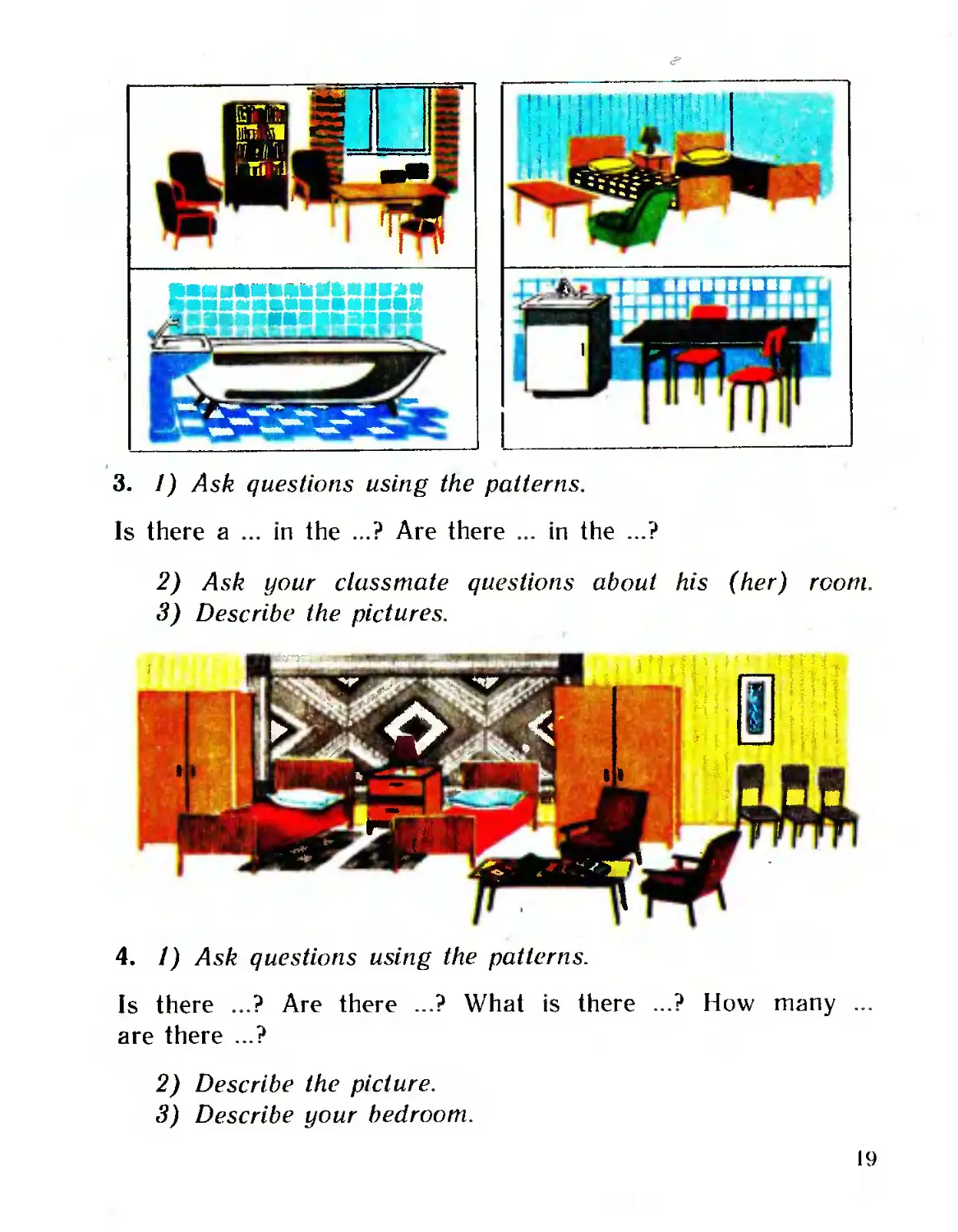
3. J) Ask questi()11S USi11g the patter11s.
Is there a ... in the ...? Are there ... in the ...?
2) Ask your classmate questi(J11S ab(Jut his (her) roont.
3) Describe the pictures.
,t
I
__' - ...... '01.. .
,_....
.
). l.
,
t- .- t
.. 1
-
....1 t lj,----j _
... "..ro ':""f.
11.1 '"'
t. i. 'j 1l
.1 .... , ....
.. . A
}.- .-'4-
h' .....,. ...
_ ......:. .Ii ...
i' (. -; 1
f.. > " !! I
t. . ff'
"'-.!'.t lo ........
.(" ,;
. p-f /
.. 1,
t .
.
-.. ....,
.
,. "{
..
IJ;t , t l- o{
It""t {:
.... -
, - t t::
I - I
1'.1; ...; r.
1"- _t"
..'\ '!;, :
,"
"
I
/
I
, " ......
-
. ,
-.
'0
II II
f 1
- II
..
- ....
...
... ffi J
..
'--
"It>.o1
.
1
., .....,? ,
A. "'...
,
,
.
4. 1) Ask questi()11S USi11g the patter11s.
Is there ....? Are there __.? What is there ...? }-Iow many...
are there ...?
2) Describe the picture.
3) Describe your bedroom.
19
, I t "- ' .
t
, -
f}
I I
1 1
h
: r
J
I 1
a
"'I-
r.
".'..,
f:
I
pi
t I
I
. . ,.
I i i
. r
t (
;. t
r j" r
LJ
O.
\ i
,
I t I
d.
n
:r-
.
.
.
"
t
.
.
'"
i
.
)-,
"'\f
-
,
I -
r
\
I
I
t
....
f
..
f
{
I..
;
-1(-)
b
""i..."-T'- ._l v - I
I
.
I -
..... , I
........
... ....
I .
.
r,' III' 'If' n"
t.,
l I
l t
F t
t i
f
.
".. ......... Q'
"
,.
5. 1) Ask your classmates questi()ns OIl the picture.
2) Describe the picture.
3) Describe your livillg-room.
4) Describe your flat.
.
II. READ.
1. Learn to read the words alld selltences.
.
[fa] bear, chair, where, there, there is, there are; There is
....... J
a book on the table. There are five pencils in the pencil-box;
Mary, my sister Mary; My sister Mary is a funny little
gi r I
isn't is not
doesn't does not
can't cannot
I'm I anl
it's it is
2. Read the texl l.l.lld say why Mary is fUllny.
20
Isn't Mary funny?
My little sister Mary is a very furlrlY girl. She is not a pupil.
She is four. She can't read. She can't write.
But one day she says: "Nina, give ITIe a pen, please."
"Here you are," I say. "And what do Y01! want to do with the
pen?"
.
. , .
. IJ
r" i
"
Ct . <
) .
r (.. .
II' . .
I
:I "
--
"I want to write a letter to my frierl<1 Kitty "
"But how can you? You can't write," I say.
"It doesn't nlatter. 1 My friend Kitty call't read," says nlY
funny little sister.
3. Read the dialogue arId say if Jack '(Q)UfZts to go to scho()l. Then
dramatize it.
.
Is Jack III?
It's Monday. It's seven o'clock in the morning. But Jack
does not want to get up. He is in bed. I-lis ntother comes in.
Mother: Jack, it is seven o'clock! And YOll are in bed! Get IIp!
Get up!
Jack: I can't go to school today, MUlll. I al11 ill.
Mother: Are you?
I It doesn't matter He Ba:>KHO
21
Jack:
Mother:
Jack:
Mother.
Jack:
Mother:
,
,
.
. \', .
r \:; \
it. ,.-
- - ;
.I
..
'"
.-
..
,
..........
)
)'n1 sorry I an1, Mun1. Please, give n1e my new book.
I want to read it now.
Here it is.
Thank you, Mun1, and my new toys, please.
Here they are.
Oh, thanks. 1 And for dinner I want ice-crean1.
Oh, Jack, now I see that you are not ill. You don't want
to go to school r
4. Read the poem al1d say what's the 111atter witlI tile boy
I II III r Jonatllan Beam
, "
.
\.. J ()l12 tl1 an Bea 01
Likes ice-crean),
-.
-- And he is in bed today.
....... ......-.
-'"
r., ,
He doesn't eat,
V rJ"i?'. \
- ) \
I He doesn't sleep,
.
..,, /i ,.............;
'" ...........L. -........ ' He doesn't want to play.
5. Ll ll rll I(l (i-lill tIll' w()rlis alld sel1lel1ces.
[u] rO()IJ1, (l r()()ttl --- r()OTJIS; We have tpree rooms.
-"
I thanl,s thank y()U
.
22
a bedroonl beclroOITlS, a nice bedroom, children's beu-
_ A
rooll1 Is the children's bedroom nice? a livif)g-roonl, a large
living-roonl; Do you have a living-roonl? Is there a table in your
living-room?
[a: ) arm, an arnlchair,..! a big arnlchair; There is a big old arIT1-
chair in nly grandfather's roonl; a throonl, in the bathroom;
I wash my hands and face in the bathroom.
[ou] no, SOt sofa, a nice sofa; Is your sofa green?
['aua] OUf, our roonl, our bedroonl; Our bedrooIT1 is nice;
our living-roonl; There is a new sofa in our living-rooITl.
[<E] fl t a new flat; There are three rOOITIS in our flat.
[I] his, big, sister, kitchen, in the kitchen; My little sister
usually has dinner in the kitchen.
6. J) Read the text arId say what is there in the t()y-r(Jom.
A Toy-Roonl
Kate is a little girl. She has a lot of toys and she likes to play
with them.
.
. . ,
. I · .
.
. . .
.
.
. . .
. . .
. .
.
. . . II
. ,
. -,
.
. . . ' .. .
. . .... .
.
III .., -
-
...
((( '" -
.. .
..
-""" .
/(( A .-., ,
J"J '-*
Jjl
\ ;..-<"
/
\ . . .. ..-
\ 4t
'.",' .. - .
.
,4 · '6 I (j1
- -,
11 .
"
2a
.
This is a toy. room for her dolls- There is a table, a sofa, a
bed, four chairs and two arnlchairs in the doll's room. The dolls
like to sit in the armchairs and on the chairs
2) Agree or disagree_
Kate is a big girl. She doesn't have toys. She likes to play with
her toys. There are four chairs in the doll's room.
.
7. Lear1! to read the words a1!d sentences.
,
A po-
1
-
,
there's there is; aren't are not
[:):] all, ball, small, a snlall room, a snlall table; There is a
_r.......L _
small table in my bedroonl. There's a sofa there.
wardrob e, a brown wardrobe, an old wardrobe; Is there a ward-
'h.. 17 -
robe in her small bedroom?
[a;] car, carpet, a new carpet; Th.ere is no carpet in the living-
room. There's no wardrobe there; large, a large flat; OUf friends
have a large flat.
.
(fa1 c.hair, where, there, their, their flat; How many roonlS
are thl\rp in their flat? There are three roonlS in their large new
£1 at.
[ ] latll)>, (I slllalllatnp; Is there a smal1lanlp near your bed?
pian o, a new pitlll(); 'rhpre is no J)iall() in their fl at.
-
Co
24
There's a piano in the room. I
Is there a piano in the roonl ? Yes, there is.
No, there is not (isn't).
There is no piano in the room.
What is there in the roonl?
There are books on the table
Are there books on the table? Yes, there are.
N 0, there are not (aren't).
There are no books on the table.
How nlany books are there on the table?
1 ...dII...
8. Imagine that you iflvife your friend to see your flew fLat.
Dramatize the dialogues.
Mike's New Flat
1) Mike: You know, Bob, we have a new
flat in a large house. Do you want to
see it?
Bob: Oh, yes, I do. What street is it in? '\ :
Mike: It's in Pushkin Street. I et's go.
Bob . All right ...
..
'flY.
f
.,.
.
.,.
.
\
...--
\J
I
/((JI(
....
..
.\
,I.........
..... ...
... . ..
t: ·
1 · ,
f
r
._.
4\ ;,
.
J
..
..
I.
I.
.
!!i
--
-
... .
. <
'(
.. .....' alt...,
"' I
- -
...
\\
...
.
-
..
I
,
-
I
,
t
- \,-
rv ----...v- r J .d'"
. . . t
..
-,
,... . ,:
· . . . .. . dU\'
· I'll II
,
l "
F-- 1... 0: -)'
.
. .
-
.
" -
.
.
..
.
... w
.. -:.. -,r .....
.. ... ._,'. "..... 4....,..
,... ... ", ' ...1 1 .
, .. '" . . .
..
"-
l l' ( · ,IJ, J
_t , .f:f _ 'Y'
, '" >!. .. \
- .... . :..; ....
.........
--. ..
-
'L
1[ ...
. n '"
-
. -
- .-
- - ..--.- - ---
- --- r; -- -:::.
T --
""""'" - - ---;.-
25
2) B()b: Oh, YOllr new flat is very large.
Mike: Yes, there are four rooms in our flat. This is a living-
room6 That is a kitchen and this is a bathroonl. We have two
bedrooms.
Bob: And where is your room?
Mike: Here is nlY roonl.
B(Jb: Your room is sl11all, but it s very nice.
Mike: I like it, too.
Bob: There are a lot of books in your bookcase.
Mike: Yes, I have a lot of new books. I like to read. And you?
Bob: I like to read too, I like to read books about aninlals and
birds.
,
9. J) Read the text and say when Bob goes home.
Mike gives Bob two books to read. Bob is very glad.
Then Mike's mother comes in and the boys have tea and cakes.
After tea the boys go to the living..roonl. It is a large roonl
with two windows.
There is a wardrobe, a sofa, a sl11all table with a lamp on it
two arl11chairs and a piano in it. There is a new carpet on the
floor.
The boys watch TV and play games
At seven o'clock in the evening Bob thanks Mike's nlother and
goes home.
2) Choose the serlte11ces which are true to the text.
Mike gives Bob a lot of books to read. Bob is very glad. Then
Mike's grandmother conles in. After tea the boys go to the
living-r()()1I1. It is a large roonl with two windows. There is no
carpet on tliP floor. The boys don't watch TV.
Bob thanks Mike's mother.
26
-
III.. READ AND LEARN.
o L Listen to the dialogue. read and dramatize if. Make up your
own dial()gu.e.
Mother: Bob, come and help nIe. ]'m very busy . I'nl cleaning
the roonI.
"\ ; t
\ \'\ t l ,
.;'l , j" '. -'
"", I
"' .I ..
\.. t
II.M' .. --"
.....1 If_t tLiil , - , ;
1
tIiIL. .- - r
.....: ." , .
f !
\ I ! "
r .,
,
,
i .
:-r.
. \- - -..--. :
! -;.. r -
...
",. {
f t
,
I
,
,
.
Bob: Oh, Munl, I can't do that. ItnI busy, too.
Mother: And what are you doing?
Bob: I'nl watching TV.
2. Read the poem alld learll it_
Colours
, .Jt:" \
'" t;
fI fll'
. '\ \. , '
Please, tell me
What is green?
Grass is green,
So nice and clean.
Wh at is grey?
Can you say?
Yes, I can,
The nlouse is grey.
,
.:
I
..--
-.
\
lJ
'27
t
What is wtIite?
I want to kllOW.
Milk is wtIite,
And so is SllOW.
U And what is red, ' I
Asks little Fred.
"rftle flag is red "
Says tlis brother rfed.
f
---
3. Read the proverb and g"ive the Russian equivalent" Then
learn it. .
rftlere is no place like home.
o 4. Listen to the dialog-ue, read and dramatize it. Make up your
own dialogue.
Mary: Nina are )'Ou busy today?
Nina: No.
Mary: Do )'OU want to see Ollr new flat?
Nina: Certainly, with great pleasure.
.
.
...dl
IV. WRITE.
I. I. i/I in again, capital, fourth, first, begin, the Soviet Union,
third, glad, fOfln, September.
1) M()s(.()W is the ._. of .... .__ ... . I am ... that I live in Moscow.
2) Sctl()()) .h ()II the ... of ... . Now we are not in the ... form.
We are ill tilt, __. u n()w. 3) rfoday is ttle ... of ... . rfhe children
are gojn 1(1 sch()()1. 4) rfhe pupils are ... that ttley are at
s c tl 001 . . . .
28
2. Arrange the sentences in logical order.
1) rfhen she begins to write a letter 2) Nina wallts to write
a letter to her friend. 3) She takes a pen 81ld sits down at the
table.
3. FiLL in is, are.
1) There ... a new school near my house. rfhere .... a lot of new
schools in Moscow. 2) ... there new pupils in the third form?
Yes, there ... Olle.
4. Complete.
I) Is there a...? 2) There is no ... 3) rfhere are a lot of ...
5. Choose the right sentences..
I) We clean our teeth in the bathroom. 2) We wash our hands
and face in the living-room. 3) We usually watch TV in the
bedroom. 4) rfhere are a lot of books in our flat. 5) My father
1.1Sl.1al])1 has breakfast in the kitctlen. 6) We read in the bath-
room. 7) rfhere is a sofa in the living-room.
6. Describe your flat.
our flat their small
armchair bathroom wardrobe lamp
sofa kitchen carpet .
piano
room bedroom bed
a lot of living..room large
2B
v. HOMEWORK.
I. I (I); II (I); IV (I): learn the words of Unit One.
2. I (2:1); II (2); III (I) (0 No 8); IV (2).
3. e No 10; I (3:1); III (2); IV (3).
4.0 No 11; I (4); II (3,4); IV (4).
5.0 No 12; 1(5:1,2); II (5,6); III (3); IV (5).
6. 0 No 13: learn the song; I (5:4); II (7); III (4:0 No 14);
IV ( 6 ) .
7. 0 No 15: retell the story and finish it up; II (8:1,2).
UNIT
THREE
-
...- '1: -- - .II. --'""
r J
---.."""
" -
(The Third Unit)
I. LOOK AND SAY.
,.
\ ,
\ r
..
t , \ J \ "' " It,.
r
tJII.l' JL - '"l}' -.. . --
- ,
\. ..
"
,
,
,. , . , <II
: '.e,: I'
.. Ii . .... j. lit '
. " -,, }
11' x.
\
.
,
.
of
.
-- - "\
e
. ...
\
................ .
...
.
, .
, . 7' f . lit f ... ..tp
.. ..; . , ,
, ....t
-. ........ .,
_ ""';' .)1*1. '" ....."'-......
--.;..,..,.-
r .ff, --- ..
'II'
I. Say, using the patterns.
It's ... . What season comes after ...? What do you do in ...?
What does your friend uSllally do in ...? Do you like ... and
why?
.
"".,.
\'t
..
..-
.t, .
...
IJ .'1' ,,
,'# -
#I -
., !.. 1.',"\ - .,: ....,
.. ) .111' ,;. to""
. ow .'... . .'." \\
.' --....,
. \.. II>
,-II> ',
. ._,.. ,f..
-. \
JIt.... '
" -'
. ._ , . ......\
I .- -.
.' """ ..
""' - ,,. t 'j
". ....
I .1. :;,, '-'
j -- -- ,:;.
. I , ;::" ' - I
II'! r".. I ...
I"'; I"
1'.oIJ
, l\ J:..;
--- -...
-
e
..
...
-
...-
.
,.1
!.1 /",'
)\
.
». ...',.
-.
,. ..,J--
1 -.
'tJ
'::1-- ..
.
....;
..
..- .
f........ ..-.. "" ..
-
A'
".
2. 1) Ask questions on the pictures.
2) Describe the pictures.
..
31
V
dh
I:i:;; '"
-!i
..
..
..
..
..
..
-.
..
..
..
..
:2
...
=:s
o
.
.
-
3. 1) Compare the dolls, the houses, the rulers.
- 2) Ask questions using- the patterns.
Is the first ... (smaller, bigger, longer .. ) than the second one?
Is the first ... (ttle smallest,. ttle big,gest, the longest...) of all?
t
"' \, 1-
.. .. J' "
. '" ". \ .. I
I
....
'"
,
"
,. '- , ".
41'
f ,,)
"'fII , .
...
.
t ,
.... .
... ......
t
\"
I
,
I ( .-
....
.';"
.."" .....
If"
4. 1) Ask questions on the picture
2) Describe the picture.
-
,
.
.'- !
-", ' - I
-. .. I ,1 / ,. f ) i
- ..... .. t I .., ....' ;lJ
...". ". \ ' I' . ' " I
< .. ', i ,j 1.1 'r '. . -III
- ,oIIf'.' '.J, r.i ' -P..
", . ' ... .. .. ... 'I ,,..
\-.. ... 't.. . __, \ I .. U
.. ... t. .., .., h ,6'
--... . II I "
.
III -
.
.
.
. I. .
;;: ' -5
'1'.
*
\ ::.
-,
. -
.
o
'Ii.
.
,
....
r)
.
..
-- ..
,\
;
"t.. "
,
",.
;>"
- .111
,
I
"
l.::o.""'t.l:.._
11.'-.
-
-\... . ;.
".,.
::i ;
I,
.
.
.
"
...
'\ '
\
-
i
, -
....
'J
., . '"
" -t,
-- \;..
-;"
..
- '. '- . .' -- /rl
". "
, 11; ..; \ , .. . ,
... - .
.. " \
,
"
.J,
.,
-
t
..
.
4
'"
..
,
5. I) ..<)ll!Jp llsing the patterns.
It's .. .i II g II ( ) W - I t - ... . .. . j 11 W j n t e r ( in a 1.1 t u m n) .
2) l)cscrihl) file pictures.
6.. Sa!! WIlli I !lll!1 rl.ln ab()ut winter (summer, spring, autumn)
.
32
.
K ... '.... ")....
- .
"
,
'-
t:
, i'I "
, " "
, 1
- '" -"""",
........... ;M .'"!; .- . .
t t1 11.1 I
"\ f
· ;. 0
k
, i
":IJI
.
t
.
.
,
.
F
,.
'tf'
. 6 .
r
'"
'I'll, 1 llt1
)
7. 1) Answer the questions.
What can you see in the pictures!l What fruit do you like?
2) Ask questions on the pictures..
3) Describe the pictures..
v .-:: = . ,.-
14fI. --
f 7' ) _ - J
r --
_/'( -w _.
...
.--........
,--
l .-"
-
_.
.-
.J\
[II
.
-
8. Say, using the patterns.
I can see ... in the picture. I like Ha . I don't like ... . My sister
likes .... .. My sister doesn t like .owe . 'fhere are a lot of ...... in
autumn.
_.dol T V-"I
.. --
.
II. READ.
I. 1) Read the text and say how the dog helps the kittens.
A Good Friend
'fhe dog and her fOllr little puppies live in a dog-house. There
is a box near the dog-house. The cat and her two little kittellS
live in this box.
2 .lnK 2615 H H. Bepe 3rliHa
:1:1
. t
,-
,."
.It I
f ..
I
"
-
..
.
/
t"
tfl
.
...
/:.r-;:,' ." ;;. >. _ ,;
.iJ(n /_
.-
f \
.
If
.
.
,
II
1:::11
l i., ·
1
:;,
"'::JII -- . .
>..,
... .=1
A.. I_
\.. ;.
, ,
/'
t...
.
..
I
. ...
'.: " --- .
-Lo. "j
:... ., "'
... I -
.' - . :-.
.....".
,._. --'.".,
-
: . . z,:.
I' of ,,
.., . r
)
- .
.
.
One day the cat goes for a walk and does not come .,back. I
"Where is our mother?" ask the little kittens. uOh, where
is our mother? What is the matter with her?"
"] am sorry, I don't know," says the dog. "But I want to help
you. Come and live in my house. I have four children four
little puppies Now you are my children too, and I am your moth-
er. My puppies are your brothers and sisters."
N ow the two kittens live in the dog-house rfhey are very
glad They have nice brothers and sisters and a very kind
mother
A friend in need is a friend indeed.
2) Answer the questions.
Where does the dog live? How many puppies does she have?
Where does the cat live? How many kittens does she have?
Where do the kittens live now? What can you say about the
dog?
2. 1) Read the text and find the sentences which prove that the
mouse is clever.
...
I come back B03BpalllaTbCH
34
The Cat Wants to Have a New riel1d
'fhe cat wants to have a new friend. She comes up to a dog and
says, "Do you want to be my friend?"
"Certainly," says the dog
"Then sing me a song, please a "
"Bow-wow-ow," sings the dog.
"'fhank you for the song," says the cat
"Not at all," says the dog.
"But I don't like your song. You can't be my friend Good-
bye. n
,t.
-
'-.
. .
,
......
,;)"-... .
.'
I'
.
.....
'\
}
\
-..
.
1".0:';
.
"'
- ..-. "
,
J "
,----- ',.
....
lr
.
. ;
- j
",.
.
'fhen the cat sees a hen and asks her to sing a song.
'fhe hen sings, "CI uck, cluck, clucka "
"Oh, your song isn't nice. You can't be my friend," says the
cat. "Goodbye."
'fhen the cat sees a little grey mouse. "Can you sing?" asks
the cat '
") think I can," says the mouse
"Then sing a song for me "
"With great pleasure," says the mouse and begins to sing,
"Pe-pee-pee. "
uOh, this is a very nice song I like it very much. Do you want
t.o be m)' frielld?" says the cat.
"No, I don't," says the mouse. "You can eat me."
,
2 4i
0) r.
I)t)
2) Agree or disagree.
The cat doesn't want to have a friend. The .cat likes the dog's
song. 'fhe hen sings for the cat, too.. The cat likes the mouse's
song. 'fhe mouse wants to be the cat's friend. The mouse is clever
3. Read the words.
..,...oIIj ""R
- ,"' -, ."'__- , - I . __. __.. ___... ._u. - _ .-......... .....17" ..... ......... _ _7._"_..__....... 1
t
(the)
-er
-est
e. g. long
longer
the longest
- "--
.LI. _ y-- - L..-- ..... .......--...,
__ Jo... __ .......,.._._--.,.-._r-I,..-_rHl...".-'..._.............,...-........,... . .. ,.. ...._..I --.... ....... , .............-___...........
short - shorter the stlortest
sharp . sharper . the sharpest
small smaller the smallest
nice nicer the nicest
- - -
larg . larg r the larg st
big bigger the biggest
hot . hotter the hottest
-
-
4. Learn to read the words and sentences.
[:):) water, warm warmer the warmest, warm water,
warm milk; It's warm in their flat. It's warmer in our flat. My
brother's room is the warmest. ;
autumn (I'::>:tam], in autumn, an autumn day; It's autumn.
It's so nice in the forest in autumn.
l::>J box, from, not, hot hotter the hottest, hot tea; My
... -
father doesn't like hot tea. It's hot today. It's hot in the room.
It's hotter in that room. 'foday is the hottest day of September.
[aul nOt don't go, old, cold colder the coldest; It's
Lb....- ...b...- -...... J
cold in auttJmn. It's colder in winter. The bedroom is the coldest
room in Ollr £1 at.
36
year [ja:), a year years, twelve years; She is nine years old.
[i: J see, three, street, meat, read, season, four seasons;
l ....
'[here are four seasons in a year.
[I] live, with, winter, in winter; It's cold in winter. Winter
is the coldest season of the year.
spring, in spring; It's warm in spring. It's warmer in spring
than in winter. Do you like spring?
[A] but y much, lunch, funny, sums, summer, in summer;
'[he days are long in summer. Summer is the warmest season of
the year.
(at) right, n ight, at night; It's usually cold at night. In sum-
rrler the nights- are shorter than in winter.
-
It's spring (summer, autumn, winter).
It's cold (warm, hot).
It's morning (afternoon, evening, night)
.
If's warmer in summer thall in spring.
It s colder in winter than in autumn.
5.. Ilnagine that you are reading the text to your little sister who
doesn'/ know anything about seasons.
Seasons
There are four seasons in a year. They are winter, spring,
SU1T1mer and autllrnn.
It's warmer in spring than in winter. It's colder in autumn
t.han in summer. Willter is the coldest season of the year. Sum-
(ner is the hottest season of the year.
In winter the days are short and the nights are long. In SlllTl-
rner the days are longer and the nights are shorter than ill
spring.
:i7
6. Learn to read the words and sentences.
#
[i:] tea, meat, season, leaf, leaves, a green
yellow leaves; The leaves are green, yellow, red
autumn..
leaf, a lot of
and brown in
tree, a
rl
near your
school?
fruit-tree, a lot of fruit-trees; Are there fruit-trees
school? How many fruit-trees are there near your
(J:) al" ball, wall, fall , fall down; When do leaves fall down
from the trees? In autumn 'the leaves fall down from the trees.
[ju:] pupil, music, beautiful, beautiful leaves, a beautiful
----At:. ...
woman, a beautiful picture; I think it's a beautiful picture.
7. 1) Read the text and say what YOll think of Nora and John.
.
111e Bird'e; frIends
I
f.
I
'
/'1/
r---
\ '.1./
4 ' /jf
, $.;$. 1 ; t · It;{ I
\.\1, {- ? J /J .... ,/
. I , : :
. ... "
--;; If ( ,
J \ I
I \ "fil.., t, #...::
f /1 -.>1. _,(
r I ji '" .:: Ii, .'.
, .-...., .t""-r.. 1 -A ...
.. 1"';.:.. '-'_..; Y..J.,
- \...--.;' .: , ...
i _ ,../ ' ' .-1!- ,'"
,. /' // 1', .. 1-. , 1. "',," ...:. :";.:
. L _
.. ......,, . to. ..... - .
. .
r
r-
(....
-c"'
/
-
t . ; t"l: .
'Q'.u .
II / 1;t :.-
II ....
-
.;"j.
1 -, :;, _
I -
i:r ,.
....,
-,
-
I ( i
- <:) . . f 11
t" I
I '.
] :
...L . ..
_-.q_ 11'1
It's a cold winter day. Nora and John are at home. It's warm in
the roarn. They are sitting near the window. Nora looks out of
the window and sees a little bird. She says to John, "Oh, look,
John! There is a little bird in the tree. I think the bird is cold
and wants to eat."
38
"Let's give it some bread I and apples, " says John.
"That's a good idea. Birds like fruit. '
The children give the bird some bread and an apple. The bird
eats the bread and the apple and says, "Pe-pe-pe!"
Do you know what the bird says? It says, "Thank you very
much, Nora and John!"
2) Answer the qllestions.
\
Is it winter or summer? Where are the children? Do they see
a bird in a tree? What do they give to the bird? Do you help
birds in winter? How do you help birds in winter? What do
you give to birds to eat?
.
.
y
'....
'V!--
_r
.
\8. Choose and read aloud the words on the topic U Seasons".
summer, flat, living-room, season, piano, year, kitchen, autumn,
warm, wardrobe, spring, armchair, night, hot, glad y again,
September, first, leaves, begin, beautiful, tree, think, third, win-
ter, fall, large, small, a lot of
9. Try to read the new
but dull
cup pI urn
-
bear pear
know " snow
..
words.
. .
agaIn raIn
carpet garden
cake tasty
often ['Jfn]
-"'
....LIIW"J'I "JIIiI"""
I some bread HeMHoro XJ1eoa
39
10. Learn to read words and sentences.
snow; It snows in winter. It doesn't snow in summer.. I like
when it snows. Do you like when it snows?
rain; It rains in autumn. I don't like when it rains. Does it
rain in winter? When does it rain?
often; It often rains in spring and in autumn. My uncle and
aunt often come to see us.. Who often comes to see you?
dull, a dull book:t a dull season, a dull game; Children don t
like to read dull books. I don't think winter is a dull season.
garden, a green garden, a large garden, our garden; Are there
a lot of fruit-trees in our garden? We often go for a walk in the
garden.. Do children like to play in the garden? Who often helps
Father and Mother to work in the garden?
plum, a plum plums, green plums big and small plums;
Do n 't eat green plums. Who likes plums?
pear, a pear pears, nice pears; Do children like pears? Do
you like pears or apples?
grapes, white grapes, dark g.rapes; What kind of grapes do
you l I ke? Grapes, pears and plums are fruits.
tasty, tasty pears, tasty grapes tasty plums; I think that
r rl.lits are tasty.
r "--.- -- - -....- -.- ..-....--.
.
. _r v- ....--........-.._ . "'-......-., ----;..a .. _ rT, ..., ::r __..............
1.&1...... ....-............
It ()ff.('ll rains in autumn.
Does it ()ften rain in autumn?
It doeslI-t ()ften rain in winter.
It often snows in winter.
Does it often snow in winter?
It doesn't often snow in
autumn_ ,
-.. -.,.__.. ---_.... , "",'.',,"_,,-...r:',...__.-........ ........ ... ..... -._.............__"'.. ..__.....__......-.., .. _.__ ._......._ _..J
I
I
r
.,..I.....dfII 1.Ll .......... ........... L _--
40
I J. Learn to read the words and sentences..
[re] cat, rabbit, cabbage, a cabbage cabbages; What ani-
mals like to eat cabbage? Rabbits like cabbage; carrot, a car-
rot carrots, red carrots; My sister likes carrots.
[a:] star, farm, grass, plant, father, garden, tomato,
a tomato tomatoes, a big red tomato; Do YOtl like - toma-
toes?
(ju:] you, Tuesday, cucumber, a cucumber cucumbers,
a lot of green cucumbers; My Jjttle brother doesn't like cucum-
bers.
.
[e) hen, well, very, vegetables; There are a lot of vegetables
in autumn.
12. Choose and read aloud the names of: 1) {rtlits, 2) vegetables.
tomato, season, cold, night, cucu.mber, pear, beautiful, think,
plum, garden, cabbage, rain, snow, often, grapes, dull, apple,
summer, potato, autumn, carrot, spring, tasty
..
13.1) Read the dialogue and say what seasons Bob and Pete
like.
All Seasons Are Beautiful
Pete: Do you like autumn, Bob?
Bob: No, ] don't. It's a dull season. The grass is yellow. The
leaves fall down from the trees. It often rains. It's often cold.
I like winter and summer. In summer the days are longer and
warmer and the nights are shorter than in autumn.
Pete: But I like autumn. I think it's a beautiful season. I like
to go to the forest in autumn. It's so beautifuJ! You can see HII
colours in the forest in autumn ' the leaves are green, yrll()w,
41
, VII. "- I J ,V P I' I ,J, .. 1\' .1
i
.. ' . -
/ f
,
"II
I I
. r
10...
... J. \ '" . ,jU .-
, ... ' . II · · ..
w
,
I
,
fl,
.. 111' 'II .. . ..
, '.
.... .,. . '"
I . 1
I ! I
l
-,
-
..j
_.
.,:-
Ilt =-
.,...-!
...,
\
,
"
.
, '\
.1 , / IJr\\,"h \ ",\4\\\\\\\\ l\, , \
"'i
rr
red and brown. There are a lot of fruits and vegetables in au-
tumn: apples and pears, plums and grapes, carrots and cab-
bages, cucumbers and tomatoes. I think it's a very tasty season!
Bob: And what about spring? Do you like it?
Pete: Oh, yes, I like it very much, too. The leaves a.re small
and green. The grass is green, too. It's warm in spring. I think
that all seasons are beautiful.
" ' .
...
... f
.
,
....
.*
, .
IJ,fj
I-
J.
-
-
\
-f
...:.:. .;;.....i.: '
.."' s:r-..
. ..,. .
IJ; ,. Hv_'\li.."'<' ; I',
..
I
\
1JY'
, p
, ..'J,. g: ::;,
"",}. -.-; -''';'
':..;- (/"
lr TI
.. &. \a:"
wa.
_ 'IIt4i:
..'
l
..
-
2) Answer the qllestions.
What seasons does Bob like? What seasons does Pete like? Why
doesn't Bob like autumn? Why does Pete think that autumn is
a beautiful season? What seasons do you like and why?
"""' _........ _ . TI.
.
w
: 42
I
-"'-:.
III. READ AND LEARN.
e I. Listen to the dialogue, read and dramatize it. Make up YOlir
own dialogue.
c-
1"_' 1 . 1
..
---.. -
-.v":-, J
t .
(-«
Ben: Hallo, Fred.
Fred: Hallo. :f
Ben: It's a fine day today, isn't it?
Fred: Certainly it is.
Ben: Then, let's go for a walk in the park.
Fred: With great pleasure.
I I
, ,
,
,
C'I
ao. ..
2. Read the proverb and give the Rlissian equivalent. Then learn
it. Think of a story to illlistrate the proverb and tell it to your
classmates.
.,-
I
.
t
,
J Y._ ' _
- - - -- .................... __ _ T'" _..
_. _,_ _......_-.... .--....-
I
I
A friend in need is a friend indeed.
.
..-.......1 .-...- _____ . -...---.. ...........___. ___ ___ __.____ ---.-.. ___.-...
3.. Read the proverb and give the Rlissian eqliivalent. Then
learn it.
..........----......... -..-
-.-
. -1- -_ __.... _....... - ' . __ ........ __.-_
Every thing is good in its season.
.-
----. _.--.... .. ....... - -..._,,--..----- ..... . -- ""'II'P'" .,.._ _ r
---.. -.---. -
e 4. Listen to the diaLoglie, read and dramatize it. Make lip YOlir
own dialog-lie.
Nora: It's hot today, isn't it? Let's go and swim.
Ada: That's a go()d idea.
-.
.
.H"'
..
-....-- I __ T
...
.-
43
IV WRITE.
I. Fill in my, his, her, its, our, your, their.
I) We have a nice flat.. u.. flat is in a new house. 2) They have
a large flat. There are four rooms in .... fJat. 3) I have a dog
... name is Snip. 4) Dan has a new schooJ-bag. .... school-bag
is brown. 5) Ada is glad to see ... friends again. 6) I have a
piano in .-- room.. 7) You have a big dog! Does it live in ... flat?
2. Arrange in pairs.
large monkey
small boy
long animal
short woman
. picture
nice
funny neck
clever tail
angry room
kind flat
3. Be.gin the questions.
;
I) ... the cat want to have a new friend? 2) ... the animals
sing for the cat? 3) ... she like the dog's song? 4) ... the dog
and the hen want to be the cat's friends?
4. Make the sentences complete.
I) In winter the days are ... than in summer. It's ... in summer
than in spring. Summer is the ... season of the year. 2) The
dog is a ... animal. Monkeys are ... than cats. The elephant is
the .... anin13 I.
.
44
5. Compare.
e. g.... a small room a smaller room
a short tail, a long nose. a clever dog, a
sharp teeth, a nice carpet, big bears
the smallest room
large flat, a hot day,
6. Fill in trees, autumn, winter, summer, spring, year, fall,
beautiful.
1) ... is the coldest season of the ... . 2) In ... the leaves ... down
from the ... . 3) I think it's ... in the forest in autumn. 4) It's
warm in ... and in ... .
7. Write the opposites.
e.. g.: close open
close, small, in the evening, right, winter, funny, day warm
8. Look at the pictures (J, 3) and compare the dolls, the houses,
the ruLers. Write 9 sentences..
- , 11..1 l ...... 'I ............... .._- -,. ......-......,........ -......"'........-.."' ....... .+..... ...... -.. .-....... - .......- . -... .. ......... . - ..
hot . tasty
season raIn
year night snow grapes
autumn fall - often carrot
winter tree dull cabbage
.. leaf (leaves) garden cucumber
sprIng
summer beautiful pear tomato
warm think plum vegetables
cold
__._ ... .1>.....-.:1.:1 ___-.....- -.ior-....--------.- ............ ... ,
---..-.-- I' - -....__ --
-.__.-___....._-. ....r .__ _._ .. I Ll -_
-
. "
----+-...
45
v. HOMEWORK.
1. e No 16,17: learn the poem; I (I); III (I); e No 18; IV (I).
2. e No 19; I (2); II (1); III (2); IV (2).
3. I (3:1); II (2): retell the text; IV (3).
4. e No 20; I (4); II (3,4); III (3); IV (5).
5. e No 21,22: learn the poem; I (5); II (5); III (4); e No
23; IV (4)
6. e No 24; I (7:1, 2) II (6,7); IV (6).
7. e No 25; 1(6,8); II (9,10); IV (7).
8. e No 26: tell your classmates a tale you like; II (11, 13): get
ready for test reading; get ready for a test.
.. 9. Get ready with your story "Imagine that you are ..."; IV (8).
<
UNIT
FOUR
---
-...
-_.
__. l....L.. -IJ.... ....-- ......... _ .....- _...._.--..
--
(The Fourth Unit)
4
I. LOOK AND SAY.
....
\......). .
.. ,
""
: .. ,
/..; ct
..... .
...;t.
Ht1W . f/
.,
.
J
...
. '
. . .
. '-.
'" ,
.. ,J....' fl -.,.. -,
... ... .., \1/;"''-
.... ..'
.
...---.
.. --...
Tf1I -""'-
......,1...
I" I
...
t
..-,- ;}) 6 }\
. -
J
-
I
't .....
:. ,
<.¥.[.
-.
"
.
1 (.. ,. .
..". "if .
-.. ,, 0'i..' -...... -
.-.....
......
"..
,.
"-
.
, r;,
-.- Ii'
/'
I
+
.
...... -
I....-.;.ASo-O
. 'It -
, .
. . ;:. ". A. 'Wl
iJ 0
,
:.. -.....
,
.
-
I. Answer the ql.ll sti(JI1S.
What animals call YOll see in the picture? Which animal do
you like and WI1Y? WllCit are the animals doing? Which all i-
mal is the first (the sefond, .n)?
47
IV class _nA" I V class M B "
--
Mathematics Mathema1ics Russian English
>-
>. Reading Cd Russian Mathematics Cd Mathematics
co Cd "'C
"'D Russian 0) English "'C Reading 0') Russian
c L. C L..
0 0
::IE E.T. .J:: Reading ::IE E.T.. .s::; Reading
l- t-
Handicrafts Handicrafts
--. - . . . -- .............
English Russian Mathematics Russian
Cd Mathematics English >, English English
"'C >t Cd >.
Cd "'C Cd
U) Reading
CD "'D Mathematics (Q Reading "'D Mathematics
.- CD .-
L.
I- Handicrafts .... Reading Handicrafts LL Read.ing
t-
E.T. E.T.
, . - - ... TT .... -
.-. _. r
-- . r -...-.......... .-..
Russian Mathematics >, Mathematics English
Cd - >, Cd
"'C Mathematics Music "1:J Russian >. Mathematics
U) ca 0) CG
CD Reading CD "C
L.. English Reading Russian
c c: &..
a
"'C '1:J
CD Drawing ca Russian I Drawing ca Music ;
en en
Nature Study
- I
2. Say using the patterns.
The first (second, ...) day of the week is Monday (Tues-
day, ...). They have ... English (Russian, ...) lessons a week.
She (he) has ... English (Russian, ...) lessons a week. We (I)
have u. English (Russian, ...) lessons a week.
3. 1) Count from 1 to 10; from 10 to 19.
2) Say:
13, 18t 12, 14, 10> 15, 17, 19, 16.
4. I) Say:
10, 20 t : O, 40, 50, 60 t 70, 80, 90, 100.
2) COUll I from 34 to 41; from 19 to 25; from 93 to 100.
48
-
t - - -F"
illMiJFI ..
..
· _UJiHT' J7 T 1J1f . U -
J I " U _
IWI - -. . ,O_L _t- - L1 "I I
1 --
1
t(S
,
.
"lIt
..
..
\
-
....
-..
-
:i
,
- ..... .... ()
.......: - . ,
- .. 4:
... ,
.- . .
\
1\
' .
..
".
/.<..
,
:; .
,,, ,;
-
... -
r
,
i ,
..J ..
,
-.
..
J
.....
,
1 .L
- iI--- ;
, l '. .
'"'c.,
...._ , ""*r: ,' \ fIII f4
.. :. V-
c......)
I
"'
....
., t.""
'"
J.
'JJ'"
'., t
.......;..
'"
...
j
.
,
,
1J )
-
#
-- tt
, -
..
A
...
-
,-
-
,
;
\l "
. ..
.
,.
f tt.., .
· J ,
....
.
.,. ,!
't
4
... "/ . ...
,
. ,
..........
-
C I A
t
-
/ '
. t!
" t
-
.
) '
"
.
....,.
,..
)., ,
L
-
-
} '"
..
,...
ft
-
"..
'f
.
,
'<'1
..
:r-
\'1
-
..."
4
.
f
4 ·
,
-
...
,
, '
.
,.
I
.
e.
,
1,\
1
.... .
"t
.
,
1 .
.-
- :;;"
.;
..
.,
..
I)
Jt
.....
II
.
, ../
u
,
e-
'\
· 1
It
.
..
,..
,
f j\
...
.
,
lit
.
- t
-I
...
'i;'
v
-
..
:L
i ,
.......
., j.,
.. --".........
... ...-,.
. .. ....... .... .
, .. " .
. 'I.
.......
-'
,
.
J'
49
.,)
{
...
5. Answer the questions.
I) How many pupils are there in the picture (p. 49)? How many
boys can you see in the picture? How many girls can you see in
the picture? What are they doing? !
2) What do you usually do ...? What does your friend usually
do ...? What do you like to do .u? What does your friend like
to do.. . ?
..
II. READ.
I. Choose and read aloud the words on the topic t School".
lesson, vegetables, school year, September, cucumber, desk,
tomato, blackboard, wardrobe, window, classroom, snow,
beautiful, night, tasty, pencil-box, cold, dull, fall, tree, leaves,
school-bag, star, flag, pen, Mathematics, season, Handicrafts,
carpet, kitchen, English, Russian, glad, bathroom, pupil,
teacher.
2. Read the words.
r --...
-.--
.
(the) ... + --th ) e. g. (the) four + -th ) the fOJtrth
-....... - "---.- -- .....
-....
I
one the first
two the second
three the third
four the fourth
five the fifth
six the sixth
.seven. the seventh
eight the eighth
nine the ninth
ten -- the tenth
eleven the eleventh
twelve the twelfth
3. Learn It) read the dates.
The first of JallLlary, the second of February, the third of March,
50
the fourth of April, the fifth of May, the sixth of June, the
seventh of July, the eighth of August, the ninth of September,
the tenth of October, the eleventh of N ovem ber, the twel fth of
December.
.
4. 1) Read the text and say what you think about Pif. J s it good
to do things like that?
Pit
This is Pif, a little funny dog. "There are a lot of books about
Pif. English children like to read thel11. Now you can read about
Pif, too.
It's November, a cold autumn month. Pif goes for a walk. It
begins to rain. He is very cold.
He sees a tree. He runs up to the tree and sits down under it.
It's dull to sit under a tree when it's raining. Pif wants to run
honle but he doesn't have an umbrella. He thinks, "I can't go
home because I don't have an umbrella. Where can I get it? Oh,
that's a good idea!..."
...
. .;
\
r.
;\. '.
1\;
\ ... '
i \ ' A'
\* i !,
\ .,
- ,
\\ .
'. 1::"
I,: : "
\" - I
.
t(
\.
I \
,
..
,. \
, \ \ \ '. ' ,
\ ' J
..
.
.....
...
-,
--'
,
-.
He takes the tree like an umbreila l and goes home.
Pif is a bad d(>g, is.n't he?
..
2) Choose and read aloud the sentences to illustrate the
pictures.
1 like an umbrella KaK 30HTHK
.
51
.
5. Read the words.
f
I
.....--.r ..
-
'V"" ..L
__ -.L ___ .. ...--
. . . + -teen -+ e. g. four + -teen ---)to- fourteen
.
,
I
,
,...
_ -. _""'1'1"" __ __ ...__ , ,,4. """' ''''L J>..-"' 1>..01104 -v- . ......
three thirteen seven seventeen
- - eight eighteen
four fourteen
five fifteen . nineteen
nIne
. sixteen
SIX ,
6. Learn to read the words and sentences.
[A] monkey, mother, nl0nth, a month months; We 'have
...
sixteen or seventeen English lessons a nl0nth. Are there twelve
months in a year? Country, a country countries, our coun-
lr
try; We love our country. Our country is large and beautiful.
[ ] hot, a lot of, office, holiday, a holiday h!Jlidays,
spring holidays; Summer holidays are the longest. What holi-
days do you like best? The Seventh of November is the greatest
holiday.
[ou] sofa, cold, over, is over, are over; The lesson is over.
When holidays are over, school begins. When are your winter
holidays over?
[i:] tree, green, three, week , a week weeks; We go to
school six days a week. How many weeks are there in a month?
What is the first day of the week in our country and in England?
7. RealI 'he words.
January, I:f-I)ruary, March, April, May, June, July, August,
September, ()l.t()ber, November, December.
.
52
8. Read it to yourself, then al(Jud as quickly as you can.
I
October, month, November, holiQ Ys, is over, August, are over,
December, a week, January, country, February, thirteen, June,
fourteen, July, fifteen.
9. Read the words.
J
-- -.. ----
-.. + -ty e. g. six + -ty-+ sixty
- ---
-"
twenty
twenty-one
twenty-two
twenty-three
twenty-four
twenty-five
,
twenty-six
twenty-seven
twerlty-eight
twenty-nine
thirty
-
forty
..d.
fifty
sixty
seventy
eighty
v- r
ninety
hundred
10.. Learn to read the words and sentences.
[ell name, day, May, break, a break, a long break, a short
break, breaks; After the second lesson we have a long break.
How m ny breaks a day do you have? Which break is the
longest?
great, greater t the greatest, a great holiday, the greatest
holiday; The Nintl-t of May is a great holiday.
Great Britairl; Gr()at Britain is not a large country.
during during a break, during a lesson, during holidays;
.
During holidays children have a lot of fun.
r: "J
')lJ
[1] in, ill, till, from morning till late at night; The pupils
1 "f"
are at school from half past eight till half past twelve.
It. Read it to yourselfJ then aloud as quickly as you can.
hundred, forty, till, eighty, fifty, Great Britain, twenty, break,
seventy, during
12. 1) Read the text and compare Sovi-el and English schools.
S()Vlet- alld English School
There are twelve months in a year. Do you know their names?
They are January, February, March, April, May, June, July,
August, September, October, November and December.
There are three months in a season. Winter begins in Decem..
ber and is over in February. March, April and May are spring
months. When spring is over, summer comes.
In the Soviet Union pupils have their summer holidays in
June, July and August. When summer holidays are over, chil-
dren go to school. _
In our country school begins on the first of Septenlber. In
November children have autumn holidays. Their winter holi-
days are in January. In March they have spring holidays_ Au-
tumn holidays are the shortest, summer holidays are the longest.
In fhe Soviet Union school is over in May.
In Great Britain school begins in Septenlber but not on Mon-
day. English children have classes l on Monday, Tuesday, Wed-
nesday, Thursday and Friday. They do not have classes on
Saturdays and on Sundays. They have winter holidays for seven-
teen da}'s, spring holidays for fifteen days and summer holi-
days for thirty-four or thirty-five days.
English children are at school from nine o'clock in the morn-
ing till half past four in the afternoon. But they have a long
break from twelve o'clock till two o'clock.
In Great Britain school is over in July.
1 to have classes - HMeTb ypOKH (3aHHTHH)
54
2) Answer the questions.
How many parts are there in the text? Think of a name to
each" part. When does school begin in the Soviet Union? When
does school begin in Great Britain? When do Soviet children
have sumnler holidays? When do English children have sunlnler
holidays? When is school over in the Soviet Union? When is
school over in Great Britain?
-..--.. .....-..... -
&....... -..
-,. V 'I _ ......,..-.::A" J
..r ...
- & - --.... .... -'q"'"
III. READ AND LEARN.
E> 1. Listen to the dialogue J read and dramatize it. Make up your
own dialogue.
Nelly: Halla, Lena!
Lena:; Halla, Nelly!
Nelly: Can you tell me the time, please?
Lena: It's half past four.
Nelly: Oh, I'm late. Excuse me, please. I'm in a hurry.
Lena: That's aJI right.
Nelly : Bye-bye!
Lena: S a long!
-
,....
.;<'
!..A .
. ". .....
......
I
' \
.
-i
#
I I
;.
\-.;
;
.) !
-
t tD II) IJ ,. I[
It
t. .
-,
_;0;-
,
. i
-....-..............
'. . J rI' ". .. .
I
J \ '\ iil 11
jf. II .--------
'(
..
... -'
..----
JL
1 each
u
Ka>K;:thIH
55
E> 2. Listen to the dialogue# read and dramatize it. Make up your
lJWn dialogue.
John: Peter, can you tell me the time please?
Peter: It's a quarter past three. Are you in a hurry?
John: Yes, it's time to go home. Excuse me, please.
Peter: That s all right.
John: Bye-bye!
Peter: So long!
_ r _..I __.
- _.....
JIll...&.. L 1.1111
...-. _ _ _ K J
,
IV. WRITE.
I. Write 15 words on the topic ,t School".
t
2. Copy and remember (see II, 2).
3. Write in words.
e. g.: llIX the first of September
l/IX, 7/XI, l/V, 8/111, 9/X, 3/1
4. Make the sentences complete.
I) There are seven days in a .... . 2) There are four weeks in
a .... . 3) In June, July and August pupils in our country have
summer .... . 4) When holidays are ... children go to ... ..
5. Write in words..
.
13, 15t 20, 30, 19, 41, 53t 64, 88, tOO
56
--, . - - F ,-
month February fourteen twenty
October March fi fteen thirty
November April sixteen forty
holidays May seventeen f if ty
(be) over June eighteen sixty
week July nineteen seventy
August country till eighty
December Great Britain break ninety
January thirteen during hundred
. -- ... """V ""'F ...... - ... -
#
.LUI 11 . ...
-1J::. ....
T . .....4 .....
v. HOMEWORK.
1- e No 27 28: learn the poem; I (I); II (I); IV (I).
2. e N 0 29; I (2); I I (2); I I I (I: E> No 30); IV (2).
3. e No 31; I (3); II (3, 4) IV (3).
4. I (5); II (5, 6 7); III (2: e No 32); IV (4).
5. I (4); imagine that you are one of the months; II (8 9 10);
IV (5).
6. I I (II 12).
r
UNIT
FIVE
THE SECOND TE M
"r _
--- --...
.........-....---.....-...-
_...,.....L"..___ _. _
.
;
,
!
.--..-----.:,-
_.. -0111_-- -.. ..,.....
-
--....--. ---..
(The Fifth Unit) .
I. LOOK AND SAY.
s,J , .J.."'t -
." " ,--
') ....t.
" ...
12
--- <=?i
I ..!, .......
'" ... ""iI'"
,
-<t:')
. '?
::" . ......
;.,..t'::i '.. .
. ." -I .
;$,."-
-...-'J.i"L,.,.
.-..
11 1 1
10
9
B
'.
,
'..;,. I
\
;,
.....
9
.3
2
.3
4
6 5
7 6 5
11 12
10
9
8
.
4
4....... 6 5
"" .....' -" - '
01>-' .
1
. , .......... "'.I..
_...of:" "" ,d' '.
<I:J J ) rj:.'fT .
-- .' if... "J "P; '-. - -;,} "--',, '..
;, <to" ..,t\""'- '-$ :!.> "' f"
""'" I...J'''' . ...1.rr II'i i: r "'-J-
. _..-...... ...
...' ..v "l i J.' - .....
'I
. - ,J,)".....' ."'.
J f ',. o!: " :< "
r. ' ;,,:: r, 'I..' ...._0:;
,_. .... ''1 if . _
.. 1Iit__ -
"
.. . t..;f "l.o ""-..r: 1:- '
; . : ; . ('7.. J
'S:.
I
i
,'"
., ....
.
.. -
.1J'.r'" . 1:,
. . .-. "'.
- ... "l
"'"
:S.:f: . Iif. ...'.." \ .:1- . .,;,
'K. ;-v - o. .
.......ro:.. .......- '--
- . .-. . - I
To .".'>1', ;N . ..
-...:.r!......- ..
,';' >-i.
11 12 1
10
.
.
.... r-- -J , )j :;" J
-t j-.
-!.;-!'t. ..' y-" f.. , > "
- < '->Jo
t;: .1.. :'i
. ......-:-- i":
. -.>, ..-
"...- )'.
7.t...;... I
--:" / ..-;.
.. 12 12
11 1 11
10 2. 10 2
9 .3 9 .- --a 3
B .If 8 4
'... 5 6
. 6
- 6 ..
...
.
-;, .. <
".y. I{
-..t --:'\
4I
<i ..-"{'.
)
. \ -'
;0: -,
"\ ...' . 0" i:
,
}"
< - -
.h'.
,.-
--"
;:.. 3'
. 1" . ,.
''\..,
-.." .....'r ._
r ' ... ,,' - <
....!,; I!' il !
... ...' . ' 1 .. "'. J'.
. .... ,. C"I . 'I. . .
:t' J. '..... ...."!- ,"' .
.",rJ " .. ,,_
ii. -- .r
4
6 5
9
B
7
3
:;
:r
." .
1. Answer the questions.
What's the time? What do you usually do at ...? What does
your father (mother, sister, brother, friend) do at ...?
2. Say:
. 88, 13, 79, 100, 56, 64, 70, 31, 40, 22, 93, 15
58
.'
.--
"I ,
'., r. '""..-
- '-
f
\
' . -
J,
...
"'!
...,.
...,.
=c .. r: u
I
'-.,./'- "4-'''
-_. I t'
-.
.. ;tl h '" ,
... 1''''
-
- 1
i"
t c:- II
i .i;
I .
! .
fir. ,
I .J: ,., ...1-/
.
, t f
. tn-
.
......,""+RI..:........1 .
- . ... 41
I
'" .....'.......
i'
ff 't
.j t
. ',- ""'--'
.' .. . .....'.
. ',7' _."} . .......r-_
. -,: < ,, ,:""I.)_ .
,
f
\... .,,.
-
-
" '1 .
-
")f.
:1''':
...
..
.
I"
" 14-
h I
.... '-\...
.,
,
'"
" .
k
io'4 I
- r
. J'). If;}
. 1
)0-
"......
> -
,/ .,
"'-I.
L r .......
.1- ,.
- .
....... ....
... t ....... h ..
\ .
1 \ ._, J I l \
\ 1t \
' . ..
-....i . ..:J. ... .. - ........
3. J) Answer the ql.lestions.
What can you see in the pictures?
was Pete in summer? Where were
you in summer?
2) Describe the pictures.
.
"-
.
of.
"!lor. .
"
...
'If
, .\
--
:
11
, f ....
J
t
", t
.
<;
,.
-,
.
l - J
............i.- .......... ,...
......-.... 1v- .
' ,
, .
-., ,+'
.. ,r.w'"
,.
,.
-
,.
tI . _.....--
, ,
..
..
W here is Pete now? Where
Pete's friends? Where were
59
....
.
.t
;..
II
,
... \
· ': :... It, I ti IIII I \ '-, l' ,L 1 10 ,.' ' L. .
/ *'. r d\i. \,
\ ", -., ..:.. Illq II. . . . . , "'r
/ .'....J. IItli '*
· ... .. .tJ .... ..... ;.' .. ] .-
I lh Jftt1 .._ ...:'"W .......... f", -. . 11
4 : .:'f .,11') HUu ( /, ....; : f :
t . I ,..... -,' I 6' I "
.. ;: '''4' I · f ' , 1ft I
.- \ ;. ( /"" -- . ."
-...... - ' · :t , .£
I f f: - ,;.
II. ?
'. I
, .-
,
' f
rf It.
t IH
lU.!
t ---
-
<>
;;::
\
I
..t
.r;
.
. ;;,
X'
-.
t
f,
\J
,
. ,
, \ \,
,
A, ... T
I
f!
.
- ,',
,.
. .. '-'
I
.
.'<
- ,
'!} !-.
- 'i.'.....J
! -
]j.
-';;,:r'
A,
i
.
A J
Ii 1
t
fl/
"oI.
.
I\,
I ....
,
.
.....f.,-
;?*r- ,i
.
'"
p
..:
f
,
I
I " \ '
.. -
...,.
. ,..-....-...
"':'" .....
j
. --'
w.. ....
' m * .. , - - " '-,-
" - -
111
.
"'Ii"
I
"' >
"..%.,:.1i»:>._'.-" .
"li'''' ::'' )r't...
.J'._' ' :;:Io!-- _I:,\,I
-...:: -.....-":II_:...: :-
. : .....-;.
. . L
".
4,:
"'-
=-.:
-.:.-
1-
...,
- - '
:e.
"1 -
4
. . ",,::t-t
:::i).:......-.
, .';<-j"r<.>'l. .,-::.<.
iV1tj...... .
....
... ..._
;:C: ...
-- .._.
. - l.
).... ;: ':.'?t . ... . I.
!t....... " ...t.:... .....
.
4. J) Ask your classmates ql.lestions on the pictl.lre.
2) Describe the pictl.lre.
3) Describe Moscow on the 7th of November.
.....bdI.
...Ll Pirl. -
II. READ.
I. Read the words.
.
-
J If" T ------LL I. ........- J'WIJ},. .:..._- "..
-y-+-ie +-th e. g. twenty-+the twentieth
.......-..--...
.
thirteen --- the thirteenth
fourteen --- the fourteenth
-
fifteen --. the fifteenth
sixteen ' t he sixteenth
seventeen ----- t hf' seventeenth
eighteen the eighteenth
nineteen the nineteenth
twenty the twentieth
twenty-one --- the twenty-first
60
thirty
forty
fifty
sixty
the thirtieth
the fortieth
the fiftieth
the sixtieth
seventy the seventieth
eighty the eightieth
ninety the ninetieth
hundred the hundredth
.
2. Read the dialogue and say if Misha knows all the holidays.
Misha Likes Holidays
Misha: Mum, why aren't you in your of..
fice today? And father is at home
too. It's not Sunday today!
Mother: We are having a holiday today.
Don't you know Misha?
Misha: No, Mum, I don't.
Mother: Today is a great holiday, the
Seventh of November. Come and
look out of the window. Can you
see a lot of red flags and stars in . -
the street?
Misha: Oh yes. Mum, are there any other. holidays?
Mother: Yes t ,Misha, the First of May, the Ninth of May, the
Eighth of March, the New Year.
Misha: Oh, Mum I like holidays!
.
..
,
. ,
, , /
.,
."J
,
l
T
. t (
· I}-l
, I,
!
-'
t
3. Learn to read the words and sentences.
[ ] not, hot, what, was I was, he was, she was; Was Mary at
school on Monday? No, she wasn't. She was ill.
.
I any other KaKHe-HH6YAb ApyrHe
(if
[a:] word, work, girl, bird, her, were, we were, you were,
. ,
they were; Where were they on Saturday? They were not at
home on Sunday. They w-ere in the park.
.
.
..' ..
i
!
i
I
I
I
.' ..,. ',.. .. ,...., ... .. .. -... .. .... .... .
'iiI-
11
,
,
. H ( t.: .. H --4It. ... f' 1 ,.
,\ " , \ '-' 'I \ '\I! { I&lJ '{'
, ,, .\ '. ,\ j . '
J \ q" J I , ! f \; , ) I
. 1 lift , . , , , , I
,
ll:
t f'(
'.., , l
'-J;! y 7
". t< :; II'
11111111111111111111111
.
... ...
...
#
&
(
1\
.
c .
..
:
,.
-
.
.
.- Q. ,)
( '" ,;J "
to
"I -, '-
:,.
:>
-
\r;1 I
-(oj ""
." . /'I11III
.; .
@. l1li..
\
.
.
.
t\.
.rs./
'...
.
e
..,.-
,
'"
...
\
,
4. Choose and read alOI.id the sentences to illl.istrate the picture.
It's winter. It's summer. It's raining. It's warm. There are
no children in the park. There are a lot of boys and girls in
the park. There are no boys in the park. The boys are playing
footba II. The boys are playing hockey. Five little girls are
playing hide-and-seek. Three boys are skipping. Two girls are
skipping. Three boys are running. A little girl is playing with
a dog. A l)()y is reading a book . Two boys are playing chess.
62
5. Read the ql.iestions in A and choose the right answers in B.
A
1) Why are the pupils glad to
be at school on the first of
September?
B
I) Because the leaves are red,
green, brown and yellow.
I 2) Why do children like sum- 2) Because they don't want to
mer very much? be late for school.
3) Why do we say that autumn 3) Because there are a lot of
is a "tasty" season? fruits and vegetables.
4) Why is it often dull in au- 4)
tumn?
Because they want to see
their school-friends and
teachers.
5) Why do schoolchildren usu-
ally get up early in the
morning?
5) Because they have
longest holidays.
the
6) Why do children like ice- 6) Because it often rains.
cream?
7) Why do pupils like breaks? 7) Because it is very tasty.
8) Why is it beautiful in the 8) Because they can play.
forest in autumn?
6. Try to read the new words.
night light
brown . town
rabbit happy
past last
winter river
6:3
7. Learn to read the words and sentences.
[Ea) where chair, bear, there, their, square , a square, in
the square, Red Square; Red Square is large and beautiful.
Were you in Red Square on the Seventh of November?
Ii:] tree, leaf, season, people, the Soviet people; There were
a lot of people in Pushkin Square. You can see a lot of people in
Red Square.
[el) again today demonstration; There was a demonstra-
--
tion on the first of May in our town. Was there a demonstra-
tion in your town? .
8. Read it to yourself, then aloud as quickly as YOl./. can.
river, the eighty-sixth, the hundredth last, town, the twenty-
fourth, light, happy, square, people, demonstration, star, flag
9. Read and compare.
now
last year (month, week, etc.)
..
_ III ..
to be
.
am, IS, are
....
I'm I am
isn't is not
aren't are not
was, were
wasn't was not
weren't were not
Are you in the second form
now?
Were you in the fourth form last
year?
No, I'm not.
No, I wasn't.
No, I'm not in the second form No, I wasn't in the fourth form
- T
now. Jast year.
64
.
Are you in the fourth form now? Were you if] the third forlIt last
...- V"
year?
Yes, I am.
Yes, I was.
,
.... TR"-
Yes, I'm in the fourth form now. Y'es, I was in the ttJir(] forTI} last
v II"
year
Is your brother a pupil?
Was your brother a pupil last
year?
..
No, he wasn't.
T
No, he isn't.
----.....-:r
N 0t he
year.
wasn't a pupil last
No, he isn't a pupil.
&.... T
Is your sister a pupil?
Was your sister a pupil last
'T'T UL II Tn
year?
Yes, she is.
r"PIV
Yes, she was.
Yes, she was a pupil last year.
- .l.. ___ ........ .
.0:;
Y.es, she is a pupil.
.
ArT your friends at home now? Were your friends at home on
Saturday?
No, they aren't.
.
No, they weren't.
M. KAlI5IP"'iP'iI" III 1
......
-- -. --
K:>.A .LI. _......
No, the" weren't
...
Saturday.
at home Of1
No, they aren't at Ilome now.
" i1I,I """""'V v-
Are your friends at school Were your friends at school on
now? Satllrday?
Yes, they are. Yes, they were.
_ I ' "'''rI'"
Yes, they are at school now. Yes, they were at schoo) Of]
_ ... .. -.. IIId"L..... .
Saturday.
J 31111:. 2615 11. H. BepemarH" . f;fj
10. 1) Read the text and say why the Ivanovs were in Mosco'w.
The Seventh of November
My friend Petya Ivanov lives in the town of Saratov on the
great Russian river Volga. He is a pupil of the fourth form. Petya
is a very good pupil. He usually gets "fives". Petya often writes
me letters about his town, his school, his school-friends. I l\ke
to read his letters very much. I answer all his Jetters.
During our last autumn holidays my friend Petya was in
Moscow. His mother and father were in Moscow too. They were
very glad to be in the capital of our country on the Seventh of
November.
.
On that day Moscow was very beautiful.. There were a lot
of lights in the streets and in the squares. On all the houses
there were red flags and stars. There were a 10t of people in the
streets and in the squares.
On the Seventh of November there was a demonstration in
Moscow. During the demonstration Petya, his father and I were
in Red Square. We were near the Kremlin wall.
2) Answer the questions.
Where does Petya Ivanov live? What does he write about in
his letters? When were the Ivanovs in Moscow? Where was
Petya during the demonstration?
3) Tell the text in your own words.
1
TV or
III. READ AND LEARN.
1. Read the proverb and give the Russian equivalent. Then
.
learn it.
66
_.._._r__ _ _.______........,--......... ....--- __ _...... ___. __...
.-.--. . --... - --- ..-.......... --- -- . . -.,'.-
A good deed is never lost..
.. . _ ...A...-'" __r- _ ---J' _' ____ .........-.. ,....-........_____...__..... __ -. - _ _, ____ ....J. . - _ . - _. ...__ .---"1...- - .......... ..... ..,...
2. Read the poem and learn it.
Thirty days have September,
April, June and November,
February has twenty-eight alone,
Except the leap-year
That's the time when February has twenty-nine.
.. J
J
- 1 ")
.& A f LJ'
IV. WRITE.
I. Write according to the model:
24 the twenty-fourth
40, 5, 12, 37, 100, 89, 60, 15, 90, 22
2. Fill in was, were.
1) The children ... _glad to go to school again. 2) During the
spring holidays my sister and I __. in Leningrad. 3) When I
.... seven I ... in the second form. 4) ... there a lot of vegetables
in autumn? Yes, there ... . 5) It ... not cold in summer
3. Fill in am, is, are, was, were.
1) Last summer I ... in Kiev. And where .. you? 2) On the
Seventh of November there ... a demonstration in our town.
There ... a lot of lights in the streets and in the squares
in the evening. 3) I ... usually happy when I get a "five".
4) Why... there a lot of people near the river now? BeC31IS(\
it ... very hot.
3*
(.7
{
4. Write 3 qLlestions beginning with U was}'- and 3 qLlestions
beginning with "were '.
5. Make the sentences complete.
1) .... summer I was in the ... of Kalu.ga. 2) The great Russian
... Volga is very beautiful. 3) The Lenin Mausoleum is in Red
... . 4) There were a lot of green, red and yellow... in the streets
during the holiday. 5) Why are there a lot of ... near that
hou.se? 6) My little sister is ... when Mother comes hoole.
last
town
.
rIver
square
people
light
happy
d emonstr ation
----LM_ [17......... -,
-- J....... ""'f
v. HOMEWORK.
I. I (1, 2); I I (1, 2); IV (1).
2. 0 No 34; I (3); II (3,4); IV (2).
3.0 No 35; 1(4:1,2); II (5); III (1); IV (3).
4. I I ( 6, 7); I I I ( 2); IV (4).
5. II (9, 10); IV (5).
UNIT
SIX
..-,.. I""f# 11.-.&...
.
UlL r b..LI... .II'''fT'V
.....
(The Sixth Unit)
I. LOOK AND SAY.
.,.. .. .
--:._ .......r-,
.A
"
.
'.
...
,\
.
. r
. \ ,.,.
I I 1/ .II I' I
i i
, ! , 1 - --r-
,
f .
f "
f .
..
..
..
..
'4.
-.
w .
'.,. ....
...... '"
It f.
/ .
I '. . '1
-. -
- .
, 1
. ,
.
--
" '4 ,
..
;
..,.. .
t
--.
/
\J . ' \, .
."\
"".... .
I k.\.t. '. I' .
,
)
.
.,
. -
.
,
.
.
f ..
, .
" .
..... J
I ' ,
'. l.
It'. i
.
"
..
...,
- :;:i
..
.
.-
.......
J
...... 11.
" .. I .
.4 a
.
.
,_....
......
.. p -r-
" J' 'r
..\
t" p-
.....
.
/,1
.._... .... . --.:.-
."fo .
.y,
,lJ.
t
,
"
I I
.". "'.....
....' ,
,
-
1. 1) An.sw{ r lhi. ql estion,s..
Do YOt1 think ttl;.11 t()day is Anllts holiday? What holiday is
that? How old is Anrl today? What is she doing now? What
can you see on th s<)fa? Why is Ann happy? .,tt
2) Describe the piclllre.
fi9
11 12 1
1 f2 1
.0
i
9
8
.,
1
2. 2'
a 9 lJ"
....
4 . Ie 4 )
.1.
5 ... ..7..6
11 .2 1 u I 11
0 2 '\.i" 0
_ .... 9"""'5 '\ ' ·
- 8 ... 8
., 6 8
;<
.
,
4
7 6 f
& 4
" ., ;
1 - 6 11 12 f ;'
Z. J
...
2. J) Answer the qllestion.
What's the time?
2) Complete the question and ask your friends to answer it.
What d.o votl usuallv d.o at .u?
.
.... .
I -! ..,.
! lie. "
, t ,
....
( k ;':r ,
.
'!.=-'
"'
I
3. J) Answer tile lllleslions.
What do you like to get as a birthday present? What do you
like to give as a birthday present? What other things do you
like to give to your friends as birthday presents? When was
your birthday? What presents did you get?
2)- Tell your classmates about your friend's birthday party.
-
-----""----W.r:1
II. READ.
1. Read tIle text and find out what the girl wants to say to her
father.
70
My Busy Dad 1
We are a family of four: Father, Mother, sister and I. Our
father is usually very busy. He doesn't have time to play with
us. When we ask him to play with us, he usually says, "I'm
sorry I can't. I'm very busy..." Or, "Ask your mother to play
with you..." Or, "Go and play with your friends..."
:', 1--, '
t] I' ' ,:\. t _ i 0_"
l' .1' - -- I ]
. _ '" t . J. !
. -. '.
Iii ! .. 1. 1 :.
i . ".......... I - t . r'
q J I ,6 ,; . ! ':! i {
J II ,.) ,\ I r,
" ff\ . , ,,-?)-P .. I - J
f i .
, il :...:'i. i
i
..
It's nine o'clock in the evening. It's time to go to bed. I open
my father's room and say, "Excuse me, Dad..."
"Close the door. Can't you see I am busy? Go and play with
your sister or with your friends."
".Oh, Dad I want to say good-night to you."
"Can't you say it to me in the morning? I am busy now."
2. Learn to read the words.
.
[t] dressed, helped, jumped, learned, liked, looked, skipped,
thanked, walked, washed, watched, worked, asked
[d] closed, lived, opened, played, skied, rained, snowed
[Id] skated, wanted, counted
walked, skated, looked, helped, lived, counted, liked, played,
jumped, thanked, opened
-
I Dad rranOIIKa
71
3. Relld a/zd con1,pare
every, usually
last, yesterday
.
Nina usually helps her Granny Nina helped her Granny yes-
about the house. terday.
Misha works in the garden Misha worked in the garden
every day. last Sunday.
My Grandfather walks in the My Grandfather walked in the
park every morning. park yesterday.
.. I skate every week.
I skated yesterday.
The girl plays the piano every The girl played
(lay. yesterday.
the
.
piano
4. Choose and read aloud the sentences referring to the
past.
Nina usually gets up at half past seven. Nina opened her eyes
and looked at the clock. She goes to the bathroom, cleans her
teeth and washes her hands and face. Then she does her morning
exercises. It was seven o'clock. She has breakfast. Then she
washed her hands and face and dressed. For breakfast she has
an egg, a s ndwich and a cup of coffee. After breakfast she
thanked her mother and walked to school.. Nina liked to walk
to school" She lives near tIer school. She lived near her school.
5. l earn to read the words.
get IIp got up .
gIve gave
furl _4_ ran go went
.. see w saw
sIng .--. sang
- have --- 1-) :i d said
say
come ---. came do did
72
helped, got up, ran, lived, walked, sang, watched, wHnted y
saw, snowed, said, worked, came, skied, gave, had, did
6. Read an(l compare.
every, usually
last, yesterday
He usually gets up at 7 o'clock. He got up at 8 o'clock yes-.
terday.
Mother gives me milk every lV\other gave me coffee for
day. breakfast last Sunday.
I go to school every day.
I went to school yesterday..
My friend comes to see me My friend came to see me last
every Sunday Sunday.
Nick usually says "Halla"
when he sees rne.
Nick said "I1allo" when he saw
file yesterday.
7. 1) Read the text and find the sentences to prOtJe that Mitsy
was hapP!J. Read theln aloud.
,
,
Mitsy
Do you kn()w Ine, friends? I am Mitsy a TI101JSe- ] anl happy.
I am very happy.. Do you want to know why?
Sunday I WfiS two!
Early in ttlC morning when I opened fI1Y
eyes I saw nlY mother. She WHS stallding
near my b().d with H large box irJ her 11ands.
She said, "MarlY hal'>PY returns of tl'le day..
And that is for Y()ll. 1 And she gHve file the
box. I looked into it. There were two big
red apples, three pears and spven f)lums.
..
Because last
-
,
7:i
There were five Ilice red carrots in the box, too. I thanked IllY
motller.
In the evening my friends came. They gave me a cake. They
know that I like cakes very much.
We had a lot of fun. We jumped, ran about the house, sang
songs and played hide-and-seek. I was very happy.
2) Agree or disagree.
Mitsy is a nice little cat. Last Sunday she was five.
Mother gave her a lot of toys. There were seven plums in the
box. Mitsy tllanked her mother. Mitsy's friends came in the
rnorning. They gave her a cake. Mitsy doesn't like cakes. They
played chess. They had a lot of fun.
8. Try to read the new words.
street
.
sIng
. sweet
thing, bring
-
garden
snow
party
show
I
/
'"
9. l.Jearn to read the words and sentences.
_.....p.....-
I
l___
- __ __ 1"11
........--- T _..-- ... _-or_"
..- -- T _
didn't " did not
.. _-.bd...ll......-
...-. - "'- ..11...---
[e] yes, yest r9ay; My friend was nine yesterday; present,
C} prpsent, a nice present, presents, a lot of presents, get presents,
giv{ presents; Yesterday my friend got a lot of nice presents.
What IJr{'Sents did your friend get yesterday?
[a:) girl, l)ird, b,i thday, a birthday party, a birthday pres-
ent; Di() ,y()ur rriend have a birthday party yesterday? No, he
didn't.
74
\
[A] other, other things, other books; What other things did
she get on her birthday?
[kw] question, quickly; Peter can run very quickly. What
can you do quickly?
sweet, a sweet, a tasty sweet, sweets, a box of sweets; Dan
gave Kate a box ot sweets. It's not good to eat a lot of sweets,
is it?
there; We went there at five o'clock. We were there from five
till seven o'clock. They didn't go there with us. Why didn't they
go there with you?
l)ring brought [brJ:t] ; Yesterday my little brott1er brought
. 1. "H'
home a nice puppy.
show . showed; Show me the picture, please. Kate showed
me her birthday presents. Who showed you that book?
r---- --- --- -- - - ..- ,.- .L .- -- -- - - . &- . 1
He liked to play with his friends in the garden on Sundays. I
Did he like to play with his friends in the garden on Sundays?
Yes, he did.
No, he didn't (did not).
No, he didn't like to play with his friends in the garden on
Sundays.
Who liked to play in the garden? lie did..
With whom did he like to play.. ?
Where did he like to play...?
When did he like tc> Jl1ay...?
Why did he like to 1)lay there...?
What did he like to do in the garden?
.
--- --------.......-...---
--.--, ....- ----- ---.
7 C.'
I)
10. Read it to yourself then aloLld as quickly as you can.
warlted, yesterday, went, lived, birthday, brought, quickly,
sllowed, gave, party, present, ttlere, worked, got, otller, played,
thiJlg, sweet, said \valked
t 1. J) Read the text and find out what present flurry liked best
of all.
-J. f\
-'.;
Harry's Birthday
Yesterday it was the twenty'-sixth of October.. It was liarry's
birthday. Early in the morning Mummy and Daddy came into
his room and said, "Many happy returns of the day' There
are tllree little presents for you in the living-room.."
So Harry got up quickly and ran to the living-room. He opened
the door of the living-roam and he saw the presents on tt1e table.
Mummy gave him a book. Daddy gave him' a new toy-car. I-lis
sister gave hin1 a box of sweets.
In the afternoon th.ere was a birthday party. At three o'clock
llarry's friends came. They brought him a lot of presents:
books, toys, sweets, and many other things. Iiarry thanked
them all
Then he showed them his pre ents. After that they played
galnes in Harry's room. At half past four Harry's rnother
asked them to come to the living-room. There, on the t.able
!
;: "t
l
... . ...".Ii
.r ! '
.
11;
n
?
....
.1--
'r- ,
1
r.
76
"T L - -
\
\they saw a big birthday cake with nine candles) in it n - Har-
ry was nine that day.
His friends sang hin] a birthday song:
liappy birthday to you!
Happy birthday to you!
Happy birthday dear Harry!
liappy birthday to you!
Mother gave the children tea, cakes, sweets, fruit and a lot
of other tasty things.
In the evening Granny and Grandpa came. They brought
him a present, too. Do you know what they brought him?
A nice little funny puppy! How happy Harry was to get that
present!
-
i -
\I \
...-.-
\
\
-
.. . I
.
....
l...
iI.
.
f ...
i "
1
. -.'
i
,
.
. .. .
J.' _ "t!,
#.... '......, - f
\. ...... t
, -, \ .,
.'"
... ..,.
.
.
.' ,
, ,
1
I
I I
l-o
- ""
--JI!!;"
,
,
w
..... "'V"""1:wJ-
- .' .
\
..-
-"'" -- --
'--
. -
, I
I
. ...
-."
2) Choose alld read a/Dull the sentences to illustrate the pic-
tures.
............-=-..... -
-L. '
r r h... ...
-
v
1 candle CBeqa
77
III. READ AND LEARN.
t. Read the dialogues and dramatize them.
Make lip YOlir own dialogues.
1) Nina: Hallo, Mary. Happy birthday to you! Many happy
returns of the day! Here is a box of sweets for you.
-
Mary: Oh, thank you. I like sweets very much.
!I t r
! i
f.
,,'
u ,
;! t i
. , '
i t
I i
. I ,
- ,
1-"
I); i I ·
ft I i t l,
L J I I
f. >
-J
11:
! I J i J
i: , '
f, \
! t_ I\, .
. t ". .r"')
I ' , 1 f .c. ...
f f'l fl ,
. f' j I ,
t, .I I
I i
l
f
I I
j fl. '
) ,)
-
,
';.
1'4
2) Dot: Mummy, may I invite Kate to my birthday party?
Mother: Certainly, dear.
Dot: Thank you, Mum.
,..
-
........--
IV. WRITE.
1. Fill in the missing sentences.
1) _ . . . . . . . . . . .. . . . .?
"No, we don't usually have fruit or vegetables for break-
fast."
2). . . . . . . . . .?
"Yes, my friends know Russian well. "
"}\n(1 do they know English well ?"
" N ) "
<,.. .. . . . .. .. . ..
3) "Dc) th('y like to skate?" I
uNo,. . . . . . . . . . .., they like to ski in the
forest. "
78
\
,
Choose the sentences referring to the past (see II, 4).
\.
\
".
\
\
3. Choose the sentences with the verbs see, say, give, come, have,
sing referring to the past (see I J 7).
4. Refer the foLLowing verbs to the past.
e. g.: get got; close closed
brirlg, say, see, go, give, comet have, sing, run, get up, show,
open, work
5. Refer the sentences to the present or to the past.
I) Yesterday Ann (be) ten. She (have) a birthday party. She
(get) a lot of presents. ] (give) her a box of sweets. What do
you like to (get) as birthday presents? 2) My aunt usually
(bring) us sweets. 3) Yesterday my friend (show) me his new
toys.
6. Ask questions about what Boris did yesterday. (Begin them
with: Did...?)
Boris came home early yesterday. He had dinner at one
o'clock. Then he went to the park with his friends. They ran,
jum.ped and played games there..
-- --.-... -..... ...---...-........ .-.......".-.---........- ........... -.........--. -...-- -...... --- '--..........----.-.----......... --..............-.. 1:,. I ----___-
yesterday other get got come . came
birthday there run ran say J said
sweet party .
sIng sang see n" saw
present quickly have had go - went
thing show do did .
give gave
bring brought I
- ------ .P'''' --- --..- ..............------------ ._- - - .. --.
... .-- -
79
.
v. HOMEWORK.
I . e No 37; I (1): I I (I); IV (1).
2. e No 38; J (2); II (2t 3, 4); III (1:1); IV (2).
3. e No 39; Get ready to tell your classmates about
birthday party; II (5: learn by heart, 6, 7). IV (3).
4. I (3); II (8,9); III (1:2); IV (4,5).
5_ e No 40; II (II), IV (6).
.
A
-
your
I
.
\
\ UNIT
I
I
SEVEN
_ __ ..... "_ ______... .... . _.....,... .... __......r
-- ---- -........
--,
(The Seventh Unit)
I. LOOK AND SAY.
17
';.-. -J..
"'
,
<
..."
, '
!' '-;j
.
J )
, , 1
-. --1
:"-:'.1"" .'.. 6-
· -.......... ---...............,.. :::..... ...:wr. "- ..,.... -' - ....
- -. .......'. ."t. .\-
. -" ., ..::- -..:. _ __ :...c . i.. ...,
. . . fi ... > ,.. . . .r. - ..y,. -
, ... . ... - ""'to
Ai..: .., _ f -
r - n. - '\' r , .
r , . , .,.,. . ..... t .
II I . ;.. ..:. - _... ,
2 : ..... ....:=:
'-' ; .....
..- . >, 'L-i
-....: .--....
. .
i'.
,,",'
'J
1 ,r1:
t
. I
of
'h.
"
-
-
-- ...-- ...-
. "';(. ,,-- - -- -
- -
. - 'I( -
. - i
-
"' '-',. ... -. ..", ..-
, . .
'- - :... .
-
_.
, j,
J ,
" I ,
I II
11
"t''''::
-
-,
- ,
..
.....A
='7.
-
i
f.
r
. f')
-
I
.' -.()"j' 1
. :.;. . . < J
..
-"
..
I .
"{
I
I j_
I I
i
) ,
I I
...
l_-..
.. ".
11' I
. ,
IJ"
\
A
I.
1 "" I I
}
* L
\'
I '
. I f :I
. ,.
.
,
i . .
'. " . , 11...,1
.
1111'.'
.
II - -
- "( , lit
.. . .
f
4 .
I
, i:
.....
. - - -
- -
--
- ....... r '1........&
-'-
--
" "- ..... .
...... 1 .r:-
-.."... -
..
1. 1) Answer the questions.
Where did yC)U go yesterday (last week, last Sunday)? With
whc)m did yC)U go to the birthday party (park, etc.)? What did
you do there? Do Y()ll like to go to the Zoo (forest, etc.)? Why?
2) Ask, questi()ns.
HI
.
.
"'1\ "
"t "
.
.
....
I ..,.... '
.
fL- .
.
r
....
I l"'1\
.f
.. .{
.
\ t
\ A
/
\1
; I
.
t
1 t
,.
!
I.
n
"Of' .
.
o
l
$ "
) iJf. :
1111 ....
. ...
T tI
J1I1II.It-
w-....o.... - .....----
.--
, A:-I
,.... ..- I
-
---
A.I-
i
r
".,.. : V' .
->-
. t
.
'"'r
.....!..E11 ....... t L i
2. 1) Describe the picture. Here are the questions to help you:
Where were the boy and the girt? Did the boy like the play?
What did the girl think of the play? Did the boy or the girl
have a good time there?
2) Tell your classmates when you had a good time.
-
I
i
J:
d
_ J I
. ,
. . ( I 4
; I
_..... .............
.
...
I )
f -1u
-...,. . }
t'
. .
..
'''--'. .........- .
...1' ( . '
- .
.
...
f
13
t
.
.
.'
. .
. .
. . . .
....
.
.
I
-
\
\:-
.....-
, ! t t
-,.
. .
. - '* ... <.. .
. ..
.;
"'fJP.
4
. .I. "-
." I..." ... _... 'ill
,6 _"" .1111 .... '11111&."
3. Answer the questions.
What do you see in the pictures? What does the man ( the boy.
the girl) like to do?
4. Say, using the patterns
Is there ...? There is ... ·
Th ere is fl0 .. - .
.
..-
- . - "
,. ,rI"::"., '
\ " .
.
AIM&\
''' ..
...... ,...... \, "
""...,
..,.
"
82
\
I
... .
..'
?
v)
.-.
-- --- - --- ......
... 1
/
.
. 5. Complete the sentences.
Every day my sister...
Father ..__
..
.-
....
.
......
..
. 10. t/.
' "" ....
......... . )---- 't<
n".
. ,"0 .R.
\ \
N
t , '(
"'Y3t 6 i1 .
to:
"'" nFH Ii" '-
1\/ -<
i. .
\
1
tll, ,I
..
'....'
.
j
$"
.,
l... - .J'
"
"
.....
,
.. .-
...
-n
rr , T mnt_
.
'....
.Ll.1\! _ .
.
0(
. '. ,
<-r:;\ ..
>11 .. ;
:':./., ...:.. ' ---t: .
.".
,
....
-.-
\
Yesterday Mother
Last
Saturday
.. .
'
..
_.-
i ., . r
( '-- .......... .
. ' u r"'7' ; ;, . _:: - ---
f\
--. .....
1 '-
,
'"
tU1
J""I
. J tAL.....
1J .' _
.....
J- -t I
. .It . ----..t-:-
1
.w 1","
.
I
-- . , (.,
'H
"",,"U'''Y''o,''-:'II!Y
.
. .
-.---
t R.
r -. .
.',. '/ .
- -' .,
?i
-tt ,. !
Y.
'"'
'- A
- - :, . / .,
1k,- \ " . /i
. -!': .... ...
4' . ':. -6-
.. , .f\>:t
.
: - ,
-.,
,-..-., .
. -.:- 1_..; ,.
.:: .i .. :, - .
.... .;:. Ii \.
< fe.: - "-. .. .
.. J > -k,' X .
I ' I _ '..
-
:'0 . Ir - f " ...' .t : .
- .. - '-.(.'1"... i'. .
oj .$E.'- '-". ... .' . -:.
¥ --.. - .. ..: . &.,f ':': .., _>,
j, L t : ..J .; i
"1 :7 '., ,. ,.
; 1 I IC /,'}. .. t ; -:. ,:;o-:
, J, .>..' t .'!:.:.... "";"
. i .c. : z ::. .:,". .-
f;.; ':-I. --'.
-:.
. ."..... -
""
f
_ t
.
1M
.
6. 1) Answer the questions.
,----
Where does your friend like to go on his (her) days off (Iud
H:3
\vhy? How did your friend spend last Sunday? Do you think he
(she) had a good time? Why? What does he (she) usually do at
home on his (her) days off? What did he (she) do at home last
Sunday? How do you usually spend your days off? What do you
do on Sundays to help your mother? Do you get up early or late
on your days off? An English proverb says, "An hour in the
ITlorning is worth two in tlle evening." What do you think of it?
How did you spelld last. Sunday? What's your idea of having a
good time?
2) Ask questions.
Lr _' ll"' .. _JI!L "'. -. .. l..1 ...1
II. READ.
1. Read the words and sentences.
read
write
draw
read [eJ
wrote
drew
begin
think
began
thought [:J:]
.
__ __ ---.-. ,- _ ----w.'--- __
--
.
He wrote a letter to his friend yesterday.
Did he write a letter to his friend yesterday?
Yes, he did. NOt' he didntt.
Who wrote a letter to his friend yesterday?
He did.
--.,.- --
Whom did he write a letter to yesterday?
When did he write a letter to his friend?
Did he write a letter to his friend or to his sister yesterday?
What did he do yesterday?
To wh()ln did he write a letter yesterday?
-
1.
-
84
2. 1) Read the text and say why tfle woman
ran away.
Why Did She Run Awa)/?
"Hallo, U. Excuse me, I don't know your
"
name..
"That's al] right.. My name is Blaze."
"Who are you? I didn't see you here last
"
year..
"I am a giraffe.. I lived in a hot country.
But now I live here, at the Zoo. I like it here
all right.. People often come to see me. They
usually give me a lot of things to eat:
sweets, fruit, cakes and other tasty things."
UDo you eat birds or animals?"
"Oh, no, I clon't. I see you are looking at my neck. You don't
] . k . t d n
1 e 1, 0 you...
-. ,. '
.
:-
,
..;. .
,
-.
..
- ,j,
.f
"
, ;::
'i .
."
,
.. ..
l
..
I I
I
.
.
I
t. I
I j I
.
I
.
- .
I ,1J ..
I
l' I( "-,'
- ...- ,
.R
..sf
'-';. ,-
r ( \ 1 \
I '.
- f ! 11 ' I .
".' ! \ \
- \
...... 1 t.
C'.. ' , ..,
...
t..
..1,.,.
,...-
)
I
-ff '"
'" " · J'
" " . -..4 HJif-
Y.Ar "'
- - JJ. i'."f" _ I' .
- T., (.....
_ "f-t' J '" , .-.Jl{
'l. ... -... .J' . ,.
$ f:......,, / _ t t l '!ft: .
i d ' i J..J !'..fl
If ' .' .r oN
-,= i. " JJ.i -
4 -fl.. · 1r .
"Well, I do! But why is it so long?"
"Beca use I eat leaves from the trees. The
long neck helps me do it. "
"Oh, I see."
"I like to eat grass, too. You know, one day
a woman came to me. I saw nice green
grass on her hat. I thought she wanted to
give it to me to eat. Of c9ursel I thanked her
and began to eat it. I didn't like it.. It was
not tasty at all! And the woman ran away!
I don't know why! Can you tell me wtJY she
ran away?"
_. -,__ _..... ...&. A .....:::I
I of course [av'k:t:s] "-- certainly
or.
M.'J
2) Find the answers to the questi()ns in the text and read
them aloud.
Where did the giraffe live before? Does the giraffe live at
the Zoo now? Why? Why does the giraffe have a long neck?
What does the giraffe eat? What did the giraffe see on the
woman's hat? Why didn't the giraffe like the grass on the.
woman's hat? Did the giraffe know why the woman ran
away?
3. Read and compare.
can
could
Now I can speak English well. I could not speak English well
last year.
Can he write English well?
No, he can't.
Could he write English well
last year?
No, he couldn't.
She cannot play chess now.
She couldn't play chess when
she was a child.
Now we can write English
letters, \vords and sentences.
We could not write English
'etters, words and sentences
when we were in the first
form.
Can you count \vell?
Yes, I can.
Could you count well when you
were three? No, I couldn't.
Can your friends play hockey? Could your friends play hockey
Yes, they call. last year? Yes, they could.
86
4. Do you want to know some ne-w things? Then read the
questions and find the right answers.
I) How long can the crocodile
live?
2) How IQDg can the elephant 2)
live?
I) Lions are cleverer than
tigers.
The cleverest domestic ani-
mals are the horse and the
dog.
3) The crocodile can live three
hundred years.
4) The cleverest wild animals
are monkeys.
5) The elephant can live one
hundred years.
3) What are the cleverest wild
animals?
4) What are the cleverest
domestic animals?
5) What an-imals are cleverer,
lions or tigers?
5. Learn to read the words.
eat ate [et]
drink drank
sit sat
fall fell
began, ate, read, drank, thought, fell, wrote, drew, could, sat
6. Read the sentences.
.
Did he eat an apple?
No, he didn't.
No, he didn't eat an apple,
he ate a pear.
No, I didn't.
No, I didn't drink coffee, I
drank tea.
No, she didn't.
No, the girl didn't fall
dpwn, the boy fell down.
Did you drink coffee?
Did the girl fall down?
M7
7. 1) Read the joke and say if Tom has a sweet tooth.!
)
The Last Tooth
Tom liked sweets and ice-cream very
mucll, that is why2 Ile didn't Ilave all his
teeth. Yesterday his last tooth fell out.
But Tom was not sorry about that. He
was happyl He said: "That is very good.
Now I don't have teeth and I can eat ice-
cream and sweets every day. "
2) Answer the questions.
r "\
...
.,
,
0 , 1-.
-
fl ,
.
.
,
..... ...'Jo......
What was the boy's name? Why did his teeth fallout? What
do you think of the joke? Do you know how many teeth you
have? How many of your teeth fell out? Why?
film, play, stamp, day off, have a good time
8. Learn to read the words.
stand -stood
speak . spoke
know
.
sWIm
...
9. Learn to read the words and sentences.
...
T _ I
r -b. _17'171 ..
,
lIL
knew
swam
.,
[1] kitcllen, river, cinema, go to the cinema, was at the
Citlema; Were your fat h er and mother at the cinema on their
-
day off? -
illt( resting, an interesting film, an interesting play; We saw
-- --,_...-. ...----
-- 'F .J ........._.._..____.______
1 to have ::1 sweet tooth ObITb CJlacTeHoii
2 that is why -- BOT nOqeMY
88
..
a new interesting film at the cinema.. Do you think that this
play is interesting?
[Ia] here, near, theatre, the Children's Theatre, were at the
k _
theatre; The pupils of the first form were at the ChiJdren's
Theatre Did you go to the theatre last month?
museum [mju'zlam]; Pupils often go to the museums.. There
are a lot of museums in Moscow. We like to go to the Pushkin
Museum.
[e] December, September collect, collect stamps, collect
""
books; Does your brother collect stamps? No, he collects books.
.
collection, a good collection; His grandfather }lad a good
collection of pictures. Who has a good collection of stamps?
[:)1] boy, toy, coin, a new coin, an old coin; My friend does
not collect stamps he collects coins. Do you collect cOins or _
stamps?
10. 1) Read the text and find out what collection Mike's grand-
father had.
On Holidays
One day during the autumn hoJidays the pupils of our class
went to the [)arwitl Museum. It was so interesting there! We
saw very big animals that lived many, many years ag.o. 1 We
learned a lot of intf'rcstirlJ.{ new things about animals.. We went
home at one o c]ock in thl' artf rnoon.
My friend Mike invited 111(" t() see his new flat. It was a nice
flat. There were three r()()lns a b;-It.hroOITI and a kitchell.
h. ...
I many years ago MHOr() JJeT IJa:J;IJl
H!J
,
),....
"
\
.
't
\
.
..-, 'f'
F
-tIId-.LI...'h......... ....
......
{
f.'
- ......
I l
'.V
J
"
>4 .W,,-.. --A
I
. .
We had d.inner, and then Mike showed me his collection of
coins. There 'were old coins and new coins from many countries.
I liked the collection very much.
..
\,
. ..
lBi
I
-r \\
-. ;J I
J ,
-"
.. .
..
-
.-',
-- .
I '. -
, ,
. _ J_
. ...
- i ..... J "'"
.
I
" rk- ,:i.
-,
..,.
.}..
,
1-
;
?
,
.
'--
f
,
J
,
.........
.....
.......
......
'} ....--
\
I
\
I
'&.
.. ...... ..
l!i»1 '" ..
.?: _ 'Ot
, . ...
*
\!,.
1.....,,1
,
...
....¥II'
.. ._. ;i
::.:
... ,.
,
...
.
.
r.
.".
.....
l ' , ' J
JjI .
., ,
.
...
Then Mike's grandfather showed us his col1ection of pictures.
· The collection was very interesting.
We had a very good time that day. When it was time to go
home I thanked Mike's mother and grandfather and invited
Mike t(> see my collection of stamps.
Q) CJl()()Se and read aloud the sentences to illustrate the pic-
tures.
90
11. Learn to read the words.
buy bought
spend spent
12. Learn to read the words and sentences.
[:)] fond , fond of, I am fond of reading; Boys are usually
fond of hockey. Is your friend fond of collecting stamps? What
are you fon d of?
[AI come, some, some water, some pens; There is some milk in
the glass. There are some books on the table.
[e] many, any; Is there any bread on the table? Are there any
.
people in the room?
13. Read it to yourself, then aLoud as quickly as you can.
knew, swam, stood, couJd, spoke, spent, read, began, thought,
bought, wrote, drew, ate, drank, fell
14. 1) Read the text and say why the little girl didnJt watch the
play.
At the "fhcdtl (.
Yesterday was my father's day off. We wanted to go to the
theatre. Mother was sorry s_he couldn't go with us. She was
busy that day.
At half past eleven we were at the theatre. There were a lot
of people there. My little sister asked Father to buy her some
ice-cream and sweets. She ate the ice-cream but she didn't have
time to eat the sweets because at twelve o'clock the play began..
The play was very interesting. Father and I liked it very
much. My sister didn't have time to watch the play: she was
busy eating her sweets.
!) I
'"
-
: r ,{.. . )'IJIr
i' 4' \.J," '-
I ] 'y.. ' >.' "":- -# ) :
. 'h t &
. ""E-(
. .... J... .
l'
v - , . cr!
- ." Ii
- ' 't ' .,.- ...;c. .
. ., ".
.. ...... l .' -
".
- !III . "I:
.......
1 -. , t) -f'
...." ;{ ...
...., ."
.:' , :..
. - I.. -
! . : 1a .
-fi \", ,(
.
., ' .. . '.''-'
... S
, '" r :. ..
- ,_ I,.
4.. ... - ...., - ..
,. - t
.......,',.: .
' ,. -
f';;: ..,\-
. ,. "'"
- .
--=
Ii t
'J.
. "1
.. ..... A"JI ..,'
\, '\"'t 'k
'-oiI \ r , \
, '
.. I I .,.L
".
, ,
-'
,
" .
,
-
.. -t- ..
., 'II. ..-.
"'_ 4..
.
" ,
A
, .
.
,
,
'-)
I ...tI...l .' J
or
9 ..
.
- ,
.}
.'."rv>; -
:K " .,;,'
:r<, _:.;:
..-.,
- ,1 -..
r..
...
r .
.. ..r ...(
- .....J'.I
-'
.....
J _,-'
(, t ' -:
_A
"f 'r -,"
.a- ......
t
PI
,
.
----
J.
"
!
I y.
,
>
,
,
I
:'. ." AIIIIIIIIII
_.
.u.r.r;I
1. -
"
.
.
'.. .f
,
. ,
.
u .Ii{
>'5
(;. ,1
, .
, I
m
t t I
'""tr _
.-
too ·
. "
,-
..... .... .
\. ' \''!'i': '
['- ""....
,
,
,
I
.\'
..
.....
.
';'.-;1- t..
:-.,,,,..1 ;,
:t ,"'.p. 1'.
..-:::, . :i- . -..:..
¥ . ';Ir I
,. , .- "\ _ . .-1;.
-"'''.''jI -
.. .:
.. . .
" ?aW-..'
" .
I
,
. ...
.
- y . J J J f.' ;:
, 'tj,' i. v ' 1 "t i I
, I' ' J >( ), ii' f":
.t '--.........
.
... ...
..; l. '. S
. .
,
,
.
,
-_.. ..
>
't
'.
" ,
,
-,
/
" .
I" -
r
.... -i
1i_'"
NJ"W
i" .I'I.
-I -I .,.
£
1
.. .!
-." It
.,....
: .........
.....
. l..
.. . .
, .'
ill
.
I
r
t"
.
.
.
.
.
..
i'
;.,
....
': 1
'" . ..
:!" .
-"-;..; riJ. . .. J
if'
!':.. -\S1 ..
....... ..
-- '.
. ,
.
...i J " _ 1
'"
. .
, ,
I
' . II \ ,
.. ..
"(
. \ ,
-
.
,
\.
'I
. '
When we came home, Mother asked my little sister, "Did you
like it there at the theatre?" uOh y yes, I did.. The ice-cream and
t.he sweets were very tasty! I had a very good time at the
ttl( atre! "
2) Choose and read aloud the sentences which are true to
t II i.' I (J X t .
Motll( r was not busy that day. Father and the children went
to the theal.re. They went to the theatre in the evening.
:
92
There were a lot of people at the theatre. The little girl asked
Father to buy her some ice-cream and sweets. She ate- the
sweets before it was time for the play. The play was dull.
The little gir1 didn't have time to watch the play. The little
girl didn't see the play. The girl didn't like the ice-cream
and the sweets.
.......
btMI
- .M:::..Lh..... .. ..a...J - .
III. READ AND LEARN.
L --- 1_ . __
. .. . , t.... - . .
1. Read the proverb and give the Russian equivalent. Then
learn it. Think of a story to illustrate the proverb and felt
it to your classnlates.
I ....
_..... J . __...... "-__
-_....
......--... ...-...:J
-
Never put off til] tomorrow what you carl do today.
..... ........... .........-....--
-- -
- .
2. Read the diillogue and dranzatize it.
Milke up your own dialogue.
Tom:
Father:
Tom."
Father:
Tom:
Father:
I say, Dad, are you busy today?
No, it's my day off.
Let's go to the cinema then..
What is on?
"Three Musketeers" is on. They say
it's a very interesting film.
All right, let's go.
.. t.
. 'I'..
. ...
. ..' 4 .
,.
," \ - ---
,.,.
\.
.-:
,.
,.
r 14 I
I ...-
. at;
... .
'!: .".' . ,"
III ,I') f ..
/
-
-
,
. -
".
1-
3. Read the JJr()vl rb and give the Russian equivalent. Then
learn it
-
---............... ---
LT TT
..........1""1"'""" -If'"
,
An hour in ttlP m()rning is worth two in the evening.
lIII' "1/""'" __ _---.._
- ,
-
Ir ...
.. , " .
F .. .
.........
H:i
IV. WRITE.
I. Fill in read, wrote" drew, began, thought.
1 ) Harry ... to learn English last year. 2) Yesterday Bob ...
the picture of an elephant. 3) On Sunday Kate ... a letter to
her friend.. 4) Last week _ Sally... an English story. She .u it
was funny.
2-iI Make up 5 sentences about what you didn't do yesterday..
e. g.: I didn't go to school yesterday, I was ill.
3. Ask 5 questions about what your friend did last Sunday.
e. g.: Did you go to the park last Sunday?
4. Ask 6 questions about what your friend did in summer.
(Begin your questions with: What did...? When did...?,
Where did...?)
e. g.: When did you go to the theatre?
5. Ask as many questiol1S as you can to get f1l0re inforf1lation.
He went there.
--- _I ""'" L _..__.... - - ----- ... .......---.. .. .. ...- .... ----.... . - .. - -......- . ""'1"...... .......... - -, 1 _IT"'VTr ---
day off collection drink drank
. stamp .
CInema sWIm swam
film . read read
cOIn
interesti.ng some write wrote
theatre any draw drew
play buy bought begin began
have a good time spend spent think thought
ITlllsellm eat ate know knew
colll'ct speak spoke
stand stood
sit sat
-- ... .. -----------
. - -- -- r ----- .-
-- --
.......... .... v
. .
---.
.- ...... ............
94
v. HOMEWORK.
1. e No 41, 42; I (I); II (1, 2); IV (1).
2. e No 42: learn the song; I (2: I); II (3, 4); III (I); IV (2).
3. e No 43; I (3); II (5, 6, 7: retell the joke); IV (3).
4. I (4 ); I I ( 8, 9); I I I ( 2); IV (4).
5. e No 44; ] (5); II (10); III (3); IV (5).
6. e No 45; I I (II, 12); get ready for a dictation.
..
.
.
.
UNIT
EIGHT
(The Eighth Unit)
I. LOOK AND SAY.
.'i.
i " ;.-
-
!\"
.,-c"
'.
....,
"
-,
"..
.....",
-,
I
'1
I
I
IS-if TI iIRD TERM
-...',_... ....,., --. ----
____ ___ __.2..__..__...... .-.- _ ... rl'l _ ....._
,
':F.' #' ...
,-< _ .' f.;yJ
..... -... ...... , . "i.... ..' I
"',"d;:':..... :.-" b,- -"
_ .'\.. -1 ...._ ....c:....it !,
. '. , -.........' ,:..'
- 't t. -..r ., .Ii
-:.,:..- . -':'f
L ."
-'" 'I -..
, -
T I
-.
". -
-- - ..- ...::
--{t. - "11'
'P'
i#J
.
......-\.:..-01
}
..
'l I_ i-
-.
.:,-. . f;
-- .....
'. ..
.....- "....
.... :,....;f.:
- ....
"":'
""'"
. '
1. Say, l sing the patterns.
1) Is there .... under the ....? No, there is .... under the ... .
Is there ... on the .... ? Yes, there is .... on the ... ·
J
. I '
fl ;i
" r A < -
\ i-
' .
t
, ..
)
}'
"
.
,
;.
>
t
. 1
v -
j" .; J,,:.A.
..,..L.. - .
.. -=---..:: ... ..... ...- l. :', .
;0 q..
' 1 11 <' 1 '. ..,...".
...:...". r '.. ,.' !.--
. .- , . +" .
" :i' '
I . :to c
---- . -
2) Is there ... in the room?
There is ... irl the room.
96
.
... .
. ...
. ".:.\
t r;
. .
...
-L/.
:J I j
.
,
-.
:'1
'r I
41
..
.
.
.. .. '\
-1 -
"
":0, ...
,
..
y-
iBt
t I t i
. ,
- .. J.
....
Hi"' ,
,
I ..
, 11
'I
..-
.
1 '..
- ,
::..... ...
j:
it _ :-
,.
j
..
. '"'
...
..
t
,t,t'"
::;a: \-. -
...,.
r
t
..... ..
\ .. ,
\4.
.J
'4
.... .-,...
.,.
.
3) There are some cucumbers (tomatoes, .__ ) on the plate.
.
There is only one cucumber (tomato, ...) on the plate.
.
.
-", .. J Ir"
"'--T
.
r
.
..
:J)"
":'
"
- II:
, -. "
V 1J\;\ : J .. f
utt 'm b: ::
. )
,
....
it
!
J} rw.t"
1o T ".;:'!ff\""-i.
. , '![."'-
. -.J;..--.
' .::.---' . '
po
'J
:>. ./
-,-
.
"..
}.: ( :'.. ,,
.
41
t .'. { : .: . t '
, I,'. .' I . '.
. ..
r.. . . :
I
\ ,
,
-
.......
..
.
1:.- >
... -
.. \
..
.
\
.
.
( , , f"'r'
'-L ...,.Lfi?'
As', ,N , -'.'
..
4) Grandmother is ..Jllg S()UP (meat, ...).
.
4 3aK. 2615 M. H. BepeJl.laI' mUI
J7
I
i i .
,
-&-- -
........ .::
-&_ .. . -"'1
..;10 : )J:.
.....-.. .. -
:II'i'" i...
.,;. ;;;; ..
s, "d. -\,.;.. ,
. - .....::it.. _ 'r_
riA.# __1:" .an.
..-
.-
,
, I
\- ';
I _._":lo .r;..-&"
. . »l. J:(.i'"
I f.. - .-.....
i".,jl"'
r
I -s
" <.' -- ._
<. ,
..
I ...
} .
. ...
I tI'. 1 ' t
t \ t
I ,
---
-
--
""
..
". ,
-"I
" f ..
.
_J ..
", ....-..,.
.. ..
,.,
fj#
J
I
«
I
.
.....j;. f
4 J:'6.
"- l
.
...
2. Look at the pictures and think of your own stories.
3. Describe the picture.
$- . .
't
"
I
i -
. .
:fJ , .v
-. ,-4JY I.
- \ " .....
It. "
" ,
'!fI ...
j ....
. .
.
"". - , , .
j ,
,I. -
.
.. I
. II
If
...l-
.
4. Describe your (your friend's) New Year party..
-
".
r
,
-
. .......
.
J
II. READ.
1. DtJ !ll)lJ want to know about Russian leaF' and Cf Englisll
tea"? TIlen read the text.
98
Tea
.
Russian people like tea. English people like tea, too. They
drink a lot of tea. They have tea for breakfast. They have tea for
lunch, dinner and supper. Some English families have two or
three cups of tea at. tea-time-
English people drink tea out of cups, not out of glasses.
English people like to have tea with milk, not with lemon.
They calli tea with lemon "Russian tea".
Do you like tea? Do you like it with milk or with l mon? Do
you like "English tea" or "Russian tea"?
2. Choose and read aloud the sentences first about winter, then
about autumn.
It's usually very cold in that season. It often rains It often
snows. There are no leaves on the trees. The leaves on the trees
are green, yellow, red and brown. The leaves fall down from the
trees. There is a lot of snow.. Children often ski and skate and
play snowballs. The days are shorter and the nights are longer
than in summer In that season the days are the shortest and
the nights are the longest. You can play hockey. Some people
think it's a dull season. You can't swim in the rivers because
the water is very cold.
3. Learn tl) read the words and sentences.
[A] some, some water, some bread . There is some tea in the
cup; some, thing, something; There was something under the
table. I know s()mething interesting.
[e] any, arlY e()rfee. any fish; Is there any water in the glass?
Is there any fish in th[ river?
I call Ha3bIB81OT
4 * J9
any, thing, anything; Is there anything on the walls in your
classroom? Did you buy anything for her yesterday? My friend
didn't know anything about that.
[ou] no , no pens, no meat; There's no book on the table. There
was no milk in the cup. There were no children in the classroom.
--
n othing; My friend knew nothing about that. There is nothing
in th e box. . '
"..:"1:'"
"
--
'I : .
:.:......
. r
"tkt
tf -
11 '.t. ,itt
..
.,
...
(
,
.....
4. 1) Read the text and say what the main
ideal of it is.
(Jdsttltl
Once there lived 2 a little elephant. His
name was Gaston. His mother and father
worked from early morning till late at night
as all the elephants usually did. But Gaston
didn't like to work. He liked to play and that
was what he did all day long.
One morning Gaston's mother said, UMy
dear, it's time for you to work, too."
As Gaston didn't want to work, he ran
away to the forest. He had a very good time .
I the maill idea OCHOBHaH H,lleH
2 once [WAilS] there lived >KHJ]-ObIJ]
100
,
,
...
r ..... y
I ;I:
>
,
.
. "
, '- .
,
I I
, r, ,.
,
...
-
1;,
...: . .
:'f:' \;\. .
..- - t
" . I
-J ."" '"
F
.o'
.tot
.. ..
"\
.1,
/
...........
..
"
.
t
there: he ran, jumped, sang songs, played
games. In the evening he wanted to get
something to eat. Usually his mother gave
him some fruit and vegetables. But there
was no mother there. Who could help
him?
He asked the lion to give him something to
at. "All right!" said the lion, "but you
must work first. 1 Then you can get your
"
supper.
The elephant didn t want to work So he
ran away to the tiger. He asked the tiger to
give him something to eat. "All right!"
said the tiger, "but you must work first."
And Gaston went away.
He asked a lot of animals to give him
something to eat. But they all asked him to
work first
So the elephant ran back home to his
mother and father. When he saw his mother,
he said, "I am sorry, Mother. Now I know
that I must work." ..
2) Choose and read aloud the sentences
to illustrlltc the pictures.
- ,
, '
- I
.."" / i
'"
,
,;
...
4
..I J
. "
i-:.j&
,
, .
...
.. .I
.....,
-
j
.
. /.
..-""
--
:
t:
,
f
. .. .. . . . :;
5
.J :
r .,
f '"
/'#
';
I l' (
A'J
, n
... I
tr .
r).
. .
.
. ,
...
c.)':Jr
::I." ;,
.
, ,
'f! Il '
" . ,
1IIIIt... ......
5. Read the Sl'flLeflces.
Is there anyb()dy ill thf' room? There is somebody in the room.
There is nobody in the room
I you must work first - {"Ha4aJIa Tbl ,L:lOJI>KeH nopa60TaTb
.
101
Did you see anybody in the I didn't see anybody in the
room? room. I saw nobody in the
room.
.
-
some sornething somebody
any anythit1g anybody
.
no nothing nobody
.
.
6. Learn to read the words and sentences.
[u] put put; Put the record-book on my table, please!
She put her school-bag on the chair when she came home;
take took; She took some sweets from the box. Who took my
book yesterday?
.
cook cooked, to cook soup, to cook fish; Who usually cooks
in your -family? Granny cooked a very tasty cake on Sunday.
knock [nJk] knqcked, knock at the door; Is anybody knock-
..
ing at the door? Knock before you come in.
[J: ] all, always; Nina always helps her mother about the
.I!...- ..bM
house Nick always helps hIs father to work in the garden.
I always do my homework from four o'clock till half past
five. #.
[el] late, plate, a plate a plat of soup; Granny gave me a
plate of soup. There is some white and some brown bread on the
plate. Whose plate is it?
[ou] no, only; There is only one picture on the wall. There were
only girls at the party Fred does not know Russian, he knows
only English. Did you buy only brown bread yesterday?
102
[u:] shoe, a shoe? a right shoe a left shoe, shoes; Orl Saturday
Mother bought me new brown shoes. Do you al ways clean your
shoes?
[e] never; She is never late for school. It is never too late to
learn. She never watches TV till late at night.
.
7. 1) Why did the girl's parents like the presents they got lrom
her? Read the text to find the answer.
New Y ar
I think that N ew Year is a very nice holi-
day. On that day our family is aJways at
home. I like this holiday. .
On that day I go to bed at half past twelve
A", .?t ., I
at night, not at nine o'clock in the evening iJi1l(" · ....... I '\
as I usually do. Isn't that nice? _.,-: , .
The thirty-first of December was Wednes- '::".. ''.t.ii<:'
..,: .
day. But Mummy did not go to her office ·
because it was her day off. She w.as busy in
the kitchen all day long. My father and I 1'.
helped her about the house. She cooked a lot
of tasty things. Dad brought home a big
green New Year tree. We put it in the living-
room.
The New Year tree was beautiful. There q: :;, ";:,,,.,,,,«,i ..
" 'W!". i!\',,' -'< .""'''''EO.>.'; };l:¥1
were a lot of to y s and li g hts of all colours: - 11t. )I : l .
.. ,.
blu . red. yellow. green and hite. There was t .;.,
a bIg red star ()f](1 a lot of little flags on the } :..: : $.<f/d ",. . ; T
tree. There wert.. some sweets and fruit on {b ;;?# f £0} !
the tree too.
The sweets )()()kl'(1 s() nice that I ate some before the New
Year.
/
,. .
. .
. . 'W
- . ..'r:' t
. .\ ,.
-<.
..
.
I (); i
At half past eleven we sat down at a holiday table.
Dad put something near me. "Happy New Year, dear! This
is a New Year present for you."
I thanked Dad and looked at the present.
It was a new doll. The doll was beautiful.
It had long yellow hair, large blue eyes,
a little red mouth. The doll could open and
close her eyes and say "Ma-ma". I liked the
doll very much.
Then Mummy said, "Now, Annie, look
under the tree." .
I quickly ran up to the N ew Year tree
and looked under it. '"
Do you know what I saw there? I saw a
new beautiful pink dress, and very nice
white shoes there! I was very glad.
Then I gave my presents to Dad! and
Mummy. I drew pictures for them and
showed them my record-book. I had only
"fives "! They liked my presents, too.
When it was a quarter to tw lve some-
body knocked at the door. Can anybody
....
.
''''l
-c- ,.
"
- \
.
104
.
-
-
f
,
;
"
.
,
.
-
....
-
.'
f
""
.."':.... \
- '"'to,
'.
.,
" :
..
.
...
,
....;. ,).....
I
.,
-
f
"-.-: .
y
...
'
t>.
..
...
..
....
"
-
-...., . \.
\1
...-
- .-
-:-, ott..
-"-
. f
\
..
.. -11/ I
.'
r}'
l
r .' .., . *; . ;
, . - ."...
I, . . ' I ""\,
-..-:t: 1 " -:r' L
..I 1!fI--:"""_ '
." 51.".
./4,
if
r'
-
, '
1f
...
t;C
I \
...,
1
guess 1 who it was? It was Father Frost!2 I
He had a big red bag of presents.. He gave .9
me some presents and s.aid, "Happy New
Year!"
How happy I was to see Father Frost
and to get some presents from him!
,"I It. II t . A.Jr - I. . . I
''''
+
.yr "' I f"
r"
'j (
'-
,
2) Choose and read aloud the sentences
to illustrate the pictures.
Ii
3) Retell the text.. H ere is a plan to help you.
a) The girt likes the New Year holiday.
b) Mother cooked a lot of tasty things.
c) The New Year tree was beautiful.
d) The New Year presents were very nice.
,
\
- --....
.-
- ..- .--
- ......... --
III. READ AND LEARN.
1. Read the proverb and give the Russian equivalent. Then learn
it. Think of a story to illustrate the proverb and tell it to
your ClaSSlrlates.
-
. -
._-
.
-
It is never too late to learn.
.j>.A.J>..... .
- .- 1""'1"""'1 ,___ _... _ _-
.
-
2. Read the dialogues and dramatize them. Make up your own
dialogues
a) "Happy New Year!"
"The same to Yf)U!"
fl
",1
f
..
..
.;'
. , ..
b......-JtI'I
I
guess - yra,naTb
2 Father Frost ,lle,n MOp03
- .
.., ",.
... ..-
,.- ,
.
. "
.
105
'-
b) Kate: Hallo, Mike!
Mike: Hallo, Kate! It's nice to see you.
Kate: Are you glad to be back to school again?
Mike: I am. But it. was nice to have holidays.. I was
out-of-doors all day long. I had a lot of fun. And
.
what about you?
Kate: I had a very good time, too. I often went to the cinema
and played with my fr ends.
""--
,
,. -
..
...
,/
,. .
.
.
,, :Jt
"
, t
? -.;
. .
'-
...
,.. JIl 1
't h1"'
, .
,
.
.
J" II
>t -.."'!
. ':t : -
" . f"i :& y-
,
.. J &....
"
..........' ...........
...... ""-..-
...... . .....
t.!
3. Read the proverb and give the Russian equivalent. Then
learn it.
Early to bed and early to rise makes a man healthy, wealthy
. and wise.
L
.._.v.
I
. _ __ . "4. ___- L ....-. T - . .....oI>...-"
IV. WRITE.
1. Mllli,' '1lJ words
y, b, u;
e, d, n, s, p;
gt t, i, s, r, L II. <', rl, e, t
.
106
.
.
2. Make up sentences, using the words:
during, museum, interesting, collection, again, often
3. Fill in some, any, no.
I) Is there __. coffee in the cup? No, there ,isn't. There is ...
milk in it. 2) There are ... books on the table. Are there ..
exercise-books there? No, there are .. exercise-books on the
table.
4. Fill in something, anything, nothing.
1) Did you draw... for your f ather and mother yesterday?
2) On Saturday Mother bought ... for me, but I don't know
what it is. 3) He saw... because there was no light in the
room. 4) Fred could not say... because he didn't know his
lesson.
.
...
.
5. Fill in somebody, anybody, nobody_
.
I) There is ... in the classroom, it is only seven o'clock.
2) Did you see ... in the garden? 3) ... came Into the room.
4) The boy didn't ask ... to help him make a chair..
6.. Disagree.
e. g.: Pat waJl1f'd to say something to me.
Pat di(111't want to say anything to me. Pat wanted to
say nothillg to me.
t) They put s()nl(\tllillg into the bag- 2) I saw somebody in the
room.. 3) Mary took s(Jmething from the table. 4) There W.IS
somebody in the gar(Jen.
.
107
7. Fill in the missing sentences:
I) . . ... . . . . . . .
;.
. . . . . III .
Yes, I saw some English films last summer
2) Is there anybody in the garden?
N 0, . . . . .'. . . . . . . . . .
3) . . . . . . . . . . . . . . . ?
Yes, she invited somebody to her birthday party.
4) Did you bring any collections of stamps to school yes-
terday?
Yes, . . . . . . . . . . . . . . ..
5) . . . .
?
. . . . . . . . . . . .
Yes, Father Frost has something in his b.ag.
6) Is there anything in the box?
No, . . . . . . . . . . . . . . .
pq"l wry.... V"""'I l 1 rr A. -,....1... .JIIII. .... Iih., ..... V ,,----
something anybody take took G dress
anything nobody cook shoe
nothing always plate knock
somebody put put only never
_ __ #... ...... ____ ......._""'- ......... __. .1 _""'IIiI'.FI .,..1 ...... v _. _ _____ .. ...- ...- ...
--._-- -- -
v. HOMEWORK.
I. 0 No 46, 47: learn by heart; I (1:1); II (I); III (1); IV (1,2).
2. 0 No 48; I (1:2); II (2); III (2a); IV (3).
3 0 No 49; I (1:3, 4); II (3); III (2n); IV (4).
4. 0 No 50, 51; I (2); II (4); III (3); IV (5).
5. 0 No 51 : learn by heart; I (3); II (5, 6); IV (6: get ready
for a test).
6. I (4); II (7:3); IV (7).
108
.
UNIT
NINE
r .LIJ!!b4.
(The Ninth Unit)
ow I '1 LI... "I .....dt:I...1
I. LOOK AND SAY.
I I I , I I
1 I 1'1 I I I III I
I
I
00;
f."
J _ JII
;,]
t ., J <f
. .,., '"
.
f ..,
-, ,
..
-..
,.
. ......... - Sf
.
,-"
.f
t t-- 4.--.-4: '"" - -
& f ' )
J 1 1 .{-
1,; _ ... --
I...
....
I
Ilk",.
<'I _....
" .
41'1
I ..hi.' ,.i
fII. I "
-
.
f
I
... ,
- 4"'"
":.A
17. .. ..
.. -'.
L.... '
HIoi4....
-,....&
10
£;..,
4'
....... .
.
,,-
.1
, . ...
1-.' -'
.....
10:: -....f.
. .
. ....""
- J' ..-." .
-'5i - ....... tlLV":,J.;o'L-
q1
... :v
)
--
f '. .
.. J .., f'
.- ..... . J \
if ' f ' oj
_ : \ -1".
t I
-
:' m -""'-'i' '''. <L.''..'_ :. I!t ..':- ' ..-. ,
..,.. t -.., .... .: .. ""*-. {:" .
", i -'
<"_: ' _' _ '-'t' 'It;
- -... "
, (i l : r I j
. . .
!.. I', I , I
...... ,"'- .1 wJ
r ;ji'ji
/.
EPI
.
,1 ..i ,.
r /P' 1"
.
t
,
-I';
\.';
....- --
- .
:".
......,.%R ... w
tILJr,,,. . ._
--_ w. "'. ..0;
-'
1. Say, using the patterns.
On Sunday I ... go to the ... . On Sunday I .. not go to
the .n . Durillg the holidays Bob ... go to the ... . During
the holidays Bob ... not go to the . . e During the holidays
the children u. go to the ..e . During the holidays the childr{ ll
... Ilot go to the ... ·
109
..
- . 4-
....
.." '.
, , \ i '
\ , J
\ ., . \ JJI i .
'11\ \ :/ 1
f ' - t t (;;1 f \.
,. ,
,1" ) . /.-<1
· " I t' ,
! I I l
, .. t j
, . I . '\--
. I, t- .
. ,!r '.
. , .'
. !II : ....., . ..
. '. {h 'h: , - \
- 1.1''';' . '" -(lnf
.I.... L ... '
--"
.' .,..,....-.
J
. T _.
,
-i:t" <f
.'.\
I! ;
....
f
"
f
(A
"'-' '-,/,
)I'
i
;
.
'I .
.-'
,,
, \
.1 f f
.
. ,M..
is .
.
r. r' .II.
- ---
-
----..
-
,
. ....
t
,..,
, . ""';;l. "Vw v ... ....
'" .....
.
'-
III_.
....
..- '. i
....
f
, l
'\
'-
'-
.
2. Ask questiollS, using the patterns.
.._ your mother buy a new....?
... your uncle and aunt buy...?
..
--
I'f ., --- -
.II ..::::- "---
,
,
.
..
,
. .
.
'...
.
.
-..
....
....
..., "'-..
,-'"
.......... , "- --
'\ " :/
'"
. ....
-....... "'''"
'"
...
.
3. Answer the questions.
Will you put on a dress (an overcoat, shoes, etc.) tomorrow?
Will you take off your overcoat (shoes, etc.) when you come
home? When wiH you put on your new dress (shoes, et '.) ?
WhHt will you put 011 when it's cold?
\.''\ \,
,
4. 1) Look at the picture and read.
This is Nina's dr ss.. It's her new dress. It is
white, blue and pink. The dress is short. And
Nina likes to put it on when it's hot. Nina thinks
that the dress is very nice.
.'
1/ 1 t \.: --- .. -
.... -
\I
-!"
110
I p'1 TJ .J' Jp..". r-lll . ....TII. r '"t:-.......
" F
,
- 'I
I
"*'
\' I
. J
:1' I
.._ I.
- L -s:
-
. ! ,.
t.
-
.
- -
...
1
2
3
.
2) Look at the pictures and think of your own stories
r.
';.
.
........ J:irt:,.,J
. . ,n ':""'f;t
.,
.... . i
............
.... ,-If # ,.
j - ,
I \,\ " . :-
\\\ I' - ...
I ""t'
/ ; ; t
f '\
. I " I "'(
<II
.
. -/ ,
5. Answer the questions.
What can YOij see in the pictures? What did he (she) wear
yesterday? What will he (she) wear tomorrow? What colour
.. do you like t() wear? What. colour shoes (etc.) do you like
to wear? What do you put on when it is cold?
f l -I
'"
f 4 r 1
,
t ) t , \
f
J l", r
r '\< ! ' -'
. ., ,} ;
t ;I 't
\ .- I i
". t.
..... " l'tt1
"- \
t. .. \
.. to
J, S- .
.... .(
"
-
6. J) Ask Y(llir CI{lSSllllltl S questions on the pictures.
2) Make UJJ a sl(),!! (}rl any pictllre you like.
III
, . -, , ' \ , 1 · . · , 'tar. , "" ""'J'i'J
.' 1,'_. ,.
, ,., .'., .... · ..," 4l1li1
-- . '" t' ...... 11 t _ f. ,Ii" , it ..'
\ - /
.. "II · , '. " j
1 ' .. ,
\ II, .'.1 · .
( t ,) ,/.#1
, .
,lit .- ., " \ .; .
\ . ..
\ - If - ,I
, .. t
' 9 .. /. .
1. t j , . ,,, .
I). \ ....H' . I
11\\ - ", . , ; .., I', \, \""" 1"
" .
t
, , ,
.. \ 1: A r ,if3)
/ &' ' ..,
t
I
..
f 't ..,0IIII
#'" .
{ ! 4 'j
I ., \. ..-( _.
t '" , " f .
. . "
(
. .
" - J \ .....:..-,
.
1 . ,
" ".. t
\ -
--.,.
... - .... \,
..
--
;t
'T r If r" _
-:..-, .:.:. -
.... --,
- ---...... ..
.
-
.. . · ':.' " " · -a- . r - ''''1'' 'r
.'7' . .. to,' . ......- .t
. -lI/.\. . .,. r. ,. ..
. ). ., t.. .'. ..!..., ,..
,,' -i".!" .. . -r."
.t. . "1 't!.. ..f ..
A. -. .
. - .
,. . , .
-' . .""
. 1 " ·
· .. i ,.'" .. ".
. . . .:
.. <I r. .'
.. l.. . .,.
. ..::-" ". .";;
.r.;. , \', .j
,.... '" a..... .'"
. ( r.. }.. ...; ...(..
.. .. Iii "":.. ...... . '\ . - .
r. . -;. K.... . I
"J"- .""_!. l.- ... "
......:,.!.l. : .. .
t..l :I: !.,,:\.
-t: 1
I .
. ..
: I :(
l
, - I :
. .
t
. .....- - ..
... ( ..
:,
... . -
....... J-
"
1\ ( .-
.f:}j _
· , :. iJ! .
... t.. -v;:}:.t'/ ,,
.... "'\\ t .[f r I r
.J . -
,\ -fl I ,
-- ' - - 1
....
..
..
1
....-
j
t'*\\t i
f.. , I'.
I
.
\
,
. -
. .
-
--
-'
---
.
... . ? .....,
, '
.,
M ! .
11 ,.1, 1
<=, _ _ _ - .,
T- ,
o
..f"
*'L.
.rof
.,.
:\.
.... .
. I.
. .
a(-
:<:
.J"
:\..
.,.
i ;
( II
..'
:
Ed
.-,.
. .
"i,
..'
4\'
.)-
. ,
I../".
.. .
. ..
II"
.L:.
,
-
.-
7.
Ask YOllr classmates questions on the pictures..
J)
2)
Describe the pictures.
i
..- -- ----..... --- --....- -
_ . 11'1 W - _ -.. -4fI
..-- - .-.
----
II. READ.
1.- J) D() !!(}/l want to know why rabbits have shori tails? Then
read this sl()ry.
112
Once there lived a white rabbit. He lived
in a little house in the forest. His name
was Bunny. He liked to sit ill the grass
near his house. One day he saw a red Fox.
He asked her, "Where are you going, Mrs.
Fox?"
"I'm going to the town. I wallt to buy
a new nice red tail."
"Gh, please, Mrs. Fox, buy a tail for me, too. Look at
me, I don't have a tail!"
"All right," said the Fox alld went away.
In the town Mrs Fox bought only one tail It was a beautiful
red tail. Theil Mrs. Fox ran home to the forest. There, in the
forest, Mrs. Fox saw BunllY. Bunny looked at the Fox's tail
and said, "Oh, what a beautiful tail you have! And where is my
t . l "
al .
"I'm sorry," said the Fox, "but there wasn't any tail for you."
Poor little Bunny! He was sorry he didn't get any tail!
Then a dog came up to Bunny and asked, "What's the matter
with you?"
"Oh " said Bunny, "all the animals have beautiful tails,
but I dOll't have a tail."
"I can help you," said the dog and ran
after a cat. The dog bit off a little
piece l of the eat's tail and gave it to
Bunny
"Thallk Y()ll very much," said Bunny. ' ,.;
""
"Now I havp a tai1, too It's a very short
tail, but it is a tail:'
That's why ral)lJits have short tails.
Why Rabbits Hdve Silort I'dlls
1 bit off a little piec(\ - oTKyclin KycOlJeK
-
-
.
J
""'f:
..!.... -l
)
.' .
. ). .
. ) .
::l. .
. .
,,
.
,
. ..
't"-
,/
.
I'
.
i.
,
,
,
.' .I
...
..
-.
...
113
.
2) Answer the questions.
I
What was the rabbit's name? Where did Bunny live? Did
Bunny have any tail? Whom did he ask to buy a tail for him?
How many tails did Mrs. Fox buy? Why didn't Mrs. Fox buy
any tail for Bunny? Who helped Bunny to get a tail? Why
did Bunny get a short tail?
3) Now think of another end to the story.
2. Do you want to know some interesting things about animals?
Then read the foLlowing.
It's interesting to know that ...
... rabbits can live five years; sheep can live twelve years;
cats can live thirteen years; dogs can live fifteen years; goats
can live fjfteen years; cows can live twenty-five years; pigs
can live twenty-five years; horses can live thirty years.
.
.u there was a cat who lived thirty-three years .
.. cats love their homes If you get a new flat and take
your cat with you to a new flat, it can run away to its old
home.
... the mouse can Sirlg.
...the largest four-legged) animal is the elephant.
...when the elephant sl eeps 2 it usually stands
. . there are a lot of white animals There are whIte cats,
white dogs, white rabbits, white horses, white goats, white
bears, white elephants, white tigers, white crocodiles.
... white tigers live oilly in India. They have blue eyes.
...- white crocodiles live in South America in the Amazon
.
rIver.
--
I four-leg {'kd 4eTBepoHoroe
2 s lpeps --- CIlIt."
114
3. Read and compare.
- . -....
He ll He . 1']1 I
. shall
She'll She will We'll We
It'l} It
shan't shall not
won't will not
1)
Yesterday
Yesterday we had four lessons.
Yesterday Granny cooked fish.
Did you go to the cinema yes-
terday?
Yes, we did.
Did you go to the theatre yes..
terday?
No, we didn't.
Mike didn't see Bill yesterday.
2)
Last
Last summer our family lived
in Leningra(l
Last year I was in the third
form. -
Did you buy a prf'Sl'nt f()r your
mother last wl ek.,)
No, I didn't.
Where did you spend y()l) r last
holidays?
Tomorrow
Tomorrow we shall have five
.
lessons.
Tomorrow Granny will cook
mea t.
Will you go to the cinema
tomorrow?
No, we shall not (shan't).
Will you go to the theatre
tomorrow? .
Yes, we shall.
Mike will not (won't) see Bill
tomorrow.
Next
Next summer our family will
live in Moscow.
Next year I shall (I'll) be in
the fifth form.
Will you buy a present for
your mother next week?
Yes, I shall
Where will you spend Y(Hlr
Ill'xt holidays?
II fi
When did you get a flew When will you get a new
flat? We got a new flat flat? We shall (We'll) get
last year. a new flat next year.
4. Choose and read aloud the words on the topics: 1) Time";
2) Clothes".
yesterday, plate, at night, dress, coin, interesting, shoes, next
month, tomorrow, light, put on, square, last summer, break,
take off, during, from seven till nine, river, leaves, never, only,
always, capital, often, bathroom,. usually, at six o'clock, in
spring, knock
5. Learn to read the words and sentences.
-
hat, a blue hat, a new hat; Tomorrow Mother will buy me a
new warm hat. Will you put on your new hat tomorrow?
skirt , an old skirt; Does your friend like short skirts or long
skirts? What colour skirts do you like?
[au] count, mouse, house, blouse , a beautiful blouse; Yester-
day my sister bought a white blouse and a black skirt A white
blouse goes well with a black skirt.
[ou] old, cold, coat, a coat. a brown coat; Will Mike put on
his brown coat? Yes, he will. He likes his brown coat.
rain, coat, a raincoat; When it rains we put on our
I
raincoats. I didn't put on my raincoat, but I took an umbrella.
overt coat, an overcoat; When it's cold people put on their
warm overcoats. The child isn't cold. He has a warm overcoat on.
[f;J J their, where, bear, wear wore; Mother likes to wear
blouses 811d skirts. Last winter I wore myoid warm overcoat.
116
Will you wear a dress or a blouse and a skirt on Sun
day? .
6. Read the story ,and finish It up.
011 Sllnday
Tomorrow I shall not go to school because it will be Sunday.
Father and Mother will not be at home. They will go to their
friends, the Petrovs, who got a new flat last week. Father and
Mother will- go to see it.
I shal be at home. I shall invite my friend Nina to come
to me. We shall play. She will be Big Grey Angry Wolf and
I shall be Little Red Riding Hood. 1 Nina will put on my
mother's old grey overcoat and my father's old big grey hat.
I shall pul" n my red dress and my new red hat.
You kilOW this tale,2 don't you? I shall go to see my
Granny, who lives in the forest. But who will be Granny?
I think we shall invite Kate to come and play with us too...
7. Do you want to know some new things about English people?
Then read the" following:
We kilOW that some of you don't like porridge. But EngJish
people like porridge very much. They usually eat it for break-
fast. They I ikc to eat porridge with milk.
* * *
English 11f'()lJ)e don't eat much bread. They never eat any
bread with ITlCHt or vegetables. But they sometimes eat some
bread with soup_
Lb.A _P"I
1 Little Red Riding 1--1()(Jd KpacHafl lllanoqKa
2 a tale CKa3Ka
117
* * *
There are some interesting holidays in Great Britain. On the
first of January English people have New Year's Day. On that
day they wish I their friends a Happy New Year.
8. Try to read the new words.
skirt
cock
lights
blouse
bread .
shirt
sock, stocking
..... -
tights
-
trousers
J 1.
sweater
April - apron
.
come - glove
"""""'II'IT-........-'
music uniform
shop - go shopping
..,..........
.
-
9. Why will they not buy gloves? Read the text to find. the
answer.
Shopping
My mother usually goes shopping on her days off. It was
Saturday yesterday and she went shopping. She bought four
pairs of socks for Father, t"TO p irs of stockings for my sister
and a blue apron for Granny. Next week we shall buy a new
school uniform for me, brown trousers and a warm sweater
for my brother. We shall not buy gloves or scarves. We have
111any of them at home..
t like to go shopping. And you?
(
10. I) l?l'(1([ the dialogue and answer the question: Is it good
t(J 1,(lr..'(' II,e right thing in the right place?
-
I w is1. }J(l JI; lie) I'
118
l'he Rig ht l'hing in the Right Plact
Mother: Peter, it's half past seven. It's time for breakfast.
What are you doing?
Peter: I am putting on my shirt. Where are my socks,
I wonder? Oh, I don't know where my shoes are!
.
And where are my trousers? Mum, please, come and
help me! .
/
-
I'
,
.
.
t,rr
. . .':,
- . , ,\;
." r a "II...,'
....... ..
" ". ' "
- 'l:I'
..... ..4. <
- Ii ..
- --; - _.
_...... - '11.'<:"--
\l1"1'A ....bd.. w L 1 MI.. -- T
_ I _ - ....
,
t; .
:t.
.
/
Mother: Here are your socks, trousers and shoes. Put them
on qlJickly or you'll be late for schoo] And what is
there in your. pockets, I ] wonder
Peter: Oh, s()me little things.
-
Mother: Let tiS see what the little things are: a box, some
coirls S()llle rubbers, a pencil, a tennis ball, some
stanll)s, t we) sweets, an apple. ! Oh, Peter, that is not
the w Cl y t () liSt' your pockets. 2
I pockets Ka)Mallbl
2 that is not the way t() us,"' your pockets KapMaHbI He AJ151 ,,.r(u'()
II B
- I
IJt t '5:- 1 2 · f ,I
P - , 9 3 ,
'J
e 4 .
t ? e I
--
I ..
j \I
A , ..
M
\ - ..
. I,,,.1 .
. - , :.t
\J I,.
I , !:.<t." L ...............'
'N ,I ... '. . -
" J.;, ,/',
. J ...'
J LJ < ...'\.
j ""
'\ "
,
-
,....;jr:;
" , \:....
., ,.
l .......:,........."
r .,. . .
i! . . "\,,,,\
tr ......
)
.
.;"
,
.
..
'I -.;..
.,,- I;. ,
r-- ...JlIIItf IS)
;....;<4t .
..
.
Now, Peter, be quick and have your breakfast. It is
in the kitchen. Look at the clock! It's time for me to
go to my office. When you go to school, put on your
hat, scarf, gloves and a raincoat. It's raining, and it's-
cold. Now look here, Peter, next time, when you
don't know where your things are, I shall not help
you.
2) Answer the questions.
When did Peter get up? Why couldn't he dress quickly?
What did he ask Mother to do? What things did Mother
give to Peter? What was there in Peter's pockets? Will
Peter put on his raincoat and gloves? Why? Do you think
Peter will be late for school? Why? Do you think Peter's
mother will help him next time? Do you always know where
your things are? Is. it good' to have the right thing in the
right place? Why?
3) Choose and read aloud the sentences to illustrate the
pic I IJ-res.
---.-
-..;::
III. READ AND LEARN. ,
.
.
I. Read the /J()('m and learn it.
120
.
Let's Play
I shall be a lion.
And you will be a bear.
I shall run after you.
And you'll hide under the chair.
2. Read the proverb and give the Russian equivalent. Then
learn it.
-.. ...--...........-...
.........
........ ---.--.. __ 1 ...__ ----<iL - .-.._ -.. .
-
That's another pair of shoes.
- --.&. -...---.... .. .....-- . .,.... ,. -
4 . _.. I. .b.-Q I .1 ......... _ 1rrL 1'I .Ai:I....T_l'_ ru,..
3. Read the dialogue and dramatize it. Make up your own
dialogue.
Pat: Mum, we are going to the theatre
.with Granny and Ted doesn't want
to put on his tlew coat.
Mother: Oh, Ted, why don't you want to
put on your new coat, I wonder?
It's so nice!
Ted: Because I don't like new clothes.
.....
" ,;.
((
(,'
. .
-- .
.-.
.....
"\
y. '"
1 t .
_'/
--
\I '" - \'"" \ '
....:..,. :;'4 I ' I ,
., t 4'
.I. ., .
# .
-
4. Read the poem and learn it.
Shoes alld Boots
.
-
i,
...
.
Shoes and boots,
Boots and shoes,
Come and buy
The size you use.
I,
IJ
'..
i
Try them on
Before you choose
Shoes and boots,
B()ots an d shoes.
l-
It *- Ii
-.
.-
.II' ..1
.t _ It
; ' -
.JIiia . ....
=r
i '" "'\
. r .
..,.
. ..
.
121
5. Read the proverb and give the Russian equivalent. Then
learn it.
The right thing in th(\ rlg.ht p]acp.
L J I!IIII!sI 1 1'1' _ .....1>...____
.J 1 ....-+- ........
...- ---...-.. --..- -- -- .. - .-.................
1"1"1'0/ "'<1" +_"'"'- ill _
IV. WRITE.
1. Fill in him, her, me, them, us, it.
1) ] have a nice puppy. I always give ... some meat to eat.
2) We bought some apples and put . . n the -plate. 3) My
Granny is never aI1gry with ... . 4) Yesterday was Mike's
birthday and ] gave ... an English book as a present. 5) On
Sunday we were in the museum and there they showed ... a
lot of interesting things. 6) Helen was not at school yester-
day an d the teacher asked me to come and see .....
2. Use the words in brackets in a proper form.
1) The dogs are (clever) than the cats. 2) The (large) ani-
mal is the elephant. 3) The crocodiles have (-sharp) teeth.
4) Some people think that autumn is the (dull) season of
the year. 5) ]n winter the nights are (long) and the days
are (short) than in summer.
3. Refer the sentences to the future:
1) Whtlt ... you buy on the 8th of March? I ... buy a box
of swPpts. 2) ... you invite Bill to your birthday party? Yes,
I ... . :3) Nina ... not come to school tomorrow. She is ill.
4) Where ... we go next summer? We ... not go to Kiev,
p
122
.
we ... go to Odessa. 5) When ... you do your homework?
I ... do it at four o'clock.
4. Write (Jut flle t(!)()rl/s Otl tIle to/Jics: 1) . 7'irne' : 2) . (J'loi/zes"
(see II, 4).
5. M l.lllC tllJ Ilt!U!-! i.l}(Jrcls Otl i ()f tile worll S g:it,ell.
e. g.. any thing -- anything'
any roorl1 pencil chair
over thitlg grand book
. coat mother
raIn no
some room arm work
living body . box
exercIse
bed coat home thing
.
6. Ask questions. (Begin them with the words given in brackets.)
1) Mother will wear her new white blouse. (When) 2) Pat will
go to the Zoo. (With whom) 3) The boys will play hockey.
(Where) 4) Alice will put it on tomorrow. (What) 5) Father
will buy a new overcoat. (What colour) 6) He will wear a
black hat. (Who)
.
.
7. Make thi' sentences complete.
1) On Sunday I ... because I shall go to my friend 1 s birth-
day party. 2) Yesterday my sister ... because it rained
3) Pete uSllally ... when it is cold.
8. Ask questi()/IS. (Begin them with the words given in brackets.)
1) Granny will huy 111(' a warm scarf. (When) 2) My sister will
put on her new dress. (Why) 3) Father will buy it next nl())lth.
I :J
(What) 4) My friend will go shopping with her. (With whom)
5) She will wear a white blouse. (Who) 6) The children will
play hide-and-seek. (Where)
9. Ask 5 questions. (Begin thern with: When will...? Where
will Oh? What will...? Why will...? With whom will ou?)
next
tomorrow
overcoat
hat
put on put on
take off r took
off
wear wore
raincoat
skirt
blouse
coat
shirt
trousers
sock
stocking
tights
glove
scarf
sweater
apron
uniform
go shopping
..
-
J.A...Tl.l.. JLI...... 1 W-
-
J IT
,
-
......-.I..sI -WI
v. HOMEWORK.
I. I (1); I I (1); IV (I). ·
2. CD No 53 I (1,2); II (2); IV (2).
3. CD No 54; I (3); II (3); IV (3). /
4. CD No 55; I (4); II (4); III (1,2); IV (4).
5. CD N 0 56 ; I ( 5); I I ( 5); I I I ( 3); IV ( 5 ) ·
6. CD No 57; I (6); II (6); IV (6).
7. CD No 58; I (7); II (7); III (4); IV (7).
8. Make up a story on the topic "Clothes"; II (8, 9); III
(4. 5); IV (8: get ready for a test).
9. C:) No 59; II (10:2); IV (9).
124
UNIT
TEN
_ Tl
---od ...---... ......_ __ ...
'I. Jr l _ Lr
.. .,.. J 't_ J_ , ..-__ - L T
(The Tenth Unit)
I. LOOK AND SAY.
.,
1: t ' j )
.r'.'
...",....-.... .-<--
"1..;.____ ..... _ J _'-. )
.
...
4'tIf"....... --............
.-...........
..
.-; .. ..
). .
.( .,
- S:. ..,.:-.. .....
.. - . -
"
I
",<{I
- ,. "" > ...,..- ,;.,
:':";:1It ":""! ,(i"r.'..' ... I.r-
I f.spi,..., ';:"".4"('"-"-
_L t;
........
.
,
- .'.
,
- .'
'1'
,.
-:-t ,
/'
t'
.. ",0
.0 _ 'fj
..
.
'- -.J
:'.<i'
-;., .
' i
... ,;,, -,
"'.
-- '... .'.'
"1'.' ,. >,
-' ' ..
.o:.. ';"ID""
..+
".
--
1
r..
-
-..
.
II. ...
.... .,.-'!ZO........O , l:o
.
t. Answer the questions.
Where do you like to spend
friend like to spen d his (her)
live next summer and why?
your olidays? Where does your
,
holidays? Where will yo-ur family
""':Xt....
A:_.
...
fit
to - 7.
--- .A I- ,
t.....-_ .
rrl;: ."" ?
'"-:."" .......
J 7 AJf \
"1. -) 1>
_.
..
.'.
- ......
/,,,,,--,_.. .-........
1<'...
A.,.-.
,,'.
.".... .. .}.
_.
..".4> -w-'"
...:
'
.. ,..,-
.
_.
\:.- .,
.. Ir
.
r
}'
, . ... ".,:f" ,
. ,. "
1...( '",.
.. 041:'.... ;t: . _..... 1.. .,.,' ! J' ...
.j7 J. '1 '-f.. _.L ......:.:- .....'"1,,:- 1
-:... (:.".r"."'!,. ' . - ... ,. ;)o "
-.. . SOA - -.- - f 'to: If -. .)1-" . '!. .....
.:. i.. -.... -,'" '.
. _...;- '__-<,," -.1: -' "'- . _
r "'Ii' 1:.. J ,. ii:.') __ . "- _
..:.. r -J. ..;:. -=-r..J... :-. ..; ;:r .;of .".\. -
- -:/I.... .r . .......
': j\, -.--
..&-_->-' .n.'.
!:Cr-!
.1..
I f'
,
....
"" 1 '
I
. ,
:r
f \ 1-
1
I L
f
/
,
I
.
'H
/1
.. t '
.!Lc').. .
, ,'>.....
'4...,. ,.........
.7 'I, , -i-
. .
-
"
1
.
r ,- .t- , ,. '
... 1
J I' __ -.. l
. .
...
- ..
-'.
.'b :,;..
i
.
! .
. ,
.
-
-
_J .
"-
l .
SI,"': _.. ....,
} ... .1t "j '::"";'
-':._ -o..;. Co -;-.:-' i:":.
!'. ...
.JIf
..
2. Describe ti,e lJictllre. Here are the questions to help you:
What can you see ill the picture? What is there near the
· river? What colour are the sheep (the geese)? What are thl
125
I
..
sheep (the geese) doing? What season is it? Why do YOll
think so?
.
, ..
..... c=
-c "\. . ....
'3 .
.. ; " '-
r -.. -
, -
n ... c.. "ft-. -
...- "'-' - -
" J'
.... .,.
.,M.'J
"
po
l ' : )
_.
.
.
t.'- -
-"1! I . ,.. !... ..E..
... -.,. " "!'
.:..- t .. . :'.T" >"L. - l '
- "'. ,., »1."- ..
-- . ....... tJ.,. -
' <1 " ->., j. . t
1-*.. .;
\. . .
t,y!t
,'1
, I
'"
j
.Ir
,
.
r
"",
" J/'
....,
.
...,.
......i:
""'.7" "'_'
.
.
...
-
-
-... ---
. ;" _ - I
.
X7 "'-
.
,::
t'
-,
r
t
<
,.
-,\..\ t f ..
. I
, ,.
.
f r
__ CJIIJ-,.
_. II'
.
4
3. Describe the pictures.
'
.... i'.
':,,";'o,:,
"':...... ...
J;.
/,Iq
--:{'
.
!
:
(1
-t
t
t;\"
.....:1-
.1 h
IJl ,
't.
I,
.. t'a.. Y
.}a"
-"/..
=-...
.. r"
>t
!r..
- ...
...
..-
$f'
.
>:.
..
t .
,
' . \
'
\ J
}; -
. --
......
.u&
4il....i-
.«j
r
.
t ;' ·
....
J -
. -. '\
'--
-
-
- .
\
I
,.
L ,
" ..,
-
"" "
'" \,Iti 1
It\ ,
Joe
\ .
-c.-
.
_.... -
. -
# -. ., . .,.
....<
_.' .
..;.-, ,. t..,-.. -
. "' -':I
f .'
"
.'
.
, '(
_..
,
.",..
..(
'
-
,
.
,.-
"
"\ >
-- },
,
-"
. ,.
....
,,-"
...
,
..
... ,. .,.......
,;t.,<"""".,
L ,..,
"
\
..
,
...
\
.
., 'II
1\.'.
>
J>
it
-:.J..
.
\"0-
.
.
.
.
__ 'f
..
!,
j 1
.
u
J
.
.
.
.
} - -\. :,.,< ...-
? ...
r.. ,. 1:
;:r..
.
" ..
I"
;r'
4. 1) Asl, !/our classmates questions on the picture.
2) Thinl, ()f 5 wrong- statements to. the picture.
126
3) Describe the picture.
4) Think of your own story on the picture.
5. Tell your classmates what you know about: 1) forests Jl
2) oceans, 3) the earth.
( f _
, , j
, , I ,
!- ..
.
.-...:,.i.. n. -.
I .}, '-;. .
.
. J.. "
- ".
-...... .
, . -
\... .;...
L ...
, .. ,. --
II .- '- ,=,- -
C :?
,\
"-
/4
/
.,.
.
1/
IC
... r " r.
r
, l: -'
.
1IiI "" ....... -." ". ..::-:.
-
.;" '.... -...\
\
"".., 4 .....
... J
,!' I
, '2v
-
.
\,.. ..
, L fp IJ
t f ....
-.....
-.
/
6. 1) Ask your classmates questions on the picture.
2) Describe the picture.
3) TelL your classmates how you (your friend) went fishil1g
once; how you will go fishing.
.
_-:;.r..
1. "i
. '. \ ') i
:t.. ,t" ..
( jr '4 \ .
\} $' ,
IJ . l/ -
I
) It' '.
, i \ t
...
--
..
.
\
.
-0-
'r'""' '
" \)
I "'.
\ I
/
",
,
....
- .
. -_.......
.3.... f'--...... rt
-:-' - -.-
... ,""",'W
(t
. ".
- --..... ...;.
.
I I
J . -4 ,f L "'"' """
J ," .; . .., .. " )
"* I
I.'
.
..
,,- ,;:-' 0
..
_' "''''''''P...
_.--........... ...... ..;tJ....
...............,.. _ .wl3.1':to
...
---.
.......-.,....,. 09&{,"
- 'o.....
..l.
(
7. 1) Ask Y()llT l'/llsSlnates questions on the pictures.
2) Think (Jf Wr(Jllf..! statements to the pictures.
3) Describl' tlll J ,.,icl tires.
1 7
-
.
. I ) C
i ' " , ,
, ..,
. .$ oJ .¥ -
. " .
- t l
1M
0\(
- , -.:p.
" .
4. 7,,;,J,-...1-i;,.. ..
,. ...' _ ..".:..":'"...c- _ ,. 11111
_ .-.... . .... I.. T :'- ..... , ,... ..... , :,...:.,a ....,'-. po ..,.. . -...&11.0 .,..... '1t
-, ' j{i ; ",... -g _ .. ::: ----ti>. . .' .". . ..: __ '".; :j/A!iH.....I.'.... --.. ... - --
.r"''' . . </II""1i'1; -O;- , :O'. .{J<. 7';..:- .!iio" -...
,f . .
. '
.... r "
t I .
\ tft' -, ,
- \ .. ..... .....: 1o\li; ..,.'S I
.
. \. . .. Ij. ,
! t
, .\" - \j
If , t-r , ,..
t
... , t. i-> ! -
". - . ::;# ;
I "
8. Ask your classmates questions about the nature of your
country.
.
-
-
...... -
II. READ.
. a
...
_, tJ
, \,. \ .
.,;. 6Q
...
, f Y of
"
.
. .. ...
II mouse
.
mice
.
a TV set
I. Read the tale, choose 6 7 sentences to give the main idea of
.
it.
1\ (I (..),1 Idea
OII{-l' ill a very, very old house there lived a very, very
big cat ;111<1 a lot of very, very litt1e mice.
The (-ai, whose name was Tom, lived in the kitchen.
The nlic(\ I ived under the floor in the kitchen.
128
Where could the little mice get anything to eat? In the
kitchen, of course! But there was the cat there! He could eat
them!
They began to think what to do. They thought and thought,
and thought...
Then a very, very little mouse had an idea. She said, "Let's
go to the kitchen and get something to eat when Tom is not
there. Then he will not eat us!"
"That is not a bad idea!" said Mother-mouse. "But the cat
runs quicker than you.. He can get you and will eat you."
All the mice again thought and thought and thought...
Then the old mouse said, "I think I know what to do. Let's
buy a TV set for Tom. We all know that he is fond of watching
TV. Then he will watch TV all the time and we shall go to the
kitchen and get all the things we want."
All the mice liked the idea very much. So they bought a TV
set for Tom.
Now every evening Tom watches TV and the mice have a good
supper in the kitchen.
I ! .
., .
. 11 ,
.
-
..
.........
. .
.,-
.-
.
--'
. ..
I if.'"
,
i
'r-...
;) '_.
, - J".......
t .- v... ..
,
'*
'"
.
...
i
.
I
t .
.,. ".'
''41 "
.
. -i
i _ ..-r ,
--:
... I
,
t
I
..
...-.;
...". --"...."..
.
_.f y:
;0:'--'
. t
,
... "..
t
.f
J
I .
f'
"
x,
-"""""'"
-
'.:;;.J.
...
.
-.
.. '
&F""
2. Read the questi()ns in A and choose the right answers in B.
A.
B.
1) Why do people w( ar warm
things in winter?
1) I shall take some fish and
some vegetables to cook
fish soup..
5 3aK- 2615 M. H. Bepell.\OrJlHa
129
2) What is the capital of Great 2) There are only two seasons
Britain? in some countries in Af-
.
rIca. }
3) The oldest fruit-tree is the
. apple-tree.
4) The shortest people live in
Africa.
3) Why are there a lot of
sheep in Great Britain?
4) How many seasons are
there in some countries in
Af rica?
5) Where do the shortes t 5)
people live?
6) What is the oldest fruit- 6)
tree?
7) Why is it good to have the 7)
right thing in the right
place? ·
8) Why do people say that
"an hour in the morning
is worth two in the
evening"?
9) Why is it good to have a
TV set at home?
10) What will you take to cook
fish soup?
I
London [1\] is the capital
of Great Britain.
Because it is usually cold
in winter.
Because you can see films
every day.
8) Because there is a lot of
grass in Great Britain.
.
9) Because you will never be
late.
10) Because during an hour
in the morning you can
do things quicker than
during two hours in the
.
evenIng.
:J.. 1.1(}arrl to read the words and sentences.
I,): I skirt, her, earth; The earth is very big. Who lives on
the (';I r I It? Are there a lot of forests on the earth?
IHkl\ :t 1:1ke, lakes; Last summer we lived near the lake. Will
1 _.
you g() t() (11(' lake or to the river? There are a lot of lakes in the
Soviet lJ II i()!). I a ke BaHia I is beautiful.
130
[i:] read, leaf, season, sea, a se.a, seas, the Black Sea; In
summer we shall go to the Black Sea.. Will you live near the sea?
field, a field, fields; The fields are green in spring. There
are a lot of sheep in the field. Do you like to walk in the field
or in the forest?
[ou] ocean, an ocean, oceans; Do you know that there are
four oceans on the earth? Which is the largest ocean?
hill, a hill, hills; Do you like to ski down the hills in winter?
J
Can you see those green hills near the lake?
[au] house, mouse, mountain, a mountain, mountains; My
friend's family lives in the mountains. Are there a Jot of moun-
tains in our country?
[at] right, light, high, a high hill, a higtl wall, a high
mountain; There are a lot of high mountains in the Soviet
Union. There are no high mountains in that country.
must; What must you do to help your mother about the
house? Mike must help his sister to do her homework. You
mustn't be late for school.
..-L .______
....--... -
w __
J r ..... It
He likes to read. Does he like to read? He doesn't like to
read.
He can read. Can he read? He cannot (can't)
read.
He must r('cld. Must he read? He must not
(mustn't) read.
"
.
4. Read it t() !}()IJrsl'lt, then aloud as quickly as you can.
cold, earth, cllClIlnl}cr, river, lake, vegetables, sea, fruit, cabbag(',
ocean, tomato, carrot, ri(\ld, leave , often, hill, month, mount.li.l.
spend, spent, interestiJ1g, Intlst, high
5*
I : J I
: /
\
5. Read the words,
.
.
cold colder the coldest
hot hotter . the hottest
- -
happy hapPier the happiest
- -
tasty tastier the tastiest
- -
high higher the highest
. . the nicest
ntce nicer
6. 1) Read the tale and prove that the bird is clever.
A ( lever Bird
,-
r
It wa.s a fine spring day. A little bird sat in a tree singing
a song. A big grey cat saw the bird. He wanted to eat it.
So he came up to the tree and said, f'Good morning, dear!
Come down from the tree! Come here! I want to say something
to you."
"Say what you want. I shall not come down," said the bird..
"Do you know that all the animals and birds are good
friends now? I like you very muchy Come down. We shall
play," said the cat.
(
"$ ''''' . -,
..- ".I \ 'l"c.T . . i.:
... ,","-:. . 'p r-
, ; . ... t5t > ,.. s .
., ,, - .." :4.:.",
n " ',...... . ....\
. " ....-;v', ..;,. . t.' " "
,J)( _-':''':.I'''' \' , ''$.....l!. . "(.
-- ... r .' .. .'
-,-- . "...-". 12 . .,
"" :.-:., ......- . ::.;...
. ::r -:- " ";::' .', ') .,
rI.."(lI .?"'.-:-.-:. ":' ' ' \ " ' ,_
4 "' ";1 --o.:." .f,Ji. ';'"
-..:.-: \. . .."". "'':oJ "
(.,.. u_, ,._,," _... .. :1 .
'. ...._ "if' "4"', ,..:..'......-..- :. :. ,....'! p
... ,, . -..' .... <';'/-";:'.\.\ r "-"
"..- _ wo.. Q <. . ',,/ ."''-' '.
-:,.... .l". .r....... ,....., . "';. . . ........-r - . j'
'_. ..Jl ."':1.""'.of- , '. j'o' . ." '''' ,.., \..I!;,...... _ ...:"':..... ",,"''1:.''
, ...... ... \ -- \' ......:"" "".. ..,..... ...
..\" .". '!:L-«''', :...::.' It 'iI..... --- '-- : .-, : I., 0:,. '1
":1:,..... :p_,: f ,. :!'-L,d,-;fi. <...... .... ..$'.: .'. . t. - .... '-
.; . '.. .{C ,.. ' . . _ ' ...:., ...
... I.""C ... --!="" l' .i':t. .
- --...:. If. -- rI' _ .I.:.'r.......::....T: ... . ,
I ..- -.,Jr- ' . " -.j'''!' \ . ,. _ .
'I r _- , , . ., .y..,_ , . "oLr'. r ._ ""..c.:,.
-:... "\.:.:t.. . \ 'Vi. '1'. . ., .. 7' -. .. \ t..
... , .o;;'.,.- ':.. .......,....... ....-......'r" :"':-.f,
_...... .. . -:,. .... . .o(.',
-;.;." -' - --".. .
-" -. I'.:....t.-::.- ..::; ;..
-.
l.:,. ..t;'.;, ---'
i«J1. .?,.., ';.<'.< t:.....-
, of... "'_.:;,'- it..
\-"- i"..... -;r'
t.-..,.. ..;r
: :' .
1,-
.
.... ': f
....
;-
'I
.;.
i
,
\.,
""(1."
_- I --)i.
-- .
.-. !},.". (
.
&.,
;!
"'
il
tm
/.'
.',
(.'4'f (I}
to-t ::; t...1o
.....t/.t:;,....'"
t(
'!....
".
"
· r
.,.. /
".
':"}I
,
{.
-
...
'.
II
.
.
71
\
\ ', )
; ,,,' r I l'
\. .. y -;:.t _ _\....
'if. \ "' ., 'hi ;- --:.."<' '-.
iI: ., . . r
--;, 11" I
, i : . fi 5
I:
..
1\\
- .........
"\.
.'
.....
t
--'
----', J.;i M ... --
........1 . - .....,..- ,,,, 31 y
& _-> .or - -
. ..._y, .JI"" -:-:Aa.."
.: -.-..-:; .,-
__ Ie
... . -
"
-_,"P.
\
IP' f ,J,..
,. . ..
...... '...
-,
.
l'
.
t
.
::""
132
.
.
"N 0, thank you, " said the clever bird. "I like it here, high up
in the tree. From here I can see fields and forests, lakes and
rivers, hills and mountains. Now I see a lot of dogs. They are
running here."
"Oh, goodbye then. I -must run away now."
"Why?" said the little bird. "Don't you know that all the
animals are good friends now?"
{
2) Answer the questions.
Who is the stqry about? What do you think of the cat? What
do you think of the bird?
.
7. Learn to read the words and sentences.
[u] full , full of, full of books, full of water; The box is
full of sweets.. I s the lake full of fish? The streets are full of
people. . .
[1] did, hill, different, different things, different books,
-
different peopJe; Does your Granny know a lot of different
tales?
[a:] aunt, can't; plant, a plant, a beautiful plant, plants;
.
Do you know that oceans are full of different plants? He
doesn't know these plants.
[ou] know, snow, grow grew; This plant doesn't grow
-J L . . _
in cold countri s. Many different plants grew in my grandfa-
ther's garden. Where does this plant grow? .
[A] monk(\y, m()nth, wonder, a wonder, wonders; The ocean
is full of won()('rs; to wonder; Where is he, I wonder?
but, plum, rIll 1st, mushroom, a mushroom, mushrooms; Do
you know all thE:\ IJlllShrooms that grow in the forests? My
little sister doesn't' lik[' ITIushroom soup.
laa
":.
,
;
\.
country, in the country, to the country; Our family likes
L .. . ................---
to live in the country, nc)1 in town and every summer we go to
the country. Will you go to the country next year?
[' aua ] flower, a flower, flowers, beautiful flowers, different
flowers; Mother likes flowers very ITIuch and Father and I
often buy flowers for her. Grass, trees and flowers are plants.
[e] berry, a berry, berries, red berries, black berries; There
,
were a lot of berries and .mushrOOITIS in the forests last
year.
8. Read it to yourself, then aLoud as quickly as you can.
different, full of, earth, plant, lake, river, rain, grow
hil I, field, wonder, sea, mushroom, ocean, mountain,
country, flower, high, must, berries, grass, tree, leaf
forest, garden, fruit, vegetable, snow, Nature Study
grew,
in the
lea ves,
9. 1) Read the text and say why the chiLdren like to spend
their holidays at their grandfather's. I
At Mv (jran(lfather s
....
My sister and I are fond of living in the country, that is
why we usually spend our summer holidays at our grandfather's.
He lives and works in tIle forest he is a forester. He lives
in a small house. He has a garden Different plants grow in
his garden.
'fhe place is very beautiful there. There is a lake near the
11()1ISP. The lake is full of fish. N ear the lake there are high
grpl'11 hills and large fields. A lot of different flowers grow
in thl' fil'lds, on the hills and in the forest. The forest is full
-"'1"1" ...... _...
1 at ... gr;'JII(lrather's - y .ne.nYWKH
134
'\.
,
...
-" -.
...-'f.
<,:-
,-
, .i'
-.... t
."':::.
.
...:t.
". .
.,
. , .
I ,
n .-
- ,.. ,0;:
1-.. .. <
_ " ,H;,?
> .., __\ ,r
-""'. , ,,,:; .. .
'.r- \,'r -..
....-'11.... ....
"".#-... ,.
4'!-
,.'
-* . .
. ;.. ..;- ....
r
-..J:...: .-
of
l' "!.
.
.
I
-
).
f
.
,
). . --
t ... .. . . -
.... .... !;i .':'_'
'::.-1,
; --t' 4lt - .-'
'. 1 . . '
t., . . '
'"
l! . l' __. - ,. "\>-' _ .}'..;
.. JA .' 4";: .,
, ""1 ' .r.. ':; .7;:-
i'- , ,:., '\: ""i n
0<- ;,....i. ., .. :
...... .... - *. ::1'\
.... ' .
.J"
<
y?-
'-..
0-,>1 \ Y:! ' - ,-.
'.o;( . . - J..''';;' - i
. ,,' ...":J:.':".. "' :i?' :.
---}.. '1. :o.." (, ., .
_ '.., _\!f.jY........_ .
"=-4... .,...-l .- ..3.. .'".....(
i
.
.--
io f
/ I I -
t
"
..
,) .....
i
&,
. ')
..
.. .":..
...__.::-""'" J. .. .
.... . '. -,. -
'7" , ...
- '1
.. - . ..
",. ..4I.
.,.
...
\f
..
':'.............,.
...
'\
....
'"
'-$'
-,' / V- A .
.,- '-:1
} ,; ' f: "' .-. c-
o. . .
- .(. . .,.
..!'J -'It,! "'':-.:..'
-c.';
, -I
,
..
.
'It
"to..
.
:.> )
.
.(r.
f
,
iJi
of mushrooms and berries. Different birds and animals live
in the forest. Grandfather knows and loves thelll all. He knows
a lot of thiflgs about animals: where they live in winter and
in summer, what they eat, what they like to do, how they teach
their chil(Jr(,JI and play with them.
'..::Jr...,':¥'t-':";:'
.X ',, ,'d" ..
;,0; ...-..
..."".. IJ 'L,'.
- : . -":..1;"' '___
1..., .,."..
i'::=:,","" =:::. ....);.. . (
.:. . .'-.: . '. ' l -:;y
'!.-. p... ;J!
. ........ 1 ..
' };'Hifl '&i::\
?oj "- -,.f
, "'.
J ; !.
--
; .
-1-.
..>:.
...-- . -
_:1.'''1:
"i .J
...
""
...
-'" ..
-#
..
-
.. ;y 1 :_-:.r -
en"PII r-
.
......._- ...
I:: :K..,. ".;-
,' ,,',<
"' . F'
.
}tt .If '.'.
-<
<... -
... -:....
y.
\..
/' '. 'I..
...
:. tJ
- ,
,,- ...
o
.\
-..!
""'
t,=, ::11.:-
\- r
.
\ ."
I /1'
.
- .
. -
,...,
do
€
'..
.!IPlII' _ lfti..
"
oC.
t
W' - ....,
.. y. .1
-
t.
v
;; ' -<"
).<-...,.... .,
. !._. -"J - :t " .,
.,. - ' - ''':<:'
.. . "..I.'.-:.L
"- .' ': ;I.!I
}
.
--
..
..
,).,
I
,.
{1
fv
. "'Go'
r;,
.
t
J
"'" ..,,1'"
.
.
LiG
He knows all about birds, too. When a bird is singing he can
say what bird it is. In winter, when there is not much to eat
in the forest, he gives the birds something to eat: some corn,
bread or some fruit.
Grandfather likes the forest. He always says that the forest
is full of wonders.
We like to listen to grandfather's stories about the forest's
wonders.
.
2) Choose and read alQud the sentences to illustrate the
pictures.
10. Learn to read the words and sentences.
[ou] go, boat, go boating, go fishing; Do you like t.o go
I A!I......- ....
boating or fishing in summer? When will you go fishing?
[e] bread, head, weather fine weather, cold weather; When
the weather is fine I am out-of-doors all day long. What is
the weather like today? What was the weather like yester-
day?
[re] bad, bad boy, bad fish, bad weather; When the weather
is bad I like to watch TV or read books. Isn't it bad to do things
like that?
language, languages, the Russian language, the English
language; We are learning the English language. How many
languages does your uncle speak?
[la] near, hear heard, hear well; That old woman can
hear very well. You will hear about it tomorrow. I can't hear
what you are saying speak u-p, please!
[A] other, another, another book, another hat; I don't like
this hat, show me another one, please. Wilt you have another
cup of tea? Yes, please.
136
II. Read the words.
good better
-
bad worse
-
the best
the worst
12. Choose and read aloud the words on the topic c Nature'JI.
language, leaves, go fishing, tree, plant, go boating, grow
grew, weather, bad, mountain, another, hear heard, mush-
rooms, lamp, berries, wardrobe, flowers, must, ocean, carpet t
rain, snow, always, tomorrow., piano, square
13. Learn to read the words and sentences.
[J:] forty, corn, horse, north, in the North, in the North of our
country; Is it cold in the North of our country?
[au] house, mouse, blouse, south, in the South; It's warm
in the South. Last summer we lived in the South, near the Black
Sea.
[i:] tea leaf eat, meat, east, in the East, to the East; Will
your father go to the East this month or next month?
[e] bed, best, west, in the West, to the West; Are there long
rivers in the West of Ollr country?
shine u shone [SJn]; Dc> the stars shine in the day-time? No,
the stars s hine at night.
the sun; Does the sun shilll' in the day-time?
the sky, in the sky; You can see £1 lot of stars in the sky at night.
The sky is blue when the sun shilll.S When it rains, the sky is grey.
the moon; You can see the mO()I'l in the sky at night.
the world, in the world; There are a lot of countries in the
world. The USSR is the largest country in the world.
I :i7
1'4. 1) Read the text and prove that the earth is full of wonders.
The Earth
!
W live on the earth. It is very, very big.. There is a lot of water
on the earth.. It is in rivers, lakes, seas and oceans. There are a lot
of forests and fields, hills and mountains on it..
The earth is full of wonders. Different animals live on the
earth. Different plants grow 00 it. The earth is beautiful.
There are large countries and small countries. T.here are
warm countries and cold countries. There are some countries
where there are four seasons in a year and some countries where
there are only two.
When it is day in one country it is night in another country.
When the sun shines it is day, when the sun does not shine
it is night. You can see the moon and the stars in the sky at
night.
People live in different countries. They speak different
languages.
Our country is the Soviet Union. The USSR is the largest
country in the world. Our country is so large that when it is
morning in the east, it is evening in the west. When it is winter
in the north it is summer in the south.
There are a lot of long rivers, beautiful lakes, large forests
and fields and high mountains in the USSR.
People who live in the USSR speak morel than one hundred
different languages but they can speak Russian too.
2) Answer the questions.
Wh('re do people live? Is the earth big or small? What is there
on thr- earth? Where is there water on the earth? How many
oceallS Hr( there on the earth? What are the forests full of? What
I more --- O()JI("e
138
are the oceans full of? What is there on the mountains? The
earth is beautiful, isn't it? Why? How do you know that the
earth is big? Why do we say that the earth is full of wonders?
When can you see the sun in the sky? When can you see the
moon in the sky? Are there a lot of countries in the world? What
languages do people in different countries speak? What country
do you live in? What is the largest country in the world? How
many languages do the people in the USSR speak?
3) Speak about the country you live in.
w'V
-
.... - -
.
.. - --
T"""""'I'I .....d
-
III. READ AND LEARN.
e I. Listen to the song read and learn it.
VVhen Trees Are Green
.
f:\
.
.
.
When trees are green and forests are green.And grass is green and
.. .
. .
.
.
long. It's good to walk in the fo -rests. And Ii sten to little bird's
f 2. " "-. 1
,
..
. ,
.
.
song.. \Vhen trees are white and fQ-re st s are white.
WIIPIl 1rl:\l's are green and forests
Alld grass is green and long,
If"5 g()f)(J t() walk in the forests
An(1 listell t<) little bird's song.
are green,
,
I : J j
When trees are white and forests are white
Because they are covered with snow,
It's good to be out-of-doors and play.
Oh, I love it so!
1#
2. Read the proverb and give the Russian equivalent. Then learn
it.
-
"I ........
Ea.st or West home is best.
- .
.Lho.-
e 3. Listen to the poem. read and learn it.
Grasshopper
Little Grasshopper lives in the fields
He is a nice f,unny fellow.
His coat is green, his hat is blue,
His trousers are brown and yellow.
U 'LT JVT I
......111_
..,
IV. WRITE
I. Refer the sentences to the present, past or future.
I) Next week his family (come) to the capital of the Soviet
lJnion. 2) Every summer Boris (help) his father to work in the
garden. 3) The pupils of our class usually (have lunch) during
the third break. 4) Last Sunday we (buy) a new wardrobe.
5) (Jrallny (cook) supper now.
2. Bl gill the questions.
1) ... your lllicle have a good collection of stamps? 2) ... he wearing
a raincoat or an overcoat now? 3) .... you go to Red Square next
140
Sunday? 4) ... she buy anything yesterday? 5) ... we see
him tomorrow? 6) ... you do your morning exercises every
day?
.
3. Ask questions. (Begin them with the words given in
brackets.)
1) There was a forest there. (Where) 2) My brother works in
the garden. (When) 3) They will go to the river6 (Who)
4) It often rains. (When) 5) She is drawing a beautiful
picture6 (What) 6) Mother bought a lot of tasty things.
(Did)
4. Write what Pete must do and what he must not do.
Pete must
Pete must not
come to school in time.
be late for school.
speak Russian in the English lessons.
help his mother about the house
get up 'at ten o'clock.
do his morning exercises every day.
5. Fill in hill, high, field, lake, sea, earth, ocean.
1) Is the motlntain .u? 2) Last summer we lived at the Black
... . 3) Do you like to swim in the river or in the ....? 4) There
are four 6.. on the ... 6 5) Are there many sheep and cows in the u.?
6) In winter my t)rc)ther likes to ski down the .... ·
.
.
6. Refer the folL()willJ! vlJrl} , to the past.
e. g.: go went; play - - played
wear, put ont take off, kll()ck, bring, buy, spend, cook, get t f(lll,
show, have, begin
141
7. Ask questions to the following answers.
1) Yes, different plants grow in the oceans. 2) The flowers
are red, blue, yellow and white. 3) Yes, the sea is full of wonders.
4) Tiley often went to the lake when they lived in the country.
5) Yes, they brought home a lot of berries and mushrooms..
6) Yes, there are a lot of long rivers in our country. 7) Yes, the
mountains are high.
8.. Make up sentences J using the words.
flo\vers, in the country, different, lake, high
9. Fill in good, better, (the) best; bad, worse, (the) worst.
1) I think that summer is the ... season of the year. 2) But spring
is a U season, too. 3) The Petrovs' garden is 6.. than our garden
because there are a lot of fruit-trees there. 4) Yesterday Nick
did not know his lesson and got a ... mark. 1 5) This doll is ... than
that one because it is very old. 6) And that doll is the .u because
it's the oldest..
10$ Make the sentences con'lplete6
l..iJS t summer we lived in the ... . When the u. was fine we went
t() 1he lake. It was ... of fish. We often went ...ing and .jng.
()ifrf'fCllt ... grew in the fields. The forest was full of ... and ... .
WhPl1 [he ... was blue and the .... was in the sky we liked to swim
ill t II.., I;tke. I think it is the best place in the 6.. .
-....-
I mark ---- 01'MPTK:l, oueHKa
142
earth
lake
sea
ocean
fjeld
hill
mountain
high
must
(be) full of
different
plant
grow - J grew
wonder
ftower
berry
mushroom
in the country
go fishing
go boating
weather
bad
language
another
.,.
hear heard
the sun
,
shine - shone
the moon
the sky
North
South
East
West
world
- __ _r
.. ---
v. HOMEWORK.
1 . e N 0 60 ; I (]); I I (1); I V (I).
2. e No 61; I (2); II (2); IV (2).
3. e No 62; I (3); III (I: e No 63); IV (3).
4. e No 64; I (4: 1,2); 11(3,4); III (1:0 No 63: learn by
heart); IV (4).
5. e No 65; e No 66; I (4: 3); IV (5).
6. I (4: 4); II (5.6); IV (6).
7. e No 67; I (6); II (7,8); III (2); IV (7).
8. e No 68; I (7: I, 2); II (9); IV (8).
9. e No 70; 1(7: 3)'; II (10, 11 12); _,1II (3: e No 71); IV (9).
10. I (8); III (:J: e No 71 : learn by Ileart); II (13); IV (10 : get
ready [()r H dictation).
11. II (14).
.
I
-,
.
UNIT
ELEVEN
,
JI!h.. ----Lt".
1..1
(The Eleventh Unit)
I. LOOK AND SAY.
.
:or ,
\' Il . .
, \ "
,
. .-("
....4. .t , ,. , ,
.,..-r , "I:-
..
11' ,.
,
.
,I
\ I '4 -i
!. '" 'r
.<
i. ..,..
, ",. .
,
,
:
1!i....\ .
.. ,-..\tJ
- .:.;
.;. ....
-;..;' ';.
'- 7!.1.-
'('t. , '<:';;. JI
;
.,,:
.. - ;.
: . X"';;
r-,..... ...... _ i'i:1. ?"""''t.,
- ......-.r .....,
-".-:....-....7... ""- ;.-r
.....:"J. T ' "'\
.', -"'--:.
.. -
Jt{!:C.1,;tl.t .r;/ . €
-U-", .-;r ..:I;. ,.;.
t .'" .,;'i". ":(.. ' .
"t-. '. .
.:.. ... --.
- ';: "'.
. ....;. oI"J...._
'jr:-- "'-..:,' .
--- -'" ---.:..
- .,:..
.'
' .
-- '",:;..
........ -:......0:'
""'" , r ...
-'j.- --t' I #'
. \ . AA,.
:i'
t )
.
" i> i-\b ,
.
., -:J
...
... .
I , f
- '-
":.- .J..';':
.....Ih..... _1.. J
-' #> .
. '{\ 1 .
- '1 \' -!"
'( .;.
.' .
\ "
-: :...
"
.
} .\
,t ,
1
\
,.
.
tJ.'ry1
"
j
. '"
iL 1
> -r
H,
.
..tI
.... ,,"'
J
,7
"
.
.,.J" ;.. ....
'1.11* .....'
;. ... ...
....
,
/
.'
-
.....
./. "'-',
'"'" .... _.... If'I
.
.-J
1. 1) As t !/lJllr classmates questions on the pictures.
2) Descril'l) tile pictures.
144
._-_. .. 1
(i.-.1i
i' l l ft
.-:- 1 t If I I I
, . tit .
. 1 I . i
, r 1 f (
t I. ,e - ...... -
." , -
.
'it .
"6.'... ..... ..
.+'+f'" :"',111, ...... ,1"
.IItr, :'::I - ..- ....
"..... .....Ir .. "..
_. .,, . I, ....
.. .,..:.r ..
, .- i. .'.'
.. .,. ..4. 1 ..';
- .
......
.......
.-....
.
.
-'
--:1
-
. --
_II.U l 1 ULb:! __ -"l
2. Answer the questions.
J) What's the time? What is the boy doing? Why isn't his sister
having breakfast?
2) Is the girl a pupil? How old is the girl? What is the boy doitlg
and why? What do you think of the boy?
1m,
tt\S'
{ f!y
1..
-
-
,
· -:JII1't) · '.
' "
JI. -
"'"
---
3. J) Ask your classmates questions on the picture.
2) Think ()f some wrong statements on the picture.
3) Tell y()ur classmates how you wiLL help your
about the house on Sunday.
,. ", t
Granny
.
, .
,
",...
,
i
. .
I.
:..-
"
. "'
ill
.
.--
-
' .
-'--;" .
II1.
'1-
.,,,t \.
. ., ' _ t
"'1:,.(' 5.. ...
.,.
If" !
t' .,
II
" J'
.-J
-'
t
f;
J.
:<' .f
.. j,
....,
'-
'ff)
..
.
If
- ).
r
),'
.,.
"L"':.' ;.J:
4. Look at the picturl S (lnd think of y()ur own story.
6 3aK. 2615 I-'L H. Bept."uUtl'HHil
115
,
f
<-
'.
'$(.' -t_ .... ,
."". "..-
"':1 !
'f;" :-
'lI
.'- ,:' X.
k
;. -..
; .
A ;J f I
. t
. .....
«-
";;1-'-;;(
r .......
IIIIr It"""" "'Ih
. I
i
t..., . ,
. . """.-VJ _.;
.... ...,, ,
..0 :t .." "'-"! ,
... ",\". r' .
. - I("ao .
......
..1'" c.......
'" - .
. "'-I:
"! ....
r,,-:;,f".
"'\...... - .;:J;{l
,.
.. '..'1" ....
-:- -, .........- ......... .., hll"l 1.:. " . "' ..:!!J -- ..
1'........ -1!1: ap___ ...-"'I!ro") -..!I _....,..
.... .-- . .'.
, - .... .. , "'.
'.
r{J. .;:of'" ...."",
..
"""
'.,
.. ...... -...........
,..,.
. I
\
)
L..
t",
'- ..
. <'-
f
...
--
"--
o?i
,,,,,:
....,,}
'i
..",....,
iJ
"
... ... ., 1
'f.. PI .J
.." , '\,. fo
.'
. ." .t
,.... ! I f.
;.J I
\. :..
",-.
('I-
. T ".
"-"'- YraJ-rJ .b..
---
'!'11It. i;jIf ""
J1i'
..-,.....
I:.
:L
,.... -.f "t
,.
i
ItII."" ""r'h -,:.
...
.,
-- -
..
5. 1) Ask your classmates questions on the picture.
2) Describe the picture.
3) TeLL your classmates how you will spend the 8th of
March.
II. READ.
-.... -- r
t. Read the joke and say if the boy is a good pupil.
Which Is Nearer to Us?
7'eucher:
Pupil:
r( (lcller:
IJ11pil:
146
Which is nearer to us, America or
the moon?
The moon.
The moon? Why do you think so?
Because we can see the moon,
and we can't see America.
f & ,-L I
'
,
7i\ :'. i \
-
;
, ,
i._. ...
,
.....
.
ft
t
. (
2.. Read the w()rds.
a goose geese
a sheep l sheep
.
a mouse - mice
a toot h - l eet h
a man men
J
a w om an w omen
a cfiTId childreri '
a foot - f eet
.
3. Read the tale and think of another name to it.
A Frietld ',.t Nt d i a Friclld Illdeed
It was winter. It was very cold. The sky was grey. The forest,
the fiel d and the 1 ake were white with snow.
Brother Rabbit had nothing to eat. He put on his warm clothes
and ran to the field to get something to eat. There he saw four
carrots. He was very happy. He took the
carrots and brought them home. He ate only
two carrots because he wanted to give the
other two to Brother Goat.
Brother Rabbit took the two carrots and
ran to Br()ther Goat s house. Brother Goat
was not at h()me. Brother Rabbit put the
carrots on the table and went away.
When Brother Goat came home, he saw
the carrots on the table. He thought, uOh, · _
what good fri"'llds I have. I must be a good -
friend, too. Itts winter now. Brother Rabbit
has nothing t(> ( at. I must help him."
So he at(:\ ()n l"arrot took the other and
ran to Broth£ r I al)IJit's house.
Brother G()at ealrlt into the hous£\. put
the carrot on th{\ tc)hlf' and wrote a short
) - .
I .. .
l · .7 ., i
.-w:.,. . t
(...
.. o..!
. f -
's:" .r. -;: _ h. M % ..;;
""" If" ..-r. :
'1 · ,....."
;1J/ ;. 'I "
- . .... .
'.
) .
.
1
I
.
>
.
.
!II
--
. '.,- , :
,
.
-
"
.t
.....
I
"
. .
6*
147
-
I
I
i
<1-
.
"
!
"'- t
\ 1
"
.1
":J.
...
'..
! I
..
"
.'
..
.
.
, 1 11 ...
- \.
1 ,
"J . ,
r ,
,
-. ........
t
jJ .
I
"
letter for Brother Rabbit: "Dear Brother Rab-
bit! This carrot is for you. With best wishes
from Brother Goat "
Brother Rabbit didn't hear anything. In
the morning, when he got up, he saw the
carrot and the letter on the table. He read the
letter, ate the carrot and thought, "Gh, what
good friends I have!"
.
2) Choose and read aloud the sentences
to illustrate the pictures.
..
4. Learn to read the words and sentences.
[e] weather, sweater, ready, be ready, am ready, I'm not
ready, is ready; Is Pete ready for the lesson? are ready; All
the pupils are ready for the lesson; We must always be ready
to help our country.
[i:] tree, street, green, asleep; I am us.ually asleep at ten
o'clock. When Mother and- F ather came home the children were
asleep. My Mother asked me not to play the piano because my
lit tie sister was asleep.
('a la] tired, is tired; Is she tired? The men were tired after
thl (Ii -ricult work. My brother always does his morning exercises
an(I h(' is never tired.
[J\ I SIIII, plum, dull, summer, hungry , was hungry; The dog
was hLIII ry nd I gave it some meat; were hungry; Were the.
children hliligry when they came home?
148
5. Choose and read aloud the serltences tn illilstrate the picture.
.
,
.i r
t
,'.
,-
Jol
f
t
'
...,
,.."V'- --....... ,.
I' -\- - --- -.:-\
,..-......- -
of.
-
I
. ,,-. \<
.;.
..
,
,
.
--)..'.
.-
. It '1j'l .
I ;t rr }
of: ;- t ..". ;tt r "-! .t
., J 'r, t .
1
j .....h"...,t
,
:/ 1 :... ,i-
:w. .. "'.
f
)., ..."
t,.
"
-
'.
.-"'!$
..
{
II"
...
..
-
.
- .
"'
..
.-.....'- ;IioI"..'1"'-IA. D J.r, L JIIt'1IR.
M- .IiI_
.
...
..
e
/ ...... ......
..
-
-f,
,
-.
\
..
"",
1 .r':tL...::.; ,. t. .t if
. --:- x ,. : , .-
-f. <,..,..... ' ..-.:l......,.. ,r
. . 'i , ., ..
"", ;z,:JI \ -. .....
.... ";'j ,, I
, '.I:. "".;',,".r:; ,
-.
. , . .
p
.,... I
..
..
-..-.....
...
'"
;:..-..-"
-.,' -
I',
r
;
'\ I
.... "
.... . ..
\ ."..f ,.
........ ,
..!f
- ..
" :y
... .::. !
.....
.. '"!'f"' -...
-
t __
;;- ...«
?-
, -
'
,
It's autumn. The weather is dull.. It's raining.. The boys are
sitting near the lake. The field is fltll of beautifLII flowers. The
children are tired. The boys have a lot of 111llshrooms. They are
re.ady to have their lunch. The boys are having their lunch.
The dog is ready to have its I Linch, too.
6.. Learn i() rl'lld the words and sentences..
[I] still; My little sister is still asleep. It is three o'clock but
Bob is still a t S( ll()ol.
difficult, a difricult word, difficult w()rk, it's difficult, it's
not di ffi cult; W;tS it difficLllt to plant trees and flowers? It will
not be difficult t() 1t. Hrn the English song.
[alJ my, why, !!.Y , tried, he trie?; Try to do it again. Nin;t
always tries her b( st t.C) get only "fives".. Did you try to sp{\;II\
English with him?
1..1 )
[i:] please , to please, pleased; My sister and I always try
our best to p lea se our mother; to be p.leased; The teacher was
pleased with the pupil's answer.
(re] l augh, laughed; People Llsually laugh at funny things.
The tea m er read the pupils a funny story and they all laughed.
What are you laughing at, I wonder?
[u) l ook, look for, looked for; What are YOLI looking for?
I am loo k ing f or my rubber.
Now Yesterday Tomorrow
It's difficult to do It was difficult to It will be difficult
it. do it. to do it.
Is it difficult to do Was it difficult Will it be difficLllt
.t to do it? to do it?
I . t
.
It's not difficult to It wasn't difficult It won't be difficult
do it. to do it. to do it.
7. Read the text and say if Mother liked the cake.
-rile 8th of March
Yesterday I had a holiday. It was my birthday.
l..i)st week it was my mother's holiday - the 8th of March.
It's the holiday of all the women in the world Women's
Day.
On thclt day Father and I tried our best to please Mother.
I drew a 11 it. {"a picture for Mum. Father b()Llght nice presents
150
for her. And of course we bought some flowers and sweets. It
was very difficlJlt to get flowers because 'all the men were
looking for flowers on the 8th of March.
We gave OLlr presents to Mother and said, "Best wishes for
the 8th of March."
Last year we had a lot of fun on that day. Father and I got
up very early when Mother was still asleep.. I cleaned all the
rooms.
"
t t
..
"
I
f"I'J, /rr
.
l
. I
"I 1-
t
...,.
1I11I,L
- ......
-rY., ...' :- J .......
, .........., ....<::,. ." _. ,
J -yj:'-I..' .. ...
. . .;J .W
. _ ' ..:;: );. }1 ". · . ..
.' "
I ....:&
, -._.. . jt1
__ , ;di . <, ,
,....
...;0."
.....
. .,
l
..
.. .
.
1}
....
,..
11 _I
.. t,
".- -
-
... ...
l
.
.,.
-.
,
- -f ;r;'..<:.
.
.''::::''..:.'' --. -.
r "
--,
I ;"..1
'!'.. ..- r1.-' -.5
.J" .
. -
U'
ajl
.,.-:;
.
:....--
-g. f-:,:;';'
.. , f. ,,"
JI ....I
II ..
..:.
I
, t
v
< '\
,
."
f\
....
..", ..
....
"i
,
.f
i"
;0.:"",_
-1 .".
;,..
.. I,:...,
s......... t' y .
....11$
-
r -
J I $
. 4 -
! 1 t
t J .
-..-, J
. t.
: I t . , -,, J i j,'"
...
- y( 1
....
1 ) ,
.. ,
'- -4
I\"IA"'" ..- ..
-- -
....
I:- .,
J
\
"
}
)
}
1
..'
.
Ii
i j
I . ?'
J '-
I'"
c
f
, , - - 'tv J
).c-
..,
'\
'"
...f_
1'\ 1>\ \
\ ! ' .
, L i }..
11 J .. 11) ,
j
, I J I ...
\ v"
,
,,;,. t f \
\
i
fJ:.)
'I -1 ..- .."v; "' r:;:"I'I,:'''' ..;,.;>J:':i;:1: :.:£ ''':
)
I I
"
J,
::;.:=,. ,
,
1'. ..
.
"
I
--
.
.
t ..
..
J,:C
...,.,
.
....
'.....
i"J:.
.,H
--
I :) I
When I came into.. the kitchen I saw Father there. It was very
hot in the kitchen. "Dad? what are you doing here? Why are
you wearing Mother's apron?' I asked.
"Cooking a present for Mother." he said.
When Mother got up we were very tired bLlt the rooms were
clean and breakfast was ready.
We gave our presents to Mother a box of sweets, six new
beautiful cups, nice flowers and said, "Best wishes for the 8th
of March.'
Then Father invited Mother and me to go to the living-room
to have a holiday breakfast.
He put something on the table. "What is it?" Mother asked.
uWhere did you buy it?"
"It's a holiday cake. I cooked it for you," said Father.
Mother thanked Father and ate some cake. I wondered how
Mum could do it. I was very hungry but I couldn't eat tile
cake.
When Father went to the kitchen to bring some other things,
I asked Mother, "Did YOLI like the cake?"
Mother didn't say anything bLlt laughed.
III. READ AND LEARN.
1. Read the dialogue and dramatize it. Make
up your own dialogue.
Father: I say, sonny, what shall we buy
for Mother on Women's Day?
S()1ln.!/: [.let's buy her some flowers and a
I arge box of sweet&..
Father: "rhett's a good idea! And what wil)
yOI.t say to Mum? L
---> )
l r J
. I
u
'" .Ii .....
152
SOntlY: Oh, I know what to say. I'll say, uDear Mum, I love
you so much. Best wishes for Mother's Day.'"
IJ 1.LI b.....-L 1 I I L
2. Read the proverb atld give the Russian equivalent. TheIl leartl
it. Thitlk of a story to illustrate the proverb and tell it I() !J()ll-r
classmates.
First think, then speak.
3. Read the proverb and give the Russiatl equivaletlt. Then
learn it.
1 b. ..LI:>.
- -
. .
J--Ie lallghs best who laughs last.
.
4. Read the p(Jetn atld leartl it.
My Motller
Wh() said uGood-night '
Wilerl I was a child?
My mother.
Wh() dressed my dolls in clothes so g.ay
AII(I showed me often how to play?
My mother..
Wh(J ran to help me when I fell
AII(I who could funny stories tell?
My mother
Wh() sits at my head
WhPl1 I Hm in bed?
My mother.
Wh() is Sf) 11ice, who is so kind,
AII()t 1J(. r S() (It"'ar you'll never find?
II
My mother.
.
.____ 11.__ .---
.-.... -,. -
-
I ! t. ,
IV. WRITE.
I. Make up 6 sentences. (Begin them with flIT/tere is Q lot of....",
There are a lot of...")
e. g.: There is a lot of snow in the forest.
There are a lot of books in his room.
2. Ask 6 questions. (Begin theln with "ls there a Lot of .n? Are
there a lot of ...?") Use the words: water, plants, fish, stamps,
snow, mushrooms.
3. Make the seflfeflces cOlnplete.
I) Nina went to bed at half past nine and at ten o'clock she
... ... . 2) Mother asked LIS to come to the kitchen because dinner ...
.... · 3) The child ... ... . Give him something to eat, please. 4) They...
very... becaLlse they worked for a long time.
(be) hLlngry
(be) tired
(be) asleep
(be) ready
difficult
still
laugh look for
(to) please try one's best
---
.
-.... .-
--.... -----..
v. HOMEWORI(.
I. 0 No 72; I (I); II (1,2); III (1); IV (I).
2. 0 No 73; I (2); II (3); III (2); IV (2).
3. 0 No 74; I (3: 1,2); II (4,5); IV (3).
4. I (4); II (6); III (3, 4: learn by heart); get ready for a dicta-
tion.
UNIT
TWEL VE
(The Twelfth Unit)
THE FOURTH TERM
I. LOOK AND SAY.
......
..... ".,'*
"'",.')
"t' '"'" :
"'" ,
.;1.
..-J.. Ibo. ... -
"''V, ".-s....
' 'f' ,,: fit,
- '. ,,,.... . ,. . . '&' . .
, '. I 'i I '=:I
f. " _
, ,:"
.. - ,j". "'"
..- ,-..
......r r ,
..,.,. ... ,...,......,., "......- , ... . .JI
....,,:.... ._.............. . JI _ ,,.
...,. JJ.o --... _. __ 1"1, ;-.:. ......'
'W. . ....,.."'='i ... -;."'... .:. _ $oJ. ...._'"
- ... 1"1: t .-. ..- ....."....
___- - -.... . .........:.. Io' -
, "'-"6 _. -,
....._'".",.-':.. -.il rr
..,. -.:--.
..... --.....
:::'t,.. -'" r'
....;!o... ......'-.::"'-
I
'i1.4 ..""'oj
\
..
. ...
--" If: ,
..
,
""-
1. Speak ab()llt the children of the family in the picture.
2. Speak ab(Jul the chiLdren in your family.
3. Say:
1380, 1242, 1812, 1905, 1914, 1917, 1941, 1945, 1958, 1960,
1977, 1978
.
( I
-
..
.
(
\
\
..
w . f
1965
.........
;....-
.. ..,.n...,
; ,. ,.. ..
. At-
.
,
f
(
.
.
1920
1982
.
4. Say, using the IJllttl r'ls.
The man is ..... years ()I(I l>ccause he was ..... in 1920.
The woman is ... .
The little child ... .
,
155
.
\ ttlHi\ \\\.
1 fl l tI.:
- :A
.1. .. - (
-
.
- t
, I
"
.
... . t
Je
..
;.
,....-
"
!
f. \
'"
L ...
.
il '"
.
fI"
.
I
-
","""'-', : ",,",,- .
. ""'r
.
rr
...
'YO
;..-
;/f:.
¥_.
..{'.-
J:' \
t
J
t
r.
'),"'d'
-"'.;>,.'.
..<,, . -
"" .
:- ...... fJ. .J.
,..h". . ;,
,.. ..;
- '" -
, ".\
- '.
. ,
,
r-.
_. I'
..
:f1 .
,
", t
"- "
-
-
'.
\'
-
..
,
.".
-z:;..
-.
-'
.
5. Answer the question.
What are they doing?
-
11 rT 1:/
f .
..
, " .r .
" f'-'
,
,"
- <,
} . \
. \
I \" .
7" A-,
,
I ;..
.
t t
'" L
\ I .. [{t" ,
I - ,. If -
J _.
.
4 "
"'t" .
, I
J ! ...... ,
1
<T-
.
) I " "
t f , ,. 1 I
"""
$.
....=-:..
f ..
.o:,. .
-.........
- -
........-
""
· JI ,
&1' -..........._.....
..
/ . 1\ I ,
......:. - \ -.....
Ii - .
-..... ., --
..
" \\
'\
--
.tf '" <' .....
':...... <, --i-' \ .
<
..-
...
A -<'
....
11(
..
, 61 ,
.-l$
--
(
,
..
156
)
1 )".
.Ii .V
.
I
,, .; ..
{; .. \"' '}
fJ '
, t t , 1 ..
'i, .
j
:. . ..
. .
I
..1
...;;
..
\
\ . t
. , i
...,
....... ...
,
.
-
-:
I '"
y
( (
...
.
.
I
r" , - ". t
/" "'
.1;,
.,. ..
\
\
-'
1t
i
If I
,I
. 1
,
..\ .
,
'>.
, .1l1li..,. "
\ "
\ I
T
c..
.....
....
,
it,
t
!
..'
.
j
,.' ,
lr t
I /'
c. of
. .
.
..... ---.
...,.
1
.
,
....
.-.
...... --..
t ....
... J
'\ ,
t . at
\
.... ....
. ,
.
a
,
.. " ,
,
"ft
'II ......
,.
';'",
'1:};. (.
: ".-..1, ...
.: . .<:,:
'..
{.j
I
,
+
t
I
.'
,
j
"
J.
- .
a. / Wi K ",.
, ,,' l;,, , .
,
.. .
",. '-: . .
"-:Ii.. ' . '
-. , '.'" \.-. - ... , .... ,
. 'it 1- . ., .. ,
?' . -" . .-, , "', .,..,..,
.
,
.. ,
\.. .
,.
,. ,
I"
... .
,.,.
't
?
I
.
.
..
-
I
j
I
. .tiA . . ..
..,. I
, ,
- -- C' .r
I r j ' , ' , -) j
1;£'" ,
II'''' _
,
,....
i\
v.,\,
, ,
r
f
.
.'
11
.
......
.
,,<.
.
"'-\.
....
"
..\
...
....
"'-
.
.....,
{..
,
'"
,
.
;
;i.
.
_":.-'(....
_.....2'".
,
i",...,.
.,-
,.'
'
....
,.
.L.:
'!- -
-,,,
"'1,,(Yi
... " 1
.lr. _$i' .
.it
.
}
"
..
..'
. . .".,
:: J. ' '
--"'::.! .I...,. .....'" -J!
. .
...r .,_:
..
. -?"
J. ;'
-:. ; ..
.."- ' .. ""
.':1....,. I ._
'f
......
.
...
...
"
....
'
l\
t
t.
. f'.r)
I
P1
j.
...... .
'S...... : "11-;:-';
:-.' <.... ;',.);
r- .7 ..
<h...
... ...
-"1
'"
.
,
.
o ,
t
, 'r ...
II ..;
"t .r
l' t
.1..!
.
1 , t
'>
(, \
1
.
','r
.
" .... ".,
..... .. ""'.. ..
'"
'S
.
.-.
.} "
.J ,
..\
1;#"
j ::'-
:..-
_...-It".':"'o.
:
>.,
i
,
,
)j. .
__...I- r -
.:
It;.\
/'
,
---
jii J
-
R.
'"
-
_, <."0/
'.
J1!>'I"."....... . ' . .
......-: --.........-1
....
..
....
.. .....:
.
'"
\ f
<. -
...
..,
J
-
,,'
.
...0::...
{
"'1
....,...,..
,
\
.
.oJ
,
I
,
I
.
,
'-
.
-
.;;:.
"-.;.
J
;"
4.. "
-
.
"
-' .
; -=?
:
,
"
.
-
(t
"-
-
-... f
.-
"
.. t
I ,
t.;
-...
, .1 -.-'"'t
.
, ,-- f
.
I t
.... 1,.. ..... .
,
':.i:;:.'
.
.
"..-...i
, .
- . ..
----] . ...
,.
,.
...
,
......_.;.-
.
6. J) Ask your classmates questions on the pictures.
2) Describe the pictures.
3) LJ()ok at the pictures and think of a story. Tell the story
to Y()llr classmates.
_ ....... J ---"'_I......
----0&.. ......... ___
158
II. READ.
1. J) Read the text and say why boys and girls like the 1 sf
of April.
April Fool's Day.
The first of April is April Fool's Day.
B Boys and girls in our country, in Great Britain, in America
and in many other countries like it very much. This is a day when
they have a lot of fun. They play jokes on other people: they
write or draw something funny and place it on another boy
or girl when they don't see it. Or they say, "There is something
black on your face." When they can't see anything black on
their faces, the children who are playing the joke on them, say,
"April Fool! '
Or they say t "Boris, look, your right shoe is on your left foot!"
When the boy looks at his feet and sees that he has the right
shoe on the right foot, they all say, "April Fool!" So they play
different jokes.
As Y()ll see the first of April is a day for fun.
2) A flswer the questions.
When is AI>ril Fool's Day? Why do boys and girls like April
Fool's D(1Y? Why do children have a lot of fun on that day?
What kin(1 ()r j()kes do children play? Do you like that day? Why? !
What kin(1 ()f j()kes do you usually play on that day?
2. 1) RealJ 'lit. IlJxl and find what Petya says about bread.
.
I April Fo()]'s [)ay «I-e anpeJIH HI1KOMY He Bepb»
159
,
.
,
At Dinner
It is Sunday today. The Ivanovs are at home. At haJf past
two in the afternoon Mother says, "Dinner is ready. I tried my
best to cook it. I hopel itts tasty." "That's very good," says
Father, "I am hungry." Now the family is sitting at the table.
Mother brings in the soup and gives some to Father and the
children.
Lena:
Petya:
Lena:
f"ather:
Misha:
Flli/ler:
34. J
.. '" _" ....it""
I " -50
...'1- :rj..
1 '" ,(" v.
.(
.......
--
I
.,
r
I
J"\
,J
.
.
."...-
\ - -- I If I,
I 1"< .- ,:;
I -
.
c
.
-
.
,
.
,''\.
!;,".",' --j.
- -"".'."
c-"'.
,..
....,.
."...:'"
.,..,
:- ,:" ,,
f.::.....
-:t!.'
=.J
. -
'.
,. 41
i-="Y.
.
...
,
$.
"..i -;.:.'..:-..'
_..
I don't like the SOllp. It is not tasty. I shall not eat it.
(And she begins to play with her bread.)
Lena, don't play with your bread. Don't you know it's
very difficult to grow corn and make bread? So never
play with bread. And now take the bread and eat your
soup.
I'ln sorry, Petya. (And she begins to eat the soup and
the bread.)
Pass me the bread, please, Misha.
Here you are.
Thank you.
(Then Mother brings in some meat and vegetables.
rhey all like the meat and vegetables very much.)
.
1"' h
I op e ---. II ;1) l'IOCb
160
Mother: Now, Misha, take the plates away and bring some fruit,
please.
Misha: All right, Mum. (He takes the plates away and brings
in some fruit.)
My apple is not nice.. Give me another one, please.
Here is a nice big red apple for you. And do you want
a pear?
Yes, please.
(When dinner was over they all thanked Mother and
the children helped her to clean the table.)
Lena:
Misha:
Lena:
2) Agree or disagree.
It is Monday today. It is half past two but dinner is not ready.
Mother brings in the soup. Lena likes the soup. It is difficult
to grow corn and make bread. Lena brings in some fruit. Misha
gives Lena a nice big red apple. Lena doesn't want a. pear.
They all thanked Mother. The children helped Mother clean the
table.
3. Learn tl) rl'ad the words and sentences.
[1\] one y S()rl her son; She has a son. Is her son an engineer?
young yourlgl r p the youngest a young girl a younger son;
Their young<,r S()ll is a worker. Jane is not the youngest in the
family.
[:):] North. horse." b orn, was born. were born; When and
where were you I)()rll'? I was born in Moscow in 1980; daugh-
ter, a younger dallglltpr, ;1 tljce daughter; There are two daugh-
ters and two sons ill tlll\ r tlllily.
,
[e] second, pres(,lIt. dc.l('r the eldest, an elder son. the
eldest daughter; Her Y()lIll gl r S()II is a pupil and her elder s()n
is a doctor. He isn't till' l,I<ll'st S(UI ill the family.
I fj 1
,
I
(
.
[fa] chair, square, ca re, take care, t ake c are of took care
of; This woman takes good care of all h er ch ildre n... . Who takes
care of the dog?
rei] make made , make toys; Father made a very nice toy-
car for h is so n o n Sunday. Can you make a chair?
[a1] time, shine, lively. a lively girl; My sister is a little lively
girl. Is your brother a lively boy?
.
[a:] car, large, last, dance danced; Does your elder sister
like to dance? Can you da nce well? I can't dance, but I'll try to
learn.
[ta] here, hear, serious, a serious man, a serious face; Mike
is a very serious b o y. It's very serious. Are you serious about
that?
[1\] hungry, mushroom, industrious, an industrious girl;
Are there many industrious pupils in yo u r class?
4. Read it to yourself, then aloud as quickly as you can.
an elder son, a younger daughter, was born in 1975, take care
of the children, make different tOYSt dance and sing, serious
and industrious, a lively child, dear dearly, friend
frien dl y
5. J) Read the text and say what the Petrovs like to do in the
evening.
"rile 1>...1 rov f am i Iy
The Petrov family is large. They are a family of seven.
ValeIltifla Nikolayevna Petrova is a doctor. She works in
a hospital.
]62
Pavel Ivanovich Petrov is an engineer. He works in a plant.
They have two sons and two daughters. The first child. Petya,
was born in 1968. He is the elder son in the family. l1e works in
the plant where his father works. When he was a little boy he
was fond of making different things. Now he is a worker and
likes his work very much.
The younger son Misha is a pupil of the ninth form. 1e is a
very serious boy. He is fond of playing chess and reading bo()ks.
Misha is a very good pupil.
The elder daughter Nina is nine years old. She is in the third
form. She is an industrious pupil. She has only "fives". She likes
to play the piano and to draw.
The youngest girl is not a pupil. She is only six. Her name is
Lena. She is a lively beautiful child. Lena likes to dance.
"i4 .t
1 (\ .
''l-
I
.
J,
; f j
l. J
.
...
- -.,
"
__ v
4,
. <ii, \ ,:;:v
,
I
,
tiS"
¥f "-;!: ....
, .............
M R'1XJrI..1Ir _
.......
\.
I I
{ .. .. ;J -==
(. :<
"..
f'
,
. "--" '
I
.
.. ...
. ,
.
.
.
I
..::-
, ...
"-i
I
.. .. .,.
::.....-:':1 "
..:; fi'
..,. -i.)'
;
,"': ."
..
" ..
.
,
-
:::1
..
- t.
fj' .,
:!'..
...
-,
_I:-t:..
'. . .
. -c ..-
-.:..
..
The childrl'll's grHndmother Olga Vasilyevna doesn't worl<.
She is an old W()n1311. She takes care of the house. The chil<.lrl'11
try their best to help Iter, because they love her dearly.
I (): I
..
In the evenings the Petrovs like to sit in the living-room. When
Nina plays the piano, Lena dances and sings and they all laugh.
The Petrovs are a happy, friendly family.
2) Now read again about the Petrov family and speak about
your friend's famiLy.
_... L J.LJl __
----- '<J7 -
-------
...-r ...... .... J
III. READ AND LEARN.
1. Read the dialogue and dramatize it. Make up your own dia-
logue.
Father: Pass me the bread, please.
Paul: Here you are.
Father: Thank you.
. _J-.,
,
-
'\
..
- ..
I.
2. Read the poem and learn it..
.,
..,....,... .,
-.9..
r ::':'
Off to Sct1001
When the sun is in the sky,
.
I get up and open my eye. .
I wash, put on my dress and pair
Of shoes and at1 the things I wear.
Then walking off to school I go
To learn the things that I must know.
E> 3. Listen to the poem, read and learn it. ·
4
Everybody Says
Everybody says
I look like my mother.
Everybody says
] look like aunt Bee.
,
164
Everybody says
] look like my father.
But I want
to look like me.
-..! -"".......
T --- ...... -
1
IV. WRITE.
1. Refer the flJllowing verbs to the past.
e. g.: bring brought . cook cooked
I augh, please, look for, knock, dress try; shine, hear, go, grow,
wear, take off, put on, spend, buy
2. Make up 5 sentences referring to the past.
3. Ask 5 qUl'slions to the story. (Begin them with .. Why".)
It was. SlJrl(lay yesterday. Mike put on his best shirt and
trousers. Ill' went to the theatre with llis mother. The play was
funny and t.lley 1aughed a lot. The play was over at ten o'clock.
They came Ilorne late. Mike was very tired.
4. Fill in son, 111ake, daughter, serious, born, elder, take care,
younger, lively, dance, if1dustrious.
There arp t W() ... and one ... in the family. The ... son was ...
in 1972. The ... S(UI W:JS ... in 1983.. Their grandmotller ... ... of all
of them. The (.I(I( r SIUI is a very... arld ... boy. He is a very good
pupil. The ... S()II lil{.. s to play with toys af}d to .... toys. Thp
daughter is f()ll(1 ()[ 1)ltlyillg the piano. She likes to sing and to ... .
She is a .... girl.
I
/
\
"\
IH5
"
\
5. W rite out the sentences to illustrate the pictur p (see II, 5).
-
'IT
son
daughter
elder, eldest
young
(be) born
.
take care of
make made
lively
dance
.
serIOUS
industrious
.
....
"'" IiW.
4<>-
A .
.....d>...- I --""'>.... L.......
v. HOMEWORK.
1. <:> No 75; I (I); II (1); III (I); IV (1).
2. <:> No 76; 1(2,3,4); III (2); IV (2).
3. <:> No 77; I (5,6: 1); II (2); IV (3).
\ 4. <:> No 78; speak about your family; II (3); III (3: learn by
heart); IV (4).
5. 1(6:3); 11(5); IV(5).
UNIT
THIRTEEN
-
(The Thirteenth Unit)
I. LOOI( AND SAY.
....
t
\
"e
"
....., ,
./
,
Ij
.,.
;
).
,> .
....
.II
I
,
to
)
I
.4
III .
"
_ J
,,\
" . --
"' - ' ..
--
. 4tt_
1 ... ."
'-
... .....,...
... .-.-.... .
....
-=-- - .--- . .
. - --I
---- -",,- "
It
.
.,
t .-.
..- -
.
<.,
-
'.
.....
...
p
....
? "
.. """
..,=
.:-... -..........
-1"0:
. - i}
:I. .,...
. .
.
-I f:'
r.. ':.
.......'
......\
..... .
I.
..
.
.
- .,
......... .,
" .'
'>:):
..
.-... ....
....."
-
4-
. .-,
..-.. ..
..
'..
..
?
..
.
-.
!-
/'F
;:-...-
.....,
"
'14"
.
uiJ' -
-
-
r
'7" t
=
............ -
-
-- -
.--
-
--
.,J/"
-.:.-
. - -
-..- ...
- ...
i'
t
, ..
....,..
I. Answer tIll! lllltJsli()IIS.
What can YOll Sl l' ill thp J)irtllrl ? What are the people fond of?
How can you g-ct r..() II I M()scow to Leningrad? How can peopl(.
get from the Soviet l.Jlli()J1 t() Great Britain? How can people gl)t
from Great Britain to Anll rica?
,
If)7
,-- - ';
' 1-,.... r
,
J
- .
...... V
..,.ud D
. .-. ..
, " U
....
..
1[]1I)1I)U]1J1
mmmr ,.-'
I
;. .
¥ ,
. J. .
'. 'tJ<\. r .
{.
.\.
j
"
....
h II! .. i'
""
,
,.
,
-
.
/
.
.'
. ;-
. .
.
j/i
. .
i
-
J
.it:
J '" .\..
T
I
.
...,.
;-
'" . " .
.'
.
-
.
..
,-
\.0,
\'
. I
&.-
,
,
.?
!
t)
11'1
-
.
.. ..
\
.
h.....J _)I .. .J----:-
#'. . -
-......-;
"'")
" ,
. "I
...
.
..
-
....'
..-
.
..
-:.....:
:
,. ".:....
!.!........ =:..
i"F'" :
...::.
':; f:I.
:. . '--\1: "3\. :.-.
... ';"(.:- -
:!:;:;r .' ''-f:. ? .::. _ -:. i-:;;.. '
.....
..
,.
.
I
.. II
. T r
. ----
,..,:..
l ' ',"IlI
I
Q
..
,;0.:::
QII.
'..
- i
-
\
...
-11!._
'-. ,..
..
..
J
,
_.
, .
...
..
-
-.-.......-t--...
-Iff.......
...... ---..
.....- .
........
_.
...t
,t't it" t
.
r i I Coo
pi
,i, J -i.
t
, ., \ '
r
".
....
-
.;;:
,.-I;: f:.'t'. ... . '
,."...,_r. . 7'."
r"....-"! .... .. . ,.
-,i!.i....; .
- ,
,
o -.
rr'
.. --
-
i, ?.;. - ,
;. fi" "4..."
,.-n..
.... ,
"<:- .
,. , .. :..;
f./'>
..
_' .J
.
-
. "'-"J
<.
...
.2 ....: t
..
-
! J,L l
,I ,
't"
..........
.,;
...,. .
T
"/. . "'f; - :
i
I
"W"
..
"\ . l-
'M .':,
-"..,
."
I 2.
J) Ask your classmates questions on the pictures..
2) l)( scribe the pictures.
3 J. Mellie up a story on the pictures and tell it to your
classmlltl's.
168
-t
,.,
..-
n.
--r:... I.
.ffi- .. .
..... IJ.
. - -
... .
.
r I .
.
......
-.. ..
-::.3 .
C'
. '!' !
.... ..,
t:'
1
};.
'- t
f
'\ \
\t
..
j .
,
*
y... -..
1
.
;!'
I
.5.
,
,
.1
.
'I
... '( . r" ' ."..:.
-
tf
(
-liT r-.........
.....""
'I
,
\..
-
-
iii ;. "'r.- }-.
. .
-
'... -::
"'. '1 ...'
#
"4I....
'I,
; .
- .
..c>
"'"
. , ..,;.
! I .t "&:
....-.........1 , , , ;'k J ..
.. .;;..
.W 7 ,",_.' J1J.' :.;I Atll
lr. 4"'''V .II i' p7
I
,.
.
='u
n.
.
-r¥ ","=
t..7';.......
... '.....0.........."..... ]1. <It '---- _
.-,"".r 'T -.
- , _... .- II _,
'" 1 ''' tf,..-: )I .,..".-;;;. ."';;'('/h-.
#
. :-r I ""';"
:'.-1:- ; :'"
.
3. 1) Answer Jhe questions.
What can you see in the picture? What are the people
doing? .
What is the dog doing? What can you say about the weather?
What can you say about the place?
2) Ask y()ur classmates questions on the picture.
3) Describe the picture.
4) Make lip a story on the picture and tell it to your class-
mates.
0-
.
,
4. TelL your clllssmates how you travelled once or how you will
go travel/ill/.!.
.
- ...... -
.
Ifi9
II. READ.
I
1. 1) Do you want to know what Halloween I
is? Then read the text.
,
I " ....
r,
.
-
-.
Halloween
.
<:1 '. "1 f :r" i: M1 \ \ \
- , '
t
. ,
._ ,.,,,",
...' J-,
...
4.. L-
i
I
1
tI
I;
C,
. ii
I
j:'..
41
JI'i'{o-.
I .
l'J
'lIj
\ r" /
,. ,
, /
'-
,
,
.
.,1
"---
I
.(
.,- -
....
-@,S,
I
f
;.
fI
f..., 'trI,
.
,t.
.
-.
f
. ,
. .
.
/
,
"r A
'U
If ,.
,;
f ], l, ,If '
F
.-
p,
k "1. -) - i
. "..'"
... ..."i ::.,: ':. . ? .
,.. ., J: .
.
,
, 111 ·
J):t l
. . t i ' '1
.. I'. J!;.
I'- -. '<.1'4-
, ).,
'.
.,
, -
There is a nice holiday for children in Great Britain and
in America Halloween. It's on the 31st of OCitober.
In the evening boys and girls put on different old and funny
clothes.
People put pumpkins 2 on the window-sills. 3 They draw eyes,
rloses and mouths on the pumpkins and put candles into them.
SC) the pumpkin looks like a face.
The children go from house to house and knock at the doors.
"11Il'Y say, "Trick or treat. "4 People ask them to come into their
-.......,. -
I I f (III ()wpen ['hrelou'i:n]
2 pllllJI>kins -- TbIKBbI
3 a willtl()w-sill no.nOKoHHHK
4 Trick ()r t rPHt. YrolllBHTe, a TO nO.l1WYTHM HaA BaMH.
170
nouses and give them sweets, fruit, cakes and other tasty
things.
This is a nice, gay and tasty holiday, isn't it?
2) Choose and read aloud the sentences to illustrate the
pictures.
2. 1) Read the text and say what the boy learned to do.
All Thillg A e Difficult Before They Are Easy
Last year we had very nice holidays - we went to the sea.
It was for the first time in my life, because usually we spend
our summer holiday.s in the country.
We went there by car. We saw a lot of beautiful places.
But the most beautiful thing l was the sea. How happy we were
when we saw it!
I could not swim. But my elder brother taught me to. It
was difficult to learn but I tried my best. Now I can swim
i
'it
J II. foI J''':;L
'. ,1
t-
.
'"
t
--.
.
.
\0
y.
..... -
.. ; .,h..
;o. '
.
.....
r -
....
;f;"
oJ .
I '#
P .
t I I
!I' I
I.
, & ' j
, .
..-
---
. .
. ,
. .....
. . .4' . . . I;
"'"
,
,
,;
J
.-
....
...
.
>
,
J
.
!/"
.
....
,\' ,
, . t ..J. I
..'
.
.
.
(
., ...
.
,..
". on
.II' 0<:""'"
.
..
0("'"
4. the most beautiful thing - caM()e KpaCHBoe
171
rr' -', c
''''''- - -'""
___L _ )LA L ......t
-............,......-'...-. .
. -..
..................
-;if'-"'T7alf'"- "'''''
........ A
.
-
.'
."....' '
.
"..-t-f. .
.,-
....'
. ..... ". .".,-
........... :-0__ I
:' 1 --"
,
-
_.
-........,.--
.{t"./!---', '
=- i/''''.
..... "J
: .:
-
;
... .
...
..... '.'
-'-' -
::;-..-:.
- _:- 'i'
-
. ..
1
1
L
,
'''''
,.
- ,.'
...
"
1
...... T
1"
......-.......
"
... .
-
-:1IIiii"
............
.(
..
- .....-...- .,........
--
-1Ar?"'.
:
i
-
. -'1 TI _J.... - .-
-
R J{.\,.
- l_ __
-.. .......
-.. J . - .
r "" "", .
-
____ _r
-
,
very well. You know, «All things are difficult before they are
easy," as the proverb says.
2) Agree or disagree.
Last year the family went to the country. They usually spend
their holidays in the country. They went to the sea by train. They
were not happy when they saw the sea It was not difficult to learn
to swim. Father taught the boy to swim. The boy cannot swim
now.
'7
3. 1) Read the text and say how Victor took care of the animals.
On a Farm
Victor is a little boy. He lives in town. His uncle lives in the
country and works on a farm. He invited Victor to spend his
summer holidays with him on the farm.
For the first time in his life Victor saw so many domestic
(1l1ill1als there: goats and sheep, horses and cows, pigs, cocks,
ht,t1s and chickens, ducks and geese.
11(' wanted to see everything. He wanted to help his uncle
in his w()rk. His uncle asked him to take care of a little calf. I
. I a ca I f -- 'I"t.'JIl'HOK
172
Victor was very glad. The calf was so nice 9 it was very little
and funny. It had long legs. Its eyes were big and bro n. They
were so beautiful! Victor gave the calf milk to drink and bread
and other things to eat. He took him for a walk. Victor took
good care of the calf and the calf grew up quickly. Victor liked
the calf very much. And the calf was fond of-Victor, too. It always
went with Victor wherever I Victor went. Soon they became very
good friends.
Victor learned to take care of the other animals, too.
f;'"),1
.ciL.... .-. '. .')..,f"
-"J ''''''''Q.4'_'';C .
.... t. -:li -..". ... ..:..... ..
.... ..::.:.... .-.:
- I 'J
Ji _':I -
'..'t ..
"-t
_ ::- ....... . ...3,.,...... -
-... f.'<.... _
-",.
....::Ii
1. .........r
_-'. ..... -....,1.
,
i
"
.< . . ,.j
-.. '.,;.It''!' : ...
'. ./. "'''" 1,., 1..', ..
. ",-" I _.,I' '" '.'
. ' --.. --"='." -..." 'L" "'\ .
... -"11 'h"{:"'o ,....- I
.-.:O-......r':.(il ...,..-....=.
I -:(---1.
t
tUUJ
..
..
.
\
tv
..)
I
f
" ,.. \
, ....... ....
#-
.......
- ,.. ".6
.:_ r -WI .... ! . f" ... t\
.1. ....lIJf!:I- "'. __J",,, . ''''' '1
' a
,
t/ .l
"'"
;
. , :"
.!....... ....
...;:
!
'\.\ '-.
T
....
..
..... -.. '"
,I'"'
t!. "'.
-
.A,. .: -
;.&
,
.... (' .."'\.. -
- : -
, ?
t.':,
\,;:.
,--
"
-..:I
o
..
, "
x,
-J,>
r I
.
J...!
...
...
..
.
.
j
j
\
. \.
1.
,.
..,.
. c.1
I' .
" .;'
/I 1
, w \ 1:
pi "II.
. "
.. ,.;;
\
roO
, ..
,
...
,
-:--.
-'
- .. i
-
I wherever Ky.n a 6hl II H
173
When it was time to go back to town, Victor was very
s()rry. He went with his uncle to see all the animals and to
say goodbye to them. He was sure that the animals were
sorry too and that they said goodbye to him in their animal
language.
2) Choose and read aloud the sentences to illustrate the
pictures.
-
4. Learn to read the words and sentences.
chair air long strong sweet
L
rain tr,! in come become picture
-
sleep
nature
[re] ,travel travelled, travel by air, travel by train, travel
by car, travel by sea, travel on foot; Does your mother like to
travel by air? A lot of people are fond of travelling now. Travel-
ling on foot does people a lot of good.
Ie] fresh, fresh air, fresh water, fresh fruit. fresh meat;
Fresh fruit and vegetables do people a lot of good; fresh colours;
Do you like the fresh colours of the picture?
[1\] wonder, 0l!derful, wonderful flowers, wonderful nature,
wonderful places, a wonderful picture; I think that nature in
spring is wonderful. It's a wonderful..place, isn't it?
some, sometimes; My father usually travels by air but some-
I 1 r
times he travels by train. Do you a.lways go there? NOt only
sometimes.
5. Read it to yourself, then aloud as quickly as you can.
(r sll air, strong and healthy people, travel by train, wonderful
natt.lr(" sleep at night, become strong. sometimes, did good
6. I) Rt-u£l the text and find the sentences to prove that travel-
ling ll(Jl'S people a Lot of good.
174
We Like to Travel
.
.
My parents and I are fond of travelling. We
like to travel in all the four seasons: in spring
and in autumn, in summer and in winter.
We like to travel in spring because in spring
nature awakens I from her long winter sleep.
There is fresh green grass in the fields and in
the forests, in the gardens and in the parks. The
leaves on the trees are fresh and green too. The
sky is blue. It gets warmer and warmer every
day. The birds sing their beautiful spring songs. The days be-
come longer and the nights become shorter. At night a lot of
stars shine in the sky.
We like to travel in summer when the weather gets still warm-
er. Sometimes it is very hot in summer. Then you can swim in
the river, in the lake or in the sea. l he fie1ds and the forests are
full of different flowers. Summer is a wonderful season.
Autumn is beautiful, too. The forests and the gardens
get yellow, red and brown. And as you know, autumn is a
"tasty" season: there are a lot of fruit and vegetables in
,
J
w
tf
1
f
f L ,
- It-.
I-
'.'
,
1
"fill
f jf. --
I
'
.
.""
9 ..
," ,
U.. I I
.
."7'
..;W.....
(.
t
,
"
ttit . .'
..
......... .
_....,
\.
ii'
..
,,'
I
...
tf
.It,
, -'\ ,"
-.: '.'
I r
...,
;;'i .
..
....
...3." ,
' (2I'....l...-';'r
-; .
'1 t.
- :<'> 6 /: ",', . .
,,)'."o"::...."..f- .... -..- :' -:.... ...i:."
-.......,. 1; ....
"_4 ____.
-.".,
:'."'" -f
., .
. I ,,,-
- ..
-;"
;.
. ) ," '::i. <..
¥:t- , '''I'''I'' - . (
J ..
\
",..
J.."""'\:.'...:L::''''::,-t'-
, I-,j "tt-,
'" {
" I
i
....
.,..
!'"-' :: - .... ...
.......
..
I awaken .- 1I()()6y>f<Jla.rlJcSl
175
-'-
I
1 i .
"'hl
. -'.
.-; ....... JI. -T - I Y ...
.
-.
j
,
"
I
..
.
..
(- .;.
-
;. .
....
.
..
! "If
... ....., ,,
fIl!'Wo.. .
... ="
- -t 6 ";L-
i
t
.
f\,
_ ;.....- L1..(...... _
-i:... 'Fr: _ - '. .-""' '" "II. .
:f ...r.....j.-,r... ,( \ ...
.. ;;.r.. 7:.- ...4 .. '""'E . . r:1
.... ""W.. t -;0,' f'''' ' ...".,
... .....) ....:.l :. :r fj _(.., .JIIIo"!l
'.. -.2".' "
....i"':.i-:- .. :....:.
'>';.
.
\
,....7..
., .
.". r (':. .
........... .
, ..r
-
....,..
.:..;
";1'
...... .
.- I ..'
t<
iii' .....
".,.
,f ·
"
,
/. ...
,
"
..k.
..#.VIII' -
..
ff.
i..
.
..
..,
.......
, -...
-
.
"'
. .. .
the gardens and a lot of berries and mushrooms in the
forests.
And, of course we like to travel in winter, when every-
thing is white with snow. Then we like to ski down the
mountains and hills. The air is so fresh in winter!
So when you go travelling you . can see that nature is
full of wonders in all the seasons.
My father likes to travel by car. He is a very good driver.
My mother likes to travel by train. Of course, I am fond
of travelling by air or by sea. And we are all fond of
travelling on foot.
On Saturdays and Sundays we usually go to the country.
i
. t I . .
. -
,
... \ I
( )
"'It
, f .).
....,
I.;, f t/I.
t
t
.t ' : .. "'t
.
.,
, , .
. :0.. .
I
\0.
... , I
, I. I.
.-
f \ .
,
t
f ,!1;a, .
. ""- .
--- -
J. ........ t
. ...
'JI-.... -:...:L.
!It
17f)
\t....\ \fUr \\''IY
, . J \,
,\, \ . "
, .
\
.
1
:t"
I
I
4
.., .., f'''' .
". A-."
, J... " :;r.iJ 4I
,p ---
1..
\,
oJ '.
1
..
""
.' .
'::" '(:' . ; C:..
. ' " -.".
... . ..
".
.
4 \
,
.
(/
I
.'
.. #.
.,., .-
We try our I>cst to spend as much time out-of-doors as
we can.
Travelling d()cs people a lot of good. They get strong and
healthy. They can see a lot of new places. They learn a lot
of new interesti'lg things.
2) Anc;wl'r Illl> questions
Is Peter's faillily fond of travelling? When do they like to
travel? Why d<) people say that nature awakens in spring?
Summer is a w()nderful season Why? Why is autumn beauti-
ful, too? Why is winter a good season for travelling? Why
does Peter thilJk that it is good to travel in all the four
seasons?
.
.-......-- ----...
---...--
"1"1"1 1..- ........ . L
-. --.. --
-,
.I, L.................
III. READ AND LEARN.
1. Read the IJr(JoerlJ llnd give the Russian equivalent. Then learn
it.
. - -.....-............
,
All thillgS Hrp (tifficult before they are easy.
I _____.
-... -
7 3aK 2615 H H. Bepel1\C1r I1l1a
177
2. Read the poems and learn them.
Be J)()lite
Try your best to be polite
In everything you do
Remember always to say "please",
And don't forget "thank you".
Travelling
We go by car
And we go by train.
We go by boat,
We go by plane.
We go by land
And sea and air,
We go, go, go,
From here to there.
..
M u tl rOOf11S
Mushrooms dear, don't be afraid,
Don't just hide there in the shade. 1
Come and stand out in the sun,
So I can pick you one by one.
Auttlmll I::'ires
Sing the song of seasons!
Something bright in all!
Flowers in the summer,
Fires in the fall.. 2
....--.... -- -
1 shade rrt:lHb
2 fall autUrlln
178
l
3. Read the proverb and give the Russian equivaLent. Then
learn it. Think of a story to illustrate the proverb and tell it
to your classmates.
-------
Be slow to promise and quick to perform.
-- ...
-- .--
"W'" ,
4. Read the proverb and give the Russian equivalent. 1 hen
learn it.
-
-
- ...
_ L.J>.dIllL .I.1r.. -
Good health is above wealth
J_
' . 1
-
.- -
...."...-., ... -- .... --- --.......... ---.. --- - ....
-...-- - ....-.-.
IV. WRITE.
t. Write as many words as you can on the topics I Autumn",
Wirlter' , U Spring", U Summer';'.
2. Ask as many questions as you can on the topic U Seasons"..
3. Describl J allY season you like best
.
4. Fill in. fresh, wonderful, strong, sleep, good, train, travel,
become, sometimes, air.
1) u. on foot 311(1 you will .. healthy and .u . 2) It does peoplp
a lot of ... t(> l'at .u fruit and vegetables. 3) My brother usually
travels by . but .. he travels by .. .4) Nature is .. in the S()uth
5) Children must U. eight or nine h()urs a day
,
7*
17H
.
5. W rite a composition ort the topic Travelling" .
,
tr avel
train
..
air
do good
strong
fresh
become became
sleep slept
nature
sometimes
wonderful
.
"11-
...
.
1
--., ...d>...-
-----
v. HOMEWORK.
I. (;) No 85; I (1); I I (I); I I I (1); IV (I)..
2. (;) No 86; I (2); II (2); III (2); IV (2).
3. (;) No 87; I (3: I); II (3); III (2, 3) : learn by heart; IV (3).
4. I (3: 4); I I (4); I I I (4); IV (4).
5. IV (5).
REFERENCE GRAMMAR
(rpaMMaTMlleCKM" CnpaBOIfHMK) I
THE NOUN (I1M5I CYWECTBHTEJ1bHOE)
f 1. CYW.ecTBHTeJIbHbIe B aHfJIHHCKOM Sl3bIKe, KaK H B pye-
CKOM, 0603HaLJalOT o.nYllleBJ1eHHbIe (a girl, a cat) H Heo.nYllleBJIeU-
HbIe npe.nMeTbI (a pen, a book), Bew.eCTBa (milk, bread) Ii SlBJIeHHSl
(snow, raitl).
n epe.n o.nYllleBJIeHHbIM H
TeJIbHbIMH CTaBHTCSi oco6oe
B e.nHHCTBeHHOM LJHCJIe, the
HOM lJliCJIe:
Ii Heo.nYllleBJIeHHbIMH cYIllecTBH-
CJIOBO apTuKAb a (an) TOJIbKO
B e.nHHCTBeHHOM H "BO MHO}KeCTBeH-
a boy -- the boy
an apple the apple
boys the boys
apples the apples
H eonpeoeAeliliblu apTHKJIb ynoTpe6JISleTCSl, eCJII1 HMeeTCSl
B BH.ny JIJ060H npe.nMeT H3 pSl.na eMY no.nooHbIX:
Give me a pen. ,l1aM MHe PYLJKY (JII06ylO).
I
Onpeal Aeli"lblU apTH.KJIb o603HallaeT, llTO HMeetcSl B BH.AY
u v
KOHKpeTHblH, ()llpe.neJIeHHbIH Ilpe.n MeT :
Give 11 If' the pen. LlaM MHe PYllKY (HMeHHO 3TY).
nepe.n CYlIll\l.'rBHTeJIbHbIMH. 0603HallalOw.HMH Bew.eCTBa H
SlBJIeHHSl, HeOnpl'JlPJleHHbIH apTHKJIb He CTaBHTCSl (a onpe.neJJeH
"bIM MO>KeT ynol p('fiJI s:ITbCSl) :
w()rl< tile work; rain the rain
,.....
I CnpaBOllHHK co.nep>Klr.. 1''I")(iMMaTHljeCKHM MaTepHaJI 3a .nBa f()Jla
06YlleHliSl.
181
w
ApTHKJIH He ynoTpe6JIHIOTCH nepe HMeHaMH, cpaMHJIHHMH,
Ha3BaHHHMH ropo oB H cTpaH:
Nina, Pete, Ivanov, England, Great Britain.
Ho CJIe yeT 3anOMHMTb, tjTO onpe,neJIeHHbIH apTHKJIb Bcer,na
ynoTpe6JlSleTCH co cJIe,nYlOlllMMH CJIOBaMI1:
the SUtl, the moon, the sky, the Soviet Union, the USSR.
2. BOJIbllJI1HCTBO cYlllecTBHTeJIbHbIX HMelOT Ba llHCJla:
eouHcTBeHHoe 11 MHO:JICeCTBeHHoe. MHO>KeCTBeHHoe llMCJIO o6pa-
3yeTcSl npM nOMolllH OKOHllaHHSl -s I1JlH -es, KOTopoe npoM3HoCHTCSl
KaK [s], [z], [IZ] I:
-
[s]
nOCJIe fJlYXHX
cor JIaCHbIX
[z]
nOCJIe 3BOHKHX
COfJIaCHbIX 11 fJIaCHbIX
[I z]
nOCJIe WHnHlllHX
H CBHCTSlll1.HX
cats
books
plates
dogs
days
tables
boxes
dresses
CYllleCTBHTeJIbHbIe, 0603HafJalOlllMe Be llleCTBa, SlBJIeHMSl, He
yno rpe6JISIIOTCSl BO MHO>KeCTBeHHOM llMCJle:
milk, water, bread, tea, snow H T. ,n.
Oco6eHHocTI1 npaBonHcaHHSl cYlllecTBHTeJIbHbIX BO MHO>KeCT-
neHHOM tjMCJIe:
.
. __17
,
-f -+ V + es
COfJIaCHaSi -y -+ i + es
leaves
halves
wolves
scarves
a country countries
a family families
a berry - berries
a party . parties
a leaf
a half
;1 wolf
a searf
I CJIe,nY{ T .\aIU)MHI1Tb: a house [haus]
182
houses ['I-Iet LlLIZ] .
3. CYllJ.eCTBHT€JIbHbIe HMelOT TOJIbKO Ba na.n.e>Ka: o6U1UU
H npUTR:JICaTe/lbliblu. OpMTSI>KaTeJIbHbIM na.ne)K o6pa3yeTCs:I
nYTeM .no6aBJIeHMH -'s K cYlllecTBHTeJIbHoMY B e.nHHCTBeHHOM
t.IHCJIe 11 -' K cYllJ.eCTBI1T€JIbHOMY BO MHO>KeCTBeHHOM 4HCJIe:
the pupil's book KHHra yt.IeHMKa; the pupils' books KHl1rl1
yt.IeHHKOB.
OKOHQaHHe -'s npOM3HOCHTCSI KaK [s], [z], [IZ]:
-.-.........---
... - 1'1-"-- .
[z] [J z]
XMX nOCJIe 3BOHKHX nOCJIe 111l1nSIllJ.I1X
blX COfJIaCHbIX H fJIaCHbIX H CBHCTSIllJ.HX
. -
Ann's dog George's book
nose The father's book The mouse's tail
_ -----...r.._ ...-......... .. _
[s]
nOCJ1e r JJY
cor JlaCH
Jack's cat
The cat's
- .. --
ECJII1 CYUleCTBI1TeJIbHOe o6pa3yeT MHO>KeCTBeHHoe t.IHCJIO He
no npaBI1JI3M, TO B npH'rH>KaTeJIbHOM na.ne>Ke npl16aBJIHeTCSI -'s
(KaK 11 B l J\I1HCTBeHHOM t.IHCJIe):
men's hats
women's dresses
children's books
MY>KCKl1e IllJISInbI
>KeHCKHe nJI aTbSI
.neTCKHe KHHfH H T. .n.
'rlll AI)JECTIVE (HMfI OPHJIArATEJIbHOE)
npJ1JI;lr:tTPJlhllble B aHfJII1HCKOM SI3bIKe, TaK >Ke K8K H B Pyc-
CKOM SI3bJl{(\ IfM('IOT Tpl1 CTeneHH cpaBHeHHSI: flO/lO:JICUTe/lbIiYIO J
cpaBHuTeAIJI1!/I() 11 npeBocxo8liYIO. CpaBHHTeJIbHaH CTeneHb
O.nHOCJIO}KIIIJ'X II JlBYCJIO>KHbIX npHJIaraTeJIbHbIX o6pa3yeTcSI C
nOMOlllblO (-y(l)(f)llI\e;1 -er, npeBocxo.nHaH (the) -est:
sltlall - smaller the smallest
Cll'Vl'r cleverer the cleverest
183
MHOrOCJIO>KHbIe npl1JIaraTeJIbHbIe 06pa3YlOT CpaBHHTeJlbHYIO
CTeneHb npH nOMOlll.H CJIOBa more, npeBocxo.nHYIO CTeneHb
npl1 nOMOI.l!11 CJIOBa the most:
beautiful more beautiful the most beautiful
interestitlg more interesting the most interesting
cnyqaH o6pa30BaHHH cTeneHeA
the best
the worst
u
CTeneHeH cpaBHeHHSl npMJIara-
CJIe.nyeT 3anOMHHTb ocoobIe
cpaBHeHHSl npHJIaraTeJIbHbIx:
good better
bad worse
Oco6eHHocTM npaBonHcaHHH
TeJIbHbIX:
HeMaSl e onycKaeTcSl H npH6aBJISleTCH -er, -est:
..
nIce
large
nicer the nicest
larger the largest
B O.nHOCJIO>KHbIX npHJIaraTeJIbHbIX COrJIaCHaSl y.nBaHBaeTcSl
nOCJIe KpaTKHx rJIaCHbIX:
big - bigger
hot hotter
the biggest
the hottest
u .
KOHet.IHaH y nOCJIe COrJ1aCHOM MeHSleTCSl Ha t:
happier
-
funnier
-
the happiest
the funniest
-
happy
funny
THE NUMERAL (HM5I 4HCJIHTEJIbHOE)
I. B aHrJIHAcKOM H3bIKe, KaK H B
aeH.HIJI(' H nOpJlOK.OBble t.IMCJIHTeJlbHbIe..
K fJJ1II 'leCTBeHHbie t.IHCJIMTe.nbHbIe OT
nYTeM IIpllOClBJIeHHH CyCPcpHKca -teen:
nineteell.
4I1CJII1Tl'Jll.llhIC thirteen H fifteen
(cpaBHH: three, five)..
184
PYCCKOM, eCTb KO/lU'leCT-
13 .no 19 o6pa3YlOTcH
four fourteen, nine
H3MeHSllOTCSl B OCHOBe
4HCnHTeJ1bHbIe, 0603HBLJalOIIlHe .neCSITKH OT 20 ,AO 90, o6pa-
3YlOTCSI nYTeM npH6aBJIeHHSI CY£}>£}>HKca -ty: severl ---- seventy,
nine ninety. 4HCnHTeJIbHbIe twenty, thirty, forty H fifty
H3MeHHIOTCH B OCHOBe (cpaBHH: two, three, four, five).
flOpROK.OBbte LJHCnHTeJIbHbIe, KpoMe first, second, third, o6pa-
3YIOTCSI OT cooTBeTcTBYIOllJ.HX KOJIMt.IeCTBeHHbIX lIHCJI J1'J'l JlbHbIX
nYTeM npH6a BJJeHHH CY£}>£}>HKca -th ( -eth): six sixth, t h irl y-
seven thirty-seventh.
CY£}>£}>HKC -eth npH6aBJIHeTCH K LJHCJIHTeJIbHbIM, OKaHt.IMU£lI()-
IIlMMCH Ha -ty: thirty thirtieth.
2. l}'reHHe cnO>KHblx t.IHCJIHTeJIbHbIX H .nBT:
500 people five hundred people
705 books severl hundred and five books
11"1 1905 . In nineteen 0 [ou] five
In 1917 In nineteen seventeen
..
SepterlJher 5th, 1987 September the fifth, nineteerl eighty-
seven; 1J./lll The fifth of September, nineteen eighty-seven.
.
.
THE PRONOUN (MECTOI1MEHHE)
B allrJIHHCKOM H3bIKe eCTb AuttHble, npUTR3ICaTeAbHble, YK.a3a-
Te/lbHble, Hl.()npeOeAeHHble H .npyrHe MeCTOHMeHHSI..
EJlHlIl"l'ueHHoe t.IHCJIO
MHO>KeCTBeHHoe lIHcno
Jl U ttHbte
KTO? I{()r(), KOMY? KTO? Koro, KOMY?
I III (' we us
. -
he hilll you you
she h{ r they - them
it it
185
[[ pUTR:JICaTeJlbHbte
lIeH, t.Ibfl, qbe?
1.JbH?
(I) my (we) our
(he) his (you) your
(she) - her (they) their
(it) - its
i
YK.a3aTeJlbHbte
.
this
that
these
those
H eonpeOeJleHHble
(some, any, no Ii HX npoH3Bo.nHble)
some something somebody
any anything anybod'y-
no - nothing nobody
B aHrJIHMCKOM H3blKe B oTpHuaTeJIbHOM npe,AJIO>KeHHM MO>KeT
6blTb TOJlbKO O,AHO oTpHuauHe:
There is no milk in I the CUpa There Isn't any milk in the
CUpa
I saw nobody in the room. - I didn't see anybody in the
room.
THE VERB (r JIArOJI)
I. B PYCCKOM. Si3blKe y rJIarOJIa eCTb TPH BpeMeHH: HaCTOH-
w.et'. IIp()IlIe,A1llee M 6Y,Ayw.ee, a B 8HrJIHMCKOM fl3bIKe . ruecTHa-
.nLlaTI.J. rJ IV K.nacce HY>KHO 3HaTb H YMeTb npaBMJIbHO ynoTpe6-
JIflTb lll' rbl l)(1 BpeMeHH: the present indefinite tense (HacToflmee
Heonpe;lP.lI('IIIIOe BpeMfI) I read every day; the past indefinite
tetlse (np()llIl\Jt111ee Heonpe.ne.neHHoe BpeMfI) I read- [red]
yesterday; thl' rut-lIre indefinite tense (6y.nymee Heonpe.neJIeHHOe
186
.
Bpel\1SI) I shall read tomorrow; the present continuous tense
(HacTOHIll.ee npo,n,on>KeHHOe BpeMSI) ) am reading now.
2. Present indefinite ynoTpeonHeTcH JISI Bblpa>KeHI1SI .neHcT-
BI1H, KOTopoe npOJiCxo.LlJIT BcerJ(a, nOCTOSIHHO. 06bIt.IHO; qaCTO co
c.nOBaMM usually, always, often, every day (week, month, year,
Sunday) H ,n,p.
They often work in the garden.
We always go to the country in summer.
The pupils speak English every day.
B 3-M JIHLle e.nHHCTBeHHoro 11I1CJ1a K rJIarony npM6aBJISIeTCSI
OKOHLJaHHe -s HJIH -es, KOTopoe llHTBeTCJI KaK' [s], [z], [IZ]:
.._L- _ b-----"'>.
[sl
nOCJIe rJJVXHX
...
cor Jl aC11 bIX
[z]
nOCJJe rnaCHbIX
H 3BOHKI1X COrJIaCHbIX
[lZ]
nocne WHnHllJ.HX
11 CBHCTHllJ.I1X
--
W()I-ks
helps
takes
falls
goes
becomes
dresses
watches
... iii .
11(\ watche.s TV every evening.
Shp usually helps her granny about the house.
.
OC06PHlI()CTH npBBOnJiCBHHH r.narOJlOB B 3"'M JIHue e.nI1HCTBeH"
Horo lIHCJIH:
...
· 1.\ rJI a rC).1I3X, OKB Ht.II1BBIOll.{JiXCH HB Y c npe.nlllecTBYIOllJ.eH
COrJI8CH()ii, Y MPHSleTCH Ha i M ,A06aBJIfleTCH OKOHLJaHHe -es:
t() try he (she, it) tries
l() study he (she, it) studies
(Ill): t() play he (she, it) plays)
B rJIa r().II:lX , ()KBHLJHBalOllJ.I1XCH Ha 0, npHOaBJIHeTCH -es:
t(. go .-- he (she, it) goes
f() dc) -- he (sl1e, it) does
IH7
BOIlpOCHTeJ1bHaH H OTpH aTeJlbHaH 4>OpMbI OOpa3YlOTCH C no-
M()II.lblO BcnoMoraTe.nbHoro r.naro.na do (does).
J 4 1 Ll
YTBepJlHTeJ1bHaH BonpOCHTe.nbHaH OTpH aTe.nbHaH
4>opMa 4>opMa 4>opMa
I work. Do I work? I do not work.
He he He
She works. . Does she work? She does not
It it It work.
..
We we We
You work. Do vou work? You do not
ei1
- Thev they They wor k.
ei1
.
* 3. Past indefinite YI1OTpeo.nHeTcH JJ.J1H BbIpa}KeHHH .neHcTBIfH
(Ii.nH COCTOHHliH), HMeBrnero MeCTO B nporn.noM Ii He CBH3aHHoro
C HaCTOHLUIfM MOMeHToM; qaCTO co c.nOBaMH: yesterday, last
week (month, year, summer, Sunday...) H C YKa3aHHeM .naT:
in 1941, in 1980 H T _ n.
Yesterday my father and I went to Red Square.
Last week we saw an interesting play at the Children's Theatre.
The boys played hockey last Sunday.
In 1986 our family lived in Kiev-
B aHrJIHHCKOM H3bIKe pa3.nH1JaIOT «npaBHJ1bHbIe» H «Henpa-
BHJ1bHbIe» r .naro.nbI. «npaBHnbHbIe» rJ1arOJ1bI oopa3YlOT npo-
IlIe.nrnee BpeMH nYTeM .nooaB.neHHH OKOH1JaHHSI -d HJIH -ed, KOTO-
I)()(\ LIHTaeTCH KaK [t], [d], [Id]:
(II
ht
da
[t] [d] [I d]
IP rJ1YXHX nOCJ1e 3BOHKHX noc.ne [t] H [d]
r.1I ; I ("II hI X cor.naCHbIX H r.naCHbIX
., ss(.(1 °fened coun ted
, IIJl.(1 P ayed wanted
11 (-ed answered collected
.- -
III )to)
f'( )
l88
\
!
\
.
OcooeHHOCTIi npaBonMcaHIiH «npaBIi.nbHbIX» rJIar().nOB:
VABaliBaeTCH KOHeLIHaH cor.naCHaH B OAHOC.nO}f{HblX
.oi1
t:JO u
CJIO>KHbIX r.naro.nax C KpaTKOIi r.naCHOM:
M ABV-
.,
,
skip
stop
travel
skiQQed
stoQQed
tr avelled
.
IU
B r.l1 a ro.n ax, OKaHLIMBalOIllIiXCH Ha y C npeAllJeCTBYK)lI eli
cor.naCHOH, y MeHHeTCH Ha i Ii AooaB.nHeTCH OKOHQaHMe -ed:
try tried
-
study studied
-
cry - cried
(Ho: play played)
cI>OPMY past indefinite «HenpaBM.nbHbIX» r.naro.nOB c.neAyeT
3anOMHHTb: become . became, get got, know knew..
BonpOCHTeJIbHaH Ii oTpHuaTeJ1bHafl <POpMbI oopa3YlOTcH C no-
MOIllblO BcnOMOraTeJ1bHOrO rJIarOJIa did.
L - ...
Y TB ep J HTe.n bH afl BonpOCHTeJ1bHaH OrplilI.aTeJIbHaH
<pupMa <popMa <popMa
I I I I
He he He
She helped/ she help She
It went. Did it /go? It did not
We we We help/go.
You vou You
.oi1
They they Thev
.oi1 -
......_--..
.
I 4. I "tlttlre indefinite ynoTpeo.nHeTcH JJ.JIH Bblpa}l{eHIiH eHcT-
BMH (MJIIt c()(:'r() IIIMH) B 0YAYllleM; LIaCTO co c.nOBaMIi tomorrow,
next week (StI11day, month, year) Ii T. A. OHO oopa3yeTcH npli no-
MOIllIi Bl IH)M()r;rl"('JI hHbIX r.naro.nOB shall ( JIH 1- ro .nMlI.a eAHH-
CTBeHHOr() H MII(»K("(-'rR£1HHoro QllcJIa) II will (BO Bcex OCTa.nbHhIX
CJIYLIaHx) -
My fril'II(1 will go to Red Square tomorrow.
18Y
....
bring (brought) 6 [brllJ br:J:t] npH-
HOCHTb
burn* [ba:n] ropeTb, nbIJIaTb
busy [wblZI J 3aHSIToH
I'm busy. 2 51 3aHHT.
buy (bought) 7 (bal, b:J:t] nOKynaTb
bye-bye 4 [.batWbat] ,no CBH,naHHH
Cc
cabbage 3 [.krebl<f3J KanycTa
can (could) 7 [kren, kud] YMeTb
capital 1 [wkrepltalJ CTOJIHLla
carpet 2 ['ka:plt] KOBep
carrot 3 ['krerat] MOpKOBb
certainly 2 ["sa:tanll] KOHetlHO
child (children) [tJalld 'tJtldranJ
pe6eHoK CneTH)
childhood* [ tJat ldhud] ,ne-rCTBO
cinema 7 [ slnama] KJiHO, KHHOTeaTp
cleverness* [wklevanls] YM
close [klouz] 3aKpbIBaTb
clothes* [klou(5zJ o,ne>K,na
coat 9 [koutJ nH.lI)KaK
coin 7 [k:)ln) MOHeTa
cold [kould] XOJIO,nHbIH
It's cold. XOJIO,nHO.
collect 7 [kawlekt] cooHpaTb, KOJIJleK-
tlHoHHpoBaTb
collection 7 (kawlekJn] KOJIJIeKLlHH
cook [kukJ rOTOBHTb (nH Y)
corn [k n] 3epHo
country 4 ['kAntrl) cTpaHa; CeJ1bCKaH
MeCTHOCTb
in the country 10 3a ropo,noM, Ha
,natle, B ,nepeBHe
cucumber 3 ('kju:kamba) orypeu.
Dd
dance 12 [ da:ns ) TaH1.(eBaTb
daughter 12 [' d:J:ta ] ,nOtlb
day 7 [del] ,neHb
day-off 7 [wdel'Jfj BbIXO,nHOH ,neHb
every day Ka}KllblH ,neHb
on that day B TOT ,neHb
dear* (dla) ,noporOH t He>KHbIH
dearly* ["dlall] He>KHO
December 4 (dlwsemba) ,neKaopb
demonstration 5 Ldemans''treIJn]
,neMoHCTpaLlHH
different 10 [' d 1 far ant] pa3HbIH, pa3-
v
JlHtlHblH
difficult II i'dlflkalt] Tpy,nHblH
It's difficult. Tpy,nHO.
do (did) 6 [du:, did] ,nenaTb
do good 13 npHHOCHTb nOJIb3Y
do homework ,neJIHTb ypOKH
do morning exercises ,neJlaTb yrpeH-
HIOIO 3apH,nKY
do sums pernaTb 3a,nalJH
does [dAZ] 3-e.fl. ea. tt. HaCT. Bp. .Il.
to do
down [daun] BHH3
dull 3 (dAJ] cKytlHblH; rpycTHblH;
u
MpatlHbIH
during 4 ('djuanlJ) B 7e eHHe. BO Bpe-
MH
Ee
-
--..
earth 10 [a:B] 3eMJlH, 3eMHoH map
East 10 [i:s t ] BOCTOK
in the East Ha BOCTOKe
eat (ate) 7 [i:t, et] eCTb? KymaTb
eighteen 4 [ el"ti:nJ BoceMHa,nLlaTb
eighty 4 [weltl] BoceMb,neCHT
elder II ['eldaJ cTaplliHH
every* [wevfl] Ka>K.nbIH, BCHKHH
everybody* ('evflbJdl] Ka>K,nbIH9 BCH-
v
KHH
]93
everything* ['ev rl ellJ ] BCe
except. [Ik.sept) KpOMe
excuse me 4 (Iks'kju:z] H3BHHHTe
-
F f
fall 3 (fell 7) [f:>:I, fel] na.naTb
February 4 ['februart] 4>espaJIb
field 10 [fi: I d] nOJle
In the field Ha nOJle
fifteen 4 (.ftf'ti:n) nfiTHallLlaTb
fifty 4 ['(1 ftl] nflTblleCHT
film 7 [him] 4>HJIbM
find (out). [falnd (aut)] Haxo.nHTb;
SblflCHHTb
finger [' ftlJga) naJleLl
first 1 [fC}:st] nepsblH
flat 2 [f1ret] KBBpTHpa
flower 10 ['flaua) LlBeTOK
fond 7 [r:)nd] JlI06H HH
be fond of 7 JlI06HTb
for [(J:] D.J1 fI
foreign. ['f:Jrtn] HHOCTpBHHbIH
forget* [f 'get] 3B6blBaTb
form I [f::>:m] KJIaCC
I'm in the third form. SI B TpeTbeM
KJI a cce..
forty 4 (' f J:t I] COpOK
fourteen 4 ['fJ:'ti=n] qeTblpHBllUBTb
..
fresh 13 [freS] CBe>KH"
from [frJm t fram] OT, H3, C
full 10 [ful) nOJlHbIH, HanOJIHeHHbIH
be full (of) nOJlOH
fu n [ fAn] BeCenbe t 3aoaBa
have fun BeceJIHTbCfI
Gg
garden 3 ['ga:dn] ca.n
get (got) 6 (get, g:)t] nOJ1YQaTb, .no.
CTaBaTb, CTBHOBHTbCH
194
get from... to... .noopaTbCfI OT.... .no....
get up (got up) 6 SCTasaTb (npo-
cblnaTbCR)
giraffe [d3I'ra:f] >KHpa4>
girl [ga:l] .neB01.lKa
give (gave) 6 [glV, gelv] .nasaTb
glad [glred] pa.nOCTHbIH
I'm glad. 51 pall (..a).
glass [gla:s] CTaKBH
glove 9 [gIAV] nepqaTKa
go (went) 6 [gou, went] XO.nHTb
go boating I U KBTaTbCfl Ha JlOllKe
go fishing 10 JlOBI-ITb PbIOY
go shopping 9 lleJIaTb nOKynKH
go for a walk rynHTb t XO HTb HB
nporYJlKY
go to bed nO>KHTbCfI cnaTb
go to school XOJI.HTb B WKOJIY
good (better, the best) 10 [gud,
beta. best] XOpOllIHH (JIY1.lrne, ca-
MbIH JlY1.lrnHH)
goodbye rgud'bal] .no CBH.naHHfI
grapes 3 [grelps) BHHorpa.n
great 4 [grelt] BeJlHI<H"
Great Britain 4 ['grelt 'brltn) BeJ1l1-
Ko6pHTaHHfI
grow (grew) 10 [grou. gru:] pac-
TH. Bblpaw,HBaTb
H h
hallo [ha'lou] 3JI.paBcTsyiiTe, npHBeT
half (halves) 4 [ha:f, ha:vz I nOJ1O-
BHHa (n0J10BHHbl)
It's half past (two..,.). n0J10BHHB
(BToporo....) .
done by halves ('dAn bBI 'ha:vz]
c.neJ1aHHoe HanOJIOBHHY
happy 5 ('hrepIJ CqBCTJlHBbl"
Happy New Year! 8 C_HOBbIM rOlloM!
.
.. 1 _....
.- "
- -
,
YTBepAHTe.JIbHaH
cpopMa
BonpOCHTeJ1bHaH
<POpMB
OTpHuaTeJ1bHafl
<popMa
-....-- --..---
I sh all ... Shall I "I I shall "I
,
He . he He
She will Will she work? She will
It work." it . It · not
We shall Shall we We shall work.
You , You
will W.ll you will
They 1 · thev They
J
. .,
.
f 5. Present continuous ynoTpe6J1S1eTCH AJ1H BbIpa>KeHHH
u
AeHCTBHH, KOTopoe npoHcxollHT B HaCTOfllllee BpeMSI, B MOMeHT
peLlH. OHO 06pa3yeTcH npH nOMOlll.H BcnOMOraTeJ1bHOrO rJ1arOJIa
to be B <popMax HaCTOHlll.ero BpeMeHH (am, is, are) H l(06aBJIeHHH
. .
-Ing K CMbICJIOBOMY rJIarOJ1Y:
-J
I am reading an interesting book now.
He is writing a letter to his friend.
They are playing hockey..
Oc06eHHOCTH npaBonHcaHHH:
KOHeqHaH corJIaCHaH YABaHBaeTcfI B OAHOCJ10)l{HbIX H ll.BY-
u
CJ10>KHbIX rJ1arOJIax C npel(illecTBYIOlll.eH KpaTKoH rJ1aCHOH:
sit
sirting
. .
sWI mm ing
travelling
-
.
SWim
travel
.
HeMoe e He nMilleTCfI nepeA -tog:
write writing
make making
take taking
\
190
.
T 1. -'"
YTBep.D:HTenbl-lafl BonpOCHTe.nbHafi OTpHuaTeJIbHafi
<popMa <popMa <popMa
.
I am ., Am I "Ii lam ,
He he He
She . Is she She .
IS IS
It working. it work- It not
We we ing? We working.
You are Are you You are
They .. they They ..
f 6. nOBeJlHTeJlbHOe HaKJlOHeHHe B aHrJIHHCKOM H3blKe, KaK
M B PYCCKOM, ynoTpe6nfleTcH J1H BbIpa>KeHHH npocb6, npHKa3a-
HHH, npHrJ1allleHHH, 3anpellleHHH. OHO HMeeT ,QBe <POpMbl: YTBep...
,QHTeJIbHYJO H oTpHuaTenbHYIO.
- -
YTBep,QHTenbHaH <popMa OTpHuaTeRbHaH $opMa
Stand up! Don't stand up!
Give it to me, please. Don't give it to me, please.
Let's go there! Let us not go there!
THE ADVERB (HAPEtlHE)
.
B aHrnHHCKOM Sl3bIKe HapeqHH qaCTO 06pa3YlOTcH OT npHnara.
TeJ1bHbiX npH nOMOIl\H npH6aBneHHH cy<p<pHKca "'Iy:
quick - quickly
slow slowly
-'.
.
VOCABULARY
Aa
a (an) [a (an)] HeonpeAeneHHblH ap-
THKJIb
about [a baut] 0, 06
after [ a:rta] nOCJIe? 3£1
again I [a'geln] CHOBa, onHTb
air 13 [Ea] B03AYx
all [J:I] BeCb, BCH, BCe
all day long 8 BeCb .neHb
at ways 8 [-:J:I waz ] Bcer.na
angry ['relJgr1] Cep.D.HTbIH
be angry (with) Cep.D.HTbcH (Ha)
animal [ renlmal] >KHBOTHOe
another 10 [a'nA6a] .D.pyroH (-aH, -oe)
answer ["a:nsd] OTBeT, OTBeLIaTb
any 7 ("enl] KaKoH-HH6YJI.b, CKOJ1bKO-
HH6vJI.b
..,
anybody 8 [ enl b:)d I] KTO-HH6Y.D.b
anything 8 [ enl ellJ] lITO-HH6Yllb
apple ["c:epl J H6J10KO
April 4 [ elprll) anpenb
apron 9 ['el pran] nepeJI.HHK, <jJapTYK
are [a:] MH. ft. HQCT. _ Bp. 2A. to be
armchair 2 [ a;mtJ£a] KpeCJIO
ask [a;sk] cnpaUlHBaTb, npOCHTb
asleep 11 [;) sli:p] cnHUJ.HH
be asleep cnaTb
at [ret, at) y.. OK0J10, B
attentive*1 [a'tentlv] BHHMaTeJlbHblH
August 4 [ :J:gast] aBrycT
autumn 3 ['J:tam] oceHb
in autumn oceHblO
---..
-
Bb
bad (worse, the worst) 10 [bred,
,
wa:s, wa:st] nJlOXOH (xY>Ke, caMhlH
nnoxoH)
bathroom 2 [ ba;erurnJ HaHHaR KOM-
HaTa
be [bi:] 6hlTb, HaXO.D.HTbCH
beautiful 3 [ bju:taful) KpacHBbIH
because* [bl'k3ZJ nOToMY LITO
become (became) 13 [bl'kAm,
bJ"kelrnJ .neJIBTbCH, CTaHOBHTbCH
bed [bed] KpOBaTb
go to bed JlO>KHTbCH cnaTb
bedroom 2 ["bedrurn] CnaJlbHH
before [bl' f:):] .no, nepe.D.
begin I (began 7) [bl gln, bl'gren]
Ha1.JHHaTb (CH)
berry 10 [.berIJ Rfo.na
big [big J 60J1bllJOH
bird (ba:d] nTHua
birthday 6 ['ba:Odel) lleHb- pO>K.LI.e-
HI1R
black [blrek] lIepHbIH
blackboard ['blrekb:J:d] KnaCCHaSJ .D.OC-
Ka
blouse 9 [bJauz] 6J1Y3Ka
blue [blu:] rOJIy60H, CHHHH
book [buk] KHHra
boot* [bu:t] 60THHOK
born II [b:): n ] p O>K.D.eH H bl H
be born pOllHTbCSJ
bread [bred] x e6
break 4 (brelk] nepeMeHa
I CJIOBa, 0603HalleHHble 3Be3.D.OLlKOM (*), He HBnHIOTCH aKTHBHblMH CJlOBaMH..
192
-
\ Many happy returns (rt-ta:nz] of
'the day! C .lI.HeM pO>K eHHHJ
has [hrez] HMeeT, 3-e A. ea. fl.. HaCT. Bp.
2A. to have
hat 9 [hret] WJIHna
have (had) 6 [hrev, h dJ HMeTb
have a good time xopoiuo npoBeCTH
BpeMS1
.... have on ObITb O.lI.eTbIM B
hear (heard) 10 [hlat h :d] CJIbl-
llIaTb
here [hla] 3J1eCb. CIO.lI.a
Here it is. BOT OHO (OHa. OH).
Here they are. BOT OHH.
Here you are! BOT. nO>KaJ1'YHCTa:!
hide* [hald] npMTaTb(cH)
hide-and-seek Hrpa B npHTKH
play hide-and-seek HrpaTb B npHTKH
high 10 [halJ BblCOKHH
hill I 0 [ h 11 ] X OJi M
him [h 1m] el'O, eMY
holiday 4 ['h,)ladt] npa3,AHHK
holidays 4 ['h:}ladlz] KaHHKYJIbI
on holidays 4 B KaHHKYJIbl
homework ('houmwa:k] ,n,OMallJHHH
pa60Ta
do honlework .lI.eJ1aTb ypOKH
honest* l' , Hli S t] lleCTH blH
hot 3 [11;>t I mapKH", rOpHtlHH
It's hot. a >KapKo.
hundred 4 1.'hl\lldrld] CTO
hungry II l'hA )grl) rOJIO.ll.HbIH
I'm hungry It II 51 rOJlO.lI.eH (roJ1o.lI.-
Ha).
hurry 4 ['hl\rl) ToponHTbcH; cnellIK8
I'm in a hurry. 4 51 TOpOnJIlOcb.
I i
idea 3 [ aI' d la J H.n Ht MblCJI b
That's a good ideal 3 3TO H.lI.efl
(MbICJIb) !
ill [II] OOJ1bHOH
He's ill. OH t)OJ1eH.
industrious 12 [m"dAstnasJ TPY)OJIIO-
6HBbIH, npHJle>KHbIH
interesting 7 ['lntrlstJU] HHTepel"HbI"
it's interesting HHTepecHo
into l'tntu] B, BO (KyiJa?)
invite* [tn'vatt] npHrJIaWaTb
J j
January 4 f'rl3(enjuarl] HHBapb
July 4 (rl3u'lat] HIOJIb
June 4 [d3u:nJ HIOHb
.
K k
kitchen 2 ['kltJanJ KYXHH
knock 8 [n:}k] cTYtlaTb(cH)
knock at (on) the door cTyllaTbcH B
J{Bepb
know (knew) 7 [nou. nju:] 3HaTb
L I
lake ]0 [lelk] 03epo
lamp 2 [I(emp] Jl8Mna
language 10 ['I(eUgWld3] H3blK
The English language aHrJJHHCKHH
H3blK
The Russian language PYCCKHH H3blK
large 2 [1a:rl3] OOJ1bllIOH
last 5 [la:st] nOCJleJI.HHH, npOlliJIblH
last week (month...) Ha npOllIJlOH
He.lI.eJle (B npOlliJJOM MeCH ue...)
late [lelf] n03.lI.HHff, 38no3.naJlbIH
be late for... on a3J{bIBaTb (II a...)
195
-...
laugh II [Ia.:f] CMeHTbCH
laugh at ]] CMeHTbCH (HaJJ.)
leaf (leaves) 3 (li:f, Ii:vz] JIHCT (JlH-
CTbH)
leap-year*
ro.n .
life (Iives)* [Ialf, lalvz] >KH3Hb
(>KH3HH)
light 5 [I a It] oroHeK, CBeT
lively 12 ['Ialvltj >KHBOH, nO,D,BH>K-
'"
HhIM
living-room [' I. V1IJrum] rOCTHH a H, 06-
lUaH KOMHaTa
look [Iuk] cMoTpeTb
look at cMoTpeTb Ha
look likeft 6bITb nOXO)l{HM Ha
look for ]1 HCKaTb
lot 2 (I:>t] MHoro, Macca
a lot of 2 MHoro, MHO>KeCTBO
love* [IA v] JII06HTb
[' Ii:p j a: ]
v
BHCOKOCHbIH
I
Mm
.."
make (made) [melk, me1d] .ne-
JlaTb
March 4 [ma:tJJ MapT
matter ['mreta] ,D,eJIO
What's the matter? B tleM .neJJo?
It doesn't matter. He HMeeT 3Haqe-
HHH (He Ba>KHO).
mausoleum ft Lm:):sa')lam] MaB30JIeH
May 4 [met] MaH
I1t.IY [met] MO>KHO
nlijlht* r mal t) CHJIa, 3HeprHH
month '1 [mAne] MeCHLl
moon (the moon) 10 (mu:n) JlYHa
mountain Ie) ("maunttnJ ropa
museum 7 IlIljll'zlam) MY3eH
mushroom I () IOIlII\.frum) rpH6
must ] 0 [nll\sll JlOJl meH (-Ha, -Hbl)
196
".
Nn
nature 13 ('nettJa] npHpo.n a
Nature Study I ['nettJa'stAdt] npH-
pO,D,OBe.neHHe
never 8 ['neva] HHKor.na
next 9 [nekst] CJIe)J.YIOIUHH, 6YJJ:YIllH"
next time 9 B cJle.nYIOUJ.HH pa3
next year (month...) 9 B CJleAYlOlUeM
ro.ny (MecHLle...)
night 3 [nalt] HOqblO
at night 3 HOtlblO
nineteen 4 ['na In'ti:n J .neBRTHa.LlLlaTb
ninety 4 ['natntl] .neBHHOCTO
no (nou) HeT
nobody 8 ('noubadl) HHKTO
noisy* ('n:)1zt] rnYMHblH
North 10 [n:):e] ceBep
in the North Ra ceeepe
not fnJt] Hey HeT
Not at all. He crOUT (OJJaro.napHO-
CTH) .
nothing 8 ['nASIU] HHtlTO, HHqerO
November 4 [no (u)crvemba, nitvemba)
HOH6pb
00
ocean 10 ['ouJn] OKeaH
October 4 [:>k'toubaJ OKTH6pb
often 3 ['::t:fn, 'Jf n ] tlaCTO
on [ n) H
What is on? 7 1.JTO H.neT? (B KUHO
TeaTpe)
only 8 ['ounh] TOJlbKO
or (:):] HJlH
other [' A6a ] .nPyroH ( -aR ...oe -ue)
our ('aua] Ham (-a Jl -e, -u)
out 8 [aut] BHe, CHapY>KH, HapY>KY
out-of-doors 8 Ha OTKpblTOM B03.lty-
xe
over ['ouvaJ
be over 4 3aKaHQHBaTbCH
overcoat 9 ['ouvakout] nanbTO
P p
pair* (pEa] napa
pair of gloves napa nepllaTOK
parents. ['prarants) pO,llHTeJIH
party 6 rpa:tl] Beqep (npueM zoc-
Teu)
birthday party 6 Beqep (no cAy'talO
aHn p03lCaeHUfl)
New Year party HOBOrO,llHHH Be-
qep
pass me the bread, please 12 nepe.naH
. v
MHe, nO>KaJIYHCTa. xJleo
P. T. ('pi: 'ti:] <)JH3KYJIbTypa
pear 3 [praJ rpyrna
people 5 ['pi:pl] JIIOAH
piano 2 ('pjrenou] fiHaHMHO
play the piano 2 MrpaTb Ha nHa-
HHHO
plant J 0 I p Ia:nt ] paCTeHHe
plate 8 Iplelt] TapeJIKa
play 7 I)J Il)!t] nbeca
please II [p Ii:z ) nO>KanYHcT a; ,lle-
JlaTb IIpMHTHoe, .nOCTaBJIHTb y,llO-
BOJI bCTIJH
pleasure 2 ('ple3a] Y,llOBOJIbCTBHe
with great pleasure 2 C OOJIbrnHM
Y,llOBOJ] hl-TII 'l M
plum 3 I p IAIIiI (tJIMBa
polite* (p;J' 1.11 t I I'lJl>KJI HBbIH
portrait* I'p.) t "It I lIupTpeT
present ['p rt. lll t I )l0IU_ PUK
as a present 1\ IlU}UII)OK
put (put) 8 1I)lIt I KJln{'Tlt t IIOJIO>KHTb
put on (put on) B 1I;IJt('Th. na.ne-
BaTb
Qq
quarter 4 ('kw:J:ta 1 qeTBepTb
It's a quarter to... (five). Be3 lleT-
BepTH... (nHTb).
It's a quarter past... (five). 'ieT-
BeJYfb.... (rnecToro).
quickly 6 ('kwtklt) OblCTpO
R r
rain 3 [retn] ,llO>K.L{b
It rains. H,lleT ,l101K)lb (06bl'tHO, Llac-
TO).
!t is raining. H,lleT ,llO>K,llb (ceuttac).
raincoat 9 ['relnkout) nJl a I.l1
read (read) 7 [ri:d, red] qHTaTb
ready 11 ['redl] rOTOBblH
be ready 11 OblTb rOTOBblM
remember* [rt'membaJ nOMHHTb. 3a...
nOMHMTb
right [ratt] npaBbIM; npaBHJIbHbIH
All right. XOPOlliO. JIa.nHO.
That's right. npaBHJIbHo.
That's all right. 4 Bee B nOpH.AKe,
HOpMMbHO.
river 5 ['rtva] peKa
room 2 [rum] KOMHaTa
run (ran) 6 [rAn, rren] 6eraTb
run a way yoeraTb
S s
same [selm] TOT >Ke caMblH, O,llHHaKO-
v
BbIH
The same to you. 8 H Bac (Te6H)
TaK}I(e.
say (said) 6 [set, sed] CKa3aTb
I say! 7 nOCJIY rn aM (Te) !
197
'iii
scarf (scarves) 9 rska:f, ska vz]
lUap
sea 10 [si:] Mope
season 3 ['si:zn] ce30H, BpeMH ro.na
second ['sekand] BTOpOH i
see (saw) 6 [si:, SJ:] BH.neTb
September I [sap'temba] ceHTfI()pb
serious 12 ['s1artas] cepbe3HbIH
seventeen 4 [' sevn pti:n ] CeMHaJI..lt8Tb
seventy 4 ['sevntl] ceMb,neCffT
shall 9 [Srel, Sal] BCnO.M. 2.fl. 6yiJ. Bp.
1-20 .flU l{Q
shine (shone) 10 [Sa In, SJn] CHflTb,
CBeTHTb
shirt 9 [Sa:t] py6allIKa
shoe 8 [Su:) nOJly60TI1HOK, TY JIfi
show 6 [Sou] nOKa3bIB8Tb
sing (sang) 6 [810, seelJ) neTb
sit (sat) 7 [SIt, seet] CHJleTb
sixteen 4 [pslks'ti=n] rnecTHa.nlt8Tb
sixty 4 ['slkstl] llIecTb.neCHT
size* [S8lZ ] pa3Mep
skirt 9 [ska:t ] 106R8
sky (the sky) [ska1] Heoo
In the sky Ha He6e
sleep (slept) 13 [ sH: p, slept] cnaT b
small 2 (smJ:I] ManeHbKHR
snow 3 [snou] CHer
It snows. l1.neT CHer (OVbt'l,HO, r.tQC-
TO). .
It is snowing. l1,neT CHer (ceu'iQc).
so. I sou] TaK, HTaK, TO>Ke
So longl 4 ['so 'IJIJ] .no cBHAaHHfI!
rlnK;I!
sock 9 Is k] HOCOK
sofa 2 r's()(lfaJ AHB8H
some 7 [sAnll HeKoTopble, HeCKOJIbKO,
HeROTOpO(" I\OJI HlJeCTBO
somebody H ['s1\mbadl] KTOHTO,
KTO-HH6YAb
198
something 8 ['sAnlSlfJ] lJTO-TO. llTO-
HH6YJlb
sometimes 13 ['sAmtatmz] HHor.na
son 12 [ s An] CblH
South 10 [sauS] lOr
In the South Ha lOre
Soviet 1 ('souvjetJ COBeTCKHH
the Soviet Union I COBeTCRHH COIOS
speak (spoke) 7 [spi:k, spouk] rOBO-
pHTb
speak English (Russian) rOBopHTb
nO-aHrJIHHCKI1 (no-pyccRH)
spend (spent) 7 [spend, spent] npo-
BO.nHTb
spring 3 [sprl1J] BeCH8
.. U
In spring BeCHOH
squ are 5 [ S kWE ] nJIollt8.nb
Red Square 5 KpacH8H nJIOllla,nb
in Red Square 5 Ha Kp8CHoi:f nJIO-
lU anH
stamp 7 [strernp) M8pRa
stand (stood) 7 [strend, stud] CTOSiTb
star [sta:] 3Be3.n8
stilI 11 [stll] BCe ellte
stocking 9 rstJkJIJ) tlYJIOK
strong 13 [strJIJ] CHJIbHbIJf
study* ['stAdl] YlIHTbCfI, H3YlJaTb
summer ['sArna] nero
In summer JIeTOM
sun (the sun) 10 [sAn] COJ1Hu.e
sweater 9 ['sweta] CBI1Tep
sweet 6 [swi:t) KOH eTa; CJIa.nKHfr
swim (s\\"am) 7 [swlnl, swrem] nJIa-
BaTb
Tt
take (took) 8 (tetk, tuk] opaTb
take care [k£a] 0.' (took care of) 12
3aooTHTbCfI 0
take off (took off) 9 CHIiMaTb
tasty 3 ['telstl) BKYCHhIi%
teach (tau ght ) * [ti:tS , t t ] Y1.IIiTb,
Ot>yqSTb
than 3 [t)ren ] eM
thank [8relJk] t>narOJlapliTb
thank you (very much) cnaclit>o
that (those) I.t)ret, 6ouz] TOT, Ta (Te)
the [Oi: tu, t)a] onpeJleJIeHHbIH ap..
THKJIb
theatre 7 ['fhata] TeaTp
at the theatre 7 B TeaTpe
their 2 [()Ed I MX ('leu?)
them [t)ern, l\anl] IiM, IiX
there 6 [(')fa] TaM, Ty.nB
thing 6 [BIIJ) Belltb, npe MeT
think 3 (thought 7) [810k, 8:>:t]
.nYMBTb
third 1 [8a:cll TpeTIiH
thirteen 4 ['(i,..:'ii:n] TpliHa.nLtaTb
thirty 4 r 8 ..):1 I J TpHJlLtaTb
this (these) [nIS, i:z] 3TO, 3Ta, 3TOT
( 3T Ii )
tlgh ts 9 [ t c:u f s) KOJ1 rOT Kii
till 4 [tll J )11)
time 5 I.t'(1111) HpeMfi
What's the time? 5 KOTOphIR 1.Iac?
It's time to... nopa..
tired II ('t.uad I YCTaJ1hIA, YCT8BWHR
be tired YCT liT b
to [ t U: I t u , t J I I< . n, H a
tomato 3 l ta'llla:tnu J nOMlinop
tomorrow 9 It J'III.1"()U 1 3aBTpa
town 5 [t811 n I 1'1 -POll
in town B . "0 !JUJU' (He R cellbCKOU
MecTHocTU)
train 13 [trf'l n I IIlIt a III
go by train ('X :""1. IIOt'.tJloM
travel 13 ['trcI 1l v...11 II Y rt'IIU-(.TnonBTb
travel by air (by car, by ship, by
train, on foot) 13 nyTelIlecTBoBaTb
Ha CBMOJIeTe (Ha MaWMHe, HB Kopat5..
J1e, Ha nOe3Jle, newKoM)
tree 3 [tri:] nepeBo
trousers 9 ['tr au zaz] t5 plOKM
try 11 [tral] cTapaTbcfI, nbITaTbCft
try one's best 11 .neJJaTb BCe B03"
MO>KHOe
try on* npliMepflTb
twenty 4 ['twentl) JlBa.nLtaTb
u u
uniform 9 [' j u n If :):m] cpop M a
school uniform 9 lIlKOJIbHafi cpopMa
upon. [a'p:>n] Ha
us [AS] Hac, HaM
use. Iju:z] nOJlb30BaTbCfI. ynoTpet5-
JlHTb
USSR (the USSR) CCCP
v v
vegetable 3 ['ved3Itabl] OBOllt
very (much) ['veri 'mAtS] 01.leHb
very well ['vert 'weI] OqeHb xopo-
wo
WW"'
wardrobe 2 ['wJ:droub] rap.nepot>,
llIKa
warm 3 [wJ:m] TenJlb1A
It's warm. Tenno.
was (WJZ, waz] npoUl. 8p.. ea. 1/.. 2ll.
to be
way. [wet] nYTb, cnocoo
wear (wore) 9 [wea, WJ:] HOCHTb
( oae:JIC8y )
weather 10 ['wet)a] noro.na
The weather is fine (bad, dull). no-
rOJla xopolUafi (nJloxaft t nBCMYP-
HBft) .
199
What's the weather like? KaKaft no-
rOJla?
week 4 [wi:k] He eJlft
were [wa:, wa] npoUl. sp. MH. f.{.. 2A.
to be
West [west] 3anaA
in the West Ha 3ana.ne
which [WitS] KOTOpblH
while. [wall] nOKa, B TO BpeMft KaK
who [h u: ] KTO
whom [hu:m] Koro, KOMY
whose [h u:z ] qeH (-fl, -e, -H)
will (WII] BcnOM. 2.1l.. 6yiJ. Bp. 2-20 J
3-20 AUlia
winter 3 ['wtllta] 3HMa
in winter 3HMOH
wish 11 [WIJJ >KeJI8HHe, nO>KeJJaHHe
Best wishes for... 11 HaHJIY1.1lliHe 00-
>KeJJaHHH c... (B...)
wonder 10 rWAnda] qYJlO
I wonder 9 HHTepecHo, XOTeJJOCb
ObI 3H8Tb
wonderful 13 ['WAndaful] qy ecHbIR,
3a Me1.1aTeJJ bHbIR
world 10 [wa:ld] MHP, CBeT, BCeJJeH"
Haft
write (wrote) 7 [ralt, rout] nHcaTb
Yy
year 3 (j a: I ro.n
yesterday 6 - ['jestad 1 ] BIJepa
young 11 [jAIJ] M0J10 OH (..aSl,
- bIe )
-oe
,
CDOPMYIlHPOBKH 3AJJ.AHHIII
...
-
-
1". Agree or disagree.- COrJlaCHCb HJlH He COrJlaCHCb.
2. Answer the questions.- OTBeTb Ha BonpocbI.
3. Ask as many questions as you can on the topic. 3a ali KaK MO>KHO OOJIb-
me BonpocoB no TeMe..
4. Ask as many questions as you can to get more information.- 3a)laM KaK
MO:>KHO t'50JIbllIe BonpocoB, 1.ITOObI OOJIblUe Y3HaTb.
5. Ask 5 8 questions about what.... (Begin them with......) 3aJlaH 5-8
BonpocoB 0 TOM... (HaqHI1 HX C ... .) 1
6. Ask questions using the pattern. (Begin them with... ..) - 3a aH BonpoCbI,
HCnOJIb3YfI ot'5pa3eu.. (HalJHIi HX C.... .)
7. Ask 5 questions to the story. (Begin them with......) 3aJlaH 5 BonpocoB
K paccKa3Y. (HalJHH HX c... ..)
8. Ask questions to the following answers. 3a aH BonpocbI K CJ1e YlOllU.fM
OTBeTaM.
9. Ask your classmates questions on.... .- 3aJlaH BonpocbI CBOHM TOBapH-
llt8M 0.... ..
10. Arrange in pairs. no t'5epl1 napbI..
11. Arrange the sentences in logical order.- PacnoJIo:>K11 npe JIO>KeHHfI B no-
v
rHqeCKOH nocne OBaTenbHOCTH.
12. Begin the questions.- Ha1.lHH BonpocbI.
13. Choose and read aloud the sentences to illustrate the picture.- BbloepH
H np 01.lHTaR 'BCJlYX npeJ1JIO:>KeHHfI, HnnlOcrp HPYlOlUHe Ka PTHHKY .
14. Choose and read aloud the words on the topic..... BbIt'5epli 11 npOqHTaH
Bcnyx cnOBa lIa TeMY... .
15.. Choose and read aloud the sentences first about..., then about... .
BbIoepl1 H npOqHTaH BCJ1YX npeJI,JIO:>KeHHSI 0.... nOToM 0.... .
16. Choose and f('ad aloud 6 7 sentences to give the main idea of the
story. BbIt'5epu H npOlJHTaH Bcnyx 6-7 npeJlJIO:>KeHHH, nepeJl-alOlU HX
OCHOBHoe CO f'p>K£lUl1e paccKa3a..
17. Choose and read Hloud the sentences referring to the past. BbIt'5epH H
u
np01.lHTaH Bcnyx np('J\JlO>KeH, Hfi OTHOCfllUHeCfI K npolIIe lIIeMY BpeMeHH.
18. Choose the sentencfts referring to the past..- BbIoepH npeJI,JIO:>KeHHfl t
OTHOCfllUHeCfl K npollll"JuueMY BpeMeHH.
19. Choose the right sent."lIl"( S.-- BbIoepH BepHble npeJlJIO:>KeHHfI.
20. Choose (and read alolld) the sentences, which are true to the picture
(to the text).-BbIoepu (H np()lJHTaH BCJ1YX) npeJI,JIO:>KeHHfI, KOTopble COOT-
BeTcTBYIOT KapTHHKe (TCI<l"TY).
I
201
21. Compare according to the model. CpaBHH, HCnOJIb3YfI otSp a3e u.
22. Complete... .- 3aKOHIIH... ..
23. Copy... . nepenHllIHh. .
24. Count from ... to ... . nOClJHTaH OT .... JlO ... .
25. Describe ... .- OnHllIl1.... .
26. Disagree.- He COrJlaCHCb. .
27. Do you want to know some new (interesting) things about...? Then read
the foJlowing.- TbI XOlJelllb 3HaTb Koe-IITO otS.....? Tor a npollHTaH cJleJ1.YIO-
w.ee.
28. Draw an animal and describe it.- HapHcYH >KHBOTHOe H onHLlIH ero.
29. Fill in .... 3anOJIHH nponycKH ... .
30. Fill in the missing sentences. - 3anOJIHH nponycKH He ocTalOw.HMI1 npe.u.-
JI O>KeHHflM H.
31. Find the answers in the text and read them aloud.- HaHJlH OTBeTbl B TeK-
u
CTe H npOQHTaM HX Bcnyx.
32. Here are the questions to help you. Bonpocbl nOMorYT TetSe.
33. Imagine that you .... BootSpa3H, liTO TbI... .
34. t..earn to read the words and sentences (the dates).-- YI.JHCb IIHTaTb CJlOBa
1'1 npe,QJIO>KeHHfI (,QaTbl).
35. Look at the pictures and compare (fill in, agree or disagree, read, think of
your own story...).- nOCMOTpH Ha KapTHHKH 1'1 cpaBHH (BcTaBb, corJIa-
CHCb HJlH He COrJIaCHCb, npOlJl1TaH, npHl\YMaii CBOH paccKa3).
36. Listen to the song (poem), read and learn it. npOCJIYLlIai1: neCHIO (CTHXO-
TBOpeI1He), npOlJHTaH 1'1 BbIYIIH HaH3ycTb.
37. Listen to the dialogue, read and dramatize it. Make up your own dia..
logue. nOCJ1YllIai1: JlHaJIOr, npOlJHTaH 1'1 JlpaMaTH3HpYH (npollHTaH no po"
JlflM) ero. npHJlYMaH CBOH HaJIOr.
38. Make the sentences complete.- 3anOJlHH npe.lI.JIO>KeHHfI HeJlOCTalOlUHMH
CJIOBaMH.
39. Make up words. CocTaBb c.rrOBa.
40. Make up sentences, using the words.. npH YMaR npe,lI}IO>KeHHfI, HCnOJIb-
3Yfl CJIOBa.
41. Make up new words out of the words given.- COCTaBb HOBbIe CJ10Ba 1'13
JlrIlIHbIX. . \
\
42. Mak() up a story on any picture you .lik.f\.- npH YMaH paccKa3 no J1lOtSoR
II:' 1\ cl pTliHOK..
43. Mal{l' lip 1 story on the pictures and tell it to your classmates.- npH Y-
..
MaH pa('('I\:l3 no KapTHHKaM 1'1 paCCKa>KH ero TOBapHw.aM.
44. Makl. lip () S( l1tences. (Begin them with .... ) - npH.aYMai1: 6 npe,QJIo>Ke-
HHH. (II illlllil II x (" ... .)
202
45.. Make up 5 sentences referring to the past.. n npH.nYMaff 5 npeJ1.J10>Ke-
u
HHIi, OTHOCSIlllJIXCH K nporneJlrneMY BpeMeHH.
46.. Now read again about the Petrov family and speak about your friend's
family..- Tenepb CHOBa npOlJHTaA 0 ceMbe neTpoBbIX H paCCKa>KH 0 ceMbe
CBoero Jlpyra.
47.. Now think of another end to the story,.. - Tenepb npHJlYMaH JlPyroH KOHen
K paCCKa3Y.
48. Read it to yourself, then aloud as quickly as you can.. np01.JHTaif npo
ce6H, 3aTeM BCJIYX KaK MO>KHO 6blcTpee..
49. Read the questions in A and choose the right answer in B. npOt.IHTaM
BonpocbI R pa3JleJIE A H BbI6epH K HHM npaBHJlbHhIe OTBeTbI H3 pa3J1.eJIa D-
50. Read the sentences (the words).- npOQHTaff npe.QJ10>KeHHH (CJIOBa).
51. Read the proverb and give the Russian equivalent. Then learn it. Think
of a story to illustrate the proverb and tell it to your classmates.- npo-
IlHTaH lIoroBopKY H .naif PYCCKHH 3KBHBaJIeHT. BbIYIlH ee. npH,nYMaH pac-
CKa3 H paCCKa>KH ero TOBapHlllaM.
52. Read the dialogue and dramatize it. Make up your own dialogue.- npo-
lJHTaif 1I.HaJIOr H .lI.paMaTH3HPyff ero. npH.lI.YMaH CBOH ,nHaJIor.
53.. Read the story and finish it up.- npOlJHTaH paccKa3 H 3aKOHlJH ero.
54.. Read the poem and learn it.- npOlJHTaH CTHXOTBopeHHe H BbIYlJH ero.
,-
55.. Read and compare..- npOlJHTaH H cpaBHH.
56. Read the tale and think of another name to it.. npOIlHTaH paccKa3 H
t)
npH.lI.YMaH Apyroe Ha3BaHHE.
57.. Read the text (the joke, the tale, the poem, the folIowing, the dialogue y
the questions....) and say (find out, think, prove, choose, compare....)..-
npOt.IHTHH TeKCT (WyrKY, paccKa3. CTHxoTBopeHHe, CJI eItylO wee, ,nHaJIOr,
BonpocbL..) J1 CKa>KH (HaH.llH, no,nYMaA, JlOKa>KH, BbI6epH, cpaBHH....).
58. Refer tht'" following verbs to the past. . YnoTpe6H CJIe,nYlOlllHe rJIarOJIbI B
n pOrneJlIUl"'M B peMeHH..
59.. Refer the Sl ntences to the present, past or future..- CooTHecH npe)I.JIo>Ke-
HHH C HaCTOs-l, IllHM npowe,nIllHM HJIH 6y,nYWHM..
60. Retell the text. Here is a plan to help you.- nepeCKa>KH TeKCT C nOMOlllblO
nJIaHa.
61. Say, using the pattern(s).-CKa>KH, HCnOJIh3YH 06pa3eLl (06p a3 U hI ).
62. Say what you ean about ... .. - CKa>KH, IlTO MomeWb, 0 ...... ..
63.. Tel] your classmates (how......, what ...., where ....).- PaCCKa>KH CBOHM TOBa-
pHLILaM 0 TOM (I<al< ..., lJTO ..... Ky.n a .....)..
64. Tell the text in your own words..- PaCCKa>KH TeKCT CBOHMH CJIOBaMH.
65. Think of some wrong statements on the pictures. npH.llYMaH HeCKOJ1b-
u
KO npe.ll.flO>KeHHIi, He COOTBeTCTBYIOLILHX KapTHHKaM.
.
203
66.. Write the opposites.. HanHwH CJIOBB npoTHBOnOJIO>KHOrO 3HalJeHHH..
67. W:rite ..... wor ds on the to pic .... H anHlllH ... p CJlOB no TeMe ... ..
68. Write in words.. HanHlllH CJ10BaMH..
69. Write according to the model.. HanHnIH, HCnOJlb3YfI ot5pa3en..
70.. Write as many words as you can on the topic .... HanHlllH KaK MO}KHO
OOJIbllle CJlOB no TeMe ... ..
71.. Write a composition on the topic pH ..- HanHlIlE coqHHeHHe Ha TeMY ...... ..
72. Write out the words on the topics ... ..- BblnHlllH CJIOBa no TeMaM ..... ..
73. Write out the sentences to illustrate the picture. BbInHlIlH npeJI.JIo}Ke..
HHflt HJlJIIOCTPHpYIOIl{He KapTHHKy..
74. Write what Pete must do and what he must not do. HanHlIlH, qTO neTfI
..
JI.OJI}KeH }leJIaTb H 1.JTO OH He .nOJI}KeH AeJJ aTh..
75. Use the words in brackets in a proper form. YnoTpet5H CJ10Ba, .naHHbIe B
cK06Kax, B Hy>KHOH 4>0pMe..
PROVERBS
,----oth..
I. There is no place like home.
2. East or West horne is best.
3. A friend in need is a friend in-
deed.
4. Everything is good in its season.
5. A good deed is never lost.
6. Never put off till tomorrow what
you can do today.
7. An hour in the morning is worth
two in the evening.
8. It's never too late to learn.
9. Early to hed and early to rise
makes .1 Inan healthy, wealthy
and wis( .
10. That's ilnother pair of shoes.
11. The right thing in the right place.
12. First think, then speak.
13. He laughs h(1Iost who laughs last.
14. All thin s lrl. difficult before
they art.. (.,IS y.
15. Be slow to l)rol1lise and quick to
perform.
16. Good hea It h is ;1 hnvl" w('a I th.
B rOCTfiX XOpOllIO, a }lOMa JIYlJwe.
lloMa H CTeHbI nOMoralOT.
Ha qY>KOH cTopoHyw e pall cBoeH BO-
pOHYllIKe.
llpyr B t5eJI,e HCTHHHbIH .npyr.
llpY3bfl n03HalOTCH B t5el\e.
Bce xopowo B CBoe BpeMfi.
BCflKOMY oBomy CBoe BpeMfi.
ll06po BCer}la nOMHHTCH.
HHKor.na He OTKJIa}lbIBaH Ha 3aBTpa
TO, llTO MO>Kellib c.ne.n:aTb cero.nHfI.
3aBTpa, 3aBTpa He CerO,lI.HfI, TaK
neHHBIJ.bI rOBopHT.
KTO paHO BCTaeT, Toro Y}lalJa >K.AeT.
YlJHTbCfl HHKor}la He n03,lI.HO.
BeK >KHBH, BeK Y1JHCh.
He Y1.JHCb ,lI.0 cTapocTH, a yqHCb }l0
cMepTH.
KTO paHo JIO>KHTCH H paHO BCTaeT,
3}lOpOBbe, t5oraTcTBO H YM Ha>KHBeT.
KTO paHbllIe BCTaeT, TOT B,n.Boe )KHBeT..
3TO COBceM ,lI.pyroe }leJJo.
BceMY CBoe MeCTO.
CeMb pa3 oTMepb, O}lHH pa3 OTpe>Kb.
nOcnellIHllIb - nlO.neH H aCMellIHllIb.
XOpOllIO CMeeTCH TOT, KTO CMeeTCfI
nOCJIe}lHHM.
TepneHbe H TPY.n Bce nepeTpYT.
J1Hxa 6e.na HalJano.
nOMeHbwe ot5emaH - not50JIbWe }le-
u
naH.
He ToponHCb H3bIKOM ToponHCb }le-
nOM.
3,lI.OpOBbe .lI.opO>Ke .neHer.
3}lOpOBbe 3a }leHbrH He KynHWb.
205
-
CONTENTS
.
_ --..-.Moo. --- ....,.,... I _ 1 - _ ..---.... ___ ...___ _ .
-- -
,. - ...........-... - - . . .................. ----,. -'---.- - ....--... - ...............--
Ot5pameHHe K yqalllHMCfI .. .. .. 3
Unit One . - .. .. . .. .. .. 4
Unit Two . . .. .. . . . .. 18
Unit Three .. .. .. . . . .. 31
Unit Four .. . .. .. . . .. .. 47
Unit Five . . .. .. .. .. . or 58
Unit Six .. - . .. .. .. .. .. 69
Unit Seven .. .. . .. .. . . 81
Unit Eight .. .. .. .. .. . . 96
Unit Nine . .. . . .. .. .. .. 109
Unit Ten . .. . . .. . . . 125
Unit Eleven .. . .. .. . .. .. 144
Unit Twelve . .. .. .. . .. .. 155
Unit Thirteen .. .. .. .. .. .. 167
Reference Grammar
(rpaMMaTH1.IeCKHH CnpaB01.1
HliK) .. .. .. . .. .. . .. .. . 181
Vocabulary .. .. .. .. . . . 192
<1>oPMYJlHpOBKH u 201
3a.naHHH .. .. ..
Proverbs .. .. .. . .. .. .. .. 205
Yqe()Hoe 1i3.naHHe
BepemarMHa HpMHa HHKOJIaeOHa
npltTblKHH8 T8Mapa AJJeKCaH,tI.pOBHa
AHrJlHRCKHA Jl3bIK'
Yqe()HHK JI.J1H IV KJIaCCa
l.ieTbIpeXJleTHeR
Ha I.iBnbHOR WKOJIbI
H I II KJIacca TpeXJleTHe.ij HaqanbHOH WJ<OJlbl
C yrny6neHHbIM H3Yl.ieHHeM
1.1
aHrnHHCKoro H3 Ka
..
38B. pe.naKltHeR H. H. KY3Hel{oBa
Pe,aaKTop H. H. MaKcuMeHKo
Mna.DJIIHI1 pe,n8KTop T. A. flpRxuHa
Xy.nO>KHHKH JI. Il. razapKuHa, H. fl. Jlo6aHe8
X y.nO>KeCT BeHHbIH pe.n.8KTOp Jl. r:p. M a/lbluteBa
TexHHtJecKHe pe.naKTopbI E. H. 3eJlRHUHa, H. H. MaT8eeBa
KoppeKTop Jl. fl. oaraKo8a
1..1 B Ng 12990
<:JUHIO n Hal50p 02.11.90. n0.l1nHC8HO K ne1l8TH 23.04.91. C%JOpM8T 70X 90 1 / Itl.
I;YM. 0clJCeTHaH Nv 1. fapHHTypa nHTepaTypHBH. neI.J8Th o.pceTIiaH. Yen. nell. n.
15,,21-+-0,29 <pops. YCJl. Kp.-OTT. 62.37. Y'J."H3Jl. n. 8,66+0,27 <pops. TH-
IUIH< 4('5 000 3KS. 3aK83 Nv 2615. UeHB 2 p. 60 1(.
()pJl\'UH TpY,l10BOrO I<pacHoro 3H8MeHH HS,l18TeJIbCTBO «npOcBeweHHe»
MJuut( n.I)( Tll8 neQa1'H H MSCCOBOA HH<P0pMBUHH PCC%JCP. 129846. MOCI<BS.
J n III)Ol-:I)\ MalJbHHOA POWJ1, 41.
(:MnJI(....CI<H IICJJIHrpacpKoMt5MH8T MHHHcrepcTs8 nc t i8TH .. M8CCOBOA HH<pOPMfi..
l-UiH PCcI>CP. 214020, CMOJJeHCK, yn. CMOJ1bflHHHOBS. 1.
CBeAeHHSI 0 nOJlb30BaHMM YlJeOMHKOM
I Yqe6HbIH .
.N2 C1>aMHJ1Hs:I H UMs:I yqeHHKa I COCTOHHHe yqeOHHKa
I ro.n
B HaqaJ1e B KOHlle
ro.na ro.na
I .
2 I
I 36 -
I 4. I I
i
Past Lndefinit.e
.
=::'...--=- t i t. ': ' .......0,:. ;. I. }:.; ...J
_; ,, t, . ;,rnJ)jl UJ .!1 , < ) . ".l"''rf''<, -!,
..;.-.. : . :'. .:.:i ';', ..
I r '. }, . ¥ . '<q : t . ..
"d!: .:; . . ':< :: 1 __. _ :
:..I'......I) .'.¥' .-",=.. I - _:"." _""'-.. ..-
,
:.
. .-.
.:! 1 I'
m:
,.
"':-=: .....'" .. . : :. '(I. . . . :_"'
.:':;., .Jt( ..r-..t'I-;':" . '.:"' '
'; ::!: i ; r.:rr- _;":' .r:
:.:!.-I.""i..'il;&:;ii- =-.:::. ;;.:?'....:..-JI! .,
"'_:.J":. , ..:.........:..:. .... 1'-'1 .,.,.t.;:!j. =-...
.,;'"""o.".i'&:..',, ., .....
..} ,;:... ,1!1:J,' Jf f .... !
- . '1'
?;'
.J ,.
m
'..". M:q";:''>Ibt!W,'L.. :.
-1:--- ' ! ")f. .;:t.
-....,;I ( -....1--:-I f.'"' '
t
p;
.. .
1
.
c-
. :',
... .........
-........
'tIJ(A.
:r
-.-..
'"
:.:. .
1._:=: :..........i.:.:t .
'-
':,":'< .....
') . .: :.... . .'. .:..
.
I"
-J..
<.
; '.
-.... .
.
_: ::: . i:. .: '/" I'
.. - ..
.. .
: .' :..;'
.1
--i',
.
-,
.....
'Iof"' J:1 """ -. . ' :. _ .. :" . r : . . - ,. ,r;-r--:- -
....4ii4 . t 4L .ihrrl!!'!'lt4f di" r : i.[tI .. i . .
...a_ . u ' Ii':' : ..J;I .. : . .: : M . _, ..'
1ttI:t .M«.L1 II:H i w I. ..,, ..ilMI.lllli.itI_lh
-';''!1
.,
: .
- -- : .
-...X.'
._). :: ;':'.:'.. J.....:
. ..I
'I't' ",1-
_. _,:.o.....
',.. . _.... .. .........
::i:;,;'tj:'.';". '. ."""" f ..'!!..
-=".. ':. ""_ if ,:;;:. ..:,:v
r..,.". - .r I. 1 .... :,..(..,
..;:.:' .''''rr.'.'. . "" j".a.
.I.::{'¥t:1I! . .
)
.... . ;
i : t ; ;( i--'; .:..: t : .__" = i :: :
"
:/"
,,"'. A,
.. -
,
,;
'fIi.-';ICl': ; : "
.._.".101
.
.
i \ !
"-";':";;'-
._:. 'C'"
ir. ! 7 :r : ?::(.'
' : :;;iiJ [
-'::'---'
I
-;
-}:';;'
-."'--
':',,!:..
\l y ;,\.
,
" ; :-: ;;'''"'''. .: _ .. : , . :;i li ,. . . . .. ! " :. .. . } . :- : .. :. ._ "-S.I.........
: .':_ . . - i ; ] r-; ]e:
..... ' . : . .:O:L " ":IIi"-
- -";'r . f-Jo.'tr.o--.. ;'"'" : ;,,,:; ,. . -j,-.
..
.£
--:.
..."
.."
"r_
1
£
::.
.
\..
.
'-0
.
..
."
I':' "3'": ;" ?:.:""J .=
. .oJ ;;, _ "i ..
--. -";,.' :.,.
.
'.'l)"
.
,
i lt . \
,
"
:1
,.
.-,....';,-.
-I!................"'.-:.... ..
.
.,"w::'-IW'::;"II!.....
.....
.
,
.J.
'.'
"'.
:::-.;;:
....
-J'c.
: '"
"pr ....
- ...-: ........ t--"-. .
_- ("_I,I .1-'... . ,;j "' _- J':-" "
.. II
..'!:;;;-..... ...4.
.......-:.. _0.:
-
.
-' .
>&.0,..
.....J.::II.; .
. . ".......'-.
T ""
.
"
(\:!t
.,.,."
:
"""'''-: I
....
,.
.,
..
.
.r.
.' -
..s,/
.::,...
'-
l;.
-...J.
."..
t
, --,
-X . _;_..,
:.A:.. _.__
:i')
'Ie
}
<
.
.?
<-
--....
: : ;
-- .
. ..
j1;: .. :::
" '..."... ,"'
-...,.........
. ..{' ._, ..;}O
. : _'_ -.' ,7}:"
"'..' :)
., ,
1. _ .;:.,. L"J
"""-',,, ,..( - -<\'
-?":JJr c .:' .Tt
.. ,r..,..
it.: ":,..
-
.......
-......0:..
,
;
-
.
,
...,
:"
..
_..:-
",!..'r. ;
-
;..<
"
.'
.'
- -
{
;,
,'.
"
....
-.:
..
r(_
. :c.
-
. .
-.J. -.
- :
"ll":=.. .
..
:-: >:1"J.:"r_
_ '\0.. ..
.. ..,.".'
V'.
-:""-
. ,\o.>-",
- '":'......;.;:- ;,...;, :-.
r-'- -==-1 ... J.'..... I. _1: b:.... ,
---.JI..- - !>.,_... . :':
Jo'o - :-. . -
"Iir - -
.
-.,. .
- ';.,
_::.:,.
-:-
.
""
",
.
yesterday
,
I
skated.
We skated..
He
skated
You skated.
She skated.
They skated.
Future Indefinite
...--
d..
J (
,
)<.
t1.
j '1:\
j .... -
.
, ,
.
.. ,
- 't !
.
'"
.." '\
!....
\' J ,\r, ,
, !
<".
I '
. f 1 i
, t r'"
'.
i\.
t
.
,, '
.
\,"
1
Jfi
.
..f
,
j
f.1
I
J L .....
"' I
i: ...i;,
t
!
,
: L
.. -:.
""'
g
I
I
<I ;
;i" f"'-
..._.-:< '"41
-. : . , (\ .;."
::
.
"Et
:0::
,
:;
"
.
w;i\ t '".
..
'!
j j
j A
.
A , ,
, -
<. .
- ..A('. .-
:;:> :r
. .-' .\
, '<'
,
...
..
-.
- , .
- ..
.! -
;:..:
....,,-J. -.
.--.
, 1Il1l.:J 4
I'
".
'i"
1
-t '11'.( j( .
t 'f
t
Ci.
'"
.
.
.....
.:... .
1'.
f
{. : _: . "':.
.I'
:i
... .
IQ
\
(1
j
I
....
'. .
-( I
...
.
....,.."" -,i' , =::-
.
. ,
..
1 r ..
_. ....
: :.
..
.,.:
"'.
.- .
i. p,aq
r..
\
'..
"- .
'.
f
,
\
(0'
f
.
.
,(
"\.
'.
....
k.
,. '...
...,.. ....
4
.....
J}
i. c;
,,
h
,
t , ...
1 >.
..
I \r,
.
f \ ,
...
1.>
"
-::......
-'If:
4
# 1i/t r
.. 'I."} /:A1 r <-
4t%hr
,
J
..
.
/-
..d
.it"
;.
-
t
tomorrow
I shall go to the Zoo
He will go to the Zoo.
She will go to the Zoo.
We shall go to the Zoo.
You will go to the Zoo.
They will goo to the Zoo.
t
I