/


Теги: politics world politics political history history of united states of america cold war era multipolar world
ISBN: 0-231-13102-X
Год: 2003



Текст
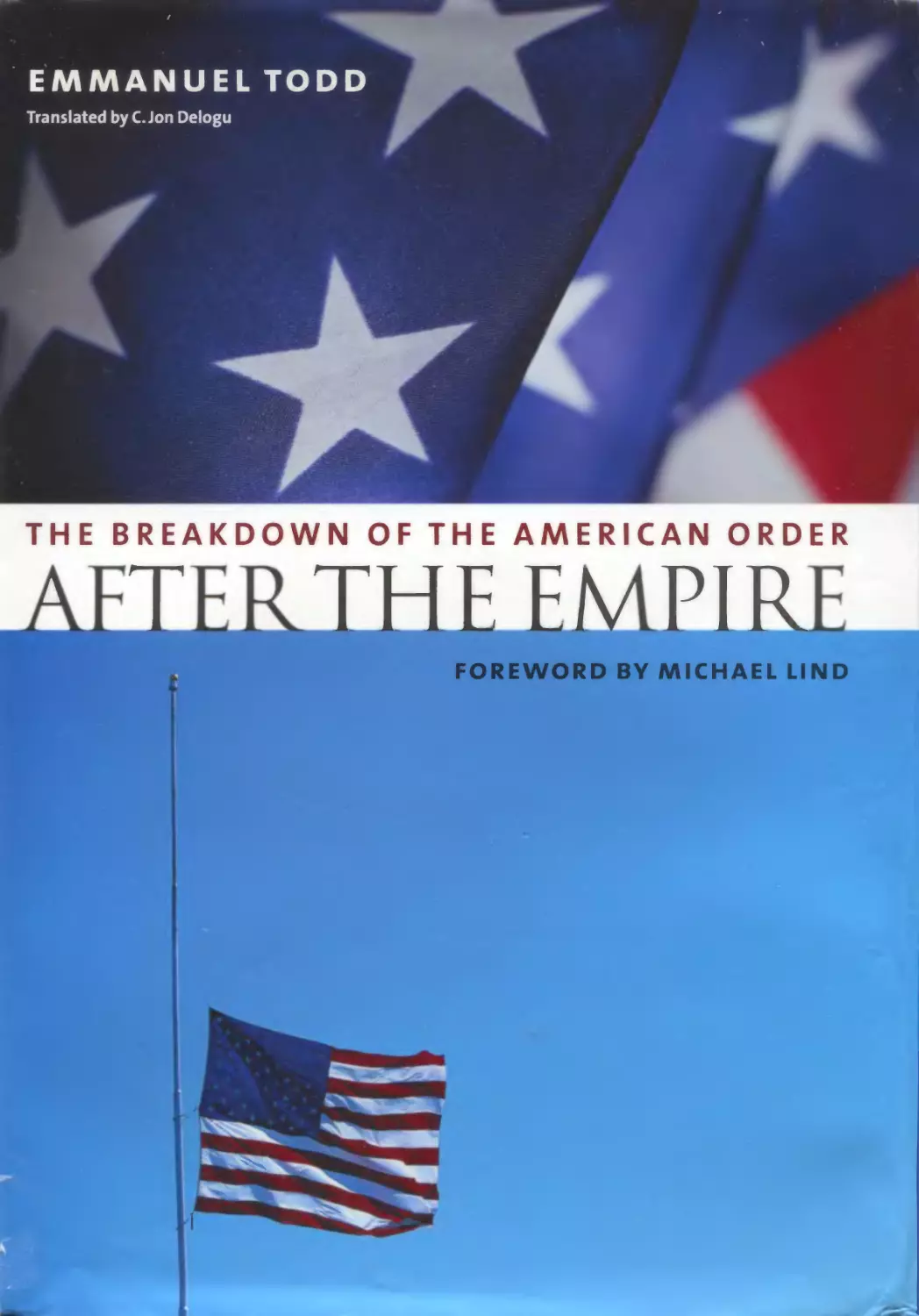
                    EMMANUEL TODD
Translated by C.Jon Delogu
THE BREAKDOWN OF THE AMERICAN ORDER
* T THEEIVPIR
FOREWORD BY MICHAEL LIND

After the Empire
EUROPEAN PERSPECTIVES

AFTER THE EMPIRE
The Breakdown of the
American Order
Emmanuel Todd
Foreword by Michael Lind
TRANSLATED BY C. JON DELOGU
COLUMBIA UNIVERSITY PRESS NEW YORK

COLUMBIA UNIVERSITY PRESS
Publishers Since 1893
New York Chichester, West Sussex
Copyright © 2002 Editions Callimard
Translation Copyright © 2003 Columbia University Press
All rights reserved
Library of Congress Cataloging-in-Publication Data
Todd, Emmanuel, 1951—
[Apres l'empire. English]
After the empire: the breakdown of the American order /
Emmanuel Todd ; translated by C. Jon Delogu.
p. cm.
Includes bibliographical references and index.
ISBN 0-231-13102-X (alk. paper)
1. United States—Foreign relations—2001-
2. Geopolitics—United States.
I. Title
E902.T63 2003
327.73 —dc22 2003055599
e
Columbia University Press books are printed
on permanent and durable acid-free paper.
Printed in the United States of America
c 10 98765432

CONTENTS
List of Tables vii
Foreword ix
Preface xv
Introduction 1
1. The Myth of Universal Terrorism 23
2. Democracy as a Threat 45
3. Imperial Dimensions 59
4. The Fragility of Tribute 79
5. The Movement Away from Universahsm 101
6. Confront the Strong or Attack the Weak? 123
7. The Return of Russia 145
8. The Emancipation of Europe 169
Conclusion: Endgame 191
Notes 203
Index 213

TABLES
Table 1 Fertility Rates Around the World
(Number of Children per Woman)
29
Table 2 Fertility Rates in Muslim Countries
(Number of Children per Woman)
31
Table 3 Percentage of Marriages Between First
Cousins During the Years 1990-1995
5o
Table 4 Economic Sectors and Their Growth
Rates in the United States
67
Table 5 Evolution of Personal Income in
the United States
73
Table 6 American Military Personnel
Abroad in 1998
84
Table 7 Foreign Purchases of Stock and Direct
Investment in the United States
93
Table 8 Stock Market Capitalization
(in Billions of Dollars)
96

VIII
TABLES
Table 9 American Oil Imports in 2001
(in Millions of Barrels)
Table 10 Infant Mortality and Male Life
Expectancy in Russia
150
Table 11 Rates of Homicide and Suicide in
the World (per 100,000 Inhabitants)
162
Table 12 Imports and Exports of Turkey, Poland,
and the United Kingdom (in Millions of Dollars)
184

FOREWORD
Michael Lind
At the beginning of the twenty-first century, according to the
conventional wisdom, the United States of America bestrides the
world like a colossus. Not since ancient Rome has a single state
wielded such awesome military power. Not since the zenith of
British finance has a single country so dominated the world
economy. The American right celebrates the unprecedented power of
America, while the left in the United States and much of the
world decries it. Like it or not, the American Empire is here, and
the rest of humanity must find a place in a Pax Americana that
will last for generations, if not centuries.
This is all nonsense, if Emmanuel Todd is to be believed. After
the Empire: The Breakdown of the American Order is a powerful
antidote to hysterical exaggeration of American power and
potential by American triumphalists and anti-American polemicists
alike. A best-seller in Europe, Todd's book should be read by all
thoughtful Americans for its provocative and well-informed
analysis of their nation and its prospects.
There is a distinguished tradition of French thinkers, from
Alexis de Tocqueville to Jean Jacques Servan-Schreiber, whose
studies of the United States are really as much about France or
Europe as they are about their ostensible subject. Todd does not
belong in that tradition. He belongs in a different French
tradition, of which Raymond Aron was the leading representative in
the twentieth century, a tradition going back to the
Encyclopedists—enlightened, liberal, skeptical, empirical.
Todd is a philosopher and political theorist. He is also a

X
FOREWORD
demographer and student of economic trends. Because
demography and economics provide the ultimate underpinnings of
military and diplomatic power, Todd has far more credibility than
pundits who predict the future in books that travel from the
bestseller rack to the remainder box with depressing speed. He also
has a track record. Following the demise of the Soviet Union,
many thinkers claimed to have predicted it, just as, after the war,
everyone belonged to the French Resistance. In fact very few
people recognized the severity of Soviet decline; Todd was one, in his
1976 book, La Chute finale (The Final Fall, 1979).
In After the Empire, Todd attempts something similar not only
for the United States but for the world as a whole: "... there will
certainly not be in, say, 2050, an 'American Empire' because the
United States simply does not have what it takes to be a true
empire."
Todd's description of what he calls the "theatrical micromili-
tarism" of the United States following the Cold War will enrage
the proponents of a Pax Americana—and make more thoughtful
readers wince with the recognition of his accuracy: "Unable to
control the real powers of its day—by holding on to Japan and
Europe in the industrial sector and breaking up Russia's core and
its nuclear capability—America has resorted to making a show of
empire by choosing to pursue military and diplomatic actions
among a series of puny powers dubbed for dramatic effect 'the
axis of evil/ . . . Embargoes are put in place against defenseless
countries, insignificant armies are bombarded, increasingly
sophisticated armaments that are said to have the precision of
video games are being conceived and built, it is claimed, and yet
in practice unarmed civilian populations are bombed in old-
fashioned ways that are reminiscent of World War II." These
words were written before the United States, against the
opposition of most of its allies and most countries in the world, invaded
and occupied Iraq in order to eliminate the alleged threat of
weapons of mass destruction, which, it turned out, could not be

FOREWORD
XI
found and probably did not exist. In the summer of 2003 the U.S.
military announced that two small wars and the occupation of
two minor countries, Afghanistan and Iraq, had strained its
manpower almost to the breaking point. So much for the "new
Roman empire."
Todd understands, as the American political elite evidently
does not, that military power cannot be understood apart from
economic performance. For decades the United States, while
exporting soldiers, has helped to promote global economic
growth by importing manufactured goods and immigrants. The
price has been paid by great numbers of working-class and
middle-class Americans, who as a result of deindustrialization
have been shoved into a poorly paid service sector proletariat at
the very moment that it has been flooded by unskilled
immigrants. A declining and indebted American middle class cannot
serve for much longer as the market of first resort for countries
trying to export their way into prosperity. Sooner or later there will
be a "correction," with effects felt not only in the United States
but around the world.
As this suggests, After the Empire is as much about trends in
global society as it is about the future of the United States. Unlike
many Europeans (and some Americans), Todd is not interested
in pointing out the flaws of America in order to highlight the
virtues of an idealized Europe. On the contrary, he sees many
disturbing American phenomena—the rise of stratification based on
educational credentials, the obsolescence of unreformable
political institutions—as examples of trends that are manifest in many
other advanced industrial democracies, including France.
After the Empire is a sympathetic critique of the United States,
not an anti-American polemic. Todd has no patience with what
he calls "structural anti-Americans." "But we should not be
fooled by these anti-Americans whose attachment to reality and
history is like that of stopped clocks, which of course tell the
correct time twice a day. The most typical representatives of this

XII
FOREWORD
group are in fact Americans. Read the texts of Noam Chomsky
and you will not find the slightest awareness of the evolution of
the world." Indeed, Todd argues that contemporary Europe
should emulate the civilian, republican United States of the
nineteenth and early twentieth centuries—not the militarized
parody of the British Empire that the United States has become
since the end of the Cold War. "Let us follow the example of that
early successful America. Let us dare to become strong by
refusing militarism and concentrating instead on the economic and
social problems within our societies."
The purpose of Emmanuel Todd in After the Empire is not
denunciation but diagnosis. In spite of Todd's combination of
sympathy with objectivity, the reaction of many Americans to his
sobering diagnosis may be like that of a patient who, having been
told by quacks he has the body of an Olympic champion, is finally
informed by a genuine doctor that he has serious but not
incurable health problems. In attempting to correct the exaggeration of
American power and prosperity, Todd may emphasize some
weaknesses too much. "There is a great deal of ruin in a country," as
Adam Smith observed. But one should also bear in mind the
possibility that there are design defects of the United
States—cultural, as well as military, diplomatic and economic—that no one
at present foresees. Only one thing can be certain—those who
assume that a trend such as the growth of American power in the
1990s and 2000s (or the growth of Soviet power in the 1950s and
1960s) will continue indefinitely are certain to be wrong.
In the 1990s the Tech Bubble entranced much of America and
the world. Pundits made fortunes claiming that the business
cycle was over and a new age of universal prosperity had dawned.
Government budgets reflected these Utopian assumptions. The
skeptics who pointed out that inevitably the bubble would burst
were ignored. The bubble burst. In the first decade of the twenty-
first century, the Empire Bubble has succeeded the Tech Bubble
and will look as absurd in hindsight in a decade or two.

FOREWORD
XIII
And after the empire? "The planet is tending toward stability
after the pain of an educational and demographic transition that
is nearing completion." Of all of Todd's challenges to the
conventional wisdom, this is perhaps the most provocative. And here
perhaps Emmanuel Todd does resemble the stereotype of the
French thinker held by many in the United States and the world.
What could be more Gallic in its paradoxical ingenuity than the
assertion, in a time of great-power peace, when the media's
sensational and selective focus on terrorism and small-scale conflicts
creates an impression of ever escalating chaos, that the worst is
behind us and the best may lie ahead?

PREFACE
1
1
Writing the preface to a foreign edition of a book is usually pure
joy. To see the work go beyond one's own cultural system is an
important moment—a sign that perhaps what one is saying is of
general importance and not merely a local tribal concern. But I
have to admit that I come to the task of writing the preface for the
American edition of Aprds Vempire with mixed feelings. I must
here address Americans on the subject of the decline of their own
country, and I do not see how a normal human being could take
pleasure in telling other normal human beings that their country
is ill, that it has made foolish strategic choices, and that they, as
Americans, must prepare for a reduction of their power and, most
likely, of their standard of living.
Therefore, before examining the recent developments in
international politics that have come about since the publication of
this book in France, I would like to try and avoid any
misunderstandings by stating "where I'm coming from" intellectually and
culturally, with the hope that these biographical facts will allow
the reader to evaluate the significance and direction of my work
correctly. I do this even though I believe that what counts is not
the identity of the author but knowing instead if his arguments
are valid.
In 1976 I published a book, La Chute finale (The Final Fall,
1979), which predicted the collapse of the Soviet system. At the
time I was widely labeled "anticommunist," just as, following the
publication of Apres Y empire, I was often (but not always) labeled
"anti-American." Labels aside, professionally I am a historian and

XVI
PREFACE
anthropologist trained to examine periods, places, customs, and
conflicts with a cold eye. For the most part this is how I see the
interpretative stance adopted in Apres Vempire, even if now and
then I allow myself to make a few moral and political remarks
that reveal my European and French identity. Moreover, in my
conclusion I formulate some proposals that might help resolve
the planet's "America problem." The motive for writing this
book, however, was not political passion but, rather, my
exasperation as a historian and researcher. In the fall of 2002 I had the
feeling that the world was about to repeat the same mistake with
regard to the United States that it made during the 1970s with the
Soviet Union: reading an expansion in military activity as a sign
of increasing power when in fact it serves to mask a decline.
It would be a mistake to think of me as one more "typical
French intellectual" carrying the same old anti-American virus
that has infected so many Parisian intellectuals. The truth is that
my family ties with the Anglo-Saxon world are numerous and
long-standing. In Paris the Todd family is suspected of having a
culpable preference for America and England. The suspicions
are in one sense justified. My father's father, who died last year,
was an American citizen of Jewish-Austrian origins. As for my
mother's family, they spent the Second World War as refugees in
America because of their Jewish origins. This is why up until very
recently the United States has been a kind of subconscious safety
net for me—the place where I could go if things went bad in
Europe. This is probably the deep reason why I was until two
years ago opposed to both the Maastricht Treaty on European
unification and the idea of a properly European power. Given my
confidence in the United States, I felt no need for another
counterweight to America after the collapse of the Soviet Union. It is
the recent behavior of the United States—its emergence as a
major factor in the world's disorder and armed conflicts—that has
made me become a good European and, by the same token,
politically opposed to the United States.

PREFACE
XVII
Intellectually speaking, I can hardly be said to have come out
of the proper French mold since I owe my training as a researcher
to Cambridge University. Over the years I have remained
fundamentally loyal to British empiricism. I do not mind saying that
when it comes to research, I have always considered the English
research tradition as stronger and more efficient than the French.
Having now spelled out who I am and what I believe, I shall
comment bluntly on some of the important events that have
transpired since the French publication of Apres X empire.
Apres Vempire appeared in France at the beginning of September
2002. It was generally well received by critics, who, it seems, were
not unduly worried by my announcement of the imminent
breakdown of the American order. Some may even have experienced a
degree of schadenfreude while imagining this prospect. In any
case it must be said that the events of the past year have largely
confirmed the book's main idea as well as its general prognosis
concerning America's altered relation to the rest of the world. One
could even say that the process outlined in the book has
accelerated, as though the Bush administration were methodically
pursuing a program to undermine the legitimacy of the United States
abroad and destroy the American strategic system. The United
States, which until very recently played an important role in
building international order, appears more and more clearly to be
contributing to disorder throughout the world.
The war against Iraq represents a decisive stage in this recent
transformation. Apres Vempires thesis about the significance of
America's "theatrical micromilitarism" was all too well illustrated
by the aggressive preemptive strike of the world's leading military
power against a military midget—an underdeveloped country of
twenty-four million inhabitants exhausted by a decade-long
economic embargo. The theatrical media coverage of this war,
including the U.S. military's close surveillance of how the war
was "playing" back home and around the world, must not blind

XVIII
PREFACE
us to a fundamental reality: the size of the opponent chosen by
the United States is the true indicator of its current power.
Attacking the weak is hardly a convincing proof of one's own strength.
On the contrary, and in direct confirmation of the central thesis
of this book, the United States is pretending to remain the world's
indispensable superpower by attacking insignificant adversaries.
But this America—a militaristic, agitated, uncertain, anxious
country projecting its own disorder around the globe—is hardly
the "indispensable nation" it claims to be and is certainly not
what the rest of the world really needs now.
America on the other hand cannot "go it alone"—a fact that
has become increasingly evident over the past twelve months. Its
huge trade deficit has increased further since the publication of
Apres lyempire. Its dependence on foreign sources of investment
capital is greater than ever. America's real war is about
economics not terrorism. The country is battling to maintain its status as
the world's financial center by making a symbolic show of its
military might in the heart of Eurasia, thereby hoping to forget and
have others ignore America's industrial weakness, its financial
needs, and its predatory character. However, instead of
reinforcing the image of America's global leadership as the current
administration in Washington expected, its forced march into
war has produced a rapid decline in the international status of the
United States.
The war aggravated the global economic crisis that has been
mismanaged by the world's central power. The American
economy itself is increasingly perceived as an unfathomable mystery.
One no longer has any clear idea which U.S. companies are
totally genuine. One no longer knows how this economy works or
what effect interest rates approaching zero will have on its various
components. The economic anxiety among America's ruling class
is almost palpable. Daily changes in the level of the dollar are
followed nervously in the press. No one is even sure if the American
economy will be able to absorb the shock of the war in Iraq that,

PREFACE
XIX
even though small in strictly military terms, is proving to be a
serious economic burden since the "allies" no longer want to pay a
share of the costs as they did during the first Gulf war. The
domestic and foreign deficits of the United States are skyrocketing.
Indeed leaders around the world are wondering more and more if
the central regulating power of the world economy is not heading
toward a sheer abandonment of the basic rules of capitalist
reasoning. Its adventurism is not just military, it is also financial. One
can predict that in the years or months to come financial
institutions in Europe and Asia with heavy investments in the United
States will lose a lot of money—the fall of the stock market being
only the first stage in the disappearance of foreign holdings in the
United States. The dollar is dropping, but no economic model
allows one to predict how low it will go since its very status as
reserve currency is becoming uncertain.
At the present time, however, the principal failure of the
United States is ideological and diplomatic. Far from being on
the verge of world domination, America is steadily losing control
throughout the world. Far from appearing as the upstanding
leader of the free world, the United States's "coalition" went to
war against Iraq despite broad UN opposition and in violation of
international law. The subsequent fall in legitimacy has been
flagrant; however, even before trying to sell the world on the virtues
of preemptive war, the American strategic system had begun to
fall apart.
Germany, whose submissiveness was taken for granted among
American politicians and pundits, said "No" to the war—a
declaration that constitutes an open movement of Europe toward
strategic autonomy. Germany's action gave France the
opportunity to play an important role in delaying the American
stampede. The negotiations that led to Resolution 1441 concerning
Iraqi disarmament were a practical demonstration of one of the
closing proposals put forward in Apres Xempire, namely, France's
sharing of its seat on the Security Council and its veto power with

XX
PREFACE
Germany. Without Germany's opposition to the war France
would not have been able to do anything.
The success of Apres ly empire, a simultaneous best-seller in
France and Germany, is itself a sign that the closer ties between
the two countries are not superficial, sporadic, merely
circumstantial, or narrowly governmental but are instead grounded in
an emerging shared political sensibility.
The newfound harmony of the Franco-German duo is only the
overall expression of the European sentiment. The will of Berlin
and Paris could certainly not be exercised without at least the tacit
approval of the other European nations. At the present time the
governments on the periphery of the European system seem
somewhat behind in their awareness of the strategic stakes of the new
European entity, unlike the people themselves who demonstrated
massively and in concert against the American war—a
phenomenon that was equally evident in Spain, Italy, and Great Britain.
The blindness of America's media and diplomatic elite during
these demonstrations was extreme. They dared call Germany
isolated at the very moment when its act of independence and its
commitment to peace were being applauded worldwide, thus
considerably enhancing Germany's international legitimacy.
A second prediction made in Apres Yempire has also been
proved correct by recent events, namely, the closer collaboration
between Europe and Russia—a rapprochement made necessary
by the unsettling militaristic behavior of the United States. This
rapprochement between Paris, Berlin, and Moscow could be
somewhat disturbing to the countries of Eastern Europe, which
have only just freed themselves from Soviet domination and now
find themselves in the strange position of having joined NATO
only months before the collapse of that organization. It was
inevitable that Hungary, Poland, and the other countries that
recently broke loose from the Soviet orbit should experience this
strategic revolution with fear and would prefer to wait before
throwing their lot in with France and Germany.

PREFACE
XXI
Russia has regained its balance in a much weakened and non-
imperialist form. Its strategic interest is to form an equitable
partnership with Europe. It will not take long for the former "popular
democracies" to understand that the United States offers them no
strategic advantage. Given its various deficiencies, America is
unable to extend economic aid or protect them with anything but
words. Their true security can only come through a complete
commitment to Europe and their active participation in a
common European defense policy. It is worth noting that the war in
Iraq did not influence the important choices facing the new
democracies in Eastern Europe, which one after another are
voting in national referendums to join the European Union. The
Iraqi conflict also allowed Russia to recover from the diplomatic
isolation and low international esteem that it inherited from the
Cold War and its more recent actions in Chechnya. However, the
most surprising development during the buildup to America s Iraq
war was the abrupt refusal of Turkey to grant territorial access to
the Americans. This long-time military keystone within the
NATO strategic command decided that this time its highest
national interests did not include cooperation with the United
States. There can be no better illustration of America's current
weakness, and the root cause needs to be stressed here. After every
defection of one of America's allies during the diplomatic crisis
that preceded the war on Iraq, Washington was unable to force
compliance or exact retribution for one simple reason: America
no longer has the economic and financial resources to back up its
foreign policy objectives. Due to trade surpluses, the real money
has piled up in Europe and Asia, while financially speaking
America has become the planet's glorious beggar. Any embargo
imposed by the United States or any threat to the flow of
investment capital would of course be disastrous for the world economy,
but the United States would be the first to suffer, dependent as it
is on the rest of the world for its supply of just about everything.
This is why the American diplomatic system is falling apart little

XXII
PREFACE
by little, and all the United States can muster in response is one
bellicose action after another against minor-league powers. True
power is economic power, and that is what America lacks today.
The minute any major player refuses to go along and says "No" to
the United States... surprise, nothing happens! France, for
example, will not be punished because the United States does not have
the means to do so. As for Germany, its financial strength is such
that the United States has tried to forget that the German
government and German people were among those most ardently
opposed to the American war on Iraq.
The United Kingdom did participate in the war, and its
presence gave an oddly Anglo-Saxon ethnic tinge to the military
coalition—something that may have further harmed America's image.
Notwithstanding the ostentatious film footage of women and
"people of color" in the U.S. military, it is impossible for the planet to
identify with a conflict that looks very much like a war of Anglo-
Saxons against Arabs. The likely behavior of the United Kingdom
over the near term remains unknown. The policy of aligning itself
with the American government is proving enormously destructive
to the United Kingdom's international position. It must be
remembered that the government's choice also meant choosing to ignore
the majority of British citizens who loudly opposed the war before
it began. The recent evolution of the United States has brought on
a cultural and political identity crisis in Great Britain that is much
more profound than the difficulties Great Britain faced with the
birth of Europe. It is quite possible that the United States, whose
crisis has only just begun, will itself push the British nation toward
a certain weariness with America and a diplomatic and military
nausea that together will lead to a change of heart and a more
favorable conception of its European identity. The Europhobia of the
American elite will not spare England, which in many ways
represents for them the very essence of Europe, not to mention its
inherently vexed status as origin-parent from which colonial America
once proudly declared its independence.

PREFACE
XXIII
The opposition of France, Germany, and Russia certainly did
not prevent the war in Iraq, but for the United States it is too bad
that it did not. Faced with the noncooperation of several major
allies, the American government could have courageously
backed down and thus avoided risking a total loss of legitimacy
and leadership. Instead, it preferred rather childishly to forge
ahead, according to some as a way to "save face." The United
States now finds itself embroiled in Iraqi "nation-building" for an
indefinite length of time. It risks losing a lot of lives, money, and
time there. What is certain is that America's menacing unilateral
behavior has accelerated the integration of Europe and moved
the rapprochement between Europe and Russia irreversibly
forward. Their combined strengths—the economic power of
Europe and Russia's strategic nuclear deterrent force—will
suffice to contain future American trigger-happy agitation. As for
George W. Bush and his neoconservative helpers, they will go
down in history as the grave diggers of the American empire.

After the Empire

Introduction
After years of being perceived as a problem solver, the United
States itself has now become a problem for the rest of the world.
After having been the guarantor of political freedom and
economic order for half a century, the United States appears more
and more to be contributing to international disorder by
maintaining where it can uncertainty and conflict. It demands that the
rest of the planet recognize that certain states of secondary
importance constitute an "axis of evil" that must be combated and
destroyed. Heading the list are the boastful but militarily
insignificant Iraq of Saddam Hussein and the North Korea of Kim
Chong II, the first and last communist state to have instituted
succession by primogeniture and one destined to die of old age
without the least interference from the outside world. Iran, another
American obsession, is a country of strategic importance but one
clearly working toward a more peaceable existence both inter-

2
INTRODUCTION
nally and internationally. Nevertheless, the American
government stigmatizes it as another of the central elements within the
axis of evil. The United States provoked China by bombing its
embassy in Belgrade during the war in Kosovo and by stuffing a
Boeing plane ordered for their leaders with easily detectable
listening devices. Between three public handshakes and two
nuclear disarmament agreements, America has even provoked
Russia by underwriting Radio Free Europe broadcasts in
Chechen, sending military advisers to neighboring Georgia, and
establishing permanent, in-your-face military installations within
central Asian states of the former Soviet Union. Finally, on the
speculative heights of this militarist fever, the Pentagon allows
documents to leak that contemplate nuclear strikes against non-
nuclear countries. Washington is here applying a classic military
strategy, but one not adapted to a country of its continental size:
"the madman strategy" that requires appearing to one's
adversaries as being capable of extreme irresponsibility in order to
intimidate them. There is also the country's proposed
development of a "Star Wars" missile defense shield that would upset the
nuclear balance, allow the United States to rule by fear over the
entire globe, and project us all into a world usually reserved for
science fiction. Given all this, how can one be surprised at the
new attitude of suspicion and fear that is taking hold among
peoples who up to now have based their foreign policy on the
reassuring axiom that the only remaining superpower was
fundamentally a responsible entity?
The traditional allies and partners of the United States are
made all the more nervous by the fact that they are located near
those areas designated by its president as danger zones. At the
same time, South Korea seizes every opportunity to repeat that it
does not feel threatened by its antiquated communist neighbor to
the north, just as Kuwait claims it is no longer in conflict with Iraq.
Russia, China, and Iran, three nations whose number one
priority is economic development, have only one strategic goal:

INTRODUCTION
3
resist American provocations either by ignoring them or by
vocally campaigning for stability and world order—a reversal of
attitude that would have seemed inconceivable ten years ago.
The leading allies of the United States are increasingly
perplexed and uncomfortable. In Europe, where only France used
to crow its independent views, one might be somewhat surprised
to observe an irritated Germany and to see Great Britain, the
longtime faithful friend, downright worried. On the other side of
Eurasia, the silence of Japan is more a sign of growing discomfort
than one of unqualified support.
Europeans do not understand why America refuses to resolve
the Israeli-Palestinian question since it clearly has the power to do
so. They are beginning to wonder if Washington might in fact be
content to have a perpetual hot spot in the Middle East and to
have Muslim countries express a growing hostility to the Western
world.
The Al Qaeda organization, a band of mentally disturbed but
ingenious terrorists, emerged from within a relatively small and
circumscribed part of the planet, Saudi Arabia, even if Bin Laden
and his associates recruited a few Egyptian turncoats and a
handful of lost souls from the poor suburbs of Western Europe.
However, America is trying to portray Al Qaeda as an omnipresent
terrorist threat as evil as it is widespread—from Bosnia to the
Philippines, from Chechnya to Pakistan, from Libya to Yemen—thus
legitimating any punitive action it might take anywhere at
anytime. The elevation of terrorism into a universal force
institutionalizes a permanent state of war across the globe—a fourth
"World War" according to certain American authors who see
nothing ridiculous about considering the Cold War as the third.1
Everything seems to indicate that the United States is, for some
obscure reason, trying to maintain a certain level of international
tension, a situation of limited but permanent war.
Only one year after September 11, this picture of America is
paradoxical. In the hours after the terrorist attacks on the World

4
INTRODUCTION
Trade Center, the most profound and sympathetic aspects of
American dominance became apparent. It seemed to be an
acceptable hegemony in a world that acknowledged the
capitalist system and political democracy as the only reasonable and
possible reality or goal. We clearly saw then that the principal force
of America was its widely perceived legitimacy. The solidarity of
the nations of the world was immediate: all condemned the
attacks. The European allies expressed their solidarity with
particular fervor through pledges of NATO commitments. Russia
seized the moment to publicize its earnest desire to have good
relations with the West. It was Russia that furnished Afghanistan's
Northern Alliance with the arms it needed and opened air space
within Central Asia that was essential to the deployment of
American armed forces. Without the active participation of Russia, the
American offensive in Afghanistan would have been impossible.
The terrorist attacks of September n, 2001, fascinated
psychiatrists: the revelation of a weakened America upset just about
everyone everywhere, and not just adults but children as well. A
large-scale psychological crisis shook the mental architecture of
the planet within which America, the unique but legitimate
superpower, had been a kind of unconscious keystone. Pro- and
anti-Americans were like lost children, deprived of the authority
figure they relied on to act out either their submission or their
opposition. In short, the September 11 attacks revealed the
voluntary character of the world's servitude.2 Joseph Nye's theory of
"soft power" was magnificently verified: America did not rule
only or even chiefly through its military might but through the
prestige of its values, its institutions, and its culture.3
Three months later the world seemed to have regained its
usual equilibrium. America the conqueror had again become all-
powerful thanks to its bombing campaigns. The vassals thought it
safe to return to their own economic and internal affairs.
Meanwhile, the usual opposition prepared to pick up where it had left
off with its never-ending chants against the American empire.

INTRODUCTION
5
And yet, one expected or at least hoped that the wounds of
September 11—relatively minor if one considers the direct
experiences of war by Europeans, Russians, Japanese, Chinese, or
Palestinians—might bring America closer to the common lot of
humanity and make it more sensitive to the problems of the poor
and the weak. The world had a dream, namely that the
recognition by all nations, or almost all, of the legitimate power of the
United States would bring about a true empire of good in which
the dominated would accept a central power and the dominant
Americans would submit their authority to an idea of justice.
But it was not long before the international behavior of the
United States began to be perceived differently. As the year 2002
went along, one could witness the reemergence of the same
unilateral tendency that was already operative in the late nineties
with Washington's refusal in December 1997 of the Ottawa treaty
banning landmines and in July 1998 its refusal to go along with an
accord for the establishment of an international law court. When
the United States refused to approve the Kyoto agreement on air
pollution controls, history seemed to be returning to an earlier
pattern.
The war against Al Qaeda, which could have institutionalized
the legitimacy of the United States if it had been conducted
modestly and reasonably, has instead given further evidence of its
growing irresponsibility. In only a few months, the image of a
narcissistic, nervous, and aggressive America replaced the images of
a wounded nation that was both admired and indispensable for
the world s sense of balance. This is what we have come to. But
where exactly does that leave us?
The most disturbing thing about the present situation is the
fundamental absence of any satisfactory explanation for
American behavior. Why is today s unique superpower not behaving in
the good-natured and reasonable way it put into practice in the
wake of World War Two? Why is it being such a destabilizing
busybody? Is it because it is all-powerful? Or, on the contrary,

6
INTRODUCTION
because America feels it is losing its grip on the new world that is
being born?
Before proceeding with our elaboration of a rigorous
explanatory model of America's international behavior, we ought to set
aside the standard image of a musclebound America whose only
problem would be its excessive power. The usual anti-American
chorus will therefore be of no use to us, whereas Establishment
thinkers will be our surest guides.
A LOOK BACK AT THE QUESTION OF DECLINE
Structural anti-Americans offer their usual explanation: America
is naughty by nature, the incarnation at the level of the state of
the evils of the capitalist system. These anti-Americans are having
a grand time today regardless of whether they are admirers of
little local despots such as Fidel Castro or whether they have
understood the total failure of state-run economies. They finally can
point admonishingly to the negative role of the United States
when it comes to insuring the balance and happiness of the
planet. But we should not be fooled by these anti-Americans
whose attachment to reality and history is like that of stopped
clocks, which of course tell the correct time twice a day. The
most typical representatives of this group are in fact Americans.
Read the texts of Noam Chomsky and you will not find the
slightest awareness of the evolution of the world. Before and after the
downfall of the Soviet threat America is the same: militaristic,
oppressive, and hypocritical in Iraq today as in Vietnam twenty-
five years ago.4 But America according to Chomsky is not only
evil, it is all-powerful.
In a more modern "cultural studies" vein, there is Benjamin
Barber s Jihad vs. McWorld, which paints a picture of a world
ravaged by the confrontation between the contemptible spread of
American culture and the no less contemptible residue of various

INTRODUCTION
7
tribalisms.5 But the announced victory of Americanization
suggests that, despite the criticisms he offers up, Barber remains at
heart an American nationalist who, like Chomsky, overestimates
his country's power.
In the same category of overestimation we find the notion of
America as a "hyperpower" ["hyperpuissance"]. No matter how
much respect one may have for the foreign policy of Hubert
Vedrine during his tenure as foreign affairs minister, we ought to
admit that the concept of a "supersuperpower" tends to blind
political commentators more than it enlightens them.
None of these descriptions help us understand the present
situation. They presuppose a hypertrophic America, sometimes in
its capacity for evil but always in terms of its power. They keep us
from solving the mystery of American foreign policy, which ought
to be done by exploring conditions of weakness not strength. The
erratic and aggressive strategic path of the solitary superpower, like
the precarious stagger of a drunkard, can only be fully explained
by exposing unresolved or unresolvable contradictions and the
feelings of inadequacy and fear that follow from them.
Reading the analyses published by the American political
science establishment is more enlightening. Beyond all their
differences, we can find in Paul Kennedy, Samuel Huntington, Zbig-
niew Brzezinski, Henry Kissinger, and Robert Gilpin the same
moderate vision of an America that, far from being invincible,
must cope with the inexorable reduction of its power within a
world of rising populations and economic development. The
analyses of American power vary in terms of focus: economic for
Kennedy and Gilpin, cultural and religious for Huntington,
diplomatic and military for Brzezinski and Kissinger. But in all of
them we are presented with a disquieting representation of the
strength of the United States whose power over the world appears
fragile and threatened.
Despite his loyalty to realist strategic principles, and
notwithstanding the admiration he maintains for his own intelligence,

8
INTRODUCTION
Kissinger these days does not seem to possess a clear vision of the
overall picture. His latest publication, Does America Need a
Foreign Policy?', is little more than a catalog of local conflicts.6
But in Paul Kennedy's The Rise and Fall of Great Powers (1988)
we have a very useful portrait of an America threatened by
"imperial overstretch" whereby diplomatic and military
overextension is the classic result of a decrease in economic strength.7
Samuel Huntington's The Clash of Civilizations (1996) is an
expanded version of an article published in Foreign Affairs in
1993 whose tone is downright depressing.8 Reading Huntington
often feels like reading a calculated pastiche of Spengler's The
Decline of the West. Huntington goes so far as to contest the
universal spread of the English language and recommends a
modest retreat of the United States back within the Catholic-
Protestant block of the Western European alliance, a rejection
of the Orthodox in Eastern Europe, and an outright
abandonment of the two other pillars of America's strategic system,
Japan and Israel, on the grounds that they are culturally too
different.
Robert Gilpin's perspective combines economic and cultural
considerations. It is professorial, careful, and very intelligent.
Because he believes in the persistence of the nation-state,
Gilpin's Global Political Economy perceives the underlying
weaknesses of America's economic and financial systems,
especially the fundamental threat of a "regionalization" of the planet.
If Europe and Japan each build up their spheres of influence,
they will render useless any idea of America as center of the
world, and this reconfiguration will cause difficulties for the
United States as it is forced to redefine its economic role.9
But it is Brzezinski who, in 1997, with the publication of The
Grand Chessboardf has proven to be the most clairvoyant, despite
his lack of interest in economic questions.10 To fully comprehend
his view of things, one has to rotate a globe in one's hands and take
notice of the extraordinary geographic isolation of the United

INTRODUCTION
9
States. The world's political center is in fact far from the rest of the
world. Brzezinski is often accused in Europe of being a simplistic
imperialist, both arrogant and brutal—and some of his strategic
recommendations can cause amused or doubting smiles, as when
he claims Ukraine and Uzbekistan to be crucial to American
interests. However, his representation of the world s population
and economy concentrated in Eurasia—a Eurasia that would be
reunited after the fall of communism, and getting along without
the Americans who are isolated far off in the New World—raises
something of fundamental importance and seems intuitively to
grasp the true threat hovering over the American system.
THE PARADOX OF FUKUYAMA: FROM AMERICA'S TRIUMPH
TO AMERICA'S USELESSNESS
If we want to understand the anxiety eating away at the American
Establishment, we also have to think seriously about the strategic
implications for the United States of Francis Fukuyama's
hypothesis of an "end of history." This theory, which dates from the late
eighties and early nineties, was a source of amusement among
Paris intellectuals who were surprised at Fukuyama's simplistic
and easily digested reading of Hegel. History would be teleologi-
cal after all, and its goal is the universalization of liberal
democracy.11 Thus, the fall of communism would be only the latest stage
in this march toward human liberty, following another important
stage, namely the fall of dictatorships in southern Europe
(Portugal, Spain, Greece). The emergence of democracy in Turkey and
the democratic progress of Latin America are also inscribed
within this movement. This model of history, proposed at the
very moment of the fall of the Soviet Union, was received in
France as further evidence of America s typical naivete and
optimism. For those who remembered the real Hegel, living under
Prussian domination, respectful of Lutheran authoritarianism to

10
INTRODUCTION
the point of worshiping the state, this portrait of him as a
democratic individualist seemed laughable. Fukuyama offers us a
Hegel softened by the makeup artists of Disney studios. One
should also remember that Hegel was interested in the
advancement of mind through history, but Fukuyama, even when he is
talking about education, always privileges economic factors and
seems often closer to Marx, someone who had a rather different
idea about the end of history.12 The secondary character of
educational and cultural development makes Fukuyama a rather odd
Hegelian, one certainly contaminated by the madness of
economic determinism within American intellectual life.
These reservations aside, however, one ought to concede that
Fukuyama offers a lively and pertinent empirical glance at
contemporary history. To claim as early as 1989 that the universaliza-
tion of liberal democracy was becoming a possibility worth
examining was certainly a major achievement. European intellectuals,
on the whole less in touch with the future movement of history,
were at the time interested in putting communism on trial and
thus concentrated on analyzing the past. Fukuyama had the
bright idea to speculate about the future, a more difficult task but
also a more useful one. My own belief is that Fukuyama s vision
gets some things right but does not fully grasp the impact of
education and demographics as contributing factors toward a
stabilization of the planet.
Fukuyama includes in his theoretical model the law put
forward by Michael Doyle in the early eighties, and derived more
from Kant than from Hegel, which states that a war between
liberal democracies is impossible.13 Doyle offers here a second
example of Anglo-Saxon empiricism, naive in appearance but
productive in practice. That war is impossible between
democracies is verified by an examination of the historical record. This
"proves" that while liberal democracies are not exempt from
entering into wars with opposed systems, they never fight
amongst themselves.

INTRODUCTION
11
Modern liberal democracy is everywhere tending toward
peace. One can hardly reproach the French and British
democracies of 1933-1939 for their bellicose nature, and one can only
point out with regret the isolationism of the American democracy
up until Pearl Harbor. Without denying the nationalist elements
within France and Great Britain before 1914, one must admit that
it was the Austro-Hungarian empire and Germany, places where
the policy-makers were not in practice accountable to their
parliaments, that dragged Europe into the first World War.
Common sense alone would suggest that a people with a certain
level of education and a satisfactory standard of living would be
unlikely to elect a parliamentary majority capable of declaring a
major war. Two peoples similarly organized will inevitably find a
peaceful solution to their differences. But the uncontrollable clique
that, by definition, directs a system that is neither democratic nor
open, has much more latitude to initiate hostile action and override
the desire for peace of the majority of ordinary people.
If one adds Fukuyama's universalization of liberal democracy
to Doyle's impossibility of war between democracies, one gets a
planet of perpetual peace.14
A cynic raised in the old European tradition will smile and
recall man's eternal and relentless capacity to do evil and make
war. But let us not stop at this objection and instead examine the
argument further. What might be the implications of such a
model for America? Its specialty within the world has become, by
a series historical accidents, the defense of a democratic principle
perceived as being under threat: by Nazi Germany, by
militaristic Japan, and by communist regimes in Russia and China. The
Second World War and then the Cold War have
institutionalized, as it were, this historical function of America. But if
democracy triumphs everywhere, we arrive at a paradoxical endpoint
wherein the United States would be of no further use to the rest
of the world as a military power and would have to accept being
no more than one democracy among others.

12
INTRODUCTION
This uselessness is one of the two fundamental anxieties of
Washington and one of the keys for understanding the foreign
policy of the United States. As is frequently the case, the leaders of
American diplomacy have formulated this new fear in terms of an
inverse affirmation. In February of 1998 President Clinton's
Secretary of State, Madeleine Albright, attempted to justify a missile
attack on Iraq by defining the United States as "the indispensable
nation."15 As Sacha Guitry used to say, the opposite of the truth is
already very close to the truth. To claim officially that the United
States is indispensable implies that the question of America s
purpose or usefulness in the world is already on the table. By means
of these quasi-Freudian slips, government leaders are indirectly
expressing the worries of strategic analysts. Madeleine Albright
was stating in the form of denegation the Brzezinski doctrine that
clearly perceives a marginal, isolated United States situated far
from a highly populated and hard-working Eurasia where most of
the history in a newly pacified world may be written.
At bottom Brzezinski accepts the threat implicit in the
Fukuyama paradox and proposes a series of diplomatic and
military techniques for keeping control of the Old World.
Huntington's game is less straightforward: he does not accept the
universalizing of shared feelings that forms the heart of Fukuyama's
model and refuses to entertain the idea of democratic values and
liberal economic systems spreading over the entire planet. He
clings to a religious and ethnic categorization of peoples, the
majority of which would be, by nature, incapable of following the
Western model.
At this stage in our reflection we need not choose among
diverse historical possibilities: Is liberal democracy generaliz-
able? If so, does it bring peace? But we ought to see that
Brzezinski and Huntington are responding to Fukuyama, and that the
marginalization of the United States, as surprising as that idea
may sound at a time when the entire world is worried about U.S.
omnipotence, is haunting America's elite class. Far from con-

INTRODUCTION
13
templating a return to isolationism, America is now afraid of
isolation, of finding itself alone in a world that no longer needs it.
But why is it now afraid of the distance from the world that has
been its raison d'etre from the Declaration of Independence in
1776 to Pearl Harbor in 1941?
FROM SELF-RELIANCE TO ECONOMIC DEPENDENCE
This fear of becoming useless, and of the isolation that could
follow, is not just something new for American thinking, it amounts
to the exact opposite of its customary position. Americas
separation from a corrupt Old World is one of the country's founding
myths, and perhaps the most important one. As a land of
freedom, abundance, and moral perfectionism, the United States set
out to develop independently from Europe and to avoid the
degrading conflicts of the cynical nations of the Old World.
American isolation during the nineteenth century was,
however, really only diplomatic and military, since the economic
growth of the United States benefited from two continuous and
indispensable ingredients from Europe: capital and labor.
European investment and the immigration of a largely literate
workforce were two economic mainsprings of the American
experience. As a result, by the end of the nineteenth century, America
had the most powerful and self-reliant economy on the planet,
with massive levels of production of raw materials (coal, oil, steel,
etc.) and a huge trade surplus.
At the beginning of the twentieth century the United States no
longer needed the rest of the world. If one keeps in mind its
actual power at the time, the first American interventions in Asia
and Latin America were modest affairs. But from the First World
War on, the rest of the world needed the United States. America
mostly resisted this call up until 1917. Then it again chose
isolation by refusing to sign the Treaty of Versailles. It was not until

14
INTRODUCTION
Pearl Harbor and the German declaration of war that the United
States would start down the path that would lead to the globally
dominant military position that corresponded to its preeminent
economic status.
In 1945 the American gross national product represented more
than half of all production in the world, and the overwhelming
effect of this was automatic and immediate. It is true that by 1950
communism covered most of Eurasia, from East Germany to North
Korea; but American naval and air power had strategic control over
the rest of the planet and benefited from the support of a multitude
of allies and trading partners whose first priority was to combat the
Soviet system. Most of the world consented to the rise of American
hegemony, despite the patches of sympathy for communism
among peasants, the working class, and many intellectuals.
If we want to understand recent turns of events, we must first
admit that this hegemony was beneficial for several decades. Not
to recognize the generally favorable character of American
domination from 1950 to 1990 makes it impossible to grasp the
importance of the subsequent reversal of the United States from useful
to useless, as well as the difficulties, for Americans and the rest of
us, that have resulted from it.
The hegemony over the noncommunist part of the globe
during the years 1950 to 1990 almost deserves the name "empire."
The economic, military, and ideological resources of the United
States seemed for a time to be on the scale of an imperial power.
The preeminence of the principles of free market economies in
areas controlled politically or militarily by Washington finally
transformed the world. Today we call it "globalization." Over
time these economic transformations have also deeply affected
the internal structure of the dominant nation, weakening its
economy and deforming its society. The process was at first slow
but steady. Without being fully recognized by the principal actors
in this historical drama, a relation of dependence has now sprung
up between the United States and its sphere of influence. An

INTRODUCTION
15
American trade deficit appeared in the early seventies and has
since become a basic structural element of the world economy.
The fall of communism has entailed a dramatic acceleration
of the progression of dependence. Between 1990 and 2000 the
American trade deficit went from 100 billion to 450 billion
dollars. To balance its foreign accounts, America requires an
equivalent flow of foreign capital into the country. At the start of this
third millennium the United States is unable to subsist on its own
production. At the very moment when the rest of the world —now
undergoing a process of stabilization thanks to improvements in
education, demographics, and democracy—is on the verge of
discovering that it can get along without America, America is
realizing that it cannot get along without the rest of the world.
The debate about "globalization" ["mondialisation"] is in part
disconnected from reality because we too often accept the
orthodox representation of commercial and financial exchanges as
being symmetrical and homogeneous, without any country
occupying a particular spot. The abstract notions of labor, profit, and
the free circulation of capital all mask a fundamental element:
the specific role of the most important nation in the new
organization of the world economy. If the United States has greatly
declined in relative terms as an economic power, it has
nevertheless succeeded in massively increasing its capacity to siphon
off wealth from the world economy. Objectively speaking,
America has become a predator; but should this situation be
interpreted as a sign of strength or of weakness? This can be debated,
but it is certain that America is going to have to fight politically
and militarily in order to sustain the hegemony that has become
indispensable for maintaining its standard of living.
This turnaround when it comes to who is relying on whom in
the world economy is the second major factor, which, along with
the first—the proliferation of democracies—allows one to
explain the unfamiliar situation in the world at present, especially
the bizarre behavior of the United States and the bewilderment

16
INTRODUCTION
of the planet. How does one deal with a superpower that is
economically dependent but also politically useless?
We could stop our elaboration of this troubling explanatory
model here and remind ourselves that the United States is after
all a democracy and that democracies do not go to war amongst
themselves, and therefore the United States is incapable of
becoming an aggressive, warmongering danger for the rest of the
world. Through trial and error the government in Washington
will find the paths to economic and political adaptation within
this new world. Why not? Nevertheless, we should also
remember that the crises within advanced democracies—ever more
visible and disquieting, especially in America—do not permit us to
conclude that the United States is pacific by nature.
History does not end. Amidst the emergence of democratic
functioning across the planet we should not forget that the oldest
democracies—the United States, Great Britain,
France—continue to evolve. Everything seems to indicate that the latter are
transforming into oligarchical systems. The concept of
"inversion," which has been useful for understanding the economic
reversal of the United States with respect to the rest of the world,
can also help us analyze the democratic dynamic in the world:
democracy is progressing in those places where it was weak, but
it is regressing in those where it was formerly strong.
THE DEGENERATION OF AMERICAN DEMOCRACY AND
THE POSSIBILITY OF WAR
The strength of Fukuyama is to have very quickly identified a
process of stabilization within the non-Western world. But his
perception of societies, as we have seen, remains overly
influenced by economic determinism. He does not see education as
a central factor within history and is only slightly interested in
demography. He does not appreciate that the literacy of the

INTRODUCTION
17
masses is the independent explanatory variable at the heart of
the advances in democracy and individualism that he detects.
His big mistake is to posit an end of history based on an alleged
generalization of liberal democracies. His conclusion
presupposes that this form of government is stable if not perfect and
that its history ends the moment it is has been achieved. But
what if democracy is merely the political superstructure of a
particular cultural stage—simple mass literacy? In that case,
continuing advances in teaching and learning at the secondary and
postsecondary levels will necessarily upset democracy in the
places where it first appeared.
Secondary education and especially higher education
reintroduce the notion of inequality into the mental and ideological
organization of developed societies. After a brief period of
hesitation and scruples, the more highly educated ["eduques
superieurs"] wind up believing that they are truly superior. In
developed countries a new class is emerging that comprises
roughly 20 percent of the population in terms of sheer numbers
but controls about half of each nation s wealth. This new class has
more and more trouble putting up with the constraint of universal
suffrage.
Advances in literacy made us live for a time in the world of De
Tocqueville for whom the march of democracy was "providen-
tielle"—almost an effect of divine will. The rise of higher
education today is leading us toward the calamity of another kind of
"providence": oligarchy. It is a surprising return to the world of
Aristotle in which oligarchy may succeed democracy.
At the very moment when democracy is beginning to take hold
in Eurasia, it is weakening in those places where it was born.
American society is changing into a fundamentally unegalitarian system
of domination, a phenomenon perfectly conceptualized by
Michael Lind in The Next American Nation.*6 Of particular note in
his book is the first systematic description of the new postdemocra-
tic American ruling class: "the overclass."

18
INTRODUCTION
On a more modest scale France is nearly as far along as the
United States in this area. These are indeed curious
"democracies" in which the political systems pit elitism against populism
and vice versa; and although universal suffrage persists in
theory, in practice the elites of the right and the left close ranks to
block any reorientation of economic policies that would lead to
greater equality. It is an increasingly bizarre universe when after
gargantuan, media-saturated campaigns the voting game ends
up merely extending the status quo. The entente cordiale
among the elite, a reflection of the existence of a common
"superior" language among them, prohibits any cracking of the
political system's fa?ade, even when universal suffrage would
seem to suggest the possibility of a crisis. George Bush was
chosen as president of the United States at the end of an opaque
electoral process that makes it impossible to say whether he won
arithmetically. Only a short time later in France, the other
grand historical republic, one saw just the opposite scenario—
thus affirming the odd logic of Sacha Guitry about the identity
of opposites. In France we have a president chosen by 82
percent of the voters. However, the near unanimity of the French
people is the result of a sociological and political lockout of the
aspirations of the lowest 20 percent ["20% d'en has"} by the
highest 20 percent ["20% d'en haut"} who also for the moment
hold sway ideologically over the 60 percent in the middle.17 But
in both cases the result is the same: the electoral process is of no
practical importance and the levels of voter turnout spiral
inevitably downward.
In Great Britain the same mechanisms of cultural restratifica-
tion are at work. They were analyzed early on by Michael Young
in his brief but truly prophetic study, The Rise of the Meritocracy
(1958).18 But England's democratic phase was moderate and
belated. Given its recent aristocratic past, which lives on in the
classification system of highly readable accents and other class
markers, England's transition toward the new world of Western

INTRODUCTION
19
oligarchy can proceed smoothly. In fact the new American over-
class looks toward England with some envy. This explains their
Anglophile stance and a nostalgia for a Victorian past that is not
theirs.19
It would thus be inaccurate and unfair to claim that the crisis
of democracy concerned only the United States. Great Britain
and France, the two old liberal nations linked historically to the
American democracy, are engaged in parallel processes of
oligarchical aging. But within the newly globalized political and
economic system, they are among the dominated and therefore
obliged to pay attention to their international trade balances.
Eventually the paths of their social evolution will at some point
separate from that of the United States. Thus I do not think that
one day we will be able to speak of the "Western oligarchies" as
we have spoken in the past of the "Western democracies."
This is then the second major turnaround that explains the
strained relations between the United States and the rest of the
world. The progress of democracy around the world is masking
the weakening of democracy in its birthplace. This turnaround is
ill perceived by the actors on the world stage. America is still
affable and articulate, more out of habit than cynicism, when it comes
to mouthing the language of liberty and equality. And of course
the democratization of the planet is far from being fully realized.
However, this passage of the United States into a new
oligarchical stage cancels any application of the Doyle law
concerning the inevitably peaceful consequences of the spread of liberal
democracy. We can well imagine the possibility of aggressive
behavior on the part of a poorly supervised ruling class, as well as
a more adventurous military policy. In truth, if the hypothesis of
an America tending toward oligarchy permits us to limit the
validity of the Doyle law, it also keeps us from denying or doubting the
empirical reality of an aggressive America. We cannot even rule
out the strategic hypothesis of American aggression toward other
democracies, new or old. This way of looking at the world has the

20
INTRODUCTION
merit of harmonizing, in a rather sly way its true, both the Anglo-
Saxon "idealists," who are expecting the spread of liberal
democracy to bring an end to military conflict, and their "realist"
counterparts, who conceive of international relations as an anarchic
space occupied by aggressive states fighting each other for all
eternity. If we grant the idea that liberal democracy leads to peace, we
must also grant that its withering away could lead back to war.
Even if the Doyle law is true, there will be no perpetual peace in
the Kantian spirit.
AN EXPLANATORY MODEL
In what follows I am going to develop an explanatory model
whose form is somewhat paradoxical but whose principal parts
can be summarized quite easily: at the very moment when the
world is discovering democracy and learning to get along
politically without the United States, the United States is beginning to
lose its democratic characteristics and is discovering that it
cannot get along without the rest of the world.
The planet is therefore faced with a double reversal: first, the
new economic dependence of the United States vis-a-vis the rest
of the world and second, the new distribution of democratic
energy around the world, henceforth positive in Eurasia and
negative in America.
Once these large-scale sociohistorical processes have been
posited, one can understand the apparent strangeness of recent
American actions. Since a free and democratic order is slowly
being sapped of its substance within the United States, the
country's goal can hardly be to defend such an order abroad. What has
become of prime importance is supplying the country with
various commodities and capital. From now on the fundamental
strategic objective of the United States will be political control of
the world's resources.

INTRODUCTION
21
However, the declining economic, military, and ideological
power of the United States does not allow the country to master
effectively a world that has become too vast, too populous, too
literate, and too democratic. The subordination of the real obstacles
to American hegemony—namely the strategic players Russia,
Europe, and Japan—is simply too big a job to be an accessible
objective. America is having to negotiate with these three and very
often yield to them. But America has to find a solution, real or
fanciful, for its worrisome economic dependence. The country has to
remain at least symbolically at the center of the world, and to do
so it will have to parade its super power, or rather its "supersuper-
power." We are thus witnessing the development of a global
theater of dramatized militarism that consists of three essential
principles. First, never resolve a problem once and for all, so as to
justify endless rounds of military action throughout the world by the
one and only superpower. Second, concentrate one's energy on
minor league powers such as Iraq, Iran, North Korea, Cuba, etc.
The only way to remain at the heart of world affairs is to challenge
small-time actors in such a way that will reflect well on American
might and thereby avoid or at least delay the moment when the
other major powers wake up to their role as global partners with
the United States, those powers being Europe, Japan, and Russia
in the near-term, and eventually China. Third, develop new arms
systems that can be advertised as putting the United States far
ahead of the field in an arms race that must never end.
Such a strategy certainly makes the United States a new and
unexpected obstacle to world peace, but it is not one of truly
threatening proportions. The list and the size of those named as
adversaries gives an objective indication of America s power, since
it is incapable of challenging any country more powerful than
Iraq, Iran, North Korea, or Cuba. There is no reason to denounce
or become hysterical about the emergence of an American
empire that in reality, and only one decade after the breakup of
the Soviet Union, is going through its own disintegration.

22
INTRODUCTION
A representation such as this of the balance of power around
the world will naturally lead to the formulation of some strategic
proposals, not with the aim of increasing the gains of this or that
nation but in the hope of managing, in everyone's best interest,
America's losses.

The Myth of Universal Terrorism
A catastrophic view of the world has dominated Western
perceptions in the last ten to fifteen years. Day after day, the media have
constructed the image of a world organized by hatred and
ravaged by violence, a world where the massacre of individuals and
whole peoples occurs at an accelerating pace: the Rwandan
genocide, religious conflicts in Nigeria and the Ivory Coast, tribal
disputes in Somalia, indescribable civil war in Sierra Leone,
gangsterism and rape in South Africa despite the end of
apartheid, assassination of white farmers in Zimbabwe, mass
terrorism in Algeria. Changing continents, we find an Islamic
revolution in Iran—even though somewhat more peaceful these
days—the conflict in Chechnya, anarchy in the Republic of
Georgia, a war between Armenia and Azerbaijan over possession
of the Upper Karabakh, the independence movements of Kurds
in Turkey and Iraq, civil war in Tajikistan, violence in the dis-

24
THE MYTH OF UNIVERSAL TERRORISM
puted Kashmir region of India bordering Pakistan, Tamil
uprisings in Sri Lanka, confrontations between Hindus and Muslims
in Gudjarat, a Muslim guerrilla movement south of the
Philippines, Islamic radicalism in Aceh, north of Sumatra, the massacre
of East Timor Christians by Indonesian special forces, and the
grotesque regime of the Taliban in Afghanistan. With the
exception of leftist hostage taking in Columbia and the revolt of the
minor military leader Marcos in Mexico, Latin America appears
exceptionally peaceful. Lately the historically violence-ridden
continents of Central and South America even compare
favorably with Europe where the breakup of Yugoslavia and the
massacres of Croatians, Bosnians, Serbs, and Kosovars have given the
impression that a rising tide of violence was going to invade the
rich, old peaceful world of Western Europe. It would be unfair
not to mention the Chinese crackdown against student
demonstrations in Tiennamen Square in 1989. And let us not forget the
height of human folly playing itself out in the endless violence
between Israelis and Palestinians. To complete our list, let us
remember the fall of the World Trade Center towers, a crime
committed in the name of Allah by suicide bombers who
originated from places that we used to call the Third World.
My list is certainly no more complete than the media accounts
one receives on any given day. However, it is difficult not to come
away from such a litany of death-saturated events without feeling
that the world has gone mad and that the French live in one of
the last remaining peaceful corners of the globe—unless, that is,
one wants to view the torching of cars in the suburbs, attacks
against Parisian synagogues in the spring of 2002, and the
alarming success around the same time of the far-right candidate Jean-
Marie Le Pen in the last presidential election as signs of a
creeping barbarization of the West.1
These representations of a world wracked by violence
encourage one to view history through the particular lens of regression.
All of these mass killings can mean only one thing: the planet is

THE MYTH OF UNIVERSAL TERRORISM
25
floundering, development is failing, and the idea of "progress"
must be filed away along with other expired concepts on the shelf
marked "Quaint Illusions of Eighteenth-Century Europe."
Certain areas of genuine regression in recent years can be
rigorously documented. Beyond the shocking images of television
"news," it is possible to measure the slowdown of economic
growth in the world and the widening of inequalities in both rich
and poor countries. These are some of the consequences of
economic and financial globalization. They follow logically from the
free-market system that makes the working populations of every
country in the world into global competitors. As a result salaries
eventually stop growing or collapse and global demand stagnates.
Moreover, the system tends to introduce into every society a level
of inequality that corresponds to the revenue gap between the
richest of the rich countries and the poorest of the poor.
Nevertheless, if one refuses to fall into simplistic economic schemas,
whether of the left or the right, Marxist or neoconservative, there
exists an immense amount of statistical information that allows
one to take stock of an enormous cultural advancement going on
in the world at the present time. Increases in general literacy and
the spread of lower birth rates are the two fundamental changes
shaping this cultural progress.
THE CULTURAL REVOLUTION
Between 1980 and 2000, the percentage of those aged fifteen and
up who could read and write went from 40 percent to 67 percent
in Rwanda, from 33 percent to 64 percent in Nigeria, from 27
percent to 47 percent in The Ivory Coast, from 40 percent to 63
percent in Algeria, from 77 percent to 85 percent in South Africa,
from 80 percent to 93 percent in Zimbabwe, and from 85 percent
to 92 percent in Columbia. Even in Afghanistan the literacy rate
increased from 18 percent to 47 percent over the same twenty-year

26
THE MYTH OF UNIVERSAL TERRORISM
period. In India it went from 41 percent to 56 percent, in Pakistan
from 28 percent to 43 percent, in Indonesia from 69 percent to 87
percent, in the Philippines from 89 percent to 95 percent, in Sri
Lanka from 85 percent to 92 percent, and in Tajikistan from 94
percent to 99 percent. In the twenty years since the beginning of
the Islamic revolution in Iran in 1980, the literacy rate increased
from 51 percent to 77 percent. In China the literacy rate was
already at 66 percent in 1980. Today it stands at 85 percent. Every
poor country now seems engaged in a general race for cultural
development. Even in the most "backward" places such as Mali
or Niger one sees literacy growing in one generation from 14
percent to 40 percent and 8 percent to 16 percent, respectively. The
overall percentage is small; however, among those aged fifteen to
twenty-four, the literacy rate is 22 percent in Niger and 65 percent
in Mali.
The process is not complete and the levels of cultural
development still vary widely. But one can begin to see in a not too
distant future a totally literate world. If one assumes that the process
is likely to accelerate, we can imagine that among the younger
generations universal literacy will be achieved by 2030. The
invention of writing dates from somewhere around 3000 B.C. —it
will therefore have taken man about five thousand years to fully
accomplish the revolution linked to the written word.
LITERACY AND GLOBALIZATION
The basic skills of reading, writing, and arithmetic are only
one aspect of the revolution in thinking that has spread over the
entire planet. When man knows how to read, write, and count,
he begins quite naturally to exert greater control over his
material environment. Economic development in Asia and Latin
America today is linked almost automatically to educational
development just as it was in Europe between the seventeenth

THE MYTH OF UNIVERSAL TERRORISM
27
century and the beginning of the twentieth. In the context of
free trade and global finance, economic growth is slowed and
modified, but it exists. Americans, Europeans, and the Japanese
ought to know that opening factories overseas in low salary areas
would not have been possible without the educational gains of
local populations in Brazil, Mexico, China, Thailand, or
Indonesia.
The workers of the former "Third World" whose lower salaries
cause havoc for workers in America, Europe, and Japan, know
how to read, write, and count and that is why they can be usefully
exploited. Factories are never transferred to places where the
educational process has not yet reached a certain critical stage, such
as in Africa for example. Economic globalization is a time
sensitive principle: it seeks to maximize profits within the context of a
specific moment in world history. The present context features a
relative abundance of literate workers outside the major centers
of earlier industrial development.
We must also keep in mind the importance of education
when it comes to understanding the present waves of migration
toward Europe and the United States. Individuals who are
rushing to get through the guarded gates of the richest countries are
no doubt trying to escape from the material misery that still
exists in the world's poorest countries. But their desire to flee
this misery also reveals a higher level of sophistication in their
aspirations that is a direct result of substantial increases in basic
literacy attained in their home countries. The consequences of
education are innumerable. One of them is the psychological
disorientation of populations.
THE DEMOGRAPHIC REVOLUTION
Once man, or more precisely women begin to know how to read
and write, birth control can begin. Today's world, which is

28
THE MYTH OF UNIVERSAL TERRORISM
headed towards achieving total literacy around 2030, is also in the
process of completing a demographic transformation. In 1981 the
average birth rate in the world was 3.7 children per woman. This
rate would have led to a rapid expansion of the world's population
and have proven likely the idea of a persistent "Third World" of
underdevelopment. In 2001, the average worldwide birth rate had
fallen to 2.8 children per woman, a rate that is approaching the
2.1 rate of "zero population growth" that guarantees a simple one-
for-one stability of the population. These numbers allow one to
predict that some time in the near future, perhaps around 2050,
the world's population will achieve a stable equilibrium between
births and deaths.
When one examines the specific birth rates country by
country, it is striking to notice that the numbers no longer establish a
clear border between developed and undeveloped countries.
Table 1 shows the birth rates in 1981 and 2001 of a number of
the most populated and most important countries in the world.
Many of them have birth rates that fall somewhere between 2 and
3 children per woman. Some countries that not too long ago were
classified as "Third World" have birth rates close to those of the
major Western countries. For example, China and Thailand with
birth rates of 1.8 children per woman rank between France (1.9)
and Great Britain (1.7). Iran, one of the countries within the "axis
of evil," went from 2.6 births per woman in 2001 to 2.1 in 2002, and
thus has the same birth rate as the United States, the self-
proclaimed leader of a supposed "axis of good."
This demographic revolution has not been completed
everywhere. One notices Bolivia, for example, with a birth rate of 4.2.
Similarly, a part of the Muslim world and the majority of the
African continent still have high birth rates. However, with the
exception of marginal countries such as Niger and Somalia, one
notices that even in Africa the trend toward lower birth rates has
begun. The trend is quite far along in the majority of Muslim
countries.

TABLE 1. Fertility Ro
(Number of Chil
United States
Canada
Great Britain
France
Germany
Italy
Spain
East Germany
Romania
Poland
Russia
Ukraine
Japan
China
Taiwan
South Korea
North Korea
Vietnam
Thailand
The Philippines
India
Sri Lanka
Argentina
Mexico
Bolivia
Peru
Brazil
Columbia
Venezuela
South Africa
Rwanda
Zambia
Zimbabwe
Kenya
Tanzania
Ethiopia
Zaire
The Ivory Coast
Sierra Leone
Liberia
Around the World
in per Woman)
1981
1.8
1.8
1.9
1.9
1.3
1.7
2.5
1.9
2.5
2.3
2.0
1.9
1.8
2.3
2.7
3.2
4.5
5.8
3.7
5.0
5.3
3.4
2.9
4.8
6.8
5.3
4.4
3.9
4.9
5.1
6.9
6.9
6.6
8.1
6.5
6.7
6.1
6.7
6.4
6.7
2001
2.1
1.4
1.7
1.9
1.3
1.3
1.2
1.3
1.4
1.2
1.1
1.3
1.8
1.7
1.5
2.3
2.3
1.8
3.5
3.2
2.1
2.6
2.8
4.2
2.9
2.4
2.6
2.9
2.9
5.8
6.1
4.0
4.4
5.6
5.9
7.0
5.2
6.3
6.6
Source: Population et societes, September 1981, July-
August 2001, n. 151 and 370, INED.

30
THE MYTH OF UNIVERSAL TERRORISM
A study of birth rates shows that the Muslim world, at least as
a demographic block, does not exist. Among Muslim countries
one notices the greatest divergence of birth rates from 2.0 births
per woman in Azerbaijan to 7.5 in Niger. The Islamic world is a
microcosm of the transitions of so-called Third World countries
around the globe. The former Soviet republics in the Caucasus
region and in Central Asia gained high literacy levels under
communism and are therefore in the lead with birth rates of 2.0
for Azerbaijan and 2.7 for Uzbekistan. Tunisia is quite far along
with a rate of 2.3, which is lower than the 3.1 one finds in Algeria
or the 3.4 in Morocco. In general the Maghreb region colonized
by France has lowered its birth rates faster than other areas of the
Middle East that constitute the heart of the Arab world and were
less directly influenced by the colonial hand of Europe.
Those who consider getting control over birth rates to be one
of the keys to progress can see from these numbers that France
has been a positive influence in northern Africa and Russia an
even more decisive influence in Central Asia. As Youssef
Courbage has shown, the French influence was subtle, the result
of a complex network of back and forth migrations and contact
with metropolitan France. The Russian influence was clear and
direct—the Soviet Union pursued a policy of total literacy across
its territory, a vast project never before attempted by any other
colonial power. The communist variety of colonialism did
therefore have some positive aspects.
Non-Arab Muslim countries such as Turkey, at 2.5 in 2001 and
Iran, at 2.1 in 2002, though never colonized, have nearly achieved
their demographic transformation. If one looks even further from
the Arab world to countries with more recent Islamic traditions,
one notices that Indonesia and Malaysia have also nearly
completed their demographic transformation with birth rates in 2001
of 2.7 and 3.2 respectively2
In a certain number of Muslim countries, the control over
reproduction is only just beginning and one notices many birth

TABLE 2. Fertility Rates in Muslim Countries
(Number of Children per Woman)
Azerbaijan
Turkmenistan
Tunisia
Kyrgyzstam
Takolostan
Lebanon
Turkey
Iran
Indonesia
Uzbekistan
Bahrain
Algeria
Malaysia
Bangladesh
Morocco
Egypt
United Arab Emirates
Jordan
Libya
Qatar
Syria
Kuwait
Sudan
Iraq
Pakistan
Saudi Arabia
Senegal
Nigeria
Palestine
Afghanistan
Mauritania
Oman
Mali
Yemen
Somalia
Niger
1981
3.1
4.8
5.0
4.1
5.6
4.7
4.3
5.3
4.1
4.8
7.4
7.3
4.4
6.3
6.9
5.3
7.2
4.3
7.4
7.2
7.2
7.0
6.6
7.0
6.3
7.2
6.5
6.9
6.9
6.9
6.9
7.2
6.7
7.0
6.1
7.1
2001
2.0
2.2
2.3
2.4
2.4
2.5
2.5
2.6
2.7
2.7
2.8
3.1
3.2
3.3
3.4
3.5
3.5
3.6
3.9
3.9
4.1
4.2
4.9
5.3
5.6
5.7
5.7
5.8
5.9
6.0
6.0
6.1
7.0
7.2
7.3
7.5
Source: Population et societes, September 1981, July-
August 2001, n. 151 and 370, INED.

32
THE MYTH OF UNIVERSAL TERRORISM
rates remain above five, such as in Iraq (5.6), Pakistan (5.7), Saudi
Arabia (5.8), and Nigeria (5-8).3 The high birth rate of Palestine
(5.9) is a sociological and historical anomaly—combat
reproduction linked to the occupation—for which an analogous situation
can also be noted in the Jewish population of Israel whose high
birth rate is the exception among highly educated Western
societies. The statistical evidence shows clear divisions within the
Jewish population, since nonpracticing Jews and religiously
moderate Jews show a birth rate of 2.4 while the Orthodox and ultra-
Orthodox have a birth rate of 5.0, an increase, in fact, over the
1981 birth rate.4
There are still a number of Muslim countries where the
demographic changes have not really happened yet and one notices
birth rates above six per woman, such as in Afghanistan (6),
Mauritania (6), Mali (7), Somalia (7.3), and Niger (7.5). However, the
rise in literacy rates in these countries guarantees that they will
follow the same path as the rest of the world toward mastery over
their own reproduction.
THE CRISIS OF TRANSITION
Taken together, the progress in basic literacy and the increasing
control over birth rates suggest a more positive moment in the
history of the world than the dispiriting picture offered by
television news reports. These two factors show humanity winning the
struggle to extract itself from chronic underdevelopment.
Keeping them in mind would not just be cause for optimism but
would offer legitimate grounds for celebrating man's passage into
a higher stage of development.
The mass media, however, are not responsible for our
deformed vision of history. Progress is not, as Enlightenment
thinkers may have believed, a pleasurable linear ascent on all
fronts. Being uprooted from one's traditional life—from the well-

THE MYTH OF UNIVERSAL TERRORISM
33
trodden routines of illiteracy, pregnancy, poverty, sickness, and
death—can at first produce as much suffering and disorientation
as it does hope and opportunity. Very often, perhaps in a majority
of cases, the transformation of cultural and personal horizons is
experienced as a social and individual crisis. Destabilized peoples
behave violently both among themselves and toward others. The
move into modernity is frequently accompanied by an explosion
of ideological violence.
This phenomenon appeared first in Europe not in the Third
World. Most European nations, which are today so peaceful,
went through a phase of brutal and bloody ideological
adjustment. The values expressed varied widely. Liberal and egalitarian
during the French Revolution, egalitarian and authoritarian
during the Russian Revolution, authoritarian and inegalitarian in
the case of Nazi Germany. And one should not forget England, a
model of reason but nevertheless the continent's first
revolutionary nation, which began its move toward political modernity with
the decapitation of King Charles I in 1649. The 350-year-old
English Revolution is a good example of the paradox of
modernization. No one would deny the crucial role that England played in
the political and economic development of Europe. It was also a
country with high levels of literacy early on. But one of the first
effects of the English move into modernity was an ideological
crisis, expressed politically and religiously, that led to a civil war
most Europeans would have a hard time understanding today.
While we may disapprove of their violence, we are able to
grasp the general sense of the conflicts that led to the French
Revolution, to communist Russia, and to Nazi Germany. The values
expressed by these events, whether positive or negative, all seem
modern because they are secular. On the other hand, how many
Europeans today would be able to choose sides in the
metaphysical conflict between Cromwell's Protestant Puritans and the
crypto-Catholic partisans of the Stuart kings? In the seventeenth
century, it is in the name of God that the English killed each

34
THE MYTH OF UNIVERSAL TERRORISM
other, albeit with moderation. I doubt that the English
themselves looking back on their history see the military dictatorship
of Cromwell as a necessary stage on the way to the liberal
Glorious Revolution of 1688. Pierre Manent got it right when he
placed a pamphlet of the revolutionary poet Milton ("The
Freedom to Publish without Permission or Censure," 1644) at the
beginning of his anthology of liberal writings.5 However, there is
as much religious frenzy as there is defense of liberty in this text,
and another pamphlet by the same author and activist was
published five years later to justify the execution of Charles I.
In our own day the Jihad in the name of Allah is not entirely
different in nature from these previous conflicts. Although far
from being always liberal, it is fundamentally not a regression
but, rather, a crisis of transition. The violence and religious
frenzy are only temporary.
The case of Iran is a goodtexample in this respect. In 1979 a
religious revolution overthrows the king. This is followed by two
decades of ideological excess and bloody confrontations. But it
was an already high literacy rate that put the Iranian masses into
action in the first place and afterward led the country into a
generalized modernization movement. The decline in the birth rate
followed shortly after the rise to power of Ayatollah Khomeini.
The ideological stakes expressed in the Shiite division of Islam are
inaccessible to Europeans of Christian background; however,
they have no less "meaning" than the conflicts between Protestant
sects at the time of Cromwell. The denunciation by Shiite
theology of the injustice in the world holds a revolutionary potential, as
did the original Protestant metaphysics that perceived man and
society as corrupt. Luther and to an even greater extent Calvin,
those two ayatollahs of the sixteenth century, contributed to the
birth of a regenerated and purified society, namely America, the
progeny of religious exaltation as much as modern-day Iran.
To everyone's surprise, and despite America's refusal to face
the facts, the Iranian revolution is evolving toward a stable set of

THE MYTH OF UNIVERSAL TERRORISM
35
democratic practices with elections that, although not exactly
free and open, are essentially pluralist with reformers and
conservatives, a left and a right.
Although not universal, the three-part process 1) higher
literacy, 2) revolution, 3) lower birth rates, is quite common. The
basic literacy of men throughout the world advances faster than
that of women, with the exception of the Antilles. Political
instability instigated by men therefore precedes the spread of control
over reproduction that depends essentially on women. In France
birth rates began to decrease after the revolution in 1789. In
Russia the dramatic decline in the birth rate began after the
Bolsheviks gained power and continued through the reign of Stalin.6
DEMOGRAPHY AND POLITICS
Higher literacy and lower birth rates, two universal phenomena,
make possible the universalization of democracy—something
that was observed and intimated more than really explained by
Fukuyama, since in his study he was unable to grasp the mental
transformation that underlies the march of political history. I
know from personal experience that the hypothesis of a
correlation between lower birth rates and political modernization can be
met with skepticism from political scientists who are not
demographers and vice versa. It is so convenient to treat the different
dimensions of human history separately and to pretend that the
world of politics and the microcosm of the family have nothing to
do with each other, as though men and women were all split in
two with their two halves each living in separate spheres, either
the public life of politics or the private life of reproduction.
In an effort to persuade the reader, allow me to recall how I
used the fact of lower birth rates combined with other sets of
statistics to predict in La Chute finale (1976) the collapse of Soviet
communism.7 The theories that were then fashionable, as well as

36
THE MYTH OF UNIVERSAL TERRORISM
the thinking of most Sovietologists, accepted the hypothesis
formulated most notably by the dissident Alexander Zinoviev of a
distinct Homo Sovieticus that supposedly was a new type of
creature—the product of sixty years of dictatorship and terror. The
altered and fixed mental makeup of this Homo Sovieticus would
in theory allow totalitarianism to go on forever. Trained as I was
as both a historian and a demographer, I declared, contrary to
conventional thinking, that the lower birth rate in the Soviet
Union—42.7 births for one thousand inhabitants in the years
1923-1927, 26.7 for the years 1950-1952, and 18.1 in 1975—would
cause perfectly normal Russian citizens to rise up and overthrow
communism.8 In the case of Russia, as with France and Germany,
the transition was a particularly unsettled period during which
the changes in sexual behavior aggravated the disorientation
linked to the rise of literacy. This disorientation corresponds to
the Stalinist era.
Even if it is difficult and appears to contradict the evidence,
one must understand that the crises and massacres that the media
tell us about endlessly are not in most cases simply regressive
phenomena, but in fact symptoms of a transitional derailment that is
part of the modernization process. One must keep in mind that a
stabilizing process will follow automatically and the disturbances
will disappear without the least outside intervention.
THE ISLAMIC TRANSITION
If we reexamine the list of areas in the world marked by large-
scale violent events at the beginning of the third millennium, one
can only be struck by the large number of Muslim countries. Not
surprisingly, one notices in recent years the dissemination of the
idea that Islam is intrinsically virulent, harmful, and
troublesome. Even if China is designated by Huntington as America's
principal rival, it is the virulence of Islam and its supposed antag-

THE MYTH OF UNIVERSAL TERRORISM
37
onism with the Christian West that serves as the basis for the
arguments put forward in The Clash of Civilizations. The roof beams
of this roughly hewn work rest on a dubious religious
classification. To categorize Russia as Orthodox and China as Confucian
can only seem grotesquely silly to anyone familiar with the
fundamentally nonreligious lives of Russian and Chinese peasants.
In fact, the original failings of religion in these two countries
contributed significantly to the success of their communist
revolutions that took place in the first half of the twentieth century.
The "theory" of Huntington is essentially the twin of modern
Jihad. It is nothing but the mirror image of that of Ayatollah
Khomeini who believed, like his shrewd Harvard counterpart, in
a conflict of civilizations.
However, it is not necessary to essentialize Islam, point to its
supposed taste for war ever since Mahomet's legendary
militarism, or denounce the subservience of women in the Arab
world to understand the mounting ideological passions and
killings within this religious sphere. Although educational levels
vary widely in the Muslim world, on the whole it is less developed
than Europe, Russia, China, or Japan. This is why one sees at this
moment in history a large number of Muslim countries in the
process of making the big transition to modernization. They are
leaving the less taxing mental routines of an illiterate world and
moving toward another type of stability based on universal
literacy. Between these two states of equilibrium they encounter the
trials and tribulations of being psychologically disoriented.
A few Muslim countries have already accomplished their
mental readjustment, a transition that first involved a
fundamentalist crisis fueled, as is to be expected, by the younger generation
most recently lifted into literacy, with students in the sciences in
the front ranks. In Iran this revolution is calming down. In
Algeria the extreme Islamism of the Fis (Front islamique de salut) has
become mired in terrorism and assassinations. In Turkey the
increased power of religious parties was unsuccessful in over-

38
THE MYTH OF UNIVERSAL TERRORISM
turning the secular political legacy of Kemal Ataturk. One can
only agree with Gilles Kepel, who, in his recent study Jihad
(2000) describes a worldwide decline of Islamism. With a great
deal of historical and sociological precision, Kepel identifies
Malaysia—a country where literacy is particularly high (88
percent in 2000)—as the place where the politicoreligious crisis
surrounding Islam first started to recede.9
One can add the failure of religious militancy in Central Asia
to Kepel's overall picture of worldwide Islamic decline. True,
there was a civil war in Tajikistan between rival clans some of
whom claimed a purist Islamic identity, and Uzbekistan lives in
fear of a fundamentalist takeover. However, the fact is that religion
plays only a secondary role in the central Asian republics of the
former Soviet Union. Many political analysts expected that the fall
of communism would provoke an explosion of Islamic religious
fervor. But Russia left its former possessions with near-total basic
literacy and therefore capable of achieving a rapid demographic
transformation between 1975 and 1995. Their political regimes
have not broken with some habits acquired during the years of
Soviet control. They are certainly far from being true
democracies, but they are by no means plagued with religious zealotry.
THE COMING CRISIS: PAKISTAN AND SAUDI ARABIA
Some Muslim countries have only just begun to set out on the
road to higher literacy and a modern mindset. The two most
important ones in this category are Saudi Arabia (population 35
million in 2001) and Pakistan (population 145 million)—two of
the principal actors in the complex scenario that led to the
terrorist attacks on the World Trade Center and the Pentagon. The
Pakistani army and secret service backed the Taliban regime that
provided a base of operations for Al Qaeda, and a majority of the
terrorists who took part in the suicide operations against the

THE MYTH OF UNIVERSAL TERRORISM
39
United States were of Saudi origin. There is obviously a
connection between the growing hostility toward the United States in
these two countries and their nascent cultural modernization. In
Iran a similar surge in anti-Americanism followed the rise in basic
literacy during the late 1970s. With Iran as a reminder of the
experience of going overnight from friend to foe, American leaders are
right to be nervous about the fragility of their strategic position on
both sides of the Persian Gulf. For at least two decades Saudi
Arabia and Pakistan will be danger zones where instability could be
expected to increase significantly. Any involvement in these two
regions will include risks, as France learned the hard way when
in May of 2002 a suicide bomber in Karachi exploded a bus
carrying technical support staff of the French military.
But one can in no way deduce the existence of universal
terrorism from the anti-American feelings of the populations of
these two Muslim countries, both so intimately linked to
America's power structure. A large part of the Muslim world is already
in the process of finding a new peaceful equilibrium.
It is too easy to demonize Islam on the basis of recent signs of
crisis. Throughout the world Islam is going through its crisis of
modernization, and there is no way to disguise the disruptive aspects of
this transition. Developed and more or less orderly countries have
no right to brag about their present state, and were they to meditate
seriously on their own history they might behave with more
modesty. The English and French revolutions were violent affairs, and
so were the communist regimes of Russia and China and the
military imperialism of Japan. The explicit values associated with the
American War of Independence and the Civil War are
immediately comprehensible for the French and others who feel culturally
and historically close to these events. However, the United States
did not escape its own version of the transitional crisis.10 Certain
ideological debates associated with the American crisis, such as the
fundamental questions surrounding skin color, are difficult for
outsiders to understand. To Frenchmen that American idiosyncrasy is

40 THE MYTH OF UNIVERSAL TERRORISM
certainly no less strange than the hysterical debates concerning the
status of women within Islamic revolutions.
THE CASE OF YUGOSLAVIA: TWO CRISES COMBINED
The collapse of communism and Yugoslavia, far from disproving
the general law associating progress and disorientation, presents
particular features that are the result of discrepancies when it
comes to educational, demographic, and economic development
among the various populations that together constituted the
former Yugoslav federation.11 The demographic transitions among
Serbs, Croatians, and Slovenians did not happen as early as those
in Western Europe, but they were more or less complete by 1955.
The birth rate at that time was 2.5 in Croatia and Slovenia, and
2.8 in Serbia. In these republics the rise in literacy led to lower
birth rates and to the spread of communist ideology. Further
south, in Bosnia, Kosovo, Macedonia, and Albania, communism
was forced on societies that had not yet fully reached the stage of
modern thinking and education. In 1966 the birth rate in Bosnia
was still 4.3, in Macedonia 4.7, and in Albania and Kosovo 6.7.
The moderately high numbers for Bosnia and Macedonia reflect
the religious diversity within these republics: Catholics,
Orthodox Christians, and Muslims in the case of Bosnia, and Orthodox
Christians and Muslims in Kosovo and Macedonia. Without
considering the religious classifications as anything more than a
set of labels that permit one to identify different cultural systems,
one can see that the Muslim populations in the region are clearly
out of sync and lagging behind the Christian populations in their
movement toward modernity. These mixed southern entities
nevertheless obey the general law of transition. By 1975 Bosnia's birth
rate had fallen to 2.3, Macedonia reached the same level in 1984,
and Kosovo in 1998. Albania was close behind these three, having
reached a birth rate of 2.5 in 1998.

THE MYTH OF UNIVERSAL TERRORISM
41
With the help of demographic analysis, one can identity two
crises of transition toward modernity within the territory
encompassed by the former Yugoslavia and Albania. The first crisis
extended from 1930 to 1955 and led the "Christian" populations,
mostly Croatians and Serbs, toward mental and demographic
modernization through communism. The second crisis, which
we can date from 1965 to 2000, led the Islamized populations
toward the same modernity. However, what ought to be called the
belated revolution in thinking within the Muslim communities
interfered with the fall of communism, something that should
have served the Serbs and Croatians as a sort of phase 2 conclusion
to their crisis of modernization. But with all of these populations
mixed together, it is clear now that the end of
communism—technically complex in itself—was transformed by the transitional
crisis of the Muslim populations into a murderous nightmare.
The fact that the first outbreaks of violence concerned Serbs
and Croatians does not mean that the "Muslim question" did not
exist from the beginning of the crisis. One must keep in mind that
the variable degree and extent of demographic transformation
had the effect of creating constant modifications in the relative
weight of this or that group, and this in turn created on the
federal level a general anxiety about who would maintain control
over what territory and how. Having moved toward lower birth
rates earlier than others, the Serbs and Croatians experienced
slower growth and watched apprehensively the rapid growth of
the Muslim population, something they perceived as a
threatening demographic invasion. The ethnic obsessions of the post-
communist era were exacerbated by these differing demographic
dynamics. They came to the surface amidst the problematic
separation of Croatians from Serbs.
We are here in a realm of ideology and speculation that does
not permit any scientific verification as such. However, it is
doubtful that the ethnic cleansing between Serbs and Croatians
would have risen to the levels it did without the Muslim cata-

42
THE MYTH OF UNIVERSAL TERRORISM
lyst—that is, a rapidly expanding minority population that was
going through its own crisis of modernization. In contrast, the
independence movement of the Slovenians, situated to the north
and thus far from any Muslim influence, provoked hardly any
more distress than the separation of Czechs from Slovaks in the
territory of the former Czechoslovakia.
The purpose of such a "technical" analysis is not to claim that
all humanitarian aid is pointless. When the countries involved
are small, one can imagine that outside help could serve to lower
tensions. An effort at greater historical and sociological
understanding, however, ought to precede the intervention by military
powers that are themselves far removed from the painful
challenges of modernization. The Yugoslavian crisis gave rise to a
great deal of moral posturing but unfortunately little substantive
analysis. Anyone looking at a map of the world could easily
notice, stretching from Yugoslavia to Central Asia, a broad zone
of ideological interaction—not between Islam and Christianity,
as Huntington would have us believe, but between Islam and
communism. The accidental conjunction of the Islamic
transition and the decline of communism, in effect the simultaneous
unfolding of two phases, early and late, of modernization, was a
frequent occurrence in the 1990s and would have merited a
general sociological study. The major conflicts in the Caucasus
region and the smaller ones in Central Asia show many
similarities to the Yugoslavian confrontations. The basic point is that the
superposition of two transitional crises renders the
accomplishment of each more difficult, but it does not imply a permanent or
structural state of conflict between populations.
THE NEED FOR PATIENCE AND LONGER VIEWS
Generally, higher literacy and lower birth rates are only achieved
at the cost of ideological and political upheaval between opposing

THE MYTH OF UNIVERSAL TERRORISM
43
classes, religions, and ethnicities. A few countries have managed
to avoid civil war and genocide, although not without some
version of transitional anxiety all the same. And yet I would hesitate
to name any particular country for fear that I may be forgetting
about some past crisis or massacre. Perhaps the Scandinavian
countries escaped the worst if one thinks of Denmark, Sweden, or
Norway. Linguistically complex Finland, on the other hand,
experienced a civil war between Reds and Whites in the aftermath of
the First World War and in the wake of the Russian Revolution.
If one goes back to the origins of the Protestant Reformation
when literacy really takes off, we find the feverish Swiss, shaken
by religious passion and perfectly capable of butchering each
other over grand ideas and burning heretics and witches—all this
on the way to acquiring their legendary reputation for cleanliness
and punctuality and eventually becoming the headquarters of the
Red Cross and a center for the dissemination of lessons on civil
harmony throughout the world. Therefore, out of simple
decency, we ought to refrain from making categorical claims
about Islam being different by nature and stop making pat
judgments about its presumed "essence."
Unfortunately, the events of September 11, 2001, have
increased the circulation of the idea of a "clash of civilizations."
In most cases, perhaps under the pressure to seem "tolerant" in
today's politically correct spheres, the phrase circulated with a
tinge of Br'er Rabbit double-talk. The suspiciously large number
of commentators and politicians who vocally claimed in the days,
weeks, and months following the terrorist attacks that 911 in no
way constituted a "clash of civilizations" between Islam and
Christianity strongly suggests that this primitive idea was on
everybody's mind. The polite talk that has now worked its way into the
speech habits of the 20 percent who make up the new overclass
forbids making direct accusations against Islam. But Islamic
fundamentalism has become a code word for a "terrorism" that
many wish to believe is universal.

44
THE MYTH OF UNIVERSAL TERRORISM
In point of fact, as we have tried to show, September 11
occurred after the Islamic fever had already begun to subside.
Higher literacy and lower birth rates permit one to track and
explain in depth the leveling off of the Islamic ideological curve.
This analysis also allows one to say that the United States and any
of its allies who want to venture into the briar patch of Saudi
Arabia or Pakistan should be forewarned about the difficulties of
meddling with countries that are preparing for the big leap into
modernity with all the convulsions that usually accompany this
experience. Lately the United States has used the notion of
universal terrorism to redefine itself as the leader of a worldwide
"crusade" and to justify interventions anywhere at any time and
for any length of time—short, as in the Philippines and Yemen,
or long, as in the case of the military bases in Afghanistan and
Uzbekistan and its strategic deployments on Georgia's border
with Chechnya. However, no historical or sociological
justification of such a notion is possible for anyone willing to examine the
facts of the real world. "Universal terrorism" is absurd from the
standpoint of the Muslim world, which will eventually work its
way through its transitional crisis without outside intervention. It
could only be useful to the United States if it somehow needs to
have an Old World embroiled in a state of permanent war.

Democracy as a Threat
Studying the effects of education and demographics adds some
substance to Fukuyama's hypothesis concerning the direction of
history. Today, literacy and control over reproduction appear to
be universal human drives. Furthermore, it is easy to see that
these two features of human progress are linked to a rise in
"individualism" and the affirmation of the individual within the
political sphere. Aristotle offered one of the first definitions of
democracy when he anticipated the modern association between
freedom (eleutheria) and equality (isonomia) as the key to allowing
man to "live as he likes" (Politics 1310,332).'
Learning to read and write brings each person to a higher level
of consciousness. The fall of birth rates is a prime symptom of these
deep psychological changes. Thus, given the universal tendency
toward complete literacy and demographic equilibrium, it is not
illogical to witness a rapid proliferation of more democratic politi-

46
DEMOCRACY AS A THREAT
cal regimes. One could advance the hypothesis that individuals who
have been made conscious and free through literacy cannot be
governed indefinitely in authoritarian ways; or, what amounts to the
same thing, the practical costs of exerting authoritarian rule over a
critically aware population renders the society in which they live
economically uncompetitive. Indeed, there is much to say about
the relationship between education and democracy. This
association was perfectly clear to men such as Condorcet, who placed
progress in education at the center of his Esquisse d'un tableau his-
torique des progres de Vesprit humain.2 Although De Tocqueville did
not have education in mind when he spoke of the "providential"
march of democracy, this was the underlying historical factor.3
This scenario seems to me more genuinely "Hegelian" than
Fukuyama's proposal, which gets bogged down in economic
determinism and obsessions over material progress. It also seems
to me to be more realistic and probable as an explanation of the
multiplication of democracies in Eastern Europe, the former
Soviet republics, Latin America, Turkey, Iran, Indonesia,
Taiwan, and Korea. One can hardly explain the spread of pluralist
electoral systems by pointing to the growing prosperity of the
world. The era of globalization has been marked by lower
economic growth rates, slower increases and sometimes declines in
the standard of living of the average citizen, and almost always
greater inequality. It is hard to believe in economic explanations:
How could growing material uncertainty lead to the overthrow of
dictatorial regimes and the establishment of free and open
electoral procedures? Progress in education, on the other hand,
allows one to grasp how one could have greater intellectual
equality while still maintaining economic inequality.
No matter what one might say against Fukuyama, it is not
unreasonable to entertain his hypothesis of a world one day
unified by liberal democracy, with the added bonus of a generalized
peace following from the Doyle law that claims it is impossible for
two democracies to go to war against each other. We must keep in

DEMOCRACY AS A THREAT
47
mind, however, that the paths being taken by the different
countries and regions of the world are quite diverse.
Common sense alone makes one doubt whether an absolute
convergence around one liberal economic and political model is
possible among nations that have had such different historical
experiences as the French revolution, communism, Nazism,
fascism, Khomeinism, Vietnamese national communism, and
Cambodia's Khmer Rouge. Fukuyama raises his own doubts about the
reality of such a convergence when he discusses the present
Japanese democracy, which appears perfect from the outside but has the
peculiarity of having maintained the liberal-democratic party in
power since 1945 except for the brief interregnum of less than one
year over parts of 1993 and 1994. In Japan the choice of
governments is the result of battles between clans within the dominant
party. For Fukuyama the absence of any rotation of the party in
power does not disqualify Japan from being considered a
democracy because it is the result of the free choice of the voters.
The Swedish government that has for so long been dominated
by the Social Democratic party has certain similarities with the
Japanese model. To the extent that the Swedish system is an
endogenous creation with no foreign occupation at its start as is
the case with Japan, one can perhaps accept Fukuyama's
definition of liberal democracy that does not see the rotation of power
as a necessary condition.
Taken together the alternation of parties in the Anglo-Saxon
world and the continuity within the Japanese and Swedish
systems suggest that there are distinct subspecies of democracy and
that therefore a complete global convergence is unlikely.
SOME ANTHROPOLOGICAL SYSTEMS
The fundamental problem that orthodox political science runs
up against today is that it has no convincing explanation for the

48
DEMOCRACY AS A THREAT
dramatic ideological diversity among societies going through
their phase of modernization. We saw in the previous chapter
what all of these examples of cultural development have in
common: higher literacy, lower birth rates, political activation of the
masses, and the temporary disarray and violence that results from
mental deracination. One must concede, however, that the
military dictatorship of Cromwell that authorized the sharing of
churches between rival Protestant sects on the one hand, and the
Bolshevik dictatorship that established concentration camps over
an entire continent on the other were each expressing different
values. It is also true that while communist totalitarianism was
strongly attached to the principle of equality among men, Nazi
ideology made the inequality of peoples a prime article of faith.
In La Troisi&me planete: Structures familiales et systemes
ideologiques (1983), I put forward an anthropological explanation
for the political divergence of societies going through
modernization.4 A kinship-based theory would allow one to describe and
understand the persistent diversity within the democratic world
that may be coming into existence.
The family systems of peasants uprooted by modernization
transmitted diverse sets of values—liberal or authoritarian,
egalitarian or unegalitarian —that were reincorporated within the
ideological constructions of the modern world.
Anglo-Saxon liberalism transfers into the political sphere the
idea of mutual independence between parents and children that
characterises the English family as well as the absence of an
egalitarian obligation between brothers.
The French revolution makes a universal doctrine of the liberty
and equality of man out of the liberalism characteristic of the
relations between parents and children and the equality among
brothers that one finds in northern France in the eighteenth century.
The Russian Muzhiks treated their sons equally but kept them
under parental authority all their lives, whether married or
bachelors. The Russian transitional ideology of communism, there-

DEMOCRACY AS A THREAT
49
fore, was not just egalitarian as in France but also authoritarian.
This model was adopted in all areas where family structures of
the Russian type predominated such as in China, Yugoslavia, and
Vietnam, as well as among the peasants of certain communist-
voting pockets of Europe such as in Tuscany, the Limoges area of
central France, and Finland.
The authoritarian and unegalitarian ideology of the Nazi party
that came to power in Germany was consistent with the
authoritarian and unegalitarian values of the traditional German family
that designated within each generation a single inheritor. Japan
and Sweden can be considered as attenuated versions of this
anthropological type.
Arab family structures allow one to explain certain aspects of
radical Islamism, a transitional ideology among others, but one
that is characterized by the singular aspiration to combine egali-
tarianism with a specific conception of community that has
difficulty establishing a strong state. This particular anthropological
type exists outside the Arab world in places such as Iran, Pakistan,
Afghanistan, Uzbekistan, Tajikistan, Kyrgyzstan, Azerbaijan, and
a part of Turkey. The very low status of women within this
anthropological type is only its most obvious characteristic. It shares with
the Russian family model a communitarian organization that
links fathers and married sons; however, it is quite distinct in its
preference for endogamous marriage between cousins. Marriages
between first cousins, particularly between the children of two
brothers, lead to very specific relations of authority both within the
family and within the larger ideology that builds on this family
pattern. The father-son relationship is not truly authoritarian. The
custom overshadows the father, and it is the horizontal association
between brothers that really counts. This system is very egalitarian
and communitarian; however, it is hardly one that fosters respect
for authority, and state authority in particular.5 The level of
endogamy varies by region: 15 percent in Turkey, 25-30 percent in
the Arab world, and 50 percent in Pakistan. From an anthropo-

50
DEMOCRACY AS A THREAT
logical point of view, I am rather curious to see how Pakistan will
go about its psychological and ideological transition to modernity
given the country's extreme position when it comes to endogamy.
One can be sure already that its modernization will be different
from that of Iran, for example, where the level of endogamy is only
25 percent. Pakistan's status as an American ally has already come
into question, and the future manifestations of its particular
transitional ideology will most likely cause other surprises.
It would be possible to give other examples and outline the
specific developmental challenges of each. The important thing to
acknowledge here is that prior to the process of modernization
there is an initial anthropological system defined by the geography
and customs of the peasant population. Whole regions and
peoples that are carriers of diverse sets of family values are led in suc-
TABLE 3. Percent of Marriages Between First
Cousins During the Years 1990-1995
Sudan
Pakistan
Mauritania
Tunisia
Jordan
Saudi Arabia
Syria
Oman
Yemen
Qatar
Kuwait
Algeria
Egypt
Morocco
United Arab Emirates
Iran
Bahrain
Turkey
57
50
40
36
36
36
35
33
31
30
30
29
25
25
25
25
23
15
Source: Demographic and Health Survey

DEMOCRACY AS A THREAT
51
cession and more or less rapidly through the same movement of
deracination. If we take into account, on the one hand, the
diversity of traditional family customs in the original peasant world—
the anthropological variable—and on the other hand, the
universal advance of literacy—the historical variable—we can grasp
simultaneously the unique direction of history and the diversity of
particular phenomena.
ONE POSSIBLE SCENARIO: HYSTERICAL TRANSITIONS
FOLLOWED BY DEMOCRATIC CONVERGENCE
In a first stage the transitional crisis accentuates the
anthropological values. As a reaction formation to the disorientation caused
by modernity, one witnesses a hardened ideological affirmation
of the traditional family values. This is why transitional ideologies
are all more or less fundamentalist and purist. Consciously or
not, they all assert their attachment to the past, even when they
pretend to be resolutely modern, as in the case of communism,
for example. The single party, the centralized economy, and most
of all the KGB all reproduced at the level of the Russian state the
totalitarian role of the traditional peasant family.6
All traditional societies are being pulled by the same historical
movement: literacy. However, the various transitions dramatize
the differences between peoples and nations. Thus the
antagonisms between, say, French and Germans or between English
and Russians appear extremely high because each group is
barking, as it were, under the ideological tree that issued from its own
original anthropological roots. Today, the Muslim-Arab world is
dramatizing one last time its differences with the West, notably
over the status of women, while at the same time the women of
Iran and others throughout the Arab world are in the process of
emancipating themselves through contraception.
Then the crisis subsides. It gradually becomes clear that all the

52
DEMOCRACY AS A THREAT
anthropological types are being reshaped, at different speeds but
nevertheless in parallel, by the same rise in individualism that
comes with literacy. Signs of a convergence toward democracy
eventually emerge.
Of course, all the different types of anthropological system do
not confront the rise in democratic individualism in the same way.
How could they? The value of liberty is for certain systems,
notably the French and Anglo-Saxon models, inscribed within the
original family pattern; the movement of history only formalizes
and makes more explicit what was already there. On the other
hand, the same strengthening of individualism attacks certain
traditional anthropological values that lie deep within the German,
Japanese, Russian, Chinese, and Arab systems—hence the greater
amounts of violence associated with their transitional processes
and certain differences in their outcomes. For example, the
original values of authority and community that characterize these
systems become attenuated but are not altogether eliminated. We are
thus able to take account of observable differences between
various types of democracy coexisting peacefully in the world after the
demographic transition. Japan, with its unbeatable liberal-
democratic party, its social cohesion, and its industrialized and
export-based capitalism, is clearly not the United States. Nor will
postcommunist Russia and post-Khomeini Iran adopt the hyper-
individualized social forms that predominate in America.
It is difficult to accept the idea that all of the "democracies"
emerging or likely to emerge from the various transitional crises
will be essentially stable, or that they will be similar in their
modes of functioning to the liberal Anglo-Saxon and French
democracies. To contemplate the possibility of a peaceful
world, to acknowledge a general tendency toward greater
individualism, and to believe in the universal triumph of liberal
democracy are, however, quite different things. But for now at
any rate, there is no reason to be contemptuous toward the
Fukuyama hypothesis.

DEMOCRACY AS A THREAT
53
Even the failure of the first postcommunist democratic
experiment in China that led to a mixed regime combining economic
liberalism with political authoritarianism does not necessarily
overturn Fukuyama's theory. One can understand this as a
provisional phase within the transition. The example of Taiwan, where
over the last few years one can observe the development of true
democracy, proves that there is no fundamental incompatibility
between democracy and China, the skeptical theses of
Huntington notwithstanding.
It is much more difficult to imagine a future stabilization of
democratic and liberal institutions in Latin America with its
broken up rather than individualistic family units, its radically une-
galitarian economic structures, and wracked as it has been by
alternating cycles of democratization and military putsches since
the nineteenth century. In fact, even a sustained authoritarian
stabilization is difficult to imagine in the case of Latin America
for anyone who knows its history. And yet, despite formidable
economic difficulties and political twists and turns that are hard
to describe, democracy in Argentina is still standing. In
Venezuela, where the business leaders, the church, private
television stations, and a part of the army attempted a coup d'etat
against President Hugo Chavez in April 2002, democracy
exhibited an unexpected hardiness. We must remember that the
literacy rate among adults today is 93 percent and 98 percent among
young Venezualans aged fifteen to twenty-four. A few television
stations are not enough to brainwash a population that knows
how to read and not just watch. The changes in thinking are
profound if one takes birth control as a yardstick. The Venezuelan
birth rate fell to an average of 2.9 at the beginning of 2002.
The resilience of the Venezuelan democracy has been
particularly surprising to American leaders, who rushed to approve of
the coup, an interesting sign of a new indifference to principles
of a liberal democracy. One can imagine Fukuyama was thrilled
to see the democratic resistance of Venezuela that further con-

54
DEMOCRACY AS A THREAT
firms his hypothesis; but he might be troubled to see the United
States officially turn its back on the principles of liberty and
equality at the very moment when they are triumphing in the
former "Third World."
If we keep to the limited designs of this book, which aims to
examine the realignment of America's relations with the rest of
the world, it is not necessary to give a definitive answer to the
question of the general democratization of the planet. It is
enough to observe that after a distinct phase of modernization,
societies are quieting down and finding forms of nontotalitarian
government that are acceptable to a majority of the population.
It is enough, in other words, to accept a minimum version of
Fukuyama's hypothesis about the universalization of liberal
democracy. The same minimalist approach can be used with
regard to the Doyle law concerning the impossibility of war
between democracies. One might prudently formulate a more
general and less dogmatic hypothesis that would claim war was
not likely to break out between these newly tranquil societies. To
decide whether the recent democratization of these political
systems—fueled by the movement toward universal literacy—will
one day make them into strict equivalents of the liberal French
and Anglo-Saxon models is of secondary importance.
THE UNITED NATIONS OF EUROPE
The territory of Western Europe is certainly the most suitable
area of application for the thought experiments derived from the
work of Fukuyama and Doyle even if its inability to attain its
equilibrium unassisted prevents it from being an absolutely
convincing example. The United States militarily enforced the
establishment and stabilization of liberal democracy in Western
Europe after the end of World War II. West Germany was for a
number of years, like Japan, a kind of American protectorate. All

DEMOCRACY AS A THREAT
55
the same, after two centuries of excessive ideological and
physical warfare, the transformation of Europe into a peaceful zone of
cooperation between all nations illustrates the potential for a
peaceful world. At the center of Europe, the friendly relations
between France and Germany are an especially important
example of a long-time war zone transforming itself into something
that strongly resembles a region of perpetual peace.
The democratic and peaceful equilibrium that is establishing
itself in Europe does not at all mean that there has been a total
convergence toward a single sociopolitical model. The old
nation-states with their languages, social structures, and customs
are still very much alive. To demonstrate their persistence, we
could examine the diversity of methods for dealing with conflicts,
the systems of political parties, and the types of alternation of the
ruling party. However, we can also take a look at the
fundamental reality on the level of demographics.
When it comes to birth rates, all the European nations have
completed their modernizing transition. The averages, however,
vary widely, from 1.1 to 1.9 births per woman. If one considers the
large nations of Europe—that appear medium or small on the
scale of the world taken as a whole —it is possible to correlate birth
rates with ideological traditions. Great Britain and France are
remarkable for having birth rates that are reasonably high, 1.7 and
1.9, respectively. These numbers are close to the 2.1 rate of zero
growth and to the 1.8 births per woman that is the average for the
white population of European origin in the United States.7 The
three oldest liberal democracies remain close in this regard.
Elsewhere, birth rates have collapsed: 1.3 in Germany and Italy, 1.2 in
Spain—three countries that experienced dictatorships as part of
their transitional phase in the first half of the twentieth century.
These differences are perhaps not accidental. With the arrival of
modern methods of contraception—pill, IUD,
diaphragm—couples have fallen into an oddly natural state of infertility. Whereas
it used to be necessary to fight against nature and decide not to

56
DEMOCRACY AS A THREAT
have too many children, today it is necessary to decide to have one
or more children. Populations with traditions of individualism
such as the United States, France, and Great Britain seem to have
less trouble with this change of perspective. However, among
populations living in areas that are traditionally more
authoritarian, one notices, on the demographic level, a more passive idea of
human existence. In these places, the decision regarding fertility,
which has now become a proactive one, is more difficult to make.
Such an explanation would imply that profound differences in
ways of thinking persist among European populations, and
notably between France and Germany. This difference in
temperament, however, does not prevent either government from
respecting the rules of democracy even if the ruling party in
Germany does not change very frequently while in France it is rare
for any political side to win more than two elections in a row.
Given the singular existence of each European nation —if
one looks beyond their shared institutions, common currency,
and technological collaboration —it would be more accurate,
and perhaps more inspiring, to speak of the United Nations of
Europe.
Let us return now to the global picture and look at things from
the standpoint of history in general with only our common sense
to guide us and no obstacles such as philosophical references or
reassuring political theories in our way. How can one not see that
a completely literate world that has reached demographic
equilibrium would have a tendency toward peace that would extend
the recent history of Europe over the entire globe? We can
indeed imagine peaceful nations devoted to their spiritual and
material development. We can also imagine the world following
the path already taken by the United States, Western Europe, and
Japan since the end of the Second World War—a path that would
lead to the triumph of the doctrine of the "United Nations."
This world is perhaps a dream. However, it is certain that were
it to come into existence, it would model its political form on that

DEMOCRACY AS A THREAT
57
of the existing United Nations Organization without any special
role accorded to the United States. The United States would have
to become just one liberal democracy among others, scale back
its military machine, retire from its geostrategic activities, and
humbly accept the gratitude of the rest of the planet for its long
years of exemplary service.
This page of history is unlikely to be written. We do not yet
know if the universalization of liberal democracy and peace is an
inevitable historical process. We do know, however, that such a
world poses a threat to the United States. Economically
dependent, America requires a minimum level of global disorder in order
to justify its politicomilitary presence in the Old World.
A RETURN TO STRATEGIC REALISM: RUSSIA AND PEACE
Let us conclude by going back to where we began and consider
the country whose first steps toward democratization were the
inspiration for Fukuyama's hypothetical vision in the first place:
Russia. Just before the ideological collapse of the Soviet Union,
this gigantic country in terms of landmass, population, and
military sophistication was a potential threat to every other country on
the planet. The military expansionism of the Soviet Union was
the fundamental problem for the Western democracies and
alone justified the role of the United States as protector of the free
world. The fall of communism might allow for the establishment
of a liberal democracy in Russia in the near future. If a liberal
democracy cannot, by its nature, attack another liberal
democracy, the changes in Russia's political life would be sufficient to
transform the whole planet into a peaceful sphere. Once Russia
becomes a harmless giant, Europeans and the Japanese will no
longer need the United States as protector. For the United States
this would be a painful new scenario since it relies heavily on the
industrial and financial resources of Europe and Japan.

58
DEMOCRACY AS A THREAT
We may speculate further. If the Old World evolves toward
peace, if it no longer needs the United States, and if, on the other
hand, the United States becomes economically voracious and
threatening, then the role of Russia might also reverse itself. There
is nothing to prevent one from imagining that a liberal and
democratic Russia might one day protect the planet from America's
aggressive attempts to regain its global imperial status.
I will examine in detail the economic situation and the
strategic role of Russia in a later chapter. For now we need only recall
that Russia's nuclear arsenal, despite the erosion in other areas of
its military, makes it the only country that stands in the way of
America's complete military dominance. The agreement of May
2002 between George W. Bush and Vladimir Putin concerning
reductions in their nuclear arsenals left over two thousand
nuclear warheads on either side and therefore does little to efface
the old Cold War atmosphere of mutual terror.
If the relationship of America to the rest the world is turning
upside down as the former changes from protector into potential
aggressor, the relationship of Russia to the rest of the world must
also turn upside down, going from aggressor to potential
protector. Ultimately, the only stable element, according to this model,
would be the antagonistic character of Russian-American
relations.

Imperial Dimensions
Anyone who wants to think about the American order against the
general background of history will want to reflect on the ancient
empires of Greece and Rome. The former is often invoked by those
sympathetic to the United States, the latter by anti-Americans. A
favorable attitude toward what goes on in Washington generally
leads to comparisons with Athens. It is noted, for example, that in
the case of the United States, the establishment of a sphere of
political domination beyond its national borders has not been the result
of a military conquest as was the case with the Roman Empire.
Roman history is the history of the acquisition of territory. The
genetic code of that city-state seems to have included the principle
of expansion by force of arms. Everything else—internal politics,
economics, art—was secondary. Athens, on the other hand, started
out as a city of traders and artisans, the birthplace of Greek tragedy,
philosophy, and democracy. It was forced to take military action to

60
IMPERIAL DIMENSIONS
defend itself against Persian aggression, and with Sparta it became
one of the two cities of Greek resistance. After a first Persian defeat,
Sparta, a landlocked city, withdrew from the conflict, while
Athens, a naval power, went on to organize a confederation of cities
known as the Delian League.1 The most powerful furnished ships;
the weakest offered money. By means of this type of democratic
leadership an Athenian sphere of influence was first established.
The United States started out as essentially a naval power like
Athens. Moreover, the country was decidedly isolationist up until
Pearl Harbor and could hardly be accused of congenital
militarism and territorial imperialism in the Roman style. The
NATO constitution was enthusiastically ratified by the European
allies of the United States. Drawing a parallel between the North
Atlantic Treaty Organization and the Delian League is not
farfetched, and one could extend the analogy by casting the Soviet
Union in the role of the Persian aggressor.
However, only those who have forgotten subsequent episodes
of Athenian history could possibly be seduced by this optimistic
and liberal vision of NATO. The Delian League degenerated
rather quickly. The majority of the allied cities preferred to meet
their military obligations by paying tribute (phoros) to Athens
instead of furnishing ships or sailors. The ruling city ended up
appropriating for itself the common wealth that was kept on the
island of Delos and used it to finance the subjugation of the
recalcitrant cities of the League and also the temples of the
Acropolis. The example is imperfect, or too perfect: it could lead
Europeans—and why not the Japanese?—to conduct a "realist"
meditation on their own military behavior.
Athens was finally defeated by Sparta, the city that, as the wheel
of fortune turned, found itself transformed into the defender of
Greek freedom. Unfortunately, the historical records that have
survived do not allow us to analyze with precision the economic
advantages that Athens derived from its empire nor the effect that
these profits had on the social structure of the city itself.2

IMPERIAL DIMENSIONS
61
POLITICAL AND MILITARY ORIGINS OF
ECONOMIC GLOBALIZATION
The considerably larger number of people who claim the proper
analogy is between the United States and the Roman Empire like
to point out that the history of the American empire did not begin
in 1948 in response to the coup in Prague and in general as a
reaction to the establishment of the Soviet sphere of influence. They
contend that the American system was established in 1945 at the
end of a world war during which the United States had affirmed
its industrial and military supremacy. The fundamental conquests
of the new American order that began in 1945 were the
protectorates of Germany and Japan, two considerable additions given
their economic importance. Germany was the world's second
largest industrial power before the war, and Japan is the second
largest today. It is clearly by military force that the United States
established its ascendancy over these two states, the two foci
essential for control over the world economy. This is what makes one
think of the Roman Empire when contemplating U.S. history.
The case of Rome is better documented than that of Athens
when it comes to economic and social dimensions. It is possible
to measure the distortion of the Roman social order caused by the
accumulation in the capital of wealth produced in the outer
regions that were all under military domination.
For one hundred years following its decisive victory over
Carthage, at the end of the second Punic War, Rome expanded
rapidly toward the east and became master over the entire
Mediterranean Basin. It then had unlimited resources in terms of land,
money, and slaves. It collected taxes or tribute throughout its
empire and was able to transfer to the central capital massive
quantities of foodstuffs and manufactured items. The peasants and the
artisans of Italy saw their economic base disappear as this
Mediterranean economy was "globalized" by the political domination of

62
IMPERIAL DIMENSIONS
Rome. The society was polarized between, on the one hand, a mass
of economically useless plebeians and, on the other, a predatory
plutocracy. A minority gorged with wealth oversaw the remaining
proletarianized population. The middle classes collapsed, a process
that brought about the end of the republic and the beginning of the
political form known as "empire" in conformity with the
observations made by Aristotle (Politics 4.11) about the importance of
intermediate social classes for the stability of political systems.3
Since one could not eliminate the plebeians, intractable but
geographically central as they were, they came to be nourished
and distracted at the empire's expense with "bread and circuses."4
For anyone who is interested in today's American-led economic
globalization, the comparison with these ancient models is highly
instructive both for the resemblances as well as the differences.
Whether one insists on the Athenian or the Roman precedent, it is
evident that the economic domination of a particular sphere has
political and military origins. This political vision of economics
corrects, in the optician s sense of the term, the popular view that
sees globalization as an apolitical phenomenon. According to this
reigning dogma, there is such a thing as a liberal economic world
in which nations, states, and military powers do not exist. However,
if one keeps in mind the Athenian and Roman examples, it is
impossible not to see that the establishment of a globalized world
economy is the result of a politicomilitary process and that certain
odd features of the globalized economy cannot be explained
without referring to the politicomilitary dimension of the system.
FROM PRODUCTION TO CONSUMPTION
Liberal economic theory has a great deal to say when it comes to
singing the praises of free trade as the only principle capable of
optimizing production and consumption for all inhabitants of the
planet. It insists on the necessity that each country should special-

IMPERIAL DIMENSIONS
63
ize in the production of the kinds of goods and services for which
it is most suited or talented. It then speculates endlessly about the
automatic, self-regulating nature of market changes: large and
magnificent equilibria establish themselves between production
versus consumption and imports versus exports, thanks to the
mediating fluctuations in exchange rates between national
currencies. Textbook economics perceives, describes, or invents—as
the case may be—an ideal, perfectly symmetrical world in which
the status of all nations is equivalent and all work for the common
good. This theory, which germinated in the writings of Smith and
Ricardo, has grown into the dominant economic culture
produced and reproduced on most major American university
campuses today. It is, along with music and movies, one of the leading
cultural exports of the United States. It is also about as faithful to
reality as a major motion picture from Hollywood. This theory has
less to say, and can even lose its voice entirely, when it comes to
explaining the troubling fact that globalization is not organized
around a principle of symmetry but of asymmetry. Increasingly,
the rest of the world is producing so that America can consume.
There is no equilibrium between exports and imports establishing
itself where the United States is concerned. This nation that was
so autonomous and overproductive immediately after World War
II has become the center of a system in which its number one job
is to consume rather than to produce.
The list of American trade deficits country by country is
impressive because it includes all the important nations of the world. For
the year 2001, America's trade deficit with China was 83 billion
dollars, with Japan 68 billion; 60 billion with the combined
European Union, of which 29 billion was Germany's share, Italy's 13
billion, and France's 10 billion. The U.S. trade deficit with
Mexico in 2001 was 30 billion, with South Korea 13 billion. Even Israel,
Russia, and Ukraine have positive trade balances with the U.S. to
the tune of 4.5, 3.5, and 0.5 billion dollars, respectively.
As one can perhaps tell from this list of countries with a posi-

64
IMPERIAL DIMENSIONS
tive trade balance vis-a-vis the United States, the importation of
natural resources is not the main cause of the American deficit, a
situation that would be quite normal for a developed country. For
example, oil, the American strategic obsession, only accounts for
80 billion dollars within the 2001 trade deficit; the rest, essentially
manufactured goods, represents 366 billion.
If we correlate the American deficit not with the global GNP
that includes agriculture and services but simply with the total
value of industrial production, we come to the stupefying
realization that 10 percent of America's industrial consumption
depends on imported goods for which there is no corresponding
balance in national exports. This industrial deficit has doubled in
little over five years since it stood at 5 percent in 1995. Low
technology items are not the staple of these "extra" imported goods,
although American industry remains the leader in a number of
areas, notably computers, medical products, and aeronautics.
Nevertheless, year after year the American lead is shrinking in all
areas, including these three. In 2003 Airbus will build as many
planes as Boeing even though Toulouse will not pull even with
the Seattle giant in terms of total value until 2005-2006. The
positive American trade balance, when only "advanced technology"
is counted, dropped from 35 billion dollars in 1990 to 5 billion in
2001 and had disappeared entirely to become one more element
in the overall trade deficit in January 2002.5
The speed with which the American industrial deficit has
appeared is one of the most interesting aspects of the current
process. On the eve of the Great Depression of 1929,44.5 percent
of global industrial production was based in the United States as
opposed to 11.6 percent in Germany, 9.3 percent in Great Britain,
7 percent in France, 4.6 percent in the Soviet Union, 3.2 percent
in Italy, and 2.4 percent in Japan.6 Seventy years later the
industrial production of the United States is lower than the combined
production of the European Union and only slightly higher than
that of Japan.

IMPERIAL DIMENSIONS
65
This fall in economic strength is not compensated for by the
activities of American-based multinationals. Since 1998 the profits
that they bring back into the country amount to less than what
foreign companies that have set up shop in theUnited States are
taking back to their own countries.
THE NECESSITY OF A COPERNICAN REVOLUTION:
GOODBYE TO "INTERNAL" STATISTICS
Before the recession of 2001 most economic experts were
celebrating the fantastic dynamism of the American economy with its
creation of a new paradigm combining the power of investment,
vigorous consumption, low unemployment, and low inflation.
The 1970s challenge of how to square the circle had finally been
solved—America had discovered how to have steady growth
without excessively rising prices. By the start of 2002 worrying about
the lagging production of Europe and Japan had become a
standard refrain of the European media. But at the same time the
U.S. government was preparing to reinstate higher tariffs to
defend its outmoded steel industry, sales of the Japanese video
consoles Play Station II and Game Cube had far out-paced X-
Box—Microsoft's attempt to compete in this lucrative market;
California was experiencing blackouts due to an electricity and
taxation imbroglio; and New York was having trouble with its
supply of drinking water.
As early as five years ago the glowing accounts of the American
economy and the real significance of growth rates of GNP that
seemed mysterious at best all struck me as rather suspicious.
Increasingly, we are confronted with a choice: one can either
believe the GNP statistics that are based on the total value of
business activities within the United States, or else one can rely
on the picture one gets from examining the trade balance. The
latter, a measure of trade between countries, reveals that the

66
IMPERIAL DIMENSIONS
United States is industrially weak. When the importation of a
product proves difficult, tensions can spread fast as we saw with
the electricity shortage in California that resulted in last year's
blackouts.
I have long wondered about the reality of America's alleged
economic dynamism. Since the Enron and Arthur Andersen
scandals things have become clear. The bankruptcy of Enron, an
energy brokerage company, involved the disappearance of 100
billion dollars in sales—or at least this was the magical, mythical,
virtual number cited in the press. The accounting fraud practiced
by their auditor, Arthur Andersen, makes it impossible to say
today what percentage of that sum was the "value added" portion
that ought to have been added in to come up with America's
GNP figures. Still, to get a statistical "feeling" one must keep in
mind that 100 billion dollars represents roughly 1 percent of
America's GNP. How many companies with the help of
Andersen or other such accounting firms are falsifying their business
statements? The growing number of accounting scandals in
recent months suggests that the majority of them are concerned
in some way. What kind of economy is this where financial
services, insurers, and the real estate market have grown twice as fast
as industry from 1994 to 2000, such that today the "value" of their
production is equal to 123 percent of industry? I put the word
value in quotation marks since the value of these services as
opposed to that of industrial goods is that the former cannot be
exchanged on international markets. Swollen by all the
fraudulent practices of private companies, the American GNP is
starting to resemble that of the former Soviet Union when it comes to
trusting the numbers.
Orthodox economic theory cannot explain the shrinking of
American industrial activity nor the transformation of the United
States into a country whose specialty is consumption and one that
relies on foreign imports to carry out that role. However, an
imperial model of the Roman type does allow one to understand this

IMPERIAL DIMENSIONS 67
TABLE 4. Economic Sectors and Their Growth Rates in the United States
Fraction
Gross Domestic Product (GDP)
Agriculture
Mining
Construction
Manufacturing
Transportation
Wholesale Trade
Retail Trade
Finance, Insurance, Real Estate
Services
Government
of Gross
Product (GDP)
100
1.4
1.3
4.7
15.9
8.4
6.8
9.1
19.6
21.9
12.3
Domestic
in 2000
Growth 1994-2000
40
15
41
68
28
35
41
44
54
59
27
Source: Bureau of Economic Analysis; http://www.bea.g0v/dn2/gpoc.htm#1994-2000
process, namely as the economic consequences of a specific
political and military organization.
At the end of the Second World War, faced as it was with the
devastation of Europe and Japan and the increasing strength of the
Soviet system, the United States transformed its specific sphere of
influence into a global system with itself at the center. Step by step,
rules of the game that corresponded to the ideological preferences
of the United States were adopted in the areas of commerce and
finance so as to reinforce the military and political control over this
area. There is no question that early on the American claim to
insure the well-being of most of the planet was perfectly justified.
It would be absurd to consider the emergence of this global system
as at base a destructive phenomenon—the growth of the years
1950-1975 proves it. The Marshall Plan, which gave Europe the
resources necessary to rebuild and gave the United States a way to
avoid a new economic crisis on the scale of the Great Depression,
must still be considered one of the most intelligent political and
economic actions in human history. One may speak of these
twenty-five years as a period of positive imperialism.

68
IMPERIAL DIMENSIONS
The United States, fixated as it was on the "cold war" against
communism and a little overconfident about the permanence
and naturalness of its economic preeminence, gave absolute
priority during the postwar years to securing political allegiance
within the sphere that it already dominated militarily. To further
this goal, it opened its markets to European products as well as to
those from Japan, thus sacrificing, without at first being aware of
it and subsequently with real anxiety, large sectors of its industrial
base. The trade deficit with Japan first appeared at the beginning
of the 1970s. It has since spread to the entire globe —in other
words, well beyond the original sphere of political domination.
The collapse of communism has permitted new and important
countries to enter into this asymmetrical system of exchange.
Today it is China, not Japan, which has the largest trade surplus
with the United States. America's superconsumption has now
become a crucial element in a global economic structure that is
considered by some to be imperial. It is not America's
productivity that is essential within a world economy where demand is
sluggish but, rather, its consumption. This new situation is a
structural outcome of certain free-trade policies.
THE KEYNESIAN STATE OF A DEPRESSED WORLD ECONOMY
In conformity with classical economic theory, the general
opening up of commercial exchange has brought about an increase in
inequality throughout the world. This general exchange tends to
introduce into each country the same disparities in revenue that
exist at the level of the whole planet. Throughout the world
international competition has led to the stagnation of wages and
substantial increases in profits. The compression of worker revenues
caused by free trade revives the traditional dilemma of capitalism
that has now spread across the globe: low salaries do not allow for
the absorption of increases in production. This elementary phe-

IMPERIAL DIMENSIONS
69
nomenon was studied in England by Malthus and later by
Keynes as well as by most socialist economists of the nineteenth
and twentieth centuries. It is also understood perfectly well by the
nonconformist economists in the United States.
The economists of the American university establishment
generally acknowledge the rise in inequality caused by free trade.
The drop off in demand, however, is a taboo subject even for fake
nonconformists such as Paul Krugman. To point out this effect of
globalization is to break ranks with the established order, and
only true rebels such as Chalmers Johnson will take such a risk.
His book, Blowback: The Costs and Consequences of American
Empire, is one of the crudest studies of American behavior since
the Second World War.7 Robert Gilpin, on the other hand —
although a lucid analyst of globalization, aware of the persistence
of states and nations and of the structural differences between the
capitalist systems in Japan, Germany, and the Anglo-Saxon
countries, and attentive to the economic and ideological fragility of
American hegemony—does not dare bring up this problem for it
would mean breaking the good behavior code set down by the
Establishment.
I am being slightly unfair to Joseph Stiglitz, the former leading
economist of the World Bank, and unquestionably a member of
the Establishment for which his Nobel Prize serves as a kind of
official membership card. In Globalization and Its Discontents
(2002), Stiglitz underlines the problem of general worldwide
demand and mentions repeatedly the International Monetary
Fund's (IMF) inability to see the insufficiencies of national
demand or even regional demand, notably in Asia.8 But Stiglitz
remains loyal to free-trade principles and practically speaking can
only wring his hands about the lack of instruments for global
regulation. I cannot tell if he is naive or coy, perhaps both: tough on
the bureaucrats of the IMF but faithful to the dogma of his
profession. We ought not be absurdly demanding—the fact that one
of the leading American authorities on economics claims, fol-

70
IMPERIAL DIMENSIONS
lowing Keynes, that a slowdown in global demand is possible and
that it is necessary to contemplate regulatory mechanisms on a
global scale is itself a turning point, even if, given the current
situation, the government in Washington is unlikely to be able to
act on such a proposal.
The tendency toward sluggish demand that results from free
trade and low salaries is plain to see, and it explains the regular
decrease in growth rates of the world economy and the
increasingly frequent recessions. None of this is new; however, we ought
to extend our study so as to take account of the strategic
implications of a drop in worldwide consumption for the United States
today. It is the stagnation of demand on a global scale that allows
the United States to justify its role as the regulator and predator
of the globalized economy, in effect to claim for itself the lead
role in a planetary Keynesian state.
In a slowed down, depressed world economy, America's
propensity to consume more than it produces ends up being
viewed by the rest of the planet as something positive, even
meritorious. In every recession, we enthusiastically praise the
persistent dynamism of American consumption, such that it becomes
the fundamental positive characteristic of an economy whose
fundamental nonproductivity we no longer wish to see. The
percentage of income saved by American households is next to zero.
But every "economic recovery" of the United States increases the
importation of goods from around the world. The negative trade
balance deepens and deepens, breaking every year the record low
of the year before. But we are happy and relieved. Ours is the
world of La Fontaine's fable turned upside down: today the ant
pleads with the grasshopper to agree to take more of its food.
We behave toward the United States like Keynesian global
citizens who are expecting the state to jump start the economy.
Indeed, according to Keynes, one of the purposes of the state is to
support demand through consumption. In his General Theory
Keynes has a kind word for the pharaohs who built the pyramids,

IMPERIAL DIMENSIONS
71
big spenders who thereby regulated economic activity.9 Our
pyramid is America—kept intact by the work of the entire planet.
One can note the absolute compatibility of this vision of America
as the key state within a Keynesian world and the political
interpretation of globalization. According to this model the trade
deficit of the United States ought to be called an imperial levy.
From an economic point of view American society has
become the state of the entire planet. It often expresses its own
hostility to the state, however, an attitude that it puts into practice
through efforts to limit the state's role in the national economy,
such as with Reagan-style deregulation. Paradoxically, the
negation of the state in the society has ended up making a state of the
society. Moreover, it is an entity that has, on the one hand, the
negative characteristics that classical or neoclassical economists
attribute to the state, namely nonproductivtity and financial
irresponsibility; and on the other, the positive potential the
Keynesian economists concede to the state, namely the capacity to
stimulate demand in times of depression.
The monetary and psychological mechanisms are obscure,
but today's Americans, so dynamic and so capable of accepting
the insecurity of a deregulated work world, have become en
masse the planet's nonproductive, ever-consuming government
employees. An excess of individual responsibility has only
generated a collective irresponsibility.
THE "IMPERIAL" RESHAPING OF AMERICAN SOCIETY
This "imperial" evolution of the economy, one that has certain
analogies with the Roman Empire after the conquest of the
Mediterranean region, has affected different parts of American
society in different ways. Industry and the working class, that until
recently had been considered as part of the middle class, were hit
extremely hard. Their partial disintegration is reminiscent of the

72
IMPERIAL DIMENSIONS
peasantry and artisan classes of Rome that were mostly destroyed
by the influx of agricultural products and other goods from Sicily,
Egypt, and Greece. Along the same lines American workers from
1970 to 1990 experienced relative or absolute pauperization.
Without going into the details of the economic mechanisms or
beyond a certain level of generality, one can simply note that the
imperial changes of the economy tend to transform the upper
strata of American society into the upper strata of an imperial
society (or "global" to use the current expression) that goes beyond the
contours of the nation. This imperializing, or "globalizing"
society first integrated all of what was called the "Free World" and
then, after the fall of communism, virtually the totality of the
planet.
In the United States, the portion of "national" income that
falls to the richest 5 percent has increased from 15.5 percent in
1980 to 21.9 percent in 2000, the portion of the richest 20
percent from 43.1 percent to 49.4 percent. The portion of the
remaining 80 percent has fallen from 56.9 percent to 50.6
percent. Each of the following lower four-fifths has seen their
income fall—from 24.7 percent to 22.9 percent, from 17.1
percent to 14.9 percent, from 10.6 percent to 9.0 percent, and 4.5
percent to 3.7 percent, respectively. According to the rankings
published in Forbes magazine, the four hundred wealthiest
Americans for the year 2000 were collectively ten times richer
than the four hundred wealthiest Americans of 1990 even
though the GNP had only doubled. The stupendous swelling of
incomes in the upper layer of American society cannot be
explained otherwise than with the imperial model, and the
same goes for the sluggish or very slow income growth of the
vast majority of the population.
Grouping these statistics in two columns so as to represent the
1980-1984 changes and the 1994-2000 changes side by side shows
that the increase in income disparities is not constant, but instead
corresponds to a sort of phase 1 of imperial reorganization.

IMPERIAL DIMENSIONS 73
TABLE 5. Evolution of Personal Income in the United States
Average Income
in Adjusted Dollars
The richest 5%
The richest 20%
(1st fifth)
2nd fifth
3rd fifth
4th fifth
5th fifth
1980
132,551
91,624
52,169
34,431
21,527
8,920
1994
210,684
121,943
58,005
37,725
22,127
8,934
2000
250,146
141,620
65,729
42,361
25,334
10,190
1980/1994
+ 59%
+33%
+ 11%
+5%
+3%
+0%
1994/2000
+ 19%
+ 16%
+ 13%
+ 14%
+ 14%
+ 14%
Source: http://www.census.gov/hhes/inc0me/hisinc/h03.htm]
Between 1980 and 1994 the greatest increases in income went
to those who were already among the richest—59 percent for the
wealthiest 5 percent—and the increases are smaller and smaller
as one descends, with the poorest 20 percent experiencing zero
growth over the same period. This is truly a dramatic increase in
inequality.
However, between 1994 and 2000, the evolution changes
significantly: the rise of inequality almost stops. The growth of
revenues at the upper level weakened, with only a 19 percent
increase for the top 5 percent, and all the other groups, including
the bottom 20 percent, experienced almost identical increases of
13 percent to 16 percent. The apologists for the "New Economy"
claim to see in the latter changes the egalitarian phase of a
modernization process that would necessarily include in a first phase
a period of increased inequality—so goes one of the favorite
theories within the snug world of Harvard's economics department.
If we pursue the analogy with Roman history, we cannot help
but notice a striking coincidence between this phase 2 of the
recent evolution of American society—characterized by greater
equality in income growth—and the enormous swelling of the
U.S. trade deficit that went from slightly less than 100 billion
dollars per year in 1993 to 450 billion dollars in 2000. Once the sys-

74
IMPERIAL DIMENSIONS
tern of imperial levies on material goods has become fully
operational the whole population can profit from it.
Between 1970 and 2000 the United States underwent a process
of social polarization of the Roman type —it combines the
development of a plutocracy and the expansion of the plebeian class in
the sense that this term had during the Roman Empire. The
terms plutocracy and plebeian are not just metaphors for
characterizing the income levels of the elite and the mass; rather, they
serve to recall that this wealth, great or small, does not derive
from a directly productive activity but is instead the effect of
political domination of the outside world.10
In the next chapter I will discuss the rather mysterious
mechanisms by which this wealth is siphoned off and redistributed
within a liberal economy, but I insist here on the pertinence of
the Roman comparison. Between 1994 and 2000, America has
reached the stage of "bread and circuses" not the miracle of the
"new economy" promised by road signs along the "information
superhighway."
Of course I am exaggerating slightly so as to make my point
perfectly clear. The economists who want to believe in the
genuine efficiency and real productivity of the American economy
are not completely unreasonable. At the present time the only
unreasonable thing is the absence or, more accurately, the
disappearance of the public debate that was going on from 1990 to
1995—a debate in which a certain skepticism about the true
efficiency of the American economy was at least able to exist as an
opposing view in competition with the general orthodoxy.
If one turns from models to historical reality, one could say
that America hesitated over the course of the last twenty years
between two types of social and economic organization: the
nation and the empire. The country has by no means lost all of
its national characteristics, and it will fail as an empire. But it is
clear that there was an acceleration in the imperial direction
between 1990 and 2000, and especially from 1994 to 2000.

IMPERIAL DIMENSIONS
75
The American Trade Deficit (in Billions of Dollars)
450 t
400 i
350 I
300 |
250 J
200 } : "
150 I
100 i; ; ■ |
50 : fl . '
A :>■? -^ -■.-■■••: ■*"•■■>: ,?^> \s$ii ~Y*x x! .«■■
OO ON ON €?v 9> 9 ©N ^h S^ ON O* O O
On on On Os On On On on On On On O O
Source: http://www.census.gov/foreign trade
NATION VS. EMPIRE: THE DEBATE OF 1990—1995
The choice of an imperial economic policy did not happen without
debate or conflict. There were in fact more researchers in America
than in Europe who denounced free trade and its consequences for
the American working class, though often, it is true, these voices
spoke from outside the generally orthodox environment that reigns
within prestigious universities. The United States can be credited
with the rediscovery of Friedrich List, a German theoretician of
protectionism, who put forward the idea of a national economic space
protected from the outside world but liberal when it comes to its
internal functioning.11 So-called strategic traders, who favored a
defense of American industry against Asia in general and Japan in
particular, published numerous texts and had a certain political
importance during the first Clinton administration.
Strategic traders understood the problems from the perspective
of economics and commerce. In 1995 Michael Lind was the first
to elaborate a complete vision of the evolution of an American

76
IMPERIAL DIMENSIONS
society given over to free trade. He did not simply denounce the
squashing of the working class and other ordinary Americans. His
most important contribution was to identify and describe the new
American ruling class. He defined this "white overclass" not
simply in terms of its wealth but by its cultural ways and habits of
mind —its preference for legal studies over engineering, for
example, a love for all things English, a certain perfidious indulgence
toward "positive discrimination" to favor racial minorities while at
the same time remaining adept at sliding their own children past
the intellectual competition of the university environment. Lind
has sketched the portrait of a stratified, less democratic America
where, for example, unions no longer influence the Democratic
party.12 I believe he was the first to realize that at the present
moment a reversal has taken place between Europe and the
United States whereby the Old World has become more
democratic than the New World.13 Lind, an intellectual and activist,
asked for a national redefinition of America that would be self-
reliant and democratic rather than dependent and oligarchic.
That was in 1995. The increases in the American trade deficit
between 1994 and 2000, along with the changes in income
presented above, suggest that the fight for a democratic and
economically independent nation was lost between 1995 and 2000. This
chronology and the acceleration of the imperial dynamic that it
implies cannot be understood separately from the clearly distinct
but related evolution of America's historical rival and polar
opposite, Russia. This will be discussed in my sixth chapter, devoted to
the general logic of America's foreign policy. The movement of the
United States toward a full-fledged imperial system does not
depend solely or even most importantly on the power relations
within American society. Empire implies above all else a relation
to an outside world that must be dominated, absorbed, and
transformed into an interior space that falls under the power of the state.
Will we, one day, speak of an American empire? Throughout
history true empires have always presented two characteristics

IMPERIAL DIMENSIONS
77
that are related to each other functionally. First, empire is born
from military force, and that force permits the extraction of
tribute that nourishes the imperial center. Second, the center ends
up treating conquered peoples as ordinary citizens and inversely
treating ordinary citizens like conquered peoples. The imperial
power dynamic leads to the development of a universal egalitari-
anism whose origin is not the liberty of all but, rather, the
common lot of their oppression. This universalism born of despotism
engenders a feeling of common responsibility toward all subjects
within a political space where there are essentially no longer any
differences between the conquering people and the conquered.
These two criteria allow one to see immediately that Rome —
first a conquering predator then a universal builder of roads,
aqueducts, laws, and peace—well deserved the name "empire";
whereas the Greek version centered in Athens remained
incomplete. One can give Athens the benefit of the doubt and say that
the military force of its army's conquest is proved by the phoros or
tribute paid by the cities in the Delian League. But Athens hardly
advanced in a universalizing direction. At most, it took on the role
of judging according to its own system of law certain legal conflicts
that arose between allied cities of the league. However, it never
extended its citizenship as Rome did. On the contrary, it tended to
restrict it during the central power's period of affirmation.
If one applies each of these two criteria, there will certainly not
be in, say 2050, an "American Empire" because the United States
simply does not have what it takes to be a true empire. Two types
of "imperial" resources are especially lacking in the American
case. First, its power to constrain militarily and economically is
insufficient for maintaining the current levels of exploitation of
the planet; and second, its ideological universalism is in decline
and does not allow it, as before, to treat individuals and whole
peoples equally as the leading guarantor of their peace and
prosperity. The next two chapters will examine these fundamental
deficiencies.

The Fragility of Tribute
It is commonplace today to denounce the American military as
disproportionately large, and its XXL size as a clear sign of the
country's imperial ambitions. It has been pointed out, for
example, that the military budget of the only remaining superpower
represents one third of all military spending in the world. Do not
expect America's leaders to openly doubt the strength of their
army; however, a methodical examination of these expenses
reveals that a genuine concern about the military capability of the
United States led President Bush to propose budget increases
even before September 11. We are dealing with an intermediate
situation: the American military is way too big if one considers
exclusively its own national security, but way too small to control
an empire, and especially one that would seek to maintain lasting
hegemonic control over Eurasia considering how far it is from
the New World.

80
THE FRAGILITY OF TRIBUTE
The fragility of the American military is in a sense structural —
a consequence of having never fought an adversary of its own size
at any time in its history. One may recall, for example, the
formative experience of the numerous wars against Native Americans.
These were radically asymmetrical confrontations between
underequipped and largely illiterate populations on one side, and
a modern, European-type army on the other.
A TRADITIONAL MILITARY WEAKNESS
From its origins, therefore, a curious sort of self-doubt hangs over
the reality of America's military vocation. The spectacular
deployment of economic resources during the Second World
War cannot make one forget the moderate success of the
campaigns on the ground—aside from the Anglo-American air raids
that caused so many civilian casualties. These bombings had no
appreciable strategic affect, and no doubt their only important
consequence was the overall hardening of the resistance of the
German people against the Allied offensive.
The strategic truth of the Second World War is that it was won
on the Eastern European front by Russia. The latter's extensive
human sacrifices before and after Stalingrad eventually broke the
Nazi military machine. The Normandy invasion of June 1944
occurred late, after the Russian troops had already reached their
own western border in the direction of Germany. One cannot
understand the ideological confusion of the postwar period if one
forgets that in the minds of many at the time it was Russian
communism that had defeated German Nazism and contributed
most to the liberation of Europe.
At every stage, as the historian and military expert Liddell Hart
has observed, the behavior of the American troops was
bureaucratic, slow, and inefficient given the huge amounts of human
and economic forces they had committed.1 Whenever it was pos-

THE FRAGILITY OF TRIBUTE
81
sible, operations that demanded a certain spirit of sacrifice were
handed over to Allied contingents—Polish and French at Monte
Cassino in Italy, Polish for securing the poche de Falaise in
Normandy. The current American "approach" in Afghanistan, which
consists of hiring and paying tribal leaders on a freelance basis
one operation at a time, is only the latest and most extreme
version of an old method. In this regard, America resembles neither
ancient Rome nor Athens but, rather, Carthage, which used to
borrow the services of Gaulois mercenaries and the rabble from
among the Balearic Islands. America's B-52S are today's
elephants, but there is no Hannibal.
The mastery of the American navy and air force, on the other
hand, is indisputable. This was already apparent in the Pacific
campaign of the Second World War even if accounts of the
confrontations between Japanese and Americans tend not to
mention the significantly larger deployment of material force on the
American side. After some early heroic battles such as Midway
that pitted opposing forces of comparable size, the war in the
Pacific began to resemble rather quickly an "Indian War" where
the inequality of the technological forces led to extraordinarily
unequal numbers of casualties.2
After the Second World War, every step that led the
American army closer to a confrontation with Russia, the true winner
on the ground in that war, revealed the fundamental fragility of
the American military. In Korea, the United States was only half
convincing, in Vietnam not at all. Fortunately, the real test
against the Red army did not take place. As for the Gulf War, it
was a victory over a myth: the Iraqi army, a military instrument
of an underdeveloped country of twenty million inhabitants.
The recent circulation of the idea of a bloodless war, at least in
the United States, is the culmination of an original preference for
asymmetrical confrontations. This concept admits and gives
formal validation to the traditional weakness of the American
ground forces.

82
THE FRAGILITY OF TRIBUTE
I am not accusing the United States of being unable to wage
war like other countries —in other words, carrying out the
mindless butchery of their adversaries and their own population. To
wage war at the least cost to oneself and at the greatest cost for the
enemy is arguably the result of a perfectly normal utilitarian
logic. Nevertheless, the absence of a tradition of American
military might on the ground makes it difficult if not impossible to
occupy territory and establish a truly imperial space in the
traditional sense.
Today, the Russian army has been reduced to a small fraction
of its former superpower status. Anyone who wants to can raise
mocking eyebrows at its difficulties in Chechnya. However, in
the Caucasus region, Russia is showing that it can still exact levies
of blood from its own population, and with the support of
electors. In this way, the military is exercising one of its particular
resources that is both social and psychological—something the
United States is in the process of losing forever as it invests further
in the notion of a bloodless war.
THE GEOGRAPHY OF THE "EMPIRE"
In 1998, ten years after the fall of the Soviet system and just before
the start of the "war on terrorism," the distribution of American
military forces around the world was still largely defined by that
major conflict of the past, the Cold War. At that time, outside of
the United States, there were 60,053 soldiers stationed in
Germany, 41,257 in Japan, 35,663 in South Korea, 11,677 m I*3^
11,379 in Great Britain, 3,576 in Spain, 2,864 in Turkey, 1,679 m
Belgium, 1,066 in Portugal, 703 in the Netherlands, and 498 in
Greece.3 This distribution of American forces and military
installations offers a nonsubjective impression of something that
resembles "empire." The two fundamental possessions of the

THE FRAGILITY OF TRIBUTE
83
United States, their true hold over the Old World as Brzezinski
has clearly pointed out, are the European and Far Eastern
protectorates of Germany and Japan, two entities without which
there could be no global American power. These two
protectorates provide the lodging and most of the food for 85 percent of
all American military personnel abroad.
Compared with these military strongholds, the new pole in
southeastern Europe, including Hungary, Croatia, Bosnia, and
Macedonia had 13,774 Americans deployed in 1998, and the
deployment in the Middle East (in Egypt, Saudi Arabia, Kuwait,
and Bahrain) was 9,956. Of course there is Turkey with 12,820
American troops, a multitask pole turned simultaneously toward Russia
and toward the Middle East. But for the most part the empire s
soldiers are standing guard on the margins of the former communist
territory in a ring around Russia and China. The deployment of
12,000 troops in Afghanistan and 1,500 in Uzbekistan has completed
rather than altered this fundamental geographic setup.
AN ABORTED WITHDRAWAL
The above description is not intended as a denunciation of a
stable and persistent pattern of willful American aggression. It is
even possible to make the opposite claim. During the ten years
that followed the breakup of the Soviet empire, the United States
faithfully played the card of decommissioning and downsizing. In
1990 the American military budget was 385 billion dollars, in
1998 only 280 billion—a 28 percent reduction. Between 1990 and
2000 the total number of active military personnel fell from 2
million to 1.4 million—a 32 percent reduction. No matter what the
true nature of the GDP is, the percentage of it devoted to military
spending went from 5.2 percent in 1990 to 3 percent in 1999. It is
hard to see how such military cutbacks could be interpreted as

84 THE FRAGILITY OF TRIBUTE
TABLE 6. American Military Personnel Abroad
Countries with More Than
200 U.S. Military Personnel
Germany
Japan
South Korea
Italy
Great Britain
Great Britain
Bosnia and Herzegovina
Egypt
Panama
Hungary
Spain
Turkey
Iceland
Saudi Arabia
Belgium
Kuwait
Cuba (Guantanamo)
Portugal
Croatia
Bahrain
Diego Garcia
The Netherlands
Macedonia
Greece
Honduras
Australia
Haiti
Total
Land
Sea
1 in 1998
60,053
41,257
35,663
11,677
11,379
11,379
8,170
5,846
5,400
4,200
3,575
2,864
1,960
1,722
1,679
1,640
1,527
1,066
866
748
705
703
518
498
427
333
239
259,871
218,957
40,914
Source: Statistical Abstract of the United States: 2000, p.368.
the unmistakable sign of an imperial will. To endlessly denounce
a permanent American project for global domination is absurd.
The cutbacks in American military spending did not stop before
1996-1998. After 1998 the military budget started going back up.
There are thus two identifiable phases whose existence signals

THE FRAGILITY OF TRIBUTE
85
a turnaround in U.S. strategy toward the end of the 1990s. Once
again, we see that the period from 1990 to 2000 is not uniformly
consistent.
Phase 1: Between 1990 and 1995 there was clearly an imperial
withdrawal on the part of the military that coincided with the
increasingly vigorous debate over protectionism and the
possibility of choosing a national-democratic tack when it came to the
country's socioeconomic orientation. In the wake of
communism, a redefinition of the United States as a great nation and the
leader of the liberal democracies but in principle equal to them
was seriously contemplated. This choice would have included a
return to relative economic independence. This would not mean
self-sufficiency, or even the reduction of levels of foreign trade,
but balanced exchanges of goods and services with neither large
deficits nor large surpluses —in other words, embracing instead of
trying to discredit a leading economic indicator of the equality of
nations.
Phase 2: Little by little this option was pushed aside, or one
could say it gradually failed. Between 1997 and 1999 the trade
deficit increased exponentially. Between 1999 and 2001 America
stopped making cutbacks and began.remilitarizing. There is a
necessary relation between the country's increased economic
dependence and the renewed growth of its military. The
redevelopment of the armed forces was the result of a growing awareness
of America's increasing economic vulnerability.
The decision announced by George W. Bush to seek a 15
percent increase in military spending was made before the events of
September 11. Roughly speaking, by 1999 the American political
establishment realized the true inadequacy of its military
potential should the economy become wholly of the imperial type with
a consuming center dependent on a productive periphery. The
security questions for a plundering country that lives off of the
simple capture of outside riches are different from those that face
a country that practices balanced trade in a spirit of give and take.

86
THE FRAGILITY OF TRIBUTE
In the case of the United States, however, it is inaccurate to
characterize its capture of wealth as tribute in the traditional,
imperial, state-controlled sense of the term since tribute is obtained
through direct violence and military constraint. Only the costs of
room and board of the American military that are absorbed by
Japan and Germany could be said to conform to this classical type
of tribute. The way in which the United States manages to go on
taking without giving is bizarre, mysterious, and dangerous.
THE STRANGENESS AND SPONTANEITY OF TRIBUTE
America imports and consumes. To pay for its imports, it draws to
itself monetary resources from throughout the world, but in a way
that is original and without precedent in the history of empires.
Athens collected the phoros, an annual contribution of the allied
cities, first given voluntarily and then demanded by force. Rome
at first pillaged the treasuries of the Mediterranean world, then
extorted, either through direct seizure or indirectly through the
money collected through taxes, the wheat crops of Sicily and
Egypt. Violent acts of levying were so inherent to Roman
existence that Caesar admitted that he could not conquer Germanic
lands because their instable itinerant agricultural practices were
insufficient to nourish the Roman legions.
The United States does not use authoritarian methods to
collect more than a small fraction of the monetary resources and
other goods that it needs. There is, as we have noted, the "room
and board" offered to American troops in Japan and Germany.
During the Gulf War, there were direct financial contributions of
the allied states, which, unlike France and Great Britain, did not
participate in military operations. This was an example of
something very close to the Athenian phoros. Finally, there is the
export of arms. These are real goods, the sale of which does bring
in money, but their value is not defined by the "preferences of

THE FRAGILITY OF TRIBUTE
87
individual consumers" to use the language of liberal economic
theory. The power relations between states determine these sales
and sometimes reveal the bargaining advantage of American
muscle, a lesson that was recently learned by the naive
representatives of the French company Dassault in South Korea.4
The revenue that these arms sales brings into the United States
is the equivalent of tribute collected by political and military
means. But the volume of these sales is hardly enough to
counterbalance the current levels of American consumption.
Traditional anti-Americanism rightly underlines the overwhelming role
of the United States as an arms exporter: 32 billion dollars in 1997,
which represents 58 percent of all international arm sales. In
military terms this percentage is phenomenal. When the trade deficit
was only 180 billion dollars, the 32 billion in sales was
economically significant; however, it does not amount to much now that
the trade deficit has ballooned to 450 billion dollars in 2000.
The control of certain petroleum producing zones is an
important component of traditional tribute. The dominant
position, both politically and economically, of multinational
American oil companies allows the United States to extort a global
annuity, but here again one that is insufficient to offset the
American importation of goods of all kinds. However, the dominant
role of oil within the system of political levies sheds light on the
obsessive fixation of American foreign policy on this particular
commodity.
Finally, the majority of tribute that is obtained by the United
States flows to it freely and spontaneously without political or
military force. American purchases of goods from throughout the
world are paid for. In a money market that is freer than it ever was,
American economic agents collect foreign currency to pay for
these purchases. To do this, they buy this foreign capital with
dollars, the magical currency that never lost its value during the
years of worsening budget deficits, at least until April of 2002.
This persistent strength of the dollar was so magical that certain

88
THE FRAGILITY OF TRIBUTE
economists concluded that the economic role of the United
States in the world was no longer to produce goods like other
countries but instead to provide money.
THE O'NEILL DOCTRINE
In the world imagined by economic theory, the demand for
foreign currency necessary to buy foreign goods ought to bring
about a decline in the value of the dollar, a currency no longer so
important for the purchase of American goods now less and less
competitive in the global market. Such movements were
observed in the 1970s when the trade deficit first appeared.
Contrary to what certain French traditionalists may think, the dollar's
role as reserve currency does not shielS America's buying power
from the negative consequences of its weak performance as an
exporter.
And yet, twenty-five years later, at the beginning of this new
millennium, the American dollar has remained fairly strong
despite having the largest deficit in world history, relatively low
interest rates, and an inflation rate higher than that of both
Europe and Japan. Why? Because the world's money has tended
to flow to the United States. Everywhere, companies, banks, and
institutional as well as private investors decided to buy dollars
thus keeping its value high. In this context these dollars do not
serve to purchase consumer goods; instead, they allow direct
investment in the United States or indirect investment through
treasury bonds, as well as corporate stocks and bonds.
It is the movement of financial capital that guarantees the
American balance of payments. In simple terms, year after year
the movement of capital from outside to the inside of the United
States allows American "insiders" to buy goods from the rest of
the outside world. If one recalls that the majority of imported
goods purchased are intended for consumption that is infinitely

THE FRAGILITY OF TRIBUTE
89
renewable in the short term while on the other hand the capital
invested in the United States is placed there with a view toward
short- or long-term goals, it must be said that there is something
paradoxical if not to say structurally unstable about this circular
mechanism.
After repeated declarations by the American treasury secretary,
The Economist of London elegantly but somewhat nervously
decided to call the thesis that in a world without borders a proper
trade balance was no longer of any importance "The O'Neill
Doctrine."5 Felix Rohatyn, a former U.S. ambassador to France,
expressed more baldly the worry of American leaders when, in
response to the Enron scandal and its possible negative effects on
foreign investment, he underlined that America needs 1 billion
dollars of inflowing capital every day to pay for its trade deficit.6
The American Bureau of Economic Analysis follows with
some anxiety the annual "cover-up" of import expenses by means
of influxes of capital. So long as national currencies exist, the
balance has to be established one way or another. The reassuring
speeches of O'Neill—who was singing nonsense lullabies to the
financial markets—could only make sense in a truly imperial
monetary universe; that is if the dollar had an enforced exchange
rate for the entire planet, a situation that could only come about
through absolute military force and state control. In other words,
it would take a Weberian monopoly on legitimate domination
exercised by the United States on a global scale.7 The American
army that has captured neither Mullah Omar nor Osama Bin
Laden would seem rather incapable of fulfilling such a role. The
traditional rules remain valid: if the Americans consume too
much and the influx of capital ceases, the dollar will crash. But
perhaps my thinking is incorrectly based on a totally archaic
conception of empire and power and I have accorded too much
importance to the notion of political and military constraint. At
this stage of globalized capitalism, the influx of capital may have
become an intrinsic necessity—the stable element within a new

90 THE FRAGILITY OF TRIBUTE
type of imperial economy. This is a possibility that needs to be
considered.
A SUPERPOWER LIVING HAND TO MOUTH
The dominant interpretation offered by economists who do not
want to make waves (either because they belong to the American
university establishment or because they work for companies that
live off the transfer of funds) claims that foreign investment in the
United States happens because the American economy is more
dynamic, understands and accepts risk, and in a strict sense
proves more profitable. OK, why not? The "physical" nonpro-
ductivity of the technological and industrial bases within an
economy such as that of the United States does not alone mean
that the financial rewards to be reaped will be small. In principle
it is not difficult to conceive of an economy that would be able to
function for a rather long but finite period with, on the one hand,
substantial increases in corporate profits and, on the other, the
overdevelopment of useless areas of production. It is possible for
financial service companies to run on their own steam generating
profits from operations that have nothing to do with real
production. We have already seen that the financial services sector has
become more important than industry in the American
economy. In short, a high level of profits in areas that are not
"physically" productive can lead the economy toward nonproductivity.
The brokerage activities of Enron were, from this point of view,
the archetype, since the point was to make money from an
intermediate operation that was not directly productive but one that
would, in theory, "optimize" the relations between production
and consumption. As one used to be able to say before the advent
of the Internet and E-commerce, the proof is in the pudding. In
the case of Enron, it is now clear that there was never was any
pudding, only a pudding substitute cooked up by Arthur Ander-

THE FRAGILITY OF TRIBUTE
91
sen. But the euphoria surrounding Enron really existed, and it
shaped, for a few years, the direction of the real economy, leading
it toward underproduction and an energy deficit.
To say that money flows to the United States because investors
naturally want to maximize the return on their investment is to
buy into the ruling dogma of our time that says rich people are
always drawn to high risk/high reward opportunities. However, if
this were what was motivating rich people—the love of profits
and a taste for risk—a dominant share of stock purchases and
direct investment would be made outside the United States. But
this is not the case. All the capital flowing to the United States is
not going there because of enthusiastic visions about a "New
Economy" and "Information Superhighways." As we shall see,
the search for a safe haven is considered more important than
profitability.
The most surprising thing for anyone who is interested in the
equilibrium of America's balance of payments is the variability of
the positions held by purchases of treasury bonds, corporate
stocks, corporate bonds, or by direct investments that go to
financing the American deficit.8 These wildly changing
movements cannot be explained by changes in interest rates since the
latter do not happen at the same pace or to the same degree. The
purchases of treasury bonds and other private company bonds no
doubt obey the profitability imperative but they show a
preference for the security of fixed returns on investment that are
guaranteed by a reliable political, economic, banking, and monetary
system. These conservative purchases have been and still are very
important for the day-to-day financing of the United States.
We may leave out the important but instable and mysterious
role of various debts, banking and nonbanking, and concentrate
our analysis on the classical and comforting aspects surrounding
the movement of investment capital. Let us also concentrate on
the decisive decade of the 1990s during which the world wrote
the epitaph of the communist era and completed the apotheosis

92
THE FRAGILITY OF TRIBUTE
of financial globalization. The huge and rapid increase of capital
flows to the United States was staggering—from 88 billion dollars
in 1990, it ballooned to 865 billion in 2001. These figures of
course do not take into account the reverse movement, about half
the size, of capital moving out of the United States. A positive
balance of 485 billion dollars was necessary in 2000 to offset the trade
deficit in goods and services. But beyond the growing mass of
immigrant investment capital, the most striking thing about this
decade is the changing mix in types of investment. In 1990 direct
investment dominated with the creation or purchase of
companies in America by foreigners (55 percent of total foreign
investment). In 1991 the purchase of stocks and bonds took the lead,
representing 45 percent of all foreign investment. In the years
1991-1992 and 1995-1997 the purchase 0f U.S. Treasury bonds
was strong and served to cover the American budget deficit.
Between 1997 and 2001 the purchase of stocks and bonds of
individual companies took off, increasing from 28 percent to 58
percent of all foreign investment. One could believe that the world
is experiencing the consecration of liberal capital, circulating
accurately and efficiently thanks to billions of small transactions
in international money markets. However, if, as is possible for the
years 2000 and 2001, we look separately at figures for the purchase
of stocks of variable profitability and those for bonds with fixed
rates of return, we discover that the dominant heroic scenario of
seeking maximum profit through maximum risk taking, normally
associated with the purchase of stocks, does not correspond to
what has really happened.
At their height in 2000 the purchase of American stocks by
foreigners totaled 192.7 billion dollars, but in the same year the total
value of bonds purchased totaled 292.9 billion. If we measure
these figures as a percentage of the total amount of new money
siphoned off by the United States from the rest of the world, we
get 19 percent for stocks and 30 percent for bonds. In 2001, a year
of recession and the terrorist attacks, the volume represented by

THE FRAGILITY OF TRIBUTE
93
TABLE 7. Foreign Purchases of Stock and Direct Investment
in the United States
Total in Millions Treasury Stocks and Direct
1990
1991
1992
1993
1994
1995
1996
1997
1998
1999
2000
2001
of Dollars
88,861
78,020
116,786
191,387
243,006
343,504
441,952
715,472
507,790
747,786
985,470
865,584
Bonds %
-3
24
32
13
14
29
35
20
10
-3
-5
2
Bonds %
2
45
26
42
23
28
29
28
43
46
49
58
Investment %
55
30
17
27
19
17
20
15
35
40
29
18
Debts%
46
1
26
19
43
26
16
37
12
16
27
22
Source: http://www.bea.doc.gov/bea/international
the purchase of stock fell to 15 percent; however, the bond
market took on new prominence, jumping from 30 percent to 43
percent of the total influx of capital to theUnited States.
The result of this analysis is, no pun intended, capital. Keynes
got it right when he said that the man who wants to invest his
money is plagued by a double anxiety—the fear of losing
everything and the fear of not getting the highest possible return on his
investment. Contrary to the dogmas of modern neoliberal
ideology, the true history of recent investment reveals a predominant
tendency toward safety and security when it comes to investing in
the United States. This fact takes us away from the myths of liberal
capitalism but closer to an imperial political logic under a
globalized system of economics and finance, since the United States is
definitely the political heart of the economic system and seemed
until recently to be the most secure place to put one's money. The
recent insecurity has everything to do with the accounting frauds
in the United States and is hardly a product of September 11.

94
THE FRAGILITY OF TRIBUTE
One problem, however, remains unresolved. The whole world
has preferred to invest its money in the United States. Fine. But
how is it that the planet has all this money to invest? The
mechanism is fairly simple: globalization implies a massive increase in
profits within each national society.
A STATE FOR THE RICH
Even if one admits (as I do) that capitalism is the only reasonable
economic system, one has to concede that, left to itself, it tends to
go off the rails in some fundamental ways that hurt everyone,
including the rich. Let us try here to offer a truly impartial
picture of what happens. Let us forget about the working poor and
their low salaries for the moment; let us also forget the idea of the
common good that has been ignored amidst the decline in global
demand. Let us put on for once the spectacles of the truly
privileged and force ourselves to be myopic and look closely at their
principal concern—the future of their profits.
Increases in profitability raise incomes for the upper classes,
but these swollen revenues are in no way a material reality. The
mass of profits is an abstract sum, not "liquid" but "on paper" as
one used to say before computer trading—tied up in a variety of
investment instruments that the owners can in no way apply to
their direct consumption. They can increase their spending on
personnel and thus redistribute toward the lower strata of the
society a part of their winnings. This practice is already very
widespread in the United States, where the evolution is not toward a
more modern service sector but instead a return to the human
comedy of an "upstairs downstairs" master/servants economy that
was common in earlier aristocratic societies. The titled aristocrats
who possessed the wealth back then supported a passel of servants
who did domestic tasks or fought against the nobleman's
enemies. The new plutocracy has updated the butler with the lawyer,

THE FRAGILITY OF TRIBUTE
95
the accountant, and the personal bodyguard. The best analyses of
these mechanisms of redistribution were done by the early
English economists such as Smith who were all still able to witness at
the end of the eighteenth century a downward redistribution of
wealth through the massive employment of servants. "A man
grows rich by employing a multitude of manufacturers; he grows
poor by maintaining a multitude of menial servants."9
But the fortunes being amassed today are too enormous. We
have already noted the spectacular increases of the percentage of
total U.S. income garnered by the wealthiest 20 percent and even
more so by the wealthiest 5 percent. To a lesser degree this
phenomenon is also occurring in all countries that are a part of the
globalized economy. What does one do with "unemployed"
money? How does one keep it from disappearing? Or, expressed
less anxiously and more hopefully, how does one make it work so
that it will be fruitful and multiply all on its own?
Investment is a necessity. To be more precise, the existence of
a secure context for the crystallization of profits, like sugar water
to make rock candy, is an ontological necessity for capitalism. The
state's role as borrower was perfectly understood by Marx. Public
government expenditures were an .early financial security tool of
the bourgeoisie. Then there was the stock exchange where the
profits amassed could be deposited. In a few short years global
capitalism has landed us back in a wilderness situation. Over this time
the top country for investment and the central state in the new
economic system has enjoyed an initial comparative advantage for
absorbing, for the sake of conservation and security, the expanded
volume of world profits. America has had everything going for it—
the right ideology, the largest military, and the largest initial
public offerings. Japan aside, stock market capitalization among the
other Western countries around 1990 was miniscule compared to
what was happening in the United States. With an economic
system that remains national and protectionist and a language that
serves as a sort of natural barrier, Japan could not be a serious rival.

96
THE FRAGILITY OF TRIBUTE
As the monetary and military leader, the United States offered,
at first, unparalleled conditions for maximum security. Wall
Street, where the leading indexes seem now to directly influence
the trend of markets worldwide (up yesterday, down today), has
become the endpoint of this security seeking mechanism—3,059
billion dollars invested in U.S. markets in 1990,13,451 billion in
1998. But none of this has much to with the notion of economic
performance considered in terms of real, physical productivity—
even if the mantra of "new technologies" is a part of the process.
This increase in stock market capitalization that is totally
disproportionate to the real growth of the American economy is
nothing more than a sort of inflation of the rich. The extraction
of profits swells incomes that are then poured into the market
where the relative scarcity of the "goods" to be bought—stocks—
produces increases in their nominal value.
VOLATILITY ... OR, NOW YOU SEE IT, NOW YOU DON'T
The exploitation of the laboring classes in the developed world
and the overexploitation of developing countries would not pose
an insurmountable problem for the equilibrium of the globalized
society if the ruling class of all the countries of the world,
specifically the European and Japanese protectorates, could feel satis-
TABLE 8. Stock Market Capitalization (in Billions of Dollars)
United States
Japan
Great Britain
Germany
France
Ganada
Italy
1990
3,059
2,918
849
355
314
2421
149
1998
2,496
2,496
2,374
1,094
992
543
570
Percentage Increase
340%
-15%
180%
208%
216%
124%
283%
Source: Statistical Abstract of the United States: 2000, table 1401.

THE FRAGILITY OF TRIBUTE
97
fied. The growing vulnerability of American hegemony derives in
part from the fact that the regulating mechanism is becoming a
threat to the privileged classes within the dominated periphery,
especially Europeans and Japanese but also the new bourgeoisie
in developing countries. Now we should concentrate on following
the global fate of profit, a path that will lead us beyond the mere
moral denunciation of how it is skimmed off toward an
understanding of its evaporation.
If we would get away from thinking in terms of a general
abstract model and the antigravity vocabularies of capitalism,
profits, the wealthy, the stock market, etc. and instead ground
these notions in the reality of the world, we could say quite
simply that a large portion of global profits flows toward the
American stock and bond markets. I have no desire to retrace all the
large and small paths by which foreign capital arrives and is
redistributed in the United States. Their sheer complexity and the
sometimes willfully misleading characterization of this or that
financial procedure make the system into an endless labyrinth
where one comes across hordes of lawyers and accountants
working in this corner on behalf of the owners of capital, over there on
the problems of indebtedness of the middle class, and in a third
area the succession of purges on Wall Street. And one must not
forget the constant lowering of interest rates—now to practically
zero—which means in a speculative economy the free
distribution of currency. But if we agree that the American economy is
weak when it comes to real, physical productivity, as the massive
and still growing levels of imports of consumer goods would
suggest, then one has to conclude that the capitalization of the
American stock and bond markets is a fiction and therefore the
money that is traveling to the United States is literally traveling to
a mirage and not the true oasis that many take it for.
By a myriad of mysterious ways, the money that the privileged
on the periphery send to the United States as a capital investment
is transformed by the Americans into monetary means that fuel

98
THE FRAGILITY OF TRIBUTE
the ongoing consumption of goods purchased throughout the
world. Therefore, in one way or another, the capital investment
ought to evaporate. Economics, if it is a science, ought to be able
to theorize, analyze, and predict. The fall of the major stock
market indexes, the disappearance of Enron, and the implosion of
the audit and accounting firm of Arthur Andersen offer some
clues worth thinking about. And of course in France, whether
one thinks of the Credit Lyonnais scandal or the pro-American
megalomania of Jean-Marie Messier, the news of massive
investment in the United States usually spells disaster. We do not yet
know how and how fast European and Japanese investors will lose
their shirts, but they will. The most likely scenario is a stock
market crash larger than any we have experienced thus far that will
be followed by the meltdown of the dollar—a one-two punch that
would put an end to any further delusions of "empire" when it
comes to the U.S. economy. We cannot yet say whether the
decline of the dollar that began in April of 2002 in the wake of the
Enron-Andersen affair is just a small hiccup in the system or the
beginning of the end. Nothing of the kind was either wished or
planned, and surely the breakdown of the machine will be just as
surprising as was its emergence.
Insofar as the incomes of the poor, the middle class, and the
wealthy advanced at roughly the same rate between 1995 and
2000, a moralist might take some comfort in observing the end
result whereby an American plebeian takes hold of a portion of
the world's profits, especially European profits. One might think
of it as the elevation of the actions of Robin Hood into a
religion—one steals from the rich to give to the poor, one's own
poor! Are such practices not the very proof of an American
imperial power comparable to Rome's?
One must recall that America does not possess the military
strength of Rome. Its power over the world cannot be exercised
without the agreement of the tributary ruling classes on the
periphery. Beyond a certain rate of levies and a certain level of

THE FRAGILITY OF TRIBUTE
99
financial insecurity, belonging to an American empire is perhaps
no longer the most reasonable course for these periphery states.
Their voluntary servitude will only be sustained so long as the
United States treats its citizens fairly, or to be more precise, treats
them more and more as members of the dominant central
society as is consistent with one of the two basic principles of empire.
The United States must win the periphery's allegiance through
its universalism—by its words as much as by its economic
deeds—to the idea that "we are all Americans."10 But rather than
feeling more and more American, we non-Americans are
increasingly being treated as second-class citizens because,
unfortunately for the rest of the world, a decline in universalism has
become the central ideological tendency of America today.

The Movement Away from Universalism
One of the essential forces of empires, a principle behind both
their dynamism and stability, is universalism, the capacity to treat
all men and peoples as equals. A universalist attitude allows for
the continuous extension of the system of power through the
integration into the central fold of all conquered individuals and
peoples. The initial ethnic base is erased. The size of the human
mass that identifies with the imperial system endlessly increases
because that system allows the conquered to redefine themselves
as conquerors. In the minds of those who have submitted, the
initial violence of the conqueror comes to be viewed as generosity.
The success of Rome and the failure of Athens, as we have
seen, did not result from differing military aptitudes so much as it
did from the gradual opening up of Roman citizenship and the
gradual narrowing of Athenian citizenship. The Athenian people
remained an ethnic group defined by blood—after 451 B.C. both

102 THE MOVEMENT AWAY FROM UNIVERSALISM
parents had to be citizens in order for the children to belong. The
Roman people, on the other hand, proud as any ethnic group,
nevertheless expanded continuously to include first the
population of Latium, then all of Italy, and finally the entire
Mediterranean region. In 212 B.C. the edict of Emperor Caracalla gave
Roman citizenship to all free inhabitants of the empire. In time
the majority of Roman emperors came from the provinces.
There have been other examples of universalist systems where
egalitarian treatment of men and peoples greatly expanded their
military potential. They include China, which has the largest
number of men ever united under one state power; the first Arab
empire, whose rapid growth was due to the extreme egalitarian-
ism within Islam, the military force of its conquerors, and the
weakening of the Roman and Parthian states; and France and the
Soviet Union in the modern era. The Soviet empire, though
swept away by its economic fragility, relied on its capacity to treat
all peoples equally—something that seems originally to have
been native to the Russian people rather than a consequence of
the ideological superstructure of communism. Before its
demographic decline France was almost a true empire, one that,
thanks to a universalist code, nearly ruled across the European
continent. Among recent imperial failures, one can note the case
of Nazism, a system whose radical ethnocentrism prevented the
initial German force from multiplying its strength with the
supplementary power of conquered groups.
A comparative examination suggests that the ability of a
conquering people to treat conquered groups in an egalitarian
manner does not result from external factors but derives instead from
a specific anthropological code—a cultural predisposition that is
present or absent. Peoples with an egalitarian conception of
family relations, one where brothers especially are treated as equals, as
is the case for Rome, China, the Arab world, Russia, and northern
France, tend to perceive men and peoples as equal. An inclination
toward integration results from this egalitarian cultural predispo-

THE MOVEMENT AWAY FROM UNIVERSALISM 103
sition. Peoples whose traditional family structures do not include
a strict definition concerning the equality of brothers, as was the
case in Athens and even more clearly in Germany, do not succeed
in developing an egalitarian attitude toward other men and
peoples. In these cases military contact tends more often to reinforce
an ethnically based self-identity as conqueror. What emerges is a
fragmented rather than a homogeneous vision of humanity, a dif-
ferentialist attitude rather than one of universalism.
Anglo-Saxons are hard to place along the axis of difference-
based versus universalist thinking. The English are clearly differ-
entialist if one considers how they have managed to preserve
Welsh and Scottish identities for centuries. The British Empire,
which established itself overseas thanks to overwhelming
technological superiority, lasted only a short while. It made no effort to
assimilate conquered peoples. The English made a specialty of
indirect rule that did not endanger local customs. Their period of
decolonization was relatively painless and a model of pragmatism
because there was never any question of seeking to transform
Indians, Africans, or Malaysians into cookie-cutter equivalents of
the typical British citizen. The French, many of whom dreamed
of turning Vietnamese and Algerians into ordinary Frenchmen,
had more difficulty accepting the turning of their imperial tide.
Their latent universalist predisposition induced them to practice
a kind of imperial resistance that led to a succession of military
and political disasters.
One must not, however, exaggerate the preference for
difference among the English. When one recalls the modest size of
Shakespeare's "blessed plot, this earth, this realm, this England,"
one has to say the vast dimensions of the British Empire, even if
it was not long lasting, testify to a certain aptitude for treating
conquered peoples in a way that was relatively egalitarian and
decent. The classic studies in British social anthropology by
Evans-Pritchard (on the Nuer of Sudan) and Meyer Fortes (on
the Tallensi of Ghana), both models of rigor and sensitivity, were

104 THE MOVEMENT AWAY FROM UNIVERSALISM
produced during the colonial period.1 Their analyses combine
the traditional English talent for describing ethnic differences
with a keen perception of the universal human feelings hidden
by the diversity of cultural structures. Anglo-Saxon individualism
always allows for the possibility of direct contact with the
individual conceived as man in general rather than man fashioned by
the anthropological system.
In the case of America, one has the extreme form of the Anglo-
Saxon ambivalence when it comes to the competing conceptions
of differentialism versus universalism. The United States could be
described in one sense as the outcome of a radical universalism on
a national scale. After all, American society resulted from a fusion
of immigrant populations from all over Europe. The original
English core showed a brilliant capacity for absorbing individuals with
differing ethnic backgrounds. Immigration from Central and
Southern Europe declined after the 1920s, but the flow of
immigrants to America resumed in the 1960s with this time large
populations coming from Asia and Central and South America. The
capacity to integrate and expand the center has been a key to
America's success and is the most convincing element when it comes to
measuring the country's imperial stature. The growth of the
population, from 285 million in 2001 to an expected 346 million in 2025,
is itself clear evidence of America s talent for expansion.
However, the United States can also be described in the
opposite way as a radically differentialist country. In American history
there is always an unassimilable group, different and "other," that
is condemned either to destruction or, as is more often the case,
to segregation. Indians and blacks have played this role right
down to being recast as composite or hyphenated Americans now
known as "Native Americans" and "African Americans." African
Americans continue to play the role of the different group today,
as does the Indian or Native American population that has now
expanded to include "Hispanic" and "Latino/Latina"
populations as well. The American ideological system synthesizes uni-

THE MOVEMENT AWAY FROM UNIVERSALISM 105
versalism and differentialism into a totality: apparently
contradictory theoretical assumptions turn out in practice to function in
complementary ways. In the beginning there is uncertainty about
the "other" whom one does not know whether to define as
similar or different from oneself. Some strangers will be perceived as
similar and hence equal, others as truly other, which means here
different and inferior. Similarity and difference, equality and
inferiority arise together through polarization. The rejection of
Indians and blacks (if we may keep to the names commonly used
before the hyphenation movement of the last twenty years)
allowed Irish, German, Jewish, and Italian immigrants to be
treated as equals. By the same token, the definition of these latter
groups of immigrants as equals allowed for considering Indians
and blacks as inferior.
The Anglo-Saxon uncertainty when it comes to determining
the status of the "other" is not a consequence of modernity. On
the contrary, it would seem to be the legacy of a primitive
anthropological condition having to do with England's peripheral
position, historically and culturally speaking, on the border of the
Old World. This peripheral position may have led to its being
weakly or badly integrated into the empires that succeeded one
another to the south and east, and thus not being able or willing
to master the principles of equality and inequality. This primitive
condition only pertains to family relations and anthropological
values—it has not at all prevented England and America from
being pioneers of economic modernity in the most recent phase
of world history.
English culture is therefore characterized by a certain blurry
lack of definition around the values of equality and inequality, a
condition that contrasts sharply with the general clarity on these
matters in Eurasia.2 If we return to the model that associates
anthropological structures and ideological preconceptions, we
can identify in the traditional English family a lack of definition
on the ideological level —English brothers are different, neither

106 THE MOVEMENT AWAY FROM UNIVERSALISM
equal nor unequal. Compared to the inegalitarian inheritance
rules that apply among the German and Japanese and the
egalitarian rules among the French, Russians, Arabs, and Chinese, one
notes the English parents' wide margin of freedom to decide for
themselves how to divide their wealth among their children by
means of a written will. Outside of the English aristocracy, this
freedom does not generally cause large inequalities as would
happen if one child were favored to the exclusion of all the others.
The tension between differentialism and universalism makes
the Anglo-Saxon relation to strangers and "others" unstable in a
way that is unique and fascinating.
Universalist peoples define a priori and forever all outsiders as
similar to themselves—an attitude that can lead to some
impatience when actual groups of foreigners do not immediately echo
back to them their universalist preconception. The xenophobic
potential of universalist peoples is evident—one thinks, for
example, of the French irritation at the sequestering of Arab women,
the contempt of classical Chinese and Romans for those on the
peripheries of their empires who did not oppress their women,
and the negrophobia of Russians who had little exposure to
blacks. Although the opposite anthropological system is never
formally and theoretically condemned, peoples of a clearly
differentialist persuasion, at least in their conquering phase—such
as the Germans and Japanese until the end of World War II —
establish stable hierarchical rankings of all peoples of the world
from inferior to superior.
In the Anglo-Saxon world, relations can shift as attitudes
change. The Anglo-Saxon mind operates with an anthropological
borderline, something that does not exist among universalist
peoples and that makes the Anglo-Saxon resemble a differentialist
people except for the fact that this borderline can be redrawn. It
can expand outward or it can pull back. There are "us" and
"them" or "brothers and others"—but among all those "others"
some are like us and some of them are different. Among those

THE MOVEMENT AWAY FROM UNIVERSALISM 107
that are "different," some can be reclassified as "like us," and
conversely: some of "them" who were considered to be "like us," can
be reclassified as "different." But there is always a separation
between the completely human and the rest, or, as one says in
English, "There is some place where you must draw the line." In
the mind of the English, the territory of the human can be
reduced to a minimum, i.e., themselves—but it can also extend
to all Britons, and today it is certainly in the process of extending
to all Europeans.
The history of the United States could be read as the
experimental history of this fluctuating botderline, marked first by the
continuously expanding inclusive mindset of the central group
from its earliest years up until 1965 and subsequently a
problematic shrinking from 1965 to the present day.
English in origin, the Americans eventually learned to
integrate all Europeans after some significant hesitations in the case
of the Irish, Italians, and Jews. The category white offered a
formal criterion for this partial extension even as it placed "blacks,"
Indians ("red"), and Asians ("yellow") on the other side of the
mental barrier that separates like from unlike. Between 1950 and
1965 there is a new expansion. Asians and North American
Indians are redefined as full-fledged Americans—a phenomenon that
can be measured by their entry into the general "market" of
American marriages. In particular, Asian and Indian women are
no longer taboo for the males of the dominant group who are now
free to marry them. During the same period the problematic
attitude toward blacks becomes the primary focus of tensions over
universalism versus differentialism. At the conscious political
level the civil rights movement attempts to include blacks within
the central space; however, on the unconscious level of deep-
seated beliefs their situation hardly changes and the matrimonial
segregation of black women decreases only slightly.
The expanding tendency can be explained generously by
saying that with time reason has finally proved itself capable of grant-

108 THE MOVEMENT AWAY FROM UNIVERSALISM
ing the similitude of the other within a conception of a common
humanity. This interpretation would imply the existence of an
independent egalitarian force that would hold the principle of
equality to be intrinsically superior to the principle of inequality.
However, if one wants to understand the last and unfortunately
temporary expansion of universalism in the United States from
1950 to 1965, the most authentically imperial moment in its
history, one has to take into account a second possible
explanation—the challenge posed by the Soviet empire. The Cold War
period was America's moment of maximum universalism.
Russia invented communism and tried to impose on the world
its ideology, certainly the most universalist conception since the
French Revolution. The latter offered the principle of liberty to
all men. No less egalitarian, the Russian Revolution offered the
gulag to all men. No matter what one makes of its other faults,
one cannot accuse communism of treating its subject peoples
unequally. An examination of the actual functioning of the Soviet
empire shows that the state violence and exploitation was more
harshly imposed on the Russian center than on the annexed
peoples, with the popular democracies of Eastern Europe enjoying a
maximum of "liberty," relatively speaking.
The Russian brand of universalism is plain and simple. It
could also be very seductive as demonstrated in the meetings of
the Communist International. Like the French revolutionaries,
the Bolsheviks seem to have had a natural talent for treating all
men and peoples in the same way—not just sympathetically but
with a sympathy that was favorable for political expansion.
During the Cold War America had to face up to this potential
threat that could come from outside or from within. American
universalism expressed itself outwardly with the extension to all
developed allied countries of a homogeneous liberal economic
system and through the encouragement of decolonization
throughout the Western sphere of influence. Concurrently,
within American society, the challenge raised by communist uni-

THE MOVEMENT AWAY FROM UNIVERSALISM 109
versalism made the battle against the segregation of blacks
necessary. The world was being asked to choose between two
models, and there is no way it could side with an America that treated
a certain group of its citizens as subhuman. The American
assimilation of the Japanese and Jews was an undeniable success.
Unlike with these two groups, the political integration of blacks
was not accompanied by an economic emancipation and their
even dispersal throughout American society. A black middle-class
developed, but it has its own ghettos, though fewer in number
than those that group together poor blacks.
Most recently, after the fall of its communist rival, America
shows signs of moving away from universalism. It is as though the
pressure of the rival empire had pushed the United States beyond
what it was really capable of achieving in the area of universalism.
The disappearance of this pressure is permitting the American
psyche to regain its natural equilibrium, which here means
reducing the circumference of the mental circle that will unite
those still to be included within the American "universal."
THE DECLINE OF UNIVERSALISM AT HOME, OR SIGNS OF
INHOSPITAUTY TOWARD BLACKS AND HISPANICS
The "multiracial" character of American society and of the
statistics that measure that society allow one to follow the internal
weakening of American universalism. Demographic analysis
reveals the failure of black integration and the possible
emergence of a third nonintegrated group—the "Hispanic"
population, essentially Latin Americans of Indian origin, the
overwhelming majority of them Mexicans.
At first glance American census statistics for 2000 show a slight
increase in the number of mixed marriages among black men: 2.3
percent percent among those aged fifty-five and up, and 11
percent among those aged fifteen to twenty-four. But the increase

110 THE MOVEMENT AWAY FROM UNIVERSALISM
among black women is near zero, which suggests the persistence
of a fundamental racial taboo—the women of the dominated
group ought not to marry with the men of the dominant group.
Black/white interracial marriage is slightly more common among
those who have a college degree. Among Asians, on the other
hand, there has been a significant increase in mixed marriages,
8.7 percent and 30.1 percent for the same two older and younger
age groups, respectively. Among young Jewish Americans, mixed
marriages constitute 50 percent of the total. Interestingly, their
entry into the general marriage market, which entails the
dissolution of the group, is taking place alongside a vocal increase in
active solidarity with the state of Israel.
The most recent statistics, however, reveal that the slight
increase in mixed marriages among blacks between 1980 and
1995 has not continued. American census figures allow one to
observe the modest liberalizing trend in the years 1980-1995 and
the freezing up of the racial situation since then. The percentage
of mixed marriages for black women was 1.3 percent in 1980,1.6
percent in 1990. It went as high as 3.1 percent in 1995 and then
receded to 3.0 percent in 1998. But this was no doubt already too
much for the statisticians in charge of the Statistical Abstract of
the United Statesy who sensed instinctively that this increase, no
matter how small, was impossible. For the year 1999 they
judiciously separated the statistics for blacks and Hispanics, choosing
to place the latter in their own multicolor "Hispanic" category.
This made the rate of mixed marriages for black women "drop"
to 2.3 percent. So the increase had been a false alarm. A minority
population that had inherited Spanish universalist thinking,
many of them Puerto Rican no doubt, had been throwing the
numbers off with their very large proportion of mixed marriages.
Today 98 percent of black women living with a man are living
with a black man. If we add to this near total racial endogamy the
fact that half of all black women are single mothers and thus by
definition not married to a white man, one has to be struck by the

THE MOVEMENT AWAY FROM UNIVERSALISM 111
remarkable permanence of the racial problem. And not just
permanent, but worsening if one considers other regressing
demographic indicators.
The rate of infant mortality, defined as the proportion of
children dying before age one, is traditionally much higher among
blacks than among whites in the United States. In 1997 infant
mortality was 6 per 1000 among whites and 14.2 per 1000 among
blacks. The rate for white Americans is itself rather mediocre since
it is higher than the rate in Japan as well as those in all countries
of Western Europe. But at least it is going down. In 1999 it had
fallen to 5.8 per 1000. The extraordinary fact is that infant
mortality among blacks increased from 14.2 in 1997 to 14.6 in 1999.
Some people may not be accustomed to formulating
sociological interpretations on the basis of demographic indicators and
might reasonably claim that this increase is small indeed. They
might think, moreover, that infant mortality has no general
bearing on the society. In fact, the rate of infant mortality is a crucial
social yardstick, since it measures the real situation of the most
precarious individuals within a given society or of a given sector of
that society. In 1976, after observing a small increase in Russian
infant mortality between 1970 and 1974, I concluded that the
Soviet Union was weakening and I predicted the whole system
would soon collapse.3
The slight increase in black infant mortality in the United States
confirms the failure of racial integration after fifty years of trying.
However, the organization of the American mind at the
beginning of this third millennium is not biracial but triracial insofar as
statistics and everyday American life have constituted "the His-
panics," in reality Mexicans of Indian origin, as a third specific
population group whose numbers are by no means trivial.4
American society has in effect recreated the three-part structure that
existed at the time of independence and later when De
Toqueville made his observations at the beginning of the
nineteenth century: Indians, blacks, whites.

112 THE MOVEMENT AWAY FROM UNIVERSALISM
The destiny of the Mexican community is still a big question
mark for sociologists. Certain indicators, such as the excellent
acquisition of English among the children, would suggest a
continuation of the process of assimilation, the passions of His-
panophobic public debates notwithstanding. However, there has
also been a drop, after early increases, in the rate of mixed
marriages among younger Hispanics—12.6 percent in the fifty-five-
plus age group and 19 percent in the thirty-five to fifty-four age
group, but only 17 percent in the twenty-five to thirty-four age
group and 15.5 percent in the fifteen to twenty-four age group.
This decrease is not necessarily a sign of changing attitudes
among Hispanics. It might simply be the natural consequence of
the emergence of Mexican majorities within the populations near
the Mexican-American border in Texas and California. All the
same, this purely territorial effect would indicate a trend toward
separation between whites and let us call them Hispano-Indians.
The birth rates of the various groups in 1999 is evidence of a
persistent division in mental attitudes—1.82 births per woman among
non-Hispanic whites (an odd appellation for a racial category!),
2.06 for non-Hispanic blacks, and 2.9 for the Hispanics.5 In 2001
the birth rate of Mexico was 2.8.
In a society that has replaced the glorification of equal rights
with the worship of "diversity"—of origins, cultures, races—
known as "multiculturalism," is it really surprising to witness a
failure of integration? The retraction of the value of equality in
American society is by no means limited to the area of race
relations. As we have already seen, the economic evolution from 1980
to 1995 can be described as an accelerated march toward
inequality that has led to worsening situations or outright implosion for
certain low-income sectors of the population—mostly black as it
turns out.
Once again, however, we ought to avoid falling into easy
caricatures and try to understand in its totality the mechanism of the
Anglo-Saxon mind that needs to segregate some—blacks certainly

THE MOVEMENT AWAY FROM UNIVERSALISM 113
and maybe Mexicans—in order to assimilate others—the
Japanese or Jews, for example. It might be most accurate to speak of a
differentialist rather than a universalist assimilation in this case.
In a climate of declining enthusiasm for domestic universal-
ism, the integration of Jews within the mainstream of American
society is of particular importance for anyone interested in the
strategic choices of the United States. This integration of Jews at
home needs to be examined alongside America's movement away
from universalism in its foreign policy, in particular in its
handling of the Middle East conflict. The inclusion of Israel within
the shifting differentialist system of the American-mind is taking
place both at home and abroad. In the foreign context Arabs are
playing the role of excluded "other" that blacks and Mexicans
play back in the States.
In the United States the ideological fixation with a Hebrew
state is not limited to the Jewish community. The hypothesis of a
general movement away from universalism offers a way to
understand this fixation. But we ought to examine the history that is
currently unfolding with modesty. The solidity of the current
links between America and Israel is new and unprecedented.
Our purpose here is not to try and explain it so much as it is to use
it as another symptom of the basic forces that are currently
driving the United States. The partnership with Israel is one of the
most visible manifestations of America's move away from
universalism and a strengthening of differentialist attitudes that express
themselves both abroad with the rejection of Arabs and at home
with the integration problems of Mexicans and the persistent
segregation of blacks.
THE DECLINE OF UNIVERSALISM ABROAD: CHOOSING ISRAEL
American loyalty toward Israel is truly a mystery for specialists of
strategic analysis. A perusal of the recent classic studies offers no

114 THE MOVEMENT AWAY FROM UNIVERSALISM
explanation. Kissinger treats the Israeli-Palestinian question in
detail but with the exasperation of a longtime realist who has to
deal with irrational populations fighting for the possession of a
promised land. Huntington places Israel outside the sphere of
Western civilization that he wants to consider as a strategic bloc.6
Brzezinski does not discuss Israel, nor does Fukuyama. This is
rather odd if one considers the importance of the link with Israel
within the establishment of a generalized American antagonism
toward the Arab world or, more generally, the Muslim world.
The rationality and purpose of this link are difficult to
demonstrate. The hypothesis of necessary cooperation between
democracies is unconvincing. The injustice committed day after day
toward Palestinians by the Jewish colonization of what remains of
their land is itself a negation of the principle of equality that is the
foundation of democracy. Other democratic nations, notably
those in Europe, do not have the same unconditional sympathy
toward Israel that America feels.
The military usefulness of Tsahal, the Israeli army, almost
makes more sense as an explanation. The weakness of America's
ground forces—so slow and so reluctant to sustain casualties—
implies the increasingly systematic use of allied contingents or
even mercenaries for carrying out operations on land. Obsessed
by the need to control the world's oil supply, American leaders
are perhaps unwilling to forego the support of the leading army
in the Middle East. With its size and shape and its abundant
arms, Israel sits battle ready like an enormous aircraft carrier at
anchor amid Arab seas. From the point of view of an American
strategic realist, whether civilian or military, to be able to count
on a military force capable of eliminating any Arab army within
a few days or weeks is more important than the affection or the
respect of the Muslim world. But if this is the realist strategy, why
do the realist strategists not talk about it? And can one seriously
see the Israeli army taking over control of the oil fields of Saudi
Arabia, Kuwait, or the United Arab Emirates when one knows

THE MOVEMENT AWAY FROM UNIVERSALISM 115
that it was formerly unable to control without great loss of life a
relatively small piece of southern Lebanon and today cannot
maintain control over the West Bank?
Interpretations that insist on the role of the American Jewish
community and its capacity to influence electoral politics have a
grain of truth. It is the theory of the "Jewish lobby" to which one
might add a theory about the nonexistence of an Arab lobby. In
the absence of an Arab community sufficiently large to function
as a counterweight, the political cost of supporting Israel is near
zero for any candidate seeking reelection. Why lose the Jewish
vote if there is not a correspondingly larger Arab vote to be won?
But we ought not exaggerate the size of the Jewish community,
which at 6.5 million constitutes only 2.2 percent of the American
population . Moreover, America is not without its traditions of
anti-Semitism, and one can imagine that among the 97.8 percent
of non-Jewish Americans, there are those who vote against
supporters of Israel. But anti-Semites are no longer anti-Israeli. We
are now approaching the heart of the mystery.
Groups considered anti-Semitic by American Jews, such as
Christian fundamentalists, are politically aligned on the
Republican right.7 But the support for Israel is strongest among right-
wing Republicans, and the American religious right that supports
Bush has developed a recent passion for the state of Israel—the
positive counterpart to its sworn hatred for Islam and the Arab
world. If one recalls that on the other side three-quarters of
American Jews consider themselves center-left, vote Democrat, and
fear the Christian fundamentalists, we arrive at a crucial
paradox—American Jews are implicitly antagonistic toward the part
of the American electorate that shows the most support for Israel.
One cannot understand the ever more determined support for
Ariel Sharon's Israel without taking into account these two rather
different sources of support and realizing that their combination
and contradictory motivations explain both the continuity and
the inconsistencies of American foreign policy toward Israel.

116 THE MOVEMENT AWAY FROM UNIVERSALISM
On the one hand there is the traditional support of American
Jews. When the Democrats are in power, this support takes the
form of attempts to protect Israel while making some effort to
respect the rights of Palestinians. The peace process conducted
by President Clinton at Camp David is a good example of this
kind of support.
Another new and original type of support for Israel originates
on the Republican right, which projects onto the context of the
Middle East the preference for inequality that characterizes
America today. It is not impossible to prefer inequality and
injustice after all.
Universalist ideologies proclaim the equivalence of all
peoples. This "just" attitude makes those who hold to it also believe
it to be necessary for the creation of alliances between peoples.
One can, however, form an attachment with someone without
any appeal to a notion of equality. During the Peloponnesian
War, Athens, the champion of democracies, of course supported
the democrats throughout Greece whenever it could. But Sparta,
the champion of oligarchies, set up an oligarchical regime
whenever it took control of a city.8 At the end of the eighteenth century,
the different European monarchies were able to come together
without much difficulty to oppose the principle of equality that
had emerged from the French Revolution. The most spectacular
example of a distant but firm identification between two regimes
that not only opposed equality but embraced the idea of a
hierarchy among peoples has to be the alliance between Germany and
Japan during World War II. After Pearl Harbor, Hitler declared
war on the United States out of solidarity with Japan. Thus there
can be a shared preference between countries, just as there can
be between individuals, for evil or simple injustice —if, that is,
one is evil or unjust oneself. The fundamental principle of
identification with someone else is not the recognition of good but the
recognition of oneself—good or bad —in the other.
It is in terms of this kind of problematic identification, I believe,

THE MOVEMENT AWAY FROM UNIVERSALISM 117
that the newly reinforced affection of the United States for Israel
needs to be understood. Because Israel is becoming less virtuous
at the same time as America, the latter approves of Israel's
increasingly ferocious behavior toward the Palestinians. America is
sliding toward a firmer belief in the inequality of men and believes
less and less in the unity of the human species. These same
conditions apply, point by point, to the state of Israel whose policies
with regard to Arabs are consistent with its internal social
fragmentation as witnessed by its economic inequality and widely
divergent religious beliefs. The growing inability of the Israelis to
consider Arabs as at bottom human beings like them is evident to
anyone who reads a newspaper or watches television. But it is not
so easy to observe the process of internal fragmentation of Israeli
society that, as in American society, has succumbed to a fever of
inegalitarianism.9 The income gaps between rich and poor are
now among the largest of all developed and "democratic"
countries. The different Israeli subpopulations—secular, Ashkenazi,
Sephardic, and ultra-Orthodox—remain separate as can be seen
from the range of birth rates among the different groups that go
from two children per woman among secular Israelis to seven for
the ultra-Orthodox.
The early relations between Israel and the United States were
based on their shared conviction of belonging to a common
sphere of liberal democracies. There was also the concrete link of
the physical presence on American soil of the largest contingent
of Jews from the Diaspora, as well as the biblical link between
Calvinism and Judaism. When a Protestant read the Bible in a
somewhat literal way, he identified with the people of Israel. In
the specific case of American Puritans of the seventeenth
century, you have a people who arrive in a promised land exhibiting
a horror of idolaters—Indians and blacks—and thereby
extending the differentialism of the Bible.
The recent general fixation of the United States on Israel does
not seem to have much to do with this original religious affinity,

118 THE MOVEMENT AWAY FROM UNIVERSALISM
a love for the Bible, or with a positive and optimistic
identification with the chosen people of Israel. I am convinced that if
republican or Catholic France were still at war with Algeria —
repressing, interning, and killing Arabs as the state of Israel is
doing in Palestine —today's United States, differentialist, inegali-
tiarian, and wracked by its own bad conscience—would side with
this colonial France that had abandoned its universalism. There
is nothing more reassuring for those who have given up on justice
than to see others behaving unjustly. The injustice that has lately
taken hold in Israel apparently does not shock today's dominant
Western power.10
The most important task of global strategic analysis is to grasp
the deep logic of American behavior. The incapacity of the
United States to see Arabs as other human beings is consistent
with the ebbing of universalism within American society.
WHAT AMERICAN JEWS WORRY ABOUT
This model allows one to understand the nervousness among
American Jews, a community that we might expect to be simply
happy to have successfully accomplished their social integration
and enthusiastically grateful for America's steadfast loyalty toward
Israel. But in fact this privileged community has fallen into the
disturbing, not to say neurotic, cult of the Holocaust.11 The
American Jewish community is endlessly commemorating and
"testifying" about the massacre that its members managed to escape. It
endlessly denounces rising anti-Semitism throughout the world
and harbors fears on behalf of all groups of the Diaspora, notably
the French—fears that these individuals themselves do not have
in anywhere near the same degree even though there were, for
example, attacks against synagogues in some quarters of France
in the spring of 2002. French Ashkenazi Jews, for whom the
Holocaust was a more concrete family reality than for many American

THE MOVEMENT AWAY FROM UNIVERSALISM 119
Jews, seem to be truly less uptight and more confident about the
future even if they are perennially derided in America as
deserters with no community spirit and as future victims whenever the
undying French Judeophobia next rears its ugly head. This
persistent Jewish fear in the country with the supposedly all-powerful
"Jewish lobby" has something paradoxical about it.12 The
hypothesis of a general ebbing of universalism in America would explain
the persistence of Jewish anxiety—What if my integration is
revoked?
Let us summarize again the key points of our argument. The
Anglo-Saxon mind has two characteristics when it comes to its
relations with "others." First, it needs to exclude in order to
include. Second, the borderline between the included and the
excluded is not stable. It waxes and wanes like the moon but
without the moon's regularity.
The inclusive integration of American Jews coincides with the
exclusion of blacks and maybe Mexicans. Therefore, it has taken
place at a time that has seen the general waning of universalism
and the slick progress of differentialism via an updated array of
American affirmations of "diversity," "difference," and other
tribal sentiments. The motor that moves America today is not
equality but inequality. So how can one live safe and secure with
a clean conscience, given such a twisted process of so-called
integration? How can one not experience this "integration" as
precarious and subject to who knows what hidden dangers?
American Jews project onto the outside world a fear that is much closer
to home. They have a vague sense that they may be mere toys or
tokens within a regressive differentialist dynamic rather than true
beneficiaries of a conquering generosity of a universalist type.
The views I have expressed are not simply the fruits of
theoretical reflection. I was enlightened on this subject for the first
time in the early 1980s during a conversation with one of my
grandfathers, an American of Jewish-Austrian origin. On a visit to
Disneyland, as Mickey and his friends danced about us, he told

120 THE MOVEMENT AWAY FROM UNIVERSALISM
me of his nagging anxiety—the racial passion in American
society reminded him unpleasantly of the Vienna of his adolescence.
I have never observed this kind of nervousness on the Jewish-
French side of my family.
AN EMPIRE CANNOT BE DIFFERENTIALS
The American rhetoric about an "evil empire," an "axis of evil,"
or any other earthly manifestations of the devil's handiwork is so
grossly inept that one has to smile and shake one's head or else
scream in outrage depending on the moment and one's personal
temperament. However, it ought to be taken seriously in its
decoded form. This rhetoric truthfully expresses an American
obsession with evil that is identified accusingly as emanating
from outside the country when in fact it originates from inside
the United States. The menace of evil in the United States is truly
everywhere if one thinks of the renunciation of the principle of
equality, the rise of an irresponsible plutocracy, the overdrawn
credit card existence of millions of consumers and the country as
a whole, the increasing use of the death penalty, and the return
with a vengeance of obsessions about race. Not to mention the
disturbing anthrax episodes post-9/11 that may have been carried
out by demented and unsupervised members of the secret
service. God has certainly not been blessing America lately. The
country is steaming mad about the evil it sees everywhere, no
doubt in part because the kettle cannot see how black it has
become. This regression can make us more aware of what we are
all losing, namely the America of 1950-1965, a broadly
democratic country where freedom of speech, an expansion of social
programs, and the fight for civil rights made it an empire of good
in spite of the mistakes derived from the Anything But
Communism policies exemplified by McCarthyism.
So-called American unilateralism—the term itself is a striking

THE MOVEMENT AWAY FROM UNIVERSALISM 121
irruption of differentialist thinking in international politics—will
not be considered in this study from an essentially moral angle.
One must look at its causes and practical consequences. The
fundamental cause, as we have seen, is a move away from caring
about equality and universalism in the United States itself. The
fundamental consequence is America's loss of an indispensable
resource of all empires. Without a homogeneous vision of a
united humanity composed of its many peoples, America will not
be able to reign over such a vast and diverse world. An ideal of
justice was an arm in the arsenal of its "soft power" that America no
longer possesses. The post—World War II period from 1950-1965,
while far from perfect, was the high-water mark for American
universalism. As with the universalism of imperial Rome, America
triumphed briefly through modesty and generosity.
The Romans knew to appreciate the superiority of Greek
philosophy, mathematics, literature, and fine arts. The Roman
aristocracy Hellenized itself. The winner on the battlefield adopted
many of the characteristics of the superior culture of the defeated
country. Rome allowed itself to be influenced by several Middle
Eastern religions before deciding to focus on one only. During its
authentically imperial moment, the United States was curious
and respectful toward the outside world. Americans observed and
analysed sympathetically the diversity of the world's societies via
political science, anthropology, literature, and cinema. Preserving
the best of what it finds in the world is the mark of the true uni-
versalist empire. The conqueror's force permits cultures to fuse.
This time in American history that combined military and
economic strength with intellectual and cultural tolerance now
seems far away. The weakened and nonproductive post-Y2K
America is no longer tolerant or confident. It pretends to incarnate
an exclusive human ideal, to know all the secrets of economic
success, and to produce the only movies worth watching. The recent
boasting about its presumed social and cultural hegemony, the
progress of its ever expanding narcissism, is only one of the many

122 THE MOVEMENT AWAY FROM UNIVERSALISM
signs of the dramatic decline of America's real economic and
military power and of its universalism most of all. Unable to rule the
world, America denies the world its autonomous existence and
the diversity of its many societies.

Confront the Strong or Attack the Weak?
The movement of American society and its economy toward
inequality and especially inefficiency has ended up reversing the
relation of the United States to the rest of the world. After being an
extraordinary superpower in the fall of 1945, America has become
a sort of black hole—absorbing merchandise and capital but
incapable of furnishing the same goods in return. To assure its hold over
the world that nourishes it, the country has to define a new role for
itself other than the one it has lately fallen into, namely that of
being the world's ultimate Keynesian consumer. This is not easy.
Its redefinition as a hegemonic power has to be a political and
military imposition—it must put itself forward as the state of the entire
planet and acquire a global monopoly on legitimate domination.
However, America does not have the necessary resources for this
sort of recasting of itself— neither in terms of hard power nor of soft
power, to use the favorite concepts of Joseph Nye.

124 CONFRONT THE STRONG OR ATTACK THE WEAK?
Free trade, as we have seen, introduces problems for growth on
a global scale and is now a brake on the prosperity of the world. In
the short term it allows America to carry on by means of
mechanisms that can only be called baroque. The slowdown in demand
caused by free trade puts the United States in the position of an
overweight, hamstrung designated consumer. Meanwhile the rise
of inequality that is another consequence of the system allows for
the bulimia of profits that go to the United States in the form of
fresh capital that is then used to finance its consumption.
America's position as the central regulator is precarious, as we
have seen, because the collection of imperial tribute does not
happen in an authoritarian manner but instead via a "liberal,"
voluntary mechanism that is subtle, instable, and terribly
dependent on the goodwill of the ruling classes that live in the
dominated periphery—particularly Europeans and the Japanese.
One can accuse Wall Street and American banks of any number
of confidence games, but one cannot accuse them of forcing their
users and clients to throw their money at them . . . away.
The deregulated form of capitalism that the United States
champions has steadily lost its legitimacy, to the point where the
January-February 2002 issue of the journal Foreign Affairs begins
with a study of the strategic threat posed by resistance to
globalization.
The insufficiency of America's power to impose its will
militarily complicates the economic problem. Although undeniably
superior in the air and on the sea, American ground forces
cannot directly control the geographic area that produces the vital
merchandise and amasses the financial sums necessary for
America's day-to-day existence. More important, the airpower that in
theory would suffice for establishing absolute power, through the
threat of bombardments, cannot operate with a free hand given
the continued existence of the only power whose antiaircraft
capability could neutralize, partially or totally, the U.S. Air Force,
namely Russia. So long as the latter exists, America does not have

CONFRONT THE STRONG OR ATTACK THE WEAK? 125
the total power that could sustain long-term economic security in
the new role it must play as the world's dependent rentier.
Besides economic dependence and an inadequate military, a
third key element must be added to this outline of American
deficiencies, namely the ebbing of a universalist sentiment that will
prevent the United States from forming an egalitarian, just, and
responsible vision of the planet. Universalism is a fundamental
resource for any state, whether it seeks to dominate and rule over
a nation or over a more vast, multiethnic, and imperial domain.
These three explanatory elements expose the fundamental
contradiction of America's position in the world. The United
States has to institute a stable and durable imperial economic
equilibrium without really having the military and ideological
means to do it. In order to fully understand American foreign
policy, however, we ought to examine further the way in which this
fundamental contradiction got started by describing the path that
led to this awkward position that is half imperial and half liberal.
Nothing amid the succession of decisions that have led to the
present dilemma would seem to indicate the existence of a
deliberate long-term project.
The imperial option is recent. It is not the result of a strongly
willed plan but instead presented itself to American leaders as the
easy way out. It is a product of circumstances. The collapse of the
Soviet system, while offering the momentary illusion of absolute
power, led to the dream of establishing a stable, global hegemony
in two phases. But 1995 rather than 1990 was the decisive moment.
FROM THE FALL OF COMMUNISM TO THE FALL OF RUSSIA
Soviet leaders and American strategists did not foresee the
collapse of the Soviet system, the communist rival that competed
with the "Free World" in the aftermath of World War II and gave
the liberal sphere a kind of negative coherence as "noncommu-

126 CONFRONT THE STRONG OR ATTACK THE WEAK?
nist." At the beginning of the 1990s, in fact, the United States was
engaged in thinking about its own economic deficiencies. In The
Competitive Advantage of Nations (1990), Michael Porter
described how different capitalist systems—Japanese, German,
Swedish, Korean—were outperforming the Anglo-Saxon model
in production because they only accepted the liberal rules when
it was to their advantage to do so.1
One of the early consequences of the fall of communism, and
with it the disappearance of the principal enemy, seems to have
been a foregrounding of the rivalry between the United States
and the leading European and Asian capitalist powers. In Head
to Head (1993), Lester Thurow announced the future economic
war between the United States, Europe, and Japan.2 We must
remember that at this stage the American government, like all
others, had barely begun to digest the surprising fall of
communism and was thus equally unprepared for the dissolution of
Russia as a superpower. After having overestimated the economic
health of communism, the industrialized world underestimated
the difficulties associated with unplugging from communism.
At the start of the 1990s the most probable hypothesis by all
accounts held that there would be a continuation of a substantial
Russian strategic position in a world no longer defined by an
ideological polarization but still containing two superpowers. It was
possible to dream of an egalitarian and balanced world where all
nations would be playing by the same rules. In this context the
United States went along with the idea of a return to an
equilibrium between nations. Its moves toward disarmament, as we have
noted, were numerous and highly visible. There were no signs at
that time of any wish to exercise the imperial option. But between
1990 and 1995 the breakdown of the former Soviet bloc became
apparent and the economic implosion of its various republics
truly dramatic.
Russian production dropped by 50 percent between 1990 and
1995. Investment shrunk to nothing. The use of the currency

CONFRONT THE STRONG OR ATTACK THE WEAK? 127
became undependable to the point where in some areas there
was a return to systems of barter. The independence of Ukraine,
Belarus, and Kazakstan—the latter ethnically half Russian—cut
75 million people out of the "slavic" heart of the former Soviet
system. As a result, Russia was no longer the rough demographic
equivalent of the United States. In 1981 the population of the
Soviet Union was 268 million compared to America's 230 million.
By 2001 Russia's population had fallen to 144 million. America's
had grown to 285 million.
Worse still, national and ethnic independence movements
were not confined to the former Soviet republics but also became
commonplace in the autonomous regions within the Russian
Federation from the Caucasus to Tartarstan. The central
administration also seemed to have lost control over the distant Siberian
regions. There was speculation about a breakup of the purely
Russian regions themselves—the dissolution of the Russian state
into a bunch of feudal fragments.3 Many signs pointed to the
possibility of total disintegration. Around 1996 America's old
strategic adversary seemed on the verge of simply disappearing. It was
at this moment that the imperial option occurred to the United
States, mostly because the possibility of an imbalanced world
dominated militarily by the United States seemed possible or
even probable. With a little pushing and shoving by the United
States on the edges of the Russian Federation, notably in the
Caucasus and in Central Asia, its two soft spots, it could have
been checkmate and winner take all. Not surprisingly, Brzezin-
ski's The Grand Chessboard appeared in 1997 and would be
regarded by some as the most coherent strategy manual for
describing the necessity and the means for establishing
asymmetrical American domination over Eurasia.
The fall of Russia left the United States as the only military
superpower. Alongside these developments the globalization of
investment accelerated. In the seven years from 1990 to 1997 the
positive balance of capital movements between America and the

128 CONFRONT THE STRONG OR ATTACK THE WEAK?
rest of the world went from 60 billion to 271 billion dollars. The
United States was then able to indulge in large amounts of
conspicuous consumption without worrying about paying for it out
of its own production.
The idea of an imperial option should not, however, lead us to
imagine a circle of clairvoyant and calculating American leaders
shrewdly deciding on the right moment to spring its masterplan
on the world and then consistently carry it out. On the contrary,
the adoption of the imperial option was characterized by a
general abandonment to the flow of time and tide and a constant
preference for whatever seemed easiest. The American ruling
class is even more rudderless and clueless than its European
counterparts who are so often criticized for their weakness. After
all, the ongoing construction of Europe requires making
concerted efforts to organize and cooperate in ways that the current
American leadership is wholly incapable of.
Choosing to remain a leading nation rather than become an
empire would have been by far the better long-term strategy for
the United States. Moreover, it would have been far easier to
achieve in America given the continental proportions of the
country and the centrality of its investment system. But it would have
required a lot of organizational and regulatory hard work on the
part of the administration. Most important, it would have
necessitated an energy policy combined with a protectionist economic
policy to defend industry. At the same time, this two-pronged
domestic policy would have had as an external counterpart a
multilateral foreign policy to encourage other nations and regions to
move toward economic autonomy beneficial to all. Reinvigorat-
ing developed economies on a regionalist basis would have
permitted offering practical help to developing countries in the form
of debt forgiveness in exchange for the return of protectionism. A
worldwide plan of this sort would have made the United States the
world's undeniable and definitive leader. But thinking it all up
and putting it into action would have been so tiring.

CONFRONT THE STRONG OR ATTACK THE WEAK? 129
It was much easier and more self-gratifying to await the final
collapse of Russia and the emergence of the United States as the
unique superpower, welcome the flood of incoming capital, and
float merrily along into deeper and deeper trade deficits. While
justifying itself with the liberal ideology of laissez-faire, the
imperial option was most certainly, and especially psychologically, the
outcome of a bumbling, willy-nilly attitude. This non-strategy-
turned-strategy, long on ambition but short on motivation, turned
on a key unknown variable—one could not be sure in 1997 if
Russia was definitively out of the picture. Any U.S. foreign policy that
took as a given something that was still so uncertain would force
the country to take an enormous risk. If Russia were not to die,
America could find itself one day in the embarrassing situation of
being deeply dependent economically but without the real
military superiority to make up for it. In short, it risked going from
being a semi-imperial power to becoming a pseudoimperial
power.
If it had been thought through properly and were the result of
a strong will, the diplomatic and military strategy appropriate to
the imperial option would at least have been applied consistently
and methodically. This did not happen. To demonstrate the
absence of a clear consistent effort in this regard, the easiest thing
is to analyze the very blunt imperial strategy put forward by
Brzezinski and ask whether the Americans were able to stick to it.
An examination of recent history reveals that they were able to do
all the easy parts in an off-the-cuff manner and gave up in all
those areas that would have required large investments of time
and energy.
THE GRAND CHESSBOARD OF DIPLOMACY
Brzezinski's plan is clear and concise, even if he suggests that
wiping out Russia is for its own good. He proposes bringing Ukraine

1 30 CONFRONT THE STRONG OR ATTACK THE WEAK?
into the occidental fold and using Uzbekistan to pry Central Asia
out of Russia's control. He does not say that encircling Russia
need necessarily lead to the breakup of the heart of the country.
His high strategy does not forego a minimum of diplomatic
caution. But there are things even more unspeakable. Brzezinski
does not broach the subject of America's economic inefficiency
and the necessity for the United States to insure control over the
world's wealth through political and military means. However,
his geopolitical experience does lead him to formulate this vital
matter indirectly, first by underlining the fact that the bulk of the
world's population is in Eurasia, and second by pointing out that
the United States is a long way away from Eurasia. Read: Eurasia
supplies the influx of goods and capital that are indispensable for
maintaining the standard of living of all Americans, from the
overclass to the plebeians.
All reservations aside, the plan is coherent enough. The only
obstacle to building an American empire is Russia, so it ought to
be isolated and picked apart. One might call this the Bismarck
approach to U.S. problems, in which Russia would be playing the
role of France in the years 1871-1890. Back then Chancellor
Bismarck managed to create a united German nation by trouncing
France in 1870-71. During the next twenty years he worked to
maintain good relations with all the other European powers in
order to isolate France as their sole adversary and stigmatize it as
eternally scheming to take revenge for the loss of Alsace and
Lorraine. Brzezinski recommends that the United States take a
conciliatory line with all nations except Russia. Having understood
perfectly well that true U.S. control over Eurasia depends above
all on the consent of the European and Japanese protectorates,
he advises the United States to solidify its hold on Eurasia by
allowing Japan to take on greater global stature beyond its Asian
role and by adopting an understanding attitude toward the
construction project of Europe. Curiously, only England is treated
condescendingly by Brzezinski and considered a nonentity. The

CONFRONT THE STRONG OR ATTACK THE WEAK? 131
French-German tandem is respected as a major strategic player.
And in what must be considered the height of political savvy,
Brzezinski even suggests a more understanding attitude toward
France. The initial idea is perfectly lucid: so long as Europe and
Japan are satisfied with American leadership, the empire is
invulnerable. It would then coalesce within itself the most substantial
share of technological and economic power in the world. Beyond
this core strategy, Brzezinski also recommends a conciliatory
attitude toward China, a country whose future status as potential
rival is still a long way off, and Iran, a country whose likely
evolution will not lead to confrontation. Squeezed between Europe
and Japan, cut off from China and Iran, Russia would effectively
be deprived of all means of maneuvering in Eurasia. To
summarize, America, the only superpower, had to be understanding
toward all secondary powers in order to definitively eliminate
Russia, the only immediate military threat to American
hegemony.
What part of this program was effectively pursued by American
diplomacy? Really only the action of provoking Russia with the
eastward expansion of NATO, with some overtures to Ukraine,
and with seizing all possible pretexts for extending America's
influence in the Caucasus region and Central Asia. The war
against Al Qaeda and the Taliban regime allowed the United
States to station twelve thousand of its soldiers in Afghanistan,
fifteen hundred in Uzbekistan, and a hundred or so in Georgia. But
in these instances the American government was content to take
advantage of circumstances. As we shall see in the next chapter,
the effort is weak and not enough to decisively destabilize Russia,
something America no longer has the means to do.
When it comes to the rest of the plan, one would have to say
that instead of following the brilliant Bismarck, the American
diplomatic corps looks more like the reckless Wilhelm II. Once
he had gotten rid of Bismarck, Wilhelm II rushed to provoke
conflicts with two major European powers, Great Britain and Russia,

132 CONFRONT THE STRONG OR ATTACK THE WEAK?
and in effect gave France the keys for opening alliances that
would lead directly to World War I and the end of German
hegemony. In similar fashion America is being neglectful by
humiliating its European allies with its unilateral action and by allowing
NATO, an essential part of its power, to drift aimlessly. It
criticizes Japan, a country whose economy is highly efficient and
essential to the health of the United States, with endless claims of
how it is behind the curve. It never tires of provoking China and
has seen fit to include Iran within the "axis of evil." From the
looks of it, one might think that America was trying to create a
Eurasian coalition of very different countries by uniting them
around their shared annoyance over its erratic behavior. We can
also mention as part of that behavior, though it goes somewhat
beyond the strategic contours that most interest Brzezinski, the
obstinacy with which the United States has managed to
generalize its conflict with the Muslim world through its unflinching
support of Israel.
But America's clumsy tactlessness is not something out of the
blue. Like the imperial option, it is the result of being lazily
carried along, on the one hand, and short-term necessities, on the
other. The limited military, economic, and ideological resources
of the United States leave it no other way of affirming its global
importance than by mistreating minor powers. There is a hidden
logic behind the drunken sailor appearance of American
diplomacy. The real America is too weak to take on anyone except
military midgets. By provoking all of these secondary players, it can
at least affirm its global role. Being economically dependent on
the rest of the world, it will have a global presence of one kind or
another. The insufficiency of its real resources is leading to a
hysterical dramatization of second-order conflicts. Moreover, the
weakening of its universalist sensibility has made it forget that if it
wants to continue to rule, it must treat equally and fairly its
principal allies, Europe and Japan, who together dominate world
industry.

CONFRONT THE STRONG OR ATTACK THE WEAK? 133
THE BIG LITTLE BULLY
The stubborn determination of the United States to cultivate a
seemingly pointless hostility toward such outdated remains of a
bygone era as North Korea, Cuba, and Iraq shows every sign of
the most perfect irrationality. Even more so if one considers its
distemper with regard to Iran, a nation clearly on the road to
becoming a normal democracy, and its frequent provocations of
China. A genuinely imperial attitude would want to lay the
groundwork for a Pax Americana by, among other things,
exhibiting a patient indulgence toward countries whose current status is
so clearly temporary. The North Korean, Cuban, and Iraqi
regimes would tumble with no outside intervention. One can
already see Iran changing for the better. Yet it is perfectly clear
that American aggression makes absurd communist regimes dig
in their heels, blocks change within the Iraqi regime, and gives
credence to the anti-American sentiments of Iran's conservatives.
In China, where the communist leaders are conducting an
authoritarian transition toward capitalism, American hostility has
the effect of continually offering a legitimating alibi for the
regime's exploitation of nationalist fervor and xenophobia. A new
area of operations has recently been opened up by America the
arsonist-fireman, namely in the conflict between India and
Pakistan. Though largely responsible for Pakistan's political
instability and locally virulent Islamism, the United States has no qualms
about volunteering its services as the indispensable mediator of
those conflicts.
All of this is bad for the world and annoys American allies, but
it is anything but nonsensical. These conflicts that represent
little or no military risk allow the United States to be "present"
throughout the world. The United States works to maintain the
illusory fiction of the world as a dangerous place in need of
America's protection.

134 CONFRONT THE STRONG OR ATTACK THE WEAK?
The first war on Iraq led by Bush I furnished the blueprint that
now dominates American foreign policy. One hardly dare speak
anymore of a strategy because the very short-term rationalizations
of America are likely to provoke a radical weakening of its
position in the world in the near future.
What is Iraq? An oil-soaked country run by a dictator with only
a local capacity for making trouble. The circumstances of Iraqi
aggression against Kuwait are obscure, and we are sill far from
knowing if the United States may not have intentionally
provoked Saddam Hussein's transgression by letting him understand
that an annexation of Kuwait was not unacceptable in America's
view. But that question is of secondary importance. What is
certain is that the liberation of Kuwait gave shape to a convenient
option: engage in a maximum number of conflicts against two-bit
military opponents that will first be blackballed as "rogue
states"—a quaint name that recalls the fictional, Manichean
worlds of Falstaff, Dickens, and Mark Twain—and then whipped
soundly so as to "demonstrate" the force of America. The
opponent has to be weak. Notice that Vietnam, still a communist
country and still America's symbol of real military capacity—and
justifiably so—has not been picked on. The exaggeration of the
Iraqi threat—the fourth largest army in the world we are told! —
will be remembered as only the first act in America's dramatic
staging of nonexistent global dangers that the United States will
rush to save us from.
The war in Afghanistan that followed the attacks of September
11 confirmed this option. Yet again American leaders got the
country involved in a conflict that they had not foreseen but that
served the purposes of their modus operandi that we could name
"theatrical micromilitarism": demonstrate the necessity of
America in the world by slowly annihilating insignificant adversaries.
In the case of Afghanistan, the demonstration was less than
perfect. It certainly did show the world that no country without an
effective antiaircraft capability or a nuclear deterrent would be

CONFRONT THE STRONG OR ATTACK THE WEAK? 135
safe from the horrors of aerial bombardments. But the inability of
the American army to impose itself on the ground in Afghanistan
recalled a fundamental weakness of this superpower and revealed
its dependence not just on local tribal chiefs but on the goodwill
of the Russians who were in the area and the only force capable
of furnishing arms to the Northern Alliance. End result: neither
the Mullah Omar nor Bin Laden was captured. Instead, the local
chiefs handed over a few miserable low-ranking functionaries to
their American employer. These insignificant prisoners were
locked up on the island military base of Guantanamo in Cuba, a
country whose leader, Fidel Castro, has nothing in common with
these fundamentalists besides a shared fondness for beards. Thus
out of whole cloth, or beards in this case, a fictive relation is
invented between the "Cuban problem" and the "war on
terrorism" symbolized by Al Qaeda and the Taliban. Building up the
idea of an "axis of evil" with the help of the media is an American
policy objective.
THE OBSESSION WITH ISLAM
The distribution of American forces in the world reveals the true
state of the empire, or of its remains if one believes that it is falling
apart rather than gaining in strength. Germany, Japan, and South
Korea are still the three places with the highest number of
American troops outside the United States. The creation of military
bases in Hungary, Bosnia, Afghanistan, and Uzbekistan since
1990 has not significantly altered this overall picture that dates
from the days of the war on communism. The only remaining
declared enemies from this former time are Cuba and North
Korea. These puny states are endlessly criticized, but the harsh
language has never been followed up by the least military action.
The bulk of American military activities is now directed at the
Muslim world as part of a "war on terrorism"—the latest official

136 CONFRONT THE STRONG OR ATTACK THE WEAK?
marquee of its micromilitary theater. Three factors explain the
American obsession with this religion, which happens also to be a
region. Each factor corresponds to one of the
deficiencies—ideological, economic, military—of the United States when it comes
to imperial resources. The ideological move away from universal-
ist ideology has led to a new intolerance with regard to the status
of women in the Muslim world. The decline in economic
performance has led to an obsession with Arab oil. The weakness of
the American military has made the Muslim world, itself known
for being extremely deficient militarily, an easy target.
ANGLO-SAXON FEMINISM AND CONTEMPT
FOR THE ARAB WORLD
As it becomes increasingly intolerant of the diversity in the world,
America spontaneously sees an antagonist in the Arab world. The
objections to it are visceral, primitive, and deeply
anthropological. It goes way beyond the religious differences used by
Huntington to position the Muslim world outside the Western sphere.
An anthropologist used to working on social customs can see that
the Anglo-Saxon and Arab systems have been pushed to opposite
extremes.
The American family is nuclear, individualist, and reserves a
high place for women as wives and mothers. The Arab family is
extended, patrilinear, and places women in a situation of
maximum dependence. Marriage between first cousins is particularly
taboo in the Anglo-Saxon world but preferred in the Arab world.
In the United States, feminism has become over the years
increasingly dogmatic and aggressive, and genuine tolerance for the
real diversity in the world is forever waning. Thus it was in a
sense destined to come into conflict with the Arab world and the
rest of the Muslim world where family structures resemble those
in the Arab world. This would include Pakistan, Iran, and part of

CONFRONT THE STRONG OR ATTACK THE WEAK? 137
Turkey, but not Indonesia, Malaysia, or the Islamic peoples of
Africa along the Indian Ocean where the status of women is high.
The conflict between America and the Arab-Muslim world
has the unpleasant appearance of a deep-seated anthropological
divide, an unarguable confrontation between opposing sets of
first principles. There is something worrisome about seeing this
kind of difference become a defining force in international
relations. Since September 11 this cultural conflict has taken on a
buffoonish quality that could be characterized as global street
theater. On one side America, the country of castrating women,
where the former president had to prove to authorities that he did
not have sexual relations with a White House intern; on the other
Bin Laden, a polygamous terrorist with countless half-brothers
and half-sisters. Taken together, we have a caricature of a world
that is fast disappearing. The Muslim world does not need
America's advice when it comes to improving its social customs.
The fall in birth rates in most of the Muslim countries itself
implies an improving situation for women. First, because it
means at the same time higher literacy rates, and second, it
means that a country such as Iran, where a rate of 2.1 births per
woman has been attained, must necessarily contain a large
number of families who have given up on having one or more sons
and who have thus broken with the patrilineal tradition.4 In the
case of Egypt, one of the few countries for which regular statistics
about marriage between cousins is available, there has been a
decrease from 25 percent in 1992 to 22 percent in 2000.
During the war in Afghanistan there emerged a parallel
discourse of cultural war demanding an improved status for Afghan
women. This discourse was moderate in Europe but conducted
at very high volume in the Anglo-Saxon world. We were
practically being told that U.S. planes were bombing Islamic antifemi-
nism. This kind of Western demand is ridiculous. Customs do
evolve, but it is a slow process that a modern war pursued blindly
can only slow down—because the feminist leaning Western civi-

138 CONFRONT THE STRONG OR ATTACK THE WEAK?
lization gets associated with unarguable military ferocity and
thus, by contrast, gives an absurd nobility to the hypermasculin-
ist ethic of the Afghan warlords.
The conflict between the Anglo-Saxon world and the Arab-
Muslim world runs deep. And there are worse sides to it than the
feminist views of Mrs. Bush and Mrs. Blair toward Afghan women.
Anglo-Saxon social and cultural anthropology shows some signs of
degeneration. After efforts to comprehend the lives of individuals
living in different systems, as in the exemplary work of Evans-
Pritchard and Meyer Fortes, we have seen ignorant suffragettes
denouncing masculine dominance in New Guinea or, in the
opposite case, openly expressing praise for the matrilineal systems
on the coast of Tanzania and Mozambique that also happen to
have Muslim majorities. If social scientists begin handing out
good and bad report cards to different peoples, what hope is there
for expecting a dispassionate approach on the part of governments
and armies?
As we have already noted, "universalism" does not guarantee
tolerance. The French, for example, are perfectly capable of
being hostile toward Maghreb immigrants because the status of
the Arab woman contradicts their social customs. But the
reaction is instinctive and includes no ideological formalization, no
overall judgment about the Arab anthropological system.
Universalism is a priori blind to difference and cannot lead to the
condemnation of this or that system. The "war on terrorism," on
the other hand, has given rise to all kinds of definitive
categorical judgments about the Afghan or Arab systems that are
incompatible with an egalitarian predisposition. My point is that these
pronouncements are not just random anecdotes but the
symptoms of the decline of universalism in the Anglo-Saxon world, a
decline that prevents the United States from having an uncor-
rupted vision of international relations and in particular from
being able to deal decently and strategically well with the
Muslim world.

CONFRONT THE STRONG OR ATTACK THE WEAK? 139
ECONOMIC DEPENDENCE AND THE OBSESSION WITH OIL
The American oil policy, naturally focused on the Middle East,
is a result of the new economic relationship between the United
States and the world. Historically the leader in discovering,
refining, and using crude oil, the United States has become a huge
importer of oil in the last thirty years. If one compares its situation
to that of Europe and Japan, where production is low or
nonexistent, it has in a sense become like everyone else.
In 1973 the United States pumped 9.2 million barrels a day and
imported 3.2 million. In 1999 it was producing 5.9 million per day
and importing 8.6. At current levels of consumption, American
oil reserves will be used up in 2010. It is easy to understand the
American obsession with oil and the proportionately high
number of oilmen in the Bush administration. The fixation of the
United States on this energy resource is not, however, completely
rational or indicative of an effective imperial strategy, and this for
several reasons.
First, because, given the overall dependence on imports of the
U.S. economy, singling out oil for special attention is more
symbolic than anything else. An America well supplied with oil but
lacking its accustomed supply of other imported goods would
experience the same shock to its standard of living as an America
deprived of oil. As we have seen, oil imports represent a sizeable
but still secondary portion of the American trade deficit—80
billion of the 450 billion dollars for the year 2000. In fact, America
would be vulnerable in the event of an interruption of just about
anything, so the centrality of the oil question has no rational
economic explanation.
Second, fear of an interruption of oil supplies should in no way
lead to an obsession with the Middle East. The countries that
supply America s energy needs are spread pretty much all over the
globe. Despite its dominant role as a producer and its large per-

140 CONFRONT THE STRONG OR ATTACK THE WEAK?
centage of global reserves, the Arab world in no way holds the
United States over a barrel, so to speak. Half of American
petroleum imports come from countries in the New World that pose no
military threat to the United States—principally Mexico, Canada,
and Venezuela. Total imports from these countries plus the
domestic American production accounts for 70 percent of U.S.
consumption, with only 30 percent coming from sources outside
the sphere of American influence defined in the Monroe
Doctrine. Compared with Europe and Japan that really do depend on
the Middle East, the United States enjoys a high degree of oil
security. The oil from countries along the Persian Gulf, for
example, represents only 18 percent of American consumption. The
presence of America's navy and air force in the region, its ground
forces in Saudi Arabia, its diplomatic battles with Iran, and its
repeated attacks against Iraq are certainly elements within an
overall oil strategy. The energy supply it seeks to control, however,
is not America's but the world s, and in particular the supply of the
two poles that are both industrially productive and overwhelming
exporters to the United States—Europe and Japan. Here the
American foreign policy could indeed be described as imperial,
and this is not necessarily a comforting thought.
At present, the large populations and undiversified economies
in Iran, Iraq, and even Saudi Arabia give these countries no choice
but to sell their oil. Therefore, Europeans and Japanese have
nothing to fear, given the very limited autonomy of these nations. The
United States pretends to be guaranteeing the allies' oil supply.
The truth of the matter is that by controlling the energy needs of
Europe and Japan, the United States believes it reserves the right
to exert significant pressure on them if necessary.
The picture I have painted here should be thought of as the
fantasy of an aging strategist a la Donald Rumsfeld who has at
hand a few numbers and few maps. The reality is that the United
States has lost control of Iran and that Saudi Arabia is in the
process of slipping out of its hands. The American push to estab-

CONFRONT THE STRONG OR ATTACK THE WEAK? 141
TABLE 9. American Oil Imports in 2001
(in Millions of Barrels)
Total
Algeria
Egypt
Iraq
Iran
Kuwait
Oman
Qatar
Saudi Arabia
United Arab Emirates
Angola
Brunei
China
Congo (Brazzaville)
Congo (Kinshasa)
Indonesia
Malaysia
Nigeria
Dutch Antilles
Canada
Ecuador
Mexico
Peru
Trinidad-Tobago
Venezuela
Other
Source: http://www.cens1.12
3475
3
2.5
285
0
88
6
0
585
5
122
2
5
16
5
15
5
309
6
485
43
498
2.5
19
520
453
j.gov/fbreign-trade
lish permanent military bases in Saudi Arabia after the Gulf War
can be viewed as a last ditch effort to avoid losing control over
the whole region. This ebbing control is the underlying
strategic reality. No armada of aircraft carriers so far from the United
States can maintain military supremacy without the
cooperation of at least some local countries. The Saudi and Turkish
military bases are technically more important than American
aircraft carriers.

142 CONFRONT THE STRONG OR ATTACK THE WEAK?
The American fixation on the oil of the Muslim world has
more to do with fears of being kicked out of the region than with
designs to expand its empire. It says more about the worries of the
United States than about its power—first, a worry over the all too
real prospect of overall economic dependence for which the
energy deficit is only a fitting symbol, and second, a worry over
the prospect of losing control over its two productive
protectorates, Europe and Japan.
SHORT-TERM SOLUTION: ATTACK THE WEAK
Beyond all apparent American motives—indignation over the
status of Arab women or the importance of oil—the choice of the
Muslim world as the target and privileged pretext of America's
theatrical militarism, whose real object is to illustrate at low-cost
the strategic omnipotence of the United States, follows quite
simply from the overall weakness of the Arab world. It is by its nature
the sacrificial lamb. As Huntington notes—sadly or gladly, one
cannot easily tell —Muslim civilization has no dominant central
state or "core state" as he terms it. It is true that in the Arab-
Muslim sphere there is no powerful state in terms of population,
industry, and military capacity. Neither Egypt, Saudi Arabia,
Pakistan, Iraq, nor Iran has the material and human resources to
mount a true resistance. Israel, moreover, has demonstrated on
several occasions the present-day military ineffectiveness of the
Arab countries. Their current levels of social development and
state organization seem for now incompatible with the
deployment of an effective military.
The region is thus an ideal staging ground for the United
States, since it can rack up "victories" with all the ease of an
experienced video game user. The lesson of the defeat in Vietnam was
perfectly assimilated by the American military establishment. It
recognizes the weakness of its ground forces and never ceases to

CONFRONT THE STRONG OR ATTACK THE WEAK? 143
point out—whether via the slip of the tongue of a general who
confuses Afghanistan and Vietnam or the evident fear of putting
troops on the ground—that the only type of war possible for the
United States is one against a weak adversary with no antiaircraft
defenses. There is no doubt, moreover, that by targeting a weak
opponent, by choosing asymmetry, the American army has gone
back to its old military tradition, consistent with differentiahst
thinking, which began with the wars against Indians.
Playing the anti-Arab card is an easy answer for the United
States. It relates to several objective parameters such as the
necessity for the United States to maintain a show of imperial
prerogative. But it is not the result of clearly thinking through the central
requirements for optimizing the long-term chances of an
American empire. On the contrary. America's leaders always let
themselves be tempted by the path of least resistance. Every time it is
the most immediately easy course of action that is chosen—the
one that is the least demanding in terms of economic, military, or
even conceptual investment. The United States will mistreat
Arabs because they are militarily weak, because they have oil, and
because the aura of oil will shift attention away from America's
global dependence on merchandise of all sorts. Arabs can also be
mistreated because there is no effective Arab lobby on the
chessboard of American politics and because the United States is no
longer capable of thinking in universalist and egalitarian ways.
If we want to understand what is happening, we must
absolutely lay aside the idea of an America acting on the basis of a
global plan that has been rationally thought through and
methodically applied. American foreign policy has a direction, but it is
about as directed as the current of a river. Choosing the path of
least resistance also means "choosing" the steepest gradient and
eventually the streams join and the river flows into the ocean.
Things are no doubt moving but without the least bit of thinking
or mastery. This is now the American way—the way of a
superpower, there is no question, but one powerless to maintain control

144 CONFRONT THE STRONG OR ATTACK THE WEAK?
over a world that is too big and whose diversity is too strong for it.
Each one of the options chosen for its ease is leading to worse
difficulties in those areas where it would have been preferable to act
instead of react, to temporarily go against the easy flow and the
steepest downhill path and instead accept to hike back uphill for
a ways. I am talking about rebuilding an industrial base; paying
the price of the true loyalty of one's allies by treating their interests
with respect; confronting forcefully the true strategic adversary,
Russia, rather than simply toying with it; and imposing an
equitable peace on the Israeli-Palestinian conflict.
American actions in the Persian Gulf, attacks on Iraq, threats
against North Korea, and provocations of China are all part of the
American strategy of theatrical micromilitarism. They amuse the
media and stun allied leaders. But these gestures divert energy
from the major axes of a realist American strategy that should
focus on maintaining U.S. control of the industrial poles of
Europe and Japan, neutralizing China and Iran with a
magnanimous attitude, and definitively breaking up its only real military
opponent, Russia. In the two remaining chapters, I plan to show
how the return of Russia and the emergent autonomy of Europe
and Japan will lead to the breakdown of the American order in
the near future. I will also show how the micromilitary agitation
of the United States is bringing about closer relations between
the major strategic players—Europe, Russia, and Japan. In other
words, exactly the opposite of what the United States should be
trying to achieve if it really wants to be an empire. The nightmare
hidden behind Brzezinski's dream is about to come
true—Eurasia is trying to learn to walk without the help of the United States.

The Return of Russia
The United States is failing in its attempt to eliminate or simply
isolate Russia —even if it continues to act as if its old strategic
adversary were no longer a factor, either by humiliation or by
affecting the sort of kindness one accords to the old and infirm,
and sometimes by combining both attitudes. On his travels
through Europe at the end of May 2002, George W. Bush spoke
of cooperation with Russia while at the same time American
troops were setting up operations in the Caucasus in Georgia.
Most of the time Washington takes obvious pleasure in
announcing to the world that NATO can be enlarged or an
American missile defense system can be started without
consulting Moscow. However, to say Russia does not exist is to deny
reality, since without its help the American army would not
have been able to set foot in Afghanistan. But theatrical micro-
militarism requires this posturing—empire must be simulated,

146
THE RETURN OF RUSSIA
especially as America begins to place itself in tactical
dependence vis-a-vis Russia.
Faced with the Russia question, the American strategy had two
goals—the first is no longer attainable and the second grows less
likely over time. The first objective was the disintegration of
Russia, something that was supposed to be sped along by stimulating
independence movements in the Caucasus and with an
American military presence in Central Asia. These demonstrations of
force were supposed to encourage the centrifugal tendency of the
provinces within the ethnically Russian part of the federation.
This policy seriously underestimated Russian national cohesion.
The second objective was to maintain a certain level of
tension between the United States and Russia and thereby prevent a
reconciliation between Europe and Russia—in other words the
reunification of Western Eurasia—by keeping alive for as long as
possible the antagonist climate inherited from the Cold War. But
the disorder and incertitude engendered by America's Middle
East policy has had the opposite effect and has created the
optimum conditions for Russia's being dealt back in as an
international player, a situation that Vladimir Putin has taken advantage
of immediately. In an impressive speech, given mostly in
German before the Bundestag on September 23, 2001, Putin offered
the West a true end to the Cold War. But what West? Offering
short-term help to the Americans in their made-for-TV micro-
military show in Afghanistan—the traditional object of a strategic
fallacy—was only window-dressing for the Russians. Their
essential project is to create more ties with Europe, the planet's
leading industrial power. Paying attention to the flow of imports and
exports allows one to appreciate the real stakes of the subtle three-
handed game that is preparing itself between Russia, the United
States, and Europe.
In 2001 Russia and the United States did 10 billion euros of
business with each other, Russia and the European Union did 7.5
times more or roughly 75 billion euros worth. Russia can get

THE RETURN OF RUSSIA
147
along without the United States but not without Europe. Russia
is implicitly offering Europe a counterweight to American
military influence and a secure supply of its energy requirements. It
is a tempting offer.
No matter how intelligent Brzezinski's book was, the
chessboard metaphor in his title was like a Freudian slip, a sort of
unconscious intimation of the possibility of losing. Since it is
their national sport, one ought to avoid playing chess with
Russians. They are mentally well trained and will not make the
mistake that their opponent is expecting—for example, reacting
stupidly to provocations with no real strategic importance in
Georgia and Uzbekistan. To refuse a piece offered by one's opponent,
or an exchange of pieces, or a minor isolated conflict—these are
the basics of chess. Especially when one is in a weak position.
Maybe one day in diplomacy textbooks there will be an account
of "The Putin Defense" that will explain how to achieve a
reversal of alliances from a position of weakness and limited power.
However, we ought not overestimate the importance of
calculation and conscious choice on the part of governments. The
world's equilibrium does not depend fundamentally on the
actions of Bush II and his court nor on the political intelligence
of Putin. The dynamism or lack of dynamism of Russian society
is the major factor worth watching. On this score it would seem
Russia is in the process of emerging from a decade of chaotic
fallout related to the end of communism and about to return to
being a stable and trustworthy force within the balance of world
power. However, it would be unwise to overidealize the present
situation.
THE DEMOGRAPHIC PARAMETERS OF THE RUSSIAN CRISIS
Russian society is totally literate, and secondary and postsec-
ondary education are quite advanced. But Russia remains poor

148
THE RETURN OF RUSSIA
and extremely violent. At the end of the 1990s Russian society was
one of the rare cases in the world that combined a very high
homicide rate, 23 for 100,000 inhabitants, and an equally high
suicide rate, 35 for 100,000 inhabitants. These figures are each
among the highest in the world.
Only Columbia surpasses the level of private violence in
Russian society. Columbia has a level of anarchy that can only be
described as madness even if part of this folly is articulated in the
semicoherent, pseudorevolutionary language of the FARC
(Revolutionary Armed Forces of Columbia). Suicide and homicide are
the two main reasons behind the low life expectancy of Russian
men. Already low in the last days of the Soviet Union, sixty-four
years in 1989, the average length of life fell to a low of fifty-seven
years in 1994. This average went up slightly, to sixty-one years in
1998, but was followed by a slight decrease, to sixty years, in 1999.
Changes in the rate of infant mortality allow one to follow the
dramatic shocks of the postcommunist years. From 17.6 per 1000
in 1990, the infant mortality rate went as high as 20.3 in 1993. It
went down again to 16.5 in 1998 before going back up slightly to
16.9 in 1999. The territorial heterogeneity across the Russian
Federation makes it impossible to say that this latest upturn
represents a significant change for mainstream Russia. The last two
figures, while certainly not outstanding when compared to the rest
of the developed world, are nevertheless the lowest figures in
Russian history.
The most worrisome demographic data with obvious
implications concerns the sharp drop in the birth rate. Best estimates
place the birth rate in Russia for the year 2001 at 1.2. The same
rate exists in Belarus and it is even lower, 1.1, in Ukraine. These
figures do not necessarily imply an ongoing cultural practice
specific to the Soviet territory since, being very low, they are almost
indistinguishable from the situation in Central and Southern
Europe. Spain's birth rate, we may recall, stands at 1.2, in Italy,
Germany, and Greece it is 1.3. Given the high Russian death

THE RETURN OF RUSSIA
149
rates, the low birth rate will, according to the latest projections,
lead to an important drop in population in the near future. From
144 million inhabitants in 2001, the Russian population will likely
fall to 137 million by 2025. In Ukraine the population is expected
to fall from 49 million to 45 million over the same period. These
projections are of course based on the currently very unfavorable
socioeconomic conditions. However the situation is changing
and often improving.
ECONOMIC RECOVERY AND THE RETURN OF THE STATE
Since 1999 the Russian economy has started moving again. After
a period of shrinking GNP (-4.8 percent in 1998), there has finally
been a succession of positive growth—5.4 percent, 8.3 percent,
and 5.5 percent for the years 1999-2001. This growth is not simply
the result of oil and gas exports that have always been the strength
of the Russian economy in good and bad years. Russian industry
grew by an estimated 11-12 percent in 1999 and 2000. Particularly
important sectors are mechanical construction, chemicals,
petrochemicals, and paper. The recovery of light industry is also
substantial. Russia seems to be surmounting its troubled past. It is no
longer a country in sheer free fall as it once appeared to be. The
process that led to the collapse of the currency in favor of a barter
economy in some areas seems to have stopped, and there is
renewed confidence in the currency's use. The state that seemed
on the verge of evaporating has reemerged as an autonomous
force in Russian social life—a phenomenon that can be
measured in the most simple and fundamental terms by its renewed
capacity to acquire a portion of the nation's wealth through tax
collection and other means. As a proportion of GNP the
resources of the state went from 8.9 percent in 1998 to 12.6
percent in 1999 and 16 percent in 2000. In 2000 there was a budget
surplus that represented 2.3 percent of GNP.1

TABLE 10. Infant Mortality and Male Life
Expectancy in Russia
1965
1966
1967
1968
1969
1970
1971
1972
1973
1974
1975
1976
1977
1978
1979
1980
1981
1982
1983
1984
1985
1986
1987
1988
1989
1990
1991
1992
1993
1994
1995
1996
1997
1998
1999
27.0
25.6
25.6
25.5
24.4
22.9
21.0
21.6
22.2
22.6
23.6
24.8
21.4
23.5
22.6
22.0
21.5
20.2
19.8
21,2
20.8
19.1
19.4
19.1
18.1
17.6
18.1
20.3
20.3
18.6
18.2
17.5
17.2
16.5
16.9
64.6
64.3
64.2
63.9
63.5
63.2
63.2
63.2
63.2
63.2
62.8
62.3
62.0
61.8
61.7
61.5
61.5
62.0
62.3
62.0
62.3
63.8
65.0
63.8
64.2
63.8
63.5
58.9
58.9
57.3
58.2
59.7
60.9
61.3
59.9
Source: Statistiques demographiques des pays industriels,
a database of France's Insitut National d'Etudes
Demographiques (INED) developed by Alain Monnier and
Catherine de Guibert-Lantoine.

THE RETURN OF RUSSIA
151
The indispensable internal recovery of the equilibrium of
Russian society and the reemergence of the state have two
consequences on the international level. Russia can once again
present itself as a reliable financial partner because it is seen to be
servicing its foreign debt with no difficulty. Also, faced with the
uncertain and aggressive behavior of the United States, Russia
has been able to begin reestablishing a minimal military
capacity—only 1.7 percent of GNP was devoted to defense spending in
1998, but this rose to 2.4 percent in 1999 and 2.7 percent in 2000.
It would be no more than a wild guess to claim Russia has solved
all its problems, or even the most important ones, but it is clear
that the Putin era is one of stabilization for Russian social life and
the beginning of the resolution of economic problems.
The rough-and-tumble attempt to open up the economy in the
years 1990-1997 with the help of American advisors led the
country into chaos. On this point we can accept Gilpin's account of
how the breakdown of the state was largely responsible for the
social and economic anarchy of Russia's transitional period.2
China was able to avoid this kind of disaster by maintaining an
authoritarian state apparatus at the center of the liberalizing
process of the Chinese economy.
DEMOCRACY IN RUSSIA?
The question of economic dynamism is not the only uncertainty
weighing on Russia's future. The other fundamental unknown is
the fate of the political system, something no one can guarantee
will be democratic and liberal. Western television and
newspapers assure us every day that Vladimir Putin's Russia is
undergoing a strict regimentation of its media. One after another
television stations and newspapers are being forced to obey state
authority, even if, as Western media admit, sometimes the goal is
to break up oligarchies that were formed during the anarchic

152
THE RETURN OF RUSSIA
pseudoliberal years between 1990 and 2000, not to deny freedom
of the press. One must remember that not that long ago in
France, the state had monopolistic control over television that
was eventually contested and broken up. But no reasonable
person would have described the France of General de Gaulle as a
country marching toward totalitarianism.
In Russia there is a president with strong powers elected by
universal suffrage. There is also a parliament, less powerful, but
also elected by universal suffrage. There are a number of
different political parties that, like in France, are funded by the state
instead of by large corporations as in America. There are three
principal powers: a communist party, a centrist governmental
power, and a free-market right. Like the Japanese, the Russian
democracy has not taken the classic form of an alternating or
rotating ruling party such as in France and in Anglo-Saxon
countries. If this system proves stable, it would be an example of a
democratic form adapted to a communitarian anthropological
base.
Led by the centrist government, the Russian democracy is no
doubt going through a phase of discipline after the anarchic
decade of the 1990s. In Chechnya on the border of the federation,
Putin's government is conducting a dirty war in ways that can
legitimately be denounced. But given the innumerable ethnic
minorities within the federation, it must be granted that
preventing the Russian state from quelling Chechen opposition means
consigning it to an eventual death by fragmentation. The activity
of the CIA in the Caucasus over the last ten years and the
deployment of military advisors in Georgia give the Chechen conflict
an international dimension. It is a confrontation between Russia
and America that is taking place there, and the two powers ought
to divide fairly the moral responsibility for the human tragedy
that has occurred.
If we want to judge Russia, we should adopt a broader
perspective and refuse the historical myopia of day-to-day reports.

THE RETURN OF RUSSIA
153
We ought to think comprehensively of all that Russia has been
able to achieve in the midst of enormous social and economic
suffering.
By itself Russia overthrew the most complete totalitarian
regime in human history. It accepted without violent resistance
the independence of its satellites in Eastern Europe, as well as the
Baltic republics and those in the Caucasus and Central Asia. It
accepted the breakup of the properly Russian center of the state
with the splitting off of Belarus and Ukraine. It even allowed the
independence movement of many territories to advance despite
the presence of large ethnically Russian minorities. However
nothing should be overidealized. One can point out that Russia
often had no real choice in the matter and that leaving these
minorities in place outside Russia allows for the possibility of
exploiting their presence later. If that is true, one has to admire
the wisdom and mastery of the Russian leaders who preferred
gambling on a far-off future instead of succumbing immediately
to an easy but useless violence. In a relatively short amount of
time since the days when it enjoyed superpower status, Russia
pacifically accepted all the defections and devolutions that Milo-
sivic's Serbia refused. Achieving this, Russia proved itself to be a
truly great nation, both calculating and responsible—a nation
that, despite the horrors of Stalinism, we will be forced one day
to admit has made a positive contribution to human history. This
contribution includes one of the most universal of world
literatures with Gogol, Tolstoy, Dostoyevsky, Chekhov, Turgenev, and
many others. An account of Russian history cannot be limited to
a retrospective denunciation of communism.
RUSSIAN UNIVERSALISM
In order to evaluate the benefits that Russia could offer the world
now, we ought to first try and understand why the country had

154
THE RETURN OF RUSSIA
such a strong influence on the world in the past. Communism, a
doctrine and practice of servitude invented by Russia, seduced a
wide array of people outside the Soviet empire, from ordinary
workers and peasants to professors, and in so doing transformed a
local communist aspiration into a global force. Communism
owed much of its success to the widespread existence, especially
in central Eurasia, of egalitarian and authoritarian family
structures that are predisposed to find communist ideology natural and
acceptable. But Russia was for a time successful at organizing this
ideology on a global scale and became the heart of an ideological
empire. Why?
Russia's temperament is universalist. Equality was inscribed in
the heart of the Russian peasant family structure by a rule of
inheritance that was absolutely symmetrical. Under Peter the
Great, the Russian nobles rejected primogeniture, the rule of
inheritance that favors the eldest son to the detriment of the other
siblings. Like the French peasants who had become literate
before the French Revolution, the Russian peasants who became
literate in the twentieth century spontaneously considered all
men as a priori equal. Communism spread as a universalist
doctrine offered to the world with, I admit, tragic and disappointing
results. This universalist approach allowed for the transformation
of the Russian empire into the Soviet Union. Bolshevism drew
the empire's minorities into its circles of power—Baltics, Jews,
Georgians, and Armenians. Like France, Russia's seductiveness
flowed from its capacity to treat all men as equals.
Communism fell apart. The anthropological base of the
former Soviet sphere is changing, slowly. The new Russian
democracy, however, if it succeeds, will retain certain basic
characteristics, and we should keep them in mind if we want to anticipate its
likely future behavior on the international scene. A liberal
Russian economy will never be an individualist Anglo-Saxon style
capitalism. It will keep communitarian features, creating
horizontal associative forms that it is too early to define more pre-

THE RETURN OF RUSSIA
155
cisely. The political system is unlikely to function along the lines
of the alternating two-party English and American model.
Anyone who wants to speculate about the future shape of Russia
ought to read the classic study by Anatole Leroy-Beaulieu, L'Em-
pire des tsars et les russes (1897-1898).3 It contains a
comprehensive description of the behaviors and institutions marked by
Russia's communitarian sensibility twenty to forty years before the
triumph of communism.
A universalist approach to international politics will subsist
with reflexes and instinctive reactions close to those of France
such as, for example, the way France irritates the United States
by its "egalitarian" approach to the Israeli-Palestinian question.
Unlike Americans, Russians do not go around thinking there is
an a priori borderline separating real men from everyone else —
Indians, blacks, and Arabs. They have also not exterminated
Indians at least since the conquest of Siberia in the seventeenth
century. The survival of Bashkirs, Ostiaks, Maris, Samoyeds, Buryats,
Tungus, Yakuts, Yukaghirs, and Chukchees testifies to the
complex structure of the Russian Federation.
The Russian universalist temperament is cruelly lacking in
international politics today. The dissolution of the Soviet Union,
and with it a certain egalitarian angle on international relations,
explains in part the unleashing of differentialist tendencies
among Americans, Israelis, and others. The theme of France's
little universalist music is faint indeed without the power of Russia
as amplifier. The return of Russia within the international
balance of power can only help the United Nations Organization. If
Russia can avoid the pitfalls of anarchy and authoritarianism, it
could become a fundamental balancing force in the world—a
strong, nonhegemonic nation expressing an egalitarian
understanding of the relations between peoples. This attitude will be all
the easier to maintain since, unlike the United States, Russia
does not rely on asymmetrical levies throughout the world for its
raw materials, finished goods, capital, or oil.

156
THE RETURN OF RUSSIA
STRATEGIC AUTONOMY
Given its persistent difficulties in the areas of population, safety,
and public health, the recovery of Russia cannot be counted on
at present as a definitive element within the new global order. But
we should nevertheless go as far as we can with this hypothesis
and examine the specific benefits of a Russian economy that has
regained its balance and possibilities for growth. We can make
one immediate observation: Russia would be a unique economic
power, combining a relatively high level of training among its
active population and total energy independence. A comparison
with Great Britain, which has oil reserves in the North Sea,
would be superficial. The oil- and especially gas-producing
capacity of Russia makes the country a major player when it
comes to the world's energy future. One must also keep in mind
the immense quantity of other natural resources that lie within its
very large territory. In contrast to the dependent United States,
nature has granted Russia a high level of independence from the
rest of the world. Russia also has a positive trade balance.
This situation owes nothing to human choice, but it does have
an effect on the definition of social systems. The territorial mass
of Russia and its wealth in minerals and energy made the
Stalinist conception of "socialism in one country" possible. Amidst the
debate over globalization and interdependence, Russia could
emerge—if everything works out for the best—as an enormous
democracy with a balanced trade budget and energy autonomy.
In a world dominated by the United States, it would be the
incarnation of De Gaulle's dream of independence.
If part of the weakness in Washington comes from uncertainty
as to how America will guarantee its necessary supply of money
and merchandise, especially oil, over the near term, we can note
the symmetrical contrast among Russian leaders who can afford
to be calm and collected. If they can stabilize their institutions

THE RETURN OF RUSSIA
157
and borders, in Chechnya or elsewhere, they know they will be
beholden to no one. They already have a rare advantage—the
ability to export oil and, more important, natural gas. The
structural weakness of Russia is demographic, but this weakness, we
will see, could work out in its favor. Ironically, all this makes post-
communist Russia a mostly reassuring nation, since it is not
dependent for its energy on the rest of the world, unlike the
United States whose new predator status is worrisome.
RECENTERING THE RUSSIAS
The number one priority for Russia, however, is not its image
abroad but, rather, the task of rebuilding the idea of its own
strategic sphere, something neither exactly foreign nor domestic. The
former Soviet Union had a very particular structure partly
inherited from the Czarist era, and for this reason perhaps slightly
more permanent than the breakup of the communist period
would suggest. Russia is composed of two rings: first, a Slavic core
of Russians in a broad sense. This is traditionally designated by
the expression "All the Russias" and includes, besides the central
entity, Belarus and Ukraine. The second ring is composed of all
the other entities of the Community of Independent States in the
Caucasus and Central Asia. The recovery of the Russian
economy could little by little revive this whole ensemble and recreate
the former Russian sphere of influence without any domination
in the traditional sense.
This process, if it moves forward, will owe as much to the
inability of Western economies, badly weakened by the slowdown
of capitalism, to occupy the vacuum that has existed for the last
decade as it will to the rekindling of the economy in the Russian
center of these two rings. Only the three Baltic republics are
really engaged in the European or, more precisely, Scandinavian
sphere. The reemergence of the "Soviet" sphere is no more cer-

158
THE RETURN OF RUSSIA
tain than the definitive recovery of Russia, but one can already
see that the recovery need not be spectacular for this recentering
of the Russias to take place. There exist anthropological affinities
among all the nations built out of the ruins of the USSR that go
back much further than the communist era.
All the countries of the sphere, without exception, had
communitarian family structures that associated in the traditional
society a father and his married sons. This is true of the Baltic
region, the Caucasus, and Central Asia. The only observable
difference is the endogamic preference, sometimes minimal, of
certain Islamized populations such as the Azerbaijanis, Uzbeks,
Kirghiz, Tajiks, and Turkmens. The Kazaks, on the other hand,
are exogamic like the Russians. This anthropological link can in
no way lead to the extinction of these peoples. The Latvians,
Estonians, Georgians, and Armenians still exist as much as the
Muslim peoples, even if the nations born from the
decomposition of communism sometimes owe a lot in Central Asia to a
political "fabrication" borrowed from Sovietism, as Olivier Roy
has observed.4 But one must remember that real cultural affinities
still exist among the peoples of the former Soviet Union, in
particular an omnipresent communitarian sensibility. The progress
of democracy throughout this zone is happening, but there is a
fundamental resistance to all expressions of overly violent
individualism. This common anthropological base allows us to
explain a recent phenomenon here and now, as well as to predict
a future one concerning the development of postcommunist
society over the whole territory of the former USSR.
The recent phenomenon: the revolution toward liberalism
started in Russia, the leading center of the system, and has not
spread that fast to the periphery republics where individualism is
no more natural than in Russia. The independence of these outer
republics, Slavic or non-Slavic, shielded them from this liberal
Russian revolution and has encouraged the fossiHzation of
regimes more authoritarian than in Russia.

THE RETURN OF RUSSIA
159
The future phenomenon: the future of democracy among the
entities in the outermost ring of the Russian system will be
influenced to a great extent by the weight of Russia—at least as much if
not more than by a weak or inappropriately adapted Western
influence. Russia is in the process of looking for and defining the path
to an exit out of communism—this means the definition of a
liberalized economic and political regime but one capable of taking
into account its strong communitarian sensibility. In this restrained
sense it could again become a model for the whole region.
The existence of a common anthropological base among all
the republics of the former Soviet Union explains why it is
possible to identify similar cultural traits throughout this zone—for
example, in the area of violence, both homicide and suicide. The
only countries with a violence-related death rate as spectacular as
Russia are Ukraine, Belarus, Kazakstan, and the three Baltic
republics—Estonia, Latvia, and Lithuania. The parallel is so
strong that it could not be completely explained by the presence
of Russian minorities, even large ones as in Estonia and Latvia. At
the level of state organization and political thinking within states
the Soviet sphere has yet to really disappear.
At the moment of their independence the Baltic republics
rushed to invent a history of eternal opposition to Russia,
something that is not very believable from the standpoint of
anthropological analysis. North and Central Russia, the birthplace of the
Russian state, and the Baltic republics belong to a common
cultural zone, strongly communitarian in family structures and in its
ideological aspirations during the transition toward modernity. A
map of the Bolshevik voters in the founding election of the
Assembly in 1917 shows that communist support was stronger in
Latvia than in Northern and Central Russia. The contribution of
Latvians to the Soviet secret police was significant from the start.
Therefore, it is not surprising to observe among psychological
indicators such as rates of homicide and suicide a persistent
overlap between Russian and Baltic cultures.

160 THE RETURN OF RUSSIA
On the other hand, the very low suicide rate in Azerbaijan is
typical of a Muslim country because Islam with its typically close-knit
and warm family structure seems always to confer an immunity to
self-destruction. But the suicide rates in the other Muslim
republics of Central Asia are too high for Muslim countries, and
the same is true for Kazakstan where half the population is
Russian. This deviation suggests a stronger Soviet influence than is
generally admitted. To this fact can be added the complete literacy, the
low birth rates, and the insignificance of Islamism in post-Soviet
Central Asia. In his remarkable studies, Olivier Roy perhaps
underestimates the impact of Russian culture in the region. He hardly
sees any trace besides the Russian language, the lingua franca of
the ruling classes in Central Asia, a phenomenon he imagines to
be temporary.5 While I would not believe for a minute the idea of
an underground survival of the Soviet sphere, I would proceed
more carefully if I were an American geo-strategist. The fifteen
thousand U.S. soldiers Washington has stationed in Uzbekistan are
far from home in more ways than one and hardly significant in
numbers. A strike force today, they could find themselves hostages
tomorrow.
THE UKRAINIAN QUESTION
Between 1990 and 1998 the breakdown of the Russian order went
very far, leading ultimately to the Russian state's loss of control
over ethnically Russian populations. In the case of the Baltic
states and in the Caucasus and Central Asia, the loss of control
can be interpreted as imperial retreat or decolonization.
However, in the case of Belarus, Ukraine, and the northern half of
Kazakstan, Russia lost a part of its traditional sphere of
domination. Belarus had never existed before as an autonomous state.
Neither had the north of Kazakstan, and in these two cases the
loss of control may be considered as the surprising effect of an

THE RETURN OF RUSSIA
161
anarchy that nevertheless chose to respect the borders created
during the Soviet era. Ukraine, with its three subpopulations—
Uniate Ukrainians in the west, Orthodox Ukrainians in the
center, and Russians in the east—is a more complex case. A more
realistic definitive secession could have been imagined.
Nevertheless, Huntington is probably closer to the truth than Brzezin-
ski when he says that Ukraine is likely to be pulled back within
the Russian orbit. However, one need not accept his simplistic
religious interpretation of the situation. Ukraine's dependency
on Russia is the result of more dense, subtle, and longstanding
historical ties.
For Ukraine, innovation has always come from Russia. This has
been a historical constant. The Bolshevik revolution was born in
Russia, and more precisely in its historically dominant part—the
vast area around the Moscow-St. Petersburg axis. The Russian
state was born there, and from there emanated every wave of
modernization from the sixteenth to the twentieth century. And it is
there that the liberalizing movement began in the 1990s. The fall
of communism and the wave of reforms being pursued today
started in Moscow and are being carried out via the Russian
language. Cut off from Russia, Ukraine will only be able to pursue
reforms at a very slow pace, the ideological agitation and lobbying
of the International Monetary Fund notwithstanding.
Historically and sociologically Ukraine is no more than a
vague, badly structured area that has never been the origin of any
important events of modernization. It is essentially a Russian
tributary, subject to the shocks from the center and at all times
characterized by its conservatism—anti-Bolshevik and anti-Semitic in
1917-1918 and more attached to Stalinism than Russia in 1990.
Westerners, deceived by its western geographic position and by
the presence of a large religious minority of Uniates who are close
to Catholicism, have not understood that Ukrainian
independence was a move to isolate itself from the Moscow-St. Petersburg-
inspired democratic revolution, even if it had the side effect of

162
THE RETURN OF RUSSIA
TABLE 11. Rates of Homicide and Suicide in the World
(per 100,000 Inhabitants)
Russia 1998
Belarus 1999
Ukraine 1999
Estonia 1999
Latvia 1999
Lithuania 1999
Azerbaijan 1999
Kazakstan 1999
Kyrgyzstan 1999
Uzbekistan 1999
Tajikistan 1995
Turkmenistan 1998
Germany 1998
United States 1998
Finland 1998
France 1997
Hungary 1999
Japan 1997
United Kingdom 1998
Sweden 1996
Argentina 1994
Columbia 1994
Mexico 1995
Venezuela 1994
Source: Demographic Yearbook
Homicide
22.9
11.1
12.5
16.1
12.7
8.0
4.7
16.4
7.0
6.8
6.1
8.4
0.9
6.6
2.4
0.9
2.9
0.6
0.7
1.2
4.6
73.0
17.2
15.7
of the United Nations
Suicide
35.3
33.5
28.8
33.2
31.4
42.0
0.7
26.8
11.5
3.3
3.4
6.9
14.2
11.3
23.8
19.9
33.1
18.6
7.4
14.2
6.4
3.2
3.2
5.1
Total
58.2
44.6
41.3
49.3
44.1
50.0
5.4
43.2
18.5
10.1
9.5
15.3
15.1
17.9
26.2
19.9
36.0
19.2
8.1
15.4
11.0
20.4
20.4
20.8
obtaining for itself Western investment. However, we ought not
exaggerate Ukraine's peripheral conservatism. The difficulties it
has had trying to pull out of pure presidential authoritarianism
are not comparable to those encountered in Kazakstan or
Uzbekistan.
The scenario proposed by Brzezinski was not absurd. Ukraine
has enough cultural differences with Russia to allow it to take on

THE RETURN OF RUSSIA
163
its own identity. But without a social dynamic of its own Ukraine
can only escape Russian control by being pulled into the orbit of
another power. The force of America is too far away and too
immaterial to serve as a counterweight to Russia. Europe is a real
economic force with Germany at its center, but it is not a military
or political force. But if Europe wants to acquire these latter
dimensions, it is not in its interest to grasp at Ukraine because it
will need Russia as a counterbalance to emancipate itself from
American control.
Here we can take the measure of America's concrete
economic nonexistence in the heart of Central Asia. Words alone
cannot compensate for its lack of industrial production,
especially for a developing country such as Ukraine. Besides some
weaponry and a few computers, America does not have a lot to
offer. It does not export the industrial and consumer goods the
Ukrainians need. As for investment capital, the United States
hogs most of it for itself, thus depriving the developing world of
financial resources generated by the economies of Europe and
Japan. All that America can do is hold up the illusion of being a
financial power by maintaining political and ideological control
over the IMF and the World Bank—two institutions, we may
note in passing, Russia can now do without, thanks to its trade
surplus.
America can of course treat itself to the goods that will
eventually be produced in Ukraine and pay for this consumption with
money that it has siphoned from Europe, Japan, or elsewhere.
But a look at Ukraine's business transactions reveals both its
dependence on Russia and Europe and the outsider status of the
United States. In 2000 Ukraine imported a little more than 2
billion dollars worth of goods from the Community of Independent
States and almost 5 billion dollars worth from the rest of the
world, principally Europe.6 The 190 million dollars in goods and
services from theUnited States represented only 1.4 percent of the
total.7 In the same year Ukraine exported nearly 4.5 billion dollars

164
THE RETURN OF RUSSIA
worth of goods and services to the CIS and 10 billion to the rest
of the world, including 872 million to the U.S., or 6 percent of the
total. Ukraine covers only 56 percent of its expenditures on
imports from CIS with its revenues from exports, but with the rest
of the world it has a trade surplus of 170 percent.
This is where the immateriality of the American empire shows
up most clearly—the United States only covers 22 percent of its
imports with Ukraine with its revenues from exports back to that
country. We can also note the evolution of this process over time.
The United States has had a trade deficit with Ukraine only since
1994. In 1992 and 1993 it enjoyed a small trade surplus. It is more
and more clear that consuming is the fundamental specialty of
the American economy within the international system. The
United States is very far away from the situation of
overproduction that it experienced immediately after the Second World War.
That is why it was not able to propose a second Marshall Plan,
which the countries coming out of communism really needed. In
the former Soviet sphere, as elsewhere, the United States is no
longer the giver but the taker.
The only thing we can be sure of about Ukraine is that it is not
going to move. Close ties with Russia are as probable as its pure
and simple seizure by Moscow seems impossible. If its economy
reignites, Russia will become the center of gravity of an area
beyond its own borders. The Community of Independent States
could become a real and novel political formation, combining
Russian leadership and the autonomy of a succession of outer
rings. Belarus would be for all practical purposes annexed,
Ukraine would remain autonomous but as a second Little- or
New-Russia. The notion of "All the Russias" would reemerge
within the local and international consciousness. Beyond the
Caucasus, Armenia would remain an ally bound to Russia by its
fear of Turkey, the privileged ally for a few more years of the
United States. Georgia would rejoin the fold. The Central Asian
republics would return explicitly to Russian influence, with the

THE RETURN OF RUSSIA
165
half-Russian Kazakstan playing of course a particularly important
role in the region. The reemergence of Russia as a dynamic
economic and cultural actor in this region would necessarily put the
troops stationed by the United States in Uzbekistan and Kyrgyz-
tan in a strange situation —truly "foreign bodies" in every sense of
the term. This process of reorganization would create directly to
the east of Europe a second plurinational entity with, in its case,
a single central directing force, Russia. But with both of these
large entities the complexity of the political system would make
all truly aggressive behavior difficult and any entry into a major
military conflict extremely problematic.
WEAKNESS AS STRENGTH
My portrait of Russia, ideal and necessary to the world's health, is
perhaps a bit prettier than is warranted. I have described a virtual
nation. For the moment, as we have noted, there is more violence
in Russia than almost anywhere else in the world. The state is
struggling to maintain its ability to collect taxes and preserve the
integrity of its borders in the Caucasus. It has to put up with the
performance-oriented more than truly performative circling by
the Americans in Georgia and Uzbekistan. The Western press
strikes a pose of perverse angelic naivete to reproach Russians for
their regulated media, their far right youth groups, and all other
imperfections of a country waking up from great pain. Many
Western media that have grown soft after years of
overdevelopment are giving all of us a frisson with their portrait of a raw, edgy
Russia.
As for the American strategists, their approach is to endlessly
explain that for the long-term security of the West we have to
make sure the Russians understand that their empire days are
over. In doing so they are no doubt hinting at their concern over
the longevity of the American empire. No sophisticated intellec-

166
THE RETURN OF RUSSIA
tual speculation is necessary to understand that Russia is no
longer an expanding force. No matter what form its regime takes,
democratic or authoritarian, Russia is shrinking demographi-
cally. Its population is decreasing and aging, and this factor alone
permits us to view the nation as a stabilizing force rather than a
threat.
From an American standpoint this demographic movement
has produced something rather surprising. At first the contraction
of the Russian population, added to the collapse of their
economy, made the United States the only remaining superpower and
started Washington dreaming about an impossible empire. At
that time there arose the temptation to kill the Russian bear for
good. Lately, however, the world is realizing little by little that a
diminished Russia is not a source of worry but on the contrary is
becoming almost automatically a balancing force in a situation
made disturbing by an America that has become too powerful,
too predatory, and too erratic in its international actions. This is
what allowed Vladimir Putin to make the following declaration
in Berlin: "No one doubts the great value of European relations
with the United States. But I think that Europe would
consolidate its reputation as a truly independent global force ... if it
associated its capacities with those of Russia—with its human,
territorial, and natural resources and the economic, cultural, and
defense potential of Russia."
When it comes right down to it, we are not absolutely sure that
Russia is going to establish a democratic society and prove
forever, or at least for a long time, Fukuyama's dream-hypothesis
about the universalization of the liberal society. In this political
area Russia is not fully reliable. But it is reliable in the area of
diplomacy for two essential reasons. First, because Russia is weak.
Paradoxically, along with the internal stabilization of the country,
weakness is Vladimir Putin's major advantage, one that is
allowing him to reinsert Russia as a potential ally on the European
chessboard. But Russia is also reliable because, liberal or not, it

THE RETURN OF RUSSIA
167
has a universalist temperament capable of perceiving
international relations in a just, egalitarian way. When linked to its
weakness that prevents delusions of grand domination, Russian uni-
versalism can only be a positive contribution to the equilibrium
of the world.
This very optimistic vision of Russia as a balancing force would
not even be necessary for a "realist" of the classic American
school, whether of the Kissinger type or another. For a strategic
realist the military counterweight does not need to be morally
good.
The Greeks, finally tired of Athenian power, eventually called
on Sparta for help. Sparta was not a model of democracy and
liberty but had the unique advantage of refusing all territorial
expansion. Thus ended the Athenian empire, done in by Greeks not
Persians. It would be ironic in the years ahead to see Russia play
the role of Sparta, an oligarchical city called on to defend liberty,
after having long played the role of Persia, a multiethnic empire
threatening all nations. No comparison ought to be pushed too
far. The world of today is too vast and complex to permit a new
Peloponnesian War—quite simply because America does not
have the economic, military, or ideological resources to keep its
European and Japanese allies from reasserting their liberty if they
so desire.

8
The Emancipation of Europe
For Europeans, the weeks following the attacks of September 11
were an occasion for a wonderful demonstration of solidarity.
Their leaders promised to strongly involve NATO—a defensive
alliance above the power of single states—in a positive if poorly
defined "war on terrorism." However, over the next twelve
months relations between America and Europe steadily
deteriorated. The real reasons for this were as seemingly mysterious as its
development seemed inexorable. The violence of the terrorist
attacks was the catalyst of the early solidarity. The American war
on terrorism, brutal and inefficient in its methods and obscure as
to its real objectives, ended up fueling a true antagonism between
Europe and America. The relentless denunciation of an "axis of
evil," the constant support of Israel, and the contempt for
Palestinians all progressively changed the view Europeans had of the
United States. Formerly perceived as a peacemaker, America had

170
THE EMANCIPATION OF EUROPE
become a troublemaker. Europeans who had for long been loyal
children of a respected paternal power began to suspect this
supreme authority of a possibly dangerous lack of responsibility.
And though far from complete, there began to emerge the
unthinkable—a common international sensibility uniting the
French, German, and British peoples.
Coming from the French, suspicion of the United States is
nothing new. The change among the Germans, on the other
hand, is stupefying. The obedience of the leaders of the principal
Western protectorate, an indispensable means for exerting
American influence over the continent, was a given back in
Washington. This implicit pact was anchored by two unpronounceable
truths. First, the United States crushed Germany with its
bombings from 1943 to 1945, and second, Germans are by nature an
obedient people who submit to the stronger force. They are also
grateful to America for protecting Germany from communism
and for allowing their economic development. The loyalty of
Germany seemed sealed for eternity by a combination of
mutually understood relations of force and shared interests.
The new hesitancy on the part of America's British ally is no
less surprising. The alignment of Great Britain alongside the
United States was a fact of nature for American strategic
analysts—a congenital condition solidly affirmed in a shared
language, temperament, and civilization. The unthinking casual-
ness with which Brzezinski speaks of British support is typical.
The emergence of a new English anti-Americanism—on the left
and the right—may seem surprising since it is erupting in the
wake of an unprecedented collaboration with the Americans in
Afghanistan. After all, Britain did manage to stay out of the
Vietnam War. But the phenomenon of a return to distance after a
period of intense proximity is a classic scenario that all the
countries of Europe have experienced in one way or another. After
getting too close to something or someone, one may become aware
of intolerable differences.

THE EMANCIPATION OF EUROPE
171
A detailed analysis of the press of each country in the "Old
Europe" that belongs to NATO would show the rise in fear and
then exasperation. It is simpler, however, to note the effects of
these changed feelings. Despite the furious opposition of
American military and civilian leaders, Europeans have managed to
agree on the construction of an Airbus for military transport.
They have also initiated the satellite tracking system Galileo in
order to break up the monopoly of the American GPS system.
This decision demonstrated the substantial economic and
technological force of Europe, since the project requires the
placement of some thirty satellites in orbit. Where there's a will—that
is, when the Germans, British, and French are in agreement-
there is a European way. In June 2002, with Great Britain and
Germany in agreement, Europe showed itself capable of
threatening the United States with countermeasures in response to
the latter's increase of steel import tariffs. International
conferences are now full of American leaders—from academia, the
military, and the media—who are often extremely bitter about
Europeans' lack of understanding and loyalty while silently
blaming them for being wealthy, powerful, and increasingly
autonomous.
This evolution can only be superficially explained by the
events of a single year or two. Media-soaked episodes of recent
political discord have served as the means for a certain
consciousness-raising but do not get at the real substance of the
antagonism. Profound forces are at work. Some are bringing
Europeans and Americans closer together, others are pushing
them apart. A proper analysis is made more difficult by one
important aspect of the current process: the centrifugal and
centripetal forces are increasing simultaneously. In Europe a
growing desire to fuse with the United States is being increasingly and
more strongly countered by the opposing wish to dissociate itself
from the United States. Among couples this kind of tension is
typical of the stage that precedes divorce.

172
THE EMANCIPATION OF EUROPE
THE TWO OPTIONS: IMPERIAL INTEGRATION
OR INDEPENDENCE?
Since World War II, the relation of European leaders to the
United States has been as ambivalent as the relation of
Washington's leaders toward the construction of Europe. America needed
a Franco-German reconciliation in order to assure the coherence
of NATO on the continent in the face-off with Russia, but it never
imagined a reconciliation that would lead to the birth of a
competing strategic entity. The progressive slide from sympathy and
encouragement to suspicion then bitterness and finally
opposition is understandable.
As for European leaders, they very reasonably appreciated the
need for American protection following the Prague coup in 1948
and other Soviet encroachments in Eastern Europe. Now that
the hangover from the Second World War is gone, and
communism too, they are naturally overtaken by a combination of doubts
and nostalgia about independence. After all, from the point of
view of the ruling classes in the countries of "Old Europe," each
of their national histories is longer, richer, and more interesting
than that of the United States, which reaches back only three
centuries. Having caught up with the American standard of
living, it was inevitable that Europeans would begin to doubt the
legitimacy of American leadership and start thinking seriously
about their emancipation. For the same reasons, the same applies
to Japan on the other side of Eurasia.
But opposing forces pushing in the direction of a total
integration within the American system also appeared in the last twenty
years. The liberal economic revolution (or ultraliberal reaction,
in the terminology of the left) produced at the highest European
levels a new temptation. The developed world, as we have noted
is being transformed by a rise in oligarchical tendencies. These
newly emerging social forces are in need of a leader. At the very

THE EMANCIPATION OF EUROPE
173
moment when their military role no longer seems necessary, the
United States has become the global champion of a revolution in
inequality and a mutation toward oligarchy that one can easily
imagine is seductive to the ruling class within every society in the
world. What America proposes now is not the protection of a
liberal democracy, but instead more money and power for those
who are already the wealthiest and the most powerful.
The European leaders from 1965 to 2000 did not definitively
choose between the two options, integration or emancipation.
They simultaneously liberalized the economy and unified the
continent, thus placing the Americans in a novel position at the
beginning of the twenty-first century—that of not being sure if
their dependents were traitors or loyal subjects. Europe has
become, as America wanted, a free-trade zone without tariffs, if,
that is, one sets aside the remains of the Common Agricultural
Policy. But the euro exists and its fall in value by 25 percent
against the dollar between its creation and February 2002 did for
a time reestablish a de facto protection of the European economy
with regard to the United States by lowering the price of all
European exports and raising the price of imports from America by the
same percentage. The outcry from leaders and the media in "Old
Europe" when the Bush administration reinstated protective
tariffs on foreign steel and agricultural subsidies suggests that
European leaders are not fully conscious of their actions. They do not
want to recognize that the euro alone is already acting against the
United States—first by its initial drop against the dollar and then
by its later rise—because they have not yet really made their
choice between integration within the American system and
emancipation.
From the point of view of European leaders, the "imperial
integration" option would require a double mental revolution —
it would mean the burial of the nation-state and an imperial
marriage. It would involve renouncing the defense of the
independence of their peoples in exchange for which the happy few would

174
THE EMANCIPATION OF EUROPE
be integrated as full-fledged members of the American ruling
class. This was what was in the minds of a large cross-section of
the French and other European elites on September 11 when
everyone supposedly was feeling "americain." It was the
generalized spread of the Jean-Marie Messier fantasy.1
The increasingly frequent and refined muggings of Europeans
by Wall Street as well as American banks and corporations make
the integration option less and less attractive. And now with the
emergence on the American right of a veritable Euro-phobia one
has to wonder if the country is not simply going to resolve the
question itself by proving to its allies that there is no way they will
ever be anything but second-class citizens in the eyes of America.
The rise of American differentialism does not simply operate to
the detriment of blacks, Hispanics, and Arabs. To a lesser degree
it also concerns Europeans and the Japanese.
The "emancipation" option would result from the objective
economic power of Europe and the recognition of shared values
distinct from those of the United States. It would suppose a
Europe capable of insuring its own military defense. On these
criteria this option is realistically attainable in the very near
future. Europe is industrially more powerful than the United
States. It no longer has to fear Russia's seriously weakened
military. It ought, however, seek to obtain true strategic autonomy by
augmenting its nuclear strike force. This is a taboo subject, but
the mutual fear that still exists between the United States and
Russia leaves Europe plenty of time to build up this potential if it
wants to. The only serious problem facing Europe is the low
overall birth rate. This demographic deficit does not weaken it in
relation to Russia, which has the same problem, but in relation to the
United States.
Presenting these options suggests the possibility of making a
choice. It is to imagine the ruling classes transformed into
conscious actors, anthropomorphized, and deciding on a direction to
take after weighing their interests, tastes, and values. Such mar-

THE EMANCIPATION OF EUROPE
175
velous feats no doubt have existed in the past. One thinks of the
senate of the Roman republic, the leaders of the Athenian
democracy at the time of Pericles, the Convention in France in
1793, the Victorian imperial elite at the time of Gladstone and
Disraeli, and the Prussian aristocracy under Bismarck. We are
not living in one of those grand times. At most one might claim
there is a consciousness of this type among the current upper
classes in America, but with certain reservations, since the option
chosen, when there is a choice, is always the path of least
resistance, a path that one may doubt has really been chosen at all. But
in the case of the European ruling classes—those that still have
some capacity to make difficult binding decisions—there is
nothing but the illusion of thinking collectively because of the
fragmentation of conflicting national agendas.
It is large-scale unconscious factors that are going to decide
things when it comes to relations between Europe and America.
The very nature of things, as one used to say, is going to force a
separation between the two.
THE CONFLICT BETWEEN EUROPEAN AND
AMERICAN CIVILIZATIONS
The forces of dissociation, however, are not only economic.
Culture plays its role, even though the cultural dimension is
impossible to distinguish completely from economics. The dominant
values in Europe —rather foreign these days to American
society—are agnosticism, peace, and balance.
Herein lies perhaps the greatest error of Huntington—his wish
to restrain the sphere of American domination to what he calls
the West. In seeking to put "civilized" clothes on American
aggressiveness, he first sets up the Muslim world, Confucian
China, and Orthodox Russia and against these postulates the
existence of a "Western sphere" whose nature is quite uncertain even

176
THE EMANCIPATION OF EUROPE
according to his own criteria. This patchwork West of his pieces
together Catholics and Protestants in one and the same religious
and cultural system. This fusion is shocking for anyone who has
worked on the opposing differences between theologies and
rituals, or more simply on the bloody battles between the faithful of
these two religions in the sixteenth and seventeenth centuries.
Putting aside Huntington's inconsistent application of his own
variable, religion, it is almost too easy to show the latent
opposition between Europe and America when the criterion of religion
is used correctly to analyze the present situation. America is
swamped with religious discourses of all kinds, half of its citizens
say they go to some weekend service, and a quarter in fact do go.
Europe, on the other hand, is an agnostic space where religious
services are practiced by an ever smaller number of people.
However, the European Union does a better job than America at
following the biblical commandment, "Thou shalt not kill."
Capital punishment has been abolished, and the homicide rate is very
low, only slightly more than 1 per 100,000 inhabitants. Executions
in America are a routine affair and the homicide rate, even after
a slight decrease, remains between 6 and 7 per 100,000
inhabitants. Here, America fascinates because it is different, not
universal. In movies its violence seems interesting, but it is unbearable
when it is exported in the form of diplomatic and military action.
The number and variety of cultural differences between
Europeans and Americans is almost infinite. Among these an
anthropologist would have to mention the status of the American
woman—a castrating, threatening figure almost as disturbing for
European males as the all-powerful Arab man is for European
females.
Above all, one must speak of the deepest and oldest divergence
of the American and European worldviews that derives from the
very means by which their respective societies were formed, a level
of analysis where it is hardly possible to distinguish customs from
economy and thus it is best to speak of different "civilizations."

THE EMANCIPATION OF EUROPE
177
European societies evolved from the labor of generations of
miserable peasants. For centuries they suffered at the hands of warring
ruling classes. They experienced wealth and peace only belatedly.
One can say the same for Japan and for the large majority of the
Old World. All of these societies maintain as part of their genetic
code, as it were, an instinctive comprehension of the notion of
economic equilibrium. On the level of moral practice one associates
it with the notions of work and compensation, on the level of
accounting with the notions of production and consumption.
American society, on the other hand, is the recent outcome of
a highly successful colonial experience but one not tested by
time —it developed over three centuries, thanks to the
importation of literate workers to a world rich in minerals and other
natural resources, and agriculturally productive, thanks to its virgin
soil. America seems not to have understood that its success stems
from a process of one-sided exploitation and expenditure of
wealth that it did not create.
The strong understanding that Europeans, the Japanese, or
any other people of Eurasia have about the necessity of an
ecological balance and of a commercial balance is the outcome of a
long peasant history. Since medieval times Europeans, Japanese,
Chinese, and Indians, for example, have had to struggle against
the impoverishment of their soils and face up to the scarcity of
natural resources. In the United States a people supposedly
liberated from the weight of the past discovered a seemingly
inexhaustible natural abundance. In this context economics ceased to
be the discipline for the study of the optimal allocation of scarce
resources and became a religion of dynamic energy uninterested
in the notion of equilibrium. America's refusal of the Kyoto
ecology accord and its acceptance of the O'Neill doctrine concerning
the benign character of trade imbalances are in part the
consistent extension of its cultural traditions. America has always grown
by playing out its soils, wasting its oil, and by looking abroad for
the people it needed to do its work.

178
THE EMANCIPATION OF EUROPE
THE AMERICAN SOCIAL MODEL THREATENS EUROPE
In European societies people generally stay put. The mobility of
European populations occurs at rates that are half of what they
are throughout the United States—this includes England where
the percentage of inhabitants changing residences in one year
(1981) was only 9.6 percent, comparable to France's 9.4 percent
and Japan's 9.5 percent as against 17.5 percent in the United
States.2 The residential instability of the American people is often
cited as evidence of its dynamism; however, the current lag in
production of American industry would seem to cast doubt on
the intrinsic economic efficiency of this constant movement.
After all, the Japanese produce twice as much while moving
about half as much as the Americans.
In Europe the relation of citizens to the state was one of
confidence, and remains so even on the subideological level of
everyday thinking. The various institutions that constitute the state's
very being are never viewed as enemies, whereas in the United
States liberal ideology is only the most visible and publicly
acceptable variant of an attitude toward the state that in the minds of
many can run to extreme lengths of paranoia. In Germany, Italy,
and even in Great Britain where the liberal revolution was much
greater than in France, one does not find anything comparable to
the armed militias in the United States whose declared mission is
to resist the alleged manipulation emanating from the central
state—or "federal government," to use the American
terminology.3 Social security is the keystone of every European society.
This is why the United States' export of its specific model of
unregulated capitalism constitutes a danger for European
societies, as well as for Japan, a country that is close to its distant
European cousins when it comes to these factors of social equilibrium.
During the last decade of the twentieth century there was
much speculation about the varieties of capitalism—about the

THE EMANCIPATION OF EUROPE
179
existence in Germany, for example, of an industrial Rhineland
model that privileged social cohesiveness, stability, worker
training, and long-term technological investment in contrast with a
liberal Anglo-Saxon model that encouraged profits and the
mobility of labor and capital over the short term. With some
minor differences Japan would be close to the German economic
model just as it is to the German anthropological base, the stem-
family tradition most admired by Frederic Le Play.4 The strengths
and weaknesses of each model were debated, with most
commentators granting the superiority of the German or Japanese
model in the 1980s and in the following decade an apparent rise
in power, more ideological than industrial, of the Anglo-Saxon
model.
The question of economic advantages and deficiencies is in a
way becoming secondary. The American system is no longer able
to provide for its own population. More seriously from a
European perspective, the constant attempts to foist the liberal model
onto the strongly rooted and state-centered societies of the Old
World is in the process of blowing them apart—a phenomenon
that can be observed nowadays in the regular gains of the far right
in a number of recent elections. Denmark, the Netherlands,
Belgium, France, Switzerland, Italy, and Austria have all been
affected. A black circle seems to surround Germany that has
acquired the rather surprising status, if one thinks of the 1930s, of
being Europe's anti-fascist pole. England has not been affected, a
fact that may be attributed to its greater ease when it comes to
adapting to the ultraliberal model. But the country has grown
nervous and is rediscovering a passion for government
intervention on economic and social issues whether in education, public
health, or the management of the railroads. Spain and Portugal
know that their temporary immunity to the progress of the far
right is only due to the relative belatedness of their economic
development and the historical proximity of the fascist regimes of
Franco and Salazar.

180
THE EMANCIPATION OF EUROPE
For the moment Germany and Japan have resisted. It is not
that the two countries are more flexible or resilient in the face of
social insecurity so much as it is a consequence of the fact that
until recently these two super powerful economies protected the
mass of workers and ordinary citizens. We can be certain that
American-style deregulation within these socially cohesive
nations will trigger a rise of the far right.
Here precisely the ideological and strategic balance falters.
The type of capitalism that identifies with the American model is
becoming a threat to the societies that had most successfully
resisted it. After having benefited for a short time from free trade, the
major industrial powers, Japan and Germany, are now choking
from the insufficiency of world demand. Unemployment rates
have risen even in Japan. The working classes can no longer be
protected from the pressures of globalization. The ideological
dominance of ultraliberalism led to the emergence within these
societies of a discourse that in large and small ways is destructive
of mental and political balance.
The American business press never tires of calling for the
reform of these "unmodern" and "closed" systems whose only
real crime is that they are too productive. In times of global
depression the strongest industrial economies always suffer more
than underdeveloped or underproductive societies. The crisis of
1929 struck at the heart of the United States' economy because of
its industrial strength at the time. The sluggishly productive
United States of the year 2000 is better equipped for confronting
a drop in demand. Articles in the American business press that
call for the modernization of the German and Japanese systems
all have an unintended darkly comic side, since one might
seriously wonder how the world economy could function if
Germany and Japan began running up trade deficits on the scale of
the United States. All the same the ideological pressure exerted
by the United States, especially the dominance of liberal notions
when it comes to the organization of trade on a worldwide scale,

THE EMANCIPATION OF EUROPE
181
is becoming a fundamental problem for the two most important
allies of the United States that also happen to be the two highest
exporting industrial economies. At first the stability of the
American system relied on Washington's domination of these two
fundamental pillars, Germany and Japan, both conquered during
the Second World War and then tamed. Led astray by its new
intolerance for the rest of the world, America is in the process of
alienating both of them.
In Europe the new behavior of Germany, the dominant
economic power, is the important event. The liberal American
revolution is much more threatening to German social cohesiveness
than to the French republican model that combines
individualism and state guarantees. In terms of social values the conflict
between the United States and France is partial while the
opposition between the German and American social conceptions is
absolute. George W. Bush's trip through Europe in May of 2002
reflected this discrepancy between France and Germany. The
anti-Bush demonstrations drew much larger crowds in Germany
than in France. Until very recently the French, long under the
charm of General de Gaulle, thought themselves the only one
capable of independence. They have trouble conceiving of a
Germany rebelling in the name of its own cherished values, and
yet the emancipation of Europe, if it takes place, will owe as
much to this German movement as to any French action.
Europeans are very conscious of the problems posed by the
United States whose mass has been at the same time protective
and oppressive for many years. They are much less conscious of
the problems that they pose for the United States. Europe is often
teased as the economic giant with no consciousness or capacity
for political action. This criticism, very often justified, tends to
forget, however, that economic strength is a force in itself and
that the mechanisms of integration and concentration that result
from it spontaneously produce strategic effects with both short-
and long-term repercussions. This is why America felt threat-

182
THE EMANCIPATION OF EUROPE
ened, even before the creation of the euro, by Europe's rise in
economic power.
EUROPE'S ECONOMIC POWER
In practice, free trade does not produce a unified world even if it
does stimulate the circulation of goods between continents.
Globalization is only a secondary dimension of the process. The
statistical reality shows instead the intensification of priority trading
between geographically close neighbors and the establishment of
integrated regional trading blocks of continental size: Europe,
North and Central America, South America, the Far East. The
rules of the liberal game set up by American leadership tend to
undermine the hegemony of the United States by favoring the
establishment of regional blocks separate from North America.
Europe is thus becoming an autonomous power almost in
spite of itself. What is worse, from an American perspective, is
that Europe stands to annex new spaces on its margins by virtue
of their mere contiguity and existence as priority trading partners.
Again, its force is expressed almost involuntarily. Europe's
economic weight across the continent is leading it to erase
progressively the political and military power of the United States by, for
example, tightly surrounding with its real physical mass the
American bases on the periphery of Europe.
From a strategic point of view one can look at the world in two
ways: the military way suggests that the United States still exists in
the Old World; the economic way reveals the increasingly
marginal character of its presence, and not just in Europe but
throughout Eurasia.
Within the military perspective we can repeat again the list of
American installations around the world in Europe, Japan, South
Korea, and elsewhere. Those who are easily impressed could say
that the fifteen thousand soldiers stranded out in Uzbekistan or

THE EMANCIPATION OF EUROPE
183
the twelve thousand shut up in their base in Bagram in
Afghanistan are significant strategic entities. My own feeling is
that these two installations are really underproductive branches
of the U.S. chamber of commerce charged with distributing a few
perks to the local chiefs. The latter always hold the real power, in
this case the power to decide if and when to hand over the
terrorists the Americans are looking for or pretending to look for.
These business transactions are modest but sufficient—the
underdevelopment in these regions being such that buying off
local mercenaries can be done cheaply.
If we come at the questions of strategic effectiveness from an
economic perspective and consider the part of the world that is
experiencing real development, societies in which companies are
being created and democracy instituted, such as on the edges of
Europe for example, the economic and material unimportance
of America has become striking.
Consider, for example, three countries on the periphery of the
euro zone that are also each important strategically for the U.S.
military—Turkey, a fundamental ally and the pivot between
Europe, Russia, and the Middle East; Poland, a country quite
understandably in a hurry to join NATO in order to definitively
overcome its domination by Russia that goes back much further
than the communist era; and Great Britain, America's natural ally.
Of course, we can act like the overgrown children that all
military strategists are at heart and represent these three countries as
strong and stable American possessions within its game to control
the world. In the childlike universe of Donald Rumsfeld, for
example, only physical force matters. But if we leave the military
playground and consider the balance of real economic power, we see
that Turkey, Poland, and Great Britain are three countries that are
already within the sphere of influence of the euro zone. Great
Britain trades 3.5 times more with the twelve-country Europe than
with the United States, Turkey 4.5 times more, Poland 15 times
more. In the event of a serious trade war between Europe and the

184
THE EMANCIPATION OF EUROPE
United States, Poland will have no choice about who to side with
and Turkey will not have much choice either. As for Great Britain,
any direct conflict with continental Europe will require a dose of
economic heroism that is perfectly within its power.
The situation is not static. If we consider historical information
concerning the years 1995-2000, we can see that Poland is already
being absorbed by the euro zone. Turkey, like most countries in
the world, exports a bit more to the United States than it imports.
Here as elsewhere, the United States tries to play its role as
omnivorous universal consumer. Despite its fundamental proximity to
the sphere of European trade, Great Britain has actually moved
closer to the United States in terms of trade in the last five years.
The march toward the euro, poorly thought through and
deflationary, was in this case more dissuasive than attractive.
An examination of these statistics shows quite clearly the force
of territorial contiguity when it comes to the development of
business partners. Globalization exists at two levels—one truly global,
the other regional—but it implies first and foremost, as American
strategic analysts have feared, a regionalization by continent or
subcontinent. To the extent that it is really a global process, it has
revealed the United States to be a consumer of goods and
investment capital more than a positive contributor. Mathematically,
TABLE 12. Imports and Exports of Turkey, Poland, and the United Kingdom
(in Millions of Dollars)
Turkey Poland United Kingdom
2000
United States
12-country
Europe
Russia
Japan
China
Imports
7.2
40.8
7.1
3.0
2.5
Exports
11.3
43.4
2.3
0.4
0.3
Imports
4.4
52.3
9.4
2.2
2.8
Exports
3.1
60.0
2.7
0.2
0.3
Imports Exports
13.4 15.8
46.6 53.5
0.7 0.4
4.7 2.0
2.2 0.8
Source: Organization of Economic Co-operation and Development (OECD), Monthly
Statistics of International Trade, November 2001.

THE EMANCIPATION OF EUROPE
185
one has to conclude that globalization s intensification of trade
based on geographic contiguity will have as its most profound
effect a displacement of the world's center of economic gravity
toward Eurasia and an isolation of America in the New World.
The evolution of these forces, originally put in motion by the
United States itself, is favoring the emergence of an integrated
Europe, the de facto dominant power in a region that is
strategically better situated than the one dominated by the United States.
The development of Eastern Europe, Russia, Muslim countries
such as Turkey or Iran, and virtually the entire Mediterranean
basin would seem to make Europe a natural pole of growth and
power. Its proximity to the Persian Gulf no doubt appears to
America's political "thinkers" as the most dramatic threat to the
country's position in the world.
Imagining the alternatives in a crisis scenario is a good way of
visualizing the relative balance of power both economically and
militarily. What would happen, for example, if Europe, Turkey's dominant
trading partner, pressured it to not allow the American army to use
the base at Incirlik in the event of a war against Iraq? What would the
outcome be today? Next year? The year after? Turkey's alignment
alongside Europe would cause a dramatic drop in America's military
potential in the Middle East. Today's Europeans are not
contemplating such scenarios, but the Americans are.
PEACE WITH RUSSIA AND THE MUSLIM WORLD
Unlike the United States, Europe has no particular problems with
the outside world. It has normal commercial relations with the
rest of the planet, buying the raw materials and energy that it
needs and paying for these imports with the revenues earned from
its exports. Its long-term strategic goal is therefore peace.
American foreign policy, on the other hand, is increasingly shaped by
two major conflicts with two immediate neighbors of Europe.

186
THE EMANCIPATION OF EUROPE
One is Russia, the fundamental obstacle to American hegemony
but too strong to be chopped down. The other is the Muslim
world, a convenient straw man opponent that serves to dramatize
American military force. Since Europe's principal self-interest is
peace, especially with its two biggest neighbors, its strategic
priorities are now in radical opposition with those of the United States.
To the extent that the Persian Gulf countries must sell their oil
because of their growing populations, Europe has no need to fear
an embargo. However, it cannot accept indefinitely the
continuous disorder in the Arab world sponsored by the United States
and Israel. Economic realities would suggest that this region of
the world will be brought within the sphere of cooperation
centered in Europe and largely exclude the United States. Turkey
and Iran have understood this perfectly. But make no mistake, all
the ingredients are there for a serious conflict between Europe
and the United States in the near future.
With Russia, a country showing every sign of becoming a sane
partner—much weakened economically and militarily but still
possessing huge capacities as an oil and natural gas exporter—
Europe stands to multiply its ties in the years ahead. The
strategic powerlessness of the United States against Russia explains in
part this somewhat surprising evolution. After each round of
aggressive actions the United States is obliged to make a show of
friendliness toward Russia, gestures that are largely imposed by its
fear that the Europeans and Russians will simply ignore the
United States in future negotiations.
In the Islamic context the harm caused by America continues to
worsen and is becoming ever more concrete. The Muslim world
supplies Europe with a large percentage of its
immigrants—Pakistanis in England, North Africans in France, and Turks in
Germany to name only the three largest groups. The children of these
immigrants are citizens of their host countries, including in
Germany where recently created laws offering citizenship based on
one's birth in the territory have brought it close to France's "droit

THE EMANCIPATION OF EUROPE
187
du sol" Since it is more than just a close neighbor, Europe must
maintain peaceful relations and a good understanding with the
Muslim world in order to insure its own internal peace. Here the
United States could be seen as causing internal as well as
international turmoil for Europe. With the attacks by disadvantaged Arab
youths against synagogues during the early months of 2002, France
was the first to experience the destabilizing effects of America s and
Israels Middle East policies even if the deeper causes of the revolt
derive from the increasingly inegalitarian structure of French
society itself. There is no reason to think that Germany with its Turks,
and even more England with its Pakistanis, will not be affected by
the destabilizing action of the United States.
THE FRANCO-GERMAN COUPLE AND ITS ENGLISH MISTRESS
To evoke Europe, its power, and its growing antagonism with the
United States is to use a concept whose meaning is not clearly
defined—a marketplace, a civilization, a bundle of nations. In
short, it is as yet an ill-defined, evolving entity. These days the
economic integration of Europe is advancing. Its size and success are
attracting new members in Eastern Europe and it seems destined,
despite difficulties, to eventually absorb Turkey. But this process of
spontaneous economic expansion has the effect of producing
increased political disorganization. Economic expansion weakens
the system's institutions. The persistence of nations each with its
own language, political system, and ways of thinking makes it very
difficult to implement decision-making procedures that will be
acceptable to all the members.
From the standpoint of global strategy, this ongoing evolution
could be viewed as the beginning of a process of disintegration. In
fact, it is more likely that a three-member leadership team will
emerge on the continent with the United Kingdom, Germany,
and France constituting this directing triumvirate. After years of

188
THE EMANCIPATION OF EUROPE
misunderstanding and discord, a Franco-German partnership has
become very probable. The role of the United Kingdom would be
absolutely new but must be thought a possibility. We must not
make the same opening mistake as Brzezinski, who assures us that
Great Britain, unlike France and Germany, is not a geostrategic
player. As he bluntly puts it: "Its friendship needs to be nourished,
but its policies do not call for sustained attention."5 This judgment
seems rather off the mark given the recent Franco-British
cooperation in elaborating a European military policy.
Between 1990 and 2001 relations between France and Germany
were not good. German reunification threw Europe out of
balance by creating a Germany of eighty million people that saw
France shrink in relative terms with its sixty million people.
Monetary union, which should have represented an optimistic step
forward, was conceived to "tie" and control Germany. However, as a
conciliatory gesture toward Germany, the other European states
accepted exaggeratedly strict management criteria that have
consigned them to years of stagnation. For its part, Germany, perhaps
a bit tipsy over its newfound unity, did not play a calming role over
this period, especially during the breakup of Yugoslavia. But this
phase has ended. The most obvious sign is that Germany is
becoming more flexible and hedonistic and could be said to be
growing closer to France in its ways of thinking.
If we return to the political realist's questions concerning
relationships of force, we must say that Germany's demographic
crisis will inevitably place the country on a par with the other large
European nations. The absolute number of births today is slightly
lower than in France. In virtual terms, the two countries are the
same size. The German elite are conscious of this return to a
standard size. The fever of reunification has passed. Germany's
leaders know that it will not be the great power at the heart of
Europe. Specific difficulties in carrying out reconstruction in the
former DDR contributed to this sobering return to reality.
For its part France is no longer paralyzed by policies that

THE EMANCIPATION OF EUROPE
189
sought to maintain the strength of the franc and has been
economically liberated by the weak euro. This, along with its more
favorable demographic situation, has rejuvenated France and
given it new confidence. In short there are now all the ingredients
for new initiatives of Franco-German cooperation to begin in a
spirit of real mutual trust.
Here too, however, we ought to be mindful of the dominant
role played by certain material forces. The new demographic
balance was not decided on, it simply has come about through the
evolution of the societies themselves and is accepted as a given by
government leaders. The new Franco-German demographic
equilibrium is moreover only one aspect of the worldwide
demographic stabilization. To the east, Russia's demographic
regression has the automatic effect of calming old German and
European worries about being submerged by a demographically
expanding country of its mammoth size.
Together, the demographic decline of Russia, the stagnation of
Germany, and the relative health of the French population
establish a new balance across Europe—and in a way that is the
reverse of the process of growing instability that the continent
experienced at the beginning of the twentieth century. At that
time France's demographic stagnation, combined with
Germany's population growth, made France into a timid nation
while Russia's even more robust expansion caused a veritable
phobia on the part of Germans. Birth rates are now low
everywhere. This weakness causes its own specific problems, but it
does have the advantage of rendering this part of the world more
tranquil almost automatically. If the low birth rates persist for too
long, Europe will experience a true demographic crisis that
could jeopardize the continent's prosperity. At first, however, and
without anyone's real awareness, the drop in demographic
pressure facilitated the free-trade fusion of Europe's national
economies by alleviating among the various participants their
fears of political imbalance and aggression.

190
THE EMANCIPATION OF EUROPE
Any theories about the future behavior of the United Kingdom
can only be wild guesses. Belonging simultaneously to two spheres,
one Anglo-Saxon one European, is their natural situation.
The liberal revolution affected Great Britain more violently
than any other European nation even if today the English dream
of renationalizing their railroads and strengthening their
healthcare system with more sensible levels of budgetary support. The
link between the United States and Great Britain goes much
further than this narrow economic dimension. It includes the
language, individualism, and a nearly congenital sense of political
liberty. All of this is obvious, but it can make one forget
something equally important: the English are in a better position than
all other Europeans to observe not just America's faults but its
evolution. If the American butter goes bad, the English will be
the first to smell it. They are America's closest ally, but they are
also the group most subjected to the ideological and cultural
pressure that crosses the Atlantic since they do not have the
natural protection that the filter of a foreign language offers the
Germans, the French, and others. This is the British dilemma—
not just a struggle between Europe and the United States but a
problematic relationship with all things American.
One can be certain that Britain's final choice to join or reject
the euro zone will be decisive, both for Europe and the United
States. If the investment and banking weight of London, the
leading financial pole of the Old World, is added to the euro zone, it
will be a terrible blow for New York and for America, given its
dependence on continuous streams of investment capital from
the rest of the world. Given the present deficiencies in
production of the American economy, London's entry into the
European system could cause a real shift in the global balance of
power. It would be a rather ironic denouement to see the Great
Britain that Brzezinski chose to ignore do in American
hegemony with one blow by choosing to cast its lot with Europe.

Conclusion: Endgame
The planet is tending toward stability after the pain of an
educational and demographic transition that is nearing completion.
Although it experiences fits of ideological and religious fever, the
Third World is on the road toward development and more
democratic practices. There is no global threat that requires an
emergency response by the United States to protect freedoms. Only one
threat to global stability hangs over the world today—the United
States itself, which was once a protector and is now a predator. At
the very moment when its political and military usefulness is no
longer obvious, America is realizing that it cannot do without the
goods produced by the rest of the planet. But the world is too vast,
too populous, too diverse, and crisscrossed by too many
uncontrollable forces. No strategy, no matter how well thought out, will allow
the United States to transform its semi-imperial situation into a
full-fledged, legitimate empire. America is too weak economically,

192
CONCLUSION: ENDGAME
militarily, and ideologically. This is why every move intended to
reaffirm its control over the world is causing negative blowback
that weakens little by little its strategic standing.
What happened over the last dozen years? Two real empires
stood face to face and one of them, the Soviet Union, fell apart.
The other one, the American empire, was also engaged in a
process of decomposition; however the abrupt fall of communism
created the illusion that the United States had risen to a level of
absolute power. After first the Soviet and then the Russian
collapse, America thought it could extend its hegemony over the
whole planet at the very moment when its control over its own
traditional sphere was weakening.
In order to establish stable planetary hegemony there were two
conditions that had to be fulfilled when it came to relations of
force. First, maintain control over the European and Japanese
protectorates that now constitute the poles of real economic
force—the real economy being defined by production rather
than consumption. Second, take out the Russians once and for
all as a strategic power by achieving a total disintegration of the
former Soviet sphere and the complete disappearance of a
counterbalancing nuclear terror, thus leaving the United States as the
sole power able to strike any country in the world unilaterally and
without risk of the least reprisal.
Neither of these conditions has been accomplished. The
progress of Europe toward unity and autonomy has not been
stopped. Moreover, Japan has quietly kept its capacity to act alone
if it should wish to do so one day. As for Russia, it is becoming
more stable and, faced with the dramatic neo-imperialism of the
United States, has begun modernizing its military while
returning to the competition of diplomatic chess with talent and
creativity.
Unable to control the real powers of its day—by holding on to
Japan and Europe in the industrial sector and breaking up
Russia's core and its nuclear capability—America has resorted to

CONCLUSION: ENDGAME
193
making a show of empire by choosing to pursue military and
diplomatic actions among a series of puny powers dubbed for
dramatic effect "the axis of evil" and more generally the Arab
world—the point of intersection of these two axes, evil and Arab,
being Iraq. In terms of its level of intensity and risk American
military action is now somewhere between a real war and a video
game. Embargoes are put in place against defenseless countries,
insignificant armies are bombarded, increasingly sophisticated
armaments that are said to have the precision of video games are
being conceived and built, it is claimed, and yet in practice
unarmed civilian populations are bombed in old-fashioned ways
that are reminiscent of World War II. The level of risk is almost
nonexistent for the American army. Risks definitely exist,
however, for the American civilian population since the
asymmetrical U.S. military domination causes terrorist reactions to rise up
from among the dominated parts of the world—the attacks of
September 11, 2001, being the most stunning example.
The ostentatious militarism of the United States, which
supposedly intends to prove the technomilitary incapacity of
everyone else in the world, has ended up worrying the three big real
powers—Europe, Japan, and Russia—and is pushing them closer
together. Herein lies the great counterproductive ricochet of
America's game. America's leaders thought that at most they
risked fomenting closer ties between one major power, Russia,
and two minor powers, China and Iran—a scenario that would
have left them in control of their Japanese and European
protectorates. But what they really risk, if they do not calm down, is
seeing one major nuclear power, Russia, forge closer ties with the
two dominant industrial powers, Europe and Japan.
Europe is slowly becoming aware of the fact that Russia is not
only no longer a strategic threat but is making a positive
contribution to its military security. Who can say in all certainty that
without the strategic counterweight of the Russians the United States
would have permitted the creation of the euro, a terrible threat in

194
CONCLUSION: ENDGAME
the near term to its supply of investment capital, or the Galileo
project that will breakup the American monopoly over military ground
surveillance? This is the real reason why the eastward expansion of
NATO is meaningless or, one should say, has a new meaning. At
one time the integration of former "popular democracies" within
NATO could only be interpreted as an aggressive action toward
Russia, albeit strange in the context of a dignified and pacific
breakup of the Soviet Union. At the time the possibility of a
symbolic association of Russia within NATO was spoken of, and has
now been adopted, as the face-saving presentation of an advancing
process of encirclement. But now the idea of according Russia
consultative status or, why not?, a decision-making role within NATO
is becoming little by little a truly attractive prospect to Europeans.
They would then have succeeded in formalizing within the
institution a true strategic counterweight to the United States. It is easy
to understand why the Americans are less and less interested in
NATO and more and more interested in going it alone in their
pursuit of theatrical militarism.
Controlling the oilfields of the Persian Gulf and Central Asia
is obviously the rational goal of American actions in this region of
weak countries. It is only superficially rational, however, since
American dependence is a general problem not just an oil
problem. But it is precisely in this area that the United States creates
the most striking examples of negative blowback. The disquiet
and agitation directly or indirectly sponsored by the United States
in the Persian Gulf and its clear desire to control the energy
supply on which both Europe and Japan depend can only lead these
two protectorates to increasingly consider Russia, now the
second-leading producer of crude oil and still the world's leading
producer of natural gas, as a necessary partner.
A more systematic coordination of efforts between Europeans
and the Japanese, since both are faced with the same problem of
American control over their energy supply, seems increasingly
certain. The similarities between the European and Japanese

CONCLUSION: ENDGAME
195
economies that remain industry-based can only lead to closer ties
in the future. There are already signs of this as in, for example,
the recent evolution of Japanese investment abroad in either the
purchase or creation of businesses. In 1993 Japan invested 17.5
trillion yen in America but only 9.2 trillion in Europe. In 2000 the
figures had swung the other way, with 27 trillion invested in
Europe and only 13.5 trillion in North America.1
For anyone interested in theoretical models, recent American
actions offer a marvelous opportunity to study the inevitable
negative blowback that occurs when a particular strategic player sets
itself a goal that is beyond its reach. Every step taken by the
Americans to extend their control over the planet turns out to create
new problems for them.
The game advances slowly because each of the powers, not
just the United States, has several fundamental deficiencies.
Europe is fragile due to its lack of unity and its demographic
crisis, Russia suffers from a flat economy and its demographic woes,
and Japan labors under its isolation and its own demographic
problems. This is why there will be no final checkmate
symbolizing the victory of one power but instead a stalemate formalizing
the incapacity of any power to dominate the others. Together,
Europe, Russia, and Japan are two and a half times more
powerful than the United States. In the long run the strange behavior
of the United States in the Muslim world will steadily push the
three other powers of the northern hemisphere toward closer ties.
The world that is being created will not be an empire
controlled by a single power. It will be a complex balancing act among
a system of nations or metanations of the same scale even if not
exactly of the same size. Some entities, such as the Russian pole,
will keep a single nation at their center. The same goes for Japan,
a country that appears small on the map but whose industrial
production equals that of the United States and for this reason could,
if it wishes, amass a technomilitary force equivalent to the U.S.
force in fifteen years' time. Eventually, China will join this group.

196
CONCLUSION: ENDGAME
As for Europe, it is an aggregate of nations with the Franco-
German couple at its center, but its level of concrete power will
depend on Britain's participation. South America seems destined
to organize itself around the leadership of Brazil.
DEMOCRACIES AND OLIGARCHIES
The world born from the collapse of the Soviet empire and the
breakdown of the American order will not resemble the uniformly
democratic and liberal dream of Fukuyama. However, there is
absolutely no way for it to revert to a Nazi-style totalitarianism,
fascism, or communism. A double movement will assure the
advancement of human history. The developing world is heading
toward democracy—pushed by the movement toward full literacy
that tends to create culturally more homogeneous societies. As for
the industrialized world, it is being encroached on to varying
degrees by a tendency toward oligarchy—a phenomenon that has
emerged with the development of educational stratification that
has divided societies into layers of "higher," "lower," and various
kinds of "middle" classes.
However, we must not exaggerate the antidemocratic effects of
this unegalitarian educational stratification. Developed countries,
even if they become more oligarchical, remain literate countries
and will have to deal with the contradictions and conflicts that
could arise between a democratically leaning literate mass and
university-driven stratification that favors oligarchical elites.
The establishment of a neoprotectionist system on the level of
the large regions or metanations defined above would strengthen
the democratic tendency by favoring workers and engineers
when it comes to economic activity and the distribution of the
national or metanational income.
Since it tends to widen income gaps, absolute free trade
would, on the other hand, lead to the triumph of oligarchy. Amer-

CONCLUSION: ENDGAME
197
ican control of the system would lead to the kind of situation of
which we have seen signs in the years 1995 to 2000—the
transformation of the American people into an imperial society of
plebeians nourished on the industrial goods produced by the rest of
the world. But as I have tried to show, the complete achievement
of this latter scenario is quite unlikely.
UNDERSTANDING BEFORE ACTING
What can citizens and elected officials do given the fact that to a
great extent we are carried along by economic, sociological, and
historical forces beyond our control?
First, we can learn to look at the world as it is, wrest ourselves
from the hold of ideology, the illusion of the moment, and the
media's permanent false alarm as Nietzsche used to say. To
perceive the real relations of force is an important first step. At least
it gives one the opportunity to avoid the most counterproductive
actions. America is not a super superpower or "hyperpuissance."
At the moment it can only terrorize weak nations. When it comes
to the real global matchups, it is at the mercy of a mutual
understanding between Europeans, Russians, and Japanese. The latter
have in theory the possibility to strangle it. The United States is
unable to live on its own economic activity and must be
subsidized to maintain its level of consumption—at its present
cruising speed that subsidy amounts to 1.4 billion dollars per day (as of
April 2003).2 If its behavior continues to be disruptive, it is
America that ought to fear an embargo.
Some American strategists are, I fear, more aware than their
European counterparts of just how strategically sensitive some of
their decisions are. The euro, in particular, though born amidst
conflicts and uncertainty, will, if it holds on, be a permanent threat
to the American system. Its existence puts in place a critical
economic mass of a size comparable or superior to that of the United

198
CONCLUSION: ENDGAME
States' dollar zone—one capable of taking concerted action in a
particular direction with enough force to upset former equilibria
and be especially disturbing to the already imbalanced American
system.
Before the euro the United States could count on certain
asymmetrical advantages no matter what it did. The ups and downs of
the dollar had worldwide repercussions. The smaller currencies
adjusted as best they could but had no effect on the United States.
Now, however, America can be seriously affected by one-way
global movements—for example, the fall of the euro from the day
of its creation until February 2002. This process, unbidden and
unforeseen, most certainly corresponded to a flight of capital
toward the United States, but it also had the effect of lowering
European prices by 25 percent. The euro had in effect established
a tariff barrier. To protest afterward about America's decision to
raise customs duties on foreign steel is rather disingenuous on the
part of Europeans. Worse, it reveals an ignorance as to their real
power. The masters are protesting as though they were servants.
The recovery of the euro could symmetrically favor American
industry, but, on the other hand, it would also cause the supply of
investment capital to dry up abruptly.
The existence of the euro will lead to more economic
cooperation between European nations and to the invention of a
common fiscal policy. Indeed, if this does not happen, the euro will
disappear. But Europeans should understand that the emergence
of a fiscal policy for the entire continent would have worldwide
macroeconomic consequences, including the breakup of the
American monopoly over the regulation of the business cycle. If,
for example, the Europeans decided to launch a global stimulus
policy, they would at the same time annihilate the only real
service rendered by the United States, namely that of being the
gigantic Keynesian consumer propping up demand.
I would not venture to speculate in so few pages about the
countless effects and interactions that such a change in behavior

CONCLUSION: ENDGAME
199
would bring about for international investment flows,
commercial activity, and worldwide immigration. But the overall result is
easy to predict: a regulatory pole will emerge in Eurasia, one
closer to the geographic center of the world, and there will be a
slowdown in the flow of goods, capital, and migration that
currently nourishes the United States. The United States will then
have to live like other nations, notably by reigning in its huge
trade deficit, a constraint that would imply a 15 to 20 percent drop
in the standard of living of the population. This figure is based on
the principle that only imported and exported merchandise has
international value. The majority of "goods and services"
currently tabulated within the American GNP have no value on
international markets and are therefore heavily overvalued.
The prospect of this adjustment has nothing terrifying about it.
This drop in the standard of living is nothing compared to the 50
percent freefall experienced by Russia at the end of the
communist period, a fall that started from a GNP that was already
significantly lower than that of the United States. The American
economy is flexible by nature, and one can confidently imagine a
rapid adaptation that would be beneficial to the global system.
The negative observations about present trends should not
obscure the intrinsic strengths of America, whether one thinks of
its economic flexibility or its attachment to principles of political
liberty. Thinking reasonably about America in no way means
trying to get rid of it, diminish it, or undertake any other fantasy-
filled violence toward it. What the world needs is not that
America disappear but that it return to its true self—democratic,
liberal, and productive. Of course I mean as much as possible, since
in human history, as with the rest of the animal world, it is never
actually possible to go back completely to previous conditions.
Dinosaurs have not come back, and the authentically imperial
and generous America of the 1950s will not come back either.
Besides training ourselves to acquire an accurate perception of
the reality of the world, what can we do? I would say modestly act

200
CONCLUSION: ENDGAME
on the margins to facilitate a transition that will come about
mostly on its own. Given the current relations of economic,
demographic, and cultural force in the world, no system of
international politics can change the course of history. One can only
try to facilitate the emergence of a reasonable political
superstructure while avoiding as best one can violent confrontations.
The existence of a mutually terrifying nuclear threat is still
necessary given the current state of uncertainty of American
society and its economy. It matters little whether this balance of
terror is maintained by the Russians or by the implementation of a
European nuclear deterrent force.
Since they have the money to pay for their imports, Europe
and Japan should speak directly with Russia, Iran, and the Arab
world about the stable delivery of the oil and gas they need. They
have no reason to engage in American-style theatrical military
interventionism.
The United Nations, both as an incarnation of a certain
ideology and as a political organization, must be the instrument for
carrying out these large-scale general adjustments. In this regard
the United States' hostility toward the United Nations is a sign of
its correct awareness of the organization's threat to its interests. To
make this great international organization more effective, it will
be necessary for those involved to do a better job at taking into
formal account the real relations of economic force. Today's
world war is fought through a continuous network of economic
battles, and it is therefore an aberration that the two major
industrial nations of Japan and Germany are not permanent members
of the Security Council. This exclusion is simply a sign of their
continued submission to the American order.
Demanding a seat on the Security Council for Japan is merely
common sense. Being the only country to have suffered a nuclear
attack, and now fundamentally pacifist, Japan has a deeply
legitimate claim on our serious attention. Its economic conceptions,
which differ markedly from those in the Anglo-Saxon world, can

CONCLUSION: ENDGAME
201
only be a useful counterweight for the entire planet. For
Germany the solution is not so easy because the European nations
are already overrepresented, proportionately speaking, on the
Security Council and it would be improper to exacerbate this
imbalance by claiming yet one more seat. This is an opportunity
for France to play smart and offer to share its seat with Germany.
A jointly held Franco-German seat would have much more
influence than the current seat and add considerable weight to any
exercise of their veto power.
Moving the headquarters of certain international
organizations from the United States to Eurasia would also contribute to
a realignment of the global political superstructure with the
emerging economic reality in the world. However, the creation
of new international organizations would no doubt be simpler
and cause fewer conflicts than relocating, say, the International
Monetary Fund or the World Bank, two institutions that are
largely discredited today in the minds of many.
These proposals for action are nothing more than initiatives for
bringing institutional forms in line with the essential
consciousness of the economic relations of force in the world. If the planet
is moving toward greater stability and peace through the
interaction of demographic, cultural, social, and political forces, no
grand strategy is really necessary. We must not forget two
important related truths: as in the past, the true forces today are linked
to demographics and education, and true power is economic
power. It serves no purpose to lose one's way in a real or imaginary
military competition with the United States that would require
endless incursions within countries of no real strategic
importance. We should not follow America's military leaders for whom
the term "theatre of operations" has ceased being a metaphor.
Fighting alongside the Americans in Iraq would only amount to
playing a small role in a bloody vaudeville show.
In the twentieth century no country succeeded in increasing its
power through military buildups or war. France, Germany, Japan,

202
CONCLUSION: ENDGAME
and Russia all suffered heavy losses at that game. Americans came
out of the twentieth century winners because for a very long time
they knew how to refuse getting too involved in military conflicts
in the Old World. Let us follow the example of that early
successful America. Let us dare to become strong by refusing militarism
and concentrating instead on the economic and social problems
within our societies. Let the present America expend what
remains of its energy, if that is what it wants to do, on "war on
terrorism"—a substitute battle for the perpetuation of a hegemony
that it has already lost. If it stubbornly decides to continue
showing off its supreme power, it will only end up exposing to the world
its powerlessness.

NOTES
1
I
Introduction
1. Norman Podhoretz, "How to Win World War IV," Commentary (February
2002): 19-28.
2. Todd is alluding to an influential essay by Montaigne's best friend, Etienne
de la Boetie (1530-1563) entitled Discours de la servitude volontaire (1576).
3. See Joseph S. Nye, The Paradox of American Power: Why the World's Only
Superpower Cant Go It Alone (Oxford: Oxford University Press, 2003).
4. Cf. Noam Chomsky, Rogue States: The Rule of Force in World Affairs
(London: Pluto Press, 2000).
5. Benjamin R. Barber, Jihad vs. McWorld: How Globalism and Tribalism Are
Reshaping the World (New York: Ballantine Books, 1995).
6. Henry Kissinger, Does America Need a Foreign Policy?: Toward a Diplomacy
for the 21s* Century, (New York: Simon and Schuster, 2001).
7. Paul Kennedy, The Rise and Fall of Great Powers: Economic Change and
Military Conflict from 1500 to 2000 (London: Fontana Press, 1989 [1988]).
8. Samuel P. Huntington, The Clash of Civilizations and the Remaking of
World Order (London: Touchstone Books, 1998 [1996]).
9. Robert Gilpin, Global Political Economy: Understanding the International
Economic Order (Princeton: Princeton University Press, 2001).
10. Zbigniew Brzezinski, The Grand Chessboard: American Primacy and Its
Geostrategic Imperatives (New York: Basic Books, 1997).
11. Francis Fukuyama, The End of History and the Last Man (London:
Penguin, 1992) (in French, La Fin de I'histoire et le dernier homme [Paris: Flam-
marion, 1992]).
12. Fukayama, End of History, p. 116. Education appears as a consequence of
industrial society.
13. Michael Doyle, "Kant: Liberal Legacies and Foreign Policy," Philosophy
and Public Affairs, 1 and 2, no. 12 (1983): 205-235, 323-353.
14. Translator's note: The author is alluding to an essay by the German
philosopher Immanuel Kant (1724-1804) entitled Project for a Perpetual Peace
(1915,1972) (in German, Zum ewigen Frieden, 1795, 2d ed. 1796).

204
INTRODUCTION
15. "If we have to use force, it is because we are America. We are the
indispensable nation. We stand tall, and we see further into the future." Madeleine
Albright speaking about Iraq on NBC's "Today" show, February 19,1998.
16. Michael Lind, The Next American Nation: The New Nationalism and the
Fourth American Revolution (New York: The Free Press, 1995).
17. Translator's note: Todd is referring here to the two-round electoral system
used at many levels of French government, including the presidency. In the
latest presidential election, in the spring of 2002, the center-right incumbent,
Jacques Chirac, received slightly more votes than the far-right candidate,
Jean-Marie Le Pen, who in turn edged out the center-left candidate, Lionel
Jospin. The rules state that when no candidate has a clear majority after the
first round, a second run-offtakes place two weeks later between the two top
candidates, in this case Chirac and Le Pen, each with roughly 20 percent of
the vote after the first round (hence Todd's numbers). In the second round
Chirac benefited from a huge negative campaign against the far-right
candidate, which therefore makes the figure of 82 percent hardly indicative of the
levels of actual support for Chirac himself. One might add that, just as the
background and sympathies of those who voted for Chirac were not uniform,
the 20 percent of the vote won by Le Pen is not indicative of his true
popularity either, since it also included uncertain amounts of negative voters and
in any case is not composed of a single mass of France's most indigent or least
educated as Todd's expression "20% d'en has" might suggest.
18. Michael Young, The Rise of the Meritocracy (Harmondsworth, U.K.:
Penguin, 1961 [1958]).
19. Lind, Next American Nation, 145.
1: The Myth of Universal Terrorism
1. Translator's note: "banlieue," translated here as "suburb," has the same
negative connotation in French that "inner-city" has for an American reader. It
should be noted that, unlike America where the underclass is often
concentrated in the least desirable parts of urban centers, in France the lower
classes have been relegated to the suburbs, thus leaving the "centre ville"
highly attractive to tourists and convention organizers with all the attendant
economic payoffs.
2. There is a substantial Chinese minority in Malaysia.
3. There is a substantial Christian minority in Nigeria.
4. Youssef Courbage, "Israel et Palestine: Combien d'hommes demain?"
Population et societes 362 (November 2000). The ultra-Orthodox birth rate
alone is 7.0.

2. DEMOCRACY AS A THREAT
205
5. Pierre Manent, Les Liberaux (Paris: Gallimard (Collection "Tel"), 2001).
6. For a general analysis of these interactions in English, see E. Todd, The
Causes of Progress: Culture, Authority and Change (London: Blackwell,
1987), originally published as L'Enfance du monde: Structures familiales et
developpement (Paris: Le Seuil, 1984). See also Todd's L'Invention de VEu-
rope (Paris: Le Seuil, 1990).
7. Emannuel Todd, La Chute finale, Paris: Seuil, 1976. Translated as The
Final Fall: An Essay on the Decomposition of the Soviet Sphere, New York:
Karz, 1979).
8. See Jean-Claude Chesnais, "La Transition demographique," Cahier de
FINED (Paris: PUF, 1986), 122, n. 13. Translated by Philip Kreager as The
Demographic Transition: Stages, Patterns, and Economic Implications
(Oxford: Oxford University Press, 2001).
9. Gilles Kepel, Jihad: Expansion et declin de I'islamisme (Paris: Gallimard,
2000), 2" ed. Rev. (Folio), 2003). In English, Jihad: The Trail of Political
Islam, trans. Anthony F. Roberts (Cambridge: Harvard University Press,
2003) for the second edition.
10. As so often happens, the Civil War erupted during a time of lowering birth
rates among the Anglo-Saxon population in America. More Americans died
in this war (620,000, of which 360,000 were Union soldiers) than in all other
wars combined that America has fought, including Vietnam.
11. On the evolution of birth rates in this region, see J.-P. Sardon, "Transition
et fecondite dans les Balkans socialistes," in B. Kotzamanis and A. Parant,
eds., UEurope des Balkans, differente et diverse? (Colloque de Bari, June
2001, Reseau Demo Balk) (Bari: Universitata degli studi di Bari, Facolta di
scienze politiche, June 2001).
2: Democracy as a Threat
1. Translator's note: The above quotation comes from the first paragraph of
Part II of Book 6 of Aristotle's Politics (350 B.C.), here translated by Benjamin
Jowett: "The basis of a democratic state is liberty; which, according to the
common opinion of men, can only be enjoyed in such a state; this they
affirm to be the great end of every democracy. One principle of liberty is for
all to rule and be ruled in turn, and indeed democratic justice is the
application of numerical not proportionate equality; whence it follows that the
majority must be supreme, and that whatever the majority approve must be
the end and the just. Every citizen, it is said, must have equality, and
therefore in a democracy the poor have more power than the rich, because there
are more of them, and the will of the majority is supreme. This, then, is one

206
2. DEMOCRACY AS A THREAT
note of liberty which all democrats affirm to be the principle of their state.
Another is that a man should live as he likes. This, they say, is the privilege
of a freeman, since, on the other hand, not to live as a man likes is the mark
of a slave. This is the second characteristic of democracy, whence has arisen
the claim of men to be ruled by none, if possible, or, if this is impossible, to
rule and be ruled in turns; and so it contributes to the freedom based upon
equality."
2. Translator's note: Marie-Jean-Antoine-Nicolas de Caritat, Marquis de Con-
dorcet (1743- 1794), was a French philosopher of the Enlightenment and
advocate of educational reform. He was one of the major revolutionary for-
mulators of the ideas of progress, or the indefinite perfectibility of mankind.
His best-known work is the Esquisse d'un tableau historique des progrbs de
Vesprit humain, 17% (Paris: Vrin, 1970)—Sketch for a Historical Picture of
the Progress of the Human Mind.
3. Translator's note: Alexis de Tocqueville (1805-1859) was a French political
scientist, historian, and politician, best known for his Democracy in America
(De la Democratie en Amerique, 1835-40), a perceptive analysis of the
political and social system of the United States in the early nineteenth century.
On the basis of observations, readings, and discussions with a host of eminent
Americans during his nine-month visit (1831-1832), Tocqueville attempted to
penetrate directly to the essentials of American society and to highlight that
aspect-equality of conditions-that was most relevant to his own philosophy.
Tocqueville's study analyzed the vitality, the excesses, and the potential
future of American democracy. Above all, the work was infused with his
message that a society, properly organized, could hope to retain liberty in a
democratic social order. Source: Seymour Drescher, Encyclopedia Britannica.
4. Translated as The Explanation of Ideology: Family Structures and Social
Systems, (London: Blackwell, 1985).
5. For further details, see my Explanation of Ideology, chapter 5. The Muslims
of Yugoslavia, Albania, and Kazakstan are patrilineal, communitarian, and
egalitarian but not endogamous. The Muslims of Malaysia and Indonesia
have an entirely different system that includes a higher status for women,
evident, for example, in the custom that after marriage the new household
tends to establish itself in close proximity to the wife's family.
6. In 1853, in a letter to Gustave de Beaumont, De Tocqueville defined
popular Russia as "America without the Enlightenment thinkers and liberty. A
scary democratic society." Alexis de Tocqueville, Oeuvres completes, vol. 8,
Correspondance d'Alexis de Tocqueville et de Gustave de Beaumont (Paris:
Gallimard, 1967), vol. 3, p. 164.
7. The birth rate of African Americans and Latin Americans is 2.1.

3. IMPERIAL DIMENSIONS
207
3: Imperial Dimensions
i. Translator's note: Following the victory at the Battle of Salamis during the
Persian Wars, the Ionian cities joined together in the Delian League for
mutual protection. They placed Athens at the head (hegemon) because of
her naval supremacy and because many of the Greek cities were annoyed
with the tyrannical behavior of the Spartan commander Pausanias, who had
been leader of the Greeks during the Persian War. This free confederation
(symmachia) of autonomous cities, founded in 478 B.C., consisted of
representatives, an admiral, and treasurers appointed by Athens. It was called the
Delian League because its treasury was located at Delos. An Athenian
leader, Aristides, initially assessed the allies in the Delian League 460
talents a year to be paid to the treasury, either in cash or ships. Source: The
Historynet: http://ancienthistory.about.com/library/weekly/aao70402a.html
2. For more information, see Russell Meiggs, The Athenian Empire (Oxford:
Oxford University Press, 1979).
3. See G. Alfoldy, Histoire sociale de Rome (Paris: Picard, 1991). Here is an
extract from the above-mentioned passage of Artistotle's Politics, also from
the Jowett translation: "But a city ought to be composed, as far as possible,
of equals and similars; and these are generally the middle classes.
Wherefore the city which is composed of middle-class citizens is necessarily best
constituted in respect of the elements of which we say the fabric of the state
naturally consists. And this is the class of citizens which is most secure in a
state, for they do not, like the poor, covet their neighbors' goods; nor do
others covet theirs, as the poor covet the goods of the rich; and as they neither
plot against others, nor are themselves plotted against, they pass through life
safely. Wisely then did Phocylides pray—'Many things are best in the mean;
I desire to be of a middle condition in my city.' "
4. Translator's note: The American Heritage Dictionary defines "Bread and
Circuses" as offerings, such as benefits or entertainments, intended to
placate discontent or distract attention from a policy or situation. The
expression is a translation of "panem et circenses," a phrase coined by the Roman
poet Juvenal (c. 60-140).
5. U.S. Trade Balance with Advanced Technology, U.S. Census Bureau,
http://www.census.gov/f0reign-trade/balance/c0007.html
6. Arnold Toynbee, et al., Le monde en mars 1939 (Paris: Gallimard, 1958).
7. Chalmers Johnson, Blowback: The Costs and Consequences of American
Empire (New York: Henry Holt, 2000). See p. 197 for Johnson's discussion
of the structural implosion of demand.

208
3. IMPERIAL DIMENSIONS
8. Joseph E. Stiglitz, Globalization and Its Discontents (New York: Norton,
2002).
9. Translator's note: John Maynard Keynes (1883-1946) was an English
economist, journalist, and financier. He is best known for his revolutionary
economic theories (Keynesian economics) on the causes of prolonged
unemployment. His most important work, The General Theory of Employment,
Interest and Money (1935-36), advocated a remedy for economic recession
based on a government-sponsored policy of full employment. Source:
Robert Lekachman, Encyclopedia Britannica. For Keynes's kind word
about the pharaohs, see p. 131 of Vol. 7 of the Collected Writings of John M.
Keynes, (London: Macmillan and Cambridge University Press, 1973).
10. It can hardly be an accident that for the first time Hollywood has produced
a major motion toga picture (Gladiator, 2000) that is generally sympathetic
to the Roman Empire although critical of its degenerate "bread and
circuses" phase. The ideological position of this film is significantly different
from earlier anti-Roman films such as Quo Vadis?, Spartacus, or Ben Hur.
11. Translator's note: Friedrich List (1789-1846) was a noted German
economist. Todd refers to a recent French translation of his major work from 1840:
Systeme national d'economie politique, new ed. (Paris: Gallimard
(Collection "Tel"), 2000). In English, National System of Political Economy: The
Theory, trans. Sampson S. Lloyd (Dry Bones Press, 1999).
12. Michael Lind, The Next American Nation (New York: The Free Press,
1995). In 1984 campaign contributions to the Democratic party from
business leaders were higher than those from workers' unions (see p. 187).
13. Ibid, p. 231.
4: The Fragility of Tribute
1. See Basil Henry Liddell Hart et al., History of the Second World War (New
York: DeCapo Press, 1999 [1973]).
2. The following statistics are not broken down by front and theater of
operations, but the overall numbers of combat deaths confirm my summary of the
situation: United States (against Germany and Japan) 300,000 deaths;
Great Britain 260,000; France 250,000; Russia 13,000,000; Japan (against all
enemies) 1,750,000; Germany 3,250,000.
3. U.S. Census Bureau, Statistical Abstract of the United States, 2000, table
580.
4. Translator's note: In the spring of 2002 Dassault Aviation, an important
French aeronautics company and defense contractor, lost out to an
American rival, Boeing, in its bid to supply military aircraft to South Korea. Das-

5. THE MOVEMENT AWAY FROM UNIVERSALISM 209
sault executives were upset that what was billed as a fair and open
competition seemed quite clearly to have been rigged for political reasons to
preserve the strategic relationship between the United States and South Korea.
5. Interview in Echos, April 11, 2002.
6. Felix Rohatyn, "The Betrayal of Capitalism," The New York Review of Books,
January 31, 2002.
7. Translator's note: The German sociologist Max Weber (1864-1920) claimed
that what ultimately defines the state is its monopoly on "legitimate
domination." See Max Weber's Economy and Society (Wirtschaft und
Gesellschaft, 1922), edited by Guenther Roth and Claus Wittich (New York:
Bedminister Press, 1968), vol. 1, Conceptual Exposition, 212-54. For a
brief discussion of Weber's types of authority see http://www2.pfeificer.edu/~
lridener/ DSS/Weber/ WEBERW5.HTML
8. Bureau of Economic Analysis, U.S. International Transaction Account
Data.
9. Translator's note: Adam Smith (1723-1790), The Wealth of Nations
(London: Penguin, 1979 [1776]), p. 430. In the economic sense intended by
Smith, the word servant would no doubt include a large amount of the new
American service-oriented economy.
10. Translator's note: Todd is alluding to the title of the front-page editorial in
Le Monde for September 12, 2001—"Nous sommes tous americains." This
title and the claim it makes gave rise to heated debates in the days and weeks
that followed its publication. For a partial review of this commotion,
including the full text of the editorial in question, see Jean-Marie Colombani,
Tous Americains?: Le monde apres le 11 septembre, Paris: Fayard, 2002. Mr.
Colombani is the director of the daily newspaper Le Monde.
5: The Movement Away from Universalism
1. Translator's note: Edward E. Evans-Pritchard (1902-1973) was professor of
social anthropology at the University of Oxford from 1946 to 1970. His major
works include: Witchcraft, Oracles and Magic among the Azande (1937),
The Nuer (1940), and African Political Systems (1940) with Meyer Fortes.
Meyer Fortes (1906-1983) studied under Charles Seligman, Bronislaw Mali-
nowski, and Raymond Firth, and he later collaborated with A. R. Radcliffe-
Brown, E. E. Evans-Pritchard, and Max Gluckman. A structural-funcionalist
and Africanist with a background in psychology, Fortes's work is said to have
set the standard for all subsequent studies of African social organization. He
chaired the anthropology department at Cambridge University from 1950 to

210 5. THE MOVEMENT AWAY FROM UNIVERSALISM
1973. His major works include The Dynamics of Clanship among the Tal-
lensi (1945) and The Web of Kinship among the Tallensi (1959).
2. I will develop this point further in a forthcoming study entitled, The Origin
of Family Systems. I will show the relatively archaic status,
anthropologically speaking, of the Anglo-Saxon family. This anthropological archaism
makes no judgments about the potential for cultural and economic
development in areas that have this form as a dominant family pattern. I will also
demonstrate that some highly evolved family patterns, again in an
anthropological sense, such as the Chinese or Arab forms, can obstruct
development.
3. Op. Cit. E. Todd, La Chute finale.
4. American census statistics identify five groups of citizens: Whites, Blacks,
Hispanics, Asians, and Indians. At present, given the fact that Indians are a
relatively small population and, like the Asians, mixed into the general
population through intermarriage with individuals from other groups, they
ought to be considered as unproblematic pseudogroups that help mask the
more pointed "statistical segregation" of blacks and Hispanics.
5. Source: http://www.census.gov/population/projections/nations/summary
6. With characteristic opportunism, the neoconservative journal
Commentary, published by the American Jewish Committee, did not reveal in its
review of Huntington's book his exclusion of Israel outside of the
Western sphere. See The Clash of Civilizations and the Remaking of World
Order, by Samuel P. Huntington, reviewed by Richard Pipes,
Commentary (March 1997): 62-65.
7. The American Jewish Committee, 2001 Annual Survey of American Jewish
Opinion, http://www.ajc.org
8. Aristotle, Politics, book 5, 7, (14), Paris: Les Belles Lettres, 1989, 64-65.
9. See the remarkable essay by Ilan Greilsammer, "Clivages et Fractures," Le
Debat 118, (January-February 2002): 117-131.
10. When I wrote these lines in the spring of 2002, my eye happened to fall on
a report in the French newspaper Liberation about an interview with Jean-
Marie Le Pen published in the Israeli newspaper Haaretz. In the Haaretz
interview Le Pen, the leader of the far-right party in France, expresses his
sympathy for the antiterrorist and anti-Arab campaign led by the Israeli
army, Tsahal, which he compares to battles fought by the French army in
Algeria four decades earlier. Liberation, April 22, 2002.
11. See Peter Novick, The Holocaust in American Life (Boston: Houghton
Mifflin, 1999).
12. Consider, for example, the cover of the conservative newspaper The Weekly
Standard the day after the first round in the last French presidential elec-

8. THE EMANCIPATION OF EUROPE
211
tions. Against the background of the French flag appear the words "Liberte,
Egalite, Judeophobie." May 6, 2002.
6: Confront the Strong or Attack the Weak?
1. Michael Porter, The Competitive Advantage of Nations (New York: Macmil-
lan, 1990).
2. Lester Thurow, Head to Head: The Coming Economic Battle Among Japan,
Europe, and America (New York: William Morrow and Nicholas Brealey,
!993)-
3. For an excellent account of this period, see Jacques Sapir, Le Chaos russe
(Paris: La Decouverte, 1996).
4. In theory, there is a way that would allow for a birth rate of two children per
woman and absolutely respect the patrilineal preference—if every couple
stopped having children as soon as they had a son and kept trying until they
did. But this is a very idealistic hypothesis that has the added disadvantage
of denying the possibility of having two sons, thus eliminating another
dimension of the traditional Arab family, namely the solidarity between
brothers and the preference for marriages uniting their children; i.e., first
cousins.
7: The Return of Russia
1. OECD, Economic Surveys 2001-2002, Russian Federation, vol. 2002/5.
2. Robert Gilpin, Global Political Economy (Princeton: Princeton University
Press, 2001), 333-339.
3. Paris: Robert LafFont (Collection "Bouquin"), 1990.
4. Olivier Roy, La Nouvelle Asie centrale ou la fabrication des nations (Paris:
Le Seuil, 1997).
5. Olivier Roy, La Nouvelle Asie centrale, op. cit; L'Asie centrale contempo-
raine (Paris: Presses Universitaires de France, 2001).
6. La Documentation franchise, Le Courrierdes pays de I'Est 1020 (November-
December 2001): 175.
7. U.S. Census Bureau, http://www.census.gov/foreign-trade/balance/c4623.html
8: The Emancipation of Europe
1. Translator's note: Todd is referring again to the Jean-Marie Colombani
editorial in Le Monde for September 12, 2001, entitled "Nous sommes tous
americains." The other Jean-Marie mentioned above is a French entrepre-

212
8. THE EMANCIPATION OF EUROPE
neur whose enthusiasm for things American, along with his spectacular rise
and fall within the "empire" of Vivendi-Universal, has been the subject of
intense media attention in France.
2. L. Long, "Residential Mobility Differences Among Developed Countries,"
International Regional Science Review 14, no. 2 (1991): 133-147.
3. Anthony King, "Distrust of Government: Explaining American Exception-
alism," in Susan J. Pharr and Robert D. Putnam, eds., Disaffected
Democracies (Princeton University Press, 2000), pp. 74-98.
4. Translator's note: A French engineer, economist, and sociologist, Frederic
Le Play (1806-1882) is remembered politically for his defense of conservative
and traditionalist reforms that sought to reinstate the authority of property
owners, factory owners, and fathers. Among family sociologists he is
considered a pioneer in the empirical analysis of family customs and budgets.
5. Brzezinski, op. cit., p. 43.
Conclusion: Endgame
1. Source: http://www.jin.jac.02.jp/stat/stats/08TRA42.html
2. Translator's note: For more recent discussions of these issues in the
American press, see William Finnegan, "The Economics of Empire: Notes on the
Washington Consensus," Harpers Magazine (May 2003): 41-54 and Niall
Ferguson, "True Cost of Hegemony: Huge Debt," New York Times, April 20,
2003, section 4, pp. 1, 5. Ferguson is also the author of Empire: The Rise and
Demise of the British World Order and the Lessons for Global Power (New
York: Basic Books, 2003).

INDEX
Afghanistan: anthropological type,
49; birth rate, 32; literacy, 25-26;
media portrayal of, 24; Russian
support for U.S. in, 4,146;
Taliban regime, 38,131,135;
theatrical micromilitarism, 134; U.S.
bombing, 137; U.S. military in,
81,131,134-35,183; women in,
137-38
Africa, birth rate, 28
African Americans: mixed marriages,
109-11; U.S.'s differentialism,
104-5,107
Airbus, 64,171
Al Qaeda: American response to, 3, 5,
131,135; and Taliban regime, 38
Albania: birth rate, 40; Muslims in,
206775
Albright, Madeleine, on indispens-
abilityofU.S.,12
Algeria: birth rate, 30; media
portrayal of, 23; modernization, 37
America. See United States
Anglo-Saxons: capitalist model, 179;
differentialism vs. universalism,
103-7,112-13, n9> x3^' family
relations, 210772; individualism, 104
anti-Americanism, 6, 39
anti-Semitism: French Judeophobia,
119; in United States, 115
Arab countries: endogamy in, 49,136,
211774; U.S.'s hatred for, 115,118;
weakness of, 142,193. See also
Muslim world
Arabs: Arab men to European
women, 176; family relations, 49,
136-37; inheritance rules, 106; in
United States, 113; universalism,
102
Argentina, democracy in, 53
Aristides, 207m
Aristotle: democracy to, 45; and
middle classes, 62,207773
Armenia: media portrayal of, 23;
Russian economic recovery, 164
Arthur Andersen LLP, accounting
fraud of, 66, 90-91, 98
Asia: economic development, 26-27;
U.S. intervention in, 13
Asians, in United States, 107,110,
210774
Ataturk, Kemal, 38
Athens, ancient: empire and, 77,101;
family relations in, 103; model for
U.S., 59-60; phoros, 86
Austria, far right electoral victories in,
179
"axis of evil," 1,132,135,169,193
Azerbaijan: anthropological type, 49;
birth rate, 30; family relations,
158; media portrayal of, 23; suicide
rate, 160

214
INDEX
balance of terror, 200
Baltic republics: family relations in,
158,159; independence of, 153,
160; sphere of influence, 157;
violence-related death rate, 159
Barber, Benjamin, Jihad vs.
McWbr/J, 6-7
Belarus: in "All the Russias," 157;
birth rate, 148; independence, 127,
153,160-61; and Russian
economic recovery, 164; violence-
related death rate, 159
Belgium: far right electoral victories,
179; U.S. military in, 82-83
Bin Laden, Osama: escaping
capture, 135; polygamous, 137
birth control: contraception, 55-56;
decisions about, 55-56;
individualism and, 45; literacy and, 27;
universal drive, 45
birth rates: Afghanistan, 32; Africa,
28; Albania, 40; Algeria, 30;
Azerbaijan, 30; Belarus, 148; Bolivia,
28; Bosnia, 40; China, 28; Croatia,
40,41; democracy and, 35,45-46;
in developed and undeveloped
countries, 28; Europe, 55-56,174,
189; France, 28, 55, 56; France's
influence, 30; French Revolution,
35; Germany, 55,148; Great
Britain, 28, 55, 56; Greece, 148;
individualism, 56; Indonesia, 30;
Iran, 28, 34,137; Iraq, 32; Islamic
fundamentalism, 44; Israel, 32,
117; Italy, 55,148; Kosovo, 40;
literacy and, 45; Macedonia, 40;
Malaysia, 30; Mali, 32;
Mauritania, 32; Mexico, 112; in
modernization, 35-36; Morocco, 30;
Muslim world, 28, 30-32,137; Niger,
28, 30, 32; Nigeria, 32; Pakistan,
32; Palestine, 32; Russia, 148-49,
160; Russian Revolution, 33;
Russia's influence, 30; Saudi Arabia,
32; Serbia, 40,41; Slovenia, 40;
Somalia, 28, 32; Soviet Union, 36;
Spain, 148; Thailand, 28; Tunisia,
30; Turkey, 30; Ukraine, 148;
United States, 28, 55, 56,112,
2057710; upheaval and, 42-43;
Uzbekistan, 30; violence and,
42-43; worldwide, 28, 29 table 1
Bismarck, Otto Edward Leopold von,
130,131
blacks. See African Americans
bloodless war, 82-82
Boeing Company, 64, 208724
Bolivia, birth rate, 28
Bosnia: birth rate, 40; U.S. military
in, 135
Brazil: literacy, 27; in South
American metanation, 196
Britain. See Great Britain
British Empire: differentialism vs.
universalism, 103
Brzezinski, Zbigniew: American
power, 7; British support for U.S.,
170; Grand Chessboard, 8-9,127,
147; on Great Britain, 130,188,
190; imperial strategy, 129-32,144,
188,190; marginalization of U.S.,
12; on Ukraine, 161,162-63
Bush, George W.: on cooperation
with Russia, 145; election of, 18; as
grave digger of American empire,
xxiii
Bush, George W., administration of:
destruction of American strategic
system, xvii, xix; increase in
military spending, 79, 85; nuclear

INDEX
215
arms reductions, 58; protective
tariffs, 173,198; undermining of
legitimacy of U.S. abroad, xvii
Calvin, John, as sixteenth-century
ayatollah, 34
Canada, oil exports to U.S., 140
capital punishment/death penalty: in
Europe, 176; in United States, 120
capitalism: as economic system, 94,
178-79; European and Japanese
vs. American models, 179-82; in
Russia, 154-55; U.S.'s deregulated
form, 124,180
Carthage, as model for U.S. military,
81
Castro, Fidel, 135
Caucasus, republics in: CIA in, 152;
family relations, 158;
independence, 153,160; Russian army in,
82; in Russia's sphere of
influence, 157; similarity to Yugoslavia,
42
central Asian republics: communism
in, 154; family relations, 158;
independence, 153,160; Islamism in,
160; literacy, 38; religious
militancy, 38; Russian economic
recovery, 164-65; in Russia's
sphere of influence, 157; similarity
to Yugoslavia, 42; suicide rate, 160;
in United States oil strategy, 194
Chavez, Hugo, 53
Chechnya: media portrayal of, 23;
Putin and, 152; and Radio Free
Europe broadcasts, 2; Russian
army in, 82
China: as America's rival, 36;
anthropological type, 49; birth rate, 28;
in Brzezinski's imperial strategy,
131; democracy, 53; inheritance
rules, 106; literacy, 26, 27; media
portrayal of, 24; as metanation,
195; nonreligious lives in, 37; as
obstacle to American hegemony,
21; state apparatus, 151; strategic
goal, 2-3; universalism, 102; U.S.
provocations, 2,132,133,144; U.S.
trade deficit with, 63, 68; violence
in, 39; xenophobia, 106
Chirac, Jacques, 2047217
Chomsky, Noam, on American
power, 6-7
Christianity, and Islam, 43-44
CIA (Central Intelligence Agency),
in the Caucasus, 152
citizenship: Delian League, 77;
extension by empires, 77,101-2;
Germany, 186
Clash of Civilizations (Huntington),
8,3^37
Clinton, Bill, and Israeli-Palestinian
question, 116
Cold War: and American
universalism, 108-9; Put"1 speech on, 146
Colombia: FARC (Revolutionary
Armed Forces of Colombia), 148;
literacy in, 25; media portrayal of,
24; violence, 148
Commonwealth of Independent
States: potential of, 164; trade with
Ukraine, 163-64
communism: in central Asian
republics, 154; and equality, 108;
fall of, 15, 35-36,40,41, 57,125-26,
153,161,192; family relations in,
154; and Islam, 42; in Latvia, 159;
modernization through, 41;
Russia's exit from, 159; success of, 154;
universalism and, 154

216
INDEX
Competitive Advantage of Nations
(Porter), 126
Condorcet, Marquis de: Esquisse
(ft/77 tableau historique des progres
de I'esprit humain, 46; and
progress, idea of, 206772
Costs and Consequences of American
Empire (Johnson), 69
Credit Lyonnais, 98
Croatia: birth rate, 40,41; and fall of
communism, 41
Cuba, as remains of a bygone era, 133
Czechoslovakia, and separation of
Czechs from Slovaks, 42
Dassault Aviation, South Korean bid,
87, 208774
death penalty/capital punishment: in
Europe, 176; in United States, 120
Decline of the West (Spengler), 8
Delian League: and citizenship, 77;
founding of, 207m; NATO
compared to, 60; tribute, 77
democracy, 45-58; in Argentina, 53;
Aristotle on, 45; birth rates and,
35, 45-46; in China, 53; defense
of, 11, 20; in Eastern Europe, 46;
education and, 46; elites and, 18;
in Eurasia, 20; global
convergence around one
economic/political model, 47;
historical experiences of, 47; in
Indonesia, 46; in Iran, 34-35,46,
133; in Japan, 47; in Latin
America, 9,46, 53; literacy and, 16-17,
45-46,196; progression and
regression of, 16,19, 20, 76; in
Russia, 151-53,154,156,158-59; in
South Korea, 46; in Sweden, 47;
in Taiwan, 53; in Thailand, 46;
and traditional anthropological
values, 52; in Turkey, 9,46; in
United States, 11, 20, 54-55, 57,
76; universal ization of, 10,11,12,
35,46"47> 52-54, 57> l66> x96;in
Venezuela, 53-54; war between
democracies, 10-11,19-20,46, 54.
See also liberal democracy
Democracy in America (Tocqueville),
206773
demography, Fukuyama and, 16-17
Denmark: far-right electoral victories
in, 179; modernization of, 43
developed countries, and cultural
restratification, 17-19
differentialism: African Americans,
104-5,107; Anglo-Saxons, 103-7,
112-13,119,138; in British Empire,
103; empire and, 120-22; family
relations and, 103; in Great
Britain, 103-4,lol'> m Israel> *55;
in Japan, 106; in Nazi Germany,
106; in United States, 104-5,
107-9, n3> H3» 155> x74; universal-
ism vs., 103-7
Does America Need a Foreign Policy?
(Kissinger), 8
Doyle, Michael, on war between
democracies, 10-11,19-20, 46, 54,
57
dramatized militarism, 21
East Timor, media portrayal of, 24
Eastern Europe: democracy in, 46;
European ties to, xxi;
independence of, 153; and Iraq War (2003),
xxi; "liberty" in, 108; Russia and,
xx-xxi
economic domination, political and
military origins of, 62

INDEX
217
economic growth: free trade, 124;
globalization and, 25, 27; literacy
and, 27
economic theory: disappearance of
from public debate, 74; free trade
in, 62-63; of geographic
contiguity in business development,
184-85; of high risk/high reward
opportunities, 91-92, 91-93; and
interest rates, 97; and profits, 90,
94; safety vs. profitability, 91,
93-96; symmetry in, 63; of
unemployed money, 95; U.S. as a
consumer nation, 63, 66, 68, 70,120,
184; U.S.'s shrinking industrial
activity, 66
The Economist, and "O'Neill
Doctrine," 89-90,177
education: democracy and, 46;
Fukuyama and, 16-17,46; higher,
and oligarchy, 17; inequality and,
17,46, 68,196; migration, 27; in
Muslim countries, 37; progress
and, 46; in Russia, 147
Egypt: endogamy in, 137; weakness
of, 142
empire: American, xxiii, 14, 21,
76-77, 82, 98; Athens and, 77,101;
characteristics of, 76-77; and dif-
ferentialism, 120-22; distribution
of U.S. forces, 82; extension of
citizenship, 77,101-2; implications
of, 76; Russia and, 165-66; univer-
salism in, 101-6
L'Empire des tsars et les russes
(1897-1898) (Leroy-Beaulieu), 155
endogamy: in Arab countries, 49,136,
211774; in Egypt, 137; in Iran, 50; in
Pakistan, 49-50; in Russia, 158; in
Turkey, 49; in United States, 136
England. See Great Britain
English Revolution, violence during,
33-34» 39
Enron Corporation, bankruptcy of,
66, 89, 90-91,98
equality: in communism, 108;
freedom and, 45; in Great Britain,
105; in United States, 112,120,121
Esquisse d'un tableau historique des
progres de Vesprit humain (Con-
dorcet), 46
Estonia, violence-related death rate
in, 159
ethnic cleansing, in Yugoslavia, 41-42
Eurasia: American military in, xviii;
in Brzezinski's imperial strategy,
130; concentration of population
and economy in, 9; democracy in,
20; marginalization of U.S.,
182-83; notion of economic
equilibrium in,177
euro: possible disappearance of, 198;
threat to capital flows into U.S.,
193-94, 197-98
Europe: as American protectorate,
142,192; and American social
model, 178-82; attitudes toward
the state in, 178; autonomy in,
144,174,192; "axis of evil" to, 169;
birth rate in, 55-56,174,189; in
Brzezinski's imperial strategy, 131;
capital punishment in, 176;
common fiscal policy of, 198-99;
conflict with U.S., 186; convergence
on one sociopolitical model, 55;
as counterweight to U.S., xvi, 21;
deficiencies in, 195; demographic
crisis in, 189; destabilizing actions
of U.S., 187; directing triumvirate
in, 187-88; Eastern European ties,

218
INDEX
Europe (continued)
xxi; economic force/power, 163,
182-85; "emancipation" option,
174; European-American
relations, 132,144,169-90; European-
Japanese relations, 194-95; values
of, vs. American, 175-77; Euro-
phobia of American elites, xxii,
174; evolution of, 187-88; far right
in, 179-80; Franco-German duo,
xix-xx, 55, 56,172,187-90,196,
200-201; French-German-British
agreement, 170,171; geographic
contiguity in business
development, 184-85; homicide rate of,
176; "imperial integration" option,
173-74; integration of, xxiii;
investment in United States, 98;
Japanese investment in, 195;
liberation of, in World War II, 80; mar-
ginalization of U.S., 182-83; as
metanation, 196; migration to, 27;
military force, 163; mobility in,
178; Muslim immigrants in, 186;
notion of economic equilibrium
in, 177; nuclear strike force, 174,
200; as obstacle to American
hegemony, xvi, 21; oil and gas
deliveries, 200; peace in, 54-56,
185-86; political force of, 163;
rapprochement with Russia, xx-xxi,
xxiii, 146,166,186,193,194;
religion in, 176; response to World
Trade Center attacks by, 4,169;
ruling class in, 128,172,175;
separation from U.S., 175; social
security programs in, 178; sphere of
influence of, 183-84; standard of
livings in, 172; strategic goal of,
185-86; tariff barriers, 198; United
Nations of, 56; United Nations
Security Council seats of,
200-201; U.S. military in
southeastern, 83; U.S. oil strategy and,
140; U.S. protection not needed
by, 57; and U.S. refusal to resolve
Israeli-Palestinian question, 3,169;
U.S. sphere of influence and, 8,
67-68
European Union: industrial
production of, 64; trade with U.S., 146;
U.S. trade deficit with, 63
Evans-Pritchard, Edward Evan,
103-4,138, 209m
family relations: in ancient Athens,
103; Anglo-Saxon, 210772; Arab, 49,
136-37; Azerbaijani, 158; in Baltic
republics, 158,159; in Caucasus
republics, 158; in central Asian
republics, 158; in communism,
154; and differentiation, 103;
English, 105-6; in French Revolution,
48; German, 103; in Great Britain,
105-6; Kazakh, 158; in Kyrgyzstan,
158; in Latin America, 53; and
liberalism, 48; and modernization,
48-49, 51; Russian, 158; and
Russian Revolution, 48-49; in Soviet
Union, 51; in Tajikistan, 158; in
Turkmenistan, 158; in United
States, 136-37; universalism vs.
differential ism, 102-3; m
Uzbekistan, 158
FARC (Revolutionary Armed Forces
of Colombia), 148
The Final Fall (La Chute finale;
Todd), xv, 35-36
Finland: anthropological type, 49;
modernization of, 43

INDEX
219
Fis (Front islamique de salut), 37
Forbes (magazine), on wealth of four
hundred wealthiest Americans, 72
Foreign Affairs (magazine), resistance
to globalization, 124
Fortes, Meyer, 103-4,138, 209m
France: anthropological type in
Limoges, 49; attacks on
synagogues in, 187; birth rate, 28, 55,
56; in Brzezinski's imperial
strategy, 131; combat deaths in World
War II, 208772; cultural restratifica-
tion, 18; electoral process in, 18;
far-right electoral victories in, 179;
Franco-German duo, xix-xx, 55,
56,172,187-90,196, 200-201;
French-American relations,
xix-xx, xxiii, 86,155,170,181;
global industrial production,
percentage of (1929), 64; in Gulf War
(1990-1991), 86; and
individualism, 56; influence on birth rates,
30; inheritance rules, 106; and
Iraq War (2003), xix-xx, xxiii; Jews
in, 120; Judeophobia, 119; media
in, 152; media portrayal of, 24;
mobility, 178; Muslim immigrants
in, 186; oligarchy in, 18,19;
population, 188-89; suburbs in, 204m;
universalism, 102; U.S. trade
deficit with, 63; xenophobia, 106
Franco-German duo: in Brzezinski's
imperial strategy, 131; cooperation,
xix-xx, 55, 56; in European
emancipation, 187-90; in European
metanation, 196; Security
Council seat, 200-201
free trade: brake on world's
prosperity, 124; consequences for working
class, 75; drop in demand, 124,
180; and economic growth, 124; in
economic theory, 62-63;
inequality, 69,124,196; and oligarchy's
triumph, 196-97; regional trading
blocks, 182. See also globalization
freedom. See equality
"Freedom to Publish without
Permission or Censure" (Milton), 34
French Revolution: birth rate
following, 35; family relations and
ideology in, 48; on liberty to all, 108;
universalism, 108; violence
during, 33> 39
Fukuyama, Francis: education and
demographics to, 16-17, 46; "end
of history" hypothesis, 9-10,16,17;
Hegel to, 9-10; Marx and, 10; and
stabilization in non-Western
world, 16; and universalization of
democracy, 10,11,12, 35, 46-47,
52-54, 57>!66,196
Galileo (satellite tracking system),
194
General Theory of Employment,
Interest, and Money (Keynes), 70-71,
208779
geographic contiguity, 184-85
Georgia, Republic of: and Russian
economic recovery, 164; U.S.
military in, 131,152
Germany: as American protectorate,
54, 61; armed militias in, 178;
birth rate, 55,148; as capitalist
model, 179; citizenship in, 186;
family relations in, 103; far right
in, 180; Franco-German duo,
xix-xx, 55, 56,172,187-90,196,
200-201; German-American
relations, xix-xx, xxiii, 3, 54, 61, 82-83,

220
INDEX
Germany (continued)
86,170,181; global industrial
production, percentage of (1929), 64;
inheritance rules in, 106;
international legitimacy of, xx; and Iraq
War (2003), xix-xx, xxiii; Muslim
immigrants in, 186; population,
188-89; and stagnation of
worldwide demand, 180; tribute paid
by, 86; unification of, 188; and
United Nations Security Council,
200-201; U.S. military in, 82-83,
135; U.S. trade deficit with, 63.
See also Nazi Germany
Gilpin, Robert: and American power,
7; and breakdown of the state, 151;
drop in demand, 69; Global
Political Economy, 8
Gladiator (film), 2087210
Global Political Economy (Gilpin), 8
globalization: asymmetry in, 63; and
drop in demand, 68-70,180; and
economic growth, 25, 46, 70;
effects on Japan, 180; effects on
U.S., 14-15; inequality in, 25, 46,
68; levels of, 184; and literacy,
26-27; as politicomilitary process,
62; profits in, 68, 94, 97; and
recessions, 70; resistance to, 124;
by Roman Empire, 61-62; and
salaries/wages, 25, 68; and
standard of living, 46. See also free
trade
Globalization and Its Discontents
(Stiglitz), 69-70
Grand Chessboard (Brzezinski), 8-9,
127> H7
Great Britain: armed militias in, 178;
birth rate, 28, 55, 56; British-
American relations, xxii, 170,190;
in Brzezinski's imperial strategy,
130,188,190; combat deaths in
World War II, 208772; cultural
restratification, 18-19; differential-
ism vs. universalism, 103-4,107;
equality and inequality, 105; in
European sphere of influence,
183-84; family relations, 105-6; far
right, 179; global industrial
production, percentage of (1929), 64;
in Gulf War (1990-1991), 86;
individualism, 56; in Iraq War (2003),
xx, xxii; literacy in, 33; mobility
in, 178; Muslim immigrants in,
186; oligarchy in, 18-19; trade with
U.S. vs. trade with Europe,
183-84; two spheres of influence,
190; United States, relations with,
xxii; U.S. military in, 82-83; worry
about U.S., 3
Greece: birth rate, 148; U.S. military
in, 82-83
Gudjarat, media portrayal of, 24
Guitry, Sacha, 18
Gulf War (1990-1991): as blueprint
for U.S. foreign policy, 134;
financial contributions from allies in,
86; U.S. military in, 81
Head to Head (Thurow), 126
Hegel, Georg Wilhelm Friedrich,
Fukuyama and, 9-10
Hitler, Adolph, declaration of war
against U.S., 116
homicide rate: in Europe, 176; in
Russia, 148; in United States, 176;
worldwide, 162 table 11
humanitarian aid, 42
Hungary: and Iraq War (2003), xx;
U.S. military in, 135

INDEX
221
Huntington, Samuel: on American
power, 7; on America's principal
rival, 36; Clash of Civilizations, 8,
36-37; Israel to, 114; on Ukraine,
161; on universalization of liberal
democracy, 12; on weakness of
Arab world, 142; on "Western
sphere," 175-76
Hussein, Saddam, 1,134
India: India-Pakistan conflict, 133;
literacy, 26
individualism: and Anglo-Saxons,
104; and birth control, 45; and
birth rate, 56; and literacy, 45, 52;
in Russia, 158; and traditional
anthropological values, 52; in
United States, 56
Indonesia: birth rate, 30; democracy
in, 46; literacy in, 26; Muslims in,
206775; women in, 206775
inequality: education and, 17, 46, 68,
196; and free trade, 69,124,196;
globalization and, 25,46, 68;
Great Britain, 105; United States,
72-74,112,119,173
infant mortality: Russian, 148,150
table 10; in Soviet Union, 111; in
U.S., 111
International Monetary Fund:
discredited, 201; and insufficiencies
of demand, 69
Iran: anthropological type, 49; anti-
Americanism in, 39; in "axis of
evil," 1-2,132; birth rate, 28, 34,
137; in Brzezinski's imperial
strategy, 131; democracy in, 34-35,46,
133; endogamy in, 50; Iranian-
American relations, 1-2, 39,132,
133,140; Iranian revolution,
34-35; literacy in, 26, 34; media
portrayal of, 23; modernization of,
37; oil and gas deliveries, 200;
strategic goal, 2-3; weakness of,
142; women in, 51
Iraq: in "axis of evil," 1,193; birth
rate, 32; Gulf War (1990-1991), 81,
86,134; to Kuwait, 2; military
midget, xvii; remains of a bygone
era, 133; weakness, 142
Iraq War (2003), xvii-xxiii; coalition's
Anglo-Saxon ethnic tinge, xxii;
defection of U.S.'s allies, xxi; and
Eastern Europe, xxi; and France,
xix-xx, xxiii; and Germany,
xix-xx, xxiii; and Great Britain,
xx, xxii; and Hungary, xx; and
international status of U.S., xviii;
and Italy, xx; opposition to, xx;
Russia and, xxi, xxiii; and Spain,
xx; to structural anti-Americans, 6;
and theatrical micromilitarism,
xvii-xviii, 144; and Turkey, xxi;
U.S. economy and, xviii-xix; as
vaudeville show, 201
Islam: and Christianity, 43-44; and
communism, 42; and egalitarian-
ism, 49,102; and immunity to self-
destruction, 160; U.S.'s hatred for,
115; U.S.'s obsession with, 135-36
Islamic fundamentalism, 43-44
Islamism: in central Asian republics,
160; decline of, 38; and egalitari-
anism and community, 49
Israel: and American Jews, 115,118-20;
army's control of oil fields, 114-15;
birth rate, 32,117; differentialism,
155; ferocity toward Palestinians,
117; to Huntington, 114; injustice
in, 118; internal fragmentation,

222
INDEX
Israel (continued)
117; U.S. loyalty to, 113-18,132,
169; U.S. refusal to resolve Israeli-
Palestinian question, 3,144,169;
U.S. trade deficit with, 63;
weakness of, 142
Israeli-Palestinian question: Clinton
and, 116; in French-American
relations, 155; Kissinger and, 114;
media portrayal of, 24; U.S.
refusal to resolve, 3,144,169
Italy: armed militias in, 178; birth
rate, 55,148; far-right electoral
victories in, 179; global industrial
production, percentage of (1929),
64; and Iraq War (2003), xx; U.S.
military in, 82-83; U.S. trade
deficit with, 63
Ivory Coast: literacy in, 25; media
portrayal of, 23
Japan: alliance with Nazi Germany,
116; as American protectorate, 54,
61,142,192; anthropological type,
49; autonomy of, 144,192; in
Brzezinski's imperial strategy, 130,
131; as capitalist model, 179;
combat deaths in World War II, 208772;
deficiencies of, 195; differential-
ism, 106; discomfort with U.S., 3;
economic equilibrium, notion of,
177; European-Japanese relations,
194-95; far right in, 180; foreign
investment, 95; global industrial
production, percentage of (1929),
64; globalization's effects on, 180;
industrial production, 64;
inheritance rules in, 106; investment in
Europe, 195; investment in
United States, 98,195; Japanese-
American relations, 3, 8, 21, 54,
57, 61, 67-68, 82-83, 86, 95,132,
144,181; as metanation, 195;
military imperialism, 39; mobility,
178; oil and gas deliveries, 200;
rotation of power, 47; Russian-
Japanese relations, 193,194; and
stagnation of worldwide demand,
180; standard of living in, 172;
tribute paid by, 86; unemployment
in, 180; United Nations Security
Council, 200-201; U.S. criticism
of, 132; U.S. military in, 82-83,
135; U.S. oil strategy, 140; U.S.
sphere of influence, 8, 67-68;
U.S. trade deficit with, 63, 68;
U.S.'s protection not needed by,
57
Jews: in France, 120; in United
States, 109,110,113,115,118-20
Jihad: as crisis of modernization,
34-35, 37-38; twin of> 37
Jihad (Kepel), 38
Jihad vs. McWorld (Barber), 6-7
Johnson, Chalmers, Costs and
Consequences of American Empire, 69
Jospin, Lionel, 2047717
Juvenal, 207774
Kashmir, media portrayal of, 24
Kazakhstan: family relations in, 158;
independence of, 127,160-61;
Muslims in, 206775; presidential
authoritarianism, 162; and Russian
economic recovery, 164-65;
suicide rate in, 160; violence-related
death rate in, 159
Kennedy, Paul: on American power,
7; Rise and Fall of the Great
Powers, 8

INDEX
223
Kepel, Gilles, Jihad, 38
Keynes, John Maynard: on drop in
demand, 69-71; General Theory of
Employment, Interest, and Money,
70-71, 208779; on investors, 93
Khomeini, Ayatollah, 34, 37
Kim Chong II, 1
Kissinger, Henry: on American
power, 7-8; Does America Need a
Foreign Policy?, 8; Israeli-
Palestinian question, 114
Korean War, U.S. military in, 81
Kosovo, birth rate, 40
Krugman, Paul, 69
Kuwait: Iraq to, 2; liberation of, 134
Kyoto Protocol, 177
Kyrgyzstan: anthropological type, 49;
family relations in, 158; U.S.
military in,165
La Chute finale (The Final Fall;
Todd), xv, 35-36
La Troisieme planete: Structures
familiales et systemes ideologiques
(Todd), 48
Latin America: democracy in, 9, 46,
53; economic development of,
26-27; family relations in, 53;
media portrayal of, 24; U.S.
intervention in, 13
Latvia: communism in, 159; violence-
related death rate, 159
Le Pen, Jean-Marie, 24, 2047717,
2107710
Le Play, Frederic, 179, 212774
Leroy-Beaulieu, Anatole, L'Empire
des tsars et les russes (1897-1898),
*55
liberal democracy: Doyle's law of,
10-11,19-20, 46, 54, 57; elites in,
18; in Latin America, 53;
proliferation of democracies, 15; tendency
toward peace, 11, 20, 54-56;
transformation into oligarchical
systems, 16,17,18,172; universal iza-
tion of, 10,11,12, 35, 46-47, 52-54,
57,166. See also democracy
liberalism: family relations and
ideology, 48
liberty, 108
Liddell Hart, Basil Henry: American
troops in World War II, 80-81
Lind, Michael: free trade society in
United States, 75-76; Next
American Nation, 17-18; "overclass" in,
17-18, 75-76
List, Friedrich, 75
literacy: Afghanistan, 25-26;
anthropological systems and, 51; birth
control and, 27; birth rates and,
45; Brazil, 27; central Asian
republics, 38; China, 26, 27;
Colombia, 25; democracy and,
16-17, 45~46> 196; economic
growth, 27; English Revolution,
33; Fukuyama and, 16-17;
globalization and, 26-27; Great Britain,
33; increase in, 25-27; India, 26;
individualism and, 45, 52;
Indonesia, 26; Iran, 26, 34; Islamic
fundamentalism, 44; Ivory Coast, 25;
Malaysia, 38; Mali, 26; men vs.
women, 35; migration and, 27; in
modernization, 35; Niger, 26;
Nigeria, 25; peace and, 56-57;
Philippines, 26; Protestant
Reformation, 43; Russia, 147,160;
Rwanda, 25; South Africa, 25; Sri
Lanka, 26; Thailand, 27; Third
World, 27; universal literacy, 26,

224
INDEX
literacy (continued)
28, 45, 56-57; universalization of
democracy, 35; upheaval and,
42-43; Venezuela, 53; violence
and, 42-43; Zimbabwe, 25
Lithuania, violence-related death
rate, 159
Luther, Martin, as sixteenth-century
ayatollah, 34
Maastricht, Treaty of (1992), xvi
Macedonia, birth rate, 40
Malaysia: birth rate, 30; Chinese
minority, 204772; literacy, 38;
Muslims in, 206775; women in, 206775
Mali: birth rate, 32; literacy, 26
Malthus, Thomas Robert, 69
Manent, Pierre, 34
Marshall Plan, 67
Marx, Karl: Fukuyama and, 10; state
as borrower, 95
Mauritania, birth rate, 32
media: in France, 152; permanent
false alarms, 197; portrayal of
Russia, 165; in Russia, 151-52;
violence on, 23-25, 32, 36
Messier, Jean-Marie, 98,174, 211m
metanations: neoprotectionism, 196;
technomilitary force, 195-96
Mexicans, in United States, 111,113
Mexico: birth rate, 112; literacy, 27;
media portrayal of, 24; oil exports
to U.S., 140; U.S. trade deficit
with, 63
middle classes: Aristotle, 62, 207773; in
Roman Empire, 62, 71-72; in
United States, 71-72
Middle East: U.S. military in, 83;
U.S. oil strategy, 139-42
migration, literacy and, 27
Milton, John, "Freedom to Publish
without Permission or Censure,"
34
mobility, in Europe and Japan vs.
U.S., 178
modernization: Algeria, 37;
anthropological systems and, 48-52; birth
rates in, 35-36; family relations,
48-49, 51; ideological diversity
during, 47-49; Iran, 37; Jihad and,
34-35, 37-38; literacy in, 35;
Muslim countries, 37-40, 44; nonto-
talitarian governments, 54;
Pakistan, 38-39, 50; revolution in, 35;
Saudi Arabia, 39; in Scandinavia,
43; superimposition of transitional
crises, 42; in Switzerland, 43;
through communism, 41;
traditional family values in, 51;
transitional process, 35,48, 51-52, 54;
Ukraine and, 161; violence and,
33-35; Yugoslavia, 40-42. See also
progress
Morocco, birth rate, 30
multinationals, American-based, 65
Muslim world: birth rate, 28, 30-32,
137; educational level, 37;
emigration to Europe, 186; Islamism's
decline, 38; military deficiency,
136; modernization of, 37-40, 44;
oil and gas deliveries, 200; suicide
rate, 160; U.S. relations with, 114,
132,135-36,186,195; violence in,
36-38; weakness of, 142; women
in, 51,136-38. See also Arab
countries
Muslims: in Albania, 206775; in
Indonesia, 206775; in Kazakhstan,
206775; in Malaysia, 206775; in
Yugoslavia, 40-41, 206775

INDEX
225
NATO: Delian League compared to,
60; expansion, xx, 131,145,194;
Franco-German reconciliation,
172; Russia within, 194; U.S.
foreign policy, 131,132
Nazi Germany: alliance with Japan,
116; anthropological type, 49;
combat deaths in World War II,
208772; defeat by Soviet Union, 80;
differentialism, 106; ethnocen-
trism of, 102; values, 33
Netherlands: far-right electoral
victories, 179; U.S. military in, 82-83
"new economy," 73, 74
Next American Nation (Lind), 17-18
Nietzsche, Friedrich Wilhelm, on
permanent false alarms, 197
Niger: birth rate, 28, 30, 32; literacy, 26
Nigeria: birth rate, 32; Christian
minority, 204773; literacy, 25;
media portrayal of, 23
non-Western world, stabilization in,
16
North Korea: in "axis of evil," 1;
remains of a bygone era, 133; to
South Korea, 2; U.S. threats, 144
Norway, and modernization, 43
Nye, Joseph: "hard power," 123; "soft
power," 4,121,123
oil: Israeli army and, 114-15; Russian,
156-57; in United States
economy, 64, 87,136,194
oligarchy: Doyle's law canceled by,
19-20; in France, 18,19; free trade
tending toward, 196-97; in Great
Britain, 18-19; higher education
and, 17; in mature democracies,
16,17,18,172; in United States,
Omar, Mullah, escaping capture, 135
"O'Neill Doctrine," 89-90,177
Pakistan: anthropological type, 49;
anti-Americanism, 39; birth rate,
32; endogamy in, 49-50; India-
Pakistan conflict, 133;
intervention in, 44; modernization, 38-39,
50; Taliban regime, 38; weakness,
142
Palestine, birth rate, 32
Pausanias, 207m
peace: in Europe, 54-56,185-86;
literacy and, 56-57; perpetual
peace, 11, 20; in Russia, 57; univer-
salization of, 56-57; U.S. an
obstacle to, 21
Persian Gulf, in United States oil
strategy, 194
Philippines, literacy in, 26
Phocylides, 207773
plutocracy: in Roman Empire, 62; in
United States, 74, 94-95,120
Poland: in European sphere of
influence, 183-84; trade with U.S. vs.
trade with Europe, 183-84
population: Eurasia, 9; France,
188-89; Germany, 188-89; Russia,
127,149,166,189; Ukraine, 149,
161
Porter, Michael, Competitive
Advantage of Nations, 126
Portugal: far right in, 179; U.S.
military in, 82-83
positive imperialism, U.S.'s, 67
power: economic power and, xxii,
201; expansion of military
behavior as sign of increasing,
xvi; "hard," 121; imperial
power dynamic, 77; military

226
INDEX
power (continued)
buildups/war as way to, 201-2;
"soft," 4,121; "supersuperpowers,"
7. See also United States power
progress: Condorcet and, 206/12;
education and, 46; loss of faith in, 25;
suffering and disorientation from,
32-33, 40. See also modernization
Protestant Reformation, and literacy,
43
Putin, Vladimir: Chechnya and, 152;
Cold War ending, 146; nuclear
arms reductions, 58; "Putin
Defense," 147; on Russia's
rapprochement with Europe, 166
Radio Free Europe, Chechen
broadcasts of, 2
religion, in Europe compared to
U.S., 176
revolution: men's role, 35; in
modernization, 35
Ricardo, David, 63
Rise and Fall of the Great Powers
(Kennedy), 8
Rise of the Meritocracy (Young), 18
Rohatyn, Felix, on capital
requirements for trade deficit, 89-90,197
Roman Empire: in American films,
2087710; economic and social
consequences of empire, 61-62;
empire and, 77; extension of
citizenship, 77,101-2; globalization
by, 61-62; levying by, 86; middle
classes, 62, 71-72; model for U.S.,
59-61, 66-67, 71_72> 73~74>
98-99; plutocracy, 62;
xenophobia, 106
Roy, Olivier, 158
ruling class: Europe, 128,172,175;
everywhere, 173; United States,
128
Rumsfield, Donald, 140,183
Russia, 145-67; "All the Russias," 157,
164; anthropological type, 48-49,
152,158-59; army, 82; autonomy,
156—57; barter in, 127,149; birth
rate, 148-49,160; in Brzezinski's
imperial strategy, 129-31;
capitalism in, 154-55; combat deaths in
World War II, 208772;
contribution to human history, 153;
cultural affinities in, 158; death by
fragmentation, 152;
decolonization, 160; defense spending, 151;
deficiencies, 195; democracy,
151-53,154,156,158-59; Eastern
Europe and, xx-xix; economic
growth/recovery, 149-51,164-65;
educational level, 147; as empire,
165-66; endogamy and exogamy,
158; energy reserves, 156-57,194;
esteem for, xxi; ethnic minorities,
152,155; Europe, rapprochement
with, xx-xxi, xxiii, 146,166,186,
193,194; exit out of communism,
159; fall of, 126-27,149,192;
family relations, 158; foreign debt, 151;
GNP, 149; homicide rate, 148;
independence movements, 127,
153,160-61; independence of
outer republics, 158;
individualism, 158; infant mortality, 148,150
table 10; influence on birth rates,
30; inheritance rules, 106;
investment in, 126; Iraq War (2003), xxi,
xxiii; liberalization, 159; literacy,
147,160; life expectancy, 148;
media in, 151-52; as metanation,
195; national cohesion, 146;

INDEX
227
NATO and, 194; nonreligious
lives, 37; nuclear deterrent force,
200; obstacle to American
hegemony, xvi, 21,124-25,130,147,
186; oil and gas deliveries, 200; oil
reserves, 156; peace in, 57;
playing chess with, 147; political
system, 155; population drop, 127,
149,166,189; production in, 126;
protection against U.S., 58;
response to World Trade Center
attacks, 4; Russian-American
relations, 58, 76,129,131,144,145-47,
192; Russian-Japanese relations,
193,194; Serbia compared to, 153;
soft spots, 127; Spartan role, 167;
sphere of influence, 157-60;
stability, 192; standard of living, 199;
state's reemergence, 149-51;
strategic interests, xx, 2-3;
structural weakness, 157; suicide rate,
148; tax collection, 165; Toc-
queville on, 206776; trade balance,
156; trade with U.S., 146-47;
Ukraine and, 160-65; United
Nations, 155; universal suffrage,
152; universalism, 108,153-55,
167; U.S. provocations, 2,131;
U.S. trade deficit with, 63;
violence, 148,159,165; virtual nation
described, 165; weakness, 166-67;
Western media portrayal of, 165;
xenophobia, 106
Russian Revolution: birth rate
following, 33; family relations and
ideology, 48-49; gulag to all, 108;
universalism, 108; violence during,
33> 36,39
Rwanda: literacy, 25; media portrayal
of, 23
Saudi Arabia: anti-Americanism, 39;
birth rate, 32; intervention in, 44;
modernization, 38-39; oil exports
to U.S., 140; U.S. loss of control
of, 140-41; U.S. military in, 141;
weakness, 142
Scandinavia, and modernization,
43
Serbia: birth rate, 40, 41; fall of
communism, 41; Russia compared to,
*53
Sierra Leone, media portrayal of, 23
Slovenia: birth rate, 40;
independence movement, 42
Smith, Adam, 63
social security, European vs.
American attitudes toward, 178
Somalia: birth rate, 28, 32; media
portrayal of, 23
South Africa: literacy, 25; media
portrayal of, 23
South America, as metanation, 196
South Korea: democracy, 46; military
aircraft request for proposal,
208774; North Korea to, 2; U.S.
military in, 82-83,135; U.S.
strategic relationship, 208774; U.S. trade
deficit with, 63
Soviet Union: birth rate, 36;
collapse's effect on U.S. foreign
policy, 125-26; defeat of Nazi
Germany, 80; expansion of military
behavior as sign of increasing
power, xvi; fall of communism, 9,
15, 35-36, 57; family relations, 51;
global industrial production,
percentage of (1929), 64; infant
mortality, 111; traditional family values
in, 51; universalism, 102; violence
in>39

228
INDEX
Spain: birth rate, 148; far right, 179;
Iraq War (2003), xx; U.S. military
in, 82-83
Sparta, 60,167
Spengler, Oswald, Decline of the
West, 8
Sri Lanka: literacy, 26; media
portrayal of, 24
standard of living: Europe, 172;
globalization, 46; Japan, 172; Russia,
199; United States, xv, 15,139,172,
199
state, the, European vs. American
attitudes toward, 178
Stiglitz, Joseph, Globalization and Its
Discontents, 69-70
structural anti-Americanism, 6
suicide rate: Azerbaijan, 160; central
Asian republics, 160; Kazakhstan,
160; Muslim world, 160; Russia,
148; worldwide, 162 table 11
Sweden: anthropological type, 49;
modernization, 43; rotation of
power, 47
Switzerland: far right electoral
victories, 179; modernization, 43
Taiwan, and democracy, 53
Tajikistan: anthropological type, 49;
family relations, 158; media
portrayal of, 23, 24; religious
militancy, 38
terrorism, 23-44; anti-Americanism
and, 39; institutionalization of a
permanent state of war, 3; Islamic
fundamentalism, 43-44; as
justification for intervention, 44; U.S.
response to Al Qaeda, 3, 5,131,
135; "war on terrorism," 135-36,
138, 202
Thailand: birth rate, 28; democracy,
46; literacy, 27
"theater of operations," 201
Third World: democratization, 191;
literacy in, 27
Thurow, Lester, Head to Head, 126
Tocqueville, Alexis de: democracy,
46; Democracy in America, 206723;
on Russia, 206776; triracial social
structure, 111
Todd, Emmanuel: La Chute finale
(The Final Fall), xv, 35-36; La
Troisieme planete: Structures
familiales et systemes ideologiques,
48
transition. See modernization
Treaty of the European Union
(Maastricht Treaty, 1992), xvi
Tunisia, birth rate, 30
Turkey: as ally of U.S., 164;
anthropological type, 49; birth rate, 30;
democracy, 9, 46; endogamy in,
49; in European sphere of
influence, 183-84,187; Iraq War
(2003), xxi; modernization, 37-38;
trade with U.S. vs. trade with
Europe, 183-84; Turkish-
American relations, xxi, 82-83,
164; U.S. military in, 82-83,141,
185
Turkmenistan, family relations in,
158
Tuscany, anthropological type, 49
Ukraine, 160-65; m "AH me Russias,"
157; as American ally, 9; birth rate,
148; Brzezinski on, 161,162-63; in
Brzezinski's imperial strategy,
129-30; conservatism, 161-62;
Huntington on, 161; imports and

INDEX
229
exports, 163-64; independence,
127,153,160,161-62;
modernization and, 161; Orthodox
Ukrainians, 161; population drop, 149;
presidential authoritarianism, 162;
reform, 161; Russia and, 160-65;
Russian economic recovery, 164;
Russians in, 161; subpopulations,
161; Uniate Ukrainians, 161; U.S.
overtures, 131; U.S. trade deficit
with, 63,164; U.S.'s irrelevancy,
163-64; violence-related death
rate, 159
United Nations: Russia, 155; Security
Council seats, 200-201
United States: allegiance to, 99;
empire, possibility of, 76-77, 98;
historical function, 11; imperial
moment, 108,121,199; indispens-
ability of, xviii, 12; marginalization
of, 11-13,1&2-83; migration to, 27;
need for rest of the world, 15, 20,
191; path of least resistance,
143-44,175; principal failure, xix;
socioeconomic orientation, 85;
strengths, 199; weakness, xxi
United States economy: accounting
fraud, 66; adventurism, xix;
American-based multinationals,
65; arms sales, 86-87; awareness
of economic deficiencies, 126;
black hole, 123; capital flows into,
88-98,124,127-28,190,193-94,
197-98,199; capital requirements
for trade deficit, 89-90,197;
capitalism in, 124,179-82; a consumer
nation, 63, 66, 68, 70,120,184;
dependence on foreign
investment, xviii, xix, 12,14-15, 21;
distribution of income, 72-74, 76, 95,
98; dollar, xviii, xix, 87-89, 98;
economic dependence and
growth of military, 85-86;
economic dynamism, 65-66;
economic independence, 76, 85;
economic power, xxii; energy policy,
128; Enron bankruptcy, 66, 89,
90-91, 98; euro threat, 193-94,
197-98; European investment in,
98; financial services industry, 66,
90; foreign policy and, xxi;
geographic contiguity in business
development, 184-85; global
industrial production, percentage
of (1929), 64; globalization's
effects, 14-15; gross national
product (1945), 14; growth during 19th
century, 13; growth in GNP,
65-66, 67 table 4; imperial
direction, 74-75; industrial production,
64; inflation of the rich, 96; Japan
as competitor for foreign
investment, 95; Japanese investments
in, 98,195; nonproductivity, 90,
97; oil imports, 64, 87,136,
139-42; "O'Neill Doctrine,"
89-90,177; pauperization of
American workers, 71-72; planet's
beggar, xxi; predator nation, 15;
productivity, 97; protectionism,
128; Robin Hood religion, 98;
savings, 70; stagnation of worldwide
demand, 70,124,180; standard of
living, xv, 15,139,172,199; stock
market crash, 98; trade deficit,
xviii, xix, 15, 63-66, 70-71, 73-74,
76, 85, 87, 89-90,129,139,164,
199; trade with European Union,
146; trade with Great Britain,
183-84; trade with Poland, 183-84;

230
INDEX
United States economy (continued)
trade with Russia, 146-47; trade
with Turkey, 183-84; tribute
extracted by, 86-88,124;
uncertainties about, xviii-xix; world's
dependent rentier, 125
United States foreign policy: ability
to achieve its objectives, xxi-xxii;
air pollution controls, 5; Al
Qaeda, response to, 3, 5,131,135;
allies' interests, 144; Arab lobby's
nonexistence, 115,143; Arab world,
hatred for, 115,118; attacking the
weak, 142-44; "axis of evil," 1,132,
135,169; basis of its rule, 4;
British-American relations, xxii,
170,190; Brzezinski's imperial
strategy, 129-32; Chinese-
American relations, 2, 21, 36,132,
133,144; Cold War, 108-9,146;
conflict with Europe, 186;
counterproductive ricochet, 193;
defense of democracy, 11, 20;
democracy, 20, 54, 76; destabiliza-
tion of Europe, 187; diplomatic
elite, xx; drunken sailor
appearance, 132; embargoes, 193;
"empire," impression of, 82;
"empire," period of, 14, 21;
encouragement of economic
autonomy for other nations, 128;
establishment of liberal
democracy in Western Europe, 54-55;
Eurasian population and
economy, 9; European-American
relations, 132,144,169-90; European-
Russian-Japanese alliance, 197;
European separation from U.S.,
175; Franco-German
reconciliation, 172; French-American
relations, xix-xx, xxiii, 86,155,170,
181; fundamental contradiction of,
125; future trigger-happy agitation,
xxiii; German-American relations,
xix-xx, xxiii, 3, 54, 61, 82-83, 86,
170,181; Gulf War (1990-1991)
and, 134; hegemony, xvi, 14-15, 21,
96-97,124-25,130,147,182,186,
192, 202; Hitler's declaration of
war, 116; imperial moment, 108,
121,199; imperial option selected,
125-29; India-Pakistan conflict,
133; Indian-American relations,
133; institutionalization of
international tension, 3; international
disorder, contributions to, xvi,
xvii-xviii, 1; international law
court, 5; international order,
contributions to, xvii; international
status, xviii; intervention in Asia,
13; intervention in Latin America,
13; Iranian-American relations,
1-2, 39,132,133,140; Iraq War
(2003), xvii-xxiii; irrelevancy to
Ukraine, 163-64; Islam, hatred
for, 115; Islam, obsession with,
135-36; isolation of U.S., 8-9,
12-13,13°' ^5' isolationism in,
13-14; Israel, loyalty to, 113-18,132,
169; Israeli-Palestinian question, 3,
144,169; Japanese-American
relations, 3, 8, 21, 54, 57, 61, 67-68,
82-83, 86, 95,132,144,181; "Jewish
lobby," 115; Kyoto Protocol, 177;
landmines treaty, 5; legitimacy
abroad, xvii, xix, xxii, 4; Marshall
Plan, 67; Muslim world, relations
with, 114,132,135-36,186,195;
NATO in, 131,132; nuclear arms
reductions, 58; oil strategy, 139-42,

INDEX
231
194; as one democracy among
others, 11, 57; Pakistani-American
relations, 39, 44,133; a plan for its
world leadership, 128-29; political
control of the world's resources,
20; positive imperialism, 67;
protective tariffs, 173; protectorates,
54, 61,142,192; provocations, 2-3,
131; regional trading blocks, 182;
remaining at center of the world,
21; Roman Empire as model for,
59-61, 66-67, 71-72, 73-74,
98-99; Russian-American
relations, 58, 76,129,131,144,145-47,
192; shaping forces, 185-86; South
Korean—American relations,
208774; spheres of influence, 8,
67-68; strategic objective, 20;
strategic priorities, 186; strategic
system, xvii, xix; suspicions and
fears of, 2; tactlessness, 132;
Taliban, 131,135; theatrical micromil-
itarism, xvii-xviii, 134,135-36,142,
144,145-46; Turkish-American
relations, xxi, 82-83,164; Ukraine
in, 9; unilateralism, xxiii, 120-21,
132; U.S. an obstacle to world
peace, 21; Uzbekistan in, 9;
weaknesses of, 7; world domination,
xix, 122
United States military: active
personnel, 83; adventurism, xix; in
Afghanistan, 81,131,134-35,183;
arms sales, 86-87; attacks on
minor powers, xviii, xxi-xxii, 132,
133-34; attacks on other
democracies, 19-20; behavior as a sign of
power, xvi, xviii, 5-6, 21; bloodless
war notion, 81-82; bombing by,
80,137; budget, 79, 83-85;
Carthage as model for, 81; combat
deaths in World War II, 208722;
distribution of forces worldwide,
82-83, 84 table 6,135; diversity of,
xxii; dramatized militarism,
essential principles of, 21; economic
dependence and growth of
military, 85-86; ground forces,
weakness in, 81-82,124,135,142-43; in
Gulf War (1990-1991), 81, 86;
ideal opponent, 143; imperial
withdrawal, 85; in Korean War,
81; in Kyrgyzstan, 165; "madman"
strategy, 2; in Middle East, 83;
military might, xvii-xviii; new
arms systems, 21,193; nuclear
arms reductions, 58,126; in
Republic of Georgia, 131,152; risk,
193; Russia as protection against,
21, 58,124-25,130; size, 79; "Star
Wars" missile defense, 2;
structural fragility, 80; "theater of
operations," 201; in Turkey, 82-83,141,
185; uselessness to the rest of the
world, 11-13, 57» ^ m
Uzbekistan, 131,135,160,165,182-83; in
Vietnam War, 81
United States power: to American
political science establishment, 7;
Barber on, 7; Chomsky on, 6-7;
decline of, 21; fragility of, 7;
Huntington on, 7; as "hyperpower," 7;
hysterical dramatization of
second-order conflicts, 132;
inadequate resources for maintaining
empire, 77, 98,123,124,125,132,
136,167,191-92; measures of, xvi,
xviii, 5-6, 21; risk of going from
semi-imperial to pseudoimperial,
129; "soft power," 4,121

232
INDEX
United States society: African
Americans in, 104-5,107> 109-n;
American social model to Europeans,
178-82; anti-Semitism, 115; Arabs
in, 113; armed militias, 178; Asians
in, 107,110, 210774; attitudes
toward the state, 178;
attractiveness to ruling classes everywhere,
173; bad conscience, 118; birth
rate, 28, 55, 56,112, 2057710; blacks
in, 104-5,107,109-11; citizens like
conquered peoples, 77; citizens
like government employees, 71;
death penalty, 120; democracy, 20,
54; "diversity," 112; economic
equilibrium, notion of, 177; electoral
process, 18; endogamy in, 136;
equality, retraction from, 112,120,
121; European values vs.
American, 175-77; Europhobia, xxii,
174; evil, obsession with, 120;
family relations, 136-37; far-right
electoral victories, 179; Hispanics in,
109-12; homicide rate, 176;
imperial moment, 108,121,199; Indians
in, 104-5; individualism, 56; ine-
galitiarian, 118; inequality, 72-74,
112,119,173; infant mortality, 111;
Japanese in, 109; Jews in, 109,110,
113,115,118-20; media in, xx;
Mexicans in, 111,113; middle class,
71-72; mixed marriages, 107,
109-12; mobility, 178; "multicul-
turalism," 112; Native Americans
in, 104-5, 210^4; neoconservatives,
xxiii; oligarchy in, 17-19,173;
"overclass" in, 17-18,19;
pauperization of American workers,
71-72; plutocracy in, 74, 94-95,
120; post-Y2K America, 121-22;
postwar years (1950-1965), 120,121,
199; racial integration, 110-11,112;
religion in, 176; ruling class, 128;
social polarization, 74; social
security program, 178; a state, 71;
success of, 177; transitional crisis,
39; triracial social structure, 111;
universalism vs. differentialism,
77, 99,104-5,107~9> n3> n&y n9»
121,125,132,143,155,174; useless-
ness to the rest of the world, 11-13,
16, 57,191; women, 137,176;
working class, 71, 75-76
universalism, 101-22; allegiance to
U.S., 99; alliances, 116; Anglo-
Saxons, 103-7, n2_i3> H9» 138;
Arab empire, 102; blind to
difference, 138; British Empire, 103;
China, 102; Cold War, 108-9; com~
munism and, 154; differentialism
vs., 103-7; empires and, 101-6;
equivalence of all peoples, 116;
family relations, 102-3; France, 102;
French Revolution, 108;
fundamental resource of states, 125;
Great Britain, 103-4,107;
identification with someone else,
principle of, 116; Russia, 108,153-55,167;
Russian Revolution, 108; Soviet
Union, 102; tolerance and, 138;
United States, 77,99,104-5, i°7~"9>
113,118,119,121,125,132,143,155,
174; xenophobic potential, 106
universalization: of democracy, 10,11,
12, 35,46-47, 52-54, 57,166; of
literacy, 35; of peace, 56-57
Uzbekistan: as American ally, 9;
anthropological type, 49; birth
rate, 30; in Brzezinski's imperial
strategy, 130; family relations, 158;

INDEX
233
presidential authoritarianism, 162;
religious militancy, 38; U.S.
military in, 131,135,160,165,182-83
Vedrine, Hubert, 7
Venezuela: democracy, 53-54;
literacy, 53; oil exports to U.S., 140
Vietnam: anthropological type, 49;
not picked on, 134
Vietnam War, U.S. military in, 81
violence: Baltic republics, 159;
Belarus, 159; birth rates and,
42-43; China, 39; Colombia, 148;
English Revolution, 33-34, 39;
Estonia, 159; French Revolution,
33, 39; Kazakhstan, 159; Latvia,
159; literacy and, 42-43;
Lithuania, 159; on media, 23-25, 32, 36;
modernization and, 33-35; in
Muslim world, 36-38; Russia, 148,
159,165; Russian Revolution, 33,
36, 39; Soviet Union, 39;
traditional anthropological values, 52;
Ukraine, 159
war: bloodless, 81-82; between
democracies, 10-11,19-20,46, 54;
institutionalization of a permanent state
of, 3; U.S.'s ideal opponent in, 143;
"on terrorism," 135-36,138, 202; as
way to power, 201-2
Wilhelm II, German Emperor and
King of Prussia, 131-32
women: in Afghanistan, 137-38;
American, 137,176; in Arab family
structures, 49; Arab men to
European women, 176; in Indonesia,
206775; in Iran, 51; literacy, 35; in
Malaysia, 206775; in Muslim
world, 51,136-38
World Bank, as discredited, 201
World Trade Center attacks (Sept. 11,
2001): clash of civilizations, 43-44;
European response, 4,169;
international response, 3-5; media
portrayal of, 24; Saudis in, 38-39;
wounds of, 5
World War I, outbreak of, 11
World War II: bombing by United
States, 80; combat deaths, 208772;
Japan-Nazi Germany alliance,
116; Soviet defeat of Germans, 80
Young, Michael, Rise of the
Meritocracy, 18
Yugoslavia: anthropological type, 49;
media portrayal of, 24;
modernization, 40-42; Muslims in, 206775
Zimbabwe: literacy, 25; media
portrayal of, 23
Zinoviev, Alexander, 36

EUROPEAN PERSPECTIVES
A Series in Social Thought and Cultural Criticism
Lawrence D. Kritzman, Editor
Julia Kristeva Strangers to Ourselves
Theodor W. Adorno Notes to Literature, vols. 1 and 2
Richard Wolin, editor The Heidegger Controversy
Antonio Gramsci Prison Notebooks, vols. 1 and 2
Jacques LeGoff History and Memory
Alain Finkielkraut Remembering in Vain: The Klaus Barbie Trial and
Crimes Against Humanity
Julia Kristeva Nations Without Nationalism
Pierre Bourdieu The Field of Cultural Production
Pierre Vidal-Naquet Assassins of Memory: Essays on the Denial of
the Holocaust
Hugo Ball Critique of the German Intelligentsia
Gilles Deleuze and
Felix Guattari What Is Philosophy?
Karl Heinz Bohrer Suddenness: On the Moment of Aesthetic
Appearance
Julia Kristeva Time and Sense
Alain Finkielkraut The Defeat of the Mind
Julia Kristeva New Maladies of the Soul
Elisabeth Badinter XY: On Masculine Identity
Karl Lowith Martin Heidegger and European Nihilism
Gilles Deleuze Negotiations, 1972-1990
Pierre Vidal-Naquet The Jews: History, Memory, and the Present
Norbert Elias The Germans
Louis Althusser Writings on Psychoanalysis: Freud and Lacan
Elisabeth Roudinesco Jacques Lacan: His Life and Work
Ross Guberman Julia Kristeva Interviews
Kelly Oliver The Portable Kristeva
Pierra Nora Realms of Memory: The Construction of the
French Past
vol. 1: Conflicts and Divisions
vol. 2: Traditions
vol. 3: Symbols
Claudine Fabre-Vassas The Singular Beast: Jews, Christians, and the Pig

Paul Ricoeur
Theodor W. Adorno
Alain Corbin
Zygmunt Bauman
Emmanuel Levinas
Jean-Louis Flandrin and
Massimo Montanari
Alain Finkielkraut
Julia Kristeva
Regis Debray
Sylviane Agacinski
Alain Corbin
Michel Pastoureau
Julia Kristeva
Carlo Ginzburg
Elisabeth Roudinesco
Alain Cabantous
Julia Kristeva
Julia Kristeva
Claudia Benthien
Critique and Conviction: Conversations with
Franqois Azouvi and Marc de Launay
Critical Models: Interventions and Catchwords
Village Bells: Sound and Meaning in the
Nineteenth-Century French Countryside
Globalization: The Human Consequences
Entre Nous
Food: A Culinary History
In the Name of Humanity: Reflections on the
Twentieth Century
The Sense and Non-Sense of Revolt: The Powers and
Limits of Psychoanalysis
Transmitting Culture
The Politics of the Sexes
The Life of an Unknown: The Rediscovered World of
a Clog Maker in Nineteenth-Century France
The Devil's Cloth: A History of Stripes and
Striped Fabric
Hannah Arendt
Wooden Eyes: Nine Reflections on Distance
Why Psychoanalysis?
Blasphemy: Impious Speech in the West from the
Seventeenth to the Nineteenth Century
Melanie Klein
Intimate Revolt and The Future of Revolt: The
Powers and Limits of Psychoanalysis, vol. 2
Skin: On the Cultural Border Between Self and
the World

EUROPEAN PERSPECTIVES
A Series in Social Thought and Cultural Criticism
Lawrence D. Kritzman, Editor
European Perspectives presents outstanding books by
leading European thinkers. With both classic and
contemporary works, the series aims to shape the major intellectual
controversies of our day and to facilitate the tasks of
historical understanding.
For a complete list of books in the series, see pages 235-236.

Why is America now commonly perceived as a
narcissistic, warmongering bully? How did a
country that until recently played an essential
role in building international order suddenly
become a symbol of global disorder? Why is
America no longer the world's principal example
of liberal democracy, international security, and
economic prosperity? Is the United States, the
world's only remaining superpower, in danger
of becoming marginal—of finding itself in a
world that no longer needs it?
A critically acclaimed best-seller in Europe,
After the Empire is a provocative and ultimately
sobering look at America's changing role in the
international community. Emmanuel Todd
made a name for himself when his first book,
The Final Fall, accurately predicted the collapse
of the Soviet Union by analyzing its fertility,
infant mortality, marriage, and literacy rates.
Now, using demographic and economic factors
to diagnose America's waning hegemony,
Todd offers a compelling revaluation of
American preeminence.
Todd argues that at a time when the rest of the
world is discovering that it can get along
without America—as more and more countries
become increasingly educated, democratic,
and economically stable—America is sfowly
realizing that it cannot get along without
the rest of the world. Burdened by enormous
domestic and foreign trade deficits, the declining
value of the U.S. dollar, the unanticipated
bankruptcy of several prominent companies, and
the fact that it can no longer subsist on its own
production, America is becoming ever more
dependent on foreign money, a dependency
that is steadily undermining its unprecedented
political and economic influence.
continued on back flap

continued from front flap
As the United States continues to make foreign
policy decisions that alienate the international
community, other countries are experiencing a
growing sense of accord and becoming more
boldly defiant toward American unilateralism.
Todd anticipates that the United States will
eventually become one liberal democracy
among many and that an enhanced role for
Eurasia will emerge, uniting in common
purpose two of the world's most productive
industrial centers—Japan and Europe—and two
regions of military and demographic strength—
Russia and the Middle East. In the tradition of
American commentators Paul Kennedy and
Michael Lind,Todd believes that thinking
reasonably and critically about America does not
imply outright condemnation or even political
hostWlty.After the Empire \s an urgent appeal
for America to return to its founding ideologies
and truer self—a democratic, liberal,
productive, and ultimately cooperative member of the
global community.
Emmanuel todd is a researcher at the French
National Institute for Demographic Studies in
Paris. He is the author of numerous books,
including The Final Fall: An Essay on the
Decomposition of the Soviet Sphere; The Making of
Modern France: Ideology, Politics, and Culture;
and The Explanation of Ideology.
jacket design: Linda Secondari
JACKET PHOTOS:
Top: Close-up of American flag © royalty-free/Corbis
Bottom: American flag at half-mast © royalty-free/Corbis.
PRINTED IN THEU.S.A.

TODD
>
|-rt
H
m
?=>
H
m
^
g
n
o

#1 BEST-SELLER IN FRANCE AND GERMANY
"At the beginning of the twenty-first century, according to
conventional wisdom, the United States of America bestrides the
world like a colossus. Not since ancient Rome has a single state
wielded such awesorfie military power. Not since the zenith of
British finance has a single country so dominated the world
economy. The American right celebrates the unprecedented
power of America, while the left in the United States and much
of the world decries it. Like it or not, the American Empire is
here, and the rest of humanity must find a place in a Pax
Americana that will last for generations, if not centuries.
"This is all nonsense, if Emmanuel Todd is to be believed. After
the Empire: The Breakdown of the American Order is a powerful
antidote to hysterical exaggeration of American power and
potential by American triumphalists and anti-American
polemicists alike. A best-seller in Europe,Todd's book should be read by
all thoughtful Americans for its provocative and well-informed
analysis of their nation and its prospects.. ..After the Empire is a
sympathetic critique of the United States, not an anti-American
polemic.... [It] is not denunciation but diagnosis "
—From the foreword by Michael Lind
ISBN Q-231-131Q2-X
COLUMBIA UNIVERSITY PRE
NEW YORK
www.columbia.edu/cu/cup
9 "780231"131025'