/




















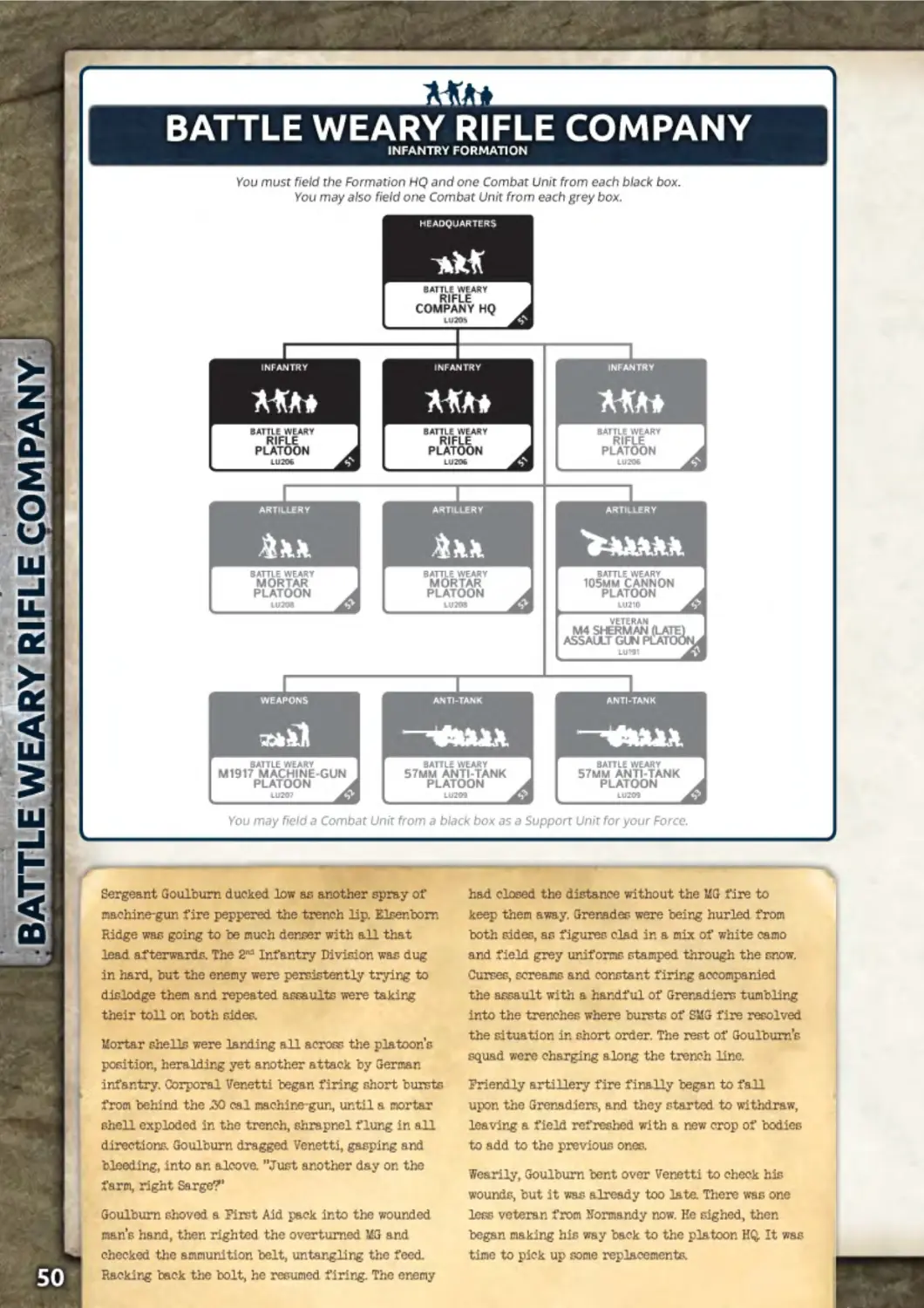
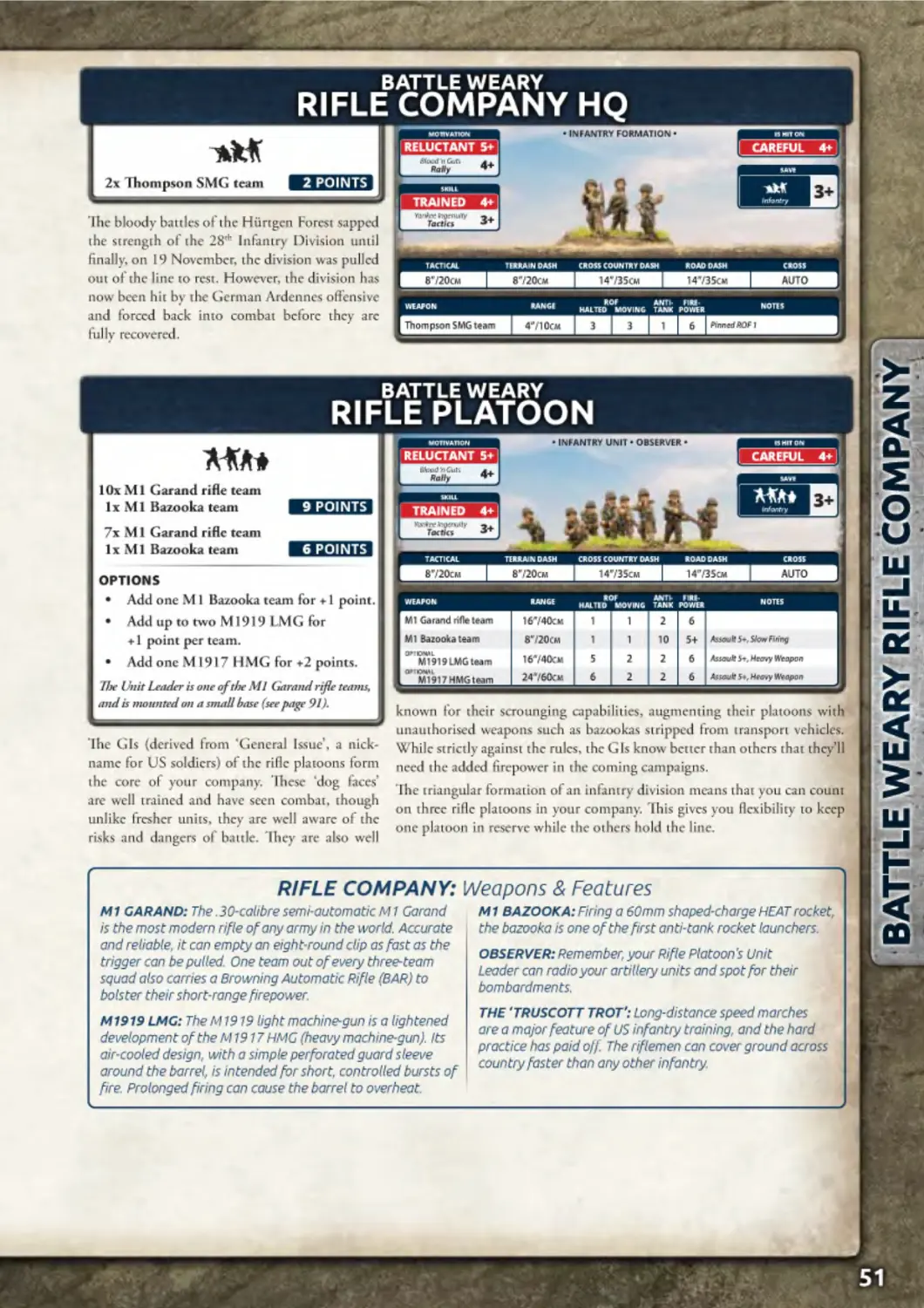
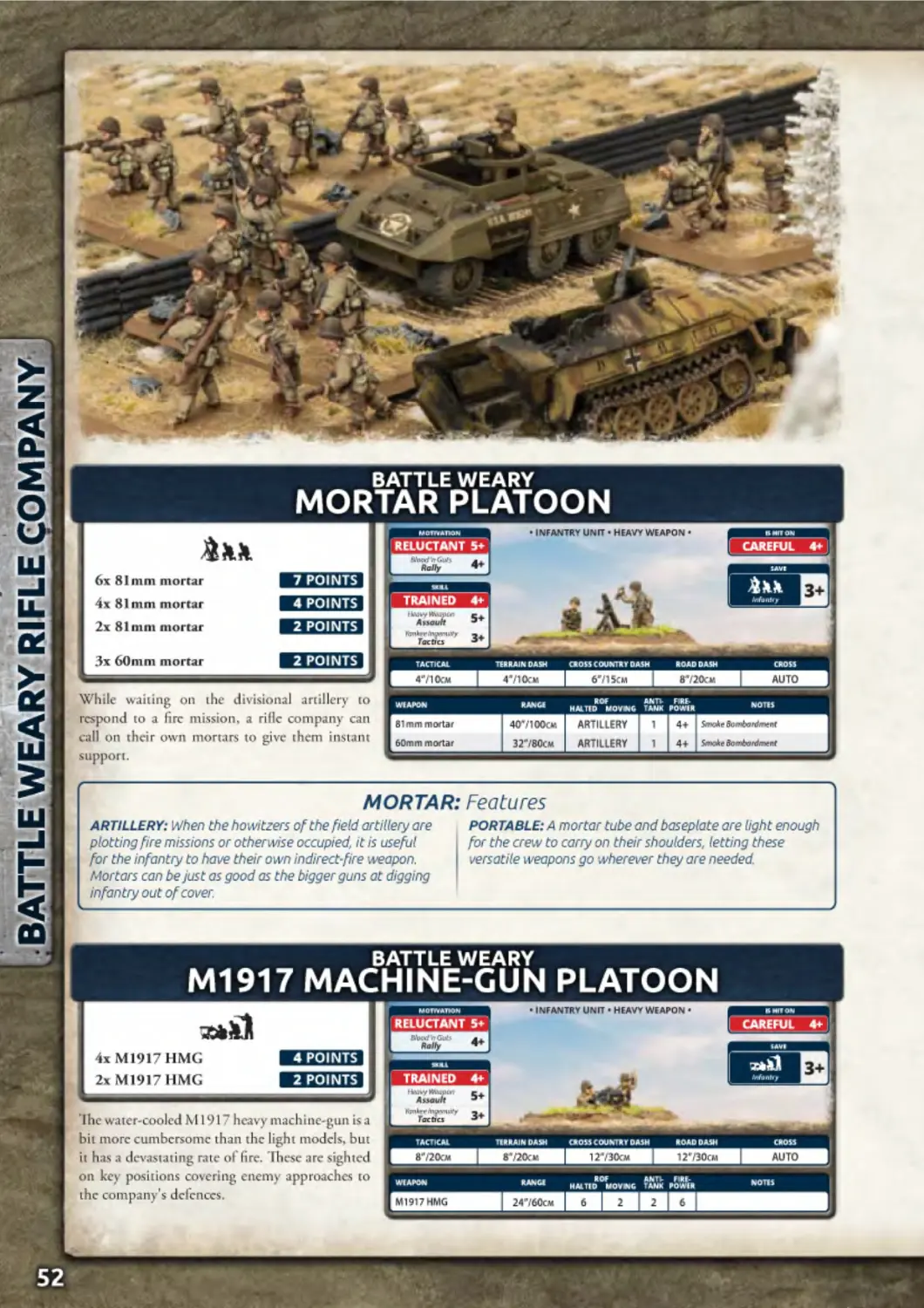


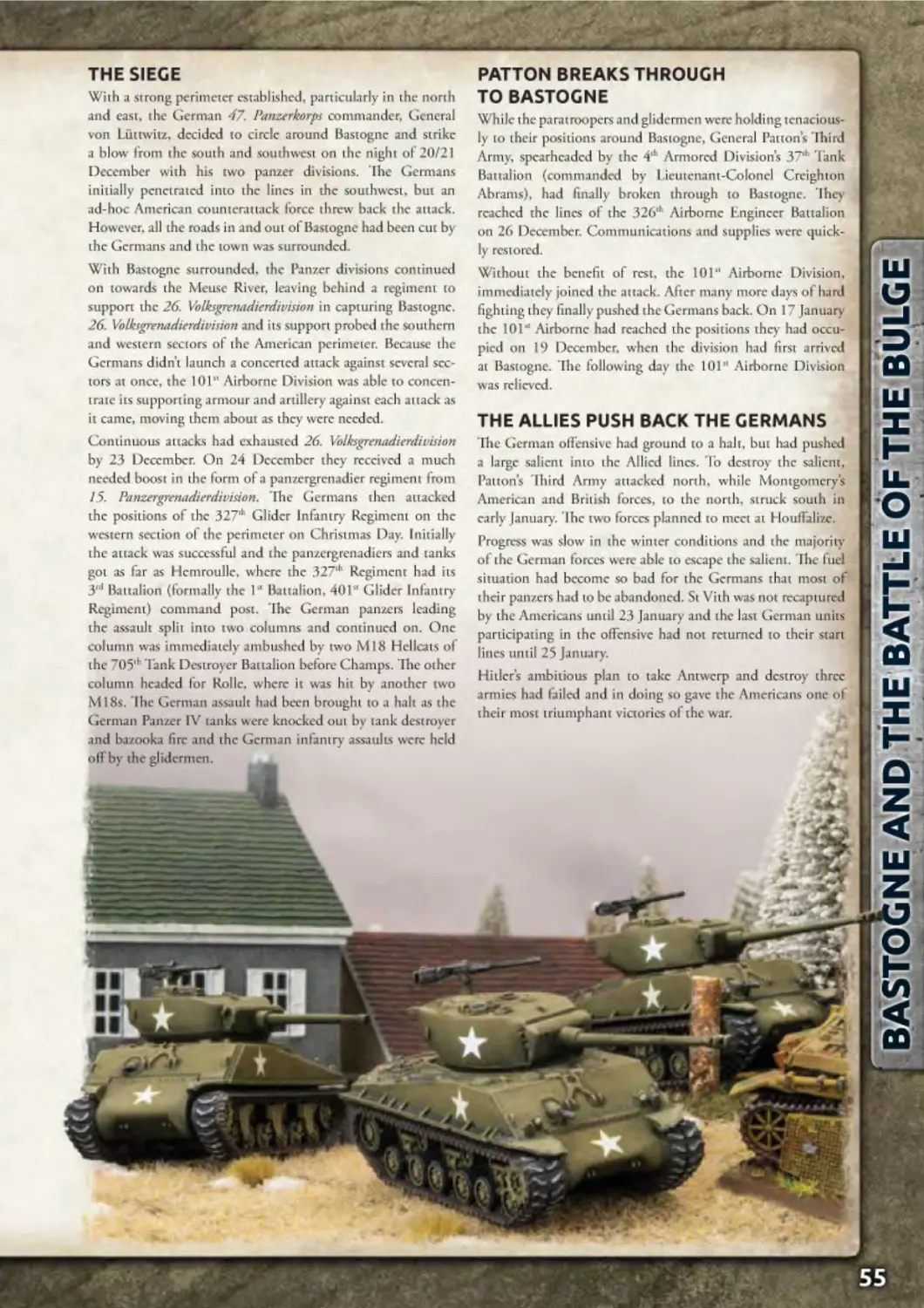













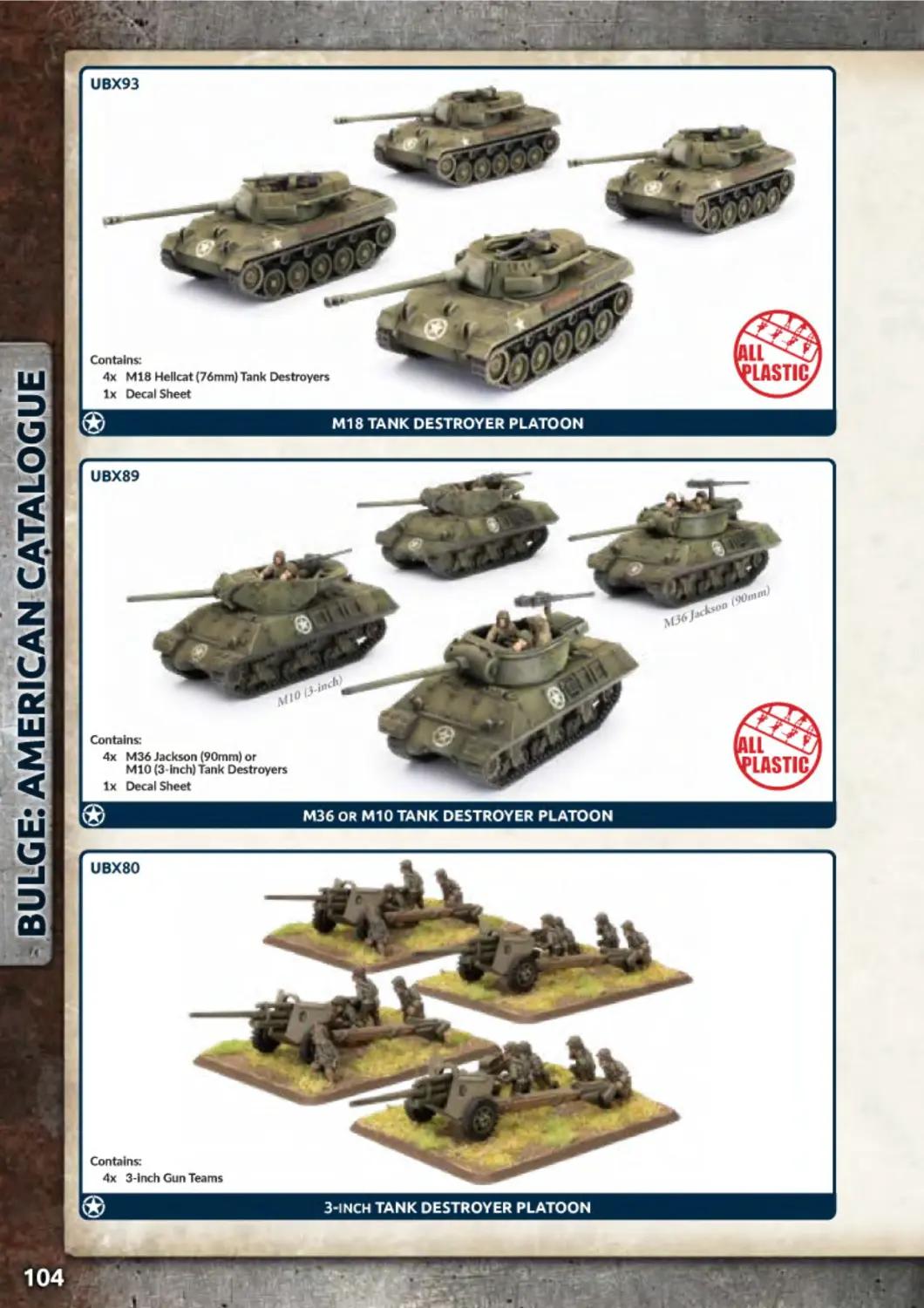


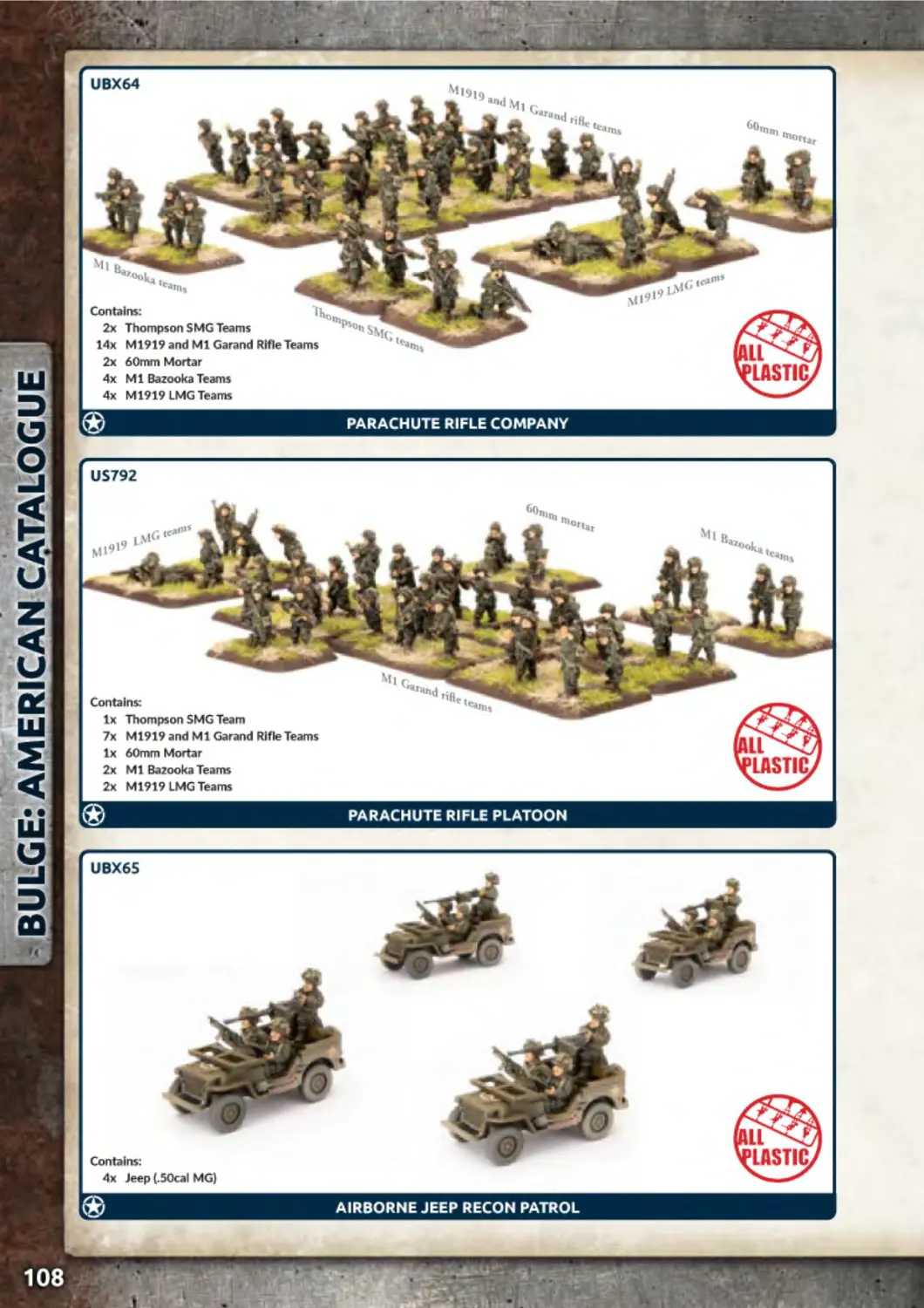


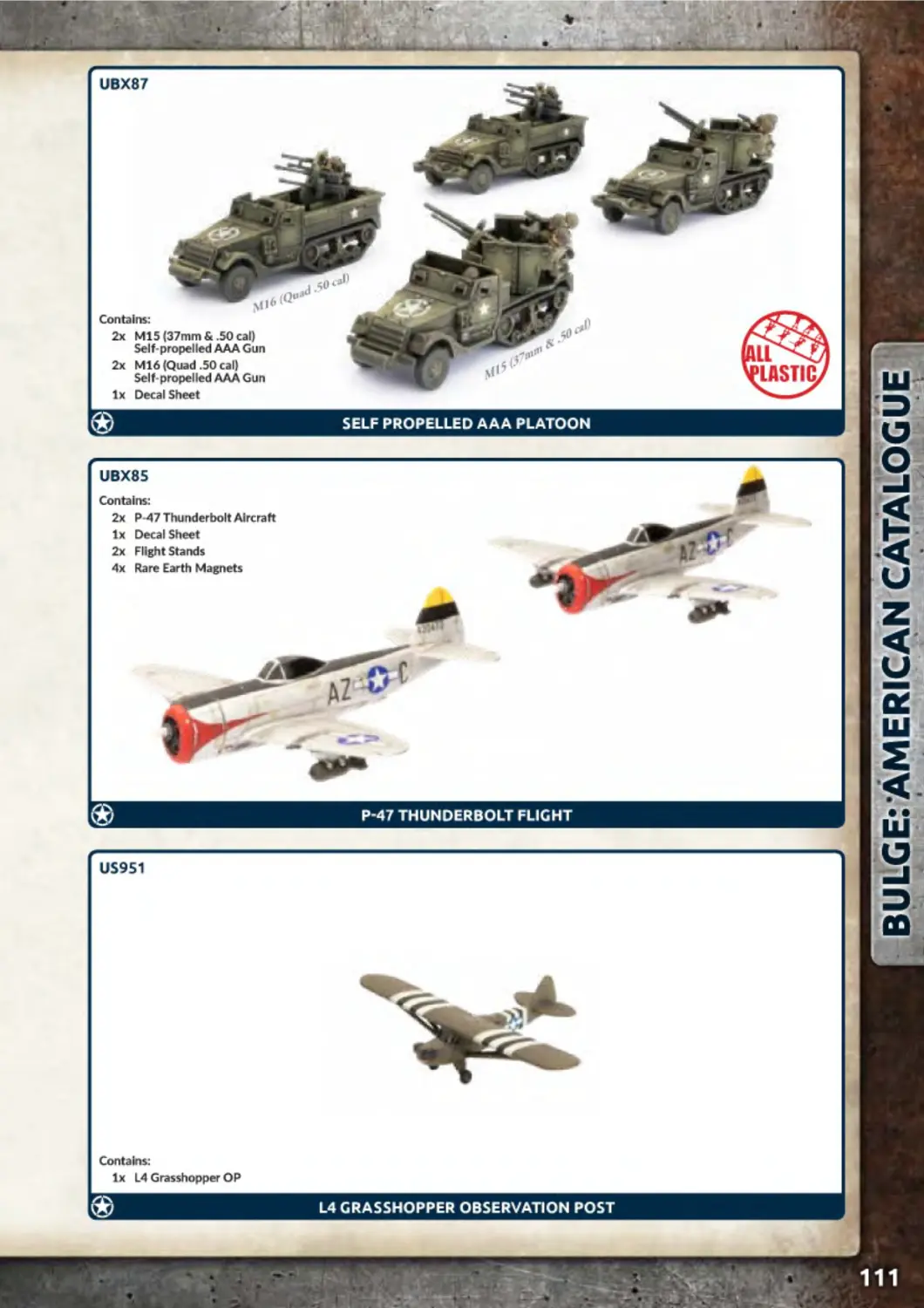
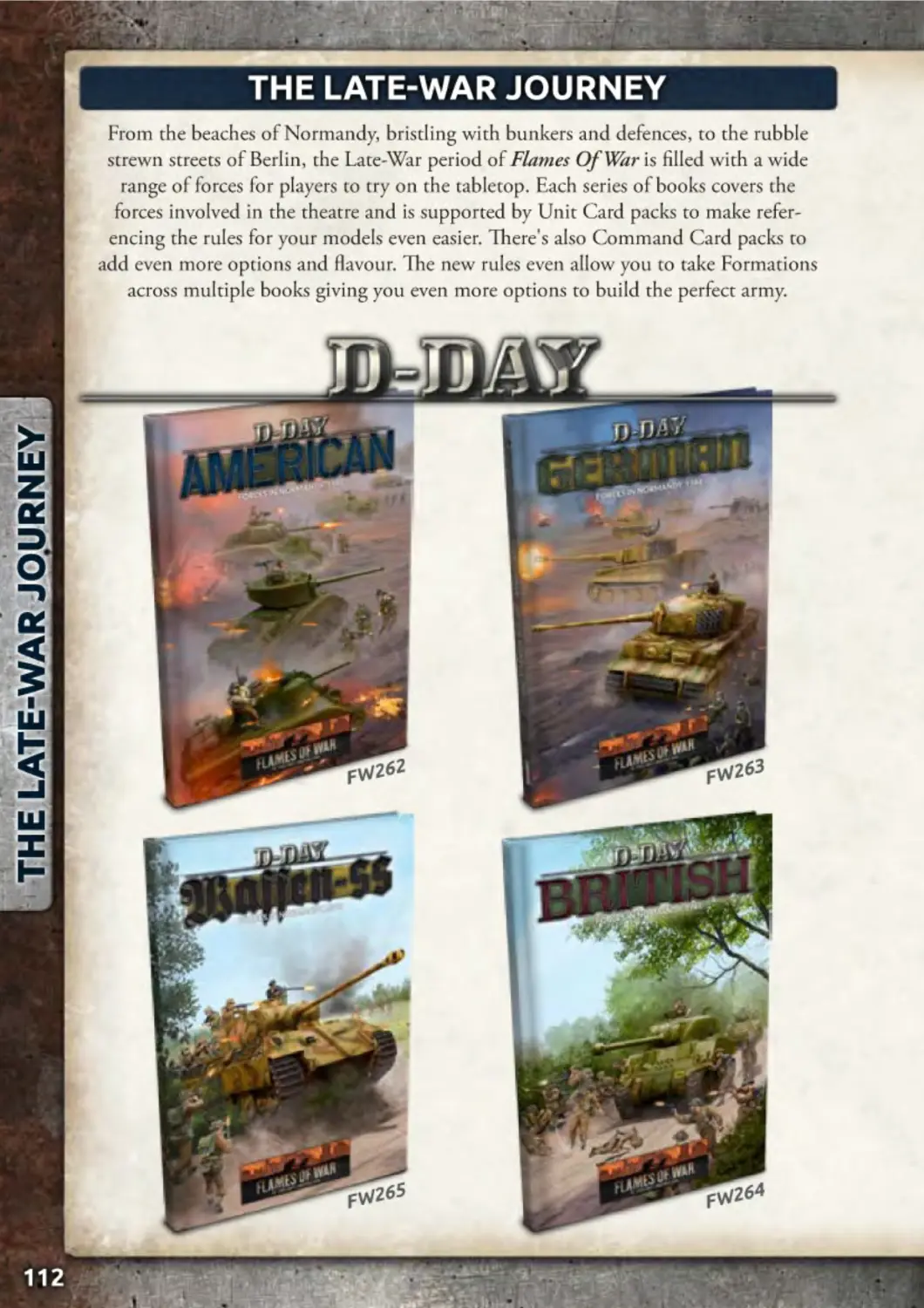




Текст
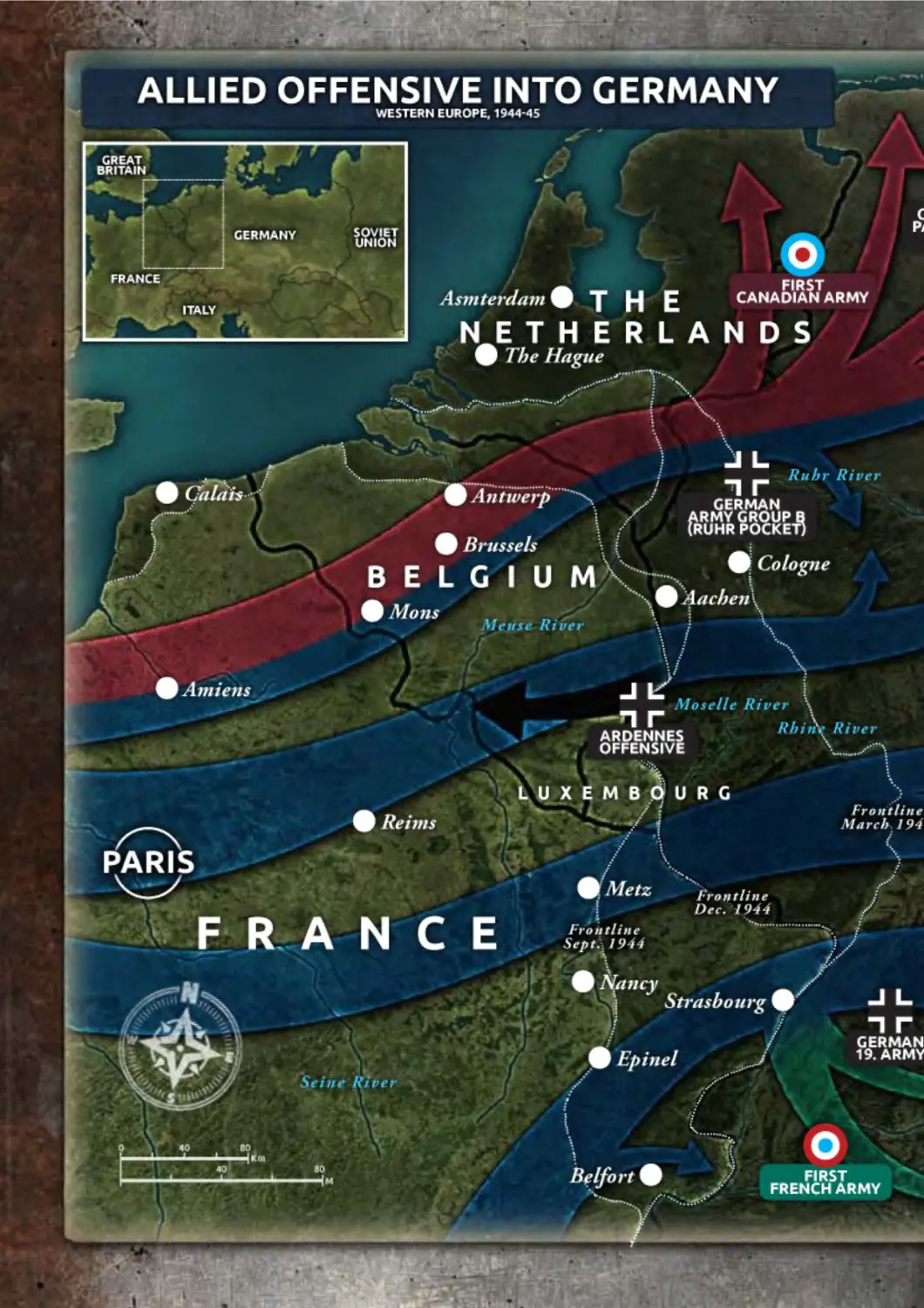
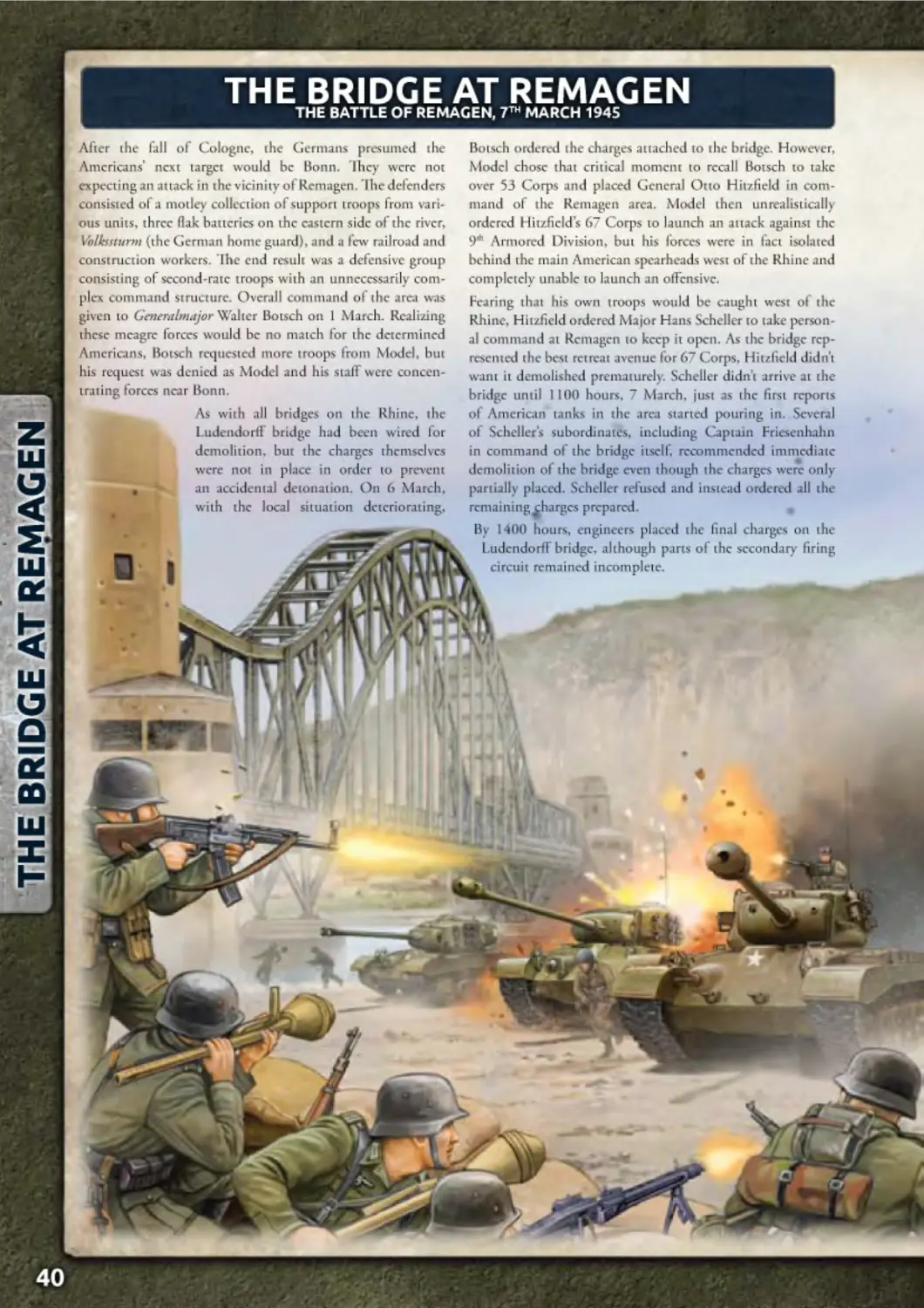
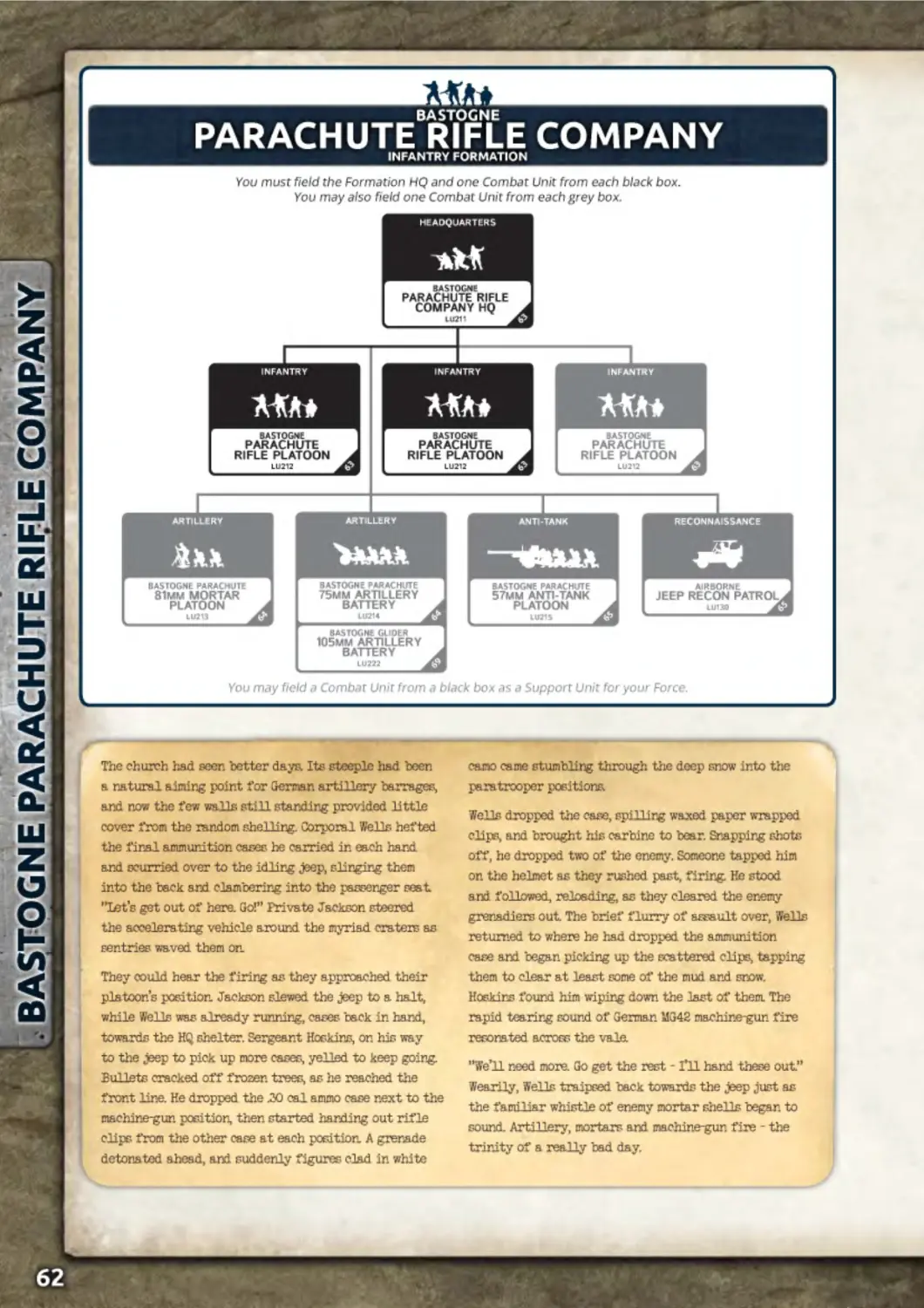
ALLIED OFFENSIVE INTO GERMANY
WESTERN EUROPE, 1944-45
GERMANY
FRANCE
Asmterdam
ITALY
Calais
Brussels
Cologn
Aachen
Mons
Meuse River
Amiens
Reims
PARIS
Metz
GREAT
BRITAIN
SOVIET
UNION
GERMAN
19. ARMY
ARDENNES
OFFENSIVE
Ruhr River
FIRST
FRENCH ARMY
Moselle River
FIRST
CANADIAN ARMY
Frontline
March 194
Frontline
Dec. 1944
Frontline
Sept.. 1944
..—-w-.......
ф Antwerp
Hamburg
ERMAN 1
ARMY
BERLIN
Kassel
Elbe 'River
ne
Munich
SEVENTH
US ARMY
GERMAN
11. ARMY
GERMAN
12. ARMY
FIRST
US ARMY
GERMAN
1. ARMY
THIRD
US ARMY
GERMAN
7. ARMY
NINTH
US ARMY
SECOND
BRITISH ARMY
Frontline
May 1945
ПГ7ТГ
Written by: Wayne Turner
Editors: Peter Simonovich, John-Paul Brisigoti
Graphic Design Victor Pesch
Project Management: Chris Townley
Assistant Writing Phil Yates, Mike Haught, Michael
McSwiney, Chris Potter, Nigel Slater
Assistant Graphic Design Casey Davies, Ashleigh Heelam
Miniatures Design Evan Allen, Tim Adcock, Will Jayne,
Alei Potocnik, Charles Woods
Miniatures Painting- James Brown, Jeremy Painter,
.Aaron Tc Hira-Marhic
Corer and Internal Art: Vincent Wai
Web Support: Dike Glover
AU rights reserved. No pan ol this publication may be reproduced, stored tn a retrieval system, or transmitted, tn any term or by any means
without the prior written permission of the publisher, nor be otherw ise circulated in any form of binding or cover other than that in which it is
published and without a similar condition being imposed on the subsequent purchaser.
© Copyright Battlcfront Miniatures Ltd., 2021. ISBN: 978-1-98-855829-5
Proof Readers: David Adlam, Paul Beach, Jason Berkau, Alexander
Costantino, Tom Culpepper, Alan Graham, Lance
Mathew, Michael McSwiney, Alexander Nebesky,
Hike Parsonage, Jacc Pippin, Gavin van Rossum,
Gregg Sitcr, Andrew Willis
Playtest Groups. Aylesbury Wargames Club (Alan Graliam),
Atlantic Canadian Testers (Ryan Sullivan),
Dads Army (Gavin van Rossum),
Flames Of War Regina Rifles (Lance Mathew),
Historical Tabletop Gaming Society (Shane Kua),
Cavalieti dell-Esagono (Livio Tonazzo),
M.E.G. Team Vogheta (Emilio Arbasino),
Melbourne (Andrew Thompson),
The Dynamic Duo (Gareth Richards),
290 Bunker (Carl Bellatti)
CONTENTS
Bulge: American..................................
American Special Rules.........................
Normandy to Lorraine.............................
Know Your Tanks..................................
Know Your Infantry...............................
Bulge: American Force............................
4th Armored Division.............................
US Combat Commands............................
Improving the Breed, M4 Sherman tanks........
America's Battle Tank. The- M26 fetching.....
Veteran M4 Sherman (late) Tank Company.........
Veteran M4 Sherman (late) Tank Company HQ.....
Veteran M4 Sherman (late) Tank Platoon........
M4 Easy Eight Veteran Tank....................
M4 Jumbo Veteran Tank.........................
M26 Pershing Tank Platoon.....................
T26 Super fetching lank Platoon..............
Veteran M5 Stuart Tank Platoon...............
Veteran Armoured 81mm Mortar Platoon..........
Veteran M4 Sherman (late) Assault Gun Platoon.
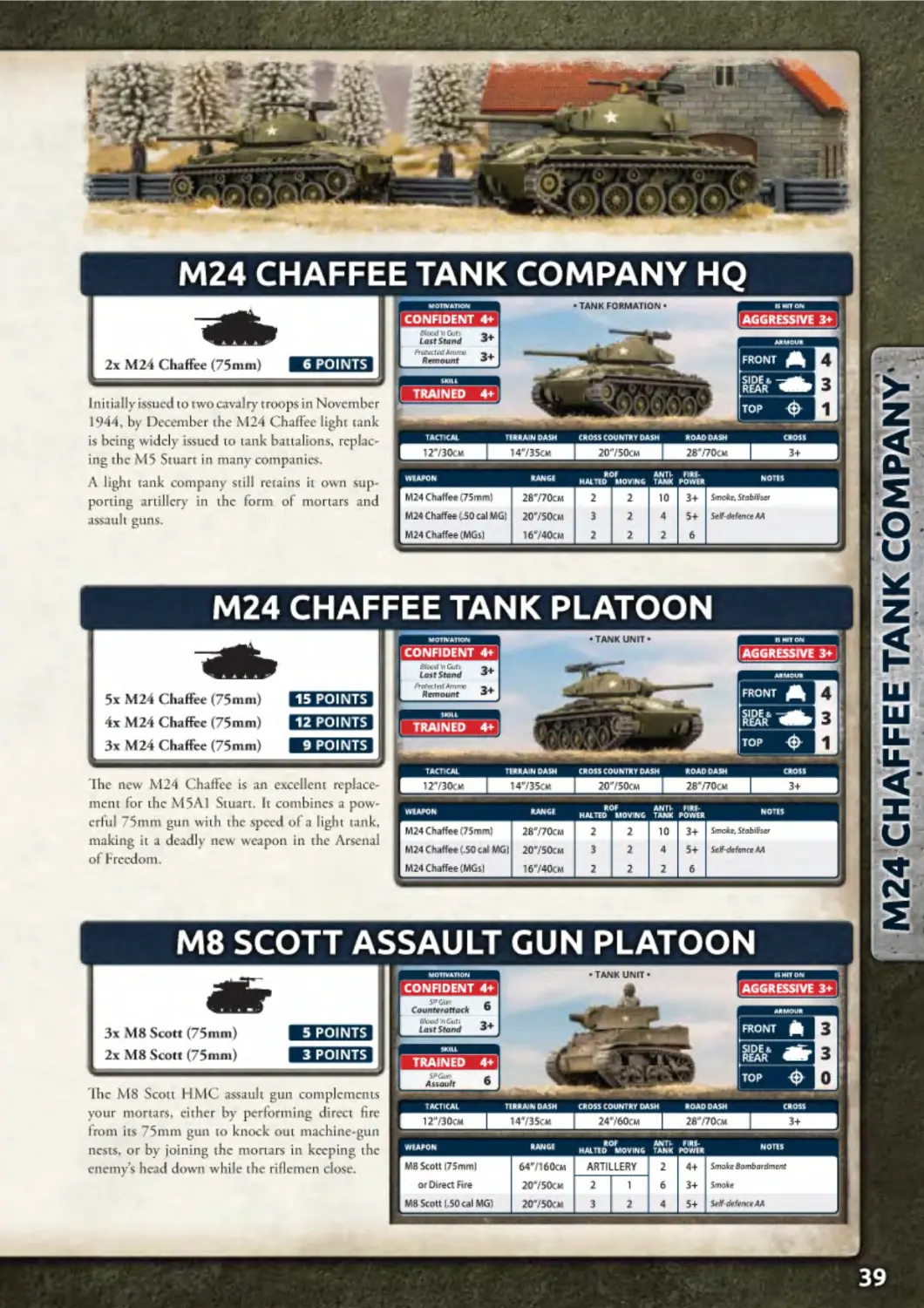
Veteran M24 Chaffee Tank Company..........
Veteran M24 Chaffee Tank Company HQ..........
Veteran M24 Chaffee Tank Platoon.............
Veteran M8 Scott Assault Gun Platoon.........
7rh Armored Division.............................
M4 Sherman (late) lank Company.................
M4 Sherman (late) Tank Company HQ............
M4 Sherman (late) Tank Platoon...............
M4 Easy Eight Tank...........................
M4 Jumbo Tank................................
M5 Stuart Tank Platoon..................-. *.
Armoured 81 mm Mortar Platoon................
M4 Sherman (late) Assault Gun Platoon........
T34 Calliope Tank Platoon.....................
M24 Chaffee Tank Company.......................
M24 Chaffee Tank Company HQ.......... ......
M24 Chaifee Tank Platoon.....................
M8 Scott Assault Gun Platoon.................
The Bridge at Remagen..........................•
Battle Weary Armoured Rifle Company............
Battle Weary Armoured Rifle HQ...............
Battle Weary Armoured Rifle Platoon..........
Battle Weary Atmoured M1917 Machine-Gun Platoon
Battle Weary Armoured 57mm Anti-tank Platoon .. ..
Battle Weary Armoured M4 81mm Mortar Platoon .
The Blood Bucket, 28th Infantry Division....
4th Infantry Division............................
21"* Infantry Division...........................
Battle Weary Rifle (.Company...................
Battle Weary Rille Company HQ................
Battle Weary Rille Platoon....................
Battle Weary Mortar Platoon.................
Bartie Weary MI917 Machine-Gun Platoon......
Battle Weary 57mm Anti-tank Platoon..........
Battle Weary 105mm Cannon Platoon............
2
3
4
. 6
10
12
14
18
19
20
22
23
24
24
24
25
26
27
27
27
28
29
29
29
30
34
35
35
35
36
.36
37
37
38
39
39
39
42
42
43
44
. 44
45
. 45
46
48
49
50
. 51
. 51
. 52
. 52
. 53
. 53
Bastogne and the Battle of the Bulge............
Screaming Eagles,
101 “ Airborne Division in Bastogne............
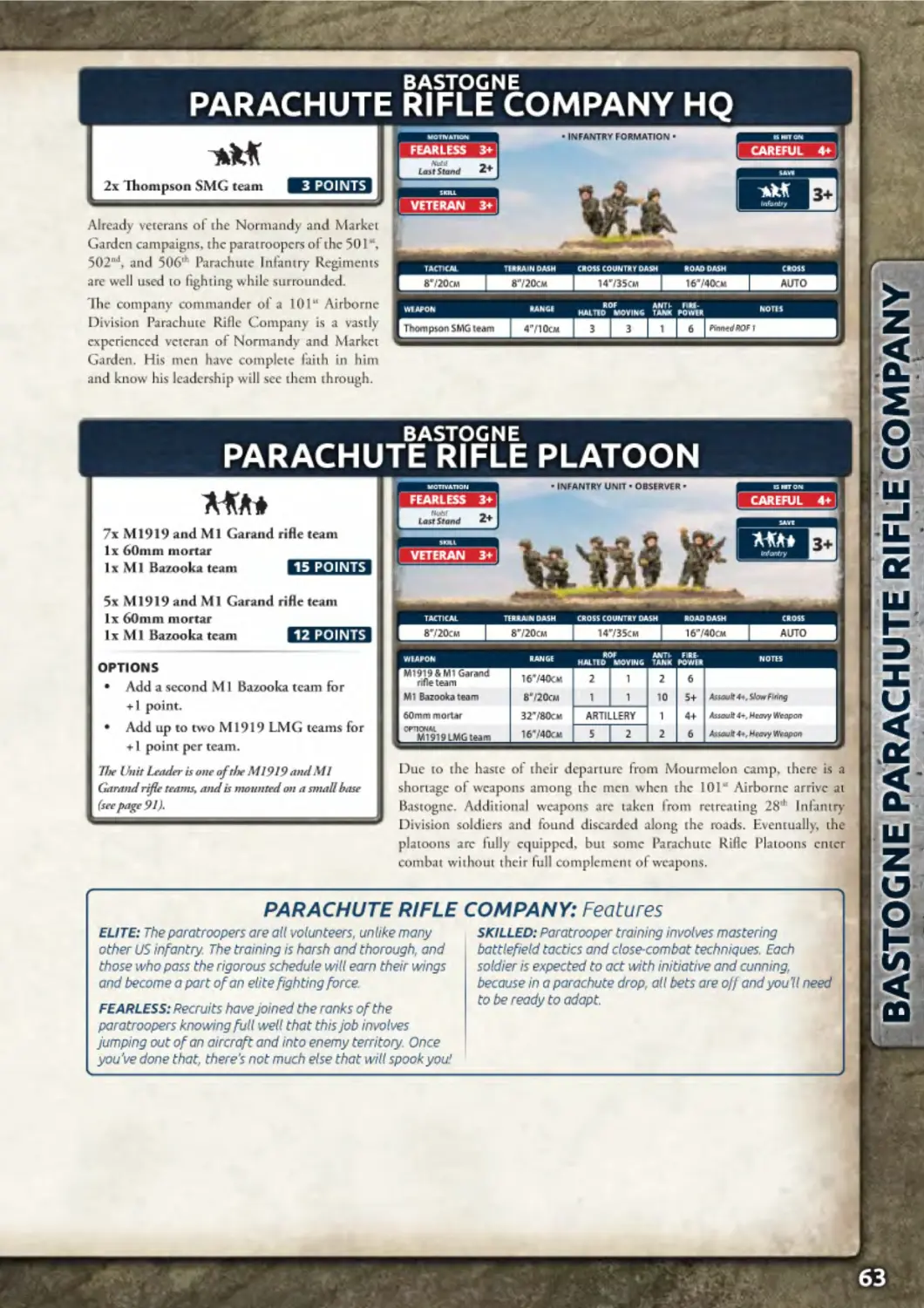
Bastogne Parachute Rifle Company...............
Bastogne Parachute Rifle Company HQ..........
Bastogne Parachute Rifle Platoon.............
Bastogne Parachute 81mm Mot tat Plamcm.......
Bastogne Parachute 75nun Artillery Battery...
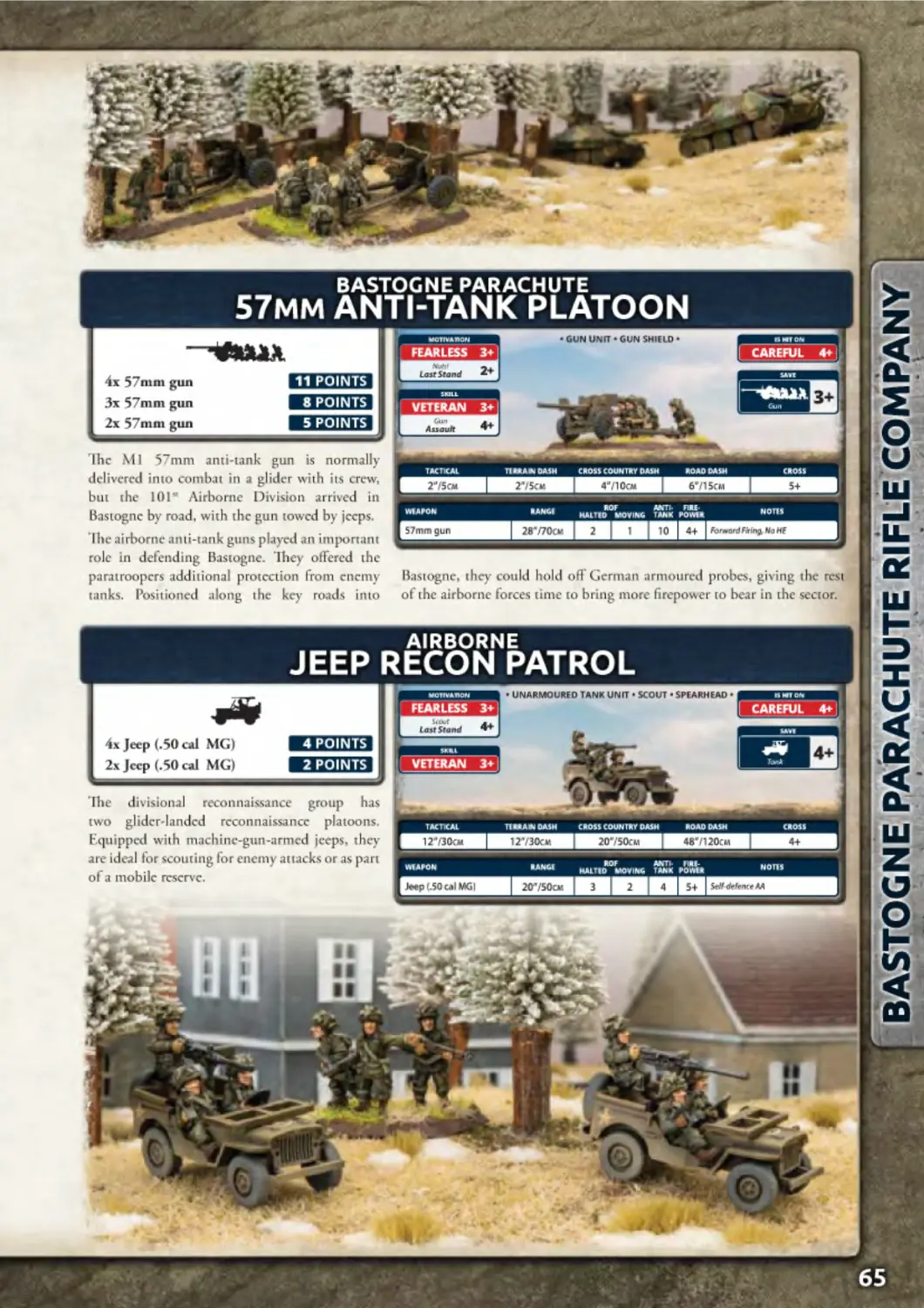
Bastogne Parachute 57mm Anti-tank Platoon....
Airborne Jeep Recon Patrol...................
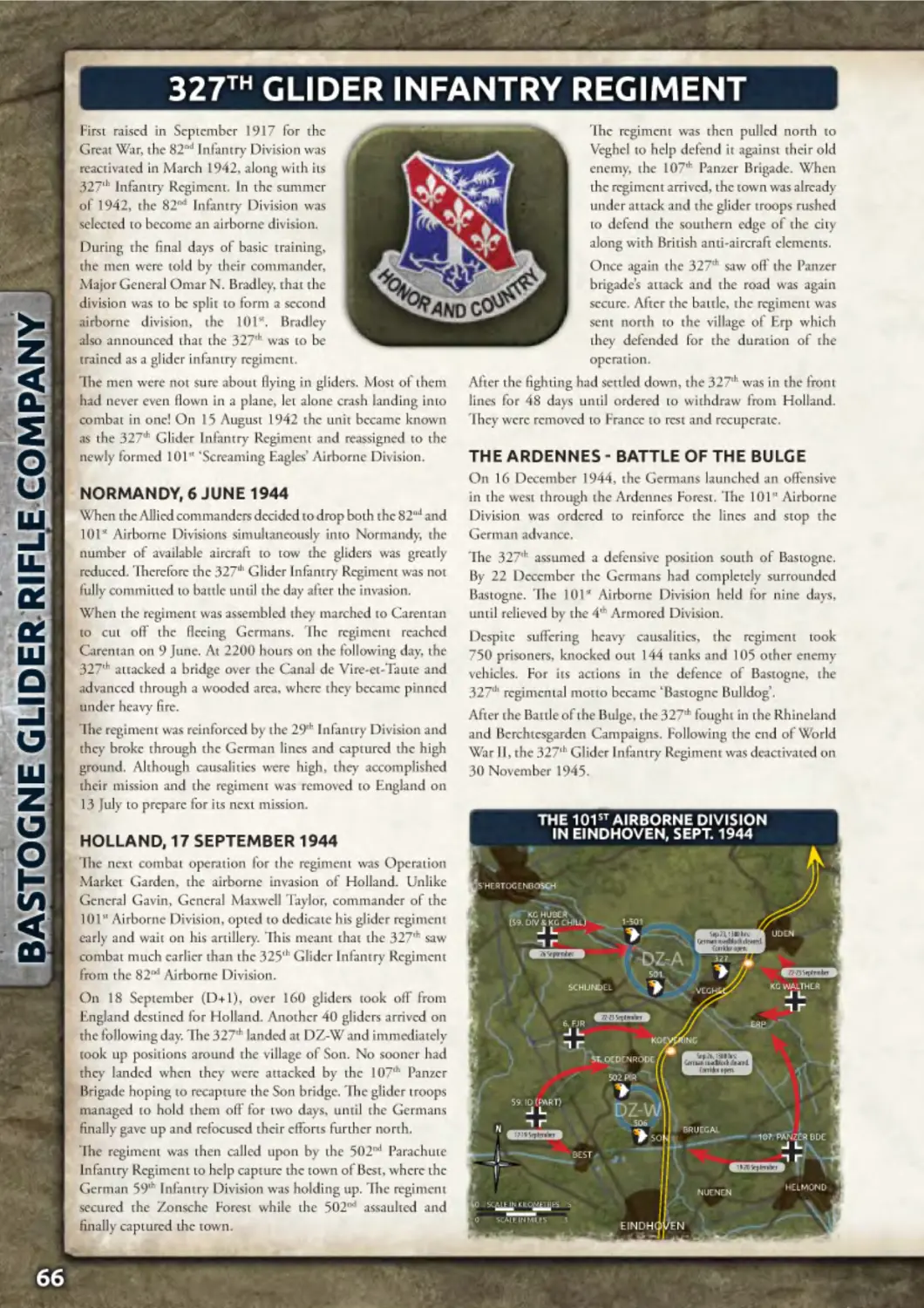
327th Glider Infantry Regiment...................
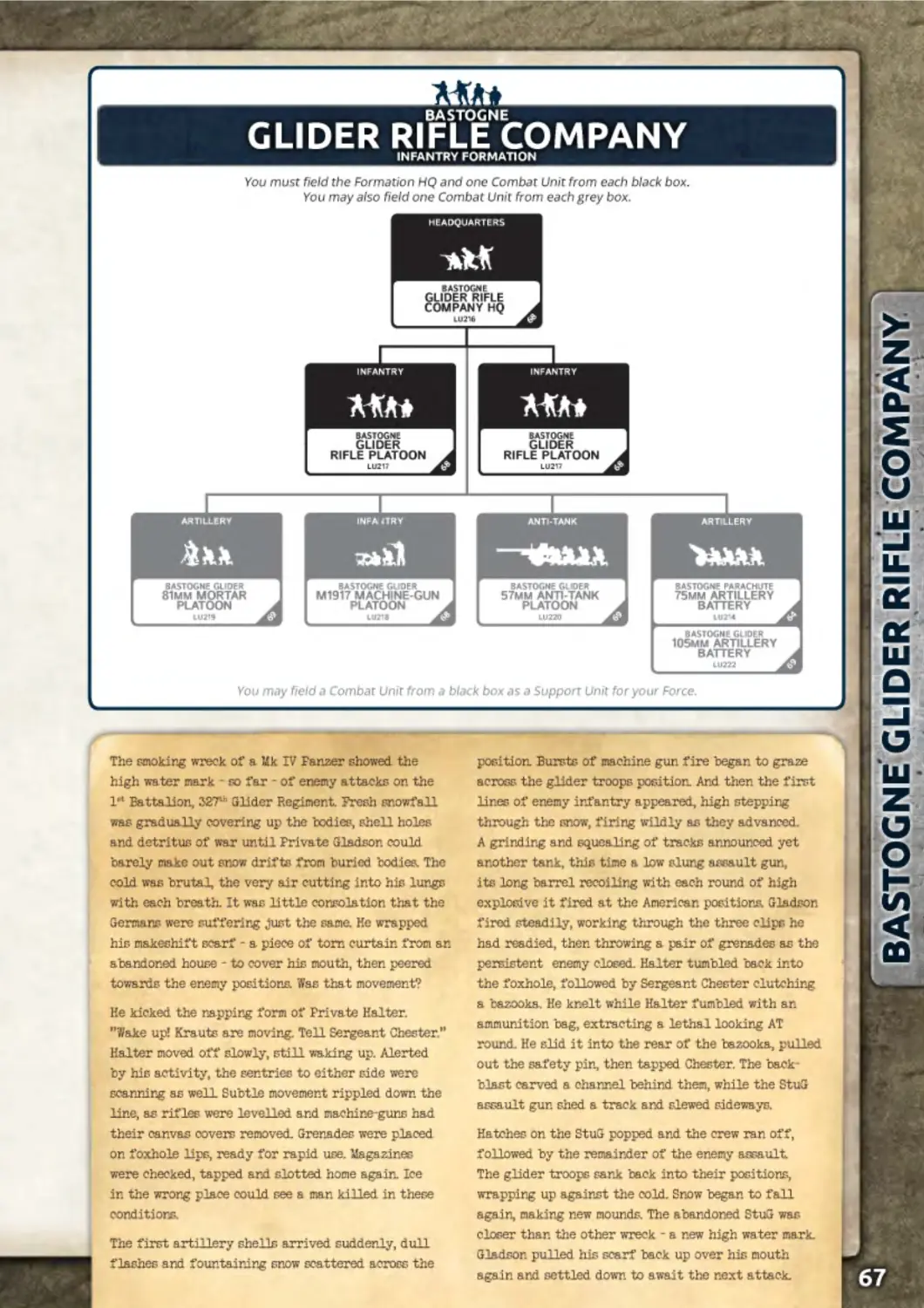
Bastogne Glider Rifle Company..................
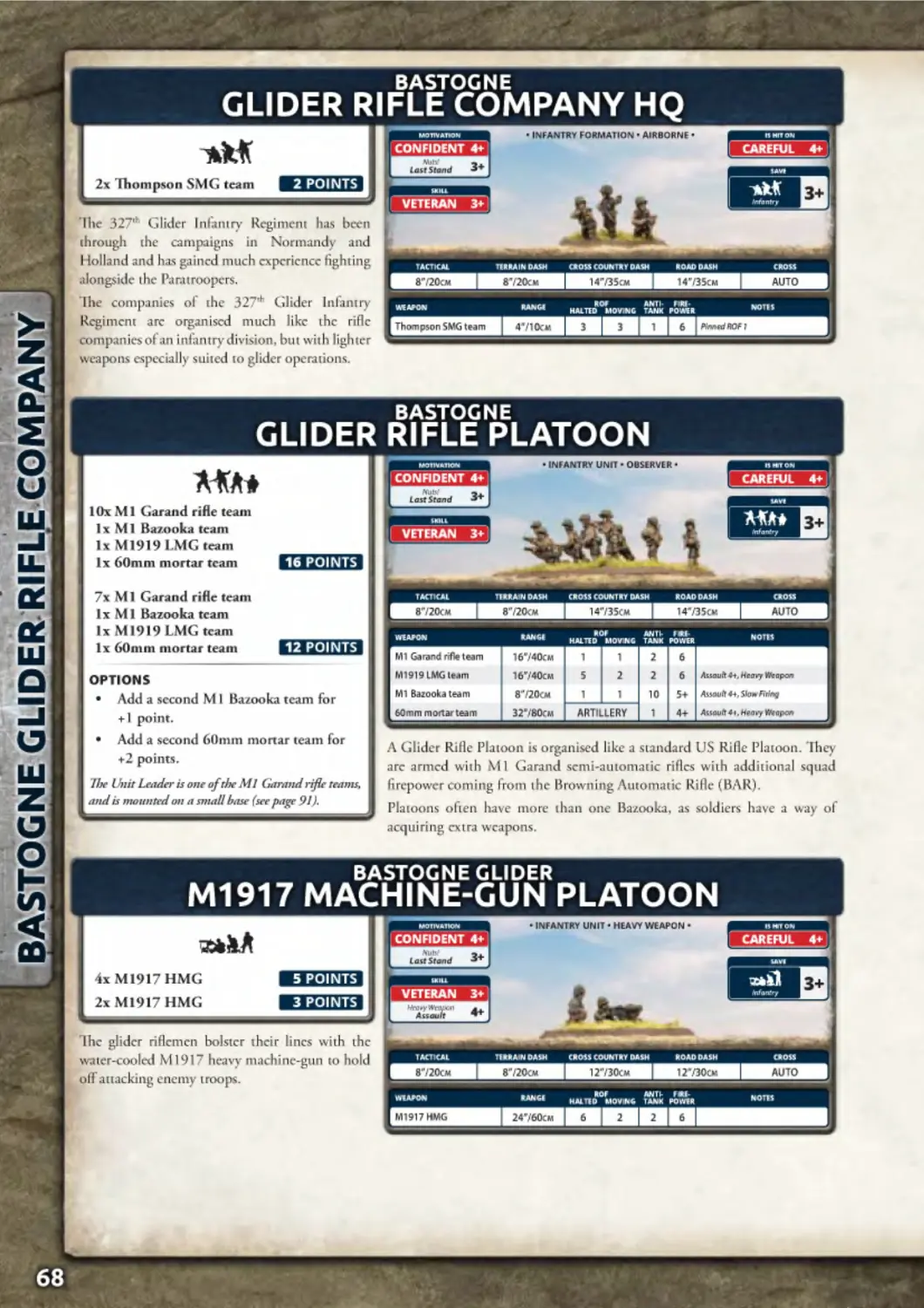
Bastogne Glider Rifle Company HQ.............
Bastogne Glider Rifle Platoon................
Bastogne Glider M1917 Machine-gun Platoon......
Bastogne Glider 81mm Mortar Platoon..........
Bastogne Glidet 57mm Anti-rank Platoon.......
Bastogne Glider 105mm Artillery Battery......
Race to the Rhine...............................
Fortune Favors the Brave,
644th Tank Destroyer Battalion..................
Victory Not Glory,
704th Tank Destroyer Battalion...................
One Round, 705th Tank Destroyer Battalion
Ready Now, 899th Tank Destroyer Battalion
MI8 Tank Destroyer Company.......................
Ml8 Tank Destroyer Company HQ................
M18 Tank Destroyer Platoon...................
M36 Tank Destroyer Company.....................
M36 Tank Destroyer Company HQ................
M36 Tank Destroyer Platoon...................
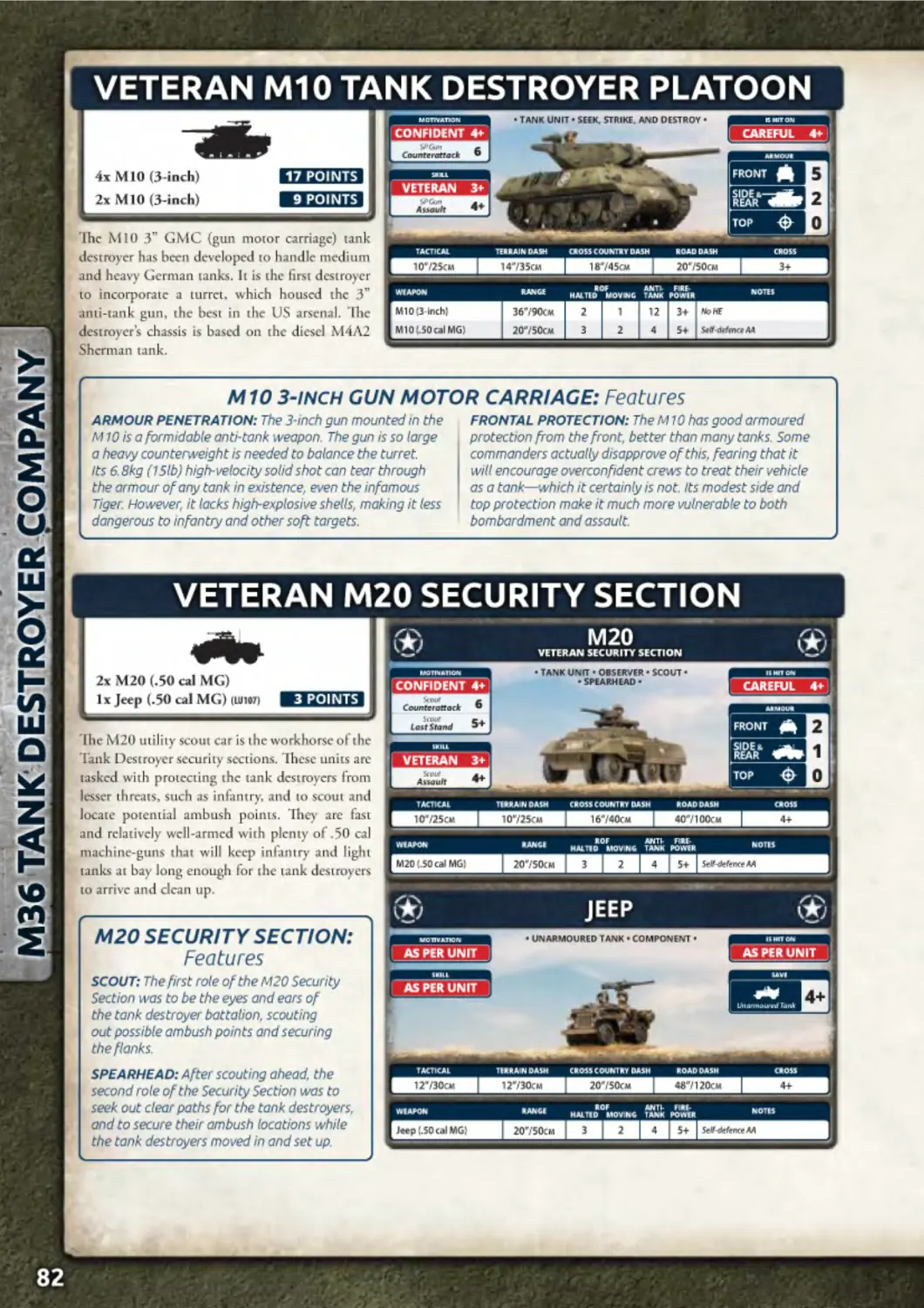
Veteran M10 Tank Destroyer Platoon...........
Veteran M20 Security Section.................
Support Units...................................
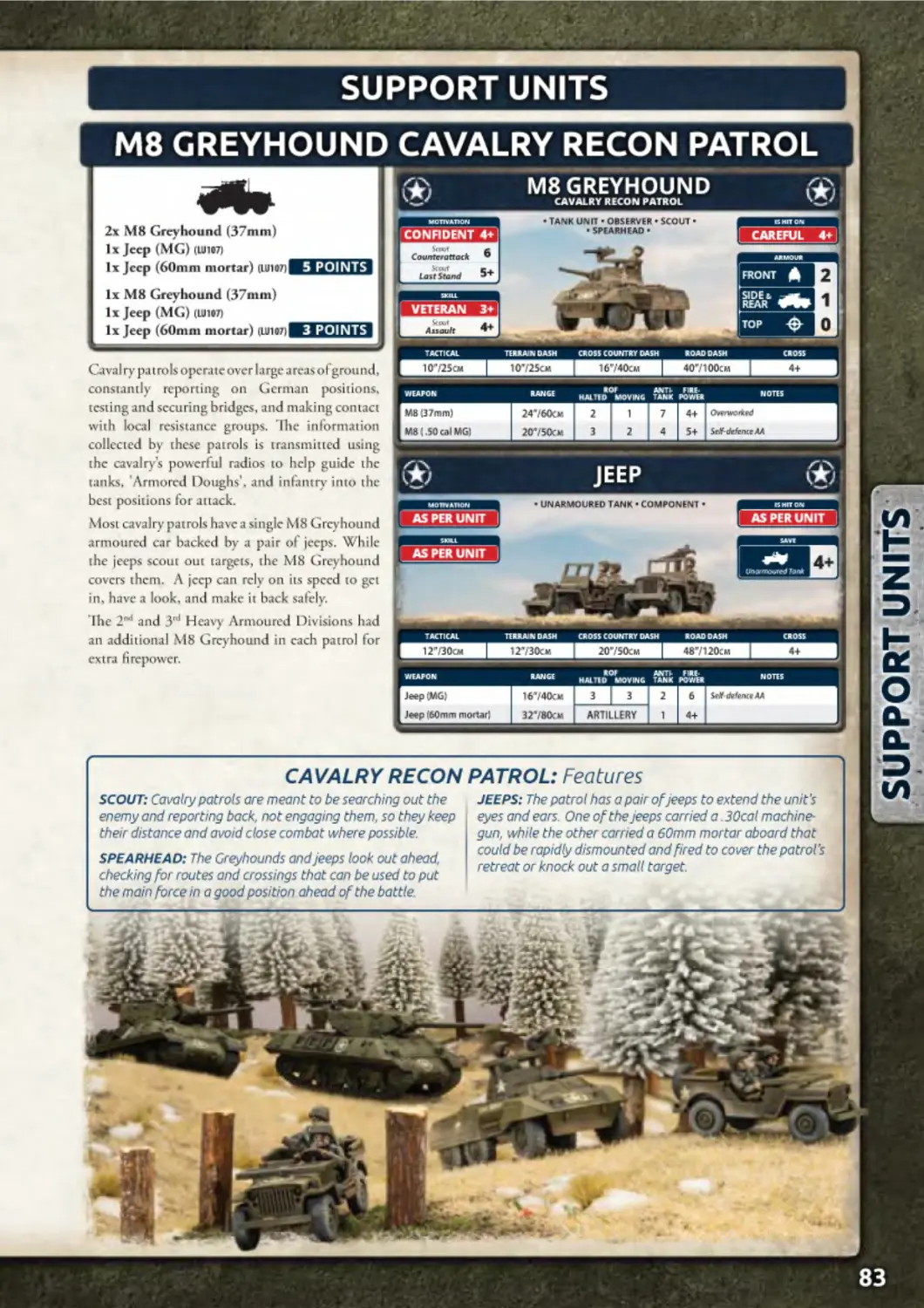
MB Greyhound Cavalry Recon Patrol............
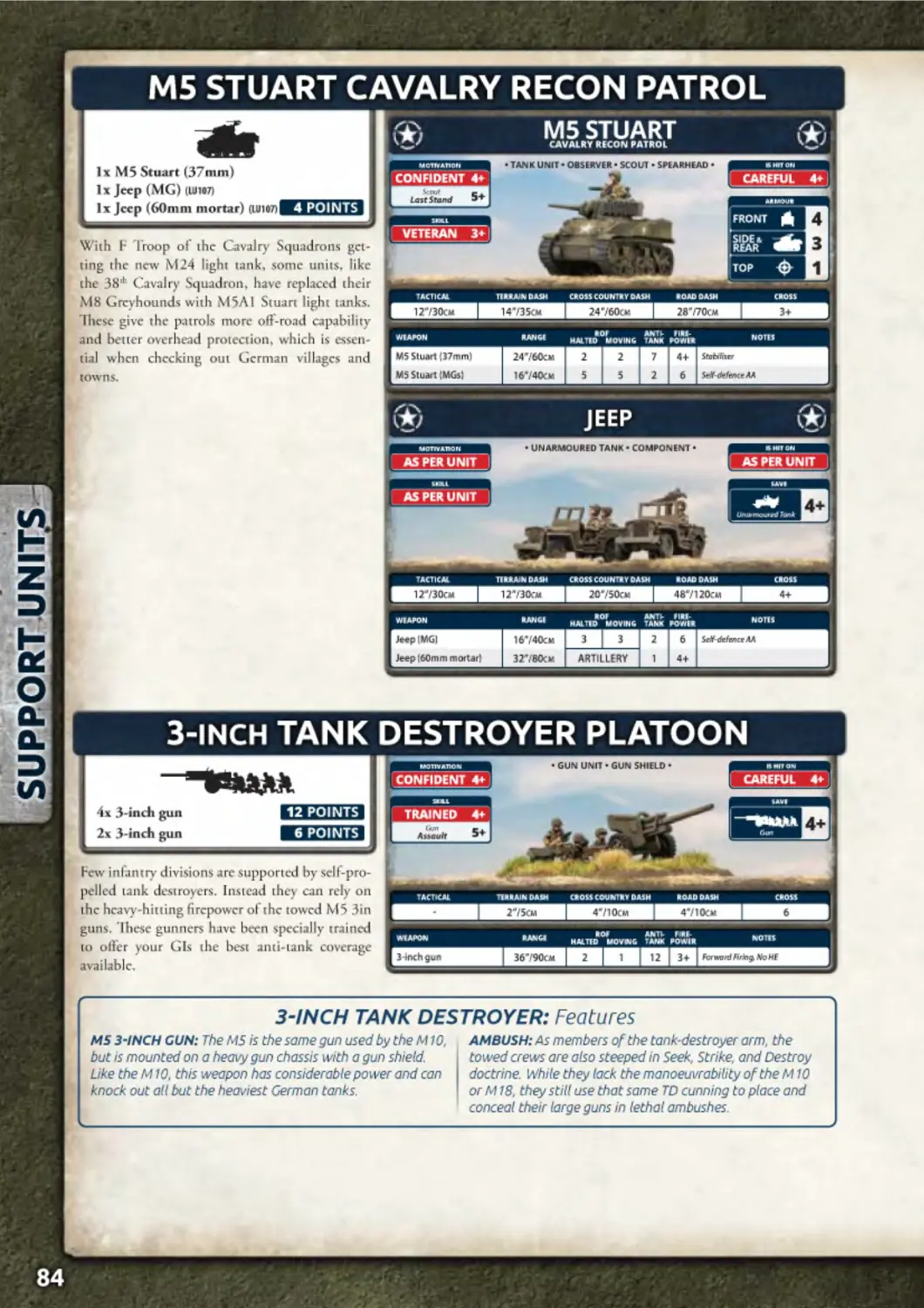
M5 Stuart Cavalry Recon Patrol...............
3-inch Tank Destroyer Platoon................
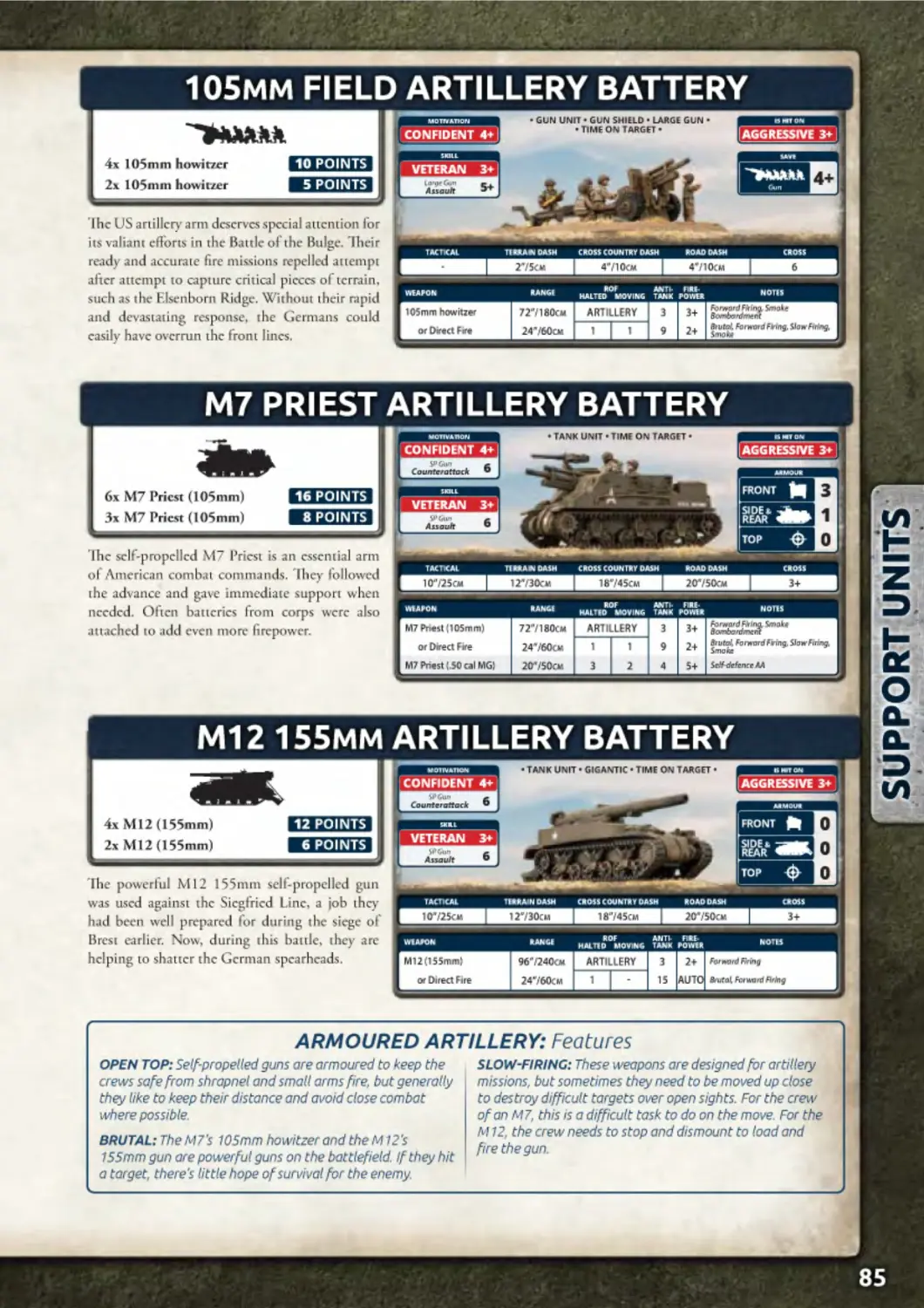
105mm Field Artillery Battery................
M7 Priest Artillery Battery*.................
Ml2 155mm Artillery* Battery*................
T27 Xylophone Rocket Launcher Battery. ......
L4 Grasshopper OP Observation Post...........
M4 Sherman OP Observation Post...............
Ml5 M16 AAA Platoon..........................
P-47 Thunderbolt Fighter Flight..............
Bulge: American Example Force...................
Painting Americans..............................
Basing Guide....................................
Border Countryside Terrain......................
Missions.........................................
Catalogue.......................................
54
56
62
63
63
64
64
65
65
66
67
68
68
68
69
. 69
69
70
72
73
74
.76
. 78
. 79
. 79
. 80
. 81
. 81
. 82
. 82
83
. 83
. 84
. 84
. 85
. 85
85
. 86
. 86
. 86
. 87
. 87
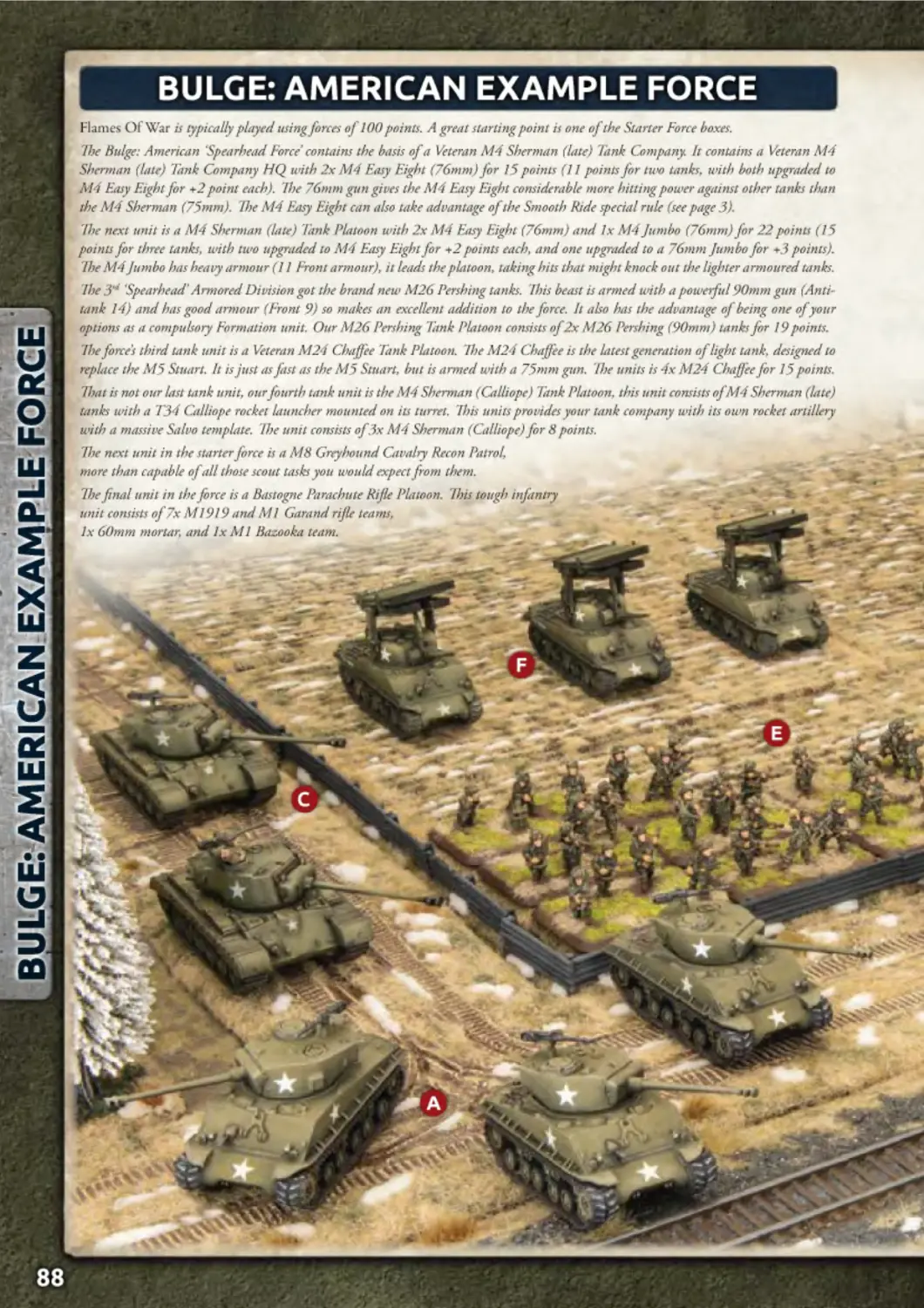
.88
.90
.91
.92
94
100
•L-

4* >
—General George S Patton Jr.
BULGE: AMERICAN
'Nuts!'
— General McAuliffe's reply to the German surrender ultimatum delivered to the 101” Airborne Division’s HQ
in Bastogne on 22 December 1944.
Wires may be fought with weapons, but they are won by men.
By' September 1944, the Allies had stormed across western
France and the front line ran from Belgium to the French
region of Lorraine. Patton’s unstoppable Third Army was
poised to strike into Germany itself, with the hard-charging
4,h Armored Division in the lead. Nothing, it seemed, stood
in the divisions way as it pressed on.
Ute Germans were determined to stem the Allied tide. Four
of Hitler’s brand new Panzer Brigades, specifically designed to
incorporate lessons learned on the Soviet front, were diverted
to meet the Americans in the Lorraine. The two forces clashed
cast of the city of Nancy at a quiet farming village called
Arracourt. The rolling fields and small villages played host to
over 450 American and German tanks as they fought one of
the largest tank battles of World War 11.
Meanwhile, further north the Germans had been in retreat
since the Allied breakout from Normandy, finally settling into
defensive lines on their frontier as autumn turned into winter.
In early December 1944 it seemed, to the Americans facing
them in the Ardennes forests of Belgium and Luxembourg,
unlikely that the Germans W'ould attack.
On 16 December that illusion was shattered when the might of
the German Sixth Panzer Army smashed into the thinly-held
US lines, lhe unexpected and powerful thrust overwhelmed
some American units, while others fought with great deter-
mination and skill. American troops put in every effort to
halt the Germans with improvised defences, counterattacks,
road blocks, ambushes, and bridge demolitions as what would
become the Bat tie of the Bulge began.
In the central sector of the Battle of the Bulge, the Germans
had smashed through the American 28'h and 106'1’ Infantry
Divisions before approaching the key crossroads town of
Bastogne on 19 December. In the meantime the veteran
101“ Airborne Division had been rushed from their camp in
France to Bastogne to take up the defence. What followed was
an epic seven-day struggle with the defending airborne troops
besieged by four German divisions. On 26 December the
siege wras broken by the arrival of the American 4'1' Armored
Division and a few days later the Americans went on the attack.
However, the Germans were not done. On 31 December
Hitler launched the last German offensive in the west,
Operation Nordwind. German divisions along the Lorraine
front attacked into the old French Maginot Line where the
Americans had dug in. With many of their reserves sent north
to face the Ardennes offensive, the Americans were taken by
surprise. On 25 January' the German offensive was halted, after
the US 222nd Infantry' Regiment of the 42nd Infantry Division,
stopped their advance near Haguenau and US reinforcements
began to arrive from the Ardennes.
The US Army was soon charging for the Rhine, the last
physical barrier to the German heartland. Leading the
march of the US First Army was Combat Command В
of the 9* Armored Division. They discovered the intact
Ludendorff Bridge across the Rhine at Remagen on 7 March
1945.The Battle of Remagen saw the bridge
in American hands, opening
the way into the German homeland.


AMERICAN SPECIAL RULES
The following special rules are characteristic of Bulge: Amer ican forces,
reflecting their own style of equipment, tactics, and approach to battle.
TANKS
TANK DESTROYERS
COMPONENT
Component Teams use the ratings of their parent Unit.
Jeeps were used extensively in the US Army, an essential tool for
many different units in the field.
STABILISER
Weapons with Stabiliser suffer a + 1 penalty To Hit if the Tank
Moved in the Movement Step.
The main gun mounts of US tanks are fitted with gyrostabilisers,
which keep the gun level while the tank is moving. This clever
mechanism lets the gunner fire faster and more accurately, but
shooting on lhe move is nevertheless still difficult.
SMOOTH RIDE
M4 Easy Eight Tank teams do not suffer the +1 penalty
To Hit for Stabiliser if they Move less than 4"/10cm in the
Movement Step.
The driving force behind the development of HVSS (Horizontal
Volute Spring Suspension) was the need for wider tracks for
crossing soft ground, and a smoother ride. As a result, HVSS
made it much easier for gunners to use the basic stabiliser system
fitted to the Sherman tank.
INFANTRY
AIRBORNE
This Formation may make an Airborne Assault in missions
that use the Airborne Assault rules (page 96).
Airborne units were specially trained, equipped, and organised to
conduct airborne operations.
MG TRANSPORT
M1917 HMG or M1919 LMG teams may fire while
Mounted as a Passenger in an М3 half-track, using the
Optional Passenger MG weapons line.
Machine-gunners mount their weapons on their half-tracks
armoured sides and blaze away as it carries them forward.
UNIT TRANSPORT
lhe Unit Leader of the Transport Attachment must end the
Movement Step within 6”/15cm of the Unit Leader of its
Passenger Unit while on table. If it cannot do this, then the
Transport Attachment must be Sent to the Rear.
Half-tracks are a part of the platoon in every way. lhe troops
live out of their transports and guard them against enemy attack.
BATTLE TANK
in missions with Deep Reserves, this unit is a Battle Tank
Unit. You may only field one Tank Unit with Battle Tank,
one Tank Unit with Front Armour of 4 or more, or one
Aircraft Unit on table at the start of the game.
Tank destroyers like the M18 Hellcat may be tightly armoured,
but they are still a devastating strike force.
SEEK, STRIKE, AND DESTROY
A Unit with Seek, Strike, and Destroy may attempt a Shoot
and Scoot Movement Order after succeeding in a Blitz Move
Movement Order earlier in the same turn.
Tank Destroyer doctrine calls for ambushing enemy tanks from
concealed positions, hitting them hard andfast with devastating
effect, then retreating to safety before the enemy can retaliate. I
ARTILLERY
AIR OBSERVATION POST
An Air Observation Post is an Aircraft that arrives on a roll of
3+ (rather than the usual 4+).
An Air Observation Post is unarmed, but can act as an
Observer, Spotting for an Artillery' Bombardment with an I
Aiming Point within 12”/30cm of the Aircraft, lhe opposing
player may shoot at the Aircraft immediately before it rolls to I
Range In, as though the aircraft was Shooting.
1.4 Grasshopper aerial observation posts spot targets from the air.’
BOMBSAND ROCKETS
(see the Bombs rule on page 93 Flames Of War rulebook)

GIGANTIC
Teams from this Unit cannot be placed from Ambush within
16”/40cm of any enemy Team.
The M12 is a huge artillery piece, unsuitedfor hasty deployment,
OBSERVER
(see page 85 Flames Of War rulebook)
REAR FIRING
Rear Firing weapons can only target Teams fully to the
rear of the shooting Team, and can only fire an Artillery
Bombardment if the Aiming Point is fully to the rear of the
shooting'leant.
The M4 81 mm mortar carrier has its mortar mounted so it fife
out lhe rear of the half-track.
TIME ON TARGET
(see page 85 Flames Of War rulebook)
RgLili . . IШЖ
NORMANDY TO LORRAINE
On D-Day, 6 June 1944, US and British forces landed on the
beaches of Normandy, starting the long-awaited liberation of
France. The German Army responded with all the force it
could muster, throwing ten armoured divisions, three heavy
Tiger tank battalions, and 27 infantry divisions at the Allied
beachhead over a period of two and a half months. For most
of that time, it looked like they might succeed as they kept
the Allies bottled up in their small beachhead.
Weeks of battle attrition began to tell, though, and by the end
of July, the Allied forces had torn a hole in the western end of
the German line and were pouring through the gap. Despite
the best efforts of the Germans, General Pattons Third Army
flooded into the Brittany Peninsula and raced towards Paris,
trapping the German forces in the Falaise Pocket. This dis-
aster almost destroyed the German Army in the West. They
withdrew the supply and artillery echelons of most of the
armoured divisions, but lost most of their tanks and infantry,
leaving little to stop the triumphant Allied advance across
France and Belgium. Paris was liberated on 25 August, then
Brussels on 3 September.
Compounding the German problems, another American and
French force landed in southern France on 15 August, racing
north against light opposition. After months of pessimism.
the Allied press wras confidently predicting the end of the war
by Christmas.
By the end of August, Patton’s Third Army faced just nine bat-
talions of infantry' and ten tanks between it and the German
border. However, a new problem had emerged—a shortage
of fuel, and with it a shortage of ammunition. Almost all of
the Allied supplies were still being landed across the beaches
of Normandy, as no major ports had yet been captured. As
the armies raced towards Germany, they drove further and
further from the beaches and their sources of supply. Even
the famous Red Ball Express could not keep up with the
voracious appetites of tens of thousands of tanks, half-tracks,
and trucks.
The Third Army reached the Meuse at Verdun on 31 August,
but then halted for five days to gather enough supplies to con-
tinue on. Unfortunately for Third Army, the British Second
and US First Armies to the north had priority for supply as
they were advancing directly towards the Ruhr, Germany’s
industrial heartland. Third Army’s route led through Lorraine,
the traditional invasion route to Germany, but faced the
fortifications of the West Wall (also known as the Siegfried
Line), with no major strategic objectives in its path.
ALLIED PROGRESS, FRANCE, JUNE-SEPTEMBER 1944
Ounkli
Kas»l
Antwarp
GERMANY
Cherbc
Le Havri
Frank furl
Reims
PARIS
SfrastMXiq
Epinol
Belfort
FRANCE
ITALY
Lyons
Milan
Po River
Bologna
Montellmor
Genoa
Marseilles
Am ions Г У
Rouen
(^•'Bristol V'. LONDON
BRITAIN,
^Southampton Dty«r .|
BRUSSELS \ , \Coioone
* Aachen
KEY
30 June--------
31 July ------•
13 August -----
25 August -----
3 September
14 September
Siegfried Line —
Seventh
Army

Unwilling to be sidelined, Ihird Army begged, borrowed,
and stole fuel to continue its advance, aided by the capture
of a German fuel dump. Patton managed to scrounge enough
fuel for a two-wcck dash to the Rhine for his two armoured
divisions, provided they didn’t get tied up in heavy fighting.
The only major natural obstacle to be overcome was the
Moselle River, which Patton intended to force a crossing
with his infantry divisions to open the way for the armoured
breakthrough.
On 5 September, the advance resumed with the 80*' Infantry
Division crossing the Moselle south of the fortified city of
Metz. Unfortunately for the battalion involved, the Germans
had not been idle while the Americans gathered fuel. Two
motorised and three second-line infantry divisions had
moved to shore up the defences, and promptly smashed the
small American force.
It was not until 10 September that the Americans were ready
to try again. This time the attacks were better prepared and
two divisions forced crossings between Metz and the city of
Nancy, and a third crossed south of Nancy, quickly followed
by the 4<b Armored Division. Patton ordered the 4*h Armored
Division to encircle Nancy', with the two combat commands
meeting at Arracourt. Once there, the division would regroup
and strike for the German border.
Having been given another five days, the German Army
continued to work miracles, gathering another motorised
infantry division, two extremely battered armoured divisions,
and four brand-new panzer brigades to stop the American
advance. The 4,h Armored Division reached Arracourt on
18 September after a lightning advance, only to be met by
a series of armoured counterattacks lasting until the end
of September.
The resulting battles were the biggest armoured battles
fought by the US Army in the Second World War, pitting
around 200 American tanks and tank destroyers against over
250 German tanks. By the end of the fighting three out of the
four panzer brigades had been wiped out, but Patton’s armour
was out of fuel and out of time. It would be nearly six more
months of hard fighting before Third Army finally crossed the
River Rhine in March 1945.
The Red Ball Express
To get the supplies to both the First and Third Armies,
a massive conveyor belt of 6000 trucks was organised to
ferry fuel from St. L6 to the front lines. The roads were
marked out with sign posts with a large red dot, giving rise
to the nickname the Red Ball Express.
The route led to Paris where the trucks were split north
towards First Army and east toward Third Army. Once they
dropped off their loads, they' returned on parallel roads to
reduce traffic and keep the convoy moving. The drivers,
three quarters of whom were African-American, operated
around the clock, suffering badly from fatigue.
Tlte Red Ball Express was shut down once the port
of Antwerp became operational in November 1944.
However, at its height, it delivered 12,500 tons of supplies
per day. While not enough to keep an army going at full
speed (Third Army alone consumed 350,000 gallons, or
1325 tonnes, of fuel every day, not counting food, ammu-
nition, and other essentials!), it allowed for limited opera-
tions, such as Patton's advance into the Lorraine.


KNOW YOUR TANKS
In late 1944, the US Army in France started receiving new variants of the M4 Sherman tank. Some of these only differed in
their guns and armour, but others changed the way that the tank operated with better engines and improved suspension. As
the war went on other new tanks and tank destroyers were introduced like the M24 Chaffee light tank, the Ml8 76mm armed
tank destroyer and M36 90mm armed tank destroyer.
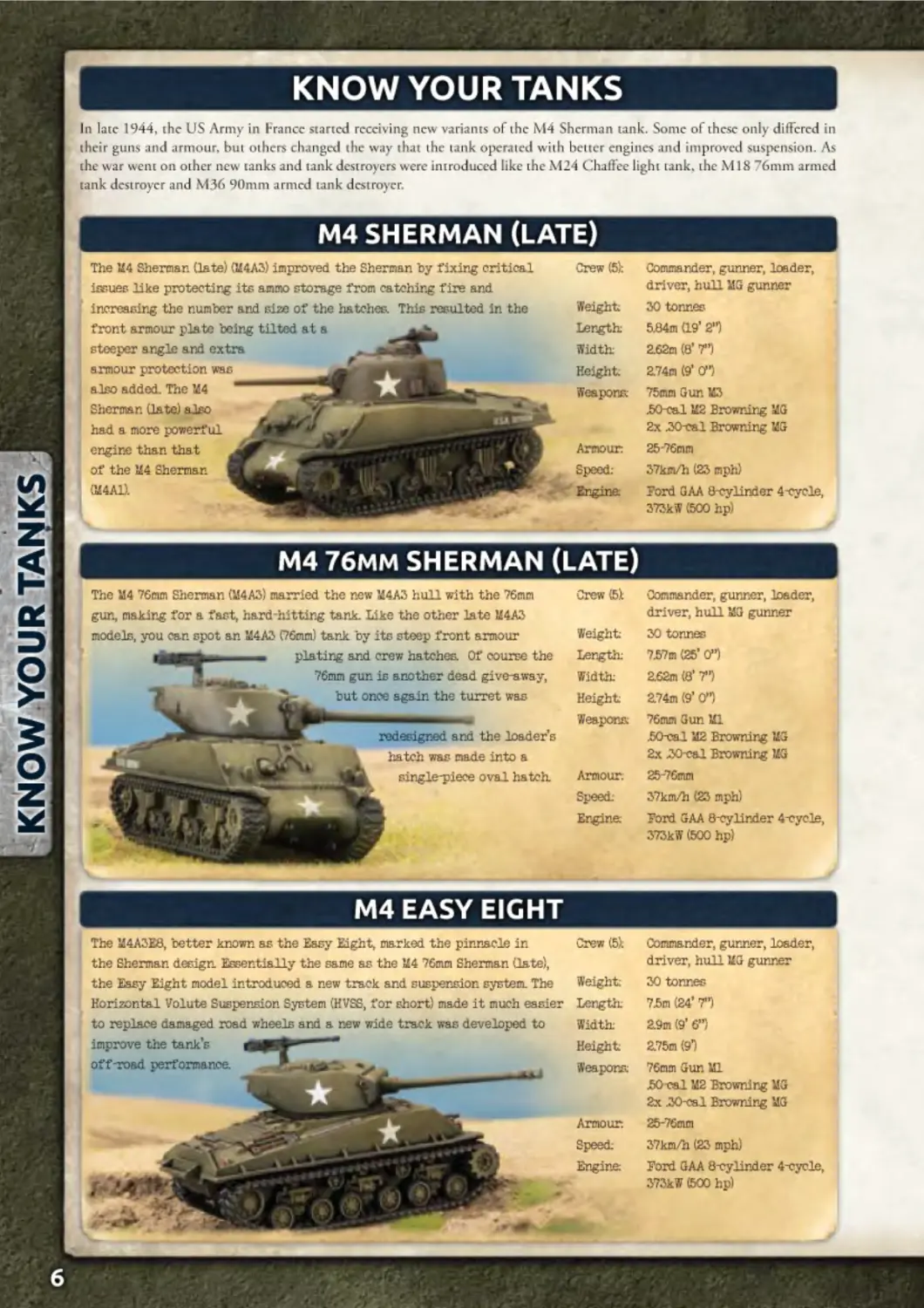
M4 SHERMAN (LATE)
The M4 Sherman (late) (M4A3) improved the Sherman by fixing critical
issues like protecting its ammo storage from catching fire and
increasing the number and size of the hatches. This resulted in the
front armour plate being tilted at a
steeper angle and extra
armour protection was
also added. The M4
Sherman (late) also
had a more powerful
engine than that
of the M4 Sherman
(M4A1).
Crew (5): Commander, gunner, loader,
driver, hull М3 gunner
Weight 30 tonnes
Length	5.04m	(19’ 2”)
Width	2.62m	(8’ 7”)
Height	274m	(9* 0”)
Weapons;	75mm	Gun М3
.50-cal М2 Browning MG
2x ,30-cal Browning MG
Armour	25'76mm
Speed;	37km/h (23 mph)
Engine;	Ford GAA 8-cylinder 4-cycle,
373kW (500 hp)
M4 76MM SHERMAN (LATE)
The M4 76mm Sherman (M4A3) married the new M4A3 hull with the 76mm
gun, making for a fast, hard hitting tank. Like the other late M4A3
models, you can spot an M4A3 (76mm) tank by its steep front armour
plating and crew hatches. Of course the
76mm gun is another dead give-away,
but once again the turret was
redesigned and the loader’s
hatch was made into a
single-piece oval hatch
Crew <51 Commander, gunner, loader,
driver, hull MG gunner
Weight 30 tonnes
Length	757m (25’ 0”)
Width	262m (8’ 7")
Height	274m (9’ 0")
Weapons.	76mm Gun Ml
.50-cal М2 Browning MG
2x 50-cal Browning MG
Armour. 25-76mm
Speed.	37km/h (23 mph)
Engine;	Ford GAA 8-cylinder 4-cycle,
373k W (500 hp)
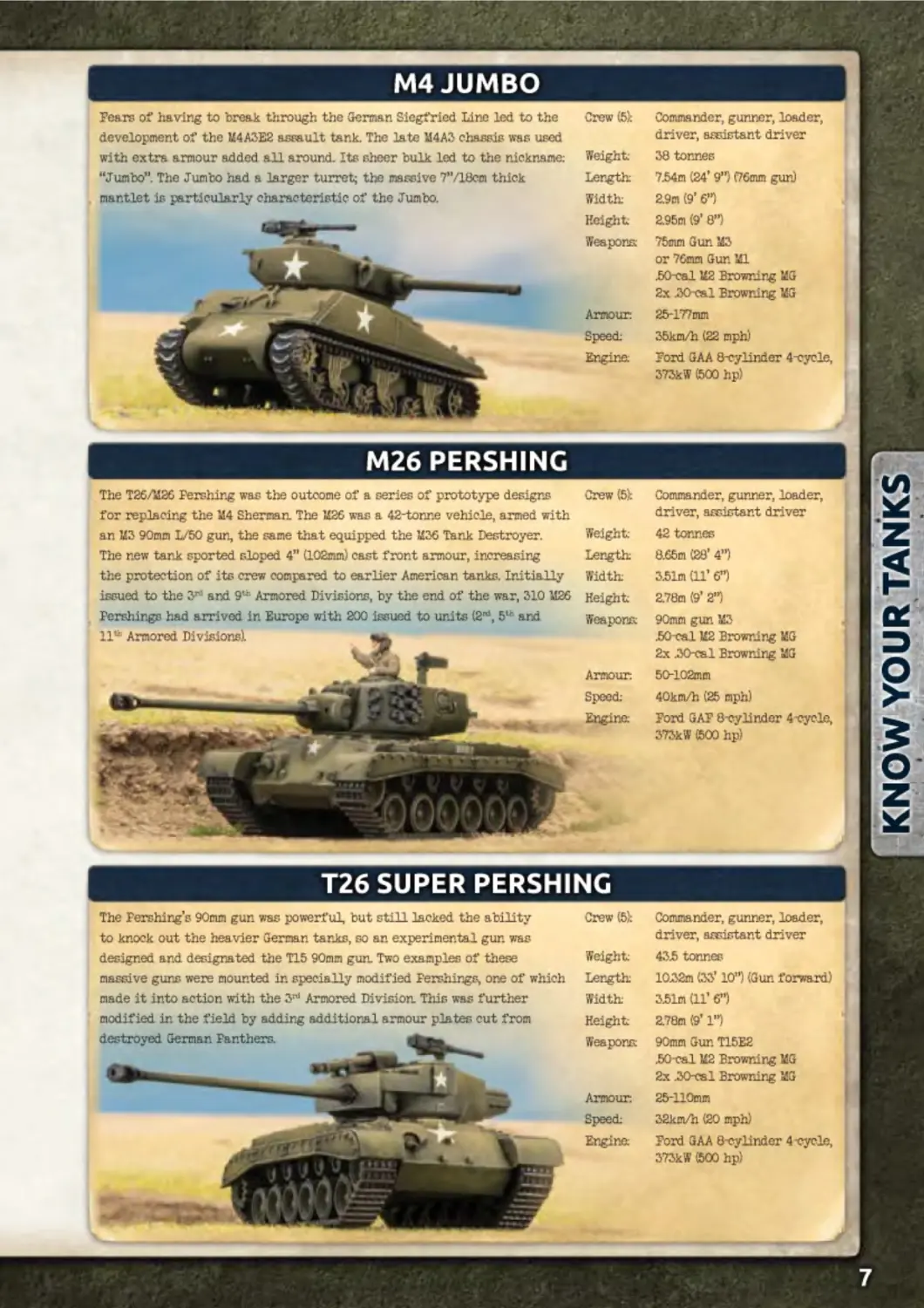
М4 JUMBO
Fears of having to break through the German Siegfried Line led to the Crew (5);
development of the M4A3E2 assault tank. The late M4A3 chassis was used
with extra armour added all around. Its sheer bulk led to the nickname; Weight;
Commander, gunner, loader,
driver, assistant driver
38 tonnes
“Jumbo”. The Jumbo had a larger turret; the massive 7”/18cm thick
mantlet is particularly characteristic of the Jumbo.
Length;
Width-
Height
Weapons;
Armour;
Speed;
Engine
754m (24’ 9”) C76mm gun)
29m (9’ 6")
2.95m (9’ 8”)
75mm Gun М3
or 76mm Gun Ml
,50-cal М2 Browning MG
2x ,30-cal Browning MG
25-177mm
35km/h (22 mph)
Ford GAA 8-cylinder 4-cycle,
373kW (500 hp)
M26 PERSHING
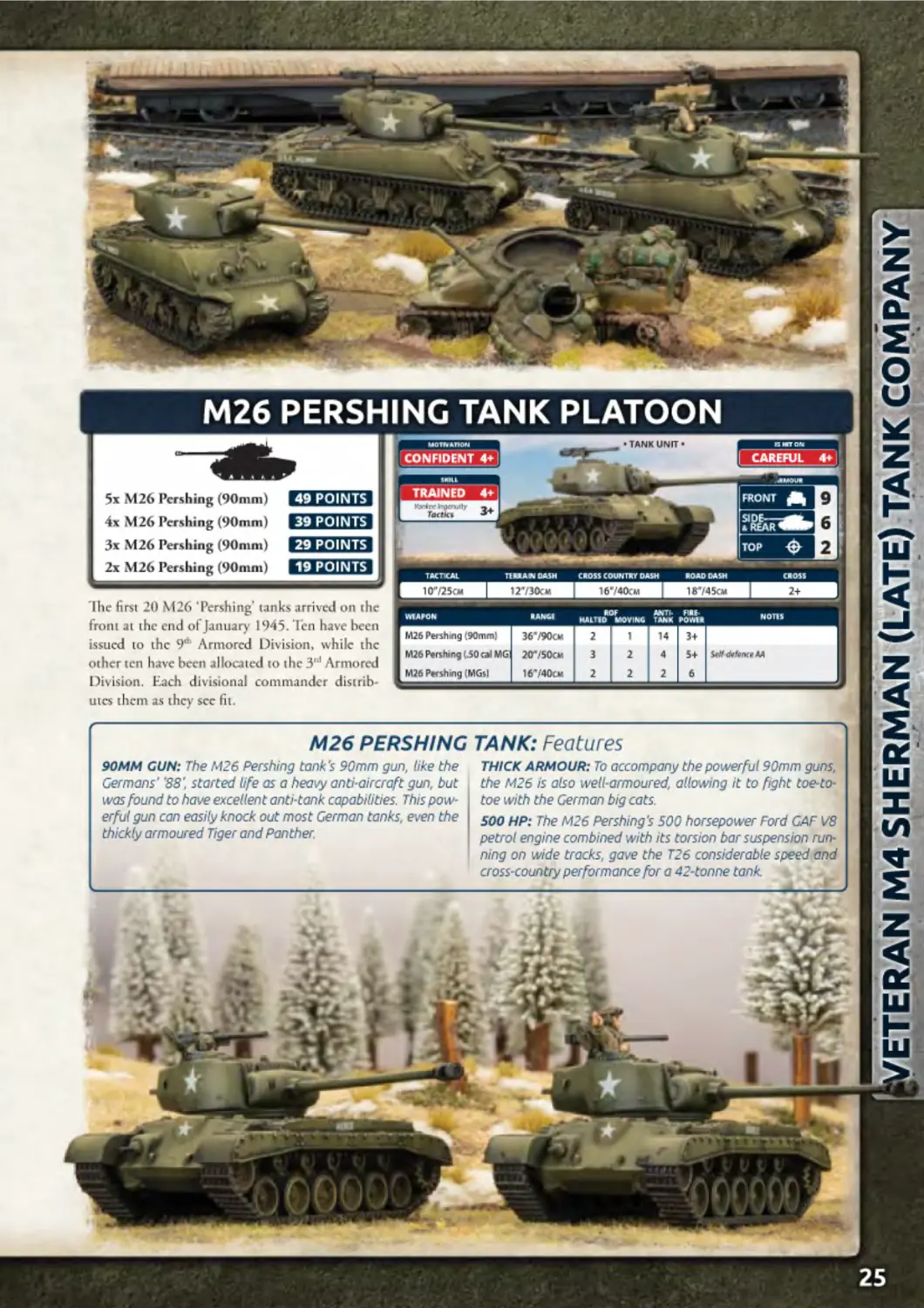
The T26/M26 Pershing was the outcome of a series of prototype designs
Crew (5b
for replacing the M4 Sherman. The M26 was a 42-tonr.e vehicle, armed with
an М3 90mm L/50 gun, the same that equipped the M36 Tank Destroyer.
The new tank sported sloped 4" (102mm) cast front armour, increasing
the protection of its crew compared to earlier American tanks. Initially
issued to the 3rJ and 9“‘ Armored Divisions, by the end of the war, 310 M26
Pershings had arrived in Europe with 200 issued to units 12"*, 5th and
llto Armored Divisions).
Weight
Length
Width
Height
Weapons.
Armour.
Speed;
Engine;
Commander, gunner, loader,
driver, assistant driver
42 tonnes
855m (28’ 4”)
3.51m (11’ 6")
278m (9’ 2”)
90mm gun М3
.50-cal М2 Browning MG
2x ,30-cal Browning MG
50-102mm
40km/h (25 mph)
Ford GAF 8-cylindcr 4-cycle,
373kW £500 hp)
М5 STUART
The M5 is the second ma„tor version of the Stuart light tank. The new
model lias a bit more armour protection as well as a larger turret The
extra weight was handled by a new twin Cadillac engine that kept the
light tank moving quickly.
М24 CHAFFEE
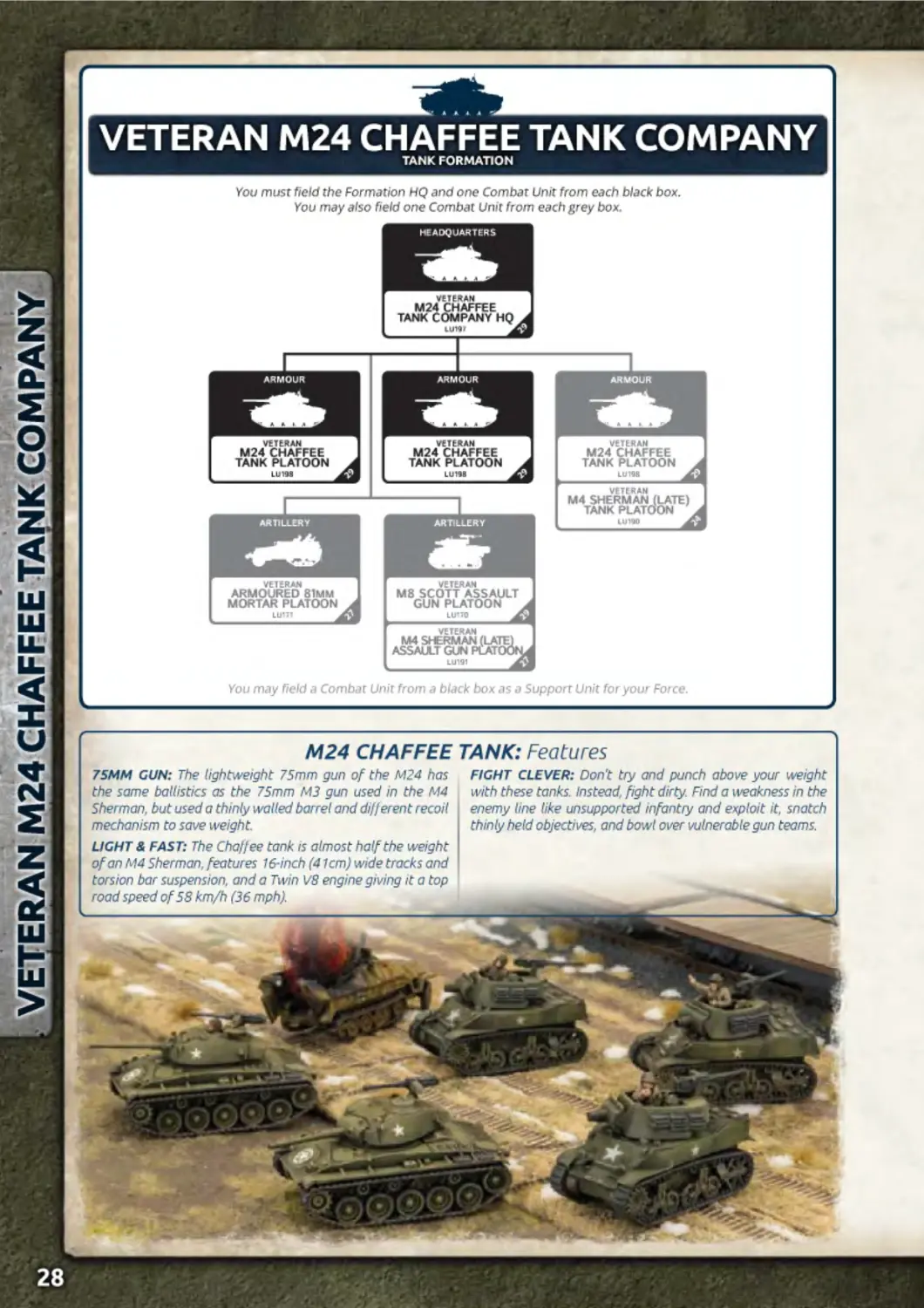
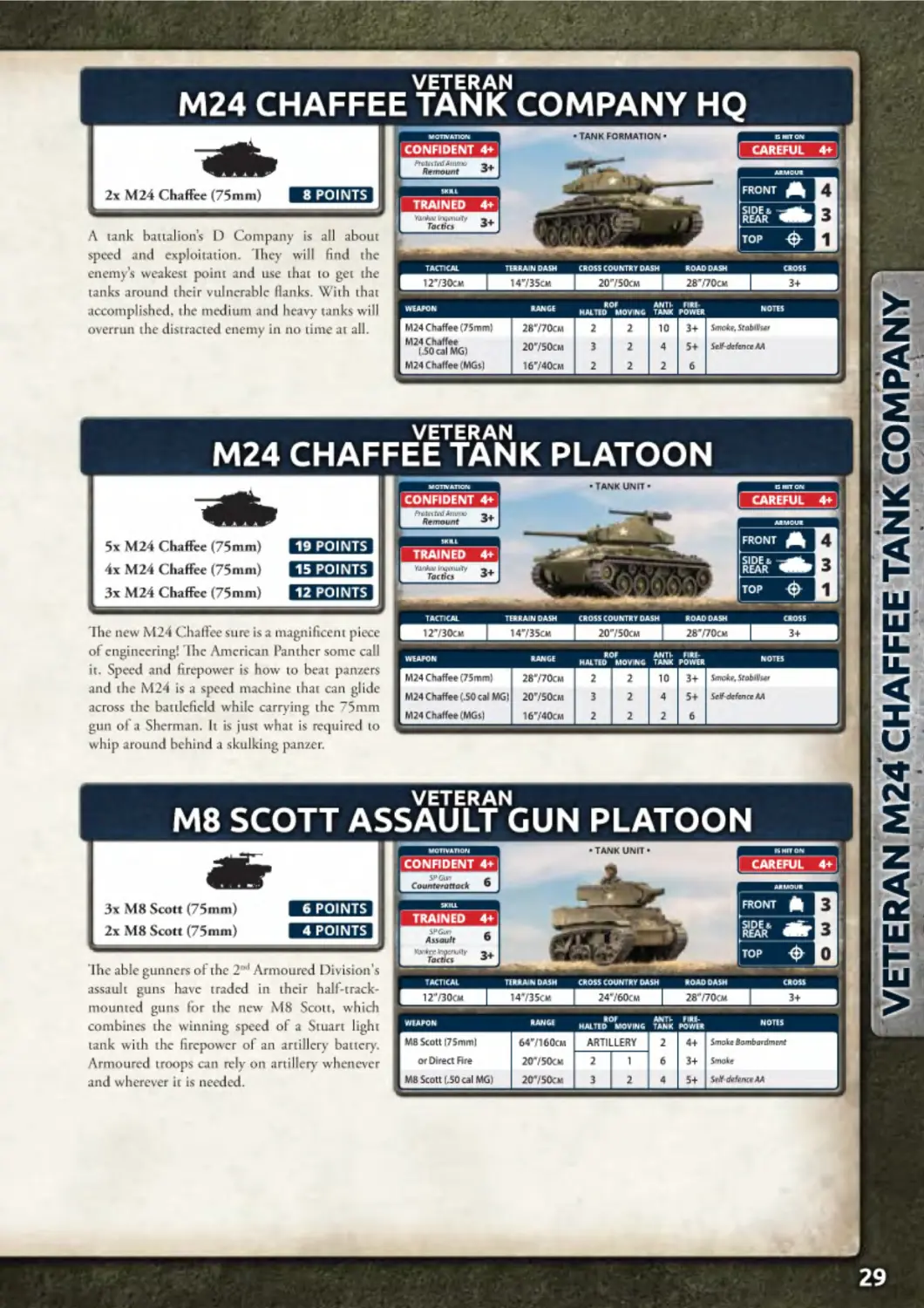
The addition of the M24 Chaffee light tank to the US arsenal greatly
enhanced the utility of the light tank company. It had greater
mobility than the M5 Stuart, combined with a more powerful 75mm gun,
allowing it to serve in its roles to provide reconnaissance, protection
of flanks, covering force, as well as direct assault or support by fire.
Crew (4):	Commander/loadcr, gunner, driver, hull MG gunner
Weight	165 tonnes
Length:	4.62m (15’ 2”)
Width;	239m (7* 10”)
Height	233m (7 8”)
Weapons;	37mm Gun M6 3x 30-cal Browning MG
Armour	25-51mm
Speed:	58 km/h (36 mph)
Engine	Twin Cadillac V8, 220 kW (296 hp)
Crew (51	Commander, gunner, loader, driver, radio operator
Weight	1837 tonnes
Length:	556m (18’ 3")
Width;	3m (9’ 10”)
Height	2.77m (9’ 1")
Weapons;	75mm Gun M6 50-cal М2 Browning М3 2x 30-cal Browning MG
Armour.	10-38mm
Speed.	56km/h (35 mph)
Engine:	Twin Cadillac V8, 220 kW (160 hp)
T34 CALLIOPE ON M4 SHERMAN
To provide the tank battalion with extra firepower when supporting
infantry, five T34 Calliope rocket launcher field kits were issued and
installed on one of the battalion’s platoons. The T34 Calliope rocket
launcher was attached to the M4 Sherman turret and elevation was
raised and lowered with the main gun, but because of this attachment
the gun could not be
used while the Calliope
was attached.
Crew (51	Commander, gunner, loader, driver, assistant driver
Weight	42 tonnes
Length;	5jB4m (19’ 2")
Width;	262m (8’ 71)
Height	3.74m (12* 3")
Weapons;	T34 rocket launcher firing 60 45-inch M8 rockets 2x 30-eal Browning MG
Armour	25-76mm
Speed.	37km/h (23 mph)
Engine;	Ford GAA 8-cylinder 4-cycle, 373kW (500 hp)
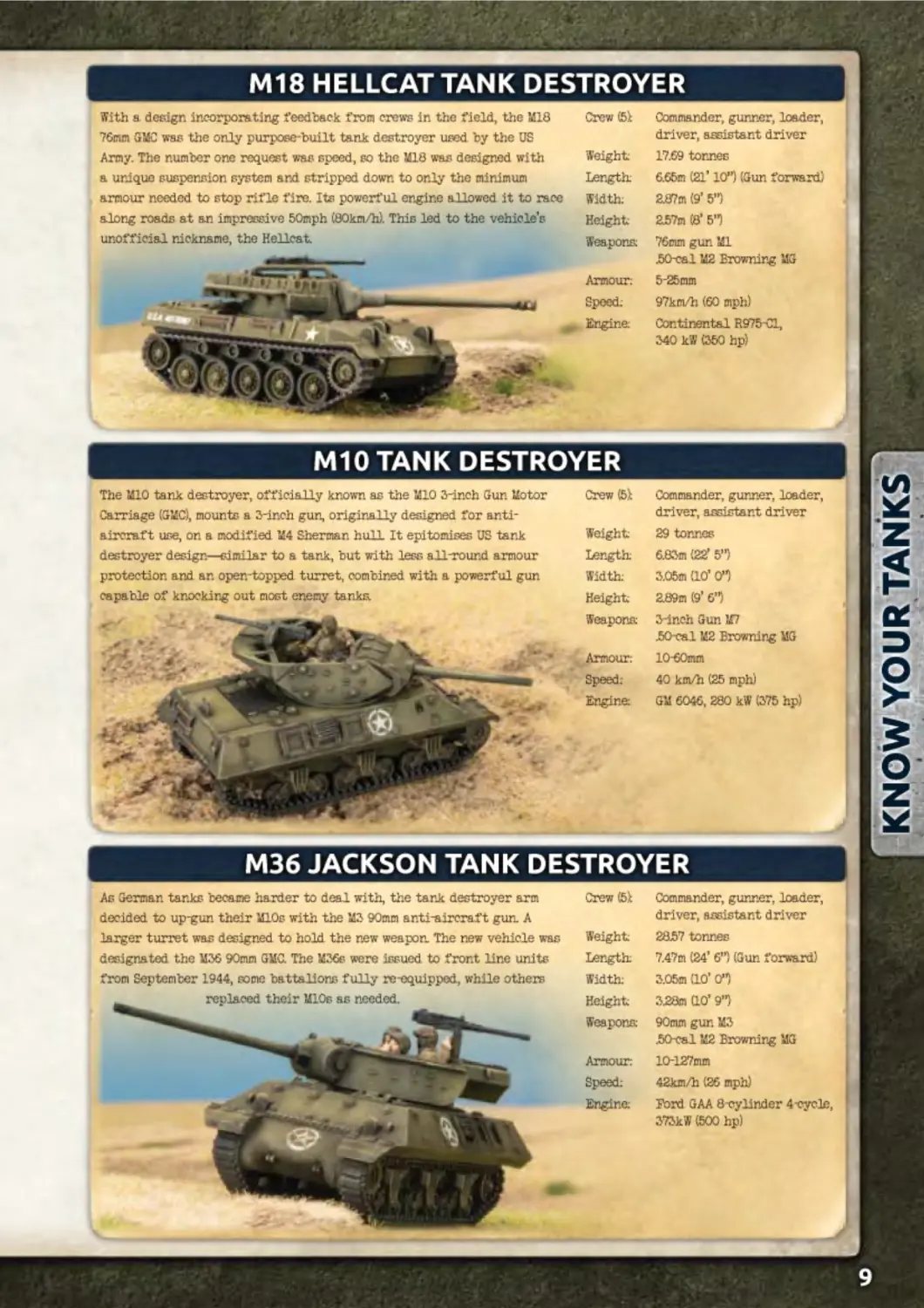
М18 HELLCAT TANK DESTROYER
With a design incorporating feedback from crews in the field, the M18
76mm SMC was the only purpose-built tank destroyer used by the US
Army. The number one request was speed, so the M18 was designed with
a unique suspension system and stripped down to only the minimum
armour needed to stop rifle fire. Its powerful engine allowed it to race
along roads at an impressive 50mph (80km/h). This led to the vehicle’s
unofficial nickname, the Hellcat.
•Crew (51
Weight
Length
Width;
Height
Weapons.
Armour:
Speed;
Engine;
•Commander, gunner, loader,
driver, assistant driver
17.69 tonnes
6.65m (21* 10") (Sun forward)
2187m (9’ 5”)
257m (8* 5”)
76mm gun Ml
50-cal М2 Browning MG
5-25mm
97km/h (60 mph)
Continental R975-C1,
340 kW (350 hp)
M10 TANK DESTROYER
The MIO tank destroyer, officially known as the MIO 3-inch Gun Motor
Carriage (SMC), mounts a 3-ir.ch gun, originally designed for anti-
aircraft use, on a modified M4 Sherman hull It epitomises US tank
destroyer design—similar to a tank, but with less all-round armour
protection and an open-topped turret, combined with a powerful gun
capable of knocking out most enemy tanks.
•Crew (5л 'Commander, gunner, loader,
driver, assistant driver
Weight-	29 tonnes
Length.	6.83m (22я 5”)
Width.	3.05m 0.0' 0”)
Height	2B9m (9’ 6”)
Weapons:	3-inch Gun M7
	50-cal М2 Browning MG
.Armour:	1050mm
Speed;	40 km/h (25 mph)
Engine:	GM 6046, 280 kW (375 hp)
M36 JACKSON TANK DESTROYER
As German tanks became harder to deal with, the tank destroyer arm
decided to up-gun their MIOs with the М3 90mm anti-aircraft gun. A
larger turret was designed to hold the new weapon. The new vehicle was
designated the M36 90mm GMC. The M36s were issued to front line units
from September 1944, some battalions fully re-equipped, while others
Crew (5 л	Commander, gunner, loader,
driver, assistant driver
Weight 2857 tonnes
Length.	7.47m (24’ 6") (Gun forward)
Width;	3.05m (10' 0”)
Height	3.28m 0.0’ 9")
Weapons;	90mm gun М3
50-cal М2 Browning MG
Armour:	10-127mm
Speed;	42km/h (26 mph)
Engine;	Ford GAA 8 cylinder 4-cycle,
373kW (500 hp)
KNOW YOUR INFANTRY
A lot of veteran infantry formations have been in combat since the Normandy landings on 6 June 1944, having fought their
way through France to the German border. These troops are vastly experienced, but have had little chance for a respite from
the fighting. They tend to be more cautious and less aggressive. To represent this in the game, they retain their Blood ‘N Guts
bonus that grants them an improved Rally rating, but arc Reluctant for their other Motivation ratings.
However, the airborne troops, by their very nature, are experienced veterans. They have not been worn down by constant
combat as they are normally withdrawn for rest and refit after completing their assigned mission. These parachute rifle and
glider rifle troops retain good Motivation and have a Veteran Skill rating. They arc flexible and can complete all their combat
tasks quickly and effectively.
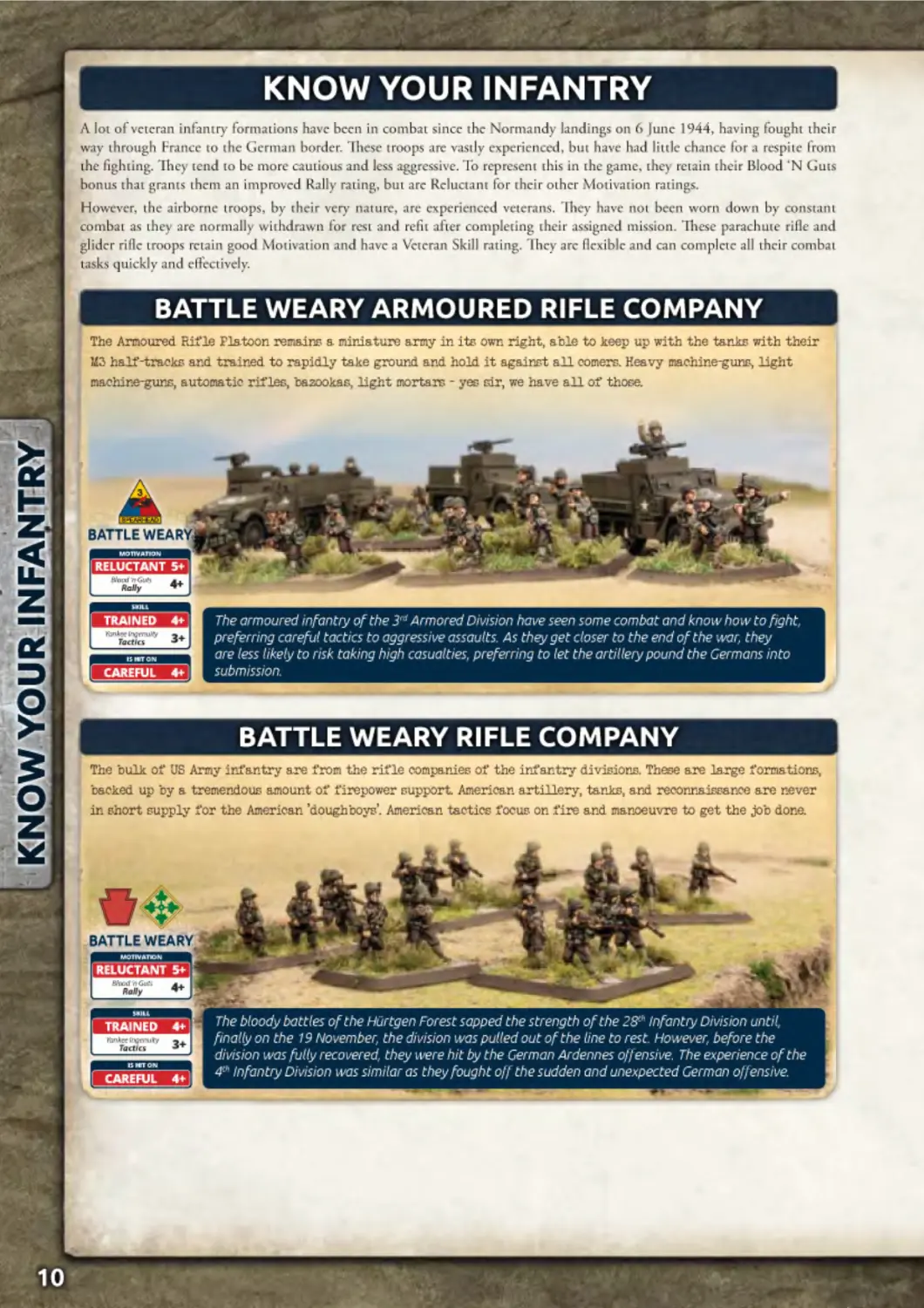
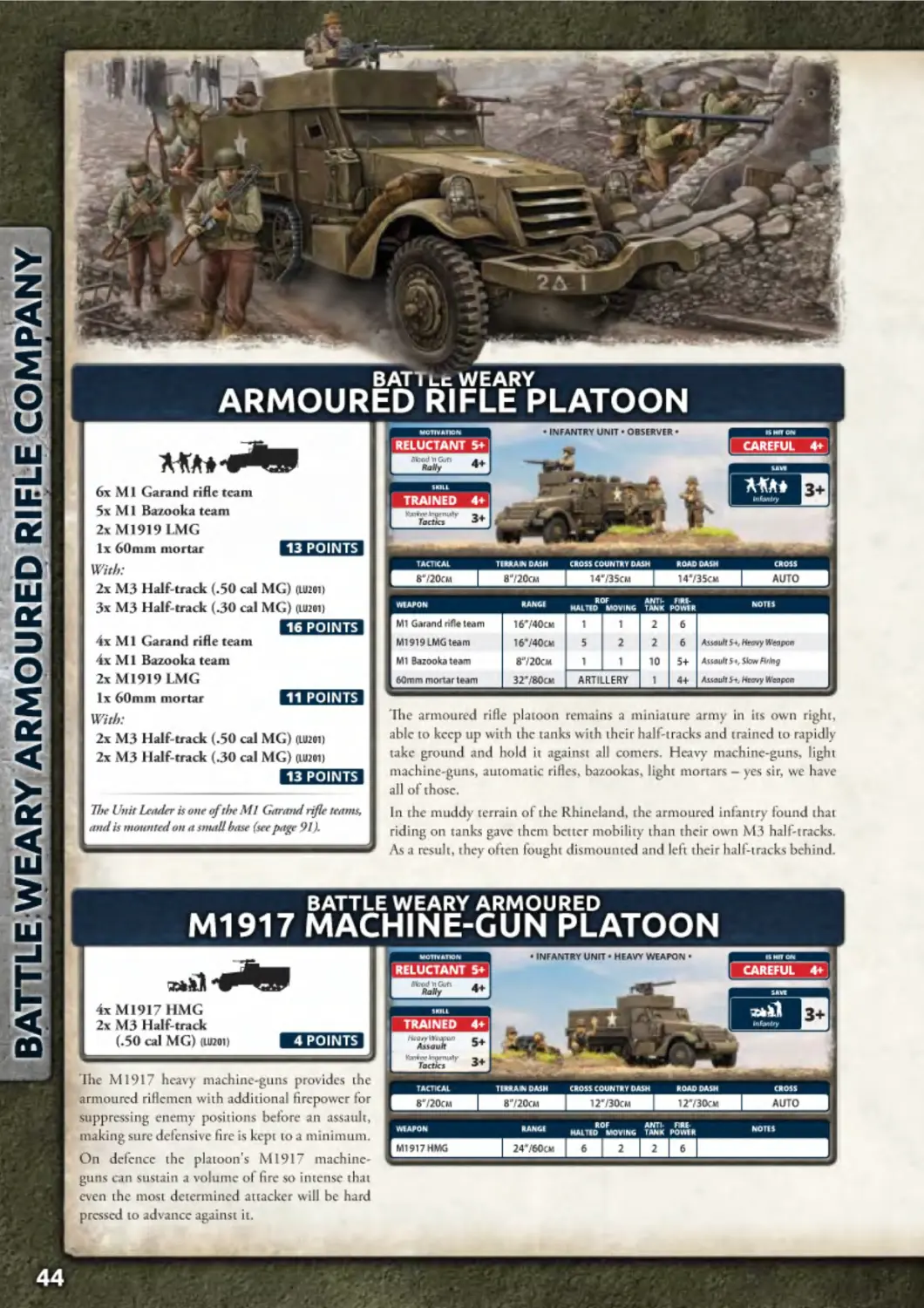
BATTLE WEARY ARMOURED RIFLE COMPANY
The Armoured Rifle Platoon remains a miniature army in its own right, able to keep up with the tanks with their
М3 half-tracks and trained to rapidly take ground and hold it against all comers. Heavy machine-guns, light
machine-guns, automatic rifles, bazookas, light mortars - yes sir, we have all of those.
BATTLE WEARY RIFLE COMPANY
The bulk of US Army infantry are from the rifle companies of the infantry divisions. These are large formations,
backed up by a tremendous amount of firepower support American artillery, tanks, and reconnaissance are never
in short supply for the American 'doughboys’. American tactics focus on fire and manoeuvre to get the job dona
BATTLE WEARY
The bloody bottles of the Hurtgen Forest sapped the strength of the 2&" Infantry Division until,
finally on the 19 No vember, the division was putted out of the line to rest. However, before the
division was fully recovered, they were hit by the German Ardennes offensive. The experience of the
4*" Infantry Division was similar as they fought off the sudden and unexpected German offensive.

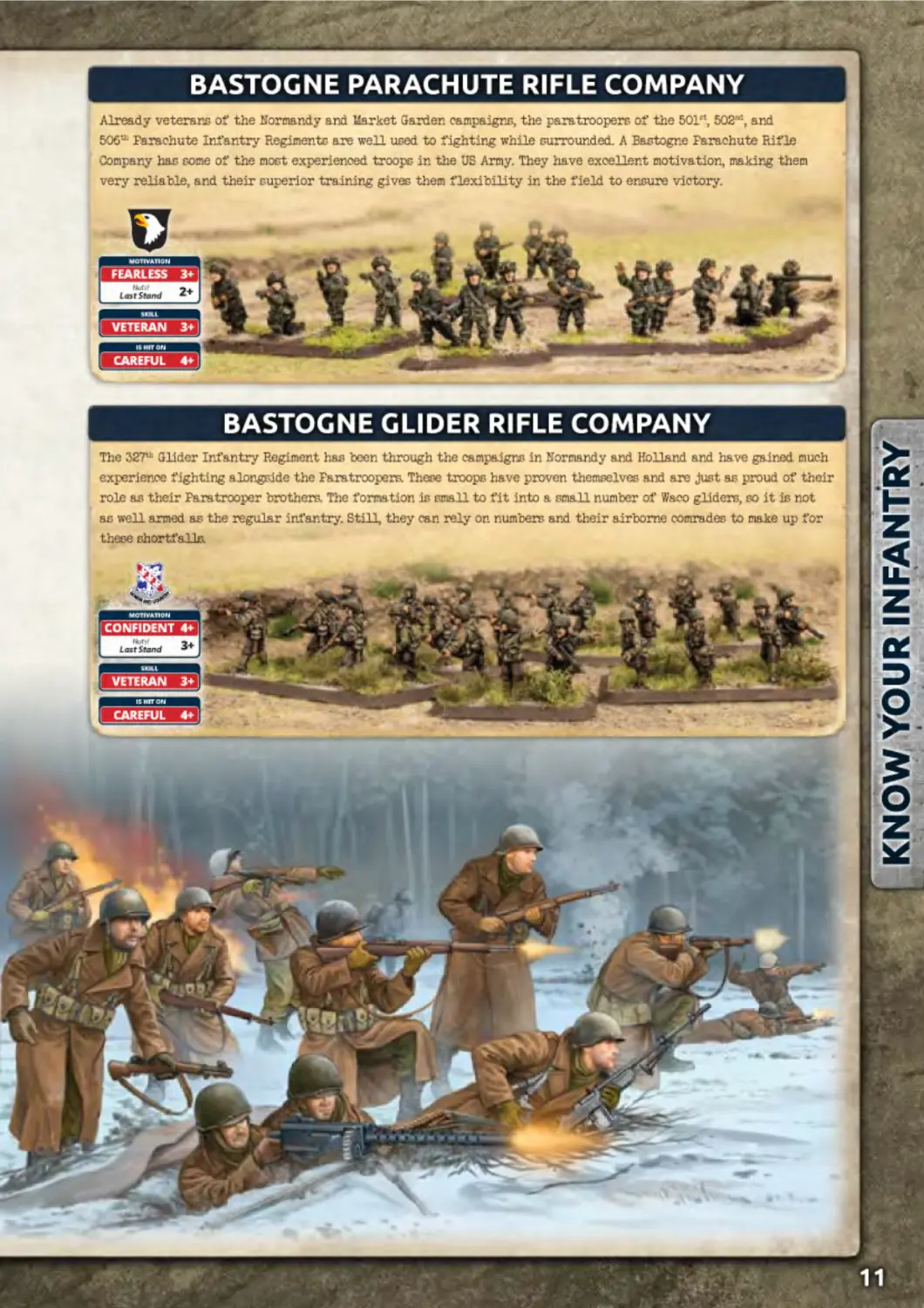
BASTOGNE PARACHUTE RIFLE COMPANY
Already veterans of the Normandy and Market Garden campaigns, the paratroopers of the 501rt, 502м, and
5O6-- Parachute Infantry Regiments are well used to fighting while surrounded. A Bastogne Parachute Rifle
Company has some of the most experienced troops in the US Army. They have excellent motivation, making them
very reliable, and their superior training gives them flexibility in the field to ensure victory.
VETERAN 3+
BASTOGNE GLIDER RIFLE COMPANY
The 327й- Glider Infantry Regiment has been through the campaigns in Normandy and Holland and have gained much
experience fighting alongside the Paratroopers. These troops have proven themselves and arc just as proud of their
role as their Paratrooper brothers. The formation is small to fit into a small number of Waco gliders, so it is not
as well armed as the regular infantry. Still, they can rely on numbers and their airborne comrades to make up for
these shortfalls
[ ши
VETERAN 3+
[	BMTON
CAREFUL
WILDCARD
V ”4
TANK FORMATIONS
RECONNAISSANCE
AN I -AN<
3-INCH TANK DESTROYER
PLATOON
LUI 5
*
BULGE: AMERICAN FORCE
Your Force must contain at least one Formation,
and may contain as many Formations as you like.
VETERAN
M4 SHERMAN (LATE)
TANK COMPANY
IU1B9
M8 GREYHOUND
CAVALRY RECON PATRO
или
M5 STUART
CAVALRY RECON PATRO
LU231
VETERAN	,
M24 CHAFFEE
TANK COMPANY A
M4 SHERMAN (LATE
TANK COMPANY
LU 181
M24 CHAFFEE
TANK COMPANY
US SUPPORT UNITS
You may field one Support Unit from each box.
RECONNAISSANCE
M8 GREYHOUND
CAVALRY RECON PATRO
LU1U
M5 STUART
CAVALRY RECON PATR
LU 231
P-47 THUNDERBOLT
FIGHTER FLIGHT
T27 XYLOPHONE ROCKET
LAUNCHER BATTERY >
LU229
FORMATION SUPPORT
You may field compulsory
Combat Units (with
a black box) from
US Formations as
Support Units.
ALLIED SUPPORT
You may field one com-
pulsory Unit from a British
Formation as Support and
one British Formation as
an Allied Formation.

4th armored division
The 4* Armored Division, under the
command of the aggressive General John
Wood, first saw action during the breakout
from Normandy in late July 1944. While
most of the armoured divisions headed cast
following the breakout, the 4'h Armored
smashed into the Brittany Peninsula,
securing Coutanccs and Rennes, before
joining in the race across France toward
the German frontier.
The divisions seemingly unstoppable
advance sputtered to a halt at the Meuse
River, along with the rest of the Third
Army, for lack of foci during the first days of September 1944.
But through ingenuity' and careful rationing, Patton and his staff
kept the offensive going, albeit at a slower pace.
NAME ENOUGH
Most divisions in the US Army had nicknames, such as “Old
Ironsides" for the 1’ Armored, “Hell on Wheels" for the
2“* Armored, and “Spearhead" for the 3,J Armored. However,
when the time came for the 4* Armored Division to choose a
nickname. General Wood put it plainly that “Fourth Armored
Division docs not need and will not have a nickname. They
shall be known by their deeds alone.” From that point on
“Name Enough" was the 4th Armored’s unofficial nickname.
NANCY
By September, the 4* Armored, now assigned to Major
General Eddy’s XII Corps, found itself in front of Nancy.
Knowing his tanks would be wasted in a city fight. General
Wood deployed his combat commands (CCA, CCB, and
CCR) north and south of the city along the Moselle River.
On 12 September, CCB and CCR
stormed across the Moselle and attacked
Lorey before pushing north to Mont and
then on to Dombasle by 14 September.
Meanwhile, CCA waited patiently as the
80* Infantry' Division struggled to estab-
lish a bridgehead at Pont-i-Mousson.
Frustrated, the Americans forced
another crossing a bit further south at
Dieulouard, the site of an ancient cross-
ing guarded by old Celtic, Roman, and
medieval fortifications. They' managed
to open up a narrow corridor, but it was
fiercely opposed by the German infantry and assault guns.
Crossing the river with CCA would be risky at best.
Tlte cautious Major General Eddy called a council of war to
discuss whether or not to send CCA across to exploit the
gap. Colonel Bruce Clarke, commander of CCA, deferred to
his top battalion commander. Lieutenant Colonel Creighton
Abrams, who pointed across the river and simply replied,
“That’s the shortest way home!” Eddy' gave in and sent CCA
across the Moselle.
CCA pushed through the bridgehead and into the open
country on the other side. The American tankers raced deep
behind enemy lines, smashing up a dozen German tanks
along the way. By nightfall CCA was within striking distance
of Chambrey. Together with CCB’s and CCR’s advances in
the south, the noose around Nancy was getting so tight that
the Germans evacuated the city on 15 September.
LUNEVILLE
As the American spearheads moved deeper, the Germans
launched an infantry attack to cut off CCR’s advance at
Coutances
Rennes °
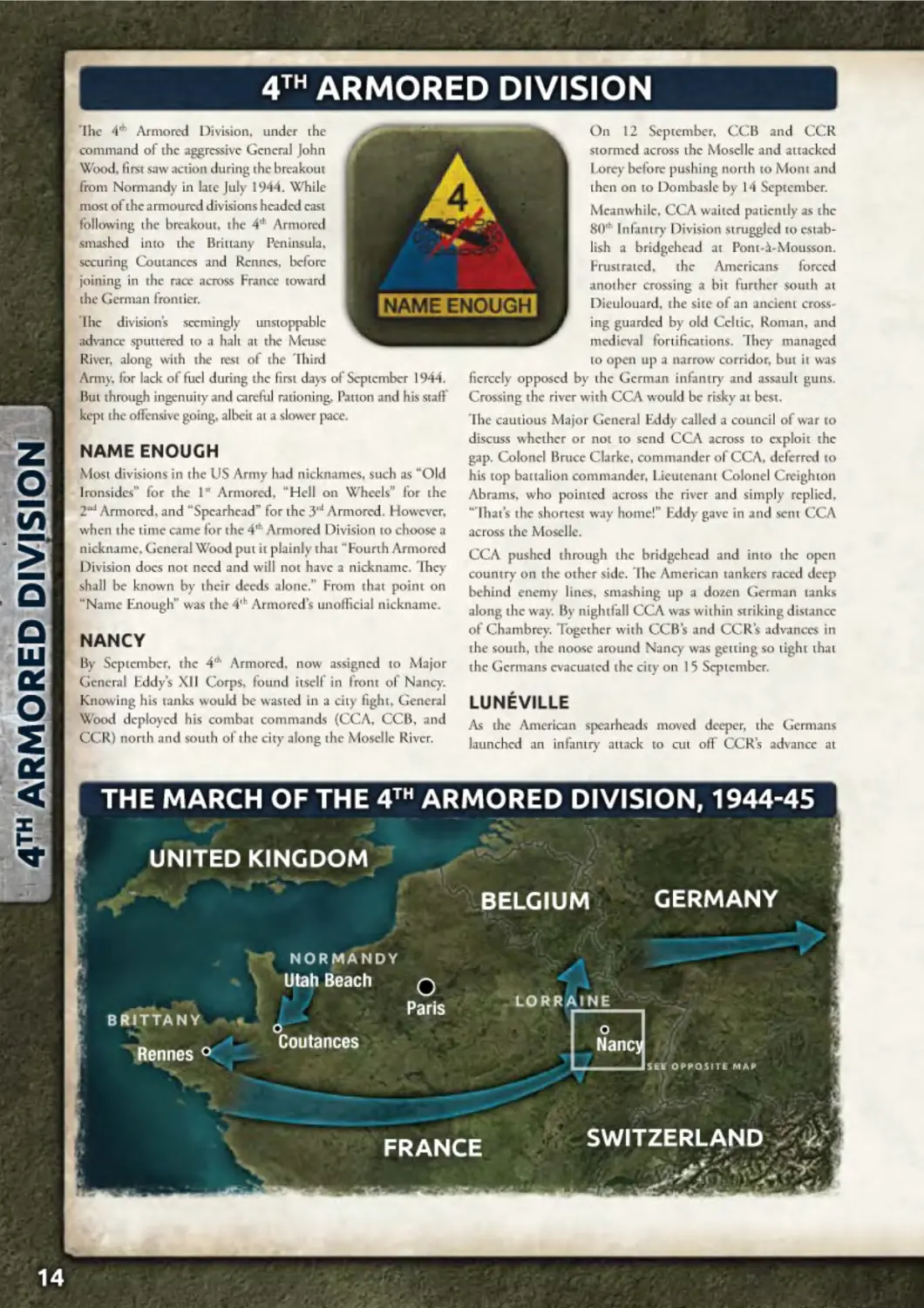
THE MARCH OF THE 4™ ARMORED DIVISION, 1944-45
UNITED KINGDOM
GERMANY
LORRAINE
Dorie
SEE OPPOSITE MAP
BELGIUM
NORMANDY
Utah Beach
r P' /	* •
FRANCE
Nancy!
14
Combat Command В
559 VG Div
Fllrey
Oambrey
Arracoi
St Nicoi*s*^u-Pon1
Pont
Fla vlgny
BrBmoncourt
0 Miles___________5
OKItoMOtree 10
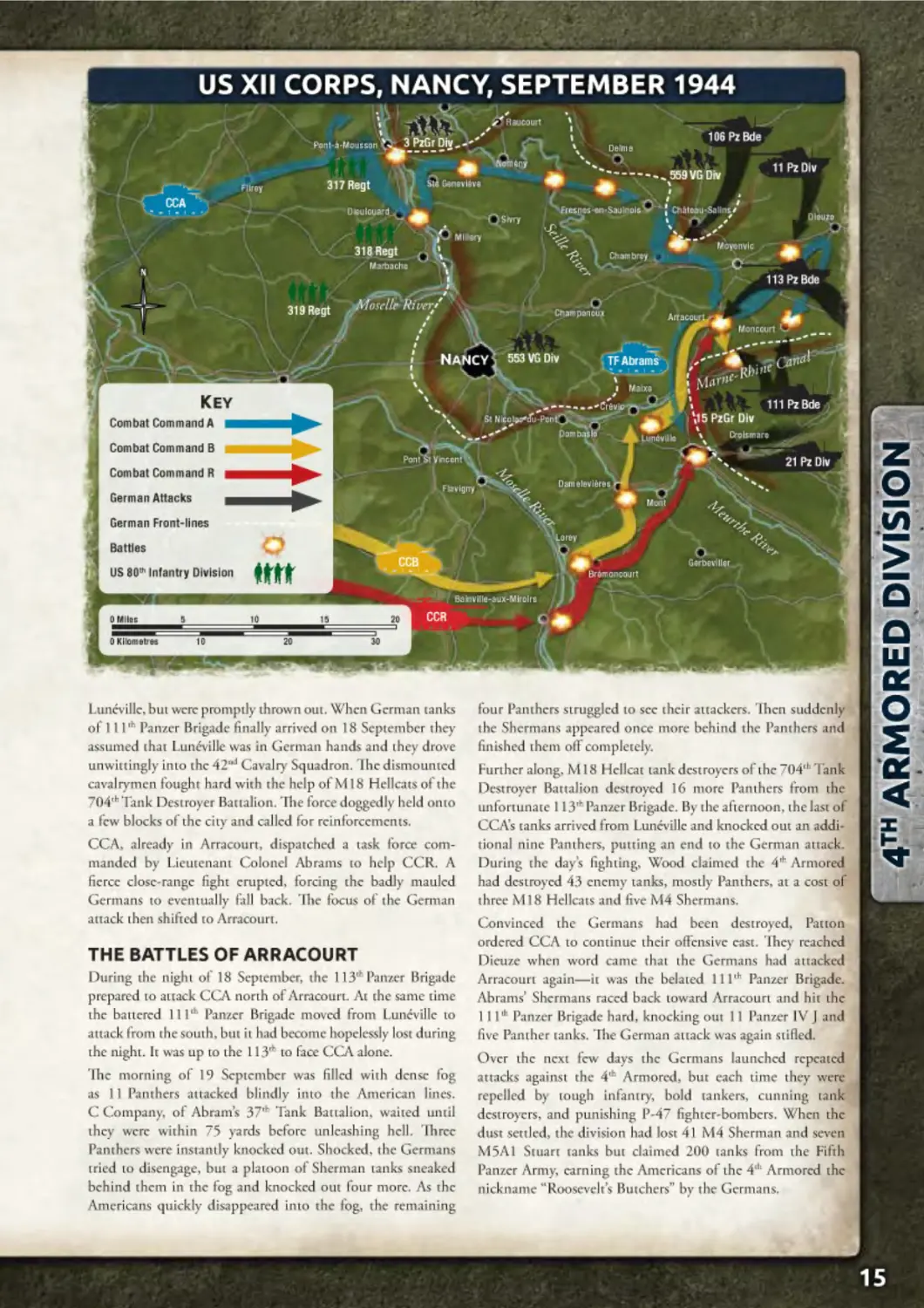
KEY
Combat Command A
Combat Command R
German Attacks
German Front-lines
Battles
US 80'” Infantry Division
♦tn
US XII CORPS, NANCY, SEPTEMBER 1944
z* Raucourt
106PzBde
De In ifi
11 PzDIv
317 Regt
Frcsn«-«n-Saulnolfi V * { ChalMU’SaHnt/
DttJlouard
Qiduzd -
Snry
Mlll«ry
Moycnvlc
113PzBde
Moncourt -
TF Abrams
Maixe
'6r6vj
LunOvilte
Vhconl’
21 Pz Div
Dam elevates
Mont
CCB
Bahvllle-aux-Mifolts
CCR
318 Regt
Marbach»
Nancysssvgdiv
_ О
Оатропоид
•J
LJt&l
6
Gertieviller
.	111PzBde
‘,15PzGr Div
ч Ooltirnre
Pont a-Mousson 3 PzGr Diy
M 'Avmeny
I J St* tienBVlW*
319 Regt AftrtJS Riirr/
CCA
' . I . i

Luncvillc, but were promptly thrown out. When German tanks
of 111* Panzer Brigade finally arrived on 18 September they
assumed that Luneville was in German hands and they drove
unwittingly into thc42"d Cavalry Squadron. Ihc dismounted
cavalrymen fought hard with the help ofM18 Hellcats of the
704* Tank Destroyer Battalion. Ute force doggedly held onto
a few blocks of the city and called for reinforcements.
CCA, already in Arracourt, dispatched a task force com-
manded by Lieutenant Colonel Abrams to help CCR. A
fierce close-range fight erupted, forcing the badly mauled
Germans to eventually fall back. The focus of the German
attack then shifted to Arracourt.
THE BATTLES OF ARRACOURT
During the night of 18 September, the 113* Panzer Brigade
prepared to attack CCA north of Arracourt. At the same time
the battered 111* Panzer Brigade moved from Luncvillc to
attack from the south, but it had become hopelessly lost during
the night. It was up to the 113* to face CCA alone.
Ihc morning of 19 September was filled with dense fog
as 11 Panthers attacked blindly into the American lines.
C Company, of Abram’s 37* Tank Battalion, waited until
they were within 75 yards before unleashing hell. Three
Panthers were instantly knocked out. Shocked, the Germans
tried to disengage, but a platoon of Sherman tanks sneaked
behind them in the fog and knocked out four more. As the
Americans quickly disappeared into the fog, the remaining
four Panthers struggled to sec their attackers, lhen suddenly
the Shermans appeared once more behind the Panthers and
finished them off completely.
Further along, M18 Hellcat tank destroyers of the 704* Tank
Destroyer Battalion destroyed 16 more Panthers from the
unfortunate 113* Panzer Brigade. By the afternoon, the last of
CCA’s tanks arrived from Luncvillc and knocked out an addi-
tional nine Panthers, putting an end to the German attack.
During the day's fighting. Wood claimed the 4* Armored
had destroyed 43 enemy tanks, mostly Panthers, at a cost of
three M18 Hellcats and five M4 Shermans.
Convinced the Germans had been destroyed, Patton
ordered CCA to continue their offensive cast. They reached
Dieuzc when word came that the Germans had attacked
Arracourt again—it was the belated 111* Panzer Brigade.
Abrams’ Shermans raced back toward Arracourt and hit the
111'11 Panzer Brigade hard, knocking out 11 Panzer IV J and
five Panther tanks. The German attack was again stilled.
Over the next few days the Germans launched repeated
attacks against the 4* Armored, but each time they were
repelled by tough infantry, bold tankers, cunning tank
destroyers, and punishing P-47 fighter-bombers. When the
dust settled, the division had lost 41 M4 Sherman and seven
M5A1 Stuart tanks but claimed 200 tanks from the Fifth
Panzer Army, earning the Americans of the 4* Armored the
nickname "Roosevelt's Butchers” by the Germans.
15
THE ARDENNES
After the fighting in the Lorraine, the division was enjoy-
ing a long deserved rest and refit when news of the
German attack in the Ardennes reached the Ibird Army
on 16 December 1944. Patton shifted his most able divi-
sions, including the 26* Infantry, 80* Infantry, and the
4* Armored Divisions north to the Belgian border to launch
his counterattack on 21 December. During that night, the
German Seventh Army had slipped through between the lead
elements of the advancing Third Army and the 101" Airborne
Division in Bastogne, completing the encirclement of the
important crossroads there. The US paratroopers were cut oft.
While they were used to fighting in isolation, the “Screaming
Eagles” of the 101" could not hold out indefinitely. Breaking
the siege became the 4* Armored’s top priority.
lhe fight to reach Bastogne was difficult. Combat Commands
A and В each made a drive before being ground to a halt,
exhausted, and out of options. Still, they had propelled the
division deep into German lines. On 26 December, with
Bastogne just out of sight, it was CCR’s turn with Abrams’
37* Tank Battalion leading the way.
ABRAMS TAKES THE LEAD
The German 5* Fallsthirmjager (Parachute) Division made
the advance slow and tough for the US tankers. But Abrams
pushed his men hard through one small village after another.
He doggedly kept the pressure on the Germans, cycling his
companies and denying the enemy a moment’s respite.
However, the moment had arrived when Abrams’ battal-
ion was dowrn to 20 operational tanks and 250 “Armored
Doughs" (a nickname given to the armoured infantry). His
A and В Companies were depleted and had run out of the
reliable 75mm ammunition needed to knock out enemy-
guns and infantry. To make matters worse, the well-defended
village of Assenois stood between his tanks and Bastogne, just
five miles away.
WE'RE GOING IN
Abrams began to doubt if he had the strength to keep going.
His thoughts were interrupted by the droning sound of
.American transport planes risking it all through a thick sheet
of German flak to drop supplies to the besieged defenders
of Bastogne. That was it, his resolve was hardened. Abrams
pointed in the direction of their objective.
“We’re going in to those people, now.” He turned to his
men and had C Company’s seven remaining tanks brought
forward. After conferring with General Patton, he ordered
a bold rush straight through Assenois to Bastogne with
1’Lieutenant Charles P Boggess’ M4A3E2 Jumbo, nick-
named “Cobra King”, leading the way.
With a pat on the back of the nervous lieutenant, Abrams
told Boggess, "Get to those men in Bastogne.” With that
the Lieutenant mounted up and the column moved out. At
1615 hours, Boggess’ tanks were on their way.
ASSENOIS
Waiting for them in .Assenois were eight dug-in anti-tank
guns and a large number of Fallschirmjiiger and Volksgrenadier
troops. To help deal with the defenders. Abrams called in a
pre-arranged barrage from 13 artillery' batteries as his tankers
charged through. Over 2300 shells smashed into Assenois
as the Americans stormed down the road. Remarkably only
a single half-track and a jeep were hit and destroyed by
friendly fire.
lhe Germans' return fire was ineffectual as they tried to cope
with both artillery' and the thick hide of Cobra King as it
blocked the incoming fire with its mass. The Jumbo fired its
75mm gun like a machine-gun, firing 21 shells in a matter
of minutes and plastering the German lines with explosive
shells as it tore through the village. Confusion was rampant
in the German lines as the “Armored Doughs” swept the
bewildered German defenders with machine-gun fire from
their half-tracks.
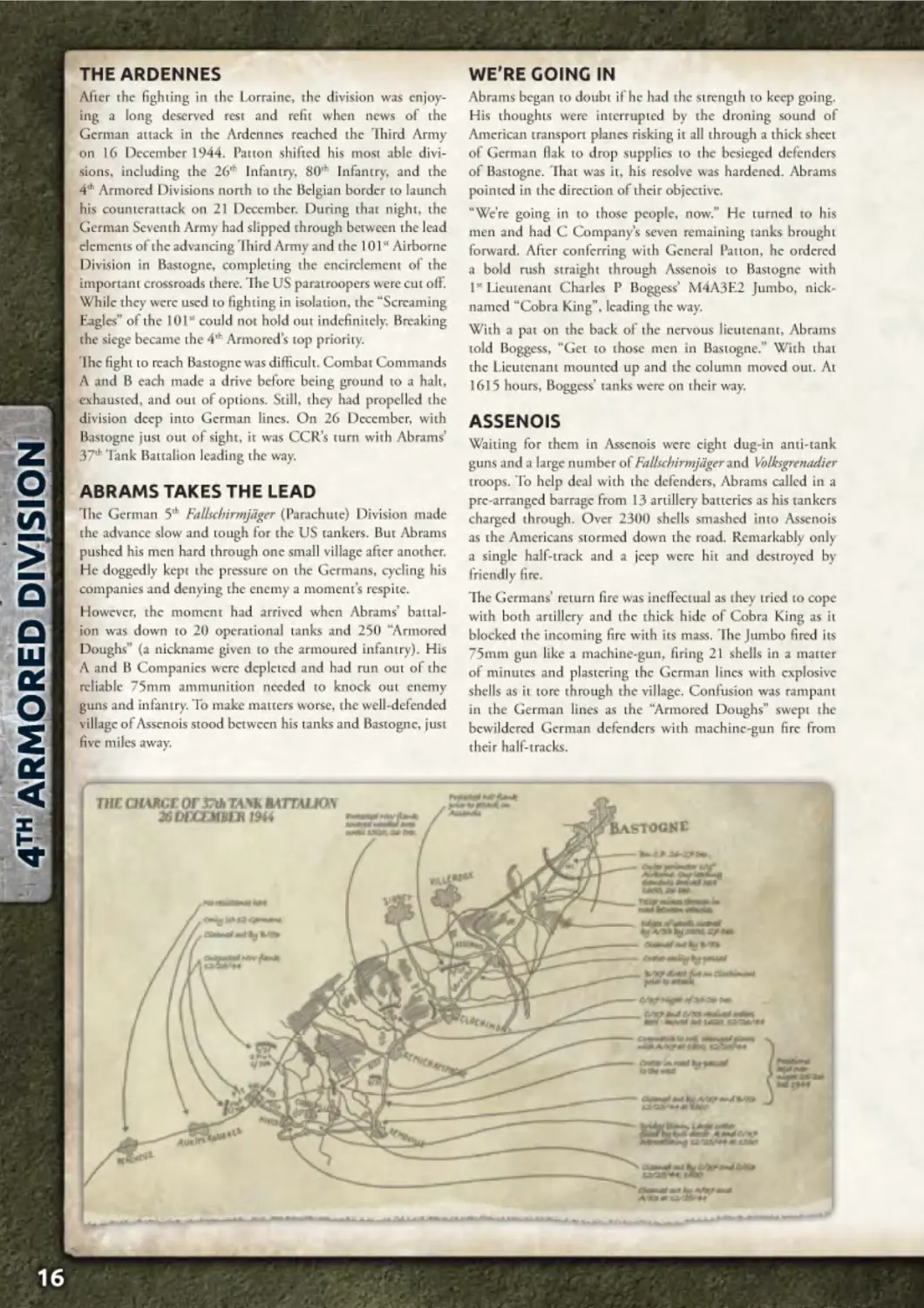
THE CHARGE QT Prt TANK RA7TAJ JON
All was going well until a telephone pole was hit by a 155mm
shell and toppled onto a half-track, which stopped the vehicle
and cut Boggess’ column in half. As the tanks sped forward to
Bastogne, the “Armored Doughs" fought a bloody hand-to-
hand fight with the defenders of Asscnois amongst the deadly
barrage from their own artillery.
Abram's tank, Ihunderbolt VI, sped forward to see what was
holding up the advance. When he reached the telephone pole,
Abrams and his crew dismounted tinder fire to help clear the
obstacle and get the column moving again.
HENDRIX'S HEROICS
During the struggle, one armoured rifleman, Private James
Hendrix, noticed a pair of anti-tank guns firing on the tanks.
Armed with his Ml rifle, he shot one of the guns’ crew and
ordered the rest to surrender. They refused. As Hendrix
approached their foxholes a German poked his head up only
to be struck by the butt oi Hendrix’s rifle, lhe rest of the crews
surrendered their guns, which were then put out of action.
As the column drove through the streets of Assenois, an
М3 half-track was struck by an anti-tank round, lhe occu-
pants were strewn around the vehicle, dead and wounded.
Two German machine-guns were sweeping the wreck with
fire. The “Armored Doughs” angrily returned fire with their
.50 cal machine-guns but failed to silence the Germans. Then
Private Hendrix jumped out of his half-track and sniped the
crews of the offending machine-guns. Hendrix stayed with
the wounded men until they were evacuated.
On his way again, he witnessed a German grenade explod-
ed inside another М3 half-track. Most of the men escaped
before the vehicle went up in flames, but one tnan was left
behind. Once again running through enemy fire. Hendrix
rescued the man and put the flames out. but the man later
died of his wounds. Hendrix was later awarded the Medal of
Honor for his actions in Asscnois.
PRESSING ON
Meanwhile, Boggess' column, now consisting of just five
Shermans and one М3 half-track, broke free of Assenois and
pushed on to Bastogne. The half-track in the middle of the
column was overloaded with riflemen and fell behind the
faster tanks, creating a wide gap in the column. The Germans
made use of the space created in Boggess' column to deploy a
string of Teller mines across the road. The half-track did not
notice the danger and was destroyed by a mine. The surviving
infantrymen and the tankers dismounted and cleared the road
before mounting up on the Shermans to chase after Boggess.
INTO BASTOGNE
Cobra King and the other remaining tanks were driving
forward when they suddenly encountered a German pill-
box. Boggess put three high explosive rounds into the con-
crete structure. Remarkably the pillbox caught on fire and
began smoking.
As Cobra King cautiously approached it, several soldiers
emerged from a nearby wood. Boggess shouted out for the
soldiers to identify themselves. An officer came forward
with a massive smile and said, “I’m Lieutenant Webster,
326* Airborne Engineers, glad to see you guys!" It was
1650 hours, 26 December 1944.
The 4'1' Armored had reached Bastogne after five days
of bloody combat. At 1710 hours, Abrams reported to
Brigadier General .Anthony McAuliffe, commander of the
101 Airborne to see what he could do to help. The siege had
been lifted, but the fighting wasn’t over yet.
lite 4tk Armored worked with the 101“ Airborne to widen
the corridor and then helped to throw the enemy back into
Germany before crossing the Rhine themselves. By the time
the war ended, the 4<h Armored Division had charged all of
the wav to Czechoslovakia.
4th ARMORED DIVISION
US COMBAT COMMANDS
Combat commands were used by armoured divisions to add
a degree of flexibility to their command. The concept was
proposed by General Adna Chaffee, known as the father of
the US armoured forces. He envisioned a flexible unit along
the same lines as the German Kampfgruppe, or battle group,
but on a much higher command level.
In essence a division could be broken up into about three
separate units roughly the size of a brigade or regiment. They
were called Combat Command A, B, and R, referred to as
CCA. CCB, and CCR respectively.
CCA and CCB had the bulk of the divisions offensive units,
such as tanks, armoured infantry, self-propelled artillery, and
cavalry recon, and were used to attack. CCR stayed behind
in reserve with towed artillery, tank destroyers, and under
strength units, ready to reinforce or take over a stalled advance.
The example below is based on the 4lh Armored Division
at the outset of the division’s attack in the Ardennes, but it
is representative of many combat commands in operation
during the war.
4th armored division
COMBAT COMMAND A
COMBAT COMMAND В
35' TANK BATTALION
B" TANK BATTALION
51’ ARMORED INFANTRY BATTAdON
10’ ARMORED INFANTRY BATTALION
XkU 4
mti rntzi mtn
COMBAT COMMAND R
37 Tank Battalion
S3”Armored infantry batia.ion
mtn mtn mtn ыь
704 TANK DESTROYER BATTALION
ttt
L-r,
Grevhound
22"“ Armored field
ARTILLERY BATTALION
94'“ armored Field
ARTILLERY BATTAdON
177'“ FIELD ARTILLERY
Battalion (155мм
177 Field artillery
Battalion 155mm)
M7 Ггк-м
M •
M-l SI mm
MMC
274th armored Field
Artillery battalion
В TROOP, 25'" CAVALRY
reconnaissance squadron
Ms Semi
MC
C BATTERY, 489' AAA SELF-
PROPELLED BATTALION
A BATTERY, 489' AAA SELF-
PROPELLED BATTALION
A TROOP, 25 CAVALRY
RECONNA SSANCE SQUADRON
A COMPANY, 24' ARMORED
ENGINEER BATTALION
В COMPANY, 24 ARMORED
ENGINEER BATTAdON
C COMPANY, 24' ARMORED
Engineer battalion
В ВАГ URY, 489' AAA SELF
PROPELLED BATTALION
or Stout Car
M4 Sherman lank
(various models)
MIX He I cat
Tank Destroyer
I ton or
2 l-i ton truck
Ms AI
Stuart
Armored
Platoon
Ml 155mm
I owitzer
MIA MGMt
(Quad .50 cal)
M St I Mt
1.37mm)
66' ARMORED Field ARTILLERY
ВАПА. ON
М3
I {all tra<к
mtn mt2i
mt г
mt
Anvorvd Ritlr
Company
C, D, AND E TROOPS,
25' cava.ry Reconnaissance Squadron
M20 Utility
Machine-gun
Combat Engineer
Company


18
IMPROVING THE BREED
M4 SHERMAN TANKS
When the Second World War broke out in September 1939,
the US Army possessed 18 М2 medium tanks. lhe situation
had not improved when the US Army was shocked into
action by the fall of France in June 1940. With a require-
ment of2000 as yet un-designed medium tanks by the end of
1941, the Army accepted a radical proposal from GMC for
Chrysler to build a brand-new tank factory, the Detroit Tank
Arsenal, specifically to mass produce tanks. Within a year
the updated М3 medium tank (named the General Grant by
the British) was rolling out the doors, with the Detroit Tank
Arsenal producing over 3000 in its first year.
With the М3 on the production line, attention turned to a
new M4 medium tank (named the General Sherman by the
British), The M4 was designed as one of the most powerful
medium tanks in existence. It mounted a 75mm gun in a
fully-traversing turret, and armour able to withstand any
tank gun then being fielded. Like the earlier medium tanks,
it was powered by a Continental radial aircraft engine. This
gave it a reliable engine with lots of power, but resulted in an
unusually tall tank.
The first model into production was the M4A1 with a
cast hull, quickly followed by the M4 with a welded steel
hull, manufactured by heavy engineering firms like Lima,
American Loco, and Pressed Steel. These first saw combat
with the British at El Alamein where they were known as the
Sherman 11 and Sherman 1 respectively.
A shortage of radial engines led Chrysler to devise a mul-
ti-bank engine of five standard automotive engines linked to
a common drive shaft. This M4A4 (Sherman V to the British)
model replaced the М3 in production at the Detroit Tank
Arsenal. With demand still outstripping production, General
Motors built another tank factory at Grand Blanc, near Flint,
Michigan. This factory turned out the M4A2 (Sherman III)
model, this time with a twin GM diesel motor. Both of these
types were rarely seen in the US Army, being sent to Britain,
the Soviet Union, and China instead.
Meanw'hile Ford entered the picture with a new 500 hp V8
tank engine, creating the M4A3. This was produced in rela-
tively low' numbers (for a tank produced in such staggering
numbers as the Sherman!) until Grand Blanc switched to
producing it in early 1944. Once this model started reaching
the troops in August 1944, it quickly became the most popu-
lar version of the Sherman.
These М4ЛЗ tanks produced by Grand Blanc were some of
the first of a new generation of Sherman tanks. Combat expe-
rience had shown a number of problems with the original
design: weaknesses in the armour, dangerous ammunition
stowage, and poor turret hatches, 'lhe new-style tanks had a
single piece hull front, ‘wet’ armoured ammunition stowage
bins filled with fire-retardant fluid, a better commanders
cupola, and a new loader’s hatch.
With the basic Sherman tank rolling off the production lines
in huge numbers, attention was turned to producing new
variants, lhe first of these was armed with a 105mm howitzer
to give the tank battalions their own artillery. The Detroit
Tank Arsenal produced these in both the M4 and M4A3
configurations.
With the armour of German tanks getting thicker each year,
there was concern over the ability of the Sherman tank to
deal with them. The designers created a variant armed with
a 76mm gun with better anti-tank capability, but the initial
response was that it was totally unnecessary' since the tank
destroyers would fight enemy tanks leaving the tanks free
to engage other targets. Fortunately' production of M4A1,
M4A2, and eventually M4A3, models began anyway, as
demand for them soared when the Army faced large numbers
of heavy German tanks for the first time in Normandy.
With no heavy tanks available, another variant was rushed
into production in early 1944. This M4A3E2 (the second
experimental variant of the M4A3), was a heavily' armoured
assault tank designed for infantry support. Nicknamed the
“Jumbo", the M4A3E2 arrived too late for the fighting in
Normandy, only' reaching the front in October 1944.
In late 1944, the final tweak to this famous design. HVSS
suspension, entered production. HVSS (Horizontal Volute
Spring Suspension) gave a much smoother ride and better flo-
tation on wider tracks than the old vertical volute suspension.
Tanks fitted with this were commonly called “Easy Eights"
from the M4A3E8 designation given to the prototype, lhe
Easy Eight continued in service after the war, fighting in the
Korean War.
19
AMERICA'S BATTLE TANK
AMERICA'S BATTLE TANK
THE M26 PERSHING
The winter battles of late 1944 and
early 1945 finally demonstrated to the
US Army’s high command that the M4
Sherman, though providing excellent
service in previous years, was wholly
inadequate to confront German heavy
armour and anti-tank guns. Furthermore,
it fatally undermined the prevailing US
tank doctrine, which had prescribed
leaving the engagement of enemy tanks
to the Tank Destroyer battalions, freeing
the tanks to support the infantry and
exploit gaps in the enemy lines. A new
armoured vehicle was needed that was
better suited to the realities of modern warfare. Fortunately,
after a good deal of debate, the T26E3 heavy tank was put
into production in November 1944.
The T26 was the outcome of a long series of potential
replacements for the aging M4 Sherman as the US Army's
main battle tank. It was the first American tank to break
away from the early 1930s design concept. The T26 was a
42-tonne vehicle, armed with an М3 90mm L/50 gun, the
same that equipped the M36 Jackson Tank Destroyer. The
new tank sported sloped 4” (102mm) cast frontal armour,
dramatically increasing the protection of its crew compared
to earlier American tanks. The relocation of the drive train
to the rear avoided the need to run the drive shaft under the
turret and allowed for the roof height to be lowered.
The power plant was the same 500 horsepower Ford GAF V8
petrol engine in the latest versions of Sherman. The running gear
had six double-bogies per side on a new torsion bar suspension
running on a 23*758cm wide track. Together, these improvements
gave the T26 considerable speed for a tank in its weight class.
SPEARHEAD
The final production model, theT26E3,
was given the name Pershing, in honour
of General John Pershing, commander of
the American Expeditionary Force in the
First World War. The Pershing provided
US tankers with a vehicle that greatly
improved on the M4 and was roughly
comparable to the German Panther.
THE T26 ARRIVES
IN THE ETO
By the end of 1944, the first run of
40 T26E3s was complete and after a
great clamour for them, the first batch of 20 arrived in the
European Theatre of Operation (ETO) at the end of January
1945 as part of the Zebra Mission—a special mission to test
the latest US designs of tanks and guns in combat conditions.
These experimental T26s were therefore accompanied by a
contingent of specialists to help report and iron out mechan-
ical teething problems.
Ten T26E3 tanks were issued to each of the 3rd and
9d‘ Armored Divisions. The 3rf Armored Division allocated
five each to its 32nd and 33rd Armored Regiments, who in turn
allocated a single example to their five tank companies.
Meanwhile, the 9lk Armored Division allocated five of its
T26s to the 14,hTank Battalion, which grouped them all into
a single heavy tank platoon in A Company. The other five
were given to the 19” Tank Battalion, which allocated one
T26 to A Company and a pair each to В and C Companies.
20
SPEARHEAD PERSHINGS
The 3ri ‘Spearhead’ Armored Division completed its training
near the end of February and then put their T26s to the test
on 25 February during the approach to the Roer River. The
following night, near Elsdorf, F Company’s T26, nicknamed
'Fireball', was hit three times in an ambush by a 'Tiger' and
knocked out. The tank was repaired and back in action within
a few' days.
The Pershings had their revenge on 27 February, where
33“* Armored Regiment's T26 from E Company knocked out
a ’Tiger' at 900 yards using a special HVAP shell, followed by
a standard AP shell. Shortly after, the Pershing also destroyed
two Panzer IV tanks at the impressive range of 1200 yards.
On 6 March, Sergeant Bob Early's Pershing of E Company,
32nd Armored Regiment, was filmed flanking and destroying
a troublesome Panther outside Cologne cathedral. Other
3rd Armored Division Pershings dispatched a Tiger and
a Panzer IV near Cologne, and the T26 of D Company-
knocked out tw'o further l igers.
Two Pershings were lost approaching Cologne. One of these,
belonging to H Company', 33"* Armored Regiment, was per-
manently written off after being knocked out by a German
8.8cm anti-tank shell from a tank-hunter firing just 200 yards
away. After piercing the thick frontal armour, the round went
through the forward compartments, between the driver’s legs,
and set off the ammunition on the floor of the tank. It was
considerable good fortune that all the crew survived!
AMERICA'S BATTLE TANK
SUPER PERSHING
lhe Pershing’s 90mm gun was powerful, but still lacked the
ability to knock out the heavier German tanks, so an experi-
mental gun was designed and designated thcT15 90mm gun.
Two examples of these massive guns were mounted in special-
ly-modified Pershings, one of which made it into action with
the 3rd Armored Division. This was further modified in the
field by adding additional armour plates cut from destroyed
German Panthers. The result was .America's first and only
super-heavy tank of the war.
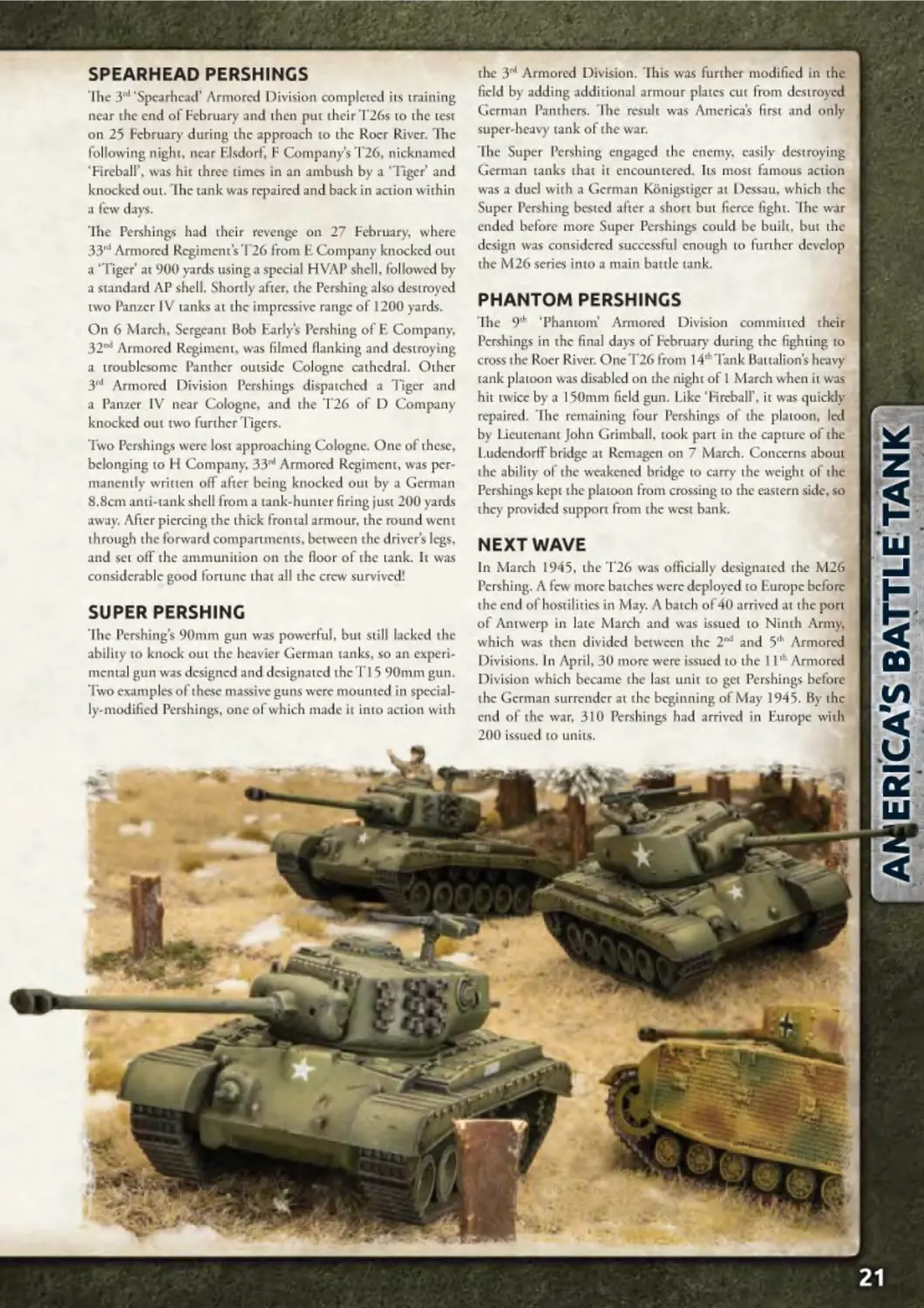
The Super Pershing engaged the enemy, easily destroying
German tanks that it encountered. Its most famous action
was a duel with a German Konigstiger at Dessau, which the
Super Pershing bested after a short but fierce fight. The war
ended before more Super Pershings could be built, but the
design was considered successful enough to further develop
the M26 series into a main battle tank.
PHANTOM PERSHINGS
'lhe 9’1’ ‘Phantom' Armored Division committed their
Pershings in the final days of February during the fighting to
cross the Roer River. OneT26 from 14* Tank Battalion’s heavy
tank platoon was disabled on the night of 1 March when it was
hit twice by a 150mm field gun. Like ‘Fireball’, it was quickly
repaired. The remaining four Pershings of the platoon, led
by Lieutenant John Grimball, took part in the capture of the
Ludendorff bridge at Remagen on 7 March. Concerns about
the ability of the weakened bridge to carry the weight of the
Pershings kept the platoon from crossing to the eastern side, so
they provided support from the west bank.
NEXT WAVE
In March 1945, theT26 was officially designated the M26
Pershing. A few more batches were deployed to Europe before
the end of hostilities in May. A batch of 40 arrived at the port
of Antwerp in late March and was issued to Ninth .Army,
which was then divided between the 2"d and 5<h Armored
Divisions. In April, 30 more were issued to the 11* Armored
Division which became the last unit to get Pershings before
the German surrender at the beginning of May 1945. By the
end of the war, 310 Pershings had arrived in Europe with
200 issued to units.
21
л VETERAN
М4 SHERMAN (LATE} TANK COMPANY
TANK FORMATION
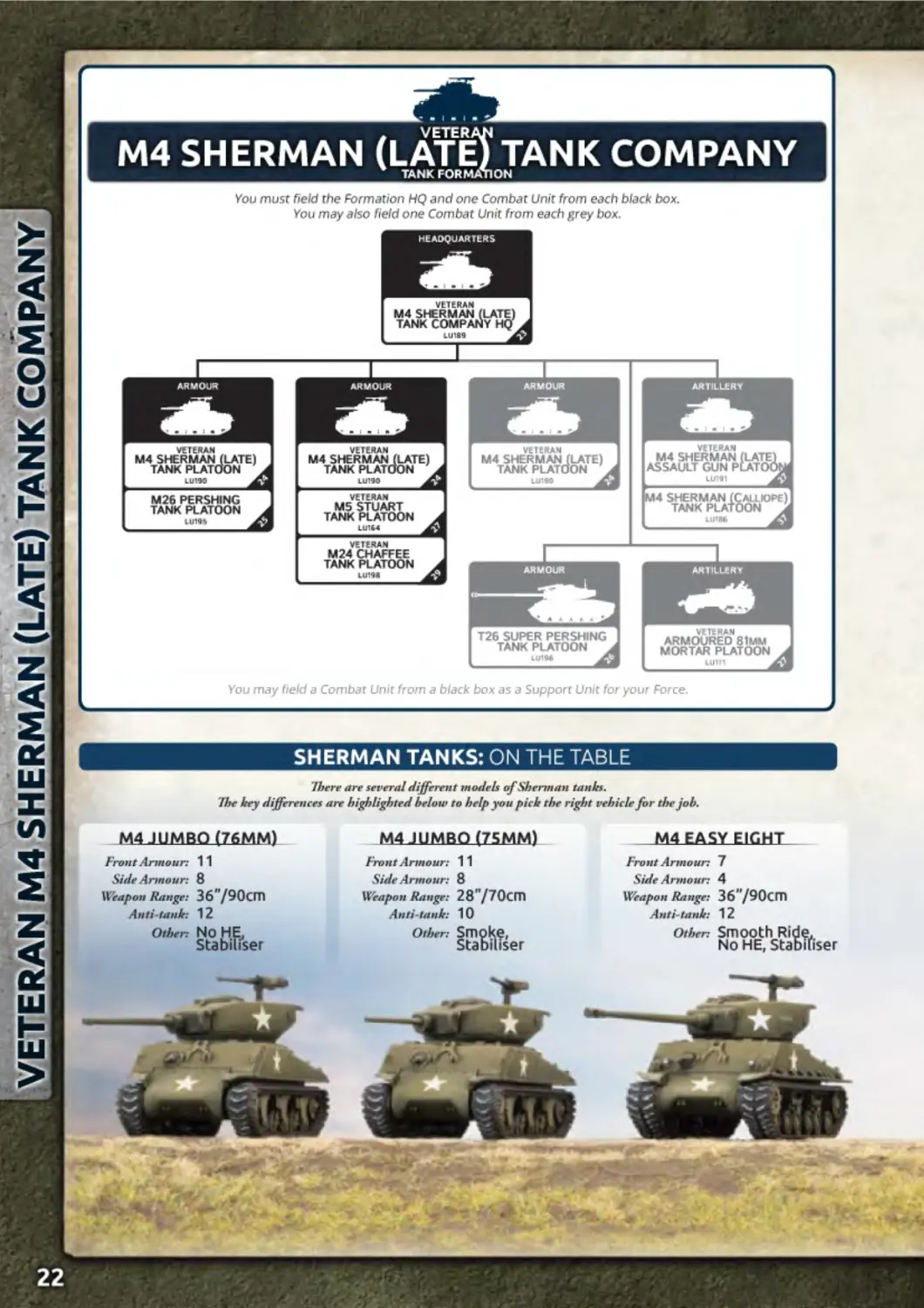
You must field the Formation HQ and one Combat Unit from each black box.
You may also field one Combat Unit from each grey box.
You may field a Combat Unit from a black box as a Support Unit for your Force.
SHERMAN TANKS: ON THE TABLE
Ibere are several different models of Sherman tanks,
lhe key differences are highlighted below to help you pick the right vehicle for the job.
M4JUMBO (76MM)
front Armour: 11
Side Armour: 8
Weapon Range: 36 /90СГП
Anti-tank: 1 2
Other: NO HE,
Stabiliser
M4 JUMBO (75MM)
front Armour: 11
Side Armour: 8
Weapon Range: 28 /70СГП
Anti-tank: 10
Other: Smoke,
Stabiliser
Front Armour: 7
Side Armour: 4
Weapon Range: 36"/90cm
Anti-tank: 1 2
Other: Smooth Ride.
No HE, Stabiliser
2х М4 Sherman (late 75mm)
M4 SHERMAN (LATE 76мм)
Front Armour: 7
Side Armour: 4
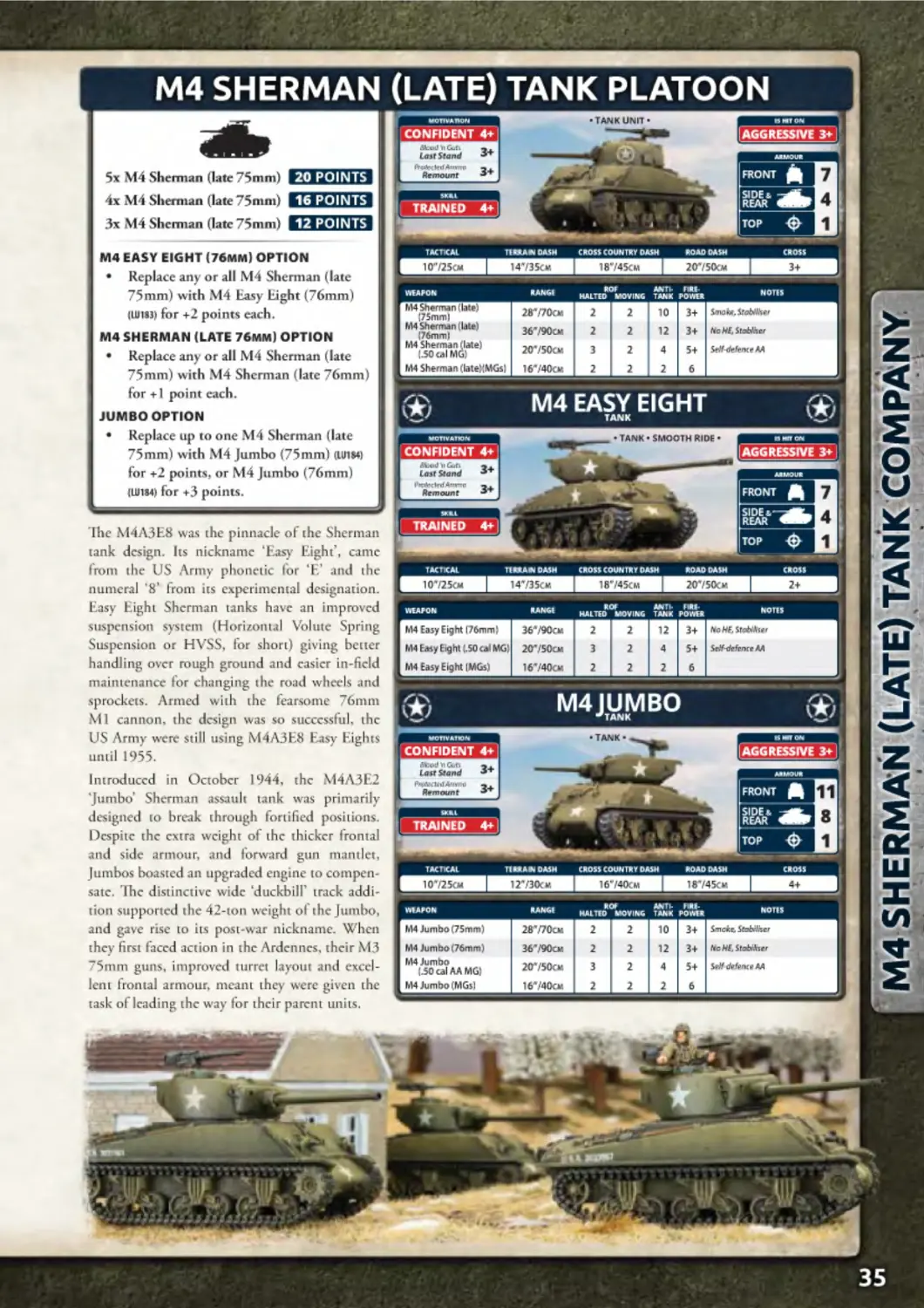
Weapon Range: 36' /90СГП
Anti-tank: 1 2
Other: NO HE,
Stabiliser
л VETERAN
M4 SHERMAN (LATE) TANK COMPANY HQ
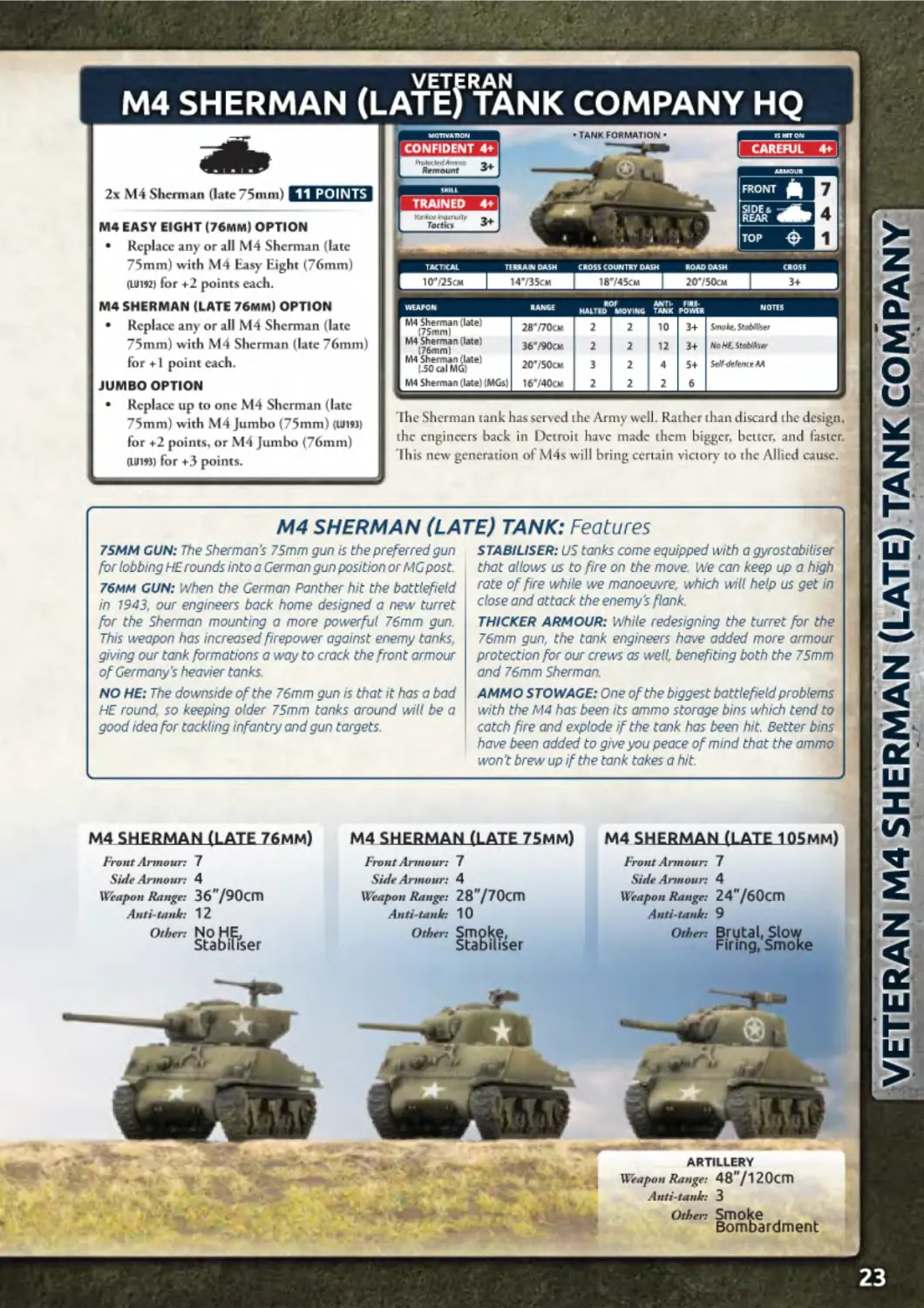
11 POINTS
M4 EASY EIGHT (76MM) OPTION
•	Replace any or all M4 Sherman (late
75mm) with M4 Easy Eight (76mm)
(Ulin) for +2 points each.
M4 SHERMAN (LATE 76MM) OPTION
•	Replace any or all M4 Sherman (late
75mm) with M4 Sherman (late 76mm)
for +1 point each.
JUMBO OPTION
•	Replace up to one M4 Sherman (late
75mm) with M4 Jumbo (75mm) (iutS3)
for +2 points, or М4 Jumbo (76mm)
(пни) for +3 points.
Tlie Sherman tank has served the Army well. Rather than discard the design,
the engineers back in Detroit have made them bigger, better, and faster.
This new generation of M4s will bring certain victory to the Allied cause.
7SMM CUN: The Sherman's 75mm gun is the preferred gun
for lobbing HE rounds into a German gun position or MG post.
76мм CUN: When the German Panther hit the battlefield
in 1943, our engineers back home designed a new turret
for the Sherman mounting a more powerful 76mm gun.
This weapon has increased firepower against enemy tanks,
giving our tank formations a way to crack the front armour
of Germany's heavier tanks.
NO HE: The downside of the 76mm gun is that it has a bad
HE round, so keeping older 75mm tanks around 'will be a
good idea for tackling infantry and gun targets.
M4 SHERMAN (LATE) TANK: Features
STABILISER: US tanks come equipped with a gyrostabiliser
that allows us to fire on the move. We can keep up a high
rate of fire while we manoeuvre, which will help us get in
close and attack the enemy's flank.
THICKER ARMOUR: While redesigning the turret for the
76mm gun, the tank engineers have added more armour
protection for our crews as well, benefiting both the 75mm
and 76mm Sherman.
AMMO STOWAGE: One of the biggest battlefield problems
with the M4 has been its ammo storage bins which tend to
catch fire and explode if the tank has been hit. Better bins
have been added to give you peace of mind that the ammo
won't brew up if the tank takes a hit.
Front Armour: 7
Side Armour: 4
Weapon Range: 28 /70СГП
Anti-tank: 10
Other: Smoke,
Stabiliser
M4 SHERMAN (LATE10SMM)
Front Armour: 1
Side Armour: 4
Weapon Range: 24 /бОСГП
Anti-tank: 9
Other: Brutal, SIOW
Firing, Smok
ARTILLERY
Weapon Range: 48"/120ст
Anti-tank: 3
Other: Smoke
Bombardment
23
л VETERAN
M4 SHERMAN (LATE) TANK PLATOON
5x M4 Sherman (late 75mm)
4x M4 Sherman (late 75mm)
Зх M4 Sherman (late 75mm)
25 POINTS
20 POINTS
15 POINTS
M4 EASY EIGHT (76мм) OPTION
•	Replace any or all M4 Sherman (late
75mm) with M4 Easy' Eight (76mm)
(W192) for +2 points each.
M4 SHERMAN (LATE 76мм) OPTION
•	Replace any or all M4 Sherman (late
75mm) with M4 Sherman (late 76mm)
for+1 point each.
JUMBO OPTION
•	Replace up to one M4 Sherman (late
75mm) with M4 Jumbo (75mm) (tin»)
for +2 points, or M4 Jumbo (76mm)
(11)193) for *3 points.
In late 1944 there is no such thing as a standard
M4 Sherman tank. The basic design has prolif-
erated into a variety of improved and specialised
models. These are issued as available and mixed
together in whatever fashion the commander on
the spot desires.
lhe 76mm gun armed M4 Sherman (late) has
come into service alongside the other M4 Sherman
(late) models in September. .Many tank battalions
still field the basic M4 Sherman, and are receiv-
ing new tanks like the M4 Sherman (76mm) and
the M4 Jumbo.
Some models of 76mm M4 Sherman (late) are
fitted with the Horizontal Volute Suspension
System (HVSS, for short), giving them better
cross-country' mobility and a smooth ride. These
arc designated M4A3E8 and quickly became
known as "Easyr Eights." The M4 Easy' Eight is
entering service in late December 1944. just in
time for the fighting in the Ardennes.
The M4 Jumbo assault tank entered combat in
late October 1944 after the battles in the Lorraine.
However, the Jumbos first major actions arc in
the Ardennes. To build the Jumbo the late M4A3
Sherman chassis has had extra armour added all
FRONT
TOP
NOHS
TOP
TOP
CKOSS COUNT* VOAW
CKOSS
SIDE»
REAR
•TANK UNIT"
28"/70cm
36-190см
20"/50см
16740см
7<KtK>
10725см
14735см
18745cm
20"/50см
•TANK»
10725cm
12730cm
16740cm
18745CM
Mo MF, SMNftw
SrlfttetmctM
faj&ctalA'ialtt)
Remounf
t^ccVtled A'imu
Автоояг
Smoke, StobrAser
So ME Stnbrftsrr
W-rfeteH₽44
10725см I 14435см	|	18745ои	|	20750см	|	3+
M4 Sherman ilatel
(75mm)
M4 Sherman Ilatel
(76mm!
M4 Sherman tlatel
(.SOcalMGI
M4 Sherman tlatel (MGsl
• TANK • SMOOTH RIOE •
I Рк*ГМУг»ГП"Х1 T ,
IКткбгЛцми
 Tactfo
i-noAe, ЙоМиг
Mo KF, StabilMr
Self-defence M
CONFIDENT ‘
______WAA_____
TRAINED 4»
CONFIDENT 4+
WAI
TRAINED 4*
WEAPON	RANG! HALTED MOVING TANK POWER	NOTES
______is tr :o._
CAREFUL 4+
CONFIDENT 4+
REAR
TACTICAL
M4 EASY EIGHT
VETERAN TANK
TACTICAL
SIDEb
REAR
RAMGE
ROf	ANTE FIRE-
ИМП0 MOVMG TANK POWER
CAREFUL 4+
TRAINED
TERRAIN DASH
ROAD DASH
CROSS
CROSS COUNTRY DASH
M4JUMBO
VETERAN TANK
ROF	AMTF FIR»
HALTED MOVING TANK POWHt
I M4 Easy Eight !76mml	36790см	2	2	12	3+
1 M4Eaiy Eight 1.50 cal MG!	20750cm	3	2	4	5+
| M4 Ему Eight !MGs)	16740cm	2	2	2	6

M4 Jumbo 175mm)
M4 Jumbo (76mm)
M4 Jumbo
so cai mg;
M4 Jumbo IMGs)
28770см
36790cm
20750cm
16740cm

around, while the gun is mounted in an up-ar-
moured turret.

25
T26 SUPER PERSHING TANK PLATOON
lx T26 Super
Pershing (90mm)
In an effort to match the firepower of the
German Tiger II tank's powerful 8.8cm KwK
43 gun, the 90mm T15E1 gun was developed
and mounted in a T26 in January 1945. This
extra long gun (73 calibres) could penetrate
330mm of armour. Ihc men of the 3'd Armored
Division’s maintenance workshops further mod-
ified the tank by cutting out armour plates from
German Panther tanks and welding them to it,
creating the unique T26E1-1 ‘Super Pershing’,
•TANK UNIT-
______В Wit ON__
CAREFUL 8+
16 POINTS
10725cm
12730cm
16740см
RANG*
NOTH
RO*	ANTV FIRI-
HMHD MOVMG TANK POWER
T26 Super Perahing
(90mm’,
T26 Super Pemhmg
(.50 cal MG I
T26 Super Pershing
487120см
20750cm
16740cm
Stif-defence M

T26 SUPER PERSHING TANK: Features
THICKER ARMOUR: The T26 Super Pershing was further
LONG 90MM CUN: To give the T26 Super Pershing the
abilities to take on the heaviest of the German tanks like the	modified in the field by adding additional armour plates cut
Tiger II or Jagdtiger it has been fitted with an even longer from destroyed German Panthers.
90mm than that of the M26 Pershing.
VETERAN
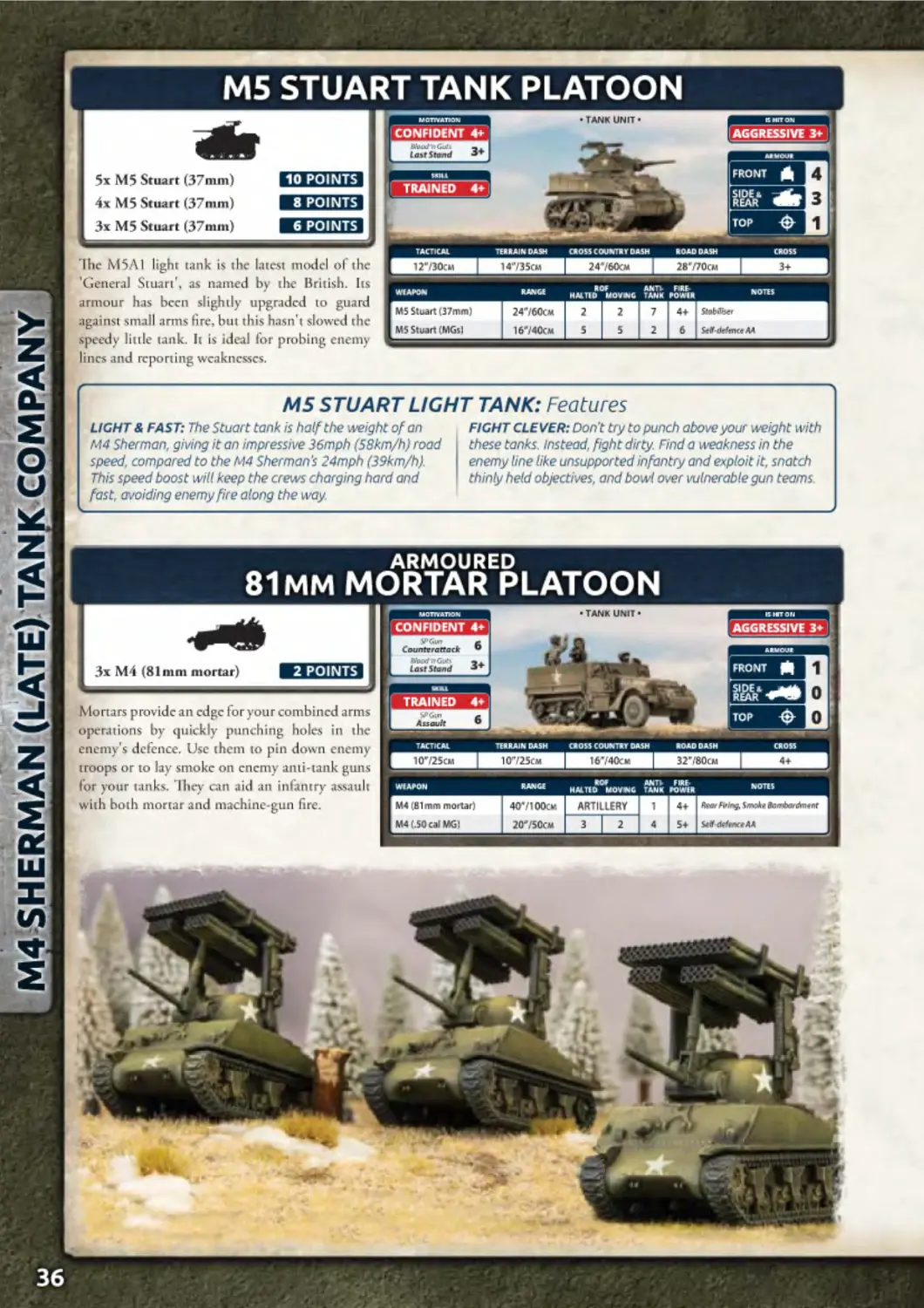
M5 STUART TANK PLATOON
5х М5 Stuart (37mm)
4х М5 Stuart (37mm)
Зх М5 Stuart (37mm)
13 POINTS
10 POINTS
7 POINTS
TRAINED 4*
I rbuUt Лцыпик’р
I *»«»
While outclassed by more modern tanks, the [	12730см	|
M5A1 is still extremely useful for securing
flanks, screening enemy infantry and armoured _
&	'	7	I MS Stuart (37mm)
cars, and exploiting a gap in the enemy lines.	I ,
Г s> о Г	7	I MS Stuart (MGsJ
•TANK UNIT*
TACTICAL	TfRRAI
28770см
24760см
14735cm	~[
CROSS COUNTRY DASH	ROAD DASH	CROSS
WEAPON	RANG* MAATID	TANK POWER	NOUS
24760см
16740cm
ЯоЬЛмг
SeiYdrfmce ЛЛ
26
VETERAN ARMOURED
81 MM MORTAR PLATOON
Зх M4 (81mm mortar)
3 POINTS
The armoured mortar platoon is your on-call
smoke screen projector that will cover your tank
buddies as they manoeuvre to find the enemy’s
flank. Smoke ’em if you’ve got ’em.
, VETERAN
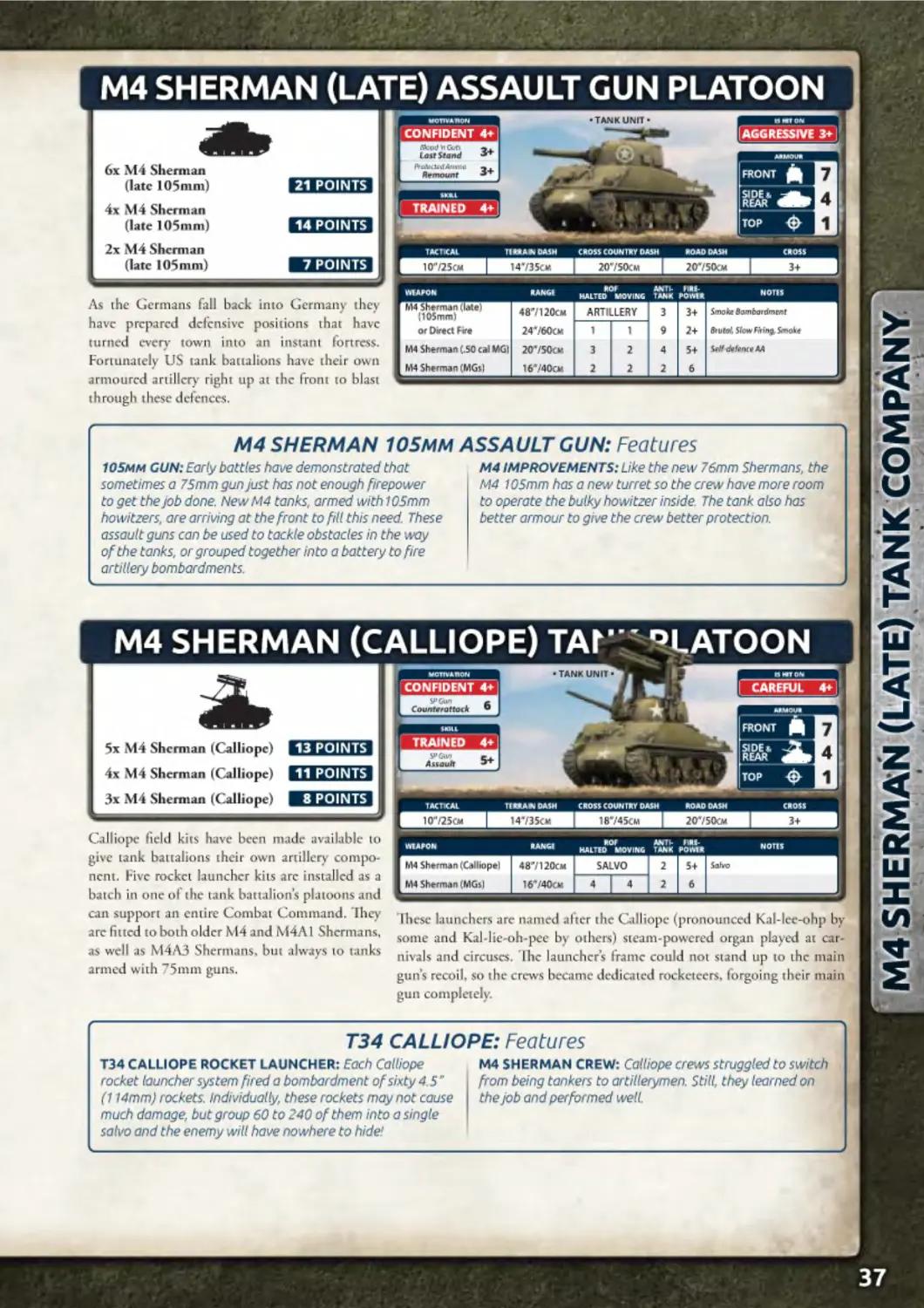
M4 SHERMAN (LATE) ASSAULT GUN PLATOON
6x Mi Sherman (late 105mm)
4x iM4 Sherman (late 105mm)
2x M4 Sherman (late 105mm)
The 105mm assault gun variant has been
developed to lend serious firepower to the fight.
Their role is to use their high-calibre shells to
knock out enemy infantry and gun positions.
fhe M4(A3) Sherman (late) version entered
service along with the other M4A3 models in
the second half of 1944.
27 POINTS
18 POINTS
9 POINTS
W1AP0N	RANG!	ROF HALTED MOVING		RMTI- TANK	FlRt- POWW	NOTH
| M4 Sherman (late) (105mm)	487120см	ARTILLERY		3	3+	Smow Sombordmmr
or Direct Fire	24760cm	1	1	9	2+	ffruta'. Slew Faring. Smoke
1 M4 Sherman f late) {30 cal MG>	20750cm	3	2	4	5+	SeV (Mtnct M
M4 Sherman (late) IMGs)	16740cm	2	2	2	6
VETERAN M4 SHERMAN (LATE) TANK COMPANY
VETERAN M24 CHAFFEE TANK COMPANY
TANK FORMATION
You must field the Formation HQ and one Combat Unit from each black box.
You may also field one Combat Unit from each grey box.
Vtou may field a Combat Unit from a black box as a Support Unit for your Force.
J
75MM CUN: The lightweight 75mm gun of the M24 has
the same ballistics as the 75mm М3 gun used in the M4
Sherman, but used a thinly walled barrel and different recoil
mechanism to save weight.
LICHT & FAST: The Chaffee tank is almost half the weight
of an M4 Sherman, features 16-inch (41cm) wide tracks and
torsion bar suspension, and a Twin V8 engine giving it a top
road speed of 58 km/h (36 mph).
M24 CHAFFEE TANK: Features
FIGHT CLEVER: Don't try and punch above your weight
with these tanks. Instead, fight dirty. Find a weakness in the
enemy line like unsupported infantry and exploit it, snatch
thinly held objectives, and bowl over vulnerable gun teams.

28
VETERAN
M24 CHAFFEE TANK COMPANY HQ
2x M24 Chaffee (75mm)
8 POINTS
A tank battalions D Company is all about
speed and exploitation. They will find the
enemy's weakest point and use that to get the
tanks around their vulnerable flanks. With that
accomplished, the medium and heavy tanks will
overrun the distracted enemy in no time at all.
VETERAN
M24 CHAFFEE TANK PLATOON
5x M24 Chaffee (75mm)
4x M24 Chaffee (75mm)
Зх M24 Chaffee (75mm)
19 POINTS
15 POINTS
12 POINTS
The new M24 Chaffee sure is a magnificent piece
of engineering! The American Panther some call
it. Speed and firepower is how to beat panzers
and the M24 is a speed machine that can glide
across the battlefield while carrying the 75mm
gun of a Sherman. It is just what is required to
whip around behind a skulking panzer.
VETERAN
M8 SCOTT ASSAULT GUN PLATOON
Зх M8 Scott (75mm)
2x M8 Scott (75mm)
6 POINTS
4 POINTS
The able gunners of the 2nd Armoured Division's
assault guns have traded in their half-track-
mounted guns for the new M8 Scott, which
combines the winning speed of a Stuart light
tank with the firepower of an artillery battery'.
Armoureel troops can rely on artillery whenever
and wherever it is needed.
TH ARMORED DIVISION
7TH ARMORED DIVISION
lhe ‘Lucky Seventh' was formed on
1 March 1942. The division first went
into combat under the command of
General Lindsay Silvester in mid-August
1944 and joined in the Allied advance
across France to the German frontier as
a part of Patton's Third Army.
Despite a severe fuel shortage, the
7'h Armored arrived at the battlefields
of north-western France liberating
Chatcau-Thicrry and then Verdun by the
end of August.
METZ
When Patton’s Third Army reached the Moselle River, he
divided his armoured forces to deal with the three major
cities blocking his way. The 7* Armored was assigned to sup-
port the 5A Infantry Division opposite the extremely fortified
city of Metz.
When the tankers arrived outside Metz they encountered an
elaborate network of fortifications, tunnels, minefields, and
well-sited anti-tank weapons. Not only would the division
have to force a crossing over the Moselle, it would have to
contend with these fortifications manned by fanatical soldiers
from the city’s military school who knew Metz inside and out.
Nevertheless, the 7'*’ Armored crashed into the teeth of the
defences, lhe overly-kcen division was wrastcd against the for-
tifications and was soon horribly depleted. After bitter losses,
the 7th Armored found an opening south of Metz and forced
a crossing where the fortifications were light. The fighting was
still tough as the division fought hard for each hill and valley
until 24 September when they were shifted north to Holland.
HOLLAND
By 24 September, British Field Marshal Montgomerys
Operation Market Garden was in its final throes and the
Allies had little to show for their effort. Access to the port
city of Antwerp remained shut, thanks
to the lough German defenders around
the Scheldt Estuary. This made the fuel
shortage a massive problem all across
the front lines, from Montgomery’s
21" Army Group in the north to Patton’s
Third Army in the Lorraine. It became
vitally important for the Allies to clear
the Germans out of Holland and open
up Antwerp’s ports.
fhe 7*h Armored was moved north and
assigned to the US First Army to help
clear out the German defenders in the
Peel Marshes south of Nijmegen. The tanks quickly became
bogged down in the mire typical of the fighting there. High
roads were the only place tanks could go. making them
perfect targets for German anti-tank guns. To make matters
worse, the division was broken up into small units that were
unable to support each other during the battle. Once again,
the division took heavy casualties and was removed from the
fight to rest and receive badly needed reinforcements.
RESTAND REFIT
By the end of October 1944. the division had received the
unenviable nickname: “Unlucky Seventh” having sustained
very high casualties, lost dozens of vehicles, and been poorly
handled. As it rested and trained, the division received the
fresh replacements necessary to fill out the unit.
On 1 November, General Silvester was relieved and replaced
by General Robert Hasbrouck, previously the commander of
the 7th Armored’s Combat Command B. To take his posi-
tion, the newly promoted Brigadier General Bruce Clarke
was brought in from the 4" Armored Division to lend some
battle experience to the rebuilt division. It would not be long
before the Unlucky’ Seventh would have a chance to reverse
their misfortunes.
THE BATTLE OF THE BULGE
On 16 December 1944, the Germans launched a major
offensive in the Ardennes Forest. lhe plan was to reach the
Meuse River, head north on to Antwerp to cut off" several
American and British armies, and force a peace settlement
favourable to Germany.
lhe offensive caught the Americans completely by surprise
and cut through the thinly held front-lines. All available units
were rushed to meet this threat, including the 7th Armored.
Massive roadblocks made movement very slow as the
7**’ Armored tried to get from Holland to where they were
needed in Belgium. General Hasbrouck dispatched Clarke’s
CCB ahead of the rest of the division to St. Vith, a critical
crossroads that needed to be kept from the Germans.
ST. VITH
Of the three main attacks launched by the Germans, the
centre thrust succeeded in smashing open the American lines,
lhe German Fifth Panzer Army poured through the opening
hoping to capture the critical crossroads and railroad hub
junction at St. Vith. Although the US 106'h Infantry Division
had been smashed арап, remnants kept the Germans busy-
long enough to rush the 7,h and 9‘*’ Armored Divisions into
the region. Combat Command В of the 9*h Armored was the
first to arrive and immediately went to work trying to stabi-
lise the breech. The task proved too difficult for the untried
division, so when Clarke's CCB arrived on 17 December, the
region’s defences were handed over to him.
The German advance had pushed deep into the American
lines to the north and south of St. Vith, creating a dangerous
salient for the American forces defending w-ithin. The two
American combat commands coordinated and set up a thin
infantry' screen made from dismounted cavalrymen and engi-
neers to hold St. Vith, while the armoured divisions took up
the eastern and southern approaches.
Immediately as the lead elements of CCB arrived, the
Germans attacked. Luckily the swift advance of the Germans
had caused enough confusion to make their attacks weak
and uncoordinated, allowing Clarke time to fight off the first
waves. However, the Germans were determined to capture St.
Vith and committed their precious few armoured reserves to
the fight on 19 December, including the elite Fiibrer Begleit
Brigade (FBB).
Heavy artillery bombardments and attacks toward the rear
plagued the 7A Armored as they fought hard, exacting a heavy
toll on the Germans and forcing them to commit even more
tanks to the battle. However, the German penetrations of
the front lines convinced Clarke to withdraw- to the more
defensible high ground to the southwest.
Even heavy snows on 22 December didn’t stop an ambitious
German attack by 75 tanks attempting to wrest control of
Rodt from CCB. The German tanks struggled in the mud,
and the lighter M4 Shermans managed to withdraw in good
order and inflict heavy- casualties on the FBB.
During the fighting, the Allies restructured their commands
and the 7'11 Armored was reassigned to the XVI11 (18th)
Airborne Corps, under the command of General Matthew-
Ridgway, w-ho immediately tried to set up what he called
“fortified goose-eggs” throughout the salient that could be
resupplied by air. While this strategy might work for para-
troopers, Clarke protested that it w-as not a sound strategy
for an armoured division. His concerns were echoed by Field
Marshal Montgomery, Ridgway's superior, who immediately-
countered the orders and had the 7* Armored withdraw,
having fought an excellent delaying action.
lhe 7'h Armored fought its way back to Vielsalm, where
the 82nd Airborne Division w-as holding the way open and
escaped the closing salient on 23 December. During the
fighting, the men of the Lucky Seventh lost 113 vehicles, but
had bloodied the Fifth Panzer Army, drained it of precious
fuel reserves, and bought the Allies time to get reinforcements
to the Ardennes.
7th armored division
31

“Sir, this is Patton talking. The last fourteen days have been straight hell.
Rain, snow, more rain, more snow—and I’m beginning to wonder what’s going on in
your headquarters. Whose side are you on anyway? ...
... Give me four clear days so that my planes can fly, so that my fighter-bombers
can bomb and strafe, so that my reconnaissance may pick out targets for my mag-
nificent artillery. Give me four days of sunshine to dry this blasted mud, so that
my tanks roll, so that ammunition and rations may be taken to my hungry, ill-
equipped infantry. I need these four days to send von Rundstedt and his godless
army to their Valhalla. I am sick of this unnecessary butchery of American youth,
and in exchange for four days of fighting weather, I will deliver You enough
Krauts to keep Your bookkeepers months behind in their work. Amen.”
-Lieutenant General George S Patton Jr, 23 December 1944
M4 SHERMAN (LATE) TANK COMPANY
TANK FORMATION
You must field the Formation HQ and one Combat Unit from each black box.
You may also field one Combat Unit from each grey box.
HEADQUARTERS
ARMOUR
ARMOUR
M4 SHERMAN (LATE)
TANK PLATOON Z
LU182
M5 STUART
TANK PLATOON .
LU1O3	£
M24 CHAFFEE
TANK PLATOON <
LU1M	X
ARTILLERY
ARTILLERY
M4 SHERMAN (LATE)
ASSAULT GUN PLATOON
LU232	X
M4 SHERMAN (CALLIOPE
TANK PLATOON Zi
.	LU'S6
ARMOURED 81MM
MORTAR PLATOON
You may field a Combat Unit from a black box as a Support Unit for your Force.
M4 SHERMAN (LATE) TANK COMPANY HQ
2x M4 Sherman (late 75mm)
9 POINTS
M4 EASY EIGHT (76мм) OPTION
•	Replace any or all M4 Sherman (late
75mm) with M4 Easy Eight (76mm)
(LUt№ for *2 points each.
M4 SHERMAN (LATE 76мм) OPTION
•	Replace any or all M4 Sherman (late
75mm) with M4 Sherman (late 76mm)
for ♦ 1 point each.
JUMBO OPTION
•	Replace up to one M4 Sherman (late
75mm) with M4 Jumbo (75mm) (UttMi
for +2 points, or M4 Jumbo (76mm)
(UI1M> for +3 points.
The tank companies of the 743rd Tank Battalion have attacked the beaches of
Normandy, advanced through France and the Low Countries, and arc at the
gates of Germany itself Their M4 Sherman DD tanks have taken them the
whole way so far, but as the assault on the Siegfried Line looms, fifteen upgraded
M4A3E2 ‘Jumbo’ tanks have arrived to supplement the М4ЛЗ (late) Sherman
tanks of the command company — eventually fighting in the Ardennes against
the German counter-attacks in December 1944. Soon M4A3E8 'Easy Eight'
Sherman tanks will be delivered to support the push into the German heartland.
М4 SHERMAN (LATE) TANK PLATOON
5x M4 Sherman (late 75mm)
20 POINTS
4x M4 Sherman (late 75mm)
16 POINTS
Зх M4 Sherman (late 75mm)
12 POINTS
M4 EASY EIGHT (76мм) OPTION
•	Replace any or all M4 Sherman (late
75mm) with M4 Easy Eight (76mm)
1Ш183) for +2 points each.
M4 SHERMAN (LATE 76мм) OPTION
•	Replace any or all M4 Sherman (late
75mm) with M4 Sherman (late 76mm)
for +1 point each.
JUMBO OPTION
•	Replace up to one М4 Sherman (late
75mm) with M4 Jumbo (75mm) (lint*)
for +2 points, or M4 Jumbo (76mm)
1Ш1М) for +3 points.
•TANK UNIT •
AGGRESSIVE 3+
CONFIDENT
TRAINED
.“A-tid 'll Gub
Lent Stand
)¥<Лч1*с1А’'гпп
Aemount
TIMA* DASH CROSS COUNTRY DASH ROAD DASH
SIDES.
REAR
TOP ф
10725см
14735см
18745см
20750см
TACTICAL
I WEAPON	RANG!	RC HALTED	»F MOVING	ANTI- TANK	F1RE- poww	NOTH
V M4 Sherman (late) }75mml	28770см	2	2	10	3+	Smafcf, StobWwr
I M4 Sherman (late) (76mml	36”/90cm	2	2	12	3+	fio HE. Stabtntr
I M4 Sherman (late) 150 cal MG)	20"/50см	3	2	4	5+	StH-detent M
| M4 Sherman (latel'.MGs)	16"/40см	2	2	2	6
•TANK - SMOOTH RIDE •
10 "/25CM
Sdftfcfcncc ЛЛ
1072 5<м
М4 Jumbo (75mm)
CONFIDENT
FRONT
TACTICAL
NOHS
CONFIDENT
WEAPON
^VudTtCufs
L<nr Stand
А'ПГТТП
Aemcxjnt
nfcod YiGufs
Lost Stand
P*ul4ktfA*um>
Remount
The .M4A3E8 was the pinnacle of the Sherman
tank design. Its nickname ‘Easy' Eight’, came
from the US Army phonetic for ‘E’ and the
numeral '8' from its experimental designation.
Easy Eight Sherman tanks have an improved
suspension system (Horizontal Volute Spring
Suspension or HVSS, for short) giving better
handling over rough ground and easier in-field
maintenance for changing the road wheels and
sprockets. Armed with the fearsome 76mm
Ml cannon, the design was so successful, the
US Army were still using M4A3E8 Easy Eights
until 1955.
Introduced in October 1944, the M4A3E2
‘Jumbo’ Sherman assault tank was primarily
designed to break through fortified positions.
Despite the extra weight of the thicker frontal
and side armour, and forward gun mantlet,
Jumbos boasted an upgraded engine to compen-
sate. lhe distinctive wide ‘duckbill’ track addi-
tion supported the 42-ton weight of the Jumbo,
and gave rise to its post-war nickname. When
they first faced action in the Ardennes, their М3
75mm guns, improved turret layout and excel-
lent frontal armour, meant they were given the
task of leading the wav for their parent units.
TRAINED 4+
M4 EASY EIGHT
TANK
AGGRESSIVE 3+B
SIDE a—
REAR <
14735CM
18745CM
CROSS COUNTRY DAW!
I		1		 1
1 WEAPON	RANG!	ROF HALTED MOVING		АЛТЕ TANK	ЯКЕ- powa
I M4 Easy Eight (76mm;	36"/90см	2	2	12	3+
I M4 Easy Eight !.50 cal MG)	20750см	3	2	4	5+
1 M4 Easy Eight iMGs)	16740см	2	2	2	6
2О75ОСМ

TACTICAL
M4JUMBO
*TANK
• TANK•
12730см
16740см
18745СМ
M4 Jumbo (76mm)
M4 Jumbo
(.50 cal AA MG}
M4 Jumbo । MGsl
TIMA* DASH CROSSCOUNTRY DASH
RANG!	ROF HALTED MOVING		ANTI- TANK	FIRE- POWER	NOTES
28770см	2	2	10	3+	Smoke Stabler
36'790 см	2	2	12	3+	fioHE,Stabf,\ier
20750см	3	2	4	5+	SfN dttonct ЛА
16740cm	2	2	2	6
35
MS STUART TANK PLATOON
TA CT I CAI
•TANK UNIT*
5x M5 Stuart (37 mm)
4x M5 Stuart (37mm)
Зх M5 Stuart (37mm)
12730см
14"/35см
24760см
28770см
TERRAIN DASH CROSS COUNTRY DASH ROAD DASH
8 POINTS
6 POINTS
CROSS
The M5A1 light tank is the latest model of the
'General Stuart', as named by the British. Its
armour has been slightly upgraded to guard
against small arms fire, but this hasn't slowed the
speedy little tank. It is ideal for probing enemy
lines and reporting weaknesses.
3+	1
NOTES
WEAPON
B1Kfr	ROE	ANTT FIRE
kmvm HM.TID MOYMG TANK ROWER
[ MS Stuart (37mm) | MS Stuart (MGrl	24760см 16740cm	2 5	2 5	7 2	4+ 6	Siobtlber
MS STUART LIGHT TANK: Features
LIGHT & FAST: The Stuart tank is half the weight of an
M4 Sherman, giving it an impressive 36mph (58km/h) road
speed, compared to the M4 Sherman's 24mph (39km/h).
This speed boost will keep the crews charging hard and
fast, avoiding enemy fire along the way.
FIGHT CLEVER: Don't try to punch above your weight with
these tanks, instead, fight dirty. Find a weakness in the
enemy line tike unsupported infantry and exploit it, snatch
thinly held objectives, and bowl over vulnerable gun teams.
ARMOURED
81 MM MORTAR PLATOON
3x Mi (81mm mortar)
2 POINTS
Mortars provide an edge for your combined arms
operations by quickly punching holes in the
enemy's defence. Use them to pin down enemy
troops or to lay smoke on enemy anti-tank guns
for your tanks. They can aid an infantry assault
with both mortar and machine-gun fire.
WIAPON	IMtl MMTIO*°*MOVWC TANK	"°™
M4 (81 mm mortar)
M4(.50calMGI
407100см
1	4+	Пюг Firing, Smokf eambardmnnt
4	5+	Srtf aefenre АЛ
20750см
ARTILLERY
•TANK UNIT-
10725см
AGGRESSIVE 3*
armour
21 POINTS
14 POINTS
7 POINTS
FRONT
SIDEt.
REAR
TOP (♦)
10"/25cm
14735см
13 POINTS
11 POINTS
8 POINTS
TACTICAL
MARON
M4 Sherman (Calliope!
M4 Sherman (MGsl
FRONT
SIDE»
REAR
TOP Ф
M4 SHERMAN (LATE) ASSAULT GUN PLATOON
6x M4 Sherman
(late 105mm)
4x M4 Sherman
(late 105mm)
2x iM4 Sherman
(late 105mm)
TACTICAL
As the Germans fall back into Germany they
have prepared defensive positions that have
turned every town into an instant fortress.
Fortunately US tank battalions have their own
armoured artillery' right up at the front to blast
through these defences.
14735см
20750cm
20750cm
TtRKAW DASH CROSSCOUNTRY DASH
ROF	AMTL FIR1-
 M4 Sherman (late) (105mm)	487120см	ARTILLERY		TANK	POWER E3	SmoRe Bombordmrrtt
or Direct Fire	24760cm	1	1	9	2+	Brutal. Stow Бт1пц. Smoke
I M4 Sherman (.50 cal MGl	20*/50см	3	2	4	5+	SeH oVfpnrp AA
J M4 Sherman i MGsl	16740см	2	2	2	6		IJ
M4 SHERMAN 105MM ASSAULT CUN: Features
105мм CUN: Early battles have demonstrated that
sometimes a 75 mm gun just has not enough firepower
to get the job done. Ne w M4 tanks, armed with 105mm
howitzers, are arriving at the front to fill this need. These
assault guns can be used to tackle obstacles in the way
of the tanks, or grouped together into a battery to fire
artillery bombardments.
M4 IMPROVEMENTS: Like the new 76mm Shermans, the
M4 105mm has a new turret so the crew have more room
to operate the bulky howitzer inside. The tank also has
better armour to give the crew better protection.
M4 SHERMAN (CALLIOPE) ТАГ
5x M4 Sherman (Calliope)
4x M4 Sherman (Calliope)
3x lM4 Sherman (Calliope)
Calliope field kits have been made available to
give tank battalions their own artillery compo-
nent. Five rocket launcher kits arc installed as a
batch in one of the tank battalion’s platoons and
can support an entire Combat Command. They
arc fitted to both older M4 and M4A1 Shermans,
as well as M4A3 Shermans, but always to tanks
armed with 75mm guns.
• TANK UNIT •
CONFIDENT
У» Cun
Counter attach
°LATOON
TERKAMDASH CROSSCOUNTRY DASH ROAD DASH
20750cm
18745cm
ROF	AMTL FIM-
RANWl HALTED MOVING TANK POWER
487120см	SALVO	2	5+	Solvo
16740см	4 | 4	2	6
CROSS
These launchers are named after the Calliope (pronounced Kal-lee-ohp by
some and Kal-lie-oh-pee by others) steam-powered organ played at car-
nivals and circuses. The launchers frame could not stand up to the main
gun’s recoil, so the crews became dedicated rocketeers, forgoing their main
gun completely.
T34 CALLIOPE: Features
T34 CALLIOPE ROCKET LAUNCHER: Each Calliope
rocket launcher system fired a bombardment of sixty 4.5 °
(114mm) rockets. Individually, these rockets may not cause
much damage, but group 60 to 240 of them into a single
salvo and the enemy will have nowhere to hide!
M4 SHERMAN CREW: Calliope crews struggled to switch
from being tankers to artillerymen. Still, they learned on
the job and performed well.
37
М24 CHAFFEE TANK COMPANY
TANK FORMATION
You must field the Formation HQ and one Combat Unit from each black box.
You may also field one Combat Unit from each grey box.
HEADQUARTERS
Уои may field a Combat Unit from a black box as a Support Unit for your Force.
For a beaten army, the Germans were able to field a
lot of forces. Since being alerted the previous day to
the enemy attack, Lieutenant Foster, had beer, moving
and shooting seemingly non-stop. He was down to the
last spare barrel for the .50 cal, and even worse they
were down to the last ammo boxes. The rest of his
platoon was in similar sisape - the supply trucks had
taken off when trie company HQ had been forced to
relocate. Everyone and everything was in the dark
about what was happening - the only sure thing was
to shoot the enemy wherever they were found. The
three other members of his platoon followed him at
high speed, huge rooster tails of snow arcing behind
them as their wide tracks allowed them to traverse
the snowy terrain quickly.
An enemy armour-piercing round flashed past, their
high speed keeping them safe. An enemy assault
gun - a StuG - with a cluster of infantry had crested
the ridge to their left His own gunner had laid on
without being told, and the return fire shattered
one of the tracks causing the enemy tank to slew in
a circle as the busted track unwound. 'Where there
was one there would be others. Poster, led his platoon
back into the woods, slowing down to navigate the
tighter curves as the unpaved road wound through
the trees. Major Andrews had promised that he would
scrounge up supplies from somewhere; the next
intersection was the rendezvous.
As they entered the crossroads, an М3 half-track
with its rear door open was being unloaded. Crates
of 75mm gun rounds, canisters of MG ammunition and
jerry cans of fuel The tank crews scrambled to load
up and fill up, while the М3 left as soon as the last
crate was unloaded. His driver, Garten, had just
finished topping up the fuel tank when a 50 cal HMG
ripped off a burst down the road they had arrived
on. The enemy had caught up!
"Mount up!” Foster, scrambled into the hatch as the
turret rotated. They would bloody these infantry
and then scoot back. Stay alive and keep shooting.
Eventually, he hoped, they would meet up with some
heavier friends and stop the Germans. Dead.
•TANK FORMATION-
M24 CHAFFEE TANK COMPANY HQ
AGGRESSIVE 3*

2x M24 Chaffee (75mm)
Initially issued to two cavalry troops in November
1944, by December the M24 Chaffee light tank
is being widely issued to tank battalions, replac-
ing the M5 Stuart in many companies.
A light tank company still retains it own sup-
porting artillery in the form of mortars and
assault guns.
CONFIDENT *
6 POINTS
rtUtil UGufl
Last Stand
АойсГаТАпмш
ЯетлоилТ
12730см
14735см
20750cm
28* /70см
FRONT
SIDE*
REAR
TACTICAL
ROAD DAM
TIARAIN DASH CROSS COUNTRY DASH
WEAPON
RANG!
CAMS
NOHS
M24 Chaffee (75mm|
M24 Chaffee (30 cal MOI
M24 Chaffee (MGsl
28770см
20750CM
16740см
ROF ANTI- Fltt-
HALTED MOVING ТААЖ POWER
Smear. SrobitM,
S«V-defwce M
M24 CHAFFEE TANK PLATOON
5x M24 Chaffee (75mm)
4x M24 Chaffee (75mm)
Зх M24 Chaffee (75mm)
15 POINTS
12 POINTS
9 POINTS
The new M24 Chaffee is an excellent replace-
ment for the M5A1 Stuart. It combines a pow-
erfill 75mm gun with the speed of a light tank,
making it a deadly new weapon in the Arsenal
of Freedom.
3
4
TANK UNIT
CONFIDENT 4+
ЙШ.41 H Cuti
Last Stand
fiemoirnt
12730см
14735cm
28*/70cm
M24 Chaffee (75mm;
28770см
Smerr, Sfabd'tr.
M24 Chaffee (.50 cal MGI
20750см
Self-defence A4
M24 Chaffee (MGsl
16740см
TACTICAL
ROAD DASH
WEAPON
RANGI
ROF ANTI- Fl«b
HALTED MOVING ТААЖ POWER
THRAINOASH CROSS COUNTRY DASH
TRAINED 4+
20750cm
M8 SCOTT ASSAULT GUN PLATOON
Зх M8 Scott (75mm)
2x M8 Scott (75mm)
5 POINTS
3 POINTS
ТЪе M8 Scott HMC assault gun complements
your mortars, either by performing direct fire
from its 75mm gun to knock out machine-gun
nests, or by joining the mortars in keeping the
enemy’s head down while the riflemen dose.
39
THE BRIDGE AT REMAGEN
THE BATTLE OF REMAGEN, 7™ MARCH 1945
After the fall of Cologne, the Germans presumed the
Americans’ next target would be Bonn. They were not
expecting an attack in the vicinity of Remagen, 'lhe defenders
consisted of a motley' collection of support troops from vari-
ous units, three flak batteries on the eastern side of the river.
Volktstum) (the German home guard), and a few railroad and
construction workers, lhe end result was a defensive group
consisting of second-rate troops with an unnecessarily com-
plex command structure. Overall command of the area was
given to (jenentlnntjor Walter Botsch on 1 March. Realizing
these meagre forces would be no match for the determined
Americans, Botsch requested more troops from Model, but
his request was denied as Model and his staff were concen-
trating forces near Bonn.
As with all bridges on the Rhine, the
Ludendorff bridge had been wired for
demolition, but the charges themselves
were not in place in order to prevent
an accidental detonation. On 6 March,
with the local situation deteriorating.
Botsch ordered the charges attached to the bridge. However,
Model chose that critical moment to recall Botsch to take
over 53 Corps and placed General Otto Hitzfield in com-
mand of the Remagen area. Model then unrealistically
ordered Hitzfield s 67 Corps to launch an attack against the
9lh Armored Division, but his forces were in fact isolated
behind the main American spearheads west of the Rhine and
completely unable to launch an offensive.
Fearing that his own troops would be caught west of the
Rhine, Hitzfield ordered Major Hans Scheller to take person-
al command at Remagen to keep it open. As the bridge rep-
resented the best retreat avenue for 67 Corps, Hitzfield didn’t
want it demolished prematurely. Scheller didn't arrive at the
bridge until 1100 hours, 7 March, just as the first reports
of American tanks in the area started pouring in. Several
of Scheller’s subordinates, including Captain Friesenhahn
in command of the bridge itself, recommended immediate
demolition of the bridge even though the charges were only'
partially placed. Scheller refused and instead ordered all the
rcmaining^harges prepared.
By 1400 hours, engineers placed the final charges on the
Ludendorff bridge, although parts of the secondary' firing
circuit remained incomplete.
However, by this time American troops had been pouring
into Remagen for nearly an hour, easily pushing aside the
Volkssturm and other disorganised soldiers. Scheller and
Friesenhahn crossed to the west side of the bridge to ascertain
the state of the city’s defences, but upon reaching the west
bank they immediately ran into the 27th Armored Infantry-
Battalion closing on the bridge itself. Recognizing the
impending disaster, Friesenhahn ordered the detonation of
the large explosive charges under the bridges approach ramp.
This charge created a large crater in the bridge's western ramp
preventing American armour from reaching the bridge itself,
faking advantage of the temporary shock caused by the
detonation, the German commanders sprinted back to the
east side of the bridge. Friesenhahn reached the east side of
the bridge several minutes after Scheller because he’d been
temporarily rendered unconscious by an American shell.
American tanks were already targeting units on the east
side in preparation for a general assault on the bridge itself.
Finding Scheller in the railway tunnel behind the bridge,
Friesenhahn finally obtained permission to destroy the bridge
at 1520 hours, but the primary detonation circuit failed.
By this time a company of American infantry', under
Lieutenant Karl Timmermann, w-as preparing to assault the
bridge. Supporting the infantry was a platoon of combat
engineers under orders to clear the demolition charges. The
only hope for the Germans was activation of the secondary-
circuit. Feldwebel Anton Faust led a small group of volunteers
to light the fuse on the secondary' circuit. Moments later a
huge explosion rocked the bridge, but as the smoke cleared
astonished Germans and Americans saw that the bridge was
damaged but still standing.
Timmermann quickly realized that the bridge was still passa-
ble, so he ordered his men across. The supporting armour fired
smoke rounds to cover their attack. The desperate Germans
opened up with everything they had on the advancing
Americans. The towers on the eastern end of the bridge were
THE BATTLE FOR THE LUDENDORFF BRIDGE,1
MARCH 1945 '
____	J
0 Feet
1000	1500
IPANY
:ompah
ILItNOORU- ERIDCt
VOLKSSTURM
IEMAGEN-KRIPP
HEAVY PLATOON
A COMPANY
0 Metros 200	300	400	500
ERPEL
FLAK BATTALION
(ZCM FLAK38)
IRPELLRLEV
REMAGEN
3“ PLATOON
C COMPANY
FLAK BAI IAU0N
(3./CM Fl AK13)
US 9™
ARMORED
DIVISION
manned with machine-guns which attempted to mow down
the advancing infantry. The flak batteries on the ridge above
the railway tunnel also engaged, but many lacked sufficient
depression to fire on the bridge. The advancing Americans
also took fire from a bargeon the Rhine itself. As the infantry-
crossed, the engineers dropped any unexploded demolition
charges into the river to prevent the bridge’s destruction.
Despite the murderous fire, American casualties crossing
the bridge were miraculously light with only one confirmed
wounded. Sergeant Joseph DeLisio reached the far end of the
bridge and began clearing one of the towers defending the
eastern approach, and Sergeant Alex Drabik was officially the
first American across the bridge itself. The rest of the compa-
ny quickly overcame what little resistance was offered by the
German infantry on the far side of the bridge. Major Scheller
fled on a bicycle stating he intended to communicate the fall
of the bridge to higher command.
Tlte Americans went on to take the ridge above the tunnel and
establish a small bridgehead on the eastern bank of the Rhine.
However, silencing the flak guns above proved far more costly
than taking the bridge itself. Just as the Americans secured the
bridge. General Hoge received orders from higher command
to continue to drive south with Combat Command В to cut
off retreating German forces. Understanding the opportunity
the intact Ludendorff bridge represented, Hoge sent a now
historic message to headquarters:
"WT have a bridge intact across the river at Checkpoint
15 I Remagen]. Shall 1 continue to hold this bridgehead in view
of the new mission souths We have one company across at 16:10.'
General Hoges commanding officer, Major-General Leonard,
realized what the intact bridge presented. 1 hough he knew that
his troops on the east bank could become isolated, the opportu-
nity could not be ignored. He cancelled all orders for the drive
south and ordered the bridge be repaired so armour could cross.
The repairs went relatively quickly and the first Sherman tanks
crossed the Ludendorff bridge at 0015 hours on 8 March.
THE BRIDGE AT REMAGEN
41

BATTLE WEARY
ARMOURED RIFLE COMPANY
INFANTRY FORMATION
You must field the Formation HQ and one Combat Unit from each black box.
You may also field one Combat Unit from each grey box.
ANTI-TANK
BATTLE WEARY ARMOURED
57MM ANTI-TANK
PLATOON
_______LU-04	____J
You may field a Combat Unit from a black box as a Support Unit for your Force.
Ar- the General had said, the trick now was to make
trie other guy die for his country. Sergeant Dalbrook
bailed out over the side of the М3 half-track, avoiding
getting entangled in the myriad packs, buckets, boxes
and one battered chair that decorated the flank of
the heavily battle scarred vehicle. The rest of his
squad '«ere doing the same, reacting instantly at the
first clatter of machine-gun fire. The 10tt Armored
Division had been rapidly turned around when the
Germans launched a surprise attack and everyone lost
their heads. How they would have to save everyone’s
butts as usual
"Chavez! Brooklyn! Go Right! Rest with me!” He fired
a quick burst from his Thompson SMG then scrambled
into cover. The rest of the squad found cover near him
and began returning fire. Grallick had stayed in the
half-track and was row firing short bursts from the 20
cal MG. firepower from the stalled column was building
rapidly - everyone knew what to do when the bullets
started flying - and that meant throwing Uncle Sam's
ammunition at the enemy in vast amounts, not charging
blindly ahead. He spotted an enemy casualty - squat
helmet and camo gear paratroopers. They were always
tough to deal with.
Chavez had found a good position to set up his machine-
gun and began to suppress the enemy paras - now was
the time to flank the enemy. 60mm mortar shells began
to drop onto the enemy positions and the volume of fire
dropped dramatically.
"We’re moving!” Ise yelled and led his men, bent over,
around Chavez where bullet casings were cascading
into a tinkling pile. They reached a covered position
where he halted, and instructed everyone to use fresh
magazines - no running start just as you engaged.
"Let’s go! Go go go?’ Other clusters of GIs were doing
the same, and return fire had almost stopped. They
ciiarged to the next covered position and began firing
again at the retreating enemy. Several fell before they
vanished into the dense woods. The random crackling of
shots gradually tapered away.
20750см	3	2	4	5+	Srif- defence АЛ
16740см	3	3	2	6	Set-defence АА
16740см	1	1	2	6	MGTnrnipart
BATTLE WEARY ARMOURED RIFLE COMPANY
•	•	’	V	л . «1

6x MI Garand rifle team
5x M1 Bazooka team
2x M1919 I MG
lx 60mrn mortar
With:
2x М3 Half-track (.50 cal MG) (Luzon
3x М3 Half-track (.30 cal MG) (LU2#u
13 POINTS
16 POINTS
4x M1 Garand rifle team
4x M1 Bazooka team
2x M1919 LMG
lx 60mm mortar
With:
2x М3 Half-track (.50 cal MG) (W2#u
2x М3 1 lalf-track (.30 cal MG) (LU291)
11 POINTS
13 POINTS
TACTICAL	ТЕМАМ DASH		CROSS COUNTRY DASH			ROAD	DASH	CROSS
8720см	8720см	14735см			14735см	1	AUTO
—
WIAP0K	RANGE	ROF HALTfO MOVING		ANTI- TANK	fiRE- POWER	NOTES
Ml Garand rifle team	16740см	1	1	2	6
M1919 LMG team	16740cm	5	2	2	6	Assoutt 5ч, Hewy A'etipvn
M1 Bazooka team	8720cm	1	1	10	5+	Attouir 5♦, Slow Fifing
Mmm mortar team	32*/80см	ARTILLERY		1	4+	AssauiTS-t, Httwy Weapon
Lite Unit Leader is one of the Ml Garand rifle teams,
and is mounted on a small base (see page 91).
The armoured rifle platoon remains a miniature army in its own right,
able to keep up with the tanks with their half-tracks and trained to rapidly
take ground and hold it against all comers. Heavy machine-guns, light
machine-guns, automatic rifles, bazookas, light mortars — yes sir, we have
all of those.
In the muddy terrain of the Rhineland, the armoured infantry found that
riding on tanks gave them better mobility than their own М3 half-tracks.
As a result, they often fought dismounted and left their half-tracks behind.
BATTLE WEARY ARMOURED
M1917 MACHINE-GUN PLATOON
4xM1917HMG
2x М3 Half-track
(.50 cal MG) ЦИ201)
The M1917 heavy machine-guns provides the
armoured riflemen with additional firepower for
suppressing enemy positions before an assault,
making sure defensive fire is kept to a minimum.
On defence the platoon's M1917 machine-
guns can sustain a volume of fire so intense that
even the most determined attacker will be hard
pressed to advance against it.
4 POINTS
8"/20cm
TACTICAL
UNIT • HEAVY WEAPON •
8720см
AUTO
12730см
12730см
NOTES
TICK AM DASH	CROSS COUNTRY DASH
ROF	ANTI HU
ranch HALTfD MOVING TANK POWER
WEAPON
M1917HMG
24*/60cm
44
• CUN UNIT • CUN SHIELD *
275см
57mm gun
TRAINED
ТАСТЮЦ
Gull
AwniH
Mjnk?rAwenu*tF
Tactics
I	а'оа/иби»
[ Solly
275см
4710см
6715см
CAREFUL
TIRRAIN DASH CROSS COUNTRY DASH ROAD DASH
алл.с,	R<* **TV FlRt-
ИДМЫ НМП0 MOVNG TANK ROWiR
BATTLE WEARY ARMOURED
57MM ANTI-TANK PLATOON
3x 57mm gun
3x М3 1 lalf-track
(.50 cal MG) (LU201)
2x 57mm gun
2x М3 Half-track
(.50 cal MG) (W20i)
3x 57mm gun
2x 57mm gun
RELUCTANT 5+
8 POINTS
5 POINTS
5 POINTS
3 POINTS
The 57mm guns of the Armoured .Anti-tank
Platoon are the Armoured Rifle Company’s first
line of defence against a panzer counterattack.
The 57mm is starting to show its age, but its
small size allows it to be easily dug in and hidden
until an unwary panzer drives on by.
WIArOM

BATTLE WEARY ARMOURED
81 MM MORTAR PLATOON
Зх M4 (81mm mortar)
2 POINTS
The M4 81mm MMC half-track is ideally
configured to support your armoured infantry
with smoke to screen your movement and high
explosives to neutralise enemy anti-tank guns
and machine-guns.
45
THE BLOODY BUCKET
THE 28th INFANTRY DIVISION
The 28* Infantry Division was formed
in 1941 from units of the Pennsylvania
Army National Guard. Pennsylvania's
moniker, the ‘Keystone state' led to the
division’s nickname, ‘Keystone’. It later
gained the nickname ‘Bloody Bucket’
division by the Germans owing to its red
keystone-shaped insignia.
The division reached France in July
1944 and fought at St. 1.6. It pursued the
Germans across France with heavy fight-
ing along the way, under the leadership
of Major General Norman ‘Dutch’ Cota.
The Keystone men reached the Siegfried Line on the German
border on 11 September 1944.
The 28* hammered away at the Siegfried Line until
November when it moved north to fight in the bloody battles
of the Hurtgen Forest. These terrible battles went back and
forth, sapping the strength of the division until, finally on the
19 November, the division was pulled out of the line to rest.
OUT OF THE FRYING PAN...
The 28* moved south to recover from the harrowing battles
of Hurtgen to a quiet portion of the line along the Our River
in the Ardennes. Spa pools and United Service Organisations
(USO) entertainment shows, includinga visit from the famous
Marlene Dietrich, helped case the men’s minds as they took
up a large stretch of the line with its three regiments, 109*,
HO*, and 112* covering nearly 25 miles (40km). Standard
doctrine called for an infantry division
to cover five miles at most, but since the
Allies did not expect any enemy activity
in the Ardennes, the sector was chosen as
the ideal spot to rest their tired divisions.
...AND INTO THE FIRE
In the pre-dawn hours of 16 December
1944, a German artillery bombardment
woke up the Keystone men. In the north,
the 116* Panzer Division launched its
attack against the 28* s 112* Infantry'
Regiment, easily overcoming the thinly
deployed American outposts, lite 112* Regiment bounced
back fast, crushing two companies of panzergrenadiers as
they attempted to infiltrate at Lutzkampen. However, further
south 560. Volksgrenadierdivision cut through the boundary'
between the 112* and 110* Infantry Regiments, isolating the
former from the division until January 1945.
ONE REGIMENT VERSUS AN ARMY
The 110* Regiment guarded the division’s centre and was by
far the hardest hit. Lined up against them were three panzer
and two infantry' divisions. The Keystone men stubbornly
held onto the vital crossings over the Our River, forcing the
Germans to commit their precious reserves in order to over-
run the Americans. So stout were the American defenders that
the Germans had to send battalions to deal with companies
or even platoons. Despite the resistance, the Germans slowly
AGAINST THE TIDE
overcame the Americans. The remnants of the 110A Infantry
Regiment made their way back to the Divisional HQ at
Wiltz, with the Germans hot on their heels.
The 109* Regiment, commanded by Lieutenant Colonel
James Rudder (previously of the 2nd Ranger Battalion at
Point-du-Hoc), held the southern flank against the might
of the German Seventh Army. The I091' Regiment’s com-
panies battled the paratroopers of 5. FaUschirmjagerdivision.
In the early hours of 16 December, the Germans
struggled to overcome the American outposts, but did
not gain access to the Wiltz road until 18 December,
after Rudders men withdrew south and joined the
4* Infantry Division.
WILTZ
As the 110lh Infantry Regiment gave way along the Our River,
the Germans were under orders to bypass Wiltz in order to
rush Bastogne and capture it as quickly as possible. However,
one regiment of the 5* Fallschtrmjiiger ignored the order and
attacked Wiltz. Soon other German units were sucked into
the vortex of battle. The rest of 5. Falbchimijiigerdivision
and following 26. Volksgrenadierdivision had to be com-
mitted to deal with the stubborn Keystone troops of the
110* Infantry Regiment and an ad hoc battalion of staff
clerks, cooks, and orderlies. The 1 IO’1’ Infantry Regiment
held the German divisions at Wiltz for 24 hours before they
were forced to withdraw toward Bastogne. As they withdrew,
they made life difficult for the pursuing Germans. In the end
the battle had cost the Germans nearly two days urgently
need to reach the Meuse before US reinforcements arrived.
lhe shattered, but not destroyed, 28* Infantry withdrew
to the Meuse River and took up positions in the event the
Germans made it past Bastogne. Some elements remained
in Bastogne, however, forming Task Force SNAFU to help
defend the town.
In the wake of Wacht Am Rhein, the division was spent, lhe
110'*’ Infantry Regiment alone was left with less than 600 men
from its strength of3256 on 15 December, and the other reg-
iments were nearly as bad off. Their achievements justified the
losses though, as the division held up nine German divisions
and bought enough time for the 10P‘Airborne Division to
get to Bastogne ahead of the Germans and deny the enemy
the vital crossroads there.
28th INFANTRY DIVISION
4th infantry division
NORMANDY AND FRANCE
The ‘Ivy (IV being four in Roman numer-
als) Division was activated in 1940 as
the only mechanised division in the US
Army. It eventually took on the form of a
regular infantry division, but still retained
an aggressive and mobile doctrine.
lhe Ivy Division was the first US division
to land in France on D-Day, 6 June 1944,
at Utah Beach. It then moved south and
relieved the 82,,d Airborne Division at
Sa i n te-Mere-F.gl i se.
After D-Day it became part of the task
force responsible for taking Cherbourg and securing a vital
deepwater port for the Allied offensive. The 4th attacked
Mountcbourg a week after their initial invasion, and then con-
tinued to Valognes before pushing forward on the Cotentin
peninsula. By the end of June the 4'11 linked up with the
9,h and 79'1' Infantry Divisions to clear the city of Cherbourg.
After Cherbourg, the 4* was switched to the southern front
slowly advancing through the Normandy bocage hedgerows.
It played a key part in the southward advance out of the
bocage country. Starting in early July, they advanced down the
eastern coast of Carentan to cross the Periers road attacking
the German Seventh Army.
I hey moved into Avranches on 30 July, effectively becom-
ing the right hook of Operation Cobra, lhe Ivy division
threw its weight into the breakout, wrorking closely with the
2nd Armored Division.
After Operation Cobra, the next Allied objective was Paris.
Many Allied commanders advocated bypassing the French
capital, fearing the Germans would destroy the historic city
in bloody street fighting rather than sur-
render it. However, General Charles de
Gaulle, leader of the Free French, insisted
and General Phillipe Leclerc's 2“* French
Armoured Division was given the honour
of liberating Paris.
Leclerc’s attacks met with resistance on
the approaches to the city, so the Allies
sent the battleworn 4* Infantry' Division
forward to help. Together the two divi-
sions pushed into Paris with the help
of the local FFI (French Forces of the
Interior).
lhe liberation of Paris marked a significant turning point in
the fortunes of war in Europe, but the 4* Infantry Division
still had a long way to go.
THE HURTGEN FOREST & THE
ARDENNES
After the pursuit across France, the 4d’ found itself on the
German frontier near Bastogne. However, it was soon moved
north to fight in the harsh battles of the Hurtgen Forest. After
the battle, the exhausted Ivy Division was relocated to the
quiet Ardennes south of the 28* Infantry Division’s positions
to receive reinforcements and a little rest.
When the Ardennes Offensive opened, the 4* was lucky' to
have a much smaller portion of the line to defend, compared
to the 28,l‘s long and thin front. After the first few hours of
the battle, the 4'h was unintentionally reinforced by the 28,h’s
cut-oft 109th Infantry Regiment. They put up a stern defence
and the Germans made only small gains. The Ivy Division’s
steadfast defence formed the core of the southern shoulder of
the 'Bulge'.
2nd infantry division
Tlie 2'“* Infantry Division was formal
in September 1917 during World War
I. During that war the division’s symbol
came from a truck driver who had paint-
ed it on his truck. His symbol was adopt-
ed by the division and soon they became
known as the ’Indianheads’.
NORMANDY TO THE
GERMAN BORDER
The division, under the command of
Major General Walter Robertson, landed
on Omaha Beach on D+l (7 June)
1944 and immediately went to work securing the beach and
mopping up German resistance. They then moved inland and
fought their way from Saint-Ld to Brittany. The tough fighting
in Brittany left the 2”*1 Infantry an extremely well-organised
and highly professional unit.
After Brittany, the division joined the US Army’s pursuit of
the Germans across France and found itself on the German
frontier by December 1944, occupying the region south of
Losheim. On 11 December the 2nd Infantry launched an
attack with the 78* Infantry Division to capture the dams on
the Roer River. The division gave up its position on the line
to the newly-arrived 106'*'1 Infantry Division and formed up
behind the 99'1’ Infantry' Division to launch its assault.
Using two of the division’s three regiments, the Indianheads
attacked on a narrow frontage to smash its way through the
Siegfried Line. The 9*h and 38” Infantry' Regiments had pen-
etrated about seven miles into the German lines when news
reached Robertson that the Germans had launched a major
offensive on his exposed southern flank. Naive orders arrived
from V Corps to keep moving east, but the experienced
Robertson prepared a clever, although complicated plan, to
withdraw his division to safety.
SKINNING THE CAT
On the morning of 17 December, V Corps finally ordered
Robertson to withdraw. He quickly put his complicated
action plan, nicknamed “Skinning the Cat", into motion.
The first of the two attacking regiments had to carefully
pull back through the rear battalion of the second regiment.
Once that was done they' set up defensive positions to allow
the other regiment to pass through and so on until they both
reached the twin villages of Krinkeh and Rocherath held by
the 99* Infantry. Once in the villages, the
99* would then pass through them to
the safety' of the Elsenbom Ridge, which
dominated the area and offered an excel-
lent defensive position for the US troops.
The manoeuvre was fraught with peril, as
any' error in this complex plan would turn
the withdrawal into a full rout, but the
experienced Indianheads executed it with
perfection, reaching Krinkeh by' midday.
TWIN VILLAGES
While the 9"h and 38* Regiments pulled
back, the first of the German attacks struck near Rocherath on
16 December. The Indianheads’ third regiment, the23"*, rushed
forward to bolster the line behind the 99* Infantry Division.
Just as they reached Rocherath, the Germans struck with
277. Vnlksgrenadierdivision, but the infantrymen stood fast
with the help of the 612* and 644*Tank Destroyer Battalions
as well as the 2“* Infantry’s own 741“ Tank Battalion.
Frustrated, the Germans committed 12. SS-Panzerdivision
from their reserves. Under the weight of the renewed attack, the
23,d Regiment and the 99* Division were forced to withdraw,
but they had bought enough time for the other Indianhead
regiments to reach Rocherath and set up behind them.
During the night of 17 December, the 2od held the line as
the 99* retreated to the Elsenborn Ridge, but some of their
troops stayed behind and fought alongside the Indianheads in
the twin villages. The situation was chaotic—one 2nd Infantry
colonel had elements of 16 different companies under his com-
mand! Nonetheless the 2'“* executed an exemplary defence and
by' nightfall on 18 December, the 99* had successfully' passed
through and set up behind the Indianheads. The 2nd Infantry
then successfully pulled back to the Elsenborn Ridge.
ELSENBORN RIDGE
The V Corps artillery' on the ridge reinforced the two divi-
sions, while the veteran 1“ and 9* Infantry Divisions secured
their flanks. Ihe Indianheads and the 99* easily repelled three
attempts to take the ridge before the Germans gave up.
The tough defenders of the tw'in villages and the Elsenborn
Ridge dealt a fatal blow to Wacht Am Rhein, throwing the
German timetable hopelessly oft schedule and denying the
important high ground to the German offensive.

BATTLE WEARY RIFLE COMPANY
INFANTRY FORMATION
You must field the Formation HQ and one Combat Unit from each black box.
You may also field one Combat Unit from each grey box.
HEADQUARTERS

LU»$
BATTLE WEARY
RIFLE
COMPANY HQ
r
ARTILLERY
INFANTRY
1
ARTILLERY
Алл
Abb
LU2G8
BATTLE WEARY
MORTAR
PLATOON
LU 208
BATTLE WEARY
MORTAR
PLATOON
ARTILLERY
BATTLE WEARY
105MM CANNON
PLATOON
LUI1O
VETERAN
M4 SHLRMAN (LATE
ASSAULT GUN PLA
WEAPONS
BATTLE WEARY
M1917 MACHINE-GUN
PLATOON
LU2O7
T
LU 41

You may field a Combat Unit from a black box as a Support Unit for your Force.
Sergeant Goulbum ducked low as another spray of
machine-gun fire peppered the trench lip. Elsenbom
Ridge was going to be much denser with all that
lead afterwards. The 2"3 Infantry Division was dug
in hard, but the enemy were persistently trying to
dislodge them and repeated assaults were taking
their toll on both sides.
Mortar shells were landing all across the platoon's
position, heralding yet another attack by German
infantry. Corporal Venetti began firing short bursts
from behind the X cal machine gun, until a mortar
shell exploded in the trench, shrapnel flung in all
directions. Goulbum dragged Venetti, gasping and
bleeding, into an alcove. "Just another day on the
farm, right Sarge?*
Goulbum shoved a First Aid pack into the wounded
man’s hand, then righted the overturned MG and
checked the ammunition belt, untangling the feed.
Racking back the bolt, he resumed firing. The enemy
had closed the distance without the MG fire to
keep them away. Grenades were being hurled from
both sides, as figures clad in a mix of white camo
and field grey uniforms stamped through the snow.
Curses, screams and constant firing accompanied
the assault with a handful of Grenadiers tumbling
into the trenches where bursts of SMG fire resolved
the situation in short order. The rest of Goulbum's
squad were charging along the trench line.
Friendly artillery fire finally began to fall
upon the Grenadiers, and they started to withdraw,
leaving a field refreshed with a new crop of bodies
to add to the previous ones.
Wearily, Goulbum bent over Venetti to check his
wounds, but it was already too late. There was one
less veteran from Kormandy now. Ke sighed, then
began making his way back to the platoon HQ. It was
time to pick up some replacements.
BATTLE WEARY
RIFLE COMPANY HQ

2 POINTS
The bloody battles of the Hurtgen Forest sapped
the strength of the 28'1’ Infantry Division until
finally, on 19 November, the division was pulled
out of the line to rest. However, the division has
now been hit by the German Ardennes offensive
and forced back into combat before they arc
fully recovered.
BATTLE WEARY
RIFLE PLATOON
MA*
lOx Ml Garand rifle team
lx Ml Bazooka team
7x M1 Garand rifle team
lx Ml Bazooka team
9 POINTS
6 POINTS
OPTIONS
•	Add one M1 Bazooka team for +1 point.
•	Add up to two M1919 l.MG for
♦ 1 point per team.
• Add one M1917 HMG for *2 points.
Изе Unit Leader is one of the Ml Garand rifle teams,
and is mounted on a small base (see page 91).
WEAPON	RANGE	K< HAITIO	>F MOVING	МЛТ TANK	EIU- POWE*	NOTES
1 Ml Garand rifle team	16740см	1	1	2	6
1 Ml Kazooka team	8720см	1	1	10	5+	Aiscwif 5*, Stow finng
I 3R*D4*L M1919 LMG team	16740cm	5	2	2	6	Assault S*, Heffvy Weapon
1 I M1917 HMG team	24760cm	6	2	2	6	AsuauU 5«, Hwzry Weapon
The Gls (derived from ’General Issue*, a nick-
name for US soldiers) of the rifle platoons form
the core of your company. These ’dog faces’
are well trained and have seen combat, though
unlike fresher units, they arc well aware of the
risks and dangers of battle. They are also well
known for their scrounging capabilities, augmenting their platoons with
unauthorised weapons such as bazookas stripped from transport vehicles.
While strictly against the rules, the Gls know better than others that they'll
need the added firepower in the coming campaigns.
The triangular formation of an infantry division means that you can count
on three rifle platoons in your company. This gives you flexibility to keep
one platoon in reserve while the others hold the line.
RIFLE COMPANY: Weapons & Features
M1 GARAND: The ,30-cahbre semi-automatic M1 Garand
is the most modern rifle of any army in the world. Accurate
and reliable, it can empty an eight-round clip as fast as the
trigger can be pulled. One team out of every three-team
squad also carries a Browning Automatic Rifle (BAR) to
bolster their short-range firepower.
M1919 LMG: The M1919 tight machine-gun is a lightened
development of the M1917 HMG (heavy machine-gun). Its
air-cooled design, with a simple perforated guard sleeve
around the barrel, is intended for short, controlled bursts of
fire. Prolonged firing can cause the barrel to overheat.
M1 BAZOOKA: Firing a 60mm shaped-charge HEAT rocket,
the bazooka is one of the first anti-tank rocket launchers.
OBSERVER: Remember, your Rifle Platoon's Unit
Leader can radio your artillery units and spot for their
bombardments.
THE 'TRUSCOTT trot': Long-distance speed marches
are a major feature of US infantry training, and the hard
practice has paid off. The riflemen can cover ground across
country faster than any other infantry.
1	.
BATTLE WEARY RIFLE COMPANY

6x 81mm mortar
4x 81mm mortar
2x 81mm mortar
3x 60mm mortar
BATTLE WEARY
MORTAR PLATOON
7 POINTS
4 POINTS
2 POINTS
4710см
TACTICAL
2 POINTS
While waiting on the divisional artillery to
respond to a fire mission, a rifle company can
call on their own mortars to give them instant
support.
WEAPON
81mm mortar
60mm mortar
• INFANTRY UNIT • HEAVY WEAPON •
4710cm.
6715cm
8720cm
AUTO
tKRAIN DASH СЖО55 € OUKTRY DASH
Wonlrr
NOTES
ROT	ANTT FIRE
rnmm НАТО MOVWG TANK POWER
407100cm	ARTILLERY	1	4+
32780cm	ARTILLERY	1	4+	SmcAe Ас.-пбоп/глепС
MORTAR: Features
ARTILLERY: When the howitzers of the field artillery are
plotting fire missions or otherwise occupied, it is useful
for the infantry to have their own indirect-fire ‘weapon.
Mortars can be just as good as the bigger guns at digging
infantry out of cover.
PORTABLE: A mortar tube and baseplate are light enough
for the crew to carry on their shoulders, letting these
versatile weapons go wherever they are needed.
BATTLE WEARY
M1917 MACHINE-GUN PLATOON

4x M1917HMG
2x M1917HMG
4 POINTS
2 POINTS
The water-cooled M1917 heavy machine-gun is a
bit more cumbersome than the light models, but
it has a devastating rate office. These are sighted
on key positions covering enemy approaches to
the company's defences.
52
BATTLE WEARY
57MM ANTI-TANK PLATOON
• GUN UNH • GUN SHIELD *
3x 57mm gun
2x 57mm gun
5 POINTS
3 POINTS
The 57mm anti-tank gun has served the
American GIs well through the war so far. It is
a versatile weapon able to drive off all but the
heaviest German tanks.
tOr.a-J
Ratty
TRAINED
Gun
Assautt
Tactky
TACTICAL	ПМ1АК DASH CROSS COUNTRY DASH
275см
275cm
4710cm
6715cm
_____В IT ON__
CAREFUL 4+
CROSS
WEAPON	RANGE ЦА1ТЕО*°МОК|НС, TANK POWER	N0TK
57mm gun
| 2Я"/70см |	2 |	1	| 10 | 4+ | fonmMWn»EtaHf
57мм ANTI-TANK CUN: Features
CUN SHIELD: The gun's bulletproof shield is designed to
give its crew some protection from frontal attack. Even so,
it is best to remain concealed, then open fire against the
flanks of enemy tanks at point-blank range.
ARMOUR PENETRATION: The M157mm gun's high-
velocity solid armour-piercing rounds can punch through
the armour of all but the heaviest German panzers.
BATTLE WEARY
105MM CANNON PLATOON

•GUN UNIT «LARGE GUN
6x 105mm light howitzer
4x 105mm light howitzer
2x 105mm light howitzer
lhe cannon platoon is the infantry' regiments
very own artillery battery'. With six light how-
itzers on call, the GIs can rely on quality bom-
bardments that can cover a large area.
13 POINTS
9 POINTS
4 POINTS
567140см
20750cm
ARTILLERY
TIT
105mm light howitzer
or Direct Fire
MARON
NOTH
RANG!
ROF	AMTL FIRS-
HAITID MOVING TANK POW1R
Srnow Bambordmenr
iruta1. Forward Fving. Slow Firing
Smote
105мм PACK HOWITZER: Features
ARTILLERY: The 105mm pack howitzer f ires a 15kg
(33lb) high-explosive shell to a range of 7.5km (4.5 miles),
bringing destruction to anywhere within range on the
battlefield.
BRUTAL: A single direct hit from one of the 105mm
high-explosive shells is generally enough to annihilate an
unprotected target, Infantry, Cun, and Unarmoured Tank
teams hit by Direct Fire must re-roll their saves.
iiAii
BASTOGNE AND THE BATTLE OF THE BULGE
The Germans launched Unternehmen Wacht am Rhein
(Operation Watch on the Rhine, also known as the Ardennes
offensive) on 16 December 1944. Their aim was to punch
through the thinly held lines of the US First Army in the
Ardennes region of Belgium and Luxembourg with their
infantry, before unleashing the Panzer divisions to drive
through to the Meuse River. Tire overall German goal was to
take the Belgian port of Antwerp, so vital for Allied supplies,
and cut off the US Ninth Army, British Second Army and
Canadian First Army in northern Belgium and the southern
Netherlands. Tire key to the success of the German plan was
to quickly cut through the US First Army in the Ardennes.
The main thrust towards Antwerp was given to the powerful
6. Panzerarmee (6*h Tank Army) on the northern shoulder of
the offensive. However, determined defence by the US 1“ and
99,h Infantry Divisions halted the thrust. In the central sector,
5. Panzerarmee was more successful against the worn and
stretched US 28'b and inexperienced 106,h Infantry' Divisions,
lhe vital road junctions at the small town of Bastogne
became the focal point of the offensive. All seven of the main
roads through the Ardennes converged at Bastogne and the
capture of the town would ensure the continued drive by 5.
Panzerarmee towards its objectives.
101st AIRBORNE DIVISION
At the start of the Germans' Ardennes offensive, the
101s'Airborne Division was in camp at Mourmelon, France
resting and refitting after the hard fought Market Garden
campaign and following battles in the Netherlands. On
17 December the division was put on alert to go to the front
and on 18 December they were hurriedly loaded into trucks
and shipped off to Bastogne.
On arriving in Bastogne on 19 December the first units of the
10P* Airborne were thrust into the line to halt the advancing
Germans. They were joined by' Combat Command В of the
10* Armored Division and the 7O5,hTank Destroyer Battalion.
As they set up a defensive perimeter around Bastogne, they
were attacked by 2. Panzerdivision, Panzer Lehr Division, and
26. Volksgrenadierdivision. Battles were fought at Wardin,
Novillc, and Foy (sec map on page 56) as the paratroopers
pushed out from Bastogne on that first day.
By 20 December the 101’ Airborne Division had established
a defensive perimeter around Bastogne with its four infantry'
regiments encircling the town.
0 Mites
EUSKIRCHEN
BELGIUM
EUPEN
REMAGEN
MONSCHAU
SPA
NAMUR
GERMANS
tlEROI
KOBLENZ
BOTGENBACH
C-NANT
L (1TZKAHPEN
ISTOGNU
MANtJEN
6. PANZER
ARMEE
5. PANZER
ARMEE
ST. VITH BLEIALF
ETTELfWUCX OtEKIRCH
LUXEMBOURG EC™H
MERSCH
MALMEDY
STAVELOT
YJERBOMONT
TROIS FONTS
___ MEZIERES
FRANCE
The large red arrows
show the planned German
direction of attack.
OKUomalrts 2
Allied front, 15 Dec
—German advance
BRITISH SECOND
ARMY
THE ARDENNES OFFENSIVE
NETHERLANDS
ANTWERP
15. ARMEE
LEUVEN
MAASTRICHT
BONN
BTBERG
7. ARMEE
NEUFCHATEAU
TRIER
МАЯСНЕ-ЕМ-
FAMENNE
COLOGNE
*
RHEYDT
CANADIAN FIRST
ARMY
- DUREN
lltGE
. VERVIERS
BRUSSELS
BARAQUE DE
FRAITURE
G|vn	ROCHEFORT LER0CHE
US NINTH
ARMY
US FIRST
ARMY
54
THE SIEGE
With a strong perimeter established, particularly in the north
and east, the German 47. Panzerkorps commander, General
von Liittwitz, decided to circle around Bastogne and strike
a blow from the south and southwest on the night of 20/21
December with his two panzer divisions. Ute Germans
initially penetrated into the lines in the southwest, but an
ad-hoc American counterattack force threw back the attack.
However, all the roads in and out of Bastogne had been cut by
the Germans and the town was surrounded.
W'ith Bastogne surrounded, the Panzer divisions continued
on towards the Meuse River, leaving behind a regiment to
support the 26. Volktgrenadierdivision in capturing Bastogne.
26. Voltyrenadierdii'idon and its support probed the southern
and western sectors of the American perimeter. Because the
Germans didn’t launch a concerted attack against several sec-
tors at once, the 101” Airborne Division was able to concen-
trate its supporting armour and artillery against each attack as
it came, moving them about as they were needed.
Continuous attacks had exhausted 26. Volksgrenadierdivision
by 23 December. On 24 December they received a much
needed boost in the form of a panzergrenadier regiment from
15. Panzergrenadierdivision. Ihe Germans then attacked
the positions of the 327lh Glider Infantry Regiment on the
western section of the perimeter on Christmas Day. Initially
the attack was successful and the panzergrenadiers and tanks
got as far as Hcmroullc, where the 327“ Regiment had its
3rd Battalion (formally the 1” Battalion, 401” Glider Infantry-
Regiment) command post. The German panzers leading
the assault split into two columns and continued on. One
column was immediately ambushed by two M18 Hellcats of
the 705,h Tank Destroyer Battalion before Champs. The other
column headed for Rolle, where it was hit by another two
Ml8s. 'Ihe German assault had been brought to a halt as the
German Panzer IV tanks were knocked out by tank destroyer
and bazooka fire and the German infantry' assaults were held
off by the glidermen.
PATTON BREAKS THROUGH
TO BASTOGNE
While the paratroopers and glidermen were holding tenacious-
ly to their positions around Bastogne, General Patton’s Ihird
Army, spearheaded by the 4,h Armored Division’s 37* lank
Battalion (commanded by Lieutenant-Colonel Creighton
Abrams), had finally broken through to Bastogne. They
reached the lines of the 326<h Airborne Engineer Battalion
on 26 December. Communications and supplies were quick-
ly restored.
Without the benefit of rest, the 101“ Airborne Division,
immediately joined the attack. After many more days of hard
fighting they finally pushed the Germans back. On 17 January
the 101“ Airborne had reached the positions they had occu-
pied on 19 December, when the division had first arrived
at Bastogne. "Die following day the 101" Airborne Division
was relieved.
THE ALLIES PUSH BACK THE GERMANS
Tlte German offensive had ground to a halt, but had pushed
a large salient into the Allied lines. To destroy the salient,
Patton’s Third Army attacked north, while Montgomery’s
American and British forces, to the north, struck south in
early January; Ihe two forces planned to meet at Houffalize.
Progress was slow’ in the winter conditions and the majority
of the German forces were able to escape the salient. The fuel
situation had become so bad for the Germans that most of
their panzers had to be abandoned. St Vith was not recaptured
by the Americans until 23 January and the last German units
participating in the offensive had not returned to their start
lines until 25 January.
Hitler’s ambitious plan to take Antwerp and destroy three
armies had failed and in doing so gave the Americans one of
their most triumphant victories of the war.
SCREAMING EAGLES
1015T airborne division in bastogne
The 101” Airborne Division was formed
at Camp Claiborne. Louisiana on
15 August 1942. By the time the division
saw its first combat on 6 June 1944 the
men of the ’Screaming Eagles', named
for the emblem on their shoulder patch,
had undergone extensive and intense
training in the United States and United
Kingdom. Having acquitted themselves
well and played an important role in
securing the Normandy beachheads,
the division was next dropped on the
Netherlands during Operation Market
Carden. Once again they fought with distinction, securing
17 miles (28km) of road stretching from Eindhoven to Grave
Bridge, keeping 'Helfs Highway’, as it became known, open
for the British troops of 30 Corps.
101st AIRBORNE HEAD FOR BASTOGNE
As the size and success of the initial attacks by the German divi-
sions in the Ardennes became clear, the 101" Airborne Division
was put on alert at their camp in Mourmclon, France on
17 December 1944. The division quickly set about calling men
back from leave, including a number of commanders, as well as
organising the re-issuing of arms and ammunition. Transport
was hastily arranged and the paratroopers and glidermen were
loaded onto trucks on 18 December and moved off to the front.
How prepared each unit of the
101" Airborne Division was depended
greatly on the initiative of the command-
er and the men. Not every man was
able to grab their weapons or enough
ammunition.
Lieutenant-Colonel John T. Cooper
of the 463"1 Parachute Field Artillery'
Battalion had the forethought to redi-
rect his part of the column through the
ammunition dump at Mourmelon, where
he got his men to grab as much ammu-
nition for their 75mm pack howitzers as
they could carry. The 63"* Parachute Field Artillery Battalion
Italy veterans temporarily attached to the division while wait-
ing for the 17* Airborne to arrive in France. Other units were
less well prepared and took weapons and ammunition off US
riflemen as they encountered them retreating from Bastogne.
Ammunition was also supplied by the 10,h Armored Division’s
Combat Command В (CCB), which had arrived at the front
the day before the airborne division.
As well as an initial shortage of weapons and ammunition,
the division was also without their commander, Major-
General Maxwell Taylor, who was away in Paris. Instead, the
division was commanded by General Anthony McAuliffe, the
division’s second in command.
BOURCY
HER5AIM0NT
L 0*5 CHAMPS
CHAMPS
ROLLE
FLAMIERGE
FLAMIZDULLE
26.VG0
HEMROULLE
BIZDRY
LUZERY
327* GIR
MAGERET
26.VG0.
ISLE-LA-HESSE
BASTOGNE
NEFFE
MOW
26 VGD
senlwlhamps
Pl. LEHR
WARDIN
MAR VIE
Pl. LEHR
Hill 500
26. VGD
ASSENOIS
PZ. LEHR
MANOE-ST-
ETIENNE
326" AEB
•' 19 DEC
501-PIR. Hill 510
502“ PIR.
r 19 DEC
THE SEIGE OF BASTOGNE, 19TH-25
CggT’ eiMLLE
10‘AO
101rAB.
19 DEC
15JWR
24-25 DEC
501" PIR.
19-20 DEC
506" PIR
19DEC
. ’ l. 501- PIR.
19 DEC
501-Р1П.Щ
икс L
26 VGD
21-25 DEC
. 26. VGD.
16-20 DEC
501- FIR.
19 DEC
f IIP AD.
THE DIVISION ARRIVES IN BASTOGNE
After driving through the night, the division arrived at
Bastogne on 19 December 1944. As the 101“ Airborne
Division arrived, the units were pushed forward to establish
the extent of the German advance and to set up a perimeter
around the town. The first to arrive at the front were the
men of the 501“ Parachute Infantry Regiment (501“ P1R)
and they were soon sent forward through the fog to ‘go out
and find the enemy’. The 1’ Battalion moved out first and
expected to find the enemy near the village of Magerct. As
they advanced, they met scattered groups of men from the
IS'11 Infantry Division retreating back towards Bastogne.
Leading them forward were the jeep-mounted men of the
divisional recon. As they rounded a corner near the village
of Neffe, all hell broke loose. The recon jeeps had been
ambushed by a German tank and some infantry. Following
behind the recon was В Company, 1“ Battalion. They quickly
sent forward some bazooka men and let off a volley towards
the tank, which halted and was then eventually knocked out.
В Company and the battalion headquarters behind them
quickly spread out and deployed in defensive positions.
At 1000 hours, the rest of the regiment left Bastogne to join
the Iя Battalion near Neffe. 2nd Battalion moved just north
of Neffe to Bizory with the aim of taking Magcrct from
that direction. They were halted quickly by the German
26. Aujklarungs Abteilung, 26. Volksgrenadierdivision who
had already entrenched on top of Hill 510 overlooking the
road from Bizoryr. However, when the Volksgrenadiers con-
tinued their advance, they were caught in an artillery barrage
from the 907’*’ Glider Field Artillery' Battalion, forcing the
Germans back to their positions on Hill 510.
WARDIN
The 3rf Battalion, 501’ PIR advanced towards Mont, south-
west of Neffe, but didn’t arrive until after mid-day due to traf-
fic in Bastogne. The 101“ Airborne Division became tangled
with other US units retreating from the German onslaught.
Once the battalion had arrived in Mont. I Company, the bat-
talion’s southern flank guard, was sent forward to check the
three wooded areas before Wardin. Once reported clear, the
company was then ordered to move into Wardin and make
contact with a supposed US roadblock established there.
However, as 1 Company entered Wardin, troops of Team
O’Hara, CCB, 10*1’ Armored Division could be seen moving
towards Bastogne along a ridge-line to the southwest. Ihe
roadblock troops had left.
Ihe reason soon became clear as a force of tanks and infantry
from theGerman Panzer Lehr Division's 901. PanzergreiuuLier-
regiment began to attack Wardin. Two German tanks knocked
out a Team O’Hara tank as they moved into the village.
I Company managed to knock out two tanks with their
bazookas before the Germans overran the village and forced
the company to retreat back towards Mont.
As the rest of 3rd Battalion moved into Mont, they directed
patrols toward Neffe, which they soon discovered was well and
truly infested w'ith Germans. As G Company probed towards
Neffe, they joined with Team ‘Cherry’ of the 10* Armored
Division who had been pushed out of Neffe. The battalion
decided to pull back and set up their defence at Mont.
To anchor the 501“ PIRs right flank, A and C Companies,
1’ Battalion. 327* Glider Infantry Regiment (327* GIR)
were sent forward to join the paratroopers.
NOVILLE
Team Desobry, CCB. 10* Armored Division had been
holding the village of Novillc, northeast of Bastogne, since
the evening of 19 December collecting stragglers from the
28* Infantry Division and 9* Armored Division to help hold
the positions.
Shortly after daybreak on 19 December Major William
Desobry' was told his team would soon be joined by the
1“ Battalion, 506* Parachute Infantry Regiment (506* PIRj
at Noville. Desobry' had been concerned that his positions at
Noville were overlooked by high ground on three sides and
had wanted to withdraw. With this news, he sent a jeep to pick
up the parachute battalion's commander, Lieutenant-Colonel
James LaPrade, so they could work out where to position the
paratroopers when they arrived. LaPrade informed Desobry
that many of his men were short of weapons and ammunition.
Desobry quickly organised equipment to be placed along the
road to Novillc so the paratroopers could arm themselves as
they arrived.
On arriving at about 1400 hours, the companies of the bat-
talion set about securing the high ground around Noville.
В Company was to take the high ground on the north-east-
ern flank, C Company the wooded ridge-line on the eastern
flank, and A Company was positioned between them in
reserve. Preceded by artillery’ fire and supported by the tanks
ofTeam Desobry, the paratroopers attacked the high ground.
Ihe fog periodically lifted, allowing LaPrada and Desobry,
observing from Noville, to see the progress of the attack.
Desobry' was particularly impressed by the aggressive and
speedy advance of the paratroopers.
As the paratroopers of В Company reached the top of the
heights, they ran into a German attack led by the tanks of
3. Panzer-regiment, 2. Panzerdivision. The Germans had
chosen that very moment to launch their attack on Noville.
After two hours of fighting, the two commanders decided it
would be belter to defend from the buildings of Noville and
ordered the paratroopers to withdraw. The fog continued to
play an important role, allowing the paratroopers to conduct
their fighting withdrawal with some concealment, as well as
letting the M18 Hellcat tank destroyers of Team Desobry
pick oft the panzers as the fog regularly rose and fell.
As the troops withdrew into Noville, LaPrade called a meet-
ing of his company commanders. Just after the meeting had
broken up, an enemy artillery shell hit the building housing
the battalion command post, killing Lieutenant-Colonel
LaPrade and seriously wounding Major Desobry. However,
the battalion’s executive officer, Major Robert F. Harwick,
had just arrived in Noville, after making his way on foot from
Bastogne, and was able to take command.
The battle raged around Noville as the Germans continued
to pound the village with artillery. Panzers continued to
probe forward, but the tank destroyers kept them at bay.
The paratroopers and armoured troops still held the village
as night fell.
The 506* PIR deployed around Foy, southwest of Noville,
on its arrival in Bastogne and dug-in on the high ground,
lhe 502'“* Parachute Infantry Regiment (5O2”4 PIR) deployed
behind the 506* PIR, north of Bastogne around Champs.
The 327* G1R covered the north-western approaches to
Bastogne around Mande St. Etienne, while the 326* Airborne
Engineer Battalion covered the south. As the men set up their
defensive perimeters and settled in for the night, they could
hear the sound of fighting off to the cast.
During the evening, the 101й Airborne Division suffered its
first major blow when their Field Hospital at Herbaimont
was captured by German troops circling around Bastogne.
.Among those captured was Major Desobry of CCB,
10’*’ Armored Division.
SECOND DAY OF FIGHTING IN NOVILLE
As 20 December dawned, with the ever-present fog, the
Germans continued the assault on Noville. Initially, they
sent their tanks against the paratroopers of the Iя Battalion,
506* PIR in Noville. The fire of the paratroopers along
with the men of Team Desobry, and supporting fire of the
321“ Glider Field Artillery Battalion, kept the Germans at bay.
The Germans then split into two forces, one headed north
around Noville, while the second headed south. The south-
ern probe was halted by the 2nd Battalion, 506* PIR at Foy
and the 2nd Battalion, 501“ PIR south of them. The German
thrust to the north was more successful. By noon. German
patrols had started to cut the road between Noville and Foy.
‘Пае 1" Battalion, 506* PIR had also lost direct contact with
the regimental HQ and was relaying messages through the
artillery observers radio link with the 321“ Glider Field
Artillery Battalion. They were in danger of being cut oft’.
The situation had also become critical in the front line. With
casualties mounting, radio operators and clerks from the HQ
were sent to the companies to plug the gaps.
The order finally arrived from the regimental HQ to with-
draw at 1315 hours. The German attack to the south had
begun to gain ground, further threatening to isolate the bat-
talion at Noville. Major Flarwick ordered the withdrawal at
1330 hours. C Company and four Sherman tanks from Team
Desobry», some crewed by paratroopers, were to move back
first to the high ground to the east of Foy to cover the with-
drawal of the rest of the force. The rear guard was formed by'
the tank destroyers and A Company. 3rd Battalion, 506* PIR
would counterattack Foy, which was still largely in German
hands, to cover the withdrawal.
Tlte US column left Noville behind, with the wounded car-
ried on half-tracks, jeeps and trucks, and the paratroopers and
armoured infantry’ on foot beside them. It wasn't long before
C Company ran into German roadblocks. The Germans
had taken up positions along the road in houses, barns and
woods. Fighting flared up all along the road as the column
encountered German positions. As the fire from the Germans
58
intensified, the paratroopers moved of!' to the west side of
the road to utilise a natural depression where the Germans
couldn’t see them. Eventually, as the 3rd Battalion attacked in
the opposite direction, the 1” Battalion finally made it back
to their lines. Of the 600 men who had entered Neville, less
than 400 made it back to Foy.
ESTABLISHING THE FRONT LINE
The US positions near Foy had also been under attack from
2. Panzerdivision during the day, which the 3rd Battalion,
5O6,h PIR held until ordered to the counterattack in the
afternoon. lhe 2“* Battalion, 506* PIR had watched from
the south of Foy, too far away to help, as the other two bat-
talions struggled to take Foy. However, they had concerns of
their owrn, trying to maintain contact with the 2^ Battalion,
501” PIR to their south. Contact between the two battal-
ions had not been consistent since both had arrived in their
positions. Captain Richard Winters, in acting command of
the 2nd Battalion, 506,h PIR was determined to make sure
the Germans couldn’t penetrate along the railway line that
was the boundary' line between the two regiments. He sent
F Company to clear the Germans from the gap and make
contact, but the German machine-gun fire halted the para-
troopers’ advance.
Tlte command of the 501” PIR was also concerned about
the gap and sent A Company, 1” Battalion along the railway
line at about 1500 hours to clear the gap of any enemy and
take up positions linking the two regiments. At dusk they
made contact with German Volksgrenadiers attempting to
filter through the gap and a firefight broke out. The company
became pinned down along the railway line and eventually
pulled back to higher ground with the fall of darkness.
THESOUTH AND WEST
In the small hours of 20 December the 2nd Battalion,
327'hGlR was sent to Marvie to take up defence there.
A roadblock had been set up by Team O’Hara, CCB,
10th Armored Division and had held oft a push down the
Wiltz-Bastogne Road by German troops. As the glidermen
began setting up in Marvie, they' were attacked by a force of
German tanks and infantry who had bypassed the armoured
troops, lhe Germans were eventually halted, but maintained
a foothold in the village, occupying some buildings at its
edge. Ute 1” Battalion, now reinforced by the arrival of a
third company, continued to defend positions around Ncfle.
At Nefte and Mont, the paratroopers of the 501” PIR had
to withstand a German night attack at about 1900 hours on
20 December, 'flic paratroopers raked the advancing panzer-
grenadiers of Panzer Lehr Division as they became tangled in
the barbed wire cattle fences crossing the fields before Mont.
M18 Hellcat tank destroyers took care of the Germans’ sup-
porting assault guns.
21 DECEMBER
On 21 December the glidermen of 3,d Battalion, 327* G1R
continued to patrol aggressively in the west, as the Germans
began to fully encircle Bastogne. lhe weather had also made
a turn for the worse. After several days of moderate winter
conditions, temperatures had dropped sharply and it began
to snow'. Tlte haste of the airborne troops’ departure from
their camp in France began to take its toll. Many men didn’t
have greatcoats or overshoes and their only protection from
the cold and snow were shelter quarters, sleeping bags,
and blankets.
lhe glidermen and engineers, with support from the CCR,
9lh Armored Division continued to repel attacks from the
west and south throughout the day.
RAILWAY LINE GAP
[here was to be no rest for the 1’ Battalion, 506* PIR after
their twro-day fight at Noville. During the night, the Germans
had moved more troops into Foy, as well as a group of about
200 troops that had penetrated the perimeter along the
railway tracks and pushed into the woods not far from the
regiment’s command post, lhe battalion was called on to
push them out. At 0900 hours, A and C Companies set out
along the road towards Foy from Luzcry. They then turned
south into the woods just south of the railway station and
began probing for the enemy positions. They soon found the
well-concealed German position and a firefight broke out.
Both companies attacked and soon had the Germans on the
run, many of whom ran right into the 501” PIR companies
across the railway line, providing the anvil for 506* PIR’s
hammer. By 1600 hours that afternoon, all the infiltrating
Germans had been accounted for and the gap between the
5O6d‘ and 501“ Parachute Infantry Regiments had finally
been cleared, lhe paratroopers had killed 65 and captured
165 men of the Iя Battalion, 77. Volksgrenadierregiment,
26. Volksgrenadierdivision.
22 DECEMBER
While the fighting had settled down in most sectors, the
glidermen of A and C Companies, 3rd Battalion. 327d‘ GIR
would spend most of the day in combat. Their fighting cen-
tred around Mande St. Etienne where the Germans had cut
the road to Bastogne. After a hard-fought assault, they were
able to clear the roadblock. Ihe unit was personally congratu-
lated by General McAuliffe as he toured the perimeter shortly
after the battle.
Shortages of food and ammunition became evident through-
out the day, as did a lack of white camouflage clothing. ‘Ihe
olive green of the US uniforms made a stark contrast against
the white snow covered terrain. All around the 101я Airborne
Division's front, patrols were out watching the Germans and
waiting for them to make their next move.
NUTS!
At 1100 hours a delegation of Germans with a white flag
approached the lines of the 327* GIR. They were met by Staff
Sergeant Carl Dickinson of F Company. Once the Germans
explained they wanted to deliver an ultimatum, they were
blindfolded and taken to the company command post where
their message was sent on to General McAuliffe in Bastogne.
General McAuliffe was in a deep sleep when Lieutenant-
Colonel Ned D. Moore shook him awake to tell him a
German delegation had come to take the division’s surrender.
Groggy from being awakened suddenly, the General mut-
tered ‘Nuts’ and crawled out of his sleeping bag. After talking
over their response it was decided ‘Nuts’ made an excellent
official answer, was typed up and passed on to F Company.
After it was explained to the Germans that the answer meant
they would most certainly not surrender; theyr were escorted
back to their lines.
The ultimatum called for the division to surrender by
1600 hours or the Germans would level Bastogne with heavy
artillery. It turned out to be a somewhat hollow threat, as
after the delivery of General McAuliffe’s response the shelling
did not increase.
23 DECEMBER
The following day, the Germans did increase their pressure
on the positions of the 3rd Battalion, 327'h GIR (401я).
German infantry and tanks attacked their positions west of
Mandc St. Etienne in the early hours. Determined defence
by the glidermen, timely mortar fire and the support of tanks
and tank destroyers kept the Germans at bay. However, by
nightfall, some positions had been overrun and the battalion
was forced to withdraw their companies. Paratroopers and
airborne engineers were also heavily engaged around Marvic
in the south, forcing the men on Hill 500 to withdraw.
Requests for resupply resulted in the landing of two sticks
of pathfinders on 23 December to set up the landing zone
for aerial supply drops. Around 230 C-47 aircraft loads of
supplies were successfully dropped on or around Bastogne, a
welcome Christmas present for the besieged airborne troops.
CHRISTMAS EVE
The Germans gave no respite for festivities and continued to
attack in the Marvic sector into 24 December. None of the
German attacks were successful in dislodging the airborne
troops. Around the rest of the Bastogne perimeter things
were quiet, especially compared to the previous few days,
broken only by the odd burst of artillery or machine-gun fire.
However, during the night. Bastogne was bombed twice and
the 10'1' Armored Division aid station was hit.
CHRISTMAS DAY
In the west, 3rd Battalion, 327л GIR (401я) was deployed
around Hemroulle, 1.5 miles (2.4km) northwest of Bastogne.
Ihcir reconnaissance of the German positions indicated the
Germans were building up for an attack. The glidermen’s
reconnaissance was good. 15. Panzergrenaditrdi vision had
just been committed to the battle and were about to attack
through their positions towards Bastogne.
A column of German tanks and assault guns carrying panzer-
grenadiers advanced into the lines of the battalion. The Ml 8
Hellcat tank destroyer crews of the 7O5'11 Tank Destroyer
Battalion let the German tanks pass. Ihe men in the defensive
line waited patiently while the panzers and riders advanced
ahead of more panzergrenadiers on foot following behind.
The German panzer column was being followed by the tank
destroyers as they- approached the glider battalion’s command
post. It was just before dawn when the glider infantry opened
up on the German panzergrenadiers in an open field before
their positions. This signalled the tank destroyers to fan out
behind the panzers and let loose at their vulnerable rear
armour. Five German tanks were quickly destroyed, three by
tank destroyers and two by bazookas.
The German tanks then split into two groups. One group
of six Panzer IV tanks headed towards Hemroulle and the
command posts of the 3“* Battalion, 327'1’ GIR (401м),
1’ Battalion, 502nd P1R and 463rd Parachute Field Artillery
Battalion, while 12 Panzer IV tanks and StuG assault guns
went towards Champs.
-
- —
HEMROULLE
The Hemroulle column ran into the lines of C Company,
502nd PIR. The surprise of the attack had C Company on the
run initially, but they rallied, were joined by two tank destroy-
ers, and headed back towards the Germans. They reached
Hemroulle about 0800 hours and immediately attacked.
Four German tanks headed nonh, with German infantry
scrambling to climb aboard, but the German Panzer IV tanks
were quickly knocked out by the tank destroyers.
Another group of German tanks ran afoul of the
463rd Parachute Field Artillery Battalion, who used flanking
shots from their little 75mm Ml Al pack howitzers to knock
out eight Panzer IV tanks when they came under attack.
German infantry soon began to surrender. Though the last
of the battles with the German tanks had ended by about
0930 hours, one last tank did make a mid-afternoon appear-
ance from the direction of Bastogne and was knocked out by
a bazooka as it headed north through Champs.
A little further south, around Senonchamps, the line was
being held by Г' Battalion, 327'1' GIR, ‘Snafu’ force, made up
of surviving members of the 106* and 28* lnfantnr Divisions,
and some tanks of the 9* Armored Division. They also with-
stood attacks during the early hours of Christmas Day.


4th ARMORED DIVISION ARRIVES, 26th DEC. 1944
«TORY
MANDE-ST-
niEIWr
Hill 510 MAGERET
126’ АЕ.ВДТ
15 7 JI
41h ARMORED DIVISION
ЗГ TANK BATTALION AND 53” ARMORED
INFANTRY BATTALION
26 DEC
CHAMPS
At Champs. A Company, 502nd PIR bore the brunt of stop-
ping the main German thrust towards Bastogne. At about
0300 hours, the Germans had begun to shell Champs with
artillery before the infantry of 77. Volksgrenadierregiment,
26. Volksgrenadierdivision began their attack. Initially, the
attack came from the north and the fighting continued
until dawn, but the Germans were unable to penetrate the
American line. Constant fighting along the front wras cha-
otic with the Germans filtering through the various gaps
between A Company's platoons. German tanks also joined
the attack, but, as their supporting infantry dwindled away,
the tanks withdrew.
The enemy then redirected their attack towards Rolle and
Longchamps. В Company, 502,ld PIR set up a roadblock with
one platoon just south of Champs facing the south and the
attack coming from the direction of Hemroulle. Supported
by two tank destroyers, they were able to knock out five
German tanks in the encounter and halt the German advance
north, but at the cost of both tank destroyers. The rest of the
company pushed on to Longchamps.
At dawn, the Germans launched another attack on Champs.
The attack, supported by four tanks, was halted by artillery fire,
tank destroyers, and the appearance of P-47 fighter-bombers.
THE SIEGE IS BROKEN
While the 101“ Airborne was fighting oft the German assaults
from the west, the 4* Armored Division was doing its best
to break through the German encirclement and relieve the
beleaguered airborne troops in Bastogne. On 26 December
the Germans continued their pressure on the Bastogne perim-
eter, attacking in the sectors of the 501“ PIR, 327th GIR,
502nd PIR and the 326* Airborne Engineer Battalion. It was
a clear day and American P-47s roamed the skies looking for
targets, making German attacks that much more difficult.
By the afternoon, the 4* Armored Division was southwest
of Bastogne and less than 2 miles (3km) away. Lieutenant-
Colonel Creighton Abrams decided to send C Company
of his 37* Tank Battalion up the secondary road through
Asscnois to Bastogne. They punched through Asscnois under
an artillery barrage, leaving the village to be cleared by the
following 53"' Armored Infantry Battalion, lhe direction
of their attack took the Germans by surprise and the tanks
smashed through the German lines. They soon reached the
American line, and after some hesitation. Lieutenant Duane
Webster of the 326* Airborne Engineer Battalion came out
to meet 2nd Lieutenant Charles Boggess of C Company. After
introductions Webster exclaimed, 'Glad to see you!’ It wasn’t
long before Colonel ?\brams was in Bastogne meeting General
McAuliffe. Pattons Third Army had made it to Bastogne at
1640 hours on 26 December. The siege was over.
26.VGD.
SI BRET
SENDNOIAwPS
BASTOGNE
ЮГА. BAT. I
VILLEROUX
ASSENOIS
Hill 500
REMCNFOSSE
MAWIE
мл*
BASTOGNE
PARACHUTE RIFLE COMPANY
INFANTRY FORMATION
You must field the Formation HQ and one Combat Unit from each black box.
You may also field one Combat Unit from each grey box.
You may field a Combat Unit from a black box as a Support Unit for your Force.
The church had seer, better days. Its steeple had been
a natural aiming point for German artillery barrages,
and now the few walls still standing provided little
cover from the random shelling. Corporal Wells hefted
the final ammunition cases he carried in each hand
and scurried over to the idling jeep, slinging them
into the back and clambering into the passenger seat
"Let's get out of here. Go!” Private Jackson steered
the accelerating vehicle around the myriad craters as
sentries waved them on.
They could hear the firing as they approached their
platoon's position. Jackson slewed the jeep to a halt,
while Wells was already running, cases tack in hand,
towards the HQ shelter. Sergeant Hoskins, on his way
to the jeep to pick up more cases, yelled to keep going.
Bullets cracked off frozen trees, as he reached the
front line. Ke dropped the 20 cal ammo case next to the
machine-gun position, then started handing out rifle
clips from the other case at each position. A grenade
detonated ahead, and suddenly figures clad in white
camo came stumbling through the deep snow into the
paratrooper positions.
Wells dropped the case, spilling waxed paper wrapped
clips, and brought Ids carbine to bear. Snapping shots
off, he dropped two of the enemy. Someone tapped him
on the helmet as tliey rushed past, firing Ke stood
and. followed, reloading, as they cleared the er.etny
grenadiers out The brief flurry of assault over, Wells
returned to where he had dropped the ammunition
case and began picking up the scattered clips, tapping
them to clear at least some of the mud and snow.
Hoskins found him wiping down the last of them. The
rapid tearing sound of German MG42 machine-gun fire
resonated across the vala
"Well need more. Go get the rest - 111 hand these out"
Wearily, Wells traipsed beck towards the jeep just as
the familiar whistle of enemy mortar shells began to
sound. Artillery, mortars and machine-gun fire - the
trinity of a really bad day.
BASTOGNE
PARACHUTE RIFLE COMPANY HQ
2x Thompson SMC. team
3 POINTS
Already veterans of the Normandy and Market
Garden campaigns, the paratroopers of the 501**,
502"d, and 506* Parachute Infantry Regiments
are well used to fighting while surrounded.
The company commander of a 101“ Airborne
Division Parachute Rifle Company is a vastly
experienced veteran of Normandy and Market
Garden. His men have complete faith in him
and know his leadership will see them through.
BASTOGNE
PARACHUTE RIFLE PLATOON
15 POINTS
МЯ*
7x M1919 and Ml Garand rifle team
lx 60mm mortar
1 x M1 Bazooka team
5x M1919and Ml Garand rifle team
lx 60mm mortar
lx Ml Bazooka team
OPTIONS
•	Add a second M1 Bazooka team for
+ 1 point.
•	Add up to two M1919 LMG teams for
♦ 1 point per team.
Ihe Unit Leader is one of tin- M1919 and Ml
Garand rifle teams, and is mounted on a small base
(see page 91).
12 POINTS
Due to the haste of their departure from Mourmelon camp, there is a
shortage of weapons among the men when the 101“ Airborne arrive at
Bastogne. Additional weapons are taken from retreating 28* Infantry
Division soldiers and found discarded along the roads. Eventually, the
platoons arc fully equipped, but some Parachute Rifle Platoons enter
combat without their full complement of weapons.
PARACHUTE RIFLE COMPANY: Features
ELITE: The paratroopers are all volunteers, unlike many
other US infantry. The training is harsh and thorough, and
those who pass the rigorous schedule will earn their wings
and become a part of an elite fighting force.
FEARLESS: Recruits have joined the ranks of the
paratroopers knowing full welt that this job involves
jumping out of an aircraft and into enemy territory. Once
you've done that, there's not much else that will spook you!
SKILLED: Paratrooper training involves mastering
battlefield tactics and close-combat techniques. Each
soldier is expected to act with initiative and cunning,
because in a parachute drop, all bets are off and you’ll need
to be ready to adapt.
BASTOGNE PARACHUTE
75MM ARTILLERY BATTERY
target to present itself
• GUN UNIT • LARGE GUN * TIME ON TARGET •
4710cm
6715cm
TACTICAL
WIAPOM
75mm pack howitzer
or Direct Fire
MANOEUVRABLE: The M1A1 75mm pack howitzer is
built to be lightweight and portable, to go most places
the infantry goes, its crew can manhandle it across rough
ground if necessary, or break it up into smaller
loads for longer journeys.
TfRRAlN DASH (JtOSS COUAlTt I DASH
'MM.A
4x 75mm pack howitzer
2x 75mm pack howitzer
К Mil OH
CAREFUL 4+
НО»	ANTE FIM-
ramm MMTID MOYWG TANK POWH
12 POINTS
6 POINTS
lhe 101я Airborne Division have taken two types
of artillery to Bxstogne, the glider artillery battal-
ions armed with М3 105mm howitzers, and the
parachute artillery of the ЗУТ111 and 463d Parachute
Field Artillery Battalions armed with Ml Al
75mm pack howitzers, lhe 463d Battalion are vet-
erans of the Italian campaign, having spent some
time supporting the US/Canadian First Special
Service Force, before being temporarily attached
to the 101“ Airborne Division while waiting for
the 17“ Airborne Division to arrive from England.
4710см
8720cm
647160см	ARTILLERY	2	4+	Fct kvord Firing, Smoke Bcmbordment
20750cm	/Г7	6	Э+	Fcrtvortl Firing, Smc*e
75MM PACK HOWITZER: Features
ARTILLERY: The M1A1 75mm pack howitzer fires a 6.24kg
(13.75lb) high-explosive shell to a range of 8.82km (5.5
miles), bringing destruction to anywhere within range on
the battlefield.
BASTOGNE PARACHUTE
57MM ANTI-TANK PLATOON
4x 57mm gun
3x 57mm gun
2x 57mm gun
The Ml 57mm anti-tank gun is normally
delivered into combat in a glider with its crew,
but the 101" Airborne Division arrived in
Bastogne by road, with the gun towed by jeeps.
The airborne anti-tank guns played an important
role in defending Bastogne. They offered the
paratroopers additional protection from enemy
tanks. Positioned along the key roads into
11 POINTS
8 POINTS
5 POINTS
MARON
RANCE
NOTH
ROF	ANTI- F1R£
HALTtD MOVING TANK POMR

Bastogne, they could hold oft German armoured probes, giving the rest
of the airborne forces time to bring more firepower to bear in the sector.
AIRBORNE
JEEP RECON PATROL
4x Jeep (.50 cal MG)
2x Jeep (.50 cal MG)
The divisional reconnaissance group has
two glider-landed reconnaissance platoons.
Equipped with machine-gun-armed jeeps, they
are ideal for scouting for enemy attacks or as part
of a mobile reserve.
• UNARMOURED TANK UNIT • SCOUT • SPEARHEAD •
CAREFUL ‘
4 POINTS
2 POINTS
12”/30см
12730см
20750см
48-/120см
(.50 cal MG)
Self-detent M
TACTICM
TtRKAn DASH CROSS COUNTRY DAW
 AA.e.f	"OF	ANTE FIRf-
RANGt HALTID MOVING TANK POUrtl

| 20750см | 3 [ 2
327™ GLIDER INFANTRY REGIMENT
First raised in September 1917 for the
Great War, the 82nd Infantry Division was
reactivated in March 1942, along with its
327th Infantry Regiment. In the summer
of 1942, the 82nd Infantry' Division was
selected to become an airborne division.
During the final days of basic training,
the men were told by their commander,
Major General Omar N. Bradley, that the
division was to be split to form a second
airborne division, the 101", Bradley
also announced that the 327th was to be
trained as a glider infantry regiment.
The men were not sure about flying in gliders. Most of them
had never even flown in a plane, let alone crash landing into
combat in one! On 15 August 1942 the unit became known
as the 327th Glider Infantry Regiment and reassigned to the
newly formed 101” ‘Screaming Eagles’ Airborne Division.
NORMANDY, 6 JUNE 1944
When the Allied commanders decided todrop both the 82nd and
101” Airborne Divisions simultaneously into Normandy, the
number of available aircraft to tow the gliders was greatly
reduced. Therefore the 327th Glider Infantry' Regiment was not
folly committed to battle until the day after the invasion.
When the regiment was assembled they' marched to Carentan
to cut off the fleeing Germans. The regiment reached
Carentan on 9 June. At 2200 hours on the following day, the
327th attacked a bridge over the Canal de Vire-et-Taute and
advanced through a W'ooded area, where they became pinned
under heavy fire.
The regiment was reinforced by the 29^*’ Infantry Division and
they broke through the German lines and captured the high
ground. Although causalities were high, they' accomplished
their mission and the regiment was removed to England on
13 July to prepare for its next mission.

HOLLAND, 17 SEPTEMBER 1944
The next combat operation for the regiment was Operation
Market Garden, the airborne invasion of Holland. Unlike
General Gavin, General Maxwell Taylor, commander of the
101" Airborne Division, opted to dedicate his glider regiment
early and wait on his artillery. This meant that the 327'*’ saw-
combat much earlier than the 325th Glider Infantry Regiment
from the 82"1 Airborne Division.
On 18 September (D+l), over 160 gliders took off from
England destined for Holland. Another 40 gliders arrived on
the following day. The 327th landed at DZ-W and immediately
took up positions around the village of Son. No sooner had
they landed when they W'cre attacked by the 107* Panzer
Brigade hoping to recapture the Son bridge. The glider troops
managed to hold them off for two days, until the Germans
finally gave up and refocused their efforts further north.
The regiment was then called upon by the 502nd Parachute
Infantry Regiment to help capture the town of Best, where the
German 59* Infantry Division was holding up. The regiment
secured the Zonsche Forest while the 502nd assaulted and
finally captured the town.
The regiment was then pulled north to
Veghel to help defend it against their old
enemy, the 107lh Panzer Brigade. When
the regiment arrived, the towrn was already
under attack and the glider troops rushed
to defend the southern edge of the city'
along with British anti-aircraft elements.
Once again the 327th saw oft the Panzer
brigades attack and the road was again
secure. After the battle, the regiment was
sent north to the village of Erp which
they defended for the duration of the
operation.
After the fighting had settled down, the 327th was in the front
lines for 48 days until ordered to withdraw from Holland.
They were removed to France to rest and recuperate.
THE ARDENNES - BATTLE OF THE BULGE
On 16 December 1944, the Germans launched an offensive
in the west through the Ardennes Forest. The 101” Airborne
Division was ordered to reinforce the lines and stop the
German advance.
The 327th assumed a defensive position south of Bastogne.
By 22 December the Germans had completely surrounded
Bastogne. Ihe 101“ Airborne Division held for nine days,
until relieved by the 4* Armored Division.
Despite suffering heavy' causalities, the regiment took
750 prisoners, knocked out 144 tanks and 105 other enemy
vehicles. For its actions in the defence of Bastogne, the
327th regimental motto became ‘Bastogne Bulldog’.
After the Battle of the Bulge, the 327th fought in the Rhineland
and Bcrchtcsgarden Campaigns. Following the end of World
War II, the 327th Glider Infantry Regiment was deactivated on
30 November 1945.

SRIIECA.
-10?. PANZEA BDE
HELMOND
NUfNFN
THE 1015T AIRBORNE DIVISION
IN EINDHOVEN, SEPT. 1944
КСН1ЛСЙ
($9. DB/AKGCHlUJ ___1-W1
SCAlt INMUS 3
SCHIJNDL.
6. FJR
Л iXDTNRW
502 P»R
59 ID (PART)
BEST*
DZ-W
50b
KG VMAJHLR
мл*
You must field the Formation HQ and one Combat Unit from each black box.
You may also field one Combat Unit from each grey box.
ARTILLERY

BASTOGNE
GLIDER RIFLE COMPANY
INFANTRY FORMATION
HEADQUARTERS
BASTOGNE
IDER RIFL
1MPANY H
LU216
INFANTRY
INFANTRY
BASTOGNE GLIDER
81MM MORTAR
PLATOON
LU219
мл»

BASTOGNE
GLIDER
RIFLE PLATOON
LU217
BASTOGNE
GLIDER
RIFLE PLATOON J
LU217
INFA4TRY

ANTI-TANK
BASTOGNE GLIDER
57MM ANTI-TANK
PLATOON
LU22O
ARTILLERY

BASTOGNE GLIDER
M1917 MACHINE-GUN
PLATOON
iu2i«	Л
BASTOGNE PARACHUTE
75MM ARTILl FRY
BATTERY
IU2’4
BASTOGNE GLIDER
105мм artillery
BATTERY
LU222
You may field a Combat Unit from a black box as a Support Unit for your Force.
The smoking wreck of a Mk IV Panzer showed the
high water mark - so far - of enemy attacks on the
1“ Battalion, 327th Glider Regiment Fresh snowfall
was gradually covering up the todies, shell holes
and detritus of war until Private Gladson could
barely make out snow drifts from buried bodies. The
cold was brutal, the very air cutting into his lungs
with each breath. It was little consolation that the
Germans were suffering Just the same. He wrapped
his makeshift scarf - a piece of torn curtain from an
abandoned house - to cover his mouth, then peered
towards the enemy positions. Was that movement?
He kicked the napping form of Private Halter.
"Wake up! Krauts are moving. Tell Sergeant Chester.’
Halter moved off slowly, still waking up. Alerted
by his activity, the sentries to either side were
scanning as well Subtle movement rippled down the
line, as rifles were levelled and machine-guns had
their canvas covers removed. Grenades were placed
on foxhole lips, ready for rapid use. Magazines
were checked, tapped and slotted home again. Ice
in the wrong place could see a man killed in these
conditions.
position Bursts of machine gun fire began to graze
across the glider troops position. And then the first
lines of enemy infantry appeared, high stepping
through the snow, firing wildly as they advanced.
A grinding and squealing of tracks announced yet
another tank, this time a low slung assault gun,
its long barrel recoiling with each round of high
explosive it fired at the American positions. Gladson
fired steadily, working through the three clips he
had readied, then throwing a pair of grenades as the
persistent enemy closed. Halter tumbled back into
the foxhole, followed by Sergeant Chester clutching
a bazooka. He knelt while Halter fumbled with an
ammunition bag, extracting a lethal looking AT
round. He slid it into the rear of the bazooka, pulled
out the safety pin, then tapped Chester. The back-
blast carved a channel behind them, while the StuG
assault gun shed a track and slewed sideways.
BASTOGNE GLIDER RIFLE COMPANY
i
The first artillery shells arrived suddenly, dull
flashes and fountaining snow scattered across the
Hatches on the StuG popped and the crew ran off,
followed by the remainder of the enemy assault
The glider troops sank back into their positions,
wrapping up against the cold. Snow began to fall
again, making new mounds. The abandoned StuG war-
closer than the other wreck - a new high water mark.
Gladson pulled his scarf back up over his mouth
again and settled down to await the next attack.
67
BASTOGNE
GLIDER RIFLE COMPANY HQ
2x Thompson SMG team
2 POINTS
The 327* Glider Infantry’ Regiment has been
through the campaigns in Normandy and
1 lolland and has gained much experience fighting
alongside the Paratroopers.
lhe companies of the 327* Glider Infantry
Regiment are otganised much like the rifle
companies of an infantry division, but with lighter
weapons especially suited to glider operations.
BASTOGNE
GLIDER RIFLE PLATOON
АЛЛ#
10x Ml Garand rifle team
I x M1 Bazooka team
lx M1919 l.MG team
lx 60mm mortar team
7x M1 Garand rifle team
lx Ml Bazooka team
lx M1919 LMG team
lx 60mm mortar team
16 POINTS
12 POINTS
OPTIONS
•	Add a second M1 Bazooka team for
+1 point.
•	Add a second 60mm mortar team for
+2 points.
Ute Unit Leader is one of tlx Ml Garand rifle teams,
and is mounted on a small base (see page 91).
A Glider Rifle Platoon is organised like a standard US Rifle Platoon. They
arc armed with Ml Garand semi-automatic rifles with additional squad
firepower coming from the Browning Automatic Rifle (BAR).
Platoons often have more than one Bazooka, as soldiers have a way of
acquiring extra weapons.
BASTOGNE GLIDER
M1917 MACHINE-GUN PLATOON

4x M1917HMG
2x M1917 HMG
lhe glider riflemen bolster their lines with the
water-cooled M1917 heavy machine-gun to hold
off attacking enemy troops.
5 POINTS
3 POINTS
| 407100см | ARTILLERY | 1 | 4+ | SmoA.aombflrdmMt
NOTES
и
4710см
4710см
6715см
8720см
81mm mortar
in
CD
WEAPON
The glider anti-tank units of the 327th Glider
Rifle Regiment were initially armed with М3
3~mm anti-tank guns, but by Bastogne, platoons
have been issued with the harder-hitting Ml
57mm gun.
6x 105mm light howitzer
3x 105mm light howitzer
3x 57mm gun
2x 57mm gun
TEIRAM DASH CROSS COUNTRY DASH
 Mtft	Ror	Flit»-
HALTED MOV INC TANK POWW
6x 81mm mortar
3x 81mm mortar
22 POINTS
11 POINTS
10 POINTS
5 POINTS
6 POINTS
4 POINTS
BASTOGNE GLIDER
81 MM MORTAR PLATOON
• INFANTRY UNIT • HEAVY WEAPON •
For airborne units the medium mortar takes
on extra importance. These compact weapons
can be easily loaded on gliders to land with the
troops, giving the glidermen readily available
artillery as soon as they land.
In Bastogne, while not an airborne operation,
they still played an important role in the defence
of the town and its important crossroads. The
glider mortar crews broke up a number of
TACTICAL
attacks on the western flank of Bastogne. Whether using high-explosive
rounds or smoke, they provided vital support for the 327th Glider Infantry
Regiments line of defence.
BASTOGNE GLIDER
57MM ANTI-TANK PLATOON
BASTOGNE GLIDER
105MM ARTILLERY BATTERY
Hie 321" and 907* Glider Field Artillery
Battalions were armed w'ith the М3 105mm
light howitzer. The battalions supported the
327th Glider Infantry' Regiment, as well as the
Parachute Infantry' Regiments.
The М3 105mm howdtzer offers good punch in
a light-weight package. While its bombardment
range is not as good as a standard M2A1 field
howitzer, it makes up for that with superior
mobility and its ability to be transported
by glider.
АЛО
During the siege of Bastogne, the glider artillerymen ran low on М3
ammunition, so they resorted to using M2A1 ammunition scrounged up by
their ammunition and supply men. However, they' had to reduce the number
of powder charges from seven to three to avoid damaging their howitzers.
69
RACE TO THE RHINE
THE WESTERN FRONT, 1945
In many ways the strategic and political situation facing
General Dwight Eisenhower, Supreme Commander of Allied
Expeditionary Forces, in February 1945 was eerily similar to
the previous August. After the fierce and desperate battles
in the autumn and winter of 1944, the Western Allies were
once again advancing along a broad front and closing in on
Germany. The River Rhine remained the last physical and
psychological barrier between the Western Allies and the
industrial heartland of Germany, known as the Ruhr. How to
cross that obstacle and which armies would go on to secure
the German heartland was a matter of contention with both
Eisenhower’s subordinates and superiors.
In the interest of maintaining national and personal pres-
tige, Field Marshal Montgomery advocated that his British
21” Army Group should play the leading role in the final
defeat of Germany by conducting a single-pronged attack
directly into the Ruhr. However, Montgomery's army was
facing drastic manpower shortages at this point in the war.
Britain fielded 21 divisions in this theatre, including one
Polish and several Canadian divisions. In sharp contrast, fresh
American divisions were regularly arriving from the States,
bolstering the US presence under Eisenhower’s command to
62 American divisions. Montgomery’s argument was further
hampered by the fact that General Omar Bradley and other
senior American commanders were demanding the immediate
release of the American divisions which had been attached to
his 21” Army Group during the Battle of the Bulge.
THE PLAN
By 2 February 1945, Eisenhower submitted his final proposal
for crossing the Rhine. ’The Plan’, as it was known, specified
breaching the Rhine using two crossing points to prevent
the Germans from concentrating their forces in defence.
Eisenhower ultimately made concessions to the British and
agreed that Montgomery's 21“ Group would be the primary
spearhead across the Rhine and would not be delayed if it
reached the river ahead of American forces.
OPERATIONS VERITABLE AND GRENADE
Operation Veritable, the British spearhead, began on
8 February with the goal of breaching the Reichswald to
secure the western bank of the Rhine. Further south, the
American Ninth Army, also under Monty’s command, ini-
tiated Operation Grenade, which was designed to clear the
Roer River and then push on to the Rhine.
Even with his meticulous planning, Montgomery’s
Operation Veritable ran into problems immediately. The
Germans flooded the local terrain to limit the advance and
put up extremely stiff resistance. Operation Grenade was
more successful and managed to reach the Rhine at Neuss
on 2 March, but Eisenhower refused to let the Ninth Army
cross the Rhine, deferring to British wishes. He did, how-
ever, authorize Bradley’s US 12,h Army Group to launch
Operation Lumberjack to secure the west bank of the Rhine
near Koln (Cologne) and link up with Patton’s Third Army
near Koblenz.
OPERATION LUMBERJACK
Operation Lumberjack began on 1 March, with American cav-
alry units reaching the Rhine north of Koln by 3 March. The
battle for Koln itself began on 5 March when the 104* Infantry
and 3”1 Armored Divisions assaulted the city. German resistance
was mixed, though the 8.8cm Flak batteries around the city’s
airfield put up strong resistance until they wrcrc overwhelmed by
armour. As expected, all of the bridges across the Rhine at Koln
had been destroyed, but it was known that some bridges were
still standing further south.
NEXT MOVES
Tire Germans presumed that the city of Bonn would be the
next primary' target for American forces. Field Marshal Model,
commanding Army Group B, allowed various German units
to fall back towards the city even though Hitler had insisted
that the Wcstwall fortifications be held to the last man. On
paper, Model had several divisions at his command, but most
of these had been bled white by continuous fighting and were
short of literally everything from fuel to food. Frequently
Model's orders to the various divisions under his command
could not be followed because of a simple lack of supply.
THE WESTERN FRONT, APRIL 1945
'L
Ohm
mimO
avsitssaxO
Be LUI UM unto
Omhwiw
MUHI
Ковине
ARMY
GROUP В
О JUCII QOUJCOIOCHI) !
OAAlhlH <4
|l’ f
^MICWII' UM О О UMACtb
IZARmH
GROUP =
— — — — — — —	Allied front 5 Apr
.......................Allied	front,	9 Apr
——	Allied front, 18 Apr
0 Mlles 25	50 Я IW
oTtanorres	rJT" ISO
iMjHSIIH
nrrSUSlO O^IHRbC'W.
CZECHOSLOVAK
i.suniQ
Qhhhowji
полаю NETHERLANDS
i i
BOlItBOAMO
bkjSsusO шмгвкыО
LUX.
.wobmsO
О "AM.
21 ARMY
GROUP
ARMY
GROUPG
ARMY GROUP
NETHERLANDS
6 ARMY]
GROUP
HAALUIWO
O>
ARMY GROUP
NORTHWEST

О UtHPOG
_ OvnlltHBtRG
obsalO
lhe Americans, however, had decided to bypass and isolate
Bonn and concentrate their forces further south. By 6 March,
Combat Command В (CCB) of the American 9'11 Armored
Division under Brigadier General Hoge secured the city of
Meckenheim. Their objectives for the next day were to secure
Remagen and continue south to link up with Pattons Third
Army. This operation would create a unified, broad front
running along the western bank of the Rhine.
DESTINATION: REMAGEN
Although the American forces were aware that the Ludendorff
railroad bridge at Remagen was still standing, they presumed
that it would be demolished once they reached the city.
However, on 7 March, a Piper Cub reconnaissance plane
reported that the bridge was still intact. Lieutenant Colonel
Leonard Engemans task force from CCB was already work-
ing its way into Remagen and pushed across the bridge
after a dramatic and partially successful German attempt to
blow it up.
WINDFALL
News of the success at Remagen sent shock waves through
both the Allied and German high commands. Ute Americans
reacted quickly by pouring troops across the Rhine and
constructing additional bridges. They fortified the region
to deal with the inevitable German counterattack on their
unexpected prize.
For failing to hold the Rhine, Hitler dismissed von Rundstcdt
and appointed Albert Kesselring as Supreme Commander in
the West. The Germans then launched several ground attacks
toward the bridgehead, all of which failed. German aircraft,
including Me 262 and Arado 234 jets, artillery, and even V2
rockets were fired at the bridge in an attempt to demolish it.
Despite the best efforts of the US Army engineers to
repair it, the damaged Ludendorff bridge finally collapsed
on 17 March, but by this time the Americans were firmly
entrenched, with two treadway and pontoon bridges linking
the banks of the Rhine. The Germans continued to assault
the bridgehead with all available units, but the Americans
held firm.
ACROSS THE RHINE
On 25 March, the Americans launched Operation Voyage,
aimed at breaking out from the Remagen bridgehead. In the
north, Montgomery’s 21” Army Group launched Operation
Plunder on the previous day, supported by the airborne
Operation Varsity. Although Plunder was intended to be the
primary prong of the attack, Voyage made far faster progress.
The two prongs of the offensive ultimately linked up at
Lippstadt on 1 April, thereby encircling the Ruhr. Though
reducing the pocket w'ould take until 18 April, the Rhine
crossing at Remagen opened the door for the Western Allies
to advance along a broad front into the heartland of Germany.
71
FORTUNE FAVORS THE BRAVE
644th TANK DESTROYER BATTALION
The 644* Tank Destroyer Battalion was
formed on 15 December 1941. After
two years of training, it landed on Utah
Beach on 11 July 1944, and fired its
guns in anger for the first time four days
later in support of the US 8* Infantry
Division. It pushed through German
lines during Operation Cobra, the break-
out from the Normandy beachhead, and
followed the 8* Infantry into Brittany,
where it helped blast apart German nests
and fortifications.
After Brittany, the 644* swept east to
the German border along with the rest of the US forces and
fought in the bloody crucible of the Hurtgen Forest. After
the harsh fighting there, the battalion was rushed south to
counter the German offensive in the Ardennes sector.
BATTLE OF THE BULGE
The German Ardennes offensive took place along three axes of
attack, the northern shoulder across the Eiscnborn Ridge, the
centre through St. Vith, and the southern shoulder through
Bastogne. All of these attacks were to converge with clock-
work precision and push north to capture Antwerp, cutting
oft huge numbers of Allied troops east of the envelopment.
Ihe whole operation relied on one area supporting the other
by securing the flanks and pushing through w'ith all due
haste. Time was of the essence.
On the northern shoulder, the twin villages of Krinkeh and
Rocherath stood between the German starting line and the
Eisenborn Ridge, a critical piece of high ground that the
Germans needed to secure their flank against the Americans.
Defending the area was the veteran 2“* Infantry Division,
known as the "Indianheads”, owing to their divisional insig-
nia, and the green 99th Infantry Division.
On 16 December 1944, the German 277th Volksgrenadier
Division, backed by a small force of tanks and panzergrvna-
diers of the 12<h "Httlerjugend" SS-Panzer Division, attacked
and cut their way through the US 99* Infantry and to the
outskirts of the twin villages by noon on the following day.
THE TWIN VILLAGES
The Germans hit the villages in force
at 2030 hours, 17 December, stum-
bling into a blocking force from the
2“* Infantry, a few MIO tank destroyers
from the 644*, and towed M5 3in guns
of the 612,h Tank Destroyer Battalion.
fhe Germans renew'cd their attack the
next morning and finally broke through
the roadblock and entered Rocherath by
1300 hours. The US defenders reorgan-
ised. The towed guns of the 612th came
under command of the 644*, which
pooled all of its tank destroyers to defend Krinkeh with the
Indianheads’ 38* Infantry Regiment.
Heavy strcet-to-strect fighting broke out and the tank
destroyers engaged enemy tanks at point-blank range. In one
instance, an MIO was startled when the building it was using
for cover suddenly collapsed to reveal a pair of Panther tanks
20 yards away!
Ihe battalion blazed away, reluctantly giving up ground over the
course of the 17 hour battle. Finally at dusk on 18 December,
Major General Walter Robertson, of the 2nd Infantry Division,
ordered a general withdrawal to the Eisenborn Ridge. When
the shooting stopped for the night, the 644* had destroyed
17 panzers and two self-propelled guns.
Ihe Germans never managed to push the 2"** Infantry off of
the Eisenborn Ridge, which allowed the Allies to stabilise the
situation in the north. Ultimately, the battle for the twin vil-
lages had thrown the German plans hopelessly off schedule.
In interviews after the war, SS generals conceded that the
German failure in the northern sector resulted directly from
the fierce defence of Krinkeh and Rocherath.
After the initial German onslaught had been stopped, the
644* helped reduce the so-called “bulge” salient and pushed
into Germany, fighting at the Roer River, Remagen, and the
Ruhr Pocket. Unlike many other of the tank destroyer units, the
644* never parted with their trusty M10 GMC tank destroyers
and fought the entire war with these reliable machines.
US Withdrawals
Battles
US 2‘” Infantry Division
2000
4000
1200
Key
German Attacks
9” Inf Regt 644rTD
612*1
KRINKELT
France Lux-
I Netherlands
I Belgium Germany
’^4
12.SSPZ J
ROCHERA"
' 74111
Лапк E
BATTLE OF THE TWIN VILLAGES
72
VICTORY NOT GLORY
704th TANK DESTROYER BATTALION
The 704,l' Tank Destroyer Battalion was
also formed on 15 December 1941.
Unlike many tank destroyer units, the
battalion stayed with its parent unit, the US
4‘,! Armored Division, through most of the
war. This created a strong bond between the
tankers of the 4’*’ and tank destroyer (TD)
men that produced a tough fighting team.
In the summer months of 1944, the
704* used their new M18 Hellcat vehicles
expertly through the breakout battles in
Normandy and into the Brittany peninsula.
The battalion followed the 4'*’ Armored
Division across Prance and soon found itself at the Moselle River
near the dty of Nancy.
The plan to capture Nancy involved a wide envelopment from
the north and south. The 704’1’ divided itself up to support
the attack by sending a company to each of the 4* Armored
Division’s three combat commands: C Company joined
By noon the fog had lifted, revealing 30 enemy tanks advancing
towaid CCAs command post, lhe only thing standing in their way
was a company of combat engineers and C Company's Ml 8s. lhe
Americans remained hidden until the enemy was dose before open-
ing fire and claiming two Panthers.
CCA in the northern attack, A Company with CCB, and В
Company held in reserve with CCR.
LUNEVILLE
On 18 September, the Germans sent a force of 17 tanks and
panzergrenadiers to push the Americans out of Lun^villc and
expose the American's over-extended flank lhe first to respond
were the fast Hellcats of В Company with CCR, w'hich quickly
engaged the enemy in point-blank fighting, destroying three
Panthers. Soon more reserves from CCR arrived, including
Sherman tanks, infantry, and a battery of M7 Priests. The
fighting was desperate and lasted into the night, with the
Americans just holding on.
The next day CCA sent a task force from the 37*Tank Battalion
and a tank destroyer platoon from C Company to help out.
The destroyers approached from the south near an abandoned
factory' building, surprised the Germans, and quickly destroyed
four enemy tanks before joining up with В Company.
Soon the 704'1’ was reinforced by the lead elements from the
6* Armored Division, including a compa-
ny of M 18s of the 603rd TD Battalion, and
then later a company of Ml Os from the
773rd TD Battalion. By 21 September,
Lune-ville was firmly in American hands
thanks in large part to the TD men.
Arracourt
Meanwhile, on 19 September, the rest of
C Company engaged the 111* Panzer
Brigade at Arracourt. Thick fog gripped the
battlefield as the Germans attacked, forcing
the sort of close quarters fighting the 111
men excelled at. In the opening stages of the
battle, one platoon of C Company knocked
out eight Panther tanks for the loss of three M 18s.
'Fite rest of the enemy tanks became confused and turned their tur-
rets to try and find the well-hidden tank destroyers. But this only'
played into the TD men’s hands as they tote through the enemy
tanks, claiming another six tanks for a running total of 16.
On 20 September, the Germans struck again, this time against CCAs
tear, but the combined efforts of the combat commands M7 Priest
self-propelled howitzers, some Sherman tanks, and C Company
quickly' sawr off the attack, destroying a further six German tanks.
With the Lorraine fighting over, the battalion’s history' chimed the
unit had destroyed 33 tanks and two self-propelled guns for die loss
of five Helicals, four of which were recovered later.
ARDENNES
After the surprise German offensive in the Ardennes forest
kicked off the Battle of the Bulge on 16 December 1944, the
704* moved north with the 4* Armored Division to help break
through to the embattled American troops trapped in Bastogne.
The battalion, supported by fast M5A1 Stuarts, helped secure
the flanks of the division as it pushed its way through.
After the Ardennes, the battalion lent its expertise to help
penetrate the Siegfried Line, then supported the 4" Armored’s
drive to the Rhine and into Germany itself.
3
ONE ROUND
705th TANK DESTROYER BATTALION
Formed on 15 December 1941, the
705* Tank Destroyer Battalion spent a
long period of training before they were
shipped to Britain in mid 1944.
NORMANDY
On 18 June, the 705* Battalion landed
at Utah Beach with their M18 'Hellcat'
tank destroyers. The battalion joined the
Cobra breakout on 25 July and swept into
Brittany through Avranches, Lanhclin,
and Chateauneaf to Brest in late July and
early August as part of Task Force A. On
17 August, the 705* Battalion took Paimpol. Company В was
detached to the 2"J Infantry Division on 23 August to support
them in the battle of Brest.
The next objective for the 705* Battalion wras the heavily
defended Crozon Peninsula. The US forces blasted the pen-
insula with artillery, before launching their attack, forcing the
Germans to retreat.
NORTHERN FRANCE & GERMAN BORDER
In late September, the battalion regrouped near Rennes,
before transiting through Paris to the Moselle River front. On
20 October the battalion relieved the 818th Tank Destroyer
Battalion at the Pagny bridgehead across the Moselle. In
November the 705* Battalion moved to another Moselle
bridgehead north ofThionvillc.
From the Moselle the battalion advanced northeast toward
Germany. On 18 November, Company B's Iя Platoon
crossed the German border north of Merschweiller and
Kitzing. The battalion was shifted north to the Aachen area
in early December.
THE BATTLE OF THE BULGE
On 16 December the Germans launched
an offensive through the Ardennes Forest.
Hidden by a thick fog, the Germans
caught US First Army troops by surprise
and drove a deep bulge into Allied lines.
The hard-pressed American commanders
called for reinforcements to plug the
gaps. The 705* Battalion was called on
to reinforce the troops in the Ardennes.
The battalion was ready to roll in a matter
of hours. They moved from their posi-
tions in Kohlschicd, and scurried south
past Aachen to Liege, Belgium, and then on to Houffalize,
Belgium in the Ardennes. Near Houffalize lay Bastogne.
Holding the town was the 101 “ .Airborne Division and scat-
tered army elements.
The 705* Battalion was able to detour around German road-
blocks to reach Bastogne on 18 December. Shortly after the
tank destroyers arrived the Germans closed the encirclement
of the towrn.
The Germans launched a concerted attack on Bastogne on
21 December. Battlegroups from several German divisions
attacked supported by a constant rain of artillery.
The Ml8s of the 705* Battalion took a heavy toll on the
attacking enemy by coordinating with the paratroopers. The
paratroopers wrould let the German tanks through the lines,
before opening fire on the following infantry'. Deprived of
their infantry' support, the German tanks were left to face the
tank destroyers alone.
BRUSSELS®
CROZON®
5TE-MENEHOULD •
QUARDENEZ®
CHATEAU®
^jf® MEAUX
PARIS® WnjTMIRAIL*
DOVER®
ANTWERP®
BRUGES®
PLYMOUTH®
ROAD TO GERMANY
705th TANK DESTROYER BATTALION, 18™ JULY 1944 - 8™ MAY 1945
CHERBOURG®
BRICQUEBEC ®
NORTHERN FRANCE
lulu . Id'h Conk 'dd
®LE HAVRE
COUTANCES ®
® MORLAIX
®AVRANCHES
UTAH BEACH
IBT’ JULY 1944
NORMANDY
18'" - 24(" July 44
®LE MANS
0 Kllom»tris
RODACK#
BAYREUTH#
BAD SODEN
GRAFENWOHR#
NABBURG#
PIENNES
• THIONVILLE
VERDUN
FREYUNG#
KIRCHSHLAG #
SELLERICH •w
• PRUM
ВBASTOGNE
,;^'С.Н .COLOGNE
KOHLSCHEID
• METZ
• PAGNY
</>-
0 Mills
• MUNICH
PRAGUE*
• EINDHOVEN
• DORTMUND
’ ARDENNES "l
18”1 Dec. 144-.25 " Jan. 45
• BULLAY
GUNTERSBLUM.
CENTRAL EUROPE
22м March - 8th May 45
.ELT.bg 8I,UHL
RHINELAND •
26^ Jan. L2V Marchj45j
FRANKFURT.
SPIELBERG.
' .HECNTSMEIM
Bastogne held out until the skies cleared, allowing critical
supplies to be air-dropped to the beleaguered defenders. On
26 December the 4'* Armored Division cut its way through
the German lines and relieved Bastogne.
The 705* Battalion moved from the Bastogne front on
18 January 1945 to Houmont and Brule, Belgium, for rest
and recuperation. The battalion earned a Presidential Unit
Citation for their valiant defence of Bastogne.
GERMANY
On 1 March 1945 the battalion returned to combat, attached
to Combat Command В (CCB) of the 11* Armored
’Thunderbolt’ Division. I hey advanced quickly into Germany
and reached the Kyll River on 5 March. Their next objective
was the Rhine.
CCB and 705* Battalion advanced into the Rhineland. On
9 March Andcmach and Brohl fell to the 11* Armored. Ihe
division rumbled north along the Rhine to link up with
the US First Army. On 17 March, the 1 1* Armored swung
south as part of the US Third Army's campaign to eliminate
the Saar-Moselle-Rhine pocket. The 705* and CCB only
encountered light resistance as they advanced through Altlay,
I auzen hausen, Buchenbeuren, Rhaunen and Sluzhach.
They took Worms on the Rhine after some hard fighting for
the airfield.
On 29 March, the 705* Battalion crossed the Rhine via the
treadway bridge built by Army engineers at Oppenheim. Ihe
combat commands of the Thunderbolt Division rushed ahead
converging at Fulda.
The 705* Battalion and 11* Armored Division liberated
countless towns and villages, freeing prisoners of war, slave
labourers, and concentration camp victims, as they advanced
southeast through southern Germany towards Austria. They
advanced through Bayreuth in April, arriving in Neukirchen,
Austria, by 6 May. They eventually met up with Soviet troops
at Kirchschlag, Austria on 8 May 1945.
READY NOW
899th TANK DESTROYER BATTALION
NORMANDY
lhe first tank destroyer unit ashore in
Normandy was the 899'1' Tank Destroyer
Battalion, the veteran victors of El Gucttar.
They stormed ashore on Utah Beach,
made contact with the 82nd Airborne
Division, and then attacked up the
Cotentin Peninsula to help liberate the city
of Cherbourg. They then moved south,
joining the US Army’s push through
Normandy’s deadly hedgerow' country'.
In early July the main American objective
was St. L6, an important communication
and transportation hub. During the fighting a small gap
had developed in theUS lines and the Germans seized the
opportunity to attack.
During the night of 10 July 1944,
Panther tanks of the Panzer Lehr Division
drove straight through the gap and
toward the small villages of Le Dezert
and Charlcmcncric. The 899” rushed its
A and C Companies forward to confront
and stop the German tank assaults.
The tank destroyers and panzers fought
hard during the night, shooting at each
other's muzzle flashes.
Initially the Ml Os struggled to penetrate
the thick frontal armour of the Panthers,
but the veteran tank destroyer men used
the hedgerows to conceal their movement. The tank destroyer
reconnaissance teams guided the M1 Os around the enemy’s
flanks and soon the tide was turned as Panther after
Panther was lit up in a fitry of flame and smoke.
The German attack was halted and the tank destroyer men
once again showed that they could meet and stop an enemy-
tank assault.
COBRA BREAKOUT
lhe 899A Battalion then supported the Cobra breakout of
Normandy in late July 194-4. The 899,h Tank Destroyers, with
the 9*1’ Infantry Division, cut the St. Lo-Perriers road, spear-
headed the breakthrough on 25 July 1944, and then swung
south, across the Seine River through Chateau Thierry. They
became one of the first Allied units to begin the liberation of
Belgium, on 2 September 1944.
HURTGEN FOREST & ARDENNES
’lhe 899* Battalion held positions during most of the month
of October in the Hurtgen Forest, near Rotgcn, Monschau
and Hofen, Germany.
In December the 899'1’ Battalion and the 9'1’ Infantry Division
anchored the Ardennes northern flank during the Battle of the
Bulge, holding that ground through late January.
GERMANY
The 899A Battalion supported attacks to capture the Roer
River dams in February 1945. At this time the unit exchanged
their M10 tank destroyers for М36 tank destroyers.
On 28 February 1945 the899A Battalion crossed Roer with the
9,h Infantry- Division to begin the battle for the Rhine Valley.
The 89911' Battalion and the 91’ Infantry- Division reached the
Rhine on 7 March 1944 near Bad Godesberg, the same day
the 9A Armored Division captured a bridge across the Rhine
at Remagen. On 8 March. C Company crossed at Remagen
with the 47* Infantry Regiment. A and В Companies followed
across the river on 10 March, ’lhe fighting for the Remagen
Bridgehead lasted from 8 to 19 March.
Once over the Rhine the 899'11 Tank Destroyer Battalion
helped clean out the Ruhr pocket in April 1945, then moved
east into the Harz Mountains.
By 1 May 1945. the 899'1' Battalion has moved to the Mulde
River with the 9Л Infantry Division to link up with Soviet
forces, which they achieved on 27 April. They began occupa-
tion duty in Bernburg from 3 May 1945. Germany surren-
dered unconditionally to the Allies on 8 May 1945.
</>
M18 TANK DESTROYER COMPANY
ANTI-TANK FORMATION
You must field the Formation HQ and one Combat Unit from each black box.
You may also field one Combat Unit from each grey box.
HEADQUARTERS
M18 TANK DESTROYER
COMPANY HQ у
turn
ANTI-TANK
ANTI-TANK
ANTI-TANK
M18 TANK DESTROYER
PLATOON	x
tui»	Xi
M18 TANK DESTROYER
PLATOON	у
urn*	Xj
M18 TANK DESTROYER
PLATOON у
НГП*	Xi
RECONNAISSANCE
RECONNAISSANCE
RECONNAISSANCE
You may field a Combat Unit from a black box as a Support Unit for your Force.

<л
The wall next to Sergeant Corcorans L£L8 exploded, bricks
bouncing off the hull and dust billowing out over the
tank destroyer. He, along with the rest of the crew in the
open turret, ducked. "Murphy! Go! Just drive?’ Corcoran
yelled at the driver • they Isad to move, now, before tlx?
next shot brewed their tank up

The engine went from idling to roaring in an instant, the
10.8 rocketing across the village road and into tlx? warren
of twisting side streets. The rest of tlx? platoon had
scattered, their ambush busted, and now each Hellcat was
on its own  hunting and being hunted. "Into that earn!"
Corcoran directed, then jumped down to drag the doors
closed. He knelt down, peering between the ancient wooden
slats, waiting for some sign of the enemy tanks that were
also moving through the village. Steel tracks clattered
against the brick and stone walls of the old buildings.
The long barrel of a German Panther preceded the panzer
as it nosed down the road, the turret weaving side to side
as the tank commander scanned for targets
Corcoran climbed back into the turret ’load AF. Get
ready to reverse. Thompson as coon ar- we're clear, rotate
The powerful engine accelerated, and the bam door
disintegrated under the impact, the 76mm barrel swinging
around as the turret turned to point at the rear of
the enemy tank Tlx? shocked face of tlx? German tank
commander stared back from his cupola as tlx? gun laid on
target ’Tire!”
The shot slammed into tlx? hull roar, and a mixture of oil
and fuel sprayed up igniting Иге, a tanker’s verst fear,
engulfed tlx? rear of the Panther. Tlx? enemy crew ’ceiled
out from various hatches, but Corcoran ignored them,
already instructing the driver to advance to where tlsc
enemy came from There were more targets out there, and
he intended to add them to the kill tally.
78
М18 TANK DESTROYER COMPANY HQ
2x M20 (.50 cal MG)
The M18 76mm GMC (Gun Motor Carriage)
Hellcat arrived in Europe in time for the break-
out operations in Normandy and equipped up
to 19 tank destroyer battalions by war's end.
2 POINTS
10“/25cm	|	10725см	|	16740см	|	407100см	|	4+
M18 TANK DESTROYER PLATOON
4x Ml8 Hellcat (76mm)
2x M18 Hellcat (76mm)
Tlie 705* Tank Destroyer Battalion is one of the
first equipped with the new Ml8 Hellcat tank
destroyer. Its small profile and powerful gun
make it a quick success.
16 POINTS
8 POINTS
M18 HELLCAT 76MM CUN MOTOR CARRIAGE: Features
ARMOUR PENETRATION: The 76mm gun mounted in
the M18 is the same formidable gun as that found in the
76mm M4 Sherman tank. Its 6.8kg (15lb) high-velocity solid
shot can tear through the armour of any tank in existence,
even the infamous Tiger. However, its high-explosive shell
is weak, making it less dangerous to infantry and other
soft targets.
SPEED OVER ARMOUR: The M18 was purpose-built for
the TD men, taking on-board feedback in the field. The
number one request was speed, so the M18 was designed
with a unique suspension system and stripped down to
only the minimum armour needed to stop nfie fire. It used
the same R-9 75 9-cylmder engine found in a Sherman
tank, but since the M18 weighed only 20 tons compared
to the Sherman's 35 tons, it could race along roads at
an impressive SOmph (80km/h). This led to the vehicle's
unofficial nickname, the Hellcat.
М36 TANK DESTROYER COMPANY
ANTI-TANK FORMATION
Уои must field the Formation HQ and one Combat Unit from each black box.
You may also field one Combat Unit from each grey box.
HEADQUARTERS
Уои may field a Combat Unit from a black box as a Support Unit for your Force.
TANK DESTROYERS: ON THE TABLE
There are several different tank destroyers,
lhe key differences ate highlighted below to help you pick the right vehicle far the job.
Front Armours
Side Armours
Weapon Range:
Anti-tank:
Other:
M18 HELLCAT (76мм)
2
1
36'790cm
12
No HE
Front Armour: 5
Side Armour: 2
Weapon Range: 36"/90cm
Anti-tank: 12
Other: NO HE
МЗб TANK DESTROYER COMPANY HQ
2х М20 (.50 cal
2 POINTS
The US Tank Destroyer forces arc in action all
across the Ardennes front both defending against
the German offensive, and during the Allied
counterattack. Of course, the Tank Destroyers
have been in action since Normandy, fighting
their way to the German border, supporting the
infantry and tankers alike.
M36 TANK DESTROYER PLATOON
4x M36 Jackson (90mm)
24 POINTS
2x M36 Jackson (90mm)
i		-
12 POINTS
The M36 GMC 'Jackson' is essentially an
up-gunned M10 armed with an М3 90mm
anti-aircraft gun fitted in a larger turret. It has
been developed as German tanks like the Tiger,
Panther, Tiger II, Panzer IV/70, Jagdpanthcr,
and Jagdtiger prove harder to deal with.
Front Armour:
Side Armour:
Weapon Range:
Anti-tank:
5
2
36"/90ст
14
M36 TANK DESTROYER (COMPANY
M36 JACKSON 90MM GUN
MOTOR CARRIAGE: Features
ARMOUR PENETRATION: The М3 90mm gun mounted
in the м36, like the Germans' '88', started life as a
heavy anti-aircraft gun, but was found to have excellent
anti-tank capabilities. This powerful gun can easily knock
out most German tanks, even the thickly armoured Tiger
and Panther.
FRONTAL PROTECTION: The М36 has good armoured
protection from the front, better than many tanks. Some
commanders actually disapprove of this, fearing that it
will encourage overconfident crews to treat their vehicle
as a tank—which it certainly is not. its modest side and
top protection make it much more vulnerable to both
bombardment and assault.
81
VETERAN М10 TANK DESTROYER PLATOON
4x M10 (3-inch)
2x M10 (3-inch)
17 POINTS
9 POINTS
The M10 3” GMC (gun motor carriage) tank
destroyer has been developed to handle medium
and heavy German tanks. It is the first destroyer
to incorporate a turret, which housed the 3”
anti-tank gun, the best in the US arsenal. The
destroyer's chassis is based on the diesel M4A2
Sherman tank.
M10 3-INCH GUN MOTOR CARRIAGE: Features
FRONTAL PROTECTION: The M10 has good armoured
protection from the front, better than many tanks. Some
commanders actually disapprove of this, fearing that it
will encourage overconfident crews to treat their vehicle
as a tank—which it certainly is not. Its modest side and
top protection make it much more vulnerable to both
bombardment and assault.
ARMOUR PENETRATION: The 3-inch gun mounted in the
M10 is a formidable anti-tank weapon. The gun is so large
a heavy counterweight is needed to balance the turret.
Its 6.8kg (15lb) high-velocity solid shot can tear through
the armour of any tank in existence, even the infamous
Tiger. However, it lacks high-explosive shells, making it less
dangerous to infantry and other soft targets.
VETERAN M20 SECURITY SECTION
2x M20 (.50 cal MG)
lx Jeep (.50 cal MG) (Wien
3 POINTS
CONFIDENT 4*
The M 20 utility scout car is the workhorse of the
Tank Destroyer security sections. These units are
tasked with protecting the tank destroyers from
lesser threats, such as infantry, and to scout and
locate potential ambush points. They are fast
and relatively well-armed with plenty of .50 cal
machine-guns that will keep infantry and light
tanks at bay long enough for the tank destroyers
to arrive and clean up.
MARON
M20 SECURITY SECTION:
Features
SCOUT: The first role of the M20 Security
Section was to be the eyes and ears of
the tank destroyer battalion, scouting
out possible ambush points and securing
the flanks.
SPEARHEAD: After scouting ahead, the
second role of the Security Section was to
seek out clear paths for the tank destroyers,
and to secure their ambush locations while
the tank destroyers moved in and set up.
1(Г /25 см
MOflVAIIOM
TACTICAL
VETERAN
Sr out
Assouft
• TANK UNIT • OBSERVER • SCOUT •
•SPEARHEAD*
M20
VETERAN SECURITY SECTION
Counterattack
Scout
Last Stand
о
16740см
10725см
• UN ARMOURED TANK • COMPONENT •
CROSS COUNTRY DASH
JEEP
M20;.S0calMG| | 20750см | 3 | 2 | 4 | 5+
ROF	ANTI- ЯКЕ-
RAN» HALTfD MOVING TANK ROkWR
SIDE»
REAR
TOP
MOTIVATION
I AS PER UNIT
AS PER UNIT
AS PER UNIT
12730см
12730см
SeH-defeme ДА
20750см
IAmhuaimR IM
TACTICAL
CROSSCOUNTRY DASH
WIAAON
20750см	|	487120см
ROF ANTI- H*l-
HALTID MOVING TANK POWIR
lsocaimg;
82
SUPPORT UNITS
M8 GREYHOUND CAVALRY RECON PATROL
2x M8 Greyhound (37mm)
lx Jeep (MG) (111107)
lx Jeep (60mm mortar) (LU107)
5 POINTS
MOTIVATION
CONFIDENT 4+
lx M8 Greyhound (37mm)
lx Jeep (MG) (IUW7)
lx Jeep (60mm mortar) (LU107I
3 POINTS


Caval ry pa trols operate over large areas of ground,
constantly reporting on German positions,
testing and securing bridges, and making contact
with local resistance groups, lhe information
collected by these patrols is transmitted using
the cavalry’s powerful radios to help guide the
tanks, 'Armored Doughs’, and infantry into the
best positions for attack.
Most cavalry patrols have a single M8 Greyhound
armoured car backed by a pair of jeeps. While
the jeeps scout out targets, the M8 Greyhound
covers them. A jeep can rely on its speed to get
in, have a look, and make it back safely.
The 2nd and 3"1 Heavy Armoured Divisions had
an additional M8 Greyhound in each patrol for
extra firepower.
CAREFUL 4+
TACTICAL
SKILL
VETERAN
W«rf
Counterattack
Sccuf
Last Stand
• TANK UNIT • OBSERVER • SCOUT •
•SPEARHEAD*
M8 GREYHOUND
CAVALRY RECON PATROL
10725см
16740см
407100см
TERKAJW DASH CROSS COUNTRY DASH ROAD DASH
ROF	AATTL FIRE-
HALTED MOVING TANK POWHl
FRONT A
10'725см
Owwoi*«l
24760см
7
5+
SelfdefcnctAA
20750см
• UNARMOURtO TANK • COMPONENT •
WEAPON
JEEP
AS PER UNIT
MB 137mm)
MB 1.50 cal MG)
12",30см
12730см
20750см
16740см
6
Sdf (tofontf АЛ
ЗГ/8ОСМ
TACTICAL
WEAPON
JEEPS: The patrot has a pair of jeeps to extend the unit's
eyes and ears. One of the jeeps carried a. 30cal machine-
gun, while the other earned a 60mm mortar aboard that
could be rapidly dismounted and fired to cover the patrol's
retreat or knock out a small target.
Jeep (MG!
Jeep (60mm mortar',
TERkAIAI DASH CROSS COUNTRY DASH
I 3 I 3 12
I ARTILLERY ] 1
□A,jGr	ROF	**TL EIRE
HALTED MOVING TANK POWHt
SUPPORT UNITS
У,- ' '
CA VALRY RECON PATROL: Features
SCOUT: Cavalry patrols are meant to be searching out the
enemy and reporting back, not engaging them, so they keep
their distance and avoid close combat where possible.
I AS PER UNIT
SPEARHEAD: The Greyhounds and jeeps took out ahead,
checking for routes and crossings that can be used to put
the main force in a good position ahead of the battle.
83
MS STUART CAVALRY RECON PATROL
M5 STUART
CAVALRY RECON PATROL
lx M5 Stuart (37mm)
lx Jeep (MG) (luioti
lx Jeep (60mm mortar) (tuto?)
4 POINTS
With F Troop of the Cavalry Squadrons get-
ting the new M24 light tank, some units, like
the 38'1' Cavalry Squadron, have replaced their
M8 Greyhounds with M5A1 Stuart light tanks.
These give the patrols more off-road capability
and better overhead protection, which is essen-
tial when checking out German villages and
towns.
MOTTl»nON
CONFIDENT 4*
Last Stand
VETERAN 3+
TACTICAL
12730cm
WIARON
M5 Stuart |37mm)
MS Stuart IMGs)
TANK UNIT • OBSERVER • SCOUT - SPEARHEAD •
CROSS COUNTRY 0ASM	ROAD OASM
FRONT
TOP
CROSS
14735CM
24760см
28"/70cm
ROf	AAfTF flRL-
HALT1O MOVING TANK POWIR
24760см	2	2	7
16740см	5	5	2
NOTH
Sto6<furr
Sdf-defemeAA
JEEP
• UNARMOUREO TANK • COMPONENT •
AS PER UNIT
TACTICAL
caois couMTiv наш «bad oaim
12730см	|	12730см	|	20750см	|	487120см	|	4+
WEAPON
RAN Gt
ROf	AAfTb flRI-
HALTW MOVING TANK ROW»
NOTH
Jeep I MG I
Jeep 160mm mortar}
16740см | 3 | 3
32780см ARTILLERY
St/fttcfmaM
3-INCH TANK DESTROYER PLATOON
4x 3-inch gun
2x 3-inch gun
12 POINTS
6 POINTS
Few infantry divisions are supported by self-pro-
pelled tank destroyers. Instead they can rely on
the heavy-hitting firepower of the towed M5 din
guns. These gunners have been specially trained
to offer your Gls the best anti-tank coverage
available.
3-INCH TANK DESTROYER: Features
MS 3-INCH CUN: The MS is the same gun used by the M10,
but is mounted on a heavy gun chassis with a gun shield.
Like the M10, this weapon has considerable power and can
knock out all but the heaviest Cerman tanks.
AMBUSH: As members of the tank-destroyer arm, the
towed crews are also steeped in Seek, Strike, and Destroy
doctrine. While they lack the manoeuvrability of the M10
or M18, they still use that same TD cunning to place and
conceal their large guns in lethal ambushes.
2VI5OCM
• TANK UNIT • GIGANTIC • TIME ON TARGET •
M7 Priest (105mm)
or Direct Fire
M7 Priest (.50 ml MGI
• GUN UNIT • GUN SHIELD • LARGE GUN •
• TIME ON TARGET •
10 POINTS
5 POINTS
12 POINTS
6 POINTS
10"/25CM
10я/25см
18745cm
20750cm
MARON
CROSSCOUNTRY DASH
MARON
0
0
0
M12(155mm)
or Direct Fire
SUPPORT UNITS
105MM FIELD ARTILLERY BATTERY

4x 105mm howitzer
2x 105mm howitzer
lhe US artillery arm deserves special attention for
its valiant efforts in the Battle of the Bulge. Their
ready and accurate fire missions repelled attempt
after attempt to capture critical pieces of terrain,
such as the Elsenborn Ridge. Without their rapid
and devastating response, the Germans could
easily have overrun the front lines.
AGGRESSIVE 3+
"RAMAH
TACTICAL	ПНЯАМ DASH		CROSS COUNTRY DASH	ROAD DASH	CROSS
[•	1	275см	4710см	1		4710см	1	6	|
WWON	RANG!	ROF HALTED MOVING	ANTI- TANK	F1RF POWHt	NOTTS
1 105mm howitzer	727180см	ARTILLERY	3	3+	Forward Firing Smote Bomba rrfmenf
[ or Direct Fire	24760cm	’ 1 ’	9	2+	ЯгиГа'. ForwardFVing. Slow Fir,'ла II Smote	J i
M7 PRIEST ARTILLERY BATTERY
6x M7 Priest (105mm)
Зх M7 Priest (105mm)
The self-propelled M7 Priest is an essential arm
of American combat commands. They followed
the advance and gave immediate support when
needed. Often batteries from corps were also
attached to add even more firepower.
16 POINTS
8 POINTS
TACTICAL
• TANK UNIT - TIME ON TAFGET •
AGGRESSIVE 3*
SIDE*
REAR
TOP
CROSSCOUNTRY DASH
1Г/30см
18745см
,..e,	ROF	ANTI F1R£-
RANbt HALTfD MOVING TANK POWlt
727180CM	ARTILLERY		3	3+
24760cm	1	1	9	2+
20750cm	3	2	4	5+
Forward F^ina. Smote
Bombardment
Brutai. forward Fung. Slow Агглд,
Smote
Srff-dcfcnceM
M12 155MM ARTILLERY BATTERY
4x Ml2 (155mm)
2x Ml2 (155mm)
Tlie powerful M12 155mm self-propelled gun
was used against the Siegfried Line, a job they
had been well prepared for during the siege of
Brest earlier. Now, during this battle, they are
helping to shatter the German spearheads.
TACTICAL
| AGGRESSIVE 3*
12730см
RANG!	ROF HALTS D MOVING	ANTI- TANK	FIRE- POWER	NOTH
96’* /240СМ	ARTILLERY	3	2+	Forward Firing
24760см	’ 	15	AUTO	Brutal, forward Firing
OPEN TOP: Self-propelled guns are armoured to keep the
crews safe from shrapnel and small arms fire, but generally
they like to keep their distance and avoid close combat
where possible.
BRUTAL: The M7's 105mm howitzer and the M 12's
155mm gun are powerful guns on the battlefield. If they hit
a target, there's little hope of survival for the enemy.
ARMOURED ARTILLERY: Features
SLOW-FIRING: These weapons are designed for artillery
missions, but sometimes they need to be moved up close
to destroy difficult targets over open sights. For the crew
of an M7, this is a difficult task to do on the move. For the
M12, the crew needs to stop and dismount to load and
fire the gun.
85
T27 XYLOPHONE ROCKET LAUNCHER BATTERY
4х T27 Xylophone (4.5-inch)
2x T27 Xylophone (4.5-inch)
7 POINTS
3 POINTS
Ihe 2nd Infantry Division first used the T27
4.5” (114mm) Xylophone rocket launcher in
August 1944. They rated them poorly because
SALVO
2	5+ forward Rrtnjj
they were not effective as single launchers. They
arc now paired up and placed on the back of a

2*/i-ton truck for better mobility and stronger
bombardments.
T27 XYLOPHONE: Features
SUPPORT UNITS
MASSED FIRE: Although each individual rocket is not very
accurate, each truck fires 16 rockets at once, making sure
that at least one rocket will be on target.
MOBILE: The T2 7 rocket launchers are small enough to be
carried in the back of a two-and-a-hatf ton truck, allowing
them to be moved into position and relocated quickly when
they attract enemy artillery fire. However, being truck
mounted means they cannot be dug-m.
SALVO: Rocket launcher bombardments saturate a larger
area than conventional artillery, enabling them topin down
and destroy more enemies in a single salvo.
L4 GRASSHOPPER OP OBSERVATION POST
lx L4 Grasshopper OP
You must field:
•	a Bastogne Parachute
75mm Artillery Battery (LU214),
•	a Bastogne Glider
I05mm Artillery Battery (LU222). or
•	a 105mm Field Artillery Battery (LU120) or
•	an M7 Priest Artillery Battery (LU 121 > or
•	an M12155mm Artillery Battery (LUI 77) or
•	a T27 Xylophone Rocker Launcher Battery
before you can field an 1.4 Grasshopper OP.
2 POINTS
One of the keys to the success of American artillery are the L4 Grasshopper
utility observation aircraft that fly above the front line spotting for the field
batteries.
10725см
14735cm
18745cm
20750cm
28770см
20750cm
16740CM
M4 Sherman llatel OP
(75nwn)
M4 Sherman (late! OP
C50cal MGj
M4 Sherman I late] OP
(MG>I____________
lx M4 Sherman (late) OP
(75mm)
You must field:
• a Bastogne Parachute
75mm Artillery Battery (LU214L
• a Bastogne Glider
105mm Artillery Battery (LU222), or
• a 105mm Field Artillery Battery (LU 120) or
• ан M7 Priest Artillery Battery (LUI 21) or
• an M12 /55mm Artillery Battery (LU177) or
• а Г27 Xylophone Rocket Launcher Battery (LU229)
Ise foie you can field an M4 Sherman (late) OP (75mm).
M4 SHERMAN (LATE) OP OBSERVATION POST
CAREFUL
FRONT
3 POINTS
TRAINED
TOP
TACTICAl
>0*0 ВМИ
SIDE*
REAR
>0»	АИП Cl>t
ИМП0 MOVMC TANK POW»
TtMAIN 0*W ОТОЯ COUHTIT OATH

TACTICAL
SIDE A
REAR
TOP
2x P-47 Thunderbolt
4 POINTS
2 POINTS
9 POINTS
2x Ml 5 (37mm &.50 cal)
2x Ml6 (Quad .50 cal)
lx M15 (37mm &.50 cal)
lx M16 (Quad .50 cal)
M15 & M16 AAA PLATOON
The Luftwaffe» a shell of its former self. However,
Germany continues to build exceptional aircraft,
including the jet-powered Me 262. Their high-
speed attacks arc hard to intercept by Allied
fighter patrols, so the anti-aircraft artillery- needs
to be vigilant and break up these strikes.
10"/25см
TACTICAL
•TANK UNIT*
16740CM
10725см
32"/80см
AGGRESSIVE 3+
TERRAIN DASH CROSS COUNTRY DASH
о
WtAKH
ROF	ANTf FIRE-
RANG! HALTED MOVING ТАЛИ POWER
I Ml5 (37mm)	20750см	4	2	5	4+	Dedicated AA SJcw Firing
| Ml 6 (Quad. 50 cal)	20750cm	5		4	5 +	Dedicated AJk
P-47 THUNDERBOLT FIGHTER FLIGHT
• AIRCRAFT UNIT •
SUPPORT UNITS
TRAINED
Allied airpower has gained total air superiority
and is the terror of the German Army.
The P-47 Thunderbolts arc equipped to deal
with all targets. They carry a staggering array of
wing-mounted guns to shoot up soft targets and
troops caught out in the open, and an impressive
weight of bombs or high-velocity rockets for
heavier targets.
TtRRAlN OASM CROSS COUNTRY DASH
UNLIMITED
WEAPON
eal4,.	ROF	ANTI- FIRI-
««MGt HALTED MOVING ТАЛИ POWER
I .SOcaIMGs	8720cm	4	5	St
1 SOO lb bombs	6715cm	ARTILLERY	3	2+	Aovnb
1 HVAR rockets	12730cm	ARTILLERY	5	4f	Aockefj
P-47 THUNDERBOLT: Features
FLYING ARSENAL: The P-4 7's rugged airframe can carry
a tremendous amount of weight. In addition to its battery
of eight .50 cal machine-guns, it can carry up to 2500 lb
(1134 kg) of bombs, rockets, or a combination thereof, all
at the same time.
BOMBS: Your pilots have a choice of weapons. For tough
armoured targets, or for multiple enemies unwise enough
to cluster together, use the P-4 7's two 500 lb (227 kg)
bombs under the wings.
GUNS: Accurately dropping bombs on a moving target
while flying 400km/h (250mph) is no easy feat. For a more
reliable kill, the pitot can instead strafe individual lightly
armoured targets with his eight wing-mounted. 50-calibre
machine-guns.
ROCKETS: After some unsuccessful experiments, the US
Army Air Force is using new 5-inch high-velocity anti-tank
rockets, known by the air crews as 'Holy Moses' rockets.
Use these to devastate enemy armour caught in the open.
87
BULGE: AMERICAN EXAMPLE FORCE
Flames Of War is typically played using forces of 100 points. A great starting point is one of the Starter Force boxes.
Use Bulge: American ‘Spearhead Force’ contains the basis of a Veteran M4 Sherman (late) Tank Company. It contains a Veteran M4
Sherman (late) Tank Company HQ with 2x M4 Easy Eight (76mm) for 15 points (11 points for two tanks, with both upgraded to
M4 Easy Eight for +2 point each). lhe 76mm gun gives the M4 Easy Eight considerable more hitting power against other tanks than
the M4 Sherman (7.5mm). Use M4 Easy Eight can also take advantage of the Smooth Ride special rule (see page 3).
The next unit is a M4 Sherman (late) Tank Platoon with 2x M4 Easy Eight (76mm) and lx Л44 Jumbo (76mm) for 22 points (15
points for three tanks, with two upgraded to M4 Easy Eight for +2 points each, and one upgraded to a 76mm Jumbo for *3 points).
The M4Jumbo has heavy armour (11 Front armour), it leads the platoon, taking hits that might knock out the lighter armoured tanks,
lhe 3* 'Spearhead' Armored Division got the brand new M26 Pershing tanks. This beast is armed with a powerful 90mm gun (Anti-
tank 14) and has good armour (Front 9) so makes an excellent addition to the force. It also has the advantage of being one of your
options as a compulsory Formation unit. Our M26 Pershing Tank Platoon consists of2x M26 Pershing (90mm) tanks for 19 points,
lhe force's third tank unit is a Veteran M24 Chaffee Tank Platoon. The M24 Chaffee is the latest generation of light tank, designed to
replace the M5 Stuart. It is Just as fast as the M5 Stuart, but is armed with a 75 mm gun. The units is 4x M24 Chaffee for 15 points.
That is not our last tank unit, ourfourth tank unit is the M4 Sherman (Calliope) Tank Platoon, this unit consists ofM4 Sherman (late)
tanks with a T34 Calliope rocket launcher mounted on its turret. This units provides your lank company with its own rocket artillery
with a massive Salvo template. The unit consists of3x M4 Sherman (Calliope) for 8 points.
The next unit in the starter force is a M8 Greyhound Cavalry Recon Patrol,
more than capable of all those scout tasks you would expect from them.
lhe final unit in the force is a Bastogne Parachute Rifle Platoon. This tough infantry
unit consists of 7x M1919 and M1 Garand rifle teams,
lx 60mm mortar, and lx M1 Bazooka team.


88
PACE
2x M4 Easy Eight (76mm)
PACE
PACE
2x M26 Pershing (90mm)
4x M24 Chaffee (75mm)
AIB
A M4 SHERMAN (LATeTtANK COMPANY HQ
15 POINTS
22 POINTS
19 POINTS
15 POINTS
BASTOGNE
PARACHUTE RIFLE PLATOON
15 POINTS
8 POINTS
5 POINTS
100 POINTS
2x M4 Easy Eight (76mm)
lx M4 Jumbo (76mm)
2x M8 Greyhound (37mm)
lx Jeep (MG) (lino?)
lx Jeep (60mm) (LU1O7)
cidtetftc
VETERAN
M24 CHAFFEE TANK PLATOON
VETERAN
M4 SHERMAN TANK PLATOON
COMMAND CARDS_______
1 POINT
LL
PACE
•»ПА1 <- 10 Г .-‘I
D
VETERAN M4 SHERMAN (LATE)
TANK COMPANY
С M26 PERSHING TANK PLATOON

F M4 SHERMAN (CALLIOPE) TANK PLATOON

PACE
 PACE
163
PACE
С M8 GREYHOUND CAVALRY RECON PATROL
Total


PAINTING AMERICANS
VEHICLES
Vehicle Base
881
OLIVE DRAB
Vehicle Highlight
879
GREEN BROWN
Dost
819
IRAQI SAND
Wooden loot Base
FLAT BROWN
875
Metal Toots
OILY STEEL
Wooden Tool Highlight
BEIGE BROWN
hlesh Base
BEIGE BROWN
FLAT FLESH
Helmets
INFANTRY
8 75
••
OLIVE DRAB
Mesh Highlight
955
Webbl
886
GREEN GREY
LATE 1944-45
INFANTRY &
AIRBORNE
USA DARK GREEN
Rifle Wood Highlight
8 75
Jackets & Pants
FLAT BROWN
Rifle Metal
863
US FIELD DRAB
BEIGE BROWN
Rifle Wood Base
8
1942-44
INFANTRY
KHAKI
Pants
873


COLOURS OF WAR
Vallejo offers a range of paints designed with Flames Of War
miniatures in mind. The colours recommended above arc
taken from the American Armour & infantry Paint Set, and
the Utility Paint Set. To see the full World War II range visit
your local Vallejo stockist.
COLOURS
Ik WAR
Colours Of War is a comprehensive
136-pagc book for painting World
War II and World War 111 miniatures.
It contains easy to follow step by step
guides for any level of painter, as well
as techniques, camouflage patterns &
markings, weathering, & inspirational
photos. For more information visit:
unini'.FlainesOJWar.comJColoursOJWar
90
BASING GUIDE
All Flames Of War infantry and guns
are supplied with appropriate bases.
Assemble your infantry teams by
gluing the figures into the holes on a
base of the right size. Super glue works
well for this.
There arc usually several figures with
each type of weapon, so you can
create variety in your teams. It doesn't
matter which mix of figures you put
in each team, as long as the mix of
weapons is right. Visit the product
spotlight on the Flames Of War website:
www.FlamesOfWar.com for a more
detailed guide.
Commanders and Unit Leaders
Infantry Company HQ teams and
Infantry Platoon Unit Leader teams are
based on a small base facing the long
edge. Teams combine an officer with an
NCO and a runner.
Ml Bazooka team
Base Bazooka teams on a small base with
a rifleman. The team faces the long edge.
Ml Garand team
Ml 919 and Ml Garand rifle team
Hase Ml Garand teams on a medium base facing the long edge.
M1 Garand teams combine either an NCO and three riflemen
armed with Ml Garand rifles, or four riflemen.
For the Glider Rifle Platoon. and Rifle Platoon, one out of every three
teams should replace a rifleman with a gunner armed with a BAR.
Base the M1919 and Ml Garand rifle teams of a Parachute
Rifle I'latoon on a medium base facing the long edge. M19I9
and M1 Garand rifle teams from a Parachute Rifle Platoon
have an M1919 light machine-gunner on every second base. The
remainingfigures are NCOs or riflemen.
3-inch Gun
Base these weapon teams on a medium base facing the long edge.
These teams have the gunner and his weapon along with two
assistant gunners or loaders.
Base these 3-inch guns on a large base facing the short edge. Each
gun has a gunner along with an NCO and two ammunition
loaders.
57mm Gun 75mm Pack Howitzer
Base the 57mm gun and 75mm Pack Howitzer on a medium
base facing the than edge. Each gun has a gunner along with an
NCO and two loaders.
105mm Howitzer 105mm Light Howitzer
Base the 105mm howitzer and 105mm light howitzer on a large
base facing the short edge. Each gun has a gunner along with an
NCO and three ammunition loaders.
BORDER COUNTRYSIDE TERRAIN
The Lorraine area of France is shaped by rivers, the Meuse, the Moselle, and the Saar, alt of which run north ward,
cutting across the path of any invading army. These rivers and the many streams running into them carve valleys
into the rolling hills, and support rich farmlands. Whitewashed, red-roofed villages run along the ridges, overlooking
crop fields, vineyards, and cattle pastures. A network of tracks and roads links the villages.
The Ardennes is a region of hills, rivers, woods, and villages covering southeast Belgium, the neighbouring area of
France, and the small state of Luxembourg. When viewed with the tactical eye, the Ardennes seems an unlikely
place to drive a major offensive through. Around a third of it is covered with forest, much of which is coniferous
plantations with neat rows of trees. The forests are scattered in a patchwork across the countryside,
which is also cut through with winding rivers and streams. The road network is quite
extensive, as it had been expanded with the growth of automobile tourism.
No single main highway traverses the Ardennes,
making the intersections and crossroads important.
BULGE BATTLES Г
VINEYARDS AND ORCHARDS
Vineyards and orchards are Difficult Terrain. Tanks need
to exercise care to avoid getting stuck. Vineyards are Short
terrain, while orchards are Tall terrain like woods. Both
provide Concealment to teams within or behind them.
PLOUGHED FIELDS
Ploughed Fields are Terrain as they are difficult to move
across at speed.
OPEN SPACES
Most battlefields are Cross-country apart from specific terrain
features.
Stationary infantry are Concealed in the open (and other
Flat terrain), but tanks, guns, and moving infantry are in
full view.
Buildings are Terrain that is impassable to tanks and guns.
Infantry can enter and exit them through openings like
doors and windows.
Buildings are Tall terrain. You cannot see past a building,
although teams half hidden by or in a building are
Concealed. Buildings give troops inside Bulletproof Cover.
FENCESAND WALLS
Fences are Terrain, limiting the speed at which they can be
crossed. Fences are Short terrain, Concealing teams behind
them.
Walls are Difficult Terrain, requiring cane to avoid getting stuck
while crossing.
Walls can be Short or Tall terrain. Concealing teams behind
them. Stone and concrete walls provide Bulletproof Cover for
teams behind them.
92
I
12
S» Я
GENTLE HILLS	WOODS
Gentle hills are Terrain, but don’t present any Woods are Difficult Terrain. Tanks moving through a wood risk getting stuck,
risk of tanks getting stuck.	Woods
art Tall terrain. Teams at the edge of a wood are Concealed.
TREE LINES
Tree lines are Difficult Terrain, requiring caution from tanks attempting to cross them.
Tree lines are Tall terrain, so they block line of sight. Teams immediately behind a
tree line are Concealed.

OPEN WOODS
Many Ardennes forests have been replanted in massive groves; rhe
trees planted in long and precise rows with large gaps in between.
Use sandy soil prevents undergrowth, so it is easy to see tong
distances into the woods, ihu can model this on your battlefield
by covering a majority of your table with open wooded areas.
Rather than treating these as Woods terrain as usual, they have the
following effects:
Open Woods provide concealment for teams inside the
terrain. However, Line of Sight to a target team is Blocked if
it is more than 275cm through Open Wood terrain, unless
the Range is 12".!30cm or less.
Open Woods are Tall terrain. Teams at the edge of a Open Wood
are Concealed. Dash movement must be at Terrain Dash speed.
Enhance your gaming experience with fantastic pre-painted terrain from Battlefield in a Box. and complete
your table with the 6’ x 4’ (180cm x 120cm) Double Sided City & Rural Gaming Mat (BB956).
H *
Hl 4*
Available from www.FlamesOfWar.com
STREAMS, RIVERS AND FORDS
Shallow rivers are Difficult Terrain. They slow tanks
down and possibly cause them to halt as they seek a better
crossing point.
Deep rivers are Impassable to tanks, and require a 4+
Cross Test for infantry to cross. Teams cannot start the
game or end their movement in a river or lake. Fords
across deep rivers are Difficult Terrain, but most Roads
cross by Bridges.
River crossings are often the site of battles as rivers are
significant obstacles. Think about why the battle is being
fought here. Is the river a defence line? Нм the attacker
already taken a bridgehead across the river, and this is
a counterattack to eliminate the bridgehead? Place the
river and crossings accordingly. It’s a good idea to have at
least three fords or bridges unless you are planning to have
infantry make an assault crossing.
Like all water features, rivers are Flat terrain and do not
provide Concealment.
ROADS
Roads allow troops to move much faster than they would
cross-country if they are going to the right place.
5.
Roadblock recreates the blocking
and delaying positions manned by the
infantry units hit by the first waves of
the offensive.
1. Play Roadblock first to fight the initial American
defence against the German attack.
You can play these battles as a linked campaign, with each
battle's outcome affecting the next.
lhe Germans are the attacking player in each game except
in Breakthrough.
2. Play Elastic Defence next as the American
reinforcements arrive and defences become more
coordinated.

BULGE BATTLES
lhe German Ardennes Offensive took the defending US forces by surprise, lhe Ardennes sector, thought to be quiet and less
likely to be attacked, was suddenly the focus of a massive German assault, lhe initial battles saw American infantry scrambling
to slow and halt the initial thrust of the German attack. Various American units became surrounded, some captured, while
others resisted with great determination. Eventually Patton's armoured forces came to the rescue. This section allows you to
recreate these battles.
Elastic Defence recreates the battles
on the perimeter of Bastogne where a
porous infantry line would allow tanks
to pass to be dealt with by supporting
armour, only to firm up when faced
with enemy infantry.
LINKED CAMPAIGN
3.	Play Rearguard (see page 109 of the rulebook) next as
the German advance pushes through the Ardennes.
•	If the Americans won a Stunning or Major Victory' in
either the Roadblock or Elastic Defence missions, the
Americans have had more time to prepare and receive
one additional Minefield.
•	If the Germans won a Stunning or Major Victory' in
the Roadblock mission, the Americans have one less
Minefield.
•	If the Germans won a Stunning or Major Victory' in
the Elastic Defence mission, the Americans do not have
an Ambush.
Nuts! recreates the defensive battles
of encircled troops as they hold oft the
enemy until relieving forces arrive.
4.	Play Nuts! next as the surrounded Americans fight to
hold off the encircling enemy.
•	If the Americans won a Stunning or Major Victory in the
Rearguard mission, they have held their perimeter and
may deploy up to 14"/35cm from the table centre line
instead of 12'730cm.
•	If the Germans won a Stunning or Major Victory' in the
Rearguard mission, they have quickly pushed through
the American perimeter and may deploy up to 10"/25cm
from either short table edge instead of 8"/20cm.
Play Breakthrough (sec page 110 of the rulebook) last
as the Americans relieve the besieged troops in Bastogne.
The Americans are the Attackers.
> If the Americans won a Stunning or Major Victory in the
Nuts! mission, their perimeter has pushed closer to the
advance of the relieving troops, so they start rolling for
Reserves on turn two (instead of turn three).
• If the Germans won a Stunning or Major Victory in the
Nuts! mission, they have more time to prepare, so may
move one of the Objectives placed byr the Attacker up to
4"/10cm at the start of the game.
The outcome of the Breakthrough mission decides the
ultimate outcome of the entire campaign.
ROAD BLOCK
Defender’s Reserves arrive here
Your force, with the help of engineers, has set up a road block
to slow the enemy and allow your reserves to arrive.
SPECIAL RULES
•	Ambush (Defender)
•	Deep Immediate Reserves (Defender)
SETTING UP
1.	Ihe Defender picks a short table edge to defend from.
The Attacker attacks from the opposite side of the table.
2.	The Attacking player places two Objectives in the
Defender’s table half. Objectives must be within 8"/20cm
of the Defender's table edge and at least 8”/20cm from
the table sides.
3.	The Defender may place one Minefield for each
50 points in their force anywhere outside the Attackers
deployment area.
DEPLOYMENT
1.	Ihe Defender selects up to 60% of their force to deploy
on table and holds the rest in Deep Immediate Reserve.
2.	The Defender may hold one of their Units in Ambush.
3.	Starting with the Defender, the players place Ranged In
markers for all of their deployed (including in Ambush)
Artillery Units.
4.	The Defender then places their remaining Units in their
table half within 12”/30cm of the short table centre line.
5.	The Attacker deploys their force within 12”/30cm of
their table edge.
6.	All Infantry and Gun Teams start the game in Foxholes.
WHO GOES FIRST
Ihe Attacker has the first turn.
WINNING THE GAME
•	The Attacker wins if they end their turn Holding an
Objective.
•	Ihe Defender wins if the}' end a turn on or after the sixth
turn with no Attacking Tank, Infantry, or Gun teams within
8”/20cm of an Objective.
<u
s
ELASTIC DEFENCE
8720cm
16740cm
8720cm
8720cm
With your infantry up front to halt the enemy infantry, your
tanks and guns will deal with the enemy tanks as they break
through your infantry line.
SPECIAL RULES
Ambush (Defender)
Immediate Reserves (Defender)
No Spearhead (Defender)
WHO GOES FIRST
The Attacker has the first turn.

E
Defender places
remainder of their
on table Force here
и
Each player
places one
Objective
in this area
SETTING UP
1. The Defender picks a short table edge to defend from.
The Attacker attacks from the opposite side of the table.
2. Both players, starting with the Defender, place one
Objective in the Defender's table half, between 8'720cm
and 16740cm of the Defender's table edge and at least
8720cm from the side table sides.
DEPLOYMENT
1.	The Defender selects up to 60% of their force to deploy
and holds the rest in Immediate Reserve.
2.	The Defender may hold one of their Units in Ambush.
3.	Starting with the Defender, the players place Ranged In
markers for all of their deployed (including in Ambush)
Artillery Units.
Defender
places
up to half of
thelron table'
Force here
I
I
16740cm
Attacker places
their
Force here
8720cm |
4.	lhe Defender then places up to half of their remaining
Units in their table half within 8”/20cm of the short table
centre line. They then place their remaining Units in their
table half within 16740cm of their table edge.
5.	The Attacker deploys their force within 16740cm of
their table edge.
6.	.All Infantry and Gun Teams start the game in Foxholes.
WINNING THE GAME
•	The Attacker wins if they end their turn Holding an
Objective.
•	lhe Defender wins if they end a turn on or after the sixth
turn with no Attacking Tank, Infantry, or Gun teams within
8720cm of an Objective.
NO SPEARHEAD
Tlie indicated player cannot use the Spearhead rule.

wm*
96

You arc surrounded! Blunt the enemy's attack and hold
them oft until your reserves can be mustered to drive the
attacks back!
SPECIAL RULES
•	Ambush (Defender)
•	Immediate Scattered Reserves (Defender)
SETTING UP
1.	Both players, starting with the Defender, place one
Objective in the Defenders deployment area, within
4”/10cm of the short table centre line and at least
8"/20cm from the long table sides.
DEPLOYMENT
1.	Ute Defender selects up to 60% of their force to deploy
and holds the rest in Immediate Scattered Reserve.
2.	Tlte Defender may hold one of their Units in Ambush.
3.	Starting with the Defender, the players place Ranged In
markers for all of their deployed (including in Ambush)
Artillery Units.
4.	lhe Defender then places their remaining Units on the
table half within 12”/30cm of either side of the short
table centre line.
5.	The Attacker deploys up to 60% of their force at one
short end of the table within 8”/20cm of their table edge.
6.	lhe Attacker deploys the rest of their force in the opposite
short table end within 8”/20cm of their table edge.
7.	All Infantry and Gun Teams start the game in Foxholes.
BULGE BATTLES
WHO GOES FIRST
The Attacker has the first turn.
WINNING THE GAME
•	The Attacker wins if they end their turn Holding an
Objective.
•	The Defender wins if the)' end a turn on or after the sixth
turn with no Attacking lank. Infantry, or Gun teams within
8”/20cm of an Objective.


J ‘


FIGHTING IN THE FOG
When the 1011* Airborne Division arrived in Bastogne the
town and surrounding countryside was cloaked in fog. The
fog continued to rise and fall, seemingly on its own whim,
throughout the days the Americans and Germans battled
for the town.
If you wish to incorporate fog into your battles, you can
use the Dawn and Night Fighting rules on page 113 of the
rulebook. The following rules are suggestions for customising
these rules for fog.
MOVING IN FOG
While it is easy enough to follow' a road in foggy conditions
(provided you don’t drive too fast), cross-country movements
arc constantly slowed by unexpected obstacles.
Moving in fog is the same as moving at night, except that teams
may move up to their Cross-country Dash on Roads and Tracks,
instead of being limited to Terrain Dash.
SHOOTING IN FOG
Gun flashes are visible from quite far away at night, but
fog blankets everything, making visibility at long distances
impossible. On the other hand, unlike night where things can
be indistinct at quite short ranges, enemy tanks looming out
of the fog are clearly silhouetted against the grey fog.
Shooting in fog is the same as shooting at night with the following
additional rules:
Teams Shooting in Fog do not suffer the additional ♦ 1 penalty on
the score needed To Hit.
Teams Shooting in Fog must always roll on the Night Visibility
Table whether or not the Target enemy Team had previously fired
their weapons.
В U LG| BATTL
WINTER WEATHER
Perhaps the single most defining aspect of the Ardennes cam-
paign was the weather. Certainly, the Germans knew that, as
they carefully planned the offensive for the time when the
weather would ground Allied planes, allowing their panzers
to travel in the daylight.
However, the bad weather was a double-edged sword as the
freezing rain mixed with the mud to create terrible condi-
tions on the roads. Deep snow piled up in the few clearings,
making it tough for troops to slog their way through. The
white snow blinded the troops as they kept a vigilant watch
from their freezing foxholes.
SNOW-COVERED TERRAIN
Moving in the snow presents a number of hazards for the
unwary traveller. Deep snow impedes foot traffic as much as
it does vehicle movement.
All teams treat snow-covered Roads as Cross-country for Dash
movement, and all other snow-covered Terrain as Terrain Dash.
ICE
Packed snow and ice make moving vehicles a risky affair.
Black ice, which is extremely hard to spot, makes honest men
out of even the most reckless drivers!
If a vehicle moves more than 8 720cm in the Movement Step, at
8 720cm through their movement roll a Cross test.
•	If successful, the vehicle navigates through the ice and carries
on unharmed.
•	Otherwise, the vehicle slips on the ice and stops Movement
immediately.
FROZEN RIVERSAND PONDS
Frozen rivers, streams, lakes, and ponds posed their own
threats, not least of which was the temptation to cross them
with armoured vehicles to bypass the destroyed bridges.
For light vehicles, such as trucks, jeeps, and other utility vehicles,
a frozen river is easier to cross. For these vehicles a frozen river is
rated as Cross-country terrain covered in Ice (see above).
However, a crossing is far more risky for armoured vehicles. When
an Armoured vehicle attempts to cross a frozen river, it must roll
a die and add 3 to the result.
•	If the total is less than the vehicles Front armour, the ice gives
way under the vehicle’s weight and the vehicle is Destroyed.
•	Otherwise the vehicle safely navigates the river and it may
continue as normal.
What follows are several optional rules for representing bad
weather in your games. 'These rules arc optional. Feel free to
use all of them, but be aware that this can lead to slower and
longer games.
If that isn't your style but you’d still like to add some flavour
to your battle, go ahead and choose a few of the rules to use in
your game and leave the others for another time and another
battle.
SNOW STORM
Snow' storms were frequent in January 1945, and caused
confusion and frustration.
If both players agree, your battle can take place during a snow
storm. The game is played under the Night Fighting rules in the
rulebook (see page 113 of the rulebook). The mission is played at
Dawn (see page 113 of the rulebook).
BLIZZARD
Blizzards are a more serious breed of snow' storm. They can
strike suddenly, delivering a pile of snow within a matter
of minutes.
If both players agree you can have lhe possibility of having a
blizzard strike your battlefield.
Roll a die at the start of each players turn. On a I, the blizzard
strikes. That turn and those following are played under the Night
Fighting rules in the rulebook (page 113 of the rule book).
Instead of using the Night Visibility Table, use lhe Blizzard
Visibility Table below to find out how far your teams can see in
the Blizzard.
Players continue to roll at the start of their turn. On a .5+
the Blizzard dies off, and the rest of the game uses the normal
visibility rules.
If the game is not already using the Snow-covered Terrain special
rule when the Blizzard strikes, the rest of the game is played with
them in effect.	]
BLIZZARD VISIBILITY TABLE
DIE ROLL	DISTANCE
1 or 2	4”/10cm
3or4	8”/20cm
5 or 6	12”/30cm


99

J ‘
BULGE: AMERICAN CATALOGUE
lhe American Spearhead Force army
deal is the best starting point for any
American army.
Expand your force by adding other
units from the American range shown
over the following pages. Each Flames
Of War unit box contains a complete
unit and their Unit Cards.
AMERICAN SPEARHEAD FORCE
CONTAINS:
lx M4 Jumbo (75mm) or
M4 Jumbo (76mm) Tank
4x M4 Easy Eight (76mm) Tanks
2x M26 Pershing (90mm) Tanks
4x M24 Chaffee (75mm) Tanks
Зх M4 Sherman (Calliope) Launchers
2x M8 Greyhound (37mm)
Armoured Cars
2x Jeep (MG) or Jeep (60mm)
lx Parachute Rifle Platoon
lx Complete A 5 Rulebook
lx US “Start Here” Booklet
2x Decal Sheets
llx Unit Cards
contains: 66x Unit Cards
contains: 61x Command Cards
US941
Decal Set
contains: 64x Cards
contains: 4x US Decal Sheers
lhe Battle of the Bulge Ace Campaign is a narrative-driven
system where players get to create their own heroes and
fight in the forests of Western Europe and beyond.
?Г-Л
101
BULGE: AMERICAN CATALOGUE

UBX91
LASTIfc
UBX92
LASTIC
UBX88
LASTIC
Use this box to build:
Contains:
5x M4 Easy Eight (76mm) Tanks
lx Decal Sheet
Contains:
4x M4 Jumbo (75mm) or
M4 Jumbo (76mm) Tanks
lx Decal Sheet
M4 EASY EIGHT TANK PLATOON
M4 JUMBO TANKS
M4SHERMAN
OP OBSERVATK
M4 SHERMAN (LATE 75мм)
TANK PLATOON
M4 SHERMAN (LATE) (105мм)
ASSAULT CUN PLATOON
Contains:
5x M4 Sherman (late 75mm) or
M4 Sherman (late 76mm) or
M4 Sherman (late 105mm) Tanks
lx Decal Sheet
M4 SHERMAN (LATE) TANK PLATOON
102

M26 PERSHING TANK PLATOON
M24 CHAFFEE TANK PLATOON
MS STUART TANK PLATOON
103
М36 OR M10 TANK DESTROYER PLATOON
(£)	3-INCH TANK DESTROYER PLATOON
UBX79
Use this box to build:
M20 SECURITY SECTION
M8 GREYHOUND CAVALRY
RECON PATROL
M10 TANK DESTROYER
COMPANY HQ
M18 TANK DESTROYER
COMPANY HQ
M36 TANK DESTROYER
COMPANY HQ
Contains:
2x M8 Greyhound (37mm) or
M20 Scout Cars
2x Jeeps
RECON PATROL • SECURITY SECTION
Contains:
Зх M4 Sherman (Calliope) Launchers
M4 SHERMAN (CALLIOPE) LAUNCHERS (UPGRADE PACK)
US145
Contains:
2x T27 Xylophone (4.5-inch)
Rocket Launchers
T27 XYLOPHONE ROCKET LAUNCHER BATTERY
BULGE: AMERICAN CATALOGUE
ARMOURED RIFLE COMPANY HQ__ARMOURED 81 MM MORTAR PLATOON
UBX68
od'iee'*
Contains:
2x
2х
18х
4х
4х
4х
Formation Command
Thompson SMG Teams
Unit Leader Ml Garand Rifle Teams
Ml Garand Rifle Teams
60mm Mortar Teams
Ml Bazooka Teams
M1919 LMG Teams
RIFLE COMPANY
UBX81
Use this box to build:
57MM ANTI-TANK PLATOON
GLIDER 57MM ANTI-TANK PLATOON
(£) 57MM ANTI-TANK PLATOON
105MM cannon platoon
US804
US8O5
(X) M1917 MACHINE-GUN PLATOON
PARACHUTE RIFLE COMPANY
<
US792
Ml”19 ‘V
Ml Ft
^ns
Contains
lx Thompson SMG Team
7x M1919 and Ml Garand Rifle Teams
lx 60mm Mortar
2x Ml Bazooka Teams
2x M1919LMG Teams
PARACHUTE RIFLE PLATOON
UBX65
Contains:
4x Jeep (.50cal MG)
AIRBORNE JEEP RECON PATROL
US794
®PARACHUTE MORTAR PLATOON
PARACHUTE 75MM ARTILLERY BATTERY
AIRBORNE 57MM ANTI-TANK PLATOON
*
M12 155MM ARTILLERY BATTERY
110
M7 PRIEST ARTILLERY BATTERY
105MM FIELD ARTILLERY BATTERY


7

THE LATE-WAR JOURNEY
From the beaches of Normandy, bristling with bunkers and defences, to the rubble
strewn streets of Berlin, the Late-War period of Flames Of War is filled with a wide
range of forces for players to try on the tabletop. Each series of books covers the
forces involved in the theatre and is supported by Unit Card packs to make refer-
encing the rules for your models even easier. There's also Command Card packs to
add even more options and flavour. The new rules even allow you to take Formations
across multiple books giving you even more options to build the perfect army.

COMING SOON... OR BUST!
Explore the complete Late-War range at:
WWW. FLAMESOFWAR .COM
FINLAND
EUROPE, DECEMBER 1944
NORWAY
North Sea
SWEDEN
DENMARI
Baltic Sea
Atlantic
(kean
IRELAND
GREAT
BRITAIN
London

Pane
Д'ТНЕ
NETHERLANDS
BELGIUM
Brussels
Berlin
Wanaw
GERMANY
Prague
POLA

SLOVAKIA
HI
FRANCE
SWITZERLAND
Vitor im
Budapest
SPAIN
GIBRALTAR
(haul
MOROCCO
FRENCH
MOROCCO
ALGERIA
YUGOSLAVIA
ITALY
CORSICA
'Bowie
SARDINIA
Kasterine
Рим
Tunis
TUNISIA
SICILY
MALTA
Tripoli
Belgrt,
ALB>
Medite
1000
0
SOO
LIBYA
1000
1500

THE BATTLE OF THE BULGE
The snow was falling heavily and visibility was minimal as Corporal Berletti peered from his
foxhole. He searched the neat rows of trees, scanning for movement. The Germans were out
there somewhere, he had heard noises, scrunches of boots on snow, the rustle of foliage, and
the occasional snap of a twig, but no sightings. Just as he turned his head to scan right he caught
some movement out of the corner of his eye. He turned his attention (eft and saw them emerging
out of the snowy gloom, several white figures stalking carefully towards his platoons position.
He whistled, bringing the attention of the platoon to the approaching Germans. A burst of .30 cat
machine-gun hire reassured Berletti the platoon had got his message. Then all hell broke loose as
the rest of the platoon opened fire.
The Germans advanced as the platoon's fire took its toll, dropping white-clade figures all across
their front. Stilt, the Germans kept coming.
By September 1944 and the Allies have stormed across
France. Pattons Third Army was poised to strike into
Germany itself, with the 4'1* Armored Disision in the lead.
Hitler’s new Panzer Brigades were diverted to meet the
Americans in the Lorraine.
By early December 1944 it seemed unlikely that the
Germans would attack. On 16 December that illusion svas
shattered when the might of German Sixth Panzer Army
smashed into the thinly-held US lines in the Ardennes
forests. In the central sector, the Germans approached the
town of Bastogne on 19 December, defended by the veteran
101“* /\irborne Division. What followed was an epic seven-
day struggle. On 26 December the siege was broken by the
arrival of the 4'1' Armored Division.
After the Ardennes, the US ?\rmy turned its attention to
crossing the Rhine into the German heartland, leading the
march of the US First Army is the 9,h Armored Division
and in early March 1945 they cross Remagen’s Ludendorff
Bridge across the Rhine.
INSIDE YOU WILL FIND:
Background on the US Army during liberation
of France, the Battle of the Bulge, and the battle
for Germany.
Instructions on how to build a Veteran M4
Sherman (Late) Tank Company, Veteran M24
Chaffee Tank Company, M4 Sherman (/.ate)
Tank Company, M24 Chaffee Tank Company,
Battle Weary Armoured Rifle Company, Battle
Weary Rifle Company, Bastogne Parachute
Rifle Company, Bastogne Glider Rifle Company,
M18 lank Destroyer Company, and M36 Tank
Destroyer Company.
A Painting and Basing guide.
Three new Bulge themed Missions.
Fog and Winter Weather rules.
A copy of the Flames Of War rulebook is necessary to use the contents of this book.
DESIGNED IN NEW ZEALAND	ISBN 9781988558295
PRINTED IN EUROPE
BATTLEFRONT
Product Code FW270
© Copyright Battleffont Miniatures Limited. 2021.
All rights reserved.
www.FLAMESOFWAR.com