/






















Текст
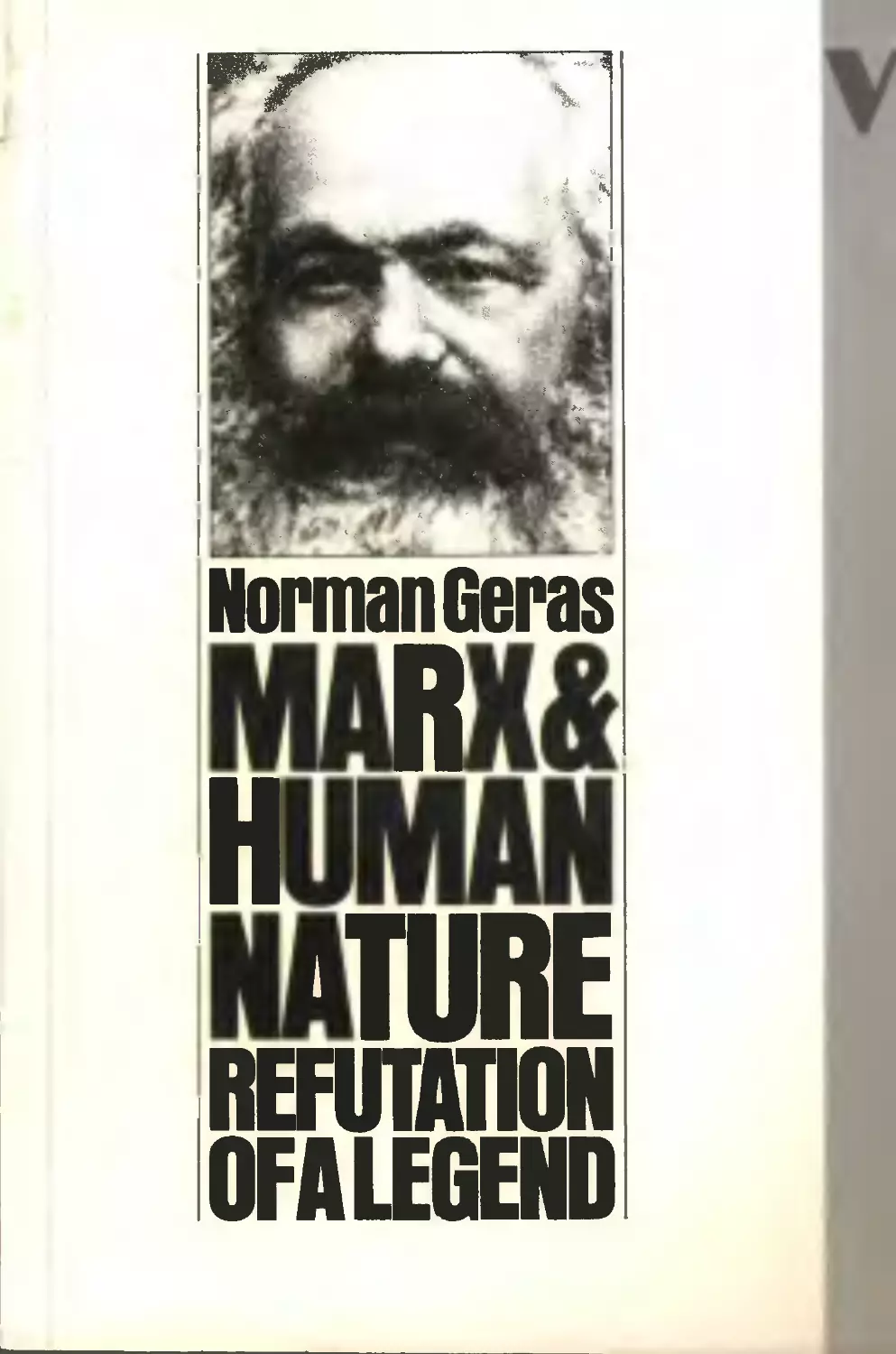
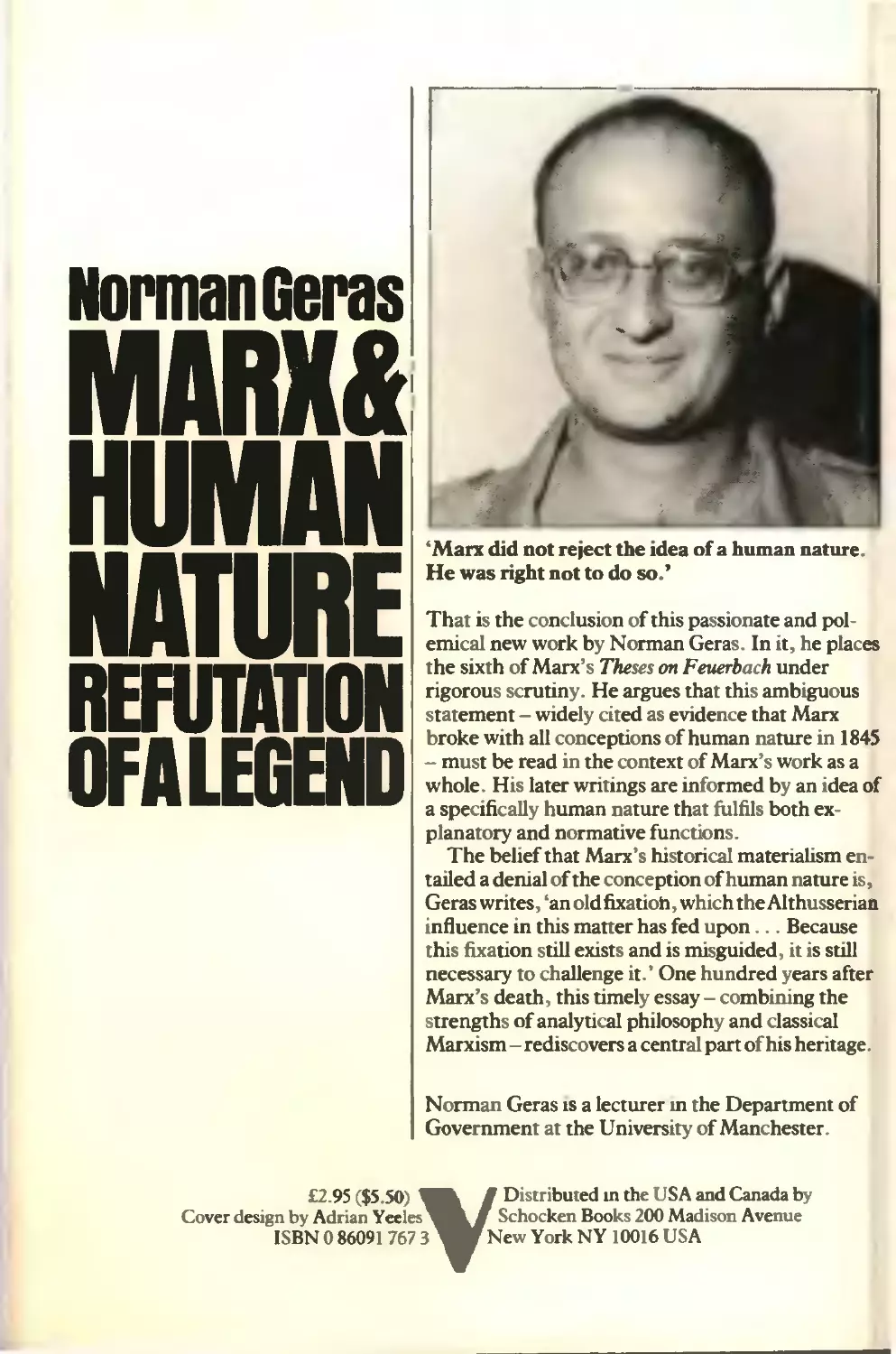
                    NormanGeras
MARX&
HUMAN
NATURE
REFUTATION
OFALEGEID
Norman Geras
Verso
Marx and Human Nature:
Refutation of a Legend
NORMAN GERAS was born in 1943 in what is now Zim-
babwe, and went to school there. He was a student at
Pembroke College and Nuffield College, Oxford, and
since 1967 has taught at the University of Manchester,
where he is a lecturer in the Department of Government.
He is a member of the New Left Review editorial commit-
tee and author of The Legacy of Rosa Luxemburg (1976).
© Norman Geras 1983
Verso Editions and NLB
15 Greek Street, London W1
Filmset in Bembo by
Preface Ltd, Salisbury, Wiltshire
Printed by
The Thetford Press Limited,
Thetford, Norfolk
Contents
Foreword	11
Introduction	19
I	Definitions	21
II	The Sixth Thesis	27
III	Human Nature and Historical Materialism 59
IV	For Human Nature	87
Notes	117
Bibliography	125
Index	127
TO ADELE
. . .as is well known, a spark
dazzles rather than
illuminates: nothing is
more difficult to locate in the
darkness of the night than
the point of light which
breaks it.
-Louis Althusser
Foreword
This short essay attempts to dispose once and for all of
a rather obstinate old legend about the thought of Karl
Marx. So far at least as these things do depend upon the
marshalling of sound evidence and argument, that aim is
not excessively ambitious. For the legend is certainly false.
I hope to have provided here both evidence and argument
enough to demonstrate its falsehood. In any case, it is the
hope of a conclusive refutation that accounts for features
of the essay of which it would be as well to inform the
reader in advance. Some brief remarks on how it was orig-
inally conceived will serve this purpose.
You will not go very far in discussion either within or
about Marxism before encountering the view that one of
the things bequeathed to this intellectual tradition by its
founder was a denial of the idea of a universal human
nature. That view, which had already had a good life when
Althusser’s ‘theoretical anti-humanism’ imparted to it a
new confidence and vigour, has long struck me as being
pretty remarkable, and it was my attendance at a certain
seminar one evening in early 1979 that led me to want to
confront it. The seminar, in fact, was not about Marx or
about Marxism. It was on the subject of human needs. I no
longer recall the details of the discussion, only that the
12
theoretical and practical viability of a concept of common
human needs was received with general scepticism, and
this was sustained in part - or so it appeared to me - by
impulses of a relativist and idealist kind. Since much of
both philosophy and social science is thick with relativist
and idealist themes, there is perhaps no great cause for
puzzlement here. Nevertheless, the occasion did crystallize
in my mind the thought of how surprising it was that
Marxists also, would-be materialists amongst them,
should often sponsor more or less similar themes in sup-
port of a similar scepticism; how very extraordinary
indeed, in view of what I had read in Marx, in view equally
of some obvious facts about the world, that the claim that
he rejected the idea of human nature should be so widely
made and believed.
I decided to look and see just what from Marx’s work is
generally given as confirmation of the claim. The answer
is: not very much - actually only a single passage that can
be said to amount to anything, though Marx himself did
not think fit to publish the text containing it; and, apart
from that, a few other odds and ends which, considered for
the role of evidence in this matter, amount to nothing at
all. The one item of any plausibility is some lines from the
Theses on Feuerbach and it is with a close and extended
analysis of those lines that I have chosen therefore to begin
the present study. Some may perhaps find this analysis
rather too extended and wonder why, when so much in
Marx’s writings can be brought against the claim in ques-
tion, I was not content simply to appeal to that and to see
off the passage from the Theses with more dispatch. I
would ask only that they postpone judgment of the open-
ing analysis until they have digested what follows it. I
hope the sequel will persuade them of its point.
Here it will suffice to say this much. There are already
Foreword 13
plenty of commentaries on Marx which draw attention to
this contrary evidence. Nothing was to be gained by just
repeating them. However, by focusing initially on the best
of the textual support for the disputed claim, we first
square up to the latter on its own chosen terrain, so to
speak, meet it at what may be supposed to be its strong
point. From doing this, as it happens, there is something to
be gained. It may be a few lines only that become thereby
an object of detailed attention, but they have been made to
bear a heavy weight in the exegesis of Marx. Relying on
their support, the legend that he dispensed with the con-
cept of an intrinsic human nature manages to survive in the
face of textual evidence that he did not: either this is simply
ignored or else, if its existence is conceded, it is treated as
the basis merely of one ‘reading’ of Marx to which how-
ever another, alternative ‘reading’ can be opposed, or else
it is said not to represent the real, or the most profound,
tendency of his mature thought; and so on. Yet, examina-
tion of the relevant lines from the Theses on Feuerbach re-
veals that their sense is not, in fact, transparent. They can be
understood in a number of ways. And when the various
possible meanings of this passage are placed within the
only possible context for its proper assessment, the inter-
pretation of Marx that has been so reliant on it is shown
not to be a viable one at all. It is left without even the
slenderest title to philological respectability.
A second feature of my approach here of which notice
should be given is that I take this interpretation at its word.
The argument that Marx rejected all concepts of a univer-
sal human nature is construed in its literal sense. For, its
advocates do themselves emphasize that what he opposed
was not just this or that view about human nature but the
very idea of one, and it is only this emphasis, moreover,
that justifies presentation of the argument as though it
14
were a theoretically bold and momentous one and told us
something distinctive about him. Such it would scarcely
either be or do if the proposition was merely that Marx
dismissed some conceptions of human nature. Of whom is
that not true? I am aware, all the same, that construing this
particular argument in a straightforward way lends an air
of strangeness, a certain unreality, to parts of the discus-
sion, and this might prompt the suggestion that it would
be intellectually more charitable therefore, and the claim
more credible, if one took a narrower view than I do here
of what counts as a concept of human nature. Now, of
course, should we choose to include under this heading
just those conceptions of an enduring and common human
make-up with which Marx did in fact disagree, but not
any that he, for his part, entertained, then the claim will
appear very credible indeed. However, I can think of no
genuinely compelling reason for doing this. Intellectually
charitable it certainly is, but it gives us a definition that is
eccentric and, worse, tendentious: selected with the claim
in mind; purposely designed for the rescue of a bad, albeit
widely used, argument. The view taken in this essay of
what is to count as a concept of human nature is, on the
contrary, a quite standard one. It is one that is found, as we
shall see, in Marx’s own usage. Most importantly, it is the
one embodied in what the claim’s advocates actually say,
for all that this renders their claim unreasonable. It is better
to be true to what they say than to be charitable to it. And
it is more than time. This is a case like that of The
Emperor's New Clothes. The argument is given out as
though it were a sober and serious intellectual position. So,
too, is it frequently received. But once you take it seri-
ously, once you examine it for what it is, it is seen then to
be, precisely, unreasonable.
Marx - like everyone else - did reject certain ideas of
Foreword 15
human nature; but he also regarded some as being true. It
is important to discriminate the sort that he rejected from
the sort that he did not. More important still is it to try to
discriminate such of these ideas as are indeed true from
such of them as are false. Neither purpose is served by talk
of the dismissal of all conceptions of a human nature, and I
hope the essay here may contribute something to replacing
it by more limited but, at the same time, more accurate
statements of what, in this matter, Marx actually opposed.
The foregoing explanations will make plain enough that
this study is not very kind to the interpretation of Marx
that is its object. For this I make no apology; I do not think
the criticism it offers unfair. From what has been said,
however, it should not be inferred that I can see no valid
preoccupation whatever amongst the factors that have led
many Marxists at least to persuade themselves of this
interpretation. In the final section of the essay, when con-
sideration of the textual materials has been concluded, I
examine the reasons that dispose people to want to deny
the existence of a human nature. Although my main pur-
pose is to show that they are not good ones, I do say,
wherever I think there are grounds for doing so, what
legitimate concern any particular argument may exagger-
ate or in some other way reflect. To give one example,
whilst I criticize the oft-expressed belief that the concept of
human nature is simply reactionary, I acknowledge
nonetheless that there are reactionary variants of it, as well
as how frequently these are met with.
This may well be the principal obstacle to a readier
acceptance of the concept amongst those committed to
fundamental and progressive change: conservative and
reactionary assumptions about what is inherent in human-
ity’s make-up are pervasive. That they are owes a lot,
probably, to the historical influence of the Christian doc-
16
trine of original sin, but there are other doctrinal sources
aplenty, secular as well as religious, new beside old, for
assumptions of innate human wickedness and belief, cor-
respondingly, in the permanence of social malignancy of
one kind or another. Such ideas close off the avenues of
thought against the prospect of liberation from manifold
social oppressions. Their pervasiveness, relative to pro-
gressive conceptions of human nature, must perhaps always
be the norm while class society survives. A long past and
continuing present of exploitation and its associated evils
will tend to yield pessimistic generalizations about the
character traits and typical behaviour of human beings.
Anyone who has tried to present socialism as a serious
practical proposition before virtually any audience not
already convinced of it, will almost certainly have had to
contend with pessimistic argument from ‘human nature’.
And yet to attempt to respond to that kind of argument,
and to the weight of conservative culture supporting it, by
denying that there is a human nature, is to meet a powerful
ideological opponent with a weapon that is useless. Not
only this or that ideology, but also widely accessible facts
and truths - some derived from common experience,
others the product of scientific research - will tell one’s
interlocutors that this is foolishness. A proper regard for
what are the real basic needs and capacities inherent in our
human nature is the only adequate response.
Many people have helped me during the writing of this
essay. For advice, comment and discussion, my thanks are
due, and are herewith tendered, to Perry Anderson, David
Beetham, Robin Blackburn, Gerry Cohen, Alistair
Edwards, Michael Evans, Adele Geras, Ian Gough, Fred
Halliday, Harry Lesser, Caroline McCulloch, David
McLellan, Tony Manstead, Peter Morriss, Raymond
Foreword 17
Plant, David-Hillel Ruben, Ian Steedman, Hillel Steiner
and Ursula Vogel. None of them is responsible for any of
the work’s deficiencies.
I want also to thank Sophie Geras and Jenny Geras for
being both tolerant and remarkably patient on a number of
occasions when my priorities did not coincide with theirs.
Manchester, December 1982.
Introduction
Whatever might separate Marx’s intellectual develop-
ment after 1845 from the themes of his early writings, it is
not that he came to reject the idea of a human nature.
In this essay I devote close scrutiny to the sixth of
Marx’s Theses on Feuerbach, widely cited as evidence that
he did so. My purpose is to discredit its status as evidence.
In pursuit of this objective I show that Marx’s later writ-
ings unambiguously do embody the idea in question,
which fulfils both explanatory and normative functions.
This should not really need to be shown. To anyone
who has read his later writings with a minimum of care,
the claim that Marx’s well-known emphases on historical
specificity and historical change did not detach him from
every general conception of human nature may seem too
obvious to be worth the proof. A number of careful, albeit
differing, treatments of his theory of history have already
made the point clearly enough.1 Against this, however,
must be set the widespread influence of Althusser and his
school in disseminating a belief to the contrary. Such a
belief is especially prevalent amongst Marxists. It is indeed
an old fixation, which the Althusserian influence in this
matter has fed upon, that there is no place within historical
materialism for the concept of a human nature. Because
20
this fixation still exists and is misguided, it is still necessary
to challenge it.
I begin (I) by specifying how the term ‘human nature’ is
used here. The essay then proceeds from (II) analysis of the
sixth thesis itself to (III) a consideration of its place within
Marx’s work as a whole. Finally (IV) some other items of
putative evidence for the view of Marx to be contested
here and some arguments commonly directed against the
idea of a human nature are reviewed in turn and criticized
as unsound.
Definitions
Two ways in which it is customary to speak about
‘human nature’ may be distinguished. In the first, one pur-
ports to refer by the term to a constant entity, to qualities
of human beings that are all but universal, amongst
nature’s regularities so to say, and not part of the variety of
history. This is typically what is involved in claims that
human nature rules out the possibility of socialism, lasting
human harmony, direct democracy and what have you. In
a second usage, however, the same term can denote a vari-
able entity as when it is said that human nature is different
in different times or places or according to the influence of
different circumstances. The idea here is of a historically
changing, socio-culturally specific entity.
I am not sure if these usages must actually entail two
distinct meanings of the term ‘human nature’. We could
perhaps just understand it as signifying broadly ‘the
character of human beings’, and recognize that one can
assert of this character that it is a constant one, or that it is a
changing one, or indeed that it is a complex of variant and
invariant features, and so on. Something like this broad
sense is what a closely related locution, ‘the nature of man’,
is often used to convey.
But perhaps because repeated assertions of invariance
24
have helped to associate the idea with it, the term ‘human
nature’ can, I think, also carry an implication of invariance
as part of its very meaning. One can deny, for example,
that belief in God, or the desire to accumulate property and
power, or apathy towards public affairs, is actually a fea-
ture of human nature, knowing that each of these is a
significant element in the character of human beings in a
wide variety of circumstances; the claim is that they are
not permanent or general human characteristics. That is to
construe ‘human nature’ more narrowly. Again, the not
uncommon assertion amongst Marxists, ‘There is no (such
thing as) human nature’, surely relies on this narrower
meaning. It challenges the existence of a human character
that is constant.
In any case, for clarity of argument I observe a ter-
minological artifice and discriminate systematically be-
tween the expressions ‘human nature’ and ‘the nature of
man’. Throughout this essay, save once above for illustra-
tive purposes, I use ‘human nature’ only when I intend to
denote a constant entity, namely, the set of all (relatively)2
permanent and general human characteristics. Otherwise I
speak of ‘the nature of man’, employing this, in the
broader sense I have identified, to mean the all-round
character of human beings in some given context. Whilst
the first usage makes of human nature something unchang-
ing by definition - though there can be argument about
whether there is such a thing - the second leaves open the
degree of mutability in the nature of man. This may be more
or less variable. It will not exclude what anthropological
constants there are, if there are any.
Where it may not be clear, and I wish to leave undeter-
mined, which of these expressions is the appropriate one -
as transpires in the immediate sequel at the beginning of
my treatment of the sixth thesis - there I talk of ‘man’s
Definitions 25
“nature” ’, or resort to some other phrase wherein the key
word is bounded thus by scare-quotes as a mark of its
indeterminacy. Unless otherwise indicated, ‘man’, ‘men’,
etc. are used in the generic sense to include both sexes. I
have adopted this usage for ease and consistency of exposi-
tion only, in circumstances where reference has constantly
to be made to textual excerpts translated in accordance
with the same usage.
II
The Sixth Thesis
Here is the sixth of Marx’s Theses on Feuerbach:
‘Feuerbach resolves the essence of religion into the
essence of man. But the essence of man is no abstraction
inherent in each single individual. In its reality it is the
ensemble of the social relations.
‘Feuerbach, who does not enter upon a criticism of
this real essence, is hence obliged:
‘1. To abstract from the historical process and to
define the religious sentiment by itself, and to presup-
pose an abstract - isolated - human individual.
‘2. Essence, therefore, can be regarded only as
“species”, as an inner, mute, general character which
unites the many individuals in a natural way. ’
The main burden of Marx’s criticism is quite straight-
forward. Feuerbach’s conception of religion is character-
ized as being ahistorical and asocial: he locates the source
of religion within the human individual as such, abstracted
from any social formation. I leave aside whether or not the
criticism is an accurate one. But the accents in which it is
registered should be familiar to Marx’s readers: on history
relative to nature; on social relations relative to the indi-
vidual; on the social reality ‘out there’ as it were, relative to
30
the individual’s intrinsic characteristics. In the next of the
Theses, the seventh, Marx continues in essentially the same
vein: ‘Feuerbach, consequently, does not see that the
“religious sentiment” is itself a social product, and that the
abstract individual which he analyses belongs to a particu-
lar form of society.’3
If we do not go beyond the letter of these few lines,
however, there are also ambiguities in them, particularly in
those propositions which either state or imply something
about man’s ‘essence’.
The German expression Marx employs is ‘das
menschliche Wesen’. Translators of the sixth thesis have
usually rendered it as ‘the essence of man’ or ‘the human
essence’. In other places in his work it is sometimes trans-
lated as ‘human nature’.4 It is common for interpreters to
assume that the sixth thesis is concerned with human
nature, be it directly, because that is just what ‘Wesen’
refers to there, or indirectly, having a bearing upon it by
being about the nature of man. I shall take it that this
assumption is correct or at least harmless: that Marx was
speaking about human nature, either directly or by discus-
sing the nature of man; or else had in mind something as
close to one of these two things as will make no difference.
If the assumption is not correct and Marx’s interest on this
occasion was remote from both of them, this cannot dam-
age the position I defend. On the contrary, it is so much
the worse for those who claim Marx broke with the idea of
a human nature, since their main candidate for a serious
piece of evidence is then disqualified. I avoid proliferation
and confusion of terms, therefore, as also any special
metaphysical connotations which the word ‘essence’
might suggest in this context, by dispensing with it in
favour of the two expressions I have defined.
Holding it for the moment open which of them is the
The Sixth Thesis 31
appropriate one, let us consider in turn the critical and the
negative characterizations of man’s ‘nature’ embodied,
respectively, in the last and the second sentences of the
thesis, before attempting to construe the positive identifi-
cation of it which the third sentence contains.
Notice, then, that in the final sentence Marx takes
Feuerbach to task for conceiving man’s ‘nature’ only as
species, as an inner generality uniting individuals in a
natural way. Marx does not say that it is not these things.
The sentence permits the interpretation that, for Marx,
Feuerbach is mistaken not because he views man in terms
of ‘inner’, ‘general’, ‘species’ (or ‘natural’) characteristics
but because he views him exclusively in those terms. He is
wrong for a one-sidedness of perspective rather than
wrong tout court. On that interpretation, Marx would here
be echoing the thought he communicated to Arnold Ruge
two years earlier. Feuerbach, Marx wrote, ‘refers too
much to nature and too little to politics.’5
Still, the construction of the sentence under discussion
cannot rule out that Marx’s reproach might be the sterner
one: that Feuerbach is wholly mistaken to conceive man’s
‘nature’ in such terms. Some will deem this improbable, an
opinion I comment upon in due course, but let us stay with
the bare construction. To remark, critically, that in some
deficient conception, ‘A can be (or is) regarded only as B’,
is to the point when A is not В as well as when A is В but
not only B. It can be a way of denying A’s B-hood and not
merely of qualifying it. Consider two examples. If I say, in
argument against a well-known view of capitalism, ‘The
relation of capitalist and worker is regarded only as a con-
tractual one between legally equal persons’, I need not in
this case intend to deny that the relationship is as
described; I can be alluding to important additional fea-
tures of it, in particular that it is a relation of exploitation.
32
On the other hand, should I say, ‘On such-and-such
assumptions (wild ones), Marx can be regarded only as a
fool’, my point would be that Marx was not a fool, rather
than that he was other things as well as a fool. Is it possible
to resolve whether Marx meant on this occasion to reject,
or whether he meant only to qualify, a conception of man
in terms of inner, general, species characteristics?
Let us examine the second sentence of the thesis. There
is a sort of internal link between it and the final sentence. If
man’s ‘nature’ dwelt within each individual, it would have
that inner and universal character which the final sentence
perhaps denies it to have. The second sentence on the face
of it does contain such a denial: man’s ‘nature’, according
to Marx, ‘is no abstraction inherent in each single indi-
vidual’. This seems quite categorical and so, keeping still
to the letter, it may be. But even keeping to the letter, it
need not. Despite the explicit negative in this sentence,
what Marx says does not have to entail a belief that man’s
‘nature’ is flatly not inherent in the single individual. For-
mulations of the kind, ‘A is no B; it is C’, are used, it is
true, for conveying just this type of categorical denial.
‘The wage relation is no injustice; it is a free and mutually
beneficial exchange between equals’; and ‘Marx was no
fool; he was a profound and original thinker’ - these may
serve to exemplify that usage. They exploit the starkness
of contrast between two characterizations of a subject as a
way of rebutting one of them. Concede it as a possibility,
then, that Marx’s thought, in counterposing to the indi-
vidual ‘the ensemble of the social relations’, might have
been: man’s ‘nature’ is not, at all or in any aspect, an ‘ab-
straction inherent in each single individual’. That, however,
is not the only possibility.
For, ‘A is no В’ can also have the force ‘A is no mere B’. It
just depends on what it is that follows. If it is a description
The Sixth Thesis 33
of A not manifestly opposed to the one that has gone
before, the sense can be, roughly, that A is not only В
because A is more than В in a loose sense of the word
‘more’; because, comprehended roundly, A is C. Compare
these two statements: ‘Religion is no opiate; it is a genuine
enrichment of the human spirit’; and ‘Religion is no
inward, private, spiritual affair; it is an ensemble of institu-
tions and practices pervading the public order’. An advo-
cate of the first claim, if we impute to her a standard
attitude towards opiates, would be gainsaying that way of
describing religion. An advocate of the second claim is
unlikely, at any rate not bound, to be gainsaying that
religion is inward and private and spiritual in common
senses of these words. She could and probably would just
be asserting that, as a pervasive institutional and practical
reality, religion is more than what they tend to convey,
and wanting to register the importance, perhaps priority,
of its external and public features. Here is another exam-
ple. I could say, ‘Language is no individual possession; it is
a social and collective phenomenon’, without supposing,
absurdly, that it is not individuals who know and speak, to
that extent ‘possess’, a language. The point in these cases is
not to deny, it is to qualify a given description, by bringing
to the fore some other, putatively crucial, dimension of the
subject of the description.
Now, social relations are obviously something different
from the single individual and what is inherent in him. On
a certain conceptual terrain, the difference, hence the con-
trast at the heart of the sixth thesis, might be at least as
sharp as those, in the above examples, between a mutually
beneficial exchange and an injustice, a profound thinker
and a fool, an enrichment of the human spirit and an opi-
ate. On the other hand, the human individual does figure
prominently amongst the entities which social relations
34
relate and could be reckoned a part, or feature, of them.
One should therefore allow that, in identifying man’s
‘nature’ with the social relations at large, Marx’s intention
might have been not that it is entirely other, but that it is
‘more’, than something inherent in each single individual.
Another side of the counterpoint in these lines tends to
support this possibility. For, they refer us not only from
what is inherent in the individual to the social relations,
but also from the abstraction of the first to the ensemble,
the totality, of the second. The sense of‘abstraction’ that is
suggested by this is the one made explicit by Marx a few
lines further on: of a thing isolated; separated, as a part from
the whole of which it is a part, and by virtue of that,
one-sided.
Read in this light, the second sentence of the thesis
would be comparable to my examples concerning the
public, or societal, aspect of religion and of language. The
sense would be: man’s ‘nature’ is not just the abstract thing
(i.e., the abstracted, one-sidedly isolated entity) inherent
within each single individual; and not that it is not at all
something inherent. The sentence is consistent with believ-
ing man’s ‘nature’ to be, in some aspects, intrinsic to each
individual and thus universal. Marx could have been want-
ing to temper this belief by drawing attention to other
aspects of man’s ‘nature’. He does not, by this utterance,
have to have been contradicting it.6
Yet I have already conceded also that he might have
been. By examining the second sentence of the thesis, we
have not therefore resolved the ambiguity we identified in
its final sentence. We still have that: either Marx was here
rejecting altogether a conception of man’s ‘nature’ in terms
of inherent and general human characteristics; or else he
was only qualifying it. Let us style these possibilities
respectively the stern and the mild interpretation of the
two sentences.
The Sixth Thesis 35
One might perhaps be tempted to settle in favour of the
mild interpretation by this line of thought, alluded to ear-
lier and bound to have occurred to some readers. That
there are general human characteristics inherent in each
individual, irrespective of the ensemble of social relations
(or the ‘particular form of society’), is not only true but
obviously so. The denial of this is not just, equally obvi-
ously, false. It is absurd, involving, as I shall argue later, a
logical incoherence. As Marx was no fool, he surely could
not have intended such a denial in the sixth thesis. But it
would be wrong, however tempting in this case, to assume
that, simply because something is false or incoherent,
Marx could not have intended it. That Marx must have
believed what is true is no more plausible as a supposition
than that what Marx believed must be true. Both supposi-
tions have already obfuscated enough issues. Serious peo-
ple have understood him as intending here precisely the
aforesaid denial, and some of them have endorsed his
intention so understood. So far as we have been able to go
up to now, we must allow that Marx too, even though no
fool, might have erred in this matter.
Since our consideration of what is said negatively about
man’s ‘nature’ has left things unresolved, let us hope for
better results from turning to the central affirmative prop-
osition contained in the third sentence. We render it, ini-
tially, thus: ‘In its reality man’s “nature” is the ensemble of
social relations’. The peculiarity of this proposition has
often been remarked upon. Marx asserts an identity where
none seems possible: between a totality of relations on the
one hand, and the make-up of entities that are related by
and within it on the other. However one conceptualizes an
ensemble of social relations with respect to the individual
human beings and to the non-human factors (means of
production, property holdings, etc.) that it brings into rela-
tion; if one takes it as including them; a fortiori if on the
36
grounds that it is a structure and that a structure may be
defined as excluding the terms of the relations which con-
stitute it,7 one does not; in either case, the ‘nature’ of the
human beings cannot just be the ensemble of social rela-
tions. Whether by their ‘nature’ is meant only the charac-
teristics of their human nature or, rather, all those that
compose their overall character, there is no obvious sense
in which this set of characteristics can be the same thing as
an ensemble of social relations. Like much else in the
Theses on Feuerbach Marx’s statement is elliptical and his
meaning far from transparent.
In what follows I shall propose broadly three ways of
understanding it: I elicit them by attention to and argu-
ment from the text, and then enlarge somewhat upon each;
I go on to impugn the exegetical plausibility of the only
one of these three meanings that supports the stern
interpretation of the other two sentences. First I want to
forestall a likely objection.
This is that it must be vain to hope to settle the issue
before us by intensive scrutiny of one small group, espe-
cially this small group, of words. In general, a sentence can
yield only so much of a person’s thought and no more. In
particular, the peculiarity of Marx’s third sentence sug-
gests it will be recalcitrant to settling anything definitively,
which would not be surprising in view of the condensed
and aphoristic character of the Theses on Feuerbach, for
which character they are, indeed, renowned. Add to this
that the Theses were not published in Marx’s lifetime nor
intended by him for publication,8 that they cannot there-
fore be authoritative in deciding a large question regarding
his thought, and one may wonder whether any part of
them can be worth the kind of close attention being given
here. Are not the difficulties with such a procedure already
evident in the foregoing discussion? In isolation from the
The Sixth Thesis 37
wider context of Marx’s ideas, analysis of a single sentence
is as likely to generate as it is to resolve ambiguity.
The substance of the objection is sound, nor will I
attempt to rest everything on scrutiny of Marx’s third
sentence on its own. All the same, as was indicated at the
very outset, the sixth thesis has been widely construed in
the sense I mean to impugn and, authoritative or not by
rights, thus construed it has been, in fact, chief support of
the view that, in laying down his mature theory of history,
Marx discarded the concept of human nature. It is there-
fore as well, before considering other textual evidence, to
try to unravel just what the thesis could be saying. As it
happens, the sense so often ascribed to it is put thereby in
some doubt. Setting the results of this exercise beside the
rest of the evidence then shows that common ascription to
be mistaken.
We have assumed Marx to be speaking here either about
(i) human nature, defined as constant, or about (ii) the nature
of man in our broader, more inclusive sense; though
hitherto we have left it open which. We must now con-
sider each alternative. We must also consider what type of
relationship the third sentence is meant to establish be-
tween one or other of them and the ensemble of social
relations. If it cannot be a strict identity, what can Marx
have intended? An obvious consequence of the relation-
ship he asserts is the claim: without reference to the
ensemble of social relations one cannot understand man’s
‘nature*. What follows in the sixth and seventh theses per-
mits this inference, for it is argued there that Feuerbach
neglects the ensemble of social relations and for that reason
commits the errors he does in his treatment of man.
However, the claim so inferred lacks precision. It
requires attention to the social relations, certainly. But it
could mean simply that this is where one has to look in
38
order to grasp what the ‘nature’ of human beings is.
Or it could embody the stronger, because explanatory,
hypothesis that such attention is necessary in order to
understand why their ‘nature’ is as it is. This stronger claim
presupposes that it is what it is because the social relations
somehow make it so, or shape it. It presupposes a type of
dependence. It may be, therefore, that the third sentence is
meant to affirm such a relationship between the two
things, and in that case I say, provisionally, that the one
‘depends upon’ the other, meaning by this that the first is
as it is in some degree because of the character of the
second. One phrase in the seventh thesis, that ‘the “religi-
ous sentiment” is itself a social product’, seems to point in
this direction. The other claim does not purport to explain,
but only to situate, man’s ‘nature’. It just presupposes that
the social relations as a whole form the site where that
‘nature’ is, roughly speaking, to be seen or found. We need
not yet concern ourselves with what reasons there might
be for saying this. Shortly I shall distinguish two general
cases. For the moment, let us simply call the relationship
thus postulated one of‘disclosure’. Much of what follows
the third sentence suggests, and nothing excludes, that this
rough connection is what it affirms. We allow then that
Marx might have been asserting either relationship: that
man’s ‘nature’ (a) depends upon, or (b) is disclosed by, the
ensemble of social relations.
Putting these with our two definitions of the subject of
the sentence, we obtain:
‘In its reality (i) human nature or (ii) the nature of man
(a) depends upon or (b) is disclosed by
the ensemble of social relations’;
in other words four possibilities which, giving the lexical
sequence priority over the numerical, I designate (a) (i), (a)
(ii), (b) (i) and (b) (ii), and take now in that order.
The Sixth Thesis 39
(a) (i) In its reality human nature depends upon the ensemble
of social relations. This possibility can be discounted. What-
ever degree of dependence is meant, it would be capricious
to attribute the proposition to Marx. Human nature,
according to our usage, is invariant, whilst Marx’s whole
emphasis in the sixth and seventh theses is on the historic-
ity and specificity, hence variability, of the ensemble of
social relations. Were he speaking about human nature, he
could hardly assert it to be as it is because of these chang-
ing relations. It can doubtless happen that one thing
remains constant because another varies, but this conting-
ency is in the present context uninteresting. For, if there is
a human nature, a constant element in the character of
human beings, it is surely not due to the social mutations
between one historical epoch or mode of production and
another. In principle, of course, such a constant element
might be due to some invariant aspect, or aspects, of social
relations that are otherwise variable; I discuss this below as
a logical possibility consistent with another reading of the
third sentence. But it seems unlikely the sentence actually
asserts it in view of the stress placed upon the social rela-
tions in their totality, (a) (i) does not give Marx’s meaning,
so we may eliminate it.
(a)	(ii) In its reality the nature of man depends upon the
ensemble of social relations. This proposition by contrast is
both intelligible and compatible with the drift of the
remaining text. There seems no reason for ruling it out as a
possible interpretation. The third sentence might be saying
that the all-round character of human beings in any setting
is what it is because of the nature of the prevailing social
relations. The question then is whether that entails the
denial of a human nature, and the answer will turn on the
degree of dependence involved. It will be affirmative on
only one of two relevant assumptions about this. Note
40
here that we are concerned with the degree of dependence,
not its precise character. As important to more com-
prehensive definition of historical materialism as this latter
kind of issue is - and it is lucidly and exactly addressed by
Gerry Cohen in the now commanding philosophical work
in this area, Karl Marx’s Theory of History: A Defence - it is
not decisive for our more limited purpose. Provided the
nature of man depends in some way consistent with our
definition of dependence on the character of the social rela-
tions, all that matters is the extent to which it does so. I
take it that the dependence Marx means to assert, if that is
what he does mean to assert, is at least considerable. Under
that description there are only two pertinently different
cases: namely, that the nature of man depends strongly but
not completely, and that it depends completely, on the
ensemble of social relations.
In the first case, the existence of a human nature is not
excluded for the obvious reason that, while the nature of
man may vary substantially with, and because of, changes
in the ensemble of social relations, it may also depend
upon more constant factors, and some of these may consti-
tute precisely a human nature. Now it is common enough
to hold or claim that one thing depends upon another, that
the second explains the first, without supposing the
dependence to be total or the explanation exhaustive;
knowing in other words that other explanatory factors are
involved. Any of several considerations might neverthe-
less motivate singling out, as explanatory, just the one at
the expense of all others. Three such considerations are
these: a concern to highlight what is thought to be very
important; a concern to highlight what risks being neg-
lected; the presumption that some things can be taken for
granted. The first two considerations seem especially to
the point here. Marx is bent on criticizing and correcting a
The Sixth Thesis 41
conception seen by him as entirely naturalistic, and he does
so by emphatic sociological reference. The third one may
seem like a piece of special pleading and as such somewhat
feeble. In fact, however, it is perfectly commonplace when
proffering explanation, particularly in brief compass, to
take a whole background for granted and isolate only the
factor(s) deemed crucial in the given discursive context as
the explanation for the thing to be explained, that on
which this thing may be said to depend.
Of course, were I to contend at this stage that that is just
what Marx is doing in the third sentence, accentuating for
contextually obvious reasons the sociological dimensions
of the nature of man, whilst at the same time taking for
granted other factors on which the latter depends, taking
for granted, for example, certain permanent features of
man’s biological constitution, I should be begging the very
question at issue. All I contend therefore is that that is what
he might be doing, in accordance with a quite standard
intellectual practice. One cannot rule out the possibility
except by assuming that what Marx intends to assert of the
nature of man here is not merely its dependence, but its
complete and exclusive dependence, on the ensemble of
social relations - its dependence on these relations and on
nothing else whatsoever. This is a more special assump-
tion.
The vigorous form of the sentence, asserting the pre-
supposed dependence as an identity, may be held all the
same to license it. Does this assumption, then, entail the
rejection of the concept of human nature? In strictest logi-
cal terms, even it does not, but in this as in a previous
instance the logic alone is uninteresting. I shall not exploit
it in support of my argument. Strictly, even if the nature of
man depended completely on the character of the social
relations, there is the possibility already mentioned that
42
some part of that nature would persist unchanged because
some features of the social relations happened not to vary.
On our definition, such a part of the nature of man could
properly be called a human nature. Entirely derivative,
though, of the social relations, in its own right it would
account for nothing and to invoke it in explanation would
be otiose; an understanding of human character and con-
duct could be had in exclusively sociological terms. Other
overtones of 'human nature’ if not constancy would be
missing, such as the natural provenance of what the term
refers to, the idea that internal as well as external con-
straints are placed by nature on the course of human
affairs. For these reasons, we may allow that if the nature of
man depends completely on the ensemble of social rela-
tions, then in effect there is no human nature although
formally there still may be.
Thus (a) (ii) really* covers two different interpretations
of Marx’s sentence with substantively divergent implica-
tions. Let us distinguish them henceforth by saying, in case
of strong but incomplete dependence, that: (a^ (ii) the
nature of man is conditioned by the ensemble of social rela-
tions; and in case of complete dependence, that: (a^ (ii) the
nature of man is determined by the ensemble of social rela-
tions.
(b)	(i) In its reality human nature is disclosed by the ensemble of
social relations. We eliminated (a) (i) on the grounds that it
was not plausible Marx should seek to explain an invariant
human make-up by reference to something historically
fluid. Human nature cannot depend, in our meaning,
upon changing social facts. Now, however, we are
concerned with the other connection, that the ensemble of
social relations, rather than explaining human nature, in
some sense just discloses what it is; and no problem exists
The Sixth Thesis 43
about connecting in this way what changes with what does
not. There are in fact two general senses in which it might
be suggested that human nature - ‘in its reality’! - is
revealed by, or discovered in, the ensemble of social rela-
tions. One is literal, the other ironic.
An invariant can be such, whether as structure, pattern
or, merely, particular feature, and belong to what is in
other respects far from constant. Just so, a social totality
subject to historical alteration might incorporate, and upon
examination disclose, the invariant we are interested in,
human nature. Why should Marx want to assert that it is
disclosed in the social totality? Perhaps in order to draw
attention to the circumstance that some of the constants of
which it consists are disclosed only there, that some aspects
even of the human nature general in humankind are not
visible, so to speak, in the focus with which he taxes
Feuerbach, upon ‘each single individual3, but only on the
whole terrain of the social relations. Out there, in society,
is where such aspects are manifested. That is what one
must study to grasp all sides of human nature. The ‘reality’
of the latter would in this instance connote something like
its fullness. It would contrast with the abstraction in which
only the one, ‘inner’ side is isolated, encompass the social
side too. Of course, reference to society is, for Marx, at
once reference to history and change, therefore reference
also to human characteristics that are impermanent. But
plainly here this would not contradict the postulate of a
human nature. If the third sentence does state some such
connection as disclosure in a literal sense, then to con-
tradict it was not Marx’s purpose. His reference to the
ensemble of social relations would indicate the site that
must be explored to comprehend what human nature is. It
would not be an attempt to dissolve it.
Assume, however, that that reference carries ironic
44
intent and disclosure becomes precisely dissolution. The
pedigree of the assumption is this. One can sometimes
thus relate two things, the one as being disclosed by the
other, when they would in general be regarded as mutu-
ally incompatible. Typically it is a means of putting the
first of them in question.The human capacity for benevol-
ence, a cynic could suggest, was revealed at Auschwitz and
Dachau. The withering away of the state, a critic of Marx
might say, is to be seen in the Soviet regime. ‘The civiliza-
tion and justice of bourgeois order5, as Marx did say,
apropos the response of this order to occasions of popular
insurgence, at such times ‘stand forth as undisguised
savagery and lawless revenge5.9 Something similar may be
thought to be involved in the sixth thesis, and the social
relations be supposed to reveal in this manner the reality of
human nature. Its ‘reality5 would then stand not for full-
ness as against one-sidedness, but for an actual state of affairs
unable to accommodate what the term ‘human nature5
putatively denotes. It would stand for the actuality as
opposed to the usual associations of the idea, and the point
of the opposition would be that the actuality is such as to
render term and idea altogether inappropriate to it. Human
nature would here be unreal, reduced to the ensemble of
social relations.
I shall for the time being do no more, with respect to
this way of construing Marx5s sentence, than to register
something about the assumption of ironic intent. This is
that it amounts to supposing that human nature and
ensemble of social relations must be concepts standing in
the same sort of contradictory opposition in the sixth
thesis as do those, say, of justice and lawless revenge in the
above-quoted statement from The Civil War in France.
Unless they are, there would be no reason for thinking that
the social relations did not, according to Marx, disclose in
the straightforward sense what human nature is.
The Sixth Thesis 45
In any case, under the rubric of (b) (i) two divergent
interpretations of the third sentence have again been dis-
sociated and these I shall distinguish as follows. Where
human nature is disclosed by the social totality as a real
existent, I shall say that: (b})(I) human nature is manifested
in the ensemble of social relations. Where the first is dis-
closed by the second only in an ironic sense, that is, as
non-existent, I shall say that: (bj) (i) human nature is dissol-
ved in the ensemble of social relations.
(b) (ii) In its reality the nature of man is disclosed by the
ensemble of social relations. We can be brief with this last
proposition for it is unproblematic. Of the two senses of
the relationship of disclosure only one is possible here
since, on our definition of the nature of man, no worth-
while meaning can be attached to the idea of its being
dissolved. Whatever Marx believed about the degree of
variation in their character, human beings always have a
character and nobody could sensibly suggest he thought
otherwise.But he could be asserting the other sense of the
relationship, that: (bj (ii) the nature of man is manifested
in the ensemble of social relations. If he is, it obviously
does not entail the denial of a human nature. The overall
character of human beings manifested in the social rela-
tions could include this unchanging component.
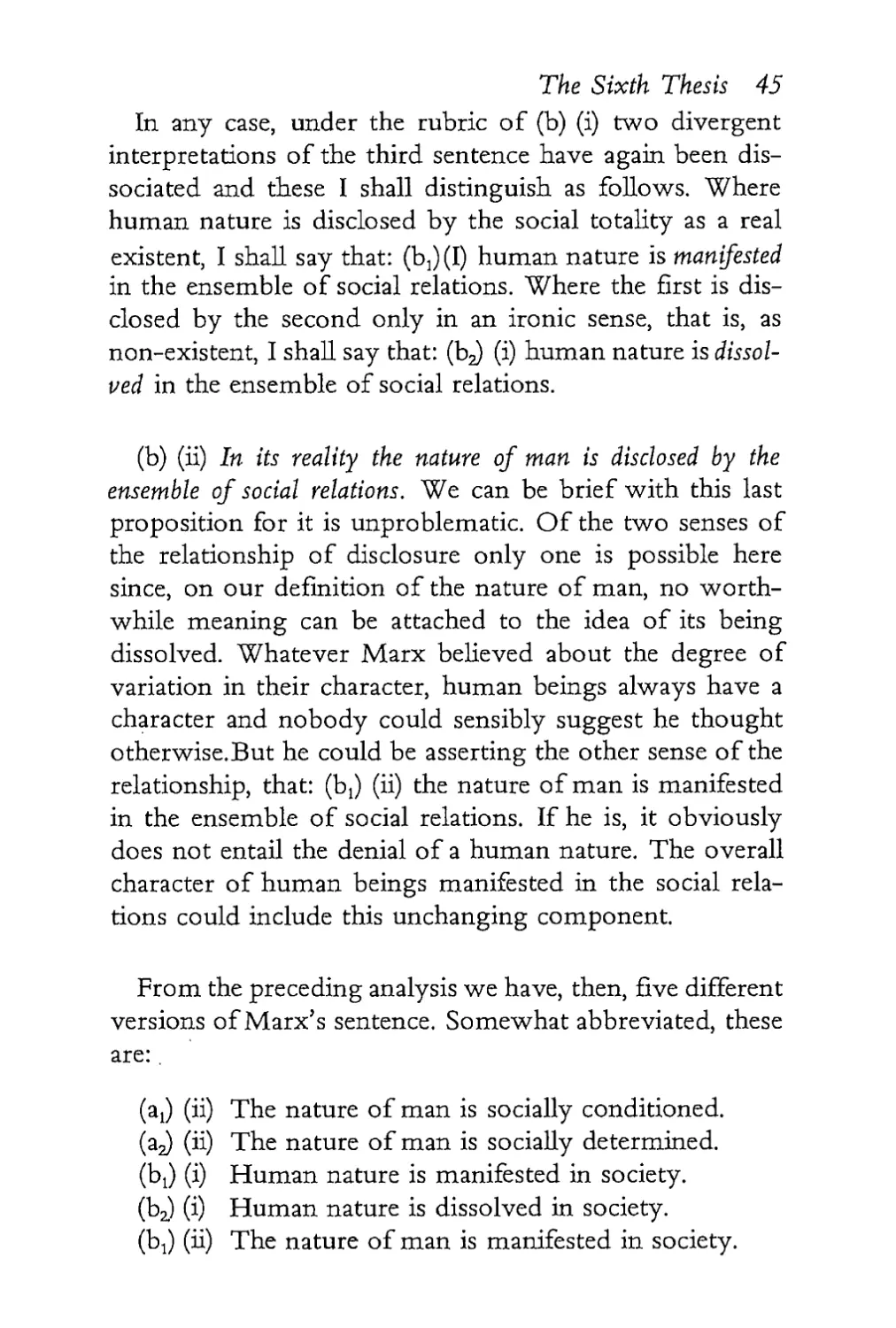
From the preceding analysis we have, then, five different
versions of Marx’s sentence. Somewhat abbreviated, these
are:.
(aj (ii) The nature of man is socially conditioned.
(a^ (ii) The nature of man is socially determined.
(b^ (i) Human nature is manifested in society.
(bz) (i) Human nature is dissolved in society.
(bt) (ii) The nature of man is manifested in society.
46
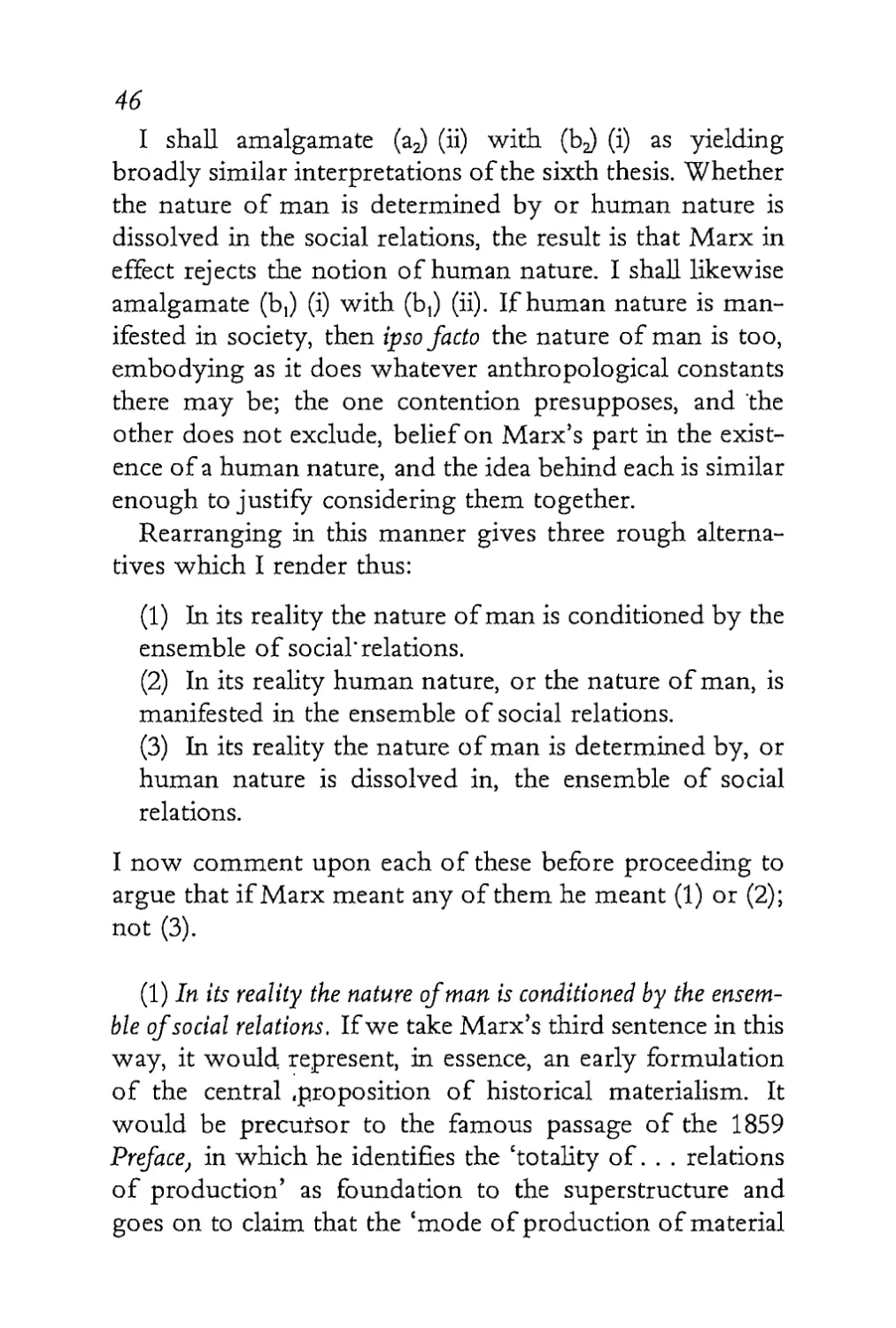
I shall amalgamate (a^ (ii) with (b^ (i) as yielding
broadly similar interpretations of the sixth thesis. Whether
the nature of man is determined by or human nature is
dissolved in the social relations, the result is that Marx in
effect rejects the notion of human nature. I shall likewise
amalgamate (b^ (i) with (bt) (ii). If human nature is man-
ifested in society, then ipso facto the nature of man is too,
embodying as it does whatever anthropological constants
there may be; the one contention presupposes, and the
other does not exclude, belief on Marx’s part in the exist-
ence of a human nature, and the idea behind each is similar
enough to justify considering them together.
Rearranging in this manner gives three rough alterna-
tives which I render thus:
(1)	In its reality the nature of man is conditioned by the
ensemble of social’relations.
(2)	In its reality human nature, or the nature of man, is
manifested in the ensemble of social relations.
(3)	In its reality the nature of man is determined by, or
human nature is dissolved in, the ensemble of social
relations.
I now comment upon each of these before proceeding to
argue that if Marx meant any of them he meant (1) or (2);
not (3).
(1)	In its reality the nature of man is conditioned by the ensem-
ble of social relations. If we take Marx’s third sentence in this
way, it would represent, in essence, an early formulation
of the central .proposition of historical materialism. It
would be precursor to the famous passage of the 1859
Preface, in which he identifies the ‘totality of. . . relations
of production’ as foundation to the superstructure and
goes on to claim that the ‘mode of production of material
The Sixth Thesis 47
life conditions the general process of social, political and
intellectual life’.10 The later passage is less compressed and
it is also less generic, referring to the relations of produc-
tion rather than all social relations and to distinct dimen-
sions of social, political and intellectual life rather than the
nature of man overall; but there is an obvious continuity of
basic idea in that the shape, loosely speaking, of human
existence is held in both cases to depend upon a set of
historically specific relations.
Yet, the sixth thesis.would not thereby signal any ‘rup-
ture’ with the supposition of a human nature. For, if the
third sentence is construed as meaning (1), the dependence
declared by it is not complete, the character of human
beings must therefore depend on something else as well
and it can be due in part to stable, natural causes. We are
entitled then to put what I have called the mild interpreta-
tion on the second and last sentences. Concerned, as these
obviously must be now, with the nature of man, they
would be aimed only against the too one-sided focus in
Feuerbach’s conception of it upon general characteristics
inherent in the species. Marx would be wanting, by con-
trast, to stress the conditioning always exercised on it by
the prevailing social relations, but he would not be deny-
ing that there are general characteristics. The sixth thesis,
harbinger of his mature conception of history, would
involve no repudiation of human nature and would be in
line with the contention of this essay that repudiation of it
is no part of historical materialism.
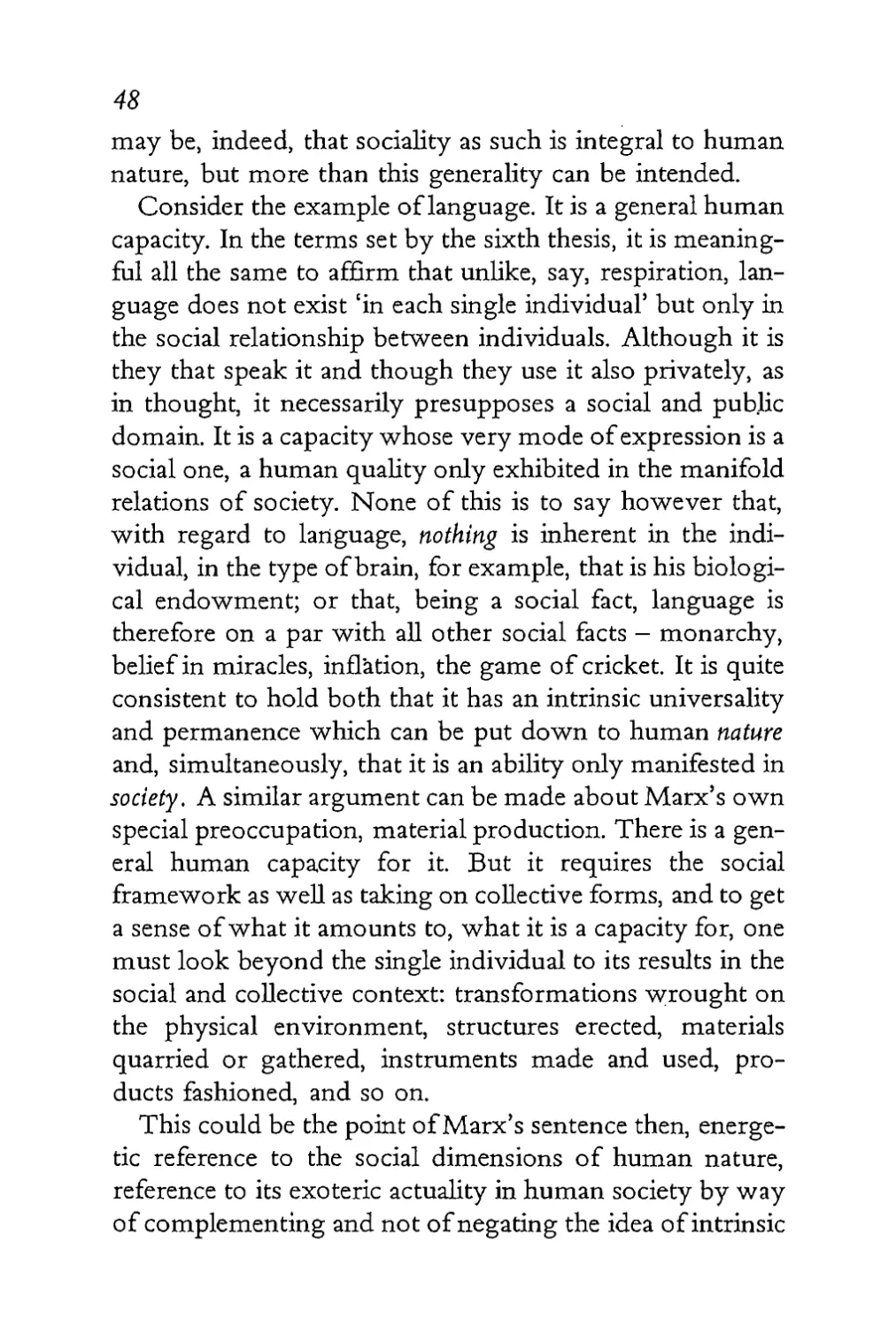
(2)	In Us reality human nature, or the nature of man, is
manifested in the ensemble of social relations. I enlarge first on
the statement as it applies to the invariant entity. Its point
would be to insist upon what can be termed, without
paradox, human nature’s social qualities. An element here
48
may be, indeed, that sociality as such is integral to human
nature, but more than this generality can be intended.
Consider the example of language. It is a general human
capacity. In the terms set by the sixth thesis, it is meaning-
ful all the same to affirm that unlike, say, respiration, lan-
guage does not exist ‘in each single individual’ but only in
the social relationship between individuals. Although it is
they that speak it and though they use it also privately, as
in thought, it necessarily presupposes a social and public
domain. It is a capacity whose very mode of expression is a
social one, a human quality only exhibited in the manifold
relations of society. None of this is to say however that,
with regard to language, nothing is inherent in the indi-
vidual, in the type of brain, for example, that is his biologi-
cal endowment; or that, being a social fact, language is
therefore on a par with all other social facts - monarchy,
belief in miracles, inflation, the game of cricket. It is quite
consistent to hold both that it has an intrinsic universality
and permanence which can be put down to human nature
and, simultaneously, that it is an ability only manifested in
society. A similar argument can be made about Marx’s own
special preoccupation, material production. There is a gen-
eral human capacity for it. But it requires the social
framework as well as taking on collective forms, and to get
a sense of what it amounts to, what it is a capacity for, one
must look beyond the single individual to its results in the
social and collective context: transformations wrought on
the physical environment, structures erected, materials
quarried or gathered, instruments made and used, pro-
ducts fashioned, and so on.
This could be the point of Marx’s sentence then, energe-
tic reference to the social dimensions of human nature,
reference to its exoteric actuality in human society by way
of complementing and not of negating the idea of intrinsic
The Sixth Thesis 49
individual characteristics. The second and last sentences of
the thesis, applying in this case to human nature, once
again carry the sense of our mild interpretation.
So can they also, when we consider (2) in its application
to the nature of man. The exoteric actuality may now be a
changing rather than a common and enduring one; distinct
historical modes of production, particular languages, more
generally, social and cultural diversity. But the thought is
basically the same, namely that, whatever it may be in the
given historical circumstances, the nature of man is to be
discovered in the totality of the social world. The range of
human qualities and possibilities takes actual shape in the
relations between individuals, so it is these relations that
must be investigated if you would grasp that nature entire.
That this thought refers us to a social and historical diver-
sity in no way tells against the concept of human nature,
since there is nothing in the thought to say that such diver-
sity does not contain permanent characteristics innate in
each human being.
(3)	In its reality the nature of man is determined by} or human
nature is dissolved in} the ensemble of social relations. One way
or another, treated thus Marx’s proposition does involve
the denial of a human nature and requires that the second
and final sentences of the thesis assume the meaning of our
stern interpretation. Whichever they concern, whether the
nature of man or human nature, they then betoken not just
qualification, but rejection, of the idea of general human
characteristics inherent in each individual, and we have in
sum the reading of the sixth thesis that I contest.
I shall let others speak for it here. In doing so, I respect,
indeed display, their own usages, and these are not identi-
cal with the ones to which I have hitherto adhered; but the
want of exact terminological uniformity cannot obscure
50
the substantive point that Marx’s words are widely held to
be a dismissal of the concept of human nature, in the sort
of interpretation of them to be now documented.
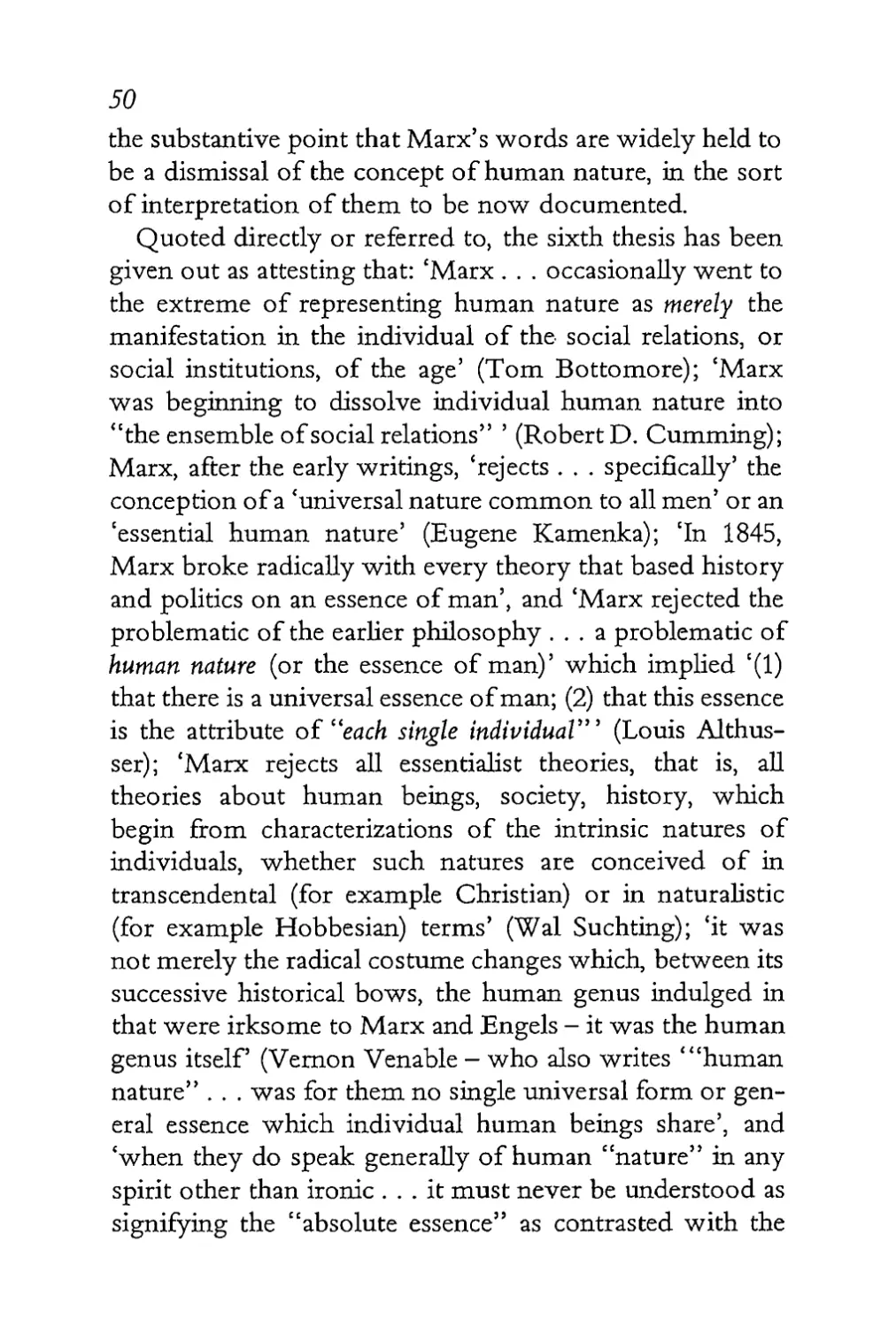
Quoted directly or referred to, the sixth thesis has been
given out as attesting that: ‘Marx . . . occasionally went to
the extreme of representing human nature as merely the
manifestation in the individual of the social relations, or
social institutions, of the age’ (Tom Bottomore); ‘Marx
was beginning to dissolve individual human nature into
“the ensemble of social relations” ’ (Robert D. Cumming);
Marx, after the early writings, ‘rejects . . . specifically’ the
conception of a ‘universal nature common to all men’ or an
‘essential human nature’ (Eugene Kamenka); ‘In 1845,
Marx broke radically with every theory that based history
and politics on an essence of man’, and ‘Marx rejected the
problematic of the earlier philosophy ... a problematic of
human nature (or the essence of man)’ which implied ‘(1)
that there is a universal essence of man; (2) that this essence
is the attribute of “each single individual”' (Louis Althus-
ser); ‘Marx rejects all essentialist theories, that is, all
theories about human beings, society, history, which
begin from characterizations of the intrinsic natures of
individuals, whether such natures are conceived of in
transcendental (for example Christian) or in naturalistic
(for example Hobbesian) terms’ (Wai Suchting); ‘it was
not merely the radical costume changes which, between its
successive historical bows, the human genus indulged in
that were irksome to Marx and Engels - it was the human
genus itself’ (Vernon Venable - who also writes “‘human
nature” . . . was for them no single universal form or gen-
eral essence which individual human beings share’, and
‘when they do speak generally of human “nature” in any
spirit other than ironic ... it must never be understood as
signifying the “absolute essence” as contrasted with the
The Sixth Thesis 51
“accidents” of the human, or its permanence as contrasted
with its change. Rather must it be understood as its “his-
tory”’) "
Marx’s thesis has been cited as signifying: the
‘thoroughly “socialized” or depersonalized version of
Marxism’ emergent from 1845, ‘a mental world from
which “man” seems to be absent’ (Robert Tucker); ‘the
denial of essentialist accounts of human nature’ and ‘the
general truth of the non-instantiation of essence in the real’
(Kate Soper); ‘there is no such thing as “the essence of
man” 5 (Colin Sumner); ‘individuals are to be regarded not
as the origin or constituting basis of their relations but
rather as the “bearers” of those relations’ (Wai Suchting);
‘man can be no more than what men actually do in their
concrete historical and social environments’ (Vernon Ven-
able); ‘No social phenomenon . . . can be explained in
terms of any of the traits imputed to individuals as crea-
tures of nature ’, and ‘If one must speak of the “essence of
man”, one must find it in man’s civilization, material and
ideal, and not in biology’ (Sidney Hook).12
Most, though not all, of these arguments obviously go
beyond a concern with the meaning of the sixth thesis,
using the latter in support of a more far-reaching claim
about the development of Marx’s thought. In so far as this
is so, one should note that it is the claim’s generality,
emphasized in several of the quoted passages, that gives it
its point. No one could be startled if the argument were
only that Marx disputed or forsook some conceptions of a
universal human nature. There might be room even then
for controversy over particulars, but it would be a quite
different kind of contention, consistent with the recogni-
tion that a concept of human nature still finds its place in
his mature theory of history.
To dwell briefly on this feature of the most influential
52
version of the claim, Althusser’s: according to him,
whereas pre-Marxist social theory, political economy, eth-
ics, epistemology, all involved the ‘two complementary
postulates’ said to be constitutive of the ‘problematic of
human nature (or the essence of man)’ - that such a univer-
sal exists and that it is the attribute of each individual - and
only the ‘content’ assigned to them varied as between dif-
ferent thinkers, Marx for his part ‘rejected the whole of
this organic system of postulates’.13 The ‘radically new
concepts’ of historical materialism, ‘concepts of social
formation, productive forces, relations of production,
superstructure, ideologies’,14 do not then accommodate the
concept of human nature. They are opposed to it and they
supplant it. Althusser writes: ‘This total theoretical revolu-
tion was only empowered to reject the old concepts
because it replaced them by new concepts’; and ‘Marx
replaced the old couple individuals/human essence in the
theory of history by new concepts (forces of production,
relations of production, etc.)’.15 It is only consistent with
the conceptual dichotomy so posited that the texts of
Althusserianism are strewn with such assertions, ‘struc-
turalist’, sociologically reductionist, in truth historicist, in
character, as that the agents of production are ‘never any-
thing more than the occupants’ of places determined by the
structure of the relations of production, that ‘individuals
are merely the effects’ of the structure, that they ‘are only
class representatives', 'are nothing more than masks', and so
forth.16
Of course, it goes without saying that the writers I have
cited are not of one mind in everything. The common way
with Marx’s sixth thesis just exhibited should not be taken
for complete community of belief. What perhaps does not
go without saying is that, where these writers elaborate on
the statements quoted and especially where they support
The Sixth Thesis 53
what they take to be Marx’s idea, the positions they adopt
are as a rule not even coherent internally. It might, on this
account and their behalf, be urged that they do not ‘really’
hold the views I have ascribed to them; proof that they do
not residing precisely in their inconsistency, in other of
their statements not compatible with those reported here
and indicative of more sensible assumptions. This sort of
objection, however, is beside the point. For, nothing has
been ascribed to anyone other than what each actually
asserts. That some of the authors also ignore the consequ-
ences of the ideas asserted and contradict them, is not
something which a critic of the ideas will, or need, feel
reluctant to concede. On the contrary, it is part of the case
against these ideas that their proponents are virtually
bound to depart from them. The standpoint they consti-
tute is untenable and can only be stated at the cost of some
intellectual torsion, a confusion of thought or of language
or both. More generally, while it may sometimes be to
the credit of persons, it is then no true defence of what they
say, that they do not really mean what they say.
The type of inconsistency in question, and to which I
shall later return, has been frequent within Marxism.
Although the theory requires, and in its parent version
explicitly possesses, a concept of human nature, many
Marxists try nevertheless to repress this. As has been aptly
remarked, ‘the slogan - literally meaningless outside the
context of idealism - that “there is no such thing as human
nature” has been repeated so often that it has acquired the
force of a truism in Marxist circles’.17 It can appear in
unlikely places. To round off comment on (3) with just
one striking instance, we may take Istvan Meszaros’s
book, Marx’s Theory of Alienation. Its approach is not a
‘structuralist’ one. Lock, stock and barrel, its treatment of
Marx turns around the idea of a human nature, as might be
54
inferred from its very title. Yet it has for a kind of illogical
refrain the emphatic denial of this. Hence, according to
Meszaros, ‘Marx categorically rejected the idea of a
“human essence” ’, and ‘he does not accept such a thing as
a fixed human nature’, and ‘Nothing is . . . “implanted in
human nature” ’.18
My dissection of the sixth thesis being, at last, con-
cluded, I shall move on to the argument for dismissing (3)
as an account of Marx’s meaning. I do not say the above
analysis exhausts all ways of construing these lines. Rebut-
tal of (3) does not require that it should. All I have done is
to follow the usage just now exemplified that, in rendering
‘menschliche Wesen’ and generally, the term ‘human
nature’ can be interchanged with ‘the essence of man’, and
distinguishing then two standard senses, a narrower and a
broader sense, of that term by my discrimination between
‘human nature’ and ‘the nature of man’, to explore on this
basis what possibilities the text suggests. Other meanings
could doubtless be proposed, or other shades of meaning.
Thus the critical referent could perhaps be ‘the human
being in its actuality’. But further proposals will not affect
the main contours of the argument. It is enough if it has
been shown that there are, besides the line of interpretation
being challenged, plausible ways of reading the thesis in
which no denial of a human nature is involved. Taken so
often for granted, its own evidential status is then made
problematic and we are driven to other evidence to see
what is the more likely in this matter.
It is not altogether eccentric to note that there are prob-
lems about the sense of the thesis, even if at such length as
this it may be. Althusser himself says of the central formu-
lation that, in strict terms, ‘it means nothing at all' and other
comments of more or less Althusserian inspiration
The Sixth Thesis 55
describe it similarly as strained ‘to the point of incoher-
ence’, as ‘enigmatic’, ‘merely gestural’.19 In spite of this, the
contested sense will confidently - and in these instances
incongruously - be declared the import of the sixth of
Marx’s Theses without proper recourse to adjacent works
and what they might indicate about his meaning. In the
circumstances there are good chances that the imputation
is arbitrary. To fix on a meaning without more ado, in
peremptory or innocent fashion, is to risk finding in
Marx’s words not his thought but your own. For, the
pivotal formula of the third sentence admits of more than
one possible elaboration; just as a consequence of the
peculiarity of it commonly noted albeit under various
descriptions; just because its tense concision does present a
problem. It can only be resolved in the larger semantic and
intellectual context. Alone, the mere construction cannot
justify these certainties about Marx’s meaning.
Thus suppose I should say about history, ‘In its reality it
is the development of the productive forces’. What exactly
would I mean? That this is all history is, or that this is in
general its most important aspect, or that for the particular
purpose at hand this is what is relevant or interesting about
it? That history is the product of this development, or a
record of it, or its mere outward form or appearance? If the
statement is all you have, you do not have enough. You
cannot give my exact meaning. In fact you also have,
willy-nilly, a certain background to this example, given
which it might be reasonable to think I was stating a fami-
liar relation of dependence, claiming - and emphatically: in
opposition to competing notions - that the development
of the productive forces is what explains the course of
history. Even so, how much of it would I be claiming their
development explains? Some very considerable part? The
broad outline? Everything? What precise degree of depen-
56
dence would I, by my statement, intend? With no
enlargement, you simply could not judge. You might
assume that I had in mind here an exhaustive dependence,
but that would be only your assumption and quite possibly
mistaken.
It is the same in the present case. If Marx is asserting the
dependence of the nature of man on the social relations and
you just take him to mean a complete dependence, to mean
in my terms that this nature is socially determined rather
than socially conditioned (respectively (a^ (ii) and (aj (ii)
above), then you just attribute the thought to him on an
inadequate basis.
Or let us say you see the reality of human nature dis-
puted in Marx’s construction through being, as I have put
it, dissolved in the ensemble of social relations. But if I
maintain that, contrary to some misconception or other
about it, in its reality the fascist ethos is Auschwitz,
Dachau, Treblinka, and so on, I am not thereby disputing
its reality, attempting to dissolve it; as I almost certainly
would be the reality of human benevolence if I so iden-
tified that. Rather, I am affirming it, by signalling in what
it is to be found: its characteristic features or most notori-
ous results or fullest expression. That Marx’s formula is
not affirmation but negation of human nature neverthe-
less, might be supposed to be entailed in the very concept
of the ensemble of social relations. This is the supposition I
registered when presenting (b^ (i), that that concept and
the idea of a human nature are incompatibly opposed. It
provides a basis for ascribing to Marx the kind of ironic
intent that will make his words a dissolution of human
nature in the social relations rather than its association with
them in some more positive sense, such as my suggestion -
(b^ (i) - that it is manifested in them. However, if you
start with this as a supposition, you do not establish, you
simply take it for granted that the historical materialist
The Sixth Thesis 57
concepts in his thought exclude and replace the postulate
of a human nature. You do not show that no such post-
ulate is involved in his notion of the social whole. You
presume it.
The point here is not - yet - that the content of the
presumption is extraordinary. It is that, relative to this
famous aphorism of Marx’s, it is merely a presumption.
Unless therefore something else from his work can be
adduced in its favour, it is as arbitrary a basis as can be for
determining what he means. And indeed any decision will
be, one way or another, arbitrary that professes to unfold,
just from the compression of that aphorism, his meaning
clear and whole. The sole reliable basis for a decision lies in
the wider setting of Marx’s ideas. I have shown that the
third sentence of the thesis can be read in divergent ways.
The immediate context does not suffice to resolve its
ambiguity; on the contrary, I have shown how other
propositions concerning man’s ‘nature’ there, the second
and last sentences, contain ambiguities symmetrical with
its own. One must look, consequently, at the evidence of
other writings, first of all at those closest to the Theses on
Feuerbach.
This I shall now do, in an effort to demonstrate in
the light of them that, of the three broad meanings I have
distinguished, (1) is and (2) is, but (3) is not, a plausible
interpretation of Marx’s sense. I adopt the following pro-
cedure. From texts adjacent to the Theses I indicate pas-
sages similar in tendency to (1) and (2) and which support
the hypothesis that such is what Marx is saying in the sixth
thesis. Although, in the nature of things, I cannot so indi-
cate the absence of passages supporting (3), I do the next
best thing, which is to attest at the same time the presence
of statements that, by their use of human nature and cog-
nate ideas, contradict (3). I go on to argue that Marx’s later
works confirm this general picture.
58
It might be objected that whatever one finds in these
other writings, it will not prove beyond doubt that on this
occasion, in the sixth thesis, Marx did not intend (3) or
something like it. My response to this is that proof in such
a case can only be a matter of probabilities. If two ideas, i
and J, are both construable from the utterance of an author
the rest of whose work points to belief in i and denial of},
it is very unlikely the utterance statesj and, in the absence
of some special and well-founded explanation, perverse to
hold that it does.
And i£ all the previous argument notwithstanding,
someone should maintain staunchly that the sixth thesis is
just not ambiguous in this way, that it plainly is a rejection
of the concept of human nature . . . then so be it. What
follows reduces the significance of the fact to this: that one
day in the spring of 1845, in some ‘notes hurriedly scrib-
bled down for later elaboration’,20 Marx delivered himself
of a freak remark, of an idea which is a departure from the
mainstream of his thought and therefore has no bearing on
its interpretation.
Ill
Human Nature
and Historical
Materialism
It is surely remarkable that so many have discerned,
with the emergence of the materialist conception of his-
tory, a dismissal by Marx of the idea of human nature. The
German Ideology, after all, setting down that celebrated con-
ception for the first time, expressly criticizes the mistake of
those who, ignoring what it terms the ‘real basis of his-
tory’, thereby exclude from the historical process ‘the rela-
tion of man to nature’, create an ‘antithesis of nature and
history’.21 It might be thought that, for Marx, this anti-
thesis is mistaken only with respect to external nature, and
not also with respect to nature as something inherent in
humanity. But it is easy to show that this is not the case.
Marx includes such an inner, human nature squarely
within the ‘real basis of history’.
In fact, The German Ideology at one point echoes a pas-
sage from The Holy Family just in emphasizing nature’s
internal as well as external dimensions. In both works, the
intent behind the emphasis is a materialist one, a ‘double’
natural constraint being insisted upon in opposition to
themes which are manifestly idealist. In The Holy Family,
Marx accuses Bruno Bauer of sublimating ‘all that affirms
a finite material existence outside infinite self-consciousness’
and, hence, of combating nature - ‘nature both as it exists
62
outside man and as man’s nature’. Bauer, Marx also says,
does not recognize ‘any power of human nature distinct from
reason .22 In the passage from The German Ideology, it is
Christianity, rather, that is the object of criticism: ‘The
only reason why Christianity wanted to free us from the
domination of the flesh and “desires as a driving force”
was because it regarded our flesh, our desires as something
foreign to us; it wanted to free us from determination by
nature only because it regarded our own nature as not
belonging to us. For if I myself am not nature, if my
natural desires, my whole natural character, do not belong
to myself- and this is the doctrine of Christianity - then all
determination by nature - whether due to my own natural
character or to what is known as external nature - seems to
me a determination by something foreign, a fetter, com-
pulsion used against me, heteronomy as opposed to autonomy
of the spirit . . . Christianity has indeed never succeeded in
freeing us from the domination of desires. . ,’23
The resemblance between the passages is striking
enough not to have to be laboured. Affirming certain
natural determinants, both exploit the same linguistic
device, separating nature as a whole into what is external
to man and man’s own. Both thereby refer to a ‘nature’
human beings possess in virtue precisely of nature, not of
the ‘particular form of society’; thus to a make-up that,
relative to particular social forms, is enduring and general,
a human nature in our sense. As we shall see, this sort of
materialist usage of it - of ‘power(s) of human nature’,
‘natural desires’ (more often: ‘needs’), ‘natural character’ -
plays an important, explanatory role in the formulation of
Marx’s theory of history.
However, The Holy Family is also echoed by The Ger-
man Ideology in a second, normative usage of the same idea.
In some familiar lines from the former of these works,
Human Nature and Historical Materialism 63
Marx had spoken of the proletariat’s indignation at its
abasement, ‘an indignation to which it is necessarily driven
by the contradiction between its human nature and its con-
dition of life’.24 The German Ideology describes the pro-
letarian similarly: as one ‘who is not in a position to satisfy
even the needs that he has in common with all human
beings’; one whose ‘position does not even allow him to
satisfy the needs arising directly from his human nature’.25
For the way in which they conflict with the needs of a
common human nature, the social relations responsible for
the proletarian position and condition are here implicitly
condemned.
These similarities in the two works may serve to give us
our bearings. In the sequence of Marx’s writings, the
Theses on Feuerbach come between The Holy Family, com-
posed in late 1844, and The German Ideology, begun during
the autumn of 1845 and discontinued the following sum-
mer. The Holy Family is an ‘early’ work; in other words, it
antedates historical materialism. That it makes reference to
human nature will surprise no one, since it is well-known
that the concept is to be found in Marx’s early writings.
The German Ideology, on the other hand, itself proposes the
theory of historical materialism. Whether or not the virtu-
ally identical references that it makes to human nature sur-
prise anyone, they are prirna facie testimony to a continuity
of thought exactly where the sixth thesis is alleged to mark
a rupture.
The German Ideology, like the Theses, remained unpub-
lished during Marx’s lifetime, but too much should not be
made of this. For two years he and Engels tried hard to get
it published, and failed.26 Although in the event not com-
pleted, then depleted by the criticism of the mice and other
vicissitudes, it is the most reliable guide we have to the
ideas its authors at this time wished to put forth. If a clue is
64
needed to difficulties in the Theses, it is as likely as any-
thing is to provide one since, written only shortly after
them, it manifestly shares and enlarges upon their preoc-
cupations, its most interesting and important section being
given over partly to critical remarks about Feuerbach. Of
course, this work is only an initial, hence somewhat rough,
statement of historical materialism. But it is more relevant
than anything written later to deciphering the meaning of
the sixth thesis, and we shall be able to see in any case how
things stand with Marx’s subsequent works.
In The German Ideology, as well as the similarities with
The Holy Family just observed, we find indeed the crux of
the present question. Let us examine one passage, the best
known amongst several like it and occurring, be it noted,
not just in the same work as, but right in the thick of, the
presentation of Marx’s new conception of history. There is
a formulation in it that is nearly identical in character to the
central formulation of the sixth thesis. Where this one dif-
fers from that, however, is in being implanted within a
context better indicative of what it might, and also of what
it cannot, mean. ‘This mode of production must not be
considered simply as being the reproduction of the physi-
cal existence of the individuals. Rather it is a definite form
of activity of these individuals, a definite form of expres-
sing their life, a definite mode of life on their part. As indi-
viduals express their life, so they are. What they are, there-
fore, coincides with their production, both with what they
produce and with how they produce. Hence what indi-
viduals are depends on the material conditions of their
production. ’27
The mode of production is said here to be the form in
which individuals express their life, which form is said in
turn to bear intimately on what they are. What individuals
are is declared, in consequence, to coincide with their
mode of production, and it is this, the penultimate state-
Human Nature and Historical Materialism 65
ment of the passage that is the crucial one. Despite the
terminological variation, its tendency is substantially the
same as that of the third sentence of the thesis. Obviously,
‘what individuals are’ is quite near, in the entity it denotes,
to their ‘nature’, and that it is stated in this case to coincide
with, rather than just be, the mode of production is itself a
difference of little significance. Whether we have that what
individuals are coincides with23 their mode of production or
that man’s ‘nature’ is the ensemble of social relations,
either way we have a relationship that is very close but
whose content is otherwise somewhat vague, in need of
clearer definition. In fact these are only two of a whole
family of similar formulations that Marx was disposed to
use at about this time. I shall introduce further of its mem-
bers in due course.
In the present instance, we find clues to what the formu-
lation might mean in its immediate context. Just before it,
there is the idea that in the mode of production individuals
express their life in a certain way and, according as they do
so, what they are. Perhaps the penultimate sentence here is
meant only to round off what has gone before, affirming
such a relation of expression between mode of production
and what individuals are. It would then resemble (2)
above, that man’s ‘nature’ is manifested in the ensemble of
social relations. Alternatively, perhaps its meaning is
explicated in what directly follows it, the assertion of a
relation of dependence. On that assumption, if we take the
dependence - of what individuals are upon the conditions
of production - as being anything short of a total and
exclusive one, then we have an idea similar to (1) above,
that the nature of man is conditioned by the social re-
lations. With neither suggestion would the formula-
tion under scrutiny evidence any rejection of a human
nature.
However, could Marx plausibly be thought to have
66
intended it as a rejection? Whether because he meant by it
to reduce what individuals are to their mode of produc-
tion, or because he did indeed have in mind a relation of
total dependence, or whatever? Could he, here, be taken as
having meant something like (3)? No, he could not. He
could not, because in the very same place in this work, as
direct preamble to the quoted passage, use is made of pre-
cisely a concept of human nature. Not only that; this use
shows it to be fundamental rather than incidental to the
historical conception being proposed. It is fundamental to
historical materialism in the exact sense of being a part of
its theoretical foundation.
What precedes the excerpt I have already quoted is this:
‘The first premise of all human history is, of course, the
existence of living human individuals. Thus the first fact to
be established is the physical organization of these individuals
and their consequent relation to the rest of nature. Of
course, we cannot here go either into the actual physical
nature of man, or into the natural conditions in which man
finds himself - geological, oro-hydrographical, climatic
and so on. All historical writing must set out from these natural
bases and their modification in the course of history
through the action of men.’29 Italics in this passage are
mine but notice the emphasis that is original to it: the ‘first’
fact to be established; again, one of the natural ‘bases’ from
which historical research must ‘set out’ - man’s physical
constitution. Then, lest anyone should think to dissipate
what is so plainly given here as point of departure, by
leaning on the last phrase about its ‘modification’, the text
at once goes on to associate with this basic physical
make-up a quite general human attribute, an attribute,
indeed, cited by Marx as specifically, distinctively human:
‘Men can be distinguished from animals by consciousness,
by religion or anything else you like. They themselves
Human Nature and Historical Materialism 61
begin to distinguish themselves from animals as soon as
they begin to produce their means of subsistence, a step
which is conditioned by their physical organization.’30
Only after this - a notion of human nature if such there be
- do we come to the congruence we have just now seen
asserted between what individuals are and a particular mode
of production.
The identical pattern of thought is found in more com-
pressed form at other points in The German Ideology. Also
right in the midst of the exposition of historical material-
ism, there is Marx’s observation, ‘Men have history
because they must produce their life, and because they must
produce it moreover in a certain way: this is determined by
their physical organization; their consciousness is deter-
mined in just the same way.’ I shall digress for a moment
to comment that since, hard by in the text, consciousness is
identified thus with language: ‘Language is as old as con-
sciousness, language is practical, real consciousness that
exists for other men as well, and only therefore does it also
exist for me’;31 we have confirmation of the hypothesis,
formulated earlier apropos of language, that Marx could
perfectly well have recognized certain capacities as inher-
ent in the natural constitution of the individual whilst urg-
ing in the strongest terms the social dimension of them.
Now, let us articulate the pattern of thought ascertained. It
may be put as follows: if diversity in the character of
human beings is in large measure set down by Marx to
historical variation in their social relations of production,
the very fact that they entertain this sort of relations, the
fact that they produce and that they have a history, he
explains in turn by some of their general and constant,
intrinsic, constitutional characteristics; in short by their
human nature. This concept is therefore indispensable to
his historical theory. It contributes to founding what he
68
gives out in the theory as the material basis of society and
history. To reformulate the point in the terms that have
been used throughout this essay: if the nature of man
depends upon the ensemble of social relations, it does not
depend wholly on them, it is conditioned but not deter-
mined by them, because they themselves depend on, that
is, are partly explained by human nature, which is a com-
ponent of the nature of man.
One further example of this train of thought before we
proceed. Elsewhere Marx again alludes to those powers of
human beings that are distinctively human, in saying that
‘the production, as well as the satisfaction, of [their] needs
is an historical process, which is not found in the case of a
sheep or a dog.’ At the same place, in the sequel to this, he
goes on in a vein now surely familiar: ‘The conditions
under which individuals have intercourse with each other
. . . are conditions appertaining to their individuality, in no
way external to them; conditions under which alone these
definite individuals, living under definite relations, can
produce their material life and what is connected with it,
are thus the conditions of their self-activity and are pro-
duced by this self-activity. The definite condition under
which they produce thus corresponds ... to the reality of
their conditioned nature, their one-sided existence . . .’32
Observe the form of the last assertion. Before we had
coincidence, now we have correspondence, between the
actuality of individuals and the conditions of their produc-
tion. Here as there, the context licenses the interpretation
that the character of individuals is conditioned by the lat-
ter; it might, perhaps, license the interpretation that in the
conditions of production - these being for their part ‘pro-
duced by this self-activity’ of the individuals - their charac-
ter is in some sort manifested. However, here as there,
there can be no excuse for reading the formula as a reduc-
tionist one, dismissive of human nature.
Human Nature and Historical Materialism 69
In the way of an anthropology implicated in Marx’s
materialist conception, we have so far encountered the idea
of general human capacities or powers: in the first place
that of production, but also language, as embodying
human consciousness. The German Ideology also contains
much about individuals’ needs. These it explicitly assimi-
lates at one point to their ‘nature’, when it states that ‘their
needs, consequently their nature, and the method of satisfying
their needs’ have always bound them into relations with
one another.33 It would be consistent with the argument of
this essay concerning an innate human nature if Marx,
then, had something to say about universal or permanent
human needs, and so he does. Once more the foundational
character of it is as clear as can be. Beyond those needs
implicit in the statement just mentioned, namely, sexual,
under the rubric ‘relations between the sexes’, and the
social one itself- as it is expressed elsewhere, ‘the need, the
necessity, of intercourse with other men’, ‘that men need
and always have needed each other’34 - there is also this, in a
recurring phrase ‘first premise ... of all history’: ‘Men
must be in a position to live in order to be able to “make
history”. But life involves before everything else eating
and drinking, housing, clothing and various other things.
The first historical act is thus the production of the means
to satisfy these needs, the production of material life itself
And indeed this is an historical act, a fundamental condi-
tion of all history, which today, as thousands of years ago,
must daily and hourly be fulfilled merely in order to sus-
tain human life. . . Therefore in any conception of history
one has first of all to observe this fundamental fact in all its
significance and all its implications and to accord it its due
importance.’ The Germans, so we are told, have not done
this but the French and the English have begun to, to give
historiography ‘a materialistic basis’ in the first histories of
civil society and industry.35
70
So we see what putting the study of history on a
‘materialistic basis’ here connotes: not ‘anthropology’s
theoretical pretensions . . . shattered’36 and so forth, but
taking fully into account the enduring imperative of essen-
tial human needs. As if the point were still wanting in
emphasis, Marx afterwards reiterates that responding to
this imperative is, together with the creation of new needs
and the propagation of the species, one of‘three aspects of
social activity . . . which have existed simultaneously since
the dawn of history and the first men, and which still assert
themselves in history today’.37 Much the same idea is
encompassed also in the reference, at another place, to
‘desires which exist under all relations, and only change
their form and direction under different social relations’,
the sex instinct and need to eat being cited in this connec-
tion; as contrasted with ‘those originating solely in a par-
ticular society, under particular conditions of [production]
and intercourse’.38
Essential human needs fulfil not just a theoretical func-
tion in the argument of The German Ideology, explanatory
along with man’s general powers of the productive infra-
structure of human society. As befits Marx’s revolutionary
standpoint, they possess an overtly practical implication
too, serving as a norm of judgment and of action. Thus,
for example, the same needs as figure in elaborating the
aforesaid first premise of all history figure equally as pre-
conditions of human liberation. Dismissing speculative
notions of this, Marx writes, ‘. . . it is possible to achieve
real liberation only in the real world and by real means. . .
in general, people cannot be liberated as long as they are
unable to obtain food and drink, housing and clothing in
adequate quality and quantity.’39 Similarly, the necessity of
social revolution is justified in the light of basic human
needs in the following stricture which is directed specifi-
Human Nature and Historical Materialism 71
cally at Feuerbach: ‘He gives no criticism of the present
conditions of life. Thus he never manages to conceive the
sensuous world as the total living sensuous activity of the
individuals composing it; therefore when, for example, he
sees instead of healthy men a crowd of scrofulous, over-
worked and consumptive starvelings, he is compelled to
take refuge in the “higher perception” and in the ideal
“compensation in the species”, and thus to relapse into
idealism at the very point where the communist materialist
sees the necessity, and at the same time the condition, of a
transformation both of industry and of the social struc-
ture. ,4°
Instead of healthy men . . . people whose need for rest and
need for food are insufficiently met, their health wanting.
This is in line with the normative usage of human nature
already attested, adverse judgment upon social conditions
which fail the very needs common and intrinsic to human-
kind, adverse because they fail them. Noticeable in the
excerpt, moreover, is a certain kinship with the Theses on
Feuerbach. Its second assertion descends directly from both
the first and the fifth of them, whilst the initial sentence is a
clear echo of something in the sixth thesis itself But the
relationship is closer still than that and more relevant to
our present concern. For, just prior to the lines quoted,
Feuerbach is criticized in these terms, cognate beyond all
possible doubt or cavil with the matter of the sixth and the
seventh theses: ‘. . . because he still remains in the realm of
theory and conceives of men not in their given social con-
nection, not under their existing conditions of life, which
have made them what they are, he never arrives at the
actually existing, active men, but stops at the abstraction
“man”. . .’41 As it is their social conditions, according to
this, that make men what they are, it too might have been
seen perhaps as evidence of a denial of human nature.
72
Only, we know from the sequel that what they have made
them in the particular case is sick, and also overworked
and hungry, all of which evokes needs that human beings
do not owe to ‘their given social connection’ but merely to
their natural constitution as human beings, even if they do
owe it to the former that these needs are not more amply
satisfied.
We must conclude that the ‘making’ in question here is
conditioning, in our sense, of the nature of man; that the
above criticism of Feuerbach is the mild one and not the
stern, qualification not rejection of the postulate of an
inherent human make-up; that it is criticism only for treat-
ing this in isolation from the effects worked on man by the
given historical milieu (hence: he stops at the abstraction
‘man’). We may take note also of the conception: the sen-
suous world as the sensuous activity of the individuals
composing it; which may be suggested to resemble at least
somewhat that of man’s ‘nature’ as manifested in the
ensemble of social relations. And as such are Marx’s mean-
ings in this passage on Feuerbach, it seems probable that
such too was his intent in the sixth thesis, so obviously
related to it. I submit in any case that this is getting to look
ever more probable than interpretation (3).
out of everything either stated or implied by Marx in
this connection, we now make a schedule of general
human needs, then so far we have these: for other human
beings, for sexual relations, for food, water, clothing, shel-
ter, rest and, more generally, for circumstances that are
conducive to physical health rather than disease. There is
another one to be added to them before we leave The
German Ideology, the need of people for a breadth and
diversity of pursuit and hence of personal development, as
Marx himself expresses these, ‘all-round activity’, ‘all-
round development of individuals’, ‘free development of
Human Nature and Historical Materialism 73
individuals*, ‘the means of cultivating [one’s] gifts in all
directions’, and so on/2 Some will doubtless want to con-
test the generality of such a need. However, it is there in
the work irrespective of anyone’s assessment of it and my
purpose for the moment is only exegesis. Marx does not,
of course, take it to be a need of survival, as for example
nourishment is. But then, besides considering the survival
needs common to all human existence, he is sensible also,
as we have already seen, of the requirements of ‘healthy’
human beings and of what is ‘adequate’ for ‘liberated’
ones; he speaks too of conditions that will allow a ‘normal’
satisfaction of needs.43 These epithets plainly show that, for
all his well-known emphasis on the historical variability of
human needs, he still conceives the variation as falling
within some limits and those not just the limits of a bare
subsistence. Even above subsistence level, too meagre
provision for, equally repression of, certain common needs
will be the cause of one kind and degree of suffering or
another: illness or disability, malnutrition, physical pain,
relentless monotony and exhaustion, unhappiness, despair.
The requirement, as Marx sees it, for variety of activity has
to be understood in this sense, precondition not of exist-
ence as such but of a fulfilled or satisfying, a joyful, one.
Just see how he talks about neglect of the need in ques-
tion. He talks of ‘subjection of the individual under the
division of labour’ and of an exclusive sphere of activity as
‘forced upon him’; 44 of labour as ‘unbearable’ for the
worker, deprived of ‘all semblance of self-activity’ and,
again, ‘forced upon him’;45 of the worker himself as ‘sac-
rificed from youth onwards’.46 Labour is said only to sus-
tain the life of individuals ‘by stunting it’ and the existing
social relations to be responsible for ‘crippling’ them47 - a
‘physical, intellectual and social crippling and enslavement’
this, one of whose aspects is the ‘suppression’ of artistic
76
produce religion, an inverted world-consciousness, because
they are an inverted world, ’50 The point of departure, as in
the sixth thesis, is religion and it is stated, as in the seventh,
to be a social product. One and the same context therefore,
and lo and behold: But man is no abstract being (Wesen) . . .
Man is the world of man . . . society - one and the same
thought as well beyond any question. The reminder is
perhaps appropriate that it is in this Introduction that Marx
makes the following, somewhat ‘humanist’ declaration:
‘To be radical is to grasp the root of the matter. But for
man the root is man himself. . . The criticism of religion
ends . . . with the categorical imperative to overthrow all rela-
tions in which man is a debased, enslaved, forsaken, despic-
able being.’51
Now here is an extract from Marx’s Paris notebooks,
from his Comments on James Mill: ‘Since human nature is the
true community of men, by manifesting their nature men
create, produce, the human community, the social entity,
which is no abstract universal power opposed to the single
individual, but is the essential nature of each individual, his
own activity, his own life, his own spirit, his own wealth.’
A few lines further on, it is said again of this commun-
ity: ‘Men, not as an abstraction, but as real, living, particu-
lar individuals, are this entity. Hence, as they are, so is this
entity itself’
And shortly after that, there is reference to: ‘The com-
munity of men, or the manifestation of the nature of men,
their mutual complementing the result of which is
species-life. . .’52 Thus, man’s ‘nature’ and the social entity
are identified repeatedly, with the former, quite explicitly
here, held to be manifested in the latter.
The themes of these excerpts from Marx’s notebooks
then recur in the Economic and Philosophical Manuscripts,
One passage there distinctly echoes the first excerpt:
Human Nature and Historical Materialism
‘Above all we must avoid postulating “society” again as an
abstraction vis-a-vis the individual. The individual is the
social being. His manifestations of life - even if they may
not appear in the direct form of communal manifestations of
life carried out in association with others — are therefore an
expression and confirmation of social life!
What follows recalls, in turn, the second one: ‘Man,
much as he may therefore be a particular individual (and it
is precisely his particularity which makes him an indi-
vidual, and a real individual social being), is just as much
the totality!53
It so happens, in other words, that this type of formula-
tion comes very freely from Marx’s pen before 1845 and
evidently without signifying renunciation of the idea of
human nature. What reason, then, is there for thinking that
exactly the same type of formulation suddenly becomes,
in the Theses on Feuerbach, the expression of just such a
renunciation? There is an argument due to Althusser
which might be offered in response to the question but it
fails here. It is that every theoretical element - formula,
assertion or concept - takes its significance only from
the wider conceptual field which it inhabits. Within two
different ‘problematics’, elements that are ostensibly simi-
lar may diverge in meaning. However, for this reasoning
to be applicable in the present case, it is not enough that, as
is demonstrable, a new theory emerges in Marx’s work
from 1845. In addition we must already know the theory
to contain material permitting the inference that he now dis-
penses with assumptions of human nature. But as things
stand, we do not already know this. It is what is in question.
Marx’s characterization of man’s ‘nature’ in the sixth
thesis is itself supposed to be the evidence for it,
remember. Once we have shown what poor evidence that
is by displaying its continuity with a group of similar for-
74
talent in most people as a consequence of the division of
labour/8 Throughout history hitherto, according to Marx,
‘some persons satisfied their needs at the expense of othets,
and therefore some - the minority - obtained the mon-
opoly of development, while others - the majority - owing
to the constant struggle to satisfy their most essential
needs, were for the time being (i.e., until the creation of
new revolutionary productive forces) excluded from any
development/49 This is not the language of a belief that the
nature of man depends simply upon the historically given
form of society but a language of some tension between
them, and its premise, manifestly, the frustration of endur-
ing human needs.
That ends my argument from The German Ideology. We
have seen there: explicit references to a human nature;
usage of the concept that is integral to Marx’s new theory
of history, being of a fundamental explanatory kind; usage
equally of a normative kind; and some part of the sub-
stance of his idea of human nature, certain general human
characteristics, both capacities and needs. We have seen,
moreover, passages bearing a resemblance to the sixth
thesis, and I have tried to show that they support my
interpretation (1) and maybe also (2) but nowise the con-
tested interpretation, (3). Having begun thus by going
forward in time from the Theses on Feuerbach, I want next
to go back from them, to things written just the year
before. This may sound at first to be a rather pointless
exercise, since those who contend Marx broke with all idea
of a human nature generally locate the break from 1845
onwards. In the circumstances, what could writings of
1844 possibly disclose? They disclose in fact matter of the
greatest relevance: a veritable reductio ad absurdum of the
tradition that the concise central formula of the sixth thesis
- of all things, Marx’s formula associating man’s ‘nature’
Human Nature and Historical Materialism 15
with the ensemble of social relations - is proof and expres-
sion of that conceptual break.
For the truth is that the passages which are closest to this
laconic affirmation, which most resemble it in form,
inflection, emphasis, these passages actually predate it.
They belong precisely to Marx’s early writings. We
encountered in The German Ideology assertions to the effect
that what individuals are, their reality, coincides or corres-
ponds with their mode, or with their conditions, of produc-
tion, or else is what their conditions have made them; and I
proposed a substantial similarity between this sort of asser-
tion and the third sentence of the thesis. In earlier texts,
however, the similarity of substance is complemented by
an identity of form as Marx puts forward, exactly in the
manner of the sixth thesis, that now man, now man’s
‘nature’, now the individual simply is society or the com-
munity or the social whole. To claim of the passages in
which he does this that they are denials of human nature
would be absurdity indeed. For one thing, they wear it
upon their face that they are not. For another, which is
explanation of the first, they coexist with the entire con-
ception of human nature known to pervade the early writ-
ings, sitting cheek by jowl with ideas of alienation and
human emancipation that depend on it. In exhibiting these
several passages, I call attention yet again to the support
that is provided for (1) and (2) as ways of construing the
sixth thesis.
The first of them is from the Contribution to the Critique
of Hegel's Philosophy of Right, Introduction: ‘Man makes relig-
ion, religion does not make man. Religion is the self-
consciousness and self-esteem of man who has either not
yet found himself or has already lost himself again. But
man is no abstract being encamped outside the world. Man
is the world of man, the state, society. This state, this society,
78
mulations in the early writings, mere gesturing towards
the notion of the ‘problematic’ cannot restore its credentials.
It would require something rather more cogent, substantive
evidence from the wider conceptual context, to establish
that this apparent continuity is actually a discontinuity
and a species of assertion hitherto perfectly compatible
with the assumption of a human nature now contradicts it
flatly. The wider context of Marx’s famous characteriza-
tion of man’s ‘nature’ is formed, in the first instance, only
by a few brief notes, the rest of the Theses on Feuerbach,
There is nothing in them that could prove there has been
this abrupt change of meaning. And we have already seen
what happens when we look further afield to the work that
directly follows. We are left, therefore, with a nice irony,
in the circumstances of this discussion: the formula cited
with such facility and frequency as revealing Marx’s
repudiation of his youthful belief in the existence of a
human nature has the clearest possible pedigree precisely
in the writings of his youth.
I have no quarrel, incidentally, with the view that the
developments which do occur in Marx’s thought around
1845 are of a decisive importance. The theoretical ensem-
ble that begins to take shape then, by tradition ‘historical
materialism’, outweighs in intellectual fertility and power,
as well as in its political consequence, the content of the
early writings. Althusser’s proposal of the epistemological
break had the merit of focusing upon this when it needed
emphasis, in face of a widespread tendency to promote the
early at the expense of the later writings, a Marxist ethic at
the expense of Marx’s theory, his humanism at the expense
of his scientific and political achievement. However,
nobody is obliged by the alternative simplicities, ‘One
Marx or two?’ The real picture is of a theoretical develop-
ment marked in places by genuine novelty and change, but
Human Nature and Historical Materialism 79
marked equally by some stability of conception, by defi-
nite continuities and strong ones, Its details are amenable
to careful study. Besides rendering a worthwhile service,
the epistemological break also carried with it a lot of excess
doctrinal baggage and some bad intellectual habits. A
whole obscurantism of the ‘problematic’ enabled the dis-
covery in Marx of concepts, novelties - the latest Parisian
fashions - positions, discontinuities, that simply are not
there. Amongst such ‘absent presences’ is his alleged break
with every general anthropology. In truth, there is a con-
tinuity here: he subscribed to the supposition of a common
human nature from beginning to end. I finish the demon-
stration of this by moving now beyond the immediate
textual environment of the Theses to works of a later
period.
The products of Marx’s maturity, in particular Capital
and the writings most closely related to it, provide ample
reinforcement of virtually everything that has been set out
above. It would be tedious and is unnecessary to go
through it at length. My case is in essence already made,
the rebuttal of (3) as an interpretation of the sixth thesis
having deprived the standpoint which I contest of its only
presentable support. At this stage, it will be sufficient if we
just confirm that the broad lines of what has been estab-
lished run on into Marx’s subsequent works.
To begin with, there is still the overt talk of a human
nature in our sense. One instance of it, part of some
unfavourable comment on Jeremy Bentham, is the follow-
ing: ‘To know what is useful for a dog, one must investi-
gate the nature of dogs. This nature is not itself deducible
from the principle of utility. Applying this to man, he that
would judge all human acts, movements, relations, etc.
according to the principle of utility would first have to deal
with human nature in general, and then with human
80
nature as historically modified in each epoch. Bentham
does not trouble himself with this. With the dryest naivete
he assumes that the modem petty bourgeois, especially the
English petty bourgeois, is the normal man.’54 It could be
no clearer surely, a distinction pretty well matching the one
used here throughout and Bentham accused in the light of
it, but of generalizing arbitrarily and not for the idea itself
of a general human nature; accused indeed of failure to
explore what human nature is in a serious way. A second
instance ~ the normative usage this time - concerns Marx’s
distinction between the realm of necessity and the realm of
freedom. Referring to the former, the sphere of material
production, he writes: ‘Freedom in this field can only con-
sist in socialized man, the associated producers, rationally
regulating their interchange with nature, bringing it under
their common control, instead of being ruled by it as by the
blind forces of nature; and achieving this with the least
expenditure of energy and under conditions most favour-
able to, and worthy of their human nature.’55
Another instance involves the division within nature
that we encountered earlier. Marx speaks of wealth, strip-
ped of its bourgeois form, as the ‘full development of
human mastery over the forces of nature, those of so-
called nature as well as of humanity’s own nature’; and he
links this to something else we have already encountered,
namely, the ‘absolute working-out of [man’s] creative
potentialities’, with ‘the development of all human powers
as such the end in itself’.56 The same idea recurs in a defence
of Ricardo: ‘production for its own sake means nothing
but the development of human productive forces, in other
words the development of the richness of human nature as an
end in itself9.57 And by contrast there is repeated allusion to
this ‘nature’, seat of potentialities and powers, as setting
also certain natural limits - on the productivity of labour,
Human Nature and Historical Materialism 81
on the length of the working day, at the lower end of the
value of labour-power.58
Besides references to human nature of a direct kind, all
the complementary theoretical matter gathered from The
German Ideology also persists. If there is no longer any exact
counterpart of the type of formulation exemplified by the
third sentence of the sixth thesis and with which the writ-
ings close to the Theses are replete, there is still, time and
again, the assertion of at least a part of its central point.
The human being is a social being, ‘not merely a gregari-
ous animal, but an animal which can individuate itself only
in the midst of society’.59 It is not uncommon, of course, to
treat this very insistence upon man’s sociality, in historicist
fashion, as repelling any assumption of a human unifor-
mity. But that is the simplest of logical errors. Whatever
degree of historical variation the thought may imply, it is
itself a generalization about human nature. As a caution
against historicist responses to it, it is worth drawing
attention to a visibly naturalist, some will doubtless say
even ‘vulgar materialist’, dimension of this thought. In the
chapter on ‘Co-operation’ in Capital, Marx puts forward
the view: ‘Apart from the new power that arises from the
fusion of many forces into a single force, mere social con-
tact begets in most industries a rivalry and a stimulation of
the “animal spirits”, which heightens the efficiency of each
individual worker. . . This originates from the fact that
man, if not as Aristotle thought a political animal, is at all
events a social animal.’60 A little further on, he repeats this
- that the combination of individuals ‘raises their animal
spirits’ - as one amongst several aspects of‘the productive
power of social labour’, of the fact that the worker, co-
operating with others, ‘strips off the fetters of his individu-
ality, and develops the capabilities of his species’.61
Amongst such capabilities of the human species, the first
82
place in Marx’s interest continues to be occupied by pro-
duction. It is a human universal, its universality expressed
in terms both of possibility and of necessity. As possibility,
it is labour-power, ‘the labour-power possessed in his bod-
ily organism by every ordinary man’, ‘the aggregate of
those mental and physical capabilities existing in the phys-
ical form, the living personality, of a human being’.62
These, ‘the natural forces which belong to his own body,
his arms, legs, head and hands’,63 man sets in motion in the
labour process and the labour process is itself a necessity. It
is ‘a condition of human existence which is independent of
all forms of society; it is an eternal natural necessity which
mediates the metabolism between man and nature, and
therefore human life itself’.64 It is, again, ‘the universal
condition for the metabolic interaction between man and
nature . . . common to all forms of society in which human
beings live’.65 And it distinguishes the species. ‘We presup-
pose labour,’ Marx writes, ‘in a form in which it is an
exclusively human characteristic’ and, contrasting it with
‘those first instinctive forms of labour which remain on the
animal level’, he emphasizes, in the famous comparison of
the architect and the bee, its purposiveness or intentional-
ity, the conscious regulation of the mode of activity
according to ends that are conceived in advance.66 Equally,
the ‘use and construction of instruments of labour,
although present in germ among certain species of ani-
mals, is characteristic of the specifically human labour pro-
cess’.67 The elements of this process, materials, instruments
and the worker’s activity, Marx describes as ‘immutable
natural conditions’ and ‘absolute determinations of human
labour as such, as soon as it has evolved beyond the purely
animal’.68
What we find in the later writings with respect to this
human power, the faculty of production, we find also with
Human Nature and Historical Materialism 83
respect to man’s needs - confirmation of the position pre-
viously expounded. There is the same conceptual conjunc-
tion that was noted in The German Ideology, in the form
now, ‘my needs . . . my own nature, this totality of needs
and drives’,69 and consonant with our case that for Marx
the individual’s ‘nature’ incorporates a constant, a human
nature as defined, there are needs once more of a perma-
nent and general kind. They appear under various head-
ings, ‘natural needs’, ‘physically indispensable means of
subsistence’, ‘physical needs’, on the one hand; but also
‘social requirements’, on the other.70 To be sure, the first
sort are said to vary with climatic and other circumstances
and the second to be conditioned by the ‘level of civiliza-
tion’. Yet a certain generality of needs remains intact for all
that, and as before we may make a schedule of them, this
one a little more elaborate than the first: food, clothing,
shelter, fuel, rest and sleep; hygiene, ‘healthy maintenance
of the body’, fresh air and sunlight; intellectual require-
ments, social intercourse, sexual needs in so far as they are
presupposed by ‘relations between the sexes’; the needs of
support specific to infancy, old age and incapacity, and the
need for a safe and healthy working environment (‘space,
light, air and protection against the dangerous or the
unhealthy concomitants of the production process’ -
otherwise the ‘five senses . . . pay the penalty’).71
Such needs determine the universal ‘metabolism’ be-
tween man and nature and constitute an element in the
value of labour-power; they establish the upper limit on
the length of the working day and account for the portion
of surplus labour which must always be performed on
behalf of those incapable of working. In addition, how-
ever, to what they are called upon by Marx to explain,
their normative function in his mature work is as promi-
nent as ever. Whatever else it is, theory and socio-historical
84
explanation, and scientific as it may be, that work is a
moral indictment resting on a conception of essential
human needs, an ethical standpoint, in other words, in
which a view of human nature is involved. Is it really
possible to doubt or overlook this in face of the clear,
persistent, passionate discourse of Capital? We read there
of the ‘horrors’ and the ‘torture’ and the ‘brutality’ of
overwork;72 of capital’s ‘robbery’ and ‘theft’, within the
labour process, of the most elementary prerequisites of the
worker’s health, ‘the absence of all provisions to render the
production process human, agreeable or at least bearable’;73
that the search for economy here is ‘murderous’ — hence of
industrial ‘horrors’ surpassing those in Dante’s Inferno -
and that capital also ‘usurps’ and ‘steals’ the time for meet-
ing other vital needs,74 and of‘necessities of life’ insuffi-
cient to satisfy the mass of the people ‘decently and
humanely’, ‘overcrowded habitations, absolutely unfit for
human beings’, ‘vile housing conditions’, ‘accumulation of
misery’, ‘physical and mental degradation’.75 We read of
capital’s lack of concern for the ‘normal maintenance’ of
lafeour-pdWer, of concern solely for its maximum expendi-
ture, ‘no matter how diseased, compulsory and painful it
may be’;76 of a ‘shameless squandering’, a ‘reckless squan-
dering’, a ‘laying waste and debilitating’ of labour-power,
a laying waste thereby of ‘the natural force of human
beings’;77 and of ‘the prodigious dissipation of the
labourer’s life and health’ by a mode of production
‘altogether too prodigal with its human material’.78 Marx
describes the lot of the workers as requiring ‘ceaseless
human sacrifices’ and as a ‘martyrology’.79 The increase of
wealth under capitalism he describes as being brought
about ‘at the expense of the individual human being’.80
Extant amongst his preoccupations, finally, is ‘the
worker’s own need for development’: therefore the time
Human Nature and Historical Materialism 85
available for ‘the free play of the vital forces of his body
and his mind’; 'scope for the development of man’s facul-
ties’; and a variety of pursuit — for ‘a man’s vital forces . . .
find recreation and delight,’ Marx says, in ‘change of activ-
ity’.81 Of course, time, scope and variety do not necessarily
mean the absence of all effort and are not in fact proposed
by him in that sense. The expenditure of labour-power, he
contends, is ‘man’s normal life-activity’, some work and
‘suspension of tranquillity’ a need, the ‘overcoming of obs-
tacles ... a liberating activity’. Genuinely free work can
require ‘the most intense exertion’.82 However, this is
self-determining exertion and conceived as part of a
breadth of individual development. From the Communist
Manifesto, with its well-known phrase concerning ‘the free
development of each’ and ‘the free development of all’, to
the Critique of the Gotha Programme, which canvasses ‘the
all-round development of the individual’,83 that preoccupa-
tion of Marx’s is manifested in writings of directly pro-
grammatic import and, as for his theoretical writings, they
are fairly strewn with the signs of it: ‘artistic, scientific etc.
development’ and ‘full development’ and ‘free intellectual
and social activity’ of the individual;84 ‘free activity . . . not
dominated by the pressure of an extraneous purpose’ and
‘that development of human energy which is an end in
itself’,85 ‘a society in which the full and free development
of every individual forms the ruling principle’ and an
education, correspondingly, of ‘fully developed human
beings’.86 In these expressions and others like them, Marx
envisages a better life for human beings. Simultaneously,
in a language and imagery of suffering, oppression,
incompletion and impairment, he seeks to depict a long
and ongoing experience of deficiency, one more category
of unfulfilled human need. Thus, exploited and externally
imposed, labour is ‘repulsive’, a ‘torment’, ‘slavery’.87 In
86
the capitalist division of labour, ‘hideous’ or ‘monstrous’
in its forms,88 the worker is ‘annexed for life by a limited
function’ - a single faculty developed ‘at the expense of all
others’ - ‘crippled . . . through the suppression of a whole
world of productive drives and inclinations’, crippled in
‘body and mind’ and attacked ‘at the very roots of his life’,
‘bound hand and foot for life to a single specialized opera-
tion’, ‘riveted to the most simple manipulations’.89 There is
a ‘suppression of his individual vitality, freedom and aut-
onomy’ and of ‘the many-sided play of the muscles’.90
Transformed from an early age into a ‘mere machine for
the production of surplus-value’, or having to be ‘a part of
a specialized machine’, a ‘living appendage’ of it, the
worker is distorted - into ‘a fragment of a man’.91
IV
For Human Nature
The evidence is clear and abundant Marx did not reject
the idea of a human nature. It remains only to consider
how the misconception can be so common that he did.
Apart from the sixth thesis itself, two rather different sets
of reasons, none of them adequate, are mobilized to sustain
it: first, what purports to be other textual evidence in its
favour (and thus counter to that assembled above); second,
considerations as to why the concept of human nature
should be rejected. Strictly speaking, considerations of this
second kind are irrelevant to the case, but we may examine
them all the same. I now briefly review and criticize the
several reasons, of both kinds, one by one.
As to the other textual evidence, it consists of arguments
of Marx’s supposed, just like the thesis, to prove a denial of
human nature on his part. In the role of proof, however,
these arguments are worth even less than the thesis is. In
different ways, they have reference to man and to concepts
of man, that is all. The evidence they purport to be is
simply bogus. Upon close inspection, it rapidly dissolves.
i)	From one work to another and often, Marx speaks of a
modification or development of human needs and of the
emergence of new needs in the course of history.92 Corres-
pondingly, he speaks also of a transformation of the nature
90
of man. To give just one example of this from Capital:
man, he says, 'acts upon external nature and changes it, and
in this way he simultaneously changes his own nature’.93
Assertions of this type are sometimes invoked in support
of the disputed claim. It is an elementary logical point,
however, that to declare of anything that it changes does
not commit one to the view that everything about it
changes or that it has no enduring features. Forecasts of a
change in the weather would otherwise be received with
much greater anxiety than they generally are. More appo-
sitely here, to read the above statement from Capital as
denying all permanent and general characteristics of a
human nature is as justified and sensible as taking it equally
for a denial of any constant elements in 'external nature’;
that is, not at all so. The latter inference is in fact rather rare
though not altogether unknown, for one occasionally
encounters the notion that, according to Marx, nature
itself is man’s creation, a product of history and so forth — a
notion whose 'rational kernel’ is that Marx does indeed see
the natural world as mightily transformed by human activ-
ity, but which in such unqualified form reveals neverthe-
less the flagrant idealism of this whole line of thought. Of
course, as the human species is itself a product of evolu-
tion, to refer to a constant human make-up, permanent
characteristics and so on, is not to talk in absolute terms.
But relatively, within the temporal range of Marx’s histori-
cal theory - just a few thousand years and the merest frac-
tion of the evolutionary process - the idea of permanent
and general attributes of man is certainly valid. In any case,
his many statements about human variation through his-
tory are logically compatible with it and therefore no evi-
dence whatever for the contention that he rejected it.
ii)	In many passages in The German Ideology, Marx criti-
cizes Hegelian and Young Hegelian thought for a specula-
For Human Nature 91
tive and teleological treatment of history and likewise of
man. He writes, for example: ‘Once . . . the conclusion has
been reached that history is always under the sway of
ideas, it is very easy to abstract from these various ideas
“the Idea”, the thought, etc., as the dominant force in
history, and thus to consider all these separate ideas and
concepts as “forms of self-determination” of the Concept
developing in history. It follows then naturally, too, that
all the relations of men can be derived from the concept of
man, man as conceived, the essence of man, Man. This has
been done by speculative philosophy.’94 Marx, in other
words, dismisses the idea that history is the work of some
single transcendental subject, be it ‘the world spirit’, ‘self-
consciousness’ or even ‘man’; the act of a ‘metaphysical
spectre’, ‘a single individual, which accomplishes the mys-
tery of generating itself’.95 He dismisses simultaneously the
assumption of an original historical destiny or plan,
wherein ‘man’, for instance, is ‘the ultimate purpose of
world history’; if ‘later history is made the goal of earlier
history’, he says, the real process is ‘speculatively dis-
torted’.96 Now, to the extent that they are applicable to
aspects of his own early work,97 these strictures may be
taken as being self-critical as well as other-directed, part of
Marx’s famous ‘settling of accounts’,98 and thus evidence
of a certain intellectual break. Once again, however, there
is an elementary logical point to be made here. To dismiss
speculative notions of man is not to dismiss the idea as such
of a general human nature or, in particular, a materialist
concept of it, one based on objective investigation, open to
procedures of scientific correction and research. To inter-
pret these passages from The German Ideology as disputing
the very idea of human nature is therefore merely arbit-
rary, an unwarranted extension of Marx’s own argument.
iii)	It is by an equally unwarranted extension of another,
92
very familiar argument of his that it too is sometimes so
interpreted. According to Marx, a standard mechanism in
the ideological legitimation of existing social arrangements
consists of representing as universal what are in fact histori-
cally specific features of them. The institutions of or traits
fostered by, one sort of social order are generalized so as to
appear necessary, permanent, indeed natural; turned, in the
words4 of the Communist Manifesto, ‘into eternal laws of
nature and of reason’.99 We have already come across one
instance of this recurrent Marxian theme in the earlier-
quoted comment upon Bentham to the effect that he
naively assumes the modem petty bourgeois to be typical
of all humanity.100 Marx takes Proudhon to task, simi-
larly, for viewing competition as ‘a necessity of the human
soul\X0[ And he argues that it is the appearances of a ‘society
of free competition’ that are universalized, in Smith,
Ricardo and the social contract thinkers of the eighteenth
century, to produce the isolated and independent indi-
vidual which is their theoretical point of departure, the
individual, as he puts it, ‘appropriate to their notion of
human nature’.102 In such arguments as these, Marx is chal-
lenging what he considers to be a false generalization of
attributes which are historically formed and culturally
specific. He is seeking also to expose, sometimes explicitly,
sometimes only implicitly, its conservative ideological func-
tion. It should be obvious that to challenge a false or a
conservative concept of human nature is not to impugn all
concepts of it. To question whether certain, named charac-
teristics are permanent and natural ones is neither to say
nor to imply that there are not permanent and natural
human characteristics.
iv)	Marx speaks in Capital of individuals as the ‘per-
sonifications’ and ‘bearers’ (Trager) of economic categories
or relations.103 The asceticism of the capitalist, for example,
For Human Nature 93
his drive to accumulate wealth for accumulation’s sake, is
explained in these terms, as a necessity for one so placed:
the "hearer of this movement [of capital — NG]’, "capital
personified’, "cog’ in a "social mechanism’, capital’s "mere
functionary’?04 Much has been made of this in recent
"structuralist’ renderings of Marx’s ideas, and it does
embody an important if fairly well-rehearsed historical
materialist point concerning the societal bases of individual
motivation and action. However, it is idle to pretend that
for Marx himself it constitutes an all-embracing system of
explanation, a comprehensive structuralism putatively
disposing of the assumption of human nature. The futility
and the capriciousness of interpreting it so emerges in
short order. In the first place, with the same ease with
which he can say that individuals do personify a social
relation, Marx can also, when it suits him, say that they do
not. He can distinguish and distance people from, as well
as identifying them with, their functions. Thus, with the
development of capitalism, he asserts, there is a more
extravagant consumption amongst its agents: "with the
growth of accumulation and wealth, the capitalist ceases to
be merely the incarnation of capital. He begins to feel a
human warmth towards his own Adam’.105 The capitalist
now falls short of the ‘ideal’ of production for the sake of
production.106 Equally, the worker, described by Marx in
one breath as 'labour personified’, is said in the very next to
find this labour "just effort and torment’.107 The whole
mode of discourse is for Marx an adaptable and open one,
rubbing shoulders with many another idiom. It is not the
closed and self-sufficient metaphysic which some like to
foist upon him. Furthermore, it is not only persons but
also things that he speaks of as bearers of economic
categories and relations: use-values as bearers of value and
exchange-value; more generally, material conditions as
94
bearers of a specific social nexus.108 One might just as well
interpret him to mean by this that the material objects and
conditions in question lack intrinsic natural properties or
can be exhaustively explained by the social relationships
which they ‘bear’.
v)	Closely related to iv), and therefore worth little
comment additional to it, are Marx’s polemics against
those who abstract from differences of class in appealing to
a common humanity: like Karl Heinzen, for instance, for
whom, he says, ‘all classes melt away before the solemn
concept of “humanity” . . . Herr Heinzen believes that
whole classes which are based on economic conditions inde-
pendent of their own will and are forced into the most
virulent contradiction by these conditions, can by means of
the quality of “humanity”, which attaches to all men, shed
their real relationships. . ,’109 The scare-quotes around
‘humanity’ here obviously express a certain sarcasm; as
elsewhere, Marx derides a usage of such concepts that
belittles or overlooks the interests and constraints of
class.110 And this is, once again, a matter quite central to
historical materialism. But, as evidence, it is no better than
the language of‘bearers’. To insist upon the importance of
class scarcely commits one to denying that individuals
share a common human nature. It does not entail that their
class is exhaustive of what they are.
All this other evidence, in sum, has no value. It is spuri-
ous. In its status as evidence, the most interesting thing
about it is that anyone should have considered it to be that.
That they have, and in the face of so much from Marx’s
work proving he did not reject the idea of a human nature,
suggests that the notion that he did is probably nourished
also by reasons extraneous to direct textual proof. In so far
as Marxists themselves have been responsible for propa-
gating it, at work, I think, has been the familiar tendency
For Human Nature 95
to want and claim the Old Man’s blessing for one’s own
conception of things. For, with many Marxists, it is indeed
their own conviction that there is something mistaken
about assuming a universal human nature; that the idea
therefore ought to be denied. I now go on to argue against
reasons generally offered for this view. Hence I stray,
finally, beyond the question of interpretation, to urge that
not only did Marx not reject the idea of human nature but
he was also right not to do so. It should go without saying,
however, that even if good reasons can be adduced against
the concept of human nature, this will not show that Marx
himself dispensed with it, only that it is regrettable if he
did not. So if some or all of the following argument fails, it
has no bearing whatever on the exegetical case which it has
been the main purpose of this essay to make. The principal
reasons generally given against the idea of a human nature
seem to be these.
vi) It is a reactionary one, used against socialism and any
project of radical change; put forward in suggesting that
some deplorable characteristic or other supportive of an
existing social institution or pattern is a permanent and
ineradicable part of the human make-up. There is no dis-
puting the frequency of this kind of suggestion: in refer-
ence to selfishness, greed, love of power, cruelty; to pri-
vate property, social and sexual inequality, nationalism,
violence and war, as well as any number of other things.
However, what is crucial in such arguments from human
nature is not that there is one but that these are its attri-
butes. In response we need only show, or give reasons
where we cannot show to hope, that they are not. We have
no need to deny that there are some constant attributes
constitutive of a human nature. It is just not true that this
supposition is in itself politically reactionary. Where it
concerns basic human needs, whether for adequate nour-
96
ishment and other physical provision, for love, respect and
friendship, or for a freedom and breadth of intellectual and
physical self-expression; where it concerns the identifica-
tion of suffering and oppression associated with their
non-fulfilment, and the attempt to change or remove such
institutions as may be responsible for frustrating them -
this is surely a central part of any socialist politics worth
the name: the fight against what is inimical to human hap-
piness. Could it be reactionary in today’s world to protest
and act against hunger? Or against torture? And could not
one - I do not say the only - motivation for doing so be a
conception, an elementary conception, of the vital needs of
any healthy human being, in virtue of human nature? The
claim that this is a reactionary concept betrays, anyway, a
very partial view of its place in the history of social theory.
The kind of use of it by Marx that I have documented is a
case in point. With its critical and progressive edge, it is in
broad conformity with the usage of much socialist, anar-
chist, communitarian and other radical thought.111
vii) The concept, it is also said, is an idealist one. But this
is a confusion identical with the last and it merits exactly
the same sort of answer: just because there are idealist
conceptions of human nature, it does not follow that all
conceptions of it are idealist. It is true that under the head-
ing of human nature there often reside what one might
call projects of deification; attempts precisely to unshackle
humanity from nature, to liberate human beings from, or
elevate them above, their own biology and indeed the cor-
ruption of materiality itself by recourse to free will, the
soul, notions of pure creativity, the spark of divinity
within each person, and so on. Yet it cannot be an appro-
priate materialist response here simply to assert that, on
account of man’s social and historical formation, there is
no human nature. On the contrary, this risks being but a
For Human Nature 91
covert form of the very idealism it purports to challenge.
By setting up an absolute distinction between society/his-
tory and nature, it divorces humanity from the natural
world - in particular from other species, which for their part
are never denied to possess an intrinsic nature - and func-
tions in this respect exactly like the theological conceptions
just mentioned. Against these, any genuine materialism
must insist rather that human beings, for all that is distinc-
tive about them as a species, and for all of their traits,
activities and relationships which can only be explained by
specificities of society and history, are nevertheless, like all
other species, material and natural beings; "irredeemably5
rooted in a given biological constitution; absolutely continu-
ous with the rest of the natural world. Such insistence
betokens an alternative view of human nature, not a denial
of it.
viii) The charge of idealism, though, can be intended
also in another sense. It is laid by Marxists and Marxists
align materialism with science. Those who say the concept
of human nature is idealist sometimes appear to mean that,
irrespective of its specific content (thus of whether it is ideal-
ist or materialist in the senses discussed under vii)), in the
scientific study of history it is an impediment to sound
theory and research. It is a philosophical generality, fit only
to inhabit speculative treatments of man, a substitute for
concrete and detailed empirical investigation. Yet again it
must be conceded that the argument has a legitimate
target. Human nature can certainly function in this way. It
stands in often enough for any real effort to gather objec-
tive data; provides the easy, the short-cut answer to ques-
tions only genuinely answerable in the light of extensive
and painstaking factual enquiry. However, if this alone
invalidated the concept, what other concept within Marx-
ist theory would be left intact? There is none that cannot
98
be, and has not been, so abused. Class, state, ideology,
productive forces, production relations: how often have
they been deployed to block off serious thought and
research? This is not in itself proof that they have no valid
content and application. There is very good reason to view
with suspicion any too facile appeal to ideas of human
nature: to consider carefully whether the uniformities and
innate characteristics they presuppose can be substantiated
by research in the biological, psychological and historical
sciences, and to be alert also that, in virtue precisely of
their generality, they take us just so far and no further;
their explanatory role within history is a limited one. Still,
this is to say only that what matters is whether the content
of some given generalization concerning a human nature is
Zrwe, and what it is alleged to explain, and whether it actu-
ally does explain it - issues I come to in their turn below.
One cannot take it as a serious proposition about any con-
cept that just on account of its generality, irrespective of its
content, it is incompatible with the theory and procedures
of a science.
ix) Next let us consider objection prompted by the
normative or moral aspect of the question. Like the charge
of idealism, under which some would in any case subsume
it, such objection comes in different versions. Statements
about human nature, it may be argued on the one hand, are
really value judgments. As such, they cannot be true, since
truth (equally, falsehood) is not a property of the value
judgment. Expressing as they do the goals or the interests
of those who make them, the ideology perhaps of a class
and time, lacking even the possibility of objective validity,
they are statements useless from a cognitive point of view.
The argument is misguided. Hypotheses about human
nature can certainly form part of the basis for normative
judgment, a point I proceed to immediately after this. Yet
For Human Nature 99
they are not in themselves necessarily instances of it. They
may of course be extremely contentious but that is not the
same thing. So can any matter of fact. The point is not
whether people can or do dispute them, for it is notorious
that this happens even with truths supported by over-
whelming objective evidence: that the Nazis killed mil-
lions ofjews, for example. To everyone but the consistent
relativist whom, frankly, I discount, the point rather is
whether they are open to being settled by empirical evi-
dence, in principle at least. Perhaps it is supposed that no
statements having reference to a human nature ever are.
But that is surely false. It is a plain fact that human beings,
in virtue of their intrinsic make-up, need food and water,
sleep, shelter against the elements, sexual gratification; or,
in case this is regarded by some as too vulgarly physical,
not ‘human’ enough, that they possess also linguistic,
reasoning and productive capacities which between them
make possible a purposeful transformation of the envi-
ronment such as no other earthly species is capable of.
Again, there is a general human capacity to make and
enjoy music. With respect to some emotions - namely,
anger, disgust, fear, happiness, sadness and surprise - there
is compelling evidence not just of their universality, but
for a thesis of Darwin’s that the facial expressions of them
are similar regardless of culture, being of biological
origin.112
Claims about human nature may disguise a value judg-
ment, in the sense of being motivated psychologically by
no more than the wish to commend something or other.
Even where they are quite controversial, however, they
need not, and should not therefore be presumed to, be so
inspired. Consider, for instance, Marx’s assertion of a
human need for breadth and variety of activity. Some
would no doubt challenge it as being merely an arbitrary
100
generalization of what he himself happened to think
desirable. Yet it does not have to be so. We can construe it
as an empirical hypothesis: that in general people will
themselves be happier with such breadth and variety than
without it, happier than they will constrained to a very
narrow range of pursuit; and will, given the choice of the
former, in fact choose it. To provide evidence for this is in
practice certainly a more complex and difficult enterprise
than where needs of bare survival are concerned. And, as is
true of many hypotheses which are a premise of socialist
and other radical aims - that a genuine socialist democracy,
for example, is workable in a large, industrial society -
conclusive evidence for it on a society-wide scale could
only be gained in future and from social practices and
institutions yet to be created.113 The theoretical test is also
part of a long historical battle - which may in the end be
lost. Nevertheless, in principle the hypothesis should be
susceptible to confirmation or refutation. That, in any
case, is how I think Marx himself viewed it. For what it is
worth, I think, too, the hypothesis is true and that much
could be adduced to support it even now. I do not intend,
though, to argue this here since my concern is not to vin-
dicate everything in Marx’s conception of human nature
but only, having shown that he did rely upon one, to
defend him for having done so. Those inclined to be scep-
tical about a human need for the sort of free scope he had
in mind might perhaps just ask themselves whether they
do not already enjoy much more of it than most people.
x) On the other hand, even if statements about human
nature are not themselves necessarily value judgments, the
role that they can and do play in contributing to the
reasons for these make them an object of distrust for those
Marxists who believe that Marxism can have nothing to
do with moral judgment beyond seeking to explain it in
For Human Nature 101
the mouths of others. For them the very idea of a norma-
tive dimension to Marxism, and the idea in turn of a
human nature for being associated, howsoever, with one-
together these bite the dust. Now there are large and inter-
esting questions about the place of moral concepts within
Marxist thought. For example, did Marx, as some
philosophers affirm and other philosophers deny, con-
demn capitalist society in the light of a conception of jus-
tice? And how can one reconcile his criticism, even
ridicule, of the ethical pronouncements of others with his
own censure, manifest and scathing, of the exploitative
and oppressive features of that society? How interpret the
relationship between what one might call the ‘sociology’
of ethics implicit in his theory of ideology and such idea of
‘the good’ as he himself entertained? Did Marx, as I would
hold to be so although it is often gainsaid, accept the dis-
tinction between fact and value? Can Marxism accommo-
date a conception of human rights and, if so, what relation
might it bear to basic and other human needs? These are
important questions and debated to some profit, but they
are not the subject of this essay; they would require
another at least as long.
It is sufficient to my purposes to say that an ethical
position resting upon a conception of human nature is a
perfectly possible one, possible in the sense of being logi-
cally unobjectionable, coherent in principle. If one places a
value upon human life and human happiness and there
exist universal needs that must be satisfied respectively to
preserve and to promote these, then this furnishes, the
value and the fact conjointly, a basis for normative judg-
ment: such needs ought to be satisfied ceteris paribus"4
With regard, as it happens, to the most fundamental needs,
it is the view of some philosophers that this is not just a
possible ethical standpoint but a necessary one; any moral
102
system logically must lay an obligation upon people to try
to meet each other’s needs of survival. I am not persuaded
of that, but it would require once again more discussion
than there is space for here to spell out why, and more
discussion also than is to the point. For whether this ethical
position is indeed necessary or is only possible, it is in any
case possible, since it has to be possible to be necessary in
the relevant sense. Either way, what I have documented as
clearly present in Marx’s work, labelling it the normative
function or usage of his idea of human nature, can be
defended as a possible, a logically coherent, viewpoint.
What of the argument that Marxism has no room for
any such normative dimension? Leave aside as germane to
the previous rather than this section of the present essay
that, in so far as the argument is meant to apply to the
doctrines actually propagated by Karl Marx, it is a piece of
the most pure obscurantism, and the cleverest procedures
of heading’ will not suffice to hide this. Whatever answers
are proferred to the question of the place of moral concepts
in Marx’s thought, they must, to carry any weight at all,
be consistent with the obvious presence in his writings of a
conception of the human good - in that broad sense at
least, with the presence of a moral doctrine. Leaving that,
as I say, aside, those Marxists who argue for a Marxism
lacking the latter feature may be asked to state what
reasons they have and can give others for thinking social-
ism to be a desirable objective and worth striving for, and
exploitation and its correlates matters for condemnation;
for they invariably do think this despite every disclaimer.
If they can give reasons why they do, then their standpoint
is by contrast with the one defended here simply incoher-
ent, at once possessing and disowning an evaluative
dimension. If they have no reasons, they should cease to
speak as if they thought in this way. At any rate, a thought
For Human Nature 103
without reasons does not especially recommend itself as
against one with them. And if the case is indeed that here
are Marxists who really do not think socialism a worth-
while objective or exploitation wrong, who refrain from
normative judgment and are wont to speak accordingly -
though I should like and have yet to encounter, in person
or print, just one true exemplar of the phenomenon - then
there is consistency in that; but what else apart from con-
sistency might be supposed to commend such an outlook
to others? Particularly within a tradition of thought
engaged from its very inception in a movement and a
struggle for practical goals as well as in empirical theory
and research. One can as a logical possibility consistently
disown all moral evaluation of social realities, but then one
is tied by nothing at all to the aim of a better human exist-
ence, free of starvation, toil, domination, warfare and so
on. This may, perhaps, still leave a Marxism of sorts. It is a
mere stipulation that Marxism as such has to be of that
character.
xi) I turn now to a sort of reasoning met with often in
direct discussion and in the nature of a tactical retreat, so to
speak. Its proponent begins by disputing the existence of a
human nature, then when confronted with the undeniable
fact of some general human needs, powers or other
uniformities, says something along the following lines:
‘Oh well... all this is, of course, obvious, so obvious as to
be scarcely worth mentioning; for present purposes (dis-
cussion of Marx or Marxism, society, politics, history,
etc.) it is of little or no importance.’ By the combination of
these charges - extreme obviousness on the one hand and
extreme unimportance on the other - the hope is to con-
sign to the margins of serious consideration a concept
which can no longer be straightforwardly denied. I
separate the two issues and take them in turn.
104
As to obviousness, three brief comments will suffice.
First, in so far as the truth of some generalizations regard-
ing shared human characteristics is obvious, this is an
argument in favour of the idea of a human nature and not
against it. Second, there can be a point in stating the obvi-
ous in certain contexts. One of these arises when false-
hoods and absurdities are being maintained - such as are
commonly attributed to Marx in this very connection. I
might say here in passing that I am all too well aware of
the obviousness of much of what I have been obliged to
argue in this essay. It is due precisely to the absurdity of
the view of Marx I have sought' to criticize; and justified,
perhaps, by the contribution I hope the essay may make to
laying that absurdity finally to rest. Thirdly, and as we
have already had occasion to note, there are claims about
human nature whose truth is not obvious, but controver-
sial. People reduced to complaining of how uninteresting
are the obviously true ones - though having themselves, in
no small number of cases, overlooked them but a moment
before - can be encouraged to take an interest in these
others.
xii) Worth somewhat more attention is the second issue,
concerning the importance to be attached to the existence
of universal human characteristics. Some think by belittl-
ing it to save the substance of argumentation against a
human nature even while conceding that there is one: yes,
so it will be said, such universal characteristics are (after
all) a fact, but it is a fact of trivial significance. As estimates
of this sort require some estimative context, let me suggest
a couple of such contexts (relevant to discussion of Marx
or Marxism, society, politics, history, etc.) wherein the
fact in question can be seen, on the contrary, to be most
significant.
A first, immediate and urgent practical one, showing
For Human Nature 105
why it is not only true but also important that human
beings need food, a healthy living and working environ-
ment and so on, can be overlooked only by very secluded
and comfortable minds. This context is - that 40,000 chil-
dren die every day; that of the 122 million bom in 1979, 17
million (nearly 14 per cent) will die before they are five;
that between 350 and 5Q0 million people are disabled, the
major cause of this being poverty: about 100 million have
been disabled by malnutrition; that 180 million children
are not getting enough food to sustain health and minimal
physical activity: protein deficiency, which can lead to
mental retardation, affects 100 million under five in
developing countries, around 6000 children go blind every
year in Tamil Nadu alone because their diets lack vitamin
A, and there are in Bangladesh something between 50,000
and 200,000 blind children; that over half the people in the
third world have no access to safe water and that water-
borne diseases kill some 30,000 people every day and
account for about 80 per cent of all illnesses: every year 400
to 500 million are affected by trachoma and six million
children die of diarrhoea; that there are 15 million human
beings who have been disabled by their work; that in the
tin mines of Bolivia a miner’s life expectancy is reduced to
35 because of silicosis and tuberculosis; that 375,000 or
more people in the third world will this year be poisoned
by pesticides. . . And all this is to say nothing of the
brutalities directly meted out in many countries by agents
of the state: of the beating, the burning, the cutting, the
drowning.
It will be urged that these realities are conspicuously
historical and political ones. Of course they are, but they
have an irreducible ‘human-natural’ component: of general
and basic human needs, in this case unsatisfied, disre-
garded, thwarted, sometimes savagely repressed. The
106
moral, if not the sheer numerical, enormity of them has
something to do with that. And although they are realities
contemporary with ourselves rather than with Marx, they
are of a kind with ones he manifestly regarded, and publi-
cized, as ‘significant’. In what present socialist political
perspective could they be regarded otherwise?
There is also an apposite theoretical context and it is this
that they themselves are most likely to have in mind who
disparage the importance of the idea of a human nature.
Even if it does denote something real, they will say, still it
has no role within Marxist theory; it does not and can-
not explain anything. Thus one writer, sympathetically
explicating the materialist conception of history according
to Althusser, speaks of‘rejection of any notion of human
nature in general, at least of any such notion which
involve(s) a claim to an explanatory role in the science of
history’.115 The ‘at least’ clause somewhat softens the point
being made here and may be read as an abbreviated version
of the sort of common retreat I have been talking about. It
does not soften it enough, however, to render it defensible.
In relation to the theory of history put forth by Marx
himself we have seen already that this point is in fact false.
A concept of human nature, encompassing at once the
common needs and the general and distinctive capacities of
humankind, plays an important, a quite fundamental,
explanatory role there in accounting for those specifically
human social relationships that are production relations
and for that specifically human type of process of change
that is history.116 We can now generalize what is implicit in
this and show that, independently of the accurate interpre-
tation of Marx, those who wish to deny human nature a
significant explanatory role within historical materialism
are guilty of a false contrast and a logical incoherence. For
what they invariably maintain is that such a role falls rather
Fo r Hum an Nature 107
to 'the ensemble of social relations’ or something similar:
society, the social formation or social whole, the mode, or
the relations, of production, Try, then, simply to define
what these concepts mean - ab initio; to elaborate their
content without assuming any prior knowledge of it It
will prove necessary, in doing so, to say at some point
both that they have to do with relations involving human
beings and what kind of beings these are. This is not a
merely verbal point (whatever that might be) but one of
substance; because there are features of the relations in
question that are due precisely to the nature of the entities
they relate, that is to say, to the general make-up of human
beings, to human nature. The latter is therefore a constitu-
tive element in any concept of the ensemble of social rela-
tions, a view of it, either explicit or implicit, absolutely
necessary to any social theory, and discounting its theor-
etical role while simultaneously talking, under what-
ever name, about human society, a logical absurdity. The
supposed replacement of the idea of human nature by the
central concepts of historical materialism, that theoretical
incompatibility alleged here by 'theoretical anti-human-
ism’, is merely bombast.
It is true, certainly, that one can overstate how much it is
possible to explain by reference to human nature, and
Marxists are good at noticing the danger, which is just as
well since all manner of historically parochial phenomena,
from capitalist competition to nationalism and the State,
are sometimes so explained. It is also true, however, that
one can understate it and, in the context of historical ma-
terialism, the temptation to do so has become endemic. At
the cost of repeating a point, therefore, but so as to coun-
teract as emphatically as possible the style of argument to
the contrary so often met with, it bears saying again: histori-
cal materialism itself, this whole distinctive approach to society
108
that originates with Marx} rests squarely upon the idea of a
human nature. It highlights that specific nexus of universal
needs and capacities which explains the human production
process and man’s organized transformation of the mater-
ial environment; which process and transformation it
treats in turn as the basis both of the social order and of
historical change.117 So, it is not even true, in other words,
although frequently supposed, that being for its part gen-
eral and unchanging, human nature cannot itself enter into
the explanation'of change.118 On the contrary, if human
beings have a history which gives rise to the most fabulous
variety of social shapes and forms, it is because of the kind
of beings they, all of them, are; human nature, to allude
once more to my initial distinction, plays a part in explain-
ing the historical specificities of the nature of man. We can
point to many other things obviously also presupposed by
the theory: the common capacity, wide variation of form
again notwithstanding, for the complex communication
involved in human language and for cultural and artistic
symbolism more generally; the formulation and obser-
vance of norms or rules. These are general human charac-
teristics. Or, moving further away from the theory’s cen-
tral preoccupations - though this matter surely bears a
close relation to that of art and culture - we can point to
the existence in all societies and from early infancy of
games and other forms of play. If the diversity of these, the
particularities of one or another, will call for a discriminat-
ing historical and social explanation, the need for and
enjoyment of play itself is just a feature of humanity as
such, rooted in its biological nature. Such facts as these are
so fundamental that one is entitled much of the time to
take them for granted. But if, doing so, one then forgets
them and says that there are no such facts, is no human
nature and so forth, one falls into a kind of nonsense.119
For Human Nature 109
This puts us in a position to dispose in short order of
two other common arguments, mere variants, in effect, of
that challenging the importance of truths about human
nature. Before proceeding to them, however, we may
notice one more thing here, an area in which practical and
theoretical aspects, considered above one beside the other,
can be seen clearly to overlap.
Marxists and socialists dismissive of the assumption of
an intrinsic human nature are generally committed to the
project, and believe in or at least are not dissuaded of the
possibility, of a radically different social order, however
variously they may conceive this. They must believe, con-
sequently, or must allow, that people in their generality
can, or might, develop the qualities that will sustain such a
social order, whatever these qualities may . be thought to
be: civic intelligence, interest, responsibility; mutual sym-
pathy or respect, a deep feeling of human equality, the
ability to use and enjoy a very extensive individual free-
dom; and so on (for present purposes, the precise shape of
this list does not especially matter; each person may con-
struct her own). The whole weight is placed, with this sort
of belief and by this sort of Marxist and socialist, upon the
anticipated effect of new social relations and practices. Yet,
although much weight properly belongs there, by itself
this will not quite do. If new relations and practices are
thought able to have the effect in question, human beings
must be assumed capable, if only in the ‘right’ circum-
stances, of developing the necessary qualities. These must
be capacities potentially available to members of the
human species. Just as no fish could have been Mozart, no
species could achieve socialism if the generality of its
members were inherently incapable in all conditions of the
virtues appropriate to socialism. Of course, this is exactly
how many of the latter’s opponents view things: that
110
irrespective of historical circumstances, the generality of
humankind will be stupid or ignorant rather than intelli-
gent, apathetic instead of interested, in awe of leaders and
not capable of genuine responsibility; and too selfish,
greedy and competitive to sustain any wide sense of
human solidarity or community; afraid of too much free-
dom and unable to use it A string of conservative, elitist
and anti-democratic thinkers could here be cited. The
point, though, is this. It is quite specious to contend that
those only who thus deny, but not also those who affirm,
the possibility of socialism, rely upon a conception of
human nature. For the affirmation just presupposes the
sort of human capacities that the denial disputes. Hence,
the standard practical commitment within Marxist and
socialist belief rests, whether explicitly or implicitly, upon
the theoretical hypothesis of a human nature - at least if it
is to have a coherent theoretical basis.
xiii) Historical materialism, it is sometimes argued, does
not begin from the idea of a human nature inherent in indi-
viduals but rather from their social relations; or again, it
takes the latter instead of the former as theoretically basic,120
This argument has been all but dealt with already under
xii). To what was said there we need only add that if those
concepts themselves identified as the theory’s point of
departure or basis cannot even be explicated without refer-
ence to a concept of human nature, then it has an equal
claim with them to being a constituent of that point of
departure or basis. The view now and again expressed that
to admit as much is tantamount to methodological indi-
vidualism is unfounded. That an intrinsic human make-up
enters into the explanation of man’s basic social relations
entails neither that it explains them and their variation
completely, nor that social reality can be reduced without
residue to the actions and purposes of individuals, nor that
For Human Nature 111
social structures and processes do not for their part have an
enormous weight in the explanation of the overall charac-
ter of these individuals. One is not bound to think within
the false polarities some would impose here.
xiv) ‘A structure determines its elements’. This formula
too, the formula of so-called structural causality, is already
more or less taken care of by the discussion at xii). It will
have a bearing on argument against a human nature only if
‘determines’ is given the strong sense earlier defined,
according to which one thing determines another when
the second depends completely upon the first. If, in that
case, it is proposed as an empirical claim that the structure
of social relations determines its elements, then the claim is
false since the character of these particular elements, so far
from depending completely upon this structure, explains
something of its character. And i£ on the other hand, the
formula is meant to be definitive of what a structure is,
then the structure of social relations is not a structure in the
stipulated sense, and that for exactly the same reason.
xv) There is, finally, one other argument, which serves
those who have recourse to it as a kind of licence for
inconsistency. By this I do not mean, of course, that they
use it with the deliberate intention of being inconsistent. I
mean only that it enables them to accommodate their
inconsistency with a degree of intellectual comfort. The
denial of a human nature is, I have said, an absurdity.
Many manage to get by with this absurdity because, in
making the denial, they fail to ‘notice’, i.e., they give no
theoretical weight or prominence to, realities with which
one must assume them to be acquainted on some level or
other. This failure is not universal however. There are
some who, in impugning the idea of a human nature, go
out of their way nonetheless to insist upon the relevance
and importance of the fact that the social relations are pre-
112
cisely relations between human beings; to stress that
human beings are subject to common natural or biological
as well as to social determinants, and so on.121 The trouble
with such otherwise unobjectionable declarations is that
anything offered in elaboration of them, anything by way
of filling out their content, will itself provide a concept of
human nature, no more and no less. This is where the
argument licensing inconsistency comes in; and it goes as
follows: although there are, to be sure, certain general,
biologically based characteristics of humankind, they do
not exist as a distinct or separate reality; they cannot be
isolated ontologically from the social determinants with
which they are indissolubly compounded. What we mean
by human nature, in other words, is never found in pure
form. It is always 'socially mediated’.122 By this sort of
argument, one can hope to make use of both sides of a
contradiction, relying now on the one by calling in ques-
tion any talk of a human nature, and now on the other by
talking of what is natural to human beings.123
We should inspect more closely the reasoning that seeks
to legitimate this obfuscation. It states an important truth.
For all that it does so, however, this truth is frequently
misused. More significantly, it is irrelevant to the argu-
ment for and against the existence or reality of a human
nature. I enlarge- on these two contentions and conclude.
A favourite text in this regard is the following sentence
from Marx’s 1857 Introduction: 'Hunger is hunger, but the
hunger gratified by cooked meat eaten with a knife and
fork is a different hunger from that which bolts down raw
meat with the aid of hand, nail and tooth’.124 In most cir-
cumstances it would be unnecessary to remark that Marx
makes reference here not only to a difference, even if that is
where his emphasis obviously lies, but also to an identity -
'Hunger is hunger . . . ’ He speaks of a difference, but be-
For Human Nature 113
tween two ways of satisfying a common human need. In
the present context, it is necessary to remark upon this
because of the manner in which the point of his sentence,
together with the more general one he is arguing in this
place - namely, that production not only meets, it also
shapes, the needs of consumption - is often exaggerated;
used even to advocate a social or a structural as opposed to
an anthropological theory of needs. The opposition is
unacceptable. Notwithstanding the rich variety which
processes of socialization impose upon the patterns of
human need, this influence obviously has its limits, natural
limits governed by the sort of creatures we are. Thus
although, for example, we would have no need for cook-
ing oil if we did not have the use of fire or electricity, not
just anything will adequately meet this need, as has been
most gruesomely demonstrated in Spain of late by the sale
of a poisonous substance in the guise of cooking oil. More
generally, food may be taken, offered, received, thought
of, in countless ways. Indeed, what some regard as food,
others will not. But, again, not just anything can be food.
And even narrowing our focus down to what can, not all
of it is equally nourishing or conducive to health (another
fact, incidentally, both of explanatory significance and of
practical importance for socialists).
Hunger is hunger, and people die of it; or have to live
with it or with irremediable disabilities that are due to it.
When someone dies of or is disabled by it, whatever the
social causes of this may be, there are also proximate
causes that are not culturally specific: the body’s lack of
proteins, vitamins, nourishment Furthermore, it is gener-
ally true, irrespective of socialization and despite cases of
strong cultural taboo, that the hungrier you get the less it
will matter what there is to eat, only provided there is
something. To inflate the difference registered in Marx’s
114
sentence until it altogether overshadows the identity, to
obliterate the existence of a common human nature here,
of the common need for food and of the common experi-
ence of starvation which follows when it is not met, is to
misuse the truth he states. Must we then say that two
children crying in the night do not share the emotion of
fear because their time or place and their language are
different (and fear too can be a factor within historical
explanation)? Or that, because they express whatever they
do express in a different language, it is not a common
human capacity they make use of in doing so? Or, again,
that within the wide variety of sexual desire and sexual
joy there is no common experience associated with, for
example, orgasm? How culturally specific are the ways of
bleeding, sleeping, walking, running, grasping a tool in the
hand - or is the feeling of acute physical pain? The end
point of the whole line of reasoning is a cultural relativism
gone quite beserk.
It is, however, the second of my two contentions that is
the more crucial here. For, of course, one need not exag-
gerate the truth of Marx’s observation until it turns into a
falsehood. One can use it with due sense of proportion; use
it indeed to salutary effect in laying down some basic
propositions of historical materialism. Still, even so, it is
not relevant to the question in dispute. That the general,
natural characteristics of human beings are not found in a
pure state, so to speak, but only sociahy mediated; that
they do not form a separate reality, ontologically distinct
from qualities that are culturally induced - this is not ger-
mane to the validity of the concept of human nature. It is
no argument against the reality or existence of what the
latter denotes. Consider what is entailed by the view that it
is a compelling argument. We should have always to reject
a concept, as we are advised in the present case to reject
For Human Nature 115
that of a human nature, when what it was the concept of
could not be isolated ontologically and found standing on
its own’. A clear analytical distinction would be insuffi-
cient; existential separateness would always be required as
well. We should have then, in the first place, to reject (as
the proponents of this view do not and nor, for obvious
reasons, is it logically open to them to) the concept of the
relations of production. These do not exist in ontological
isolation, separate from other social realities, legal, politi-
cal, ideological, and so on. Existentially, they are them-
selves most thoroughly interrelated with such other
realities. It scarcely makes sense to talk of relations of pro-
duction as an isolated reality or existing on their own. This
is, therefore, an abstraction. But it is a valid one and
denotes a definite reality. If that were to be denied, how
could one meaningfully claim the relations of production
have real effects? It is exactly the same with the idea of a
human nature. It is an abstraction but a valid one, denoting
some common, natural characteristics of humankind.
These may not be a separate reality, ontologically distinct
and what have you, but they are a reality. One cannot sen-
sibly deny this and speak simultaneously of natural or
biological ‘determinants’ with real effects.
We can go further than we have. After the relations of
production, we can query whether the State is ontologi-
cally separate, and reject any concept of it because it is not.
The same with any notion of ideology and of class struggle
and of the rate of profit and of national identity, etc. We
will be left with no concepts or distinctions in face, simply,
of ‘the totality’. The argument, in short, is a confusion;
exploiting the intimate and fundamental interconnection
of everything, if I may so put it, in order to obscure a
perfectly clear and viable conceptual distinction. That it is
a confusion is indicated by the way in which it homes in
116
arbitrarily on just one of Marx’s concepts when, for all that
the argument says, it could lay the whole lot of them
equally low. That is the sure sign too of a groundless
prejudice.
The sixth thesis does not show Marx rejected the idea of
a human nature. Marx did not reject the idea of a human
nature. He was right not to do so.
Notes
1.	I refer to G. A. Cohen, Karl Marx's Theory of History: A
Defence, Oxford 1978, pp. 150-152; Michael Evans, Karl Marx,
London 1975, p. 53; and Helmut Fleischer,. Marxism and History,
London 1973, pp. 25-26, 46. See also John McMurtry, The Struc-
ture of Marxes World-View, Princeton 1978, pp. 19-37; Bertell
Oilman, Alienation: Marx's Conception of Man in Capitalist Soci-
ety, Cambridge 1971, p. 76; and Gajo Petrovic, Marx in the
Mid-Twentieth Century, New York 1967, pp. 73-74.
2.	See below, i) of Section IV.
3.	All italics are in the original unless otherwise stated. Karl
Marx and Frederick Engels, Collected Works (referred to hence-
forth as CW), London 1975f£ Vol. 5, pp. 4-5. The German, in
the Marx-Engels Werke, Berlin 1956 f£ Vol. 3, pp. 6-7, is:
‘Feuerbach lost das religiose Wesen in das menschliche Wesen
auf Aber das menschliche Wesen ist kein dem einzelnen Indi-
viduum inwohnendes Abstraktum. In seiner Wirklichkeit ist
es das ensemble der gesellschaftlichen Verhaltnisse.
‘Feuerbach, der auf die Kritik dieses wirklichen Wesens
nicht eingeht, ist daher gezwungen:
‘1. von dem geschichtlichen Verlauf zu abstrahieren und
das religiose Gemut far sich zu fixieren, und ein abstrakt -
isoliert — menschliches Individuum vorauszusetzen.
‘2. Das Wesen kann daher nur als “Gattung”, als innere,
stumme, die vielen Individuen natiirlich verbindende All-
gemeinheit gefasst werden.
‘Feuerbach sieht daher nicht, dass das “religiose Gemut”
118
selbst ein gesellschaftliches Produkt ist und dass das abstrakte
Individuum, das er analysiert, einer bestimmten Gesellschafts-
form angehort.’
4» See for example CW, Vol. 3, pp. 204, 217.
5.	Letter to Arnold Ruge, 13 March 1843, CW, Vol. 1, p. 400.
The Theses were probably written, in April 1845.
6.	The point can be made equally well if the German phrase
‘ist kein . . . Abstraktum’ is rendered ‘is not an abstraction. . .’
(as it is in T. B. Bottomore and Maximilien Rubel (eds.), Karl
Marx: Selected Writings in Sociology and Social Philosophy, Har-
mondsworth 1963, p. 83). I do not necessarily deny that the
University of Manchester is a collection of buildings, if I say
‘The University of Manchester is not a collection of buildings; it
is a living intellectual community’.
7.	See Cohen, Karl Marx's Theory of History, pp. 35-37.
8.	See CW, Vol. 5, p. 585 n. 1, and Engels’s Foreword to
Ludwig Feuerbach and the End of Classical German Philosophy in
Karl Marx and Frederick Engels, Selected Works, Moscow
1969-70, Vol. 3, p. 336.
9.	The Civil War in France in Selected Works, Vol. 2, p. 235.
10.	Karl Marx, A Contribution to the Critique of Political
Economy, London 1971, pp. 20-21.
11.	Tom Bottomore, ‘Is There a Totalitarian View of Human
Nature?’, Social Research, Vol. 40 No. 3, Autumn 1973 (‘Human
Nature: A Reevaluation’), p. 435; Robert D. Cumming, ‘Is Man
Still Man?’, Ibid., p. 482; Eugene Kamenka, The Ethical Founda-
tions of Marxism, London 1972, p. 146; Louis Althusser, For
Marx, London 1969, pp. 227-228; Wai Suchting, ‘Marx’s Theses
on Feuerbach: Notes Towards a Commentary’ in John Mepham
and David-Hillel Ruben (eds.), Issues in Marxist Philosophy, Vol.
2, Brighton 1979, p. 19; Vernon Venable, Human Nature: The
Marxian View, Gloucester, Mass. 1975, pp. 20, 4, 22.
12.	Robert Tucker, Philosophy and Myth in Karl Marx, Cam-
bridge 1961, pp. 165-166; Kate Soper, ‘Marxism, Materialism
and Biology’ in Mepham and Ruben, Issues in Marxist Philoso-
phy, Vol. 2, pp. 75, 99; Colin Sumner, Reading Ideologies, London
1979, p. 48; Suchting, ‘Marx’s Theses on Feuerbach: Notes
Towards a Commentary’, p. 19; Venable, Human Nature: The
Notes 119
Marxian View, p. 20; Sidney Hook, Front Hegel to Marx, Ann
Arbor 1962, pp. 297-298.
13.	For Marx, pp. 227—228. The argument is echoed in Read-
ing Capital: speaking of the assumptions underlying, succes-
sively, ‘classical political econo my1, ‘liberal bourgeois optimism’
and ‘the moral protests of Ricardo’s socialist commentators’,
Althusser says, ‘the content of the anthropology changes but the
anthropology survived’; on the other hand, ‘anthropology’s
theoretical pretensions have been shattered by Marx’s analysis’.
Louis Althusser and Etienne Balibar, Reading Capital, London
1970, pp. 163, 166.
14.	For Marx, p. 227.
15.	Ibid. p. 229.
16.	Reading Capital, pp. 180, 253, 267, 268.
17.	Andrew Collier, ‘Truth and Practice’, Radical Philosophy,
No. 5, Summer 1973, p. 16.
18.	Istvan Meszaros, MarxJs Theory of Alienation, London
1970, pp. 13-14, 148, 170. For the other side of the story see pp.
79, 118, 149, 157, 162, 166, etc.
19.	For Marx, p. 243; Suchting, ‘Marx’s Theses on Feuerbach:
Notes Towards a Commentary’, p. 19; Soper, ‘Marxism, Mater-
ialism and Biology’, p. 75. Althusser’s metaphor for the enigma-
tic character of the Theses is used as epigraph to this essay: see
For Marx, p. 36.
20.	Engels, Foreword to Ludwig Feuerbach and the End of Clas-
sical German Philosophy, Selected Works, Vol. 3, p. 336.
21.	CW, Vol. 5, p. 55.
22.	CW, Vol. 4, p. 141.
23.	CW, Vol. 5, p. 254.
24.	CW, Vol. 4, p. 36.
25.	CW, Vol. 5, p. 289.
26.	See David McLellan, Karl Marx: His Life and Thought,
London 1973, p. 151.
27.	CW, Vol. 5, pp. 31-32.
28.	The German is ‘fallt zusammen mit’.
29.	CW, Vol. 5, p. 31.
30.	Ibid.
31.	CW, Vol. 5, pp. 43-44.
120
32.	CW, Vol. 5, p. 82; ‘the reality of their conditioned nature’
translates ‘ihrer wirklichen Bedingtheit’.
33.	CW, Vol. 5, p. 437; ‘needs’ is italicized in the original - the
remaining emphasis is mine.
34.	CW, Vol. 5, pp. 44, 57.
35.	CW, Vol. 5, pp. 41-42.
36.	See n. 13 above.
37.	CW, Vol. 5, p. 43.
38.	CW, Vol. 5, p. 256. This is from a passage crossed out in
the manuscript; but it is legitimate to draw on it in so far as it
only confirms what can be established independently.
39.	CW, Vol. 5, p. 38.
40.	CW, Vol. 5, p. 41.
41.	Ibid.
42. CW, Vol. 5, pp. 255, 439, 78.
43. CW, Vol. 5, pp. 255, 256.
44. CW, Vol. 5, pp. 64, 47.
45. CW, Vol. 5, pp. 74, 87, 79.
46. CW, Vol. 5, p. 79.
47. CW, Vol. 5, pp. 87, 425.
48. CW, Vol. 5, pp. 432, 394.
49. CW, Vol. 5, pp. 431-432.
50. CW, Vol. 3, p. 175.
51. CW, Vol. 3, p. 182.
52. CW, Vol. 3, p. 217.
53. CW, Vol. 3, p. 299.
54.	Karl Marx, Capital, Vol. I (Penguin edition), Harmonds-
worth 1976, pp. 758-759.
55.	Karl Marx, Capital, Vol. Ill, Moscow 1962, p. 800.
56.	Karl Marx, Grundrisse, Harmondsworth 1973, p. 488.
57.	Karl Marx, Theories of Surplus Value, Moscow 1968-72,
Vol. II, pp. 117-118.
58.	Capital I, pp. 647, 664, 526-527; Capital III, p. 837.
59.	Grundrisse, p. 84; and cf. Capital I, p. 144 n.
60.	Capital I, pp. 443-444.
61.	Capital I, p. 447.
62.	Capital I, pp. 135, 270.
63.	Capital I, p. 283.
Notes 121
64.	Capital I, p. 133.
65.	Capital I, p. 290; and cf ‘Results of the Immediate Process
of Production’, printed as an Appendix to this volume, p. 998.
66.	Capital I, pp. 283-4, 287, 290; cf here, incidentally, CW,
Vol. 1, pp. 166-167.
67.	Capital I, p. 286.
68.	‘Results of the Immediate Process of Production’, pp.
1021-1022.
69.	Grundrisse, p. 245.
70.	Capital I, pp. 275, 277, 341; cf. Capital III, p. 837.
71.	Except for the last item, this list is constructed from: Capi-
tal I, pp. 275, 341, 375-376, 621; Capital III, pp. 826, 854. For the
last item, see: Capital I, pp. 552-553, 586, 591; Capital III, p. 86.
72.	Capital I, pp. 345, 381, 599.
73.	Capital I, pp. 553, 591, 599; Capital III, p. 86.
74.	Capital I, pp. 592, 356, 375-376.
75.	Capital III, p. 252; Capital I, pp. 813, 799, 381.
76.	Capital I, p. 376.
77.	Capital I, pp. 517, 591, 618, 638; Capital III, p. 793.
78.	Capital III, p. 86.
79.	Capital I, pp. 618, 638.
80.	‘Results of the Immediate Process of Production’, p. 1037.
81.	Capital I, pp. 772, 375, 460; Theories of Surplus Value III, p.
256.
82.	Capital I, p. 138; Grundrisse, p. 611.
83.	CW, Vol. 6, p. 506; Selected Works, Vol. 3, p. 19.
84.	Grundrisse, pp. 706, 711; Capital I, p. 667. And cf. Grund-
risse, pp. 158, 708; Capital I, p. 618; Capital III, p. 854.
85.	Theories of Surplus Value III, p. 257; Capital III, p. 800.
86.	Capital I, pp. 739, 614; and cf p. 638.
87.	Grundrisse, p. 611; Capital I, p. 799; ‘Results of the
Immediate Process of Production’, p. 989; Theories of Surplus
Value III, p. 257.
88.	Capital I, pp. 547, 614.
89.	Capital I, pp. 469, 474, 481, 484, 614, 615.
90.	Capital I, pp. 638, 548.
91.	Capital I, pp. 523, 547, 614, 799.
92.	See CW, Vol. 5, p. 42 and Vol. 6, p. 117; Grundrisse, pp.
122
408-410; Capital I, pp. 275, 341, 647, 649, 701; Capital III, pp.
799-800, 837.
93.	Capital I, p. 283; and cf. The Poverty of Philosophy: ‘history
is nothing but a continuous transformation of human nature’.
CW, Vol. 6, p. 192.
94.	CW, Vol. 5, p. 61.
95.	CW, Vol. 5, pp. 51-52, 88-89.
96.	CW, Vol. 5, pp. 81, 486, 50; and cf. pp. 57, 293, 305.
97.	See, for example, CW, Vol. 3, pp. 304-306, 332-333.
98.	Contribution to the Critique of Political Economy, p. 22.
99.	CW, Vol. 6, p. 501.
100.	See the text to n. 54 above.
101.	CW, Vol. 6, p. 192.
102.	Grundrisse, p. 83.
103.	Capital I, pp. 92, 179; Capital III, pp. 804, 857-858.
104.	Capital I, pp. 254, 739; Theories of Surplus Value I, p. 282.
105.	Capital I, p. 740.
106.	Theories of Surplus Value I, p. 282.
107.	‘Results of the Immediate Process of Production5, p. 989.
108.	Capital I, pp. 126, 138, 293; Capital III, pp. 798, 806.
109.	CW, Vol. 6, p. 330.
110.	Cf. CW, Vol. 6, p. 511.
111.	Some of what Marx says in passing about women, how-
ever, suggests assumptions that would need to be excluded from
this evaluation.
112.	It may be of interest to note, incidentally, that the list of
general human needs proposed by one recent writer in speaking
for his part of an ‘innate human nature5 is pretty well, though
not exactly, identical with that construable from The German
Ideology. See Barrington Moore, Injustice. The Social Bases of
Obedience and Revolt, London 1978, p. 6, and the text preceding
n. 42 above.
113.	See the pertinent remarks at the beginning of David
Beetham’s ‘Beyond Liberal Democracy5. The Socialist Register,
1981.
114.	'Ceteris paribus* in case the goods secured thereby are
outweighed by the bads - and judged, this, according either to
the same values or to others that might be held side by side with
Notes 123
them. Suppose, as I am sure to be false, there was a universal
instinct of physical cruelty, the restraint or even sublimation of
which left the individual to whom these applied less contented
or fulfilled than would its unrestrained expression. That it was,
to this extent, a need in every person would not ipso facto render
it worthy of being met. Satisfaction of it could be opposed out of
considerations of overall welfare, or of individual rights, or in the
light of other values.
115.	Alex Callinicos, Althusser's Marxism > London 1976, p. 69.
116.	See the text to notes 29-38 above.
117.	Cf. Fleischer, Marxism and History, p. 49; and Andrew
Collier, 'Materialism and Explanation in the Human Sciences* in
Mepham and Ruben, Issues in Marxist Philosophy, Vol. 2, pp.
44-45.
118.	On this, see Cohen*s remarks: Karl Marx's Theory of
History, p. 152.
119.	See, in this connection, Sebastiano Timpanaro’s nice
metaphor concerning the first-floor tenant’s contempt for the
tenant on the floor below. On Materialism, London 1975, pp.
44-45.
120.	See the statements of Suchting at notes 11 and 12 above -
and compare these with Marx’s at n. 29.
121.	John Mepham, 'Who Makes History?’, Radical Philoso-
phy 6, Winter 1973; Kate Soper, 'Marxism, Materialism and
Biology*. And see also Kate Soper, 'On Materialisms’, Radical
Philosophy 15, Autumn 1976, at pp. 15-17, 20.
122.	This argument pervades Soper’s article - see, for ex-
ample, 'Marxism, Materialism and Biology’, pp. 61-62, 71-72,
77, 92-93- and something similar is suggested by Mepham; see
p. 26.
123.	Thus Mepham suggests that the idea of a human nature
and the theory of the class struggle are ‘conceptually incompat-
ible’ (p. 25) and can refer accordingly to the 'inadequacy’ of the
concept of'men’ and even the ‘absence of "men” inCapitar (pp.
27-28); and saysako that 'human social relations are only poss-
ible because they involve . . . men and not, say, rocks or dogs’.
There may be, it turns out, a valid concept of 'men’, only it
could not be the same one as inhabits the 'pre-Marxian prob-
124
lematic’ or the ‘ideological discourse of everyday life’ (pp.
26-27) - which comes down, to saying that Marx (for it is a
defence of Althusser’s reading of him that we have here), rather
than rejecting all concepts of human nature, just rejected those
which he did not accept. This is certainly true, but weaker than
the conceptual incompatibility first alleged. Soper refers to the
danger of‘a false reduction of natural to social determinants’ (p.
72) and speaks of human beings as ‘biologically determined’ and
also ‘naturally determined in various ways by virtue of a com-
mon biological structure’ (p. 78); yet warns against ‘a doctrine of
innate dispositions characterizing “human nature” ’ (p. 96). She
says that the social features always attached to biological charac-
teristics ‘in a real and important sense render the natural a cul-
tural product’; but adds immediately that this ‘does not mean
that their explanation can be given wholly in terms of social
relations’ (p. 78). Such equivocation and confusion are every-
where and mar an otherwise valuable argument. Consumption
is ‘determined’, if only indirectly, ‘by anthropological factors’,
but seemingly not determined by an ‘essential human nature’ (p.
87). And having insisted, as I have indicated, that we are biologi-
cally determined, Soper later sets herself to answering the ques-
tion: what is wrong with saying that we are? Her answer appears
to be that what is wrong is that we may then be in danger of
treating social determinants as natural ones - which amounts to
holding that it is wrong to say that natural determinants are
natural because it is wrong to say that social determinants are
natural. Try generalizing this logic: one should not say that even
numbers are divisible by two, because one might then say that
odd numbers are, etc. Happily, Soper immediately goes on to
say once again that we are biologically determined (pp. 95-96).
124.	Grundrisse, p. 92.
Bibliography
1. Writings of Marx and Engels
Marx, K., Capital, Volume I, Harmondsworth 1976.
—Capital, Volume III, Moscow 1962.
—A Contribution to the Critique of Political Economy, London 1971.
—Grundrisse, Harmondsworth 1973.
—Theories of Surplus Value, 3 volumes, Moscow 1968-72.
—and Engels, F., Collected Works, Volumes 1-6, London
1975-76.
—and Engels, F., Selected Works, 3 volumes, Moscow 1969-70.
2. Other Works Cited
Althusser, L., For Marx, London 1969.
—and Balibar, E., Reading Capital, London 1970.
Beetham, D., ‘Beyond Liberal Democracy’, in Miliband, R., and
Saville, J. (eds.), The Socialist Register 1981, London 1981.
Bottomore, T., ‘Is There a Totalitarian View of Human
Nature?’, Social Research, Volume 40 No. 3, Autumn 1973.
—and Rubel, M. (eds.), Karl Marx: Selected Writings in Sociology
and Social Philosophy, Harmondsworth 1963.
Callinicos, A., Althusser's Marxism, London 1976.
Cohen, G. A., Karl Marx's Theory of History: A Defence, Oxford
1978.
Collier, A., ‘Materialism and Explanation in the Human Sci-
ences’, in Mepham, J., and Ruben, D. -H. (eds.), Issues in
Marxist Philosophy, Volume 2, Brighton 1979.
126
•—’'Truth and Practice5, Radical Philosophy, No. 5, Summer 1973.
Cumming, R. D., ‘Is Man Still Man?’, Social Research, Volume
40 No. 3, Autumn 1973.
Evans, M., Karl Marx, London 1975.
Fleischer, H., Marxism and History, London 1973.
Hook, S., From Hegel to Marx, Ann Arbor 1962.
Kamenka, E., The Ethical Foundations of Marxism, London 1972.
McLellan, D., Karl Marx: His Life and Thought, London 1973.
McMurtry, J., The Structure of Marx’s World-View, Princeton
1978.
Mepham, J., ‘Who Makes History?’, Radical Philosophy, No. 6,
Winter 1973.
Meszaros, L, Marx’s Theory of Alienation, London 1970.
Moore, B., Injustice. The Social Bases of Obedience and Revolt,
London 1978.
Oilman, B., Alienation: Marx’s Conception of Man in Capitalist
Society, Cambridge 1971.
Petrovic, G., Marx in the Mid-Twentieth Century, New York
1967.
Soper, K., ‘Marxism, Materialism and Biology5, in Mepham and
Ruben (see Collier, A., above for details).
—‘On Materialisms5, Radical Philosophy, No. 15, Autumn 1976.
Suchting, W., ‘Marx’s Theses on Feuerbach: Notes Towards a
Commentary5, in Mepham and Ruben (see Collier, A., above
for details).
Sumner, C., Reading Ideologies, London 1979.
Timpanaro, S., On Materialism, London 1975.
Tucker, R., Philosophy and Myth in Karl Marx, Cambridge 1961.
Venable, V, Human Nature: The Marxian View, Gloucester,
Mass. 1975.
Index
Althusser, Louis, 11,19, 50, 52, 54, 77,
78, 106, 119n, 124n
Aristotle, 81
Bauer, Bruno, 61-2
Beetham, David, 122n
Bentham, Jeremy, 79-80, 92
Bottomore, Tom, 50
Callinicos, Alex, 123n
Cohen, Gerald A., 40, 117n, 118n,
123n
Collier, Andrew, 119n, 123n
Cumming, Robert D., 50
Dante Alighieri, 84
Darwin, Charles, 99
Engels, Frederick, 50, 63, 118n, 119n
Evans, Michael, 117n
Feuerbach, Ludwig, 29-31, 37, 43, 47,
64, 71-2, 117n
Fleischer, Helmut, 117n, 123n
Heinzen, Karl, 94
Hook, Sidney, 51
Kamenka, Eugene, 50
i
McLellan, David, 119n
McMurtry, John, 117n
Mepham, John, 123n
Meszaros, Istvan, 53-4
Moore, Barrington, 122n
Mozart, Wolfgang Amadeus, 109
Oilman, Bertell, 117n
Petro vic, Gajo, 117n
Proudhon, Pierre-Joseph, 92
Ricardo, David, 80, 92, 119n
Ruge, Arnold, 31
Smith, Adam, 92
Soper, Kate, 51, 119n, 123n, 124n
Suchting, Wai, 50-1, 119n, 123n
Sumner, Colin, 51
Timpanaro, Sebastiano, 123n
Tucker, Robert, 51
Venable, Vernon, 50-1
NormanGeras
MARX&
HUMAN
NATURE
ПЕННИНОМ
OFAIEGEND
‘Marx did not reject the idea of a human nature.
He was right not to do so.’
That is the conclusion of this passionate and pol-
emical new work by Norman Geras. In it, he places
the sixth of Marx’s Theses on Feuerbach under
rigorous scrutiny. He argues that this ambiguous
statement - widely cited as evidence that Marx
broke with all conceptions of human nature in 1845
- must be read in the context of Marx’s work as a
whole. His later writings are informed by an idea of
a specifically human nature that fulfils both ex-
planatory and normative functions.
The belief that Marx’s historical materialism en-
tailed a denial of the conception of human nature is,
Geras writes, ‘an oldfixatioh, which the Althusserian
influence in this matter has fed upon... Because
this fixation still exists and is misguided, it is still
necessary to challenge it.’ One hundred years after
Marx’s death, this timely essay - combining the
strengths of analytical philosophy and classical
Marxism - rediscovers a central part of his heritage.
Norman Geras is a lecturer m the Department of
Government at the University of Manchester.
£2.95 ($5.50) 4
Cover design by Adrian Yeeles
ISBN 086091 767 3
> Distributed m the USA and Canada by
f Schocken Books 200 Madison Avenue
'New York NY 10016USA