/


Автор: Levinson G.
Теги: mathematics mathematical physics higher mathematics american mathematical society gap theorems
Год: 1940


Текст
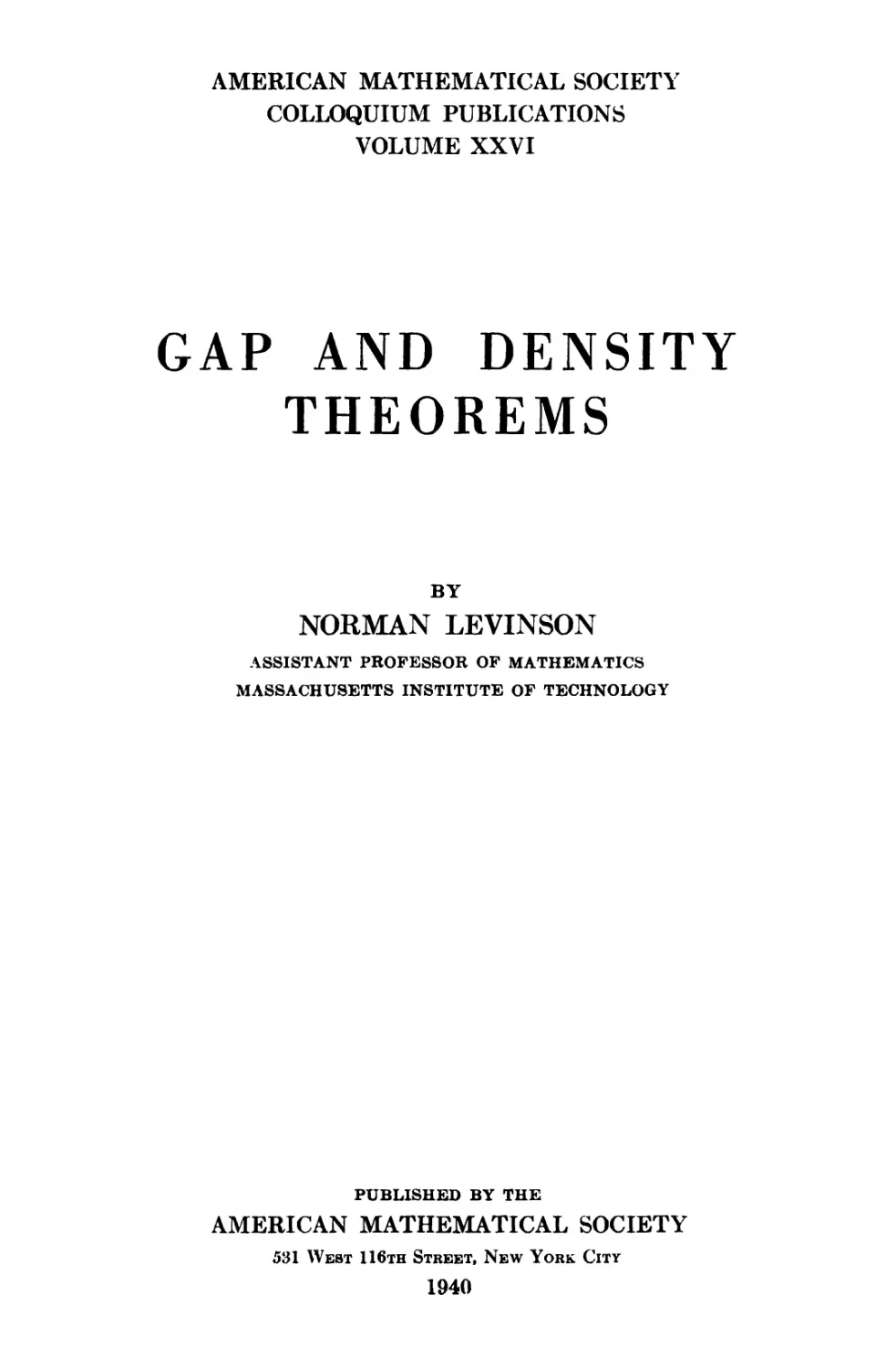
                    AMERICAN MATHEMATICAL SOCIETY
COLLOQUIUM PUBLICATIONS
VOLUME XXVI
GAP AND DENSITY
THEOREMS
BY
NORMAN LEVINSON
ASSISTANT PROFESSOR OF MATHEMATICS
MASSACHUSETTS INSTITUTE OF TECHNOLOGY
PUBLISHED BY THE
AMERICAN MATHEMATICAL SOCIETY
531 West 116th Street, New York City
1940

COMPOSED AND PRINTED AT THE
WAVERLY PRESS, INC.
BALTIMORE, MD., U. S. A.

Dedicated to
NORBERT WIENER
by one of the many men whose
careers he launched

PREFACE
The present volume is in many respects a companion volume to the earlier
Colloquium Publication of Paley and Wiener. The same tools are used in both.
(See Appendix.) Certain topics such as the closure of trigonometric sequences
and some problems of Polya are treated in both. The technique of the Fourier
transform in the complex domain developed in Paley and Wiener has, in the
present volume, been further extended in the solution of such problems as the
general unrestricted gap Tauberian theorem.
The contents break up into four parts. Large portions of the first two parts
have appeared in various journals during the past four years. The last two
parts consist almost entirely of new material. The first part consists of
Chapters I, II, III, and IV; the second part of Chapters V, VI, VII; the third part of
Chapters VIII, and IX; and the fourth part of Chapters X, XI, and XII.
The present volume covers the various topics considered in some detail,
most results being "best possible/' Nevertheless for many of the topics treated
there are several directions for further work in refining or developing these topics.
I am very much indebted to Professor J. D. Tamarkin for the painstaking
manner in which he has examined and criticized this book.
Norman Levinson
Massachusetts Institute of Technology
Cambridge, Massachusetts
June 24, 1939

CONTENTS
CHAPTBE PAOB
I. On the closure of (e**"*}, I 1
1. Introduction 1
2. A closure theorem for X„ > 0 2
3. A closure theorem for — « < xn < « 5
II. On the closure of (eiX»*), II 12
4. A closure theorem involving P61ya maximum density 12
5. A related gap theorem 14
6. An extension of the closure theorem 16
7. Another type of theorem 19
8. A theorem of Miss Cartwright 20
III. Zeros of entire functions of exponential type 25
9. The basic theorem. 25
10. A related function with real zeros 29
11. Lemmas on the related function 33
12. Proof of the basic theorem 38
13. A related theorem 42
14. Another related theorem 44
IV. On non-harmonic Fourier series 47
15. Proof of an underlying inequality 47
16. Proof of the main theorems 55
17. Proof of a related inequality of Hardy and Levinson ....... 67
V. Fourier transforms of nonvanishing functions 73
18. Introduction 73
19. Proof of the basic theorem 75
20. Related theorems 81
VI. A density theorem of P6lya 88
21. The density theorem 88
22. A function with zeros having a density 92
VII. Determination of the rate of growth of analytic functions from their
growth on sequences of points 100
23. Theorems of V. Bernstein 100
24. A sharper set of theorems 107
25. An extension of a theorem of Iyer 122
VIII. An inequality and functions of zero type 127
26. Generalization of a problem of P61ya 127
27. Proof of the inequality 135
28. Proof of the theorem on functions of zero type 145
IX. Existence of functions of zero type bounded on a sequence of points. . . 153
29. Statement of the existence theorems 153
30. Lemmas 156
31. Proof of the main theorem 171
X. The general higher indices theorem 186
32. Introduction 186
33. Reduction to a lemma on biorthogonal functions 191
34. Proof of the lemma 195
Vll

Vlll
CONTENTS
CHAPTER PAGE
XI. The general unrestricted Tauberian theorem for larger gaps 203
35. Reduction of the general theorem to the basic lemma 203
36. Existence of auxiliary functions 207
37. Proof of the basic lemma 213
38. Proofs of the remaining theorems 218
XII. On restrictions necessary for certain higher indices theorems. . . 229
39. A restricted higher indices theorem 229
40. Proof of the theorem 231
Appendix 243
41. Theorems used . 243

CHAPTER I
ON THE CLOSURE OF {etX**}, I
1. Introduction. Among the basic facts known about the sequence of
functions {etnx\, — oc < n < oo, are
1. {einx\, — oo < n < oo, is closed over ( — 7r, tt); that is, if f(x) eL( — Tr, w)
then
J f(x)einxdx = 0, - oo < n< oo,
implies that/(a;) is a null function.
2. To a function/(x) e L( — ir, tt) there belongs the Fourier series
Zanr, an = i- f f(x)e~in*dx.
—oo ^7T J-*
This series will under certain conditions converge to the function/(z), and under
other conditions, although it may diverge, can nevertheless be summed to the
function/(x).
In the first four chapters we shall generalize these properties of [enx\ to
sequences {ex"x} with various conditions on {Xn}. As is often the case these
general results will, among other things, lead us back to certain properties of
expansions in {enx).
The closure of jetXnZj can be related at once to theorems on analytic
functions. For suppose that a sequence {e nX) is not closed. This means that
there is at least one function, f(x), not equivalent to zero such that for all Xn
of the sequence
f f(x)JKxdx = 0.
Clearly
F(w) = l_Tf(x)eiwxdx
is an entire function and F(\n) = 0. Thus the study of closure amounts to the
study of the zeros of certain entire functions.
Theorems on closure lead at once to gap theorems.2 For suppose a function
1 This fact was first pointed out by Sz&sz, Mathematische Annalen, vol. 77 A916), p. 482.
2 This was first pointed out by Paley and Wiener, Fourier Transforms in the Complex
Domain, American Mathematical Society Colloquium Publications, vol. 19, 1934,
Theorem XXXVI.
1

2
ON THE CLOSURE OF {e'*), I
[I]
f(x) which vanishes over (x - L, ir), L > 0, is expanded into a Fourier series,
that is,
Six) ~ ? wta.
—00
A gap condition asserts that certain an are zero; that is, ax„ = 0 for a sequence
of integers (Xn). From the definition of an this implies that
f(x)e~iKxdx = 0.
?
Thus we are back to the question of closure. In this way every theorem on
closure will have as a corollary a gap theorem which will assert that if certain an
in the Fourier series of f(x) are zero then f(x) cannot vanish over an interval
of length L (where L depends on the sequence of integers for which an vanishes)
unless f(x) vanishes identically.
2. A closure theorem for Xn > 0. The sequence of functions \etnx\ is closed
over ( —x, ir) but is not closed over an interval of-length 2w + a where a > 0.
For let
( -1, -(*¦ + ha) < x < -Or - Jo),
f(x) = < 0, -(x - ha) <x < (it - Ja),
[ 1, (x - ha) < x < (x + }a).
Then f(x) is not equivalent to zero. Let
-r—a/2
A simple calculation gives
/»+o/2
f(x)eiwxdx.
r-o/2
4i
F(w) = — sin ttw sin Jaiy.
Since sin irn = 0, it follows that F(n) = 0, (— » <n< »). That is
-r+a/2
/ f(x)eiMdx = 0, -oo<n<oo.
V_»_«/2
Since/(«) is not equivalent to zero, it follows that [etnx\ is not closed over an
interval exceeding 2t in length. On the other hand if any term of {etnx\,
(—oo < n < oo), is removed, the sequence ceases to be closed over the
interval 2tt.
We see therefore that {e,nz}, (— oo < n < oo), is closed over an interval of
length 2ir and no greater one and that it ceases to be closed over ( —7r, t) if
any term is removed. Suppose we now delete about one-half of the sequence
{etnx\, (—oo < n < oo), by considering the terms with positive n only. Then
it seems likely that this sequence is closed over half as large an interval as

[2]
A CLOSURE THEOREM FOR Xn > 0
3
when n takes both positive and negative values, that is, over an interval of
length x, and not over a longer one. However this is not the case. Actually
the sequence {etn*}, (n > 0), is closed over any interval of length less than 2w.
This follows from the following results.
Theorem I. Let A(u) be the number of \n < u. Then the sequence {etXnX\,
(Xn > 0) is closed over an interval of length L if
B.01) limsupjr^(i+l)dM-^'2
R-oo {Ji u112 \u R/ 3tt
A corollary of Theorem I is
Theorem II. The sequence {etXnX\, (Xn > 0), is closed over an interval of
length L if
B.02) liminf ? > ^.
n-»oo Xn 2tT
In case Xn = n, it follows at once from B.02) that {exnx\y (n > 0), is closed
over any interval of length less than 2w.
Theorem I is, in case lim n/\n, (n —> <x> )f exists, the best test to make for the
closure of a sequence with Xn > 0. For example, it follows easily from B.01)
that {eiKx} with
B.03) \n = n - nl,\ n > 1,
is closed over the interval 2t.
Theorem II3 is much weaker than Theorem I. Later it will be replaced by
far sharper results. We shall show that limit inferior in B.02) can be replaced
by limit superior (and even more) and the theorem remains true.
Proof of Theorem I. Let us assume that Theorem I is not true. Then
B.01) is satisfied but {eiKx\, (X„ > 0), is not closed over (-JL, \L). Thus
there exists a function/(x), not equivalent to zero, such that
/L/2
f(x)eiKxdx = 0.
Let
• L/2
F(w) = [ f(x)eiw2xdx.
J-L/2
-L/2
Since {e2*inx/L\, (-«> < n < qo), is closed over (-?L, ?L), F(w) cannot
vanish at all points w2 = 2irn/L} (— » < n < <»), for this would imply that
3 In 1931 Polya set as a problem the proof of Theorem II with (e±lX*x), that is, with
positive as well as negative Xn . Polya, Jahresbericht der Deutschen Mathematiker-
Vereinigung, vol. 40 A931), Problem 108. Many solutions have been given.

4 ON THE CLOSURE OF {eiX»xJ, I [I]
f(x) is zero almost everywhere. Thus F(w) is an entire function not identically
zero. By B.04), F(\lJ2) = 0 for all Xn of the sequence.
If w = ret$, then
^L/2
-L/2
or
/L/2
\f{x) \er2^{^ dx
L/2
*L/2
B.05) | F(re") | g e'1'^'2'"""! / |/(x) | <&.
J-L/2
Let wn = rnet9n denote the zeros of F(w) in the right half-plane. Applying
Carleman's theorem, Theorem B,4 to F(w)> we have, if w = u + iv,
.§, (s -»)cos *•< k r (? -»),o8' «*w -*> > *
+ 45/ log I F(Reie) \ cos 6 dd + A
TK J-t/2
where, in the proof of this theorem, we shall use A to represent any constant
that depends only on/(x). Using B.05), we have
&a-s)-*<?f(?-s)*
1 r'/2
+ -^ / iLR21 sin 26\cos6M + A
irit J-x/2
/ R Cwf2
< — / sin 20 cos 6d6 + A
IT JO
K 3r +A-
Since w = X*2 are zeros of F(w) in the right half-plane and therefore form a part
of all the zeros, {rnel9n\, it follows that
If we replace R by #1/2 in the above inequality, it becomes
B.06) Z (-i* - ^) < 2^ + A.
If A(w) is the number of Xn < u, then B.06) can be written as
i. W2 " -R/dHu) < "ST + A-
See Appendix.

[31
A CLOSURE THEOREM FOR - °° < X, < <»
5
Integrating by parts, we obtain
But this contradicts B.01). Thus Theorem I is proved.
Theorem II is a consequence of Theorem I.
Proof of Theorem II. Since
B.02) lim inf n/X„ > L/2tt,
it follows that for large n and for some c > 0,
(?+e)xtt<n
or for large u, u > Ro,
A(w) > u(j^ + e\, €> 0.
Thus
-?+•)<?-*¦-.'?)¦
Or
? §? fi1'2 - lOLRl>\
o
Thus as R -> oo B.01) is satisfied and therefore B.02) implies B.01). This
completes the proof of Theorem II.
3. A closure theorem for — « < Xn < oo. In this section5 we shall
investigate the closure of {etXnX\, (-co < Xn < oo), that is, with Xn taking on negative
as well as positive values. We shall insist that our closure theorems shall
include the well known fact that {exnx\, (—oo <n< oo), is closed over ( — tt, 7r).
Since {etnx\y (n > 0), is not closecKover ( —t, 7r), we shall get a two-sided theorem
(Xn taking on negative as well as positive values) that is not true for positive
values of Xn only.
Certain refinements are necessary in the statement of the two-sided theorem
which were not necessary in Theorem I. In part the reason for this is that the
•ne-sided condition, B.01), is not affected by the removal of any finite number
of Xn whereas in our simplest example of the two-sided cases, {etnx\y
5 Cf. Levinson, On the closure of {eix»xJ, Dulp Mathematical Journal, vol. 2 A936), p. 51.

6 ON THE CLOSURE OF {etX*x}, I [I]
(—00 < n < oo), deleting a single term affects the closure. One of the
necessary refinements is that of closure Lp.
A set {etXn*} is said to be closed Lp( —7r, it) if, for any/(x) eZ/( — tt, tt),
?f(x)eiKxdx = 0
for all Xn implies that f{x) is zero almost everywhere.
The basic and sharpest criterion is given by
Theorem III. Let A(u) be the number of \\n\ ^ u. If
C.01) f ^ du > 2v - ?—* log v - C
Ji u p
for some constant C, then the set {etXn*}, (— °° < n < <*>), is closed Lp( — tt, tt),
P ^ 1.
A corollary of Theorem III is
Theorem IV. If
C.02) | A* | ^ \n\ + *#+ *JLi, -oo <n < oo,
2p
Me6 set {etX"x}, if it is not closed, becomes closed in adjoining to it at most any N
terms ex<*nX, A ^ n g N). In particular, then, a sufficient condition for closure
Lp( — Tf w), p ^ 1, is
C.03) | A* | ^ \n\ + V-^} -oo <n< oo.
2p
It follows from C.03) that the sequence {exnx}, (— oo < n < oo), is closed
L( — t, tt). [Condition C.01) gives the even sharper result that \etn*},
(- oo < n < oo), is closed L(-tt, tt) if | An | g | n | + (log | n |)~1-8, | n | -* oo,
for some 5 > 0.]
That Theorem IV is best possible follows from Theorem V.
Theorem V. If C.02) is replaced by
C.04) |An| <\n\+?N + P-^ +6,
2p
where h > 0, there exist sets \etXnX\ satisfying C.04) which do not become closed
when N terms are adjoined to them. Thus the inequality C.02) is a best possible
result.
In connection with these theorems the following result is of interest. It
holds with no restrictions on the {An}.
8 In the case of closure in L2(—x, *-), Paley and Wiener (loc. cit., chap. 6) proved that
the set A, eiix»*| becomes closed on adjoining at mosffv terms if | Xn — n \ < \N + J.

[ 3 ] A CLOSURE THEOREM FOR - oo < \n < oo 7
Theorem VI. // the set {el nX\ is closed Lp( — w, tt), p ^ 1, it remains closed
if we replace any Xn by some other number.
We shall now prove these theorems.
Proof of Theorem III. Let us suppose the theorem is not true. Then there
exists an f(x) e Lp( — tt, tt) and not equivalent to zero such that
C.05) H(w) = ff(x)e<wxdx
vanishes for w = An , (— *> < n < <x>). Since/(x) is not equivalent to zero,
H(w) is not identically zero.
Denote by n{r) the number of zeros of H(w) not exceeding r in magnitude.
Then by Jensen's theorem, Theorem A,
C.06) f ^ du ^ i- fT log | H(rei9) \d6 + A,
J\ U Ztt Jo
where A will be used throughout the remainder of this section to represent
various constants depending only on/(x) and {XnJ. By C.05)
H(reie) = 0(e*r|8in ").
Using this in C.06), we have
C.07) f^du^2r + A.
J\ u
From this it follows, since n(u) is an increasing function of u, that
Jr U Jr U J\ U
Thus n{r) < 4r/log 2 + A. Since {Xn} form part of the zeros of H(w),
A(r) ^ n{r). Thus
C.08) A(r)<1^2r + A-
Let us assume that no Xn is zero. (How to proceed if one of them is zero will
be obvious.) Let
C.09) F{w) = ft (l " ^) ewi\
That F(w) exists follows from C.08). Since H(w) vanishes at Xn ,
<t>(w) = H(w)/F(w)
is an entire function. If fti(r) is the number of zeros of <t>(w) not exceeding r
in magnitude, then clearly
ni(r) = n(r) — A(r).

8 ON THE CLOSURE OF {a**-}, 1 [I]
Thus
fnjMdu^rnj^du_rAMdu
J\ U Jl U Ji u
Using C.01) and C.07), it follows that
Ji u p
Since (p — l)/p < 1 it is clear that ni(r) = 0, or in other words that <t>(w)
had no zeros. By the Hadamard factorization theorem, Theorem D, it follows
that H(w) = aemF(w) and, in particular, that
C.10) | H(iv) | = ecv | aF(iv) \
where a, b, and c are constants.
From C.05), for any small c > 0,
C.11) | H{iv) | ^ (?'+< + ?J +/"_ J «-~ |/(«) I <fe.
Using Holder's inequality, if p > 1,
r /.*•-« -i(p-i)/i>r r*-« ni/p
I Hiiv) | g [?+< e—/(p-1) cfcj |^+< |/(x) |" dxj
+IX •-""^H LI l/(x)H
r /•*¦ ~i(p-i)/pr /•* -ii/p
+ [_/_*— *J [/_i/(x)r^j .
Or
I Hiiv) | ^ e('-«)M |« r("-1)[J[~ |/(*) I'd*]1"
For any 8 we can choose an c so that
KT"+/.'J w*r*f **
Thus
C.12) | ff(t») | g 4e*w | v |-<»-»"(e-«W + 5).
In case p = 1, C.12) follows directly from C.11). Thus C.12) holds for all
p ^ 1. From C.12)

[ 3 ] A CLOSURE THEOREM FOR - oo < \n < oo
log |ff (w) | ^ x \v\ - V-^ log M + log (e"eM + 5) + A.
V
Since 6 can be chosen arbitrarily small, it follows that
lim flog | ff (w) | - r|v| +?J^llog|»|) = -oo.
i«i-»oo \ v r
Using C.10), this gives
C.13) lim (log|F(w)| +cv - ir\v\ + ?—-- log | v | J = -oo.
M-oo \ p /
On the other hand from the definition of F(w), C.09),
log | F(iv) \ = \f log A + v2/u2) dA(u).
Integrating by parts twice gives
Using C.01), this becomes
iog i ™ i * r 0^-. Bm - -T-1 iog u - a) du-
Setting u = | v \ y gives
log |F(u>) I > t|«| - ^ log M f jr^r.dy - A
p Jo (i + yv
2:T\v\-V-^log\v\-A.
V
But this contradicts C.13), and the theorem is proved.
Proof of Theorem IV. We consider A(u) for u > N + 1. From C.02),
u) ^ 1 + 2[ti - itf - ^2^], i* > AT + 1,
AC
where [x] denotes the largest integer not exceeding x. Thus
-if 5
- ^ - (p - l)/2p - [it - *JV - (p - l)/2p] - ^

10 ON THE CLOSURE OF {e*»*J, I [I]
Since x — [x]. — ? is periodic and has average value zero over each period, an
integration by parts will show that the second term on the right in the above
inequality is bounded as v —> «>. Thus
r Aw^2f *-**-(P-D/2pdM_^
C.14) Vl "• J"+l
v — 1
> 2v — JV log v — log t; — A.
V
Now let us add N terms etanX, 1 g n g iV, to \e%Kx] and denote the new set
by {ettinX}. If m(^) represents the number of | /xn | ^ w, then for large u, n(u) =
A(ti) + AT. Thus by C.14)
i\ u
V — 1
dw > 2v — - log v — A.
V
From Theorem III it follows that {elflnX\ is closed Lp( —tt, tt). This completes
the proof.
Before proving Theorem"V we shall prove Theorem VI.
Proof of Theorem VI. Let {elXn*} be closed and let the set consisting of
{etXnX}, n 5* 0, together with exax1 a ?± X0, not be closed. Then there exists
an f(x) eLp( — ir, w) not equivalent to zero such that
/ f{x)eiKxdx = 0, n^O, j[ f(x)eiaxdx = 0.
Let us consider
9(x) = f(x) + t(Ao - «)e~~ia* f_[f(y)eiavdy.
Clearly ^(x) cLp( —tt, tt). Moreover,
j[' g(x)eiuxdx = [%x)eiuxdx + t(Xo - a) j[* etiu-°)xdx [* f(y)eiay dy,
or, integrating by parts
C.15) r g(x)eiuxdx = ''—^ f f{x)eiux dx.
J-r U — Ot J-t
It follows at once from this, on setting u = Xn , that for any n
XwXdz = 0.
[jb)eiK
But {etXn*} is closed Lp( —?r, tt), and therefore g{x) is equivalent to zero. But
by C.15) this means that
[j(x)eiu
dx = 0.

[ 3 ] A CLOSURE THEOREM FOR - oo < X „ < oo 11
If we set u = 0, ±1, ±2, • • • , this implies that/(x) must also be equivalent to
zero, contrary to our assumption.
Proof of Theorem V. First let us take the case when N is odd. We take
An = n + IN + 8 + (p - l)/2p, n > 0,
C.16) X_n = -Xn, n > 0,
Xo = iN + 8 + (p - l)/2p.
By Theorem VI it of course does not matter where we take X0 (or any other
finite number of X„). Let us set § + 8 + (p — l)/2p = t. Then clearly
cos2<_2^x eLp( —7r, 7r). Moreover, for n ^ 0,
? ei{n+t)x cos2''2 fcccfe = 2<+2 j[* et(n+1)x(l + e*)"-2d*
= lim 2~2'+2 f ei(n+1)*(l +reix)u-2dx.
Using the binomial theorem, we obtain
(' eiin+t)* cos2' ixdx = lim 2~2,+2 ? AV) f e*(n+*+1)ldx
•Lt r-*l-0 *-0 «*-T
= 0.
A similar result holds * with e~tx(n+0> n ^ o. Thus cos2'-2 ?x is orthogonal to
e±ixiH+t), n ^ 0. But the set {±(n + 0}, (n ^ 0), contains the set {Xn) defined
in C.16) and N additional terms. This proves Theorem V if N is odd.
If N is even, we proceed similarly. Instead of using cos2'-2 \x we use
sin \x cos2'-1 \x, where t = 8 + (p - l)/2p. In this case jl, e±ix(n+t)}, (n ^ 1),
is orthogonal to sin \x cos2*- \x.

CHAPTER II
ON THE CLOSURE OF {e*7"**}, II
4. A closure theorem involving P61ya maximum density. Theorems I and II
give information on the closure of {e**"*}, (A„ > 0). In case
D.01) lim ^ = D
n-»oo An
exists, Theorem I gives a sharp criterion. However if n/\n does not approach
a limit, this is no longer the case. From Theorems I and II it is clear that the
denser the An's, that is, the bigger D is, the longer the interval over which
{e**'} will be closed.
Let us consider a sequence which does not have a density in the above sense.
Let {nn} consist of all integers n > 0 such that
10* < n ^ 10* + 10*~~\ k ^ 1.
Thus {nn} consists of 11; 101, 102, ... , 109, 110; 1001, • • , 1100; and so on.
Clearly the number of »n ^ 10* is
1 + 10 + • • • + 10*~2 = A0*-1 - l)/9.
Thus
r . , n , v lO*-1 - 1
lim inf — < lim /v/<^.x
n^ ^ - *_„ 9A0*)
or
lim inf -*- ^ —-.
n-oo Hn 90
Thus on the basis of Theorem II we might suspect that \el>lnX\ is closed over
an interval of length at most 2ir/90. Actually it will turn out that this is not
the case but that the set {/*n} is closed over any interval of length less than 2tt.
That is, in some sense the effective density, so far as closure is concerned, of the
set {/Un} is the same as that of all the positive integers, and is therefore one.
Actually the sequence \nn} does have $ density one, in the intervals A00, 110);
A000, 1100); • • • ; A0*, 10* + 10*_1); • • . That it is the density in such
subintervals that determines closure properties is implied by the following
theorem.
12

[ 4 j CLOSURE INVOLVING POLYA MAXIMUM DENSITY 13
Theorem VII.1 Let {Xn}, n > 0, be an increasing positive sequence and let
A(u) be the number of Xn < u. Let2
D.02) lim sup hm sup —— ^—-- = D.
?-*i—o «->«> u — u?
Then {e% nX\ is closed over an interval of length L if
D.03) 2ttD > L,
for Lebesgue integrable functions.
Theorem VII as a closure theorem is very easily derived from the following
theorem on entire functions.
Theorem VIII.3 Let f(z) be an entire function such that
<4.„4> f1^®^.,
J— qo I i X
and
D.05) lim sup l0gl/(re<,)l ^ k.
r—»oo T
Let ni(r) be the number of zeros off(z) which lie in the sector (| z \ < r,\ am z | ^ \ir)
and n2(r) the number of zeros of f(z) in the sector (| z \ < r, %w < am z < %tt).
Then there exists a number B ^ h/v such that
D.06) lim n^ = B, lim *W = B.
r—»oo /* r—»oo 7*
The proof of Theorem VIII wi^he given in Chapter III as a corollary of a
less restrictive theorem. Here we shall use Theorem VIII to give a proof of
Theorem VII.
Proof of Theorem VII. Suppose that a set {e nX) is not closed. Then there
exists a function g(x)} not equivalent to zero, such that
.L/2
g(x)eiKxdx = 0, n > 0.
I !
J-L/2
1 Levinson, On the closure of jelX*x} and integral functions, Proceedings of the Cambridge
Philosophical Society, vol. 31 A935), p. 335.
2 D is the Poly a maximum density*of the sequence. Polya shows that there exists a
sequence jrn) of ordinary density [D.01)] D which contains {Xnj as a subsequence but that
there is no sequence having an ordinary density less than D which contains j\n|.
Polya also shows that in D.02) the use of lim sup as ? —> 1 — 0 is unnecessary since as
? —» 1 — 0 the limit itself exists. Polya, I/ntersuchungenuber Lucken und Singularitdten
von Potenzreihen, Mathematische Zeitschrift, vol. 28 A929).
3 Levinson, loc. cit., Theorem III. For even f(z) this theorem was proved by Wiener
and Paley, On entire functions, Transactions of the American Mathematical Society, vol.
35 A933), Theorem I, p. 769. Miss Cartwright proved this theorem under a more restrictive
hypothesis which she later showed was implied by the hypothesis given here. M. L.
Cartwright, Proceedings of the London Mathematical Society, B), vol. 38 A935), p. 179;
and Proceedings of the Cambridge Philosophical Society, vol. 34 A935), pp. 347-350.

14 ON THE CLOSUKE OF {eiXnX\, II [II]
Let
D.07) G(w) = / g(x)eiwxdx.
J-L/2
Then G(w) vanishes at w = Xn , (n > 0), but is not identically zero. By D.07)
D.08) | G(reid) \ ^ eA")LrUiB" / | g(x) \ dx.
J-L/2
From this it is clear that log+ | G(u) | is bounded. Thus G(w) satisfies the
requirements of Theorem VIII. If ni(r) is the number of zeros of G(w) in
(\w\ < r, | am w | ^ ^7r), then
lim *m = B.
r-*oo r
Therefore for any 0 < ? < 1,
D.09) lim Wl(r) ~ *<*> = B.
r-oo r — r?
But {X^ are among the zeros of G(w) in the right half-plane. Therefore
ni(r) - riiirt) ^ A(rj - A(r{), 0 < ? < 1.
Thus by D.09)
r A(r) - A(r?) . D
lim sup ——^—^ ^ 5.
r—oo r — r?
And therefore the Polya maximum density, D, of the set {X„} satisfies
D.10) D ^ B.
It follows from D.08) that k g \L. Since B ^ fc/ir,
In D.10) this gives
2ttZ) ^ L.
This is contrary to the hypothesis of Theorem VII. Thus Theorem VII is
proved.
6. A related gap theorem. Let/(x) eL( — it, tt). Suppose that the Fourier
series of f(x) is such that certain terms vanish. For example, let
fix) ~ E a3net3n*.
—00
Then/(x) has period §7r, and therefore if f(x) vanishes over an interval of length
f7r it is identically zero. That is, if only every third term differs from zero in

f 5 ] A RELATED GAP THEOREM 15
the Fourier expansion for f(x), then f{x) cannot vanish over an interval of
length §7r without vanishing identically.
This suggests the following gap relation. Let
fix) ~ <*> + E (amneim** + a^e-***),
i
where {mn} is an increasing sequence of positive integers such that
lim — = D.
n-»oo Win
Then, if f(x) vanishes over an interval exceeding 2tD in length, it vanishes
identically.
Actually it will turn out that there is nothing to be gained by having gaps
throughout the whole series. It suffices to have gaps only in one half of the
series, either for n > 0 or for n < 0. Moreover n/mn need not approach a
limit. The gap theorem we shall prove here is
Theorem IX.4 Let f(x) eL( — ic, ic) and have the Fourier series
E.01) /(*) ~ ? ^einx + Z a-m„e-in"z
0 1
where \mn} is an increasing sequence of positive integers. Let M(u) be the number
of mn < u, and let
E.02) d = lim inf lim inf M^JZJ^..
$-»l_0 M-*oo U • — Ul;
If f{x) vanishes almost everywhere over an interval exceeding 2ird in length, it
vanishes almost everywhere over ( —7r, t).
As an example, let us define [mn] as made up of those integers n which are
such that
E.03) 10* + 10fc_1 ^ n ^ 10*+1, k ^ 1.
That is, \mn\ contains all integers between 11 and 100, between 110 and 1000,
and so on. Clearly
lim inf — = -.
n —¦ oo Win y
Thus it should seem that f(x) would have to vanish over an interval at least
f Bt) in length in order that f(x) be forced to vanish over the whole interval
4 Levinson, loc. cit., Theorem II. Here the theorem was stated only for d = 0.
5 d is the P61ya minimum density. As was the case with P61ya maximum density,
P61ya shows that lim inf as ? —* 1 — 0 can be replaced by lim.

16 ON THE CLOSURE OF {c*»x}, II []
( —7r, tt). Actually, in applying Theorem IX, since there are no ra„ in tl
intervals A0*, 10* + 10*_1) it follows that
M(u) - M(u?) = 0
for u = 10* + 10* and 1 > ? > if Thus
lim.nfMWJ-_M(.1)=0^ «<«<!
Therefore
d = 0.
Thus with {mn} denned as in E.03), f{x) cannot vanish over any interval n<
matter how small without vanishing almost everywhere over ( — ic, w). Tha
is, instead of f it turns out that any quantity greater than zero will do.
Proof of Theorem IX. Suppose that the hypothesis of Theorem IX is satisfiec
and that f(x) vanishes almost everywhere over an interval 2ird + 6, 8 > 0, ir
length. Since f(x) is periodic of period 2w and can be translated without
changing the modulus of the Fourier coefficients, we can assume that f(x)
vanishes over the interval (?r — 2wd — 5, if). Let {Xn} be the set of positive
integers complementary to {mnj. That is, {X„) + {ra„} = {nj, n > 0. Thus
u - ui + 2 > A(u) - A(tt?) + M(u) - M(ui) > u - u? - 2,
and therefore
r A(i*) - A(uf) , r . . M(u) - M(u?) ,
hm sup —-^ -f— + lim mf —— -^-- = 1.
From this it follows at once that the maximum density of {Xn} is
D = 1 - d.
Since the terms e~l nX do not appear in the Fourier series of /(#), it follows that
j[ f(x)eiXnXdx = 0, n> 0.
But/(a;) vanishes almost everywhere over (w — 2wd — 8, ir). Thus
/r-2rd-S
f(x)eiKxdx = 0, n > 0.
But tt - 27rd - 8 - (-tt) = 2ttA - d) - 8 = 2ttD - 5. By Theorem VII,
{etXnX\ is closed over any interval of length less than 2ttD. Thus E.04) implies
that/(x) is equivalent to zero over ( — 7r, t — 2ird — 5). This completes the
proof of Theorem IX.
6. An extension of the closure theorem. Theorem VII states that if {X„) is a
positive increasing sequence with P61ya maximum density D and if L < 2wD,
then

G ] AN EXTENSION OF THE CLOSURE THEOREM 17
• L/2
-L/2
/•L/2
F.01) / f(x)eiKxdx = 0, 0 < n < oo,
•Ll/2
implies that/(x) is zero almost everywhere in { — %L} %L).
This result remains valid if instead of requiring that the integral in F.01)
be zero, we merely require that it be small. This is stated in precise terms in
the following theorem.
Theorem X.6 If {Xn} is an increasing positive sequence with Polya maximum
density D, if, for some< c > 0, Xn+i — X„ ^ c, and if
F.02) 2ttD > L,
then
.L/2
-L/2"
for some 5 > 0 implies thatf(x) is zero almost everywhere.
/•L/2
F.03) / f(x)eiXnXdx = 0(e~iXn), 0 < n < oo,
J-L/2
Theorem X is an immediate consequence of the following theorem on entire
functions.
Theorem XL7 Let f(z) be an entire function satisfying D.04) and D.05).
Let {Xn} be an increasing positive sequence such that for some c > 0, Xn+i — Xn ^ c,
and let the Polya maximum density of {Xn} be D. If
F.04) tD > k,
and ifj for some 5 > 0,
F.05) /(Xn) = 0(e-SK), n > 0,
thenf(z) = 0.
The proof of Theorem XI will depend on Theorem VJII and will be given
after the proof of Theorem VIII. We shall make use of Theorem XI at once
to prove Theorem X.
Proof of Theorem X. Let us assume that Theorem X is not true. Then
there exists a sequence {Xn} and a function f(x) not equivalent to zero and
satisfying the requirements of Theorem X. That is,
?L/2
f(x)eix**dx = 0(e'6K).
L/2
Let
8 Cf. Levinson, On the non-vanishing of certain functions, Proceedings of the National
Academy of Sciences, vol. 22 A936), p. 228, Theorem III.
7 This theorem is referred to on page 229, Levinson, loc. cit. At about the same time
an even more general result was given by Miss M. L. Cartwright, Proceedings of the London
Mathematical Society, vol. 41 A936), p. 33.

18 ON THE CLOSURE OF {ciX»z), II [II]
/L/2
f(x)eiwxdx.
L/2
Then if w = u + iv,
/L/2
|/(a)|efc.
L/2
Thus F(w) satisfies the hypothesis of Theorem VIII and therefore part of the
hypothesis of Theorem XL From F.06),
F.09) F(\n) = 0(<T*X*), n-^ oo.
Also from F.08)
r log \F(w)\ ^ 1T ,
hm sup ,' , ' ^ %L = k.
|u>|-*oo \W\
By F.02), \L < irD. Thus
F.10) k < ttD.
But F.09) and F.10), used in Theorem XI, shows that the entire function F(w)
is zero. By F.07) this means that/(s) is equivalent to zero contrary to
hypothesis. This completes the proof of Theorem X.
As a theorem on closure, Theorem X can be used to deduce a gap theorem
which is really a generalization of Theorem IX.
Theorem XII. Let
fix) ~ Z aj".
—CO
Let {\n} be an increasing sequence of positive iMegers of Polya maximum density D*
If
F.11) a_Xn = 0(e-**)9 n > 0,
and if f(x) vanishes almost everywhere over an interval exceeding 2ttA — D) in
length, then f(x) vanishes almost everywhere.
Theorem IX is the special case of Theorem XII where F.11) is replaced by
a-x. = 0.
Proof of Theorem XII. Since f(x) is periodic, we can assume it vanishes
almost everywhere over the interval (ir — 2ttA — D) — t} ir) for some e > 0
Clearly then
.. -»-2tA-Z»-«
€L^=SirL f(x)eiKtdx.
But a-K = 0(e"'Xn). Thus
(8.12) | f(z)e<K*dx = 0(e-,x*).

[7]
ANOTHER TYPE OF THEOREM
19
The length of the interval of integration in F.12) is L = 2wD — t. That is,
L < 2ttD.
Applying Theorem X, it follows that/(x) must vanish almost everywhere.
7. Another type of theorem. There is another closure condition which, in
the sense that it deals with an ordinary density (not a Polya maximum or
minimum density), is a generalization of a result of Chapter I. Actually,
however, the proof of the theorem places it here.
Theorem XIII.8 Let {X„}, (n > 0), be an increasing positive sequence such
that
G.01) lim ? = D,
n-*oo An
and such that for some c > 0, Xn+i — Xn ^ c Let
G.02) L < 2irD,
and 6(u) be a monotone increasing function of u such that
G.03) f*.)*,--.
Jl u2
If
G.04) / f(x)fKxdx = 0{e~HK))} n > 0,
J-L/2
then f(x) is zero almost everywhere,
If the integral in G.04) vanished instead of being small, then Theorem XIII
would be a corollary of Theorem II. However, actually, this theorem is very
different from Theorem II. Theorem XIII is a consequence of the following
theorem on entire functions.
Theorem XIV.9 Let f(z) be an entire function satisfying the requirements of
Theorem VIII, D.04) and D.05). Let {Xn} be an increasing positive sequence
such that for some c > 0, Xn+i — Xn ^ c, and
G.05) lim ? = D.
n-»oo Xn
Let
G.06) *D > k.
If
8 Cf. Levinson, loc. cit., Theorem II.
9 This theorem is referred to on page 229, Levinson, loc. cit., and is a little less
restrictive than a corresponding result of Miss Cartwright, loc. cit.

20 ON THE CLOSURE OF {c*"*}, II [II]
G.07) /(AB) = Ofe™1^)
wftere 0(w) *s a monotone increasing function of u such that
G.08) f^*-.,
thenf(z) is zero.
The proof of Theorem XIII follows from Theorem XIV in the same way as
other theorems on closure in this chapter have followed from theorems on
entire functions.
From Theorem XIII there follows the next gap theorem:
Theorem XV. Let
fix) ~ ? anein\
—00
Let {Xn} be an increasing sequence of positive integers such that
lim ? = D.
n-*oo An
Let
G.09) a_x„ = 0(e-'(X»'),
where 0(u) is monotone increasing and
r e(u)
[
. du = oo.
u2
If f(x) vanishes almost everywhere over an interval exceeding 2ttA — D) in length}
then f(x) is equivalent to zero.
This theorem follows from Theorem XIII in the way that Theorem XII
follows from Theorem X.
8. A theorem of Miss Cartwright. The gap theorems given above can be
put into more general form.10
If we let
Aito = llanz\ \z\ <1,
o
w*) = -Z^-B, i*i >i,
1 zn
where G.09) is satisfied, then heuristically, at least,
f(x) = lim{/n(re^)-A2(re-ix)}
10 Cf. Mjfes Cartwright, loc. cit.

[8]
A THEOREM OF MISS CARTWRIGHT
21
is the f(x) of Theorem XV. For f(x) to vanish over an interval of length
exceeding 2ttA — D) in length amounts to hi(z) = h2(z) over an arc of the unit
circle exceeding 2ttA — D) in length. But under very general conditions, for
hi(z) to be equal to h2(z) over the arc on the unit circle means that there exists
a function H{z) such that H{z) is analytic for | z \ < 1 and \z\ > 1 ;
H(z) = htiz), | z\ < 1, H(z) = h2(z), \z\> 1;
and H(z) is analytic on the arc of the unit circle exceeding 2ttA — D) in length.
The conclusion of Theorem XV that f(x) vanishes entirely means here that
H(z) is analytic on the whole circumference of the unit circle. Combining this
with the previous information on H(z) gives the result that H(z) is analytic on
the whole plane including °c. Thus H{z) is a constant. If account is taken
of the series representation of h2(z), it follows that this constant must be zero.
Thus H{z) is zero.
This result is now given in precise terms.
Theorem XVI. Let
H(z) = Ean*n, |*| <1,
0
H(z) = Z a.„2-B, 1*1 >1.
1
Also let H(z) be analytic for (\z\ = 1, | am z\ ^9). Let \\n) be a sequence of
integers such that
lim f = D.
Let
(8.01) a.K = 0(e-'(X">)
where B(u) is monotone increasing and
Ji u2
Let
(8.02) | H(re") \ ^ M(r - 1), } < r < ),
where M(u) is a positive even function, decreasing for u > 0, and
(8.03) / log log M(u) du < oo.
Jo
Tfcen if
(8.04) 6 ^tA - D),
H(z) is zero.

22
ON THE CLOSURE OF {ea»*}, II
[II]
Proof of Theorem XVI. Let
(8.05)
F(w)
i Jc
H(z)
2wi Jc z»+l
dz
where C is the path shown in Fig. 1. We can deform C into Ci. The two parts of
Ci, consisting of circular arcs with 0 as center, have radii n and r2, with n
Fig. 1
the larger radius and ri — 1 = 1 — r2. Then clearly by (8.02), for u > 0,
(8.05) with Ci in place of C gives
log* | F(u) | ^ log 47rM(n - 1) + u log 1 /r2 + log* ^2 ^ !^§J dx).
Since i/(z) is analytic along the real axis, there exists a constant A such that
log4" | F(u) | ^ log M(rx - 1) + 2u log - + A.
Let n - 1 = t. Then
(8.06) log+ | F(u) | g log Af@ + 2u log -J— + A.
We shall find it advantageous to take Ci narrower, that is, t smaller, as u gets
larger. Since M{t) is decreasing for t > 0,
log M(t)
log 1/A-0'
0 < i < ?,
is a decreasing function of t and is infinite when t is zero; it follows that there
exists a Mo > 0 such that
(8.07)
_ log M(t)
log 1/A - J)
is uniquely solvable for t for u > u0. This implies that, for small values of t,
t is a function of u.
By (8.06)

[ 8 ] A THEOREM OF MISS CARTWR1GHT 23
«.« /" MLl«rt I *, S f (,„g MV> + 2« log >}* + A.
Juo U2 Ju0{ 1 - *J U2 Uo
There is no loss in generality in assuming that M(t) is differentiable. Using
(8.07) to replace u by t on the right side of (8.08) gives, if U corresponds to u0,
log+ |F(u)
tt0
U*
du
«-i 3logM@ v '/*» '
log* Af @ d* + *'
or
y jgMjW l» a _, r- m-W h«i/(i - 0„ + 3 f- « + a
Juo u2 Jo M(t) log M(t) Jo 1 — t uo
Integrating by parts gives
M'(t) log 1/A -t)
I
dt
M(t) log M(t)
(8.10)
= -io* i4i io* io* M<»+/ log\og_Mt(t) du
But as J-> +0,
log ^— log log M(t) < 2t log log M(t).
Since log log M(t) is integrable, there must be a sequence of values of t —> 0
such that for these values ? log log M(t) —> 0. Thus (8.10) becomes
yl/2
< 2 / loglogM(fl<fl < OO,
Jo
and (8.09) becomes
""log+lFdi)
/
du < oo.
This result holds in the same way for u < 0. Thus
-«„„ ps?l?Wj<fcl<..
JLW #1 + w2

24 ON THE CLOSURE OF {eiX»xJ, II [II]
From (8.05), since C can be chosen so that, on C, | am z | > 0 — e for any
€ > 0, it follows that
I F(u + iv) | ^ elvHw'e^ fc | H(z) | (±X+11 & |.
And C can be chosen so that | z | is close enough to 1 in value along C that
Thus
|F(« + iv)\ ? el«l(-e+.)+i«i« f ITO^I
Jc I 2 I
From this it follows that for some 4
log|F(w)| ^ (»- Q + 2t)\w\ + A.
Or
umsup12g|WI^T_e + 2t.
|ic|-*» \w\
Since e is arbitrary,
(8.12) limsup^iy gx-9 = fc.
If w is a negative integer, the path of integration in (8.05) can be deformed
into a circle of radius greater than one. Then from the formula for the Laurent
coefficients of H(z) it follows that
|a.n| = |F(-n)|, n > 0.
Thus by (8.01)
(8.13) F{-\n) = 0(e~HK)).
Since tA - D) < 9 it follows that
k = * - 6 < ttD.
This last result togetheiHvith (8.11), (8.12), and (8.13) used in Theorem XIV
gives F(w) s 0. Thus a_„ = 0, (n > 0), and therefore H(z) = 0.

CHAPTER III
ZEROS OF ENTIRE FUNCTIONS OF EXPONENTIAL TYPE
9. The basic theorem. In this chapter we shall prove the theorems on entire
functions used in obtaining the gap and closure theorems in the preceding
chapter. These theorems on entire functions are of considerable interest in
themselves. Roughly stated these theorems assert that if an entire function
f(z) satisfies
Hm sup !?8l/[*LI = k, 0 < k < oo,
and if f(x) is of less than exponential growth along the real axis, then f(z) is
similar to sin kz in many respects. Here we are especially interested in the
fact that the zeros of f{z) have much in common with the zeros of sin kz. Thus
most of the zeros of f(z) stay close to the real axis. The zeros in each half-plane,
x > 0 and x < 0, have density k/ir which is, of course, the case with sin kz.
That the zeros of f(z) must cluster about the real axis will always be a simple
consequence of Carleman's theorem, Theorem B.
Our technique in proving these theorems will be to show that the theorems
are true if they hold for functions f(z) having only real zeros. It is possible to
give a real-variable proof for the case where f(z) has real zeros. However here
a mixture of real and complex variable methods will be used.
In view of the importance of these theorems in themselves, we shall prove
our basic theorem under a more general hypothesis than that given in the last
chapter.
Theorem XVII. Let f(z) be an entire function such that
(9.01) lim f log \f(x)f(-x) I -2
exists and is finite. Let
(9.02) limsuplogl/(=ba:)Uo
3J-+C0 X
and
(9.03) limsup^'yUfc.
|z|-oo \Z\
Let the function fti(r) be the number of zeros of f(z) less than r in modulus which lie
in the right half-plane and n%(r) the number of zeros in the left half-plane. Then
there exists
35

26 ZEROS OF FUNCTIONS OF EXPONENTIAL TYPE (III]
(9.04) lim*W-fl, lim^W = B)
r-»oo T r-»oo T
and
B ^ k/w.
First we shall use this theorem to prove Theorem VIII. Theorem VIII
differs from Theorem XVII in that (9.01) and (9.02) are replaced in Theorem
VIII by
«um f!a^wi(«r<..
JLoo 1 + x2
Proof of Theorem VIII. We shall show that (9.05) and (9.03) imply (9.01)
and (9.02). Thus Theorem VIII will be made a corollary of Theorem XVII.
First we shall prove that (9.03) and (9.05) imply (9.01). Applying Carle-
man's theorem, Theorem B, to f(z) in the upper half-plane, and replacing the
left side of D1.03) which is always positive by zero, it follows that
°*5(f + jCX?-i)h,,'wl*
+ i I' log l/(Re") |sin»d» + A,
TT?l Jq
where A will be used to represent various constants depending only on f(z).
Clearly
-5 (?,+/")l,,"l'w'(?-*)*
s I (C + Olog+ m' $ + a I'log+ Wft,") '* + A-
Using (9.03) and (9.05) on the right, it follows that
-s(C+Oi*'|/w'(?-»)*"•
From this
But for | x | g *ft,
x* ft2 2**'
Thus

i n.?j r>/\o i^ i nrASiiEjivi
-c(c*r)kt'mi^sA-
dx
1*
Since R can be taken arbitrarily large, it follows that
-(?+/I")u*"|/(i),S<ao-
Combining this result with (9.05) gives
(9.o6, n^m\dI<^,
J-oo 1 + X*
which obviously implies (9.01).
Next we shall show that (9.03) and (9.05) imply (9.02). Increasing the i
side of D1.08) in Theorem H, it follows that
log 1/frOl af iog+ !/(*)! dx
r sin 6 «• JL« x2 — 2rx cos 6 4- r2
+
i f* fl11 log |/(«)| I .
"r 7T 1« ft4 - 2rxft2 cos 0 +r»««
2ft [' + , , ,^ . sin ^(fi2 - r2)
+ T X l0g lfiRe } ' lfiV»-2rficosfle» + r2l
Or, letting #—><»,
log l/(re") | 1 r log+ !/(*) | dx
r sin 0 x i-» x2 — 2rx cos 8 + r2
(9.07) + lim sup -L ( | log \f(x) \ \ dx
fi-»ao Tit J-R
+ lim sup \ [ log+ |/(fle''*) | sin <
«-»oo Tit Jo
But since 1/ft2 < 2/A + x2) for | x \ < R, R > 1,
lim sup 1 (* | log |/(x) 11 dx < lim sup f * 2|log^/(f M dx < .
by (9.06). By (9.03),
lim sup -^ f log+ |/(/fe*) | sin 4>d4> ^ 2k.
Thus (9.07) becomes
r sin 0 ir JLoe x2 — 2rx cos 0 + r2
But

28 ZEROS OF FUNCTIONS OF EXPONENTIAL TYPE |III]
r log- \f(x) i p»iog+ 1/uo.i dx r' iog+ !/(*)I _ _
J, ;r2 - 2r.r cos 0 + r= Ji (r - x)"- ' T J,/» (s - r cos 0J + r2 sin2 0
J3r/2 (X — rJ
^iog+i/(x)K^ r2»og+i/(*)'
rior_iM_id;c+r'Mog
«/i a;2 Jr/2 r
sin20
dx
iog+1/<«) I
<4r!sUM!(b+ « rSiU{W!fc
«/l X2 Sill2 0 Jr/2 X2
For any fixed 0, @ < 0 < tt), it follows that
hm sup / ° I-1-;—9cte g 4 / & ';x -' dx.
r-oo Ji x2 - 2xr cos 0 + r2 Ji x2
A similar result holds for (— <*>, —1). Thus (9.08) becomes
hm sup ,' . . ' g A,
r-oo r|sin0|
for any fixed 0, @ < 0 < ?r). But this holds in the same way for 0 > 0 > — ir.
Therefore for any 5 > 0, f(z)e~6z is bounded along the two radii 0 = ± e for
a sufficiently small value of c. By Theorem C of Phragm6n-Lindelof this
implies that/(z)e~5z is bounded in the whole sector | 0 | ^ e. Thus
lim sup ° ' —— ^ 5.
x-*oo X
Since 5 can be taken arbitrarily small, (9.02) holds for positive x. In precisely
the same way it holds for negative x.
This completes the proof that Theorem VIII is a corollary of Theorem XVII.
In proving Theorem XVII the following lemma is required. As above we
shall continue to use A to represent various constants depending on f(z).
Lemma 9.1. Let the zeros off(z) be zn = rne^n. Then
f Isin^nj < ^
i rn
Proof of Lemma 9.1. Applying Carleman's tfieorem, Theorem B, to f(z) in
the upper^ftd lower half-planes and adding the result, we have
+ -1 [ ' log+ \fiRe*) 11 sin 6 \ dO + A.
7T?l Jo

f 10 1 A RELATED FUNCTION WITH REAL ZEROS 29
Using (9.03) it follows that
Using (9.01) this becomes
(9.09) ? Ui^l (! - |) S -J_ J" log |/W/(_X) | „ + A,
But integrating by parts we have
I ^ log \f(x)f(-x) | da; = {' log |/(z)/(-z) I '
±1 2xdxf*\og\f(y)f(-y)\dy
By (9.01)
f log \f(y)f(-y)\^
Ji y
is bounded. Therefore the integration by parts above gives
|i ^ log \f(x)f(-x) I dx| ^ A + A jf 2*<fc < 4.
Thus (9.09) becomes
IsinflJ /\ r^ i < A
•^-'t)
But this implies
z |sin^| A _ ,} < ^
rn<Rl2 Tn
Since 72 can be taken arbitrarily large above, it follows that
ZlSin'"l<oo,
i rn
10. A related function with real zeros. By the Hadamard factorization
theorem, Theorem D,
fiz) = bzmea
n('-^-
Clearly if Theorem XVII is proved for f(z)/bzm it is also true for f(z). Thus
we assume in the rest of this chapter that
A0.01) f(z) = ea
n ('-!) '¦'-¦

30
ZEROS OF FUNCTIONS OF EXPONENTIAL TYPE
[HI]
Using the notation zn = rne^n, an auxiliary function F(z) having only real
zeros is now introduced:
A0.02) F(z) = ea,ma+iU fl (l - 2-^M
We now prove a series of lemmas about F(z).
Lemma 10.1. If
r log | F(±iy) | .
hm sup —^—-—— = ki,
?-oo y
then
A0.03) lim sup l0g|F(re<,)|^ fct|Sing
r-^oo T
and
fa ^ k
where k is defined in (9.03).
Proof of Lemma 10.1. Since
Bcos0„)/rn
1
X COS $n
1 -
xe
-i9n
it follows that
Thus by (9.02)
A0.04)
F(x)\ ^ \f(x)
v log | F(±x) | . n
hm sup —5-1 —' ^ 0.
By (9.02) and (9.03) and by Theorem C of Phragmfo-Lindelof
A0.05)
1}m8uplogl/(^9)l^fc|8ing|
If n(r) is the number of zeros of f(z) less than r in modulus, it follows from
Jensen's theorem, Theorem A, and A0.05) that
A0.06) lim sup 1 f* — dr rg ^ f k\ sin 01 d$ = —.
From the definition of F(z),
log|w|gf:log[(l + ^^)]l,2
^?*l08(l+S)-Jf 108A +g) *.(.).

[ 10 ] A RELATED FUNCTION WITH REAL ZEROS 31
Integrating the right side by parts twice, we obtain
log F(ty) g / , t"Mdu - / — dr.
Jo (u2 + y2J uJo r
Letting u = v \ y | this becomes
A„.o7, 'Mfwj s r _^ > /•"' <*» *.
12/1 Jo A +t>2Jt>|2/l Jo r
Letting | y | —> <» and using A0.06) it follows that
A0.08) fci = hm sup & ' ——' ^ — / tt——^-_<fo = k.
That is, fci g k.
From A0.02) for large | z |,
log|F(z)| ^ |a|r+ 2, ^logll + J L)+J f+ 10 2^ ;
-1a,r+r {iog o+o+j}dn(u)+io/2r ?dn(u)-
Integrating by parts
log|FW| ^a\r\+nBr) + f(-^- + -) ^ du
Jo \u + r u/ u
COS2 0n
A0.09)
+ 20 f^du.
But
n(u) _ n(ii) f2tt dr ^ 2 1 f2tt n(r) dr
i(u) = n(n) [ ±< JL ± f n^L
u u log 2 JM r = log 2 2u Jo r
i log 2 JM r = log
From A0.06) it follows that for large u,
n(u) 4A;
u log 2'
Thus there exists an A such that for large | z | A0.09) gives
A0.10) log | F{z) | ^ At log r.
Using A0.04), A0.08), and A0.10), and Theorem C of Phragm?n-Lindelof
gives
lim8upl0gl>(re<<)| gfc,|8infl|.
r-»co r
This completes the proof of the lemma.

32
ZEROS OF FUNCTIONS OF EXPONENTIAL TYPE
[HI]
Lemma 10.2. There exists a constant C such that
A0.11)
lim [ \og\F(x)F(-x)\™ = C.
J2-»oo JO
dx
Proof of Lemma 10.2. According to the hypothesis of Theorem XVII there
exists
lim f log |/(*)/(-z)|
dx
r2 *
By A0.01) and A0.02)
log
fix)
F(x)
= ?log
rn- xe '
rn — x cos t
Thus
f»R
/ log \f(x)f(-z) I ^ = f log I F(z)F(-x) | ^
Jo ? Jo x?
J-* z2 i rl —
rn — 2xrn cos 0n + x
l r« — 2xrn cos 0n + z cos 0n
and the proof of the lemma hinges on the existence of
Urn f -fZlog
«-»oo J-R X* 1
r^ ~ 2xrn cos fln + a2
r\ — 2xrn cos 0n + x2 cos2 0n
But since each term in the sum above is positive, the limit as R —> °o will
certainly exist if
00 r00 /J
i J-* \rn —
2 2rnx cos 0n + a:2
2rn x cos 0n + x2 cos2 0,
< «>.
Replace x by rny/ | cos 0n |, unless Bn = \ir, in which case the integral of th<
logarithmic term can be computed directly and is obviously less than 10/rn
Thus using «/' and ?)' to signify the omission of 0n = %ir, we have
jt __ yr^t I COS 0n
1
00
-XT
COS0n
i>N
~ 2*/ COS 0n/| COS 0n | + 2/2/COS2 0,
2i/ COS 0n/| COS 0n | + y2
\dy
) y2
?>(i+i
J/ tan2 9„
Thus
A0.12)
But
J'^E
/ I cos 0,
__\dy
2ycosen/|cosen|+j/V j/2'
J-oo \ A-12/IJ/ 2/2

Ill] LEMMAS ON THE RKLATKJ) KUXCTIOX 33
/j-(i+o-af;)'-)*s2r'-<i+^,w9jf
+ 2 flog A + 9 tan2 Bn)%
hi* y2
Setting y | tan 6n\ = x in the first integral on the right of the above inequality,
and (y — 1) = x | tan 6n | in the second integral on the right gives
+ 8|tan0.|j[jog(l +^)dx
+ 2 log A + 9 tan2 0n)
^ 200 | tan 6n \ + 2 log A+9 tan2 0n).
But, for u > 0, log A + ti2) < u, as can be verified by differentiating u — log
A + u). Thus log A + 9 tan2 6n) ^ 3 | tan dn | and therefore
Using this in A0.12) and recalling that the terms with Bn = \ic have been
discussed, it follows that
J ^ 210 Z)
| sin On
By Lemma 9.1 it follows that J < oo} and this completes the proof of this lemma.
11. Lemmas on the related function. We have shown that F(z) satisfies the
requirements of Theorem XVII. Now we shall prove Theorem XVII for F(z).
Lemma 11.1.1 7/ ki is defined as in Lemma 10.1, then
A1.01) limlog|F(^)| = fci-
y-?oo y
Proof of Lemma 11.1. By Lemma 10.2,
A1.02) lim / log | F(x)F(-x) | % = C.
Let the zeros of F(z) be denoted by {xn}, instead of by rn/cos Bn , where | xn \
are increasing in magnitude. Then by A0.02)
1 The results of this and the next lemma are due to Paley and Wiener, loc. cit., chap. 5.
They use Wiener's general Tauberian theorem in their proof.

34
ZEROS OF FUNCTIONS OF EXPONENTIAL TYPE
[III]
>w(-*) = n(i-g).
Thus A1.02) becomes
Hm/B(i:iog|i-4|)§ = c.
U—o Jo \ l | xn 1/ ?
Or
1-^
~2
dx _ n
lim 2Z / log
*-»oo 1 Jo I
Replacing x by \xn\v,
J2* 1 rB/l*nl « Jit
A1.03) lim ? ,—, / log | 1 - v* I -2 = C.
«-»«> i | xB | Jo tr
Let us now consider
AUL) J. (T+^U ^l1"'^.
Integrating by parts, this becomes
If* du |i_^| = I/'"l 1 1 - tt' I du
2 X w*(l + w2) g I <2 I 4 I„ g I > I m2A + u
-*?*(-*).
,2)
dw
1 w2(l + w2)'
We deform the path of integration in the last integral so as to avoid w = ±t by
going around these points on semicircular paths of small radius, the semicircles
both lying in the half-plane above the real axis. Then closing the path of
integration in the upper half-plane the pole at u = i gives
r udu 1 fu,t. M 2, dv w 2*i 1 , /- , 1\
{ (T+^2 ti log|1~v|^ = ^T27(i2)logV1 + r2j
Setting t = | x„ |/u,
I (in?)-.roi logn-, i- = -_iog^i + -I;.
Adding the above equations,
AL05) S A (T + ^ f^ X log f 1 - e, 1 ^ = - — log | F(±,„)|.
Clearly since

11 ] LEMMAS ON THE RELATED FUNCTION 35
f.ogM-»'|*.o,
dv \0(a), a -»0,
/l II ^ i*
(O((log a)/a) = 0(l/a1/2), a -» oo.
Thus
^ f" wdw 1 I f'""u . , , ,, dv I
Kf( fM'v udu J_ / uy\ f udu J_ 0/I^T2\\
= ?i U A + W2J I *» | \| Xn \) ^ •/,*„,/„ A + U*)« | *„ | UV(MJ/I/2//
= n/v /j_ r u>» w j. i r umdu\\
"V&WA d + tt*)* "'"(ix.i^w *< jy
Thus the order of integration and summation can be inverted in A1.05) to
give
Letting 2/ —> 00 and using A1.03), it follows that
r
wdw _ 7r .. log I F(ztiy)
= — - lim
Jo A + u2J 2 „-„ y
or
Um log I F{±iy) 1 _ _C
But by the definition of fci as limit superior, it follows that k\ = — C/tt. This
completes the proof of the lemma.
Lemma 11.2. If N(r) is the total number of zeros of F(z) less than r inmodulus,
then
A1.06). lim^ = ^.
Also
A1.07) lim I [ T I log I F(Rei$) | -fefi | sin 011 d0 = 0.
Proo/ of Lemma 11.2. By Jensen's theorem, Theorem A,
A1.08) 1&jjttpdr=±i jf ' ^g If (««") IM-

36 ZEUOS OF FUNCTIONS OF EXPONENTIAL TYPE
Thus by A0.03),
A1.09) lim sup i [' — *• ^ J- / ki I sin «| d* = —l.
By A1.01) and
log I F(zV) | = J log^l+^j d2V(r),
it follows that
V
Integrating by parts twice this becomes
twice this becomes
i- o r r*y j 1 fTN(u). ,
Since
i (r2 + 2/2J"' ~ 2'
it follows that
2r2y
!,-oo Jo (r2 + 2/2J (r Jo w 7r J
any small a > 0
»-.» yJo Jv / (r2 + y2J [r Jo u v
A1.10)
+towr ^!/?»*.»
y-co Ji/(i-a) (r2 + y2J [r Jo u tt
Replacing the variable r by yv, we obtain
J1 /"'WO;..- 2fc
<*«- —
y-,0 Vo J„ / (r2 + y2J \r Jo u
*(r+r)nri**'ta»p{ir—*•
\Jo Ji / (t>2 + lJ v-»» l«2/ Jo u
*0,
where this last statement follows from A1.09). Using this in A1.10)
limW/* ^Ji/'?H4l.*U,.
i/-» Ji/(i-a) (r2 + y2J [r Jo u -k )
Since N(u) is positive and since 1/r is a decreasing function,
y-oo Jy(l-«) (r2 + 2/2J B/A - «) Jo U 7T I

[ 11 ] LEMMAS ON THE RELATED FUNCTION 37
Replacing the variable r by yv and observing that the terms in the braces are
independent of r,
1,-00 1,1/A — a) Jo U 7T J Ji_« A + t;2J
Since the integral in v is positive and independent of y, it follows that the limit
inferior of the term in braces is positive. Therefore
r . , 1 fv N{u) , ^ 2fci,, .
lim inf - / —— du^ — A — a).
y-K» y Jo u IT
Since this holds for arbitrarily small a > 0,
J,.** y Jo u t
This result and A1.09) give
A1.11) lim U*™dr = 2±\
R-+oo K Jo T 7T
Using this in A1.08), Ve have
?^= lim-i^ f \og\F{Rei9)\dd.
7T «-»oo J*7T/? ^0
Or
lim ^ f * {fcifi | sin 01 - log | F(Re") |} dfl = 0.
For any 5 > 0,
A1.12) lim -±= / {5/2 + fcitf | sin 0 | - log | F(Ret9) \} cW = 5.
But by A0.03) for sufficiently large R
8R + hR | sin 9 | - log | F(Reie) \ > 0.
Thus A1.12) can be written as
A1.13) lim ^= [ | &R + hR | sin 01 - log | i>W) 11M = 5.
fi-»oo Z7TXV Jo
But
I hR | sin 6 | - log | F(fle") | | ^ 8R + \ 8R + kjl | sin (91 - log | F{ReiB) | |.
Integrating the above and using A1.13). it follows that
if2*
lim sup -±= / | hR | sin 0 | - log | FC/fo*1) \\d$ g 25.
Since 8 can be taken arbitrarily small, this gives A1.07).

38 ZEROS OF FUNCTIONS OF EXPONENTIAL TYPE [III]
To get A1,06) we observe that A1.11) gives, for any a > 0,
hm - / dr = — A + a).
Subtracting A1.11) from this gives
'R0+a)N(r)^ 2h
1 fR{i+a)N(r^
hm - / dr = — a.
r-»oo K Jr r tt
Since iV(r) is an increasing function and 1/r decreasing, it follows that
hm sup p / dr ^ — a,
b-»oo iv K(l + a) Jr it
or
hm sup —^r- ^ — A + «)•
Since a can be taken arbitrarily small, it follows that
,. N(R) . 2h
hm sup ——^ g —.
A-too It 7T
Similarly
thus giving A1.06) and completing the proof of the lemma.
12. Proof of the basic theorem. In the next lemma we prove Theorem XVII
for F(z), that is, for functions with real zeros.
Lemma 12.1. 7/ N\(r) and N2(r) are the number of zeros of F(z) less than r in
modulus in the right and left half-planes respectively, then
A2.01) Km^W-BmM?-*!.
r-*oo r r-*vo r W
Proof of Lemma 12.1. By A1.07)
A2.02) lim -±- / log | Ftffe") | cos BdS = - / h | sin $ | cos Odd = - .
«-*oo 7rit J-r/2 T J-r/2 IT
Applying Carleman's theorem, Theorem B', D1.04), to F(z) in the right half-
plane, we obtain
f G - w)mM - ai^iw^«..*

[12]
PROOF* OF THE BASIC THEOREM
39
If we write the above equation for R(l + a), a > 0, subtract the equations,
and use A2.02),
*ll+tt) Mr) fsa+a) r .__ M , f * r .__ . \
lim
«
fl2(l + aJ
im/rwd_^)-f
-¦oo \Jr r Jo
= lim -L(fa+0> log | F(ty)F(-ty) | §
«-»oo ^7T (/« yL
+ ^jf log|F(iy)F(-ty)|dy}.
But by A1.01) log | F(iy)F(—iy) \ ~ 2fciy. Thus the right side of the above
equation becomes ki log A -f- oi)/r. Therefore
r8<1+a) Mr) _ fBA+a)
r Jo
lim {/'
fi*(l + aJ
«Wi(r)
+ /o"^diVi(r)} = *llog(l+a).
Or
iLm.{/.""" 0 ' *(iT3») w,w + Jf iO - *- inn?)"*0
From this, dividing by a,
I 2 fR fci I 1 r*A+a) /l r \
lim sup — / r dNi(r) - - g lim sup - / ( - - —-——r- ) diVi(r)
*-«<> | R2 Jo 7r I jj-oo a Jr \r /C2(l + aJ/
f* r
lim sup / — dNi(r)
+y|l -2a
+
a I A + aJ
A* I log A + a) - a
7T | a
Replacing the terms on the right above by larger terms gives
R
lim sup — / rdNx(r) - - ^ lim sup - ( - - ) / diVi(r)
«-»oo | it2 Jo 7T I «-oo a \ic ic2(l + aJ/ J*
1 f*
lim sup - / dNi(r)
A2.03)
+ i
a
1 -2a-
A + aJ
fa I log A + a) - a
7T a

40 ZEROS OF FUNCTIONS OF EXPONENTIAL TYPE [III)
Since the zeros in the right half-plane are contained among all the zeros of
hm sup - / dNi(r) ^ lim sup ^ / dN(r) = hm —-—-—^ —' .
And by A1.06) this becomes
rR(l+a)
hm sup - / dNi(r) S .
R-*ao K JR T
Also
hm sup = / dNi(r) = hm sup —?— ^ hm sup —— = — .
R-+ao MX JQ K-+Q0 tC R-+QO it IT
Moreover for small a
- 6 - 2« - n4-Ya) = °W. l0gA+a)"a = W-
a \ A + aJ/ a
Using these results, A2.03) becomes
lim sup — / rdNi(r) — -
J?-*oo 1 It" JQ
But a/can be chosen arbitrarily small. Thus
S-*oo it* Jo 7T
This can be written as
0(a).
2 fR
lim — / rdNi(r) =
«-»oo xtA Jo
fr^W-tf^ + od)).
Integrating by parts gives
A2.04) IWiUZ) - jfR Nt(r) dr = R2 fe + o(l)).
If
A2.05) sft(x) - f A(w) du = *V(«),
Jo
then we shall prove that
A2.06) h(x) = zg(? + f g(u) du + C0
where C0 is a constant. For let
h(x) = xg(x) + I g(u) du + t(x).
Jo

[ 12 J PROOF OF THE BASIC THEOREM 41
From A2.05), h(x) — xg(x) is continuous and therefore t(x) is continuous.
Putting h(x) into A2.05), we have
x2g(x) + x I g(u) du + xt(x) — / ug(u)
Jo Jo
- I du I g{y) dy - / t(u) du = x2g(x).
Jo Jo Jo
Integrating / ug(u) du by parts the above equation becomes
xt(x) - [ t(u) du = 0.
Since t(x) is continuous, this equation implies that t(x) is differentiable. Hence
differentiating,
dx
That is, t{x) is a constant. This proves A2.06).
If we now apply A2.06) to A2.04) we get
Ni{R) = - R + o(R).
The same proof holds for iV2(r), and this completes the proof of the lemma.
Proof of Theorem XVII. Since the zeros of F(z) are rn/cos 0„ and are therefore
larger in modulus than those of /(z), it follows that
ni(r) ^ Ni(r).
Thus by A2.01)
A2.07) liminf^ ^k-\
r-*oo r T
Let nz(r) be the number of zeros, zn , of f(z) less than r in modulus in the right
half-plane for which | am zn \ ^ 8 where 8 is a small positive quantity. Since
by Lemma 9.1
it follows that
Integrating by parts
A2.08)
i rn
fm dns(r) . . ^
/ —=^- sin 8 < oo.
Jo r
r^*<-

42 ZEROS OF FUNCTIONS OF EXPONENTIAL TYPE [III]
Since nz(r) is an increasing function of r,
Using A2.08) this gives
A2.09) Km *§> = 0.
Let us now consider the zeros zn of f(z) in the right half-plane for which
| am zn\ < 8. Then the number of these zeros less than r in modulus is n\(r) —
n3(r). Since the zeros of F(z) are in the form rn/cos Bn , it follows that
Thus
ni(r) - nz(r) ^ Nil-^—. ).
\cos 8/
,. ^i@ — ^M ^ ,. ATi(r/cos5)
hm sup —— — ^ lim sup —— .
r—+oo T r—*oo 7*
By A2.01) and A2.09) this gives
hm sup —— S. 1.
r-00 r t cos 0
Since 5 can be taken arbitrarily close to zero, this inequality and A2.07) give
r-»oo T T
If we set ki/w = 2? and recall that k\ ^ fc, then
r-»oo f 7T
The same proof applies to n2(r), and this completes the proof of Theorem XVII.
13. A related theorem. In this section we shall prove Theorem XL
Proof of Theorem XL As in the proof of Theorem XVII we introduce F(z)
with real zeros. We recall that | F(x) | ^ | f(x) | and thus by F.05)
A3.01) F(Xn) = 0(e-'K).
We also recall that
A3.02) lim ^ = B ^ - .
r-»oo T IT
Since the P61ya maximum density of {Xn} is D > k/ir, it follows that D > B.
Let D - B = a. Then a > 0.
From the definition of P61ya maximum density it follows that there exists a
value of $, $0 < 1, such that

[ 13 ] A RELATED THEOREM 43
i;™ onrx AW " A^°) > n i
lim sup ^ D — \ a.
r-*oo r — r?o
From this it further follows that there exists a sequence of values {rm}, (m > 0),
such that rm —> °° and
A(rw) — A(rm?0) ^ n 1
— ^ D - la.
On the other hand, by A3.02) it follows that for sufficiently large m
m(rm)
z ^ d + t a.
In other words, the number of zeros of F(x) in the interval (rm{0, rm) is at most
(B + Ja)rw(l - &) + 2,
whereas the number of {Xn} in this interval is at least
(D - ia)rm(l - &) - 2.
We recall that Xn+i — X„ ^ c > 0. Associate with each Xn the interval (X„ —
|c, Xn + |c). These intervals are separated from each other. Since the number
of Xn exceeds the number of zeros of F{z) in (rm?0, rm) by at least
(D - i«)rm(l - &) " (B + i«)rm(l - &) - 4 = |arm(l - &) - 4,
the number of intervals (Xn — |c, Xn + \c) in (rm?0, rTO) which contain no zeros
of F{z) is at least
A3.03) \arm{\ - &) - 6.
But since F(z) has only real zeros and since F{z) = 0(eA|2'), it follows from a
theorem of Laguerre2 that F'(x) vanishes once and only once between
successive zeros of F(x). We recall that F(x) is real valued. Thus between each
adjacent pair of zeros of F(x), | F(x) | increases steadily from zero to its maximum
value and then decreases steadily to zero. Since each interval (Xn — |c, X„ +
fc) which we are considering contains no zero of F(x), it now follows that in one
of the two intervals (Xn , Xn + ?c) and (Xn - |c, Xn), | F(x) | ^ | F{\n) |. Thus
-Xn+c/8
A3.04) / log" | F(x) | dx ^ t c log" | F(Xn) |.
By A3.01), this gives
/•Xn+c/8
A3.05) / log" | F(x) | dx ^ - ? cd\n + A,
where A is a constant independent of Xn .
2 Titchmarsh, Theory of Functions, Oxford, 1932, p. 266.

44 ZEROS OF FUNCTIONS OF EXPONENTIAL TYPE [III]
By A3.03) there are at least ?arm(l — ?0) — 6 intervals in (rm?0, rm) where
A3.05) holds. Moreover in (rm?0, rm), K ^ rm?0. Thus
f " log" | F(x) \dx^i arm(l - ?>)(- i c5rmf0) + Arm,
or
r log" | F(x) 11 g - 1 aofeO - 6) + A •
Letting m —-> oo,
log" | F{x) | ?? < 0.
Since rm —¦> oo, A3.06) implies that
A3.07) ^iog-|n*)ig =
But | F(z) | ^ \f(x) | and (9.05) imply that
A3.08) f1^
J—oe 1
OO.
log+|F(aO|
+ x*
dx < oo.
By Carleman's theorem used in exactly the same way as in getting (9.06),
A3.08) implies that
loo l+X* dX>
if F(z) is not identically zero. But this contradicts A3.07). Thus F(z), and
therefore also f(z), is identically zero. This completes the proof of Theorem XI.
14. Another related theorem. Proof of Theorem XIV. The proof of Theorem
XIV proceeds in much the same way as that of Theorem XI. In Theorem XIV
we also introduce F(z), and, since | F(x) | ^ \f(x) |,
A4.0l) F(\n) = 0(e-^),
?or a sequence of Xn having an ordinary density Z). Also
Km™-***.
r-oo r T
Since D > k/ir, D > B. Thus, as before, if a = D — B then a > 0. Since
Xn has an ordinary density Z),
HmABr)-A(r) = Z)
r-+oo r
Setting r = 2m, it follows that for sufficiently large m

[ 11 ] ANOTHER RELATED THEOREM 45
AB"+1) - AB») ^ n t
On the other hand, by A4.02) for sufficiently large m
NBm+1) - NBm) t
^ ^B + Za.
Thus the number of zeros of F(x) in the interval Bm, 2m+1) is at most
(B + \«Jm + 2,
whereas the number of {Xn} in this interval is at least
(D - \*Jm - 2.
As in §13 there must therefore be at least \a2m — 6 intervals (X„ — Jc, Xn +
\c) in Bm, 2m+1) which contain no zeros of F(x). Thus, as before, by Laguerre's
theorem for each of these intervals (Xn — fc, Xn + &c) A3.04) holds. That is,
/ log- \ F(X) \dX ^ icl0g-|F(Xn)|.
By A4.01) this becomes
f log-\F(x)\dx ^ -ic$(\n) +A.
X„-c/8
Since in Bm, 2m+1) there are at least \a2m - 6 > \a2m such intervals and
since, in Bm, 2m+1), Xn ^ 2m, we have from A4.02)
[ log" | F{x) | dx ^ i\a2m)i-\cBi2m)) + aA2m
->m+l
From this
^ -ac2m~ieBm) + aA2m+\
fx"" . .lrn|(fa . ac 0Bm) , 2<*A
ac 0Bm)
<
256 2" '
Since 0(x) is monotone increasing, it follows that
/ log Fix) — ^ - r— / ±f dx
J 2* x2 1000 hm-i x2
for large m. Adding the above inequalities and recalling that
Six)
/ ~ dx = oo,
Ji a;2

46 ZEROS OF FUNCTIONS OF EXPONENTIAL TYPE [III]
it follows that
/"log-IFWlJ--..
But as in the proof of Theorem XI, this implies that F(z) is identically zero.
This means f(z) must be identically zero and completes the proof of
Theorem XIV.

CHAPTER IV
ON NON-HARMONIC FOURIER SERIES1
15. Proof of an underlying inequality. In this chapter we consider the
question of expanding a function f(x) into a series of trigonometric functions,
{etKx\. Up to this point whatever theorems we have proved involving {e*nX\
have been essentially closure theorems. That is, we have shown under various
conditions on Xn that if f(x) cLp( —tt, it) and if
?f(x)eiKxdx = 0,
then f(x) is a null function. In general such results do not imply that f(x) can
be represented by a series JZ a«e% "*• Even in the case where f(x) c L2( — t, ir))
all that is implied by closure is that given any e it is possible to find a polynomial
in {e**x), Pt(x), such that
?|/(s)-Pe(s)Tds<€.
Therefore it is of considerable interest to find conditions under which it is
possible to get a series representation for/(x) in terms of {exXnX} analogous to
the Fourier series. Such series were studied by Paley and Wiener2 who called
them non-harmonic Fourier series.
Paley and Wiener proved that if
A5.01) |Xn-n|^2)<-9, -oo<n<oo,
IT
then the sequence {e*XnX\ is closed in L2( — t, t) and possesses a unique biorthogonal
set |ftn(x)}, such that the series
converges uniformly to zero over any interval ( —tt + S^x^tt — 5) for any
positive 6, and over any such interval the summability properties of
A5.02) ZeiKx ['Mh.(Z)di
— 00 J—-K
are uniformly the same as those of the Fourier series of f(x).
1 Cf. N. Levinson, On non-harmonic Fourier series, Annals of Mathematics, vol. 37
A936), p. 919.
2 Paley and Wiener, loc. cit., chap. 7, p. 108.
47

48
OX NON-HARMONIC FOURIER SERIES
[IV]
In other words, if A5.01) holds, the non-harmonic Fourier series A5.02)
converges in exactly the same way as the ordinary Fourier series.
Paley and Wiener asked two questions about their theorem. First is it
necessary that D < l/V2 in A5.01) and second is there a theorem if/(x) e L( — ir, 7r)?
The answer to the first question is that if f(x) e L2( — t, t) it suffices for D < J,
and this is a best possible result. The answer to the second question is that
there is no general theory if f{x) e L( — ir, t) but there is a general theory if
f(x) eLp( — T, 7r), 1 < p ^ 2. These results are contained in the following
theorems.
Theorem XVIII. // {Xn} is a sequence and D a constant such that
A5.03) \K - n\ ^ D <^-1, -oo < n < oo,
for some p, 1 < p ^ 2, then the set [e% nX\ is closed Lp( — 7r, t) and possesses a
unique biorthogonal set {hn(x)\ such that for any f(x) eLp( — T, t) the series
A5.04) § \W i .me~in*dk ~ ^ 1 /®*»® */
converges uniformly to zero over any interval ( — t-\-8^x^t — 8) for any
8 > 0. Moreover the difference of the weighted sums (Riesz, Abel, and so on) of
the non-harmonic and ordinary Fourier series also converges uniformly to zero over
(-<*¦ + 8 ^ x ^ t - 8).
In other words, the convergence and summability properties of the series
A5.04) are exactly the same for the ordinary Fourier series for f(x) over
— TT < X < 7T.
Theorem XIX. // A5.03) is replaced by
A5.05) |A»-n| ^^P-\
Lp
then the results of Theorem XVIII no longer hold.
Combining these two theorems, it is clear that there exists no general L theory
of non-harmonic Fourier series since as p —> 1, D —> 0.
The question as to whether the partial sums of the non-harmonic Fourier
series of f(x), where f(x) tLv( — t, tt), converge in the pth mean to f(x) is still
open. In the case of the result of Paley and Wiener, loc. cit., with D < 1/tt2
and/(z)drL2( — tt, 7r), it was shown that the partial sums converged in the mean
to f(x) over ( — tt, 7r). Naturally these results are of interest only at the end-
points of the interval ( —tt, tt) since in the interior the equi-convergence with
the ordinary Fourier series assures such convergence in the mean. Thus for
€>0
lim f ' \f(x) - jt eiKx /"/(*)*•(*)« \*dx = 0.

[15
PROOF OF AN UNDERLYING INEQUALITY
49
The problem of convergence in the mean therefore reduces to showing that,
as 6 —> +0,
lim sup ( ['+' + f ) I ? eiX»* /"/(!)*.(€) #
da; = o(l).
In proving Theorem XVIII the following result is of basic importance.
Theorem XX. Let {X„j satisfy A5.03) and let
A5.06)
*¦»-?(»-?)(-?)¦
77ien ?/iere exists an absolute constant A such that
A5.07)
and
A5.08)
for c > 1.
/" 1 PM 1" rfr ^
jLJ'WI «te - (p _ J _ 2pD)f
*oo j -(p-l-2pZ>)
As we shall see, to prove that Theorem XX is a best possible one is quite
simple.
First we shall prove Theorem XX. It is convenient to use Ak > 0, k =
0, 1, • ¦ • , for absolute constants.
Lemma 15.1. If F(x) is defined as in Theorem XX, then
r2N |pfc)|ip*
A5.09) / \F(x) \pdx ^ A,N-p+4pD /
where
A5.10)
B2V + 1 - a;J
da:
and an are constants such that 0 ^ a„ ^ 1.
Proof of Lemma 15.1. Ljet N be some positive integer. If N < x < 2N it is
clear from I Xn — n I ^ t) that
1 +
n - Z)
1 -
A5.11)
n- D
- 1 ^
X-n
- 1
1 - —— >
n + D ~
1 -
0 < n < oo,
0 < n < N}
2N < n < oo.
Therefore, for N < x < 2N

50
\F(x)\*IL
ON NON-HARMONIC FOURIER SERIES
[IV]
1 -
n-D
1 +
n-D
n
2AT+1
1 -
n + D
1 +
n-D
IN
n
AT
1 - x/\n
1 - x/(n - D)
And since n — D g X„ for n > 0, it follows from this that
\F(x)\&JI
A5.12)
1 -
n-D
QO
•n
2AT+1
1 +
n-D
x
1 +
n-D
n
X„ — x
n — D — x
n + D\
Let us recall the following well-known properties of the gamma fupction:
A5.13) T(x + 1) = xT(x),
A5.14)
A5.15)
Using A5.13)
r(x)r(l - x)
n
A5.16)
n — a
sin *x
T(x + 1) ~ B*)utxx+me-x.
1 +
n — b
T(M + 1 - a - *)r(M + 1 - b + x)T(K - a)T(K - b)
T(K-a- x)T(K -b + x)T(M + 1 - a)T(M + 1-6)
Let K = 2N + 1, a = -D, b = D and Jf -> ». Then
n
2AT+1
1 -
n + #
1 +
n-D
A5.17)
TBiV + 1 + D)TBN + 1 - D)
TBN + 1+D- x)TBN + 1 - D + x)
- lim
M-*ao
T(M + 1 + D - x)Y{M + 1 - D + x)
T(M + 1 + D)T(M + 1 - D)
Using A5.15), we have
r(M + 1 + D - x)T(M + 1 - D + x) I
lim
M-*tO
T(M + 1 + D)Y(M + 1- D)
.. f/M + D - A"+D+ (M-D- x\M-D+w(M -D + xV\
= JS. \V M + D ) \ M-D ) \M + D-x) J
.—x .X <t

I 15] PROOF OF AN UNDERLYING INEQUALITY
Thus A5.17) becomes
51
n
A5.18)
1 -
n + D
1 + ~ %
n — D
TBN + 1 + D)TBN + 1 - D)
I TBN + 1 + D - x)TBN +l-D + x)
Setting K = 1, M = 2N, and a = b = Z) in A5.16) gives
2AT
n
i
n
i -
n-D
1 +
n- D
_ | r2(i - D)TBN + 1 - D - x)rBN + l-D + x)
r(i - D + x)r(i - D - x)rsBtf + l - z>)
By A5.14) this becomes
2AT
n
i
n-D
1 +
n-D
r2(l - D) sin jt(x + Z»r(x + D)YBN + 1 - D - x)TBN + 1 - D + x)
*TA - D + x)r*B2V + 1 - D)
Using this and A5.18), A5.12) becomes
r'U - D) sin t(x + D) ( r(x + D) \ /vBN +
F(x) | g
A5.19)
/ r(x + D) \ (rW +1 + D)\
\T(x -D + 1)J \TBN + \-D))
(TBN + 1 - D - x)\ f\ I K-x I
' \TBN + 1 + D - x)J V I n - D - x \
f
or N < x < 2N.
By A5.15) for large M and fixed o and 6
r(M + o) ,-,/M -
<2e°
-1 + <A
-1+6/
if-1/2+6
(M - 1 + o)"
M°
r(M + b) " ~ \M
< 10e*~V*Jlf"~' = 10M0.
Using this on each of the terms in parenthesis on the right of A5.19), and
recalling that N < x < 2N, gives
A5.20)
,F(x)\ ?AlN
_i+4D | sin jt(x + D) |
n
BN+1 - x)*> -V
When | n — Z> — x | < ^ we have
K- x
\n — X
n — D — x
A5.21)
n — D — x
| sin ir(x + D) \ ^ tt.

52
ON NON-HARMONIC FOURIER SERIES
fivi
When \ ^ | n — D — x | the inequality
1 + L ^ c1,
gives
Xn — x
A5.22)
Clearly
n — D — x
= 1 + ^ ^ exp
n — D — x
42)
| (n _ D - s)(n - Z) _ x - 20
Since | Xn - n + D | ^ 2D,
Xn - n + D
n — D — z '
4Z)
(n - JD - a;J'
4D
(n - D - zJ
(Xw - n + DJi
(n- D - x)(n - D - x -2i)
Xn - n + Z) Xw-n + Z)
I n — Z) — x n — D — z — 2i\
> ^/Xn-n + i) _ Xn-n + fl \
— \ n — Z) — z n — D — z — 2if'
Or
Xn - n + D <
4Z)
n- D - z ~ (n- D - zJ
Using this in A5.22),
\n — Z
+ SR
Xw - n + Z)
n — D — e — 2i-
<| ( \n-n + D 4Z) \|
= |eXp \n - D - s - M + (n - D - xJ/I
In — D — z
for \ ^ | n — D — z |. Combining this with A5.21),
Xw - X
n
n — D — z
If we set
| sin ir(z + D) \
^lexp(X; ^^fl +8pj:_l +2D)|
I \ at n — D — z — 2z i (n — f J /1
. ^ I v^ Xn - n + Z)
< A2 exp 2^ n o".
I n n — D — z — 2%
_ Xw - n + D
2Z)
then clearly 0 ^*an ^ 1 and the above inequality becomes
A5.23) n
n — D — x
sin t
"t'"<^K-»-.-i)

15
PROOF OF AN UNDERLYING INEQUALITY
53
From the power series expansion for ez,
A5.24) | c' | ^ | 1 + z | + | z \\
But for | 2 | ^ \, | 1 + 2 | ^ \. Thus
|l+*| + |*T;g|l+*l(l+2|2i2),
and A5.24) becomes
K|g|l+2|A+2|2|2),
Using this in A5.23) gives
*l Si
Si
n
Xn — «
| sin »(* + D) | < A3 Q
[n — Z> — a;
This inequality in A5.20) gives
Ar1+U>
A5.25) |F(*)|g-A4
a» + n — D — s — 2i
n- D
BN + 1 - zJ* y
«n + w - 2)
2i
2i
n — D — 3 — 2i
for N < x < 2N. Taking the pth power and integrating, we have A5.09).
This completes the proof of this lemma.
There is no "simple majorant for F{x) that is sufficiently close to F(x) in
magnitude to give a satisfactory appraisal of its size. The reason for this is
that, depending on the {Xn}, F(x) can be large at some places but if so must
compensate by being small in other places. Thus a satisfactory majorant
involves {Xn} or something depending on {Xn} such as {an}. The relation A5.25)
gives such a majorant.
Lemma 15.2. Let
A5.26) f(x) =
where 0 g a,\ < <h < • • •
A5.27)
(x — 02 + ib) • • • (x — Oik + ib)
(x — ai + ib) ... (x — Ott+i + ib)
< 02M-1 ^ 1 and 6 ^ 0. If 0 ^ t < 1, tten
This inequality is of some interest in itself and will be investigated more
closely at the end of the chapter.
Proof of Lemma 15.2. Let
u(»\ - •• (s - «i) • •- (a - as*)
H(Z) = l ? r : .
[z — ai) • • • (z — a2*+1)
Using the partial fraction expansion for H(z),

54 ON NON-HARMONIC FOURIER SERIES fIVJ
It is clear that the sum of the c\s is one. Since the a's form an increasing
sequence, it is easily seen that d > 0, Cz > 0, • • • . If we set z = x + m/>
5Ri/(z) = ClV f- • • • H C2k*~ll/
(x - aiJ + y2 (x - aafe+iJ + t/2'
Thus 9?#(z) ^ 0 for y ^ 0, and therefore
| am H(z) | g Att, t/ ? 0.
This result and $R#'(z) = | H(z) \l cos (« am H(z)) give
COS ^7T*
But cos \irt = sin JttA - 0 > 1 - t. Thus
A5.28) IffWT ^ ^^.
Since H(z) has no zeros or poles in y > 0, #'(z) is analytic for y > 0 and its
integral around any closed contour in that region is zero.' Thus for any fixed «,
1 > e > 0,
/ H'(x + u) dx + if H'B + iy) dy
- j H'(x + i)dx-ij H'(~l + iy)dy = 0.
Or
A5.29)
I / H'(x + u)dxls [ \HB + iy) \*dy
I J-i Jo
+ J \H(-l +iy)\tdy + ?\H(x + %)\tdx.
Since the c's are all positive and their sum is 1, it follows from the partial fraction
expansion of H(z) that
A5.30) | H(z) | ^ — ; ;•
Using this in A5.29),
f H\x + it) dx
Thus
/ WH'(x + u) dx ^ 5.
Using this in A5.28),
^1 + 1+3 = 5.

I 16 ] PROOF OF THE MAIN THEOREM 55
A5.31) ^\H{x + u)\ldx^ ^-t,
for any e > 0, 0 < e < 1. If c ^ 1, A5.31) is trivial by A5.30). If e = 0,
A5.31) holds since it holds for all t > 0. Thus A5.31) is true for all c ^ 0
and A5.27) follows immediately.
Proof of Theorem XX. Clearly
A5 32) r |P(*)r dx-lQH lP(x)f°D
If we recall the definition of P(x) and set
_x-N + 1
y N + 2 '
dx.
then
'2"+1 \P(x)\2pD
Jn-i
:dX
| 2i\T + 1 — x — 2i|2*D
Ti-2PD fl\ (y - oi + ft) ... (y - ato + *) 12PD
< 4^1-2^ /* B/ - Q2 + t6)
" Jo I B/ - ai + ft)
(y - a2*+i + ft)
dy,
where 0 ^ ax < a2 < • • • < a2*+i ^ 1 and where & = 2/(N + 2). By Lemma
15.2 it follows that
p2N
Jn-i
2N+1 ipW° dx±^—N™">.
\2N + 1 - x - 2t|2*D - 1 - 2PD
Using this with A5.32) and A5.09),
L
If we set N = 2m, 2m+1, ... and add, we have
/"
*2W
\F(x)\"dx g
2W j jLj-ip-l-ipD)
id add, we have
A62-m(p-1pI)) ^ \0Ah2~mip~l~2pD)
/2„ ' v '' - A - 2pD)(l - 2-^-1~2^) " (p _ 1 - 2pDJ'
Theorem XX follows immediately.
16. Proof of the main theorem. We shall first prove several lemmas
concerning
A6.01) G(w) = (w - Xo) ft (l " ^) (l " ^)
where
A6.02) |X»-n| ^D <V-^.
We shall continue to use Ak as absolute positive constants.

56
ON NON-HARMONIC FOURIER SERIES
UV|
Lemma 16.1. // w = u + iv, then
A6.03) | G(w) | < A.(\ w | + 1LVN,
A6.04) | G(w) | > A71 v | (| w | + lr'-'V1*1,
A6.05) | G{h + ^) | > As.
Proof of Lemma 16.1. Let am w = 0. If it i? 0, | to | ^ ? and if iV is
determined by
# - ? g | w | sec 0 < N + i
then
| w/\n | < cos 0, n > N.
Also, since u ^ 0, w/Xn lies in the right half-plane. In the accompanying
diagram, Fig. 2, P represents w/\n and OD = cos 0. Clearly moving P closer
Fig. 2
to D shortens the line from 1 to P. Thus
Similarly
1 -
1 -
w
n- D
> cos 0,
n> N.
0 < n < N,
and therefore
-5
1 -
w
n + Z)
0 < n < N.
Since it ^ 0,

116]
Clearly
Therefore
PROOF OF THE MAIN THEOREM
0/
1 -
w
N + D '
\G(w)\*\w-D\\±^f[
1 -
1 +
w
n + D\
w
1 +
n
w
n + D
. w I
l-n-D\
1 +
w
n + D
Using the gamma function in the same way as in Lemma 15.1, we have
\nt Mr* r'd + Dh mix , I sin t(w - D)
I G{w) | ^ \w-D\\\h-w\\ = f.
A6.06)
1 + w — JV
w-N-D
T(w - D)T(N + 1+D- w)T(N + 1 - D)
T(w + 1 + D)T(N + 1 - D - w)r(# + 1 + D)
*w ! r(n; - D)T(N + l + D-w)
\T(w + l + D)T(N+l-D-w)
But, for x ^ 0, using Stirling's formula, D1.07), and taking the real part,
A6.07) log | T(x + iy) | = (x - J) log | x + iy | - y tan y/s + 0A)
as | x + iy | —> oo. For a: ^ 0 and 2 > a > 0,
ay
y tan 1 y- - y tan l ~\—
x x + a
y tan
<
y tan-1 - < 10.
2/1
x(z + a) + y2
Thus using A6.07) in A6.06), and recalling that | w | < (N + J) cos 0,
A6.08)
iV201 w 1^A + | w - AMI"-80
|X/r-ti>|«'w
A + | w- N |)A + | «>!)«•
Since G(—w) is of the same form as G(w), the results hold for all values of w
and for | w | ^ 5. By precisely the same argument with | w \ < 5 and therefore
with N now zero, it is clear that the result is true for all to. Inequality A6.04)
is an immediate consequence of A6.08), and A6.05) is also an immediate
consequence of A6.08). The proof of A6.03) proceeds in very much the same
way as the proof of A6.08).
Lemma 16.2. The functions {hn(x)\ defined by
A6.09)
, , , . . 1 r G(w)
'du

58 ON NON-HARMONIC FOURIER SERIES [IV]
form a sequence biorthogonal to {etKx\ over ( —t, t), and
hn(x) € Lq(-w, ir), q = -2— .
V - 1
The limit in the mean in A6.09) is of the qth order.
Proof of Lemma 16.2> By Theorem XX
G(u)
u — X,
€ LP(— oo, oo).
Thus by Theorem G on Fourier transforms of functions in Lp, hn(x) defined as
in A6.09) exists and belongs to Lq(— oo, oo), q = p/(p — 1).
By A6.03)
G(w)
(w - Xn)G'(Xn)
A^IXnTe1
*D r\v\
(i + \w\y-*°\G'(\n)\-
Since D < (p - l)/2p and p ^ 2, J5 < J. Thus if 1 - 42) = 5, 5 > 0 and
<?(»> = 0 (^
(» - A»)G'(X„) VMV
as | w | —> oo. Thus for x < — x and t> 2i 0,
G(w)e-iv" (e^\ /e-<'*'->«\
(w - Xn)G'(X„) UV|w|V V M* /'
Therefore
hn(x) = hm — / ? dw,
A-oo 2ir ^c (w — Xn)G'(Xn)
(w - Xn)G'(Xn)
if this limit exists, where C is the closed contour formed by the line ( — A ?
u ^ A) and the semi-circular arc (| w | = A) 0 g am w ^ ir). But the integral
of an analytic function around a closed contour is zero. Thus hn(x) = 0,
x < — ir. A similar result holds if x > ir, giving
hn(x) =0, | x | > T.
Again using the transform theorem, Theorem G,
^-?».«^*.
A1 - Xn)G'(Xn)
From this and the fact that G(Xm) = 0 for all m it follows that
f\(x)ei]
1, m = n.
cdx =
Thus {hn(x)} form a biorthogonal sequence to {e%lin*}
We can now prove Theorem XVIII.

f 16 ] PROOF OF THE MAIN THEOREM 59
Proof of Theorem XVIII. Let C denote a rectangular path in the complex f
plane with vertices at (N + \ + iM} — N — \ + iM> — N — \ — iM,
N + \ - iM). Let 4>{x) = 1, | x \ < 1, and let <t>{x) = 0, | x \ > 1. The
function G(u) is defined as in A6.01).
Using residues a^d Lemma 16.2,
l.i.m. ,-i-. r G(u)e-<u"du f f* <%
, N = ^ I ? GMe~<U" [5 g>m'(u- xn) ~ Q * (jyTl)]**
A6-10) tf , r*+l,2
-w *r(a; - y)
If f(x) tL'i-ir, x), then by A6.10)
t e*~ f'mKiy) dy - l- f'f(y) *L<* + »)(* ~ »> ^
-,V J-t T J-r X — y
We want to show that the right side of equation A6.11) tends to zero as N -
qo. Let
Ix(x) = I [rf(y)dyLlm. f* G(u)e~iuv du
I J-r A->*> J-A
^ ' ' -tf+1/2 iix-Mx
'Ls-m G(Z + iM)(u-!;- iM) d*
This is the absolute value of that part of the right side of A6.11) for which J*
varies over the upper horizontal side of the rectangle C. By A6.03)
G(u) = 0(| u |4D).
Since 4Z>
A6.13)
Using
A6.14)
<
1 it follows that
G(u)
(u + iL
1 _ 1
«L(-
lr+T
-00,
«).
J
u — ? — iAf w — lilf [u — 2*M) (w — ? — i Af)
in A6.12), we obtain

60 OX NON-HARMONIC FOURIER SERIES [IV]
I Ax) = \ f(y) dy l.i.m. / -- - du / (.rjrviLf S d*
A6.15)
1/2 (?({ + iM)
+ j_J(y) dy ^ —rm du I G(, + iM)(u^,iM-)«
-mG(Z + iM)(u- Z-iM)
By A6.13) the second term on the right above is absolutely integrable.
Let g(u)I'BttI/2 be the Fourier transform of /(y). Since f(y) e Lp and since
G(u)e-iuv
iM
r G(u)
J-A U —
du
converges in the qth mean by Theorem G, where q = p/(p — 1), we can invert
the order of integration in the following integral giving
/ f(y) dy l.i.m. / — du
J-T A-ao J-A u — iM
-/"-§«*/'/(,).-<-*-/"«!*«*.
J-00 U — lM J-T J-00 u — iM
A6.15) now becomes
i J-oo u — tAf J-iv-i/2 G(? + xM)
, rO(M)g(u) fN+m je-**^ I
^looM- iM jL-i/2 <?(* + iM)(w - f - iJlf) * I
where we have also inverted the order of integration in the second term on the
right of A6.15). Or, using A6.14),
/* j.N+l/2 -Mx+ifr |
G(u)g(u) du / „,„ , .„w ; r^ <$
oo J—JV-
-i/2 G(f + »Jlf)(« - { - tJlf)
(All we have done in going from A6.12) to A6.16) is justify an inversion of
order of integration.)
Clearly for M > 1 and | ? | < 2N,
G(u)
<AUN
G(u)
u — Xo
I u — f — iM \
Thus A6.16) becomes
rJV+l/2
Using Holder's inequality,
11/9
A6.17, «,) S *„„<¦» l™~ *^f I^U
J-N-1/2 G(? + tM) J-oo | U — Xo I
fJ^h^?l^f4'[f>H'

16
PROOF OF THE MAIN THEOREM
61
Using Theorem XX and Theorem G on Fourier transforms of functions in V\
?
\G(u)g(u)
I u — Xo
du ^
(p - i - 2pDy
[[w\f<v)\'dvY
Using this result, A6.17) becomes
¦N-
AT+1/2
di
where 5 is some constant depending only on /(x), p, and Z). By A6.04)
I G(i + iM) | ^ 416M(M2 + iW'^V", 1 { | g iV + J.
Using this in A6.18),
A6.19) 7,(x) ^ 418fiiV2(M2 + Ar^e--""-11".
Again let us consider that part of the right member of A6.11) for which f
runs over the right vertical side of the rectangle C. We denote this by
It(z) = I f f(y)dy li.m. f G{u)e-iuv du
LmG
GiN + i + irjXu-N-i-irj)
drj
If we split the range of the integral in u into the ranges ( — A, 2iV), ( — 2N, 2N),
and BN, A), then, proceeding in a manner similar to that used with Ji(x), we
can invert the order of integration in y and u, where in this case we use
1
+
N + * + ir, - Xo
u — N — \ — irj u — Xo (u — \o)(u — N — § — irj)
on the ranges { — A, —2N), BN, A). If we define g(u) as before, we have
h(x) ^ / G(u)g(u) du /
¦G(tf+ * + **)(*-tf-i-ti,)
Or making an obvious change of variable
dr)
h(x) g I f g(u + N + i) du f
G(u + JV + ?)<TX'
Let Hn = — JV + Xtf+n . Then
G(tif + JV + i)(t* — iif)
fin - n\ ^ D
dt\
and
Let
<?0
[iri + N+i)\ \ti? + i - Mo/ i Vtj + ^ - Mn/ \tT? + i - M-n/ '

62 ON NON-HARMONIC FOURIER SERIES
GW(«) = (« - Mo) ft (l - ^) (l - ~J •
Then using the two equations above,
hix) g I f g(u + N + h)GN(u + i)du[ '*' ^dv
[IV]
Clearly
1
I u — irj I | w + ^ — Mo |
unless | w | < 1 and | ij | < 1, and therefore
|^(« + ^+ §)(?»(«+ i)
M +
du
Mo
r00 e1"'1
jL|GWi +
(i + **)
i ^
+ f' | p(u + N + h)GAu + i) | du I f , r4Ar-T7
V)
di\
Since GN(w) satisfies exactly the same conditions as G(w) the results that have
been proved for G(w) also hold for GN(w). Thus from inequalities A6.04) and
A6.05)
i«Mi<^(i+i'|,e-"H"""
And therefore for | x | < w
K \ ^ A*> r\g(u + N + h)GN(u + i)\M,
(w — I x \y J-oo I u + i — mo I
A6.20)
+ [ \g(u + N + i)GAu + i)\du\ [ *** du
For h| ^ 1,
Using A6.05) of Lemma 16.1 we have
^ | r\ | max
d
drj Gsin + i)
Or(f* + » Or(i)
fe' + ^2max|(?;(^ + l)|).
But
««• + »-«j/,?TOTi*
where T can be taken as a circle of radius 10 about the origin. Using A6.03)
of Lemma 16.1, we see that there exists an An such that | GN(irj + i) \ < A2i,

16 1 PROOF OK THE MAIN THEOREM
171 < 1. Therefore
^ 4.|,|,
l
lGir(i + *i|) (?*(*)
63
1*1*1-
Using this we have
l/Q
ii/«
I f* g"^ , ; < J__ I f1 dy I r1 Ul
I JLi (ii - ir,)Gs(iV + i) *| = I G*(i) I I JLi * + 111 I ^ 22Iih + ^r1?
^ 4- + 2A22 < A23.
Using this in A6.20) we have
/,«*, '» r 1 ^+z+^i±i) I dM
(tT — I X IJ J-00 J u + f — Uo I
+ A23 j[ I g(u + N + i) I du.
If we now split the range of integration (—<x> < u < <x>) above into two parts
and apply Holder's inequality, we get
+r-^iT. r/" 1 %^ r *r rr 1 •<«+*+»r *i
(«• - \x\y\_J-Nii I u + ^ - MO I J \_J-nn J
+ 2Am T? I ff(u + N + J) \9 du\
Or
(jr - I x |J LJ-« I u + f — mo I J !_•'-» J
A6.21) + p^fro 17" 19(u + *) |* duT* f f I ^+11 I" du]
(ir — |a;|J L^at/j J U-K | tt + §-/*> I J
+ 24a 17 I ff(« + I) |* du]
By Theorem XX
J-00 I U + i — Mo
Also we recall that g(u) e L9 and therefore
lim f \g(u + i) \g du = 0
AT-»oo «/aT/2
Using these results in A6.21), we get
\Uq
iip
l/Q
du = (p-l_2pZ))«"

64
ON NON-HARMONIC FOURIER SERIES
[IV]
A6.22) lim h(x) = 0, | x | g x - 6, 8 > 0,
uniformly in z. This holds entirely independently of M.
Let us denote that part of the integral on the right side of A6.11) for which f
varies along the lower horizontal side of the rectangle C by h(x). Then clearly
h(x) satisfies the same inequality as Ii(x), A6.19). We also introduce Ia{x),
similarly related to h(x).
By A6.22), we can make h(x), and therefore h(x) + h(x), arbitrarily small
independently of M by choosing N sufficiently large. Having done this we can
for the particular value of N, make Ii(x) + h(x) arbitrarily small by making M
sufficiently large, as is clear from A6.19). Thus A6.11) becomes
lim \± .*- f/dOUy) * - *- I'M Sln iN + »)(^ dy] = 0
uniformly in x for | x | ^ ir — 5, 5 > 0. From this it follows by well-known
results of Fourier series that
N f /»t inx pT \
lim Y,UKz f(y)hn(y)dy - %- I f{y)e-<nv dy\ = 0.
That the sequence {etXnX} is closed Lp( — ir, tt) follows at once from Theorem
IV, C.03). Since {etXn*} is closed, it follows that {hn(x)} is unique. Thus to
complete the proof of Theorem XVIII we have only to show that the sum-
mability properties of non-harmonic Fourier series are the same as for ordinary
Fourier series. To show this requires a slight variation of the ideas used above.
We shall take the case of Riesz summability of order a. How to proceed with
various other types of summability will be obvious from this. We suppose
that X0 ^ 0.
Let Ci represent the rectangle with vertices at ( — iM, N + ? — iM,
N + \ + iM, iM) and let C2 be the reflection of d in the imaginary axis. Then
as in A6.10)
47T2Z
A623) +le<f?L-T)A + S-t-l)**]
- i «*"- 0 - ^i )'-Hcos "fer(i - »'* *
If we now multiply through by f(y) and integrate as in A6.11), we have to
show that the repeated iitegral analogous to the right side of A6.11) tends
uniformly to zero as N —» «> if | x | ^ -k — 6. That this is true is clear if we
observe that the integral from f = iM to J* = — iM in Ci is cancelled by the
integral from f = — iM to f = iM in C2 in A6.23) and thus we are really only

I 10 1 PROOF OF THE MAIN THEOREM 65
concerned with f as it varies over the sides of the rectangle C in A6.13). This
we can handle in a manner similar to that used on A6.11). Thus
it 5 M'-»tt)'/>»•<»>*
-«-(> -M)"r,/>e""*]-°
uniformly for | x | ^ ir — 5 if X0 7* 0.
If Xo = 0 we can modify the contours C\ and Ci by taking a small semi-circular
path of radius p around the origin. In this case we have to consider not only
that part of A6.23) for which f varies over C but also a part involving
C sa^-n [(' - ffU" - 0 + srif] *" *
where f = pee. The fact that
has a zero at f = 0 is what allows us to discard this part of the left side of A6.23).
Thus the Riesz summability of the two series are the same. The same
method applies to Abel and similar types of summability.
Proof of Theorem XIX. Here we show that the set
V — 1
\n = n- *-— , n > 0,
A6.24) Xo = 0,
V - 1
X_n = -n + *-—— , n > 0,
2V
which obviously satisfies A5.05) does not have the properties which we have
demonstrated in Theorem XVIII for sets satisfying A5.03).
Let q = p/(p — 1), and let us consider cos~1,9ix. Clearly for n ^ 1
? e*x»* cos-"^ = ? e"'"-1M (e Y ) dx
= 21'* f einx A + e'T1'* dx
A6.25) "* w
= 21" lim f e'ni(l + re'*)-1" dx
r-*l—0 J-t
= 21/? lim ?/(-?") ['e<in+k)x dx.
But for n ^ 1, k ^ 0 the integrals on the right above are all zero. Thus A6.25)

66 ON NON-HARMONIC FOURIER SERIES [IV]
vanishes for n ^ 1. Since X_n = — Xn , by taking the conjugate of the first
expansion in A6.25) it is clear that it also vanishes for n ^ — 1. Thus
A6.26) f eiKx Qos~1/9hx dx = 0, n * 0.
Also since cos \x > 0, | x \ < t, there must exist an a such that
A6.27) a f Qos~l,q\xdx = 1.
If p < 2 then q > 2 and
A6.28) f |caT1/fJxr<fc < °°-
If A5.05) is sufficient for Theorem XVIII, it follows that there must exist
an ho(x) such that
aw I". «*-*•«*-{!;;;-S:
By Theorem IV, C.03), it is clear that {e*"*} given by A6.24) is closed
L*(-v, t). But by A6.26), A6.27), and A6.29),
/ e*"{hn(z) - acos~llgix\ dx = 0,
Thus fa(x) — a cos-1'* \x vanishes almost everywhere, and therefore
A6.30) h(x) = a cos-1" \x.
Clearly if
f0,1 x | < ir,
1
oo < n < oo.
A6.31) f(x) =
then/(a;) (V(—ir, x). But
dr-|*|)>'»|lQg(T-|*|)|'
\ir < | x | < 7r,
/ ho(x)f(x) dx> a I -^— -. dx
J-r Kl* (T - X)U* log Gr - X)
Jt/2 GT —
i dx = oo,
aO^Or - xI/p | log (x - x)
since
Thus if p < 2 there exist functi^?f(:r) %hich cannot be expanded into a non-
harmonic Fourier series in the set A6.24). That is, Theorem XVIII is not
valid for this set.

I 17 j AX INEQUALITY OF HARDY AND LEVINSON 67
Tn case p = 2 then A6.28) does not hold and h0(x) must be identified with
a cos~1/9 \x by a different method. Assuming that A6.24) is sufficient for
Theorem XVIII in case p = 2 there exists an ho(x) such that if
f h(x)eiwxdx =H0(w)
then
#o@) = 1, Ho(K) = 0, n * 0.
Since X_n = — Xn in A6.24), the function i(h0(x) + h0( — x)) has the same
orthogonality properties as ho(x). Since h0(x) is unique, it must therefore be
even. Thus Ho(w) is even. Let
«•>-?('-a)-
Since H0(w) vanishes at all the zeros of F(w),
Ho(w) = <t>(w)F(w).
But exactly as in the proof of Theorem III it can be shown that <t>(w) has no
zeros. Thus
H0(w) = ecwF(w).
But H0(w) and F(w) are even. Therefore c = 0 and
HQ(w) = F(w).
If
Hx{w) = a /'cos'2 \xeiwxdxy
then by A6.26), H\(w) vanishes at the zeros of F(w)} and, exactly as with
Ho(w)y it follows that
Hi(w) = F(w).
Thus
H0(w) = Hxiw).
But this is possible only if
ho(x) = a cos_1/2 \x.
That is, A6.30) holds for p = TT~ JHe contradiction now follows in the same
way as for p < 2.
17. Proof of a related inequality of Hardy and Levinson. A more precise
inequality than that of Lemma 15.2 has been given.3
3 Hardy and Levinson, Inequalities satisfied by a certain definite integral, Bulletin of the
American Mathematical Society, vol. 43 A937), p. 709.

68 ON NON-HARMONIC FOURIER SERIES [IV]
Theorem XXI. Let
0 ^ tti < a2 < • • • < a2n+i ^ 1,
Q7 01) f(X) = (* — OlX* — 0<) • • • (* - «2n)
TAen
(x - ai)(x - as) • • • (x — a2n+i)'
J(t) = f \f(x)\ldx.
Jo
rg + fr)r(i - §Q ,rt 2'
(i - *v« = w = nr<
w^/i inequality except when
//^ _ X — 2 j/.\ _ T\2 + 2OIXI — 2O
A*; " ^rrry JW A - tw» '
Lemma 17.1. Iff(x) satisfies A7.01), then
A7.02) f°F{f(x))dx = f F{y)%
j—co J— 00 y
whenever F(y) is defined for all values of y and either integral exists as a Lebesguc
integral.
Lemma 17.1 is essentially the same as a theorem of Boole.
There are two other definitions of f(x) equivalent to that of the relations
A7.01). In the first place, as we can verify at once by resolving/(x) into partial
fractions,
A7.03) f(x) = ? —^— ,
p=o x — a2p+i
where
A7.04) av > 0, X) <*» = 1-
This is the form which we shall generally use here. Secondly
1 „ V^ ft
g(x) = jj-,- = x - X
f(x) v=o x — a2v
where 0, > 0. If we write \/y for y and G(y) for F(\/y)} then A7.02) becomes
4 G. Boole, On the comparison of transcendents, with certain applications to the theory of
definite integrals. Philosophical Transactions of the Royal Society, vol. 147 A857), pp.
745-803, in particular page 780.

17 ] AN INEQUALITY OF HAltDY AND LEVINSON 69
f G{g(.x))dx = fG(y)dy,
J—oo J—to
which is Boole's formula.
To prove Lemma 17.1 we observe that, after A7.03) and A7.04), the graph
of f(x) consists of n + 2 descending pieces corresponding to the intervals
(— oo, ai), (ai, a3), • • • , (a2n+i, °°), the corresponding intervals of variation of
f(x) being @, — °°), (°°, — oo), ... t (», 0); and that, when x moves from — <*>
to oo f f(x) moves, in all, n + 1 times over the same range. The line f(x) = y
cuts the graph of f(x) in n + 1 points xx, x2, • • • , xn+i ,* and
where
f°F{y)dx = f F{y)P{y)^,
j_oo J-oo y2
We have to prove that
P(y) = i.
It follows from considering y — f(x) that
A7.05) y II (x - 02r+i) - ]C ot„ II (z - 02„+i) = 2/ II (^ - z„),
where y on the right side comes from comparing the coefficients of xn on each
side of the equation. Hence, first, equating the coefficients of xn~l in A7.05)
and using A7.04), we have
A7.06) X>, - !>,+! = -.
Next A7.06) is an identity in y when xv(y) is substituted for xv. Hence,
differentiating this we obtain
y^ dxv __ __ 1
dy y2'
It follows that P(y) = 1. This completes the proof of the lemma.
In what follows it is convenient to symmetrize our analysis about the origin,
which we can do by writing x — \ for x. We have then
/1/2
|/(x) |«<fe, f(x) = ? —^—, «, > 0, ? a. = 1,
1/2 X — dzv—i
A7.08) -i ^ ai < a2 < • • • < 02n+i ^ i
Lemma 17.2. ///Or) safc*s/ies A7.07) and A7.08), tfien
A7.09) J(t) = ^-t -//J2{l/W I1 + !/(-*) T - |}*c.

70 ON NON-HARMONIC FOURIER SERIES [IV]
Proof of Lemma 17.2. Suppose that e is small and positive and that { and tj
are the largest and smallest roots oif{x) = e and/(x) = — * respectively. Then
? > ? and rj < — ?. Also
_i_ 1 = ?-*
Otp ^ 1
and so
e 2 = * = e +2'
A7.10) * = - + 0A),
e
where the 0 refers to the limit process e —> 0. Similarly
A7.11) r, = -- + 0A).
e
Define /« by the relations
/. =/,(l/l ^ «); /. = o,(|/| <«).
Then, by Lemma 17.1
[jf<\tdx = 2ft |,|"*-*1
Hence
1/2 .1/2
A7.12)
l/I'd* = Mm / |/.|'ete
1/2 «-»0 J-l/2
-"slr^-Xi^ + r^1'*)}-
Now
/(*) = x-1 + 0(x~\ | /(*) |' = | x I"' + 0(| x I—1)
for large x. Hence by A7.10)
L i"'* " nr({(; + 0<1))"' - 0)"'}+ 0<,,) - 0(<,)-
and we may replace ? by 1/e in A7.12). Similarly we may replace rj by — 1/c.
Hence
J(t) = lim{^ - f" {|/(x) |' + |/(-») |»| dx)
- s {?. - ¦ C 7 - ?' {"<*> •'+"(-" '• -?}*}•
which is A7.09).

[ 17 ] AN INEQUALITY OF HARDY AND LEVINSON 71
Lemma 17.3. If\x\ > \ then
0(z) = |/(*)|f + I/(-*)!'
is (for every x) least and greatest when f(x) is 1/x and x/(x2 — }) respectively.
Proof of Lemma 17.3. We may suppose x > ?. We consider the pole A of
f(x) nearest to an end of ( —?, ?). If we suppose, for example, that A > 0,
then A = a2n+i. If
,_ » r- ' - ' - »
z-a' * x + a' ~ x-A' " z + A'
then all these numbers are positive and
A7-13) | > f, S; 1
for any positive pole a other than A. If
,u) = m = i/(*) i* +1/(-*) r = (z ~J + (s ^J,
then
^^H/wrArl/NI'
< dA "W| (a;-AJ '•" " (x + A)*'
where A is the a corresponding to A. This will be positive if
(§)'>(
Z«s'V '
and this is true on account of A7.13).
Hence we decrease 4>(x) by moving A to the left, to the next pole, or to the
origin if there is no other positive pole. Similarly, if A were negative, we
should decrease <f>(x) by moving A to the right. It follows by repetition of the
argument that 4>(x) is least when all the a's coincide at the origin, and/(x) = 1/x.
Similarly <j>(x) is greatest when all the a's are at one of the ends of ( —J, \).
In this case
where ? = «-$, O^a^l, | 0 | ^ i Finally
|*-j9|l + |* + l8|l<2|x|l
if | x | > ?, jS 5^ 0, so that the truemaximum of 4>(x) occurs when
X 4
Proof 0/ Theorem XXI. We take the interval as ( —?, i) so that the two

72 ON NON-HARMONIC FOURIER SERIES [IV]
critical functions are
fi(x) = -, /,(*) = -^-T.
It follows from A7.09) and Lemma 17.3 that
with inequality unless / = /i. Also
4
rl/2 fl/2
/ l/I'dx- / |/,|-dx
J_l/2 J-1/2
= f d/.(*) r + !/.(-*) r - 1/0*0 i' -1 a-*) i') «fa,
* 1/2
by A7.09), and the last integral is positive, by Lemma 17.3, unless / = /2.
Finally
p1/2 rl/2
/ \M'dx =
J-1/2 J-
by an elementary calculation.
1/2 " " J-l/2 I x2 — J
d:r = r(i + i*)r(i - ht)
(i - o*
.1/2

CHAPTER V
FOURIER TRANSFORMS OF NONVANISHING FUNCTIONS1
18. Introduction. If a function f(x) «L( — t, t) and if it has a Fourier
series
fix) ~ Z a«ein;
0
that is, if
a-n = 0, n = 1, 2, • • • ,
then, obviously, f(x) is the boundary function of a function analytic in the unit
circle, and, being such a boundary function, f(x) cannot be equivalent to zero
over any interval, no matter how small, unless f(x) is equivalent to zero in the
whole interval ( — t, t).
This result can be immediately generalized to the case where
fix) ~ f) «.«*-
—00
with
a_n = 0(e~8n), n -» oo,
for some 8 > 0. For in this case f(x) is the boundary function of
00
g(w) = X a>nWn,
—00
which is clearly analytic in the ring e~h < | w \ < 1; and therefore again /(x)
cannot be equivalent to zero over any interval without being entirely
equivalent to zero.
Suppose that we have a function f(x) whose Fourier coefficients do not satisfy
any condition of the form an = 0{e~*n) or a_n = 0(e~in). Then f(x) is no
longer the boundary function of an analytic function. The question now arises
whether or not we can find conditions under which such f(x) have the property
of vanishing completely if they vanish over any interval. That we can follows
from results of Chapter II. For example, a much simpler result than Theorem
XII and an immediate consequence of it is: If f(x) *L( — *, t) and has the
Fourier series
00
—00
1 This chapter is not on gap or density theorems but is related to these. Moreover the
results of this chapter are necessary for later use.
73

74 FOURIER TRANSFORMS OF NONVANISHING FUNCTIONS (VJ
where
a-n = 0(e~Hn)), n -> e
for an increasing function 6{u) such that
Jl U2
then f(x) cannot vanish over any interval unless it vanishes over ( — ?r, ;r).
There is an analogous result in Fourier transforms.
Theorem XXII.2 Let F(u) e L(- oo f oo) and let
A8.01) F(u) = 0(e-*U)), u -» ¦
where 6(u) is a positive increasing function such that
A8.02) [ 6M
Jl u
2 dw = oo.
Thenf(x), the Fourier transform of F(u), cannot vanish over any interval unless it
is identically zero.
Condition A8.01) is a one-sided condition. The theorem would of course
be true if A8.01) held for u < 0 instead of for u > 0.
The condition A8.01) certainly will be satisfied if
A8.03) F(u) = 0(e-6u), u > 0,
for some 5 > 0. In this case we can obtain the result of Theorem XXII quite
easily. Let z = x + iy and let
f(z) = B^« C F{u)e~<U'du' 0Sy<8.
Clearly by A8.03)
i'(z)i * ^lJnu)^vdu+^CeVV°{e'>U)du-
Thus f(z) exists for 0 ^ y < 5. Similarly/'^) exists for 0 < y < 8 and
therefore/^) is analytic in the strip @ < y < 5, — oo <x< oo). Thus/(x) is
either analytic or at least takes the boundary value of an analytic function.
Therefore, by well-known results in function theory it cannot vanish over any
interval unless it vanishes identically.
In this sense Theorem XXII is an extension of the fact that an analytic
function, not identically zero, with (— oo 9 oo) as a boundary cannot vanish
over any interval of (— oo, oo). The relationship with the general class of
2 Cf. N. Levinson, On a class of non-vanishing functions, Proceedings of the London
Mathematical Society, vol. 41 A936), p. 393.

[19]
PROOF OF THE BASIC THEOREM
75
functions which are analytic in part of the half-plane above the boundary
(—00, oo) is given by the following theorem.
Theorem XXIII.3 Let F(u) satisfy the requirements of Theorem XXII. Its
Fourier transform
A8.04) f{x) = B^*?F(u)e~<UZdu-
Let g(z) be analytic for (a ^ x ^ b, 0 < y ^ 7) and continuous in (a ^ x ^ b,
O^i/^t). Suppose f{x) = g(x) for a<a^x^C<b. Then fix) — g(x)
for a ^ x ^ b.
Theorem XXII is a special case of Theorem XXIII with g(z) = 0. Thus it
will suffice to prove Theorem XXIII. Another special case of Theorem XXIII
which is useful for subsequent application is the following result.
Theorem XXIV. Let F(u) satisfy the requirements of Theorem XXII. Then
iff(x)f the Fourier transform of F(u)f coincides with an analytic function over some
interval it coincides with the analytic function over its entire interval of analyticity
on the x axis.
The condition A8.01) can be considerably weakened. The condition
F(u) c L( — 00} 00) can also be considerably modified without otherwise affecting
these theorems. This is done in Theorems XXVII and XXVIII.
19. Proof of the basic theorem. In proving Theorem XXIII we shall
require several lemmas.
Lemma 19.1. If 6{u) is a positive increasing function of u and if
A9.01) f log (e-» + e-°w) ^ > - *,
Ji u2
then
A9.02) feStidu< ^
Ji u2
Proof of Lemma 19.1. Let the set of intervals over which 6(u) > u be
denoted by E. Then by A9.01)
f , -udu . f , -*(u) du
/ log e — + / log e — > - 00,
Je u2 Jc(e) u2
where C{E) is the set of points complementary to E in A, 00). From this it
follows at once that
A9.03) /"-<«>,
Je u
3 Cf. N. Levinson, A theorem relating non-vanishing and analytic functions, Journal of
Mathematics and Physics, vol. 16 A938), p. 185.

76 FOURIER TRANSFORMS OF XOXVAXISHIXG FUNCTIONS [V]
0(«)
A9.04) f ^
Jc(B) U
2 du < oo.
Let the intervals of E be denoted by {an , bn}. From the definition of E as the
intervals where 6(u) > u it follows that
d(u) ^ bn , an < u < bn.
Thus
A9.05) /.^^^D*-^-1)-
From A9.03),
A9.06) ?(n)k>g-<«.
But A9.06) implies that
s~ ?-«)<-
Thus A9.05) gives
/ -V du < <x>.
Jk u2
This and A9.04) give A9.02).
Lemma 19.2. If g(z) is analytic in@^x^l,0<y^y< \w) and con-
tinuousfor @ S x g 1, 0 g y g 7), and if
A9.07) /t(u) = f1 (eLzlY(f - l)\e - e*Jo(*)ds,
Jo \e — 6X/
A9.08) I Ji(u) I g 10V7u/2max | g(z) |, u > 0,
where in max | g(z) |, 2; ranges over @ ^ a: g 1, 0 ^ i/ ^ ?7).
Proof of Lemma 19.2. Using the Cauchy integral theorem in A9.07) we take
instead of the path (z = 2, 0 g x g 1) the path made up of the arms of an
isosceles triangle (z = x + nz, 0 ^ a; ^i) and B = x + 17A -x),|^a;^ 1).
Thus
ri/2
Mu) - A + n) / (el(,+iT) - ir+2(* - e*A+<Y)r*V* + ***)
A9.09)
+ A - *r) / (e*+,'7<1_l) - l),,,+2(e - «*+*«-•>)*-<•
J1/2
• g(a; + n(l — x))dx.

[ 19 J PROOF OF THE BASIC THEOREM
Clearly, for 0 ^ x ^ J
amf ' ) = am (ew - e~x) - am (e1"* - e^)
A9.10) = tan _m?_ + tan "l -- Sin^---
cos 7X — e~* e1_x — cos yx
. -i sin 72
^ tan
cos 7a; — e~x
But for 0 g x ^ ?
x ^ cos 7X — e~~x,
since this inequality holds for x = 0 and
-7- (x — cos 7X + e~*) = 1 + 7 sin 7a; — c~* §: 0
ax
for 0 < 7 < §*, 0 ^ x g i. Thus A9.10) becomes
/^h-^.A _isiri7a;
am I j—r-. J ^ tan —
\e - exa+%y)/ x
^tan8^-7, Ogx^f,
2
= tan-1 B cos ?7 tan ^7)
^ tan f — tan ?7 J > tan (tan ?7) = ?7.
Thus for u > 0,
I rl/2 / x(l+i» __ l\t« I
I A + ^ I (e --^) V" - D2(e " C*A+<7,)Vz + **)<** |
^ x§e-1'"/2BeL max | g(z) | ^ ^V1"*'2 max | a(z) |.
In precisely the sTlme manner this holds for the second integral on the right of
A9.09). Thus
I Ji(u) I g 2V7u/2max | g(z) |, u > 0.
This completes the proof of the lemma.
Lemma 19.3. Let
A9.11) J,(u, t>) = (l (e* - l)<u+2(e - eTia+2e-ivxdx.
Then for u > 0 and any y such that 0 < y < \*

78 FOURIER TRANSFORMS OF NONVANISHING FUNCTIONS [V]
A9.12) | J,(«, v) | g 10Vr("-',,'2) v > 0,
A9.13) | J,(u, v) | < 10V1", v < 0.
Also there exists a constant C such that
A9.14) \Jt(MiV)\<C\±^t.
1 + IT
Proof of Lemma 19.3. If in Lemma 19.2 we set g(z) = e~lvz, then, for
0 g y ^ *y,
| e-M*+iy) | ^ e.W2^ y > ^
| e-iV(x+i,) i ^ ^ v <Q
Thus A9.12) and A9.13) follow from Lemma 19.2. By A9.11),
A9.15) | Jt(u, v) | = e\
For | v | > 1, if we integrate A9.11) by parts twice, each time integrating the
term e~%vx and differentiating the other terms, A9.14) follows at once. That
A9.14) is also true if | v | = 1 is clear from A9.15).
We can now prove Theorem XXIII.
Proof of Theorem XXIII. We shall prove that f(x) = g(x) for 0 = x = 6.
That this is true for a = x = a follows in exactly the same way. This case can
also be reduced to the first by considering /( — x) and g( — x). Thus it suffices
to prove the result only for fi ^ x = 6.
With no restriction we can assume a = 0 and 6 = 1. (Then 0 < 0 < 1.)
A simple linear transformation of variables reduces all cases to this one. Thus
in what follows a = 0 and 6 = 1. Our hypothesis now is that/(x) = g(x),
@ = x = 0), where 0 < 0 < 1, and we shall prove that/(x) = g(x)} @ = x = 1).
Let
A9.16) h(w) = f {f(x) - g(x)\(ex - lJ+i»(e - e*J"*"dx.
Jo
But/(x) = g(x), 0 = x = 0. Thus
AM = f {/(*) - 0(*))<e' - D2+iw(e - e*J-'"ds.
Uw = u + iv, then, for i; > 0, h(w) is analytic and, for v = 0, /i(w) is continuous.
Also, for v = 0
HGifl I = <«" - lPfe - e")V f i/W - ff(x) |dx.
If 5 is defined by
e — ep B

I 19 ] PROOF OF THE BASIC THEOREM 79
then
A9.17) | h(w) | ^ AeB\ v ^ 0,
where A will be used to represent any constant depending only on/(x) and g(z).
From A9.16) and the definition of J\{u)>
h(u) = -Ji(ii) + ff(x)(ex - lJ+iu(e - exY~iudx.
Using the definition of /(x),
h(u) = - Uu) + jf (e* - 1J+'»(C - «•)*-*• ^72 ? F(y)e-i"xdy.
From the definition of Jj(m, d),
A9.18) h(u) = - JxW + ^)I/2 ? *Wi(u, j/) dy.
Clearly
A9.19) j C F(y)Jt(u, y)dy\*( [** + [" ) | FfoWu, ») | dy.
From Lemma 19.3
1 Jt(«, y) I ^ lOV*'4, y < \u, u > 0.
Using this and A9.14), A9.19) gives
I f F(y)Uu, y)dy\^ Ae^'4 + An' f l*^-1 dy.
I J-« I Ju/2 y2
Recalling that | Ji(u) | g Ae"'2, (u > 0), A9.18) and the above inequality
give
A9.20) | h(u) | =? Au* (e-" + f L*MJ dy), u > 1.
\ Ju/t y2 /
But F(y) = 0(<^'(,',), (y -» «). Thus
A9.21) | A(u) | g i«2(e-7 + e^"'21), u > 1.
Or
/" log | A(u) | ^ =S 4 + f log (e-«"< + e^"'2') ^.
'l uz Ji u2
By Lemma 19.1 since JT B(\u)u~2 du = »,
f log (e^1 + e~e{ul2)) ^ = ~oo.
Ji u2
Thus

80 FOURIER TRANSFORMS OF XONVANISHING FUNCTION'S (V]
A9.22) [" log | h(u) | ^ = -oo.
We now use an argument already used previously. Let us assume that h(w)
is not identically zero. Then by using Carleman's theorem, Theorem B, on
h(w) in the upper half-plane it follows that
+ -.5 [ log | h(Re") | sin 6d6 + A.
wti Jo
Or
- [ **- i ku) i (l2 - ?)** * (f + /_;) iog+1 m i %
+ ?tJ*\og+\h(Rei>)\d0 + A.
But | h(w) | g AeBv, (| v | ^ 0). Using this gives
or
fJ2/2
"/ 108-I*(«)|gt<il.
Since A is independent of R, it follows that
A9.23) - flog-|A(«)|^< oo.
But this contradicts A9.22). Thus h(w) = 0, and therefore
A9.24) f \S{x) - g(x)} (e-^Y (ex - \)\e - ezf dx = 0.
Jo \e — ex/
fIf we now set
e — ex
= e ,
then the interval @ < x < 1) maps over to the interval (— oo < t < oo), and
A9.24) becomes the Fourier transform of an integrable function. But only a
function equivalent to zero can have a Fourier transform that vanishes
identically. This means that the function obtained by mapping f(x) — g(x) on the
interval (— oo < t < oo) vanishes almost everywhere. Thus f(x) — g{x)
vanishes almost everywhere on @, 1). But this proves our theorem since both
functions are continuous.

( 20 ] PROOFS OF RELATED THEOREMS 81
For the next section the following theorem is necessary.
Theorem XXV. Theorem XXIII (and therefore also XXII) remains true if
A9.25) f^logf \F(y)\^ = - »
Ji m2 Ju y2
replaces conditions A8.01) and A8.02).
Theorem XXV includes Theorem XXIII, for if F(y) = 0(e~Hy)) where 6(u)
satisfies A8.02) then
A9.26) f | F(y) | % = 0 (e^ f ^) = 0{e~*M).
By A8.02) this leads to A9.25).
Proof of Theorem XXV. The proof follows that of Theorem XXIII with
only one difference, which we shall point out. Here we define
A9.27) B{u) = -log/ \F(y)\
By A9.25)
y2
re(u) ,
/ —-du = oo.
Ji u2
Also 6(u) is monotone increasing. To go from A9.20) to A9.21) in the proof
of Theorem XXIII with B(u) defined as in A9.27), we use A9.27) instead of
F(y) = 0(e~Hv)). Otherwise the proofs are identical.
20. Proofs of related theorems. The following theorem serves two purposes.
It shows that the results of this chapter are best possible and it is necessary for
subsequent results.
Theorem XXVI.4 Let 4>(u) be an even and a positive increasing function of
\u\. If
B0.01) P ^ du < oo,
then given any x0 > 0 there exists an entire function H(w), not equivalent to zero,
such that
B0.02) |tf(u)| ^ -e--4
and such that the Fourier transform of H(w)\ h(x), vanishes outside of \ x \ g Xq
and h@) ?± 0.
This tffcorem shows that condition A8.02) is best possible, since H(u) which
4 This result is essentially due to Paley and Wiener, loc. cit., chap. 1.

82 FOURIER TRANSFORMS OF NONVANISHING FUNCTIONS [V]
satisfies B0.01) and B0.02) has a transform that not only vanishes over an
interval but over all except a finite part of the line.
Proof of Theorem XXVI. Let
B0.03) *i(u) = 4>Bu) + log A00 + 100w4).
Then <l>i(u) is monotone increasing for u > 0. Let
^>-?(^;'*'%-«-
Since <?i({) ^ 0,
<r(ti, v) ^ 0, v > -1.
Since
" + 1 = 9? *"
(« - 0" + (» + IJ w - * + »"
it follows that o-(w, i;) is a harmonic function for v > — 1. Since #i(w) is
increasing and positive,
Thus
<r(w, v) > </>i(w).
Let r(w, t;) be a conjugate function to <r{u1 v) in the half-plane v >—1.
Since <r(u, v) + it(u, v) is analytic for v > —1,
—ff(u,v)— tV(u,t>)
(w + ty
is analytic in the half-plane v > — 1. Since <r(w, f) is positive,
B0.05) | HM | :g ,—t-.Tl ^ i—V-ii. » ^ 0.
Also since <r(u, v) > <t>i(u)
I ffi(w) | ^ <T*l(tt\ v ^ 0.
Using B0.03)
B0.06) | tfi(w) | ^
g-*B«)
100A + v*)'
Let

f 20 ] PROOFS OF RELATED THEOREMS 83
For x < 0, the path of integration on the right can be closed in the upper half-
plane since by B0.05)
\H1(w)e-iwx\ ^ e°X
1 + M2'
But the integral of an analytic function around a closed contour is zero. Thus
h(x) =0, x < 0.
Since Hi(u) is not identically zero, hi{x) cannot vanish identically. Since
I Hi(u) | < 1/A + u), hi(x) is continuous. Thus there must be a point X\ > 0
such that hi(x\) ?* 0 but such that h(x) = 0, x ^ x\ — x0. Let h2(x) = h\(x +
xi). Then
^@) ^ 0; h2(x) =0, (x ^ -a*).
If
B0.07) H2(w) = HiMe-***1,
then
= ^/->4(M)e"<"
B,)!- ' ""-'" dM-
That is, i/«(w) is the Fourier transform of hz(x).
Let
/s(a;) = A4(a;)/ij( — x).
Then
ft@) ^ 0; h(x) = 0, (| * | ? x0).
Since Ht( — u) must be the transform of ht( — x),
h(x) = i- f ff,(tt)e"""d« f ffi(-»)«""¦*>.
Let t> = t — u. Then
h(x) = ^ /" #s(") ^w j[ Ht(u - t)e~iu
= T- f e~"** f Hi(u)Ht(u - t)

84 FOURIER TRANSFORMS OF NONVANISHING FUNCTIONS [VJ
Thus the Fourier transform of h(x) is
From this, B0.06), and B0.07), it follows that there exists for v g 0
H{w) = B^ ? H^)Hi(* ~ w) #•
For v ^ 0, transforming the variable of integration,
H{w) = B^ ?, H& + W)H*® <%¦
Thus for v ^ 0,
/-u/2
| H2(i- + w) | max | H,(Q \ <%
oo ?<-u/2
f | #2(?) | max | Hid- + w) | df.
J-u/2 -«/2g{
By B0.06) and B0.07) this becomes
\H( )\ < e"zi~M r di i eVZ,~*M f <**
1 W' - 100A + w4/16) JLM 100A + ?4) 100A + w4/16) '-« 100A + ?4)
Similarly this holds for y ^ 0. Thus
J»l*i—*(«)
B0.08) | ?T(w) | ^ VjT-4- -
1 + Vr
B0.02) follows for v = 0. (Actually B0.08) is not needed here but will be used
in a later chapter.) Since h(x) vanishes outside of a finite interval, its Fourier
transform must be an entire function. This completes the proof of the theorem.
In Theorems XXIII and XXV (and therefore also XXII and XXIV), the
conditions on F(u) can be considerably relaxed. In the first place, as u —> oo the
fact that F(u) must be small can be put in a less restrictive form than A8.01)
and A8.02) or than A9.25). Secondly, for u < 0 not only does F(u) not have
to belong to L( — °°, 0) but F(u) can behave like e|w| for example asw~>- °o,
The following theorem is an extension of Theorem XXII along these lines.
Theorem XXVII. Let e~'lwlF(u) e L{- oo j oo) for any e > 0, and let there
exist an even positive function <t>{u)} increasing with \ u \ and such that
du < oo.
Ji u*
Let
Ji u2

I 20 ] PROOFS OF REIATED THEOREMS 85
B0.09) \F(u)\e~+{u)du < oo,
•Loo
and let
B0.10) r ^ log r | F(v) \e~*{v) dv = - oo.
If for some a and 6, F > a),
B0.11) lim / I /"" F(M)e~'M-<ttX du
J/ien F(w) t's 2ero almost everywhere over (— oo, oo).
We observe that B0.11) is a generalization of the requirement that the
transform of F(u) vanish over an interval (a, b). Inequality B0.09) is certainly
satisfied if F{u) cLp,p ^ 1, or if F{u) = 0(\ u |A) or 0(e|u|1/2) as u -> - oo.
Equation B1.10) is a much weaker requirement than A8.01) and A8.02).
The following theorem generalizes Theorem XXIII (and XXV) in the same
way that Theorem XXVII generalizes Theorem XXII.
Theorem XXVIII. Let F(u) satisfy the requirements of Theorem XXVII.
Let g(z) be analytic in (a ^ x ^ 6, 0 < y ^ 7) and continuous in (a ^ x ^ b,
0^1/^7). Let there exist an f(x) such that
B0.12) lim f \f(x) - ^2 f F(u)e-'M-""du
c->0 Ja I BttI/Z J-«>
dx = 0.
If f(x) ~ 9(x) almost everywhere in (a < a ^ x ^ ? < b)} then f(x) must equal
g(x) almost everywhere in (a < x < b).5
Proof of Theorem XXVII. Let 0 < x0 < \(b - a). By Theorem XXVI
there exists an h(x) which vanishes for | x \ > x0 and with Fourier transform
H(u) satisfying
B0.13) \H(u)\ ^ ^-_
1 + ir
where <t>(u) is given in Theorem XXVII. Let
Fi(u) = F(u)H(u).
Then by B0.13) and ^20.09), Fi(u) cL(- 00, 0). Again, by B0.10)
I" \F(v)\e~*Mdv < 00.
6 The condition that g(z) be continuous for (a ^ x ^ b} 0 ^ y ^ 7) can be replaced by
/S I 9B + *y) - 9M I <te -¦ 0 as y -¦ +0.

86 FOURIER TRANSFORMS OF NONVANISHING FUNCTIONS [V]
Thus Fi(u)€LB, k). Since F(u) is integrahle over @, 2), we now have
Fi{u)*L(- oo, oo). Again by B0.13),
f" I Fi(tO I % ^ r \ F(v)H(v) \dv^T \ F(v) \e~*iv) dv.
Thus by B0.10)
Thus Fi(u) satisfies the requirements of Theorem XXV.
Let the Fourier transform of F\(u) be
= lim ±- (" F(u)e-'M-<UZ du f Kl)eiui dg.
e-*0 27T J—oo •/—x0
Since e~^u]F(u) tL(- oo, oo), it follows that
B0.14) /x(x) = lim i- f° fcft) d{ ^ F(ii)c--I,,M,,(*"*) du.
By B0.11) this gives
fi(x) =0, a + Xo<a:<6 — Xo.
Since Fi(w) satisfies Theorem XXV, it follows that/iB) = 0, (— 00 < x < 00).
Thus its transform, Fi(u) = H(u)F{u), must be zero almost everywhere.
Since H(u) is an entire function, it vanishes only at isolated points. Thus
F(u) is zero almost everywhere. This completes the proof of Theorem XXVII.
Proof of Theorem XXVIII. Let 0 < x0 < \(fi - a). Since 4>{2u) satisfies
the requirements of Theorem XXVI if <t>(u) does, there exists H(u) satisfying
-«M2u)
B0.15) I H{u) I ^ i-j—4
1 + IT
and such that h(x), its transform, vanishes for | x | ^ xQ. Proceeding exactly
as in the proof of Theorem XXVII, we obtain B0.14). From B0.14) and
B0.12),
B0.16) /i(x) = f ° h(t)f(z -&dt, a + xQ<x<b-xo.
We recall that Fi(u), the transform of fi(x), has been shown to satisfy the
requirements of Theorem XXV. Let

I 21) 1 PROOFS OF RELATED THEOREMS 87
B0.17) gi(z) = f h(S)g(z - {) dl
Then g\(z) is analytic for (a + x0 < x < b — x0, 0 < y < 7). Thus G1 (z)
satisfies the requirements of Theorem XXV. Also by B0.16) and B0.17) and
the fact that /(x) = g(x) almost everywhere in (a, 0), it follows that fi(x) =
0iOr), (a + x0 < x < 0 - xo). Thus by Theorem XXV,
fi(x) = gi(x), a + xo < x < b — Xo.
That is,
B0.18) [ ° h(&{f{x - & - g(x - ?)\ <% = 0, a + x« < x < b - x«.
But B0.18) will also hold with h(?)ev* instead of h(?) since the transform of
this function is H(u + v), which for any fixed v can be used just as well as H(u)
itself in obtaining the above results, providing we can show for any fixed v that
B0.19) H(u + iv) = 0(<T*(tt)), |w|->oo.
But it was just to assure this result that we use <t>Bu) in B0.15) rather than
simply <t>(u) itself, since as | u | gets large 2 | u \ — 2 | v | soon exceeds | u | in
magnitude. Thus for large | u | and fixed v) <f>Bu + 2v) > <t>(u). From this and
B0.15), B0.19) follows. Thus instead of B0.18) we now have, for all v,
L
J—:
X° h(S)[f(x - & - g(x - *)} eivi <% = 0, a + x0 < x < b - x*.
Thus for almost all ?, | ? | < x0,
B0.20) h(S)[f(x - $ - g{x - $)} = 0, a + xo < x < b - xo.
But h@) 9* 0 and h(?) is continuous. Thus there exists a 6, 0 < 8 < x0, such
that h(S) 5* 0, I ? I g 5. Thus B0.20) gives for almost all ?, | ? | ^ 6 < Xo,
/(* - ?) = 0C - ?)> a + xo < x < b - x0.
From this it follows at once that/(x) = g(x) for almost all x, (a + Xo < x < b —
Xo). Since x0 can be chosen arbitrarily small, it follows that /(x) = g(x) for
almost all x, a < x < b. This completes the proof of Theorem XXVIII.

CHAPTER VI
A DENSITY THEOREM OF POLYA
21. The density theorem. In this chapter we shall prove what might be
called the classical density theorem although the theorem started as a gap
result.
If a sufficient number of the coefficients of a power series are zero, every point
on its circle of convergence is a singular point. This was first proved by Hada-
mard for the power series
00
n—0
where
Xn+l/Xn ^ C > 1.
An example of such a series is
n-0
The points
{fc/2m}, 0 <fc<2n,m = 1,2,...,
are everywhere dense on @, 1). Let us consider the series F(z) as z —> e2rikl2n
along a radius from 2 = 0. Clearly here lim | F(z) | = oo. Since this is the
case for an everywhere dense set of points on the unit circle, the unit circle is
a natural boundary for F(z).
This result has been extended and improved considerably. Let us consider
the following series:
f(z) = Z *»*'"•
n—0
f(z) must possess at least one singular point on its circle of convergence. Let
this point be z0 • Then the points z^eTl,z and z^erxlz must also be singular
points. Thus if Xn = 3n, f(z) will have at least one singular point on every arc
on its circle of convergence of circular measure exceeding 27r/3. This resultj
remains true if Xn = 3n is replaced by the much less restrictive condition
.. n 1
llm X" = 3'
n-»oo An O
This follows from the following theorem which is stated for Dirichlet series and
therefore includes power series as a special case.
88

[21]
Theorem XXIX.1
B1.01)
where
B1.02)
and for
B1.03)
some c
> 0
Let
THE DENSITY THEOREM
/(*) = ? a„e-x"
n-l
lira ~ = D
n-*oo An
Xn+1 — Xn ^ C.
89
TAen on the abscissa of convergence there is at least one singularity in every interval
of length exceeding 2irD.
In particular if D = 0, the abscissa of convergence is a natural boundary.
Theorems involving a sequence {Xn} of density D are very often proved by
using the entire function
2\
n*-$(.-?).
In other words an important way to make use of the properties of {Xn} is by
means of the corresponding properties of F(z). For example n/Xn —> D implies
that
In certain respects this last result is a much easier one to make use of than
n/Xn —> C Thus the proof of Theorem XXIX makes use of the following
theorem.
Theorem XXX.2 // {Xn} satisfies B1.02) and B1.03) and if
then as r —* <», for « > 0
B1.05) F(re") = 0(exp {T2)r | sin 0 |+ «•}),
B1.06) p^- =/0(exp {-irDr | sin 01 + «r}), | re" - X. | fc Jc,
1 P61ya, Ueber die Existenz unendlich vieler singul&rer Punkte auf der Konvergemgeraden
gewisser Dirichletscher Reihen, Sitzungsberichte der Preussischen Akademie der Wissen-
schaften, 1923, pp. 45-60.
2 F. Carlson, Ober Potenzreihen mit endlich vielen verschiedenen Koeffizienten, Mathema-
tische Annalen, vol. 79 A919), pp. 237-245.

90 A DENSITY THEOREM OF POLYA [VI]
and as* n —> oo
B1.07) ^ - ««¦>•).
Theorem XXX will be a corollary of a more general theorem, whose proof will
follow that of Theorem XXIX.
Proof of Theorem XXIX. With no loss of generality we can assume that the
abscissa of convergence of f(z) is x = 0. If there exists an interval of length
greater than 2tD on x = 0 on which f(z) has no singularity, we can also assume
with no loss of generality that this interval is — B g y ^ B where
B > tD.
If f(z) contains no singularity on x = 0, | y \ ^ B, then there exists some a > 0
such that f(z) is analytic f or x ^ — a, \y\ g B.
Let4
H(w) = J f(z)ewz dz.
Then if w = u + iv, H(w) is defined for u < 0. By the Cauchy integral theorem,
we can change the path of integration to give
H(w) = / f(z)ew* dz + / f(z)e"! dz.
J—a J—a+iB
The path in the second integral is along the line y = IB from x = —atox= oo.
Let b > 0. Then
/—a+iB pb+iB p*o+iB / oo \
/(z)ew' <fc + / fW dz+ e™ ( ? a^*') <fe.
a J-a+iB •'&+»B \ 1 /
The condition lim n/\n = D causes the Dirichlet series for f(z) to converge
absolutely for x > 0 just as is the case with power series. Thus
/—a+iB pb+iB oo (w—\k) (b+iB)
f(z)ew' dz + / f(z)ew dz-'Eak * — .
a J-a+iB 1 W — Ajb
But now H(w) is definedfor all w. If F(w) is defined as in Theorem XXX, then
by B1.08)
G(w) = H(w)F(w)
is an entire function, and
B1.09) G(\n) = - anF'(\n).
By B1.08) if w = peiy, 0 < y < \tt} then
3 It is possible to replace B1.03) in Theorems XXIX and XXX by less restrictive
conditions. What is essential is that these conditions imply B1.07).
4 The function H(w) is used by V. Bernstein, Series de Dirichlet, Paris, 1933, p. 111.

: 21 ] THE DENSITY THEOREM 91
//(pe'Y) | g exp {- up cos y ) / | /(«) dz |
•'—a
/b+iB
I /(«) ^Z |
+ exp {6p cos 7 — Bp sin 7} X -^4 .
1 0 sin 7
By choosing the path of integration as the reflection in the real axis of that used
in B1.08), the above inequality holds for pe~%y. Thus
H{pe*xy) = 0(exp { —ap cos 7} + exp {bp cos 7 — Bp sin 7}).
Using this and B1.05),
G(pe±iy) = 0(exp {—ap cos 7 + irDp sin 7 + ep]
+ exp {bp cos 7 — (B — xD) p sin 7 + ep}).
Since B > tD we can take
6 = i(# - t#) tan 7.
Then B - tD = 2b ctn 7 and
G(pe±ty) = 0(exp {—ap cos 7 + xDp sin 7 + «p} + exp { — bp cos 7 + ep}).
Since € is arbitrarily small,
G(pe±t7) = 0(exp { —\ap cos 7 + wDp sin 7) + exp { —\bp cos 7}).
If D = 0 then for 7 = i*r,
G(P6±i7) = 0(e-hcosy)y {8 = \ min (a, 6)}.
If D > 0, let
, -1 a
y = t&n ?5-
Then xZ) sin 7 = ?a cos 7 and
(^(pe**7) = 0(exp {—\ap cos 7) + exp {—|bpcos7)),
and again
B1.10) G(pe±iy) = 0(<T5'COB7).
Thus for 8 > 0,
B1.11) e5wG(w) = 0A), I w I -> 00, am w = ± 7.
By B1.08) there exists an A such that for | w — \k | ^ |c, (A; > 0),
\H(w)\ ^ AeAlwl.

92 A DENSITY THEOREM OF POLYA [VI]
Using this and B1.05), then for some other A
B1.12) | G(w) | g AcM
for | w — Xjfc | ^ \c, (k > 0). But G(w) is analytic in the whole plane. Thus
the maximum value of G(w) for | w — X* | S- \c is taken on for | w — \k | = \c
Thus B1.12) holds for all w, and for some other A
eSwG(w) = 0(eAM), | u> |-> qo.
The above result and B1.11), according to a theorem of Phragm6n~Lindelof
(Theorem C), give
ehwG(w) = 0A), |w|->oo,|amio|S7.
In particular then
B1.13) 0(u) = 0(e"au), u-> oo.
But G(Xn) = - awF'(X») by B1.09), and therefore
Vinxn)iA
By B1.07) this becomes
Since e is arbitrary,
6\n+t\n
an = 0(e A"""A").
an = 0(e-»-'2)
But this would imply that the abscissa of convergence of f{z) is at — §5 or to the
left of — ?5, which is contrary to our assumption that it is at zero. This
completes the proof of the theorem.
22. A function with zeros having a density. Theorem XXX is obviously
contained in
Theorem XXXI. Let \zn) be a sequence of complex numbers such that
B2.01) lim - = D
n-»oo Zn
where D is real, and for some c > 0 let
B2.02) \zn - zm | ^ c\n - m\.
If
B2.03) ns) = n(i-24)>
then, for any « > 0, as r —* <»
B2.04) F(re") = 0(exp {rDr | sin 0 | + erj),

122]
B2.05)
A FUNCTION WITH ZEROS HAVING A DENSITY
1
Fire")
and, as n —* <x>,
B2.06)
= 0(exp { - irDr | sin 0 \ + er}),
1 = nrv'*»h
93
re" - «„ | ? ie,
= 0(e"*"').
I *"(*•)I
Theorem XXXI is required in the next chapter. B2.02) can be considerably
weakened but we shall not concern ourselves with this aspect here. Our aim is
to use the results like Theorem XXXI to obtain a variety of gap and density
theorems rather than carefully to investigate Theorem XXXI and similar
results.
Proof of Theorem XXXI. Let us choose an e > 0. For fixed z and e let
{zn\ be divided into three classes, I, II, and III defined as follows:
B2.07)
Then
B2.08)
*.cl, |*[ ? A - c)|*|f
zn e II, A - e) | z | < | zn | < A + e) | z |,
Znelll, Is. | ^ A + e)\z\.
F(z)
= (n n n)
i
Since n/zn —> D, the number of zn in II for sufficiently large | z | is less than
2« | z | (JD + S) for 5 > 0. Thus
B2.09)
n
ii
1_L
< TT o < q2«I*I(D+«) ^ 4€|*|(D+«)
II
From here on we assume that z is in the right half-plane. For sufficiently
large n
B2.10)
1
1 - z2/zl
1
\1+Z/Zn\\l-Z/Zn\ ~ | 1 ~ */*. I
Let a value of n which makes | z — zn | a minimum be N. Then
| Z - Zn | ^ | Z - ZN |.
Thus
\ZN - Zn\ ^ | 2 ~ ZN | + | Zn ~ 2 | ^ 2 | 2 - 2n |
and therefore
Z -Zn
1
I Z - 3n \zM — Zn
Using this in B2.10) gives

94
B2.11)
A DENSITY THEOREM OF POLYA
1
IVIJ
1 - *lz\
g 2t2"'
\zn - z„
By a prime we denote the omission from a product of the term n = N. By
B2.11),
IT
i
IT
2|*»[
n | 1 - ?jz\ | II I ** - z» I
If M represents the number of zn in II, then since | zn — zN \ ^ c | n — N |,
B2.12)
ii I 1 — 2 /Zn I ii c|n — TV |
i-rn'r-^r,.
ii |»-JV|
Clearly at most two terms | n — N | in the product on the right above can b(
equal. Thus if [%(M — 1)] represents the largest integer less than or equal tc
\{M - 1), then
W\n-N\Z ([HM-WT.
II
Thus B2.12) becomes
?' | 1 - z2/zl | = W
By Stirling's formula this becomes
([KM - I)]!)'"
?'u-z74|-
< 1?) \z\Mei"e-Ml0*u
3\ M
\ 3Af
^1-1 e3Afexp {Mlog|z| -MlogM}
But M g 2e | z | (D + 5). Since x log 1/z < x for x > 0,
1*1
Thus
*ys(fi)%<*Wf^-«l>+ »>¦».
«•» n'^^isO
2i|i|@+i)
10«U((D+« UIB«(D+8))l/2
Since z lies in the right half-plane,
1 12*1
2U»|
11-2741 1 « — 2f jr 1 | 1 +Z/Z*\ \Z-ZN[

122:
A FUNCTION WITH ZKIIOS HAVING A DENSITY
95
By the minimum property of zn , for large | z \, \ Zn \ < 2 | z |. Therefore
1
41*1
Also
1 -z2/zl\ = \z-zsY
4|*l > 4|g| > 41*1 > ,
\z-z„\ - \z\ + \t„\ = |z|+2|«j '
Thus regardless of whether or not zN t II,
n 1 < 4'*'-tt' L—
y- |i-22/4| = |*-2,|1if |i-*74
Using B3.13) it follows for large | z | that
n nr^wi = (!)
2eU|(Z>+«) 10«|*| (/>+«) Jz|C«(Z>+6))l/2
\Z — Zn\
It follows from this result and B2.09) that there exists an A independent of
| z |, 8, and e such that for large | z |
2-^i6-^i/2(D+6)i/2gnii-^
II I Zw
B2.14)
If D = 0 let e = §. Then
^ e
il|*|el/2(Z)+6)l/2
B2.15)
z - Zn \e
-A|Z|«l/2
^n
A|Z|«l/2
If Z) > 0 let d = 1. Then if B = 4(Z) + 1)
1/2
B2.16)
Z - Zn \e
-b|z|«i/2
n
i -
s e
fiU|«l/2
Until otherwise stated we shall assume D > 0 in what follows. For
sufficiently large No , since n/zn —* D}
B2.17)
D2zl - n2
^ *Z>Vf
n ^ iVo.
Let zn e I or III, (n ^ i\T0), and | zn | g 2 | z |. Clearly
2 2 -^2 I ^ I t\2 2 2r\2
n— zD>LDzn— z D
2 t^2 2 I
n - Dzn\.
Since zn e I or III, | | zn | — | z | | ^ € I z I- Using this and B2.17) the above
inequality becomes
| n2 - z2D* \>D\\z\\zn + z\- f Z)V | zn |2
>D\\z\\hz\- \&t | 2 |2 = ^?>2« | z \\l - «).
For sufficiently small « this becomes

96
B2.18)
Using B2.17) and B2.18),
A DENSITY THEOREM OF POLY A
In — U z
[VIJ
^ *dV
B2.19)
1 - « ^
1 +
z\zjP2 - n2)
z\{n% - Z>V)
g ! + «,
n «? Nt,
for | z„ | f= 2 | z | and z„ «I or III. Since
B2.20)
B2.19) becomes
B2.21)
1 +
V»tf-B2)_ i-*7*i
22(n2 - z2I?) 1 - «2 W
2>
1 - « ^
1 - «7«S
S 1 +«¦
1 -z"©2/^!
Clearly for large | z | there exists a positive constant Ci, such that
JV0
1 -24
Ci i
1 - *V»
gCi.
Il- z2Z>2/n2|
The last two results give, since the number of z„ in I is less than 2 | z \ D for
large \z\,
B2.22)
Ui- <JliU> n
W I
2 7^2
2 D
n'
an
-a
^ dd + «Ji',D n
i -
'D2
n*
For | zn | ^ 2 | z |, by B2.17)
_ 1 DVlzl2 <
8 n2 - I z |22>2 _
1 +
zV.D2 - n2)
^ 1 +
i DV'-'2
« 2
8n2- |z2Z>2
z2(n2 - z'lf)
Since zn ~ n/Df for large | 2 | this becomes
1 -'I'i'^^li 4- ^feltf-n1)!^. , e|z|2?>2
 "I sKn'-iW" "^  •
Using this result with B2.20) and B2.21),
B2.23) / ,ui*iv\
l*»l?*l«l \ nz /
Since for small x, 1 + x < ex and 1 — x > e~2x> it follows that
l««lfc*l«l V n / I n>|*|Z>n'J

122]
and
\*n
A FUNCTION WITH ZEROS HAVING A DENSITY
II (l-'-iii^aexpj-a.i.i'tf E =}*«-*""¦
97
Thus B2.23) becomes
-8€Dl*|
in
1 — g /gw | < 4eD\z\
1 _ za7)Vw2! =
Combining this result with B2.22), B2.16), and B2.08),
1 -
\Z — Zn\ -fiU|eV2-12eU|D
B2.24)
Cx
n
i, in
z*D2
< I F(z) | :g de
From the product formula for sin xz,
BUI«l/2+6«C|2| tt
I, III
1 -
22ZJ
B2.25)
n
i. in
1 -
z2D2
sin -wDz
*Dz
n 1
\t | 1 - z2ZOn2
Let A^i be a value of n such that j Dz — n | is a minimum for n = iVi. Then
proceeding just as in getting B2.16),
B2.26) \zD - Nile-'W ^ TL
ii
1 -
z2D2
Using this result in B2.25) gives for large | z \
|sinxZ)g|e-2flM<1/2^ II
i, in
The above result in B2.24) gives
1
1 _ ^
sin wDz
zD^lfx
2flU|€l/2
Ci
I z — zN | | sin wDz I e"
3fl|z|€l/2-12«D|z|
B2.27)
For large | z | if z = ret6,
^ \F(z)[ SCi
sin tD2
zD-Nx
3fi|zl€l/a+6«D|2|
sin xDs
^ exp {xDr| sin0|).
Thus B2.27) gives
I F(z) | g Ci exp {3#re1/2 + 6eDr + wDr | sin 6
Redefining e this gives
F(s) = 0(exp {xDr | sin 6 \ + er\)
which is B2.04).

98
A DENSITY THEOREM OF POLYA
[VI]
Again from B2.27)
B2.28)
F{z)
1
^ -i exp {-3B\z\tf2 - 12cD|z|} | sinirD^|
\Z — Zn
In exactly the same way as B2.28) is obtained,
F(z)
\Z — Zn
can be obtained. Thus
^ i exp {-35 | 2 | e1/2 - 12cD 12 |} | cos tDz \
F{z)
^ =- exp { SB | 2 | e1/2 - 12cD | z \} max (| cos tDz |, | sin ttDz |).
| 2 — Zn
Redefining e it follows from this for large | z | that
F{z)
B2.29)
^ exp {xDr | sin 01 — er}.
I Z — Zn I
Letting z —> zk y zN must eventually become 2a. . Thus B2.29) gives
| F'{zk) | ^ e-"*',
which is B2.06). From B2.29) it also follows at once that
1
F(z)
= 0(exp {-wDr\ sin0| + er}),
\z - zk\ ^ \c} k = 1,2,
which is B2.05). The results proved so far all hold for z in the right half-plane.
But since F{z) is even they must hold for all z. Thus for D > 0 we have
demonstrated Theorem XXXI.
If D = 0 we already have B2.15) which states
B2.30)
\Z - Zn I e
-A\z\M2
*n
11
1 -
where z„ * II if % \ z \ < \zn\ < f | z |. In I, | z„ | g f | z
Thus
B2.31)
i^n
\-Z-
in2
For large | z» |, if Z) = 0, | z„ | > n. If if is the number of z„ e I, then
Using Stirling's formula for K\, this becomes
B2.32) II 2
= 0B* IJ|"e") = 0 (exp {5tf + 2# log (| z \/K)\).
But for large | z | since D — 0, fc < e | z | for any e > 0. But since
x log 1/x < x1'2,

[22|
A FUNCTION WITH ZEROS HAVING A DENSITY
99
1/2
Using this and K < e \ z | in B2.32),
112
i
Thus B2.31) becomes
B2.33) 1 g II
i
In III, |z„| ^ \\t\. Thus
B2.34) n (i - 0 ^ n
in \ rj in
= o(ebtUHUUl/2
1 " \ = 0(ej
Sc|<|+UI<i/<\
1 -
*n(. + 4).
in \ rj
But
in \ rj I in rnJ
Let R (u) be the number of r„ < w. Then the above inequality becomes
Ml
II (l - 4) Sexp {,-¦/-<««>
Ill \ r^/ I J*r/2 U2
, \ 2 r 2^A*) , \ . / «(!«,, . ..
^ exp < r / —— du> ^ exp < r max > ^ e
{ hr!2 U3 J ^ u^3r/2 W J
for large r since R(u)/u —> 0 as t* —¦» <». In much the same way
n (i - ^2) ^ e-2<r.
in \ rj
Thus B2.34) becomes
-2<UI
^n
in
1 -
^ e
Combining this with B2.30) and B2.33) gives
\z-zN\ e-'W-*" ^ I F(z) |
= 0(exp [A\z\ 6m + 5e\z\ + \z\ em + *\z\}).
Redefining e in terms of e and 8 above, this gives
\z - zN\e
,-«l»i
F(z)
*«i»i
The conclusions of the theorem now follow easily for D = 0.

CHAPTER VII
DETERMINATION OF THE RATE OF GROWTH OF ANALYTIC
FUNCTIONS FROM THEIR GROWTH ON
SEQUENCES OF POINTS1
23. Theorems of V. Bernstein. In this chapter we shall prove a set of
theorems which, roughly stated, show that the rate of growth of an analytic
function along a line can be determined by its rate of growth along a sufficiently
dense sequence of points on the line. We shall deal exclusively with functions
which are analytic and of order one in a sector. (Functions of other rates of
growth can be transformed by mapping so as to fall under the scope of our
theorems.)
The first theorem we shall prove here is the following.
Theorem XXXII.2 Let<t>{z) be analytic in some sector | am z\ ^ a. Suppose
B3.01) lim sup l0g * ^^ [ ^ acos0 + &|sin0|, |0| ? a.
Let {zn} be a sequence of complex numbers such that
B3.02) lim - = D,
n-»oo Zn
where D is real, and such that for some d > 0
B3.03) | zn - zm I ^ I n - m \ d.
If
B3.04) irD > b,
then
B3.05) lim sup *<« 1 »<*> I = lim sup log|»(r)|.
n-»oo I %n | r-*oo T
A special case of Theorem XXXII is the following result.
Theorem XXXIII. Let <f>(z) be analytic and of finite exponential type in the
1 Cf. Levinson, On the growth of analytic functions, Transactions of the American
Mathematical Society, vol. 43 A938), p. 240.
2 The theorems in §23 are due to V. Bernstein, Series de Dirichlett Paris, 1933, chap. 9.
However Bernstein's proofs involved rather deep theorems in Dirichlet series which are
entirely dispensed with here and replaced by methods of ordinary function theory. Also
instead of the complex sequence (zn), used here, Bernstein's proofs are restricted to a
real sequence.
8 That is, <f>(z) - 0(ecUI) for some C in the region under consideration.
100

I 23 ] THEOREMS OF V. BERNSTEIN 101
half-plane | am z | g \tc. Let
B3.06) lim sup l0g^(iy)| = rL.
ivi-oe y
If {zn\ satisfies B3.02) and B3.03), then
B3.07) D > L
implies B3.05).
It is easy to see by considering sin tz at the points zn = n that B3.07) is
critical, for in this case D = L = 1 and it is clear that B3.05) is not true.
Nevertheless we shall show in §24 that B3.07) can be replaced by a much weaker
condition.
We now turn to the proof of these theorems.
Proof of Theorem XXXII. We observe that there is no loss of generality in
taking a < \t. Clearly, if B3.05) does not hold there exists a c such that
B3.08) lim sup ^J*^1 < c < a = lim sup log|*(ai)|.
Let
TO-n(i-S).
Then it follows from B3.08) and B2.06) of Theorem XXXI that the series
B3.09) g{z) = ± *y**, , e"F(z)
1 t {Zn)(Z — zn)
converges and represents an entire function. Clearly
g(zn) = *(z»).
Therefore
B3.10) *(*) = ^j®
is analytic for | am z | ^ a. Using B2.05), B3.01), and B3.09), it follows from
B3.11) *(*) = ?§ - E w
4>(z) y> 4>(zn)e~
¦czn
F(z) *f F'(zn)(z-zn)
that
B3.12) 4,(Z) = o(e(|e|+|a|+|b|)|f|)
for | z — zn | ^ *d. But ^(z) is analytic for | am z | ^ a. Since B3.12) is
true on the circles | z — zn | ^ \d> it must be true inside, since an analytic
function takes its maximum value in a domain on the boundary. Thus B3.12)
holds in the whole sector.

102 RATE OF GROWTH OF ANALYTIC FUNCTIONS [VII]
From B3.11), B3.01) and B2.05) it follows that
yp(re±xa) = 0(exp {r(a cos a + b sin a — irD sin a + c)} + exp \cr cos <x\)
for any c > 0. Or setting (irD — b) tan a = y,
B3.13) +(re±ia) = 0(er cos a(a-rf€ 8ec a) + ecr cos a).
Since tD > 6, y > 0. If we take c < ^7 cos a, then B3.13) becomes
*(re±ia) = 0(epr C08 a), p = max (a - fr, c).
In other words yp(z)e~v* is bounded for am z = ±a. By the Phragm&i-Lindelof
theorem, Theorem C, this and B3.12) imply that \f/(z)e~pz is bounded in the
whole sector ( — a, a). Thus, in particular,
B3.14) f(s) = 0(epx), p = max (a - ±7, c).
But from B3.10)
*(x) = *(s)F(aO + </(*).
Using B3.14), B2.04), and B3.09), this gives
limsuplogl^)lgmax(a,Hc)
x—>oo X
This contradicts our initial assumption B3.08) and proves the theorem.
Proof of Theorem XXXIII. Let us set
r log|0(x)|
hm sup ° ' ' = a.
z-»oo X
Then by B3.06) and the Phragm6n-Lindelof theorem, Theorem C,
lim sup l0g I *^re%) [ ^ a cos 0 + tL | sin 01, | 01 ? §*,
r-*oo 7*
in the right half-plane. Theorem XXXIII now follows from Theorem XXXII.
Theorem XXXIV. Let $(z) be an analytic function in the right half-plane,
I am z\ ^ ?tt, si/c/i ?/ia?
B3.15) $(re") = 0(exp {(a log r cos 0 + *b | sin 0 | + e)r})} | 01 g Jir,
wAere a ^ 0, fr ^ — ?a, and c is an arbitrary positive quantity. If {zn\ satisfies
B3.02) and B3.03) and if
B3.16) D > b + Ja,
B3.17) limsup10*,1*^1*.?
implies

I 23 ] THEOREMS OF V. BERNSTEIN 103
B3.18) *(re*) = 0(exp {t(p cos 0 + b \ sin 0 \ + e)r}), | 0 | g ?tt.
To show that B3.16) is critical we consider <t>(z) = T(l + z) sin \-kz for
zn = 2n. Then D = J, and by Stirling's formula for T(l + z) for complex z,
Theorem F,
$(re") = 0(exp [r log r cos 0 + er}), | 0 | ^ ?tt.
Thus b = 0, a = 1 and therefore here D = b + Ja. But here p = — «> f and
therefore the theorem does not hold.
Proof of Theorem XXXIV. We shall assume that a > 0, for if a = 0 we
have Theorem XXXIII. Let
B3.19) 4B) = *(z)
T(l + az)'
From Stirling's formula it follows easily that for | 0 | g %t and large r
log | T(l + are'6) | = ar log r cos 0 — ar0 sin 0 — ar cos 0 + ? log r + 0A).
Thus from B3.15)
B3.20) <t>(rei$) = 0(exp {(tt6 | sin 0 | + a0 sin 0 + a cos 0 + e)r}), | 0 | g ?tt,
and from B3.17)
B3.21) 4>{zn) = 0(exp {(-a log | zn | cos 0„ + Trp + a + e) | zn |}).
From B3.20)
B3.22) lim sup log * ^(ri_lJ ^ ^F + ia)r | sin 01 + ar cos 0,
and from B3.21)
B3.23) lim sup ^'^-^ -co.
n-»oo | Zn |
Using D > b + \a and the above two results in Theorem XXXIII gives
B3.24) limaup1081*^-1- -«.
x—»oo X
We define
B3.25) 1*-%,$^.-™
where A is any real number. That g(z) exists follows from B3.23). We also
consider
.( v = »(*) - g(g)
^W F(z)
Since g(zn) = *(«»), iKz) is analytic for | am z | g \v. From B2.05), B3.22),

104
RATE OF GROWTH OK ANALYTIC FUNCTIONS
[VII)
and B3.25) it follows as in the proof of Theorem XXXII that
B3.26) *(«) = O(e10(o+m+D)').
Along the imaginary axis (assuming 9te„ > 1 as we may with no restriction)
I ^(w) I = max
<t>(iy)
Fiiy)
+ z
*(*»V*
From B2.05), B3.22), and D > b + §a it follows that there exists an Mi > 0
independent of A such that
III
? Mi.
*(»y) 1 ^ Mx + E
1
¦to*4*
Thus
B3.27)
Since by B3.25)
g(z) = 0(exp {-(A - e)r cos 0 + {*D + e)r sin 0\), ' r—> », \ $\ ? $t,
and by B3.24)
*(*) = <>(€-*""•),
it follows easily from the definition of \ff(z) that
B3.28) *(*) = 0(e_u~,)*),
Thus using B3.26), B3.27), and B3.28)
r-» oo, |0| <\r,
*(«) = 0(e
—(A—f)r cos 0
)
«Bn)e
A»n
by Theorem C of Phragm&i-Lindelof. Thus \l/(z)eu~e)z is bounded in the right
half-plane. It follows from B3.27), applying the Theorem C of Phragm&i-
Lindelof, that
\eu"uHz)\ g Jfi + f)
1
Since the right side is independent of e, e can be taken as zero and thus
B3.29) | M | g e— (m, + ± | *^-" |).
F'(zn)
am 21 ^ ir.
Using Mt and Afs to represent constants independent of A, it follows from
B3.25) that
|* (««Vnl
Sine©'
\g(x)\ ^Mte~u-'UZ
F'(Zn)
<t>(x) = g(x) + +(*)F(x)

( 23 ] THEOREMS OF V. BERNSTEIN
it follows from the above two inequalities and F(x) = 0(etx) that
Or setting A = a log xt this becomes
A ,. f.U(fa)«-'—1\
V +YI HO 1/'
B3.30) |«(x)| ^ Jtfse_<,ll<>,*+"
From B3.21) and B2.06),
^|0(ZB)e°'»lo"|
105
z > 0.
x > 0.
B3.31)
/>"(*»)
= Of^Cexp {-o|«„|log|«„/a;| cosfl„ + (irp + a + «)|z„|} V
But for x > 0,
max («,->« ">«»'*) ^e"*".
0?u<oo
If J5 > 1 is so large that log B > 2(wp + a + c)/a, then B3.21) becomes
^\<t>(zn)ea'«l°"
no
= O ( exp {(wp + a + c)/fcr + az/e} ]? 1
+ JL exp {-a |zn | log B cos Bn + (vp + a + e) 1zn |} )
\*n\>** /
= 0(x exp {(ttp + a + €)fte + ax/e}
+ E exp {-|*n|Bcos0n - 1)(ttp + a + «)})
i*ni>B*
= 0(exp {(ttp + 2a + *)Bx\).
Using this in B3.30),
4>(x) = 0(exp {—ax log z + Cx})
where C = (*•/> + 2a + «)B + €. Using this in B3.19),
$(z) = 0(r(l + as) exp {-ax log z + Cx}).
Using Stirling's formula this becomes
*(x) = 0(eCx).
Using B3.15)
*{iy) = 0(e(Tb+<),vl).
Using these last two results and B3.15) in Theorem C of Phragm&i-Lindelof,
it follows that

106 ftATE OP GROWTH OF ANALYTIC FUNCTION'S [VII]
B3.32) lim sup log * *(re' I g wb | sin 0\+C cos 6.
r—»ao 7*
Theorem XXXIV now follows from Theorem XXXIII.
Theorem XXXV. If in Theorem XXXIV, B3.17) is replaced by
B3.33) 3>(zn) = 0(e~kZn log M)
where k > 0, then B3.18) is replaced by
B3.34) $(rei6) = 0(exp {(-A; log r cos 0 + irb | sin 0 | + e)r}), (| 0 | g V)-
Proof of Theorem XXXV. This proof is very much like the preceding one.
Here again we set
¦w - ftt^-i
T(l + az)
and proceed with the single change of
<t>(zn) = 0(exp {- (a + k) \ zn | log | zn | cos 0n + (a + e) | zn |})
in place of B3.21) until we reach B3.30) which, because we now define A as
(a + k) log x, becomes
.,/M .,/ ( / , 7x , , ,/, , ^|0(zn) exp {(a +A;)znlogx} |Y
| *(z) | ^ Af3 exp {- (a + A;)x log x + «x} ( 1 + 2, fW) |/'
x > 0.
Continuing from here as in the preceding proof leads to
<?>(x) = 0(exp { — kx log x + Cx})
instead of to the <i>(x) = 0(eCx) of Theorem XXXIV. This leads instead of to
B3.32) to the fact that $(z)T(l + kz) is of exponential type. Theorem XXXIII
can now be applied to $(z)r(l + kz) to give Theorem XXXV.
Theorem XXXVI. If <?>(z) satisfies the requirements of Theorem XXXIV with
B3.17) replaced by
B3.35) 3>(*n) = O(e-*rnlog"nl),
and if
B3.36) k > 26,
then
B3.37) 3>(z) = 0.
Proof of Theorem XXXVI. $(z) clearly satisfies the requirements of Theorem
XXXV. By applying Carleman's theorem, Theorem B, to $(z) we have,
assuming $(z) is not identically zero,

I 24 ] A SHARPER SET OK THEOREMS 107
A6
~A-^k!" l0g+ ' *(*»>*<-»») I (A ~w)dy + ^R Cnl0g+ 'HRei>)' C0S *
where A is some constant. Using B3.34) and replacing A by another
constant Ai, we get
-A. ^ F + e) f (\ - *)ydy - **** f cos2 f *
or
-ill ^ (b + e) log B - Jfc log fl.
Letting R —» <» , it follows that
2F + e)^k.
Since € is arbitrary, it follows that
2b ^ k.
But this contradicts B3.26). Thus *(z) = 0.
24. A sharper set of theorems. In this section we shall prove sharper
theorems than those of §23. An example of the results of this section is given by
the following theorem.
Theorem XXXVII. Let </>(z) be analytic and of exponential type in the sector
I am z | ^ ?tt. Let*
B4.01) <t>{iy) = 0A), \y\-> «>.
Le? {z„j be a sequence of complex numbers such that
B4.02) lim - = D ? 0
and such that for some d > 0
B4.03) | zn - *m | ^ \n - m\d.
A necessary and sufficient condition that
B4.04) lim sup !*I*W I = ,im sup log]#toJ f
is Mctf
B4.05) f; J_ = oo.
1 |Z»|
4 The condition B4.01) can easily be replaced by
f-log+| *(ty) |
/ ay < «,
as will be pointed out in the proof of this theorem.

108 RATE OF GROWTH OF ANALYTIC FUNCTIONS [VII]
If D > 0 in B4.02), this theorem is an immediate consequence of Theorem
XXXIII. However if D = 0 Theorem XXXIII no longer gives any results.
Thus if zn = n log (n + 1), B4.05) is satisfied and Theorem XXXVII applies
whereas the theorems of §23 give no results.
Another theorem proved here is
Theorem XXXVIII. Let 4>(z) be analytic and of exponential type in the
half-plane | am z\ g \v. Let
B4.06) 4>(iy) = 0(e'L^).
Let {Xn} be an increasing positive sequence such that
B4.07) lim J- = D, Xn+i - Xn ^ d > 0.
n-»oo An
Let A(u) be the number of Xn < u. If
B4.08) rm^dy = 00
and if
B4.09) A(y) + t(y) > Ly
for some positive function t(y) satisfying
B4.10) r^4dy< oo,
Ji u2
then
B4.11) lim sup log '»(X"} I = lim sup log|»(a;)l.
n-*oo An n-*oo X
Thus if
lim^ = D
it is possible that D = L and yet that B4.08) and therefore Theorem XXXVIII
holds. In §23 it was necessary that D > L.
The method of this section can best be presented by giving an alternative
proof of Theorem XXXIII of the preceding section.
Alternative proof of Theorem XXXIII. Clearly to prove this theorem it
suffices to show that
B4.12) lim sup kg,1*^1 gO
n-*oo I Zn J
implies
limsuplog|»(*)lg0-
x-»eo X

24
A SHARPER SET OF THEOREMS
109
We again introduce
B4.13)
ff(«) = Z w
<t>(zn)e
e"F(z)
r F'{zn){z - zn)
which by B4.12) exists for any e > 0. As in §23, g(zn) = <t>{zn) and
</>(z) - ^(z)
B4.14)
*(*) =
F(z)
is analytic and of exponential type for | am z\ ^ \%. From B4.14)
<i>(iy)
F(iy)
+ z
<t>(zn)e
F\zn)(iy - *»)
<t>tiy) _ •)/ -U'/2)»U>-I,)|y|\
\y\
oo.
B4.15) \4,(iy)\ ^
Since Z) > L, it follows from B2.05) and B3.06) that
B4.16)
From the last two results
B4.17) +(iy) = 0A/| y |).
But \p(z) is of exponential type in the right half-plane. This and B4.17) by a
theorem of Phragmen-Lindelof, Theorem C, give
for some 5. From this
B4.18)
1+*
= 0A/| z |2),
I am 21 < i
fTT.
Using B4.18), it follows by the Cauchy integral theorem that for x > 0
+(z)e-Bz _ 1 [ic°+(s)e-B9 ds
1 4- z 2irt JLjM 1 + s z —
2?ri J_ »oo 1
2wt Jo i-<« 1 +
+ s Jo
'"*(«)e
too
Jo
dw
eu* ds.
Or if
B4.19)
then for x > 0
B4.20)
*(*)e~*
1+2
= r h(u)
Jo
e-*"dw.

110 HATE OF GROWTH OF ANALYTIC FUNCTIONS [VII]
Using B4.18) and closing the path of integration to the right in B4.19), it is
clear that
B4.21) H(u) = 0, u < 0.
On the other hand, if we use B4.14) in B4.19) it becomes
MW 2iriL„F(s)(l+s)e aS V F'(zn) 27^^iioo(T+s)(^-2n)dS•
Or if u < B - e
H W 2tt L F(it) A + it) dt r F'{zn) A + zn) ¦
That is, if
B4.22, Hrfrt-ljC^^^*
and
B4.23) ^.?^_j,
then
B4.24) H{u) = H^u) - H2(u), u < B - e.
The series for lti(u) converges for u < B and represents an analytic
function. This follows from B4.12) and B2.06). Thus H2(u) is analytic for u < B.
If 5 = \*{D - L), then from B4.16)
B4.25) FW)=°{e~"Vl)) lyl^°°'
If w = u + iv then it follows from B4.22) and B4.25) that Hi(w) is defined
for | v | < 5. The derivative H[(w) also exists in this strip. Thus H\{u) is
analytic for (— <x> < u < <»).
Since H(u) = H\{u) — Hliu), it now follows that H{u) is analytic for
u < B - c. But by B4.21)
H{u) =0, u < 0.
Since H(u) is analytic, u < B — e, it follows that
B4.26) H(u) =0, w < B - e.
Thus B4.20) becomes
*^ = f H(«)«~d«.
1+3 J*-«
By B4.18) and B4.19) ff(u) is bounded. Thus

[24]
A SHARPER SET OF THEOREMS
111
1 + X
or
+(x) = 0(e2<x), x-^ oo.
Since 4>(x) = gr(x) + F(x)^(x), it follows that
limSupl0g|^(a:)|^2«.
x-*oo X
Since c can be taken arbitrarily small, we have completed the alternative proof
of Theorem XXXIII.
The essential difference of this proof from those of §23 is that here we get
\i/(z) in terms of H(u). In this section we are attempting to refine the theorems
of §23 so that D > L is no longer necessary. We shall now see how dropping
D > L affects the argument of the alternative proof just given. A perusal will
show that the full force of D > L is used only in the paragraph containing
B4.25) where we prove that H\(u) is analytic, (— oc < u < «>). Clearly if
D — L, B4.25) will no longer hold and H\(u) need no longer be analytic. That
i/2(w) is analytic for u < B regardless of how D compares with L follows from
B4.23). Thus the question becomes this. Is there any weaker condition than
analyticity that can be imposed on Hi(u) that together with
Hi(u) = Ht(u), u < 0,
and H^iu) analytic for u < By implies
Hi(u) = Ht(u), u < B?
That there are such conditions was proved in Chapter V. In particular
Theorem XXIV will be of interest here. This theorem states that ifG(t) e L( — <x>, <x>)
and if for t —> oo
B4.27) G(t) = 0{e~e{t))y
where 6(t) is monotone increasing and
B4.28) Jf*
9@ *
then if the Fourier transform of G(t) coincides with an analytic function over some
interval it coincides with the analytic function over its entire interval of analyticity.
In order to apply this theorem to H\(u), it follows from B4.22) that it must
be shown that 4>{it)/F(it) satisfies B4.27). This is the object of the following
lemma.
Lemma 24.1. //

112 RATE OF GROWTH OF ANALYTIC FUNCTIONS [VII|
and if {XnJ satisfies the requirements of Theorem XXXVIII, then there exists an
even function d(u), increasing for u > 0, such that
B4.29)
and an ever
B4.30)
and
B4.31)
Proof of
i function h(y),
Lemma 24.1.
Ji y2
increasing for y > 0, such that
pf*<«.
tL\V\
Clearly
log I Hiy) I - t, log (l + ;?) - ? log (l + jQ iAM
•/o W W8 + t/2
Since
it follows that
log\F(iy)\ - ,L\y\ =2 T ^LlJ^ ^_du.
Jo « w2 + yl
Or
B4.32) A U U+V
["tin) y*
2 / — -s-2—:j *» - 21.
Let
B4.33) fcfo) = 2 f *W -j^- d«.
Jl U V? + I/2
Recalling A(t/) + %) > Ly, B4.32) becomes
log 1 F(^) I ->L|y I ^ 2 fA<«> ~ *» + **> _^_dM -<l(y) -2L
•'i w uz + yz
^ I" A(«) - Lu + fo) dw _ fcW _ 2L

[ 24 ] A SHARPER SET OF THEOREMS U3
If we set
B4.34) *,) = f AW - LU + 1{U) du, y > 1,
*1 u
K-V) = 0(v), then
log | F(iy) | - <*L I y | ? 6(y) - fa(y) - 2L,
which gives B4.31).
From B4.34), 6(y) is increasing and
r^U- /"*['*<»>-*«+**>*,
Jl I/2 Jl I/2 Jl w
^ r* rMu)-Ludu = rm~Ludu fdy
Ji y2 Ji u Ji u Ju y2
= / du = oo.
This proves B4.29).
From B4.33)
t^y)-2rt^T^f-du>o.
Ji u (u2 + y2J
Thus ti(y) is increasing for i/ > 0. Also
/•'4)#.2r^/-«w^_,d„
Jo y2 Jo y2 Ji u u2 + y2
Ji w Jo w2 + y2 Ji w2
which completes the proof of the lemma.
Proof of Theorem XXXVIII. If t\{u) satisfies the requirements of Lemma
24.1, then by Theorem XXVI for any 6 > 0 there exists a function K(w) such
that
B4.35) K{u) = 0^-^A),
and the Fourier transform of K(u), k(x) vanishes outside of (—5, &). Thus
B4.36) k(x) = ^Jp ?" Jf(«)e-*- du.
Let
B4.37) *,(*) - (-^ ? KtMW dt.

114 RATE OF GROWTH OF ANALYTIC FUNCTIONS (VII]
Then by B4.36)
Kx(iy) = ~f l{t)eivl dt f K(u)e-iul du
= i- I" K(u) du \ k{t)eiiy-uU dt
= (^r*LKMR(u-y)du-
Or for y > 0,
i - ryl2
I Xi(t») I ^ ^r~l2 max | K(ii - y) | / | X(ti) | du
\4T) ' —oo<u<i//2 J-oo
+ max | #(m) |f | K(u - y) | du
g tAt2 max | X(ii) | ^ | *(tt) | du.
Using B4.35) this gives
B4.38) XxdV) = 0 \f-jjr-) > I V I -> «•
On the other hand by B4.37)
or
B4.39) _*_=o(efa), «-»•.
Also from B4.37)
B4.40) Xi(«) = 0(e5111).
As in the alternative proof of Theorem XXXIII it suffices to show that
B4.41) lim logl+<x»>l is 0
n-»oo An
implies
r log | <t>(x) |
lim sup ° ' ' ^ 0.
We define
B4.42) lim sup
x—»oo X
<*•«> ^-%rtfC\.)'"m

[24!
with e > i, and
B4.44)
A SHARPER SET OF THEOREMS
. ( v = »(*) ~ gfe)
yv ; FB)
115
Then as before </(z) is an entire function and >p{z) is analytic and of exponential
type for | am z\ ^ §jr. From B4.44)
B4.45)
¦«*>'* IS$
+ z
By B4.40) -K"i(z)f(z) is also of exponential type for | am z | ^ \ir. By B4.38)
and B4.45)
-"«">*te/)i
««-» + ^ '
2/
But *(ty) = 0(eTi|). Thus using B4.31),
B4.46) KM*W) = 0 F ~- + ^ - 0 A).
It now follows from Theorem C of Phragm6n-Lindelof that for some B
*i(*W*) = 0 (^Q , | am z | g fcr,
or
B4.47) Ki^We-'^O^),
Using B4.47) it follows by Cauchy's integral theorem that for x > 0,
/
= -L. /"" #,(«)*(«)«-" ds /" e-"<M> dw
J7T1 J-too JO
am z | ^ ^tt.
Ki(zW(z)e = —. / *- ds
Zirl J-ioo Z — s
1, f e~tt2 ds r K1(s)+(s)e-Bt+ua ds.
Tl Jn J— too
2ti
Here we are following almost identically the alternative proof of Theorem
XXXIII. We define
B4.48)
Then
Zirl J-ioo
Ki(z)i<,z)e-Bl = f H(u)e-U'du.
Jn

116 RATE OF GROWTH OF ANALYTIC FUNCTIONS IVIP
Using B4.39) this gives
B4.49) f(x) = 0 (eiB+i)x f \ H(u) | e~ux du\ x -+ °o.
Using B4.47) in B4.48) we can close the path of integration to the right
and obtain
H(u) = 0, u < 0,
On the other hand, using the definition of \f/(z) in B4.48) gives
„,v _ 1 /¦'• gi(«M«)«— .. , _ v ^(Xn)e-X" J_ ftm KM^+t)'
By B4.40) this becomes
ds.
h(u)-^jL—™»—e *_4-
fw r j^(x.)
for u < B - e - S. Or
B4.50) H{u) = #!(«) - #2(u), u < B - 2««
where
and
B4.52) ff,(«) = ± gl(Xn)tyr"B)X'. « < 5 - Jk
The series for ^(w) converges for u < B — 8 and therefore certainly for
u < B — 2e and represents an analytic function. Thus Hi{u) is analytic for
u < B - 2*.
Since 4>pt) = 0(eTL|"), using B4.31) and B4.38) gives
Thus if
0@ = B*I
TO
then G@ satisfies B4.27) and B4.28); and by B4.51), Hx(u) is the Fourier
transform of G(t). Since we have shown H(u) = 0, u < 0, it follows that
Hi(u) = #2(w), w < 0.
But Hi(u) is analytic, w < B — 2c, and #i(i0 is the transform of G(t). Thus
from the remarks following B4.28)

[ 24 ] A SHARPER SET OF THEOREMS 117
Hx(u) = H*(u), u < B - 2e,
or H(u) = 0, (u < B - 2e). Using this in B4.49) gives
#(*) = o(eiB+6)x jT {HMle'^duX
By B4.46) and B4.48), H(u) is bounded. Thus
*(*) = 0(e(me)x) = 0(e3ex), x -> oo,
since e > 5. B\it<f>(x) = g(x) + F(x)<t>(x) and therefore </>(x) = 0(e4<*). 5 can
be chosen arbitrarily small and therefore so can c. Therefore B4.42) follows
and the theorem is proved.
In much the same way the following theorem is proved.
Theorem XXXVIII-A. Theorem XXXVIII remains true if B4.06) and
B4.08) are both replaced by
for an even function d(y) increasing for y > 0 and satisfying
We now turn to the proof of Theorem XXXVII.
Lemma 24.2. Let
B4.53) f(z) = n(l-^)
where {zn\ satisfies the requirements of Theorem XXXVII. Then
B4.54) _^-0(,-^)f !lf|_.f
wAere 0(i/) is even and increasing for y > 0, and
B4.55) r^^=oo.
Proof o/ Lemma 24.2. If zn = rne'*n there is no loss of generality in assuming
that 0n ^ ?x. We have, if f (u) is the number of | zn \ < u}
log | F(iy) | = Z log(l + % cos 26n + \ Y '
i»z:i»1!(i+t;).2ifiog(i+^«(„)
>!?§-2j['"#<»>>»r(l»i>.

118 RATE OF GROWTH OF ANALYTIC FUNCTIONS [VII]
Thus if we take 6(y) = Jf (| y |), then B1.54) is satisfied. Also
Ji y2 4 Ji y2 Ji y 4 A
Since n/zn —-> D, letting A —-> oo we have
Jl y2 4 Jl 7/ 1 | Zn I
This proves B4.55) and completes the proof of the lemma.
Proof of Theorem XXXVII. The proof follows word for word the alternative
proof of Theorem XXXIII except for the facts that B4.16) and B4.25) are
both replaced by
B4.56) ^ = 0(e-'n 12/i — «,
and that H\{u) is no longer analytic, which nullifies the argument from B4.25)
to B4.26). Equation B4.56) follows from <t>(iy) = 0A) and B4.54).
To replace the argument from B4.25) to B4.26), we recall that
<j>{it)e~Bli *•««,,
HM = IL
F(it)(l + it)
If we set
1 <t>(it)e-Bit
o@
BtI'2F(iOA +uy
then Hi(u) is the Fourier transform of G(t) and by B4.56), G(t) satisfies B4.27).
Thus by the argument following B4.27), since by B4.21) H(u) = 0, (u < 0),
or in other words H\{u) = H^u), (u < 0), and since #2A*) is analytic for
u < B — €, it follows that
Hi(u) = H2{uI u < B - e,
or in other words that H(u) = 0, (u < B — e). This is B4.26), and the
argument now again follows exactly the alternative proof of Theorem XXXIII.5
In case 4>{iy) is not bounded but satisfies
log+ I 4>(iy) I
/
1 + 2/2
dy < 00,
a function Ki(z), analytic and bounded in the right half-plane, is introduced which satisfies
log I Ki(iy) I = — log+ I <f>(iy) |. Ki(z) is used in much the same way as a similar function
also designated by K^z) is used in the proof of Theorem XXXIII. Ki(z) = e-w(*.v>-»(*,»)
where
1 r
u(x, y) = - /
x log+ I <t>(iv) I ,
ay
x2 + (y - v)
and v(xt y) is the conjugate function to u(xf y).

[ 24 ] A SHARPER SET OF THEOREMS
We now turn to the other part of the proof and show that
B4.57) ?,—,= «>
1 | Zn I
is a necessary condition. Let us assume
B4.58)
Then
119
00 1
?lfl<w-
1 \Zn\
»(«) - ft(/ 7 Znl(" 7 -ni - ft (
Zn) 1 \
22
2/\ *n + Z/
1 B + Zn)B + Zn) " \ *n + Z/\ *n + Z>
exists and is analytic in the right half-plane, since, for x > 0, B4.58) gives
Since for x > 0
it follows that
B4.59)
2z
2n + 2;
g — ^n
Z + *n
< <",
^ 1,
22
2n + 2
< oo.
2_-_2_r,
Z + Z*
^ 1,
l*«l ^ i,
Thus 0(z) satisfies the requirements of Theorem XXXVII. But <t>(zn) = 0,
and thus,
B4.60)
liml0g,l*(Zn)|= -¦
If B4.58) were sufficient for Theorem XXXVII, B4.60) would imply
ton 1*1 ¦Ml,-,.
But this and B4.59), by Theorem C of Phragm&i-Lindelof, imply that <fi(z) = 0,
which is impossible. Thus B4.58) is insufficient for Theorem XXXVII, or in
other words B4.57) is necessary. This completes the proof of Theorem
XXXVII.
Theorem XXXIV can be refined by the use of Theorem XXXVIII to give
the following:
Theorem XXXIX. Let 3>(z) be an analytic function in the right half-plane
| am z | ^ \tc such that for any e > 0
B4.61) <t>(rei6) = 0 (exp{ (a log r cos 6 + wb | sin 6 | + e cos 0)r)), | 6 | ^ ?*¦,
where a ^ 0, b ^ — \a. Let {Xn} be a positive sequence satisfying

120 RATE OF GROWTH OK ANALYTIC FUNCTIONS |VI11
lim ? = D, X^, - X„ ? d > 0.
n-*oo An
Lei A(w) be ?Ae number of Xn < w. If
' A(w) - F + ?a)w
r
a;id ty/or some positive t(u) such that
du = oo
Me inequality
holds, then
/ -V dw < oo
A(m) + t(u) ^ (b + \a)u
B4.62) limBuplog|*(X")|gwp
n-*oo An
implies
B4.63) $(re") = 0(exp {*r(p cos 6 + 6 I sin 6 \ + e)}), | 0 | ? ?x,
/or any c > 0.
Proo/ of Theorem XXXIX. As in the proof of Theorem XXXIV, we consider
Proceeding as in Theorem XXXIV, it follows from Theorem XXXVIII that
to'<*!¦(«> I.-,.
Then gr(^) is defined as in B3.25) and
vw F(z)
However, instead of working with \[/(z) we work with \f/(z)K\(z) where K\(z) is
defined as in the proof of Theorem XXXVIII. Thus B3.27) is replaced by
|»(\n)gi(\n)eAX"
1 I F'(Xn)
\Wv)Ki(iv)\ ^Mx + E
Proceeding as in Theorem XXXIV with \[/(z)Ki(z) instead of ^(z), there are no
further difficulties.
Related to Theorem XXXIX in exactly the same way as Theorem XXXV
is related to Theorem XXXIV is the following theorem.
Theorem XL. //, in Theorem XXXIX, B4.62) is replaced by

( 24 ] A SHARPER SET OF THEOREMS 121
*(X») = 0(e-kKlo*K), n-» oo,
with k > 0, then B4.63) is replaced by
$(reie) = 0(exp {( —* log r cos 0 + e cos 0 + ?rb | sin 0 |)r}), | 0 | ^ J?r.
The proof of this theorem follows closely that of Theorem XXXIX in just
the same way as the proof of Theorem XXXV follows closely that of Theorem
XXXIV. A sharper result than Theorem XXXVI is the following theorem.
Theorem XLI. //, in Theorem XXXIX, B4.62) is replaced by
B4.64) lim log !*(*-) I +2fo« l°g *¦ = _ w,
n-»oo An
then $(z) = 0.
Proof of Theorem XLI. Applying B4.64) to eBz$(z), (B > 0), it follows that
eBK$(\n) = 0(e~2bKlogK).
Applying Theorem XL to eB*$(z)f it follows that
B4.65) | $(z) | g Bx exp {(-2b log r cos 6 - B cos 0 + wb | sin 0 \)r], | 6 | g Jtt,
where Z?i is a constant depending on 5. Applying Carleman's theorem,
Theorem B, to <?(z), we have, if <?(z) ^ 0,
-Ai ^ ^ f\og\*(iyM-iy)\(±2 - ^dy + JL?\g |$(Betd)| cos 6d6,
where A\ depends only on <?(z). Using B4.61), this becomes
-*•**?(&- ^y^ + hLZ^*"^""'"
where A2 depends only on <f>(z). Applying B4.65) this becomes
, ... D1 -26 log # - B + G rr/2 . _n
— A2 ^ 6 log 22 + - !— / cos Odd
7T J-x/2
»/2 1^« D rW2
+ 6 / I sin 0 I cos 0d0 + -^~1 / cos BdS.
J-r/2 tH J-r/2
Or
-At ? -|B + ft + 6 + JL log ft.
Letting B-> » we see that by choosing
5 > 2At + 2b + e
we obtain a contradiction. Thus O(z) == 0.

122 RATE OF GROWTH OF ANALYTIC FUNCTIONS [VII]
26.6 An extension of a theorem of Iyer. Here we use the method of §23 on
another problem.
Theorem XLII. Let [zn\ and \wn] be two sequences of complex numbers
such that
lim * = Di > 0, lim — = D2 > 0,
n—»oo Zn n-»oo Wn
and for some d > 0,
I zn - zm | ^ | n - m | d, \ wn - wm | ^ | n - m \ d.
Let f(z) be an entire function such that
B5.01) f(±zn) = 0A), f{±iwn) = 0A), n-^ oo,
and
B5.02) lim sup log l^g) I = k < w{D* + ^i*
|*|-00 \Z\
Then f(z) is a constant
That the theorem is best possible follows from considering f(z) =
sin tDiz sinh ttD& with zn = n/D\ and wn = n/Z>2.
Proof of Theorem XLII. Let
B5.03) a = ttDi , b = tD2 , a = tan-1a/6,
and let
w-n(i-|), w-n(i+?.
Then Fi(z) and F2(iz) satisfy the requirements of Theorem XXXI and thus
we have
6 Cf. Levinson. Integral functions bounded on sequences of points, Duke Mathematical
Journal, vol. 4 A938), p. 170.
7 Iyer proved this theorem for real sequences {zn\ and {wn\ with B5.02) replaced by the
more restrictive condition
k < 7r min (Di , D2)
or else with B5.01) replaced by
.. log|/(db«.)| .. lQgl/(db*Mb)|
lim j = — oo, lim : j = — oo.
n-*oo I Zn I n-*oo [ Wn |
V. G. Iyer, On the order and type of integral functions bounded at a sequence of points, Annals
of Mathematics, vol. 38 A937), p. 311.

125 ! EXTENSION OF A THEOREM OF IYER 123
Fiire") = 0(exp \ar | sin 0 | + «•}),
B5.05)
/W) = 0(exp [br | cosfl | + *r)),
B5.06) sJ-jz- = 0(exp {-ar | sin 0 | + tr}), | z ± z„ | ? Jd.
B5.07) —^ = 0(exp {-br | cos 01 + «¦}), | z ± w. | ? *d.
For 7 > 0 let
./ x = /(g) __ y/(gJ exp{(g - zn)(- b - i62/g + 7) 1
*K Fi(«)F,(«) ^ F[(zn) F2(zn)(z - zn)
B5.08)
_ y /(- iwn) exp {(g + w»)(- ta - a /b + 17)}
1 Fi(~ iWn)F'2(- iWn)(z + lWn)
The series converge by B5.01), B5.04), B5.06) and B5.07). For any € > 0
and small 6 > 0,
^ (re*—1*) = 0(exp {_ {a sin (a _ 5) + b cos (a _ 5) _ t _ €j?,j
B5.09) + exp {-(b - y)r cos (a - d) + (b2/a)r sin (a - 5)}
+ exp {(a — 7)r sin (a — 5) — (a2/b)r cos (a — 5)}).
Since tan a = a/b, simple calculations give
a sin (a - 6) + b cos (a — 6) = (a2 + b2I/2 cos 5,
- bcos (a - 5) + - sin («-«)=- (a2 + b2I/2 -sin 5,
a a
asin (a - 6) - ^ cos (a - 5) = - (a2 + b2I/2 ? sin 5.
Thus B5.09) becomes
4,(rei{a~h)) = 0(exp {-[(a2 + b2I/2 cos 5 - k - «]r}
B5.10) + exp {yr - (a2 + b2)ll2(b/a)r sin 5}
+ exp {yr - (a2 + b2)ll2(a/b)r sin 5}).
There is no essential difference between the cases a > b, b > a. Here we
assume that a ^ b. Then if
p = (a2 + 62)"Va,
it follows that
V * («2 + fc*)u,a/5
and B5.10) becomes

124 RATE OF GROWTH OF ANALYTIC FUNCTIONS [VII]
+(reiia'v) = 0(exp j - (a2 + h2)mr cos 5 + (k + e)r)
B5.11)
+ exp [yr — pr sin 5}).
Let us choose e = \[{a2 + b2I12 - k]. Then since (a2 + b2)m > k we can
choose 5 > 0 so small that
(a2 + b2I'2 cos 5 - * - e > p sin 5.
Thus B5.11) becomes
+(re<{~-*) = 0(eyr-prBinS).
We now introduce a small i? > 0 and take y = i? sin 5. Then
B5.12) y},(rei{a-h)) = 0(<r(p_,) ain5).
Similarly
B5.13) lA(re{(-*+a+5)) = O^"^ 8in5).
From B5.08), \p(z) is analytic and of exponential type for — t + a < am z < a.
But by B5.12) and B5.13),
B5.14) yp(z)eize~iaip-n)
is bounded along the lines am z = a — 8 and am z = —t + a + 5. Thus by
Theorem C of Phragm?n-Lindelof, B5.14) is bounded in the entire sector
— 7r + a + 8 ^ am z ^ a — 5. In particular then it is bounded for am 2 = 0.
Thus
+(x) = o<r(p-'}*8ina, *-> oo.
Recalling p = (a2 + b2I,2(b/a) and B5.05), this gives
^(z)Fi(z)F2(z) = 0(exp {{b + c + t? - (a + b2)ll2b sin <*/a}z}), x -» oo.
Since (a2 + b2I/2 sin a = a, this becomes
B5.15) <Ks)Fi(x)F,(aO = 0(e(i+,,)x)r> x -> oo.
But by B5.08)
fix) = KzMzMx) + F2(x)e-^~^ Zff^7w c
1 FiOOZ^ZnXs - *n)
+ Fl(x)Ft(z)e'ii-*'-*"h ^ /( Wn)e
1 Fi(— ttlln)^— ™0(z + iWn)'
Using B5.15) and B5.05) and recalling that a = b, this gives
/(*) = 0(eCe+,+7)x), *->«>.
But 7 = i\ sin 5 and c and i\ can be chosen arbitrarily close to zero. Thus re-

[ 25 1 EXTENSION OF A THEOREM OF IYER 125
defining e we obtain f(x) = 0(e*T), (x —» »), for any x. But/(-~2) possesses
the same properties as f(z). Thus the result holds for negative x. That is,
B5.16) /(*) = 0(e«w), |*|-»».
If
limsup^'^^c,
ivi-00 I y I
then it follows from B5.16) and Theorem C of Phragmen-Lindelof that
/(z) = 0(ecr|8iafl|+<f).
But by Theorem XXXII since D2 > 0,
,. log I /(=fc iwn) I
c = hm sup ° , —j——.
n-00 I wn I
Thus c = 0 and
B5.17) /(*) = 0(e'M).
Let z_« = — zn and w_« = — wn . For any iV > 0 let
TJ (Z) = /"^ _ f f(*«)
B5.18)
-» /^(wJ^&WnXz — iwn)'
where the terms n = 0 are omitted from the sums. By B5.06) and B5.07)
the series converge and HN(z) is of exponential type. Also by B5.06), B5.07),
and B5.17)
#*(±re±<0) = o^-^"" + l/r).
Since e can be taken arbitrarily small, it follows that
B5.19) HN{±re*ia) = o(l), r -> «.
Thus fl*B) is bounded on the lines am z = d= a, ± (x — a). Thus by Theorem
C of Phragmen-Lindelof, it is bounded in the entire plane and therefore a
constant. But by B5.19) this constant must be zero. Thus B5.18) becomes
B5.20) W *<*>«*)<* ~ *>
+
V f(JWn) \
-« Fi(iwH)Ft(iv>n)(z - !»,)/ '
By B5.01) there exists an M such that
|/(±*0 I S M, l/(±*««) I ^ M.

126 RATE OF GROWTH OF ANALYTIC FUNCTIONS (VIII
Thus by B5.20) there exists a C > 1 independent of N such that
\fN(z) | S CMNe}a[h)r
or
|/B)| ^ CMeMh)rlN.
Since N can be chosen arbitrarily large, it follows that
\m\ ^cm.
But this means f(z) must be a constant. This completes the proof.

CHAPTER VIII
AN INEQUALITY AND FUNCTIONS OF ZERO TYPE
26. Generalization of a problem of Polya. In this chapter we shall prove an
inequality and show how it leads to a considerable extension of results of P61ya
on functions of zero type. The inequality is
Theorem XLIII. Let M(x) be a positive even function monotone decreasing for
increasing \ x \ . Let M(x) —> <» as x —> 0. Let f(z) be analytic for (| x \ ^ a,
| y | ^ b) and let
B6.01) \f(x + iy) | g M(x), \z\? a,\y\? b.
If
B6.02) [ log log M(x) dx < «,
then there exists a constant C, depending only on M(x) and 5 such that
B6.03) \f(x + iy)\?C, | * | ? a, | y | ? 6A - 8).
We shall show in Chapter IX that Theorem XLIII is a best possible result.
The problem of Polya which we shall generalize here is the following: Let
G(z) be an entire function such that
B6.04) limsupl0g,|(?,(g)| SO.
If as n —^ oo
B6.05) C(±n) = 0A),
then G(z) is a constant.2
Roughly what we shall show is that instead of G(±n) = 0A) it suffices for
G(±\n) = 0A)
where {Xn} satisfies the requirement
o(-^—)
This restriction on {Xn} is only a little more stringent than
1 The results of this and the next chapter are sketched in Abstract 472, Bulletin of the
American Mathematical Society, vol. 44 A938), p. 789; and in Abstract 141, loc. cit., vol.
45 A939), p. 236.
2 This problem was set by P61ya, Jahresbericht der Deutschen Mathematiker-Verein-
igung, vol. 40 A931), Problem 105. Many solutions have been given.
127

128 INEQUALITY AXD FUNCTIONS OF ZERO TYPE (VIII]
lim * = 1.
However we shall show that G(z) can satisfy
G(±\n) = 0A)
where
x--»-°fe)
n —> oo,
and yet not be a constant. Here again
lim ? = 1.
n-+oo An
Thus for {Xn} merely to have a density D > 0 is not enough for the validity of
our results. This result deviates very much from existing density theorems in
that it goes as far as it does and yet need not be true for a set {XnJ having a
density D > 0.
In order to illustrate the method of this chapter, let us use it to prove the
original result of Polya, that is, G(z) is a constant if B6.04) and B6.05) are
satisfied.
Proof. For any integer N > 0, let
B6.06) HN(w) = 1 f °° Z^Qewzdz,
2t J-,-* sin 7tz
where w = u + iv. Equation B6.06) can be written as
B6.07) HN(w) = ir^€^e^dy.
2 J-oo sin irzy
?ince by B6.04) for any e > 0
ffl = o(rMW), | y I--,
sin my
it follows from B6.07) that HN(w) is analytic in the strip (— qo < u < oo,
\v\ < t). Again by B6.04) the path of integration in B6.06) can be closed to
the right if u < 0 and to the left if u > 0 for | v \ < ir giving
HN(w) = I; {-\)n-lnGN{-n)e^wy u > 0,
B6.08) n^
H„M = ? {-\)n-lnGN(n)enw7 u < 0.
From B6.05) it is clear that with no restriction we can assume
I (?(±n) | g 1.

I 26 ] OENKRAMZATIOX OF A PROBLEM OF POLYA 129
Thus by B6.08)
| HN(w) | ^ Z we-,
i
Or
B6.09) | HN{w) | g 10/w2.
Setting M(u) = 10/m2, it follows from Theorem XLIII that for some C > 1 and
independent of N,
| HK(u) \ZC, I « I < 1 •
Combining this with B6.09) for | u | ^ 1,
B6.10) | ff„(„)|< JOT
1 + IT
Applying the Fourier transform theorem to B6.07),
iyON(iy)
sin wty
? - * f HN{u)e
-xuy
du.
By B6.10) this gives
Or
sin niy \
20C sin iriy
l/N
I G(iy) |
Letting JV —> °o
B6.11) 1 G(*y) | ^ 1.
It follows from this and B6.04) by Theorem C of Phragm&i-Lindelof that
G{z)e~(Z is bounded for x ^ 0. But by B6.11) and Theorem C of Phragm&i-
Lindelof it follows that
| G(z)e— | ? 1, x ^ 0.
Since € is arbitrary it follows that | G(z) \ ^ 1 for x ^ 0. Similarly this holds
for x ^ 0. Thus G(z) is bounded and must be a constant.
In the general proof we shall give later, the only real change is that M(u)
instead of being 10/u as here will be much larger at u = 0. The precise
statement of the generalization of P61ya's result is given in the following theorem.
Theorem XLIV. Let G{z) be an entire function of zero type; that is,
B6.12) lim sup l0g J ?Z) I g 0.

130 INEQUALITY AND FUNCTIONS OF ZERO TYPE [VIII]
Let {zn\ be a sequence of complex numbers such that if zn = rnex n,
B6.13) rn+1 - rn ^ l/t(rn)
where t(u) < u12 is* a non-decreasing function ofu. For some D > (Met
B6.14) | n - rnD | g rnd(rn)
where 8(u) is a monotone decreasing function such that
B6.15) r^Kw)Wdw<°°'
and such that d{u)t(u) is monotone decreasing. If
B6.16) G(±zn) = 0A),
then G(z) is a constant.
In particular if rn+1 — rn ^ d then B6.15) becomes
/ -^— log ttt-t du < oo.
Jl U 6(±U)
This condition is satisfied if 0(u) = l/log^u, 8 > 0, for large u.
It will be shown in Chapter IX that if
r
-^— ?(w) au = oo
then Theorem XLIV does not hold. Thus B6.15) falls short of this necessary
condition by the term log l/0Du). It is possible to replace B6.16) by
(?(Xn) = 0A), O(-Mn) = 0A), n -> 00,
for two positive sequences {Xn} and {nn\ obeying restrictions similar to those on
The relationship between Theorems XLIII and XLIV is brought out by the
following theorem from which Theorem XLIV is derived.
Theorem XLV. Let G(z) be an entire function of zero type. Let {a„} satisfy
the inequalities
B6.17) lim inf ^ = D > 0; lim sup ^ < oo.
n-»oo An n—»oo An
Let
«•>-?('-?)•
Let
8 | is of no special significance here.

[26;
GENERALIZATION OF A PROBLEM OF POLYA
131
B6.18)
//
and
then G(z) is a constant.
• e-KW\
G(±Xn) = 0A)
/ log log M(u) du < oo,
We shall show in Chapter IX that this theorem is best possible.
We shall first prove Theorem XLV and use Theorem XLIII in so doing. We
require the following lemma.
Lemma 26.1. Under the hypothesis of Theorem XLV there exists a sequence
{xn} j xn —> °°, such that
B6.19)
1
= 0(eA*»),
F(±xn. + iy)
| F{x + iy) | ^ C0eBlv\
n —> oo,
for some A and
B6.20)
for some B > 0 and C0 > 0.
Proof of Lemma 26.1. Clearly
itf*+*)ifcn|i-?|-(n n u)U-$
1 I An I Vn<*/2 x/2<X„<2* X..&2*/ | An
Since 1 — u > e~m, u < \, and since
V I > 10 | x |,
XI
- 1
>1,
An = 2X9
f(x + •») 1 ^ n
l/2<X„<2i
1
we have
B6.21)
But by B6.17) there exists some D\ such that
B6.22)
and also some D2 such that
B6.23)
X2„
II e-10l'A»
X„^2x
X» - n '
i< A

132 INEQUALITY AND FUNCTIONS OF ZERO TYPE
Thus for large x
[VIII]
II <rltei/x»^exp<U 23
*»>2*
10x2D22
xn^2x n*
?exp(-10z2^ ? -i)
? exp{-10z2Z>|? J| ? e-i»^l/»..
And B6.21) becomes
I F(x + iy) | ? (T10*0*"" II
x/2<Xw<2x
1+:
Xn - X
Taking x > 0 this gives
B6.24)
Clearly
F(z + iy) | 2; e^*'1" II
z/2<X„<2z
Xn— X
X„
F'(U I = f- IT
Am n*=l
l -
Am
where the prime on the products denotes the omission of the term n = m.
This becomes, for large m} if | Xm — x | g 1,
inoi^ n ^ n'
*n^*/2 Xn x/2<Xn<2x
Using B6.22) and B6.23) this becomes
mxm)ig n ^ ir li-
n/D2^x/2 TT x/2<Xn<2x
-j Xm
xT
n 3
n/D2<2x
Xl>2 r\**>2
xr2Pi
52x1J
it
Xn Xw
~ r2(i + %xD2) x/2<xt<2;
Using Stirling's formula there exists some Ax such that
Xn X,
x„
B6.25)
I F'(XJ | g e"* II'
x/2<Xn<2x
^n ^m
Xn
If | \k — x | is a minimum for k = m, then
I Xn # | = 2 I Xn Xm | ,
for otherwise | X* — x | would be a minimum for k = n. Thus from B5.24)
and B6.25)
Xm X
Fix + iy)\* «-""*'»>-'•• | F'(Xm) |
n *.
x/2<X*<2x

[ 26 ] GENERALIZATION OF A PROBLEM OF POLY A
Or for some A2
B6.26) | F(x + iy) \ §; e~A*x \ F'{\m) || Xm - x \.
By B6.23) there exist an infinite number of \m , {XmJ such that
\mn+i - \mH ^ l/D2.
For such Xmn let
xn = Xmn + min {1, K*mn+i - XmJJ.
Then by B6.26)
B6.27) | F(xn + iy) \ §; e~A^ | F'(XmJ | min A, 1/2D2).
But by B6.18), since M(u) < °o for all u j? 0, and in particular for u = 1,
| F'(Xm) | > <TX"
for all large m. But Xmn ^ 2xn . Thus B6.27) becomes
| F(xn + iy)\^ e"(A2+2)x» min A, 1/2D2).
Since F(z) is even this gives B6.19).
Clearly
log | F(x + iy) | = 2 log
__ (x + iy)
\\
= 2>g
1 +
y — x2 — 2txj/
If | y | > 10 | x |, this gives
iog|f(*+*v)i ^ ? iog (i+jl \
By B6.22)
log|F(x + ij/)| ^ 2-logf 1 + -^JJ = log1 *'
TDty/W*
B6.20) follows easily.
Proof o/ Theorem XLV. By B6.20) and
B6.28) G{z) = 0(e'w)
there exists, for all integers N > 0,
B6.29)
and
2m Li» F(z)
ffy(« + W) ^C [
J— «
-(*-JVi)ly| + IV*|
<ty,

134 INEQUALITY AND FUNCTIONS OF ZERO TYPE [VIII]
for some C. Since € is arbitrarily small, it follows that HN(w) exists in the strip
(—<*>< u <*>}\v\ < B). Similarly this holds for H'N(w) and thus HN(w) is
analytic in the strip.
By Cauchy's integral theorem, for large u > 0
1 / r-xn+10ixn r-10ixn-xn rlOixn
ff,(«) = =±-.(/ +/ +/
ZWl \J-xn-10ixn J-10ixn JlOixn-xn
J-ioo JlOiXn/ F(Z) Xt<xn F\—-\h)
Or, as n -> °o, using B6.19), B6.20) and B6.28),
HN{u)- Z Q"{J^f?h = GIT" ellN^Ax»—dy
+ [XnenNt*»-10B*»dx+ f eNtv-Bvdy)
JO Jl0xn /
~ U\Xne ^ B=Ne6 )'
Thus for € small and w > lliVe + A, letting n —> °o
By B6.18) and G{±\k) = 0A) it follows that the series above converges for
all u > 0. Since HN(w) is analytic it now follows that
With no restriction we can assume that | G(±Xn) | ^ 1. Thus for u > 0
B6.30) ! HN(w) | =g ? |Ff(_Xt)| = Jf (t»).
Similarly this holds for w < 0. From B6.30) it follows that independent of N
B6.31) H„(m) = 0(e"ll"'A,|u|)) |«
OO .
From B6.30) it is clear that HN{u) is bounded away from u = 0 independent of
JV\ We shall now show that this is also true around u = 0.
Since HN(w) is analytic in the strip | v \ < B it certainly is analytic in the
square
(|t*|g Jfl.Mg -JB).
Since in this square
I H„(w) | g Af («),

[ 27 ] Proof of the inequality 135
it follows from Theorem XLIII that there exists a constant C\ independent of N
such that
I HN(u) | g d , \u | ? \B.
This combined with B6.30) and B6.31) gives
B6.32) \HN(u)\ ^ C2<f<1/2)*lM
for some C* independent of N.
By the Fourier transform theorem B6.29) gives
F(iy)
Thus by B6.32)
y$-?**»-*•*-
GN(iy)
F(iy)
4C2
gC2f e-limxM du g
J— ao Xl
Or
I G(iy) | g
Letting iV —> «>, this gives
Ai
I G(iy) | <i 1.
By the same Phragm&i-Lindelof argument that follows B6.11) this leads to the
fact that G(z) is a constant.
27. Proof of the inequality. We now turn to the proof of Theorem XLIII.
We shall use the following lemma.
Lemma 27.1. Let M(x) satisfy Theorem XLIII. Then there exists a function
$(z) analytic except for z = 0 such that for any d > 0 there exists a CiE) > 0 and
B7.01) | <*>(*) I ^ CxE), y > 5.
Moreover
1
B7.02) | $(z) | ^
M(x)
along some cusp symmetrical with respect to the imaginary axis} with vertex atz = 0
and opening along the positive imaginary axis, and $(z) is continuous inside and
on this cusp.
We shall use this lemma to prove the theorem and then prove the lemma.
Proof of Theorem XLIII. Let 3>(z) be defined as in Lemma 27.1 and let
**(*) - $(* + *>), $*(*) - $(& - z).

136 INEQUALITY AND FUNCTIONS OF ZERO TYPE [VIII]
Let R be the region bounded by two cusps (congruent to the cusp of Lemma
27.1) and two parallel lines as shown in Fig. 3. Let the y coordinate of the
R
\
y
b
r
p
Fig. 3
point P be b — 5, E > 0), and the x coordinate be x0 > 0. Since 3>(z) is analytic
away from 2 = 0
|*(*)|<A(«), |«|?S,
for some A(S) > 0. By B7.02) on the cusp portions of the boundary of R
I *i(z)**{z) | ^ AF)/M(x),
and on the parallel lines portion of the boundary of R
Recalling that
\m\?M(z), |*|?a,|y|?b,
it follows from the above three inequalities that
B7.03) |/(z)*!(*)*i(*) \?AF)+ A2(8)M(x0)
on the boundary of R. Moreover f(z) ^i(z)^2(z) is continuous inside and on R
and analytic inside of R. Thus by the maximum modulus theorem, B7.03)
holds inside of R. Therefore if | y | = b — 8 and | x | ^ x0,
, () , < AF) + A\8)M(xo) < A(») + A\8)M(xo)
l7WI= I *!(*)*»(«) I = Cl(8)
Also for a ^ x > x0, \f(z) | ^ M(x0). Thus

[ 27 1 PROOF OF THE INEQUALITY 137
\M\*Mt) + *'®MM + MM, |»|S«,|*|S6-i
But this proves Theorem XLIII.
In certain cases the existence of $(z) is easily shown at once. For example if
M[Z) = eel/<2*lo?^
then it can be easily shown that
satisfies the requirements of Lemma 27.1. However to prove Lemma 27.1 for
any M{x) is somewhat laborious. We require the following lemma.
Lemma 27.2. Given a positive monotone increasing function N(u) such that
B7.04) Nv\u) > N'(u) > Nm(u), u -> «,
there exists an entire funtion F(z), (z = x + iy)} such that
B7.05) 5» F{z) g exp U* N(u)du)
for
B7.06) | y | ? 1/N(x).
Proof of Lemma 27.2. Since N(u) is increasing and since N'(u) > N1,2(u),
for large u, N'(u) > N1/2(l) and therefore N(u) > uNm(l) - const. Thus
lim N(u) = oo.
u-*oo
Let n{u) be the inverse function of N(u). Then since N'(u) > 0 and N(u) —> oo
as w —> oo, it follows that n(w) is monotone increasing and n(u) —* oo as w —> oo.
Let
B7.07) g(u) = - [Wn(v)dv.
u Jo
Then g(u) —> oo as w —> oo. Also
„ v n[u) 1 fu , v , n(w) n(w) f"
gf'(w) = -^— - — / n(v) dv ^ -^ - -Y / <fo = 0.
u u2 Jo u u2 J
Thus 0(w) is monotone increasing. Using B7.07) and differentiating ug(u) gives
B7.08) n(ii) = j(ii) + ^'A4).
Let
/?B) = J" e"*-*9™ du.

138 INEQUALITY AND FUNCTIONS OF ZERO TYPE [VIIIJ
Since g(u) --> oo as u —> », F(z) is an entire function. Let z = x + *V- Let
v = u/N(x). Then
F(z) = iST(x) J exp [tf(x){i;* - t^(i;tf(x))}] dv.
Let
FxW = ("exp [N(x){vz - vg(vN(x)) - #(*)»'(#¦(*))}] ¦&.
Jo
Then
B7.09) F(«) = Fx(z)N(x) exp [JVW(tf (*))].
Let v; = 1 + t. Then
B7 io) FlB) = ?°exp lN{x){z{1 + 0 - d + OffKl + <)#(*)]
-ATW^W*))}]*.
Let
B7.11) A@ = -N(x){x(l + t) - A + Odtt + «)#(*)] - N{x)g'(N{x))\.
Differentiating
h'(t) = -N(x)[x - g[(l + t)N(x)] - A + t)g'[(l + t)N(x)]N(x)}.
Using B7.08) this becomes
B7.12) h'(t) = -N(z){x - n[(l + t)N(x)]\.
Differentiating again
B7.13) h"(t) = N\x)n'[(l + t)N(x)].
Using n(N(x)) = x and B7.08),
A@) = 0, h'@) = 0.
Thus
B7.14) h(t) = [ (t - v)h"(v) dv.
Using u = n(v), v = iV(u) and B7.04),
„, „ s iV,/2(u) . .
Setting v = A + t)N(x) it follows for sufficiently large x that
A + t)z,2N»\x)n'[(l + t)N(x)) > 1, t ? -J.
Using this in B7.13)

[ 27 ] PROOF OF THE INEQUALITY 139
Nm(x)
B7.15) V'@>^^, *?-*,
for large x. Using this in B7.14),
B7,16) >jy^W 4>_t
* (l + |t|)»/«2' = 2*
Since, by B7.13), h"(t) > 0 and since h'@) = 0, h'(t) < 0 for t < 0. Thus
<2i -*.
«^ -4.
Using B7.16) with t =
B7.17)
for large x.
Let
B7.18)
and let
h(t) * A(-i),
— J, this gives
«o»iq*
r - N'"\x)
B7.19) II = (C + 0e~M) dL
Then by B7.16) and B7.17),
= 2 j\-Nl'HxUt,sdt g ?f e-Kl't(*utltldt.
Integrating
. <8rt)#-»»v/i
T
Using B7.18) and B7.19)
B7.20) (?"* + jQe-*<" A ^ 8i\r3/8(*)e-",M<I,/8 < ^±^},
Again using B7.16)
fe-hU)dt^fe-Nl'2(xUU2/*dt.
Setting t = s2 and integrating by parts
x—» oo.

140 INEQUALITY AND FUNCTIONS OF ZERO TYPE [V1I1]
B7.21) />*<«> dt g 200e-^'!w'8 < ~±& , * -» ..
We now obtain another inequality for h(t). Letting u = n(v), v = N(u),
and using B7.04)
Using «1/2n'(t;) < 1 in B7.13),
h"(t) ?
A 4- ty'*Nlli(x)' 2'
for large x. Thus for 1t1 < 5
A"(<) ^ 2AT(a;).
Using this in B7.14)
h(t)?t2Nm(x), |«|<i,*-»oo.
Therefore with t = N~w(x)
? e-h{t) dl > ? e-,tN"Hx) dt.
Setting s = (iV,/4(x) it follows for large x that
B7.22) f e-hU) dt ^ —L-r f e~'2 ds ? *M, . .
By B7.20) and B7.11)
Fx{z) = /"e<vU+"NM e~hU) dt.
Thus
9J^i(z) ? /' cos [y(t + l)N(x)) e~hU) dt - (j * + /°°V*(,) dt.
Using B7.20) and B7.21)
XFi(t) * ? cos \y(t + l)N(x)}e-hlt) dt - —^.
For I y I g 1/N(x) and for large x
cos \y(t + l)iV(i)} ^ cos A + t) > cos ir/3 = i | < | ? t.
Thus

[ 27 ] PROOF OF THE INEQUALITY 141
Using B7.22)
Wl^ - 20N*i*(x) ~ N"(x) > 25JV««("z)' X ~* "'
for | y | g 1/N(x). By B7.09) this gives
B7.23) 9?F(z) ^ ?W1/4(x)ew2<l)»'(NU)), |y| ? 1/#(*).
Since
Setting n@ = u) t = iV(w),
•ww'- s® - Jffe jf *(») *•
Integrating by parts
•<*<*>)-3^ jf *<«>*«.
Using this in B7.23) and recalling that N(x) -* « asx-* «,
9tF(«) ^ exp | ( tf(u) dtti, 12/1 ^ 1 /W(x), x -* oo.
This completes the proof of the lemma.
Proof of Lemma 27.1. With no restriction we can assume that log log M(x) >
0. Let
B7.24) m(y) = ^ log log M{\y) + A.
Then m(y) > 0 and
B7.25) [ m(y)dy < oo.
Let
Jrl/u
m(y) dy, u > 0.
o
Then y(u) is a monotone decreasing differentiate function of u, and from B7.25)
B7.27) lim 7A*) = 0.
tt-»00
Let T{u) be the inverse function of y(u). Then T(u) is monotone decreasing

142 INEQUALITY AND FUNCTIONS OF ZERO TYPE IVIII]
and differentiablo and by B7.27)
Let
Then
Setting e~u = v
lim T(u) = oo.
u-*+0
N(u) = e-uT{e-u).
Nw{u) _ e-uliTw{e~u)
N'(u) -r(e~») - r'(e-")e-« '
hm inf -^—^r- = km mf
#'(«) »-+o tfl"(») + r(t>)'
Setting i> = y(u), u = !T(i>), and recalling B7.26), we have
,. . fNm(u) .. . , -ym(u)uzli „ .
km inf ;/ / = hm inf ' , 7'(w)
u—o N (u) „-.» -y(w) + M7'(m)
B7.28)
= km inf
(!l'um(y)dyyl2m(l/u)u-in
";-«" JY^miy) dy - (l/«)w(l/w)'
Since m(y) is a decreasing function, the denominator above is positive. Thus
Hm inf N^- * lim inf (^^^A^
„-.» N'(u) ~ „-.« Sl'"m(y)dy
.. . . vmm(v)
= hm inf
Since m(y) is integrable @,1) it follows that
lim inf __,., . ^ lim inf vl,2m(v).
u-oo iV (u) v->+0
From the definition of m(v) this gives
hm inf ^ 2.
u-oo N (u)
This proves part of the inequality B7.04). Incidentally it also follows from
B7.28) without taking the limit asw-> «>, that iV'(u) ^ 0, (u > 0). The other
part of B7.04) we now prove. Just as in B7.28)
B7-29) -»/> ,1 / ^
_ .. u m{l/u)
~ l -«UP (/J'"m(j,)di/),/2aJ'"mB/)dj/ - (l/u)m(l/u)) "

[ 27 ] PROOF OF THE INEQUALITY 143
But by B7.24) since M(y) is decreasing
m(y) - m(l/u) ^ %-2 - 2ull\ 0<y<l/u.
Thus
/ rn(y) dy - m = / {m(y) - m{\/u)} dy
Jq U Jq
Jo \ym / um
Using this in B7.29)
Nll\u) 1 // f1/u V/2
u?JLup WM = u™lup a?B"d/*)/ V* i0 *w dy) •
Since m(i/) is decreasing
u I m(y)dy ^ m(l/u).
Jo
Thus
INHVT =* "T-T1' 2^2
hm sup g hm sup ^-^ m A/m).
Or setting u = l/v,
B7.30) lim sup ^^ ^ lim sup h{vm{v)\l,\
u-»oo iV (tt) v-*+0
But
/ m(y)dy ^ m(v) I dy = \vm(v).
Jvf2 Jvft
Since m(t/) is integrable it follows on letting v —> 0 that
lim ww(^) = 0.
Thus B7.30) gives Nll2(u) g iV'(tt) for large u and this completes the proof
of B7.04).
It now follows from Lemma 27.2 that there exists an entire function F(z)
such that
9?F(x + iy) ^ exp < f N(u) duV | y | ? l/JV(x),
where N(u) = e~uT(e'u). Let
Thus x + iy « Jog 1/r — *0 and

144 INEQUALITY AND FUNCTIONS OF ZERO TYPE [VIII]
1
f rlogl/r
Tvf(reld) ^ exp< / N(u) di
e ^
N(\og 1/r)'
But iV(log 1/r) = rT(r). Thus if we set u = log l/? above,
Xf(re") > exp |? 5T({) ^|, | 0 | ^ 1 /r5T(r).
Let re1'8 = u + iv. Then r = (u2 + ^2I/2 and
»/(* "f u>) ^ exp |^ Tfe) df k ) rB \ ^ 1/T(r).
But for small 0, | 0 | ^ 2| sin 0 |. Since r sin 0 = u, it follows that
ffi/(ii + w) ^ exp j/ 3P({) rfA 11; | g l/2T(r), w > 0.
Since 7 is the inverse function of T,
B7.31) M/(ia + iv) ^ exp ( f *y'@ dM, r ^ 7A /2| 1; |), u > 0.
\Jr(r) /
Since 7 and r are decreasing, if r = 7A/21 v |),
j-r(l) i.T[7d/2|vl)l l-l/2|v|
/ *y'@<fc = - / 7;@<* = - / y'(t)tdt.
Jr(r) Jr(i) Jr(i)
But7;@ = -m(l/t)/t\ Thus
prd) ri/2|v|
r(r) •'t(I)
Setting t — l/? and taking | v j small,
rT(D rl/T(l)
/ ly'(t)dt= md/O?. r = 7A/2|»I), «>0.
/•4M ^ r4|v|
/ 'm(*)f gmD|t;|)( * ^
J2|V| ? J2|V| ?
= log 2mD| v |).
Recalling the definition of m(u),
log 2mD1 v |) > log log M(v)
Therefore
B7.32) ty'(t) dt > log log M{v), r = 7A/21 v\), u > 0.
'rCr)
Thus B7.31) becomes
5R/(t* + iv) ^ log M(v).

[ 28 ] THE THEOREM ON FUNCTIONS OF ZERO TYPE 145
Let z = iw and let <?(z) = e~Hw). Then by the above inequality
B7.33) | *(,) !?_!_, |z|=7(l/2|z|), 2/>0.
But y(u) —> oo as u —> 0. Thus
| z | = 7A/2| x I), y > 0
is a cusp-shaped curve with vertex at z = 0 and opening along the positive
imaginary axis, y > 0. That $(z) is continuous everywhere except at z = 0
follows from the fact that it is analytic everywhere except at z = 0 (and at
2 = oo). By B7.32), since v —> 0 as r —> 0 it follows that
rr(i)
lim / *7'@<tt = oo.
r-»0 •'r(r)
Thus by B7.31)
Wf(u + iv) -> oo, r -> 0, r ^ 7A/21 t? |), it > 0,
and therefore <?(z) —> 0 as 2 —> 0 inside or on the cusp. Thus in and on the
cusp 3>(z) is continuous. This proves B7.02). Since
I Hz) I ^ <r,/(-fa)l
and /(z) is analytic everywhere except at z = 0 (and z = 00), B7.01) follows.
This completes the proof of the lemma.
28. Proof of the theorem on functions of zero type. We shall now prove
Theorem XLIV and also prove as a corollary the following theorem.
Theorem XLVI. Let g(z) be analytic in the entire plane including infinity
except atz=l. Then by modifying g{z) by at most a constant,
B8.01) g(z) = ? anz\ \z \ < 1,
0
B8.02) g{z) = -T,anzn, \z\ > 1.
Let {mn} be a subsequence of the positive integers such that} for some D > 0,
B8.03) I mnD - n \ ^ mn6(mn)
where B(u) is decreasing and
/ -^ l°g ^7T-\ du < 00.
Ji u & eDu)
If
B8.04) a±mn = 0(mKn)
for some integer K, then

146
INEQUALITY AND FUNCTIONS OF ZERO TYPE
[VIII]
B8.05)
9(z) = ?
*+1 Ak
1* B - 1)* '
That B8.03) cannot be replaced by
lim 2L = D > 0
n-*ao Win
will follow easily from the fact that this cannot be done in Theorem XLIV.
Proof of Theorem XLIV. Let
G1(z) = G(z)G(-z).
Then G\(z) is of zero type and by the Hadamard product theorem, Theorem D,
since G\(z) is even
Gi(z) = az2* ft (l - ^),
where k is an integer and {rn} is a complex sequence. Let
«,<2).«»n(i-^).
Then since
it follows that
Thus by B6.16)
B8.06)
kn|2
1 2 2t0
I G,(±rn) | ^ | <?i(±z„) |
G2(±r
n) = 0A),
n —> oo.
Let the number of | rn | < w be r(u). Then applying Jensen's theorem,
Theorem A, to Gi(z) gives
lim sup - / -^— du ^ — hm sup —^—!— — d$.
Since (?i(z) is of zero type,
limifl^
r-»oo r Ji u
du = 0.
Clearly
,. log | G2(z) | ... If, A , \z |2\
lim sup —^-\—p-^-1 ^ lim sup ,—r 2^ log I 1 + — J
|s|—»oo |Z| |*|-»oo |Z| 1 \ I Tn I /
= lim sup - / log ( 1 + r— ) dr(w).
Integrating by parts twice

[ 28 1 THE THEOREM ON FUNCTIONS OF ZERO TYPE
.. log | G,(r) | . .. f iur , f r(v) .
lim sup -^~-' ^ lim sup / . -x-r-^r.du / - di>
|,|-.» J 2; j r-.» Jo (m2 + r2J J1 v
fm 4u2du 1 frW,
= lim sup / T - / — <fo
r-.» Jo (u2 + lJ wr Ji v
1 frT(») j f" 4u2dM
= 1™SMUPril IT* A (T + W2
147
= 0.
Thus Gi(z) is of zero type.
Let
F(z)
-90-3-
Let A(w) denote the number of rn < u. If a prime on the product or A(u)
denotes the omission of the term rk , then
™--sS'('-«)
or
B8.07) log I F\n) | = -log ? + f log 11 - i I dA'(u).
J Jo I n |
Since rn+i - rn ^ lA(rn),
1 -
1 -
Tk
2rkt{2rk))
rnt(rh + 1)
(r* - 1 S rn g r* + 1),
for large fc. Also since there are less than 2tBrk), rn in (rk — l,rk + 1), B8.07)
becomes
log I F'{rk) | ? -log ^ + ( C~l + f ) log 11 - 4
* V0 Jrk+\/ I IT
For *(w) < wl/2,
I + / ) log 1 - T±
Integrating by parts
dA(u)
-2<Br*)log{2r*<Br*)}.
dA(u) + 0(rln).
log | F'(rk) | = A(r* - 1) log 1 -
r*
(n - lJ
- A(r» + 1) log
1 -
rl
(r* + lJ
Vo Jn+i/ u r%- u2

148 INEQUALITY AND FUNCTIONS OF ZERO TYPE
But for large k,
IVIIII
A(rk - 1) log
1
rk
(r* - IJ
^ A(r*+l)<!log
A(r* + 1) log
1 -
1 -
rl
Tic
(r* + lJ
- log
1 -
rl
=A(,+1I.|^(^±iy>o.
Thus for some constant C,
B8.08) log | F'(rk) | > -Crl" + ( P"' +[*)*&> ^M_ du.
Vo Jr*+i/ u r2k- u2
Setting v = r\/u
Jrk+i u r\-u* Jo ri/v rl-v*
But
1
1/
rl
= rk - 1 +
Thus B8.08) becomes
rrr-l+l/(r»+D A(f4/u) 2r2
B8.09)
rrt—i-
Jrk-1
rl/u r\ — u'
du.
For large A; the last integral above is less than
(D + D
1
max
2rl
4r*
, , — 2 2 < (Z> + 1) -^ < 4B) + 1).
rk + 1 o<u<r*-i/2 r? - w2 r* + 1
Thus if Ci = C + 4(D + 1), B8.09) gives
B8.10) log|F'(r*)| ^ -CirJ/4- f
Clearly B6.14) can be written as
|3/4 fn~l I A(ii) A(rJ/ii) I 2rJ
rj/ii
r\ - u2
du.
\A(u) - uD\ ? u6(u).
Thus for u < rk
B8.11)
A(ii) _ A(ri/ii)
w
g 0(u) + 6(r\/u) g 20(u).
Also if v > u + 1,

[28
the theorem on functions of zero type
(v - u)A{u) + u{A(u) - A(v)}
149
A(u) _ A(v)
U V
nv
< A(u) v — u A(v) — A(u)
= U V V
< A(m) v-u (v-u){t(v) + 1}
t; — u
Using this and B8.11) in B8.10)
B8.12)
log \F'{rk)\ ^ -CirJ/4-2 f
Jo
rjk-rttfBrt)
«(tt)_M_dtt
rl - u2
Jrk-rk9Brk)
(rl/u) - u 2r\
r\/u r\ — w
du.
If rkBBrk) ^ 1 above, then the second integral above does not appear since the
range of integration in B8.10) has rk — 1 as its upper limit. Since B(u) is
decreasing and t(u) non-decreasing, B8.12) gives
log | F'{rk) | ^ -Cir-r - 8 B(u) du - ±rk6&k) /
Jo Jrkf2
frk~rk$Brk)
rk
rk — u
-du
-2 [n {2D + tBrk) + 1}
Jrk-rke(.2rk)
> -CA* - 8 f ''eta) du - irkB{\rk) log -i—
Jo Pv^r*;
dw
- 2{2D + tBrk) + l)rk6Brk).
Or if
B8.13)
«(») = C2v-114 + - f *00 du + «(W log -L
v Jo UiZV
eBv)
+ 2{2D + tBv) + l}0Bt>),
then for some d
B8.14)
"g'^l ^ _|(ri)|
* ^ 1.
Since 0(w) and 0(w)?(w) are decreasing functions, b{u) is also decreasing. Let
M(M) = ?r4
w I F'(n) I'
Then

150 INEQUALITY AND FUNCTIONS OF ZERO TYPE [VIII]
^2 e'kH'k) + 2 c-'r
it/2 i(rk)<u/2
? 2 c",l)rt + 2 e"u"/2.
Let the inverse function of 5 be A. Then
M(u) g ? eHri)rk + Q
r*gA(u/2) U
for some C8 depending on D. Or
B8.15) Af(t«) ^ G4A(^)ei(ri)A(tt/2) + C3/w
where d also depends on D.
Now by Theorem XLV if we can show that log log M(u) is integrable, @, 1),
then it will follow from B8.06) that Gt{z) is a constant. But if G2B) is a
constant, G(z) must also be a constant. Thus Theorem XLIV will be proved if
log log M(u) is integrable.
Since, by B8.13), 8(v) > C2v~u\ it follows that A(u) > C\/u. Thus it is
clear from B8.15) that log log M(u) is integrable over @, 1) if
/ logA(^)<
Jo
du < 00.
Jo
or if
B8.16) f log A(u)du < 00.
But if A(u) = v, u = 6(v) and B8.16) is equivalent to
— / log v d8(v) < 00.
Integrating by parts this in turn is certainly true if
B8.17) rS^dv<<*>.
Jl V
By B6.15) it follows that
B8.18) [^ ^ log JL du < 00,
Ji u &0Dw) '
and
B8.19) /"*!>*!>*, <..
J\ U
Since t(u) is non-decreasing B8.19) implies

[ 28 ] THE THEOREM ON FUNCTIONS OF ZERO TYPE
B8.20) / — du < oo.
Integrating by parts and using B8.20),
r^ftwdu-i-1- r»(ti)duT+ fe^dv < oo.
Using these results in B8.13), the definition of 5(t>), it follows that
B8.21) rB^ldv< oo.
Ji v
This completes the proof of the theorem.
151
Fig. 4
Proof of Theorem XLVI. Let
B8.22) OM-^g*
where C is a path in the positive direction around the point 2=1 but not
enclosing the point 2 = 0. Then G(w) is an entire function. If we take C as a
circle of radius 8 > 0 around 2=1, then
I <?(w) I ? / I »(*) I A + 5)W | & |- ? esM f | rfz)}fe |.
JC LJC
Since this holds for any 5, (?(w) is of zero type.4
We now deform C into a path as shown in Fig. 4. If w is an integer, positive
or negative, and the two parts of the path parallel to the real axis are brought
4 It is well known that any entire function of 1/A — z) is associated with a function of
zero type and conversely. This result appears in the work of Carlson and Wigert.

152 INEQUALITY AND FUNCTIONS OF ZERO TYPE [VIII]
down to the real axis they cancel each other since zw+1 is a one-valued function.
Thus if it? = n the path breaks up into two parts and if the series B8.01) and
B8.02) are used in B8.22),
G(ri) = — an , —oo < n < oo.
By B8.04)
<?(±0 = 0{ml).
Now G(w) is of zero type and therefore by Hadamard's factorization theorem,
Theorem D, is either a polynomial of degree K or less, or else has more than
K zeros. Let us assume that G(w) is not a polynomial of degree K or less.
Then if we divide G(w) by K of its zeros and call the resulting entire function
of zero type Gi(w),
Gi(±mn) = 0A).
Thus by B8.03) and Theorem XLIV G\(w) is a constant. But this means
G(w) is a polynomial of degree K. Thus
G(w) = Bo + BlW + . • • + BKuf.
But an = -G(n). Thus
an = —J50 — Bin — ... — BKnK.
Since
9(z) = H a>nZn,
it follows that
giz) = ?
K+1 Ak
r {z-1)*
But by B8.02), g(z) —* 0 as z —» °°. Thus A0 = 0. This completes the proof
of the theorem.

CHAPTER IX
EXISTENCE OF FUNCTIONS OF ZERO TYPE BOUNDED ON A
SEQUENCE OF POINTS
29. Statement of the existence theorems. In this chapter we shall prove
that the condition
B9.01) f log log M(x) dx < oo
Jo
in Theorems XLIII and XLV is a best possible condition. We shall also give
examples of entire functions of zero type, not constants, which are bounded on
sequences {±Xn} of density D > 0, and with An+i — Xn ^ d > 0.
Theorem XLVII. Let M(x) be an even function of x decreasing for positive x
and M(x) —> oo as x —> 0. Let
n(x) = log log M(x)
be positive and let
B9.02) f p(x)dx = oo.
Jo
Let there exist some number p > 4 such that
B9.03) ti(px) < in(x).
Then there exists a sequence of functions {Hniz)), (n > 0), analytic for \ y \ g a
for some a > 0 such that
B9.04) | Hn(x + iy) \ g M(x), \v\?a,
and
B9.05) lim sup max | Hn(u) | = oo.
n-*oo |t«|2&l
Thus for the wide class of M(x) satisfying B9.03), the condition B9.01) is
necessary as well as sufficient in Theorem XLIII.
Theorem XLVII is proved by means of the following theorem which proves
that Theorem XLV is best possible.
Theorem XLVIII. Let M(x) satisfy the requirements of Theorem XLVII.
Then there exists a sequence \\n} of density D > 0 and with \n+1 — Xn ^ d > 0
and an entire function of zero type G{z), not a constant, such that
B9.06) G(±\n) = 0A);
and if
153

154 EXISTENCE OF CERTAIN FUNCTIONS OF ZERO TYPE |IX]
n») = ft(i-|),
B9.o» »"^-LCmra'
then
Here as in the previous case, for the large class of M(x) satisfying B9.03),
B9.01) is necessary and sufficient for Theorem XLV.
A corollary of Theorem XLVIII is that there exist functions of zero type,
not constants, bounded on a sequence {=fcXn} with D > 0 and Xn+i — Xn ^ d > 0.
We shall first use Theorem XLVIII to prove Theorem XLVII.
Proof of Theorem XLVII. Since G(z) is not a constant, the sequence of
functions
F(z)
defined as in B6.29) cannot be uniformly bounded. For, if they were it would
follow, just as in the proof of Theorem XLV, B6.32), that
| HN(u) | g const. e-(mXllu],
and from this that G(z) is a constant. But HN(u) is uniformly bounded away
from zero. For, as in B6.30) (using the Dirichlet series for Hx(u)),
| HN{u + iv) | ^ M(u),
for | v | g a for some a > 0. Since M(u) is bounded away from zero, HN(u)
is uniformly bounded away from zero. Thus around zero the sequence of
functions cannot be bounded. That is,
lim sup max | HN(u) | = «>,
which is the conclusion of Theorem XLVII.
The remainder of the chapter is devoted to the proof of Theorem XLVIII
for which we require several lemmas.
Lemma 29.1. Let <j>(u) be a positive increasing, three times differentiable
function of u with <t>'{u) decreasing. As u —> *>, let
B9.09) <f>(u) > u\ a > 0,
B9.10) lim inf ^$ > 0,
u-oo 4>(U)
B9.11) <t>'(u)<t>{u) = 0A), u-* oo,
B9.12) *"(M) = o{(*'(u)JU'"(tO > 0.
Moreover let

29 ] STATEMENT OF THE EXISTENCE THEOREMS 155
B9.13) f W{u)fda =
Then there exists an entire function G(z) of zero type and a 8 > 0 such that
B9.14) | G(x) | ^ 1, e*(n)(l - ty'(n)) ^ | x | ^ e*(n)(l + **'(n)), n -> «.
To see the significance of this lemma let us take
<t>(u) = u1/2
which satisfies the requirements of the lemma. In this case G(x) is bounded for
e-(. - A) s|x|s ,•¦<¦(,+ „?.,).
If we take {X„j to be the positive integers which lie in these intervals, it is clear
that, if A(u) is the number X„ < u,
B9.15) am- E ^ + o(rL-)-
l<n<log«u n1/2 \l0g W/
*1'2 /,l/2 •
Since e /t is an increasing function for t > 1
Or
dt.
oz»nl/2
^{elogu(l-l/log2u)i'2 _ * y^ Z06 ^ ^glogu(l+l/log2u)W2
l<n<log2u n1/2
Since
\ log2 w/ \log2 u)i
\log u/
U ¦—> oo,
logu(l=bl/log2uI/2 _ logtt 0(l/logu)
Thus
nW2
<iog2w n1/2 \logw/
i<n<iog2w n
Using this in B9.15)
k{u) = 45u + of1-l/-V
\log u/
This can be written as
B9.16) n-45XB = 0(j^_).

156 EXISTENCE OF CERTAIN FUNCTIONS OF ZERO TYPE [IX]
In the notation of Theorem XLIV since Xn are integers, B9.16) gives
_, >. const. ., v t
B(u) = , t{u) = 1.
log u
Similarly by considering
4>{u) = y112 log u, <f>(u) = um log u log log u, etc.
we can get
B(u) = const./log u log log u, t(u) = 1,
B(u) = const./log u log log u log log log u> t(u) = 1, etc.
By Lemma 29.1 the conclusion of Theorem XLIV cannot hold for these 0(w).
Thus in the basic criterion, B6.07), of Theorem XLIV, with t(u) = 1,
/ -^- log -777-y du < oo
at most the term log 1/0Dw) is superfluous in the basic criterion of this theorem.
We can put Lemma 29.1 with B9.16) and its generalizations into a theorem.
Theorem XLIX. rni ^re exist sequences of integers {\n\ satisfying
\n- D\n\ = 0(| Xn |0(Xn)), l*|-> oo,
where 6(kn) = (log Xn)_1 or 0(Xn) = (log Xn log log Xn)_1, etc., and functions G(z)
of zero type not constants such that
(?(±Xn) = 0A).
It is easy to put 6{u) in a far more general form than that given in Theorem
XLIX without modifying Lemma 29.1. It is also possible by modifying Lemma
29.1 slightly to introduce the spacing function t(u) and thereby to show that the
basic condition of Theorem XLIV cannot be improved beyond
/'
e(u)t(u) , .
du < oo.
30. Lemmas. In the remainder of this chapter we shall use Ci, Ci, • • • for
positive constants that are fixed for a given 0(w). We require a series of lemmas.
Lemma 30.1. Let <t>(u) satisfy the requirements of Lemma 29.1. Let m(u) be
its inverse function and let
C0.01) a(u) = r (<l>'(u)J du.
J1/2
Lei
e*(u)<t>'(u)
C0,02) A(u) =
a(u)

30]
Then
C0.03)
and, as u —> «,
C0.04)
C0.05)
C0.06)
LEMMAS
lim a(u) = oo,
W-*0O
ii'(tt)~*'(u)il(a), A"(u) :
~{<f>'(u)A(u)\>0,
1 {*'(«M(«)«-W")} <0,
157
C0.07) *'Bti) > Crf'fo),
C0.08) m{%u) > Ctm{u)}
C0.09) a(fci) > Ja(ti),
and
C0.10) A(u) > eC/4)*(M).
Proo/ of Lemma 30.1. From B9.13) and C0.01), C0.03) follows.
Differentiating
log A(u) = 4>{u) + log <t>'(u) - log a(u)
gives
C0.H) ^ _,¦<„> 4™ _<*W
A(w) <f>'(u) a(u)
and again differentiating
A"(u)A(u) - Q4'(«)J . „, v , »'W'(u) - (»"(tt)J
«*(„)+ ^
C0.12) W W
__ 2»'(tt)»"(tQ + W(u))\
a(u) c^(u)
Obviously
A"(m) A"A(u) -
u) - (A'(u)J (A'(u)Y
A«(u) TUw/
A(u)
Using C0.11) and C0.12) in the above,
C0.13) AW "^ "^
a(u) "*" A'dA

158 EXISTENCE OF CERTAIN FUNCTIONS OF ZERO TYPE [IX)
Using a(u) -> <*,<*>'(«) = 0A), <t>"(u) = o\(<t>'(u)J\, and <t>'"(u) > 0 in C0.11)
and C0.13) gives C0.04). We also have
±-WW)A{u)) = <f,'(u)A'(u) + A{uL>"(u)
au
= A(u)i<f>'(u)^ + <t,"(u)
Using C0.11) this becomes
±-\4>'{u)A{u)} = A(u)lD>'(u)f + 24»"W) - (*'(m))*
au { a{u) J
and from the behavior of a, <t>', and <t>" as t* —> <*> C0.05) follows. C0.06) is
proved in the same way.
By B9.10) there exists an € > 0 such that for large u
C0.14) ^ > 2,
Clearly
Jo
JO
Since <t>'{y) is decreasing, it follows that
<t>(u) > h™t>'(hu)-
With C0.14) this gives
1 u*'(m) > Ju*'(Ju).
This gives C0.07) with Ci = t.
Next if y = #(w) then u = m(v). Thus C0.14) becomes
C0.15) -^ > 2e.
But
ro(t;) = m((l — e)v) + I m'iy) dy.
J (i-f)t.
Since m'(«;) is the reciprocal of 4>'{u)} m!(v) is an increasing function. Thus
m(x) ^ m((l — e)v) + W(y).
But by C0.15) this gives m(v) ^ m((l - €>) + Jm(i;). Or
Jm(y) ^ ra((l — c)v).
Iterating this we obtain C0.08).

[ 30 ] LEMMAS 159
Since <t>'(x) is positive and decreasing,
/•u /•u/2+1/2
«(«) = (.<t>'(y)f dy^2 D>'(y)J dy = 2a(\u + *), « > 2,
J1/2 Jl/2
which gives C0.09).
Finally
a(u) = fU (<t>'(y)Jdy ^ *'A) f *'fo)dy g *'(l)*(i*).
J1/2 J 1/2
Thus
4>'{\)<t>(u)
Using C0.14) this becomes
Mu) >(u)/4
4(«) ? *-- ^ «eC,4,*(") e .
u u
From B9.09), C0.10) now follows. This completes the proof of the lemma.
Lemma 30.2. Let N be a positive integer and let
C0.16) B(u) = log | 1 - «*<">+*-*<«> |
where
C0.17) | y | < J*'(iV + 1) < W(N).
Then
C0.18) S 4(n)fl(n) = \A{N - \)B{N - 1) + / 4(w)B(«)dw + 0(A(N)),
i Ji
and
C0.19) ? 4(n)fi(n) = M(iV + l)BQf + 1) + f A(tt)B(«) du + 0U(JV)).
jv+i J n+i
Proo/ 0/ Lemma 30.2. Let
C0.20) P(u) = [ti] - u + i
where [u] is the largest integer not exceeding u. Then by the Euler summation
formula
? il(n)B(n) = M(iV - l)fl(tf - 1) + iA(l)B(l)
C0.21) l ^ ni
+ [ A{u)B{u) du- [ P{u) A {A(u)B(u)\ du.
Ji Ji du
Clearly from the periodicity of P(u), for any a and b

160
EXISTENCE OF CERTAIN FUNCTIONS OF ZERO TYPE [IX]
b
I du
Si
C0.22) [ P(«)
Let T(u) be a differentiable function. Then integrating by parts
/ P(u)T(u) du = T(N - 1) / P(u) du- j T\u) du f P{v) dv.
By C0.22) this becomes
IT lp(u)T{u)du\ g *| W-DI + if l|r(tt)|di*f
\Ji ji
or
C0.23) I [N P(u)T(u) dul^i [N | T'(u) \du + i\ T(l) |.
We now consider
d
C0.24)
By C0.16)
Or
du
{A(u)B(u)} = A'{u)B{u) + A(u)B'(u).
A(u)B'(u) = A(u)
K«.\?v+Wrt-2+M
2<t>'(u)e
I __ 62y+2*(Ar)-2*(u) '
262»+2^(AT)
(9 2y+2*(AT) V
By C0.05), A(u)<j>'(u) is an increasing function of u for large u and the other
term in the above expression for A{u)Bf{u) is obviously increasing for 1 ^ u ^
JV — 1. Thus A{u)B'{u) is a negative decreasing function for C3 < u < N — 1,
and therefore
f
I—
\du
{A(u)B'{u)\
d« g I /" ^{4(u)S'(M)}dM
| J C, KM
+ri^{A(MM/(M)|
du
^ | A(N - l)B'(N - 1) | + C4.
Thus by C0.23) with T(u) = A(u)Bf(u),
C0.25) / P(w).4(w)B'(w)dw
^ i|ii(tf-i)B'(tf-i)| + c6.
But
S'B\T - 1) = -20'(tf - 1)
2y+2*(Ar)-2*(J\T-l)
02lH-2*(J\O-2*(tf-l) _ J *

[ 30 ] LEMMAS 161
Since 0'(w) is decreasing and | y \ < \<t>'(N)y
C0.26) y + <t>(N) - 0(iV - 1) = f" <t>'(u) du + y > </>'(#) - W(N) = W(N).
Thus
| B'(N - 1) | g VW " 1) eTC^I < 2-^f^ '*'"
But by C0.07), *'(iV - 1) < (?,<*>'(#). Thus
| B'(JV - 1) | < 2Cie*'w.
Since #'(^0 is a positive decreasing function, B'(N — 1) is bounded and C0.25)
becomes
C0.27) / P(u)A(u)B\u) du = 0(A(N - D) = 0(A(N)).
The other term in C0.24), A'(u)B(u) has as its derivative
A»M log | 1 - e—— | + A>(u) 2fiM)eU(w)_Wu) •
Since A"(u) > 0 for large u, and since the logarithmic term above is steadily
decreasing from 1 to N — 1, taking extreme values in magnitude at 1 and N — 1,
f" | A"(u)B(u) \du?(\ B(l) | + | B(tf - 1) |) (f" l A"(u) du + C7)
g (| fi(l) | + | B(N - 1) |) (A'(iV - I) + O).
But for large N, \ B(\) \ < 3*(N) and by C0.26)
|B(JV-l)|^log-i°
Thus
f" ' | A"(u)B(u) | du = o(j*(A0 + log ^j A'W) •
But il'(JV) ~ 4>'(N)A(N) and 4>(NL>'(N) = 0A). Thus
/^ 11 A"(u)B(u) | du = O^(iV) |l + *'(AQ log ^y}) •
Since <?'(iV) is decreasing, it follows that
C0.28) f | A"(u)B(u) | dw = OU(AO).
For the other term in the derivative of A'(u)B(u) we have, since A'(u) is

162 EXISTENCE OF CERTAIN FUNCTIONS OF ZERO TYPE [IX]
positive and increasing for large u}
f \A'(u)B'(u)\du= f \a'(u)
^ A'(N) f
g2iH-2*(AD-2*(u) _ I
"-1 2<t>'(u)ew*{N)-2*(u)
du
du + C<>
e2iH-2*0\D-2*(u) __ 1
= -A'(N) log (fyw^*^ _ DJf + c9.
Handling the logarithmic term at 1 and N — 1 and A'(N) in exactly the same
way as in obtaining C0.28) we have
/ | A'(u)B'(u) | du = 0(A(N)).
Combining this with C0.28),
f 14~ {A'(u)B(u)\ I du = O(A(A0).
J\ \du I
Setting T(u) = Af(u)B(u) in C0.23) this gives
C0.29) I f P(u)Af(u)B{u) du I ^ CWA(N) + | A'(l)?(l) |.
But B(l) = 0(<f>(N)). Since
A (AT) > eC/4)*(AO > *(tf)
for large iV, C0.29) becomes
C0.30) J P(u)Af(u)B(u) du = 0(A(iV)).
Using C0.27) and C0.30) in C0.21), we obtain
S A(n)fl(n) = ±A(# - 1)B(N - 1) + f A(m)B(m) dw + 0(A(N)),
i Ji
completing one-half of the lemma.
Again by the Euler summation formula,
Z A(n)B(n) = ±A(N + l)B(N + 1) + f A(u)B(u) du
AT+l JN+1
C0.31)
_ [ P(uL- {A(u)B(u)\ du.
•tan au
Jn+i du
As in C0.23) if T(u) is any differentiable function such that T(u) —> 0 as u —> «,
C0.32) I f P{u)T{u) du\?l [ \ T'(u) | du.

[ 30 ] LEMMAS 163
Again we consider the two terms in
A {A(u)B(u)\
separately. A{u)B'(u) is now best written in the form
2y+24>(N)
A(u)B\u) = 2<*>'(u)AU)e~2*(M)
I _ g2iH-2*(AT)-2*(u) *
But by C0.06) <t>'(u)A(u)e~24>(u) is decreasing for large u. The term
1
I __ e2v+2+(N)-2*(u)
for u ^ N + 1 is decreasing. Thus A(u)B'(u) is a decreasing function for
u ^ N + 1 and therefore its derivative has one sign. Thus by C0.32), for
large N
I f P(u)A(u)B'(u) du\^ -\l 4- \A(u)B'(u)} du
\ Jn+i I Jn+i du
= \A{N + 1)B'(N + 1).
As in the results following C0.25), B'{N + 1) is bounded. Thus
C0.33) [ P(u)A(u)B'(u) du = 0(A(N + 1)).
Jn+i
The derivative of the other part of (d/du){A(u)B(u)\ is
C0.34) ~ {A'(u)B(u)\ = A"(u)B(u) + A'(u)B'(u).
du
Integrating by parts A,f(u)B(u) gives
I [ A"(u)B(u) du\?\ A'(N + l)B(N + 1) | + f° A'(u)B'{u) du
I Jn+i I I Jn+i
Since for large u} A"(u) > 0, and B(u) < 0 for u > N + 1,
[ | A"(u)B(u) \du = \\ A"(u)B(u) du
Jn+i IJn+i
Thus
C0.35) [ | A"(u)B(u) \du?\ A'(N + 1)B(N + 1) | + I [ A'(u)B'(u) du
Jn+1 IJN+l
But
B(N + 1) = log | 1 - e*>w)-w+» |,
and much as in C0.26) y + <t>(N) - <t>(N + 1) < -§</>'(# + 1). Thus

164 EXISTENCE OF CERTAIN FUNCTIONS OF ZERO TYPE [IX]
I at*+ DI* log ^-ir
Also A'(N + 1) ~ <j>'(N + 1)A(N + 1). Thus
| A'(N + 1)B(N + 1) | S 10A(N + 1L>'(N + 1) log ^^ry j ¦
Since <t>'(u) is decreasing, this becomes for large N
\A'(N + l)B(N + 1) | g CUA(N + 1).
Thus C0.35) becomes for large N
C0.36) f | A"(u)B(u) | du g CnA(N + 1) + ( | A'(u)B'(u) | du.
The other term of C0.34) is handled in the following way. Since A'(u) ~
(¦'(»))V«(«),
/¦ i A'WB-w i*,*.r <*'wy" ^fzrrr *.
^4(^(jv + i)J r ^+2*(w)-*(") .» v ,
" «(AT + 1) -U 1 _ ^c»>-«c> * <w) dM-
Let x = ev+*w-*w. Then
f | A'(.)*<«> | du , «M+g e— f+"^ * ,
•J;v+i a(iv + 1; Jo 1 — X*
< 4@XAT + 1)J .+¦(« . l+e"+*w-*(y+1)
~ a(iV + 1) 6 1 - c*++<w>-*<"+l> '
But<^(iV + 1) - <*>(#) - y ^ i<f>'(N + 1). Thus
= °(S)c'"")_0(/l('V))-
Using this and C0.36) with C0.34) gives
C0.37) f |i-{il'(t«)B(u)}
But since A'(y) ~ 4>'{y)A{y),
du = 0(A(N + 1)).
/•AT+l /»isr+i
;i(tf + 1) = A(JV) + / A'(y) dy ^ A{N) + 2 <i>'(y)A(y) dy.
Since

i 30 ] LEMMAS 165
A(N + 1)
Or
Thus for large N
A(N + 1) ZA(N)+Cu
<t>(N)
m +1)A ~ m) =Am
C0.38) A(N + 1) = A(N) + o(|^).
Thus C0.37) becomes
r \4- \A'(u)B(u)} I du = 0(A(N)).
Jn±i du
'jv+i I du
Using this in C0.32) with T(u) = A'(u)B(u),
Combining this with C0.33) gives
f" P(u)A'{u)B(u)du = O(A(A0).
C° p(u) ~ {A(u)B(u)} du = 0(A(N)).
Jn+i du
Jn+i du
Using this in C0.31) completes the proof of the lemma.
Proof of Lemma 29.1. Let
2 \U(n)]+l
G^ = n(i-^)
where A(n) is defined in C0.02) and [4(n)] is the largest integer not exceeding
A {n). Then
log | G(x) | = ? ([A(n)] + 1) log | 1 - x2e-2*M |.
i
Replacing [A(n)] + 1 by a smaller quantity when it is the coefficient of a
logarithmic term that is negative and by a larger quantity when it is the coefficient
of a positive term,
log I (?(*) I ^ Z A (n) log I 1 - x2 e*** |
+ Z loglxV^'-ll
^(n)<log2-l'2x
for a; > 10. But
? log | *V2*(n) - 11 < ? log a:2 < 2 log x ? 1.
*(n)<lot2-l'2x *(n)<lofz o)(n)<logs

166 EXISTENCE OF CERTAIN FUNCTIONS OF ZERO TYPE [IX]
But <f>(ri) > n for large n. Thus
Z 1 = 0( Z 1) = O(log"ax).
#(n)<logx n°<logaf
Combining the three inequalities above,
log I G(x) | g Z Mn) log | 1 - x2e~2*M | + Ca log1/ox.
i
Let
C0.39) x = e*w+v, \y\< \<t>'{N + 1),
where y is unrelated to !$z. Recalling the definition of B(u),
C0.40) log |G(x) [ ^ (Z + i)A(n)B(n) + A(N) log 11 - e2y | + C„ | logx|l/a.
But by C0.39),
(log x)"° = 0((<l>(N))Ua) = 0(e<3/4)*w) = 0(A(N)).
Using this, C0.18) and C0.19) in C0.40),
log | (?(*) | g A(iV) log | 1 - e2y | + J4(iV - 1)B(N - 1)
C0.41) + U{N + l)B(N + 1}
\Ji Jjv+l/
+ ( / + / ]Mu)B(u) du + CuA(N).
We now consider
C0.42) A(u)B(u) du = 6 »w log | xV2*(tt) - 11 du.
Ji J\ <x(u)
Si#ce m(u) is the inverse function of <t>(u), if v = e*(M), the equation C0.42)
becomes
r1 a(u)b(u) du = rNl).. .f .. log (^ -1y
h «/e*(i) a(ra(logt>)) \y2 /
Let v = x?. Then
A(«)B(ti) du = x / * log (i - 1)
J«*<i)/I a(m(logx<)) y2 /
C0-43) ,„
^i/xi'2 a(m(logxO) V2 /
But for t > l/x1/2, by the mean value theorem

[30
LEMMAS
167
C0.44)
a[ra(log x + log t)} a{ra(log x) \
a'{ra(log x + h log t) }ra'(log x + h log t)
log*
a2{m(logx + hlogt)}
where 0 < h < 1. Since a' = (<t>'J and m'(ii) = l/0'(m(w)), C0.44) becomes
1 1
C0.45)
< <ft' {m(log a; + h log Q} 1 log 11
= a2{ra(log:r + hlogt)}
|a{m(logx + log*)} a{m(\ogx)}
Since m{u) is monotone increasing and t > l/x1/2,
m(log x + h log ?) > ra(log x — log ?1/2) ^ ra(? log #).
By C0.08), for large N this gives
m(log x + h log t) ^ C2m(log re) = C2m(<t>(N) + y)
^ C2mD>(N) - 4>'(N)) ^ C2m@(tf - 1))
= C2(N - 1) > C\N.
Thus since a is increasing and 0' decreasing C0.45) becomes
1 1
C0.46)
^'(C22AQ|logi
= clKCIN)
|a{ra(logx + log*)} a{m(logx)}
Using this in C0.43),
/ A{u)B(u) du = ---^ ^ / log ( i - 1)
x(m(logx))
+
dt
C0.47)
«(m(tog*))j( l0gG_1)d<
+ C\ oc\C\N))-
Making the transformation < = e*{u)/x and using C0.46) as above,
f 4(«)B(tt) dw = -j-^ r, f log (l - i) d<
Jat+i a(m(logx)) JenN+\)ix \ t2/
+
C0.48)
By iterating C0.07) and C0.09),
0'(C|iV) = 0«>'(N)), a(N) = 0(a(CliV)).
Thus

168 EXISTENCE OF CERTAIN FUNCTIONS OF ZERO TYPE
[IX]
-«- °ra*) - °<^»-
By C0.10)
xm = o^wwoo) = o(A(JV)).
The two inequalities above used in C0.47) and C0.48) give
(/ +/ )A(u)B(u)du
C0.49)
logx))\Jo J,*W+i>/,/
log l-?
= •¦<*-"/*> A = e*("+1,A.
a(ra(log
Let
C0.50) 0 = e
Then since | y \ < fy'(N),
n _ MN-D-+W-V _ „-*'(tf)-i/+o((*'(ADJ)
C0.51)
= 1 - y - *'(#) + 0((*'(JV)J).
Similarly
C0.52) A = <.¦<"+»-¦<">-* = i _ y + ^'(iV) + 0((<l>'(N)J).
Since by B9.11) 0'(JV) -> 0 as JV -» <*>,
C0.53) i < g < h < f
d< + 0D (JV)).
for large N.
From
it follows that
(f + />g,!l-
jflog |l-J|*-0,
-^--Jf1*!1-*!
df
- / log 11 - 11 dt - f log *-+
+ t
d<.
Using C0.53) this gives
C0.54)
(r+o
log 1 -
•>*-l
dt
log 111 d( + 0(h - g)
= -(A-l)log|fc-l|
+ fo - 1) log | g - 11 + 0(h - g).
Using C0.51) and C0.52) this becomes

C0]
LEMMAS
169
(r+n
logl-tl
dt = -(*'(#) - y) log | *'(#) - 2/ + OWN))*) |
- (*'(#) + y) log | *'(JV) + y + O((*'(A0)*) |
+ O(*'(A0)
= -W(N) -y) log (*'(N)-y)
- (*'(#) + J/) log (*'(#) + y) + 0(*'(iV))
= -*'(iV)log{@'WJ-2/2}
*'(#) - y
+ J/ log jr(
+ OWN))
'<t>'(N) + y
= -+'(N) log {(*'(#))* - 2/2} + OW)).
Using this in C0.49),
, x (/"' + /") A(u)B(u) du = rwl(!^ *~Ioet(*'(^»2 - y*\
C0.55) VJ ^+i/ a(ro(loga:))
+ 0A)}+OU(AO).
Clearly
¦(AT) + j/ g *(iV) •+ W(N + 1) < *BV + 1),
*(JV) + y ^ HN) - H'(N) > *(N - 1).
Since log x = <f>(N) + y,
m(<t>(N - 1)) < w(log x) < mD>(N + 1)).
Or since m and <t> are inverse functions,
iV - 1 < m(log x) < N + 1.
Since a is increasing, this gives
a(N - 1) < a(ro(log x)) < a(N + 1).
But
| a(N ± 1) - «(i\Q | ? (*'(# - l)J ? (*|py.
From the nt two results
«(m(log*)) = a(N) + O(@'(AT)J).
Thus
a(m(logx)) oc(N)^ \ <x(N) J'
Also
x = e*m+v = e*(W(l + 0(*'(AT))).

170 EXISTENCE OP CERTAIN FUNCTIONS OF ZERO TYPE (IX]
Using the last two results in C0.55),
C0.56) Q" l + jT ) A(u)B(u) du = -A(N) log {(*'(#))' - y2} + 0(A(N)).
Thus C0.41) becomes
log | G(x) | g A(N) log | 1 - ev \ + \A{N - l)\og\l - xV*w_1' |
C0.57) + \A(N + 1) log | 1 - zV2*(A,+" |
- A(N) log {(*'(N)J - y2\ + CW1(JV).
By C0.04), since A'(u) is increasing for large u,
A(N-1)= A(N)(l + 0(<t>'(N))),
and from this
A(N + 1) = A(N)(l + 0(<t>'(N))).
Using C0.51) and C0.52),
log | 1 - sV2*^1' | = log 1 2«'(JV) + 2j/ + O(@'(iV)J) |
= log D>'(N) + y) + 0A).
Using thAe results in C0.57)
log | G(x) | ^ A(iV) {log 11 - e2" | + | log (*'(#) + I/)
+ }log (*'(JV) - y) - log ((*'(JV)J - y2) + Cie)
l-e2"
^Wjlog^ +C17j.
Take 5 sufficiently small so that if
| y | < 2**'(tf),
then | y \ < %<t>'(N + 1), as is possible by B9.12). Then the above two
inequalities give
log [(?(*) | ^ A(A0(log5 + C18).
But this implies that for some 5 > 0
| G(X) | ^ 1, ^(n)-2*'(n) ^x ^ ^(rO+2**^
as n —-> oo. This gives B9.14) since G(x) is even.
To complete the proof of the lemma it remains to prove that G(z) is of zero
type. Clearly if r = | z |,

[ 31 ] PROOF OF THE MAIN THEOREM 171
log | G(z) | g ? U(n) + 1) log (l + glQ .
Since A'(u) > 0 for large u there exists some integer tti, such that A(u) is
increasing for n > nx. Also since <t>f(u) is bounded, there exists a C19 such that
e2*iu) ^ C19e2*(n), n^u^n + h
Thus for larger r,
log I G(z) I g t (Mn) + 1) log (l + Ji.) + 2 ? A(«) log (l + ^J) du
iC.logr + 2^ -^-^ log (^1 + _ J dM.
Let t; = e*(w) and let a(i/) = f$(v). Since t; increases with u it follows that,
like a(u), P(v) is monotone increasing and fi(v) —> 00 as v —» 00. Thus
loglOWIiCntogr+ 2^108A+^)^.
gc-iogr+^)r2iog(i+?)du
* ft. log r + g log A + C.S) + ^_ ? log (l + ^) ^
^41logr + glog(l+C^)+^flog(l+^l2)*
Since /3(v) —> 00 as v —> 00 it follows from the above inequality that
r log I G(z) I ^ n
hm sup ——.——-1 ^ 0.
1*1— I21
This completes the proof of the lemma.
31. Proof of the main theorem. We prove first a lemma.
Lemma 31.1. Let {\n\ be the sequence {e*(n) + fc}, (| * | ^ 6e*(rV(n),
0 < n < 00 )t where k and n are integers and <j>(u) and 8 are defined as in Lemma
29.1. Let
C1.01) F(z) = f[(l-?).
l> \ An/
Then

172
EXISTENCE OF CERTAIN FUNCTIONS OF ZERO TYPE
[IX]
C1.02)
log , F,(xj , = 0(X„«'(w(log Xn)))
where m(u) is the inverse function of <t>(u).
Proof of Lemma 31.1. From the definition of |X„}, to every \m there
corresponds an N such that
|Xm-e*w| g 5e*(NV(iV).
Thus from C1.01)
C1.03)
log | F'(U I = (!) + ?) ? log
1 -
x2.
(e*(») + jfcJ
N2
(e*(« + kI
+ log;
where the prime on the last summation sign denotes omission of the term
e*w + k = Xm.
Clearly for n < N,
Uk)
= ^(^^-l)(^^-l)-log(e4-02
Xi - 2X2.(e2*(n) + k2) + (eUM - fc2J e**M
C1.04)
= log
^log
= log(l-
(X2, - e**<»>J (e2*™ - A;2J
Xl - 2X2,(e2*(n) + *2) + (e2*M - *2J
(K ~ e*<">J
2fcJ(e2*(B) + **) -
+ e*<»>O'
(Xra-e*<»>J(X„
Clearly
Xm ? e*w(l - &*'(N)).
For small x > 0, 1 — x > e-21. Therefore for large N,
Xm > e'
*<W)-2«*'(AT)
Since </>'(w) is decreasing,
4>(N) - 25*'(N) > 4>(N - 2«)
and therefore
Thus for large n
Xm > e'
MN-U)
C1.05)
\m - e*(B) > e*lN-M) - e*M
/N-2&
e*M4>\u)du
^ (N - 25 - n)e*M 4>'(n),

[ 31 ] PROOF OF THE MAIN THEOREM
since e*(u)<l>'(u) is an increasing function for large u. Using this C1.04)
, m . Ift(r /, 2(X2n + e2*("))fc2-fc4 _\
nW S V (N -28- n)^2*<»>(*'(n))HXm + «¦<•>)*/
g V (N -28- n)*e2*<»>te'(n))*(Xm + «¦<«>)»/
> l0g V ~ (N -28- nye**M(<t>'(n))*)
^ log (l
2«2
(N -28- n)V
Since N > n and 5 is small, it follows that
(TV - n - 25J'
Thus for large n,
E / (k) > -^W0
From this and the definition of In(k) in C1.04), using [x] to represent the J ;
integer not exceeding x,
.2
AT-1 / X* \
1/1 = 5 ,»,sJSv<.)log (,(«¦«+ *)* ~ V
^EWWn + Diog^-i)
where C23 compensates for those In(k) where n is small. It follows eas.il;
/1 ^ S »¦'(«) ^loB (^} -l)
C1-06) "
-3g|log(^-l)|-W(W)««-»"
Since
takes its extreme values for n =1 and n = N — 1,
I / X2 \l X 4CJV-1)

174 EXISTENCE OF CERTAIN FUNCTIONS OF ZERO TYPE [IX]
Using C1.05) this becomes
5? Ilog (& -01" °(log Xm + Iog m) •
But Xm < 2e*w for large m, and by B9.10), lfo'(N) < N, for large N. Thus
max llogf-^ - l)| = 0(+(N) + log N) = 0(<t>(N)),
since for large N, log N < 4>(N) by B9.09). Thus C1.06) becomes
Ji > ? 2S*'(n)e*(n) log (^ _ i) _ C«AW) - 10*'(AOe*<w) - C».
By B9.09) and B9.10), N</,(N) = 0{4>'{N)e*m). Thus for large AT,
C1.07) J, 2; ? 28*'(n) e*<n) log (A - l) - c„*'(A0 «¦<*>.
For w > JV, it is easily shown that
= . L, 2k2\j-6e'*M\lk2 k'jxi-ie^Xl) \
\ (emn) - Jfc2)(e2*<"> - X2,J (e2*("> - Xi)*(e»»<"> - A2J)
6fcXe2*(n)
(ew(«> _ jbt)(e*<») + \mJ(e*<») - XmJ
?log<l -
(e*<"> - XmJ(e*("> + X„,)» («*<"> - fc2J
^log<l
r 2X 2
6fc2X^ 4fc'X^.
(«*¦<"» - fc2) (e*<"> - X„.J (e*<"> - XmJ(e2*<"> - fc2J
Since k = o(e*(n)) for large n
lOJfc'x^ 6^x1
/.(*) ^ lOgjl eM(n)(e+(n) _ ^j e4#(n)(e*(n) _ XmJ
> r i6fc2xi
= 10S I1 e2#(n)(g*(») _ XmJj
Since
C1.08) e*(B) -\m> (n- N + 26)<t>'(N)e*w > 0
in much the same way as in C1.05), and since log A — x) > —2x for small
x > 0,
/-(*)
e»<"> («¦<»> - XmJ'

[ 31 ] PROOF OF THE MAIN THEOREM 175
Therefore
T^ 7 (k) > -32\m Y k2
.«V(n))V
32Xm ^3/ ¦// \\3 3^(n)
= e2+(»)(e*(n) _ XmJ
C1-09) _#()
= -3253(«'(n)JX, X"*'^e
' A - X„e-*<»')
g; -32SV(A0JA».
2, Xm^'(n)e-*<")
A -X^e-*^J-
Since ^(w)^*'"' is decreasing for large u
" (* (iV)) Xm A - x^<»+»)I + (* W) l+i TT- X.e-*(-')T
U0'(AQ)V(ilf+V(iy + 1) ... (*'(AQJ
(«¦(*+« _ xmJ +i- Xme-*("+» *
By C1.08)
e*(w+,) - Xm > ^'(]V)e'"".
Thus (for large AT),
g 4*'(iV + 1) -^ e2*(N+l)-2*(»} + 24>'(N)e*iN+1)-*(N)
^ H'(N + l)e2*'iN) + 2<t>'(N)e*'i!,) < lO<t>'(N).
Combining this result with C1.09)
? Z /-(*) > -32083\m<t>'(N)
> -10<f>'(N)e*u+1) > -20«'(JV)e*<w.
Recalling the definition of In(k), this implies
C110) " m
^ ? B^'We*W + 1) log ( 1 - -^j) - 20*'(iV)e*(").
Combining C1.03), C1.07) and C1.10)

176 EXISTENCE OF CERTAIN* FUNCTIONS OF ZERO TYPE [IX]
log | F(A J | i? 25 (E + Z) *'(«)e*M log (l - j^)
C1.11) + y logA _ _^_\+ V' joe 11 - *=
- Ca*'(N)e'
,*{N)
Clearly
t .<* (. - e4) * * h. (. - Jw,)+|ic (. - e4)
2+(N+l)\
S^^)+2S1logA-e<n"y,*'U>)
By C1.08), B9.10), and later B9.09)
? * (i - e4) a it * i^0^ + ?><>- «••'")
? JV log i*'(JV) - E 2«-'*(n)
*-*r,,«-W5-,Sr"-
Since by B9.10), 4/</>'(") < w for large u,
C1.12) E log (l - ^j * -N log N - CM ?; -C»<t>'(N)e*{N\
where this last inequality also involves the use of B9.09), ua < <t>(u).
For large N, using Y]' without the range of summation indicated to cover
the same range as X) in C1.11), we have
Z'log
i -
(«¦<*>+fcJ
^L'log
i -
^ E' log | e*("> + fc - Xra | - E' log Be*<"))
5; E' log | e*(Ar) + t - x. | - 284>\N)e*w log Be*(N)).
But as k varies over its range e*w + A; — Xm takes on integer values from — jh
to n» where
C1.13) ni + m = [2ty'(Jv>*w].
Thus

(:il | PROOF Olr THK MAIN THKOKKM 177
- (/ ' + / j log udu " 2Stt>'(N)<f>(N)e*W - 25*'(iV)c*(v)
^ n, logm + n2log n2 - m - n2 - 28<t>'(N)<t>(N)e*(N) - 28<t>'(N)e*(N)
^ m log ni + n2 log n» - 28<t>'(N)<t>{N)eHN) - 48<l>'(N)e*(K).
For fixed N, nx + n2 is fixed. By differentiating
x log a; + (c — a;) log (c — x), 1 ^ .x ^ c — 1,
it follows easily that it takes its least value for x = 1. Thus using C1.13),
n, log m + m log n2 ^ B6^'(iV)e*(•v, - 2) log B5</>'(Ar)e*('v> - 2).
Therefore for large iV
Z'log
-2
1 - je^Tkyl - 2s+'(N)e*(N) los (^W" - 2)
- 28<l>'(N)<l>(N)e*iN) - <5<t>'(N)e*m
1 25<*>'(AV<w){log<?'C/Vy<w) + log B5 - 2e-*lM)/^'AN))}
- 28<j>'(N)<l>(NylN) - &4>'(N)e*(N>
5; 28<t>'(N)eMN} log <*>'(#) - lO<t>'(N)e*iN).
Using this and C1.12), C1.11) becomes
, x log I F'@ | ^ 25 B + ? ) *'(n)e*(,° log 11 - A |
C1.14) \ i "+1/ I e2*(n)!
+ 28<t>'(N)e*{N) log 4>'(N) - CWW^.
By the same proof as used in obtaining Lemma 30.2, in somewhat simpler
form since here a{v) = 1, it follows that
(t + ?)* W' log 11 - e4 | = W(N - l)c«-» log 11 - ^_, |
C1.15) + W(N + l)e+(N+" log i 1 - X™
e'
2*W+1)
+ (J"'' + jQ *'(u)e*<"' log j 1 - A j du + 0(<t>'(N)e*(N)).
If the right side of C1.15) is handled by the same method used in the proof of
Lemma 29.1 with the very great simplification that here a(u) is not involved,
C1.15) becomes

178 EXISTENCE OF CERTAIN FUNCTIONS OF ZERO TYPE [IX]
= -0'(AV(A° log*'(N) + 0(<t>'(N)e*(N)).
X2
1 Am
e2«(n)
Thus C1.14) becomes for large m,
C1.16) log | F'(Xm) | ^ -Cn<l>'(N)e*(N) ^ -2C51<l>'(N)\m
since
IX„, - e+(N) | g H'(N)e*{N).
The last result can be written as
| eiog xm-*<*> _ ! | g «0'(JV).
Thus as m —> »
log Xm - <f>(N) -* 0.
Therefore for large m
<t>(N) > % log \m .
Or
m(<p(N)) > m[J log X J,
which, since »i(m) is the inverse function of <f>(u), can be written as
N > m[} log X J.
Since <?'(w) is decreasing, it follows from C1.16) that
log | F'(\m) | > -2C310'{m(§ log Xm)}Xm .
Using C0.08),
log | F'(Xm) | > -2CW' {C2 m(log Xm)} Xm.
Iterating C0.07),
log | F'(\m) | > -Ca^'Mlog \m)}\m ,
which completes the proof of the lemma.
Lemma 31.2. If M(x) satisfies the requirements of Theorem XLVII, then there
exists a function <t>(u) satisfying the requirements of Lemma 29.1 and for small x
C1.17) J2 exp[An0'{ra(logXn)) -\nx] < M(x), x > 0,
x„>io
where m is the inverse function of<f>.
Proof of Lemma 31.2. We shall deal mainly with n(x) = log log M(x). Let

[ 31 ] PROOF OF THE MAIN THEOREM 179
Let the set of intervals in @, 1) where n(x) > l/x be denoted by E and let
the complementary part of @, 1) be denoted by C(E). If
/ Mi(x) dx < oo }
Jo
then
C1.18) [ — + [ n(x)dx < oo.
Jb X Jc(E)
Since
/ /x(x)dx = oo,
Jo
it follows from C1.18) that
C1.19) [ v(x)dx = oo.
Also from C1.18)
C1.20) f — < oo.
JE X
Since E is composed of intervals, these can be arranged in order of decreasing
length and denoted by (an, 6n), (n > 0). Then C1.19) gives
C1.21)- ? f\(x)dx = oo.
But /x(an) g l/an otherwise an could not be the end-point of an interval of E.
Since /x(x) is decreasing, it follows that
? f" m(x) dx^t, f"-dx=t, (- ~ lV
i Jan i Jfln an i \an /
By C1.21) this becomes
C1.22) Zf- - l)= «>.
i \a>n I
On the other hand C1.20) gives
C1.23) I>g^ <; ? P-< oo.
On •'an X
But C1.22) and C1.23) are contradictory. Thus
/ pi(x)dx =

180 EXISTENCE OF CERTAIN FUNCTIONS OF ZERO TYPE [IX]
Again since ni(x) is never larger then ii(x), it follows that if x is in C(E),
hv(x) = n(p%) implies §m(x) > ^i(px). If x is in E, then m(x) = \/x and
m(px) ^ l/(px). Since p > 2, J/lu(x) > vi(px). Thus
Mi(x) ^ n(x), m(x) ^ 1/x,
and in addition satisfies the requirements of /z(x).
Let
Then /*2(z) < /*i(z) and is differentiable. Differentiating, it follows easily that
n2(x) is decreasing. Using m(y) < W<//p)>
Jp* y * *pz y
= hxf^dt = ^(x).
That is,
Also,
Let
^{px) < y2(x).
j[' *(*) dx g; jfX dxx ? ^ dy = 1 jf' Mi(</) */ = oo.
Ux)=xf^dy,
Jx y2
Then nz(x) bears the same relation to /*2(z) as /^(z) does to m(x). Thus /li8(o:)
is decreasing and is twice differentiable. Also
C1.24) nz(x) < 1/x, m(z) < »(x),
n*(pz) < Ws), / ns(x)dx = oo.
Jo
Clearly
Jx fc-l Jxph-l
where i? is so chosen that
1 ^ sp* < p.
Thus

( 31 ] PROOF OF THE MAIN THEOREM 181
!\(y)dy g ? (xpk - xp^Wxp"-1) = x(p - 1) ? w(VV~l.
By C1.24)
fiz(x) > 2fiz(px) > 4/is(p2x) > • • • .
Thus
j\z(y)dy < x(p - lWx) g (|)M < a*rf*)(p - D^3^-
But p* < p/x and p > 4. Thus
f Mdy < (p - lM*J~*p.
But pK ^ l/x and therefore
Thus
/iVo«2/lo«p
2K = p*lo«2'lo«* > [i j
J\z(y)dy ^ p(p - l)s-lo*2'lo«"M3(s).
Letting X —> 0 and setting b = log 2/log p,
C1.25) lim x'bnn(x) = oo, 6 > 0.
Let
/i4(x) = ^s(x) + hx~b.
Then by C1.24), for x < 1,
1 rl
C1.26) M4(*) < -, M4(ps) ^ W*), / M4(«)dx = 00,
X Jo
and by C1.24) and C1.25) for small x
m(x) < n(x).
Also
C1.27) -n'A(x) > $bx~b-\
Let
*(*) = _r^)d
J2x y
Let 4>'(x) be the inverse function of &(x). Let

182 EXISTENCE OF CERTAIN F[-NCTIONS OF ZERO TYPE
Then setting <t>'{u) = x and <t>'(y) = z, y = $(z),
*(u)*'(u) = <j>'{u) / 4>'(y)dy = -x z&(z)dz
JO <>x
f*'@) , X
= -x \ inBz)dz g 7r/x4Bx).
Since /lu(z) < l/x it follows that
<K^)</>'(") = 0A),
Next consider <t>"(u). Using <t>'(u) = x, u = $(x),
Thus
C1.28) lim sup
U-*QO
But by C1.27)
C1.29)
Thus C1.28) gives
Also
C1.30) 4>'"{u) =
But
*"(u)
= 1™4up^r
{<t>'(u)f
a:
*"(«) = o((<t>'(u))\
*"(*) dx $"(x)
($'(*)J du (*'(*)>
V-rW
Since /i3 is negative,
x ax hx y
M2
fBx)
> 0.
That is, $"(:r) > 0. But &(x) < 0. Thus C1.30) gives
<t>'"(u) > 0.
We next consider

I 31 ] PROOF OF THE MAIN THEOREM 183
u<t>'M - i-*(tt) = u4>\u) - i- |o *'(y)dy
= x$(x) + -i- / z&(z) dz
= xr^)#+j_r'(o,;t;B2)rf2
hx y 4p J*
2x
+ ?<f4-?-*•>
<#*
2px 2/
= iWBx)-,r^4
By C1.26), m(y) < hin{y/v)- Thus the above inequality becomes
«*'(«) " f*(«) ^ f M4Bx) -X-f lxi{y/V)%
2p 4p 2 J2pX yl
4p 2 J2px i/2
Thus for large w,
M»'(tt) > _1_
4>{u) - 2p*
Since <?'(w) is positive and decreasing,
4>{u) = [ 4>'(y) dy ^ utf{u).
Jo
Thus
lim inf vTa<t>{u) ^ lim inf u~a<t>f(u) = lim inf x^x)I"*
M—»oo u—»00 x—»0
Using C1.27) this becomes
lim inf u~a4>(u) ^ lim inf < x I -—— /e> x_,, ) >
G \l-a/1\(l+6)(l-a)
rh) 6) '^'^

184 EXISTENCE OF CERTAIN FUNCTIONS OF ZERO TYPE
For sufficiently small a it follows that
lim inf u~a<f>(u) = oo.
u-*oo
Finally setting 4>'(y) = z,
W(v))*dy= -| z2*'(z)dz
= - / 3nlBz)dz
= -tol4(fc)].*'a)+ij[ M4B2)rf2.
Jo
Thus by C1.26) it follows that
[(*'(y)Jdy= x.
Thus <t>(u) as defined here satisfies all the requirements of Lemma 29,1.
We now turn to C1.17). Clearly if 0'{m(log 10)} = c
C1 31) T2 e^+'W10**"^-*"* < V eK+'[MiotK)) i Y* e~Kxi2.
X„>10 ~~ c>*'{m(lo«Xn)}?x/2 n-=l
But 0'{m (log Xn)} ^ $s is equivalent to m(log Xn) ^ ^Qz)- Since m(u) is
the inverse function of 4>{u)y this is equivalent to log Xn ^ 4>($(%x)) or
C1.32) Xn ^ e*(*(*'2)\
But
Jp*(x/2)
*'(y) dp.
0
Setting 4>'(y) = z,
/ ¦'(()) /•*'«»
»*'(*) dz= - nlBz) dz
/2 J /2
= M*) - M2*'(o)).
Thus for small values of x, C1.32) becomes
and therefore C1.31) becomes for small x
C1.33) ? ^¦'l-ci-x.n-M <; ? e«<3M)^U) + ? 6-A/2)X-.
XB>10 Xn^e(8/4)M4(X) n-1
Clearly for small x,

[ 31 ] PROOF OF THE MAIN THEOREM 185
?6(-l/2)Xnx = 0/A
Also the number of Xn ^ e(m),l*{x) is of the order of eW4*"M. Thus C1.33)
becomes
y^ 6x»*'{m(iogXn)|-x«x < c 6w4>We"(,/4)M4U) g e'^
x„>io "
for small x. But auOe) ^ m(s). Thus the proof of the lemma is completed.
Proof of Theorem XLVIII. This is an immediate consequence of Lemmas
29.1, 31.1, and 31.2 once we prove that {Xn} as denned in Lemma 31.1 has
density D > 0. If A(u) is the number of Xn < u, clearly from Lemma 31.1,
AGO = Z 26<t>'(n)e+(n) + 0(u*'[m(log u)])
n «g m(log u)
where m(u) is the inverse function of <f>(u).
From this
A(u) = 25 P °fM */(yN*(ir)dy + 0(ii*/[m(logu)])
•to
•m(log u)
= 2$u + O(ud>f[m(log V,)]).
Since 0'(u) = o(l),
Bm^-M = D>0.

CHAPTER X
THE GENERAL HIGHER INDICES THEOREM1
32. Introduction. The following Tauberian theorem is due to Hardy and
Littlewood.2
Let {Hk} be a sequence of increasing positive numbers such that
^-+1 ^ 6 > 1, k = 1,2, ..-,
let
i
converge for x > 0, and let
lim /Or) = «.
x-»+0
00
1
This theorem differs from the usual Tauberian theorem in that there is no
restriction on the size of the coefficients ak . The proof of this theorem that is
of most interest to us here is due to Wiener.3 This proof is based on the use of
biorthogonal functions which will be used here.
This theorem of Hardy and Littlewood, the higher indices theorem, can be
stated in different form. If we set log //* = \k and assume that /m > 1, then
the higher indices theorem becomes:
Let \\k] be a sequence of increasing positive numbers such that
A*+i - A* ^ L > 0, k = 1,2, ... .
Let
C2.01) ?o* f" e-Vdy = f{x)
1 J\k-x
converge for any x < °c . //
1 Cf. Lcvinson, General gap Tauberian theorems, Proceedings of the London Mathematical
Society, B), vol. 44 A938), p. 289.
2 Hardy and Littlewood, Abel's theorem and its converse (II), Proceedings of the London
Mathematical Society, B), vol. 22 A924), p. 254.
3 N. Wiener, A Tauberian gap theorem of Hardy and Littlewood, Journal of the Chinese
Mathematical Society, vol. 1 A936), p. 15.
186

[32]
INTRODUCTION
187
lim f(x) = s,
x-»oo
then
i
We shall generalize this result of Hardy and Littlewood by considering
fix) = Zan T K(y) dy
1 J\n-z
in place of C2.01) for a wide class4 of K(x). In case the an are suitably restricted
in size, Wiener showed that the only necessary restriction on K{x) for a Tau-
berian theorem is that its Fourier transform should not vanish at any point.
That this condition is not sufficient for a higher indices theorem where the an
are unrestricted we shall prove in the following theorem.
Theorem L. 7/ \n
C2.02)
then
C2.03)
exists, but
C2.04)
does not converge.
= n and
(-1)V2/2
n!
00 /»oo
lim ^2 an 1 e~v2f2 dy = s
x—»oo n=l *'Xn—x
oo
i
This theorem shows that K(x) = e~x2/2, even though its Fourier transform
e~~u /2 does not vanish at any point, cannot be included in the class of K(x) for
which
implies
Proof of Theorem L.
00 /*00
lim ]C an / K(y) dy = s, Xn+i - Xn ^ L > 0,
x-»oo 1 •'Art—x
?fln = s / j K(y) dy.
Since
«--¦ = f;(^ilV'"\
n!
4 In the case of ordinary Tauberian theorems, that is, where the a« are restricted in
magnitude, this generalization was made by Wiener. See, for example, A new method in
Tauberian theorems, Journal of Mathematics and Physics, vol. 7 A928), p. 161.

188 GENERAL HIGHER INDICES THEOREM [XI
we obtain
e-V2i*e-e~V = V ("~^)?t e~nV-V2r*
Thus
C €-***--' dy= ?,(—? f \-ny-y*l2dy
J-z n-0 n\ J-x
\ — l)e f (y+nJ/2
n-o n! J_x
oo / -i \n n*/2 /•«
= Z(~},e f e-"il2dy.
Let
Then
= (Y^'V'"* */~ f \-"*,2dy.
J— 00 J—to
oo / 1 \n n»/2 /•«
*-*oo n-»l Wl "n—z
This proves C2.03). Since as n —> oo
en*/2
n!
it follows that C3.04) cannot converge. This completes the proof.
Thus for K(x) = e~x*12 with Fourier transform k(u) = e~u*n the higher
indices theorem is not true, but for K(x) = e~*ex with Fourier transform
T(l — iu) it is true. Therefore a general higher indices theorem will be
sufficiently restrictive to distinguish between these two K(x).
In what follows we shall assume that
/ K(x) dx = 1.
The basic result of this chapter is:
Theorem LI. Let
C2.05) ian\ K(y) dy = fix)
i JK-x
converge uniformly for all x ^ X for any X. Let
C2.06) An+i - An ^ L > 0, n ^ 1.
Let K(x) «L(- oo, oo). Its Fourier transform is

[32]
INTRODUCTION
1X9
*<«>-@W>*-,~*<-
Bt)
Let k(u + it>) 6e on analytic function ofw = u-\- iv, in the half-plane v > 0 onrf
continuous for v ^ 0, end fet &'(w) exw(. Le( c = 2tt/L and let A be a positive
constant. Suppose that ? is a real variable. Lei
C2.07)
C2.08)
C2.09)
max
If IS"
max
l«|g«
k(u + $)
fc(tt)
k(p)
k\u)
t(«)
S e
? 4e
X|w|
v ^ 0,
?«'
«(u)
tuAere 6(u) is a positive even function of u, monotone increasing for u > 0, and
C2.10)
Then
C2.11)
0(u)
du < oo.
lim sup | an | g Co lim sup | /Or) |
wAere Co is a constant depending only on K(x) and L.
This theorem reduces the higher indices to the level of an ordinary Tauberian
theorem. Using Wiener's general Tauberian theorem, a corollary of Theorem
LI is that if
C2.12)
then
C2.13)
lim /(x) = s,
Hak =
Here we shall prove a more restricted corollary.
Theorem LII. Let the hypothesis of Theorem LI be satisfied. In addition let
xK{x) tL{- oo, oo). Then C2.12) implies C2.13).
The statement of Theorem LII includes the Hardy-Littlewood higher indices
theorem since
k(w) =
Cr)
1/2
r(i - iw)
by well-known theorems satisfies C2.07), C2.08) and C2.09).
Let us now see what excludes K(x) = e~x*,2/Bir)ll\ Here k(w) = e~"*'*/Bw}
-wl/2 y
\l/2

190
GENERAL HIGHER INDICES THEOREM
[X]
and clearly C2.08) and C2.09) are satisfied. As regards C2.07), for large u
-(«+{> V*
max e-=^- = •'•'-'»
and therefore here 6{u) = | u \ . Thus C2.07) is not satisfied and it is this that
excludes e~x /2/BirI/2. This shows at once that requirement C2.07) is essential.
Once C2.07) is assumed, C2.08) is implied by what are apparently much weaker
restrictions, but this is of little interest since for the usual K(x), C2.07) will
assure C2.08) anyway. As for C2.09), it is no restriction at all for the usual
K(x). Under very general conditions C2.07) will in fact assure the much more
stringent
Thus C2.07) is the basic criterion for Theorems LI and LII.
Clearly C2.09) implies that k(w) ^ 0 in the half-plane, v ^ 0. It can be shown
that in fact k(w) can have a finite number of zeros in the half-plane v ^ 0, so
long as k(u) ?* 0, (\ u\ ^ */L), by varying the proof given here for the case
where there are no zeros.
An alternative statement of Theorem LII is
Theorem LIII. Let j/in} be an increasing sequence such that
Mn+i/W = e > L > Q.
Let
2Z anN(xfin) = f(x)
converge uniformly for x ^ Xo for any xQ > 0. Let N'(x) c L@, °o) and N'(x)
• log x eL@, oo). Let
*M - &F I'"'l')*-*>.
Ifk(u + iv) satisfies C2.07), C2.08) and C2.09), then
lim f(x) = s
implies that
T,ak = s/N@).
i
A particular case of this theorem is N(x) = xe~x/{\ — e~*), for which
*(«) = ^5 r(i - ttt)r(i - »u).
That k{w) satisfies C2.07), C2.08), and C2.09) follows from well-known

I m } in;i)i*(Tiox to u;mma ox nioKTn<x;oxAi, itxctions 191
theorems on the gamma and zeta functions. A series
2^ an —;
1 1 - 6~MnZ
is known as a Lambert series. Thus a corollary of Theorem LIII is that the
higher indices theorem holds for Lambert series. This result was unknown before
the proof of Theorem LI I in 1937. In fact the Hardy-Littlewood higher indices
theorem remained an essentially isolated theorem until the theorem for K(x)
was proved.
We shall also prove the following result.
Theorem LIW Let the hypothesis of Theorem LI be satisfied. In addition
let xK(x) e L(- oo, x). Then
C2.14) lim inf [f(x) - s\ = - 12, lim sup \f(x) - s} =12
x—»oo x—»oo
implies that
i n
C2.15) lim sup \ J2 afc ~ s \ = Ciil
ivherc C\ is an absolute constant depending only on L and K(x). In particular,
if XM+i — Xn —> X then d = 1.
33. Reduction to a lemma on biorthogonal functions. The proof of Theorem
LI can be at once reduced to the proof of the following lemma. C2 , d , • • •
denote positive constants depending only on L and K(x).
Lemma 33.1. // the hypothesis of Theorem LI is satisfied, there exists a sequence
of fmictions {Rn(x, B)\, (n = 1), such that
C3.01) f \Rn(x,B) | dx < C2,
J— 00
C3.02) Rn(x, B) = 0, x > C*B,
C3.03) f H | Rn(x, B) | dx = 52, n = 1,
•*-» Xn
/.OO /»00
C3.04) / Rn(x, B) dx \ K{y) dy = 0, k * n,
J— oo ^Jk—*
and
C3.05) lim f Rn(x} B)dx f K(y)dy=l.
B-*ao J— oo *^n—*
Before proving the lemma we shall use it to obtain Theorem LI.
5 For K(x) = e~e*ex this theorem was proved by Ingham, On the higher indices theorem of
Hardy and Littlewood, Quarterly Journal of Mathematics, vol. 8 A937), p. 1.

192 GENERAL HIGHER INDICES THEOREM [Xj
Proof of Theorem LI. Clearly
I Rn(x,B)f(x)dx = [ Rn(x,B)dxJtak [ K(y)dy.
J—oo J— oo Jfe— 1 •'Xjfc—x
Since Rn(x} B) = 0 for x > C*B and since the series on the right converges
uniformly for x < CzBy integration and summation can be inverted to give
/OO 00 m 00 /»00
Rn(x, B)f(x) dx = ? a* / Rn(x, B) dx / K(y) dy.
oo jfe— 1 J— oo J*k—*
By the orthogonality property, C3.04), this becomes
C3.06) an r Rn(x, B) dx [°° K(y) dy = f Rn(x, B)f(x) dx.
J— oo *^n—* •'—°°
By C3.01) and C3.03)
/ «„(x, B)f(x) dx g max |/(x) | / | Rn(x, B) I dx
J— oo I J—CO
+ max |/(x)| f \Rn(x,B)\dx
? -^ max \f{x) | + ft max \f(x) |.
Thus C3.06) becomes
an [ Rn(x, B) dx f K(y) dy\ ^ % max \f(x) | + ft max \f(x) |.
By C3.05), letting B —» oo, this becomes
| an | g -^2 max \f(x) \ + ft max \f(x) |.
Xn *^/2
From this C2.11) follows at once, showing that Theorem LI is an immediate
consequence of Lemma 33.1.
Theorem LII can now easily be proved by an argument like that originally
used by Tauber.
Proof of Theorem LII. There is obviously no restriction in assuming that
s = 0; that is,
lim f(x) = 0.
x-*oo
By C2.11) it follows that
C3.07) lim an = 0.
n-»oo
Let us now take

[ 33 ] REDUCTION TO LEMMA OX BIORTHOC.OXAL ITXCTIOXS 1
Vn = |(Xn + Xn+l).
Then
2 ak r K(y) dy + Za, f X(y) dy = /(„w).
This can be written as
C3.08) Z at - E a* f * * X(y) dy + Z a* f X(y) ^ = /W-
1 1 J-oo n+1 •'A*-*,,
Clearly
I n /•Xjb-'n I
Z a* / -KXy) d?/
I 1 J-oo I
llkl |*(»)|dtf + Z l«*l / |X(»)Mtf
1 J-oo [n/2]+l J-oo
[n/2] --(n-jfc)L n --(n-fl/2-A:)/,
?max|ot| Z / I K(y) \ dy + max | a* | Z / l#(</)M/
*=1 «/-oo A^n/2 [n/2] J-*
p-nLll oo «-(l/2+i)L
g max | ak \ n / | X(y) | di/ + max | ak | X / I #(*/) I dy
J-ao fc2>n/2 j—0 J—oo
»-nLf2 oo --(l/2+i)L
^ max \ak\n \ K(y) \ dy + max | ak | 2 (i + 1) / I #0/) I '*!'
J-oo Jfc^n/2 j=0 J-(8/2+j)L
^ max | a* | T / | yK(y) \ dy + max | ak \ T 2 / I 2/#(l/) I dy.
L/ J-oo fc^n/2 1/ j-0 J-C/2+j)L
From this it follows at once that
Z a* / K(y) dy
1 J-00 I
/ | yK(y) | % + max | ct | y / | »Xfo) | dlf.
J— oo fc^n/2 /-/ •/— oo
C3.09)
^ max | a>b | y-
Lt
Also
t,akr K(y)dy\?max\ak\?, T \K(y)\dy
n+1 JXA_Kft I k>n j-0 J(l/2+/)L
oo fC/2+»L
C3.10) S max | afc | Z (j + 1) / | K(y) | dy
2 f°°
^ max \ak\T J | ^(y) | dy.
*>n iv •'L/2
From C3.08), C3.09), and C3.10) it follows that

194 GENERAL HIGHER INDICES THEOREM (X]
In I Q p-nL/2
]C ak: - f(vn) ^ max \ak\T \ yK(y) \ dy
I 1 I Li J-oo
+ max | ak \ T / | yK(y) | efy.
fc>n/2 iv J-oo
C3.11)
By C3.07) and the integrability of yK(y) it follows that
00
^ a* = lim /(j>n) = s.
1 n-»oo
This completes the proof of Theorem LII.
Proof of Theorem LIV. There is no restriction in assuming that s = 0 since,
for example, aY can be replaced by ax — s. Thus C2.14) becomes
C3.12) liminf/(x) = - 12, limsup/(x) = 12.
It follows from C2.11) that
lim sup | an | ^ Col2.
Used in C3.11) this gives
C3.13)
lim
n-»oo
Yl «* — f(Vn)
2C012
f \yK{y)\dy,
J— 00
from which C2.15) follows easily.
We now consider the case in which Xn+i — Xn —» °o. For N > 0, let
00 i»00
23 a* / K(y)dy = /^(x), L* = min (X*+i - X*).
AT+l Afc-X fc>JV
Applying C3.13) to fN{x)\
lim sup
But
Thus
lim
n-»oo
y+1 I Lin J- ao
JV I
= 0.
lim sup
?ak-f(Vn) \?^ [ \yK(y)\dy.
1 Lin J— oo
Taking A7" sufficiently large we can make LN arbitrarily large. Thus
= 0.
lim
n-*oo
23 <Lk - /(j'n)
1
Therefore

[ 3-1 |
PROOF OK Till; UOIMA
105
lim sup | ? «& — * = lim sup | /(*>«) — s | + lim ; X "* — /("J = U.
n —¦ oo I 1 n —> oo u —¦ oo j 1
This proves Ci = 1 when \n+i — X„ —-> x.
34. Proof of the lemma. Wo now turn to the proof of Lemma 33.1. We
will require several auxiliary results. The first of these is an interpolation
result.
Lemma 34.1. For every n > 0 there exists an Hn(s) e L(— *, x), such that.
C4.01) //„(X„) = 1; Hn(\k) = 0, fc ^ *,
w/?w |XH| are as in Theorem LI. //
C4.02) An(w) = Bl1/2 ^ ff tt(s)e""w rf»,
Mrw A„(w) = 0, | // | > c, and
C4.03) An(w) = gn(w)e",'uX-l
where
C4.04) |Gn(^)l < C6> \(jn(u)\ < C«.
/J?w/ a/ Lemma 34.1. Throughout this proof n is some fixed positive integer.
For — oc < A; < cc let
o> = -|/cL if | ?fcL - Xm + X, | > JL for all m > 0,
(Tu = ^/t/> if 2~fcL — Xw + X„ = \L for some w,
cr/,- = Xm - X„ if -\L g iA;L - Xm + X„ < \L.
rrhis defines {o>) uniquely and
i «k ~ ^L | ? {7,
Also
^/cfl — 0"*: = {/-/•
Moreover {<rfcJ includes (X,„ — Xfl) for all w ^ n.
Let
rw-nfi-'-V1--)-
Then
1 — S/CTA; ; ; 1 — s/(T-k \
)~-2s/kL j | l~+~2s/kL I*
1 .!(?)_.. ¦
: sin 2ws/L \
2w\ s
n
Clearly

196
GENERAL HIGHER INDICES THEOREM
IX]
1 - s/tfk
1 - 2s/kL
? 1 +
= 1 +
sjffk — jkL)
^1 + 71
\L\s\
{%k\L - \L)\s - \kL\
B|fc|- \)\$-$kL
< e
|«/*(.-*L/2)|
If N is defined by %NL — \L g | s | < §iVL + \L, if s is in the right half-plane,
and if 2 indicates the omission of k = 0 and k = N, then for | s | > 10L
i < 2^fi i ^ J_, Av'l
4S
O 2AT
N ur^f+i BV - n - §)L "•" # ?i (n - JV - |)L
+ ?Z
Ltfti(n-N- *)*
^ 100 log | 8 |
= l«l '
This must hold just as well for s in the left half-plane. Thus for | s | > 10L,
by the three results above,
T(s)
^ 100L
s-\NL
1100
I sin 2tts/L I
It follows easily from this that
C4.05) | T(s) | ^ CtA + | 8 \)me2rUUL
where t = 3>s.
From the definition of <7* it follows that in an interval of length 500L there are
at least 200G* not of the form Xm — Xn , (m > 0). Let such <rk in ( —250L,
250L) be denoted by t\ , r*, • • • , 7200 • Then by C4.05),
m
Let
A — s/n) ... A - s/rm)
ff.M =
g
(i + |«D-
T(s - X„)
e
>l«l/?
\ Tl / \ TJ00 /
Then /?„(«) satisfies C4.01). Also
C4.06)
|ff.(«)|?
„«l«l
A + |*-X»IL
where we recall that c = 2t/L. If

[ 34 ] PROOF OF THE LEMMA 197
then by C4.06)
I 9n(u) | < Ct .
Similarly
Iflf!(i0l < CM.
By the Cauchy integral theorem and C4.06) the path of integration for gn(u)
can be closed in the lower half-plane if u > c giving gn(u) = 0. A similar
result holds for u < — c. Thus
I 9n(u) |=0, 11* | > c.
If hn(u) is defined as in C4.02), then clearly
This completes the proof of the lemma.
Lemma 34.2. There exists a function <t>(u + iv) analytic in the upper half-
plane v ^ 0 and such that
C4.07) | <>>{u + iv) | = CneCll\ v = 0,
\<t>(u) | is even, and
C4.08) |*(i*)| gCuf-—,
1 + u*
where 6(u) satisfies the conditions given in Theorem LI. Moreover, if
C4.09) *(«) = (~-2 ? <t>(u)ei8Udu,
then
C4.10) | *(«) | g ClA, | *'(«) I^Cu,
and
C4.11) $@) = 1.
In this lemma s is a real variable.
Proo/ o/ Lemma 34.2. Let 0i(w) be an even function of u defined for u > 0
by
0,(u) = 40(w) + 2m.
Clearly di(u) is monotone increasing for u > 0. Let

198 GENERAL HIGHER INDICES THEOREM \S\
TT J-co (U — ?) + (V + lJ T J-oo W — f + H^ + 1)
By C2.10) the above integral defines \(u} v) as an harmonic function in the
half-plane v > — 1. For u > 0
it J* (w — ?r + 1 f Jo 1
«
(l* - ?J + 1 * " 7T Jo 1 + ?
Since \(u, 0) is even, it follows that, for all u,
C4.12) X(w, 0) ^ 20(u) + | u |1/2.
It is well-known that there exists a function /x(w, y) conjugate to \(u, v). Let
w = u + iv. Then
0(w) = X(u, v) + i/x(w, i>)
is analytic in the half-plane v > — 1. Since \{u, v) ^ 0,
C4.13) | e~0{w) | g 1.
Along the real axis, by C4.12)
C4.14) | e-°(u) | § 6-»<«>-l»i"/»t
Let
3>i(s) is not identically zero since it is the Fourier transform of e~o(u). Thus for
some value of s, $i(s) ?* 0. Let such a value of s be a. Then
C4-i5) &>* c<~** •***'* *°-
Bt)
Let
4>(w) = e—^— .
Then by C4.13), C4.07) follows, and by C4.14), C4.08) follows. Let <*>(«)
be defined as in C4.09). Then by C4.15), C4.11) is satisfied. C4.10) follows
easily from C4.08). This completes the proof of the lemma.
Proof of Lemma 33.1. Using the terminology in the statements of Theorem
LI and Lemmas 34.1 and 34.2, let us define
C4.16) r.fri, B) = -,™™, , Hy)<t>(By)gn(u - y)e*"dy.
Rv CZ9. 07^ *nH f24. 04-^

This page is lost

200 GENERAL HIGHER INDICES THEOREM [XI
C4.22) f x*\Rn(x + X„, B) \2dx ? Co.
J— oo
From this and C4.21) it follows by the Schwarz inequality that
f \R%(x,B)\dx<C*.
J—CO
This is C3.01). Again by the Schwarz inequality
rXn/2 f roo ^ 1/2 f rXn/2 , \i/2
j[^ iJj.(*lB)iifes|jr-(x-xo^«.(xlB)iidx| jl (-^g2}.
Using C4.22) we have C3.03) at once.
Clearly by C4.16) for real w
r.(u>, B) = {2~y*™{y)) f_Kw - y)<t>{B(w - y)\hn(y)dy.
But thi$ definition shows that rn{w, B) is analytic in the half-plane v > 0 and
continuous in v ^ 0. For v ^ 0, by C2.08), C4.07), and C4.04)
| rn(w, B)\?B\w\ AeAMC12eCllBv2cCi.
Or for B > 2
C4.23) | rn(w, B) \ ^ BC2ieBC22M, v ^ 0.
By Theorems C and C of Phragm&i-Lindelof, C4.18) and C4.23) imply that
in the upper half-plane v ^ 0
I rn(w, B)e'
2BC22tw I ^ ^23
From the definition of Rn(x, 2?), it now follows that for x > 2BC22 the path of
integration can be closed in the upper half-plane giving
Rn(xy B) = 0, x > 2BCM,
and this proves C3.02).
C4.16) can be written as
C4.24) -r»iu> B)Hu) = jJ?- f k(u - yL>\B(u - y))hn(y)dy.
IU (Zf) " J-e
By the definition of k(u) we have
? r„(u, B)k(u)e<uvdu = ^4^ ? r.(u, B)eiu,,dW ? K(s)e-<UI dx
= B^/>(a;)da:?^B)e<'<v"i>dw
= f K(x)Rn(y-x,B)dx.
J—to

[ 34 ] PROOF OF THE LEMMA 201
The repeated integral here is absolutely integrable, so that inversion of the
order of integration is permissible. The result can also be written as
f rn(u, B)k(u)eiuv du = [ Rn(x, B)K(y - x)dx.
J—to •'—00
Integrating with respect to y, we have
Zoo iua __ in. -oo fa
rn(u, B)k(u) t-1— du = ftn(x, B) dx / K(y - x) dy.
00 IU JLqo Jf
Since rn(u, B)/u eL(— <», x) by C4.17) and C4.18) and since k(u) is bounded,
it follows by the theorem of Riemann and Lebesgue that
lim rr^U'B)m^du = 0.
a-»oo J—to til
Letting a —> «> in C4.25) we have
C4.26) - f r%(Mf B)kM eiut du = f Rn(x, B) dx f K(y) dy}
J— 00 XU J—tG *t— X
since the repeated integral on the right is absolutely integrable.
Let
J»(s) = ? eittt du —^ [ Ku - y)MB(u - y))hn(y) dy
C4.27) „
= _L f e™ du f B<j,{B(u - y)}hn(y) dy f KMe'1*^ dx.
lilt J—00 J—C J— 00
That this repeated integral exists and is absolutely integrable is clear if it is
written as
J»(s) = -^ ? K(x) dx ? KiyV* dy ? B*\B(u - y)\eiu"~x) du.
It follows from C4.09) that
Us) = ^Ljj [ K(x) dx [ Uy)e<v^(~^)ei''l'-X) dy
C4.28) * " ^ \
= Hn{s)J_^K(x)*(*-^)dx.
Since C4.26) is the transform of the left side of C4.24) and Jn(s) is the transform
of the right side, C4.26) and C4.28) are equal giving
C4.29) ? Rn(x} B) dx ? K(y) dy = Hn(s) ? K(x)* (~^) dx.
Since Hn(\m) = 0, (m ^ n), C4.29) with s = \m gives C3.04). Since Hn(\n) =
1, C4.29) becomes, with s = Xn ,

202 GENERAL HIGHER INDICES THEOREM [X]
? Rn(x, B) dx f" ^ K(y) dy = ? K(x)$ (~^) dx
^K(x)U>@) + J^ *'(y)dy|dx.
Using $@) = 1 and C4.10), as B -> oo
/ «„(x, B) dx / #(</) dy = 1 + / #(x) dx / $'(*/) dy
a*1/* A\n-x)IB
= 1 + / #(*) dx / *'(!/) di/
+a~r+ok(x) {•csFf) - *(o)}d*
= l + 0^j + o(l) = l + o(l).
But this is C3.05). This completes the proof.

CHAPTER XI
THE GENERAL UNRESTRICTED TAUBERIAN THEOREM
FOR LARGER GAPS
35. Reduction of the general theorem to the basic lemma. In the last
chapter we proved by an example, Theorem L, that the higher indices theorem
is not true for K(x) = e~x /2/BttI/2. The question now arises as to whether a
more stringent condition on {Xn} than the condition Xn+i — Xn ^ L > 0 of the
higher indices theorem would be enough to give an unrestricted Tauberian
theorem for K(x). (By an unrestricted Tauberian theorem we mean one where
there is no restriction on the size of the coefficients of the series involved.) We
shall see that such a theorem exists and that for e~x /2/B7rI/2 the basic
requirement will essentially amount to
00 1
1 An
The following theorem is an example of the results of this chapter and is a
corollary of the considerably more general Theorem LVI that follows it.
Theorem LV. Let
00 f °°
1 JXn-x
where the series converges uniformly for x ^ X for all X. Let
C5.01) Xn+l ~ Xn ^ Xn ~ Xn-l , U > 1.
Let A(u) be the number of Xn < u. Let K(x) eL( — <*> , oo) and, let
*(w) = B^L*(x)e
Bt)
Let there exist a function k(w), w = u -f iv, coinciding with k(u) for real w and
analytic for v ^ —26 for some 5 > 0. Let a(ti) be a positive even function
increasing for u > 0 such that
k(w + s)
k(w)
C5.02) log
//
C5.03) fnr^dy<.
J\ U2 Jl u
^ I s I a(\ w |), v ^ - 6, | s | ^ 5.
then
203

204 GENERAL TAUBEUIAN THEOREM FOR LARGER GAPS IXIj
/(*) = 0A), *-»<»,
implies
C5.04) an = 0(eAK), n->oo,
for some A depending only on K(x) and {Xn}.
While C5.04) is not yet of the form an = 0A), it gives a sufficient hold on
an to make further deductions comparatively simple.1
Condition C5.03) states that the faster a(u) grows the slower A(u) must grow.
For K{x) = e-*V2/BxI/2, k(u) = <r"v7BxI/2 and therefore in this case a(u)
is essentially | u | . Thus C5.03) becomes
rdu fuMy)
i\ u2 Ji y
dy < oo.
This is equivalent to
which in
C5.05)
turn
h y*
is equivalent to
00 «
1 Aw
dy
<
<
oo.
00
It will be seen in Theorem LVIII that C5.05) is a best possible result.
To avoid the somewhat restrictive condition C5.01), the following more
general theorem is necessary.
Theorem LVI. Let
~ '°° K(y)dy=f(x)
00 j»0C
i Jk
J\n-z
where the series converges uniformly for x ^ X for all X.' Let
C5.06) Xn+i - Xn ^ L > 0.
Let A(u) be the number of Xn < u. Let K(x) tL(— oo, oo) and let
««>-5S*? **""*•
Let there exist a positive even function a(u) increasing for u > 0 and let
C5.07) Pl(u)= max f -?-{^ dy,
x^a(u) Jo x2 + y2 y
1 Here we shall use the method of this chapter to show that C5.04) leads to an = 0A).
This fact also follows from a result of Pitt. H. R. Pitt, General Tauberian theorems,
Proceedings of the London Mathematical Society, vol. 44 A938), p. 243, Theorem X.
2 Condition C5.06) can be very considerably weakened without affecting the theorem
and is of secondary importance here.

!35
REDUCTION OF GENERAL THEOREM TO BASIC LEMMA
205
and for 8 > 0 let
C5.08)
p(u) = min (8, pi(u)).
Let there exist a function k(w), w = u + iv, coinciding with k{u) for real u and
analytic for v ^ —p(u). For complex s let
C5.09)
C5.10)
for some M > 0. Let
and let
C5.11)
C5.12)
then
as x —> oo implies
C5.13)
log
log
1 Hu + s)
! k(u)
I k(w + s)
I k(w)
^ I « I «(w), 1*1^ pW,
0(w) = max (p(v)a(v)}
log
fc'Qi + s)
k(u)
^ «(u),
i * I S p(w).
/<*) = 0A)
an = 0(eAA»),
n —> oo,
/or sora^ A depending only on K{x) and jXn}.
This theorem is the basic result of this chapter. To complete this result the
following theorem is necessary.
Theorem LVII. If in addition to satisfying Theorem LVI [or LV] K{x) =
0(e~u+e)x) for some e > 0 as x —> oo, then
C5.14)
lim sup \ an\ ^ Co lim sup | f(x) \
for some C0 depending only on K(x) and {\n\.
From C5.14), Tauberian results, such as
f(x) -> s
implies

206 GENERAL TAUBERIAN THEOREM FOR LARGER GAPS [XI]
oo
zl an = s
1
or such as
lim inf \f(x) — s} = — fi, lim sup \f(x) — s\ = 12
implies
l n
lim sup
^ C,fi,
follow quite easily exactly as in the previous chapter, making it unnecessary to
reconsider these results here.
That these results are best possible at least for K(x) = e~x /2/BttI/2 is shown
by the following theorem.
Theorem LVIII. // Xn+1 - X„ ^ L > 03 and
C5.15) Z-1- = qo,
1 An
then there exists a sequence \an} such that
-y2/2
but
00 -00 >—»•/*
lim ? «n / jTT^m dV = s
x-oo 1 Jxn-r BtI/2
00
1
diverges.
We now turn to the proof of Theorem LVI. This proof resembles that of
Theorem LI in many respects, although it differs radically from it in certain
respects.
Lemma 35.1. // the conditions of Theorem LVI are satisfied, there exists a
sequence of functions \Rn(x)} such that
C5.16) f [ Rn(x) I dx = 0(eAK), n -> 00,
J— 00
C5.17) Rn(x) = 0, x > xn < 00, n > 0,
C5.18) [ Rn(x) dx [ K(x) dy = 0, A; 5* n}
J—O Afc-X
and
*
C5.19) f Rn(x) dx f K(y) dy = 1
J—co •'Xn—x
where A depends only on K(x) and (Xn).
3 This condition can be very much weakened.

[36 1 EXISTENCE OF AUXILIARY FUNCTIONS 207
Before proving this lemma we shall use it to prove Theorem LVI.
Proof of Theorem LVI. Multiplying the equation
Ea* f K(y)dy=f(x)
by Rn(x), integrating over (— «> f oo) and inverting the order of integration and
summation as is allowed since Rn(x) = 0 for large x1 we have
00 ft 00 /*^® /* *"
T,ak Rn(x)dx K(y)dy = f{x)Rn{x)dx.
fc=l J— 00 JXjfe—X J— 00
By the biorthogonal property of Rn(x) this becomes
«n = / f(x)Rn(x) dx.
J— 00
By C5.16) and/(x) = 0A) this becomes
a* = 0(/Xn), n-> 00.
This proves Theorem LVI.
36. Existence of auxiliary functions. Before proceeding further we shall
prove that we can assume
C6.01) lim ^ = 0.
X-+tO X
For suppose that
lim sup = a > 0.
x-*oo X
Then since A (re) is non-decreasing
pi(u) = max / —^- <fy
LQ2) ^ lim sup f ^ -?— *M dy ^ lim sup A(x) /* ^ |
*-oo Jx xl + yl y x-oo Jx bx1.
,. 2 A Or) 2
= lim sup - = - a.
x-*oo OX *5
But if pi(u) ^ 2a/5, it follows from the definition of 6(u) that a(u) must satisfy
the requirements on $(u); that is,
du < oo.
C6.03) f °^i
Since p(w) = min F, 2a/5) and a(w) satisfies the requirements of 6(u), C5.09)
implies C2.07), C5.10) implies C2.08), and C5.11) implies C2.09). Thus if
C6.01) is not satisfied the hypothesis of Theorem LVI implies that the hypothe-

208 GENERAL TAITBKRIAN THEOREM FOR LARGER GAPS [XI]
sis of Theorem LI is fulfilled and thus in this case Theorem LVI is proved by
Theorem LI. (Actually in this case Theorem LVI is somewhat more restrictive
than Theorem LI.) Thus for the remainder of this chapter we shall assume
that C6.01) holds. Since pi(w) is a decreasing function and since pi(u) ^ 2a/5
leads to Theorem LI, it is clear that we are interested only in the case where
Pi(u) —> 0 as u —> oo, and therefore where p(u) —> 0 as u —» 0. That p(ti) —> 0
is in fact implied by C6.01).
Let C2, C3, • • • be positive constants which depend only on K(x) and jX„).
(We shall assume that 8 is fixed for any k(w) and therefore also depends only
on K(x).) Let
C6.04) F(z)
-*O-0
Lemma 36.1. If the conditions of Theorem LVI are satisfied, there exists a
sequence of functions (A(s)l> analytic for \s\ > 0, such that
C6.05) |/n(«) | ^ C2 —^, | s | ^ p(u),
and such that if C is a path about s = 0
C6.06) ^ /c/n(s)e*" = Fn(z)
where
C6.07) Fn(z) = F{z)
F'(\n)(z-\n)'
Proof of Lemma 36.1. Fn{z) is defined as in C6.07). For s^ Owe define
AW by
C6.08) Us) = I Fn(z)e-iztdz
Jo
where the path of integration is along the line am z = — am s — \iri and
therefore along the path of integration e~tzs = e-1. Since we assume that A(u)/u —>
0, by Theorem XXX, F{z) = 0(et[A) for any e. Thus by the Cauchy integral
theorem we can rotate the path of integration of AM through any angle less
than 90°. Therefore /»(s) can be defined in any sector of the s plane whose
angle is less than 180° by integrating along a fixed line in the plane (fixed for
any particular sector). Thus/n(s) is analytic in such a sector excluding s = 0,
and since the s plane can be covered by three such overlapping sectors, fn(s) is
analytic in the entire s plane except for s = 0.
From the definition of fn(s),
C6.09) \Ms)\? ?\Fn(z)\e~M\dz\.

[ 36 ] EXISTENCE OF AUXILIARY FUNCTIONS 209
Using the prime on the product sign to denote the omission of the term k = n,
C6.10) \Fn(z)\ ^n?,1
l-r? Ifr (' + •$.
z — K I *-i \ \l /
or
<*"' iw*)Isxwi*H1+ls-')-
Thus C6.09) gives
<,612) '"•>' s xW)| C(x" + *' ?(' + xl)"""fe
Since
i \ \*/ Jo \ y2/ Jo x* + y2 y
C6.12) gives
C613) lm's5JI75Jif(* +u^i"*1 s| + C?? T**H
Let
C6.14) /, = f(U) (* + X„) exp (-*| «| + f -^-t ^ dy) (fa.
Jo l, Jo x ~r y y )
Since
C615) si ^Ti2lTdy = i. (^T^lTd2/>()'
it follows that
max f — - ^U = f **U) ^dy
x^«(«) Jo z2 + 2/2 i/ Jo a2(u) + y2 y
2 K JUo x2 + y2 y Uy_U(w)
g - a(w) max / —f- dt/ = - a(u)pi(ti).
2 x^a(u) Jo xz + 2/ 2/ 2
Since pi(u) —> 0, p(w) = pi(u) for large w. Using the above inequality in C6.14),
we have therefore for large u
Jo
Thus
Ji ^ /a(M> <* + Xn)e-x,,,+a0
«(w)
" ' K(u)p(u)/2da:.

210 GENERAL TAUBERIAN THEOREM FOR LARGER GAPS [XI]
a(u)p(u)/2
C6.16) Ji^ [ (x + \n)eaiu)p(u)l2dx < a(u)(\n + a(u))
Jo
Let
C6.17) J2 = f (x + \n) exp (-x| s\ + x f -^-2 ^dy)dx.
Jaw { Jo x2 + y2 y J
Since for large u
max f-m—U-JpM, «^f (^ + Xn)^M^(u)/2^.
x^a(u) Jo x2 + y2 y 2 J«(«)
For |*| ^ p(w),
J2g f (a; + XnN-^(M)/2dx,
and evaluating the integral on the right we obtain
-p(u)a(u)/2
C6.18) J2 S Vnn «2W{2a(u)P(u) + 4 + 2X.p(u)}.
az(w;pz(w)
From the definition of p(u) it follows for large u that
C6.19) «(u)P(u)> r^M^ldy.
Jo ctHu) + y2 y
Since the integral on the right, by C6.15), is an increasing function of a(u) and
therefore of u, it follows that for large u
<*(u)p(u) ^ C3.
Thus C6.18) becomes for large u
J* < C,a\u)e-a{u)p{u)n{a{u)p{u) + \np(u)\.
Since a(u) is increasing and since with no restriction we can assume that Xi > 1,
C6.20) J2 < C6a2(u)\n{e-p(u)a(u)l2p(u)a(u)} < Cs<x\u)\n .
Using C6.13) and the definition of Ji and J2,
IWs)l=xTlAj|('/l + 72)-
By C6.16) and C6.20),
C6.21) |F7)IL X" X" J

[ 36 ] EXISTENCE OF AUXILIARY FUNCTIONS 211
Using C6.19)
Jo «2(w) +V2 V 2 Jo 1/
Since A(i/) ^ 1, y > Xi,
1 /'a(t<) dy 1 1
*(u)p(u) > - J — > - log a(u) - - log Xi.
Or
C6.22) a(u) < C8e2a(u)p(u\
Thus C6.21) becomes for large u
{fn{s)l-\l%j\eiaMHu)' I«!*p(«).
Since a(i*)p(w) ^ 0(iO, and since the term "large u" is used independently of
n, this result gives C6.05) for u ^ Uo for some i*o. But since p(u) is decreasing
it follows that if C6.05) holds for u ^ u0 it also holds for w < u^ by adjusting
the constant Ci.
We shall now prove that C6.08) implies C6.06). This is a well-known
result. Let
Clearly
Jk=0
_ FJLz)
2ici Jc
For large | z \ depending on t > 0,
2«ic 'J**' dz-
If I 2 I = R on C and R is large,
IMS J,.
If k is large we can take R = k/t. Then
C6.23) |6t|S^SC,.?.
From
/»« = f° Fn(z)e-is'dz
Jo
we have, if it; = izs,

212 GENERAL TAUBERIAN THEOREM FOR LARGER GAPS (Xfl
C6.24) /.(,)= I [* Fn(?)e-du>.
IS Jo \is/
Taking w real and using the series for Fn(z)>
The inversion of integration and summation is valid since the last sum (and
therefore the preceding sum) converges absolutely by C6.23) for any s^O,
Using the last equality,
= Z Ml A / Am ds=Z hzk = Fn(z).
fc-o 2irt Jc (ts)*+1 fc-o
This completes the proof of this lemma.
Lemma 36.2. There exists an entire function <f>(w) such that
Cl2\v\-106(u)
C6.25) 14>{u + iv) | g Cn \ + u*
and
CiaM-iO*(u)
C6.26) 14>'(u + iv) | g Cm * . 4
1 + it
wfore 0(^0 satisfies Theorem LVI. Moreover if
C6.27) *(*) = ~^ ? *(« V" d"
C6.28) |*(*)| g C16, | *'(*)! ^ CM
and
C6.29) *@) = 1.
Proof of Lemma 36.2. By Theorem XXVI and B0.08) it follows since
I06Bu)
f00 IMC
2 du < oo
that there exists an entire function H(w) such that for X\, depending only
on 6(u),
\v\xi-\m2u)
C6.30) |fl(w)| g
l + u*

[ 37 ] PROOF OF THE BASIC LEMMA 2l3
Also the Fourier transform of H(w), h(x) is such that
C6.31) A@) * 0.
Let
C6.32) «»>-!$•
Then if $(x) is the transform of <t>(u)}
*@) = 1.
Also by C6.30) and C6.31)
|4>(X)I SIM0)|BT)i/»jLl + tf
|*@)|Br)»/«liil + -
A similar result holds for $'(x). Thus we have proved C6.28), and C6.29).
Since 6{u) is an increasing function of | u |, C6.25) follows from C6.30),
C6.31) and C6.32). By the Cauchy integral theorem
* (w) = *—. I ds
2m Jc s
where here C is a circle of unit radius about s = 0. By C6.30), C6.31) and
C6.32) it follows that
*il»|-10#B|«i|-2)
|*'(u>)l go*6
1 + u*
C6.20) follows at once, completing the lemma.
37. Proof of the basic lemma. Proof of Lemma 35.1. Let
C7.01) rn(w, B) = ~± [ fn(s)k(w - s)B<t>(Bw - Bs) ds
K(W) LlCX Jc
for v ^ 0, where C is the circle with center at s = 0 and of radius p(| w |). The
functions on the right are defined in Theorem LVI or in the preceding lemmas
and are analytic for | s | = p(| w |), v ^ 0, thus making rn(w, B) analytic for
v ^ 0. Using
log
and
k(u + s)
k(u)
^ \s\a(u) g«(i4), |s| = p(w),
W(u)
gives
C7.02) | rn(u, B) \ ^ CM f|L | B| «(Bu - Bpe") | d,.

214 GENERAL TAUBERIAN THEORExM FOR LARGER GAPS [XI!
If | u | S 2p@) this becomes using C6.25)
C7.03) | rn(u, B) | S ^ Bec*°B, \u\ ? 2p@).
If | u | > 2p@), C7.02) becomes, using C6.25) and recalling that p(\ w \) is
decreasing,
For B > 2 this becomes
I rn(u, B) | g Cn ^ ^^, | u | > 2,@).
gC23B
Using this and C7.03)
C7.04) ^U>B)^lF'TK)\T+u*-
From C7.01) it follows that
-?r,(«, B) = ==1 (l - ^) ~ f /.(«)*(« ~ «)*(B« - Bs)ds
an k(ii)\ k{u) /2ti Jc
2m Jc k(u)
in
2irik(u)
—^ f fn(s)k(u - s)B2<f>'(Bu - Bs) ds.
U) Jc
By C5.11) and C6.26) in addition to the results used above in obtaining C7.04)
it follows in the same way as did C7.04) that
C7.05)
— rn{u} B)
du
ec„s
If Rn(xf B) is the Fourier transform of rn(u, B)} then by C7.04)
c23b
\Rn(x,B)\ ?10,-^
\F\K)\
By C7.05) and Theorem E on Fourier transforms
]_ *,|B.(*,B)|,dz? 10 pi.
'(x«) r
Using these last two inequalities and the Schwarz inequality
C7.06) J ^ | B.(*, B) | dx < pi^-.

[37 ] PROOF OF THE BASIC LEMMA 215
Returning to the definition of rn(w, B) and again using the inequalities for
/n(s), <?(w), and also the fact that
?M\w\, \s\ ?P(\w\),
1^ + ,)
! k(w)
gives at once
M|u>|+60(|t0|)+C26*M
C7.07) | rn(w, B) \ ^ e \W^f\ .
For large values of u, 0(u) < u, for if this were not the case, 6(un) ^ un for a
sequence {un\,un—^ °°. Since un —> <», we can assure un+i > 2un by deleting
terms. Since d(u) is increasing
Un * ^ X-* Un
°0 .
Ji u2 i JUn u2 i 2un
which is impossible. Thus 0(u) < u and C7.07) becomes
C27B[w\
C7.08) \rn(w,B)\ ? ~
It follows from C7.04) and C7.08) and Theorem C of Phragmen-Lindelof that
C7.09) | e--rM B) I S i^f+H-T). • * 0.
Since
Rn(x' B) = B^p ? r>> B)eiwxdx,
we can close the path of integration in the upper half-plane if x > C27B. Thus
C7.10) Rn(x, B) = 0, x > C27B.
From the definition of rn(u, B),
C7.11) _rn(u, B)k(u) = 1 ( fn(8)k(w _ s)^(Bix; - Bs)ds.
m 2in Jc
Exactly in the same way as in C4.26),
C7.12) - r rn{u> B)kM eiu* du= f° Rn(x, B) dx f K(y) dy.
J-oo XU J-oo J*-x
Let
Tn(& = f eiw*dw^-. [ fn(s)k(w - s)B<t>(Bw - Bs)ds
J-» iin Jc
C7.13)
= lim / eiwidw^. I fn(s)k(w - s)B<t>{Bw - Bs)ds.
A-»oo J-A 41Tl Jc

21b GENERAL TAUBERIAN THEOREM FOR LARGER GAPS [XI]
If we take C as a circle of radius p(A), then inverting the order of integration,
we have
Tn($ = lim -k [ fn(s) ds [ eiwik(w - s)B<t>(Bw - Bs)dw.
Using the Cauchy integral theorem this becomes
If / pA+9 ~—A+s
r„tt)= lim gL //„(*) dsl +
A-+ao &Tfl 'C \J-A+» J-A
+ [ )eiw*k(w - s)B<t>(Bw - Bs) dw.
JA+*/
Making an obvious change of variables,
rn({) = lim -L [ fn(s)ds [ emu+9) k(u)B<t>(Bu) du
A-*oo 2irt Jc J-A
+ lim -L [ fn(s) ds( [ ' + [ Je'"**(ii; - s)B4>{Bw - Bs)du;.
A-»oo 27Tt Jc \J-A JA+s/
Inverting the order of integration in the first integral above and using
gives
C7.14) TJ&) = Fn(i) f° e<(uk(u)B4>(Bu) du + h + h
J—CO
where
h = -^. [ fn(s) ds [ eiw*k(w - s)B</>(Bw - Bs) dw
2m Jc J-a
and 12 is the other similar term. Since C is of radius p(A) on the path of
integration (— A, — A + s),
&(w — s)
< o(A)p(il) < *U)
fc(-A)
Using this and the inequalities for fn(s) and <t>(w)f
69(A) 9(A) n -106(BAI2)+Cit Bp(A)
1 Jl' ~ Cw |F'(XB)|B«A< '
Since B > 2 and since pD) —> 0 as A —> oo, it follows that
lim Ji = 0.
A-*«o
Similarly with J2. Thus C7.14) becomes

[37
PROOF OF THE BASIC LEMMA
217
Tn(& = Fn(& f' ei(ttk(u)B<t>(Bu) du
J—to
= Fnii) <2?p ? eiiuB<t>(Bu) du ? K(y)e-ii" dy
= Fn(& ^I_ ? K(y) dy ? e*"^ B<t>{Bu) du
= F,,(f)?XB/)$(^)d2/-
The last result with C7.11), C7.12) and C7.13) gives
C7.15) ? Rn(x, B) dx f K(y) dy = F.ft) ? K(y)* (^p ) dy.
But F„(X*) = 0, k j* n. Thus
C7.16) f Rn(x, B) dx f K(y) dy = 0,
Since Fn(XB) = 1, C7.15) gives
/ Rn(x, B) dx \ K(y) dy = / K(y) <*@) + / *'(*) dx\dy.
J-oo JK~* J-oo ^ JO )
Since <i>@) = 1, this becomes
C7.17) / Rn(x,B)dx K(y)dy = \ + K(y)dy #(x)dz.
J— oo •'Xn—* •*-• •'O
Since | <i>'(x) | < C16,
k 7* n.
C7.18)
z
(K-v)IB
<i>'(x) dx
gcv
J5
Also since | $(x) | < Ci6
r.(X»-l/)/a
C7.19)
/
Jo
<i>'(x) dx
=K^^)"*(o)
<2C15.
Thus if C3o is so chosen that
(r,+o*«i*<8i,.
then by C7.18) and C7.19)
p(Xn-y)/*
JO
/• CKhn-V)IB p I \ ft-30 1 1 \
K(y) dy / *'(*) dx ? C» ^4p f | K(y) | dy +1 < Cn ^ + i
oo JO \ ?> J-Ci0 &
If we take B = Bn = 4C8i(Xn + 1), then by C7.17) and the above inequality

218 GENERAL TAUBERIAN THEOREM FOR LARGER GAPS [XI]
I [ Rn(x,Bn) dx f° K(y) dy I § 1 - \ - \ = §.
Thus if we set
C7.20) 7n = [ Rn(x, Bn) dx f K(y) dy,
then | 7n | ^ i- Let
C7.21) Rn(x) = Rn{x' Bn).
Then by C7.06)
| Rn(x) | dx < Cx
00
inxn)r
Since by Theorem XXX, | F'(\n) \ > e~'K, C5.16) follows at once. (Since
I ^'(^n) I > e~10Xn would do just as well, it is clear that Xn+i — Xn ^ L > 0 can
be very much relaxed.) By C7.10), C5.17) follows. By C7.16), C5.18)
follows. By C7.20) and C7.21), C5.19) follows. This completes the proof
of the lemma and therefore of Theorem LVI.
38. Proofs of the remaining theorems. Theorem LV is proved by showing
that its hypothesis implies Theorem LVI is satisfied.
Proof of Theorem LV. C5.06) and C5.09) are obviously satisfied. Clearly
n __ n + 1 _ ft(Xn+i — Xn) — Xn
Xn Xn+1 Xn Xn+1
Since Xn+1 — Xn is increasing,
n(Xn+l - Xn) ^ (Xn+1 - Xn) + (Xn ~ Xn-l) + . . . + (\, - Xi).
Thus
n __ n + 1 > Xn+i — Xn — Xi
Xn Xn+1 Xn Xn+1
But Xn+i — Xn —> oo, otherwise we have Theorem LI. Thus it follows that for
large n
C8.01) ~ > U-^ .
Xn Xn+1
If b > a and X^ ^ b < X^+i, X„ ^ a < Xn+i, then clearly
A(q) + 1 > n+ 1 A(fr) ^ N
a ~~ Xn+i fr — Xat
If JV > n then by C8.01) it follows that
n+1 iV
Xn+1 Xtf

[ 38 ] PROOFS OF THE REMAINING THEOREMS 210
giving
C8.02) AW+J^Aft) b>a
a o
If n = N then A (a) = A F) = n and since b > a, C8.02) is true here also.
By C5.07)
/ x r 4x A(j/) ,
px(w) = max / —^ dj/.
>ia(«) Jo a;2 + 2T 2/
Using C8.02)
"l(M) * .??> Li. * + ? ~vdv+ —r-1 * + * dy\
*^«(«) L^ A 2/ z J
By C8.02) for large x
AW+i ^ _J__ /¦* AW+J ^ < 4 r A_^)
x x — \iJ\i y x J\i y
Thus
C8.03) Pl(ii) ^ max (— f ^ d A
x^a(u) \X JO y /
Clearly
Using C8.02) for large a,
Thus C8.03) gives
a(u) Jo 2/ JadO x2
a(tt) Jo 2/ a(w)
Since A(y) ^ 1, B/ > Xi), the above inequality implies
C8.04) M * % fM *® dy.
oc(u) Jo y
Since for large u, px(u) —> 0, it follows from C8.04) for large u that

220 GENERAL TATTBETtlAX THEOREM FOR LARGER GAPS [XII
C8.05) e(u) = max (a(v)p(v)) g C37 f " ^ dy.
Thus C5.03) implies C5.12).
In the paragraph following C7.07) it was shown that for large uy B{u) < u.
Thus a(u)p(u) < u for large u and therefore C5.02) implies C5.10).
Since k(w + s) is analytic for | s | ^ 5 and v ^ — 8,
k(w + s) = k(w) + sk'(w) + 0(| 5 |2)
for small | s |. Thus
k(w + s) = l + s1(M + 0(\S\i).
k(w)
k(w)
From this for small I s I
, k(w + s) k'(w) nn |2v
log —-t-^t— = s y^-r- + 0{\s \).
k(w) k(w)
Taking am s = — am (k'(w)/k(w)) and taking the real part of the above
equation,
log
Since it is given that
it follows that
k{w + s)
= \8
log
k(w)
k(w + s)
k\w)
k(w)
+ 0(\s\2).
k(w)
k'(w)
k(w)
^ l»|«(IH),
Za(\w\),
Setting w = u + s, | s | ^ 8, this becomes
I k'(u + s)
k(u + s)
Combining this with C5.02) it follows that
?«(|«| + |«|),
v S -8.
\s\?i.
log
k'(u + s)
k(u + s)
+ log
-^-^ I ? M «(«) + log «(| « I + I 8 |).
Or
log
k'(u + s)
k(u)
g \s\a(u) +loga(\u\ + |«|).
By C6.22) log o(«) < 20(w) + log C». Thus

38
C8.06)
PROOFS OF THE REMAINING THEOREMS
I k'(u + s) I
log
*(tt)
ge(u) + 2oBu) + io«r:8,
221
* I ^ p(m).
This result while it is not exactly C5.11), serves quite as well as C5.11) in the
actual proof of Theorem LVI if we replace 6(u) by the larger function 0Bu)
throughout the proof. This completes the proof of Theorem LV.
In proving Theorem LVII we require the following lemma.
Lemma 38.1. // Theorem LVI is satisfied, then for any c > 0 and any c > 0
— = 0(e ),
k{w)
C8.07)
as \w\ —> oo.
Proo/ o/ Lemma 38.1. From C6.22)
loga(t«) ^ 2»(m) + logC8.
1*1 ^c,^0,
Thus by C5.12)
Therefore
r togaW ^
im /
-¦oo Ju
lim
2"log«(j/)
< ».
dy = 0.
Since a(w) is increasing this gives
lim a(u) f " ^| = 0
or
,. a(w) A
lim -^— = 0.
u-*oo U
Thus for any e > 0,
C8.08)
But from C6.22) for large u
a(u) < 6-1,
ti
log a(w)
< p(m).
3a(ii)
Since a(w) is increasing it follows from this and C8.08) for large | u | that
C8.09) p(u) > 6-e|tt|.
By C5.10) for real {
log
^pl^MM, v^0Ai\Sp{\w\).

222
GENERAL TAUBERIAN THEOREM FOR LARGER GAPS
[XI]
For large | w \, p(\ w |) is decreasing. Thus
p(w + ?) > pB | w |),
Let | ?„ | ^ c,
?„ = So - npB | w |),
and let N be the integer for which
-pB | w |) g & - iVPB | w |) < pB | w |).
Then
msc.
log
*(w + «»)
Adding from n = 1 to n = N
Also
log
log
k(w + &)
k(w + h)
k(w + S„)
k(w)
^ M\w\,
? NM\w\.
g M\w\.
1 ?n ?N.
Adding the above two results and observing that, from the definition of N,
Argl + _i^i_ g i+ c
pB|to|) = ' PB|w|)'
it follows that for large | w
log
k(w + ft)
By C8.09)
log
k(w)
k(w + S)
k(w)
2cM | w I
:pB|ti>|)"
?2cM\w\e2'M,
*l St
Redefining «, C8.07) follows at once.
Lemma 38.2. // Theorem LVII is satisfied, there exists a sequence of functions
[Rn(x, B)}, such that
C8.10)
C8.11)
C8.12)
f [Rn(.x,B)\dx<C»,
J— oo
I \Rn(x,B)\dx<^,
J-» An
«.(«, B) = 0(e-2Al),
o: —> 00,

[ 38 ] PROOFS OF THE REMAINING THEOREMS 223
C8.13) [ Rn(x, B)dx f K(y)dy = 0, k * n,
J—CO J\k—x
and
C8.14) lim ( Rn(x,B)dx [ K(y)dy = 1.
Proof of Lemma 38.2. Let
• ft — »uAB+l f t*+c
C8.15) rn(u, B) « k^2v)m J^ k{y)e-^vli**(By)gn(u - y)eiX"'dy
where c = 2w/L and <t>(u) and gn(u) are defined as in Lemmas 34.1 and 34.2 of
Chapter X. Using C8.07) and proceeding exactly as in the proof of Lemma
33.1, C8.10) and C8.11) follow at once.
Let
rn(w, B) = ~~ [h{w - y)e^^)t%A*(Bw - By)hn{y)dy
for v ^ 0, w = u + iv. Then for w = u this definition coincides with C8.15).
•For v ^ 0, rn(w, B) is analytic. Also for v ^ 0, by C8.07) and C4.07),
C8.16) rn(w, B) = 0(B\w\ ec^ec«>B^ \ e--h<«+*>'" |)
as | w | —> oo. Since
if 0 ^ v ^ 2A,
00,11 ~2T -¦XA2A°X2A-
*-k*MS>li«"""
and therefore
C8.17) c-co.hW2^ = 0(e-(i/io«..-i/"^
Therefore if e < ?A, C8.16) gives
C8.18) rn(w, B) = 0(eCilBe~elwl,tA)) 0 ^ v ^ 2A.
Since
Bn(a!' B) = B^V« II ^ B)e<"Xdw'
Bt)'
it follows from C8.18) and the Cauchy integral theorem that
•J-oo+2»il

224 GENERAL TAUBERIAN THEOREM FOR LARGER GAPS IXI)
and by C8.18)
Rn(x, B) = 0(e-*Ax), x-+*.
This proves C8.12).
Let
C8.19) T(x) = ?- f" e-^'^e'^dw.
2w J— eo
By C8.17), the Cauchy integral theorem can be applied as above to C8.19) to
give
T(x) = 0(e~2x,xl),
and thus
f \T(x)[dx < oo.
J—to
Also by the Fourier transform theorem, Theorem E,
f T(x)dx = ee~tOBh0 = 1.
J— 00
If we now treat
C8.20) *(MK(M' B) = * f jfc(M - y)e-"»^-^U(Bu - By)hn(y) dy
— IU \&TT)lu J-c
in the same way as in the proof of Lemma 33.1 and in addition use C8.19), we
have
f Rn(x,B)dx[ K(y)dy
C8-21) r- r- / - _ \
= Hn(s) J_^ K{x) dx j_^ T(y)* (' * Vj dy.
C8.13) follows at once on setting s = A* , k 9* n. If s = Xn then, as B —» oo,
? Rn(x, B) dx jf^ K(y) dy = ? X(x) dx ? r(t/)<l>(Xn ~"^ ~ y) dy
{38.22) fll/2 fll/2
= f #(*)<**( r(g)*(x'"*"y)dy + o(i).
But
*(-" I y) = *@) + j^^" *'(y)dy

[38 1 PROOFS OF THE REMAINING TH FOttKM>' 225
Thus formula C8.22) gives C8.14). This completes (he proof of the lemma.
Proof of Theorem LVII. We have
C8.23) Ean( K(y)dy=f(x)
1 J\n-z
with f(x) bounded, and by C5.13)
C8.24) an = 0{eAK).
Multiplying C8.23) by Rn(xy B)
C8.25) f Rn(x, B) dx ? ak f K(y) dy = [ Rn(x, B)f(z) dx.
J—qo 1 •'Xfc—x J— oo
Clearly
[ \Rn(x,B)\dxY,\ak [ K(y)dy\
J-oo 1 | JXjfc-x I
S f | Rn(x, B)eu+')x \dx?,\ a*<Tu+*,x* |e«+"a*-> f \ K(y) | dy.
J- 00 I Ajfc-X
Since K{x) = 0(«~u+i)*)
P |X(y)|dy < c«-(X*-)U+,)
for some C independent of k and x. Thus
/00 00 I »00 [
1 «„(*, B) |dx ? a* / #C/)dJ
00 1 I J\k~Z I
^C r|B.(*,B)«u+,)»|d«Z|o»
J-QO 1
6-(A+«)Xk
Thus by C8.10), C8.12), and C8.24) the order of integration and summation
in the left side of C8.25) can be inverted. Using C8.13) and C8.14) this gives
an = lim / Rn(z, B)f(x) dx.
B-*eo J— oo
By C8.10) and C8.11) this becomes
lim sup \an\ ^ Cm ^m SUP l/(x) l>
n-»oo x-»oo
which completes the proof.
Proof of Theorem LVIII. Let
OM - ft (i + j) ^
Let w = re**. Then if A@ is the number of Xn < t,

226 GENERAL TAUBERIAN THEOREM FOR LARGER GAPS
r cos d\
[XI]
> + T
t
dA(t).
log | G(re») | = ? {log
Integrating by parts,
2 f" tB cos2 6 - 1) + r cos 0 A@
log|(?(re*')|
7
Jo
*2 + 2rt cos 0 + r2 *2
dt.
For | d | g ?ir, 2 cos2 6 - 1 ^ 0 and therefore
log | W) | S -r2 f
Jo
r cos 0
A@
f0 <2 + 2r< cos 0 + r2 <2
dt
^-rcos9ihTdt
lr2 <s
rA@.
S -frcosflf ^«ft,
l«I^Jr.
rrA0)„ =
<2
d< = oo.
^i*,
But C5.15) is equivalent to
C8.26) lira [
r-*oo Jo
Thus for any a > 0
C8.27) log | G(rei$) | g -3ar cos 0,
for sufficiently large r. By deleting some of the Xn it is always possible to make
(->00 t
without affecting C8.26). Thus if
then Theorem XXX holds. Thus by C8.27) and B1.06) for large r
C8.28)
Clearly
Thus as above
log
G(reif)
Fire")
^^roo.^ |tf|gJ1r||„«_X.|^JL.
G(w)
F(w)
-'/?('-2)^-
Gire")
F(reu)
---7
Jo
2 T* t(l - 2 cos2 0) + r cos 0 A@
J2 - 2rt cos 0 + r2
dt.
For ?ir g | 0 | ^ $x, 1 - 2 cos2 0 ? 0, and thus

38;
log
PROOFS OK THE REMAINING THEOREMS
^! * -10A -2 cos •> A,. ?+* 7 - '•cos ei *-+
? -5A - 2 cos2 J) f' dt - r cos 01- f ^ dt.
J\io t 2 Jo t*
A@
r2 i2
227
eft
Therefore
C8.29) log
(?(«*)
F(re'«)
Prom C8.29) if w = u + w,
C8.30)
? -5A - 2 cos2 6) log -L - J r cos 0 f ^-eft.
g(tt>)
F(w)
Xio
By C8.26) for anj' a and sufficiently large r C8.29) gives
I (?(re*") I
log
F{rtP) |
Combining this with C8.28), if w = w + i«,
G(w)
^ — 2 log r — ar cos 0,
?ir^|*| gfcr.
C8.31)
Let
C8.32)
F{w)
- °(w>
W | —* oo, M^O, \w ~ An | ^ }L.
„ v 1 fixG(w) -
"diy.
Since C8.31) holds for any a, we can close the path of integration in the above
integral to the right for any real y giving
C8.33)
/(</) = ?
" z>-X»»
G(Xn)
f F'(A„) *
By C8.30) it also follows from C8.32) that f(y) is uniformly bounded for real
y. Thus there exists
C8.34)
B*)
^j>v^*-*
By C8.27) and B1.07), C8.33) converges uniformly for y ^ -x. Thus
Br):
Si» I. *W"* = ? Ffitf SSi» L
-X„l/-l/2/2
cty.
Making an obvious change of variable in each integral on the right
G(A„)e*/2 '" --i*'2
B-
^ j_z f(y)e dy=Z -y^y j^ ^V-

228 GENERAL TAUBERIAN THEOREM FOR LARGER GAPS |X11
By C8.34) it follows that
C8.35) «m ?^f/
= S.
On the other hand B1.05) implies here, for any e > 0,
F'(w) = 0(e<M), | w
Thus for large n
Also for 0 g a; g 1,
Since for x = 0
J [A + x)e~x - e~x2] = x[2e~x2 - e~x] > 0.
ax
A + x)e-x ^ e-*\
it is true for 0 ^ x ^ 1. Thus for u > 0,
<?(*)* n e-/x» n (i+rVu/x"
^ II e""AB n e-u2,x».
Since Xn ^ nL} it follows that
and
xn>u Xn nL>u n2L2 Lu — V
Thus
G(t*) ^ exp {- A + log u/L)u/L - u/L(u - L)\.
And therefore for large n
Combining this with C8.26) it follows that
,. eoQex*'2
But these are the coefficients of the series C8.35) and therefore their sum must
diverge. This proves Theorem LVIII.

CHAPTER XII
ON RESTRICTIONS NECESSARY FOR CERTAIN HIGHER
INDICES THEOREMS
39. A restricted higher indices theorem. We have in the last two chapters
succeeded in obtaining general theorems which state that under certain
conditions on K(x) and {Xn}, and with no restriction whatever on \an},
00 /•«
lim ? «n / K(y) dy = s
X-*eo 1 •'Xn—*
implies that
00
2L an = s.
i
In the case of K{x) = e~x n/Bn)m there was no general theorem if Xn satisfied
nothing more than Xn+i — Xn ^ L > 0. In the example we gave to show that
this was the case
C9.01) an = l l\e .
n!
Here an is very large. The question arises as to whether or not it is possible for
-V2/2
An-x B^
and yet for ^ an to diverge if an is somewhat smaller than in C9.01). We shall
show that this is not possible. In other words with a very mild restriction on
the size of an and Xn+i — Xn ^ L, a Tauberian theorem follows for K(x) =
e /Bir) .
A general result of this type is true for a large class of K(x) which fall under
the unrestricted Tauberian theorem of the last chapter. Actually wTe shall
give a complete proof only for K(x) = e"x2/2/B?rI/2. The reason for this is that
a general statement would be very complicated and lack precision. However
the method of proof used will be easily applicable to other K(x), and wherever
any part of the proof for e~x l2/Bir)lf2 does not generalize in an obvious manner
we shall point out exactly how that part does generalize.
The theorem for K(x) = <f x2/7BttI/2 follows.
Theorem LIX. Let
C9-02) S^CSp*-*0-
// Xn+i - Xn ^ L > 0 and
229
lim 2^ an / 77TW2d2/ = «> **+i - X» ^ L > 0,

230 RESTRICTIONS FOR CERTAIN HIGHER INDICES THEOREMS [XII]
C9.03) an = o(exp |i\2n - 2?l log Xn - ^n7(X»)})
where y(u) is increasing', y'(u) < m/u, and
C9.04) r e-yiv)- < oo,
J\ v
then
C9.05) lim f(x) = s
x-»oo
implies
00
C9.06) Z an = s,
i
or
C9.07) lim inf {/(*) - s} = - 12, lim sup \f(x) - «} = fl
2^ a* ~" s
i
^ Coft
C9.08) lim sup
n-»oo
ty/iere C0 depends only on L.
How Theorem LIX would be stated for K(x) other than e"xV2/{2ir)m will be
clear from the proof.
Theorem LIX is a best possible result in the following sense.
Theorem LX. For any A > 0 there exists a sequence {an} such that
C9.09) an = 0(exp \\nl? - 2n log n - An\),
and
C9.10)
lim La* / 7~ZSmdy =
x-*oo 1 Jfi?-z (Z7TI"
But
C9.11) lim \an\ = <».
n-»oo
^he proof of Theorem LX is quite simple and can be given at once.
Proof of Theorem LX. Let
1 r*'°°+1/2 e-»Ly-2Aw dy)
C9.12) f(y) = -— J^^ ^————^ A+w;K.
By Stirling's formula, D1.07), if w = u + iv and | am w | ^ f t, then
C9.13) | r(l + w + w) | ~ BttI/2 exp { -v tan v/u + (u + %) log | w | - u\.

[ 40 ] PROOF OF THK THKORKM 231
Thus
rB + 2iv) UKe }
and therefore C9.12) implies that/(i/) is uniformly bounded (— «> < y < <»).
Also by C9.13) the path of integration in C9.12) can be closed in the right
half-plane to give
oo / 1 \n —nLy—2An
f( a y C —1J g
JW ^T 7rBn)!(l+nK,
Multiplying each side by e~v*/2 and integrating
Zoo go / i\n - 2An -oo
x i 7rBn)! A + nK JU
" 4* 7rBn)!(l+nK L V'
Or
/oo oo / -, \n n*L*l2—2An /»oo
e-/2/(i/)^ = Z G91} * . ,3 / «-1"'2*y-
x i TBn)! A + n)z Kl-z
Since/(i/) is uniformly bounded, this gives C9.10) at once with
/ -i\n n«L*/2—2An
an = 7r(l+nKBn)! *
That C9.09) and C9.11) are satisfied follows at once.
40. Proof of the theorem. We now turn to the proof of Theorem LIX.
As stated before, the method of proof will be a general one. In order to best
show this we shall occasionally use the more general notation K(x), k(u) and
maxi^ + alge'""", «fc 0.
iCI?,l I k(w) I
In our proof, of course K(x) = e_lI/VBx),/2) *(«) = e_u,/VBxI/2 and a(| u> |) =
tL I w | -f- jjt2.L2. For the rest of the chapter Ci, d , • • • will be used to
represent positive constants depending only on L.
Lemma 40.1. There exists a set of entire functions {H„(s)} such that
D0.01) Hn(\k) = 0, (* * n), Hn(\n) = 1.
Hn(x) t L{— oo, oo) and its Fourier transform is hn(u) where
D0.02) hn(u) =0, | u | > t/L,
D0.03) | K(u) | < CiXS1,
D0.04) | fcl(u) | < C3x?«.
Lemma 40.1 would remain the same for any K(x).

232 RESTRICTIONS FOR CERTAIN HIGHER INDICES THEOREMS [XII]
Proof of Lemma 40.1. n is kept fixed throughout the proof of this lemma.
Let
<Tk = kL if \kL — Xw + An I > \L> f°r all m > 0,
<Tk = kL if kL — \m + Xn = JL for some ra,
o-ik = Xm — Xn if — ?L ^ kL — \m + Xn < \L.
Then
and
Let
*h - fcL | ^ \L
<rk+i — <*k ^ \L.
Then as in C4.05)
D0.05) \T(s) | ^ C.(l + |*|)<V,<I/L
where t = 3s.
From the definition of ak it is clear that {ak} contains {Xm — Xn}. Also if
| \n/L +10 — N | < 1 and if k < —N, then <jk i? Xm — Xn for any m since for
k < —N^crk lies to the left of all Xm — X„ . Thus if C7 is an integer and Ci >
C« + 4 and if
ffn(* + An) = T(S) It (,—V-)'
.v \1 - s/a-k/
then D0.01) is satisfied. By D0.05)
\Hn(s)\ZCb(l + \S-\n\)c>e*u«L II
.v I kL + s — X„ I'
Since \NL-K\g 11L, if | a | > (C7 + 20)L,
D0.06) I H.(a) I ^ ^^'^y^'' •
Since Hn(s) is an entire function this must also hold for | s | ^ (C7 + 20)L if
Cg is adjusted.
Let
D0.07) * hn(u) = ^yi72 ? Hn(s)e-iu' ds.
By D0.06) if u > x/L, the path of integration in D0.07) can be closed in the
lower half-plane giving hn(u) = 0, u > ir/L. A similar result holds for u <
- v/L giving D0.02). From D0.06) and D0.07)

[ 40 ] PROOF OF THE THEOREM 233
from which D0.03) follows at once. D0.04) follows similarly. This completes
the proof of the lemma.
[In a general theorem it would be necessary at this point to set up another
lemma to prove the existence of a function, \p(w), analytic in the upper half-
plane, v ^ 0, and such that
I +(u)ea(u) | g e9iu)
where 6(u) is even and monotone increasing for u > 0, and
Jl u2
du < oo.
Also \p(w) is to be of as small an order as possible in the upper half-plane speaking
qualitatively. To be precise yp{w) is constructed as follows:
Let N be the smallest integer so that
Jl UN+*
du < oo.
Obviously N > 0 otherwise the requirements of Theorem LI would be satisfied
and an unrestricted Tauberian theorem would be true. For e~*2/2, N = 1.
Whatever N may be, let
Then since
R"+l* sin (N + l)$- RN+2 sin N0 ^ (fle'T+1
f»+i(fl* - 2fl? cos 0 + ?) tt - fte")?w+l
1 1 Be" (Re'Y
3
?-Re<> * ? *
w+i
[/(/?, 0) is analytic in the upper half-plane and is equal to a(R) for R > 1 and
$ = 0, or 6 = ir. Let F(ft, 0) be the conjugate function to U(R, 0). Then if
w = fte"
In case X(x) = e~xin/BrI12 it will suffice to take <AM = r(l - 2iw/L).]
Lemma 40.2. There exists a sequence of functions \Rn(x, B)} such that
D0.08) f°\Rn(x,B)\dx<Ct\cn10,
D0.09) Rn(x, B) = 0(exp {\Lx - 0(ceto/2)}),

234 RESTRICTIONS FOR CERTAIN HIGHER INDICES THEOREMS [XII]
if 6(x) is monotone increasing and
D0.10) reS^dx< oo,
Ji x2
and c is a positive constant depending on B. Also
D0.11) f Rn(x, B) dx [ K(y) dy = 0, k * n,
D0.12) lim f Rn(x, B) dx [ K{y) dy = 1.
Proof of Lemma 40.2. Let 4>{w) be defined as in Lemma 36.3. Let 4*(w) =
T(l - 2iw/L). Let
*(s) = ^e-e'L'2e'Lf2.
Then it follows easily that
and in particular then that
f *(s) ds = 1.
In general terms let
D0.13) rn(w, B) = %"; A»({)*(ti> - ?ty(w - S)*(Bw - B& d*.
A;(w)B7r)l/Z J_t/l
)Bt)
In the case under discussion here
rniw> B) = B^ Cl ^^''^j1 ~Z{w~ &}^Bw " B{) *
Since
and since
w? I _ ^l«l/L
max | eu* | = eT
» |r(i-^(«-«),)| = o(|«|e-,r,-"t),
t/l I \ Li / \
max
it follows that
[ r»(u, B) | ? C„B 11* | A + 11* |) ( I K(S)<KBu - BO | #.
Using D0.03) and Lemma 36.3, we get in the same way as in Lemma 33.1

[ 40 ] PROOF OF THE THEOREM 23»
Proceeding similarly we obtain a similar result for r'n{u} B), and using those
results just as in Lemma 33.1 gives
f | flnGe, B) | dx < Cu\\b
where Rn(x, B) is the Fourier transform of rn(u, B). This proves D0.08).
Exactly as C8.20) gives C8.21), D0.13) gives
? Rn{z, B) dx jT K(y) dy = Hn(s) ? K(x) dx ? ?(*)* f ?-H|^ (fa.
D0.11) follows at once on setting s = X* . Setting s = \n and proceeding as in
C8.22) gives D0.12).
It is the condition D0.09) which causes us to write this theorem for a particular
case rather than in general terms. For this condition is obtained by
considering integrals along various curves in the complex plane and does not
express itself at all simply in general terms except at a considerable sacrifice of
precision.
Here
D0.14)
*•<*• b) - vk* ? e~iwx dw{-iBw C u^n
. r(l - | (w - f))*(?w - B& #}.
By the Cauchy integral theorem the path of integration can be deformed to P
where part of P consists of a semicircle in the upper half-plane of radius r and
center at w = 0 and the rest of P is (— », — r) and (r, <x>). Thus using D0.03)
for *,({),
max
|flS»//,
e-tr A _ 2j (u> _ {)\ | = 0A w j ^(M.,1,1),^ p ^ 0;
and Lemma 36.3 for <f>(Bw - B|), D0.14) gives
\Rn(x,B)\^Cl6\cni\
L
D0.15)
f _,, ,2exp jCitB»-g(^gtt) + BBvlog\w\))lJ ,
JP ' ' 1 + ?4U4
Let the radius of the semicircle in P be
r = exp(?L(x - CaB - 1))
Clearly D0.15) can be written as

236 RESTRICTIONS FOR CERTAIN HIGHER INDICES THEOREMS [XII]
\Rn(x,B)\ ?Cu\Z*Brz f exp|r'8in(f-x + Ci7B + |logrj-^(JBrcos0}ctt
n / r~r r°°\ v2p-°(Bul2)
+c»"-,bu.+/.)r-TBv',«-
Using the definition of r this gives
Jo
^C19X^Br3|J4 e'rsintdt + 2j e-e((Br,2) cos ° ctt + e~'(*r/2) \
^Cn\cn>Br*{e-rl2l,i + e~HBr,A)).
Since B{u)/u—>0 as u —> oo, as we have shown several times, the last inequality
gives for large xf Rn(x, B) = 0(BrV*(flr/4)). This gives D0.09) and completes
the proof of the lemma.
[D0.09) depends on the K(x) used and will be very different for different K(x).
The rest of the proof involves the use of D0.09) and therefore the detail is
significant only for e~x*/2 although the general idea involved in proving Lemma
40.4 does not change with K(x).\
Lemma 40.3. // y(u) satisfies C9.04), there exists a monotone increasing
function, 8(u), such that 8(u) —> «> as u —> oo,
D0.16) 8'(u) = oiX/u),
and
fee — 7(t*)+i(tt)
D0.17) / du< oo.
Ji u
Proof of Lemma 40.3. Let
dy
Then \en) is a monotone decreasing sequence and e„ —> 0 as n —> oo. Let
n\, ?i2, • • • be a sequence of increasing integers such that
Let
.1 .1 .J.
€*i ^ 2' € 22' € 23'
bn = —, 0 ^ n < ni; 6„ = , ni ^ n < n2;
n\ ni — nx
bn = , ni ^ n < nz, • • • .
fts — ^2

[ 40 ] PROOF OF THE THEOREM 237
Then obviously
oo
13 bn = oo.
n=-0
But
oo oo wjfe—1 oo -i
n==ni jk=2 nfc-! nfc — Uk-\ Jk=2 Z*
Let
D0.18) h(t) = b-nn, 2n ^ t < 2n+1.
Then
D0.19) f &(f)cft = E = / d< = E 6„ = oo.
'I n=0 * J2» n=»0
On the other hand,
oo
= ]C bn*„ < «>.
n-0
Or integrating by parts
D0.20) f° e-yM*V [V h(t)dt< oo.
A y Jo
Let
5(u) = log / h(t) dt.
Jo
Then by D0.19), b(u) -> oo as u -> oo. By D0.18) A@ ^ 2/1 since 6n g 1.
Since
t>(u) = hM < ?
Jo h(t)dt utfhifidt*
relation D0.16) follows from D0.19). Inequality D0.17) follows at once from
D0.20).
Lemma 40.4. If Theorem LIX is satisfied and f(x) = 0A), then
D0.21) an = 0(x?").
Proof of Lemma 40.3. If we show that we can invert the order of summation
and integration in

238 RESTRICTIONS FOR CERTAIN HIGHER INDICES THEOREMS [Xli]
/oo oo foo —1/2/2 ^,00
Rn(x, B) dx^dk I 4-xt-i-. dy = / Rn(x, B)f(x) dx,
oo 1 At-z \Lir) " J-oo
then by Lemma 40.2
| a* | ^ lim sup f | fln(x, ?)/(*) | dx = 0(X*10).
?-*co J— oo
Thus this lemma depends on showing that the order of summation and
integration above can be inverted. This can be done if
D0.22) Z I a* | r \ Rn(x, B) | dx [°° e~*l2dy < oo.
1 J-oo JH-x
Clearly
.(logX*)/L
/(log A*)/I. /»oo
\Rn(x,B)\dx e-"Vidy
oo J*k~*
/(logX*)//., i»00
\Rn(x,B)\dx ye~"'l2dy
oo JXt-(lo«Xt)/i
g exp {-1\| + (X* log X*)/L - i(log \kJ/L2 \ f \ Rn(x, B) | dx
J— oo
Also
/i(fc) = r \Rn{x,B)\dxT e-y2/2dy
J\kl2 Afc-x
g f e~y2/2dy [ | #„(*, 5) | dx g 10 / | Rn(x, B) \ dx.
J-oo J\k/2 •'XA/2
Finally
/•Xjfc/2 /.oo
/i(*) = / \Rn(x,B)\dx / «-»*'* dy
J(logX*)/L ^Xt-x
D0.25) g / iBnC^BJIc-^^^dx
J(logXjfc)/L
^ <f W2 max | /*„(*, ?)ex*z | r <T*2/2 dx.
(logXfc)/L<x<Xifc/2 J-oo
(logXjfc)/Lgx^Xifc/2
It is clear that D0.22) is equivalent to
D0.26) ? | a* | lJx(k) + Ji(k) + J3(k)\ < oo.
That
D0.27) ?|a*|Ji(fc) < *

[401 PROOF OK THK THKORKM 230
follows easily from D0.23) and C9.03). We shall see that we can assume that
0(x) > (log xK for large x. Thus D0.09) gives
Rn(z, B) = 0(exp \%Lx - (log c + hLxf]), *->«>,
or
«n(x, B) = 0(e—L,*,/w),
Thus for large X&, D0.24) becomes
j2(Xfc) = o(?2^-L3^3/10dx) = O(<TL3x*/10°).
This implies that
J2(k) = 0(<TX*/2).
But this last result and C9.03) give
oo
? I a* I «A(fc) < <*>.
i
Thus of D0.26) there remains to be proved only
00
D0.28) HatJtdk) < oo.
i
Let
<«>•*» *»-*(&)-•(&)¦
where ?(w) satisfies Lemma 40.3. Then by Lemma 40.3
J.00 -0(u)
du < oo.
1 u
Let
g(u) = ue^\
Then
It follows at once from D0.16) that for large u, g'(u) > 0. That is, g(u) is
monotone increasing for large u. Let B(u) be the inverse function of g(u).
Then $(u) is monotone increasing for large u. Also by D0.30)

240 RESTRICTIONS FOR CERTAIN HIGHER INDICES THEOREMS [XIII
f00 du < x
Integrating by parts
/ ~JT\d^ < °°-
Ji g2{u)
Let x = 0(w). Then the above inequality gives
h x*
dx < oo.
This is D0.10). Also since P(u) ^ y(Lu/10M), and since t'(m) < M/u implies
that y(u) = 0(log u), it follows that fi(u) = 0(log w) = O(uino) for large u.
Thus for large u
0(w) < c
or if x = gf(w)
(log xf < B(x).
Thus for large xy 6(x) satisfies all requirements. Moreover for small x we can
change 0(x) to meet any requirements without affecting anything in the following
argument.
By D0.09),
JA(k) = max | Rn(x, B)eXkX |
D0.31) <Wi*<-
max exp \%Lx — 6(ceLxl) + \kx)\ , k —> oo.
logXfc)/L^X<00 /
-Of
\(lo
Let cell/2 = J/. Then
J<(k) = 0( max e<H*»/tttI°«^Io«')-,(')V *-»«.
\cXl/2^V<oo /
We observe that for large k, 0(y) is involved only for large y. Let 6(y) = w.
Then
JA(k) = 0( max 6^'^i*,(.)-icd-x ^ fc.
\«(cXl/»)<tt<oo /
D0.32) = 0 ( max e<^*/^°« «+*«>-iogc)-ux ^ fc .
Let the value of u which makes
D0.33) C + ??*) (log « + 0(h)) - u
a maximum be uo. Then differentiating,
00.
oc.

[40) PROOF OF THE THEOREM 241
Or
C+^{1+«o/3'(mo)} =«..
From the definition of 0(w), D0.29),
Since y'(u) < M/u this gives
0'(u) < M/u.
Thus
(a+ ?^)A +11) 2s 11..
Or assuming M > 1 as we may with no restriction and assuming k large,
. 10MA*
Since u* makes D0.33) a maximum, D0.32) now gives
J<(k) = 0(exp [C + 2X*/L){log (\0M\k)/L + j8A0MX*/L) - log c}]).
From the definition of &(u), this gives with c redefined
Mk) = 0(exp [C + 2X*/L){log X, + y(\k) - 5(X*) - log c}]).
Thus since d(\k) —> °° as A; —> °° ,
J4(*) = 0(exp [BX*/L){log X* + 7(X») - 1}]), * -* «.
Recalling the definition of /4(A) and using this in D0.25),
From this and C9.03) it follows that
oo
]? | ak | J*(k) < oo,
i
and this completes the proof of the lemma.
Proof of Theorem LIX. By D0.21) it follows that
an = 0(eK).
From this Theorem LIX follows using exactly the same proof as for
Theorem LVIL

This page is intentionally left blank

APPENDIX
41. Theorems used. The following theorems are frequently referred to.
They are all contained in Titchmarsh, Theory of Functions, Oxford, 1932.
Theorem A. (Jensen.) Let f(z) be analytic for \z\ < R. If /@) 5* 0 and
n(x) is the number of zeros of f(z) in \z\ ^ x, then for r < R
JO X &TC JO
It follows from this that even if f@) = 0
fr n(x)
Jo
for some constant A depending only onf(z).
D1.01) f ^ dx = i- f log I /(re") | d6 - log | /@) |.
Jo x Zt Jo
It follows from this that even if f@) = 0
D1.02) frnMdx<±- fT log I f{rei9) \dB + A
Ji x 2t Jo
Theorem B. (Carleman.) Let z = x + iy and letf(z) be analytic for x ^ 0.
Let the zeros of f(z) in A g | z \ ^ R, | am z | S \*) be nei9\ r2e, ... , rj$n.
Then
D1.03)
? (- - wl) c°s ^ = -^ f "* ios i/^") 1 c°s ed$
k~l \rk Hlf 7T/C J-x/2
+ kl*(^~w)log WnM-*) 1 d» + 4
wAere A is some constant depending only onf(z).
This theorem can obviously be modified to allow for f(z) analytic for x > 0
and continuous for x ^ 0.
A trivial addition to the proof of the above theorem gives
Theorem B'. Let z = x + iy and letf(z) be analytic for x ^ 0. Letf@) = 1
and let the zeros in (| z \ ^ R, \ sun z | ^ Jtt) be ne1*1, rtf*1, • • • , rnet9n. Then
? (- " ft) cos ** = 4? f'2 lQg IA«e") I cos 0d*
]fc=l \rife itZ/ TTit J-,/2
D1.04) + 1 ^ A - 1) log \f(iy)f(-iy) | di,
_/'@)+f@)
4
Theorem C. (Phragm?n-Lindelof.) Letf(z) be analytic in the region between
two straight lines making an angle ir/a at the origin and on the lines themselves.
Suppose that
243

244 APPENDIX
D1.05) |/B)| g M
on the lines and that as r —> <x>
f(z) = 0(er°),
where /3 < a, uniformly in the angle. Then D1.05) holds throughout the region.
Theorem C. (Phragm6n-Lindelof.) Let z = x + iy and let f(z) be analytic
for x § 0. Let
f{z) = 0(e"|,/2), M -» «, I am * | ? *t.
//
f(x) = 0(ea*), *-»«,
and if
/(w) = 0(| v |V""), lw|-»«.
then for (r —> «>, | 0 | g ?t),
D1.06) f(reie) = o(rne(flcoamlain")r).
Theorem D. (A special case of the Hadamard factorization theorem.) //
f(z) is an entire function such that
f(z) = 0(e"|8/2), |«|-«,
/(*)
- «v-ft A - iV»
where \zk\ are the zeros of f(z) not at the origin and n is the multiplicity of the zero
at the origin.
Theorem E. (Fourier transform.) Let f(x) * L(—<x>, oo). Let
Then at any point where f(x) is continuous
Also iff(x) e L2(— », oo),
r\F(u)\2du= f\f(x)\2dx.
J— 00 •'—80
Theorem F. (Stirling's formula.)
D1.07) log r(l + z) = (z + J) log z - z + } log 2tt + o(l)

[ 41 ] THEOREMS USED 245
for (| z | —> oo, | am z\ ^ w — 5), (8 > 0), wfore eac/fc logarithm has its principal
value.
In Chapter IV we require the following theorem on Fourier transforms.1
Theorem G. Letf(x) «LP(— <», °°),1 <p^2. 7View *Aere exists a
function F(u) eL9(— oo, oo) w/iere ? = p/(p — 1) and
4
converges in the qth mean to F(u) as A —> oo. Also
and wherever f(x) is continuous
^)-ii?.(^p/>WA-'-T)e"'"<i»-
In Chapter III we make use of the following result which we shall prove here.
Essentially this result bears the same relation to Carleman's theorem as the
Poisson-Jensen theorem does to Jensen's theorem.
Theorem H. Let z = x + iy and let f(z) be analytic for y ^ 0. Then for
0<6<TandO<r<R
fa« 1 A**) 1 < i r w ]m 1 r 1
rsinfl =t18 6,-/WIU2-2rxcose + r2
DL08) -^-2rxi^0Sg + r^](to
,2Rr. IM^, (fl2-r2)sin<? ,.
+ TiD log'/^^l|ffe^-2rficos^ + r2]2^
This result will be derived by first proving an equality.
Proof. We consider
taken around the semicircle (| ? | = ZZ, 0 < am ? < tt) and along ( —«R, 22) in
the positive direction and starting from the point (R, 0). We first assume there
are no zeros in the semicircle. Taking the real part of the above integral we
obtain r sin 0 multiplied by the right side of D1.08). By the residue theorem,
D1.09) is equal to log f{rex9) and the real part is log \f(ret9) |. This proves
D1.08) (as an equality) when there are no zeros in the semicircle.
1 Titchmarsh, A contribution to the theory of Fourier transforms, Proceedings of the
London Mathematical Society, vol. 23 A934).

246
APPENDIX
Let there be a zero inside the semicircle at Z\. Let
z — zi R2 — Ziz
Then /i(z) has no zeros in the semicircle and thus D1.08) holds for fi(z).
on the semicircle
But
z — l\ R2 — l\z
1.
j z — z\ R2 — Z\ z |
Thus the right side of D1.08) is the same for fx(z) as for f(z). The left side
becomes
D1-10) 10^^l+ri-.log
Since
r sin i
+ — :—
r sin
re
re11
t'0 - D2 - id
— z\ R — 2ire
Zire
ire"
Zitf2
Zirew
> 1
in the semicircle, the second term in D1.10) is positive and can therefore be
dropped giving the inequality D1.08) for f(z). How several zeros would be
handled* is *now*obvious.
As regards zeros on the boundary of the semicircle, the path of integration
of D1.09) can be deformed so as to exclude these zeros by tracing small
semicircles of radius p about them and proceeding as above. If we let p —> 0 then
since p log p —> 0 the integrals on these small semicircles will tend to zero. This
completes the proof.

Colloquium Publications
1. H. S. White, Linear Systems of Curves on Algebraic Surfaces;
F. S. Woods, Forms of Non-Euclidean Space;
E. B. Van Vleck, Selected Topics in the Theory of Divergent Series and of
Continued Fractions;
1905, xii, 187 pp. S3.00
2. E. H. Moore, Introduction to a Form of General Analysis;
M. Mason, Selected Topics in the Theory of Boundary Value Problems of
Differential Equations;
E. J. Wilczynski, Projective Differential Geometry;
1910, x, 222 pp. Out of print
3i. G. A. Bliss, Fundamental Existence Theorems, 1913; reprinted, 1934, iv, 107 pp. 2.00
32. E. Kasner, Differential-Geometric Aspects of Dynamics, 1913; reprinted, 1934, iv,
117 pp. 2.00
4. L. E. Dickson, On Invariants and the Theory of Numbers;
W. F. Osgood, Topics in the Theory of Functions of Several Complex Variables;
1914, xviii, 230 pp. Out of print
5i. G. C. Evans, Functionals and Their Applications. Selected Topics, Including
Integral Equations, 1918, xii, 136 pp. Out of print
5*. O. Veblen, Analysis Situs, 1922; second ed., 1931, x, 194 pp. Out of print
6. G. C. Evans, The Logarithmic Potential. Discontinuous Dirichlet and Neumann
Problems, 1927, viii, 150 pp. 2.00
7. E. T. Bell, Algebraic Arithmetic, 1927, iv, 180 pp. 2.70
8. L. P. Eisenhart, Non-Riemannian Geometry, 1927; reprinted, 1934, viii, 184 pp. 2.70
9. G. D. Birkhoff, Dynamical Systems, 1927, viii, 295 pp. 3.35
10. A. B. Coble, Algebraic Geometry and Theta Functions, 1929, viii, 282 pp. 3.35
11. D. Jackson, The Theory of Approximation, 1930, viii, 178 pp. Out of print
12. S. Lefschetz, Topology, 1930, x, 410 pp. Out of print
13. R. L. Moore, Foundations of Point Set Theory, 1932, viii, 486 pp. 6.00
14. J. F. Ritt, Differential Equations from the Algebraic Standpoint, 1932, x, 172 pp. 2.70
15. M. H. Stone, Linear Transformations in Hilbert Space and Their Applications to
Analysis, 1932, viii, 622 pp. Out of print
16. G. A. Bliss, Algebraic Functions, 1933, x, 218 pp. 3.35
17. J. H. M. Wedderburn, Lectures on Matrices, 1934, viii, 200 pp. 3.35
18. M. Morse, The Calculus of Variations in the Large, 1934, x, 368 pp. 5.35
19. R. E. A. C. Paley and N. Wiener, Fourier Transforms in the Complex Domain,
1934, viii, 184 pp. + portrait plate. 3.35
20. J. L. Walsh, Interpolation and Approximation by Rational Functions in the
Complex Domain, 1935, x, 382 pp. 6.00
21. J. M. Thomas, Differential Systems, 1937, x, 118 pp. 2.00
22. C. N. Moore, Summable Series and Convergence Factors, 1938, vi, 105 pp. 2.00
23. G. Szego, Orthogonal Polynomials, 1939, x, 401 pp. 6.00
24. A. A. Albert, Structure of Algebras, 1939, xii, 210 pp. 4.00
25. G. Birkhoff, Lattice Theory, 1940, vi, 155 pp. 2 50
26. N. Levinson, Gap and Density Theorems, 1940, viii, 246 pp. 4.00
AMERICAN MATHEMATICAL SOCIETY
New York, N. Y„ 531 West 116th Street
Cambridge, England, 1 Trinity Street, Bowea and Bowes
Berlin, Germany, Unter der Linden 68, Hirsehwaldsche Buohhandlung