/


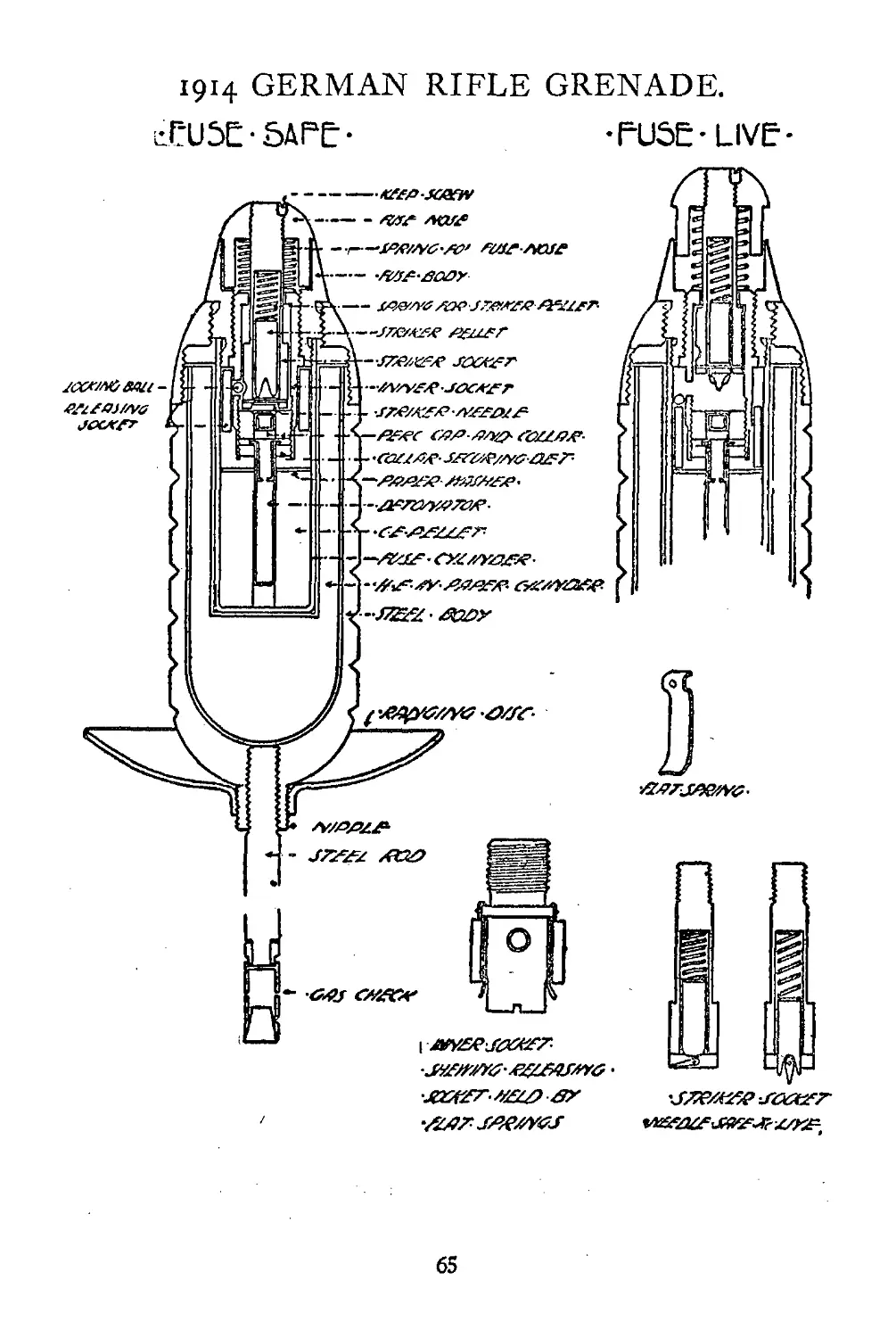
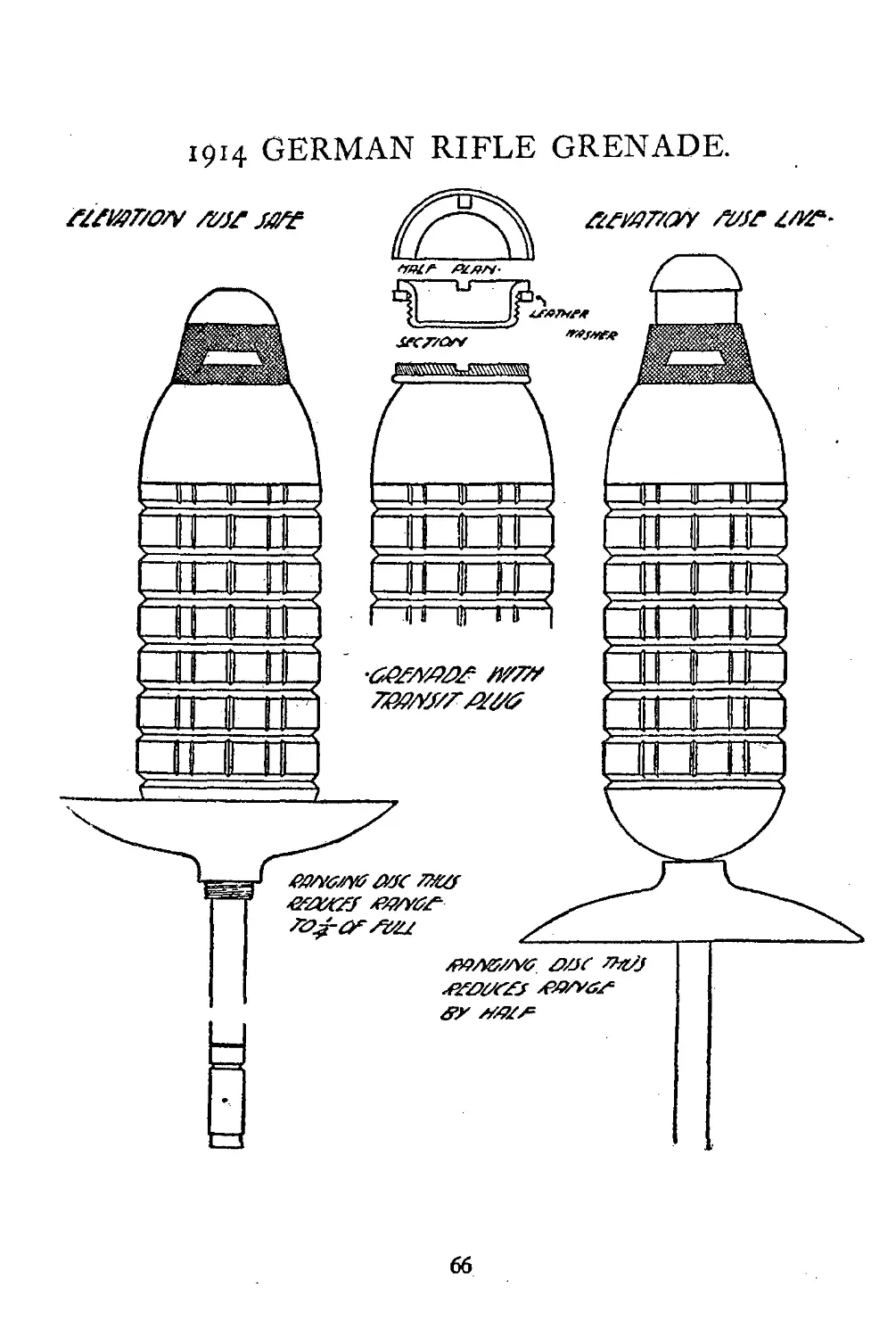



Текст
                    BOMBS
AND
HAND GRENADES
British, French and German
A HANDBOOK SHOWING THEIR CONSTRUCTION AND
TECHNICALITIES, GIVING FULL INSTRUCTIONS
AS TO HOW TO USE AND HOW TO
RENDER USELESS
BY
CAPTAIN BERTRAM SMITH
NEW YORK
E. P. DUTTON & CO.
681 FIFTH AVENUE
Copyright, 1918,
By E. P. DUTTON &• CO.
All rights reserved
printed in the United States of Hmerfca
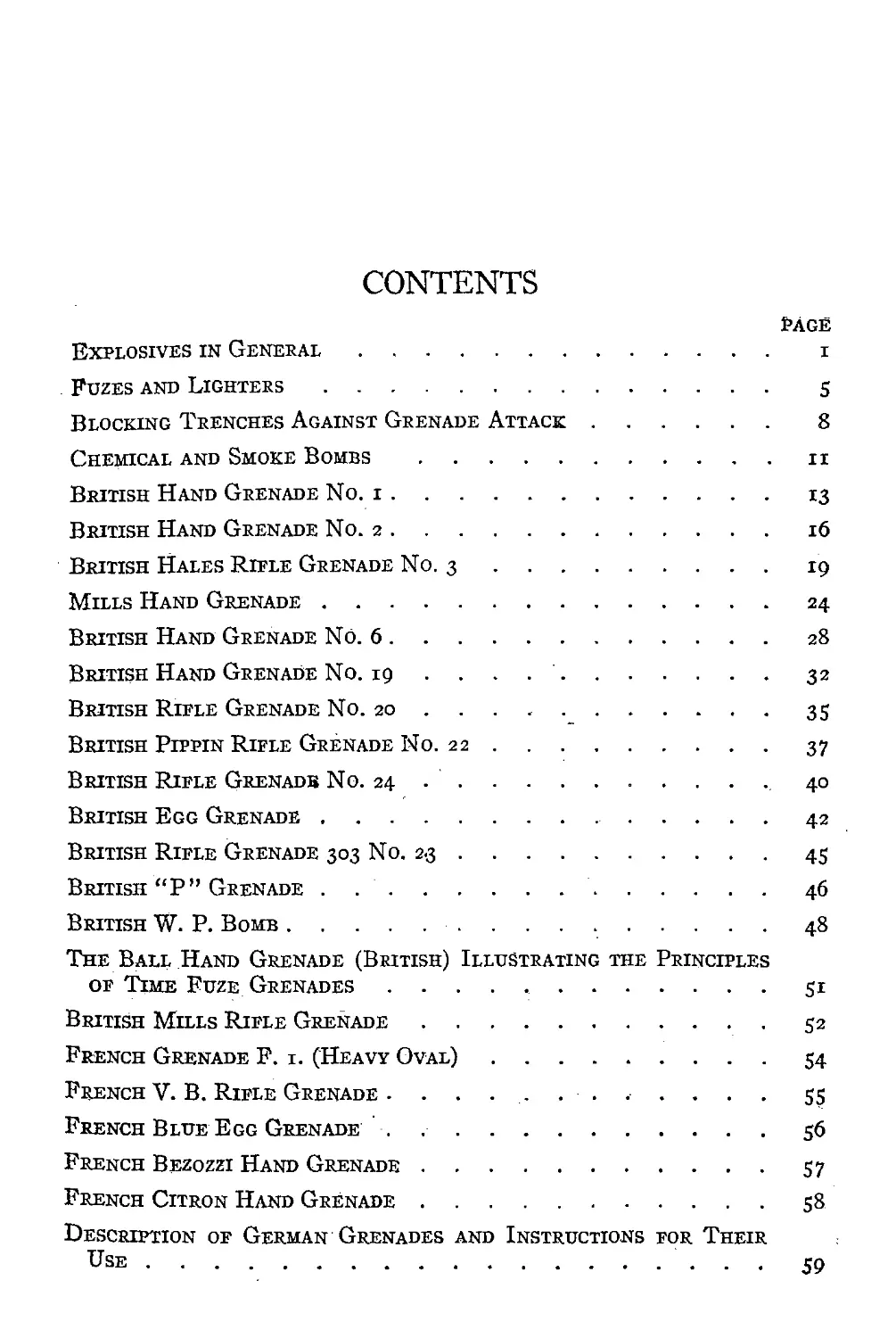
CONTENTS
Page
Explosives in General.................................. i
Fuzes and Lighters..................................... 5
Blocking Trenches Against Grenade Attack............... 8
Chemical and Smoke Bombs ..............................11
British Hand Grenade No. i.............................13
British Hand Grenade No. 2.............................16
British Hales Rifle Grenade No. 3......................19
Mills Hand Grenade.....................................24
British Hand Grenade No. 6.............................28
British Hand Grenade No. 19 ...	 32
British Rifle Grenade No. 20...........................35
British Pippin Rifle Grenade No. 22....................37
British Rifle Grenadb No. 24 ..........................40
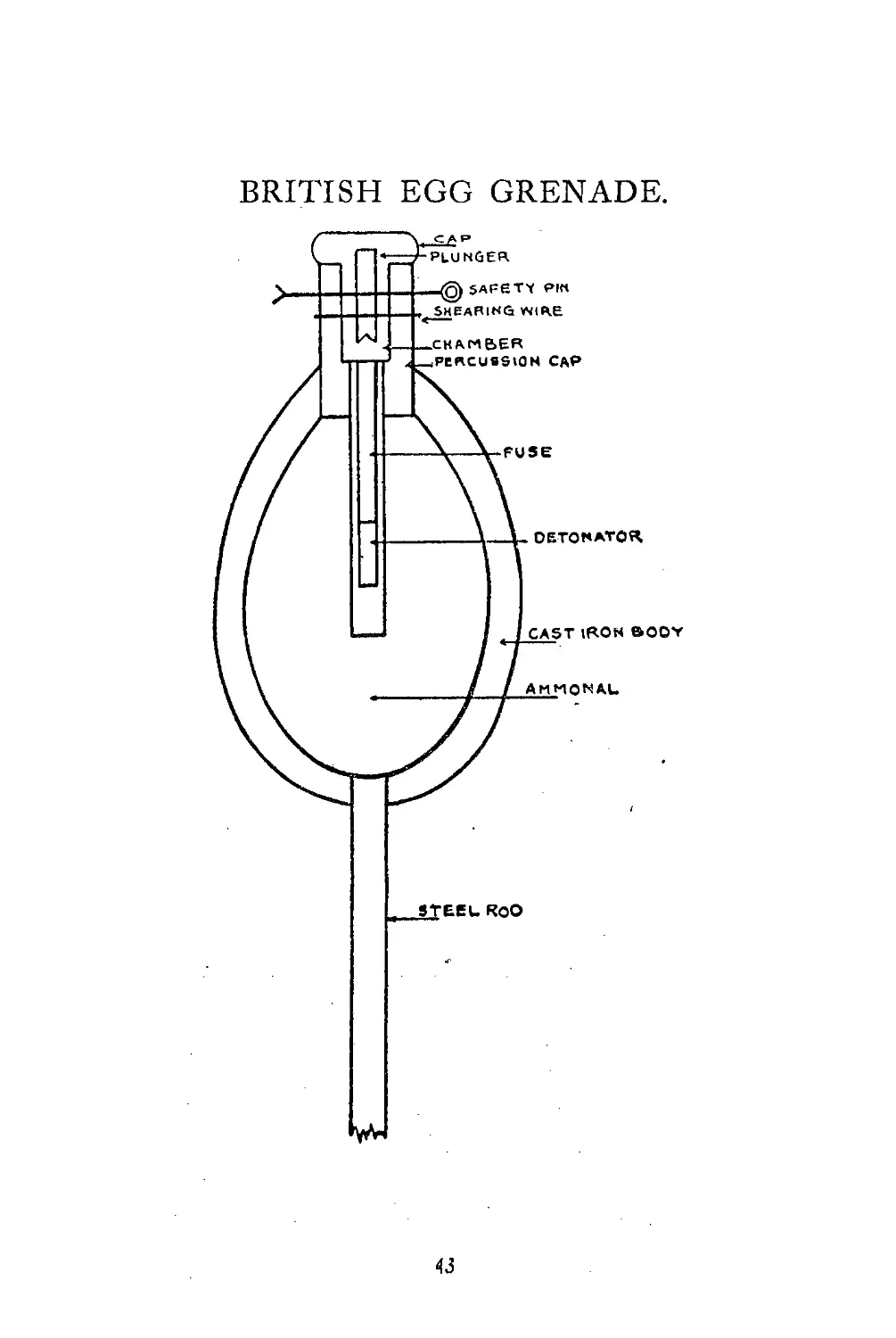
British Egg Grenade................................... 42
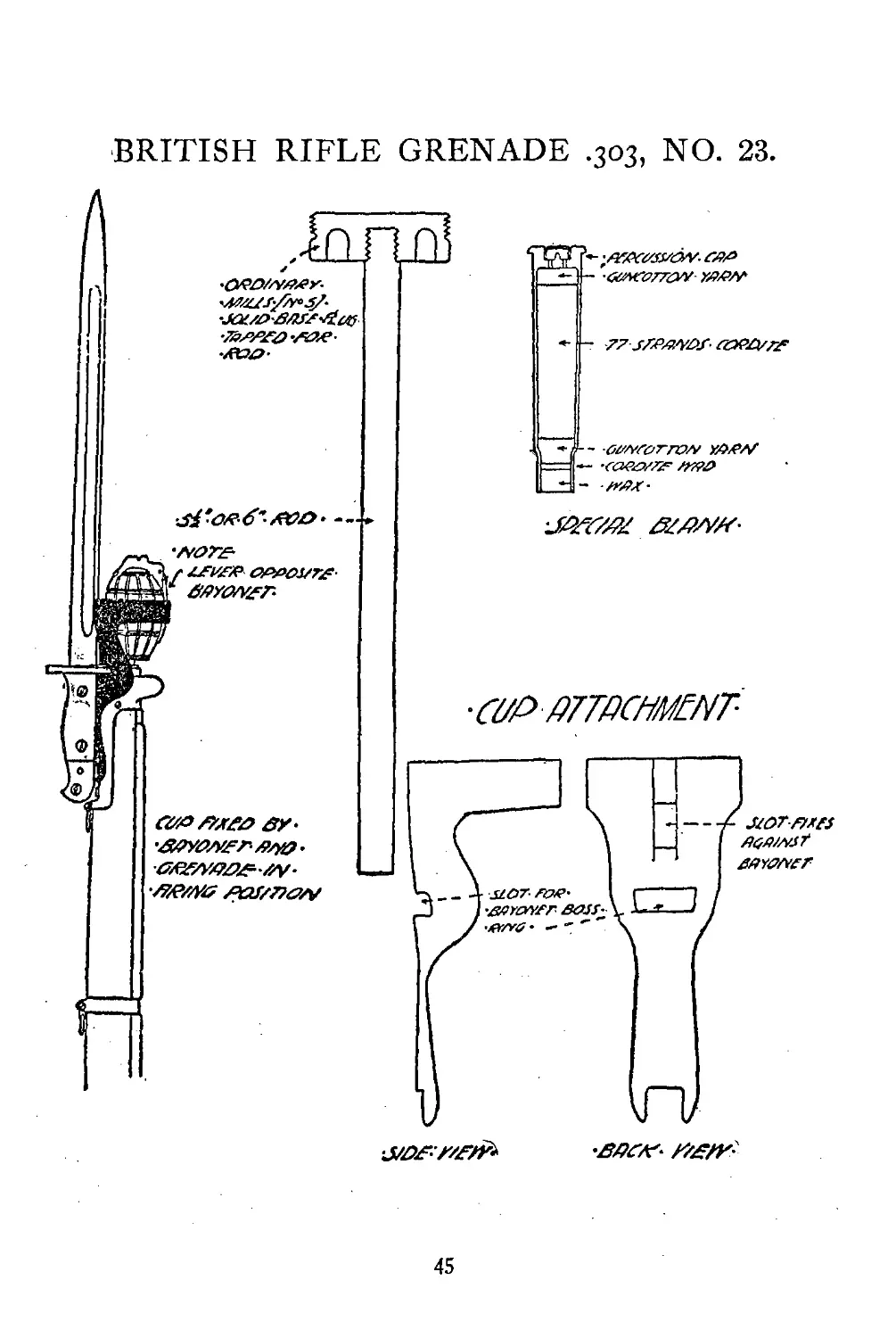
British Rifle Grenade 303 No. 2.3......................45
British “P” Grenade . ................................ 46
British W. P. Bomb.................................... 48
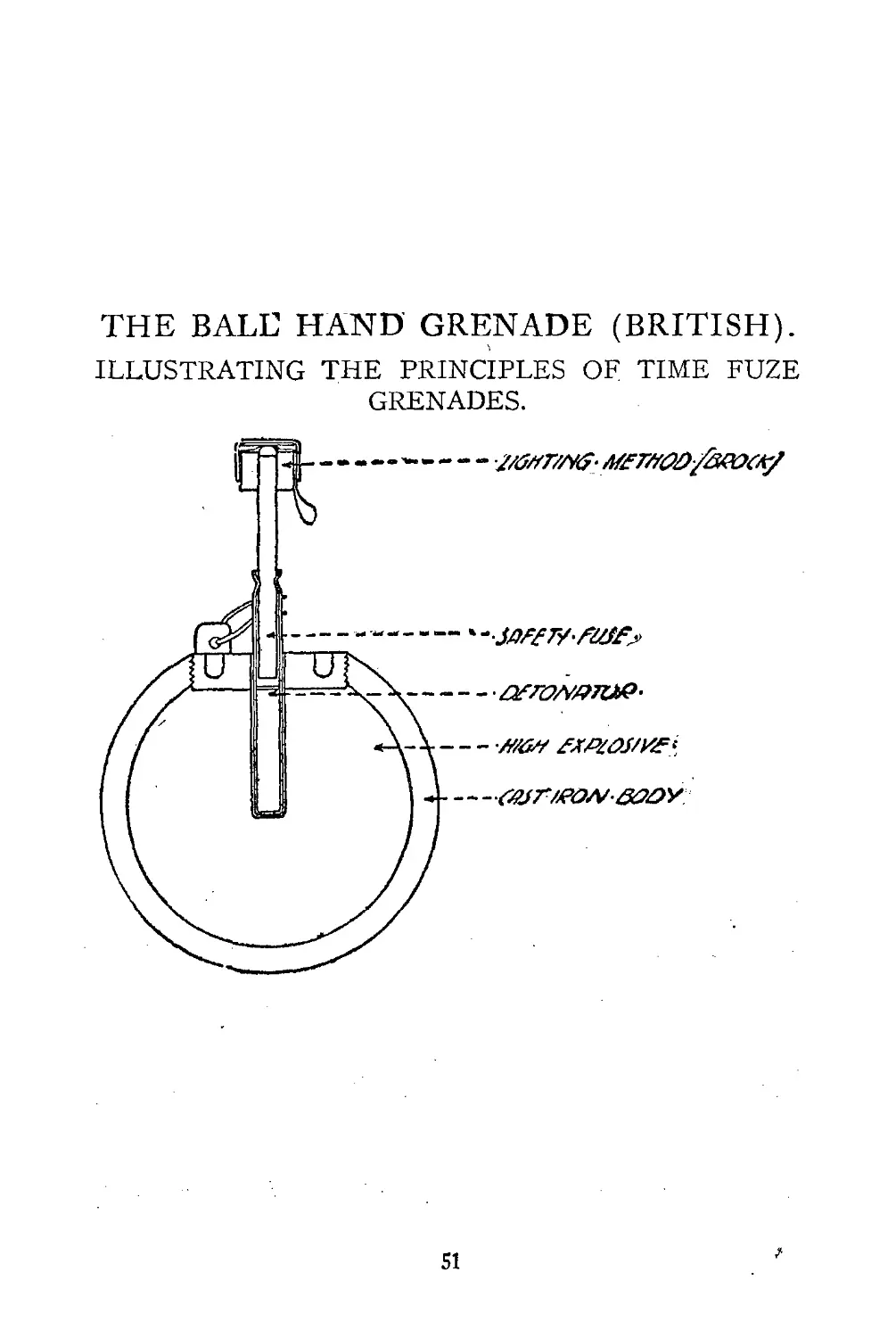
The Ball Hand Grenade (British) Illustrating the Principles
of Time Fuze Grenades .................................51
British Mills Rifle Grenade............................52
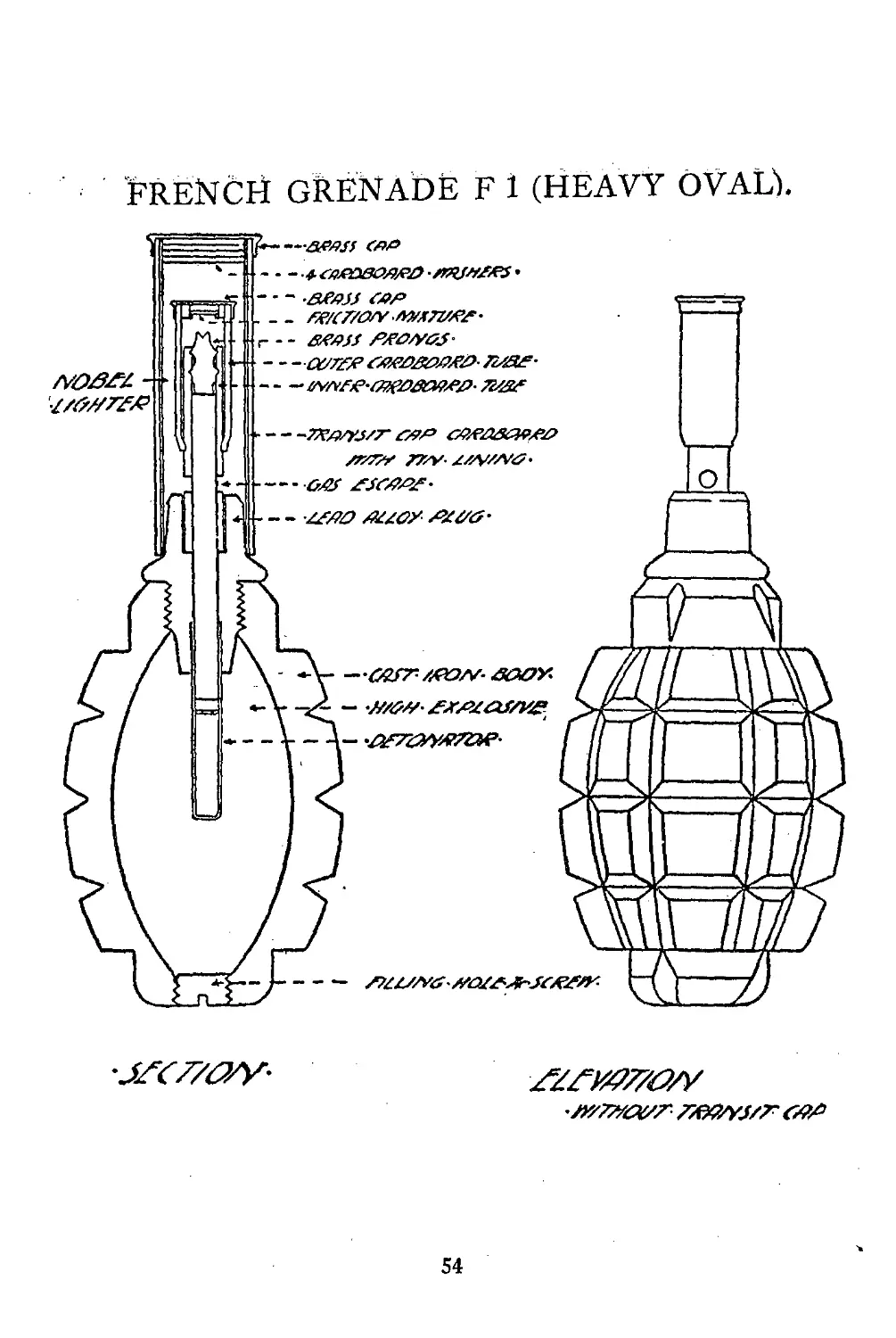
French Grenade F. i. (Heavy Gval)......................54
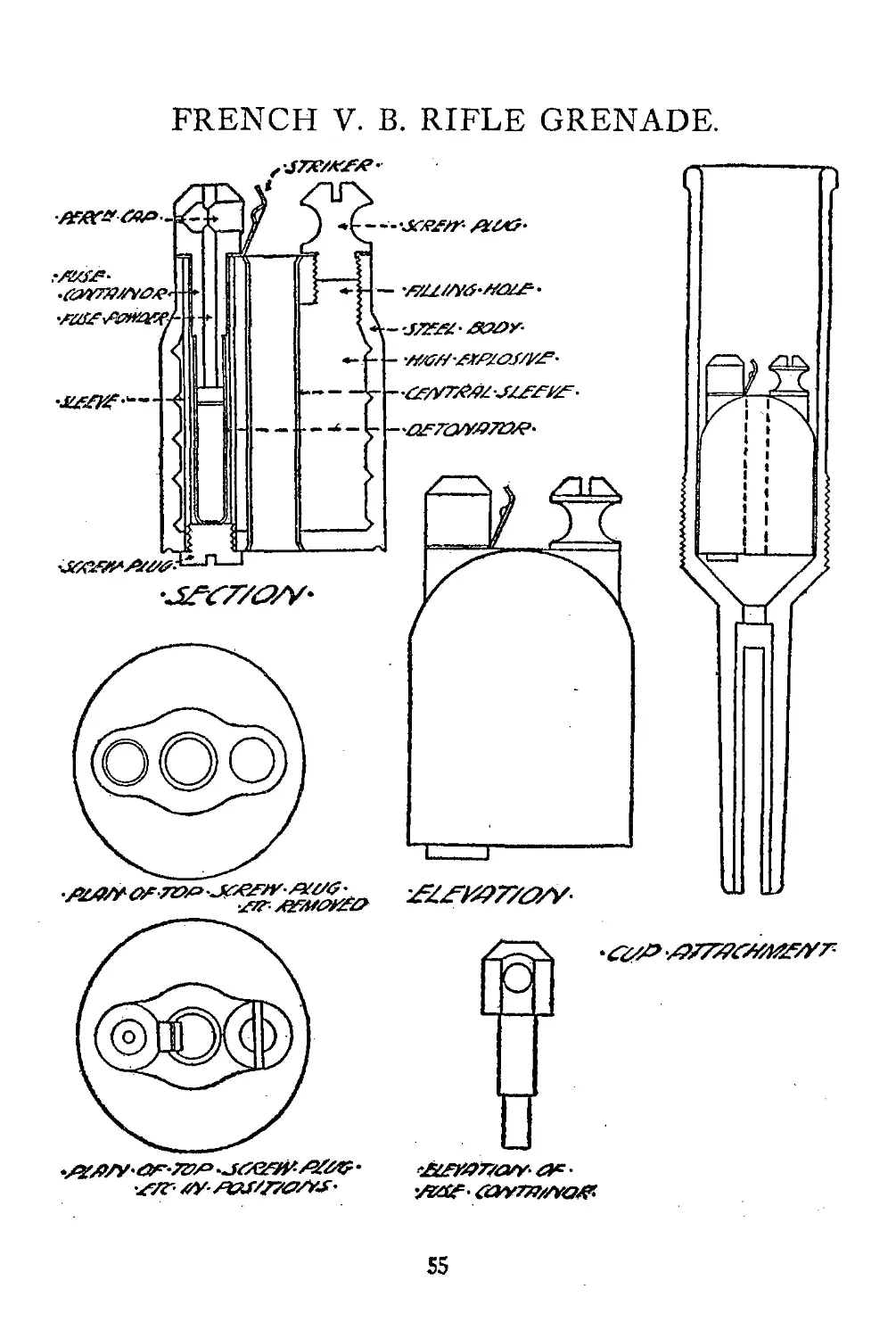
French V. B. Rifle Grenade ............	55
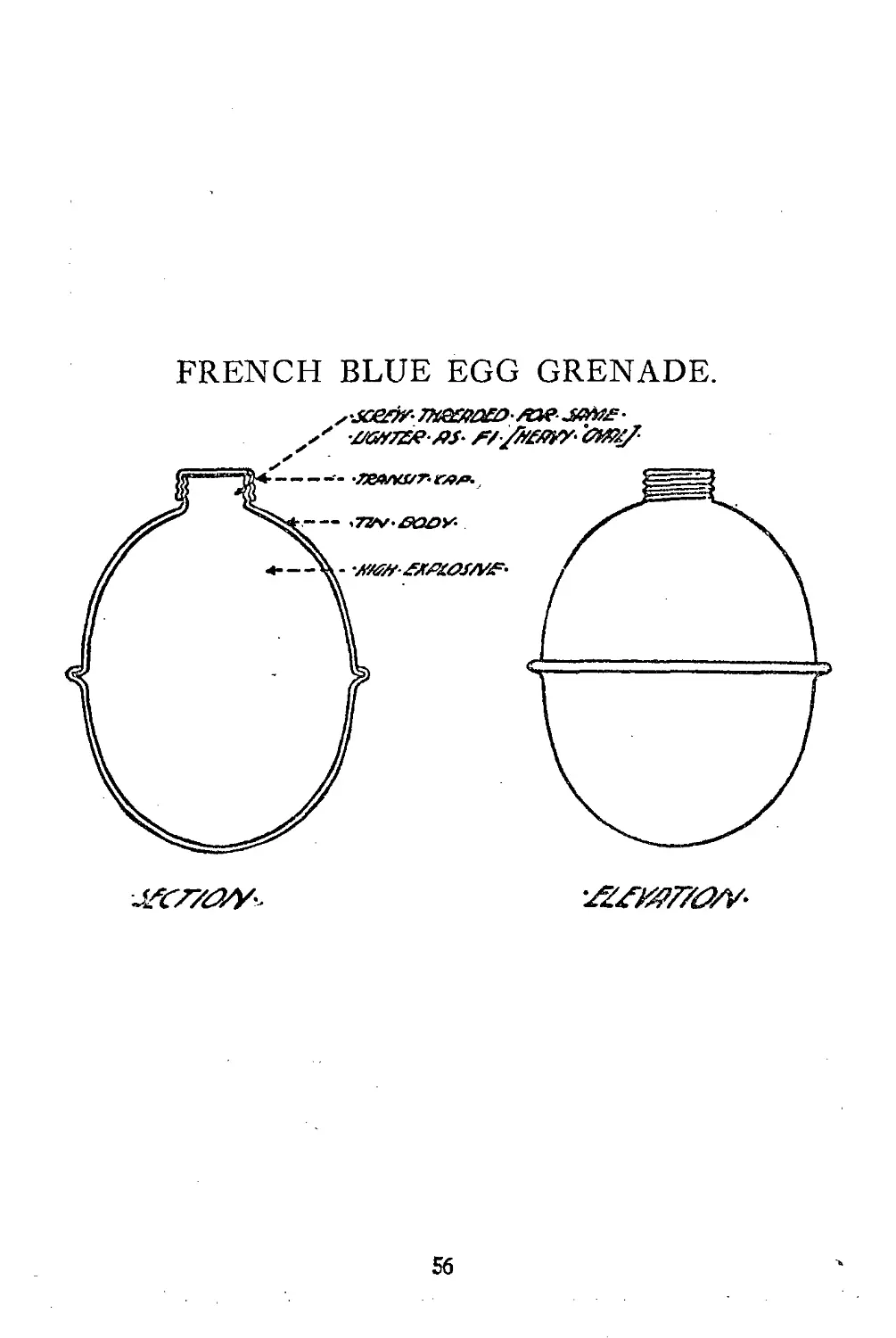
French Blue Egg Grenade . .............................56
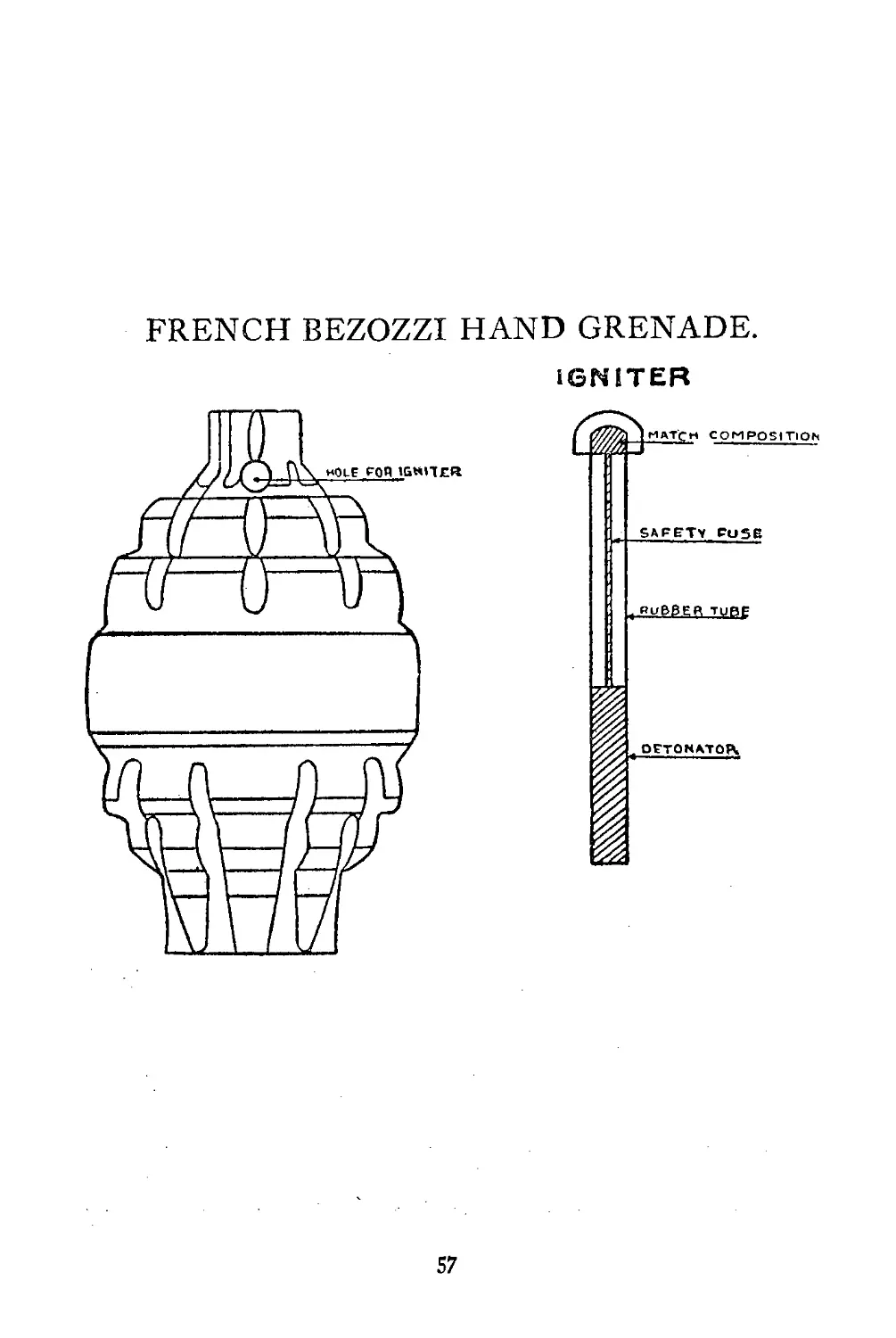
French Bezozzi Hand Grenade............................57
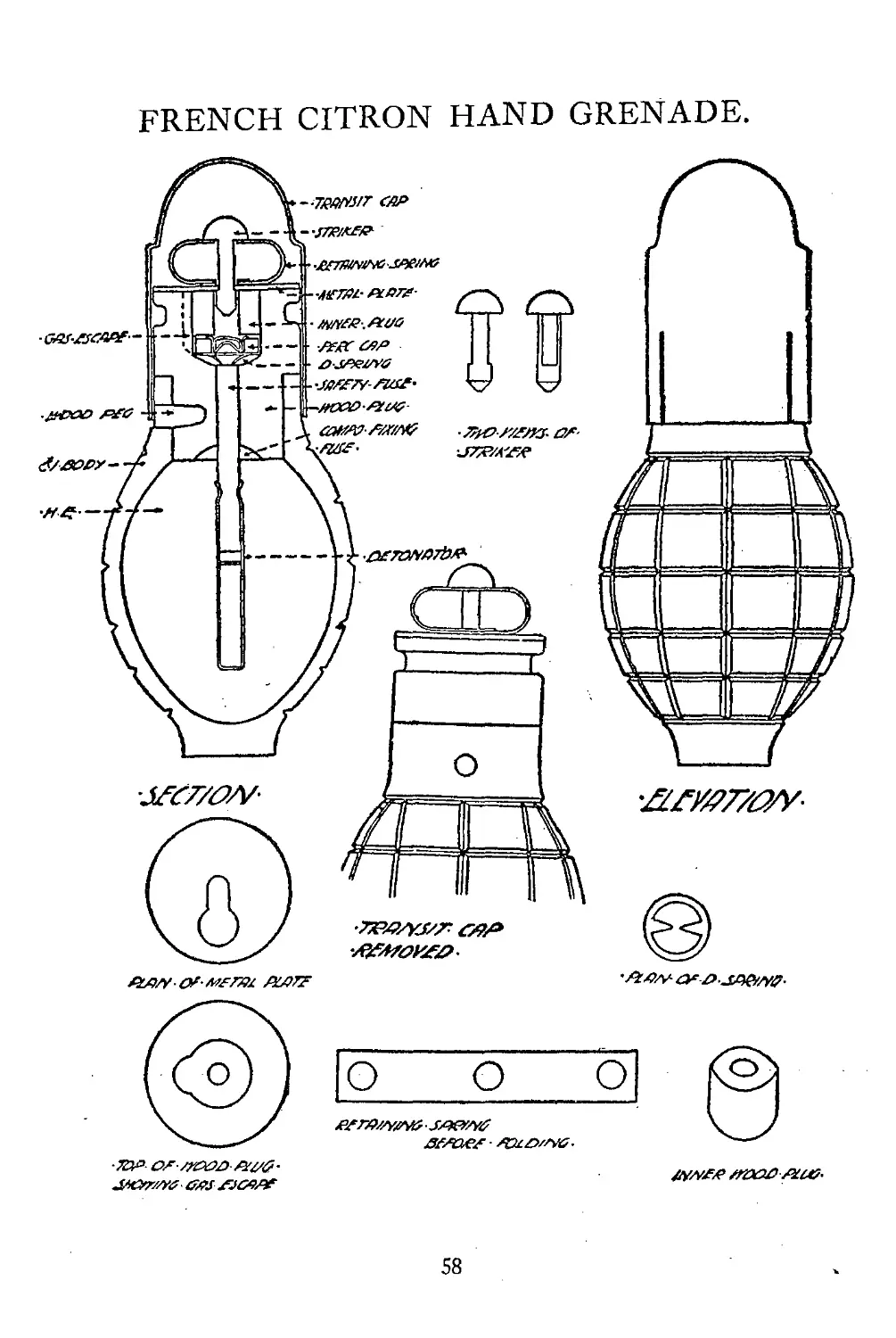
French Citron Hand Grenade.............................58
Description of German Grenades and Instructions for Their
Use....................................................59
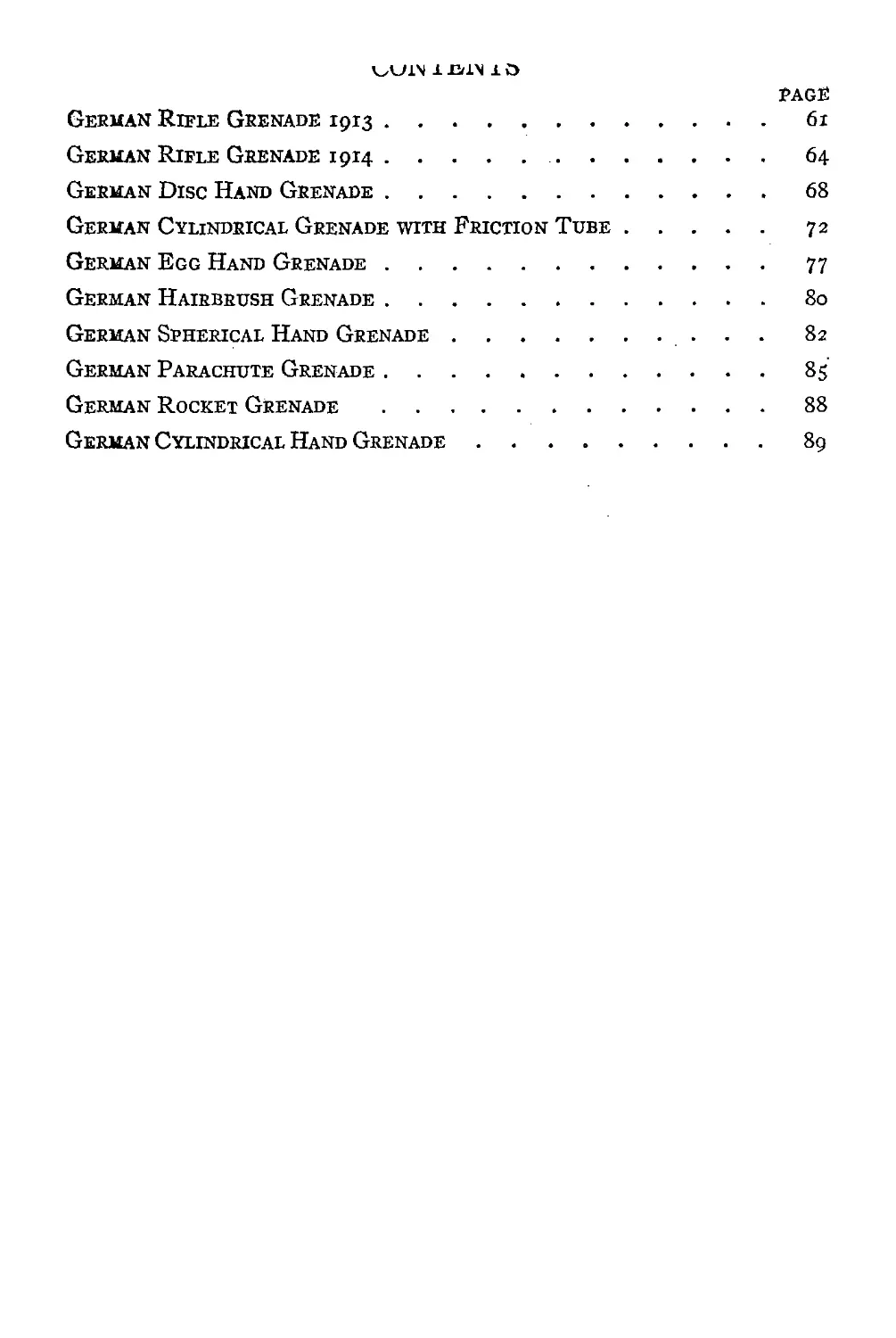
112/IN 1 О
PAGE
German Rifle Grenade 1913................................6i
German Rifle Grenade 1914............................... 64
German Disc Hand Grenade.................................68
German Cylindrical Grenade with Friction Tube............72
German Egg Hand Grenade..................................77
German Hairbrush Grenade.................................80
German Spherical Hand Grenade..........................  82
German Parachute Grenade.................................85
German Rocket Grenade....................................88
German Cylindrical Hand Grenade..........................89
EXPLOSIVES IN GENERAL.
KINDS OF EXPLOSIVES.
(a) Explosives may be classed as follows:
i.	Propellant.
2.	Disruptive.
3.	Detonators.
1.	Propellant.
(a)	Gun Powder, Cordite, etc., and all powders used in fire
arms.
(b)	These are known as “Low Explosives.”
(c)	Propellant is an explosive having a rate of combustion
regulated to a certain extent between time limits.
2.	Disruptive.
(a)	Lyddite, Ammonal, etc., and all powders or explosives used
in grenades, shells, torpedoes, etc.
(b)	These are “High Explosives.”
(c)	High Explosives are useless as “Propellants” as the force
is generated so quickly that it destroys substance in contact with it,
instead of projecting them to a distance.
3.	Detonators.
(a)	Detonators or Explosives are used to give the initial shock
which generates the explosion in others.
(b)	In Detonators the initial force of the explosion is sufficient
to break down the structure of the powder so that the flame reaches
every particle of the mass, thus causing an instantaneous ignition
called “Detonation.”
1
(c)	No. 8 General Service Detonator consists of a copper
tube, painted dark red and partly filled with Fulminate of Mercury.
Contains thirty-two grains of F. of M. Is very sensitive.
PRECAUTIONS.
When inserting a fuze in a detonator stop as soon as you meet
resistance. The detonator must be crimped to the fuze with pliers.
(Never use the teeth.)
Detonators are very sensitive and have been known to go off
with the heat of the hand.
i.	Gun Powder.
(a) This is a mechanical mixture composed of: Saltpeter 75%>
Charcoal 15%, Sulphur 10%.
2.	Nitro Cellulose Service Powders (Cordite).
(a) Cordite is one of these Nitro Cellulose service powders
and is made by treating Gun Cotton with Ether or Alcohol.
3.	Gun Cotton.
(a)	Discovered 1848 A. D.
(b)	This is the principal ingredient of modern service powders.-
(c)	It is prepared by immersing purified cotton wool in Nitric
Acid, carefully dried and heated with a mixture of Concentrated
Nitric and Sulphuric Acids.
(d)	It is then reduced to a pulp in a beating machine boiled
by means of steam and given another thorough washing. It is then
ready to be molded.
It can be obtained in two forms (1) Dry, (2) Wet.
Dry Gun Cotton is made up in 1 oz. dry primers, cone shaped,
perforated in centre for detonator. They are packed in metal cyl-
inders, each containing ten, threaded on a tape. Dry gun cotton is
dangerous to handle, being susceptible to both heat and friction.
Wet Gun Cotton is made up in 15 oz. slabs 6 inches by 3 by
and is packed in tin air-tight boxes, containing 16 slabs; each slab
is perforated in centre for a primer.
2
4.	Nitro Glycerine.
(a)	Discovered in 1847.
(b)	This is obtained by the action of Nitric and Sulphuric
Acids on Glycerine.
(c)	Pure Nitro Glycerine is a colourless, oily liquid.
(d)	It will explode when heated to about 360 degrees.
(e)	In liquid form it is too dangerous to use.
(f)	To overcome this, there has been found a substance which
absorbs it, this is known as “Fuller’s Earth.”
5.	Dynamite.
(a) Consists of Nitro Glycerine absorbed in “Fuller’s Earth.”
A
6.	Picric Acid.
(a)	This is the strongest explosive known.
(b)	It is a solid, pale yellow crystalline.
(c)	It is formed by the action of strong Nitric Acid on Car-
bolic Acid, Sulphuric Acid.
7.	Melinite.
(a) Picric Acid and Collodion make the French explosive
Melinite.
8.	Lyddite.
(a)	It is formed from Picric Acid and Vaseline, melted and
solidified.
(b)	If Lyddite comes in contact with metal it attacks this
metal and forms a detonating compound; for this reason “Lyddite
shells” are varnished on the inside.
(c)	It is also hygroscopic (i. e.—it will absorb moisture).
9.	Tri-Nitro-Toluene (TNT).
(a)	A famous German explosive.
(b)	Toluene is itself a liquid hydro-carbon and is obtainable
along with benzine from coal tar.
3
(c)	This is obtained by heating Toluene with a mixture of
Nitric and Sulphuric Acids.
(d)	It is not as powerful as Lyddite but is not hygroscopic
and does not form in detonating compound if it comes in contact
with metal.
(e)	It is safe to handle and hard to explode.
io.	Ammonal.
(a)	This explosive is used throughout the Austrian Army and
Navy.
(b)	It consists of TNT, Ammonium Nitrate, Charcoal and
Aluminum powder.
(c)	It is a safe explosive to handle but has the drawback of
being hygroscopic.
и. Fulminate of Mercury.
(a)	Detonators are generally loaded with this explosive.
(b)	It is composed of: Three parts Mercury — dissolved in
thirty-six parts Nitric Acid — with eleven parts Alcohol added.
(c)	A little “Potassium Chlorate” is sometimes added to deto-
nators.
12.	Percussion Caps.
(a) Composed of: Potassium Chlorate, Fulminate of Mer-
cury, Antimony and Ground Glass.
13.	Nitrogen.
(a)	It is an inert gas and does not combine easily with other
gases.
(b)	It is not hard to separate.
4
FUZES AND LIGHTERS
BRITISH FUZES.
(a) At the present time (1918) there are three fuzes in gen-
eral use in the British forces.
No. 9 Bickford time fuze.
Instantaneous fuze.
Commercial fuze.
1.	No. 9 Bickford Time Fuze.
(a)	Color — black.
(b)	Smooth, outside.
(c)	Burns У2 inch to the second or 4 ft. per minute.
(d)	Consists of a small trail of fine gyn powder surrounded
with flax and covered with gutta percha with waterproof tape bound
around the outside.
(e)	This fuze will burn under water and is quite safe; it is
the fuze most used.
2.	Instantaneous Fuze.
(a)	Color — orange.
(b)	A thread snaked around the outside makes the fuze rough
to feel.
(c)	Burns thirty yards per second.
(d)	Consists of three strands of quick-match surrounded by
flax and covered with gutta percha with waterproof tape bound
around the outside.
3.	Commercial Fuze
(a)	Color — white.
(b)	Smooth outside.
(c)	Bums one inch per two seconds or four feet per minute.
(d)	Consists of a fine train of gun powder surrounded with
flax and covered with gutta percha and bound in waterproof tape
— a fine white piece of cotton is bound around the outside.
REMARKS ON FUZES.
All fuzes come 100 feet to the coil.
Before using fuze always test its burning rate by trying several
pieces from ends and centre.
Never use cracked fuze.
A piece of safety fuze must always be attached to instantaneous
fuze for testing purposes.
FUZE JOINTS.
In joining fuzes, cut ends slantwise, place together and bind
with waterproof tape.
Note: The Germans are very fond of faking fuzes, so great
care should be taken with any fuzes found in enemy trenches or
stores.
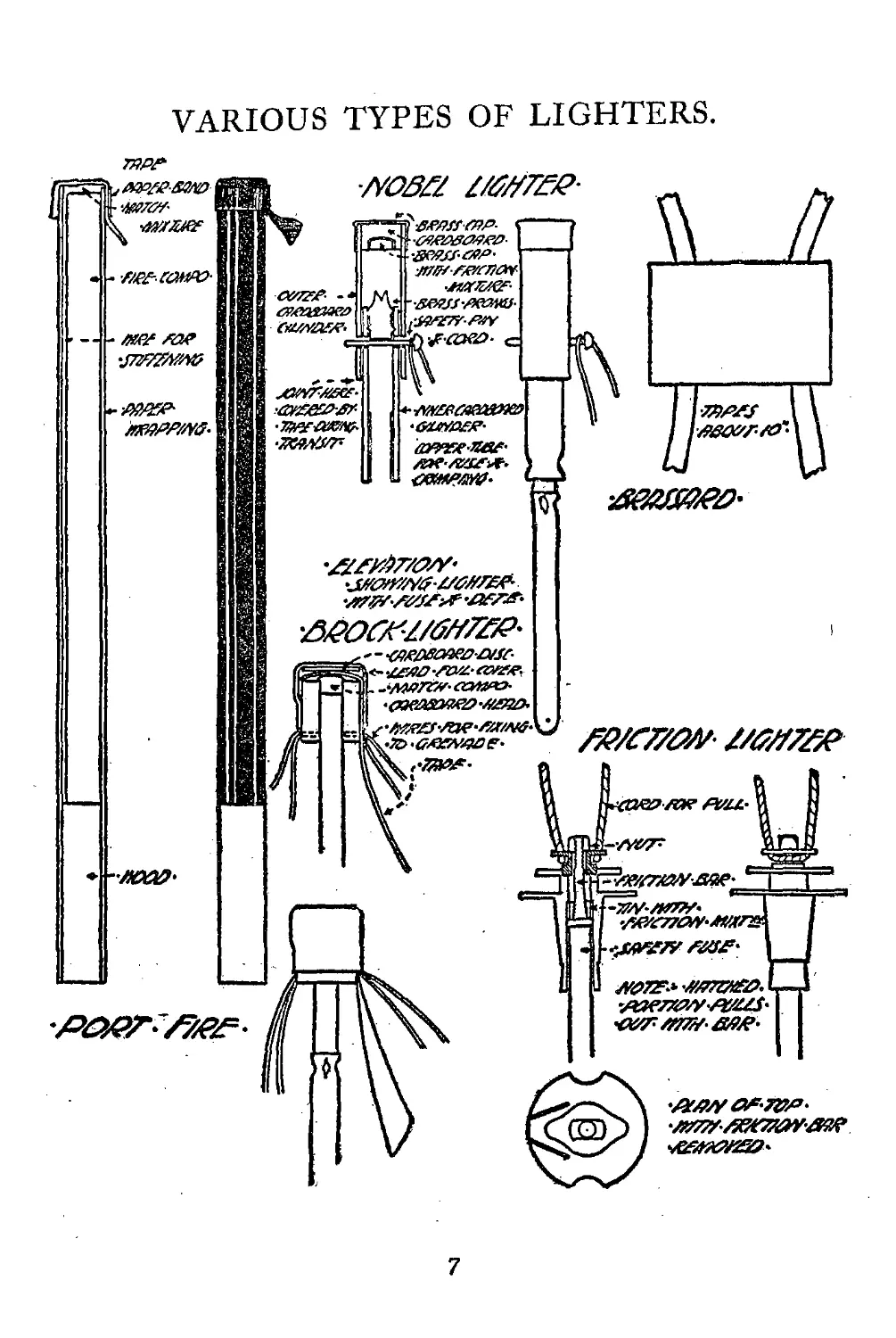
LIGHTERS.
(i) Nobel Lighter.
(2) Brock Lighter.
The Nobel Lighter consists of two cardboard tubes one fitting
over the other. Inside the top end of the outer there is a layer of
friction composition. Fixed to the top end of the inner tube is
forked brass frictionhead, which is held in position by a safety pin
passing through both tubes. Inside the other end of inner tube is
a small copper band; there is a narrow tape band with loose end.
To light fuze, first pull off tape and safety pin then press down
tube and turn slightly. This lighter has a five second fuze at-
tached.
The Brock Lighter consists of a match-head and fuze com-
bined. The head consists of a small cardboard cap filled with fric-
tion composition and covered with waterproof paper. With this
type of lighter an armlet covered with match composition is worn
by the man on the left forearm.
* To ignite fuze first pull off waterproof paper and then strike
head against armlet (brassard). Time of fuze five seconds.
6
VARIOUS TYPES OF LIGHTERS
7ЯРГ
&&¥#£№
МШ~
t ^z&e^

-	/22^
'J7^Y/A^
Ьмяр/лю*


4ЛЯ25Г-

л/ /Z0-2Z5P-
jQWFMStf-
’TWfMW'
‘1Ш/Г
•<я?яяляяв?-
S^JS'P&^SS^
^^r/^/f-
•&&&*
р£ОС7<Ч/М7&?-
- - •cpppsc^ep p/^
<- t£^9P -f&Z‘
. >AW???Z-«3*W>
7z>^^yppe'
'*%&&-

•/w^
-TW'/MW*
<$Mwys&rf
&07&ъ'&&&£&
VWJWVSbZtS'
WF/№&*£&#•
лэе/эиа-
•za^r^^s^-
7
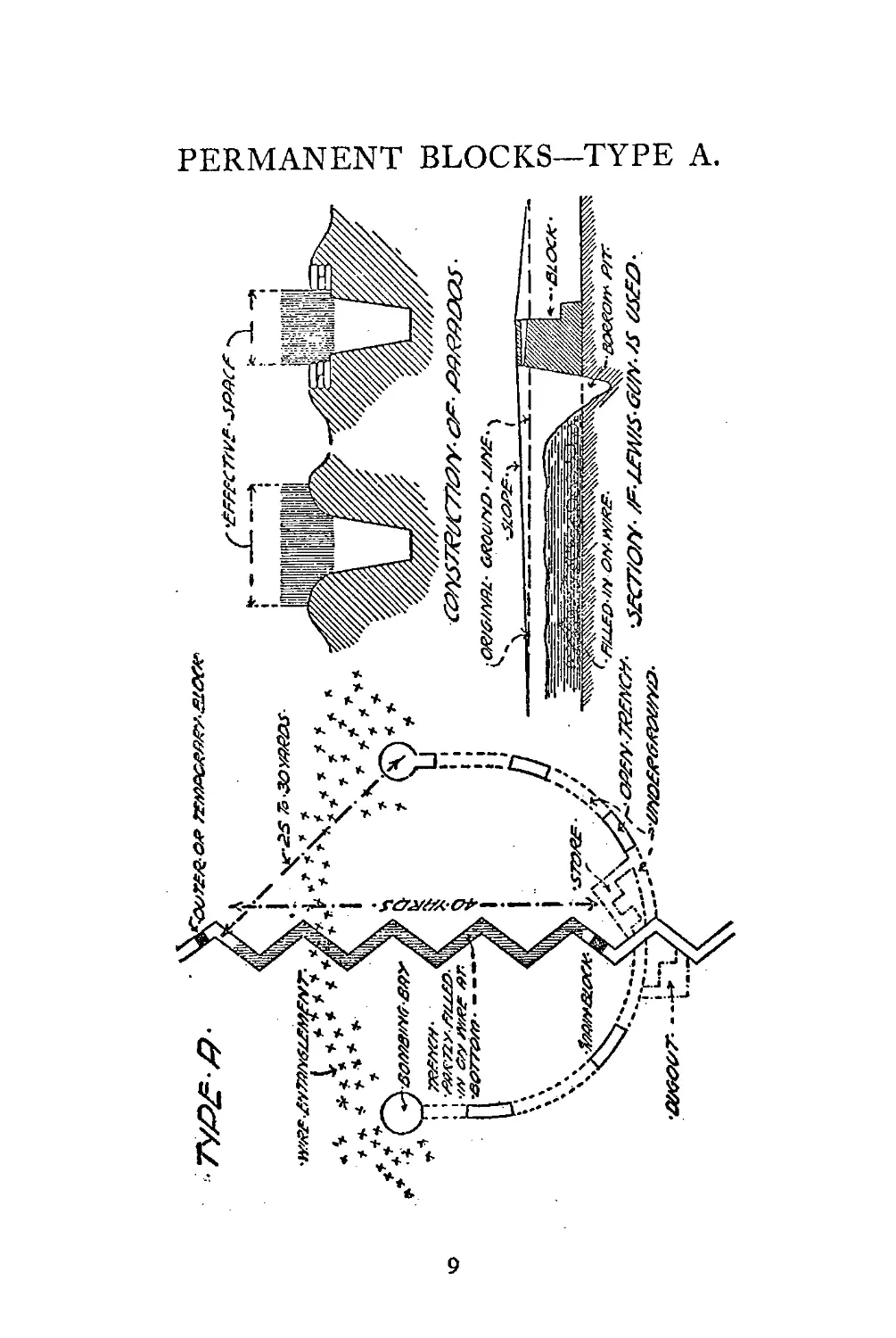
BLOCKING TRENCHES
AGAINST GRENADE ATTACK.
All bombers must have a knowledge of the best methods of
blocking a trench. In all attacks they should be supported by a
party of men with sandbags and tools under an experienced N. С. O.
so that whilst the bombers are keeping the enemy at bay a strong
barricade can be built as quickly as possible. It is advisable to work
along the trench for a distance of 50 yards or so further than the
point to be barricaded, in order to drive the enemy back out of
grenade throwing distance. A second barricade of a temporary
nature should be erected at this advanced point and constant fire
kept up by the bombers while a working party fill in the trench be-
tween the advanced and near barricades as rapidly as possible, plac-
ing wire in it to hinder the enemy from digging it out. It is ad-
visable as a rule to attach a small number of engineers to the party
with a view to blowing down the enemy’s trench by explosives. As
soon as a clear field of fire has been established from the point to
be held, the bombers retire from the advanced barricade. In case
of a straight trench with traverses, the traverses in a portion of it
should be cut away and the earth be used to fill the recesses. A
strongly built sandbag breastwork is then made across the trench
with loopholes for observation and fire; the trench behind the breast-
work is roofed over to give protection from grenades, with a traverse
to protect the men from grenades which burst beyond them. To
hinder any attempt of the enemy to rush across the cleared portion
of the trench, loose strands of wire should be placed in it. A Lewis
gun, if available, can be mounted on the breastwork. In order to
guard against damage to the breastwork by grenades continually-
being thrown against it and bursting at the foot of it, a catch pit can
be dug into which they would roll before bursting.
8
PERMANENT BLOCKS—TYPE A.
9
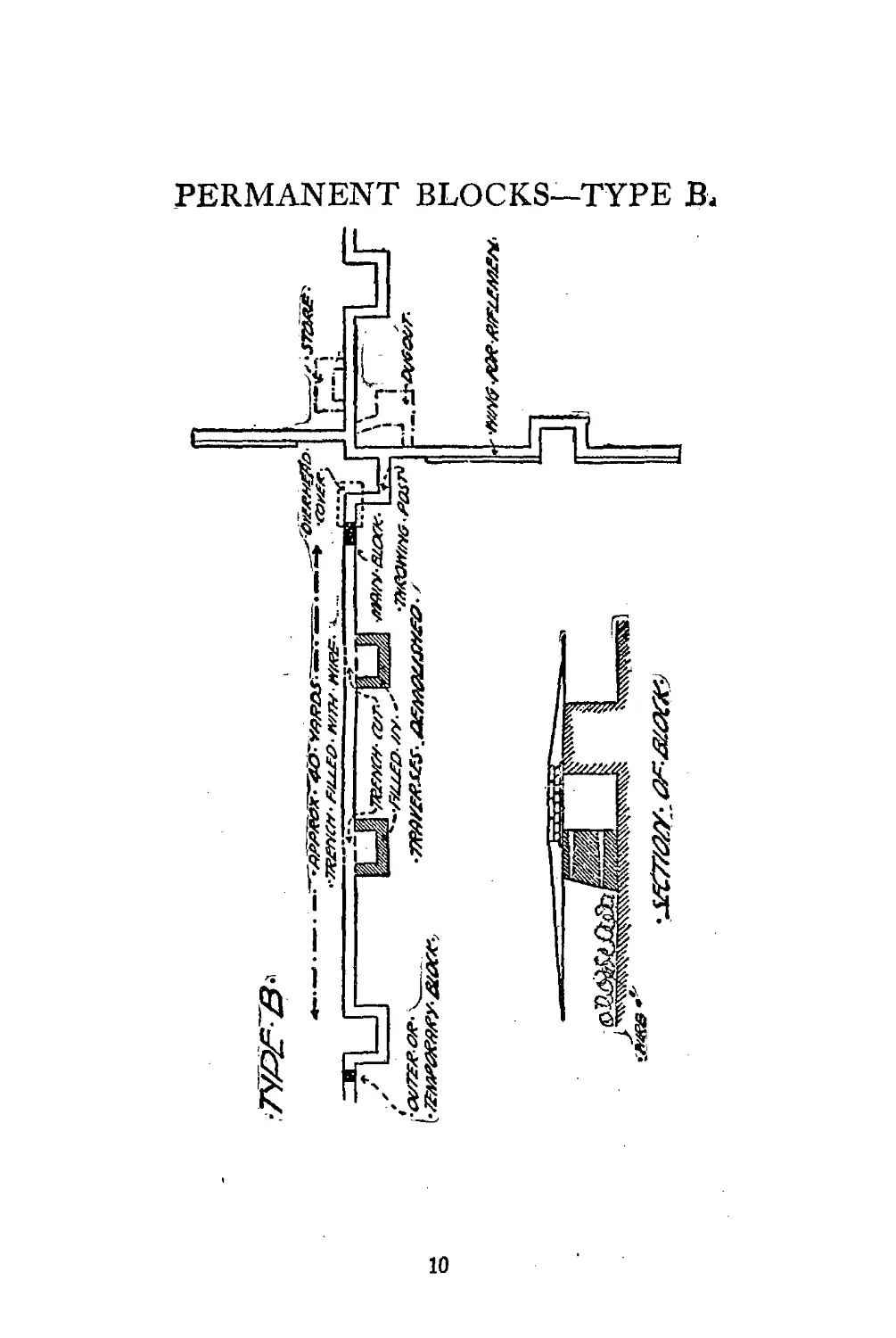
PERMANENT BLOCKS—TYPE B<
10
CHEMICAL AND SMOKE
BOMBS
TRIPLET CANDLE SMOKE BOMBS.
Triple Candle Smoke Bomb consists of:
Three cardboard cylinders, each cylinder containing petrol and
coal dust, bound together with two wire bands and covered with
white cotton with fuze attached.
To make smoke screen, four per minute on a twenty-five yard
front is sufficient.
No. i Threlfallite.
A tin about five inches by three inches in diameter containing red
phosphorus, a detonator, safety fuze and lighter. When detonated
it causes a radius of dense smoke of about twelve yards radius.
This bomb is not dangerous.
No. 2 Threlfallite.
Contains white phosphorus in petrol. Through rust leakage may
occur and the petrol evaporate causing the phosphorus to light. The
size of the tin is three inches by three inches in diameter, also a
fuze and detonator.
This bomb should be stored away from anything else.
Very bad for the eyes and lungs.
GAS BOMB M. S. K.
It is an iron sphere, eight seconds fuze, contains fluid which
smells like pineapple, produces tears and causes violent headaches.
Chief use for dugouts and mopping up.
11
PRECAUTIONS.
Smoke bombs should always be stored separately from explo-
sives. Store in a cool dry place.
Phosphorus bombs should be examined frequently. If tin is not
air tight destroy. In opening be careful of friction.
Always throw as far as possible.
AMMONAL TUBES.
(Bangalore Torpedoes.)
These tubes are about three inches in diameter and about twelve
feet long. They are filled with Ammonal with a Gun Cotton primer
with detonator and time fuze attached. Both ends are blocked with
wooden plugs, one plug with hole in centre allowing fuze to pass
through. They are used for blowing up enemy's Barbed Wire.
EQUIPMENT OF BOMBERS.
Bombers should be -as lightly equipped as possible. In the case
of grenade operations and raids, the men who are actually to throw
grenades should not carry rifles, but should be armed with revolvers
if they have been taught to use them, or with a bayonet or special
stabbing knife or weapon for hand-to-hand fighting, such as an axe
or knob-kerry. In a general attack all men must carry rifle and
bayonet. Bombers must therefore be taught to throw with rifle
slung over left shoulder. Steel Helmets should be worn by all men
taking part in grenade attacks.
12
BRITISH HAND GRENADE NO. 1
(Percussion).
Weight Complete 2 lbs.
DESCRIPTION.
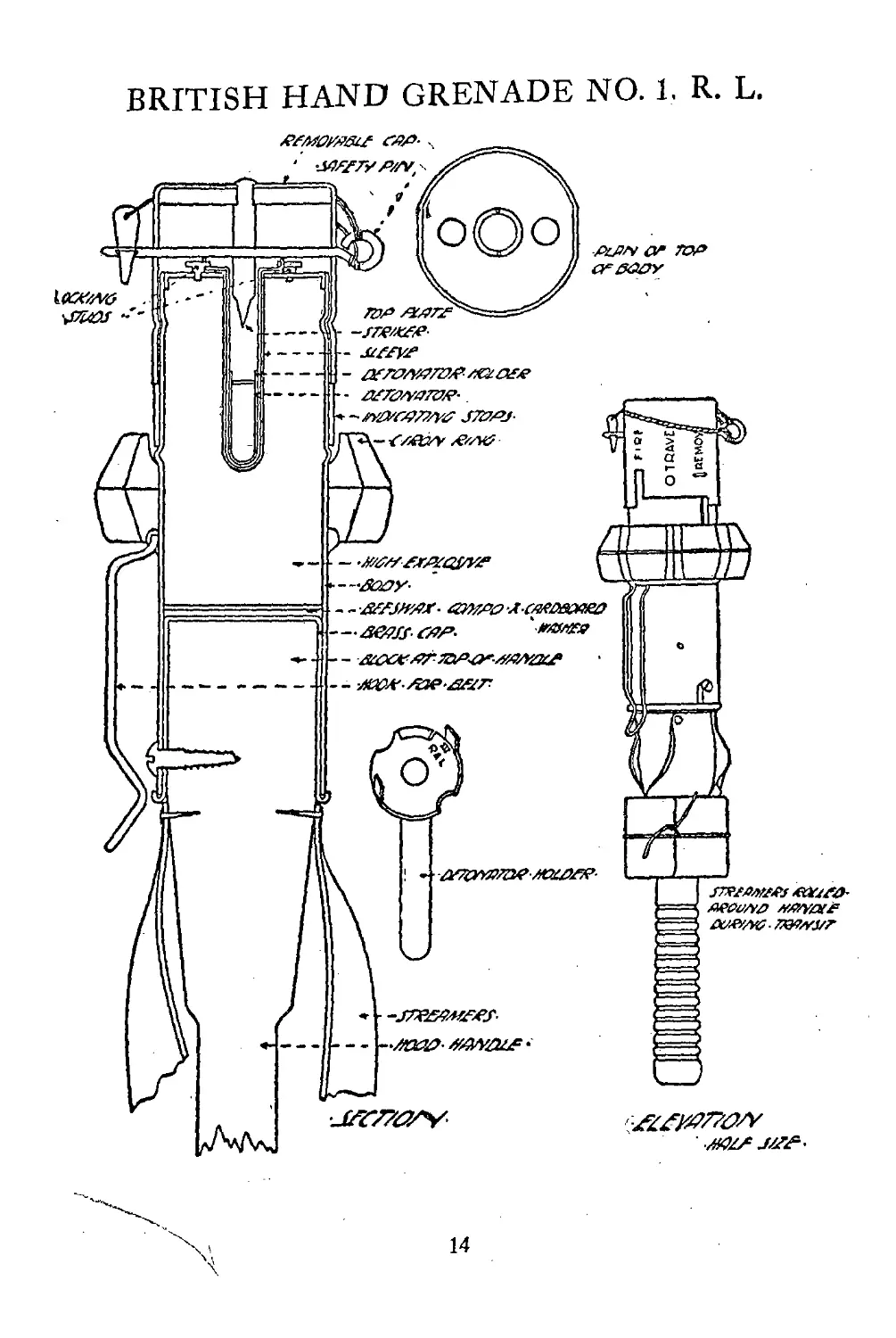
The grenade consists of a brass cylinder encircled by a narrow
cast iron ring serrated to break up into fragments. The cylinder is
mounted on a wood block to which a cane handle five inches long is
attached. Four streamers are nailed to this end of the body. Total
length of grenade 12% inches. The brass cylinder or body of the
grenade is filled with explosive, and has its upper end closed by the
detonator holder, fixed by three screws.
This holder carries two pins for screwing the detonator. The
body has two knobs and two indicating stops fitted above the ser-
rated ring. The firing needle is carried in the removable cap, which
has two grooves formed on it in which slides the knobs on the body.
The cap is centrally placed for the safety pin.
“Remove,” “Travel” and “Fire” are marked on the outer surface
of the cap. When the knobs on the body are opposite the word
“Remove” the cap can be pulled off.
When opposite “Travel” cap cannot be removed.
When opposite “Fire” the cap can be pushed down so that the;
firing needle can pierce the detonator. When the grenade is thrown,
owing to its weighted head and streamer on handle, it will fall on
its head and the firing needle will be forced into the detonator.
INSTRUCTIONS.
To Prepare for Use.
1. Remove the cap (leaving the safety pin in) and insert deto-
nator by pushing it home and turning it to the left.
13
BRITISH HAND GRENADE NO. 1. R. L.
ЯСАШАТ (№
' iWzz/k/Ws
-J7B55?^>ef-
-X^AY CP TOP
СР&20У
•zfca^x-
сгш0с>л^с>вс^ха
3&7fs-	' ГЯЯ&
w^r -
7№ /ХЛК?
-sr&xfie-
- J^ZZk?3
- Hrra/Y/77Z2^/^C^^
- C^T^/Y^TV/?-
S7P/1J-
-<S£tW АУЛ&


jTXWtotftt *Ы7Л>-
APtWM A^WXJF
£UWA&  ft&WJ/F
J/Sf'
14
Special detonators are provided with the grenades.
2. Replace the cap and turn to “Travel.”
To Fire.
i.	Turn to “Fire.”
2.	Immediately before throwing pull out the leather strip from
the safety pin and free the pin.
3.	Hold the grenade in the right hand, pull out the safety pin
with the left and throw.
SPECIAL PRECAUTIONS.
Great care should be taken to prevent the grenade from being
jarred during the action of throwing. Detonators deficient of the
spring clip should not be used. Cylinders containing ten detonators,
No. 1 Hand Grenades marks 1 and 11, are issued separately.
Note: If the grenade is not used the detonator can be removed,
and cap replaced and turned to “Travel.”
15
BRITISH HAND GRENADE NO. 2
(Percussion).
Tonite or Mexican Grenade.
Weight Complete i lb.
DESCRIPTION.
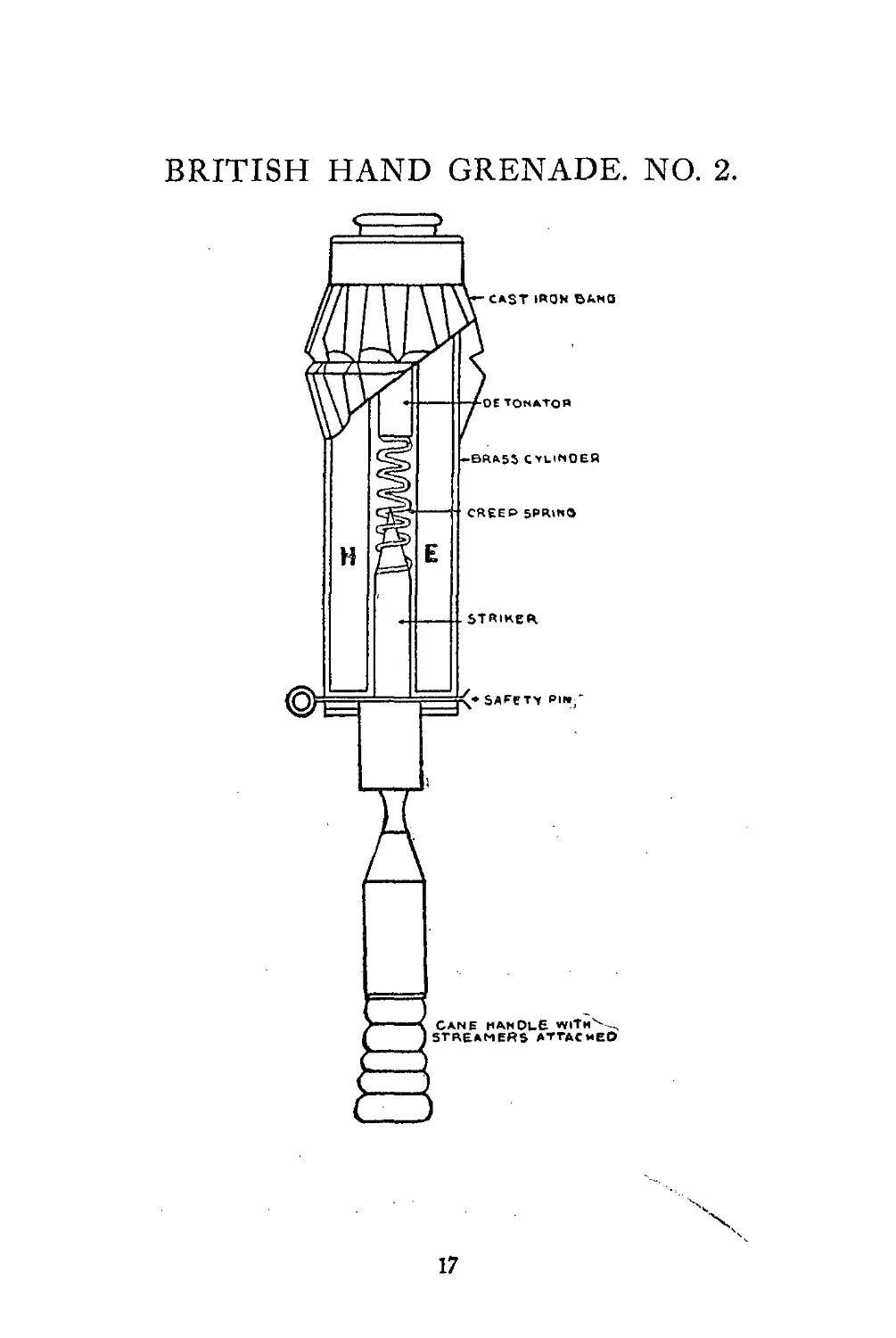
The grenade consists of (i) Handle, (2) Body, (3) Special
Detonator.
HANDLE.
Cane 7 inches long, rough to prevent the grenade slipping out of
the hand, total length 12% inches; a 1% inch tape, 1 yd. long, is
wound around this end and is kept in place by a thin binding thread.
When the latter is broken the tape is free to form a tail and so assist
the grenade to fall on its head.
A small steel rod about 2 inches long, is fixed to the other end
of the handle by means of a brass collar rivetted to the cane. The
end of the steel rod screws into the body of the grenade.
BODY.
Consists of a brass cylinder, 4% inches by 1% inches diameter.
A band of ribbed cast iron is fixed on to the end near the head.
This Band.
(a)	Helps to weight the head of grenade.
(b)	Provide the necessary man-killing fragments. There is a
small tube passing down the centre of the large cylinder and the
16
BRITISH HAND GRENADE. NO. 2
cast iron ъм«а
OE TQNATQfl
CREEP 5PR1K&
STRIKER.
SAFETY Pl»/
brass cylinder
CANE MANOuE WlTH4-^
STREAMERS attached
17
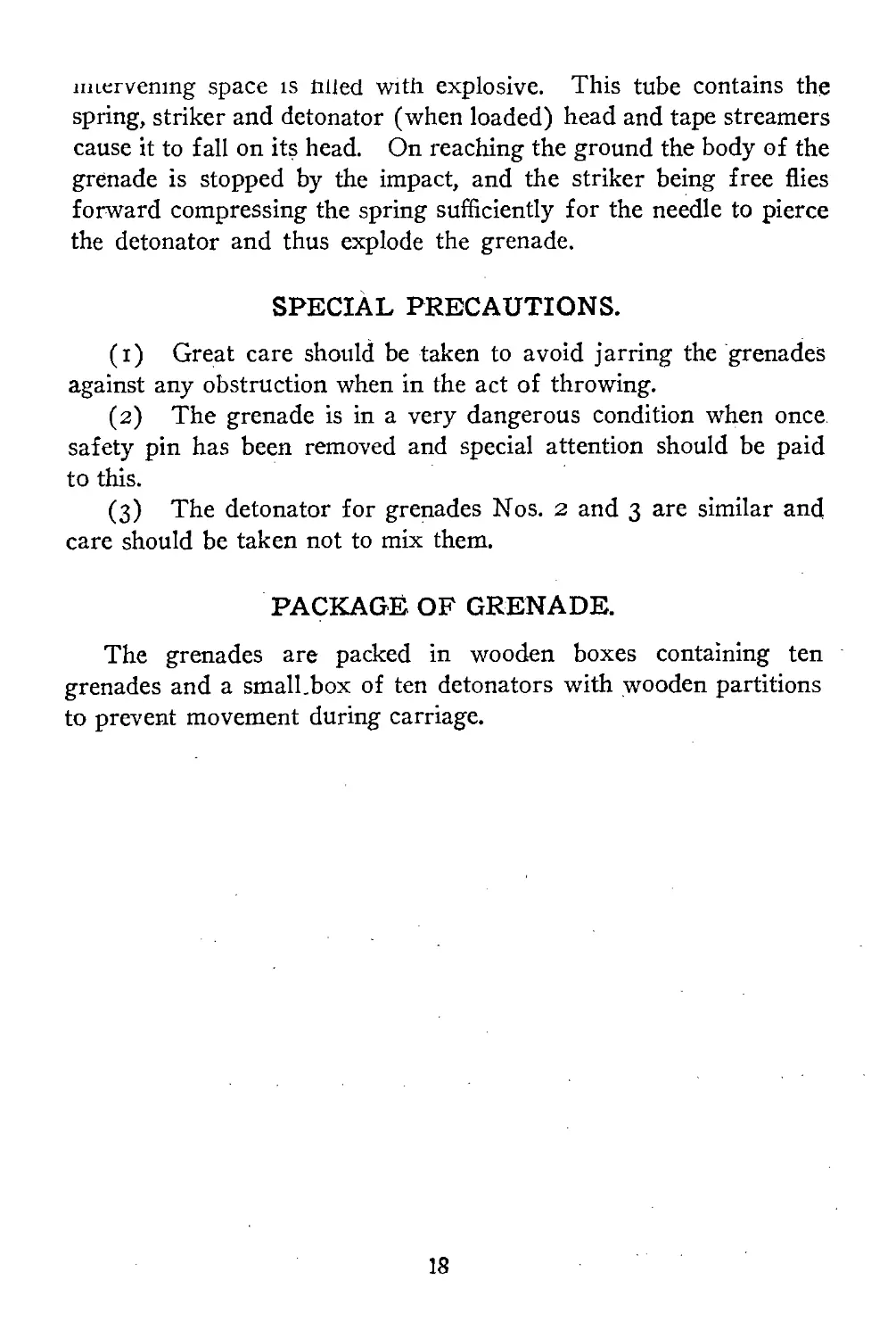
niLcrvening space is tilled with explosive. This tube contains the
spring, striker and detonator (when loaded) head and tape streamers
cause it to fall on its head. On reaching the ground the body of the
grenade is stopped by the impact, and the striker being free flies
forward compressing the spring sufficiently for the needle to pierce
the detonator and thus explode the grenade.
SPECIAL PRECAUTIONS.
(i)	Great care should be taken to avoid jarring the grenades
against any obstruction when in the act of throwing.
(2)	The grenade is in a very dangerous condition when once
safety pin has been removed and special attention should be paid
to this.
(3)	The detonator for grenades Nos. 2 and 3 are similar and
care should be taken not to mix them.
PACKAGE OF GRENADE.
The grenades are packed in wooden boxes containing ten
grenades and a smalhbox of ten detonators with wooden partitions
to prevent movement during carriage.
18
BRITISH HALES RIFLE GRE-
NADE NO. 3 (Percussion).
Weight Complete i lb. 5 oz. Maximum Range 185 yds.
BODY.
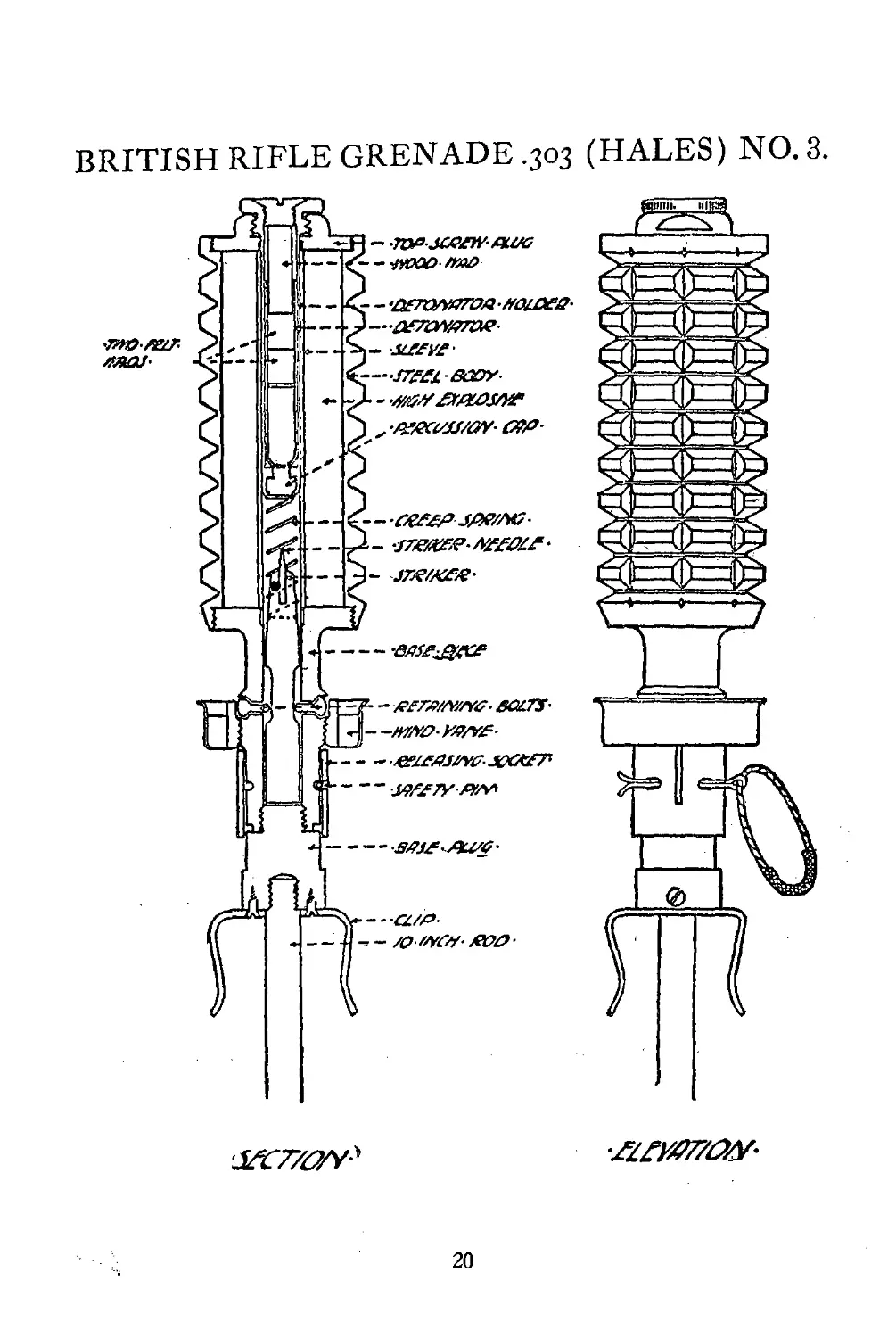
Serrated steel, filled with explosive. Down the centre of ex-
plosive is a brass tube into the forward end of which the detonator
is inserted. The body is closed by the base piece.
This carries the striker pellet, two retaining bolts, wind vane,
releasing socket and safety pin. To the base piece is fixed a base
plug carrying the spring clip and a ten inch steel rod.
DETONATOR HOLDER.
Consists of a special brass tube which screws into the head of
the grenade. It is 2% inches long and contains a detonator cap.
Until the detonator is inserted the head of the grenade is closed by
an ebonite screw plug.
CARTRIDGE.
A special blank cartridge is supplied to fire the grenade.
ACTION.
The action of the grenade on being fired is as follows: The
wind vane revolves as the grenade travels through the air; after a
few turns of the vane the retaining bolts are no longer held in posi-
tion by its inner surface and fair out; on impact the striker pellet
sets forward against the creep spring on the detonator cap, thus
firing the grenade.
19
BRITISH RIFLE GRENADE .303 (HALES) NO. 3.

.Ю/^ТУРГЛ*
scars'
ww-Kp/vf-
CL/£>-
so
•n&J£QlW'AWG
WOO-WM?
JOOtfT1
'Жюлягоа -ssoi&?&
•JK«5*’
‘Sr^BODy-
-MJ//ЖfiWS/Wa


JSCTSCSY*	SZfMPSSOtf'
20
This grenade is very safe to handle, as it cannot be fired by
knocking or dropping on the ground; it must travel through the air
some distance before the retaining bolts fall out.
INSTRUCTIONS.
To Prepare for Use.
i. Holding the grenade head down so as to make certain that
the needle is not free, remove the ebonite screw plug.
2. If correct, screw in the detonator holder.
To Fire.
i.	Lower the rod into the barrel of the rifle, and clip over the
muzzle.
2.	Load the rifle with special blank cartridge.
3.	Before firing withdraw safety pin.
PRECAUTIONS WHEN FIRING.
1.	The grenade should be tapped on the h^nd before inserting
detonator to insure that the striker pellet is properly held in place
by the retaining bolts.
2.	The wind vane and the releasing socket must not be tam-
pered with.
3.	The safety pin must not be removed before the grenade has
been inserted in the rifle.
4.	The grenade must not be fired with ball cartridge as this may
burst the rifle.
5.	The rod should be oiled but only slightly, before placing it
in the barrel of the rifle.
INSPECTION.
Points that Should be Noticed.
1.	That the wind vane is covering the retaining bolts.
2.	That the releasing socket and safety pin are correctly in
place.
21
3-	That the striker pellet is held correctly by the retaining bolts
which fit into a groove in it and should prevent it from moving.
4.	That the creep spring is in position over the striker pellet.
5.	That the screw thread cavity for the detonator holder is
clean and clear.
6.	That rod is straight and clean.
DETONATOR HOLDER.
Consists of a special brass tube which screws into the head of
the grenade. It contains a detonator and detonator cap. Until
the detonator holder is inserted the head of the grenade is closed by
an ebonite screw plug.
CARTRIDGE.
A special blank cartridge is supplied to fire the grenade.
ACTION.
On the shock of discharge, the releasing socket sets back, the
retaining bolts are no longer held in position by its inner surface
and fall out. On impact the striker pellet sets forward against the
creep spring on to the detonator cap, thus firing the grenade.
INSTRUCTIONS.
Prepare for Use.
1. Holding the grenade head downwards, remove the ebonite
screw plug, and tap the grenade on the hand so as to make certain
that the striker is not free.
2. If correct, screw in the detonator holder.
To Fire.
1.	Lower the rod into the barrel of the rifle
2.	Load the rifle with the special cartridge.
3.	Immediately before firing, withdraw the safety pin.
If the grenade is not fired, replace the safety pin.
22
SPECIAL PRECAUTIONS.
i.	The grenade should be tapped on the hand before inserting
the detonator holder to ensure that the striker pellet is properly
held in place by the retaining bolts.
2.	The releasing socket must not be tampered with.
3.	The safety pin must not be withdrawn before the grenade
-has been inserted in the rifle.
4.	The grenade must not be fired with a cartridge with a bullet
in it, as this may burst the rifle.
5.	The rod should be oiled, but only slightly, before placing it
in the barrel.
INSPECTION.
Points that Should be Noticed.
1.	That the releasing socket and safety pin are correctly in
place.
2.	That the striker pellet is correctly held by the retaining bolts,
which fit into a groove in it and should prevent it from moving.
3.	That the screw thread and cavity for the detonator are clean
and clear.
4.	That the creep spring is in position over the striker pellet.
5.	That the rod is straight and clean.
6.	That the metal at the lower end of the detonator tube is
correctly turned in over the detonator cap, so that the latter is
securely held. If it is not, the cap may come out on the shock of
discharge, strike the needle and so cause a premature explosion.
PACKING.
The wooden box provided contains twelve grenades, twelve
detonator holders, containing detonators in a tin box, and twelve
special blank cartridges in a tin box.
23
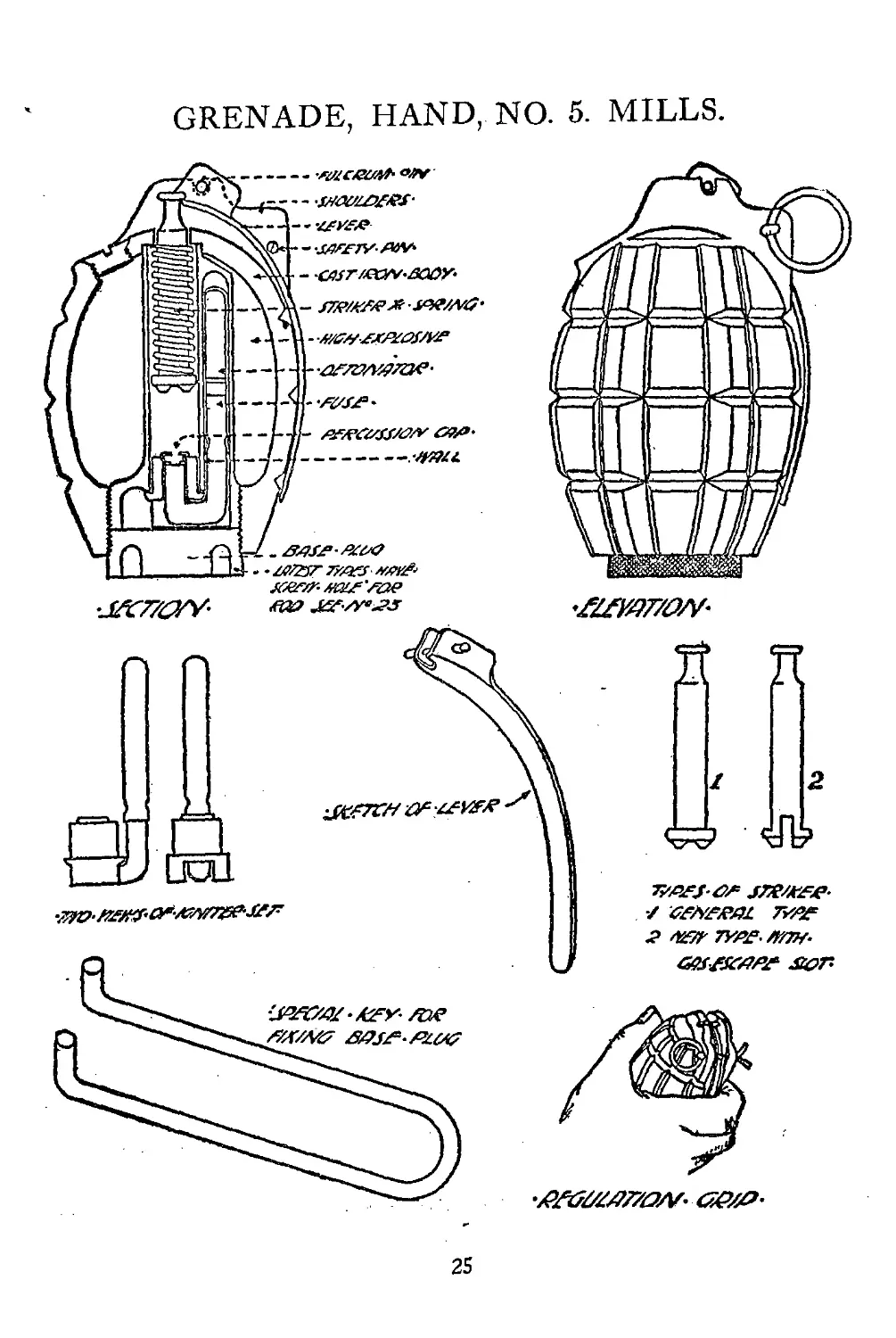
MILLS HAND GRENADE
(Time).
Weight Complete i lb. 8 oz.
BODY.
Cast iron, serrated to provide numerous missiles on detonation.
Into one end is screwed a centerpiece with separate recesses for the
striker and the detonator.
The striker is kept cocked against its spring by its head catching
on the end of the striker lever when the latter is lying against the
body of the grenade.
The lever is retained in this position by the safety pin.
IGNITER SET.
This is a separate unit consisting of a cap, cap chamber, safety
fuze and detonator.
On withdrawal of the safety pin, the lever springs outward un-
der the pull of the striker spring, thus releasing the striker which
fires the cap.
The safety fuze bums about five seconds, and then fires the
detonator.
INSTRUCTIONS.
To Prepare for Use.
i.	Examine the safety pin, and see that it is easy to withdraw.
2.	Unscrew the base plug, and insert igniter.
24
GRENADE, HAND, NO. 5. MILLS
•za^emwof-
- /zxrz=.
MW* SOP/Atf
L -
- • 4&25F TTAfS
-&У&&
•JWZW,04Y^
^sr/£v^^<ea0y*
&Я&'
---------
JA77C¥V-
& AfVF#
/7Л/А& £0Sf-fitMs
wAtt-a* 'fte/xne-
-/ ^A2W 7И^
J? Л&Г гуде- Ш-
&0Г-
GQfO-


2
25
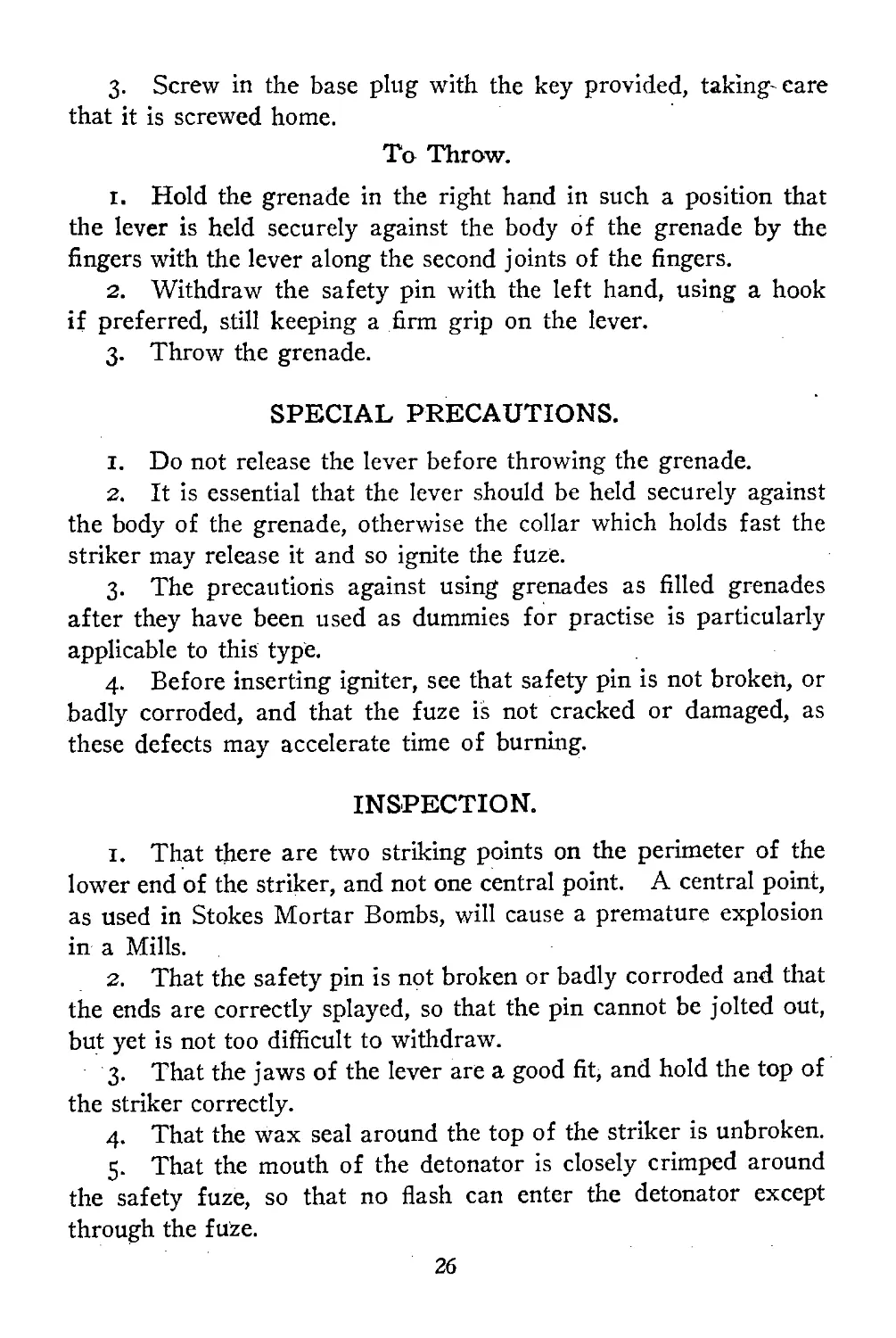
3-	Screw in the base plug with the key provided, taking-care
that it is screwed home.
To Throw.
i.	Hold the grenade in the right hand in such a position that
the lever is held securely against the body of the grenade by the
fingers with the lever along the second joints of the fingers.
2.	Withdraw the safety pin with the left hand, using a hook
if preferred, still keeping a firm grip on the lever.
3.	Throw the grenade.
SPECIAL PRECAUTIONS.
1.	Do not release the lever before throwing the grenade.
2.	It is essential that the lever should be held securely against
the body of the grenade, otherwise the collar which holds fast the
striker may release it and so ignite the fuze.
3.	The precautions against using grenades as filled grenades
after they have been used as dummies for practise is particularly
applicable to this type.
4.	Before inserting igniter, see that safety pin is not broken, or
badly corroded, and that the fuze is not cracked or damaged, as
these defects may accelerate time of burning.
INSPECTION.
1.	That there are two striking points on the perimeter of the
lower end of the striker, and not one central point. A central point,
as used in Stokes Mortar Bombs, will cause a premature explosion
in a Mills.
2.	That the safety pin is not broken or badly corroded and that
the ends are correctly splayed, so that the pin cannot be jolted out,
but yet is not too difficult to withdraw.
3.	That the jaws of the lever are a good fit, and hold the top of
the striker correctly.
4.	That the wax seal around the top of the striker is unbroken.
5.	That the mouth of the detonator is closely crimped around
the safety fuze, so that no flash can enter the detonator except
through the fuie.
26
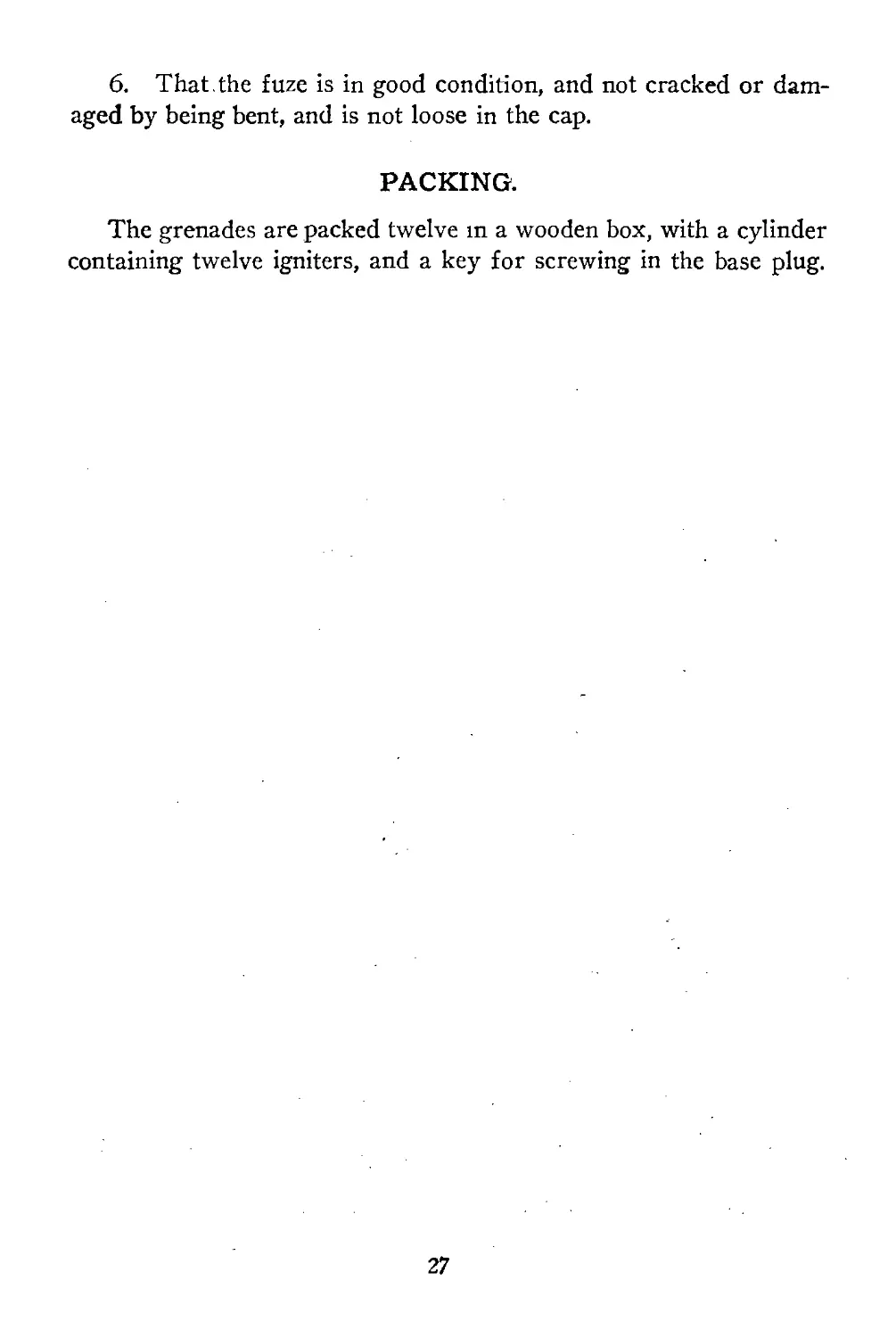
6.	That, the fuze is in good condition, and not cracked or dam-
aged by being bent, and is not loose in the cap.
PACKING.
The grenades are packed twelve in a wooden box, with a cylinder
containing twelve igniters, and a key for screwing in the base plug.
27
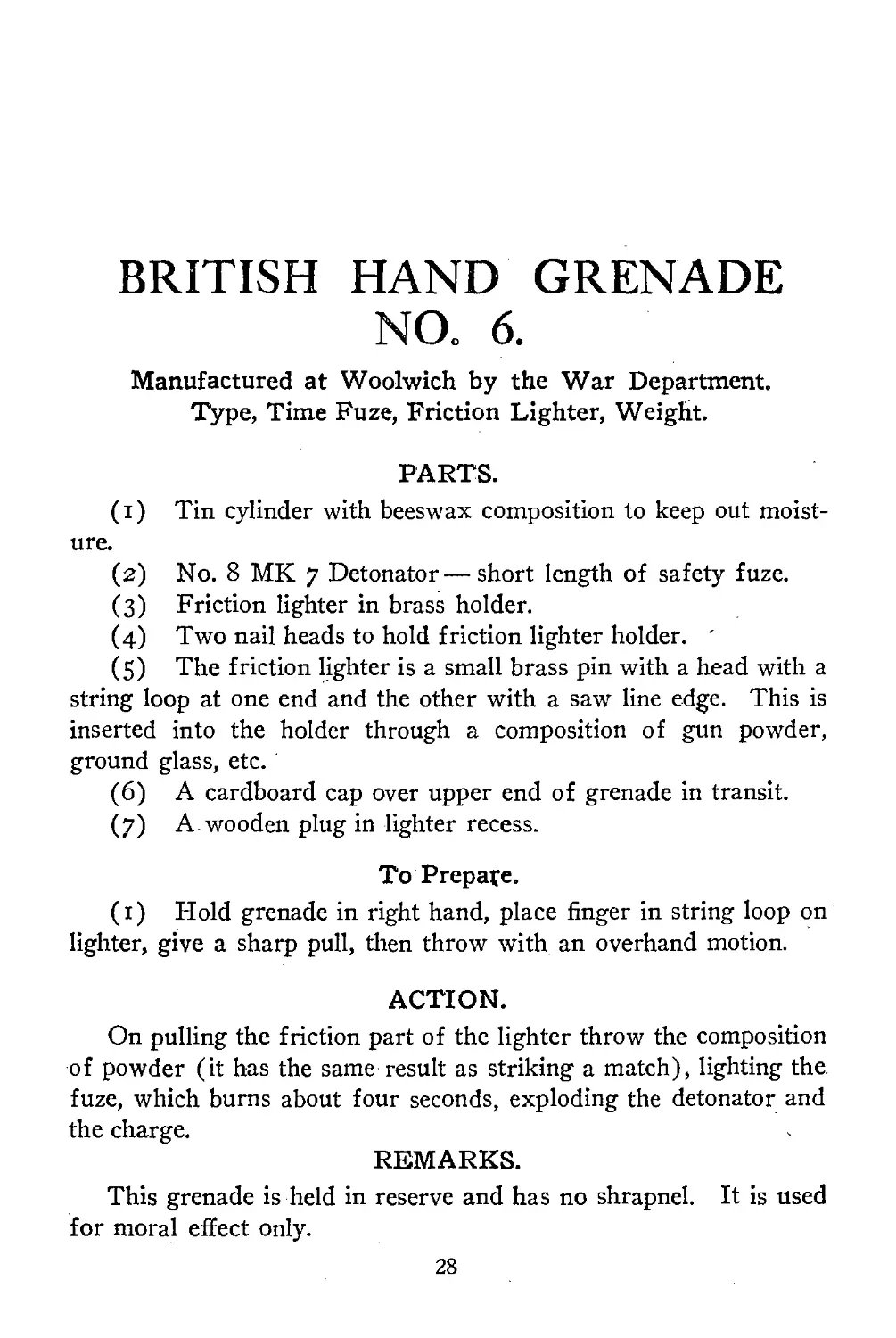
BRITISH HAND GRENADE
NO. 6.
Manufactured at Woolwich by the War Department.
Type, Time Fuze, Friction Lighter, Weight.
PARTS.
(i)	Tin cylinder with beeswax composition to keep out moist-
ure.
(2)	No. 8 MK 7 Detonator—short length of safety fuze.
(3)	Friction lighter in brass holder.
(4)	Two nail heads to hold friction lighter holder. '
(5)	The friction lighter is a small brass pin with a head with a
string loop at one end and the other with a saw line edge. This is
inserted into the holder through a composition of gun powder,
ground glass, etc.
(6)	A cardboard cap over upper end of grenade in transit.
(7)	A wooden plug in lighter recess.
To Prepare.
(1) Hold grenade in right hand, place finger in string loop on
lighter, give a sharp pull, then throw with an overhand motion.
ACTION.
On pulling the friction part of the lighter throw the composition
of powder (it has the same result as striking a match), lighting the
fuze, which burns about four seconds, exploding the detonator and
the charge.
REMARKS.
This grenade is held in reserve and has no shrapnel. It is used
for moral effect only.
28
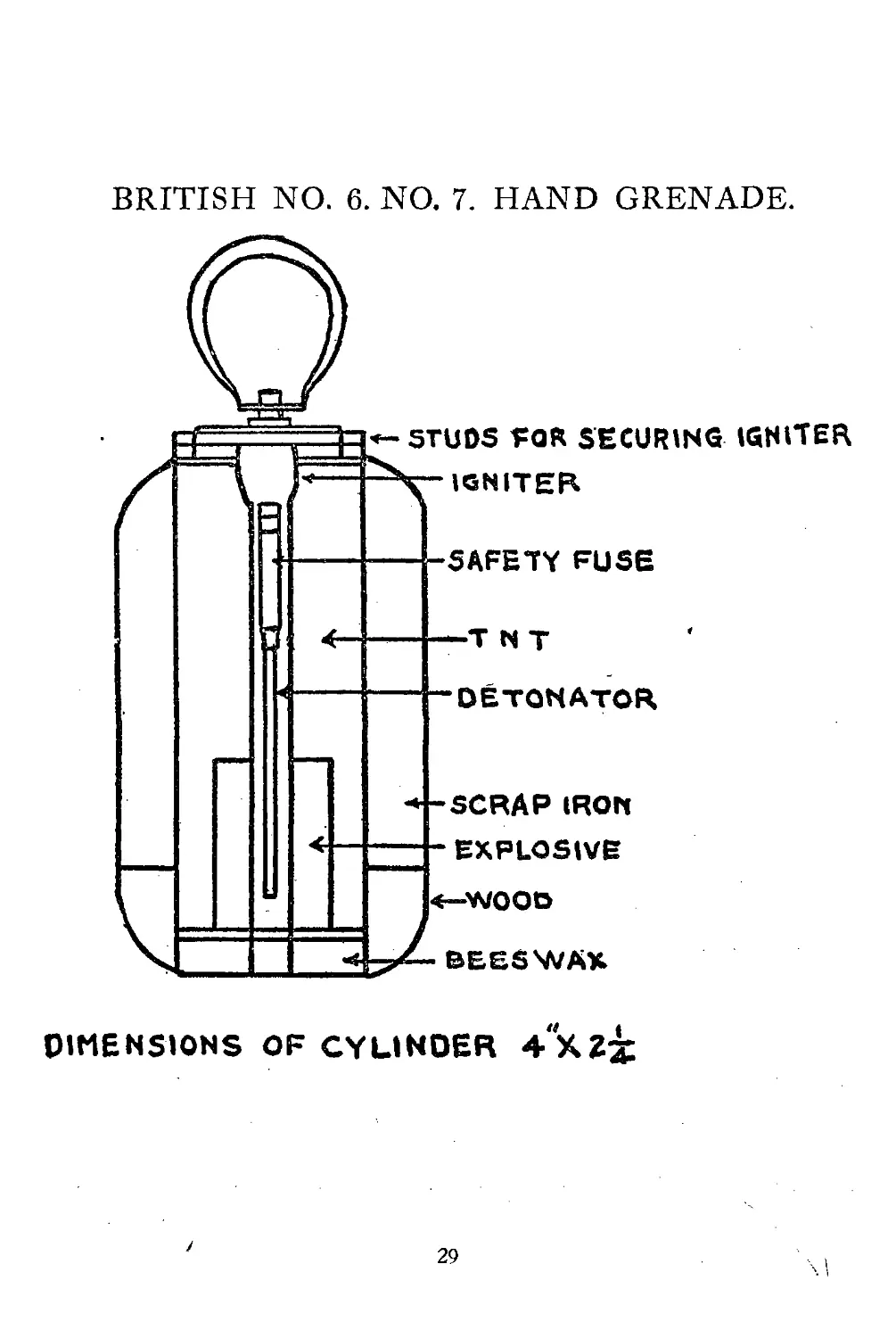
BRITISH NO. 6. NO. 7. HAND GRENADE.
DETONATOR,
SCRAP IRON
EXPLOSIVE
4«A№00B
BEESWAX
*- STUDS FOR SECURING IGNITER
IGNITER
SAFETY FUSE
DIMENSIONS OF CYLINDER 4XZ£
29
i
BRITISH HAND GRENADE
NO. 7.
Type, Time Fuze, Friction Lighter. Weight i lb. 3 oz.
(1)	Outer cylinder of tin painted a lemon yellow with beeswax
composition to keep out moisture.
(2)	Inner cylinder containing explosive.
(3)	Scrap iron forming missiles between inner and outer
cylinders.
(4)	No. 8 M. K. 7 Detonator with short length of safety fuze.
(5)	Friction lighter in brass holder.
(6)	Two nail heads to hold friction lighter holder.
(7)	The friction lighter is a small brass pin with a head with
a string loop at one end and the other with a saw line edge. This
is inserted into the holder through a composition of gun powder,
ground glass, etc.
(8)	A cardboard cap over the upper end of grenade used in
transit.
(9)	A wooden plug in lighter recess.
To Prepare.
Remove wooden plug, insert, lighter, turn to right or left till
spring catches nail heads.
To Throw.
Hold the grenade in right hand, place finger in string loop on
lighter, give a sharp pull, then throw with an overhand motion.
ACTION.
On pulling the friction part of the lighter throw the composition
of powder (it has the same result as in striking a match) lighting
30
the fuze, which burns about four seconds, exploding the detonator
and the charge.
REMARKS.
This grenade is held in reserve.
31
BRITISH HAND GRENADE
NO. 19 (Percussion).
Weight lbs.
EXPLOSIVE — AMMONAL.
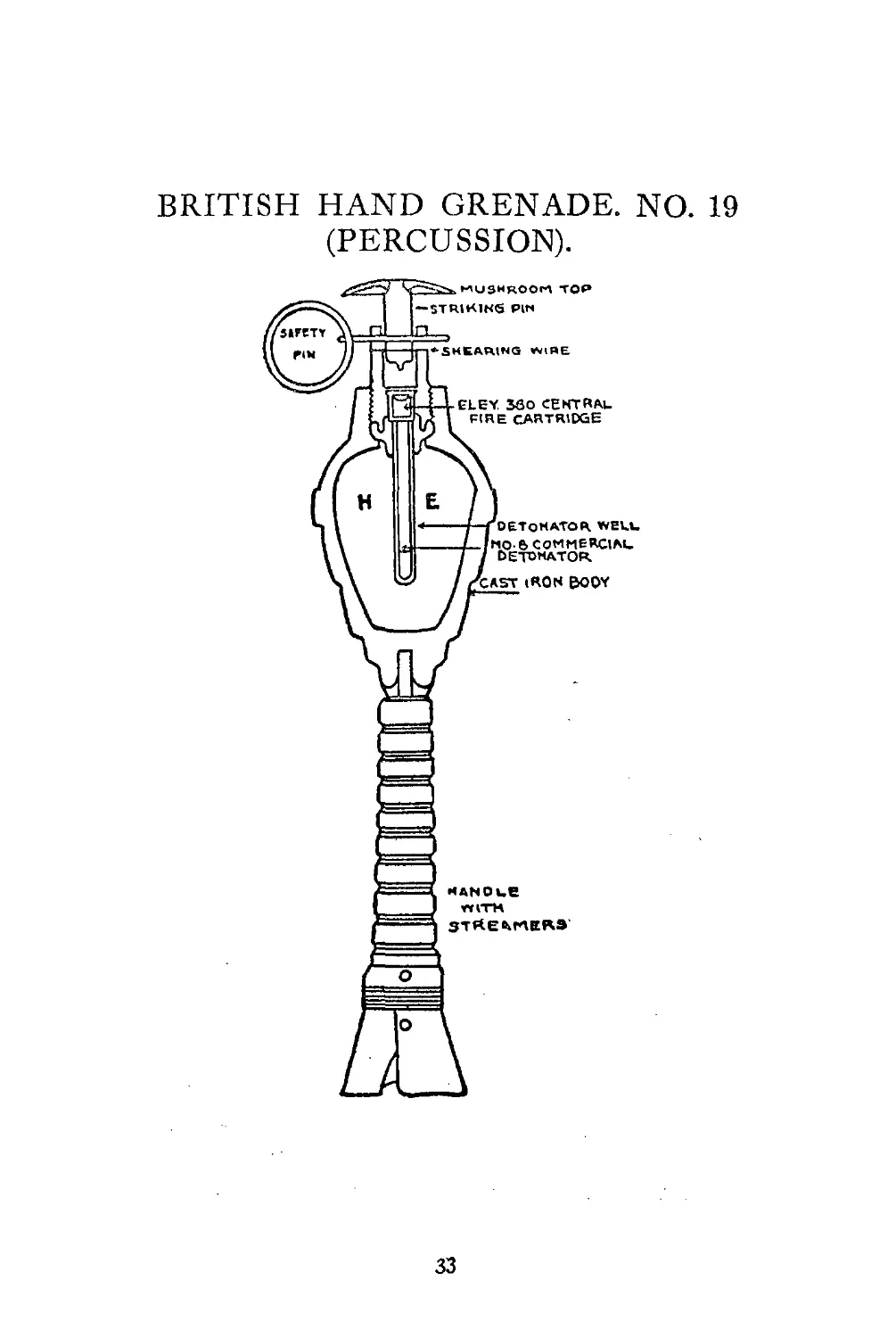
Consists of a serrated cast iron body; screwed into the bottom is
a brass plug and ferrule and in this is fastened a wooden handle six
inches long with three streamers attached to it. The top of the
grenade is opened and fitting down inside the casting is a brass
screw plug with a hole in the centre which is the detonator well.
Screwed into the top is another threaded brass plug with a hole
through the centre to receive a mushroom striking pin. A safety pin
and a piece of fine soft copper wire run through the stem of mush-
room head and brass plug.
A percussion cap fits in the bottom of the plug inches below
the stem of the head which acts as a striker.
To Detonate.
Unscrew top plug, insert detonator and replace plug.
To Fire.
Gather streamers and remove safety pin and as in all grenades
throw with an overhand motion.
ACTION.
The weight of the grenade assisted by the streamer brings the
grenade down with head against the ground. The force of impact
drives in the mushroom head, thereby cutting the copper wire, and
32
BRITISH HAND GRENADE. NO. 19
(PERCUSSION).
•SHEARING «Ч1ЙЕ.
TOP
STRIKING PIN
SiFETY
CAST IKON BQOY
ELEY. 360 CENTRAL
FIRE CARTRIDGE
DETONATOR WELL
MQ.& COMMERCIAL
DETONATOR.

33
the striking pin will strike the percussion cap which explodes the
detonator and then the main charge.
GENERAL PRECAUTIONS.
Don’t remove safety pin until ready to throw. Take care not to
strike the side of trench when throwing.
34
BRITISH RIFLE GRENADE
NO. 20.
Weight Complete i lb. 6 oz. Maximinn Range 250 yds.
BODY.
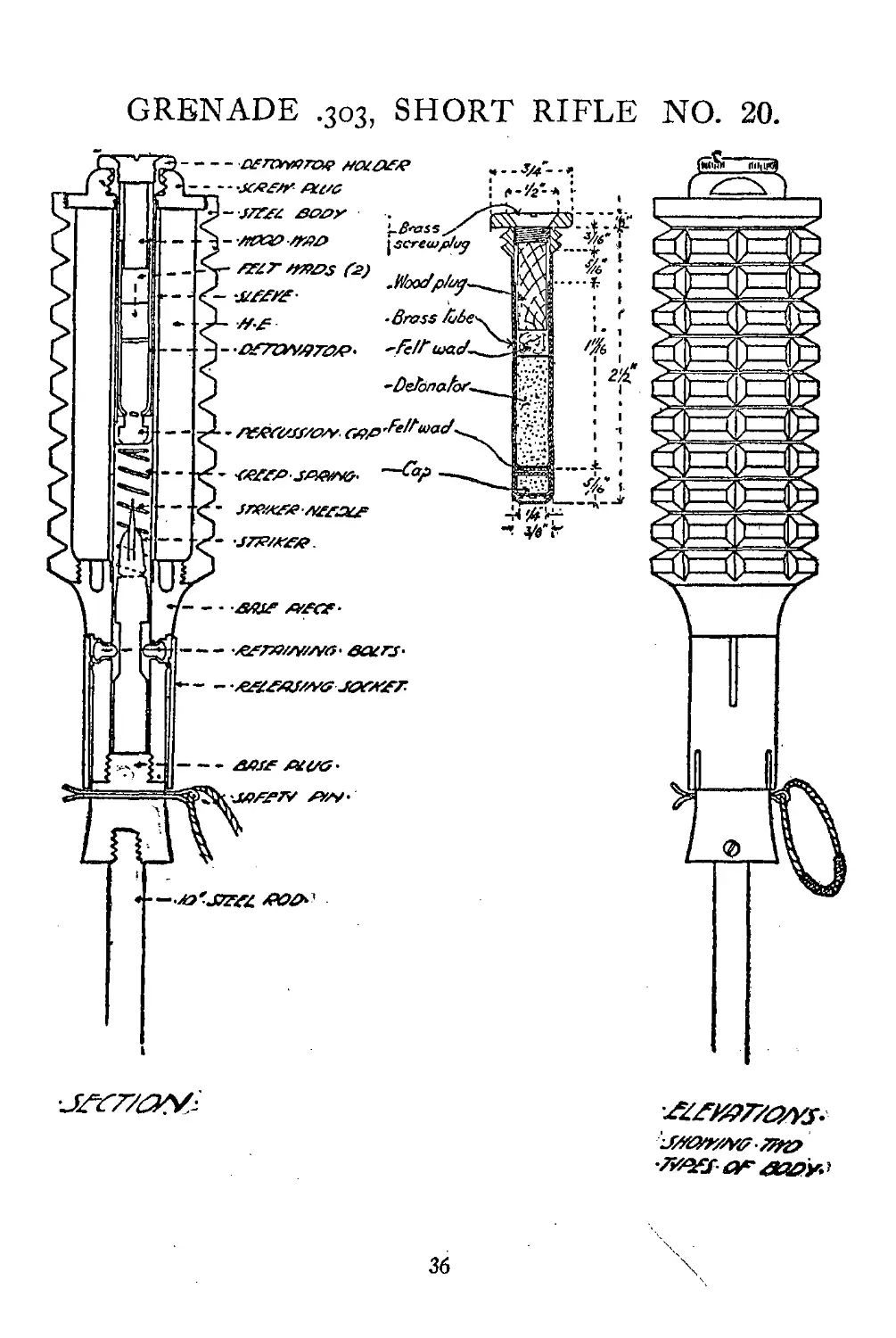
Serrated steel filled with explosive. Down the centre of the
explosive is a brass tube, into the forward end of which the detona-
tor is inserted. The body is closed by the base piece. This carries
the striker pellet, two retaining bolts, releasing socket and safety
pin. To the ^ase piece is fixed a ten inch steel rod.	,
[Diagrams on the page following.]
35
GRENADE .303, SHORT RIFLE NO. 20.
'J77?/xe&.
ДЛЯТ MUG-
JASZW AW'
<%aP'JMn&
/zzr WOPS (2)
•JM£T£'


A^CF‘

fir&ss lute'
-fell’ uxzd
Self wad
---/ЬГ/ГЪ^ТГИ» Z/OfZVX’
- - тЛХ^ЖИ
- J7T.&L ДОРУ
1' f
fid «
•-teass
J sereш/Лу
-Ddbnahf'

u&7&/jwj№' &№•

*—xv<^'
% *
'	। t
!
!	1


36
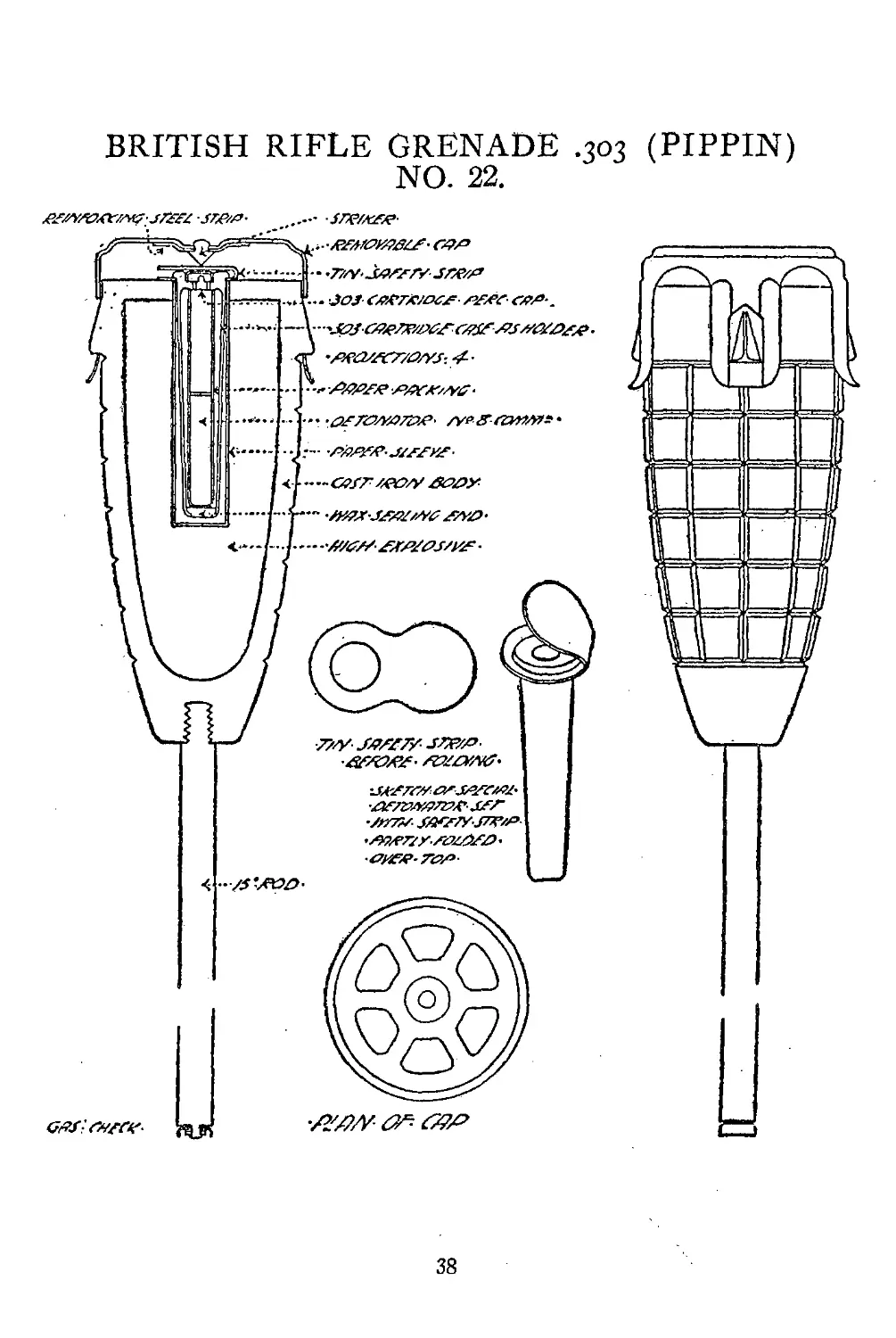
BRITISH PIPPIN RIFLE
GRENADE NO. 22.
Weight i lb. io oz. Maximum Range 300 yds.
BODY.
The grenade consists of a cast-iron stream line body with a flat
head, serrated on the outside. A fifteen inch rod is screwed into
the pointed end and fitted with a copper gas check. In the centre
of the flat head is a hole; into this after the grenade has been filled
with ammonal a paper tube with a solid end is forced down and
waxed in. This tube takes the special detonator.
CAP.
Over the head of the grenade is a detachable pressed steel cap,
the sides of which have been cut away, leaving four projecting lugs,
each with a forward hole in it. These lugs fit over four projections
cast on the body. The cap is fitted with a safety pin.
DETONATOR HOLDER.
Consists of an ordinary .303 rifle cartridge case before under-
going the operation of nicking, fitted with a percussion cap only.
Inside is an ordinary No. 8 Detonator packed round with waxed
paper with the end spun over. A tin safety strip is fitted to the
base of the cartridge case which covers the cap; this must be per-
forated by the striker before it can reach the cap.
ACTION.
The grenade, owing to the rod, falls on its head. On coming
in contact with the ground the steel cap is driven up and forces the
striker through the safety strip into the cap of the cartridge.
37
BRITISH RIFLE GRENADE .303 (PIPPIN)
NO. 22.
arJMrtWU'
JjfS~
•Sr/7?J SACf/y jnfrP
Ц_$Г
•/OZ^y &?/>
38
INSTRUCTIONS.
To Prepare for Use.
i.	Remove the steel cap by the lever supplied with each box of
grenades.
2.	Push the detonator holder down into the grenade until the
rim of the cartridge case comes in contact with the body.
3.	Replace the steel cap.
Note: The safety pin must not be removed during the above
operations.
To Fire.
1.	Lower the rod into the barrel of the rifle.
2.	Load the rifle with the special cartridge.
3.	Before firing withdraw the safety pin.
SPECIAL PRECAUTIONS.
1.	The safety pin must not be removed before the grenade has
been inserted in the rifle.
2.	The grenade must not be fired with a ball cartridge as this
may burst the rifle.
3.	The rod should be oiled before using.
4.	Owing to the grenade being armed as soon as the safety pin
has been removed it is advisable to fire it from behind cover.
39
BRITISH RIFLE GRENADE
NO. 24.
VANELESS IMPROVED.
This grenade is a modified form of No. 20, from which it dif-
fers in the following particulars:
(a)	The exterior of the body is serrated in horizontal rings
only.
(b)	The releasing socket is one inch long, instead of inches,
and the brass base is correspondingly shorter. The lower end of the
brass is not bellied, so that the socket drops off about ten yards
from the rifle.
(c)	The detonator container is 2 inches long, instead of 2^
inches, and its milled top is a sleeve, instead of turned out of the
solid.
(d)	The striker is % inch shorter and the needle point is blunt.
(e)	The tube up the centre of the body is shortened so that
only the end of the detonator container engages in it, whereas in
No. 20 the tube comes right up to the top of the body.
The action and instructions are the same as for No. 20.
40
BRITISH RIFLE GRENADE .303, NO. 24.
&ГМ0
•jztwse-
- -	JtVXirr-.
tfWMW Ж>£УЗ-
—'С^гс^ягоя ясшве-
-1- гЯХ^/Г-ХГ^*
— -/З^Т/^ЛГ'
--	' мямяяе-
/ZttC'JS/O'Y- C№
МЯУ ОМ£У/

-•4?
ifC77Orf
•UX>/2WXW- ,
Л№Г/0/У


#00
wsrc/y.a* /w&e
cu/Az&e /&?
41
BRITISH EGG GRENADE
(Hand or Rifle).
Weight 12 oz.
Consists of:—
Oval shape cast iron body with narrow neck which has a threaded
hole in the centre to take chamber. The plunger, which has two
points and slot for gas escaper, is held in position by a soft copper
wire going through the chamber and plunger, also a safety pin; the
lower end of the chamber is threaded to screw into neck of bomb.
A brass detonator well goes into the centre of bomb.
The Igniter set consists of a rim fire percussion cap, a four sec-
ond fuze and a No. 6 Detonator.
INSTRUCTIONS.
To Prepare.
Insert detonator and screw in chamber.
ACTION.
Pull safety pin, strike plunger sharply, this cuts the wire and
strikes percussion cap which lights fuze.
Throw immediately.
AS A RIFLE GRENADE.
Do not strike plunger.
To Prepare.
Screw in rod in the lower end of the grenade.
42
BRITISH EGG GRENADE.
43
To Fire.
(i)	Lower the rod into the barrel of the rifle.
(2)	Load rifle with the special cartridge.
(3)	Immediately before firing, withdraw the safety pin. The
shock of discharge cuts the wire and on impact with the ground
forces the striker on cap.
44
BRITISH RIFLE GRENADE .303, NO. 23.
£

L_S~ -<S6>H^772>rO^PA*
*- - ZZ
^/W^XTZW XX’/’/V
-CCKtt/TF
MX-
Я/Ш-
•ямамегА/ю.
/7&WG &Qf/7KW
-Cl//> Д7ТД(ЖМГ-
'£Bar- &&??
45
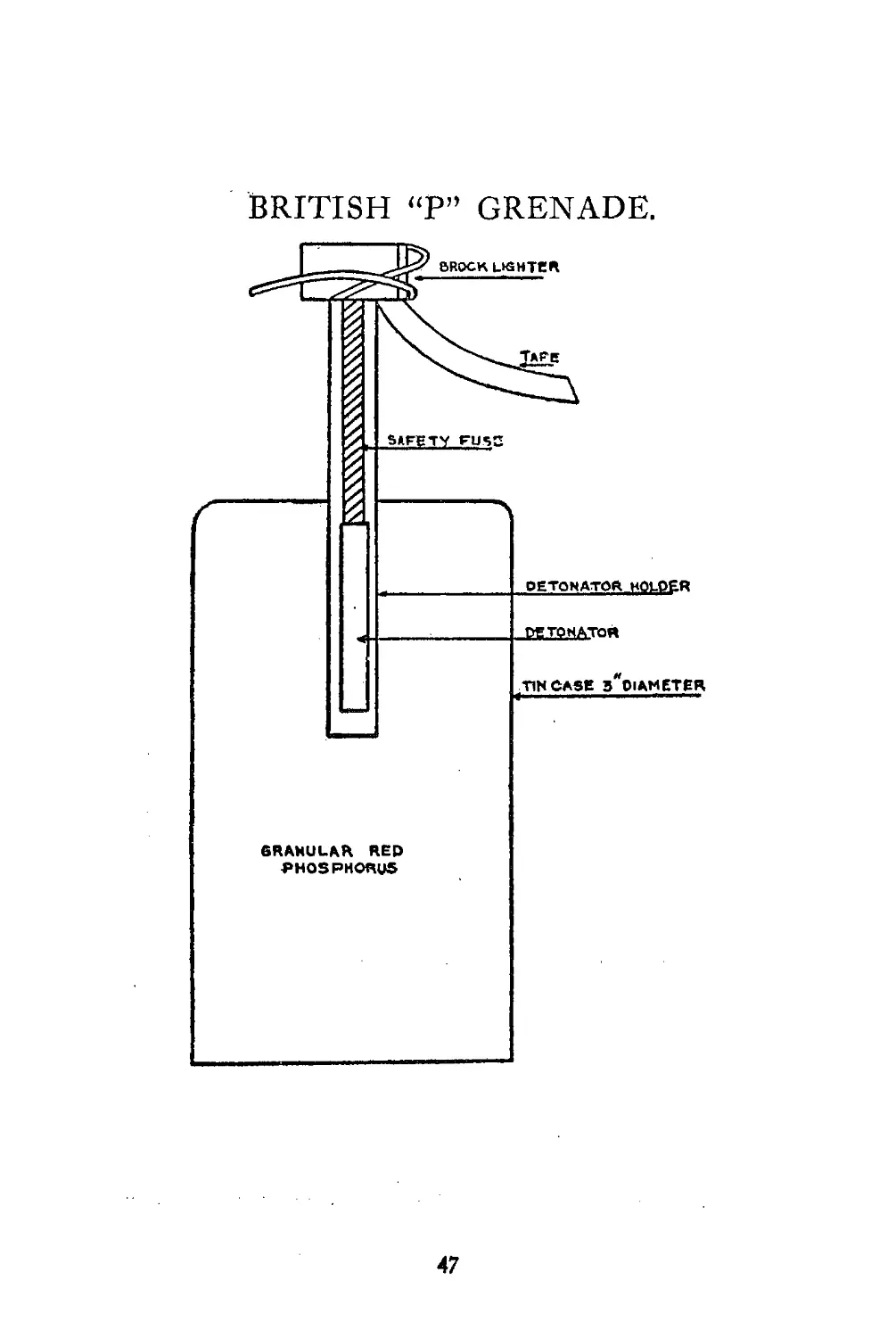
BRITISH “P” GRENADE.
DESCRIPTION.
The Bomb consists of a tin cylinder three mm. in diameter and
five inches long. In one end is soldered a detonator tube and a
short length of copper wire for binding purposes. The cylinder is
filled with red phosphorus.
The Bomb when exploded produces a thick white smoke, the
Phosphorus thrown out causes burns and may cause fire. The
detonator supplied is the ordinary No. 8 fitted with nine second fuze
and Brock lighter.
INSTRUCTIONS.
To Prepare for Use.
Insert the detonator in the detonator tube and bind in place with
copper wire.
To Fire.
Tear off the tape from Brock Lighter and rub on brassard sup-
plied.
PRECAUTIONS.
Whenever stored, grenades should be examined from time to
time to see that the tins have not become corroded or rusted through
into holes, as there is a danger of fire when the phosphorus is
exposed to the air.
PACKING.
The grenades are packed twelve in a box, which also contains a
tin of twelve detonators, fuzes and fuze lighter and two brassards.
46
BRITISH “P” GRENADE.
47
BRITISH W. P. BOMB
WHITE PHOSPHORUS BOMB.
DESCRIPTION.
BODY.
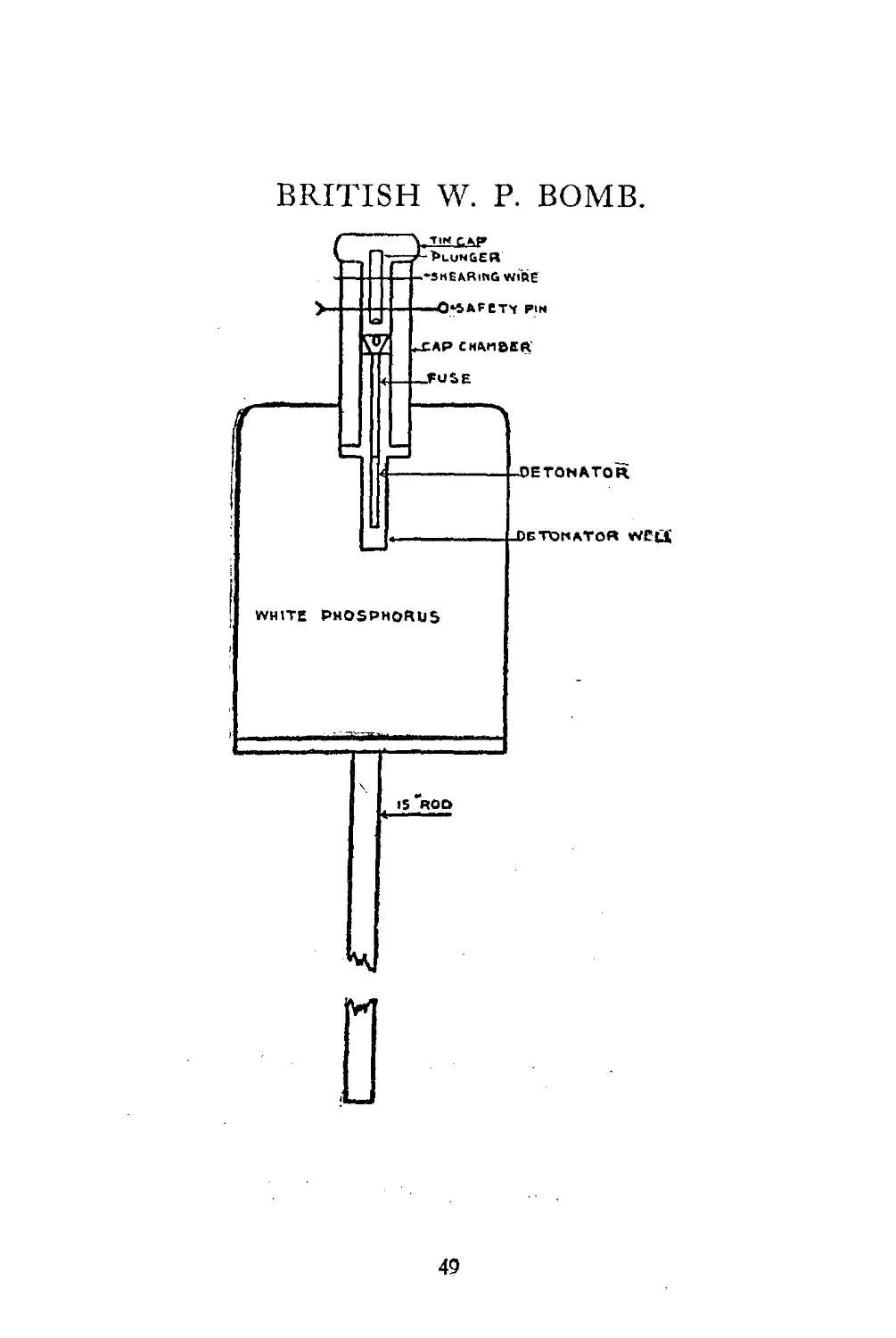
Consists of a tin cylinder 4 by 2^2 inches. The rear end is
closed by a thick piece of metal, into which a 15 inch rod is screwed.
In the forward end is a screwed threaded hole, which takes the
chamber. In the centre of bomb is a copper detonator well. The
chamber contains a plunger held in place by a copper wire and a
safety pin over top is a tin cap. The Igniter consists of a centre
fire cap and a cap chamber which is an ordinary 4.10 revolver
cartridge, a six seconds fuze and a No. 6 detonator.
INSTRUCTIONS.
To Prepare.
Unscrew chamber, insert igniter, then screw chamber home.
To Fire.
(1)	Lower the rod into the barrel of the rifle.
(2)	Load rifle with the special cartridge.
(3)	Immediately before firing withdraw the safety pin.
The shock of discharge cuts the wire and on impact with the
ground forces the striker on cap.
48
BRITISH W. P. BOMB.
0‘iAFET'f PIN
.FUSE
TlTlbAP
Plunger
-SHEARING WIRE
•DETONATOR
LXAP CHAM BE ft
DETONATOR WEtX
WHITE PHOSPHORUS
15 ROD
49
THE BALL HAND GRENADE
(Time).
The Ball Hand Grenade (Time).
Consists of:
Plain cast iron sphere three inches in diameter, filled with am-
monal and closed by a screwed steel plug, which has attached to it
a copper tube to take detonator into centre of grenade. It is lighted
by fuze and detonator or Brock lighter.
Weight—i lb. 11^2 oz.
To Prepare.
Place in detonator and Brock lighter and secure with wire.
Hold bomb in right hand, remove tape with left. Strike lighter
on brassard and throw with bowling action.
This bomb has a four second fuze.
50
THE BALE HAND GRENADE (BRITISH).
ILLUSTRATING
THE PRINCIPLES OF TIME FUZE
GRENADES.
-tXTO/WHUP-
- - mw ждашие?,
~--&МГ/ЯОЛ/&М>У


51

BRITISH MILLS RIFLE
GRENADE.
Weight Complete i lb. 8% oz.
MAXIMUM RANGE.
5% inch Rod 80 yds.
IO “	“ 160 “
-With the Rifle at an elevation of 45 degrees.
BODY.
Same as Mills Hand Grenade with rod screwed into the base
plug of the grenade: [See pp. 22 seq.]
CARTRIDGE.
A special blank cartridge is supplied to fire the grenade.
RING ATTACHMENT.
In order to keep the lever of the grenade in place after the
safety pin has been removed previous to the firing, a ring attach-
ment is fixed to the rifle by means of the bayonet; it is so con-
structed that it can be used either with the long or short bayonet.
This attachment cannot be used with the long rifle.
ACTION.
When the grenade is shot out of the rifle the lever is no longer
held down and the normal Mills Grenade action follows. Varia-
tion of range is obtained by altering the elevation of the rifle.
52
instructions.
To Prepare for Use.
I.	Unscrew the base plug and insert the igniter.
2.	Screw in the base plug with key provided, taking care that
it is screwed home.
3.	When required as a rifle grenade, screw in the rod.
To Fire.
1.	Fix the ring attachment to the bayonet.
2.	Fix the bayonet.
3.	Lower the rod into the rifle until the grenade is within the
ring attachment and the lever is held by the ring.
4.	Load the rifle with the special cartridge.
5.	Immediately before firing, withdraw the safety pin.
SPECIAL PRECAUTIONS.
1.	When inserting the igniter see that the fuze is not cracked
or damaged.
2.	The lever must be held securely by the ring against the body
of the grenade.
3.	The safety pin must not be withdrawn before the grenade is
inserted in the ring.
4.	The grenade must not be fired with ball cartridge, as this
may burst the rifle.
5.	The rod should be slightly oiled before placing it in the
barrel.
6.	The rod must be firmly screwed in.
INSPECTION.
i. Only grenades with solid base plugs should be used for rifle
grenades, as otherwise the rod is liable to break the plug and cause
a premature explosion.
53
FRENCH GRENADE F 1 (HEAVY OVAL)
•ZrWZ?
V/&/7&?
•4 лгедетес* -zwzef •
-&&hs M/3
ШГ/O/Y WWf •
MW SW0/W&-
a/7&? &?&&?&&>-
7Z4SS
'///&&- &ухси/ме
^сж&улхя?'
-COST- ДО0У
^/yj/r^p се&&зъе0
/Г/7^Г Т/Л' У/Л'/^ •
 && ^(Г/^-

Jf(77OV'
ZZSW7KW
'/У/ЖХ/Г TXtf/yj/r &?/>
54
FRENCH V. В. RIFLE GRENADE.
••/zr ^ziar/z^/W- yeas*- cav77?//w%&
55
FRENCH BLUE EGG GRENADE.
mesfaat/oe.same-
S' -датх-м-fs/mv-'M/-
JfC77Oy^
ЖЮ770/У-
56
FRENCH BEZOZZI HAND GRENADE.
IGNITER
MATfH COMPOSITION
DETONATOR
SAFETY PUSE
RuBg.ER TUBE
57
FRENCH CITRON
HAND GRENADE.

•/bay-
^r/?//Y/^SX^y/y^
%2°	ДЦ/&-
J/tiW/K . 45ЯГ

58
DESCRIPTION OF GERMAN
GRENADES AND INSTRUC-
TIONS FOR THEIR USE.
(i)	German hand grenades which have been found are of two
types; those which have the appearance of service articles and those
which are obviously improvised. With the latter, great care is in-
variably taken to protect the charge from damp, and to render it
flashproof by waxing, etc.
Grenades are ignited either by time or percussion. With the
former, the time of burning is about six seconds, and the fuze is
ignited by one of the following methods:
(a)	Spring striker and cap 1
(b)	Friction tube	^Attached to fuze and detonator.
(c)	Match — Head lighter J
(2)	The following precautions should be taken with any
.grenades that may be found or captured:
1.	The grenades should be examined at once by a grenadier,
in order to find out whether they are live, how they are fired, etc.
2.	The means of firing will probably be immediately apparent
to a trained grenadier, but during examination grenades should be
handled with care.
3.	No man who does not understand grenades should touch
them, but should report the presence of a store of grenades to the
nearest grenadier, N. С. O. or officer.
4.	If being used against the enemy, a grenade should be thrown
as soon as it is “lit,” even if there is no apparent evidence of the fuze
burning.
5.	Arrangements for removing, storing and destroying grenades
59
found in a captured position should be made as soon as possible by
grenadier officers.
6.	Grenadier officers will also be responsible when samples
of grenades are taken back to headquarters for examination, that the
grenades are not in a dangerous condition and have the detonators
removed.
60
GERMAN RIFLE GRENADE
1913 (Percussion).
Weight 2 lbs. Complete. Charge 3 oz. Explosive. Maximum
Range 350 yds.
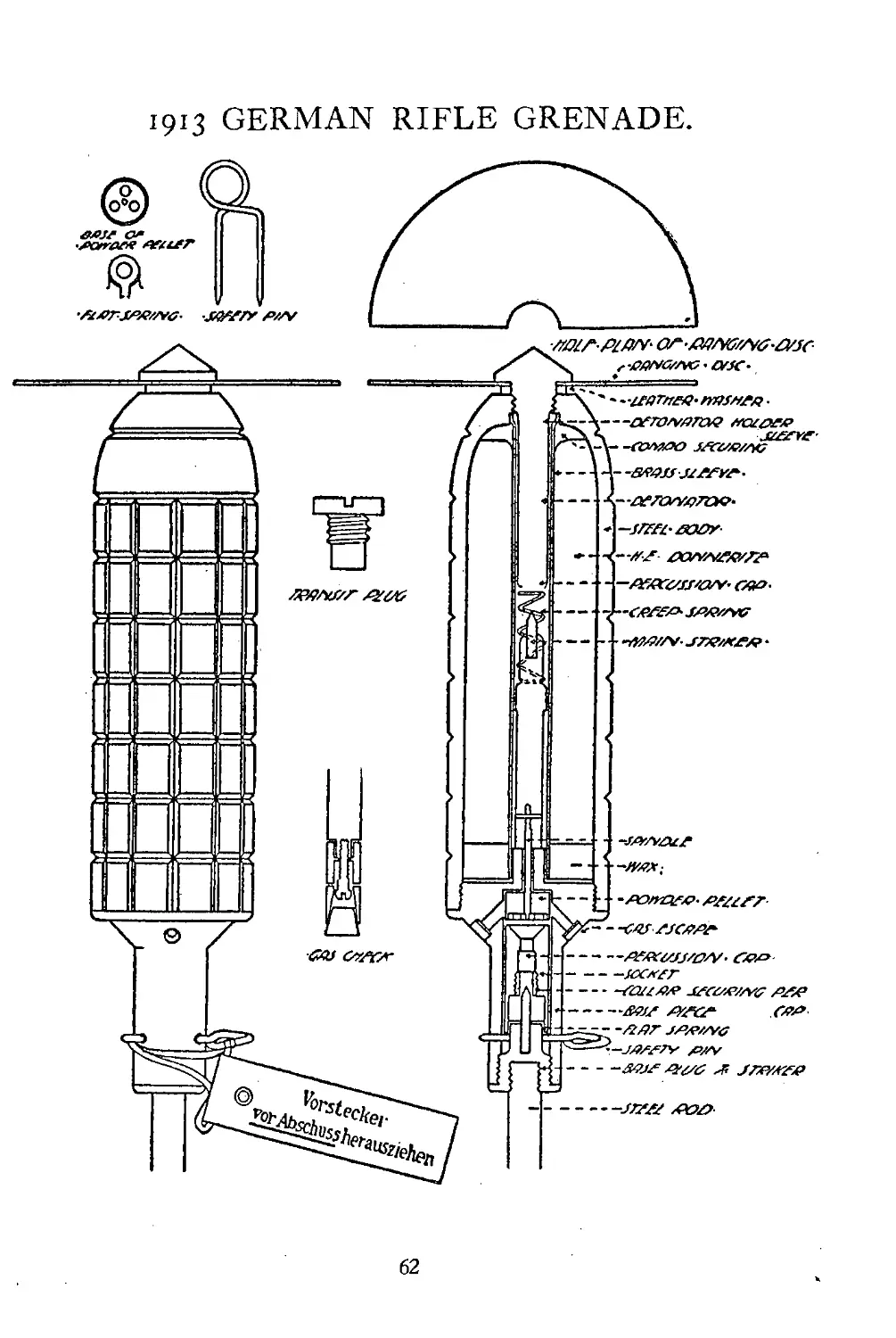
BODY.
Steel, 4.3 inches long and .16 inch thick, is serrated so that on
detonation it splits up into fragments. It is painted gray. The
base is closed by a brass base cup which has screwed into it a steel
tail rod eighteen inches long, with copper gas check to take the
grooves of the rifling. The rod has a thin coating of copper to pro-
tect it from rust and also to protect the barrel. A tin disc is fastened
to the head of the grenade pellet with needle and creep spring.
METHOD OF IGNITION.
An Igniter plug, carrying cap and detonator, screws into the
head of the grenade. A brass tube passing through the centre of
the grenade contains a striker pellet, with needle and creep spring
SAFETY ARRANGEMENTS.
1. A powder safety device is contained in base cup. Screwed
into the striker pellet is a spindle, which passes through into the base
cup, and has at its lower end a small platform with three flash holes.
On this rests a pellet of compressed powder, the object of which is
to keep the striker from moving forward until a short time after the
grenade has left the rifle. This powder is ignited by means of a
small brass pellet with a cap, which sets back on the shock of dis-
61
1913 GERMAN RIFLE GRENADE.
ММРР{Д№ ОГ-Ж/^'^С
•£№&/VG • ЛУГ-
-2WZ>W7ZK>-
—XJ%nZ£T43V'
-7f^//V- U'ZC/yTZX’
-j^/yzuz*
ЙЙУ Ctt°&r
-углк &OZ>
f 4XyWVfiW&
-/Л9ГЛ2^- /WW/Х? •
л^/ултгх» логгляс»
JliSrKf'
-ЛМЙЛ9 JE/I2ZPZ^<7


AVZZ"Z
- <€Г Л/ГСА»
-A5ftTikZ/>Z7/V* Г<РХ>
-ЮСл-fr
-/&£/?/? Jrt&e/A"& /ж1
-&2JS	CP0
-/Zflr J/W//VC
-.ЮЛГТЪ' JP//V
&&/& Л7 _/Z5f^25P
62
charge, and flattening a small spring, is penetrated by a needle on the
screw plug closing the base cup. A vent hole in the base cup allows
the escape of the gases of combustion. This is normally sealed with
wax.
2. When the powder is burnt away, the striker is only prevented
from moving forward by a creep spring, the resistance of which is
overcome on strike.
INSTRUCTIONS.
To Use.
I.	Unscrew zinc plug from the head.
2.	Screw in the igniter plug (with tin disc for range under
200 yds.).
3.	Lower the grenade carefully into the barrel.
4.	Insert special cartridge in the barrel.
5.	Fix the rifle at the required elevation.
6.	Fire the rifle.
To Render Useless.
Unscrew the igniter plug in the head of the grenade, holding the
grenade with rod downward.
PRECAUTIONS.
1.	A German rifle only can be used.
2.	Care must be taken that the grenade is not dropped, es-
pecially on the tail rod, as then it is liable to become “live/" and
will therefore detonate on firing. It should be carried head upper-
most by the grenade, not by the rod.
3.	The special rifle grenade cartridge must be used and in no
case a ball cartridge.
4.	Tail rods which jam or rub when being placed in the barrel
must not be used, and no force is to be employed.
5.	Damp tail rods should be dried before use. All rods should
be firmly screwed in.
63
GERMAN RIFLE GRENADE
1914 (Percussion).
“Genehrgranate.” Weight 2 lbs., Maximum Range 380 yds.
BODY.
Cast iron painted field gray and serrated to give fragments of
sufficient size on detonation. The charge (2% oz.) is made up in
a thin cardboard cylinder, which is retained in the grenade by a
shoulder piece screwing on to the body. The nose of the grenade
is screw-threaded to take the percussion fuze, and the base to take
a nipple for a tin disc and tail rod with gas check. Until the fuze
is inserted the nose is protected from dust and damp by a plug and
leather washer.
METHOD OF IGNITION.
The percussion fuze contains an exploding charge with detonator
and cap. The last named is set off by a striker pellet .screrwed into
the socket of the fuze. The needle of the pellet is hinged and lies
flat on top of the cap when in the safety position, but is pulled and
maintained erect by the spring in the striker pellet as soon as the
pellet moved forward after firing.
SAFETY ARRANGEMENTS.
1. The striker pellet is retained in position by a locking ball,
which rests in a recess in the pellet. This ball is prevented from fall-
ing out by a locking ring which is held up by a flat spring with
curved ends. On the rifle being fixed the locking ring overcomes the
spring and sets back and the locking ball is driven out of its recess by
64
1914 GERMAN RIFLE GRENADE.
nCUSE-SAPE--
•FUSE'LIVE-

AW
•ул&хж
jzxw&e JC&tfr
AXMMj&U-
4Л£0М/Ю
JGCXfY
—/A'/Vtt* •J&CA'.fr
/ttr (Л/Э-/7/У&
сх<://п2&е


sv/0/ЭАУР-

лхжгг* #£Z0 w	fc^/r


65
194 german rifle grenade.
WAZ/AV £>/Jf
6У
66
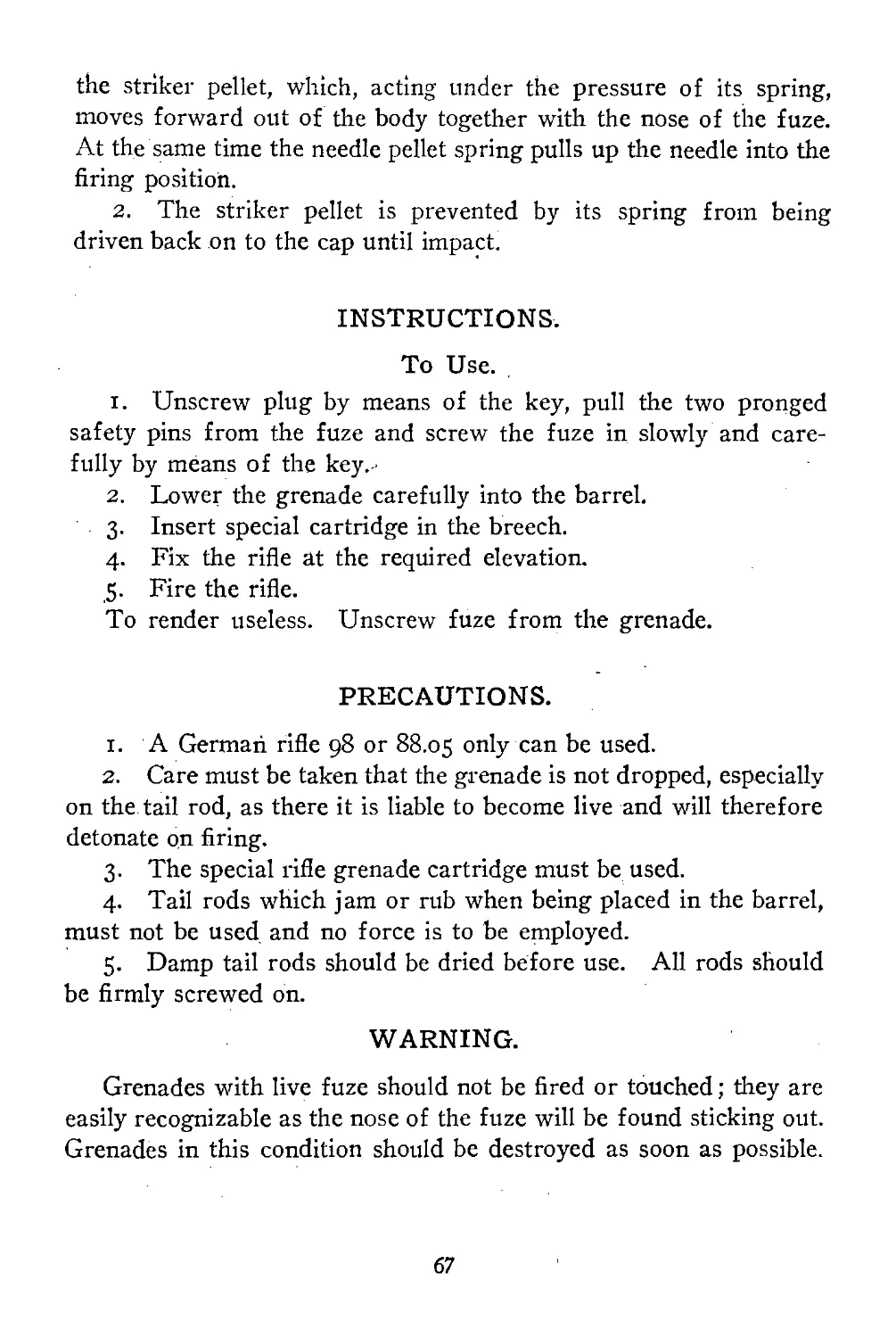
the striker pellet, which, acting under the pressure of its spring,
moves forward out of the body together with the nose of the fuze.
At the same time the needle pellet spring pulls up the needle into the
firing position.
2. The striker pellet is prevented by its spring from being
driven back on to the cap until impact.
INSTRUCTIONS.
To Use. .
i.	Unscrew plug by means of the key, pull the two pronged
safety pins from the fuze and screw the fuze in slowly and care-
fully by means of the key.-
2.	Lower the grenade carefully into the barrel.
3.	Insert special cartridge in the breech.
4.	Fix the rifle at the required elevation.
5.	Fire the rifle.
To render useless. Unscrew fuze from the grenade.
PRECAUTIONS.
1.	A German rifle 98 or 88.05 only can be used.
2.	Care must be taken that the grenade is not dropped, especially
on the tail rod, as there it is liable to become live and will therefore
detonate on firing.
3.	The special rifle grenade cartridge must be used.
4.	Tail rods which jam or rub when being placed in the barrel,
must not be used and no force is to be employed.
5.	Damp tail rods should be dried before use. All rods should
be firmly screwed on.
WARNING.
Grenades with live fuze should not be fired or touched; they are
easily recognizable as the nose of the fuze will be found sticking out.
Grenades in this condition should be destroyed as soon as possible.
67
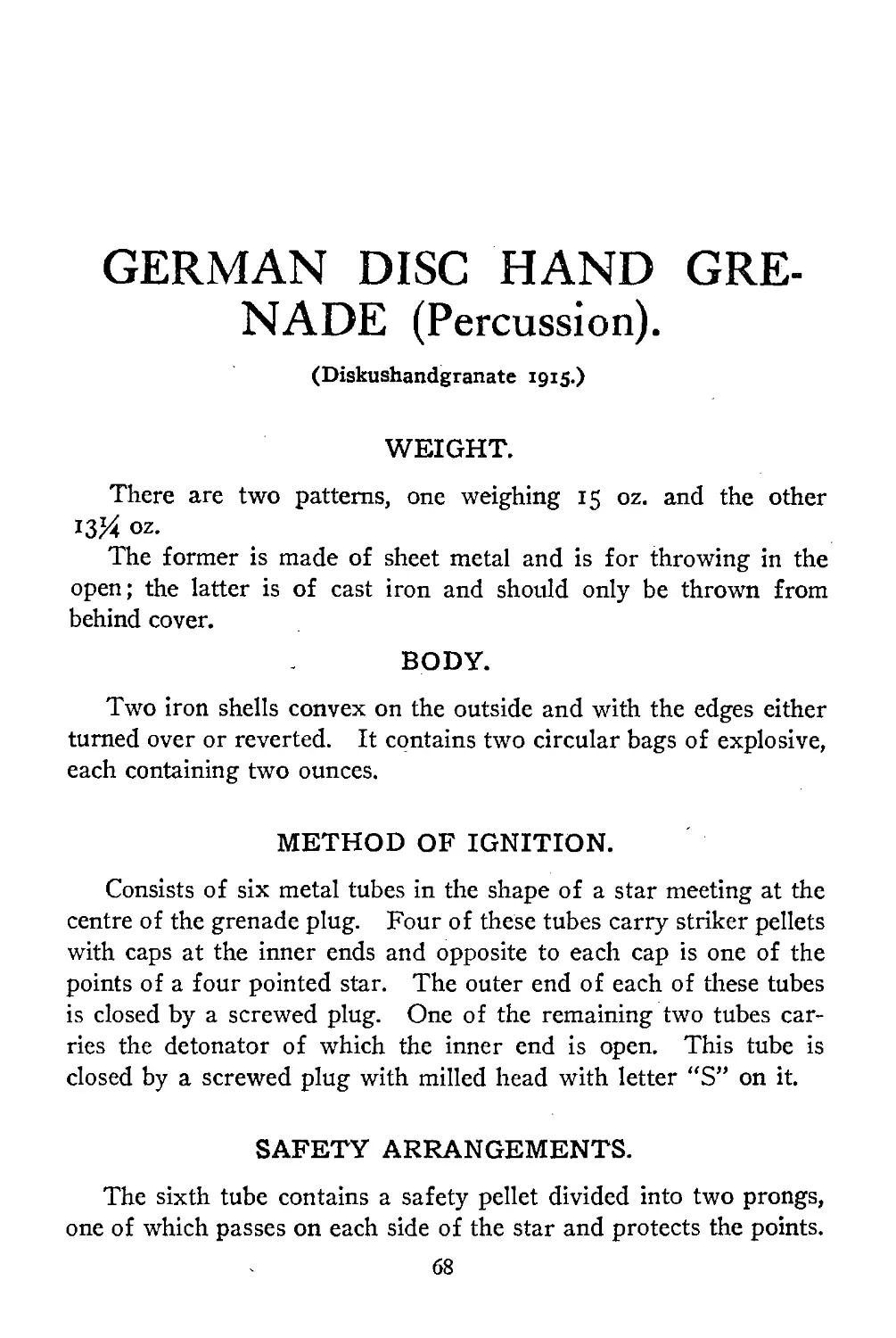
GERMAN DISC HAND GRE-
NADE (Percussion).
(Diskushandgranate 1915.)
WEIGHT.
There are two patterns, one weighing 15 oz. and the other
13И oz-
The former is made of sheet metal and is for throwing in the
open; the latter is of cast iron and should only be thrown from
behind cover.
BODY.
Two iron shells convex on the outside and with the edges either
turned over or reverted. It contains two circular bags of explosive,
each containing two ounces.
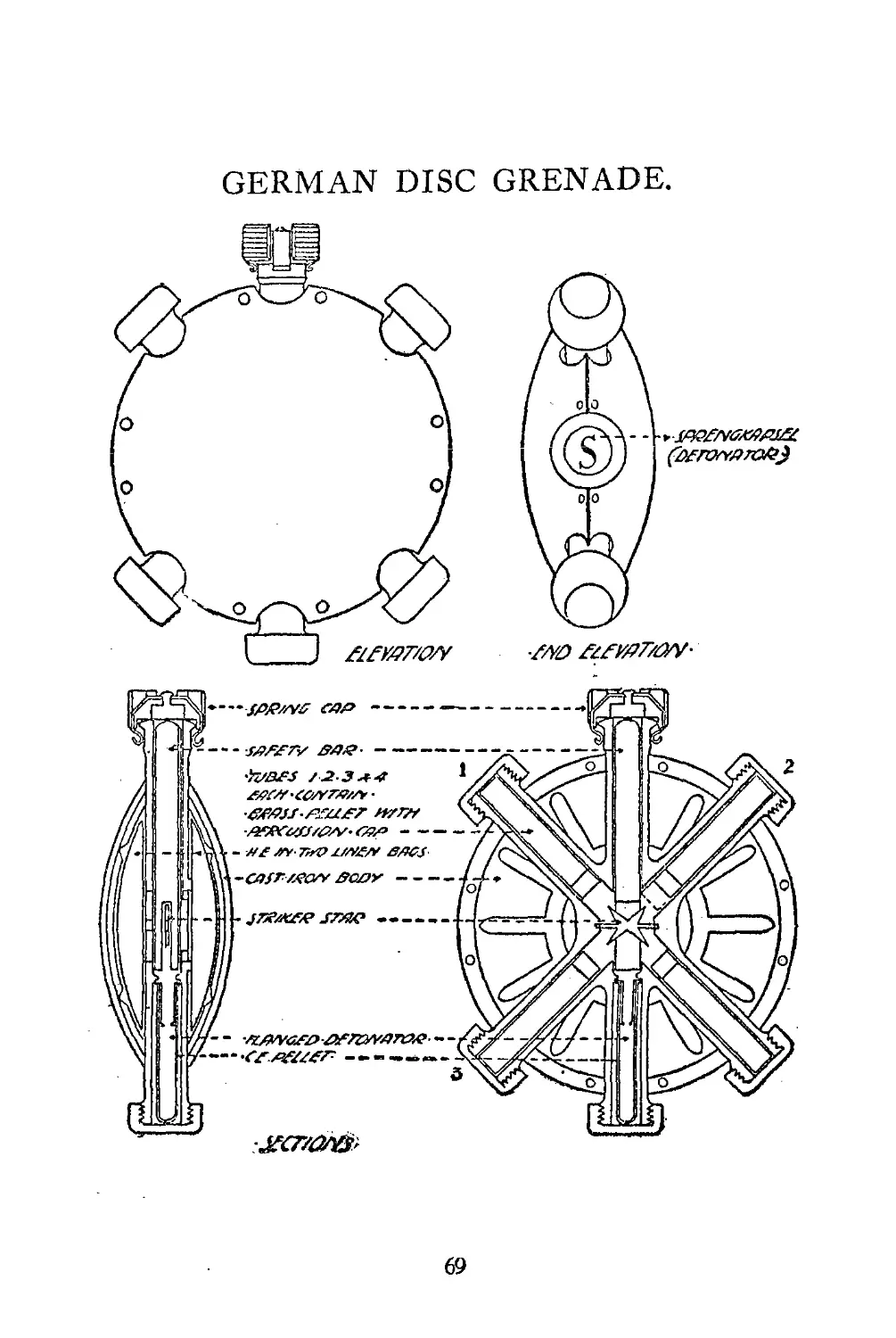
METHOD OF IGNITION.
Consists of six metal tubes in the shape of a star meeting at the
centre of the grenade plug. Four of these tubes carry striker pellets
with caps at the inner ends and opposite to each cap is one of the
points of a four pointed star. The outer end of each of these tubes
is closed by a screwed plug. One of the remaining two tubes car-
ries the detonator of which the inner end is open. This tube is
closed by a screwed plug with milled head with letter “S” on it.
SAFETY ARRANGEMENTS.
The sixth tube contains a safety pellet divided into two prongs,
one of which passes on each side of the star and protects the points.
68
GERMAN DISC GRENADE.
69
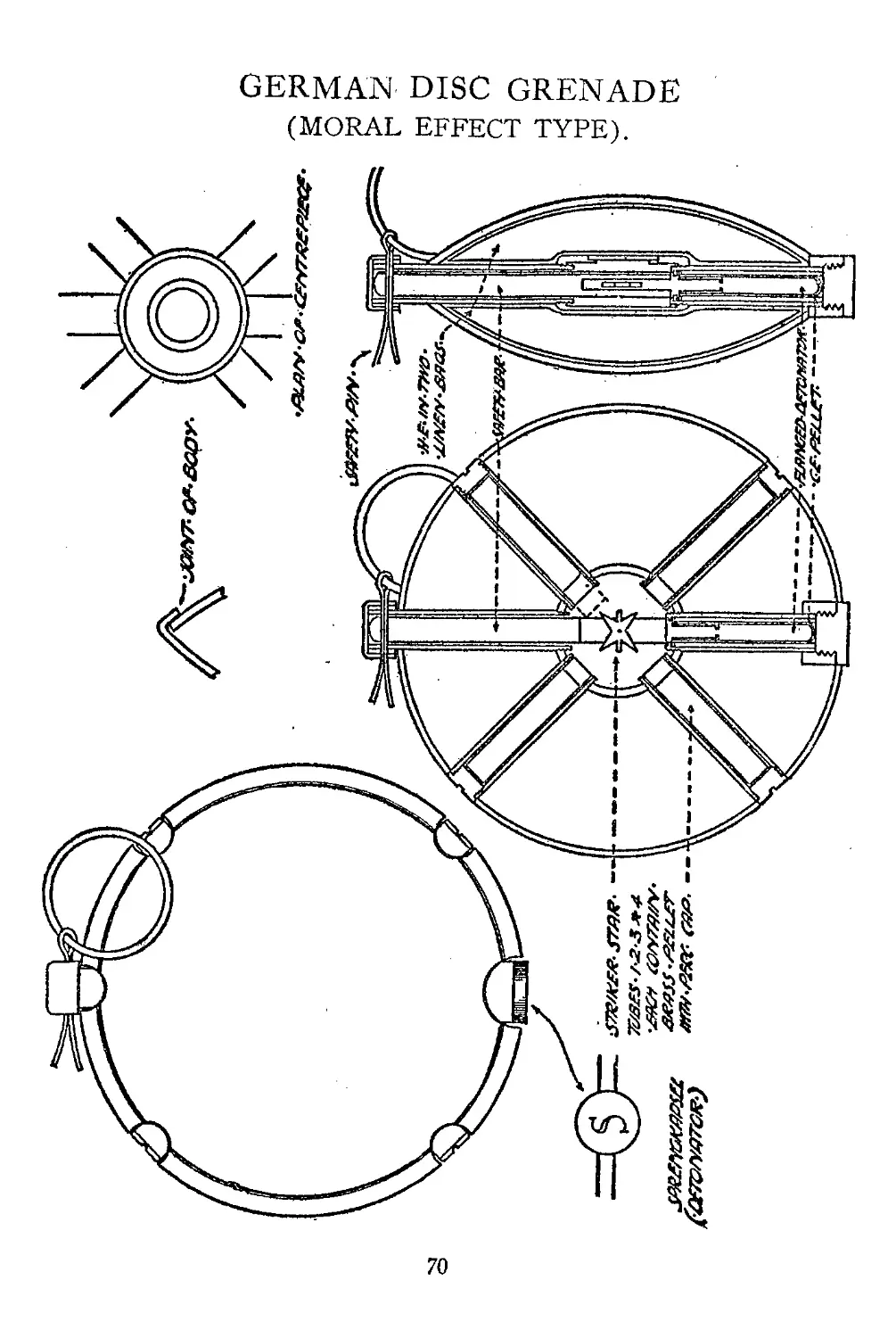
GERMAN DISC GRENADE
(MORAL EFFECT TYPE).
70
This pellet is retained in its position by a cap which closes the outer
end of this tube. The cap is screwed to the tube either by clips or
by a safety pin with ring. Action During Flight. Owing to the
grenade turning over the safety pellet flies out and the grenade be-
comes sensitive. When the edge of the grenade strikes the target
the corresponding striker pellet drives the cap forward on to the
point of the star. The flash passes into the detonator and explodes
the charge.
INSTRUCTIONS.
To Prepare for Use.
i.	Hold the grenade in the right hand, safety pin upwards.
2.	Pull out safety pin with left hand.
3.	Pull off the cap and hold safety pellet in position with right
fore finger.
4.	Throw the grenade as high as possible, taking care that the
edge is vertical.
To Render Useless.
1. Unscrew the plug of the tube, marked “S” opposite to the
safety pin.
2. Remove detonator.
7!
GERMAN CYLINDRICAL GRE-
NADE WITH FRICTION TUBE
(Regulation Type).
Weight i lb. 13 oz. (Cylindrical Stick.)
DESCRIPTION.
The body consists of a tin cylinder 4 inches by 2% inches
diameter which contains a cartridge of explosive. This is closed at
the top with a lid held in place by four clips; at the bottom there is a
screw threaded hole to take the handle. The bottom of the cartridge
is fitted with a paper tube for the detonator; on the side of the body
there is a hook, by means of which the grenade can be attached to
the belt.
The inscription on the body “Vor Gebrauch Spring Kapsel Ein-
setzen” means “Before use insert detonator.”
HANDLE.
Wooden, 9% inches long, has a screw threaded metal top which
fits into the body. It is bored out axially to take the igniter and
wire pull.
METHOD OF IGNITION.
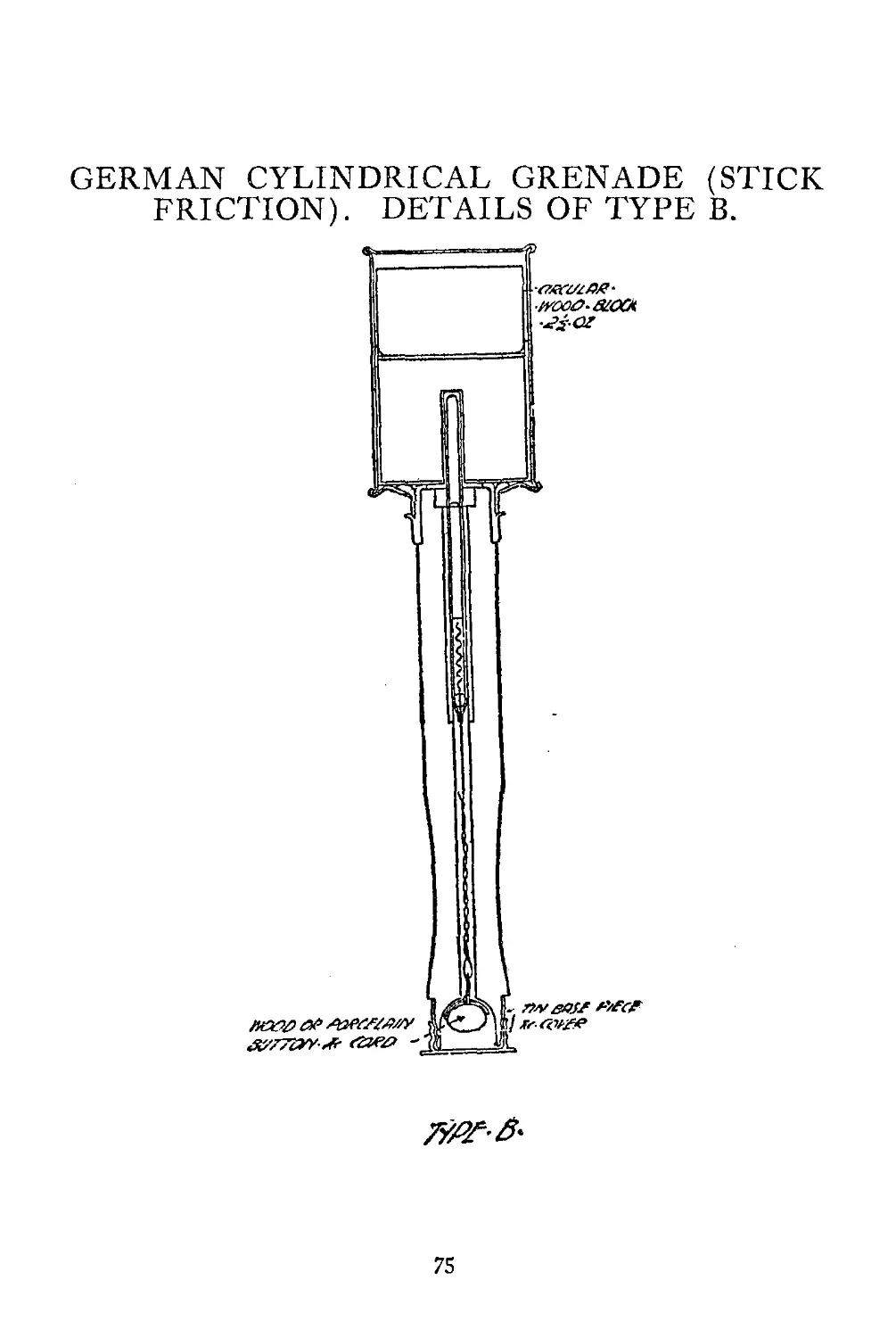
Consists of a friction lighter and safety fuze contained in a card-
board tube. The igniter is actuated by pulling a string loop at the
end of the handle. This loop is attached to the wire pull of the fric-
tion tube, and is fixed to the handle by means of a paper band. The
mouth of the detonator fits into a brass tube at the top of igniter,
72
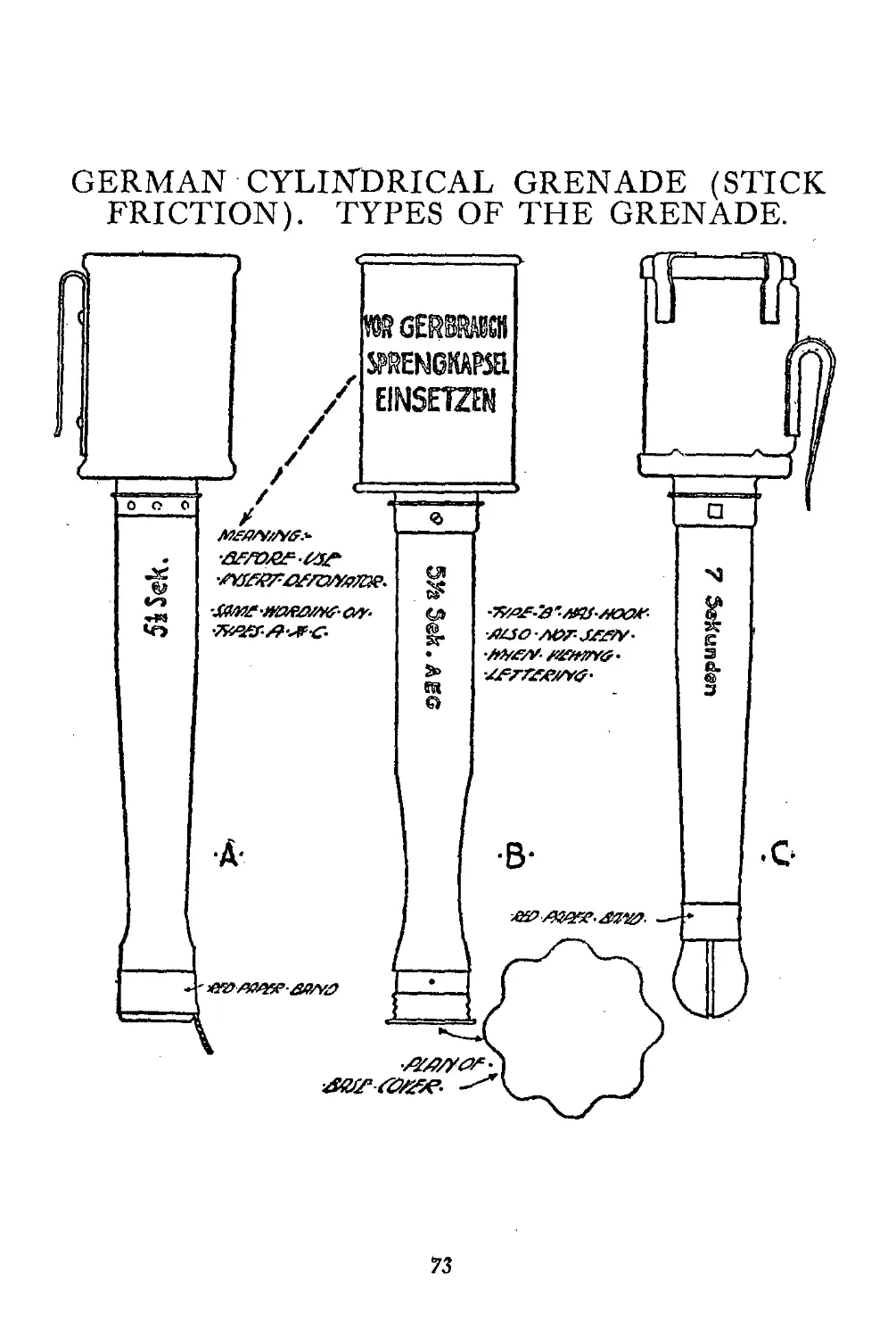
GERMAN CYLINDRICAL GRENADE (STICK
FRICTION). TYPES OF THE GRENADE.
4
ЮОМСИ
SPRENGKARJEL
EIMSETZEN
£
О
СЯ
Й1
С/У-
/Z/7/ytr
&!//•ЯМ'Х’-
В


73
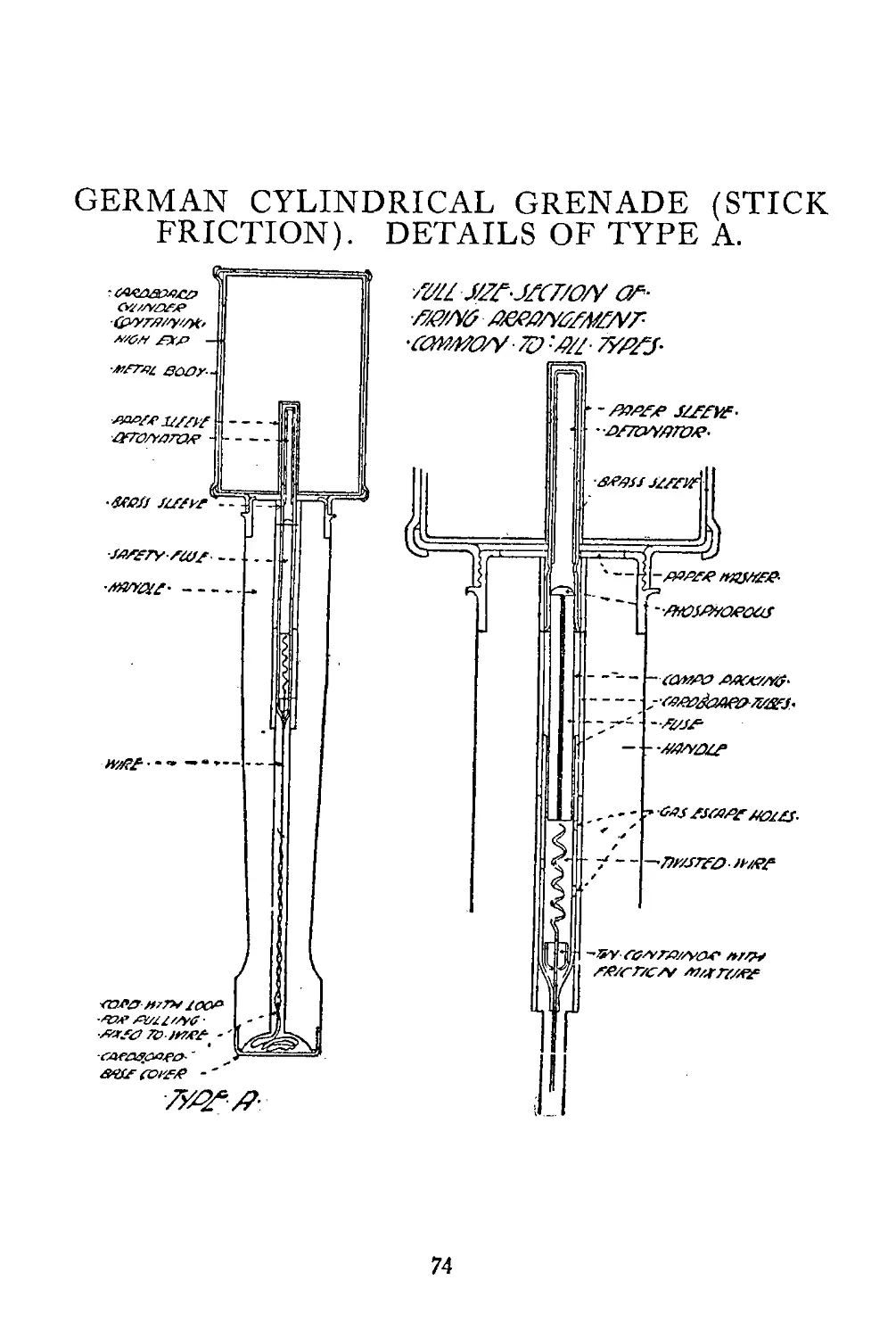
GERMAN CYLINDRICAL GRENADE (STICK
FRICTION). DETAILS OF TYPE A.


г4>аелалясс>
<"»7//VZ15e
-<2>УЛ^у//Х>
JO'Fry fWf _ _


£<X&
s&a’ Zty££//y<7
?z>	-
Z₽€(Z^P/i5r -'

M£yZt-MTKW C^-
mvtmwMM''-
ZOMMO'V-TD ’£>// 7ypzj-
74
GERMAN CYLINDRICAL GRENADE (STICK
FRICTION). DETAILS OF TYPE B.

75
and is fired by the flash from the dab of phosphorus at the end of
the safety fuze. Time of burning—5% or 7 seconds as marked
on the handle.
SAFETY ARRANGEMENTS.
1. The grenade and detonator are kept separate during carriage.
2. The drawing loop is attached to the handle by a paper band,
which must only be removed before firing.
INSTRUCTIONS.
To Prepare for Use.
I.	Unscrew the handle and see if the detonator is in position;
if it is, refix the handle.
2.	Hold the grenade in the right hand.
3.	Tear off the paper band with left hand.
4.	Pull loop with left hand.
5.	Throw immediately.
If the detonator is not in position, search must be made for a
supply of the proper detonators. Fit the mouth of the detonator
into the projecting brass tube, screw in the handle and then proceed
as in 2, 3, 4, and 5 above.
To Render Useless.
1. Unscrew handle, remove detonator.
2. Pull drawing loop and throw handle away.
GERMAN EGG HAND GRE-
NADE (EIERHANDGRANATE).
Weight и oz. (but patterns vary slightly). Can be Thrown
, 50 Yds.
DESCRIPTION.
BODY.
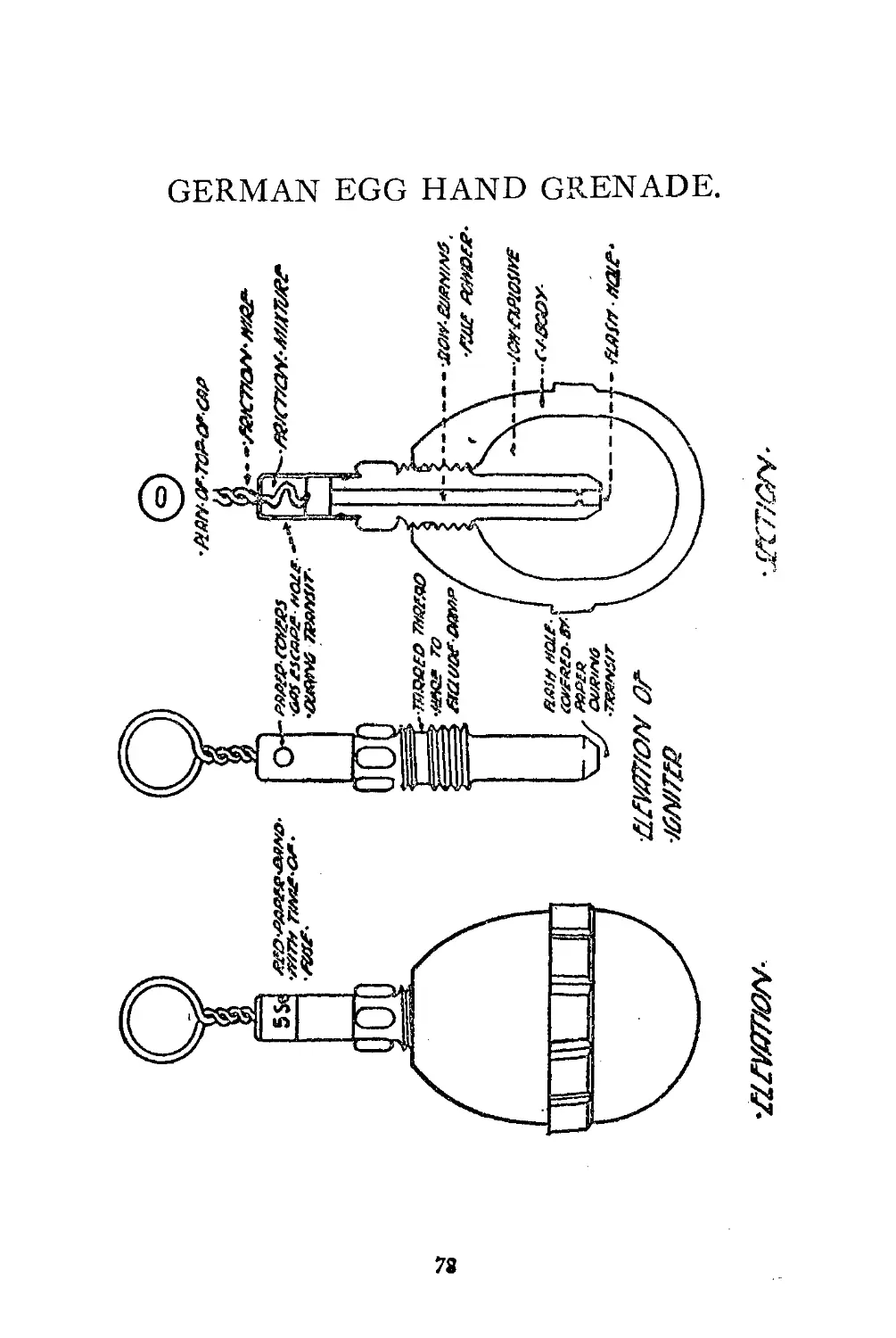
Cast iron egg shaped about 60 mm. (2.3 inches) long by 45 mm.
(1.77) inches diameter, with a screwed hole at one end to insert
the igniter. It is filled with a special powder which does not re-
quire a detonator.
METHOD OF IGNITION.
The igniter is a lead alloy tube which screws into the body and
contains a fuze; on one end is fitted a metal cap, containing the
friction lighter, which is operated by pulling a wire loop.
TWO IGNITERS ARE SUPPLIED.
No. 1 with eight seconds fuze for grenades thrown by mechanical
means.
No. 2 with five seconds fuze for grenades thrown by hand.
SAFETY ARRANGEMENTS.
The igniter is carried separate from the grenade; a small lead
plug is screwed into the body and must be removed before the
igniter can be inserted.
77
GERMAN EGG HAND GRENADE.

78
INSTRUCTIONS.
To Prepare for Use.
i. Unscrew and remove plug.
2. Screw in igniter.
It is important when screwing in the igniter to keep the grenade
upright, so that no powder can get into the screw threads.
To Throw.
Pull the wire loop and throw in the usual way.
To Render Useless.
Unscrew the igniter.
79
GERMAN HAIRBRUSH
GRENADE
Weight 2% lbs.
DESCRIPTION.
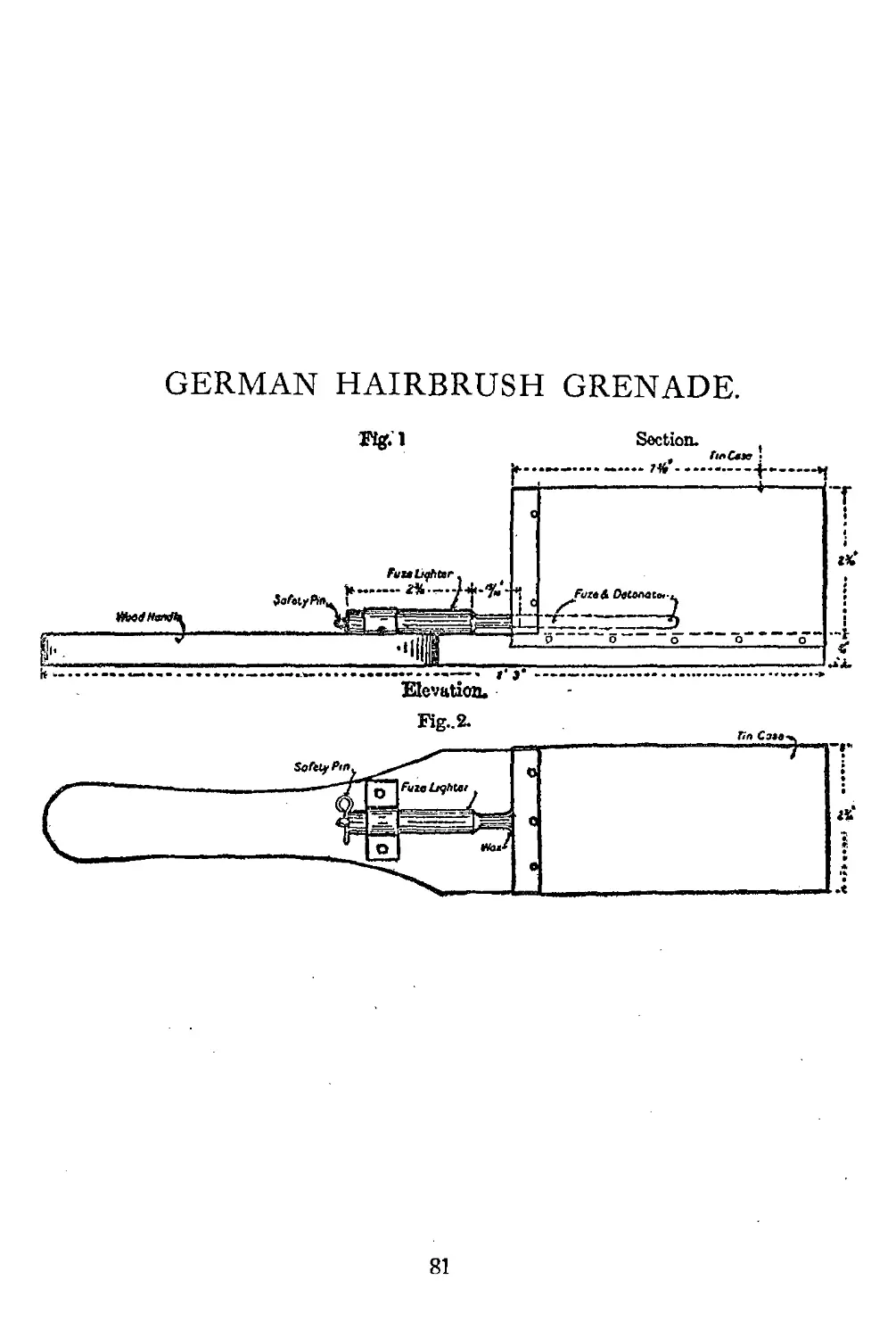
The body consists of a tin box 2^4 inches by 2^4 inches by 6
inches filled with explosive. This box is nailed on to a wooden
handle. Length complete is 15 inches.
METHOD OF IGNITING.
Spring igniter, fuze, and detonator, similar to that used in the
cylindrical grenade, with spring igniter.
The igniter is kept in position by means of a zinc band screwed
on to the handle.
SAFETY ARRANGEMENTS AND INSTRUCTIONS.
As for cylindrical grenade with spring igniter, except that the
safest way to destroy this grenade is to fire it in a pit or disused
trench.
80
GERMAN HAIRBRUSH GRENADE.
81
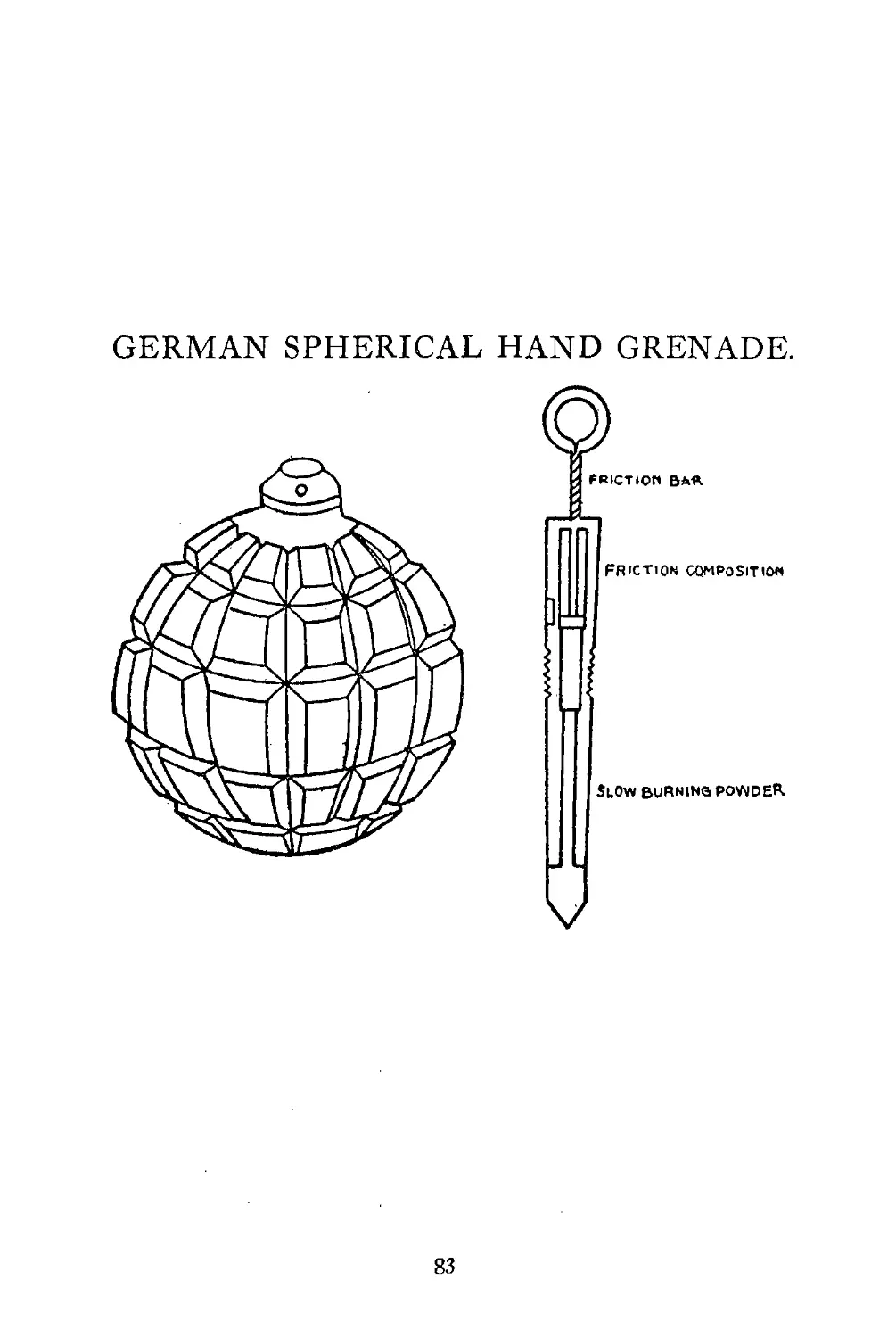
GERMAN SPHERICAL HAND
GRENADE.
Weight i IK io oz.
BODY.
Spherical about 3 inches in diameter, made of cast iron about
inch thick, and is filled with black powder or other explosive
which does not require a detonator. The body is coated with varnish
inside and out.
METHOD OF IGNITION.
Combination of friction tube, lighter and fuze. The friction
tube is fired by pulling out the wire in the direction of the axis of the
tube. Time of burning seven seconds. A similar lighter which
burns for five seconds is also provided.
SAFETY ARRANGEMENTS.
1.	Grenade and fuze kept separate during carriage.
2.	The vent for the fuze in the grenade is closed by means of
a zinc plug.
3.	The holes in the lighter are covered with water proof paper.
4.	The wire is bent in order to prevent a direct pull.
INSTRUCTIONS.
To Prepare for Use.
1. Take the lighter, remove the oiled paper and straighten the
wire, taking care not to pull it.
2. Insert the lighter.
82
GERMAN SPHERICAL HAND GRENADE.
83
To Throw.
I.	Hold the grenade in the right hand with the igniter towards
the wrist.
2.	A nail or a loop of string should be passed through the wire
pull.
3.	Throw the grenade.
To Render Useless.
1.	Bend the wire down, taking care not to pull it.
2.	Unscrew the lighter.
3.	Shake out the contents of the grenade.
84
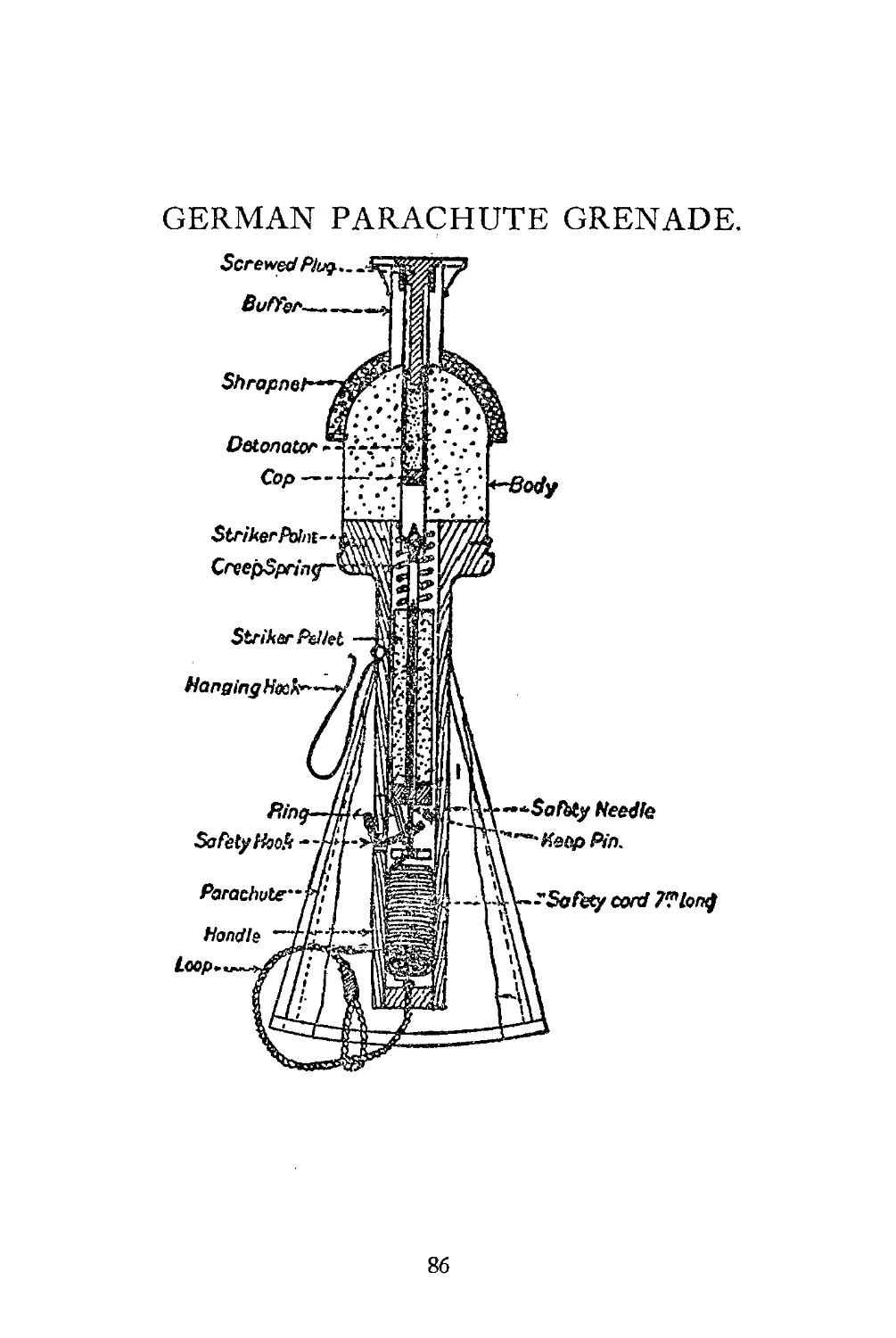
GERMAN PARACHUTE GRE-
NADE (Percussion).
DESCRIPTION.
The body, which is painted black, consists of a tin cylinder of
explosive with hemispherical head of larger diameter containing
shrapnel bullets. A buffer cylinder passes through the body and
projects, so as to produce the explosion slightly above ground. The
base of the body is closed by a wooden plug at the handle. A para-
chute safety arrangement is attached to the head of the handle in
order to prevent fragments flying to the rear on explosion, and also
to cause the grenade to fall on its head.
METHOD OF IGNITION.
Consists of (i) The detonator in the buffer cylinder supported
by the screwed plug at the end.
2. The percussion pellet with point and spiral spring.
SAFETY ARRANGEMENTS.
Consist of the following: A cord seven metres long which nor-
mally is coiled up inside the handle, is attached to a long needle pass-
ing down the percussion pellet. A safety hook retains a ring at-
tached to the end of the percussion pellet and the needle passes
through a hole in this hook. After the first seven metres of the
flight, the jerk on the cord pulls out the needle and the safety hook
is thus free to fall out sideways and so allow the percussion pellet
to move forward on concussion.
GERMAN PARACHUTE GRENADE.
86
2.	Keep pin and creep spring. The former prevents the per-
cussion pellet from falling back.
INSTRUCTIONS.
(a)	To Prepare for Use.
i.	Unscrew the plug in the head.
2.	Place in the detonator, fulminate downwards.
3.	Screw in the plug.
4.	Tear off the band holding the parachute.
5.	Holding the loop of the cord firmly with the first and second
fingers of right hand, unwinding as short a length as possible of the
cord.
6.	Hold the grenade in the right hand.
7.	Retaining the loop of the cord, throw the grenade so that it
will reach a height of twelve or thirteen feet,
(b)	To Render Useless.
Remove the detonator..
Note : The grenades may be found live, in which case 1, 2 and 3
have already been done.
This grenade can be used in attack or defence, but it is particu-
larly designed for the former, as the fragments are projected in a
forward direction only, and so are not dangerous to the throwers.
The safety arrangements prevent the grenade from becoming dan-
gerous until it has flown about seven metres.
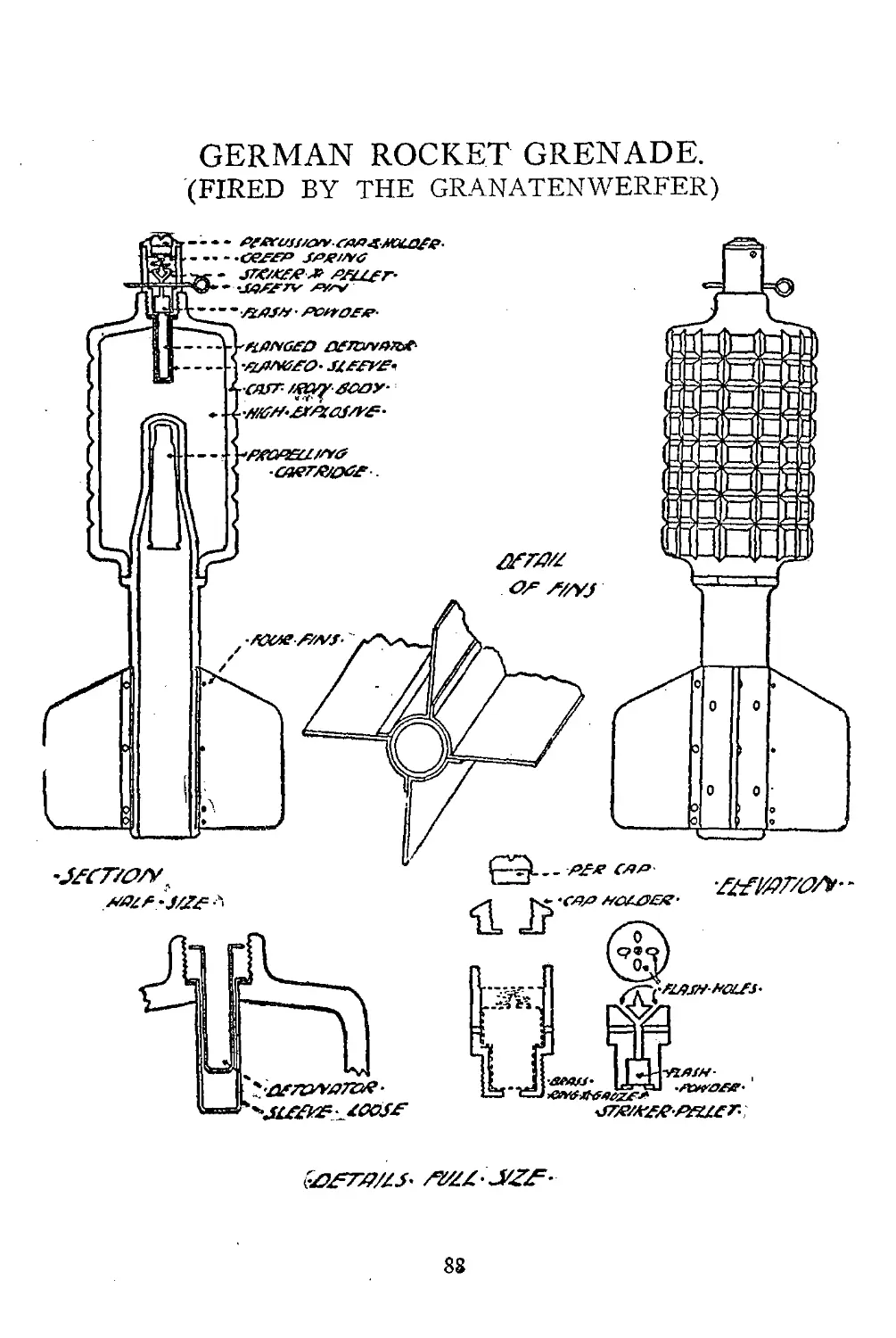
87
GERMAN ROCKET GRENADE.
(FIRED BY THE GRANATENWERFER)

83
GERMAN CYLINDRICAL HAND
GRENADE (Friction).
Weight i lb. 13 oz.
BODY.
Tin cylinder 4 inches by 2% inches diameter, containing a
cartridge of explosive. The full charge is 10 oz. but part of the
space is sometimes filled by a wooden block.
The top is closed by a lid held in place by four clips, at the bot-
tom there is a screw-threaded hole to take the handle. The bottom
of the cartridge is fitted with a paper tube for the detonator. On
the side of the body there is a hook, by means of which the grenade
can be attached to the belt.
The inscription on the body “Vor Gebrauch Spring Kapsel Ein-
sctzen” means “Before use insert the detonator.”
HANDLE.
Wooden, about nine inches long, with a metal top screwed to fit
the body. It is bored axially to take the igniter and wire pull. In
the latest pattern a screwed metal cap is fitted to the end which pro-
tects the string loop attached to the wire pull.
METHOD OF IGNITION.
The means of ignition consist of a friction lighter and safety
fuze, contained in a cardboard tube. The igniter is actuated by
pulling a string loop at the end of the handle. This loop is attached
to the wire pull of the friction tube. In the old pattern the string
39
loop is fixed to the handle by means of a paper band, but in the new
pattern a porcelain button is attached to the loop in order to afford
a better grip; a button is formed in the end of the handle and cov-
ered by means of a screwed metal or cardboard cover. When issued
the string loop and button are coiled up in the hollow and are pro-
tected by the cover. The mouth of the detonator fits into a brass
tube at the top of the igniter, and is fixed by the flash from a dot of
phosphorus at the end of the safety fuze. Time of burning 5^ or 7
seconds as marked on the handle.
SAFETY ARRANGEMENTS.
1. The grenade and detonator are kept separate during carriage.
2. The string loop is either attached to the handle by a paper
band, or contained in a metal or cardboard cover. The paper band
or the cover should only be removed just before firing.
INSTRUCTIONS.
To Prepare for Use.
1.	Unscrew the handle and see if the detonator is in position;
if it is refit the handle.
2.	Hold the grenade in the right hand.
3.	Tear off the paper band with left hand; or, unscrew the
metal cover, as the case may be.
4.	Pull loop or button with left hand.
5.	Throw immediately.
To Render Useless.
1. Unscrew handle, remove detonator.
2. Pull string loop, which will light the fuze, and throw handle
away.
90