/


Текст
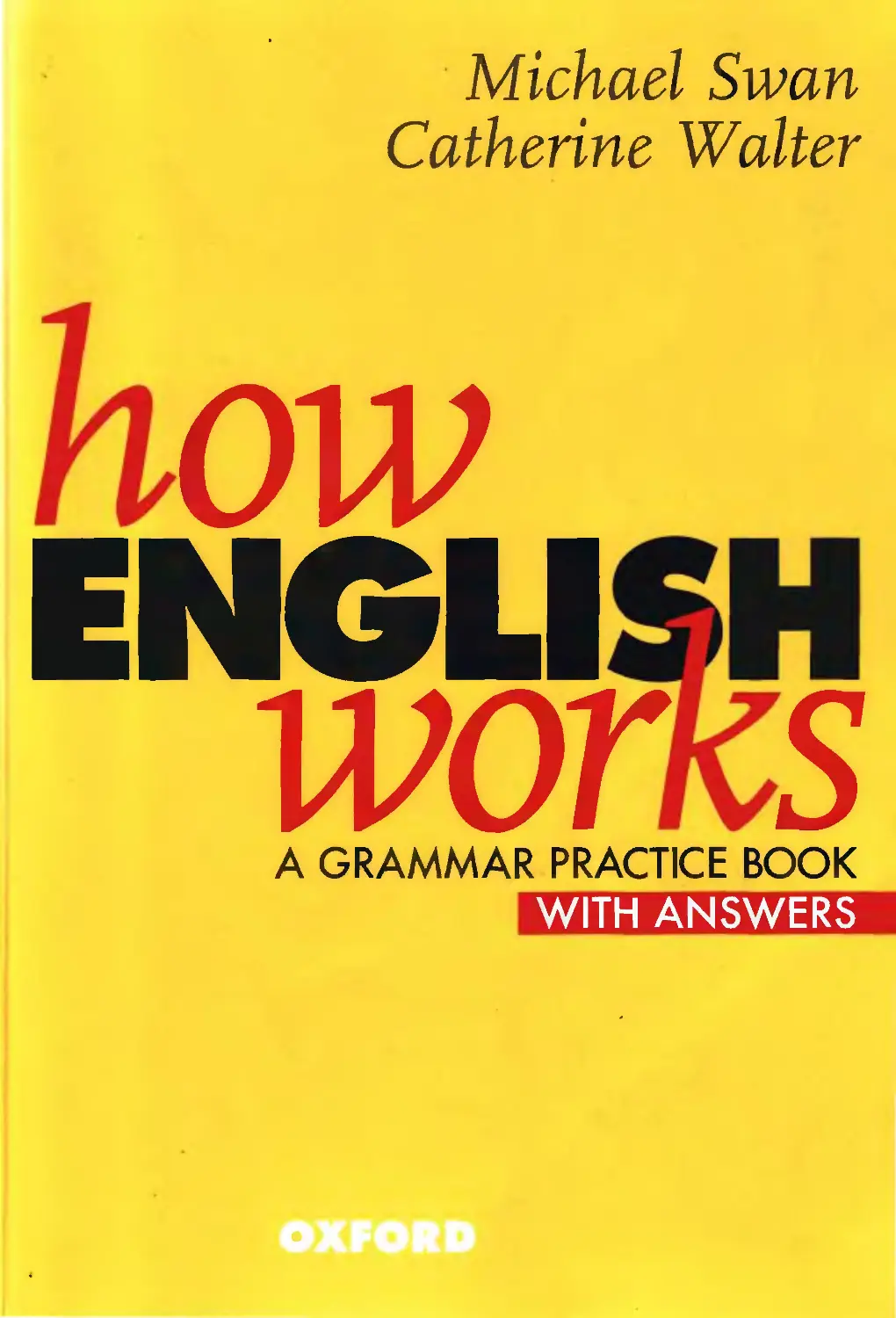
Michael Swan
Catherine Walter
how
ENGLISH
works
A GRAMMAR PRACTICE BOOK
WITH ANSWERS
How English Works
A grammar practice book
How English Works
A grammar practice book
Michael Swan & Catherine Walter
With answers
Oxford University Press
Oxford University Press
Croat Clarendon Street. Oxford 0x2 бое
Oxford New York
Athens Auckland Bangkok Bogota Buenos Aires
Calcutta Cape Town Chennai Dares Salaam
Delhi Florence Hong Kong Istanbul Karachi
Kuala Lumpur Madrid Melbourne Mexico City
Mumbai Nairobi Paris Sao Paulo Singapore
Taipei Tokyo Toronto Warsaw
and associated companies in
Berlin Ibadan
OXFORD and OXFORD ENGLISH
are trademarks of Oxford University Press
ISBN о 19 431456 I (with answers)
ISBN о 19 431457 x (without answers)
!: Michael Swan and Catherine Walter 1997
First published 1997
Sixth impression 2000
No unauthorised photocopying
All rights reserved. No part of this publication may be reproduced, stored in a
retrieval system, or transmitted, in any form or by any means, electronic,
mechanical, photocopying, recording or otherwise, without the prior written
permission of Oxford University Press.
This book is sold subject to the condition that it shall not. by way of trade or
otherwise, be lent, resold, hired out, or otherwise circulated without the
publisher's prior consent in any form of binding or cover other than that in
which it is published and without a similar condition including this condition
being imposed on the subsequent purchaser.
Designed by Richard Morris. Stonesfield Design. Oxfordshire
Paintings by David Downton
Drawings on page 1 29 by pupils in Year 1 of Stonesfield School. Oxfordshire
Map on page 145 by Neil Gower. Allez Studios. Brighton
Typeset in Monotype Photina and Franklin Gothic by
Tradespools Ltd. Frome. Somerset
Printed in China
In writing this book the authors obtained information from the British
National Corpus. The British National Corpus is a collaborative initiative
carried out by Oxford University Press as a Lead Partner. Longman.
Chambers Harrap. Oxford University Computing Services. Lancaster
University's Unit for Computer Research in the English Language, and the
British Library.
Contents
Introduction 1
Test yourself 3
Test yourself: answers 11
Explanations and exercises: list of sections 12
Phonetic alphabet 15
Explanations and exercises 17
Answers to exercises 303
Index 351
Authors’ acknowledgements
We could not have produced this book without several kinds of help. In
particular, we would like to express our gratitude to:
• Keith Brown, Brian Graver and Diann Gruber, for their care in reading the
original typescript: their comments and suggestions have resulted in manj7
important improvements
• Inge Bullock and Barbara Hately-Broad, for organising our personal and
professional lives while we were doing the writing
. our children Mark and Helen, for putting up with us while it was going on
. Stewart Melluish of Oxford University Press'and Richard Morris, our editor
and designer, for the expertise, creativity, patience and good humour with
which they handled us and the typescript.
The Publisher thanks the following for their kind permission to reproduce cartoons:
Andre Deutsch Ltd: p. 224. from Modern Times by Mel Caiman (© Mel Caiman 198<S):
S and C Caiman: pp. 30. 13 7 (© S and C Caiman); Encyclopaedia Britannica
International Ltd: p. 111. Britannica Yearbook of Science and the Future 1995 (© 1996
by Sidney Harris); Mirror Syndication International: pp. 55, 142. 210. 252 (© Mirror
Group Newspapers): The New Yorker Magazine Inc.: pp. 24 (Dana Fradon).
78 (Vietor). 82 (Gahan Wilson). 115 (Drucker). 116 (Mankoff). 1 58 (M Stevens).
143 (Gahan Wilson). 226 (Barsotti). 250 (Joseph Farris): Private Eye: pp. 39 (Nick
Newman). 175 (Michael Heath). 187 (Michael Heath). 244 (Ken Pyne): Punch
Cartoon Library: pp. 27. 29. 34. 37. 47. 49. 55. 57. 60. 67. 75. 87. 88. 89. 94. 96.
98. 101. 105.107.108. 110. 117. 123. 125. 131. 1 35. 136, 151. 153. 155. 171.
174. 175. 177. 193. 203. 216. 218. 223. 232. 234. 235. 245. 253. 254. 255. 256.
261. 263. 266. 273. 274. 282. 286. 291. 295; Solo Syndication Ltd: pp. 49. 55. 146.
158. 215 (© Associated Newspapers Ltd); The Spectator: pp. 27. 3 3. 37. 65. 67. 73.
125. 132.134. 143. 146. 148. 158. 192. 199. 213. 219. 221: The Tessa Sayle
Agency: pp. 47. 96. 183. 195 (© R Searle 1948. 1951. 1944. 1944).
The Publisher thanks the following for their kind permission to use extracts and
adaptations from copyright material:
Clarks and McCann Erikson (Manchester) Ltd: p. 71. Springers advertisement Feel like
you’re in Paradise', from Life magazine. The Observer. 7 May 1995; Didcot Herald:
pp. 64. headline ’Football club burglars cut home phones'. 29 September 1994. 73.
advertisements 'Wonderful, tall energetic guy....', 2 June 1994 and 'Wood Street’.
2 June 1994. 178. extract ’A driver has been sent to jail...'. 27 January 1994: Dorling
Kindersley Ltd: p. 173. extract from Chronicle of the 20th Century (Longman. © Jacques
Legrand S A International Publishing. Paris): David Higham Associates: p. 112.
abridged extract from Under Milk Wood by Dylan Thomas (J M Dent. 1954. 1955.
© Dylan Thomas Trustees); The Independent: p. 64, headlines 'Channel ferry safety drill'
(James Cusick). 26 September 1994. and 'Decision day in rail dispute' (Barrie
Clement). 17 September 1994: International Music Publications Ltd: p. 121. extract
from the lyric ‘What shall I say?' by Peter Tinturin (© 1973 Chappell & Co. Inc.. USA.
Warner/Chappell Music Ltd. London W1Y 3FA); Penguin Books; p. 218. Potato
Pancake recipe from Father in the Kitchen by Bruce Beeby (Michael Joseph. 1977.
© Bruce Beeby 1977); Peters Fraser & Dunlop: pp. 141. extracts from The General by
C S Forester (Penguin. 1936. © C S Forester Estate). 225. Modern Humour by E M
Delafield (Everyman's Library Ltd. © E M Delafield's estate). 241. The Two Brothers by
V S Pritchett from The Complete Short Stories (Chatto & Windus. ©VS Pritchett 1990).
297. Three Rusty Nails by Roger McGough from In the Classroom (Jonathan Cape Ltd.
© Roger McGough 1976): James Thurber Literary Estate: p. 173. adapted extract from
'The Little Girl and the Wolf'. Fables For Our Time (HarperCollins. © 1940 James
Thurber. © 1968 Rosemary A Thurber): Ed Victor Ltd: p. 165. adapted extract from
Playback by Raymond Chandler (Hamish Hamilton. 1958. © Raymond Chandler
1958. Estate of Raymond Chandler): Witt. Thomas Productions: p. 210. transcription
from an episode of the American TV serial Soap (© Witt. Thomas Productions): Writer's
Digest Books: p. 269. extract from Who wrote that song? by Dick and Harriet Jacobs
(Writer's Digest Books. Cincinnati. Ohio. © Harriet Jacobs 1994).
Every effort has been made to trace the owners of copyright material used in this book,
but we should be pleased to hear from any copyright holder whom we have been
unable to contact.
Introduction
The purpose of the book
How English Works is for learners of English who want to speak and write
more correctly, ft contains:
short clear explanations of the rules of English grammar
• examples of correct use
. exercises.
How to use the book
If л ou are studying with a teacher, he or she will help you to use the book
effectively. If you are studying at home, the following suggestions may be
useful:
• Don’t go through the whole book from beginning to end. How English
Works contains explanations of basic rules (e.g. how to make questions),
intermediate points (e.g. the use of passives) and more advanced problems
(e.g. difficult structures with who, whom and which). Different learners will
need to study different parts of the book.
« Start by trying the tests on pages 4-9. These will help you to decide what
you need to learn - what are the most important problems in English
grammar for you.
• Use the list of sections (at the beginning) and the Index (at the end) to help
you find the sections that you want. Read the explanations and do the
exercises. If you still have problems with a point, work through the
section again.
• You will sometimes need to know some of the words that we use when we
talk about grammar in English (e.g. verb, preposition, tense, plural,
countable). These words are explained on pages 298-302.
The explanations
We have tried to make these as clear and simple as possible. You can find
more complete explanations of some points in Michael Swan’s book Practical
English Usage (Oxford University Press).
Sometimes we ask you to try to work out a rule for yourself. When you have
tried these "Do It Yourself activities, you can look at the blue pages
(303-305) at the back of the book to see if you were right.
2
The exercises
Most of the exercises are simple in structure. More difficult exercises are
marked with the sign ▲
A few exercises are designed lor group work in class.
What kind of English does the book teach?
We teach the grammar of everyday spoken and written British English. We
have used the British National Corpus - a collection of 100 million words of
modern spoken and written English - to help us make sure that our rules and
examples give a true picture of the present-day language.
For information about differences between British and American English, see
Practical English Usage.
How important is grammar?
Grammar is not the most important thing in the world, but if you make a lot
of mistakes you may be more difficult to understand, and some kinds of
people may look down on you or not take you seriously. Hardly anybody
speaks or writes a foreign language perfectly, but you will communicate more
successfully if you can make your English reasonably correct. We hope this
book will help.
Test yourself
These tests will help you to decide what you need to learn. First of all, try the
‘basic points’ test on pages 4-5 and check your answers on page 11. If you
have problems with any of the points, go to the sections where these are
explained and do the exercises: then try the test again. The tests on pages
6-9 are suitable for intermediate and advanced students, and can be done in
the same way.
Test yourself: basic points
Here are some of the basic grammar points from How English Works. Do you
know them all? Check your answers on page 11.
Choose the correct answer(s). One or more answers may be correct.
1 She’s ... university teacher.
A a В an C the D one
2 I like ... small animals.
A the В —(= nothing) C every D all
3 Is this coat... ?
A yours В your C the yours
4 Is Diana ... ?
A a friend of yours В a your friend C your friend
5 Who are ... people over there?
A that В the C these D those
6 ... is your phone number?
A Which В What C How
7 Could I have ... drink?
A other В an other C another
8 There aren’t... for everybody.
A chairs enough В enough chairs C enough of chairs
9 They’re ... young to get married.
A too much В too C very too
10 Most... like travelling.
A of people В of the people C people
11 Ann and Peter phone ... every day.
A them В themself C themselves D each other
12 It’s... weather.
A terrible В a terrible C the terrible
13 The plural of car is cars. Which of these are correct plurals?
A journeys В ladys C minuts D sandwichs E babies
14 Which of these is/are correct?
A happier В more happier C unhappier D beautifuller
15 This is ... winter for 20 years.
A the more bad В worse C the worse D worst
E the worst
16
17
18
19
20
21
22
23
24
25
26
27
28
29
30
She’s much taller... me.
A than В as C that
He lives in the same street... me.
A that В like C as D than
Her eyes... a very light blue.
A are В have C has
... help me?
A Can you to В Do you can C Can you
You... worry about it.
A not must В don’t must C must not D mustn’t
It... again. It... all the time here in the winter.
A ’s raining, ’s raining В rains, rains
C rains, 's raining D ’s raining, rains
I... she... you.
A think, likes В am thinking, is liking
C think, is liking D am thinking, likes
Who... the window?
A open В opened C did opened
Why...?
A those men are laughing
В are laughing those men
C are those men laughing
What... ?
A does she want В does she wants C she wants
I didn’t... he was at home.
A to think В think C thinking D thought
... a hole in my sock.
A There’s В There is C It’s D It is E Is
ГП see you... Tuesday afternoon.
A at В on C in
What time did you arrive... the station?
A at В to C —
We’re going... the opera tomorrow night.
A at В — C in Dto
Here are some of the intermediate grammar points from How English Works.
Do you know them all? Check your answers on page 11.
Choose the correct answer(s). One or more answers may be correct.
31 I went out without... money. A some В any
32 He’s got... money. A much В many C a lot of D lots of
33 ‘Who’s there?’ ’....’ A It’s me В It is I C Me DI
34 Although he felt very.... he smiled.... A angrily, friendly В angry, friendly C angry, in a friendly way
35 1... to America. A have often been В often have been C have been often
36 My mother... my birthday. A always forgets В always is forgetting C forgets always
37 You look ... a teacher. A like В as C the same like
38 How many brothers and sisters ... ? A have you got В do you have C are you having
39 Goodl I... work tomorrow. A mustn’t В don’t have to C haven’t got to
40 I... smoke. A —(= nothing) В use to C used to
41 Andrew ... to see us this evening. A will come В comes C is coming
42 Alice... have a baby. A will В shall C is going to
43 I knew that he... waiting for somebody. A is В was C would
44 ... Gloria last week? A Have you seen В Did you see C Were you seeing
45 She’s an old friend — I... her... years. A ’ve known, for В know, for C 've known, since D know, since
46
47
48
49
50
51
52
53
54
55
56
57
58
59
60
We met when we... in France.
A studied В were studying C had studied
As soon as she came in I knew I... her before.
A have seen В saw C had seen
This picture... by a friend of my mother’s.
A is painting В is painted C was painting D was painted
Can you... ?
A make me some tea В make some tea for me
C make for me some tea
Try... be late.
A not to В to not
I went to London... clothes.
A for buy В for to buy C for buying D to buy
You can’t live very long without....
A to eat В eat C eating D you eat
I enjoy.... but I wouldn’t like... it all my life.
A to teach, to do В teaching, doing C to teach, doing
D teaching, to do
Her parents don’t want... married.
A her to get В her get C that she get D that she gets
I'm not sure what...
A do they want? В do they want. C they want.
The policeman ... me not to park there.
A asked В said C told D advised
I... you if you... that again.
A hit, say В ’ll hit, ’ll say C hit, ’ll say D ’ll hit, say
It would be nice if we... a bit more room.
A would have В had C have
If you... me, I... in real trouble last year.
A didn't help, would have been
В hadn’t helped, would have been
C hadn’t helped, would be
D didn’t help, would be
There’s the man... took your coat.
A which В who C that D —
Here are some of the more advanced grammar points from How English Works.
Do you know them all? Check your answers on page 11.
Choose the correct answer(s). One or more answers may be correct.
61
62
63
64
65
66
67
68
69
70
71
72
73
74
75
My family ... thinking of moving to Birmingham.
A is В are
We watched a... on TV last night.
A war film В war’s film C film of war
He yvas wearing... riding boots.
A red old Spanish leather В old leather red Spanish
C old red Spanish leather D Spanish red old leather
... he gets.
A The richer, the more friends he has
В Richer, more he has friends
C Richer, more friends he has
D The richer, the more he has friends
It’s... if you take the train.
A quicker В the quicker C quickest D the quickest
He... very annoying.
A 's В ’s being
That... be Roger at the door - it’s too early.
A can’t В mustn’t C couldn’t
At last, after three days, they... get to the top of the mountain.
A could В managed to C succeeded to D were able to
It was crazy to drive like that. You... killed somebody.
A may have В might have C could have D can have
I wonder if John ... this evening.
A will phone В phones
Who... you that ring?
A ’s given В gave
He... quite different since he... married.
A is, has got В has been, has got C is, got D has been, got
This is the first time I... a sports car.
A 've driven В ’m driving C drive
On her birthday....
A she was given a new car В a new car was given to her
We can’t use the sports hall yet because it....
A is still built В is still building C is still being built
76
77
78
79
80
81
82
83
84
85
86
87
88
89
90
I look forward... you soon.
A seeing В to seeing C to see
If you have trouble going to sleep, try... a glass of milk before bedtime.
A drinking В to drink C drink
This is my friend Joe. I... met, have you?
A don’t think you’ve В think you haven’t
How...!
A he works hard В hard he works
Which of these sentences are correct in spoken English?
A Car’s running badly. В Seen Peter?
C Can’t come in here, sorry. D Careful what you say.
E Lost my glasses. F Have heard of her.
Nobody (droned, did... ?
A he В she C they D it E he or she F anybody
If you were ever m trouble, I would give you all the help you....
A will need В would need C need D needed
My wife will be upset....
A if I don’t get back tomorrow В unless I get back tomorrow
Tell me at once... Margaret arrives.
A if В when C incase
It’s time you... home, butTd rather you... here.
A go, stay В went, stayed ' C go, stayed D went, stay
I wish I... more time.
A had В have C would have D will have
John Hastings,..., has just come to live in our street.
A that I was at school with В I was at school with
C with who I was at school D with whom I was at school
She keeps tapping her fingers,... gets on my nerves.
A which В what C that which
Can you finish the job... Friday?
A till В until C by D for
There’s a supermarket... our house.
A in front of В opposite C facing
basic points intermediate points advanced points
seepage seepage see page
1 A 18 31 В 32 61 A.B 60
2 B.D 22 32 C.D 40 62 A 63
3 A 28 33 A,C 48 63 C 73
4 A,C 28 34 C 68,70 64 A 84
5 B.D 30 35 A 74 65 A, C 86
6 В 31 36 A 74 66 A.B 94
7 C 43 37 A 90 67 A.C 108
8 В 44 38 A, В 102 68 B.D 114
9 В 44 39 B.C 113 69 B.C 122
10 С 47 40 A.C 128 70 A 137
11 D 51 41 A.C 130,134 71 В 153
12 A 56 42 C 132-3 72 C.D 162
13 A, E 58 43 В 141 73 A 170
14 A,C 79 44 в 154 74 A 180
15 E 80 45 A 156 75 C 181
16 A 87 46 В 164 76 В 198
17 C 88 47 С 166 77 A 205
18 A 95 48 D 176 78 A 217
19 C 106 49 A.B 183 79 В 221
20 C.D 106 50 A 188 80 А. В, C,
21 D 142 51 D 192 D.E 224
22 A 148 52 C 196 81 C 227
23 В 210 53 D 199,204 82 D 245
24 C 210 54 A 202 83 A 264
25 A 210 55 C 251 84 A, В 265
26 В 213 56 A. C.D 252 85 В 267
T7 A. В 222 . 57 D '256 86 A 269
28 В 284 58 В 258 87 D 276
29 A 284 59 В 262 88 A 277
30 1 D 285 60 B.C 270 89 C.D 286
90 B.C 287
Explanations and exercises:
list of sections
(Note: for explanations of the words that we use for talking about
grammar, see pages 298-302.)
determiners: articles, possessive» and
demonstratives
17 a and an
17 a/an and one
18 a/an: main uses
20 a/an in descriptions
21 the = ‘you know which one(s)’
22 generalisations without the
24 the and no article: special cases
26 articles: revision
2 8 possessives (my and mine etc)
30 this and that
other determiners
31 which? and what?
32 some and any
34 some/any and no article
35 no =‘not a/any’
36 any =‘it doesn’t matter which’
3 7 some, any and no: revision
38 all, everybody and everything
39 whole and all
40 much, many, a lot (of). little,
few
42 less and least, fewer and fewest
43 other(s) and another
44 enough, too and too much
46 of with determiners
promMins and nmms
48 personal pronouns: I and me etc
50 reflexive pronouns (myself etc)
52 you, one and they
54 one(s)
5 5 pronouns and possessives: revision
5 6 countable and uncountable nouns
5 7 uncountable nouns: special cases
5 8 plurals of nouns: spelling
5 9 plurals of nouns: special cases
60 mixed singular and plural
62 possessive’s
63 noun + noun
64 noun + noun or preposition
structure
6 5 noun + noun and possessive’s
66 possessive's or the of structure
a«i®«ttvee and adverbs
68 adjectives and adverbs
70 confusing adjectives and adverbs
71 and with adjectives
72 adjectives without nouns
7 3 adjectives: order before nouns
74 word order: adverbs with the verb
76 focusing adverbs: even and only
77 adverbs at the end of a sentence
78 still, yet and already
comparison, degree
79 comparatives and superlatives
80 irregular comparison
81 comparative and superlative
adverbs
82 much etc with comparatives
8 3 comparative or superlative?
84 comparatives: other points
86 superlatives: other points
87 than, as and that
88 as... as
90 like and as
91 so and such
92 very and too
9 3 very (much) with past participles
be, do Md have
94 be: progressive forms; do be
9 5 be: age. colour etc
96 do: emphatic auxiliary
98 do and make
100 have: actions
102 have (got): possession etc
104 have: habitual and repeated actions
105 have + object + verb form
Modal aaxHtary verb*
106 modal auxiliary verbs: basic rules
108 must, can, may, might: how certain?
110 must, should etc: obligation
112 must and have (got) to: obligation
113 must not, do not have to etc
114 can (ability): special problems
116 can. could, may: permission etc
118 will: willingness etc
120 will and would: typical behaviour
121 shall in questions
122 should have, could have etc
124 revision of modal verbs
126 need
127 had better
128 used to...
129 supposed to
taMHMcfMuro
148 non-progressive verbs
149 he’s always borrowing money etc
150 revision of present tenses
tenses: perfect and pas*
151 simple present perfect: introduction
152 present perfect and past: news
154 present perfect and past: time words
156 present perfect: situations ‘up to now’
158 present perfect progressive
160 present perfect progressive or
simple?
161 since and for
162 tenses with since and for
163 present perfect and past: revision
164 past progressive
166 past perfect
168 past perfect progressive
170 perfect tenses with this is the first etc
171 past and progressive in requests etc
172 revision of past and perfect tenses
passives
176 passive structures
178 reasons for using passives
180 passives: verbs with two objects
181 passives: progressive, perfect etc
182 passives: complex structures
130 future: will (and shall)
132 future: going to
134 future: present progressive
135 future: comparison of structures
136 future: simple present
137 future: tenses after if and when
138 future progressive
139 future perfect
140 future: I am to...
141 future in the past
tenses: present
142 the two present tenses
144 present tense stories etc
146 present progressive for changes
147 simple present: spelling
stnratuires after verbs, adjectives and
nouns
183 verbs with two objects
184 verbs with prepositions and particles
186 structures with get
188 infinitives
189 perfect infinitives (to have gone etc)
190 infinitive with and without to
191 I don’t want to etc
192 infinitive of purpose
193 interested and interesting etc
194 -ing forms as subjects, objects etc
196 preposition +-ing
197 preposition + -ing: special cases
198 to ...ing
199 verb + infinitive or -ing form
200 go ...ing
201 need ...ing
202 verb + object + infinitive
204 -ing form and infinitive both possible
206 adjective + infinitive or -ing form
207 noun + infinitive or -ing form
208 for... to... after adjective/noun
252 indirect speech: infinitives
253 tell and say
2 54 indirect speech: special cases
255 revision of indirect speech
structures with if, unless, in case etc
basic sentence-structures
210 questions
212 what... like, what time,
what sort etc
213 negative structures
214 negative questions
216 not and no
217 negatives: I don’t think etc
218 imperatives
220 let’s
221 exclamations
222 there is
224 dropping sentence-beginnings
225 dropping words after auxiliaries
226 question tags: basic rules
227 question tags: advanced points
228 short answers and attention
signals
229 I (don’t) think so etc
230 so am I etc
232 it: preparatory subject and object
234 emphasis with it, what etc
conjunctions
236 conjunctions
237 conjunctions and clauses: position
238 using conjunctions
240 conjunctions with -ing forms
241 -ing clauses without conjunctions
242 both... and; neither... nor
243 leaving out that
244 tenses after conjunctions
256 if: ordinary tense-use
258 if: special tense-use
260 if I go and if I went: the difference
261 if I were
262 if: unreal past situations
264 unless
265 incase
266 it’s time, would rather: structures
268 wish, if only: structures
relative clauses
270 relative who, which and that
272 leaving out relative pronouns
274 what — ‘the thing that’ etc
275 relative whose
276 non-identifying relative clauses
278 reduced relative clauses
229 relatives: revision
280 reading relative clauses
282 whoever, no matter who etc
prepositions
284 prepositions with verbs, nouns etc
285 atfinandto
286 by and until
287 for and during
287 opposite and in front of
288 between and among
289 prepositions at the end of questions
290 prepositions in relative clauses
292 prepositions in passive clauses
293 preposition after adjective +
infinitive
Indirect speech
246 indirect speech: why things change
247 indirect speech: ‘here’ and ‘now’
248 indirect speech: tenses
250 indirect speech: present situations
251 indirect speech: questions
miscellaneous
294 numbers
296 contractions
298 grammar: useful words
Phonetic alphabet
It is necessary to use a special alphabet to show the pronunciation of English
words, because the ordinary English alphabet does not have enough letters to
represent all the sounds of the language. The following list contains all the
letters of the phonetic alphabet used in this book, with examples of the words
in which the sounds that they refer to are found.
Vowels and diphthongs (double vowels)
i: seat /si:t/, feel /fid/
i sit /srt/. in /in/
e set /set/, any /‘enh/
ae sat /saet/, match /maetf/
u: march /ma:t|/_ after /'urfta(r)/
n pot /pot/, gone /доп/
э: port /po:t/, law / b:/
и good /god/, could /kud/
u: food /fmd/, group /grurp/
л much /mAtf/. front /frzvnt/
з: turn /tarn/. word /w3:d/
a away /a'wei/, collect /kalekt/,
until /an'til/
ei take /teik/. wait /weit/
ai mine /main/, light /lait/
3i oil /эЦ/, boy /boi/
au no /паи/, open /'аирэп/
au house/haus/. now/паи/
ia hear /hia(r)/. deer /dia(r)/
ea air /ea(r)/, where /wea(r)/
oa tour /tua(r)/, endure /m'djua(r)/
Consonants
p pull /pul/, cup /клр/
b bull /bul/, rob /rob/
f ferry /‘fen-J. life /laif/
v very /Veri:/, live /Irv/
e think /enjk/, bath /Ьо:6/
6 then /беп/, with /wifl/
t take /teik/, set /set/
d day /dei/. red /red/
s sing /srrj/, rice /rais/
z zoo /zu:/. days /deiz/
f show /fau/, wish /wif/
3 pleasure /'plejafr)/,
occasion /a'kei3n/
tf cheap /tp:p/, catch /kaetf/
63 jail /djeil/, bridge /Ьпбз/
к case /keis/, take /teik/
9 go /дао/, rug /глд/
m my /mai/, come /клгп/
n no /паи/, on /on/
rj sing /sir)/, finger /'firjga(r)/
1 love / Lav/, hole /haul/
r round /raund/, carry /'kaeri:/
w well /wel/
j young/jAI)/
h house /haus/
The sign (') shows stress.
a and an
We use a before a consonant and an before a vowel.
But it dep °nds on the pronunciation of the following word, not the spelling.
a dog a hat a one-pound coin (/э wAn .../) a union (/a ju:nian/)
anorange an uncle an hour f/апаиэ/) an MP f/anem'pi:/)
1 A or an?
1 elephant 7 J half-hour lesson 13 hand
2 university 8 one-hour lesson 14 underpass
3 umbrella 9 useful book 15 unit
4 ticket 10 SOS 16 CD
5 VIP 11 X-ray 17 exam
6 honest man 12 European 18 school
a/an and one
We use one. not a/an:
• in contrast with another or other(s)
• in the expression one day
• with hundred and thousand when we want to sound precise
(see page 294)
• in expressions like only one and just one.
One girl wanted to go out. but the others wanted to stay at home.
One day I’ll take you to meet my family.
‘How many are there? About a hundred?’ ‘Exactly one hundred and three.'
We’ve got plenty of sausages, but only one egg.
1 A or one?
1 day last year - it was 2 very hot afternoon in June -1 was hurrying
to get home. 1 was about 3 hour late - well, to be precise, exactly 4
hour and ten minutes: I had taken the train that arrived at the station at
6.15. Anyway, there was 3 woman standing under the trees, and there
were several children with her. I saw . 6 child clearly - she was_Z_
lovely dark-haired girl - but I only heard the others. Suddenly 8 strange
thing happened. The girl took some stones and leaves out of her pocket,
and threw 9 stone after another into the air.
a/aii: main uses
We use a/an to say what kind of thing somebody or something is. what
job a person does, or what something is used as. A/an has no plural.
She's a farmer. They 're farmers.
He worked as a taxi-driver. They worked as taxi-drivers.
Don’t use the plate as an ashtray. Don't use the plates as ashtrays.
1 Say what these people’s jobs are, using the words in the box.
Example:
.1 Л II ondlirlor.
builder butcher conductor cook doctor electrician
gardener hairdresser lorry driver mechanic musician
painter photographer scientist secretary teacher
Alan can mean ‘any example of something’.
In the plural, we use no article or some (see page 34 for the difference).
A spider has eight legs. Spiders have eight legs.
A CD costs more than a cassette. CDs cost more than cassettes.
I'd like a cup of cojfee. I’d like some chips.
2 Say what these people and things are. Then make some similar sentences of
your own. Examples:
1 doctar is a person who helps people who arc ill.
1 pen is a thing used for writing.
curtain person that water comes out of
dictionary dentist lawyer mechanic tap teacher telephone thing who helps people to learn things who services and repairs cars used for finding the meanings of words who helps people to keep their teeth healthy that you put across a window who helps people with legal problems used for talking to people who are far away
Alan can mean ‘a narticular one', if you don’t say exactly who or which.
In the plural, we use some or no article.
A man called while you were out. Some men called.
James married a doctor. They both married doctors.
3 Complete these sentences in any way you like.
1 There's a/an______ in my pocket/handbag.
2 In my town, there’s a big___
3 If you see a/an____you’ll have good /bad luck.
4 I recently bought a/an______
5 I’ve got a beautiful___
We don’t use a/an with uncountable nouns, (not a-rairi)
We don’t use a/an with possessives. (NOT a my friend)
After kind of or sort of, a/an is usually dropped, a kind of tree (not akind of a tree)
In exclamations with what, a/an is not dropped. What a pity! (not What pity!)
A/an usually comes after quite, rather and such, quite/rather/such a nice day
a/an in descriptions
Descriptions: He’s got a long nose, (not ... the long nose.)
She's got an interesting face, (not ... the interesting face.)
1 Make sentences like those above to describe the people in the
pictures, using some of the words from the box.
long/small nose
big/small mouth
nice smile/laugh
long neck round/square/oval face
big/small moustache long/short beard
quiet/loud voice bad temper
good sense of humour
9
2 Describe people you know, using a/an + singular as much as
possible. If you can work with a partner, describe another person
without giving their name. Your partner must try to guess who it is.
Note that hair is singular, and has no article.
She’s got dark hair, (not ... a da?k hair OR ... dark hairs-.)
the = ‘you know which one(s)’
The means ‘you know which (one/ones) I mean'.
I bought a radio and a CD player, but the CD player didn't work.
( = the CD player 1 just told you about - you know which one.)
The women over there work with my sister.
( = the women I’m pointing out to you - you know which ones.)
Please close the door. (You can see which one.)
He's been to the North Pole. (It's obvious which - there’s only one.)
We often use the with only and with superlatives.
She's the only woman for me. It’s the best restaurant in town.
1 Put in the if the speaker and hearer
probably know exactly which
(one/ones). Put in alan or- (= no
article) if not.
1 Who opened_______window?
2 She lives in____centre of Glasgow.
3 I’d like____glass of water.
4 My sister is married to___ farmer.
5 _____man in______next flat is French.
6 He’s______oldest child in__school.
7 Who’s_______girl by____piano?
8 They’ve got______boy and_____girl.
____boy’s two years older than___
girl.
9 Today is_____only day that I'm free.
10 ‘Which coat is yours?’ ‘__red one.’
2 Put in the, a/an or-( = no article).
‘Do you see _ к _ man standing near
2 door? He works as 3 assistant
in 4 same shop as I do. Well, I saw
him the other day and he was driving
,5 big red Porsche. And do you see
6 expensive clothes he’s wearing?
Where does he get 7 money to pay
for it all? 8 month ago he hadn’t got
9 penny. I told you about 10 .
burglary that we had at 11 shop,
didn't I? Do you think I should go to
12 police?’
A 3 Work with another student if you can. If you say the following
expressions, will he/she know which one(s) you probably mean?
If not, add some words so that he/she will know which one(s).
Examples:
the teacher OK) the window -> the window on the right
the teacher the window the light the lights
the ceiling the door the light switch the school
the lesson the dictionary the place the car the bus
the house the post office the station the government the restaurant the President
generalisations without the
The does not mean ‘all’.
We do not use the in generalisations with plural and uncountable
nouns. Compare:
I like music. (NOT ... the music.)
She's very interested in nature.
People have to live in society.
Books are expensive.
Can you turn off the music?
What is the nature of his illness?
I've joined the Poetry Society.
Put the books on the table.
1 Put the or — ( = no article) in each blank.
There must be something wrong with me______1 _ people usually think that
2 babies are sweet and 1 2 3 4 teenagers are annoying. Not me. I think
4 babies are boring. For me, 5 children are only interesting from
about 6 age of two, when you can understand 7 things that they
say. But 8 time between ages thirteen and twenty are 9 years that I
like best. Oh, it’s difficult at times, but I still prefer talking about 10
money with a teenager to cleaning a baby's bottom.
We do not normally use the in generalisations with plural and
uncountable nouns, even if there is an adjective before the noun.
She's studying Chinese history. He collects antique clocks.'*
But we use the when a description with of follows the noun.
She’s studying the history of China.
2 Use some adjectives from the box, or other adjectives, to write
true (or false!) sentences about yourself. Don’t use the. If you are
in a group, pass the sentences round; see if everyone can guess
who wrote what.
casual classical detective foggy formal historical
Italian really hot pop romantic spicy stormy
1 I like eating_____food.
2 I can’t stand listening to_____music.
3 I (don’t) like reading___novels.
4 I hate weather.
5 I love weather.
6 I like wearing_______clothes.
We can use the in generalisations with singular countable nouns, to talk about a whole
class of things. This is common in scientific and technical language.
Who invented the telescope? The tiger is in danger of dying out.
I can't play the piano. 1 hate the telephone.
Note also:
I love the sea. Do you like living in the country?
I never go to the cinema or the theatre.
3 Complete the sentences with some of the expressions from the box.
the aeroplane the ballpoint pen the Bible the camera
the dog the fax machine the novel the personal stereo
the violin the whale the wheel the X-ray machine
the computer
the typewriter
1 Before people invented____, they couldn’t transport heavy loads easily.
2 In its early years,__wasn’t thought to be good reading for young ladies.
3 Scientific calculations were much slower before the invention of
4 _____is one of the hardest instruments to play.
5 What did people write with before___?
6 _____is a much faster way of sending letters than the post.
7 What can we do to save______from dying out?
8 _____is*» valuable tool for doctors, but it has its dangers as well.
Never lend books, for 1 don’t know anything This, books can do -
no one ever returns about music - in my line nor this alone: they give
them; the only books 1 you don’t have to. New views to life, and
have in my library are Elvis Presley teach us how to live.
the. books that other George Crabbe
p^op^e heve lent me. Anatole France Classical music Is the kind we keep thinking 1 quite admit that
will tum into a tune. modern novels have
Without music- life Kin Hubbard many good points. All
would be a mistake. that 1 insist on is that,
Nietzsche Give me books, fruit, French wine and fine as a class, they are quite unreadable.
1 would give anything to weather and a little Oscar Wilde
hear ad to love music music out of doors,
t ut do the be-t 1 can, it played by somebody Nature is usually wrong.
it just noise and 1 do not know. The painter James McNeill Whistler
noting more. Catherine the Great of Russia John Keats
For expressions like the blind, the old, see page 72.
the and no article: special cases
Some common expressions with no article after a preposition:
to/at/from school, university, college, church, work at/from home
to / inf to) / out of hospital, prison, bed to/in( to)/from town on holiday
by car/bus/plane etc (but on foot) to/at/after breakfast, lunch etc
at night (BUT in the morning /afternoon/evening) on Monday etc
in spring, summer etc (OR in the spring etc) at Easter, Christmas etc
Compare:
She’s in prison. (= She’s a prisoner.) She works as a cook in the prison.
You should be in bed. (= resting) I found chewing gum in the bed again.
1 Choose a word or expression for each blank, and add a preposition.
bed bus car Christmas Easter the evening foot home
hospital night school summer town university work
1 ‘How do you usually get______to do your shopping?’ ‘Oh, I usually go there_,
but sometimes if I have a lot to carry I go'
2 After a hard day_____my mother used to come home and go______to rest for half an hour
before making supper.
3 Children go_____to learn to read and write.
4 Does your family usually go away______or do you stay___?
5 Don’t drink coffee___if you have trouble sleeping____
6 When Juliet was studying____, she broke her leg and had to stay__for two weeks.
2 Which version of the cartoon caption do you think is correct?
‘He’s from Texas / the Texas.'
Drawing by Dana Fradon: © 1994
The New Yorker Magazine. Inc.
Place names with no article:
continents, most countries states, counties etc towns most streets lakes, most mountains town + buildings Africa, Germany, Peru (BUT The Netherlands) Texas, Oxfordshire, Normandy Ottawa. Prague. Sydney (BUT The Hague) Fifth Avenue. Oxford Street lake Superior. Everest, Mont Blanc Oxford University, York Airport, Reading Station
Place names with the. name includes common noun seas, rivers, deserts mountain and island groups most ge jg aphical regions hotels, cinemas, theatres the Czech Republic, the United States the Atlantic, the Thames, the Sahara Desert the Alps, the Himalayas, the West Indies the Far East, the Ruhr, the Midwest the Ritz, the Playhouse
▲ 3 Make sentences using words and expressions from the box.
Example:
A 1/10/16: Anna goes to work on foot. OR Anna often goes to work on foot if
the weather's fine. OR Everybody in the office except Anna comes to work
on foot.
В 3/9/25/31
F 6/25/34/16
J 4/2/9/26
N 4/H/10/17
C 2/11/14 D 1/7/29/18 E 5/30/33
G 1/24/28/33 H 5/25/32/16 I 1/26/23
К 3/11/29 L 13/21/22 M 5/20
О 6/28/30/13 P 3/8/27
1 Anna 7 to college 13 by train 19 the Pacific 25 Oxford 31 Prison
2 Paul 8 in prison 14 by car 20 Everest 26 Stirling 32 Town
3 the King 9 at dinner 15 by plane 21 the Alps 27 Cardiff Hall
4 I 10 to work 16 on foot 22 the North Sea 28 Ottawa 33 Airport
5 all of us 11 home 17 by bike 23 Lake Huron 29 Sydney 34 Station
6 it's easy 12 at work 18 by bus 24 the Hague 30 Boston
If you are in a group, write some ‘number sentences’ for other
students.
4 Write the English names of ten places you have been to, and ten
places you wouldTike to go to.
Other expressions with no article:
He was elected President. She became Queen. They made her Manager.
What's on TV? Let's watch television.
(BUT on the radio, listen to the radio)
This is Alice's house, (not ... the АЧее'в hwe.-see page 62)
articles: revision
1
1
2
3
4
5
6
7
8
9
10
11
12
13
14
15
16
17
18
19
20
21
22
23
A, an, the or - (nothing)?
_____diplomat is_____person who can tell you to go to hell in such a way
that you actually look forward to__trip. Caskie Stinnett
_____dog is_____only thing on earth that loves you more than you love
yourself. Josh Billings
_____Americans like_____fat books and______________________thin women. Russell Baker
_______________________________________accountant is_:_man who is hired to explain that you didn't
make___________________________________money you did. Anonymous
_____actor’s____guy who, if you ain’t talking about him, ain’t listening.
Attributed to Marlon Brando
_____optimist is someone who thinks________________________future is uncertain.
Anonymous
_____death is___nature’s way of telling you to slow down.
Anonymous
~ diplomacy is the art of saying ‘nice doggie!’ until you can find_
stone. Wynn Catlin
_____equality is____lie -____women are better. Anonymous
_____________________________birds do it;_bees do it; even_educated fleas do it. Let’s do it.
Let’s fall in__________________________love. Cole Porter
I always pass on__:__good advice. It is____________________only thing to do with it. It is
never any use to oneself. Oscar Wilde
I love acting. It is so much more real than_life. Oscar Wilde
Never put anything on_____paper, my boy, and never trust_________________man
with_____small black moustache. P G Wodehouse
Nothing’s illegal if_hundred businessmen decide to do it, and that’s
true anywhere in_____world. Andrew Young
Remember that as_____teenager you are at__________last stage in your life
when you will be happy to hear that________________________phone is for you.
Pran Lebowitz
Save_____water, shower with______friend. Anonymous
_____happiest time of anyone’s life is just after_first divorce.
John Kenneth Galbraith
Treat____work of art like____prince: let it speak to you first.
Attributed to Arthur Schopenhauer
When I was______boy of fourteen, my father was so ignorant I could
hardly stand to have____' old man around. But when I got to be twenty-
one, I was astonished at how much he had learned in seven years.
Mark Twain
When I was bom, I was so surprised that I couldn’t talk for______________year
and______half. Gracie Allen
A banker is_____man who lends you__________________________umbrella when_weather
is fair, and takes it away from you when it rains. Anonymous
California is___great place -if you happen to be _ _ orange. F Allen
Writing about_____art is like dancing about_______architecture.
Anonymous
2 Complete the captions with a, an, the or and say which cartoons
they go with.
1 ‘One night you’ll get me out of___bed and it really will be__burglar.’
2 ‘I don’t think much of___wedding photographer. ’
3 ‘For heaven's sake, Harry! Can’t you just relax and enjoy__art,_____
music,______ religion,___literature,____drama and_______history,
without Hying to tie it all together?’
4 ‘Good morning. Mr Dolby! It’s 5.15 a.m„ and this is radio station WJRM.
If you name_________next tune you will win_____ride on_____elephant and
_____two tickets to____rock concert!’
possessives (my and mine etc)
OO IT YOURSELF
1 Complete the table and then check your answers in the key.
This belongs to me.
This belongs to you.
This belongs to
This belongs to her.
This belongs to_____
This belongs to them.
Who does this belong to?
This is my coat.
This is_____money.
This is his car.
This is___ office.
This is our house.
This is_____dog.
_____bike is this?
This is mine.
This is
This is____
This is____
This is
This is____
____. is this bike?
Note also: its name (NOT it’s name); its value; its history.
2 Put in the right possessives.
1 ‘Is this Alice’s book or (your/yours), do you know?' ‘It’s (her/hers).’
2 ’(Who/Whose) car is that in the drive?’ T don’t know - not
(ourI ours).'
3 Take (your/yours) feet off the table. (It/Its) legs aren’t very strong.
4 John’s bringing_______guitar and Catherine’s bringing______drums.
5 Chris and Pat never cut the grass in___garden.
6 The Whartons are spending August in (our/ours) flat, and we’re
borrowing (their/theirs).
7 That’s (my /mine) coat, and the scarf is__too.
You can’t put possessives immediately after articles or after this,'that etc.
She’s a friend of mine, (not She’s a my friend.)
How’s that brother of yours? (NOT ^s-ti rt-“< if brother?
3 Join up the ideas to make expressions.
1 that + your smelly dog that smelly dog of yours 7 8 some + his distant relations a + her beautiful cousin
2 that + her unemployed brother 9 this + your wonderful news
3 another + my good friend 10 that + our lazy son
4 a + my brilliant idea 11 those + their impossible children
5 these + his stupid plans 12 these + our silly cats
6 those + your old books
W e normal use possessives with parts of the body and clothes.
Anne broke her arm skiing. (NOT ... broke the arm ...)
He stood there, his eyes closed and his hands in his pockets.
4 Put in one of the words from the box with a suitable possessive.
coats foot jacket mouth tail raincoat
1 Martin stood up and put_____on.
2 Helen hurt______very badly yesterday.
3 That dog’s hurt
4 They took off___and sat down.
5 Look at the weather - and I’ve forgotten__again.
6 I’ll tell you everything if you promise to keep_shut.
5 Complete the cartoon caption with a suitable possessive.
‘No. he's not___! We thought you’d brought him.’
W e often use the instead of a possessive in expressions with prepositions,
especially' when we talk about common kinds of pain, illness and physical
contact. and when the po; sessor has already been mentioned.
He's got a pain in the chest. Ann's got a cold in the head.
She hit me on the head. I looked him in the eye.
We use possessives with own.
my own room / r room of my own (NOT » > own room)
this and that
DO IT YOURSELF
1 Study the examples, and think about the difference between
this/these and that/those.
Come and look at this picture.
This isn’t a very good party.
Do you like this music?
Listen - this will make you laugh.
(on the phone) This is Ann.
This is my friend Paula.
These shoes are hurting my feet.
These grapes are really sweet.
What's that on the roof?
He’s ill. That’s why he’s away.
Stop that noise!
Thanks - that was a great meal.
(on the phone) Who’s that?
L didn’t like those stories he told.
Do you remember those people
we met in Edinburgh?
PG ITYCURSELF
2 Look at the examples again. Which words and expressions in the
box go with this/these, and which go with that/those? Check your
answers in the key.
--------------------------------------------------------------------1
finished happening now said before just about to start
here near over there distant unwanted
3 Put in this/that/these/those.
1 Why am I living in______country?
2 Get me______box from the table.
3 Ugh-_________potatoes taste burnt!
4 What was_______noise?
5 Who are______people over there?
6 Come________way, please.
7 Isn’t____weather great?
8 Did you hear _____rain in the night?
9 Tell her to stop__shouting.
10 ____was a nice meal - thanks.
11 Who said_____?
12 Why did she marry_______idiot?
13 Do it_____way, not like_____
4 This or that?
‘My wife told me to cany this/that.’
which? and what?
We ask which? when there is
a limited choice.
We ask what? when there
is a wide choice.
What is your shoe size?
Which size do you want -
small, medium or large?
Sometimes both are possible.
Which/What day next week can you come and see us?
Before of and one, we can use which but not what.
Which of the countries in Europe have you visited? (NOT What-ef...?)
Look at all those stars. Which one is the nearest? (not What-one...?)
1 Which or what?
1 We’ve got red wine and white -____will you have?
2 books did you read for last year's English class?
3 ____of the books on the list have you already read?
4 ____French queen said. ‘Let them eat cake'?
5 's your name?
6 hand do you write with?
7 kind of car have you got?
8 ____one is yours?
9 ____party do you think will win the election?
10 ____subject do you prefer, chemistry or physics?
11 ____was your favourite subject at primary school?
When there is no noun, we use who for people, not which. Compare:
Which boxer won? Who won? (not Which wen?)
some and any
Some means ‘a certain (not large) number or amount of’.
Some is used mostly in affirmative sentences.
We also use some in questions when we expect people to say ‘Yes'
(for example, in requests and offers).
✓✓✓✓✓✓
✓ SOME ✓
✓✓✓✓✓✓
She's got some interesting ideas. There’s some mud on the carpet.
‘Could I have some coffee?’ ‘Sure. And would you like some biscuits?’
We use any instead of some in negative sentences, in most questions. XXXXXX
with if, and with words like never, hardly, without, refuse, doubt (which X ANY ?
have a negative kind of meaning). ? ? ? ? ? ?
Do you know any,good jokes? He hasn't got any money,
if you find any mistakes, please tell me. She never has any fun.
We got there without any difficulty. I refuse to give him any help.
The difference between somebody/anybody, someone/anyone, something/any thing etc is the
same as the difference between some and any.
There’s somebody outside. Would you like something to drink?
Does anybody understand this? She didn ’t say anything.
1 Here are some sentences with any. Which word in each sentence
gives the ‘negative kind of meaning’? Examples:
He never listens to anyone. We ve hardly got any cat food.
1 The baby refuses to eat anything.
2 I doubt that you’ll find any bread now.
3 There was hardly anybody in town.
4 You never get any sense out of her.
5 You seldom hear any birds here.
6 I left the house without any money.
2 Affirmative/negative: choose the right word.
1 I can’t find (some/any) butter, but we’ve got (some/any) margarine.
2 Emma has got (some/any) old pictures of the house to show us.
3 I haven’t got (something/anything) to wear to the party.
4 There aren’t (some/any) buses on Sunday.
5 Helen brought me (some/any) beautiful roses from her garden.
6 There’s (somebody/anybody) waiting for you at reception.
3 Questions: Choose some/any/somebody/anybody/something/anything.
1 Did you meet____interesting at the party? 5 Is there--1 can do?
2 Can I offer you_.wine? 6 Would you like-----to help you?
3 Shall we listen to —music? 7 Do you know—_ German?
4 Have you got____children?
4 Choose the right word.
1 Have you got (some/any) time free on Wednesday afternoon?
2 There’s (something/anything) strange about the way Pete’s acting today.
3 Nobody can find out (something/anything) about when the exams will be.
4 Is there (something/anything) we should bring to the meeting?
5 (Some/Any) of Laura’s friends were at the party last night.
6 Shall I bring you (something/anything) to read while you wait?
7 I had three sets of house keys, and I can’t find (some/any) of them now.
8 Hardly (some/any) of the smaller cars have enough leg room for Jill.
9 Do you know if (some/any) of the Morrises are coming on Sunday?
10 Can I get you (some/any) coffee? I've just made (some/any).
11 She refuses to have (something/anything) to do with her family now.
12 I haven’t done (some/any) revision for the exam -1 know I’ll fail.
13 If there’s (some/any) soup left, could you put it in the fridge, please?
14 I doubt that there’s (something/anything) we can do now.
15 Never trust (someone/anyone) who has a perfectly tidy desk.
16 Helen can ride a bike without (some/any) help now.
17 Has Eve got (some/any) brothers or sisters, do you know?
18 Harriet has got (some/any) beautiful jewellery, but she never wears it.
5 Complete the cartoon caption.
'Oh. he's right here beside me making his “I don’t want
to go_____where with _ body at_______time” face.’
For any meaning ‘it doesn’t matter which’, see page 36.
some/any and no article
We use some/any to talk about indefinite, not very large numbers or
amounts - when we don’t know, care or say exactly how much/many.
We use no article when we are thinking about unlimited numbers or
amounts, or not thinking about numbers/amounts at all. Compare:
I've planted some roses. (A limited number: it isn’t clear how many.)
I like roses. (No idea of number.)
We got talking to some students. (A limited number.)
Our new neighbours are students. (The idea is classification, not
number.)
Is there any water in the fridge? (The speaker wants a limited amount.)
Is there water on the moon? (No idea of amount.)
1 Put some, any, or no article.
1 This car hardly uses___petrol.
2 This car doesn’t use___petrol:
it’s battery-powered.
3 Would you like_____beer?
4 In Belgium they make a stew with
________beef and______beer.
5 Do you ever read___novels?
6 I read_____wonderful novels by
O’Brian when I was on holiday.
7 Are your sisters___doctors too?
8 We met_____doctors at the party.
9 Could you lend me______money?
10 Is_____money something you
worry about?
11 Do you like___mushrooms?
12 Are there_____mushrooms left?
13 We need_______more milk.
14 Cheese is made from___milk.
2 Choose the correct version of the
cartoon caption.
‘Did we have children / some children
that grew up and went away?’
We do not use some/any when it is clear exactly how much/many.
Compare:
You’ve got some great books.
You’ve got pretty toes. (You’ve got some pretty toes would suggest that
the speaker is not making it clear how many - perhaps six or seven.)
no = ‘not a/any’
No is a more emphatic way of saying ‘not a’ or ‘not any’.
At the begiuuiug of a sentence, no is almost always used.
Sorry. I’ve got no time.
There were no letters for you this morning.
No cigarette is completely harmless. (NOT Not any cigarette...)
No tourists ever come to our village.
Nobody, nothing etc are used in the same way.
Nobody loves me. I've got absolutely nothing to say.
Before of. we use none, not no (often with a singular verb).
None of his friends likes his wife.
1 Put in no/nonefnobody.
1 ‘Why can't I have toast for breakfast?' ‘Because there’s_bread.’
2 ‘My students expect me to know eveiything.’ ‘__knows everything.’
3 newspaper tells the whole truth.
4 ‘What were your photos like?’ ‘I’m afraid__of them came out.’
5 ‘Do you think he's honest?’ ‘__politician is completely honest.’
6 of the people there remembered seeing anything unusual.
7 I’ve got____patience with people like her.
8 There's_____I can talk to in this place.
9 of you care what I think.
10 He had______money________job and______place to live.
▲ 2 Write answers. Use no, none, nothing, and nobody.
1 ‘Why can’t you take me to school in the car today?’
Because I've got no time.
2 ‘Can you ask someone in your family to help you with your French?’
3 “Jeremy says his father speaks seventy-six languages.’
4 ‘Do we have to go out tonight? Can’t we eat at home?’
5 ‘Do you think I could ask you for a cup of coffee?’
6 ‘Why don’t you phone home to find out if your letter’s arrived?’
7 ‘If you’re bored, why don’t you go to the cinema?’
8 ‘Why didn't you buy any flowers?’
9 ‘Why didn't you join in the conversation last night?’
10 ‘How many of your brothers are married?’
/
any = ‘it doesn’t matter which’
Any can mean ‘it doesn’t matter which’.
With this meaning, any is common in affirmative sentences.
In negative sentences, we can use just any to make this meaning clear.
Any doctor will tell you that smoking is bad for you.
He gets angry with any man who looks at his wife.
Come any time you like.
I don't do just any work: I choose jobs that interest me.
Anybody, anything etc can be used in the same way.
Any body can sing if they really want to.
‘Can 1 have something to eat?’ ‘Of course, take anything you like.'
Any is not negative - it is the opposite of no or not any. Compare:
That's easy: anybody can do it.
That's too hard: nobody can do it.
I'm really hungry - I'll eat anything.
I’m not hungry -1 don’t want anything.
1 Choose the best word or expression for each sentence.
1 (Any/No) doctor can tell you if you’ve got flu.
2 (Any/No) doctor can tell you exactly how long you’re going to live.
3 Just say (anything/nothing), so we can see if the microphone works.
4 И the police arrest you, say (anything/nothing) until your lawyer
gets there.
5 What do you mean, music? I (can’t hear / can hear) any music.
6 You can hear (any/no) kind of music you like at the Reading Festival.
7 Anna’s very secretive: she talks to (anybody/nobody) about her problems.
8 Jim tells his problems to (anybody/nobody) who will listen.
▲ 2 Answer the questions using any.
1 Where can you get: a plane ticket? any travel agent's
lead-free petrol? dog food? stamps? running shoes? a dictionary?
2 Who can give you advice on: English pronunciation? getting a divorce?
paying your taxes? problems with your camera? milking cows?
3 Write advertisements for toothpaste, shampoo, a computer, an airline
etc, using ‘Don't buy/use/etc just any.... buy/etc...'
Example: Don't buy just any car. buy a jaguar.
some, any and no: revision
1 Fill in the blanks and put together the four sentences. Which goes
with which cartoon?
Cook_____you want for supper he’s not seeing____today
I suppose you've brought me here I’m sorry
in the church There’s_______place for women
to tell me you haven't got__money It’s your birthday?
all, everybody and everything
AU (of) can be used with a noun or pronoun.
AU is not used without a noun or pronoun to mean ‘everybody’.
Compart:
AH the people were tired.
Everybody was tired. (NOT All were tired.)
AU can be used to mean ‘everything’ or ‘the only thing’, but only with a
relative clause (all that...). Compare:
She gave me all/everything (that) she had.
AH (that) I want is a place of my own.
The thieves took everything. (NOT TheJLhiews-took-alh)
1 Put in all if possible; if not, put in everything.
1 _____I need to make a comedy is a park, a policeman and a pretty girl.
Charlie Chaplin
2 I hurry to laugh at___, for fear of having to cry. Beaumarchais
3 I can resist___except temptation. Oscar Wilde
4 You can only have power over people so long as you don’t take__
away from them. Solzhenitsyn
5 ‘Beauty is truth, truth beauty,'-thatis___
Ye know on earth, and all ye need to know. John Keats
6 They say_______in the world is good for something. John Dryden
7 [A cynic] knows the price of___and the value of nothing. Oscar Wilde
8 Life is like nothing, because it is William Golding
9 [We don’t know] whether Laws be right,
Or whether Laws be wrong:
____that we know who lie in gaol
Is that the wall is strong. Oscar Wilde
2 Put in all or everybody.
1 women become like their mothers. That is their tragedy. No man
does. That’s his. Oscar Wilde
2 In the future,_____will be famous for fifteen minutes. Andy Warhol
3 _____human beings are bom free and equal in dignity and rights.
Universal Declaration of Human Rights
4 I am free of___prejudices -1 hate.______equally. WC Fields
5 He who praises_____praises nobody. Samuel Johnson
6 Justice is open to_____people in the same way as the Ritz Hotel.
Judge Sturgess
whole and all
We use whole most often w ith singular countable nouns.
We use all most often with uncountable and plural nouns.
Compare:
a whole plate - all the food
a whole concert - all the music
the whole sweater—all the wool
the whole orchestra — all the
musicians
Note the word order with the: the whole... I all the ...
Before place names, we most often use the whole of.
the whole of Europe
1 Write an expression with whole or all for each item. Examples:
a football team -*« whole football team
the flowers -* all the flowers
a family the islands the road system South Africa
the children
the vegetables
the luggage
the country the traffic Asia
the political party the students
the meat MPs a class
a week
Note: In some common time expressions, both whole and all are possible.
the whole ajtemoon/night/week- all (the) afternoon/night/week
the whole day - all day; the whole time — all the time; my whole life — all my life
much, many, a lot (of), little, few
We use much with singular (uncountable) nouns and many with plurals
How much time have we got? How many tickets do we need?
Much and many are most common in questions and negatives, and after so. as.
too and very.
In other informal affirmative sentences, we generally prefer a lot (of), lots (of)
or plenty (of). All three of these can be used with both uncountables and plurals.
‘Do you have much trouble with English?' 'I don't have much trouble speaking, but 1 have
lots of difficulty writing. ’ (not ... much difficulty...)
‘Are there many opera houses in London?’ ‘Not many, but a lot of theatres and plenty of
cinemas.' (not ‘... many theatres and many-einemas.')
I love you so much. Take as much as you like.
There are too many people here.
1 Write at least eight sentences about yourself. Have you got not
much, not many, a lot / Jots of, or plenty of...? Examples:
I haven't got much ambition. I’ve got lots of cousins.
ambition cousins problems nice clothes energy
books confidence work to do old friends freetime
2 Write much/many with so, as, too or very for each blank.
1 Thank you_______for your help.
2 Are there______chairs as people?
3 You can never have_______love.
4 I like your hair____
5 Bob feels________better today.
6 I don’t know_________poems as you.
7 She’s got________relatives!
8 Get________tickets as you can.
In a formal style, many and much are more common in affirmarive
sentences.
The researches of many commentators have already thrown much
darkness on this subject, and it is probable that if this continues we shall soon
know nothing at all about it. Mark Twain
(A) little is used with singular r uncountable) noun > and (a) few with plurals.
Little andJew are rather negative: they mean ‘not much/many’.
A little and a few are more positive: tneir meaning is more like ‘some’.
Cactuses need little water.
Give the roses a little water every day.
His ideas are very difficult, and few people understand them.
His ideas are very difficult, but a few people understand them.
Little and few (without a) are rather formal: in a conversational style we more often say
only a little/few or not much/many.
Cactuses only need a little water. Not many people understand his ideas.
3 Write little or few.
1 There is____friendship in the world, and least of all between equals. Francis Bacon
2 A_______learning is a dangerous thing. Alexander Pope
3 Men of______words are the best men. William Shakespeare (Henry V)
4 Never in the field of human conflict was so much owed by so many to so
Winston Churchill
5 Never before have we had so_____time in which to do so much. Franklin Roosevelt
6 A country having a_____inflation is like a woman being a little pregnant.
Leon Henderson
7 We______, we happy we band of brothers:
For he today that sheds his blood with me
Shall be my brother. William Shakespeare (Henry V)
8 Death is one of the____things that can be done as easily lying down. Woody Allen
4 Little or a little? Few or a few?
1 It is___use trying to change her mind.
2 Could you possibly give me______help?
3 ____teenagers in the village could read.
4 Slowly,_____children began coming to school.
5 I only need______minutes to get ready.
6 She only wanted_______love,____kindness.
7 Nadia drank______coffee and no alcohol.
8 Unfortunately, he had______friends.
Now write sentences 1,3, 7 and 8 in a more conversational style.
Few people c<_n be happy unless they hate
some other person, nation or creed.
Bertrand Russell
less and least, fewer and fewest
Less and fewer are comparative (see page 79): they are the opposite of more.
Least and fewest arc superlative '.see page 79): they are the opposite of most.
Lesspandlt ast aro used with singular (uncountable) nouns.
Fewer and fewest are used with plural nouns. ^==- _
I’ve got less money than I thought.
Of all my friends. Jake does the least work.
There were fewer problems than we expected.
Ann was the person who made the fewest mistakes in the translation exam.
In modem English, many people use less with plurals (e.g. There were less problems than
we expected). Some people feel this is incorrect.
1 Write less / the least / fewer / the fewest.
1 Of all British cars, this one uses__petrol. It also needs_repairs.
2 _____girls than boys do mathematics at university. This may be because
girls get___encouragement to study maths at school.
3 As the years went by. they had______things to say. and____interest in
talking to each other.
4 Do you want more time and______money, or more money and_______time?
5 Liz is very clever, but she has got_self-confidence of anyone I know.
6 I've had_____days off work of anybody in the office.
Less and least can also be used with adjectives and adverbs.
Ann’s less shy than Pat.
It was the least successful party we’d given.
He drives less carefully than I expected.
2 Put less I the least in each blank, with one of the words in the list
(or another word, if you prefer). If you are in a group, compare
answers.
shy shyly easily prosperous selfish fluently
pessimistic politely worried optimistic confident
confidently quickly dangerous religious
1 I feel____about the future than I did a year ago.
2 My mother is/was______person you can imagine.
3 I spoke English____a year ago than I do today.
4 I think this country is___than it was a year ago.
5 People from the north of my country speak____than people from the
south.
6 My home town is_______place I know.
other(s) and another
When other is used before a plural noun, it does not have -s.
When other is used without a noun, it has -s in the plural. Compare:
Tell the other people, (not ... the others people:)
Tell the others.
Can you show me some other shoes?
Can you show me some others?
1 Write other or others.
1 I could see Karima and Nedjma at their desks - but where were the__?
2 Long after all the___cars had left, Dawson’s BMW was still there.
3 I’ll phone all the___if you’ll phone Ted and Lucy, OK?
4 I can play the Sonata in C, but not any of the_
5 Do you know any people who might have a reason to do this?
6 This doesn’t suit me. Have you got any___colours?
7 Some metals are magnetic and______aren’t.
8 The police arrested Jane, Fred and two
9 I wish that girl would play more with____children.
10 Gerald Durrell wrote a book called ‘My Family and___Animals’.
We can use another (one word) to mean ‘one more’. But with
uncountables and plurals, we do not generally use other to mean ‘more’.
Compare:
Have another potato, (not ... an other potato.)
Have some more meat, (not ... other-meat.)
We need more cups.
We can use another + few or another + a number with a plural noun.
Let’s wait another few minutes. (= ... a few more minutes.)
The job will take another ten days. ( = ... ten more days.)
2 Write expressions with another or with more. Examples:
English -* more English book -* another book eggs -*• more eggs
clothes friends child three pages hour mile
sleep job possibilities few days hundred pounds money
time freedom holidays problem twenty miles
enough, too and too much
DO IT YOURSELF
1 Look at the examples and choose the correct forms of the rules.
Check your answer in the key.
This isn’t hot enough, (not ... enough hot.)
Am I going fast enough?
There is never enough time.
Rules
Enough normally comes (before/after) an adjective or adverb.
Enough normally comes (before/after) a noun.
2 Put in words from the box together with enough.
big champagne clever confidence good
hard money time friends old
1 In art the best is good wioHfl/i. Goethe
2 I never had_____when I was young: now I never have
3 This town isn’t______for both of us.
4 Susie hasn’t got_____to play with.
5 Bob’s not____to travel by himself.
6 There was_______to give everybody a glass.
7 If you work_____, you don’t have to be very intelligent.
8 She was______to do anything she wanted, but she didn’t have_______to try.
We use too before an adjective without a noun, or an adverb.
We use too muc'l/many before a noun (with or without an adjective).
He’s too old. (not ... too much old.) She's driving too fast.
My problem is: too much work and too many late nights.
3 Invent answers to the questions, using too, too much or too many.
1 Why did Jack leave his car at the pub and take a taxi home? (beer)
He'd drunk too much beer.
2 Why did they drive to the cinema in two cars? (people)
3 Why didn’t Joanna stop for lunch yesterday? (busy)
4 Why don’t we go to the Caribbean for our holiday ? (expensive)
5 Why don’t you let the children cycle to school? (traffic)
6 What went wrong in your exam? (slowly)
7 Why did you have the phone installed in the other room? (noise)
8 Can you understand what he’s saying? (quickly)
4 Write descriptions for the pictures using not enough or too much/many.
Note the structures... enough (for...) to... and too... (for...) to...
She’s old enough to vote. It's not warm enough for me to swim.
The box was too heavy to lift. He spoke too fast for us to follow.
5 Complete the sentences with too/enough and words from the list.
1 The food was too spicy for the i hiklren to eat.
2 Sally's not___the dog for a walk.
3 They were speaking_____what they were saying.
4 Near some beaches the sea's not___in.
5 There’s someone out there, but I can’t see_if it’s Emma.
6 The water was______anything.
7 I’ll work on this tomorrow - I’m__it tonight.
8 I don’t understand Arabic____to Egyptian radio.
S Y\e &ro»e______YCvm.
clean/people/swim
fast/police/catch
muddy/them/see
old/take
spicy/children/eat
quietly/me/hear
tired/understand
well/listen
vseWf&ecvAe
We can drop a noun after enough or too much/many if the meaning is clear.
I’ve eaten too much. ‘How many people live here?’ ‘Too many. ’
We can use too much as an adverb: He talks too much.
We don’t normally use too before adjective + noun.
She doesn't like men who are too tall, (not ... too tall men?)
Compare: We haven’t got enough big nails. = We need more of them.
We haven't got big enough nails. = We need bigger ones.
of with determiners
The following determiners have of before articles (fhe/afan), possessives
(my/your etc), demonstratives (this/that etc) and pronoun* (it/us/you/them):
some, any, much, many, more, most, too much etc, enough, little, less, least,
few, all, both each, every one none, and numoers one. two etc.
some, any, much, more, etc of the, a/an my, your, etc this, that, etc (adjective +) NOUN some, any, much, more, etc of it, us. you, them
some of the older people
most of my friends
a few of those grapes
too many of his books
none of it
every one of us
all of you
enough of them
In other cases, we use these determiners without of.
some, any, etc (adjective) NOUN
some strange ideas a little water most people few changes
Every and no are used instead of every one and none.
every two minutes no time
1 Put in of or nothing (-).
Dear Phil,
Well, some 1 _ our luggage has arrived, so things could be worse. I've
got the books and papers, but I’ve lost most 2 my clothes. I haven’t
got any 3 socks at all, and I’ll have to buy some more 4 jeans, but
at least I’ve got enough 5 underwear for the week. (They don’t sell it
here. I don’t think they wear it.) I’m going to buy a few 6 those
woollen shirts that you like, and one 7 the big coats that we looked
at. They’ve got no 8 shoes in my size, unfortunately, and none 9
the jackets suit me. Anyway, I’m not alone. Every one 10 us has lost
something - in fact, three 11 people have got no______12 luggage at all.
Well, as they say, into each__13 life a little_14 rain must fall.
See you on the 17th.
Andy
Note the difference between most people (talking about people in general)
and most of the people (talking about particular people).
Most people want to have children.
Most of the people I know live in the country.
2 Put in most people or most of the people.
1 enjoy talking about themselves.
2 _____who wanted to see the match were disappointed.
3 I know______in our street.
4 _____like music.
5 I think fishing for sport is wrong, but___would disagree.
6 _____on the train had no tickets.
7 He gets on with_______
8 _____at the party were friends of Jan’s.
3 Choose the correct versions of
the cartoon captions.
‘Girls, girls! - (A little less noise /
A little less of noise), please.'
‘Straighten your tie. Stephen. The world is
already filled with (enough disorder /
enough of disorder).'
A I all and both, we often drop of before determiners.
all (of) my friends both (of) his eyes
personal pronouns: I and me etc
I, you, he, she, it, we, they are used as subjects before verbs.
Me, you him, her. it, us. them are normally used in other cases.
SUBJECTS BEFORE VERBS: I like Mary. We can’t go on like this.
OBJECTS AFTER VERBS: AFTER PREPOSITIONS: Mary hates me. Tell us what to do. Look at her. Why is she with him? Everybody except me was late.
AFTER BE: ‘Who's that?’ ‘It’s me.’ (NOT normally ‘It is I.’)
In short answers wc can use me, him etc (informal) or I. he etc with a verb (more
formal). Jhe same thing happens after as and than.
INFORMAL
‘I'm thirsty. ’ ‘Me too.' (not ‘I-teo^’)
‘Who’s paying?’ ‘Her.'
I've got the same number as him.
She gets paid more than me.
MORE FORMAL
Tm thirsty. ’ ‘I am too.' I ‘So am I.’
‘Who's paying?’ ‘She is. ’ (NOT ^She/)
I've got the same number as he has.
She gets paid more than I do.
1 Put an appropriate pronoun in each blank (the sentences are informal).
1 Nobody except_________knows where the
key is kept, and I’m not telling you.
2 ‘Who bought these flowers ?’ ‘It was
________I thought you’d like them.’
3 ‘I haven’t met Mark yet - is______here?’
‘That’s____over there.’
4 ‘I’ve had enough of this party.’
’____too.’
5 He’s faster than______, but I’m stronger
than_______
6 John's two years younger than Alice,
but_______'s nearly as tall as___
7 ‘Who said that?’ ‘It was___- the man
in glasses.'
8 You’ve got almost the same colour eyes
as________
9 You may be older than______, but I don’t
have to do what you say.
10 ‘Which is John’s wife?’ ‘That must be
__________just getting out of the car.'
2 Change these to make them more formal or less formal. Example:
I live in the same street as him. I live in the same street as he does.
1 Anne’s got the same car as me.
2 They’ve been here longer than us.
3 I’m much taller than him.
4 ‘He’s going to Mexico.’ ‘Me too.’
5 ‘Who said that?’ ‘Her.’
6 We are not as old as they are.
7 He had a bigger meal than I did.
8 I am not as quick as she is.
9 ‘We are from York.’ ‘So am I.'
10 ‘Who wants a drink?’ ‘I do.’
We generally use who as both subject and object. Whom is unusual,
especially in questions, except in a formal style. (For whom in relative
clauses, see page 270.)
Who do you want to see? (More natural than Whom do you want to see?)
We use it to refer to nothing, i very thing, something and anything.
We also use it when identifying people.
Nothing is ever the way you expect it to be.
‘Who’s the woman in red?’ "It's Chris Lewis.’ (not ’She's Chris Lewis.’)
People generally use he and she for their cats. dogs, horses etc; some people
use she for their cars, motorbikes and boats. Countries are usually it.
Don't ride him on the main road - he’s a bit nervous.
'How’s the car?' ‘She's running beautifully.'
Britain imports more than it exports.
3 Put in a suitable pronoun.
1 ‘What’s your cat’s name?’ ‘Annie_____understands everything we say.’
2 Thailand is quite unusual:____has never been ruled by another
country.
3 ‘Do you know who the managing director is?’ ‘__ Rose Berczuk.’
4 My bike’s been giving trouble, so I'm taking__into the garage.'
5 Nothing happened while I was away, did_____?
6 did you have lunch with?
7 ‘Who’s that on the phone?’ ‘__’s your father.’
8 Australia doesn't accept as many immigrants as_____used to.
9 I don’t know_____she’s going out with now.
10 Everything always happens when you don’t want_______ to.
‘I don’t know anybody
who says “It is Г.'
‘Me?’
reflexive pronouns (myself etc)
myself, yourself, himself, herself, itself, oneself
ourselves, yourselves, themselves
We use reflexives when the object is the same person/thing as the
subject.
I cut myself shaving this morning, (not I cut me...)
He tried to kill himself. (Different from He tried to kill him.)
The lights switch themselves on at night.
Sometimes a reflexive pronoun refers to something that is not the subject.
His letters are all about himself. I told her the truth about herself.
1 Put in myself, yourself etc or me, you etc.
1 Mary bought a book and taught______to play the guitar.
2 John fell and hurt____yesterday.
3 The computer will turn______off if you don’t use it.
4 We looked at______in the mirror to check our makeup.
5 Don't pay any attention to_____- he always complains.
6 How much time do you give______to drive to work?
7 June can’t afford to buy____a new car. so her dad’s going to buy one
for______
8 Who gave_______those lovely flowers?
9 It hurt_____when I realised Kim wasn’t going to phone me.
Reflexive pronouns can also be used to emphasise the subject or object -
to say ‘that ,erson/thing and nobody/nothing else'.
It’s best if you do it yourself.
I’ll see the President himself if necessary.
The house itself is nice, but the garden’s small.
2 Put in suitable reflexive pronouns.
1 No one is going to help us, so we’ll have to do it
2 Veronica always cuts her hair______, and it always looks great.
3 Robert______is quite friendly, but the rest of his family is very cold.
4 Did you know that the Morrises built their house___?
5 I don’t trust anyone else to do my accounts; I always do them__
6 I got to see the gardens, but the palace__was closed.
Note the difference b ;tween -selves and each other.
They are looking at themselves. They are looking at each other.
3 Each other or -selves?
1 Hilary and June write to____every week.
2 Agnes and Pat have bought______a flat in Rome.
3 Do you and your wife tell___everything?
4 You will all need photos of_for your membership cards.
5 We’ve promised_____to telephone if one of us is going to be late home.
6 We’ve decided to give___a really nice holiday this year.
4 Put in myself etc, each other or me, you etc.
1 We decided to keep most of the fruit for_
2 Before leaving Eric’s office the robbers tied_up and pulled out all the
phone wires.
3 Christine and I always take_____to lunch on our birthdays.
4 Mum. please don’t help me - I’d rather do it__
5 Did you ask Alice whether her brother had phoned____yet?
6 Don’t just stand there shouting at__- do something!
7 I’ve just got up - can I phone you back when I’ve made__a cup of tea?
8 I’ve never met John, but we've been writing to__for over a year now.
9 The necklace_____wouldn’t normally be valuable, but it belonged to
Queen Elizabeth I. so it will certainly bring a very high price.
10 When babies first start to feed_, they usually make a big mess.
11 You can’t be sure that she got the message unless you told her_
12 Your teenage children want to be independent - but they expect_to
be ready to help____whenever they ask you to.
Common expressions with reflexives: behave yourself, enjoy yourself,
help yourself, make yourself at home, by oneself (= ‘alone’, ’without help’).
Verbs normally used without reflexives: wash, shave, dress, Jeel. hurry.
One another can be used instead of each other.
Own replaces possessive reflexives: my own room (not nyf^lfs room .
you, one and they
One and you can mean ‘people in general* (including the speaker and hearer).
One is more formal than you.
One/You can’t learn French in a month.
One dials / You dial 999 in an emergency.
One’slYour own problems always seem important.
To talk about people not including the speaker/hearer, we use they or a passive.
They speak English in this shop. / English is spoken in this shop.
(not One speaks English in this shop.)
They (informal) can mean ‘the people around’ or ‘the authorities', ‘the ovemmenf.
They don't like strangers around here. They say she’s pregnant again.
They 're always digging up the roads. They don’t care about old people.
1 Write some sentences with you and one. Examples:
a card / this phone: One needs ' You need a card to use this phone.
see her / appointment: One 1 ou can i see her without an appointment.
1 get into the US / a passport
2 a ticket / a train
3 fly directly / Gdansk / Prague?
4 good at maths / a physicist
5 grow oranges / a warm climate
6 get a driving licence / seventeen
7 eat soup / a fork
8 see animals in the forest / get up early
2 Write you, your, they or them.
‘ i ’ve put the price
of stamps up again.’
‘I know. And it’s got
so expensive! Nowadays s think
twice before 9 write a letter. Of course io *
io ’ve got special rates for businesses -
it’s only ordinary people that
pay the extra.’
‘Oh. haven't.
have з .? 4 seem to do it more
and more often. 9 can't buy more
than a few stamps at a time, or else
ft have to buy extra Ip stamps
to add to all 7 letters.’
‘I know.
It makes 11
wonder why we keep
electing
We can also use they, than and their(s) to refer to a singular indefinite
person - for example, after somebody, anybody, nobody, who. a person.
Somebody phoned and said they wanted to see you.
If anybody calls, tell them I'm out.
Who’s forgotten their umbrella?
3 They/them/theirftheirs or another pronoun?
1 Someone's left me a note, but____haven't signed it.
2 The person who phoned wouldn’t give_______name.
3 Nobody in the club has paid_____annual subscription yet.
4 I can't help anybody unless____bring all the right documents with
5 Iff find out who’s made this mess in the kitchen, Г11 kill_
6 Judy says somebody’s stolen_____lecture notes.
7 Some idiot has taken my bag and left me___I
8 IT anybody can fill in this form,_’re brighter than me.
9 Nobody will believe me unless I show______the picture.
10 That woman I was talking to had______car stolen yesterday.
Dipion < cy - the patriotic art of lying for one’s country. Ambrose Bierce They cannot scare me with their empty spaces Between stars - on stars where no human race is. 1 have it in me so much nearer home To scare myself with my own desert places. RoKrt Frost
Knowing what you can not do is more You can get much Watermelon - it’s a
imp rurtant than knowing further with a kind good fruit. You eat,
rrhat you can do. wor and a gun than you drink, you wash
I .Ball you can with a kind your face.
word alone. Enrico Caruso
Most people don’t use their eyes except to Al Capone If the child possesses
keep from running into You cannot feed the the nationality or
things. hungry on statistics. citizenship of another
XancyHale David. Earl Lloyd George country, they may lose this when they get a
1 was [judged] in my absence and sentenced Britain would be a great country if only you British passport. Passport application form
to death in my absence, could roof it over.
so 1 said they could Anonymous 1 hate to spread
shoot me in my rumours, but what else
absence. Brendan Behan No one can make you feel inferior without your consent. Eleanor Roosevelt can one do with them? Amanda Lear
one(s)
We use one(s) to avoid repeating a countable noun.
' What sort of cake would you like?' ‘A big one with cream.'
I'd like some shoes like the ones in the window.
‘Could you lend me a pen?’ ‘Sorry, 1 haven’t got one. ’
We don’t use one for an uncountable noun.
We haven’t got fresh cream. Would you like tinned?
(not ... tinned-one.)
1 Put in words and expressions from the box with or without one(s).
big grey leather blue Chinese long sunny new
red woollen sharp solid practical tall unsweetened
1 What colour cardigans would you
like to see?’ ‘Blue ones, please.’
2 I’ve lost my jacket. It’s a_____
3 ‘What kind of juice is that?’ ‘____’
4 ‘Which glasses do I use?’ ‘The’
5 She doesn’t sell used cars, only______
6 What sort of holiday are you having this
year?’ ‘A’
7 This isn’t Thai food, it’s______
8 I don’t want pretty shoes, but_________
9 Hand me a knife, will you - a__________
10 There’s my suitcase, the________!
If there is no adjective: we do not use a with one.
‘What sort of cake would you like?’ ‘One with cream. ’ (not -A one...’)
We use some/any without ones. We use mine etc instead of my one etc.
‘Could you lend me some stamps?’ ‘I haven't got any.'
(NOT ‘... any-ones.’)
‘Which car shall we take?' ‘Mine.' (NOT ‘My one. ’)
2 Put in one, some, any or minelyoursletc.
1 ‘What sort of job would you like to do?’ ‘____where I travel a lot.’
2 I haven’t got a train timetable, but ask Adrian - he may have
3 ‘Is that your car or Anna’s?’ ‘____- Anna hasn't got a car.'
4 There aren’t any matches here, but there may be_______in the kitchen.
5 I need a watch -_______with an alarm.
6 ‘Where are the forks?’ ‘Oh, no! We didn’t bring_______!’
7 Barry has put his name on this book, but Liz says it’s_____
8 If you haven’t got enough plates. I’ll be happy to bring
pronouns and possessives: revision
1 Choose the best words to complete the cartoon captions.
‘It's just natural, that’s all!_love
because you’re______like the car.’
(we/you/they/ours/yours)
‘_____sold______what to______?'
(you/she/my/his/ what/who )
‘Could_____tell_____if_____glasses are ready yet?'
(yot^he/me/us/myself/my/your)
‘Have______seen a lady
without______?’
(l/you/her/me/myself)
disturb’ (me/him/himself)
‘Have_______any “Do It______” books?’
(уои/he/herself/themselves )
countable and uncountable nouns
Countable nouns have plurals, and can be used with alan.
a chair-chairs a house - houses an idea-ideas
Uncountable nouns have no plurals, and cannot normally be used
with акт. Examples: air, water, sand, intelligence, English, weather.
She speaks good English. (NOT ... a good English.)
It’s terrible weather, (not ... a terrible weather.)
1 Can you divide these into uncountable and countable?
book, cup, dust, flour, flower, happiness, knowledge, love, milk, meat,
mountain, music, oil, piano, rain, river, snow, song, table, wall
Seme nouns can be used both uncountably and countably.
Wood is made from paper.
Did you remember to buy coffee?
My mother never drinks wine.
I'm going out to buy a paper.
I’ll have a (cup of) coffee, please.
Spain produces some wonderful
wines. (- kinds of wine)
2 Uncountable, singular countable (with alan) or plural?
Complete the sentences.
1 Could you pass me________? (glass)
2 This table is made of(glass)
3 I need a piece of____(wood)
4 The house was near______(wood)
5 She looked at him with______(pity)
6 It’s_____Anne isn’t here, (pity)
7 _____goes so quickly. (time)
8 She phoned six_______yesterday. (time)
9 Three_______, please, (beer)
10 _____makes you fat. (beer)
11 He hasn’t got much_______(experience)
12 It was___I won’t forget. (experience)
13 There’s_____in the garden, (chicken)
14 Do you want _ or beef? (chicken)
With a few uncountable nouns referring to emotional and mental activity,
we use a/an when there is an adjective or other description.
an excellent knowledge of German a good education a love of music
uncountable nouns: special cases
Sometimes uncountable and countable nouns have similar meanings.
1 Test yourself. Can you put these words in pairs (one uncountable,
one countable) expressing similar ideas? Example:
furniture - l~r le
accommodation . J bread cars journey loaf 1 traffic travel advertisement baggage banknote fact flat furniture information job money publicity suitcase table work
1 2 These nouns are normally uncountable. Most can be made
countable by adding piece (e.g. a piece of advice). Do you know
which three can be made countable by adding a flash of, a stroke
of and a clap of?
advice knowledge lightning luck news research
rubbish spaghetti thunder
3 Choose the correct form of the caption for each cartoon.
‘An advice. / A word of advice. / Some advices, Arthur:
plurals of nouns: spelling
DO IT YOURSELF
1 Look at the examples and answer the questions. Check your
answers in the key.
babies books boys buses buzzes cars chairs
cities dishes echoes Eskimos foxes gases heroes
holidays kilos ladies lorries matches monkeys
photos pianos potatoes quizzes radios
shops tables taxes times tomatoes watches
ways wishes zoos
1 What is the most common way of making the plurals of nouns?
2 How do we make the plurals of words ending in consonant + -y?
3 How do we make the plurals of words ending in vowel + -y?
4 After which letters and groups of letters do we add -es to the singular?
5 Four common words ending in -o have plurals in -es. Can you close your
eyes and remember which they are?
2 Write the plurals of these nouns.
address box brush computer desk face guy
list loss mess patch peach play Poppy
reply toy tree video witch worry
3 Write a sentence using at least two plurals from 1 above.
Example:
boxes don’t like tomatoes.
If you can work with another student, give him/her two plurals
to make a sentence with.
One potato^, two potatoes
IN JUNE 1992, US Vice-President Dan Quayle
visited a school class in New Jersey while the
children were having a spelling competition.
When 12-year-old William Figueroa wrote the
word potato correctly on the blackboard, Quayle
told him he should add an e. William became
a schoolchildren’s national hero (without an e)
and appeared on television; the 'Wee-President
became an international laughing-stock as
echoes (with an e) of his mistake went round
the world.
plurals of nouns: special cases
A 1 Here are seven groups of nouns. Look in the box and find two
more nouns to add to each group.
aircraft crisis dozen mathematics means mouse
news police scissors sheep shelf thousand
tooth wolf
1 COUNTABLE NOUNS WITH SINGULAR (AND PLURAL) IN -S
series crossroads analysis - analyses
2 OTHER NOUNS WITH SINGULAR AND PLURAL THE SAME
trout deer fish salmon
3 NOUNS THAT HAVE A PLURAL WITHOUT -S AFTER A NUMBER
hundred (e.g. two hundred) million
4 NOUNS WITH SINGULAR IN -f(e), PLURAL IN -VCS
calf-calves half knife leaf life loaf self
thief wife
5 OTHER NOUNS WITH IRREGULAR PLURALS
child - children foot - feet fungus - fungi goose - geese
man - men medium - media ox - oxen penny - pence
phenomenon - phenomena woman - women
6 UNCOUNTABLE SINGULAR NOUNS ENDING IN -S (NORMALLY NO PLURAL)
athletics billiards economics gymnastics measles
physics politics
7 PLURAL NOUNS WITH NO SINGULAR
arms belongings cattle clothes congratulations
contents earnings goods outskirts people
remains surroundings thanks troops trousers
deer
fish
mixed singular and plural
Singular nouns for groups of people often have plural v erbs and
pronouns in British English, especially when we are talking about personal
kinds of action. Compare:
My family are very angry with me: they think I should go to university.
The average family has 3.5 members: it is much smaller than in 1900.
The team are going to lose again. They're useless.
A cricket team is made up of eleven players, including its captain.
1 Choose the best combination for each blank.
class is club has orchestra is school has staff do
class are club have orchestra are school have staff does
la In England, a state ___to give time to religious education.
lb My daughter’s______decided to hold their sports day next Saturday.
2a The_______given £5,000 to charity this year.
2b The_______fifty per cent more members than a year ago.
3 a The______not like the new manager.
3 b The______not need to be increased.
4a Jane’s____in Room 6.
4b Our_______planning a party.
5a The_______just tuning up - let’s hurry in.
5b An________composed of string, wind, and percussion instruments.
2 Choose the correct form of the cartoon caption.
‘It’s the office. Shall I tell it/them/him you’re sick?’
The following singular expressions also usually have plural verbs:
a number of... the majority of... a couple of... a group of...
a lot of + plural noun 'pronoun, the rest of + plural noun/pronoun.
A number of us are worried about it.
The majority disagree.
There are a couple of children outside.
A lot of them were late.
The rest of the members are ill.
Some plural expressions have singular verbs:
names of quantities, plural names of countries, compound nouns joined by
and, more than one + singular noun.
Ttn pounds is too much to pay.
Three weeks wasn't enough holiday.
The United States is smaller than Canada.
Fish and chips costs £3.
More than one person disagrees.
We also use a singular verb after one of + plural noun.
One of your children has lost a shoe.
3 Choose the right verb.
1 A group of teenagers in the town (has/have) organised a scheme to help
old people with their shopping.
2 A number of people (has/have) complained about the noise.
3 Do you think three pounds (is/are) a big enough tip?
4 Hamburger and chips (is/are) not a very healthy lunch.
5 In the latest rail union vote, the majority (has/have) voted to go on strike:
the rest of the members (is/are) expected to support the strike fairly
solidly.
6 Two kilos (is/are) pretty small for a newborn baby.
7 Our teenage son thinks there (is/are) a number of good reasons for
staying up late and having a good time.
8 More than one house in our street (has/have) been broken into recently.
9 A couple of dangerous-looking men (is/are) waiting for you outside.
10 One of my friends (has/have) just won two free plane tickets to New York.
11 Six weeks (is/are) a long time to wait for news of your family.
12 The majority of the children’s parents (is/are) unemployed.
13 A lot of shops (is/are) opening on Sundays now.
14 The Philippines (has/have) signed the new human rights agreement.
15 The police think that more than one person (was/were) in the stolen car.
16 Tom and Rosie were late, but the rest of us (was/were) on time.
17 (Is/Are) bacon and eggs what you usually eat for breakfast?
18 We’ve just learnt that a couple of our club members (has/have) been
chosen for the national team.
possessive’s
singular noun(s) + ’s: my mother’s car, Sarah and Henry’s house
plural noun + *: my parents’ home
irregular plural + the children’s names
1 Make possessive forms from the items in List 1 to combine with
items from List 2. Make fifteen combinations. Examples:
your sister's address my teachers' clothes
LIST 1
your sister Jonathan Ann and Pat those women
my teachers Katie our dog Simon and Jill
most people doctors
LIST 2
address car/cars ideas health legs
father/fathers nose/noses clothes education
fear of heights
Possessives usually replace articles before nouns. We can say the car or
Sue’s car, but not Sue’s-the car or the Sue’s car.
But a possessive word can have its own article: the boss’s car.
Note also: that car of Sue's: a friend of Joe’s (like afriend of mine - see page 28).
2 Right or wrong? Put ✓ for correct sentences;
rewrite incorrect ones.
1 Is this the teacher’s pen?
2 Are you the Al’s daughter?
3 Do you know Lesley’s last name?
4 Here’s the Barry’s address.
5 Here's my parents’ address.
6 It was the school’s responsibility.
7 What’s the Wilsons’ number?
8 That’s an old habit of Marion's.
9 It’s a crazy idea of Alice.
10 Where is that brother of Carol?
Note: We spent the evening at Anne’s. (= ... at Anne's house. I
She’s at the hairdresser’s. I bought it at Harrod1 s.
noun + noun
We can put nouns together in three ways:
1 noun + noun: a shoe shop; a war film
2 preposition structure: the top of the hill
3 possessive’s structure: my boss's car; Ann's idea
Usually, an idea can be expressed in only one of these ways, and it is often
difficult to know which is correct. The rules on pages 63-67 will help, but
there are exceptions - this is a very difficult point of grammar.
We often nut one nou i in front of another. The first noun is rather like an
adjrt tive. and is usually singular, even if the meaning is plural
а пвГоС race (a kind of race) a race norse (a kind of horse)
a shoe shop V\OT e-sht*« hep} a Lancashire man
. a ten-mile walk (not a ten- Ues wall)
Articles belonging to the first noun are dropped in this structure. Officers in
the army = army officers, NOT the army officers.
1 Match the expressions on the left with their meanings on the right.
1 chocolate milk a book describing cases
2 milk chocolate b chocolate made with milk
3 book case c leather for making shoes
4 casebook d drawing done in ink
5 leather shoe e garden with flowers in
6 shoe leather f ink used for drawing
7 flower garden g milk flavoured with chocolate
8 garden flower h piece of furniture for books
9 ink drawing i flower that grows in gardens
10 drawing ink j shoe made of leather
2 What do you call these?
1 a shop that sells music
2 a man from Birmingham
3 a frame for a picture
4 tea made from mint
5 the clock in the station
6 a rocket that goes into space
7 a factory that makes biscuits
8 powder made from soap
3 Put these words into pairs to make noun + noun expressions.
Change plural to singular if necessary.
antique bicycle bus cowboy door film grapes
juice kitchen map newspapers publisher race
roads shop station
noun + noun or preposition structure
We use the noun + noun structure for well-known everyday combinations.
To talk abo rt things that Jo not go together so often, we usually prefer a
structure with a preposition Compare:
a war film
a history book
a postman
road signs
a corner table
a film about a dog (NOT a dog film}
a book about violins (NOT а-viofo book)
a man from the bank (NOT a bank man)
signs of anger (not anger-signs)
the girl in the corner (NOT the comer girl)
1 Eight of these ideas can naturally be expressed by ‘noun + noun’.
Which are they? Rewrite them.
1 a cake made of chocolate 7 the door to the kitchen
2 a child in the garden 8 a bottle designed for wine
3 a cupboard in the kitchen 9 a timetable of trains
4 a box for matches 10 a book about the moon
5 paste for cleaning teeth 11 chairs for the garden
6 discussions about furniture 12 a man with a knife
2 Look at the labels. Can you think of some more names of food
that use the noun + noun structure?
Chicken
soup
CORN FLAKES
Blackcurrant
Juice Drink y
No artificial colour,
flavour of л
Newspaper headlines often save space by using the noun + noun structure
instead of the preposition structure. Strings of three or four nouns are
common.
Channel ferry safety drill leaves 18 injured
Decision day Football club
in rail dispute burglars cut
home phones
noun + noun and possessive’s
We use the noun + noun structiu-e to name common kinds of thing.
The first noun is often like an object (of a verb or preposition).
a shoe shop = a shop that sells shoes
a war film = a film about war
We use the possessive's structure most often to talk about something
that belongs to a particular person, group, organisation, country or
inimal. The first noun is often like a subject (usually of the verb have).
my boss's car: my boss has a car Ann's idea: Ann had an idea
1 Choose the correct noun group.
1 a bus’s station or a bus station
2 a toys' shop or a toy shop
3 the teacher’s office or the teacher office
4 computer sdisksorcomputerdisks
5 my mother’s chair or my mother chair
6 car’s papers or car papers
7 Tom’s plan or the Tom plan
8 a telephone’s box or a telephone box
9 the dog’s toy or the dog toy
10 a horse’s race or a horse race
11 vegetables’ soup or vegetable soup
12 China’s history or the China history
13 a cowboys’ film or a cowboy film
14 street's lamps or street lamps
15 the firm’s office or the firm office
16 a bath’s towel or a bath towel
17 that cat’s tail or that cat tall
18 a teacher trainer or a teachers’ trainer
19 the paper’s editor or the paper editor
20 a glass’s factory or a glass factory
2 Complete the cartoon caption.
‘I laid 67.000 eggs last year, and ifl don’t
receive a_______there’ll be trouble.’
Mother Day card Mother Day's card
Mother’s Day card Mother’s Day’s card
possessive’s or the of structure
We use the possessive’s structure especially when the first noun is the
name of a person, group of people, organisation, country or animal.
In other cases we generally prefer a structure with of. Compare:
my father’s name
the firm’s structure
America’s influence
the dog’s leg
the name of the book
the structure of plastic
the influence of alcohol
the leg of the table
We also use the possessive’s structure with common ‘time when’
expressions, and in expressions of measurement of time.
today’s paper tomorrow’s weather yesterday’s news
a month’s holiday three hours’ delay
A 1 Rewrite these using’s, ’ or of the. Examples:
the club + its monthly meeting the club's monthly meeting
his parents + their car his parents' car
the world + its end (fir end of the world
Angela + her leg
your dog + its leg
the table + its leg
the trees + their highest branches my suitcase + its lock
the bank + its branch in Paris your office + its floor
my family + its name the town + its atmosphere
our company + its best sales manager the police force + its main problem
next week + its timetable last night + its party today + its news
A 2 Make two noun groups from each set of words. Example:
file: your secretary, legal documents:
t/onr secretarys file, the file of legal documents
1 story: Helen, the French Revolution
2 bed: the stream, the patient
3 policy: full employment, the company
4 style: my favourite author, the 1930s
5 place: language education, women
6 ideas: modern physics, my son
7 rules: the club, football
8 view: the committee, the lake
9 head: the cat, the queue
10 arm: the chair, John
▲ 3 Put together the expressions from the left-hand box. and three of
the expressions from the right-hand box, to make captions for the
cartoons.
Fear?
I have here
He doesn’t know
Let's go. I've got
Right. Mr Wilson,
parked outside.
your tests' results,
the results of your tests,
the word’s meaning,
the meaning of the word,
somebody else’s car
the car of somebody else
adjectives and adverbs
adjectives: kind, shy, cold, angry, wonderful, bad, unusual, mad
adverbs: kindly, shyly, coldly, angrily, wonderfully, badly, unusually, madly
We use adjectives to say how something is, seems, becomes, looks,
feels, sounds, tastes or smells.
She is kind. She seemslappears shy. It’s getting cold.
He felt angry, (not He felt angrily.) That smells wonderful.
We use adverbs with other verbs to say how something happens or is done.
She spoke kindly but shyly. (NOT She spoke kind...)
He answered me coldly. He closed the door angrily.
1 Complete the sentences with words from the box. More than one
answer may be correct.
beautiful/beautifully calm/calmly cheap/cheaply
clear/clearly slow/slowly soft/softly terrible/terribly
unhappy/unhappily
1 I suppose I should be nervous, but I’ve never felt so___in my life.
2 ‘I suppose we’ll never see each other again,’ she said_
3 I haven’t got much money: if I travel this year. I’ll have to do it_
4 The house is small and rather simple, but Anne has decorated it____
5 This soup tastes___
6 He spoke very_____, but she heard every word like a shout.
7 Good computers are getting quite___now.
8 The train was very_____; perhaps they were working on the line.
9 She sat there_____lying about everything she had done.
10 This is a___house. I enjoy looking at it every time I walk past.
11 Her hair is so lovely and__- like a baby’s hair.
12 This handwriting isn’t very___; can you read it any better than me?
13 The team played____last Saturday.
14 Time seemed to go so____When would he arrive?
15 He looks really____: I wonder what’s wrong.
16 Mary doesn’t speak very____: I often have trouble understanding her.
We also use aav^ rns before adjectives, past participles, other adverbs
and prepositional expressions.
It's terribly cold. (NOT ... temble-eeldr) This is very badly cooked.
You're driving unusually fast. He was madly in love with her.
2 Choose the right word.
1 Angela is (amazing /amazingly) good with animals.
2 As soon as I saw' him I was (sure/surely) he had been drinking.
3 Do you think that's a (real really) diamond in her ring?
4 He was wearing a (true/truly) astonishing tie.
5 I felt her arm (gentle/gently) to see if any bones were broken.
6 I read an (amazing/amazingly) thing in the newspaper this morning.
7 John was (wonderful/wonderfully) kind to me when I came to this country.
8 Keith seemed (gentle/gently). but there was something cruel underneath.
9 One leg of the chair was (slight/slightly) damaged.
10 Sarah drives a (real/really) beautifully restored 1914 sports car.
11 She looked at me (kind/kindly). but didn’t say anything.
12 The door was (bad/badly) painted.
13 The food was (wonderful/wonderfully), but the service was (awful/awfully).
14 The room is (cle ver/cleverly) organised so three of us can work there.
15 The job was (surprising/surprisingly) easy.
16 He’s acted (unbelievable/unbelievably) stupidly in the past year.
Some verbs are used with both adjectives and adverbs, with
diiferent meanings.
You look angry. (= You seem angry.)
He looked angrily at the manager. (= He turned his eyes...)
His plan appeared impossible.
She suddenly appeared in the window.
If a thing is worth doing,
it is worth doing well.
Traditional
If a thing is worth doing,
it is worth doing badly.
G К Chesterton
Speak softly and carry
a big stick.
President Theodore Roosevelt
Power tends to corrupt
and absolute power
corrupts absolutely.
Lord Acton
(You are] incredibly,
inordinately,
devastatingly,
immortally,
calamitously,
hearteningly,
adorably beautiful.
The poet Rupert Brooke
to the actress Cathleen Nesbitt
confusing adjectives and adverbs
1 Are the words in the box adjectives, adverbs or both? Look at the
sentences and decide.
daily/weekly/monthly/yearly cowardly deadly early
fast friendly hard late likely lively lonely
loud lovely silly ugly well
1 It’s getting late. 10 If you want me to work hard.
2 The Times is a daily paper. you'll have to pay me more.
3 She’s a lovely, friendly, lively 11 Milk is delivered daily.
person. But she seems lonely. 12 The train arrived late.
4 It doesn’t seem likely that 13 I can’t stand loud noises.
your children will be ugly. 14 Don’t be so silly.
5 The postman’s early. 15 She’s becoming hard to live with.
6 She speaks English very well. 16 I’m very well, thanks.
7 We have monthly meetings. 17 That was a cowardly thing to do.
8 Don’t talk so loud. 18 Curare is a deadly poison.
9 If you’ve got a fast car, 19 I get paid monthly.
why don’t you drive fast? 20 Try to come home early.
2 Which of the words from Exercise 1 could go in each blank?
1 a lowurtllif Iriciiilly hnvly/silly 9 flowers
expression 10 a house
2 a magazine 11 We left
3 music 12 trying
4 She sings too 13 a illness
5 He visits us 14 work
6 a thing to say 15 a life
7 faces 16 phone calls
8 very______to rain
Say it loud, I’m black
and proud.
Title of song by James Brown
Once the toothpaste is
out of the tube, it is
awfully hard to get it
back in.
H R Haldeman
People tell me there
are a lot of guys like
me, which doesn’t
explain why I’m lonely.
Mort Sahl
Give us this day our
daily bread.
The Lord's Prayer
This universe is not
hostile, nor is it
friendly. It is simply
indifferent.
/ H Holmes
It is better to be
beautiful than to be
good. But... it is
better to be good
than to be ugly.
Oscar Wilde
and with adjectives
V. hen adjectives come after a verb, we usually put and before the last.
Before a noun, and is less common.
He was tall, dark and handsome,
a tall, dark, handsome cowboy
I'm cold, tired and hungry,
a tired (and) hungry child
But when adjectives (or other descriptive words) refer to different parts of
a following noun, we use and.
a yellow and Hack dress a concrete and glass building
1 Put in and if necessary.
1
2
3
4
5
6
7
8
9
10
The brick was rough/pink.
Г/n' brii к was rough iiiid pink.
hot/breezy weather
untidy/red hair
The man was young/bearded.
The sea was cold/rough.
The church was old/ugly.
a quiet/tense woman
yellow/grey sand
The badges were red/blue.
a narrow/brown room
\yhen you’re
wearing
Springers...
leave your
feet feeling
cool and
relaxed.
In the softest, Lightest sandals the world is somehow brighter.
adjectives without nouns
the young the old the rich
the disabled the handicapped
the mentally ill the homeless
the poor the sick
the blind the deaf
the unemployed the dead
These expressions are plural: the blind means ‘blind people’. Compare:
I’m collecting money for the blind.
Do you know the blind person next door? (NOT ... the blind next door?)
I met a blind man on the train. (NOT... a blind...)
We can’t use all adjectives in this way: we don’t normally talk about the
foreign or the greedy, for example.
1 Complete the sentences with expressions from the box.
the blind (twice) the living (twice) the poor (twice)
the dead the old the rich (twice) the young (twice)
1 In the country of____the one-eyed man is king. Anonymous
2 Love, like youth, is wasted on____Sammy Cahn
3 When the rich make war on each other, it’s_____who die.
Jean-Paul Sartre
4 It’s all that___can do for______to shock them and keep them up to
date. George Bernard Shaw
5 ‘Let me tell you about_____They are different from you and me.’
‘Yes, they have more money.’ F Scott Fitzgerald and Ernest Hemingway
6 We owe respect to the dead; to____we owe only truth. Voltaire
7 have more children, but_____have more relatives. Anonymous
8 Pray for_____and fight like hell for___Mother Jones
9 Does it matter: - losing your sight?
There’s such splendid work for____;
And people will always be kind.
As you sit on the terrace remembering
And turning your face to the light. Siegfried Sassoon
The structure is also used with the following nationality words: Dutch.
English. French. Irish. Scottish, Spanish^Welsh.
The Welsh have a very old literary tradition.
BUT: I like the Welshman who works in the garage.
(NOT... ihe-Welsh...)
adjectives: order before nouns
This is a complicated point of grammar. The following rules have exceptions.
Words for colour, origin/place. material and purpose go in that order.
Other adjectives come before these.
OTHER COLOUR ORIGIN/PLACE MATERIAL PURPOSE
old red Spanish leather riding boots
a funny brown German - beer mug
Opinions often come before descriptions.
OPINION funny a terrible nice DESCRIPTION old buildings little boy new clothes
1 Here are descriptions from a newspaper, a journal, a biography and a novel.
Rewrite each description in the right order. Example:
books: old. terrible terrible old books (opinion + description)
1 city: Belgian, beautiful, little 9 ink: drawing, Swiss
2 club: jazz, local 10 jacket: short, leather
3 dinner: excellent, cold 11 squares: brick, little
4 buildings: modem, industrial 12 boots: French, ski
5 dress: evening, red. silk 13 tie: blue, woollen
6 eyes: narrow, colourless 14 trousers: cotton, grey
7 frame: flat, gold 15 trunks: black, nylon, swimming
8 furniture: old. lovely
WONDERFUL, tai energetic guy.
44 going on 32, would love to
meet that special lady to share
fe with. Call phone box 53124
Good-looking, slim, kind, cheerful,
mature, non-smoking Welshman,
45, interested in everything except
opera and politics, seeks attractive,
sensitive, intelligent woman
in 30s for friendship, love, who
knows? Please write to Box No.781.
‘Single green male. 214 ...’
halt
bedrooms and bain T'vo
G-heat^dabt^-
First and last usually come before numbers:
the first three weeks (NOT the three first-weeks)
my last two holidays
Note the word order in something nice; nothing new.
word order: adverbs with the verb
\d verbs that go with the verb include words expressing frequency (e.g.
always, often, usually, never) and certainty (e.g. definitely,
probably). Note the exact position:
AFTER AM/ARE/lS/WAS/WERE AFTER AUXILIARY VERBS
You are usually right. She has probably forgotten.
It was certainly cold. I can never wake up in time.
BEFORE OTHER VERBS NOT BETWEEN VERB AND OBJECT
He always forgot my birthday. He forgot always my birthday.
I often get headaches. J-getroften-headaehesr
All, both and each can also go with the verb.
You're all wrong.
They are both studying maths.
We each gave a five-minute talk.
1 Make ten sentences from the box. Example:
My father is often bad-tempered.
I am is are always usually often sometimes not often occasionally never happy late tired friendly bad-tempered depressed worried in love in trouble etc
2 Make ten sentences beginning 1 have often/never...
Examples:
f have often been to America. I have never seen an opera.
3 Say how often you do some of the following things. Examples:
I sometimes stay in bed late. I don't often go Lo the doctor.
stay in bed late get headaches go to concerts go to the cinema have bad dreams eat chocolate play tennis read poetry fall in love play the piano forget people’s names cook go to the doctor write letters
go skiing go swimming get depressed feel happy
4 If you can work with another student:
• ask him/her how often he/she does the things in Exercise 3
• report his/her answer.
Examples:
1 ‘ How often do you go to concerts.' ‘ ‘Never.
2 Maria never goes to concerts.
5 These sentences are all taken from real recorded conversations.
Can you put the adverbs in the right places?
1
2
3
4
5
6
7
8
9
10
11
12
13
14
15
16
17
18
19
20
21
22
23
24
25
26
You are here when something happens. (usually)
Her mum cooks a meal in the evening, (always)
We book that April holiday in January. (usually)
They think that we have got bread, (probably)
You should look where you’re going, (always)
She is going to stay overnight, (probably)
Chocolate cakes are the best, (definitely)
I will be able to get it cheaper, (probably)
I have had an illness in my life. (never)
We saw sweets in those days. (never)
I remember buying some, (definitely)
Do you read upside down? (usually)
I can manage to get there. (usually)
She has done that before. (never)
Something is burning, (definitely)
She has been nervous, (always)
I feel cold in your house. (never)
They were against me. (always)
We are going to win. (definitely)
February is the worst. (usually)
It is very difficult, (sometimes)
I buy them in boxes, (always)
I have tried to find it. (often)
They are fighting, (always)
She saw this ghost, (often)
You are right, (probably)
‘You never tell me you hate me any more.'
If there is more than one auxiliary verb, adverbs of frequency and certainty
usually go after the first auxiliary.
The roof has never been repaired.
1 will definitely be seeing him tonight.
Adverbs go before or after not, depending on the meaning. Compare:
She’s not often late. It’s definitely not raining.
focusing adverbs: even and only
Even and only often go with the verb when they focus on words later in
the sentence.
He’s rude to everybody. He's | even | rude, to me.
(NOT Even he’s-rude te-me.)
He even \ plays tennis | in the rain?)
I \only | liked the ] first part of the concert. |
They’ve | onft/ lived here | for a few weeks. |
1 Put in even or only.
1 She talks to her brother. She only talks to her brother.
2 I am doing this because I love you.
3 She gets up at six on Sundays.
4 He wears a suit on holiday.
5 She ate a piece of dry toast.
6 I can play very easy music.
7 He can’t write his own name.
8 They make you pay for a carrier bag.
9 I was thinking of you.
10 You can ski there in summer.
Even ant mly can also go just before the words that they emphasise.
He plays tennis even in the rain.
He eats anything—even raw potatoes.
Even a child could understand it.
They’ve lived here only a few weeks.
Only you could do a thing like that
Even does not normally go between the verb and the object
He can even speak Chinese. (NOT He can speak even Chinese.)
2 Join the beginnings and ends, and put in even or only.
BEGINNINGS ENDS
I work every day my mother They do everything together Hello! the cat She likes all animals the clock his wife his children You can borrow it really understands me. rats. It’s me! knew that he was ill. thinks you’re stupid. hated him. but for a few minutes. broke the silence. they brush their teeth together. on Sundays. 1
adverbs at the end of a sentence
At the end of a sentence we often put words and expressions which say
how. where and when. They most often go in that order.
She sang very well at the concert last night.
He works in the garage on Tuesdays.
(NOT... on Tuesdays in the garagei)
He's working there now.
The children were playing quietly in the garden.
Let’s go to bed early, (not .. early to bed.)
We do not normally put adverbs between a verb and its object.
You speak English very well. (NOT You speak very well English.)
Can you repair my watch now-
(NOT Can you repair now my watch?)
1 Put the words in brackets into the sentences (not before the verb).
1 I work at night. (best)
2 I paid at once, (the bill)
3 He always moves very slowly. (in the morning)
4 She speaks Japanese, (fluently)
5 I think we’d better open the parcel. (now)
6 She was crying in her room. (quietly)
7 We talked about it briefly. (at lunchtime)
8 I’m going to break the eggs into the bowl. (carefully)
9 Ann works at the village shop. (on Saturdays)
10 I can’t explain my feelings. (clearly)
11 The team played yesterday. (brilliantly)
12 I always worked at school. (very hard)
13 She practises the piano here. (every evening)
14 1 don’t think she plays tennis. (very well)
15 He read every word. (slowly)
16 Put the butter in the fridge. (at once)
After verbs of movement, the order can be different: we most often put
expressions of place first.
He went upstairs quietly.
still, yet and already
We use still to talk about situations continuing.
We use yet to ask if something expected has happened, or to say that it hasn’t.
Still usually goes with the verb: yet usually goes at the end of the sentence.
She's still asleep. Do you still love me? I still don't understand.
Has the postman come yet? Alice hasn 't phoned yet.
We use already to say that something has happened earlier than txpecxl, or earlier
than somebody thought. Already usually goes with the verb.
' When’s your mother coming?’ ‘She’s already here.'
‘You must go to Scotland. ’ ‘We’ve already been. ’
She's only been here a week and she already knows all the neighbours.
1 Put in still, yet or already.
1 Are you in the same job?
2 He’s seventeen, but he’s married.
3 Has Susan arrived?
4 I’ve finished!
5 9 a.m., and it’s dark!
6 4 p.m., and it’s dark!
7 Have you had breakfast?
8 Look - it’s raining.
9 Our old car runs OK.
10 Is the rice cooked?
11 She’s gone to bed.
12 Is she in that little flat?
13 Why are you in bed?
14 I’m bored with my new job.
15 It’s not time to stop.
16 Have you written that letter!
‘It’s the waiter at the restaurant where we ate tonight.
He wants to know if everything is still all right.’
Drawing by Vietor: €) 199 3
The New Yorker Magazine, Inc.
2 Write three or more sentences about yourself using I am still....
I haven’t... yet or I have already...
comparatives and superlatives
Comparative adjectives are forms like younger, more expensive.
Superlative adjectives are forms like youngest, most expensive.
DO IT Y0UR5-IF
1 Look at the examples and match the beginnings and ends of the
rules.
more/most beautiful more/most careful more/most distant
easier, easiest faster, fastest happier, happiest later, latest
more/most intelligent nicer, nicest older, oldest
Rules
To make the comparative and superlative of: you:
one-syllable adjectives ending in -e other one-syllable adjectives two-syllable adjectives ending in -y other two-syllable adjectives longer adjectives put more and most in front, change у to i and add -er. -est. add -er. -est. put more and most in front, add -r, -st.
>O IT YOURSELF
2 Look at the examples and complete the rule correctly.
bigger longest fatter shortest sweeter hottest
oldest plainer thinnest meaner
Rule
Before -er and -est. we double the last letter of:
1 all adjectives.
2 adjectives that have three letters.
3 adjectives that have one vowel.
4 adjectives that end in one vowel + one consonant.
5 adjectives that end in one consonant.
6 adjectives that end in -g or -t.
3 Check your answers to Exercises 1 and 2 in the key. Then write
the comparative and superlative of:
boring cheap fine full
hard honest interesting
safe silly sorry stupid
violent wet
funny handsome
lazy light nervous sad
uncomfortable useful
irregular comparison
good/well - better - best bad - worse - worst
far - farther/further - farthest/furthest old - older/elder - oldest/eldest
little - less - least much/many - more - most
Farther/further and farthest/furthest are both used to talk about
distance.
We use further to mean ‘additional’ in some expressions.
She lives three miles farther/further away from the office than 1 do.
further education further information further discussion
Elder and eldest are used with brother, sister, son, daughter, grandson,
granddaughter.
]ohn’s my elder brother. (I have one brother older than me.)
Sarah’s my eldest sister. (I have more than one sister.)
1 Answer the questions, using the words from the list at the top of
the page.
1 If I’m not happy with the pen I’ve got and money is not a problem, what
should I do? Buy a better yen.
2 Three thousand people entered a poetry competition. Max’s poem won.
Why?
3 Five friends all arrived for lunch at the same time. Alice had left home an
hour before anyone else. Why?
4 I had a cold. I went to work, but left early and went home to bed. Why?
5 I wanted to make a pear tart, but I realised all the pears were going bad. I
used parts of some of the pears. Which three pears did I throw away?
6 Jill was bom in 1970. Her sisters Liz and Sue were bom in 1972 and
1973, and her brothers Ted and Joe were bom in 1971 and 1974. What
can Liz call Jill? What can Joe call Ted? What can Sue call Jill?
7 My cousin has a medical problem. The doctors have done some tests, but
they still can't decide what the problem is. What are they going to do?
8 Seven different plants need different amounts of water. Which one will
grow best in a dry sunny place?
9 The Blacks have got a big house and three expensive cars. The Browns
have got a small flat and one inexpensive car. Why?
(Answer in two ways)
10 Why does it take longer for me to walk to the post office than to the park?
comparative and superlative adverbs
Comparative and superlative adverbs normally have more and most.
Could you drive more slowly- (NOT... slowlier?)
French is the language he speaks the most easily.
But the following adverbs have -er, -est like adjectives:
early fast hard late near soon
Better, best, worse and worst can be used as adverbs.
1 Write the comparative/superlative of a word from the box for
each blank.
1 If we don't walk____, we’ll never arrive on time.
2 She sings_____than anyone else I've ever heard.
3 Andy’s the most intelligent, but Sue works______
4 Eight is late - could you possibly get here any_?
5 Of all the children. Helen writes__
6 I would sleep____if I weren’t worried about Tom.
7 For the 10.20 train,____we can leave home is 10.
8 Mark speaks French______of all the boys in his class.
beautiful
early
fast
fluently
hard
late
peacefully
sensitively
2 If you are in a class, find out some of the following things and
write sentences.
Who: sings best, sings worst, cooks better than you. cooks worse than you,
can run fastest, gets up earliest, goes to bed later than you, works hardest?
3 Complete the captions with comparative adverbs.
3 She should have got up_____
2 He ought to drive
much etc with comparatives
Before comparatives, we can use much, far, very much, a little, a bit
(informal), a lotflots (informal), any. no and even.
He's much/far older than her. (not He’s very older...)
She’s very much happier in the new job.
I feel a little I a bit better.
These grapes are a lot sweeter than the others.
The train’s no quicker than the bus. /... isn’t any quicker...
You look even more beautiful than usual.
1 Write ten or more sentences comparing some of the things in the
box. Try and use much / very much I far I a little / a bit / a lot / even /
no I any. Example:
The Taj Mahal is much older than the White House.
the Taj Mahal the Great Pyramid the White House
a Ferrari
a Ford a Volvo the Amazon the Thames
the Rhone a pen
a typewriter a computer a dog
a cat a parrot
living in the city
Europe Africa
a horse living in the country
the Mediterranean the Atlantic
Asia North America South America
you your mother/father/friend/boss/teacher
‘How about a little more coffee?’
Drawing by Gahan Wilson: С 1993
The New Yorker Magazine. Inc.
comparative or superlative?
We use a comparative to compare one person, thing, action or group with
another person, thing etc.
We use a superlative to compare one person, thing etc with the whole group
that he she it belongs to. Compare:
Mary's taller than her three sisters. Mary’s the tallest of the four girls.
Your accent is worse than mine. Your accent is the worst in the class.
Some people use a comparative instead of a superlative when the whole group
has two members.
I like them both, but Maud's the nicer/nicest of the two.
You can have the bigger/biggest steak if you like - I’m not very hungry.
1 Make two sentences for each item. Example:
a tiger large / a leopard? large / all the big cats?
Is я tiger larger than a leopard?
Is fl tiger the largest of all the big t ats?
1 this box
2 Alistair
3 state of Alaska
4 this wine
5 Al’s party
strong / that one?
tall / anyone else / class
big / other states / US
expensive I that one
good / Pat’s party
strong / you’ve got?
tall / the class
big/US
expensive / the world
good / I’ve ever been to
2 Compare four-wheel drive cars: here are some facts Grom an article about
three real cars. Write at least ten sentences. Examples:
Car Z is last - han Car X. Car У is the fastest oj all the three.
CAR X CAR Y CAR z
FAST? TOP speed: 106 mph 113 mph 109 mph
EXPENSIVE? £23.382 £35.889 £36,912
ECONOMICAL? 20.1 miles/gallon 16.7 miles/gallon 15.8 miles/gallon
SAFE? /// //// /////
COMFORTABLE? //// ////
GOOD OFF-ROAD? //// /////
LTGGAGE SPACE? 1,011 litres 1.100 litres 1,020 litres
comparatives: other points
We can use double comparatives to say that things are changing.
It’s getting colder and colder.
We went more and more slowly, (not ... more slowly and more slowly^)
1 Complete the sentences.
••• i И
1 She’s driving 2 She’s getting 3 It’s getting
5 That cat’s getting_______
4 The maths lessons are getting_________
7 Bread’s getting
6 I’m getting_______
2 Write sentences with ...er and ...er or more and more... Example:
My daughter's maths homework / difficult to understand.
My daughter's maths homework is getting more and more difficult to understand
1 My mother’s driving / dangerous as the years go by.
2 I heard Jeremy practising the piano yesterday -1 good.
3 It seems as if police officers / young.
4 My temper / bad.
5 hard I to find time for everything you want to do.
6 Professional tennis / boring.
7 Restaurants / expensive.
8 Her holidays / long.
We use the... the with comparatives to say that things change or vary
together.
The older I get. the happier I am. (not Older I get, more I am happy.)
Th, more dangerous it is. the more 1 like it.
(not The mare it is dangerous...)
The more money he has, the more useless things he buys.
3 Complete the sentences with expressions from the box.
Use the... the. Example:
_____Mark gets_____he looks like his grandfather.
The older Mark gets, the more he looks like his grandfather.
older/more more/more older/darker more/angrier
warmer/more longer/more faster/more more/more/less more/less
1 he drove,____we laughed.
2 ____I live here_____I like it.
3 ____I get_______my hair gets.
4 ____money he lost_________it made him.
5 I learn,_I forget and_______I know.
6 ____I get to know you,______I understand you.
7 ____clothes she buys______clothes she wants to buy.
8 ____it got,_____time we spent on the beach.
4 Circular situations: make sentences like the one in the example.
He drives fast he gets nervous.
The Taster he drives, the more nervous he gets: and the more nervous he (jets,
the faster he drives.
1 He eats ice cream: he gets fat. (The more ice cream ...)
2 He reads: he forgets.
3 She ignores him; he loves her.
4 She buys shoes; she wants shoes. (Mind the word order.)
5 We spend money; we have friends.
6 I sleep; I’m tired.
7 (Make your own sentence.)
8 (Make your own sentence.)
V/hy study?
The more I study, the more I know.
The more I know, the more I forget.
The more I forget, the less I know.
So why study?
superlatives: other points
After superlatives, we do not use of with a singular word for a
place or group.
I’m the happiest man in the world, (not ... of the world.)
She's the fastest player in the team.
(but ... the fastest player of them all.)
1 Of or in after a superlative?
1 all of us о/«//<>/ns 7 the four men
2 the Army 8 the girls in her school
3 the books I own 9 the office
4 the class 10 the paintings in the gallery
5 Europe 11 Rome
6 my family 12 the school
We normally use the before superlative + noun, when we are comparing
one person/thing/group with others.
He’s the most handsome man I know.
It's the longest day of the year.
We do not use the before superlative without noun, when we are
comparing somebody or something with him/her/itself in other situations.
He’s nicest when he’s had a few drinks, (not He’s the nicest when...)
England is best in spring.
▲ 2 Invent suitable beginnings for these sentences. The or not?
1 most beautiful city in my country.
2 ____most dangerous when they’re hungry.
3 ____best modern writer.
4 ____most interesting person I’ve ever met.
5 ____quietest in the early morning.
6 ____most efficient way to learn a language.
7 ____most comfortable when there aren’t too many people around.
3 Complete these sentences.
1 I'm happiest when I
2 ____is happiest when he/she
than, as and that
Than is used after comparatives.
Ля is used in the structures as... as and the same as.
That is a conjunction used, for example, after words of saying
and thinking.
That is also a relative pronoun. like which and who.
She's taller than me. (NOT... taller as/that me.) Гт older than her.
It s as cold as ice. The meeting’s the same time as last week.
I told them that I disagreed. There's the house that I told you about.
We can often leave out that (see page 243).
1 told them I disagreed. There's the house 1 told you about.
1 Than, as, or that?
1 It's_____warm______toast in here.
2 It's later___I thought.
3 I think______she’s Czech.
4 I feel stronger___I did.
5 Can’t you eat faster____that’
6 He’s as funny______toothache.
7
8
9
10
11
12
It’ll cost the same__before.
The car______I saw was too small.
The cat seems worse_______yesterday.
There’s the boy______broke the window.
It’s not as cold_____yesterday.
She’s got the same job____me.
2 Complete the caption.
"There, dear! I think we’ve left the world a better place__________________________________________________________________________we found it!'
as... as
We use as... as to say that people or things are equal in some way.
She’s as tall as her brother. Is it as good as you expected?
She speaks French as well as the rest of us.
After not, we can use so... as instead of as... as.
He's not solas successful as his father.
Other useful structures:
I haven't got as much time as I thought.
We need as many people as possible.
She earns twice as much money as me Iasi do.
He went to the same school as me I as I did.
(NOT ... to-fgj same school...)
1 Look at the information about Jake and Susie, and then write
sentences comparing them using as... as, not solas... as and
the same... as. Examples:
Susie went to the same school as Jake. Jake's not as old as her.
JAKE SUSIE
UNIVERSITY Manchester Liverpool
SCHOOL Leeds H. S. Leeds H. S.
HEIGHT 1.92 m 1.70 m
WEIGHT 87 kg 56 kg
JOB accountant accountant
born: when? WHERE? 27.7.64 Leeds 31.3.64 Leeds
SALARY £26,000 £52,000
WORKS FOR IBM Rolls Royce
HOLIDAY 5 weeks 3 weeks
ADDRESS 3 Ross Street Manchester 8 Ross Street Manchester
CHILDREN 2 2
LANGUAGES Fluent French, some German Fluent French, fluent German
READING Newspapers Newspapers, magazines, non-fiction
‘There goes a car with exactly
the same number as ours.’
2 Here are the beginnings and ends of some traditional expressions
with as ... as. See how many you can put together correctly.
Example:
as cold as ice
as: as:
black cold flat a beetroot gold
good green hard grass the grave
old pretty quiet the hills ice iron
red thin warm night a pancake
white a picture a rake
a sheet toast
Some colourfid and unusual comparisons:
as slow as a broken down Saad
as dirty as a dustbin lid
ts tfiick as two short planks (S stunkD
as black as two o’clock in the morning
as ugly as home-made soap
as happy as a dog with two tads
as poor as a church mouse
as crooked as a dog’s hind leg
as crooked as a barrel of fish hooks
as nervous as a brick wall
as brave as the first man who ate
an oyster
as cold as an ex-wife’s heart
as big as the littte end of nothing
as welcome as a wet shoe
ts noisy as two skeletons dancing
on a tin roof
as dark as the inside of a wolf
as scarce as hen’s teeth
as exciting as watching paint dry
‘How d’you mean I'm as fit as a
man of thirty -1 am thirty!’
like and as
We can use like and as to say that things are similar.
Like is a preposition, used before a noun or pronoun.
As is a conjunction, used before subject + verb or a prepositional expression.
He runs like the wind.
Nobody knows her as I do.
She looks Like me.
On Friday, as on Monday, we meet at eight.
Note the common expressions as I said, as you know, as you see, as usual.
1 Like or as?
1 He died______he lived, fighting.
2 Being in love is_____an illness.
3 It's mended,______you can see.
4 In Paris,_____in Rome, traffic
is heavy.
5 His eyes are_____knives.
6 My brother isn’t at all_____me.
7 She left_____she came, silently.
8 You're shy_______me.
9 Your smile is______your sister’s.
10 ______I said, you’re too late.
In informal speech (but not writing), many people use like as a conjunction.
Nobody loves you like I do. Like I said, she wasn't there.
We use as as a preposition before a noun or pronoun to talk about the jobs, roles and
functions of people and things.
He worked as a waiter for a year. Don’t use your plate as an ashtray.
Compare:
As your brother, I must warn you to be careful. (I am your brother.)
Like your brother, I must warn you... (We both warn you.)
2 Choose an item from the box for each blank and write it with like or as.
1 Susan sings like an angel. a person
2 I worked for five years. a secretary
3 Henry uses the dining room a dessert
4 That cat snores just a union representative
5 , next Tuesday is a holiday. an angel
6 I've come to this meeting an office
7 This bread tastes cardboard
8 James speaks : carefully and precisely. he writes
9 She’s clever and passionate - her mother
10 Why don’t we have ice cream ? you know
so and such
We use so before an adjective (without a noun), or an adverb.
We use such before (adjective +) noun. Alan comes after such.
She's so babyish.
I'm so hungry thaL I could eat a horse.
... your country, which is so beautiful.
(not ... your sobeeutiful county*,. >
I wish you wouldn't drive so fast.
She’s such a baby.
I didn't know you had such nice friends.
It was such a comfortable bed that I went straight to sleep.
1 Put in such or so.
1 The weather was________cold that all the football matches were cancelled.
2 It was______hot weather that nobody could do any work.
3 The book was______boring that I stopped reading it.
4 It was_____a good film that I went to see it three times.
5 They've got_______a nice house that I always love staying there.
6 And their garden is___beautiful!
7 His voice is___pleasant that I could listen to him all day.
8 I don’t know why she talks in_____a loud voice.
2 Rewrite the sentences in Exercise 1, using such instead of so or so
instead of such, and making any other necessary changes.
3 Complete the sentences, using expressions with such or so.
1 It was_____that I couldn’t see my hand in front of my face.
2 The canteen served____food that nobody could eat it.
3 It was_____car that the police couldn’t catch it.
4 The case was____that nobody could lift it.
5 It was_____lecture that I couldn’t keep my eyes open.
6 This language is______that foreigners can't learn it.
7 He was_____person that everybody liked him.
8 I was______that I went to sleep standing up.
9 I wish my_____wasn’t/weren’t so_____
10 I wish I hadn’t got__
Such and so emphasise. To talk about similarity, we prefer like this/that.
Look over there. I’d love to have a car like that. (NOT ... such a cur.)
very and too
1 Do you know the difference between very and too? Put the right
expressions with the pictures.
very expensive too expensive very fast too fast
very hot too hot very slow too small very tall too tall too slow very small
very (much) with past participles
We use very much with part parlhiples when they are in passive verbs.
She was very much admired by her students.
(NOT... very-admired...)
The bridge was very much weakened by the floods.
Very is common with past participles that are used as adjectives,
especially to say how people feel - far example worried, shocked,
frightened, confused. annoyed, surprised, isolated, disappointed,
thrilled, amused.
We're very worried about Sam. (NOT We're very much worried...)
I was very shocked to hear about the accident.
She's very frightened of spiders.
▲ 1 Put in very or very much.
1 Her plans have been_______simplified since I last told you about them.
2 I can see that you are____worried about something.
3 I get_____confused when people shout at me.
4 I’ll be___surprised if you can’t answer this.
5 I’m_______annoyed because I can’t open the safe.
6 His ideas were_____imi tated by other writers.
7 Many AIDS patients feel______isolated.
8 My book was________improved by your suggestions.
9 She’s been______photographed, written about and talked about, but
nobody really knows her.
10 She’s___respected by her colleagues.
11 The police have been_____criticised recently.
12 They weren't______amused when you told that joke.
13 When I had money problems I was _______helped by my uncle.
14 Will she be______disappointed if I can’t come?
15 You don’t sound______thrilled about seeing me.
Very much is used with mistaki n.
That's Bill's car, unless I’m very much mistaken.
(not ... very mistaken.}
be: progressive forms; do be
We use am being, are being etc for actions and behaviour, but not
feelings Compare:
You’re being stupid. ( - You’re doing stupid things.)
I was being careful. (= 1 was doing something carefully.)
Гт depressed just now. (not Гт being depressed just now.)
She was very cheerful yesterday, (not She was being ...)
For the use of am being etc in passive verbs, see page 176.
' j 1 Put in the correct form of be.
1 The baby______very good today.
2 I_____a bit lonely these days.
3 John_____difficult about money again.
4 Really! The children_____absolutely impossible this morning.
5 I don't know why I_______so tired.
6 You______very careless with those glasses.
7 I didn’t really mean what I said. I____silly.
8 She______excited about her birthday.
Do is used with be to make emphatic imperatives and negative
imperatives (see page 218). but not usually in other cases.
Do be carefull Don’t be silly!
BUT Гт not often ill. (NOT I don’t often be ill.)
be: age, colour etc
Note the use of be to tai к about physical characl ristfcs and conditions.
AGE
HEIGHT
WEIGHT
SIZE
COLOUR
PHYSICAL
CONDITIONS
How old is she.' He was my age. (NOT He had my age.)
He must be six feet tall. She is the same height as her father.
I wish I was a few kilos lighter.
The room is ten metres by six. What size are your shoes?
What colour are his eyes?
Tm hungry. Are you thirsty? The baby is sleepy.
We were too warm/hot/cold. Don’t be afraid.
Note also: to be right wrong/lucky ashamed.
1 Complete the sentences.
1 Гт________tall.
2 I______the same height as______
3 My eyes________.
4 My eyes________the same colour as_____
5 My hair________
6 My shoes_______size______.
2 Write a sentence giving the size of the room that you are in now.
If yon are in a class, write sentences about some of the other
students.
3 Write five or more sentences to say how you feel now. Use some of
the words in the box.
cold hot hungry ill sleepy thirsty warm
well wide awake
4 Write three or more sentences beginning Гт (not) afraid of...
People can have rt in any
colour - as long as it’s
black.
Henry Ford, talking about the
Mod:! T Ford car
The so called white
races are really
pinko-grey.
E M Forster
Eyes too expressive to
be blue, too lovely to
be grey.
Matthew Arnold
The future is black.
James Baldwin
I am black, but О! my
soul is white.
William Blake
The East is red.
Chinese communist slogan
do: emphatic auxiliary
Emotive emphasis: we can use do to make an expression sound stronger.
Do sit down. You do look nice today! I did enjoy our talk.
Join the beginnings and ends; make the sentences more emphatic
by using do/does/did. Example:
/ do feel ill!
‘Do come out. Rover. Susan won’t bite.’
BEGINNINGS ENDS
I agree a lot.
I apologise eggs and bacon.
I feel he’s really happy.
I hate ill.
Hike cooking.
I need tired.
Peter enjoyed with you.
She looks your party.
You talk a job.
I wonder if for disturbing you.
Contrastive emphasis: we can use do to show a cou±rr"t - between false
and true, appearance and reality, or a general statement and an exceptiO'
She thinks I don’t love her, but I do love her.
It looks easy, but it does need quite a bit of practice.
There wasn’t much time for shopping, but I did buy a couple of blouses.
We can also use do to compare what is expected with what actually
happens.
I said I was going to win, and I did win.
2 Join the beginnings and ends: add the idea of contrast by using
do/does/did. Example:
I've forgotten her name, but I do remember it began with и В.
BEGINNINGS ENDS
I’ve forgotten her name, ‘You don’t love me.’ I may not be educated. I'll be ready in a minute, I'm not sure she’ll be there. It’s a small house. My wife does the housework. Although she didn’t say much, She doesn't really like sport. I made her go to the doctor's, There’s nobody at home. Mind you, it has a nice big kitchen. They said eight o’clock, didn’t they? T love you.’ but I remember it began with a B. but I have to make a phone call. She plays a bit of tennis sometimes, and she had a broken finger. but I iron my own trousers, she gave me her phone number, but if you see her give her my love, but I know something about life.
3 Make sentences like the one in the example. Use do/does/did.
Shakespeare didn 't inukt films, but he did write plays.
Shakespeare Scottish people In England Banks Cats Napoleon made films wrote plays sell beer lend money fought against England fought against China eat potatoes eat mice speak English speak Japanese rains a lot snows a lot
Dear ...
For the past seven years the Society has benefited from the tax rebate on
your covenanted subscription but, unfortunately the covenant has now
expired. We do hope you will renew it.
Dear ...
I am writing to thank you for your gift of £200.00
by banker’s standing order under your covenant,
received On 5th October 1992.
We do appreciate all your support - it is vital
to our expanding work.
Dear___
Thank you for your letter of 14th November. I am extremely sorry
that you have been troubled and I entirely agree that writing to
you was discourteous and a bad use of our funds.
We do in fact take good care to ensure that this does not happen
and I am making enquiries as to why we slipped up in your case.
For do be in emphatic imperatives like Do be careful!, see page 218.
do and make
DO IT YOURSELF
1 Can you work out the rule? Look at the examples and answer the
questions. Then check your answers in the key.
Can you do the shopping?
Make a copy of this letter.
Dad makes wonderful omelettes.
Do something!
Could you do the ironing and the
washing up?
De likes doing nothing.
1 love making model aeroplanes.
1 must do the accounts.
I want time to do some reading.
Once my father and 1 made a boat.
Shall 1 make a cake?
She’s always making crazy plans.
He did something really funny.
Time to do some work.
We did a lot of walking and swimming.
What shall we do now?
1 Do we use do or make to talk about work?
2 Which do we use to talk about building and creating things?
3 Which do we use when we don’t say exactly what the activity is?
4 Which do we use before determiner + ing form, to talk about longer or
repeated activities (mostly jobs and hobbies)?
2 Learn these fixed expressions:
do: good, harm, business, one’s best, (someone) a favour, one’s hair,
one’s duty, lOOmph/kph
make: an attempt, an effort, an offer, an excuse, a suggestion, a decision,
an exception, enquiries, a phone call, a mistake, a fuss, a noise,
arrangements, a journey, progress, money, a profit, a fortune, love, a bed,
a fire, war, peace
3 Complete the cartoon caption.
‘Pembroke, have you been trying to______________________________________________________________________________________________decisions again?’
4 Try to complete the sentences without looking at the opposite page.
1 He’s inin the shopping.
3 She’s_______her accounts.
2 She’s_______the ironing.
10 This car will._______
11 Somebody’s______
12 ‘I’m just going____’
have: actions
We often use have to talk about actions, especially in an inf suttd style.
typical expressions:
have breakfast, lunch, coffee etc
have a wash, bath etc
have a rest, sleep. Ue-down, dream etc
have a good time, bad day, nice evening, day off, holiday etc
have a good flight/trip/journey etc
have a talk, word, conversation, disagreement, quarrel, fight etc
have a swim, walk, dance, ride, game etc
have a try, a go, a look
have difficulty/trouble in ...ing
have a baby
have an accident, an operation, a nervous breakdown
In this structure, have is an ordinary verb with progressive forms, and with
do in questions and negatives.
‘Where’s ]ane?' ‘She’s having a bath.’ What time do you have lunch?
1 What can you do with these things / in these places? Use have
with the words in the box.
dinner a drink a game of cards a game of tennis
a rest a shave a shower a swim tea
2 What are they going to do? Use have with the words in the box.
an accident a baby a fight a nervous breakdown
an operation
'You have a go in ours.
“This is your captain speaking ... I apologise for the
bumpy ride. We are now flying at about ten feet...
Mr Tatlow’s had a go... who’s next?’
okay?'
‘Yes. this seems quite a clear bit have a nice day.’
have (got): possession etc
Have can be used to talk about possession, relationships,
characteristics and similar ideas.
The short forms I have, have IP, I have not etc are unusual in
an informal style.
Instead, we generally use forms with have got or do... have.
INSTEAD OF I/you/etc have have I/you? etc I/you etc haven’t had I/you? etc I/you/etc hadn't WE USE I’ve got, you’ve got etc have I got? etc OR do I have? etc I haven’t got etc OR I don’t have etc did I have? etc I didn’t have etc
1 Can you complete the examples?
1 I’ve_____a new boyfriend. (More natural than I have a new boyfriend.)
2 _____your sister got a car? OR Does your sister______a car?
(More natural than Has your sister a car?)
3 I haven’t______your keys. OR I______have your keys.
(More natural than I haven’t your keys.)
4 The school does not_______adequate sports facilities.
(More natural than The school has not adequate sports facilities.)
5 _____you_______good teachers when you were at school?
(More natural than Had you good teachers... ?)
6 She children. (More natural than She hadn’t children.)
2 If you’re homeless, you haven’t got a home. Write sentences using
If you’re.... you haven’t got alany ... to explain these words:
1 bald
2 penniless
3 childless
4 unemployed
5 toothless
6 lonely
7 starving
8 an orphan
9 unmarried
I have got is not present perfect in this use. It means exactly the same as I have.
Got- forms are most common in the present.
The past forms I/you/etc had are common without got.
I had a bod cold last week.
Do and got are not used together. NOT Doyo" he1 e-got OHy-^hhdren/
Progressive forms of have are not possible with fhese meanings.
not Are you having any children?
3
1
2
3
4
5
6
7
4
5
1
2
3
4
5
6
Complete the conversations, using have got, has got etc.
‘____an aspirin?_____a terrible headache.’ ‘I’ll just look. I think_
some in my bag. Oh, no. sorry,______any.’
‘How many brothers and sisters______?’ ‘Just one brother.'
“We___ a new car.’ ‘Really?’ ‘Yes.___ four-wheel drive, power
steering and anti-lock braking.’ ‘Fascinating.’
‘I'm afraid____some bad news for you.’ ‘Oh, no. What is it this time?’
‘Why______dark glasses on?’ ’____something wrong with my eyes.’
‘____dirt on my nose?' ‘No, but_____something funny in your hair.’
‘Sally____a new boyfriend.’ ‘What’s he like?’ ‘Very good-looking. He’s
quite tall, and____big dark brown eyes and a lovely smile. But she says
_____a terrible temper.'
Here are some ‘contact’ advertisements Grom a magazine. Write
sentences about some of the things that the people have got.
Example:
The man in the first advertisement has got an athletic build.
Handsome, intelligent male,
6ft, 31, athlebc build, Porsche,
seeks attractive girlfriend,
under 30, for fun and friend-
ship. Box 329.
natural wrwnan. 37, rnlrdtigmt,
fun loving. tall, brown ban; blue
eyes, good sense of h umour,
enjoys cinema, theatre and
travel, seeks sincere, well
educated man. 35—55. for
honest, caring relationsbip.
Ring093 22815.
attractive, professional black
lady, slim, 5ft 6m, nice smile,
own apartment, likes long hair,
brains in a manJRing 038 9734.
successful businessman, 35,
attractive, tanned, nice home,
yacht, requires exciting, slim
female. Photograph. Ring
045 37943.
Complete some of these sentences.
I’ve got plenty of___
I haven’t got a
I haven't got much
I haven’t got many
I haven’t got any
6 I’ve got too much______
7 I’ve got too many
8 I've got enough______
9 I haven’t got enough____
If you can work with another student, ask him/her ten questions
using have you got? Then write a report on what you have found
out.
have: habitual and repeated actions
Got-forms are not generally used to talk about habits and repeated
actions.
We have meetings on Mondays. (NOT We’ve-got meetings on Mondays.)
Do you often have colds? (NOT Have you often got colds?)
1 Here is a child’s school timetable. Write ten or more sentences
beginning She has... I She doesn’t have... Examples:
S7ic has maths nt nine o'clock on Mundays.
She has ei onomics once a week.
She doesn’t han E reach on И ednesdays.
M T W Th F
9.00-10.00 maths French English maths physics
10.15-11.15 history maths chemistry French chemistry
11.30-12.30 biology physics Russian geography English
2.00-3.00 English geography sociology Russian maths
3.15-4.15 games economics games English games
2 Write some sentences about what happens in your week. Examples:
I have stall meetings on It cdnesday mornings.
I have English lessons three times a week.
I usually have a lie-in on Sunday mornings.
American influence on British usage
In British English, present-tense do-forms have traditionally been used
mostly to talk about habitual and repeated actions; got-forms have been
used in other cases. (Compare: I don’t usually have colds: 1 haven’t got a cold.)
In standard American English, got-forms are unusual in questions and
negatives, and do-forms are common for all meanings. (I don’t have a cold.)
But modem British English usage is becoming more similar to American
usage.
have + object + verb form
ft w something done: arrange for something to be done.
I must have my watch repai~ ed. We need to have the curtains cleaned.
1 Make sentences using have + object + the past participles in the box.
_ - changed cleaned cut put in redecorated repaired reproofed
, re-strung serviced sharpened valued
1 When did you last (your hair)?
It hen did you lust have yow hair cut'
2 We (our knives) once a year.
3 We’re going to (the roof) next summer.
4 I must (my jacket). And I’d better (my raincoat).
5 ‘Do we need to (the car)?’ ‘Well, we ought to (the oil).’
6 When she (her jewellery), she found it wasn't actually worth much.
7 You need to (your tennis racket).
8 Shall we (the kitchen), or shall we do it ourselves?
9 It would be nice to (some more electric sockets).
This structure can also be used to refer to kinds of experience:
Have something happen: experience something that happens/happened/etc.
Have something happening: experience something that is/was happening.
Have something done: experience somethin that is/was done.
We had a strange man come to the door yesterday.
We suddenly realised we had water coming through the ceiling.
He had his car stolen while he was shopping.
‘If you don't mind. I’m going to stop this conversation right now and turn on the television.
UTve got to have my intelligence insulted, then I'd rather it were done by an expert.’
modal auxiliary verbs: basic rules
The ‘modal auxiliary verbs’ are can. could, may. might, shall, should,
will, would, must and ought.
They are used before other verbs, and in tags and short answers.
‘You can speak Japanese, can't you?’ ‘Yes, lean.’
‘You shouldn't be here, should you?’ ‘No, I shouldn’t. ’
DO IT YOURSELF
1 Compare the modal verbs and the ordinary verbs in the examples,
and answer the questions. Check your answers in the key.
Could you help me? Do you expect to see her? Do you want to stop?
He must be happy. He seems to be happy. I can’t sing.
I hope to see him. It may rain. Shall we stop?
She will not go home. She doesn't know much. She wants to go home.
They didn’t ask to be here. They shouldn't be here. We ought to tell her.
1 Which sort of infinitive is used after modal verbs? Which is the exception?
2 What is special about the third person present (he/she/it...) of modals?
3 What is special about the question and negative forms of modals?
2 Use infinitives from the box to complete the sentences.
be to be do to do finish to finish get
to get Play go to play to go make to make pass to pass
1 Can you the piano? 5 When will you school?
2 She seems _ better today. 6 She hopes a new car.
3 I want some shopping. 7 Must you so much noise?
4 We may _ to France soon. 8 Could you the salt?
3 Make these sentences into questions, and change the pronouns
as shown. Example:
I can swim, (you) -* Can you swim?
1 She can stay here. (I)
2 I must go. (you)
3 They will understand, (he)
4 I shall drive, (we)
5 He could doit, (she)
6 I would like to. (you)
Modal auxiliary verbs have no infinitives or participles. Instead, we use
other express» ns like be able to, be allowed to, have to.
4 Can you complete the examples with expressions from the box?
be able to to be able to been able to been allowed to
have to to have to had to
1 He’d like_____travel abroad more, (not He’d like to can...)
2 I’ve never____understand maths, (not I've never could...)
3 The child has always____go out alone. (NOT She^s always could ...)
4 I’m sorry____tell you this... (not Гва-вону to must...)
5 We’ve______get new shoes for both the kids. (NOT We've must...)
6 One day, everybody wall____travel where they want.
7 I’m afraid you will__work next weekend.
8 I would hate____live in a big city.
9 I would have enjoyed the holiday more if I had_speak Spanish.
5 Complete some of these sentences.
1 I’ve never been able to__
2 I’d like to be able to___
3 One day, people wall be able to
4 I wouldn’t like to have to__
5 I’ve always had to____
6 I’ve never had to_____
7 When I am President of the World, people will have to
6 What do you think are the missing words in the cartoon caption?
‘But the good news is that you’ll never______smoke, drink or drive a car again.’
must, can, may, might: how certain?
We can use must to say that something is logically necessary, or that we
suppose it is certain. The negative is cannot or can't, not must not.
If Ais bigger than B, and В is bigger than C, then A must be bigger
than C.
Mary must have a problem - she keeps crying.
There’s the doorbell. It must be Roger.
No, it can’t be Roger. It’s too early, (not ... it mustn’t be Roger...)
Can is used in questions.
There’s the phone. Who can it be?
1 Rewrite these sentences using must or can’t.
1 I’m sure she’s at home. She must be at home.
2 I’m certain you’re crazy.
3 I know that isn’t Janet - she’s in America.
4 I’m sure she thinks I’m stupid..
5 I bet I look silly in this coat.
6 They’re always buying new cars - I’m certain they make a lot of money.
7 I’m sure he’s not a teacher - he’s too well dressed.
8 You’re an architect? I’m sure that’s an interesting job.
9 I’m sure you’re not serious. I know you’re joking.
10 I'm sure he’s got another woman: he keeps coming home late.
May suggests that something is possible. Might suggests a weaker
possibility.
She may be at home, (perhaps a 50% chance)
Ann might be there too. (a smaller chance)
According to the radio, it may rain today. It might even snow.
2 Look at the pictures and write sentences with must/may/might!
can’t. Example:
i She must be ill. OR She can't be well.
Note the differ rice between may /might not and can’t.
The game may/might not finish before ten. (Perhaps it won’t.)
The game can’t finish before ten. (It’s not possible.)
must, should etc: obligation
Must is used for orders and for strong suggestions, advice and opinions.
Should is used for less strong suggestions advice and opinions.
You must stop smoking or you’ll die.
You really should stop smoking, you know. It's bad for you.
People must realise that the world is in serious trouble.
People should drive more carefully.
Ought is similar to should, but is followed by to.
People ought to drive more carefully.
Orders and instructions can be made more polite by using should.
Applications should be sent before 30 June.
1 Which do you think is better — must or should?
1 You know, I think you______take a holiday.
2 Tell Mark he____tidy his room at once.
3 Visitors are reminded that they____keep their bags with them.
4 I’m sorry, but you____go. We don’t want you here.
5 I really____go on a diet. I’ll start today!
6 I suppose I_____write to Aunt Rachel one of these days.
7 You absolutely______check the tyres before you take the car out today.
8 All officers____report to the Commanding Officer by midday.
9 You_______have your hair cut at least once a week.
10 I think men_____wear jackets and ties in restaurants.
Tor your first effort you should write about something you understand.
Don’t try to write about yourself.’
2 Complete some of these sentences with your own ideas.
1 I think people should____
2 I don’t think people should
3 I think children should
4 I don’t think children should____
5 I really must
6 People really must realise that__
7 My father/mother should______
8 My husband/wife really must
We often use should in questions when we are wondering what to do.
Should 1 change my job or stay where I am?
3 Write questions for people who don’t know:
1 how much cheese to buy.
How much cheese should I buy?
2 whether to move to London.
3 what she should call her baby.
4 where to put his bicycle.
5 when to pay her tax bill.
6 whether to invite his mother.
7 how to cook a crab.
8 whether to go to the police.
9 whether to take a taxi.
10 whether to take a holiday.
11 how long to wait.
12 what to do at the weekend.
4 Write some similar questions for yourself. Example:
Should I go on studying English?
‘Should we walk upright? Should we continue to live in trees?
Should we try to make things? Decisions, decisions!’
must and have (got) to: obligation
Must usually expresses the feelings and wishes of the speaker/hearer.
Have (got) to often expresses obligations that come from somewhere else.
Compare:
I must stop smoking. (I want to.)
I've got to stop smoking - doctor’s orders.
Must you wear those dirty jeans? (Is that what you want?)
Do you have to wear a tie at work? (Is there a rule?)
1 Put in must or havefhas (got) to.
1 I’m tired. I___go to bed early.
2 John___go to school on Saturdays.
3 We______get another dog soon.
4 ‘This is a great book. ’ T_read it. ’
5 A soldier_____obey orders.
6 We_____go to London for a meeting.
7 I think we____pay in advance.
8 You really____visit us soon.
9 I_____try to^pend more time at home.
10 You____go through Carlisle on the way to Glasgow.
▲ 2 Read this with a dictionary; see how must reflects the hearer’s wishes.
(In a dream, Mrs Ogmore-Pritchard is talking to her two dead husbands.
Mr Ogmore and Mr Pritchard.)
MRS 0-P: Tell me your tasks in order.
MR 0: I must put my pyjamas in the drawer marked pyjamas.
mr P: I must take my cold bath which is good for me.
MR 0: I must wear my flannel band to ward off sciatica.
MR P: I must dress behind the curtain and put on my apron.
MR 0: I must blow my nose in a piece of tissue-paper which I afterwards bum.
MR P: I must take my salts which are nature’s friend.
MR О: I must boil the drinking water because of germs.
MR P: I must make my herb tea which is free from tannin.
mr 0: I must dust the blinds and then I must raise them.
mrs o-P: And before you let the sun in. mind it wipes its shoes.
Dylan Thomas: Under Milk Wood (adapted)
Unlike have to, must has no infinitive, participles or past tense.
When you leave school you’ll have to find a jod. (not You’ll must...)
I don’t like having to cook every evening.
We've had to change our plans for the summer.
Joe had to go home yesterday, (not Jee-musthmtsted...)
must not, do not have to etc
We use must not in prohibitions (negative orders).
We use 4o not have to, do not need to or need not to say that something is
unnecessary.
Students must not leave bicycles in front of the library.
Passengers must not speak to the driver.
Friday's a holiday -1 don’t have to work, (not I mustn’t work.)
You needn’t pay now-tomorrow's OK. (not You mustn’t pay now...)
I Complete the sentences, using must not / mustn’t or do not I don’t
have to.
1 Campers_______play music after 10 p.m.
2 Students______ask permission to stay out after midnight.
3 Bicycles______be parked in the front courtyard.
4 Residents____hang washing out of the windows.
5 British subjects___get visas to travel in Western Europe.
6 Passengers____lean out of the windows.
7 You______pay for your tickets now.
8 It’s rained a lot. so we__water the garden.
9 You______disturb your sister while she's working.
10 You_____knock before you come into my room.
2 Make sentences, using must not or do not need to.
BEGINNINGS ENDS
In rugby football In tennis In chess In boxing In athletics In hockey In baseball In football In'bridge touch the ball with your hands. lift your stick above your shoulder. hit your opponent below the belt. pass the ball forwards. look at other people's cards. touch a piece if you aren’t going to move it. start before the gun. hit the ball before it bounces. Ynt thebab alter its second bounce. throw the bat.
can (ability): special problems
Future: We can use can if we are deciding now what to do in the future.
In other cases, we have to use will be able to.
1 can see you tomorrow morning for haif an hour.
One day we will be able to live without wars.
(not One day we can live...)
Conditional: We can use could to mean ‘would be able to*.
You could get a better job if you spoke a foreign language.
1 Put in can or can’t if possible; if not, use could or will be able to.
1 I_____pick it up tonight, if that’s convenient.
2 I think I____speak English quite well in a few months.
3 ‘We need some more oil.’ ‘OK, I__let you have some this week.’
4 Dr Parker____see you at twelve on Tuesday.
5 She_____walk again in a few weeks.
6 If we took the wheels off, we_get it through the back door.
7 Do you think one day people___travel to the stars?
8 This week’s no good, but I____bring the car in next week.
9 Ifl practised a bit. I_be pretty good at tennis.
10 In a few years, computers_____think better than we do.
11 She_____give you a lesson this evening.
12 I’m free at the weekend, so the kids_come round.
13 I’ll post your letter, but 1 don’t think the postman__ read the address.
14 I____do your job with no trouble at all.
15 We’re busy this week, but we_____repair it by next Thursday.
Past: We do not use could to say that we managed to do something
on one occasion. Instead, we use, for example, managed to or
succeeded in ...ing.
1 managed to get up early today. (NOT 1 could get up early today.)
After six hours, we succeeded in getting to the top of the mountain.
(NOT After six hours, we could get...)
BUT: She could read when she was four. (Not one occasion.)
He couldn’t find the ticket office. (He didn’t manage it.)
2 Complete the sentences with could, couldn’t or managed to.
1 I______speak French really well when I lived in Paris.
2 He_____repair the car, but it took him a long time.
3 At last I____make her understand what I wanted.
4 We wanted to go to the opera, but we______get tickets.
5 I______swam across the river, but it was harder than I expected.
6 All three children____ride as well as they___walk.
7 Fortunately. I_____get her address from her office.
. 8 I don’t know how the cat_____get through the window, but it did.
9 He_____already walk when he was ten months old.
10 After the accident, she somehow_____walk home.
Wt often use can and could with see, hear. feel, smell and taste, with the
same meaning as a progress^ e form.
I can see Susan coming. (NOT I’m seeing...)
What’s in the soup.' 1 can taste something funny.
Through the window. I could hear a man singing.
3 Complete the sentences.
1 I_____something burning. What do you think it is?
2 He opened his eyes, but to his horror he_nothing.
3 Through my study window I______mountains.
4 I_____Susan practising the piano next door; it sounds nice.
5 This isn’t my coffee -1__sugar in it.
6 He thought he_____something crawling up his leg, but when he looked
he____anything.
7 Spring is coming: you____snowdrops in all the gardens.
8 I_____the cats fighting in the kitchen: can you go and put them out?
4 Look around you, and write five sentences beginning I can see ...
Listen to the noises around you, and write five sentences
beginning I can hear ...
4 can see why they made February
the shortest month of the year.’
can, could, may: permission etc
We use can to ask for and give permission, and cannot/can't to refuse it.
‘Can 1 ask you a question?’ ‘Yes, of course you can.'
I’m sorry, you can't come in here.
We also use could to ask for permission; it is more polite.
Could I have a look at your newspaper?
May is used in the same way. It is more formal and less common.
May 1 help you, sir?
We use can and could (but not usually may) to talk about what is normally allowed.
Can you park in this street on Sundays? (NOT May you park...?)
1 Rewrite these sentences using can, could or may.
1 I’d like to talk to you for a minute. Bill, (friendly)
Cun I talk io yon for a minute. Hili'
2 I would like to use your phone. (more polite)
3 ,1 would like to stop work early today, (formal)
4 Take my bike if you want to.
5 Are children allowed to go into pubs?
6 I don’t want you to come into my room.
7 I would like to speak to Jane, if she’s there, (polite)
8 I would like to have a beer, (friendly)
9 Are students allowed to use this library?
10 I would like to pay you tomorrow, (polite)
‘Dad. can I borrow the gun tonight?’
We use can in offers, requests and instructions.
Can I carry your bag?
I can baby-sit for you this evening if you like.
Can you put the children to bed?
When you've finished the beds you can clean up the kitchen.
Could sounds less definite; it is common in suggestions and requests.
I could do some shopping for you. if that would help.
Tin bored. ’ 'You could go for a bike ride. ’
Could you help me for a few minutes'
Common structures in polite requests:
Could you possibly help me?
I wonder if you could help me?
2 Rewrite these sentences, beginning with I can ..., Can I...?
You can ..., Can you ...? Could you ..J’ or I wonder if you could...?
1 Would you like me to take your coat?
2 Start cooking supper now, please.
3 I'd be glad if you would translate this for me. (friendly)
4 I’d be glad if you would translate this for me. (polite)
5 Why not watch a video if you don’t know what to do?
6 Why don’t you spend the day with us if you’re free on Saturday?
7 Г don’t mind feeding the horses, if you’d like me to.
8 I’d be glad if you would lend me £5. (polite)
9 Tell me when it’s time to go. (friendly)
10 I’d be grateful if you would tell me when it’s time to go. (polite)
3 Put the words of the caption in the right order.
‘Ellis, here my and come could pass coffee me in you Miss ?’
will: willingness etc
Will can express willingness and intentions.
We often use will to announce a decision at the moment when we make it.
I really will give up smoking tomorrow!
We’ll buy the tickets if you’ll make supper after the show.
There’s the doorbell. Г11 go. (NOT l-gor)
rilhave...is often used when people order in cafes, restaurants etc.
Г11 have a black coffee, please.
Will you...? can introduce instructions, orders and requests. Would you...? is softer.
and can be used to make requests more polite.
Will you get me a paper while you ’re out?
Will you be quiet, please?
Would you watch the children for a few minutes?
Won’t can be used to talk about refusals.
He won’t talk to anybody.
The car won’t start.
1 Put the beginnings and ends together. Example:
I'll drive if you’ll map-read.
BEGINNINGS ENDS
I’ll drive I'll wash up I’m tired. I think If you see Ann, She won’t tell us The cat The phone’s ringing. This video Who’s going to get the tickets? Will you deliver the furniture Will you let me know Will you stop Would you put the meat I will. I'll answer it. I’ll go to bed now. if you’ll dry. if you’ll map-read. in the oven at 5.30? shouting? to this address, please? what’s wrong. when you’re ready to leave? won’t eat. won’t play. would you tell her I got her letter?
We can use will to make threats anu promises. The simple present is not
possible in this case.
Г11 hit you if you do that again, (хот I hit you if...)
You'll get your money tomorrow. (NOT You get...)
I promise Г11 stop smoking, (кот I promise 1 stop smoking.)
2 A boy left home for the first time to go to university. Look at the
pictures, and write the promises he made to his parents. Begin:
I promise Г11... or I promise I won’t ...
4
7
12
11
will and would: typical behaviour
We can use will to talk about habits and typical behaviour.
She’ll sit talking to herself for hours.
If something breaks down and you kick it, it will often start working again.
If we stress will it can sound critical.
She will fall in love with the wrong people.
Would is used to talk about the past.
On Saturdays, when 1 was a child, we would all get up early and go fishing.
He was a nice boy, but he would talk about himself all the time.
1 Complete the sentences with wili/would + verbs from the box.
be drive fall keep listen make play ring
take talk tell
1 ‘Dad, I've broken my watch.' ‘Well, you____playing with it.'
2 On Sundays when we were kids, Mother_______us pancakes for breakfast.
3 He’s no trouble - he___by himself for hours.
4 She’s nice, but she____about people behind their backs.
5 People______to you if you listen to them.
6 We lived by a lake, and sometimes Dad______us fishing.
7 I’m not surprised you had an accident -you_____too fast.
8 If you drop toast, it__butter side down every time.
9 If you’re having a bath, the phone____And if you answer it, it____a
wrong number.
10 He_____you one thing one minute and the opposite the next - he’s crazy.
2 Here are some laws of nature. Join the beginnings and the ends.
BEGINNINGS ENDS
After you have bought something, If anything can go wrong, If there are two good TV shows. If you explain so clearly that nobody can misunderstand, If you throw something away. No matter how much you do. The one who snores The other queue it will. somebody will. they will both be on at the same time. will always move faster. will fall asleep first. you will find it somewhere else cheaper. you’ll need it the next day. you'll never do enough.
shall in questions
Shall Ifwe—? can be used to ask for instructions and decisions, and to
make offers and suggestions.
What on earth shall we dor What time shall we come and see your
Shall I carry your bag? Shall we go out for a meal?
1 Can you complete the sentences? (They are from a discussion
about holiday plans.) Use shall we?
1 where? И here shall ive go?
2 seaside/mountains?
Shall we go to the seaside
or the mountains?
3 thiscountry/abroad?
4 when?
5 how long for?
6 fly/train/drive?
7 hotel/camp?
8 stay in one place / travel around?
9 take Granny?
10 go with the Jacksons?
11 what do with dogs?
2 Write three questions asking for advice for yourself. If you can
work with other students, ask them your questions and get their
advice.
What shall I say
when our neighbours
want us to come to tea?
They don’t know you’re not with me.
What shall I say?
What shall I say
when the phone rings
and someone asks for you?
i They don't know I ask for you too.
What shall I say?
How can I hide the tears inside?
How can I face the crowd?
I can make lips of mine be still,
but my heart sighs too loud.
I could explain that
you’re gone for only a week to shop.
But after the week is up
What shall I say?
Peter Tinturin
should have, could have etc
We can use should have, could have etc + past participle to talk about
‘unreal’ past situations that are the opposite of what really happened.
You should have been here an hour ago. (But you weren’t.)
Alice should never have bought that car. (But she did.)
I was so angry I could have killed her. (But I didn’t.)
She could have married anybody she wanted to. (But she didn’t.)
Jumping out of the window like that - he couldlmight have broken his leg.
If I’d known you were coming, I would have stayed in.
We can use this structure to criticise people for not doing things.
You could have helped me! (Why didn’t you?)
You might have let me know you weren't coming -1 stayed in all evening.
1 Complete the sentences with should havecould havemight
have... or would have... More than one answer may be possible.
1 He_______me last week. (pay)
lie should haw paid me las; week.
2 You______somebody, driving like that, (kill)
3 . I___you, but I didn't have your number, (phone)
4 If my parents hadn’t been so poor. I__to university, (go)
5 It’s his fault she left him; he_nicer to her. (be)
6 I_____more garlic in the soup. (put)
7 If you needed money, you________me. (ask)
8 ‘We got lost in the mountains.’ ‘You fools - you_a map.’ (take)
9 It’s a good thing they got her to hospital in time. She_(die)
10 When he said that to me I______him. (hit)
11 You_____me you were bringing your friends to supper! (tell)
12 You_____my jeans after you borrowed them. (wash)
This structure can also be used to talk about things that are not certain
to have happened, or that we suppose {but don’t know definitely) have
happened. May have... is common in these senses.
I may have left my keys here this morning - have you seen them?
He should have arrived home by now. Let's phone him.
So you went to Australia. That must have been nice.
Where is she? She can’t have gone out - the door’s locked.
2 Complete the sentences with may haveshould have.... must
have... or can’t have... More than one answer may be possible.
1 ‘Where’s Phil?’ ‘I don’t know. He____home.' (go)
2 ‘How are the builders getting on?’ ‘They__by now. I’ll go and see.’
(finish)
3 ‘Ann isn’t here.’ ‘Surely she__-1 reminded her yesterday.’ (forget)
4 The garden’s all wet. It___in the night. (rain)
5 ‘We went to Dublin for the weekend.' ‘That___a nice change. ’ (be)
6 ‘Who phoned?’ ‘She didn’t give her name. It__Lucy.’ (be)
7 - He___all his money. I gave him £10 only yesterday! (spend)
8 I______a new job. I’ll know for certain tomorrow, (find)
9 The car’s got a big dent in the side. Bernie_an accident, (have)
10 They’re not at home. They_____away for the weekend, (go)
Note the differences between may not have... and can't have.... and
between had to... and must have ...
They may not have arrived yet. (= Perhaps they haven’t arrived,)
They can’t have arrived yet. (= They certainly haven't arrived.)
Joe had to go home. (= It was necessary for him to go home.)
Joe must have gone home. (= It seems certain that he has gone home.)
3 Put in may not have.... can’t have.... had to... or must have...
1 Shakespeare______been to Australia because it hadn’t been discovered.
2 King Arthur______existed - nobody’s sure.
3 Castles in the Middle Ages been cold places.
4 People in those days____get their water from wells and streams.
5 Poor people five hundred years ago___had easy lives.
6 But they_____been unhappier than us.
‘AU the exits have been sealed off. He must have got out through the entrance.’
For will have... (future perfect tense), see page 139.
For would have.... see page 262.
revision of modal verbs
1 Correct the mistakes.
1 I don’t can sing.
2 I would like to can travel more.
3 He should to work harder.
4 Could you telling me the time?
5 I must work last Saturday and Sunday.
2 Choose the best form. (Sometimes both may be possible.)
1 We_______win, but I don’t think there’s much chance. (may, might)
2 I_____ask you to help me later. (may, might)
3 That_____be her daughter- they're nearly the same age. (can’t, mustn’t)
4 We_______decide to go camping again at Easter. (can, may)
5 There____be enough room for everybody on the bus - we’U have to wait
and see. (may not, can’t)
6 You______get in without a ticket - not a chance. (may not, can't)
7 You absolutely_____go and see Liz. (should, must)
8 1 think you_____try to relax more. (should, must)
9 You______pass a special exam to be a teacher. (must, have to)
10 In this country, boys____do military service, (must not. don't have to)
11 I____see you at eight tomorrow. (can, will be able to)
12 One day, everybody_______say what they like. (can, will be able to)
13 It took a long time, but I__repair the car. (could, managed to)
14 When I was younger I_____sing quite well, (could, was able to)
15 At what age_______you get a driving licence? (can, may)
16 I promise I____smoking. (stop, will stop)
17 I don’t know why she’s not here. She____have got my message.
(may not, can't)
18 He’s not answering the phone. He_____have got home yet.
(may not, can’t)
19 When I was eighteen we______two years in the army.
(had to do, must have done)
20 She____very quietly -1 didn't hear her go. (had to leave, must have left)
3 Write sentences about three things that you should have done
last week but didn’t, and three things that you shouldn’t have
done but did.
4 Complete the cartoon captions with expressions from the box.
he might be it may not be can this be it can be
you could I’ll
‘_____the same man who pulled Excalibur
out of a stone?'
‘Oh my God! His report says______Prime Minister
one day!’
‘Yeah, they’re all right_____take them.’
‘Provided you eat sensibly, stay off the beer,
cigarettes and whisky, don’t take any strenuous
exercise and keep away from women,__________live for
another twenty minutes.’
‘It’s a Valentine’s card. I wonder who_____from!'
‘Frankly. Wallace. I think you'd better stop telling
it. И no one laughs___________________________________________________________a joke.’
need
Need can sometimes be used like a modal verb, (questions and negatives
without do), especially to say what is (not) necessary at the time of
speaking.
Do I need to pay now? OR Need I pay now?
He doesn't need to go. OR He needn’t go.
1 Complete these sentences with needn’t, using a verb from the box.
come get laugh phone ring take think try
worry write
1 You______- my haircut’s not as funny as ail that.
2 You______up yet, because there’s no school today.
3 He_______everything down. Just the name and phone number will do.
4 She______and see me if she doesn’t want to; I don’t mind.
5 You______about me. I’m fine.
6 You______I care about you, because I don’t.
7 Tell him he_____the bell; he can just walk straight in.
8 I’d like to see her today, but it_very long.
9 . Just come when you like, any time. You____first.
10 You_____to explain. I’m not interested.
Compare didn’t need to... and needn’t have...
We didn’t need to hurry; we had lots of time.
(It was unnecessary to hurry.)
We needn’t have hurried - we got there much too early.
(It was unnecessary’ to hurry, but we did.)
2 Complete the sentences with didn’t need to... or needn’t have ...
1 I_____the flowers; I could see that Anne had already done it. (water)
2 You______supper for me: I’ve already had something to eat. (cook)
3 I_____all that work, because nobody appreciated it. (do)
4 We_______the encyclopaedia; the kids never look at it. (buy)
5 We had enough petrol, so I______(fill up)
6 I_____so much about Granny. When I got there she was fine, (worry)
7 Luckily we had plenty of food, so I__shopping, (go)
8 I_____long; she arrived just after me. (wait)
9 I_____Latin at school; it hasn’t been any use to me since, (study)
had better
Had better (not) is followed by an infinitive without to.
We use had better to give strong advice to people * including ourselves).
Had better is not past or compared 2 - the meaning is ‘It would be good to
You'd better turn that music down before your Dad gets angry.
Il's seven o'clock, rd better put the meat in the oven.
You'd better not say that again.
Had better refers to the immediate future. It is more urgent than should or ought.
‘I ought to go and see Fred one of these days. ’ ‘Well, you'd better do it soon.
He’s leaving for South Africa next month.
1 Complete the sentences with verbs from the box, using’d better.
I do not forget get give have invite not let
open start not tell
1 The plane’s at six o’clock. You_packing, hadn’t you?
2 I suppose I___up and put some clothes on.
3 You______the door and see who it is.
4 Tell Sheila she___my birthday this time!
5 We_______Pat her camera back, hadn’t we? She might need it.
6 We_______John round soon; we owe him a meal.
7 I_____some washing, or we won’t have anything to wear.
8 You______Jane w'hat’s happening; she'll get too upset if you do.
9 You don’t look well. You___some whisky and honey.
10 You_____your father see that magazine - he’ll kill you.
2 What advice might you give to a friend who:
1 feels very ill? 7
2 is very tired? 8
3 feels cold? 9
4 feels tense? 10
5 has been working too hard? 11
'6 ' seems very unhappy?
is going to work in China and Japan?
can’t sleep?
has got an exam next week?
smokes too much?
thinks she saw burglars breaking
into the house next door?
Had better is quite direct; it is not used in polite requests. Compare:
Could you help me if you’ve got time? (not You’d better-help me...)
You’d better help me or there’ll be trouble.
used to ... (/'ju:st to/)
We use used + infinitive to talk about past habits and long-lasting
situations which are now finished or different.
1 used to smoke like a chimney. She used to live in Liverpool.
Used to... is only past. For present habits, we use the simple present tense.
My sister smokes occasionally, (not My sister uses to smoke...)
In an informal style, questions and negatives are generally made with do.
Did you use to collect stamps? I didn’t use to like her.
I used not to like her. (More formal.)
1 Complete the text with words from the box, using used to ...
buy go have keep look after look at live
play stand take
Recently we took our 15-year-old son Joe to the place in Paris where we
1 when he was a baby. We showed him the house, with the balcony
where he 2 3 4 5 6 7 and make speeches to imaginary crowds. Then we went
inside, and believe it or not, there was Mme Duchene, who 3 joe when
we were working. She didn’t look a day older. We couldn’t get into the flat,
but we saw the garden where Joe 4 Then we visited the park where we
__5_ him for walks, the zoo where he the lions and tigers, and the lake
where we____Z_ boating. Not much had changed in the area: most of the
shops were still there, including the wonderful old grocer’s where we 8
delicacies like cherries in brandy. But the friendly butcher who 9 the
best pieces of meat for us was gone, and so was the restaurant with the
bad-tempered old waitress where we______10 Sunday lunch. I found it
strange to go back: it made me feel happy and sad at the same time. But Joe
was delighted with the trip.
2 Make sentences with used to
and didn’t use to about how
people lived hundreds of
years ago.
1 travel / horse
2 cook / wood fires
3 live so long
4 fight I spears
5 hunt / bows and arrows
6 believe / ghosts and devils
7 be able / vote
8 think I earth was flat
9 bigger families
10 children / work
3 Write some sentences about
things that you used to or
didn’t use to do/think/
believe when you were
younger. If you can work
with other students, find out
what they used to do/think/
believe.
supposed to (/sapaust to/)
Be supposed + infinitive can be used to talk about what is generally believed.
He’s supposed to be rich. This stuff is supposed to kill flies.
Another meaning is: what people are expected to do. or what is intended.
You’re supposed to start work at 8.30 in the mornings.
She was supposed to be here an hour ago. Where is she?
You’re not supposed to park on double yellow lines.
That’s a strange picture. What’s it supposed to be?
1 Put the beginnings and ends together.
BEGINNINGS ENDS
Aspirins are supposed Catholics are supposed You were supposed It’s supposed to have instructions with it. Wasn’t my computer magazine What am I supposed to do You're not supposed to go into You’re not supposed to smoke You’re supposed to be good at geography I think you’re supposed to pay at the cash desk on the way out. but I can’t find them. in food shops. supposed to come today? the shower with shoes on. to cure headaches. to go to church on Sundays. to come and see me yesterday, with all this chicken salad? - where the hell are we?
2 What do you think these are supposed to be?
future: will (and shall)
I will (or shall) work you will work he/she/it will work we will (or shall) work they will work Questions: will/shall I work? etc Negative: I will/shall not work etc Contractions: I’ll, you’ll etc: won’t/waont/, shan’t /Joint/
I/we will and I/we shall are used with no difference of meaning in most situations in modem
British English. (But see page 121.) Will is more common than shall.
We use will/shall to give or ask for information about the future, in cases м here there
is no reason to use a present verb-form i see pages 132-136).
We will need the money on the 15th.
Will all the family be at the wedding?
It will be spring soon.
She’ll be here in a few minutes.
We often use will/shall to predict the future - to say what we think, guess or calculate
will happen.
Tomorrow will be warm, with some cloud in the afternoon.
Who do you think will win?
You’ll never finish that book.
1 Here are some sentences taken from recorded conversations. Can you put the
beginnings and ends together?
BEGINNINGS ENDS
Buy the cat food here. Don’t give her your keys. Get John to have a look at the TV. ‘He’ll grow up one day.’ He’ll need somebody ‘How’s June?’ I must get back to work. If he doesn’t stop drinking, If we give her a shout, If you put lemon in it. Knowing his luck, if he plays golf No good sending her a bill, is it? One day you'll be old. She’ll be fourteen She’ll forget about you. and then your kids will laugh at you. He’ll fix it. he’ll be dead in five years. he’ll drink it. he’ll get hit on the nose with a ball. ‘I hope you’re right.’ It'll be cheaper. on May 12th. otherwise I’ll get the sack. ‘She'll be OK.’ She’ll just refuse to pay. She’ll only lose them. she’ll come and help, to help him.
For explanation» of the word» that we u»a to talk about
2 Complete the sentences with your own predictions.
1 II Kill will not ruin next week, (rain)
2 England i’i/1 will not wit the next football World Cup. (win)
3 The weather______much warmer in the next few years, (get)
4 There_______a world government before the year 2050. (be)
5 There_______a world war before the year 2050. (be)
6 Private cars_____before the year 2100. (disappear)
7 English_____the world language in the year 2100. (be)
8 Everybody / Not everybody_____a computer in the year 2100. (have)
9 EverybodyNot everybody________enough to eat in the year 2100. (have)
10 Clothes____very different in the year 2100. (be)
11 In the year 2100, people_____the same things as they do now. (eat)
12 (Write your own prediction.)
3 Look at the map and complete the
weather forecast. Use some of the
words in the box.
be cold dry earthquakes
east hurricanes ice
lightning north rain
snow south thunder
warm west will be winds wet will
Tomorrow will_____mainly____, but
there_____some____in the north.
There_____be strong____from the
south-west later in the day. It will be
quite_____in the south, but Scotland
____cold, and in the___of Scotland
the rain_______________turn to_during the
afternoon.
For will after if. see pages 137, 256. For will in requests, promises etc, see page 118.
future: going to
We often use present verb-forms to talk about the future. For example,
we saj tha* something is going to happen. This is common when we talk
about plans, decisions and firm intentions, especially in an inlormal
style.
We’re going to get a new car soon.
When are you going to get your hair cut?
Гт going to keep asking her out until she says ‘Yes’.
1 Here are some of the plans of various members of a family. Can
you put the sentences together, using going to? Example:
Jane is going to study music in Vienna.
BEGINNINGS ENDS
Jane / study She / try to become But first, she / spend Max / do maths and science Then he / train Jennifer’s eight, and she doesn’t know One day she says And the next she says she / This summer, Jane / Max / spend Their parents / spend Then they/ a professional pianist, a year learning German, as a pilot. decorate the house, for his final exams, music in Vienna, she / be a dancer, the summer learning to fly. start her own business, stay with her aunt in America. two weeks walking in Scotland. what she / do.
‘Right, children, there are going to be a few
changes this term.’
'This is going to put the magic back into our
marriage.’
Going to w common when we predict the future by using present
evidence - w hen we can see that a future event is on the way. or starting
to happen.
Look-it’s going to rain. Look out- we’re going to crash! —
2 What is going to happen?
7
8
9
10
future: present progressive
The present progressive is common when we talk about future personal arrangements
and fixed plans* we often give the time date and/or place.
‘What are you doing this evening?’ ‘Гт washing my hair. ’
My car's having a service next week. We’re going to Spain in June.
Did you know Гт getting a new job? What are we having for dinner?
1 Look at the diary and correct the sentences.
1 She’s playing tennis on Sunday afternoon.
2 She’s having lunch with James at 12.30 on Tuesday.
3 She’s flying to Rotterdam on Thursday.
4 She’s meeting Mrs Parsons in the London office.
5 She’s driving to the meeting with Mrs Parsons.
6 She’s going to a funeral on Wednesday afternoon.
7 She’s meeting the accountants at 12.00 on Monday.
8 She’s going to the theatre on Saturday evening.
9 She’s spending Friday at the races.
10 Matthew is coming to see her on Sunday morning.
AUGUST WEEK 34
—
22 Sunday
MoMmLvO aAtejncmrvs.
23 Monday
lO-lS Mfc TouTstrub
Oxford office (Ъ-ОоЫамл)
Ax«n4//i4zu4X3 4 C~t p**
2 Write some sentences about your
plans for the coming week. If you
can work with other students,
find out about their plans.
24 Tuesday
‘Hi. it’s me. Listen. It’s David’s birthday, so a
few million of us are going out
for a meal. Are you interested?’
25 Wednesday
рилмс(аД. CO
12'50
26 Thursday
To КОЛ 8-CD
IS SO КкЦ 15 fy
27 Friday
future: comparison of structures
We can often use more than one structure to talk about the same future event.
Present forms emphasise present ideas like intention, certainty and plans.
We prefer will/shall when we are not emphasising present ideas. Compare:
Next year is going to be different — I promise, (present intention)
Next year will probably be different.
What are you doing next year? You haven't told me your plans.
What will you do next year - do you know?
We prefer present forms when we are talking about future events that have some
present reality. Compare:
Гт seeing Pete on Tuesday. (There is an arrangement now.)
I wonder if he'll recognise me. (No present idea.)
In predictions, we prefer present forms when there is outside evidence for what will
happen - when we can see something coming.
We prefer will when we are talking more about what is inside our heads: our beliefs,
guesses, knowledge etc.
Look out - we're going to crash! (I can see it coming.)
Don’t lend him your car-he’ll crash it. (I know him.)
▲ 1 Which form do you feel is best?
1 Here’s the builder’s estimate. It (will cost / is going to cost) £7,000 to
repair the roof.
2 I think it (will cost / is going to cost) about £3,000 to rebuild the garage.
3 Alice (will have / is going to have) a baby.
4 With a bit of luck, the baby (will have / is going to have) Alice’s eyes.
5 (1 will play / I’m playing) tennis with Stan on Sunday.
6 (He’ll win. I He’s winning.) He always does.
7 Don’t tell her. (She’ll tell / She’s going to tell) everybody else.
8 What’s happening? The train (won't stop / isn’t going to stop)!
9 One day everybody (will have / is going to have) proper housing.
10 (She’llget married / She's getting married) on Friday at the local church.
11 (It will rain / It's going to rain) - look at those clouds.
12 If it gets any colder, (it will snow / it’s going to snow).
‘Separate futures, please.’
future: simple present
We sometimes use the simple present to talk about the future. This
happens mostly when we talk about timetables, routines and schedules.
Next term starts on 6 April.
My train leaves at 3.17.
What time does the bus arrive in York?
Do you have classes next Saturday?
The simple present can also be used to give and ask for instructions.
When you get to the office you go up to the first floor, you knock on the first
door on the right and you ask for Mrs Alstone. OK?
What do we do now?
Where do I pay?
In other cases we don’t use the simple present in main clauses to talk about
the future. (For subordinate clauses after conjunctions, see page 244.)
Lucy’s coming for a drink this evening. (NOT Lucy comes ...)
ГН phone you -1 promise, (not I phone you...)
There's the doorbell. Г11 go. (NOT ... Igo.)
1 Choose the best tense.
1 When (does / will) school start?
2 The plane (arrives / will arrive) at 10.00.
3 I (write /will write) soon.
4 We (go / are going) to Spain some time soon.
5 You (go / will go) next door for the tickets.
6 I (stop / will stop) smoking after Christmas.
7 How (do / will) I switch this on?
8 The exams (are / will be) in June.
9 I (have / will have) a lecture at 9.00 tomorrow.
10 The train (won’t / doesn't) stop at Oxford.
11 I (come / will come) round after 7.00.
12 Where (do / will) I go for my interview?
13 I (play / am playing) football tomorrow.
14 What time (does / will) the concert end?
15 I (post / will post) your letters.
And please hurry. My credit card expires
at midnight’
future: tenses after if and when
After if and when, we normally use present tenses to talk about
the future.
If I’m there tomorrow. I'll phone you.
When it’s ready I’ll give it to you.
I Put in if or when with the present tense of a verb from the box.
be come notfind grow up pass rain say
not want -
1 What are you going to be____you_______?
2 We won’t play_____it
3 I'll try again____I____older.
4 I’ll be surprised_she_______the exam.
5 you____your keys, you can use mine.
6 I’D hit you___you______that again.
7 Pete will take the job_Ann______it.
8 We’ll all be happy_____the weekend____
If and when can be followed by mil in indirect and direct questions.
I don’t know if Г11 be there.
They haven’t said when it’ll be ready.
When will I see you again.'
We can also use will after if in polite requests.
If you will just come this way...
And we use if... will to say ‘if this will happen as a result’.
All right. I’ll give up smoking if it will make you happy.
We can come tomorrow evening if it won’t upset your plans.
A 2 Put in the correct verb form (present tense or will...).
1 If you______there first, keep a seat for me. (get)
2 I’ll see you again when I_______next in London, (be)
3 I don’t know when I_______a job. (find)
4 Give her some more chocolate if it_______her quiet. (keep)
5 I’ll open the window when it_________raining. (stop)
6 You can borrow my coat if you________it back, (bring)
7 If you______a seat. I’ll see if the doctor’s free. (take)
8 All right I’ll apologise if it__you feel better. (make)
9 Can you tell me when Mr Ellis________here next? (be)
10 Come back again soon if you_________a chance. (get)
future progressive
? X I will be working etc will you be working? etc she will not be working etc
We can use the future progressive to say that something will be going on at a certain
time in the future.
This time tomorrow Г11 be skiing.
Good luck with the exam. We'll be thinking of you.
The future progressive is also used for planned or expected future events.
Professor Asher will be giving another lecture at the same time next week.
Г11 be seeing you one of these days, I expect.
In polite enquiries the future progressive suggests ‘What have you already decided?',
giving the idea that we are not trying to influence people. Compare:
Will you be staying in this evening? (just asking about plans)
Are you going to stay in this evening? (perhaps pressing for a decision)
WiU you stay in this evening? (request or order)
1 Make future progressive questions to ask somebody politely:
1 what time they are planning to get up.
2 what they plan to wear.
3 how they intend to travel to work.
4 how soon they intend to leave.
5 whether they expect to take the car.
6 whether they plan to have lunch out
7 what time they intend to come back.
8 where they are planning to sleep.
9 how they intend to pay.
10 when they plan to go back home.
2 Complete the cartoon caption, using a future progressive.
‘My name is Mr Collins. I (teach) you English literature, and I'm armed.
Drawing by M. Stevens; ©1993
The New' Yorker Magazine. Inc.
future perfect
SIMPLE PROGRESSIVE
? X I will have worked etc will you have worked? etc she will not have worked etc I will have been working etc will you have been working? etc he will not have been working etc
We can use the future perfect to say that something will have been
completed by a certain time in the future.
The builder says he’ll have finished the roof by Saturday.
The car will soon have done 100,000 miles.
We can use the future perfect progressive to say how long something
will have continued by a certain time.
Next Christmas Г11 have been teaching for twenty years.
, 1 Use the future perfect to put the beginnings and ends together.
BEGINNINGS ENDS
I (not finish) the report by Monday, In a couple of years the children (leave) home On our next wedding anniversary When I get home tonight When I retire and we’ll be able to get a smaller house. and it’s needed for Monday morning. I (drive) for fourteen hours non- stop. I (work) for forty years. we (be) married for twenty-five years.
2 A romantic novelist writes 300-page books. She writes ten pages
a day, and takes no holidays. Use the future perfect to answer the
questions.
1 How many pages will she have written after ten days? After a month?
After a year? After ten years?
2 ff she starts today, how soon will she have finished her first book?
How many books will she have written a year from now?
3 How long will she have been writing when she has written 120 books?
4 She earns £100.000 per book. How much money will she have made
altogether after her 120th book?
3 How long will you have been learning English / working / going to
school I living in your present house by next summer? (Write
sentences with the future perfect progressive.) If you can work
with other students, ask them the same questions.
future: I am to ...
We can talk about the future by saying that something is to happen.
We often use this structure to talk about official plans and fixed personal
arrangements.
The President is to visit Scotland in September.
We are to get a wage rise.
I felt nervous because I was soon to leave home for the first time.
1 Write sentences about President Morton’s schedule. Example:
The President is to arrive at Star City at ()8.0().
P P 08.00 09.00 11.00-13.00 13.00-14.00 Schedule for Presidential Visit to Northland Monday 27.6 Arrive Star City Airport. Inspect guard of honour. Working breakfast with President Jensen. Tour of Star City; meet mayor and civic leaders. Lunch with Foreign Minister Svendsen and guests.
14.00-16.00 16.00-20.00 20.00-23.00 Visit inner city schools; open new eye hospital. Meet business leaders; rest. Attend State Dinner as guest of President and
Mrs Jensen.
You are (not/ to can be used (for example by parents) to give orders.
You're to do your homework before you watch TV.
She can go out, but she's not to be back late.
2 Put together sentences that a parent might say to a child, using
expressions from the two boxes and You’re (not) to... Example:
You're to clean up your room.
clean up do give chocolate go to bed learn how to use
leave dirty open door leave empty write make make your own
at nine o’clock bed Christmas thank-you letters
crisp-packets lying around hour-long phone calls
piano practice room socks on floor to cat
to strangers washing machine
future in the past
When we are talking about the past, we often want to say that something
was still in the future at that time. To express this idea, we can use the
past progressive (was ...ing), was going to..., would... or was to.
1 Put the beginnings and ends together.
BEGINNINGS ends 1
Carola and I hardly noticed each other that first evening. He was to regret that conversation I was going to ring you yesterday, She was leaving in two hours. So this was the school where I would spend the next five years. The letter that was to change my life and she still hadn’t started packing. arrived one Friday morning. but I forgot. for many years to come. I didn’t like it Two weeks later we would be married.
2 These sentences are from C S Forester’s novel The General, set in
the First World War. Complete the sentences with expressions
from the box.
would stand would make would return was going to be
was going to say was marrying were to find were to lose
1 The parlourmaid was in the room and her presence caused Lady Emily
not to say immediately what she_______
2 As the Duchess had said, the fact that Emily__a General was a very
adequate excuse for so much ceremony at the wedding.
3 There was going to be no muddling in his Corps. Everything___exact,
systematic, perfect.
4 (This was) the front line of the British trench system - in it many men
________their lives for the barren honour of retaining that worthless ground.
5 There were six men bending over that map, and five of them___their
graves at the point where the General's finger was stabbing at the map.
6 A vivid flash of imagination, like lightning at night, revealed the future to
Curzon. He_________to England a defeated general, one of the men who had
let England down. Emily____by him, but he did not want her to have to
do so. Emily whom he loved____it all the worse. He would rather die.
the two present tenses
SIMPLE PRESENT PRESENT PROGRESSIVE
✓ I/you/we/they work he/she/it works I am, you are etc working
? do I/you/we/they work? does he/she/it work? am I, are you etc working?
X I/you/we/they do not work he/she/it does not work I am not, you are not etc working
You live in North London, don't you? No thanks. I don’t smoke. Chetford Castle stands on a hill outside the town. Alice works for an insurance company. What do frogs eat? 1 play tennis every Wednesday. The sun rises in the east. My sister’s living with me just now. Look - Ann’s smoking a cigar. Why is that girl standing on the table? Phil’s working in japan at the moment. Hurry up! We’re waiting for you. ‘What are you doing?’ I’m writing letters.' Why are you crying? What’s wrong?
DO IT YOURSELF
1 Study the above examples, and then look at the words and expressions in the
box. Which of them go best with the simple present, and which go with the
present progressive? Check your answer in the key.
permanent temporary habit just around now always
usually just at this moment these days but not for very long
DO IT YOURSELF
2 Write a rule in your own language to explain the difference
between the two English present tenses. If you can work with
other students who speak your language, compare your rule
with theirs.
‘I am standing under your foot.'
We don't use a present tense to say how long something has been going on.
I've known her Jor years. (? ЭТ i know her for years. I See page 156.
3 Here are some exchanges from an interview between an
American journalist and a French film star. Can you complete
them with the correct tenses?
1 ‘How do you start work on a film?' ‘I (read) the script and (make) notes.’
2 ‘I (make) notes of our interview. I hope you don’t mind.’ ‘No, that’s OK.'
3 ‘What languages (you speak)?’ ‘English, French and Spanish.’
4 ‘I’mglad we (do) this interview in English. My French isn’t very good.’
5 'Who (play) that guitar?' ‘My son, when he has time.’
6 ‘Who (play) the piano upstairs?’ ‘My sister. She’s got a concert tomorrow.’
7 ‘What (she play)?' ‘I think it’s a piece by Mozart.’
8 ‘(She play) anything else?’ ‘The violin. She’s very musical.’
9 ‘Your daughter’s very keen on sport, isn’t she?’ ‘She (play) tennis.’
10 ‘Where is she now?’ ‘She (play) tennis, as usual.'
11 ‘What’s that delicious smell?’ ‘My husband (cook).’
12 ‘Is that usual?’ ‘Yes, normally I (shop) and my husband (cook).’
13 ‘What a lovely clock!’ ‘It (not work), I’m afraid - it’s been broken for years.’
14 ‘Could I use your phone?’ ‘I’m afraid it (not work) at the moment.’
4 Choose the correct forms of the cartoon captions.
‘Of course, he still has his hobby.
He (collects / is collecting) dust.'
‘So (how's everything going / how does
everything go)?’
Drawing by Gahan Wilson: C-1993
The New Yorker Magazine. Inc.
Repeated actions not only around the moment of speaking: simple present.
Repeated actions around the moment of speaking: present progressive.
I go to the mountains about twice a year. Water boils at 100° Celsius.
Why is he hitting the dog? Jake’s seeing a lot of Felicity these days.
present tense stories etc
We often tell stories with present tenses in an informal style.
We use the simple present for events - things 1 hat happen one after
another.
We use the present progressive for background - things that are
already happening when the story starts, or that continue through part of
the story.
There's this Scotsman, you see, and he’s walking through the jungle when
he meets a gorilla. And the gorilla’s eating a snake sandwich. So the
Scotsman goes up to the gorilla and says ...
1 Put the story in order and put in the correct forms of the verbs.
ask close go hold z keep notice open say
sit start take throw work7
The man______another orange out of his bag and___opening the
window.
C ‘But there are no elephants in these mountains,’__the woman.
Suddenly the man_____the window,_____out the orange and_____the
window again.
I ‘Because we_____through the mountains. Oranges____the elephants
away.’
A woman______in a railway carriage when she____that the man
opposite her ___an orange in his hand and looking out of the
window.
v ‘You see?’ says the man. ‘It’
‘Excuse me,’ the woman____, ‘but why did you do that?’
2 You probably know a better story than this. Write it, or tell other
people.
We use the simple present to describe events that happen one after
another in commentaries and demonstrations.
We also use the simple present to ask for and give instructions.
Calvin passes to Peters, Peters to O’Malley, Lucas intercepts, Lucas to
Higgins, Higgins shoots - and it's a goal!
First I put a lump of butter into the frying pan and light the gas; then while
the butter’s melting I break three eggs into a bowl...
‘How do I get to the station?' ‘You go straight on for half a mile, then you
come to a garage, you turn left and then you take the first right.'
3 Look at the map and follow the directions. Where do you get to?
When you come out of the station you turn right. Then you take the
first left and keep straight on till you come to a T-Junction. You turn
right and keep straight on till you get to a crossroads, and then turn
right again.
4 Write similar directions to tell somebody how to get from the
station to the Apollo Theatre,
5 If you can work with other students, give them directions to
another place on the map. See if they can work out where it is.
6 Look at the pictures and write the instructions for boiling an egg.
7 Write the instructions for cooking something else.
present progressive for changes
We use the present progressive for changing and developing situations.
The climate is getting warmer. (NOT The climate gets warmer.)
That child’s growing bigger every day.
The universe is expanding, and has been since its beginning.
/i Look at the graph and say what is happening.
£5.00
haircut
£4.00
£3.00
£2.00
£1.00
October
July
April
£0.00
January
2
Say what is happening to some of the following.
the world’s population you (age) your English
days (length) pollution roads trains cars
the world’s forests wildlife the political situation
cities medical care teenagers unemployment
men women older people people’s holidays
prices
air travel
children
sprinters
3 Complete the cartoon captions
‘Seems all right. How (your English / get on) ?’
‘That funny noise (get) louder.’
simple present: spelling
DO IT YOURSELF
1 Look at the examples of third person singular (he/she/it...) forms
and answer the questions. Check your answers in the key.
catches cooks does eats
goes lives makes misses
reads replies says shops
teaches thinks tries waits
enjoys fixes flies
passes plays pushes
smokes speaks stands
washes works
1 What is the most common way of making the third person singular?
2 What happens with words ending in vowel + -y?
3 What happens with words ending in consonant + -y?
4 After which consonants and groups of consonants do we add -es?
5 Which two other common words add -es?
2 Write the third person singular of these verbs.
box brush buy complete cry defend deny
destroy excite expect fry guess look pray
reach receive rush spend want watch
3 Complete the quotations with the verbs in the box.
come do (twice) get happen hate (twice) love
make sing start teach wait wash
1 He who can________He who cannot,_______G В Shaw
2 It’s not that I’m afraid to die. I just don’t want to be there when it_
Woody Allen
3 He’s fanatically tidy. After he takes a bath, he_the soap.
Hugh Leonard
4 Opera is when a guy________knifed in the back and, instead of bleeding, he
Ed Gardner
5 Never marry a man who________his mother; he’ll end up hating you.
Jill Bennett
6 The brain is a wonderful organ. It____working the moment you get up
in the morning, and it___not stop until you get to the office.
Robert Frost
7 A man who________whisky and______kids can’t be all bad. W C Fields
8 The man who______no mistakes does not usually make anything.
E ] Phelps
9 Everything_______to him who______Traditional
non-progressive verbs
Some verbs are not normally used in progressive forms.
I know what you mean. (NOT Гт knowing what you’re meaning.)
You seem worried, (not You’re seeming ...)
1 These verbs aren’t normally used in progressive forms. Use some
or all of them to complete the sentences. More than one answer
may be possible.
believe belong contain forget hate like love
matter need own prefer realise remember
suppose understand want
1 This book______to me.
2 I______you’re right.
3 _____you______this music?
4 His father______a chain of hotels.
5 She says she_______to see Fred.
6 I______a drink of water.
7 I __. you don’t_______me.
8 I_______how old she is.
9 She________me and I______her.
10 Money doesn’t________to me.
11 ‘Beer?’T_______water.’
12 I_______his face, but not his name.
13 That bottle_______petrol.
Some verbs have progressive forms with one meaning but not with
another. The following do not usually have progressive forms:
have (= ‘possess’); appear (= ‘seem’); look (= ‘seem’):
see (= ‘understand’): think (= ‘have the opinion that’):
feel (= ‘have the opinion that').
2 Choose the correct form (simple present or present progressive).
“ 1
2
3
4
5
6
7
8
9
10
11
12
I (have) a great time.
She (have) plenty of money just now.
He (appear) at the Fortune Theatre next week.
She (appear) to have a problem.
Why (you look) at me like that?
It (look) as if it’s going to rain.
1 (see) what you’re trying to say.
I (see) the manager this afternoon.
I (think) you’re right.
What (you think) about?
I (feel) very tired today.
I (feel) she’s making a mistake.
MH
T think we’ve got a leadership problem.’
he’s always borrowing money etc
If something is always happening, it happens often, but is unplanned.
Гт always losing my keys.
Granny’s always giving us little presents.
He's always borrowing money.
Compare:
When Alice comes, 1 always meet her at the station, (planned meetings)
Гт always meeting Alan Forbes in the supermarket, (unplanned)
1 Here are some sentences taken from real conversations. Can you
put the beginnings and ends together?
BEGINNINGS ENDS
Dad is always teasing me He’s always arguing He's always giving people Her best friend is always dropping in I hate those cartoons Jamie is always having colds My wife’s always buying She’s always criticising She’s always saying Someone is always giving That old bitch is always a party in one of the houses. about my clothes. and chest problems. her family. making up stories about people. new products. or fighting. she wishes she was prettier. small presents. to criticise the way she lives her life, where Tom is always chasing Jerry.
DO IT YOURSELF
2 This structure usually expresses an emotion. Which emotion is
most common in the examples in Exercise 1 - interest, criticism,
surprise or admiration? Check your answer in the key.
3 Use this structure to write sentences describing people you know
who often do some of the following things (or others):
worry about nothing lose their temper lose things
complain about their health forget things cry fall in love
change their job buy new clothes quarrel talk nonsense
revision of present tenses
1 Put in the correct tense (simple present or present progressive).
1 Vegetarians are people who (don’t eat I are not eating) meat.
2 Look outl My husband (comes I is coming).
3 Some people still think the sun (goes I is going) round the earth.
4 I (play I'm playing) tennis every weekend.
5 Who (sits /'s sitting) in my chair?
6 What (happens / is happening) in golf if you lose the ball?
7 An alcoholic is a person who (drinks I is drinking) too much and
can’t stop.
8 Look! fShe wears / She's wearing) the same shoes as me.
9 ‘What (are you looking I do you look) at?’ ‘A strange bird.’
10 If stay /'m staying) with John for a few weeks until my flat’s ready.
11 We f usually stay I 're usually staying) with Peggy when we go to Chicago.
12 Can you explain why water always f runs / is running) downfall?
13 What (do you do / are you doing) with my coat?
14 Nobody fgets I is getting) up early for fun.
15 Not many passenger planes (fly / are flying) faster than sound.
2 Match the questions and answers.
1 What do you do? a Actually, that’s the radio.
2 What are you doing? b French - she’s from Belgium.
3 Where do you work? с I want to get this car started.
4 Where are you working? d I’m an architect.
5 Does your son play the violin? e I’m in Cardiff this week.
6 Is your son playing the violin? f In a big insurance company.
7 What language does she speak? g It sounds like Russian.
8 What language is she speaking? h Me - can I have some more?
9 Who drinks champagne? i Me, when I can afford it.
10 Who’s drinking champagne? j No, the piano.
3 Put in the correct tense (simple present or present progressive).
1 If think) he’s away.
2 You fknow) what I fmean).
3 She (always complain).
4 We falways start) at nine.
5 While the butter (melt), you (take) three eggs and (break) them
into a bowl.
6 I f think) about your father.
7 Scientists (believe) the weather fchange).
8 I (not see) what the problem is.
9 Why fyou look) at me like that?
10 Now I (understand) what she wants.
simple present perfect: introduction
I have seen, you have seen etc
have I seen? have you seen? etc
I have not seen, you have not seen etc
x-----------------------------x
past present
The simple present perfect connects the past and the present.
We use it especially for finished actions that are important now.
t hey have results now, or they are news.
RESULTS NOW
I can't walk -I’ve hurt my leg.
Look - he hasn’t drunk his tea.
NEWS
Have you heard? He's arrived!
You’ve passed your exam!
Compare: Brutus killed Caesar. (NOT... has-kHled... - no present meaning.)
We can often change a present perfect sentence into a present sentence with
more or less the same meaning.
I’ve hurt my leg. = I have a bad leg. Sue’s come back. = Sue is home.
He’siost his keys. = He can’t find them. He’s gone. — He isn’t here.
1 Change these present perfect sentences into present sentences
with similar meanings.
1
2
3
4
5
6
2
The Foreign Minister has died.
Lucy’s had a baby.
You’ve torn your coat.
I've broken my leg.
He’s lost his address book.
Have you made tea?
7
8
9
10
11
12
I’ve done the washing up.
She’s gone to work for the BBC.
We haven’t found out where he is.
The noise has stopped.
I’ve forgotten your name.
She’s learnt French.
Complete the cartoon caption. Can
you make a present-tense sentence
about the situation in the cartoon?
‘First the good news. His temperature (go) down.’
present perfect and past: news
SIMPLE PRESENT PERFECT SIMPLE PAST
? X I have seen etc have I seen? etc I have not seen etc I saw etc did I see? etc I did not see etc
We often announce a piece of news with the present perfect.
We can use just to say that something has happened very recently.
A light passenger plane has crashed in Surrey.
Andy’s just found a flat!
1 Join the beginnings and ends to make pieces of news. Which
sentence goes with which picture?
BEGINNINGS ENDS
A parachutist has just Lucy has had My poor old father has Polly and Simon have Some people have bought Somebody has just crashed The firm has United have won a baby girl. gone into hospital again, into our garden gate. just got married, landed on the roof, lost £30 million this year, the cup again. the house next door.
When we give more details, we usually change to the simple past.
‘I've had a terrible day at the office, dear. My secretary went home sick, we lost three
major contracts and a funny little dwarf turned me into a banana.’
2 Choose the right tenses and put the sentences in pairs to make
news items. Example:
A light passenger plane has < rushed in Surrey. According to eyewitnesses, the
aircraft hit a tree while coining in to land.
A light passenger plane (crash) in Surrey.
Five thousand fans (be) at the airport.
According to eyewitnesses, the aircraft (hit) a tree while coming in to land.
Ana Gomez, of Peru, (set) a new record for the marathon.
He (say) I was just the person he needed.
Novelist Maria Santiago (marry) actor Tony Delaney.
Peter (just offer) me a new job!
Police (find) missing schoolgirl Karen Allen.
She (cover) the 42 km in just over 2 hours and 16 minutes.
She (be) at a friend’s house in Birmingham.
The World Cup team (arrive) home.
They (fall) just before reaching the summit of Mont Blanc (4,807 m).
They (meet) while working on the screenplay for the film Sun in the Morning.
They (steal) dustmen's uniforms and walked out through the main gate.
Three climbers (die) in the Alps.
Two prisoners (escape) from Caernarvon high security prison.
Note that we use the simple past to talk about the origin of something
present.
Who wrote that? (not Who has written that?)
Bill gave me this necklace. Did you put this here?
Whose idea was it to come here on holiday?
present perfect and past: time words
To talk about finished actions, we can use the present perfect or the
simple past. It often depends on the kind of time expression that is used.
We do not normally use the present perfect with expressions which refer
to a finished time, like yesterday, last week, three years ago, then. when.
We normally use the present perfect with expressions which refer to
‘any time up to now’, like ever, never, before, recently, ojten already, yet.
Compare:
I saw Kate yesterday. (NOT I have seen Kate yesterday.)
tPHave you seen Rob recently?
You were here last week, weren’t you?
You’ve been here before, haven’t you?
She studied Chinese when she was at university.
file’snever studied any foreign languages.
1 Finished or unfinished time? Put the expressions in two lists.
a long time ago before I was bom in 1991 in my life
just after 1 got up when I was nine last year lately this year today
2 Choose the correct tense.
1 I (haven’t seen I didn't see) much of Al lately.
2 ‘Who is she?’ T ('ve never seen / never sow) her before.’
3 I (’ve done / did) a lot of stupid things in my life.
4 She (has left / left) school last year.
5 When (have you got / did you get) married?
6 I’m sorry. I (haven’t finished / didn't finish) yet.
7 I ('ve often wondered / often wondered) what he does for a living.
8 He (has caught / caught) the plane at eight this morning.
9 I (’ve read / read) a lot of her books when I was at school.
10 (Have you seen / Did you see) any good films recently?
Just now (meaning ‘a moment ago’) is used with the simple past.
Compare:
She has just phoned. She phoned just now.
We can think of a finished time even without using a time expression.
We can think of‘any time up to now’ even if we don’t saj so.
Did you see ‘Hamlet'? (It was on TV Last night.)
Have you seen ‘Hamlet’? (= Have you ever seen ‘Hamlet’?)
3 Put in the most suitable tense (simple past or present perfect).
1 You (be) a beautiful baby.
2 I (not read) her latest book.
3 (you visit) India?
4 My great-grandmother (live) in Glasgow.
5 Columbus (not discover) America: the Indians already (know) where it
was.
6 Amazing news! Scientists (discover) a new planet!
7 Who (give) Shakespeare his first job?
8 How many times (you be) in love?
9 1 (never enjoy) a holiday as much as this one.
10 ‘(you hear) the thunder?’ ‘No, nothing wakes me up.’
4 Complete the three questions in your own words. If you can, ask
somebody else and report the answers.
5
Have you ever...?
How often have you ...?
When did you last...?
Complete the cartoon captions correctly.
‘Oh yes! I met /'ve met your sort before.’
‘When did you last feed / have you last fed
that goldfish?’
present perfect: situations ‘up to now’
past BsBi BtBuBaBtBi Boan'B^ present
We use the present perfect to talk about situations continuing up to
now, especially when we say how long they have lasted.
Alex has worked with children all her life.
He went to Rome on holiday ten years ago, and he's lived there
ever since.
She’s always wanted to go to Australia, but she’s never had time.
We do not use a present tense to say how long something has lasted.
I’ve known ]oefor years, (not 1 know Joe for years.}
How long have you been here for? (= ‘Since when ...?’)
Compare: How long are you here for? (- ‘Until when ...?')
1 Read the sentences and answer the questions.
1 ‘How long has Ann lived in Spain?’ Does Ann still live in Spain?
2 ‘How long did Bill live in Italy?’ Does Bill still live in Italy?
3 ‘Joe worked with me for two years.’ Does Joe still work with the speaker?
4 ‘Sue has worked with me for two years.’ Does Sue still work with the
speaker?
5 ‘I’ve had a headache all day. ’ Has the speaker got a headache?
6 ‘I had a headache all day. ’ Has the speaker got a headache?
2 Put the bracketed expressions into the sentences and choose the
correct tenses.
1 I (like) sport. (always) I have always liked sport.
2 I’m sorry for her. She (have) bad luck. (all her life)
3 I (want) to be a doctor. (until I was fifteen)
4 He (he) unemployed. (ever since he left school)
5 (you live) in this town? (How long)
6 I (not work) very hard. (when I was at university)
7 He was ill before Christmas, but he (he) fine. (since then)
8 I (have) trouble sleeping, (all this week)
9 I (have) trouble sleeping, (all last week)
10 I (learn) a lot. (in this job)
11 I (not learn) much, (in that job)
12 My boyfriend and I (know) each other, (for ages)
13 He (live) in Durban, (for a year before he got married)
14 I (spend) three days in hospital. (last month)
We often use the present perfect for actions repeated up to now.
Compare:
Benjamin’s been to Africa several times this year, (‘up to now')
7 went to Africa three times last year, (not ‘up to now’)
Fve climbed a lot of mountains, but I’ve never been up Mont Blanc.
In 1861 he climbed most of the highest mountains in France.
3 Complete the sentences with the present perfect or simple past.
1 I (p/ay) a lot of tennis this year.
2 She (have) six different jobs since she left school.
3 He (run) away from school three times when he was fourteen.
4 How many cups of coffee (you drink) today?
5 In those days, Andrew (come) to stay with us most weekends.
6 Shakespeare (write) poems as well as plays.
7 Since my brother lost his job, he (write) two books.
8 I’m not cooking today -1 (cook) all the meals yesterday. In fact. I (cook)
most of the meals this week.
9 Would you believe I (make) twenty-three phone calls today?
10 Our team are rubbish. They (just lose) eight games one after the other.
4 Complete these sentences in any way you like.
1 I’ve always_______
2 I’ve often______
3 I often______when I was a child.
4 All inydife I have_____
5 I’ve known________
5 Choose the correct version
of the cartoon caption.
’I've spent /1 spent twenty-five years
making a name for myself and now
you want me to CHANGE it?!’
6 I’ve had my_______since______
7 I’ve lived______
8 I’ve never lived______
9 I've______times this year.
10 I_______times last year.
With most verbs, we can also use the present perfect progressive to talk
about situations continuing up to now. For details, see pages 158-159.
Have you been waiting long?
I have been working etc
have you been working? etc
he has not been working etc
We often use the present perfect progressive to talk about actions
continuing up to now, especially when we say how long they have
lasted. We do not use a present tense to say how long something has
lasted.
It has been snowing since Tuesday.
(not It is snowing since Tuesday.)
How long have you been learning English?
(not ... are you learning ...?)
For the difference between the progressive and simple tenses, see page 160.
1 Complete the sentences with verbs from the box. Use the present
perfect progressive. Which sentences go with the two cartoons?
cry learn live play (twice) rain wait (twice.)
walk work
1 It______all day.
2 I_______English since I was six.
3 She______tennis professionally for ten years.
4 We______n't____in this house for very long.
5 That man________up and down the street for ages..
6 I____very hard this week.
7 She______non-stop since she got his letter.
8 He______that music for hours. I wish he’d stop.
9 _____you _______long, sir?
10 They call me waiter, but you_____for haff an hour.
We can also use the present perfect progressive to talk about long or
repeated actions that have finished recently, and which have present
results.
'You look hot. ’ ‘Yes, I've been running/
2
Put together the beginnings and ends of the conversations.
BEGINNINGS ENDS
'Aren't you hungry?’ ‘Is it true that Philip’s been arrested?’ ‘Janet seems very cheerful.’ ‘She’s very dirty.’ ‘Why are my books all over the floor?’ ‘Why’s your hair wet?’ ‘You all look very miserable.' ‘You look tired.’ ‘You’re very late.’ 'Your hair’s all white.' ‘Helen’s been looking at them.’ ‘I’ve been gardening all afternoon.’ ‘I’ve been swimming.’ ‘I've been talking to Henry, and he just goes on and on.’ ‘No, I’ve been eating all day.’ ‘She’s been cleaning the cellar.’ ‘She’s been skiing with Roger for the last week.’ ‘Yes. he's been stealing things from shops.' ‘Yes. I’ve been painting the ceiling.’ ‘Yes, we’ve been telling each other our fife stories.'
3 Write sentences about the pictures, to say what has been
present perfect progressive or simple?
To talk about recent long actions and situations:
the present perfect pre gressive looks at the continuing situation
itself; the present perfect simple says that something is completed,
achieved.
Fve been reading your book: I’m enjoying it.
I’ve read your book. (= I’ve finished it.)
We use the simple present perfect to say how often something has
happened (because of the idea of completion). Compare:
Fve played tennis three times this week.
I’ve been playing a lot of tennis recently.
We prefer the simple present perfect to talk about permanent or very
long-lasting situations. Compare:
He’s been living in Doncaster for the last few months.
Fve lived here all my life.
1 Put in the present perfect progressive or simple.
1 That man (stand) outside for hours.
2 The castle (stand) on that hill for 900 years.
3 Ann (garden) all afternoon. She (plant) a lot of rose bushes.
4 James (go) out every night this week.
5 He (see) a lot of Alexandra recently.
6 How long (you wait)?
7 I (wait) long enough. I’m going.
8 Her family (farm) this land since the tenth century.
9 She (only farm) for two years, but she’s doing very well.
10 I (learn) German for six years.
11 I (learn) most of the irregular verbs.
12 My mother (do) all her Christmas shopping.
13 I (do) Christmas shopping all day.
14 I (clean) the car. Doesn’t it look nice?
15 ‘You look tired.’ T (wash) clothes all day.'
Remember that some verbs are not used in progressive forms even if the
meaning is one for which a progressive form is more suitable (see page 148).
He’s only known her for two days. (NOT Ie’s only been knowing ..)
How long have you had that cold? (NOT... have you been having...')
since and for
DOIT yourself
1 Do you know the difference between since and for? Look at the
examples and try to make a rule. Then check this in the key.
He’s been here since ten o’clock.
We've had this car since December.
I’ve known her since university.
He's been here for two hours.
We’ve had this car for six months.
I’ve known her for a very lony time.
2 Complete the expressions.
since yesterday = for 24 hours
for 200 years = since the 18th century
since 1980 =____ for 20 years = since_________________
since Tuesday - J___ for five days =___
since six o’clock -_ for the last two hours =____________
since my birthday =____the last____days/weeks/months
3 Complete the sentences with since or for.
1 I've had this job____a month.
2 He’s known her_______April.
3 She’s been ill____years.
4 I haven't seen him_____ages.
5 I’ve lived here_____1992.
6 He’s been away_______a long time.
7 I haven’t slept_____two nights.
4 Write sentences about these situations with since and/or.
1 Jake runs a small business. He started doing this five years ago.
2 Andy lives in Dublin. He moved there last year.
3 Helen plays the piano. She started two years ago.
4 Rob has a Mercedes. He bought it five years ago.
5 Jan is living with Pete. This started in 1994.
6 Sammy is learning Turkish. He started four years ago.
5 Complete the sentences in your own words.
1 I’ve had this___for_____3 I haven’t__________for_____
2 I’ve known______since . 4 I haven’t_____since
6 If you can work with other students, ask them questions
beginning ‘How long have...’ They should answer ‘Since...’ or
‘For...'
tenses with since and for
Sentences with since usually have a perfect tense. But past tenses are
possible in the time expression after since. Compare:
I’ve known her since 1980.
I’ve known her since we were students.
1 Choose the right tenses.
1 It (is I was I has been) snowing since I (have got up I got up).
2 Things (have been I were) difficult since Carol (has lost / lost) her job.
3 Since Jake (has taken up / took up) the trumpet, nobody (has I has had I
had) any peace.
4 He (has been I was) quite different since he (has got I got) married.
5 Since she (has gone I went) to live in France we (haven't heard I didn’t hear)
anything from her.
6 He (has been / was) strange ever since he (has had / had) the accident.
A present tense is sometimes used in the main clause to talk about
changes.
Note also the structure It is ... since ...
She looks quite different since her illness.
It’s a long time since lunch.
2 Put the beginnings and ends together. (Different answers are
possible.)
BEGINNINGS ENDS
He looks much younger It’s nearly three years It’s only a week It’s too long She’s a lot happier Things are better since he had a job. since he shaved off his beard. since I met her, but it seems like years. since she stopped going out with Pete, since we got our own flat. since we last had a proper talk.
Sentences with for have a perfect tense when the meaning is ‘time up to
now’, but other tenses are used with other meanings.
I’ve known her for ages.
I was in that school for three years.
She’s staying for another week.
He’ll be in hospital for a month.
present perfect and past: revision
DO IT YOURSELF
1 Tenses and time expressions. Which rule is true? Check your
answer in the key.
1 Present perfect (simple or progressive) with longer periods of time;
simple past with shorter periods.
2 Present perfect with expressions of finished time; simple past with
expressions of unfinished time.
3 Present perfect with expressions of unfinished time; simple past with
expressions of finished time.
4 Present perfect with repeated actions; simple past with actions that
are not repeated.
2 Put in the correct forms.
Dear Eileen
Hope things are OK with you. The doctor (1 come) yesterday. He (2 not
like) my cough. I (3 lie) in bed looking at the ceiling since Tuesday, and I
can tell you. I’m fed up with it. I (4 never be) ill like this before - don’t
know what’s happening to me. And the weather's terrible. It (5 rain) all
day, and I can’t even have a cup of tea to cheer myself up, because the
milkman (6 not come) this morning. Don’t know why - I’m sure I (7 pay)
his bill.
Alice (8 get) married last week, so now all Mary’s kids (9 leave) home.
She won’t know what to do with herself, will she?
Lucy Watson (10 move) to Doncaster. Since Fred (11 die) she (12 be)
all alone. It (13 be) a heart attack, apparently. I’m sony she (14 go) - we
(15 be) neighbours (16 since/for) over thirty years, and she (17 always
be) friendly and ready to help out.
Amy (18 leave). My cleaning lady, you remember? I’m glad. She
(19 not be) much use. and I (20 not trust) her since she (21 break) all
those plates and (22 say) it (23 be) the cat.
There (24 not be) much change in the village. Some new people
(25 take) over the shop. They seem quite nice. Hope they’re more
efficient than old Joe.
No more news. Write when you’ve got the time.
Love
Emma
past progressive
? X I was working etc were you working? etc she was not working etc
What were you doing
---------x--------
at 1.00?
As I was walking down the road
----------------x-----------------
I saw Bill.
We use the past progressive to say that something was going on around
a particular past time.
‘What were you doing at 1.00 last night?’ ‘I was watching TV.’
(not ‘What-did you do...?’ 1 watched TV/)
We can use the past progressive and simple past together.
Past progressive: longer background action or situation.
Simple past: shorter action that interrupted it or happened in the middle.
As I was walking down the road I saw Bill.
The phone rang while I was having dinner.
1 Put in the correct tenses.
1 At six o’clock this morning I (have) a wonderful dream, but then the
alarm (go) off.
2 This time yesterday I (lie) on the beach.
3 When I walked in they (all talk) about babies.
4 I saw Sid when I (come) to work this morning. He (shop).
5 She (meet) her husband while she (travel) in Egypt.
6 While I (talk) to Mrs Singleton somebody (walk) into my office and (steal)
the computer.
7 When Jake (come) in everybody (stop) talking.
8 I (look) out of the window and (see) that we (fly) over the mountains.
9 I (wake) up to find that water (pour) through the bedroom ceiling.
10 He (break) his leg while he (play) football.
11 I (go) to see how she (be) and found she (cry).
12 She (tell) me she (have) a bad time with her husband.
2 Look at the pictures, and write sentences to say what was
happening and what happened.
3 Complete the text with the verbs in the box (there is one verb too
many). You will need five past progressives and three simple pasts.
ask come dance grin hold not dance order
play throw
On the dance floor half a dozen couples 1 themselves around. Most of
them 2 cheek to cheek, if dancing is the word. The men wore white
tuxedos and the girls wore bright eyes, ruby lips, and tennis or golf
muscles. One couple 3 cheek to cheek. Mitchell’s mouth was open, he
_4 . his face was red and shiny, and his eyes had that glazed look. Betty
5 her head as far as she could get away from him without breaking her
neck. It was very obvious that she had had about all of Mr Larry Mitchell
that she could take.
A Mexican waiter in a short green jacket and white pants with a green
stripe down the side 6 up and I 7 a double Gibson and 8 _ if
I could have a club sandwich. Raymond Chandler: Playback (adapted)
Progressive form* are used mostly for temporary actions and situations.
For longer, more pe. manent situations we prefer the simple past.
Compare:
IV/ien I walked in I found that water was running down the walls.
Explorers believed that the river ran into the Atlantic.
We do not normally use the past progressive to talk about past habits,
or to say how often something happened.
I played a lot of tennis when 1 was younger. (NOT I was playing...)
She rang the bell three times, (not She was ringing...)
Remember that some verbs are not used in progressive forms (see page
148).
I tried the cake to see how it tasted, (not ... how it was tasting.)
past perfect
I had worked etc
had you worked? etc
he had not worked etc
DO IT YOURSELF
1 Look at the examples. Which of rules 1-5 gives the best
explanation for the use of the past perfect? Check your answer in
the key.
When 1 got to the car park I realised that I had lost my keys.
She told me she had worked in France and Germany.
He arrived late; he hadn’t realised the roads would be so icy.
She was upset because Andrew hadn’t telephoned.
Do we use the past perfect:
1 mostly in indirect speech?
2 to show that a past action was completed?
3 when we are already talking about the past, and want to talk about
an earlier past for a moment?
4 to talk about things that happened a very long time ago?
5 to say why something happened?
2 Put in the simple past or past perfect.
1 I (be) sorry that I (not be) nicer to him.
2 Nobody (come) to the meeting because Angela (forget) to tell people about it.
3 I (see) her before somewhere -1 (know).
4 Because he (not check) the oil for so long, the car (break) down.
5 She couldn’t find the book that I (lend) her.
6 All the people we (invite) turned up. and some that we (not invite).
7 They (never find) where he (hide) the money.
8 It was a firm that I (never hear) of.
9 When she (come) in. we all knew where she (be).
10 The lesson (already start) when I (arrive).
3 Choose the correct tense (simple past or past perfect).
When 1(1 go) to Paris last spring for a job interview. I (2 not be) there for
five years. I (3 arrive) the evening before the interview, and (4 spend) a
happy hour walking round thinking about the good times I (5 have) there
as a student.
As I was strolling by the Seine, I suddenly (6 see) a familiar face - it was
Nedjma. the woman I (7 share) a flat with when I was a student, and whose
address I (8 lose) after leaving Paris. I could tell she (9 not see) me, so I
(10 call) her name and she (11 look) up. As she (12 turn) towards me, I
(13 realise) that she (14 have) an ugly scar on the side of her face. She
(15 see) the shock in my eyes, and her hand (16 go) up to touch the scar; she
(17 explain) that she (18 get) it when she was a journalist reporting on a war
in Africa.
She (19 not be) uncomfortable telling me this; we (20 feel) as if the years
(21 not pass), as if we (22 say) goodbye the week before. She (23 arrive) in
Paris that morning, and she (24 have) a hospital appointment the next day.
The doctors (25 think) that they could remove the scar, but she would have
to stay in Paris for several months. Both of us (26 have) the idea at the same
time: if I (27 get) the job, we could share a flat again. And we could start by
having a coffee while we (28 begin) to tell one another everything that
(29 happen) to us in the past five years.
We often use the past perfect after when and after to show that
something war completely finished.
When he had painted the kitchen and bathroom, he decided to have a rest.
After 1 had finished the report, I realised that it was too late to post it.
4 Join the beginnings and ends to make sensible sentences.
BEGINNINGS ENDS
After he had tried on six pairs of shoes After Mary had done all the shopping When I had washed and dried the last plate When Mark had looked through all the drawers in his room When he had finished eating lunch he decided he liked the first ones best. he started going through the cupboards downstairs. she took a short walk round the park, he went to the cafe in the square for a cup of coffee. Paul came in and offered to help.
5 Use when or after to make one sentence for each situation.
1 I wrote to my boyfriend. Then I watched television for an hour or so.
2 Everybody had a chance to say what they thought. Then we took a vote.
3 I posted the letter. Then I felt much better about everything.
4 She stopped trying to lose weight. She looked much healthier.
5 He bought presents for everyone in his family. Then he bought
something for himself as well.
past perfect progressive
I bad been working etc
had you been working? etc
she had not been working etc
DO IT YOURSELF
1 Look at the examples and think about when we use the past
perfect progressive instead of the (simple) past perfect.
All the roads were blocked: it had been snowing all night long.
After I had been walking for an hour. 1 decided to have a rest.
She fell ill because she had been working too hard.
Mary could see that the child had been crying for some time.
DO IT YOURSELF
2 Look at these diagrams. Which one represents the (simple) past perfect,
and which represents the past perfect progressive? Check your answers
in the key.
A _._x--------------------- В ---x-----------------x-------------
past present earlier past past present
!
C x r-x----------------------
earlier past past present
3 Complete the text with past perfect progressives: choose verbs
from the box.
drive lie repair work
John Latton. 39, an engineer at
Felton Plastics in Upton, had a
lucky escape after an accident on
the A34 in the early hours of the
morning. Mr Latton fell asleep
while driving and crashed into a
pile of sand left by workers who
!_ the road.
When he left Felton Plastics at
3.00 this morning, Mr Latton
__2_ for 72 hours without any
sleep.
A passing motorist discovered
the accident after the engineer
_з_ in his car with a broken leg
for half an hour. Ambulance
workers said that if Mr Latton
4 any faster his injuries
might have been much worse.
4 Read the story.
On Tuesday afternoon, everyone in my family was very busy - except me. During the
afternoon Helen repaired her car; John practised his karate; Kate did some gardening;
Stephanie played tennis; Roger swam for half an hour; Pam went horse-riding; Philip
painted the ceiling in his room light blue. I spent the afternoon sitting reading.
Now answer the questions.
1 Who had black grease on her hands at teatime? Why?
Helen, because she had been repairing her car.
2 Who had dirt on her hands and knees? Why?
3 Who was wearing a short white skirt? Why?
4 Who was wearing a white jacket and trousers and a black belt? Why?
5 Who was wearing high boots and a hard hat? Why?
6 Whose hair had light blue streaks in it? Why?
7 Whose hair was all wet? Why?
5
In a murder investigation, some suspects were asked by police what they had
been doing at eight o’clock the previous evening. They all told lies. Write
sentences to explain what they told the police they had been doing, and what
they had actually been doing. Example: < «
VIrs Oliver said she had been reading, but actually she had been watching the neighbours
through binoculars.
NAME TOLD POLICE HAD BEEN DOING TRUTH
Mrs Oliver Mr Lucas Mrs Allen Mr Nash Alice Pete 1 Aunt Jane Miss Fry Rob reading watching TV talking on the phone washing clothes playing cards studying chemistry writing letters washing her hair painting his flat watching neighbours through binoculars stealing cars making a bomb forging £5 notes selling drugs fighting planning a bank robbery out dancing with her sister’s boyfriend playing roulette
perfect tenses with this is the first etc
We use a simple present perfect tense in sentences with this/it/that is
thefirst/second/third/onlyfbestfworst etc.
This is the first time that I’ve heard her sing.
(not This is the first time that I hear her sing.)
This is the fifth time you've asked me the same question.
(not This is the fifth time you ask...)
That's the third cake you’ve eaten this morning.
It's one of the most interesting books I've ever read.
1 Complete the sentences correctly.
1 This is the first time I (see this film).
2 That’s the eighth time you (sing that song) today.
3 This is the only time this week I (feel happy).
4 This is the third serious mistake you (make) in this job.
5 This is the only time I (ever see) her cry.
6 That’s the tenth cup of coffee you (drink) since breakfast.
7 ft’s the first time all the family (be together) since Sue's wedding.
8 This is the best meal I (eat) this year.
9 ‘Excuse me.’ ‘That's the first thing you (say) to me all day.’
10 These are the first clothes I (buy) mysel f since Christmas.
When we talk about the past, we use a past perfect tense in these
structures.
It was the third time he had been in love that year.
(not It was the third time he was in love...)
2 Read the text and make sentences beginning It was the first time.
Example:
It was the first time he had been away from home.
John didn’t enjoy his first week in the army. He had never been away from
home before; he had never worn uniform; he had never had to make his
own bed; he had never cleaned his own boots; he had never fired a gun,
and he hated the noise: he had never walked more than a mile.
Can you make some more examples?
past and progressive in requests etc
Past tenses can make requests, questions and suggestions more polite.
(They sound less direct than present tenses.)
I wondered if you were free this evening.
How much did you want to spend, sir?
The past modal forms would, could and might are often used in this way.
I thought it would be nice to have a picnic.
Could I ask you to translate this for me?
You might see if the consulate can help you.
Past progressives can make requests less direct, and so more polite.
I was wondering if I might use your phone.
In other kinds of sentence, present progressives can sound casual and
friendly.
We’re hoping you'll come and stay with us soon.
Гт looking forward to hearing from you
A 1 Make these sentences less direct.
1 How many days do you intend to stay? (-* past)
2 I hope you can lend me £10.
( -* past progressive and past modal)
3 I wonder if you have two single rooms.
( -* past progressive and past)
4 Are you looking for anything special?
( -* past progressive)
5 Can you give me a hand? ( -» past modal)
6 I look forward to seeing you again.
( -* present progressive)
7 I think I’ll borrow your bike for the afternoon,
if that’s OK. ( *♦ past progressive and past modal)
8 We can ask Peter to help us. ( *♦ past modal)
9 I wonder if I can ask you a small favour.
( -* past progressive and past modal)
10 I think it will be a good idea to invite Simon.
( -* past and past modal)
‘Hi! I thought you'd be sick
of chocolates and flowers.’
Another way of making requests less direct is to use a future verb form.
I'm afraid you’ll need to fill in this form.
Г11 have to ask you to wait a minute.
revision of past and perfect tenses
1 Choose the right tenses (present perfect, past or past perfect;
simple or progressive).
1 Reports are coming in that a train (crash) near Birmingham. According
to eyewitnesses, it (hit) a concrete block which somebody (put) on the
line.
2 Halfway to the office Paul (turn) round and (go) back home, because he
(forget) to turn the gas off.
3 1 (do) housework all day today. I (clean) every room in the house.
4 I (lie) in bed thinking about getting up when the doorbell (ring).
5 It wasn't surprising that she (start) getting toothache. She (not go) to the
dentist for two years.
6 I (play) a lot of bridge recently,
7 When 1 (get) home everybody (watch) TV.
8 We (not see) your mother for ages.
9 How long (you learn) English?
10 London (change) a lot since we first (come) to live here.
11 ‘How many times (you see) this film?’ ‘This is the first time I (see) it.’
12 ‘Who’s that?' ‘I (never see) him before in my life.'
13 I hear Joe (get) married last summer.
14 I (often wonder) where she (get) her money.
15 (You read) Pam Marshall’s latest book?
16 They (just discover) a new fuel - it’s half the price of petrol, and much
cleaner.
17 ( You hear) the storm last night?
18 My sister (be) married three times.
19 While she (talk) on the phone the children (start) fighting and (break) a
window.
20 He used to talk to us for hours about all the interesting things he (do) in
his life.
21 You know, she (stand) looking at that picture for the last twenty minutes.
22 The old cross (stand) on top of the hill as long as anybody can remember.
23 I (spend) a lot of time travelling since I (get) this new job.
24 When I (be) at school we all (study) Latin.
2 5 After he (finish) breakfast he (sit) down to write some letters.
26 When I (meet) him he (work) as a waiter for a year or so.
27 I (never learn) to ski.
28 (you finish) with the bathroom yet?
29 We (live) in Scotland until I (be) eighteen.
30 She (have) a hard life, but she’s always smiling.
2 Choose the right tenses (present perfect, past or past perfect;
simple or progressive).
Going to the Pictures
That afternoon we all (1 get) ready to go to the pictures. We (2 get) a 63 bus
to take us to the Elephant and Castle, because the pictures are just next
door. There (3 be) a great big queue waiting to go in and we (4 be) at the
very back. Soon we (5 get) in. The picture (6 already start) and it was very
dark in there. We had to go down some stairs to get to our seats but instead
of walking down them we (7 fall) down them. Soon we were in our seats.
We (8 sit) there watching the film when something (9 hit) me on the head.
It was an ice-cream tub. 1(10 turn) round to see who it was and a little boy
who (11 sit) two rows behind me said, T am very sorry. It wasn’t meant to
hit you. It was meant to hit the boy in front.’
Anonymous child
The Little Girl and the Wolf
One afternoon a big wolf (12 wait) in a dark forest for a little girl to come
along carrying a basket of food to her grandmother. Finally a little girl did
come along and she (13 carry) a basket of food. ‘Are you carrying that
basket to your grandmother?’ asked the wolf. The little girl said yes, she
was. So the wolf (14 ask) her where her grandmother lived and the little
girl (15 tell) him and he (16 disappear) into the wood.
When the little girl (17 open) the door of her grandmother's house she
(18 see) that there was somebody in bed with a nightcap and nightgown
on. She (19 approach) no nearer than twenty-five feet from the bed when
she (20 see) that it was not her grandmother but the wolf, for even in a
nightcap a wolf does not look in the least like anybody’s grandmother. So
the little girl (21 take) an automatic pistol out of her basket and (22 shoot)
the wolf dead.
Moral: It is not so easy to fool little girls nowadays as it used to be.
James Thurber: Fables for Our Time (adapted)
Rioting students battle against police
May 7 (1968). In the last two days. Paris (23 see) the worst street-
fighting since the Liberation in 1944. Up to 30.000 students, locked out of
their own campus yesterday by the Sorbonne rector. Jean Roche. (24 fight)
the tear gas of the riot police with barricades, bricks, paving stones and
Molotov cocktails.
The trouble (25 be) fermenting for some time. On March 20, six students
(26 be) arrested after an anti-American demonstration; the next day, a
mass sit-in at the Nanterre campus (27 begin). Last Friday, the police -
whose alleged brutality is said to have sparked off the violence - forcibly
evicted the students, who were led by Daniel Cohn-Bendit.
All day yesterday, the Latin Quarter (28 be) the arena for running street
fights centred on the Boulevard St Germain.
Chronicle of the 20th Century ►
3 Complete the cartoon captions with the expressions from the box, and put in the
right tenses.
another bit of metal, Maureen.
Could you tell us, please, where we (go)?
I (start) leaving my husband an hour ago.
(do) this job, is it?
this fear of heights, Mr Winthrop?
what, exactly, (you do)?
you (die).
All his batteries (run) down.
Look. Mary, I must go;
В How long (you have)
C You (book) us a holiday abroad during the summer
D I (find)
E Good Lord, Fenton, I had no idea
F First time you
G Perhaps I could help you choose, sir -
H He has nothing to do.
passive structures
1 PASSIVE TENSE STRUCTURE EXAMPLE
simple present am/are/is + past participle English is spoken here.
present progressive am/are/is being + pp Excuse the mess: the house is being painted.
simple past was/were + pp I wasn’t invited, but I went.
past progressive was/were being + pp I felt I was being watched.
present perfect have/has been + pp Has Mary been told?
past perfect had been + pp I knew I had been forgotten.
will future will be + pp You’ll be told soon.
future perfect will have been + pp Everything will have been done by Tuesday.
going to future am/are/is going to be + pp Who’s going to be invited?
Examples of passive infinitives: (to) be told; (to) have been taken.
Examples of passive -ing forms: being told; having been taken.
Future progressive passives (will be being + pp) and perfect progressive
passives (e.g. has been being + pp) are unusual.
Two-word verbs can have passive forms (e.g. The meeting has been put off).
1 Find the passive verbs in this text. What tenses are they?
IN DENMARK, 24 people were
left hanging upside down when a
roller coaster car made an
unscheduled stop.
The passengers were stranded
60 ft in the air for 20 minutes before
firemen arrived with ladders.
^ЧЦйр^иЯ»****^***3 •' 1 •” ”
An official for the fairground, _
at Aalborg in Western Denmark,
said the riders had been firmly
locked in and had not been in
danger.
‘They were given their money
back,’ the official said.
The subject of a passive vero corresponds to the object of an active verb.
SUBJECT
Passive:
Active:
| This house was built in 1486.
They built this house] in 1486.
SUBJECT
| German | is spoken in Austria.
1----------- I
Austrians speak ^German. |
OBJECT
OBJECT
2 Write passive sentences.
1 Chinese (speak) in Singapore. 8 These computers (make) in Korea.
2 The Taj Mahal (build) around 1640. 9 Passengers (ask) not to speak to the
3 The new hospital (open) next year. driver.
4 She (interview) now. 10 Sony about the noise - the road (mend).
5 I realised I (follow). 11 The village church (burn down) last year.
6 (you invite) to Andy’s party? 12 A Roman pavement (just find) under
7 He found that all his money (steal). Oxford Street.
With a passive, we can use by + noun if we need to say who does the action.
This house was built in I486 by Sir John Latton.
3 Make the sentences passive. Use by... only if it is necessary to say
who does/did the action.
1 Shakespeare wrote ‘Hamlet’.
2 They have arrested her for shoplifting.
3 They are repairing your car now.
4 People in Chile speak Spanish.
5 Has anybody asked Peter?
6 My mother made this ring.
7 Electricity drives this car.
8 Somebody will tell you where to go.
9 A drunken motorist knocked her down
10 Liverpool beat Manchester 3-0
yesterday.
11 The Chinese invented paper.
12 You need hops to make beer.
13 They don’t sell stamps in bookshops.
14 The directors are still considering your
application.
4 Choose the correct version of the cartoon caption.
' ",
'Bad news. Cromwell - you're replaced /
you're being replaced / you were replaced by a machine.'
reasons for using passives
DO IT YOURSELF
1 Rule study. Read the text and then do the rest of the exercise.
A DRIVER has been sent to jail
for 90 days for driving with excess
alcohol.
Graham Smith, 29, of North
Street, Barton, was stopped by
police officers near his home last
November and was found to have
drunk almost twice the legal limit
for drivers, Didcot magistrates
heard on Thursday.
Twelve months earlier Smith
had been disqualified from driving
for three years for drink-driving.
He was disqualified for twelve
months in 1986 for a similar
offence.
Mr Peter Jones, defending, said
Smith had used the car to visit a
sick friend.
He said Smith was depressed
after the visit, and went to a pub
and drank five or six pints before
driving home.
He was caught by police during
a routine speed check in Wantage
Road, Barton.
The following expressions in the text have passive verbs. Would it
be easy to rewrite the text with active verbs (e.g.... sent a
disqualified driver to jail; police officers stopped Graham Smith)?
A disqualified driver has been sent to jail
Graham Smith ... was stopped by police officers
... was found to have drunk almost twice the legal limit
Smith had been disqualified from driving
He was banned for twelve months
He was caught by police
Which two rules are best? Check your answers in the key.
1 We use passives when we are interested in what happens, not who it
happens to.
2 Passives are common when we are thinking about what is done to the
person or thing that we are interested in, not about what he/she/it does.
3 Passives can help us to go on talking about the same thing, in cases
where an active verb would need an unwanted new subject.
4 Passives are best in a formal style. Actives are more informal.
2 Choose the best way оГ continuing after each sentence.
1 He lives in a small house, a. Somebody built it about forty years ago.
b. It was built about forty years ago.
2 English is worth learning, a. People speak it in a lot of countries.
b. It is spoken in a lot of countries.
3 He got a sports car, but he didn’t like it. a. So he sold it again.
b. So it was sold again.
4 My nephew is an artist, a. He has just painted another picture.
b. Another picture has just been painted by him.
5 The new Virginia Meyer film is marvellous, a. They are showing it at
our local cinema, b. It is being shown at our local cinema.
▲ 3 Choose the best sentence from each pair to build up a continuous text.
1 a. HOW BOOKS ARE MADE
b. HOW PEOPLE MAKE BOOKS
2 a. First of all, the printers print big sheets of paper.
b. First of all, big sheets of paper are printed.
3 a. Each sheet contains the text of a number of pages (e.g. 32).
b. The text of a number of pages (e.g. 32) is contained in each sheet.
4 a. People fold and cut the sheets to produce sections of the book.
b. The sheets are folded and cut to produce sections of the book.
5 a. These sections are called signatures.
b. We call these sections signatures.
6 a. The printers put all the signatures together in the correct order.
b. All the signatures are put together in the correct order.
7 a. Then they are bound together and their edges are trimmed.
b. Then they bind the signatures together and trim the edges.
8 a. Finally, the cover - which has been printed separately — is attached.
b. Finally, they attach the cover - which they have printed separately.
9 a. Now the publishers can publish the book.
b. Now the book can be published.
DO IT YOURSELF
4 Change these sentences as in the example. Then think about why
this makes them better, and check your answers in the key.
1 That she had not written to her parents for over two years surprised me.
/ ivus surprised that she had not written to hci pnrciits ...
2 That nobody was prepared to take him to hospital shocked us.
3 That Mary wanted to tell everybody what to do annoyed me.
4 That George rang me up at three o’clock in the morning to tell me he was
in love again didn't please me.
5 The fact that he looked completely different from the last time I had met
him confused me. (1 was confused by ...)
passives: verbs with two objects
Verbs with two objects (see page 183) have two possible passive structures.
ACTIVE
They gave the winner a prize.
They gave a prize to the winner.
PASSIVE
The winner was given a prize.
A prize was given to the winner.
We choose the structure which fits best with what comes before and after (see page 178).
The structure with the person as subject is probably more common.
1 Change the structure.
1 Nothing was sent to me. / iws sent nothing.
2 Papers were brought to us to sign.
3 A clock was given to Henry when he retired.
4 Stories were read to the children.
5 £5,000 is owed to me.
6 A new job has been offered to me.
7 French is taught to us by Mrs Lee.
8 A car has been lent to me for the week.
9 A full explanation was promised to us.
10 A lot of lies were told to me by the secretary.
2 Complete the text with expressions from the box.
had been given had been told
was given (twice) was offered
was shown wasn’t being paid
had never been taught
was promised was sent
I'll never forget my first day at that office. 1_1_to arrive at 8.30, but when
I got there the whole place seemed to be empty. 1 didn’t know what to do,
because I 2 no information about the building or where I was going to
work, so I just waited around until some of the secretaries began to turn
up. Finally I 3 a dirty little office on the fifth floor, where I 4 a desk in
a corner. Nothing happened for an hour; then I 5 * some letters to
type on a computer by one of the senior secretaries. This wasn’t very
successful, because I_____how to use a computer. (In the letter I_____________Z_
when I 8 the job, I 9 computer training, but they'd obviously
forgotten about this.) By lunchtime things hadn’t got any better, and I
decided that I____10 enough to put up with this nonsense, so I walked out
and didn’t go back.
3 Complete these sentences any way you like.
1 I was given ___ last Christmas / for my last birthday /__
2 I have often been given_____
3 I have never been given______
passives: progressive, perfect etc
Further practice on some passive verb forms.
1 Present progressive passive. Imagine you are in a busy hotel at
midday. Make sentences to say what is being done, using words
from the two boxes and the present progressive passive. Example:
Heds are being made.
beds bills coffee drinks food luggage money
new guests reservations rooms tables
bring down change clean lay make order pay
prepare serve take welcome
2 Present perfect passive. Imagine that, rich and famous, you
return to your old home town after fifty years. A lot of things are
different. Make sentences, using words from the boxes and the
present perfect passive. Example:
The Cafe Rogal has been turned into a casino.
Cafe Royal houseboats new car park new schools
opera house old fire station ring road station streets
town centre statue of you Super Cinema your house
build modernise put up in park rebuild widen
turn into casino / floating restaurants / museum / supermarket /
theatre / pedestrian precinct
3 Infinitives and -ing forms. Make some sentences beginning
I (don’t) like... ing or I (don’t) want to..., using verbs from the box.
Examples:
I like being talked to. I don't want to be forgotten.
admire criticise forget give presents ignore
invite out laugh at like listen to look at love
need shout at take seriously talk about talk to
undervalue
passives: complex structures
Note these passive structures. They are mostly rather formal.
A active object complement -* passive subject complement
ACTIVE
The Queen considered him a genius.
They elected Mrs Robins President.
The others call him stupid.
You’ve made me very happy.
PASSIVE
He was considered a genius.
Mrs Robins was elected President.
He is called stupid by the others.
I have been made very happy.
В structure with introductory it: It is thoughtfbelieved etc that...
It is thought that the Minister will resign.
At the time, it was believed that illnesses were caused by evil spirits.
It is expected that the company will become profitable in the New Year.
C subject + passive verb + infinitive
... is thought/believedlsaid/askedlseenlmade etc to...
She is thought to have left home. He is believed to be in Wales.
They are said to be millionaires. I was asked to help.
Note that we use to-infinitives in the passive after see, hear and make.
He was seen to enter the bank. I was made to teH them everything.
D structure with there is: There is thought/said etc to be...
There are thought to be fewer than twenty people still living in the village.
There were said to be ghosts in the house, but I never heard anything.
▲ 1 Make these sentences passive, using one of the above structures.
1 People think the government will fall.
2 We appointed Mr Evans secretary.
3 The villagers called her a witch.
4 People believed that fresh air was bad for sick people.
5 Some people say that there are wolves in the mountains.
6 Police think the man holding the hostages is heavily armed.
7 They say he is in an agitated state.
8 Everybody considered her strange.
9 We expec t that the rate of inflation will rise.
10 They say he is somewhere in Germany.
11 Somebody saw Harris leave the plane in Ontario.
12 People think that she died in a plane crash.
13 People believed that the earth was the centre of the universe.
14 They think that there is oil under Windsor Castle.
15 They made me give them details of my bank accounts.
verbs with two objects
Many verbs can have two objects - one direct and one indirect.
Usually the indirect object refers to a person, and this often comes first.
He gave his wife a camera. I wish you a Merry Christmas.
If we put the indirect object last, we use a preposition (usually to or for).
1 passed my licence to the policeman.
Mother bought the ice cream for you, not for me.
1 Change the structure. Examples:
I gave my sister some flowers.
I gave some flowers to my sister.
Let me make some tea for you.
let tut- make you some tea.
1 Could you send me the bill?
2 I’ve bought a present for you.
3 Leave me some potatoes.
4 I lent Bill £5 yesterday.
5 Show Granny your picture.
6 Read the letter to me, will you?
7 She teaches adults French.
8 I took the report to Mrs Samuels.
9 Would you get me a beer?
10 We owe £20,000 to the bank.
‘Get me the Zoo, please. Miss Winterton.’
2 Write five sentences with two objects beginning I would like to
yivelsend..., using verbs from the box.
Common verbs with two objects:
bring buy cost get give leave lend make offer
owe pass pay play promise read refuse send show
sing take teach teh wish write
Explain, say. suggest and describe do not have the indirect object first.
Can you explain the plan to us? (NOT Can you explain us the plan?)
I’ve come to say goodbye to you. (not ... to say you goodbye.)
1 suggested a new method to her. (not I suggested her а-new method:)
Describe your wife to me. (not Deseribeme your wife.)
verbs with prepositions and particles
prepositions:
after at during for from into of out of to
with without
(ADVERB) PARTICLES:
ahead aside away back forward home out
BOTH PREPOSITIONS AND PARTICLES:
about across along (a)round before behind by
down in inside near off on outside over
past through under up
English has many two-word verbs, made up of a verb and a small word
like at, in, on. up. Two-word verbs are very common in an informal style.
▲ 1 Match the two-word verbs and the more formal one-word verbs.
Example:
look for-seek
blow up break up get up give up go away
go into look for put of! send back talk about
think over turn up
abandon arrive consider discuss disintegrate
enter explode leave postpone return rise seek
The small word in a two-word verb may be a preposition or an adverb
particle. (A good dictionary will tell you which.) There are some
differences.
VERB + PREPOSITION VERB + ADVERB PARTICLE
Look at this. Look out!
Don’t sit on that chair. Sit down.
She climbed up the ladder. She cut the wood up / cut up the wood.
I fell in the river. I filled the form in. /1 filled in the form.
He got off the bus. Switch the light off. / Switch off the light.
DOIT YOURSELF
2 Which three rules are correct? Check your answers in the key.
1 Verbs with prepositions are normally followed by objects.
2 Some verbs with prepositions don’t have objects.
3 Verbs with adverb particles are normally followed by objects.
4 Some verbs with adverb particles don’t have objects.
5 Prepositions can come just after their objects.
6 Adverb particles can come just after their objects.
An adverb particle must go after a pronoun object.
She cut it up. (not She eut up it.) Switch it off. (not Switch off it.)
Compare the word order with a preposition and a pronoun object.
She climbed up it. (not She climbed it up.) He got off it.
▲ 3 Change the object to a pronoun; change the word order if
necessary. Examples:
Sit on the wall. -* Sit on it.
Switch on the light. -* Switch it on.
1 We talked about the accident. (preposition)
2 1 put off the meeting, (adverb particle)
3 Could you look after the children? (prep.)
4 We broke off our relationship. (adv. part.)
5 Can you clean up the kitchen? (adv. part.)
6 She put the dress on. (adv. part.)
7 I'm looking for my bag. (prep.)
8 I wrote down the address. (adv. part.)
9 I sent the steak back. (adv. part.)
10 I stood on the table. (prep.)
▲ 4 Look at the adverb particles in the following sentences, and
choose the best meaning from the box for each one.
away further higher into pieces louder quieter
on paper to various people working not working
1 He drove off.
2 Write it down.
3 The heater’s off.
4 Turn the radio down.
5 Can you cut up the onions?
6 I've sent out the invitations.
7 Go on.
8 Prices are going up.
9 Is the printer on?
10 Who turned the music up?
Note the position of prepositions and particles in passive sentences:
after the main verb. (See also page 292.)
Their wedding has been put off. AU the hghts were switched on.
She likes to be looked at. He's already been spoken to.
Some verbs have both prepositions and particles: e.g. get on with, lookout for.
structures with get
Get has different meanings in different structures.
Where can I get some stamps? She got a letter from her mother.
It's getting late. The problem is getting worse.
What time do you usually get up? It takes me an hour to get to work.
DO IT YOURSELF
1 Look at the examples above, and decide which structure goes
with which meaning. Check your answer in the key.
STRUCTURES MEANINGS
get + direct object get + adjective get + adverb particle / preposition move, change position receive, obtain, fetch, buy ... become
2 Can you match the expressions with get and their more formal
equivalents? Example:
yet older - age
get across get better get bigger get off get older
get on get out of get over get smaller get to get up
age alight from, leave (public transport)
board (public transport) cross decrease, shrink
improve increase, grow leave reach recover from
rise (from bed)
3 Complete the sentences using expressions with get.
1 My English is______ing______
2 Ann_______her car and drove away.
3 _______the bus opposite the cinema, and____at the second stop.
4 What are you doing in my room?______!
5 If you go out in the rain without a coat, you’ll
6 If you don’t put on a sweater, you’ll
7 I don’t want to____; I’m going to die young.
8 If I don’t have breakfast, I___really _ _ about eleven o’clock.
9 I’m_______ing______I think I’ll go to bed.
10 It_____very early in winter.
Get is often used with a past participle.
Common expressions:
get dressed get changed get lost get married
get divorced get broken get drowned
This structure can be similar to a passive verb.
Joe got arrested for drunken driving last week. (— ... was arrested...)
They had a dog, but it got run over.
We never get invited anywhere.
4 Put together the beginnings and ends, using a structure with
get + past participle. Example:
Ann and Bill are getting divorced.' But they 've only been married a year.
BEGINNINGS ENDS
‘Ann and Bill are (divorce).’ ‘Shall we go swimming?’ ‘What time do the animals (feed)?’ Every time he goes walking in the country His glasses (break) I was talking to her on the phone I’m going to (undress) if you leave your bag there. That child takes an hour They’re going to (marry) ‘But they’ve only been married a year.' ‘Eight o’clock.’ ‘OK. I’ll just go and (change).' and go to bed. but we (cut off). he (lose). in the fight. it’ll (steal). next April. to (dress) in the morning.
We can often add a direct object to structures with get. Compare:
Get out of here! Get him out of here!
I can't get warm. I can't get my feet warm.
You'd better get dressed. You’d better get that child dressed.
‘I still say she’s too young to get married.’
infinitives
There are simple, progressive, perfect and passive infinitives, with and
without to (see page 190).
simple: I want to see the manager. It may rain.
progressive: It’s nice to be sitting here. You must be joking.
perfect : I’m glad to have seen her. She could have told us.
passive : She likes to be liked. It will be posted today.
There are also perfect progressive and perfect passive infinitives.
perfect progressive: I’d like to have been sitting there when she walked in.
perfect passive: You could have been killed.
Negative infinitives are made with not (to).
Try not to be late. (NOT Try to don’t be late.)
I'm sorry not to have phoned.
You should not worry.
1 Put in the right kind of infinitive.
1 I ought (work) right now.
2 Your watch will (repair) by Tuesday.
3 I’d like (go) home early today.
4 I’d like (see) her face when she opened the letter.
5 She must (have) a shower -1 can hear the water running.
6 It’s important (listen) to people.
7 She hopes (choose) for the national team.
8 Try (not be) back late.
9 You should (tell) me you were ill.
10 He doesn’t like (interrupt) while he’s working.
2 Say what you think the woman in the pictures is doing. Begin She
could/may/must be ...ing or She seems to be ...ing. Example:
I She may be cycling.
perfect infinitives (to have gone etc)
Perfect infinitives have the same kind of meaning as perfect or past tenses.
I'm glad to have left school. (=... that I have left school.)
She was sorry not to have seen BilL (- ... that she had not seen Bill.)
We hope to have finished the job soon. (= ... that we will have finished...)
I seem to have annoyed Aime yesterday. (= It seems that I annoyed...)
1 Rewrite these sentences using perfect infinitives.
1 I’m glad I’ve met you.
2 I was sorry I had disturbed him.
3 I expect I’ll have passed all my exams by June.
4 It seems that you made a mistake. (You seem ...)
5 I’m happy that I’ve had a chance to talk to you.
6 I was disappointed that I had missed the party.
7 It seems that she’s got lost
8 She was pleased that she had found the house.
With wasfwere. would like and meant, perfect infinitives often refer to unreal
situations that are the opposite of what really happened.
He was to have gone to art college but he fell ill. (He didn’t go.)
I’d like to have been sitting there when she walked in. (I wasn’t there.)
I meant to have telephoned but I forgot.
2 Rewrite the sentences as shown.
1 She didn’t marry a friend of her parents, (was to)
She was to have married л friend of her parents.
2 I didn’t see his face when he realised what had happened. (would like to)
3 He didn’t finish all his work by three o’clock. (mean)
4 We didn’t spend a week skiing, (were to)
5 It wasn’t the happiest week of my life. (was to)
6 She didn’t say goodbye to everybody before she left. (mean)
7 I didn’t live in the seventeenth century. (would like)
8 He didn’t play in the Cup Final. (was to)
For perfect infinitives after modals (e.g. should have gone), see page 122.
infinitive with and without to
We use the infinitive without to after the modal verbs can, could, may,
might, must, shall, should will and would, and after had better and needn’t.
Could you help me? (NOT Could you to hclpme?)
You should try to forget about it.
‘Can 1 give you a lift?' ‘No, thanks, rd rather walk.’
She’d better go home now.
You needn’t worry.
Note also the structure with Why (not) ...?
Why worry?
Why not give him socks for Christmas?
In most other cases, we use the infinitive with to.
1 want to have a rest. (NOT I want have a rest.)
It’s necessary to plan carefully, (not It’s necessary plan carefully.)
The infinitive with to is used after the modal verb ought.
We ought to see if Pat's OK.
1 Change the sentences as shown.
1 I couldn’t understand the timetable. (wasn’t able)
I wasn't able to understand the timetable.
2 It’s important to eat enough. (You should)
3 I’d like to go sailing this summer. (1 might)
4 She will probably get married in June. (She expects)
5 I said I would help her. (I agreed)
6 It’s necessary to make careful plans. (We must)
7 Perhaps he’s ill. (He seems)
8 I want to change my job. (1 wish 1 could)
9 I may come and see you next week. (1 hope)
10 You don’t need to apologise. (You needn’t)
11 They will open a new branch in North London. (They have decided)
12 I will certainly pay you on Saturday. (Ipromise)
13 I couldn’t find the ticket office. (I didn’t manage)
14 I prefer to go by myself. (1 would rather)
15 She said she wouldn’t see him again. (She refused)
16 I can play chess. (I’ve learnt)
I don’t want to etc
We can use to for the infinitive of a repeated verb, if the meaning is clear.
‘Are you moving?' ‘We hope to.’( =... ‘We hope to move.’)
‘Come and dance. ’ ‘1 don‘t want to. ’
I don’t play tennis, but 1 used to.
‘You made Ann cry. ’ ‘1 didn’t mean to. ’
1 Put the beginnings and ends together.
BEGINNINGS ENDS
‘Ann really upset Granny.’ ‘Are you enjoying your new job?’ ‘Can I see you home?’ ‘Can you mend this by Tuesday?’ ‘Did you get my coat from the cleaner’s?’ ‘Do you collect stamps?’ ‘Do you think he knows what he’s doing?’ ‘Do you want to come out with us tonight?’ ‘Does she think she'll win?’ ‘How would you and Sue like to spend the weekend with us?’ ‘I think you ought to see the police about the people next door.’ ‘Shall we go swimming?’ ‘Should we book seats in advance?’ We’d like to move to a bigger house, but we can’t afford to. ‘He seems to.’ T don’t really want to - it’s too cold.’ ‘I intend to. They can’t go on keeping the whole street awake every night.' ‘I’d like to, but I’m working late.’ ‘I’ll try to, but I can’t promise.’ ‘I’m sure she didn’t mean to.’ ‘If you’d like to.’ ‘No. but I used to.’ ‘Sorry, I forgot to.’ ‘We don’t need to - there’s always plenty of room.’ ‘We’d love to.‘ ‘Well, I’m starting to.’ ‘Yes, she expects to.’
We cannot usually drop to.
‘Cotne and have a drink. ’ I’d like to.’ (not ‘I’d like.’)
But we can drop to in the expressions if you like/want, when you like/want
and as you like.
"Can I help?’ ‘If you like. ’ We’ll stop when you want.
‘I can say we live in a fascist state if
1 want to. It's a free country.’
infinitive of purpose
We can use an infinitive te say why somebody does something.
She sat down to rest, (not ...for rest, or ...for resting.)
In order to... and so as to... are common before be, know and have; and before
other verbs in a more formal style.
I got up early in order to be ready to leave at eight.
She studied English in order to have a better chance of getting a job.
1 came to Britain so as to know more about British culture.
In order and so as are normal before not to.
I spoke quietly so as not to frighten her. (NOT I spoke quietly-not-to...)
1 Write sentences to say why people go to some of the following
places. Begin You go ...
1
2
3
4
5
6
7
8
9
10
11
12
13
14
15
16
17
18
a library Vou go to a library to borrow books.
a bookshop
a cinema
a theatre
a swimming pool
a gymnasium
a driving school
a station
an airport
a travel agent’s
a church
a football stadium
a bank
a post office
a restaurant
a supermarket
a garage
a newsagent
2 Write a sentence to say why you are learning English. (To get a
better job? To study something else? To travel? To...?) If you can
work with other students, find out why they are learning English.
298-302.
interested and interesting etc
Interested, bored, excited etc say how people feel.
r-teresting. boring, exciting etc describe the people or things that cause
the feelings.
I was very interested in the lesson, (not I was very interesting ...)
His lessons are always interesting, (not Uis lessons are r.. interested.)
Do you ever get bored at work?
My job’s pretty boring.
1 Complete the words.
1 I was surpris_____to see Ann there. 9
2 It was surpris____to see her.
3 I find this work very tir___ 10
4 It makes me tir_____ 11
5 Her exam results were disappoint________12
6 She was pretty disappoint______ 13
7 She was excit_____about her new job.
8 It was an excit_____new challenge. 14
We were shock______to hear about your
brother.
The news was really shock
His explanations are confus____
Listening to him, I got confus___
I get annoy____when people break
promises.
It’s annoy____when that happens.
▲ 2 Look at the cartoon. Who is boring?
'No really, your husband's right, it is late and we must go.’
3 What are the people interested in? Make sentences. Example:
An astronomer is interested in the stars.
astronomer botanist cook doctor explorer fashion designer
geographer historian linguist mathematician zoologist
animals clothes food languages medicine numbers places
plants the past the stars travel
-ing forms as subjects, objects etc
We can use -ing forms as subjects, objects or complements.
Smoking is bad for you. (subject)
1 hate packing, (object)
My favourite activity is reading, (complement)
An -ing form can have its own object.
Smoking cigarettes is bad for you.
1 hate packing suitcases.
My favourite activity is reading poetry.
1 Complete the sentences with -ing forms of the verbs in the box.
answer climb drink forget hear learn lie
Pay say ski type watch
1 too much alcohol is very bad for you.
2 I don’t like____bills.
3 He really enjoys_____his own voice.
4 What’s wrong with_______in bed all day?
5 Her favourite sports are____and______mountains.
6 _____languages is hard work.
7 I hate_____goodbye.
8 _____is better than remembering.
9 _____animals can teach you a lot.
10 ‘What’s your job?' ‘___the phone and______letters.’
2 If you can work with other students, find out what their favourite
activities are. They should use...ing in their answers.
That’s not writing,
that’s typing.
Capote’s criticism of Kerouac
Writing is nothing more
than a guided dream.
J L Borges
Writing is easy; all you
do is sit staring at a
blank sheet of paper
until the drops of blood
form on your forehead.
Gene Fowler
First I write one
sentence: then I write
another. That’s how I
write. And so I go on.
But I have a feeling
writing ought to be like
running through a field.
L Strachey
There are three rules
for writing the novel.
Unfortunately, no one
knows what they are.
W Somerset Maugham
All good writing is
swimming under water
and holding your breath.
F Scott Fitzgerald
Writing a book of poetry
is like dropping a rose
petal down the Grand
Canyon and waiting for
the echo.
Don Marquis
We can use a determiner (e.g. the, this, mg) or a possessive*s before
on -ing form.
the rebuilding of the cathedral Do you mind my smoking?
I don't like his borrowing my things without asking.
What s all this shouting?
John's leaving home upset everybody.
Object forms are possible instead of possessives, especially after a verb or
preposition. They are less formal.
1 don't like him borrowing my things without asking.
She was upset about John leaving home.
3 Make these sentences less formal.
1 Do you mind my asking you a question?
2 Ido not appreciate your shouting at me.
3 I could not understand Pat’s wanting to pay for everybody.
4 What is the use of their asking all these questions?
5 The delay was caused by Peter's needing to see a doctor.
6 I was astonished at your expecting us to give you a room.
7 The holiday was ruined by Ann’s having to go home early.
8 She cannot stand my telling her what to do.
No is often used with an -ing form to say that something is not allowed.
NO SMOKING NO PARKING NO WAITING
‘Sorry sir. no smoking in the museum.'
For more about -ing forms after verbs, nouns and adjectives, see
pages 199-209.
preposition + -ing
We use -ing forms after prepositions.
You can only live for a few days without drinking.
(not ... wkhout-to drink.)
1 Make ten or more sentences from the table. You can use the same
preposition in more than one sentence. Example:
.Arc you interested in coining to Greece with us?
Are you interested about 1 answering that child’s questions.
Do you feel as well as changing her job. but I don’t think she will.
Do you have time to do at coming to Greece with us?
anything else besides convincing the police that she was not a
He insisted for burglar.
He passed his exams in cooking.
How in spite of disturbing you.
I apologise instead of eating.
I like walking like going out to a restaurant tonight?
I sometimes dream of having time to read all my books.
I’m fed up on helping me?
I’m not capable with looking after the children?
I’m tired She succeeded She talked She’s keen She’s very good Thank you We’re excited We’re thinking Why don’t you come out with us You can't live without moving to Canada, not doing any work, paying for everything, playing football. seeing George next week. selling things. staying at home? swimming and dancing, telling me the truth, understanding this - it’s too difficult.
2 Complete this sentence in five or more different ways:
I couldn’t live without---ing (----_).
For after, before, when, while and since + -ing, see page 240. For -ing after the
preposition to, see page 198.
preposition + -ing: special cases
We use by ..лид to say how - by what method or means - we do something.
We use for ...ing to give the purpose of something - to say what it is used for.
On doing something (formal) means ‘when / as soon as you do something’.
You can find out somebody's phone number by looking in the directory.
He made his money by buying and selling houses.
I've bought some special glue for mending broken glass.
‘What's that funny knife for.'' ‘Opening letters.’
On hearing the fire alarm, go straight to the nearest exit.
On arriving at the office, she noticed that her secretary was absent.
1 Find the answers in the box; write them with by ...ing.
look in a dictionary oil it play loud music rob a bank
stroke it switch on the ignition take an aspirin
use an extinguisher
1 How do you make a cat happy? By stroking it.
2 How can you annoy your neighbours?
3 How can you get money fast?
4 How do you stop a door squeaking?
5 How do you find out what a word means?
6 How can you cure a headache?
7 How can you put a fire out?
8 How do you start a car?
2 Write sentences to say what these things are for. Example:
.3 telephone is for talking to people who are a long way away.
3 Write a sentence beginning On arriving home yesterday, I...
to ...ing
The preposition to is followed by an -ing form.
I lookforward to your letter / to hearing from you. (To is a
preposition used after look forward - it can be followed by a noun
or an -ing form.)
Compare: I hope to hear from you. (To is part of the infinitive after
hope, not a preposition - it couldn’t be followed by a noun.)
Other expressions followed by to ...ing: be/get used to, object to.
If you come to England you ’ll soon get used to driving on the left.
I object to people trying to sell me things over the telephone.
DO IT YOURSELF
1 Choose the best explanation of each expression. Check your
answers in the key.
1 I look forward to seeing you.
A It gives me pleasure to think that I will see you.
В I know I will see you.
С 1 hope I will see you.
2 I’m used to driving in London.
A I drive in London regularly.
В In the past, I drove in London regularly.
С I have driven in London so often that it seems easy and natural.
3 I object to paying good money for badly made products.
A This often happens to me.
В I am not pleased when this happens.
С I try to stop this happening.
2 Here are some sentences taken from real conversations. Can you
put together the beginnings and ends, using to ...ing ?
BEGINNINGS ENDS
Aren’t you used (walk) Starting at half four’s no problem - I look forward (receive) I look forward (see) you again I object (pay) for it. I’ll never get used (sleep) I’m not looking forward (go) I’m not sure where to turn. If you’re used (have) money, Sean’s used (deal) with back to school, difficult kids. I'm not used (come) this way. I’m used (get up) early. in six months’ time. It should be free. it’s hard to be without it. on the floor. this far? your comments.
For used to + infinitive (e.g. I used to be shy when I was younger), see page 128.
verb + infinitive or -ing form
Some verbs are followed by the infinitives of other verbs. Example: want.
Some verbs are followed by the -ing forms of other verbs. Example: enjoy.
DO IT YOIMtSELF
1 Do yon know which verbs are
followed by infinitives and which are
followed by -ing forms? Make two
lists; then check them in the key.
2 Put in the correct forms of the verbs.
agree avoid can’t help
dare decide deny expect
(can’t) face fad fancy
feel like finish give up
happen hope imagine
keep (on) manage mean
mind miss offer postpone
practise prepare pretend
promise put off refuse
risk seem spend time
(can’t) stand suggest wish
1 You can’t help (Like) him.
2 We decided (stay) at home.
3 We expect (hear) from Ann soon.
4 Do you fancy (go) out tonight?
5 I don’t feel like (cook).
6 When do you finish (study)?
7 I've given up (smoke).
8 Imagine (be) married to her!
9 I managed (find) a taxi.
10 Would you mind (pass) the bread?
11 I missed (see) the beginning of the film.
12 She pretended (be) ill.
13 Don’t put off (see) the doctor.
14 He spends ages (talk) on the phone.
15 I want (see) the manager.
16 Do you enjoy (watch) football?
‘I don’t want to go to their party and have a good
time. I don’t enjoy having a good time.’
Some verbs are followed by preposition + ...ing.
I’m thinking of changing my job. (NOT Гт-thinking to change my-job)
For verbs that can be followed by both infinitives and -ing forms, see page 204.
go ...ing
We often use go ...ing to talk about sporting and leisure activities.
Let's go climbing next weekend. Did you go dancing last Saturday?
1 What can you do in these places?
3
need ...ing
It needs doing means 'It needs to be done’.
The car needs washing. (= ... needs to be washed.)
My shoes need mending.
1 Look at the pictures. What needs doing in each one? Use the
words in the box.
clean cook cut make mend paint re-string
service
verb + object + infinitive
Some verbs can be followed bj object + infinitive. Examples: want, prefer.
He wants me to wash his socks, (not He wants that I wash his socks.)
I would prefer you to pay now.
Other verbs that can be followed by object + infinitive:
advise allow ask can’t bear cause encourage
expect forbid force get help invite leave
mean need order persuade remind teach
tell warn
1 Make sentences about Mary, using... want(s) her to... Example:
Everybody wants her to do something.
Everybody Her boss Her daughter Her husband
Her mother Her son The butcher The dog
The government The vicar
do something buy her a car buy him some new clothes
cook supper pay taxes go to church leave her husband take him for a walk work harder pay his bill
2 Change the sentences. Example:
I told John ‘I think you should stop smoking’, (advise)
I advised John to stop smoking.
1 They said we couldn’t look at the house. (didn't allow)
2 I said to Jake. ‘Please be more careful.’ (ask)
3 She said to me, ‘Do try the exam.’ (encourage)
4 I think he’ll come soon. (expect)
5 I went away, so he had to solve the problem. (I left...)
6 Was it your idea that I should pay? (Did you mean...)
7 The captain told the men, ‘Attack!’ (order)
8 ‘Don’t forget to buy coffee,’ I told Sue. (remind)
9 She gave me lessons in cooking. (teach)
10 She mustn't tell anybody. (Idon’t want...)
3 Complete one or more of these sentences.
1 My parents want(ed) me to
2 My parents don’t/didn’t want me to
3 I would like my children to_____
4 Complete the cartoon caption with the correct structure.
Tm not asking (you serve) me- just to include me in your conversation.’
Let and make are followed by object + infinitive without to.
Don't let me forget to phone Jill. You make me laugh.
Passive structures with make have the infinitive with to.
He was made to apologise.
5 Let or make? Make sentences beginning Her parents let her... or
Her parents made her ...
1 stay up late
2 do the washing up
3 read what she liked
4 iron her own clothes
5 do her homework
6 drink beer
7 clean up her room
8 go to church
9 have parties
10 choose her own school
6 What did your parents let/make you do when you were small?
Write three or more sentences. If possible, find out what other
students’ parents let/made them do.
For structures with see, hear, watch and feel, see page 205.
-ing form and infinitive both possible
Some verbs can be followed by both -inij forms and infinitives. There are
often important differences of meaning.
DO IT YOURSELF
Exercises 1-7: check your answers in the key.
1 Remember, forget and regret. Look at the examples. Which
structure is used to talk about things people did, and which is
used to talk about things people arefwere supposed to do?
I still remember buying my first bicycle.
Remember to lock the garage door tonight.
I’ll never forget meeting the President.
I forgot to buy the soap.
I regret leaving school at fourteen: it was a big mistake.
We regret to say that we are unable to help you.
2 Go on. Look at the examples. Which structure is used for a change
to a new activity, and which is used for continuation of an
activity?
She went on talking about her illness for hours.
Then she went on to talk about her other problems.
3 Allow and permit. When do we use an -ing form and when do we
use an infinitive?
We don’t allow/permit smoking.
We don’t allow/permit people to smoke.
4 Stop. One structure says that an activity stops; the other gives the
reason for stopping. Which is which?
I’ve stopped smoking!
I stopped for a few minutes to rest.
5 Like, love, hate and prefer. Both structures can be used except -
when?
Do you like dancing / to dance? Would you like to dance?
I don’t get up on Sundays. I prefer staying / to stay in bed.
‘Can I give you a lift?’ ‘No, thanks. I’d prefer to walk.’
6 Try can be used to talk about trying something difficult, or about
trying an experiment (to see if something works). Which
structurefs) is/are used for each meaning?
He tried sending her flowers and writing her letters, but it had no
effect.
I tried to change / changing the wheel, but my hands were too cold.
7 See, hear, watch and feel. These can be followed by object +
infinitive without to or object + -ing form. One is used to talk
about an action going on, the other about a completed action.
Which is which?
I saw her pick up the parcel, open it and take out a book.
I last saw him walking down the road towards the shops.
I heard her play Bach’s A Minor concerto on the radio last night.
As we passed his house we heard him practising the violin.
8 Choose the correct verb forms. (If two answers are possible, put
both.)
1 Do you remember (meet) her last year?
2 Sorry -1 forgot (post) your letters.
3 I regret (not visit) her when she was ill.
4 We discussed the budget and then went on (talk) about sales.
5 Do you want to go on (learn) English?
6 He doesn’t allow us (make) personal phone calls.
7 The hospital only allows (visit) at weekends.
8 1 like (watch) TV in the evenings.
9 Would you like (spend) the weekend with us?
10 Thanks - I’d love (come).
11 Я nothing else works, try (read) the instructions.
12 I’ll try (repair) your car tomorrow.
13 I saw John (wait) for a bus as I came home.
14 I heard you (break) something - what was it?
15 I can feel something (crawl) up my leg.
16 We’ll have to stop (get) petrol.
17 He stopped (work) when he was sixty-five.
18 I regret (tell) you that you have failed your examination.
After some verbs (e.g. begin, can't bear, continue, intend, propose, start), both
-ing forms and infinitives are possible without much difference of meaning.
1 began playing / to play me piano when I was six.
We must continue looking / to look for a new house.
adjective + infinitive or -ing form
Many adjectives can be followed by infinitives. This is common when we
are talking about feelings and reactions.
She was very pleased to see me. I'm sorry to disturb you.
DO IT YOURSELF
1 Thirteen of the adjectives in the box can be used in the sentence
I was ... to see her.Which five cannot? Check your answers in the
key. Example:
I was afraid to see her.
afraid anxious certain fine glad happy
intelligent lazy likely lucky ready right
shocked surprised unusual well willing wrong
Some other adjectives are followed by preposition + -ing form.
▲ 2 Choose the right prepositions and make sensible sentences.
Example:
I'm annoyed at/about having to work tonight.
I’m annoyed bad bored capable excited fed up fond good guilty tired about at of with studying. breaking the speed limit. listening to the children. going for a long time without sleep. seeing my family next weekend. having to work tonight. getting up early. seeing the same faces every day. repairing cars. dancing.
3 Write sentences about three things you are good at doing, three
things you are bad at doing, and three things you are fed up with
doing.
noun + infinitive or -ing form
Some помпе can be followed by infinitives; others can be followed by
pnywWon +.. Jag.
You were a fool to agree. She has a terrible fear of being alone.
DO IT YOURSELF
1 Are these nouns normally followed by infinitives or by
preposition + ...ing? Make two lists; check your answer in the key.
decision difficulty hope idea need plan
thought time wish
2 Choose the correct way of completing each sentence.
1 Has she told you about her decision (to go / of going?)
2 I have difficulty (to read / in reading) quickly.
3 We have no hope (to arrive I of arriving) in time.
4 I hate the idea (to leave / of leaving) you.
5 Is there any need (to tell I of telling) Peter?
6 She has a plan (to spend I of spending) three years studying.
7 I won’t get married: I dislike the thought (to lose I of losing) my freedom.
8 It’s time (to go / for going) home.
9 I have no wish (to meet / of meeting) him again.
3 Join the beginnings and ends. Put in prepositions where
necessary. Example:
И ho had the idea of moving to Berlin?
BEGINNINGS ENDS
Has he got any hope (pass) He made a decision (start) Does your fear (fly) Lucy has difficulty She hated the thought (die) She was a fool There’s no need They have a plan Time Who had the idea (buy) that car. (get) angry. (get) up! (keep) her temper. (move) to Berlin? the exam? (start) a business. a new life. stop you travelling? without seeing the world.
for... to... after adjective/noun
After an adjective or a noun, if an infinitive needs its own subject this is
introduced by for. Compare:
Ann will be happy to help you.
Ann will be happy for the children to help you.
My idea was to learn Russian.
My idea was for her to learn Russian.
This structure is common after adjectives and nouns when we are talking
about possibility, necessity, importance and frequency.
1 Rewrite these sentences using the structure with for... to ...
Example:
She can’t come. -> It's impossible for her to come.
1 The meeting needn’t start before eight. (There’s no need for the...)
2 The postman ought to come. (It’s time for...)
3 He’s not usually late. (It’s unusual for...)
4 I want the children to go to a good school. (I’m anxious for...)
5 John shouldn’t go to Australia. (It's a bad idea...)
6 Sue shouldn’t change her job just now. (It would be a mistake...)
7 Can Paul come to the meeting? (Is it possible...?)
8 The car really should have regular services. (It’s important...)
9 He normally stays up late on Saturdays, fit's normal...)
10 I’d be happy if you took a holiday. (I’d be happy for...)
We can use for with the infinitive of there is -for there to be.
It’s important for there to be enough jobs for everybody.
2 Imagine you are planning a new town. Rewrite the following
sentences using for there to be.
1 It’s important that there should be public libraries.
2 It’s vital that there should be a good public transport system.
3 It’s important that there should be plenty of open spaces.
4 It’s essential that there should be enough car parks.
Now write five more sentences about the town using for there to be.
Mter some adjectives, we can use an infinitive to mean ‘for people to
She's easy to amuse. (= She’s < asyfor people to amuse.)
Just open the packet, and it's ready to eat.
3 Make some sentences from the table.
English Chinese small children silver boiled eggs lobster maths modem music etc is/are easy hard difficult impossible nice (un)pleasant good interesting boring to please amuse understand clean listen to watch cook eat drink read learn etc
FOR DIFFICULT
TO CONTROL
JR/H MRSTYUS
babies from
months
Ready to serve
baby soup
2 x Cream of Tomato
For for... to... after too and enough, see page 45.
questions
WillPolly
marry Danny?
Will Leslie
kill Billy?
/s Jessica dead?
What will happen to
Danny and Bert?
Will Mary have
an alien btby?
Who will
Dutch choose?
Who
will get custody of
Wendy?
These questions. and
mam others, и ill be answered
in the next episode of ‘Soap’
From the American TV serial 'Soap'
In questions, we normally put an auxiliary verb before tbe subject
И there is no other auxiliary, we use do.
Have you seen Ann? (NOT Уои have seen А н
Why are those men laughing? (not Why those men are lav~yjng?)
When can I pay? (NOT Whenlec.r pay?)
What does ‘gaunt’ mean? (not What means 'gaunt'?)
We only put an auxiliary verb before the subject, not the whole verb.
Is your father coming tonight? (N0'r Is coming your father tonignt?)
Where are the President and his family staying?
(NOT Where are staying...?)
We do not use do with other auxiliaries or with be.
Can you tell me the time? (not De-yeu-ean...?)
Are you tired?
After do, we use the infinitive without to.
What does she want? (NOT What ао-з she wants ‘1
Did you go out last night? (NOT Did you went...? OR Did ys:;ie-go ...?)
1 Which is the correct caption for the cartoon?
1 Was the train very crowded, dear?
2 The train was very crowded, dear?
3 Was very crowded the train, dear?
2 Read the text, and then write questions for the answers. Example:
Two. -> How many children have Joe and Pam got'
In a small village in North Yorkshire, there’s a big old farmhouse where
three families live together: Alice and George and their three children, Joe
and Pam and their two children, and Sue and her baby daughter. The
adults divide up the work between them. George does the cooking, Joe and
Sue do most of the hou sework, Pam looks after the shopping and does the
repairs, and Alice takes care of the garden. Alice, George and Sue go out to
work; Joe works at home designing computer systems, and Pam, who is a
painter, looks after the baby during the day. Two of the children go to
school in the village, but the three oldest ones go by bus to the secondary
school in the nearest town, ten miles away.
The three families get on well, and enjoy their way of life. There are a few
difficulties, of course. Their biggest worry at the moment is money - one of
the cars needs replacing, and the roof needs some expensive repairs. But
this isn’t too serious - the bank has agreed to a loan, which they expect to
be able to pay back in three years. And they all say they would much rather
go on living in their old farmhouse than move to a luxury flat in a big city.
1 In North Yorkshire. 8 At home.
2 In a big old farmhouse. 9 Computer systems.
3 Three. 10 She’s a painter.
4 Sue has. 11 Two of them.
5 The cooking. 12 By bus.
6 The housework. 13 In the nearest town.
7 The garden. 14 Ten miles.
We do out use do when the subject is a question word like who or what.
Who opened the window? (Nor Who did open...?)
What happened to your arm? (NOT What did happen ...?)
Which costs more? (not Which dees cost mere?)
But w’e use do if the question word is the object.
Who do you believe - him or me?
What did you have for supper?
What does ‘catalyst’ mean?
3 Look at the text again, and write questions for these answers.
1 George does.
2 Joe and Sue.
3 Pam does them.
4 Alice.
5 Money.
6 One of the cars.
7 The roof.
2 Read the text, and then write questions for the answers. Example:
Two. -> How many children have Joe and Pain got?
In a small village in North Yorkshire, there's a big old farmhouse where
three families live together: Alice and George and their three children, Joe
and Pam and their two children, and Sue and her baby daughter. The
adults divide up the work between them. George does the cooking, Joe and
Sue do most of the housework, Pam looks after the shopping and does the
repairs, and Alice takes care of the garden. Alice, George and Sue go out to
work; Joe works at home designing computer systems, and Pam, who is a
painter, looks after the baby during the day. Two of the children go to
school in the village, but the three oldest ones go by bus to the secondary
school in the nearest town, ten miles away.
The three families get on well, and enjoy their way of life. There are a few
difficulties, of course. Their biggest worry at the moment is money - one of
the cars needs replacing, and the roof needs some expensive repairs. But
this isn’t too serious - the bank has agreed to a loan, which they expect to
be able to pay back in three years. And they all say they would much rather
go on living in their old farmhouse than move to a luxury flat in a big city.
1 In North Yorkshire. 8 At home.
2 In a big old farmhouse. 9 Computer systems.
3 Three. 10 She’s a painter.
4 Sue has. 11 Two of them.
5 The cooking. 12 By bus.
6 The housework. 13 In the nearest town.
7 The garden. 14 Ten miles.
We do not use do when the subject is a question word like who or what.
Who opened the window? (not Who did open...?)
What happened to your arm? (NOT What did happen...?)
Which costs more? (NOT Which does cost more?)
But we use do if the question word is the object.
Who do you believe - him or me?
What did you have for supper?
What does ‘catalyst’ mean?
3 Look at the text again, and write questions for these answers.
1 George does.
2 Joe and Sue.
3 Pam does them.
4 Alice.
5 Money.
6 One of the cars.
7 The roof.
what... like, what time, what sort etc
Note the difference between how? and what... like?
We use how? to ask about things that change - e.g. moods, health, work.
We use what... like? to ask about things that don’t change - e.g. people's
character and appearance. Compare:
‘How’s Joe?’ ‘He’s very well.’
‘What’s Joe like?’ ‘Tall, good-looking, a bit shy.'
‘How does she seem today?' ‘Much happier. ’
‘What does your sister look like?' ‘Short, dark and cheerful-looking. ’
1 Make questions with how or what... like.
1 (‘your flat? ’) ‘Small but very comfortable. ’
2 (‘your mother?’) ‘Fine, thanks.’
3 (‘work going?’) ‘Not veiy well at the moment’
4 (‘business?’) ‘Terrible.’
5 (‘Anne's boyfriend?’) ‘Not very nice.’
6 (‘School? ’) ‘Much better now. ’
Other common expressions beginning with what: what time, what sort of.
what colour, what size, what make. Note the way they are used in
sentences.
What time does the film start? (not usually At what time...}
What sort of music do you like?
What size are your shoes?
What colour are her eyes?
What make is your car?
What size shoes do you wear?
What colour eyes has she got?
What make of car did you get?
Ever can be used with a question word to ex] 'ess surprise.
Who ever gave you that necklace? What ever does she see in him?
2 Complete the questions with a suitable expression.
1 __ jeans do you wear? 7 food do you like?
2 is her hair? 8 are your gloves?
3 books do you read? 9 bike is the best?
4 is your TV? 10 did you find that coat?
5 is the concert? 11 told you you could sing?
6 does the train leave? 12 are you going to do?
negative structures
To make negative verb forms, we put not after an auxiliary verb or be.
If there is no other auxiliary, we use do.
IVe have not forgotten. It wasn’t raining. She can’t swim.
That isn’t right. I don’t like the soup. (NOT I like not the soup.)
Do is followed by the infinitive without to.
I didn’t think, (not I didn't to think I thinking I tiniught.)
Do is not used with other auxiliary verbs or (normally) with be.
You mustn’t worry. (NOT You don’t must worry.) Tea isn’t ready.
Do is not used with infinitives or -ing forms.
It’s important not to worry, (not ... to don’t worry.)
It’s nice sitting here and not wurking.
1 Correct these sentences by making them negative.
1 Marx discovered America. A iarx didti 't discover America.
2 Austrians speak Japanese.
3 Roses are green.
4 Cats can fly.
5 Shakespeare was French.
6 Fridges run on petrol.
7 The sun goes round the earth.
8 Telescopes make things smaller.
9 There are seventeen players in a rugby team.
10 Bananas grow in Scotland.
We do not use do with other negative words like never or hardly.
He never works. (NOT He does never work.) It hardly matters.
‘Leave it, Terry. I slept with him. but it didn’t mean anything.’
negative questions
CONTRACTED (INFORMAL) UNCONTRACTED (VERY FORMAL)
Isn’t it ready yet? Is it not ready yet'
Why haven’t you written to Ann? Why haw you not written to Ann?
Can’t she swim? Can she not swim?
Note the different position of n’t/not in contracted and uncontracted
structures.
1 Write informal negative questions to ask somebody:
1 if she is not cold
2 why she is not eating
3 if she does not speak French
4 if the shops are not closed
5 if the postman has not come
6 if her mother is not at home
We often use negative questions to confirm that something has
happened, is true, etc. The meaning is similar to 'It’s true that.... isn't
it?’
Didn’t you go and see Helen yesterday? How is she?
We can use negative questions to make expressions of opinion less direct.
Wouldn’t it be better to switch the light on?
(Less direct than It would be better...)
2 Use negative questions to confirm the following ideas.
1 I think you went to Paris last week. -* Didn t you go...?
2 I think you speak German.
3 That looks like Pamela in the green dress.
4 I believe you studied at Cambridge.
5 Perhaps this is your coat.
6 I think your father is a doctor.
7 I thought Tony was going to come with us.
8 You’ll be in Edinburgh next week, won’t you?
9 I think you’re making a mistake.
10 Perhaps it would be better to stop now.
Another use of negative questions is in polite invitations.
Won’t you come in? Wouldn ’t you like something to drink?
But we do not use negative questions to ask people to do things for us.
Can you help me? You couldn’t help me. could you?
but not Can’t you help me? (This sounds like a criticism.)
И e can also use negative questions to check that something has not happened, is not
true, etc. The meaning is Like ‘Is it true that... not...?’
Don’t you feel well? Oh dear. Can’t they come this evening?
Negative questions can express surprise that something has not happened, is not
happening, etc. This may sound critical.
Hasn’t the postman come yet? Didn’t she tell you she was married?
Can’t you read? It says ‘closed’. Don’t you ever listen to what I say?
▲ 3 Use negative questions to confirm the foUowing ideas.
1 It looks as if she can’t swim. -> Can t she swim?
2 Is it true that she didn’t pass the exam?
3 I believe you may not have paid for your ticket.
4 I think perhaps you didn’t lock the door.
5 It seems as if you can’t understand English. I said ‘No’.
6 I’m afraid you don’t like my cooking.
7 Perhaps you didn’t get the letter I sent.
8 So you didn 't enjoy the film?
9 Is it true that you and John aren ’t going to get married?
10 It seems that you don’t want any more potatoes.
In answers to negative questions, ‘Yes’ goes with or suggests an affirmative verb, and
‘No’ goes with or suggests a negative verb.
'Don't you like it?' 'Yes (Ido like it).’ 'Aren't you ready?' ‘No (I'm not ready).'
4 Add Yes or No to the answers.
1 ‘Aren’t you ready?’ ‘Yes, I am.’
2 ‘Don’t you like this?’ ‘I don’t.’
3 ‘Can’t you stop?’ ‘I can’t.’
4 ‘Isn’t this nice?’ ‘It is.’
5 ‘Haven’t you paid?’ ‘I have.’
6 ‘Wasn’t she at home?’ ‘She was.’
7 ‘Aren’t you happy?’ 'I'm not.’
8 ‘Didn’t you get my letter?' ‘I didn’t.’
‘Haven't you brought any vegetables with it?’
For negative questions in exclamations, see page 221.
not and no
We use not to make a word, expression or clause negative.
Not surprisingly, we missed the train, (not No surprisingly...)
The students went on strike, but not the teachers.
(NOT ... no the teachers.)
I can see you tomorrow, but not on Thursday.
I have not received his answer.
We don’t usually put not with the subject. Instead, we use a structure
with it.
It wasn’t Bill who phoned, it was Pete. (NOT Not Bill phoned...)
We use no with a noun or -ing form to mean ‘not any’ or ‘not a/an' (see
page 35).
No teachers went on strike. (- There weren’t any teachers on strike.)
I've got no Thursdays free this term. (=... not any Thursdays...)
I telephoned, but there was no answer. (= ... not an answer.)
NO SMOKING
1 Put in not or no.
1 I like most vegetables, but___peppers.
2 She was_______able to understand him.
3 They had______butter left in the shop.
4 They repaired my watch, but______properly.
5 We’ve got_____time to talk now.
6 I can come round, but_____tonight.
7 They did______want to help.
8 ‘Do you smoke?’ ‘____usually.'
9 She’s a woman with________sense of humour.
10 ‘Shall I put some music on?' ‘OK, but___jazz.’
no-man's LAND
negatives: I don’t think etc
We usually use I don’t think + г “innative verb, not I think + negative verb.
The same is true with believe, suppose. imagine and similar verbs.
1 don't think you know Joe. (More usual than I think you don't know Joe.)
I don’t believe she’s at home.
I don't suppose you can lend me £5?
1 Change the sentences as in the example.
He's not at home. (I think) -* I don't think he’* at home.
1 You’re not right. (I think)
2 You haven’t met my sister, fl believe)
3 You don’t know where Ruth is. f I suppose)
4 We won’t arrive before midnight, fI imagine)
5 They don’t know what they're doing, fl think)
6 I didn ’t make myself clear, f I think)
7 You didn’t remember to bring my book back. (I suppose)
8 I haven't got enough money, fI believe)
We use similar structures with seem, expect and want.
He doesn't seem to like you. (Less formal than He seems not to like you.)
1 don't expect to be back before Monday. (Less formal than I expect not...)
I never want to see you again. (More natural than I want never to see...)
2 Change the sentences as shown.
1 I don’t think he’s well. (He doesn't seem...)
2 I probably won’t be home late. (I don’t expect...)
3 I would hate to climb another mountain. (I never want...)
4 It’s not raining, apparently, fit doesn’t seem...)
5 I probably won’t pass the exam. (Idon’t expect...)
6 He is determined not to get married. (He never wants...)
With hope, we make the following verb negative.
I hope it doesn’t rain, (not I don’Lhope it rains.)
imperatives
We use imperatives to tell people what to do. advise them, encourage
them etc.
Imperatives look the same as infinitives without to.
Negative imperatives begin with do not/don’t.
Look in the mirror before you drive off.
Have some more tea.
Please do not lean out of the window.
Try again.
Cheer up.
Don’t worry.
We can use do to make emphatic imperatives.
Do sit down! Do stop making that noise!
I Read the text and put in the verbs from the box.
add bake don’t use mix oil put in shape
Potato Pancake
one pound of boiled potatoes Mash the potatoes in butter.
two tomatoes any milk. Season. 2 the
butter chopped onion, chopped tomato, flour, and a handful of chopped parsley. Wefl. lightly 4 a flat baking dish and 5 the potatoes. 6 into a fairly thick
tablespoon flour seasoning
parsley
one small finely chopped onion circular cake. Brush lightly with melted butter and 7 in a hot oven until brown on top.
Bruce Beeby: Father in the Kitchen
▲ 2 Can you write a recipe (instructions for
cooking something), or instructions
for doing something else?
Note the position of always and never: before imperatives.
Always try to tell the truth. (NOT fry always...)
Never do that again.
Put in always or never.
1
2
3
4
8
9
10
Add salt to potatoes when you cook them.
Check the tyres before you drive a car.
Cook chicken when it's frozen.
Wait more than fifteen minutes for somebody
who’s late.
Unplug electrical appliances before repairing
them.
Count your change after buying something.
Put off till tomorrow what you can do today.
Say ‘I will love you for ever’.
Pay bills the day you get them.
Apologise for things that are not your fault.
‘No, no, always land buttered side down!’
In imperatives, do and don’t can b: used before be.
Do be quiet! Don’t be silly.
4 Make sentences beginning do be or don’t be for the following
situations. Use the words and expressions in the box.
angry back by midnight careful frightened greedy
jealous on time rude stupid
1 You are a parent: your child is eating too much.
2 Your child is going to cycle to school through heavy traffic.
3 You are just going to tell somebody that you have damaged their car.
4 Your fourteen-year-old child is going out to a party.
5 You are going into a room where a nervous old lady is alone in the dark.
6 Your ten-year-old child has just told you she is going to leave home.
7 You are arranging to meet somebody who is usually late.
8 Your child has just told you to shut up.
9 Your boyfriend/girlfriend is upset because you went out with
somebody else.
5 Write some advice for people visiting your country. Do this
together with other students if possible.
let’s
We can use let’s (or let us - very formal) + infinitive without to to make
suggestions or give orders to a group that includes the speaker.
Let’s have a drink. Let’s stay in this evening.
The normal negative is Let’s not...: Don’t let's... is informal; Let us not is
very formal.
Let's not tell Granny what happened.
1 Write the suggestions, using Let’s. Examples:
1 Lets go swimming. 2 l^l's not go swimming.
Note also the common expressions let me see and let me think.
So what time will I get there? Let me see - suppose I start at
half past six...
What am I going to wear? Let me think - it’s too cold for
the black dress...
exclamations
Exclamations with how and what are constructed differently.
HOW + ADJECTIVE
How beautiful!
How strange!
WHAT (+ ADJECTIVE) + NOUN
Wnat a surprise!
What strange people!
We do not drop articles after What.
What a stupid idea! (not What stupid idea!)
DO IT YOURSELF
1 Look at the examples, and write a rule to say where the subject
and verb come in an exclamation. Check your answer in the key.
How beautiful she is! (NOT How she is beautiful!)
How hard he works! (not How he works hard!)
What a lot of languages your sister speaks!
2 Change the sentences into exclamations with how or what.
1 That’s a strange picture. И7шГ a strange picture! 6 7 Those children are noisy. He cooks well.
2 That’s interesting. 8 We were wrong.
3 That's a nuisance. 9 He talks a lot of nonsense.
4 You’ve got big eyes, grandmother. 10 She wears funny clothes.
< H7i«t big ...!i 11 She plays badly.
5 That’s disgusting. 12 I was a fool.
We can use negative questions (see page 214) as exclamations.
Isn't she beautiful! Doesn’t he work hard! Wasn’t it a surprise!
3 Change the sentences from Exercise 2 into exclamations with
negative questions. Example:
Isn't that a strange picture!
‘How romantic! Breakfast in bed!’
there is
THE MOST COMMON STRUCTURES WITH INTRODUCTORY THERE
there is/are there was/were there will be
there is/are going to be there has/have been there had been
Questions: is there, are there etc
Contraction: there’s (pronounced /daz/, like the beginning of ‘the zoo’)
We use there is to say that something exists (or doesn’t exist)
somewhere.
It is is not used in this way.
There's a hole in my sock, (not It’s a hole-in my socl-)
There’s snow on the mountains.
There are two men at the door.
Once upon a time there were three little pigs.
There will be rain tonight.
There has never been anybody like you.
In an informal style we often use there’s before a plural noun.
There’s some grapes in the fridge.
1 Put in the correct form of 2 Put in there’s or it’s.
there is(n’t). 1 a cat in your bedroom.
1 no water on the moon. 2 hard to understand him.
2 no railways in the 18th century. 3 cold tonight.
3 Once upon a time a beautiful 4 ice on the roads.
princess. 5 nice to see you.
4 Tomorrow snow. 6 somebody on the phone for you. 7 a problem with the TV.
5 some soup, if you're hungry.
6 any potatoes? 8 too late to go out.
7 wars all through history. 9 a funny smell in the kitchen.
8 many tigers left in the wild. an accident - can I phone? 10 ‘What’s that noise?’ ‘ the wind.’
9
10 I’m afraid time to see Granny.
There is introduces indefinite subjects. Compare-
There’s a window open.
The window’s open, (not There’s the window tfwi.)
More complicated structures:
there may/can/must etc be
there is certain/sure to be
there is no need to ...
there seems/appears to be
there is likely to be
there is no sense/point/use in ...ing
there is something/anything/nothing
wrong / the matter with ...
Infinitive: there to be
-ing form: there being
Use in tags (see page 226): There will be enough, won’t there?
There can also be used with auxiliary be.
There were children playing in the garden. (= Children were playing...)
3 Put together the beginnings and ends.
BEGINNINGS ENDS
1 According to the forecast, I can't see how to open the door. I’m looking forward to the party. OK, children, now I don’t want there to be That must be Jeff. There are too many people There aren’t any tickets now. There’s no need to hurry. There’s no point in going out There’s something the matter with the car - ‘What did the doctor say?' ‘Why have we stopped?’ ‘He says there’s nothing wrong with me.’ ‘There seems to be something lying in the road.’ any noise while I’m on the phone. but there may be some tomorrow. if you’ve got a headache - you won’t enjoy it. it won’t start. looking for too few jobs in this country. There are sure to be some nice people there. There can’t be two people who look like that. There must be a keyhole somewhere, there’s likely to be more snow tonight. We’ve got plenty of time.
‘George, is there a mountain near here?’
dropping sentence-beginnings
In informal speech we often drop unstressed beginnings of sentences.
This happens mainly with articles, possessives, personal pronouns,
auxiliary verbs and be demonstratives and introductory there is.
Car’s running badly. ( - The car's...) Must dash. (-1 must dash.)
Won’t work. ( = It won’t work.) Be four pounds fifty. (= That’ll be...)
1 Put back the words that have been dropped and write the
complete sentences.
1 Wife’s on holiday.
2 Couldn’t understand a word.
3 Seen Joe?
4 Careful what you say.
5 Nobody at home.
6 Don’t think so.
7 Train’s late again.
8 Know what I mean?
9 Got a pen?
10 Lost my glasses.
2 Make these sentences more informal
by dropping words from the beginning.
1 I’ve changed my job.
2 She doesn’t know what she’s doing.
3 That’ll cost you £10.
4 Be careful of the flowers.
5 There’s no time to waste.
6 The bus is coming.
7 Do you speak English?
8 I haven’t been there.
9 He thinks he's clever.
10 Have you got a light?
We only drop pronouns before stressed words.
Like your de. Haven’t seen him. Can’t swim.
BUT NOT i .ove seen him. Ganswifm (Affirmative auxiliaries are
unstressed.)
We can drop auxiliary verbs before personal pronouns except I and it.
You coming? She want something? BUT NOT I lute? It raining?
dropping words after auxiliaries
In informal speech, we often use just an auxiliary verb instead of
repeating a longer exnression.
‘Get up!' 'Iam.’ ( = ‘Iam getting up.’)
He said he’d write, but he hasn't. (= ... he hasn’t written.)
If there is no auxiliary to repeat, we use do.
She said she would phone, and she did.
1 Make these conversations more natural by dropping unnecessary
expressions after auxiliaries.
1 I can’t see you today, but I can see you tomorrow.
2 I’ve bought one of those blouses, and Sue has bought one too.
3 ‘You wouldn't have won if I hadn’t helped you.’ ‘Yes, I would have won.’
4 ‘That car needs cleaning.’ ‘It certainly does need cleaning.’
5 ‘You’d better phone Bill.’ ‘I have phoned Bill.’
6 The photocopier isn’t working.’ ‘Yes, it is working.’
7 She can’t swim, but I can swim.
8 Phil doesn’t want to go, and Celia doesn’t want to go either.
9 She thinks I don’t love her, but I do love her.
▲ 2 Read the text. What words have been dropped?
T came round because I really think the whole thing is too absurd.’
‘So do 1.1 always did (1).’
‘You can’t have (2) half as much as I did (3). I mean really, when one
comes to think of it. And after all these years.’
‘Oh, I know. And I dare say if you hadn’t (4), I should have (5) myself.
I’m sure the last thing I want is to go on like this. Because, really, it’s too
absurd.’
‘And if there’s one thing I’m not, it's ready to take offence. I never have
been (6), and I never shall be (7).’
‘Very well, dear. Nobody wants to quarrel less than I do (8).’
‘When a thing is over, let it be over, is what I always say. I don’t want to
say any more about anything at all. The only thing I must say is that when
you say I said that everybody said that about yrRir spoiling that child, it
simply isn’t what I said. That’s all. And I don’t want to say another thing
about it.'
‘Well, certainly I don’t (9). There’s only one thing I simply can’t help
saying...'
Adapted from a piece by EM Delafield
question tags: basic rules
Question tags often follow sentences in speech and informal writing.
They are used to check whether something is true, or to ask for
agreement.
You haven’t seen Joe, have you? This tea isn’t very nice, is it?
Negative tags are usually contracted. The contracted tag for I am is aren't J?
Nice day, isn’t it? I’m late, aren’t I?
We most often put negative tags after affirmative sentences, and non-
negative tags after negative sentences. We do not put tags after
questions.
It’s cold, isn’t it?
It’s not warm, is it? BUT NOT Is it cold, isn’t it?
If the main sentence has an auxiliary verb or be, this is used in the tag. If
not, do is used. There can be used as a subject in tags.
She can swim, can’t she? You wouldn’t like a puppy, would you?
He gave you a cheque, didn’t he? There’s a problem, isn’t there?
1 These are sentences from real conversations. Put in the question tags.
1 I’m cooking tonight,_______?
2 We’re going to Mum’s, then________?
3 Your brothers are not being kind to
you today,________?
4 I'm not quite myself,____?
5 They weren’t ready,_______?
6 She’s not a baby now______?
7 That’s the law,______?
8 He’s a lovely little boy,_?
9 That fireman can see them,_______,
Dave?
10 It must be a year now,____?
11 It’ll be all right,__?
12 They look like big candles,______?
13 They won’t have bulbs,____?
14 There’s a light out there,___?
15 Cathy’s still got curly hair,____?
16 She doesn’t look well,____?
17 They’ve been really horrible,____?
18 I was first really,__?
‘It’s always poor you. isn’t it. Albert?
Drawing by C Barsotti: О 1995
The New Yorker Magazine. Lnc.
question tags: advanced points
We use they to refer to nobody, somebody and everybody (and no one etc).
We use non-negative tags after never, no. nobody, hardly, scarcely, little.
We use it in question tegs to refer to nothing.
Nobody phoned, did they? It's hardly rained all summer, has it?
She never smiles, does she? (not ... doest^t-she?)
It’s no good, is it? Nothing can happen, can it?
1 Put in suitable tags.
1 Everybody’s here, aren’t_____?
2 You’re never happy,____?
3 There’s no milk,____?
4 Nothing matters,____?
5 Nobody likes her, do___?
6 She hardly spoke,_____?
7 Somebody’s forgotten their coat,____?
8 There’s scarcely enough time,_____?
9 You never wrote,______?
Informal questions/requests often use negative sentence + question tag.
Arter imp iratives. we can use won’t you? to invite people to do things, and will/wouldl
can lean f'could you? (informal) to tell or ask people to do things.
Alter a negative imperative we use will you? After Let’s we use shall we?
You can’t lend me £5, can you? Do sit down, won’t you?
Give me a hand, will you? Shut up, can’t you?
Don’t forget, will you? Let's have a party, shall we?
▲ 2 Put together the sentences and tags.
Do have some more tea Don’t drive too fast Let’s start again
Pass me the newspaper You couldn’t tell me the time
could you? shall we? will you? won’t you? would you?
И a tag is a real question, it is pronounced with a rising intonation.
If the tag only asks for agreement, it is pronounced with a falling
intonation.
The meeting's at four о 'clock, isn 't it? Nice day, isn't it?
short answers and attention signals
In conversation, we often give short answers using
pronoun + auxiliary verb.
‘Can he swim?' ‘Yes, he can.'
‘Has the rain stopped?’ ‘No, it hasn’t ’
‘Don’t forget to phone.’ ‘I won’t.’
‘She likes cakes. ’ ‘She certainly does.'
1 Write short answers for these sentences.
1 ‘Are you ready?’
2 ‘Do you speak English?’
3 ‘It’s too hot.’
4 ‘Don't be late.'
5 ‘Send me a postcard.’
6 ‘Have you seen Les?'
7 ‘Can you understand himi
8 ‘He plays well.’
9 'She sounded tired.’
10 ‘Say hello to Linda for me.
Interrogative short answers using auxiliary verb + pronoun (like
question tags) can express attention, interest or surprise.
‘It was a terrible party. ’ ‘Was it?’ 'Yes,... ’
‘We had a lovely holiday.' ‘Didyou?’ ‘Yes, we went...’
‘I’ve got a headache. ’ ‘Have you. dear? I’ll get you an aspirin.'
‘John likes that girl next door.' ‘Oh, does he?’
‘I don’t understand. ’ ‘Oh. don’t you? I'm sorry.'
Negative replies to affirmative sentences can express emphatic agreement.
‘It was a lovely concert' ‘Yes, wasn’t it! 1 did enjoy it. ’
‘She’s lost a lot of weight ’ ‘Yes, hasn’t she?'
A 2 Rewrite this as a conversation, putting in interrogative short
answers. Example:
'it was a lovely wed iin ;. ' ‘\\iis it?' Yes. Though ...
It was a lovely wedding. Though I didn’t think much of Maggie’s dress.
That colour doesn’t suit her at all. Anyway, I don’t really go for church
weddings. The service went on for ages. And I was sitting right at the back,
so I couldn’t hear the vicar. The music was nice, though. They played that
hymn about sheep. Lovely. I must say I didn’t enjoy the reception much.
The food wasn’t very good. And the bride’s father made such a stupid
speech. And I got one of my headaches. Champagne always gives me a
headache. And I was sitting next to that Mrs Foster from down the road.
I can’t stand that woman. She’s always criticising. Anyway, I must go.
Nice to talk to you. It really was a lovely wedding.
I (don’t) think so etc
We often use so in answers, instead of a that-clause. This is common after
be afraid .hope, suppose think.
‘Did you lose?' Гт afraid so.'
‘Do you think well have goc 1 weather?’ ‘Yes, I hope so. ’
(not ‘Yes, I hope.')
‘Are you ready?’ ‘I suppose so. ’ (unwilling agreement)
‘Is Alex here?’ ‘I think so.’ (not ‘I think it.’ OR ‘I-think.’)
1 Here are some exchanges taken from recorded conversations. See
if you can guess which of the following expressions was used in
each exchange: Гт afraid so, I hope so, I suppose so or I think so.
1 ‘Is it working?’ ‘Yes,’
2 ‘Dead, aren’t they?’ ‘’
3 ‘Do we want it?’ ‘Not sure-----’
4 ‘Is that when she said it’’ *_ _.’
5 ‘It should be wanner in April.’ ‘__’
6 ‘Did he know who you were?’ ‘Oh, yes_______'
7 ‘When is it? Tomorrow?’ ‘Yes,______’
8 ‘You’re mean, aren’t you?’ ‘____’
9 ‘It should be quite easy, though.’ ‘’
10 T could borrow one of your dresses, couldn’t I?’ ‘_’
Negatives are: Гт afraid not, I hope not, I suppose not and (usually)
I don't think so.
2 Complete the negative answers.
1 ‘Did you find out?’ ‘(afraid).’
2 ‘Will you be home late?’ ‘No, (think).’
3 ‘We’re not having lunch too early, are we?’ ‘(hope).’
4 ‘It’s not a good idea, is it?’ ‘No, (suppose).’
5 ‘Do they serve tea here?’ ‘(afraid).’
6 ‘I think she’s got a new boyfriend?’ ‘(hope).’
7 ‘We won’t be in time for the train.’ ‘(suppose).’
8 ‘Is this where she lives?’ ‘(think).’
so am I etc
So am I means ‘I am too’: so does he means ‘he does too': and so on.
Neither/Nor am I means ‘I’m not either’, and so on.
She's from Scotland, and so am I.
‘I've lost their address.' ‘So have I.'
I can’t swim, and neither can Bill.
I was tired, and so were the others.
I like dancing, and so does he.
‘She didn 't understand.' ‘Nor did I. ’
1 Complete the sentences with so am I etc or neither/nor am I etc.
1 He’s tall, and_______his sister.
2 ‘I haven't paid.’ ‘__L’
3 Penguins can’t fly, and______ostriches.
4 ‘I love this music.’ ‘__I.’
5 ‘I lost my passport.’ ‘__Nicola.'
6 I don’t like her, and___my friends.
7 The food was bad, and_______the wine.
8 Sue won’t be there, and_____her mother.
9 ‘Pete looks ill.’ ‘_you.’
10 T wasn't surprised.’ ‘_____I.’
2 If possible, work with another student and find five or more
things that you have got in common. Write sentences. Example:
She likes tennis, «nd so do I.
3 Look at the pictures, and make sentences about pairs of things
using so is etc or neither/nor is etc. Examples:
The bike has got two wheels, and so has the motorbike.
The Sphinx is not alive, «nd neither is the pyramid.
it: preparatory subject and object
When the subject of a sentence is an infinitive or a clause, we generally use
it as a preparatory subject, and put the infinitive or clause lat er.
It's nice to talk to you. (More natural than To talk to you is nice.)
It was surprising that she didn't come hack.
Note also the structure It looks as if/though...
It looks as if she’s going to win.
It looks as though we’ll miss the train.
1 Rewrite these sentences with It... to make them more natural.
1 To book early is important. /1 is important in hook early.
2 To hear her talk like that annoys me.
3 To get from here to York takes four hours.
4 To get upset about small things is silly.
5 To get up in the morning is nice, but to stay in bed is nicer.
6 To watch him makes me tired.
7 To hear her complaining upsets me.
8 To say no to people is hard.
2 Put the sentences together using It ...
1
2
3
4
He wasn’t there. This surprised me.
11 surprised me that he wasn’t there.
She’s got some money saved. This is a good thing.
6
7
8
9
10
He’s got long hair. This doesn’t bother me.
John never talked to her. This worried her.
She should be told immediately.
This is essential.
He didn’t remember my name.
This was strange.
He can’t come. This is a pity.
The children should get to bed early.
This is important.
Wolves attack people. This is not true.
She stole money. This shocked me.
'Can’t I plead with you, Helen? It isn’t my wish
that our marriage should end like this.’
3 Put the beginnings and ends together.
BEGINNINGS ENDS
It doesn’t interest me It looks It seems It will be a pity It’s exciting It’s important It’s probable It’s surprising as if we're going to have trouble with Ann again, how many unhappy marriages there are. if we have to ask her to leave. that everybody should have a chance to speak. that he forgot to buy the tickets. that we’ll be a little late. what you think. when a baby starts talking.
We can also use it as a preparatory subject for an -ing form.
This is especially common in the structures it’s worth... and it’s no use...
It’s worth visiting the Lake District. It’s no use trying to explain.
4 Write five or more sentences about places in your country,
beginning It’s (not) worth visiting.... because ...
We can also use it as a preparatory object.
I find it difficult to talk to you.
5 Put the beginnings and ends together.
BEGINNINGS ENDS
He made it difficult His bad leg made it I thought it strange He made it clear I find it interesting a problem to walk. that she hadn’t written. what he wanted. to hear her stories. to like him.
When it is not necessary
to change, it is necessary
not to change.
Li iusCary
It’s easy to see the
faults in people I know;
it’s hardest to see the
good, especially when
the good isn’t there.
Will Cuppy
It is impossible to
enjoy idling thoroughly
unk ss one has plenty
of work to do.
Jerome К Jerome
It was such a lovely
day I thought it was a
pity to get up.
W Somerset Maugham
Anybody who has
ever struggled with
poverty knows how
extremely expensive it
is to be poor.
James Baldwin
emphasis with it, what etc
We can emphasise a part of a sentence by using the structure It is Iwas...
that. Compare:
The secretary sent Jake the photos yesterday.
It was the secretary that/who sent Jake the photos yesterday.
(not the boss)
It was Jake that the secretary sent the photos to yesterday, (not Bill)
It was the photos that the secretary sent Jake yesterday.
(not the drawings)
It was yesterday that the secretary sent Jake the photos, (not last week)
Change these sentences to emphasise each part in turn.
The baby put marmalade on Dad’s trousers this morning.
Maria gave her old bicycle to Pat last week.
Carl broke the kitchen window with a ladder today.
Mark met Cathy in Germany in 1992.
1
2
3
4
▲ 2 Change these sentences as shown.
1 I don’t want tea, I want coffee.
Il s not lea I want. it s i ofee.
2 I don’t love you, I love Peter.
3 Carol isn’t the boss, Sandra is.
4 I don’t hate the music, I hate the words.
5 I didn’t lose my glasses, I lost my keys.
6 Bob isn’t getting married, Clive is.
7 I didn't see Judy, I saw Jill.
8 He’s not studying maths, he's studying
physics.
9 Max isn’t crazy, you are.
10 You don't need a nail, you need a screw.
Note the use of pronouns in this structure in formal and informal styles.
FORMAL
It is I who am responsible.
It is you who are in the wrong.
INFORMAL
It’s me that’s responsible.
It's you that’s in the wrong.
‘It’s not the fighting I hate, it’s the washing-up!’
Another way of emphasising is to use a structure with what
( - ‘the thing(! that’). Compare:
The wind keeps me awake. What keeps me awake is the wind.
I need a change. A change is what I need.
We can use all (that) (meaning ‘the only thing that’) in the same way
as what.
All I need is a home somewhere. АП I did was touch him.
▲ 3 Change the sentences so as to emphasise the words in italics.
1 He wants a motorbike.
What he wants is a motorbike.
2 I need a drink.
3 I like her sense of humour.
4 I hate his jealousy.
5 Cycling keeps me fit.
6 The travelling makes the job interesting.
7 I only want five minutes’ rest. (Alli want is...)
8 I found something very strange.
9 The weather stopped us.
10 I don’t understand why she stays with him.
4 Complete these sentences.
1 All I need is____
2 What I really like is____
3 What I really hate is____
4 What I want to know is_______
conjunctions
Conjunctions join clauses into sentences.
Examples: but, because, while. If.
She was poor but she was honest.
I went to bed because I was tired.
Can you watch the kids while I’m out?
I’ll do it If lean.
DO IT YOURSELF
1 Six of these words cannot be used as conjunctions. (For example,
they could not come just before the clause... she went home.)
Which six? Check your answers in the key.
after all although and as at because
before by if or since so that this
under unless until when whether with
One conjunction is enough to join two clauses - we do not normally
use vo.
Although she was tired, she went to work.
She was tired, but she went to work.
BUT NOT Ahhough-shewvas^iredrhut^k^-went-lo-wordk
As you know, I work very hard.
You know that I work very hard.
BUT not As you know, tl it I work very nard.
2 Put the beginnings and ends together.
BEGINNINGS ENDS
Although he was very bad-tempered. Always brush your teeth Always wash your hands As Liz told you, Because I knew her family. Talk to me like that again Don’t do that again He had a terrible temper, Liz explained to you I was sony for her, If you do that again, There’ll be trouble after you have a meal. and I’ll hit you. before you have a meal. but everybody liked him. he had lots of friends. I did what I could for her. her mother left for Berlin last Friday. or I’ll hit you. so I tried to help her. that her mother went back home last week, unless you stop that. you'll be sorry.
conjunctions and clauses: position
Some conjunctions and their clauses can go either first or last in a
sentence.
If you need help. come and see me.
Come and see me if you need help.
We often use a comma (,) when the conjunction and its clause are first in
the sentence.
1 Write the sentences with the clauses in italics first, when this is
possible.
1 I’ll come round to your place after I’ve finished work.
2 Let’s have a weekend in the country when the weather gets better.
3 You ought to see Paula before you go back to Canada.
4 I enjoyed the lecture, although I didn't understand everything.
5 Your train leaves in half an hour, so you’d better hurry.
6 We won’t know what’s happening until Sean phones.
7 I’m going to buy some new jeans, as we’re going out tonight.
8 Somebody broke into the house while they were asleep.
9 He hasn’t looked at another woman since he met Julie.
10 I’m quite sure that she’s telling the truth.
11 I’d like to know whether my photos are ready.
12 He didn’t understand the policeman because he was deaf.
Note the order of events with before and after.
He worked as a salesman before he got married.
Before he got married, he worked as a salesman.
(Both sentences say that he worked as a salesman first.)
She went to China after she finished school.
After she finished school, she went to China.
(Both sentences say that she finished school first.)
2 Underline or write down the verb for the thing that happened
first.
1 He did military service before he went to university.
2 I phoned Sarah after I spoke to Bill.
3 Before the rain stopped, he went out shopping.
4 After she gave up her job at the bank, she left her husband.
5 I felt really depressed before you turned up.
6 Things were quite different after Susie left.
using conjunctions
Do you know how to use these conjunctions: so that (purpose or result),
as long as I provided while (contrast), until, as if/though?
Let’s start now, so that we’re sure to have enough time.
She spoke very quietly, so that nobody could hear a word.
You can go out as long as (OR provided) you tell us where you're going.
The summers here are wet, while the winters are very dry.
I’ll look after the kids until you get back.
1 feel as if (or as though) I'm getting a cold.
In a formal style, whereas can be used in the same way as while.
Sound travels at 330 metres per second, whereas light travels at 300,000
kilometres per second.
1 Put in suitable conjunctions.
1 You can have my bike________you bring it back tomorrow.
2 I’m staying here_____I get my money back.
3 It was very dark in the passage____I couldn't see where I was going.
4 Joe was short and dark,____his sister was the exact opposite.
5 You look______you’ve seen a ghost
6 He won’t get any money______he finishes the work properly.
7 It looks__ _ it’s going to rain.
8 You can cancel the ticket___you tell the airline 48 hours in advance.
9 I’m going to the bank now,_____I’ll have enough money for shopping.
10 ____I think his novels are good, his poetry isn’t up to much.
2 join the beginnings and ends with so that or as long as.
BEGINNINGS ENDS
He went to Switzerland I don’t mind you singing We moved the piano We took some blankets We’ll come back this afternoon We’ll play tennis he could learn French. it doesn’t rain. that's OK with you. there would be room for the Christmas tree. we would be warm enough, you do it quietly.
3 Rewrite these sentences, beginning While ...
1 It was sunny, but there was a cold wind.
While it was sunny, there was a cold wind.
2 She’s very clever, but she’s got no common sense at all.
3 I know how you feel, but I think you’re making a mistake.
4 The job’s well paid, but it’s deadly boring.
5 I’m interested in economics, but I wouldn’t want to work in a bank.
6 The hotel was nice, but it was a long way from the beach.
4 Write sentences about the pictures, beginning He/She/It looks
as if... Use expressions from the box to help you.
been painting going swimming going to rain got a cold
had bad news had good news lost something seen a ghost
Compare because and because of, and (al)though and in spite of.
She lost her job because she was ill.
She lost her job because of her illness.
Although (Though it was raining, we went out for a walk.
In spite of Ле rain, we went out for a walk.
conjunctions with -ing forms
Some conjunctions can introduce clauses made with -ing forms. This is
common with after, before, when, while and since.
After talking to you I felt better.
Look in the mirror before driving off.
1 Put in a suitable conjunction.
1 I usually have a snack___going to bed.
2 He had a heart attack____watching a video.
3 spending all that money on CDs I’d better not buy anything else.
4 Use damp string_____tying up parcels: when it dries it shrinks and gets
tight.
5 How many jobs have you had_______leaving school?
6 We went for a walk_______leaving for the airport.
7 Put this on____shaving and you’ll smell wonderful.
8 I haven’t heard anything from her____getting that letter last month.
9 I often listen to music__working.
10 Always wear goggles_____working with metal.
2 Put the sentences together, using conjunction + ...ing.
BEGINNINGS ENDS
Don’t go swimming Have a rest every hour or so He has been terribly depressed I had a word with Janet I often solve problems in my head She always gets nervous Since (come) back from America A few days after (return) from holiday before (tain) to Eric, before (go) on stage, he began to feel ill. immediately after (eat). since (fail) the exam, we haven’t even had time to unpack. when (drive) long distances. while (run).
A few conjunctions (e.g. until, when, if) can be used with past participles.
Leave in oven until cooked.
When questioned, he denied everything.
1 can usually remember names and faces if given enough time.
-ing clauses without conjunctions
It is possible to have -ing and -ed clauses without conjunctions. These
are usually rather formal, and are most common in written English.
Having failed to persuade John, 1 tried his brother.
( = Asi had failed...)
Used economically, a tin will last for weeks.
(= If it is used economically...)
Putting down my newspaper, I went over to the phone.
It rained for two weeks on end, completely ruining our holiday.
▲ 1 Rewrite the sentences, using -ing or -ed clauses without
conjunctions.
1 As he had left school at twelve, he had no qualifications.
2 It tastes delicious if it is fried in butter and sprinkled with lemon juice.
3 She walked over to her desk and picked up a paper.
4 The water came into the houses, and flooded the downstairs rooms.
5 Asi knew his tastes, I took him a large box of expensive chocolates.
6 He put on his coat and went out.
7 A lorry broke down in Bond Street, and caused a massive traffic jam.
8 Asi didn’t want to frighten her, I phoned before I went round.
9 If it is sent first class, it should arrive tomorrow.
10 At 3 a.m. Simon came in, and woke everybody in the house.
▲ 2 Complete the text with words from the box.
dreaming getting sacrificing staring thinking
thrown
Then they quarrelled, and Micky, __1___his head was getting too hot for his
tongue, went out to the dunes and stood in the wind . 2 at the sea. Why
was he tied to this weak and fretful man? For three years since the end of
the war he had looked after Charlie, 3 him out of hospital and into a
nursing home, then to houses in the country, 4 a lot of his own desire to
have a good time before he returned to Canada, in order to get his brother
back to health. Micky's money would not last for ever; soon he would have
to go, and then what would happen?
But when he returned with cooler head, the problem carelessly L off, he
was kind to his brother. They sat in eased silence before the fire, the dog
6 at their feet, and to Charlie there returned the calm of the world.
V S Pritchett: The Two Brothers
both... and; neither... nor
These expressions can join nouns, verbs or other kinds of expression.
She plays both tennis and badminton.
He both sings and dances.
That’s neither interesting nor true.
Neither Sue nor Ann was there.
The place both depressed me and made me want to go home.
1 [oin the sentences with both ... and or neither... nor.
1 He repairs cars. He repairs motorbikes. < He rcjxiirs both ...)
2 He doesn’t speak English. He doesn’t speak French.
3 I don’t like her. I don't dislike her.
4 I admire him. I distrust him.
5 Paul is on holiday. Sally is on holiday.
6 The secretary did not have the file. The accountant did not have the file.
7 The play was funny. The play was shocking.
8 He collects paintings. He collects jewellery.
9 You’re not right. You’re not wrong.
10 She didn’t look at me. She didn’t say anything.
2 Write sentences using both ... and or neither... nor. Example:
Neither Julius Caesar nor Cinderella had л
Queen Victoria
Sitting Bull
Julius Caesar
3 Make sentences about yourself and another person, using
both ... and or neither... nor.
leaving out that
We often leave out the conjunction that in an informal style. This happens
mostly after very common verbs and adjectives.
She knew (that) I was right. I’m glad (that) you’re better.
1 Put the beginnings and ends together.
BEGINNINGS ENDS
Did you know He suggested I believe I expect I heard I thought I was surprised I’m glad It's funny Tell me Were you surprised You knew he didn't say hello to you. I phoned you? I wouldn’t forget your birthday, she wasn’t angry with me. there were mice in the cellar? this is your coat. we might like to go skiing with him. we’ve had this talk. you love me. you'd get lost, you’d got a new job. you’ve seen this already.
We can also leave out that, in an iniurmal style. after so, such, now,
providea.
Come in quietly so (that) she doesn’t hear you.
▲ 2 Put in the right conjunction, with that if the sentence is formal,
and without that if it is informal.
1 He may use the firm’s car_____he pays for all petrol used.
2 I left the bedroom door open__I’d hear the phone.
3 she’s sixteen she thinks she can do what she likes.
4 It was_____a serious operation____she was not expected to live.
5 Closed-circuit television was installed_everybody would be able to
watch the performance.
6 You can go out_____you’re back in time to give me a hand with the
cooking.
7 the new managers have taken over we expect the company to
become profitable in the very near future.
tenses after conjunctions
If the exact time is shown once in a sentence, this may be enough. So
tenses are simplified after many conjunctions.
For example, we often use present tenses instead of will ...
This discovery will mean that we spend less on food.
I will be delighted if he wins.
We use a present perfect (instead of a future perfect) to express
completion.
I’ll tell you when I’ve finished.
1 Complete these sentences using will once and a present tense
once.
1 You (find) hamburgers wherever you (go).
2 When I (have) time, I (write) to her.
3 (you stay) here until the plane (take) off?
4 It (be) interesting to see whether he (recognise) you.
5 I (go) where you (go).
6 He (give) £5 to anybody who (find) his pen.
7 One day the government (ask) people what they (want).
8 You (find) all the shops (be) closed tomorrow.
9 Whether I (win) or not, I (have) a good time.
10 As soon as I (arrive) I (phone) you.
‘I’ll call you back in twenty minutes when the restaurant is crowded.'
After con'unctions, we often use simple past tenses instead of would.
He would never do anything that made her unhappy.
It would be nice if she asked before she borrowed things.
▲ 2 Complete these sentences, using would... once in each.
1 In a perfect world, you (be able) to say exactly what you (think).
2 I (always try) to help anybody who (be) in trouble, whether I (know)
them or not.
3 He (never do) anything that (go) against his conscience.
4 It (be) nice if everybody (ha ve) what they (want).
5 I (hit) anybody who (talk) to me like that.
6 In your position, I (tell) the boss what I (think).
7 I (be) happier if I (can) live where I (like).
8 I knew’ he (not give) me what I (ask) for.
9 If we lived in London, it (mean) that we (spend) less time travelling.
We sometimes use simple tenses instead of perfect or progressive.
I hadn't understood what she said.
He’s working. But at the same time as he works, he’s exercising.
▲ 3 Complete these sentences.
1 I (be) sorry that I (not help) her when she (need) it. (simple past twice,
past perfect once)
2 It (be) a good time while it (last), (simple past and present perfect)
3 If usually like) the people I (work) with. (simple past and present perfect)
4 For the previous thirty years, he (do) no more than he (need) to.
(simple past and past perfect)
5 Usually when she (talk) to you she (think) about something else.
(simple present and present progressive)
▲ 4 Complete these sentences in any way you like.
1 I would never_____a person who______
2 It would be nice if____
3 In a perfect world, you would be able to___when_______
4 I would be happier if__what_________
‘Nobody calls me stupid. Meet me
outside when the big hand and the
little hand are on the 12.’
1 Look at the text, and write down all the words and expressions
that are different in Bill’s and Peter’s sentences.
bill (on Saturday evening): ‘I don’t like this party. I want to go home
now.’
peter (on Sunday morning): ‘Bill said that he didn’t like the party, and
he wanted to go home right away.’
DO IT YOURSELF
2 Which do you think is the best explanation for the differences?
Check your answer in the key.
1 After verbs like said, you change tenses and pronouns in English.
2 The time, place and speakers are different.
3 If the main verb is past, the other verbs have to be past too.
3 Read the dialogue. Imagine that Bill talks to a friend the next day
and tells him about the conversation, using indirect speech
structures (‘I said/told her that...; so she asked if...’). Write down
ten or more words in the conversation that would have to be
changed in Bill’s report.
bill: You’re looking good today.
ann: Oh, thanks. Bill. You are sweet.
bill: OK. If you sit down I’ll get you a drink.
ann: There’s nowhere to sit.
bill: Yes, there is. Over there in the corner.
ann: I don’t want to sit there. It’s too dark. I’ll sit here.
bill: You can’t These seats are taken.
ann: No, they aren’t.
bill: Really, Ann. Why do you always have to argue? They're taken.
ann: Excuse me. Are these seats taken?
joe: Well, this one is. but the other one's free.
ann: OK. I'll sit here, then. Thanks.
joe: You’re welcome. What’s your name?
bill: Hey, what about me?
ann: Ann. What’s yours?
joe: I’m Joe Parsons. Can I get you a drink?
ann: That’s very kind. Can I have a bitter lemon?
bill: I’m getting her a drink.
joe: No, you’re not, mate. I am.
bill: I don’t believe this. Ann, what are you playing at?
ann: Really, Bill, I don’t know what’s wrong with you today. I’ll see you
around, OK?
indirect speech: ‘here’ and ‘now’
Some words may be changed in indirect speech, because the original
speaker’s ‘here’ and ‘now’ are not the same as the reporter’s.
DO IT YOURSELF
1 The following sentence was said in England in November 1994:
‘I've been in this part of the world since March this year.’
Does the first or second ‘this’ have to be changed if the sentence
is reported:
a in England a week later?
b in England a year later?
c in Holland a week later?
d in Holland a year later?
Check your answer in the key.
2 Match the direct and indirect speech expressions. Example:
here - there
DIRECT SPEECH: here last week next week now this this morning
today tomorrow tonight yesterday
INDIRECT SPEECH:
that day that morning that night that/the/last
the day before the next day the next week I the week after
the week before then / that day / right away there
3 Imagine these sentences were reported in another place a month
later. Put in the ‘here’ and ‘now’ words.
1 Til see you tomorrow.’ She said she’d see me the next day.
2 Til phone you this evening.’ He said he’d phone_______
3 ‘Do you like it here?’ She asked if I liked it
4 ‘My uncle died last week.’ He told me his uncle had died
5 ‘This meat tastes funny.’ She said_____meat tasted funny.
6 Tm leaving now.' He told us he was leaving
7 T overslept this morning. ’ She told him she’d overslept
8 ‘The train leaves at 11.00 tonight.’ I was told the train left at 11.00
9 ‘Pete phoned me yesterday.’ He said Pete had phoned him________
10 ‘My brother’s arriving here today.’ She said her brother was arriving_____
After reporting expressions like he said, I asked, she thought, tenses are
usually different from those in the original words (because the reporter’s
time is different from the original speaker’s time}. Verbs become more past.
ORIGINAL WORDS
(DIRECT SPEECH)
You look nice.
I can’t swim.
Гт learning French.
Has he forgotten?
John phoned.
Will you marry me?
REPORTED WORDS
(INDIRECT speech)
1 told her she looked nice.
(not I told her-she looks nice.)
He pretended he couldn’t swim.
She said she was learning French.
I wondered if he had forgotten.
She told me that John had phoned.
I asked him if he would marry me.
(not ... if he-will marry me.j
DO IT YOURSELF
1 Complete the table. Check your answers in the key.
DIRECT SPEECH INDIRECT SPEECH
simple present —
— past progressive
present perfect —
simple past —
— would...
2 Complete the reported sentences with the correct tenses.
1 ‘I’m tired.’ She said she____tired.
2 ‘You play very well.' He told me I_____very well.
3 ‘Can you help us?’ They asked if I_____help them.
4 ‘We’re leaving.’ They told us they_____.
5 ‘She hasn’t brushed her hair.' I noticed that she____her hair.
6 ‘John’s had an accident.’ Pam rang to say that John_______an accident.
7 ‘I left school at fifteen.' Her letter said that she_school at fifteen.
8 ‘She won’t say anything.’ I knew she_______anything.
9 ‘Nobody will know.’ I thought nobody
10 ‘This letter has been opened.’ I could see that the letter___
3 Put in the right tenses.
I had a really funny evening yesterday, Mary. I got
talking to this boy in the pub, very nice-looking
he was, and I could see he (1 fancy) me. He said he
(2 never meet) anybody like me before, and he felt
I (3 have) a very unusual kind of beauty. Oh, yes?
I said. Then he asked me if I (4 want) a lift home,
so I said no, I (5 be) hungry, so we went out for a
curry.
I asked him what he (6 do) for a living, and he
said he (7 do) seme undercover work for the CIA at
the moment. He said he (8 can not) give me his
address because he (9 move) around all the time. So
I asked him why he (10 think) I (11 want) his
address. Then he asked if he (12 can) have my phone
number. He said he (13 call) me today to fix for me
co go to America with him. So I asked him why he
(14 want) to take me to America, and he said he
(15 think) he (16 fall) in love with me. I knew he
(17 lie), but it was kind of fun. Anyway, I told
him I (18 have) got a boyfriend already, but he
said that (19 not matter) . We (20 be) meant for
each other, he said, and nobody (21 go) to stand in
our way, because our lives (22 be) written in the
stars.
Then he borrowed £20 from me to pay the bill
because he said he (23 leave) his wallet at heme,
and he went off to the toilet, and I never saw him
again.
Tenses don't change after present or future reporting verbs, because
there is no important change of time.
He says he doesn’t want to play any more. (‘I don’t want...')
Г11 tell her your idea is great.
Tenses do not usually change after present perfect reporting verbs, either.
The government has announced that taxes will be raised.
indirect speech: present situations
Situations that have not changed: if the original speaker was talking about a
present or future situation that is still present or future when the words are
reported, the tenses may not change after a past reporting verb.
DIRECT SPEECH
The earth is round.
‘How old are you?’ ‘What?’
Where does she work?
It will be windy tomorrow.
INDIRECT SPEECH
He proved that the earth is/was round.
‘I asked how old you are/were.'
I've often wondered where she works/worked.
They said it will/would be windy tomorrow.
1 Imagine these sentences were reported soon after they were said:
change them to indirect speech in two different ways.
1 What day is it? I asked what day it is. I asked what day it was.
2 What’s the dark-haired child’s name? fl asked)
3 I’m utterly fed up! f Are you deaf? I said)
4 It’s raining, fl told you)
5 You'll get your money, fI said)
6 The weather is changing. (This article I was reading said)
7 The repairs will cost £5,000. f Al told me)
8 Is Jane coming to see us? f I asked)
9 You’re going to the north. (Pat told me that)
10 You won’t pass your exam, fl bet George £5 yesterday that)
11 He hasn’t got much sense of humour. (See -1 told you)
12 They’re getting married next week, fSue rang this morning, and she said)
We do not keep the original speaker’s tenses if we do not agree with
what he/she said, or if we want to show that the ideas do not come
from us.
They were certain that the gods lived in the sky.
Did you hear that? She said she was fourteen!
He announced that profits were higher than forecast.
I didn't know she was ill.
‘Ed Roxeyl I didn’t know you were dead!’
Drawing by Joseph Farris © 1994
The New Yorker Magazine. Inc.
indirect speech: questions
lndirect questions normally have the subject before the verb.
He wanted to know when I could start. (NOT ... wnen could I start.
I asked where the president and his wife were staying.
Do is not used in indirect questions, and question marks are not used.
I wondered how they felt, (not ... how did they feel')
The same structure is used to report the answers to questions.
I knew how they felt.
Nobody told me whylhad to sign thepaper.
1 Turn these into indirect questions, beginning I asked.
1 What’s Peter’s address?
2 When’s the new manager coming?
3 How does she know my name?
4 Why are all the windows open?
5 How many books does he want?
6 Where do they keep the money?
7 What time is the meeting?
8 When does the last train leave?
9 How does the photocopier work?
10 How often does Ann go shopping?
Yes/no questions are reported with if or whether.
The driver asked If '/whether I wanted the town centre.
We prefer whether before or, especially in a formal style.
I enquired whether she was coming by road or by air.
2 Turn these into indirect questions, beginning I wondered.
1 Do they like me?
2 Will I be ready in time?
3 Is there any food in the house?
4 Is service included or not?
5 Can I pay by cheque?
6 Does my hair look funny?
7 Has the postman been?
8 Do they speak English?
9 Am I doing the right thing?
10 Is the meeting on Tuesday or Wednesday?
indirect speech: infinitives
We use infinitives to report sentences about future actions - for example
promises, agreements, orders, offers, advice, suggestions, requests.
He promised to write. She agreed to wait for me.
1 told Andrew to be careful. Ann has offered to baby-sit tonight.
I advise you to think again. She asked us not to be late.
The structure question word + infinitive is common.
He asked her how to make a white sauce.
Don’t tell me what to do.
1 Change the sentences as shown.
1 I won’t tell anybody. (He promised)
He promised not to tell anybody.
2 1’11 cook supper. (She offered)
3 Leave early. (He advised me)
4 Please close the door. (She asked me)
5 I’ll stop smoking. (She promised)
6 Why don’t I do the shopping? (He offered)
7 You ought to tell the police. (She advised me)
8 Wait outside. (I told her)
9 OK, I’ll pay half. (He agreed)
10 Park round the comer. (She told me)
11 How do I find the house? (I asked him)
12 Phone me before nine. (She told me when)
13 Say you’re ill. (1 told him what)
14 We’ll pay for the tickets. (We offered)
T told him to choose his
weapons and be here at six.'
This structure is not used after suggest or sag.
He suggested trying somewhere else, (not He suggested to try...)
The policeman saidlmusn’t park there. (NOT... said m L..ot to para...)
tell and say
Tell and say are similar, but there are differences. Look at the examples and tty
»o see what they are.
I told the assistant that I wanted size 8. (not Itold-thatl wanted size 8.)
I said that I wanted size 8.
I said to the assistant that I wanted size 8. (not 1 said the assistant that...)
1 said to her ‘What are you doing?’ (not I told her ‘What are you doing?’)
I said ‘hello’, (not I told him hello.)
I told him to hurry up. (NOT I said him to hurry up.)
•O IT YOURSELF
1 Choose the correct forms of the rules. Check them in the key.
1 After (say/tell), we normally say who is spoken to. We do not put ‘to’
before the object.
2 Alter (say/tell), we don’t have to say who is spoken to. If we do, we put
‘to’ before the object.
3 (Say/Tell) means ‘inform’ or ‘instruct’. It can’t introduce questions.
4 (Say/Tell) can’t normally be used before an infinitive.
2 Put in the correct forms of say or tell.
1 I_____that I wasn’t ready.
2 me what you need.
3 Have you______the doctor about it?
4 Did you_______something to me?
5 He doesn't____me anything.
6 Mary______her mother she was
going to the office.
7 Why didn’t she______goodbye?
8 ______him to be quiet.
9 Who_______that?
10 ____that you won’t forget me.
‘I did say something, but that was yesterday.’
Tell can be used without a personal object in a few expressions like tell a lie,
tell the truth, tell a story, tell the time.
indirect speech: special cases
Past tenses are changed to past perfect tenses after past reporting verbs, but only if this
is necessary in order to make the time relations clear. Compare:
DIRECT SPEECH
I saw Penny a couple of days ago.
Dinosaurs were around for 250 million years.
INDIRECT SPEECH
bi his letter, he said he’d seen Penny
a couple of days before.
This guy on TV said dinosaurs were
around for 250 million years.
1 Change these to indirect speech.
J I saw him once before in London. (I knew)
2 Shakespeare didn’t speak French. (The professor said)
3 He died two years ago. (When I got there, I found out)
4 Three thousand years ago there were tigers in England.
(It said on this TV programme)
5 Somebody threw a bomb at the Prime Minister.
(It said on this morning's news)
6 The ancient Romans suffered from lead poisoning. (1 read in a magazine)
Usually unchanged after past reporting verbs: past perfect, had better, would, could,
should, ought, might, must.
DIRECT SPEECH
I hadn’t seen him before.
You’d better go.
INDIRECT SPEECH
She said she hadn’t seen him before.
He said Pd better go.
▲ 2
6
1
2
3
4
‘I thought you’d like to know that the day after you died you won a $22.5 million lottery.’
Change these to indirect speech.
Would you like a drink? (She asked me)
1 couldn’t help it. (I said)
We should be home about six. (They thoughn
It might rain. (The forecast said)
She must be joking. (Everybody said)
I hadn’t seen the notice. (1 explained)
revision of indirect speech
1 Change these sentences to indirect speech (reported some time
later).
1 He’s ill. (She thought)
2 I’ll be back tomorrow. (He said)
3 I don’t like this music. (She said)
4 Where's the bus station? (She asked me)
5 Have you finished? (I asked him)
6 Nobody loves me. (Ifelt)
7 Do you want tea or coffee? (He asked her)
8 ГП clean the flat. (She offered)
9 When is the car going to be ready? (lasted)
10 What am I doing here? (I wondered)
11 The earth is not flat. (He proved)
12 These figures can’t be right. (I knew)
13 Her cat understands everything she says. (She thought)
14 What does the boss want? (I asked)
15 Did Mary phone back? (I wondered)
16 Did dinosaurs lay eggs? (I wondered)
17 You ought to see the doctor. (He advised me)
18 Would you like a drink? (She asked him)
‘ Well. now. Swinnerton, no doubt you’re wondering (why did I send /why I sent /why I did send) for you. ’
if: ordinary tense-use
If can be used with the same tenses as most conjunctions.
If you didn’t do much maths at school, you’ll find economics difficult.
If that was Mary, why didn’t she stop and say hello?
Oil floats if you pour it on water.
An i/'-clause can come at the beginning or end of a sentence. When it comes
first, it is often separated by a comma (,).
1 Join the beginnings and ends, putting in if.
BEGINNINGS ENDS
anybody asks you what you're doing. How can you make decisions I buy three kilos, I don’t get up till nine. I can’t fix the video, I'll go with you The shops are easy to get to We don’t have to go out you’re ready before eight. You have to practise I’ll take it back to the shop, you're not feeling up to it. say you’re with me. that’ll do for a few weeks. I never get anything done, we can catch the early train, you want to learn a musical instrument. you don’t know what's going on? you like. you park near the station.
Note the difference between if and when.
If. something may happen. When: something definitely happens.
2 If or when?
1 ____I become President
2 ____it gets dark
3 ____the film finishes
4 ____she passes her exam
5 ____it doesn’t rain tomorrow
6 ____I wake up tomorrow
7 ____you change your mind
8 ____his parents die
9 ____the bus stops
10 ‘But are you absolutely sure you saw him take
something, because___________you’re wrong
In an if-clause, we normally use a present tense to talk about the future.
•This happens after most conjunctions - see page 244.)
If 1 have enough time tomorrow, I’ll come and see you.
(not If I will have...)
I'll give her your love if I see her. (NOT ... if I will see her.)
If it’s fine tomorrow. I’m going to paint the windows.
For cases when we use will after if, see page 137.
3 Choose the correct tenses (present or will...).
1 ft you (say) that again, I (scream).
2 I (be) surprised if she (manage) to sell that car.
3 ft the boys (come) to supper, I (cook) chicken breasts.
4 I (need) some money if we (go) out tonight.
5 I (miss) you if we (move) to Wales.
6 ft you (wash) up, I (dry).
7 Ann (be) sony if Helen (not come).
8 ft you (get) lonely, I hope you (phone) me - any time.
9 ft you (look) in the top drawer, you (find) your passport.
10 It (be) funny if Norman (get) the job.
4 Complete these sentences any way you like.
1 I’ll be surprised if___
2 I’ll be very happy if__
3 I’llbesonyif
* 5 Here are a fortune-teller’s predictions for
a race. Who does she think will win?
Jake will come first if Howard comes third,
ft Howard comes third, Pete will come second.
Pete won’t come second if Jake comes first.
Howard will come first if Pete comes third.
Pete will not come third if Jake comes second,
ft Jake comes third, Pete will come first.
Howard will come second if Jake comes third.
We sometimes use if... then to emphasise that one thing depends on
another. (Note that we do not use If... so in this way.)
If she can't come to us, then we’ll have to go and see her.
(not ... so we’ll have to go and see her.)
if: special tense-use
With if, we can use would and past tenses to ‘distance’ our language from
reality, when we talk about present or future unreal situations.
main clause: would ... (’d) if- clause: past tense
I would tell you her name (NOT I will tell you her name) She’d be perfectly happy What would you do if I knew it. (not if I would know it.) if she had a car. if you lost your job?
After I and we, should is possible instead of would. (Would is more common.)
The //-clause can come first in the sentence.
If I knew her name, I should tell you.
This structure can make a suggestion sound less definite (and so more
polite).
It would he nice if you helped me a bit with the housework.
Would you mind if I came round about seven tomorrow?
1 Put in the correct verb forms.
1 The kitchen (look) better if we (have) red curtains.
2 I (be) sorry if we (not see) her again.
3 It (be) a pity if Andy (not get) the job.
4 И1 (know) his address, I (go) round and see him.
5 What (you do) if you (win) the lottery?
6 It (be) quicker if you (use) a computer.
7 If you (not be) so busy. I (show) you how to play.
8 If we (have) some eggs, I (make) you a cake.
9 If you really (love) me, you (buy) me those diamonds.
10 I’m sure Moira (help) you if you (ask) her.
11 frit (not be) so cold, I (tidy) up the garden.
12 If I (have) the keys, I (show) you the cellar.
13 If I (have) children like hers, I (send) them to boarding school.
14 Where (you 30) if you (need) to buy a picture frame?
15 (you mind) if I (go) first?
16 If all of us (come), (you have) room in your car?
17 It (be) nice if you (spend) some time with the children.
18 I (not do) this ifl (not have) to.
2 What would you do if...? Here are some people’s answers. Can you
write the sentences? Example:
1 If I spoke Chinese. I would go to China.
6
3 If you can work with other students, do drawings like the ones in
Exercise 2, and see if they can write the sentences.
As v’ell as would, we can use could ( = ‘would be able to') and might
(= ‘would perhaps’).
I could lend you my car if you wanted.
He might change his mind if we talked to him.
4 Complete these sentences using could or might.
1 If it wasn’t raining, we (play) tennis.
2 If she asked me politely, I (feel) like helping her.
3 If he wasn’t so bad-tempered, I (go) out with him.
4 If I had more money. I (get) a small flat.
5 И you spoke more slowly, I (understand) you better.
6 If you cooked it in butter, it (taste) better.
if I go and if I went: the difference
The difference between, for example, if Igo... I will and if I went...
I would or between if I speak... and if I spoke.... is not a difference of
time. They can both refer to the present or future.
The past tense (and would) usually suggests that the situation is less
probable, or less definite, or impossible, or imaginary. Compare:
If 1 become President, ГИ... (saidby a candidate in an election)
If 1 became President, I'd... (said by a schoolgirl)
If 1 win this race, I’ll... (said by the fastest runner)
If I won this race, I'd... (said by the slowest runner)
Is it all right if I invite John to supper? (direct request)
Would it be all right if I invited John to .-.upper? (polite request)
1 Choose the correct verb forms.
1 If she (comes/came) late again, she'll lose her job.
2 I’ll let you know if I (find/found) out what’s happening.
3 ffwe (live/lived) in a town, life would be easier.
4 I’m sure he wouldn’t mind if we (arrive/arrived) early.
5 (We’U/We’d) phone you if we have time.
6 If I won the lottery, I (will/would) give you half the money.
7 It (will/would) be a pity if she married Fred.
8 If I’m free on Saturday, I (will/would) go to the mountains.
9 She (will/would) have a nervous breakdown if she goes on like this.
10 I know I’ll feel better if I (stop/stopped) smoking.
2 Choose the most sensible verb form.
1 If I (live/lived) to be 70 ...
2 If I (live/lived) to be 150 ...
3 Iflfom/were) better looking...
4 If I (wake/woke) up early tomorrow...
5 Я Scotland (declares/declared) war on Switzerland...
6 ffwe (have/had) the same government in five years' time...
7 If everybody (gives/gave) ten per cent of their income to charity ...
8 If everybody (thinks/thought) like me...
9 If there (is/was) nothing good on TV tonight...
10 If my English (is/was) better next year...
11 If the government (bans/banned) cars from city centres next year...
12 If I (have/had) bad dreams tonight...
if I were
After if, we often use were instead of was. In a formal style, were is
considered mon. correct.
If I were rich, 1 would spend all my time travelling.
1 Put the beginnings and ends together, using if... were. Example:
If he were a better dancer, her feet wouldn't hurt.
BEGINNINGS ENDS
he / a better dancer I / a rabbit I / forty years younger I / Moroccan I / the manager it / not so cold it / Sunday my nose / shorter people / more sensible she / better-tempered her feet wouldn’t hurt. I wouldn’t be working. I’d be quite pretty. I’d give everybody ten weeks’ holiday. I’d go dancing all night. I’d go for a walk. I’d live in a hole. I’d speak Arabic. life in the office would be easier. there wouldn’t be any wars.
We often use the structure I should(n’t) ...if I were you to give advice.
I shouldn’t worry if I were you.
If I were you, Fd get that car serviced.
2 Write some sentences beginning Ifl were you... to: other students /
your teacher / your mother / your father / your child /
the President / the Pope /...
‘Look, I should sit down if I were you. Have you
got a drink? Now it’s nothing to worry about,
really it isn’t...’
if: unreal past situations
With if, we use would have... and past perfect tenses to ‘distance’ our language from
reality, when we talk about unreal situations in the past.
MAIN clause: WOULD HAVE + PAST PARTICIPLE if-clause: PAST PERFECT TENSE
I would have been in bad trouble You would have passed your exam if Jane hadn't helped me. if you had worked harder. (NO^Ifywt-wouldhave-worked...)
The if-clause can come first.
If Jane hadn't helped me, I would have been in bad trouble.
1 Put in the correct verb forms.
1 If I (know) you were coming, I (invite) some friends in.
2 He (go) to university if his father (not be) ill.
3 If you (say) you weren’t hungry. I (not cook) such a big meal.
4 The team (win) if Jones (play) better.
5 If they (not cut) off the electricity, I (finish) my work.
6 If Bell (not invent J the telephone, somebody else (do) it.
7 If you (not spend) so much time making up, we (not be) late.
8 The burglars (not get) in if you (remember) to lock the door.
9 If he (not be) a film star, he (not become) President.
10 If she (have) more sense, she (sell) her car years ago.
11 If he (not spend) so much on his holiday, he (have) enough to pay for the house repairs.
12 You (not catch) cold if you (take) your coat.
13 You (win) if you (run) a bit faster.
14 We (get) better tickets if we (book) earlier.
15 It (be) better if you (ask) me for help.
16 ‘If Cleopatra's nose (be) shorter, the whole history of the world (be) different.’ (Pascal)
Instead of would have.... we can use could have... (= 'would have been
able to') and might have... (= ‘would perhaps have
If he’d run a bit faster, he could have won.
If I hadn 't been so tired, I might have realised what was happening.
2 Write sentence chains with if to show how things could have
been different. Example:
1 If he hadn't worked so hard, he wouldn't have passed his exams. If he hadn't
passed his exams, he wouldn’t have gone to university. If he hadn't gone to
university....
1 He worked hard -* passed exams -> went to university -*• studied
languages -* learnt Chinese -* went to China -* went climbing in Tibet
-♦ tried to climb Everest -* disappeared in a snowstorm
2 He bought a bicycle -* went for ride in country -* fell off -* woke up in
hospital -* met beautiful nurse -» wrote bestselling novel about her -*
got rich -* married beautiful nurse and had three charming children -*
lived happily ever after If he hadn’t bought a bicycle,...
3 Mary’s mother went out that evening -* Mary cooked for herself -* got
interested in cooking -* opened very successful restaurant -* had Prime
Minister as customer -* PM ordered mussels -> mussels poisoned PM -*
PM died -* Mary went to prison for life
3 If you can work with other students, make a sentence chain for
them.
This structure is sometimes used to talk about present and future
situations which are no longer possible because of the way things have
turned out.
If my mother had been alive, she would have been eighty next year.
(OR If my mother were alive, she would be...)
If my mother hadn’t knocked my father off his bicycle thirty years ago,
/wouldn’t have been here now. (OR ... I wouldn't be here now.)
‘Just think. I’d have been an old man by now if I’d ever grown up.’
unless
Unless means ‘if not’, in the sense of ‘except iT.
Come tonight unless I phone.
( =... if Idon’t phone /... except if I phone.)
I’ll take the job unless the pay is too low.
Note that after unless we use a present tense to talk about the future.
1 Join the beginnings and ends together, using unless instead of
if not. Example:
i'll be back tomorrow unless there's a strike.
BEGINNINGS ENDS
I’ll be back tomorrow He’ll get thrown out of school I always watch TV in the evenings Let’s have dinner out I’ll see you at ten I’ll tell you a good joke Things will go on getting worse We're going to have a picnic You can have the last sausage You can’t open the door if he doesn’t start working. if I don’t phone to say I can’t come. if I don’t go out. if it doesn’t rain. if the children don’t want it. if there isn’t a change of government. if there isn’t a strike. - if you're not too tired. if you don’t know the code. - if you haven’t heard it before.
Unless is only used to mean ‘except if.
My wife wJI be upset if I don’t get back tomorrow.
(NOT My wife will be upset uttlesa I yet back lom»rraw> ‘If not’ doesn’t
mean ‘except if’ here.)
2 Which of these sentences can be rewritten with unless?
1 I’ll be surprised if he doesn’t have an accident soon.
2 It will be better iFwe don’t tell her anything.
3 You can have the car tonight if Harriet doesn’t need it
4 I’ll tell you if I can’t come.
5 I’m going to dig the garden this afternoon if it doesn’t rain.
6 She’d look nicer if she didn’t wear so much make-up.
in case
We use in case to talk about precautions - things we do to be ready for
what might happen. After in case we use a present tense to talk about
the future.
I’ve bought a chicken in case your mother stays to lunch.
I wrote down her address in case I forgot it.
We can use should... after in case - this gives the idea of ‘by chance’.
Should is common in sentences about the past.
I’ve bought a chicken in case your mother should stay to lunch.
I wrote down her address in case I should forget it.
1 A woman is packing to go on holiday in Austria. Make sentences:
she’s packing:
a German phrase book a pack of cards a racket
a thick sweater a swimsuit aspirins binoculars
| her address book some books walking boots
LN case:
she decides to send postcards she has time to read
she meets people who play bridge she wants to go walking
the hotel has a heated pool the hotel staff don’t speak English
the sun gives her a headache the weather is cold
there is a tennis court she wants to go bird-watching
In case is not the same as if. Compare:
I'll buy a bottle of wine (now) in case Roger comes (later).
I’ll buy a bottle of wine (later) if Roger comes (and if he doesn’t come
I won’t).
2 If or in case?
1 I’m taking my umbrella with me____it rains.
2 I’ll open the umbrella__it rains.
3 People phone the fire brigade_their houses catch fire.
4 People insure their houses____they catch fire.
5 We have a burglar alarm_______somebody tries to break in.
6 The burglar alarm will go off_somebody tries to break in.
7 Г11 let you know___I need help.
8 I’ll take the mobile phone____I need to phone you.
it’s time, would rather: structures
Infinitives are possible after it’s time and would rather
(= ‘would prefer’).
Would rather is followed by an infinitive without to.
It’s time to buy a new car. It’s time for him to go to bed.
She doesn’t want to go out. She’d rather stay at home.
1 Put the expressions together to make conversations. Example:
It 's time to go out.' I'd rather stay at home.'
it’s time to
go out. clean the car. cook supper. get a new fridge.
get your hair cut. go home. invite the Harrises.
plan our trip to Scotland. see the dentist.
start work on the garden.
l’D RATHER
stay at home. go on using the old one for a bit.
have something cold. invite the Johnsons. keep it long.
not clean it today. go to Wales. see her next year.
start next week. stay here for a bit longer.
'I'm afraid we've done all we can do. Now it's
time to play golf.’
‘I often say. Mrs Dent, I’d rather have your little
Christopher in my class than all the bright, clever
ones!'
In clauses after it’s time and would rather, a past tense has a present or
future и leaning.
It’s time he went to bed. It’s time you washed those trousers.
‘Shall I open a window?’ Td rather you didn’t.'
Don’t come today. We’d rather you came tomorrow.
2 Write sentences using It’s time you !he I etc.
1 You ought to clean that car.
h s lime you cleaned that car.
2 She should get her hair cut.
3 We ought to have a holiday.
4 You need to cut the grass.
5 You should wash that sweater.
6 You ought to stop smoking.
7 He ought to grow up.
8 We ought to paint the kitchen.
9 He needs a new car.
10 That team hasn’t won a match for ages.
3 Rewrite the second sentence in each conversation, starting with
rd rather we/you/etc.
1 ‘You’d better phone Judy.’ ‘No, you phone her.'
I'd rather you phoned her.
2 ‘Let’s talK things over.’ ‘No, let’s talk tomorrow.’
3 ‘Shall I come at nine?’ ‘Ten would be better.’
4 ‘I’ll phone Sue.’ ‘No, don’t.’
5 ‘Can she work with you?’ ‘Why doesn’t she work with Maggie?’
6 TH cook tomorrow.’ ‘Tonight would be better.’
7 ‘Ask that policeman.’ ‘You ask him.’
8 ‘Mark wants to go out.’ ‘I’d prefer him to stay in.’
9 ‘Can they use our sheets?’ ‘It would be more convenient if they brought
their own.’
10 ‘The government wants to cut taxes.’ ‘It would be better if they did
something about the homeless.’
4 Write a sentence beginning It’s time the government did
something for/about...
5 The government is planning to build ten new motorways. Write a
sentence beginning Fd rather they spent the money on...
wish, if only: structures
Wish and if only can be used with would and past tenses (like i/- see
page 258).
These structures express regrets, and wishes for unlikely or impossible
things.
If only is more emphatic.
Past tenses are used to talk about the present.
I wish I was better looking. I wish I spoke French.
Don’t you wish you could fly? If only I knew more people!
Were can be used instead of was, especially in a formal style.
He wishes he were better looking.
1 Write sentences beginning I wish ... or If only ...
1 He smokes.
I wish he didn 't smoke.
2 I don’t speak Russian.
3 I haven’t got a car.
4 I’m not hard-working.
5 I’m bad at sport.
6 I don’t like dancing.
7 It rains all the time.
8 She works on Sundays.
9 I can’t eat eggs.
10 The radio doesn’t work.
We use would... to talk about things that we would like people (not) to
do. This often expresses dissatisfaction or annoyance: it can sound critical.
I wish you would go home. If only the postman would come!
We can use this structure to talk about things as well as people.
I wish this damned car would start. If only it would stop raining!
2 Write sentences beginning
I wish... would ...
1 Somebody won’t stop talking.
I wish he would stop talking.
2 It’s not snowing.
3 The phone keeps ringing.
4 The baby won't stop crying.
5 The kettle won’t boil.
6 The traffic lights won’t go green.
7 Your mother hasn’t written.
8 Pat hasn’t found a job.
9 The exam results haven’t come.
10 Spring hasn’t come.
3 Write some sentences
beginning:
I wish I had ...
If only I could ...
I wish I spoke...
I wish I knew ...
If only I was...
I wish I wasn’t...
We use a past perfect tense to express regrets about the past.
I wish you hadn’t said that.
Now she wishes she had gone to university.
If only she hadn't told the police, everything would be all right.
4 Put the beginnings and ends together, using I wish + past perfect.
Example:
1 wish I’d been nicer to my sister when we were kids.
BEGINNINGS ENDS
(be) nicer to my sister (choose) (do) more travelling (go) to (go) to bed earlier (not get married) (not tell) him (save) money (study) (take better care of) a better school. a different career. harder at university. last night. my teeth. the truth. when I had the chance. when I was eighteen. when I was earning a good salary. when we were kids.
I WISH I WAS EIGHTEEN AGAIN (1978) (wm) Sonny
Throckmorton (P)George Burns.
I WISH I WERE ALADDIN (1935) (wm) Mack Gordon - Harry
Revel (DFilm: Tivo For Tonight, by Bing Crosby. (P)Bing Crosby.
I WISH I WERE IN LOVE AGAIN (1937) (w) Lorenz Hart (m)
Richard Rogers (I)Musical: Babes In Arms, by Grace McDonald
and Rolly Pickert. (R)1948 Film: Words And Music, by Judy
Garland and Mickey Rooney.
I WISH I WERE TWINS (SO I COULD LOVE YOU TWICE AS
MUCH) (1934) (w) Frank Loesser - Eddie De Lange (m) Joseph
Meyer (P)Fats Waller
I WISH IT WOULD RAIN (1968) (wm) Barrett Strong - Roger
Penzabene - Norman Whitefield (P)The Temptations. (CR)
Gladys Knight and The Pips.
I WISH IT WOULD RAIN DOWN (1990) (wm) Phil Collins (P)Phil
Collins.
I WISH THAT WE WERE MARRIED (1962) (wm) Marion Weiss
— Edna Lewis (P) Ronnie and the Hi-Lites.
D and H Jacobs: Who wrote that song?
relative who, which and that
We often join sentences by putting who or which ('relative pronouns’) in
place of he, she, it or they. We use who for people and which for things.
I’ve got a friend. He collects stamps. -» I've got a Jriend who collects siamps.
(not ... who he collects stamps.)
There’s a problem. It worries me, There’s a problem which worries me.
1 Join the sentences with who or which.
BEGINNINGS ENDS
Do you know a shop? I know somebody. I want some plates. I was at school with the man. I’d like to speak to the person. She’s got friendly with a boy. The police haven’t found the man. There’s some cheese in the fridge. We’ve got some lightbulbs. This is the switch. He lives next door. He stole my car. He/She deals with exports. It isn’t working. It needs to be eaten. It sells good coffee. They last for years. She could mend that chair. They can go in the microwave. He is driving that taxi.
We often use that instead of which, and instead of who in an informal style.
There’s a problem that you don’t understand.
1 know some people that could help you. (informal I
2 Rewrite four or more of the sentences from Exercise 1 using that.
In place of him. her, it and them (objects), we can use who(m). which or
that. Who is very informal as an object: whom is more formal.
Where's that nurse? I saw her last time. -* V icre's that nurse who(m)l
that I saw last time? (not ... « ю(т) I-sow ' e,- last timtr]
These are problems. You don’t have them. -» These are problems which/
that you don’t have. (\O1 ... which you-dont have them.)
3 Do you know the English words for nationalities and languages?
Complete the sentences; use a dictionary to help you.
1 The people who live in____speak Greek.
2 The language that people speak in Hungary is called
3 The language______people speak in China is called__
4 The people who live in___speak Italian.
5 The______live in__Turkish.
6 The language______Algeria is called Arabic.
7 The language______Scots Gaelic.
8 The people_____Holland______
9 The language______Irish.
10 The people____Portugal
11 ____Welsh.
12 ____Japan_____
4 Write five more sentences like the ones in Exercise 3.
VVe normally use that, not which, after all, everything, nothing,
th? only... and superlatives. We do not use what in these cases.
I've told you ail that I know. (NOT ... all what I know.)
The only thing that matters to me is your happiness.
5 Join the beginnings and ends.
BEGINNINGS ENDS
All the poetry At school I learnt nothing I've told you everything Nothing It’s the best western film The most useful thing This is the only hire car You can have everything that happened. that he wrote was destroyed in a fire. that she said made any difference. that was ever made. that I could get. that was useful to me. that you can do is leave now. that you want.
After words for time and place, we can use when and where as relatives.
I'll never forget the day when I first met you. (= ... the day on which ...)
Do you know a shop where I can find sandals? ( — ...a shop at which ...)
leaving out relative pronouns
We can leave out object pronouns who(m). which and that.
Where’s that nurse I saw last time?
These are problems you don't have.
DO IT YOURSELF
1 In which three sentences do you feel the relative pronoun can be
left out7
1 The job that he got wasn’t very interesting.
2 A woman who(m) my sister knows has just bought the house next door.
3 The doctor who treated me didn't know what he was doing.
4 I’m sorry for people who haven’t got a sense of humour.
5 Have you got anything that will clean this carpet?
6 Have you got a typewriter that I can use?
Which rule is correct7 Check your answer in the key.
We can leave out a relative pronoun:
1 when it refers to a person.
2 when it refers to a thing.
3 when it is the subject in its clause.
4 when it is the object in its clause. .
▲ 2 Is the relative pronoun the subject or object in these clauses?
1 That’s the woman who lives next door.
2 Our doctor is a person whom I really respect
3 He had a simple idea which changed the world.
4 I’ve lost that nice ring which Bill gave me.
5 It’s a book that everybody talks about and nobody reads.
6 Once there were three rabbits that lived near a river.
7 That’s the man who I wanted to see.
8 An orphan is a child who hasn’t got any parents.
9 He keeps telling you things which you already know.
10 They never thanked me for the money that I sent them.
▲ 3 Look again at Exercise 2. Take the sentences in which the
relative pronoun is the object, and rewrite them without
who(m)lwhich/that.
A 4 Make each pair of sentences into one sentence without using
who(m)/which/that.
1 You asked me to get you a paper. Here’s the paper. (Here’s...)
2 You recommended a film. We went to see the film, but we didn’t think
much of it (We went...)
3 My sister bought a new car last month. The car has broken down four
times already. (The car...)
4 You didn't recognise an actor on television last night. The actor was
Kiefer Sutherland. (The actor...)
5 Jane had some friends at school. Only a very few of the friends went on to
university. (Only...)
6 My father had an operation for his heart problem. The operation was
only a partial success. (The operation...)
7 Mark wrote an essay while we were on holiday. The essay has won a
prize in the school competition. (The essay...)
8 My daughter brings friends home. Some of the friends look as though
they never wash. (Some of...)
‘it’s really very simple, Miss Everhart. Now you just move
the cursor across the screen to the area of the world you
wish to destroy.’
Women have their faults
Men have only two:
Everything they say,
Everything they do.
Traditional
Everything I like is either illegal,
immoral or fattening.
Traditional
For relative clauses ending in prepositions (e.g. That's the girl I told you
about), see page 290.
what = ‘the thing that’ etc
We can use what to mean ‘the thing(s) that’ or ‘the stuff that’.
What is like a noun + relative pronoun together.
What she said made me angry. I gave him what he needed.
We don’t use what after all, everything or nothing (see page 271).
Everything that I have is yours. (NOT Everything what...)
1 Join the beginnings and ends using what. Examples:
I'll pay tor what I hrol. . W hat I need is a drink.
BEGINNINGS ENDS
I’ll pay for I need Did you read about He just teaches you I want to know The dog can have The holiday wasn’t at all They hadn't got You misunderstood - that isn’t you said happened to poor Harry? I broke. I don’t eat. I expected. I meant. is a drink. made me very happy. she asked for. is where’s my car gone? you already know.
‘I’ve already met the tall, dark man. What Гd like to know is. where is he now?’
For emphasising uses of what, see page 235.
relative whose
We can join sentences by putting whose in place of his, her or its. This
structure is rather formal.
I saw a girl. Her beauty took my breath away. -* 1 saw a girl whose beauty
took my breath away.
He went to a meeting. He didn't understand its purpose. -* He went to a
meeting whose purpose he didn’t understand.
▲ 1 Make sentences with whose.
1 A good builder is one whose houses don't fall down.
2 A good parent is one whose
3 A good gardener
4 A good doctor
5 A good writer____
6 A good teacher___
7 A good tourist guide____
8 A good cook______
A 2 In the Alpine village of Fernalm, everybody is related to everybody
else. Can you sort out the four sentences, putting in whose where
necessary, so as to make everything clear? Example:
I Anton, whose brother Fritz...
1 • Anton.
• sister Anneliese also helps out in the sports shop
• brother Fritz helps him run the sports shop
• lives with Marika
2 • girlfriend Heidrun is an instructor at the ski school
• Anneliese has a younger brother Max
• wife Paula works in the restaurant run by Anton’s other brother Toni
3 • daughter Liesl runs the pizzeria
• wife Monika works part-time for the baker down the road. Karsten
• The person in charge of the ski school at the moment is Klaus
4 • wife Christiane was national ice-dancing champion in her
younger days
• Monika also helps in the bar. the ‘Happy Skier’, which is run by Erwin
• uncle Erich runs a hotel, in partnership with Klaus’s brother Paul
Some relative clauses identify - they say which person or thing, or what
kind of person or thing, you are talking about. Others do not identify.
DO IT YOURSELF
1 Look at the following pairs of sentences. Which relative clauses
identify - the ones in the ‘a’ sentences or those in
the ‘b’ sentences? Check your answers in the key.
1 a The woman who/that does my hair has just had a baby,
b Dorothy, who does my hair, has just had a baby.
2 a She married a man (that/who/whom) she met on a bus.
b She married a nice architect from Belfast, whom she met on a bus.
3 a Have you got a book that’s really easy to read?
b I lent him The Old Man and the Sea, which is really easy to read.
4 a What did you think of the wine (that) we drank last night?
b I poured him a glass of wine, which he drank at once.
DO IT YOURSELF
2 Look at Exercise 1 again and answer the questions. Check your
answers in the key.
1 Without the relative clauses, which make more sense - the ‘a’ sentences
or the ‘b’ sentences?
2 Non-identifying relative clauses (in the ‘b‘ sentences) have commas („).
Why do you think this is?
3 In which kind of clause can we use that instead of who(m) or which?
4 In which kind of clause can we leave out a relative pronoun when it is
the object?
5 Do you think non-identifying clauses are more common in a formal or an
informal style?
▲ 3 Change who/whom/which to that, or leave it out, if possible.
1 This is Peter Taylor, who works with my sister.
2 People who don’t answer letters annoy me.
3 What happened to the oranges which I bought yesterday?
4 This room, which isn't used any more, belonged to our eldest son.
5 My Uncle Sebastian, who has always been a bit of a traveller, has just
gone off to Thailand.
6 We live in a village called Netherwold, which has 150 inhabitants.
7 I like a film which has a beginning, a middle and an end - in that order.
8 I’ve had a card from Sally, who used to live next door.
9 Do you remember those people who we met in Corfu?
10 We had some good advice from Mr Blenkinsop, whom we consulted
about investments.
11 She took twelve aspirins, which is six times the normal dose.
12 He published a book called Asleep in the Bath, which nobody ever read.
Note the use of which to refer to a whole clause. Compare:
The dentist pulled out the teeth which/that were causing the trouble.
(‘Which/that’ just refers to ‘the teeth’.)
The dentist had to pull out two of my teeth, which was a real pity.
(‘Which’ refers to the whole clause before: ‘The dentist... teeth'.)
Note that what cannot be used in this way.
He got the job. which surprised us all. (NOT ... what surprised us all.)
▲ 4 Put in which or what.
1 She cycles to work every day_____keeps her healthy.
2 I very much liked______you said at the meeting.
3 They gave me_______I asked for.
4 The lights suddenly went out,____frightened Granny terribly.
5 This is____I need.
6 Everybody arrived late,___didn't surprise me in the least.
7 The door was locked,______was a nuisance.
8 He wouldn’t tell me____I wanted to know.
9 She let me borrow one of her dresses,____was very kind of her.
10 We’re going to have to repair the roof,__will cost a fortune.
September 9 1971
AUGUST51950
The women’s Channel swim
recOrd was broken today by an
American woman, who cut an
X^nceThadwickhad
GEOFFREY JACKSON, the
56-year-old British Ambasador
to Uruguay, who has been held
captive for eight months by
the left-wing Tupamaros
guerrillas, was released
tonight.
-____ January 16 1979
Khomeini who h Ayat0,,ah
№ded ЬХшГоГГ
Peacock Throne’ frn the
exile in Paris. 0Л1 h‘S 0Wn
JANUARY 25 1971
December 8 1980
PRESIDENT MILTON OBOTE of
Uganda, who has been attending
the Commonwealth conference in
Singapore, has been overthrown by
his army commander, General Idi
Amin, who accused Obote of
JOHN LENNON, who as one
of the Beatles helped shape
the music and philosophies
of a generation, was shot
dead late tonight outside the
Dakota Building, his home
in New York.
We sometimes leave out who/which/that + islare/was/were.
Do you know that man standing near the door?
( = ... who is standing ...)
The man accused of the killing said that he was at the cinema at the time.
( - The man who was accused...)
Letters posted before twelve noon will usually be delivered by the
next day.
▲ 1 Change the sentences as shown in the examples.
Paper that is made from rice is sometimes used for stationery.
Paper made from rice is sometimes used for stationery.
1 Who’s that good-looking man who is talking to Alison?
2 Luggage that is left unattended will be taken away by police.
3 Left-handed children who are forced to write with their right hands often
develop psychological problems.
4 The nurse who is looking after my aunt is very kind to her.
5 All the rubbish that is floating in the sea is a real danger to health.
6 Ham which is made in the traditional way costs more, but tastes better.
7 Women tourists who are wearing trousers are not allowed in the temple.
8 James thought that the man who was with his girlfriend was her brother.
9 The man who was bitten by my neighbour's dog was her husband’s boss.
▲ 2 Join the sentences without using who/which/that. Example:
There was a man. The man was seen running from the burning
building.
There was a man seen running from the burning building.
1 I keep having a dream in which there’s a woman. The woman is
standing with her back to me.
2 James says he heard a shot. The shot was fired in the street.
3 Are those your trousers? The trousers are hanging over the balcony.
4 They live in a beautiful old house. The house was built 300 years ago.
5 The Navajo are famous for beautiful jewellery. The jervellery is made of
silver and turquoise.
6 Passengers are asked to keep behind the yellow line. The passengers are
standing on Platform 2.
7 Pauline has a very strange old painting of a woman. The woman is
holding a small dog.
relatives: revision
1 Put in which, what or that.
1 He spoke very fast,_made it hard to understand him.
2 Thanks, but that’s not___I wanted.
3 I'U tell you something___will surprise you.
4 I did____I could.
5 I did everything___I could.
6 She kept falling over,___made everybody laugh.
7 He's a university professor,_is hard to believe.
8 You can have anything____you want.
9 Her sense of humour - that’s_____attracts people to her.
10 He said nothing____made sense.
▲ 2 (a) Put in nothing at all, or (b) if that is not possible, put in that,
or (c) if that is not possible, put in who(m) or which.
1 This is Ann Hargreaves,__runs the bookshop.
2 Have you heard about the problems_____Joe’s having at work?
3 Never buy yourself anything______eats.
4 I don't like people_can’t laugh at themselves.
5 We took the M4 motorway,_________goes straight to Bristol.
6 I’ll never forget the first film_I saw.
7 Harry Potter,____writes detective stories, lives in our street.
8 I think this is the best holiday_we've ever had.
9 I’m looking for something____will clean leather.
10 We planted some birch trees,_____grow tall very quickly.
— 3 Put the quotations together.
ТТ1 discuss it with you,’ she said, in a voice A politician is a statesman Any man who hates dogs and babies Anyone who has been to an English public school Consultants are people who No man can lose Nothing that is worth knowing borrow your watch and tell you what time it is, then walk off with your watch. Robert Townsend can be taught. Oscar Wilde can't be all bad. L Rosten onW C Fields that could have been used to defrost her refrigerator. Rex Stout what he never had. Izaak Walton who approaches every question with an open mouth. Adlai Stevenson will feel comparatively at home in prison. Evelyn Waugh
reading relative clauses
Relative clauses can make sentences more difficult to read.
A 36-year-old teacher who was arrested in Cardiff after trying to set
fire to a school is said to have seriously injured two policemen.
The financial problems which some of the company’s branches have
been facing over the last eighteen months are mainly caused by
increased foreign competition.
DO IT YOURSELF
1 Why do the relative clauses make the above sentences harder to
read? Check your answer in the key.
1 They separate the subject from the object.
2 They separate the subject from the verb.
3 They separate the verb from the object.
When relative pronouns are left out, this can make reading difficult.
The woman Barbara was out shopping with that Tuesday afternoon was her
stepmother. (= The woman that Barbara was out shopping with...)
A 2 Make these sentences easier to read by adding
who(m)/whichlthat.
1 The earrings he gave her for Christmas must have cost at least £500.
2 The fax he got that morning was addressed to someone else.
3 The sofa we bought last year is falling to pieces already.
4 The people he had hoped to introduce Lee to were not there.
5 The flat the terrorists hid the guns in was owned by an MP.
6 The song she could not remember the name of was Rambling Boy.
Relative clauses can put together nouns and verbs that do not belong
together
The hair of the young woman sitting next to me on the park bench was
purple. (It was not the park bench that was purple.)
The picture that I put in Helen’s room needs cleaning.
(It’s not the room that needs cleaning.)
▲ 3 Read the sentences and answer the questions.
1 The rosebush Sue gave to my little sister is growing beautifully.
(Who or what is growing?)
2 The two tall men we saw with Duncan and Jack were their nephews.
(Who are the uncles and who are the nephews?)
3 The man my mother was working for before she met my father was very
intelligent, but also very disorganised. (Who was disorganised?)
4 A woman who lives near my sister has just won the national lottery.
(Has my sister won the lottery?)
5 The newspaper which first made contact with the kidnappers telephoned
the police immediately. (Who telephoned?)
6 Police called to a house in Aston, Hampshire, after neighbours reported
cries for help found 18-year-old J... E... stuck in a cat-flap after being
locked out of his home. (Who found him?)
▲ 4 Here are the ends of some sentences. Find the beginnings in
the box.
1 Spain taught me things about myself I had never suspected.
2 my wedding was bought in a little shop in Bath.
3 my parents’ home was the nicest place I've ever lived in.
4 the airport in Memphis was going to Italy to collect a tiger for a zoo.
5 my little cousin Pam had crazy plans for an expedition to the North Pole.
A very ordinary-looking woman I got talking to at
A man I met by chance on a business trip to
Some Polish people I was introduced to by
The dress my sister wore to
The little flat that I rented just after I left
▲ 5 Can you write some beginnings for these endings?
1 my brother had rain coming through the roof.
2 _____the green armchair is Emma’s boyfriend.
3 _____me doesn’t work.
Reduced relative clauses (see page 278) can be hard to read. Some
examples:
Most of the people arrested had been in trouble before.
(= ... the people who were arrested...)
Three quarters of those questioned wanted more money.
(= ... those who were questioned...)
Three children found sleeping in Abbey Park late last night were taken to a
foster home by social workers.
( = ...children who were found...)
A lot of the buildings designed by architects don’t take young children.
whoever, no matter who etc
We can use whoever to mean *it doesn’t matter who’, ‘anybody who or
‘the person who’.
Whoever told you that was lying.
Whoever comes to the door, tell them I’m out
I’m not opening the door, whoever you are.
Whatever, whichever, whenever, wherever and however are used in similar
ways. Present tenses are used to talk about the future after these words.
Whatever you do, I’ll always love you. (NOTWhatever you'll do...)
Whichever of them you marry, уои'П have problems.
I try to see Vicky whenever Igo to London.
Wherever he goes, he’ll find friends.
However much he eats, he never gets fat.
1 Put in whoever, whatever etc.
1 you marry, make sure he can cook.
2 Keep calm,_____happens.
3 You’ll be very welcome,_____day you come.
4 The people in Canada were friendly____we went.
5 You can stay with us_____you like.
6 _____many times you say that, I won't believe you.
7 I’ll marry_____I like.
8 _____you explain it to her, she’s still going to be angry.
9 It’s certain to be a good game____wins.
10 ____I try to talk to her she goes out of the room.
‘Well, wherever he is. he’s just dug up two dozen snowdrops!’
▲ 2 Rewrite the following sentences using whoever, whatever etc.
Example:
I don’t know who directed this film, but it’s not much good.
Whoever directed this film, it’s not much good.
1 Send it to the person who pays the bills.
2 The thing that is in that box is making a very funny noise.
3 People always want more, it doesn’t matter how rich they are.
4 It doesn’t matter how you travel, it’ll take you at least three days.
5 You can say what you like, I don’t think he’s the right man for you.
6 Use which room you like, but make sure you clean it up afterwards.
7 It doesn’t matter what problems you have, you can always come to me
for advice.
8 The person who phoned just now was very polite.
9 Any time I see you I feel nervous.
10 It doesn’t matter what you do: I’ll love you.
We can use no matter wholwhatfwhen etc in the same way as
whoever etc.
No matter who comes to the door, tell them I’m out.
3 Put in no matter who/what/etc.
1 you do. I’ll always believe in you.
2 _____he goes, he’ll find friends.
3 _____hard he tries, he always gets everything wrong.
4 _____you say, I know I’m right.
5 we go away, Paul won’t be able to come with us.
6 _____many times I tell them, they forget.
Whether... or... can be used to mean ‘It doesn’t matter whether... or...’.
Whether we go by bus or train, it'll take at least six hours.
I'm staying whether you like it or not.
4 Put the sentences together.
Whether he’s lying Whether we tell her now Whether you’re a beginner Whether you ski downhill Whether you like her or an expert, or cross-country, or dislike her, or later, or telling the truth, it’s a wonderful story. she’s not going to be pleased, the equipment costs a lot. you have to admire her. you’ll learn something from the course.
prepositions with verbs, nouns etc
1 Test yourself. See if you know what
preposition is needed with each of
these words. (Write if no
preposition is used.)
1 Don’t approach_______the dog.
2 I arrived______the station at six.
3 If you don’t know, ask____John.
4 She’s very good______languages.
5 Congratulations_____your success.
6 The bus crashed_____a tree.
7 It all depends___the weather.
8 I’d like details_your courses.
9 Let’s discuss____your plans.
10 I divided the cake_three parts.
11 Why is she dressed____black?
12 Nobody entered_____the room.
13 This is an example____his work.
14 There is no increase____prices.
15 I’m interested_____most sports.
16 He was very kind___her.
17 The soup lacks______salt.
18 I'm looking______a place to live.
19 He has to look______his mother.
20 My sister is married_____a builder.
21 She married______him last year.
22 He wasn’t very nice____me.
23 Have you paid_______the drinks?
24 We need proof_______his story.
2 5 What’s the reason_____the change?
26 You remind me_______your brother.
27 Who’s responsible______security?
28 I didn’t take part__the meeting.
29 Could you translate this____Greek?
30 That’s just typical____you.
31 I’m reading a novel____Dickens.
32 ______my opinion you ’re wrong.
33 Who’s the man_______the picture?
34 I love walking___the rain.
35 Don’t talk____that silly voice.
36 The answer’s_____page 29.
DO IT YOURSELF
2 Look at the examples and complete
the rule for the use of at, in and on to
talk about time. Check your answers
in the key.
in 1976 in June
in the morning at 4.15
at lunchtime on Sunday
on Monday afternoon
at Christmas at the weekend
Rule
_____+ clock time
_____+ part of a day
_____+ part of a particular day
_____+ particular day
_____+ weekend, public holiday
_____+ longer period
3 Only one of these expressions has a
preposition. Which one?
1 I’ll see you_____next Monday.
2 I’m not free_____this Thursday.
3 Tell me______what time it starts.
4 The exam's_______my birthday.
5 Let’s meet_______one weekend.
6 I train _____every? day.
7 She phoned_______this evening.
4 Put in at, in, on or-.
1 Easter
2 Tuesday
3 1994
4 the evening
5 Friday evening
6 May
/ next Wednesday
8 I don’t know what time
9 supper time
10 this Sunday
11 that afternoon
12 Sunday afternoon
at/in and to
DO IT YOURSELF
1 Look at the examples, and complete the rule with words from the
box. Check your answers in the key.
I met her at a concert.
He's in London.
Let’s go to a concert.
I sent it to London yesterday.
Rule
At and in are used for___To is used for________
distance experience intentions movement
position time
If we say what we do in a place before we say where we go, we use atHn
with the place. Compare:
Let's go to Marcel's for coffee.
Let’s go and have coffee at Marcel’s, (not ... to Marcel’s.)
2 Do you know which of these verbs can be followed by at + person?
ask call laugh look phone point shoot
smile speak talk walk wave write
You can shout at or to somebody; you can throw something at or
to somebody. Do you know the difference?
3 Put in the correct preposition.
1 I’ve spent the day___York.
2 Why don’t you take Joe_____the cinema?
3 Your key’s____the reception desk.
4 We usually meet______the pub.
5 They're delivering the furniture___my flat on Tuesday.
6 What’s the easiest way to get___Bristol?
7 Stop shouting_____me.
8 Throw the keys down______me and I’ll let myself in.
9 Let’s throw snowballs____Mrs Anderson.
10 Can you shout_______Paul and tell him it’s supper time?
11 When you smile______me like that I’ll do anything for you.
12 Promise you’ll write____me every day.
13 I went_______Canada to see my father.
14 I went to see my father___Canada.
by and until
DO IT YOURSELF
1 Look at the examples, and put together the best explanations of
how to use by and until. Check your answers in the key.
‘Can you repair my watch if I leave it until Saturday'’
‘No, but we can do it by next Tuesday. ’
You can have the car until this evening.
But you must bring it back by six o’clock at the latest.
By is used Until is used 1 to say that a situation will continue up to a certain moment. 2 to say that something will happen around a certain time. 3 to say that something will happen at or before a certain moment.
In an informal style we often use till instead of until.
2 Complete the sentences with by or until.
1 ‘Can I stay_____the weekend?'
2 ‘Yes, but you’ll have to leave__Monday midday at the latest.’
3 This form must be returned______April 17.
4 We’ll just have to wait____he’s ready to see us.
5 The books have got to go back to the library__Tuesday.
6 Do you think you can finish the painting___Easter?
7 ‘Can I borrow your raincoat?’ ‘_when?’
8 You ought to use this meat______tomorrow.
9 There won’t be any trees left___the year 2050.
10 She went on screaming_____somebody came.
Before a verb, we can use by the time. IFor until before a verb, see p. 238.)
He’ll be gone by the time we get home.
‘And returned by one o’clock.
I go to lunch then.’
for and during
DO IT YOURSELF
1 Look at the examples. Which word tells you how long and which
word tells you when? Check your answers in the key.
My father was in hospital for six weeks during the summer.
(not ... during six weeks ...)
It rained during the night for two or three hours.
2 Put in for or during.
1 Drinks will be served____the interval.
2 I'll come and see you____a few minutes______the afternoon.
3 They met______the war.
4 He said nothing_____a long time.
5 I woke up several times____the night.
6 She studied in America_____two years.
opposite and in front of
0F?0
FRONT
DO IT YOURSELF
1 Look at the picture. Which is opposite the house - the bus stop or
the car? Which is in front of the house? Check your answers in the
key.
2 Put in opposite or in front of.
1 There’s a supermarket___my house.
2 _____me in the queue there was a very strange-looking woman.
3 I can’t see the TV if you stand__it.
4 The lifts are directly__the reception desk.
5 Somebody’s parked_______my garage door, and I can’t get my car out.
6 She sat down______me and started talking to me.
between and among
DO IT YOURSELF
1 Look at the examples and complete the rules. Check these in the
key.
She was standing between Alice and Mary.
Our house is between the woods, the river and the village.
His house is hidden among the trees.
We were in a little valley between high mountains.
RULES
We say_____a group, crowd or mass of things that are not seen separately.
We say_____two or more clearly separate people or things.
We say_____things on two sides.
2 Look at the diagrams. Is X between or among the other things?
1
x
3 Put in between or among.
1 I saw something_______the wheels of the car.
2 She was standing______a crowd of children.
3 We’U come and see you some time________Christmas and Easter.
4 I found the letter hidden away____some old photographs.
5 This is just one problem_____many.
6 Switzerland lies______France, Germany. Austria and Italy.
7 I couldn’t see Lily___the visitors.
8 The ball hit him directly____the eyes.
9 The lift got stuck____two floors of the hotel.
10 She stood there_____piles of suitcases looking for a taxi.
prepositions at the end of questions
Prepositions often come at the end of questions.
rt ith whom ...?. For what...? etc are unusual and very formal.
We usually prefer Who... with?. What ...for? etc.
1 Write questions for these answers, using ‘Who...?’ or ‘What...?’
Example:
‘I went with my sister.’ ЧА ho did you go with''
1 ‘I’m thinking about my exams.’
2 'I bought it from Janice.'
3 ‘She sent it to the police.’
4 ‘I’ll cany it in a paper bag.’
5 ‘You can eat it with a spoon.’
6 ‘She hit him with her shoe.’
7 ‘My father works for Shell Oil.
8 ‘I made it for you.’
9 ‘The book’s about Egypt.’
10 ‘I was talking to Patrick.’
2 Write questions for these answers, using ‘Who...?’ or ‘What...?’
Example:
‘Soup.’ (start) 'What are we starting with.''
1 ‘A bus.’ (wait)
2 ‘The future. ’ ( worried)
3 ‘Hirns.’ (talking)
4 ‘The man ager. ’ (speak)
5 ‘Universal Export.’ (work)
6 ‘A strange bird.’ (look)
7 ‘My keys.’ (look)
8 ‘Travel and music.’ (interested)
9 ‘My mother.’ (write)
10 ‘Life.’ (think)
3 Make questions with some of these words and expressions, using
‘What... you ...? or ‘Who... you...?’. Example:
Whet Who are you looking at? OR ... looking for?
looking waiting listening play tennis country
letter get it have lunch buy that car change your job studying English in love
Note the common structure Where... to/from?
Where should I send it to?
‘Where do you come from? / Where are you from?’ ‘Canada. ’
prepositions in relative clauses
In relative clauses (after who. whom, which, that). verb + preposition
combinations usually stay together. This means that prepositions can be
separated from their relative pronoun objects.
OBJECT VERB + PREPOSITION
something (that) you can write with
the girl (whom) I was talking about
the music (which) we listened to
Prepositions can also go before their objects, but this is usually very formal.
something with which you write the girl about whom I was talking
the music to which she listened
1 Join the beginnings and ends to make sensible sentences.
BEGINNINGS ENDS
A cup is something that a child plays with.
A picture is something that water comes out of.
A tap is something that you can look at.
A toy is something that you can look through.
A vase is something that you drink out of.
A window is something that you put flowers in.
2 Put the words in order. Which description goes with which
picture?
1 bite you with things that
2 in something you sleep that
3 on you that something put things
4 valuables in you that put something
5 teeth with you that thing a your clean
6 on a thing hang that clothes you
7 with liquid dishes you wash that
8 can a fire start with you that something
3 Make up similar descriptions for six or more of these things.
a key a purse a chair a fridge soap
furniture polish olive oil a notebook a cooker a knife money a razor a gun
4 Make these expressions less formal.
1 the people with whom we went on holiday
the people we... OR the people that we...
2 a man with whom I sometimes play chess
a man I... or a man that I...
3 somebody for whom I have great respect
4 the girl to whom I was writing
5 the problem about which I was worried
6 a car for which I paid too much
5 Look at the table, and then write some descriptions ending in
prepositions. Examples:
John is the man that Bill plays chess with.
Sue is the woman Ron is married to.
NAME PLAYS CHESS WITH IS MARRIED TO WORKS WITH
Bill John Alice Anne
Ron Anne Sue Mary
Peter Alice Anne Sue
Sally Mary John Alice
‘We’re planning a small dinner party. Do you have
any vegetables no one’s heard of yet?’
prepositions in passive clauses
In passive structures, verb + preposition groups stay together. Compare:
ACTIVE: The doctors operated on her yesterday morning.
PASSIVE: She was operated on yesterday morning.
1 Take words from each box to complete the sentences. More than
one answer may be possible.
heard looked operated paid played sat slept
spoken talked
about at for from in of on to with
1 She was taken into hospital today, and she’s going to be___tomorrow.
2 I don’t like being___behind my back.
3 The new secretary’s working very badly. He’ll have to be___
4 I don't think he came home last night. His bed hasn’t been_.
5 That antique chair’s not really meant to be___
6 It’s not really our house yet. It hasn’t been_
7 He left for America in 1980, and he hasn’t been since.
8 The cat loves being_____
9 He’s so shy: it even upsets him to be___
2 Make three or more questions from the following table.
Who was America Australia the novel Anna Karenina Hamlet Happy Birthday to You penicillin radio television electricity the film The Birds the Eiffel Tower the Taj Mahal the Mona Usa (‘La Gioconda’) built composed directed discovered invented painted written by?
3 If you are in a class, write more questions like the ones in
Exercise 2 and ask other students.
preposition after adjective + infinitive
Prepositions come after infinitives in structures like:
She's easy to work with. He's interesting to talk to.
1 Change the sentences. Example:
It’s easy to work with Jane. -* Jane's easy to work with.
1 It’s nice to talk to her.
2 It’s difficult to live with him.
3 It’s impossible to argue with my brother.
4 It’s not very pleasant to travel in those old trains.
5 It’s not easy to drive on ice.
6 It was difficult to swim across the river.
7 It’s hard to get to her village.
8 It’s very easy to get on with him.
9 It’s difficult to paint with water-colours.
10 It’s interesting to work with her.
2 Join beginnings, middles and ends to make six or more sentences.
BEGINNINGS MIDDLES ENDS
A broken cup is A broken fork is A cushion is A small hard chair is A warm bath is Baby animals are Classical music is Family problems can be Lectures are often People who travel a lot can be boring comfortable difficult hard interesting nice uncomfortable to listen to. to sit on. to eat with. to talk about. to drink out of. to listen to. to talk to. to lie in. to play with. to sit on.
3 Using this structure, what can you say about the following?
a very small spoon shoes that are too small
a hard bed a noisy hotel room a broken pencil
numbers
A hundred, a thousand etc are less formal than one hundred etc. Compare:
I’ll let you have it for a hundred pounds. We are prepared to sell the item for a sum of one hundred pounds.
We use one hundred etc when we wish to sound precise.
It costs exactly one hundred dollars.
We use one, not a, just before another number or inside a larger number.
1,300: one thousand, three hundred (not a thousand, three hundred) £1.70: one pound seventy six thousand, one hundred and eleven (NOT six thousand, a hundred...)
1 Write the figures in words.
1 2 3 4 5 6 We drove about 100 miles. He wants £1.450 for the car. ‘What’s the population of your village?' ‘Oh. 1.000.1 suppose.' 3,144 $1.85 (on a cheque): Pay G S Hallam £1.000 only
Dozen, hundred, thousand and million have no -s after a number.
few or several.
three dozen bottles (NOT three dozens (of) bottles) a few hundred times six thousand miles several million pounds
In other cases we use dozens (of), hundreds (of) etc.
We’ve got dozens of bottles. He's done it hundreds of times. She made millions in the property market.
2 Put in dozen(s) (of), hundred(s) (of), thousand(s) (of) or million(s) (of).
1 2 3 4 5 6 He had to sign his name five times, (hundred) We export 40 tons a year, (million) I just need to borrow a few pounds, (hundred) I’ve told you times. (million) refugees are flooding into the country1. (thousand) Could I have two eggs? (dozen)
3 Do yon know how to spell ordinal numbers? Write these in words.
1st first 2nd 3rd 4th 5th 6th 7th 8th
9th 10th 12th 16th 20th 21st 30th
100th 1000th
We use ordinal numbers to say the names of Kings. Queens and popes.
Henry the Eighth Elizabeth the Second Pius the Twelfth
‘I’m afraid you’ve got the wrong number. This is Louis XV.’
Writing dates: 30March 1995; 10 June 1980
Saying dates : the thirtieth of March I March the thirtieth, nineteen ninety-five
the tenth offiine I ]une the tenth, nineteen eighty
4 Change these from written to spoken or from spoken to written form.
1 the tenth of April, nineteen ninety-six
2 September the seventeenth, nineteen eleven
3 the sixteenth of June, nineteen seventy-nine
4 16 May 1970
5 12 March 1993
6 14 January 1986
Telephone numbers are usually said one number at a time.
3174522: three one seven four five two two (or ... double two)
20645: two oh (or zero) six four five
5 Write the following all in words:
1 your telephone number
2 your date of birth
3 the approximate population of your home village/town and your countiy
contractions
Contractions like she’s, isn’t repr< sent the pronunciation of informal speech.
They are common and correct in informal writing, but unusual in formal writing.
AFFIRMATIVE CONTRACTIONS: PRONOUN+ 'M, 'RE. 'S, 'VE, ’О, 'LL NEGATIVE CONTRACTIONS: AUXILIARY VERB / BE + N'T
I am -> I’m we are we're she is she’s he has he's I have -»I've you had “♦ you’d you would “* you’d they will * they’ll are not aren’t shall not -> shan't is not -♦ isn’t would not -> wouldn’t have not “♦ haven't should not -* shouldn't has not -* hasn't cannot -> can't had not hadn't could not -» couldn't do not -♦ don't might not -» mightn't does not -♦ doesn't must not mustn't did not * didn't ought not -* oughtn't vill not -* won't need not needn't
With be, two negative forms are common: you're not or you aren’t, she's not
or she isn't etc. With other verbs, the forms with n’t are more common.
Am not is contracted to aren’t only in questions.
I’m late, aren’t I? вит Гт not ready, (хот I aren’t ready.)
The contraction *s ( = is or has) can be written after pronouns, nouns,
question words, there and here.
It’s late. Your father’s gone home. How’s everything.'
There’s the phone. Here’s your money.
The contractions 're. 've. 'd and 7/ are normally only v ritten after pronouns.
1 Rewrite these sentences using contractions.
1 I am tired. 10 My car has broken dowm.
2 She is French. 11 You need not worry.
3 She has forgotten. 12 I cannot swim.
4 They have finished. 13 The door will not close.
5 I thought you had left. 14 It does not matter.
6 We will tell you tomorrow. 15 I have not forgotten.
7 I wish he would stop. 16 I am not sorry.
8 How is your mother? 17 Why are you not in bed?
9 Nobody is perfect. 18 Do you not like this?
Affirmative contractions are not usually stressed. When an affirmative
auxiliary verb is stressed (for example at the end of a sentence) we don't use
a contraction. Compare:
‘You're late.' ‘Yes, we are.' (NOT ‘Yes, we’re.')
‘He’s forgotten. ’ ‘I think he has. ’ (not 7 think he-’s. ')
Negative contractions can be stressed, and are possible in any position.
‘It isn’t true. ’ ‘No, it isn’t.'
2 Rewrite the sentences only if contractions are possible.
1 Can you tell me where she is staying?
2 ‘Remember to take your medicine.’ ‘Yes. I will.’
3 Do you know where she is?
4 ‘Have you paid?’ ‘No, I have not.’
5 ‘It is not true.’
6 ‘On the contrary, it is true.’
7 ‘Would you like another cup?’ ‘Yes, I would.’
8 Ido not believe they are fresh.
9 Telephone if you cannot come.
10 ‘Can you help me?’ ‘No, I cannot just at the moment.’
3 Complete the poem by putting in the contracted forms of the
verbs in the box.
cannot he has he would I wi ll that is there is
we have you have
Mother. _J___a strange man
Waiting at the door
With a familiar sort of face
You feel 2 seen before.
Says his name is Jesus
Can we spare a couple of bob*
Says 3 been made redundant
And now. 4 find a job.
Yes I think he is a foreigner
Egyptian or a Jew
Oh aye, and that reminds me
5 like some water too.
Well shall I give him what he wants
Or send him on his way?
OK 6 give him 5p
Say 2 аЦ 8 gOt today.
From Roger McGough: Three Rusty Nails
* a couple of bob (shillings): a little money
grammar: useful words
It will be easier to use this book if you know the words in the boxes. If you
don’t know them, we suggest you read the explanations and do the exercises.
noun singular plural countable uncountable
Nouns are mostly names of things, e.g. cat, idea, money, oil, reason,
strength.
Singular nouns: cat, idea, reason; plural nouns: cats, ideas, reasons.
Countable nouns (e.g. cat) can be singular or plural; uncountable
nouns (e.g. oil, happiness) are only singular, and cannot come after a/an.
adjective comparative superlative
Adjectives describe things, e.g. old, big, strange, ready, famous, impossible.
Comparative adjectives: older, more famous.
Superlative adjectives: oldest, most famous.
determiner article possessive demonstrative
Determiners go before (adjectives and) nouns. They include articles
(я, the), possessives (e.g. my, your), demonstratives (e.g. this, that) and
quantifiers (e.g. some, any, few, much, several, enough).
1 Look at the expressions in the box and write down:
1 all the nouns, and say whether they are uncountable, singular
countable or plural
2 all the adjectives, and say whether they are ordinary, comparative or
superlative
3 all the determiners, and say whether they are articles, possessives.
demonstratives or quantifiers.
a few small potatoes some cold soup this stupid suggestion
my best suit a more interesting book the cheapest petrol
his older brother those high buddings our worst problem
many younger people these new rules no dry wood
pronoun personal possessive reflexive relative
Pronouns replace nouns. They include personal pronouns (e.g. I, she, us,
you), possessive pronouns (e.g. mine, yours), reflexive pronouns (e.g.
myself, oneself) and relative pronouns (e.g. who, whose, which, that).
2 Write down (a) three more personal pronouns; (b) three more
possessive pronouns; (c) three more reflexive pronouns.
verb auxiliary verb modal auxiliary verb
tense future present past simple progressive perfect
Verbs mostly refer to actions, events or situations, e.g. run, turn, stop,
seem.
The auxiliary verbs be, have and do are used with other verbs to make
tenses, questions, negatives and passives.
Modal auxiliary verbs are a small group of verbs (can, may, must etc - see
page 106) which add meanings like possibility or obligation.
Tenses are forms of verbs which show time relations. There are future,
present and past tenses. These can be simple (e.g. will work, works,
worked), progressive (e.g. will be working, is working, was working) or
perfect (e.g. will have worked, has worked, had worked).
3 Read these sentences and write down the verbs.
She lost her temper. It never rains there. Open the door.
This fish tastes funny. Our team won. I got a letter from Dave.
4 Look at these verbs, and say whether they are future, present or
past and whether they are simple, progressive or perfect. Which
are the auxiliary verbs?
1 will rain
2 is working
3 had forgotten
4 sits
5 came
6 will be seeing
7 was running
8 will have finished
9 has stopped
10 did not answer
conditional -ing form infinitive perfect infinitive
past participle imperative active passive
Conditionals: forms made with would. e.g. I would like a drink.
-ing forms: smoking. wailing etc
Infinitives: I want to go: U e must stop etc
Perfect infinitives: She must have arrived etc
Past participles: stolen. gone etc
imperatives: Please sit down: Go away etc
Active verbs: Anne invited George: IVc make cars etc
Passive verbs: George was invited by Anne: Cars are made m our
factory etc
5 Find a conditional, an -ing form, an infinitive, a perfect infinitive,
a past participle, an imperative and an active and passive verb in
this text, and write them down.
I smoke too much, and 1 would certainly stop smoking if I could, but
when my friends talk about it I just say. Shut up and leave me alone'
I don't actually think I’ll stop unless I'm ordered to by a doctor.
I suppose 1 should never have started.
preposition adverb adverb particle
Prepositions help nouns and pronouns to fit into sentences, e.g. She ran
down the road: I hate the idea of death: I'm glad about your new job.
Adverbs say more about verbs, adjectives or other parts of a sentence, e.g.
И’с really tried: 1 often see her: terribly cold: right down the road:
I start today.
Adverb particles are small adverbs that follow verbs: they look like
prepositions, but are not (see page 184>. e.g. Sit down: Let's tfoon.
6 Find the prepositions and adverbs and write them down. What
sort of word is out in walked out: Can you write down five more
prepositions and five more adverbs?
Rob usually sits at the back with Ann. but yesterday he suddenly
decided to sit at the front by Karen for a change. Ann got terribly upset
and started shouting at Rob as loud as she could, so then Rob got upset
and walked out in a temper.
subject object direct/indirect complement
The subject usually comes before the verb, and most often says who or
what does something, e.g. My father drives fast cars: She sings well.
The (direct) object usually comes after the verb; it often says who or what
something happens to. e.g. My father drives fast cars; I broke a cup.
Some verbs have two objects: the indirect object says who something is
given to. done for etc. e.g. She sent the manager a dozen roses.
7 Write down the subjects, direct objects and indirect objects from
these sentences.
1 Jake writes songs. 4
2 I gave Monica my address. 5
3 Can you tell me the time?
What sort of books do you like?
Write me a postcard when you have
time.
After be. seem and some other verbs, we can describe the subject with a
noun or adjective complement, e.g. He's a doctor: She seems nervous.
8 What are the complements in these sentences?
I You’re pretty.
2 He looks tired.
3 Are you a student?
4 When I saw him I felt sorry.
sentence clause main/subordinate clause relative clause
indirect speech conjunction tag affirmative
interrogative negative
A sentence begins with a capital letter and ends with a full stop, a question
mark or an exclamation mark.
Some sentences have more than one clause (e.g. / I'll phone] [when I gel
home]}.
Subordinate clauses are introduced by conjunctions (e.g. when I get
home).
Some conjunctions: if. when, because, while, after, although.
Main clauses (e.g. I'll phone) do not need conjunctions.
Affirmative verbs/sentences make statements (e.g. You're late).
Interrogative verbs/sentences ask questions (e.g. Am I later).
Negative verbs/sentences are made with not (e.g. I'm not late).
9 Write down the conjunctions and subordinate clauses from these
sentences. Which sentences have interrogative main clauses?
Which have affirmative main clauses? Which have negative main
clauses?
1 She talks all the time while I’m trying to work.
2 I don't mind if you stay out late.
3 Did you tell Alice where you were staying?
4 When I get back I'll explain everything.
5 Before you went out. did you switch the lights off?
6 Although it was snowing, it wasn't very cold.
Relative clauses are introduced by relative pronouns, e.g. This is the switch
which turns on the heating.
In indirect speech, we use subordinate clauses to report things that are
said or thought, e.g. She said that I was wrong: 1 wondered if they were
lost.
Tags are short auxiliary + pronoun expressions that are added to
sentences, e.g. It's getting wanner, isn’t it?
consonant vowel (unicontracted stressied) intonation
expression formal informal emphatic
Consonants: b. c.f. g. h etc. Vowels: a. e. i. o. it.
Uncontracted forms: I will, is not etc. Contractions Contracted
forms: 17/. isn't etc.
Stress: pronouncing one part of a word, or one word, more strongly than
others. In better, we stress bett : in return, we stress turn: in It's late, we
stress late.
Intonation: the 'musical' movement of the voice up and down. Questions
often end with a rising intonation.
Expression: a group of words that belong together, e.g. out of work:
on Monday.
Informal language is used, for example, in friendly conversations: formal
language, for example, in business letters. We've got a suggestion is informal:
We have a suggestion is formal.
Emphatic: expressing something strongly. We had no money at all is more
emphatic than We didn't have any money.
Answers to exercises
17 И
]
(a and an) 1 an 2 a 3 an 4 a 5 a 6 an 7 a 8 a 9 a 10 an
Ilan 12 a 13a 14 an 15 a 16 a 17 an 18 a
Iatan and one) 1 One 2 a 3 an 4 one/an 5 a 6 one 7 a 8 a 9 one
1Я-19
2 is a doctor 3 is a teacher 4 is a scientist 5 is a musician
6 is a painter / an artist 7 is a photographer 8 is a secretary 9 is a builder
10 is a hairdresser 11 is an electrician 12 is a butcher 13 is a mechanic
14 is a cook 1 э is a gardener 16 is a (lorry/truck) driver
A curtain is a thing that you put across a window.
A dictionary is a thing used for finding the meanings of words.
A dentist is a person who helps people to keep their teeth healthy.
A lawyer is a person who helps people with legal problems.
A mechanic is a person who services and repairs cars.
A tap is a thing that water comes out of.
A teacher is a person who helps people to learn things.
A telephone is a thing used for talking to people who are far away.
(Examples of possible answers)
1 s got a long nose / a small mouth.
2 s got a round face / a nice smile.
3’s got a long neck / a small beard.
4's got an oval face a long nose.
5's got a small nose a big mouth.
6 s got a long beard / a bad temper.
7’s got a short beard / a round face.
8 s got a big mouth / a loud voice.
9's got a big moustache / a long nose.
10's got a small mouth / an oval face.
Il's got a small moustache / a nice smile.
12s got a long beard / a square face.
1 the 2 the 3 a 4 а э the: the 6 the: the 7 the: the 8 a: a: the: the
9 the 10 the
1 the 2 the 3 an 4 the 5 a 6 the 7 the 8 A 9 a 10 the 11 the
12 the
1- 2 - 3 - 4- 5 - 6 the 7 the 8 the 9 the 10 -
1 the wheel 2 the novel 3 the computer 4 The violin
6 The fax machine 7 the whale 8 The X-ray machine
5 the ballpoint pen
1 to town: on foot I by bus; by bus / by car 2 at work: to bed 3 to school
4 at Christmas / at Easter / in summer: at home 5 in the evening: at night
6 at university; in hospital
2 'He's from Texas.'
3 (Examples of possible answers)
В We met the King at dinner in Oxford Prison.
C Paul went home by car.
D Anna goes to college in Sydney by bus.
E All of us met at Boston Airport.
F It's easy to get to Oxford station on foot.
G Anna flew to the Hague from Ottawa Airport.
H All of us went to Oxford Town Hall on foot.
I Anna flew a plane from Stirling to Lake Huron.
J I saw Paul at dinner in Stirling yesterday.
К The King has just come home from Sydney.
L Can you go by train from the Alps to the North Sea?
M All of us are going to try and climb Everest.
\ I travel from home to work by bike.
0 It s easy to get from Ottawa to Boston by train.
P The King was in prison in Cardiff.
1 a: a: the 2 a: the 5 - 4 an: a: the 5 an: a 6 an: the 7 -
8 -: a 9 -: a: - 10 11 -:the 12 - 1 3 -: a: a 14 a: the
15 a: the: the 16 -: a 17 the: the 18 a: a 19 a: the 20 a. a 21 a: an: the
22 a: an 2 3 -
1 -:a (B) 2 the(D) 3 -. -: (Cs 4 the: a: an: -: a i Л l
DIY This belongs to me. This is my coat. This is mine.
This belongs to you. This is your money. This is yours.
This belongs to him. This is his car. This is his.
This belongs to her. This is her office. This is hers.
This belongs to us. This is our house. This is ours.
This belongs to them. This is their dog. This is theirs.
Who does this belong to? W:hose bike is this? Whose is this bike!
2
3
1 yours: hers 2 Whose: ours 3 your: Its 4 his: her 5 their 6 our: theirs
7 mv: mine
4
5
2 that unemployed brother of hers
3 another good friend of mine
4 a brilliant idea of mine
5 these stupid plans of his
6 those old books of yours
7 some distant relations of his
8 a beautiful cousin of hers
9 this wonderful news of yours
10 that lazy son of ours
11 those impossible children of theirs
12 these sillv cats of ours
1 his jacket-raincoat 2 her foot mouth
5 my raincoat jacket 6 your mouth
3 its foot tail mouth 4 their coats
\o. he’s not ours!...
30
DIY With this/these: happening now: just about to start: here: near
With that /those: finished: said before: over there: distant: unwanted
31
32-33
3
4
1 this 2 that 3 these 4 that 5 those 6 this 7 this 1 8 that 9 that
10 That 11 that 12 that 13 this 1 which 2 И hat 3 W hich 4 this: that Which mr What) 5 W hat 6 Which 7 What
8 Which 9 Which 10 Which 1 refuses 2 doubt 3 hardly 4 11 What never 5 seldom 6 without
2
3
4
5
34
1 any: some 2 some 3 anything 4 any 5 some 6 somebody
1 anybody 2 some 3 some 4 any 5 anything 6 somebody 7 any
1 any 2 something 3 anything 4 something anything 5 Some
6 something 7 any 8 any 9 any 10 some: some 11 anything 12 any
13 some any 14 anything 15 anyone someone 16 any 17 any 18 some
"... anywhere with anybody at any time ..."
1 any 2 - 3 some 4 - 5 - 6 some 7-8 some 9 some 10 -
11 - 12 any 13 some 14 -
gri I 1 по 2 Nobody 3 No 4 none 5 No 6 None 7 no 8 nobody 9 None 10 no: no: no
2 ( Examples of possible answers) 2 Nobody in my family speaks French. 7 There's nothing good on at the cinema. 3 Nobody speaks seventy-six languages. 8 I had no money. 4 There's nothing to eat at home. 9 I had nothing to say. 5 I'm afraid I’ve got no coffee. 10 None of them. 6 There's nobody at home just now.
КЗ 1 1 Any 2 No 3 anything 4 nothing 5 can’t hear 6 any 7 nobody 8 anybody
2 (Examples of possible answers) 1 any garage: any supermarket: any post office: any sports shop: any bookshop 2 any English teacher: any lawyer; any accountant: any photographer: any farmer
^KE3 1 A There’s no place for women in the church. В I suppose you've brought me here to tell me you haven’t got any money. C It’s your birthday? Cook anything you want for supper. D I'm sorry, he’s not seeing anybody/anyone today.
E3 1 1 All 2 everything 3 everything 4 everything 5 all 6 everything 7 everything 8 everything 9 all
2 КЗ 1 1 All 2 everybody 3 All 4 all: everybody 5 everybody 6 all a whole family ah the islands the whole road system the whole of South Africa all the children the whole country' all the traffic the whole of Asia a whole week all the vegetables the whole political party all the students all the luggage all the meat all the MPs a whole class
IKZE3 2 1 very much / so much 2 as many 3 too much 4 very much / so much 5 very much / so much 6 as many / so many 7 so many / too many 8 as many
3 1 little 2 little 3 few 4 few 5 little 6 little 7 few: few 8 few
4 1 little 2 a little 3 Few 4 a few 5 a few 6 a little: a little 7 little 8 few 1 It is not much use ... 3 Only a few teenagers ... 7 Nadia didn't drink much coffee, or any alcohol / ... and she didn’t drink (any) alcohol. 8 Unfortunately, he hadn’t got / didn’t have many friends.
IKK3 1 1 the least: the fewest 2 Fewer (or Less): less 3 fewer (or less): less 4 less; less 5 the least 6 the fewest
2 (Examples of possible answers) 1 less confident 2 the least optimistic 3 less fluently 4 less prosperous 5 less politely 6 the least dangerous
^3 1 1 others 2 other 3 others 4 others 5 other 6 other 7 others 8 others 9 other 10 other
2 more clothes more friends another child another three pages 1 three more pages another hour another mile more sleep more job possibilities another few days / a few more days another hundred pounds more money more time more freedom more holidays another problem another twenty miles / twenty more miles
44-45 DIY Enough normally comes after an adjective or adverb, and before a noun.
2
3
2 enough money: enough time 3 big enough 4 enough friends 5 old enough
6 enough champagne 7 hard enough 8 clever enough: enough confidence
(Examples of possible answers)
2 There were too many people for one car. 3 She was too busy.
4 It is too expensive. 5 There's too much traffic. 6 I wrote too slowly.
7 There's too much noise in here. 8 No. he’s talking/speaking too quickly.
46-47
4
2
(Examples of possible answers)
2 not enough people 3 not enough water 4 too much water
5 too much work 6 too many cats 7 not enough food 8 too much food
2 old enough to take 3 too quietly for me to hear
4 clean enough for people to swim in 5 well enough to decide
6 too muddy for them to see 7 too tired to understand 8 well enough to Listen
9 too fast for the police to catch
1 of 2 of 3 - 4 - 5 - 6 of 7 of 8 - 9 of 10 of 11 - 12 -
13 - 14 -
1 Most people 2 Most of the people 3 most of the people 4 Most people
5 most people 6 Most of the people 7 most people 8 Most of the people
3
... enough disorder:... A little less noise ...
48-49
1 me 2 me 3 he: him 4 Me 5 me: him 6 he: her / him
2
8 me/him/her 9 me 10 her
1 Anne has (got) the same car as I have.
2 They have been here longer than we
have.
3 I am much taller than he is.
4 'He is going to Mexico.' 'So am I.'
5 'Who said that?' ‘She did.'
1 She 2 it 3 It's 4 it/her 5 it 6
6 We're not We aren't as old as them.
7 He had a bigger meal than me.
8 I'm not as quick as her.
9 ‘We're from York.' 'Me too.'
10 ‘Who wants a drink?' '.Me.'
Who 7 It 8 it 9 who 10 it
50-51
2
3
4
1 herself 2 himself 3 itself 4 ourselves э him 6 yourself 7 herself; her
8 you/us/her/him 9 me
1 ourselves 2 herself 3 himself 4 themselves 5 myself 6 itself
1 each other 2 themselves 3 each other 4 yourselves 5 each other
6 ourselves
1 ourselves 2 him 3 each other 4 myself b her 6 me/him/her/us them
7 myself 8 each other 9 itself 10 themselves 11 yourself 12 you: them
52-53
2
(Examples of possible sentences)
1 One needs / You need a passport to get into the US.
2 One needs / You need a ticket to travel by train.
3 Can one/you fly directly from Gdansk to Prague?
4 One has / You have to be good at maths to be a physicist.
5 One needs / You need a warm climate to grow' oranges.
6 One/You can’t get a driving licence until one is ! you’re seventeen.
7 One/You can’t eat soup with a fork.
8 One has / You have to get up early to see animals in the forest.
1 They 2 they 3 they 4 They 5 You 6 you 7 your 8 you 9 you
10 they 11 you 12 them
1 they 2 their 3 their 4 they: them 5 them 6 her 7 theirs 8 they
9 them 10 her
2 red woollen one / big grey leather one 3 unsweetened 4 tall ones
5 new ones 6 long sunny one 7 Chinese 8 solid practical ones 9 sharp one
10 big grey leather one
1 One 2 one 3 Mine 4 some 5 one 6 any 7 hers 8 some
We love you because you’re ours, like the car.’
‘You sold my what to who?’
‘Could you tell me if my glasses are ready yet?’
‘Have you seen a lady without me?’
‘Yes. of course it’s important enough to disturb him.’
‘Have you any “Do It Herself” books?’
uncountable: dust: flour: happiness: knowledge: love: milk: meat: music: oil: rain:
snow
countable: book: cup; flower: mountain: piano: river: song: table; wall
1 a glass 2 glass 3 wood 4 a wood 5 pity 6 a pity 7 Time 8 times
9 beers 10 Beer 11 experience 12 an experience 13 a chicken 14 chicken
accommodation - flat baggage - suitcase bread - loaf furniture - table
information - fact money - banknote publicity - advertisement
traffic - cars travel - journey work - job
a flash of lightning: a stroke of luck: a clap of thunder
‘A word of advice. Arthur ..." '... Our baggage has been sent...'
DIY 1 By adding-s. 2 By changing -y to -les. 3 By adding-s. 4 s.z.sh.ch.x
5 echoes, heroes, potatoes, tomatoes.
addresses boxes brushes computers desks faces guys lists losses
messes patches peaches plays poppies replies toys trees videos
witches worries
1 crisis - crises: means 2 aircraft: sheep 3 dozen: thousand 4 shelf: wolf
5 mouse; tooth 6 mathematics: news 7 police: scissors
la school has lb school have 2a club have 2b club has 3a staff do
3b staff does 4a class is 4b class are 5a orchestra are 5b orchestra is
‘... Shall I tell them ...'
1 have 2 have 3 is 4 is 5 have: are 6 is 7 are 8 has 9 are
10 has 11 is 12 are 13 are 14 has 15 was 16 were 17 Is 18 have
(Examples of possible answers)
Ann and Pat’s car our dog’s nose most people’s health Jonathan’s education
those women’s legs Katie’s fear of heights Simon and Jill’s car doctors’ ideas
1 / 2 Are you Al’s daughter? 3/4 Here’s Barry's address. 5 / 6 /
7 / 8 / 9 It’s a crazy idea of Alice’s. 10 Where is that brother of Carol’s?
1g: 2b: 3h; 4a; 5j; 6c: 7e: 8i: 9d: lOf
1 a music shop 2 a Birmingham man 3 a picture frame 4 mint tea
5 the station clock 6 a space rocket 7 a biscuit factory 8 soap powder
antique shop / bicycle shop bicycle race bus station cowboy film kitchen door
grape juice road map newspaper publisher
64
1
1 a chocolate cake i a kitchen cupboard 4 a matchbox 5 toothpaste
7 the kitchen door 8 a wine bottle 9 a train timetable 11 garden chairs
1 a bus station 2 a toy shop 3 the teacher’s office 4 computer disks
5 my mother’s chair 6 car papers 7 Tom’s plan 8 a telephone box
9 the dog's toy 10 a horse race 11 vegetable soup 12 China’s history
13 a cowboy film 14 street lamps 15 the firm's office 16 a bath towel
17 that cat's tail 18 a teacher trainer 19 the paper's editor 20 a glass factory
'... Mother’s Day card ...'
66-67
2
68-69
2
Angela's leg the highest branches of the trees the lock of my suitcase
your dog's leg the bank’s branch in Paris the floor of your office
the leg of the table my family's name the town's atmosphere
our company's best sales manager the police force’s main problem
next week’s timetable last night’s party today's news
1 Helen’s story: the story' of the French revolution
2 the bed of the stream: the patient’s bed
3 а/the policy of full emplojmient: the company's policy
4 my favourite author's style; the style of the 1930s
5 the place of language education: women's place
6 the ideas of modern physics: my son’s ideas
7 the club’s rules: the rules of football
8 the committee's views: а/the view of the lake
9 the cat's head: the head of the queue
10 the arm of the chair: John's arm
'Fear? He doesn't know the meaning of the word.’
’Let’s go. I've got somebody else's car parked outside.'
‘Right. Mr Wilson. I have here the results of your tests.'
1 calm 2 calmly/clearly/slowly/softlj’/unhappily 3 cheaply 4 beautifully
5 terrible 6 softly 7 cheap 8 slow 9 calmly 10 beautiful 11 soft
12 clear 13 terribly 14 slowly 15 unhappy 16 clearly
1 amazingly 2 sure 3 real 4 truly 5 gently 6 amazing 7 wonderfully
8 gentle 9 slightly 10 really 11 kindly 12 badly 13 wonderful; awful
14 cleverly 15 surprisingly 16 unbelievably
70
adjectives: cowardly: deadly: friendly; likely': lively: lonely: lovely; silly: ugly
both adjectives and adverbs: daily; weekly: monthly: yearly; early; fast: hard: late;
loud; well
2 2 daily/weekly/monthly/yearly/lively/lovely/silly
3 lively/lovely/silly/ugly/fast/loud
4 fast/loud
5 daily/weekly/monthly, yearly I early/late
6 cowardly/friendly/hard,'lovely, silly
7 cowardly/friendly/hard/lively onely/lovely silly/ugly
8 likely
9 lovely
10 friendly/lonely/lovely
11 early/fast/late
12 hard
13 deadly
14 deadly/fast/hard/lively/lonely/lovely/silly
15 lonely/hard/lovely
16 yearly/daily/friendly/weekly/monthly/early/late/loud
71
I
72
73
7 a quiet tense woman
8 yellow and grey sand
9 The badges were red and blue.
10 a narrow brown room
the blind 2 the young 3 the poor 4 the young: the old 5 the rich
the living 7 the poor: the rich 8 the dead; the living 9 the blind
74-75
76
2 hot breezy weather
3 untidy red hair
4 The man was young and bearded.
5 The sea was cold and rough.
6 The church was old and ugly.
1
6
1 a beautiful little Belgian city
2 a local jazz club
3 an excellent cold dinner
4 modern industrial buildings
5 a red silk evening dress
6 narrow colourless eyes
7 a flat gold frame
8 lovely old furniture
(Examples of possible answers)
I am always in trouble.
My mother is never depressed.
Most people are usually friendly.
1 You are usually here ...
2 Her mum always cooks...
3 We usually book ...
4 They probably think ...
5 You should always look ...
6 She is probably going to stay ...
7 Chocolate cakes are definitely the best.
8 I will probably be able ...
9 I have never had ...
10 We never saw sweets...
Ill definitely remember...
12 Do you usually read ...
13 I can usuallly manage ...
2 I’m only doing this ...
3 She even gets up...
4 He even wears a suit...
5 She only ate ...
6 I can only play ...
9 Swiss drawing ink
10 a short leather jacket
11 little brick squares
12 French ski boots
13a blue woollen tie
14 grey cotton trousers
15 black nylon swimming trunks
14 She has never done that before.
15 Something is definitely burning.
16 She has always been nervous.
17 1 never feel cold ...
18 They were always against me.
19 We are definitely going to win.
20 February is usually the worst.
21 It is sometimes very difficult.
22 I always buy them ...
23 I have often tried ...
24 They are always fighting.
25 She often saw ...
26 You are probably right.
7 He can’t even write...
8 They even make you pay...
9 I was only thinking ...
10 You can even ski...
1
5
2
(Examples of possible answers)
I work every day, even on Sundays. Only my mother really understands me.
They do everything together. They even brush their teeth together.
Hello! It’s only me! Even the cat thinks you’re stupid.
She likes all animals, even rats. Only the clock broke the silence.
Only his wife knew that he was ill. Even his children hated him.
You can borrow it, but only for a few minutes.
1 I work best at night.
2 I paid the bill at once.
3 He always moves very slowly in the morning.
4 She speaks Japanese fluently.
5 I think we’d better open the parcel now.
6 She was crying quietly in her room.
7 We talked about it briefly at lunchtime.
8 I’m going to break the eggs carefully into the bowl.
9 Ann works at the village shop on Saturdays.
10 I can’t explain my feelings clearly.
11 The team played brilliantly yesterday.
12 1 always worked very hard at school.
13 She practises the piano here every evening.
14 I don’t think she plays tennis very well.
15 He read every word slowly.
16 Put the butter in the fridge at once.
78
1 Are you still in the same job?
2 He’s seventeen, but he’s already married.
3 Has Susan arrived yet? (or... already arrived?)
4 I’ve already finished!
5 9 a.m.. and it's still dark!
6 4 p.m.. and it’s already dark!
7 Have you had breakfast yet? (or... already had breakfast?)
8 Look - it’s still raining.
9 Our old car still runs OK.
10 Is the rice cooked yet? (or... already cooked?)
11 She’s already gone to bed.
12 Is she still in that little flat?
13 Why are you still in bed? (or Why are you already ... ?)
14 I’m already bored with my new job.
15 It’s not time to stop yet.
16 Have you written that letter yet? (or... already written ... ?)
79
1
DIY To make the comparative and superlative of one-syllable adjectives ending in -e,
you add -r. -st.
To make the comparative and superlative of other one-syllable adjectives,
you add -er. -est.
To make the comparative and superlative of two-syllable adjectives ending in -y.
you change у to i and add -er. -est.
To make the comparative and superlative of other two-syllable adjectives, you put more
and most in front.
To make the comparative and superlative of longer adjectives, you put more and most
in front.
2 DIY Before -er and -est, we double the last letter of adjectives that end in one vowel +
one consonant.
3 more/most boring cheaper/cheapest finer'finest fuller/fullest funnier'funniest
more/most handsome harder/hardest more most honest more most interesting
lazier/laziest lighterffightest more/most nervous sadder/saddest safer/safest
sillier/silliest sorrier/sorriest more most stupid more/most uncomfortable
more/most useful more/most violent wetter/wettest
80
(Examples of possible answers)
2 It was the best. 3 She lived farther/further away than the others.
4 The cold got worse. 5 The worst. 6 Her older/elder sister: his older/elder brother;
her oldest/eldest sister. 7 Further tests. 8 The one that needs (the) least water.
9 The Blacks have more money than the Browns. The Browns have less money than
the Blacks. 10 The park is farther/further away than the post office.
1 faster 2 more beautifully 3 (the) hardest 4 earlier 5 the most sensitively
6 more peacefully 7 the latest 8 the most fluently
3 1 more slowly 2 faster 3 earlier 4 harder
82
(Examples of possible answers)
The Great Pyramid is very much older than the Taj Mahal.
The Amazon is far longer than the Thames.
North America is a little larger than South America.
A dog is a bit bigger than a cat.
A computer is a lot faster than a typewriter.
Asia is even bigger than Africa.
A parrot sings no better than a cat.
Are you any more intelligent than your boss?
(Examples of possible answers)
1 Is this box stronger than that one? Is this box the strongest you’ve got?
2 Alistair is taller than anyone else in the class. Alistair is the tallest in the class.
3 The state of Alaska is bigger than the other states in the US. The state of Alaska is the
biggest in the US.
4 This wine is more expensive than that one. This wine is the most expensive in the
world.
5 Al’s party was better than Pat's party. Al’s party was the best I've ever been to.
(Examples of possible answers)
Car Y is more expensive than car X.
Car Z is the most expensive of the three.
Car Y is more economical than car Z.
Car X is the most economical of all.
Car Y is safer than car X.
Car Z is the safest of the three.
Car X is the most comfortable of the three.
Car X is more comfortable than the other
two cars.
Car X is much better off-road than car Y.
Car Z is the best of all off-road.
Car Z has more luggage space than car X.
Car Y has the most luggage space of the
three.
84-85
3
4
(Examples of possible answers)
I faster and faster 2 taller and taller 3 hotter and hotter
4 more and more difficult/complicated or harder and harder 5 fatter and fatter
6 more and more depressed/unhappy 7 more and more expensive
(Examples of possible answers)
1 My mother's driving is getting more and more dangerous ...
2 ... he's getting better and better.
3 ... police officers are getting younger and younger.
4 My temper is getting worse and worse.
5 It’s getting harder and harder to find time ...
6 Professional tennis is getting more and more boring.
7 Restaurants sire getting more and more expensive.
8 Her holidays are getting longer and longer.
1 the faster ... the more ... 2 the longer... the more ... 3 the older... the darker...
4 the more ... the angrier ... 5 the more ... the more ... the less...
6 the more ... the less ... 7 the more ... the more... 8 the warmer... the more ...
1 The more ice cream he eats, the fatter he gets: and the fatter he gets, the more ice
cream he eats.
2 The more he reads, the more he forgets: and the more he forgets, the more he reads.
3 The more she ignores him, the more he loves her: and the more he loves her, the
more she ignores him.
4 The more shoes she buys, the more shoes she wants: and the more shoes she wants,
the more shoes she buys.
5 The more money we spend, the more friends we have; and the more friends we have,
the more money we spend.
6 The more I sleep, the more tired I am; and the more tired I am, the more I sleep.
86
(Examples of possible answers)
2 in the Army 3 of the books I own 4 in the class 5 in Europe
6 in my family 7 of the four men 8 of the girls in her school 9 in the office
10 of the paintings in the gallery 11 in Rome 12 in the school
1
(Examples of possible answers) 1 Florence is the ... 2 Wolves are ... 3 I think Stoppard is 5 The streets are ... 6 Working in the country' is the ... 7 the... 4 I feel Bill is the
1 as: as 2 than 10 that 11 as 3 that 4 than 12 as э than 6 as 7 as 8 that 9 than
2
88-89
a better place than we found it!’
(Examples of possible answers)
Jake didn’t go to the same university as Susie.
Susie went to the same school as Jake.
Susie is not as tall as Jake.
Susie doesn't weigh as much as Jake.
Jake does/has the same job as Susie.
Jake isn’t as old as Susie.
Susie was bom in the same town as Jake.
Susie earns twice as much money as Jake.
Jake doesn’t work for the same firm as Susie.
Susie doesn't have as many weeks' holiday as Jake.
Jake lives in the same street as Susie.
Susie has the same number of children as Jake.
Jake speaks French as well as Susie, but he doesn't speak German as well as her.
Jake doesn’t read as much as Susie.
as black as night as cold as ice as Bat as a pancake as good as gold
as green as grass as hard as iron as old as the hills as pretty as a picture
as quiet as the grave as red as a beetroot as thin as a rake as warm as toast
as white as a sheet
1 as 2 like 3 as 4 as 5 like 6 like 7 as 8 like 9 like 10 As
2 as a secretary / union representative 3 as an office 4 like a person
5 As you know 6 as a union representative 7 Like cardboard 8 as he writes
9 like her mother 10 as a dessert
1 so 2 such 3 so 4 such 5 such 6 so 7 so 8 such
(Examples of possible answers)
1 It was such cold weather...
2 The weather was so hot...
3 It was such a boring book ..
4 The film was so good
5 Their house is so nice ...
6 And they've got such a beautiful garden!
7 He has such a pleasant voice ...
8 I don't know why her voice is so loud
(Examples of possible answers)
1 so dark 2 such bad 3 such a fast 4 so heavy 5 such a boring
6 so difficult/hard 7 such a nice 8 so tired 9 I wish my feet weren’t so big.
10 I wish I hadn’t got such a funny nose.
1 very fast 2 too fast 3 too hot 4 very' hot
5 too tall 6 very tall 7 too expensive 8 very expensive
9 very small 10 too small 11 very' slow 12 too slow
1 very much 2 very 3 very 4 very 5 very 6 very much 7 very
8 very much 9 very much 10 very much 11 very much 12 very
13 very much 14 very 15 very
1 1 is being 2 am 3 is being 4 are being 5 am 6 are being 7 was being
8 is
I do agree with you.
I do apologise for disturbing you.
I do feel ill/tired.
I do hate cooking / eggs and bacon.
I do like cooking / eggs and bacon.
I do need a job.
Peter did enjoy your party.
She does look ill/tired.
You do talk a lot.
I do wonder if he’s really happy.
2 ’You don’t love me.' ‘I do love you.’
I may not be educated, but I do know something about life.
I'll be ready in a minute, but I do have to make a phone call.
I’m not sure she’ll be there, but if you do see her give her my love.
It’s a small house. Mind you. it does have a nice big kitchen.
My wife does the housework, but I do iron my own trousers.
Although she didn’t say much, she did give me her phone number.
She doesn't really like sport. She does play a bit of tennis sometimes.
I made her go to the doctor’s, and she did have a broken finger.
There’s nobody at home. They did say eight o'clock, didn’t they?
3 Scottish people don’t speak Japanese, but they do speak English.
In England it doesn’t snow a lot. but it does rain a lot.
Banks don't sell beer, but they do lend money.
Cats don't eat potatoes, but they do eat mice.
Napoleon didn’t fight against China, but he did fight against England.
1 DIY 1 do 2 make 3 do 4 do
3 ... to make decisions ...
4 2 doing 3 doing 4 making a photocopy 5 make his/the bed
6 made a mistake 7 make a cake 8 making a fire 9 do her hair
10 dol40mph 11 done the washing up 12 to make a phone call
1 1 (You can) have a shower 2 ...have a swim 3 ... have dinner
4 ... have a game of cards 5 ... have a game of tennis 6 ... have a drink
7 ... have a rest 8 ... have tea 9 ... have a shave
2 ( Examples of possible answers)
1 She’s going to have a baby. 2 They're going to have a fight.
3 The patient is going to have an operation.
4 This person is going to have a nervous breakdown.
5 The person is going to have an accident.
1 1 I've got... 2 Has your sister got... / Does your sister have...
3 I haven’t got.../I don't have ... 4 The school does not have...
5 Did you have good teachers ... 6 She didn't have ...
2 ( Examples of possible answers)
1 If you’re bald, you haven’t got any hair.
2 If you’re penniless, you haven’t got any money.
3 If you’re childless, you haven’t got any children.
4 If you're unemployed, you haven't got a job.
5 If you’re toothless, you haven’t got any teeth.
6 If you’re lonely, you haven’t got any friends.
7 If you're starving, you haven’t got any food.
8 If you’re an orphan, you haven’t got any parents.
9 If you’re unmarried, you haven’t got a wife or husband.
3
4
105 И
106-107
108-109
2
3
4
6
1
1 Have you got: I’ve got: I've got: I haven't got 2 have you got
3 have got: It's got 4 I've got 5 have you got: I've got 6 Have I got: you've got
7 has got: he’s got: he’s got
(Examples of possible answers)
The man in the first advertisement has got a Porsche.
The woman in the second advertisement has got brown hair / blue eyes / a good sense
of humour.
The woman in the third advertisement has got a nice smile / her own apartment.
The man in the fourth advertisement has got a suntan / a nice home / a yacht.
2 We have our knives sharpened ...
3 ... to have the roof repaired ...
4 ... have my jacket cleaned.... have my raincoat reproofed.
5 ... have the car serviced ... have the oil changed.
6 ... had her jewellery valued ...
7 ... have your tennis racket re-strung
8 ... have the kitchen redecorated ...
9 ... have some more electric sockets put in
DIY 1 Infinitive without to. The exception is ought. 2 It doesn't have-s.
3 They are made without do.
1 play 2 to be 3 to do 4 go 5 finish 6 to get 7 make 8 pass
1 Can I stay here? 2 Must you go? 3 Will he understand? 4 Shall we drive?
5 Could she do it? 6 Would you like to?
1 to be able to 2 been able to 3 been allowed to 4 to have to 5 had to
6 be able to 7 have to 8 to have to 9 been able to
be able to
2 You must be crazy. 3 That can't be Janet... 4 She must think I'm stupid.
5 I must look silly ... 6 ... they must make a lot of money.
7 He can’t be a teacher ... 8 ... That must be an interesting job.
9 You can’t be serious. You must be joking. 10 He must have another woman ...
110-111
112
113
(Examples of possible answers)
2 He must be in Scotland.
3 He may be Spanish.
4 She must be unhappy. / She can’t be
happy.
5 She might be in love. / She must be
happy.
1 should 2 must 3 should 4 must
9 should 10 should
2 Should I move to London?
3 What should I call my he baby?
4 Where should I put my/this bicycle?
5 When should I pay my tax bill?
6 Should I invite my mother?
7 How should I cook this a/the/this crab?
1 must 2
8 must 9
1 must not
6 must not
6 It may/might be a cat
7 This person may be an artist.
8 She must be married.
9 It may be going to rain.
10 What can it be?
5 must 6 should 7 must 8 must
8 Should I go to the police?
9 Should I take a taxi?
10 Should I take a holiday?
11 How long should I wait?
12 What should I do at the weekend?
has to 3 must 4 must d has to 6 have (got) to 7 have (got) to
must 10 have to
2 do not have to 3 must not 4 must not 5 do not have to
7 don’t have to 8 don't have to 9 mustn’t 10 don't have to
3
2
(Examples of possible answers)
In rugby football, you must not pass the ball forwards.
In tennis, you do not need to hit the ball before it bounces.
In tennis, you must not hit the ball after its second bounce.
In chess, you must not touch a piece if you aren’t going to move it.
In boxing, you must not hit your opponent below the belt.
In athletics, you must not start before the gun.
In hockey, you must not lift your stick above your shoulder.
In hockey, you do not need to hit the ball before it bounces.
In baseball, you must not throw the bat.
In football, you must not touch the ball with your hands.
In bridge, you must not look at other people's cards.
114-115
2
3
1 can 2 will be able to 3 can 4 can 5 will be able to 6 could
7 will be able to 8 can 9 could 10 will be able to 11 can 12 can
13 will be able to 14 could 15 can
1 could 2 managed to 3 managed to 4 couldn't 5 managed to
6 could: could 7 managed to 8 managed to 9 could 10 managed to
1 can smell 2 could see 3 can/could see 4 can hear 5 can taste
6 could feel: couldn't see 7 can see 8 can hear
116-117
2 Could I use your phone? 7 Could I speak to Jane, if she’s there?
3 May I stop work early today? 8 Can I have a beer?
4 You can take my bike if you want to. 9 Can students use this library?
5 Can children go into pubs? 10 Could I pay you tomorrow?
6 You can’t come into my room.
1 Can I take your coat?
2 Can/Could you start cooking supper now, please?
3 Can/Could you translate this for me?
4 1 wonder if you could translate... ? / Could you possibly translate ... ?
5 You could watch a video if...
6 You can spend ... / Can you spend ... ? / Could you spend ... ?
7 I can feed the horses,...
8 Could you possibly lend me £5? /1 wonder if you could lend me £5.
9 Can/Could you tell me when it’s time to go?
10 Could you (possibly) tell me ... /1 wonder if you could tell me ...
3
118-119
‘Miss Ellis, could you come in here and pass me my coffee?’
I'll wash up if you’ll dry.
I'm tired. I think I’ll go to bed now.
If you see Ann. would you tell her I got her letter?
She won't tell us what’s wrong.
The cat won’t eat.
The phone’s ringing. I'll answer it.
This video won't play.
'Who’s going to get the tickets?' T will.’
Will you deliver the furniture to this address, please?
Will you let me know when you're ready to leave?
Will you stop shouting?
Would you put the meat in the oven at 5.30?
2
(Examples of possible answers)
1 I promise I’ll write.
2 I promise I won’t smoke.
3 I promise I'll go to church.
4 I promise I won’t stay out late.
5 I promise I won’t drink.
6 I promise I’ll study hard.
7 I promise I’ll go to lectures.
8 I promise I won’t fight
9 I promise I'll do exercises.
10 I promise I’ll get up early.
Ill promise I’ll wash my clothes.
12 I promise I’ll think of you.
120
1 will keep 2 would make 3 will play 4 will talk 5 will listen
6 would take 7 will drive 8 will fall 9 will ring: will be 10 will tell
2
After you have bought something, you will find it somewhere else cheaper.
If anything can go wrong, it will.
If there are two good TV shows, they will both be on at the same time.
If you explain so clearly that nobody can misunderstand, somebody will.
If you throw something away, you’ll need it the next day.
No matter how much you do. you'll never do enough.
The one who snores will fall asleep first.
The other queue will always move faster.
121
122-123
(Examples of possible answers)
3 Shall we stay in this country or go
abroad?
4 When shall we go?
5 How long shall we go for?
6 Shall we fly, go by train or drive?
7 Shall we stay in a hotel or camp?
2 could/might have killed
3 would have phoned
4 could/might/would have gone
5 should have been
6 should/could have put
7 should/could have asked
1
4
8
1
5
1 I can’t sing.
2 I would like to be able to travel more.
3 He should work harder.
8 Shall we stay in one place or travel
around?
9 Shall we take Granny?
10 Shall we go with the Jacksons?
11 What shall we do with the dogs?
8 should have taken
9 could/might have died
10 could/should have hit
11 might/should/could have told
12 might/should/could have washed
may have gone 2 should/may have finished 3 can't have forgotten
must have rained 5 must have been 6 may have been 7 can’t have spent
may have found 9 must have had 10 may/must have gone
can’t have 2 may not have 3 must have 4 had to
may not have / can’t have 6 may not have
2
3
124-125
2
4 Could you tell me the time?
5 I had to work ...
1 might 2 may/might 3 can’t 4 may 5 may not 6 can’t 7 must
8 should 9 have to 10 don't have to 11 can / will be able to
12 willbeableto 13 managedto 14 could / was able to 15 can 16 willstop
17 may not 18 can't 19 had to do 20 musthaveleft
'Can this be the same man...?'
'... I'll take them.'
'... he might be Prime Minister ...’
'... you could live for another twenty minutes.'
'... it may not be a joke.'
'... I wonder who it can be from.'
125
1 needn’t laugh 2 needn’t get 3 needn't write 4 needn't come
5 needn't worry 6 needn’t think 7 needn't ring 8 needn’t take
9 needn't phone/ring 10 needn't try
2
1 didn't need to water 2 needn’t have cooked 3 needn't have done
4 needn't have bought 5 didn’t need to fill up 6 needn't have worried
7 didn't need to go 8 didn't need to wait 9 needn't have studied
127
1 ... You'd better start...
2 ... I'd better get...
3 You'd better open ...
4 ... she'd better not forget...
5 We'd better give ...
(Examples of possible answers)
1 You'd better see the doctor.
2 You’d better go to bed.
3 You'd better put a sweater on.
4 You’d better go for a walk.
5 You’d better take a day off.
6 You’d better tell me all about it.
6 We'd better invite ...
7 I'd better do ...
8 You’d better not tell...
9 ... You’d better have ...
10 You'd better not let...
7 You'd better learn some Chinese and
Japanese.
8 You'd better take a sleeping pill.
9 You'd better start studying.
10 You’d better stop.
11 You’d better ring the police.
2
128
1 used to live 2 used to stand 3 used to look after 4 used to play
5 used to take 6 used to look at 7 used to go 8 used to buy 9 used to keep
10 used to have
2
(Examples of possible answers)
1 People used to travel by horse.
2 People used to cook with/on wood fires.
3 People didn't use to live so long.
4 People used to fight with spears.
5 People used to hunt with bows and
arrows.
6 People used to believe in ghosts and
devils.
7 People didn't use to be able to vote.
8 People used to think the earth was flat.
9 People used to have bigger families.
10 Children used to work.
129
Aspirins are supposed to cure headaches.
Catholics are supposed to go to church on Sundays.
You were supposed to come and see me yesterday.
It's supposed to have instructions with it. but I can't find them.
Wasn’t my computer magazine supposed to come today?
What ami supposed to do with all this chicken salad?
You're not supposed to go into the shower with shoes on.
You're not supposed to smoke in food shops.
You’re supposed to be good at geography - where the hell are we?
I think you're supposed to pay at the cash desk on the way out.
2
2
3
4
It's supposed to be a cat.
It’s supposed to be a plane.
It's supposed to be a horse.
It's supposed to be a bus.
6 It’s supposed to be a tiger.
7 It's supposed to be the sun.
8 It's supposed to be a flower.
130-131
Buy the cat food here. It'll be cheaper.
Don't give her your keys. She’ll only lose them.
Get John to have a look at the TV. He'll fix it.
'Не'И grow up one day.' T hope you're right.'
He'll need somebody to help him.
'How's June?' ‘She’ll be OK.'
I must get back to work, otherwise I'll get the sack.
If he doesn’t stop drinking, he'll be dead in five years.
If we give a shout, she'll come and help.
If you put lemon in it. he'll drink it.
Knowing his luck, if he plays golf he’ll get hit on the nose with a ball.
No good sending her a bill, is it? She’ll just refuse to pay.
One day you'll be old. and then your kids will laugh at you.
She’ll be fourteen on May 12th.
She’ll forget about you.
2
3 will / will not get
4 will / will not be
5 will / will not be
6 will / will not disappear
7 will / will not be
8 Everybody / Not everybody will have ...
9 Everybody / Not everybody will have ...
10 will will not be
11 will will not eat
(Example of possible answer)
Tomorrow wi 11 be main!}' dry. but there will be some rain in the north. There will be
strong winds from the south-west later in the day. It will be quite warm in the south,
but Scotland will be cold, and in the north of Scotland the rain will turn to snow during
the afternoon.
132-133
She is going to try to become a professional pianist.
But first, she is going to spend a year learning German.
Max is going to do maths and science for his final exams.
Then he is going to train as a pilot.
Jennifer’s eight, and she doesn’t know what she is going to do.
One day she says she is going to be a dancer.
And the next she says she is going to start her own business.
This summer. Jane is going to stay with her aunt in America.
Max is going to spend the summer learning to fly.
Their parents are going to spend two weeks walking in Scotland.
Then they are going to decorate the house.
2
(Examples of possible answers)
1 She is going to have a baby.
2 He is going to swim / to dive into the
water.
3 She is going to knock a cup off the table.
4 He is going to get on the bus.
5 She is going to open the letter.
6 They tire going to have dinner.
7 He is going to have some wine.
8 The cat is going to catch the bird.
9 The mugger is going to attack
somebody.
10 The pianist is going to play.
134
1
1 She’s playing tennis on Sunday morning.
2 She’s having lunch with James at 12.30 on Wednesday.
3 She’s flying to Amsterdam on Thursday.
4 She’s meeting Mrs Parsons in the Oxford office.
5 She's going to the meeting with Mrs Parsons by train.
6 She's going to a funeral on Wednesday morning.
7 She's meeting the accountants at 4 pan. on Monday.
8 She’s going to the theatre on Friday evening.
9 She’s spending Saturday at the races.
10 Matthew is coming to see her on Sunday afternoon.
1 is going to cost 2 will cost 3 is going to have 4 will have 5 I’m playing
6 He’ll win. 7 She’ll tell 8 isn’t going to stop 9 will have
10 She’s getting married 11 It’s going to rain 12 it will snow
1 does 2 arrives 3 will write 4 are going 5 go 6 will stop 7 do 8 are
9 have 10 doesn’t 11 wall come 12 do 13 amplaying 14 does
15 will post
1 when: grow up 2 if: rains 3 when: am 4 if: passes 5 if: don’t find
6 if: say 7 if: doesn't want 8 when: comes
ANSWERS TO
2
КПЗ 1
2
^£3 1
2
ез i
2
КП i
1 get 2 am 3 will find 4 will keep 8 will make 9 will be 10 get 5 stops 6 bring 7 will take
(Examples of possible answers) 1 What time will you be getting up? 2 What will you be wearing? 3 How will you be travelling to work? 4 How soon will you be leaving? 5 Will you be taking the car? ... I’ll be teaching you English literature ... 6 Will you be having lunch out? 7 What time will you be coming back? 8 Where will you be sleeping? 9 How will you be paying? 10 When will you be going back home?
I won’t have finished the report by Monday, and it's needed for Monday morning.
In a couple of years the children will have left home and we’ll be able to get a smaller
house.
On our next wedding anniversary we will have been married for twenty-five years.
When I get home tonight I will have been driving for fourteen hours non-stop.
When I retire I will have been working for forty years.
( Examples of possible answers )
1 After ten days she will have written 100 pages; after a month she will have written
300 pages: after a year she will have written 3.650 pages: after ten years she will
have written 36.500 pages.
2 She will have finished her first book in/after a month. A year from now she will have
written twelve books.
3 She will have been writing for ten years.
4 She will have made £12 million.
(Examples of possible answers)
After arriving at Star City Airport, the president is to inspect a guard of honour.
At 09.00. he is to have a working breakfast with President Jensen.
From 11.00 to 13.00. he is to tour Star City and meet the mayor and civic leaders.
At 13.00 he is to have lunch with Foreign Minister Svendsen and guests.
At 14.00 he is to visit inner city schools: then he is to open a new eye hospital.
At 16.00 he is to meet business leaders: then he is free until 20.00. when he is to attend
a State Dinner as the guest of President and Mrs Jensen.
( Examples of possible answers)
You're to do your piano practice.
You're not to give chocolate to the cat.
You're to go to bed at nine o’clock.
You’re to learn how to use the washing machine.
You’re not to leave dirty socks on the floor.
You’re not to leave empty crisp-packets lying around.
You’re not to make hour-long phone calls.
You’re to make your own bed.
You’re not to open the door to strangers.
You’re to write your Christmas thank-you letters.
Carola and I hardly noticed each other that first evening. Two weeks later we would be
married.
He was to regret that conversation for many years to come.
I was going to ring you yesterday, but I forgot.
She was leaving in two hours, and she still hadn’t started packing.
So this was the school where I would spend the next five years. I didn’t like it.
The letter that was to change my life arrived one Friday morning.
2
1 was going to say 2 was marrying 3 was going to be 4 were to lose
5 were to find 6 would return: would stand: would make
142-143
DIY simple present: permanent: habit; always: usually
present progressive: temporary: just around now: just at this moment; these days but
not for very long
1 read: make 2 am making 3 do you speak 4 are doing 5 plays
6 is playing 7 is she playing 8 Does she play 9 plays 10 is playing
11 is cooking 12 shop: cooks 13 doesn't work 14 isn't working
4
'... He collects dust.' 'So how's everything going?'
144-145
3
6
145
1
A woman is sitting in a railway carriage when she notices that the man opposite her is
holding an orange in his hand and looking out of the window. Suddenly the man opens
the window, throws out the orange and closes the window again. ‘Excuse me.' the
woman asks, ‘but why did you do that?' The man takes another orange out of his bag
and starts opening the window. ‘Because we are going through the mountains.
Oranges keep the elephants away.’ ‘But there are no elephants in these mountains.'
says the woman. ‘You see?' says the man. ‘It works.'
The police station.
(Example of possible answer)
You fill a saucepan with water and put it on the cooker. When it boils you put the egg
in. You leave it for four and a half minutes and then you take it out.
(Examples of possible answers)
Milk is getting much more expensive. Newspapers are getting more expensive. Haircuts
are getting cheaper.
2
3
( Examples of possible answers)
The world's population is growing.
I’m getting older.
My English is getting much better.
Prices are going up.
The days are getting shorter.
Pollution is getting w’orse.
Roads are getting busier.
Trains are getting dirtier.
Cars are getting faster and more
comfortable.
Air travel is getting cheaper.
People are destroying the world's forests.
Wildlife is disappearing.
’... How's your English getting on?
The political situation is getting worse.
Children are getting taller.
Cities are getting dirtier.
It is becoming more difficult to provide
medical care for everybody.
Teenagers are getting more violent.
Unemployment is becoming very serious.
Sprinters are getting faster.
Men are living longer.
Women are living longer too.
Older people are becoming more isolated.
People’s holidays are getting longer.
That funny noise is getting louder.’
147
2
DIY 1 By adding-s. 2 You add-s. 3 You change -y to -ies. 4 s.x.ch.sh
5 do. go
boxes; brushes; buys; completes: cries: defends; denies: destroys: excites: expects; fries;
guesses; looks; prays; reaches; receives; rushes: spends: w’ants; watches.
1 does; teaches 2 happens 3 takes: washes 4 gets: sings 5 hates
6 starts: does 7 loves; hates 8 makes 9 comes: waits
148
1 belongs
2 believe/realise/suppose
3 Do... hate/like/love/prefer'remember/understand
4 owns
5 hates/likes/needs/prefers/wants
6 need/want
7 believe/realise/suppose; like/love/need/remember/understand/want
8 fbrget/remember
9 believes/hates/likes/loves/needs/remembers/understands/wants; believe/hate/etc.
10 matter
11 prefer/want
12 remember
13 contains
1 am having 2 has 3 is appearing 4 appears 5 are you looking 6 looks
7 see 8 am seeing 9 think 10 are you thinking 11 am feeling / feel 12 feel
149
2
150
Dad is always teasing me about my clothes.
He’s always arguing or fighting.
He’s always giving people small presents.
Her best friend is always dropping in to criticise the way she lives her life.
I hate those cartoons where Tom is always chasing Jerry.
Jamie is always having colds and chest problems.
My wife’s always buying new products.
She’s always criticising her family.
She's always saying she wishes she was prettier.
Someone is always giving a party in one of the houses.
That old bitch is always making up stories about people.
DIY Criticism.
1 don’t eat 2 is coming 3 goes 4 play 5 ’s sitting 6 happens 7 drinks
8 She’s wearing 9 are you looking 10 'm staying 11 usually stay 12 runs
13 are you doing 14 gets 15 fly
2
3
Id; 2c: 3f: 4e: 5j: 6a: 7b; 8g: 9i: lOh
1 think 2 know: mean 3 is always complaining 4 always start
5 is melting; take; break 6 am thinking 7 believe; is changing 8 don’t see
9 are you looking 10 understand
151
(Examples of possible answers)
1 The Foreign Minister is dead.
2 Lucy has got a new baby.
3 Your coat is tom.
4 My leg is broken.
5 He can’t find his address book.
6 Is tea ready?
7 All the plates, knives etc are clean.
8 She has a new job with the BBC.
9 We still don’t know where he is.
10 It’s quiet.
Ill don’t remember your name.
12 She speaks French.
2
'... His temperature has gone down.’
He’s dead.
152-153
1 Polly and Simon have just got married.
2 The firm has lost £30 million this year.
3 United have won the cup again.
4 My poor old father has gone into hospital again.
5 Somebody has just crashed into our garden gate.
6 Lucy has had a baby girl.
7 A parachutist has just landed on the roof.
8 Some people have bought the house next door.
2 Ana Gomez, of Peru, has set a new record for the marathon. She covered the 42 km in
just over 2 hours and 16 minutes.
Novelist Maria Santiago has married actor Tony Delaney. They met while working on
the screenplay for the film Sun in the Morning.
Peter has just offered me a new job! He said I was just the person he needed.
Police have found missing schoolgirl Karen Allen. She was at a friend's house in
Birmingham.
The World Cup team have arrived home. Five thousand fans were at the airport
Three climbers have died in the Alps. They fell just before reaching the summit of Mont
Blanc (4.807 ml.
Two prisoners have escaped from Caernarvon high security prison. They stole
dustmen’s uniforms and walked out through the main gate.
154-155
finished time: a long time ago: before I was bom: in 1991: just after I got up: last year;
when I was nine
unfinished time: in my life: lately: this year: today
156-157
2
3
5
1 haven’t seen 2 ’ve never seen 3 vedone 4 left 5 did you get
6 haven’t finished 7 ’ve often wondered 8 caught 9 read 10 Have you seen
1 were 2 haven’t read 3 Have you visited 4 lived 5 didn't discover: knew
6 have discovered 7 gave 8 have you been 9 have never enjoyed
10 Did you hear
‘Oh yes! I've met...' 'When did you last feed ... ?'
1 Yes. 2 No. 3 No. 4 Yes. 5 Yes. 6 No.
2
2 ...She has had bad luck all her life.
3 I wanted to be a doctor until I was fifteen.
4 He has been unemployed ever since he left school.
5 How long have you lived in this town?
6 I didn't work very hard when I was at university.
7 ...but he has been fine since then.
8 I have had trouble sleeping all this week.
9 I had trouble sleeping all last week.
10 I have learnt a lot in this job.
11 1 did not learn much in that job.
12 My boyfriend and I have known each other for ages.
13 He lived in Durban for a year before he got married.
14 I spent three day’s in hospital last month.
1 have played 2 has had 3 ran 4 have you drunk 5 came 6 wrote
7 has written 8 cooked: have cooked 9 have made 10 have just lost
5
I've spent...
158-159
1 has been raining 2 have been learning
4 have ... been living 5 has been walking
7 has been crying 8 has been playing 9
10 've been waiting (cartoon A)
3 has been playing
6 have been working
Have... been waiting (cartoon B)
2
Aren't you hungry?' ‘No. I’ve been eating all day.'
'Is it true that Philip's been arrested?' ‘Yes. he's been stealing things from shops.’
‘Janet seems very cheerful.' ‘She's been skiing with Roger for the last week."
‘She’s very dirty.' 'She's been cleaning the cellar.'
‘Why are my books all over the floor?’ ‘Helen’s been kxjking at them.'
‘Why’s your hair wet?' T’ve been swimming.'
‘You all look very miserable.' 'Yes. W’e've been telling each other our life stories.'
3
|^Ю] i
3
4
ES 1
2
2
EE*EEM i
2
3
ЕЕЗЕЯ 1
‘You look tired.’ ‘I've been gardening all afternoon.'
‘You’re very late.' ‘I’ve been talking to Henry, and he just goes on and on.’
’Your hair's all white.’ ‘Yes. I’ve been painting the ceiling.’
(Examples of possible answers)
1 It’s been raining. 4 They’ve been running.
2 She’s been playing tennis. 5 She's been writing letters.
3 He’s been playing the guitar. 6 He’s/They’ve been fighting.
1 has been standing 2 has stood 3 has been gardening; has planted
4 has gone 5 has been seeing 6 have you been waiting 7 have waited
8 has farmed 9 has only been farming 10 have been learning 11 have learnt
12 has done 13 have been doing 14 have cleaned 15 have been washing
DIY since + starting point; for + period. (We use since if we say when something
started: we use for if we say how long it has lasted.)
1 for 2 since 3 for 4 for 5 since 6 for 7 for
1 Jake has been running / has run a small business for five years.
2 Andy has been living / has lived in Dublin for a year / since last year.
3 Helen has been playing / has played the piano for two years.
4 Rob has had a Mercedes for five years.
5 Jan has been living / has lived with Pete since 1994.
6 Sammy has been learning Turkish for four years.
1 has been (snowing): got up 4 has been; got
2 have been: lost 5 went: haven't heard
3 took up: has had 6 has been: had
(Examples of possible answers)
He looks much younger since he shaved off his beard.
It's nearly three years since he had a job.
It's only a week since I met her. but it seems like years.
It’s too long since we last had a proper talk.
She's a lot happier since she stopped going out with Pete.
Things are better since we got our own flat.
DIY Rule 3 is true.
1 came 2 didn’t like 3 ’ve been lying 4 ’ve never been 5 's been raining
6 didn’t come 7 ('ve)paid 8 got 9 have left 10 's/has moved 11 died
12 'sbeen 13 was 14 'sgone 15 'vebeen 16 for 17 ’s always been
18 'sleft 19 wasn’t 20 haven't trusted 21 broke 22 said 23 was
24 hasn’t been 25 have taken
1 was having: went 2 was lying 3 were all talking
4 was coming; was shopping 5 met: was travelling 6 was talking: walked: stole
7 came: stopped 8 looked: saw: were flying 9 woke: was pouring
10 broke: was playing 11 went: was; was crying 12 told: was having
(Examples of possible answers)
While she was watching TV the ceiling fell in.
While he was talking to a friend somebody stole his wallet.
He took her photo while she was playing tennis.
1 were throwing 2 were dancing 3 was/were not dancing 4 was grinning
5 was holding 6 came 7 ordered 8 asked
DIY Rule 3 gives the best explanation.
1 was sorry: had not been
2 came: had forgotten
3 had seen: knew
4 had not checked: broke
5 had lent
2
6 had invited: had not invited
7 found: had hidden
8 had never heard
9 came: had been
10 had already started: arrived
3
1 went 2 had not been 3 arrived 4 spent 5 had had 6 saw
7 had shared 8 had lost 9 had not seen 10 called 11 looked 12 turned
13 realised 14 had 15 saw 16 went 17 explained 18 had got
19 was not 20 felt 21 had not passed 22 had said 23 had arrived
24 had 25 thought 26 had 27 got 28 began 29 had happened
168-169
2
After he had tried on six pairs of shoes he decided he liked the first ones best.
After Mary had done all the shopping she took a short walk round the park.
When I had washed and dried the last plate Paul came in and offered to help.
When Mark had looked through all the drawers in his room he started going through
the cupboards downstairs.
When he had finished eating lunch he went to the cafe in the square for a cup of coffee.
When/After 1 had written to my boyfriend, f watched television ...
When/After everybody had had a chance to say what they thought, we ...
When/After I had posted the letter I felt...
After she had stopped trying to lose weight she looked ...
When/After he had bought presents for everyone in his family he bought...
DIY Simple past perfect: diagram B: past perfect progressive: diagram C.
3
4
1 had been repairing 2 had been working 3 had been lying 4 had been driving
2 Kate, because she had been (doing some) gardening.
3 Stephanie, because she had been playing tennis.
4 John, because he had been practising (his) karate.
5 Pam, because she had been (horse-)riding.
6 Philip, because he had been painting (the ceiling in his room).
7 Roger, because he had been swimming.
Mr Lucas said he had been watching TV. but actually he had been stealing cars.
Mrs Allen said she had been talking on the phone, but actually she had been making a
bomb.
Mr Nash said he had been washing clothes, but actually he had been forging £5 notes.
Alice said she had been playing cards, but actually she had been selling drugs.
Pete said he had been studying chemistry, but actually he had been fighting.
Aunt Jane said she had been writing letters, but actually she had been planning a bank
robbery.
Miss Fry said she had been washing her hair, but actually she had been out dancing
with her sister's boyfriend.
Rob said he had been painting his flat, but actually he had been playing roulette.
170
1 ... I've seen this film
2 ... you've sung that song ...
3 ... I’ve felt happy
4 ... you’ve made ...
5 ... I’ve ever seen her cry
6 ... you’ve drunk ...
7 ... all the family has been together ...
8 ... I’ve eaten this year
9 ... the first thing you've said to me ...
10 ... the first clothes I've bought
myself...
It was the first time he had worn uniform.
It was the first time he had had to make his own bed.
It was the first time he had cleaned his own boots.
It was the first time he had fired a gun.
It was the first time he had walked more than a mile.
171
172-175
2
3
1 How many days did you intend to stay?
2 I was hoping you could lend me £10.
3 I was wondering if you had two single rooms.
4 Were you looking for anything special?
5 Could you give me a hand?
6 I’m looking forward to seeing you again.
7 I was thinking I would borrow your bike ...
8 We could ask Peter to help us.
9 I was wondering iff could ask you a small favour.
10 1 thought it would be a good idea to invite Simon.
1 has crashed; hit; had put 2 turned: went; had forgotten
3 have been doing; have cleaned 4 was lying: rang
5 started: had not been/gone 6 have been playing 7 got; was watching
8 haven’t seen 9 have you been learning 10 has changed: came
Il have you seen:'ve seen 12 have never seen 13 got
14 have often wondered: got 15 Have you read 16 have just discovered
17 Did you hear 18 has been 19 was talking: started: broke 20 had done
21 has been standing 22 has stood 2 3 have spent / have been spending; got
24 was: studied 25 had finished: sat 26 met: had been working
27 have never learnt 28 Have you finished 29 lived: was 30 hashad
1 got 2 got 3 was 4 were 5 got 6 had already started 7 fell
8 were sitting 9 hit 10 turned 11 was sitting 12 waited/was waiting
13 was carrying 14 asked 15 told 16 disappeared 17 opened 18 saw
19 had approached 20 saw 21 took 22 shot 23 has seen
24 (have) fought 25 has/had been 26 were 27 began 28 was
A Look, Mary, I must go; I started leaving my husband an hour ago.
В How long have you had this fear of heights, Mr Winthrop?
C You booked us a holiday abroad during the summer. Could you tell us, please,
where we went’
D I’ve found another bit of metal. Maureen.
E Good Lord, Fenton, I had no idea you had died.
F First time you've done this job, is it?
G Perhaps I could help you choose, sir - what, exactly, have you done?
H He has nothing to do. All his batteries have run down.
176-177
were left: simple past were stranded: simple past
had been ... locked in: past perfect were given: simple past
2
1 is spoken 2 was built 3 will be opened 4 is being interviewed
5 was being followed 6 Have you been invited 7 had been stolen 8 are made
9 are asked 10 is being mended 11 was burnt down 12 has just been found
1 Hamlet was written by Shakespeare.
2 She has been arrested for shoplifting.
3 Your car is being repaired now.
4 Spanish is spoken in Chile.
5 Has Peter been asked?
6 This ring was made by my mother.
7 This car is driven by electricity.
8 You will be told where to go.
9 She was knocked down by a drunken
motorist.
10 Manchester were beaten 3 - 0 by
Liverpool yesterday.
11 Paper was invented by the Chinese.
12 Hops are needed to make beer.
13 Stamps aren’t sold in bookshops.
14 Your application is still being
considered by the directors.
4
... you’re being replaced ...
178-179
2
3
4
DIY It would be difficult to rewrite the text sensibly with active verbs.
The best rules are 2 and 3.
lb 2b 3a 4a 5b
la: 2b: 3a: 4b; 5a: 6b: 7a: 8a: 9b
DIY 2 We were shocked that nobody was prepared to take him to hospital.
3 I was annoyed that Mary wanted to tell everybody what to do.
4 I wan't pleased that George rang me up at three in the morning to tell me he was in
love again.
5 I was confused by the fact that he looked completely different from the last time I had
met him.
A passive can make it easier to move a very heavy subject to the end of a sentence.
180
181
2 We were brought papers to sign.
3 Henry was given a clock ...
4 The children were read stories.
5 1 am owed £5.000.
6 I have been offered a new job.
1 had been told 2 had been given 3
6 had never been taught 7 was sent
10 wasn't being paid
(Examples of possible answers)
Bills are being prepared/paid.
Coffee is being made/ordered/prepared/
served.
Drinks are being ordered/served.
Food is being ordered/prepared/served.
Luggage is being brought down.
7 We are taught French by Mrs Lee.
8 I have been lent a car for a week.
9 We were promised a full explanation.
10 I was told a lot of lies by the secretary.
was shown 4 was given 5 was given
8 was offered 9 was promised
Money is being changed/paid/taken.
New guests are being welcomed.
Reservations are being made/taken.
Rooms are being cleaned/prepared.
Tables are being laid.
1
2
1
2
( Examples of possible answers)
The houseboats have been turned into floating restaurants.
A new car park has been built.
New schools have been built.
The opera house has been rebuilt.
The old fire station has been turned into a theatre.
A ring road has been built.
The station has been modernised.
Some streets have been widened.
The town centre has been turned into a pedestrian precinct.
A statue of you has been put up in the park.
The Super Cinema has been turned into a supermarket.
Your house has been turned into a museum.
182
1 It is thought that the government will fail.
2 Mr Evans was appointed secretary.
3 She was called a witch by the villagers.
4 It was believed that fresh air was bad for sick people.
5 There are said to be wolves in the mountains.
6 The man holding the hostages is thought to be heavily armed.
7 He is said to be in an agitated state.
8 She was considered strange (by everybody i.
9 The rate of inflation is expected to rise.
10 He is said to be somewhere in Germany.
11 Harris was seen to leave the plane in Ontario.
12 She is thought to have died in a plane crash.
13 The earth was believed to be the centre of the universe.
14 There is thought to be oil under Windsor Castle.
15 I was made to give them details of my bank accounts.
183
1 Could you send the bill to me?
2 I've bought you a present.
3 Leave some potatoes for me.
4 I lent £5 to Bill yesterday.
5 Show your picture to Granny.
6 Read me the letter, will you?
7 She teaches French to adults.
8 I took Mrs Samuels the report.
9 Would you get a beer for me?
10 We owe the bank £20,000.
184-185
2
3
blow up - explode break up - disintegrate get up - rise give up - abandon
go away-leave go into-enter look for-seek put off-postpone send back-
return talk about - discuss think over - consider turn up - arrive
DIY Rules 1. 4 and 6 are correct.
186-187
2
3
4
188
2
1 We talked about it. 2 I put it off. 3 Could you look after them?
4 We broke it off. 5 Can you clean it up? 6 She put it on. 7 I’m looking for it.
8 I wrote it down. 9 I sent it back. 10 1 stood on it.
1 awaj> 2 on paper 3 not working 4 quieter 5 into pieces
6 to various people 7 further 8 higher 9 working 10 louder
DIY get + direct object: receive, obtain, fetch, buy ...
get + adjective: become
get + adverb particle/preposition: move, change position
get across - cross get better - improve get bigger - increase, grow
get off - alight from, leave (public transport) get on - board (public transport)
get out of- leave get over - recover from get smaller - decrease, shrink
get to - reach get up - rise (from bed)
1 getting better 2 got into 3 Get on: get off 4 Get out 5 get wet 6 get cold
7 get old 8 get really hungry 9 getting tired/sleepy 10 gets dark
'Shall we go swimming?’ ‘OK. I’ll just go and get changed.’
‘What time do the animals get fed?' ‘Eight o'clock.’
Every time he goes walking in the country he gets lost.
His glasses got broken in the fight.
I was talking to her on the phone but we got cut off.
I’m going to get undressed and go to bed.
If you leave your bag there, it’ll get stolen.
That child takes an hour to get dressed in the morning.
They're going to get married next April.
1 to be working 2 be repaired 3 to go 4 to have seen 5 be having
6 to listen 7 to be chosen 8 not to be 9 have told 10 to be interrupted
(Examples of possible answers)
2 She seems to be drinking.
3 She must be driving.
4 She may be playing tennis.
5 She could be washing.
6 She seems to be talking on the phone.
7 She could be brushing her hair.
8 She may be reading.
189
190
1 I'm glad to have met you.
2 I was sorry to have disturbed him.
3 I expect to have passed ...
4 You seem to have made ...
2 I would like to have seen his face
when...
3 He meant to have finished all his
work...
4 We were to have spent a week skiing.
2 You should eat enough.
3 I might go sailing ...
4 She expects to get married...
5 I agreed to help her.
6 We must make ...
7 He seems to be ill.
8 I wish I could change ...
9 I hope to come...
5 I'm happy' to have had a chance ...
6 I was disappointed to have missed
7 She seems to have got lost.
8 She was pleased to have found ...
5 It was to have been the happiest...
6 She meant to have said goodbye ...
7 I would like to have Lived ...
8 He was to have played ...
10 You needn’t apologise.
11 They have decided to open ...
12 1 promise to pay you ...
13 I didn’t manage to find ...
14 I would rather go ...
1 5 She refused to see ...
16 I’ve learnt to play chess.
191
(Examples of possible answers)
’Ann really upset Granny.’ Tm sure she didn’t mean to.’
‘Are you enjoying your new job?’ ‘Well. I’m starting to.’
‘Can I see you home?’ ’If you’d like to.’
’Can you mend this by Tuesday?’ TU try to. but I can’t promise.’
‘Did you get my coat from the cleaner’s?’ ’Sorry. I forgot to.’
’Do you collect stamps?' ’No. but I used to.’
‘Do you think he knows what he's doing?' ‘He seems to.'
"Do you want to come out with us tonight?' Td like to. but I'm working late.’
‘Does she think she’ll win?’ ‘Yes. she expects to.’
‘How would you and Sue like to spend the weekend with us?’ ’We'd love to.'
T think you ought to see the police about the people next door.’ ‘I intend to. They can't
go on keeping the whole street awake every night.’
’Shall we go swimming?' ’I don't realty want to - it's too cold.'
‘Should we book seats in advance?' We don’t need to - there's always plenty of room.'
We’d like to move to a bigger house but we can’t afford to.
192
193
( Examples of possible answers)
2 You go to a bookshop to buy books. 3 ... to see a film. 4 ...to see a play.
5 ...to swim. 6 ... to exercise. 7 ... to learn to drive. 8 ... to catch a train.
9 ... to catch a plane. 10 ... to book a holiday. 11 ... to pray.
12 ... to watch a football match. 13 ... to get money. 14 ... to buy stamps.
15 ... to have a meal. 16 ... to buy food. 17 ... to get petrol.
18 ... to buy a newspaper.
1 surprised 2 surprising 3 tiring 4 tired 5 disappointing 6 disappointed
7 excited 8 exciting 9 shocked 10 shocking 11 confusing 12 confused
13 annoyed 14 annoying
2
3
The visitors are boring (and the host is bored).
A botanist is interested in plants.
A cook is interested in food.
A doctor is interested in medicine.
An explorer is interested in travel.
A fashion designer is interested in clothes.
A geographer is interested in places.
A historian is interested in the past
A linguist is interested in languages.
A mathematician is interested in
numbers.
A zoologist is interested in animals.
294-195
1 Drinking 2 paying
7 saying 8 Forgetting
3 hearing 4 lying 5 skiing: climbing 6 Learning
9 Watching 10 Answering: typing
1 Do you mind me asking ... ?
2 I don't appreciate you shouting...
3 I couldn’t understand Pat wanting ...
4 What's the use of them asking ... ?
5 ... by Peter needing to see ...
6 I was astonished at you expecting
7 ... by Ann having to go ...
8 She can’t stand me telling her...
196
(Examples of possible answers)
Do you feel like helping me?
Do you have time to do anything else besides looking after the children?
He insisted on paying for everything.
He passed his exams in spite of not doing any work.
How about going out to a restaurant tonight?
I apologise for disturbing you.
I like walking as well as playing football.
I sometimes dream of having time to read all my books.
I’m fed up of/with selling things.
I’m not capable of understanding this - it’s too difficult.
I’m tired of answering that child’s questions.
She succeeded in convincing the police that she was not a burglar.
She talked about/of changing her job. but I don’t think she will.
She’s keen on cooking.
She’s very good at swimming and dancing.
Thank you for telling me the truth.
We’re excited about moving to Canada.
We're thinking of seeing George next week.
Why don't you come out with us instead of staying at home?
You can’t live without eating.
197
2 By playing loud music.
3 By robbing a bank.
4 By oiling it.
5 By looking in a dictionary.
6 By taking an aspirin.
7 By using an extinguisher.
8 By switching on the ignition.
2
(Examples of possible answers)
A paperclip is for holding papers together.
Soap is for washing.
A saucepan is for cooking.
A pen is for writing.
DIY 1A 2C 3B
Money is for buying things.
A knife is for cutting things.
A bag is for carrying things.
A hairbrush is for brushing hair.
Aren’t you used to walking this far?
Starting at half four’s no problem - I’m used to getting up early.
I look forward to receiving your comments.
I look forward to seeing you again in six months’ time.
I object to paying for it. It should be free.
I’ll never get used to sleeping on the floor.
I’m not looking forward to going back to school.
I'm not sure where to turn. I’m not used to coming this way.
If you’re used to having money, it’s hard to be without it.
Sean’s used to dealing with difficult kids.
DIY verb + infinitive: agree: dare: decide: expect: fail: happen: hope: manage: mean:
offer: prepare; pretend: promise: refuse; seem: wish
verb + -ing form: avoid: can’t help: deny; (can't) face; fancy; feel like; finish: give up;
imagine: keep (on); mind: miss: postpone: practise: put off: risk: spend time;
(can’t) stand: suggest
1 liking 2 to stay 3 to hear 4 going 5 cooking 6 studying 7 smoking
8 being 9 to find 10 passing 11 seeing 12 to be 13 seeing 14 talking
15 to see 16 watching
1 You can go fishing 2 ...go riding 3 ...go sailing 4 ... go shopping
5 ...go skating 6 ... go swimming 7 ...go skiing
1 The shoes need cleaning.
2 The window needs mending.
3 The racket needs re-stringing.
4 The bed needs making.
(Examples of possible answers)
Her boss wants her to work harder.
Her daughter wants her to buy her a car.
Her husband wants her to cook supper.
Her mother wants her to leave her
husband.
1 They didn’t allow us to look at the
house.
2 I asked Jake to be more careful.
3 She encouraged me to try the exam.
4 I expect him to come soon.
5 I left him to solve the problem.
5 The chicken needs cooking.
6 The car needs servicing.
7 The wall needs painting.
8 The man’s hair needs cutting.
Her son wants her to buy him some new
clothes.
The butcher wants her to pay his bill.
The dog wants her to take him for a walk.
The government wants her to pay taxes.
The vicar wants her to go to church.
6 Did you mean me to pay?
7 The captain ordered the men to attack.
8 I reminded Sue to buy coffee.
9 She taught me to cook.
10 1 don’t want her to tell anybody.
2
2
‘I’m not asking you to serve me...’
5 1 Her parents let her stay up late.
2 Her parents made her do the washing up.
3 Her parents let her read what she liked.
4 Her parents made her iron her own clothes.
5 Her parents made her do her homework.
6 Her parents let her drink beer.
7 Her parents made her clean up her room.
8 Her parents made her go to church.
9 Her parents let her have parties.
10 Her parents let her choose her own school.
204-205
DIY Things people did: remember ...ing. Things people have/had to do: remember +
infinitive.
2
3
4
5
6
7
8
DkY Change: go on + infinitive. Continuation: go on ...ing.
DIY Infinitive after object; -ing form if there is no object
DIY Activity stops: -mg form. Reason for stopping: infinitive.
DIY Only infinitive after would like, would prefer etc.
DIY Both structures for things that are difficult: try ...ing for experiments.
DIY Action going on: object + -ing form. Completed action: object + infinitive
without to.
1 meeting 2 to post 3 not visiting 4 to talk 5 learning 6 to make
7 visiting 8 watching / to watch 9 to spend 10 to come 11 reading
12 to repair / repairing 13 waiting 14 break 15 crawling 16 to get
17 working 18 to tell
DIY The five which cannot are fine, intelligent, lazy, unusual, well.
207
2
2
3
(Examples of possible answers)
I’m bad at getting up early.
I’m bored with seeing the same faces every day.
I'm capable of going for a long time without sleep.
I’m excited about seeing my family next weekend.
I’m fed up with (or of) studying.
I’m fond of dancing.
I’m good at repairing cars.
I’m guilty of breaking the speed limit.
I’m tired of listening to the children.
DIY Followed by infinitive: decision, need. plan. time, wish
Followed by preposition + ...ing: difficulty, hope. idea, thought
1 to go 2 in reading 3 of arriving 4 of leaving 5 to tell 6 to spend
7 of losing 8 to go 9 to meet
Has he got any hope of passing the exam?
He made a decision to start a new life.
Does your fear of flying stop you travelling?
Lucy has difficulty in keeping her temper.
She hated the thought of dying without seeing the world.
She was a fool to buy that car.
There’s no need to get angry.
They have a plan to start a business.
Time to get up!
208-209
1 There’s no need for the meeting to start before eight.
2 It’s time for the postman to come.
3 It’s unusual for him to be late.
4 I’m anxious for the children to go to a good school.
5 It’s a bad idea for John to go to Australia.
6 It would be a mistake for Sue to change her job just now.
7 Is it possible for Paul to come to the meeting?
8 It’s important for the car to have regular services.
9 It’s normal for him to stay up late on Saturdays.
10 I’d be happy for you to take a holiday.
2
1 It’s important for there to be public libraries.
2 It’s vital for there to be a good public transport system.
3 It’s important for there to be plenty of open spaces.
4 It’s essential for there to be enough car parks.
210-211
3
(Examples of possible answers)
English is easy to understand. Boiled eggs are good to eat.
Chinese is hard to learn. Lobster is hard to eat.
Small children are interesting to watch. Some modem music is boring to listen to.
Silver is hard to clean.
Was the train very crowded, dear?
212
(Examples of possible answers)
1 Where is the small village?
2 Where do the three families Live?
3 How many children have Alice and
George got?
4 Who has got a baby daughter?
5 What does George do?
6 What do Joe and Si5e do?
7 What does Alice take care of?
8 Where does Joe work?
(Examples of possible answers)
1 Who does the cooking?
2 Who does the housework?
3 Who does the repairs?
4 Who takes care of the garden?
1 ‘What’s your flat like?’
2 ’How’s your mother?'
3 ’How’s work going?'
(Examples of possible answers)
1 What size 2 What colour
6 What time 7 What sort of
11 Who ever 12 What ever
2
3
4
3 What sort of
8 What size
216
217
2 Austrians don't speak Japanese.
3 Roses aren't green.
4 Cats can't fly.
5 Shakespeare wasn’t French.
6 Fridges don't run on petrol.
1 Aren’t you cold?
2 Why aren’t you eating?
3 Don’t you speak French?
2 Don’t you speak German?
3 Isn’t that Pamela ... ?
4 Didn’t you study ... ?
5 Isn’t this your coat?
6 Isn't your father a doctor?
2 Didn't she pass the exam?
3 Haven't you paid for your ticket?
4 Didn't you lock the door?
5 Can't you understand English?...
6 Don't you like my cooking?
2 No. I don't.
7 No. I’m not.
1 not 2 not
1 I don’t think you're right
2 I don't believe you’ve met my sister.
3 I don’t suppose you know where
Ruth is.
4 I don’t imagine we'll arrive before
midnight.
3 No. I can't. 4 Yes. it is.
8 No. I didn't.
3 no 4 not 5 no 6 not
5
6
/
8
9 What does Joe design?
10 What does Pam do? / What is Pam's
job?
11 How many of the children go to
school in the village?
12 How do the other children go to
school?
13 Where is the secondary school?
14 How far away is it?
5 What is their biggest worry?
6 What needs replacing?
7 What needs repairing?
4 ’How's business?'
5 ‘What's Anne's boyfriend like?'
6 ‘How's school?’
4 What make 5 What time
9 What make of 10 Where ever
7 The sun doesn’t go round the earth.
8 Telescopes don't make things smaller.
9 There aren't seventeen players in a
rugby team.
10 Bananas don't grow in Scotland.
4 Aren't the shops closed?
5 Hasn't the postman come?
6 Isn’t your mother at home?
7 Wasn't Tony going to come ... ?
8 Won’t you be in Edinburgh next week?
9 Aren’t you making a mistake?
10 Wouldn’t it be better to stop now?
7 Didn’t you get the letter I sent?
8 Didn’t you enjoy the film?
9 Aren’t you and John going to get
married?
10 Don’t you want any more potatoes?
5 Yes. I have. 6 Yes. she was.
7 not 8 Not 9 no 10 not no
I don’t think they know what they’re
doing.
I don’t think I made myself clear.
I don't suppose you remembered to
bring my book back.
I don’t believe I’ve got enough money.
2
EZS3 i
3
4
i
KZ3 1
2
3
ESEH 1
2
3
1 He doesn't seem to be well.
2 I don’t expect to be home late.
3 I never want to climb another
mountain.
1 Don’t use 2 Add 3 Mix 4 oil
1 Always add salt...
2 Always check the tyres...
3 Never cook chicken ...
4 Never wait more ...
5 Always unplug...
(Examples of possible answers)
1 Don’t be (so) greedy.
2 Do be careful.
3 Don’t be angry.
4 Do be back by midnight.
5 Don’t be frightened.
4 It doesn’t seem to be raining.
5 I don’t expect to pass the exam.
6 He never wants to get married.
5 put in 6 Shape 7 bake
6 Always count your change ...
7 Never/Always put off...
8 Never/Always say...
9 AIways/Never pay...
10 Never apologise...
6 Don’t be (so) stupid.
7 Do be on time.
8 Don’t be (so) rude.
9 Don’t be (so) jealous.
(Examples of possible answers)
3 Let’s play tennis. 4 Let’s go for a walk.
6 Let’s play chess. 7 Let’s go to Paris. 8
9 Let’s not go dancing. 10 Let’s go skiing.
12 Let’s go to a restaurant.
5 Let’s not play cards.
Let’s go and see a film.
11 Let’s do the washing up.
DIY The subject and verb come at the end of the exclamation.
2 How interesting!
3 What a nuisance!
4 What big eyes you’ve got.
grandmother!
5 How disgusting!
6 How noisy those children are!
2 Isn’t that interesting!
3 Isn’t that a nuisance!
4 Haven’t you got big eyes, grandmother!
5 Isn’t that disgusting!
6 Aren’t those children noisy!
7 Doesn’t he cook well!
1 There is
6 Are there
1 There’s
9 There’s
2 There were 3 there was
7 There have been 8 There are not
2 It's 3 It's 4 There’s 5 It's
10 It's
7 How well he cooks!
8 How wrong we were!
9 What a lot of nonsense he talks!
10 What funny clothes she wears!
11 How badly she plays!
12 What a fool I was!
8 Weren’t we wrong!
9 Doesn't he talk a lot of nonsense!
10 Doesn’t she wear funny clothes!
11 Doesn’t she play badly!
12 Wasn’t I a fool!
4 there will be 5 There’s
9 There’s been 10 there isn’t
6 There’s 7 There’s 8 It’s
According to the forecast, there's likely to be more snow tonight.
I can’t see how to open the door. There must be a keyhole somewhere.
I’m looking forward to the party. There are sure to be some nice people there.
OK. children, now I don’t want there to be any noise while I’m on the phone.
That must be Jeff. There can’t be two people who look like that.
There are too many people looking for too few jobs in this country.
There aren’t any tickets now, but there may be some tomorrow.
There’s no need to hurry. We’ve got plenty of time.
There’s no point in going out if you’ve got a headache - you won’t enjoy it.
There’s something the matter with the car - it won’t start.
‘What did the doctor say?’ ‘He says there’s nothing wrong with me.’
‘Why have we stopped?’ ‘There seems to be something lying in the road.’
1 1 5 8 My wife's on holiday. 2 I couldn’t... 3 Have you seen Joe? 4 Be careful... There’s nobody ... 6 I don’t think so. 7 The train’s late again. Do you know ... ? 9 Have you got... ? 10 I’ve lost...
2 1 5 9 Changed my job. 2 Doesn’t know ... 3 Cost you £10. 4 Careful of... No time ... 6 Bus is coming. 7 Speak English? 8 Haven’t been there. Thinks he’s clever. 10 Got a light?
i 1 2 3 4 5 ... but I can tomorrow. 6 ... Yes. it is. ... and Sue has too. 7 ... but I can. ... Yes. I would (have). 8 ... and Celia doesn’t either. ... It certainly does. 9 ... but I do. ... I have.
2 (Examples of possible answers) 1 think the whole thing is too absurd 1 think so 2 thought that, so 3 think that/so 4 come round 5 come round 6 ready to take offence 7 ready to take offence 8 want to quarrel 9 want to say another thing about it
| 1 1 aren't I 2 aren't we 3 are they 4 ami 5 were they 6 is she 7 isn't it 8 isn't he 9 can't he 10 mustn't it 11 won’t it 12 don't they 13 will they 14 isn't there 15 hasn't she 16 does she 17 haven’t they 18 wasn’t I
| 1 1 they 2 are you 3 is there 4 does it 8 is there 9 did you э they 6 did she / haven’t they
2 Do have some more tea, won’t you? Don’t drive too fast, will you? Let’s start again, shall we? Pass me the newspaper, could/will/ would you? You couldn’t tell me the time, could you?
| 1 (Examples of possible answers ) 1 Yes, I am. I No, I’m not. 2 Yes. I do.,' No, I don’t. 3 It certainly is. 4 1 won’t. 5 I will. 6 Yes. I have. / No. I haven’t. 7 No. I can’t. / Yes. I can. 8 He certainly does. 9 Yes. she did. 10 I will.
2 (Example of possible answer)
’It was a lovely wedding.’
’Was it?'
‘Yes. Though I didn’t think much of Maggie’s dress.'
’Didn't you?’
No. that colour doesn’t suit her at all.’
’Doesn’t it?’
’No. it doesn't. Anyway. I don't really go for church weddings.’
‘Don’t you?’
’No. And the service went on for ages.’
‘Did it really?’
‘Yes. And I was sitting right at the back, so i couldn’t hear the vicar.’
’Couldn’t you?’
’No. The music was nice, though.'
’Was it?’
‘Yes. They played that hymn about sheep. Lovely. I must say I didn’t enjoy the
reception much.'
’Didn’t you?’
'No. The food wasn’t very good.'
'Oh. dear. Wasn’t it?’
'No. And the bride’s father made such a stupid speech.’
‘Did he. dear?’
’Yes. And I got one of my headaches.’
‘Did you? I am sorry.’
‘Yes. Champagne always gives me a headache.’
‘Does it?'
'Yes. it really does. And 1 was sitting next to that Mrs Foster from down the road. I can’t
stand that woman.’
‘Can’t you?’
‘No. she’s always criticising.’
‘Is she really?'
‘Yes. Anyway. I must go.'
‘Oh. must you?’
"Yes. Nice to talk to you. It really was a lovely wedding.'
1 229 | 1 (These are the sentences that the people said, but other answers are possible.)
1 I think so 2 I’m afraid so 3 I suppose so 4 I think so 5 1 hope so 6 I think so 7 I think so 8 I’m afraid so 9 I hope so 10 I suppose so 2 1 I’m afraid not 2 I don’t think so 3 I hope not 4 I suppose not 5 I’m afraid not 6 I hope not 7 I suppose not 8 I don’t think so
230-231 | 1 1 so is 2 Neither/Nor have 3 neither/nor can 4 So do 5 So did
6 neither/nor do 7 sowas 8 neither/nor will 9 So do 10 Neither/Nor was 3 (Examples of possible answers) The cat is black, and so is the handbag. The parrot isn’t green, and neither is the The car doesn't cost much, and nor does butterfly. the motorbike. The shoes are white, and so is the fish. The car is green, and so is the frog.
232-233 1 2 It annoys me to hear her talk like that. 6 It makes me tired to watch him.
3 It takes four hours to get... 7 It upsets me to hear her complaining. 4 It’s silly to get upset... 8 It’s hard to say no to people. 5 It's nice to get up in the morning, but it’s nicer to stay in bed. 2 2 It’s a good thing that she’s got some money saved. 3 It doesn't bother me that he’s got long hair. 4 It worried her that John never talked to her. 5 It is essential that she should be told immediately. 6 It was strange that he didn’t remember my name. 7 It’s a pity that he can't come. 8 It is important that the children should get to bed early. 9 It is not true that wolves attack people. 10 It shocked me that she stole money.
3 ( Examples of possible answers)
It doesn’t interest me what you think.
It looks as if we’re going to have trouble with Ann again.
It seems that he forgot to buy the tickets.
It will be a pity if we have to ask her to leave.
It's exciting when a baby starts talking.
It's important that everybody should have a chance to speak.
It's probable that we’ll be a little late.
It’s surprising how many unhappy marriages there are.
234-231
238
He made it difficult to like him. He made it clear what he wanted.
His bad leg made it a problem to walk. I find it interesting to hear her stories.
I thought it strange that she hadn’t
written.
1 It was the baby that/who put marmalade ...
It was marmalade that the baby put...
It was Dad’s trousers that the baby put marmalade on ...
It was this morning that the baby put...
2 It was Maria that/who gave...
It was her old bicycle that Maria gave ...
It was Pat that Maria gave her old bicycle to ...
It was last week that Maria gave ..
3 It was Carl that/who broke...
It was the kitchen window that Carl broke ...
It was a ladder that Carl broke the kitchen window with today.
It was today that...
4 It was Mark that/who met Cathy ...
It was Cathy that Mark met...
It was in Germany that Mark met..
It was in 1992 that Mark met...
2 It's not you I love, it’s Peter.
3 It’s not Carol that’s/who’s the boss, it’s Sandra.
4 It’s not the music I hate, it’s the words.
5 It wasn’t my glasses I lost, it was my keys.
6 It isn’t Bob that’s/who’s getting married, it’s Clive.
7 It wasn’t Judy I saw. it was fill.
8 It’s not maths he’s studying, it’s physics.
9 It’s not Max that’s who’s crazy, it’s you.
10 It’s not a nail you need, it’s a screw.
3
2 What I need is a drink.
3 What I like is her sense of humour.
4 What I hate is his jealousy.
5 What keeps me Gt is cycling.
6 What makes the job interesting is the travelling.
7 All I want is Gve minutes’ rest.
8 What I found was something very strange.
9 What stopped us was the weather.
10 What I don’t understand is why she stays with him.
DIY all: at: by: this: under: with
2
Although he was very bad-tempered, he had lots of friends.
Always brush your teeth after you have a meal.
Always wash your hands before you have a meal.
As Liz told you, her mother left for Berlin last Friday.
Because I knew her family. I did what I could for her.
Talk to me like that again and I’ll hit you.
Don’t do that again or I’ll hit you.
He had a terrible temper, but everybody liked him.
Liz explained to you that her mother went back home last week.
I was sorry for her. so I tried to help her.
If you do that again, you’ll be sorry.
There’ll be trouble unless you stop that.
237
238-239
1 After I’ve finished work. I’ll come round to your place.
2 When the weather gets better, let’s have a weekend in the country.
3 Before you go back to Canada, you ought to see Paula.
4 Although I didn’t understand everything. I enjoyed the lecture.
6 Until Sean phones, we won’t know what’s happening.
7 As we’re going out tonight. I’m going to buy some new jeans.
8 While they were asleep, somebody broke into the house.
9 Since he met Julie, he hasn’t looked at another woman.
12 Because he was deaf, he didn’t understand the policeman.
The order cannot be changed in 5,10, or 11.
2
1 did 2 spoke 3 went 4 gave up 5 felt 6 left
1 as long as / provided 2 until 3 so that 4 while 5 as if / as though
6 until 7 as if / as though 8 as long as / provided 9 so that 10 While
2
He went to Switzerland so that he could learn French.
I don’t mind you singing as long as you do it quietly.
We moved the piano so that there would be room for the Christmas tree.
We took some blankets so that we would be warm enough.
We’ll come back this afternoon as long as that’s OK with you.
We'll play tennis as long as it doesn’t rain.
2 While she’s very clever, she’s got no common sense at all.
3 While I know how you feel. I think you’re making a mistake.
4 While the job’s well paid, it’s deadly boring.
5 While I’m interested in economics. I wouldn’t want to work in a bank.
6 While the hotel was nice, it was a long way from the beach.
240
4
1 She looks as if she’s going swimming.
2 He looks as if he’s lost something.
3 She looks as if she’s been painting.
4 He looks as if he's got a cold.
1 before 2 while 3 After 4 when
9 while 10 when/while
5 She looks as if she’s had bad news.
6 He looks as if he’s seen a ghost.
7 It looks as if it’s going to rain.
8 He looks as ifhe’s had good news.
5 since 6 before 7 after 8 since
2 Don't go swimming immediately after eating.
Have a rest every hour or so when driving long distances.
He has been terribly depressed since failing the exam.
I had a word with Janet before talking to Eric.
I often solve problems in my head while running.
She always gets nervous before going on stage.
Since coming back from America we haven't even had time to unpack.
A few days after returning from holiday he began to feel ill.
241
1 Having left school at twelve, he had ...
2 It tastes delicious fried in butter ...
3 Walking over to her desk, she picked ...
4 The water came into the houses,
flooding the...
5 Knowing his tastes. I took ...
6 Putting on his coat, he went out.
7 A lorry broke down in High Street,
causing a...
8 Not wanting to frighten her. I phoned...
9 Sent first class, it should ...
10 At 3 a.m. Simon came in. waking
everybody...
2 1 thinking 2 staring 3 getting 4 sacrificing 5 thrown 6 dreaming
242
1 He repairs both cars and motorbikes.
2 He speaks neither English nor French.
3 I neither Like nor dislike her.
4 I both admire (him) and distrust him.
5 Both Paul and Sally are on holiday.
6 Neither the secretary nor the accountant had the file.
7 The play was both funny and shocking.
8 He collects both paintings and jewellery.
9 You're neither right nor wrong.
10 She neither looked at me nor said anything.
243
Did you know there were mice in
the cellar?
He suggested we might like to go skiing
with him.
I believe this is your coat.
I expect you've seen this already.
I heard you'd got a new job.
1 thought you'd get lost.
I was surprised she wasn't angry with me.
I'm glad we've had this talk.
It's funny he didn’t say hello to you.
Tell me you love me.
Were you surprised I phoned you?
You knew I wouldn't forget your birthday.
244-245
1 provided that 2 so 3 Now 4 such ... that э so that 6 provided
7 Now that
1 will find; go 2 have: will write 3 Will you stay: takes 4 will be: recognises
5 will go: go 6 will give: finds 7 will ask: want 8 will find: are
9 win: will have 10 arrive: will phone
1 would be able: thought
2 would always; was: knew
3 would never do: went
4 would be; had: wanted
5 would hit; talked
1 was; had not helped: needed
2 has been; lasted
3 have usually liked: worked
6 would tell; thought
7 would be; could; liked
8 would not give: asked
9 would mean: spent
4 had done: needed
5 talks: is thinking
246
DIY 2 is the best explanation.
You're; today: Oh. thanks; You are: OK: you (sit): I'll (get) you: (There)'s;
Yes (there) is: there; I don't (want): (lt)'s: 1'U (siti; here; you can't; these;
are (taken): etc.
247
DIY a neither has to be changed c the first‘this’has to be changed
b the second ’this' has to be changed d both have to be changed
last week - the week before next w'eek - the next week/the week after
now - then/that day right aivay this - that the/last this morning - that morning
today - that daj' tomorrow - the next day tonight - that night
yesterday - the day before
2 that evening 3 there 4 the week before 5 the 6 right away/then
7 that morning 8 that night 9 the day before 10 that day
248-249
DIY
DIRECT SPEECH INDIRECT SPEECH
simple present present progressive present perfect simple past will... simple past past progressive past perfect past perfect would...
2
3
3
2
3
1 was 2 played 3 could
7 had left 8 wouldn't say
2
4 were leaving 5 hadn't brushed 6 had had
9 would know 10 had been opened
3 1 fancied 2 had never met 3 had 4 wanted 5 was 6 did 7 was doing
8 could not 9 moved / was moving 10 thought 11 wanted 12 could
13 would call 14 wanted 15 thought 16 was falling 17 was lying
18 had 19 didn't matter 20 were 21 was going 22 were 23 had left
250
1
2 I asked what the dark-haired child’s name is/was.
3 Are you deaf? I said I'm/I was utterly fed up.
4 1 told you it’s/it was raining.
5 I said you'll/you’d get your money.
6 This article ... said the weather is/was changing.
7 Al told me the repairs will/would cost £5,000.
8 1 asked ifjane is/was coming to see us.
9 Pat told me that you’re/you were going to the north.
10 I bet... that you won’t/wouldn’t pass your exam.
11 See -1 told you he hasn't/hadn’t got much sense of humour.
12 Sue ... said they’re/they were getting married next week.
251
252 И
1 I asked what Peter’s address was.
2 ... when the new manager was coming.
3 ... how she knew my name.
4 ... why all the windows were open.
5 ... how many books he wanted.
1 1 wondered if they liked me.
2 ... if/whether I would be ready in time.
3 ... if/whether there was any food in
the house.
4 ... whether/ifservice was included or not.
5 ... if/whether I could pay by cheque.
2 She offered to cook supper.
3 He advised me to leave early.
4 She asked me to close the door.
5 She promised to stop smoking.
6 He offered to do the shopping.
7 She advised me to tell the police.
8 I told her to wait outside.
6 ... where they kept the money.
7 ... what time the meeting was.
8 ...when the last train left.
9 ... how the photocopier worked.
10 ... how often Ann went shopping.
6 ... if/whether my hair looked funny.
7 ... if/whether the postman had been.
8 ... if/whether they spoke English.
9 ... if/whether I was doing the right thing.
10 ... whether/if the meeting was on
Tuesday or Wednesday.
9 He agreed to pay half.
10 She told me to park round the corner.
11 1 asked him how to find the house.
12 She told me when to phone.
13 1 told him what to say.
14 We offered to pay for the tickets.
2
253
DIY 1 After tell, we normally say who is spoken to. We do not put ‘to’ before the object.
2 After say. we don’t have to say who is spoken to. If we do. we put ’to’ before the
object.
3 Tell means ’inform’ or ‘instruct’. It can’t introduce questions.
4 Say can’t normally be used before an iniinitive.
2
1 said 2 Tell 3 told 4 say 5 tell 6 told 7 say 8 tell 9 said 10 Say
254
1 I knew (that) I had seen him once before in London.
2 The professor said (that) Shakespeare didn't speak French.
3 When I got there. I found out (that) he had died two years before.
4 It said on this TV programme that three thousand years ago there were tigers in
England.
5 It said on this morning's news that somebody had thrown a bomb at the Prime
Minister.
6 I read in a magazine that the ancient Romans suffered from lead poisoning.
255
1 She asked me if I would like a drink.
2 I said (that) I couldn't help it.
3 They thought (that) they should be home about six.
4 The forecast said (that) it might rain.
5 Everybody said (that) she must be joking.
6 I explained that I hadn't seen the notice.
I She thought (that) he was ill.
2 He said (that) he would be back the next day.
3 She said (that) she didn't like the music.
4 She asked me where the bus station was.
5 I asked him if/whether he had finished.
6 1 felt (that) nobody loved me.
7 He asked her whether/if she wanted tea or coffee.
8 She offered to clean the flat.
9 I asked when the car was going to be ready.
10 I wondered what I was doing there.
11 He proved that the earth is/was not flat.
12 I knew (that) those figures couldn't be right.
13 She thought (that) her cat understood everything she said.
14 I asked what the boss wanted.
15 I wondered if/whether Mary had phoned back.
16 I wondered if/whether dinosaurs laid eggs.
17 He advised me to see the doctor.
18 She asked him if/whether he would like a drink.
2
256-257
‘...I thought they were yours.'
'... no doubt you’re wondering why I sent for you.'
If anybody asks you what you're doing, say you're with me.
How can you make decisions if you don’t know what’s going on?
If 1 buy three kilos, that’ U do for a few weeks.
If I don't get up till nine. I never get anything done.
If I can't fix the video. I'll take it back to the shop.
I’ll go with you if you like.
The shops are easy to get to if you park near the station.
We don't have to go out if you're not feeling up to it.
If you're ready before eight, we can catch the early train.
You have to practise if you want to learn a musical instrument.
258-259
1 if 2 when 3 when 4 if э if 6
1 say: wifi scream 2 wifi be: manages
5 will miss; move 6 wash: will dry 7
9 look; will find 10 will be; gets
Pete.
1 would look: had
2 would be: didn’t see
3 would be; didn't get
4 knew; would go
5 would you do; won
6 would be: used
7 were not: would show
8 had: would make
9 loved: would buy
2
3
when / if 8 when 9 when 10 if
3 come: will cook 4 will need: go
will be: doesn’t come 8 get; will phone
10 would help; asked
11 was/were not: would tidy
12 had: would show
1 3 had: would send
14 would you go: needed
15 Would you mind: went
16 came: would you have
17 would be: spent
18 would not do: did not have
(Examples of possible answers)
2 If I had a big house. I would invite lots of people.
3 If I had a yacht. I would go round the world.
4 If I had plenty of money. I would buy a horse.
5 If I didn't have a job. I'd be happier.
6 If I had more time. I’d study biology.
1 could/might play 2 might feel 3 might go 4 could/might get
5 could/might understand 6 might taste
1 comes 2 find 3 lived 4 arrived 5 We'll 6 would 7 would 8 will
9 will 10 stop
(The most probable answers)
1 live 2 lived 3 were 4 wake 5 declared 6 have 7 gave 8 thought
9 is 10 is 11 banned 12 have
If I were a rabbit. I’d live in a hole.
If I were forty years younger. I’d go dancing all night.
If I were Moroccan, I’d speak Arabic.
If I were the manager. I’d give everybody ten weeks’ holiday.
If it weren’t so cold. I’d go for a walk.
If it were Sunday, I wouldn’t be working.
If my nose were shorter, I’d be quite pretty.
If people were more sensible, there wouldn’t be any wars.
If she were better-tempered, life in the office would be easier.
262-263
1 had known: would have invited
2 would have gone: hadn’t been
3 had said: wouldn’t have cooked
4 would have won: had played
5 hadn't cut; would have finished
6 hadn't invented: would have done
7 hadn’t spent: wouldn’t have been
8 wouldn’t have got: had remembered
9 hadn’t been: wouldn't have become
10 had had: would have sold
11 hadn’t spent: would have had
12 wouldn’t have caught: had taken
13 would have won: had run
14 would have got: had booked
15 would have been: had asked
16 had been: would have been
2
1 If he hadn’t worked so hard, he wouldn't have passed his exams.
If he hadn't passed his exams, he wouldn’t have gone to university.
If he hadn’t gone to university, he wouldn’t have studied languages.
If he hadn't studied languages, he wouldn't have learnt Chinese.
If he hadn't learnt Chinese, he wouldn't have gone to China.
If he hadn't gone to China, he wouldn’t have gone climbing in Tibet.
If he hadn't gone climbing in Tibet, he wouldn't have tried to climb Everest.
If he hadn't tried to climb Everest, he wouldn't have disappeared ...
2 If he hadn’t bought a bicycle, he wouldn’t have gone for a ride in the country.
If he hadn’t gone for a ride in the country, he wouldn't have fallen off.
If he hadn't fallen off, he wouldn't have woken up in hospital.
If he hadn’t woken up in hospital, he wouldn’t have met a beautiful nurse.
If he hadn’t met the beautiful nurse, he wouldn’t have written a bestselling novel
about her.
If he hadn't written the bestselling novel, he wouldn’t have got rich.
If he hadn't got rich, he wouldn’t have married the nurse and had three charming
children.
If he hadn't married the nurse and had the three children, he wouldn’t have lived
happily ever after.
3 If Mary's mother hadn't gone out that evening, Mary wouldn't have cooked for
herself.
If she hadn’t cooked for herself, she wouldn't have got interested in cooking.
If she hadn't got interested in cooking, she wouldn't have opened a very successful
restaurant.
If she hadn't opened the restaurant, she wouldn't have had the Prime Minister as a
customer.
If she hadn't had the PM as a customer, he wouldn't have ordered mussels.
If he hadn't ordered mussels, the mussels wouldn't have poisoned him.
If the mussels hadn’t poisoned him. he wouldn't have died.
If he hadn't died. Mary wouldn't have gone to prison for life.
264
1
2
He'll get thrown out of school unless he starts working.
I always watch TV in the evenings unless I go out.
Let's have dinner out - unless you're too tired.
I'll see you at ten unless I phone to say I can't come.
I’ll tell you a good joke - unless you've heard it before.
Things will go on getting worse unless there's a change of government.
We're going to have a picnic unless it rains.
You can have the last sausage unless the children want it.
You can't open the door unless you know the code.
3 You can have the car tonight unless Harriet needs it.
5 I'm going to dig the garden this afternoon unless it rains.
265
1
She's packing a German phrase book in case the hotel staff don't speak English.
She's packing a pack of cards in case she meets people who play bridge.
She's packing a racket in case there is a tennis court.
She's packing a thick sweater in case the weather is cold.
She's packing a swimsuit in case the hotel has a heated pool.
She’s packing aspirins in case the sun gives her a headache.
She’s packing binoculars in case she wants to go bird-watching.
She’s packing her address book in case she decides to send postcards.
She's packing some books in case she has time to read.
She's packing walking boots in case she wants to go walking.
2 1 in case 2 if 3 if 4 in case 5 in case 6 if / if 8 in case
266-267
'It's time to clean the car.' Td rather not clean it today.’
‘It's time to cook supper.' Td rather have something cold.'
'It's time to get a new fridge.’ Td rather go on using the old one ...
'It's time to get your hair cut’ Td rather keep it long.'
'It's time to go home.' Td rather stay here for a bit longer.'
'It's time to invite the Harrises.' Td rather invite the Johnsons.’
It's time to plan our trip to Scotland.' Td rather go to Wales.'
‘It’s time to see the dentist.' Td rather see her next year.'
'It's time to start work on the garden.’ Td rather start next week.'
2 2 It's time she got her hair cut.
3 It’s time we had a holiday.
4 It's time you cut the grass.
5 It's time you washed that sweater.
6 It’s time you stopped smoking.
3 2 No, I’d rather we talked tomorrow.
3 I'd rather you came at ten.
4 I'd rather you didn't.
5 I’d rather she worked with Maggie.
6 I'd rather you cooked tonight.
7 It's time he grew up.
8 It's time we painted the kitchen.
9 It's time he got/bought a new car.
10 It s time that team won a match.
7 I'd rather you asked him.
8 I’d rather he stayed in.
9 I’d rather they brought their own.
10 I'd rather they did something about
the homeless.
268-269
2 I wish I spoke Russian.
3 I wish I had a car.
4 I wish I was/were hard-working.
5 I wish I was/were good at sport.
6 I wish I liked dancing.
2 i wish it would snow.
3 I wish the phone wouldn’t keep
ringing.
4 I wish the baby would stop crying.
5 I wish the kettle would boil.
I wish I’d chosen a different career.
I wish I’d done more travelling when I
had the chance.
I wish I’d gone to a better school.
I wish I'd gone to bed earlier last night.
I wish I hadn't got married when I was
eighteen.
7 I wish it didn’t rain all the time.
8 I wish she didn't work on Sundays.
9 I wish I could eat eggs.
10 I wish the radio worked.
6 I wish the traffic lights would go green.
7 I wish your mother would write.
8 I wish Pat would find a job.
9 I wish the exam results would come.
10 I wish spring would come.
I wish I hadn’t told him the truth.
I wish I'd saved money when I was
earning a good salary.
I wish I'd studied harder at university.
I wish I'd taken better care of my teeth.
2
4
270-271
(Examples of possible answers)
Do you know a shop which sells good coffee?
I know somebody who could mend that chair.
I want some plates which can go in the microwave.
I was at school with the man who is driving that taxi.
I’d like to speak to the person who deals with exports.
She's got friendly with a boy who lives next door.
The police haven't found the man who stole my car.
There's some cheese in the fridge which needs to be eaten.
We’ve got some light bulbs which last for years.
This is the switch which isn’t working.
272-273
3
5
1 The people who live in Greece speak Greek.
2 The language that people speak in Hungary is called Hungarian.
3 The language that people speak in China is called Chinese.
4 The people who live in Italy speak Italian.
5 The people who live in Turkey speak Turkish.
6 The language that people speak in Algeria is called Arabic.
7 The language that (some) people speak in Scotland is called Scots Gaelic.
8 The people who live in Holland speak Dutch.
9 The language that (some) people speak in Ireland is called Irish.
10 The people who live in Portugal speak Portuguese.
11 The language that (some) people speak in Wales is called Welsh.
12 The language that people speak in Japan is called Japanese.
All the poetry that he wrote was destroyed in a fire.
At school I learnt nothing that was useful to me.
I've told you everything that happened.
Nothing that she said made any difference.
It's the best western film that was ever made.
The most useful thing that you can do is leave now.
This is the only hire car that I could get.
You can have everything that you want.
DIY The relative pronoun can be left out in sentences 1. 2 and 6.
Rule 4 is correct.
2
IS 20 3 S 40 50 6 S 70 8 S 90 10 0
4
274 И
275
2
276-277
2
2 Our doctor is a person [ really respect.
4 I've lost that nice ring Bill gave me.
5 It's a book everybody talks about and nobody reads.
7 That's the man I wanted to see.
9 He keeps telling you things you already know.
10 They never thanked me for the money I sent them.
1 Here's the paper you asked me to get you.
2 We went to see the film you recommended, but we didn’t think much of it.
3 The car my sister bought last month has broken down four times already.
4 The actor you didn't recognise on television last night was Kiefer Sutherland.
5 Only a very few of the friends Jane had at school went on to university’.
6 The operation my father had for his heart problem was only a partial success.
7 The essay Mark wrote while we were on holiday has won a prize in the school
competition.
8 Some of the friends my daughter brings home look as though they never wash.
Did you read about what happened to poor Harry?
He just teaches you what you already know.
What I want to know is where's my car gone?
The dog can have what I don't eat.
The holiday wasn't at all what I expected.
They hadn't got what she asked for.
You misunderstood - that isn't what I meant.
What you said made me very happy.
(Examples of possible answers)
2 A good parent is one whose children are happy.
3 A good gardener is one whose plants are healthy.
4 A good doctor is one whose patients get better.
5 A good writer is one whose books are successful.
6 A good teacher is one whose students learn things.
7 A good tourist guide is one whose tourists see interesting places.
8 A good cook is one whose food tastes nice.
1 Anton, whose brother Fritz helps him run the sports shop, lives with Marika, whose
sister Anneliese also helps out in the sports shop.
2 Anneliese has a younger brother Max. whose wife Paula works in the restaurant run
by Anton's other brother Toni, whose girlfriend Heidrun is an instructor at the ski
school.
3 The person in charge of the ski school at the moment is Klaus, whose wife Monika
works part-time for the baker down the road. Karsten, whose daughter Liesl runs the
pizzeria.
4 Monika also helps in the bar. the 'Happy Skier', which is run by Erwin, whose uncle
Erich runs a hotel, in partnership with Klaus's brother PauL whose wife Christiane
was national ice-dancing champion in her younger days.
DIY The ones in the ‘a’ sentences.
DIY 1 The 'b' sentences.
2 To show that they are not an essential part of the sentences - they can be separated.
3 Identifying clauses (the ones in the 'a' sentences).
4 Identifying clauses.
5 In a formal style.
3 1 No change possible.
2 People that don’t answer letters
annoy me.
3 What happened to the oranges
I bought yesterday?
4 No change possible.
5 No change possible.
6 No change possible.
4 1 which 2 what 3 what 4 which
9 which 10 which
7 1 like a film that has ...
8 No change possible.
9 Do you remember those people we
met in Corfu?
10 No change possible.
11 No change possible.
12 No change possible.
5 what 6 which 7 which 8 what
278
1 1 Who’s that good-looking man talking to Alison?
2 Luggage left unattended will be taken away by police.
3 Left-handed children forced to write with their right hands often develop
psychological problems.
4 The nurse looking after my aunt is very kind to her.
5 All the rubbish floating in the sea is a real danger to health.
6 Ham made in the traditional way costs more, but tastes better.
7 Women tourists wearing trousers are not allowed in the temple.
8 James thought that the man with his girlfriend was her brother.
9 The man bitten by my neighbour’s dog was her husband’s boss.
2 1 I keep having a dream in which there’s a woman standing with her back to me.
2 James said he heard a shot fired in the street.
3 Are those your trousers hanging over the balcony?
4 They live in a beautiful old house built 300 years ago.
5 The Navajo are famous for beautiful jewellery made of silver and turquoise.
6 Passengers standing on Platform 2 are asked to keep behind the yellow line.
7 Pauline has a very strange old painting of a woman holding a small dog.
279 П 1 which 2 what 3 that 4 what 5 that 6 which 7 which 8 that
9 what 10 that
2 1 who 2 - 3 that 4 that (informal) or who 5 which 6-7 who 8 -
9 that 10 which
3 ‘I’ll discuss it with you.’ she said, in a voice that could have been used ...
A politician is a statesman who approaches every question ...
Any man who hates dogs and babies can’t be all bad.
Anyone who has been to an English public school will feel ...
Consultants are people who borrow your watch ...
No man can lose what he never had.
Nothing that is worth knowing can be taught.
280-281
2 1 The earrings which/that he gave her for Christmas...
2 The fax which/that he got that morning ...
3 The sofa which/that we bought last year...
4 The people whom/that he had hoped to introduce Lee to ...
5 The flat which/that the terrorists hid the guns in ...
6 The song which/that she could not remember the name of...
3 1 The rosebush.
2 The tall men are the nephews; Duncan and Jack are the uncles.
3 The man my mother was working for.
4 No.
5 (People from) the newspaper.
6 Police.
4 1 A man I met... 2 The dress... 3 The little flat... 4 A very ordinary-looking woman ... 5 Some Polish people ...
1 Whoever 2 whatever 3 whatever whichever 4 wherever 5 whenever 6 However 7 whoever 8 However, Whenever 9 whoever 10 Whenever
2 1 Send it to whoever pays the bills. 2 Whatever is in that box is making ... 3 People always want more, however rich they are. 4 However you travel, it'll take... 5 Whatever you say. I don’t think ... 6 Whichever room you use. make sure ... 7 Whatever problems you have, you can always come ... 8 Whoever phoned just now was very polite. 9 Whenever I see you I feel nervous. 10 Whatever you do. I'll love you.
3 1 No matter what 2 No matter where 3 No matter how 4 No matter what 5 No matter when 6 No matter how
4 Whether he's lying or telling the truth, it's a wonderful story. Whether we tell her now or later, she's not going to be pleased. Whether you're a beginner or an expert, you'll learn something... Whether you ski downhill or cross-country, the equipment costs a lot. Whether you like her or dislike her. you have to admire her.
^ИЕ1 i 1 - 2 at 3 - 4 at 5 on 6 into 7 on 8 of 9 - 10 into 11 in 12 - 13 of 14 in 15 in 16 to 17 - 18 for 19 after 20 to 21 - 22 to 23 for 24 of 25 for 26 of 27 for 28 in 29 into 30 of 31 by 32 In 33 in 34 in 35 in 36 on
2 DIY Rule at + clock time in + part of a day on + part of a particular day on + particular day at + weekend, public holiday in + longer period
3 4 on
4 1 at 2 on 3 in 4 in 5 on 6 in 7 - 8 -(orat) 9 at 10 - Il - 12 on
1 DIY At and in are used for position.. Го is used for movement.
2 augh: look: point: shoot: smile: wave Shouting at and throwing at are aggressive.
3 1 in 2 to 3 at 4 at in 5 to 6 to 7 at 8 to 9 at 10 to 11 at 12 to 13 to 14 in
1 DIY By is used: 3 to say that something will happen at or before a certain moment. Until is used: 1 to say that a situation will continue up to a certain moment.
2 1 until 2 by 3 by 4 until 5 by 6 by 7 Until 8 by 9 by 10 until
287
1
2
1
2
(for and during) DIY For tells you bow long. During tells you when.
1 during 2 for: during 3 during 4 for 5 during 6 for
(opposite and in front of) DIY The bus stop is opposite the house; the car is in
front of the house.
1 opposite 2 Ln front of 3 in front of 4 opposite 5 in front of 6 opposite
288
DIY We say among a group, crowd or mass of things that are not seen separately.
We say between two or more clearly separate people or things.
We say between things on two sides.
289
1 between 2 between 3 between
1 between 2 among 3 between
7 among 8 between 9 between
1 ‘What are you thinking about?’
2 ‘Who did you buy it from?’
3 ‘Who did she send it to?’
4 ‘What will you carry it in?’
5 ‘What can I eat it with?’
(Examples of possible answers)
1 ‘What are you waiting for?’
2 ‘What are you worried about?’
3 ‘What were you talking about?’
4 ‘Who were you speaking to?’
5 ‘Who do you work for?’
(Examples of possible answers)
What is she waiting for?
What were you listening to?
Who do you usually play tennis with?
What country do you come from?
Who is that letter from?
Who did you get it from?
4 among
4 among 5 among 6 between
10 among
6 ‘What did she hit him with?’
7 'Who does your father work for?’
8 ‘Who did you make it for?’
9 ‘What’s the book about?’
10 ‘Who were you talking to?’
6 ‘What are you looking at?’
7 ‘What are you looking for?’
8 ‘What are you interested in?’
9 ‘Who are you writing to?’
10 ‘What are you thinking about?’
Who did you have lunch with?
Who did you buy that car from?
Who is Anne in love with?
What did you change your job for?
What are you studying English for?
290-291
A cup is something that you drink out of.
A picture is something that you can look at.
A tap is something that water comes out of.
A toy is something that a child plays with.
A vase is something that you put flowers in.
A window is something that you can look through.
1 things that you bite with (B)
2 something that you sleep in (C)
3 something that you put things on (E)
4 something that you put valuables in (G)
5 a thing that you clean your teeth with (F)
3 somebody (that) I have great respect for
4 the girl (that) I was writing to
6 a thing that you hang clothes on (D)
7 liquid that you wash dishes with (H)
8 something that you can start a fire
with (A)
5 the problem (that) I was worried about
6 a car (that) I paid too much for
2
3
2
2
4
5
John is the man (that) Bill plays chess with / Sally is married to.
Anne is the woman (that) Ron plays chess with / Peter is married to / Bill works with.
Alice is the woman (that) Peter plays chess with / Bill is married to / Sally works with.
Mary is the woman (that) Sally plays chess with / Ron works with.
Sue is the woman (that) Ron is married to / Peter works with.
293
6 The river was difficult to swim across.
7 Her village is hard to get to.
8 He’s very easy to get on with.
9 Water-colours are difficult to paint with.
10 She’s interesting to work with.
294-295
Bill is the man (that) John plays chess with / Alice is married to , Anne works with.
Ron is the man (that) Anne plays chess with / Sue is married to / Mary works with.
Peter is the man (that) Alice plays chess with / Anne is married to / Sue works with.
Sally is the woman (that) Mary plays chess with / John is married to / Alice works with.
1 1 1 operated on 2 talked/spoken about 3 spoken/talked to 4 slept in
5 sat on/in 6 paid for 7 heard of/from 8 played with or spoken/talked to
9 looked at or spoken/talked to
2 (Examples of possible answers)
Who was America/Australia/penicillin/electricity discovered by?
Who was the novel Anna Karenina / Hamlet I Happy Birthday to You written by?
Who was radio/television invented by?
Who was the film The Birds directed by?
Who was the Eiffel Tower / the Taj Mahal built by?
Who was the Mona Lisa painted by?
1 1 She’s nice to talk to.
2 He’s difficult to live with.
3 My brother’s impossible to argue with
4 Those old trains aren’t very pleasant
to travel in.
5 Ice isn't easy to drive on.
2 (Examples of possible answers)
A broken cup is hard to drink out of.
A broken fork is difficult to eat with.
A cushion is comfortable to sit on.
A small hard chair is uncomfortable to sit on.
A warm bath is nice to lie in.
Baby animals are nice to play with.
Classical music is interesting to listen to.
Family problems can be difficult to talk about.
Lectures are often hard to listen to.
People who travel a lot can be interesting to talk to.
3 ( Examples of possible answers)
A very small spoon is hard to eat with.
Shoes that are too small are uncomfortable to walk in.
A hard bed is uncomfortable to lie on.
A noisy hotel room is difficult to sleep in.
A broken pencil is hard to write with.
1 la hundred 2 one thousand, four hundred and fifty pounds 3 a thousand
4 three thousand, one hundred and forty-four 5 one dollar (and) eighty-five (cents)
6 one thousand pounds
2 1 hundred 2 million 3 hundred 4 millions of 5 Thousands of 6 dozen
3 second: third; fourth; fifth; sixth; seventh; eighth; ninth; tenth: twelfth: sixteenth:
twentieth: twenty-first: thirtieth: hundredth: thousandth
4 1 10 April 1996
2 17 September 1911
3 16 June 1979
4 the sixteenth of May / May the sixteenth, nineteen seventy'
5 the twelfth of March / March the twelfth, nineteen ninety-three
6 the fourteenth of January / January the fourteenth, nineteen eighty-six
296-298
2
1 I’m tired. 10 My car’s broken down.
2 She’s French. 11 You needn’t worry.
3 She’s forgotten. 12 I can’t swim.
4 They’ve finished. 13 The door won’t close.
5 I thought you’d left. 14 It doesn't matter.
6 We’11 tell you tomorrow. 15 I haven’t forgotten.
7 I wish he’d stop. 16 I’m not sorry.
8 How’s your mother? 17 Why aren't you in bed?
9 Nobody's perfect. 18 Don’t you like this?
1 ... where she’s staying. 8 I don’t believe they’re fresh.
4 ... No. I haven’t. 9 . .. if you can’t come.
5 It isn’t true. / It’s not true. Contraction not possible in 2, 3, 6 and 7. 10 ... No. I can’t...
3
298-302
2
1 there’s 2 you’ve 3 he’s 4 can’t 5 he’d 6 I’ll 7 that’s 8 we’ve
nouns: uncountable soup, petrol, wood; singular countable suggestion, suit, book,
brother, problem; plural countable potatoes, buildings, people, rules
adjectives: ordinary small, cold, stupid, high, new. dry; comparative more
interesting, older, younger: superlative best, cheapest, worst
determiners: articles a, the: possessives my. his. our: demonstratives this, those.
these; quantifiers (a) few. some, many, no
other personal pronouns: me, he, him. her. we. they, them
other possessive pronouns: his. hers, ours, theirs
other reflexive pronouns: yourself, himself, herself, ourselves, yourselves, themselves
3
4
lost, rains, open, tastes, won, got
1 future simple (aux. will) 6 future progressive (aux. will be)
2 present progressive (aux. is) 7 past progressive (aux. was)
3 past perfect (aux. had) 8 future perfect (aux. will have)
4 simple present 9 present perfect (aux. has)
5 simple past 10 simple past (aux. did)
5
6
7
conditional would ... stop -ing form smoking infinitive stop
perfect infinitive have started past participle ordered, started
imperative shut (up), leave active verb smoke, would ... stop, could, talk, say,
shut (up), leave, don't... think, ’ll stop, suppose: should... have started
passive verb ’m ordered
prepositions: at. with, by, for. in
adverbs: usually, yesterday, suddenly, terribly, loud
Out is an adverb particle.
8
9
1 subject Jake 2 subject I 3 subject you 4 subject you 5 subject you direct object songs direct object my address direct object the time directobject whatsort of books direct object a postcard, time indirect object Monica indirect object me indirect object me
1 pretty 2 tired 3 a student 4 sorry
conjunctions: 1 while 2 if 3 where 4 when 5 before 6 although
subordinate clauses: 1 while I'm trying ... 2 if you stay... 3 where you were
staying 4 When I get back 5 Before you went out 6 Although it was snowing
interrogative main clauses: 3. 5 affirmative main clauses: 1, 4
negative main clauses: 2. 6
Index
(For explanations of the words that we use to talk
about grammar, see pages 298-302.)
a,1 an and one 17
a/an: the difference 17
a/an: uses 18-20
a. not a and no 35
a bit with comparatives 82
a couple of with plural verb 61
a few. few and (a) little 41
a group of with plural verb 61
a Huie with comparatives 82
a little. little and (a) few 41
a lot (of), lots (of) and much/niany 40
a lot with comparatives 82
a number of with plural verb 61
able: was able to and could 114
able: will be able to and can 114
able: would be able to and could 114
accommodation (uncountable) 57
active and passive 176-182
adjective + for... to 208
adjective + infinitive or -ing form 206
adjectives and adverbs 68-70
adjectives: comparative and superlative 79-86
adjectives: order before nouns 73
adjectives withand 71
adjectives without nouns 72
adverb particles with verbs 184
adverbs and adjectives 68-70
adverbs: comparative and superlative 79-86
adverbs: position with the verb 74
advice (uncountable) 57
afraid: I'm afraid so etc 229
afraid with be 95
after: conjunction 2 36
after ...ing 240
after: order of clauses 237
after with past perfect 167
ago 1 54
all (of) 46
all and whole 39
all. everybody and everything 38
all: position 74
all that... 271
allow + infinitive or -ing form 204
already with present perfect 154
already, yet and still 78
although 236
although and in spite of 239
always: is always happening 149
always: position 74
always: position with imperatives 219
among and between 288
an and a: the difference 17
and with adjectives 71
another and other 43
any (of) 46
any and no 36
any and some 32
any meaning ‘it doesn't matter which' 36
any: not any and no 3 5
any or no article 34
any with comparatives 82
anybody, anyone, anything and somebody, someone,
something 32
appear: not always used in progressive forms 148
appear: there appears to be 223
appear with adjective or adverb 69
aren't, don't etc (contractions) 296
articles 17-27
articles dropped after prepositions 24
articles: no article or some/any 34
articles with place names 25
as and like 90
as... as 88
as: conjunction 236
as if 238
as long as 238
as me etc 48
as much/many 40
as. than and that 87
as though 238
as you like 191
ashamed with be 9 5
at church, school etc 24
at. in and on (time) 284
at. in and to (place) 285
attention signals 228
auxiliaries: short questions and answers with
auxiliaries 226-231
baggage (uncountable) 57
be able and can 1 14
be: age. colour etc 95
be: do be 94
be: I am to ... 140
be: progressive forms 94
because 236
because and because of 239
before: conjunction 236
before ...ing 240
before: order of clauses 237
before with present perfect 1 54
begin + infinitive or -ing form 205
believe: negative structures 217
believe: not used in progressive forms 148
belong: not used in progressive forms 148
better, best 80. 81
between and among 288
blind: the blind 72
both (of) 46
both ... and 242
both: position 74
breakfast: at breakfast etc 24
bus: by bus 24
by and until 286
by car. plane etc 24
by ...ing 197
by oneself 51
by the time 286
can (ability): special problems 114
can and will be able to 114
can hear, feel etc 115
can. could and may: permission etc 116
can. must, may and might: how certain.3 108
can: there can be 223
can’t bear + infinitive or -ing form 205
can't have ...ed and may not have ...ed 122
car: by car 24
certain: there is certain to be 22 3
Christmas: at Christmas 24
church: at church etc 24
class with plural verb 60
club with plural verb 60
cold with be 9 5
college: at college etc 24
comparatives and superlatives 79-86
comparatives and superlatives: the difference 84
comparison of adjectives and adverbs 79-86
compound verbs 184
conditional: see would
conditional structures: see if
conjunctions 236-245
contain: not used in progressive forms 148
continue + infinitive or -ing form 204
continuous: see progressive
contractions 296
could and was able to. managed to etc 114
could and would be able to 114
could, can and may: permission etc 116
could have ...ed etc 122
could in indirect speech 254
could in polite requests etc 171
could in structures with if 259
countable and uncountable nouns 56
couple: a couple of with plural verb 61
cowardly: adjective ending in -ly 70
daily: adjective or adverb 70
dates 295
dead: the dead 7 2
deadly: adjective ending in -ly 70
deaf: the deaf 72
definitely: position 74
difficult + infinitive 209
disabled: the disabled 72
distancing: past, progressive and future verb forms
in polite requests etc 171
do and make 98
do be 94
do: emphatic auxiliary 94. 96. 218
do in negatives 213
do in questions 210
do not used in indirect questions 251
do not have,'need to. must not etc 113
don’t, isn’t etc (contractions) 296
double comparatives 84
dozen! s) 294
dropping relative pronouns 272
dropping sentence-beginnings 224
dropping that 243
dropping words after auxiliaries 224
during and/or 287
Dutch: the Dutch 72
each toft 46
each: position 74
each other and -selves 51
early: adjective or adverb 70
Easter, at Easter 24
easy + infinitive 209
elder and older, eldest and oldest 80
ellipsis after auxiliaries 224
eLipsis at the beginning of a sentence 224
ellipsis: relative pronouns 272
ellipsis: that 243
emphasis with do 94. 96. 218
emphasis with it. what etc 234
English: a an not used 56
English: the English 72
enough 44
enough (of) 46
even: position 76
even with comparatives 82
ever with present perfect 154
ever: who/what ever 212
every one of 46
everybody and all 38
everything and all 38
everything that... 271
exclamations 221
expect: negative structures 217
family with plural verb 60
far with comparatives 82
farther and further, farthest and furthest 80
fast: adjective or adverb 70
feel + infinitive or -ing form 205
feel: not always used in progressive forms 148
feel with adjective 68
feel with can 115
few (of) 46
few. a few and (a) little 41
few: another few 43
fewer, fewest, less and least 42
first: this is the first etc with perfect tense 170
first, second etc 295
first: word-order with numbers 73
for and during 287
for and since 161. 162
for ...ing 197
for... to after adjective/noun 208
forget + infinitive or -ing form 204
forget: not used in progressive forms 148
French: the French 72.
friendly: adjective ending in -ly 70
furniture (uncountable) 57
further and farther, furthest and farthest 80
future 130-141
future continuous: see future progressive
future in the past 141
future perfect 139
future progressive 138
future verb forms in polite requests etc 170
generalisations without the 22
get: have got 102
get: structures and meanings 186
ger used to ...ing 198
go ...ing 200
go on + infinitive or -ing form 204
going to: future auxiliary 132
going to: future in the past 141
good + infinitive 209
grammar: useful words 298
group: a group of with plural verb 61
had better 127
had better in indirect speech 254
had to ... and must have ...ed 122
handicapped: the handicapped 71
hard + infinitive 209
hard: adjective or adverb 70
hardly not used with do 213
hardly with any 32
hate + infinitive or -ing form 204
hate: not used in progressive forms 148
have 100-105
have: not always used in progressive forms 148
have (got) 102
have (got) to and must: obligation 112
have to: do not have to and must not 113
he and she used for animals 49
hear + infinitive or -ing form 205
hear with can 115
holiday: on holiday 24
home: at home etc 24
homeless: the homeless 72
hope: I hope so etc 229
hope: negative structures 217
hospital: in hospital etc 24
hot with he 9 5
how...! 221
hoivand what ...like 212
how to... 252
however 282
hundred(s) 294
hungry with he 95
I and me. he and him etc 48
Fd rather 266
I’m. you've, she'll etc (contractions) 296
1 should) n't) ...if I were you 261
I wish: structures and tenses 268
if and when 256
if...ed 240
if. followed by future 137
if I were you 261
if in indirect questions 251
if not and unless 264
if only 268
if: structures 256-263
if you like/want 191
imagine: negative structures 217
imperatives 218
impossible + infinitive 209
in. at and on (time) 284
in. at and to (place) 285
in or of after superlatives 86
in case 265
ill front of and opposite 287
in spite о/and although 239
indirect speech 246-255
infinitive 188-192. 199. 202-209
infinitive after adjective/noun + for... 208
infinitive in indirect speech 252
infinitive of purpose 192
infinitive or -ing form after adjective 206
infinitive or -ing form after noun 207
infinitive or -ing form after verb 199. 204
information (uncountable) 57
-ing form 194-201. 204-207
-ing form after conjunction 240
-ing form or infinitive after adjective 206
-ing form or infinitive after noun 207
-ing form or infinitive after verb 199. 204
intend + infinitive or -ing form 204
interested and interesting etc 193
Irish: the Irish 72
irregular comparatives and superlatives 81
irregular plurals 59
isn't, don't etc (contractions) 296
isn't it etc 226-227
it after nothing etc 49
it: emphatic structures 234
it: preparatory subject/object 232
it used for countries 49
it used for identifying people 49
it was the first etc with perfect tense 170
it’s time 266
just any in negative sentences 36
just now with simple past 154
kind of without article 19
know: not used in progressive forms 148
knowledge (uncountable) 57
last: word-order with numbers 7 3
late: adjective or adverb 70
laugh at 285
least 42
leaving out relative pronouns 272
leaving out that 24 3
leaving out words after auxiliaries 224
leaving out words at the beginning of a sentence
227
less (of) 46
less, least, fewer and fewest 42
let me see/think 220
let's 220
like + infinitive or -ing form 204
like and as 90
like: I'd like to. if you like etc 191
like: not used in progressive forms 148
like this that 91
likely: adjective ending in -ly 70
likely: there is likely to be 223
little (of) 46
httle. a little and (a) few 41
little with comparatives 82
lively: adjective ending in -ly 70
lonely: adjective ending in -ly 70
look at 285
look forward to ...ing 198
look: not always used in progressive forms 148
look with adjective or adverb 69
lot: a lot (of). lots I of I and much many 40
lots with comparatives 82
loud: adjective or adverb 70
love + infinitive or -ing form 204
love: not used in progressive forms 148
lovt ly: adjective ending in -ly 70
luck (uncountable) 57
lucky with be 9 5
lunch: at lunch etc 24
majority: the majority of with plural verb 61
make and do 98
managed to and could 114
many I of) 46
many, much and a lot (of) 40
matter: not used in progressive forms 148
matter, there is something the matter
with ... 22 3
may. can and could: permission etc 116
may have ...edetc 122
may. might, can and must: how certain? 108
may not have ...ed and can't have ...ed 122
may: there may be 22 3
me and I. he and him etc 48
me etc with -ing forms 195
meant to have ...ed lb9
might have ...ed etc 122
might in indirect speech 2 54
might in polite requests etc 171
might in structures with if 259
might, may. can and must: how certain? 108
million!s) 294
mine, yours etc 28
modal auxiliary verbs 106-129
Monday: on Monday etc 24
monthly: adjective or adverb 70
more (of) 46
more and more 84
more and other 4 3
more used to make comparatives 79-81
most (of) 47
most used to make superlatives 79-81
much (of ) 46
much, many and a lot (of) 40
much with comparatives 82
must and have (got) to: obligation 112
must. can. may and might: how certain? 108
must have ...ed and had to ... 122
must in indirect speech 2 54
must not. do not have to etc 113
must, should etc: obligation 110
must: there must be 223
my etc with -ing forms 195
my. your etc 28
myself, yourself etc 50
need 126
need not. must not etc 113
need ...ing 201
need: not used in progressive forms 148
need: there is no need to 223
negative questions 214
negative questions as exclamations 221
negative structures 213-217
neither am 1 etc 230
neither... nor 242
never not used with do 213
never: position 74. 219
never with any 32
never with present perfect 154
nice + infinitive 209
night: at night 24
no and any 36
no and not 216
no and yes in answers to negative questions 215
no ...ing 195
no matter who/what etc 283
no meaning ‘not a/any’ 35
no with comparatives 82
nobody 35
non-progressive verbs 148
none of 35. 43
nor am 1 etc 2 30
not 216. 217
not a/any and no 3 5
not and no 216
not: I hope not etc 229
not so ... as 88
nothing 35
nothing that... 271
noun + for ... to 208
noun + infinitive or -ing form 207
noun + noun 63-71
noun + noun and possessive's 65
noun + noun or structure with of 66
nouns dropped after adjectives 72
nouns: plurals 58-59
number: a number of with plural verb 61
numbers 294
object to ...ing 198
of after some, any and other determiners 46
of or in after superlatives 86
of: structures with of or noun + noun 66
often: position 74
often with present perfect 154
old: the old 72
older and elder, oldest and eldest 80
on. at and in (time) 284
on ...ing 197
one and a/an 17
one another 51
one meaning ‘people in general’ 52
oneof... with singular verb 61
one(s): a big one etc 54
only: if only 268
only: position 76
only: the only thing that... 271
opposite and in front of 287
other(s) 43
ought in indirect speech 254
ought, should and must: obligation 110
own: my own etc 51
own: not used in progressive forms 148
participles: present and past participles 193
particles: verbs with particles 184
passive structures 176-182
passives: position of prepositions 292
past and present participles 193
past and progressive tenses in polite requests etc
171
past continuous: see past progressive
past perfect 166-169
past progressive 164
past simple: see simple past
past tenses instead of would... after
conjunctions 245
people: most (of the) people 47
perfect infinitives 189
perfect tenses with this is the first... etc 170
permit + infinitive or -ing form 204
personal pronouns: I and me etc 48
phrasal verbs 184
place names: articles 25
plane: by plane 24
plenty (of) 40
plural expression with singular verb 61
plural verb with singular noun 60
plurals of nouns 58-59
point at 285
point: there is no point in ...ing 22 3
polite requests: past, progressive and future verb
forms 171
poor: the poor 72
possessives 62
possessive’s and noun + noun 65
possessives 28
prefer + infinitive or -ing form 204
prefer: not used in progressive forms 148
prepositions 284—293
prepositions: structures with preposition or noun
+ noun 64
prepositions: verbs with prepositions 184
prepositions with -ing forms 196-198
present and past participles 193
present and present perfect 156. 158
present continuous: see present progressive
present perfect and present 1 56. 1 58
present perfect and simple past 151-163
present perfect continuous: see present perfect
progressive
present perfect progressive 158
present perfect progressive or simple 160
present progressive 142-150
present progressive and simple present 142
present progressive used for future 134
present progressive with always 149
present simple: see simple present
present tense stories etc 144
present tenses instead of will after conjunctions
244
prison: in prison etc 24
probably: position 74
progressive and past tenses in polite requests etc
170
progressive: verbs not used in progressive
forms 148
pronouns: I and me etc 48
propose + infinitive or -ing form 204
provided 238
question tags 226-227
questions 210-212. 214
questions in indirect speech 251
questions: negative questions 214
questions: position of prepositions 289
quite a 19
rather a 19
rather: would rather 266
ready + infinitive 209
realise: not used in progressive forms 148
recently with present perfect 1 54
reflexive pronouns 50
regret + infinitive or -ing form 204
relative clauses and pronouns 270-283
relative clauses: position of prepositions 290
remember + infinitive or -ing form 204
remember, not used in progressive forms 148
reported speech: see indirect speech
rich: the rich 72
right with be 95
S 62
same: the same ... as 88
say and tell 25 3
school: at school etc 24
school with plural verb 60
Scottish: the Scottish 72
see + infinitive or -ing form 205
see with can 11 5
seem: negative structures 217
seem: not used in progressive forms 148
seem: there seems to be 223
self, myself etc 50
sense: there is no sense in ...ing 223
shall: future auxiliary 130
shall in questions 121
she used for cars, boats etc 49
shoot at 285
short answers 228
short forms (don't. I'm etc) 296
should: I should! n't)... if I were you 261
should have ...ed etc 122
should in indirect speech 254
should, must etc: obligation 110
shout at'to 285
sick: the sick 7 2
silly: adjective ending in -ly 70
simple or progressive present perfect 160
simple past and present perfect 151-163
simple present 142-150
simple present and present progressive 142
simple present used for future 136
since and for 161. 162
singular noun with plural verb 60
singular verb with plural expression 61
sleepy with be 95
smell with adjective 68
smell with can 115
smile at 285
so am J etc 2 30
so and such 91
so...as 88
so: conjunction 236
so: I (don't) think so etc 229
so much/many 40
so that 238
some (of) 46
some and any 32
some or no article 34
somebody, someone, something and anybody, anyone,
anything 32
sort of without article 19
sound with adjective 68
Spanish: the Spanish 72
spelling: plurals 58-59
spelling: simple present 147
spring: in (the) spring etc 24
staff with plural verb 60
start + infinitive or -ing form 204
still, yet and already 78
stop + infinitive or -ing form 204
succeeded in ... and could 114
such a 19
such and so 91
suggest: structures 252
summer: in (the) summer etc 24
suppose: I suppose so etc 229
suppose: negative structures 217
suppose: not used in progressive forms 148
supposed to 129
sure: there is sure to be 22 3
taste with adjective 68
taste with can 115
team with plural verb 60
tell and say 253
tenses after conjunctions 244
tenses in indirect speech 248. 254
tenses: see the names of the different tenses
tenses with if 2 56-263
terminology 298
than, as and that 8 7
than me etc 48
that: left out 243
that (relative pronoun) 270
that, than and as 87
that, this etc 30
the 21-2 5
the blind, the Dutch etc 72
the dropped in at school etc 24
the majority of with plural verb 61
the not used in generalisations 22
the same ... as 88
the ... the with comparatives 85
the used instead of my etc 29
the with place names 25
the with superlatives 86
the with whole and all 39
the with -ing forms 195
then after if 257
there is 222
these and those 30
they meaning ’people in general' 52
they: singular indefinite use. meaning 'he or she'
etc 53
think: I (don't) think so etc 229
think: negative structures 217
think: not always used in progressive forms
148
thirsty with be 95
this is the first... etc with perfect tense 170
this, that etc 30
this, that etc with -ing forms 195
those and these 30
thousand(s) 294
throw ... at/to 285
till 286
time: it's time 266
to. at and in (place) 285
to: infinitive with and without to 190
to ...ing 198
to used for whole infinitive 191
too and too much/many 44
too and very 92
too much/many 40
town: to town etc 24
travel (uncountable) 57
try + infinitive or -ing form 205
two-word verbs 184
ugly: adjective ending in -ly 70
uncountable and countable nouns 56
understand: not used in progressive forms 148
unemployed: the unemployed 72
university: at university etc 24
unless and if not 264
until + past participle 240
until and by 286
until (conjunction) 238
until ...ed 240
use: there is no use ...ing 223
used to + infinitive 128
used to: be/get used to ...ing 198
usually: position 74
verb + infinitive or -ing form 199. 204
verb + object + infinitive 202
verbs not used in progressive forms 148
verbs with prepositions and particles 184
verbs with two objects 18 3
verbs with two objects: passive 180
very and too 92
very much/many 40
very (much) with past participles 93
want: I don t want to. if you want etc 191
want: negative structures 217
want: not used in progressive forms 148
want somebody to do something 202
warm with be 9 5
was able to and could 114
was to have ...ed 189
was/were to... 141
watch + infinitive or -ing form 205
weather: a/an not used 56
weekly: adjective or adverb 70
well: adjective or adverb 70
Welsh: the Welsh 72
were after if 261
what 221
what a...! 19.221
what and which 31
what colour/size/make 212
what ever 212
what... like and how 212
what (relative) meaning the thing(s) that’ 274
what sort of 212
what time 212
what to ... 252
what: emphatic structures 2 35
whatever 282
when and if 256
when ...ed 240
when: followed by future 137
when ...ing 240
when (relative) 271
when with past perfect 167
when you like/want 191
whenever 282
where (relative) 271
wherever 282
whether in indirect questions 2 51
whether ...or 283
which and what 31
which (relative pronoun) 270
whichever 282
while (contrast) 238
while ...ing 240
who and whom 49
whoever 212
who (relative pronoun I 270
whoever 282
whole and all 39
whose I relative I 275
why (not)....' 190
will and would: typical behaviour 120
will be able to and ran 114
will: future auxiliary 1 30
will in structures with if 137.257
will not used after conjunctions 244
will: willingness, intentions, requests etc 118
wish: structures and tenses 268
without with any 32
word-order: adjectives before nouns 7 3
word-order: adverbs at the end of a sentence 77
word-order: adverbs with the verb 74—76
word-order: always and never with
imperatives 219
word-order: conjunctions and clauses 237
word order: enough 44
word-order: first and last with numbers 73
word-order in questions 210
word order: position of prepositions 289-293
work: at work etc 24
work (uncountable l 5 7
worse, worst 80. 81
would and will: ty pical behaviour 120
would: future in the past 141
would have ...ed etc 122
would in indirect speech 254
would in polite requests etc 171
would in structures with if 258-263
would like to have ...ed 189
would not used after conjunctions 244
would rather 266
wrong: there is something wrong with ... 223
wrong with be 95
yearly: adjective or adverb 70
yes and no in answers to negative questions 214
yet. still and already 78
yet with present perfect 154
you meaning people in general' 52
young: the young 72
how
ENGLISH
works
202-35
How English Works makes grammar practice interesting.
Rules are easy to understand and remember; exercises
entertain as well as teach. Learners who want to use the
book for self study are guided in their learning, and
teachers who want to use the book in class will find extra
exercises for group work. If you are an intermediate or
advanced learner, How English Works offers you:
• short clear grammar explanations and rules
• information about the grammar of speech as
well as writing
• simple reliable examples in real English
• easier exercises to give you confidence
• more challenging exercises to make you think
• opportunities to work out some rwes for yourself
• tests to show you what you need to study most
• an easy-to-read full-colour layout
• hundreds of illustrations
There are two editions of How English Works:
one with answers and one without.
Oxford University Press